Please wait


Management’s Discussion and Analysis


This Management’s Discussion and Analysis (MD&A) contains important information about our business and our performance for the year ended December 31, 2025. This MD&A should be read in conjunction with our 2025 Audited Consolidated Financial Statements, which have been prepared in accordance with International Financial Reporting Standards (IFRS) as issued by the International Accounting Standards Board (IASB).

All dollar amounts are in Canadian dollars unless otherwise stated. All percentage changes are calculated using the rounded numbers as they appear in the tables. This MD&A is current as at March 6, 2026 and was approved by RCI’s Board of Directors (the Board). This MD&A includes forward-looking statements and assumptions. See “About Forward-Looking Information” for more information.

We, us, our, Rogers, Rogers Communications, and the Company refer to Rogers Communications Inc. and its subsidiaries. RCI refers to the legal entity Rogers Communications Inc., not including its subsidiaries. Rogers also holds interests in various investments and ventures.

In this MD&A, first quarter refers to the three months ended March 31, 2025, second quarter refers to the three months ended June 30, 2025, third quarter refers to the three months ended September 30, 2025, fourth quarter refers to the three months ended December 31, 2025, this year refers to the twelve months ended December 31, 2025, and last year refers to the twelve months ended December 31, 2024. All results commentary is compared to the equivalent periods in 2024 or as at December 31, 2024, as applicable, unless otherwise indicated.

References in this MD&A to the Shaw Transaction are to our acquisition of Shaw Communications Inc. (Shaw) on April 3, 2023. For additional details regarding the Shaw Transaction, see “Shaw Transaction” in our 2023 Annual MD&A and Note 3 to our 2023 Annual Audited Consolidated Financial Statements. References to the MLSE Transaction are to our acquisition of Bell’s indirect 37.5% interest in Maple Leaf Sports & Entertainment Ltd. (MLSE) on July 1, 2025 (see “MLSE Transaction”). References to the “network transaction” are to our sale of a non-controlling interest in Backhaul Network Services Inc. (BNSI), a Canadian subsidiary of Rogers that owns a minor part of our wireless network (see “Subsidiary Equity Investment”).

To guide our sustainability and social impact reporting, we consider the standards and frameworks of the Global Reporting Initiative (GRI), Sustainability Accounting Standards Board (SASB) Standards, the World Economic Forum (WEF), and the Greenhouse Gas (GHG) Protocol. Our 2025 sustainability and social impact reporting has been prepared taking guidance from the International Sustainability Standards Board’s (ISSB) IFRS S1, General Requirements for Disclosure of Sustainability-related Financial Information and IFRS S2, Climate-related Disclosures. Our 2025 reporting has been prepared based on internal criteria with reference to GRI Standards and SASB Standards. None of the sustainability and social impact metrics presented in this MD&A include any impacts arising from MLSE and its operations. Our 2025 Climate Action Report includes further detail in respect of our climate disclosures.

Xfinity marks and logos are trademarks of Comcast Corporation, used under license. ©2026 Comcast. Rogers trademarks in this MD&A are owned or used under licence by Rogers Communications Inc. or an affiliate. This MD&A may also include trademarks of other third parties. The trademarks referred to in this MD&A may be listed without the symbols. ©2026 Rogers Communications

ABOUT FORWARD-LOOKING INFORMATION

This MD&A includes “forward-looking information” and “forward-looking statements” within the meaning of applicable securities laws (collectively, “forward-looking information”), and assumptions about, among other things, our business, operations, and financial performance and condition approved by our management on the date of this MD&A. This forward-looking information and these assumptions include, but are not limited to, statements about our objectives and strategies to achieve those objectives, and about our beliefs, plans, expectations, anticipations, estimates, or intentions.

Forward-looking information:


typically includes words like could, expect, may, anticipate, assume, believe, intend, estimate, plan, project, guidance, outlook, target, and similar expressions;


includes conclusions, forecasts, and projections that are based on our current objectives and strategies and on estimates, expectations, assumptions, and other factors that we believe to have been reasonable at the time they were applied but may prove to be incorrect; and


was approved by our management on the date of this MD&A.

Our forward-looking information includes forecasts and projections related to the following items, among others:


revenue;


total service revenue;


adjusted EBITDA;


capital expenditures;


cash income tax payments;


free cash flow;


dividend payments;


the growth of new products and services;


expected growth in subscribers and the services to which they subscribe;


the cost of acquiring and retaining subscribers and deployment of new services;


continued cost reductions and efficiency improvements;


our debt leverage ratio and how we intend to manage that ratio;


the value of our sports and other media assets;


our intent to acquire the MLSE non-controlling interest, including the timing of any such acquisition;


unlocking additional value from our sports and other media assets, including any monetization that may be implemented for that purpose and the related timing; and


all other statements that are not historical facts.


2025 ANNUAL REPORT ROGERS COMMUNICATIONS INC.  |   14


MANAGEMENT’S DISCUSSION AND ANALYSIS


Specific forward-looking information included in this MD&A includes, but is not limited to, information and statements under “Financial and Operating Guidance” relating to our 2026 consolidated guidance on total service revenue, adjusted EBITDA, capital expenditures, and free cash flow. All other statements that are not historical facts are forward-looking information.

We base our conclusions, forecasts, and projections (including the aforementioned guidance) on a number of estimates, expectations, assumptions, and other factors, including, among others:


general economic and industry conditions, including the effects of inflation;


currency exchange rates and interest rates;


product pricing levels and competitive intensity;


subscriber growth;


pricing, usage, and churn rates;


changes in government regulation;


technology and network deployment;


availability of devices;


timing of new product launches;


content and equipment costs;


the integration of acquisitions;


industry structure and stability; and


the assumptions listed under “Key underlying assumptions” in “Financial and Operating Guidance” below.

Except as otherwise indicated, this MD&A and our forward-looking information do not reflect the potential impact of any non-recurring or other special items or of any dispositions, monetization events, mergers, acquisitions, other business combinations, or other transactions that may be considered or announced or may occur after the date on which the statement containing the forward-looking information is made.

RISKS AND UNCERTAINTIES

Actual events and results may differ materially from what is expressed or implied by forward-looking information as a result of risks, uncertainties, and other factors, many of which are beyond our control or our current expectations or knowledge, including, but not limited to:


regulatory changes;


technological changes;


economic, geopolitical, and other conditions affecting commercial activity, including the potential application of tariffs, trade wars, recessions, or reduced immigration levels;


unanticipated changes in content or equipment costs;


changing conditions in the entertainment, information, and communications industries;


performance of our sports teams, including uncertainty as to their participation or success in their respective postseasons;


sports-related work stoppages or cancellations and labour disputes;


the integration of acquisitions;


litigation and tax matters;


the level of competitive intensity;


the emergence of new opportunities;


external threats, such as epidemics, pandemics, and other public health crises, natural disasters, the effects of climate change, or cyberattacks, among others;


we may not proceed with, or complete, any acquisition of the MLSE non-controlling interest or other transaction for the purpose of unlocking additional value from our sports and other media assets, in each case within the anticipated timing or at all,


due to alternative opportunities or requirements, general economic and market conditions, or other internal or external considerations;


we may not be successful in unlocking additional value from our sports and other media assets;


anticipated asset sales may not be achieved within the expected timeframes or at all for proceeds in the amount or type expected;


new interpretations or accounting standards, or changes to existing interpretations and accounting standards, from accounting standards bodies;


changes to the methodology, criteria, or conclusions used by rating agencies in assessing or assigning equity treatment or equity credit on our subordinated notes or for the network transaction; and


the other risks outlined in “Risks and Uncertainties Affecting our Business”.

These risks, uncertainties, and other factors can also affect our objectives, strategies, plans, and intentions. Should one or more of these risks, uncertainties, or other factors materialize, our objectives, strategies, plans, or intentions change, or any other factors or assumptions underlying the forward-looking information prove incorrect, our actual results and our plans could vary materially from what we currently foresee.

Accordingly, we warn investors to exercise caution when considering statements containing forward-looking information and caution them that it would be unreasonable to rely on such statements as creating legal rights regarding our future results or plans. We are under no obligation (and we expressly disclaim any such obligation) to update or alter any statements containing forward-looking information or the factors or assumptions underlying them, whether as a result of new information, future events, or otherwise, except as required by law. All of the forward-looking information in this MD&A is qualified by the cautionary statements herein.

BEFORE MAKING AN INVESTMENT DECISION

Before making any investment decisions and for a detailed discussion of the risks, uncertainties, and environment associated with our business, its operations, and its financial performance and condition, fully review the sections in this MD&A entitled “Regulation in our Industry”, “Risk Management”, and “Sustainability and Social Impact”, as well as our various other filings with Canadian and US securities regulators, which can be found at sedarplus.ca and sec.gov, respectively.

FOR MORE INFORMATION

You can find more information about us, including our Annual Information Form, on our website (about.rogers.com/ investor-relations), on SEDAR+ (sedarplus.ca), and on EDGAR (sec.gov), or you can e-mail us at investor.relations@rci.rogers.com. Information on or connected to these websites and any other websites and any reports, including our 2025 Annual Report, 2025 Data Supplement, and 2025 Climate Action Report, referenced in this document does not constitute part of this MD&A except to the extent that information is expressly included (or incorporated) herein.

You can also find information about our governance practices, corporate social responsibility reporting, a glossary of communications and media industry terms, and additional information about our business at about.rogers.com/investor-relations.


15   |  ROGERS COMMUNICATIONS INC. 2025 ANNUAL REPORT


Executive Summary

ABOUT ROGERS


Rogers is Canada’s communications, sports and entertainment company. Our shares are publicly traded on the Toronto Stock Exchange (TSX: RCI.A and RCI.B) and on the New York Stock Exchange (NYSE: RCI).

Almost all of our operations and sales are in Canada. We have a highly skilled and diversified workforce of approximately 25,000 employees. Our head office is in Toronto, Ontario and we have numerous offices across Canada. We are a strong national company investing in Canada and are committed to embedding sustainable practices in how we do business. We report our results of operations in three reportable segments. See “Understanding Our Business” for more information.


2025 HIGHLIGHTS

KEY FINANCIAL INFORMATION


Years ended December 31


(In millions of dollars, except margins and per share amounts)


2025


2024


% Chg


Consolidated


Total revenue


21,712


20,604


5


Total service revenue 1


19,104


18,066


6


Adjusted EBITDA 2


9,820


9,617


2


Adjusted EBITDA margin 2


45.2%


46.7%


(1.5 pts


Net income


6,906


1,734


n/m


Net income attributable to RCI shareholders


6,894


1,734


n/m


Adjusted net income 2


2,720


2,719


Adjusted net income attributable to RCI shareholders 2


2,721


2,719


Basic earnings per share attributable to RCI shareholders


$

12.77


$

3.25


n/m


Adjusted basic earnings per share attributable to RCI shareholders 2


$

5.04


$

5.09


(1


Capital expenditures 3


3,707


4,041


(8

Cash provided by operating activities


6,059


5,680


7


Free cash flow 2


3,356


3,045


10


Wireless


Service revenue


8,142


8,108


Revenue


10,715


10,595


1


Adjusted EBITDA


5,364


5,312


1


Adjusted EBITDA margin 4


65.9%


65.5%


0.4 pts


Cable


Revenue


7,868


7,876


Adjusted EBITDA


4,585


4,518


1


Adjusted EBITDA margin


58.3%


57.4%


0.9 pts


Media


Revenue


3,288


2,242


47


Adjusted EBITDA


241


88


174


Adjusted EBITDA margin


7.3%


3.9%


3.4 pts


n/m – not meaningful

1

As defined. See “Key Performance Indicators”.

2

Adjusted EBITDA is a total of segments measure. Adjusted EBITDA margin is a supplementary financial measure. Adjusted basic earnings per share attributable to RCI shareholders is a non-GAAP ratio. Adjusted net income and adjusted net income attributable to RCI shareholders (a component of adjusted basic earnings per share) are non-GAAP financial measures. Free cash flow is a capital management measure. These are not standardized financial measures under IFRS and might not be comparable to similar financial measures disclosed by other companies. See “Non-GAAP and Other Financial Measures” for more information about these measures.

3

Includes additions to property, plant and equipment net of proceeds on disposition and accrued government grants, but does not include expenditures for spectrum licences, additions to right-of-use assets, or assets acquired through business combinations.

4

Calculated using Wireless service revenue.


2025 ANNUAL REPORT ROGERS COMMUNICATIONS INC.  |   16


MANAGEMENT’S DISCUSSION AND ANALYSIS


KEY PERFORMANCE INDICATORS


As at or years ended December 31


   2025     2024     Chg  


Subscriber results (in thousands) 1


Wireless postpaid mobile phone net additions 2


145


380


(235

Wireless prepaid mobile phone net additions 2


100


132


(32

Wireless mobile phone subscribers 2


12,195


11,874


321


Retail Internet net additions


100


111


(11

Retail Internet subscribers 2


4,497


4,273


224


Video net losses


(114


(134


20


Video subscribers 2


2,503


2,617


(114


Home Monitoring net additions


20


44


(24

Home Monitoring subscribers


153


133


20


Home Phone net losses


(118


(122


4


Home Phone subscribers 2


1,389


1,507


(118


Customer relationships net additions


51


47


4


Total customer relationships 2


4,856


4,683


173


Additional Wireless metrics 1


Postpaid mobile phone churn (monthly)


1.11%


1.21%


(0.10 pts

Mobile phone ARPU (monthly) 1,3


$

56.42


$

57.98


($1.56


Additional Cable metrics 1


ARPA (monthly) 1,3


$

136.30


$

140.12


($3.82

Penetration


46.2%


45.9%


0.3 pts


Ratios


Capital intensity 1,3


17.1%


19.6%


(2.5 pts

Dividend payout ratio of net income 1,3


15.7%


61.8%


(46.1 pts

Dividend payout ratio of free cash flow 1,3


32.2%


35.2%


(3.0 pts

Return on assets 1,3


7.7%


2.4%


5.3 pts


Debt leverage ratio 3


4.0


4.5


(0.5

Pro forma debt leverage ratio 3


3.9


n/a


n/a


Employee-related information


Total active employees


25,000


24,000


1,000


1 

As defined. See “Key Performance Indicators”.

2 

During 2024 and 2025, we adjusted our Wireless and Cable subscriber bases for various events. See “Wireless Subscriber Results” and “Cable Subscriber Results” for more information.

3

Mobile phone ARPU, ARPA, capital intensity, dividend payout ratio of net income, dividend payout ratio of free cash flow, and return on assets are supplementary financial measures. Debt leverage ratio is a capital management measure. Pro forma debt leverage ratio is a non-GAAP ratio. Pro forma trailing 12-month adjusted EBITDA is a non-GAAP financial measure and is a component of pro forma debt leverage ratio. These are not standardized financial measures under IFRS and might not be comparable to similar financial measures disclosed by other companies. See “Non-GAAP and Other Financial Measures” and “Financial Condition” for an explanation as to the composition of these measures.


17   |  ROGERS COMMUNICATIONS INC. 2025 ANNUAL REPORT


FINANCIAL HIGHLIGHTS

REVENUE

Total revenue and total service revenue increased by 5% and 6% respectively this year as a result of revenue growth in Media.

Wireless service revenue was in line with the prior year. Wireless equipment revenue increased by 3% primarily as a result of higher device upgrades by existing customers, a continued shift in the product mix towards higher-value devices, and disciplined pricing in highly competitive selling periods, partially offset by a decrease in new subscribers purchasing devices due to lower gross additions.

Cable service revenue was in line with the prior year.

Media revenue increased by 47% this year primarily as a result of revenue from MLSE following the July 1 closing of the MLSE Transaction (as defined below), higher sports-related revenue due to the success of the 2024-2025 NHL season and higher Toronto Blue Jays revenue (including as a result of their postseason success), and higher advertising and subscriber revenue related to the launch at the beginning of 2025 of the Warner Bros. Discovery suite of channels.

ADJUSTED EBITDA

Consolidated adjusted EBITDA increased 2% this year and our adjusted EBITDA margin decreased by 150 basis points, primarily as a result of adjusted EBITDA growth in each of Media, Wireless, and Cable.

Wireless adjusted EBITDA increased 1% this year, primarily as a result of higher equipment margins. This gave rise to an adjusted EBITDA margin of 65.9%, up 40 basis points.

Cable adjusted EBITDA increased 1% this year due to ongoing cost efficiencies. This gave rise to an adjusted EBITDA margin of 58.3%, up 90 basis points.

Media adjusted EBITDA increased by 174% this year primarily due to the aforementioned revenue impacts and associated costs.

NET INCOME AND ADJUSTED NET INCOME

Net income increased by $5,172 million this year, primarily as a result of a $5 billion non-cash gain to recognize our existing interest in MLSE at fair value, which was required as a result of the MLSE Transaction. Adjusted net income was in line with the prior year. See “Review of Consolidated Performance” for more information.

CASH FLOW, AVAILABLE LIQUIDITY, AND RETURNS TO SHAREHOLDERS

We returned substantial cash to shareholders this year through the payment of $913 million in dividends. We also issued $165 million of Class B Non-Voting Shares through our dividend reinvestment plan (DRIP). In addition, we declared a $0.50 per share dividend on January 28, 2026.

Our cash provided by operating activities increased by 7% this year, primarily as a result of lower net investment in net operating assets and liabilities and higher adjusted EBITDA. Free cash flow increased 10% this year as a result of higher adjusted EBITDA and lower capital expenditures, partially offset by higher cash income taxes and distributions to non-controlling interests.

As a result of the MLSE Transaction closing this year, our pro forma debt leverage ratio1 was 3.9 as at December 31, 2025. This has been calculated on an adjusted basis to include trailing 12-month adjusted EBITDA of a combined Rogers and MLSE as if the MLSE Transaction had closed at the beginning of the trailing 12-month period. If calculated on an as reported basis without the foregoing adjustment, our debt leverage ratio1 as at December 31, 2025 was 4.0 (December 31, 2024 – 4.5). See “Financial Condition” for more information.

Our overall weighted average cost of borrowings was 4.78% as at December 31, 2025 (2024 – 4.61%) and our overall weighted average term to maturity on our debt was 8.6 years as at December 31, 2025 (2024 – 9.8 years). These figures reflect the expected repayment of our subordinated notes on their respective at-par redemption dates.

We ended the year with approximately $5.9 billion of available liquidity1 (2024 – $4.8 billion), including $1.3 billion (2024 – $0.9 billion) in cash and cash equivalents and $4.5 billion (2024 – $3.9 billion) available under our bank and other credit facilities.

 
1 

Available liquidity and debt leverage ratio are capital management measures. Pro forma debt leverage ratio is a non-GAAP ratio. Pro forma trailing 12-month adjusted EBITDA is a non-GAAP financial measure and is a component of pro forma debt leverage ratio. See “Non-GAAP and Other Financial Measures” for more information about these measures. These are not standardized financial measures under IFRS and might not be comparable to similar financial measures disclosed by other companies. See “Financial Condition” for a reconciliation of available liquidity.


2025 ANNUAL REPORT ROGERS COMMUNICATIONS INC.  |   18


MANAGEMENT’S DISCUSSION AND ANALYSIS


MLSE Transaction


Effective July 1, 2025, after receiving all required regulatory and league approvals, we acquired a holding company that indirectly held Bell’s effective 37.5% ownership stake in Maple Leaf Sports & Entertainment Ltd. (MLSE) for a purchase price of $4.7 billion in cash (MLSE Transaction). The purchase price was primarily funded from bank credit facilities together with cash on hand (see “Managing our Liquidity and Financial Resources” for more information). With the closing of the MLSE Transaction, we are the controlling shareholder of MLSE, with a 75% ownership interest. The holder (MLSE minority holder) of the 25% non-controlling interest in MLSE (MLSE non-controlling interest) has a right to require we purchase its interest beginning in July 2026 at an agreement-defined fair value (MLSE put liability); we have a reciprocal right to acquire the MLSE non-controlling interest under the same terms, which we expect to exercise.

We remain committed to unlocking what we view as the significant unrecognized value in our world-class sports assets. Purchasing the MLSE non-controlling interest would be a key step in consolidating value in these assets. MLSE owns the Toronto Maple Leafs (NHL), Toronto Raptors (NBA), Toronto FC (MLS), the Toronto Argonauts (CFL), various minor league teams, and associated real estate holdings, such as Scotiabank Arena. MLSE also holds interests in certain entities that are complementary to its sports and events

businesses. The MLSE Transaction added significantly to our other sports assets, including the Toronto Blue Jays, Rogers Centre, and Sportsnet. As a result of acquiring a majority interest in MLSE, we commenced consolidating 100% of MLSE’s financial results in our Media reportable segment effective July 1, 2025.

We are evaluating multiple options for transactions that could unlock additional value for our shareholders from our sports assets. We expect any such transaction would be implemented in connection with acquiring 100% ownership of MLSE. These options could include, among others, selling a minority interest in some or all of our sports and other media assets to one or more third-party investors or consolidating these assets in a separate company we take public. Neither of these transaction options, nor any combination or other potential options, is currently being prioritized. We anticipate our final choice of transaction could occur within the next 12 months (see “About Forward-Looking Information” for more information).

We have agreed to provide Bell the opportunity to renew its existing MLSE broadcast and sponsorship rights, including access to content rights for 50% of Toronto Maple Leafs regional games and 50% of Toronto Raptors games for which MLSE controls the rights, long-term at fair market value.


Subsidiary Equity Investment


On April 4, 2025, we announced we had entered into a definitive agreement with funds managed by Blackstone, backed by leading Canadian institutional investors, for a US$4.85 billion ($6.7 billion) equity investment (the “network transaction”). On June 20, 2025, the network transaction closed and we received US$4.85 billion ($6.7 billion) from Blackstone.

Under the terms of the network transaction, Blackstone acquired a non-controlling interest in Backhaul Network Services Inc. (BNSI), a new Canadian subsidiary of Rogers that owns a minor part of our wireless network. We maintain full operational control of our network and we include the financial results of BNSI in our consolidated financial statements. We used the net proceeds from the network transaction to repay debt, including the remaining $700 million outstanding under our term loan facility, $1.8 billion outstanding under our revolving credit facility, $1.1 billion and US$1.4 billion to pay the purchase price for our senior notes that we accepted for purchase pursuant to offers to purchase that expired on July 18, 2025 (see “Managing our Liquidity and Financial Resources” for more information), and US$700 million senior notes that matured in 2025.

BNSI is the exclusive provider to Rogers of backhaul services for cellular data transmission in Ontario and Alberta, subject to certain exceptions. RCI has entered into a long-term backhaul services agreement with BNSI (for an initial term of 25 years and subject to renewal) under which it will pay fees to BNSI for cellular data transmission, subject to an annual minimum payment and periodic price adjustments.

Blackstone holds a 49.9% equity interest (with a 20% voting interest) in BNSI and we hold a 50.1% equity interest (with an 80% voting interest). Provided our debt leverage ratio is not greater than

3.25x, at any time between the eighth and twelfth anniversaries of closing, we will have the right to purchase Blackstone’s interest in BNSI for a cash purchase price based on the lesser of a multiple of BNSI’s EBITDA (calculated in accordance with the BNSI shareholder agreement) and an amount necessary to provide Blackstone with an 8% annual rate of return, subject to a pre-agreed floor and after considering distributions previously made to Blackstone. Blackstone does not have a right to require Rogers to repurchase or redeem its shares. The Blackstone investment is recognized as equity in our consolidated financial statements.

During the first five years of Blackstone’s investment, BNSI will have a distribution policy to make quarterly pro rata cash distributions to Blackstone and RCCI of available cash in an amount that is intended to provide Blackstone with a 7% annual return on its US dollar investment. Including the impact of the subsidiary equity derivatives (see “Financial Risk Management” for more information), the effective cost to Rogers is approximately 6.26% over the first five years. Except in certain circumstances, Rogers will be entitled to any excess cash above the target distribution threshold during this five-year period, which may be loaned to RCI. After the first five years of Blackstone’s investment, all distributions of available cash by BNSI will be made on a pro rata basis to Blackstone and RCCI.

As a result of closing the network transaction, we made changes to certain non-GAAP measures and other specified financial measures in the second quarter (see “Non-GAAP and Other Financial Measures – Changes to specified financial measures”, “Review of Consolidated Performance – Adjusted net income”, and “Managing our Liquidity and Financial Resources – Free cash flow” for more information).


19   |  ROGERS COMMUNICATIONS INC. 2025 ANNUAL REPORT


Understanding Our Business


Rogers is Canada’s leading wireless, cable, and media company. We report our results of operations in three reportable segments. Each segment and the nature of its business are as follows:


 Segment   Principal activities

 Wireless


Wireless telecommunications operations for Canadian consumers, businesses, the public sector, and wholesale providers.

 Cable


Cable telecommunications operations, including Internet, television and other video (Video), Satellite, telephony (Home Phone), and home monitoring services for Canadian consumers and businesses, and network connectivity through our fibre network to support a range of voice, data, networking, hosting, and cloud-based services for the business, public sector, and carrier wholesale markets.

 Media


A diversified portfolio of media properties, including sports media and entertainment, television and radio broadcasting, specialty channels, digital media, and sports team ownership.

See “Delivering on our Priorities” for more information about our extensive wireless and cable networks and significant wireless spectrum position.

Wireless and Cable are operated by our wholly owned subsidiary, Rogers Communications Canada Inc. (RCCI), and certain other subsidiaries. Media is operated by our wholly owned subsidiary, Rogers Media Inc., its subsidiaries, and, following completion of the MLSE Transaction, MLSE. Effective July 2025, Today’s Shopping Choice (TSC) was transferred from the Media reportable segment to Corporate Items, consistent with changes to its management structure. Comparative results have been recast to reflect this change, with no impact on consolidated results.

POWERFUL BRANDS

The Rogers brand has strong national recognition through our:


established networks;


extensive distribution;


recognizable media content and programming;


advertising;


event and venue sponsorships;


community investment, including Ted Rogers Scholarships and Rogers Youth Grants; and


naming rights to some of Canada’s landmark buildings, stadiums, and arenas.

We also own or utilize some of Canada’s most recognized brands, including:


the wireless brands of Rogers, Fido, and chatr;


the residential brand of Rogers Xfinity;


over 40 TV stations and specialty channels, including Sportsnet, OMNI, Citytv, Bravo, Discovery, HGTV, and Food Network, and more than 60 community television channels;


50 radio stations, including 98.1 CHFI, 680 News Radio, The Roz & Mocha Show, and STAR 95.9;


major league sports teams, such as the Toronto Blue Jays, the Toronto Maple Leafs, the Toronto Raptors, Toronto FC, and the Toronto Argonauts;


an exclusive national agreement with the National Hockey League (NHL), which runs through the 2037-2038 season, as well as regional agreements, that allow us to deliver coverage of professional hockey in Canada; and


Today’s Shopping Choice, a premium online and TV shopping retailer.

PRODUCTS AND SERVICES

WIRELESS

We are the largest provider of wireless communication services in Canada as at December 31, 2025. We are a Canadian leader in delivering a range of innovative wireless network technologies and services. We were the first Canadian carrier to launch a 5G network, serving over 2,800 communities as at December 31, 2025. Our wireless services are offered under the Rogers (postpaid), Fido (postpaid), and chatr (prepaid) brands, and provide consumers and businesses with the latest wireless devices, services, and applications including:


mobile high-speed Internet access, including our Rogers 5G+ mobile plans;


wireless voice and enhanced voice features;


Rogers Satellite, a first-of-its-kind satellite-to-mobile service in Canada, to keep Canadians connected in areas where traditional cell coverage is not available;


In-store Pickup, a convenient service for purchasing devices online or through a customer care agent, with the ability to pick up in-store as soon as the same day;


direct device shipping to the customer’s location of choice;


device financing;


device protection;


global voice and data roaming, including Roam Like Home and Fido Roam, and Roam Like Home Travel Passes, allowing customers to travel between destinations and enjoy uninterrupted access to their domestic plan;


wireless home phone;


advanced wireless solutions for businesses, including wireless private network services;


bridging landline phones with wireless phones; and


machine-to-machine and Internet of Things (IoT) solutions.

CABLE

We are the largest cable service provider in Canada. Our cable network provides an innovative and leading selection of high-speed broadband Internet access, Internet protocol-based (IP) television, applications, online viewing, phone, home monitoring, and advanced home WiFi services to consumers across Canada. We also provide services to businesses across Canada that aim to meet the increasing needs of today’s critical business applications.

Our newest WiFi modem with WiFi 7, a technology that eases network congestion by simplifying network design and delivering


2025 ANNUAL REPORT ROGERS COMMUNICATIONS INC.  |   20


MANAGEMENT’S DISCUSSION AND ANALYSIS


increased performance with higher throughput and wider spectrum channels, allows us to offer new fibre-powered Rogers Xfinity Internet packages and bundles with up to 8 gigabit per second (Gbps) symmetrical speeds in select areas.

Internet services include:


Internet access through broadband and fixed wireless access (including basic and unlimited usage packages), security solutions, and e-mail;


access speeds of up to:


500 Mbps on Rogers 5G Home Internet;


1 Gbps, covering our entire Cable footprint; and


2 Gbps and higher, covering the vast majority of our Cable footprint, with some areas able to receive access speeds of up to 8 Gbps symmetrical speeds;


Rogers Xfinity unlimited packages, combining fast and reliable speeds with the freedom of unlimited usage, cyberthreat protection, and options for self-installation;


the Rogers Xfinity app, offering a personalized WiFi experience with a simple digital dashboard for customers to manage their home WiFi network, providing visibility and control over family usage;


enhanced whole-home WiFi coverage and premium support with Rogers Xfinity Pro;


the ability to stay connected during power outages or network interruptions with Rogers Xfinity Storm Ready WiFi; and


Rogers Xfinity Self Protection, offering services such as 24/7 video monitoring, seven-day cloud storage, security, automation, energy efficiency, smart control through a smartphone app, and the option to connect to local emergency services.

Television services include:


local and network TV, made available through traditional digital or IP-based entertainment services with Rogers Xfinity TV, including content packages, à la carte channels, and the StreamSaver bundle (bundling Netflix, Disney+ and AppleTV);


on-demand television with Rogers Xfinity TV services;


cloud-based digital video recorders (DVRs) available with Rogers Xfinity TV services;


voice-activated remote controls, restart features, and integrated apps such as YouTube, Netflix, Sportsnet NOW, Amazon Prime Video, Disney+, and Apple TV+ on Rogers Xfinity TV and Rogers Xfinity Streaming;


Rogers Xfinity App TV, combining over 40 linear channels with Netflix in a single package;


Rogers Xfinity Streaming, an entertainment add-on for Rogers Xfinity Internet customers, giving them access to their favourite streaming services such as Netflix, Disney+, AppleTV, Paramount+, Amazon Prime Video, Sportsnet+, and more, all in one place;


Download and Go, the ability to download recorded programs onto your smartphone or tablet to watch at a later time using the Rogers Xfinity TV app;


linear and time-shifted programming;


digital specialty channels;


cloud gaming for Rogers Xfinity Streaming and App TV customers with Amazon Luna; and


access to extra game content using SportsApp and 4K television programming, including regular season Toronto Blue Jays home games and select marquee NHL and National Basketball Association (NBA) games.

Phone services include:


residential and small business local telephony service; and


calling features such as voicemail, call waiting, and long distance.

Satellite services include:


video and audio programming by satellite; our customers have access to over 350 high-definition video channels and thousands of on-demand, pay-per-view (PPV), and subscription movie and television titles; and


flexibility with each of our current primary TV packages, which includes a base set of channels and tiered customization options depending on the size of the TV package.

Enterprise services include:


voice, data networking, IP, and Ethernet services over multi-service customer access devices that allow customers to scale and add services, such as private networking, Internet, IP voice, and cloud solutions, which blend seamlessly to grow with their business requirements;


optical wave, Internet, Ethernet, and multi-protocol label switching services, providing scalable and secure metro and wide area private networking that enables and interconnects critical business applications for businesses that have one or many offices, data centres, or points of presence (as well as cloud applications) across Canada;


simplified information technology (IT) and network technology offerings with security-embedded, cloud-based, professionally managed solutions;


extensive cable access network services for primary, bridging, and back-up (including through our wireless network, if applicable) connectivity; and


specialized telecommunications technical consulting for Internet service providers (ISPs).

MEDIA

Our portfolio of Media assets, with a focus on sports and regional TV and radio programming, reaches Canadians from coast to coast.

In Sports Media and Entertainment, we own the Toronto Blue Jays, Canada’s only Major League Baseball (MLB) team, and the Rogers Centre event venue, which hosts the Toronto Blue Jays’ home games, concerts, trade shows, and special events. We also have a controlling 75% ownership interest in MLSE (see “MLSE Transaction”), which owns the Toronto Maple Leafs (NHL), Toronto Raptors (NBA), Toronto FC (MLS), the Toronto Argonauts (CFL), various minor league teams, and associated real estate holdings, such as Scotiabank Arena.

Our agreement with the NHL (NHL Agreement), which was extended this year to run through the 2037-2038 season, allows us to deliver more than 1,300 regular season games during a typical season across television, smartphones, tablets, personal computers, and other streaming devices. It also grants Rogers national rights on those platforms to the Stanley Cup Playoffs and Stanley Cup Final, all NHL-related special events and non-game events (such as the NHL All-Star Game, the NHL 4 Nations Face-Off, and the NHL Draft), and rights to sublicense broadcasting rights.


21   |  ROGERS COMMUNICATIONS INC. 2025 ANNUAL REPORT


In Television, we operate several conventional and specialty television networks, including:


Sportsnet’s four regional stations along with Sportsnet ONE, Sportsnet 360, and Sportsnet World;


the Citytv network, which, together with affiliated stations, has broadcast distribution to approximately 72% of Canadian individuals;


OMNI multicultural broadcast television stations, including OMNI Regional, which provide multilingual newscasts nationally to all digital basic television subscribers; and


specialty channels that include Bravo, Discovery, Food Network, FX (Canada), FXX (Canada), and HGTV.

In Radio, we operate 50 AM and FM radio stations in markets across Canada, including popular radio brands such as 98.1 CHFI, 680 News Radio (formerly CityNews 680), Sportsnet 590 The FAN, KiSS, JACK, and SONiC.

We also offer a range of digital services and products, including:


our digital sports-related assets, including sportsnet.ca and Sportsnet+;


other digital assets, including Citytv+;


a range of other websites, apps, podcasts, and digital products associated with our various brands and businesses; and


out-of-home advertising assets and partnerships allowing us to reach school campuses, bars and restaurants, elevators, salons, and spas, among others.

OTHER

We offer the Rogers Red Mastercard, the Rogers Red World Elite Mastercard, and the Rogers Red World Legend Mastercard, each of which allows customers to earn cash back rewards points on credit card spending and finance new wireless devices over up to 48 months at 0% interest.

We also operate Today’s Shopping Choice, Canada’s only nationally televised shopping channel, which generates a significant portion of its revenue from online sales.

OTHER INVESTMENTS

We hold interests in a number of associates and joint arrangements, some of which include:


our 50% ownership interest in Glentel Inc. (Glentel), a large provider of multicarrier wireless and wireline products and services with several hundred Canadian retail distribution outlets;


a 46% ownership interest in Live Nation Ontario Concerts L.P., a corporation that presents, produces, and promotes music, comedy, family, and skating events in Ontario;


a 37.5% ownership interest in York Bremner Developments Limited, a corporation that owns and operates Maple Leaf Square, a mixed-use real estate development in Toronto, Ontario; and


a 33.75% ownership interest in York Bremner Hotel Leaseholds Limited, a corporation that owns and operates a boutique hotel located at Maple Leaf Square.

COMPETITION

The telecommunications industry is highly competitive, served by many national, regional, and reseller players giving consumers a broad choice in service providers and plan offerings. The industry is

capital intensive and requires meaningful, continual investments to implement next-generation technology in line with customer demand and to support existing infrastructure. Given the highly regulated nature of the industry, the already competitive dynamic could be further influenced by regulatory change (see “Regulation in our Industry” for more information).

Telephony and television services are increasingly offered over the Internet and consumers communicate, watch video, and otherwise interact with the broader world online, including with a growing selection of over-the-top (OTT) services. Services provided over low Earth orbit satellites (such as satellite broadband or satellite-to-mobile services) are growing in popularity and functionality, especially in areas where traditional networks do not reach.

In the media industry, consumer viewing habits have shifted towards digital and online media consumption and advertisers are increasingly directing their advertising dollars to those channels. In addition, we now compete with a range of digital and online media companies, including large global companies.

WIRELESS

We compete on customer experience, price, quality of service, scope of services, network coverage, sophistication of wireless technology, breadth of distribution, selection of devices, branding, and positioning.


Wireless technology – Our 5G/5G+ network caters to customers seeking the increased capacity and speed it provides relative to long-term evolution (LTE) networks. We compete with BCE Inc. (Bell), TELUS Corporation (Telus), and Videotron at a national level, and with Saskatchewan Telecommunications Holding Corporation (SaskTel) and Eastlink Inc. (Eastlink) at a regional level, all of whom operate 5G networks. We also compete with these providers on high-speed packet access (HSPA) and global system for mobile communications (GSM) networks and with providers that use alternative wireless technologies, such as WiFi “hotspots” and mobile virtual network operators (MVNO).


Product, branding, and pricing – we compete nationally with Bell, Telus, and Videotron, including their flanker brands Virgin Plus (Bell), Lucky Mobile (Bell), Koodo (Telus), Public Mobile (Telus), and Fizz (Videotron). We also compete with various regional players and resellers.


Distribution of services and devices – we have one of the largest distribution networks in the country, and compete with other service providers for dealers, prime locations for our own stores, and third-party retail distribution shelf space. We also compete with other service providers on the quality and ease of use of our self-serve options and other digital capabilities.


Wireless networks – consolidation amongst regional players, or with incumbent carriers, could alter the regional or national competitive landscapes for Wireless. Additionally, certain service providers that currently do not offer wireless products or services have purchased spectrum licences and could enter the market in the future.


Spectrum – we currently have the largest spectrum position in the country, which is essential to the deployment of 5G/5G+ networks. The outcome of any spectrum auction may increase competition. See “Regulation in our Industry” for more information.


2025 ANNUAL REPORT ROGERS COMMUNICATIONS INC.  |   22


MANAGEMENT’S DISCUSSION AND ANALYSIS


CABLE

Internet

We compete with other ISPs that offer fixed-connection residential high-speed Internet access services. Our high-speed Internet services compete directly with, among others:


Internet services provided by Bell and Telus across Canada;


various resellers using wholesale telecommunication company digital subscriber line (DSL) and cable third-party Internet access (TPIA) services in local markets;


smaller ISPs, such as Beanfield Metroconnect, Oxio, and Novus, in metropolitan areas; and


providers offering low Earth orbit satellite Internet service, such as Starlink, primarily in underserved regions.

A number of different players in the Canadian market also compete for enterprise network and communications services. There are relatively few national providers, but each market has its own competitors that usually focus on the geographic areas in which they have the most extensive networks. In the enterprise market, we compete with facilities- and non-facilities-based telecommunications service providers. In markets where we own network infrastructure, we compete with incumbent fibre-based providers. Our main competitors are:


Western Canada – Bell, Telus, and Zayo;


Ontario – Bell, Cogeco Data Services, Xplore, and Zayo;


Quebec – Bell, Telus, and Videotron; and


Atlantic Canada – Bell, Xplore, and Eastlink.

Television

We compete with:


other Canadian multi-channel broadcast distribution undertakings (BDUs), including Bell, Telus, and other satellite and IPTV providers;


OTT video offerings through providers like Netflix, YouTube, Apple, Amazon Prime Video, Crave, Google, Disney+, DAZN, Paramount+, and other channels streaming their own content, which continue to grow in popularity;


over-the-air local and regional broadcast television signals received directly through antennas, the illegal distribution of Canadian and international channels via video streaming boxes, and the illegal reception of US direct broadcast satellite services; and


other online content providers, including social media platforms and user-generated content providers.

Phone

While Phone represents a small portion of our business, we compete with other telephony service providers, including:


Bell’s wireline phone service in Ontario, Manitoba, New Brunswick, Nova Scotia, and Newfoundland;


Telus’ wireline phone services in British Columbia and Alberta;


incumbent local exchange carrier (ILEC) local loop resellers and voice over IP (VoIP) service providers and other VoIP-only service providers (such as Vonage, Microsoft Teams, and Zoom), and other voice applications that use the Internet access services of ISPs (such as Facebook and WhatsApp); and


substitution of wireline for wireless products, including mobile phones and wireless home phone products.

MEDIA

Competition in Sports Media and Entertainment includes other:


televised and online sports broadcasters;


professional sports teams, for players and fans and for merchandise sales revenue;


local sporting and special event venues; and


new digital sports media companies.

Television and Radio, both of which focus on local and regional content in addition to highly sought-after lifestyle and entertainment content, compete for audiences and advertisers with:


other Canadian television and radio stations, including those owned and operated by the CBC, Bell Media, and Corus Entertainment;


OTT video offerings through providers like Netflix, YouTube, Apple, Amazon Prime Video, Crave, Google, Disney+, DAZN, Paramount+, and other channels streaming their own content, which continue to grow in popularity;


OTT radio offerings, such as iHeartRadio, Apple Music, Amazon Music, Spotify, SiriusXM, and Radioplayer Canada;


other media, including newspapers, magazines, and outdoor advertising; and


other technologies available on the Internet or through the cloud, such as social media platforms, user-generated content platforms, online web information services, digital assistants, music downloading, and portable media players.

Our digital media products compete for audiences and advertisers with:


online information and entertainment websites and apps, including digital news services, streaming services, and content available via social networking services;


magazines, both digital and printed; and


other traditional media, such as TV and radio.

INDUSTRY TRENDS

The telecommunications industry in Canada is capital intensive and highly regulated. Our reportable segments are affected by various overarching trends relating to changing technologies, consumer demands, economic conditions, and regulatory developments, all of which could limit essential future investments in the Canadian marketplace. See “Risks and Uncertainties Affecting our Business” and “Regulation in our Industry” for more information. Below is a summary of the industry trends affecting our specific reportable segments.

WIRELESS TRENDS

The ongoing extensive investment made by Canadian wireless providers has created far-reaching and sophisticated wireless networks that have enabled consumers and businesses to utilize fast multimedia capabilities through wireless data services. Consumer demand for mobile devices, digital media, and on-demand content is pushing providers to build networks that can support the expanded use of applications, mobile video, messaging, and other wireless data. Mobile commerce continues to increase as more devices and platforms adopt secure


23   |  ROGERS COMMUNICATIONS INC. 2025 ANNUAL REPORT


technology to facilitate wireless transactions. Canadian wireless providers have previously benefitted from growing immigration and continue to benefit from increasing device penetration in Canada, including through customers having multiple devices; however, current slowing population growth as a result of changes to government immigration policies is now leading to a less active market, resulting in lower gross and net additions.

Wireless providers continue to invest in the next generation of technologies, like 5G, to meet increasing data demands. New products and applications on the wireless network, such as wireless private networks, will continue to rely on ultra-reliable, low latency transport networks, capable of supporting both wireless and wireline traffic.

To help make the cost of new wireless devices more affordable for consumers, Rogers and other Canadian wireless carriers offer device financing programs. In 2023, we expanded financing available to Rogers customers by introducing the Rogers Red Mastercard, which provides 3% cash back value for Rogers customers and allows consumers to finance up to the full cost of the device over a 36-month or 48-month term at 0% interest. We believe being able to finance devices over 36 or 48 months helps reduce churn.

In addition to the wireless device financing plans now available, subscribers are increasingly bringing their own devices or keeping their existing devices longer and therefore may not enter into term contracts for wireless services. This may negatively impact churn, but may also create gross addition subscriber opportunities as a result of increased churn from other carriers. This trend, along with ongoing elevated competitive intensity over the last several years, may also negatively impact the monthly service fees charged to subscribers as they shop for plans that best meet their needs.

CABLE TRENDS

Economic conditions, technology advancements, non-traditional competitors, consumer behaviours, and regulatory developments are key areas influencing Cable. This market is capital intensive, and a strong Internet offering is the backbone to effectively serving it. Applications on the Internet are increasingly being used as a substitute for wireline telephone services, and televised content is increasingly available online. Downward television tier migration (cord shaving) and television cancellation with the intent of substitution (cord cutting) has continued with increased adoption of OTT services.

Cable and wireline companies are expanding their service offerings to include faster broadband Internet, including consistently offering multi-gigabit download speeds, with certain plans offering symmetrical speeds of up to 8 Gbps in select areas, and Internet offerings with unlimited bandwidth. Consumers are demanding faster-than-ever speeds for streaming online media, uploading personal content, playing online video games, and for their ever-growing number of connected devices. In order to help facilitate these speeds, cable and wireline companies are shifting their networks towards higher speed and capacity Data Over Cable Service Interface Specifications (DOCSIS) 3.1 and fibre-to-the-home (FTTH) technologies and they are evolving their networks to be DOCSIS 4.0-capable. These technologies provide faster potential data communication speeds than earlier technologies, allowing both television and Internet signals to reach

consumers more quickly in order to sustain reliable speeds to address the increasing number of Internet-capable devices.

Wireless home Internet, or Internet delivered using wireless cellular signals, is increasingly being offered by telecommunications companies in Canada. This technology allows carriers to provide home Internet services to customers who are (i) otherwise unable to be serviced by traditional wireline technologies or (ii) outside of a carrier’s cable network footprint, thereby expanding the effective footprint of customers.

Our business customers use fibre-based access and cloud computing to capture and share information in more secure and accessible environments. This, combined with the rise of multimedia and Internet-based business applications, is driving exponential growth in data demand.

Businesses and all levels of government are transforming data centre infrastructure by moving toward virtual data storage and hosting. This is driving demand for more advanced network functionality, robust, scalable services, and supportive dynamic network infrastructure.

Canadian wireline companies are dismantling legacy networks and investing in next-generation platforms that combine voice, data, and video solutions onto a single distribution and access platform. As next-generation platforms become more popular, our competition will begin to include systems integrators and manufacturers.

Devices and machines are becoming more interconnected and there is more reliance on the Internet and other networks to facilitate updates and track usage.

MEDIA TRENDS

Consumer viewing behaviours are continually evolving and the industry continues to adjust to these changes. Access to live sports and other premium content has become even more important for acquiring and retaining audiences that in turn attract advertisers and subscribers. Therefore, ownership of content and/or long-term agreements with content owners has also become increasingly important to media companies. Leagues, teams, networks, and new digital entrants are also experimenting with the delivery of live sports content through online/streaming, social, and virtual platforms, while non-traditional sports are also growing in mindshare.

Consumer demand for digital media, content on mobile devices, and on-demand content is increasing and media products have experienced significant digital uptake, requiring industry players to increase their efforts in digital content and capabilities in order to compete. In response to this trend, advertisers are shifting their spending to premium video and audio products on global digital platforms and social media that enable marketers to narrowly target specific audiences instead of the previous mass marketing approach. This has caused a shift in focus to attract digital spending through investments in digital assets and advertising technology.

Competition has changed and traditional media assets in Canada are increasingly being controlled by a small number of competitors with significant scale and financial resources. Technology has allowed new entrants and even individuals to become media players in their own right.


2025 ANNUAL REPORT ROGERS COMMUNICATIONS INC.  |   24


MANAGEMENT’S DISCUSSION AND ANALYSIS


Some of our competitors have become more vertically integrated across both traditional and emerging platforms. Relationships between providers and purchasers of content have become more complex. Global aggregators have also emerged and are competing for both content and viewers; some of these aggregators have the financial resources to offer greater compensation to providers for their content, resulting in increased costs. Major streaming companies have also become major players in the pursuit of sports league broadcast rights, leading to larger headline broadcast agreements with major sports leagues, resulting in increasing revenue for our sports teams but also increased costs if we choose to pursue the same rights.

Sports teams are increasingly providing varied and enhanced fan experiences at their venues, including undertaking significant renovations to provide more high-end and premium experiences, such as premium clubs or restaurants, varied seating options, and gourmet food experiences.

Sports leagues are increasingly allowing teams to sell sponsorships for historically non-traditional assets (for example jersey patches in the MLB and the NBA, or helmet stickers in the NHL), providing additional opportunities for teams.


25   |  ROGERS COMMUNICATIONS INC. 2025 ANNUAL REPORT


Corporate Overview

OUR STRATEGY FOR VALUE CREATION


KEY PERFORMANCE DRIVERS AND 2025 STRATEGIC HIGHLIGHTS

Build the biggest and best networks in the country


Launched Rogers Satellite, a first of its kind satellite-to-mobile service to keep Canadians connected in areas where traditional cell coverage is not available.


Recognized as Canada’s most reliable 5G+ network by umlaut in June 2025.


Recognized as Canada’s most reliable Internet by Opensignal in August 2025.


Commenced deployment of 5G Advanced network technology, a first in Canada.

Deliver easy to use, reliable products and services


Launched WiFi 7 and delivered Canada’s first home Internet backup solution for enhanced reliability.


Brought Canadians more options as we work to provide the best entertainment experience, including Rogers Xfinity StreamSaver and Amazon Luna Cloud Gaming.


Launched digital tools and technology to make it easier and faster for customers to get answers.


Launched First Responders program with exclusive discounts and special offers to those who are critical in keeping our communities safe.

Be the first choice for Canadians


More Canadians continued to choose Rogers Wireless and Internet over any other provider.


Renewed our agreement with the National Hockey League (NHL) for the national media rights to NHL games on all platforms in Canada through the 2037-38 season.


Reached an average audience of 10.9 million viewers during Game 7 of the World Series on Sportsnet—the most-watched Rogers broadcast ever.


Finished the year rated No. 1 for flagship radio brands The Roz & Mocha Show, Breakfast with Billie Jo, 98.1 CHFI, CHYM 96.7, and STAR 95.9.

Be a strong national company investing in Canada


Closed $6.7 billion subsidiary equity investment with leading institutional investors (network transaction).


Became the majority owner of MLSE with a 75% controlling interest.


Invested $3.7 billion in capital expenditures, the majority of which was in our networks.


Raised a record $27 million to support children’s charities in Alberta at the annual Rogers Charity Classic.

Be a growth leader in our industry


Grew total service revenue by 6% and adjusted EBITDA by 2%.


Generated strong free cash flow of $3,356 million, above initial guidance ranges, and cash flow from operating activities of $6,059 million.


Achieved a pro forma debt leverage ratio of 3.9x, an improvement of 0.6x versus last year.

2026 OBJECTIVES

In 2025, we continued to execute with discipline and deliver industry-leading results. As part of our goal to be number one across our core businesses and to drive growth across our three growth pillars of wireless, cable, and sports, our five objectives for 2026 remain as follows, with updates to reflect how we will advance them:

Build the biggest and best networks in the country

Our networks power Canada’s economy and our business is built on providing our customers with the best choice and most coverage in the country. We are focused on connecting more Canadians nationwide to Canada’s most reliable 5G+ network and the country’s only coast-to-coast Internet network. We are continuing our legacy of innovative firsts with the expansion of satellite-to-mobile technology to help Canadians stay safe and connected where traditional networks do not reach. Together, we are using these investments to deliver always-on connectivity and build a resilient Canada.

Deliver easy to use, reliable products and services

We believe delivering easy to use, reliable products and services is key to our growth strategy. This means designing products that are simple, creating plans that are easy to understand, and offering the best value proposition. This includes rolling out a suite of in-home services leveraging Comcast’s world-class product and technology platform, offering the most value-packed wireless plans on Canada’s best 5G+ network, and delivering the best business solutions.

Be the first choice for Canadians

To be Canadians’ first choice, we are committed to delivering the best experiences and serving customers how and where they want. We will invest to grow our customer base and audiences by continuously improving the customer and viewing experience, including delivering digital-first customer service and delivering the best content and experiences. As Canada’s communications, sports, and entertainment company, we will leverage our unique set of assets to offer customers exclusive access to the best sports and entertainment experiences.

Be a strong national company investing in Canada

Every year, as a proud Canadian company, we reinvest the vast majority of our profits back into our country to connect as many Canadians as possible and help build strong local communities. We are focused on creating a better future for young Canadians, including through our new impact program, Screen Break, to help families manage excessive screen time by youth.

Be a growth leader in our industry

To be number one, we are focused on operating efficiently and executing with discipline to drive revenue growth across our three pillars of growth, wireless, cable, and sports, and translate it into strong margins, profit, free cash flow, return on assets, and returns to shareholders.


2025 ANNUAL REPORT ROGERS COMMUNICATIONS INC.  |   26


MANAGEMENT’S DISCUSSION AND ANALYSIS


VALUE CREATION MODEL

Our approach to creating value

As Canada’s leading communications and entertainment company, we reach Canadians from coast-to-coast through our cable and wireless services, our news, sports programming and teams, and entertainment programs, and our award-winning credit card. We aim to connect Canadians where and when they want and aim to be number one in our core businesses. We are dedicated to advancing our purpose and ambition through our five corporate priorities, grounded by our foundational practices that are embedded in how we do business.

In 2023, we conducted an extensive stakeholder engagement exercise to identify our material sustainability and social impact

topics and assess their impact to our business (see “Stakeholder Engagement” for more information). In 2024, as we streamlined our reporting and impact communication, we consolidated talent attraction, development, and diversity, equity, inclusion, and belonging (DEIB) under “engaged people”. Our Indigenous and community relations topics have also been consolidated to emphasize overall socio-economic impact.

By aligning our material sustainability and social impact topics with our corporate priorities as below, we define how we create impact as an organization, including in the context of global sustainability commitments and goals. We will leverage our value creation model as a framework for how we assess, manage, and communicate corporate impact and performance.


CORPORATE STRATEGY


Purpose


Connect Canadians when and where they want


Ambition


Be number one in our core businesses

Foundational

practices


We are committed to do our best for Canadians with honesty, integrity, and transparency, through:


Strong business

ethics


Risk management


Leadership and accountability


Stakeholder

engagement


Transparent

reporting


VALUE CREATION


Corporate

priorities


Build the biggest and best networks in the country


Deliver easy to use, reliable products and services


Be the first choice for Canadians


Be a strong national company investing in Canada


Be the growth leader in our industry


Material sustainability

and social

impact topics

  Network leadership and resilience  

Social impacts of products and services


Product end-of-life management


Customer relationships


Data privacy and security


Socio-economic investment


Engaged people


Climate change mitigation and adaptation


Safety, well-being,
and labour relations

United Nations

Sustainable

Development

Goals

(UNSDGs)


SDG 9: Industry, innovation and infrastructure


SDG 13: Climate action


SDG 12: Responsible consumption and production


SDG 9: Industry, innovation and infrastructure


SDG 5: Gender equity


SDG 8: Decent work and economic growth


SDG 8: Decent work and economic growth


SDG 12: Responsible consumption and production


SDG 13: Climate action


27   |  ROGERS COMMUNICATIONS INC. 2025 ANNUAL REPORT


STAKEHOLDER ENGAGEMENT


We are a national company with a strong legacy of investing in the future of Canada.

MATERIALITY ASSESSMENT

In 2023, we undertook an extensive stakeholder engagement exercise with both internal and external stakeholders to identify the topics they believe to be most important to our business, prioritized based on their perceptions of our ability to have an impact on each topic. To complete the materiality assessment, we completed three primary workstreams.

First, we engaged with key internal and external stakeholders through surveys, interviews, and sector insights reports to identify our most material sustainability and social impact topics across our value chain and time horizons. Stakeholder inputs were considered in terms of level of influence on our strategy and their readiness to engage with us. Stakeholders with whom we engaged included:


the Board, our executives, and our employees;


customers;


shareholders;


suppliers;


Indigenous communities;


government, regulatory, and industry groups; and


non-governmental organizations and partners.

Second, we assessed the materiality and likelihood of actual and potential impacts for each material topic to prioritize amongst them, in line with our enterprise risk management framework.

Finally, we developed a materiality matrix that combined stakeholder sentiment with the perceived prioritization of material sustainability and social impact enablers to inform our management approach for each topic.

MATERIAL TOPICS

Supported by our foundational practices (see “Corporate Overview”), our four most material sustainability and social impact topics are:


network leadership and resilience;


customer relationships;


data privacy and security; and


climate change mitigation and adaptation.


Materiality matrix


LOGO


2025 ANNUAL REPORT ROGERS COMMUNICATIONS INC.  |   28


MANAGEMENT’S DISCUSSION AND ANALYSIS


By focusing our efforts on material topics, we aim to maximize value for our business, our shareholders, our communities, and all other stakeholders to which our operations are connected. We continue to manage the remaining topics through our established engagement processes and operations, all of which undergo regular review and enhancements, to help ensure stakeholder expectations are met and material sustainability and social impact topics are embedded within our business. Each topic and its importance to stakeholders and Rogers is summarized below.


  Topic


Description


Network leadership and resilience


Improving our network speed, performance, and coverage enables us to reach more Canadians, connect more rural, remote, and Indigenous communities, diversify our products and services, and meet customer demands. While innovating, it is also critical to build network resilience to safeguard against the effects of extreme weather events, natural disasters, grid disruptions, and technical issues.

Customer relationships


Investing in customer experience improvements and expanding the number of digital and self-serve capability initiatives available to our customers allows us to lower customer wait and resolution times, making the customer experience convenient and cost-effective while also enabling our employees to focus their efforts where it is needed most.

Data privacy and security


Protecting the privacy of information shared by employees, customers, and partners, as well as safeguarding against threats to the security of their data, is a critical area of importance in maintaining trust.

Climate change mitigation and adaptation


Minimizing our impact on the climate through emissions reductions and energy efficiency, while also adapting to a changing climate, helps enable us to be resilient in the face of potential operational and supply chain disruptions and a changing regulatory environment, minimize damages to assets and infrastructure, and align with stakeholder values.

Talent attraction and development


Investing in our employees through talent training, coaching, feedback, and development programs helps increase our capacity for innovation while also building employee engagement and retention.

Diversity, equity, inclusion, and belonging


Fostering diversity, equity, inclusion, and belonging in our workforce is a catalyst that underpins employee engagement, attraction, retention, innovation, creativity, and productivity.

Social impact of products and services


Developing innovative business models and product and services that are aligned to the needs and values of Canadians helps enable us to ensure our business model not only connects Canadians when and where they want, but also generates positive impact and societal value for communities.

Safety, well-being, and labour relations


Safeguarding the physical and mental health and well-being of our employees, while also strengthening their rights and labour relations, is key to enabling our employees to thrive at work, thereby reducing turnover and minimizing downtime.

Indigenous, community, and socio-economic relations


Supporting the economic resilience and prosperity of equity-deserving communities and small businesses helps contribute to growth in key sectors and creates meaningful jobs for community members. We strive to be the “partner of choice” for local and Indigenous communities and youth, creating cultural relationships and enabling positive social impacts.

Product end-of-life management


Maintaining responsible material stewardship standards assists us in increasing efficiency, lowering our environmental impacts, and engaging stakeholders in digital solutions to transition towards a circular economy by providing cost-effective and convenient ways to upgrade and return used products.


CONTRIBUTING TO A GLOBAL FRAMEWORK

Rogers is committed to specific UNSDGs, including demonstrating our localized efforts towards these broader global goals, as outlined below.

SDG 5: Gender equality – We strive to promote and embed diversity, equity, inclusion, and belonging for our employees, our communities, and stakeholders across our value chain. We achieve this by providing learning and development programs for our employees and investing in scholarships and grants focused on equity-deserving youth, including women. See “Socio-Economic Investment” and “Engaged People” for more information.

SDG 8: Decent work and economic growth – We invest in communities and young Canadians by creating opportunities and valuable work in communications, innovation, and technology to achieve sustainable economic growth. We achieve this by employing 25,000 people and by investing in programs that support youth and vulnerable Canadians. See “Socio-Economic Investment” and “Engaged People” for more information.

SDG 9: Industry, innovation and infrastructure – We strive to develop resilient networks that support communities, businesses,

and individuals, while innovating to provide products and services that enable better connections for Canadians. We achieve this by continually investing in our networks and partnerships as we strive to bring the best connectivity possible to Canadians. See “Network Leadership and Resilience” for more information.

SDG 12: Responsible consumption and production – We strive towards sustainable consumption and production by sourcing responsible products, optimizing material use, and diverting waste from landfills. We achieve this through robust waste management programs and supply chain management. See “Product End-of-Life Management” and “Procurement and Supplier Management” for more information.

SDG 13: Climate action – We are committed to combating climate change through our target of carbon net-zero, investing in energy efficiency and renewable energy, and conducting our business in an environmentally responsible manner. We achieve this through meaningful changes in our operations to drive efficiency and transition to the low carbon economy. See “Climate Change Mitigation and Adaptation” for more information.


29   |  ROGERS COMMUNICATIONS INC. 2025 ANNUAL REPORT


GOVERNANCE AND RISK FRAMEWORK

Rogers is a family-founded, family-controlled company. We take pride in our proactive and disciplined approach to ensuring that our governance structure and practices instill confidence in our shareholders.

The Board is currently made up of 14 directors who bring a rich mix of experience as business leaders in North America. Each of our directors is firmly committed to effective governance, strong oversight, and the ongoing creation of shareholder value.

The Board is responsible for overseeing the conduct of business and affairs across the Company and supervising our management team in carrying out their responsibilities. In addition to the Rogers Business Conduct Policy, the Board has adopted the Directors Code of Conduct and Ethics.

The Board exercises its responsibilities through direct action and delegation to its eight standing committees, ensuring effective oversight and accountability: Audit and Risk, Corporate Governance, Executive, Finance, Human Resources, Nominating, Pension, and Sustainability and Social Impact.

We strive to continually strengthen our risk management capabilities to protect and enhance shareholder value. The purpose of risk management is not to eliminate risk but to optimize

trade-offs between risk and return to maximize value to the organization. As such, we knowingly take certain risks to generate earnings and encourage innovation that advance us as a customer-centric market leader. To maintain our reputation and trust, we work to ensure the impacts (financial, operational, strategic, regulatory, privacy, and cyber security) of our risk-taking activities are understood and are in line with our strategic objectives and company values. The Executive Leadership Team and the Audit and Risk Committee are responsible for approving our enterprise risk policies. See “Risk Management” for more information.

All employees must review and acknowledge their acceptance of the Rogers Business Conduct Policy annually. We have implemented several mandatory training programs to ensure employees understand unethical and corrupt behaviour, and how to avoid accidental privacy breaches. Employees who suspect any violation of applicable laws or regulations, or who have concerns about potential business, ethical, or financial misconduct, can anonymously submit a report via the STAR Hotline, our corporate whistleblower service.

Our Rogers Business Conduct Policy, robust compliance systems, and support for our people ensure that accountability, risk management, and controls are embedded at the right levels.


FINANCIAL AND OPERATING GUIDANCE

We provide consolidated annual guidance ranges for selected financial metrics on a basis consistent with the annual plans approved by the Board.

2025 ACHIEVEMENTS AGAINST GUIDANCE

The following table outlines guidance ranges we had previously provided and our actual results and achievements for the selected full-year 2025 financial metrics.


(In millions of dollars, except percentages)


2024
Actual


2025 Guidance Ranges


2025

Actual


Achievement


Consolidated Guidance 1,2


Total service revenue

     18,066        Increase of 3%        to        increase of 5%        19,104        6%         

Adjusted EBITDA

     9,617        Increase of 0%        to        increase of 3%        9,820        2%         

Capital expenditures 3

     4,041        Approximately 3,700        3,707            

Free cash flow

     3,045        3,200        to        3,300        3,356                  

Missed   X


Achieved     


Exceeded  


1

The table outlines guidance ranges for selected full-year 2025 consolidated financial metrics provided in our January 30, 2025 earnings release and subsequently updated on July 23, 2025 and October 23, 2025. Guidance ranges presented as percentages reflect percentage increases over full-year 2024 results.

2

Guidance ranges and actual results presented include the results of MLSE from and after closing the MLSE Transaction on July 1, 2025.

3

Includes additions to property, plant and equipment net of proceeds on disposition and accrued government grants, but does not include expenditures for spectrum licences, additions to right-of-use assets, or assets acquired through business combinations.


2025 ANNUAL REPORT ROGERS COMMUNICATIONS INC.  |   30


MANAGEMENT’S DISCUSSION AND ANALYSIS


2026 FULL-YEAR CONSOLIDATED GUIDANCE

For the full-year 2026, we expect similar growth rates in total service revenue and adjusted EBITDA as experienced in 2025 with capital efficiencies driving lower capital expenditures and continued strong free cash flow. In 2026, we expect to have the financial flexibility to maintain our network advantages and to continue to return cash to shareholders.


(In millions of dollars, except percentages)


2025
Actual


2026

Guidance Ranges 1


Total service revenue


 19,104


Increase of 3%


to


5%

Adjusted EBITDA


9,820


Increase of 1%


to


3%

Capital expenditures 2


3,707


3,300


to


3,500

Free cash flow 3


3,356


3,300


to


3,500


1

Guidance ranges presented as percentages reflect percentage increases over full-year 2025 results.

2

Includes additions to property, plant and equipment net of proceeds on disposition and accrued government grants, but does not include expenditures for spectrum licences, additions to right-of-use assets, or assets acquired through business combinations.

3 

Effective January 1, 2026, we will revise our calculation of free cash flow to adjust for net cash settlements on our subsidiary equity derivatives related to ongoing distributions to non-controlling interests. We believe the revised calculation more closely reflects the economic substance of the network transaction and the subsidiary derivatives economically hedge the distributions. The 2025 impact is not meaningful.

The above table outlines guidance ranges for selected full-year 2026 consolidated financial metrics. These ranges take into consideration our current outlook and our 2025 results. The purpose of the financial outlook is to assist investors, shareholders, and others in understanding certain financial metrics relating to expected 2026 financial results for evaluating the performance of our business. This information may not be appropriate for other purposes. Information about our guidance, including the various assumptions underlying it, is forward-looking and should be read in conjunction with “About Forward-Looking Information”, “Risks and Uncertainties Affecting our Business”, the material assumptions listed below under “Key underlying assumptions”, and the related disclosure and information about various economic, competitive, and regulatory assumptions, factors, and risks that may cause our actual future financial and operating results to differ from what we currently expect.

We provide annual guidance ranges on a consolidated full-year basis that are consistent with annual full-year Board-approved plans. Any updates to our full-year financial guidance over the course of the year would only be made to the consolidated guidance ranges that appear above.

Key underlying assumptions

Our 2026 guidance ranges presented in “2026 Full-Year Consolidated Guidance” are based on many assumptions including, but not limited to, the following material assumptions for the full-year 2026:


continued competitive intensity in all segments in which we operate consistent with levels experienced in 2025;


no significant additional legal or regulatory developments, other shifts in economic conditions, or macro changes in the competitive environment affecting our business activities;


overall wireless market penetration in Canada continues to grow in 2026;


continued net growth in wireless subscribers in the Canadian market;


continued subscriber growth in retail Internet;


declining Television and Satellite subscribers, including the impact of customers migrating to Rogers Xfinity TV from our legacy Television product, as subscription streaming services and other over-the-top providers continue to grow in popularity;


in Media, continued growth in sports (including a full year of results for MLSE) and similar trends in 2026 as in 2025 in other traditional media businesses;


no significant sports-related work stoppages or cancellations will occur;


with respect to capital expenditures, we continue investing to (i) expand our 5G network and (ii) upgrade our hybrid fibre-coaxial network to lower the number of homes passed per node, utilize the latest technologies, and deliver an even more reliable customer experience;


a substantial portion of our 2026 US dollar-denominated expenditures is hedged at an average exchange rate of $1.37/US$;


key interest rates remain relatively stable throughout 2026; and


we retain our investment-grade credit ratings.


31   |  ROGERS COMMUNICATIONS INC. 2025 ANNUAL REPORT


Delivering on our Priorities

BUILD THE BIGGEST AND BEST NETWORKS IN THE COUNTRY


NETWORK LEADERSHIP AND RESILIENCE

We continually invest in our networks and technology to provide our customers with industry-leading connectivity. We have invested $70 billion in our networks over the last two decades, including over $3 billion in 2025, and our 5G network now reaches more than 2,800 communities across Canada.

As part of our investment, along with government partners, through the Eastern Ontario Regional Network (EORN), our 5G services are now available in more communities across Eastern Ontario, with 245 new towers and 311 tower upgrades completed since 2021.

Highlights for our networks in 2025 include:


ranking as the most reliable 5G+ wireless network in Canada by umlaut in June;


being awarded Canada’s most consistent wireless network quality and most reliable experience by Opensignal in August;


being awarded Canada’s most reliable Internet by Opensignal in August 2025;


creating additional dedicated capacity to increase speeds of our 5GHI offerings;


launching Rogers Satellite, a first of its kind satellite-to-mobile service in Canada, including popular apps, to keep Canadians connected in areas where traditional cell coverage is not available;


deploying 5G Advanced network technology, a first in Canada;


launching the Connected Robotics Living Lab with the federal government to advance 5G and AI research;


building an entirely new 5G+ in-building network system and antenna infrastructure to support 50,000 fans at Rogers Stadium;


activating 5G service in more tunnels in the Toronto Transit Commission (TTC) subway system;


completing nearly 100 new 5G cell towers across Eastern Ontario as part of the EORN Cell Gap Project;


completing an undersea fibre line to bring our cable network to the Southern Gulf Islands in British Columbia; and


carrying a record 7.5 terabytes of wireless and wireline data during the Toronto Blue Jays World Series run.

Wireless

We have one of the most extensive and advanced mobile broadband wireless networks in Canada, which:


is the only national network in Canada fully owned by a single operator;


was the first 5G network in Canada, reaching over 90% of the Canadian population in over 2,800 communities as at December 31, 2025 on our 5G network alone;


was the first LTE high-speed network in Canada, reaching 96% of the Canadian population as at December 31, 2025 on our LTE network alone;


is supported by voice and data roaming agreements with domestic and international carriers in more than 200 destinations, including LTE and a growing number of 5G roaming operators;


includes network sharing arrangements with two wireless operators that operate in urban and rural parts of Canada; and


offers satellite-to-mobile coverage nationwide up to 58°N to ensure Canadians can stay connected in areas beyond the limits of traditional wireless networks.

We are continuously enhancing our IP service infrastructure for all our wireless and wireline services. Advances in technology have transformed the ways in which our customers interact and use the variety of tools available to them in their personal and professional lives. Technology has also changed the way businesses operate.

Our 5G/5G+ network currently uses a combination of the 600 MHz, 1900 MHz, 2500 MHz, 3500 MHz, 3800 MHz, and AWS spectrum bands, and is also aggregated with our LTE spectrum bands. We have deployed dynamic spectrum sharing, which allows our existing spectrum supporting 4G to also be used for 5G/5G+ networks, and our network also supports 5G network slicing to provide customized services for particular applications and customers.

A number of future investments will be required to successfully operate and maintain our 5G/5G+ network, including, but not limited to:


refarming spectrum currently used for 2G and 3G to be used for LTE and 5G/5G+;


acquiring additional radio spectrum through government auctions and private sector transactions;


densifying and expanding our wireless network with additional macro cells, small cells, and in-building systems; and


purchasing incremental 5G-ready radio network equipment with lower unit and operational costs, and the ability to aggregate more radio carriers and achieve greater spectral efficiency.

Significant spectrum position

Our wireless services are supported by our significant wireless spectrum licence holdings in low-band, mid-band, and high-band frequency ranges. As part of our network strategy, we expect to continue making significant capital investments in spectrum to:


support the continual rapid growth in usage of broadband wireless data services;


support the expansion and maintenance of our 5G/5G+ network; and


introduce new innovative network-enabled features and functionality.


2025 ANNUAL REPORT ROGERS COMMUNICATIONS INC.  |   32


MANAGEMENT’S DISCUSSION AND ANALYSIS


Our spectrum holdings as at December 31, 2025 include:


  Type of spectrum


Rogers licences


Who the licences support

  600 MHz


20 to 40 MHz across Canada, covering 100% of the Canadian population.


4G / 4.5G LTE, and 5G / 5G+ subscribers.

  700 MHz


24 MHz in Canada’s major geographic markets, covering 99.7% of the Canadian population.


4G / 4.5G LTE subscribers; future

5G / 5G+ subscribers.

  850 MHz


25 MHz across Canada.


2G GSM, 3G HSPA, 4G / 4.5G LTE subscribers; future 5G / 5G+ subscribers.

  1900 MHz


60 MHz in all areas of Canada except 40 MHz in northern Quebec, 50 MHz in southern Ontario, and 40 MHz in the Yukon, Northwest Territories, and Nunavut.


4G / 4.5G LTE, and 5G / 5G+ subscribers.

  AWS 1700/2100 MHz


40 MHz in British Columbia and Alberta, 30 MHz in southern Ontario, an additional 10 MHz in the Greater Toronto Area, and 20 MHz in the rest of Canada.


4G / 4.5G LTE, and 5G / 5G+ subscribers.

  2500 MHz


40 MHz FDD across the majority of Canada except 20 MHz in parts of Quebec and no holdings in Nunavut and the Northwest Territories. Rogers also holds an additional 20 MHz TDD in key population areas in Quebec, Ontario, and British Columbia, and an additional 10 MHz in parts of rural British Columbia.


4G / 4.5G LTE, and 5G / 5G+ subscribers.

  3500 MHz


Between 60 MHz and 80 MHz in large population centres, except in Edmonton where Rogers holds 30 MHz. Rogers holds 20 MHz to 90 MHz in rural areas.


Mobile 5G / 5G+ subscribers; fixed wireless subscribers.

  3800 MHz


Between 20 and 40 MHz in urban areas and 10 to 80 MHz in rural areas, for a combined 100 MHz total across 3500 and 3800 MHz in areas covering 99% of Canadians.


Mobile 5G / 5G+ subscribers; fixed wireless subscribers.

We also have access to additional spectrum through the following network sharing agreements:


  Type of spectrum


Type of network venture


Who it supports

  2300 MHz


Orion Wireless Partnership (Orion) is a joint operation with Bell in which Rogers holds a 50% interest. Orion holds licences for 30 MHz of FDD 2300 MHz spectrum (of which 20 MHz is usable), primarily in eastern Canada, including certain population centres in southern and eastern Ontario, southern Quebec, and smaller holdings in New Brunswick, Manitoba, Alberta, and British Columbia. The Orion fixed wireless LTE national network utilizes the jointly held 2300 MHz bands.


4G fixed wireless subscribers.


  Various


Two network-sharing arrangements to enhance coverage and network capabilities:


with Bell MTS, which covers 98% of the population across Manitoba; and


with Videotron to provide HSPA and LTE services across the province of Quebec and Ottawa.


2G GSM, 3.5G / 4G HSPA+, 4G LTE, 5G subscribers.


4G LTE subscribers.


Additionally, on February 6, 2026, Innovation, Science and Economic Development Canada announced we had won 30 spectrum licences in a residual spectrum licence auction, primarily in the 3800 MHz band, for a total cost of $84 million. We made the first payment of $17 million on February 20, 2026. Final payment of the $67 million remaining balance will be due on March 20, 2026.

Cable

Our expansive fibre and hybrid fibre-coaxial (HFC) cable network delivers services to homes and businesses across Canada. This

transcontinental, facilities-based fibre-optic network with 118,000 kilometres of fibre optic cable is also used to service business customers, including government and other telecommunications service providers outside of our home markets. We also use our extensive fibre network for backhaul for wireless cell site traffic. In Canada, the network extends coast-to-coast and includes fibre, both access and metro, and long haul, optical transmission systems and IP routers in hubs and core sites. The network also extends to the US from Vancouver south to Seattle; from the Manitoba-Minnesota border through Minneapolis, Milwaukee, Chicago, Detroit, and Sarnia; from Toronto through Buffalo; from Saint John


33   |  ROGERS COMMUNICATIONS INC. 2025 ANNUAL REPORT


to Boston; and from Montreal through Albany to New York City and Ashburn, allowing us to connect Canada’s largest markets, while also reaching key US markets for the exchange of data, video, and voice traffic.

Our network is designed and engineered for performance and redundancy and to allow for the simultaneous delivery of video, voice, and Internet. Diverse fibre paths that interconnect hubs provide redundancy to minimize disruptions that can result from fibre cuts and other events.

Homes and commercial buildings are connected to the core network through our multi-gigabit HFC and DOCSIS or ten gigabit symmetrical passive optical network (XGS-PON) access networks. We connect the HFC and PON nodes to the core network using fibre optic cable and from the home to the node using coaxial cable or fibre. Using 1.2GHz, 1 GHz, 860 MHz, and 750 MHz of cable spectrum for our HFC networks in Western Canada, Ontario, and Atlantic Canada, we deliver video, voice, and broadband services to our customers.

We continually invest in our network to augment capacity, enhance performance and resilience, reduce operating costs, and introduce new features and functionality, including to keep pace with evolving customer needs and demands. Our investments are focused on:


modernizing our HFC network to 1.2 GHz and subsequently 1.8 GHz in preparation for DOCSIS 4.0 (as the technology becomes generally available), which allows us to:


expand cable spectrum capacity, delivering 2 Gbps download speeds and 200 Mbps upload speeds nationally today;


lay the foundation for future DOCSIS 4.0 upgrades, which will enable multi-gigabit download and upload speeds; and


enhance network performance, quality, and resilience with digital fibre optics and new intelligent and higher radio frequency amplifiers;


HFC node segmentation to reduce the number of homes passed per HFC node, thereby increasing the bandwidth and capacity per subscriber;


increasing capacity per subscriber by enabling additional DOCSIS 3.1 downstream and upstream channels and preparing for the deployment of DOCSIS 4.0 that will support symmetrical Gbps speeds and lower latency;


expanding our fibre network connecting more homes, multiple dwelling unit buildings, and business premises directly to fibre and XGS-PON technology; and


enhancing resilience by evolving our IP core and corporate data centre networks, adding equipment redundancy, and adding additional fibre paths to protect against simultaneous outages.

Fixed wireless access services and expanding our wireline footprint is a key priority for connecting all areas of Canada, including rural and underserved areas. We are actively investing in the expansion of our network in both Wireless and Cable to connect more Canadians and to expand our footprint. We are investing in the next generation of broadband wireless data networks, such as 5G/5G+ technologies, to support the growing data demand and new products and applications. This requires a strong network, capable of supporting both wireline and wireless data at low latencies to ensure new products and applications operate as intended.

We continue to invest in and improve our cable network services; for example, with technology to support multi-gigabit Internet speeds, Rogers Xfinity Internet and TV, Rogers 4K TV, and a significant commitment to live broadcasting in 4K, including regular season Toronto Blue Jays home games and numerous NHL and NBA games.

Our voice telephony services are built on a robust, resilient, and scalable national core network providing service availability over a variety of access mediums, including DOCSIS, fibre, TPIA, and wireless. Our offerings provide an industry-leading, feature-rich set of capabilities enabling Rogers to service all addressable Canadian market segments from home phone to small and medium businesses to public sector to enterprise. Beyond the standard Class 4 and Class 5 telephony services, we provide bespoke solutions for customers leveraging advanced IP network and telephony routing capabilities to meet the most demanding availability and feature set needs. We have also established strategic partnerships that broaden our voice offerings to include solutions like Microsoft Teams Phone Mobile, Operator Connect, or Amazon Connect.

We leverage our national fibre, cable, and wireless networks and data centre infrastructure to enable businesses to deliver greater value to their customers through proactive network monitoring and problem resolution with enterprise-level reliability, security, and performance. Our primary and secondary network operation centres proactively monitor Rogers’ networks to mitigate the risk of service interruptions and to allow for rapid responses to any outages.

DELIVER EASY TO USE, RELIABLE PRODUCTS AND SERVICES

WIDESPREAD PRODUCT DISTRIBUTION

Wireless

We have an extensive national distribution network and offer our wireless products nationally through multiple channels, including:


company-owned Rogers, Fido, and chatr retail stores;


customer self-serve using rogers.com, fido.ca, chatrwireless.com, and e-commerce sites;


an extensive independent dealer network;


major retail chains and convenience stores;


other distribution channels, such as WOW! mobile boutique, as well as Wireless Wave and TBooth Wireless through our ownership interest in Glentel;


our contact centres; and


outbound telemarketing.

Cable

We distribute our residential cable products through various channels, including:


company-owned Rogers retail stores;


an extensive independent dealer network;


customer self-serve using rogers.com;


our contact centres, outbound telemarketing, and door-to-door agents; and


major retail chains.


2025 ANNUAL REPORT ROGERS COMMUNICATIONS INC.  |   34


MANAGEMENT’S DISCUSSION AND ANALYSIS


Our sales team and third-party dealers and retailers sell services to the business, public sector, and carrier wholesale markets. An extensive network of third-party channel distributors deals with IT integrators, consultants, local service providers, and other indirect sales relationships. This diverse approach gives greater breadth of coverage and allows for strong sales growth for next-generation services.

First-class media content

We deliver highly sought-after sports content enhanced by the following initiatives:


an exclusive national agreement with the National Hockey League (NHL), which runs through the 2037-2038 season, as well as regional agreements, that allow us to deliver coverage of professional hockey in Canada across television, smartphones, tablets, and other streaming devices;


broadcasting and distribution rights of the Toronto Blue Jays in Canada through our ownership of the team;


regional broadcasting rights for 50% of Toronto Maple Leafs and up to 50% of Toronto Raptors home games through our ownership of MLSE;


Sportsnet+, an OTT sports service, offering 24/7 access to Sportsnet’s TV content;


the MLB Network, a 24-hour network dedicated to baseball, brought to Canada on Rogers television services;


an 11-year broadcasting agreement with the NBA, which runs through the 2025-2026 season, that allows us to deliver coverage of professional basketball in Canada across television, smartphones, tablets, and other streaming devices; and


a long-term broadcast agreement with Ultimate Fighting Championship (UFC) for media rights that allows Sportsnet to stream live UFC events.

We deliver the most-watched lifestyle and entertainment content to Canadians on their platform of choice through multi-year deals with Warner Bros. Discovery and NBCUniversal, including:


Warner Bros. Discovery’s suite of English-language US lifestyle and factual brands, including HGTV, Food Network, and much more; and


Bravo, featuring riveting unscripted programming, which includes new seasons of Bravo’s hit franchise series.

SOCIAL IMPACTS OF PRODUCTS AND SERVICES

We are committed to developing innovative products and services that meet the needs of Canadians while generating positive impacts in our communities. Our responsible technology approach promotes the use of our technology to connect Canadians and is anchored on the following principles:


promoting safety and security;


protecting data privacy;


preventing technology from being misused;


enabling equitable access;


respecting human rights and treating people fairly; and


being open, transparent, and accountable.

In 2025, we launched Rogers Satellite, a new satellite-to-mobile service, expanding our coverage to over 5.4 million square kilometres in Canada and its territorial waters. We are the first wireless provider to offer this next generation technology to all

Canadians. By pairing our spectrum licences with satellite technology, Canadians can use their smartphone to stay connected and access text-to-911 in some of the most remote parts of Canada. Rogers Satellite also supports some of the most popular apps so customers can check weather, use mapping, and stay in touch using most modern smartphones where traditional cell coverage is not available. We also launched satellite-to-mobile for IoT businesses, another Canadian first, with real-world applications including fleet and asset tracking along remote highways and rail corridors and powering automated sensors for sectors like forestry and mining. As the technology advances, it will help transform Canadian businesses and governmental organizations.

We use our 5G technology as a catalyst for positive change and to drive the next generation of innovation. We make multi-million dollar investments in universities across Canada, such as the University of British Columbia and the University of Waterloo, to support research and innovation that will transform industries and enhance Canadians’ lives. Through our partnerships, researchers are tackling issues like access to healthcare (for example, through a mixed reality tele-ultrasound system that turns a novice into a sonographer), sustainability, productivity in industries like mining, and resilience in critical infrastructure with 5G sensor technology. With the unprecedented impacts of climate change on communities across the country, we expanded our research to help Canadians, first responders, and governments in 2025. This includes research in flood risk modelling and AI-based optimization of microgrids.

Recognizing the unique challenges faced by remote Indigenous communities, we leverage our technology to improve access and public safety in these regions. We also work with various agencies to enhance public safety initiatives in both urban and rural areas, including partnering with law enforcement and emergency response organizations to develop advanced communications systems and deploy 5G-powered tools that aid in crime prevention and disaster response.

In early 2026, we launched Screen Break, a new, national program to help Canadian families address excessive screen use by youth. To help youth develop healthy screen habits, we are investing $50 million over five years into four program pillars:


empowering parents and guardians with technology, tools, and resources to help manage screen time and guide screen time conversations;


youth programming via partnerships with organizations like the YMCA to promote screen balance and active living;


research and partnerships to support organizations addressing issues related to excessive screen time; and


education and advocacy to inspire teens to rethink their relationships with their screens.

PRODUCT END-OF-LIFE MANAGEMENT

We have a duty to promote responsible material stewardship through sustainable procurement, increased product efficiencies, lower environmental impacts, and engaging customers in digital solutions to help us transition towards a sustainable circular economy. Across our supply chain, we seek opportunities to optimize the recycling and return processes, aiming to promote sustainable product production and responsible consumption.


35   |  ROGERS COMMUNICATIONS INC. 2025 ANNUAL REPORT


Electronic recycling

In 2025, we achieved our goal of diverting 100% of collected electronic waste from landfill through a suite of return programs. To deliver this outcome, we facilitated the collection, treatment, recycling, and responsible disposal of electronic waste, prioritizing refurbishment and resale wherever feasible to maximize environmental benefits. This year, we diverted 4.65 million electronic devices and materials (over 4,800 metric tonnes) of various types of electronic waste of which 31% were recycled and 69% were resold.

BE THE FIRST CHOICE FOR CANADIANS

CUSTOMER EXPERIENCE

We are committed to providing our customers with the best experience possible and putting customer experience at the centre of everything we do. We continuously enhance our processes, tools, and team capabilities with the goal of making every customer interaction simple, effective, and meaningful. This year, we remained dedicated to identifying and deploying process improvements to make the customer experience even better. We delivered over 320 process improvements based on customer feedback, including 174 to support improvements within our tools, limiting contact minutes and improving efficiency.

We have invested in several areas to make it easier and more convenient for customers to interact with us, such as:


live customer support handled by customer solution specialists;


24/7 customer support handled by virtual assistant tools that provide customers the option for live chat or scheduled callbacks;


the implementation of Agent Assist, InfoAssist, and smart responses – AI-driven support tools to provide agents with faster, more accurate responses;


Live Adjustments Support, an adjustment process that streamlines and automates approvals for crediting accounts and in turn reduces wait times;


an innovative Integrated Voice Response (IVR) system that can take calls in English, French, Mandarin, and Cantonese;


voice authentication technology across all Rogers and Fido contact centres that automatically identifies our registered customers by their voice, increasing security and protecting customers from potential fraud;


a range of digital and self-serve tools designed to address customer pain points, streamline processes, and make the most efficient use of time, through tools like device guides, quick pay, and tracking features, including:


the ability for Fido and Rogers customers to complete price plan changes, hardware upgrades, and other account updates online;


the ability for customers to install their Internet, TV, home phone, home monitoring equipment, and Rogers Xfinity Streaming products at their convenience, without the need for a technician visiting their residence;


Rogers EnRoute, a tool that gives customers the ability to track on their phone when a technician will arrive for an installation or service call; and


the ability for chatr customers to use SMS to easily review account information, balance details, and top up their account;


Resolution Lobby, a self-guided flow that helps specialists resolve issues more efficiently and reduces ticket escalations;


an online travel hub, with answers to our customers’ most common roaming questions; and


Digital Bill Inquiry, an online submission form for customers to request an inquiry into a billing charge, check the status of the inquiry, and receive a detailed explanation of the resolution;


the “We Speak Your Language” program, allowing us to serve customers in over 100 languages at our retail stores;


the Rogers Assist App, which allows our employees to act on behalf of their loved ones, their friends, or another customer expressing an ongoing concern with their service or an issue they have been unable to resolve, by submitting issues directly to a specialized Rogers Assist team;


the “Resolve Your Concern” feature on our websites, providing customers an additional method to resolve their concerns by escalating their feedback to management with a committed response time of 24 hours;


enhancing our payment experience with accessibility best practices and removing data charges for Video Relay Service, making the customer experience for hearing impaired customers more accessible;


24-month, $0 down, interest-free wireless device financing on Rogers Infinite plans and through our Fido Payment Program;


the Rogers Xfinity app for all Rogers Xfinity customers, giving them ultimate control over their WiFi experience;


Family Data Manager, a data manager tool, and Data Top Ups, both of which allow Wireless customers to manage and customize their data usage in real-time through MyRogers;


Fido 5 Extra Hours, which grant Fido customers an additional five hours of data, per billing cycle, at no extra charge;


a simple online bill, making it easier for customers to read and understand their monthly charges;


Roam Like Home (including Travel Passes) and Fido Roam, worry-free wireless roaming allowing Canadians to use their wireless plan like they do at home when traveling to included destinations;


Top Up as a Guest, which allows chatr customers to top up an account without signing in;


Advantage Mobility and Advantage Security, business-grade solutions offered by Rogers for Business to support small- and medium-sized Canadian enterprises with reliable connectivity and network security;


a Premium Device Protection program, including AppleCare services for Rogers and Fido customers, offering customers more protection and choice;


In-store Pickup, a free service that allows customers to purchase a new device online or through a customer care agent and pick up it up the same day in-store;


an online appointment booking tool, allowing customers to conveniently schedule an appointment to speak to a Rogers expert at a specific store and time;


36-month and 48-month device financing through the Rogers Red Mastercard’s equal payment plan, allowing Rogers customers to finance devices at 0% interest; and


5G/5G+ connectivity in the TTC subway system covering every station (and select tunnels) so our customers can continue to stream, make plans, share location, and more while on the go.


2025 ANNUAL REPORT ROGERS COMMUNICATIONS INC.  |   36


MANAGEMENT’S DISCUSSION AND ANALYSIS


DATA PRIVACY AND SECURITY

Safeguarding the privacy of customer and employee personal information, network security, and promoting transparency are some of our top priorities. We make information about privacy and cybersecurity available to our customers online and our Privacy Policy is provided to all customers through our Service Agreements and Terms of Service. Our cybersecurity practices are continually measured against industry-leading frameworks, such as the National Institute of Standards and Technology Cybersecurity Framework, which maintains a robust cybersecurity program and improves critical infrastructure. Where necessary, we make improvements to our practices as we strive to maintain our robust programs.

Data governance

Through the Audit and Risk Committee, the Board oversees both data security and privacy risks. Privacy issues are the responsibility of our Chief Privacy Officer, with executive oversight by our Chief Corporate Affairs Officer. Our Chief Technology Officer and our Chief Information and Cyber Security Officer each have executive responsibility over data security supported by technology, network resilience, and cybersecurity leaders.

We require our employees and third parties working for, or on behalf of, us to comply with applicable privacy laws and industry standards for cybersecurity. Every year, our employees complete mandatory privacy, cybersecurity, and Rogers Business Conduct Policy training courses, each of which highlights privacy and security responsibilities and practices, as applicable. We review and enhance content annually for these training programs and we regularly conduct simulated phishing exercises with our employees.

Industry groups

We participate in several industry groups, associations, and committees to promote the importance of privacy and cybersecurity, such as the:


Canadian Security Telecommunications Advisory Committee;


Canadian Marketing Association’s Privacy and Data Committee;


Canadian Telecommunications Association’s Privacy and Security Committee;


Canadian Anonymization Network; and


International Association of Privacy Professionals Canadian Advisory Board.

Rogers Cybersecure Catalyst

Through our partnership with Toronto Metropolitan University and the Rogers Cybersecure Catalyst, we help support the Canadian cybersecurity ecosystem to strengthen the country’s digital economy. Since its launch, the Catalyst has empowered over 7,000 individuals and 500 organizations across Canada through programs that include comprehensive training and certifications, innovative programming for start-ups and scale-ups, a first-of-its-kind cyber range, fellowship programs for academic and industry experts, and wide-ranging public education initiatives.

BE A STRONG, NATIONAL COMPANY

INVESTING IN CANADA

FINANCIAL STRENGTH AND FLEXIBILITY

We have an investment-grade balance sheet and substantial available liquidity of $5.9 billion as at December 31, 2025. Our capital resources consist primarily of cash balances, cash provided by operating activities, available lines of credit, funds available under our receivables securitization program, issuances of US dollar-denominated commercial paper (US CP) under our US CP program, and long-term debt.

The following information is forward-looking and should be read in conjunction with “About Forward-Looking Information”, “Financial and Operating Guidance”, “Risks and Uncertainties Affecting our Business”, and our other disclosures about various economic, competitive, and regulatory assumptions, factors, and risks that could cause our actual future financial and operating results to differ from those currently expected.

By June 2025, we had met our earlier stated objective of returning our debt leverage ratio to approximately 3.5 within 36 months of the April 2023 closing of the Shaw Transaction. Subsequently, as a result of closing the MLSE Transaction, our debt leverage ratio increased. We expect we will have sufficient capital resources to satisfy our anticipated cash funding requirements in 2026, funding of dividends on our common shares, repayment of maturing short-term borrowings and long-term debt, and other financing and investing activities. This takes into account our opening cash balance, cash provided by operating activities, our historically strong access to capital markets, our intent to unlock value in our world-class sports assets (see “MLSE Transaction”), and funds available to us under credit facilities, our receivables securitization program, our US CP program, and other bank facilities or debt issued. As disclosed in “Subsidiary Equity Investment”, there is a contractual restriction on the transfer of cash between BNSI and other group entities. Further, the MLSE minority holder has certain protective rights related to the transfer of cash or other assets held by MLSE to Rogers. There are no other significant restrictions on the flow of funds between RCI and its subsidiary companies.

We intend to manage our debt leverage ratio through combined operational efficiencies, organic growth in adjusted EBITDA, proceeds from asset sales and monetizations, equity financing, and debt repayment, as applicable.

We believe we can satisfy foreseeable additional funding requirements through cash provided by operating activities and additional financing, which, depending on market conditions, could include restructuring our existing bank credit and letter of credit facilities, entering into new bank credit facilities, issuing long-term or short-term debt, amending the terms of our receivables securitization or US CP programs, or issuing equity. We may also opportunistically refinance a portion of existing debt depending on market conditions and other factors. There is no assurance, however, that these financing initiatives will or can be done as they become necessary.

WIDESPREAD SHAREHOLDER BASE AND DIVIDENDS

RCI’s Class B Non-Voting Shares are widely held and actively trade on the TSX and the NYSE with a combined average daily trading volume of approximately 3.1 million shares in 2025. In addition,


37   |  ROGERS COMMUNICATIONS INC. 2025 ANNUAL REPORT


RCI’s Class A Voting common shares (Class A Shares) trade on the TSX. At the discretion of the Board, we pay an equal dividend on both classes of shares. In 2025, each share paid an annualized dividend of $2.00.

SOCIO-ECONOMIC INVESTMENT

Our social impact programs make a meaningful and measurable impact in communities across Canada. Working in partnership with registered charities, non-profit organizations, academic institutions, and Indigenous communities, we support programs that help meet community needs. We invite our employees to join us in making an impact and empower them through employee giving and volunteering programs.

In 2025, we drove community benefits across Canada of almost $200 million. This includes $114 million directly invested (through cash and in-kind support), or 1.5% of our pre-tax net income, and an additional $81 million enabled through the Rogers Charity Classic and Jays Care Foundation.

With a focus on investments in youth, building climate-resilient communities, and economically empowering newcomers and equity-deserving Canadians, we are dedicated to doing our part. Some of the highlights of our impact this year include:


supporting over 100,000 youth furthest away from opportunities via educational and employment programs through Rogers Youth Grants;


delivering corporate Canada’s largest scholarship program;


planting 100,000 trees in burn zones, in partnership with Tree Canada, to help better protect our forests in the future;


launching a First Responders Program with exclusive discounts and special offers to those who are critical in keeping our communities safe;


continuing to deliver Connected for Success, a program to provide more affordable and accessible Internet and wireless services available to over 2.5 million eligible low-income Canadians;


enabling Jays Care Foundation programming across Canada from which over 78,000 children and youth benefited;


supporting thousands more youth across Alberta through $26.6 million raised by the annual Rogers Charity Classic; and


supporting Canada’s independent film and television producers through contributions to the Rogers Group of Funds.

We continue our commitment to engage meaningfully with Indigenous Peoples and communities, enhancing connectivity, strengthening cultural understanding, and supporting the growth of Indigenous businesses and individuals. These efforts contribute to lasting progress and reconciliation in Canada. This year, we:


expanded connectivity solutions for Indigenous communities through fibre, wireless, fixed wireless, satellite, and satellite-to-mobile technology;


supported Indigenous-owned ISPs and completed major broadband projects, including the Chippewas of Rama connectivity initiative;


continued revenue-sharing broadband partnerships (such as Eskasoni Communications and Seaside Cable) and maintained tax-exempt billing and preferred pricing for Indigenous customers;


strengthened cultural relationships through national outreach, powwow participation, youth sports programs, and Indigenous-focused conferences;


launched our 5th Downie-Wenjack Legacy Space and expanded the National Indigenous Journalism Team to amplify Indigenous voices;


promoted education and youth development through Rogers Youth Grants, Jays Care Foundation partnerships, and collaboration with the First Nations Technical Institute;


maintained corporate leadership through participation in the Canadian Council for Indigenous Business and the Corporate Indigenous Relations Committee;


advanced internal reconciliation and learning through the Indigenous Peoples Network, recognition of significant dates, and education on MMIWG2S+ issues; and


upheld environmental collaboration through projects like the Eastern Ontario Regional Network project designed in partnership with 4 Directions of Conservation.

ENGAGED PEOPLE

For our team of approximately 25,000 employees, we strive to create a great workplace, focusing on all aspects of the employee experience, which include:


engaging employees and building high-performing teams through various initiatives;


aiming to attract and retain top talent through effective training and development, performance-driven employee recognition programs, and career progression programs for front-line employees;


maintaining our commitment to diversity and inclusion, including through mandatory training for all employees on accessibility and Indigenous cultural awareness; and


providing a safe, collaborative, and agile workplace that provides employees the tools and training to be successful.

Engaging our employees

When people feel connected, engaged, and supported, it strengthens our ability to serve our customers and shareholders while supporting the broader community as ambassadors of Rogers. In 2025, we continued our Employee Listening Program, providing data-driven insights on top strengths and opportunities for employee engagement. We survey our employees quarterly to measure five key aspects of the employee experience: clarity of their role, their confidence in our Executive Leadership Team, their perceived support from their manager, their sense of inclusion and belonging, and their likelihood of recommending our products and services. In 2025, 86% of employees said they had the support they need to be successful and they are comfortable being themselves within their teams.

Attracting and retaining top talent

We are focused on building a strong, inclusive, and diverse team that reflects the communities and customers we serve by providing competitive, equitable total compensation that considers experience, responsibility, and local market conditions. We also embed short- and long-term success into our compensation practices. Our total rewards programs include monetary compensation, various health-related benefits, and wealth accumulation programs. We remain committed to supporting employees through every stage of life, including maternity, adoption, and surrogacy benefits, as well as child and elder care services.


2025 ANNUAL REPORT ROGERS COMMUNICATIONS INC.  |   38


MANAGEMENT’S DISCUSSION AND ANALYSIS


Our recruitment practices are designed to ensure a structured, fair, and respectful evaluation process. This includes applying our Indigenous Peoples validation framework and using consistent, structured interview assessments throughout each stage of the hiring cycle. In 2025, we hired more than 2,700 new employees, both permanent and temporary, and achieved 44% internal talent mobility.

At Rogers, we believe our employees are our strongest brand ambassadors. Through our Employee Discount Program, team members can subscribe to our products and services at exclusive discounted rates, helping deepen engagement and build pride in the work we do. We also continue to recognize excellence across the organization through the Ted Rogers Awards Program, where up to 100 top performers are honoured annually by our Executive Leadership Team for demonstrating our values and delivering outstanding results for our customers, business, and communities.

Together, these programs reflect our ongoing commitment to fostering a workplace where employees feel valued, supported, and proud to contribute to our shared success.

Committing to diversity and inclusion

In 2025, we concluded our five-year DEIB strategy that embedded a DEIB lens across our business and advanced representation, inclusion, and accessibility. Building on this progress, we focused on preparing for the launch of our next five-year strategy, Journey to 2030, which will officially begin in 2026. This new strategy is designed to drive meaningful change for equity-deserving groups through actions tied to our strategic pillars of People, Customer, and Community. To set the stage for Journey to 2030, we:


developed a framework for tailored DEIB plans across 12 business units, with clear commitments and measurable actions;


defined governance by assigning executive sponsors, business leads, and HR leads in each business unit to ensure accountability; and


established quarterly forums to share progress and best practices, fostering transparency and collaboration.

We continued to amplify leadership accountability through Diversity Dashboards, providing leaders with insights into team diversity data to inform actions toward representation goals. Key initiatives in 2025 included:


publishing our second Accessible Canada Act progress report communicating how we have increased accessibility for our customers and employees;


hosting a hybrid DEIB Summit for diversity group members, executive leadership, business unit leaders, and strategic partners to celebrate enterprise leadership, build capability, and align next-year priorities;


partnering with OCAD University to deliver a three-part, six-hour Inclusive Design Workshop series providing actionable strategies and tools;


launching the Leadership Learning Series, combining self-assessment and online courses for new and aspiring leaders and embedding inclusive leadership principles;


launching a Black History and Cultural Awareness learning series for all employees, covering the Black Canadian experience from historical injustices to present-day challenges and progress, with an 85% completion rate;


delivering a six-month Accelerated Development Program to support 25 women senior managers’ careers – six of whom have since been promoted to director roles;


updating our Self-Identification Questionnaire to align with new labour board standards and include neurodiversity;


strengthening accessibility across customer and employee experiences, including the launch of Web Remote to improve assistive-technology compatibility and usability;


enabling the Pronouns feature in Microsoft Teams to foster inclusive communication whereby people are addressed according to their pronouns;


introduced Name Pronunciation in Microsoft Office to foster respect and belonging;


received external recognition of three Rogers leaders with national honours for workplace inclusion: Action in Diversity & Inclusion (Canadian in-House Counsel Celebration), Diversity & Inclusion Leader of the Year (Catalyst Inc.), and Leader of the Year (Women in Communications and Technology); and


celebrating the Pride Season by participating in 13 parades and festivities nationwide alongside employees, customers, and communities.

Creating a safe, inclusive, and future-ready workplace

In 2025, we continued to strengthen our commitment to building a workplace where safety, collaboration, and agility thrive. We designed impactful learning experiences for equity-deserving groups and advanced a culture of inclusivity and belonging across the organization. Our focus extended to developing targeted leadership programs and immersive workshops that empower employees to lead with confidence and drive organizational success. At the same time, we prioritized building specialized technical capabilities, enhancing business readiness, and mitigating security risks, all while keeping employee safety at the forefront. These efforts ensure our teams are equipped with the tools, knowledge, and confidence to excel in an ever-evolving workplace. In 2025, we invested $19 million in training and development, laying the foundation for these transformative initiatives.

BE THE GROWTH LEADER IN OUR INDUSTRY

CLIMATE CHANGE MITIGATION AND ADAPTATION

We remain committed to minimizing our contribution to climate change and biodiversity loss by managing our energy and associated carbon emissions through targeted investments and operational efficiency initiatives to enable a low-carbon transition. Our Climate Change Steering Committee provides strategic leadership and governs the implementation of our emission reduction efforts. To strengthen our climate-related disclosures and better monitor the impacts of our efforts, we advanced our tracking this year to more fully capture annual energy and emissions reductions.

Further, to help strengthen our understanding of climate-related risks and opportunities, we completed a formal Climate Risk Scenario Analysis. This assessment evaluated the potential impacts of physical and transition climate risks across multiple scenarios. The results will inform our strategic planning, guide future investment decisions, and enhance our risk management practices. By factoring climate risks into our long-term planning, we are strengthening our operations and staying prepared for both current and future severe weather events. See our 2025 Climate Action Report on our website for more information about our climate change commitment, action plan, and results.


39   |  ROGERS COMMUNICATIONS INC. 2025 ANNUAL REPORT


Our commitment and action plan

Building on the progress achieved toward our previous target of reducing Scope 1 and Scope 2 emissions by 25% from a 2011 baseline, we strengthened our climate commitment in 2024 by becoming the first national carrier in Canada to have approved science-based net-zero targets published by the Science Based Targets Initiative (SBTi).

Our current long-term net-zero targets are to reduce absolute Scope 1, 2, and 3 greenhouse gas (GHG) emissions to net-zero by 2050 compared to 2019. In the short-term, we aim to reduce absolute market-based Scope 1 and 2 GHG emissions by 50.2% by 2030 compared to 2019. We are also targeting to have 80% of our suppliers by spend set their own science-based targets by 2029.

In pursuit of our net-zero targets, we have reduced our combined Scope 1, 2, and 3 GHG emissions by 29% since 2019 and by 9% from 2024. Against our 2030 goals, we continue to make strong progress, achieving a 21% reduction in our market-based Scope 1 and 2 GHG emissions, including a 2% decrease year over year. Accounting for business growth, our market-based emissions intensity, measured in tonnes of carbon dioxide equivalent per petabyte of network traffic (tCO2e/PB), decreased by 12% compared to last year (71% decrease from 2019). Collectively, these annual reductions were driven primarily by lower electricity consumption in our owned buildings, favourable declines in electricity grid emission factors in Alberta, New Brunswick, and Nova Scotia, and decarbonization efforts (see below). Specific to our applicable Scope 3 emissions, which account for 91% of our total footprint, our 2025 results reflect a decrease of 30% since 2019 (a 9% decrease from 2024).

To support our science-based targets, meet stakeholder expectations, and manage our climate risks and opportunities, we have established four carbon net-zero focus areas that guide our actions and investments:

  1.

improving energy efficiency across our business;

  2.

continuing the transition of our fleet to electric, plug-in hybrid, and hybrid vehicles where operationally feasible, building on progress to date;

  3.

expanding our use of renewable energy; and

  4.

integrating climate-related considerations, including suppliers’ publicly stated low-carbon commitments and science-based targets, into our procurement governance and purchasing decisions over time.

Annually, we conduct a comprehensive analysis of our GHG emissions to measure our Scope 1, 2, and relevant Scope 3 GHG emissions to give us a clear understanding of our emissions profile and performance, provide insights that guide our strategic planning, and assist in prioritizing our emissions-reduction efforts aligned with our long-term net-zero pathway.

Energy efficiency

Many of our facilities support energy-intensive broadcasting, production, and television and radio network operations, alongside the continued expansion of our wireless and cable networks across Canada. These activities require significant and reliable power, making energy optimization essential to the long-term success, resilience, and sustainability of our business. To address this, we are prioritizing energy efficiency across our operations as a primary focus towards our emissions-reduction strategy.

In 2025, we consumed 5.9 million gigajoules (GJ) of energy, representing a 3% reduction from 2024. When accounting for continued network growth, our energy use intensity, measured in GJ per petabyte of network traffic (GJ/PB), improved significantly, decreasing by 13%. Compared to 2024, our electricity use (representing 90% of our total energy use) declined by 2% and we saw an 8% reduction in natural gas use (representing 5% of our total energy use). Compared to 2019, our energy use increased by 7%, while our energy use intensity decreased by 60%.

Through our decarbonization efforts in 2025, we have achieved reductions of approximately 61 million kWh in energy and 5,300 tonnes of associated GHG emissions. This includes energy-efficiency upgrades across our buildings, decommissioning of legacy equipment, cooling optimization projects across Cable, and implementation of energy efficient Ericsson radio equipment.

Fleet electrification

Our vehicle fleet accounts for 49% of our Scope 1 GHG emissions. To address this, we are committed to maximizing fleet efficiency and accelerating our transition to electric, hybrid, and plug-in hybrid vehicles, while remaining responsive to market conditions. In 2025, we deployed 89 advanced vehicles, resulting in fuel savings of 89,975 litres and an emissions reduction of 209 tonnes. Today, our fleet includes 287 hybrid, plug-in hybrid, and electric vehicles. For our fuel-consuming vehicles, we leverage telematics to optimize performance, enhance efficiency, and retire aging, underperforming vehicles in favour of high-efficiency alternatives.

Renewable energy

Transitioning to renewable energy is critical to reaching net-zero. Our approach is designed to strengthen long-term energy resilience and remain aligned with evolving electricity markets across Canada. We are also investing in renewable electricity solutions that reduce our electricity use and our reliance on fossil fuel backup power. This strategy combines on-site renewable energy generation that delivers direct and measurable emissions reductions, long-term contractual renewable sourcing through our virtual power purchase agreement (VPPA), and ongoing monitoring of provincial electricity grid emissions intensity, to help direct capital allocation, energy efficiency investments, and risk mitigation actions. The VPPA is a derivative instrument; see “Financial Risk Management” for more information.

In 2025, we advanced our transition to renewable energy through our VPPA, securing the environmental attributes of approximately 58,000 MWh annually, representing 38% of the facility’s generation, and an estimated 29,000 tonnes of GHG emissions avoided over the life of the agreement. We continue to operate small scale renewable energy projects across several transmission towers in Northern Ontario, Alberta, and Saskatchewan. In 2025, we launched a solar pilot program utilizing transmission site ice guard rooftops to offset grid electricity use, with a larger proof of concept planned for 2026 to evaluate scalability across eligible wireless sites.

Supply chain engagement

We continue to strengthen how sustainability is embedded across our value chain. As we advance our net-zero strategy, we are enhancing expectations for responsible sourcing, increasing visibility into supplier performance, and identifying opportunities to


2025 ANNUAL REPORT ROGERS COMMUNICATIONS INC.  |   40


MANAGEMENT’S DISCUSSION AND ANALYSIS


collaborate on emissions reductions and operational efficiencies. In 2025, we strengthened SSI integration across sourcing and governance by enhancing supplier oversight and embedding stronger sustainability criteria into our procurement processes. We increased SSI weighting within our sourcing templates to prioritize suppliers with public emissions-reduction commitments. Our Supplier Code of Conduct requires suppliers to implement programs that reduce environmental impacts, including cutting carbon emissions through science-based targets, improving energy efficiency, and other environmental criteria.

SAFETY, WELL-BEING, AND LABOUR RELATIONS

Through navigating change, empowering safety leadership, elevating emergency readiness, and promoting well-being, we are helping our employees remain safe, healthy, and resilient. We follow all applicable labour laws in Canada.

Enhancing safety management

We are committed to the health and safety of our employees and contractors and preventing injury and illness. In 2025, we completed an external audit validating the Certificate of Recognition for our health and safety program in our Western Canada field operations team. We also undertook internal audits to identify opportunities for improvement, implement corrective actions, and strengthen field safety. In 2025, we continued to enhance our contractor safety management program, including a new robust pre-qualification process. We continue to provide extensive safety training for our frontline staff, delivered in a variety of formats, whether instructor-led, interactive web-based, field-level practical training, virtual reality, or using other tools.

To ensure our locations are prepared for emergencies, additional employees were trained in first aid and automated external defibrillators (AEDs) were installed. Further, all buildings and fleet vehicles continue to be equipped with first aid kits. We have added new technology-based tools to conduct inspections, deliver training, and provide chemical safety information and learning resources.

Supporting well-being

Focusing on our pillars of mental, physical, social, and financial health, we have made well-being a clear organizational priority and we are committed to embedding a holistic strategy to support our people leaders and employees with a dedicated team to continue momentum. Our approach aims to ensure employees and their families have access to best-in-class programs, resources, tools, and benefits designed to foster overall well-being. In 2025, we expanded our efforts with several key initiatives, including:


hosting nationwide wellness talks, delivering engaging sessions for employees focused on promoting mental and physical health awareness and practical strategies for well-being;


acknowledging wealth and well-being month in October, during which we hosted onsite fairs and educational sessions, creating opportunities for employees to learn about financial, mental, and physical health, and the benefits and resources available through Rogers;


launching a new Total Rewards platform, a centralized webpage consolidating our health and well-being offerings, making it easier for employees to access programs and benefits; and


supporting our customer care team through mental health training for people leaders, developing a Manager Mental


Health Toolkit, and creating videos for employees on stress relief and de-escalation techniques.

Our comprehensive well-being offerings include:


mental health support, including an employee and family assistance program in partnership with Homewood Health, and generous mental health coverage for all employees;


physical health programs, including continued access to Maple Virtual Health, in-person gym services, and initiatives to raise awareness of corporate health programs;


inclusive healthcare benefits, including adoption and surrogacy benefits and wellness credits for all employees; and


financial benefits, including opportunities to participate in our pension plan and employee share accumulation plan (ESAP), group registered retirement savings plan (RRSP), and group tax-free savings account (TFSA) programs with elements of employer matching for contributions made by employees.

Through these initiatives, we remain committed to creating a workplace where every employee can thrive mentally, physically, socially, and financially.

PROCUREMENT AND SUPPLIER MANAGEMENT

In 2025, our Procurement and Supply Chain team advanced responsible sourcing by further embedding SSI rigour into our sourcing practices and governance frameworks. Building on prior enhancements to our Supplier Code of Conduct and Ethical Procurement Practices (EPP) survey, we strengthened compliance expectations and increased transparency across our global supplier base.

Our Supplier Code of Conduct outlines the ethical conduct, anti-bribery practices, labour standards, and environmental, health, and safety management we expect from our partners. It prohibits forced and child labour, mandates adherence to wage and workweek regulations, and aligns with international human rights standards, including the Universal Declaration of Human Rights and the UN Guiding Principles on Business and Human Rights. These principles continue to guide our approach to identifying and mitigating human rights risks across our supply chain. To support this work, we conduct annual EPP survey monitoring, hold regular business reviews, and leverage a dedicated third-party risk monitoring tool.

In 2025, we strengthened SSI responsible sourcing criteria within our templates, introducing preferential scoring for suppliers that demonstrate public emissions-reduction commitments and maintain diverse and inclusive supply chains. We also updated the EPP survey for 2026 with (i) North American Industry Classification System (NAICS) mapping and corrective action protocols, (ii) engaged Tier 1 suppliers on per- and polyfluoroalkyl substances (PFAS), the Federal Plastics Registry (FPR), and Modern Slavery requirements, and (iii) deployed a third-party risk monitoring platform with dashboards enabling real-time visibility into SSI-related risks. These metrics were embedded into contracts and supplier scorecards to reinforce accountability and support our multi-year strategy to improve Scope 3 data quality and meet evolving regulatory expectations. This includes our goal for 80% of suppliers (by spend) to commit to emissions reductions and SBTi targets by 2029.


41   |  ROGERS COMMUNICATIONS INC. 2025 ANNUAL REPORT


In 2025, we partnered with suppliers in 47 countries, with approximately 90% headquartered in Canada and 8% in the United States. We continued to prioritize removing procurement barriers for diverse and small-to-medium enterprise suppliers, engaging directly with 187 certified diverse suppliers and investing $190 million in their products and services. To further build capacity and strengthen supplier relationships, we launched the Diverse Supplier Mentorship Program, which connects diverse suppliers with our business units and provides guidance on risk mitigation, scaling operations, and developing strong capability statements, pitch materials, and RFx responses for national organizations.

To reinforce procurement expectations and embed SSI principles into day-to-day practices, we delivered targeted training in 2025, including a company-wide module, Your Role When Working with Suppliers, to raise awareness of procurement policies, ethical sourcing obligations, and employee responsibilities when engaging with suppliers. For Procurement team members, we introduced micro-trainings and information sessions focused on

modern slavery risk identification, diversity and inclusion, policy and contract language updates, and Supplier Code of Conduct compliance. These sessions were supported by practical guidance on risk monitoring tools and corrective action protocols to ensure teams are equipped to uphold Rogers standards and regulatory obligations.

Through these initiatives, we continue to strengthen socially responsible sourcing and climate leadership. By embedding SSI principles into procurement policies, contract language, and governance frameworks, and reinforcing these expectations through our Supplier Code of Conduct and targeted training, we enhance accountability across our supply chain. These actions support our commitment to managing human rights and environmental risks, promoting transparency, and enabling opportunities for diverse suppliers. Together, they help build long-term resilience and sustainable value as we advance toward our Scope 3 and supplier diversity objectives.


2025 ANNUAL REPORT ROGERS COMMUNICATIONS INC.  |   42


MANAGEMENT’S DISCUSSION AND ANALYSIS


2025 Financial Results


See “Accounting Policies” in this MD&A and the notes to our 2025 Audited Consolidated Financial Statements for important accounting policies and estimates as they relate to the following discussion.

We use several key performance indicators to measure our performance against our strategy and the results of our peers and

competitors. Many of these are not defined terms under IFRS and should not be considered alternative measures to net income or any other financial measure of performance under IFRS. See “Key Performance Indicators” and “Non-GAAP and Other Financial Measures” for more information.


SUMMARY OF CONSOLIDATED RESULTS


Years ended December 31

 
(In millions of dollars, except margins and per share amounts)   


2025


2024


% Chg


Revenue


Wireless


10,715


10,595


1


Cable


7,868


7,876


Media


3,288


2,242


47


Corporate items and intercompany eliminations


(159


(109


46


Revenue


21,712


20,604


5


Total service revenue 1


19,104


18,066


6


Adjusted EBITDA


Wireless


5,364


5,312


1


Cable


4,585


4,518


1


Media


241


88


174


Corporate items and intercompany eliminations


(370


(301


23


Adjusted EBITDA


9,820


9,617


2


Adjusted EBITDA margin


45.2%


46.7%


(1.5 pts


Net income


6,906


1,734


n/m


Net income attributable to RCI shareholders


6,894


1,734


n/m


Earnings per share attributable to RCI shareholders:


Basic


$

12.77


$

3.25


n/m


Diluted


$

12.74


$

3.20


n/m


Adjusted net income 2


2,720


2,719


Adjusted net income attributable to RCI shareholders 2


2,721


2,719


Adjusted earnings per share attributable to RCI shareholders 2:


Basic


$

5.04


$

5.09


(1

Diluted


$

5.02


$

5.04


Capital expenditures


3,707


4,041


(8

Cash provided by operating activities


6,059


5,680


7


Free cash flow


3,356


3,045


10


1

As defined. See “Key Performance Indicators”.

2

Adjusted basic and adjusted diluted earnings per share attributable to RCI shareholders are non-GAAP ratios. Adjusted net income and adjusted net income attributable to RCI shareholders (a component of adjusted basic and adjusted diluted earnings per share) are non-GAAP financial measures. These are not standardized financial measures under IFRS and might not be comparable to similar financial measures disclosed by other companies. See “Non-GAAP and Other Financial Measures” for more information about these measures.


43   |  ROGERS COMMUNICATIONS INC. 2025 ANNUAL REPORT


WIRELESS

ROGERS IS CANADA’S LARGEST PROVIDER OF WIRELESS COMMUNICATIONS SERVICES

As at December 31, 2025, we had:


approximately 12.2 million wireless mobile phone subscribers; and


approximately one-third subscriber and revenue share of the Canadian wireless market.

WIRELESS FINANCIAL RESULTS


     Years ended December 31  
(In millions of dollars, except margins)    2025      2024      % Chg  

Revenue


Service revenue

     8,030        8,041         

Equipment revenue

     2,573        2,487        3  

Revenue from external customers

     10,603        10,528        1  

Service revenue from internal customers

     112        67        67  

Revenue

     10,715        10,595        1  

Operating expenses


Cost of equipment

     2,469        2,489        (1

Other operating expenses

     2,882        2,794        3  

Operating expenses

     5,351        5,283        1  

Adjusted EBITDA

     5,364        5,312        1  

Adjusted EBITDA margin 1

        65.9%        65.5%        0.4 pts  

Capital expenditures

     1,471        1,596        (8


1 

Calculated using service revenue.

WIRELESS SUBSCRIBER RESULTS 1


(In thousands, except churn and

mobile phone ARPU)


Years ended December 31


2025


2024


Chg


Postpaid mobile phone


Gross additions


1,591


1,914


(323

Net additions


145


380


(235

Total postpaid mobile phone subscribers 2,3


10,995


10,768


227


Churn (monthly)


1.11%


1.21%


(0.10 pts

Prepaid mobile phone 2,3


Gross additions


509


534


(25

Net additions


100


132


(32

Total prepaid mobile phone subscribers 2,3


1,200


1,106


94


Churn (monthly)


2.99%


3.17%


(0.18
pts


Mobile phone ARPU (monthly) 4


$

56.42


$

57.98


($1.56


1

Subscriber counts and subscriber churn are key performance indicators. See “Key Performance Indicators”.

2

As at end of period.

3

Effective April 1, 2025, and on a prospective basis, we adjusted our mobile phone subscriber bases to add 96,000 postpaid subscribers and 5,000 prepaid subscribers associated with the completion of the migration of customers from brands we had previously stopped selling. We believe this adjustment more meaningfully reflects the underlying organic subscriber performance of our mobile phone business.

This year, 14,000 postpaid mobile phone and 11,000 prepaid mobile phone customers impacted by the ongoing decommissioning of our 3G network have been excluded from our customer base and churn metrics above.

4

Mobile phone ARPU is a supplementary financial measure. See “Non-GAAP and Other Financial Measures” for an explanation as to the composition of this measure.

REVENUE

Our revenue depends on the size of our subscriber base, the revenue per user, the revenue from the sale of wireless devices, and other equipment revenue.

Service revenue

Service revenue includes revenue derived from voice and data services from:


postpaid and prepaid monthly fees;


roaming and other usage-based charges; and


certain other fees and charges.

Service revenue was in line with the prior year, as the growth in our mobile phone subscriber base was offset by heightened competitive intensity and our evolving mobile phone plans that increasingly bundle more services in the monthly service fee.

The decrease in total gross and net additions this year was a result of a less active market, slowing population growth as a result of changes to government immigration policies, and our focus on attracting subscribers to our premium 5G Rogers brand.

Equipment revenue

Equipment revenue includes revenue from sales of mobile devices to subscribers through fulfillment by Wireless’ customer service groups, websites, telesales, corporate stores, and independent dealers, agents, and retailers.

The 3% increase in equipment revenue this year was a result of:


higher device upgrades by existing customers;


a continued shift in the product mix towards higher-value devices; and


disciplined pricing in highly competitive selling periods; partially offset by


a decrease in new subscribers purchasing devices.

OPERATING EXPENSES

We record operating expenses in two categories:


the cost of wireless devices and equipment; and


all other expenses involved in day-to-day operations, to service existing subscriber relationships, and to attract new subscribers.

The 1% decrease in the cost of equipment this year was a result of:


a decrease in new subscribers purchasing devices; partially offset by


higher device upgrades by existing customers; and


a continued shift in the product mix towards higher-value devices.

The 3% increase in other operating expenses this year was primarily a result of:


higher service costs; and


costs associated with the launch of our new satellite-to-mobile product offering.

ADJUSTED EBITDA

The 1% increase in adjusted EBITDA this year was a result of the revenue and expense changes discussed above.


2025 ANNUAL REPORT ROGERS COMMUNICATIONS INC.  |   44


MANAGEMENT’S DISCUSSION AND ANALYSIS


CABLE

ONE OF CANADA’S LEADING PROVIDERS OF HIGH-SPEED INTERNET, CABLE TELEVISION, AND PHONE SERVICES

As at December 31, 2025, we had:


approximately 4.5 million retail Internet subscribers;


approximately 4.9 million total customer relationships; and


a network passing approximately 10.5 million homes across Canada.

CABLE FINANCIAL RESULTS


     Years ended December 31  
(In millions of dollars, except margins)    2025      2024      % Chg  

Revenue


Service revenue

     7,765        7,750         

Equipment revenue

     35        51        (31

Revenue from external customers

     7,800        7,801         

Service revenue from internal customers

     68        75        (9

Revenue

     7,868        7,876         

Operating expenses


Cost of equipment

     27        51        (47

Other operating expenses

     3,256        3,307        (2

Operating expenses

     3,283        3,358        (2

Adjusted EBITDA

     4,585        4,518        1  

Adjusted EBITDA margin

     58.3%        57.4%        0.9 pts  

Capital expenditures

     1,803        1,939        (7

CABLE SUBSCRIBER RESULTS 1


(In thousands, except ARPA and
penetration)
   Years ended December 31  


2025

    2024     Chg  

Homes passed 2

     10,514       10,205       309  

Customer relationships


Net additions

     51       47       4  

Total customer relationships 2,3

     4,856       4,683       173  

ARPA (monthly) 4

   $ 136.30     $ 140.12       ($3.82

Penetration 2

     46.2%       45.9%       0.3 pts  

Retail Internet


Net additions

     100       111       (11

Total retail Internet subscribers 2,3

     4,497       4,273       224  

Video


Net losses

     (114     (134     20  

Total Video subscribers 2

     2,503       2,617       (114
Home Monitoring       

Net additions

     20       44       (24

Total Home Monitoring subscribers 2

     153       133       20  
Home Phone       

Net losses

     (118     (122     4  

Total Home Phone subscribers 2

     1,389       1,507       (118


1

Subscriber results are key performance indicators. See “Key Performance Indicators”.

2

As at end of period.

3

Effective April 1, 2025, and on a prospective basis, we added 122,000 customer relationships and 124,000 retail Internet subscribers to reflect the completion of the migration of subscribers from legacy Fido Internet plans that we had previously removed when we stopped selling new plans for this service. Given this, we believe this adjustment more meaningfully reflects the underlying organic subscriber performance of our retail Internet business.

4

ARPA is a supplementary financial measure. See “Non-GAAP and Other Financial Measures” for an explanation as to the composition of this measure.

REVENUE

Service revenue

Service revenue includes revenue derived from:


monthly subscription and additional use service revenue from residential, small business, enterprise, public sector, and wholesale Internet access subscribers;


monthly service revenue from our home monitoring products;


modem, television set-top box, and other equipment rental fees;


IPTV, digital cable, and direct-to-home satellite services, such as:


basic service fees;


tier service fees;


access fees for use of channel capacity by third parties; and


premium and specialty service subscription fees, including pay-per-view service fees and video-on-demand service fees;


monthly service fees;


calling features, such as voicemail, call waiting, and caller ID; and


long distance calling.

Cable service revenue this year was in line with the prior year, primarily as a result of retail Internet subscriber growth and base management activity, offset by continued competitive promotional activity and declines in our Home Phone and Video subscriber bases. The lower ARPA this year was primarily a result of continued competitive promotional activity.

Equipment revenue

Equipment revenue includes revenue generated from the sale of television set-top boxes, Internet modems and other equipment, and home monitoring equipment.

OPERATING EXPENSES

We record Cable operating expenses in three categories:


the cost of programming;


the cost of equipment revenue (including home monitoring equipment); and


all other expenses involved in day-to-day operations, to service and retain existing subscriber relationships, and to attract new subscribers.

The 2% decrease in operating expenses this year was a result of ongoing cost efficiency initiatives, partially offset by increased costs associated with marketing and advertising activities.

ADJUSTED EBITDA

The 1% increase in adjusted EBITDA this year was a result of the revenue and expense changes described above.

OTHER CABLE DEVELOPMENTS

This year, we sold our customer-facing data centre business to InfraRed Capital Partners for total proceeds of $184 million, resulting in a gain on sale of $69 million. The transaction did not include our corporate data centres used for our own network and IT purposes.


45   |  ROGERS COMMUNICATIONS INC. 2025 ANNUAL REPORT


MEDIA

DIVERSIFIED CANADIAN MEDIA COMPANY

We have a broad portfolio of media properties, which most significantly includes:


sports media and entertainment, such as Sportsnet (Canada’s number-one sports media brand), the Toronto Blue Jays, and the Rogers Centre event venue;


effective July 1, 2025 with the closing of the MLSE Transaction, a controlling 75% ownership interest in MLSE, which owns the Toronto Maple Leafs, the Toronto Raptors, and other teams and event venues;


our exclusive national NHL Agreement, which was extended this year to run through the 2037-2038 season;


category-leading television and radio broadcasting properties; and


digital media.

MEDIA FINANCIAL RESULTS


Years ended December 31

 
(In millions of dollars, except margins)    2025      2024      % Chg  
Revenue from external customers      2,997        1,973        52  

Revenue from internal customers


291


269


8


Revenue      3,288        2,242        47  

Operating expenses


3,047


2,154


41


Adjusted EBITDA      241        88        174  
Adjusted EBITDA margin      7.3%        3.9%        3.4 pts  

Capital expenditures


206


259


(20

REVENUE

Media revenue is earned from:


advertising sales across its television, radio, and digital media properties;


subscriptions to televised and OTT products;


ticket sales, fund redistribution and other distributions from major sports leagues, and concession sales.

The 47% increase in revenue this year was primarily a result of:


revenue from MLSE following the MLSE Transaction;


higher sports-related revenue due to the success of the NHL playoffs and the postseason success of the Toronto Blue Jays; and


higher advertising and subscriber revenue related to the January 2025 launch of the Warner Bros. Discovery suite of channels; partially offset by


lower entertainment-related revenue, including the impact of the Taylor Swift Eras Tour concerts hosted at Rogers Centre in the prior year.

OPERATING EXPENSES

We record Media operating expenses in four primary categories:


the cost of broadcast content, including sports programming and production;


player compensation;


the cost of retail products sold; and


all other expenses involved in day-to-day operations.

The 41% increase in operating expenses this year was a result of:


costs incurred by MLSE following the MLSE Transaction;


higher programming costs, including those related to the launch of the Warner Bros. Discovery suite of channels; and


higher Toronto Blue Jays expenses, including player payroll and game day-related costs.

ADJUSTED EBITDA

The 174% increase in adjusted EBITDA this year was a result of the revenue and expense changes described above.


2025 ANNUAL REPORT ROGERS COMMUNICATIONS INC.  |   46


MANAGEMENT’S DISCUSSION AND ANALYSIS


CAPITAL EXPENDITURES

Capital expenditures are significant and have a material impact on our cash flows; therefore, our management teams focus on planning, funding, and managing them. Capital expenditures include costs associated with acquiring property, plant and equipment and placing it into service. The telecommunications business requires extensive and continual investments, including investment in new technologies and the expansion of capacity and geographical reach. Expenditures related to the acquisition of spectrum licences and additions to right-of-use assets are not included in capital expenditures and do not factor into the calculation of free cash flow or capital intensity. See “Managing our Liquidity and Financial Resources”, “Key Performance Indicators”, and “Non-GAAP and Other Financial Measures” for more information.

We believe this measure best reflects our cost of property, plant and equipment in a given period and is a simpler measure for comparing between periods.


(In millions of dollars, except capital
intensity)


Years ended December 31


2025


2024


% Chg


Wireless


1,471


1,596


(8

Cable


1,803


1,939


(7

Media


206


259


(20

Corporate


227


247


(8

Capital expenditures 1


3,707


4,041


(8

Capital intensity 2


17.1%


19.6%


(2.5 pts


1 

Includes additions to property, plant and equipment net of proceeds on disposition and accrued government grants, but does not include expenditures for spectrum licences, additions to right-of-use assets, or assets acquired through business combinations.

2 

Capital intensity is a supplementary financial measure. See “Non-GAAP and Other Financial Measures” for an explanation as to the composition of this measure.

One of our objectives is to build the biggest and best networks in the country, while also focusing on recognizing capital efficiencies. We continue to expand the reach and capacity of our 5G network across the country. We also continue to invest in fibre deployments, including fibre-to-the-home (FTTH), in our cable network and we are expanding our network footprint to reach more homes and businesses, including in rural, remote, and Indigenous communities. These investments will strengthen network resilience and stability and will help us bridge the digital divide by expanding our network further into rural and underserved areas through participation in various programs and projects.

WIRELESS

The decrease in capital expenditures in Wireless this year was due to the recognition of capital efficiencies. We remain committed to expanding and enhancing our wireless network through continued strategic investments in network development and 5G deployment. We are actively deploying advanced spectrum assets, including the ongoing rollout of 3500 MHz spectrum and the commencement of 3800 MHz spectrum deployment. These investments build on our existing 5G infrastructure in the 600 MHz spectrum band, enabling greater speed, lower latency, and improved reliability for customers across urban and rural areas.

CABLE

The decrease in capital expenditures in Cable this year was due to capital efficiencies and a greater proportion of our Cable subscriber additions choosing to self-install their new products. We are growing our network through expanded fibre deployments to increase our FTTH distribution and to extend our service footprint. At the same time, we are enhancing our network by upgrading our DOCSIS 3.1 platform as we transition to DOCSIS 4.0 to improve network resilience, stability, and capacity while delivering faster speeds. As part of this upgrade, we are rolling out mid-split technology (which has a greater number of frequencies than older technology and also allocates a greater number of frequencies to uploading data) in Ontario and Eastern Canada, significantly increasing upload speeds. These advancements leverage the latest technologies to provide greater bandwidth, improved performance, and an enhanced customer experience as we advance our connected home roadmap.

MEDIA

The decrease in capital expenditures in Media this year was primarily a result of lower stadium infrastructure expenditures associated with the Rogers Centre modernization project in the prior year, partially offset by higher MLSE expenditures made to revitalize Scotiabank Arena.

CAPITAL INTENSITY

Capital intensity decreased this year as a result of the revenue and capital expenditure changes discussed above.


47   |  ROGERS COMMUNICATIONS INC. 2025 ANNUAL REPORT


REVIEW OF CONSOLIDATED PERFORMANCE

This section discusses our net income and other expenses that do not form part of the segment discussions above.


Years ended December 31


(In millions of dollars)


2025


2024


% Chg


Adjusted EBITDA


9,820


9,617


2


Deduct (add):


Depreciation and amortization


4,802


4,616


4


Restructuring, acquisition and other


439


406


8


Finance costs


2,043


2,295


(11

Other income


(5,021


(6


n/m


Gain on disposition of data centres


(69


n/m


Income tax expense


720


572


26


Net income


6,906


1,734


n/m


ADJUSTED EBITDA

See “Key Changes in Financial Results Year Over Year” for a discussion of the increase in adjusted EBITDA this year.

DEPRECIATION AND AMORTIZATION


Years ended December 31


(In millions of dollars)


2025


2024


% Chg


Depreciation of property, plant and equipment


3,790


3,665


3


Depreciation of right-of-use assets


455


408


12


Amortization


557


543


3


Total depreciation and amortization


4,802


4,616


4


RESTRUCTURING, ACQUISITION AND OTHER


Years ended December 31


(In millions of dollars)


2025


2024


% Chg


Restructuring, acquisition and other excluding Shaw Transaction integration-related costs


350


276


27


Shaw Transaction integration-related costs


89


130


(32

Total restructuring, acquisition and other


439


406


8


The restructuring, acquisition and other costs excluding the Shaw Transaction integration-related costs in 2024 and 2025 include severance and other departure-related costs associated with the targeted restructuring of our employee base, costs related to closing the MLSE Transaction, and costs related to real estate rationalization programs. In 2025, the costs also include expenses directly related to completing the network transaction and an unfavourable regulatory decision related to retransmission of distant signals (see “Regulation in our Industry” for more information).

The Shaw Transaction integration-related costs in 2024 and 2025 consisted of incremental costs supporting integration activities related to the Shaw Transaction.

FINANCE COSTS


Years ended December 31


(In millions of dollars)


2025


2024


% Chg


Interest on borrowings, net 1


1,954


2,022


(3

Interest on lease liabilities


147


137


7


Interest on post-employment benefits


(5


(5


Gain on redemption of long-term debt 2


(151


n/m


(Gain) loss on foreign exchange


(45


222


n/m


Change in fair value of derivative instruments


17


(205


n/m


Change in fair value of subsidiary equity derivative instruments 3


(9


n/m


Capitalized interest


(30


(36


(17

Deferred transaction costs and other


165


160


3


Total finance costs


2,043


2,295


(11


1

Interest on borrowings, net includes interest on short-term borrowings and on long-term debt.

2 

Reflects the net gain on the redemption of long-term debt purchased in 2025 (see “Managing our Liquidity and Financial Resources” for more information).

3 

Reflects the change in fair value of derivatives entered into related to the network transaction (see “Financial Risk Management” for more information). This amount is removed from the calculation of adjusted net income and adjusted net income attributable to RCI shareholders (see below).

The 11% decrease in finance costs this year was primarily a result of the $151 million gain on repayment of long-term debt. See “Managing our Liquidity and Financial Resources” for more information.

Foreign exchange and change in fair value of derivative instruments

We recognized $45 million in net foreign exchange gains in 2025 (2024 – $222 million in net losses). These gains were primarily attributed to our $6 billion term loan facility, our non-revolving credit facility, and our US CP program borrowings.

These foreign exchange gains were offset by the $17 million loss related to the change in fair value of derivatives (2024 – $205 million gain) that was primarily attributed to the debt derivatives, which were not designated as hedges for accounting purposes, we used to substantially offset the foreign exchange risk related to these US dollar-denominated borrowings.

See “Managing our Liquidity and Financial Resources” for more information about our debt and related finance costs.

OTHER INCOME

The other income this year primarily reflects a $5 billion non-cash gain to recognize our existing interest in MLSE at fair value, which was required as a result of the MLSE Transaction.


2025 ANNUAL REPORT ROGERS COMMUNICATIONS INC.  |   48


MANAGEMENT’S DISCUSSION AND ANALYSIS


INCOME TAX EXPENSE

Below is a summary of the difference between income tax expense computed by applying the statutory income tax rate to income before income tax expense and the actual income tax expense for the year.


Years ended December 31


(In millions of dollars, except tax rates)


2025


2024


Statutory income tax rate


26.2%


26.2%


Income before income tax expense


7,626


2,306


Computed income tax expense


1,998


604


Increase (decrease) in income tax expense resulting from:


Non-taxable gain on revaluation of MLSE investment


(1,304


Non-deductible (taxable) stock-based compensation


11


(13

Non-taxable portion of capital gains


(9


Unrealized capital losses for which no deferred tax asset is recognized


42


Recognition of previously unrecognized capital loss carryforwards


(10


Other items


(8


(19

Total income tax expense


720


572


Effective income tax rate


9.4%


24.8%


Cash income taxes paid


700


545


Our effective income tax rate this year was 9.4% compared to 24.8% for 2024. In 2025, our effective income tax rate was lower than the statutory income tax rate as a result of the non-taxable gain on revaluation of MLSE investment. In 2024, our effective income tax rate was lower than the statutory income tax rate as a result of non-taxable stock-based compensation and changes in prior year estimates.

NET INCOME

Net income was higher than last year. See “Key Changes in Financial Results Year Over Year” for more information.


(In millions of dollars, except per
share amounts)


Years ended December 31


2025


2024


% Chg


Net income


6,906


1,734


n/m


Net income attributable to RCI shareholders


6,894


1,734


n/m


Basic earnings per share attributable to RCI shareholders


$

 12.77


$

3.25


n/m


Diluted earnings per share attributable to RCI shareholders


$

12.74


$

3.20


n/m


ADJUSTED NET INCOME

Adjusted net income was in line with the prior year.


(In millions of dollars, except per
share amounts)


Years ended December 31


2025


2024


% Chg


Adjusted EBITDA


9,820


9,617


2


Deduct (add):


Depreciation and amortization 1


3,973


3,699


7


Finance costs 2


2,203


2,295


(4

Other income 3


(45


(6


n/m


Income tax expense 4


969


910


6


Adjusted net income


2,720


2,719


Adjusted net income attributable to RCI shareholders


2,721


2,719


Adjusted earnings per share attributable to RCI shareholders:


Basic


$

5.04


$

5.09


(1

Diluted


$

5.02


$

5.04


1 

Depreciation and amortization excludes depreciation and amortization on the fair value increment recognized on acquisition of Shaw Transaction-related property, plant and equipment and intangible assets. For purposes of calculating adjusted net income, we believe the magnitude of this depreciation and amortization, which was significantly affected by the size of the Shaw Transaction, may have no correlation to our current and ongoing operating results and affects comparability between certain periods. Depreciation and amortization excludes depreciation and amortization on Shaw Transaction-related property, plant and equipment and intangible assets of $829 million (2024—$917 million). Adjusted net income includes depreciation and amortization on the acquired Shaw property, plant and equipment and intangible assets based on Shaw’s historical cost and depreciation policies.

2 

Finance costs exclude the $151 million gain on repayment of long-term debt in 2025. Finance costs also exclude the $9 million change in fair value of subsidiary equity derivative instruments in 2025. Effective 2025 and as a result of closing the network transaction, we believe removing this amount more accurately reflects our ongoing operational results as these derivative instruments economically hedge the foreign exchange impacts of the network transaction but they are not eligible to be accounted for as hedges in accordance with IFRS. See “Financial Risk Management—Subsidiary equity derivatives” for more details on these derivative instruments.

3

Other income excludes a $4,976 million gain on revaluation of our existing investment in MLSE as a result of the MLSE Transaction.

4 

Income tax expense excludes a $249 million recovery (2024 – $338 million recovery) for the year ended December 31, 2025 related to the income tax impact for adjusted items.

Effective 2025, as a result of the closing of the network transaction, we introduced a new non-GAAP measure—adjusted net income attributable to RCI shareholders. In addition to the adjustments applied to net income to calculate adjusted net income, adjusted net income attributable to RCI shareholders further adjusts net income attributable to RCI shareholders by removing the impacts of foreign exchange revaluation within BNSI as the subsidiary equity derivatives we have entered into economically and effectively hedge our foreign exchange exposures arising from the investment.

EMPLOYEES

Employee salaries and benefits represent a material portion of our expenses. As at December 31, 2025, we had approximately 25,000 employees (2024 – 24,000) across all of our operating groups, including shared services and the corporate office. Total salaries and benefits for full-time and part-time employees in 2025 were $2,591 million (2024 – $2,308 million).


49   |  ROGERS COMMUNICATIONS INC. 2025 ANNUAL REPORT


2024 FULL-YEAR RESULTS COMPARED TO 2023


Years ended December 31


(In millions of dollars, except margins)


2024


2023


% Chg


Revenue


Wireless

    10,595       10,222       4  

Cable

    7,876       7,005       12  

Media

    2,242       2,049       9  

Corporate items and intercompany eliminations


(109


32


n/m


Revenue


20,604


19,308


7


Total service revenue


18,066


16,845


7


Adjusted EBITDA


Wireless


5,312


4,986


7


Cable


4,518


3,774


20


Media


88


75


17


Corporate items and intercompany eliminations


(301


(254


19


Adjusted EBITDA


9,617


8,581


12


Adjusted EBITDA margin


46.7%


44.4%


2.3 pts


Net income


1,734


849


104


Adjusted net income


2,719


2,406


13


Revenue

Consolidated revenue increased by 7% in 2024, driven by a revenue increase of 12% in Cable and an 4% increase in Wireless.

Wireless service revenue increased by 4% in 2024, primarily as a result of the cumulative impact of growth in our mobile phone subscriber base over that year, including our evolving mobile phone plans that increasingly bundle more services in the monthly service fee.

Cable service revenue increased by 12% in 2024 primarily as a result of the completion of the Shaw Transaction in April 2023, which contributed an incremental approximately $1 billion in the first quarter of 2024; partially offset by Video subscriber losses and ongoing competitive intensity.

Media revenue increased by 9% in 2024 primarily as a result of higher sports-related revenue, including at the Toronto Blue Jays and from higher subscriber revenue.

Adjusted EBITDA

Consolidated adjusted EBITDA increased 12% in 2024 and our adjusted EBITDA margin increased by 230 basis points as a result of full realization of our synergy program associated with the Shaw Transaction together with ongoing cost efficiencies.

Wireless adjusted EBITDA increased 7% in 2024, primarily due to the flow-through impact of higher revenue as discussed above in conjunction with ongoing cost efficiencies. This gave rise to an adjusted EBITDA margin of 65.5%.

Cable adjusted EBITDA increased 20% in 2024 due to the aforementioned synergy program and ongoing cost efficiencies. This gave rise to an adjusted EBITDA margin of 57.4%.

Media adjusted EBITDA increased by 17% in 2024 primarily due to higher revenue as discussed above, partially offset by higher Toronto Blue Jays expenses, including game day-related costs.

Net income and adjusted net income

Net income increased by 104% in 2024, primarily as a result of higher adjusted EBITDA, the $422 million loss recognized in 2023 related to the change in the value of the MLSE put liability (which was recognized by one of our joint ventures at the time), and lower restructuring, acquisition and other costs, partially offset by higher depreciation and amortization. Adjusted net income increased by 13% in 2024, primarily as a result of higher adjusted EBITDA.


2025 ANNUAL REPORT ROGERS COMMUNICATIONS INC.  |   50


MANAGEMENT’S DISCUSSION AND ANALYSIS


QUARTERLY RESULTS

Below is a summary of our quarterly consolidated financial results and key performance indicators for 2025 and 2024.

QUARTERLY CONSOLIDATED FINANCIAL SUMMARY


2025


2024


(In millions of dollars, except per share amounts)


Full Year


Q4


Q3


Q2


Q1


Full Year


Q4


Q3


Q2


Q1


Revenue


Wireless


10,715


2,970


2,661


2,540


2,544


10,595


2,981


2,620


2,466


2,528


Cable


7,868


1,984


1,981


1,968


1,935


7,876


1,983


1,970


1,964


1,959


Media


3,288


1,236


753


757


542


2,242


547


597


679


419


Corporate items and intercompany eliminations


(159


(18


(47


(49


(45


(109


(30


(58


(16


(5

Total revenue


21,712


6,172


5,348


5,216


4,976


20,604


5,481


5,129


5,093


4,901


Total service revenue


19,104


5,250


4,739


4,668


4,447


18,066


4,543


4,567


4,599


4,357


Adjusted EBITDA


Wireless


5,364


1,374


1,374


1,305


1,311


5,312


1,367


1,365


1,296


1,284


Cable


4,585


1,177


1,153


1,147


1,108


4,518


1,169


1,133


1,116


1,100


Media


241


221


75


8


(63


88


55


136


(2


(101

Corporate items and intercompany eliminations


(370


(83


(87


(98


(102


(301


(58


(89


(85


(69

Adjusted EBITDA


9,820


2,689


2,515


2,362


2,254


9,617


2,533


2,545


2,325


2,214


Deduct (add):


Depreciation and amortization


4,802


1,222


1,230


1,184


1,166


4,616


1,174


1,157


1,136


1,149


Restructuring, acquisition and other


439


23


51


238


127


406


83


91


90


142


Finance costs


2,043


584


252


628


579


2,295


571


568


576


580


Other (income) expense


(5,021


(16


(4,998


(9


2


(6


(11


2


(5


8


Gain on disposition of data centres


(69


(69


Net income before income tax expense


7,626


945


5,980


321


380


2,306


716


727


528


335


Income tax expense


720


235


212


173


100


572


158


201


134


79


Net income


6,906


710


5,768


148


280


1,734


558


526


394


256


Net income attributable to RCI shareholders


6,894


743


5,714


157


280


1,734


558


526


394


256


Earnings per share attributable to RCI shareholders:


Basic


$

12.77


$

1.38


$

10.58


$

0.29


$

0.52


$

3.25


$

1.04


$

0.99


$

0.74


$

0.48


Diluted


$

12.74


$

1.37


$

10.54


$

0.29


$

0.50


$

3.20


$

1.02


$

0.98


$

0.73


$

0.46


Net income (loss)


6,906


710


5,768


148


280


1,734


558


526


394


256


Add (deduct):


Restructuring, acquisition and other


439


23


51


238


127


406


83


91


90


142


Change in fair value of subsidiary equity derivative instruments


(9


32


(134


93


Depreciation and amortization on fair value increment of Shaw Transaction-related assets


829


178


210


212


229


917


228


227


220


242


Gain on repayment of long-term debt


(151


(151


Gain on revaluation of MLSE investment 1


(4,976


(4,976


Gain on disposition of data centres


(69


(69


Income tax impact of above items


(249


(55


(42


(59


(93


(338


(75


(82


(81


(100

Adjusted net income


2,720


819


726


632


543


2,719


794


762


623


540


Adjusted net income attributable to RCI shareholders


2,721


818


740


620


543


2,719


794


762


623


540


Adjusted earnings per share attributable to RCI shareholders:


Basic


$

5.04


$

1.51


$

1.37


$

1.15


$

1.01


$

5.09


$

1.48


$

1.43


$

1.17


$

1.02


Diluted


$

5.02


$

1.51


$

1.37


$

1.14


$

0.99


$

5.04


$

1.46


$

1.42


$

1.16


$

0.99


Capital expenditures


3,707


934


964


831


978


4,041


1,007


977


999


1,058


Cash provided by operating activities


6,059


1,652


1,515


1,596


1,296


5,680


1,135


1,893


1,472


1,180


Free cash flow


3,356


1,016


829


925


586


3,045


878


915


666


586


1 

Gain on revaluation of MLSE investment for the twelve months ended December 31, 2025 includes a $40 million reduction to the gain on revaluation in the third quarter as a result of finalization adjustments to the preliminary purchase price allocation for the MLSE Transaction.


51   |  ROGERS COMMUNICATIONS INC. 2025 ANNUAL REPORT


FOURTH QUARTER 2025 RESULTS

Results commentary in “Fourth Quarter 2025 Results” compares the fourth quarter of 2025 with the fourth quarter of 2024.

Revenue

Total revenue and total service revenue each increased by 13% and 16% respectively in the fourth quarter as a result of revenue growth in Media.

Wireless service revenue was stable as the addition of new customers was offset by a decline in mobile phone ARPU as a result of ongoing competitive intensity in a slowing market. Wireless equipment revenue decreased by 1%, primarily as a result of a decrease in new subscribers purchasing devices, partially offset by higher device upgrades by existing customers, a continued shift in the product mix towards higher-value devices, and disciplined pricing in highly competitive selling periods.

Cable service revenue was stable in the fourth quarter.

Media revenue increased by 126% in the fourth quarter as a result of revenue from MLSE following the July 1 closing of the MLSE Transaction, the postseason success of the Toronto Blue Jays, and higher advertising and subscriber revenue related to the launch of the Warner Bros. Discovery suite of channels, partially offset by lower entertainment-related revenue, including the prior year impact of the Taylor Swift Eras Tour concerts hosted at Rogers Centre.

Adjusted EBITDA and margins

Consolidated adjusted EBITDA increased 6% in the fourth quarter and our adjusted EBITDA margin decreased by 260 basis points, primarily as a result of Media revenue and adjusted EBITDA growth.

Wireless adjusted EBITDA increased by 1% in the fourth quarter, primarily as a result of higher equipment margins. This gave rise to an adjusted EBITDA margin of 67%, up 40 basis points.

Cable adjusted EBITDA increased by 1%, due to ongoing cost efficiencies. This gave rise to an adjusted EBITDA margin of 59%, up 30 basis points.

Media adjusted EBITDA increased by $166 million in the fourth quarter, primarily due to the aforementioned revenue impacts and associated costs.

Net income and adjusted net income

Net income and adjusted net income increased by 27% and 3%, respectively, in the fourth quarter, primarily as a result of higher adjusted EBITDA partially offset by higher associated income taxes, and higher depreciation and amortization. Net income was also impacted by a $69 million gain on the sale of our customer-facing data centre business.

QUARTERLY TRENDS AND SEASONALITY

Our operating results generally vary from quarter to quarter as a result of changes in general economic conditions and seasonal fluctuations, among other things, in each of our reportable segments. This means our results in one quarter are not necessarily indicative of how we will perform in a future quarter. Wireless, Cable, and Media each have unique seasonal aspects to, and certain other historical trends in, their businesses.

Fluctuations in net income from quarter to quarter can also be attributed to losses on the repayment of debt, foreign exchange gains or losses, changes in the fair value of derivative instruments, other income and expenses, restructuring, acquisition and other costs, gains or losses on asset sales, impairment of assets, and changes in income tax expense.

Wireless

Trends affecting both Wireless revenue and adjusted EBITDA reflect:


the growing number of wireless subscribers;


greater usage of wireless data;


a shift to consumers financing higher-value devices, along with ongoing disciplined promotional activity; and


decreasing postpaid churn, which we believe is beginning to reflect the realization of our enhanced customer service efforts; partially offset by


fewer new subscribers purchasing devices and fewer device upgrades by existing customers;


lower overage revenue as customers continue to adopt our unlimited data plans;


competitive pricing in the market; and


recent changes to government immigration policies resulting in fewer newcomers to Canada, which has put pressure on gross and net subscriber additions.

Additional trends affecting Wireless adjusted EBITDA reflect higher costs related to the increasing number of subscribers.

Prepaid plans have evolved to have properties similar to those of traditional postpaid plans. We believe this evolution provides consumers with greater choice of subscribing to a postpaid or prepaid service plan. Growth in our customer base over time has resulted in higher costs for customer service, retention, credit, and collection; however, most of the cost increases have been offset by gains in operating efficiencies.

Wireless operating results are influenced by the timing of our marketing and promotional expenditures and seasonally higher levels of subscriber additions, resulting in higher subscriber acquisition- and activation-related expenses, typically in the third and fourth quarters. Conversely, periods with higher activity may adversely impact churn metrics as a result of heightened competitive activity. The third and fourth quarters typically experience higher volumes of activity as a result of “back to school” and holiday season-related consumer behaviour. Promotional offers are often more heavily advertised during these periods and also contribute to the impact on subscriber metrics. In contrast, we typically see lower subscriber additions in the first quarter of the year.

The launch of popular new wireless device models can also affect the level of subscriber activity. Highly anticipated device launches typically occur in the spring and fall seasons of each year. Wireless roaming revenue is dependent on customer travel volumes and timing, which in turn are affected by the foreign exchange rate of the Canadian dollar and general economic conditions.

Cable

Trends affecting Cable service revenue primarily reflect:


higher Internet subscription fees as customers increasingly upgrade to higher-tier speed plans;


2025 ANNUAL REPORT ROGERS COMMUNICATIONS INC.  |   52


MANAGEMENT’S DISCUSSION AND ANALYSIS


customers adopting Rogers Xfinity TV;


general service pricing increases; and


the shift of business customers from lower-margin, off-net legacy long distance and data services to higher-margin, next-generation services and data centre businesses; partially offset by


competitive losses of legacy Television, Phone, and Satellite subscribers;


Television subscribers downgrading their service plans; and


lower additional usage of our products and services as service plans are increasingly bundling more features, such as a greater number of TV channels.

Trends affecting Cable adjusted EBITDA primarily reflect:


higher Internet operating margins, as a result of the shift from conventional Television to Internet services; and


the shift to a self-install model for most of our Cable products; partially offset by


higher premium supplier fees in Television as a result of bundling more value-added offerings into our Cable products.

Cable’s operating results are affected by modest seasonal fluctuations in subscriber additions and disconnections, typically caused by:


university and college students who live in residence moving out early in the second quarter and cancelling their service as well as students moving in late in the third quarter and signing up for cable service;


individuals temporarily suspending service for extended vacations or seasonal relocations;


seasonal use of secondary residences (e.g. cottages) for satellite subscribers;


the timing of service pricing changes; and


the focused marketing we generally conduct in our fourth quarter.

Cable operating results are also influenced by trends in cord shaving and cord cutting, which has resulted in fewer subscribers watching traditional cable television, as well as a lower number of Television subscribers. In addition, trends in the use of wireless products and Internet or social media as substitutes for traditional home phone products have resulted in fewer Phone subscribers. Cable results from our business customers do not generally have any unique seasonal aspects.

Media

Trends affecting Media revenue and adjusted EBITDA are generally the result of:


fluctuations in advertising and consumer market conditions;


the timing of sports league seasons, including regular season and playoffs;


subscriber rate increases;


higher sports and rights costs, including increases as we move further along in our NHL Agreement;


general cord shaving and cord cutting by television subscribers regardless of service provider; and


continual investment in primetime and specialty programming relating to both our broadcast networks (such as Citytv) and our specialty channels (such as Sportsnet, HGTV, and Food Network).

Seasonal fluctuations relate to:


the timing of regular season and postseason games in the major sports leagues in which we operate (see below); and


periods of increased consumer activity and their impact on advertising cycles, which tend to be most active in the fourth quarter due to holiday spending and slower in the first quarter.

We own and operate the following major sports teams:


the Toronto Blue Jays (Major League Baseball or MLB), for which the regular season typically runs from late March to September and the postseason occurs in October;


the Toronto Maple Leafs (National Hockey League or NHL), for which the regular season typically runs from October to early April and the playoffs occur from mid-April to mid-June;


the Toronto Raptors (National Basketball Association or NBA), for which the regular season typically runs from mid-October to mid-April and the playoffs occur from mid-April to June;


the Toronto Football Club (Major League Soccer or MLS), for which the regular season typically runs from mid-February to mid-October and the playoffs occur from mid-October to early December; and


the Toronto Argonauts (Canadian Football League or CFL), for which the regular season typically runs from early June to late October and the playoffs occur in November.

Revenue recognized, and the related costs incurred, on game-related items (tickets, merchandise, and concessions, for example) and advertising is concentrated when games are played, with postseason games commanding a premium in advertising revenue and additional revenue from game-related items, if and when any of the teams play in their respective postseasons. We also have access to the broadcast rights for nationally broadcast NHL games and some or all of the broadcast rights for the Toronto Blue Jays, Toronto Maple Leafs, and Toronto Raptors home games. Programming and production costs for such broadcasts are expensed based on the number of games aired. Player payroll costs are expensed based on the number of games played by each team.

Other expenses

Depreciation and amortization trails capital expenditures and is expected to trend downward as a result of decreases in our capital expenditures. We expect future depreciation and amortization to align with ongoing capital expenditures and additions to right-of-use assets.

While finance costs had been trending upward as a result of the significant debt we incurred related to the Shaw Transaction, as a result of the network transaction and the tender offers we completed during the year, we expect finance costs to begin trending downward as we continue deleveraging.


53   |  ROGERS COMMUNICATIONS INC. 2025 ANNUAL REPORT


OVERVIEW OF FINANCIAL POSITION

CONSOLIDATED STATEMENTS OF FINANCIAL POSITION


As at December 31

(In millions of dollars)

                           
    2025       2024       $ Chg       % Chg    

Explanation of significant changes

Assets


Current assets:


Cash and cash equivalents


1,344


898


446


50


See “Managing our Liquidity and Financial Resources”.

Accounts receivable


6,105


5,478


627


11


Reflects higher accounts receivable due to growth in Rogers Bank credit cards and accounts receivable acquired as a result of the MLSE Transaction.

Inventories


550


641


(91


(14


Reflects a decrease in Wireless handset inventories.

Current portion of contract assets


151


171


(20


(12


n/m

Other current assets


1,239


849


390


46


Primarily reflects increases in income taxes receivable and deferred player compensation.

Current portion of derivative instruments


99


336


(237


(71


Reflects the change in market values of certain debt and expenditure derivatives as a result of the appreciation of the Cdn$ relative to the US$.

Total current assets


9,488


8,373


1,115


13


Property, plant and equipment


26,307


25,072


1,235


5


Reflects capital expenditures, additions to right-of-use assets, and the fair value of assets acquired as a result of the MLSE Transaction, partially offset by depreciation expense related to our asset base.

Intangible assets


28,898


17,858


11,040


62


Reflects the fair value of intangible assets acquired as a result of the MLSE Transaction.

Investments


1,291


615


676


110


Reflects the fair value of investments acquired as a result of the MLSE Transaction.

Derivative instruments


746


997


(251


(25


Reflects the change in market values of certain debt and expenditure derivatives as a result of the appreciation of the Cdn$ relative to the US$.

Financing receivables


1,198


1,189


9


1


n/m

Other long-term assets


2,052


1,027


1,025


100


Primarily reflects player-related deferred compensation assets (with a corresponding liability in other long-term liabilities) and an increase in

long-term receivables.

Goodwill


20,032


16,280


3,752


23


Primarily reflects goodwill recognized as a result of the MLSE Transaction.

Total assets     90,012       71,411       18,601       26      


Liabilities and equity


Current liabilities:


Short-term borrowings


4,000


2,959


1,041


35


See “Managing our Liquidity and Financial Resources”.

Accounts payable and accrued liabilities


4,831


4,059


772


19


Primarily reflects accounts payable and accrued liabilities acquired in the MLSE Transaction.

Income tax payable


26


(26


(100


n/m

Other current liabilities


3,831


482


3,349


n/m


Reflects the recognition of the MLSE put liability (see “MLSE Transaction”).

Contract liabilities


1,114


800


314


39


Reflects an increase in contract liabilities as a result of the MLSE Transaction.

Current portion of long-term debt


1,186


3,696


(2,510


(68


Primarily reflects the repayment at maturity of US$1 billion of senior notes in March 2025, $1.25 billion of senior notes in April 2025, and US$700 million of senior notes in December 2025, partially offset by the reclassification to current of $500 million of senior notes due September 2026 and $500 million of senior notes due November 2026.

Current portion of lease liabilities


690


587


103


18


Reflects liabilities for new leases entered into.

Total current liabilities


15,652


12,609


3,043


24


Provisions


55


61


(6


(10


n/m

Long-term debt


35,872


38,200


(2,328


(6


Primarily reflects the US$1.7 billion and $1.2 billion redemption of long-term debt in July 2025, the $1 billion repayment of the term loan facility, and the reclassification of $500 million of senior notes due in each of September 2026 and November 2026, partially offset by the issuance of US$2.1 billion and $1 billion of subordinated notes in February 2025.

Lease liabilities


2,428


2,191


237


11


Reflects an increase in lease liabilities, including as a result of the MLSE Transaction.

Other long-term liabilities


2,225


1,666


559


34


Primarily reflects liabilities for certain player-related deferred compensation arrangements, including those acquired in the MLSE Transaction.

Deferred tax liabilities


9,494


6,281


3,213


51


Reflects deferred tax liabilities arising from the MLSE Transaction.

Total liabilities


65,726


61,008


4,718


8


Equity


24,286


10,403


13,883


133


Reflects the $6.7 billion received through the network transaction and changes in retained earnings and equity reserves.

Total liabilities and equity


90,012


71,411


18,601


26


2025 ANNUAL REPORT ROGERS COMMUNICATIONS INC.  |   54


MANAGEMENT’S DISCUSSION AND ANALYSIS


Managing our Liquidity and Financial Resources

SOURCES AND USES OF CASH

OPERATING, INVESTING, AND FINANCING ACTIVITIES


Years ended December 31


(In millions of dollars)


2025


2024


Cash provided by operating activities before changes in net operating assets and liabilities, income taxes paid, and interest paid

     9,421       9,188  

Change in net operating assets and liabilities

     (592     (876

Income taxes paid

     (700     (545

Interest paid, net

     (2,070     (2,087


Cash provided by operating activities


6,059


5,680


Investing activities:


Capital expenditures

     (3,707     (4,041

Additions to program rights and other intangible assets

     (105     (72

Changes in non-cash working capital related to investing activities

     (78     136  

Acquisitions and other strategic transactions, net of cash acquired

     (4,315     (475

Other

     (7     (3


Cash used in investing activities


(8,212


(4,455


Financing activities:


Net proceeds received from short-term borrowings

     1,021       1,138  

Net repayment of long-term debt

     (3,478     (1,103

Net proceeds on settlement of debt derivatives and subsidiary equity derivatives

     114       107  

Transaction costs incurred

     (104     (47

Principal payments of lease liabilities

     (559     (478

Dividends paid to RCI shareholders

     (913     (739

Dividends paid by subsidiaries to non-controlling interests

     (133      

Issuance of subsidiary shares to non-controlling interest

     6,656        

Other

     (5     (5


Cash provided by (used in) financing activities


2,599


(1,127


Change in cash and cash equivalents


446


98


Cash and cash equivalents, beginning of year

     898       800  


Cash and cash equivalents, end of year


1,344


898


OPERATING ACTIVITIES

The 7% increase in cash provided by operating activities this year was primarily as a result of lower net investment in net operating assets and liabilities and higher adjusted EBITDA.

INVESTING ACTIVITIES

Capital expenditures

We spent $3,707 million this year on property, plant and equipment before related changes in non-cash working capital items, which was 8% lower than 2024. See “Capital Expenditures” for more information.

Acquisitions and other strategic transactions

This year, we paid $4.5 billion, net of cash acquired, to acquire a holding company that indirectly held Bell’s 37.5% ownership stake in MLSE. We also sold our customer-facing data centre business for cash proceeds of $184 million. In 2024, we paid $475 million related to the acquisition of 3800 MHz spectrum licences. We recognized the spectrum licences as indefinite-life intangible assets.


55   |  ROGERS COMMUNICATIONS INC. 2025 ANNUAL REPORT


FINANCING ACTIVITIES

This year, we received net amounts of $2,447 million (2024—received net amounts of $95 million) on our short-term borrowings, long-term debt, and related derivatives, including transaction costs. See “Financial Risk Management” for more information on the cash flows relating to our derivative instruments. We also closed the network transaction in June 2025 and received US$4.85 billion ($6.7 billion) in cash from Blackstone.

Short-term borrowings

Our short-term borrowings consist of amounts outstanding under our receivables securitization program, our US dollar-denominated commercial paper (US CP) program, and our non-revolving credit

facilities. Below is a summary of our short-term borrowings as at December 31, 2025 and 2024.


Years ended December 31


(In millions of dollars)   


2025


2024


Receivables securitization program

     2,000        2,000  

US commercial paper program (net of the discount on issuance)

            452  

Non-revolving credit facility borrowings (net of the discount on issuance)


2,000


507


Total short-term borrowings

     4,000        2,959  


The table below summarizes the activity relating to our short-term borrowings for the years ended December 31, 2025 and 2024.


  Year ended December 31, 2025      Year ended December 31, 2024  
 
(In millions of dollars, except exchange rates)   Notional
(US$)
    Exchange
rate
     Notional
(Cdn$)
     Notional
(US$)
    Exchange
rate
     Notional
(Cdn$)


Proceeds received from receivables securitization

         400             800  
 

Repayment of receivables securitization


     (400     


     (400
 

Net proceeds received from receivables securitization


     400  
 

Proceeds received from US commercial paper

    517       1.410        729        2,009       1.373        2,759  
 

Repayment of US commercial paper

    (835     1.413        (1,180      (1,819     1.371        (2,494
 

Net (repayment of) proceeds received from US commercial paper


     (451     


     265  
 

Proceeds received from non-revolving credit facilities (Cdn$) 1

         2,000              
 

Proceeds received from non-revolving credit facilities (US$) 1

    5,397       1.386        7,479        2,899       1.378        3,996  
 

Repayment of non-revolving credit facilities (US$)

    (5,749     1.393        (8,007      (2,547     1.383        (3,523
 

Net proceeds received from non-revolving credit facilities


     1,472       


     473  
 

Net proceeds received from short-term borrowings


     1,021       


     1,138  


1 

Borrowings under our non-revolving facility matured and are (were, for the US$ facility) reissued regularly, such that until repaid, we maintain net outstanding borrowings equivalent to the then-current credit limit on the reissue dates.


We participate in a receivables securitization program with a group of Canadian financial institutions that allows us to sell certain receivables into the program. The maximum potential proceeds under the receivables securitization program is $2.4 billion. The terms of our receivables securitization program are committed until its expiry, which we extended in 2025 to an expiration date of July 31, 2028. The buyers’ interests in these trade receivables ranks ahead of our interest. The program restricts us from using the receivables as collateral. The buyers of our trade receivables have no claim on any of our other assets.

We have a US CP program that allows us to issue up to a maximum aggregate principal amount of US$1.5 billion. Funds can be borrowed under this program with terms to maturity ranging from 1 to 397 days, subject to ongoing market conditions. Issuances made under the US CP program are issued at a discount. The obligations of RCI under the US CP program are unsecured and guaranteed by RCCI, and rank equally in right of payment with all

our senior notes and debentures. See “Financial Condition” for more information.

Concurrent with our US CP issuances and US dollar-denominated non-revolving credit facility borrowings, we entered into debt derivatives to hedge the foreign currency risk associated with the principal and interest components of the borrowings. See “Financial Risk Management” for more information.

In March 2024, we borrowed US$185 million ($250 million) under our $500 million non-revolving credit facility. In April 2024, we borrowed an additional US$184 million ($250 million) under the facility. In April 2025, we repaid the outstanding balance of US$349 million ($500 million) and terminated the facility. The related debt derivatives were also settled concurrently.

In July 2025, we entered into two new $1 billion non-revolving credit facilities that mature in July 2026 and borrowed $2 billion under these facilities.


2025 ANNUAL REPORT ROGERS COMMUNICATIONS INC.  |   56


MANAGEMENT’S DISCUSSION AND ANALYSIS


Long-term debt

Our long-term debt consists of amounts outstanding under our bank and letter of credit facilities and the senior notes, debentures, and subordinated notes we have issued. The tables below summarize the activity relating to our long-term debt for the years ended December 31, 2025 and 2024.


Year ended December 31, 2025


Year ended December 31, 2024


(In millions of dollars, except exchange rates)    Notional
(US$)
    Exchange
rate
     Notional
(Cdn$)
     Notional
(US$)
    Exchange
rate
     Notional
(Cdn$)


Credit facility borrowings (Cdn$)

          216             64  
 

Credit facility borrowings (US$)

     1,325       1.367        1,811                      
 

Total credit facility borrowings


     2,027       


     64  
 

Credit facility repayments (Cdn$)

          (30            
 

Credit facility repayments (US$)

     (1,325     1.361        (1,803                    
 

Total credit facility repayments


     (1,833     


Net borrowings under credit facilities


     194       


     64  
 

Term loan facility net borrowings (US$) 1

     1       n/m        6        8       n/m        18  
 

Term loan facility net repayments (US$)

     (697     1.380        (962      (2,553     1.352        (3,452
 

Net repayments under term loan facility


     (956     


     (3,434
 

Senior note issuances (US$)

                         2,500       1.347        3,367  
 

Total senior note issuances


     3,367  
 

Senior note repayments (Cdn$)

          (2,397           (1,100
 

Senior note repayments (US$)

     (3,112     1.390        (4,326                    
 

Total senior note repayments


     (6,723     


     (1,100
 

Net (repayment) issuance of senior notes


     (6,723     


     2,267  
 

Subordinated note issuances (Cdn$)

          1,000              
 

Subordinated note issuances (US$)

     2,100       1.432        3,007                      
 

Total subordinated note issuances


     4,007       


Net repayment of long-term debt


     (3,478     


     (1,103


1

Borrowings under our term loan facility matured and were reissued regularly, such that until repaid, we maintained net outstanding borrowings equivalent to the then-current credit limit on the reissue dates.


Years ended December 31


(In millions of dollars)


 2025


2024


Long-term debt, beginning of year


41,896


40,855


Net repayment of long-term debt

     (3,478     (1,103

Discount on principal amount of senior notes repurchased in connection with tender offer

     (504      

Increase in government grant liability related to Canada Infrastructure Bank facility

     (43     (39

Long-term debt assumed through MLSE Transaction

     298        

(Gain) loss on foreign exchange

     (1,272     2,094  

Deferred transaction costs derecognized (incurred)

     31       (52

Amortization of deferred transaction costs


130


141


Long-term debt, end of year


37,058


41,896


In September 2025, we amended the terms of our revolving credit facility to, among other things, extend the maturity date of the $3 billion tranche to September 2030, from April 2029, and the $1 billion tranche to September 2028, from April 2027.

In February 2024, we used the proceeds from the issuance of US$2.5 billion of senior notes (see “Issuance of senior and subordinated notes and related debt derivatives” below) to repay

$3.4 billion of our $6 billion term loan facility. In June 2025, we repaid the $1 billion outstanding under the April 2026 tranche of the term loan and terminated the facility.

We have an $815 million senior unsecured non-revolving credit facility with a fixed 1% interest rate with Canada Infrastructure Bank. The credit facility can only be drawn upon to finance broadband service expansion projects to underserved communities under the


57   |  ROGERS COMMUNICATIONS INC. 2025 ANNUAL REPORT


Universal Broadband Fund. In 2023, we amended the terms of the facility to, among other things, increase the limit from $665 million. As at December 31, 2025, we had drawn $134 million on the credit facility and have recognized a government grant liability of $79 million related to this loan reflecting the below-market interest rate.

In connection with the network transaction, we paid an aggregate of approximately $30 million to the consenting holders of our outstanding senior notes for their consent to certain clarifying amendments to the indentures governing those securities concurrently with the closing of the network transaction plus approximately $18 million of other directly attributable transaction costs. These costs are being amortized into finance costs over the remaining terms of the underlying notes using the effective interest method.

In July 2025, to partially fund the MLSE Transaction, we borrowed US$1.3 billion ($1.8 billion) under our revolving credit facility (which was subsequently repaid using the proceeds from the network

transaction) and US$1.5 billion ($2 billion) under two new $1 billion non-revolving credit facilities that mature in July 2026 (the borrowings under which are recognized within “short-term borrowings” on our consolidated statement of financial position).

Through the MLSE Transaction, we acquired MLSE’s revolving and non-revolving credit facilities. The revolving credit facility has a borrowing limit of $260 million and matures in June 2028. During the year ended December 31, 2025, we borrowed $115 million under the MLSE revolving credit facility. The non-revolving credit facility has a borrowing limit of $300 million, is fully drawn (reflected in “Long-term debt assumed through the MLSE Transaction” in the table above), and matures in June 2028. MLSE had entered into an interest rate swap to convert the floating interest rate on the borrowings under the non-revolving credit facility to a fixed interest rate; this interest rate swap has been designated as a hedge for accounting purposes. Both of MLSE’s credit facilities are secured by a first charge on Scotiabank Arena and all personal property of MLSE, subject to certain exceptions.


Issuance of senior and subordinated notes and related debt derivatives

Below is a summary of the senior and subordinated notes we issued in 2025 and 2024.


(In millions of dollars, except interest rates and discounts)             Issue price
per $1,000
principal
amount
     Total gross
proceeds 1
(Cdn$)
    

Transaction
costs and

discounts 2
(Cdn$)

 
Date issued    Principal
amount
     Due date      Interest rate  

2025 issuances


February 12, 2025 (subordinated) 3

     US 1,100        2055        7.000%        1,000.00        1,575        21  

February 12, 2025 (subordinated) 3

     US 1,000        2055        7.125%        1,000.00        1,432        19  

February 12, 2025 (subordinated) 3

     1,000        2055        5.625%        999.83        1,000        11  

2024 issuances


February 9, 2024 (senior)

     US 1,250        2029        5.000%        997.14        1,684        20  

February 9, 2024 (senior)

     US 1,250        2034        5.300%        991.19        1,683        30  


1 

Gross proceeds before transaction costs, discounts, and premiums.

2 

Transaction costs, discounts, and premiums are included as deferred transaction costs and discounts in the carrying value of the long-term debt, and recognized in net income using the effective interest method.

3 

Deferred transaction costs and discounts (if any) in the carrying value of the subordinated notes are recognized in net income using the effective interest method. The three issuances of subordinated notes due 2055 can be redeemed at par on February 15, 2030, February 15, 2035, and February 15, 2030, respectively, or on any subsequent interest payment date.


Concurrent with the US dollar-denominated issuances, we entered into debt derivatives to convert the interest and principal payment obligations on the notes to Canadian dollars at a fixed interest rate. See “Financial Risk Management” for more information.

The senior notes are unsecured and guaranteed by RCCI, ranking equally with all of our other unsecured senior notes and debentures, bank credit facilities, and letter of credit facilities and ranking ahead of our subordinated notes.

2025

In February 2025, we issued three tranches of subordinated notes, consisting of:


US$1.1 billion due 2055 with an initial coupon of 7.00% for the first five years;


US$1 billion due 2055 with an initial coupon of 7.125% for the first ten years; and


$1 billion due 2055 with an initial coupon of 5.625% for the first five years.

We received net proceeds of $4.0 billion from the issuances. We used the proceeds to repay debt and to fund a portion of the MLSE Transaction.

We understand that S&P Global Ratings Services (S&P), Moody’s Investors Service (Moody’s), and DBRS Morningstar will only include 50% of the outstanding principal amount of these subordinated notes in their debt leverage ratio calculation at least until the earliest “at-par” redemption date of each note.

2024

In February 2024, we issued senior notes with an aggregate principal amount of US$2.5 billion, consisting of US$1.25 billion of 5.00% senior notes due 2029 and US$1.25 billion of 5.30% senior notes due 2034. Concurrent with the issuance, we also entered into debt derivatives to convert all interest and principal payment obligations to Canadian dollars. As a result, we received net proceeds of US$2.46 billion ($3.32 billion). We used the proceeds from this issuance to repay $3.4 billion of our term loan facility such that only $1 billion remained outstanding under the April 2026 tranche.


2025 ANNUAL REPORT ROGERS COMMUNICATIONS INC.  |   58


MANAGEMENT’S DISCUSSION AND ANALYSIS


Repayment of senior notes and related derivative settlements

2025

In March 2025, we repaid the entire outstanding principal of our US$1 billion 2.95% senior notes and settled the associated debt derivatives at maturity. As a result, we repaid $1,344 million, including $95 million received on settlement of the associated debt derivatives. In April 2025, we repaid the entire outstanding principal of our $1.25 billion 3.10% senior notes at maturity. There were no derivatives associated with these senior notes.

In July 2025, we purchased $1,205 million principal amount of our Canadian dollar-denominated senior notes and US$1,738 million principal amount of our US dollar-denominated senior notes, paying the note holders $1,147 million and US$1,411 million, respectively, plus accrued interest, for the purchase of those senior notes. In connection with our purchase of the US-dollar denominated senior notes, we also partially settled the associated debt derivatives. We recognized a gain on settlement of $151 million in “finance costs” as a result.

In December 2025, we repaid the entire outstanding principal of our US$700 million 3.625% senior notes and settled the associated debt derivatives at maturity. As a result we repaid $937 million, including $25 million received on settlement of the associated debt derivatives.

2024

In January 2024, we repaid the entire outstanding principal of our $500 million 4.35% senior notes at maturity. In March 2024, we repaid the entire outstanding principal of our $600 million 4.00% senior notes at maturity. There were no derivatives associated with these senior notes.

Dividends

In 2025, we declared and paid dividends on each of RCI’s outstanding Class A Shares and Class B Non-Voting Shares. We paid $913 million in cash dividends and issued $165 million in

Class B Non-Voting Shares to settle the declared dividends. See “Dividends and Share Information” for more information.

FREE CASH FLOW


(In millions of dollars)


Years ended December 31


2025


2024


% Chg


Adjusted EBITDA


9,820


9,617


2


Deduct (add):


Capital expenditures 1


3,707


4,041


(8

Interest on borrowings, net and capitalized interest


1,924


1,986


(3

Cash income taxes 2


700


545


28


Distributions paid by subsidiaries to non-controlling interests


133


Free cash flow


3,356


3,045


10


1 

Includes additions to property, plant and equipment net of proceeds on disposition and accrued government grants, but does not include expenditures for spectrum licences, additions to right-of-use assets, or assets acquired through business combinations.

2 

Cash income taxes are net of refunds received.

The 10% increase in free cash flow this year was primarily a result of higher adjusted EBITDA and lower capital expenditures, partially offset by higher cash income taxes and distributions to non-controlling interests.

As a result of closing the network transaction in 2025, we amended our definition of free cash flow to deduct distributions paid to non-controlling interests to reflect the unavailability of this cash flow to repay debt or reinvest in our company. See “Subsidiary Equity Investment” for more information on the network transaction.


FINANCIAL CONDITION

AVAILABLE LIQUIDITY

Below is a summary of our total available liquidity from our cash and cash equivalents, bank credit facilities, letters of credit facilities, and short-term borrowings.


As at December 31, 2025

(In millions of dollars)


Total sources


Drawn


Letters of credit


Net available


Cash and cash equivalents


1,344


1,344


Bank credit facilities 1:


Revolving

     4,260        115        10        4,135  

Non-revolving

     2,300        2,300                

Outstanding letters of credit

     45               45         

Receivables securitization 1


2,400


2,000


400


Total


10,349


4,415


55


5,879


1

The total liquidity sources under our bank credit facilities and receivables securitization represents the total credit limits per the relevant agreements. The amount drawn and letters of credit are currently outstanding under those agreements.


59   |  ROGERS COMMUNICATIONS INC. 2025 ANNUAL REPORT


As at December 31, 2024

(In millions of dollars)


Total sources


Drawn


Letters of credit


US CP program 1


Net available


Cash and cash equivalents


898


898


Bank credit facilities 2:


Revolving

     4,000               10        455        3,535  

Non-revolving

     500        500                       

Outstanding letters of credit

     3               3                

Receivables securitization 2


2,400


2,000


400


Total


7,801


2,500


13


455


4,833


1

The US CP program amounts are gross of the discount on issuance.

2 

The total liquidity sources under our bank credit facilities and receivables securitization represents the total credit limits per the relevant agreements. The amount drawn and letters of credit are currently outstanding under those agreements. The US CP program amount represents our currently outstanding US CP borrowings that are backstopped by our revolving credit facility.


Our $815 million Canada Infrastructure Bank credit agreement is not included in available liquidity as it can only be drawn upon for use in broadband projects under the Universal Broadband Fund, and therefore is not available for other general purposes. This year, we borrowed $71 million (2024 – $64 million) under this facility.

Weighted average cost of borrowings

Our borrowings had a weighted average cost of 4.78% as at December 31, 2025 (2024 – 4.61%) and a weighted average term to maturity of 8.6 years (2024 – 9.8 years). These figures reflect the expected repayment of our subordinated notes on their respective at-par redemption dates.

COVENANTS

The provisions of our $4.3 billion revolving bank credit facility described in “Sources and Uses of Cash” impose certain restrictions on our operations and activities, the most significant of which are leverage-related maintenance tests. As at December 31, 2025 and 2024, we were in compliance with all financial covenants and financial ratios in our debt agreements. Throughout 2025, these covenants did not impose restrictions of any material consequence on our operations.


CREDIT RATINGS

Credit ratings provide an independent measure of credit quality of an issue of securities and can affect our ability to obtain short-term and long-term financing and the terms of the financing. If rating agencies lower the credit ratings on our debt, particularly a downgrade below investment-grade, it could adversely affect our cost of financing and access to liquidity and capital.

We have engaged each of S&P, Moody’s, and DBRS Morningstar to rate certain of our public debt issues. Below is a summary of the credit ratings on RCI’s outstanding senior and subordinated notes and debentures (long-term) and US CP (short-term) as at December 31, 2025.


  Issuance


S&P Global Ratings Services


Moody’s


DBRS Morningstar

Senior unsecured debt


BBB-


Baa3


BBB (low)

Subordinated debt


BB


Ba1/Ba2


BB (low) 1

US commercial paper


A-3


P-3


N/A 1

Outlook


Negative


Stable


Positive


1

As at December 31, 2025, we have not sought a rating from DBRS Morningstar for our subordinated debt issued before March 31, 2022 or for our short-term obligations.


In connection with our February 2025 subordinated note issuance, we sought a rating from DBRS Morningstar on those subordinated notes, which were rated BB. DBRS Morningstar has not provided a rating for the subordinated notes we issued in 2021 or 2022. The subordinated notes issued in February 2025 were rated Ba1 by Moody’s. Moody’s credit ratings for our previously issued subordinated notes did not change.

Ratings for long-term debt instruments across the universe of composite rates range from AAA (S&P and DBRS Morningstar) or Aaa (Moody’s), representing the highest quality of securities rated, to D (S&P and DBRS Morningstar) and C (Moody’s) for the lowest quality of securities rated. Investment-grade credit ratings are generally considered to range from BBB- (S&P), BBB (DBRS Morningstar), or Baa3 (Moody’s) to AAA (S&P and DBRS Morningstar) or Aaa (Moody’s).

Ratings for short-term debt instruments across the universe of composite rates ranges from A-1+ (S&P) or P-1 (Moody’s), representing the highest quality of securities rated, to C (S&P), and not prime (Moody’s) for the lowest quality of securities rated. Investment-grade credit ratings are generally considered to be ratings of at least A-3 (S&P), or P-3 (Moody’s) quality or higher.

Credit ratings are not recommendations to purchase, hold, or sell securities, nor are they a comment on market price or investor suitability. There is no assurance that a rating will remain in effect for a given period, or that a rating will not be revised or withdrawn entirely by a rating agency if it believes circumstances warrant it. The ratings on our senior debt provided by S&P, Moody’s, and DBRS Morningstar are investment-grade ratings.


2025 ANNUAL REPORT ROGERS COMMUNICATIONS INC.  |   60


MANAGEMENT’S DISCUSSION AND ANALYSIS


ADJUSTED NET DEBT AND DEBT LEVERAGE RATIOS

We use adjusted net debt and debt leverage ratio to conduct valuation-related analysis and make capital structure-related decisions. Adjusted net debt includes long-term debt, net debt derivative assets or liabilities, short-term borrowings, lease liabilities, net of cash and cash equivalents or bank advances.


As at

December 31


As at

December 31

 
(In millions of dollars, except ratios)    2025     2024  

Current portion of long-term debt


1,186


3,696


Long-term debt


35,872


38,200


Deferred transaction costs and discounts


795


951


37,853


42,847


Add (deduct):


Adjustment of US dollar-denominated debt to hedged rate


(1,394


(2,855

Subordinated notes adjustment 1


(3,456


(1,540

Short-term borrowings


4,000


2,959


Deferred government grant liability 2


79


39


Current portion of lease liabilities


690


587


Lease liabilities


2,428


2,191


Cash and cash equivalents


(1,344


(898

Adjusted net debt 3


38,856


43,330


Divided by: trailing 12-month adjusted EBITDA


9,820


9,617


Debt leverage ratio


4.0


4.5


Divided by: pro forma trailing 12-month adjusted EBITDA 3


9,986


n/a


Pro forma debt leverage ratio


3.9


n/a


1

For the purposes of calculating adjusted net debt and debt leverage ratio, we believe adjusting 50% of the value of our subordinated notes is appropriate as this methodology factors in certain circumstances with respect to priority for payment and this approach is commonly used to evaluate debt leverage by rating agencies.

2

For the purposes of calculating adjusted net debt and debt leverage ratio, we have added the deferred government grant liability relating to our Canada Infrastructure Bank facility to reflect the inclusion of the cash drawings.

3

Adjusted net debt is a capital management measure. Pro forma trailing 12-month adjusted EBITDA is a non-GAAP financial measure and a component of pro forma debt leverage ratio. These are not standardized financial measures under IFRS and might not be comparable to similar financial measures disclosed by other companies. See “Non-GAAP and Other Financial Measures” for more information about these measures.


Trailing 12-month adjusted EBITDA reflects the combined results of Rogers including MLSE for the period since the MLSE Transaction closed in July 2025 to December 2025 and standalone Rogers results prior to July 2025. To illustrate the results of a combined Rogers and MLSE as if the MLSE Transaction had closed at the beginning of the trailing 12-month period, we have also disclosed a pro forma trailing 12-month adjusted EBITDA and pro forma debt leverage ratio. Pro forma adjusted EBITDA incorporates an amount representing the results of MLSE’s adjusted EBITDA, adjusted to conform to Rogers’ accounting policies, for the year ended December 31, 2025.

These pro forma metrics are presented for illustrative purposes only and do not purport to reflect what the combined company’s actual operating results or financial condition would have been had the MLSE Transaction occurred on the date indicated, nor do they purport to project our future financial position or operating results and should not be taken as representative of our future financial position or consolidated operating results.

As at June 30, 2025, we had met our earlier stated objective of returning our debt leverage ratio to approximately 3.5 within 36 months of the April 2023 closing of the Shaw Transaction. Subsequently, as a result of closing the MLSE Transaction, our debt leverage ratio increased. We intend to manage our debt leverage

ratio through combined operational synergies, organic growth in adjusted EBITDA, proceeds from asset sales and monetizations, equity financing, and debt repayment, as applicable.

PENSION OBLIGATIONS

Our defined benefit pension plans were in a net asset position of approximately $212 million as at December 31, 2025 (2024 – net asset position of $175 million). During 2025, our net deferred pension asset increased by $37 million primarily as a result of changes in certain financial assumptions underlying the value of the defined benefit obligation.

We did not make contributions to our funded defined benefit pension plans this year (2024 – $5 million). We expect our total estimated funding requirements for our funded defined benefit pension plans to be nil in 2026 and to be adjusted annually thereafter based on various market factors, such as interest rates, expected returns, and staffing assumptions.

Changes in factors such as the discount rate, participation rates, increases in compensation, and the expected return on plan assets can affect the accrued benefit obligation, pension expense, and the deficiency of plan assets over accrued obligations in the future. See “Accounting Policies” for more information.


61   |  ROGERS COMMUNICATIONS INC. 2025 ANNUAL REPORT


Pension plans purchase of annuities

In July 2024, our defined benefit pension plans purchased approximately $147 million of annuities from insurance companies for substantially all the retired members in the plans at that time. The aggregate premium for the annuities was funded by selling a corresponding amount of existing assets from the plans. The

purchase of the annuities relieves us of primary responsibility for, and eliminates risk associated with, the accrued benefit obligation for the retired members. The annuity purchase required a remeasurement of the pension plan assets and liabilities at the date of purchase. There was no significant impact to net income related to the annuity purchases.


FINANCIAL RISK MANAGEMENT

We use derivative instruments to manage risks related to our business activities, summarized as follows:


Derivative


The risk they manage


Types of derivative instruments

Debt derivatives


Impact of fluctuations in foreign exchange rates on principal and interest payments for US dollar-denominated senior and subordinated notes and debentures, credit facility borrowings, commercial paper borrowings, and certain lease liabilities


Cross-currency interest rate exchange agreements


Forward cross-currency interest rate exchange agreements


Forward foreign exchange agreements


Expenditure derivatives


Impact of fluctuations in foreign exchange rates on forecast US dollar-denominated expenditures


Forward foreign exchange agreements and foreign exchange option agreements


Equity derivatives


Impact of fluctuations in share price of our Class B Non-Voting Shares on stock-based compensation expense


Total return swap agreements

Subsidiary equity derivatives


Impact of fluctuations in foreign exchange rates on our subsidiary equity investment


Cross-currency interest rate exchange agreements


Virtual power purchase agreement


Impact of fluctuations in market rates for electricity


Virtual power purchase agreement

We also manage our exposure to fixed and fluctuating interest rates and we have fixed the interest rate on 89.1% (2024 - 90.8%) of our debt, including short-term borrowings, as at December 31, 2025.

DEBT DERIVATIVES

We use cross-currency interest rate exchange agreements, forward cross-currency interest rate exchange agreements, and foreign currency forward contracts (collectively, debt derivatives) to manage risks from fluctuations in foreign exchange rates and interest rates associated with our US dollar-denominated senior notes, debentures, subordinated notes, lease liabilities, credit facility borrowings, and US CP borrowings. We typically designate the debt derivatives related to our senior notes, debentures, subordinated notes, and lease liabilities as hedges for accounting purposes against the foreign exchange risk or interest rate risk associated with specific issued and forecast debt instruments. Debt derivatives related to our credit facility and US CP borrowings, with the exception of the interest rate swaps acquired in the MLSE Transaction, have not been designated as hedges for accounting purposes.

Issuance of debt derivatives related to senior and subordinated notes

Below is a summary of the debt derivatives we entered into related to notes issued during 2025 and 2024.


(In millions of dollars, except for coupon and interest rates)    

US$


Hedging effect


Effective date


Principal/Notional

amount (US$)


  Maturity date


Coupon rate


Fixed hedged (Cdn$)

interest rate 1


Equivalent (Cdn$)


2025 issuances


February 12, 2025


1,100


2055


7.000%


5.440%


1,575


February 12, 2025


1,000


2055


7.125%


5.862%


1,432


2024 issuances


February 9, 2024


1,250


2029


5.000%


4.735%


1,684


February 9, 2024


1,250


2034


5.300%


5.107%


1,683


1 

Converting from a fixed US$ coupon rate to a weighted average Cdn$ fixed rate.

Settlement of debt derivatives related to senior notes

In March 2025, we repaid the entire outstanding principal amount of our US$1 billion 2.95% senior notes and the associated debt derivatives at maturity, resulting in $95 million received on settlement of the associated debt derivatives.

In July 2025, in connection with the offers to repurchase certain of our US dollar-denominated senior notes, we partially settled the associated debt derivatives on the accepted senior notes.

In December 2025, we repaid the entire outstanding principal amount of our US$700 million 3.625% senior notes and the associated debt derivatives at maturity, resulting in $25 million received on settlement of the associated debt derivatives.


2025 ANNUAL REPORT ROGERS COMMUNICATIONS INC.  |   62


MANAGEMENT’S DISCUSSION AND ANALYSIS


As at December 31, 2025, we had US$15,911 million of US dollar-denominated senior notes, debentures, and subordinated notes, all of which were hedged using debt derivatives.


As at December 31


(In millions of dollars, except exchange rates, percentages, and years)


2025


2024


US dollar-denominated long-term debt 1

   US$ 15,911      US$ 17,250  

Hedged with debt derivatives


US$

15,911


US$

17,250


Hedged exchange rate


1.2865


1.2721


Percent hedged


100.0%


100.0%


Amount of borrowings at fixed rates 2


Total borrowings


$

40,564


$

42,963


Total borrowings at fixed rates


$

36,149


$

39,008


Percent of borrowings at fixed rates


89.1%


90.8%


Weighted average interest rate on borrowings


4.78%


4.61%


Weighted average term to maturity


8.6 years


9.8 years


1 

US dollar-denominated long-term debt reflects the hedged exchange rate and the hedged interest rate.

2 

Borrowings include long-term debt, including the impact of debt derivatives, and short-term borrowings associated with our US CP program, receivables securitization program, and non-revolving credit facilities.

Debt derivatives related to credit facilities and US CP

During the year, we entered into debt derivatives related to our credit facility and US CP borrowings as a result of a favourable interest rate spread obtained from borrowing funds in US dollars. We used these derivatives to offset the foreign exchange and interest rate risk on our US dollar-denominated credit facility and commercial paper borrowings.

Below is a summary of the debt derivatives we entered and settled related to our credit facility borrowings and US CP program during 2025 and 2024.


Year ended December 31, 2025


Year ended December 31, 2024


(In millions of dollars, except exchange rates)


Notional

(US$)


Exchange
rate


Notional
(Cdn$)


Notional

(US$)


Exchange
rate


Notional
(Cdn$)


Credit facilities


Debt derivatives entered

     9,825        1.394        13,695        14,943        1.366        20,407  

Debt derivatives settled

     10,873        1.395        15,171        17,136        1.364        23,368  

Net cash (paid) received on settlement

           (32            87  
 

US commercial paper program


Debt derivatives entered

     517        1.410        729        2,008        1.374        2,758  

Debt derivatives settled

     831        1.414        1,175        1,807        1.371        2,478  


Net cash (paid) received on settlement


(1


13


In 2025, through the MLSE Transaction, we acquired an interest rate swap MLSE had entered into to convert the $300 million of borrowings outstanding under its non-revolving credit facility (see “Managing our Liquidity and Financial Resources” for more information) from a floating rate to a fixed rate of 3.55%. The interest rate swap matures concurrently with the maturity of the non-revolving credit facility in June 2028. The interest rate swap has been designated as a hedge for accounting purposes.

As at December 31, 2025, we had no debt derivatives outstanding related to our credit facility borrowings and US CP program (2024 – US$1,048 million and US$314 million notional amount at average rates of $1.439/US$ and $1.423/US$, respectively).

Lease liabilities

Below is a summary of the debt derivatives we entered and settled related to our outstanding lease liabilities during 2025 and 2024.


Year ended December 31, 2025


Year ended December 31, 2024


(In millions of dollars, except exchange rates)


Notional

(US$)


Exchange
rate


Notional
(Cdn$)


Notional

(US$)


Exchange
rate


Notional
(Cdn$)


Debt derivatives entered


 241


1.378


  332


271


1.369


371


Debt derivatives settled


247


1.352


334


214


1.322


283


As at December 31, 2025, we had US$410 million notional amount of debt derivatives outstanding related to our outstanding lease liabilities (2024 – US$416 million) with terms to maturity ranging from January 2026 to December 2028 (2024 – January 2025 to December 2027), at an average rate of $1.365/US$ (2024 – $1.349/US$).


63   |  ROGERS COMMUNICATIONS INC. 2025 ANNUAL REPORT


EXPENDITURE DERIVATIVES

We use foreign currency forward contracts and option contracts (expenditure derivatives) to manage the foreign exchange risk in our operations, designating them as hedges for accounting purposes for certain of our forecast operational and capital expenditures. In 2025, as a result of the MLSE Transaction, we acquired expenditure derivatives and other foreign exchange options that had previously been entered into by MLSE. The other foreign exchange options are effective economic hedges against future US dollar-denominated expenditures; however, they cannot be designated as hedges for accounting purposes. Changes in their fair values are recognized in “change in fair value of derivative instruments” in “finance costs”.

The following table provides further details on our outstanding foreign currency forward contracts and options as at December 31, 2025 and 2024.


(in millions of dollars)      2025              2024                
Type of
hedge
   Amount to
receive (US$)
     Amount to pay
(Cdn$)
     Amount to
receive (US$)
     Amount to pay
(Cdn$)
     Maturity      Hedged item

Cash flow

                   1,200        1,605        2025      Anticipated purchases

Cash flow

     1,429        1,955        390        519        2026      Anticipated purchases

Cash flow

     609        826                      2027      Anticipated purchases

Cash flow

     40        54                      2028      Anticipated purchases

Cash flow

     305        397                      2026 - 2039      Future Toronto Blue Jays player compensation

Economic

     216        285                      2026      Anticipated purchases

Economic

     420        565                      2027      Anticipated purchases

Economic

     205        275                      2028      Anticipated purchases

Economic

     45        61                      2029      Anticipated purchases


EQUITY DERIVATIVES

We use total return swaps (equity derivatives) to hedge the market price appreciation risk of the Class B Non-Voting Shares granted under our stock-based compensation programs. As at December 31, 2025, we had equity derivatives for 5.5 million (2024 – 6.0 million) Class B Non-Voting Shares with a weighted average price of $46.81 (2024 – $53.27). These derivatives have not been designated as hedges for accounting purposes. We record changes in their fair value as a stock-based compensation expense, or offset thereto, which serves to offset a substantial portion of the impact of changes in the market price of Class B Non-Voting Shares on the accrued value of the stock-based compensation liability for our stock-based compensation programs.

In 2025, we settled 1.5 million equity derivatives at a weighted average price of $35.32 resulting in a net payment of $22 million on settlement. We also reset the pricing on 2.3 million existing equity derivatives, resulting in a net payment of $38 million. We

executed extension agreements on all equity derivative contracts under substantially the same commitment terms and conditions with revised expiry dates to April 2026 (from April 2025). Finally, we added 1.0 million equity derivatives at a weighted average price of $50.98.

SUBSIDIARY EQUITY DERIVATIVES

We have entered into cross-currency interest rate exchange agreements to manage the foreign exchange risk of our subsidiary equity investment (subsidiary equity derivatives). The subsidiary equity derivatives economically hedge our US dollar-denominated exposures arising from the subsidiary equity investment but cannot be designated as hedges for accounting purposes. In 2025, we entered into subsidiary equity derivatives for US$4.85 billion ($6.7 billion) that mature in 2033. These subsidiary equity derivatives convert an 8% US dollar-denominated cash flow into a Cdn$ rate of 7.16% until maturity on a quarterly basis.


CASH SETTLEMENTS ON DEBT DERIVATIVES AND SUBSIDIARY EQUITY DERIVATIVES

Below is a summary of the net proceeds on settlement of debt derivatives and subsidiary equity derivatives during the years ended December 31, 2025 and 2024.


Years ended December 31


(In millions of dollars)


2025


2024


Credit facilities


(32


87


US commercial paper program


(1


13


Senior and subordinated notes


72


Lease liabilities


7


7


Subsidiary equity derivatives

     68        

Net proceeds on settlement of debt derivatives and subsidiary equity derivatives


114


107


2025 ANNUAL REPORT ROGERS COMMUNICATIONS INC.  |   64


MANAGEMENT’S DISCUSSION AND ANALYSIS


MARK-TO-MARKET VALUE

We record our derivatives using an estimated credit-adjusted, mark-to-market valuation, calculated in accordance with IFRS.


As at December 31, 2025

 
(In millions of dollars, except exchange rates)  


Notional

amount

(US$)


Exchange

rate


Notional

amount

(Cdn$)


Fair

value

(Cdn$)


Debt derivatives accounted for as cash flow hedges:


As assets


8,559


1.2373


10,590


787


As liabilities


7,763


1.3449


10,440


(645

MLSE interest rate swap


300


(7


Net mark-to-market debt derivative asset


135


Expenditure derivatives accounted for as cash flow hedges:


As assets


1,122


1.3275


1,489


20


As liabilities


1,261


1.3816


1,742


(28

Expenditure derivatives not accounted for as hedges:


As liabilities


886


1.3386


1,186


(17


Net mark-to-market expenditure derivative liability


(25


Equity derivatives not accounted for as hedges:


As assets


173


37


As liabilities


84


(9


Net mark-to-market equity derivative asset


28


Subsidiary equity derivatives not accounted for as hedges:


As assets


750


1.3827


1,037


1


As liabilities


4,100


1.3846


5,677


(36


Net mark-to-market subsidiary equity derivative liability


(35


Virtual power purchase agreement not accounted for as hedges:


As liabilities


(6


Net mark-to-market virtual power purchase agreement liability


(6


Net mark-to-market asset


97


As at December 31, 2024

 
(In millions of dollars, except exchange rates)  


Notional

amount

(US$)


Exchange

rate


Notional

amount

(Cdn$)


Fair
value

(Cdn$)


Debt derivatives accounted for as cash flow hedges:


As assets


11,116


1.2510


13,906


1,194


As liabilities


6,550


1.3127


8,598


(842

Debt derivatives not accounted for as hedges:


As assets


666


1.4282


951


7


As liabilities


696


1.4421


1,004


(2


Net mark-to-market debt derivative asset


357


Expenditure derivatives accounted for as cash flow hedges:


As assets


1,590


1.3362


2,125


132


Net mark-to-market expenditure derivative asset


132


Equity derivatives not accounted for as hedges:


As liabilities


320


(54


Net mark-to-market equity derivative liability


(54

Virtual power purchase agreement not accounted for as hedges:


As liabilities


(10


Net mark-to-market virtual power purchase agreement liability


(10


Net mark-to-market asset


425


65   |  ROGERS COMMUNICATIONS INC. 2025 ANNUAL REPORT


DIVIDENDS AND SHARE INFORMATION

DIVIDENDS

Below is a summary of the dividends that have been declared and paid on RCI’s outstanding Class A Shares and Class B Non-Voting Shares.


Dividends paid

(in millions of dollars)


Number of Class B

Non-Voting

Shares issued

(in thousands) 1


Declaration date


Record date


Payment date


Dividend per
share (dollars)


In cash


In Class B
Non-Voting Shares


Total


January 29, 2025

  March 10, 2025   April 2, 2025   0.50   188     81       269       2,181  

April 22, 2025

  June 9, 2025   July 3, 2025   0.50   270           270        

July 22, 2025

  September 8, 2025   October 3, 2025   0.50   270           270        

October 22, 2025

  December 8, 2025   January 2, 2026   0.50   270           270        

January 31, 2024

  March 11, 2024   April 3, 2024   0.50   183     83       266       1,552  

April 23, 2024

  June 10, 2024   July 5, 2024   0.50   185     81       266       1,651  

July 23, 2024

  September 9, 2024   October 3, 2024   0.50   181     86       267       1,633  

October 23, 2024


  December 9, 2024


  January 3, 2025


  0.50


  185


84


269


1,943


1 

Class B Non-Voting Shares were issued as partial settlement of our quarterly dividend payable on the payment date under the terms of our dividend reinvestment plan.


On January 28, 2026, the Board declared a quarterly dividend of $0.50 per Class A Voting Share and Class B Non-Voting Share, to be paid on April 2, 2026, to shareholders of record on March 10, 2026.

We currently expect that the remaining record and payment dates for the 2026 declaration of dividends will be as follows, subject to the declaration by the Board each quarter at its sole discretion.


 Declaration date   Record date    Payment date

 April 21, 2026


June 9, 2026


July 6, 2026

 July 22, 2026


September 8, 2026


October 2, 2026

 October 22, 2026


December 8, 2026


January 5, 2027

OUTSTANDING COMMON SHARES


As at December 31


2025


2024


Common shares outstanding 1


Class A Voting


111,152,011


111,152,011


Class B Non-Voting


429,073,267


424,949,191


Total common shares


540,225,278


536,101,202


Options to purchase Class B Non-Voting Shares


Outstanding options


11,766,094


9,707,847


Outstanding options exercisable


7,322,180


6,135,190


1 

Holders of Class B Non-Voting Shares are entitled to receive notice of and to attend shareholder meetings; however, they are not entitled to vote at these meetings except as required by law or stipulated by stock exchanges. If an offer is made to purchase outstanding Class A Shares, there is no requirement under applicable law or our constating documents that an offer be made for the outstanding Class B Non-Voting Shares, and there is no other protection available to shareholders under our constating documents. If an offer is made to purchase both classes of shares, the offer for the Class A Shares may be made on different terms than the offer to the holders of Class B Non-Voting Shares.

As at February 28, 2026, 111,148,720 Class A Shares, 429,076,558 Class B Non-Voting Shares, and 11,647,012 options to purchase Class B Non-Voting Shares were outstanding.

We use the weighted average number of shares outstanding to calculate earnings per share and adjusted earnings per share.


Years ended December 31


(Number of shares in millions)


2025


2024


Basic weighted average number of shares outstanding


540


534


Diluted weighted average number of shares outstanding


541


535


PREFERRED SHARES

In relation to our issuances of subordinated notes in 2021 and 2022, the Board approved the creation of new Series I and Series II preferred shares, respectively. Series I has been authorized for up to 3.3 million preferred shares and Series II has been authorized for up to 1.4 million preferred shares. Both series have no voting rights, par values of $1,000 per share, and will be issued automatically upon the occurrence of certain events involving a bankruptcy or insolvency of RCI to holders of the respective subordinated notes.


2025 ANNUAL REPORT ROGERS COMMUNICATIONS INC.  |   66


MANAGEMENT’S DISCUSSION AND ANALYSIS


COMMITMENTS AND CONTRACTUAL OBLIGATIONS

CONTRACTUAL OBLIGATIONS

Below is a summary of our obligations under firm contractual arrangements as at December 31, 2025. See notes 3, 4, 19, and 32 to our 2025 Audited Consolidated Financial Statements for more information.


(In millions of dollars)  


Less than
1 Year

     1-3 Years      4-5 Years     


After
5 Years

     Total  


Short-term borrowings


4,000


4,000


Accounts payable and accrued liabilities


4,831


4,831


MLSE put liability


3,316


3,316


Long-term debt 1,2


3,186


6,529


6,795


21,422


37,932


Net interest payments


1,861


3,174


2,674


11,912


19,621


Lease liabilities


692


895


543


1,944


4,074


Debt derivative instruments 3


(20


(189


34


(1,197


(1,372

Expenditure derivative instruments 3


(19


(31


(3


(16


(69

Subsidiary equity derivative instruments


(52


(103


(103


(72


(330

Player contracts 4


566


811


359


215


1,951


Purchase obligations 5


910


940


481


995


3,326


Property, plant and equipment


510


716


338


175


1,739


Program rights 6


1,157


2,118


2,174


8,159


13,608


Other long-term financial liabilities


132


70


241


443


Total


20,938


14,992


13,362


43,778


93,070


1 

Principal obligations of long-term debt (including current portion) due at maturity.

2

Reflects repayment of our subordinated notes on their respective at-par redemption dates.

3 

Net (receipts) disbursements due at maturity. US dollar amounts have been translated into Canadian dollars at the year-end exchange rate.

4 

Toronto Blue Jays, Toronto Maple Leafs, Toronto Raptors, and Toronto FC players’ salary contracts into which we have entered and are contractually obligated to pay.

5 

Contractual obligations under service, product, and wireless device contracts to which we have committed.

6 

Agreements into which we have entered to acquire broadcasting rights for periods in excess of one year at contract inception.


OFF-BALANCE SHEET ARRANGEMENTS

GUARANTEES

As a regular part of our business, we enter into agreements that provide for indemnification and guarantees to counterparties in transactions involving business sale and business combination agreements, sales of services, and purchases and development of assets. Due to the nature of these indemnifications, we are unable to make a reasonable estimate of the maximum potential amount we could be required to pay counterparties. Historically, we have not made any significant payment under these indemnifications or guarantees. See note 31 to our 2025 Audited Consolidated Financial Statements.


67   |  ROGERS COMMUNICATIONS INC. 2025 ANNUAL REPORT


Governance at Rogers


Rogers is a family-founded, family-controlled company and we take pride in our proactive and disciplined approach to ensuring that our governance structure and practices instill confidence in our shareholders.

Voting control of RCI is held by the Rogers Control Trust (the Trust), the beneficiaries of which are members of the Rogers family. The Trust holds voting control of RCI for the benefit of successive generations of the Rogers family via the Trust’s ownership of 98% of the outstanding Class A Shares of RCI (2024 – 98%). Members of the Rogers family are substantial stakeholders and owned approximately 27% of our equity as at December 31, 2025 (2024 – 27%) through their ownership of a combined total of 147 million (2024 – 147 million) Class A Shares and Class B Non-Voting Shares. As a result, the Trust is able to elect all members of the Board and to control the vote on most matters submitted to shareholders, whether through a shareholder meeting or a written consent resolution.

The Board is currently made up of 14 directors who bring a rich mix of experience as business leaders in North America. Each of our directors is firmly committed to effective governance, strong oversight, and the ongoing creation of shareholder value. The Board as a whole is committed to sound corporate governance and continually reviews its governance practices and benchmarks them against acknowledged leaders and evolving legislation. The Board believes that Rogers’ governance system is effective and that there are appropriate structures and procedures in place.

GOVERNANCE BEST PRACTICES

We have adopted many best practices for effective governance, including:


separating the CEO and Executive Chair roles;


appointing an independent lead director;


adopting formal corporate governance policies and charters;


adopting a code of business conduct and whistleblower hotline;


establishing director share ownership requirements;


conducting Board and committee in camera discussions;


performing annual reviews of Board and Committee performance;


conducting Audit and Risk Committee meetings with internal and external auditors;


creating an orientation program for new directors;


conducting regular Board and committee education sessions;


empowering committees to retain independent advisors; and


establishing director material relationship standards.

The Board currently consists of 10 independent directors and 4 non-independent directors.

We comply with all relevant corporate governance guidelines and standards as a Canadian public company listed on the TSX and as a foreign private issuer listed on the NYSE in the US.

BOARD OVERSIGHT

The Board delegates certain responsibilities to its eight standing committees to ensure proper oversight and accountability. The below outlines the responsibilities of the eight committees:


Audit and Risk Committee reviews our accounting policies and practices, the integrity of our financial reporting processes and procedures, and the financial statements and other relevant disclosure for release to shareholders and the public. It assists the Board in its oversight of our compliance with legal and regulatory requirements for financial reporting, assesses our accounting and financial control systems, and evaluates the qualifications, independence, and work of our internal and external auditors. It also reviews risk management policies and associated processes used to manage major risk exposures, including relating to cybersecurity.


Corporate Governance Committee assists the Board to ensure it has appropriate systems and procedures for carrying out its responsibilities. This committee develops governance policies and practices, recommends them to the Board for approval, and leads the Board in its periodic review of Board and committee performance.


Nominating Committee identifies prospective candidates to serve on the Board. Nominated directors can be elected by shareholders at a meeting, appointed by the Board, or appointed by written consent resolution. The committee also recommends nominees for each Board committee, including each committee chair.


Human Resources Committee assists the Board in monitoring, reviewing, and approving compensation and benefit policies and practices. It is also responsible for recommending the compensation of senior management and monitoring senior executive succession planning.


Sustainability and Social Impact Committee – assists the Board in fulfilling its oversight responsibilities of relevant environmental sustainability, social responsibility, and governance policies, strategies, and programs and the actions we can take to be a responsible corporate citizen. Our CEO is responsible for sustainability and social impact from a management perspective and is supported by the Chief Corporate Affairs Officer and a Sustainability and Social Impact (SSI) Operating Group composed of senior leaders from across the organization to drive accountability around advancing efforts.


Executive Committee approves the final terms of transactions previously approved by the Board and monitors the implementation of policy initiatives adopted by the Board.


Finance Committee reviews our investment strategies, general debt, and equity structure and reports on them to the Board.


Pension Committee oversees the administration of our retiree pension plans and reviews the investment performance and provisions of the plans.

Further information regarding our corporate governance practices is available on our Investor Relations website, including:


a complete statement of our corporate governance practices;


our codes of conduct and ethics;


charters for each of the Board’s standing committees;


director biographies; and


a summary of the differences between the NYSE corporate governance rules that apply to US-based companies and our governance practices as a foreign private issuer listed on the NYSE.


2025 ANNUAL REPORT ROGERS COMMUNICATIONS INC.  |   68


MANAGEMENT’S DISCUSSION AND ANALYSIS


LOGO


1 

Executive Chair of the Board

2 

Lead Director


INCOME TAX AND OTHER GOVERNMENT PAYMENTS

We proactively manage our tax affairs to enhance our business decisions and optimize after-tax free cash flow available for investment in our business and shareholder returns. We have comprehensive policies and procedures to ensure we are compliant with all tax laws and reporting requirements, including filing and making all income and sales tax returns and payments on a timely basis. As part of this process, we pursue open and cooperative relationships with revenue authorities to minimize audit effort and reduce tax uncertainty. We also engage with government policy makers on taxation matters that affect Rogers and its shareholders, employees, customers, and other stakeholders.

INCOME TAX PAYMENTS

Our total income tax expense of $720 million in 2025 was lower than the expense computed on our accounting income at the statutory rate of 26.2% as a result of a non-taxable gain on revaluation of our MLSE investment. Cash income tax payments totalled $700 million in 2025. The primary reasons our cash income tax is lower than our income tax expense are the timing of installment payments and the significant capital investment we continue to make in our wireless and cable networks throughout Canada. Similar to tax systems throughout the world, Canadian tax laws permit investments in such productivity-enhancing assets to be deducted for tax purposes more quickly than they are depreciated for financial statement purposes.

OTHER GOVERNMENT PAYMENTS

In addition to paying income tax on the profits we earn, we contribute significantly to Canadians by paying taxes and fees to, or mandated by, federal, provincial, and municipal governments, including:


various taxes on the salaries and wages we pay (payroll taxes) to approximately 25,000 employees;


property and business taxes;


unrecoverable sales taxes and custom duties; and


broadcast, spectrum, and other regulatory fees.

As outlined in the table below, the total cost to Rogers of these payments in 2025 was $1,753 million.


Years ended December 31


(In millions of dollars)


2025


2024


Income taxes paid


700


545


Add:


Unrecoverable sales taxes paid


12


11


Payroll taxes paid


165


179


Regulatory and spectrum fees paid 1


808


786


Property and business taxes paid


68


71


Taxes paid and other government payments 2


1,753


1,592


1 

Includes an allocation of $442 million (2024 – $442 million) relating to the $3.3 billion, $24 million, $1.7 billion, $3.3 billion, and $475 million we paid for the acquisition of spectrum licences in 2014, 2015, 2019, 2021, and 2024, respectively.

2

Taxes paid and other government payments is a non-GAAP financial measure. This is not a standardized financial measure under IFRS and might not be comparable to similar financial measures disclosed by other companies. See “Non-GAAP and Other Financial Measures” for more information about this measure.

We also collected on behalf of the government $2,850 million in sales taxes on our products and services and $1,069 million in employee payroll taxes.


69   |  ROGERS COMMUNICATIONS INC. 2025 ANNUAL REPORT


Risk Management


We strive to continually strengthen our risk management capabilities to protect and enhance shareholder value. The purpose of risk management is not to eliminate risk but to optimize trade-offs between risk and return to maximize value to the organization. As such, we will knowingly take certain risks to generate earnings and encourage innovation that advance us as a customer-centric market leader. To maintain our reputation and trust, we will always work to ensure the impacts (financial, operational, strategic, regulatory, privacy, and cyber security) of our risk-taking activities are understood and are in line with our strategic objectives and company values.

RISK GOVERNANCE

The Board has overall responsibility for risk governance and oversees management in identifying the key risks we face in our business and implementing appropriate risk assessment processes to manage these risks. It delegates certain risk oversight and management duties to the Audit and Risk Committee.

The Audit and Risk Committee discusses risk policies with management and the Board and assists the Board in overseeing our compliance with legal and regulatory requirements.

The Audit and Risk Committee also reviews:


the adequacy of the internal controls that have been adopted to safeguard assets from loss and unauthorized use, to prevent, deter, and detect fraud, and to ensure the accuracy of the financial records;


the processes for identifying, assessing, and managing risks;


our exposure to major risks and trends and management’s implementation of risk policies and actions to monitor and control these exposures, including cybersecurity, privacy, technology, and environmental;


the implementation of new major systems and changes to existing major systems;


our business continuity and disaster recovery plans;


any special audit steps adopted due to material weaknesses or significant deficiencies that may be identified; and


other risk management matters from time to time as determined by the Audit and Risk Committee or directed by the Board.

ENTERPRISE RISK MANAGEMENT

Our Enterprise Risk Management (ERM) program uses the “3 Lines of Defence” framework to identify, assess, manage, monitor, and communicate risks. Our business units and departments, led by the Executive Leadership Team, are the first line of defence and are accountable for managing or accepting the risks. Together, they identify and assess key risks, define controls and action plans to minimize these risks, and enhance our ability to meet our business objectives.

ERM is the second line of defence. ERM helps management identify the key and emerging risks in meeting our corporate and business unit objectives in line with our risk appetite. At the business unit and department level, ERM works with management to provide governance and advice in managing the key risks and associated controls to mitigate these risks. Business Continuity is a function within ERM which also assists the business in mitigating key risks. Specifically, the Business Continuity function oversees incident management and planning to maintain customer service,

operation of our network and businesses in the event of threats and natural disasters. Such threats include cyberattacks or equipment failures that could cause various degrees of network outages; supply chain disruptions; natural disaster threats; epidemics; pandemics; and political instability. Our ERM program also includes insurance coverage allowing us to transfer certain risks. Lastly, ERM works with Internal Audit to monitor the adequacy and effectiveness of controls to reduce risks to an acceptable level.

Annually, ERM carries out a corporate risk assessment. The assessment includes reviewing risk and audit reports and industry benchmarks and conducting an annual risk survey of all senior leaders. Based on the survey results, ERM, in consultation with senior management, identifies the key risks to achieving our corporate objectives. ERM reports the results of the annual corporate risk assessment to the Executive Leadership Team, the Audit and Risk Committee, and the Board and provides quarterly risk updates.

ERM also facilitates management’s completion of the financial statement fraud risk assessment which aims to ensure there is no potential fraud or misstatement in our financial statements and disclosures and to assess whether controls are adequately designed and operating effectively to mitigate financial statement fraud risk.

Internal Audit is the third line of defence. Internal Audit is an independent and objective assurance function that evaluates the design and operational effectiveness of internal controls and risk management processes supporting the mitigation of risks that may affect the achievement of our objectives.

The Executive Leadership Team and the Audit and Risk Committee are responsible for approving our enterprise risk policies. Our ERM methodology and policies rely on the expertise of our management and employees to identify risks and opportunities and implement risk mitigation strategies as required.

RISKS AND UNCERTAINTIES AFFECTING OUR BUSINESS

This section describes the principal risks and uncertainties that could have a material adverse effect on our business and financial results. Any discussion about risks should be read in conjunction with “About Forward-Looking Information”.

CYBERSECURITY

Our industry is vulnerable to cybersecurity attacks that are growing in both frequency and complexity. Cybersecurity attacks are perpetrated by a variety of groups and persons, including cybercriminals and state-sponsored threat actors. Some of these perpetrators reside in jurisdictions where law enforcement measures to address such attacks are ineffective or unavailable. Additionally, the introduction of 5G, cloud computing, increased digitization, and the use of emerging technologies such as generative artificial intelligence (gen AI) have resulted in greater cybersecurity risks and more complex cybersecurity attacks. Rogers, along with our third-party providers, employs systems and network infrastructure that are subject to cyberattacks, which may include theft of assets, unauthorized access to proprietary or sensitive


2025 ANNUAL REPORT ROGERS COMMUNICATIONS INC.  |   70


MANAGEMENT’S DISCUSSION AND ANALYSIS


information, destruction or corruption of data, ransomware attacks, or operational disruption. A significant cyberattack against our critical network infrastructure and supporting information systems (or those of our third-party providers) could result in service disruptions, litigation, loss of customers, incurring significant costs, or reputational damage.

We routinely work with third-party providers, including cloud service providers, whose products and services are used in our business operations. These third-party providers have experienced cybersecurity attacks in the past and, based on industry trends, we expect will continue to experience cybersecurity attacks that attempt to obtain unauthorized access to our sensitive information or create operational disruptions.

We continue to experience social engineering attacks targeting our team members, customers, and third-party providers. These attacks, often perpetrated by organized cybercriminal groups, involve persuading the targeted individuals to disclose sensitive information, plant malicious software, share their access credentials, or take other fraudulent actions that are then used to steal data or carry out unauthorized changes to our customers’ accounts.

We have an information and cybersecurity program that includes established cyber governance practices designed to reinforce the importance of remaining a secure, vigilant, and resilient organization. Our ongoing success depends on protecting our sensitive data and key service delivery systems, including personal information about our customers and personnel. We rely on security awareness training, policies, procedures, and IT systems to protect this information. Success also depends on our continuing to monitor through risk management programs, leveraging external threat intelligence and significant partnerships, internal monitoring, reviewing industry practices, and implementing controls as appropriate to maintain ongoing cyber resilience. We have established incident response plans and regularly conduct cybersecurity exercises to increase preparedness for cybersecurity breaches, intrusions, and attacks.

External threats to the network and our business are constantly changing and there is no assurance we will be able to protect the network from all future threats. The impact of such attacks may affect our customer service, key service delivery systems or other operations, and our financial results. We continue to invest in our cybersecurity program and conduct regular assessments to test our resiliency.

TECHNOLOGY

New technologies

Our network plans assume the availability of new technology for both wireless and wireline networks, including 5G technology in the wireless industry and future DOCSIS enhancements and evolutions in the wireline industry. While we work with industry standards bodies and our vendors to ensure timely delivery of new technology, there are no assurances these technologies will be available as and when required. Delays in the availability of the new technologies may adversely impact our go-to-market plans for offering new products and services to our customers.

As new technologies become available, a substantial portion of our future revenue growth could come from new and advanced services, and we will need to continue to invest significant capital

resources to develop our networks and implement in an agile framework to meet customer and business demands. It is possible, however, that there may not be sufficient consumer demand, or that we may not anticipate or satisfy demand for certain products and services or be able to offer or market these new products and services successfully to subscribers. If we do not attract subscribers to new products and services profitably or keep pace with changing consumer preferences, we could experience slower revenue growth and increased churn. This could have a material adverse effect on our business, results of operations, and financial condition.

Several technologies have affected the way our services are delivered, including:


broadband;


IP-based voice, data, and video delivery services;


increased use of optical fibre technologies to businesses and residences;


broadband wireless access and wireless services using a radio frequency spectrum to which we may have limited or no access; and


applications and services using cloud-based technology, independent of carrier or physical connectivity.

These technologies may also lead to significantly different cost structures for users and therefore affect the long-term viability of some of our current technologies. Some of these technologies have allowed competitors to enter our markets with similar products or services at lower costs. These competitors may also be larger and/or have greater access to financial resources. Additional competitors with advances in technology, such as high-speed Internet service from low Earth orbit satellite operators like Starlink, have entered the Canadian market and could have a material adverse impact on our results of operations.

Reliance on technology

Our technologies, processes, and systems are operationally complex and increasingly interconnected. Further, our businesses depend on IT systems for day-to-day operations and critical elements of our network infrastructure and IT systems are concentrated in various physical facilities. If we are unable to operate our systems, make enhancements to accommodate customer growth and new products and services, or if our systems experience disruptions or failures, it could have an adverse effect on our ability to acquire new subscribers, service customers, manage churn, produce accurate and timely subscriber invoices, generate revenue growth, and manage operating expenses. This could have a material adverse impact on our business, results of operations, and financial condition.

Impact of failures on customer service

Customers have high expectations of reliable and consistent performance of our networks. Failure to maintain high service levels and to effectively manage network traffic could have an impact on the customer experience, potentially resulting in an increase in customer churn. Due to the increased demand and traffic on our networks, there could be capacity and congestion pressures. If our networks or key network or IT components fail, it could, in some circumstances, result in a loss of service for our customers for certain periods and have a material adverse effect on our business, results of operations, and financial condition.


71   |  ROGERS COMMUNICATIONS INC. 2025 ANNUAL REPORT


We work to protect our networks and our services from the impact of natural disasters and major weather events such as ice storms, wind storms, forest fires, flooding, earthquakes, or landslides where it is necessary and feasible to do so. There are no assurances that a future event will not cause service outages and that such outages would not affect our results. Service disruptions or outages could also affect our operations if not quickly resolved, potentially causing a risk of billing delays or errors. If we fail to have appropriate response strategies and protocols in place to handle service outages in the face of these types of events, they could have an impact on our revenue and our customer experience. Recovering from these disasters could require significant resources and remediation costs, which are difficult to estimate. Further, the CRTC is reviewing practices around major service outage reporting and considering mandatory refunds for such major service outages (see “Regulation In Our Industry – CRTC Outage Reporting” for more information), the outcome of which could result in more onerous requirements.

Satellite

We currently utilize two satellites (Anik F3 and Anik G1) owned by Telesat to provide satellite TV services to customers. Anik F2, which we had previously used, was proactively removed from service for our direct-to-home customers on February 29, 2024, following Telesat’s public disclosure of anomalies with two of four station-keeping thrusters and the resulting service interruptions. Any future anomalies with, or failure of any remaining satellite could negatively affect customer service and our relationships with our customers and may have a material adverse effect on our reputation, operations, and financial results.

We do not maintain insurance coverage for the transponders on Anik F3 or Anik G1, including business interruption insurance, that would cover damage related to the loss of use of one or more of the transponders on the satellites.

The provision of Internet connectivity in rural areas by new entrants leveraging low Earth orbit satellite technology, or expanded broadband or wireless infrastructure from legacy providers, could also result in declining subscriber trends among Satellite customers.

ARTIFICIAL INTELLIGENCE

The transformative potential of artificial intelligence (AI) is accompanied by significant risk. AI-generated output may be inaccurate or biased and, if integrated into critical processes, could result in poor decision-making, unforeseen outcomes, or reliance on inaccurate information. Uploading or otherwise exposing Rogers information to publicly accessible or third-party AI tools (including through prompts, file uploads, or connectors) may result in loss of confidentiality and control, potential incorporation into model training or telemetry, and inadvertent disclosure of sensitive information. Reliance on third-party AI services and embedded AI features may also introduce operational, legal, and compliance risks if those services change, become unavailable, or produce outputs that are inaccurate or infringe intellectual property or other rights of others, or if AI regulation or enforcement evolve to create unanticipated compliance obligations. AI systems can be a vector for prompt-injection, data exfiltration, model position, deepfakes/social engineering, and related threats that could impair systems or harm customers. Each of these risks could have a material adverse

impact on our business, results of operations, reputation, or customer experience (see “customer experience” below).

REGULATORY RISKS

Changes in regulations or the regulatory framework under which we operate

Substantially all of our Canadian business activities are subject to regulations and policies established under various pieces of legislation, including the Broadcasting Act, the Telecommunications Act, the Radiocommunication Act, and the Copyright Act. Regulation of broadcasting and telecommunications is generally administered by the Canadian Radio-television and Telecommunications Commission (CRTC) under the supervision of the Department of Canadian Heritage and Innovation, Science and Economic Development Canada (ISED Canada), respectively. The allocation and use of wireless spectrum in Canada is governed by spectrum licences issued by, and radio authorization conditions set by, ISED Canada pursuant to the Radiocommunication Act.

Changes to the legislative and regulatory frameworks governing our broadband, wireless, and broadcasting operations could materially adversely affect our business, financial condition, and results of operations. This regulation relates to, among other things, licensing and related fees, competition, the television programming services we must distribute, wireless and wireline interconnection agreements, the rates we may charge to provide access to our networks by third parties, the resale of our networks and roaming on our networks, our operation and ownership of communications systems, and our ability to acquire an interest in other communications systems. In addition, the costs of providing services may be increased from time to time as a result of compliance with industry or legislative initiatives to address consumer protection concerns or issues such as copyright, privacy, cybercrime, and lawful access. Such changes could increase operational costs, restrict or impede our service offerings, necessitate reductions in capital deployment and network investments, reduce our ability to compete, or limit returns on past or future network investments. The ongoing proceedings we currently expect might have the most significant potential impact on our business are various matters related to the regulatory framework governing wholesale wireline and wireless access (see “Regulation in our Industry” and “Litigation Risks”).

Our broadcasting and spectrum licences are granted for specified terms and subject to conditions imposed by the CRTC and ISED Canada, respectively. These licensing conditions, including associated fees, may be modified by the regulators at any time. Upon expiry, there is no guarantee that a licence will be renewed. Non-compliance with licence conditions could result in forfeiture of that licence or the imposition of financial penalties. Any such adverse licensing outcome could have a material adverse effect on our business operations and financial results.

The licences include conditions requiring us to comply with Canadian ownership restrictions of the applicable legislation. We are currently in compliance with all of these Canadian ownership and control requirements. If these requirements were violated, we would be subject to various penalties, possibly including the loss of a licence.


2025 ANNUAL REPORT ROGERS COMMUNICATIONS INC.  |   72


MANAGEMENT’S DISCUSSION AND ANALYSIS


Spectrum

Radio spectrum is one of the fundamental assets required to carry on our Wireless business. Our ability to maintain and enhance current services, and to introduce new competitive offerings, depends on our continued access to sufficient spectrum, including the renewal of existing licences and the acquisition of new ones, at a reasonable cost. If we are unable to secure necessary spectrum, whether due to auction rules, licence conditions, or other factors, our service quality, network performance, and ability to provide competitive data speeds could be impaired. This may negatively affect our ability to acquire and retain customers, our business operations, and our financial results. Further, any changes to the Radiocommunication Act could impact our business practices or the processes governing our acquisition of new spectrum for purposes of building our wireless networks.

Radio frequency emissions

From time to time, media and other reports have highlighted alleged links between radio frequency emissions from wireless devices (including new 5G technology) and various health concerns, including cancer, and interference with various medical devices, including hearing aids and pacemakers. This may discourage the use of wireless devices or expose us to potential litigation even though there are no definitive reports or studies stating that these health issues are directly attributable to radio frequency emissions. Future regulatory actions may result in more restrictive standards on radio frequency emissions from low-powered devices like wireless devices. We cannot predict the nature or extent of any restrictions.

Access to support structures and municipal rights of way

To build and support the rollout of 5G, and to continue upgrading our wireline network, we must have access to support structures and municipal rights of way to install equipment on municipal poles and buildings, and on Indigenous land. Under the Telecommunications Act, the CRTC has jurisdiction over support structures owned by telecommunication carriers and municipal rights of way. The CRTC’s jurisdiction does not extend to electrical utility support structures, which are regulated by provincial utility authorities.

CUSTOMER EXPERIENCE

Our customers’ loyalty and their likelihood to recommend Rogers are both dependent upon our ability to provide a service experience that meets or exceeds their expectations, both in terms of service level and value for money. We handle tens of millions of customer interactions annually, ranging from potential new customers making in-store and online purchases to existing customers calling for technical support and everything in between. We understand that every time a customer uses one of our services, such as making a call or browsing the Internet on their wireless device, watching their favourite show using their Internet or television services, or listening to one of our radio stations, their experience affects all future interactions with any Rogers brand. If our services do not deliver the usage experience our customers expect from us, and if we do not have clear, simple, and fair interactions with our customers, it could cause confusion and frustrate our customers, have a negative impact to our reputation or brand, or result in lost sales opportunities or customers switching to

a competitor for some or all of their services, any of which could have a material adverse impact on our business, results, and financial condition.

Our business is complex and we seek to reduce that complexity through transformational initiatives and simplification. As a result, we operate multiple platforms, billing systems, sales channels, rate plans, brands, and product offerings, all in the context of a large customer base and a workforce that continuously manages through attrition and training. This operational complexity, including the impact of any potential workforce reduction on our response times with customers, may lead to customer confusion or billing, service, or other errors, any of which could adversely impact customer satisfaction, acquisition, and retention.

We operate in multiple lines of business across the country and our products and services impact the lives of millions of Canadians every day. As a result, attention drawn to us in the media for various reasons, including but not limited to customer billing issues, rate increases, service issues, or other customer complaints, could erode our brand reputation and have an adverse impact on customer acquisition and retention, which in turn could impact our business, results, and financial condition.

AI-based technology solutions provide an opportunity for us to provide a better, cost-effective, and more convenient customer and contact centre agent experience. The use of these solutions involves risks that could adversely affect customer experience or our business. Such risks include customer acceptance (for example, customers may be resistant to interacting with AI), off-policy, incomplete, or inaccurate responses (which may frustrate customers and harm our reputation), limited ability to handle nuanced or sensitive issues, and service changes or interruptions from third-party providers that could affect availability or performance. Use of AI-based technologies also involve the risks under “Artificial Intelligence” above.

ECONOMIC AND GEOPOLITICAL UNCERTAINTY

Our businesses are affected by general economic conditions and consumer confidence and spending. Recessions, inflation, tariffs on trade between Canada and its trading partners, declines in economic activity, higher living costs relative to income, and financial and capital market volatility (in each case, whether actual, threatened, perceived, or expected), and other economic uncertainty can (i) erode consumer and business confidence and reduce discretionary spending or (ii) result in increased costs for us to acquire goods and services required in our business. Any of these factors can negatively affect us through lower demand for our products and services, decreased revenue and profitability, and higher churn and bad debt expense. A significant portion of our broadcasting and digital revenue comes from the sale of advertising and is affected by the strength of the economy.

COMPETITIVE INTENSITY

Competitive behaviour and market dynamics are continuously changing in our fast-paced industry. There is no assurance that our current or future competitors will not provide services that are superior to ours or at lower prices, adapt more quickly to evolving industry trends or changing market requirements, enter markets in which we operate, or introduce competing services. The federal government also continues to promote competition and


73   |  ROGERS COMMUNICATIONS INC. 2025 ANNUAL REPORT


affordability, and is committed to universal high-speed Internet for every Canadian by 2030. Canadian regulators continue to consider whether the regulatory framework governing wholesale wireline and wireless access should be expanded. Any of these factors could increase churn or reduce our business market share or revenue.

Depending on various factors, including economic conditions and responses from our competitors or current and potential customers, we may need to change our pricing offers to attract new customers and retain existing subscribers. As wireless penetration of the population deepens, new wireless customers may generate lower average monthly revenue, which could slow revenue growth.

Global technology giants continue to increase content spending in new markets, such as sports media, resulting in increased competition for our Media and Cable segments. This may result in an increase in churn as customers now have additional choices of supplementary sources of media content.

Competition is increasing for content programming rights from both traditional linear television broadcasters and online competitors. Online providers have moved towards self-made, self-hosted exclusive content, and are aggressively competing for rights such that traditional broadcasters may not gain access to desirable programming. Overall increased competition for content could increase costs of programming rights. As broadcasters and distributors sign longer-term agreements to secure programming rights, this could affect the availability of desirable programming rights and result in lower revenue due to a lack of access to these rights. Lower revenue in turn could adversely affect the operating results of our business if we are unable to recover programming investments through advertising revenue and subscription fee increases that reflect the market.

In addition, the CRTC Broadcasting Distribution Regulations do not allow cable operators to obtain exclusive contracts in buildings where it is technically feasible to install two or more transmission systems.

Continued deployments of fibre networks by competitors may lead to an increase in the reach, speed, and stability of their wireline services. This could result in an increase in churn in our Cable services.

Improvements in the quality of streaming video over the Internet, coupled with increasing availability of television shows and movies through OTT content providers, has resulted in competition for viewership and increased competition for Canadian cable television service providers. As a result, cord-cutting and cord-shaving continues to increase as consumers withdraw from traditional cable services. If advances in technology are made to any alternative Canadian multi-channel broadcasting distribution system, our cable services may face increased competition. In addition, as the technology for wireless Internet continues to develop, it is, in some instances, replacing traditional wireline Internet.

RELIANCE ON THIRD PARTIES

We have outsourcing, managed service, and supplier arrangements with third parties to provide certain essential components of our business operations to our employees and customers. These include, but are not limited to, certain critical infrastructure components and devices, facilities or property

management functions, contact centre support, installation and service technicians, and network and IT functions. If interruptions in these services or at these suppliers occur, including global supply chain issues, it could adversely affect our ability to provide service to our customers, which could have an adverse effect on our revenue and profitability.

PRIVACY

In the evolving digital world, privacy and the ways in which organizations handle personal information are becoming increasing priorities for consumers. Ensuring appropriate governance over this data has become even more critical. As the move to digital transactions accelerated over the past several years, companies continued to gain greater amounts of data on customers and employees. The nature of the products and services we offer our customers means we are entrusted with a significant amount of personal information. This means ensuring appropriate safeguards and privacy protections are in place is a priority for us. We are the stewards of this data and this responsibility is of the utmost importance to us. If a privacy breach were to occur and personal information was made public, there could be a material adverse effect on our reputation and our business.

Our customers expect us to responsibly collect, use, and disclose personal information, while keeping it secure. Lawmakers and regulators recognize this consumer priority, resulting in expected changes to privacy laws and greater regulatory oversight, guidance, and expectations for businesses in how they treat the personal information under their custody and control.

Our customer privacy policy transparently discloses how we handle personal information. It is reviewed regularly and updated as laws or our handling of personal information changes. If there are changes to our privacy policy, we ensure our customers are notified in a timely manner.

FINANCIAL RISKS

Capital commitments, liquidity, debt, and interest payments

Our capital commitments and financing obligations could have important consequences, including:


requiring us to dedicate a substantial portion of cash provided by operating activities to pay principal amounts, which reduces funds available for other business purposes, including other financial operations, or to pay dividends;


making us more vulnerable to adverse economic and industry conditions;


limiting our flexibility in planning for, and reacting to, changes in our business and industry;


putting us at a competitive disadvantage compared to competitors who may have more financial resources or less financial leverage; or


restricting our ability to obtain additional financing to fund working capital and capital expenditures and for other general corporate purposes.

Our ability to satisfy our financial obligations depends on our future operating performance and on economic, financial, competitive, and other factors, many of which are beyond our control. Our business may not generate sufficient cash flow in the future and financings may not be available to provide sufficient net proceeds to meet our obligations or to successfully execute our business strategy.


2025 ANNUAL REPORT ROGERS COMMUNICATIONS INC.  |   74


MANAGEMENT’S DISCUSSION AND ANALYSIS


Credit ratings

Credit ratings provide an independent measure of credit quality of a securities issuer and can affect our ability to obtain short- and long-term financing and the terms of the financing. If rating agencies lower the credit ratings on our debt, particularly a downgrade below investment-grade, it could adversely affect our cost of financing and access to liquidity and capital.

Changes to the methodology, criteria, or conclusions used by rating agencies in assessing or assigning equity treatment or equity credit to the network transaction or our subordinated notes could result in a downgrade in our credit ratings, decrease our flexibility in responding to changing business and economic conditions, reduce our funds available for other business purposes, or make it more difficult to obtain additional financing or refinance existing financing.

Capital markets

External capital market conditions could affect our ability to make strategic investments and meet ongoing capital funding requirements. Risk factors include a reduction in lending activity, disruptions in capital markets, and regulatory requirements for an increase in bank capitalization, which could reduce the availability and/or increase the cost of capital.

Income taxes and other taxes

We collect, pay, and accrue significant amounts of income and other taxes, such as federal and provincial sales, employment, and property taxes.

We have recorded significant amounts of deferred and current income tax liabilities and expense, and calculated these amounts based on substantively enacted income tax rates in effect at the relevant time. A legislative change in these rates could have a material effect on the amounts recorded and payable in the future.

We provide for income and other taxes based on all currently available information and believe that we have adequately provided for these items. The calculation of applicable taxes in many cases, however, requires significant judgment in interpreting tax rules and regulations. Our tax filings are subject to audits, which could materially change the amount of current and deferred income tax assets, liabilities, and expense, and could, in certain circumstances, result in the assessment of interest and penalties.

While we believe we have paid and provided for adequate amounts of tax, our business is complex and significant judgment is required in interpreting how tax legislation and regulations apply to us.

OTHER RISKS

Strategy and business plans

Our strategy is vital to our long-term success. Changing strategic priorities or adding new strategic priorities could compromise existing initiatives and could have a material adverse effect on our business, results of operations, and financial condition.

We develop business plans, execute projects, and launch new ventures to grow our business. If the expected benefits from these do not materialize, this could have a material adverse effect on our business, results of operations, and financial condition.

Our products, services, and networks rely, in part, on certain vendors. Should our vendors not deliver solutions that operate as

intended, our business and financial results could be adversely affected. This may result in subscriber losses, lower revenue, and unfavourable customer satisfaction.

Monitoring and controlling fraudulent activities

As a large company with tens of thousands of employees and a range of desirable and valuable products and services, fraud prevention requires a disciplined program covering governance, exposure identification and assessment, prevention, detection, and reporting. This program must consider corruption and misappropriation of assets by employees or external parties. Fraud events can result in financial loss and brand degradation. In addition to unauthorized access to digital boxes and Internet modems, a sample of potential examples of fraud relevant to us include (i) inappropriate use of our cable or wireless networks, (ii) subscription fraud and fraudulent account takeovers for purpose of hardware theft or SIM swapping, (iii) intentional manipulation of financial statements by employees and/or external parties, (iv) theft of mobile phones, and (v) copyright theft and other forms of unauthorized use that undermine the exclusivity of our content offerings.

Unauthorized access to digital boxes or Internet modems

With a significant number of Canadians purchasing illegal pre-loaded set-top boxes and illegally streaming our television products, cord-shaving, cord-cutting, and churn rates could increase. To address this, we use encryption technology developed and supported by our vendors to protect our cable signals from unauthorized access and to control access to programming based on subscription packages. We also use encryption and security technologies to prevent unauthorized access to our Internet service.

There is no assurance we will be able to effectively prevent unauthorized decoding of television signals or Internet access in the future. If we are unable to control cable access and subscriptions to digital programming with our encryption technology, including premium or video-on-demand, our Cable revenue could decline.

Legal and ethical compliance

We rely on our employees, officers, Board, suppliers, and other business partners to behave consistently with applicable legal and ethical standards in all jurisdictions in which we operate, including, but not limited to, anti-bribery laws and regulations. Situations where individuals or others, whether inadvertently or intentionally, do not adhere to our policies, applicable laws and regulations, or contractual obligations may expose us to litigation and the possibility of damages, sanctions, and fines, or of being disqualified from bidding on contracts. This may have an adverse effect on our business, results of operations, financial condition, reputation, and brand.

Acquisitions, divestitures, or investments

Acquiring complementary businesses and technologies, developing strategic alliances, and divesting portions of our business are often required to optimally execute our business strategy. Some areas of our operations (and adjacent businesses) are subject to rapidly evolving technologies and consumer usage and demand trends and it is possible we may not effectively forecast the value of consumer demand or risk of competing technologies resulting in higher valuations for acquisitions or missed opportunities.


75   |  ROGERS COMMUNICATIONS INC. 2025 ANNUAL REPORT
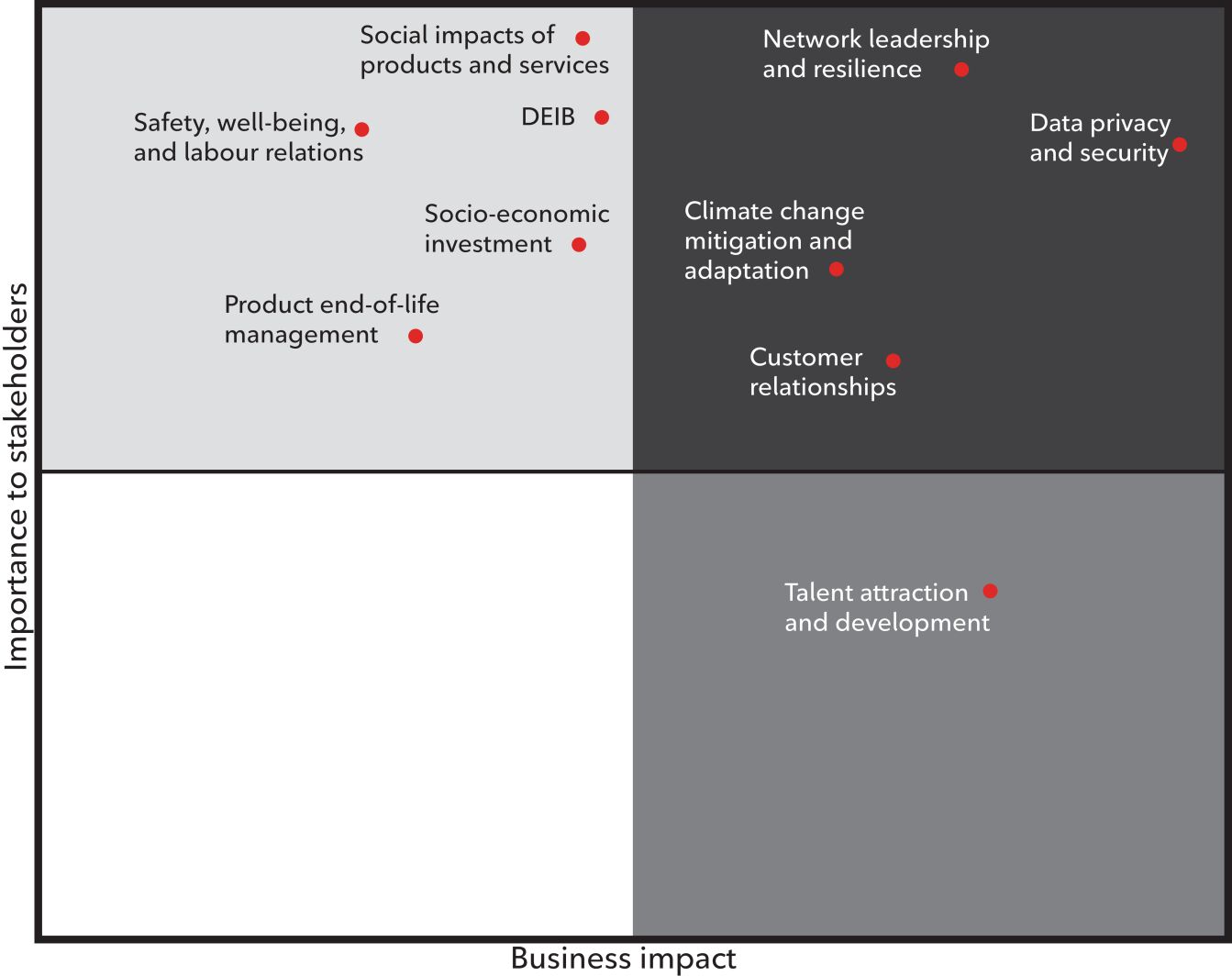


Services, technologies, key personnel, or businesses of companies we acquire may not be effectively integrated into our business or service offerings, or our alliances may not be successful. We also may not be able to successfully complete certain divestitures on satisfactory terms, if at all.

Decline of television subscribers in Canada (cord-cutting and cord-shaving)

The number of households that subscribe to television service in Canada continues to decline. Other video offerings available to consumers (for example, direct-to-consumer subscription and free services), as well as piracy, have contributed to this trend. If this decline continues, it could have a material adverse effect on our results of operations.

Migrating from conventional to digital media

Our Media business operates in many industries that can be affected by customers migrating from conventional to digital media, which is driving shifts in the quality and accessibility of data and mobile alternatives to conventional media. We have been shifting our focus towards the digital market. Increasing competition for advertising revenue from digital platforms, such as search engines, social networks, and digital content alternatives, has resulted in advertising dollars migrating from conventional television broadcasters to digital platforms. The impact is greater on conventional over-the-air broadcast networks that do not have a second revenue stream from subscription revenue. Our Media results could be adversely affected if we are unsuccessful in shifting advertising dollars from conventional to digital platforms.

Our market position in radio and television

Advertising dollars typically migrate to media properties that are leaders in their respective markets and categories, particularly when advertising budgets are tight. Our radio and television properties may not continue performing how they currently perform. Advertisers base a substantial part of their purchasing decisions on ratings data generated by industry associations and agencies. If our radio and television ratings decrease substantially, our advertising sales volumes and the rates that we charge advertisers could be adversely affected.

Climate change

Climate change is an increasingly important consideration in all businesses, including the telecommunications business. Failure, or a lack, of climate change mitigation and adaptation efforts could affect our business through potential disruption of our operations or supply chains, damage to our infrastructure, and the effects on the communities we serve. The physical risk to our infrastructure caused by extreme weather disturbances related to climate change can significantly affect our ability to maintain secure communication services to all our customers, including governments and health and emergency services.

Climate change and the environment are drawing more attention through evolving stakeholder interest and management expectations. Many aspects of our operations are subject to evolving and increasingly stringent federal, provincial, and local environmental, health, and safety laws and regulations. Such laws and regulations impose requirements on matters such as the release of substances into the environment, corrective and

remedial action concerning such releases, and the proper handling and management of substances. These evolving considerations and more stringent laws and regulations could lead to increased costs for compliance and rising costs of utilities. Failure to recognize and adequately respond could result in fines, regulatory scrutiny, loss of stakeholder confidence, or damage to our reputation or brand.

Pandemics, epidemics, and other public health emergencies

Pandemics, epidemics, and public health emergencies could occur, which could adversely affect our ability to maintain operational networks and provide products and services to our customers (including the ability to host in-person attendance at our sports games and other events held at Rogers Centre or Scotiabank Arena), as well as the ability of our suppliers to provide us with products and services we need to operate our business. Any such pandemics, epidemics, and other public health emergencies could also have an adverse effect on the economy and financial markets resulting in a declining level of retail and commercial activity, which could have a negative impact on the demand for, and prices of, our products and services.

Work stoppages or other labour disruptions

Athletes playing on each of our major league sports teams belong to player associations for their respective sports, each of which is governed by a collective bargaining agreement (CBA) that is subject to periodic renegotiation. Should the renegotiations not result in the ratification of a new or extended CBA prior to the start of the next season, the next season could be delayed or cancelled due to a lockout or strike, resulting in the postponement or cancellation of games and an associated reduction in revenue. Each of the MLB, NHL, and NBA have experienced labour disruptions in the past and each of the leagues in which we operate may have labour issues in the future. For example, the MLB has experienced lockouts in the past that resulted in a regular season being shortened from 162 games to 113 games, including the cancellation of the World Series. The current MLB CBA expires after the 2026 season. The NHL has also experienced lockouts in the past that either resulted in a regular season being shortened or the cancellation of an entire season, with the most recent lockout during the 2012-13 NHL season, which resulted in a regular season that was shortened from 82 to 48 games. The NHL has CBAs in place until the 2029-2030 season. The NBA has also experienced lockouts in the past that resulted in regular seasons being shortened, with the most recent lockout during the 2011-12 season resulting in a regular season that was shortened from 82 games to 66 games. The current NBA CBA expires after the 2029-30 season, but each of the NBA and the National Basketball Players Association has the right to terminate the CBA effective the end of the 2028-29 season. Labour disputes, such as players’ strikes, protests, or lockouts, with the unions with which the respective leagues have CBAs have had and could have a material negative effect on our business and results of operations.

Controlling shareholder ownership risk

Rogers is a family-founded, family-controlled company. Voting control of RCI is held by the Trust for the benefit of successive generations of the Rogers family and, as a result, the Trust is able to elect all members of the Board and to control the vote on most


2025 ANNUAL REPORT ROGERS COMMUNICATIONS INC.  |   76


MANAGEMENT’S DISCUSSION AND ANALYSIS


matters submitted to shareholders, whether through a shareholder meeting or a written consent resolution. The beneficiaries of the Trust are a small group of individuals who are members of the Rogers family, some of whom are also directors of the Board. The trustee is the trust company subsidiary of a Canadian chartered bank.

As at December 31, 2025, private Rogers family holding companies controlled by the Trust owned approximately 98% of our outstanding Class A Shares (2024 – 98%) and approximately 9% of our Class B Non-Voting Shares (2024 – 9%), or in total approximately 27% of the total shares outstanding (2024 – 27%). Only Class A Shares carry the right to vote in most circumstances.

LITIGATION RISKS

We are involved in various disputes, governmental and/or regulatory inspections, investigations, and proceedings, and other litigation matters. Such legal proceedings can be complex, costly, and highly disruptive to our business operations by diverting the attention and energy of management and other key personnel. It is not possible for us to predict the outcome of such legal proceedings due to the various factors and uncertainties involved in the legal process. Potential outcomes include judgment, awards, settlements, or orders that could have a material adverse effect on our business, reputation, financial condition and results. Legal proceedings could impose restraints on our current or future manner of doing business. The amounts ultimately paid or received upon settlement or pursuant to a final judgment, order, or decree may differ materially from amounts accrued in our financial statements.

Based on information currently known to us, we believe it is not probable that the ultimate resolution of any of the current legal proceedings to which we are subject, individually or in total, will have a material adverse impact on our business, financial results, or financial condition. If circumstances change and it becomes probable that we will be held liable for claims against us and such claim is estimable, we will recognize a provision during the period in which the change in probability occurs, which could be material to our Consolidated Statements of Income or Consolidated Statements of Financial Position.

CONTROLS AND PROCEDURES

DISCLOSURE CONTROLS AND PROCEDURES

We conducted an evaluation of the effectiveness of the design and operation of our disclosure controls and procedures as at December 31, 2025, under the supervision and with the participation of our management, including the Chief Executive Officer and Chief Financial Officer, pursuant to Rule 13a-15 promulgated under the US Securities Exchange Act of 1934, as amended. Based on this evaluation, our Chief Executive Officer and Chief Financial Officer concluded that our disclosure controls and procedures were effective at that date.

Our Chief Executive Officer and Chief Financial Officer have limited the scope of their evaluations of the effectiveness of internal control over financial reporting and of our disclosure controls and procedures subsumed by internal control over financial reporting to exclude the controls, policies, and procedures of MLSE, which

we acquired control of on July 1, 2025. In our consolidated financial statements for the year ended December 31, 2025, MLSE contributed approximately $0.6 billion of consolidated revenue, net income of approximately $50 million, and total assets of approximately $3.0 billion as at December 31, 2025. Additionally, as at December 31, 2025, the current assets and current liabilities of MLSE represented approximately 4% and 6% of consolidated current assets and current liabilities, respectively, and the non-current assets and non-current liabilities of MLSE represented approximately 3% and 1% of consolidated non-current assets and non-current liabilities, respectively.

MANAGEMENT’S REPORT ON INTERNAL CONTROL OVER FINANCIAL REPORTING

Management is responsible for establishing and maintaining adequate internal control over financial reporting.

Our internal control system is designed to give management and the Board reasonable assurance that our financial statements are prepared and fairly presented in accordance with IFRS as issued by the IASB. The system is intended to provide reasonable assurance that transactions are authorized, assets are safeguarded, and financial records are reliable. Management also takes steps to assure the flow of information and communication is effective, and monitors performance and our internal control procedures.

Management assessed the effectiveness of our internal control over financial reporting as at December 31, 2025, based on the criteria set out in the Internal Control – Integrated Framework (2013) issued by the Committee of Sponsoring Organizations of the Treadway Commission (COSO), and concluded that it was effective at that date. As noted under “Disclosure Controls and Procedures”, we have excluded MLSE from our assessment of the effectiveness of our internal control over financial reporting as at December 31, 2025. Our independent auditors, KPMG LLP, have issued an unqualified opinion on the effectiveness of the Company’s internal control over financial reporting as of December 31, 2025. This report is included in our 2025 Audited Consolidated Financial Statements filed on SEDAR+ (sedarplus.ca).

All internal control systems, however, no matter how well designed, have inherent limitations, and even systems that have been determined to be effective can only provide reasonable assurance about the preparation and presentation of financial statements.

CHANGES IN INTERNAL CONTROL OVER FINANCIAL REPORTING AND DISCLOSURE CONTROLS AND PROCEDURES

Over the past several years, we implemented a new enterprise resource planning system. In 2025, we implemented certain new supply chain functions in that system. In connection with the implementation, we updated our internal control over financial reporting, as necessary, to accommodate related changes to our business processes and accounting procedures. We will continue to monitor the effectiveness of these processes going forward.


77   |  ROGERS COMMUNICATIONS INC. 2025 ANNUAL REPORT
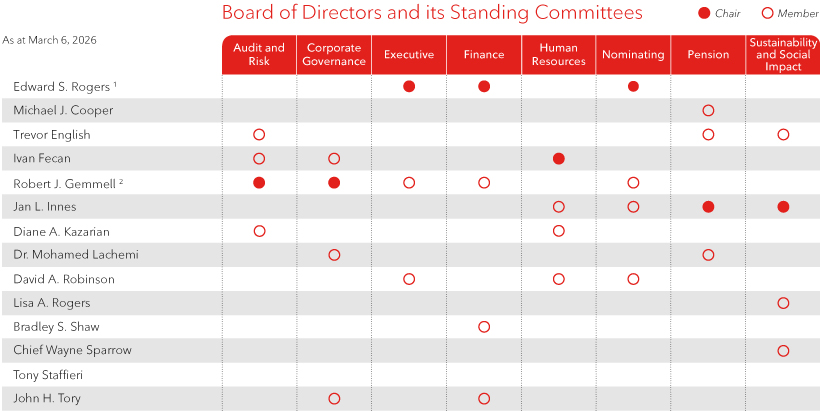


Regulation in our Industry


Our business, except for the non-broadcasting operations of Media, is regulated by two groups:


ISED Canada on behalf of the Minister of Innovation, Science and Industry; and


the CRTC, under the Telecommunications Act and the Broadcasting Act.

Regulation relates to the following, among other things:


wireless spectrum and broadcasting licensing;


carriage and distribution of television programming services;


wireless and wireline interconnection agreements;


rates we can charge third parties for access to our wireline and wireless networks;


the resale of services on our networks;


roaming on our networks and the networks of others;


ownership and operation of our communications systems;


consumer protection; and


our ability to acquire an interest in other communications systems.

Regulatory changes or decisions can adversely affect our results of operations. See “Regulatory Risks” within “Risk Management” for more information. Our business can also be impacted by regulations that are not specific to the telecommunications industry, such as immigration policies.

CANADIAN BROADCASTING OPERATIONS

Our broadcasting operations, including our terrestrial and satellite BDUs, satellite relay distribution undertakings (SRDU), radio stations, programming undertakings (conventional television stations, discretionary services, and on-demand services), and online streaming services are regulated by the CRTC under the Broadcasting Act.

Our broadcasting services depend on licences (or operate under an exemption order) granted and issued by the CRTC under the Broadcasting Act. The licences for our television stations, discretionary services, on-demand services (video-on-demand and terrestrial PPV), direct-to-home (DTH) PPV, terrestrial BDUs, DTH BDU, and SRDU expire on August 31, 2026. The licences for our commercial radio stations, which we operate in British Columbia, Alberta, Manitoba, Ontario, and Nova Scotia, will be granted indefinite licence terms as existing licences come up for renewal, pursuant to Broadcasting Decision CRTC 2025-265.

CANADIAN TELECOMMUNICATIONS OPERATIONS

The CRTC is responsible under the Telecommunications Act for the regulation of telecommunications carriers, including:


Wireless’ mobile voice and data operations; and


Cable’s Internet and telephone services.

Our cable and telecommunications retail services are not currently subject to retail price regulation, other than the CRTC’s requirement for BDUs to offer a $25/month entry-level basic television service. Regulations can and do, however, affect the terms and conditions under which we offer these services.

SPECTRUM LICENCES

Spectrum licences are administered by ISED Canada under the Radiocommunication Act. Spectrum use is governed by conditions of licence, including licence term, transferability, divisibility,

technical compliance requirements, lawful interception, research and development, and mandated antenna site sharing and domestic roaming services.

ACCESS TO SUPPORT STRUCTURES AND MUNICIPAL RIGHTS OF WAY

To build and support the rollout of 5G, and to continue upgrading our wireline network, we must have access to support structures and municipal rights of way to install equipment on municipal poles and buildings, and on Indigenous land. Under the Telecommunications Act, the CRTC has jurisdiction over support structures owned by telecommunication carriers and municipal rights of way. The CRTC’s jurisdiction does not extend to electrical utility support structures, which are regulated by provincial utility authorities, nor does the CRTC’s jurisdiction extend access to municipal infrastructure or public property for the installation of wireless facilities, such as 5G small cells. As a result, wireless carriers must continue to negotiate access for 5G small cell antennas with local authorities on commercial terms, without recourse to the CRTC.

In 2026, the CRTC is expected to issue decisions that will reform the municipal right-of-way access regulatory framework, particularly around forced relocation cost recoveries for carriers. This could result in a change in, or the introduction of, regulatory requirements that impose, increase, or reduce financial obligations on the operation, maintenance, alteration, and construction of our network.

CRTC CODES OF CONDUCT

We are subject to the CRTC’s codes of conduct: the Wireless Code, the Television Service Provider Code, and the Internet Code (collectively, the Codes). The Codes govern the terms and conditions of service in contracts between Rogers and our customers in connection with contract disclosures, early cancellation fees, changes to contracts, cancellation and renewal rights of customers, and the disclosure of related costs, among other matters. Each province also has consumer protection laws that are applicable to our provision of services.

On June 20, 2024, Bill C-69 amended the Telecommunications Act, imposing new requirements on service providers to remove barriers to switching by prohibiting some fees, improving notifications to consumers about their contract terms, and enhancing self-service tools for consumers. To enact these new requirements, the CRTC initiated four public consultations in late 2024 to consider expansions to the requirements under the Wireless Code and Internet Code:


Telecom Notice of Consultation CRTC 2024-293, Making it easier to choose a wireless phone or Internet service – Enhancing customer notification;


Telecom Notice of Consultation CRTC 2024-294, Making it easier to choose a wireless phone or Internet service – Removing barriers to switching plans;


Telecom Notice of Consultation CRTC 2024-295, Making it easier to choose a wireless phone or Internet service – Enhancing self-service mechanisms; and


Telecom Notice of Consultation 2024-318, Making it easier for consumers to shop for Internet services.

These consultations closed in 2025 and decisions are expected in 2026.


2025 ANNUAL REPORT ROGERS COMMUNICATIONS INC.  |   78


MANAGEMENT’S DISCUSSION AND ANALYSIS


LIMITS ON NON-CANADIAN OWNERSHIP AND CONTROL

Non-Canadians can own and control, directly or indirectly:


up to 33.3% of the voting shares of a holding company with a subsidiary operating company licensed under the Broadcasting Act, and


up to 20% of the voting shares of the operating licensee.

Combined, these limits can enable effective foreign control of up to 46.7% licensed broadcasting entity.

The chief executive officer and at least 80% of the members of the board of directors of the operating licensee must be resident Canadians. There are no restrictions on non-voting shares held by non-Canadians at either the holding company or the licensee level. Neither the Canadian carrier nor its parent may be otherwise controlled in fact by non-Canadians.

Under the Telecommunications Act and associated regulations, similar rules apply to Canadian telecommunications carriers, including wireless carriers, except there is no requirement for the chief executive officer to be a resident Canadian. We are currently in compliance with applicable foreign ownership and control requirements. The Telecommunications Act exempts telecommunications companies with less than 10% of total Canadian telecommunications market revenue from foreign investment restrictions. Companies that organically grow their market share beyond 10% (other than through mergers or acquisitions) retain this exemption. We are currently in compliance with all of these Canadian ownership and control requirements. If these requirements were violated, we would be subject to various penalties, possibly including the loss of a licence.

CRTC OUTAGE REPORTING

In February 2023, the CRTC launched a public consultation on how telecommunication service providers should report major service outages to the CRTC and other authorities. At the same time, the CRTC set interim outage reporting requirements that came into effect in March 2023. In September 2025, the CRTC published its final outage reporting requirements, requiring providers to (i) report major service outages to the CRTC and other government authorities (including ISED Canada, federal, provincial, and territorial emergency management organizations, and 911 call centres), (ii) follow specific requirements for major outages affecting 911, wireless public alerting, accessibility and 988 services, and for outages that isolate small communities, and (iii) provide a comprehensive post-outage report to the CRTC within 30 days of restoring services after a major service outage. In October 2025, Rogers, together with several other telecommunications service providers, filed a review and vary application with the CRTC on the basis that the new outage notification threshold was set too low. The CRTC subsequently suspended the implementation of the new notification regime, maintaining the interim notification framework until a final decision is issued.

CRTC CONSULTATION ON MANDATORY REFUNDS FOR SERVICE OUTAGES

On September 4, 2025, the CRTC initiated Telecom and Broadcasting Notice of Consultation CRTC 2025-227, Consumer protections in the event of a service outage or disruption, to determine whether Canadian telecommunications providers should be required to issue refunds or credits in the event of a

service outage or disruption. The CRTC expressed the preliminary view that “Canadians may need better protections, including clearer communications or refunds when they experience a service outage with their home Internet, wireless, telephone, or television services.” The proceeding closed on December 15, 2025. A decision is outstanding.

CRTC UNIVERSAL SERVICE OBJECTIVE

The CRTC has set as its universal service objective that Canadians, in urban areas as well as in rural and remote areas, have access to voice services and broadband Internet access services, on both fixed and mobile wireless networks. To help attain the universal service objective, the CRTC has shifted the focus of its regulatory frameworks from wireline voice services to broadband Internet access services. To measure the successful achievement of this objective, the CRTC has established several criteria, including:


90% of Canadian residential and business fixed broadband Internet access service subscribers should be able to access speeds of at least 50 Mbps download and 10 Mbps upload, and to subscribe to a service offering with an unlimited data allowance by 2021, with the remaining 10% of the population receiving such service by 2031; and


the latest generally deployed mobile wireless technology should be available not only in Canadian homes and businesses, but on as many major transportation roads as possible in Canada.

Canadian ISPs are required to contribute a percentage of annual wireless and wireline revenues to the CRTC’s Broadband Fund, which was created to improve access to Internet and mobile services in rural, remote, and Indigenous areas across Canada. The CRTC is currently considering an application filed by Rogers to amend the Broadband Fund’s collection and distribution of funds process that may decrease the contribution rate. The CRTC is simultaneously considering subsidies for broadband service in the Far North pursuant to Telecom Notice of Consultation CRTC 2025-10, Implementing a retail Internet service subsidy in the Far North, which may increase the contribution rate. On November 28, 2025, the CRTC set a final 2025 revenue-percentage charge of 0.46% and set the interim 2026 rate at 0.11%. The final 2026 rate is expected to be determined within the first half of 2026.

BILL C-11 – AN ACT TO AMEND THE BROADCASTING ACT

On April 27, 2023, Bill C-11, the Online Streaming Act, which amends the Broadcasting Act, received royal assent. In May 2023, the CRTC launched its multi-year process to implement a modernized broadcasting framework pursuant to the amended Act. This process is ongoing. On November 9, 2023, the Governor in Council’s Policy Direction came into force, directing the CRTC, in its implementation of Bill C-11 to, among other things (i) support Canadian artists and creative industries; (ii) advance Indigenous storytelling; (iii) increase representation of equity-seeking groups; (iv) ensure regulations are equitable, fair, and flexible; (v) redefine Canadian programs; and (vi) exclude the content of social media and digital creators, including podcasts, from regulation.

As part of the CRTC’s implementation of Bill C-11, the CRTC plans to initiate a consultation in 2026 to establish tailored conditions of service setting out the monetary and non-monetary contributions for both traditional and online platforms determined at the ownership group level. The tailored conditions of service could result in new fees or expenditures payable by our broadcasting companies, or new carriage or discoverability requirements.


79   |  ROGERS COMMUNICATIONS INC. 2025 ANNUAL REPORT


WIRELESS

ANNUAL MOBILE SPECTRUM LICENCE FEES

In November 2024, ISED Canada released Consultation on a Fee Framework and Amendments to Conditions of Licence for Certain Spectrum Licences Used to Provide Commercial Mobile Services Below 10 GHz. The Consultation proposed to apply a new three-tier annual spectrum fee rate structure to the following mobile spectrum bands: AWS-1; AWS-4; Cellular 850 MHz, PCS 1900 MHz; BRS 2500 MHz non-auctioned licences; 3500 MHz non-auctioned licences; and WCS 2300 MHz licences. The Consultation also proposed to use Statistics Canada 2021 census data for calculating the amount of fees that would be payable each year. Annual mobile spectrum fees are currently paid for Cellular 850 MHz and certain PCS 1900 MHz licences using 2001 census data. In March 2025, ISED Canada issued its decision in which it adopted its proposals to implement a three-tier fee rate structure. The new fee framework will be implemented in March 2026. As a result of the new fee framework, our annual spectrum licence fees will be $14 million higher in 2026 than they would have been under the previous spectrum fee regime. Our share of spectrum licences directly held by Orion Wireless Partnership, which were not previously subject to annual fees, will add $4 million in fees. As with the previous regime, the new spectrum fee framework rates will be subject to annual Consumer Price Index adjustments.

SPECTRUM AUCTION OF RESIDUAL LICENCES

On August 28, 2025, ISED Canada announced a sealed-bid, one-round residual spectrum auction to sell unsold licences or those that have been returned. There were 207 unallocated licences available in this auction, including spectrum in the 2300 MHz, 3500 MHz, 3800 MHz, and 2 GHz PCS bands in various regions throughout Canada. There were no auction caps in place and all qualified bidders could bid on all available spectrum. Auction applications and deposits were submitted on December 2, 2025 and the final list of qualified bidders (eight including Rogers) was released on December 18, 2025. Sealed bids for the allocation phase were due on January 27, 2026. ISED Canada announced the winning bidders on February 6, 2026; we won 30 spectrum licences, primarily in the 3800 MHz band, for a total cost of $84 million. We made the first payment of $17 million on February 20, 2026. Final payment of the $67 million remaining balance will be due on March 20, 2026.

MILLIMETRE WAVE SPECTRUM

In June 2022, ISED Canada released Consultation on Policy and Licensing Framework for Spectrum in the 26 GHz, 28 GHz and 38 GHz bands. The Consultation proposed to license millimetre wave spectrum in the 26 GHz, 28 GHz, and 38 GHz bands using a spectrum auction. In March 2025, ISED Canada released a decision to make the 28 GHz band available for non-competitive local licensing and released a new Consultation on the 26 GHz and 38 GHz Bands. The new Consultation proposes to license a total of 2.4 GHz in the (lower and upper) 26 GHz band and 2.4 GHz in the 38 GHz band. It also proposes the use of one of the following two potential measures: an 800 MHz set-aside for non-national (i.e. regional) service providers across the three bands or an 800 MHz spectrum cap across the two bands of either 800 MHz (option 1) or 1200 MHz (option 2). A decision is outstanding.

TRANSFERS, DIVISIONS, AND SUBORDINATE LICENSING OF SPECTRUM LICENCES

In June 2013, ISED Canada released Framework Relating to Transfers, Divisions and Subordinate Licensing of Spectrum Licences for Commercial Mobile Spectrum. The Framework lays out the criteria ISED Canada will consider and the processes it will use when it reviews spectrum licence transfers, including the prospective transfers that could arise from purchase or sale options and other agreements. Key items to note are that:


ISED Canada will review all spectrum transfer requests and will not allow any that result in “undue spectrum concentration” and reduced competition. Decisions will be made on a case-by-case basis and will be issued publicly to increase transparency; and


licensees must ask for a review within 15 days of entering into any agreement that could lead to a prospective transfer. ISED Canada will review the agreement as though the licence transfer that could arise from it has been made.

In March 2023, ISED Canada implemented a moratorium on high-impact transfers of spectrum licences in commercial mobile bands. “High-impact” transfers are defined as those that would have a significant effect on the ability of telecommunications service providers to offer wireless services in Canada. The moratorium will remain in effect until ISED Canada completes a review of its spectrum transfer framework.

CRTC REVIEW OF MOBILE WIRELESS SERVICES

On April 15, 2021 the CRTC issued Telecom Regulatory Policy 2021-130, Review of mobile wireless services. The CRTC mandated wholesale mobile virtual network operator (MVNO) access, seamless handoff for mandated wholesale roaming, and new mandatory low-cost and occasional-use retail rate plans; however, mandated MVNO access will only be provided if certain conditions are met. The CRTC decided that mandated MVNO access must be offered by the national carriers, and SaskTel in Saskatchewan, but only made available to eligible regional wireless carriers that hold mobile spectrum licences, and only in the areas that are covered by their licences. The terms and conditions associated with mandated MVNO access must be approved by the CRTC, while rates will be subject to commercial negotiation, backstopped by final offer arbitration, with the CRTC acting as arbitrator. Eligible regional wireless carriers originally could only use the mandated MVNO access regime to serve consumers and small business end users (where small businesses are defined as accounts with less than 100 lines).

On October 19, 2022, the CRTC issued Telecom Decision CRTC 2022-288, Facilities-based wholesale mobile virtual network operator (MVNO) access tariffs – Commission determinations on proposed terms and conditions, which determined that wholesale MVNO access service is available for use by regional wireless carriers that have deployed their own home Public Mobile Network (PMN) somewhere in Canada and are also offering retail wireless services. To be eligible for the MVNO access, a regional wireless carrier must be registered with the CRTC as a wireless carrier, must have home PMN somewhere in Canada, and must be actively offering mobile wireless services commercially to retail customers.

On October 9, 2024, the CRTC issued Telecom Decision CRTC 2024-238, Facilities-based wholesale mobile virtual network


2025 ANNUAL REPORT ROGERS COMMUNICATIONS INC.  |   80


MANAGEMENT’S DISCUSSION AND ANALYSIS


operator (MVNO) access tariffs – Expanding the scope to include enterprise and Internet of Things customers (TD 2024-238), expanding the scope of the CRTC’s mandated MVNO regime to include the enterprise and Internet of Things and machine-to-machine (IoT/M2M) segments of the market (where enterprises are defined as accounts with 100 lines or more). On November 19, 2025, the CRTC released Telecom Decision CRTC 2025-303, dismissing our application to review and vary TD 2024-238.

CRTC DECISION ON FINAL OFFER ARBITRATION BETWEEN ROGERS AND QUEBECOR REGARDING MVNO ACCESS RATES

On July 24, 2023, in Telecom Decision CRTC 2023-217, the CRTC selected Quebecor’s offer in the context of Final Offer Arbitration for MVNO rates and directed the parties to enter into an MVNO access agreement consistent with that offer. On May 28, 2025, the FCA dismissed our appeal of Telecom Decision CRTC 2023-217.

ISED CANADA CONDITIONS OF LICENCE RELATING TO WIRELESS SERVICE WITHIN THE TTC SUBWAY SYSTEM

On July 24, 2023, ISED Canada announced it had initiated a Consultation on Conditions of Licence relating to the Provision of Service within the TTC subway system. On September 11, 2023, the Minister of Innovation, Science and Industry announced new spectrum licence conditions, which required carriers to (i) provide equivalent levels of service to all TTC subway riders by October 3, 2023; (ii) expand existing network coverage in order to provide full voice, text, and data services throughout the TTC subway system within specific timeframes; and (iii) provide service in all future stations and tunnels at the same time as they are made operational by the TTC. On October 2, 2023, we announced we had developed and introduced an immediate solution to activate 5G service for transit riders from all major Canadian wireless carriers in the busiest sections of the TTC subway system.

CABLE

ISED CANADA REVIEW OF THE SHAW TRANSACTION

On March 31, 2023, the Minister of Innovation, Science and Industry approved the transfer of Freedom’s spectrum licences to Videotron, following which the Shaw Transaction and Freedom Transaction closed on April 3, 2023. As part of the regulatory approval process, we have agreed to certain legally enforceable undertakings with ISED Canada, which reflect commitments we made when the Shaw Transaction was announced, including:


$1 billion of investments over five years to connect rural, remote, and Indigenous communities across Western Canada and to close critical connectivity gaps faster for underserved areas, including to make broadband Internet services available where broadband Internet at a minimum 50 megabit per second (Mbps) download speeds and 10 Mbps upload speeds is not currently available and to make 5G wireless service available where mobile service using long-term evolution (LTE) is not available;


$2.5 billion of investments over five years to enhance and expand 5G coverage across Western Canada and $3 billion over five years related to additional network, services, and technology investments, including the expansion of our Cable network;


expanding Connected for Success, our low-cost, high-speed Internet program, to low-income Canadians across Western


Canada and implementing a new Connected for Success wireless program for low-income Canadians across Canada, such that Connected for Success will be available to more than 2.5 million eligible Canadians within five years;


maintaining a strong presence in Western Canada, including creating 3,000 new jobs within five years (and maintaining those jobs until the tenth anniversary of closing) and maintaining a Western Canada headquarters in Calgary for at least ten years; and


continuing to offer wireless plans to existing Shaw Mobile customers as at the closing date with the same terms and conditions (including eligibility) as the Shaw Mobile plans that were available as at the closing date for five years.

We will report on our progress towards each of these undertakings every year until such commitments have been met or for up to ten years after the closing date of the Shaw Transaction, whichever is earlier, including through a report that will be posted publicly on our website (the first of which was published in April 2024). If any material element of any of the above commitments is not met, we could be liable to pay ISED Canada $100 million in damages per year (to a maximum of $1 billion) until the earlier of (i) such material elements having been met or fulfilled or (ii) ten years after the closing date of the Shaw Transaction.

COPYRIGHT RETRANSMISSION OF DISTANT SIGNALS

The Copyright Board of Canada establishes the royalties paid for the use of copyrighted works, including the rates our broadcasting undertakings pay for the broadcast and distribution of audio and audiovisual works. Pursuant to section 31(2) of the Copyright Act, BDUs are permitted to retransmit programming within distant over-the-air television signals as part of a compulsory licensing regime pursuant to the rates approved by the Copyright Board.

On December 18, 2018, the Copyright Board released the approved rates for the 2014-2018 tariff period (Initial Rate Decision). The Copyright Collectives and the BDUs each collectively sought judicial review of the Initial Rate Decision. On July 22, 2021, the FCA directed the Copyright Board to correct certain errors in connection with its Initial Rate Decision. On January 12, 2024, the Copyright Board issued its decision in the redetermination of the 2014-2018 tariff period (Redetermination Decision), which reduced the monthly per-subscriber rates for the years 2015-2018 on a retroactive basis.

As a result of a subsequent judicial review application by the Copyright Collectives, the FCA issued a decision on May 8, 2025, setting aside the Copyright Board’s 2024 Redetermination Decision and directing the Copyright Board to make specific changes to the Tariff, which increased the monthly per-subscriber rates for the years 2015-2018 on a retroactive basis. Consequently, we recognized a $36 million charge, including interest, in “restructuring, acquisition and other” in 2025. On August 7, 2025, Rogers, Bell, Telus, Cogeco, and Videotron applied to the Supreme Court of Canada for leave to appeal the FCA’s second judicial review decision. The SCC’s decision on the leave application is outstanding.

A Copyright Board hearing to set the rates for one or both of the subsequent tariff periods (2019-2023 and 2024-2028) could start in 2026. If the Copyright Board approves rates that align with the Collectives’ proposed tariff rates for either of such subsequent periods, Rogers could become subject to significantly higher royalty rates, negatively impacting our financial results.


81   |  ROGERS COMMUNICATIONS INC. 2025 ANNUAL REPORT


CRTC REVIEW OF WHOLESALE WIRELINE TELECOMMUNICATIONS SERVICES

We are mandated by the CRTC to provide aggregated wholesale high-speed access (HSA) services at regulated rates to third-party ISPs who resell these services to provide retail Internet services to consumers.

On August 13, 2024, the CRTC released Telecom Regulatory Policy CRTC 2024-180, Competition in Canada’s Internet service markets (TRP 2024-180), setting out the revised wholesale HSA framework. In TRP 2024-180, the CRTC:


mandated the incumbent telephone companies (Bell, Telus, and SaskTel) provide aggregated wholesale HSA to their FTTH facilities;


required cable carriers, including Rogers, to continue providing mandated aggregated wholesale HSA services over their DOCSIS-based HFC facilities, while excluding cable carriers’ FTTH networks from the regime;


granted Bell, Telus, and SaskTel a five-year deferral for any new FTTH facilities deployed after the date of the policy, but did not exempt cable carriers’ new HFC facilities; and


prohibited both incumbent telephone and cable companies from using aggregated wholesale HSA services within their traditional wireline-serving territories, although these companies may access aggregated wholesale HSA services out-of-territory.

On June 20, 2025, in Telecom Decision CRTC 2025-154, Consolidated applications to review and vary Telecom Regulatory Policy 2024-180 (TD 2025-154), the CRTC declined to vary TRP 2024-180. Contrary to the requests of several applicants, including Rogers, the CRTC declined to prohibit each of Bell, Rogers, and Telus from accessing mandated wholesale broadband access anywhere in Canada using any technology. On August 6, 2025, the federal government declined to alter TRP 2024-180. On September 10, 2025, Cogeco and Eastlink were granted leave to appeal TRP 2024-180 at the FCA. Rogers is also participating in the appeal. On September 18, 2025, Rogers, CNOC and TekSavvy, and Eastlink, Cogeco, and SaskTel filed petitions to the Governor in Council requesting it vary TD 2025-154. The Governor in Council has until September 18, 2026 to issue a decision, if any.

FINAL RATES FOR AGGREGATED WHOLESALE HSA SERVICES

In 2026, the CRTC is expected to release final rates for aggregated wholesale HSA services. Currently, all aggregated wholesale HSA providers, including Rogers, are subject to interim rates, which have been in place since March 2023. The final rate decision is expected to apply retroactively. If the final rates are lower than the interim rates, Rogers may be required to reimburse its wholesale customers retroactively to 2023. If the final rates fail to adequately compensate Rogers for the costs associated with provisioning HSA services as well as a reasonable return on investment, it could have a negative impact on our Cable revenue, result in lower capital expenditures, and could hinder our ability to compete with both wholesale- and facilities-based Internet providers.

TELEVISION SERVICES DISTRIBUTION

BDUs are required to offer customers an option for a small basic service consisting of Canadian local and regional channels (local radio is optional), mandatory Canadian services, community and provincial legislature channels, provincial/territorial educational channels, and, should they wish, US 4+1 networks. The retail rate

for this entry-level service is capped at $25 per month (excluding equipment). Further, all channels above the basic tier must be offered on an à la carte basis and in smaller, reasonably priced packages. BDUs are required to ensure the majority of programming services offered to consumers are Canadian channels. As a result of the decision approving the Shaw Transaction, our BDUs are also required to carry 45 Canadian independent English or French programming services.

CRTC CONSULTATION ON MARKET DYNAMICS

On January 9, 2025, as part of the CRTC’s implementation of Bill C-11, the CRTC initiated Broadcasting Notice of Consultation CRTC 2025-2, The Path Forward – Working towards a sustainable Canadian broadcasting system. As part of this proceeding, the CRTC:


reviewed the market dynamics between programming undertakings, BDUs, and online undertakings;


examined the effectiveness of existing regulatory tools applicable to traditional broadcasting undertakings, including mandatory distribution orders, distribution and packaging requirements, basic service and pick-and-pay requirements, preponderance rules for Canadian services, dispute resolution mechanisms, the Wholesale Code, and undue preference rules; and


considered new regulatory obligations applicable to online undertakings, including those relating to carriage, discoverability, data sharing, dispute resolution, and undue preference.

A public hearing was held in June 2025 and the record closed in September 2025. The CRTC’s decision is outstanding.

MEDIA

CRTC CONSULTATION ON CANADIAN CONTENT

On November 18, 2025, the CRTC issued Broadcasting Regulatory Policy 2025-299, Defining “Canadian program” and supporting the creation and distribution of Canadian programming in the audio-visual sector – Part 1 – Certification framework for Canadian programs, artificial intelligence, data collection and publication, and reporting requirements (BRP 2025-299). This is the first of two decisions arising from Broadcasting Notice of Consultation CRTC 2024-288, The Path Forward – Defining “Canadian program” and supporting the creation and distribution of Canadian programming in the audio-visual sector. In BRP 2025-299, the CRTC:


updated the definition of “Canadian program” through an expanded number of key creative positions;


determined that productions with less than full Canadian copyright ownership qualify as Canadian programs; and


introduced changes to data collection and reporting practices to level the playing field regarding financial data publication between traditional broadcasters and online undertakings.

The CRTC will issue its second decision, expected in 2026, that will address funding and support for Canadian programming, including funding for news and at-risk programming, by establishing financial contribution requirements for both traditional broadcasters and online streaming services.


2025 ANNUAL REPORT ROGERS COMMUNICATIONS INC.  |   82


MANAGEMENT’S DISCUSSION AND ANALYSIS


COMMERCIAL RADIO NEWS FUND

On June 4, 2024, as part of the broader regulatory plan to implement the modernized Broadcasting Act, the CRTC issued Broadcasting Regulatory Policy 2024-121, The Path Forward – Supporting Canadian and Indigenous content through base contributions. Among other things, the CRTC determined that audio streaming services should be required to make financial contributions to a new, temporary fund to support news production by commercial radio stations in smaller markets. The new fund was established in Broadcasting Regulatory Policy 2025-193, Commercial Radio News Fund, and will be administered by the Canadian Association of Broadcasters (CAB), which has completed the initial application round. Funds will not be disbursed until the Federal Court has made a determination on the appeal mounted by US-based foreign streaming services of the funding requirements established in Broadcasting Regulatory Policy 2024-121.

MODERNIZATION OF RADIO PROCESSES

In Broadcasting Regulatory Policy 2025-265, Modernization of radio processes, the CRTC modernized the regulatory framework for radio undertakings to reduce administrative burden. Key changes include the introduction of indefinite broadcasting licences to be phased in as current licences expire, regular compliance audits replacing licence renewal reviews, a one-year trial permitting AM stations to simulcast on FM in the same market, and the stated intention to apply Administrative Monetary Penalties for serious or repeated non-compliance under powers granted by the modernized Broadcasting Act.

THE ONLINE NEWS ACT

On June 22, 2023, Bill C-18, the Online News Act, received royal assent and became law. The Online News Act aims to enhance fairness in the Canadian digital marketplace and to contribute to

the sustainability of the Canadian news sector by establishing a bargaining framework for commercial agreements between the largest digital platforms and eligible news businesses. On October 28, 2024, the CRTC approved Google LLC’s application for an exemption from the Online News Act with respect to Google Search, given that Google has agreed to contribute $100 million annually to Canadian news businesses. Google’s annual monetary contribution will be administered by the Canadian Journalism Collective. The maximum amount that can be allocated to Canadian broadcasters that produce news is capped at 30% under the Online News Act Application and Exemption Regulations. On December 12, 2024, the CRTC released its framework governing the formal bargaining process under the Online News Act.

BILL 109: AN ACT TO AFFIRM THE CULTURAL SOVEREIGNTY OF QUÉBEC AND TO ENACT THE ACT RESPECTING THE DISCOVERABILITY OF FRENCH-LANGUAGE CULTURAL CONTENT IN THE DIGITAL ENVIRONMENT

On December 12, 2025, the National Assembly of Quebec passed Bill 109, An Act to affirm the cultural sovereignty of Québec and to enact the Act respecting the discoverability of French-language cultural content in the digital environment (the Act). The Act requires digital platforms operating in Quebec that offer online audio and audiovisual services, plus smart TV and connected device manufacturers, to comply with French-language content rules. The forthcoming regulations will prescribe the specific requirements with respect to, among other things, discoverability of French content and quotas for the proportion of original French-language cultural content offered by digital platforms. If the Act survives legal challenge, its impact on our broadcasting undertakings operating in Quebec will depend on the substance and scope of the forthcoming regulations.


83   |  ROGERS COMMUNICATIONS INC. 2025 ANNUAL REPORT


Other Information


ACCOUNTING POLICIES

CRITICAL ACCOUNTING ESTIMATES AND JUDGMENTS

Management makes judgments, estimates, and assumptions that affect how accounting policies are applied, the amounts we report in assets, liabilities, revenue, and expenses, and our related disclosure about contingent assets and liabilities. Significant changes in our assumptions, including those related to our future business plans and cash flows, could materially change the amounts we record. Actual results could be different from these estimates.

These estimates are critical to our business operations and understanding our results of operations. We may need to use additional judgment because of the sensitivity of the methods and assumptions used in determining the asset, liability, revenue, and expense amounts.

ESTIMATES

REVENUE FROM CONTRACTS WITH CUSTOMERS

Determining the transaction price

The transaction price is the amount of consideration that is enforceable and to which we expect to be entitled in exchange for the goods and services we have promised to our customer. We determine the transaction price by considering the terms of the contract and business practices that are customary within that particular line of business. Discounts, rebates, refunds, credits, price concessions, incentives, penalties, and other similar items are reflected in the transaction price at contract inception.

Determining the stand-alone selling price and the allocation of the transaction price

The transaction price is allocated to performance obligations based on the relative stand-alone selling prices of the distinct goods or services in the contract. The best evidence of a stand-alone selling price is the observable price of a good or service when the entity sells that good or service separately in similar circumstances and to similar customers. If a stand-alone selling price is not directly observable, we estimate the stand-alone selling price taking into account reasonably available information relating to the market conditions, entity-specific factors, and the class of customer.

In determining the stand-alone selling price, we allocate revenue between performance obligations based on expected minimum enforceable amounts to which we are entitled. Any amounts above the minimum enforceable amounts are recognized as revenue as they are earned.

Determining the appropriate amortization period for deferred commission costs assets

We use estimates in determining the timing over which we will receive the expected pattern of benefits from the payment of commissions.

LEASES

We estimate the lease term by considering the facts and circumstances that can create an economic incentive to exercise an extension option, or not exercise a termination option. We make

certain qualitative and quantitative assumptions when deriving the value of the economic incentive.

USEFUL LIVES

We depreciate the cost of property, plant and equipment over their estimated useful lives by considering industry trends and company-specific factors, including changing technologies and expectations for the in-service period of certain assets at the time. We reassess our estimates of useful lives annually, or when circumstances change, to ensure they match the anticipated life of the technology from a revenue-producing perspective. If technological change happens more quickly, or in a different way, than anticipated, we might have to reduce the estimated life of property, plant and equipment, which could result in a higher depreciation expense in future periods or an impairment charge to write down the value. We monitor and review our depreciation rates and asset useful lives at least once a year and change them if they are different from our previous estimates. We recognize the effect of changes in estimates in net income prospectively.

CAPITALIZING DIRECT LABOUR, OVERHEAD, AND INTEREST

Certain direct labour, overhead, and interest costs associated with the acquisition, construction, development, or improvement of our networks and information technology assets are capitalized to “property, plant and equipment”. The capitalized amounts are calculated based on estimated costs of projects that are capital in nature, and are generally based on a per-hour rate. In addition, interest costs are capitalized during development and construction of certain property, plant and equipment. Capitalized amounts increase the cost of the asset and result in a higher depreciation expense in future periods.

IMPAIRMENT OF ASSETS

Indefinite-life intangible assets (including goodwill, spectrum, franchise rights, broadcast licences, and certain brand names and trademarks) are assessed for impairment on an annual basis, or more often if events or circumstances warrant, and finite-life assets (including property, plant and equipment and other intangible assets) are assessed for impairment if events or circumstances warrant. The recoverable amount of a cash-generating unit (CGU) involves significant estimates such as future cash flows, terminal growth rates, and discount rates. If key estimates differ unfavourably in the future, we could experience impairment charges that could decrease net income.

FINANCIAL INSTRUMENTS

The fair values of our derivatives are recorded using an estimated credit-adjusted mark-to-market valuation. If the derivatives are in an asset position (i.e. the counterparty owes Rogers), the credit adjustment for the bank counterparty is deducted from the risk-free value to determine the estimated credit-adjusted value. If the derivatives are in a liability position (i.e. Rogers owes the counterparty), our credit adjustment is added to the risk-free value. The estimated credit-adjusted value of derivatives requires assessment of the credit risk of the parties to the instruments and the instruments’ discount rates.


2025 ANNUAL REPORT ROGERS COMMUNICATIONS INC.  |   84


MANAGEMENT’S DISCUSSION AND ANALYSIS


For all derivative instruments where hedge accounting is applied, we are required to ensure that the hedging relationships meet hedge effectiveness criteria. Hedge effectiveness testing requires the use of both judgments and estimates.

PENSION BENEFITS

When we account for defined benefit pension plans, assumptions are made in determining the valuation of benefit obligations. Assumptions and estimates include the discount rate, the rate of future compensation increase, and the mortality rate. Changes to these primary assumptions and estimates would affect the pension expense, pension asset and liability, and other comprehensive income. Changes in economic conditions, including financial markets and interest rates, may also have an impact on our pension plans, as there is no assurance that the plans will be able to earn the assumed rate of return. Market-driven changes may also result in changes in the discount rates and other variables that could require us to make contributions in the future that differ significantly from the current contributions and assumptions incorporated into the actuarial valuation process.

Below is a summary of the effect an increase or decrease in the primary assumptions and estimates would have had on our accrued benefit obligation as at December 31, 2025.


(In millions of dollars)


Increase (decrease) in
accrued benefit obligation


Discount rate


Impact of 0.5% increase


(168

Impact of 0.5% decrease


189


Rate of future compensation increase


Impact of 0.25% increase


10


Impact of 0.25% decrease


(10

Mortality rate


Impact of 1 year increase


36


Impact of 1 year decrease


(39

STOCK-BASED COMPENSATION

Stock option plans

Our employee stock option plans attach cash-settled share appreciation rights (SARs) to all new and previously granted options. The SAR feature allows the option holder to elect to receive a cash payment equal to the intrinsic value of the option, instead of exercising the option and acquiring Class B Non-Voting Shares. We measure stock-based compensation to employees at fair value. We determine the fair value of options using our Class B Non-Voting Share price and option pricing models, and record all outstanding stock options as liabilities. The liability is marked to market each period and is amortized to expense using a graded vesting approach over the period during which employee services are rendered, or over the period to the date an employee is eligible to retire, whichever is shorter. The expense in each period is affected by the change in the price of our Class B Non-Voting Shares during the period.

Restricted share unit (RSU) and deferred share unit (DSU) plans

We recognize outstanding RSUs and DSUs as liabilities, measuring the liabilities and compensation costs based on the awards’ fair values, which are based on the market price of the Class B Non-Voting Shares, and recognizing them as charges to “operating costs” over the vesting period of the awards. If an

award’s fair value changes after it has been granted and before the exercise date, we recognize the resulting changes in the liability within “operating costs” or “restructuring, acquisition and other”, as applicable, in the year the change occurs. For RSUs, the payment amount is established as of the vesting date. For DSUs, the payment amount is established as of the exercise date.

BUSINESS COMBINATIONS

We use estimates in determining the value of assets acquired and liabilities assumed in business combinations, most significantly property, plant and equipment and intangible assets, including the related deferred tax impacts.

Valuation of acquired property, plant and equipment can be complex and may require significant estimation, including characteristics such as size, age, replacement cost, and other characteristics of different assets. Each of these characteristics can have a significantly different cost to build or replace, and therefore fair value.

Property, plant and equipment (other than land and building) is often valued using a depreciated replacement cost approach, which requires estimating the gross replacement cost of each asset (either through direct comparison to current prices or by applying inflationary factors to historical costs) and then applying a depreciation factor to reflect the age of the in-service asset.

Land and building assets are often valued using an income approach (for buildings) and a direct market comparison approach (for the underlying land). This involves assessing comparable properties in the relevant markets to identify characteristics, such as vacancy rates and income capitalization rates, to apply to the valuation of each building. Land is often valued by comparing to similar plots of land in the relevant markets.

The fair value of franchise rights acquired in the MLSE Transaction has been estimated using a market-based approach based on market revenue multiples and precedent team transactions in each of the leagues, including league expansions, as applicable. This required significant estimation to determine the adjustments to available market data for local Toronto market factors, including population, gross domestic product, and number of major sports teams.

JUDGMENTS

REVENUE FROM CONTRACTS WITH CUSTOMERS

Distinct goods and services

We make judgments in determining whether a promise to deliver goods or services is considered distinct. We account for individual products and services separately if they are distinct (i.e. if a product or service is separately identifiable from other items in the bundled package and if the customer can benefit from it). The consideration is allocated between separate products and services in a bundle based on their stand-alone selling prices. For distinct items we do not sell separately, we estimate stand-alone selling prices using the adjusted market assessment approach.

Residual value arrangements

Under certain customer offers, we allow customers to defer a component of the device cost until contract termination. We use judgment in determining whether these arrangements constitute


85   |  ROGERS COMMUNICATIONS INC. 2025 ANNUAL REPORT


revenue-generating arrangements or leases. In making this determination, we use judgment to assess the extent of control over the devices that passes to our customer, including whether the customer has a significant economic incentive at contract inception to return the device at contract termination.

LEASES

We make judgments in determining whether a contract contains an identified asset. The identified asset should be physically distinct or represent substantially all of the capacity of the asset, and should provide us with the right to substantially all of the economic benefits from the use of the asset.

We also make judgments in determining whether or not we have the right to control the use of the identified asset. We have that right when we have the decision-making rights that are most relevant to changing how and for what purpose the asset is used. In rare cases where the decisions about how and for what purpose the asset is used are predetermined, we have the right to direct the use of the asset if we have the right to operate the asset or if we designed the asset in a way that predetermines how and for what purpose the asset will be used.

We make judgments in determining the incremental borrowing rate used to measure our lease liability for each lease contract, including an estimate of the asset-specific security impact. The incremental borrowing rate should reflect the interest that we would have to pay to borrow at a similar term and with a similar security.

Certain of our leases contain extension or renewal options that are exercisable only by us and not by the lessor. At lease commencement, we assess whether we are reasonably certain to exercise any of the extension options based on our expected economic return from the lease. We typically exercise extension options on our network leases, primarily due to the significant cost that would be required to relocate our network towers and related equipment. We periodically reassess whether we are reasonably certain to exercise the options and account for any changes at the date of the reassessment.

USEFUL LIVES AND DEPRECIATION AND AMORTIZATION METHODS

We make significant judgments in choosing methods for depreciating our property, plant and equipment that we believe most accurately represent the consumption of benefits derived from those assets and are most representative of the economic substance of the intended use of the underlying assets.

We amortize the cost of intangible assets with finite lives over their estimated useful lives. We review their useful lives, residual values, and the amortization methods at least once a year.

We do not amortize intangible assets with indefinite lives (spectrum licences, franchise rights, broadcast licences, and certain brand names and trademarks) as there is no foreseeable limit to the period over which these assets are expected to generate net cash inflows for us. We make judgments to determine that these assets have indefinite lives, analyzing all relevant factors, including the expected usage of the asset, the typical life cycle of the asset, and anticipated changes in the market demand for the products and services the asset helps generate. After review of the competitive, legal, regulatory, and other factors, it is our view that these factors do not limit the useful lives of our spectrum licences, broadcast licences, and certain brand names.

Judgment is also applied in choosing methods for amortizing our intangible assets and program rights that we believe most accurately represent the consumption of those assets and are most representative of the economic substance of the intended use of the underlying assets.

IMPAIRMENT OF ASSETS

We make judgments in determining CGUs and the allocation of goodwill to CGUs or groups of CGUs for the purpose of impairment testing. The allocation of goodwill involves considerable management judgment in determining the CGUs (or groups of CGUs) that are expected to benefit from the synergies of a business combination. A CGU is the smallest identifiable group of assets that generates cash inflows that are largely independent of the cash inflows from other assets or groups of assets. Goodwill and indefinite-life intangible assets are allocated to CGUs (or groups of CGUs) based on the level at which management monitors goodwill, which is not higher than an operating segment. In particular for Media, we have determined that goodwill is monitored and should be tested for impairment at the Media segment level as a whole, rather than at the underlying business by business level, based on the interdependencies across Media and how it sells and goes to market.

RESTRUCTURING, ACQUISITION AND OTHER COSTS

We make significant judgments in determining the appropriate classification of costs to be included in restructuring, acquisition and other.

HEDGE ACCOUNTING

We make significant judgments in determining whether our financial instruments qualify for hedge accounting, including our determination of hedge effectiveness. These judgments include assessing whether the forecast transactions designated as hedged items in hedging relationships will materialize as forecast, whether the hedging relationships designated as effective hedges for accounting purposes continue to qualitatively be effective, and determining the methodology to determine the fair values used in testing the effectiveness of hedging relationships.

SEGMENTS

We make significant judgments in determining our operating segments and in determining the appropriate allocation of shared costs between our segments. These are components that engage in business activities from which they may earn revenue and incur expenses, for which operating results are regularly reviewed by our chief operating decision makers to make decisions about resources to be allocated and to assess component performance, and for which discrete financial information is available.

INCOME TAXES AND OTHER TAXES

We accrue income and other tax provisions based on information currently available in each of the jurisdictions in which we operate. While we believe we have paid and provided for adequate amounts of tax, our business is complex and significant judgment is required in interpreting how tax legislation and regulations apply to us. Our tax filings are subject to audit by the relevant government revenue authorities and the results of the government audit could materially change the amount of our actual income tax expense,


2025 ANNUAL REPORT ROGERS COMMUNICATIONS INC.  |   86


MANAGEMENT’S DISCUSSION AND ANALYSIS


income tax payable or receivable, other taxes payable or receivable, and deferred income tax assets and liabilities and could, in certain circumstances, result in the assessment of interest and penalties.

CONTINGENCIES

Considerable judgment is involved in the determination of contingent liabilities. Our judgment is based on information currently known to us, and the probability of the ultimate resolution of the contingencies. If it becomes probable that a contingent liability will result in an outflow of economic resources, we will record a provision in the period the change in probability occurs. The amount of the loss involves judgment based on information available at that time. Any provision recognized for a contingent liability could be material to our consolidated financial position and results of operations.

BUSINESS COMBINATIONS

We use significant judgment to determine what is, and what is not, part of a business combination, including the timing of when control transfers to us. This requires assessing the nature of other transactions entered into with the acquiree to ensure we account for the business combination using only the consideration transferred for the assets acquired and liabilities assumed in the exchange.

We also use significant judgment in determining the valuation methodologies applied to various assets and liabilities. Valuation of acquired intangible assets can be complex and selecting an appropriate valuation methodology can require significant judgment. Intangible assets can be valued using different methods, including the multi-period excess earnings method, relief from royalty, or a market approach.

TRANSACTIONS WITH RELATED PARTIES

We have entered into certain transactions in the normal course of business with our associates and joint arrangements. The amounts received from or paid to these parties were as follows:


Years ended December 31


(In millions of dollars)


2025


2024


% Chg


Revenue


51


45


13


Purchases and lease payments


174


231


(25

We have entered into business transactions with Dream Unlimited Corp. (Dream), which is controlled by our Director Michael J. Cooper. Dream is a real estate company that rents spaces in office and residential buildings. Total amounts paid to this related party were nominal for each of 2025 and 2024.

We have also entered into certain transactions with our controlling shareholder and companies it controls. These transactions are subject to formal agreements approved by the Audit and Risk Committee. Total amounts paid to these related parties generally reflect the charges to Rogers for occasional business use of aircraft, net of other administrative services, and were less than $1 million for each of 2025 and 2024.

On closing of the Shaw Transaction, we entered into an advisory agreement with Brad Shaw in accordance with the arrangement

agreement, pursuant to which he was paid $20 million for a two-year period following closing in exchange for performing certain services related to the transition and integration of Shaw, of which $3 million was recognized in net income and paid during the year ended December 31, 2025 (2024 — $10 million); the final payment under this arrangement was made during the three months ended March 31, 2025. We have also entered into certain other transactions with the Shaw Family Group. Total amounts paid to the Shaw Family Group in 2025 and 2024 were under $1 million. We also assumed a liability of $102 million through the Shaw Transaction related to a legacy pension arrangement with one of our directors whereby the director will be paid $1 million per month until March 2035, $12 million of which was paid in 2025 (2024 – $12 million).

We recognize these transactions at the amount agreed to by the related parties, which are also reviewed by the Audit and Risk Committee. The amounts owing for these services were unsecured, interest-free, and due for payment in cash within one month of the date of the transaction.

NEW ACCOUNTING PRONOUNCEMENTS ADOPTED IN 2025

We adopted the following IFRS amendments in 2025. They did not have a material effect on our consolidated financial statements.


Amendments to IAS 21, The Effects of Changes in Foreign Exchange Rates – Lack of Exchangeability, clarifying when a currency is exchangeable and when it is not exchangeable.

RECENT ACCOUNTING PRONOUNCEMENTS NOT YET ADOPTED

The IASB has issued the following new standard and amendments that will become effective in future years:


IFRS 18, Presentation and Disclosure in Financial Statements (replacing IAS 1, Presentation of Financial Statements), with an aim to improve the structure and content of the primary financial statements and comparability between issuers (January 1, 2027). The focus of IFRS 18 is on presentation in the statement of income by requiring income and expenses to be classified into operating, investing, and financing categories. The main business activities of a company drive classification of income and expense into appropriate categories and further disaggregation of operating expense line items will be required in the statement of income. It also introduces defined subtotals of “operating profit” and “profit before financing and income taxes” in the statement of income to improve comparability between companies. Impacts on the statement of cash flows include eliminating classification options for interest and dividend receipts (must be classified as investing) and payments (must be classified as financing). In addition, IFRS 18 provides guidance on the disclosure of “management-defined performance measures” in relation to the statement of income, including reconciliation requirements.


Amendments to IFRS 9, Financial Instruments and IFRS 7, Financial Instruments: Disclosures, clarifying both the classification of financial assets linked to environmental, social, and governance as well as the timing in which a financial asset or financial liability is derecognized when using electronic payment systems (January 1, 2026).


87   |  ROGERS COMMUNICATIONS INC. 2025 ANNUAL REPORT


We are assessing the impacts IFRS 18 and the amendments to IFRS 9 and IFRS 7 will have on our consolidated financial statements. We do not expect the amendments to have a material impact on adoption; however, our consolidated statement of income will be presented differently under IFRS 18 and there will be recategorizations of certain line items in the statements of income and statements of cash flows.

KEY PERFORMANCE INDICATORS

We measure the success of our strategy using a number of key performance indicators, which are outlined below. We believe these key performance indicators allow us to appropriately measure our performance against our operating strategy and against the results of our peers and competitors. The following key performance indicators, some of which are supplementary financial measures (see “Non-GAAP and Other Financial Measures”), are not measurements in accordance with IFRS. They include:


subscriber counts;


Wireless;


Cable; and


homes passed (Cable);


Wireless subscriber churn (churn);


Wireless mobile phone average revenue per user (ARPU);


Cable average revenue per account (ARPA);


Cable customer relationships;


Cable market penetration (penetration);


capital intensity;


total service revenue;


dividend payout ratios; and


return on assets.

SUBSCRIBER COUNTS

We determine the number of subscribers to our services based on active subscribers. When subscribers are deactivated, either voluntarily or involuntarily for non-payment, they are considered deactivations in the period the services are discontinued. We use subscriber counts to measure our core business performance and ability to benefit from recurring revenue streams. We use homes passed (Cable) as a measure for our potential market penetration within a defined geographical area.

Subscriber count (Wireless)


A wireless subscriber is represented by each identifiable telephone number.


We report wireless subscribers in two categories: postpaid mobile phone and prepaid mobile phone. Postpaid and prepaid include voice-only subscribers and subscribers with service plans including both voice and data.


Usage and overage charges for postpaid subscribers are billed a month in arrears. Prepaid subscribers cannot incur usage and/or overage charges in excess of their plan limits or account balance.


Wireless prepaid subscribers are considered active for a period of 30 days from the date of their last revenue-generating usage.

Subscriber count (Cable)


Cable retail Internet, Video, and Home Monitoring subscribers are represented by a dwelling unit; Cable Home Phone subscribers are represented by line counts.


When there is more than one unit in a single dwelling, such as an apartment building, each tenant with cable service is counted as an individual subscriber, whether the service is invoiced separately or included in the tenant’s rent. Institutional units, such as hospitals or hotels, are each considered one subscriber.


Cable retail Internet, Video, Home Monitoring, and Home Phone subscribers include only those subscribers who have service installed and operating, and who are being billed accordingly.


Subscriber counts exclude satellite subscribers, certain business services delivered over our fibre network and circuit-switched local and long distance voice services and legacy data services where access is delivered using leased third-party network elements and tariffed ILEC services.

SUBSCRIBER CHURN

Subscriber churn (churn) is a measure of the number of subscribers that deactivated during a period as a percentage of the total subscriber base, usually calculated on a monthly basis. Churn measures our success in retaining our subscribers. We calculate it by dividing the number of Wireless subscribers that deactivated (usually in a month) by the aggregate numbers of subscribers at the beginning of the period. When used or reported for a period greater than one month, churn represents the sum of the number of subscribers deactivating for each period divided by the sum of the aggregate number of subscribers at the beginning of each period.

MOBILE PHONE AVERAGE REVENUE PER USER (WIRELESS)

Mobile phone ARPU helps us identify trends and measure our success in attracting and retaining higher-value subscribers. Mobile phone ARPU is a supplementary financial measure. See “Non-GAAP and Other Financial Measures” for an explanation as to the composition of this measure.

AVERAGE REVENUE PER ACCOUNT (CABLE)

Average revenue per account (ARPA) measures total average spending by a single customer account on Cable products. We use it to identify trends and measure our success in attracting and retaining multiple-service accounts. ARPA is also a supplementary financial measure. See “Non-GAAP and Other Financial Measures” for an explanation as to the composition of this measure.

CUSTOMER RELATIONSHIPS

Customer relationships are represented by dwelling units where at least one of our Cable services (i.e. retail Internet, legacy television or Rogers Xfinity TV, and/or home phone) are installed and operating, and the service or services are billed accordingly. When there is more than one unit in one dwelling, such as an apartment building, each tenant with at least one of our Cable services is counted as an individual customer relationship, whether the service is invoiced separately or included in the tenant’s rent. Institutional units, like hospitals or hotels, are each considered one customer relationship.

MARKET PENETRATION

Market penetration (penetration) measures our success at attracting new households to our brands and products within our network footprint. Market penetration is calculated by dividing customer


2025 ANNUAL REPORT ROGERS COMMUNICATIONS INC.  |   88


MANAGEMENT’S DISCUSSION AND ANALYSIS


relationships by homes passed. An increasing market penetration rate reflects more new customer relationships than new homes passed.

CAPITAL INTENSITY

Capital intensity allows us to compare the level of our capital expenditures to that of other companies within the same industry. Our capital expenditures do not include expenditures on spectrum licences or additions to right-of-use assets. We use it to evaluate the performance of our assets and when making decisions about capital expenditures. We believe that certain investors and analysts use capital intensity to measure the performance of asset purchases and construction in relation to revenue. Capital intensity is also a supplementary financial measure. See “Non-GAAP and Other Financial Measures” for an explanation as to the composition of this measure.

TOTAL SERVICE REVENUE

We use total service revenue to measure our core business performance from the provision of services to our customers separate from revenue generated from the sale of equipment we have acquired from device manufacturers and resold. Included in this

metric is our retail revenue from Today’s Shopping Choice and our sports teams, which are also core to our business. We calculate total service revenue by subtracting equipment revenue from total revenue.

DIVIDEND PAYOUT RATIOS

We calculate the dividend payout ratio by dividing dividends paid for the year by net income or free cash flow for the year. We use dividends as a percentage of net income and free cash flow to conduct analysis and assist with determining the dividends we should pay. Dividend payout ratio of net income and dividend payout ratio of free cash flow are also supplementary financial measures. See “Non-GAAP and Other Financial Measures” for an explanation as to the composition of these measures.

RETURN ON ASSETS

We use return on assets to measure our efficiency in using our assets to generate net income. Return on assets is also a supplementary financial measure. See “Non-GAAP and Other Financial Measures” for an explanation as to the composition of this measure.


89   |  ROGERS COMMUNICATIONS INC. 2025 ANNUAL REPORT


NON-GAAP AND OTHER FINANCIAL MEASURES

We use the following “non-GAAP financial measures” and other “specified financial measures” (each within the meaning of applicable Canadian securities laws). These are reviewed regularly by management and the Board in assessing our performance and making decisions regarding the ongoing operations of our business and its ability to generate cash flows. Some or all of these measures may also be used by investors, lending institutions, and credit rating agencies as indicators of our operating performance, of our ability to incur and service debt, and as measurements to value companies in the telecommunications sector. These are not standardized measures under IFRS, so may not be reliable ways to compare us to other companies.


Non-GAAP financial measures


  Specified financial
  measure


How it is useful


How we calculate it


Most directly

comparable

IFRS financial

measure

Adjusted net

income


To assess the performance of our businesses before the effects of the noted items, because they affect the comparability of our financial results and could potentially distort the analysis of trends in business performance. Excluding these items does not imply that they are non-recurring.


Net (loss) income add (deduct) restructuring, acquisition and other; loss (recovery) on sale or wind down of investments; loss (gain) on disposition of property, plant and equipment; (gain) on acquisitions; loss on non-controlling interest purchase obligations; loss on repayment of long-term debt; loss on bond forward derivatives; change in fair value of subsidiary equity derivative instruments; depreciation and amortization on fair value increment of Shaw Transaction-related assets; and income tax adjustments on these items, including adjustments as a result of legislative or other tax rate changes.


Net income (loss)

Adjusted net income attributable to RCI shareholders


To assess the performance of our businesses before the effects of the noted items, because they affect the comparability of our financial results and could potentially distort the analysis of trends in business performance. Excluding these items does not imply that they are non-recurring.


Net (loss) income attributable to RCI shareholders add (deduct) restructuring, acquisition and other; loss (recovery) on sale or wind down of investments; loss (gain) on disposition of property, plant and equipment; (gain) on acquisitions; loss on non-controlling interest purchase obligations; loss on repayment of long-term debt; loss on bond forward derivatives; change in fair value of subsidiary equity derivative instruments; depreciation and amortization on fair value increment of Shaw Transaction-related assets; revaluation of subsidiary US dollar-denominated balances; and income tax adjustments on these items, including adjustments as a result of legislative or other tax rate changes.


Net income (loss) attributable to RCI shareholders

Taxes paid and other government payments


To assess how much cash we pay in taxes and fees to federal, provincial, and municipal governments.


Income taxes paid

add

unrecoverable sales taxes paid; payroll taxes paid, regulatory and spectrum fees paid; and property and business taxes paid.


Income taxes paid

Pro forma trailing 12-month adjusted EBITDA


To illustrate the results of a combined Rogers and MLSE as if the MLSE Transaction had closed at the beginning of the applicable trailing 12-month period.


Trailing 12-month adjusted EBITDA

add

MLSE adjusted EBITDA – January to June 2025


Trailing 12-month adjusted EBITDA


Non-GAAP ratios


  Specified financial
  measure


How it is useful


How we calculate it

Adjusted basic

earnings per

share


Adjusted diluted

earnings per

share


To assess the performance of our businesses before the effects of the noted items, because they affect the comparability of our financial results and could potentially distort the analysis of trends in business performance. Excluding these items does not imply that they are non-recurring.


Adjusted net income attributable to RCI shareholders

divided by

basic weighted average shares outstanding.


Adjusted net income attributable to RCI shareholders including the dilutive effect
of stock-based compensation

divided by

diluted weighted average shares outstanding.

Pro forma debt leverage ratio


We believe this helps investors and analysts analyze our ability to service our debt obligations, with the results of a combined Rogers and MLSE as if the MLSE Transaction had closed at the beginning of the applicable trailing 12-month period.


Adjusted net debt

divided by

pro forma trailing 12-month adjusted EBITDA


2025 ANNUAL REPORT ROGERS COMMUNICATIONS INC.  |   90


MANAGEMENT’S DISCUSSION AND ANALYSIS


Total of segments measures


  Specified financial
  measure


Most directly comparable IFRS financial measure

  Adjusted EBITDA


Net income


Capital management measures


  Specified financial

  measure


How it is useful

Free cash flow


To show how much cash we generate that is available to repay debt and reinvest in our company, which is an important indicator of our financial strength
and performance.

We believe that some investors and analysts use free cash flow to value a business and its underlying assets.

Adjusted net debt


We believe this helps investors and analysts analyze our debt and cash balances while taking into account the economic impact of debt derivatives on our
US dollar-denominated debt.

Debt leverage ratio


We believe this helps investors and analysts analyze our ability to service our debt obligations.

Available liquidity


To help determine if we are able to meet all of our commitments, to execute our business plan, and to mitigate the risk of economic downturns.


Supplementary financial measures


  Specified financial
  measure


How we calculate it

Adjusted EBITDA margin


Adjusted EBITDA

divided by

revenue.

Wireless mobile phone average revenue per user (ARPU)


Wireless service revenue

divided by

average total number of Wireless mobile phone subscribers for the relevant period.

Cable average revenue per account (ARPA)


Cable service revenue

divided by

average total number of customer relationships for the relevant period.

Capital intensity


Capital expenditures

divided by

revenue.

Return on assets


Net income

divided by

total assets.

Dividend payout ratio of net income


Dividends paid

divided by

net income.

Dividend payout ratio of free cash flow


Dividends paid for the year

divided by

free cash flow (defined above).


CHANGES TO SPECIFIED FINANCIAL MEASURES

Effective 2025 and as a result of closing the network transaction, we changed our calculation of adjusted net income and adjusted basic and adjusted diluted earnings per share. These changes are reflected in the tables above and the reconciliations below. Our calculation of adjusted net income now removes the impact of changes in the fair value of subsidiary equity derivatives; we believe removing this amount more accurately reflects our ongoing operational results as these derivative instruments economically hedge the foreign exchange impacts of the network transaction but they are not eligible to be accounted for as hedges in accordance with IFRS.

Adjusted basic and adjusted diluted earnings per share are now calculated using our newly introduced non-GAAP measure – adjusted net income attributable to RCI shareholders. This calculation methodology is consistent with the IFRS-defined calculation of earnings per share, which requires the use of “net income attributable to RCI shareholders”.

Finally, we have amended our definition of free cash flow to deduct distributions paid to non-controlling interests to reflect the unavailability of this cash flow to repay debt or reinvest in our company.


91   |  ROGERS COMMUNICATIONS INC. 2025 ANNUAL REPORT


RECONCILIATION OF ADJUSTED EBITDA


Years ended December 31


(In millions of dollars)


2025


2024


Net income

     6,906    


1,734


Add (deduct):


Income tax expense


720


572


Other income


(5,021


(6

Gain on disposition of data centres


(69


Finance costs


2,043


2,295


Restructuring, acquisition and other


439


406


Depreciation and amortization


4,802


4,616


Adjusted EBITDA


9,820


9,617


RECONCILIATION OF ADJUSTED NET INCOME


Years ended December 31


(In millions of dollars)


2025


2024


Net income

     6,906    


1,734


Add (deduct):


Restructuring, acquisition and other


439


406


Change in fair value of subsidiary equity derivative instruments


(9


Depreciation and amortization on fair value increment of Shaw Transaction-related assets


829


917


Gain on repayment of long-term debt


(151


Gain on revaluation of MLSE investment


(4,976


Gain on disposition of data centres


(69


Income tax impact of above items


(249


(338

Adjusted net income


2,720


2,719


RECONCILIATION OF PRO FORMA TRAILING 12-MONTH ADJUSTED EBITDA


     As at December 31  

(In millions of dollars)


2025


Trailing 12-month adjusted EBITDA

     9,820  

Add (deduct):


MLSE adjusted EBITDA – January to June 2025

     166  

Pro forma trailing 12-month adjusted EBITDA

     9,986  

RECONCILIATION OF ADJUSTED NET INCOME ATTRIBUTABLE TO RCI SHAREHOLDERS


Years ended December 31


(In millions of dollars)


2025


2024


Net income attributable to RCI shareholders

     6,894    


1,734


Add (deduct):


Restructuring, acquisition and other


439


406


Change in fair value of subsidiary equity derivative instruments


(9


Depreciation and amortization on fair value increment of Shaw Transaction-related assets


829


917


Gain on repayment of long-term debt


(151


Gain on revaluation of MLSE investment


(4,976


Gain on disposition of data centres


(69


Revaluation of subsidiary US dollar-denominated balances 1


13


Income tax impact of above items


(249


(338


Adjusted net income attributable to RCI shareholders


2,721


2,719


1 

Reflects RCI’s share of the impacts of foreign exchange revaluation on US dollar-denominated intercompany balances in BNSI, our non-wholly owned network subsidiary formed in connection with the network transaction. These impacts are eliminated on consolidation.

RECONCILIATION OF FREE CASH FLOW


Years ended December 31


(In millions of dollars)


2025


2024


Cash provided by operating activities

     6,059    


5,680


Add (deduct):


Capital expenditures


(3,707


(4,041

Interest on borrowings, net and capitalized interest


(1,924


(1,986

Interest paid, net


2,070


2,087


Restructuring, acquisition and other


439


406


Program rights amortization


(86


(63

Change in net operating assets and liabilities


592


876


Distributions paid by subsidiaries to non-controlling interests


(133


Post-employment benefit contributions, net of expense


(75


(82

Cash flows relating to other operating activities


128


166


Other investment (income) losses


(7


2


Free cash flow


3,356


3,045


2025 ANNUAL REPORT ROGERS COMMUNICATIONS INC.  |   92


MANAGEMENT’S DISCUSSION AND ANALYSIS


SUMMARY OF FINANCIAL RESULTS OF LONG-TERM DEBT GUARANTOR

Our outstanding senior notes and debentures, amounts drawn on RCI’s $6 billion bank credit and letter of credit facilities, and derivatives are unsecured obligations of RCI, as obligor, and RCCI, as either co-obligor or guarantor, as applicable.

The selected unaudited consolidating summary financial information for RCI for the periods identified below, presented with a separate column for: (i) RCI, (ii) RCCI, (iii) our non-guarantor subsidiaries on a combined basis, (iv) consolidating adjustments, and (v) the total consolidated amounts, is set forth as follows:


Years ended December 31

(unaudited)


RCI 1,2


RCCI 1,2


Non-guarantor

subsidiaries 1,2


Consolidating

adjustments 1,2


Total


(In millions of dollars)


2025


2024


2025


2024


2025


2024


2025


2024


2025


2024


Selected Statements of Income data measure:


Revenue


851


17,872


17,760


5,074


3,222


(2,085


(378


21,712


20,604


Net income (loss)


6,905


1,733


10,519


1,146


(138


651


(10,380


(1,796


6,906


1,734


Net income (loss) attributable to RCI shareholders


6,905


1,733


10,519


1,146


(150


651


(10,380


(1,796


6,894


1,734


As at December 31

(unaudited)


RCI 1,2


RCCI 1,2


Non-guarantor

subsidiaries 1,2


Consolidating

adjustments 1,2


Total


(In millions of dollars)


2025


2024


2025


2024


2025


2024


2025


2024


2025


2024


Selected Statements of Financial Position data measure:


Current assets


52,780


52,502


59,158


57,465


12,524


11,017


(114,974


(112,611


9,488


8,373


Non-current assets


76,883


65,957


50,107


43,368


30,885


7,218


(77,351


(53,505


80,524


63,038


Current liabilities


57,303


57,163


56,800


56,144


9,780


8,854


(108,231


(109,552


15,652


12,609


Non-current liabilities


47,551


43,922


8,724


11,165


7,368


619


(13,569


(7,307


50,074


48,399


1

For the purposes of this table, investments in subsidiary companies are accounted for by the equity method.

2

Amounts recorded in current liabilities and non-current liabilities for RCCI do not include any obligations arising as a result of being a guarantor or co-obligor, as the case may be, under any of RCI’s long-term debt.


93   |  ROGERS COMMUNICATIONS INC. 2025 ANNUAL REPORT


FIVE-YEAR SUMMARY OF CONSOLIDATED FINANCIAL RESULTS


(In millions of dollars, except per share amounts, subscriber count
results, churn, ARPU, ARPA, percentages, and ratios)


As at or years ended December 31


2025


2024


2023


2022


2021


Revenue


Wireless

     10,715       10,595       10,222       9,197       8,768  

Cable

     7,868       7,876       7,005       4,071       4,072  

Media

     3,288       2,242       2,049       1,966       1,595  

Corporate items and intercompany eliminations

     (159     (109     32       162       220  

Total revenue

     21,712       20,604       19,308       15,396       14,655  

Total service revenue

     19,104       18,066       16,845       13,305       12,533  

Adjusted EBITDA


Wireless

     5,364       5,312       4,986       4,469       4,214  

Cable

     4,585       4,518       3,774       2,058       2,013  

Media

     241       88       75       71       (146

Corporate items and intercompany eliminations

     (370     (301     (254     (205     (194

Total adjusted EBITDA


9,820


9,617


8,581


6,393


5,887


Net income

     6,906       1,734       849       1,680       1,558  

Net income attributable to RCI shareholders

     6,894       1,734       849       1,680       1,558  

Adjusted net income

     2,720       2,719       2,406       1,915       1,803  

Adjusted net income attributable to RCI shareholders

     2,721       2,719       2,406       1,915       1,803  

Cash provided by operating activities

     6,059       5,680       5,221       4,493       4,161  

Free cash flow

     3,356       3,045       2,414       1,773       1,671  

Capital expenditures

     3,707       4,041       3,934       3,075       2,788  

Earnings per share attributable to RCI shareholders:


Basic

   $ 12.77     $ 3.25     $ 1.62     $ 3.33     $ 3.09  

Diluted

   $ 12.74     $ 3.20     $ 1.62     $ 3.32     $ 3.07  

Adjusted earnings per share attributable to RCI shareholders:


Basic

   $ 5.04     $ 5.09     $ 4.60     $ 3.79     $ 3.57  

Diluted

   $ 5.02     $ 5.04     $ 4.59     $ 3.78     $ 3.56  

Statements of Financial Position:


Assets


Property, plant and equipment

     26,307       25,072       24,332       15,574       14,666  

Goodwill

     20,032       16,280       16,280       4,031       4,024  

Intangible assets

     28,898       17,858       17,896       12,251       12,281  

Investments

     1,291       615       598       2,088       2,493  

Other assets

     13,484       11,586       10,176       21,711       8,499  

Total assets


90,012


71,411


69,282


55,655


41,963


Liabilities and Equity


Long-term liabilities

     50,074       48,399       50,060       36,014       22,812  

Current liabilities

     15,652       12,609       8,782       9,549       8,619  

Total liabilities

     65,726       61,008       58,842       45,563       31,431  

Equity

     24,286       10,403       10,440       10,092       10,532  

Total liabilities and equity


90,012


71,411


69,282


55,655


41,963


Subscriber count results (in thousands) 1


Wireless mobile phone subscribers 2,3,4,5,6,7

     12,195       11,874       11,609       10,647       10.013  

Retail Internet subscribers 7,8

     4,497       4,273       4,162       2,284       2,229  

Video subscribers

     2,503       2,617       2,751       1,525       1,491  

Home Monitoring subscribers

     153       133       89       101       113  

Home Phone subscribers

     1,389       1,507       1,629       836       911  

Customer relationships 7,8

     4,856       4,683       4,636       2,590       2,581  

Additional Wireless metrics 1


Postpaid mobile phone churn (monthly) 2,3,4,5

     1.11%       1.21%       1.11%       0.90%       0.88%  

Mobile phone ARPU (monthly)

   $ 56.42     $ 57.98     $ 57.86     $ 57.89     $ 56.83  

Additional Cable metrics


ARPA (monthly)

   $ 136.30     $ 140.12     $ 142.58     $ 130.12     $ 132.58  

Penetration

     46.2%       45.9%       46.6%       53.9%       54.9%  

Additional consolidated metrics


Revenue growth

     5%       7%       25%       5%       5%  

Adjusted EBITDA growth

     2%       12%       34%       9%       1%  

Dividends declared per share

   $ 2.00     $ 2.00     $ 2.00     $ 2.00     $ 2.00  

Dividend payout ratio of net income 1

     15.7%       61.8%       123.2%       60.1%       64.8%  

Dividend payout ratio of free cash flow 1

     32.2%       35.2%       43.3%       57.0%       60.4%  

Return on assets 1

     7.7%       2.4%       1.2%       3.0%       3.7%  

Debt leverage ratio

     4.0       4.5       5.0       3.5       3.4  


1

As defined. See “Key Performance Indicators”.

2

Effective April 1, 2025, and on a prospective basis, we adjusted our mobile phone subscriber bases to add 96,000 postpaid subscribers and 5,000 prepaid subscribers associated with the completion of the migration of customers from brands we had previously stopped selling. We believe this adjustment more meaningfully reflects the underlying organic subscriber performance of our mobile phone business.

This year, 14,000 postpaid mobile phone and 11,000 prepaid mobile phone customers impacted by the ongoing decommissioning of our 3G network have been excluded from our customer base and churn metrics above.

3

Effective January 1, 2024, we adjusted our postpaid mobile phone subscriber base to remove 110,000 Cityfone subscribers and we adjusted our prepaid mobile phone subscriber base to remove 56,000 Fido prepaid subscribers. Effective October 1, 2024, we adjusted our prepaid mobile phone subscriber base to remove 81,000 Rogers prepaid subscribers. We believe these adjustment more meaningfully reflect the underlying organic subscriber performance of our postpaid and prepaid mobile phone businesses.

4

Effective April 1, 2023, we adjusted our postpaid mobile phone subscriber base to remove 51,000 subscribers relating to a wholesale account.

5

On April 3, 2023, we acquired approximately 501,000 Shaw Mobile postpaid mobile phone subscribers as a result of our acquisition of Shaw, which are not included in net additions. As at December 31, 2023, we had completed migrating these subscribers to the Rogers network; there were 18,000 deactivated subscribers that could not be migrated and were therefore removed from our postpaid mobile phone subscriber base effective December 31, 2023.

6 

Effective December 1, 2023, we adjusted our Wireless prepaid subscriber base to remove 94,000 subscribers as a result of a change to our deactivation policy from 90 days to 30 days.

7

The following adjustments were made as we stopped selling new plans for the services as of the noted dates. Effective January 1, 2024, and on a prospective basis, we adjusted our prepaid mobile phone subscriber base to remove 56,000 Fido prepaid subscribers. Effective October 1, 2024, and on a prospective basis, we adjusted our prepaid mobile phone subscriber base to remove 81,000 Rogers prepaid subscribers. Effective October 1, 2023, and on a prospective basis, we reduced our retail Internet subscriber base by 182,000 and our customer relationships by 173,000 to remove Fido Internet subscribers. Upon the completion of the migration of subscribers from legacy Fido Internet plans, effective April 1, 2025 and on a prospective basis, we added 122,000 customer relationships and 124,000 retail Internet subscribers. We believe these adjustments more meaningfully reflect the underlying organic subscriber performance of our prepaid mobile phone and retail Internet businesses.


2025 ANNUAL REPORT ROGERS COMMUNICATIONS INC.  |   94