Please wait
The Toro Company0000737758DEF 14Afalseiso4217:USDxbrli:pure00007377582024-11-012025-10-3100007377582023-11-012024-10-3100007377582022-11-012023-10-3100007377582021-11-012022-10-3100007377582020-11-012021-10-310000737758ecd:EqtyAwrdsInSummryCompstnTblForAplblYrMemberecd:PeoMember2024-11-012025-10-310000737758ecd:EqtyAwrdsAdjsExclgValRprtdInSummryCompstnTblMemberecd:PeoMember2024-11-012025-10-310000737758ecd:AggtChngPnsnValInSummryCompstnTblForAplblYrMemberecd:PeoMember2024-11-012025-10-310000737758ecd:AggtPnsnAdjsSvcCstMemberecd:PeoMember2024-11-012025-10-310000737758ecd:EqtyAwrdsInSummryCompstnTblForAplblYrMemberecd:PeoMember2023-11-012024-10-310000737758ecd:EqtyAwrdsAdjsExclgValRprtdInSummryCompstnTblMemberecd:PeoMember2023-11-012024-10-310000737758ecd:AggtChngPnsnValInSummryCompstnTblForAplblYrMemberecd:PeoMember2023-11-012024-10-310000737758ecd:AggtPnsnAdjsSvcCstMemberecd:PeoMember2023-11-012024-10-310000737758ecd:EqtyAwrdsInSummryCompstnTblForAplblYrMemberecd:PeoMember2022-11-012023-10-310000737758ecd:EqtyAwrdsAdjsExclgValRprtdInSummryCompstnTblMemberecd:PeoMember2022-11-012023-10-310000737758ecd:AggtChngPnsnValInSummryCompstnTblForAplblYrMemberecd:PeoMember2022-11-012023-10-310000737758ecd:AggtPnsnAdjsSvcCstMemberecd:PeoMember2022-11-012023-10-310000737758ecd:EqtyAwrdsInSummryCompstnTblForAplblYrMemberecd:PeoMember2021-11-012022-10-310000737758ecd:EqtyAwrdsAdjsExclgValRprtdInSummryCompstnTblMemberecd:PeoMember2021-11-012022-10-310000737758ecd:AggtChngPnsnValInSummryCompstnTblForAplblYrMemberecd:PeoMember2021-11-012022-10-310000737758ecd:AggtPnsnAdjsSvcCstMemberecd:PeoMember2021-11-012022-10-310000737758ecd:EqtyAwrdsInSummryCompstnTblForAplblYrMemberecd:PeoMember2020-11-012021-10-310000737758ecd:EqtyAwrdsAdjsExclgValRprtdInSummryCompstnTblMemberecd:PeoMember2020-11-012021-10-310000737758ecd:AggtChngPnsnValInSummryCompstnTblForAplblYrMemberecd:PeoMember2020-11-012021-10-310000737758ecd:AggtPnsnAdjsSvcCstMemberecd:PeoMember2020-11-012021-10-310000737758ecd:YrEndFrValOfEqtyAwrdsGrntdInCvrdYrOutsdngAndUnvstdMemberecd:PeoMember2024-11-012025-10-310000737758ecd:ChngInFrValOfOutsdngAndUnvstdEqtyAwrdsGrntdInPrrYrsMemberecd:PeoMember2024-11-012025-10-310000737758ecd:VstngDtFrValOfEqtyAwrdsGrntdAndVstdInCvrdYrMemberecd:PeoMember2024-11-012025-10-310000737758ecd:ChngInFrValAsOfVstngDtOfPrrYrEqtyAwrdsVstdInCvrdYrMemberecd:PeoMember2024-11-012025-10-310000737758ecd:FrValAsOfPrrYrEndOfEqtyAwrdsGrntdInPrrYrsFldVstngCondsDrngCvrdYrMemberecd:PeoMember2024-11-012025-10-310000737758ecd:DvddsOrOthrErngsPdOnEqtyAwrdsNtOthrwsRflctdInTtlCompForCvrdYrMemberecd:PeoMember2024-11-012025-10-310000737758ecd:YrEndFrValOfEqtyAwrdsGrntdInCvrdYrOutsdngAndUnvstdMemberecd:PeoMember2023-11-012024-10-310000737758ecd:ChngInFrValOfOutsdngAndUnvstdEqtyAwrdsGrntdInPrrYrsMemberecd:PeoMember2023-11-012024-10-310000737758ecd:VstngDtFrValOfEqtyAwrdsGrntdAndVstdInCvrdYrMemberecd:PeoMember2023-11-012024-10-310000737758ecd:ChngInFrValAsOfVstngDtOfPrrYrEqtyAwrdsVstdInCvrdYrMemberecd:PeoMember2023-11-012024-10-310000737758ecd:FrValAsOfPrrYrEndOfEqtyAwrdsGrntdInPrrYrsFldVstngCondsDrngCvrdYrMemberecd:PeoMember2023-11-012024-10-310000737758ecd:DvddsOrOthrErngsPdOnEqtyAwrdsNtOthrwsRflctdInTtlCompForCvrdYrMemberecd:PeoMember2023-11-012024-10-310000737758ecd:YrEndFrValOfEqtyAwrdsGrntdInCvrdYrOutsdngAndUnvstdMemberecd:PeoMember2022-11-012023-10-310000737758ecd:ChngInFrValOfOutsdngAndUnvstdEqtyAwrdsGrntdInPrrYrsMemberecd:PeoMember2022-11-012023-10-310000737758ecd:VstngDtFrValOfEqtyAwrdsGrntdAndVstdInCvrdYrMemberecd:PeoMember2022-11-012023-10-310000737758ecd:ChngInFrValAsOfVstngDtOfPrrYrEqtyAwrdsVstdInCvrdYrMemberecd:PeoMember2022-11-012023-10-310000737758ecd:FrValAsOfPrrYrEndOfEqtyAwrdsGrntdInPrrYrsFldVstngCondsDrngCvrdYrMemberecd:PeoMember2022-11-012023-10-310000737758ecd:DvddsOrOthrErngsPdOnEqtyAwrdsNtOthrwsRflctdInTtlCompForCvrdYrMemberecd:PeoMember2022-11-012023-10-310000737758ecd:YrEndFrValOfEqtyAwrdsGrntdInCvrdYrOutsdngAndUnvstdMemberecd:PeoMember2021-11-012022-10-310000737758ecd:ChngInFrValOfOutsdngAndUnvstdEqtyAwrdsGrntdInPrrYrsMemberecd:PeoMember2021-11-012022-10-310000737758ecd:VstngDtFrValOfEqtyAwrdsGrntdAndVstdInCvrdYrMemberecd:PeoMember2021-11-012022-10-310000737758ecd:ChngInFrValAsOfVstngDtOfPrrYrEqtyAwrdsVstdInCvrdYrMemberecd:PeoMember2021-11-012022-10-310000737758ecd:FrValAsOfPrrYrEndOfEqtyAwrdsGrntdInPrrYrsFldVstngCondsDrngCvrdYrMemberecd:PeoMember2021-11-012022-10-310000737758ecd:DvddsOrOthrErngsPdOnEqtyAwrdsNtOthrwsRflctdInTtlCompForCvrdYrMemberecd:PeoMember2021-11-012022-10-310000737758ecd:YrEndFrValOfEqtyAwrdsGrntdInCvrdYrOutsdngAndUnvstdMemberecd:PeoMember2020-11-012021-10-310000737758ecd:ChngInFrValOfOutsdngAndUnvstdEqtyAwrdsGrntdInPrrYrsMemberecd:PeoMember2020-11-012021-10-310000737758ecd:VstngDtFrValOfEqtyAwrdsGrntdAndVstdInCvrdYrMemberecd:PeoMember2020-11-012021-10-310000737758ecd:ChngInFrValAsOfVstngDtOfPrrYrEqtyAwrdsVstdInCvrdYrMemberecd:PeoMember2020-11-012021-10-310000737758ecd:FrValAsOfPrrYrEndOfEqtyAwrdsGrntdInPrrYrsFldVstngCondsDrngCvrdYrMemberecd:PeoMember2020-11-012021-10-310000737758ecd:DvddsOrOthrErngsPdOnEqtyAwrdsNtOthrwsRflctdInTtlCompForCvrdYrMemberecd:PeoMember2020-11-012021-10-310000737758ecd:EqtyAwrdsInSummryCompstnTblForAplblYrMemberecd:NonPeoNeoMember2024-11-012025-10-310000737758ecd:EqtyAwrdsAdjsExclgValRprtdInSummryCompstnTblMemberecd:NonPeoNeoMember2024-11-012025-10-310000737758ecd:AggtChngPnsnValInSummryCompstnTblForAplblYrMemberecd:NonPeoNeoMember2024-11-012025-10-310000737758ecd:AggtPnsnAdjsSvcCstMemberecd:NonPeoNeoMember2024-11-012025-10-310000737758ecd:EqtyAwrdsInSummryCompstnTblForAplblYrMemberecd:NonPeoNeoMember2023-11-012024-10-310000737758ecd:EqtyAwrdsAdjsExclgValRprtdInSummryCompstnTblMemberecd:NonPeoNeoMember2023-11-012024-10-310000737758ecd:AggtChngPnsnValInSummryCompstnTblForAplblYrMemberecd:NonPeoNeoMember2023-11-012024-10-310000737758ecd:AggtPnsnAdjsSvcCstMemberecd:NonPeoNeoMember2023-11-012024-10-310000737758ecd:EqtyAwrdsInSummryCompstnTblForAplblYrMemberecd:NonPeoNeoMember2022-11-012023-10-310000737758ecd:EqtyAwrdsAdjsExclgValRprtdInSummryCompstnTblMemberecd:NonPeoNeoMember2022-11-012023-10-310000737758ecd:AggtChngPnsnValInSummryCompstnTblForAplblYrMemberecd:NonPeoNeoMember2022-11-012023-10-310000737758ecd:AggtPnsnAdjsSvcCstMemberecd:NonPeoNeoMember2022-11-012023-10-310000737758ecd:EqtyAwrdsInSummryCompstnTblForAplblYrMemberecd:NonPeoNeoMember2021-11-012022-10-310000737758ttc:EquityAwardsAdjustmentsExcludingValueReportedInTheCompensationTablePreviouslyReportedMemberecd:NonPeoNeoMember2021-11-012022-10-310000737758ecd:AggtChngPnsnValInSummryCompstnTblForAplblYrMemberecd:NonPeoNeoMember2021-11-012022-10-310000737758ecd:AggtPnsnAdjsSvcCstMemberecd:NonPeoNeoMember2021-11-012022-10-310000737758ecd:EqtyAwrdsInSummryCompstnTblForAplblYrMemberecd:NonPeoNeoMember2020-11-012021-10-310000737758ecd:EqtyAwrdsAdjsExclgValRprtdInSummryCompstnTblMemberecd:NonPeoNeoMember2020-11-012021-10-310000737758ecd:AggtChngPnsnValInSummryCompstnTblForAplblYrMemberecd:NonPeoNeoMember2020-11-012021-10-310000737758ecd:AggtPnsnAdjsSvcCstMemberecd:NonPeoNeoMember2020-11-012021-10-310000737758ecd:YrEndFrValOfEqtyAwrdsGrntdInCvrdYrOutsdngAndUnvstdMemberecd:NonPeoNeoMember2024-11-012025-10-310000737758ecd:ChngInFrValOfOutsdngAndUnvstdEqtyAwrdsGrntdInPrrYrsMemberecd:NonPeoNeoMember2024-11-012025-10-310000737758ecd:VstngDtFrValOfEqtyAwrdsGrntdAndVstdInCvrdYrMemberecd:NonPeoNeoMember2024-11-012025-10-310000737758ecd:ChngInFrValAsOfVstngDtOfPrrYrEqtyAwrdsVstdInCvrdYrMemberecd:NonPeoNeoMember2024-11-012025-10-310000737758ecd:FrValAsOfPrrYrEndOfEqtyAwrdsGrntdInPrrYrsFldVstngCondsDrngCvrdYrMemberecd:NonPeoNeoMember2024-11-012025-10-310000737758ecd:DvddsOrOthrErngsPdOnEqtyAwrdsNtOthrwsRflctdInTtlCompForCvrdYrMemberecd:NonPeoNeoMember2024-11-012025-10-310000737758ecd:YrEndFrValOfEqtyAwrdsGrntdInCvrdYrOutsdngAndUnvstdMemberecd:NonPeoNeoMember2023-11-012024-10-310000737758ecd:ChngInFrValOfOutsdngAndUnvstdEqtyAwrdsGrntdInPrrYrsMemberecd:NonPeoNeoMember2023-11-012024-10-310000737758ecd:VstngDtFrValOfEqtyAwrdsGrntdAndVstdInCvrdYrMemberecd:NonPeoNeoMember2023-11-012024-10-310000737758ecd:ChngInFrValAsOfVstngDtOfPrrYrEqtyAwrdsVstdInCvrdYrMemberecd:NonPeoNeoMember2023-11-012024-10-310000737758ecd:FrValAsOfPrrYrEndOfEqtyAwrdsGrntdInPrrYrsFldVstngCondsDrngCvrdYrMemberecd:NonPeoNeoMember2023-11-012024-10-310000737758ecd:DvddsOrOthrErngsPdOnEqtyAwrdsNtOthrwsRflctdInTtlCompForCvrdYrMemberecd:NonPeoNeoMember2023-11-012024-10-310000737758ecd:YrEndFrValOfEqtyAwrdsGrntdInCvrdYrOutsdngAndUnvstdMemberecd:NonPeoNeoMember2022-11-012023-10-310000737758ecd:ChngInFrValOfOutsdngAndUnvstdEqtyAwrdsGrntdInPrrYrsMemberecd:NonPeoNeoMember2022-11-012023-10-310000737758ecd:VstngDtFrValOfEqtyAwrdsGrntdAndVstdInCvrdYrMemberecd:NonPeoNeoMember2022-11-012023-10-310000737758ecd:ChngInFrValAsOfVstngDtOfPrrYrEqtyAwrdsVstdInCvrdYrMemberecd:NonPeoNeoMember2022-11-012023-10-310000737758ecd:FrValAsOfPrrYrEndOfEqtyAwrdsGrntdInPrrYrsFldVstngCondsDrngCvrdYrMemberecd:NonPeoNeoMember2022-11-012023-10-310000737758ecd:DvddsOrOthrErngsPdOnEqtyAwrdsNtOthrwsRflctdInTtlCompForCvrdYrMemberecd:NonPeoNeoMember2022-11-012023-10-310000737758ecd:YrEndFrValOfEqtyAwrdsGrntdInCvrdYrOutsdngAndUnvstdMemberecd:NonPeoNeoMember2021-11-012022-10-310000737758ecd:ChngInFrValOfOutsdngAndUnvstdEqtyAwrdsGrntdInPrrYrsMemberecd:NonPeoNeoMember2021-11-012022-10-310000737758ecd:VstngDtFrValOfEqtyAwrdsGrntdAndVstdInCvrdYrMemberecd:NonPeoNeoMember2021-11-012022-10-310000737758ecd:ChngInFrValAsOfVstngDtOfPrrYrEqtyAwrdsVstdInCvrdYrMemberecd:NonPeoNeoMember2021-11-012022-10-310000737758ecd:FrValAsOfPrrYrEndOfEqtyAwrdsGrntdInPrrYrsFldVstngCondsDrngCvrdYrMemberecd:NonPeoNeoMember2021-11-012022-10-310000737758ecd:DvddsOrOthrErngsPdOnEqtyAwrdsNtOthrwsRflctdInTtlCompForCvrdYrMemberecd:NonPeoNeoMember2021-11-012022-10-310000737758ecd:EqtyAwrdsAdjsExclgValRprtdInSummryCompstnTblMemberecd:NonPeoNeoMember2021-11-012022-10-310000737758ecd:YrEndFrValOfEqtyAwrdsGrntdInCvrdYrOutsdngAndUnvstdMemberecd:NonPeoNeoMember2020-11-012021-10-310000737758ecd:ChngInFrValOfOutsdngAndUnvstdEqtyAwrdsGrntdInPrrYrsMemberecd:NonPeoNeoMember2020-11-012021-10-310000737758ecd:VstngDtFrValOfEqtyAwrdsGrntdAndVstdInCvrdYrMemberecd:NonPeoNeoMember2020-11-012021-10-310000737758ecd:ChngInFrValAsOfVstngDtOfPrrYrEqtyAwrdsVstdInCvrdYrMemberecd:NonPeoNeoMember2020-11-012021-10-310000737758ecd:FrValAsOfPrrYrEndOfEqtyAwrdsGrntdInPrrYrsFldVstngCondsDrngCvrdYrMemberecd:NonPeoNeoMember2020-11-012021-10-310000737758ecd:DvddsOrOthrErngsPdOnEqtyAwrdsNtOthrwsRflctdInTtlCompForCvrdYrMemberecd:NonPeoNeoMember2020-11-012021-10-31000073775812024-11-012025-10-31000073775822024-11-012025-10-31000073775832024-11-012025-10-31000073775842024-11-012025-10-31000073775852024-11-012025-10-31
UNITED STATES
SECURITIES AND EXCHANGE COMMISSION
Washington, D.C. 20549
SCHEDULE 14A INFORMATION
Proxy Statement Pursuant to Section 14(a) of the
Securities Exchange Act of 1934
(Amendment No. )
Filed by the Registrant ☒
Filed by a party other than the Registrant ☐
Check the appropriate box:
| | | | | |
| ☐ | Preliminary Proxy Statement |
| | | | | |
| ☐ | Confidential, for Use of the Commission Only (as permitted by Rule 14a-6(e)(2)) |
| | | | | |
| ☒ | Definitive Proxy Statement |
| | | | | |
| ☐ | Definitive Additional Materials |
| | | | | |
| ☐ | Soliciting Material under §240.14a-12 |
The Toro Company
(Name of Registrant as Specified in its Charter)
(Name of Person(s) Filing Proxy Statement, if other than the Registrant)
Payment of Filing Fee (Check all boxes that apply):
| | | | | |
| ☒ | No fee required |
| ☐ | Fee paid previously with preliminary materials |
| ☐ | Fee computed on table in exhibit required by Item 25(b) per Exchange Act Rules 14a-6(i)(1) and 0-11 |
NOTICE OF 2026
ANNUAL MEETING AND
PROXY STATEMENT
MARCH 17, 2026
www.virtualshareholdermeeting.com/TTC2026
| | |
| |
| Worldwide Headquarters |
| 8111 Lyndale Avenue South |
| Bloomington, MN 55420-1196 |
| 952-888-8801 |
Dear Fellow Stockholders:
On behalf of The Toro Company Board of Directors and management team, we are pleased to invite you to join us for The Toro Company 2026 Annual Meeting of Stockholders to be held virtually on Tuesday, March 17, 2026 at 2:00 p.m., Central Daylight Time.
We have designed the virtual annual meeting to ensure that stockholders are afforded the same opportunity to participate as they would have at an in-person meeting, including the right to vote and ask questions through the virtual meeting platform. Details about the annual meeting, nominees for election to the Board of Directors and other matters to be acted on at the annual meeting are presented in the notice and proxy statement that follow. Information regarding attending the virtual annual meeting can be found on page 90 of the proxy statement.
It is important that your shares are represented at the annual meeting, regardless of the number of shares you hold. Accordingly, please exercise your right to vote by following the instructions for voting contained in the Notice Regarding the Availability of Proxy Materials or the paper or electronic copy of our proxy materials you received for the meeting.
Thank you for your continued support of our Company.
Sincerely,
Richard M. Olson
Chairman of the Board and CEO
February 3, 2026
NOTICE OF 2026 ANNUAL MEETING OF STOCKHOLDERS
| | | | | |
| Date: | Tuesday, March 17, 2026 |
| Time: | 2:00 p.m., Central Daylight Time |
| Location: | Virtual www.virtualshareholdermeeting.com/TTC2026 |
| | |
| Agenda: | 1. Election of directors: Dianne C. Craig, Eric P. Hansotia and D. Christian Koch for a term of three years ending at the 2029 Annual Meeting of Stockholders; |
| | 2. Ratification of the selection of KPMG LLP as our independent registered public accounting firm for our fiscal year ending October 31, 2026; |
| | 3. Approval of, on an advisory basis, our executive compensation; |
| | 4. Approval of The Toro Company 2026 Equity Plan; |
| 5. Approval of an amendment to the Company's Restated Certificate of Incorporation to eliminate or limit the liability of officers as provided under Delaware law; |
| 6. Approval of an amendment to the Company's Restated Certificate of Incorporation to change the par value of all capital stock from $1.00 to $0.01 per share; and |
| 7. To transact any other business properly brought before the annual meeting or any adjournment or postponement of the annual meeting. |
We currently are not aware of any other business to be brought before the annual meeting. Stockholders of record at the close of business on January 20, 2026, the record date, will be entitled to vote at the annual meeting or at any adjournment or postponement of the annual meeting. A stockholder list will be made available at our principal executive offices during ordinary business hours beginning March 6, 2026, for examination by any stockholder registered on our stock ledger as of the record date for any purpose germane to the annual meeting.
Your vote is important. A majority of the outstanding shares of our common stock must be present either by attending the virtual meeting or by proxy to constitute a quorum for the conduct of business. Please promptly vote your shares by following the instructions for voting contained in the Notice Regarding the Availability of Proxy Materials or, if you received a paper or electronic version of our proxy materials, by completing, signing, dating and returning your proxy card or by Internet, telephone or mobile device voting as described on your proxy card.
February 3, 2026
| | |
| BY ORDER OF THE BOARD OF DIRECTORS |
|
Joanna M. Totsky Vice President, General Counsel and Corporate Secretary |
TABLE OF CONTENTS
| | | | | | | | |
| LETTER TO STOCKHOLDERS | | |
| NOTICE OF 2026 ANNUAL MEETING OF STOCKHOLDERS | | |
| EXECUTIVE SUMMARY | | |
| Business Overview | | |
| Highlights of Our Financial, Operational and Strategic Achievements for Fiscal 2025 | | |
| The Toro Company's Commitment to Sustainability | | |
| 2026 Annual Meeting of Stockholders | | |
| Meeting Agenda, Voting Matters and Recommendations | | |
| How to Cast Your Vote | | |
| Corporate Governance Highlights | | |
| Executive Compensation | | |
| Fiscal 2025 Executive Compensation Summary | | |
| PROXY STATEMENT | | |
PROPOSAL ONE—ELECTION OF DIRECTORS | | |
Board Size and Structure | | |
| Nominees for Director | | |
| Board Recommendation | | |
Information About Director Nominees and Continuing Directors | | |
DIRECTOR COMPENSATION | | |
Director Compensation Program for Fiscal 2025 | | |
| Director Compensation Highlights | | |
Director Compensation for Fiscal 2025 | | |
CORPORATE GOVERNANCE | | |
| Overview | | |
Corporate Governance Guidelines | | |
| Staggered Board Structure | | |
Policy Regarding Separation of Chair and CEO | | |
| Current Board Leadership Structure | | |
Director Attendance; Executive Sessions | | |
Board Committees | | |
Director Refreshment, Recruitment, Nomination and Qualifications | | |
Director Independence | | |
| Board and Committee Evaluations | | |
| Management Succession Planning | | |
| Director Orientation and Continuing Education | | |
Board's Role in Risk Oversight | | |
Executive Compensation Process | | |
Related Person Transactions and Policies and Procedures Regarding Related Person Transactions | | |
Board of Directors Business Ethics Policy Statement | | |
Code of Conduct and Code of Ethics for our CEO and Senior Financial Personnel | | |
Communications with Directors | | |
Complaint Procedures | | |
| | | | | | | | |
| Insider Trading Policy | | |
PROPOSAL TWO—RATIFICATION OF THE SELECTION OF KPMG LLP AS OUR INDEPENDENT REGISTERED PUBLIC ACCOUNTING FIRM FOR OUR FISCAL YEAR ENDING OCTOBER 31, 2026 | | |
Annual Evaluation and Selection of Independent Registered Public Accounting Firm | | |
Audit, Audit-Related, Tax and Other Fees | | |
Pre-Approval Policies and Procedures | | |
Board Recommendation | | |
Audit Committee Report | | |
PROPOSAL THREE—APPROVAL OF, ON AN ADVISORY BASIS, OUR EXECUTIVE COMPENSATION | | |
Background | | |
Our Pay Philosophy | | |
Best Practices | | |
Proposed Resolution | | |
Next Say-on-Pay Vote | | |
Board Recommendation | | |
COMPENSATION DISCUSSION AND ANALYSIS | | |
Executive Summary: Fiscal 2025 Incentive Compensation Changes | | |
Executive Summary: Fiscal 2025 Compensation Actions and Incentive Compensation Outcomes | | |
Compensation Philosophy | | |
Compensation Highlights and Best Practices | | |
Pay for Performance and Pay Mix | | |
Elements of Our Executive Compensation Program | | |
Employment, Severance and Change in Control Arrangements | | |
Stock Ownership Guidelines | | |
Anti-Hedging and Anti-Pledging | | |
Tax Considerations | | |
Risk Assessment | | |
Clawback Policy and Provisions | | |
Competitive Considerations and Use of Market Data | | |
How We Make Compensation Decisions | | |
Compensation & Human Resources Committee Report | | |
EXECUTIVE COMPENSATION | | |
Summary Compensation Table | | |
All Other Compensation for Fiscal 2025 | | |
Grants of Plan-Based Awards for Fiscal 2025 | | |
| Policies and Practices Related to the Grant of Certain Equity Awards Close in Time to the Release of Material Nonpublic Information | | |
| Outstanding Equity Awards at Fiscal Year-End for 2025 | | |
Option Exercises and Stock Vested for Fiscal 2025 | | |
Nonqualified Deferred Compensation for Fiscal 2025 | | |
| Pay Versus Performance (PvP) | | |
Potential Payments Upon Termination or Change in Control | | |
Pay Ratio Disclosure | | |
| | | | | | | | |
Compensation & Human Resources Committee Interlocks and Insider Participation | | |
PROPOSAL FOUR—APPROVAL OF THE TORO COMPANY 2026 EQUITY PLAN | | |
Proposed 2026 Equity and Incentive Plan | | |
| Reasons Why You Should Vote to Approve the 2026 Plan | | |
| Summary of Sound Governance Features of the 2026 Plan | | |
| Background for Shares Authorized for Issuance Under the 2026 Plan | | |
| Summary of the 2026 Plan Features | | |
| U.S. Federal Income Tax Information | | |
| New Plan Benefits | | |
| Board Recommendation | | |
| PROPOSAL FIVE—APPROVAL OF AMENDMENT TO COMPANY'S RESTATED CERTIFICATE OF INCORPORATION TO ELIMINATE OR LIMIT LIABILITY OF OFFICERS AS PROVIDED UNDER DELAWARE LAW | | |
| Overview of Proposed Exculpation Charter Amendment | | |
| Background of Proposed Exculpation Charter Amendment | | |
| Reasons for Proposed Exculpation Charter Amendment | | |
| Board Recommendation | | |
| PROPOSAL SIX—APPROVAL OF AMENDMENT TO COMPANY'S RESTATED CERTIFICATE OF INCORPORATION TO CHANGE PAR VALUE OF ALL CAPITAL STOCK FROM $1.00 to $0.01 PER SHARE | | |
| Overview of Proposed Par Value Amendment | | |
| Reasons for Proposed Par Value Amendment | | |
| Effect of Proposed Par Value Amendment | | |
| Timing and Effect of Proposed Par Value Amendment | | |
| Board Recommendation | | |
STOCK OWNERSHIP | | |
Significant Beneficial Owners | | |
Directors and Executive Officers | | |
Stock Ownership Guidelines | | |
Anti-Hedging and Anti-Pledging Policies | | |
Delinquent Section 16(a) Reports | | |
EQUITY COMPENSATION PLAN INFORMATION | | |
| GENERAL INFORMATION ABOUT THE 2026 ANNUAL MEETING AND VOTING | | |
| Important Notice Regarding the Availability of Proxy Materials for the Stockholder Meeting to Be Held on Tuesday, March 17, 2026 | | |
| When and Where Will the Annual Meeting Be Held? | | |
| Why is the Annual Meeting Being Held Virtually? | | |
| How Can I Attend the Virtual Annual Meeting? | | |
| What Are the Purposes of the Annual Meeting? | | |
| Are There Any Matters To Be Voted On at the Annual Meeting that Are Not Included in this Proxy Statement? | | |
| Who Is Entitled to Vote and How Many Shares Must Be Present to Hold the Annual Meeting? | | |
| How Do I Vote My Shares? | | |
| How Does the Board Recommend that I Vote and What Vote is Required for Each Proposal? | | |
| How Will My Shares Be Voted? | | |
| What Does It Mean If I Receive More Than One Notice or Set of Proxy Materials? | | |
| | | | | | | | |
| How Can I Revoke or Change My Vote? | | |
| Who Will Count the Votes? | | |
| How Will Business Be Conducted at the Annual Meeting? | | |
| How Can I Ask Questions In Advance of and During the Annual Meeting? | | |
OTHER INFORMATION | | |
Stockholder Proposals and Director Nominations for the 2027 Annual Meeting | | |
Householding of Annual Meeting Materials | | |
Annual Report | | |
Cost and Method of Solicitation | | |
| APPENDIX A - NON GAAP RECONCILIATIONS | | |
| APPENDIX B - THE TORO COMPANY 2026 EQUITY PLAN | | |
| APPENDIX C - OFFICER EXCULPATION AMENDMENT (in relevant part) | | |
| APPENDIX D - PAR VALUE AMENDMENT (in relevant part) | | |
_____________________
References in this proxy statement to:
•"TTC," "we," "us," "our," or the "Company" refer to The Toro Company;
•"Board" refer to the Board of Directors of TTC;
•"annual meeting" refer to our 2026 Annual Meeting of Stockholders;
•2025 Annual Report refer to our Annual Report to Stockholders for fiscal 2025, which includes our Annual Report on Form 10-K for the fiscal year ended October 31, 2025, being made available together with this proxy statement; and
•Restated Certificate of Incorporation refer to the Company's Restated Certificate of Incorporation, as amended.
Information on our website and any other websites referenced herein is not incorporated by reference into, and does not constitute a part of, this proxy statement.
Business Overview
The Toro Company, founded in 1914, is a leading global provider of solutions for the outdoor environment including turf and landscape maintenance, snow and ice management, underground construction, rental and specialty construction, and irrigation and outdoor lighting solutions. With its worldwide headquarters in Bloomington, Minnesota, The Toro Company's global presence extends to more than 125 countries through a family of brands that includes Toro, Ditch Witch, Exmark, BOSS, Ventrac, Tornado, HammerHead, American Augers, Spartan, Subsite, Radius, Hayter, Perrot, Unique Lighting Systems, Irritrol, and Lawn-Boy. Through constant innovation and caring relationships built on trust and integrity, The Toro Company and its family of brands have built a legacy of excellence by helping customers work on golf courses, sports fields, construction sites, public green spaces, commercial and residential properties and agricultural operations.
| | | | | | | | | | | | | | |
OUR PURPOSE To help our customers enrich the beauty, productivity and sustainability of the land. | | OUR VISION To be the most trusted leader in solutions for the outdoor environment. Every day. Everywhere. | | OUR MISSION To deliver superior innovation and to deliver superior customer care. |
| | |
OUR GUIDING PRINCIPLES Our success is founded on a long history of caring relationships based on trust and integrity. These relationships are the foundation on which we build market leadership with the best in innovative products and solutions to make outdoor environments beautiful, productive, and sustainable. We are entrusted to strengthen this legacy of excellence. |
Highlights of Our Financial, Operational and Strategic Achievements for Fiscal 2025
| | | | | |
Financial1 | |
| $4.51 billion | Net Sales Achieved $4.51 billion in total net sales, consisting of professional segment net sales of $3.62 billion, and residential segment net sales of $0.86 billion. |
| $4.20 | Adjusted Earnings Per Share Achieved adjusted diluted earnings per share, or Adjusted EPS, of $4.20 per share. |
| $0.38 share | Quarterly Cash Dividend Paid a $0.38 per share quarterly cash dividend, a 5.6% increase over our fiscal 2024 quarterly cash dividend, and announced a $0.39 per share quarterly cash dividend for fiscal 2026. |
| Operational | |
| ✓ | Sustainability Released our Fiscal 2024 Sustainability Report in June 2025, which highlights key achievements, metrics and sustainability goals through the lens of our Product, People and Process sustainability pillars. The report builds on our longstanding commitment to making a positive impact financially, socially and environmentally worldwide. |
| | | | | |
| Strategic | |
| ✓ | Accelerating Profitable Growth, Driving Productivity and Operational Excellence and Empowering our People Continued our key strategic priorities of accelerating profitable growth, driving productivity and operational excellence, and empowering our people. |
| ✓ | Research and Development Investment We invested $162.3 million in R&D initiatives. |
| ✓ | Continued Focus on Alternative Power, Smart-Connected Products and Autonomous Solutions Our creative, hard-working teams drove innovative advancements in technology, focusing on alternative power, smart-connected products and autonomous solutions. |
1 Certain measures are non-GAAP. A reconciliation of these non-GAAP measures to their most comparable GAAP measures can be found in Appendix A hereto. |
The Toro Company's Commitment to Sustainability
| | | | | |
✓ Deeply rooted in our purpose and strategic business priorities ✓ Continue to advance our sustainability goals through our focus on Product, Process and People, facilitated by Planning ✓ Demonstrate our commitment with an executive leadership role leading our efforts and enhancing our focus ✓ Released our Fiscal 2024 Sustainability Report in June 2025 ✓ Our priorities are in alignment with six United Nations Sustainable Development Goals to address environmental and social issues globally ✓ Conducted an ESG double materiality assessment and Environmental Scenario Analysis to engage internal and external stakeholders to confirm our sustainability priorities |
For additional information about our commitment to sustainability, please see our most recent Sustainability Report, which is available on our website at www.thetorocompany.com under the Sustainability tab.
2026 Annual Meeting of Stockholders
| | | | | | | | | | | | | | |
Date and Time Tuesday, March 17, 2026 2:00 p.m. CDT | | Location www.virtualshareholdermeeting.com/TTC2026 | | Record Date January 20, 2026 |
Meeting Agenda, Voting Matters and Recommendations
| | | | | | | | | | | |
Proposal One Election of directors: Dianne C. Craig, Eric P. Hansotia and D. Christian Koch for a term of three years ending at the 2029 Annual Meeting of Stockholders. | ☑ | FOR each nominee | |
| | | | |
Proposal Two Ratification of the selection of KPMG LLP as our independent registered public accounting firm for our fiscal year ending October 31, 2026. | ☑ | FOR | |
| | | | |
Proposal Three Approval of, on an advisory basis, our executive compensation. | ☑ | FOR | |
| | | |
Proposal Four Approval The Toro Company 2026 Equity Plan. | ☑ | FOR | |
| | | |
Proposal Five Approval of an amendment to the Company's Restated Certificate of Incorporation to eliminate and limit the liability of officers as provided under Delaware Law. | ☑ | FOR | |
| | | |
Proposal Six Approval of an amendment to the Company's Restated Certificate of Incorporation to change the par value of all capital stock from $1.00 to $0.01 per share. | ☑ | FOR | |
How to Cast Your Vote
Your vote is important! Please vote your shares promptly using one of the methods listed below. See page 91 for additional voting information.
| | | | | | | | | | | | | | | | | | | | | | | | | | |
By Internet Go to www.proxyvote.com | | By Phone Call 800-690- 6903 | | By Mail Return your proxy card | | By Mobile Device Scan the QR code
| | By Attending the Meeting Virtually Visit: www.virtualshareholdermeeting.com/TTC2026 |
| | | | | | | | |
Corporate Governance Highlights
The Toro Company is committed to strong corporate governance practices. Highlights of the Company’s corporate governance practices include:
| | | | | |
| Board of Directors |
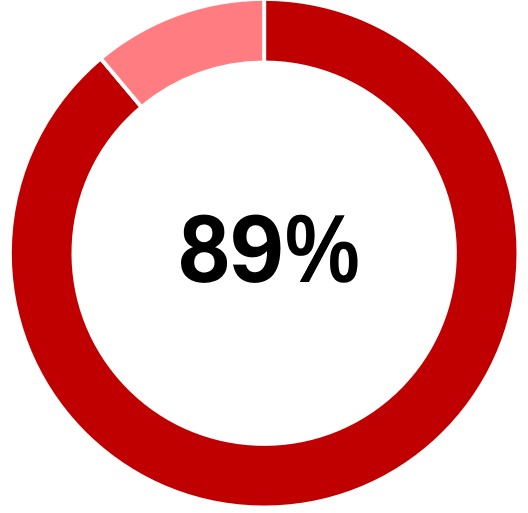
✓ | Independent Board (other than CEO), with 100% independent Board committees |
✓ | Effective lead independent director structure |
✓ | Director resignation policy |
✓ | Annual Board and Committee self-evaluations |
✓ | Limits on public company board and audit committee service |
✓ | Regular executive sessions of independent directors, typically at each meeting |
✓ | Ongoing Board refreshment with three new independent directors added in the last five years |
✓ | Board skills and experience have continued to evolve with strategy, with appropriate mix of skills, backgrounds and tenure |
| | | | | | | | |
✓ Anti-hedging and anti-pledging policy ✓ Clawback policy ✓ Codes of conduct and ethics ✓ Comprehensive director onboarding process ✓ Stock ownership guidelines | | ✓ Meaningful Board oversight of strategy, risk and sustainability ✓ Effective director continuing education program ✓ Board access to management ✓ No poison pill ✓ Robust insider trading program |
| |
| |
| |
| |
| |
| | | | | | | | |
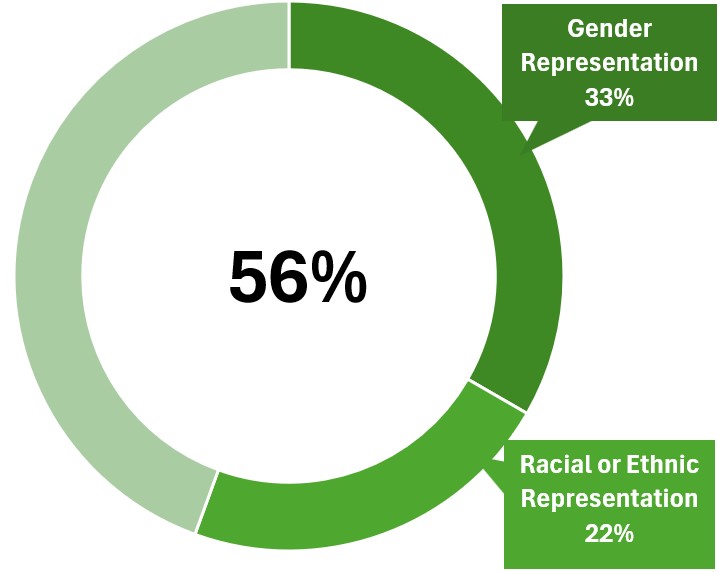
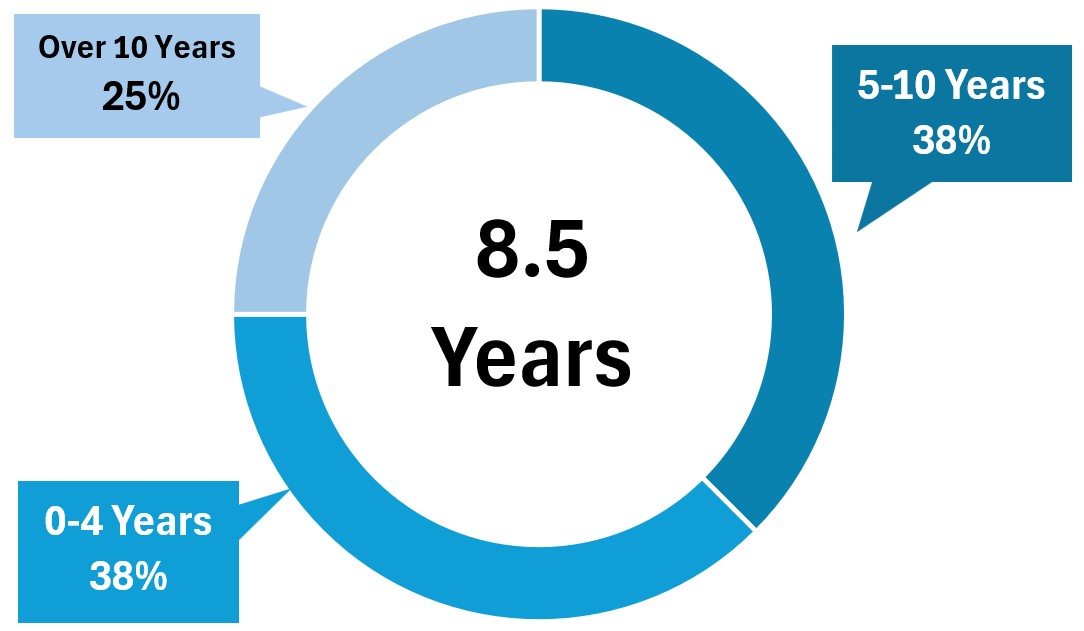
| Independent Directors | Gender, Racial or Ethnic Representation (rounded) | Average Tenure
(Independent Directors) |
| | |
Executive Compensation
| | |
Executive Compensation Program Philosophy Our executive compensation philosophy is to maintain programs and plans that allows us to attract, retain, motivate and reward highly qualified and talented executive officers. |
| | | | | | | | | | | | | | |
Align interests of executive officers with stockholder interests | | Link pay to performance | | Provide competitive target total direct compensation opportunities |
Fiscal 2025 Executive Compensation Summary
We seek to motivate executive officers to achieve improved financial performance of our Company through incentive plans that reward better performance with increased incentive payouts and hold executive officers accountable for financial performance that falls below targeted levels by paying reduced or no incentive payouts. Accordingly, a significant portion of the target total direct compensation for our Chairman and CEO and other executive officers is comprised of short- and long-term variable performance-based, or at risk, compensation to directly link their pay to performance. Generally, higher level executive positions have a higher level of pay that is performance-based.
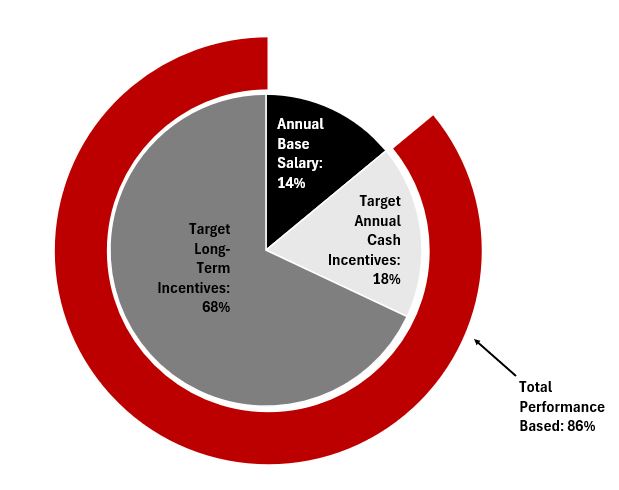
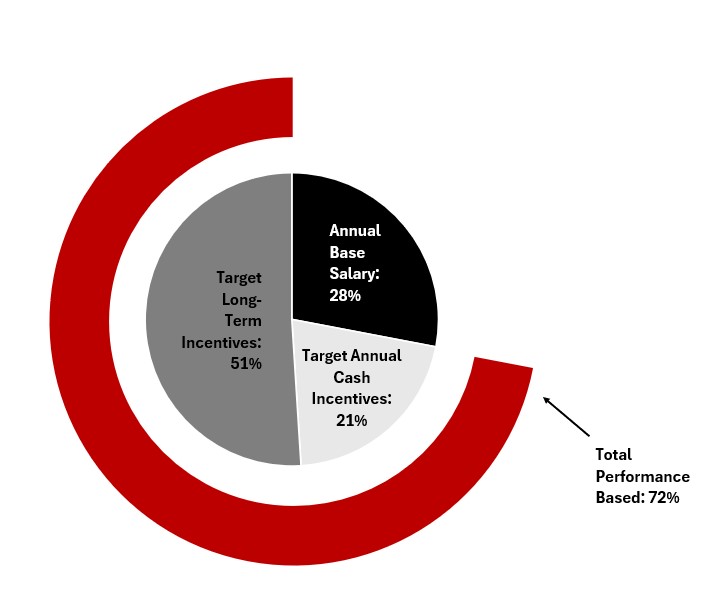
The breakdown of variable, at-risk, pay (broken out between target annual cash incentives and target long-term incentives) compared fixed pay (i.e., annual base salary) for our Chairman and CEO and other Named Executive Officers is shown below:
| | | | | | | | |
Chairman and CEO
Target Total Direct Compensation Mix | | All Other Named Executive Officers
Target Total Direct Compensation Mix |
| | |
| | | | | | | | |
| What we do | ✓ | Emphasize long-term performance in our equity-based incentive awards |
| ✓ | Use a mix of performance measures in our incentive plans |
| ✓ | Establish threshold levels of performance and caps on payouts |
| ✓ | Maintain a robust clawback policy and provisions |
What we don't do | Х | No guaranteed base salary increases |
| Х | No guaranteed incentives or bonuses |
Х | No excessive perquisites |
Х | No individual executive employment agreements |
Х | No gross-up payments |
| | |
| Our fiscal 2025 financial performance resulted in the following: |
| Annual cash incentives at the corporate level were paid at 81.6% of target. |
Three-year performance awards for the fiscal 2023 to fiscal 2025 performance period
were paid at 22.2% of target. |
THE TORO COMPANY
8111 Lyndale Avenue South
Bloomington, Minnesota 55420-1196
PROXY STATEMENT
2026 ANNUAL MEETING OF STOCKHOLDERS
TUESDAY, MARCH 17, 2026
2:00 p.m. Central Daylight Time
The Toro Company Board of Directors is using this proxy statement to solicit your proxy for use at The Toro Company 2026 Annual Meeting of Stockholders. We intend to send a Notice Regarding the Availability of Proxy Materials for the annual meeting and make proxy materials available to stockholders (or for certain stockholders and for those who request, a paper version of this proxy statement and the form of proxy) on or about February 3, 2026.
| | |
| PROPOSAL ONE—ELECTION OF DIRECTORS |
Board Size and Structure
Our Restated Certificate of Incorporation provides that our Board of Directors may be comprised of between eight and twelve directors. Currently, our Board is comprised of nine directors until the Board determines to change the number. As provided in our Restated Certificate of Incorporation, our Board is divided into three staggered classes of directors of the same or nearly the same number, with each class elected in a different year for a term of three years. Our current directors and their respective current terms are as follows:
| | | | | | | | |
Current Term Ending at 2026 Annual Meeting | Current Term Ending at 2027 Annual Meeting | Current Term Ending at 2028 Annual Meeting |
| Dianne C. Craig | Gary L. Ellis | Jeffrey L. Harmening |
| Eric P. Hansotia | Richard M. Olson | Joyce A. Mullen |
| D. Christian Koch | Jill M. Pemberton | James C. O'Rourke |
Nominees for Director
The Board has nominated Dianne C. Craig, Eric P. Hansotia and D. Christian Koch to serve three-year terms expiring at the 2029 annual meeting. Each director nominee is a current member of the Board and has consented to serve if elected. Proxies only can be voted for the number of persons named as nominees in this proxy statement, which is three.
If prior to the annual meeting the Board learns that any nominee will be unable to serve for any reason, the proxies that otherwise would have been voted for that nominee will be voted for a substitute nominee as selected by the Board. Alternatively, at the Board's discretion, the proxies may be voted for that fewer number of nominees as results from the inability of any nominee to serve. The Board has no reason to believe that any of the three nominees will be unable to serve.
| | | | | |
| The Board of Directors Recommends a Vote FOR Each Nominee for Director | ☑ |
Information About Director Nominees and Continuing Directors
The following pages provide information about the nominees for election to the Board at the annual meeting, each of whom is a current Board member, and each of the other continuing members of the Board.
All of our director nominees and continuing directors bring to our Board a wealth of executive leadership experience as well as personal and professional integrity; appropriate levels of education and business experience; strong business acumen; an appropriate level of understanding of our business, industries and other relevant industries; the ability and willingness to devote adequate time to the work of our Board and its committees; a fit of skills and personality with those of our other directors that helps build a Board that is effective, collegial and responsive to the needs of our Company; strategic thinking acumen and a willingness to share ideas; a diversity of experiences, expertise, cultures and backgrounds; and the ability to represent the interests of all our stockholders.
The Board considers the following skills and experience to be integral to the success of our Company:
| | | | | | | | |
Current/Former CEO. Current or former experience as a chief executive officer is important for providing unique insights on complex global organizations, strategy, risk management, and how to drive change and growth. Finance/Financial Oversight. A strong understanding of accounting and finance is important in critically evaluating our performance and overseeing the integrity of our financial reporting. Corporate Governance. Experience with corporate governance, including with public company boards, fosters a deep understanding of the duties and responsibilities of a public company board of directors, promotes efficient and effective board processes, and enhances board effectiveness, which ultimately supports our goals of independent oversight, strong Board and management accountability, transparency, and long-term stockholder value. Manufacturing/Supply Chain/Operations. Experience in manufacturing, supply chain and operations is important for providing oversight of optimal manufacturing processes, supplier relationships and the capital needs of the Company. Distribution Channel. Understanding our distribution channel is key to providing important perspectives on our relationships with our distribution partners. Strategic Planning and Business Development. Strong strategic planning experience, including technology, is vital to assisting us with our short- and long-term strategic planning and key strategic decisions, including identifying growth opportunities, expanding market presence, building strategic partnerships and executing high-impact initiatives. Regulatory/Government. Significant governmental and policymaking experience play an increasingly important role on our Board as our products become more heavily regulated. | | Risk Management. Experience with risk management and compliance develops a director’s ability to appreciate, anticipate and effectively oversee risks, which is critical to the Board’s role in overseeing the risks facing the Company. Health and Safety. Ability to provide oversight of our manufacturing operations and employee programs supports our focus on a culture of wellness and safety in our manufacturing facilities and office environments. Sustainability/Climate. Our commitment to integrating sustainability considerations across our businesses is enhanced by the Board’s ability to support these efforts. Mergers and Acquisitions (M&A) and Other Transactions. Experience with M&A and other similar transactions, including divestitures, joint ventures and other partnerships, is critical to sound decisions for strategically pursuing acquisitions that are complementary to our businesses and growing our customer base and geographic penetration. International Operations. Experience with international operations is important in light of our global footprint and desire to grow our international business. Information Systems/Cybersecurity/Artificial Intelligence. Board oversight of our information systems, cybersecurity risk and use of artificial intelligence is critical in light of the increasing prevalence of cyber attacks, and evolving uses of artificial intelligence, that could result in reputational, legal, and operational issues for the Company. Previously Resided Outside the United States. A solid understanding of our global workforce and customers assists the Company with further developing our international strategy. |
The chart below summarizes the key experience of each director nominee and continuing director in these critical areas, and provides certain demographic information. Each director also contributes other important skills, knowledge, experience, viewpoints, and perspectives to our Board that are not reflected in the chart below.
| | | | | | | | | | | | | | | | | | | | | | | | | | | | | |
| Experience as an Executive Leader in the Following Areas | Dianne
Craig | Gary Ellis | Eric
Hansotia | Jeffrey Harmening | D. Christian Koch | Joyce
Mullen | Richard Olson | James O'Rourke | Jill Pemberton |
| Current/Former CEO | ✓ | | ✓ | ✓ | ✓ | ✓ | ✓ | ✓ | |
| Finance/Financial Oversight | ✓ | ✓ | ✓ | ✓ | ✓ | ✓ | ✓ | ✓ | ✓ |
| Corporate Governance | | ✓ | ✓ | ✓ | ✓ | ✓ | ✓ | ✓ | |
| Manufacturing/Supply Chain/ Operations | ✓ | | ✓ | ✓ | ✓ | ✓ | ✓ | ✓ | ✓ |
| Distribution Channel | ✓ | | ✓ | ✓ | ✓ | ✓ | ✓ | | ✓ |
| Strategic Planning and Business Development | ✓ | ✓ | ✓ | ✓ | ✓ | ✓ | ✓ | ✓ | ✓ |
| Regulatory/Government | ✓ | ✓ | | ✓ | ✓ | ✓ | ✓ | ✓ | |
| Risk Management | | ✓ | ✓ | ✓ | ✓ | ✓ | ✓ | ✓ | ✓ |
| Health and Safety | ✓ | | | ✓ | ✓ | | ✓ | ✓ | |
| Sustainability/Climate | | ✓ | ✓ | ✓ | | | | | |
| M&A and Other Transactions | | ✓ | ✓ | ✓ | ✓ | ✓ | ✓ | ✓ | ✓ |
| International Operations | ✓ | ✓ | ✓ | ✓ | ✓ | ✓ | ✓ | ✓ | ✓ |
| Information Systems/ Cybersecurity/Artificial Intelligence | | ✓ | ✓ | ✓ | ✓ | ✓ | ✓ | ✓ | ✓ |
| Previously Resided Outside the United States | ✓ | ✓ | ✓ | ✓ | ✓ | ✓ | | ✓ | ✓ |
| Demographics | | | | | | | | | |
| Race/Ethnicity Representation | | | ✓ | | | | | | ✓ |
| Gender Representation | ✓ | | | | | ✓ | | | ✓ |
| Age | 61 | 69 | 57 | 59 | 61 | 63 | 62 | 65 | 55 |
| Tenure (Years) | 2 | 20 | 4 | 7 | 10 | 7 | 10 | 14 | 4 |
Director Retirement Policy. Pursuant to the Company's Corporate Governance Guidelines, directors are not expected to be nominated for election or re-election to the Board after their seventieth (70th) birthday. However, upon the recommendation of the Nominating and Governance Committee, the Board may nominate director candidates who have reached their seventieth (70th) birthday, if it determines that doing so is in the best interest of the Company.
Director Resignation Policy. Pursuant to the Company's current Amended and Restated Bylaws, any director nominee in an uncontested election as to whom a majority of the votes of the shares present in person or represented by proxy at the meeting and entitled to vote on the election of directors are designated to be “withheld” from or are voted “against” that director shall tender a resignation for consideration by the Nominating and Governance Committee. The Nominating and Governance Committee shall evaluate and recommend to the Board the action to be taken with respect to such tendered resignation.
The information presented on the following pages regarding each director nominee or continuing director also sets forth specific experience, qualifications, attributes and skills that led our Board to conclude that such director should serve as a director in light of our business and structure.
Director Nominees for Election to the Board for a Term Ending at the 2029 Annual Meeting
| | | | | | | | | | | |
Dianne C. Craig Age 61 Director since 2024 Independent Committees •Audit •Finance
| | Background |
| Dianne C. Craig was President of Lincoln, the luxury vehicle division of Ford Motor Company, Dearborn, Michigan (a designer, manufacturer and servicer of cars, trucks, sport utility vehicles and electric vehicles worldwide) until her retirement in April 2025. She held the following positions, all at Ford Motor:
•President, Lincoln (December 2022 - April 2025) •President, International Markets, Thailand (January 2021 – November 2022) •Chief Executive Officer, FordDirect (June 2018 – December 2020) •Executive Director, U.S. Sales (December 2016 – May 2018) •Chief Executive Officer, Ford Motor Company of Canada (November 2011 – November 2016 Qualifications |
| Ms. Craig brings to our Board a deep and diverse range of executive leadership experience in an industry applicable to our Company. She contributes a strategic perspective on digital technologies, brand enhancements and international operations. Furthermore, her extensive background in channel strategy, building dealer relationships and delivering best-in-class marketing solutions brings expertise in areas critical to the ongoing success of our Company. Other Public Company Boards |
| | Current | Past 5 Years |
| | None | None |
| | | | | | | | | | | |
Eric P. Hansotia Age 57 Director since 2022 Independent Committees •Compensation & Human Resources •Nominating and Governance
| | Background |
| Eric P. Hansotia is the Chairman, President and Chief Executive Officer of AGCO Corporation, Duluth, Georgia (a global leader in the design, manufacture and distribution of agricultural solutions). He holds or held the following positions at AGCO:
•Chairman, President and Chief Executive Officer (since January 2021) •Chief Operating Officer (January 2019 – December 2020) •Senior Vice President, Global Crop Cycle and Fuse Connected Services (January 2015 – January 2019) •Senior Vice President, Global Harvesting and Advanced Technology Solutions (July 2013 – January 2015)
Prior to joining AGCO, Mr. Hansotia spent 20 years at Deere & Company in various leadership positions, including at the senior vice president, vice president and general manager levels. Qualifications |
| Mr. Hansotia brings to our Board deep industry experience and a strong strategic perspective and extensive executive leadership experience in areas critical to our Company's success, including engineering, quality, technology transitions and opportunities, manufacturing, product management, mergers and acquisitions, channel development, and public company governance. He has significant international experience gained from leading global manufacturing and supply chain functions. Other Public Company Boards |
| | Current | Past 5 Years |
| | AGCO Corporation | None |
| | | | | | | | | | | |
D. Christian Koch Age 61 Director since 2016 Independent Committees •Compensation & Human Resources •Nominating and Governance (Chair)
| | Background |
| D. Christian Koch is the Chair, President and Chief Executive Officer of Carlisle Companies Incorporated, Scottsdale, Arizona (a portfolio of building product businesses). He holds or held the following positions, all at Carlisle:
•Chairman (since May 2020) •Chief Executive Officer (since January 2016) •President (since May 2014) •Chief Operating Officer (May 2014 – January 2016) •Group President, Carlisle Diversified Products (June 2012 – May 2014) •President, Carlisle Brake & Friction (January 2009 – June 2012) •President, Carlisle Asia-Pacific (February 2008 – January 2009) Qualifications |
| Mr. Koch brings to our Board his experience as a seasoned executive with strong business acumen and significant experience managing distribution, supply chain, manufacturing and sales operations around the world as well as with mergers and acquisitions and long-range planning. In addition, as a public company director and executive, Mr. Koch contributes a solid understanding of financial oversight, strategic planning, executive compensation, talent development and corporate governance. Other Public Company Boards |
| | Current | Past 5 Years |
| | Carlisle Companies Inc. | None |
Continuing Members of the Board — Current Term Ending at the 2027 Annual Meeting
| | | | | | | | | | | |
Gary L. Ellis Age 69 Director since 2006 Lead Independent Director Committees •Audit •Finance
| | Background |
| Gary L. Ellis retired from Medtronic plc, Dublin, Ireland (a global medical technology company). He held the following positions, all at Medtronic: •Executive Vice President, Global Operations, Information Technology and Facilities & Real Estate (June 2016 – December 2016) •Executive Vice President and Chief Financial Officer (April 2014 – June 2016) •Senior Vice President and Chief Financial Officer (May 2005 – April 2014) •Vice President, Corporate Controller and Treasurer (October 1999 – May 2005) Qualifications |
| Mr. Ellis brings extensive financial leadership experience to provide oversight regarding capital structure, financial condition and policies, long-range financial objectives, tax strategies, financing requirements and arrangements, capital budgets and expenditures, risk-management, insurance coverage and strategic planning matters. As our lead independent director, he provides balanced, collaborative and challenging support to both the Board and our Chairman and CEO. Mr. Ellis contributes enhanced knowledge of public company requirements and issues. Additionally, Mr. Ellis contributes his experience managing worldwide financial operations and analyzing financial implications of merger and acquisition transactions, as well as aligning business strategies and financial decisions. Other Public Company Boards |
| | Current | Past 5 Years |
| | Inspire Medical Systems, Inc. | Hill-Rom Holdings, Inc. |
| | | | | | | | | | | |
Richard M. Olson Age 62 Director since 2016 Committees None
| | Background |
| Richard M. Olson is our Chairman of the Board and Chief Executive Officer. He holds or held the following positions, all at The Toro Company: •Chairman (since November 2017) •Chief Executive Officer (since November 2016) •President (September 2015 - August 2025) •Chief Operating Officer (September 2015 – October 2016) •Group Vice President, International Business, Micro Irrigation Business and Distributor Development (June 2014 – September 2015) •Vice President, International Business (March 2013 – June 2014) •Vice President, Exmark (March 2012 – March 2013) Qualifications |
| In his nearly 40 years with our Company, Mr. Olson has developed and brings to our Board rich knowledge of the Company, including, in particular, our global businesses and operations, manufacturing processes, supply chain, distribution and channel development, and product development strategies. In addition, the broad experience he has gained through his past leadership of various businesses and manufacturing operations provides him with a unique perspective regarding our growth initiatives and strategic direction. He contributes a deep commitment to quality, technological advancements, innovation, sustainability, culture, ethical values and business conduct, and focus on customer service. As a result of his dual role as Chairman and CEO, Mr. Olson provides unique insight into our Company's future strategies, opportunities and challenges and serves as a unifying element between our Board and management. Other Public Company Boards |
| | Current | Past 5 Years |
| | Donaldson Company, Inc. | None |
| | | | | | | | | | | |
Jill M. Pemberton Age 55 Director since 2022 Independent Committees •Audit (Chair) •Finance | | Background |
| Jill M. Pemberton is the Chief Financial Officer, North America of LVMH Moët Hennessy Louis Vuitton, Paris, France (a global luxury product company), a position she has held since July 2020. Prior to her current role, she held the following positions:
•Senior Vice President, Corporate Financial Planning & Analysis, Viacom Inc. (now known as Paramount Global, a leading global media company) (July 2019 – January 2020) •Vice President, Finance, Source COE, Supply Chain (February 2017 – June 2019); Vice President, Finance, Global Franchise Organization, Consumer (March 2014 – February 2017; and Vice President, Finance (September 2013 – March 2014), all at Johnson & Johnson (a global health care company)
Prior to these roles, Ms. Pemberton served in various finance roles of increasing responsibility at the Kraft Heinz Company, Delta Air Lines, Inc. and ZF Group Inc. She holds a Directorship Certification from the National Association of Corporate Directors. Qualifications |
| Ms. Pemberton brings to our Board strong and broad financial experience and acumen, enterprise risk management knowledge including relating to cybersecurity and business continuity, investor perspective, strong brand experience and sourcing and supply chain oversight. In addition, she contributes a strategic perspective, with significant acquisition and integration experience, all of which assists our Board in providing guidance and oversight in these areas. Other Public Company Boards |
| | Current | Past 5 Years |
| | None | None |
Continuing Members of the Board — Current Term Ending at the 2028 Annual Meeting
| | | | | | | | | | | |
Jeffrey L. Harmening Age 59 Director since 2019 Independent Committees •Audit •Finance (Chair)
| | Background |
| Jeffrey L. Harmening is the Chairman and Chief Executive Officer of General Mills, Inc., Minneapolis, Minnesota (a global manufacturer, marketer and supplier of food products). He holds or held the following positions, all at General Mills:
•Chairman (since January 2018) •Chief Executive Officer (since June 2017) •President and Chief Operating Officer (July 2016 – May 2017) •Executive Vice President, Chief Operating Officer, U.S. Retail (May 2014 – June 2016) •Senior Vice President, Chief Executive Officer, Cereal Partners Worldwide (July 2012 – April 2014) Qualifications |
| Mr. Harmening brings to our Board extensive experience as a seasoned executive with strong business and financial acumen and experience implementing the strategic direction for a complex and publicly traded company with extensive distribution channels and supply chain operations. Furthermore, he brings experience in driving growth through customer-valued products and acquisitions and expertise in driving employee engagement through creating a culture of belonging. He demonstrates strong business discipline and commitment to best practices. In addition, he has significant experience managing operations around the world, including having lived in Europe for six years during his tenure at General Mills. Other Public Company Boards |
| | Current | Past 5 Years |
| | General Mills, Inc. | None |
| | | | | | | | | | | |
Joyce A. Mullen Age 63 Director since 2019 Independent Committees •Compensation & Human Resources •Nominating and Governance
| | Background |
| Joyce A. Mullen is the President and Chief Executive Officer of Insight Enterprises, Inc., Chandler, Arizona (an information technology company). She holds or has held the following positions at Insight: •President and Chief Executive Officer (since January 2022) •President of North American Businesses (October 2020 – December 2021) Previously, Ms. Mullen held various positions over a 21-year career at Dell Technologies (a digital technology solutions company), including: •President, Global Channel, OEM and IoT (November 2017 – August 2020) •Senior Vice President and General Manager, Global OEM and IoT Solutions (February 2015 – November 2017) •Vice President and General Manager, Global OEM Solutions (February 2012 – February 2015) Ms. Mullen also spent 10 years in leadership positions at Cummins Engine Company, including distribution, manufacturing and international business development. Qualifications |
| Ms. Mullen brings to our Board significant executive leadership skills, technology and smart-connected products expertise, strategic and innovative thinking and strong international business experience. She also offers a valuable perspective with regard to evaluating and supporting talent. Additionally, she contributes substantial knowledge of worldwide manufacturing, distribution channels, cybersecurity, digital product development and supply chain strategies, including improving efficiencies in manufacturing operations using Six Sigma, Kaizen and Lean techniques. Other Public Company Boards |
| | Current | Past 5 Years |
| | Insight Enterprises, Inc. | None |
| | | | | | | | | | | |
James C. O'Rourke Age 65 Director since 2012 Committees •Compensation & Human Resources (Chair) •Nominating and Governance
| | Background |
| James C. O’Rourke served as Senior Advisor to The Mosaic Company, Tampa, Florida (a global producer and marketer of combined concentrated phosphate and potash crop nutrients for the global agriculture industry) until his retirement in June 2024. He held the following positions, all at The Mosaic Company: •Chief Executive Officer (August 2015 – December 2023) •President (August 2015 – August 2023) •Executive Vice President—Operations and Chief Operating Officer (August 2012 – August 2015) •Executive Vice President—Operations (January 2009 – August 2012) Qualifications |
| Mr. O'Rourke brings to our Board significant leadership skills, strategic and innovative thinking from a former chief executive officer perspective and strong international business expertise. He also contributes substantial knowledge of worldwide manufacturing, distribution and supply chain strategies and environmental, health and safety matters. In addition, as a public company director and executive, Mr. O'Rourke contributes a solid understanding of executive compensation and corporate governance matters. Other Public Company Boards |
| | Current | Past 5 Years |
| | Rio Tinto plc | The Mosaic Company |
| | Weyerhaeuser Company | |
Director Compensation Program for Fiscal 2025
Overview. Our non-employee director compensation program is designed to attract and retain experienced and knowledgeable directors and align the interests of our directors with those of our stockholders. In fiscal 2025, our non-employee director compensation was comprised of cash compensation, in the form of annual retainers, and equity compensation, in the form of annual stock awards and stock options. If desired, a director could elect to receive the cash compensation in the form of a stock award, causing a substantial portion of our non-employee director compensation to be linked to our stock performance. Each component of our non-employee director compensation is described in more detail below. All equity-based compensation paid to our non-employee directors is granted under our then current stockholder-approved plan. As an employee director, Mr. Olson does not receive any additional compensation for his service as a director.
Process for Consideration and Determination of Director Compensation. The Board has delegated to the Compensation & Human Resources Committee the responsibility, among other things, to review and recommend to the Board any proposed changes in non-employee director compensation. The Committee typically engages an independent external compensation consultant to assist the Committee in this regard.
The Compensation & Human Resources Committee engaged Willis Towers Watson to review our non-employee director compensation program for fiscal 2025. Willis Towers Watson's review consisted of, among other things, analysis of board and committee compensation trends, a competitive assessment based on a selected group of manufacturing companies operating in the United States that are similar in size to us from a revenue and market capitalization perspective, and a separate analysis of lead director compensation. For fiscal 2025, the Board, upon recommendation of the Compensation & Human Resources Committee approved certain changes, including a $10,000 increase to the annual stock award and a $1,500 increase to each of the annual retainers for the Finance Committee and the Nominating and Governance Committee Chair.
Elements of Our Non-Employee Director Compensation Program. The following table sets forth our fiscal 2025 non-employee director compensation program.
| | | | | |
| Non-Employee Director Compensation | ($) |
| Annual Stock Award Value | 95,000 |
| Annual Stock Option Award Value | 55,000 |
| Annual Board and Committee Member Retainers | |
| Board | 95,000 |
| Audit Committee Member | 12,500 |
| Compensation & Human Resources Committee Member | 7,000 |
| Nominating and Governance Committee Member | 6,000 |
| Finance Committee Member | 6,000 |
| Annual Lead Independent Director and Committee Chair Additional Retainers | |
| Lead Independent Director | 30,000 |
| Audit Committee Chair | 20,000 |
| Compensation & Human Resources Committee Chair | 15,000 |
| Nominating and Governance Committee Chair | 9,000 |
| Finance Committee Chair | 9,000 |
The following summarizes our non-employee director compensation program:
| | | | | |
| Element | Key Characteristics |
| Annual Retainers | Annual cash retainers are paid quarterly for service on the Board and its committees and in Board leadership roles, such as a Board committee chair or Lead Independent Director. |
| Annual Stock Awards | On the first business day of our fiscal year, a stock award is automatically granted under our then current stockholder-approved plan. The number of shares is determined by dividing the stock award value by the average of the closing prices of our common stock during the three months prior to the grant. The shares are fully vested at the time of grant. |
| Annual Stock Option Awards | On the first business day of our fiscal year, a stock option to purchase shares of our common stock is automatically granted under our then current stockholder-approved plan. The number of stock options is determined by dividing the stock option award value by the grant date fair value of a stock option to purchase one share of our common stock. See below for additional information regarding vesting of stock option grants. |
Common Stock In Lieu of Annual Retainers | Non-employee directors may elect to convert a portion or all of their calendar year annual retainers otherwise payable in cash into shares of our common stock. Retainers earned after the date a director makes such election for a calendar year are issued in shares of our common stock in December of that year, the number of which is determined by dividing the dollar amount of the retainers earned in the calendar year and elected to be converted into shares of our common stock by the closing price of our common stock on the date that the shares are issued. |
| Deferred Compensation Plan | Non-employee directors may elect to defer receipt of all or a part of their stock award and/or cash compensation on a calendar year basis under The Toro Company Deferred Compensation Plan for Non-Employee Directors, or the Deferred Plan for Directors. Because the value of a director's deferred compensation account fluctuates, as applicable, based on the market value of our common stock or based on a rate of return on funds that are comparable to funds available in The Toro Company Retirement Plan, or Retirement Plan, earnings on deferred compensation are not preferential. Dividends paid on our common stock are credited to a director's account as additional common stock units. A director is fully vested in his or her deferred compensation account. Distributions under the Deferred Plan for Directors are payable in accordance with the director participant's prior distribution elections upon the earliest of retirement, prior to retirement if a valid election has been made or in an unforeseeable financial emergency. |
| Company Products | Each of our non-employee directors is entitled to receive certain Company products and related parts, service and accessories for his or her personal use, at no cost; provided, however, that directors are responsible for payment of applicable taxes attributable to the value of such items. The value is deemed to be our distributor net price or its equivalent, which is also the price at which such items are generally available to our employees for purchase. |
| Charitable Giving | We offer a matching gift program for our non-employee directors, similar to the matching gift program offered to our employees, which provides that a gift or gifts by a director to one or more tax exempt 501(c)(3) charitable organizations located in the United States will be matched by us in an aggregate amount of up to $1,000 per director per year. |
| Indemnification and D&O Insurance | Each non-employee director is a party to an indemnification agreement with us pursuant to which we have agreed to provide indemnification and advancement of expenses to the fullest extent permitted by Delaware law and our Restated Certificate of Incorporation and continued coverage under our D&O insurance. |
Stock Option Vesting. Except as described below, stock options granted to our non-employee directors vest in three equal installments on each of the first, second and third year anniversaries of the grant date and remain exercisable for a term of ten years after the grant date.
If a director becomes disabled or dies, all outstanding unvested stock options will vest in full on the date the director's service ceases by reason of such disability or death and all outstanding stock options may be exercised up to the earlier of the date the stock options expire or one year after the date the director's service ceased by reason of such disability or death.
If a director has served as a member of the Board for ten full fiscal years or longer and terminates his or her service on the Board, other than due to death or disability, his or her outstanding unvested stock options will continue to vest in accordance with their terms and the director may exercise the vested portions of the stock options for up to four years after the director's date of termination, but not later than the date the stock options expire. If a director has served as a member of the Board for less than ten full fiscal years and terminates his or her service on the Board, other than due to death or disability, his or her outstanding unvested stock options will expire and be canceled and the director may exercise any vested portions of the stock options for up to three months after the director's date of termination, but not later than the date the stock options expire. The following
independent directors who served during all or part of fiscal 2025 have ten or more fiscal years of service: Gary L. Ellis, D. Christian Koch and James C. O'Rourke.
If there is a change in control of our Company, stock options held by directors will vest immediately and remain exercisable for the remaining term. The general definition of a change in control for these purposes is described under "Potential Payments upon Termination or Change in Control - Change in Control."
Director Compensation Highlights
Some highlights of our non-employee director compensation program are:
| | | | | |
ü | No Fees for Board or Committee Meeting Attendance: Meeting attendance is an expected part of Board service. |
ü | Emphasis on Equity: There is an emphasis on equity in the overall compensation mix to further align interests with stockholders. |
ü | Recognition of Special Roles: Special roles (such as Lead Independent Director and Board committee chairs) are fairly recognized for their additional time commitments. |
ü | Annual Stock Grants with Immediate Vesting: Stock awards are granted annually with a fixed value and immediate vesting to support independence. |
ü | Limit on Total Non-Employee Director Compensation: Our current stockholder-approved incentive plan contains a limit on total non-employee director compensation. |
ü | Robust Stock Ownership Guidelines: A guideline of five times the annual Board cash retainer supports alignment with stockholders’ interests and mitigates potential compensation-related risk. |
ü | No Perquisites: Our directors receive no perquisites, personal benefits or other compensation, other than Company products for personal use and occasional travel for guests of non-employee directors and officers. |
Director Compensation for Fiscal 2025
The following table provides summary information concerning the compensation of each individual non-employee director who served during fiscal 2025. Amounts in the table are not reduced to reflect elections, if any, by the non-employee directors to defer receipt of compensation. Deferral elections are described in more detail in the footnotes to the table. Earnings on nonqualified deferred compensation are not on a basis that is considered to be above-market or preferential.
| | | | | | | | | | | | | | | | | | | | | | | | | | | | | | | | |
| Name | | Fees Earned or Paid in Cash ($)1, 2 | | Stock Awards ($)3 | | Option Awards ($)4 | | All Other Compensation ($)5 | | Total ($) |
| Dianne C. Craig | | 113,542 | | 89,732 | | 54,998 | | | | 258,272 |
| Gary L. Ellis | | 143,500 | | 89,732 | | 54,998 | | | | 288,230 |
Eric P. Hansotia | | 108,000 | | 89,732 | | 54,998 | | | | 252,730 |
| Jeffrey L. Harmening | | 121,000 | | 89,732 | | 54,998 | | | | 265,730 |
| D. Christian Koch | | 117,035 | | 89,732 | | 54,998 | | | | 261,765 |
Joyce A. Mullen6 | | 108,000 | | 89,732 | | 54,998 | | | | 252,730 |
| James C. O'Rourke | | 122,500 | | 89,732 | | 54,998 | | 674 | | 267,904 |
Jill M. Pemberton | | 133,542 | | 89,732 | | 54,998 | | | | 278,272 |
1.Unless a director elected to defer receipt or convert a portion or all of his or her annual retainers into shares of our common stock, annual retainers were paid in cash at the beginning of each fiscal quarter.
2.The following directors elected to convert all or a portion of their calendar 2025 cash retainers into shares of our common stock, which number of shares received was based on the closing price of our common stock on December 15, 2025, of $73.48: Ms. Craig—1,544 shares; Mr. Koch—1,592 shares; and Ms. Pemberton—1,816 shares.
3.On November 1, 2024, 1,101 shares of our common stock were granted to each non-employee director with the calculation as to the number of shares based on the average of the closing prices of our common stock during the three months prior to the grant, which was $86.21. However, the amount reported in the table represents the grant date fair value of $81.50, the closing price on the grant date, computed in accordance
with Financial Accounting Standards Board (FASB) Accounting Standard Codification (ASC) Topic 718. These stock awards were the only stock awards granted to directors during fiscal 2025. As of October 31, 2025, no directors held any restricted stock or other unvested stock awards.
4.On November 1, 2024, a stock option to purchase 2,167 shares of our common stock was granted to each non-employee director. The amount reported in the table represents the grant date fair value computed in accordance with FASB ASC Topic 718. The following is a summary of the specific assumptions used in the valuation of the option awards:
| | | | | | | | | | | | | | | | | |
| Grant Date | Risk Free Rate | Expected Life | Expected Volatility | Expected Dividend Yield | Per Share Black-Scholes Value |
| 11/1/2024 | 4.20% | 6.8 | 27.68% | 1.40% | $25.38 |
The exercise price per share is $81.50, which is equal to 100% of the fair market value of our common stock on the grant date, determined by the closing price on that date. The actual value of the stock option awards, if any, to be realized by a director depends upon whether the price of our common stock at exercise is greater than the exercise price on the stock options. These stock option awards were the only stock option awards granted to directors during fiscal 2025. For the aggregate number of stock options (exercisable and unexercisable) held by each non-employee director who served during all or part of fiscal 2025, as of January 20, 2026, please see Footnote 2 in the section entitled "Stockholder Ownership - Directors and Executive Officers," beginning on page 86. 5.We generally do not provide perquisites and other personal benefits to our non-employee directors, other than Company products for personal use and occasional travel for guests of non-employee directors and officers. The amount reported for Mr. O'Rourke includes the value of products, parts, service or accessories, as described under Company Products above.
6.Under the Deferred Plan for Directors, Ms. Mullen elected to defer receipt of her: (i) calendar 2024 and calendar 2025 retainers earned in fiscal 2025; and (ii) the annual stock award granted on November 1, 2024.
Non-Employee Director Stock Ownership Guidelines. Our non-employee directors are required to hold an amount of Company shares equal to five times the annual Board cash retainer. For additional information, please see the section entitled "Stockholder Ownership - Stock Ownership Guidelines," 87. Anti-Hedging and Anti-Pledging. Under the Company's Insider Trading Policy, all directors, officers and employees of the Company are prohibited from engaging in speculative transactions in our Company's securities or other transactions which might give the appearance of impropriety. Specifically, all directors, officers and employees of the Company are prohibited from engaging in hedging transactions involving our Company's securities and purchasing our Company's securities on margin, borrowing against any account in which our Company's securities are held, or pledging our Company's securities as collateral for a loan. For additional information, please see the section entitled "Stockholder Ownership - Anti-Hedging and Anti-Pledging," beginning on page 87.
Overview
The following section provides an overview of The Toro Company's corporate governance practices and the Company’s commitment to strong corporate governance that supports the long-term value of the Company, as evidenced by the framework the Company currently has in place.
Board of Directors
•Board and Committee Independence and Lead Independent Director. All of our directors, except our Chairman and CEO, and including our Lead Independent Director, are independent. All of our Board committees are comprised solely of independent directors.
•Director Resignation Policy. If any nominee for director in an uncontested election receives a majority of “withheld” votes, such director shall tender a resignation for consideration by the Nominating and Governance Committee, which then shall recommend to the Board the action to be taken with respect to such tendered resignation.
•Annual Board and Committee Self-Evaluations. The Board, in coordination with the Nominating and Governance Committee, conducts an annual self-evaluation of the Board as a whole and each of its committees. Each committee also conducts an annual self-evaluation. This process helps inform the annual director nomination process and Board refreshment.
•Annual Board Evaluation of CEO. The Chair of the Board and the Chair of the Compensation & Human Resources Committee lead the annual evaluation process of the CEO.
•Limits on Public Company Board and Audit Committee Service. No independent director may serve on more than four public company boards (including the Company’s Board) and directors who are also serving as a chief executive officer, including the Company’s CEO, may not serve on more than two public company boards (including the Company’s Board). No member of the Audit Committee may simultaneously serve on the audit committee of more than three public companies (including the Company’s Audit Committee), unless the Board determines that such simultaneous service would not impair the effectiveness of the director's service on the Company’s Audit Committee. A director must seek approval of the Nominating and Governance Committee in advance of serving on the board of another entity.
•Regular Executive Sessions of Independent Directors. The independent directors hold regular executive sessions, generally at each regularly scheduled meeting of the Board and each committee, at which management, including the Chairman and CEO, is not present.
Stockholder Rights and Engagement
•No Stockholder Rights Plan. We do not have a stockholder rights agreement, also known as a poison pill.
•Stockholder Engagement. We regularly engage with stockholders, including our top institutional investors. At these meetings, we typically discuss board oversight, executive compensation and sustainability, among other topics.
Corporate Governance Guidelines
The Board maintains Corporate Governance Guidelines which describe our corporate governance practices and policies and provide a framework for our Board governance. The Nominating and Governance Committee reviews our Corporate Governance Guidelines annually to ensure they reflect current corporate governance standards and the Company’s practices. The Corporate Governance Guidelines can be found under the “Corporate Governance” subsection of the “Investor Relations” section of our website at https://www.thetorocompany.com/corporate-governance/highlights, or by writing to our Corporate Secretary at The Toro
Company, Inc., 8111 Lyndale Avenue South, Bloomington, Minnesota, 55420-1196 and via email at invest@toro.com.
Staggered Board Structure
Our certificate of incorporation provides for a staggered board of directors consisting of three classes of directors, with each class serving a three-year term. We are committed to strong corporate governance, and our Board believes that our staggered board structure provides important benefits to us and our stockholders, including promotion of our long-term objectives, enhanced director independence, stability and continuity of leadership, and protection from unsolicited takeovers.
Policy Regarding Separation of Chair and CEO
Our Corporate Governance Guidelines provide that our Board has no policy with respect to the separation of the offices of the Chair of the Board and the CEO. The Board believes it is appropriate not to have a policy requiring the separation of the offices of the Chair of the Board and the CEO so that the Board may make this determination based on what it believes is best under the current circumstances. Additionally, our Board believes that this issue is part of the succession planning process and will be reviewed as the Nominating and Governance Committee deems it appropriate. However, at any time that: (i) the offices of Chair of the Board and CEO are held by the same person; or (ii) the Chair of the Board does not meet the criteria for "independence" as established by applicable law, the rules and regulations of the SEC, or the NYSE listing standards, then the Board, upon recommendation of the Nominating and Governance Committee, shall appoint a Lead Independent Director, who shall have such duties as are described in the Corporate Governance Guidelines or otherwise determined by the Board.
Current Board Leadership Structure
Our Board is currently chaired by Richard M. Olson, our Chairman and CEO. Our Lead Independent Director, selected by the Board, is Gary L. Ellis. Our Nominating and Governance Committee and Board believe that our current Board leadership structure ensures a strong and independent Board of Directors, provides effective governance, and creates appropriate oversight for the long-term benefit of our stockholders.
| | | | | | | | |
| Chairman and CEO | | Lead Independent Director |
•Extensive knowledge of our Company, our business, operations and industry, obtained through nearly 40 years of service to our Company, which benefit Board leadership and the Board's decision-making process through his active role as Chairman | | •With more than 20 years of service on our Board and considerable knowledge of our Company, business and industry, Mr. Ellis assists the Chairman and CEO in establishing the agendas for Board meetings and the schedule of agenda subjects to be discussed during the year, to the extent such subjects can be foreseen |
•Unifies Board leadership and strategic direction as implemented by management team | | •Presides at regularly scheduled executive sessions of the non-employee directors without management present |
•Provides appropriate balance of risks relating to concentration of authority through the oversight of the independent and engaged Lead Independent Director and Board | | •Together with the Chair of the Compensation & Human Resources Committee, communicates to the Chairman and CEO the results of his annual performance review and compensation |
•Coordinates the work of the Board's committees | | •Together with the Chair of the Nominating and Governance Committee, leads the Board's annual self-evaluation |
Director Attendance; Executive Sessions
Each Board member is expected to dedicate to the Company sufficient time, energy and attention to ensure the diligent performance of the director’s duties. Our Corporate Governance Guidelines provide that, except in exigent circumstances, each member of the Board is expected to attend Board and committee meetings. Each director attended at least 75% of the combined total meetings of the full Board and the committees on which such director served in fiscal 2025. Directors are also expected to attend the Company’s
annual meeting of stockholders, but are not required to do so. Eight of our nine directors serving at the time of the Annual Meeting of Stockholders held on March 18, 2025 attended that meeting.
Our Corporate Governance Guidelines provide that the non-employee directors will meet in regularly scheduled executive sessions without management. At each regular Board meeting held during fiscal 2025 our non-employee directors met in executive session without management present and such meetings were presided over by our Lead Independent Director, Gary L. Ellis. Each committee also holds executive sessions without any members of management present, generally at each meeting.
In fiscal 2025, the Board and each of its committees held the following number of meetings.
| | | | | | | | | | | | | | | | | |
| Board | Audit | Compensation & Human Resources Committee | Nominating and Governance Committee | Finance Committee |
| Number of meetings in fiscal 2025 | 7 | 8 | 3 | 2 | 3 |
Board Committees
The Board has four standing committees: the Audit Committee; Compensation & Human Resources Committee; Nominating and Governance Committee; and Finance Committee. Each of the Board committees is chaired by an independent director and Mr. Olson does not serve on any Board committees. The following table reflects the Board's current committee composition.
| | | | | | | | | | | | | | |
| Audit Committee | Compensation & Human Resources Committee | Nominating and Governance Committee | Finance Committee |
| Dianne C. Craig | † | | | † |
| Gary L. Ellis* | † | | | † |
| Eric P. Hansotia | | † | † | |
| Jeffrey L. Harmening | † | | | ☑ |
| D. Christian Koch | | † | ☑ | |
| Joyce A. Mullen | | † | † | |
| James C. O'Rourke | | ☑ | † | |
| Jill M. Pemberton | ☑ | | | † |
* Lead Independent Director ☑ Denotes Committee Chair.
Committee Charters. Each committee has a charter that describes the principal functions of the committee and is posted on our website at www.thetorocompany.com/corporategovernance. As provided in its respective charter, each of the Compensation & Human Resources Committee, Nominating and Governance Committee and Finance Committee may form and delegate authority to subcommittees when appropriate. Additionally, the Compensation & Human Resources Committee may delegate to one or more executive officers of the Company the authority to approve equity compensation awards under established equity compensation plans of the Company to employees other than the executive officers of the Company. On an annual basis the Audit Committee, Finance Committee, Nominating and Governance Committee and Compensation & Human Resources Committee review the adequacy of their respective charter and performance. The Chair of each Board committee provides to the full Board a summary of the matters discussed in the committee meeting.
Committee Independence and Other Qualifications. The Board has determined that each of the current and former members of the Audit Committee, Compensation & Human Resources Committee and Nominating and Governance Committee meets the independence and other requirements established by applicable law, the rules and regulations of the SEC, the NYSE listing standards, and the Internal Revenue Code of 1986, as amended, or Code, as applicable. In addition, the Board has determined that all members of the Audit Committee are financially literate and that both Gary L. Ellis and Jill M. Pemberton meet the definition of "audit committee financial expert." Other members of the Audit Committee who currently are serving or have served as chief executive officers or chief financial officers of other public companies also may be considered financial experts, but the Board has not so designated them.
Committee Key Responsibilities. The following are the key functions of each Board committee:
| | | | | | | | |
Audit Committee | •Oversees the accounting and financial reporting processes, audits of consolidated financial statements and internal controls over financial reporting •Selects, compensates, evaluates and reviews critical audit matters with independent external auditor •Reviews with management and external auditor Annual Reports on Form 10-K, Quarterly Reports on Form 10-Q and earnings releases •Reviews and approves internal audit's functions and effectiveness; reviews scope and performance of internal audit's plans; and oversees internal audit's significant findings, including responses from management | •Reviews Information Technology strategy and security activities, including Company use of artificial intelligence •Reviews general policies and procedures with respect to accounting and financial matters, internal controls and disclosure controls and procedures, and sustainability metrics and disclosures •Reviews Code of Conduct and Code of Ethics for CEO and Senior Financial Personnel, and policies and procedures for the receipt, retention and treatment of complaints from employees on accounting, internal accounting controls or auditing matters •Provides oversight for the Enterprise Risk management, or ERM, process |
| | | | | | | | |
Compensation & Human Resources Committee | •Approves the annual base salaries, annual and long-term incentive opportunities and other compensation arrangements for the CEO and other executive officers •Reviews compensation policies and practices as they affect all employees and relate to risk management practices and risk-taking incentives •Reviews strategies for human capital management initiatives •Reviews stock ownership guidelines for the CEO, other executive officers, senior management and the Board • Evaluates the CEO's performance | •Approves performance goals for performance-based awards •Reviews with management the Compensation Discussion and Analysis, the Committee report on executive compensation and any compensation-related proposals, including say-on-pay and frequency of say-on-pay proposals •Reviews non-employee director compensation components and amounts •Reviews succession planning and short-term contingency plans for emergencies for the CEO and other executive officers |
| | | | | | | | |
| Nominating and Governance Committee | •Reviews and recommends to the Board the size and composition of the Board and its committees •Identifies individuals qualified to become Board members •Recommends to the Board director nominees for election at the annual meeting •Oversees the annual evaluation of the Board •Oversees sustainability program | •Reviews and recommends to the Board any proposed amendments or changes to Restated Certificate of Incorporation or Amended and Restated Bylaws •Reviews Corporate Governance Guidelines and recommends to the Board any changes •Monitors corporate governance trends |
| | | | | | | | |
Finance Committee | •Reviews, and recommends to the Board as required, capital structure and related financial policies and long-range objectives, capital expenditures, tax strategies and restructuring projects, financing arrangements and cash or any special dividends •Reviews and recommends to the Board the authorization for the issuance or repurchase of equity or long-term debt | •Reviews use of derivative, hedging and similar instruments to manage financial, currency and interest rate exposure •Evaluates, and recommends to the Board as required, financing implications of certain proposed merger, acquisition, divestiture, joint venture and other business combination transactions or investments •Oversees investor relations program, including sustainability engagement and disclosures |
Director Refreshment, Recruitment, Nomination and Qualifications
Board Refreshment, Director Tenure and Retirement Policy. The Board is committed to effective and ongoing refreshment that is reflective of the evolution of the Company’s strategy and provides a balanced mix of skills, backgrounds and tenure. The Company does not set specific term limits on director service and believes that a mix of director tenures on the Board can strengthen Board effectiveness and dynamics. Longer tenured directors possess experience and organizational knowledge while newer directors bring fresh insight and
perspective. Our current Board reflects this perspective, and the Board is committed to ongoing Board refreshment. As part of the objective of continuously engaging in Board refreshment, no person may serve as a director of the Company if such person would be 70 or older on the date of election or re-election.
Additional Board and Audit Committee Service and Director Commitments. While the Board acknowledges the value of having directors with significant leadership experience in other businesses and organizations, directors are expected to ensure that their other commitments do not interfere with their duties and responsibilities as directors of the Company. As such, absent special or interim circumstances, no independent director may serve on more than four public company boards (including the Company’s Board) and no director who is a sitting chief executive officer, including the Company’s Chief Executive Officer, may serve on more than two public company boards (including the Company’s Board). Further, no Audit Committee member may simultaneously serve on the audit committees of more than three public companies (including the Company’s Audit Committee).
In addition, in considering each director’s ability to discharge such director's duties, the Nominating and Governance Committee annually reviews a director’s commitments to other boards, including committee memberships and leadership positions, as well as service with private company boards and non-profit organizations, in light of such director’s other professional responsibilities.
Director Recruitment and Nomination. The Nominating and Governance Committee establishes criteria for the selection and nomination of directors to serve on the Board and identifies and recommends individuals to serve on the Board. In connection with director recruitment, the Nominating and Governance Committee has authority to retain and to terminate any search firm to be used to assist it in identifying candidates to serve as directors of the Company. The Nominating and Governance Committee reviews and makes recommendations to the Board regarding the composition and size of the Board in order to ensure the Board has the requisite expertise and that its membership consists of persons with sufficiently diverse and independent backgrounds. As part of the nomination process for director candidates, the Nominating and Governance Committee considers the criteria described under “Director Qualifications” below and the skills and experiences of current directors as illustrated in the matrix on page 3. Director Qualifications. In identifying candidates for membership on the Board, the Nominating and Governance Committee looks to the criteria set forth in the Company’s Corporate Governance Guidelines and takes into account all factors it considers appropriate, which may include among other factors, meaningful experience, independence, leadership, integrity, accountability, informed judgment, financial literacy, mature confidence, interpersonal skills and high performance standards, and the extent to which the candidate would fill a present need on the Board. Although the Nominating and Governance Committee does not have a policy regarding consideration of diversity in identifying director nominees, it considers a candidate's background in recruitment and nomination of the Company’s directors when it makes recommendations to the Board regarding director candidates. The Board believes that having a variety of points of view improves the quality of dialogue, contributes to a more effective decision-making process and enhances the overall culture in the boardroom.
Process for Identifying and Adding New Directors. In identifying new nominees for election to the Board when vacancies occur, the Nominating and Governance Committee may solicit recommendations for nominees from other members of our Board or senior management. In addition, the Nominating and Governance Committee may: (i) formally engage search or placement firms to assist it in identifying and evaluating qualified nominees; (ii) consider candidates put forth by external search or placement firms; and/or (iii) consider certain individuals who contacted the Chair of the Board, the Lead Independent Director and/or the Board of Directors and expressed an interest in serving on the Board.
Once a proposed candidate is identified, the Nominating and Governance Committee may solicit the views of senior management, Board members and any other individuals it believes may have insight into a particular candidate. The Nominating and Governance Committee may designate one or more of its members and/or other Board members to interview a proposed candidate. The Nominating and Governance Committee then will recommend a director nominee to the Board based on its evaluation of such criteria.
Stockholder Recommendations for Director Candidates. The Nominating and Governance Committee will consider director candidates recommended to it by our stockholders. Those candidates must be qualified and exhibit the experience and expertise required of the Board's own pool of candidates, as well as have an interest in our business, and the demonstrated ability to attend and prepare for Board, committee and stockholder meetings. Any candidate must state in advance a willingness and interest in serving on the Board. Candidates should represent the interests of all stockholders and not those of a special interest group. The Nominating and Governance Committee will evaluate candidates recommended by stockholders using the same criteria it uses to evaluate candidates recommended by others as described above. A stockholder that desires to nominate a person for election to the Board at a meeting of stockholders must follow the specified advance notice
requirements contained in, and provide the specific information required by, our Amended and Restated Bylaws, as referred to under "Stockholder Proposals and Director Nominations for the 2027 Annual Meeting."
Director Independence
In compliance with the listing standards applicable to us under the NYSE Listed Company Manual, the Board has adopted categorical standards to assist in evaluating the independence of the Company’s directors. These standards are included in our Corporate Governance Guidelines available under the “Corporate Governance” subsection of the “Investor Relations” section of our website at https://www.thetorocompany.com/corporate-governance/highlights.
The Board, after consideration of all relevant facts and circumstances, including the director independence standards, and upon recommendation of the Nominating and Governance Committee, has affirmatively determined that the following directors, comprising all our current non-employee directors, are independent: Dianne C. Craig, Gary L. Ellis, Eric P. Hansotia, Jeffrey L. Harmening, D. Christian Koch, Joyce A. Mullen, Jill M. Pemberton and James C. O'Rourke. These directors have no material relationship with our Company, our management, our external auditor, compensation consultant, or compensation legal advisers, and otherwise meet the independence requirements as established by applicable law, the rules and regulations of the SEC, and the NYSE listing standards. In making these independence determinations, the Board considered, among other factors, transactions between us and the employers of certain of our directors, which transactions were pre-approved under our Corporate Governance Guidelines since they were in the ordinary course of business, at arm's length, at prices and on terms customarily available to unrelated third party vendors or customers generally, in amounts that are not material to us or such unaffiliated corporations and none of the directors had any direct or indirect personal interest, or received any personal benefit in the transactions. Richard M. Olson, our Chairman and CEO, is not independent.
Board and Committee Evaluations
The Nominating and Governance Committee facilitates an evaluation of the Board at least annually. Each Board committee also conducts an annual evaluation of its performance. The annual Board and committee evaluations inform the annual director nomination process. Actions taken in response to director feedback received through the evaluation process include continued Board education on emerging and industry topics and continued enhancement of meeting materials to focus on key areas of strategic significance. The evaluation results are discussed by the Board and its committees during executive sessions.
Director Orientation and Continuing Education
The Nominating and Governance Committee develops and oversees (with the assistance of the Chairman of the Board, Lead Independent Director and Corporate Secretary) an orientation program for all newly elected directors and a continuing education program for all directors to ensure that the directors are fully informed as to their responsibilities and the means at their disposal to fulfill their responsibilities effectively. In addition, the Nominating and Governance Committee has adopted a director education reimbursement policy to encourage directors to seek additional education opportunities regarding corporate governance and other subject matters relevant to their service.
Management Succession Planning
An important element of our talent strategy is succession planning and building leadership pipelines for critical roles across the organization. We assess the performance and potential of current officers and key employees, identify and assess potential successors, and create development plans to strengthen the preparedness of our talent pipeline. Annually, we conduct a comprehensive talent review to discuss potential successors of our Enterprise Leadership team and other key leadership roles, as well as a broader group of top talent as we look to ensure better visibility into our strengths and opportunities for prioritized roles. The Compensation & Human Resources Committee annually reviews the CEO succession plan and succession plans for other members of senior management, which include emergency successors for each role, and conducts a broader talent review with the goal to ensure we have the right leadership in place to execute our long-term strategic plans. Directors engage with senior management at Board and committee meetings and in less formal settings to allow directors to assess potential candidates for CEO and other senior management roles.
Board's Role in Risk Oversight
Management is primarily responsible for the identification, assessment and management of the key risks faced by our Company. We engage in an Enterprise Risk Management, or ERM, process, which is coordinated primarily through our enterprise risk function, and involves:
•identification by our senior management and other leaders of the risks relevant to our strategic priorities of accelerating profitable growth, driving productivity and operational excellence, and empowering people;
•to the extent prudent and feasible, development of strategies and plans to monitor, mitigate and control such risks; and
•reports of the identified risks as part of the applicable strategy review or separately as a particular risk review, as considered necessary, to the Board and/or relevant committee, as applicable.
The Board's oversight of these risks primarily occurs in connection with the exercise of its responsibility to oversee our business, including through the review of our long-term strategic plans, overall sustainability strategy and its alignment with our business strategy, annual operating plans, financial results, merger and acquisition related activities, material legal proceedings, and executive succession plans.
The Board relies on its committees to assist with risk oversight within their respective areas of responsibility and expertise as follows:
•The Audit Committee assists through its oversight of the quality and integrity of our financial reports; compliance with applicable legal and regulatory requirements; qualifications, performance and independence of our external auditor; performance of our internal audit function; accounting and reporting processes, including those in connection with business combinations and accounting and financial reporting integration activities; strategy, performance and experience of our information technology and security function and practices, including those related to artificial intelligence and cybersecurity; performance of our health and safety program; our Code of Conduct and ethics program; our general policies and procedures regarding accounting and financial matters and internal controls; and disclosure controls and procedures, including as to the accuracy of sustainability metrics and disclosures. The Audit Committee is also responsible for providing oversight of our ERM process by discussing our procedures with respect to risk assessment and risk management, including our major financial and business risk exposures and the steps management has taken to monitor, mitigate and control such exposures.
•The Compensation & Human Resources Committee assists through its oversight of our compensation and human capital management programs and policies, including executive compensation, corporate culture, engagement plans and strategies. In general, the Compensation & Human Resources Committee has oversight for social factors included as part of our sustainability program. A discussion of the Compensation & Human Resources Committee's assessment of compensation policies and practices as they relate to our Company's risk management is found under "Risk Assessment" within the Compensation Discussion and Analysis section.
•The Finance Committee assists through its oversight of our capital structure and related policies; long- range objectives; tax strategies and restructuring projects; financing requirements and arrangements, including any pricing or other performance metrics tied to our sustainability performance; equity and debt issuances and repurchases; use of derivative, hedging and similar instruments; annual capital budget and capital expenditures; global insurance program, including D&O and liability insurance coverage; the delegated responsibilities of our Management Investment Committee relating to our ERISA-regulated employee benefit plans; through its evaluation of, among other things, the financial impact of certain proposed business combination transactions; and stockholder engagement activities and disclosures, including with regard to environmental, social and governance, or ESG, and our sustainability platform.
•The Nominating and Governance Committee assists through its oversight of our overall corporate governance structure and policies, including director nominations; director retirements; director independence and qualifications; Board leadership structure; Board committee structure; sustainability considerations not included as part of the sustainability oversight allocated to the Board or other committees of the Board, which, in particular, includes review of certain sustainability ratings; and monitoring of corporate governance trends.
The Board believes that its oversight of risk is enhanced by its current leadership structure, as previously discussed, because our Chairman and CEO, who is ultimately responsible for the Company's risk responsibility, also chairs regular Board meetings and, with his in-depth knowledge and understanding of our Company, is well positioned to bring key business issues and risks to the attention of the full Board.
Executive Compensation Process
At the beginning of each fiscal year, the Compensation & Human Resources Committee reviews and approves compensation, including base salary, annual cash targets and long-term incentive targets, and the
certification of incentive award payouts, for each of our executive officers. In so doing, the Compensation & Human Resources Committee evaluates information regarding:
•market base salary, total cash compensation, and total direct compensation data and analysis prepared by its independent external compensation consultant;
•total cash compensation to be paid for the fiscal year if annual cash incentive awards are achieved and paid at target;
•prior fiscal year target long-term incentive values; and
•total direct compensation for the fiscal year, assuming long-term incentive awards at target.
Additionally, the Committee obtains executive compensation recommendations from our Chairman and CEO, Vice President, Human Resources, and Managing Director, Total Rewards and Employee Services that reflect individual performance; future potential; corporate, group and/or division performance, as applicable; tenure in the position; comparison to market; level of professional experience; duties and responsibilities; internal pay equity comparisons; and outside market factors, including general economic conditions. As needed, the Committee reviews significant events that have occurred at our Company, including merger and acquisition activity, and assesses whether such events necessitate a change in compensation for our executive officers. No officers provide input or recommendations with respect to his or her own compensation. The Chair of the Committee is also responsible for coordinating a performance evaluation for the Chairman and CEO based on feedback from all non-employee directors in connection with the ratification of the Chairman and CEO's compensation by the Board. Information on the compensation of our named executive officers, or NEOs is found under "Executive Compensation."
The Compensation & Human Resources Committee retained Willis Towers Watson to assist in the evaluation and review of our executive compensation program during fiscal 2025. Additional information regarding the role of Willis Towers Watson during fiscal 2025 is found under "Compensation Discussion and Analysis—How We Make Compensation Decisions—Independent External Compensation Consultant." From time to time, the Committee also has engaged Willis Towers Watson to perform other compensation consulting services, including a review of non-employee director compensation.
For the services performed for us in fiscal 2025, the Committee assessed the independence of Willis Towers Watson pursuant to SEC and NYSE rules and concluded that the work of Willis Towers Watson did not raise any conflicts of interest. Representatives from Willis Towers Watson attended all of the Committee meetings in fiscal 2025, including executive sessions without management present, to act as a resource to the Committee in carrying out its responsibilities. The Committee, through its Chair, can request an independent meeting with representatives from our independent external compensation consultant at any time. The Committee also has the authority to obtain advice and assistance from external legal, accounting or other advisors.
Related Person Transactions and Policies and Procedures Regarding Related Person Transactions
Our Corporate Governance Guidelines disclose our procedures regarding related person transactions. All reportable related person transactions are subject to reasonable prior review by our Nominating and Governance Committee. In determining whether to approve or ratify such transactions, the Committee will take into account, among other factors and information it deems appropriate:
•the related person’s relationship to our Company and interest in the transaction;
•the material facts of the transaction;
•the benefits to our Company of the transaction; and
•an assessment of whether the transaction is (to the extent applicable) in the ordinary course of business, at arm’s length, at prices and on terms customarily available to unrelated third party vendors or customers generally, and whether the related person had any direct or indirect personal interest in, or received any personal benefit from, such transaction.
Transactions between us and an unaffiliated corporation of which one of our non-employee directors or director nominees serves as an officer, that have been assessed as noted above, and are in amounts that are not material to our business or the business of such unaffiliated corporation, are deemed conclusively pre-approved.
Board of Directors Business Ethics Policy Statement
It is our policy to maintain the highest level of moral, ethical and legal standards in the conduct of our business. Pursuant to our Corporate Governance Guidelines, the Board has adopted, and each director annually signs, a Board of Directors Business Ethics Policy Statement. The policy can be found on our website at www.thetorocompany.com/ethics.
Code of Conduct and Code of Ethics for our CEO and Senior Financial Personnel
All of our directors and employees are required to comply with our Code of Conduct to help ensure that our business is conducted in accordance with the highest level of moral, ethical and legal standards. We also have a Code of Ethics for our CEO and Senior Financial Personnel applicable to our CEO, our Vice President, Chief Financial Officer, and certain senior accounting and/or treasury personnel who are also bound by the provisions set forth in the Code of Conduct relating to ethical conduct, conflicts of interest and compliance with the law. Our Code of Conduct and Code of Ethics for our CEO and Senior Financial Personnel can be found on our website at www.thetorocompany.com/ethics. If necessary, we intend to satisfy the disclosure requirements of Item 5.05 of the Current Report on Form 8-K regarding amendments to or waivers from any provision of our Code of Ethics for our CEO and Senior Financial Personnel by posting such information on our website as noted above.
Communications with Directors
Stockholders and other interested parties may communicate directly with our Board, our Board committees, our non-employee directors as a group, our Lead Independent Director, or any other specified individual director in writing by: (i) sending a letter addressed to The Toro Company Board of Directors, c/o General Counsel, 8111 Lyndale Avenue South, Bloomington, Minnesota, 55420-1196, or (ii) sending an email to boardofdirectors@toro.com. Substantive communications, such as corporate governance matters or potential issues relating to accounting, internal controls or other auditing matters, are forwarded by our General Counsel to the relevant director(s) as appropriate. Communications not requiring the substantive attention of our Board, such as employment inquiries, sales solicitations, donation requests, questions about our products, and other such matters, are appropriately handled by management.
Complaint Procedures
We maintain procedures to receive, retain and treat complaints regarding accounting, internal accounting controls or auditing matters and to allow for the confidential and anonymous submission by employees of concerns regarding questionable accounting or auditing matters. A 24-hour, toll-free confidential ethics helpline and a confidential web-based reporting tool are available for the submission of concerns regarding these and other matters by any employee. Concerns and questions received through these methods relating to accounting, internal accounting controls or auditing matters are promptly brought to the attention of the Chair of the Audit Committee and are handled in accordance with procedures established by the Audit Committee. Complete information regarding our complaint procedures is contained within our Code of Conduct, which may be accessed on our website as noted above.
Insider Trading Policy
We have adopted an Insider Trading Policy that governs the purchase, sale and/or other dispositions of our securities by directors, officers, and employees, together with their immediate family members and other persons living in their households. We believe our Insider Trading Policy is reasonably designed to promote compliance with insider trading laws, rules and regulations, and any applicable NYSE standards. A copy of our Insider Trading Policy was filed as an exhibit to our Annual Report on Form 10-K for the year ended October 31, 2025.
| | |
PROPOSAL TWO—RATIFICATION OF THE SELECTION OF KPMG LLP AS OUR
INDEPENDENT REGISTERED PUBLIC ACCOUNTING FIRM FOR OUR FISCAL YEAR ENDING OCTOBER 31, 2026 |
Annual Evaluation and Selection of Independent Registered Public Accounting Firm
The Audit Committee selects our independent registered public accounting firm, or external auditor. In this regard, the Audit Committee evaluates the qualifications, performance and independence of our external auditor. As part of its evaluation, the Audit Committee considers, among other factors, the quality and efficiency of the services provided by the external auditor, including the performance, technical expertise, and industry knowledge of the lead audit partner and the audit team assigned to our account; the overall strength and reputation of the external audit firm; the external auditor's global capabilities relative to our business; the external auditor's knowledge of our operations; and the external auditor's fees. Upon consideration of these and other factors, the Audit Committee has selected KPMG LLP, or KPMG, to serve as our external auditor for fiscal 2026 as it believes that the retention of KPMG to serve as the Company’s independent registered public accounting firm is in the best interest of the Company and its stockholders.
The Sarbanes-Oxley Act of 2002 requires the lead audit engagement partner to rotate every five years. In conjunction with this mandated rotation, the Audit Committee and its Chair are involved in the selection of the new lead engagement partner. Our last rotation of lead audit partner was following our fiscal 2024 audit.
Although it is not required to do so, the Board, as it traditionally has done in the past, is asking our stockholders to ratify the Audit Committee's selection of KPMG. If our stockholders do not ratify the selection of KPMG, the Audit Committee may reconsider its selection. Even if the selection is ratified by our stockholders, the Audit Committee in its discretion may change the appointment at any time during the year if it determines that such a change would be in the best interests of our Company and our stockholders.
Representatives of KPMG will be present at the annual meeting to answer appropriate questions. They also will have the opportunity to make a statement if they wish to do so.
Audit, Audit-Related, Tax and Other Fees
The Audit Committee is responsible for external auditor compensation. The following table sets forth the aggregate fees billed to us for professional services rendered by KPMG for fiscal 2025 and fiscal 2024 by category, as described in the footnotes to the table.
| | | | | | | | | | | | | | |
| | | Fiscal 2025 ($) | | Fiscal 2024 ($) |
Audit Fees1 | | 2,285,373 | | 2,367,426 | |
Audit-Related Fees2 | | 8,000 | | 66,500 | |
Tax Fees3 | | 187,378 | | 156,992 | |
All Other Fees4 | | 4,000 | | 135,000 | |
1.Consist of aggregate fees billed, or expected to be billed, for professional services rendered by KPMG in connection with the audit of our consolidated financial statements included in our Annual Report on Form 10-K, review of our condensed consolidated financial statements included in our Quarterly Reports on Form 10-Q, statutory audits of certain of our international subsidiaries and the audit of internal control over financial reporting in accordance with Section 404 of the Sarbanes-Oxley Act of 2002.
2.Consist of aggregate fees billed for KPMG's services related to audits of employee benefit plans and an international statutory social security audit.
3.Consist of aggregate fees billed for professional services rendered by KPMG for permissible domestic and international tax consulting, planning and compliance services.
4.Consist of fees for fiscal 2024 also include a pre-system assessment service provided by KPMG and fees for fiscal 2025 relate to KPMG Custom Learning Portal.
Pre-Approval Policies and Procedures
To minimize relationships that could impair the objectivity of our external auditor, the Audit Committee Charter requires that the Audit Committee review and approve in advance the retention of our external auditor for all types of audit and non-audit services to be performed for us by our external auditor and the fees for such services, other than de minimis non-audit services allowed by relevant rules and regulations. This pre-approval process includes establishing a budget for non-recurring audit-related fees associated with matters such as acquisitions, significant IT projects, tax restructuring, and divestitures or other restructuring activities. These amounts are reasonable and consistent with practices among our peers. All of the services provided to us by KPMG for which we paid fees as shown in the table above were pre-approved by the Audit Committee in accordance with these pre-approval policies and procedures. The Audit Committee concluded that the provision of these services by KPMG would not affect KPMG's independence.
| | | | | |
The Board of Directors Recommends a Vote FOR Ratification of the Selection of KPMG LLP as our Independent Registered Public Accounting Firm for Fiscal 2026 | ☑ |
Audit Committee Report
This report is furnished by the Audit Committee with respect to our financial statements for fiscal 2025.
Ultimate responsibility for good corporate governance rests with our Board, whose primary roles and responsibilities involve oversight, counseling and providing direction to our management in the best long-term interests of TTC and our stockholders. As set forth in its charter, the Audit Committee assists our Board by, among other things, providing oversight of our accounting and financial reporting processes, the audits of our annual financial statements, and internal control over financial reporting. Our Audit Committee Charter, which further describes the role and responsibilities of the Audit Committee, is available online at www.thetorocompany.com/corporategovernance.
Management is primarily responsible for the establishment and maintenance of our accounting and financial reporting processes, including our internal controls, and for the preparation and presentation of complete and accurate financial statements. Our independent registered public accounting firm, KPMG LLP, is responsible for performing an independent audit of our financial statements and internal controls over financial reporting in accordance with the standards of the Public Company Accounting Oversight Board (U.S.), or PCAOB, expressing an opinion as to the conformity of the financial statements with generally accepted accounting principles, and expressing an opinion on the effectiveness of our internal control over financial reporting.
In performing its oversight role, the Audit Committee has: (i) reviewed and discussed with management our audited financial statements for fiscal 2025; (ii) discussed with representatives of KPMG the matters required to be discussed by the applicable requirements of the PCAOB and the SEC; (iii) received the written disclosures and the letters from KPMG required by applicable requirements of the PCAOB regarding KPMG's communications with the Audit Committee concerning KPMG's independence; and (iv) discussed with representatives of KPMG its independence and concluded that it is independent from TTC and its management.
Based on the review and discussions referred to in the foregoing paragraph and subject to the limitations on its responsibilities set forth in its charter, the Audit Committee recommended to our Board that our audited financial statements for fiscal 2025 be included in our Annual Report on Form 10-K for the fiscal year ended October 31, 2025, for filing with the SEC.
Audit Committee:
Jill M. Pemberton (Chair)
Dianne C. Craig
Gary L. Ellis
Jeffrey L. Harmening
| | |
| PROPOSAL THREE—APPROVAL OF, ON AN ADVISORY BASIS, OUR EXECUTIVE COMPENSATION |
Background
The Board is providing our stockholders with an advisory vote on our executive compensation pursuant to the Dodd-Frank Wall Street Consumer Protection Act, or Dodd-Frank Act, and Section 14A of the Securities Exchange Act of 1934, as amended, or Exchange Act. This advisory vote, commonly known as a say-on-pay vote, is a non-binding vote on the compensation paid to our named executive officers as described in this proxy statement.
We encourage our stockholders to read the "Compensation Discussion and Analysis" section, which describes the details of our executive compensation program and the decisions made by the Compensation & Human Resources Committee for fiscal 2025, and the "Executive Compensation" section of this proxy statement.
At the 2025 Annual Meeting of Stockholders held on March 18, 2025, over 92% of the votes cast by our stockholders were in favor of our say-on-pay vote. The Compensation & Human Resources Committee believes that such results affirmed stockholder support of our approach to executive compensation.
Our Pay Philosophy
Our executive compensation program is generally designed to attract, retain, motivate and reward highly qualified and talented executive officers, including our NEOs, that will enable us to execute our strategic priorities, perform better than our competitors and drive long-term stockholder value. The underlying core principles of our executive compensation program include: (i) aligning the interests of our executives with those of our stockholders and linking pay to performance by providing compensation opportunities that are tied directly to the achievement of financial performance goals and long-term stock price performance; and (ii) providing competitive compensation opportunities targeted at the market 50th percentile for both individual elements of compensation and total direct compensation at target levels of financial performance, which we believe allows us to attract and retain the necessary executive talent while motivating and rewarding the accomplishment of annual and long-term financial performance goals and maintaining an appropriate cost structure.
Best Practices
•A substantial portion of total executive compensation is linked directly to performance.
•All incentive compensation is subject to a clawback policy.
•Our CEO and other executive officers do not have employment or severance agreements or arrangements, except as provided for in our change-in-control severance compensation policy, or CIC policy.
•We do not provide tax “gross-up” payments under our CIC policy or in connection with any annual or long-term compensation, benefits or perquisites provided to our executive officers.
•Our executive officers receive only modest perquisites.
•We maintain stock ownership guidelines for our executive officers.
•Our insider trading policy prohibits all executive officers, directors and employees of the Company from purchasing TTC securities on margin, borrowing against any account in which TTC securities are held, hedging, or pledging TTC securities as collateral for a loan.
•We have an independent Compensation & Human Resources Committee.
•We utilize an independent external compensation consultant.
We believe that our executive compensation objectives and core principles have resulted in an executive compensation program and related decisions that have appropriately incentivized the achievement of financial goals and produced financial results that have benefited our Company and our stockholders and are expected to drive long-term stockholder value.
Proposed Resolution
Accordingly, the Board recommends that our stockholders vote in favor of the say-on-pay vote as set forth in the following resolution:
RESOLVED, That our stockholders approve, on an advisory basis, the compensation paid to our named executive officers, as disclosed pursuant to the compensation disclosure rules of the SEC, including in the "Compensation Discussion and Analysis," the accompanying compensation tables and the corresponding narrative discussion and footnotes, and any related material disclosed in this proxy statement.
Stockholders are not voting to approve or disapprove the Board's recommendation. As this is an advisory vote, the outcome of the vote is not binding on us with respect to future executive compensation decisions, including those relating to our NEOs, or otherwise. Our Compensation & Human Resources Committee and Board expect to take into account the outcome of the vote when considering future executive compensation decisions.
Next Say-on-Pay Vote
Consistent with the results of the advisory vote on the frequency of the say-on-pay vote held at the 2023 Annual Meeting of Stockholders, our Board of Directors has determined that we will conduct a say-on-pay vote on an annual basis. Accordingly, the next say-on-pay vote will occur at our 2027 Annual Meeting of Stockholders.
| | | | | |
The Board of Directors Recommends a Vote FOR Approval, on an Advisory Basis, of our Executive Compensation, or Say-On-Pay Vote. | ☑ |
| | |
| COMPENSATION DISCUSSION AND ANALYSIS |
This Compensation Discussion and Analysis (CD&A) section discusses our executive compensation programs for the below individuals who are named in the Summary Compensation Table and to whom we refer to as our Named Executive Officers (NEOs). Messrs. Funk, Moeller and Janey are all new NEOs for fiscal 2025.
| | | | | | | | | | | | | | |
| | Richard M. Olson Chairman of the Board and Chief Executive Officer | | Angela C. Drake Vice President and Chief Financial Officer |
| | | | | | | | | | | | | | | | | |
| Edric C. Funk President and Chief Operating Officer | | Peter D. Moeller Group Vice President, Underground and Specialty Construction + International | | Gregory S. Janey Group Vice President, Landscapes and Contractor |
This CD&A should be read together with the related tables and disclosures that follow and our advisory vote on executive compensation, which can be found under "Proposal Three—Advisory Approval of our Executive Compensation.
Executive Summary: Fiscal 2025 Incentive Compensation Changes
We made changes to our incentive compensation programs for fiscal 2025, as summarized in the table below, in response to an incentive compensation project facilitated by our external compensation consultant, Willis Towers Watson. Willis Towers Watson provided detailed market data and facilitated interviews with our Committee members, our independent lead director and members of our management team. We believe these changes align our incentive programs with the priorities most important to external and internal stakeholders, create focus on our most critical enterprise priorities and reflect external marketplace practices.
| | | | | |
| Pay Element | Fiscal 2025 |
Annual Cash Incentives | •Streamlined the corporate and division performance measures from three to two (60% profitability and 40% revenue growth) to align with our critical enterprise priorities. •Increased the threshold level of performance payout from 40% to 50% of target to align with market practices. •Introduced group level performance goals (profitability and revenue growth) at a 60% weighting for our group vice presidents to align their payouts with the performance of their respective groups, while maintaining a strong tie to corporate performance, with a 40% weighting.
|
| Long-Term Incentives | •Shifted the mix of long-term incentives to 60% performance share awards and 40% stock options from an equal weighting last fiscal year to increase performance-based compensation and align with market practices. •Increased the threshold level of performance payout from 40% to 50% of target to drive performance and align with market practices. |
Executive Summary: Fiscal 2025 Compensation Actions and Outcomes
One of our key executive compensation objectives is to link pay to performance by aligning the financial interests of our executive officers, including our NEOs, with those of our stockholders and by emphasizing pay for performance in our compensation programs. Fiscal 2025 incentive plan outcomes based on our performance and other fiscal 2025 compensation-related actions, including the results from last year's say-on-pay proposal, are summarized below.
| | | | | |
| Pay Element | Fiscal 2025 Actions and Outcomes |
| Annual Cash Incentive | •Target annual cash incentive opportunities were set at 130% of annual base salary for our Chairman and CEO and between 65% and 70% for our other NEOs. •Actual payouts can vary from 0% if threshold levels of performance are not met to 200% of target if maximum levels of performance are met or exceeded. •Corporate performance measures, weightings and goals were established for all NEOs and group performance measures, weightings and goals were established for our three NEOs with group responsibilities. Performance measures and weightings were as follows: |
| | | | | | | | | | | |
| Performance Measures | Weighting | |
| Profitability (adjusted diluted EPS* for the corporate performance measure and controllable profit contribution* for the group performance measure) | 60% | |
| Revenue growth (both corporate and group performance measure) | 40% | |
•Fiscal 2025 corporate performance was between threshold and target for both goals, resulting in a corporate payout percentage of 81.6% of target. |
•Fiscal 2025 group performance: ◦Golf, Grounds and Irrigation: performance for both goals was between target and maximum, resulting in a payout percentage of 140.6% of target. ◦Underground and Specialty Construction: performance for both goals was between target and maximum, resulting in a payout percentage of 136.8% of target. ◦Landscapes and Contractor: performance for both goals was below threshold, resulting in a payout percentage of 0% of target. |
* Non-GAAP financial measure. A reconciliation of this non-GAAP measure to its most comparable GAAP measures can be found in Appendix A hereto. |
| | | | | |
| Long-Term Incentives | •Target long-term incentive opportunities were set for each NEO; 60% of the target value was delivered in the form of performance shares and 40% in the form of stock options. •The three-year cumulative performance measures for the fiscal 2025 - 2027 performance share awards were set as follows: |
| | | | | |
| Performance Measures | Weighting |
| Return on invested capital | 60% |
| Corporate revenue | 40% |
| | | | | |
| •The stock options vest in equal annual installments over three years. •Our NEOs received a fiscal 2023-2025 performance share award payout of 22.2% of target based on achievement of the following three-year cumulative performance measures: |
| | | | | |
| Performance Measures | Weighting |
| Cumulative net income, plus after-tax interest | 50% |
| Cumulative revenue | 25% |
| Working capital as a percent of sales | 25% |
| | | | | |
| Other Compensation-Related Actions | •Edric C. Funk was promoted to President and Chief Operating Officer, effective as of September 1, 2025, and in connection therewith, received increases in his annual base salary and annual cash incentive opportunity and a restricted stock unit award that vests in equal annual installments over three years. •In October 2025, Peter D. Moeller, our Group Vice President, Underground & Specialty Construction + International, received an increase in his annual base salary to recognize his expanded international division responsibilities and to align with our competitive market positioning and received a restricted stock unit award that cliff vests on the third anniversary of the grant date for retention purposes. •In October 2025, Gregory S. Janey, our Group Vice President, Landscapes & Contractor, received an increase in his annual base salary to align with our competitive market positioning and received a restricted stock unit award that cliff vests on the third anniversary of the grant date for retention purposes. |
| Say-on-Pay Vote | •Over 92% of votes cast by our stockholders at our 2025 Annual Meeting of Stockholders were in favor of our say-on-pay proposal. |
Compensation Philosophy
Our guiding compensation philosophy is to maintain an executive compensation program that allows us to attract, retain, motivate and reward highly qualified and talented executive officers who will enable us to execute on our strategic priorities, perform better than our competitors and drive long-term stockholder value. The following core principles provide a framework for our executive compensation program:
| | | | | | | | |
| Align with Stockholder Interests | ✓ | Our executive compensation program is designed to align the interests of our executive officers with stockholder interests |
| | ✓ | At least two-thirds of our executive compensation is tied to TTC performance and the market value of our common stock |
| | ✓ | Our stock ownership guidelines strengthen alignment of our executive officers interests with those of our stockholders |
| Link Pay to Performance | ✓ | At least two-thirds of our executive compensation is tied to TTC performance |
| | ✓ | Our annual cash incentive targets align with our annual financial goals |
| | ✓ | Our long-term incentives align with our long-term growth strategy |
| Provide Competitive Pay | ✓ | We obtain market data from our independent external consultant |
| | ✓ | We typically target pay opportunities within a competitive range of the market 50th percentile |
Compensation Highlights and Best Practices
Our compensation practices include many best pay practices that support our executive compensation objectives and philosophy, and benefit our stockholders.
| | | | | | | | | | | |
| What We Do | What We Don't Do |
| ✓ | Structure our executive officer compensation so it is competitive, and a significant portion of pay is at risk | Х | No guaranteed salary increases |
| ✓ | Emphasize long-term performance in our equity-based incentive awards | Х | No guaranteed bonuses, except on occasion to new hires |
| ✓ | Use a mix of performance measures in our incentive plans | Х | No excessive perquisites |
| ✓ | Establish threshold levels of performance and caps on payouts | Х | No individual employment agreements |
| ✓ | Maintain a robust clawback policy and provisions | Х | No short sales or derivative transactions in TTC stock, including hedges, or pledging |
| ✓ | Have robust stock ownership guidelines and holding requirements for executive officers | Х | No current payment of dividends on unvested awards |
| ✓ | Require minimum vesting periods on equity awards | Х | No repricing of stock options |
| ✓ | Hold an annual say-on-pay vote | Х | No excise or other tax gross-ups |
Pay for Performance and Pay Mix
We seek to motivate executive officers to achieve improved financial performance of our Company through incentive plans that reward better performance with increased incentive payouts and hold executive officers accountable for financial performance that falls below targeted levels by paying reduced or no incentive compensation. Accordingly, a significant portion of the target total direct compensation for our Chairman and CEO and other executive officers is comprised of short- and long-term variable performance-based, or at risk, compensation to directly link their pay to performance. Generally, higher level executive positions have a higher level of pay that is performance-based.
The breakdown of variable, at-risk, pay (broken out between target annual cash incentives and target long-term incentives) compared fixed pay (i.e., annual base salary) for our Chairman and CEO and other NEOs is shown below:
| | | | | | | | |
Chairman and CEO
Target Total Direct Compensation Mix | | All Other Named Executive Officers
Target Total Direct Compensation Mix |
| | |
Elements of Our Executive Compensation Program
Our fiscal 2025 executive compensation program consisted of the following elements, their purpose and key actions taken during fiscal 2025.
| | | | | | | | | | | |
| Element | Description | Purpose | Key Fiscal 2025 Actions |
| Base Salary | A fixed amount, paid in cash and reviewed annually and, if appropriate, adjusted. | Provide a source of fixed income that is market competitive and reflects scope and responsibility of the position held. | Our NEOs received base salary increases on March 1, 2025 with our Chairman and CEO receiving a 3.4% increase and other NEOs receiving increases between 3.5% and 10.2%. On September 1, 2025, in connection with his promotion to President and Chief Operating Officer, Mr. Funk received an additional 44.3% base salary increase. On October 27, 2025, Mr. Moeller received an additional 22.7% base salary increase to acknowledge his additional international division responsibilities and to align with our competitive market positioning and Mr. Janey received an additional 14.9% base salary increase to align with our competitive market positioning. |
| Annual Cash Incentive | A variable, short-term element of compensation, payable in cash based on achievement of pre-established annual financial goals. | Motivate and reward our executive officers for achievement of annual financial goals intended to drive overall company, group or divisional performance. | At the beginning of fiscal 2025, a target award as a percent of base salary was established at 130% for our Chairman and CEO and between 65% and 70% for our other NEOs. In connection with his promotion, Mr. Funk's annual percentage increased to 90% effective on September 1, 2025. Corporate performance measures, weightings and goals were established for all our NEOs. Additionally, group performance measures, weightings and goals were established for Mr. Funk, who served as group vice president for a portion of the fiscal year and Messrs. Moeller and Janey who served as group vice presidents during fiscal 2025. |
| Long-Term Incentives | A variable, long-term element of compensation, provided in the form of performance share awards (payable based on achievement of three-year cumulative financial goals) and stock options, which vest annually over three years. | Align the interests of our executive officers with our stockholders; encourage focus on long-term company financial performance measures that are deemed strategically and operationally important to our Company; promote retention of our executive officers; and encourage significant ownership of our common stock. | All our NEOs were granted performance share awards and stock options. Mr. Funk was granted a restricted stock unit award in connection with his promotion in September 2025 and each of Messrs. Moeller and Janey were granted a restricted stock unit award for retention purposes. Mr. Funk's restricted stock unit award vests in annual installments over three years and Messrs. Moeller's and Janey's cliff vest on the three-year anniversary of the grant date. All stock options vest in annual installments over three years. |
| Health and Welfare Benefits | Includes medical and dental insurance, life and disability insurance and certain voluntary benefits. | Provide competitive health and welfare benefits. | No significant changes were made to our health and welfare benefits. |
| | | | | | | | | | | |
| Retirement Plans | Includes a defined contribution retirement plan and certain nonqualified retirement plans. | Provide an opportunity for employees to save and prepare financially for retirement. | No significant changes were made to our retirement plans. |
| Perquisites | Includes a financial planning allowance, Company products, company-leased automobile, executive physical and certain travel costs for spouses in connection with certain off-site business related meetings in which it is appropriate for a spouse to attend. | Assist in promoting the personal financial security of our executive officers; promote personal use of our products by our executive officers and the attraction, retention and wellbeing of our executive officers. | No significant changes were made to perquisites. |
Base Salary
General. We set base salaries for new executive officers at the time of hire and each year thereafter to ensure they remain market competitive and reflect the scope and responsibility of their positions, with any changes effective the following March 1st. We also review base salaries in connection with promotions and otherwise upon a significant change in an executive officer's responsibilities or role.
Discussion and Analysis. We take into consideration the following factors in setting or reviewing base salaries for our executive officers: current base salary; positioning relative to competitive market data; scope and complexity of the position; experience; tenure; historical and current levels of function, division and individual performance; future potential; and internal pay comparisons.
The fiscal 2025 base salaries of our NEOs and any percent increase over fiscal 2024 base salaries are provided in the table below.
| | | | | | | | |
| Name | Fiscal 2025 Base Salary (as of March 1, 2025) ($) | Percent Increase Over Fiscal 2024 Base Salary (%) |
| Mr. Olson | 1,230,000 | 3.4 |
| Ms. Drake | 608,000 | 3.5 |
| Mr. Funk | 485,000 | 10.2 |
| Mr. Moeller | 440,000 | 4.8 |
| Mr. Janey | 470,000 | 3.8 |
Mr. Funk received a 10.2% increase to align with our competitive market positioning and reflect the scope, scale and complexity of his role. He received another 44.3% base salary increase in September 2025 in connection with his promotion to President and Chief Operating Officer. Each of Messrs. Moeller and Janey received an additional base salary increase of 22.7% and 14.9%, respectively, in October 2025 to align with our competitive market positioning and, in the case of Mr. Moeller, reflect his expanded international division responsibilities.
Annual Cash Incentives
General. To help ensure we link pay to performance, we provide the opportunity for our executive officers to earn an annual cash incentive, designed to motivate attainment and reward accomplishment of annual financial goals. Early each fiscal year, the Compensation & Human Resources Committee approves a target award expressed as a percentage of base salary, performance measures, weightings, goals and adjustment events for each executive officer. For each performance measure, threshold, target and maximum performance levels are defined with a corresponding payout percentage. Following the end of each fiscal year, management presents a summary of, and the Committee certifies, actual performance compared to the pre-established goals together with a corresponding payout percentage, which is expressed as a percent of target performance.
Target Awards. When determining the target award for each executive officer, the Committee reviews the market data for target total cash compensation (sum of base salary and target annual cash incentive) for the position in which such executive officer serves. Our objective is that when we achieve target levels of performance for each measure, resulting total cash compensation paid to our executive officers is within a reasonable range of the market 50th percentile. Actual total cash compensation will generally exceed the market 50th percentile if actual performance for each measure exceeds the pre-established target annual financial goals and will generally be less than the market 50th percentile if actual performance for each measure is below the pre-established target annual financial goals. In addition to market data, the Committee also considers experience, tenure, scope and complexity of the executive officer's position, individual contributions and performance, as well as internal pay equity. Actual payouts can range from 0% (if threshold levels of performance are not met) to 200% of the target award (if maximum levels of performance are met or exceeded for all performance measures).
Fiscal 2025 Awards. The fiscal 2025 target awards for our NEOs, any change in the target award percentage, the resulting cash incentive award, and actual target total cash compensation are below.
| | | | | | | | | | | | | | | | | | | | | | | | | | | | | | | | |
| Name | | Fiscal 2025 Base Salary Earnings ($) | | Fiscal 2025 Award at Target (% of base salary) | | Fiscal 2025 Target Award Percentage Change | | Fiscal 2025 Target Annual Cash Incentive Award ($) | | Fiscal 2025 Target Total Cash Compensation ($) |
| Mr. Olson | | 1,239,816 | | 130 | | | No Change | | 1,611,761 | | 2,851,577 |
| Ms. Drake | | 612,605 | | 70 | | | No Change | | 428,824 | | 1,041,429 |
| Mr. Funk | | 515,970 | | 65 / 90 | | +25% | | 365,669 | | 881,639 |
| Mr. Moeller | | 443,469 | | 65 | | | No Change | | 288,255 | | 731,724 |
| Mr. Janey | | 474,513 | | 65 | | | No Change | | 308,433 | | 782,946 |
We believe the fiscal 2025 target annual cash incentive awards when combined with the annual base salaries are within a reasonable range of the market 50th percentile and that the differentiation of target awards among our NEOs was appropriate given the scope and responsibility of their respective positions. The target incentive for Mr. Funk increased from 65% to 90% in connection with his promotion to President and Chief Operating Officer.
Performance Measures, Weightings, Goals, Adjustment Events and Results. Each year, the Committee determines performance measures, weightings, goals and performance adjustment events for the annual cash incentive awards. We believe that in order to motivate our executive officers to achieve annual financial goals, it is important to select performance measures aligned with our annual financial goals and that drive stockholder value.
Early in fiscal 2025, the Committee established threshold, target and maximum goals for each corporate performance measure, which, for fiscal 2025, including profitability and revenue growth. Target levels of performance were established based on our annual financial goals, which takes into account our prior fiscal year actual financial results, our competitive situation and the general outlook for our business for fiscal 2025. Similarly, threshold and maximum performance goals are established that consider internal and external factors. The adjusted diluted EPS threshold goal must have been met for any payout for corporate participants.
Our executive officers with all corporate responsibilities, which includes Mr. Olson and Ms. Drake, had 100% of their annual cash incentive tied to corporate performance. Mr. Funk's annual cash incentive was tied 60% to performance of the Golf, Grounds and Irrigation group over which he had responsibility and 40% to corporate performance until he was promoted to President and Chief Operating Officer when 100% became tied to corporate performance. Messrs. Moeller and Janey's annual cash incentives were tied 60% to performance of the groups over which they had responsibility (Underground and Specialty Construction group in the case of Mr. Moeller and Landscapes and Contractor for Mr. Janey) and 40% to corporate performance.
The fiscal 2025 corporate performance measures, weightings, goals and actual performance levels are reflected in the table below.
| | | | | | | | | | | | | | |
Corporate: Fiscal 2025 Performance Measures | Threshold (50% payout) | Target (100% payout) | Maximum (200% payout) | Actual |
| 60% adjusted diluted EPS | $3.54 | $4.42 | $5.30 | $4.20 (between threshold and target) |
| 40% corporate revenue growth | (3.9)% | 1.1% | 6.1% | (1.6)% (between threshold and target) |
| Corporate performance payout | | | | 81.6% of target |
The Golf, Grounds and Irrigation group performance measures, weightings, goals and actual performance applicable to Mr. Funk are reflected in the table below.
| | | | | | | | | | | | | | |
Golf, Grounds and Irrigation Group: Fiscal 2025 Performance Measures | Threshold (50% payout) | Target (100% payout) | Maximum (200% payout) | Actual |
| 60% controllable profit contribution | $276,233 | $345,291 | $414,350 | $375,576
(between target and maximum) |
| 40% revenue growth | (2.9)% | 2.1% | 7.1% | 3.9%
(between target and maximum) |
| Golf, Grounds and Irrigation Group performance payout | | | | 140.6% of target |
The Underground and Specialty Construction group performance measures, weightings, goals and actual performance applicable to Mr. Moeller are reflected in the table below.
| | | | | | | | | | | | | | |
Underground and Specialty Construction Group: Fiscal 2025 Performance Measures | Threshold (50% payout) | Target (100% payout) | Maximum (200% payout) | Actual |
| 60% controllable profit contribution | $110,895 | $138,618 | $166,342 | $152,246
(between target and maximum) |
| 40% revenue growth | (4.9)% | 0.1% | 5.1% | 1.0%
(between target and maximum) |
| Underground and Specialty Construction Group performance payout | | | | 136.8% of target |
The Landscapes and contractor group performance measures, weightings, goals and actual performance applicable to Mr. Janey are reflected in the table below.
| | | | | | | | | | | | | | |
Landscapes and Contractor Group: Fiscal 2025 Performance Measures | Threshold (50% payout) | Target (100% payout) | Maximum (200% payout) | Actual |
| 60% controllable profit contribution | $146,186 | $182,732 | $219,278 | $98,741
(below threshold) |
| 40% revenue growth | (4.4)% | 0.6% | 5.6% | (5.3)%
(below threshold) |
| Landscapes and Contractor Group performance payout | | | | 0% of target |
Discussion and Analysis. For the two NEOs with annual cash incentive awards tied to solely corporate performance, their annual cash incentive award payouts were at 81.6% of target, resulting in actual total cash compensation falling below target. Since Mr. Funk's group over which he had responsibility performed at 140.6% of target, his annual cash incentive payout, when combined with the corporate performance piece was 106.5% of target, resulting in his actual total cash compensation being above target. Similarly, since Mr. Moeller's group over which he had responsibility performed at 136.8% of target, his annual cash incentive payout, when combined with the corporate performance piece, was 114.7% of target, resulting in his actual total cash compensation being above target. Since Mr. Janey's group over which he had responsibility did not meet the threshold goal for either of the two performance measures, his annual cash incentive payout, when combined with the corporate piece, was 32.6% of target, resulting in his actual total cash compensation falling significantly below target.
| | | | | | | | | | | | | | | | | |
| Name | Fiscal 2025 Base Salary Earnings ($) | Fiscal 2025 Award at Target (% of base salary) (%) | Fiscal 2025 Target Annual Cash Incentive Award ($) | Fiscal 2025 Actual Annual Cash Incentive Payout ($) | Fiscal 2025 Actual Annual Cash Incentive Payout as a % of Target (%) |
| Mr. Olson | 1,239,816 | 130 | | 1,611,761 | 1,315,197 | 81.6 | |
| Ms. Drake | 612,605 | 70 | | 428,824 | 349,920 | 81.6 | |
| Mr. Funk | 515,970 | 65 / 90 | 365,669 | 389,280 | 106.5 | |
| Mr. Moeller | 443,469 | 65 | | 288,255 | 330,686 | 114.7 | |
| Mr. Janey | 474,513 | 65 | | 308,433 | 100,673 | 32.6 | |
Actual Cash Compensation Discussion and Analysis. Fiscal 2025 actual total cash compensation (which represents the sum of actual fiscal 2025 base salary earnings and actual fiscal 2025 total annual cash incentive award payout) is reflected in the table below.
| | | | | | | | | | | | | | | | | | | | |
| Name | Fiscal 2025 Base Salary Earnings ($) | Fiscal 2025 Target Annual Cash Incentive Award ($) | Fiscal 2025 Target Total Cash Compensation ($) | Fiscal 2025 Actual Annual Cash Incentive Award Payout ($) | Fiscal 2025 Actual Total Cash Compensation ($) | Fiscal 2025 Actual Total Cash Compensation as a % of Target (%) |
| Mr. Olson | 1,239,816 | 1,611,761 | 2,851,577 | 1,315,197 | 2,555,014 | 89.6 | |
| Ms. Drake | 612,605 | 428,824 | 1,041,429 | 349,920 | 962,525 | 92.4 | |
| Mr. Funk | 515,970 | 365,669 | 881,639 | 389,280 | 905,250 | 102.7 | |
| Mr. Moeller | 443,469 | 288,255 | 731,724 | 330,686 | 774,155 | 105.8 | |
| Mr. Janey | 474,513 | 308,433 | 782,946 | 100,673 | 575,185 | 73.5 | |
Long-Term Incentives
General. We believe our use of long-term incentives tied to our common stock, along with our stock ownership guidelines, align the interests of our executive officers with the interest of our stockholders. Therefore, we provide the opportunity for our executive officers to earn market competitive long-term incentives in the form of performance share awards and stock options. In determining the target value of these long-term incentive awards for each executive officer, we consider market data, the scope and complexity of the executive's position, experience, tenure, internal pay comparisons, function, division, and individual performance and historical targeted grant levels. The target long-term value for each executive officer is approved by the Committee.
For fiscal 2025, 60% of the target value of the long-term incentives was delivered in the form of performance share awards and 40% of the target value was delivered in the form of stock options, which represented a change from fiscal 2024 where the two award types were weighted equally. We believe this revised equity mix strikes the appropriate balance between rewarding achievement of Company specific performance measures and delivering long-term incentive value based on stock price appreciation and aligns with market practices. Actual value realized from our long-term incentive awards may vary from the market 50th percentile based on the price of our common stock and performance against the three-year cumulative financial goals for the performance share awards. In addition to performance share awards and stock options, we occasionally use restricted stock unit awards in connection with the hiring of new executive officers, mid-year promotions of existing executive officers, leadership transition or retention purposes.
Performance Share Awards. Performance share awards are granted each December and paid out in shares of our common stock following completion of a three-year performance period if certain performance goals are achieved as determined by the Committee. The Committee establishes performance measures, weightings, goals (threshold, target and maximum) and performance adjustment events for the entire three-year performance period. Factors the Committee considers when establishing the performance goals for the three-year period include our prior fiscal year actual financial business results, our longer-term strategic plan outlook, including our projections for performance for years two and three of the three-year award term, and of our competitive situation and outlook. At the end of the three-year performance period, management presents a summary of, and the Committee certifies, performance against the performance goals, including the applicability of any adjustment events, and a corresponding payout, which is expressed as a percent of target. Actual payouts can range from 0% (if the threshold performance levels are not met) to 200% of the target award (if maximum performance levels are met). For the fiscal 2025 performance share award grants, we increased the threshold level of performance payout from 40% to 50% to drive performance and align with market practices.
To determine the number of target performance share awards to be granted to our executive officers, we start with a total target value of performance share awards to be delivered. That value is divided by an expected value per share to determine the number of performance share awards to grant at target. The expected value per share is equal to the average closing price of our common stock for the 30 days prior to the grant date.
Stock Options. As the Committee's meeting is generally held before the announcement of our financial results for the recently completed fiscal year, annual stock options for fiscal 2025 were granted on the fourth trading day following the filing of our Annual Report on Form 10-K (with the first day being the filing date), and have a per share exercise price equal to the closing price of our common stock on the grant date.
We believe our time-vested stock options are actually performance-based in some respects because, if we deliver strong stockholder returns, our stock price presumably will increase, thereby increasing the value of the stock options and executive officer resulting total compensation. If stockholder value is not delivered and our stock price does not increase, the stock options will have no value.
To determine the number of annual stock options to award our executive officers, we start with a total target value of stock options and divide that value by the expected value of an option, using a Black-Scholes option pricing method. The underlying stock price is based on the average closing price of our common stock for the 30 days prior to the grant date. Our annual stock options vest in annual equal installments over three years, which three-year schedule is consistent with the three-year performance period for our performance share awards. We believe the three-year period for our long-term incentive awards provides retention value and focuses our executive officers on attainment of long-term performance.
Occasionally the Committee will grant stock options for use in certain situations, including hiring of new executive officers, mid-year promotions of existing executive officers, leadership transition or retention purposes. Vesting for these options is generally time-based.
Restricted Stock Unit Awards. Occasionally, the Committee will grant restricted stock unit awards for use in certain situations, including hiring of new executive officers, mid-year promotions of existing executive officers, leadership transition or retention purposes. Vesting may be either performance-based or time-based.
Fiscal 2025 Grants. Details of grants to our NEOs can be found in the "Grants of Plan-Based Awards for Fiscal 2025" table. The grant date fair value for these awards can also be found in the Summary Compensation Table.
These grants include performance share awards and stock options. Additionally, we granted restricted stock unit awards to Mr. Funk, in connection with his promotion to President and Chief Operating Officer and to each of Messrs. Moeller and Janey for retention purposes. The restricted stock unit award granted to Mr. Funk vests in annual installments over three years; whereas, the restricted stock unit awards granted to Messrs. Moeller and Janey cliff vest on the three-year anniversary of the grant date.
Performance Measures for the Performance Period Beginning in Fiscal 2025. For the fiscal 2025 to fiscal 2027 performance share awards, the following performance measures and weightings were established:
| | | | | |
| Performance Measures | Weighting |
| Return on invested capital | 60% |
| Corporate revenue | 40% |
The Committee also established threshold, target and maximum three-year cumulative goals for each of the two performance measures. The specific performance goals for the three-year award period are maintained by us as proprietary and confidential. The Committee believes that disclosure of these specific performance goals would represent competitive harm to us as such cumulative corporate goals and results are not publicly disclosed and are competitively sensitive. For each performance measure, the target goal reflects the cumulative three-year financial plan set at the corporate level. Based on historical performance, the Committee believes the attainment of target performance levels, while uncertain, could be reasonably anticipated. Threshold goals represent the minimum level of performance necessary for there to be a payout for that performance measure and the Committee believes the threshold goals are likely to be achieved. Maximum goals represent the performances at which payouts are 200% of the target award. Even if actual results exceed the maximum goals, the payouts are capped at 200% of the target award. Maximum goals represent levels of performance at which the Committee determined a payout of 200% of target would be appropriate. The Committee believes that the maximum goals established are more aggressive goals.
Adjustment Events. In addition to approving performance measures, goals and weightings, the Committee also established specific corporate adjustment events for determining payouts under the fiscal 2025 to fiscal 2027 performance share awards, including the following:
| | | | | | | | |
| Adjustment Event | Size | Impact Effect |
| Acquisitions (as determined by projected first 12 months of revenue) | Acquisition is ≥ $50 million | Excluded |
| | Acquisition is < $10 million | Included |
| | Acquisition is between $10 million and $50 million | Included, if transaction closes in first year of performance period Excluded, if transaction closes in second or third year of performance period |
| Change in Accounting Principles or Standards | Cumulative net impact on the payout of all accounting adjustments is > 2% | Excluded |
Performance Measures for the Performance Period Ending in Fiscal 2025. In December 2025, the Committee certified payouts under the performance share awards that were granted in fiscal 2023 for the fiscal 2023 to fiscal 2025 performance period which amounted to 22.2% of target.
The table below sets forth the corporate performance measures and weightings, as well as threshold, target and maximum goals that were established by the Committee at the beginning of fiscal 2023, along with actual levels of performance, for the fiscal 2023 to fiscal 2025 performance share awards.
| | | | | | | | | | | | | | | | | | | | | | | | | | |
Fiscal 2023 to Fiscal 2025 Performance Measures | | Threshold (40% payout) | | Target (100% payout) | | Maximum (200% payout) | | Actual |
50% cumulative corporate net income plus after-tax interest | | $1,458,521 | | $1,823,152 | | $2,187,782 | | $1,485,192 (between threshold and target) |
25% cumulative corporate revenue
| | $14,900,142 | | $15,998,918 | | $16,700,737 | | $13,645,947 (below threshold) |
| 25% corporate working capital as a % of sales | | 17.12 | % | | 15.56 | % | | 14.00 | % | | 26.13% (below threshold) |
| Fiscal 2023 to fiscal 2025 performance share award payout | | | | | | | | 22.2% of target |
Target Total Direct Compensation. When analyzing compensation, we look at base salary, target total cash compensation and target total direct compensation in comparison to the market 50th percentile when establishing base salary levels, target annual cash incentive awards and long-term incentive awards. Actual value realized from long-term incentives is dependent on actual payout of performance share awards at the end of the three-year term, which is dependent on actual cumulative performance against established performance goals and the stock price at the time of exercise for stock option grants. For these reasons, it is difficult to assess actual total direct compensation on an annual basis in comparison to the market. This is also true given that market data may have changed significantly between the grant date and the date that actual long-term incentive results are fully realized.
Additionally, grant date fair value of long-term incentive awards as reflected in the Summary Compensation Table can vary significantly from the target long-term incentive value we use to calculate the number of performance share awards and stock options. This is because the grant date fair value is determined based on the value of our common stock on the grant date of the awards; whereas, we use a three-month average closing price of our common stock to convert the target long-term incentive values into the number of performance share awards and stock options.
Despite these valuation and comparison challenges, we believe it is important to continue to review target total direct compensation when establishing long-term incentive grants. The fiscal 2025 target total direct compensation (sum of actual base salary, target annual cash incentive and target value of equity awards), for our NEOs is in the table below. For purposes of this calculation, the target value of equity awards does not include the September and October 2025 restricted stock unit awards granted to Mr. Funk and Messrs. Moeller and Janey.
| | | | | | | | |
| Name | | Fiscal 2025 Target Total Direct Compensation ($) |
| Mr. Olson | | 8,729,000 |
| Ms. Drake | | 2,533,600 |
| Mr. Funk | | 2,330,000 |
| Mr. Moeller | | 1,791,000 |
| Mr. Janey | | 1,791,000 |
Benefits and All Other Compensation
Retirement Benefits. We believe that it is important to allow our employees, including our executive officers, the opportunity to save for retirement through our Retirement Plan, which is our defined contribution plan. The majority of our U.S.-based employees participate in the Retirement Plan and certain of our subsidiaries participate in different retirement plans. For 2025, the Retirement Plan included a 401(k) plan with a Company match and an investment fund contribution that can be made at the discretion of the Company. Company contributions for fiscal 2025 to our Retirement Plan on behalf of our NEOs can be found under "All Other Compensation for Fiscal 2025."
To help ensure our executive officers' ability to provide financial security and save for retirement, we maintain three nonqualified deferred compensation plans, which include: The Toro Company Deferred Compensation Plan, or Deferred Plan, The Toro Company Deferred Compensation Plan for Officers, or the Deferred Plan for Officers
and The Toro Company Supplemental Benefit Plan, or Supplemental Benefit Plan. These plans, which are unsecured and unfunded, are described under "Nonqualified Deferred Compensation for Fiscal 2025."
Perquisites. The limited perquisites provided during fiscal 2025 to our executive officers are described in "All Other Compensation for Fiscal 2025." We believe these perquisites are an important part of our overall compensation package and help us attract, retain and reward top executive talent. Specifically, we believe that these perquisites assist in promoting the financial security and health of our executive officers and encourage the use and promotion of our products.
Charitable Giving. We support charitable organizations for our employees through our matching gift program of up to $3,000 per year per executive officer.
Employment, Severance and Change in Control Arrangements
None of our executive officers have any employment or severance agreements or arrangements other than as provided for in our Change-in-Control (CIC) policy and other than certain change in control provisions in our equity plans. Accordingly, our executive officers do not have the right to cash severance or additional benefits in connection with a termination of employment except in connection with a change in control of our Company as described under "Potential Payments Upon Termination or Change in Control." Each executive officer is a party to our standard confidentiality, invention and non-compete agreement.
We believe our CIC policy and other change in control arrangements are important because they provide retention incentives and additional monetary motivation to complete a transaction that the Board believes is in the best interests of our Company and stockholders. We believe it is in the best interests of our Company and our stockholders to assure that we will have the continued dedication of our executives, notwithstanding the possibility, threat or occurrence of a change in control. We also believe it is imperative to diminish any distraction of our executives by virtue of the personal uncertainties and risks, including personal financial risks, created by a pending or threatened change in control of the Company.
Our CIC policy incorporates a "double trigger" mechanism and provides for a severance payment for an executive officer if within three years after a change in control an executive officer's employment is terminated by us without just cause or the executive officer terminates his or her employment for good reason, or if such termination occurs at the request of a third party who had taken steps reasonably calculated to effect the change in control. Our CIC policy does not provide a "gross-up" for 280G excise taxes and, as a condition to the payment of any severance payment, the executive officer must execute a release of claims against us.
In addition to our CIC policy, we also have change in control provisions in our 2022 Plan and prior equity plans and individual award agreements that apply to our executives, as well as other employees, that provide for immediate vesting acceleration upon a change in control. More information regarding these provisions is also provided under "Potential Payments Upon Termination or Change in Control—Change in Control." Because the immediate vesting of stock options, restricted stock units and certain other awards is triggered by the change in control itself, and is not dependent upon a termination of employment within a certain protection period, these acceleration provisions are known as a "single trigger" change in control arrangements. We believe these "single trigger" change in control arrangements for equity awards provide important retention incentives during what can often be an uncertain time for employees and provide executives with additional monetary motivation to focus on and complete a transaction that our Board believes is in the best interests of our stockholders rather than seeking new employment opportunities. If an executive were to leave prior to the completion of the change in control, non-vested options or other awards held by the executive would terminate.
The Committee reviews our change of control arrangements periodically to ensure that they remain appropriate.
Stock Ownership Guidelines
We maintain stock ownership guidelines to align the interests of our NEOs with those of our stockholders. Effective in January 2024, our stock ownership guidelines were amended to require that executive officers hold a number of shares as shown in the table below until the guideline multiple is met. Our previous guidelines did not have a holding requirement, but required executive officers to reach the specified number of shares within five years of the date of hire or promotion. In addition, the multiple for the Chairman and CEO was increased from 5x to 6x.
| | | | | |
| Stock Ownership Guidelines |
| Chairman and CEO | Other Executive Officers |
| 6x annual base salary | 3x annual base salary |
Anti-Hedging and Anti-Pledging
Our insider trading policy prohibits all officers, directors and employees of the Company from engaging in hedging or pledging of our securities, as described in more detail in "Executive Compensation—Anti-Hedging and Anti-Pledging Policies."
Tax Considerations
Code Section 162(m) imposes an annual deduction limit of $1 million on the amount of compensation paid to each "covered employee," which includes our NEOs and certain other former NEOs. Compensation paid to our NEOs over this limit is nondeductible. While the Compensation & Human Resources Committee considers tax
deductibility as one of many factors in determining executive compensation, we will continue to structure our executive compensation program so that a significant portion of total executive compensation is linked to the performance of our Company even though amounts in excess of the Code Section 162(m) limit are not deductible.
Risk Assessment
We determined that our compensation policies, practices and programs and related compensation governance structure work together to minimize exposure to excessive risk while appropriately pursuing growth, profitability and asset efficiency strategies and goals that emphasize stockholder value creation. In reaching such determination, we noted that: (i) base salaries for all office salaried employees are targeted within a competitive range of the market 50th percentile, are not subject to performance risk and, for non-executive employees, constitute the largest part of their total compensation; (ii) incentive or variable compensation awarded to our executive officers, which constitutes the largest part of their total compensation, is appropriately balanced between annual and long-term performance and cash and equity compensation, and utilizes performance measures and goals that are drivers of long-term success for our Company and our stockholders; and (iii) caps on performance-based awards are used.
Clawback Policy and Provisions
We maintain a robust clawback policy that not only conforms with the NYSE clawback rules that require the mandatory clawback of erroneously awarded compensation as mandated under the Dodd-Frank Wall Street Reform and Protection Act, but is much broader allowing for the clawback of incentive compensation, including time-based and performance-based equity-based compensation, upon the occurrence of certain additional events, including if a financial metric used to determine the vesting or payment of incentive compensation was calculated incorrectly, whether or not we are required to restate our financial statements, and without regard to whether such miscalculation was due to fraud or intentional misconduct or if an executive engages in egregious conduct that is substantially detrimental to the Company. In addition, our clawback policy applies not only to our current and former executive officers as required by the NYSE clawback rules, but also other employees at or above the senior managing director, general manager, or comparable level and such other employees who may from time to time be deemed subject to the policy by the Compensation & Human Resources Committee.
Our 2022 Plan, prior equity plan and the related award agreements contain a clawback provision which provides that if, within one year after the termination of employment the participant is employed or retained by or renders services to a competitor, violates any confidentiality agreement or agreement governing the ownership or assignment of intellectual property rights or engages in any other conduct or act determined to be injurious, detrimental or prejudicial to any interest of our Company, all rights of such participant under the plan and any agreements evidencing an award then held by the participant will terminate and be forfeited and the Committee may require the executive to surrender and return to our Company any shares received, and/or to disgorge any profits or any other economic value made or realized by the participant during the period beginning one year prior to the participant's termination of employment or other service with our Company or any affiliate or subsidiary, in connection with any awards or any shares issued upon the exercise or vesting of any awards granted under such plan.
Competitive Considerations and Use of Market Data
Since one of the objectives of our executive compensation program is to provide market competitive compensation opportunities, the Committee uses market data provided by Willis Towers Watson to help evaluate and make compensation decisions. Market data, which is size-adjusted, is provided by Willis Towers Watson through its executive compensation database, which includes roughly 550 participating companies. We believe that the market for our executive officer talent is not limited to the manufacturing industry; therefore, we do not focus specifically on manufacturing companies within the database, nor do we identify a separate group of peer companies within the manufacturing industry for executive compensation purposes. The market data provided by Willis Towers Watson was in aggregate form and, therefore, individual data for participating companies in the survey was not considered when determining executive officer compensation in total or for any individual officer or element.
We typically target pay opportunities within a competitive range of the market 50th percentile for each element of compensation and in total; however, variance around the market 50th percentile is dependent on a number of factors, including an executive's level of professional experience, the executive's duties and responsibilities, individual performance, future potential, tenure in the position, corporate and/or division performance, as applicable, internal pay comparisons, and outside market factors, including general economic and labor conditions.
How We Make Compensation Decisions
There are several elements to our executive compensation decision-making, which we believe allow us to most effectively implement our established compensation philosophy. The Committee, its independent external compensation consultant, and management all have a role in decision-making for executive compensation. The following table summarizes their roles and responsibilities.
| | | | | |
| Responsible Party | Roles and Responsibilities |
Compensation & Human Resources Committee (Comprised solely of independent directors and reports to the Board of Directors) | •Oversees all aspects of our executive compensation program. •Annually reviews and approves our corporate goals and objectives relevant to Chairman and CEO compensation. •Evaluates Chairman and CEO's performance in light of such goals and objectives, and determines and approves his compensation based on this evaluation, subject to ratification by the Board of Directors. •Reviews and approves all executive officer compensation, including base salary, annual cash incentive awards, long-term incentive awards and their payouts. •Oversees our equity and incentive compensation plans and reviews and approves equity awards and executive incentive payouts. •Reviews our incentive compensation arrangements to confirm that incentive pay does not encourage unnecessary risk taking. •Evaluates market competitiveness reviews of each executive officer's compensation (in total and by each individual element). •Evaluates proposed changes to our executive compensation program. •Has sole authority to hire consultants, approve their fees and determine the nature and scope of their work. |
Independent External Compensation Consultant (Willis Towers Watson) (Independent under NYSE listing standards and reports to the Compensation & Human Resources Committee) | •Provides advice and guidance on the appropriateness and competitiveness of our executive compensation program relative to our performance and market practice. •Reviews total compensation strategy and pay levels for executives. •Examines our executive compensation program to ensure that each element supports our business strategy. •Assists in gathering competitive market data. •Provides advice with respect to our incentive plans, performance measures and equity compensation mix. •Assesses risk as it related to our incentive plans. •Reviews structure and competitiveness of our non-employee director compensation program. •Attends Compensation & Human Resources Committee meetings. |
Management (Chairman and CEO, Vice President, Human Resources and Managing Director, Total Rewards and Employee Services) | •Provides compensation information to Compensation & Human Resources Committee and external compensation consultant to assist them in making and recommending compensation. •Confers with the Compensation & Human Resources Committee and external compensation consultant concerning design and development of compensation and benefit plans. •Provides analysis and recommendations on executive officer compensation to the Compensation & Human Resources Committee. •Reviews performance of executive officers. •Provides no input or recommendations with respect to their own compensation. |
Compensation & Human Resources Committee Report
The Compensation & Human Resources Committee has reviewed and discussed the foregoing "Compensation Discussion and Analysis" with management and, based on such review and discussions, recommended to the Board that the "Compensation Discussion and Analysis" be included in this proxy statement and incorporated by reference into our Annual Report on Form 10-K for the fiscal year ended October 31, 2025.
Compensation & Human Resources Committee:
James C. O'Rourke (Chair)
Eric P. Hansotia
D. Christian Koch
Joyce A. Mullen
Summary Compensation Table
The following table summarizes compensation for each of the last three fiscal years awarded to, earned by or paid to individuals who served as our principal executive officer and principal financial officer during fiscal 2025, and the other three most highly compensated executive officers during fiscal 2025. We collectively refer to these officers as our “named executive officers,” or NEOs.
Amounts in this Summary Compensation Table are not reduced to reflect any elections to defer receipt of base salary, annual cash incentive award payouts or performance share award payouts. Elections to defer these forms of compensation are described in more detail under “Nonqualified Deferred Compensation for Fiscal 2025.” Earnings on nonqualified deferred compensation are not on a basis that is considered to be above-market or preferential. The “Compensation Discussion and Analysis” provides additional information about compensation paid to our NEOs.
| | | | | | | | | | | | | | | | | | | | | | | | | | | | | | | | | | | | | | | | | | | | | | | |
Name and Principal Position | Fiscal Year | | Salary1 ($) | | Bonus2 ($) | | Stock Awards3 ($) | | Option Awards4 ($) | | Non-Equity Incentive Plan Compensation5 ($) | | All Other Compensation6 ($) | | Total ($) |
Richard M. Olson, Chairman of the Board and Chief Executive Officer | 2025 | | 1,239,816 | | 0 | | 3,300,642 | | 2,326,224 | | 1,315,197 | | 254,599 | | 8,436,478 |
| 2024 | | 1,174,609 | | 0 | | 3,207,120 | | 3,162,586 | | 604,994 | | 129,130 | | 8,278,439 |
| 2023 | | 1,129,958 | | 0 | | 3,599,694 | | 3,692,052 | | 425,260 | | 178,847 | | 9,025,811 |
Angela C. Drake, Vice President and Chief Financial Officer | 2025 | | 612,605 | | 0 | | 839,157 | | 591,406 | | 349,920 | | 102,048 | | 2,495,136 |
| 2024 | | 579,813 | | 0 | | 747,000 | | 736,792 | | 160,805 | | 68,113 | | 2,292,523 |
| 2023 | | 510,777 | | 0 | | 1,063,014 | | 223,146 | | 91,957 | | 75,810 | | 1,964,704 |
Edric C. Funk, President and Chief Operating Officer7 | 2025 | | 515,970 | | 0 | | 2,059,347 | | 394,271 | | 389,280 | | 134,845 | | 3,493,713 |
Peter D. Moeller, Group Vice President, Underground and Specialty Construction + International7 | 2025 | | 443,469 | | 0 | | 2,003,424 | | 354,844 | | 330,686 | | 133,250 | | 3,265,673 |
Gregory S. Janey, Group Vice President, Landscapes and Contractor7 | 2025 | | 474,513 | | 0 | | 2,003,424 | | 354,844 | | 100,673 | | 73,609 | | 3,007,063 |
| 2024 | | 446,844 | | 0 | | 438,240 | | 437,080 | | 115,076 | | 54,972 | | 1,492,212 |
| 2023 | | 431,519 | | 0 | | 603,428 | | 382,053 | | 81,201 | | 68,147 | | 1,566,348 |
1.Amounts reflect actual salary earnings throughout the fiscal year.
2.We generally do not pay discretionary bonuses or bonuses that are subjectively determined and did not pay any such bonuses to any of our NEOs in any of the last three most recently completed fiscal years. Annual cash incentive award payouts based on performance against pre-established financial performance goals are reported in the Non-Equity Incentive Plan Compensation column.
3.Amounts reported for fiscal 2025 represent the grant date fair value, computed in accordance with FASB ASC Topic 718, of performance share awards granted for the fiscal 2025 to fiscal 2027 performance period assuming target levels of performance for all NEOs and also restricted stock unit awards, in the case of Messrs. Funk, Moeller and Janey. The table below sets forth grant date fair value of performance share awards for the fiscal 2025 to fiscal 2027 performance period assuming maximum levels of performance, which value is calculated using the number of shares reflected in the Maximum column of the Estimated Future Payouts Under Equity Incentive Plan Awards section of the Grants of Plan-Based Awards for Fiscal 2025 table and the closing price of our common stock on December 23, 2024, the grant date, of $80.21.
| | | | | | | | |
| Name | | Grant Date Fair Value at Maximum Levels of Performance ($) |
| Mr. Olson | | 6,601,284 |
| Ms. Drake | | 1,678,314 |
| Mr. Funk | | 1,118,770 |
| Mr. Moeller | | 1,006,956 |
| Mr. Janey | | 1,006,956 |
4.Amounts reported represent the grant date fair value, computed in accordance with FASB ASC Topic 718, of option awards granted each fiscal year. The table below sets forth the specific assumptions used in the valuation of the option awards.
| | | | | | | | | | | | | | | | | | | | | | | | | | | | | | | | |
| Grant Date | | Risk Free Rate | | Expected Life | | Expected Volatility | | Expected Dividend Yield | | Per Share Black-Scholes Value |
| 12/23/2024 | | 4.51 | % | | 6.8 years | | 27.67 | % | | 1.41 | % | | $ | 26.18 | |
| 12/26/2023 | | 3.91 | % | | 6.7 years | | 26.50 | % | | 1.13 | % | | $ | 31.22 | |
| 12/22/2022 | | 3.77 | % | | 6.6 years | | 24.94 | % | | 0.94 | % | | $ | 33.81 | |
5.Amounts reported represent annual cash incentive awards earned for each fiscal year, but paid during the following fiscal year or deferred. Annual cash incentive awards are calculated and paid based on performance against financial performance goals.
6.Amounts for fiscal 2025 are set forth below under All Other Compensation for Fiscal 2025.
7.Messrs. Funk and Moeller became NEOs in fiscal 2025; therefore, their information is provided for fiscal 2025 only. Mr. Janey was an NEO in fiscal 2025 and fiscal 2023; therefore, his information is provided for all three fiscal years.
All Other Compensation for Fiscal 2025
All other compensation for fiscal 2025 includes the compensation components described below.
| | | | | |
| Element | Description |
Retirement Benefits | Under our Retirement Plan in calendar year 2025, we matched one dollar for each employee dollar contribution, up to an employee maximum of 4%. Additionally, the Company may make a discretionary investment fund contribution. Employees are eligible to participate in the plan after 30 days of service. For employees whose compensation exceeds the IRS limit, we also provide a contribution into our nonqualified deferred compensation plans, the Supplemental Benefit Plan or the Deferred Plan, as applicable. Our nonqualified deferred compensation plans are described under Nonqualified Deferred Compensation for Fiscal 2025. |
| | | | | |
| Perquisites | We provide our executive officers with modest perquisites, including: •Company-leased automobile--We pay all costs associated with leasing, operating, maintaining and insuring a company-leased automobile up to certain thresholds. •Financial planning-We encourage our executive officers to receive professional advice regarding their financial, tax and estate planning needs. Therefore, we pay up to a maximum defined amount for each of our executive officers to cover tax planning, tax return preparation, financial counseling and estate planning. •Annual executive physical--To help ensure the health of our executive officers, we generally pay up to a certain amount for approved physical exam expenses not covered by the executive officer's health insurance. •Company products--To enable our executive officers the opportunity to become more familiar with our products and use those products on a regular basis, we provide certain Company products and related accessories for personal use at no cost; provided, however, that executive officers are responsible for applicable taxes attributable to the value of such products. The value is generally deemed to be our distributor net price or its equivalent, which is the price at which products are available to employees for purchase. •Travel expenses--During fiscal 2025, we paid certain travel costs for spouses of our executive officers in connection with certain off-site, business-related meetings in which it was appropriate for a spouse to attend. |
Charitable
Giving | We support charitable organizations for our employees through our matching gift program. The program for our executive officers provides that a gift or gifts by an executive officer and/or his or her spouse to one or more tax exempt 501(c)(3) charitable organizations located in the United States will be matched by us in an aggregate amount of up to $3,000 per year. |
The following table sets forth the specific amounts included in the fiscal 2025 "All Other Compensation" column of the Summary Compensation Table:
| | | | | | | | | | | | | | | | | |
| Name | Retirement Plan Contributions1 ($) | Nonqualified Plan Contributions2 ($) | Charitable Giving3 ($) | Perquisites4 ($) | Total ($) |
| Mr. Olson | 27,933 | 196,708 | 0 | 29,958 | 254,599 |
| Ms. Drake | 27,933 | 54,323 | 1,550 | 18,242 | 102,048 |
| Mr. Funk | 27,933 | 50,372 | 600 | 55,940 | 134,845 |
| Mr. Moeller | 27,933 | 37,796 | 3,000 | 64,521 | 133,250 |
| Mr. Janey | 27,933 | 21,212 | 100 | 24,364 | 73,609 |
1.Amounts reported represent Company matching contributions and a discretionary investment fund contribution.
2.Amounts reported represent Company contributions to the Supplemental Benefit Plan.
3.Amounts reported represent matching contributions for charitable donations made by our executive officers.
4.Amounts reported represent Company paid amounts for automobile lease plus reportable income for personal use of the automobile; Company paid amounts for financial planning expenses and executive physical expenses; value of Company products received for personal use; and incremental travel costs paid by the Company for spouses of our executive officers in connection with certain off-site, business-related travel.
Grants of Plan-Based Awards for Fiscal 2025
During fiscal 2025, plan-based awards granted to our NEOs included annual cash incentive awards, performance share awards, stock options awards, and in the case of three of our NEOs, restricted stock unit awards. The following table summarizes all plan-based awards granted to our NEOs during fiscal 2025.
| | | | | | | | | | | | | | | | | | | | | | | | | | | | | | | | | | | | | | |
| | | Estimated Future Payouts Under Non-Equity Incentive Plan Awards1 | Estimated Future Payouts Under Equity Incentive Plan Awards2 | All Other Stock Awards: Number of Shares of Stock or | All Other Option Awards: Number of Securities Underlying | Exercise or Base Price of Option | Grant Date Fair Value of Stock and Option |
| Name | Grant Date | Approval Date | Threshold ($) | Target ($) | Maximum ($) | Threshold (#) | Target (#) | Maximum (#) | Units3 (#) | Options4 (#) | Awards5 ($/Sh) | Awards6 ($) |
| Richard M. Olson | | | | | | | | | | | | |
| Annual Cash Incentive | | | 805,881 | 1,611,761 | 3,223,522 | | | | | | | |
| Performance Shares | 12/23/24 | 12/10/24 | | | | 20,575 | 41,150 | 82,300 | | | | 3,300,642 |
| Stock Options | 12/23/24 | 12/10/24 | | | | | | | | 88,855 | 80.21 | 2,326,224 |
| Angela C. Drake | | | | | | | | | | | | |
| Annual Cash Incentive | | | 214,412 | 428,824 | | 857,648 | | | | | | | |
| Performance Shares | 12/23/24 | 12/10/24 | | | | 5,231 | 10,462 | | 20,924 | | | | 839,157 |
| Stock Options | 12/23/24 | 12/10/24 | | | | | | | | 22,590 | | 80.21 | 591,406 |
| Edric C. Funk | | | | | | | | | | | | |
| Annual Cash Incentive | | | 182,835 | 365,669 | 731,338 | | | | | | | |
| Performance Shares | 12/23/24 | 12/10/24 | | | | 3,487 | 6,974 | 13,948 | | | | 559,385 |
| Stock Options | 12/23/24 | 12/10/24 | | | | | | | | 15,060 | 80.21 | 394,271 |
| Restricted Stock Units | 09/02/25 | 08/06/25 | | | | | | | 18,418 | | | | 1,499,962 |
| Peter D. Moeller | | | | | | | | | | | | |
| Annual Cash Incentive | | | 144,128 | 288,255 | 576,510 | | | | | | | |
| Performance Shares | 12/23/24 | 12/10/24 | | | | 3,139 | 6,277 | 12,554 | | | | 503,478 |
| Stock Options | 12/23/24 | 12/10/24 | | | | | | | | 13,554 | 80.21 | 354,844 |
| Restricted Stock Units | 10/10/25 | 09/23/25 | | | | | | | 20,632 | | | | 1,499,946 |
| Gregory S. Janey | | | | | | | | | | | | |
| Annual Cash Incentive | | | 154,217 | 308,433 | 616,866 | | | | | | | |
| Performance Shares | 12/23/24 | 12/10/24 | | | | 3,139 | 6,277 | 12,554 | | | | 503,478 |
| Stock Options | 12/23/24 | 12/10/24 | | | | | | | | 13,554 | | 80.21 | 354,844 |
| Restricted Stock Units | 10/10/25 | 09/23/25 | | | | | | | 20,632 | | | | 1,499,946 |
1.Amounts reported represent the range of payouts of annual cash incentive awards for fiscal 2025. Actual payout amounts for fiscal 2025 are included in the Summary Compensation Table in the Non-Equity Incentive Plan Compensation column.
2.Amounts reported represent the range of performance share award payouts for the fiscal 2025 to fiscal 2027 performance period. Information regarding the performance share awards is set forth within the Compensation Discussion and Analysis under Long-Term Incentives—Performance Share Awards.
3.Amount reported represents restricted stock unit awards granted to each of Messrs. Funk, Moeller and Janey.
4.Amounts reported represent stock options granted during fiscal 2025, all of which were granted on December 23, 2024, have a ten-year term and vest in three equal installments on each of the first, second and third year anniversaries of the grant date.
5.Amounts reported represent the exercise price of stock options granted during fiscal 2025, which equals the closing price of our common stock on December 23, 2024, of $80.21.
6.Amounts reported represent the grant date fair value of performance share awards at target granted for the fiscal 2025 to fiscal 2027 performance period and option awards for all NEOs, each as computed in accordance with FASB ASC Topic 718. The grant date fair value of the performance share awards is based on the closing price of our common stock on December 23, 2024, the grant date, of $80.21. The grant date fair value of the restricted stock unit award granted to Mr. Funk is based on the closing price of our common stock on September 2, 2025, the grant date, of $81.44. The grant date fair value of the restricted stock unit awards granted to Messrs. Moeller and Janey is based on the closing price of our common stock on October 10, 2025, the grant date, of $72.70. The grant date fair value of the performance share awards and restricted stock unit awards are also set forth in the Summary Compensation Table in the Stock Awards column. The grant date fair value of the option awards is based on a Black-Scholes model valuation of $26.18 on the December 23, 2024 grant date. The specific assumptions used in the valuation of the options are included in footnote 4 to the Summary Compensation Table. The option amounts are also set forth in the Summary Compensation Table in the Option Awards column.
Policies and Practices Related to the Grant of Certain Equity Awards Close in Time to the Release of Material Nonpublic Information
Our policy is to not grant stock options or similar awards in anticipation of the release of material nonpublic information that is likely to result in no changes to the price of our common stock, such as a significant positive or negative earnings announcement, and not time the public release of such information based on stock option grant dates. In addition, it is our policy to not grant stock options or similar awards during periods in which there is material nonpublic information about our company, including (i) during “blackout” periods or outside a “trading window” established in connection with the public release of earnings information under our insider trading policy or (ii) at any time during the four business days prior to or the one business day following the filing of our periodic reports or the filing or furnishing of a Form 8-K that discloses material nonpublic information. With respect to our annual equity grants, the Compensation & Human Resources Committee typically approves such grants at its regular meeting held in December of each year. If the Committee’s meeting is held before the filing of our annual report on Form 10-K for the recently completed fiscal year, then such equity grants will typically be granted effective as of the fourth trading day following the filing of our annual report on Form 10-K for such recently completed fiscal year (with the first day being the filing date), and any options granted will have a per share exercise price equal to the closing price of our common stock on the grant date. Although the Committee may decide, in its sole discretion, to deviate from this equity grant timing depending upon facts and circumstances (i.e., a pending material business development), we did not deviate from this timing during fiscal 2025 or time the disclosure of material nonpublic information for the purpose of affecting the value of executive compensation.
Outstanding Equity Awards at Fiscal Year-End for 2025
The following table summarizes all outstanding equity awards previously granted to our NEOs that were outstanding on October 31, 2025, the last day of fiscal 2025. Specifically, it reflects exercisable and unexercisable stock options, unvested restricted stock unit awards and unvested performance share awards.
| | | | | | | | | | | | | | | | | | | | | | | | | | |
| Option Awards | Stock Awards |
| Name | Number of Securities Underlying Unexercised Options Exercisable (#) | Number of Securities Underlying Unexercised Options Unexercisable1 (#) | Option Exercise Price ($) | Option Expiration Date | Number of Shares or Units that Have Not Vested2 (#) | Market Value of Shares or Units of Stock that Have Not Vested3 ($) | Equity Incentive Plan Awards: Number of Unearned Shares, Units or Other Rights That Have Not Vested4 (#) | Equity Incentive Plan Awards: Market or Payout Value of Unearned Shares, Units or Other Rights That Have Not Vested5 ($) |
| Richard M. Olson | | | | | | | | |
| Stock Options | 119,400 | 0 | 56.5400 | 12/09/2026 | | | | |
| 102,400 | 0 | 65.9300 | 12/08/2027 | | | | |
| 137,100 | 0 | 58.5300 | 12/07/2028 | | | | |
| 152,900 | 0 | 76.5300 | 12/19/2029 | | | | |
| 134,300 | 0 | 93.3300 | 12/17/2030 | | | | |
| 109,100 | 0 | 99.3400 | 12/16/2031 | | | | |
| 72,800 | 36,400 | 111.1500 | 12/22/2032 | | | | |
| 33,766 | 67,534 | 99.6000 | 12/26/2033 | | | | |
| 0 | 88,855 | 80.2100 | 12/23/2034 | | | | |
| F24-F26 Performance Shares | | | | | | | 12,880 | 962,522 |
| F25-F27 Performance Shares | | | | | | | 41,150 | 3,075,140 |
| Angela C. Drake | | | | | | | | |
| Stock Options | 1,634 | 0 | 76.5300 | 12/19/2029 | | | | |
| 7,500 | 0 | 93.3300 | 12/17/2030 | | | | |
| 5,700 | 0 | 99.3400 | 12/16/2031 | | | | |
| 4,400 | 2,200 | 111.1500 | 12/22/2032 | | | | |
| 7,866 | 15,734 | 99.6000 | 12/26/2033 | | | | |
| 0 | 22,590 | 80.2100 | 12/23/2034 | | | | |
| Restricted Stock Units | | | | | 2,719 | 203,158 | | |
| F24-F26 Performance Shares | | | | | | | 3,000 | 224,190 |
| F25-F27 Performance Shares | | | | | | | 10,462 | 781,825 |
| | | | | | | | | | | | | | | | | | | | | | | | | | |
| Option Awards | Stock Awards |
| Name | Number of Securities Underlying Unexercised Options Exercisable (#) | Number of Securities Underlying Unexercised Options Unexercisable1 (#) | Option Exercise Price ($) | Option Expiration Date | Number of Shares or Units that Have Not Vested2 (#) | Market Value of Shares or Units of Stock that Have Not Vested3 ($) | Equity Incentive Plan Awards: Number of Unearned Shares, Units or Other Rights That Have Not Vested4 (#) | Equity Incentive Plan Awards: Market or Payout Value of Unearned Shares, Units or Other Rights That Have Not Vested5 ($) |
| Edric C. Funk | | | | | | | | |
| Stock Options | 3,700 | 0 | 93.3300 | 12/17/2030 | | | | |
| 3,100 | 0 | 99.3400 | 12/16/2031 | | | | |
| 6,266 | 3,134 | 111.1500 | 12/22/2032 | | | | |
| 4,666 | 9,334 | 99.6000 | 12/26/2033 | | | | |
| 0 | 15,060 | 80.2100 | 12/23/2034 | | | | |
| Restricted Stock Units | | | | | 19,282 | 1,440,967 | | |
| F24-F26 Performance Shares | | | | | | | 1,760 | 131,525 |
| F25-F27 Performance Shares | | | | | | | 6,974 | 521,167 |
| Peter D. Moeller | | | | | | | | |
| Stock Options | 2,000 | 0 | 56.5400 | 12/09/2026 | | | | |
| 4,500 | 0 | 65.9300 | 12/08/2027 | | | | |
| 5,400 | 0 | 58.5300 | 12/07/2028 | | | | |
| 5,200 | 0 | 76.5300 | 12/19/2029 | | | | |
| 7,500 | 0 | 93.3300 | 12/17/2030 | | | | |
| 6,700 | 0 | 99.3400 | 12/16/2031 | | | | |
| 4,400 | 2,200 | 111.1500 | 12/22/2032 | | | | |
| 4,666 | 9,334 | 99.6000 | 12/26/2033 | | | | |
| 0 | 13,554 | 80.2100 | 12/23/2034 | | | | |
| Restricted Stock Units | | | | | 21,579 | | 1,612,578 | | | |
| F24-F26 Performance Shares | | | | | | | 1,760 | 131,525 |
| F25-F27 Performance Shares | | | | | | | 6,277 | 469,080 |
| Gregory S. Janey | | | | | | | | |
| Stock Options | 1,750 | 0 | 56.5400 | 12/09/2026 | | | | |
| 1,750 | 0 | 56.5400 | 12/09/2026 | | | | |
| 6,600 | 0 | 65.9300 | 12/08/2027 | | | | |
| 8,100 | 0 | 58.5300 | 12/07/2028 | | | | |
| 8,700 | 0 | 76.5300 | 12/19/2029 | | | | |
| 9,000 | 0 | 93.3300 | 12/17/2030 | | | | |
| 8,200 | 0 | 99.3400 | 12/16/2031 | | | | |
| 7,533 | 3,767 | 111.1500 | 12/22/2032 | | | | |
| 4,666 | 9,334 | 99.6000 | 12/26/2033 | | | | |
| 0 | 13,554 | 80.2100 | 12/23/2034 | | | | |
| Restricted Stock Units | | | | | 21,404 | 1,599,507 | | |
| F24-F26 Performance Shares | | | | | | | 1,760 | 131,525 |
| F25-F27 Performance Shares | | | | | | | 6,277 | 469,080 |
1.Stock options have a ten-year term and vest in three equal installments on each of the first, second and third year anniversaries of the grant date. The vesting schedule for options unexercisable as of October 31, 2025 is as follows:
| | | | | | | | | | | | | | | | | | | | | | | | | | |
| Name | Grant Date | 12/22/25 | 12/23/25 | 12/26/25 | 12/23/26 | 12/26/26 | 12/23/27 | Option Expiration Date |
| Mr. Olson | 12/22/22 | 36,400 | | | | | | 12/22/32 |
| 12/26/23 | | | 33,767 | | 33,767 | | 12/26/33 |
| 12/23/24 | | 29,618 | | 29,618 | | 29,619 | 12/23/34 |
| Ms. Drake | 12/22/22 | 2,200 | | | | | | 12/22/32 |
| 12/26/23 | | | 7,867 | | 7,867 | | 12/26/33 |
| 12/23/24 | | 7,530 | | 7,530 | | 7,530 | 12/26/33 |
| Mr. Funk | 12/22/22 | 3,134 | | | | | | 12/22/32 |
| 12/26/23 | | | 4,667 | | 4,667 | | 12/26/33 |
| 12/23/24 | | 5,020 | | 5,020 | | 5,020 | 12/23/34 |
| Mr. Moeller | 12/22/22 | 2,200 | | | | | | 12/22/32 |
| 12/26/23 | | | 4,667 | | 4,667 | | 12/26/33 |
| 12/23/24 | | 4,518 | | 4,518 | | 4,518 | 12/23/34 |
| Mr. Janey | 12/22/22 | 3,767 | | | | | | 12/22/32 |
| 12/26/23 | | | 4,667 | | 4,667 | | 12/26/33 |
| 12/23/24 | | 4,518 | | 4,518 | | 4,518 | 12/23/34 |
2.Amounts reported represent the number of unvested restricted stock units held by Ms. Drake and Messrs. Funk, Moeller, and Janey, including the following dividend equivalents earned on those restricted stock units (Ms. Drake — 126 shares, Mr. Funk — 130 shares, Mr. Moeller — 44 shares and Mr. Janey 38 shares). Ms. Drake's unvested restricted stock units vest on March 10, 2026. Mr. Funk's unvested restricted stock units vest on November 1, 2025 (772), September 2, 2026 (6,170), September 2, 2027 (6,170) and September 2, 2028 (6,171). Mr. Moeller's unvested restricted stock units vest on March 1, 2026 (947) and October 10, 2028 (20,632). Mr. Janey's unvested restricted stock units vest on November 1, 2025 (772) and October 10, 2028 (20,632).
3.Amounts reported represent the value of unvested restricted stock units based on the closing price of our common stock on October 31, 2025 of $74.73 per share.
4.Amounts reported represent the number of performance share awards that were in progress based on threshold levels of performance for F24 - F26 and target levels of performance for F25 - F27.
5.Amounts reported represent the value of performance share awards that were in progress based on the closing price of our common stock on October 31, 2025 of $74.73 per share.
Option Exercises and Stock Vested for Fiscal 2025
The following table summarizes all stock options exercised and stock vested during fiscal 2025, which consisted of restricted stock units for four NEOs and performance share awards for the fiscal 2023 to fiscal 2025 performance period for all our NEOs.
| | | | | | | | | | | | | | |
| Option Awards1 | Stock Awards2 |
| Name | Number of Shares Acquired On Exercise (#) | Value Realized On Exercise ($) | Number of Shares Acquired on Vesting (#) | Value Realized on Vesting ($) |
| Richard M. Olson | | | | |
| Stock Option Exercises | 44,400 | 1,353,756 | | |
| F23-F25 Performance Share Award Payout | | | 7,122 | 572,822 |
| Angela C. Drake | | | | |
| Stock Option Exercises | N/A | N/A | | |
| F23-F25 Performance Share Award Payout | | | 421 | | 33,861 |
| Restricted Stock Units | | | 2,675 | | 206,649 | |
| Edric C. Funk | | | | |
| Stock Option Exercises | N/A | N/A | | |
| F23-F25 Performance Share Award Payout | | | 621 | 49,947 |
| Restricted Stock Units | | | 755 | 61,552 |
| Peter D. Moeller | | | | |
| Stock Option Exercises | N/A | N/A | | |
| F23-F25 Performance Share Award Payout | | | 421 | 33,861 |
| Restricted Stock Units | | | 932 | 72,160 |
| Gregory S. Janey | | | | |
| Stock Option Exercises | 3,880 | 159,875 | | |
| F23-F25 Performance Share Award Payout | | | 732 | 58,875 |
| Restricted Stock Units | | | 755 | 61,552 |
1.The number of shares acquired upon exercise reflects the gross number of shares acquired absent any netting for shares surrendered to pay the option exercise price and/or satisfy tax withholding requirements. The value realized on exercise represents the gross number of shares acquired on exercise multiplied by the market price of our common stock on the exercise date, less the per share exercise price.
2.The number of shares acquired upon vesting reflects the gross number of shares acquired absent any netting of shares surrendered to satisfy required tax withholding requirements and in the case of restricted stock units, includes the following number of shares underlying dividend equivalent rights that accrued and were paid out at the same time as the shares underlying the stock award (Ms. Drake — 83 shares, Mr. Funk - 22 shares, Mr. Moeller — 29 shares and Mr. Janey — 22 shares). The performance share awards do not accrue any dividend equivalent rights. The value realized on vesting represents the gross number of shares acquired multiplied by the closing price of our common stock on the vesting or payout date. The payout date for the F23-F25 performance share awards was December 17, 2025. Amounts are not reduced to reflect any elections to defer receipt of performance share award payouts. Under the Deferred Plan for Officers, Messrs. Funk, Moeller and Janey deferred receipt of 100% of the fiscal 2023 to fiscal 2025 performance share award payout. The material terms of the Deferred Plan for Officers are described under Nonqualified Deferred Compensation for Fiscal 2025 set forth below.
Nonqualified Deferred Compensation for Fiscal 2025
We maintain three nonqualified deferred compensation plans in which our NEOs are eligible to participate.
The Toro Company Deferred Compensation Plan. This plan allows a select group of management or highly compensated employees, including our executive officers, to defer on a pre-tax basis his or her calendar year base salary and/or fiscal year annual cash incentive payout to a date in the future. Participants can defer up to 50% of calendar year base salary and up to 100% of the fiscal year annual cash incentive award payout. Deferred amounts are credited to a participant's account and the participant may elect the deemed investment of such deferred amounts in an array of funds that are consistent with or comparable to funds provided in the Retirement Plan. Deferral elections are made on an annual basis, before the beginning of the new fiscal year. Participants must elect a distribution date that is at least two years later than the date the compensation otherwise would have
been received. Participants elect the frequency of payments and the number of payments to receive at the time of distribution. Participants are always 100% vested in their accounts.
The Toro Company Deferred Compensation Plan for Officers. This plan allows key employees that receive performance share awards, including our executive officers, an opportunity to defer receipt of shares of our common stock paid out under such awards to a date in the future. Participants can defer up to 100% of the common stock payout. Each year, before the third fiscal year of the three-year performance period begins, participants are given the opportunity to elect to defer the receipt of those shares to some point in the future. Participants must elect a distribution date that is at least two years later than the date the shares would have been received. Participants elect the frequency of payment and the number of payments to receive at the time of distribution. Participants are always 100% vested in their deferred payout.
The Toro Company Supplemental Benefit Plan. This plan is maintained for the purpose of providing to a select group of management or highly compensated employees, including our executive officers, benefits in excess of the limitations on benefits and contributions imposed by Code Sections 401(a)(17) and 415. Our credits under this plan are made on a calendar year basis, usually in the first calendar quarter following the end of the prior calendar year. Amounts are credited to the Supplemental Benefit Plan for earnings above the compensation limit for all forms of employer contributions, which may include Company matching, investment savings and ESOP contribution amounts. For calendar year 2025, employer matching contributions and an investment savings contribution were made. Amounts credited are placed into a participant's account and the participant may elect the deemed investment of such deferred amounts in an array of funds that are consistent with or comparable to funds provided in the Retirement Plan. Participants elect the funds into which these contributions are allocated, as well as the frequency of payments and the number of payments to receive. Participants are always 100% vested in their accounts.
Nonqualified Deferred Compensation for Fiscal 2025 Table. The following table reflects any NEO contributions and Company contributions for fiscal 2025 to our nonqualified deferred compensation plans.
| | | | | | | | | | | | | | | | | |
| Executive Contributions in Last FY1 ($) | Registrant Contributions in Last FY2 ($) | Aggregate Earnings in Last FY3 ($) | Aggregate Withdrawals/ Distributions ($) | Aggregate Balance at Last FYE4 ($) |
| Richard M. Olson | | | | | |
| Deferred Plan | 0 | 0 | 337,532 | 0 | 2,468,191 |
| Deferred Plan for Officers | 0 | 0 | (701,844) | | 0 | 12,714,910 |
| Supplemental Benefit Plan | 0 | 196,708 | 274,230 | 0 | 2,207,231 |
| Angela C. Drake | | | | | |
| Deferred Plan | 0 | 0 | 93,829 | 0 | 603,766 |
| Deferred Plan for Officers | 0 | 0 | (3,113) | | 0 | 56,404 |
| Supplemental Benefit Plan | 0 | 54,323 | 21,443 | 0 | 202,524 |
| Edric C. Funk | | | | | |
| Deferred Plan | 0 | 0 | 33,640 | 0 | 238,577 |
| Deferred Plan for Officers | 49,947 | 0 | (6,473) | | 0 | 160,482 |
| Supplemental Benefit Plan | 0 | 50,372 | 8,065 | 0 | 108,370 |
| Peter D. Moeller | | | | | |
| Deferred Plan | 82,671 | 0 | 260,386 | 0 | 2,113,247 |
| Deferred Plan for Officers | 33,861 | 0 | (12,156) | | 0 | 238,706 |
| Supplemental Benefit Plan | 0 | 37,796 | 20,993 | 0 | 212,647 |
| Gregory S. Janey | | | | | |
| Deferred Plan | 10,067 | 0 | 83,011 | 0 | 421,794 |
| Deferred Plan for Officers | 58,874 | 0 | (35,641) | | 0 | 481,415 |
| Supplemental Benefit Plan | 0 | 21,212 | 23,274 | 0 | 140,581 |
1.Executive contributions of annual cash incentive award payouts are included in the Non-Equity Incentive Plan Compensation column of the Summary Compensation Table and executive contributions of the fiscal 2023 to fiscal 2025 performance share award payouts are included in the Value Realized on Vesting column of the Option Exercises and Stock Vested for Fiscal 2025 table. Our NEOs deferred the following components of compensation during fiscal 2025:
| | | | | | | | |
| Name | Deferrals | Amount ($) |
| Mr. Funk | 100% of the fiscal 2023 to 2025 performance share award | 49,947 |
| Mr. Moeller | 25% of the fiscal 2025 annual cash incentive award | 82,671 |
| 100% of the fiscal 2023 to 2025 performance share award | 33,861 |
| Mr. Janey | 10% of the fiscal 2025 annual cash incentive award | 10,067 |
| 100% of the fiscal 2023 to 2025 performance share award | 58,874 |
2.Amounts reported represent Company contributions to the Supplemental Benefit Plan in fiscal 2025. These amounts are included in the All Other Compensation column of the Summary Compensation Table and the related footnote.
3.Aggregate earnings comprise interest, dividends, capital gains and appreciation/depreciation of investment results during the fiscal year based on each NEO's selected fund allocation. None of these amounts are included in the Summary Compensation Table because earnings were not preferential or above-market. The funds listed below are consistent with or comparable to those funds provided in our Retirement Plan and do not include any preferential or above-market interest. The rates for fiscal 2025 are provided in the following table:
| | | | | |
| Fund Name | Change from Fiscal 2024 |
| American Funds Europacific Growth Fund R6 | 23.10 | % |
| Artisan Mid Cap Investor Fund | 24.83 | % |
| Fidelity Treasury Only Money Market Fund | 4.02 | % |
| Fidelity US Bond Index | 6.15 | % |
| Goldman Sachs Small Cap Value Institutional Fund | 7.93 | % |
| JPMorgan Mid Cap Value I Fund | 1.92 | % |
| PGIM Total Return Bond R6 | 6.84 | % |
| PIMCO International Bond Fund (Unhedged) | 7.38 | % |
| T. Rowe Price International Discovery Fund | 18.17 | % |
| The Toro Company | (5.23) | % |
| Vanguard Explorer Fund Admiral Shares | 7.82 | % |
| Vanguard Institutional Index Fund Institutional Shares | 21.41 | % |
| Vanguard Mid Cap Index Fund Admiral Shares | 12.48 | % |
| Vanguard Small Cap Index Fund Admiral Shares | 9.77 | % |
| Vanguard Target Retirement 2020 Fund | 11.87 | % |
| Vanguard Target Retirement 2025 Fund | 14.28 | % |
| Vanguard Target Retirement 2030 Fund | 15.86 | % |
| Vanguard Target Retirement 2035 Fund | 17.17 | % |
| Vanguard Target Retirement 2040 Fund | 18.40 | % |
| Vanguard Target Retirement 2045 Fund | 19.65 | % |
| Vanguard Target Retirement 2050 Fund | 20.97 | % |
| Vanguard Target Retirement 2055 Fund | 20.96 | % |
| Vanguard Target Retirement 2060 Fund | 20.94 | % |
| Vanguard Target Retirement 2065 Fund | 20.93 | % |
| Vanguard Target Retirement Income Fund | 11.04 | % |
4.Amounts reported represent the total balance at October 31, 2025, the last day of fiscal 2025, plus any NEO's or Company contributions for fiscal 2025 that were paid, or expected to be paid, after October 31, 2025. Includes the following amounts reported in the Summary Compensation Table in the Base Salary or Non-Equity Incentive Plan Compensation column for fiscal years 2023 and 2024:
| | | | | |
| Name | Amount ($) |
| Mr. Olson | 106,315 |
| Mr. Janey | 31,807 |
Includes the following amounts reported in the Summary Compensation Table in the "All Other Compensation" column for fiscal years 2023 and 2024.
| | | | | |
| Name | Amount ($) |
| Mr. Olson | 224,668 |
| Ms. Drake | 52,290 |
| Mr. Janey | 33,021 |
Pay Versus Performance (PvP)
As required by Item 402(v) of Regulation S-K, we are proving the following information regarding the relationship between executive compensation and our financial performance for each of the last three completed fiscal years. In determining the “Compensation Actually Paid” (CAP) for PvP purposes to our NEOs, we are required to make various adjustments to amounts that have been previously reported in the Summary Compensation Table in previous year, as the SEC’s valuation methods for this section differ from those required in the Summary Compensation Table.
Due to the valuation component of CAP, the dollar amounts do not reflect the actual amounts of compensation earned or paid during the year. The PvP table below summarizes compensation values both previously reported in our Summary Compensation Table, as well as the adjusted values required in this section for the fiscal years 2021 through 2025. For our NEOs other than our principal executive officer (PEO), compensation is reported as an average.
For purposes of the tables below, the principal executive officer (PEO) and no-PEO named executive officers for fiscal 2021 through 2025 are the following:
| | | | | | | | |
| Year | PEO | Non-PEO NEOs |
| 2025 | Richard M. Olson | Angela C. Drake, Edric C. Funk, Peter D. Moeller and Gregory S. Janey |
| 2024 | Richard M. Olson | Angela C. Drake, Kevin N. Carpenter, Amy E. Dahl and Joanna M. Totsky |
| 2023 | Richard M. Olson | Angela C. Drake, Renee J. Peterson, Amy E. Dahl, Joanna M. Totsky, Greg Janey and Richard W. Rodier |
| 2022 | Richard M. Olson | Renee J. Peterson, Kevin N. Carpenter, Richard W. Rodier and Amy E. Dahl |
| 2021 | Richard M. Olson | Renee J. Peterson, Richard W. Rodier, Amy E. Dahl and Bradley A. Hamilton |
| | | | | | | | | | | | | | | | | | | | | | | | | | |
| Year | Summary Compensation Table Total for PEO
($) | Compensation Actually Paid to PEO1 ($) | Average Summary Compensation Table Total for Non-PEO NEOs
($) | Average Compensation Actually Paid to Non-PEO NEOs1 ($) | Value of Initial Fixed $100 Investment Based On: | Net Income4 ($) | Adjusted Diluted EPS5 ($) |
Total Stockholder Return2 ($) | Peer Group Total Stockholder Return3 ($) |
| 2025 | 8,436,478 | 5,691,401 | | 3,065,396 | | 2,583,860 | | 98 | 174 | 316.1 | | 4.20 |
| 2024 | 8,278,439 | 3,733,008 | | 1,967,920 | | 1,268,683 | | 103 | 171 | 418.9 | | 4.17 |
| 2023 | 9,025,811 | 547,678 | | 1,905,612 | | 485,389 | | 102 | 125 | 329.7 | | 4.21 |
| 2022 | 7,311,953 | 10,442,137 | 2,316,841 | 2,831,673 | 132 | 115 | 443.3 | | 4.16 |
| 2021 | 8,629,851 | 14,493,119 | 2,244,282 | 3,334,008 | 118 | 132 | 409.9 | | 3.62 |
1.The dollar amounts reported in this column represent the amount of “compensation actually paid” as computed in accordance with Item 402(v) of Regulation S-K. Details on these amounts can be found in the PEO Compensation and Average Non-PEO NEO Compensation information on the following pages. The dollar amounts do not reflect the actual amount of compensation earned by or paid to our PEO or NEOs during the applicable fiscal year.
2.Total Shareholder Return (TSR) assumes $100 is invested as of October 31, 2020. TSR represents cumulative return over the applicable period and is calculated by dividing the sum of the cumulative amount of dividends for the measurement period, assuming dividend reinvestment, and the difference between our stock price at the end and the beginning of the measurement period by our stock price at the beginning of the measurement period.
3.The Peer Group TSR used for this calculation is based on the S&P 500 Industrial Machinery Index, which we also use for purposes of our stock performance graph in our most recent annual report on Form 10-K for the fiscal year ended October 31, 2025. The peer group TSR is calculated using the same methodology as described in footnote 2 above, with the returns of each component company of this group weighted according to the respective company’s stock market capitalization at the beginning of each period for which a return is indicated.
4.Amounts reported represent the amount of net earnings reflected in our audited consolidated financial statements for the applicable fiscal year, as reported in our annual report on Form 10-K for the fiscal year.
5.Amounts reported represent the amount of adjusted diluted EPS, which is a non-GAAP financial measure that is calculated by taking adjusted net Earnings and dividing by diluted shares outstanding. A reconciliation of
these non-GAAP measures to their most comparable GAAP measures can be found in Appendix A hereto. While we use several financial performance measures for purposes of evaluating performance for our compensation programs, we have determined that the adjusted diluted EPS is the financial performance measure that, in our assessment, represents the most important performance measure (that is not otherwise required to be disclosed in the table) that we use to link compensation actually paid to our NEOs, for the most recently completed fiscal year, to our performance. Note that adjusted diluted EPS for fiscal 2022 as used as a financial performance measure to link compensation actually paid to our NEOs is different than adjusted diluted EPS as presented in our earnings release since the adjusted diluted EPS used as a financial performance measure to link compensation actually paid to our NEOs reflects an adjustment of $(.04) based on defined acquisition-related adjustment events at the beginning of the fiscal year and approved by the Compensation & HR Committee.
PEO Compensation. To determine the amounts in column (c) in the PvP table, the following adjustments were made to the PEO’s total compensation as reported in the Summary Compensation Table, in accordance with Item 402(v) of Regulation S-K.
| | | | | | | | | | | | | | | | | | | | |
| Year | SCT Total for PEO
($) | SCT Reported Equity Award Value for PEO
($) | Equity Award Adjustments for PEO1 ($) | Change in the Actuarial Present Value of Pension Benefits for PEO ($) | Pension Benefit Adjustments for PEO
($) | Compensation Actually Paid to PEO
($) |
| 2025 | 8,436,478 | (5,626,866) | 2,881,789 | | 0 | 0 | 5,691,401 |
| 2024 | 8,278,439 | (6,369,706) | 1,824,275 | | 0 | 0 | 3,733,008 |
| 2023 | 9,025,811 | (7,291,746) | (1,186,387) | | 0 | 0 | 547,678 |
| 2022 | 7,311,953 | (4,996,891) | 8,127,075 | 0 | 0 | 10,442,137 |
| 2021 | 8,629,851 | (5,187,602) | 11,050,870 | 0 | 0 | 14,493,119 |
1.Represents the year-over year change in the fair value of equity awards provided to the PEO as summarized below.
| | | | | | | | | | | | | | | | | | | | | | | |
| Year | Year-End Fair Value of Unvested Equity Awards Granted in the Year ($) | Year over Year Change in Fair Value of Outstanding Unvested Equity Awards Granted in Prior Years
($) | Fair Value as of Vesting Date of Equity Awards Granted and Vested in the Year ($) | Year over Year Change in Fair Value of Equity Awards Granted in Prior Years that Vested in the Year
($) | Fair Value at the End of the Prior Year of Equity Awards that Failed to Meet Vesting Conditions in the Year
($) | Value of Dividends or other Earnings Paid on Equity Awards not Otherwise Reflected in Fair Value or Total Compensation ($) | Total Equity Award Adjustments ($) |
| 2025 | 4,121,067 | (1,358,230) | | 0 | 118,952 | | 0 | 0 | 2,881,789 | |
| 2024 | 1,824,413 | (3,571) | | 0 | 3,433 | | 0 | 0 | 1,824,275 | |
| 2023 | 2,824,764 | (2,977,151) | | 0 | (1,034,000) | | 0 | 0 | (1,186,387) | |
| 2022 | 6,061,704 | 2,062,723 | 0 | 2,648 | 0 | 0 | 8,127,075 |
| 2021 | 6,964,945 | 2,408,829 | 0 | 1,677,096 | 0 | 0 | 11,050,870 |
In the table above, the equity values are computed in accordance with the methodologies used for financial reporting purposes, reflecting updated economic assumptions as of the valuation dates.
Average Non-PEO NEO Compensation. To determine the amounts in column (e) in the PvP table, the following adjustments were made to the Non-PEO NEO’s average total compensation as reported in the Summary Compensation Table, in accordance with Item 402(V) of Regulation S-K.
| | | | | | | | | | | | | | | | | | | | |
| Year | Average SCT Total for Non-PEO NEOs ($) | Average SCT Reported Equity Award Value for Non-PEO NEOs
($) | Average Equity Award Adjustments for Non-PEO NEOs1 ($) | Average Change in the Actuarial Present Value of Pension Benefits for Non-PEO NEOs
($) | Average Pension Benefit Adjustments for Non PEO-NEOs
($) | Average Compensation Actually Paid to Non-PEO NEOs
($) |
| 2025 | 3,065,396 | (2,150,179) | 1,668,643 | 0 | 0 | 2,583,860 |
| 2024 | 1,967,920 | (1,157,034) | 457,797 | 0 | 0 | 1,268,683 |
| 2023 | 1,905,612 | (1,297,243) | (122,980) | 0 | 0 | 485,389 |
| 2022 | 2,316,841 | (1,315,478) | 1,830,310 | 0 | 0 | 2,831,673 |
| 2021 | 2,244,282 | (1,020,368) | 2,110,094 | 0 | 0 | 3,334,008 |
1.Represents the average of the year-over-year change in the fair value of equity awards to our Non-PEO NEOs as summarized below:
| | | | | | | | | | | | | | | | | | | | | | | |
| Year | Average Year-End Fair Value of Unvested Equity Awards Granted in the Year ($) | Average Year over Year Change in Fair Value of Outstanding Unvested Equity Awards Granted in Prior Years
($) | Average Fair Value as of Vesting Date of Equity Awards Granted and Vested in the Year ($) | Average Year over Year Change in Fair Value of Equity Awards Granted in Prior Years that Vested in the Year
($) | Average Fair Value at the End of the Prior Year of Equity Awards that Failed to Meet Vesting Conditions in the Year
($) | Average Value of Dividends or other Earnings Paid on Equity Awards not Otherwise Reflected in Fair Value or Total Compensation ($) | Average Total Equity Award Adjustments ($) |
| 2025 | 1,867,596 | (210,831) | 0 | 7,797 | 0 | 4,081 | 1,668,643 |
| 2024 | 426,285 | (2,349) | 0 | 22,961 | 0 | 10,900 | 457,797 |
| 2023 | 466,643 | (327,514) | 0 | (120,273) | (144,551) | 2,716 | (122,980) |
| 2022 | 1,533,967 | 329,900 | 0 | (38,169) | 0 | 5,885 | 1,831,583 |
| 2021 | 1,369,547 | 434,551 | 0 | 304,589 | 0 | 1,407 | 2,110,094 |
In the table above, the equity values are computed in accordance with the methodologies used for financial reporting purposes, reflecting updated economic assumptions as of the valuation dates.
Company-Selected Measure and Other Financial Performance Measures. The following are the most important financial performance measures used to link NEO CAP to company performance for the most recently completed fiscal year.
| | |
Performance Measures |
| Adjusted diluted EPS |
| Revenue and revenue growth |
| Working capital as a percent of sales |
Net income plus after-tax interest |
| Return on invested capital |
Relationship of Compensation Actually Paid and Performance Measures. The following charts describe the relationship of CAP to the performance measures listed in the PvP Table above. Generally, CAP has low correlation with the financial measures for the years shown in the charts below. We place significant emphasis on equity compensation and at least two-thirds of our executive compensation is tied to TTC performance and the market value of our common stock. Due to the sensitivity of CAP to stock price changes, the timing of the grants and the changes in stock price thereafter significantly influence the Compensation Actually Paid each year, as determined under Item 402(v) of Regulation S-K.
CAP vs. TTC 3-Year Cumulative TSR vs. Peer 3-Year Cumulative TSR
CAP vs. Net Income
CAP vs. Adjusted Diluted EPS
Potential Payments Upon Termination or Change In Control
Overview. The following discussion describes the payments and benefits to which our NEOs are entitled in various termination of employment and change in control situations. The intent of this discussion is to describe those payments and benefits for which the amount, vesting or time of payment is altered by the termination of employment or change in control situation. Therefore, this discussion does not describe all payments and benefits an NEO may receive following a termination or change in control, such as the following accrued, vested or non-forfeitable compensation and benefits:
•Payment of individual contributions to our Deferred Plan and Deferred Plan for Officers in accordance with prior distribution elections, as described under “Nonqualified Deferred Compensation for Fiscal 2025”;
•Payment of Company contributions on behalf of the NEO under our Supplemental Benefit Plan, as described under “Nonqualified Deferred Compensation for Fiscal 2025”;
•Payment of individual contributions and vested Company investment fund contributions on behalf of the NEO under our Retirement Plan, as described under “Health, Welfare and Retirement Benefits and All Other Compensation—Retirement Benefits”;
•Payment of annual cash incentive awards if employed on the last day of the fiscal year and if threshold levels are met and at the percentage of the target achieved, as described under “Annual Cash Incentives”;
•Payout for performance share awards if employed on the last day of the performance period and if threshold levels are met and at the percentage of the target achieved, as described under “Long-Term Incentives—Performance Share Awards”;
•Exercise of stock options that had vested prior to the date of termination; and
•Payouts under, and continuation of, health and welfare benefits under plans generally applicable to our U.S.-based office salaried employees.
None of our executive officers have any employment or severance agreements or arrangements other than as provided for in our CIC policy and other than certain change in control provisions in our equity plans. Accordingly, our NEOs do not have the right to cash severance or additional benefits in connection with a termination of employment except in connection with a change in control of our Company, as described under "Potential Payments Upon Termination or Change in Control—Change in Control". Each of our executive officers is a party to our standard confidentiality, invention and non-compete agreement.
Voluntary Resignation and Retirement. In the event of an NEO's voluntary resignation or retirement, we would not be obligated to pay or provide any additional payments or benefits, unless the NEO meets the criteria for "retirement" in connection with his or her voluntary resignation. For purposes of our compensation arrangements, "retirement" generally means the voluntary termination of employment at or after the age of 55 and with a number of years of service that, when added together with the NEO's age, equals at least 65.
If an NEO meets the criteria for "retirement" in connection with his or her voluntary resignation, the NEO generally would be entitled to or, in the case of annual cash incentive awards and performance share awards, may receive upon approval by the Compensation & Human Resources Committee, the following additional payments and benefits:
•Extended vesting and exercise period of four additional years (or the remaining term of the option, whichever is shorter) after the retirement date for all outstanding stock options held on the retirement date;
•Extended perquisites consisting of reimbursement for amounts incurred for: (i) one additional year of financial planning expenses; (ii) one additional executive physical; (iii) twelve additional months, or through the end of the lease term, whichever is shorter, of lease payments for a Company-leased automobile; and (iv) certain Company products for personal use at no cost for five years following the NEO’s retirement; provided, however, that the NEO is responsible for payment of applicable taxes attributed to the value of such products;
•Prorated payment of an outstanding annual cash incentive award if the NEO retires prior to the date payment is made in settlement of the annual cash incentive award, which is typically in early December, but only: (i) if threshold levels are met and at the percentage of the target achieved; and (ii) in an amount that is proportionate to the portion of the fiscal year performance period that was completed as of the retirement date; and
•Prorated payment of outstanding performance share awards if the NEO retires after completion of at least one fiscal year of our current three-fiscal year performance period, but only: (i) if threshold levels are met and at the percentage of the target achieved; and (ii) in an amount that is proportionate to the portion of the performance period based on the number of months or years that the NEO was employed or performed services during the performance period as of the NEO’s retirement date.
Any such payment for any prorated annual cash incentive or performance share awards would be made at the same time payments are made to our other executive officers after the certification of performance achieved by the Compensation & Human Resources Committee at the meeting following the completion of the applicable performance period.
Disability or Death. In the event of a termination as the result of the disability or death of an NEO, the NEO, or his or her beneficiary, would be entitled to or, in the case of annual cash incentive awards and performance share awards, may receive upon approval by the Compensation & Human Resources Committee, the following additional payments and benefits:
•Immediate vesting of all outstanding stock options held as of the termination date and stock options may be exercised for a period of up to one year (or the remaining term of the option, whichever is shorter) after the termination date;
•Prorated payment of an outstanding annual cash incentive award if the termination of the NEO is prior to the date payment is made in settlement of the annual cash incentive award, but only: (i) if threshold levels are met and at the percentage of the target achieved; and (ii) in an amount that is proportionate to the portion of the fiscal year performance period that was completed as of the termination date; and
•Prorated payment of outstanding performance share awards if the NEO was employed for at least one fiscal year of our current three-fiscal year performance period, but only: (i) if threshold levels are met and at the percentage of the target achieved; and (ii) in an amount that is proportionate to the portion of the performance period based on the number of months or years that the NEO was employed or performed services during the performance period as of the NEO’s termination date.
Any such payment for any prorated annual cash incentive or performance share awards would be made at the same time payments are made to our other executive officers after the certification of performance achieved by the Compensation & Human Resources Committee at the meeting following the completion of the applicable performance period.
Involuntary Termination by TTC. Since our NEOs do not have employment or severance agreements or arrangements other than as provided for in our CIC policy, we would not be obligated to provide any additional payments or benefits to our NEOs in the event of an involuntary termination of employment by us. Any negotiated separation arrangement typically requires that the NEO sign a release and waiver of claims and comply with confidentiality and non-compete restrictions.
Termination by TTC for Cause. In the event of a termination of an NEO's employment by us for cause, we would not be obligated to provide any additional payments or benefits to the executive. In addition, we may have certain clawback rights, as described below under "Clawback Provisions."
Change in Control. We have a CIC policy generally applicable to our executive officers. Our CIC policy incorporates a "double trigger" mechanism and provides for a cash severance payment and certain other benefits if within three years after a change in control the NEO's employment is terminated by us without just cause or the NEO terminates his or her employment for good reason, or if such termination occurs at the request of a third party who had taken steps reasonably calculated to effect the change in control. The payments and benefits the NEO would be entitled to receive include:
•a lump sum cash severance payment equal to two times (or three times for the CEO) the sum of the NEO’s then current annual base salary and target annual cash incentive award;
•a lump sum cash payment in an amount equal to the NEO’s pro-rated target annual cash incentive award for the fiscal year in which the termination date occurs, reduced by any amounts paid under the terms of the applicable equity compensation policy for the same period of time;
•eligibility for continuation coverage under our medical, dental and other group health plans for a period of three years following the termination date and reimbursement for any costs incurred in securing such continuation coverage that are in excess of costs that would have been incurred by the NEO immediately prior to his or her termination date to obtain such coverage; and
•two years of outplacement services.
Our CIC policy does not provide a "gross-up" for 280G excise tax and, as a condition to the payment of any severance payment, the NEO must execute a release of claims against us. If a change in control, as generally defined below, has not occurred, our Board may terminate our CIC policy after two years' advance notice of such termination.
In addition to our CIC policy, our 2022 Plan provides that if we experience a change in control, as generally defined below, and if outstanding awards are continued, assumed, or substituted, whether or not there is a qualifying termination of employment:
•all stock options immediately vest, become exercisable in full and remain exercisable for their remaining term following the change in control;
•all outstanding annual cash incentive awards for performance periods in progress at the time of the change in control immediately vest and become immediately payable in cash based on the greater of: (i) achievement at target; or (ii) actual achievement through the date of the change in control;
•all outstanding performance share awards for performance periods in progress at the time of the change in control immediately vest and become payable in shares of our common stock, at the greater of: (i) target; or (ii) actual achievement of performance goals through the date of the change in control; and
•all outstanding shares of restricted stock and restricted stock unit awards with vesting based solely on the participant’s continued service immediately vest and become non-forfeitable or issuable, as the case may be, and shall be settled in cash or shares of our common stock.
If outstanding equity based awards are not continued, assumed or substituted:
•all stock options immediately vest and become exercisable and the Compensation & Human Resources Committee shall: (i) give the participant a reasonable opportunity to exercise the option prior to the change in control; and (ii) pay the participant in cash for each unexercised option, the excess, if any, between the option exercise price and the per share consideration payable to stockholders, provided the participant shall receive payment of the fair market value of any contingent or delayed consideration on the basis of the Committee’s good faith estimate of the present value of the probable future value of such consideration;
•all restricted stock awards and restricted stock unit awards with vesting based solely on the participant’s continued service will immediately vest and be settled in cash or shares of our common stock, provided, if payment is to be made in shares of our common stock, the participant will receive the excess, if any, between the consideration received by stockholders of our Company for shares of our Company in connection with the change in control and the purchase price, if any, of the restricted stock or restricted stock unit award, multiplied by the number of shares subject to such award; and
•all outstanding performance share awards for performance periods in progress at the time of the change in control will immediately vest and become payable in shares of our common stock, at the greater of (i) target, or (ii) actual achievement of performance goals through the date of the change in control, provided, for the payment to be made in shares of our common stock, the participant will receive the consideration received by stockholders of our Company for shares of our Company in connection with the change in control.
Alternatively, the Compensation & Human Resources Committee may elect to terminate such options, restricted stock awards, restricted stock unit awards or performance share awards in exchange for a cash payment for each option, restricted stock, restricted stock unit or performance share award in an amount equal to the excess, if any, between the consideration received by stockholders of our Company for shares of our Company in connection with the change in control and the exercise or purchase price, if any, of the option, restricted stock, restricted stock unit award or performance share award, multiplied by the number of shares subject to such option or award.
Our 2022 Plan does not provide a "gross-up" for 280G excise tax, but does provide for a reduction of payments if such payments would result in lower higher after-tax income taking into consideration the 280G excise tax.
For purposes of our CIC policy and the 2022 Plan, and subject to limited exceptions, a "change in control" occurs if:
•another person becomes the beneficial owner of 20% of our then-outstanding common stock or the combined voting power of our then-outstanding voting stock;
•a majority of our Board becomes comprised of persons other than those for whom election proxies have been solicited by our Board;
•the completion of certain business combinations, including a reorganization, merger, consolidation, the sale of all or substantially all of our assets or the acquisition by us of assets or stock of another entity, where the stockholders before the business combination fail to beneficially own and have voting power for more than 50% of our Company or the resulting company after the business combination; or
•our stockholders approve a complete liquidation or dissolution of our Company.
Additionally, under our nonqualified deferred compensation and retirement plans, upon the occurrence of a change in control, we must transfer cash or property to a "rabbi" trust for the benefit of plan participants in an amount sufficient to cause the trust to be funded at a level equal to the present value of all accumulated or accrued benefits then payable to or on behalf of plan participants.
Potential Payments Upon Termination or Change In Control. The following table quantifies the payments and benefits for which the amount, vesting or time of payment is altered by each of the foregoing termination of employment or change in control situations. For purposes of quantifying payments and benefits, amounts are
calculated: (i) for each NEO as if the termination or change in control occurred on October 31, 2025, the last day of our 2025 fiscal year; and (ii) using a per share value of $74.73, which represents the closing price of our common stock, on October 31, 2025. Material assumptions used in calculating the estimated payments and benefits are described in footnotes to the table.
| | | | | | | | | | | | | | | | | | | | | | | | | | | | | | | | | | | | | | |
| | | | | | | | | Change in Control |
| Name/Payment Type | Voluntary Resignation / Retirement(1) ($) | Disability or Death ($) | Involuntary Termination by TTC ($) | Termination by TTC for Cause ($) | No Termination Event ($) | Termination Without Cause by TTC or by Executive for Good Reason ($) |
| Richard M. Olson | | | | | | | | | | | | |
Cash Severance Payment2 | 0 | | 0 | | 0 | | 0 | | 0 | | 8,487,000 | |
Unvested & Accelerated Stock Options3 | 0 | | 0 | | 0 | | 0 | | 0 | | 0 | |
| Performance Share Award Payouts | 820,012 | (4) | 820,012 | (4) | 0 | | 0 | | 2,629,151 | (5) | 2,629,151 | (5) |
Welfare Plan Benefits6 | 0 | | 0 | | 0 | | 0 | | 0 | | 56,902 | |
Outplacement Services7 | 0 | | 0 | | 0 | | 0 | | 0 | | 30,000 | |
Perquisites8 | 40,396 | | 0 | | 0 | | 0 | | 0 | | 0 | |
| Total | 860,408 | | 820,012 | | 0 | | 0 | | 2,629,151 | | 11,203,053 | |
| Angela C. Drake | | | | | | | | | | | | |
Cash Severance Payment2 | 0 | | 0 | | 0 | | 0 | | 0 | | 2,067,200 | |
Unvested & Accelerated Stock Options3 | 0 | | 0 | | 0 | | 0 | | 0 | | 0 | |
Unvested & Accelerated Restricted Stock Units9 | 0 | | 0 | | 0 | | 0 | | 203,158 | | 203,158 | |
| Performance Share Award Payouts | 208,422 | (4) | 208,422 | (4) | 0 | | 0 | | 634,234 | (5) | 634,234 | (5) |
Welfare Plan Benefits6 | 0 | | 0 | | 0 | | 0 | | 0 | | 75,956 | |
Outplacement Services7 | 0 | | 0 | | 0 | | 0 | | 0 | | 30,000 | |
Perquisites8 | 27,127 | | 0 | | 0 | | 0 | | 0 | | 0 | |
| Total | 235,549 | | 208,422 | | 0 | | 0 | | 837,392 | | 3,010,548 | |
| Edric C. Funk | | | | | | | | | | | | |
Cash Severance Payment2 | 0 | | 0 | | 0 | | 0 | | 0 | | 2,310,000 | |
Unvested & Accelerated Stock Options3 | 0 | | 0 | | 0 | | 0 | | 0 | | 0 | |
Unvested & Accelerated Restricted Stock Units9 | 0 | | 0 | | 0 | | 0 | | 1,440,967 | | 1,440,967 | |
| Performance Share Award Payouts | 138,923 | (4) | 138,923 | (4) | 0 | | 0 | | 392,856 | (5) | 392,856 | (5) |
Welfare Plan Benefits6 | 0 | | 0 | | 0 | | 0 | | 0 | | 75,380 | |
Outplacement Services7 | 0 | | 0 | | 0 | | 0 | | 0 | | 30,000 | |
Perquisites8 | 38,731 | | 0 | | 0 | | 0 | | 0 | | 0 | |
| Total | 177,654 | | 138,923 | | 0 | | 0 | | 1,833,823 | | 4,249,203 | |
| Peter D. Moeller | | | | | | | | | |
Cash Severance Payment2 | 0 | | 0 | | 0 | | 0 | | 0 | | 1,782,000 | | |
Unvested & Accelerated Stock Options3 | 0 | | 0 | | 0 | | 0 | | 0 | | 0 | |
Unvested & Accelerated Restricted Stock Units9 | 0 | | 0 | | 0 | | 0 | | 1,612,578 | | 1,612,578 | |
| Performance Share Award Payouts | 125,023 | (4) | 125,023 | (4) | 0 | | 0 | | 375,518 | (5) | 375,518 | (5) | |
Welfare Plan Benefits6 | 0 | | 0 | | 0 | | 0 | | 0 | | 74,747 | |
Outplacement Services7 | 0 | | 0 | | 0 | | 0 | | 0 | | 30,000 | |
Perquisites8 | 39,008 | | 0 | | 0 | | 0 | | 0 | | 0 | |
| Total | 164,031 | | 125,023 | | 0 | | 0 | | 1,988,096 | | 3,874,843 | |
| Gregory S. Janey | | | | | | | | | | | | |
Cash Severance Payment2 | 0 | | 0 | | 0 | | 0 | | 0 | | 1,782,000 | |
Unvested & Accelerated Stock Options3 | 0 | | 0 | | 0 | | 0 | | 0 | | 0 | |
Unvested & Accelerated Restricted Stock Units9 | 0 | | 0 | | 0 | | 0 | | 1,599,507 | | | 1,599,507 | |
| Performance Share Award Payouts | 125,023 | | (4) | 125,023 | | (4) | 0 | | 0 | | 156,335 | | (5) | 156,335 | (5) | |
Welfare Plan Benefits6 | 0 | | 0 | | 0 | | 0 | | 0 | | 75,085 | |
Outplacement Services7 | 0 | | 0 | | 0 | | 0 | | 0 | | 30,000 | |
Perquisites8 | 37,357 | | 0 | | 0 | | 0 | | 0 | | 0 | |
| Total | 162,380 | | 125,023 | | 0 | | 0 | | 1,755,842 | | 3,642,927 | |
1.Mr. Olson met the retirement criteria on October 31, 2025.
2.Amount reported represents two times (three times for Mr. Olson since he was CEO on October 31, 2025) the sum of the NEO's (a) then current annual base salary and (b) then target annual cash incentive award for fiscal 2025.
3.Amount reported represents the value of the automatic acceleration of vesting of unvested stock options. All amounts are based on the difference between: (a) the market price of our common stock underlying the unvested stock options as of October 31, 2025, and (b) the exercise price of the stock options. Because Mr. Olson met the retirement criteria on October 31, 2025, upon such event any unvested stock options held would continue to vest for four additional years, but such extended vesting is not quantified in the above table, Voluntary Resignation / Retirement column.
4.Amount reported represents the value of the future payout of two-thirds of the NEO's fiscal 2024 to fiscal 2026 performance share awards (based on two years of the three-year performance period completed as of October 31, 2025) and one-third of the NEO's fiscal 2025 to fiscal 2027 performance share awards (based on one year of the three-year performance period completed as of October 31, 2027), assuming that the Compensation & Human Resources Committee approves the payout at financial plan levels of performance for fiscal 2025 and fiscal 2026 and the market price of our common stock on October 31, 2025.
5.Amount reported represents the value of the immediate payout of two-thirds of the NEO's fiscal 2024 to fiscal 2026 (based on two years of the performance period completed as of October 31, 2026) and one-third of the NEO's fiscal 2025 to fiscal 2027 performance share awards (based on one year of the three-year performance period completed as of October 31, 2025), assuming target levels of performance and the market price of our common stock on October 31, 2025.
6.Amount reported represents the estimated value of the welfare plan benefits for a three-year period based on our premium levels in effect on October 31, 2025.
7.Amount reported is based on the assumption that we would incur a $30,000 one-time cost for outplacement services to be provided for the two-year period.
8.Amount reported represents the value of (a) one additional year of financial planning services, (b) one additional executive physical, and (c) twelve additional months of automobile lease payments.
9.Amount reported represents the value of the automatic acceleration of the vesting of unvested restricted stock units and is based on the number of shares of common stock underlying the unvested restricted stock units multiplied by the market price of our common stock on October 31, 2025.
Pay Ratio Disclosure
In accordance with Item 402(u) of Regulation S-K, passed as part of the Dodd-Frank Act, we calculated the ratio of annual total compensation of Mr. Olson relative to the annual total compensation of our median employee.
To determine the median employee, we identified that, as of October 31, 2025, our total employee population was 9,227 which included employees from all our subsidiaries. We identified our median employee from this population (excluding Mr. Olson) by using base salary as our consistently applied compensation measure.
We calculated the annual total compensation of our median employee for fiscal 2025 using the same methodology that we used to calculate the annual total compensation of our NEOs, including Mr. Olson, for fiscal 2025, as set forth in the Summary Compensation Table. Mr. Olson's annual total compensation for fiscal 2025, as set forth in the Summary Compensation Table, was $8,436,478. Annual total compensation for our median employee for fiscal 2025 was $75,652. The ratio of annual total compensation of Mr. Olson to the annual total compensation of our median employee for fiscal 2025 is 112:1.
We believe the pay ratio presented above is a reasonable estimate calculated in a manner consistent with applicable SEC rules. Because the SEC rules for identifying the median compensated employee and calculating the pay ratio based on that employee's annual total compensation allow companies to adopt a variety of methodologies, to apply certain exclusions, and to make reasonable estimates and assumptions that reflect their compensation practices, the pay ratio reported by other companies may not be comparable to the pay ratio reported above.
Compensation & Human Resources Committee Interlocks and Insider Participation
No member of the Compensation & Human Resources Committee was an officer or employee of TTC during fiscal year 2025 or in any prior year, and no member of the Compensation & Human Resources Committee had a relationship that would require disclosure under Item 404(a) of Regulation S-K. There were no compensation committee interlocks as described in Item 407(e)(4) of Regulation S-K during fiscal 2025 or in any prior year.
| | |
| PROPOSAL FOUR—APPROVAL OF THE TORO COMPANY 2026 EQUITY PLAN |
Proposed 2026 Equity Plan
The Board has approved, upon recommendation of the Compensation & Human Resources Committee, The Toro Company 2026 Equity Plan, or 2026 Plan, subject to approval by our stockholders at the annual meeting. The 2026 Plan provides for the grant of nonqualified and incentive stock options, stock appreciation rights or SARs, restricted stock, restricted stock units or RSUs, performance shares, performance units, and other stock-based awards. The Board and the Compensation & Human Resources Committee believe the 2026 Plan provides a means (a) whereby our employees, directors and third-party service providers develop a sense of ownership and personal involvement in the development and financial success of our Company, encouraging them to devote their best efforts to the business of our Company, and thereby advancing the interests of our Company and our stockholders; and (b) to attract talented and qualified individuals to become employees or serve as directors or third-party service providers and provide a means for such individuals to acquire and maintain stock ownership which facilitates alignment of interests with our Company’s stockholders.
If the 2026 Plan is approved by our stockholders, it will replace The Toro Company 2022 Equity and Incentive Plan, which plan we refer to as the 2022 Plan, and no new awards will be granted thereunder. Awards outstanding under the 2022 Plan as of the effective date of the 2026 Plan will continue to be governed by the terms of the 2022 Plan, until exercised, expired, paid or otherwise terminated or canceled. Subject to adjustment, the maximum number of shares of our common stock to be authorized for issuance under the 2026 Plan will be equal to the sum of: (a) 3,650,000 shares, plus (b) the number of shares remaining available for grant under the 2022 Plan but not subject to outstanding awards thereunder as of the effective date of the 2026 Plan, and plus (c) the number of shares subject to awards outstanding under the 2022 Plan as of the effective date of the 2026 Plan but only to the extent that such outstanding awards are forfeited, expire or otherwise terminate without the issuance of such shares after the effective date of the 2026 Plan. See “Background for Shares Authorized for Issuance Under the 2026 Plan” for calculations of the number of shares remaining available for grant under the 2022 Plan and the number of shares subject to awards outstanding under the 2022 Plan as of January 20, 2026. No more than 2,500,000 shares authorized for issuance under the 2026 Plan may be granted as “full value” awards and no more than 3,650,000 shares may be granted as incentive stock options.
Our stockholders are being asked to approve the 2026 Plan in connection with the rules and regulations of the NYSE relating to equity compensation and to qualify stock options for treatment as incentive stock options for purposes of Code Section 422 in the event the Compensation & Human Resources Committee decides to grant incentive stock options in the future. If our stockholders do not approve the 2026 Plan, the 2022 Plan will remain in effect until it terminates in accordance with its terms.
Reasons Why You Should Vote to Approve the 2026 Plan
The Board recommends a vote in favor of the approval of the 2026 Plan because the Board believes the 2026 Plan is in the best interests of our Company and our stockholders for the following reasons:
•Aligns non-employee director, employee and stockholder interests. We currently provide long-term incentives primarily in the form of stock options, performance share awards, and sometimes RSUs, to our executive officers, stock options and RSUs to certain other key employees, and stock awards and stock options to our non-employee directors. We believe that our stock-based compensation programs, along with our stock ownership guidelines for our non-employee directors and executives, help align the interests of our non-employee directors and employees with the interests of our stockholders. We believe that our long-term stock-based incentives help promote long-term retention of our employees and encourage significant ownership of our common stock. If the 2026 Plan is approved, we will be able to maintain our means of aligning the interests of our non-employee directors and employees with the interests of our stockholders.
•Attracts and retains talent. Talented, motivated and effective executives and employees are essential to executing our business strategies. Stock-based incentive compensation have been important components of total compensation at the Company for many years because such types of compensation enable us to effectively recruit executives and other employees while encouraging them to act and think like owners of
the Company. If the 2026 Plan is approved, we believe we will maintain our ability to offer competitive compensation packages to both retain our best performers and attract new talent.
•Supports our pay-for-performance philosophy. We believe that stock-based compensation, by its very nature, is performance-based compensation. A significant portion of total compensation for our executives is incentive compensation in the form of long-term incentives that are tied to the achievement of financial business results and our stock price. We use long-term incentive compensation to help reinforce desired financial business results to our executives and to motivate them to make decisions to produce those results. If the 2026 Plan is approved, it will support our pay-for-performance philosophy.
•Avoids disruption in our compensation programs. The approval of the 2026 Plan by our stockholders is important because the number of shares authorized for issuance under the 2022 Plan is not expected to be sufficient to meet our needs over the next several years. If the 2026 Plan is not approved, we likely would need to replace components of compensation previously awarded in certain equity with cash or with other instruments that may not necessarily align employee interests with those of our stockholders as well as our current equity awards, such as our performance share awards. Additionally, replacing equity with cash would increase our cash compensation expense and use cash that would be better utilized toward other strategic purposes, such as strategic acquisitions, research and development of innovative new products, and improvements in the quality and performance of existing products.
•Balances appropriately our need to attract and retain talent with stockholder interests regarding dilution. We recognize the dilutive impact of our equity compensation programs on our stockholders and we continuously strive to balance this concern with the competition for talent, competitive compensation practices, and the need to attract and retain talent. As described in more detail below under the heading “Background for Shares Authorized for Issuance under the 2026 Plan,” we believe the 2026 Plan is not excessively dilutive to our stockholders and our three-year average annual burn rate is only 0.65%.
•Protects stockholder interests and embraces sound stock-based compensation practices. As described in more detail below under the heading “Summary of Sound Governance Features of the 2026 Plan,” the 2026 Plan includes a number of features that are consistent with the interests of our stockholders and sound corporate governance practices.
Summary of Sound Governance Features of the 2026 Plan
The Board and Compensation & Human Resources Committee believe that the 2026 Plan contains several features that are consistent with the interests of our stockholders and sound corporate governance practices, including the following:
| | | | | | | | | | | |
| ☑ | No evergreen provision | ☑ | No liberal share counting |
| ☑ | Not excessively dilutive | ☑ | No dividend payments on unvested awards |
| ☑ | Minimum vesting and performance period requirements | ☑ | No repricing of “underwater” stock options or SARs, without stockholder approval |
| ☑ | Limit on full-value awards | ☑ | No liberal change of control definition |
| ☑ | Limits on non-employee director compensation | ☑ | No discounted or reload stock options or SARs |
| ☑ | No tax gross-ups | ☑ | Robust clawback policy |
Background for Shares Authorized for Issuance Under the 2026 Plan
If the 2026 Plan is approved, the maximum number of shares of our common stock authorized for issuance will be equal to the sum of: (a) 3,650,000 shares, plus (b) the number of shares remaining available for grant under the 2022 Plan but not subject to outstanding awards thereunder as of the effective date of the 2026 Plan, and plus (c) the number of shares subject to awards outstanding under the 2022 Plan as of the effective
date of the 2026 Plan but only to the extent that such outstanding awards are forfeited, expire or otherwise terminate without the issuance of such shares after the effective date of the 2026 Plan. As of January 20, 2026, 1,502,701 shares of our common stock remained available for grant under the 2022 Plan and 3,906,607 shares of our common stock were subject to outstanding awards under the 2022 Plan, assuming target level of performance for performance-based awards.
In setting the number of shares of common stock available for issuance under the 2026 Plan, the Board and Compensation & Human Resources Committee considered a number of factors, which are discussed further below, including:
•Shares available under the 2022 Plan and total outstanding equity-based awards and how long the shares available are expected to last;
•Historical equity award granting practices, including our three-year average share usage rate (commonly referred to as “burn rate”); and
•Potential dilution and overhang.
Shares Available and Outstanding Equity Awards. While the use of long-term incentives, in the form of equity awards, is an important part of our compensation program, we are mindful of our responsibility to our stockholders to exercise judgment in the granting of equity awards. In setting the number of shares available for issuance under the 2026 Plan, the Board and Compensation & Human Resources Committee also considered shares available under the 2022 Plan and total outstanding equity awards and how long the shares available under the 2026 Plan are expected to last. To facilitate the approval of the 2026 Plan, set forth below is certain information about shares of our common stock that may be issued under our equity compensation plans as of January 20, 2026.
As of January 20, 2026, we had 97,480,643 shares of common stock issued and outstanding. The market value of one share of our common stock on January 20, 2026, as determined based on the closing price as reported on the NYSE, was $87.93.
As described in more detail in the table below, under the 2022 Plan (and without giving effect to approval of the 2026 Plan) as of January 20, 2026:
•1,502,701 shares remained available for issuance under the 2022 Plan; and
•3,127,922 stock options and 778,685 shares underlying full value awards (such as RSUs and performance shares) were outstanding under the 2022 Plan, assuming target level of performance for performance-based awards.
Historical Equity Award Granting Practices. In setting the number of shares authorized for issuance under the 2026 Plan, the Board and Compensation & Human Resources Committee also considered the historical number of equity awards granted under the 2022 Plan in the past three full fiscal years and our anticipated burn rate going forward.
The following table sets forth information regarding awards granted and earned and our annual burn rate for each of the last three fiscal years.
| | | | | | | | | | | |
| Fiscal 2025 | Fiscal 2024 | Fiscal 2023 |
| Stock awards granted | 8,808 | 7,544 | 10,329 |
| Stock options granted | 378,970 | 442,665 | 475,620 |
| Restricted stock awards granted | 0 | 0 | 0 |
| RSU awards granted | 149,011 | 100,758 | 99,081 |
| Performance share awards granted, assuming target performance* | 162,859 | 88,600 | 84,300 |
| Performance share awards earned | 29,836 | 85,324 | 46,831 |
| Weighted average basic shares of common stock outstanding during fiscal year | 99,500,000 | 103,800,000 | 104,400,000 |
| Burn rate, based on performance share awards granted | 0.70 | 0.62 | 0.64 |
| Burn rate, based on performance share awards earned | 0.57 | 0.61 | 0.61 |
Our three-year average burn rate (Fiscal Years 2023 to 2025) is only 0.65%, based on performance share awards granted, and only 0.60%, based on performance share awards earned, which is significantly lower than the industry thresholds established by certain major proxy advisory firms. Based on our historical and anticipated granting practices and the recent trading price of our common stock, we expect the 2026 Plan to cover awards for at least five years. However, we cannot predict our future equity grant practices, the future price of our common stock or future hiring activity with any degree of certainty at this time; and therefore, the share reserve under the 2026 Plan could last for a shorter or longer period of time.
Potential Dilution and Overhang. In setting the number of shares authorized for issuance under the 2026 Plan, the Board and Compensation & Human Resources Committee also considered the dilution (based on total outstanding award shares) and overhang (based on total potential award shares) that would result from approval of the 2026 Plan, including the policies of certain institutional investors and major proxy advisory firms.
| | | | | |
| Assuming Approval of the 2026 Plan |
| Options Outstanding as of January 20, 2026 | 3,127,922 |
| Weighted Average Exercise Price of Options Outstanding | 84.97 |
| Weighted Average Remaining Term of Options Outstanding | 5.57 |
| RSU Awards Outstanding as of January 20, 2026 | 436,071 |
| Performance Share Awards Outstanding as of January 20, 2026, assuming Target Performance | 342,614 |
| Total Equity Awards Outstanding (Including Options, RSU Awards and Performance Share Awards) | 3,906,607 |
| Common Stock Outstanding as of January 20, 2026 | 97,480,643 |
Dilution as of January 20, 2026 (1) | 4.01% |
Shares Available for Future Grant under the 2026 Plan (Including 3,650,000 New Shares Plus 1,502,701 Carryover Shares from the 2022 Plan) as of January 20, 2026(2) | 5,152,701 |
Overhang under the 2026 Plan, as a Percentage of Common Stock Outstanding as of January 20, 2026(3) | 9.29% |
(1) Dilution consists of the number of shares subject to equity awards outstanding as of January 20, 2026 divided by the number of shares of our common stock outstanding as of January 20, 2026.
(2) Carryover shares are solely from the 2022 Plan; no shares are available for issuance under any other equity based compensation plan.
(3) Overhang consists of the number of shares subject to equity awards outstanding as of January 20, 2026 and the number of shares available for future grant under the 2026 Plan, divided by the number of shares of common stock outstanding as of January 20, 2026.
Summary of the 2026 Plan Features
The major features of the 2026 Plan are summarized below. The summary is qualified in its entirety by reference to the full text of the 2026 Plan, a copy of which may be obtained upon request to our Vice President, General Counsel and Corporate Secretary at 8111 Lyndale Avenue South, Bloomington, Minnesota, 55420-1196 or by email to invest@toro.com. A copy of the 2026 Plan also has been filed electronically with the SEC as an appendix to this proxy statement and is available through the SEC’s website at www.sec.gov.
Purpose. The purpose of the 2026 Plan is to provide a means whereby our employees, including executive officers, directors and third-party service providers develop a sense of ownership and personal involvement in the development and financial success of our Company, and to encourage them to devote their best efforts to the business of our Company, thereby advancing the interests of our Company and our stockholders. A further purpose of the 2026 Plan is to provide a means through which we may attract talented and qualified individuals to become employees or serve as directors or third-party service providers and provide a means for such individuals to acquire and maintain stock ownership which facilitates alignment of interests with our Company’s stockholders.
Plan Administration. The 2026 Plan will be administered by the Compensation & Human Resources Committee. All members of the Committee are “non-employee directors” within the meaning of Rule 16b-3 under the Exchange Act and “independent” under the NYSE listing standards, the rules and regulations of the SEC and applicable law. Any decision of the Committee on any matter affecting the 2026 Plan and obligations arising under the 2026 Plan or any award granted under the 2026 Plan will be final and binding.
Under the terms of the 2026 Plan, the Committee will have the authority to, among other things:
•select eligible individuals to whom awards are granted;
•determine the types of awards to be granted and when;
•determine the provisions of such awards, including the number of shares of our common stock subject to an award;
•interpret the 2026 Plan and any agreement evidencing an award under the 2026 Plan and establish rules and regulations pertaining to the administration of the 2026 Plan; and
•make any other determination and take any other action that the Committee deems necessary or desirable for administration of the 2026 Plan, including adopting subplans and/or special provisions applicable to stock awards regulated by the laws of a jurisdiction other than, and outside of, the United States
Delegation. The Committee may delegate to one or more of its members or to one or more officers of the Company such administrative duties or powers as it may deem advisable. The Committee may authorize one or more directors or officers of the Company to designate employees, other than officers, and directors of the Company, to receive awards under the 2026 Plan and determine the size of any such awards, subject to certain limitations
Shares Authorized. Subject to adjustment (as described below), the maximum aggregate number of shares of our common stock authorized for issuance under the 2026 Plan is equal to the sum of: (a) 3,650,000 shares, plus (b) the number of shares remaining available for grant under the 2022 Plan but not subject to outstanding awards thereunder as of the effective date of the 2026 Plan, and plus (c) the number of shares subject to awards outstanding under the 2022 Plan as of the effective date of the 2026 Plan but only to the extent that such outstanding awards are forfeited, expire or otherwise terminate without the issuance of such shares after the effective date of the 2026 Plan. No more than 2,500,000 shares authorized for issuance under the 2026 Plan may be granted as “full value” awards and no more than 3,650,000 shares may be granted as incentive stock options.
Non-Employee Director Compensation Limit. The 2026 Plan contains an upper total limit on annual non-employee director compensation equal to the sum of any cash compensation, or other compensation, and the value (determined as of the grant date in accordance with Financial Accounting Standards Board Accounting Standards Codification Topic 718, or any successor thereto) of awards granted to a non-employee director as compensation for services as a non-employee director during any fiscal year may not exceed $750,000 (increased to $950,000 with respect to any non-employee director serving as Chairman of the Board or Lead Independent Director or in the fiscal year of a non-employee director's initial service as a non-employee director). Any compensation that is deferred counts towards this limit for the year in which the compensation is first earned, and not a later year of settlement. Note that this limit is different than the actual amounts paid to our non-employee directors which are described under “Director Compensation.”
Share Counting. Shares of our common stock covered by an award granted under the 2026 Plan will not be counted as used unless and until the shares are issued and delivered to a participant, except that the full number of shares granted subject to a SAR that is settled by the issuance of shares will be counted against the shares authorized for issuance under the 2026 Plan. Shares tendered or withheld to satisfy tax withholding obligations on awards or to pay the exercise price of awards and any shares not issued or delivered as a result of a “net exercise” of an option will not be counted against the shares authorized for issuance under the 2026 Plan. Any shares of our common stock repurchased by the Company on the open market using the proceeds from the exercise of an award under the 2026 Plan will not increase the number of shares available for future grants of awards under the 2026 Plan. Any shares of our common stock that are subject to an award under the 2026 Plan or under the 2022 Plan that terminate by expiration, forfeiture, cancellation, or otherwise without the issuance of shares or are settled in cash in lieu of shares, or are exchanged to the extent permitted under the 2026 Plan, prior to the issuance of shares, will be available again for grant under the 2026 Plan. The shares of our common stock available for issuance under the 2026 Plan may be authorized and unissued shares or treasury shares.
Adjustments. In the event of a corporate event or transaction involving the Company, including any merger, consolidation, reorganization, recapitalization, separation, partial or complete liquidation, stock dividend, stock split, reverse stock split, split up, spin-off or other similar corporate transaction or change in our corporate structure affecting our common stock, the Committee will substitute or adjust the number and kind of shares of our common stock that may be issued under the 2026 Plan or under particular forms of awards, the number and kind of shares subject to outstanding awards, the stock option or grant price applicable to outstanding awards and other value determinations as applicable to outstanding awards.
Minimum Vesting Requirements. Subject to limited exceptions as noted in the 2026 Plan, the 2026 Plan provides that no stock-based awards will vest earlier than one year from the grant date and any awards that vest upon the attainment of performance goals will have a minimum performance period of one year.
Eligibility and Participation. Awards may be granted under the 2026 Plan to employees and third-party service providers of the Company or any of its affiliates or subsidiaries and to non-employee directors of the Company. As of January 20, 2026, approximately 9,511 employees and 8 non-employee directors were eligible to participate in the 2022 Plan and would have been eligible to participate in the 2026 Plan had it been approved by our stockholders at such time. The Company does not typically make grants to third-party service providers.
Types of Awards. Nonqualified and incentive stock options, stock appreciation rights or SARs, restricted stock, restricted stock units or RSUs, performance shares, performance units, annual performance awards, non-employee director awards and other cash-based and stock-based awards may be granted under the 2026 Plan. Awards may be granted either alone or in addition to or in tandem with any other type of award.
Stock Options. Stock options entitle the holder to purchase a specified number of shares of our common stock at a specified price, which is called the exercise price, subject to the terms and conditions of the award agreement. The 2026 Plan permits the grant of both nonqualified and incentive stock options. Each stock option granted under the 2026 Plan must be evidenced by an award agreement that specifies the exercise price, the term, the number of shares underlying the stock option, the vesting and any other conditions. The exercise price of each stock option must be at least 100% of the fair market value of a share of our common stock as of the date the award is granted to a participant. Stock options may be exercised, in whole or in part, by payment in full of the exercise price in one or a combination of the following forms of payment: cash or its equivalent; the delivery
of common stock already owned by the participant prior to such delivery; broker-assisted cashless exercise; by “net exercise”; a combination of such methods; or such other method as may be permitted by the Committee. In the sole discretion of the Committee, the Committee may establish procedures for the automatic exercise of any stock options that are exercisable but unexercised as of the day immediately preceding the expiration date of the option.
Stock Appreciation Rights. Each SAR granted must be evidenced by an award agreement that specifies the grant price, the term, and such other provisions as the Committee may determine. The grant price of a SAR must be at least 100% of the fair market value of our common stock on the date of grant. Upon the exercise of a SAR, the holder is entitled to receive the excess of the fair market value of the shares for which the right is exercised over the grant price of the SAR. Payment upon the exercise of a SAR will be in cash, shares of our common stock, or some combination of cash and shares of our common stock as determined by the Committee. The Committee may impose any conditions or restrictions on the exercise of a SAR as it deems appropriate.
Restricted Stock and Restricted Stock Units. Shares of restricted stock and/or RSUs may be granted under the 2026 Plan. RSUs are similar to restricted stock except that no shares are actually awarded to the participant on the grant date. The period(s) of restriction, the number of shares of restricted stock or the number of RSUs granted, the purchase price, if any, and such other conditions and/or restrictions as the Committee shall determine shall be set forth in an award agreement. Participants holding shares of restricted stock may be granted voting rights with respect to their shares, but participants holding RSUs will not have voting rights with respect to their RSUs.
Unless otherwise determined by the Committee and set forth in a participant’s award agreement, participants holding shares of restricted stock have the same dividend rights as the Company’s other stockholders; provided, however, that the dividends will be subject to forfeiture and termination to the same extent as the shares of restricted stock to which such dividends relate and the award agreement may require that any cash dividends be reinvested in additional shares of restricted stock subject to the same conditions and restrictions as the shares of restricted stock with respect to which the dividends were paid. In no event, however, will dividends with respect to shares of restricted stock that are subject to performance-based vesting be paid out until the performance-based vesting provisions of such restricted stock lapse.
Unless otherwise determined by the Committee and set forth in a participant’s award agreement, prior to settlement or forfeiture, any RSUs awarded under the 2026 Plan may, at the Committee’s discretion, carry with it a right to dividend equivalents. Such right, if applicable, would entitle the participant to be credited with an amount equal to all cash dividends paid on one share of our common stock while the RSU is outstanding or may be converted into additional RSUs. Such dividend equivalents will be made subject to the same conditions and restrictions as the RSUs to which they attach and settlement of such dividend equivalents may be made in the form of cash, in the form of shares of our common stock, or in a combination of both. In no event shall any dividends or dividend equivalents be paid out until the performance-based vesting provisions of such RSUs lapse.
After all conditions and restrictions applicable to restricted shares and/or RSUs have been satisfied or have lapsed (including the satisfaction of any applicable tax withholding obligations), shares of restricted stock will become freely transferable (except as otherwise provided in the 2026 Plan) and RSUs will be paid in cash, shares of our common stock, or some combination of cash and shares of our common stock as determined by the Committee. The Committee may provide that an award of restricted stock is conditioned upon the participant making or refraining from making an election with respect to the award under Code Section 83(b).
Performance Shares and Performance Units. Performance shares and/or performance units may be granted under the 2026 Plan in such amounts and upon such terms as the Committee may determine. Each performance unit will have an initial value that is established by the Committee on the grant date, and each performance share will have an initial value equal to the fair market value of a share on the grant date. With respect to an award of performance shares and/or performance units, the Committee will establish performance periods and performance goals, which may be based on one or more of the performance measures set forth in the 2026 Plan. The performance period set forth in any award agreement for any performance shares must be at least one year, except under certain circumstances. The extent to which the participant achieves the performance goals during the applicable performance period will determine the value and/or the number of performance shares
and/or performance units earned by a participant. Payment of earned performance shares and/or performance units will be in cash, shares of our common stock, or some combination of cash and shares of our common stock, as determined by the Committee and stated in the award agreement.
At any time during a performance period of more than one fiscal year, the Committee may, in its discretion, cancel a portion of an award or performance shares or performance units prior to the conclusion of the performance period if the award has not already vested, the Committee determines that the performance goals cannot be achieved at the maximum levels established at the time of grant, the awards are scaled back in proportion to the estimated shortfall in achievement of performance goals, and all awards for the same performance period are scaled back by the same percentage. Once an award is scaled back, it may not again be increased to add or recover performance shares or performance units that were canceled.
If provided specifically in an award agreement and only to the extent permitted by law, a participant holding performance units or performance shares awarded under the 2026 Plan may receive dividend equivalents based on the cash dividends declared on our common stock that are subject to such performance units or performance shares during the period between the date that such performance units or performance shares are granted and the date such performance units or performance shares are settled. Dividend equivalents may be converted into additional performance units or performance shares, as the case may be, and will be made subject to the same conditions and restrictions as the performance units or performance shares to which they attach. In no event shall any dividends or dividend equivalents be paid out until the performance-based vesting provisions of such performance units or performance shares, as the case may be, lapse.
Any shares issued under a deferred compensation plan that relate to the deferral of performance shares or performance units granted under the 2026 Plan (including without limitation any dividend equivalents paid in shares) will be deemed to be issued under the 2026 Plan.
Other Stock-Based Awards. Other stock-based or stock-related awards (including the grant or offer for sale of unrestricted shares of our common stock or the payment in cash or otherwise of amounts based on the value of shares of our common stock) may be granted in such amounts and subject to such terms and conditions (including performance goals) as determined by the Committee. Each other stock-based award shall be expressed in terms of shares of our common stock or units based on shares of our common stock, as determined by the Committee. Other stock-based awards will be paid in cash or shares of our common stock, as determined by the Committee. If the other stock-based awards are subject to performance goals, the number and/or value of other stock-based awards that will be paid out to the participant will depend on the extent to which the performance goals are met.
Performance Goals. The performance goals selected by the Committee may be based on any one or more performance measures, including those listed in the 2026 Plan. Any performance goal can be based on the performance of the Company or any subsidiary, as a whole, or any division or business unit, or subsidiary, or any combination thereof, as the Committee deems appropriate. Any performance goal can be compared to the performance of a peer group or a published or special index that the Committee deems appropriate. The Committee also may provide for accelerated vesting of any award based on the achievement of performance goals.
The Committee may amend or modify the vesting criteria (including any performance goals or performance periods) of any outstanding awards based in whole or in part on the financial performance of the Company (or any subsidiary or division or business unit) in recognition of unusual or nonrecurring events affecting the Company or the financial statements of the Company or of changes in applicable laws, regulations or accounting principles, whenever the Committee determines that such adjustments are appropriate in order to prevent unintended dilution or enlargement of the benefits or potential benefits intended to be made available under the 2026 Plan.
Dividend Equivalents. With the exception of stock options and SARs, awards under the 2026 Plan (including deferred awards) may, in the Committee’s discretion, earn dividend equivalents with respect to the cash dividends that would have been paid on the shares of our common stock covered by such award had such shares been issued and outstanding on the dividend payment date. Such dividend equivalents will be converted to cash
or additional shares of our common stock by such formula and at such time and subject to such limitations as determined by the Committee and the Committee may provide that such amounts will be deemed to have been reinvested in additional shares of common stock or otherwise reinvested. Any dividend equivalents will be subject to the same conditions and restrictions and will be subject to forfeiture and termination to the same extent as the corresponding award as to which the dividend equivalents relate. In no event will participants holding performance shares, performance units or other performance-based awards receive any dividend payments until the performance-based vesting provisions of such awards lapse.
Forfeiture and Recoupment or “Clawback”. If a participant is determined by the Committee to have taken any action that would constitute an “adverse action,” all rights of the participant under the 2026 Plan and any agreements evidencing an award then held by the participant will terminate and be forfeited and the Committee may require the participant to surrender and return to the Company any shares received, or to disgorge all or any profits or any other economic value made or realized by the participant during the period beginning one year prior to the participant’s termination of employment or other service with the Company or any affiliate or subsidiary, in connection with any awards or any shares issued upon the exercise or vesting of any awards. An “adverse action” includes any of the following actions that occur during or within one year after the termination of employment or other service with the Company or any affiliate or subsidiary, in each case as reasonably determined by the Committee: (a) being employed or retained by or rendering services to any organization that, directly or indirectly, competes with the Company or its affiliates or subsidiaries; (b) rendering services that are prejudicial or in conflict with the interests of the Company or any affiliate or subsidiary; (c) violating any confidentiality agreement or agreement governing the ownership or assignment of intellectual property rights with the Company; or (d) engaging in any misconduct or significant act reasonably determined by the Committee to be injurious, detrimental or prejudicial to any interest of the Company or any affiliate or subsidiary.
In addition, all awards under the 2026 Plan also will be subject to forfeiture or other penalties pursuant to any clawback or forfeiture policy of the Company, as in effect from time to time (including, but not limited to, the Company’s Clawback Policy), and such forfeiture and/or penalty conditions or provisions as determined by the Committee and set forth in the applicable award agreement, or as otherwise required or permitted under applicable law.
Effect of Change in Control. If a change in control of the Company occurs and an award is continued, assumed or substituted by the successor entity on terms as provided in the 2026 Plan, then the following vesting rules will apply to the continued, assumed or substituted awards, in each case effective immediately prior to such change in control but conditioned upon the completion of such change in control:
•Any and all options and SARs shall vest and become immediately exercisable and remain exercisable until the expiration of its full specified term, regardless of any termination of employment or other service of the participant.
•All restrictions and vesting requirements applicable to any award based solely on the continued service of the participant shall terminate and such awards shall be settled and paid in cash or shares of our common stock as provided in the award agreement as soon as practicable thereafter but in any event within 30 days following the date of such change in control, subject to the delay, if any, required under the 2026 Plan.
•All vested and earned awards that are performance-based for which the performance period has been completed as of the date of such change in control but have not yet been paid shall be paid in cash or shares and at such time as provided in the award agreement as soon as practicable thereafter but in any event within 30 days following the date of such change in control, subject to the delay, if any, required under the 2026 Plan, and all performance-based awards for which the performance period has not been completed as of the date of such change in control shall immediately vest and be earned in full, and paid out with respect to each performance goal based on the greater of (i) target performance; or (ii) actual performance achieved through the date of such change in control, in each case with the manner of payment to be made in cash or shares as provided in the award agreement as soon as practicable thereafter but in any event within 30 days following the date of such change in control, subject to the delay, if any, required under the 2026 Plan.
If a change in control of the Company occurs, any outstanding awards that are not continued, assumed or substituted with equivalent awards by the successor entity will be subject to the following rules, in each case effective immediately prior to such change in control but conditioned upon the completion of such change in control:
•Any and all options and SARs shall be fully vested and exercisable and the Committee shall (1) give a participant a reasonable opportunity to exercise the option and SAR before the transaction resulting in the change in control (including cashless exercise by a participant) and (2) pay the participant the difference between the exercise price for any option or the grant price for any SAR remaining outstanding as of the change in control and the per share consideration provided to other similarly situated stockholders in such change in control; provided, however, that if any portion of the consideration pursuant to a change of control may be received by holders of shares on a contingent or delayed basis, the Committee shall determine the fair market value per share of such consideration as of the time of the change of control on the basis of the Committee’s good faith estimate of the present value of the probable future payment of such consideration; and provided, further, that if the exercise price of such option or the grant price of such SAR exceeds the aforementioned consideration provided, then the option or SAR shall be canceled and terminated without any payment.
•All restrictions and vesting requirements applicable to any award based solely on the continued service of the participant shall terminate and such awards shall be settled and paid in cash or shares of our common stock as provided in the award agreement as soon as practicable thereafter but in any event within 30 days following the date of such change in control, subject to the delay, if any, required under the 2026 Plan; provided, however that if any such payment is to be made in shares of our common stock, the holders thereof shall receive the same consideration provided to other similarly situated stockholders in such change in control.
•All vested and earned awards that are performance-based for which the performance period has been completed as of the date of such change in control but have not yet been paid shall be paid in cash or shares of our common stock and at such time as provided in the award agreement as soon as practicable thereafter but in any event within 30 days following the date of such change in control, subject to the delay, if any, required under the 2026 Plan; provided, however that if any such payment is to be made in shares of our common stock, the holders thereof shall receive the same consideration provided to other similarly situated stockholders in such change in control and all performance-based awards for which the performance period has not been completed as of the date of such change in control shall immediately vest and be earned in full, and paid out with respect to each performance goal based on the greater of (i) target performance; or (ii) actual performance achieved through the date of such change in control, in each case with the manner of payment to be made in cash or shares of our common stock as provided in the award agreement as soon as practicable thereafter but in any event within 30 days following the date of such change in control, subject to the delay, if any, required under the 2026 Plan; provided, however that if any such payment is to be made in shares of our common stock, the holders thereof shall receive the same consideration provided to other similarly situated stockholders in such change in control.
Generally, and subject to some exceptions, a change of control is deemed to have occurred if: (a) another person becomes the beneficial owner of at least 20% of our then-outstanding common stock or the combined voting power of our then-outstanding voting stock; (b) a majority of the Board becomes comprised of persons other than those for whom election proxies have been solicited by the Board; (c) the completion of certain business combinations, including certain reorganizations, mergers, consolidations, the sale of all or substantially all of our assets or the acquisition by us of assets or stock of another entity, where the stockholders before the business combination fail to beneficially own and have voting power for more than 50% of our Company or the resulting Company after the business combination; or (d) our stockholders approve a complete liquidation or dissolution of our Company.
No Repricing. The Committee may not, without prior approval of the Company’s stockholders, seek to effect any repricing of any previously granted, “underwater” option or SAR by: (a) amending or modifying the terms of the option or SAR to lower the exercise price or grant price; (b) canceling the underwater option or SAR in exchange for (i) cash; (ii) replacement options or SARs having a lower exercise price or grant price; or (iii) other awards; or (c) repurchasing the underwater options or SARs and granting new awards under the 2026 Plan,
except for any adjustments required in connection with certain corporate transactions and other actions as described under the heading “Summary of the 2026 Plan Features—Adjustments.”
Term. Unless sooner terminated by the Board, the 2026 Plan will terminate 10 years from the date it is approved by our stockholders.
Termination or Amendment. Subject to certain exceptions, the Board has the authority to terminate and the Committee has the authority to amend the 2026 Plan or any outstanding award agreement at any time and from time to time provided that any amendment to the 2026 Plan will not become effective without stockholder approval (a) to increase the maximum number of shares of our common stock which may be issued pursuant to the 2026 Plan, (b) to increase any limitation set forth in the 2026 Plan on the number of shares of our common stock which may be issued, (c) to change the class of individuals eligible to participate in the 2026 Plan, (d) to reduce the minimum exercise price of any option or SAR, (e) reduce the minimum one-year vesting periods, or (f) if such approval is otherwise required to comply with applicable laws, rules or regulations.
No termination or amendment of the 2026 Plan or an award agreement shall adversely affect in any material way any award previously granted under the 2026 Plan without the written consent of the participant holding such award.
U.S. Federal Income Tax Information
The following is a general summary, as of the date of this proxy statement, of the U.S. federal income tax consequences to participants and the Company of transactions under the 2026 Plan. This summary is intended for the information of stockholders considering how to vote at the annual meeting and not as tax guidance to participants in the 2026 Plan, as the consequences may vary with the types of grants made, the identity of the participant and the method of payment or settlement. This summary does not address the effects of other federal taxes or taxes imposed under state, local or foreign tax laws. Participants are encouraged to seek the advice of a qualified tax advisor regarding the tax consequences of participation in the 2026 Plan.
Incentive Stock Options. With respect to incentive stock options, generally, the stock option holder is not taxed, and we are not entitled to a deduction, on either the grant or the exercise of an incentive stock option so long as the requirements of Code Section 422 continue to be met. If the stock option holder meets the employment requirements and does not dispose of the shares of our common stock acquired upon exercise of an incentive stock option until at least one year after date of the exercise of the stock option and at least two years after the date the stock option was granted, gain or loss realized on sale of the shares will be treated as long-term capital gain or loss. If the shares of our common stock are disposed of before those periods expire, which is called a disqualifying disposition, the stock option holder will be required to recognize ordinary income in an amount equal to the lesser of (i) the excess, if any, of the fair market value of our common stock on the date of exercise over the exercise price, or (ii) if the disposition is a taxable sale or exchange, the amount of gain realized. Upon a disqualifying disposition, we will generally be entitled, in the same tax year, to a deduction equal to the amount of ordinary income recognized by the stock option holder, assuming a deduction is allowed under Code Section 162(m).
Non-Qualified Stock Options. The grant of a stock option that does not qualify for treatment as an incentive stock option, which is generally referred to as a non-qualified or non-statutory stock option, is generally not a taxable event for the stock option holder. Upon exercise of the stock option, the stock option holder will generally be required to recognize ordinary income in an amount equal to the excess of the fair market value of our common stock acquired upon exercise (determined as of the date of exercise) over the exercise price of the stock option, and we will be entitled to a deduction in an equal amount in the same tax year, assuming a deduction is allowed under Code Section 162(m). At the time of a subsequent sale or disposition of shares obtained upon exercise of the stock option, any gain or loss will be a capital gain or loss, which will be either a long-term or short-term capital gain or loss, depending on how long the shares have been held.
SARs. The grant of an SAR will not cause the participant to recognize ordinary income or entitle us to a deduction for federal income tax purposes. Upon the exercise of an SAR, the participant will recognize ordinary income in the amount of the cash or the value of shares payable to the participant (before reduction for any
withholding taxes), and we will receive a corresponding deduction in an amount equal to the ordinary income recognized by the participant, assuming a deduction is allowed under Code Section 162(m).
Restricted Stock, RSUs, Performance Shares, Performance Units and Other Stock-Based Awards. The federal income tax consequences with respect to restricted stock, RSUs, performance shares and performance units, and other stock unit and stock-based awards depend on the facts and circumstances of each award, including, in particular, the nature of any restrictions imposed with respect to the awards. In general, if an award of stock granted to the participant is subject to a “substantial risk of forfeiture” (e.g., the award is conditioned upon the future performance of substantial services by the participant) and is nontransferable, a taxable event occurs when the risk of forfeiture ceases or the awards become transferable, whichever first occurs. At such time, the participant will recognize ordinary income to the extent of the excess of the fair market value of the stock on such date over the participant’s cost for such stock (if any), and the same amount is deductible by us, assuming a deduction is allowed under Code Section 162(m). Under certain circumstances, the participant, by making an election under Code Section 83(b), can accelerate federal income tax recognition with respect to an award of stock subject to a substantial risk of forfeiture and transferability restrictions, in which event the ordinary income amount and our deduction (assuming a deduction is allowed under Code Section 162(m)) will be measured and timed as of the grant date of the award. If the stock award granted to the participant is not subject to a substantial risk of forfeiture or transferability restrictions, the participant will recognize ordinary income with respect to the award to the extent of the excess of the fair market value of the stock at the time of grant over the participant’s cost, if any, and the same amount is deductible by us, assuming a deduction is allowed under Code Section 162(m). If a stock unit award or other stock-based award is granted but no stock is actually issued to the participant at the time the award is granted, the participant will recognize ordinary income at the time the participant receives the stock free of any substantial risk of forfeiture (or receives cash in lieu of such stock) and the amount of such income will be equal to the fair market value of the stock at such time over the participant’s cost, if any, and the same amount is then deductible by us, assuming a deduction is allowed under Code Section 162(m).
Withholding Obligations. We are entitled to withhold and deduct from future wages of the participant, to make other arrangements for the collection of, or to require the recipient to pay to us, an amount necessary for us to satisfy the recipient’s federal, state or local tax withholding obligations with respect to awards granted under the 2026 Plan. Withholding for taxes may be calculated based on the maximum applicable tax rate for the participant’s jurisdiction or such other rate that will not trigger a negative accounting impact on the Company. The Committee may permit a participant to satisfy a tax withholding obligation by withholding shares of common stock underlying an award, tendering previously acquired shares, delivery of a broker exercise notice or a combination of these methods.
Code Section 409A. A grant may be subject to a 20% penalty tax, in addition to ordinary income tax, at the time the grant becomes vested, plus an interest penalty tax, if the grant constitutes deferred compensation under Code Section 409A and the requirements of Code Section 409A are not satisfied.
Code Section 162(m). Pursuant to Code Section 162(m), the annual compensation paid to an individual who is a “covered employee” is not deductible to the extent it exceeds $1 million. The Tax Cut and Jobs Act, signed into law on December 22, 2017 (the Tax Act), amended Code Section 162(m), effective for tax years beginning after December 31, 2017, (i) to expand the definition of a “covered employee” to include any person who was the Chief Executive Officer or the Chief Financial Officer at any time during the year and the three most highly compensated officers (other than the Chief Executive Officer or the Chief Financial Officer) who were employed at any time during the year whether or not the compensation is reported in the Summary Compensation Table included in our proxy statement for our Annual Meeting of Stockholders; (ii) to treat any individual who is considered a covered employee at any time during a tax year beginning after December 31, 2017, as remaining a covered employee permanently; and (iii) to eliminate the performance-based compensation exception to the $1 million deduction limit (with a transition provision continuing the performance-based exception for certain compensation covered by a written binding contract in existence on November 2, 2017).
Excise Tax on Parachute Payments. Unless otherwise provided in a separate agreement between a participant and the Company, if, with respect to a participant, the acceleration of the vesting of an award or the payment of cash in exchange for all or part of an award, together with any other payments such participant has
the right to receive from the Company, would constitute a “parachute payment” then the payments to such participant will be reduced to the largest amount as will result in no portion of such payments being subject to the excise tax imposed by Code Section 4999. Such reduction, however, will only be made if the aggregate amount of the payments after such reduction exceeds the difference between the amount of such payments absent such reduction minus the aggregate amount of the excise tax imposed under Code Section 4999 attributable to any such excess parachute payments. If such provisions are applicable and if an employee will be subject to a 20% excise tax on any “excess parachute payment” pursuant to Code Section 4999, we will be denied a deduction with respect to such excess parachute payment pursuant to Code Section 280G.
New Plan Benefits
No awards have been granted under the 2026 Plan. It presently is not possible to determine the benefits or amounts that will be received by or allocated to participants under the 2026 Plan or would have been received by or allocated to participants for the last completed fiscal year if the 2026 Plan then had been in effect because awards under the 2026 Plan will be made at the discretion of the Committee. Further, since any automatic awards to our non-employee directors will depend on the nonemployee directors’ continued service and the Board’s discretion to vary the type and terms of those awards in the future, it is not possible to determine the exact number of shares of our common stock that will be subject to such awards. However, under the policy currently in effect, each person serving as a nonemployee director on the first business day of our fiscal year is automatically granted a stock award and stock option award, as described in more detail under the heading “Director Compensation.”
| | | | | |
| The Board of Directors Recommends a Vote FOR Approval of The Toro Company 2026 Equity Plan. | ☑ |
| | |
| PROPOSAL FIVE—APPROVAL OF AN AMENDMENT TO THE COMPANY'S RESTATED CERTIFICATE OF INCORPORATION TO ELIMINATE OR LIMIT LIABILITY OF OFFICERS AS PROVIDED UNDER DELAWARE LAW |
Overview of Proposed Exculpation Charter Amendment
Our Board of Directors has approved, adopted and declared advisable, and recommends that the Company’s stockholders approve and adopt an amendment to the Company's Amended and Restated Certificate of Incorporation (the “Charter”) to eliminate or limit the liability of officers to the fullest extent permitted by the General Corporation Law of the State of Delaware (the “DGCL”) and to make clear that exculpation for officers and directors are to the fullest extent permitted by the DGCL (the “Exculpation Charter Amendment”). The current exculpation protections available to the directors will remain unchanged as a result of the Exculpation Charter Amendment.
Background of Proposed Exculpation Charter Amendment
Pursuant to and consistent with Section 102(b)(7) of the DGCL, Article X, Section 1 of the Charter already eliminates the monetary liability of directors to the fullest extent permitted by the DGCL. Effective August 1, 2022, Section 102(b)(7) was amended to permit Delaware corporations, like the Company, to include in their certificates of incorporation limitations of monetary liability for certain senior corporate officers, such as a president, chief executive officer, chief operating officer, chief financial officer, chief legal officer, controller, treasurer, and chief accounting officer, and any other person who is or was identified in our public filings with the SEC as one of our most highly compensated executive officers and any person who has, by written agreement with us, consented to being identified as an officer for purposes of being served process in the State of Delaware for certain proceedings relating to breach of duty as an officer.
Consistent with Section 102(b)(7), the proposed Exculpation Charter Amendment would eliminate the personal liability of these officers to the Company and its stockholders for monetary damages for breaches of their fiduciary duty of care in any direct claim to the fullest extent permitted by Delaware law, as it currently exists or as it may be amended in the future. Like the provision limiting the monetary liability of directors, the DGCL does not permit the elimination of liability of these officers for any breach of their duty of loyalty to the company or its stockholders, any acts or omissions not in good faith or which involve intentional misconduct or a knowing violation of the law, or any transaction from which the officer derived an improper personal benefit. The DGCL also does not permit the limitation of monetary liability of these officers in any action by or in the right of the company, such as a derivative claim. To gain the added protection for officers, we must amend our Charter to add an officer exculpation provision.
Reasons for Proposed Exculpation Charter Amendment
After a review of evolving corporate governance practices, the Board has determined that it is advisable and in the best interests of the Company and its stockholders to limit the liability of officers as and to the extent permitted by the DGCL.
An exculpation provision is one of three tools, in addition to indemnification and directors’ and officers’ (D&O) liability insurance, that can be used by directors and officers to protect themselves from personal liability incurred as a result of serving as a director or officer of a corporation. In general, exculpation provisions seek to prevent liability attaching to directors or officers in the first instance, while indemnification and D&O insurance seek to compensate and hold directors and officers harmless when they have incurred liability or are faced with defending liability claims. The Board believes it is important to provide not only its directors but also its officers protection from certain liabilities and expenses that may discourage prospective or current officers from serving as officers of the Company. The Exculpation Charter Amendment would mitigate the risk of personal financial liability in certain circumstances and help attract and retain officers, while keeping narrow the type of claims for which officers may be exculpated from liability.
In the absence of such protection, the Board believes qualified officers might be deterred from serving as officers of the Company due to potential exposure to personal liability and the risk that substantial expense could
be incurred in defending lawsuits, regardless of merit. In approving the proposed Exculpation Charter Amendment, the Board took into account several factors, such as the narrow class and type of claims that such officers would be exculpated from liability pursuant to amended DGCL Section 102(b)(7), the limited number of our officers who would be impacted, and the benefits the Board believes would accrue to the Company by providing officer exculpation in accordance with DGCL Section 102(b)(7), including, without limitation, the ability to attract and retain key officers and the potential to reduce litigation costs associated with frivolous lawsuits. The Board balanced these considerations with our corporate governance practices and determined that it is advisable and in the best interests of the Company and our stockholders to amend our Charter to add an officer exculpation provision to eliminate or limit the personal liability of certain officers, except to the extent such exemption from liability or limitation thereof is not permitted under the DGCL as the same exists or may hereafter be amended.
In light of these considerations, and based on the recommendation of the Nominating and Governance Committee, the Board has approved, adopted and declared advisable, and recommends that the Company’s stockholders approve and adopt, the Exculpation Charter Amendment.
The text of the Exculpation Charter Amendment, with proposed deletions reflected by “strike-through” text and proposed additions reflected by “underline” text, is set forth in Appendix C. This summary is qualified in its entirety by reference to Appendix C.
Timing and Effect of Proposed Exculpation Charter Amendment
If the proposed Exculpation Charter Amendment is approved by our stockholders, it would become effective immediately upon the filing of the Certificate of Amendment with the Secretary of State of the State of Delaware, which we would expect to file promptly after the Annual Meeting. Other than the changes contemplated by the text of the Exculpation Charter Amendment and except for any changes contemplated by the Par Value Amendment as provided in Proposal Six, the remainder of our Charter would remain unchanged after effectiveness of the Exculpation Charter Amendment. After effectiveness of the Exculpation Charter Amendment, the new officer exculpation provision would apply only with respect to acts or omissions by our officers occurring after the date of the Exculpation Charter Amendment.
If the proposed Exculpation Charter Amendment is not approved by our stockholders, our Charter would remain unchanged, subject to any changes contemplated by the Par Value Amendment as provided in Proposal Six.
In accordance with the DGCL, our Board may elect to abandon the proposed Exculpation Charter Amendment without further action by our stockholders at any time prior to the effectiveness of the filing of the Certificate of Amendment with the Secretary of State of the State of Delaware, notwithstanding stockholder approval of the proposed Exculpation Charter Amendment at the Annual Meeting.
| | | | | |
| The Board of Directors Recommends a Vote FOR Approval of the Amendment to the Company's Restated Certificate of Incorporation to eliminate or limit the liability of officers as provided under Delaware Law. | ☑ |
| | |
| PROPOSAL SIX—APPROVAL OF AN AMENDMENT TO THE COMPANY'S RESTATED CERTIFICATE OF INCORPORATION TO CHANGE THE PAR VALUE OF ALL CAPITAL STOCK FROM $1.00 to $0.01 PER SHARE |
Overview of Proposed Par Value Amendment
Our Board of Directors has approved, adopted and declared advisable, and recommends that the Company’s stockholders approve, an amendment to the Company's Charter to decrease the par value of all capital stock, including our common stock and authorized "blank check" preferred stock from $1.00 to $0.01 per share. (the “Par Value Amendment”).
Reasons for Proposed Par Value Amendment
Stockholders are being asked to approve an amendment to our Charter to reduce the par value per share of all capital stock from $1.00 to $0.01. The purpose of the Par Value Amendment is to bring the par value of our capital stock in line with the par value of the capital stock of many other public companies incorporated in Delaware. Historically, the concept of par value served to protect creditors and senior security holders by ensuring that a company received a meaningful amount of consideration for issuances of stock. Over time, the concept of par value has lost its significance as lenders, creditors and other persons doing business with a company tend to rely on the total financial strength of the company as shown by its financial statements and earnings prospects, and especially in the case of financial institutions that lend money to a company, on contractual restrictions that establish financial requirements that the company must satisfy. Many companies that incorporate today use a nominal par value, such as $0.01 per share, or have no par value. Accordingly, the intent of the Par Value Amendment is to align the par value of the Company’s capital stock, including our common stock and authorized “blank check” preferred stock, with the par values of other similar companies.
Effect of Proposed Par Value Amendment
The Par Value Amendment will have no impact on the value of the Company’s capital stock, including our common stock. In addition, the Par Value Amendment will have no effect on the dollar amount of the Company’s total stockholders’ equity. The Par Value Amendment will not change the number of authorized shares of common stock or our preferred stock nor will it have any impact on our outstanding common stock or any options or rights to purchase our common stock. The Par Value Amendment will have no effect on the rights of the holders of our common stock or our authorized preferred stock, none of which are currently outstanding, except for reducing the minimum amount per share the Company must receive upon the issuance of any shares of our capital stock from $1.00 to $0.01.
If the Par Value Amendment is approved, the Company's capital under the DGCL will be adjusted to reflect the effectiveness of the Par Value Amendment. Specifically, the common stock account on the Company’s consolidated balance sheet at $1.00 per share will be reduced to reflect the respective product of the number of shares outstanding and the new par value of $0.01 per share, thereby increasing the Company's surplus under the DGCL available for the payment of dividends and the repurchase of common stock.
Note that we have omitted our consolidated financial statements from this proxy statement, as management believes that such information is not material in determining whether to vote in favor or against the Par Value Amendment. However, stockholders may refer to our Annual Report to Stockholders for fiscal 2025, which includes our Annual Report on Form 10-K for the fiscal year ended October 31, 2025, which is being made available together with this proxy statement.
If the Par Value Amendment is approved, certificates or book-entry notations representing shares of our common, par value $1.00 per share, issued and outstanding prior to the effectiveness of the Par Value Amendment will be deemed to represent the same number of shares of our common and preferred stock, par value $0.01 per share, as they did prior to such effectiveness, respectively. Existing stock certificates will not be exchanged for new stock certificates in connection with the Par Value Amendment.
In light of these considerations, and based on the recommendation of the Nominating and Governance Committee, the Board has approved, adopted and declared advisable, and recommends that the Company’s stockholders approve and adopt, the Par Value Amendment.
The text of the Par Value Amendment, with proposed deletions reflected by “strike-through” text and proposed additions reflected by “underline” text, is set forth in Appendix D. This summary is qualified in its entirety by reference to Appendix D.
Timing and Effect of Proposed Par Value Amendment
If the proposed Par Value Amendment is approved by our stockholders, it would become effective immediately upon the filing of the Certificate of Amendment with the Secretary of State of the State of Delaware, which we would expect to file promptly after the Annual Meeting. Other than the changes contemplated by the text of the Par Value Amendment as provided in Appendix D and except for any changes contemplated by the Exculpation Charter Amendment as provided in Proposal Five, the remainder of our Charter would remain unchanged after effectiveness of the Par Value Amendment.
If the proposed Par Value Amendment is not approved by our stockholders, our Charter would remain unchanged, subject to any changes contemplated by the Exculpation Charter Amendment as provided in Proposal Five.
In accordance with the DGCL, our Board may elect to abandon the proposed Par Value Amendment without further action by our stockholders at any time prior to the effectiveness of the filing of the Certificate of Amendment with the Secretary of State of the State of Delaware, notwithstanding stockholder approval of the proposed Par Value Amendment at the Annual Meeting
| | | | | |
| The Board of Directors Recommends a Vote FOR Approval of the Amendment to the Company's Restated Certificate of Incorporation to change the par value of all the Company's Capital Stock from $1.00 to $0.01 per share. | ☑ |
Significant Beneficial Owners
The following table sets forth information known to us as of January 20, 2026, as to entities that have reported to the SEC or have otherwise advised us that they are a beneficial owner, as defined by the SEC's rules and regulations, of more than five percent of our outstanding common stock.
| | | | | | | | | | | | | | | | | | | | |
| Title of Class | | Name and Address of Beneficial Owner | | Amount and Nature of Beneficial Ownership | | Percent of Class1 |
| Common Stock | | The Vanguard Group, Inc. 100 Vanguard Blvd. Malvern, PA 19355 | | 10,491,4092 | | 10.10% |
| Common Stock | | BlackRock, Inc. 50 Hudson Yards New York, NY 10055 | | 10,392,0663 | | 10.00% |
| Common Stock | | Kayne Anderson Rudnick Investment Management, LLC
2000 Avenue of the Stars
Suite 1110
Los Angeles, CA 90067 | | 8,176,8624 | | 8.19% |
| Common Stock | | Select Equity Group, L.P. 380 Lafayette St., 6th Floor New York, NY 10003 | | 5,557,1795 | | 5.40% |
1.Percent of class is based on 97,480,643 shares outstanding as of January 20, 2026.
2.Based solely on information contained in the most recently filed Schedule 13G/A of The Vanguard Group, Inc., an investment adviser, filed with the SEC on February 13, 2024, reflecting beneficial ownership as of December 29, 2023, with sole investment discretion with respect to 10,342,762 shares, shared investment discretion with respect to 148,647 shares, and shared voting authority with respect to 65,209 shares. The Vanguard Group, Inc. does not have sole voting authority over any of the shares.
3.Based solely on information contained in the most recently filed Schedule 13G/A of BlackRock, Inc., a parent holding company, filed with the SEC on January 24, 2024, reflecting beneficial ownership as of December 31, 2023, with sole investment discretion with respect to all such shares and sole voting authority with respect to 9,892,953 shares. BlackRock, Inc. does not have shared voting authority or shared investment discretion over any of the shares.
4.Based solely on information contained in the most recently filed Schedule 13G/A of Kayne Anderson Rudnick Investment Management, LLC, an investment adviser, filed with the SEC on May 14, 2025, reflecting beneficial ownership as of March 31, 2025, with sole voting power with respect to 5,527,577 shares, sole investment discretion with respect to 6,288,079 shares and shared voting authority and shared investment discretion with respect to 1,888,783 shares.
5.Based solely on information contained in the most recently filed Schedule 13G/A of Select Equity Group, L.P., an investment adviser and parent holding company, filed with the SEC on February 14, 2024, reflecting beneficial ownership as of December 31, 2023, with shared investment discretion and shared voting authority with respect to all such shares. Select Equity Group, L.P. does not have sole voting authority or sole investment discretion over any of the shares.
Directors and Executive Officers
The following table sets forth information known to us regarding the beneficial ownership of our common stock as of January 20, 2026, by: (i) each of our current non-employee directors, (ii) our current executive officers named in the Summary Compensation Table, and (iii) all current non-employee directors and executive officers as a group.
| | | | | | | | | | | | | | | | | | | | |
| Title of Class | | Name of Beneficial Owner | | Amount and Nature of Beneficial Ownership 1 2 3 4 | | Percent of Class5 |
| | Non-Employee Directors: | | | | |
| Common Stock | | Dianne C. Craig | | 6,031 | | * |
| Common Stock | | Gary L. Ellis | | 65,721 | | * |
| Common Stock | | Eric P. Hansotia | | 8,030 | | * |
| Common Stock | | Jeffrey L. Harmening | | 22,317 | | * |
| Common Stock | | D. Christian Koch | | 41,823 | | * |
| Common Stock | | Joyce A. Mullen | | 18,690 | | * |
| Common Stock | | James C. O'Rourke | | 45,204 | | * |
| Common Stock | | Jill M. Pemberton | | 14,561 | | * |
| | Named Executive Officers: | | | | |
| Common Stock | | Richard M. Olson | | 1,188,437 | | * |
| Common Stock | | Angela C. Drake | | 53,983 | | * |
| Common Stock | | Edric C. Funk | | 40,176 | | * |
| Common Stock | | Peter D. Moeller | | 65,335 | | * |
| Common Stock | | Gregory S. Janey | | 84,177 | | * |
| All Current Directors and Executive Officers as a Group (18) | | 1,828,254 | | 1.88% |
*Less than one percent of the outstanding shares of our common stock.
1.Shares are deemed to be beneficially owned by a person if such person, directly or indirectly, has or shares: (a) the power to vote or direct the voting of such shares, or (b) the power to dispose or direct the disposition of such shares. Except as otherwise indicated in the footnotes to this table, the persons in this table have sole voting and investment power with respect to all shares of our common stock shown as beneficially owned by them, subject to community property laws, where applicable.
2.Beneficial ownership also includes: (a) shares that a person has the right to acquire within 60 days of January 20, 2026, and as such, includes shares that may be acquired upon exercise of stock options and vesting of restricted stock units within 60 days of January 20, 2026; (b) shares allocated to executive officers under the Retirement Plan; and (c) common stock units and performance share units, collectively referred to as units, credited under the Deferred Plan for Directors and Deferred Plan for Officers. Additionally, the following table reflects the beneficial ownership by type of security held by our non-employee directors, NEOs, and all current directors and executive officers as a group as of January 20, 2026:
| | | | | | | | | | | | | | | | | | | | | | | | | | | | | | | | |
| Name | | Stock Options* | | Restricted Stock Units* | | Retirement Plan | | Units under the Deferred Plan for Directors | | Units under the Deferred Plan for Officers |
| Non-Employee Directors: | | | | | | | | | | |
| Dianne C. Craig | | 2,167 | | — | | — | | 0 | | — |
| Gary L. Ellis | | 30,669 | | — | | — | | 4,176 | | — |
| Eric P. Hansotia | | 8,233 | | — | | — | | 0 | | — |
| Jeffrey L. Harmening | | 17,390 | | — | | — | | 0 | | — |
| D. Christian Koch | | 30,669 | | — | | — | | 0 | | — |
| Joyce A. Mullen | | 15,124 | | — | | — | | 5,721 | | — |
| James C. O'Rourke | | 30,669 | | — | | — | | 0 | | — |
| Jill M. Pemberton | | 8,233 | | — | | — | | 992 | | — |
| Named Executive Officers: | | | | | | | | | | |
| Richard M. Olson | | 1,102,567 | | 16,916 | | 17,807 | | — | | 170,893 |
| Angela C. Drake | | 79,430 | | 6,889 | | 461 | | — | | 758 |
| Edric C. Funk | | 61,001 | | 24137 | | 6135 | | — | | 2107 |
| Peter D. Moeller | | 72,931 | | 24,307 | | 4,194 | | — | | 3,174 |
| Gregory S. Janey | | 90,431 | | 23,356 | | 2,216 | | — | | 7,190 |
| All Current Directors and Executive Officers as a Group (18) | | 1,740,648 | | 131,482 | | 44,909 | | 10,889 | | 193,025 |
*Exercisable and unexercisable stock options; and vested and unvested restricted stock units, respectively.
3.Includes shares held in trust for estate planning purposes as follows: 15,575 shares for Mr. Koch; 1,882 shares for Mr. Hansotia; 7,941 shares for Ms. Pemberton; and 6,210 shares for Mr. Moeller.
4.Ms. Pemberton has shared voting and investment power with her spouse over the 7,941 shares in trust.
5.Percentages are based on our shares outstanding as of our record date and are calculated pursuant to Rule 13d-3 under the Exchange Act. Percentage calculations assume, for each person and the group, that all shares that may be acquired by such person or by the group pursuant to stock options or other rights currently exercisable or that become exercisable or issuable within 60 days following January 20, 2026, are outstanding for the purpose of computing the percentage of common stock owned by such person or by the group. However, those unissued shares of our common stock described above are not deemed to be outstanding for the purpose of calculating the percentage of common stock owned by any other person.
Stock Ownership Guidelines
We maintain stock ownership guidelines to align the interests of our non-employee directors and executive officers with those of our stockholders. Our stock ownership guidelines require non-employee directors and executive officers to hold the number of shares as shown in the table below until the guideline multiple is met.
| | | | | | | | |
| Stock Ownership Guidelines by Position |
| Non-Employee Directors | Chairman and CEO | Other Executive Officers |
| 5x annual board retainer | 6x annual base salary | 3x annual base salary |
Anti-Hedging and Anti-Pledging Policies
Our Insider Trading Policy addresses hedging, pledging and other transactions which might give the appearance of impropriety. Under the Insider Trading Policy, we consider it inappropriate for any person subject to the policy, including all directors, officers and employees of our Company, to engage in speculative transactions in our Company's securities or other transactions which might give the appearance of impropriety. In addition, we discourage any person subject to the Insider Trading Policy from engaging in frequent trading in our Company's securities because such trading also may give the appearance that such trades were timed to take advantage of material non-public information. Accordingly, our Insider Trading Policy either prohibits or limits the following types of transactions:
•Short sales. All directors, officers and employees of our Company are prohibited from engaging in short sales of our Company's securities since such sales are intended to reward a person for downward changes in price, and as such, may appear to have resulted from the possession of material non-public information.
•Publicly-traded options. All directors, officers and employees of our Company are prohibited from engaging in transactions in put options, call options, or other derivative securities involving our Company's stock, whether on an exchange or otherwise, since given the relatively short terms of publicly-traded options, such transactions may create the appearance that they have resulted from possession of material non-public information.
•Hedging transactions. All directors, officers and employees of our Company are prohibited from engaging in hedging transactions involving our Company's securities, such as collars, equity swaps, prepaid variable forwards, and exchange funds, since such transactions are designed to hedge or offset any decrease in the market value of securities and when that occurs, the owner may no longer have the same objectives as other of our Company's security holders.
•Standing and limit orders. All directors, officers and employees of our Company are restricted in their use of standing and limit orders for our Company's securities, which are orders placed with a broker to sell or purchase stock at a specified price. Because there is no control over the timing of purchases or sales that result from standing instructions to a broker, a transaction could be executed when such stockholders are aware of material non-public information. Accordingly, the Insider Trading Policy provides that if a director, officer or employee of our Company uses a standing order or limit order for our Company's securities, the order should be limited in duration and should otherwise comply with the trading requirements outlined in the Insider Trading Policy.
•Pledging. All directors, officers and employees of our Company are prohibited from purchasing our Company's securities on margin, borrowing against any account in which our Company's securities are held, or pledging our Company's securities as collateral for a loan.
Delinquent Section 16(a) Reports
Section 16(a) of the Exchange Act requires our directors and executive officers and persons who beneficially own more than ten percent of our common stock to file with the SEC reports showing ownership of and changes in ownership of our common stock and other equity securities. Based on a review of reports filed by these reporting persons on the SEC's electronic filing, or EDGAR, system and written representations by our directors and executive officers, we believe that all of our directors, executive officers and greater than 10% owners complied with all filing requirements applicable to them during fiscal 2025.
| | |
| EQUITY COMPENSATION PLAN INFORMATION |
The following table provides information about shares of our common stock that may be issued under our equity compensation plans as of October 31, 2025, the last day of fiscal 2025.
| | | | | | | | | | | | | | | | | | | | |
| Plan Category | | Number of Securities to be Issued Upon Exercise of Outstanding Options, Warrants and Rights (a) | | Weighted Average Exercise Price of Outstanding Options, Warrants and Rights (b) | | Number of Securities Remaining Available for Future Issuance Under Equity Compensation Plans (excluding securities reflected in column (a)) (c) |
Equity compensation plans approved by security holders | | 3,699,4931 | | $84.88 | | 1,797,2993 |
Equity compensation plans not approved by security holders | | N/A | | N/A | | N/A |
| Total | | 3,699,4931 | | $84.88 | | 1,797,2993 |
1.Amount includes: 3,179,503 outstanding stock options under the 2022 Plan; 241,162 outstanding restricted stock unit awards under the 2022 Plan, including share dividend equivalents that have been issued on such outstanding restricted stock units and 557,656 outstanding performance share awards under the 2022 Plan, assuming a maximum level of achievement. The actual number of shares that will be issued under the performance share awards is determined by the level of achievement of performance goals.
2.Performance share awards and restricted stock units do not have exercise prices and, therefore, have been excluded from the weighted-average exercise price calculation in column (b).
3.Amount represents shares available for future issuance upon awards that may be granted under the 2022 Plan, including 150,796 shares underlying forfeited or terminated awards (without payment of consideration) under the 2022 Plan during Fiscal 2025. Carryover shares are solely from the 2022 Plan; no shares are available for issuance under any other equity based compensation plan.
| | |
| GENERAL INFORMATION ABOUT THE 2026 ANNUAL MEETING AND VOTING |
Important Notice Regarding the Availability of Proxy Materials for the Stockholder Meeting To Be Held on Tuesday, March 17, 2026
This proxy statement and our 2025 Annual Report, which includes our Annual Report on Form 10-K for the fiscal year ended October 31, 2025, or fiscal 2025, are available at www.thetorocompany.com/proxy.
Pursuant to rules adopted by the SEC, we have elected to provide access to our proxy materials over the Internet. Accordingly, we are sending a Notice Regarding the Availability of Proxy Materials to some of our stockholders. Stockholders have the ability to access our proxy materials on the website referred to in the Notice Regarding the Availability of Proxy Materials (www.proxyvote.com) or request to receive printed proxy materials. Instructions on how to access our proxy materials over the Internet or request a printed copy of our proxy materials may be found in the Notice Regarding the Availability of Proxy Materials. In addition, stockholders may request to receive proxy materials in printed form by mail or electronically by e-mail on an ongoing basis.
When and Where Will the Annual Meeting Be Held?
The annual meeting will be held virtually on Tuesday, March 17, 2026 at 2:00 p.m. Central Daylight Time at www.virtualshareholdermeeting.com/TTC2026.
Why is the Annual Meeting Being Held Virtually?
We believe a virtual meeting will facilitate expanded stockholder access and participation and provide a consistent experience to stockholders, regardless of location. You will be able to join the Annual Meeting and vote and submit questions online during the Annual Meeting by visiting www.virtualshareholdermeeting.com/TTC2026 and using the 16-digit control number included on the Notice, on your proxy card, or on your voting instruction form provided by your broker, bank or other nominee. Online check-in will be available at the virtual meeting site approximately 15 minutes prior to the beginning of the Annual Meeting
How Can I Attend the Virtual Annual Meeting?
Stockholders at the close of business on the record date may attend the annual meeting by visiting www.virtualshareholdermeeting.com/TTC2026 and logging in with the 16-digit control number included on your proxy card, voting instruction form or Notice Regarding the Availability of Proxy Materials. On the day of our annual meeting, we recommend that you log into our virtual meeting at least 15 minutes before the scheduled start time to ensure that you can access the meeting. If you encounter any difficulties while accessing the virtual meeting during the check-in or meeting time, a technical assistance phone number will be made available on the virtual meeting registration page 15 minutes prior to the start time of the meeting. Rules governing the conduct of the annual meeting will be posted on the virtual meeting platform along with an agenda.
What Are the Purposes of the Annual Meeting?
The purposes of the 2026 Annual Meeting of Stockholders are to vote on the following items described in this proxy statement:
| | | | | |
| Proposal One | Election of Directors |
| Proposal Two | Ratification of the selection of KPMG as our independent registered public accounting firm for our fiscal year ending October 31, 2026. |
| Proposal Three | Approval of, on an advisory basis, our executive compensation |
| Proposal Four | Approval of The Toro Company 2026 Equity Plan |
| Proposal Five | Approval of an amendment to the Company's Restated Certificate of Incorporation to eliminate or limit liability of officers as provided under Delaware Law |
| Proposal Six | Approval of an amendment to the Company's Restated Certificate of Incorporation to change the par value of all capital stock from $1.00 to $0.01 per share |
Are There Any Matters To Be Voted On at the Annual Meeting that Are Not Included in this Proxy Statement?
We currently are not aware of any business to be acted upon at the annual meeting other than as described in this proxy statement. If, however, other matters are properly brought before the annual meeting, or any adjournment or postponement of the annual meeting, your proxy includes discretionary authority on the part of the individuals appointed to vote your shares or act on those matters according to their best judgment.
Who Is Entitled to Vote and How Many Shares Must Be Present to Hold the Annual Meeting?
Stockholders of record at the close of business on January 20, 2026, the record date, will be entitled to vote at the annual meeting or any adjournment or postponement of the annual meeting. As of January 20, 2026, there were 97,480,643 outstanding shares of our common stock. Each share of our common stock is entitled to one vote on each matter to be voted on at the annual meeting. Shares of our common stock that are held by us in our treasury are not counted as outstanding shares and will not be voted.
Stockholders holding a majority of the voting power of the outstanding shares of our common stock must be present at the virtual annual meeting or represented by proxy in order for us to have a quorum for the transaction of business at the annual meeting. Your shares will be counted toward the quorum if you submit a proxy or vote at the annual meeting. Shares represented by proxies marked "abstain" and "broker non-votes" also are counted in determining whether a quorum is present.
How Do I Vote My Shares?
If your shares are registered in your name, you may vote your shares by one of the five following methods:
| | | | | | | | |
| Vote by Internet | | Go to www.proxyvote.com and follow the instructions for Internet voting shown on your Notice Regarding the Availability of Proxy Materials or proxy card. |
| Vote by Telephone | | Call 800-690-6903 and follow the instructions for telephone voting shown on your proxy card. |
| Vote by Mail | | Complete, sign, date and mail your proxy card in the envelope provided if you received paper proxy materials. If you vote by Internet, telephone or mobile device, please do not mail your proxy card. |
| Vote by Mobile Device | | Scan the QR code on your Notice Regarding the Availability of Proxy Materials or proxy card and follow the links. |
| Vote at the Virtual Meeting | | Attend our virtual meeting and vote your shares electronically by visiting www.virtualshareholdermeeting.com/TTC2026. You will need the 16-digit control number included on your proxy card voting instruction form or Notice Regarding the Availability of Proxy Materials to enter the annual meeting. |
If you hold shares as a participant in certain TTC employee benefit plans, you may vote your shares by one of the five methods noted above. If your shares are held in "street name," you may receive a separate voting instruction form with this proxy statement or you may need to contact your broker, bank or other nominee to determine whether you will be able to vote electronically using the Internet, telephone or mobile device. On the day of the annual meeting, you may go to www.virtualshareholdermeeting.com/TTC2026, and log in by entering the 16-digit control number found on your voting instruction form. If you do not have your control number, you will be able register as a guest; however, you will not be able to vote or submit questions during the meeting.
How Does the Board Recommend that I Vote and What Vote is Required for Each Proposal?
| | | | | | | | | | | | | | | | | |
| Proposal | Board Recommendation | Available Voting Selections | Voting Approval Standard | Effect of Withhold or Abstention | Effect of Broker Non- Vote |
1.Election of directors | FOR each nominee | FOR each nominee; WITHHOLD from each nominee; or WITHHOLD from one or more of the three nominees | Plurality: the three individuals who receive the greatest number of votes cast "for" are elected as directors1 | No effect | No effect |
2.Ratification of the selection of KPMG LLP as our independent registered public accounting firm for our fiscal year ending October 31, 2026 | FOR | FOR; AGAINST; or ABSTAIN | Majority of votes cast | No effect | Not applicable2 |
3.Approval of, on an advisory basis, our executive compensation3 | FOR | FOR; AGAINST; or ABSTAIN | Majority of votes cast | No effect | No effect |
| 4. Approval of The Toro Company 2026 Equity Plan | FOR | FOR; AGAINST; or ABSTAIN | Majority of votes cast | No effect | No effect |
| 5. Approval of an amendment to the Company's Restated Certificate of Incorporation to eliminate or limit the liability of officers as provided under Delaware Law | FOR | FOR; AGAINST; or ABSTAIN | Majority of shares outstanding entitled to vote on the proposal | Abstentions will have the effect of a vote against the proposal | Broker non- votes will have the effect of a vote against the proposal |
| 6. Approval of an amendment to the Company's Restated Certificate of Incorporation to change the par value of all capital stock from $1.00 to $0.01 per share | FOR | FOR; AGAINST; or ABSTAIN | Majority of shares outstanding entitled to vote on the proposal | Abstentions will have the effect of a vote against the proposal | Broker non- votes will have the effect of a vote against the proposal |
1.Under our Amended and Restated Bylaws, if any nominee for director in an uncontested election as to whom a majority of the votes of the shares present at the virtual meeting or represented by proxy at the annual meeting and entitled to vote on the election of directors are designated to be “withheld” from or are voted “against,” that director must tender a resignation for consideration by our Nominating and Governance Committee. Our Nominating and Governance Committee then must evaluate the best interests of our Company and stockholders and recommend the action to be taken by the Board with respect to such tendered resignation.
2.Under applicable New York Stock Exchange, or NYSE, rules, brokers and custodians may vote on the ratification of KPMG LLP as our independent registered public accounting firm for fiscal 2026 in their discretion, and, therefore, we do not expect any broker non-votes on this matter.
3.While an advisory vote, our Compensation & Human Resources Committee and Board expect to take into account the outcome of this vote when considering future executive compensation.
How Will My Shares Be Voted?
| | | | | | | | |
How Your Shares are Held | How Your Shares will be Voted If You Specify How to Vote | How Your Shares will be Voted If You Do Not Specify How to Vote |
| Shares registered in your name | The named proxies will vote your shares as you direct | The named proxies will vote FOR all proposals |
| Shares held in street name | Your broker will vote your shares as you direct | Your broker may vote only on routine items in the absence of your instruction how to vote1 |
| Shares held in certain TTC employee benefit plans | The plan trustee will vote your shares confidentially as you direct | The plan trustee will vote your shares in the same proportion as the votes actually cast by participants |
1.If your shares are held in “street name” and you do not indicate how you wish to vote, under NYSE rules your broker is permitted to exercise its discretion to vote your shares only on certain “routine” matters. The ratification of the appointment of KPMG LLP as our independent registered public accounting firm for 2026 (proposal two) is the only matter to be voted on at the annual meeting as to which brokers will be permitted to vote uninstructed shares. Accordingly, if you do not direct your broker how to vote on the other proposals, your broker may not exercise discretionary voting authority and may not vote your shares on those proposals. This is called a “broker non-vote” and although your shares will be considered to be represented by proxy at the annual meeting for purposes of establishing quorum, as discussed on page 91, they are not considered to be votes cast at the annual meeting and will not be counted as having been voted on the applicable proposal. What Does It Mean If I Receive More Than One Notice or Set of Proxy Materials?
If you hold your shares in more than one account, you may receive multiple copies of the Notice Regarding the Availability of Proxy Materials and/or electronic or paper copies of our proxy materials. If you are a participant in the dividend reinvestment feature of our Direct Stock Purchase Plan, shares registered in your name are combined with shares you hold in that plan. Similarly, where possible, shares registered in your name are combined with shares you hold, if any, as a participant in certain TTC employee benefit plans. However, shares you hold in "street name" (through a broker, bank or other nominee) are not combined with shares registered in your name or held as a participant in TTC employee benefit plans. If you receive more than one Notice Regarding the Availability of Proxy Materials and/or electronic or paper copies of our proxy materials, you must vote separately for each notice, e-mail notification or proxy and/or voting instruction card having a unique control number to ensure that all of your shares are voted.
How Can I Revoke or Change My Vote?
You may revoke your proxy or change your vote at any time before your shares are voted at the annual meeting by one of the following methods:
| | | | | |
| How Your Shares are Held | Method to Revoke or Change Your Vote |
| Shares registered in your name | •Submit another proper proxy with a more recent date than that of the proxy first given by following the Internet, telephone or mobile device voting instructions or complete, sign, date and mail a proxy card; •Attend the annual meeting virtually and vote electronically at the meeting; or •Send written notice of revocation to our General Counsel. |
| Shares held in street name | Follow instructions provided by your broker, bank or other nominee. |
| Shares held in certain TTC employee benefit plans | Submit another proper proxy with a more recent date than that of the proxy first given by following the Internet, telephone or mobile device voting instructions or complete, sign, date and mail a proxy card. |
Who Will Count the Votes?
Broadridge Financial Solutions, Inc. has been engaged to tabulate stockholder votes. An agent of Broadridge Financial Solutions, Inc. will act as our independent inspector of elections for the annual meeting.
How Will Business Be Conducted at the Annual Meeting?
The presiding officer at the annual meeting will determine how business at the meeting will be conducted. Only nominations and other proposals brought before the annual meeting in accordance with the advance notice
and information requirements of our Amended and Restated Bylaws will be considered, and no such nominations or other proposals were received.
How Can I Ask Questions in Advance of and During the Annual Meeting?
We are committed to ensuring that our stockholders have substantially the same opportunities to participate in the virtual annual meeting as they would at an in-person meeting. To submit a question at the annual meeting, you will need your 16-digit control number that is printed on your proxy card, voting instruction form or Notice Regarding the Availability of Proxy Materials. Stockholders may submit questions in advance of the annual meeting, from February 3, 2026 to March 16, 2026, and during a portion of the annual meeting. If you wish to submit a question in advance of the annual meeting, you may log into www.proxyvote.com using your 16-digit control number and follow the instructions to submit a question. If you wish to submit a question during the annual meeting, log into the virtual meeting platform at www.virtualshareholdermeeting.com/TTC2026 using the 16-digit control number included on your proxy card, voting instruction form or Notice Regarding the Availability of Proxy Materials and follow the instructions to submit a question. Questions pertinent to meeting matters will be answered during the annual meeting, subject to time limitations.
Stockholder Proposals and Director Nominations for the 2027 Annual Meeting
The 2027 Annual Meeting of Stockholders is expected to be held on March 16, 2027. In order for a stockholder proposal to be included in our proxy statement for the 2027 Annual Meeting: (i) our Secretary must receive such proposal no later than the close of business on October 6, 2026, unless the date of the 2027 Annual Meeting is delayed by more than 30 calendar days; and (ii) such proposal must satisfy all of the requirements of, and not otherwise be permitted to be excluded under, Rule 14a-8 promulgated by the SEC and our Amended and Restated Bylaws.
Under our current Amended and Restated Bylaws, in order for a stockholder to nominate one or more persons for election to the Board at the 2027 Annual Meeting of Stockholders or propose any other business to be brought before the 2027 Annual Meeting, complete and timely notice must be given in writing and in proper form to our Secretary not later than December 17, 2026, nor earlier than November 17, 2026. However, if the date of the 2027 Annual Meeting is advanced by more than 30 days or delayed by more than 60 days from the first anniversary date of the 2026 Annual Meeting of Stockholders, such notice must be delivered not earlier than the 120th day prior to the date of the rescheduled 2027 Annual Meeting and not later than the close of business on the later of the 90th day prior to the date of the rescheduled 2027 Annual Meeting or the 10th day following the day on which we first make a public announcement of the date of the rescheduled 2027 Annual Meeting. Any notice must contain the specific information required by our Amended and Restated Bylaws, including, among other things, information about: any proposed nominee and his or her relationships with the stockholder submitting the nomination; any agreements, arrangements or understandings the stockholder may have with any proposed nominee or other parties relating to the nomination or other proposal; and the interests that the stockholder has related to our Company and its shares, including as a result of, among other things, derivative securities, voting arrangements or short positions. Such information must be updated as of the record date for the 2027 Annual Meeting and as of the date that is 10 business days prior to the date of the 2027 Annual Meeting. This summary information regarding our Amended and Restated Bylaws is qualified in its entirety by reference to the full text of the Amended and Restated Bylaws, which can be found on our website at www.thetorocompany.com/corporategovernance. If a nomination or proposal is not timely and properly made in accordance with the procedures set forth in our Amended and Restated Bylaws, or does not contain the specific information required by our Amended and Restated Bylaws, such nomination or proposal will be defective and will not be brought before the 2027 Annual Meeting. If a nomination or proposal is nonetheless brought before the 2027 Annual Meeting and the Chairman does not exercise the power and duty to declare the nomination or proposal defective, the persons named in the proxy may use their discretionary voting with respect to such nomination or proposal. In addition, to comply with the universal proxy rules, stockholders who intend to solicit proxies in support of director nominees other than the nominees of our Board of Directors must also comply with the additional requirements of Rule 14a-19 under the Exchange Act, including providing a statement that such stockholder intends to solicit the holders of shares representing at least 67% of the voting power of TTC shares entitled to vote on the election of directors in support of director nominees other than TTC's nominees, as required by Rule 14a-19(b).
Householding of Annual Meeting Materials
Some banks, brokers and other nominee record holders may be participating in the practice of "householding" proxy statements and annual reports. This means that only one set of these documents may have been sent to multiple stockholders at a shared address. Additional copies of this proxy statement and our Annual Report on Form 10-K are available upon request to our General Counsel at 8111 Lyndale Avenue South, Bloomington, Minnesota, 55420-1196, by telephone at (952) 888-8801, or by e-mail to invest@toro.com. These documents also may be downloaded and printed from our website at www.thetorocompany.com/proxy. Any stockholder who wants to receive separate copies of our proxy statement and annual report in the future, or any stockholder who is receiving multiple copies and would like to receive only one copy per household, should contact his, her or its bank, broker or other nominee record holder.
Annual Report
TTC's Annual Report on Form 10-K for the fiscal year ended October 31, 2025, as filed with the SEC, will be sent to any stockholder, without charge, upon written request to our General Counsel at 8111 Lyndale Avenue South, Bloomington, Minnesota, 55420-1196. You also may obtain our Annual Report on Form 10-K on the Internet at the SEC's website, www.sec.gov, or on our website at www.thetorocompany.com/proxy. Our Fiscal Year 2025 Annual Report, which contains information about
our business but is not part of our disclosure deemed to be filed with the SEC, also is available on our website at www.thetorocompany.com/proxy.
Cost and Method of Solicitation
We will pay the cost of soliciting proxies and may make arrangements with brokerage houses, custodians, nominees and other fiduciaries to send proxy materials to beneficial owners of our common stock. We will reimburse these third-parties for reasonable out-of-pocket expenses. In addition to solicitation by mail, our non-employee directors, executive officers and other employees may solicit proxies by telephone, electronic transmission and personally. Our non-employee directors, executive officers and other employees will not receive compensation for such services other than regular non-employee director or employee compensation. We have retained Morrow Sodali LLC, 333 Ludlow Street, 5th Floor, South Tower, Stamford, Connecticut, 06902, for an estimated fee of $10,000, plus out of pocket expenses, to assist in distributing proxy materials and soliciting proxies in connection with our 2025 Annual Meeting of Stockholders.
Dated: February 3, 2026
| | | | | | | | |
| | BY ORDER OF THE BOARD OF DIRECTORS |
| | | |
| | Joanna M. Totsky Vice President, General Counsel and Corporate Secretary |
| | |
| APPENDIX A - NON GAAP RECONCILIATIONS |
The Toro Company uses the following non-GAAP financial measure in this proxy statement to analyze the Company’s operating performance and as a corporate performance measure related to executive compensation. The Toro Company's non-GAAP financial measure should not be considered in isolation or as a substitute for GAAP financial measures. Because The Toro Company’s calculation of this measure may differ from similar measures used by other companies, investors should be careful when comparing The Toro Company’s non-GAAP financial measure to those of other companies. The Toro Company uses adjusted net earnings per diluted share. The Company believes this metric provides investors with an important measure of stockholder value. The comparable GAAP measure includes earnings per share.
| | | | | |
| F25 |
| GAAP EPS | $ | 3.17 | |
| Acquisition-related costs | $ | — | |
| Management actions/productivity initiative (AMP) | $ | 0.42 | |
| Tax impact of stock-based compensation | $ | — | |
| Other* | $ | 0.61 | |
| Adjusted EPS | $ | 4.20 | |
Adjusted for stock splits
* Includes non-cash impairment charges
| | |
| APPENDIX B - THE TORO COMPANY 2026 EQUITY PLAN |
The Toro Company
2026 Equity Plan
Article 1. Establishment, Purpose and Duration
1.1Establishment. The Toro Company, a Delaware corporation (the “Company”), has established an equity compensation plan known as The Toro Company 2026 Equity Plan, as set forth in this document (this “Plan”). This Plan provides for the grant of Nonqualified Stock Options, Incentive Stock Options, Stock Appreciation Rights, Restricted Stock, Restricted Stock Units, Performance Shares, Performance Units, and Other Stock-Based Awards, each as defined below in Article 2. This Plan will become effective upon its approval by the shareholders of the Company (the “Effective Date”) and will remain in effect as provided in Section 1.3. On the Effective Date, this Plan will replace and supersede in its entirety The Toro Company 2022 Equity and Incentive Plan (the “Prior Plan”); provided, however, that awards outstanding under the Prior Plan as of the Effective Date shall remain outstanding in accordance with their terms. After the Effective Date, no more grants of awards shall be made under the Prior Plan.
1.2Purpose of This Plan. The purpose of this Plan is to provide a means whereby Employees, Directors and Third-Party Service Providers, each as defined below in Article 2, develop a sense of ownership and personal involvement in the development and financial success of the Company, and to encourage them to devote their best efforts to the business of the Company, thereby advancing the interests of the Company and its shareholders. A further purpose of this Plan is to provide a means through which the Company may attract talented and qualified individuals to become Employees or serve as Directors or Third-Party Service Providers, and provide a means for such individuals to acquire and maintain stock ownership, which facilitates alignment of interests with the Company’s shareholders.
1.3Duration of This Plan. Unless sooner terminated as provided herein, this Plan shall terminate ten (10) years from the Effective Date. After this Plan is terminated, no Awards may be granted under this Plan; provided, however, that Awards previously granted under this Plan shall remain outstanding in accordance with their respective applicable terms and conditions and this Plan’s terms and conditions.
Article 2. Definitions
Whenever used in this Plan, the following terms shall have the meanings set forth below, and when the meaning is intended, the initial letter of the word shall be capitalized.
2.1“Affiliate” means a corporation or other entity (including a partnership or limited liability company) that is controlled by, controlling, or under common control with the Company, and is designated as an Affiliate for purposes of this Plan by the Committee.
2.2“Adverse Action” means any Participant, during or within one (1) year after the termination of employment or other service with the Company, an Affiliate or a Subsidiary, (a) being employed or retained by or rendering services to any organization that, directly or indirectly, competes with or becomes competitive with the Company or such Affiliate or Subsidiary, or rendering such services that are prejudicial or in conflict with the interests of the Company, an Affiliate or a Subsidiary, as reasonably determined by the Committee, or (b) violating any confidentiality agreement or agreement governing the ownership or assignment of intellectual property rights with the Company, as reasonably determined by the Committee, or (c) engaging in any other misconduct or significant act reasonably determined by the Committee to be injurious, detrimental or prejudicial to any interest of the Company, an Affiliate or a Subsidiary.
2.3“Applicable Law” means any applicable law, rule, or regulation, including without limitation, (a) provisions of the Code, the U.S. Securities Act of 1933, as amended, the Exchange Act and
any rules or regulations thereunder; (b) corporate, securities, tax or other laws, statutes, rules, requirements or regulations, whether federal, state, local or foreign; and (c) rules of any securities exchange, national market system or automated quotation system on which the Shares are listed, quoted or traded.
2.4“Award” means a Nonqualified Stock Option, Incentive Stock Option, Stock Appreciation Right, Restricted Stock, Restricted Stock Unit, Performance Share, Performance Unit, or Other Stock-Based Award, in each case granted under this Plan and subject to the terms of this Plan.
2.5“Award Agreement” means either: (a) a written or electronic agreement entered into by the Company and a Participant setting forth the terms and provisions applicable to an Award granted under this Plan, including any amendment or modification thereof, or (b) a written or electronic statement issued by the Company to a Participant describing the terms and provisions of an Award, including any amendment or modification thereof. The Committee may provide for the use of electronic, Internet, or other non-paper Award Agreements, and the use of electronic, Internet, or other non-paper means for the acceptance thereof and actions thereunder by a Participant.
2.6“Beneficial Owner” or “Beneficial Ownership” shall have the meaning ascribed to such terms in Rule 13d-3 of the General Rules and Regulations under the Exchange Act.
2.7“Board” or “Board of Directors” means the Board of Directors of the Company.
2.8“Change of Control” means any of the following events:
(a)The acquisition by any Person of Beneficial Ownership of twenty percent (20%) or more of either (i) the then-outstanding Shares of the Company (the “Outstanding Company Common Stock”) or (ii) the combined voting power of the then-outstanding voting securities of the Company entitled to vote generally in the election of directors (the “Outstanding Company Voting Securities”); provided, however, that for purposes of this subsection (a), the following acquisitions shall not constitute a Change of Control: (i) any acquisition directly from the Company, (ii) any acquisition by the Company, (iii) any acquisition by any employee benefit plan (or related trust) sponsored or maintained by the Company or any corporation controlled by the Company, or (iv) any acquisition by any corporation pursuant to a transaction that complies with clauses (i), (ii) and (iii) of subsection (c) of this Section 2.8; or
(b)Individuals who, as of the Effective Date, constitute the Board of Directors (the “Incumbent Board”) cease for any reason to constitute at least a majority of the Board; provided, however, that any individual becoming a Director subsequent to the Effective Date whose election, or nomination for election by the Company’s shareholders, was approved by a vote of at least a majority of the Directors then comprising the Incumbent Board shall be considered as though such individual were a member of the Incumbent Board, but excluding, for this purpose, any such individual whose initial assumption of office occurs as a result of an actual or threatened election contest with respect to the election or removal of Directors or other actual or threatened solicitation of proxies or consents by or on behalf of a Person other than the Board; or
(c)Consummation of a reorganization, merger or consolidation of the Company or sale or other disposition of all or substantially all of the assets of the Company or the acquisition by the Company of assets or stock of another entity (a “Business Combination”), in each case, unless, following such Business Combination, (i) all or substantially all of the individuals and entities who were the Beneficial Owners, respectively, of the Outstanding Company Common Stock and Outstanding Company Voting Securities immediately prior to such Business Combination beneficially own, directly or indirectly, more than fifty percent (50%) of, respectively, the then-outstanding Shares and the combined voting power of the then-outstanding voting securities entitled to vote generally in the election of directors, as the case may be, of the corporation resulting from such Business Combination (including a corporation which as a result of such transaction owns the Company or all or substantially all of the Company’s assets either directly or through one or more subsidiaries) in substantially the same proportions as their ownership, immediately prior to such Business Combination of the Outstanding Company Common Stock and Outstanding Company Voting Securities, as the case may be, (ii) no Person (excluding any corporation resulting from such Business Combination or any employee
benefit plan (or related trust) of the Company or such corporation resulting from such Business Combination) beneficially owns, directly or indirectly, twenty percent (20%) or more of, respectively, the then-outstanding shares of common stock of the corporation resulting from such Business Combination, or the combined voting power of the then-outstanding voting securities of such corporation except to the extent that such ownership existed prior to the Business Combination and (iii) at least a majority of the members of the board of directors of the corporation resulting from such Business Combination were members of the Incumbent Board at the time of the execution of the initial agreement, or of the action of the Board, providing for such Business Combination; or
(d)Approval by the shareholders of the Company of a complete liquidation or dissolution of the Company.
2.9“Code” means the U.S. Internal Revenue Code of 1986, as amended from time to time. For purposes of this Plan, references to sections of the Code shall be deemed to include references to any applicable regulations thereunder and any successor or similar provision.
2.10“Committee” means the Compensation & Human Resources Committee of the Board or a subcommittee thereof, or any other committee of the Board comprised solely of directors designated by the Board to administer this Plan who are (a) “non-employee directors” within the meaning of Rule 16b-3 under the Exchange Act and (b) “independent directors” (as defined in the rules of The New York Stock Exchange). The fact that a Committee member shall fail to qualify under any of these requirements shall not invalidate an Award if the Award is otherwise validly made under this Plan. The members of the Committee shall be appointed from time to time by and shall serve at the discretion of the Board. If the Committee does not exist or cannot function for any reason, the Board may take any action under this Plan that would otherwise be the responsibility of the Committee.
2.11“Company” means The Toro Company, a Delaware corporation, and any successor thereto as provided in Article 18 herein.
2.12“Director” means any individual who is a member of the Board of Directors of the Company.
2.13“Employee” means any individual performing services for the Company, an Affiliate, or a Subsidiary and designated as an employee of the Company, an Affiliate, or a Subsidiary on the payroll records thereof. An Employee shall not include any individual during any period such individual is classified or treated by the Company, Affiliate, or Subsidiary as an independent contractor, a consultant, or any employee of an employment, consulting, or temporary agency or any other entity other than the Company, Affiliate, or Subsidiary, without regard to whether such individual is subsequently determined to have been, or is subsequently retroactively reclassified as a common-law employee of the Company, Affiliate, or Subsidiary during such period. An individual shall not cease to be an Employee in the case of: (a) any leave of absence approved by the Company, or (b) transfers between locations of the Company or between the Company, any Affiliates, or any Subsidiaries. For purposes of Incentive Stock Options, no such leave may exceed ninety (90) days, unless reemployment upon expiration of such leave is guaranteed by statute or contract. If reemployment upon expiration of a leave of absence approved by the Company, an Affiliate or a Subsidiary, as applicable, is not so guaranteed, then three (3) months following the ninety-first (91st) day of such leave, any Incentive Stock Option held by a Participant shall cease to be treated as an Incentive Stock Option and shall be treated for tax purposes as a Nonqualified Stock Option. Neither service as a Director nor payment of a Director’s fee by the Company shall be sufficient to constitute "employment" by the Company.
2.14“Exchange Act” means the U.S. Securities Exchange Act of 1934, as amended from time to time, or any successor act thereto.
2.15“Fair Market Value” means, with respect to a Share, as of any date: (a) the closing sale price of a Share at the end of the regular trading session, as reported by the New York Stock Exchange LLC, The Nasdaq Stock Market LLC, the NYSE American LLC or any national exchange on which the Shares are then listed or quoted (or, if no Shares were traded on such date, as of the next preceding date on which there was such a trade); or (b) if the Shares are not so listed, admitted to unlisted trading privileges, or reported on any national exchange, the closing sale price as of such date at the end of the regular trading session, as reported by the OTC Markets Group or OTC Bulletin Board, or other comparable service (or, if no Shares were traded or quoted on such date, as of the next preceding date on which there was such a trade or quote); or (c) if Shares are not so listed or reported, such price as the
Committee determines in good faith, and consistent with the definition of “fair market value” under Code Section 409A.
2.16“Full-Value Award” means an Award other than in the form of an Incentive Stock Option, Nonqualified Stock Option, or Stock Appreciation Right, and which is settled by the issuance of Shares.
2.17“Grant Date” means the date an Award is granted to a Participant pursuant to this Plan.
2.18“Grant Price” means the price established at the time of grant of a Stock Appreciation Right pursuant to Article 7, used to determine whether there is any payment due upon exercise of the Stock Appreciation Right.
2.19“Incentive Stock Option” means an Option to purchase Shares granted pursuant to Article 6 to an Employee and that is designated as an Incentive Stock Option that is intended to meet the requirements of Code Section 422 or any successor provision.
2.20“Insider” means an individual who is, on the relevant date, an officer or Director of the Company, or a more than ten percent (10%) Beneficial Owner of any class of the Company’s equity securities that is registered pursuant to Section 12 of the Exchange Act, as determined by the Board in accordance with Section 16 of the Exchange Act.
2.21“Nonemployee Director” means a Director who is not an Employee.
2.22“Nonqualified Stock Option” means an Option that is not intended to meet the requirements of Code Section 422, or that otherwise does not meet such requirements, including a Nonqualified Stock Option granted pursuant to Article 6.
2.23“Option” means an Incentive Stock Option or a Nonqualified Stock Option, granted pursuant to Article 6.
2.24“Option Price” means the price at which a Share may be purchased by a Participant pursuant to an Option.
2.25“Other Stock-Based Award” means an equity-based or equity-related Award not otherwise described by the terms of this Plan, granted pursuant to Article 10.
2.26“Participant” means any eligible individual as set forth in Article 5 to whom an Award is granted.
2.27“Performance Goal” means with respect to any applicable Award one or more targets, goals or levels of attainment required to be achieved during a specified Performance Period as determined by the Committee in its sole discretion and as set forth in the related Award Agreement and which may be based on any one or more performance measures, including without limitation, revenue; net revenue; revenue growth; revenues from new or certain products; material, labor or manufacturing costs; costs of goods sold; selling, general and administrative expenses; operating expenses; non-cash expenses; tax expense; non-operating expenses; total expenses; gross margin; net operating income; earnings before interest, taxes, depreciation and amortization (EBITDA); earnings before interest and taxes (EBIT); net operating income after taxes (NOPAT); net earnings or net earnings per share; net earnings before taxes; net cash flow; net cash flow from operations; free cash flow; profit margins; cash and cash equivalents; days sales outstanding; inventories; total, current, fixed or net assets; working capital; total capital; plant utilization; manufacturing overhead variance; accounts receivable or payable, total, current or accrued liabilities; total, net, long-term or short-term debt, principal payments, or interest expense; credit rating; total stockholders’ equity or return; after-tax interest; liquidity; stock price; dividends; share repurchases; price/earnings ratio; market capitalization; book value; return on assets, equity or invested capital; economic profit (for example, economic value added); dealer/channel size/scope or performance/effectiveness; order fill rate; customer satisfaction, retention or service/care; brand awareness or perception; market share; warranty rates; channel inventory; service quality; strategic business objectives; introduction of new products; acquisitions or dispositions; improvements in capital structure; employee performance, engagement or satisfaction; safety; quality; environmental, social or governance metrics. Any one or more of these or other performance measure(s) may be used to measure the performance of the Company, Subsidiary or Affiliate as a whole or any division or business unit of the Company, product or product group, region or territory, Subsidiary or Affiliate, or any combination thereof,
as the Committee may deem appropriate. Any performance measure(s) can be used in an algebraic formula (e.g., averaged over a period, combined into a ratio, compared to a budget or standard, compared to previous periods and/or other formulaic combinations), or compared to the performance of a group of comparator or other companies, or a published or special index that the Committee, in its sole discretion, deems appropriate.
2.28“Performance Period” means the period of time, as determined by the Committee, during which one or more Performance Goals must be met in order to determine the degree of payout or vesting with respect to an Award.
2.29“Performance Share” means an Award under Article 9 and subject to the terms of this Plan, denominated in Shares, the value of which at the time it is payable is determined as a function of the extent to which corresponding one or more Performance Goals have been achieved.
2.30“Performance Unit” means an Award under Article 9 and subject to the terms of this Plan, denominated in units, the value of which at the time it is payable is determined as a function of the extent to which corresponding one or more Performance Goals have been achieved.
2.31“Period of Restriction” means the period when Restricted Stock or Restricted Stock Units are subject to a substantial risk of forfeiture (based on the passage of time, the achievement of one or more Performance Goals, or upon the occurrence of other events as determined by the Committee, in its sole discretion), as provided in Article 8.
2.32“Person” shall have the meaning ascribed to such term in Section 3(a)(9) of the Exchange Act and used in Sections 13(d) and 14(d) thereof, including a “group” as defined in Section 13(d) thereof.
2.33“Plan” means The Toro Company 2026 Equity Plan, as amended and restated from time to time in accordance with Article 15.
2.34“Prior Plan” means The Toro Company 2022 Equity and Incentive Plan, as amended and restated from time to time.
2.35“Restricted Stock” means an Award granted to a Participant pursuant to Article 8.
2.36“Restricted Stock Unit” means an Award granted to a Participant pursuant to Article 8, except no Shares are actually issued to the Participant on the Grant Date.
2.37“Share” means a share of common stock of the Company or the number and kind of shares of stock or other securities into which such common stock may be changed in accordance with Section 4.3 of this Plan.
2.38“Stock Appreciation Right” means an Award, designated as a Stock Appreciation Right, pursuant to the terms of Article 7.
2.39“Stock-Based Award” means any equity-based or equity-related Award made pursuant to this Plan, including an Option, Stock Appreciation Right, Restricted Stock, Restricted Stock Unit, Performance Share, and Other Stock-Based Award.
2.40“Subsidiary” means any corporation or other entity, whether domestic or foreign, in which the Company has or obtains, directly or indirectly, an interest of more than fifty percent (50%) by reason of stock ownership or otherwise.
2.41“Third-Party Service Provider” means any consultant, agent, advisor, or independent contractor who renders services to the Company, a Subsidiary or an Affiliate that: (a) are not in connection with the offer and sale of the Company’s securities in a capital raising transaction, and (b) do not directly or indirectly promote or maintain a market for the Company’s securities.
Article 3. Administration
3.1General. The Committee shall be responsible for administering this Plan, subject to this Article 3 and the other provisions of this Plan. The Committee may employ attorneys, consultants, accountants, agents, and other individuals, any of whom may be an Employee, and the Committee, the Company and its officers and Directors shall be entitled to rely upon the advice, opinions or valuations of any such individuals. The Committee may exercise its duties, power and authority under this Plan in its sole discretion without the consent of any Participant or other party, unless this Plan specifically provides otherwise. The Committee will not be obligated to treat Participants or individuals eligible to participate in this Plan uniformly, and determinations made under this Plan may be made by the Committee in its sole discretion and selectively among Participants or individuals eligible to participate in this Plan, whether or not such Participants and individuals eligible to participate in this Plan are similarly situated. All actions taken, and all interpretations and determinations made, by the Committee shall be final and binding upon the Participants, the Company, any Affiliate or any Subsidiary and all other interested individuals.
3.2Authority of the Committee. Subject to any express limitations set forth in this Plan, the Committee shall have full and exclusive discretionary power and authority to take such actions as it deems necessary and advisable with respect to the administration of this Plan including the following:
(a)To determine from time to time which of the persons eligible under this Plan shall be granted Awards, when and how each Award shall be granted, what type or combination of types of Awards shall be granted, the provisions of each Award granted (which need not be identical), including the time or times when a person shall be permitted to receive Shares pursuant to an Award, and the number of Shares subject to an Award;
(b)To construe and interpret this Plan and Awards granted under it, and to establish, amend and revoke rules and regulations for its administration. The Committee, in the exercise of this power, may correct any defect, omission or inconsistency in this Plan or in an Award Agreement, in a manner and to the extent it shall deem necessary or expedient to make this Plan fully effective;
(c)To approve forms of Award Agreements for use under this Plan;
(d)To determine the Fair Market Value of a Share in accordance with Section 2.15;
(e)To amend this Plan or any Award Agreement as provided in this Plan;
(f)To adopt subplans or special provisions applicable to stock awards regulated by the laws of a jurisdiction other than, and outside of, the United States. Such subplans or special provisions may take precedence over other provisions of this Plan, but unless otherwise superseded by the terms of such subplans or special provisions, the provisions of this Plan shall govern;
(g)To authorize any person to execute on behalf of the Company any instrument required to effect the grant of an Award previously granted by the Committee;
(h)To determine whether Awards will be settled in Shares, cash or in any combination thereof;
(i)Subject to Article 12 and any other provision of this Plan, to determine whether Awards will be adjusted for dividend equivalents, with “Dividend Equivalents” meaning a credit, made at the sole discretion of the Committee, to the account of a Participant in an amount equal to the cash dividends paid on one Share for each Share represented by an Award held by such Participant, which Dividend Equivalents may be subject to the same conditions and restrictions as the Awards to which they attach and may be settled in the form of cash, Shares, or in any combination of both; or
(j)To impose such restrictions, conditions or limitations as it determines appropriate as to the timing and manner of any resales by a Participant or other subsequent transfers by the Participant of any Shares, including: (i) restrictions under an insider trading policy, and (ii) restrictions as to the use of a specified brokerage firm for such resales or other transfers.
3.3Delegation. To the extent permitted by Applicable Law, the Committee may delegate to one or more of its members or to one or more officers of the Company or any Subsidiary or Affiliate or to one or more agents or advisors such administrative duties or powers as it may deem advisable, and the Committee or any individuals to whom it has delegated duties or powers as aforesaid may employ one or more individuals to render advice with respect to any responsibility the Committee or such individuals may have under this Plan. In addition, the Committee may, by resolution, authorize one or more Directors or officers of the Company to do any of the following on the same basis as can the Committee: (a) designate persons eligible under this Plan to be recipients of Awards pursuant to this Plan; (b) determine the size of any such Awards; and (c) take other actions with respect to Awards under this Plan to the fullest extent permitted under Delaware General Corporation Law (“DGCL”) Section 157 (or any successor provisions thereto) and related applicable DGCL Sections and consistent with Applicable Law and the resolution providing such authorization; provided, however, that (i) the Committee shall not delegate such responsibilities to any such Director(s) or officer(s) for any Awards granted to an individual who is considered an Insider; or (ii) to whom authority to grant or amend Awards has been delegated hereunder; provided, further, that any delegation of administrative authority will only be permitted to the extent it is permissible under Applicable Law; (aa) the resolution providing such authorization shall set forth the total number of Awards such Director(s) or officer(s) may grant and such other information as is required by the DGCL; and (bb) the Director(s) or officer(s) shall report periodically to the Committee regarding the nature and scope of the Awards granted pursuant to the authority delegated. At all times, the delegate appointed under this Section 3.3 will serve in such capacity at the pleasure of the Committee.
Article 4. Number of Shares Authorized Under This Plan; Adjustments; Minimum Vesting Periods; Limit on Total Nonemployee Director Compensation
4.1Number of Shares Authorized for Awards. Subject to adjustment as provided in Section 4.3, the number of Shares authorized for issuance under this Plan shall be determined in accordance with the following provisions:
(a)The maximum number of Shares authorized for issuance under this Plan shall be equal to the sum of: (i) 3,650,000 Shares, plus (ii) the number of Shares remaining available for issuance under the Prior Plan as of the Effective Date but not subject to outstanding awards as of the Effective Date; and plus (iii) the number of Shares subject to awards outstanding under the Prior Plan as of the Effective Date but only to the extent that such outstanding awards are forfeited, expire or otherwise terminate without the issuance of such Shares after the Effective Date.
(b)No more than 2,500,000 of the Shares authorized for issuance under this Plan may be issued pursuant to Full-Value Awards.
(c)The maximum number of Shares that may be issued pursuant to Incentive Stock Options under this Plan shall be 3,650,000.
4.2Share Usage. Shares covered by an Award shall be counted as used only to the extent such Shares are actually issued; provided, however, that the full number of Shares subject to a Stock Appreciation Right granted under this Plan that is settled by the issuance of Shares shall be counted against the Shares authorized for issuance under this Plan, regardless of the number of Shares actually issued upon settlement of such Stock Appreciation Right. Furthermore, any Shares tendered or withheld to satisfy tax withholding obligations on Awards issued under this Plan, any Shares tendered or withheld to pay the Option Price or Grant Price of Awards granted under this Plan and any Shares not issued or delivered as a result of the "net exercise" of an outstanding Option pursuant to Section 6.6 or an outstanding Stock Appreciation Right pursuant to Section 7.5 shall be counted against the Shares authorized for issuance under this Plan. Any Shares repurchased by the Company on the open market using the proceeds from the exercise of an Award shall not increase the number of Shares authorized for future grant of Awards under this Plan. Any Shares related to Awards under this Plan or under the Prior Plan that terminate by expiration, forfeiture, cancellation or otherwise without the issuance of the Shares or are settled in cash in lieu of Shares, or are exchanged with the Committee’s permission, prior to the issuance of Shares, shall be available again for grant under this Plan. The Shares authorized for issuance under this Plan may be authorized and unissued Shares or treasury Shares.
4.3Adjustments in Authorized Shares. An adjustment in authorized Shares available for issuance under this Plan or under an outstanding Award shall be subject to the following provisions:
(a)Except to the extent that Section 14.1 applies, in the event of any corporate event or transaction (including a change in the Shares of the Company or the capitalization of the Company) such as a merger, consolidation, reorganization, recapitalization, separation, partial or complete liquidation, stock dividend, stock split, reverse stock split, split up, spin-off or other distribution of stock or property of the Company, combination of Shares, exchange of Shares, dividend in-kind or other like change in capital structure or distribution (other than normal cash dividends) to shareholders of the Company or any similar corporate event or transaction, the Committee, in order to prevent dilution or enlargement of Participants’ rights under this Plan, will substitute or adjust, as applicable, the number and kind of Shares that may be issued under this Plan or under particular forms of Awards, the number and kind of Shares subject to outstanding Awards, the Option Price or Grant Price applicable to outstanding Awards, and other value determinations applicable to outstanding Awards, provided that the Committee, in its sole discretion, shall determine the methodology or manner of making such substitution or adjustment.
(b)The Committee, in its sole discretion, may also make appropriate adjustments in the terms of any Awards under this Plan to reflect such changes or distributions and to modify any other terms of outstanding Awards, including modifications of Performance Goals and changes in the length of Performance Periods.
(c)The determination of the Committee as to the foregoing adjustments, if any, shall be conclusive and binding on Participants under this Plan.
(d)Subject to the provisions of Article 19 and notwithstanding other provisions of this Plan to the contrary, without affecting the number of Shares authorized under this Plan, the Committee may authorize the issuance or assumption of benefits under this Plan in connection with any merger, consolidation, acquisition of property or stock or reorganization upon such terms and conditions as it may deem appropriate, subject to compliance with the rules under Code Sections 409A, 422 and 424, as and where applicable.
4.4Minimum Vesting Requirements on Awards. Notwithstanding any other provision of this Plan to the contrary, but subject to Section 4.3 and Article 14, equity-based Awards granted under this Plan will vest no earlier than the one-year anniversary of the Grant Date and any Awards under this Plan which vest upon the attainment of Performance Goals will provide for a Performance Period of at least one (1) year; provided, however, that, notwithstanding the foregoing, Awards that result in the issuance of an aggregate of up to five percent (5%) of the Shares available pursuant to Section 4.1 may be granted to any one or more eligible Non-Employee Directors, Third-Party Service Providers or Employees without respect to such minimum vesting condition; and provided, further, that nothing in this Section 4.4 shall preclude the Committee from taking action, in its sole discretion, to accelerate the vesting of any Award in connection with or following a Participant’s: (a) termination of employment or service after the one-year anniversary of the Grant Date; (b) death; or (c) disability. This Section 4.4 will be inapplicable to (i) substitute Awards granted pursuant to Article 19 of this Plan, (ii) shares delivered in lieu or payment of cash obligations, and (iii) Awards to Non-Employee Directors that vest on the earlier of the one-year anniversary of the Grant Date or the next annual meeting of shareholders which is at least 50 weeks after the immediately preceding year’s annual meeting.
4.5Limit on Total Nonemployee Director Compensation. Notwithstanding any other provision of this Plan to the contrary, the value (determined as of the Grant Date in accordance with Financial Accounting Standards Board Accounting Standards Codification Topic 718, or any successor thereto) of Awards granted to any Nonemployee Director under this Plan and all other cash and other compensation received by such Nonemployee Director during any fiscal year of the Company may not exceed $750,000 (increased to $950,000 with respect to any Nonemployee Director serving as Chair of the Board or Lead Independent Director or in the fiscal year of a Nonemployee Director's initial service as a Nonemployee Director) (with any compensation that the Nonemployee Director elects to defer counting towards this limit for the year in which the compensation is first earned, and not a later year of payment or settlement); provided, however, that the limitation described in this Section 4.5 shall be determined without regard to amounts paid to a Nonemployee Director during any period in which such individual was an employee or consultant of Company, an Affiliate or a Subsidiary (other than grants of Awards paid for service in such person’s capacity as a Nonemployee Director).
Article 5. Eligibility and Participation
5.1Eligibility. Individuals eligible to participate in this Plan include all Employees, Directors and Third-Party Service Providers.
5.2Actual Participation. Subject to the provisions of this Plan, the Committee may, from time to time, select from all eligible individuals, those individuals to whom Awards shall be granted and shall determine, in its sole discretion, the nature of any and all terms permissible by Applicable Law and the amount of each Award.
Article 6. Stock Options
6.1Grant of Options. Subject to the terms and provisions of this Plan, Options may be granted to Participants pursuant to this Article 6 in such number, and upon such terms, and at any time and from time to time as shall be determined by the Committee, in its sole discretion. Options may be granted to a Participant for services provided to an Affiliate only if, with respect to such Participant, the underlying Shares constitute "service recipient stock" within the meaning of Treas. Reg. Section 1.409A-1(b)(5)(iii). Incentive Stock Options may be granted solely to eligible Employees of the Company or certain Subsidiaries (as permitted under Code Sections 422 and 424). To the extent that any Incentive Stock Option (or portion thereof) granted under this Plan ceases for any reason to qualify as an “incentive stock option” for purposes of Code Section 422, such Incentive Stock Option (or portion thereof) will continue to be outstanding for purposes of this Plan but will thereafter be deemed to be a Nonqualified Stock Option.
6.2Award Agreement. Each Option granted pursuant to this Article 6 shall be evidenced by an Award Agreement that shall specify the Option Price, the maximum duration of the Option, the number of Shares to which the Option pertains, the conditions upon which the Option shall become vested and exercisable, and such other provisions as the Committee shall determine which are not inconsistent with the terms of this Plan. The Award Agreement also shall specify whether the Option is intended to be an Incentive Stock Option or a Nonqualified Stock Option.
6.3Option Price. The Option Price for each grant of an Option pursuant to this Article 6 shall be determined by the Committee in its sole discretion and shall be specified in the Award Agreement; provided, however, the Option Price must be at least equal to one hundred percent (100%) of the Fair Market Value of a Share as of the Grant Date the Option.
6.4Term of Options. Each Option granted to a Participant pursuant to this Article 6 shall expire at such time as the Committee shall determine at the time of grant; provided, however, no Option shall be exercisable later than the tenth (10th) anniversary of its Grant Date, subject to any extension permitted by the Committee in accordance with Section 20.8 for Nonqualified Stock Options granted to Participants outside the United States.
6.5Exercise of Options. Options granted pursuant to this Article 6 shall be exercisable at such times and be subject to such restrictions and conditions as the Committee shall in each instance approve (subject, in each case, to Section 4.4), which terms and restrictions need not be the same for each Option or for each Participant. Notwithstanding the foregoing, if the exercise of an Option that is exercisable in accordance with its terms is prevented by the provisions of Section 20.4, 20.5, 20.6 or 20.7 below, the Option will remain exercisable until thirty (30) days after the date such exercise first would no longer be prevented by any such provision, but in any event no later than the expiration date of such Option.
6.6Payment. Options granted under this Plan shall be exercised by the delivery of a notice of exercise to the Company or an agent designated by the Company in a form specified or accepted by the Committee or by complying with any alternative procedures which may be authorized by the Committee, setting forth the number of Shares with respect to which the Option is to be exercised, and accompanied by full payment of the aggregate Option Price for the Shares. A condition of the issuance of the Shares as to which an Option shall be exercised shall be the payment of the Option Price. The Option Price of any exercised Option shall be payable to the Company in accordance with one of the following methods:
(a)In cash or its equivalent as determined by the Committee in its sole discretion;
(b)By tendering (either by actual delivery or attestation) previously acquired Shares having an aggregate Fair Market Value at the time of exercise equal to the Option Price;
(c)By a cashless (broker-assisted) exercise;
(d)By a “net exercise” of the Option (as further described below);
(e)By any combination of (a), (b), (c) and (d) above; or
(f)Any other method approved or accepted by the Committee in its sole discretion.
In the case of a “net exercise” of an Option, the Company will not require a payment of the Option Price of the Option from the Participant but will reduce the number of Shares issued upon the exercise by the largest number of whole Shares that has a Fair Market Value on the exercise date that does not exceed the aggregate Option Price for the Shares exercised under this method. Shares will no longer be outstanding under an Option (and will therefore not thereafter be exercisable) following the exercise of such Option to the extent of (i) Shares used to pay the Option Price of an Option under the “net exercise,” (ii) Shares actually delivered to the Participant as a result of such exercise, and (iii) any Shares withheld for purposes of tax withholding pursuant to Article 16 of this Plan.
Subject to any governing rules or regulations, as soon as practicable after receipt of written notification of exercise and full payment (including satisfaction of any applicable tax withholding), the Company shall deliver to or for the benefit of the Participant that number of Shares purchased under the Option(s) by means of one or more of the following, each in the Company’s sole discretion: (i) by delivering to the Participant evidence of book entry Shares credited to the account of the Participant; or (ii) by depositing such Shares for the benefit of the Participant with any broker with which the Participant has an account relationship or the Company has engaged to provide such services for this Plan. Unless otherwise determined by the Committee, all payments under all of the methods indicated above shall be paid in United States dollars or Shares, as applicable.
6.7Automatic Exercise of Options. In the sole discretion of the Committee exercised in accordance with Section 3.2, any Options that are exercisable but unexercised as of the day immediately preceding the expiration date of the Option (the “Automatic Exercise Date”) may be automatically exercised in accordance with procedures established for this purpose by the Committee (which procedures do not need to be the same for each Participant), but only if the Option Price is less than the Fair Market Value of a Share on the Automatic Exercise Date and the automatic exercise will result in the issuance of at least one (1) whole Share to the Participant after payment of the Option Price and any applicable minimum tax withholding requirements. Payment of the Option Price and any applicable tax withholding requirements shall be made by a “net exercise” of the Option pursuant to Section 6.6 above whereby the number of Shares to be issued upon exercise is reduced by a number of Shares having a Fair Market Value on the Automatic Exercise Date equal to the Option Price and any applicable minimum tax withholding. The Committee may delegate authority to implement an automatic exercise feature for Options to one or more of the officers pursuant to Section 3.3. In no event shall the Company or its Subsidiaries or Affiliates or their respective employees or agents be liable for any damages whatsoever arising out of or in any way related to any use of any automatic exercise procedures.
6.8Dividend and Voting Rights. A Participant shall have no dividend rights or rights to receive Dividend Equivalents and no voting rights with respect to any Options granted hereunder.
Article 7. Stock Appreciation Rights
7.1Grant of Stock Appreciation Rights. Subject to the terms and conditions of this Plan, Stock Appreciation Rights may be granted to Participants at any time and from time to time as shall be determined by the Committee. Subject to the terms and conditions of this Plan, the Committee shall have complete and sole discretion in determining the number of Stock Appreciation Rights granted to each Participant and, consistent with the provisions of this Plan, in determining the terms and conditions pertaining to such Stock Appreciation Rights. Stock Appreciation Rights may be granted to a Participant for services provided to an Affiliate only if, with respect to such Participant, the underlying Shares constitute "service recipient stock" within the meaning of Treas. Reg. Section 1.409A-1(b)(5)(iii).
7.2Award Agreement. Each Stock Appreciation Right granted pursuant to this Article 7 shall be evidenced by an Award Agreement that shall specify the Grant Price, the term of the Stock Appreciation Right, and such other provisions as the Committee shall determine.
7.3Grant Price. The Grant Price for each grant of a Stock Appreciation Right shall be determined by the Committee and shall be specified in the Award Agreement; provided, however, the Grant Price must be at least equal to one hundred percent (100%) of the Fair Market Value of a Share as of the Grant Date.
7.4Term of Stock Appreciation Rights. The term of a Stock Appreciation Right granted under this Plan shall be determined by the Committee, in its sole discretion, and except as determined otherwise by the Committee and specified in the Award Agreement, no Stock Appreciation Right shall be exercisable later than the tenth (10th) anniversary of its Grant Date, subject to any extension permitted by the Committee in accordance with Section 20.8 for any Stock Appreciation Right granted to Participants outside the United States.
7.5Exercise of Stock Appreciation Rights. A Stock Appreciation Right may be exercised by giving notice in the same manner as that used for Options, as set forth in Section 6.6, subject to any terms and conditions the Committee, in its sole discretion, imposes (subject, in each case, to Section 4.4). Notwithstanding the foregoing, if the exercise of a Stock Appreciation Right that is exercisable in accordance with its terms is prevented by the provisions of Section 20.4, 20.5, 20.6 or 20.7 below, the Stock Appreciation Right will remain exercisable until thirty (30) days after the date such exercise first would no longer be prevented by such provision, but in any event no later than the expiration date of such Stock Appreciation Right.
7.6Settlement of Stock Appreciation Rights. Upon the exercise of a Stock Appreciation Right, a Participant shall be entitled to receive payment from the Company in an amount determined by multiplying:
(a)The excess of the Fair Market Value of a Share on the date of exercise over the Grant Price; by
(b)The number of Shares with respect to which the Stock Appreciation Right is exercised.
7.7Form of Payment. Payment, if any, with respect to a Stock Appreciation Right settled in accordance with Section 7.6 shall be made in accordance with the terms of the applicable Award Agreement, in cash, Shares or a combination thereof, as the Committee determines.
7.8Other Restrictions. The Committee shall impose such other conditions or restrictions on any Shares received upon exercise of a Stock Appreciation Right granted pursuant to this Plan as it may deem advisable or desirable. These restrictions may include a requirement that the Participant hold the Shares received upon exercise of a Stock Appreciation Right for a specified period of time.
7.9Dividend and Voting Rights. A Participant shall have no dividend rights or rights to receive Dividend Equivalents and no voting rights with respect to any Stock Appreciation Right granted hereunder.
Article 8. Restricted Stock and Restricted Stock Units
8.1Grant of Restricted Stock or Restricted Stock Units. Subject to the terms and provisions of this Plan, the Committee, at any time and from time to time, may grant Shares of Restricted Stock or Restricted Stock Units to Participants in such amounts as the Committee shall determine. Restricted Stock Units shall be similar to Restricted Stock except that no Shares are actually awarded to the Participant on the Grant Date.
8.2Award Agreement. Each Restricted Stock or Restricted Stock Unit granted pursuant to this Article 8 shall be evidenced by an Award Agreement that shall specify the Period(s) of Restriction, the number of Shares of Restricted Stock or the number of Restricted Stock Units granted, and such other provisions as the Committee shall determine.
8.3Conditions and Restrictions. The Committee shall impose such conditions or restrictions on any Shares of Restricted Stock or Restricted Stock Units granted pursuant to this Plan as it
may deem advisable including a requirement that Participants pay a stipulated purchase price for each Share of Restricted Stock or each Restricted Stock Unit, restrictions based upon the achievement of one or more specific Performance Goals, time-based restrictions on vesting following the attainment of a Performance Goal, time-based restrictions, restrictions under Applicable Law or holding requirements or sale restrictions placed by the Company on the Shares upon vesting or settlement of such Restricted Stock or Restricted Stock Units.
8.4Restricted Stock Transfer Restrictions; Lapse of Restrictions on Restricted Stock and Settlement of Restricted Stock Units.
(a)Unless otherwise determined by the Committee, until such time as all conditions or restrictions applicable to Shares of Restricted Stock have been satisfied or lapse, (i) Shares of Restricted Stock will be held at the Company’s transfer agent in book entry form in the name of the Participant or (iii) such Shares of Restricted Stock will be held for the benefit of the Participant in nominee name by the broker engaged by the Company to provide such services for this Plan, in each case with appropriate restrictions relating to the transfer of such Shares of Restricted Stock. Except as otherwise provided in this Article 8 and subject to Section 11.4, Shares of Restricted Stock covered by each Restricted Stock Award shall become freely transferable by the Participant after all conditions and restrictions applicable to such Shares have been satisfied or lapse (including satisfaction of any applicable tax withholding obligations).
(b)Restricted Stock Units shall be paid in cash, Shares or a combination of cash and Shares as the Committee, in its sole discretion, shall determine, and as provided in the Award Agreement, except that if a Participant has properly elected to defer income that may be attributable to a Restricted Stock Unit under a Company deferred compensation plan, common stock units will be credited to the Participant’s account under such plan and paid out in accordance with the terms of such plan. Any Shares issued under such deferred compensation plan that relate to the deferral of Restricted Stock Units granted under this Plan (including without limitation any Dividend Equivalents paid in Shares) will be deemed to be issued under this Plan. Upon the satisfaction, lapse or waiver of all conditions or restrictions applicable to Restricted Stock Units evidencing the right to receive Shares, such Shares shall be issued and delivered to the Participant holder of the Restricted Stock Units or the broker engaged by the Company to provide services for this Plan for the benefit of the Participant holder of the Restricted Stock Units.
8.5Restrictive Legends. In addition to any restrictions on Shares pursuant to Section 8.3, each book-entry notation representing Shares of Restricted Stock granted pursuant to this Plan may bear a legend such as the following (and Shares of Restricted Stock held for the benefit of the Participant in nominee name by the broker engaged by the Company to provide such services for this Plan will be subject to restrictions set forth in the following legend) or as otherwise determined by the Committee in its sole discretion:
“The sale or transfer of shares of stock represented by this book-entry notation, whether voluntary, involuntary or by operation of law, is subject to certain restrictions on transfer as set forth in The Toro Company 2026 Equity Plan, as may be amended from time to time (the “Plan”), and in the associated award agreement. A copy of the Plan and such award agreement may be obtained from The Toro Company.”
8.6Voting Rights. Unless otherwise determined by the Committee and set forth in a Participant’s Award Agreement, to the extent permitted or required by Applicable Law, as determined by the Committee, Participants holding Shares of Restricted Stock granted hereunder shall be granted the right to exercise full voting rights with respect to those Shares during the Period of Restriction. A Participant shall have no voting rights with respect to any Restricted Stock Units granted hereunder.
8.7Dividend Rights.
(a)Unless otherwise determined by the Committee and set forth in a Participant’s Award Agreement, to the extent permitted or required by Applicable Law, as determined by the Committee, Participants holding Shares of Restricted Stock granted hereunder shall have the same dividend rights as the Company’s other shareholders; provided, however, that any dividends (cash or stock-based) as to Shares of Restricted Stock that are subject to vesting requirements will be subject to forfeiture and termination to the same extent as the Shares of Restricted Stock to which such dividends relate and the Award Agreement may require that any cash dividends be reinvested in additional Shares of Restricted Stock subject to the same conditions and restrictions as the Shares of Restricted Stock with respect to which the dividends were paid. Notwithstanding the generality of the foregoing and for the avoidance of any doubt, in no event shall dividends with respect to Shares of Restricted Stock that are subject to performance-based vesting be paid out until the performance-based vesting provisions of such Restricted Stock lapse.
(b)Unless otherwise determined by the Committee and set forth in a Participant’s Award Agreement, to the extent permitted or required by Applicable Law, as determined by the Committee, prior to settlement or forfeiture, any Restricted Stock Units awarded under this Plan may, at the Committee’s sole discretion, carry with it a right to Dividend Equivalents. Such right, if applicable, would entitle the Participant to be credited with an amount equal to all cash dividends paid on one Share while the Restricted Stock Unit is outstanding or may be converted into additional Restricted Stock Units; provided, however, that such Dividend Equivalents will be made subject to the same conditions and restrictions as the Restricted Stock Units to which they attach and settlement of such Dividend Equivalents may be made in the form of cash, in the form of Shares, or in a combination of both. Notwithstanding the generality of the foregoing and for the avoidance of any doubt, in no event shall any dividends or Dividend Equivalents be paid out to Participants holding performance-based Restricted Stock Units until the performance-based vesting provisions of such Restricted Stock Units lapse.
8.8Section 83(b) Election for Restricted Stock Award. If a Participant makes an election pursuant to Code Section 83(b) with respect to an Award of Restricted Stock, the Participant must file, within thirty (30) days following the Grant Date, a copy of such election with the Company and with the Internal Revenue Service, in accordance with the regulations under Code Section 83. The Committee may provide in the Award Agreement that the Award of Restricted Stock is conditioned upon the Participant’s making or refraining from making an election with respect to the Award under Code Section 83(b).
Article 9. Performance Units and Performance Shares
9.1 Grant of Performance Units and Performance Shares. Subject to the terms and provisions of this Plan, the Committee, at any time and from time to time, may grant Performance Units or Performance Shares to Participants in such amounts and upon such terms as the Committee shall determine.
9.2Award Agreement. The terms and conditions of any grant of any Performance Units or Performance Shares shall be set forth in an Award Agreement.
9.3Value of Performance Units and Performance Shares. Each Performance Unit shall have an initial value that is established by the Committee at the time of grant. Each Performance Share shall have an initial value equal to the Fair Market Value of a Share on the Grant Date. The Committee shall set one or more Performance Goals in its sole discretion which, depending on the extent to which they are met, if at all, will determine the value or number of Performance Units or Performance Shares that will be paid out to the Participant. Pursuant to Section 4.4, the Performance Period set forth in any Award Agreement for any Performance Units or Performance Shares shall be at least one (1) year.
9.4Earning of Performance Units and Performance Shares. Subject to the terms of this Plan, after the applicable Performance Period has ended, the holder of Performance Units or Performance Shares shall be entitled to receive payout on the value and number of Performance Units or Performance Shares earned by the Participant over the Performance Period, to be determined by the Committee as a function of the extent to which, if at all, the corresponding Performance Goals have been achieved.
9.5Evaluation of Performance. In evaluating whether Performance Goals have been achieved, and to what extent, and in approving payouts to holders of Performance Units or Performance Shares, the Committee may include or exclude any of the following events that occurs during a Performance Period: (a) items related to a change in accounting or measurement principles; (b) items relating to financing activities; (c) expenses for restructuring or productivity initiatives; (d) other non-operating items; (e) items related to acquisitions; (f) items attributable to the business operations of any entity acquired by the Company during the Performance Period; (g) items related to the disposal of a business or segment of a business; (h) items related to discontinued operations that do not qualify as a segment of a business under applicable accounting standards; (i) items attributable to any stock dividend, stock split, combination or exchange of stock occurring during the Performance Period; (j) any other items of significant income or expense which are determined by the Committee to be appropriate adjustments; (k) items relating to unusual or extraordinary corporate transactions, events or developments, (l) items related to amortization of acquired intangible assets; (m) items that are outside the scope of the Company’s core, on-going business activities; (n) items related to acquired in-process research and development; (o) items relating to changes in tax laws; (p) items relating to major licensing or partnership arrangements; (q) items relating to asset impairment charges; (r) items relating to gains or losses for litigation, arbitration and contractual settlements; (s) foreign exchange gains and losses; or (t) items relating to any other unusual or nonrecurring events or changes in Applicable Law, accounting principles, or business conditions.
9.6Discretionary Adjustments. The Committee shall retain the discretion to adjust Award payouts upward or downward, either on a formula or discretionary basis or any combination, as the Committee determines. In addition, subject to the terms and conditions of this Plan, the Committee also has the authority to provide for accelerated vesting of any Performance Shares or Performance Units.
9.7Committee Discretion to Scale Back Awards. At any time during a Performance Period of more than one (1) year, the Committee may, in its sole discretion, cancel a portion of an Award of Performance Shares or Performance Units prior to the conclusion of the Performance Period (a “Scale Back”), provided that:
(a)the Award has not yet vested;
(b)based on financial information contained in the financial statements or similar internal reports of the Company or any Affiliate or Subsidiary, as the case may be, the Committee determines that the Performance Goals for the Performance Period cannot be achieved at the maximum levels established at the time of grant;
(c)Awards shall be Scaled Back in proportion to the estimated shortfall in the achievement of the Performance Goals from maximum levels;
(d)all Awards for the same Performance Period are Scaled Back by the same percentage;
(e)once an Award is Scaled Back, it may not again be increased to add or recover Performance Shares or Performance Units that were canceled; and
(f)Performance Shares or Performance Units canceled in a Scale Back shall again be available to the Committee for grant of new Awards of Performance Shares or Performance Units for any future Performance Period. This provision shall not be used in any manner that could have the effect of repricing a previous Award of Performance Shares or Performance Units.
9.8Form and Timing of Payment of Performance Units or Performance Shares. Payment of earned Performance Units or Performance Shares shall be as determined by the Committee and as evidenced in the Award Agreement. Subject to the terms of this Plan, the Committee, in its sole discretion, may pay earned Performance Units or Performance Shares in the form of cash or in Shares (or in a combination thereof) equal to the value of the earned Performance Units or Performance Shares at the close of the applicable Performance Period or as soon as practicable after the end of the Performance Period, except that if a Participant has properly elected to defer income that may be attributable to Performance Shares or Performance Units under a Company deferred compensation plan, common stock units will be credited to the Participant’s account under such deferred compensation plan and paid in accordance with the terms of such plan. Any Shares issued under such deferred compensation plan that relate to the deferral of Performance Shares or Performance Units granted under this Plan (including without limitation any Dividend Equivalents paid in Shares) will be deemed to be issued under this Plan. Any Shares issued in payment of earned Performance Units or Performance Shares may be granted subject to any restrictions deemed appropriate by the Committee. The determination of the Committee with respect to the form of payout of such Awards shall be set forth in the Award Agreement pertaining to the grant of the Award.
9.9Dividend Rights. If provided specifically in an Award Agreement and only to the extent permitted by Applicable Law, a Participant holding Performance Units or Performance Shares granted under this Plan may receive Dividend Equivalents based on the cash dividends declared on the Shares that are subject to such Performance Units or Performance Shares during the period between the date that such Performance Units or Performance Shares are granted and the date such Performance Units or Performance Shares are settled. Dividend Equivalents may be converted into additional Performance Units or Performance Shares, as the case may be, and will be made subject to the same conditions and restrictions as the Performance Units or Performance Shares to which they attach. Notwithstanding the generality of the foregoing and for the avoidance of any doubt, in no event shall any dividends or Dividend Equivalents be paid out to Participants holding Performance Units or Performance Shares until the performance-based vesting provisions of such Performance Units or Performance Shares, as the case may be, lapse.
9.10Voting Rights. A Participant shall have no voting rights with respect to any Performance Units or Performance Shares granted hereunder.
Article 10. Other Stock-Based Awards
10.1Other Stock-Based Awards. Subject to the terms and provisions of this Plan, the Committee, at any time and from time to time, may grant Other Stock-Based Awards not otherwise described by the terms of this Plan (including the grant or offer for sale of unrestricted Shares) in such amounts and subject to such terms and conditions as the Committee shall determine. Without limiting the generality of the foregoing, such Awards may (a) involve the transfer of actual Shares to Participants, either at the time of grant or thereafter, or payment in cash or otherwise of amounts based on the value of
Shares; (b) include Awards designed to comply with or take advantage of the applicable local laws of jurisdictions other than the United States; and (c) be in the form of deferred common stock units, including those accumulated as a result of Dividend Equivalents paid in Shares on common stock units credited to a Participant’s account under a Company deferred compensation plan and paid out in accordance with the terms of such deferred compensation plan.
10.2Value of Other Stock-Based Awards. Each Other Stock-Based Award shall be expressed in terms of Shares or units based on Shares, as determined by the Committee. The Committee may establish one or more Performance Goals in its sole discretion for any Other Stock-Based Award. If the Committee exercises its discretion to establish one or more Performance Goals for any such Awards, the number or value of Other Stock-Based Awards that will be paid out to the Participant will depend on the extent to which the Performance Goals are met, if at all.
10.3Payment of Other Stock-Based Awards. Payment, if any, with respect to an Other Stock-Based Award shall be made in accordance with the terms of the Award, in cash or Shares, as the Committee determines; except that if a Participant has properly elected to defer income that may be attributable to an Other Stock-Based Award under a Company deferred compensation plan, common stock units will be credited to the Participant’s account under such plan and paid out in accordance with the terms of such plan.
Article 11. Transferability of Awards and Shares; Beneficiary Designations
11.1Restrictions on Transfer of Awards. Except pursuant to testamentary will or the laws of descent and distribution or as otherwise expressly permitted by Sections 11.2 and 11.3 below, no right or interest of any Participant in an Award prior to the exercise (in the case of Options or Stock Appreciation Rights) or vesting, issuance or settlement of such Award will be assignable or transferable, or subjected to any lien, during the lifetime of the Participant, either voluntarily or involuntarily, directly or indirectly, by operation of law or otherwise. Any purported transfer in violation of this Section 11.1 shall be null and void.
11.2Beneficiary Designations. A Participant will be entitled to designate a beneficiary (who may be named contingently or successively) to receive an Award upon such Participant's death, and in the event of such Participant's death, payment of any amounts due under this Plan will be made to, and exercise of any Option or Stock Appreciation Right (to the extent permitted pursuant to Section 14 of this Plan) may be made by, such beneficiary. Each such designation shall revoke all prior designations by the same Participant, shall be in a form prescribed by the Committee, and will be effective only when filed by the Participant in writing with the Company during the Participant’s lifetime. If a deceased Participant has failed to designate a beneficiary, or if a beneficiary designated by the Participant fails to survive the Participant, payment of any amounts due under this Plan will be made to, and exercise of any Option or Stock Appreciation Right (to the extent permitted pursuant to Section 14 of this Plan) may be made by, the Participant's legal representatives, heirs and legatees. If a deceased Participant has designated a beneficiary and such beneficiary survives the Participant but dies before complete payment of all amounts due under this Plan or exercise of all exercisable Options or Stock Appreciation Rights, then such payments will be made to, and the exercise of such Options or Stock Appreciation Rights may be made by the legal representatives, heirs and legatees of the beneficiary.
11.3Certain Transfers of Nonqualified Stock Options Other than For Value. Upon a Participant's request, the Committee may, in its sole discretion, permit a transfer of all or a portion of a Nonqualified Stock Option, other than for value, to such Participant's child, stepchild, grandchild, parent, stepparent, grandparent, spouse, former spouse, sibling, niece, nephew, mother-in-law, father-in-law, son-in-law, daughter-in-law, brother-in-law, or sister-in-law, any person sharing such Participant's household (other than a tenant or employee), a trust in which any of the foregoing have more than fifty percent (50%) of the beneficial interests, a foundation in which any of the foregoing (or the Participant) control the management of assets, and any other entity in which these persons (or the Participant) own more than fifty percent (50%) of the voting interests. Any permitted transferee will remain subject to all the terms and conditions applicable to the Participant prior to the transfer. A permitted transfer may be conditioned upon such requirements as the Committee may, in its sole discretion, determine, including execution or delivery of appropriate acknowledgements, opinion of counsel, or other documents by the transferee.
11.4Restrictions on Share Transferability. The Committee may impose such restrictions on any Shares acquired by a Participant under this Plan as it may deem advisable, including minimum holding period requirements, restrictions under applicable federal securities laws, under the requirements
of any stock exchange or market upon which such Shares are then listed or traded, or under any blue sky or state securities laws applicable to such Shares.
Article 12. Dividend Equivalents
Subject to the provisions of this Plan and any Award Agreement, any Participant selected by the Committee may be granted Dividend Equivalents based on the dividends declared on Shares that are subject to any Award (including any deferred Award), to be credited as of dividend payment dates, during the period between the Grant Date and the date the Award is exercised, vests, settles, is paid or expires, as determined by the Committee. Such Dividend Equivalents shall be converted to cash or additional Shares by such formula and at such time and subject to such limitations as may be determined by the Committee and the Committee may provide that such amounts (if any) shall be deemed to have been reinvested in additional Shares or otherwise reinvested. Notwithstanding the foregoing, the Committee may not grant Dividend Equivalents based on the dividends declared on Shares that are subject to an Option or Stock Appreciation Right, and further, no dividend or Dividend Equivalents shall be paid out with respect to any unvested Award, including those subject to time- and/or performance-based conditions.
Article 13. Rights of Participants
13.1Employment. Nothing in this Plan or an Award Agreement shall: (a) interfere with or limit in any way the right of the Company, its Affiliates or its Subsidiaries to terminate any Participant’s employment or service on the Board or to the Company or an Affiliate or Subsidiary at any time or for any reason not prohibited by Applicable Law, or (b) confer upon any Participant any right to continue the Participant’s employment or service as a Director or Third-Party Service Provider for any specified period of time. Neither an Award nor any benefits arising under this Plan shall constitute an employment contract with the Company or any Affiliate or Subsidiary and, accordingly, subject to Articles 3 and 14, this Plan and the benefits hereunder may be terminated at any time in the sole and exclusive discretion of the Committee without giving rise to any liability on the part of the Company, its Affiliates or its Subsidiaries.
13.2Participation. No individual shall have the right to be selected to receive an Award under this Plan or, having been so selected, to be selected to receive a future Award.
13.3Rights as a Shareholder. Except as otherwise provided herein, a Participant shall have none of the rights of a shareholder with respect to Shares covered by any Award until the Participant becomes the record holder of such Shares.
Article 14. Change of Control
14.1Effect of Change of Control if Outstanding Awards are Continued, Assumed or Substituted. In the event of a Change of Control, the surviving or successor organization (or a parent or subsidiary thereof) (the "Successor") may continue, assume or substitute equivalent awards (with such adjustments as may be required or permitted by Section 4.3). The Successor may elect to continue, assume or substitute only some Awards or portions of Awards. A substitute equivalent award must (i) have a value at least equal to the value of the Award being substituted; (ii) relate to a publicly-traded equity security of the Successor involved in the Change of Control or another entity that is affiliated with the Company or the Successor following the Change of Control; (iii) be the same type of award as the Award being substituted; (iv) be fully vested as a result of the Change of Control as set forth below; and (v) have other terms and conditions that are not less favorable to the Participant than the terms and conditions of the Award being substituted. If an Award is continued, assumed or substituted by the Successor, the following vesting rules shall apply to the continued, assumed or substituted Awards, in each case effective immediately prior to such Change of Control but conditioned upon the completion of such Change of Control:
(a)Any and all Options and Stock Appreciation Rights granted hereunder shall vest and become immediately exercisable and remain exercisable until the expiration of their respective full specified terms, regardless of any termination of employment or other service of the Participant.
(b)All restrictions and vesting requirements applicable to any Award based solely on the continued service of the Participant shall terminate and such Awards shall be settled and paid in cash or Shares as provided in the Award Agreement as soon as practicable thereafter but in any event within thirty (30) days following the date of such Change of Control, subject to the delay, if any, required under Section 20.12.
(c)All vested and earned Awards that are performance-based for which the Performance Period has been completed as of the date of such Change of Control but have not yet been paid shall be paid in cash or Shares and at such time as provided in the Award Agreement as soon as practicable thereafter but in any event within thirty (30) days following the date of such Change of Control, subject to the delay, if any, required under Section 20.12, and all performance-based Awards for which the Performance Period has not been completed as of the date of such Change of Control shall immediately vest and be earned in full, and paid out with respect to each Performance Goal based on the greater of (i) target performance; or (ii) actual performance achieved through the date of such Change of Control, in each case with the manner of payment to be made in cash or Shares as provided in the Award Agreement as soon as practicable thereafter but in any event within thirty (30) days following the date of such Change of Control, subject to the delay, if any, required under Section 20.12.
14.2Effect of Change of Control if Outstanding Awards are Not Continued, Assumed or Substituted or Upon a Dissolution or Liquidation. In the event of a Change of Control, any outstanding Awards that are not continued, assumed or substituted with equivalent awards by the Successor pursuant to Section 14.1, or in the case of a dissolution or liquidation of the Company, all Awards shall be subject to the following rules, in each case effective immediately prior to such Change of Control but conditioned upon the completion of such Change of Control:
(a)Any and all Options and Stock Appreciation Rights shall be fully vested and exercisable and the Committee shall (1) give a Participant a reasonable opportunity to exercise the Options and Stock Appreciation Rights before the transaction resulting in the Change of Control (including cashless exercise by a Participant) and (2) pay the Participant the difference between the Option Price for any Option or the Grant Price for any Stock Appreciation Right remaining outstanding as of the Change of Control and the per Share consideration provided to other similarly situated shareholders in such Change of Control; provided, however, that if any portion of the consideration pursuant to a Change of Control may be received by holders of Shares on a contingent or delayed basis, the Committee shall determine the fair market value per share of such consideration as of the time of the Change of Control on the basis of the Committee’s good faith estimate of the present value of the probable future payment of such consideration; and provided, further, that if the Option Price of such Option or the Grant Price of such Stock Appreciation Right exceeds the aforementioned consideration provided, then the Option
or Stock Appreciation Right shall be canceled and terminated without any payment. In either case, such Option or Stock Appreciation Right shall be cancelled. The exercise of any Option or Stock Appreciation Right whose exercisability is accelerated as provided in this Section 14.2 shall be conditioned upon the consummation of the Change of Control and shall be effective only immediately before such consummation.
(b)All restrictions and vesting requirements applicable to any Award based solely on the continued service of the Participant shall terminate and such Awards shall be settled and paid in cash or Shares as provided in the Award Agreement as soon as practicable thereafter but in any event within thirty (30) days following the date of such Change of Control, subject to the delay, if any, required under Section 20.12; provided, however that if any such payment is to be made in Shares, the holders thereof shall receive the same consideration provided to other similarly situated shareholders in such Change of Control.
(c)All vested and earned Awards that are performance-based for which the Performance Period has been completed as of the date of such Change of Control but have not yet been paid shall be paid in cash or Shares and at such time as provided in the Award Agreement as soon as practicable thereafter but in any event within thirty (30) days following the date of such Change of Control, subject to the delay, if any, required under Section 20.12; provided, however that if any such payment is to be made in Shares, the holders thereof shall receive the same consideration provided to other similarly situated shareholders in such Change of Control and all performance-based Awards for which the Performance Period has not been completed as of the date of such Change of Control shall immediately vest and be earned in full, and paid out with respect to each Performance Goal based on the greater of (i) target performance; or (ii) actual performance achieved through the date of such Change of Control, in each case with the manner of payment to be made in cash or Shares as provided in the Award Agreement as soon as practicable thereafter but in any event within thirty (30) days following the date of such Change of Control, subject to the delay, if any, required under Section 20.12; provided, however that if any such payment is to be made in Shares, the holders thereof shall receive the same consideration provided to other similarly situated shareholders in such Change of Control.
14.3Limitation on Change of Control Payments. Notwithstanding anything in Section 14.1 or 14.2 to the contrary, if, with respect to a Participant, the acceleration of the vesting of an Award as provided in Section 14.1 or 14.2 or the payment of cash in exchange for all or part of a Stock-Based Award as provided in Section 14.2 (which acceleration or payment could be deemed a “payment” within the meaning of Code Section 280G(b)(2)), together with any other “payments” that such Participant has the right to receive from the Company or any corporation that is a member of an “affiliated group” (as defined in Code Section 1504(a) without regard to Code Section 1504(b)) of which the Company is a member, would constitute a “parachute payment” (as defined in Code Section 280G(b)(2)), then the “payments” to such Participant pursuant to Section 14.1 or 14.2 will be reduced (or acceleration of vesting eliminated) to the largest amount as will result in no portion of such “payments” being subject to the excise tax imposed by Code Section 4999; provided, however, that such reduction shall be made only if the aggregate amount of the payments after such reduction exceeds the difference between (a) the amount of such payments absent such reduction minus (b) the aggregate amount of the excise tax imposed under Code Section 4999 attributable to any such excess parachute payments; and provided further that such payments will be reduced (or acceleration of vesting eliminated) in the following order: (i) options with an Option Price above fair market value that have a positive value for purposes of Code Section 280G, (ii) pro rata among Awards that constitute deferred compensation under Code Section 409A, and (iii) finally, among the Awards that are not subject to Code Section 409A. Notwithstanding the foregoing sentence, if a Participant is subject to a separate agreement with the Company or an Affiliate or Subsidiary that expressly addresses the potential application of Code Sections 280G or 4999, then this Section 14.3 shall not apply and any “payments” to a Participant pursuant to Section 14.1 or 14.2 of this Plan will be treated as “payments” arising under such separate agreement; provided such separate agreement may not modify the time or form of payments under any Award that constitutes deferred compensation under Code Section 409A if the modification would cause such Award to become subject to the adverse tax consequences specified in Code Section 409A.
Article 15. Amendment and Termination
15.1Amendment and Termination of this Plan and Award Agreements; No Repricing.
(a)Subject to subparagraphs (b) and (c) of this Section 15.1 and Sections 15.3, 15.5 and 20.12, the Board may at any time terminate this Plan or an outstanding Award Agreement and the Committee may, at any time and from time to time, amend this Plan or an outstanding Award Agreement.
(b)Notwithstanding any other provision of this Plan other than Section 4.3, the Committee may not, without prior approval of the Company’s shareholders, seek to effect any repricing of any previously granted, “underwater” Option or Stock Appreciation Right by: (a) amending or modifying the terms of the Option or Stock Appreciation Right to lower the Option Price or Grant Price; (b) canceling the underwater Option or Stock Appreciation Right in exchange for (i) cash; (ii) replacement Options or Stock Appreciation Rights having a lower Option Price or Grant Price; or (iii) other Awards; or (c) repurchasing the underwater Options or Stock Appreciation Rights and granting new Awards under this Plan. For purposes of this Section 15.1, an Option or Stock Appreciation Right will be deemed to be “underwater” at any time when the Fair Market Value of the Common Stock is less than the Option Price of the Option or Grant Price of the Stock Appreciation Right.
(c)Notwithstanding the foregoing, no amendment of this Plan shall be made without approval of the Company’s shareholders (i) to increase the maximum number of Shares which may be issued pursuant to this Plan; (ii) to increase any limitation set forth in this Plan on the number of Shares which may be issued or the aggregate value of Awards which may be made, in respect of any type of Award; (iii) to change the class of individuals eligible to participate in this Plan; (iv) to reduce the minimum Option Price or the minimum Stock Appreciation Right Grant Price as set forth in Sections 6.3 and 7.3; (v) to reduce the minimum one-year vesting periods in Section 4.4; or (vi) if approval of the Company’s shareholders is otherwise required pursuant to Applicable Law.
15.2Adjustment of Awards Upon the Occurrence of Certain Unusual or Nonrecurring Events. The Committee may amend or modify the vesting criteria (including any Performance Goals or Performance Periods) of any outstanding Awards based in whole or in part on the financial performance of the Company (or any Subsidiary or division, business unit or other sub-unit thereof) in recognition of unusual or nonrecurring events (including the events described in Section 4.3 or 9.5) affecting the Company or the financial statements of the Company or of changes in Applicable Law or accounting principles, whenever the Committee determines that such adjustments are appropriate in order to prevent unintended dilution or enlargement of the benefits or potential benefits intended to be made available under this Plan. The determination of the Committee as to the foregoing adjustments, if any, shall be conclusive and binding on Participants under this Plan. By accepting an Award under this Plan, a Participant agrees to any adjustment to the Award made pursuant to this Section 15.2 without further consideration or action.
15.3Awards Previously Granted. Notwithstanding any other provision of this Plan to the contrary, other than Section 15.2, 15.4 or 20.12, no termination or amendment of this Plan or an Award Agreement shall adversely affect in any material way any Award previously granted under this Plan, without the written consent of the Participant holding such Award.
15.4Amendment to Conform to Law. Notwithstanding any other provision of this Plan to the contrary, the Committee may amend this Plan or an Award Agreement, to take effect retroactively or otherwise, as deemed necessary or advisable for the purpose of conforming this Plan or an Award Agreement to any present or future law relating to plans of this or similar nature, and to the administrative regulations and rulings promulgated thereunder. By accepting an Award under this Plan, a Participant agrees to any amendment made pursuant to this Section 15.4 to any Award granted under this Plan without further consideration or action.
Article 16. Withholding
16.1Tax Withholding. Subject to Section 16.2, the Company or any plan administrator of this Plan, as applicable, shall have the power and the right to deduct or withhold, or require a Participant to remit to the Company, the statutory amount reasonably determined by the Company or any plan administrator of this Plan, as applicable, to be required to satisfy federal, state and local taxes, domestic or foreign, required by Applicable Law to be withheld with respect to any taxable event arising as a result of this Plan, including such amounts as may be calculated based on maximum applicable rates.
16.2Share Withholding. With respect to any withholding required in connection with any Stock-Based Awards granted hereunder (collectively and individually referred to as a “Share Payment”), Participants may elect, subject to the approval of the Committee, to satisfy the withholding requirement, in whole or in part, by having the Company or any plan administrator, as applicable, withhold from the Share Payment a number of Shares having a Fair Market Value up to an amount of withholding based on the maximum statutory tax rates in the Participant’s applicable tax jurisdictions (unless a lesser amount of withholding is required to avoid the classification of an Award as a liability on the Company’s consolidated balance sheet or other adverse accounting treatment), calculated on the date the withholding is to be determined. All such elections shall be irrevocable, made in writing and signed by the Participant (including pursuant to electronic mail communications from the Participant to the email address established by the Company), and shall be subject to any restrictions or limitations that the Committee, in its sole discretion, deems appropriate.
Article 17. Forfeiture Events in the Event of Adverse Action and Under Applicable Law or Company Policy.
17.1Actions Constituting Adverse Action. Notwithstanding anything in this Plan to the contrary and in addition to the other rights of the Committee under this Plan, including this Section 17.1, if a Participant is determined by the Committee, acting in its sole discretion, to have taken any action that would constitute an Adverse Action, (i) all rights of the Participant under this Plan and any agreements evidencing an Award then held by the Participant shall terminate and be forfeited without notice of any kind, and (ii) the Committee in its sole discretion may require the Participant to surrender and return to the Company all or any Shares received, or to disgorge all or any profits or any other economic value (however defined by the Committee) made or realized by the Participant, during the period beginning one (1) year prior to the Participant's termination of employment or other service with the Company, an Affiliate or a Subsidiary, in connection with any Awards or any Shares issued upon the exercise or settlement of any Awards. The Company may defer the exercise of any Option or Stock Appreciation Right, the issuance of book-entry notations or removal of restrictions on shares issued in book entry form upon the vesting of any Restricted Stock or the issuance of Shares or payment upon settlement of any Restricted Stock Unit, Performance Share, Performance Unit or Other Stock-Based Awards for a period of up to ninety (90) days in order for the Committee to make any determination as to the existence of an Adverse Action, subject to compliance with the rules under Code Sections 409A, 422 and 424, as and where applicable. Unless otherwise provided by the Committee in an applicable Award Agreement, this Section 17.1 shall not apply to any Participant following a Change of Control.
17.2Forfeiture or “Clawback” of Awards under Applicable Law or Company Policy. Awards under this Plan shall be subject to any automatic forfeiture or voluntary compensation “clawback,” forfeiture or recoupment provisions under Applicable Law and any compensation “clawback,” forfeiture or
recoupment policy that the Committee may adopt from time to time that is applicable by its terms to the Participant.
Article 18. Successors
All obligations of the Company under this Plan with respect to Awards granted hereunder shall be binding on any successor to the Company, whether the existence of such successor is the result of a direct or indirect purchase, merger, consolidation or otherwise, of all or substantially all of the business or assets of the Company.
Article 19. Substituted Awards
The Committee may grant Awards under this Plan in substitution for stock and stock-based awards held by employees of another entity who become employees of the Company or a Subsidiary as a result of a merger or consolidation of the former employing entity with the Company or a Subsidiary or the acquisition by the Company or a Subsidiary of property or stock of the former employing corporation. The Committee may direct that the substitute Awards be granted on such terms and conditions as the Committee considers appropriate in the circumstances.
Article 20. General Provisions
20.1Legend. Shares issued in book entry form or deposited with any broker with which the Company has engaged to provide services for this Plan on behalf of a Participant may be made subject to any restriction, that the Committee deems appropriate to reflect any restrictions on transfer of such Shares.
20.2Usage. In this Plan, except where otherwise indicated by clear contrary intention, (a) any masculine term used herein also shall include the feminine, (b) the plural shall include the singular, and the singular shall include the plural, (c) “including” (and with correlative meaning “include”) means including without limiting the generality of any description preceding such term, and (d) “or” is used in the inclusive sense of “and/or”.
20.3Severability. In the event any provision of this Plan shall be held illegal or invalid for any reason, the illegality or invalidity shall not affect the remaining parts of this Plan, and this Plan shall be construed and enforced as if the illegal or invalid provision had not been included.
20.4Requirements of Law. The granting of Awards and the issuance of Shares under this Plan shall be subject to all Applicable Laws and to such approvals by any governmental agencies or national securities exchanges as may be required.
20.5Delivery of Title. The Company shall have no obligation to issue or deliver evidence of title for Shares issued under this Plan prior to:
(a)Obtaining any approvals from governmental agencies that the Company determines are necessary or advisable; and
(b)Completion of any registration or other qualification of the Shares under any applicable federal, state, provincial, local, foreign or other law or ruling of any governmental body that the Company determines to be necessary or advisable.
20.6Inability to Obtain Authority. The inability of the Company to obtain authority from any regulatory body having jurisdiction, which authority is deemed by the Company’s counsel to be necessary to the lawful issuance and sale of any Shares hereunder, shall relieve the Company of any liability in respect of the failure to issue or sell such Shares as to which such requisite authority shall not have been obtained.
20.7Investment Representations. The Committee may require any individual receiving Shares pursuant to an Award under this Plan to represent and warrant in writing that the individual is acquiring the Shares for investment and without any present intention to sell or distribute such Shares.
20.8Employees Based Outside of the United States. Notwithstanding any provision of this Plan to the contrary, in order to comply with the laws in other countries in which the Company, its Affiliates or its Subsidiaries operate or have Employees, Directors or Third-Party Service Providers, the Committee, in its sole discretion, shall have the power and authority to:
(a)Determine which Affiliates and Subsidiaries shall be covered by this Plan;
(b)Determine which Employees, Directors or Third-Party Service Providers outside the United States are eligible to participate in this Plan;
(c)Modify the terms and conditions of any Award granted to Employees, Directors or Third-Party Service Providers outside the United States to comply with applicable foreign laws;
(d)Establish subplans and modify exercise procedures and other terms and procedures, to the extent such actions may be necessary or advisable. Any subplans and modifications to Plan terms and procedures established under this Section 20.8 by the Committee shall be attached to this Plan document as appendices;
(e)Take any action, before or after an Award is made, that it deems advisable to obtain approval or comply with any necessary local government regulatory exemptions or approvals; and
(f)Provide for a longer term for Nonqualified Stock Options and Stock Appreciation Rights granted to Participants outside the United States to accommodate regulations in non-U.S. jurisdictions that require a minimum exercise or vesting period following a participant’s death.
Notwithstanding the above, the Committee may not take any actions hereunder, and no Awards shall be granted, that would violate Applicable Law. The Committee will have no authority, however, to take action pursuant to this Section 20.8: (i) to reserve shares or grant Awards in excess of the limitations provided in Section 4.1; (ii) in violation of Section 15.1(b); (iii) to grant Options or Stock Appreciation Rights having an Option Price or Grant Price in violation of Section 6.3 or 7.3, as the case may be; or (iv) for which approval of the Company’s shareholders would then be required pursuant to Code Section 422 or the rules of the New York Stock Exchange (or other applicable exchange or market on which the Company’s Shares may be traded or quoted).
20.9Unfunded Plan. The Plan shall be unfunded. Neither the Company, the Board nor the Committee shall be required to establish any special or separate fund or to segregate any assets to assure the performance of its obligations under the Plan.
20.10Fractional Shares. The Company may issue or deliver fractional Shares pursuant to this Plan or any Award. If the Committee in its sole discretion decides not to issue or deliver fractional shares, then the Committee shall determine whether cash, Awards or other property shall be issued or paid in lieu of fractional Shares or whether such fractional Shares or any rights thereto shall be forfeited or otherwise eliminated.
20.11Retirement and Welfare Plans. Neither Awards made under this Plan nor Shares or cash paid pursuant to such Awards may be included as “compensation” for purposes of computing the benefits payable to any Participant under the Company’s or any Subsidiary’s or Affiliate’s retirement plans
(both qualified and nonqualified) or welfare benefit plans unless such other plan expressly provides that such compensation shall be taken into account in computing a Participant’s benefit.
20.12Deferred Compensation.
(a)The Committee may grant Awards under this Plan that provide for the deferral of compensation within the meaning of Code Section 409A. If an Award is not by its terms exempt from the requirements of Code Section 409A, then the applicable Award Agreement shall contain terms and conditions necessary to avoid the adverse tax consequences specified in Code Section 409A. It is intended that such Awards comply with the requirements of Code Section 409A so that amounts deferred thereunder are not includible in income and are not subject to an additional tax of twenty percent (20%) at the time the deferred amounts are no longer subject to a substantial risk of forfeiture.
(b)Notwithstanding any provision of this Plan or Award Agreement to the contrary, if one or more of the payments or benefits to be received by a Participant pursuant to an Award would constitute deferred compensation subject to Code Section 409A and would cause the Participant to incur any penalty tax or interest under Code Section 409A or any regulations or Treasury guidance promulgated thereunder, the Committee may unilaterally reform this Plan and any Award Agreement to comply with the requirements of Code Section 409A and to the extent practicable maintain the original intent of this Plan and Award Agreement. By accepting an Award under this Plan, a Participant agrees to any amendments to the Award made pursuant to this Section 20.12(b) without further consideration or action.
(c) With respect to an Award that constitutes a deferral of compensation subject to Code Section 409A: (i) if any amount is payable under such Award upon a termination of service, a termination of service will be treated as having occurred only at such time the Participant has experienced a “separation from service” as such term is defined for purposes of Code Section 409A; (ii) if any amount is payable under such Award upon a disability, a disability will be treated as having occurred only at such time the Participant has experienced a “disability” as such term is defined for purposes of Code Section 409A; (iii) if any amount is payable under such Award on account of the occurrence of a Change of Control, a Change of Control will be treated as having occurred only at such time a “change in the ownership or effective control of the corporation or in the ownership of a substantial portion of the assets of the corporation” as such terms are defined for purposes of Code Section 409A, and (iv) if any amount becomes payable under such Award on account of a Participant’s separation from service at such time as the Participant is a “specified employee” within the meaning of Code Section 409A, then no payment shall be made, except as permitted under Code Section 409A, prior to the first business day after the earlier of (y) the date that is six months after the date of the Participant’s separation from service or (z) the Participant’s death.
20.13Data Privacy. As a condition of receipt of any Award, each Participant explicitly and unambiguously consents to the collection, use, and transfer, in electronic or other form, of personal data as described in this Section 20.13 by and among, as applicable, the Company and its Affiliates and Subsidiaries for the exclusive purpose of implementing, administering, and managing this Plan and Awards and such Participant’s participation in this Plan. In furtherance of such implementation, administration, and management, the Company and its Affiliates and Subsidiaries may hold certain personal information about a Participant, including, but not limited to, the Participant’s name, home address, telephone number, date of birth, social security or insurance number or other identification number, salary, nationality, job title(s), information regarding any securities of the Company or any of its Affiliates and Subsidiaries, and details of all Awards (the “Data”). In addition to transferring the Data amongst themselves as necessary for the purpose of implementation, administration, and management of this Plan and Awards and the Participant’s participation in this Plan, the Company and its Affiliates and Subsidiaries may each transfer the Data to any third parties assisting the Company in the implementation, administration, and management of this Plan and Awards and such Participant’s participation in this Plan. Recipients of the Data may be located in the Participant’s country or elsewhere, and the Participant’s country and any given recipient’s country may have different data privacy laws and protections. By accepting an Award, each Participant authorizes such recipients to receive, possess, use, retain, and transfer the Data, in electronic or other form, for the purposes of assisting the Company in the implementation, administration, and management of this Plan and Awards and such Participant’s participation in this Plan, including any requisite transfer of such Data as may be required to a broker or
other third party with whom the Company or the Participant may elect to deposit any Shares. The Data related to a Participant will be held only as long as is necessary to implement, administer, and manage this Plan and Awards and the Participant’s participation in this Plan. A Participant may, at any time, view the Data held by the Company with respect to such Participant, request additional information about the storage and processing of the Data with respect to such Participant, recommend any necessary corrections to the Data with respect to the Participant, or refuse or withdraw the consents herein in writing, in any case without cost, by contacting his or her local human resources representative. However, if a Participant refuses or withdraws the consents described herein, the Company may cancel the Participant’s eligibility to participate in this Plan, and in the Committee’s sole discretion, the Participant may forfeit any outstanding Awards. For more information on the consequences of refusal to consent or withdrawal of consent, Participants may contact their local human resources representative
20.14Nonexclusivity of this Plan. The adoption of this Plan shall not be construed as creating any limitations on the power of the Board or Committee to adopt such other compensation arrangements as it may deem desirable for any Participant.
20.15Effect on Existing Agreements. Nothing in this Plan is intended to abrogate the rights of any Participant under any contract or agreement existing between the Participant and the Company or any Subsidiary, or any subsequent amendments or modifications of such contract or agreement, and all Awards granted under this Plan and actions taken with respect to this Plan shall be subject to the terms of any contract or agreement between the Participant and the Company.
20.16No Constraint on Corporate Action. Nothing in this Plan shall be construed to: (a) limit, impair or otherwise affect the Company’s or a Subsidiary’s or an Affiliate’s right or power to make adjustments, reclassifications, reorganizations or changes of its capital or business structure, or to merge or consolidate or dissolve, liquidate, sell or transfer all or any part of its business or assets; or (b) limit the right or power of the Company or a Subsidiary or an Affiliate to take any action which such entity deems to be necessary or appropriate.
20.17Governing Law; Venue. This Plan and each Award Agreement shall be governed by the laws of the State of Delaware, excluding any conflicts or choice of law rule or principle that might otherwise refer construction or interpretation of this Plan to the substantive law of another jurisdiction. Unless otherwise provided in the Award Agreement, recipients of an Award under this Plan are deemed to submit to the exclusive jurisdiction and venue of the federal or state courts of Delaware to resolve any and all issues that may arise out of or relate to this Plan or any related Award Agreement.
20.18Delivery and Execution of Electronic Documents. To the extent permitted by Applicable Law, the Company may: (a) deliver by email or other electronic means (including posting on a Web site maintained by the Company or by a third party under contract with the Company) all documents relating to this Plan or any Award thereunder (including prospectuses required by the Securities and Exchange Commission) and all other documents that the Company is required to deliver to its security holders (including annual reports and proxy statements), and (b) permit Participants to electronically execute applicable Plan documents (including Award Agreements and notices of Option exercises) in a manner prescribed by the Committee.
20.19Corporate Action Constituting Grant of Awards. Corporate action constituting a grant by the Company of an Award to any Participant will be deemed completed as of the date of such corporate action, unless otherwise determined by the Committee, regardless of when the instrument, certificate or letter evidencing the Award is communicated to, or actually received or accepted by, the Participant. In the event that the corporate records (e.g., Board or Committee consents, resolutions or minutes) documenting the corporate action constituting the grant contain terms (e.g., Option Price, vesting schedule or number of shares) that are inconsistent with those in the Award Agreement or related grant documents as a result of a clerical error in the papering of the Award Agreement or related grant documents, the corporate records will control and the Participant will have no legally binding right to the incorrect term in the Award Agreement or related grant documents.
20.20Compliance with Section 16(b). With respect to Participants who are Insiders, all transactions under this Plan are intended to comply with all applicable conditions of Rule 16b-3 under the Exchange Act. All transactions under this Plan involving Insiders are subject to such conditions, regardless of whether the conditions are expressly set forth in this Plan. Any provision of this Plan that is contrary to a condition of Rule 16b-3 shall not apply to such Insiders.
20.21No Representations or Warranties Regarding Tax Effect. Notwithstanding any provision of this Plan to the contrary, the Company, its Affiliates and Subsidiaries, the Board and the Committee neither represent nor warrant the tax treatment under any federal, state, provincial, local, foreign or other laws and regulations thereunder (individually and collectively referred to as the “Tax Laws”) of any Award granted or any amounts paid to any Participant under this Plan including when and to what extent such Awards or amounts may be subject to tax, penalties and interest under the Tax Laws.
20.22Indemnification. Subject to any limitations and requirements of Delaware law, each individual who is or shall have been a member of the Board, or a Committee appointed by the Board, or an officer or Employee of the Company to whom authority was delegated in accordance with Article 3 and acting in good faith, shall be indemnified and held harmless by the Company against and from any loss, cost, liability or expense that may be imposed upon or reasonably incurred by such individual in connection with or resulting from any claim, action, suit or proceeding to which such individual may be a party or in such individual may be involved by reason of any action taken or failure to act under this Plan and against and from any and all amounts paid by such individual in settlement thereof, with the Company’s approval, or paid by such individual in satisfaction of any judgment in any such action, suit or proceeding against such individual, provided such individual shall give the Company an opportunity, at its own expense, to handle and defend the same before such individual undertakes to handle and defend it on such individual’s own behalf, unless such loss, cost, liability or expense is a result of such individual’s own willful misconduct or except as expressly provided by statute. The foregoing right of indemnification shall not be exclusive of any other rights of indemnification to which such individuals may be entitled under the Company’s Restated Certificate of Incorporation, as amended, or Amended and Restated Bylaws, as each may be amended from time to time, as a matter of law, or otherwise, or any power that the Company may have to indemnify them or hold them harmless.
| | |
APPENDIX C - OFFICER EXCULPATION AMENDMENT
(in relevant part) |
ARTICLE X.
Indemnity
Section 1. Elimination of Certain Liability of Directors and Officers.
A Neither a director nor an officer of the corporation shall not be personally liable to the corporation or its stockholders for monetary damages for breach of fiduciary duty as a director or officer, except for liability (A) for any breach of the director’s or officer’s duty of loyalty to the corporation or its stockholders, (B) for acts or omissions not in good faith or which involve intentional misconduct or a knowing violation of law, (C) with respect to a director, under Section 174 of the Delaware General Corporation Law, or (D) for any transaction from which the director or officer derived an improper personal benefit. or (E) with respect to an officer, in any action by or in the right of the corporation. For purposes of this Section 1 only, “officer” shall have the meaning determined in accordance with Section 102(b)(7) of the Delaware General Corporation Law.
| | |
APPENDIX D - PAR VALUE AMENDMENT
(in relevant part) |
ARTICLE IV.
Capital Stock
The corporation shall be authorized to issue three classes of shares of capital stock to be designated, respectively, “Common Stock”, “Voting Preferred Stock” and “Non-Voting Preferred Stock.” The total number of shares of capital stock which the corporation shall have authority to issue is one hundred seventy six million eight hundred fifty thousand (176,850,000); the total number of shares of Common Stock shall be one hundred seventy-five million (175,000,000), and each such share shall have a par value of $1.000.01; the total number of shares of Voting Preferred Stock shall be one million (1,000,000), and each such share shall have a par value of $1.000.01; and the total number of shares of Non-Voting Preferred Stock shall be eight hundred fifty thousand(850,000), and each such share shall have a par value of $1.000.01.
| | | | | |
| |
| VOTE BY INTERNET- www.proxyvote.com or scan the QR code above Use the Internet to transmit your voting instructions up until 11:59 P.M. Eastern Time on March 16, 2026. Have your proxy card in hand when you access the web site and follow the instructions to obtain your records and to create an electronic voting instruction form. |
8111 LYNDALE AVENUE SOUTH BLOOMINGTON, MN 55420-1196 | During The Meeting- Go to www.virtualshareholdermeeting.com/TTC2026 |
|
You may attend the meeting via the Internet and vote during the meeting. Have the information that is printed in the box marked by the arrow available and follow the instructions. |
|
VOTE BY PHONE - 1-800-690-6903 Use any touch-tone telephone to transmit your voting instructions up until 11:59 P.M. Eastern Time on March 16, 2026. Have your proxy card in hand when you call and then follow the instructions. |
| |
| VOTE BY MAIL Mark, sign and date your proxy card and return it in the postage-paid envelope we have provided or return it to Vote Processing, c/o Broadridge, 51 Mercedes Way, Edgewood, NY 11717. |
| | | | | | | | |
TO VOTE, MARK BLOCKS BELOW IN BLUE OR BLACK INK AS FOLLOWS: | |
| | KEEP THIS PORTION FOR YOUR RECORDS |
| | |
| | DETACH AND RETURN THIS PORTION ONLY |
THIS PROXY CARD IS VALID ONLY WHEN SIGNED AND DATED. | | | | | | | | | | | | | | | | | | | | | | | | | | | | | | | | | | | | | | | | | | | | | | | | | | | | | | | | | | | | | | | | | |
| THE TORO COMPANY | | | | | | | | | | | | | | |
| | | | | | | | | | | | | | | | | | | | | |
| The Board of Directors recommends you vote FOR the following: | | To withhold authority to vote for any individual nominee(s), mark “For All Except” and write the number(s) of the nominee(s) on the line below. | | | | | | | |
| 1. | Election of Directors: | | | | | | | | | | | | | | |
| | | | | | | | | | | | | | | | | |
| | Nominees: | | For All | Withhold All | For All Except | | | | | | | | | | | | |
| | | | | | | | | | | | | | | | | | | | | |
| 01) | Dianne C. Craig | | o | o | o | | | | | | | | | | | | |
| | | | | | | | | | | | | | | | | |
| 02) | Eric P. Hansotia | | | | | | | | | | | | | |
| | | | | | | | | | | | | | | | | | | | | |
| 03) | D. Christian Koch | | | | | | | | | | | | | | | | | |
| | | | | | | | | | | | | | | | | | | | | |
| | | | | | | | | | | | | | | | | | | | | |
| The Board of Directors recommends you vote FOR proposals 2, 3, 4, 5 and 6: | | | | | For | | Against | | Abstain | | | |
| | | | | | | | | | | | | | | | | | | | | |
| 2. | Ratification of the selection of KPMG LLP as our independent registered public accounting firm for our fiscal year ending October 31, 2026. | | | o | | o | | o | | | |
| | | | | | | | | | | | | | | | | | | | | |
| 3. | Approval of, on an advisory basis, our executive compensation. | | | o | | o | | o | | | |
| | | | | | | | | | | | | | | | | | | | | |
| 4. | Approval of The Toro Company 2026 Equity Plan. | | | o | | o | | o | | | |
| | | | | | | | | | | | | | | | | | | | | |
| 5. | Approval of an amendment to the Company's Restated Certificate of Incorporation to eliminate or limit the liability of officers as provided under Delaware law. | | | o | | o | | o | | | |
| | | | | | | | | | | | | | | | | | | | | |
| 6. | Approval of an amendment to the Company's Restated Certificate of Incorporation to change the par value of all capital stock from $1.00 to $0.01 per share. | | | o | | o | | o | | | |
| | | | | | | | | | | | | | | | | | | | | |
| NOTE: In their discretion, the proxies are authorized to vote on any other business properly brought before the annual meeting or any adjournment or postponement of the annual meeting. | | | | | | | | |
| | | | | | | | | | | | | | | | | | | | | |
| Please sign exactly as your name(s) appear(s) on this proxy. If held in joint tenancy, all persons must sign. Trustees, administrators, etc., should include title and authority. Corporations should provide full name of corporation and title of authorized officer signing the proxy. | | | |
| | | |
| | | | | | | |
| | | |
| Signature [PLEASE SIGN WITHIN BOX] | Date | | | Signature (Joint Owners) | Date | | | |
THE TORO COMPANY
ANNUAL MEETING OF STOCKHOLDERS
Tuesday, March 17, 2026
2:00 p.m. CDT
www.virtualshareholdermeeting.com/TTC2026
| | |
Important Notice Regarding the Availability of Proxy Materials for the Annual Meeting: |
The Notice & Proxy Statement for the Annual Meeting of Stockholders on March 17, 2026, and our 2025 Annual Report are available at www.thetorocompany.com/proxy |
| | | | | | | | | | | | | | | | | | | | | | | |
| | | | | | | |
| | | | | | | |
|
8111 Lyndale Avenue South Bloomington, MN 55420 | | | | | Proxy | |
| This proxy is solicited on behalf of the Board of Directors for use at the Annual Meeting on March 17, 2026. | |
|
The shares of stock held in this account will be voted as you specify on the reverse side or by telephone or Internet. Shares held in employee benefit plans for which a proxy is not received will be voted by the trustee in the same proportion as votes actually cast by plan participants. | |
| If no choice is specified, the proxy will be voted "For" all nominees for Director and "For" Proposals 2, 3, 4, 5 and 6. | |
| By signing, dating and returning this proxy card, you revoke all prior proxies, including any proxy previously given by telephone or Internet, and appoint R. M. Olson and J. M. Totsky, or either of them, with full power of substitution, to vote these shares on the matters shown on the reverse side and on any other business properly brought before the annual meeting or any adjournment or postponement of the annual meeting. | |
|
Continued and to be signed on reverse side
| |