Please wait
DEF 14A0000764622falseiso4217:USD00007646222025-01-012025-12-310000764622pnw:Mr.GeislerMember2025-01-012025-12-310000764622pnw:Mr.GuldnerMember2025-01-012025-12-3100007646222024-01-012024-12-3100007646222023-01-012023-12-3100007646222022-01-012022-12-3100007646222021-01-012021-12-310000764622pnw:Mr.GeislerMemberecd:EqtyAwrdsInSummryCompstnTblForAplblYrMemberecd:PeoMember2025-01-012025-12-310000764622pnw:Mr.GeislerMemberecd:EqtyAwrdsAdjsExclgValRprtdInSummryCompstnTblMemberecd:PeoMember2025-01-012025-12-310000764622pnw:Mr.GeislerMemberecd:AggtChngPnsnValInSummryCompstnTblForAplblYrMemberecd:PeoMember2025-01-012025-12-310000764622pnw:Mr.GeislerMemberecd:AggtPnsnAdjsSvcCstMemberecd:PeoMember2025-01-012025-12-310000764622pnw:Mr.GuldnerMemberecd:EqtyAwrdsInSummryCompstnTblForAplblYrMemberecd:PeoMember2025-01-012025-12-310000764622pnw:Mr.GuldnerMemberecd:EqtyAwrdsAdjsExclgValRprtdInSummryCompstnTblMemberecd:PeoMember2025-01-012025-12-310000764622pnw:Mr.GuldnerMemberecd:AggtChngPnsnValInSummryCompstnTblForAplblYrMemberecd:PeoMember2025-01-012025-12-310000764622pnw:Mr.GuldnerMemberecd:AggtPnsnAdjsSvcCstMemberecd:PeoMember2025-01-012025-12-310000764622ecd:EqtyAwrdsInSummryCompstnTblForAplblYrMemberecd:PeoMember2024-01-012024-12-310000764622ecd:EqtyAwrdsAdjsExclgValRprtdInSummryCompstnTblMemberecd:PeoMember2024-01-012024-12-310000764622ecd:AggtChngPnsnValInSummryCompstnTblForAplblYrMemberecd:PeoMember2024-01-012024-12-310000764622ecd:AggtPnsnAdjsSvcCstMemberecd:PeoMember2024-01-012024-12-310000764622ecd:EqtyAwrdsInSummryCompstnTblForAplblYrMemberecd:PeoMember2023-01-012023-12-310000764622ecd:EqtyAwrdsAdjsExclgValRprtdInSummryCompstnTblMemberecd:PeoMember2023-01-012023-12-310000764622ecd:AggtChngPnsnValInSummryCompstnTblForAplblYrMemberecd:PeoMember2023-01-012023-12-310000764622ecd:AggtPnsnAdjsSvcCstMemberecd:PeoMember2023-01-012023-12-310000764622ecd:EqtyAwrdsInSummryCompstnTblForAplblYrMemberecd:PeoMember2022-01-012022-12-310000764622ecd:EqtyAwrdsAdjsExclgValRprtdInSummryCompstnTblMemberecd:PeoMember2022-01-012022-12-310000764622ecd:AggtChngPnsnValInSummryCompstnTblForAplblYrMemberecd:PeoMember2022-01-012022-12-310000764622ecd:AggtPnsnAdjsSvcCstMemberecd:PeoMember2022-01-012022-12-310000764622ecd:EqtyAwrdsInSummryCompstnTblForAplblYrMemberecd:PeoMember2021-01-012021-12-310000764622ecd:EqtyAwrdsAdjsExclgValRprtdInSummryCompstnTblMemberecd:PeoMember2021-01-012021-12-310000764622ecd:AggtChngPnsnValInSummryCompstnTblForAplblYrMemberecd:PeoMember2021-01-012021-12-310000764622ecd:AggtPnsnAdjsSvcCstMemberecd:PeoMember2021-01-012021-12-310000764622pnw:Mr.GeislerMemberecd:YrEndFrValOfEqtyAwrdsGrntdInCvrdYrOutsdngAndUnvstdMemberecd:PeoMember2025-01-012025-12-310000764622pnw:Mr.GeislerMemberecd:ChngInFrValOfOutsdngAndUnvstdEqtyAwrdsGrntdInPrrYrsMemberecd:PeoMember2025-01-012025-12-310000764622pnw:Mr.GeislerMemberecd:VstngDtFrValOfEqtyAwrdsGrntdAndVstdInCvrdYrMemberecd:PeoMember2025-01-012025-12-310000764622pnw:Mr.GeislerMemberecd:ChngInFrValAsOfVstngDtOfPrrYrEqtyAwrdsVstdInCvrdYrMemberecd:PeoMember2025-01-012025-12-310000764622pnw:Mr.GeislerMemberecd:FrValAsOfPrrYrEndOfEqtyAwrdsGrntdInPrrYrsFldVstngCondsDrngCvrdYrMemberecd:PeoMember2025-01-012025-12-310000764622pnw:Mr.GeislerMemberecd:DvddsOrOthrErngsPdOnEqtyAwrdsNtOthrwsRflctdInTtlCompForCvrdYrMemberecd:PeoMember2025-01-012025-12-310000764622pnw:Mr.GuldnerMemberecd:YrEndFrValOfEqtyAwrdsGrntdInCvrdYrOutsdngAndUnvstdMemberecd:PeoMember2025-01-012025-12-310000764622pnw:Mr.GuldnerMemberecd:ChngInFrValOfOutsdngAndUnvstdEqtyAwrdsGrntdInPrrYrsMemberecd:PeoMember2025-01-012025-12-310000764622pnw:Mr.GuldnerMemberecd:VstngDtFrValOfEqtyAwrdsGrntdAndVstdInCvrdYrMemberecd:PeoMember2025-01-012025-12-310000764622pnw:Mr.GuldnerMemberecd:ChngInFrValAsOfVstngDtOfPrrYrEqtyAwrdsVstdInCvrdYrMemberecd:PeoMember2025-01-012025-12-310000764622pnw:Mr.GuldnerMemberecd:FrValAsOfPrrYrEndOfEqtyAwrdsGrntdInPrrYrsFldVstngCondsDrngCvrdYrMemberecd:PeoMember2025-01-012025-12-310000764622pnw:Mr.GuldnerMemberecd:DvddsOrOthrErngsPdOnEqtyAwrdsNtOthrwsRflctdInTtlCompForCvrdYrMemberecd:PeoMember2025-01-012025-12-310000764622ecd:YrEndFrValOfEqtyAwrdsGrntdInCvrdYrOutsdngAndUnvstdMemberecd:PeoMember2024-01-012024-12-310000764622ecd:ChngInFrValOfOutsdngAndUnvstdEqtyAwrdsGrntdInPrrYrsMemberecd:PeoMember2024-01-012024-12-310000764622ecd:VstngDtFrValOfEqtyAwrdsGrntdAndVstdInCvrdYrMemberecd:PeoMember2024-01-012024-12-310000764622ecd:ChngInFrValAsOfVstngDtOfPrrYrEqtyAwrdsVstdInCvrdYrMemberecd:PeoMember2024-01-012024-12-310000764622ecd:FrValAsOfPrrYrEndOfEqtyAwrdsGrntdInPrrYrsFldVstngCondsDrngCvrdYrMemberecd:PeoMember2024-01-012024-12-310000764622ecd:DvddsOrOthrErngsPdOnEqtyAwrdsNtOthrwsRflctdInTtlCompForCvrdYrMemberecd:PeoMember2024-01-012024-12-310000764622ecd:YrEndFrValOfEqtyAwrdsGrntdInCvrdYrOutsdngAndUnvstdMemberecd:PeoMember2023-01-012023-12-310000764622ecd:ChngInFrValOfOutsdngAndUnvstdEqtyAwrdsGrntdInPrrYrsMemberecd:PeoMember2023-01-012023-12-310000764622ecd:VstngDtFrValOfEqtyAwrdsGrntdAndVstdInCvrdYrMemberecd:PeoMember2023-01-012023-12-310000764622ecd:ChngInFrValAsOfVstngDtOfPrrYrEqtyAwrdsVstdInCvrdYrMemberecd:PeoMember2023-01-012023-12-310000764622ecd:FrValAsOfPrrYrEndOfEqtyAwrdsGrntdInPrrYrsFldVstngCondsDrngCvrdYrMemberecd:PeoMember2023-01-012023-12-310000764622ecd:DvddsOrOthrErngsPdOnEqtyAwrdsNtOthrwsRflctdInTtlCompForCvrdYrMemberecd:PeoMember2023-01-012023-12-310000764622ecd:YrEndFrValOfEqtyAwrdsGrntdInCvrdYrOutsdngAndUnvstdMemberecd:PeoMember2022-01-012022-12-310000764622ecd:ChngInFrValOfOutsdngAndUnvstdEqtyAwrdsGrntdInPrrYrsMemberecd:PeoMember2022-01-012022-12-310000764622ecd:VstngDtFrValOfEqtyAwrdsGrntdAndVstdInCvrdYrMemberecd:PeoMember2022-01-012022-12-310000764622ecd:ChngInFrValAsOfVstngDtOfPrrYrEqtyAwrdsVstdInCvrdYrMemberecd:PeoMember2022-01-012022-12-310000764622ecd:FrValAsOfPrrYrEndOfEqtyAwrdsGrntdInPrrYrsFldVstngCondsDrngCvrdYrMemberecd:PeoMember2022-01-012022-12-310000764622ecd:DvddsOrOthrErngsPdOnEqtyAwrdsNtOthrwsRflctdInTtlCompForCvrdYrMemberecd:PeoMember2022-01-012022-12-310000764622ecd:YrEndFrValOfEqtyAwrdsGrntdInCvrdYrOutsdngAndUnvstdMemberecd:PeoMember2021-01-012021-12-310000764622ecd:ChngInFrValOfOutsdngAndUnvstdEqtyAwrdsGrntdInPrrYrsMemberecd:PeoMember2021-01-012021-12-310000764622ecd:VstngDtFrValOfEqtyAwrdsGrntdAndVstdInCvrdYrMemberecd:PeoMember2021-01-012021-12-310000764622ecd:ChngInFrValAsOfVstngDtOfPrrYrEqtyAwrdsVstdInCvrdYrMemberecd:PeoMember2021-01-012021-12-310000764622ecd:FrValAsOfPrrYrEndOfEqtyAwrdsGrntdInPrrYrsFldVstngCondsDrngCvrdYrMemberecd:PeoMember2021-01-012021-12-310000764622ecd:DvddsOrOthrErngsPdOnEqtyAwrdsNtOthrwsRflctdInTtlCompForCvrdYrMemberecd:PeoMember2021-01-012021-12-310000764622pnw:Mr.GeislerMemberecd:PnsnAdjsSvcCstMemberecd:PeoMember2025-01-012025-12-310000764622pnw:Mr.GeislerMemberecd:PnsnAdjsPrrSvcCstMemberecd:PeoMember2025-01-012025-12-310000764622pnw:Mr.GuldnerMemberecd:PnsnAdjsSvcCstMemberecd:PeoMember2025-01-012025-12-310000764622pnw:Mr.GuldnerMemberecd:PnsnAdjsPrrSvcCstMemberecd:PeoMember2025-01-012025-12-310000764622ecd:PnsnAdjsSvcCstMemberecd:PeoMember2024-01-012024-12-310000764622ecd:PnsnAdjsPrrSvcCstMemberecd:PeoMember2024-01-012024-12-310000764622ecd:PnsnAdjsSvcCstMemberecd:PeoMember2023-01-012023-12-310000764622ecd:PnsnAdjsPrrSvcCstMemberecd:PeoMember2023-01-012023-12-310000764622ecd:PnsnAdjsSvcCstMemberecd:PeoMember2022-01-012022-12-310000764622ecd:PnsnAdjsPrrSvcCstMemberecd:PeoMember2022-01-012022-12-310000764622ecd:PnsnAdjsSvcCstMemberecd:PeoMember2021-01-012021-12-310000764622ecd:PnsnAdjsPrrSvcCstMemberecd:PeoMember2021-01-012021-12-310000764622ecd:PnsnAdjsSvcCstMemberecd:PeoMember2020-01-012020-12-310000764622ecd:PnsnAdjsPrrSvcCstMemberecd:PeoMember2020-01-012020-12-310000764622ecd:AggtPnsnAdjsSvcCstMemberecd:PeoMember2020-01-012020-12-310000764622ecd:EqtyAwrdsInSummryCompstnTblForAplblYrMemberecd:NonPeoNeoMember2025-01-012025-12-310000764622ecd:EqtyAwrdsAdjsExclgValRprtdInSummryCompstnTblMemberecd:NonPeoNeoMember2025-01-012025-12-310000764622ecd:AggtChngPnsnValInSummryCompstnTblForAplblYrMemberecd:NonPeoNeoMember2025-01-012025-12-310000764622ecd:AggtPnsnAdjsSvcCstMemberecd:NonPeoNeoMember2025-01-012025-12-310000764622ecd:EqtyAwrdsInSummryCompstnTblForAplblYrMemberecd:NonPeoNeoMember2024-01-012024-12-310000764622ecd:EqtyAwrdsAdjsExclgValRprtdInSummryCompstnTblMemberecd:NonPeoNeoMember2024-01-012024-12-310000764622ecd:AggtChngPnsnValInSummryCompstnTblForAplblYrMemberecd:NonPeoNeoMember2024-01-012024-12-310000764622ecd:AggtPnsnAdjsSvcCstMemberecd:NonPeoNeoMember2024-01-012024-12-310000764622ecd:EqtyAwrdsInSummryCompstnTblForAplblYrMemberecd:NonPeoNeoMember2023-01-012023-12-310000764622ecd:EqtyAwrdsAdjsExclgValRprtdInSummryCompstnTblMemberecd:NonPeoNeoMember2023-01-012023-12-310000764622ecd:AggtChngPnsnValInSummryCompstnTblForAplblYrMemberecd:NonPeoNeoMember2023-01-012023-12-310000764622ecd:AggtPnsnAdjsSvcCstMemberecd:NonPeoNeoMember2023-01-012023-12-310000764622ecd:EqtyAwrdsInSummryCompstnTblForAplblYrMemberecd:NonPeoNeoMember2022-01-012022-12-310000764622ecd:EqtyAwrdsAdjsExclgValRprtdInSummryCompstnTblMemberecd:NonPeoNeoMember2022-01-012022-12-310000764622ecd:AggtChngPnsnValInSummryCompstnTblForAplblYrMemberecd:NonPeoNeoMember2022-01-012022-12-310000764622ecd:AggtPnsnAdjsSvcCstMemberecd:NonPeoNeoMember2022-01-012022-12-310000764622ecd:EqtyAwrdsInSummryCompstnTblForAplblYrMemberecd:NonPeoNeoMember2021-01-012021-12-310000764622ecd:EqtyAwrdsAdjsExclgValRprtdInSummryCompstnTblMemberecd:NonPeoNeoMember2021-01-012021-12-310000764622ecd:AggtChngPnsnValInSummryCompstnTblForAplblYrMemberecd:NonPeoNeoMember2021-01-012021-12-310000764622ecd:AggtPnsnAdjsSvcCstMemberecd:NonPeoNeoMember2021-01-012021-12-310000764622ecd:YrEndFrValOfEqtyAwrdsGrntdInCvrdYrOutsdngAndUnvstdMemberecd:NonPeoNeoMember2025-01-012025-12-310000764622ecd:ChngInFrValOfOutsdngAndUnvstdEqtyAwrdsGrntdInPrrYrsMemberecd:NonPeoNeoMember2025-01-012025-12-310000764622ecd:VstngDtFrValOfEqtyAwrdsGrntdAndVstdInCvrdYrMemberecd:NonPeoNeoMember2025-01-012025-12-310000764622ecd:ChngInFrValAsOfVstngDtOfPrrYrEqtyAwrdsVstdInCvrdYrMemberecd:NonPeoNeoMember2025-01-012025-12-310000764622ecd:FrValAsOfPrrYrEndOfEqtyAwrdsGrntdInPrrYrsFldVstngCondsDrngCvrdYrMemberecd:NonPeoNeoMember2025-01-012025-12-310000764622ecd:DvddsOrOthrErngsPdOnEqtyAwrdsNtOthrwsRflctdInTtlCompForCvrdYrMemberecd:NonPeoNeoMember2025-01-012025-12-310000764622ecd:YrEndFrValOfEqtyAwrdsGrntdInCvrdYrOutsdngAndUnvstdMemberecd:NonPeoNeoMember2024-01-012024-12-310000764622ecd:ChngInFrValOfOutsdngAndUnvstdEqtyAwrdsGrntdInPrrYrsMemberecd:NonPeoNeoMember2024-01-012024-12-310000764622ecd:VstngDtFrValOfEqtyAwrdsGrntdAndVstdInCvrdYrMemberecd:NonPeoNeoMember2024-01-012024-12-310000764622ecd:ChngInFrValAsOfVstngDtOfPrrYrEqtyAwrdsVstdInCvrdYrMemberecd:NonPeoNeoMember2024-01-012024-12-310000764622ecd:FrValAsOfPrrYrEndOfEqtyAwrdsGrntdInPrrYrsFldVstngCondsDrngCvrdYrMemberecd:NonPeoNeoMember2024-01-012024-12-310000764622ecd:DvddsOrOthrErngsPdOnEqtyAwrdsNtOthrwsRflctdInTtlCompForCvrdYrMemberecd:NonPeoNeoMember2024-01-012024-12-310000764622ecd:YrEndFrValOfEqtyAwrdsGrntdInCvrdYrOutsdngAndUnvstdMemberecd:NonPeoNeoMember2023-01-012023-12-310000764622ecd:ChngInFrValOfOutsdngAndUnvstdEqtyAwrdsGrntdInPrrYrsMemberecd:NonPeoNeoMember2023-01-012023-12-310000764622ecd:VstngDtFrValOfEqtyAwrdsGrntdAndVstdInCvrdYrMemberecd:NonPeoNeoMember2023-01-012023-12-310000764622ecd:ChngInFrValAsOfVstngDtOfPrrYrEqtyAwrdsVstdInCvrdYrMemberecd:NonPeoNeoMember2023-01-012023-12-310000764622ecd:FrValAsOfPrrYrEndOfEqtyAwrdsGrntdInPrrYrsFldVstngCondsDrngCvrdYrMemberecd:NonPeoNeoMember2023-01-012023-12-310000764622ecd:DvddsOrOthrErngsPdOnEqtyAwrdsNtOthrwsRflctdInTtlCompForCvrdYrMemberecd:NonPeoNeoMember2023-01-012023-12-310000764622ecd:YrEndFrValOfEqtyAwrdsGrntdInCvrdYrOutsdngAndUnvstdMemberecd:NonPeoNeoMember2022-01-012022-12-310000764622ecd:ChngInFrValOfOutsdngAndUnvstdEqtyAwrdsGrntdInPrrYrsMemberecd:NonPeoNeoMember2022-01-012022-12-310000764622ecd:VstngDtFrValOfEqtyAwrdsGrntdAndVstdInCvrdYrMemberecd:NonPeoNeoMember2022-01-012022-12-310000764622ecd:ChngInFrValAsOfVstngDtOfPrrYrEqtyAwrdsVstdInCvrdYrMemberecd:NonPeoNeoMember2022-01-012022-12-310000764622ecd:FrValAsOfPrrYrEndOfEqtyAwrdsGrntdInPrrYrsFldVstngCondsDrngCvrdYrMemberecd:NonPeoNeoMember2022-01-012022-12-310000764622ecd:DvddsOrOthrErngsPdOnEqtyAwrdsNtOthrwsRflctdInTtlCompForCvrdYrMemberecd:NonPeoNeoMember2022-01-012022-12-310000764622ecd:YrEndFrValOfEqtyAwrdsGrntdInCvrdYrOutsdngAndUnvstdMemberecd:NonPeoNeoMember2021-01-012021-12-310000764622ecd:ChngInFrValOfOutsdngAndUnvstdEqtyAwrdsGrntdInPrrYrsMemberecd:NonPeoNeoMember2021-01-012021-12-310000764622ecd:VstngDtFrValOfEqtyAwrdsGrntdAndVstdInCvrdYrMemberecd:NonPeoNeoMember2021-01-012021-12-310000764622ecd:ChngInFrValAsOfVstngDtOfPrrYrEqtyAwrdsVstdInCvrdYrMemberecd:NonPeoNeoMember2021-01-012021-12-310000764622ecd:FrValAsOfPrrYrEndOfEqtyAwrdsGrntdInPrrYrsFldVstngCondsDrngCvrdYrMemberecd:NonPeoNeoMember2021-01-012021-12-310000764622ecd:DvddsOrOthrErngsPdOnEqtyAwrdsNtOthrwsRflctdInTtlCompForCvrdYrMemberecd:NonPeoNeoMember2021-01-012021-12-310000764622ecd:PnsnAdjsSvcCstMemberecd:NonPeoNeoMember2025-01-012025-12-310000764622ecd:PnsnAdjsPrrSvcCstMemberecd:NonPeoNeoMember2025-01-012025-12-310000764622ecd:PnsnAdjsSvcCstMemberecd:NonPeoNeoMember2024-01-012024-12-310000764622ecd:PnsnAdjsPrrSvcCstMemberecd:NonPeoNeoMember2024-01-012024-12-310000764622ecd:PnsnAdjsSvcCstMemberecd:NonPeoNeoMember2023-01-012023-12-310000764622ecd:PnsnAdjsPrrSvcCstMemberecd:NonPeoNeoMember2023-01-012023-12-310000764622ecd:PnsnAdjsSvcCstMemberecd:NonPeoNeoMember2022-01-012022-12-310000764622ecd:PnsnAdjsPrrSvcCstMemberecd:NonPeoNeoMember2022-01-012022-12-310000764622ecd:PnsnAdjsSvcCstMemberecd:NonPeoNeoMember2021-01-012021-12-310000764622ecd:PnsnAdjsPrrSvcCstMemberecd:NonPeoNeoMember2021-01-012021-12-31000076462212025-01-012025-12-31000076462222025-01-012025-12-31000076462232025-01-012025-12-31000076462242025-01-012025-12-31000076462252025-01-012025-12-31000076462262025-01-012025-12-31000076462272025-01-012025-12-31
UNITED STATES
SECURITIES AND EXCHANGE COMMISSION
Washington, DC 20549
SCHEDULE 14A
PROXY STATEMENT PURSUANT TO SECTION 14(a)
OF THE SECURITIES EXCHANGE ACT OF 1934
(Amendment No. )
| | | | | | | | | | | |
| Filed by the Registrant | | Filed by a Party other than the Registrant |
| | | | | |
| Check the appropriate box: |
| Preliminary Proxy Statement |
| Confidential, for Use of the Commission Only (as permitted by Rule 14A-6(E)(2)) |
| Definitive Proxy Statement |
| Definitive Additional Materials |
| Soliciting Material under §240.14a-12 |
PINNACLE WEST CAPITAL CORPORATION
(Name of Registrant as Specified in Its Charter)
(Name of Person(s) Filing Proxy Statement, if other than the Registrant)
| | | | | |
| Payment of Filing Fee (Check all boxes that apply): |
| No fee required. |
| Fee paid previously with preliminary materials. |
| Fee computed on table in exhibit required by Item 25(b) per Exchange Act Rules 14a-6(i)(1) and 0-11. |
A Message from Our Chairman, President and CEO
| | | | | | | | |
| | |
| A Message to Our Shareholders: On behalf of our Board of Directors, management, and employees, I invite you to participate in our 2026 Annual Meeting of Shareholders. The meeting will be held at 1:30 p.m. (EDT), Thursday, May 14, 2026. Details regarding how to attend the meeting and the business to be conducted are in the accompanying Notice of Annual Meeting and Proxy Statement. | |
| | |
In my first year as CEO of Pinnacle West and APS, we made solid progress on our strategic priorities: expand the grid while delivering safe, reliable and affordable service to existing customers, improve timely recovery of our grid investments, and a relentless focus on talent development. We also took significant steps in securing resources to continue powering Arizona’s unprecedented economic growth and prosperity for the long term.
2025 Highlights
Many of the Company’s 2025 accomplishments are featured in this year’s Annual Report Letter to Shareholders and this Proxy Statement, but I want to highlight a few that make our team and me especially proud:
Financial
•The Pinnacle West Board of Directors increased our shareholder dividend for the 14th consecutive year, demonstrating its continued commitment to shareholder return.
•Pinnacle West achieved year-end earnings of $5.05 per diluted share of common stock, above our initial expectations at the start of the year.
•We executed our largest annual capital plan in APS's history and plan to invest more than $2.5 billion annually through 2028 to support reliability and continued growth in our service territory.
Operations
•We negotiated an agreement to serve as anchor shipper for Transwestern Pipeline’s Desert Southwest natural gas pipeline expansion project.
•APS announced adding up to 2,000 MW natural gas generation to support reliability for existing customers and service requests from new extra-large commercial customers.
•We served customers with top-tier reliability during Arizona’s third-hottest summer on record as our system set three new peak demand records.
•Palo Verde operated at 100% summertime capacity.
People
•The Phoenix Business Journal ranked APS No. 1 in corporate philanthropy, and a record-high 41% of our employees volunteered their time in 2025, demonstrating that community service is embedded in our culture.
•US News and World Report named APS one of the Best Companies to Work for in Energy and Resources.
•We introduced new Talent Philosophy and Leadership Model frameworks to create a common language, clarity, and consistency for leadership and talent development.
Customers And Communities
•APS ranked in the first quartile nationally for the J.D. Power Business Customer Satisfaction Study and the J.D. Power Utility Digital Experience Study.
•We also ranked in the first quartile nationally for residential customer overall satisfaction in the Escalent Cogent Syndicated Study.
•We supported customers in need with a variety of assistance resources. More than 85,000 limited-income customers received bill discounts totaling $56.2 million through the APS Energy Support program. In addition, 21,000 customers received $12.8 million in bill assistance from federal and state programs, the APS Crisis Bill Assistance program, and other sources.
You can be proud of what your Company accomplished.
Our Path Forward
We are navigating a period of extraordinary growth and rising energy demand, driven by Arizona’s expanding population, economic diversification, and the rapid emergence of high load factor customers including advanced manufacturing and data centers. Our strategic priorities are supported by delivering safe, reliable, and affordable energy, earning and keeping the trust of our customers, and ensuring the long-term strength and resilience of our company.
The 2025 Rate Case is central to our strategy, addressing the financial pressures from inflation, high interest rates, and regulatory lag that have eroded our earned returns—even as our customer base and sales grow. We are proposing a formula rate to support more gradual, predictable rate changes and timely cost recovery, to help improve financial stability and secure low-cost capital for critical investments. This updated rate design helps ensure that customers driving new infrastructure needs, especially large commercial and industrial users, are directly assigned the costs, protecting residential and smaller customers from cost shifts—growth pays for growth.
Success also depends on our employees. We are investing in talent development, succession planning, and new capabilities such as AI integration to ensure we remain a top employer in Arizona and build our future leadership pipeline.
By executing this strategy, Pinnacle West and APS will continue to power opportunity for Arizona, maintain top-quartile reliability, and deliver strong value to our shareholders. We are committed to comprehensive planning and responsible investment, ensuring our grid remains resilient and service remains affordable as we meet the challenges and opportunities ahead.
Board of Director Acknowledgment
I want to thank the Board of Directors for their exceptional support in 2025. Our Board plays a vital role in developing our corporate strategy. Each member brings considerable expertise and a strong commitment to our Company’s success. I truly value their insight and engagement and look forward to partnering with them as we shape the future of Pinnacle West and APS.
I especially want to recognize Rick Fox, who will retire from the Board this year. We will miss his deep insights into many different corporate disciplines and engagement with our leadership team. We thank him for his 12 years of service to the Company.
Thank You to Our Investors
Finally, your vote is important to us. Whether or not you plan to participate in the Annual Meeting of Shareholders, we encourage you to vote promptly. You may vote on: the internet; by telephone; or by completing, signing, dating, and returning a Proxy Card or Voting Instruction Form.
We thank you for your investment and continued support of Pinnacle West.
Sincerely,
Theodore N. Geisler
Chairman of the Board, President
and Chief Executive Officer
| | | | | |
| 2026 Proxy Statement | ii |
|
A Message from Our Independent Directors
Dear Fellow Shareholders,
As Independent Directors, we are committed to sound governance principles and are focused on ensuring long term value for our shareholders. We are concentrating on balancing the unprecedented growth forecast while delivering reliability at an affordable price, as well as managing risk and succession in a dynamic industry. We are honored to serve as your Board of Directors. Below are a few highlights of our activities during 2025:
CEO Transition
Effective April 1, 2025, we appointed Ted Geisler as Chairman of the Board, President and Chief Executive Officer of Pinnacle West and APS. Ted’s previous roles as President, CFO, years in operations and strategy and his deep knowledge of the Arizona business climate, prepared him well and allowed for a smooth transition. He and the Board are focused on building a resilient, high performing team with long-term capabilities by advancing the Company's talent strategy.
Strategic Plan Oversight
At our Board meetings and during our Strategic Retreat, we engage with the management team in robust discussions about overall strategy, business priorities, long-term risks, and growth opportunities while focusing on shareholder returns, customer experience and satisfaction, system reliability, resiliency, and affordability.
Constructive Regulatory Environment
Also in 2025, APS filed its rate case with the Arizona Corporation Commission designed to modernize its regulatory framework, mitigate cost recovery lag, and create predictability for customers and investors. The Company has remained focused on maintaining a constructive relationship with the Arizona Corporation Commission by continuing our engagement with commissioners and other stakeholders. As we move into 2026 and the rate case hearings, the Board will remain focused on constructive regulatory outcomes that support the Company’s continued investment in the infrastructure required for Arizona's growth, while ensuring delivery of safe, reliable and affordable power and generating competitive shareholder returns.
Risk, Risk Management, and Artificial Intelligence
Risk, and risk management, are issues that the Board reviews on a regular basis. As you will note on page 17 of the Proxy Statement, the Board engages in detailed risk review discussions with the management team, as well as the employee subject matter experts when appropriate. In 2025, we also engaged in a thorough and comprehensive review of the risks identified in this Proxy Statement and other risks identified by the Company, noting in particular, that wildfire, cybersecurity, resource adequacy risks, customer rates, and data center demand have been, and will continue to be, areas of focus for the Board. The Board also received periodic updates on artificial intelligence as it relates to, among other things, business strategy and potential uses, risks and mitigation and governance. We understand that a critical role of the Board is risk oversight; be assured it is a priority for the Board and one that we actively address. Long-Term Financial Health
APS is experiencing historic growth across its service territory. The Company's long-term financial plan is focused on investing in grid infrastructure to secure a reliable grid while meeting the demands of APS's growing service territory. The Board is steadfast in supporting a long‑term financial plan that maintains strong credit metrics, aligns disciplined capital allocation with a reliable and affordable energy system, and holds management accountable for prudent cost management while achieving competitive long-term shareholder returns.
| | | | | |
iii | 2026 Proxy Statement | |
| |
Board Succession
This year we will say goodbye to Rick Fox, a long-standing and extremely valued member of the Board. Among other things, Rick has served as Chairman of the Human Resources Committee and is currently a member of the Audit Committee, Corporate Governance and Nominating Committee, and Human Resources Committee. Rick's leadership, guidance, and expertise have been beneficial during our Board refreshment process.
Shareholder Outreach
What our investors think is very important to us. We support management’s efforts to engage with a broad set of stakeholders throughout the year, and the independent lead director has had the opportunity to engage with our investors as well. We appreciate your perspectives, and we review your comments and feedback and incorporate them into our decision making.
Thank you for the trust you place in us. We are engaged and committed to the common goal of creating enduring, long-term value for customers, employees, and shareholders alike.
Sincerely,
| | | | | | | | |
| | |
| Glynis A. Bryan | Ronald Butler, Jr. | Gonzalo A. de la Melena, Jr. |
| | |
| | |
| Carol S. Eicher | Susan T. Flanagan | Richard P. Fox |
| | |
| | |
| Paula J. Sims | William H. Spence | Kristine L. Svinicki |
| | |
| | |
| James E. Trevathan, Jr. | | |
| | | | | |
| 2026 Proxy Statement | iv |
|
Notice of the 2026 Annual Meeting of Shareholders
| | | | | | | | | | | |
| VOTING ITEMS | | |
| 1.To elect ten Directors to serve until the 2027 Annual Meeting of Shareholders | | |
|  FOR each Director nominee FOR each Director nominee | | |
| | | |
| 2.To hold an advisory vote to approve executive compensation | | |
| FOR | | |
| | | |
| 3.To ratify the appointment of our independent registered public accounting firm for the year ending December 31, 2026 | | |
| FOR | | |
| | | |
| | | |
Your vote is important. Whether you plan to participate in the Annual Meeting or not, please promptly vote by telephone, the internet, Proxy Card, or Voting Instruction Form. By order of the Board of Directors, Shirley Baum Corporate Secretary April 3, 2026 The Proxy Statement and form of proxy are first being made available to shareholders on or about April 3, 2026. | |
| | | | | | | | | | | |
| | |
| May 14, 2026 1:30 p.m. Eastern Daylight Time EXECUTIVE OFFICES ADDRESS: PINNACLE WEST CAPITAL CORPORATION Post Office Box 53999 Phoenix, Arizona 85072-3999 | |
| | | |
| | | |
| | DATE AND TIME Thursday, May 14, 2026 at 1:30 p.m. Eastern Daylight Time | |
| | | |
| | LOCATION Online at www.virtualshareholdermeeting.com/PNW | |
| | | |
| | WHO CAN VOTE All shareholders of record at the close of business on March 12, 2026, are entitled to notice of and to vote at the Annual Meeting | |
| | | |
| ADVANCE VOTING METHODS | |
| | INTERNET www.proxyvote.com | |
| | | |
| | TELEPHONE 1-800-690-6903 | |
| | | |
| | MAIL Mark, sign, date, and mail your Proxy Card or Voting Instruction Form (a postage-paid envelope is provided for mailing in the United States) | |
| | | |
| | | | | |
| 2026 Proxy Statement | vi |
|
This Proxy Statement refers to Pinnacle West and Arizona Public Service Company (“APS”). Any use of the words “we,” “us,” and “our” refer to Pinnacle West unless the context otherwise requires. This Proxy Statement contains forward-looking statements based on current expectations, including statements regarding our financial outlook and goals, operating performance and events or developments that we expect or anticipate will occur in the future. These forward-looking statements are often identified by words such as “estimate,” “predict,” “may,” “believe,” “plan,” “expect,” “require,” “intend,” “assume,” “project,” “anticipate,” “goal,” “seek,” “strategy,” “likely,” “should,” “will,” “could,” and similar words. However, the absence of these words or similar expressions does not mean that a statement is not forward-looking. Management believes that these forward-looking statements are reasonable as and when made. Because actual results may differ materially from expectations, we caution readers not to place undue reliance on these statements. A number of factors could cause future results to differ materially from historical results, or from outcomes currently expected or sought by the Company. These and other factors are discussed in our Annual Report on Form 10-K for the year ended December 31, 2025 along with our other public filings with the Securities and Exchange Commission, which readers should review carefully. The Company does not assume any obligation to update or revise any forward-looking statements, whether as a result of new information, future events or otherwise, except as required by law.
| | | | | |
vii | 2026 Proxy Statement | |
| |
| | | | | | | | | | | |
| | | |
| Index of Frequently Requested Information | | |
| | | |
| | | |
| | | |
| | | |
| | | |
| | | |
| | | |
| | | |
| | | |
| | | |
| | | |
| | | |
| | | |
| | | |
| | | |
| | | |
| | | |
| | | |
| | | |
| | | |
| | | |
| | | |
| | | |
| | | |
| | | |
| | | |
| | | |
| | 17 | |
| | | |
| | | |
| | | | | |
| 2026 Proxy Statement | viii |
|
Proxy Statement Summary
Voting Roadmap
Meeting Details
| | | | | | | | | | | | | | | | | | | | | | | | | | |
| | | | | | | | |
| | DATE AND TIME Thursday, May 14, 2026 at 1:30 p.m. Eastern Daylight Time | | | | | LOCATION Online at www.virtualshareholdermeeting.com/PNW | |
| | | | | | | | |
| | | | | | | | |
| | | | | | | | |
| | WHO CAN VOTE All shareholders of record at the close of business on March 12, 2026, are entitled to notice of and to vote at the Annual Meeting. The Proxy Statement and form of proxy are first being made available to shareholders on or about April 3, 2026. | |
| | | | | | | | |
Advance Voting Methods
| | | | | | | | | | | | | | | | | | | | | | | | | | | | | | | | | | | | | | | | | |
| | | | | | | | | | | | | |
| | INTERNET www.proxyvote.com | | | | | TELEPHONE 1-800-690-6903 | | | | | MAIL Mark, sign, date, and mail your Proxy Card or Voting Instruction Form (a postage-paid envelope is provided for mailing in the United States) | |
| | | | | | | | | | | | | |
Proposals to be Voted Upon
| | | | | | | | | | | | | | |
| | | | |
| Proposal | Board Recommendation | Page Reference | |
| | | | |
| | | | |
| 1.Election of Directors The Board of Directors (the "Board") and the Corporate Governance and Nominating Committee believe that the ten nominees possess the skills and experience necessary to serve on the Board and have concluded that each nominee is qualified to serve as Director. | FOR | | |
| | | | |
| | | | |
| 2.Advisory Vote on Executive Compensation The Company has designed its executive compensation program to align executives’ interests with those of our shareholders, make executives accountable for business and individual performance by putting pay at risk, and attract, retain, and reward the executive talent required to achieve our corporate objectives and to increase long-term shareholder value. We believe that our compensation policies and practices promote a pay-at-risk philosophy and, as such, are aligned with the interests of our shareholders. | FOR | | |
| | | | |
| | | | |
| 3.Ratification of the Appointment of Deloitte & Touche LLP (“D&T”) as the Independent Registered Public Accounting Firm for the Company for the Year Ending December 31, 2026 The Audit Committee has discussed the qualifications and performance of D&T and believes that the continued retention of D&T to serve as the Company’s independent registered public accounting firm is in the best interests of the Company and its shareholders. | FOR | | |
| | | | |
Board Highlights
| | | | | | | | | | | | | | | | | | | | | | | |
| | | | | | | |
| 11 Directors | 10 Independent | | 5.4 YEARS(1) | |
| | Average Tenure of Independent Directors | |
| | | | |
| | | | |
| 6 | 3 | 2 | |
| 0-5 years | 6-10 years | Over 10 years | |
| | | | | | | |
| | | | | | | | | | | | | | | | | | | | | | | |
| Name | Occupation | Age(2) | Director
Since | Independent | Committees |
| Glynis A. Bryan | Former Executive Vice President and Advisor and Former Chief Financial Officer, Insight Enterprises, Inc. | 67 | 2020 | | | | |
| Ronald Butler, Jr. | Retired Arizona Managing Partner, Ernst & Young | 57 | 2024 | | | | |
| Gonzalo A. de la Melena, Jr. | Founder and Chief Executive Officer, Emerging Airport Ventures, LLC | 57 | 2022 | | | | |
| Carol S. Eicher | Former CEO, Innocor, Inc. | 68 | 2024 | | | | |
| Susan T. Flanagan | Former President and CEO, GE Energy Financial Services | 63 | 2024 | | | | |
| Richard P. Fox | Independent Consultant and former Managing Partner, Ernst & Young | 78 | 2014 | | | | |
| Theodore N. Geisler | Chairman of the Board, President and Chief Executive Officer of PNW and APS | 47 | 2024 | | | | |
| Paula J. Sims | Lead Independent Director
Retired Professor of Practice, University of North Carolina Kenan-Flager Business School, and Former Senior Vice President of Corporate Development and Improvement, Duke/Progress Merger | 64 | 2016 | | | | |
| William H. Spence | Former Chairman, President and Chief Executive Officer, PPL Corporation | 69 | 2021 | | | | |
| Kristine L. Svinicki | Former Nuclear Regulatory Commission (“NRC”) Chairman | 59 | 2023 | | | | |
| James E. Trevathan, Jr. | Former Executive Vice President and Chief Operating Officer, Waste Management, Inc. | 73 | 2018 | | | | |
| | | | | | | |
| Committees |
| | | | | | | | | | | | | | | | | | | | | | | | | | | | | | | | | | | | | | | | | |
| Audit | | Corporate Governance and Nominating | | Finance | | Human Resources | | Nuclear and Operating | | Financial Expert | | Chair |
(1)The tenure of Mr. Fox will expire at the Annual Shareholder Meeting in 2026. Average tenure after the Annual Shareholder Meeting will be 4.6 years.
(2)Directors’ ages are as of the date of the Annual Shareholder Meeting.
Directors’ Key Skills and Experience
| | | | | | | | | | | | | | | | | | | | | | | | | | | | | | | | | | | | | | |
| | Glynis A. Bryan | Ronald Butler, Jr. | Gonzalo A. de la Melena, Jr. | Carol S. Eicher | Susan T. Flanagan | Richard P. Fox | Theodore N. Geisler | Paula J. Sims | William H. Spence | Kristine L. Svinicki | James E. Trevathan, Jr. | Totals |
| | | | | | | | | | | | |
FINANCE AND ACCOUNTING |
Audit Expertise | | | | | | | | | | | | 3/11 |
Finance/Capital Allocation | | | | | | | | | | | | 7/11 |
Financial Literacy and Accounting | | | | | | | | | | | | 9/11 |
BUSINESS OPERATIONS AND STRATEGY | |
Business Strategy | | | | | | | | | | | | 6/11 |
Complex Operations Experience | | | | | | | | | | | | 5/11 |
Corporate Governance | | | | | | | | | | | | 5/11 |
Customer Perspectives | | | | | | | | | | | | 5/11 |
Extensive Knowledge of Company’s Business Environment | | | | | | | | | | | | 4/11 |
Cybersecurity/Data Privacy | | | | | | | | | | | | 6/11 |
Sustainability | | | | | | | | | | | | 5/11 |
LEADERSHIP EXPERIENCE IN A LARGE ORGANIZATION | |
CEO/Senior Leadership | | | | | | | | | | | | 11/11 |
Public Board Service | | | | | | | | | | | | 5/11 |
Human Capital Management | | | | | | | | | | | | 7/11 |
THE COMPANY’S INDUSTRY |
Nuclear Experience | | | | | | | | | | | | 4/11 |
Utility Industry Experience | | | | | | | | | | | | 5/11 |
PUBLIC POLICY AND REGULATORY COMPLIANCE | |
Government/Public Policy/Regulatory | | | | | | | | | | | | 6/11 |
RISK OVERSIGHT AND RISK MANAGEMENT | |
Risk Oversight and Risk Management | | | | | | | | | | | | 6/11 |
■Board Leadership
The Value We Create
| | | | | | | | | | | | | | | | | | | | | | | | | | | | | |
| | | | | | | | | |
| | The APS Promise | | | | | Our Priorities | | |
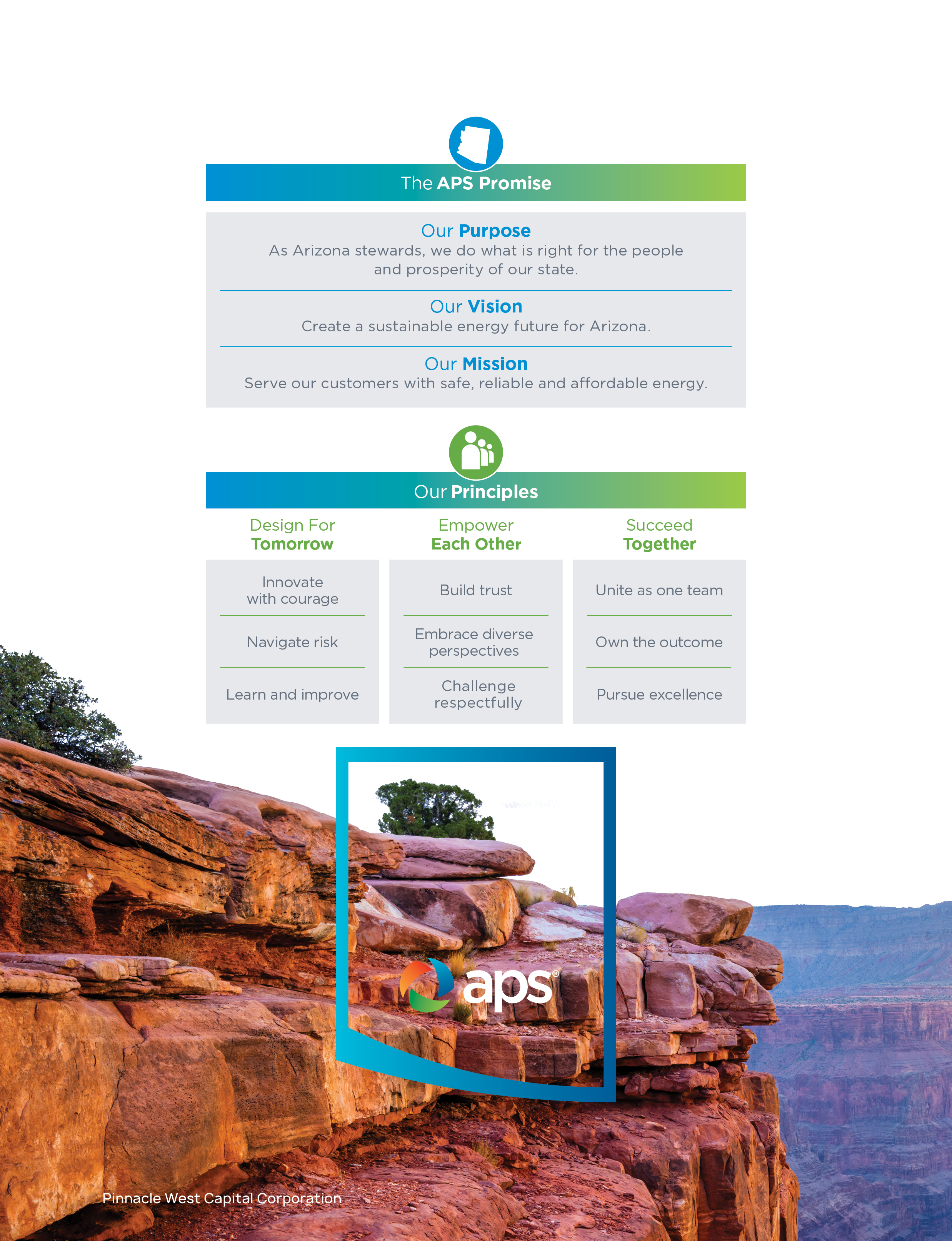
| Our Purpose As Arizona stewards, we do what is right for the people and prosperity of our state. Our Vision Create a sustainable energy future for Arizona. Our Mission Serve our customers with safe, reliable, and affordable energy. | | | | How we will execute our Mission to achieve our Vision. | | |
| | | | Our priority areas of focus for our business over the next five years: •Creating grid expansion options to meet accelerating demand; •Transforming our investment recovery mechanisms to address regulatory lag and ensure new large customers pay their fair share of system growth; and •Growing the talent and capabilities required to lead the industry through rapid change. | | |
| | | | | | | |
| | | | | | | |
| | Our Principles | | | | | |
| | | | | | | |
| | | | | | | | | |
| The culture and behaviors that will enable us to fulfill our Purpose, Vision, and Mission: Design for Tomorrow •Innovate with Courage •Navigate Risk •Learn and Improve Empower Each Other •Build Trust •Embrace Diverse Perspectives •Challenge Respectfully Succeed Together •Unite as One Team •Own the Outcome •Pursue Excellence | | | | Strategy and Targets | | |
| | | | | |
| | | | Our strategy and targets that guide resources and efforts to address our priorities: Business Plan — describes how each business area and employee supports executing our strategy. Performance Ambitions — defines the business priorities for how we both “run” and “change” the business and to guide allocation of company resources. Tiered Metrics — measures the results of how well we are running the business and foundational to achieving our strategic objectives. Performance Management — recognizes and rewards the individual contributions to priority work. | | |
| | | | | |
| | | | | |
| | | | | | | | | |
The Value We Create for Stakeholders
| | | | | |
| |
| Financial |
| Creating long-term value for shareholders is dependent upon having the right strategy to drive operational performance. We recognize the links between strong customer satisfaction, a constructive regulatory environment, and financial health and stability. To support future value creation for shareholders, we are committed to enhancing the customer experience and growing stakeholder relationships. In addition, strong customer growth contributes to our potential to continue to build shareholder value. |
| |
| |
| |
| Customers |
| Customers are at the core of what we do every day at APS and we are committed to providing options that make it easier for them to do business with APS. Recognizing that creating customer value is inextricably linked to increasing shareholder value, our focus remains on customers and our goal of achieving an industry-leading customer experience. |
| |
| |
| |
| Employees |
| Our 6,500 employees strengthen the Company and APS with their skills, experience, and diverse perspectives. We recognize that the next generation of employees has its own unique career expectations, and we are taking steps to support changing needs and priorities. We also continue to develop new strategies to attract and retain our highly-skilled employees and ensure they remain engaged. |
| |
| |
| |
| Environmental Stewardship |
| APS demonstrates commitment to its role as a leader in environmental stewardship by providing reliable energy from environmentally compliant and diverse sources, considering the environmental impact and risk assessment of decisions we make and complying with environmental laws and regulations, going beyond compliance when appropriate. APS's stewardship initiatives also include ensuring adequate water security, waste management, and clean energy. |
| |
| |
| |
| Communities |
| In addition to powering Arizona, we empower communities across Arizona through programs and partnerships dedicated to improving the lives of Arizonans. We not only invest in the communities where we do business, we also focus on building meaningful relationships, which help us manage our social, economic, and environmental impact. |
| |
| |
Shareholder Value
Our management team is committed to increasing shareholder value as one of our top priorities. Arizona continues to benefit from unprecedented growth and increased investment. In June of 2025, APS filed a new rate case request with the Arizona Corporation Commission ("ACC") seeking to reduce regulatory lag and continue to improve timely rate recovery. The $580 million revenue increase proposal is structured to support critical investments to ensure reliability and resiliency for our customers. We will strive to work through this rate case in a constructive manner throughout 2026 to continue strengthening the electric grid and support Arizona’s growing energy demand.
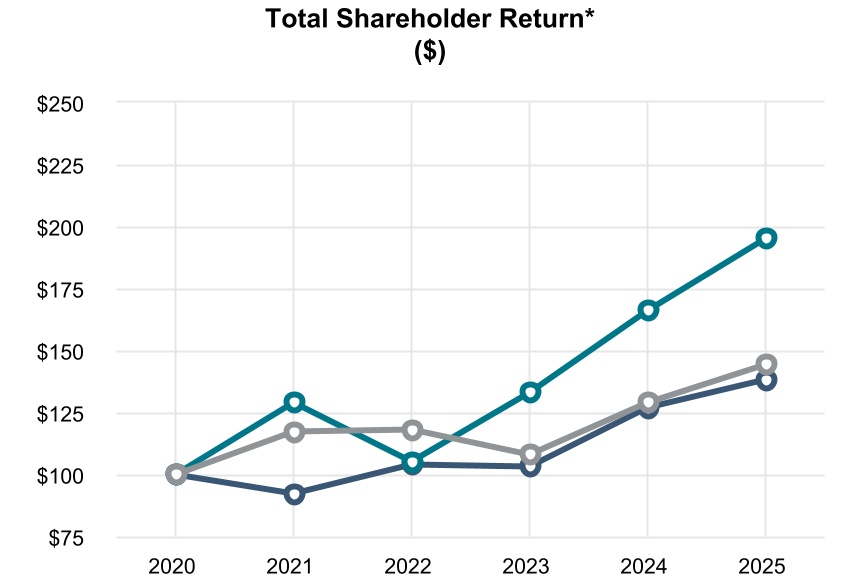
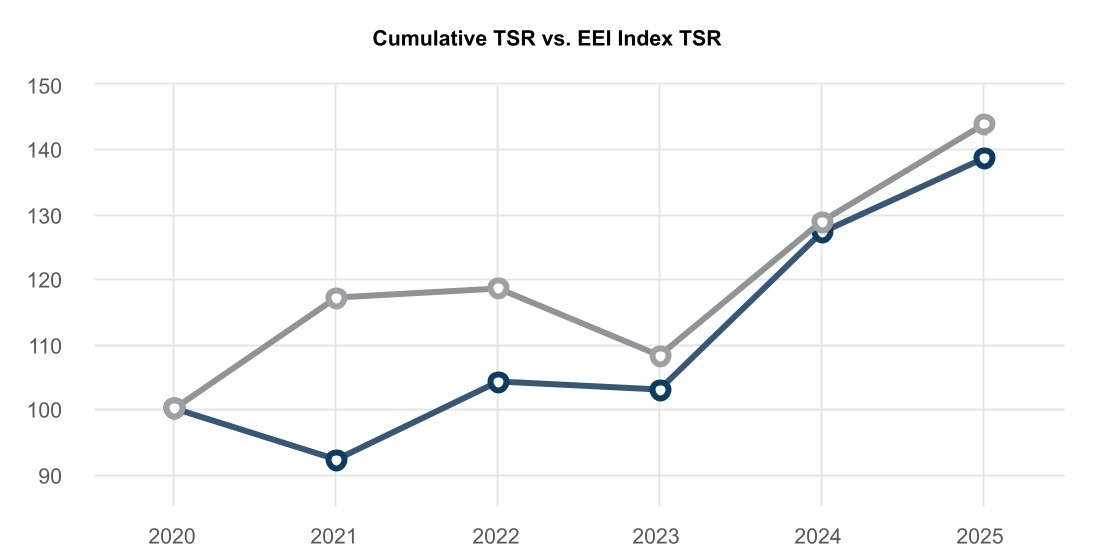
Our 2025 total shareholder return (“TSR”) was 8.85%. This performance reflects a recognition that our current pending rate case will extend throughout 2026 and the Company will continue to be challenged with regulatory lag during this period. The chart below depicts the TSR of $100 invested as of December 31, 2020 through December 31, 2025, with dividends reinvested where both the EEI Index and S&P 500 have outperformed our TSR.
| | | | | | | | | | | | | | | | | |
| Pinnacle West Common Stock | | S&P 500 Index | | Edison Electric Institute Index |
* Value of $100 invested as of December 31, 2020, with dividends reinvested.
The ACC has recognized the need to address regulatory lag and established a policy statement supportive of a framework to align cost recovery with utility investments to support reliability and growth. The current rate case includes a proposed formula rate adjustment mechanism ("FRAM"), along with other rate modifications. Our FRAM proposal would enable more gradual, annual rate adjustments based on the previous years' expenses and investments. In addition, in support of customer affordability, we have also requested rate design modifications to closer align rates with costs, ensuring growth pays for growth while offering significant customer protections. We remain committed to maintaining robust communication and collaboration with the ACC and other stakeholders to find constructive solutions that support our customers while maintaining the financial health of the Company.
Looking forward, we remain confident that we have the right strategy and team in place to meet our near-term goals and deliver value to our shareholders over the long term. By balancing customer needs with financial discipline, we believe we are well-positioned to support Arizona’s growth while sustaining operational excellence and building on our record of success.
2025 Financial and Operating Highlights
•PNW increased its dividend for the 14th consecutive year.
•As a direct outcome of substantial weather normalized sales growth, strong customer growth, and increased transmission revenues, PNW ended 2025 with earnings above budgeted expectations.
•Provided safe, reliable, and affordable energy to serve our customers during a third record-breaking summer that set a new all-time peak customer demand of 8,648 MWs on August 7, 2025.
•Achieved a key reliability milestone by securing firm access to expanded capacity on a new Transwestern Pipeline, supporting the dependable operation of the generation fleet and ensuring reliable electric service as customer demand continues to grow.
•Announced plans to build up to 2 GWs of new natural gas generation to support current and future customers.
•Completed construction and put in service the Agave Battery Energy Storage System, Ironwood Solar, and new gas units at Sundance, adding over 400 MWs of capacity to the APS system.
•For the second year in a row, APS installed over 34,000 new meter sets, the highest in recent history.
•APS placed in the top quartile for reliability, based on the average number of outages per customer per year.
•For the 17th consecutive year – and 21st overall – Palo Verde Generating Station's ("PVGS" or "Palo Verde") three nuclear units exceeded 30 million MWh of net generation. It also achieved a capacity factor of 90.8%.
•Non-nuclear generation units performed exceptionally well during the crucial summer run, with a summertime equivalent availability factor of 93.1%.
We know that creating real value for customers is the key to creating long-term value for shareholders, so our focus continues to center on APS’s customers and the communities we serve. Our goal is simple: deliver an industry-leading customer experience. Over the past several years, we’ve been steadily working toward that goal by incrementally improving the different facets of the customer experience. Our multi-year objective has resulted in improved overall customer satisfaction and experience ratings by our customers, moving from the fourth quartile in 2020 to the first and second quartile in 2024 in various syndicated research studies of both residential and business customer satisfaction.
In 2025, APS ranked in the top quartile nationally in business customer satisfaction in both J.D. Power’s historical experience and new brand-focused model, and ranked in the second quartile nationally for business overall customer satisfaction in the Escalent Cogent Syndicated Study. Both studies compare APS to approximately 80 utilities nationally.
Likewise, residential customers ranked APS in the second and first quartile for residential overall customer satisfaction when using J.D. Power’s historical experience model and Escalent Cogent Syndicated Study, respectively. The residential performance compared APS to more than 50 Large Investor-Owned Utility peers, and APS consistently performed above industry average or top quartile in the majority of service and experience-oriented questions and key performance indicators.
Customer Care Center
Our residential customers can contact us any time – day or night – through our 24/7 Customer Care Center. In 2025, our call center advisors answered 82% of more than 1.6 million calls in 30 seconds or less, with an average speed of answer of 44 seconds. We also experienced growth in online transactions and engagements through both English and Spanish digital customer platforms, including website, mobile app, text, and email alerts and notifications. Through our website, mobile app, and alerts and notifications customers benefited from more than 75 million transactions and engagements in 2025. Our customers continued to rate our J.D. Power digital experience and telephone experience, including advisor knowledge and courtesy, in the top quartile. Also, APS is ranked in the top quartile for Service Satisfaction in the Escalent residential study, which includes web and representative experiences.
Leveraging the Voice of the Customer to Improve Customer Experience
Voice of Customer ("VOC") research helps APS better understand customer needs, expectations and experiences to deliver effective solutions. We gather insights by asking customers what is important to them, learning their perceptions about existing and potential programs and services, and identifying improvement opportunities based on their feedback. Key VOC sources at APS include satisfaction and transactional studies, call listening, online panels, focus groups, the Customer Advisory Board, and more. The Customer Advisory Board is comprised of a diverse group of residential customers who meet to provide feedback on programs and initiatives, helping to shape APS's customer engagement. This work is foundational so we can create and deliver the information and solutions our customers need to have a satisfying experience with APS.
| | | | | |
| |
| Customer Experience Strategy Council |
In 2021, we initiated an organization-wide customer experience strategy council designed to further drive a customer-centric culture, deliver more friction-free customer experiences, and improve customer satisfaction. Building on this initiative and others, we made significant strides in 2025 by introducing an Artificial Intelligence ("AI") High Bill Analyzer tool in our call center to assist customers with high bill concerns and energy usage explanations; generated nearly 1.4 billion customer impressions in both English and Spanish across all communication channels to keep customers informed about topics that matter most to them; increased email and text alerts and notifications related to billing, payment, usage, account status, and outages to keep our customers informed, empowered, and connected; enhanced consumption data on aps.com so customers could see a cost breakdown of their billed usage; and maintained a strong focus on employee learning and training to ensure each team member understands their role in shaping the customer experience.
APS has a variety of financial assistance programs to support customers struggling to pay their energy bills. Among these assistance programs are discounts for qualified limited-income customers, including a tier with larger discounts for APS’s lowest-income customers, and other non-income-based assistance programs, such as flexible payment arrangements and emergency utility bill assistance. To ensure our most vulnerable customers are connected to these programs, we train and partner with nearly 100 community action agencies across APS’s service territory.
These programs include:
•Crisis Bill Assistance. Qualified customers experiencing an unplanned major expense or an unexpected reduction in income can receive up to $1,000 a year to cover current or past due APS bills through the Crisis Bill Assistance program. This assistance historically has provided about $2.5 million in annual funding. In 2025, the Company almost doubled this amount by providing approximately $4.5 million in assistance from shareholder funds.
•Energy Support. Our Energy Support program gives qualified, limited-income customers up to a 25% or 60% discount on their monthly energy bills based on household income level. APS also provides a discount of up to 35% or 60% on customer bills each month if someone in the home has a life-threatening illness or uses critical medical equipment that requires electricity. In 2025, more than 85,000 customers were enrolled in the Energy Support program, providing about $56.2 million in discounts. APS offers the most generous discount program in Arizona.
•APS Cares. Through a partnership with The Salvation Army, this program helps customers who are struggling to pay their electric bill, due to a sudden loss of income or unplanned major expense, qualify for up to $500 in assistance. APS Cares is funded through customer and employee contributions, as well as a match from Pinnacle West shareholders of up to $500,000 for 2026.
•Safety Net and Guest Roles. These programs allow customers to designate a friend or relative to receive a copy of their monthly APS bill and to serve as a reminder when payment is due and/or be notified if the account becomes past due. Also, individuals designated as “Guest Roles” can access account information with options to make payments and compare service plans.
•Payment Arrangements. APS is committed to working with customers who demonstrate good faith efforts to get current on their bills through flexible payment arrangements. To help customers pay down outstanding balances and avoid disconnection, APS set up about 319,000 payment arrangements in 2025.
•State and Local Assistance. There were several additional assistance programs throughout Arizona in 2025 for qualified customers, including the Low-Income Home Energy Assistance Program that works with Community Action Programs and other local providers to lower energy costs for customers struggling to pay their energy bills. In 2025, more than 21,000 customers received $12.8 million in bill assistance from federal and state programs, the APS Crisis Bill Assistance program, and other sources.
Our 6,500 dedicated employees strengthen the Company and APS with their skills, experience, and diverse perspectives. Human capital measures and objectives that the Company and APS focus on to manage our business include employee safety, company culture, succession planning, hiring, retention and development of talent, compensation and benefits, and employee engagement.
Focused on Our People
The Company and APS seek to attract, retain and develop a high performing workforce, and to create a productive work environment for all employees. We believe the strength, talent, and commitment of our employees are significant contributors to our success.
Culture & Engagement
The APS Promise anchors our commitment to APS's customers, community, and each other. The APS Promise explains our purpose, vision, and mission and the principles and behaviors that will empower us to achieve our strategic goals. It represents the opportunity to build on our cultural strengths and develop new behaviors to enable our future success. In 2025, we took the opportunity to refresh our Promise to ensure its relevancy and alignment with our strategic direction. We updated our Mission to ensure alignment with our top priorities – safety, reliability, and affordability. We also updated some of our shared behaviors to ensure they reflect who we are as a company, and how we will succeed today and into the future. The APS Promise continues to be reinforced and integrated throughout our programs and messaging.
We evaluate our success in building our culture in part through annual and quarterly employee experience surveys, including our Employee Experience Index, which measures key aspects of engagement like recognition, career development, and organizational pride. In 2025, we had 83% participation, and our Employee Experience Index was 86%. These surveys enable us to compare our performance to industry benchmarks and identify areas for improvement.
We believe that belonging matters. We recognize that differences of identities, perspectives, and experiences are key drivers for success. When we feel seen, heard, and valued, we can better leverage our mix of these differences, so we can bring the APS Promise to life.
Inclusion at the Company and APS involves embracing the unique perspectives of each employee. Examples of ongoing activities includes:
•support for 11 employee networking groups to encourage employees to develop themselves, advance in their chosen field, and to join a community; and
•continuous listening practices to provide employees with opportunities to be heard.
Talent Strategy
In a highly competitive market for talent, it’s vital to our success to ensure APS is recognized among career seekers as an employer of choice, job opportunities are accessible, and the careers and talent programs we offer serve us and our communities. We are committed to thoroughly sourcing and vetting qualified candidates to help improve the hiring leader and candidate experience. We maintain a strong employer brand through effective career advertising campaigns and an active social media presence. Many times, our best source of potential candidates is through our employees advocating on behalf of the Company and APS and sharing first-hand accounts of how much they enjoy working at the Company and APS. Our talent pipelines and early career programs are the cornerstone of our talent strategy, helping to sustain our highly skilled workforce now and into the future.
•Internship programs: 58 summer internships were completed in 2025.
•Apprentice programs: 33 new apprentices were hired into the program in 2025, for a current total of 173 apprentices.
•Early career engineer programs: Legacy Engineer Program (Palo Verde) and Rotational Engineer Program (Transmission and Distribution).
•Recruitment efficiency: In 2025, recruiters prioritized comprehensive pre-screening practices such as recruiter phone interviews with qualified applicants and role-specific screening questions to enhance candidate quality and streamline the hiring process.
•Strong commitment to our communities: Continued support of talent programs that support Arizona such as the U.S. Department of Defense SkillBridge veteran hiring program and ElevateEdAZ Job Shadow Program for high school students. In 2025, APS hosted 14 SkillBridge interns, with 8 converting to full-time employees, continuing to expand our program and talent pipeline. APS also expanded its internship program to include positions in the Forestry and Water Resources departments, with a strong focus on sourcing top local talent through existing academic partnerships.
Retention
•Robust employee engagement, including 11 employee network groups.
•Average employee tenure of 10.89 years due to strong talent strategy and an engaged workforce.
•Total turnover for 2025 was 7.1%, about one-third of which was related to retirements.
•Annual employee experience and focused quarterly pulse surveys allow us to gather employee feedback, identify opportunities for improvement, and take meaningful action in response to survey results, focusing on improvements in targeted areas. Examples of such improvements in 2025 include improving internal processes and employee recognition.
Workforce Evolution
As our industry experiences social and economic change, employees continue to be the key differentiators of our success. We must plan and prepare to employ the workforce of the future in order to achieve long-term success. The APS Promise and a focus on cultural principles will allow us to drive innovation, create a sense of belonging for our employees, and continuously improve.
In 2025, APS introduced a new Leadership Model and Talent Philosophy to provide clarity and focus on how our leaders can shape a culture where people and performance excel. Our leadership model outlines key traits and skills that bring our APS Promise to life with actionable behaviors at each leadership level. Our APS talent philosophy provides guidance for leaders to define a shared set of standards as it relates to managing talent. These standards are focused on behaviors, transparency, differentiation, leadership commitment, and performance. It ensures consistency, reduces biases, and aligns leadership. Leaders are responsible for putting this philosophy into practice to elevate talent and performance.
| | | | | |
10 | 2026 Proxy Statement | |
| |
| | | | | | | | |
| | Environmental Stewardship Highlights |
As stewards of Arizona's precious natural resources, we take seriously our obligation to responsibly manage, conserve, and protect our environment for future generations.
Achieving a clean energy future is a multifaceted challenge that requires thoughtful planning, a measured and deliberate approach, and steady progress. It is critically important we ensure and maintain system reliability while keeping customers' bills as low as possible, as we strive to lower carbon emissions over time. To that end:
•We updated our clean energy goal to recognize the value in maintaining a balanced energy portfolio in order to secure a reliable grid. We now have an aspirational goal that aligns with industry peers of achieving carbon neutrality by 2050.
•Our diverse energy mix includes almost 58% clean, carbon-free resources.
•Palo Verde produces about 32 Million MWh of clean energy annually.
•Our renewable energy capacity is over 7,760 MW in operation, planned or under development.
•Our battery storage capacity is almost 6,000 MW in operation, planned or under development.
| | | | | |
| Reducing Water Consumption |
•Operating in the desert Southwest, it is particularly important to manage water responsibly.
•Achieved a 47% reduction in groundwater use since 2014.
•Approximately 76% of water consumed by APS power plants in 2025 came from treated effluent water.
•Water intensity (gal/MWH) for power generated and delivered to APS customers improved by 11% from 2024, saving more than 1.8 billion gallons of water in 2025.
•Each generating plant has a unique water strategy to help ensure efficient water use.
At APS, our community engagement and corporate giving strategy is guided by a simple principle: making a meaningful difference in the lives of Arizonans. How we achieve that goal is what amplifies our impact. We not only invest in the communities where we operate, but we also prioritize building strong, lasting relationships, ensuring our contributions are thoughtful, strategic, and aligned with community needs.
We initiate and maintain relationships with stakeholders to understand our communities’ needs and identify opportunities to build healthy and sustainable communities.
•We hosted three APS Energy Update meetings with Ted Geisler as the featured speaker with a total of 161 leaders and over 95 organizations represented.These meetings provided an opportunity to inform and educate stakeholders about our Company and have a direct exchange of ideas, perspectives, and gather feedback, and concerns.
| | | | | |
| 2026 Proxy Statement | 11 |
|
| | | | | |
| Philanthropy and Volunteerism |
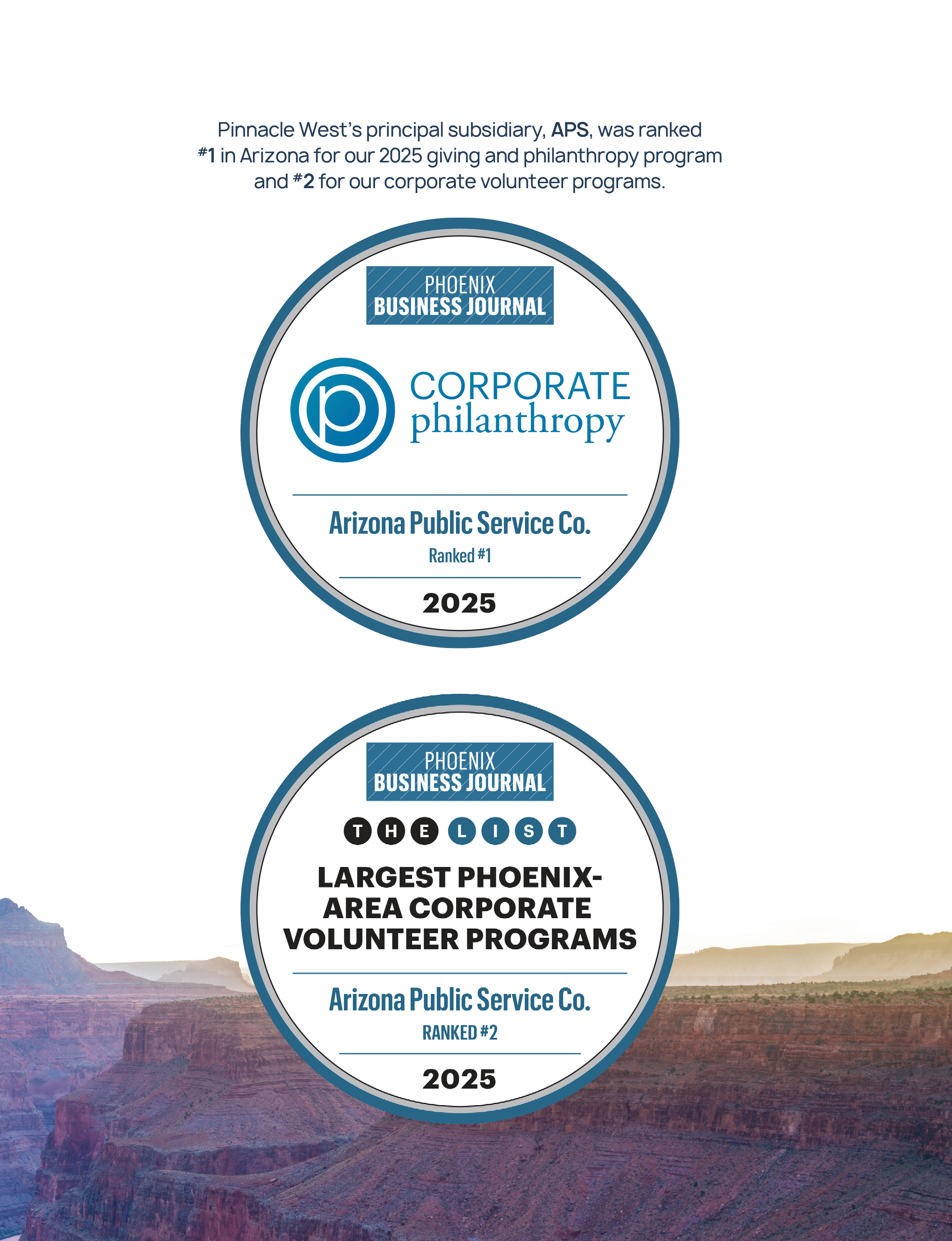
We are actively involved in the communities we serve. We partner with nonprofit organizations and community groups across the state to build a stronger, healthier Arizona. Our efforts include financial support, board service, and volunteer assistance. In 2025, APS received multiple recognitions for its community service, including Arizona’s #1 Corporate Philanthropy Award and the Second Largest Corporate Volunteer Program from the Phoenix Business Journal.
•We contributed nearly $10.7 million to the community in 2025, with a focus on key areas such as arts and culture, education and workforce development, small business and entrepreneurship, environmental stability, human services, and community development.
•In 2025, our employees volunteered an estimated 87,000 hours to causes important to them.
•Our employees sit on the boards of nearly 300 Arizona community and nonprofit organizations and industry groups.
•Employees pledged $2.2 million to the 2025 Community Service Fund campaign with the Company matching 25%, for a total of $2.8 million.
The Company maintains an annual Corporate Responsibility Report on the Pinnacle West website (www.pinnaclewest.com/corporate-responsibility). The report provides additional information related to the Company’s and APS's approach to corporate responsibility, including community engagement and environmental stewardship.
| | | | | |
12 | 2026 Proxy Statement | |
| |
Governance Highlights
Our strong corporate governance practices demonstrate the Board’s commitment to enabling an effective structure to support the successful execution of our strategic priorities.
| | |
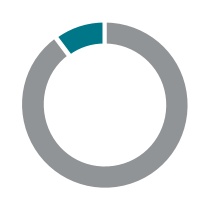
Board Independence •Lead Independent Director role with clearly defined and robust responsibilities •Nine of ten Director nominees are independent and the members of all of the Board committees are independent |
| | |
9/10 Independent Director Nominees |
| | | | | |
Board Oversight •Robust management succession planning •Focused Board oversight of strategy and risk •Thorough CEO performance oversight process Board Performance •Annual Board, committee, and individual Director evaluations and discussions with the Lead Independent Director •Director skills and experience necessary to provide oversight of our strategy and operations •Robust Board refreshment, with Director retirement policy | Shareholder Rights •A group of 15% of our shareholders can call a special meeting (“Shareholder Special Meeting Rights”) •Annual elections of all Directors with cumulative voting •No poison pill plan or similar anti-takeover provision in place •No supermajority provisions in our Articles of Incorporation or Bylaws •Proxy access rights allow up to 20 shareholders owning 3% of our outstanding stock for at least 3 years to nominate up to 25% of the Board |
Compensation Governance
•Shareholder feedback informs compensation program design.
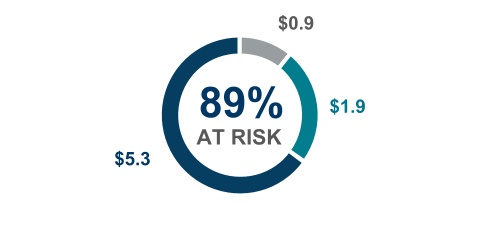
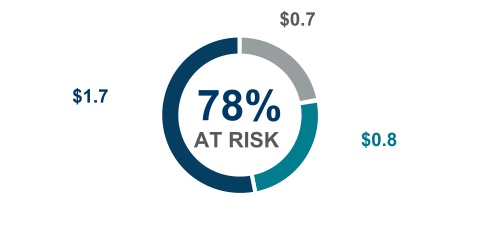
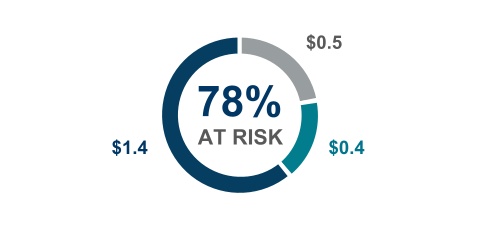
•Substantial proportion of target compensation is at risk (87% for the current CEO for 2025 and 74% for other NEOs, excluding the former CEO, for 2025).
•Performance shares are tied to relative performance, ensuring long-term financial health.
•No excise tax gross-up provisions in new or materially amended Change of Control Agreements with our NEOs.
•Anti-hedging policy for all Directors, officers, and employees, and anti-pledging policy for all Directors and officers.
•Stock ownership guidelines for all NEOs, Officers and Directors.
•Clawback policy for our current and former executive officers that is compliant with the rules of the New York Stock Exchange (“NYSE”), covering short- and long-term incentive awards.
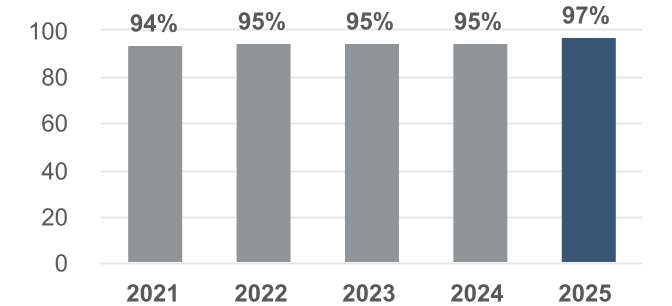
•Average shareholder support for our executive compensation program over the past five years has exceeded 94%. In 2025, shareholder support was 96.6%.
| | | | | |
| 2026 Proxy Statement | 13 |
|
Compensation Highlights
Our compensation program is designed to be transparent and has a clear emphasis on putting pay at risk. Our executive compensation philosophy centers on the core objectives of maintaining alignment with shareholder interests and retaining key management.
The Company believes that a significant portion of each NEO’s total compensation opportunity should reflect both upside potential and downside risk. As shown below, we place a strong emphasis on performance-based, shareholder-aligned incentive compensation.
For 2025, the Company’s core executive compensation program for our NEOs generally consisted of the following key components:(1)
| | | | | | | | | | | | | | | | | |
| | Pay Element | Measurement Period | Performance Link | Description |
| | Cash | Salary is based on experience, performance, and responsibilities and is benchmarked to a peer group and market survey data to align with competitive levels. |
Base Salary | |
Annual Incentives | | | | Earnings CEO: 50.0% Other NEOs: 50.0% | Universal measure of business financial performance; encourages achievement of bottom-line earnings goals. |
| Cash | 1 year | | |
| | |
| | | Business Unit Performance 50.0% | Pre-established operational business unit performance goals that include safety, customer experience, and operational quality and efficiency metrics. |
Long-Term Incentives | | Performance Shares 70% | 3 years | Relative TSR 40% | Links pay to shareholder value creation relative to others in the industry. |
| EPS Performance 40% | Links pay to financial targets that generate shareholder value. |
| Clean Megawatts Installed ("MW Installed")(2) 20% | Links pay to successful construction and delivery buildout of resources from prior all-source requests for proposal ("ASRFP"). |
| Restricted Stock Units 30% | Vest ratably over 4 years | Stock Price | Encourages retention; value dependent upon share price appreciation and four-year vesting to encourage retention. |
Benefits | | We provide benefits, including pension and deferred compensation programs, change of control agreements, and limited perquisites, that are designed to attract and retain our executive talent. |
(1)For additional details on our executive compensation program for our NEOs, see page 50 of this Proxy Statement.
(2)In 2026, we replaced this MW Installed metric with a new metric blending reliability and affordability. The MW Installed links pay to the successful construction and delivery buildout of resources that were previously contracted for as a result of prior ASRFPs, which we believe will deliver reliable and affordable energy. For additional details see page 70 of this Proxy Statement.
| | | | | |
14 | 2026 Proxy Statement | |
| |
Current CEO and Other NEOs’ Total Compensation
| | | | | | | | | | | | | | | | | | | | |
| | Base Salary | | Target Annual Incentive | | Long-Term Incentive |
| | | | | | |
Current CEO(1) | | 12.7% | | 16.2% | | 71.1% |
| | | | | | |
| | | | | | |
| | | | | | |
| | | | 87% At-Risk Performance-Based Pay |
(1)During 2025, Mr. Geisler served as President of APS until his promotion to Chairman of the Board, President, and Chief Executive Officer of Pinnacle West and APS effective April 1, 2025. His compensation as set forth in this graph reflects his compensation awarded or received in connection with those roles. During 2025, Mr. Guldner served as Chairman of the Board, President, and Chief Executive Officer of Pinnacle West and Chairman of the Board and Chief Executive Officer of APS through March 31, 2025 and then as Special Advisor to the CEO for the remainder of the year. He did not receive any long-term incentive grant in 2025 and as such, Mr. Guldner's at-risk pay at 32% solely represents his target annual incentive prorated for the time he was in such officer role prior to his transition to the Special Advisor to the CEO role.
| | | | | | | | | | | | | | | | | | | | |
Average of Other NEOs | | Base Salary | | Target Annual Incentive | | Long-Term Incentive |
| | | | | |
| 25.8% | | 17.4% | | 56.8% |
| | | | | | |
| | | | | | |
| | | | | | |
| | | | 74% At-Risk Performance-Based Pay |
| | | | | |
| 2026 Proxy Statement | 15 |
|
Information About Our Board and Corporate Governance
Board Oversight and Engagement
Strategic Priorities
As we continue to position the Company for long‑term, sustainable growth amid unprecedented levels of customer and economic expansion, our Board and management team remain focused on advancing a strategic portfolio that supports disciplined capital deployment and enhances shareholder value. This includes creating grid expansion options to meet accelerating demand, transforming our investment recovery mechanisms to address regulatory lag and ensure new large customers pay their fair share of system growth, and growing the talent and capabilities required to lead the industry through rapid change. At the same time, we are embracing AI‑driven tools and processes to deliver excellent customer service at lower costs, strengthening both operational efficiency and customer experience. Together, these priorities reinforce our commitment to reliable operations, prudent financial management, and strong governance practices—ensuring we maintain the adaptability and resiliency necessary to deliver consistent, long‑term value for our shareholders.
Artificial Intelligence
We have launched an enterprise AI strategy to transform the customer experience, strengthen our operations and create shareholder value. Members of our executive management team are part of an executive committee that provides oversight and directional guidance on our AI strategy to a multidisciplinary and cross functional team of employees known as the Artificial Intelligence Office. The Artificial Intelligence Office operationalizes the AI strategy to assess value, prioritize compliance, secure design, and enable the proliferation of AI education and adoption. The Board provides oversight on AI matters, including this AI strategy. The full Board receives periodic updates on AI as it relates to, among other things, business strategy and potential uses, risks and mitigation and governance.
Human Capital Management
Human capital measures and objectives on which our Company focuses to manage our business include employee safety, succession planning, hiring, retention and development of talent, compensation and benefits, and employee engagement. The Human Resources Committee provides oversight of our strategies and policies related to human capital management, including those with respect to matters such as talent development and retention. The Human Resources Committee is also tasked with oversight of our Company’s workforce, including establishing our executive compensation philosophy and reviewing our Company’s plans and programs for the attraction, retention, succession, motivation, and development of the human resources needed to achieve corporate objectives. Additionally, at the Board's annual strategic retreat, the Board engaged in robust discussions about succession planning and discussed the Company's talent management philosophy with management.The Human Resources Committee also reviews pension, health, welfare, and benefit plans, and is responsible for the oversight of risks relating to or arising out of the Company’s and APS's compensation and human resources policies and practices. The Board generally has multiple opportunities each year to interact directly with employees, including during periodic Board meetings held at Palo Verde, during an annual dinner with select employees, and at employee-driven presentations to the Board.
| | | | | |
16 | 2026 Proxy Statement | |
| |
Codes of Ethical Conduct
To ensure the highest levels of business ethics, the Board has adopted the Code of Ethical Conduct, which applies to all employees, officers, and Directors, and the Code of Ethics for Financial Executives, both of which are described below:
Code of Ethical Conduct
Employees and Directors receive access to the Code of Ethical Conduct when they join the Company or APS, as well as periodic updates. The Code of Ethical Conduct helps ensure that employees and Directors of the Company and APS act with integrity and avoid any real or perceived violation of the Company’s policies and applicable laws and regulations. The Company provides annual online training covering the principles in the Code of Ethical Conduct. This training includes discussion of the Company’s principles, an explanation of Company ethical standards, application of ethical standards in typical workplace scenarios, information on reporting concerns, assessment questions to measure understanding, and an agreement to abide by the Code of Ethical Conduct. All active employees of the Company, APS and our subsidiaries, and all of our Directors complete the training.
Code of Ethics for Financial Executives
The Company has adopted a Code of Ethics for Financial Executives, which is designed to promote honest and ethical conduct and compliance with applicable laws and regulations, particularly as related to the maintenance of financial records, the preparation of financial statements, and proper public disclosure. “Financial Executive” means the Chief Executive Officer, Chief Financial Officer, Controller and Chief Accounting Officer, Treasurer, General Counsel, the most senior director in the Tax Department, Arizona Public Service Company’s President and Executive Vice President, Operations, and other persons designated from time to time as a Financial Executive.
Both codes are available on the Company’s website (https://www.pinnaclewest.com).
Securities Trading Policy
Pinnacle West has adopted an insider trading policy (the "Insider Trading Policy") governing the purchase, sale, and/or other dispositions of its securities by the Directors, officers and employees, and Pinnacle West itself, that Pinnacle West believes is reasonably designed to promote compliance with insider trading laws, rules, and regulations, and NYSE listing standards. This policy is set forth in our Securities Trading Policy included as Exhibit 19.1 to the Pinnacle West/APS Annual Report on Form 10-K for the fiscal year ended December 31, 2025.
The Board’s Role in Risk Oversight
| | | | | | | | | | | | | | |
| | | | |
| Top risks discussed by the Board and its committees in 2025 included: | |
| | | | |
| •Customer Bill Pressure •Data Center Demand - Planning, Execution and Cost Recovery •Arizona Utility Regulation •Employee and Public Safety •Loss of Generation Reliability •Long-Term Resource Adequacy •Catastrophic Wildfire | | •Cybersecurity •Loss of a Mission Critical IT Application or Service •Ability to Attract and Retain Top Talent •Nuclear Operations - Safety and Reliability •Supply Chain Constraints •Four Corners Strategy | |
| | | | |
| The Board believes it is important to take a fresh look at the list each year as part of a diligent risk review. | |
| | | | |
| | | | | |
| 2026 Proxy Statement | 17 |
|
Responsibilities
Responsibility for managing the Company’s risks rests with the Company’s senior management team. The Board’s oversight of the Company’s risk management function is designed to provide assurance that our risk management processes are well adapted to, and consistent with, the Company’s business and strategy, and are functioning as intended.
| | | | | | | | | | | | | | |
| | | | |
| | BOARD OF DIRECTORS The Board focuses on fostering a culture of risk awareness and risk-adjusted decision-making and ensuring that an appropriate “tone at the top” is established. The Board annually discusses and updates a listing of areas of risk and a suggested allocation of responsibilities for such risks among the Board and the Board committees. The Board reviews those risks throughout the year. | | |
| | | |
| | | | |
| | | | |
| | | | |
| | COMMITTEES The charter for each of the Board’s committees requires each committee to periodically review risks in its respective area. Each committee: •receives periodic presentations or reports from management about its assigned risk areas; •receives information about the effectiveness of the risk identification and mitigation measures being employed; and •discusses its risk reviews with the Board. The Audit Committee periodically reviews the Company’s risk assessment processes, guidelines, policies, and programs, as well as the Company’s major financial risk exposures and the steps management has taken to monitor and control such exposures. | | |
| | | | |
| | | | |
| | 5 | | |
| | | | |
| | | | |
| | ENTERPRISE RISK MANAGEMENT GROUP – EXECUTIVE RISK COMMITTEE •The Enterprise Risk Management group reports to the Company’s Vice President, Controller and Chief Accounting Officer. The internal group is responsible for implementing a consistent risk management framework and the Risk Oversight and Governance process to raise and report material Company risks to the Executive Risk Committee (“ERC”) and the Board of Directors. •The ERC is comprised primarily of senior-level officers of the Company and is chaired by the Company’s Senior Vice President and Chief Financial Officer. The ERC is responsible for ensuring that the Board receives timely information concerning the Company’s material risks and risk management processes and the effectiveness of the Enterprise Risk Management program. | | |
| | | |
| | | | |
Highlights of Certain Risks
Three of the top risks monitored by the Board and its committees in 2025 were as follows:
Cybersecurity
The cyber landscape for utilities is growing increasingly complex, not just due to increasingly sophisticated threat actors and escalating geopolitical uncertainties, but also due to the reliance on legacy systems with potential security vulnerabilities. Utilities also face complex challenges around exploring new technologies and business ventures, accommodating more complex connections to the grid and energy infrastructure, and navigating an ever-evolving regulatory and policy landscape. The Nuclear and Operating Committee and the Board have reviewed numerous mitigation strategies, including the following:
•protection of our critical systems, including defense against-malware;
•technologies supporting incident response, including endpoint defense technologies;
•AI mitigation of advanced phishing and email threat mitigation;
| | | | | |
18 | 2026 Proxy Statement | |
| |
•cybersecurity incident response processes and Board engagement in major cyber events; and
•external system assessments and audits.
Catastrophic Wildfire
Increasing catastrophic wildfire risk is driven by a complex set of drivers like climate change, evolving demographics, growing wildland and urban interface, and land management practices. Increase in temperatures, vegetation density, decrease in fuel moistures, erratic wind patterns and drying conditions create fuel to sustain large wildfires. Given the Company’s vast service territory and historical drought conditions, wildfire continues to be an elevated risk. The Board has reviewed numerous mitigation strategies, including the following:
•establishment of enterprise-wide catastrophic wildfire governance framework;
•comprehensive Wildfire Mitigation Plan; and
•design and implementation of Public Safety Power Shutoff.
Resource Adequacy And Regional Reliability
Increase in load due to population growth and economic development in Arizona are creating a significant and urgent need for new resources. A large quantity of “firm” generation capacity (including the region’s nuclear and natural gas resources) along with additional transmission build is critical to support the load growth, maintain reliability, and to connect and import resources into our service territory. The Nuclear and Operating Committee and the Board have reviewed numerous mitigation strategies, including the following:
•design and implementation of wholesale market and Regional Transmission Organization development;
•exploration of pipeline expansion opportunities; and
•evaluating regional transmission opportunities and ensuring our transmission expansion plans integrate new generation resources with customer demand.
Management Succession
Our Board places a high priority on senior management development and succession planning. While the Corporate Governance and Nominating Committee has principal responsibility for overseeing CEO and other senior management succession planning, the Human Resources Committee and full Board are actively involved in reviewing our senior management succession plans, which are designed to provide for smooth and thoughtful leadership transitions. Our strategic succession plans continue to be implemented with the following changes in 2025: Ted Geisler was promoted to Chairman of the Board, President and CEO of PNW and APS, Shirley Baum was promoted to Senior Vice President and General Counsel of PNW and APS; Mackenzie Rodgers was promoted to Vice President of Transmission and Distribution Operations; Peter Candelaria was hired as Vice President of Generation Development; Johnny Penrod was promoted to Vice President of Generation Non-Nuclear (effective in 2026); Jessica Hobbick was promoted to Vice President of Rates and Regulatory (effective in 2026); and Danielle Evans was promoted to Vice President of Customer Service and Communications (effective in 2026).
| | | | | | | | |
| | |
| Given our need for specialized experience, we maintain strong management succession planning practices and are focused on attracting, developing and retaining talent within our Company. Our Board’s focus on attracting, developing, and retaining highly skilled and experienced executives is a core consideration in structuring our executive compensation program. | |
| | |
| | | | | |
| 2026 Proxy Statement | 19 |
|
Shareholder Engagement
We have an established engagement program to maintain a dialogue with our shareholders throughout the year. Each year, we strive to respond to shareholder questions in a timely manner, conduct extensive proactive outreach to investors, and evaluate the information we provide to investors in an effort to continuously improve our engagement.
| | | | | | | | | | | | | | | | | | | | |
| | | | | | |
| SHAREHOLDER OUTREACH | BOARD ACCESS | |
| | | | | | |
| | In 2025, we contacted the holders of approximately 75% of the shares outstanding. | Our Board is focused on shareholder feedback. Our Lead Independent Director and other members of the Board, depending on the topic to be discussed, have participated in shareholder discussions, providing shareholders with direct access to the Board. | |
| | | | | | |
| 6 | | | | | |
| | | | | | |
| MATTERS DISCUSSED IN OUR FALL 2025 OUTREACH | | |
| | | | | | |
| •Our strategy •Load growth | •Board refreshment/onboarding •Arizona Corporation Commission | •Rate case •Regulatory lag | |
| | | | | | |
| | | | | | |
| | | | | | |
| WE LISTEN TO OUR SHAREHOLDERS | |
| | | | | | |
| We want to ensure we have the opportunity to engage directly with our shareholders, because what our shareholders think is important to us. We seek to maintain a transparent and productive dialogue with our shareholders. Each year, we take feedback from our shareholders and other stakeholders to ensure our strategy and focus align with the interests of our shareholders and community. | |
| | | | | | |
| 6 | | | | | |
| | | | | | |
| BOARD RESPONSIVENESS | |
| | | | | | |
| In response to feedback we received in previous years, we improved shareholder rights by decreasing the number of shares required to call a special meeting of shareholders from 25% to 15% and refined our executive compensation program to further align pay-for-performance — as detailed in the CD&A. | |
| | |
| | | | | |
20 | 2026 Proxy Statement | |
| |
Annual Engagement Cycle
| | | | | | | | | | | | | | | | | | | | |
| | | | | | |
| | | |
SPRING | SUMMER | FALL | WINTER |
| | | | | | |
| | | | | | |
We publish annual communications to our shareholders: Annual Report, Proxy Statement, and Corporate Responsibility Report. We always make ourselves available to meet with our shareholders and discuss proxy-related topics in connection with our Annual Meeting typically held in May. | | We review the results of the Annual Meeting and potential improvements to our governance policies and practices. | | We reach out to our shareholders in order to discuss the Annual Meeting outcome and to understand their priorities for the year. We communicate shareholder feedback to the Board and use it to enhance our governance practices, our disclosures, and compensation programs. | | The cycle concludes with the Board considering our shareholders’ feedback and determining whether to implement items in response. |
| | | | | | |
Communicating with the Board
Shareholders and other parties interested in communicating with the Board, the independent Directors, or the Lead Independent Director may do so by writing to the Corporate Secretary, Pinnacle West Capital Corporation, 400 North Fifth Street, Mail Station 8602, Phoenix, Arizona 85004. The Corporate Secretary will transmit such communications, as appropriate, depending on the facts and circumstances outlined in the communications. In that regard, the Corporate Secretary has discretion to exclude communications that are unrelated to the duties and responsibilities of the Board, such as commercial advertisements or other forms of solicitations, service or billing matters, and complaints related to individual employment-related actions.
Board and Committee Structure
The Board’s Leadership Structure
Lead Independent Director
Paula J. Sims currently serves as the Company’s Lead Independent Director and chairs the Corporate Governance and Nominating Committee. Ms. Sims has extensive leadership experience in the utility industry with significant board experience. She also has the competence and capability to fulfill the duties of Lead Independent Director. As Lead Independent Director, Ms. Sims guides the Board during these transformative times. Ms. Sims is independent and vigorously carries out the duties of the Lead Independent Director. She also makes sure the Directors are focused, are encouraged to offer different points of view, and maintain their independence from management.
| | | | | |
| 2026 Proxy Statement | 21 |
|
The Lead Independent Director performs the following duties and responsibilities, as set forth in our Corporate Governance Guidelines:
•serves as a liaison between the Chairman and the independent Directors;
•approves the schedule of Board meetings to ensure that there is sufficient time for discussion of all agenda items, reviews and approves agendas for the Board meetings;
•reviews and approves information sent to the Boards in connection with Board and Board committee meetings;
•presides at all meetings at which the Chairman is not present, including executive sessions of the independent Directors (which are regularly scheduled as part of each Board meeting) and calls meetings of the independent Directors when necessary and appropriate;
•oversees the Board and Board committee evaluation process;
•is available for appropriate consultation and direct communication with the Company’s shareholders and other interested parties;
•is authorized to retain outside advisors and consultants who report directly to the Board on board-wide issues; and
•performs such other duties as the Board may from time-to-time delegate.
This list of duties and responsibilities does not fully capture Ms. Sims’ active role in serving as our Lead Independent Director. For example, Ms. Sims has regular discussions with the CEO, other members of the senior management team, and members of the Board between Board meetings regarding a variety of topics. Ms. Sims focuses the Board on key issues facing our Company and on topics of interest to the Board. She takes the lead on director recruitment and has a formal annual call with each non-employee Director to discuss the Board, its functions, its membership, the individual’s plan with respect to their continuing Board service, and any other topic the individual wishes to discuss with our Lead Independent Director. Her leadership fosters a Board culture of open discussion and deliberation to support sound decision-making. She also encourages communication between management and the Board to facilitate productive working relationships.
Chairman and CEO
Upon promoting Theodore N. Geisler to the position of CEO, the Board also chose to elect him as Chairman of the Board. The Board believes the Company is in a better position to implement its near- and long-term strategies if the Chairman is also the person directly responsible for the operations executing those strategies. The Board further believes that separating the roles of the CEO and Chairman and appointing an independent Board Chairman at this time would create an additional level of unneeded hierarchy that would only duplicate the activities already vigorously carried out by our Lead Independent Director.
The independent Directors believe that Mr. Geisler, with his extensive knowledge of the challenges facing the Company and our industry, and his leadership style, is a highly effective conduit between the Board and management and that Mr. Geisler provides the vision and leadership to execute on the Company’s strategy and create shareholder value without the need for an independent chair. The Board convenes regularly scheduled executive sessions of the independent Directors in order to ensure the independent Directors can speak candidly and openly without the presence of management.
Board Committees
The Board has five standing committees: Audit; Corporate Governance and Nominating; Finance; Human Resources; and Nuclear and Operating. All the charters of the Board’s committees are publicly available on the Company’s website (https://www.pinnaclewest.com). All of our committees conduct a formal review of their charters every other year and as often as any committee member deems necessary. In the years in which a formal review is not conducted, the Board tasks management with reviewing the charters and recommending any changes management deems necessary or reflective of good corporate governance. The charters are also changed as needed to comply with any changes to any applicable rule or regulation.
| | | | | |
22 | 2026 Proxy Statement | |
| |
All of our committees are composed of entirely independent Directors who meet the independence requirements of the NYSE rules, SEC rules, and the Company’s Director Independence Standards, including any specific committee independence requirements. The duties and responsibilities of our committees are described below:
| | | | | | | | | | | | | | | | | | | | | | | | | | | | | | | | |
| | | | | | | | | | |
| “As the utility sector navigates evolving regulatory requirements and the increasing demands for energy, the Audit Committee remains committed to disciplined oversight of the Company’s financial stewardship and audit processes.” —Ronald Butler, Jr. 2025 Meetings: 6 Committee members: •Ronald Butler, Jr., Chair •Glynis A. Bryan •Carol S. Eicher •Susan T. Flanagan •Richard P. Fox •Kristine L. Svinicki Key member skills: | | | Responsibilities: •Oversees the integrity of the Company’s financial statements and internal controls; •Appoints the independent accountants and is responsible for their qualifications, independence, performance (including resolution of disagreements between the independent accountants and management regarding financial reporting), and compensation; •Monitors the Company’s compliance with legal and regulatory requirements; •Recommends to the Board that the Company’s audited financial statements be included in the Company’s annual report on Form 10-K; •Sets policies for the Company’s hiring of employees or former employees of the independent auditor; •Reviews and concurs in the appointment, replacement or dismissal of the Director of Audit Services; •Reviews and approves the internal audit plan and scope of internal audits; •Reviews the annual audited financial statements or quarterly financial statements, as applicable, and the “Management’s Discussion and Analysis of Financial Condition and Results of Operations”; •Discusses with management and the independent accountants significant financial reporting issues and judgments made in connection with the preparation of the Company’s financial statements; •Reviews the Company’s draft earnings press releases, as well as financial information and earnings guidance provided to analysts and rating agencies; •Discusses guidelines and policies to govern the process by which risk assessment and risk management is undertaken across the Company and discusses the Company’s major financial risk exposures and the steps management has taken to monitor and control such exposures; and •Reviews management’s monitoring of the Company’s compliance with the Company’s Code of Ethical Conduct. The Board has determined that each member of the Audit Committee meets the NYSE experience requirements and that Mr. Butler, the Chair of the Audit Committee, and Ms. Bryan are “audit committee financial experts” under applicable SEC rules. None of the members of our Audit Committee currently serve on more than three public company audit committees. | |
| | | | | | | | | |
| | | | | | | | | |
| 3/6 | Audit Expertise | | | |
| | | | | | | | | |
| | | | | | | | | |
| | | | | | | | | |
| 4/6 | Finance/Capital Allocation | | | |
| | | | | | | | | |
| | | | | | | | | |
| | | | | | | | | |
| 6/6 | Financial Literacy/Accounting | | | |
| | | | | | | | | |
| | | | | | | | | |
| | | | | | | | | |
| 3/6 | Risk Oversight and Risk Management | | | |
| | | | | | | | | |
| | | | | | | | | |
| | | | | | | | | |
| | | | | | | | | | |
| | | | | |
| 2026 Proxy Statement | 23 |
|
| | | | | | | | | | | |
| | | |
| CORPORATE GOVERNANCE AND NOMINATING COMMITTEE |
| | | |
| | | | | | | | | | | | | | | | | | | | | | | | | | | | | | | | | | | |
| | | | | | | | | | | |
| "The Corporate Governance and Nominating Committee has been focused on the successful CEO transition, our board refreshment process, and providing oversight to the changing political and regulatory landscape." —Paula Sims 2025 Meetings: 6 Committee members: •Paula J. Sims, Chair •Glynis A. Bryan •Ronald Butler, Jr. •Richard P. Fox •William H. Spence •James E. Trevathan, Jr. Key member skills: | | | | Responsibilities: •Reviews and assesses the Corporate Governance Guidelines; •Develops and recommends to the Board criteria for selecting new directors; •Identifies and evaluates individuals qualified to become members of the Board, consistent with the criteria for selecting new directors; •Recommends director nominees to the Board; •Recommends to the Board who should serve on each of the Board’s committees; •Reviews significant sustainability trends that may impact the Company, ensuring the oversight of relevant sustainability issues by the Board and its committees, and makes recommendations to the Board as appropriate; •Directly oversees climate change related issues and the Company’s strategies in response to those issues; •Reviews the Company’s public and social responsibility policies, strategy, and practices, and periodically reviews them with the Board; •Reviews the results of the Annual Meeting shareholder votes; •Reviews and makes recommendations to the Board regarding the selection of the CEO and succession planning for the CEO and senior management roles; •Reviews the Company’s Code of Ethical Conduct for compliance with applicable law; •Recommends a process for responding to communications to the Board by shareholders and other interested parties; •Reviews the independence of members of the Board and approves or ratifies certain types of related party transactions; •Reviews and makes recommendations to the Board regarding shareholder proposals presented for inclusion in the Company’s proxy materials; •Reviews and makes recommendations regarding proxy material disclosures related to the Company’s corporate governance policies and practices; •Periodically reviews principal risks relating to the Company’s corporate governance policies and practices or other matters addressed by the Corporate Governance and Nominating Committee; •Oversees the Board and committee evaluations on at least an annual basis; and •Reviews and assesses the Company’s Political Participation Policy and then reviews the Company’s policies and practices with respect to governmental affairs strategy and political activities in accordance with that policy. The Corporate Governance and Nominating Committee periodically reviews and recommends to the Board amendments to the Corporate Governance Guidelines and the Political Participation Policy. The Corporate Governance Guidelines and the Political Participation Policy are available on the Company’s website (www.pinnaclewest.com). | |
| | | | | | | | | | |
| | | | | | | | | | |
| 4/6 | Corporate Governance | | | | |
| | | | | | | | | | |
| | | | | | | | | | |
| | | | | | | | | | |
| 2/6 | Extensive Knowledge of the Company's Business Environment | | | | |
| | | | | | | | | | |
| | | | | | | | | |
| | | | | | | | | | |
| 3/6 | Risk Oversight and Risk Management | | | | |
| | | | | | | | | | |
| | | | | | | | | | |
| | | | | | | | | | |
| 3/6 | Government/Public Policy/Regulatory | | | | |
| | | | | | | | | | |
| | | | | | | | | | |
| | | | | | | | | | |
| | | | | | | | | | | |
| | | | | |
24 | 2026 Proxy Statement | |
| |
| | | | | | | | | | | | | | | | | | | | | | | | | | | | | | | | | | | |
| | | | | | | | | | | |
| "The Finance Committee reviews and oversees the short- and long-term financial performance and capital requirements of the Company to ensure the Company can meet the needs today while also investing for future growth, as well as recommending financing plans and dividend strategies to the full Board. " —Glynis Bryan 2025 Meetings: 4 Committee members: •Glynis A. Bryan, Chair •Gonzalo A. de la Melena, Jr. •Carol S. Eicher •Susan T. Flanagan •Paula J. Sims •Kristine L. Svinicki Key member skills: | | | | Responsibilities: •Reviews the historical and projected financial performance of the Company and its subsidiaries; •Reviews the Company’s financial condition, including sources of liquidity, cash flows, and levels of indebtedness; •Reviews and recommends approval of corporate short-term investment and borrowing policies; •Reviews the Company’s financing plan and recommends to the Board approval of: (a) the issuance (and permanent re-acquisition or redemption) of: (i) long-term debt, (ii) financing leases, or other arrangements incorporating the effective intent or purpose of providing any form of financing, (iii) common equity, and (iv) preferred securities; (b) the establishment of credit facilities; (c) certain equity infusions into subsidiaries; and (d) general parameters within which others may, pursuant to Board authority, establish terms and conditions relating to such securities or instruments; •Reviews the Company’s use of guarantees and other forms of credit support; •Reviews and monitors the Company’s dividend policies and proposed dividend actions; •Establishes and selects the members of the Company’s Investment Management Committee to oversee the investment programs of the Company’s trusts and benefit plans; •Reviews and discusses with management the Company’s process for allocating and managing capital; •Reviews and recommends approval of the Company’s annual capital budget; •Reviews the Company’s annual operations and maintenance ("O&M") budget; •Reviews the Company’s insurance programs; and •Periodically reviews principal risks relating to the Company’s policies and practices concerning budgeting, financing, credit exposures, or other matters addressed by the Finance Committee. | |
| | | | | | | | | | |
| | | | | | | | | | |
| 4/6 | Finance/Capital Allocation | | | | |
| | | | | | | | | | |
| | | | | | | | | | |
| | | | | | | | | | |
| 6/6 | Financial Literacy/Accounting | | | | |
| | | | | | | | | | |
| | | | | | | | | |
| | | | | | | | | | |
| 3/6 | Sustainability | | | | |
| | | | | | | | | | |
| | | | | | | | | | |
| | | | | | | | | | |
| 4/6 | Business Strategy | | | | |
| | | | | | | | | | |
| | | | | | | | | | |
| | | | | | | | | | |
| | | | | | | | | | | |
| | | | | |
| 2026 Proxy Statement | 25 |
|
| | | | | | | | | | | |
| | | |
| HUMAN RESOURCES COMMITTEE |
| | | |
| | | | | | | | | | | | | | | | | | | | | | | | | | | | | | | | | | | | | | |
| | | | | | | | | | | | |
| "During 2025, the Human Resources Committee focused on routine materials including; the design and implementation of short and long-term executive incentive plans. The committee also received updates from its executive compensation consultant, F.W. Cook, and focused on the CEO transition." —William Spence 2025 Meetings: 6 Committee members: •William H. Spence, Chair •Ronald Butler, Jr. •Gonzalo A. de la Melena, Jr. •Richard P. Fox •Paula J. Sims •James E. Trevathan, Jr. Key member skills: | | | | Responsibilities: •Reviews management’s programs for the attraction, retention, succession, motivation, and development of the Company’s human resources needed to achieve corporate objectives; •Establishes the Company’s executive compensation philosophy; •Reviews and assesses the Company’s strategies and policies related to human capital management, including those with respect to matters such as diversity, inclusion, pay equity, corporate culture, talent development, and retention; •Recommends to the Board individuals for election as officers; •Annually reviews the goals and performance of the officers of the Company and APS; •Approves corporate goals and objectives relevant to the compensation of the CEO, assesses the CEO’s performance in light of these goals and objectives, and sets the CEO’s compensation based on this assessment; •Makes recommendations to the Board with respect to non-CEO executive compensation and Director compensation; •Administers the Company’s long-term incentive plans; •Reviews and discusses with management the Compensation Discussion and Analysis (“CD&A”) on executive compensation set forth in our proxy statements; •Reviews the number, type, and design of the Company’s pension, health, welfare, and benefit plans; •Periodically reviews principal risks relating to the Company’s compensation and human resources policies and practices or other matters addressed by the Human Resources Committee; and •Periodically reviews the Company’s compensation policies and practices applicable to executive and non-executive employees to identify and assess potential material risks arising from the policies and practices. Under the Human Resources Committee’s charter, the Human Resources Committee may delegate authority to subcommittees, but did not do so in 2025. Additional information on the processes and procedures of the Human Resources Committee is provided under the heading “Compensation Discussion and Analysis.” | |
| | | | | | | | | | | |
| | | | | | | | | | | |
| 6/6 | CEO/Senior Leadership Experience | | | | | |
| | | | | | | | | | | |
| | | | | | | | | | | |
| | | | | | | | | | | |
| 4/6 | Human Capital Management | | | | | |
| | | | | | | | | | | |
| | | | | | | | | | | |
| | | | | | | | | | | |
| 2/6 | Public Board Service | | | | | |
| | | | | | | | | | | |
| | | | | | | | | | | |
| | | | | | | | | | | |
| 4/6 | Risk Oversight and Risk Management | | | | | |
| | | | | | | | | | | |
| | | | | | | | | | | |
| | | | | | | | | | | |
| | | | | | | | | | | | |
| | | | | |
26 | 2026 Proxy Statement | |
| |
| | | | | | | | | | | |
| | | |
| NUCLEAR AND OPERATING COMMITTEE |
| | | |
| | | | | | | | | | | | | | | | | | | | | | | | | | | | | | | | | | | |
| | | | | | | | | | | |
| “The Nuclear and Operating Committee addressed a wide variety of critical issues, including safety, nuclear and non-nuclear generation, wildfire protections, resource adequacy, operational reliability, and cybersecurity.” —James Trevathan, Jr. 2025 Meetings: 4 Committee members: •James E. Trevathan, Jr., Chair •Gonzalo A. de la Melena, Jr. •Carol S. Eicher •Susan T. Flanagan •William H. Spence •Kristine L. Svinicki Key member skills: | | | | Responsibilities: •Receives regular reports from management and monitors the overall performance of PVGS; •Reviews the results of major PVGS inspections and evaluations by external oversight groups, such as the Institute of Nuclear Power Operations and the NRC; •Monitors overall performance of the principal non-nuclear business functions of the Company and APS, including: non-nuclear energy generation, energy transmission and delivery, customer experience, fuel supply and transportation, information technology and cybersecurity, safety and environmental, and legal and regulatory compliance: •Reviews regular reports from management concerning the Company’s safety and environmental policies and practices, and monitors the Company’s compliance with such policies and applicable laws and regulations, and reviews and discusses with management how the Company can continue to improve its safety practices; •Reviews APS’s planning for resource adequacy (including generation additions and retirements) and significant expansions of its bulk transmission system; •Periodically reviews principal risks related to the Company’s nuclear and non-nuclear, generation, transmission and distribution, information technology, safety and environmental operations, or other matters addressed by this Committee; •Assess the effectiveness of the Company's measures to address these risks, including oversight of wildfire mitigation controls and programs, and security policies, programs and controls for protection of cyber and physical assets; •Provides oversight of security policies, programs, and controls for protection of cyber and physical assets; and •Receives regular reports from the Off-Site Safety Review Committee – a committee of non-employee individuals with senior management experience in the nuclear industry and the Palo Verde Director of Nuclear Assurance that provides independent assessments of the safe and reliable operations of PVGS. | |
| | | | | | | | | | |
| | | | | | | | | | |
| 3/6 | Complex Operations Experience | | | | |
| | | | | | | | | | |
| | | | | | | | | | |
| | | | | | | | | | |
| 4/6 | Government/Public Policy Regulatory | | | | |
| | | | | | | | | | |
| | | | | | | | | | |
| | | | | | | | | | |
| 2/6 | Nuclear Experience | | | | |
| | | | | | | | | | |
| | | | | | | | | | |
| | | | | | | | | | |
| 4/6 | Risk Oversight and
Risk Management | | | | |
| | | | | | | | | | |
| | | | | | | | | | |
| | | | | | | | | | |
| | | | | | | | | | | |
Board Meetings and Attendance
In 2025, our Board held seven meetings. Each of our Directors attended 95% of the Board meetings and any meetings of Board committees on which he or she served (during the periods that he or she served). Each Director is expected to participate in the Annual Meeting of Shareholders. All Board members attended the 2025 Annual Meeting of Shareholders.
| | | | | |
| 2026 Proxy Statement | 27 |
|
Board Effectiveness
Board Refreshment Planning
As set forth below, the Board adopted a Director Retirement Policy that was first adopted in 2016 and last amended in 2024. This put in motion a comprehensive process that has significantly refreshed the Board’s composition and leadership. The process continues to maintain a highly qualified, independent Board with the experience and skills necessary for effective oversight. As part of the process, the Board regularly assesses the critical skills and expertise of current members and notes the capabilities that are expected to transition off the Board, allowing us to proactively identify additional competencies needed to advance the Company’s long-term strategy. The Corporate Governance and Nominating Committee also continues to look at Board composition and individual skill sets to guide the recruitment of new directors and continued Board succession planning.
Director Retirement Policy
Our Board first adopted a Director Retirement Policy in 2016 that was based solely on a person’s age at the time of election. In February 2020, we re-evaluated and amended that policy to add a term limit to the age limit. The revised policy provides that an individual will not be eligible to be nominated for election or re-election as a member of the Board if, as of the commencement of the term for which they are nominated, such Director will have completed 12 years of service to the Board or attained 75 years of age. We also added a provision that will allow the Board, if it determines that it is in the Company’s best interest, to extend the term limit to up to 15 years for a particular nominee, so long as the average tenure of the overall Board is less than 10 years. In 2024, we amended the exception to also include extending the age limit up to 78, subject to all the other conditions.
Independent Directors added or retired since the adoption of our Director Retirement Policy:
| | | | | | | | |
l | 2016 • Paula J. Sims added |
| | |
l | 2018 • Roy A. Herberger, Jr. retired |
| | |
l | 2018 • James E. Trevathan, Jr. added |
| | |
l | 2020 • Glynis A. Bryan added |
| | |
l | 2020 • Michael L. Gallagher retired |
| | |
l | 2021 • William H. Spence added |
| | |
l | 2021 • Humberto S. Lopez retired |
| | |
l | 2022 • Gonzalo A. de la Melena, Jr. added |
| | |
l | 2022 • Denis A. Cortese retired |
| | | | | | | | |
l | 2023 • Kristine L. Svinicki added |
| | |
l | 2023 • Dale E. Klein retired |
| | |
l | 2024 • Kathryn L. Munro retired |
| | |
l | 2024 • Ronald Butler, Jr. added |
| | |
l | 2024 • Carol S. Eicher added |
| | |
l | 2024 • Susan T. Flanagan added |
| | |
l | May 2025 • Bruce J. Nordstrom retired |
| | |
l | May 2026 • Richard P. Fox scheduled retirement |
| | | | | | | | |
| | |
| OUR BOARD HAS BEEN REFRESHED Since the adoption of our Director Retirement Policy, nine independent Directors have been added and eight independent Directors will have retired as of May 14, 2026. Our average independent Director tenure will have decreased from 12.3 years in May 2016 to 4.6 years as of May 14, 2026. | |
| | |
Board Evaluations
The Board engages in a rigorous annual evaluation process to assess its overall effectiveness and identify any additional skills, experience, or expertise needed to ensure continued oversight of the Company’s long-term strategy. This process also highlights areas for improvement, both at the overall Board level and at the individual director performance level.
| | | | | |
28 | 2026 Proxy Statement | |
| |
Our Board Evaluation Process
| | | | | | | | | | | |
| | | |
| 1 | BOARD EVALUATION Each year the Director completes a comprehensive evaluation of Board and committee performance (“Board Evaluation”), which is either conducted internally or through a third party. |
| | | |
| | | |
| 2 | ONE-ON-ONE DISCUSSIONS In addition to the comprehensive evaluation, the Lead Independent Director, annually and throughout the year, meets with each director individually to discuss the performance of the Board and to identify potential improvements to the Board and director effectiveness. |
| | | |
| | | |
| 3 | EVALUATION RESULTS The results of the evaluations and calls are presented to the Corporate Governance and Nominating Committee and to the full Board. |
| | | |
| | | |
| 4 | FEEDBACK INCORPORATED Based on the evaluation results, changes in practices or procedures are considered and implemented as needed. |
| | | |
Each year, the Corporate Governance and Nominating Committee reviews the Board Evaluations and Director evaluations, along with the evaluation process itself, to determine whether any enhancements are needed. The Committee shares its findings with the full Board and solicits feedback and recommendations. When performance concerns arise, they are addressed by the Lead Independent Director and the Chairman of the Board, as appropriate. The Lead Independent Director is prepared to engage in candid conversations when necessary to ensure the Board—and each individual Director—continues to operate at the highest level.
Director Onboarding
All newly appointed or elected Directors attend a Director orientation program tailored to each Director based on their past individual experience. Directors receive detailed information and materials about our Company, business, and operations. They attend an orientation that takes place over several days that includes meetings with management from multiple business units and presentations on topics of significance to the Company and our industry.
Director Education
Directors have access to ongoing education opportunities both within the Company and through external programs. In addition to Company-hosted educational opportunities, Directors are invited to participate in Palo Verde Off-Site Safety Review Committee meetings, which typically occur twice a year. They are also encouraged to attend a range of industry and board-related symposia and conferences throughout the year. Furthermore, Directors may pursue other educational opportunities that are relevant to the Company’s business and governance responsibilities.
Director Resignation Policies
| | | | | | | | |
| | |
| We employ a plurality voting standard with our Director Resignation Policy because we believe a majority voting standard is inconsistent with cumulative voting, which is mandated by the Arizona Constitution. | |
| | |
The Company’s Bylaws provide that in an uncontested election, a director nominee who receives a greater number of votes cast “withheld” for his or her election than “for” such election must promptly tender his or her resignation to the Corporate Governance and Nominating Committee. The Corporate Governance and Nominating Committee is required to evaluate the resignation, taking into account the best interests of the Company and its shareholders, and will recommend to the Board whether to accept or reject the resignation.
Under the Company’s Corporate Governance Guidelines, if there is a substantial change in a Director’s primary business position from the position the Director held when originally elected to the Board, the Director must apprise the Corporate Governance and Nominating Committee and offer his or her resignation. The Corporate Governance and Nominating Committee will recommend to the Board the action, if any, to be taken with respect to the tendered resignation.
| | | | | |
| 2026 Proxy Statement | 29 |
|
Director Nomination Process
Director Qualifications
The Bylaws and the Corporate Governance Guidelines contain Board membership criteria. Under the Bylaws, a Director must be a shareholder of the Company. The Corporate Governance and Nominating Committee is responsible for identifying and recommending to the Board individuals qualified to become Directors. The Board believes its members should collectively have knowledge, skills, and experience in the areas discussed below.
Skills and Experience Possessed by Our Director Nominees
| | | | | | | | |
| | Finance and Accounting |
| | |
| | As a publicly traded company subject to the rules of the SEC and the NYSE, and because we operate in a complex and highly regulated financial environment, we require strong financial, accounting and capital allocation skills and experience. |
| | | | | | | | | | | | | | | | | | | | | | | | | | | | | | | | | | | |
| | Financial Literacy/Accounting | 8/10 |
| | | | | | | | | | | |
| | | | | | | | | | | |
| | | | | | | | | | | | | | | | | | | | | | | | | | | | | | | | | | | |
| | Finance/Capital Allocation | 6/10 |
| | | | | | | | | | | |
| | | | | | | | | | | |
| | | | | | | | |
| | Business Operations and Strategy |
| | |
| | As a large organization with complex operations, our Board must have a comprehensive combination of skills and experience in business operations and strategy in order to guide the development of our near- and long-term operational and strategic goals, and make sure they are sustainable, which requires knowledge about the Company, our business environment, and our customers’ perspectives. |
| | | | | | | | | | | | | | | | | | | | | | | | | | | | | | | | | | | |
| | Complex Operations Experience | 5/10 |
| | | | | | | | | | | |
| | | | | | | | | | | |
| | | | | | | | | | | | | | | | | | | | | | | | | | | | | | | | | | | |
| | Customer Perspectives | 4/10 |
| | | | | | | | | | | |
| | | | | | | | | | | |
| | | | | | | | | | | | | | | | | | | | | | | | | | | | | | | | | | | |
| | Cybersecurity/Data Privacy | 5/10 |
| | | | | | | | | | | |
| | | | | | | | | | | |
| | | | | | | | | | | | | | | | | | | | | | | | | | | | | | | | | | | |
| | Extensive Knowledge of Company's Business Environment | 4/10 |
| | | | | | | | | | | |
| | | | | | | | | | | |
| | | | | | | | |
| | Leadership Experience in a Large Organization |
| | |
| | Leadership experience in a large organization, at both the management and director level, provides Directors with the ability to effectively oversee management in setting, implementing, and evaluating the Company’s strategic objectives for long-term financial and operational sustainability, as well as providing invaluable experience in developing, implementing, and maintaining policies and practices for managing an effective workforce |
| | | | | | | | | | | | | | | | | | | | | | | | | | | | | | | | | | | |
| | CEO/Senior Leadership | 10/10 |
| | | | | | | | | | | |
| | | | | | | | | | | |
| | | | | | | | | | | | | | | | | | | | | | | | | | | | | | | | | | | |
| | Human Capital Management | 6/10 |
| | | | | | | | | | | |
| | | | | | | | | | | |
| | | | | | | | |
| | The Company’s Industry |
| | |
| | Having an understanding of both the utility industry and the nuclear industry is important to understanding the challenges we face as we develop and implement our business strategy. |
| | | | | | | | | | | | | | | | | | | | | | | | | | | | | | | | | | | |
| | Utility Industry Experience | 5/10 |
| | | | | | | | | | | |
| | | | | | | | | | | |
| | | | | | | | |
| | Public Policy and Regulatory Compliance |
| | |
| | Operating in the heavily regulated utility industry, we are directly affected by public policy and the actions of various federal, state, and local governmental agencies. |
| | | | | | | | | | | | | | | | | | | | | | | | | | | | | | | | | | | |
| | Government/Public Policy/Regulatory | 6/10 |
| | | | | | | | | | | |
| | | | | | | | | | | |
| | | | | | | | |
| | Risk Oversight and Risk Management |
| | |
| | Operations in our industry require the development of policies and procedures that allow for the oversight and effective management of risk. |
| | | | | | | | | | | | | | | | | | | | | | | | | | | | | | | | | | | |
| | Risk Oversight and Risk Management | 6/10 |
| | | | | | | | | | | |
| | | | | | | | | | | |
| | | | | |
30 | 2026 Proxy Statement | |
| |
Personal Qualities of Our Directors
Pursuant to the Corporate Governance Guidelines, each Director should possess the following core characteristics:
| | | | | |
| |
High Standards | We look for individuals who set high standards and expectations for themselves and others and who demonstrate a commitment to accomplishing those standards and expectations. |
| |
| |
Informed Judgment | Directors should be thoughtful in their deliberations. We look for individuals who demonstrate intelligence, wisdom, and thoughtfulness in decision-making. Their decision-making process should include a willingness to thoroughly discuss issues, ask questions, express reservations, and voice dissent. |
| |
| |
Integrity and Accountability | Directors should act with integrity. We look for individuals who have integrity and strength of character in their personal and professional dealings. Our Directors should be prepared to be, and are, held accountable for their decisions. |
| |
| |
Time and Effort | Directors need time to properly discharge their responsibilities as Directors, including reviewing written materials provided in advance of Board or committee meetings and attending and participating in those meetings. We look for individuals who are willing and able to commit this time to the Board. We also look for Directors who are willing to make themselves accessible to management upon request. |
| |
| |
Other Commitments | We look for individuals who will monitor their other commitments to ensure that these other commitments do not impact their service to our Company. Our Directors may not serve on more than three other boards of public companies in addition to the Pinnacle West Board without the prior approval of the Corporate Governance and Nominating Committee. Our Directors also may not serve as a member of the Audit Committee if he or she serves on the audit committees of more than three public companies (including the Company) unless the Board determines that such simultaneous service would not impair the ability of such member to effectively serve on the Company’s Audit Committee. |
| |
Nominees for the Board
The Corporate Governance and Nominating Committee uses a variety of methods to identify and evaluate the need for nominees and the selection of nominees for a director position:
| | | | | |
| |
Board Size | The Corporate Governance and Nominating Committee regularly assesses the appropriate size of the Board, including whether any vacancies on the Board are expected due to retirement or otherwise. |
| |
| |
Board Knowledge, Skills, Expertise and Diversity | The Corporate Governance and Nominating Committee considers whether the Board reflects the appropriate balance of knowledge, skills, expertise and diversity required for the Board as a whole. If the Corporate Governance and Nominating Committee determines there are any gaps in the Board’s overall composition, it will focus its candidate search and recruiting efforts to address those gaps. The Board believes that diversity, utilizing a broad meaning, that specifically includes race, gender, background, ethnicity, accomplishments, and other traits, is part of the consideration when selecting candidates. The diversity composition of our Board is publicly disclosed on the Company’s website (https://www.pinnaclewest.com). |
| |
| |
Sourcing Candidates | Candidates may be considered at any point during the year and brought to the attention of the Corporate Governance and Nominating Committee through current Board members, members of management, professional search firms, or shareholders. In 2023 and 2024, the Corporate Governance and Nominating Committee engaged a professional search firm to assist in identifying candidates. The Corporate Governance and Nominating Committee evaluates all nominees against the same criteria. |
| |
| | | | | |
| 2026 Proxy Statement | 31 |
|
Shareholder Recommendation of Board Candidates for the 2027 Annual Meeting
Shareholder nominations for a director to the Board must be received by the Corporate Secretary at the address set forth below by November 20, 2026 (“Shareholder Nomination”):
Corporate Secretary
Pinnacle West Capital Corporation
400 North Fifth Street, Mail Station 8602
Phoenix, Arizona 85004
Universal Proxy
In addition to satisfying the deadline in the advance notice provisions of our Bylaws, shareholders who intend to solicit proxies in support of director nominees other than our nominees must provide us notice that sets forth the information required by Rule 14a-19 under the Exchange Act no later than March 15, 2027 to comply with the SEC’s universal proxy rules.
Proxy Access
Our Bylaws provide, among other things, that under certain circumstances a shareholder or group of shareholders may include director candidates that they have nominated in our annual meeting proxy statement — “proxy access.” Under these provisions, a shareholder or group of up to 20 shareholders seeking to include director nominees in our annual meeting proxy statement must have owned 3% or more of our outstanding common stock continuously for at least the previous three years. Generally, the number of qualifying shareholder-nominated candidates the Company will include in its annual meeting proxy materials will be limited to the greater of 25% of the Board or two candidates. Based on the current Board size of eleven Directors, the maximum number of proxy access candidates we would be required to include in our proxy materials is two.
Nominees submitted under the proxy access provisions that are later withdrawn or are included in the proxy materials as Board-nominated candidates will be counted in determining whether the 25% maximum has been reached. If the number of shareholder-nominated candidates exceeds 25%, each nominating shareholder or group of shareholders may select one nominee for inclusion in our proxy materials until the maximum number is met. The order of selection would be determined by the amount (largest to smallest) of shares of our common stock held by each nominating shareholder or group of shareholders. Requests to include shareholder-nominated candidates under proxy access must be received by our Corporate Secretary at the address set forth above not earlier than the close of business on November 4, 2026, nor later than the close of business on December 4, 2026. The number of qualifying shareholder-nominated candidates the Company will include in its proxy materials under proxy access will be reduced on a one-for-one basis in the event the Company receives a Shareholder Nomination, but at least one qualifying shareholder-nominated proxy access nominee will be included in the proxy materials.
In all cases, shareholders and nominees must comply with the applicable rules of the SEC and the applicable sections of our Bylaws relating to qualifications of nominees and nominating shareholders and disclosure requirements.
| | | | | |
32 | 2026 Proxy Statement | |
| |
Director Nominees for the 2026 Annual Meeting
Proposal 1: Election of Directors
The ten nominees for election as Directors are set forth below and on the following pages. All nominees will be elected for a one-year term that will expire at the 2027 Annual Meeting. All of our Directors also serve as Directors of APS for no additional compensation, although a portion of the compensation paid to our Directors is allocated to APS.
| | | | | | | | | | | | | | | | | | | | | | | | | | | | | |
| | | | | | | HR | | |
| | | | Committees | |
| | | | | | | | | |
| | | | | | | | | |
| Director Nominees | Elected | Independent | A | CGNM | F | HR | NO | |
| | | | | | | | | |
| Glynis A. Bryan | 2020 | Yes | l | l | C | | | |
| Ronald Butler, Jr. | 2024 | Yes | C | l | | l | | |
| Gonzalo A. de la Melena, Jr. | 2022 | Yes | | | l | l | l | |
| Carol S. Eicher | 2024 | Yes | l | | l | | l | |
| Susan T. Flanagan | 2024 | Yes | l | | l | | l | |
| Theodore N. Geisler | 2024 | No | | | | | | |
| Paula J. Sims | 2016 | Yes | | C | l | l | | |
| William H. Spence | 2021 | Yes | | l | | C | l | |
| Kristine L. Svinicki | 2023 | Yes | l | | l | | l | |
| James E. Trevathan, Jr. | 2018 | Yes | | l | | l | C | |
| | | | | | | | | | | | | | | | | | | | | | | | | | | | | | | | |
| C | | Chair | | A | | Audit Committee | | HR | | Human Resources Committee |
| l | | Member | | CGNM | | Corporate Governance & Nominating Committee | | NO | | Nuclear & Operating Committee |
| | | | F | | Finance Committee | | | | |
| | | | | | | | | | |
| | | | | | | | | | | | | | |
| | | | |
| | | The Board of Directors unanimously recommends a vote FOR the election of each of the nominated Directors. | |
| | | | |
| | | | | |
| 2026 Proxy Statement | 33 |
|
Director Nominees’ Key Skills and Experience
| | | | | | | | | | | | | | | | | | | | | | | | | | | | | | | | | | | |
| | Glynis A.
Bryan | Ronald
Butler, Jr. | Gonzalo A.
de la Melena, Jr. | Carol S.
Eicher | Susan T.
Flanagan | Theodore N.
Geisler | Paula J.
Sims | William H.
Spence | Kristine L.
Svinicki | James E.
Trevathan, Jr. | Totals |
| | | | | | | | | | | |
FINANCE AND ACCOUNTING |
Audit Expertise | | | | | | | | | | | 2/10 |
Finance/Capital Allocation | | | | | | | | | | | 6/10 |
Financial Literacy and Accounting | | | | | | | | | | | 8/10 |
BUSINESS OPERATIONS AND STRATEGY | |
Business Strategy | | | | | | | | | | | 6/10 |
Complex Operations Experience | | | | | | | | | | | 5/10 |
Corporate Governance | | | | | | | | | | | 4/10 |
Customer Perspectives | | | | | | | | | | | 4/10 |
Extensive Knowledge of Company’s Business Environment | | | | | | | | | | | 4/10 |
Cybersecurity/Data Privacy | | | | | | | | | | | 5/10 |
Sustainability | | | | | | | | | | | 5/10 |
LEADERSHIP EXPERIENCE IN A LARGE ORGANIZATION | |
CEO/Senior Leadership | | | | | | | | | | | 10/10 |
Public Board Service | | | | | | | | | | | 4/10 |
Human Capital Management | | | | | | | | | | | 6/10 |
THE COMPANY’S INDUSTRY |
Nuclear Experience | | | | | | | | | | | 4/10 |
Utility Industry Experience | | | | | | | | | | | 5/10 |
PUBLIC POLICY AND REGULATORY COMPLIANCE | |
Government/Public Policy/Regulatory | | | | | | | | | | | 6/10 |
RISK OVERSIGHT AND RISK MANAGEMENT | |
Risk Oversight and Risk Management | | | | | | | | | | | 6/10 |
■Board Leadership
| | | | | |
34 | 2026 Proxy Statement | |
| |
Director Nominees
| | | | | | | | | | | | | | | | | | | | |
| | | | | | |
| GLYNIS A. BRYAN | |
| | | | | | |
| | | | | | |
| Age 67 Director since: 2020 ü INDEPENDENT DIRECTOR Committees: •Audit •Corporate Governance and Nominating •Finance (Chair) | | Background •2025: Executive Vice President and Advisor, Insight Enterprises, Inc. (computer hardware, software, and technology solutions) •2007-2024: CFO, Insight Enterprises, Inc. •Ms. Bryan is a director of Wesco International, Inc. ("Wesco"), Ameriprise Financial, Inc. ("Ameriprise") and Benchmark Electronics, Inc. ("Benchmark") •Within the past five years, Ms. Bryan was a director of Pentair plc | |
| | | | | |
| | | | | |
| | Qualifications As a CFO for more than 15 years, Ms. Bryan brings to the Board broad functional experience in financial planning and analysis, treasury, capital markets, and managing financial risk. In addition to her executive leadership experience, she also has more than 15 years of public company board experience, currently serving on the boards of Wesco, Ameriprise and Benchmark and having served on the Board of Pentair plc, where she served as the Chair of the Audit and Finance Committee and previously served on the Compensation Committee. | | Nominee Skills and Experience As a former long-tenured CFO and member of a public board of a large, multinational corporation, Ms. Bryan brings the following key attributes to the Company: •Audit Expertise •Finance/Capital Allocation •Financial Literacy/Accounting •Business Strategy •Complex Operations Experience •Customer Perspectives •Cybersecurity/Data Privacy •CEO/Senior Leadership •Public Board Service | |
| | | | | | |
| | | | | | |
| | | | | |
| 2026 Proxy Statement | 35 |
|
| | | | | | | | | | | | | | | | | | | | |
| | | | | | |
| RONALD BUTLER, JR. | |
| | | | | | |
| | | | | | |
| Age 57 Director since: 2024 ü INDEPENDENT DIRECTOR Committees: •Audit (Chair) •Corporate Governance and Nominating •Human Resources | | Background | | | |
| | •2008-2024: Arizona Managing Partner, Ernst & Young LLP (accounting firm) •2004-2008: Partner of Ernst & Young LLP •Mr. Butler is a director of i-80 Gold Corp. •Mr. Butler currently serves as the Chairman of the Board of Directors of Education Forward Arizona | |
| | | | | |
| | | | | |
| | Qualifications As a former managing partner for more than 15 years and with more than 32 years of public accounting experience, Mr. Butler brings to the Board an extensive accounting, auditing, and financial skill set, as well as experience in strategy development and the principles of risk oversight and risk management. In his prior roles, he was a trusted advisor to Fortune 500 executives, corporate boards, and audit committees across a broad set of industries. Over his career he has advised a diverse group of public and privately held companies ranging from middle-market to large multinational companies. | | Nominee Skills and Experience As the former Arizona Managing Partner of Ernst & Young LLP, and as an Arizonan, Mr. Butler brings the following key attributes to the Company: •Audit Expertise •Financial Literacy and Accounting •Business Strategy •Extensive Knowledge of Company's Business Environment •Cybersecurity/Data Privacy •Sustainability •CEO/Senior Leadership •Human Capital Management •Risk Oversight and Risk Management | |
| | | | | |
| | | | | |
36 | 2026 Proxy Statement | |
| |
| | | | | | | | | | | | | | | | | | | | |
| | | | | | |
| GONZALO A. DE LA MELENA, JR. | |
| | | | | | |
| | | | | | |
| Age 57 Director since: 2022 ü INDEPENDENT DIRECTOR Committees: •Finance •Human Resources •Nuclear and Operating | | Background | | | |
| | •Since 2012: Founder and CEO, Emerging Airport Ventures, LLC (airport concessions company) •Mr. de la Melena served as the CEO of the Arizona Hispanic Chamber of Commerce from 2010 to 2020 •Mr. de la Melena currently serves on the Board of Directors of Gainey Business Bank, Greater Phoenix Leadership and Education Forward Arizona | |
| | | | | |
| | | | | |
| | Qualifications As the Founder and CEO of Emerging Airport Ventures, Mr. de la Melena brings a deep understanding of finance, investment experience, business strategy, regulatory, and CEO experience to the Board. As an Arizonan, Mr. de la Melena can provide valuable insight into our customers’ expectations, needs, and perspectives. As the former CEO of the Arizona Hispanic Chamber of Commerce, he brings extensive experience in economic development, which is a valuable attribute in light of Arizona’s fast growth and development. | | Nominee Skills and Experience As the CEO and Founder of Emerging Airport Ventures, as an Arizonan, and as the former CEO of the Arizona Hispanic Chamber of Commerce, Mr. de la Melena brings the following key attributes to the Company: •Finance/Capital Allocation •Financial Literacy and Accounting •Business Strategy •Customer Perspectives •Extensive Knowledge of Company’s Business Environment •Sustainability •CEO/Senior Leadership •Human Capital Management •Risk Oversight and Risk Management | |
| | | | | |
| | | | | |
| 2026 Proxy Statement | 37 |
|
| | | | | | | | | | | | | | | | | | | | |
| | | | | | |
| CAROL S. EICHER | |
| | | | | | |
| | | | | | |
| Age 68 Director since: 2024 ü INDEPENDENT DIRECTOR Committees: •Audit •Finance •Nuclear and Operating | | Background | | | |
| | •2018 - Present: Executive Advisor, Wind Point Partners, Inc. (private equity firm) •2014 - 2017: CEO, Innocor, Inc. •2009 - 2013: Business President, Dow Chemical Company •Ms. Eicher is currently on the Board of Directors of Arq, Inc. and Tennant Company. •Within the past five years, Ms. Eicher served as a director of Arconic, Inc. | |
| | | | | |
| | | | | |
| | Qualifications Ms. Eicher possesses more than 30 years of experience in global manufacturing, operations and mergers and acquisitions. She brings extensive board experience at publicly traded companies, including Tennant Company, an industrial machinery company, and Arq, Inc., a diversified, environmental technology company. Currently, Ms. Eicher is an executive advisor for Wind Point Partners, a leading private equity firm focused on growth capital investments and leveraged buyouts in middle-market companies. In her prior CEO role at Innocor, her experience gives her extensive insight into operating a large, complex organization, financial literacy and human capital management. | | Nominee Skills and Experience As a seasoned, commercially astute executive and director who has served in multiple board leadership roles, Ms. Eicher brings the following key attributes to the Company: •Financial Literacy and Accounting •Business Strategy •Complex Operation Experience •Corporate Governance •Sustainability •CEO/Senior Leadership •Public Board Experience •Human Capital Management •Risk Oversight and Risk Management | |
| | | | | |
| | | | | |
38 | 2026 Proxy Statement | |
| |
| | | | | | | | | | | | | | | | | | | | |
| | | | | | |
| SUSAN T. FLANAGAN | |
| | | | | | |
| | | | | | |
| Age 63 Director since: 2024 ü INDEPENDENT DIRECTOR Committees: •Audit •Finance •Nuclear and Operating | | Background | | | |
| | •2024 - Present: Operating Partner, Apollo Global Management (asset management and investments) •2005 - 2023: President and CEO, GE Energy Financial Services •2003 - 2005: Senior Manager, Ernst Young LLP | |
| | | | | |
| | | | | |
| | Qualifications As the former President and CEO of GE Energy Financial Services, Ms. Flanagan brings to the Board extensive knowledge in domestic and international energy markets, broad experience in equity and debt investment, capital markets, deal structuring, and mergers and acquisitions. She also possesses deep sector expertise across a wide range of technologies, including onshore/offshore wind, solar, storage, conventional thermal power generation assets, grid technologies, and power markets. Her extensive experience with private equity, banks, export credit agencies, sovereigns, and other key commercial counterparties adds to the Board's depth and capabilities. Ms. Flanagan is currently an operating partner with Apollo Global Management. They are a leading provider of alternative asset management and retirement solutions. | | Nominee Skills and Experience Ms. Flanagan is a seasoned executive with a broad and accomplished career with significant expertise in regulated utilities. Ms. Flanagan brings the following key attributes to the Company: •Finance/Capital Allocation •Financial Literacy and Accounting •Business Strategy •Sustainability •CEO/Senior Leadership •Human Capital Management •Utility Industry Experience •Government/Public Policy/Regulatory •Risk Oversight and Risk Management | |
| | | | | |
| | | | | |
| 2026 Proxy Statement | 39 |
|
| | | | | | | | | | | | | | | | | | | | |
| | | | | | |
| THEODORE N. GEISLER | |
| | | | | | |
| | | | | | |
| Age 47 Director since: 2024 ü Chairman of the Board, President and Chief Executive Officer of PNW and APS | | Background | | | |
| | •April 2025 - Present: Chairman of the Board, President and Chief Executive Officer of Pinnacle West and APS. •May 2022 - April 2025: President, APS •2020-2022: Senior Vice President, Chief Financial Officer, Pinnacle West and APS •Mr. Geisler currently sits on the Board of Directors for Arizona Chamber of Commerce and Greater Phoenix Economic Council. | |
| | | | | |
| | | | | |
| | Qualifications Mr. Geisler joined the Company in 2001 and has held a number of leadership and executive positions responsible for several different areas of importance to the health and success of the Company, including Chief Financial Officer, Chief Information Officer, General Manager of Transmission and Distribution and Director of Investor Relations, as well as other key positions across operations and corporate resources. | | Nominee Skills and Experience Mr. Geisler has comprehensive experience within the Company in many different areas of importance to the overall health of the Company, including the development of strategy with respect to the current load growth, as well as our clean energy vision. Mr. Geisler brings the following key attributes to the Company: •Finance/Capital Allocation •Business Strategy •Complex Operations Experience •Customer Perspectives •Extensive Knowledge of Company's Business Environment •CEO/Senior Leadership •Nuclear Experience •Utility Industry Experience •Government/Public Policy/Regulatory | |
| | | | | |
| | | | | |
40 | 2026 Proxy Statement | |
| |
| | | | | | | | | | | | | | | | | | | | |
| | | | | | |
| PAULA J. SIMS | |
| | | | | | |
| | | | | | |
| Age 64 Director since: 2016 ü INDEPENDENT DIRECTOR Lead Independent Director Committees: •Corporate Governance and Nominating (Chair) •Finance •Human Resources | | Background | | | |
| | •Since 2022 and 2012, respectively: Retired Professor of Practice, University of North Carolina Kenan-Flagler Business School, and Former Senior Vice President of Corporate Development and Improvement and Chief Integration Officer Duke/Progress Merger •2012 - 2022: Professor of Practice and Executive Coach, University of North Carolina Kenan-Flagler Business School •2011 - 2012: Senior Vice President of Corporate Development and Improvement and Chief Integration Officer for Duke/Progress Merger •2010 - 2012: Senior Vice President of Corporate Development and Improvement, Progress Energy, Inc. •2007- 2010: Senior Vice President Power Operations, Progress Energy. | |
| | | | | |
| | | | | |
| | Qualifications Ms. Sims worked directly in the utility industry for more than 13 years. She brings extensive leadership experience to the Company in business and finance strategy, electric utility operations, nuclear strategy, and operating in a regulated environment. In her prior roles at Progress Energy, Ms. Sims was responsible for complex business operations and strategy, including new generation, supply chain, and information technology and cybersecurity, as well as overall process and efficiency improvements. Prior to that, she held leadership positions within GE’s aviation business for 12 years. Her experience gives her extensive insight into the operational, financial, regulatory, and risk-related matters that are of ever-increasing significance to the Company. | | Nominee Skills and Experience Ms. Sims brings hands-on experience in electric utility operations, including generation, renewable energy, energy efficiency, fuels and energy trading, and customer service, as well as an understanding of the role of management and executive oversight, and brings the following key attributes to the Company: •Financial Literacy and Accounting •Corporate Governance •Extensive Knowledge of Company’s Business Environment •Cybersecurity/Data Privacy •CEO/Senior Leadership •Nuclear Experience •Utility Industry Experience •Government/Public Policy/Regulatory •Risk Oversight and Risk Management | |
| | | | | |
| | | | | |
| 2026 Proxy Statement | 41 |
|
| | | | | | | | | | | | | | | | | | | | |
| | | | | | |
| WILLIAM H. SPENCE | |
| | | | | | |
| | | | | | |
| Age 69 Director since: 2021 ü INDEPENDENT DIRECTOR Committees: •Corporate Governance and Nominating •Human Resources (Chair) •Nuclear and Operating | | Background | | | |
| | •2020 - 2021: Chairman of the Board, PPL Corporation (investor owned utility) •2012 - 2020: Chairman of the Board, President and Chief Executive Officer, PPL Corporation •Mr. Spence is also a director of Williams Companies, Inc. | |
| | | | | |
| | | | | |
| | Qualifications As the former Chief Executive Officer of an investor-owned electric utility company, Mr. Spence brings a broad range of operating experience in the energy industry. He has extensive experience in strategy development and risk management and has a comprehensive understanding of the issues facing an electric utility, including regulatory strategy and customer service. Mr. Spence also co-chaired an Edison Electric Institute task force that developed an industry strategy for cybersecurity threats. He also brings significant public board experience both from his role as Chairman of PPL Corporation and from his service as a director of Williams Companies, Inc. | | Nominee Skills and Experience As a former CEO of an electric utility, Mr. Spence brings the following key attributes to the Board: •Finance/Capital Allocation •Complex Operations Experience •Corporate Governance •Cybersecurity/Data Privacy •CEO/Senior Leadership •Public Board Experience •Nuclear Experience •Utility Industry Experience •Government/Public Policy/Regulatory | |
| | | | | |
| | | | | |
42 | 2026 Proxy Statement | |
| |
| | | | | | | | | | | | | | | | | | | | |
| | | | | | |
| KRISTINE L. SVINICKI | |
| | | | | | |
| | | | | | |
| Age 59 Director since: 2023 ü INDEPENDENT DIRECTOR Committees: •Audit •Finance •Nuclear and Operating | | Background | | | |
| | •2021 - Present: Adjunct Professor, Nuclear Engineering and Radiological Sciences, University of Michigan •2008 - 2021: Chairman, U.S. Nuclear Regulatory Commission (2017 - 2021) and previously Commissioner (2008 - 2017) •2001 - 2008: Professional Staff Member, U.S. Senate •1990 - 2001: Project Manager and Nuclear Engineer, U.S. Department of Energy •Ms. Svinicki is also a director of Southern Company and TerraPower | |
| | | | | |
| | | | | |
| | Qualifications The NRC oversees nuclear power plant operations in the United States. As the former Chairman of the NRC, Ms. Svinicki brings expertise in all aspects of nuclear energy regulation, operation, technology, cybersecurity and safety. Her broad national and international experience in all aspects of the nuclear utility industry, nuclear energy, government, and regulation brings value to the Board, particularly from the perspective of our operations at PVGS and business environment. Her service with the NRC, including her tenure as Chairman, gives her senior leadership experience in operating large, complex organizations, financial literacy, human capital management and compensation experience. Ms. Svinicki is certified in cybersecurity oversight from Carnegie Mellon University Software Engineering Institute. | | Nominee Skills and Experience As a former U.S. NRC Chairman, Ms. Svinicki brings the following key attributes to the Board: •Finance/Capital Allocation •Financial Literacy and Accounting •Cybersecurity/Data Privacy •CEO/Senior Leadership •Public Board Service •Human Capital Management •Nuclear Experience •Utility Industry Experience •Government/Public Policy/Regulatory | |
| | | | | |
| | | | | |
| 2026 Proxy Statement | 43 |
|
| | | | | | | | | | | | | | | | | | | | |
| | | | | | |
| JAMES E. TREVATHAN, JR. | |
| | | | | | |
| | | | | | |
| Age 73 Director since: 2018 ü INDEPENDENT DIRECTOR Committees: •Corporate Governance and Nominating •Human Resources •Nuclear and Operating (Chair) | | Background | | | |
| | •2012 - 2018: Executive Vice President and COO, Waste Management, Inc. (“Waste Management”) (waste disposal and recycling solutions) •2011 - 2012: Executive Vice President of Growth, Innovation and Field Support, Waste Management •2007 - 2011: Senior Vice President — Southern Group, Waste Management | |
| | | | | |
| | | | | |
| | Qualifications Mr. Trevathan brings to the Board almost 40 years of complex operational experience, serving 20 years in an executive capacity, with a focus on safety, environmental issues, customer service, acquisitions, business development, disruptive technology, risk oversight and risk management, and community and regulatory affairs. Through his experience at Waste Management, Mr. Trevathan has gained significant experience in human capital management, and business strategy development, as well as literacy in finance and accounting. | | Nominee Skills and Experience From his more than 35 years of operational and executive experience at Waste Management, Mr. Trevathan brings the following key attributes to the Company: •Financial Literacy and Accounting •Complex Operations Experience •Corporate Governance •Customer Perspectives •Sustainability •CEO/Senior Leadership •Human Capital Management •Government/Public Policy/Regulatory •Risk Oversight and Risk Management | |
| | | | | |
Current Directors Not Standing for Re-Election
Richard P. Fox will retire from the Board effective at the Annual Meeting. The Board recognizes Mr. Fox for his exceptional service throughout the years and thanks him for his tireless labor, devotion, and service to the Company.
| | | | | |
44 | 2026 Proxy Statement | |
| |
Director Independence
NYSE rules require companies whose securities are traded on the NYSE to have a majority of independent directors. These rules describe certain relationships that prevent a director from being independent and require a company’s board of directors to make director independence determinations in all other circumstances. The Company’s Board has also adopted Director Independence Standards to assist the Board in making independence determinations. These Director Independence Standards are available on the Company’s website (www.pinnaclewest.com).
| | | | | | | | | | | |
| | | |
| | | 10 OF OUR 11 current Directors are independent |
| | | |
In accordance with the NYSE rules and the Director Independence Standards, the Board undertakes an annual review to determine which of its Directors are independent. The review generally takes place in the first quarter of each year; however, Directors are required to notify the Company of any changes that occur throughout the year that may impact their independence. Based on the Board’s review, the Board has determined that all the Company’s Directors and Director nominees are independent, except Messrs. Guldner and Geisler due to their employment with the Company. Mr. Nordstrom was independent while he was a member of the Board in 2025.
The Company has purchase, sale, and other transactions and relationships in the normal course of business with companies with which certain Company Directors are associated but which the Board determined are not material to our Company, the Directors, or the companies with which the Directors are associated. These transactions were reviewed and considered by the Board in determining the independence of Company Directors. In particular, the Board took into account the following transactions during fiscal year 2025:
•Ms. Bryan was an executive officer of Insight Enterprises, Inc. (“Insight”), which provides IT services, specifically IT project management services, infrastructure and operations, and administrative services. The amounts paid to Insight represent less than 0.009% of the Company’s and Insight’s total annual revenues; and
•Ms. Bryan serves as a director of Wesco, from which APS purchases electrical supplies and services. The amounts paid to Wesco represent less than 0.22% of the Company’s and Wesco’s total annual revenues.
The Board believes that all the transactions and relationships during fiscal year 2025 described above were at arm’s-length and with terms that were reasonable and competitive, and the Directors did not participate in or receive any direct personal benefit from these transactions.
In addition, with respect to all the Directors, the Board considered that many of the Directors and/or businesses of which they are officers, Directors, shareholders, or employees are located in APS’s service territory and purchase electricity from APS at regulated rates in the normal course of business. The Board considered these relationships in determining the Directors’ independence, but, because the rates and charges for electricity provided by APS are fixed by the ACC, and the Directors satisfied the other independence criteria specified in the NYSE rules and the Director Independence Standards, the Board determined that these relationships did not impact the independence of any Director. The Board also considered contributions to charitable and nonprofit organizations where a Director also serves as a director of such charity or organization. However, since no Director is also an executive officer of such charitable or nonprofit organization, the Board determined that these payments did not impact the independence of any Director.
| | | | | |
| 2026 Proxy Statement | 45 |
|
Director Compensation
Compensation of the Directors for 2025 was as follows:
| | | | | | | | | | | | | | |
| Name | Fees Earned
or Paid in
Cash
($) | Stock Awards ($)(1) | Change in Pension Value and Nonqualified Deferred Compensation Earnings ($)(2) | Total
($) |
| Glynis A. Bryan | 133,920 | | 162,431 | | 7,934 | | 304,285 | |
Ronald Butler, Jr. | 133,920 | | 162,431 | | 0 | | 296,351 | |
Carol S. Eicher | 121,667 | | 162,431 | | 0 | | 284,098 | |
Susan T. Flanagan | 121,667 | | 162,431 | | 1,133 | | 285,231 | |
| Richard P. Fox | 129,467 | | 162,431 | | 25,409 | | 317,307 | |
Theodore N. Geisler(3) | 0 | | 0 | | 0 | | 0 | |
Jeffrey B. Guldner(3) | 0 | | 0 | | 0 | | 0 | |
| Gonzalo A. de la Melena, Jr. | 121,667 | | 162,431 | | 6,289 | | 290,387 | |
Bruce J. Nordstrom(4) | 53,190 | | 0 | | 93,078 | | 146,268 | |
| Paula J. Sims | 171,667 | | 162,431 | | 804 | | 334,902 | |
| William H. Spence | 141,667 | | 162,431 | | 0 | | 304,098 | |
| Kristine L. Svinicki | 121,667 | | 162,431 | | 0 | | 284,098 | |
| James E. Trevathan, Jr. | 141,667 | | 162,431 | | 17,990 | | 322,088 | |
(1)In accordance with FASB ASC Topic 718, this amount reflects the aggregate grant date fair value of the stock awards. On May 21, 2025, all of the independent Directors at that time received a grant of either common stock or stock units (“SUs”) based on an election previously delivered to the Company. All of the independent Directors at that time received SUs on May 21, 2025, with the exception of Messrs. Fox, Spence, and Trevathan, and Ms. Sims who received common stock. Under the terms of the SUs, Directors will receive 100% of the SUs in stock. Mses. Bryan, Eicher and Flanagan will receive the stock on the last business day of the month following the month in which they respectively separate from service on the Board, and Messrs. de la Melena, Jr. and Butler Jr. and Ms. Svinicki will receive their stock on the second anniversary of their respective retirement from the Board. The number of shares of common stock or SUs granted was 1,783, and the grant date fair value of each share of common stock or SU was $91.10, which was the closing stock price on May 21, 2025. As of December 31, 2025, the following non-management Directors had the following outstanding restricted stock units (“RSU”) or SUs awards: Ms. Bryan — 10,767; Mr. Butler, Jr. — 3,532; Ms. Eicher — 3,532; Ms. Flanagan — 3,532; Mr. Fox — 12,743; Mr. de la Melena, Jr. — 5,599; Ms. Sims — 6,633; Mr. Spence — 5,694; Ms. Svinicki — 3,691; and Mr. Trevathan, Jr. — 10,247.
(2)The Company does not have a pension plan for Directors. The amount in this column consists solely of the above-market portion of annual interest accrued under a Deferred Compensation Plan ("DCP") pursuant to which Directors may defer all or a portion of their Board fees. See the discussion of the rates of interest applicable to the deferred compensation program under “Compensation Discussion and Analysis—Executive Compensation Tables—Nonqualified Deferred Compensation—Discussion of Nonqualified Deferred Compensation.”
(3)Mr. Guldner and Mr. Geisler are NEOs and their compensation is set forth in the Summary Compensation Table. Only non-management Directors are compensated for Board service. Mr. Guldner retired from the Board on March 31, 2025.
(4)Mr. Nordstrom retired from the Board on May 21, 2025.
| | | | | |
46 | 2026 Proxy Statement | |
| |
Discussion of Directors’ Compensation
The Human Resources Committee makes recommendations to the Board for compensation, equity participation, and other benefits for non-management Directors. The Human Resources Committee did not delegate any of its responsibilities in making these recommendations. The Director compensation program consists of the following components:
| | | | | |
| Compensation Component | Amount
($) |
Annual Retainer(1) | 125,000 | |
Audit Committee, Corporate Governance and Nominating Committee, Human Resources Committee, Finance Committee, and Nuclear and Operating Committee Chairs Annual Retainers | 20,000 | |
| Lead Independent Director Annual Retainer | 30,000 | |
Annual Equity Grant(2) | Shares with a value of approximately $165,000 on the grant date |
(1)In December 2024, the Board approved an increase in the annual retainer from $115,000 to $125,000 that went into effect in May of 2025 following the 2025 Annual Meeting of Shareholders.
(2)In December 2024, the Board approved an increase in the annual equity grant from $150,000 to $165,000 that went into effect in May of 2025 following the 2025 Annual Meeting of Shareholders.
Non-management Directors serving on the Board at the time had an option to either receive the stock grant on May 21, 2025 or defer the receipt until a later date. A Director who elected to defer his or her receipt of stock received SUs in lieu of the stock grant. The SUs will be paid out in shares of common stock. The Directors also had the option to receive their stock either as of the last business day of the month following the month in which the Director separates from service on the Board, or as of a date specified by the Director, provided that such date is after December 31 of the year in which the award was received, but in any event, no later than the second anniversary of the Director’s retirement from the Board. A Director who elects to receive SUs will also receive a dividend equivalent award. Dividend equivalent awards, payable in cash, are credited to each SU to the same extent that dividends are declared and paid on our common stock and treated as reinvested.
Directors of Pinnacle West also serve on the APS Board of Directors for no additional compensation. The Company reimburses Board members for expenses associated with Board meetings and director education programs.
The 2012 Long-Term Incentive Plan, as amended (the “2012 Plan”), was amended in 2017 to add an overall limit to non-employee directors’ compensation. The value of equity grants (based on the grant date value), plus the aggregate amount of cash fees earned or paid, is limited to $500,000 per calendar year. The 2021 Long-Term Incentive Plan, as amended (the “2021 Plan”), contains a similar limitation.
A comparison against the compensation programs of a peer group is generally performed every two years. A study was last performed by Frederick W. Cook & Co., Inc. (the “Consultant”), the Human Resources Committee’s independent compensation consultant, and reviewed by the Human Resources Committee in December 2024, and using the peer group that was used in setting 2024 executive compensation. At that time, the Human Resources Committee recommended to the Board, and the Board approved, increasing the value of the annual retainer from $115,000 to $125,000 and the annual equity grant from $150,000 to $165,000. These changes went into effect May of 2025 following the 2025 Annual Meeting of Shareholders.
Director Stock Ownership Policy
The Company believes that Directors should have a meaningful financial stake in the Company to align their personal financial interests with those of the Company’s shareholders.
Under the Director Stock Ownership Policy, each Director is required to hold or control Company common stock, RSUs, or SUs with a value of at least five times the annual cash retainer fee paid to Directors. Directors will have six years following the date they become a Director to reach the required ownership level. The Corporate Governance and Nominating Committee may grant exceptions to this policy for hardship or other special circumstances. Directors may not engage in any speculative trading, hedging, or derivative security transaction (including any financial instrument such as a prepaid variable forward contract, equity swap, collar, short-sales, or exchange fund) that involves or references Company securities. In addition, Directors may not pledge, margin, or otherwise grant an economic interest in any shares of Company stock.
All the Directors are in compliance with the Director Stock Ownership Policy.
| | | | | |
| 2026 Proxy Statement | 47 |
|
Executive Compensation
Proposal 2: Advisory Vote on Executive Compensation
Section 14A of the Securities Exchange Act of 1934, as amended (the “Exchange Act”), requires U.S. public corporations to provide for an advisory (non-binding) vote on executive compensation. As discussed in more detail in our CD&A and the accompanying tables and narrative, the Company has designed its executive compensation program to align executives’ interests with those of our shareholders, make executives accountable for business and individual performance by putting pay at risk, attract, retain, and reward the executive talent required to achieve our corporate objectives, and increase long-term shareholder value. We believe that our compensation policies and practices promote a pay-at-risk philosophy and, as such, are aligned with the interests of our shareholders.
| | | | | | | | | | | |
| | | |
| | | The Board of Directors unanimously recommends a vote FOR the approval, on an advisory basis, of the Company’s executive compensation. |
| | | |
In deciding how to vote on this say-on-pay proposal, the Board points out the following factors, many of which are more fully discussed in the CD&A:
•our Human Resources Committee has designed the compensation packages for our NEOs to depend significantly on putting pay at risk by tying pay to the achievement of goals that the Human Resources Committee believes drive long-term shareholder value;
•our pay practices do not encourage imprudent risk-taking and they do not motivate our executive team to take excessive risks;
•we engage in periodic structural reviews of our compensation programs and policies; and
•we believe that the Company’s executive compensation program is well suited to promote the Company’s objectives in both the short- and long-term.
The Board endorses the Company’s executive compensation program and recommends that the shareholders vote in favor of the following resolution:
| | | | | | | | |
| | |
| RESOLVED, that the compensation paid to the Company’s NEOs as disclosed in this Proxy Statement in the CD&A, the compensation tables, and the narrative discussion, is hereby approved, on an advisory basis. | |
| | |
Because your vote is advisory, it will not be binding upon the Human Resources Committee or the Board. However, we value our shareholders’ opinions, and we will consider the outcome of the vote when determining future executive compensation arrangements.
As advised by our shareholders at the 2023 Annual Meeting of Shareholders of the Company and approved by our Board, the say-on-pay vote has been held annually. The next shareholder advisory vote on executive compensation is expected to occur at the 2027 Annual Meeting of Shareholders.
| | | | | |
48 | 2026 Proxy Statement | |
| |
Human Resources Committee Report
The Human Resources Committee submitted the following report:
The Human Resources Committee is composed of non-employee Directors, each of whom is independent as defined by NYSE rules and the Company’s Director Independence Standards.
In accordance with SEC rules, the Human Resources Committee reviewed and discussed the Compensation Discussion and Analysis required by Item 402(b) of Regulation S-K with management and, based on such review and discussions, the Human Resources Committee recommended to the Board that the Compensation Discussion and Analysis be included in this Proxy Statement and incorporated by reference into the Company’s Annual report on Form 10-K for the year ended December 31, 2025.
Human Resources Committee Chair
William H. Spence
Human Resources Committee Members
Ronald Butler, Jr.
Gonzalo A. de la Melena, Jr.
Richard P. Fox
Paula J. Sims
James E. Trevathan, Jr.
| | | | | |
| 2026 Proxy Statement | 49 |
|
Compensation Discussion and Analysis (“CD&A”)
Named Executive Officers (“NEOs”)
Our NEOs for 2025 were:
| | | | | | | | |
| | |
| THEODORE N. GEISLER | |
| | |
| | |
| Chairman of the Board, President and Chief Executive Officer of Pinnacle West and APS Effective April 1, 2025, Ted Geisler became the Chairman of the Board, President and Chief Executive Officer of Pinnacle West and APS. Ted began his career at APS in 2001 in generation and has served in a variety of operations and corporate resource roles throughout the Company, including as Chief Information Officer, Chief Financial Officer, and most recently, President. He serves on the board of directors for the Nuclear Energy Institute and Edison Electrical Institute. An Arizona native, Ted is committed to the community and is currently Chairman of the Board of the Arizona Chamber of Commerce. He is also on the Board of Greater Phoenix Economic Council and Greater Phoenix Leadership. He sits on the W.P. Carey Dean's Council at Arizona State University and is the 56th Fighter Wing Command Honorary Commander at Luke Air Force Base. | |
| | |
| | | | | | | | |
| | |
| JEFFREY B. GULDNER | |
| | |
| | |
| Former Chairman of the Board, President and Chief Executive Officer of PNW and Chairman of the Board and Chief Executive Officer of APS and currently Special Advisor to the CEO Jeff led Pinnacle West and APS as Chairman of the Board, President, and Chief Executive Officer of Pinnacle West and Chairman of the Board and Chief Executive Officer of APS through March 31, 2025 and then became Special Advisor to the CEO. Since joining APS in 2004, Jeff has held several leadership positions responsible for areas including legal, rates and regulation, government affairs, and customer service. He serves on the Board of Directors for Nuclear Energy Institute, Edison Electric Institute, Electric Power Research Institute, Nextpower (formerly Nextracker), Duke Energy and the Smart Electric Power Alliance. | |
| | |
| | | | | |
50 | 2026 Proxy Statement | |
| |
| | | | | | | | |
| | |
| ANDREW D. COOPER | |
| | |
| | |
| Senior Vice President and Chief Financial Officer of PNW and APS Andrew is responsible for the organization’s accounting, corporate treasury, financial planning and budgeting, internal audit, investor relations, pension and trust investments, and tax services. Andrew previously served as the Company’s and APS’s Vice President and Treasurer. He serves on the Board of Directors for Valle del Sol and is a trustee of the Phoenix Art Museum. | |
| | |
| | | | | | | | |
| | |
| SHIRLEY A. BAUM | |
| | |
| | |
| Senior Vice President and General Counsel of PNW and APS Shirley is responsible for overseeing all facets of the Company’s legal affairs, ethics, and corporate secretary function, including corporate/commercial, nuclear, regulatory, litigation, environmental, and labor and employment areas. Shirley previously served as Vice President of Law and other positions within the Company’s law department since 2007. She is also a Certified Public Accountant. She serves on the Board of Directors for the Sandra Day O'Connor Institute. | |
| | |
| | | | | | | | |
| | |
| ADAM C. HEFLIN | |
| | |
| | |
| Executive Vice President and Chief Nuclear Officer of APS Adam is responsible for all nuclear-related activities associated with one of the nation’s largest power producers, PVGS, which is also one of the country’s largest producer of carbon-free energy. Adam began his nuclear career in the U.S. Navy and previously served as both Chief Executive Officer and Chief Nuclear Officer of the Wolf Creek Nuclear Operating Corporation in Kansas and as Chief Nuclear Officer at Ameren’s Callaway Energy Center in Missouri. He joined PVGS and APS in June 2022. He has served on the boards of the Nuclear Energy Institute and the Institute for Nuclear Power Operations. | |
| | |
| | | | | | | | |
| | |
| JACOB TETLOW | |
| | |
| | |
| Executive Vice President and Chief Operating Officer of APS Jacob oversees safe, reliable, and efficient operations of the Company's non-nuclear generation and power delivery systems. In addition, his responsibilities include: resource management, supply chain, corporate safety, enterprise security, information technology, facilities, transportation, and environmental services. He serves on various boards and committees for regional organizations and industry-related groups, including the Electric Power Research Institute's Research Advisory Committee and the Board of Directors for the Association of Edison Illuminating Companies and Nature Conservancy Arizona Chapter. | |
| | |
| | | | | | | | |
| | |
| ROBERT E. SMITH | |
| | |
| | |
| Former Executive Vice President, Chief Legal Officer and Chief Development Officer, PNW and APS and currently, Special Advisor to the CEO On August 2, 2025, Bob became Special Advisor to the CEO. Previously, Bob was responsible for overseeing all facets of the Company’s legal affairs, corporate secretary function, and the Company’s growth plans and strategies. He also served as President of Pinnacle West Power and its subsidiaries. He serves on various industry and venture fund/advisory boards including: Enertech Capital, Energy Impact Partners, AZ-VC, and Grand Canyon University College of Business. Bob also serves as Chair of the Board of Directors for Global Action, an international compassion and leader training organization. | |
| | |
| | | | | |
| 2026 Proxy Statement | 51 |
|
Pay for Performance Overview
Business Overview
Pinnacle West is an electric utility holding company based in Phoenix, Arizona, one of the fastest-growing metropolitan areas in the United States. Through our principal subsidiary, APS, we provide retail electricity service to approximately 1.4 million customers in 11 of Arizona’s 15 counties.
We have the full range of resources needed to satisfy customers’ expectations, support Arizona’s expanding economy and population, and deliver long-term value to shareholders, including:
•strong, experienced senior leadership;
•talented and resourceful employees who are the Company’s strength; and
•an established track record of safe, reliable operations.
We are focused on the need for grid expansion, timely recovery of our grid investments, continuing our emphasis on providing an outstanding customer experience, and a relentless focus on talent development. A robust increase in commercial and industrial customers in our service territory – including new chip manufacturing and expanding data center operations – is leading to remarkable economic growth and triggering a historic increase in demand for electricity in our state. We are well-positioned to capitalize on this demand and have embarked on the largest transmission and generation expansion in our Company’s history. We rely on a variety of resources including investments in new gas generation, grid modernization, and nuclear power produced at PVGS, one of the nation’s largest carbon-free energy resources, in order to safely sustain reliability and affordability.
While we share ownership of PVGS, APS retains full day-to-day operational responsibility, including regulatory responsibility to the NRC. The complexity of running a nuclear plant of Palo Verde’s size requires a highly specialized and experienced management team. Given our need for specialized experience within our organization, we maintain strong succession planning practices and are focused on developing, and retaining talent within the Company and APS. Our Board’s focus on attracting, developing and retaining highly skilled and experienced executives is a core consideration in structuring our executive compensation program.
Building Shareholder Value Through the APS Promise
As Arizona’s largest and longest-serving electric company, we’re proud of our heritage and performance. We also recognize the implications of new technologies and growing customer expectations, which are leading to changes at our Company and in our industry. Our strategy for building long-term value is driven by the APS Promise and our priority areas.
Delivering Results
Our management team remains focused on executing our core strategy as a vertically-integrated electric utility, balancing reliable service, disciplined investment, and long-term shareholder value. Over the three-year period from 2023 through 2025, our TSR outperformed the Edison Electric Institute Index ("EEI Index") on a cumulative basis, supported by retail sales growth and disciplined cost management that helped maintain relatively flat O&M expenses despite a growing customer base.
In June of 2025, APS filed a new rate case request with the ACC seeking to reduce regulatory lag and continue to improve timely rate recovery. The $580 million revenue increase proposal is structured to meet customer needs, ensuring reliability, and resiliency. We will work through this case in a constructive manner throughout 2026 to continue strengthening the electric grid and support Arizona’s growing energy demand. Our 2025 TSR was 8.85%. This performance reflects a recognition that the rate case procedural schedule will extend through the entire year of 2026 and the Company continues to be challenged with regulatory lag during this period.
| | | | | |
52 | 2026 Proxy Statement | |
| |
The ACC has recognized the need to address regulatory lag and established a policy statement supportive of a framework to align cost recovery with utility investments to support reliability and growth. The current rate case includes a proposed formula rate adjustment mechanism ("FRAM"), along with other rate modifications. Our FRAM proposal would enable more gradual, annual rate adjustments based on the previous years' expenses and investments. In addition, in support of customer affordability, we have also requested rate design modifications to closer align rates with costs, ensuring growth pays for growth while offering significant customer protections. We remain committed to maintaining robust communication and collaboration with the ACC and other stakeholders to find constructive solutions that support our customers while maintaining the financial health of the Company.
Looking forward, we remain confident that we have the right strategy and team in place to meet our near-term goals and deliver value to our shareholders over the long term. By balancing customer needs with financial discipline, we are well-positioned to support Arizona’s growth while sustaining operational excellence and building on our record of success.
In addition to total shareholder value performance during this time, we achieved the following accomplishments in 2025, among others:
| | | | | | | | |
| | |
| •PNW increased its dividend for the 14th consecutive year. •As a direct outcome of substantial weather normalized sales growth, strong customer growth, and increased transmission revenues, PNW ended 2025 with earnings above budgeted expectations. •Provided safe, reliable, and affordable energy to serve our customers during a third record-breaking summer that set a new all-time peak customer demand of 8,648 MWs on August 7, 2025. •Achieved a key reliability milestone by securing firm access to expanded capacity on a new Transwestern Pipeline, supporting the dependable operation of the generation fleet and ensuring reliable electric service as customer demand continues to grow. •Announced plans to build up to 2 GWs of new natural gas generation to support current and future customers. •Completed construction and put in service the Agave Battery Energy Storage System, Ironwood Solar, and new gas units at Sundance, adding over 400 MWs of capacity to the APS system. •For the second year in a row, APS installed over 34,000 new meter sets, the highest in recent history. •APS placed in the top quartile for reliability, based on the average numbers of outages per customer per year. •For the 17th consecutive year – and 21st overall – Palo Verde Generating Station's ("PVGS" or "Palo Verde") three nuclear units exceeded 30 million MWh of net generation. It also achieved a capacity factor of 90.8%. •Non-nuclear generation units performed exceptionally well during the crucial summer run, with a summertime equivalent availability factor of 93.1%. | |
| | |
| | | | | |
| 2026 Proxy Statement | 53 |
|
Our Philosophy and Objectives
Our compensation program is designed to be transparent with a clear emphasis on putting pay at risk and retaining key executives. Our executive compensation philosophy incorporates the following core principles and objectives:
•Alignment with Shareholder Interests. We structure our annual short-term cash and long-term equity incentive compensation to put pay at risk and reward business performance. Payouts under these plans are tied predominantly to the Company’s total return to shareholders, earnings, and the achievement of measurable and sustainable business and individual goals so that executives’ interests are tied to the success of the Company and are aligned with those of our shareholders.
•Key Management Retention. We structure our program to provide compensation at levels necessary to attract, engage and retain an experienced management team who have the skill sets and industry experience to succeed in our complex operating and regulatory environment, including operating PVGS, and who can provide consistently strong operating and financial results.
Pay at Risk
The Company believes that a significant portion of each NEO’s total compensation opportunity should reflect both upside potential and downside risk. We place a strong emphasis on performance-based, shareholder-aligned incentive compensation.
Current CEO and Other NEOs’ Total Compensation
| | | | | | | | | | | | | | | | | | | | |
| | Base Salary | | Target Annual Incentive | | Long-Term Incentive |
| | | | | | |
Current CEO(1) | | 12.7% | | 16.2% | | 71.1% |
| | | | | | |
| | | | | | |
| | | | | | |
| | | | 87% At-Risk Performance-Based Pay |
(1)During 2025, Mr. Geisler served as President of APS until his promotion on April 1, 2025 to Chairman of the Board, President, and Chief Executive Officer of Pinnacle West and APS. His compensation as set forth in this graph reflects his compensation awarded or received in connection with those roles. During 2025, Mr. Guldner served as Chairman of the Board, President, and Chief Executive Officer of Pinnacle West and Chairman of the Board and Chief Executive Officer of APS through March 31, 2025 and then as Special Advisor to the CEO for the remainder of the year. He did not receive any long-term incentive grant in 2025 and as such, Mr. Guldner's at-risk pay at 32% solely represents his target annual incentive prorated for the time he was in such officer role prior to his transition to the Special Advisor to the CEO role.
| | | | | | | | | | | | | | | | | | | | |
Average of Other NEOs | | Base Salary | | Target Annual Incentive | | Long-Term Incentive |
| | | | | |
| 25.8% | | 17.4% | | 56.8% |
| | | | | | |
| | | | | | |
| | | | | | |
| | | | 74% At-Risk Performance-Based Pay |
| | | | | |
54 | 2026 Proxy Statement | |
| |
Executive Compensation Changes
The Company is committed to actively engaging with shareholders and making changes to the compensation program to ensure that it represents our strong commitment to the Company's and APS's pay-for-performance philosophy. Each year the Human Resources Committee (for purposes of the CD&A, the "Committee") reviews the various components of the executive compensation program to determine if changes should be made. The Committee believes the program is functioning well, and as a result, didn't make major changes to the program in 2025. However, over the past several years, the Committee has undertaken the following:
•ensured performance-based plan goals are set with appropriate levels of rigor;
•increased percentage of at-risk compensation; and
•sought alignment of our equity grants with best practices, including removed full vesting upon reaching retirement eligibility and discontinued provisions which provided for certain vesting rights for individuals who met the definition of a late career recipient.
Looking ahead, for our 2026 equity grants, the Committee made the following changes to our performance share metrics to better align with our strategic priorities and mission to deliver safe, reliable and affordable energy and our commitment to delivering shareholder value:
•replaced the prior MW Installed metric with a new metric blending reliability and affordability; and
•modified the weighting of the three metrics to align Company and shareholder priorities.
2025 Compensation Outcomes
The table below illustrates the total direct compensation (in millions) for each of our NEOs in 2025:
| | | | | | | | | | | | | | | | | | | | | | | | | | | | | | | | | | | | | | | | | | | | | | | | | | |
| | | | Theodore N. Geisler | | Jeffrey B. Guldner | | Andrew D. Cooper | | Shirley A. Baum | | Adam C. Heflin | | Jacob Tetlow | | Robert E. Smith |
| | | | | | | | | | | | | | | | | | | | | | | | | | | | | | | | | | | | | | | | | | | | | | | | | | |
| | Base Salary(1) | | $ | 0.9 | | | $ | 0.7 | | | $ | 0.7 | | | $ | 0.5 | | | $ | 0.8 | | | $ | 0.7 | | | $ | 0.5 | |
| | Annual Cash Incentive | | $ | 1.9 | | | $ | 0.5 | | | $ | 0.7 | | | $ | 0.4 | | | $ | 1.0 | | | $ | 0.8 | | | $ | 0.4 | |
| | Long-Term Incentive | | $ | 5.3 | | | $ | — | | | $ | 1.8 | | | $ | 0.8 | | | $ | 1.5 | | | $ | 1.7 | | | $ | 1.4 | |
| | Total Direct Compensation | | $ | 8.1 | | | $ | 1.2 | | | $ | 3.2 | | | $ | 1.7 | | | $ | 3.3 | | | $ | 3.2 | | | $ | 2.3 | |
| | At Risk | | 89 | % | | 42%(2) | | 78 | % | | 71 | % | | 76 | % | | 78 | % | | 78 | % |
(1) This amount is as reflected in the “Salary” column of the Summary Compensation Table.
(2) In 2025, Mr. Guldner did not receive any long-term incentive grants given his transition to the Special Advisor to the CEO role early in 2025.
| | | | | |
| 2026 Proxy Statement | 55 |
|
2025 Compensation Plan
For 2025, the Company’s core executive compensation program for our NEOs generally consisted of the following key components:
| | | | | | | | | | | | | | | | | |
| | Pay Element | Measurement Period | Performance Link | Description |
| | | Salary is based on experience, performance, and responsibilities and is benchmarked to a peer group and market survey data to align with competitive levels. |
Base Salary | | Cash |
Annual Incentives | | | 1 year | Earnings CEO(1): 50.0% Other NEOs: 50.0% | Universal measure of business financial performance; encourages achievement of bottom-line earnings goals. |
| Cash | | |
| | |
| | Business Unit Performance(2) 50.0% | Pre-established operational business unit performance goals that include safety, customer experience and operational quality and efficiency metrics. |
Long-Term Incentives | | Performance Shares 70%(3) | | Relative TSR 40% | Links pay to shareholder value creation relative to others in the industry. |
| 3 years | EPS Performance 40% | Links pay to financial targets that generate shareholder value. |
| | MW Installed 20%(3) | Links pay to successful construction and delivery buildout of resources from prior ASRFPs. |
| Restricted Stock Units 30%(4) | Vest ratably over 4 years | Stock Price | Encourages retention; value dependent upon share price appreciation and four-year vesting to encourage retention. |
Benefits | | We provide benefits, including pension and deferred compensation programs, change of control agreements, and limited perquisites, that are designed to attract and retain our executive talent. |
(1)Messrs. Geisler and Guldner participated in the APS 2025 Annual Incentive Award Plan (the “APS Incentive Plan”). However, under the APS Incentive Plan, Messrs. Geisler's and Guldner’s incentive opportunity tied to earnings was based on PNW earnings and not APS earnings and Mr. Guldner was not eligible for an incentive opportunity under the APS Incentive Plan for the portion of time in his role as Special Advisor to the CEO in 2025. For additional details regarding Messrs. Geisler's and Guldner’s incentive award for 2025, please refer to pages 62-67.
(2)Based on the following business units, as applicable: Corporate Resources (Information Technology), Corporate Resources (Resource Management), Corporate Resources (excluding Resource Management and Information Technology), Customer Experience and Communications, Generation (non-nuclear including new generation), Transmission and Distribution, and PVGS. For additional details regarding our goal-setting process and the specific business unit goals for 2025, please refer to pages 76-77 and 79-80.
(3)In 2026, we replaced this MW Installed metric with a new metric blending reliability and affordability. The MW Installed links pay to the successful construction and delivery buildout of resources that were previously contracted for as a result of prior ASRFPs, which we believe will deliver reliable and affordable energy. For additional details see page 70 of this Proxy Statement.
(4)For our 2025 annual long-term equity awards, Messrs. Geisler, Heflin, Tetlow and Smith were granted 70% performance shares and 30% RSUs and Mr. Cooper and Ms. Baum were granted 60% performance shares and 40% RSUs. Mr. Guldner did not receive an annual long-term equity award for 2025. For additional details regarding our goal-setting process and the specific long-term goals for 2025 performance share awards, please refer to pages 69-70.
| | | | | |
56 | 2026 Proxy Statement | |
| |
Key 2025 Compensation Decisions
For fiscal year 2025, the Committee, or the Board acting on the Committee’s recommendation, approved the compensation described below for our NEOs.
2025 Base Salary Adjustments
For fiscal year 2025, the Committee increased Mr. Guldner’s salary by 3.0% and the Board, acting on the Committee’s recommendation, increased the base salaries of Messrs. Geisler, Cooper, Heflin, and Ms. Baum by 7.1%, 7.9%, 3.4%, and 6.7%, respectively to align compensation to the competitive market while recognizing the core principals of our executive compensation philosophy as described under "Executive Compensation Components - Base Salary" in the CD&A. Messrs. Tetlow and Smith did not receive an increase to base salary for 2025. In February of 2025, Ms. Baum received an additional base salary increase of 25.0% in recognition of her promotion to Senior Vice President and General Counsel of PNW and APS. Effective April 1, 2025, the Committee increased Mr. Geisler's salary by 33.3% in recognition of his promotion to Chairman of the Board, President and Chief Executive Officer of PNW and APS and decreased Mr. Guldner's salary by 49.4% in conjunction with his move to Special Advisor to the CEO. In August 2025, the Board acting on the Committee's recommendation, decreased Mr. Smith's base salary by 50% given his transition to Special Advisor to the CEO.
2025 Annual Incentive Award
The Board oversees the Company’s business strategy. The Company maintains a rigorous performance goal-setting process wherein targets are set during our annual business planning process based on strategies and goals that address our long-term issues.
•The Committee annually reviews the earnings goal and business unit metrics to ensure alignment with the financial plan and business strategy, with target performance set at levels that are intended to be challenging without incentivizing inappropriate risk taking.
•The Company’s goal setting process is guided by our long-term objectives and strategic priorities, using a blend of business considerations, industry benchmark data, and opportunities to improve performance to ensure the appropriate level of rigor.
The 2025 annual incentive earnings and business unit components were set with these practices and philosophy as further described on pages 62-67 of this Proxy Statement.
2025 Long-Term Incentive Awards
Our long-term equity incentive compensation is intended to align the interests of executives and our shareholders and increase long-term shareholder value, while also offering an award opportunity that helps attract and retain qualified, experienced executives. The 2025 long-term annual incentive grants awarded to our NEOs were granted consistent with our executive compensation practices and philosophy as described on page 60 of this Proxy Statement.
Compensation Governance
Our executive compensation program is overseen by the Committee and has received strong shareholder support over the past years. In 2025, our say-on-pay vote received a “for” vote of 96.6% and as a result, the Committee did not make any changes to the compensation program in direct response to the 2025 vote. However, through ongoing shareholder engagement and regular assessment of our compensation governance practices, we seek to continue to improve our compensation governance:
•shareholder feedback informs compensation program design;
•short-term and long-term goals connect to our long-term objectives, financial plan, and strategic goals;
•substantial proportion of target compensation is at risk (87% for the current CEO and 74% on average for other NEOs (other than Mr. Guldner));
•beginning in 2021, we restructured the business unit metric portion of our annual cash incentive plan to focus on enterprise shared metrics that are aligned with achieving our strategic goals and the principles of the APS Promise;
| | | | | |
| 2026 Proxy Statement | 57 |
|
•looking ahead, for our 2026 equity grants, we modified the performance share metrics and weightings to better align with our strategic priorities and mission to deliver safe, reliable and affordable energy, and our commitment to delivering shareholder value.
•no excise tax gross-up provisions in new or materially amended Change of Control Agreements (defined below) with our NEOs;
•anti-hedging policy for all Directors, officers, and employees and anti-pledging policy for all Directors and officers;
•stock ownership guidelines for all NEOs, other officers, and non-employee Directors (all NEOs, other officers, and non-employee Directors are in compliance with the guidelines); and
•clawback policy for our current or former executive officers covering short- and long-term incentive awards.
How We Set Executive Compensation
Role of the Human Resources Committee
The Committee monitors executive officer compensation throughout the year and undertakes a thorough analysis of our executive officer compensation each fall. This review includes consideration of competitive positions relative to specified labor markets, the mix of compensation components, performance requirements, the portion of pay at risk and tied to performance, and individual performance evaluations. From December through February, the Committee considers and approves executive officer compensation, including salary and cash and non-cash incentives. The Committee makes all compensation decisions relating to the CEO’s compensation, determines the awards to be granted under the 2021 Plan and previously made awards under the 2012 Plan, and determines the awards under the 2025 Incentive Plans (defined on page 62 of this Proxy Statement). The Committee recommends other executive officer compensation decisions, which are approved by the Board for Pinnacle West officers and the Board of Directors of APS for APS officers.
Role of Executive Officers
Management works with the Committee to establish the agenda for Committee meetings and preparing meeting information. Management conducts evaluations and provides information on the performance of the executive officers for the Committee’s consideration and provides other information at the Committee’s request. Management also assists the Committee by recommending: salary levels; annual incentive plan structure and design, including earnings and business unit performance targets or other goals; long-term incentive plan structure and design, including award levels; and the type, structure, and amount of other awards. The executive officers are available to the Consultant to provide information as requested by the Consultant. At the request of the Chair of the Committee, the CEO or other officers may attend and participate in portions of the Committee’s meetings, except for any discussions on his or her own compensation.
Role of Compensation Consultants
Under its charter, the Committee has the sole authority to retain and terminate a consulting firm to assist the Committee in carrying out its responsibilities. The Committee engaged the Consultant to assist in its evaluation of 2025 compensation for our executive officers. In particular, the Committee instructed the Consultant to prepare a competitive analysis of the compensation of the executive officers of the Company and of APS, and to make recommendations for changes to the existing compensation program, if warranted. The Consultant does not provide any other services to the Company nor its affiliates. The Committee has assessed the independence of the Consultant and has concluded that the Consultant is independent as determined under the NYSE rules.
Pay Comparisons
In evaluating compensation for the NEOs, the Committee takes into account the Consultant’s analysis and recommendations regarding the competitiveness and structure of the compensation program. The Committee considers the competitive market data presented by the Consultant as an important reference point to assure the Committee that compensation levels and programs provided to executive management are reasonable. However, actual compensation levels also take into account the individual executives and their responsibilities, skills, expertise, and value added, as well as the competitive marketplace for executive talent.
| | | | | |
58 | 2026 Proxy Statement | |
| |
Consultant’s Report
The Consultant reviewed our executive compensation practices and considered the extent to which these practices support our executive compensation objectives and philosophy. As part of this study, the Consultant performed competitive pay comparisons for our executive officers based on three data sets:
| | | | | | | | | | | | | | | | | | | | | | | | | | | | | | | | |
| | | | | | | | | | |
PEER GROUP (33%)(1) | | GENERAL INDUSTRY DATA (33%)(1) | | INDUSTRY-SPECIFIC DATA (33%)(1) |
| | | | | | | | | | |
| | | | | | | | | | |
| 2023/2024 compensation information as disclosed in 2024 SEC filings for the peer group (as described below) | | + | | Based on surveys published by FW Cook (reflecting a revenue based regression of 205 general industry companies) and Willis Towers Watson PLC (reflecting an interpolation between companies in the $3B-$6B revenue and $6B-$10B revenue brackets) | | + | | From the Willis Towers Watson Energy Services Industry Survey (reflecting an interpolation between companies in the $3B-$6B revenue bracket and companies with revenues greater than $6B) | |
| | | | | | | | | | |
(1)Reflects weightings used for Messrs. Guldner, Geisler (as President of APS), Cooper, Tetlow and Smith. Weighting for Mr. Heflin is discussed below and Ms. Baum was not included in this review.
From these sources, the Consultant developed a consensus in which the competitive industry comparisons for Messrs. Guldner, Geisler, Cooper, Tetlow and Smith reflect a weighting of one-third peer group proxy statement data, one-third Energy Services Industry Survey, and one-third general industry survey. Mr. Heflin did not have a general industry survey match, so the competitive industry comparison for him reflects an average of the peer group proxy statement data (50%) and Energy Services Industry Survey data (50%) for his position. Mr. Geisler was included in the report based on his role as President of APS and Ms. Baum was not included in this review. Compensation levels were updated to 2025, based on projected executive level market movement from major salary planning surveys selected by the Consultant.
In providing information to the Committee with respect to setting 2025 compensation, the Consultant reviewed the total compensation levels of the executive officers and presented its analysis in October 2024. At that time, the Consultant also reviewed the individual elements of compensation, including the design of annual incentives and long-term incentives. Additional reviews were conducted in December 2024 in connection with Mr. Geisler's promotion to Chairman of the Board, President and Chief Executive Officer of PNW and APS effective April 1, 2025 and in February 2025 in connection with Ms. Baum's promotion to Senior Vice President and General Counsel of PNW and APS.
The Consultant’s analysis includes competitive findings for base salary, annual incentive, long-term equity incentives, and target total direct compensation for the NEOs relative to the 25th, 50th, and 75th percentiles of the companies included in the three data sets. The conclusions of the reports as to competitive pay comparisons of the NEOs for these compensation elements are as follows:
| | | | | | | | | | | |
| Name | Target Annual Cash
(Salary + Target
Annual Incentives) | Long-Term Incentives | Target Total
Direct Compensation |
Mr. Geisler(1) | 50th percentile | 25th - 50th percentile | 25th - 50th percentile |
| Mr. Guldner | 50th percentile | 50th percentile | 50th percentile |
| Mr. Cooper | 25th percentile | 25th - 50th percentile | 25th - 50th percentile |
| Mr. Heflin | 50th percentile | 50th percentile | 50th percentile |
| Mr. Tetlow | 50th percentile | 25th percentile | 25th - 50th percentile |
Mr. Smith | 75th percentile | 50th percentile | 50th percentile |
(1)This information reflects Mr. Geisler's prior position as President of APS.
| | | | | |
| 2026 Proxy Statement | 59 |
|
Application of the Committee’s Judgment
The analysis in the Consultant’s report and its recommendations regarding the competitiveness and structure of compensation are factors that the Committee takes into account in its evaluation of compensation for the NEOs. The Committee considers the competitive market data presented by the Consultant as an important reference point to assure the Committee of the reasonableness of compensation levels and programs provided to executive management; however, actual compensation levels also take into account the individual executives and their responsibilities, skills, expertise, value added, as well as the competitive marketplace for executive talent.
Company, business unit, and individual officer performance, as well as compensation competitiveness, are the primary factors in determining the level of total direct compensation for the NEOs. While the Committee considers internal pay equity in making compensation decisions, we do not have a policy requiring any set levels of internal pay differentiation. Finally, the Committee evaluates other factors that it considers relevant, such as the financial condition of the Company and APS. The Company does not have a pre-established policy or target for allocation between cash and non-cash compensation or between short-term and long-term incentive compensation, although the Committee does have a pre-established allocation between performance-based and time-based equity awards.
Determining the Peer Group
The Peer Group (defined below) used as one input in our pay comparison process is reviewed annually to ensure it remains appropriate. In constructing the Peer Group, the Committee takes into consideration the scope and complexity of the Company’s management responsibility and liability exposures, including the following factors:
•Pinnacle West’s operating subsidiary, APS, operates PVGS, one of the largest nuclear power plant in the U.S., which has over a $1.2 billion annual budget, employs approximately one-third of APS employees, and is subject to comprehensive and complex nuclear and environmental regulation;
•the management scope of the PVGS operations requires the Company to seek talent from larger utilities, including those with significant nuclear operations and similar regulatory and business challenges; and
•APS has full operational control and legal responsibility for PVGS and Four Corners. This is an important factor because APS does not have 100% ownership of these stations and, therefore, our full operational responsibility is not accounted for in standard measures of Pinnacle West’s or APS’s size.
Given these factors, we make certain adjustments to our size measure to account for our operational responsibilities to allow for more appropriate comparability of Pinnacle West to potential peer companies. In particular, we adjust our revenues to reflect our control and responsibility for PVGS and Four Corners. The amount used for APS revenues is adjusted to take into account the revenues that are attributable to co-owned assets over which APS maintains full operational control and legal compliance responsibility. This adjustment resulted in an amount of $6.7 billion in revenues compared to its reported twelve months ended June 30, 2024 revenues of $4.9 billion.
Within the range of potential peers based on adjusted revenues, the Peer Group is then determined based on additional factors including:
•scope of management complexity;
•nuclear operations;
•top industry talent (related to management complexity);
•regulated vs. non-regulated operations; and
•complexities of a challenging regulatory environment.
As a result of its most recent review, the Committee approved the use of the same Peer Group that was used in setting 2024 executive compensation. The Peer Group is broadly similar to the Company in scope and complexity of operations (taking into account nuclear operations, regulatory profile, and other quantitative and qualitative considerations) and positions the Company between the 25th percentile and median with respect to revenues (adjusted as explained above).
| | | | | |
60 | 2026 Proxy Statement | |
| |
As outlined previously, peer proxy data is only one-third of the compensation information that is referenced for our NEOs (except for Mr. Heflin, where peer proxy statement data is weighted at 50%). For setting 2025 compensation, the Peer Group consisted of the following predominantly rate-regulated utilities (the “Peer Group”):
Peer Group
| | | | | | | | |
| | |
Alliant Energy Corporation (LNT) Ameren Corporation (AEE) Avangrid, Inc. (AGR) CMS Energy (CMS) DTE Energy Company (DTE) Edison International (EIX) | Evergy, Inc. (EVRG) Eversource Energy (ES) Hawaiian Electric Industries, Inc. (HE) NiSource Inc. (NI) OGE Energy Corp. (OGE) | PNM Resources, Inc. (PNM) PPL Corporation (PPL) Southern Company (SO) WEC Energy Group, Inc. (WEC) Xcel Energy, Inc. (XEL) |
| | |
Risk Management and Assessment
The Committee reviewed a compensation risk assessment conducted independently by the Consultant. The assessment focused on the design and application of the Company’s executive compensation programs and whether such programs encourage excessive risk taking by executive officers. In addition, management advised the Committee that management has reviewed the overall compensation programs for the Company’s non-executive employees, which generally consist of the same compensation components contained in the executive compensation program, and has concluded that the programs are balanced and do not encourage imprudent risk-taking. Based on the outcome of the Consultant assessment and the information from management, the Committee believes that the Company’s compensation programs (i) do not motivate our executive officers or our non-executive employees to take excessive risks, (ii) are well designed to encourage behaviors aligned with the long-term interests of stockholders, and (iii) are not reasonably likely to have a material adverse effect on the Company.
Executive Compensation Components
Base Salary
Base salaries are set at competitive levels to attract and retain qualified, experienced executives. Salary levels are based on experience, performance and responsibilities, and benchmarked to the Peer Group and market survey data to align with competitive levels. The Committee reviews competitive salary information and individual salaries for executive officers on an annual basis. In considering individual salaries, the Committee reviews the scope of job responsibilities, individual contributions, business performance, retention concerns, and current compensation compared to market practices. The Committee also considers that base salary is used as the basis for calculating annual incentive awards.
In December 2024, the Committee set the base salaries for fiscal year 2025 at the following:
| | | | | | | | |
| Name | 2024 Base Salary
($) | 2025 Base Salary
($) |
Mr. Geisler(1) | 700,000 | | 750,000 | |
Mr. Guldner(1) | 1,150,000 | | 1,185,000 | |
| Mr. Cooper | 630,000 | | 680,000 | |
Ms. Baum(2) | 375,000 | | 400,000 | |
| Mr. Heflin | 735,000 | | 760,000 | |
| Mr. Tetlow | 700,000 | | 700,000 | |
Mr. Smith(3) | 650,000 | | 650,000 | |
(1)Effective April 1, 2025, Mr. Geisler's salary increased to $1,000,000 in recognition of his promotion to Chairman of the Board, President and Chief Executive Officer of PNW and APS and Mr. Guldner's salary was reduced to $600,000 due to his transition to the role of Special Advisor to the CEO.
| | | | | |
| 2026 Proxy Statement | 61 |
|
(2)Ms. Baum's salary increased to $500,000 effective February 19, 2025 in recognition of her promotion to Senior Vice President and General Counsel of PNW and APS.
(3)Mr. Smith's salary was reduced to $325,000 effective August 2, 2025 due to his transition to the role of Special Advisor to the CEO.
Annual Cash Incentives
Our annual cash incentives are strongly performance-based and designed to both reward achievement of pre-determined annual performance objectives that are critical to our business operations and to attract and retain qualified, experienced executives. Performance for NEOs is measured based on relevant and objective earnings and business unit metrics.
•CEO. Messrs. Geisler and Guldner participated in the APS Incentive Plan, but the award opportunities are based 50% on the achievement of 2025 Pinnacle West earnings levels and 50% on the achievement of enterprise shared metrics that are aligned with achieving our strategic goals and APS business unit performance goals in the functional areas of customer experience and communications, transmission and distribution, generation (non-nuclear including new generation), corporate resources, and PVGS. In accordance with the 2025 APS Incentive Plan terms, Mr. Guldner was not eligible for an annual cash incentive award for the portion of time he was Special Advisor to the CEO in 2025.
•Other NEOs. Messrs. Cooper, Tetlow and Smith and Ms. Baum participated in the APS Incentive Plan and Mr. Heflin participated in the APS 2025 Annual Incentive Award Plan for Palo Verde Employees (the “Palo Verde Incentive Plan”). In accordance with the 2025 APS Incentive Plan terms, Mr. Smith was not eligible for an annual cash incentive award for the portion of time he was Special Advisor to the CEO in 2025.
The APS Incentive Plan and the Palo Verde Incentive Plan are collectively referred to as the “2025 Incentive Plans.” In December 2024, the Committee approved the CEO portion of the APS Annual Incentive Plan and the Board, on the recommendation of the Committee, approved the 2025 Incentive Plans for all other officers.
2025 Annual Incentive Plan Component Summary
| | | | | | | | | | | | | | |
| | | | |
| | | | |
2025 CEO Annual Cash Incentive (1) | = | PNW Earnings Performance 50% | + | Business Unit Performance 50% |
| | | | |
| | | | |
| | APS Incentive Plan: Earnings threshold must be met for any payout of annual incentive award |
| | | | |
| | | | |
2025 Other NEOs Annual Cash Incentive (1) | = | APS Earnings Performance 50% | + | Business Unit Performance 50% |
| | | | |
| | | | |
| | APS Incentive Plan: Earnings threshold must be met for any payout of annual incentive award Palo Verde Incentive Plan: Earnings threshold and target business unit performance must be met for payout of APS earnings component; if earnings threshold is not met, there can still be a payout under the business unit performance component |
| | | | |
(1)Weightings are shown as a percentage of total incentive opportunity.
Individual awards under our annual cash incentive plans are based on the achievement of relevant and objective earnings, enterprise shared metric goals, and business unit goals, which tie payouts directly to performance on key operational and core measures related to shared enterprise and business unit performance and ultimately serve to enhance shareholder value.
| | | | | |
62 | 2026 Proxy Statement | |
| |
2025 Incentive Plan Opportunities and Achievements
Each year, the Committee determines target annual incentive awards for the NEOs, expressed as a percentage of base salary. The target award percentages and actual annual incentive award payouts for 2025 are shown below:
| | | | | | | | | | | | | | | | | | | | |
| NEO | Threshold
(% of Salary) | Target
(% of Salary) | Maximum
(% of Salary) | 2025 Actual
(% of Salary) | 2025 Actual
($) |
| Mr. Geisler | 30.00 | | 120 | | 240 | | 197.5 | | 1,853,040 | |
|
| Mr. Guldner | 30.00 | | 120 | | 240 | | 72.8 | | 541,443 | | (1) |
| Mr. Cooper | 17.50 | | 70 | | 140 | | 100.6 | | 684,012 | |
|
Ms. Baum | 15.00 | | 60 | | 120 | | 88.6 | | 431,100 | | |
| Mr. Heflin | 18.75 | | 75 | | 150 | | 131.4 | | 998,925 | | |
| Mr. Tetlow | 18.75 | | 75 | | 150 | | 107.7 | | 754,031 | | |
Mr. Smith | 18.75 | | 75 | | 150 | | 81.9 | | 421,609 | | (1) |
(1)In accordance with the 2025 APS Incentive Plan terms, Messrs. Guldner and Smith were eligible to receive a payout equal to what would have been received for their designated officer roles prior to their transition to the Special Advisor to the CEO roles, prorated for the number of days each employee was in such officer roles.
2025 APS Incentive Plan Results
The weightings and results for Messrs. Geisler, Guldner, Cooper, Tetlow and Smith, and Ms Baum, under the APS Incentive Plan, and Mr. Heflin under the Palo Verde Incentive Plan, are outlined below. Additional details on shared enterprise metrics and/or business area specific metric performance can be found beginning on page 66 of this Proxy Statement:
| | | | | | | | | | | | | | | | | | | | | | | | | | |
| | 50% Business Unit Performance |
| NEO | 50% Earnings(1) (%) | Corporate
Resources
(%) | | Customer
Experience &
Communications
(%) | Generation
(non-nuclear including new generation)
(%) | Transmission/
Distribution
(%) | Palo Verde
(%) | 2025 Total
(%) |
| Mr. Geisler | 182 | | 115 | | (2) | 115 | | 104 | | 123 | | 178 | | 127 | |
| Weighting | (50) | | (10) | | | (10) | | (10) | | (10) | | (10) | | (50) | |
| Mr. Guldner | 182 | | 115 | | (2) | 115 | | 104 | | 123 | | 178 | | 127 | |
| Weighting | (50) | | (10) | | | (10) | | (10) | | (10) | | (10) | | (50) | |
| Mr. Cooper | 173 | | 114 | | (3) | | | | | 114 | |
| Weighting | (50) | | (50) | | | | | | | (50) | |
| Ms. Baum | 173 | | 114 | | (5) | | | | | 114 | |
| Weighting | (50) | | (50) | | | | | | | (50) | |
| Mr. Heflin | 173 | | | | | | | 178 | | 178 | |
| Weighting | (50) | | | | | | | (50) | | (50) | |
| Mr. Tetlow | 173 | | 117 | | (4) | | 104 | | 123 | | | 114 | |
| Weighting | (50) | | (15.0) | | | | (17.5) | | (17.5) | | | (50) | |
| Mr. Smith | 182 | | 114 | | (5) | | | | | 114 | |
| Weighting | (50) | | (50) | | | | | | | (50) | |
(1)Reflects PNW earnings for Messrs. Geisler, Guldner and Smith and APS earnings for all others.
(2)Reflects the average of all Corporate Resources business units.
(3)Reflects the Finance/Accounting business unit.
(4)Reflects the average of all Corporate Resources business units weighted at 15% plus the Information Technology business unit weighted at 10%, and the Resource Management business unit weighted at 5%.
(5)Reflects the Legal business unit.
| | | | | |
| 2026 Proxy Statement | 63 |
|
2025 Incentive Plan Target Setting Process
Earnings Component Target Setting Process
| | | | | | | | |
| | |
| The earnings component targets consider that, as a regulated utility, we are generally unable to adjust our base retail rates outside of a rate case. As such, in years in which we do not expect a retail rate adjustment, changes in our revenues over the previous year would depend largely on factors beyond our control, such as customer growth, weather, and customer usage patterns. The Committee sets earnings goals each year in support of the Company’s financial plan and growth objectives, while taking into consideration economic conditions and items that may have impacted the prior year’s actual results, such as: •weather-related revenue; •state and federal regulatory or policy changes; and •impact(s) of one-time or non-recurring items. The Committee reviews earnings adjustments throughout the year by considering: •whether the item was included in the financial plan; •whether the item was an unanticipated event that occurred during the period (outside of management’s control); and •whether the item was unusual or non-recurring, including, without limitation, ACC related impacts on earnings. | |
| | |
Consistent with this methodology, for 2025, the Committee set threshold, target, and maximum Pinnacle West and APS earnings goals in consideration of the following:
•a focus on effective cost controls and customer affordability;
•continued increases to customer usage and sales forecasts; and
•higher interest rates.
For 2025, we set the APS earnings target at $622 million, a decrease to 2024 actual incentive earnings of $641.9 million. Likewise, we set Pinnacle West’s 2025 earnings target at $544 million, a decrease to Pinnacle West’s 2024 actual incentive earnings of $608.8 million. The Committee felt it was appropriate to set the 2025 PNW and APS earnings targets below the PNW and APS 2024 actual earnings due to the strong 2024 earnings results being primarily driven by higher revenue from weather as a result of a record-breaking summer and 5.7% weather-normalized sales growth.
Business Unit Component Target Setting Process
| | | | | | | | |
| | |
| The Committee and the Board review and discuss the metrics and target recommendations to ensure appropriate rigor and alignment to business strategy and the financial plan. The Company reviews enterprise shared and business unit specific metrics as part of the strategic business planning process to ensure alignment with the APS Promise and our strategic priorities. The goal-setting process considers objective measures to set achievement levels based on: •industry benchmarks with the objective of delivering top quartile performance; •previous performance and opportunities to improve performance; •internal trends and external considerations; and •goals to stretch and motivate performance improvement. | |
| | |
| | | | | |
64 | 2026 Proxy Statement | |
| |
For 2025, we continued to align our shared enterprise-wide and business unit metrics with our principles and execution of strategic priorities. The 2025 Incentive Plans business unit performance for the NEOs (excluding Messrs. Geisler, Guldner and Heflin) was measured 70% on five shared enterprise metrics and the remaining 30% on specific metrics aligned with the business unit(s) the officer supports. Mr. Geisler and Mr. Guldner were evaluated against the shared enterprise metrics and an average of five business specific areas. Mr. Heflin was measured on PVGS business area metrics.
2025 PNW and APS Incentive Plan Results — Earnings
For incentive plan purposes, earnings for Pinnacle West were 182% of target and earnings for APS were 173% of target, at $594.7 million and $667.3 million, respectively, as shown below. The 2025 earnings results for the 2025 Incentive Plans were driven primarily by:
•increased customer growth resulting in higher than expected weather-normalized sales growth; and
•higher transmission service revenues.
The earnings portion of the annual cash incentive for Mr. Geisler as CEO and former CEO Mr. Guldner, was determined based on Pinnacle West earnings weighted at 50% of the award. For all NEOs other than the CEO, the earnings portion of the annual cash incentive was determined based on APS earnings and weighted at 50% of the award. The APS Incentive Plan provides that if the threshold earnings number is not met, no incentive payment will be awarded, regardless of business unit performance.
The Palo Verde Incentive Plan provides that if the threshold earnings number is not met, the APS earnings portion of the incentive payment will not be awarded. In addition, under the Palo Verde Incentive Plan, PVGS’s overall business unit performance was required to achieve at least 100% of the target level for 2025 before Mr. Heflin could receive any payout under the APS earnings portion.
| | | | | | | | | | | | | | |
| | Performance (in millions) |
| Metric | | Threshold | Target | Maximum |
| | | | |
| | | | | | | | | | | | | | | | | | | | | | | | | | | | | | | | |
| | | | | | | | $594.7 2025 Results |
| | | | | | | | | | |
| PNW Incentive Earnings | | | | | | | | | | |
| | | $482 | | $544 | | $606 |
| | | | | | | | | | |
| | | | | | | | | | | | | | | | | | | | | | | | | | | | | | | | |
| | | | | | | | $667.3 2025 Results |
| | | | | | | | | | |
| APS Incentive Earnings | | | | | | | | | | |
| | | $560 | | $622 | | $684 |
Under the terms of the 2025 Incentive Plans, the Committee may adjust plan targets or incentive results and may make other changes to the plan deemed necessary or appropriate due to unanticipated events that arise during the performance period or unusual or non-recurring adjustments on actual earnings that arise during the performance period, including without limitation, ACC rate-related impacts on earnings. For 2025, the Committee adjusted Pinnacle West earnings to remove the impact of investment gains at our subsidiary El Dorado. The net effect of this adjustment was a decrease to PNW earnings from $616.5 million to $594.7 million and thereby lowering the payout percentage. The investment gain did not impact APS earnings, and the Committee made no adjustments to APS 2025 earnings numbers for purposes of the 2025 Incentive Plans.
| | | | | |
| 2026 Proxy Statement | 65 |
|
2025 PNW and APS Incentive Plan Results — Business Unit Metrics
The 2025 average of all business unit metrics performance for 2025 was 127% of target compared to 145% of target in 2024.
| | | | | | | | | | | | | | | | | | | | |
| Business Unit Performance |
| Corporate
Resources
(%) | Customer
Experience
(%) | Generation
(non-nuclear
including new
generation)
(%) | Transmission/
Distribution
(%) | Palo
Verde
(%) | Average
(%) |
2025 Result (1) | 115 | | 115 | | 104 | | 123 | | 178 | | 127 | |
| 2024 Results | 141 | | 148 | | 110 | | 152 | | 173 | | 145 | |
(1)Results reflect that the PNW O&M shared enterprise metric target was not automatically adjusted upon issuance of revised O&M Guidance as would have been permitted by the terms of the APS Incentive Plans (see below for further details).
As indicated above, NEOs are evaluated based on shared enterprise metrics and/or business area specific metrics that correlate to their responsibilities. The business unit component for each NEO was weighted at 50%, with multiple business area results averaged for applicable NEOs. The 2025 Incentive Plans allow the Committee to make adjustments for individual performance, and the Committee may exercise discretion under the 2025 Incentive Plans due to unanticipated events that might arise during the performance period. In 2025, management authorized increased enterprise O&M spend due to benefits of strong sales. Given the continued focus on customer affordability, the Committee decided to not automatically adjust the PNW O&M shared enterprise metric even though the APS Incentive Plan permitted an adjustment based on the revised O&M guidance range, which resulted in no payout for this metric that would have otherwise earned one.
The following table summarizes the shared enterprise metrics and/or business area specific metrics used for each business unit, in addition to individual weightings, targets, and 2025 results. Under the components of the 2025 Incentive Plans, the range of potential achievement for each business unit metric was zero to 200% of the target level. Within that range, a target level of achievement provided for a 100% payout, a threshold level provided for a 50% of target payout, and a maximum level provided for a 200% of target payout.The percentage of target performance achieved reflects the comparison of our actual achievement of a particular measure for 2025 to the target established for that measure.
| | | | | | | | | | | | | | |
Business
Unit Measures
and Weighting | Measure | Target | Actual
Results | % of Target Performance Achieved |
| Shared Enterprise Metrics (70%) (excluding PVGS) | | | 63 | |
| Employee Safety (15%) | Total Company Serious Injury and Fatality(1) (“SIF”) (15%) | N/A | 1 | 150 | |
| Customer Experience (20%) | J.D. Power Business Study Overall Customer Satisfaction (5%) | Top half of 2nd Quartile | 1st Quartile | 200 | |
| J.D. Power Utility Residential Study Overall Customer Satisfaction (15%) | Top half of 2nd Quartile | 3rd Quartile | — | |
| Customer Affordability (35%) | PNW O&M(2) (20%) | Mid-point External Guidance Range | N/A(3) | 0(3) |
PNW Capital(2) (15%) | External Target +/- 1.00% | 0.05% Over | 200 | |
| Corporate Resources (Information Technology) | | | 118 | |
| Shared Enterprise Metrics (70%) | | | 63 | |
| Reliability (30%) | Average of Operations Groups(4) Results (15%) | 100 | % | 173 | % | 173 | |
| Mission and Business Critical Systems Service Level Performance (15%) | 95.00 | % | 100.00 | % | 200 | |
(1)Measured quarterly; pays at maximum for each quarter with no recordable incidents; no payout in the event of an APS employee work-related fatality.
| | | | | |
66 | 2026 Proxy Statement | |
| |
(2)These metrics will automatically adjust upon the issuance by the Company of revised Capital Target or revised O&M Guidance Range, as applicable, as disclosed in SEC filings and/or investor materials.
(3)Target was not automatically adjusted upon issuance of revised O&M Guidance as would have been permitted by the terms of the APS Incentive Plans and as described in footnote 2, resulting in no payout under the original O&M Guidance Range; see page 66 for additional details regarding this lack of adjustment.
(4)Average includes the following: Transmission and Distribution, Customer Experience and Communications, Generation (non-nuclear including new generation) and PVGS.
| | | | | | | | | | | | | | |
Business Unit Measures
and Weighting | Measure | Target | Actual
Results | % of Target
Performance
Achieved |
| Corporate Resources (Resource Management) | | | 118 | |
| Shared Enterprise Metrics (70%) | | | 63 | |
| Reliability (30%) | Average of Operations Groups(4) Results (15%) | 100 | % | 173 | % | 173 | |
| EIM Flex Ramping Value (15%) | 98.00 | % | 99.94 | % | 200 | |
| Corporate Resources (excluding Information Technology and Resource Management) | 114 | |
| Shared Enterprise Metrics (70%) | | | 63 | |
| Reliability (30%) | Average of Operations Groups(4) Results (30%) | 100 | % | 173 | % | 173 | |
| Customer Experience and Communications | | | 115 | |
| Shared Enterprise Metrics (70%) | | | 63 | |
| Customer Experience (30%) | Customer Care Service Level (15%) | 100 | % | 176 | % | 176 | |
| Digital Engagement (15%) | 9 | % | 12 | % | 175 | |
| Generation (non-nuclear including new generation) | | | 104 | |
| Shared Enterprise Metrics (70%) | | | 63 | |
| Reliability (15%) | G&O Start-Up Reliability (15%) | 99.4 | % | 99.1 | % | 75 | |
| Customer Experience (15%) | Fleet Summertime Equivalent Availability Factor (15%) | 93.2 | % | 97.3 | % | 200 | |
| Transmission and Distribution | | | 123 | |
| Shared Enterprise Metrics (70%) | | | 63 | |
| Reliability (30%) | System Average Interruption Frequency Index (“SAIFI”) — All Interruptions (15%) | 1.02 | 0.84 | 200 | |
| System Average Interruption Duration Index (“SAIDI”) — All Interruptions (15%) | 135.13 | 73.09 | 200 | |
PVGS(5) | | | 178 | |
| Employee Safety (40%) | PV SIF(6) — Employees and Contractors (20%) | N/A | 0 | 200 | |
| PI&R Performance Index (out of 5), measured quarterly (20%) | 5 Green/White | 5 G/W; > 3 Green | 200 | |
| Customer Experience (30%) | Site Capacity Factor (Excluding RFO) (10%) | 99.00 | % | 100.13 | % | 200 | |
| Summer Reliability Capacity Factor (20%) | 99.00 | % | 100.06 | % | 200 | |
| Reliability (10%) | Spring Outage Performance (5%) | 2 of 4 | 4 of 4 | 200 | |
| Fall Outage Performance (5%) | 2 of 4 | 3 of 4 | 150 | |
| Customer Affordability (20%) | Capital Budget (June) (10%) | $2M < Budget | $0.5M Under | 200 | |
| O&M Budget (10%) | $1M < Budget | Over Budget | — | |
(5)PVGS business unit performance goals must achieve at least 100% payout overall before payment of the APS performance component can occur.
(6)Measured quarterly; pays at maximum for each quarter with no recordable incidents; no payout in the event of a PVGS work-related fatality.
| | | | | |
| 2026 Proxy Statement | 67 |
|
Long-Term Incentives
Our long-term equity incentive compensation is intended to align the interests of executives and our shareholders and increase long-term shareholder value while also offering an award opportunity that helps attract and retain qualified, experienced executives. The Company currently uses two types of equity awards: performance shares and RSUs. For our CEO and Executive Vice Presidents in 2025, our annual long-term equity awards were granted 70% to performance-based measures and 30% to time-based vesting, and for all other NEO officers, 60% to performance-based measures and 40% to time-based vesting.
2025 Long-Term Equity Incentive Component Summary
| | | | | | | | | | | | | | |
| Vehicle | % of Target
Equity Pay Mix | | Measurement Period | Performance Link |
| Performance Shares | 70 | | (1) | 3 years | Relative TSR (40%) |
| | | | EPS Performance (40%) |
| | | | MW Installed (20%)(2) |
| RSUs | 30 | | (1) | Vest ratably over 4 years | Stock Price |
(1)For our 2025 annual long-term equity awards, Messrs. Geisler, Heflin, Tetlow and Smith, were granted 70% performance shares and 30% RSUs; Mr. Cooper and Ms. Baum were granted 60% performance shares and 40% RSUs. In April 2025, Mr. Geisler received an additional promotional long-term equity award granted as 70% performance shares and 30% RSUs.
(2)In 2026, we replaced this MW Installed metric with a new metric blending reliability and affordability. The MW Installed links pay to the successful construction and delivery buildout of resources that were previously contracted for as a result of prior ASRFPs, which we believe will deliver reliable and affordable energy. For additional details see page 70 of this Proxy Statement.
To determine the amount of performance share and RSU awards for the annual grants made in February 2025, the Committee first established a target compensation value for each officer that it wanted to deliver through long-term equity award opportunities. The Committee considered various factors, including the retention value of the total compensation package, the long-term equity component in light of the competitive environment, and individual performance. The Committee also considered target value, taking into consideration the Company’s achievement of earnings targets, and overall performance. Once the target value was established, the Committee determined the number of shares subject to the awards by reference to the then-current market value of the Company’s common stock, and then allocated the 2025 awards 70% to performance shares and 30% to RSUs for the CEO and Executive Vice Presidents, 60% to performance shares and 40% to RSUs for all Senior Vice Presidents, and 50% to performance shares and 50% to RSUs for all other officers.
The 2025 awards to the NEOs were as follows:
| | | | | | | | | | | |
| Name | Performance
Shares – 70%
(#) | RSUs –
30%
(#) | Grant Date Value ($)(1) |
Mr. Geisler(2) | 37,620 | | 16,124 | | 5,000,790 | |
Mr. Guldner(3) | — | | — | | — | |
Mr. Cooper(4) | 11,348 | | 7,568 | | 1,700,360 | |
Ms. Baum(4) | 5,008 | | 3,340 | | 750,402 | |
| Mr. Heflin | 10,904 | | 4,676 | | 1,400,487 | |
Mr. Tetlow | 12,460 | | 5,340 | | 1,600,042 | |
Mr. Smith | 10,124 | | 4,340 | | 1,300,169 | |
(1)For purposes of this table, Grant Date Value is equal to the total number of shares multiplied by the Company’s closing stock price on the date of grant ($89.89). For Mr. Geisler's April promotional grant, the closing stock price on the date of the grant was ($95.28).
(2)In April 2025, Mr. Geisler received an additional promotional award in connection with his promotion.
(3)In 2025, Mr. Guldner did not receive any long-term incentive grants given his transition to the Special Advisor to the CEO role early in 2025.
(4)Mr. Cooper’s and Ms. Baum's February 2025 annual awards were comprised of 60% performance shares and 40% RSUs.
| | | | | |
68 | 2026 Proxy Statement | |
| |
Performance Shares
2025 Performance Shares
In 2025, we granted performance shares to our NEOs, with the exception of Mr. Guldner, for a three-year performance period (the “2025 Performance Shares”) with three distinct elements — Relative TSR, EPS performance, and MWs Installed.
| | | | | | | | |
| Metrics | Weighting | Rationale and Performance Link |
Relative TSR Measures the Company’s TSR performance against EEI Index | 40% | Links pay to shareholder value creation relative to others in the industry |
EPS Performance Measures the Company’s actual EPS to our EPS target | 40% | Links pay to financial targets that generate shareholder value |
MW Installed(1) Measures the Company’s clean MWs installed to our clean MWs installed target | 20% | Links pay to successful construction and delivery buildout of resources from prior ASRFPs. |
(1)In 2026, we replaced this MW Installed metric with a new metric blending reliability and affordability. The MW Installed links pay to the successful construction and delivery buildout of resources that were previously contracted for as a result of prior ASRFPs, which we believe will deliver reliable and affordable energy. See below for additional details.
The Committee grants each award recipient a specified number of performance shares, which is allocated based on a weighting and considered the “Base Grant” for each performance element. Under each of the performance elements, the maximum award opportunity is 200% of the Base Grant, which reflects the performance of the three elements. We anticipate that the common stock payout, if any, for each element described below will be made in March 2028.
TSR
TSR is the measure of a company’s stock price appreciation, plus dividends, during the three-year performance period. We believe using TSR strengthens the link between officer performance and shareholder return. For our CEO and Executive Vice Presidents in 2025, the portion of the performance shares that are TSR-based will vest at target only if the Company’s three-year relative TSR performance equals or exceeds the 55th percentile of the EEI Index.
| | | | | | | | |
Relative TSR
Performance Scale | Performance
Share Payout | Total Maximum
Award Opportunity |
| 90th Percentile or Greater | 200% of the Base Grant | 200% of Base Grant |
55th Percentile(1) | 100% of the Base Grant | |
| 25th Percentile | 25% of the Base Grant | |
| Less than 25th Percentile | None | |
(1)Due to Mr. Cooper’s and Ms. Baum's officer level as a Senior Vice President, 100% of the Base Grant of their performance shares will be paid out if the relative performance scale equals or exceeds the 50th percentile of the EEI Index.
EPS Performance
EPS performance measures the three-year average PNW EPS from continuing operations, diluted, performance as a percent of an approved target for each year of the performance period.
| | | | | | | | |
Average EPS
Performance Scale | Performance
Share Payout | Total Maximum
Award Opportunity |
| 110.0% | 200% of the Base Grant | 200% of Base Grant |
| 100.0% | 100% of the Base Grant | |
| 95.0% | 25% of the Base Grant | |
| Less than 95.0% | None | |
| | | | | |
| 2026 Proxy Statement | 69 |
|
MW Installed(1)
Measures nameplate capacity of all newly-installed renewable or other carbon-free resources added during the performance period as a percentage of the approved target.
| | | | | | | | |
Actual MW Installed Performance Scale | Performance
Share Payout | Total Maximum
Award Opportunity |
| 105.0% | 200% of the Base Grant | 200% of Base Grant |
| 90.0% | 100% of the Base Grant | |
| 75.0% | 25% of the Base Grant | |
| Less than 75.0% | None | |
(1)In 2026, we replaced this MW Installed metric with a new metric blending reliability and affordability. The MW Installed links pay to the successful construction and delivery buildout of resources that were previously contracted for as a result of prior ASRFPs, which we believe will deliver reliable and affordable energy. See below for additional details.
To receive a payout of the performance share awards, the recipient must remain employed with the Company throughout the performance period, unless the recipient meets any of the exceptions described under “Potential Payments upon Termination or Change of Control". Dividend equivalents, payable in cash, are credited on each performance share to the same extent that dividends are declared and paid on our common stock and treated as reinvested, but are only paid if the associated performance share payout is made. The 2025 Performance Shares are not included in calculating pension benefits.
The 2025 Performance Shares are included in the Summary Compensation Table in the column under “Stock Awards” and in the Grants of Plan-Based Awards table.
Looking Ahead: 2026 Performance Shares
In 2026, we made changes to our performance share metrics and weightings to better align with our strategic priorities and mission to deliver safe, reliable and affordable energy and our commitment to delivering shareholder value. The Committee replaced the prior MW Installed metric with a new metric blending reliability and affordability. The weighting of the three metrics (Relative TSR, EPS Performance and Reliable and Affordable) was also modified to align Company and shareholder priorities. These changes went into effect beginning with the February 2026 grants to our NEOs for the three-year performance period beginning January 1, 2026.
| | | | | | | | |
| Metrics | Weighting | Rationale and Performance Link |
Relative TSR Measures the Company’s TSR performance against EEI Index | 34% | Links pay to shareholder value creation relative to others in the industry |
EPS Performance Measures the Company’s actual EPS to our EPS target | 33% | Links pay to financial targets that generate shareholder value |
Reliable and Affordable Measures the Company’s Residential Cents per kWh and SAIFI, All Interruptions against EEI utilities | 33% | Links pay to mission of serving our customers with safe, reliable and affordable energy |
Replacement of MW Installed Metric
Beginning in 2026, our performance share awards will not include the MW Installed metric. However, we did not amend the outstanding performance share grants to replace the MW Installed metric because the grants properly reflected the strategic priorities of the Company at the time of the grant.
Prior to 2026, APS had contracted through various competitive ASRFPs for MWs of resources that aligned with the MW Installed metric. By way of background, the ASRFP process is open to bids for all resource types and helps to ensure competitive costs for resources procured. APS selects projects out of ASRFPs based on cost, ability to meet system requirements, and commercial viability, taking into consideration timing and likelihood of successful contracting and development. Guided by timelines and quantities that are established through our Integrated Resource Planning process, APS maintains a flexible approach that allows it to optimize system reliability and customer affordability through the ASRFP process. Given the amount of resources contracted for prior to 2026, the MW Installed metric links pay to the successful construction and delivery buildout of those resources that were previously contracted for as a result of prior ASRFPs, which we believe will deliver reliable and affordable energy.
| | | | | |
70 | 2026 Proxy Statement | |
| |
Payouts of Plan Awards
2022 Plan Awards
In 2022, the Committee granted performance shares to the NEOs based on relative TSR, EPS Performance, and MW Installed. For the three-year period ending December 31, 2024, the total payout of the 2022 performance share grant was 186.5% for our CEO and Executive Vice Presidents and 187.4% for all others NEOs. The actual number and value of shares paid to each NEO is identified in the Option Exercises and Stock Vested table below.
| | | | | | | | | | | | | | |
| Relative TSR (1) | EPS Performance(2) | MW Installed(3) | Total PS
Grant Payout |
| 2022 Grant - CEO & EVP | 72.8% | 73.7% | 40.0% | 186.5% |
2022 Grant - All Other NEOs | 73.7% | 73.7% | 40.0% | 187.4% |
(1)The payout percentage reflects 40% weight of the actual TSR percentile performance of 83.7%.
(2)The payout percentage reflects 40% weight of the average EPS performance of 108.4%.
(3)The payout percentage reflects 20% weight of the actual MW Installed metric performance of 125.0%. In 2026, we replaced this MW Installed metric with a new metric blending reliability and affordability. The MW Installed links pay to the successful construction and delivery buildout of resources that were previously contracted for as a result of prior ASRFPs, which we believe will deliver reliable and affordable energy. See above for additional details.
2023 Plan Award
In 2023, the Committee granted performance shares to the NEOs based on relative TSR, EPS Performance, and MW Installed metrics. For the three-year period ending December 31, 2025, the total payout of the 2023 performance share grant was 159% for our CEO and Executive Vice Presidents and 161.5% for all others NEOs. The value of shares paid to each NEO will not be determined until the end of the first quarter of 2026. See the Outstanding Equity Awards at Fiscal Year-End table for more information on these awards.
RSUs
In 2025, we granted RSUs to our NEOs with the exception of Mr. Guldner. RSUs vest in equal 25% installments over four years if the award recipient remains employed by the Company, or one of its subsidiaries, unless the recipient meets any of the exceptions described under “Potential Payments upon Termination or Change of Control”.
Each RSU represents the fair market value of one share of our common stock on the applicable vesting date, and the value rises and falls with the Company’s stock price. Dividend equivalents, payable in cash, are credited on each RSU to the same extent that dividends are declared and paid on our common stock and treated as reinvested, but are paid only if the associated RSU vests.
The 2025 RSUs are included in the Summary Compensation Table in the column under “Stock Awards” and in the Grants of Plan-Based Awards table. RSUs granted in previous years that vested in 2025 are identified in the Option Exercises and Stock Vested table.
Benefits
Pension Programs
The NEOs participate in the Pinnacle West Capital Corporation Retirement Plan (the “Retirement Plan”) and the Supplemental Excess Benefit Retirement Plan (the “Supplemental Plan”). We describe these plans in more detail under “Discussion of Pension Benefits”. The Company believes the pension programs are important recruitment and retention tools.
| | | | | |
| 2026 Proxy Statement | 71 |
|
Deferred Compensation Program
The Company offers to its executive officers the option to participate in a deferred compensation program. We describe our deferred compensation program in more detail under “Discussion of Nonqualified Deferred Compensation”. We offer our deferred compensation program because the Committee believes it is standard market practice to permit officers to defer some portion of their cash compensation. However, we generally consider the value in the deferred compensation plan to be the participant’s own money and do not give this amount significant weight in making compensation decisions. Discretionary credit awards under the deferred compensation plan for Mr. Geisler and Mr. Tetlow are discussed under the heading “Discussion of Nonqualified Deferred Compensation”.
Change of Control Agreements
The Company maintains Key Executive Employment and Severance Agreements (the “Change of Control Agreements”) for our officers, including the NEOs. Similar to our deferred compensation programs, Change of Control Agreements do not have a significant impact on compensation design. We discuss our Change of Control Agreements in more detail under “Potential Payments upon Termination or Change of Control". Our Change of Control Agreements are “double trigger” agreements that provide severance benefits if, during a specified period following a change of control, the Company terminates an employee without “cause” or the employee terminates employment “for good reason”, as such terms are defined under such agreements. We believe that the possibility of strategic transactions or unsolicited offers creates job uncertainty for executives, and that the Change of Control Agreements provide effective incentives for executives to stay with the Company in light of these uncertainties. In addition, we believe that if the agreements are appropriately structured, they do not deter takeovers or disadvantage shareholders. Each agreement is terminable by the Company on notice given six months prior to each anniversary of the agreement.
In May 2009, in connection with a review of its executive compensation practices, the Company determined that, on a going-forward basis, it would no longer provide excise tax gross-up payments in new or materially amended Change of Control Agreements with its NEOs, but provided for an exception that gave the Company the ability to include a limited excise tax gross-up provision in connection with recruiting a new executive to the Company. In 2018, the Committee removed this exception. Since 2021, the Change of Control Agreements for all NEOs (except Mr. Guldner, whose agreement was not amended nor modified) contain a “best net benefit” provision which provides that the Company’s payments to the officer can be reduced to the extent that no portion of the reduced payments shall be subject to certain excise taxes under the Internal Revenue Code of 1986 (the “Code”), but only if the officer’s net after-tax benefit is greater than his or her net after-tax benefit would have been if such reduction were not made and the officer paid the excise tax.
In addition to the Change of Control Agreements described above, under the terms of our 2012 Plan and 2021 Plan, awards are accelerated upon a change of control, unless the Board chooses to override such provisions. In exercising its override authority, the Board must conclude, in good faith, that participants’ awards will remain outstanding, be assumed by any successor company, or be exchanged for new awards pursuant to a change of control, and that there will be no material impairment to either the value of the awards or the opportunity for future appreciation in respect of the awards.
Perquisites
We have had a long-standing practice of providing only limited perquisites to our executive officers. We describe our perquisites paid to each of the NEOs in footnote (4) to the Summary Compensation Table on page 76.
Other Considerations
Stock Ownership and Retention Guidelines
We believe that linking a significant portion of an officer’s current and potential future net worth to the Company’s success, as reflected in our stock price, helps to ensure that officers have a stake similar to that of our shareholders. Stock ownership guidelines also encourage the long-term management of the Company for the benefit of the shareholders.
| | | | | |
72 | 2026 Proxy Statement | |
| |
The Company’s stock ownership guidelines are based on the officer’s position and his or her base salary. The ownership requirements are shown below in respect to the indicated officer position:
| | | | | |
| Officer | Multiple of Base Salary(1) |
| Chief Executive Officer | 5 times Base Salary |
| APS President and all Executive and Senior Vice Presidents | 2 times Base Salary |
| All other Vice Presidents and Officers | 1 times Base Salary |
(1)Each officer is expected to meet his or her ownership requirement within five years following such officer’s election. In the event of (i) a promotion or a change in the stock ownership guidelines that would cause the officer to move into a higher multiple level; or (ii) a base salary increase of more than 20% over the officer’s previous base salary, an officer will have an additional three years to meet his or her applicable ownership requirement. Under the stock ownership guidelines, the CEO may grant exceptions for hardship and other special circumstances. The types of ownership arrangements counted toward the stock ownership guidelines are: common stock, whether held individually, jointly, or in trust with or for the benefit of an immediate family member; shares issued upon the vesting of RSUs or the payout of performance shares; and unvested RSUs to the extent they will result in the issuance of common stock to the officer.
Officers may not sell or otherwise transfer any shares of Company stock received by them pursuant to any of the Company’s compensation or benefit programs (net of shares sold or surrendered to meet tax withholding or exercise requirements) until his or her ownership requirement has been met. All NEOs are in compliance with the stock ownership guidelines.
Prohibition on Hedging and Pledging
Directors, officers, and employees of the Company may not engage in any speculative trading, hedging, or derivative security transaction (including any financial instrument such as a prepaid variable forward contract, equity swap, collar, short-sales, or exchange fund) that involves or references Company securities. In addition, Directors and officers may not pledge, margin, or otherwise grant an economic interest in any shares of Company stock.
Clawback Policy
In 2023, the Company adopted a clawback policy, which is intended to comply with the requirements of NYSE Listing Standard 303A.14 implementing Rule 10D-1 of the Exchange Act. In the event the Company is required to prepare an accounting restatement of the Company’s financial statements due to material non-compliance with any financial reporting requirement under the federal securities laws, the Company will recover, on a reasonably prompt basis, the excess incentive-based compensation received by any covered executive, including our NEOs, during the prior three fiscal years that exceeds the amount that the executive otherwise would have received had the incentive-based compensation been determined based on the restated financial statements.
| | | | | |
| 2026 Proxy Statement | 73 |
|
NEO Pay Summaries
The charts below illustrate the strong emphasis that we place on performance-based, shareholder-aligned incentive compensation:
2025 Compensation ($ Millions)
| | | | | | | | | | | | | | | | | | | | | | | | | | | | | | | | |
| | Base Salary | | | | Annual Cash Incentive | | | | Long-Term Incentive |
| | | | | | | |
| | | | | | | |
THEODORE N. GEISLER
Chairman of the Board, President and Chief Executive Officer of PNW and APS
JEFFREY B. GULDNER
Former Chairman of the Board, President and Chief Executive Officer of PNW and Chairman of the Board and Chief Executive Officer of APS and currently, Advisor to the CEO(1)
ANDREW D. COOPER
Senior Vice President and
Chief Financial Officer of PNW and APS
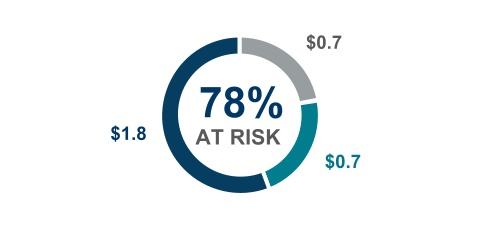
SHIRLEY A. BAUM
Senior Vice President and
General Counsel of PNW and APS
ADAM C. HEFLIN
Executive Vice President and
Chief Nuclear Officer of PVGS, APS
JACOB TETLOW
Executive Vice President,
Chief Operating Officer of APS
ROBERT E. SMITH
Former Executive Vice President, Chief Legal Officer and
Chief Development Officer, PNW and APS and currently, Special Advisor to the CEO
(1) In 2025, Mr. Guldner did not receive any long-term incentive grants given his transition to the Special Advisor to the CEO role early in 2025.
| | | | | |
74 | 2026 Proxy Statement | |
| |
Executive Compensation Tables
Summary Compensation Table
The following table provides information concerning the total compensation earned or paid to the Company’s NEOs:
| | | | | | | | | | | | | | | | | | | | | | | | | | |
Name and
Principal Position | Year | Salary
($) | Bonus
($) | Stock Awards ($)(1) | Non-Equity Incentive Plan Compensation ($)(2) | Change in Pension Value and Nonqualified Deferred Compensation Earnings ($)(3) | All Other Compensation ($)(4) | Total
($) |
Theodore N. Geisler, (5) Chairman of the Board, President and Chief Executive Officer of PNW and APS | 2025 | 938,356 | | 0 | | 5,257,108 | | 1,853,040 | | 333,545 | | 32,603 | | 8,414,652 | |
| 2024 | 700,000 | | 0 | | 1,696,843 | | 1,024,798 | | 105,508 | | 338,344 | | 3,865,493 | |
| 2023 | 670,000 | | 0 | | 1,467,032 | | 815,287 | | 270,264 | | 32,505 | | 3,255,088 | |
Jeffrey B. Guldner, (5) Former Chairman of the Board, President and Chief Executive Officer of PNW and Chairman of the Board, President and Chief Executive of APS and currently, Special Advisor to the CEO | 2025 | 744,247 | | 0 | | — | | 541,443 | | 1,506,661 | | 35,764 | | 2,828,115 | |
| 2024 | 1,150,000 | | 0 | | 6,139,342 | | 2,378,430 | | 1,277,261 | | 29,275 | | 10,974,308 | |
| 2023 | 1,125,000 | | 0 | | 5,028,405 | | 1,880,049 | | 1,253,907 | | 34,831 | | 9,322,192 | |
Andrew D. Cooper, Senior Vice President and Chief Financial Officer, PNW and APS | 2025 | 680,000 | | 0 | | 1,787,327 | | 684,012 | | 206,306 | | 35,215 | | 3,392,860 | |
| 2024 | 630,000 | | 0 | | 1,602,875 | | 748,157 | | 110,434 | | 34,844 | | 3,126,310 | |
| 2023 | 600,000 | | 0 | | 1,269,171 | | 592,830 | | 163,357 | | 28,935 | | 2,654,293 | |
Shirley A. Baum (6) Senior Vice President and General Counsel, PNW and APS | 2025 | 486,575 | | 0 | | 788,780 | | 431,100 | | 147,944 | | 32,248 | | 1,886,647 | |
| | | | | | | |
| | | | | | | |
Adam C. Heflin, Executive Vice President and Chief Nuclear Officer of PVGS, APS | 2025 | 760,000 | | 0 | | 1,465,175 | | 998,925 | | 376,444 | | 27,915 | | 3,628,459 | |
| 2024 | 735,000 | | 0 | | 1,337,015 | | 1,026,703 | | 293,745 | | 27,640 | | 3,420,103 | |
| 2023 | 715,000 | | 0 | | 1,338,517 | | 757,721 | | 240,596 | | 24,473 | | 3,076,307 | |
Jacob Tetlow, Executive Vice President and Chief Operating Officer of APS | 2025 | 700,000 | | 0 | | 1,673,955 | | 754,031 | | 634,480 | | 33,521 | | 3,795,987 | |
| 2024 | 586,776 | | 0 | | 2,337,019 | | 878,981 | | 108,829 | | 27,415 | | 3,939,020 | |
| 2023 | 525,000 | | 0 | | 1,261,291 | | 566,799 | | 490,390 | | 26,240 | | 2,869,720 | |
Robert E. Smith (6) Former Executive Vice President, Chief Legal Officer and Chief Development Officer, PNW and APS and currently, Special Advisor to the CEO | 2025 | 514,658 | | 0 | | 1,360,231 | | 421,609 | | 377,576 | | 34,729 | | 2,708,803 | |
2024 | 650,000 | | 0 | | 1,337,015 | | 827,775 | | 349,023 | | 29,275 | | 3,193,088 | |
2023 | 630,000 | | 0 | | 1,055,255 | | 800,321 | | 270,751 | | 34,390 | | 2,790,717 | |
(1)The amounts in this column reflect the aggregate grant date fair value of performance shares and RSUs computed in accordance with FASB ASC Topic 718. The TSR performance share value reported for 2025 is based on the probable outcome of the performance conditions as of the grant date using a Monte Carlo simulation model: February 2025 grants for Messrs. Geisler, Heflin, Tetlow, and Smith ($104.72); and for Mr. Cooper and Ms. Baum ($109.05); for Mr. Geisler's April promotional grant ($113.87); the EPS and MW Installed performance share value for 2025 is based on the closing stock price on the date of grant: February 2025 grants ($89.89) and Mr. Geisler's April promotional grant ($95.28). In 2025, Mr. Guldner did not receive any long-term incentive grants given his transition to the Special Advisor to the CEO role early in 2025. The amounts in the column for 2025 are allocated between the various equity grants as follows:
| | | | | |
| 2026 Proxy Statement | 75 |
|
| | | | | | | | |
| Name | RSUs
($) | Performance Shares ($) |
| Mr. Geisler | 1,500,311 | | 3,756,797 | |
| Mr. Cooper | 680,288 | | 1,107,039 | |
Ms. Baum | 300,233 | | 488,547 | |
| Mr. Heflin | 420,326 | | 1,044,849 | |
| Mr. Tetlow | 480,013 | | 1,193,942 | |
Mr. Smith | 390,123 | | 970,108 | |
The aggregate grant date fair value of the performance shares granted in 2025, assuming the highest level of performance is achieved, is as follows: Mr. Geisler — $7,513,591; Mr. Guldner — $0; Mr. Cooper — $2,214,078; Ms. Baum — $977,093; Mr. Heflin — $2,089,697; Mr. Tetlow — $2,387,885; and Mr. Smith — $1,940,216.
(2)These amounts represent the payments described under “Executive Compensation Components — Annual Cash Incentives” in the CD&A.
(3)The amounts in this column for 2025 consist of: (i) the estimated aggregate change in the actuarial present value from December 31, 2024 to December 31, 2025 of each of the NEO’s accumulated benefits payable under all defined benefit and actuarial pension plans (including supplemental plans and employment agreements) as follows: Mr. Geisler — $321,419; Mr. Guldner — $1,455,745; Mr. Cooper — $206,306; Ms. Baum — $147,652; Mr. Heflin — $371,211; Mr. Tetlow — $605,524; and Mr. Smith — $326,541, and (ii) the above-market portion of interest accrued under the DCP as follows: Mr. Geisler — $12,126; Mr. Guldner — $50,916; Ms. Baum — $292; Mr. Heflin — $5,233; Mr. Tetlow — $28,956; and Mr. Smith — $51,035. The actuarial present value provided in this footnote is driven by certain assumptions, including the discount rate and the mortality assumption.
(4)The amounts in this column include the following amounts for each of the NEOs for 2025:
| | | | | |
| Mr. Geisler: | |
•Company’s contribution under the 401(k) plan | $15,750 |
•Perquisites and personal benefits consisting of a car allowance and executive physical | $16,853 |
| Mr. Guldner: | |
•Company’s contribution under the 401(k) plan | $15,750 |
•Perquisites and personal benefits consisting of a car allowance, executive physical, and financial planning | $20,014 |
| Mr. Cooper: | |
•Company’s contribution under the 401(k) plan | $15,750 |
•Perquisites and personal benefits consisting of a car allowance, executive physical, and financial planning | $19,465 |
Ms. Baum: | |
•Company’s contribution under the 401(k) plan | $15,750 |
•Perquisites and personal benefits consisting of a car allowance and executive physical | $16,498 |
| Mr. Heflin: | |
•Company’s contribution under the 401(k) plan | $15,750 |
•Perquisite consisting of a car allowance and financial planning | $12,165 |
| Mr. Tetlow: | |
•Company’s contribution under the 401(k) plan | $10,500 |
•Perquisites and personal benefits consisting of a car allowance, executive physical, and financial planning | $23,021 |
Mr. Smith: | |
•Company’s contribution under the 401(k) plan | $15,750 |
•Perquisites and personal benefits consisting of a car allowance, executive physical, and financial planning | $18,979 |
(5)Mr. Geisler was promoted to Chairman of the Board, President and Chief Executive Officer of PNW and APS and Mr. Guldner became Special Advisor to the CEO effective April 1, 2025.
(6)Ms. Baum was promoted to Senior Vice President and General Counsel of PNW and APS and Mr. Smith became Executive Vice President, Chief Legal Officer and Chief Development Officer of PNW and APS effective February 19, 2025. Mr. Smith then became Special Advisor to the CEO effective August 2, 2025.
| | | | | |
76 | 2026 Proxy Statement | |
| |
Grants of Plan-Based Awards
| | | | | | | | | | | | | | | | | | | | | | | | | | | | | | | | | | | | | | |
| | | Estimated Future Payouts Under Non-Equity Incentive Plan Awards(2) | | Estimated Future Payouts
Under Equity Incentive Plan
Awards | All Other Stock Awards: Number of Shares of Stock or Units (#) | Grant Date Fair Value of Stock and Option Awards(3) ($) |
| Name | Grant Date(1) | Committee Action Date | | Threshold
($) | Target
($) | Maximum
($) | Threshold
(#) | Target
(#) | Maximum
(#) |
| | | | | | | | | | | | |
| | | | | | | | | | | | |
| Theodore N. Geisler | | | | 6,000 | | 1,200,000 | | 2,400,000 | | | | | | | |
02/18/2025(4) | | | | | | | 3,115 | 6,230 | 12,460 | | 652,406 | |
| (PS TSR) | | | | | | | | | | | |
02/18/2025(4) | | | | | | | 3,115 | 6,230 | 12,460 | | 560,015 | |
| (PS EPS) | | | | | | | | | | | |
02/18/2025(4) | | | | | | | 1,558 | 3,116 | 6,232 | | 280,097 | |
(PS MW Installed) | | | | | | | | | | | |
02/18/2025(5) | | | | | | | | | | 6,676 | 600,106 | |
| (RSU) | | | | | | | | | | | |
04/01/2025(4) | 12/10/2024(6) | | | | | | 4,409 | 8,818 | 17,636 | | 1,004,106 | |
| (PS TSR) | | | | | | | | | | | |
04/01/2025(4) | 12/10/2024(6) | | | | | | 4,409 | 8,818 | 17,636 | | 840,179 | |
| (PS EPS) | | | | | | | | | | | |
04/01/2025(4) | 12/10/2024(6) | | | | | | 2,204 | 4,408 | 8,816 | | 419,994 | |
(PS MW Installed) | | | | | | | | | | | |
04/01/2025(5) | 12/10/2024(6) | | | | | | | | | 9,448 | 900,205 | |
| (RSU) | | | | | | | | | | | |
| Jeffrey B. Guldner | | | | 1,753 | | 350,630 | | 701,260 | | | | | | | |
| Andrew D. Cooper | | | | 2,380 | | 476,000 | | 952,000 | | | | | | | |
02/18/2025(4) | | | | | | | 2,269 | 4,539 | 9,078 | | 494,978 | |
| (PS TSR) | | | | | | | | | | | |
02/18/2025(4) | | | | | | | 2,269 | 4,539 | 9,078 | | 408,011 | |
| (PS EPS) | | | | | | | | | | | |
02/18/2025(4) | | | | | | | 1,135 | 2,270 | 4,540 | | 204,050 | |
(PS MW Installed) | | | | | | | | | | | |
02/18/2025(5) | | | | | | | | | | 7,568 | 680,288 | |
| (RSU) | | | | | | | | | | | |
Shirley A. Baum | | | | 1,500 | | 300,000 | | 600,000 | | | | | | | |
02/18/2025(4) | | | | | | | 1,001 | 2,003 | 4,006 | | 218,427 | |
| (PS TSR) | | | | | | | | | | | |
02/18/2025(4) | | | | | | | 1,001 | 2,003 | 4,006 | | 180,050 | |
| (PS EPS) | | | | | | | | | | | |
02/18/2025(4) | | | | | | | 501 | 1,002 | 2,004 | | 90,070 | |
(PS MW Installed) | | | | | | | | | | | |
02/18/2025(5) | | | | | | | | | | 3,340 | 300,233 | |
| (RSU) | | | | | | | | | | | |
Adam C. Heflin | | | | 2,850 | | 570,000 | | 1,140,000 | | | | | | | |
02/18/2025(4) | | | | | | | 2,181 | 4,362 | 8,724 | | 456,789 | |
| (PS TSR) | | | | | | | | | | | |
02/18/2025(4) | | | | | | | 2,181 | 4,362 | 8,724 | | 392,100 | |
| (PS EPS) | | | | | | | | | | | |
02/18/2025(4) | | | | | | | 1,090 | 2,180 | 4,360 | | 195,960 | |
(PS MW Installed) | | | | | | | | | | | |
02/18/2025(5) | | | | | | | | | | 4,676 | 420,326 | |
| (RSU) | | | | | | | | | | | |
| | | | | | | | | | | | |
| | | | | |
| 2026 Proxy Statement | 77 |
|
| | | | | | | | | | | | | | | | | | | | | | | | | | | | | | | | | | | | | | |
| | | Estimated Future Payouts Under Non-Equity Incentive Plan Awards(2) | | Estimated Future Payouts
Under Equity Incentive Plan
Awards | All Other Stock Awards: Number of Shares of Stock or Units (#) | Grant Date Fair Value of Stock and Option Awards(3) ($) |
| Name | Grant Date(1) | Committee Action Date | | Threshold
($) | Target
($) | Maximum
($) | Threshold
(#) | Target
(#) | Maximum
(#) |
| | | | | | | | | | | | |
| | | | | | | | | | | | |
Jacob Tetlow | | | | 2,625 | | 525,000 | | 1,050,000 | | | | | | | |
02/18/2025(4) | | | | | | | 2,492 | 4,984 | 9,968 | | 521,924 | |
| (PS TSR) | | | | | | | | | | | |
02/18/2025(4) | | | | | | | 2,492 | 4,984 | 9,968 | | 448,012 | |
| (PS EPS) | | | | | | | | | | | |
02/18/2025(4) | | | | | | | 1,246 | 2,492 | 4,984 | | 224,006 | |
(PS MW Installed) | | | | | | | | | | | |
02/18/2025(5) | | | | | | | | | | 5,340 | 480,013 | |
| (RSU) | | | | | | | | | | | |
Robert E. Smith | | | | 1,422 | | 284,486 | | 568,972 | | | | | | | |
02/18/2025(4) | | | | | | | 2,025 | 4,050 | 8,100 | | 424,116 | |
| (PS TSR) | | | | | | | | | | | |
02/18/2025(4) | | | | | | | 2,025 | 4,050 | 8,100 | | 364,055 | |
| (PS EPS) | | | | | | | | | | | |
02/18/2025(4) | | | | | | | 1,012 | 2,024 | 4,048 | | 181,937 | |
(PS MW Installed) | | | | | | | | | | | |
02/18/2025(5) | | | | | | | | | | 4,340 | 390,123 | |
| (RSU) | | | | | | | | | | | |
(1)In this column, the abbreviation “PS” means performance share awards and “RSU” means restricted stock unit awards.
(2)As required by SEC rules, the “Estimated Future Payouts” represent the “threshold,” “target,” and “maximum” payouts the NEOs were eligible to receive under the 2025 Incentive Plans. The actual awards paid to the NEOs under the 2025 Incentive Plans are disclosed in the “Non-Equity Incentive Plan Compensation” column of the Summary Compensation Table. With respect to Messrs. Geisler, Guldner, Cooper, Tetlow and Smith and Ms. Baum, the minimum amount each officer would have been eligible to receive was calculated based on earnings achieving 1% and no achievement of the business unit performance metrics. The minimum amount Mr. Heflin would have been eligible to receive was calculated based on the business unit performance metrics achieving 1% and no achievement of the APS earnings goals under the Palo Verde Incentive Plan.
(3)The amounts in this column reflect the aggregate grant date fair value of performance shares and RSUs computed in accordance with FASB ASC Topic 718.
(4)This amount represents the 2025 Performance Shares described under “Executive Compensation Components — Long-Term Incentives — Performance Shares” in the CD&A. In accordance with FASB ASC Topic 718, the TSR performance share value reported is based on the probable outcome of the performance conditions as of the grant date using a Monte Carlo simulation model: February grants for Messrs. Geisler, Heflin, Tetlow, and Smith ($104.72); February grants for Mr. Cooper and Ms, Baum ($109.05); and Mr. Geisler's April grant ($113.87). The EPS and MW Installed performance share values are based on the closing stock price on the date of grant: February grants ($89.89); and Mr. Geisler's April grant ($95.28).
(5)This amount represents the 2025 RSU awards described under “Executive Compensation Components — Long-Term Incentives — RSUs” in the CD&A. In accordance with FASB ASC Topic 718, we valued the RSUs using the number of RSUs awarded multiplied by the closing stock price on the date of the grant as follows: in February 2025 ($89.89); and in April for Mr. Geisler ($95.28). There were no forfeitures in 2025.
(6)These amounts represent Mr. Geisler's promotional grant; the terms of the RSU and Performance Share awards are the same as the 2025 awards described above; the RSU and performance share grants were approved by the Committee on December 10, 2024 with the grants to be effective on April 1, 2025; additional information on Mr. Geisler's promotional grant is described in the Narrative Disclosure to Summary Compensation Table and Grants of Plan-Based Awards Table.
Narrative Disclosure to Summary Compensation Table and Grants of Plan-Based Awards Table
See the CD&A for further information regarding the terms of awards reported in the Summary Compensation Table and the Grants of Plan-Based Awards table, and for discussions regarding the formulas or criteria to be applied in determining the amounts payable, vesting schedules, and the treatment of dividends.
The Company does not have formal employment agreements with its NEOs; however, we typically enter into offer letters with new executive officers. Deferred compensation credits granted to Mr. Geisler and Mr. Tetlow are discussed under the heading “Discussion of Nonqualified Deferred Compensation” on page 90. The Company awarded Mr. Geisler a promotional long-term incentive award consisting of 70% Performance Share awards and 30% RSUs valued at $3,000,000 to be granted upon his promotion on April 1, 2025 and based upon the closing stock price on such date.
| | | | | |
78 | 2026 Proxy Statement | |
| |
Outstanding Equity Awards at Fiscal Year-End
| | | | | | | | | | | | | | | | | | | | |
| Stock Awards |
| Name | Number of
Shares or
Units of Stock
That Have
Not Vested
(#) | | Market Value of Shares or Units of Stock That Have Not Vested ($)(1) | Equity Incentive Plan Awards:
Number of Unearned Shares,
Units or Other Rights That
Have Not Vested
(#) | | Equity Incentive Plan Awards: Market or Payout Value of Unearned Shares, Units or Other Rights That Have Not Vested ($)(1) |
| | | | | | |
Theodore N. Geisler(16) | 6,676 | | (2) | 592,161 | | 3,115 | | (9) | 276,301 | |
| (RSUs) | | | (PS at threshold) | | |
| 9,448 | | (2) | 838,038 | | 12,460 | | (10) | 1,105,202 | |
| (RSUs) | | | (PS at maximum) | | |
| 5,373 | | (3) | 476,585 | | 1,558 | | (11) | 138,195 | |
| (RSUs) | | | (PS at threshold) | | |
| 2,884 | | (4) | 255,811 | | 4,409 | | (9) | 391,078 | |
| (RSUs) | | | (PS at threshold) | | |
| 8,024 | | (5) | 711,729 | | 17,636 | | (10) | 1,564,313 | |
| (PS) | | | (PS at maximum) | | |
| 10,225 | | (6) | 906,958 | | 2,204 | | (11) | 195,495 | |
| (PS) | | | (PS at threshold) | | |
| 3,141 | | (7) | 278,607 | | 6,686 | | (12) | 593,048 | |
| (PS) | | | (PS at target) | | |
| 1,887 | | (8) | 167,377 | | 13,372 | | (13) | 1,186,096 | |
| (RSUs) | | | (PS at maximum) | | |
| | | 1,672 | | (14) | 148,306 | |
| | | (PS at threshold) | | |
| Jeffrey B. Guldner | | | | 24,192 | | (12) | 2,145,830 | |
| | | (PS at target) | | |
| 19,440 | | (3) | 1,724,328 | | 48,384 | | (13) | 4,291,661 | |
| (RSUs) | | | (PS at maximum) | | |
| 9,884 | | (4) | 876,711 | | 6,048 | | (14) | 536,458 | |
| (RSUs) | | | (PS at threshold) | | |
| 27,508 | | (5) | 2,439,960 | | | | |
| (PS) | | | | | |
| 35,055 | | (6) | 3,109,379 | | | | |
| (PS) | | | | | |
| 10,764 | | (7) | 954,767 | | | | |
| (PS) | | | | | |
| 4,719 | | (8) | 418,575 | | | | |
| (RSUs) | | | | | |
| | | | | | |
| | | | | |
| 2026 Proxy Statement | 79 |
|
| | | | | | | | | | | | | | | | | | | | |
| Stock Awards |
| Name | Number of
Shares or
Units of Stock
That Have
Not Vested
(#) | | Market Value of Shares or Units of Stock That Have Not Vested ($)(1) | Equity Incentive Plan Awards:
Number of Unearned Shares,
Units or Other Rights That
Have Not Vested
(#) | | Equity Incentive Plan Awards: Market or Payout Value of Unearned Shares, Units or Other Rights That Have Not Vested ($)(1) |
| | | | | | |
| Andrew D. Cooper | 7,568 | | (2) | 671,282 | | 2,269 | | (9) | 201,260 | |
| (RSUs) | | | (PS at threshold) | | |
| 6,732 | | (3) | 597,128 | | 9,078 | | (10) | 805,219 | |
| (RSUs) | | | (PS at maximum) | | |
| 3,306 | | (4) | 293,242 | | 1,135 | | (11) | 100,675 | |
| (RSUs) | | | (PS at threshold) | | |
| 6,167 | | (5) | 547,013 | | 10,768 | | (12) | 955,122 | |
| (PS) | | | (PS at maximum) | | |
| 7,535 | | (6) | 668,355 | | 10,768 | | (13) | 955,122 | |
| (PS) | | | (PS at maximum) | | |
| 2,315 | | (7) | 205,341 | | 1,346 | | (14) | 119,390 | |
| (PS) | | | (PS at threshold) | | |
| 409 | | (8) | 36,278 | | | | |
| (RSUs) | | | | | |
| 848 | | (8) | 75,218 | | | | |
| (RSUs) | | | | | |
Shirley A. Baum | 3,340 | | (2) | 296,258 | | 1,001 | | (9) | 88,789 | |
| (RSUs) | | | (PS at threshold) | | |
| 1,629 | | (3) | 144,492 | | 4,006 | | (10) | 355,332 | |
| (RSUs) | | | (PS at maximum) | | |
| 760 | | (4) | 67,412 | | 501 | | (11) | 44,439 | |
| (RSUs) | | | (PS at threshold) | | |
| 945 | | (5) | 83,822 | | 1,738 | | (12) | 154,161 | |
| (PS) | | | (PS at maximum) | | |
| 1,155 | | (6) | 102,449 | | 1,738 | | (13) | 154,161 | |
| (PS) | | | (PS at maximum) | | |
| 354 | | (7) | 31,400 | | 217 | | (14) | 19,248 | |
| (PS) | | | (PS at threshold) | | |
| 137 | | (8) | 12,152 | | | | |
| (RSUs) | | | | | |
| 166 | | (8) | 14,724 | | | | |
| (RSUs) | | | | | |
| | | | | | |
| | | | | |
80 | 2026 Proxy Statement | |
| |
| | | | | | | | | | | | | | | | | | | | |
| Stock Awards |
| Name | Number of
Shares or
Units of Stock
That Have
Not Vested
(#) | | Market Value of Shares or Units of Stock That Have Not Vested ($)(1) | Equity Incentive Plan Awards:
Number of Unearned Shares,
Units or Other Rights That
Have Not Vested
(#) | | Equity Incentive Plan Awards: Market or Payout Value of Unearned Shares, Units or Other Rights That Have Not Vested ($)(1) |
| | | | | | |
| Adam C. Heflin | 4,676 | | (2) | 414,761 | | 2,181 | | (9) | 193,455 | |
| (RSUs) | | | (PS at threshold) | | |
| 4,233 | | (3) | 375,467 | | 8,724 | | (10) | 773,819 | |
| (RSUs) | | | (PS at maximum) | | |
| 2,632 | | (4) | 233,458 | | 1,090 | | (11) | 96,683 | |
| (RSUs) | | | (PS at threshold) | | |
| 7,320 | | (5) | 649,284 | | 5,269 | | (12) | 467,360 | |
| (PS) | | | (PS at target) | | |
| 9,329 | | (6) | 827,482 | | 10,538 | | (13) | 934,721 | |
| (PS) | | | (PS at maximum) | | |
| 2,866 | | (7) | 254,214 | | 1,317 | | (14) | 116,818 | |
| (PS) | | | (PS at threshold) | | |
| 1,153 | | (8) | 102,271 | | | | |
| (RSUs) | | | | | |
| 3,202 | | (8) | 284,017 | | | | |
| (RSUs) | | | | | |
| Jacob Tetlow | 5,340 | | (2) | 473,658 | | 2,492 | | (9) | 221,040 | |
| (RSUs) | | | (PS at threshold) | | |
| 11,197 | | (15) | 993,174 | | 9,968 | | (10) | 884,162 | |
| (RSUs) | | | (PS at maximum) | | |
| 4,233 | | (3) | 375,467 | | 1,246 | | (11) | 110,520 | |
| (RSUs) | | | (PS at threshold) | | |
| 2,480 | | (4) | 219,976 | | | | |
| (RSUs) | | | | | |
| 6,898 | | (5) | 611,853 | | 5,269 | | (12) | 467,360 | |
| (PS) | | | (PS at target) | | |
| 8,791 | | (6) | 779,762 | | 10,538 | | (13) | 934,721 | |
| (PS) | | | (PS at maximum) | | |
| 2,700 | | (7) | 239,490 | | 1,317 | | (14) | 116,818 | |
| (PS) | | | (PS at threshold) | | |
| 654 | | (8) | 58,010 | | | | |
| (RSUs) | | | | | |
| | | | | | |
| | | | | |
| 2026 Proxy Statement | 81 |
|
| | | | | | | | | | | | | | | | | | | | |
| Stock Awards |
| Name | Number of
Shares or
Units of Stock
That Have
Not Vested
(#) | | Market Value of Shares or Units of Stock That Have Not Vested ($)(1) | Equity Incentive Plan Awards:
Number of Unearned Shares,
Units or Other Rights That
Have Not Vested
(#) | | Equity Incentive Plan Awards: Market or Payout Value of Unearned Shares, Units or Other Rights That Have Not Vested ($)(1) |
| | | | | | |
Robert E. Smith | 4,340 | | (2) | 384,958 | | 2,025 | | (9) | 179,618 | |
| (RSUs) | | | (PS at threshold) | | |
| 4,233 | | (3) | 375,467 | | 8,100 | | (10) | 718,470 | |
| (RSUs) | | | (PS at maximum) | | |
| 2,074 | | (4) | 183,964 | | 1,012 | | (11) | 89,764 | |
| (RSUs) | | | (PS at threshold) | | |
| 5,773 | | (5) | 512,065 | | 5,269 | | (12) | 467,360 | |
| (PS) | | | (PS at target) | | |
| 7,356 | | (6) | 652,477 | | 10,538 | | (13) | 934,721 | |
| (PS) | | | (PS at maximum) | | |
| 2,259 | | (7) | 200,373 | | 1,317 | | (14) | 116,818 | |
| (PS) | | | (PS at threshold) | | |
| 899 | | (8) | 79,741 | | | | |
| (RSUs) | | | | | |
(1)The amount in this column is calculated by multiplying the closing market price of our common stock at the end of 2025 ($88.70) per share (as of December 31, 2025) by the number of RSUs and performance shares that will be paid in stock to the extent the underlying RSUs and performance shares actually vest, listed for the specified officer.
(2)This amount represents the RSUs awarded in February 2025, and the additional promotional grant to Mr. Geisler in April 2025, that are described, with their vesting and release schedule, under “Executive Compensation Components — Long-Term Incentives — RSUs” in the CD&A.
(3)This amount represents the remaining 2024 RSUs awarded in February that vest and are released in 25% increments beginning on February 20, 2025, so they will be fully vested on February 20, 2028.
(4)This amount represents the remaining 2023 RSUs awarded in February that vest and are released in 25% increments beginning on February 20, 2024, so they will be fully vested on February 20, 2027.
(5)This amount represents the 2023 TSR performance shares granted in February, the payout level of which were determined in March 2026 after the end of the three-year performance period, which ended on December 31, 2025.
(6)This amount represents the 2023 EPS performance shares granted in February, the payout level of which were determined in March 2026 after the end of the three-year performance period, which ended on December 31, 2025.
(7)This amount represents the 2023 MW Installed performance shares granted in February, the payout level of which were determined in March 2026 after the end of the three-year performance period, which ended on December 31, 2025.
(8)This amount represents the remaining RSUs awarded in February 2022, to Messrs. Geisler, Guldner, Cooper, Baum, Tetlow and Smith, and to Mr. Heflin in June 2022 (including his additional RSUs awarded as part of his offer letter), and to Ms. Baum in March 2022 and to Mr. Cooper in May 2022 in recognition of their promotions, that vest and are released in 25% increments beginning on February 17, 2023, so they will be fully vested on February 20, 2026.
(9)This amount represents the 2025 TSR performance shares granted in February, and the additional promotional grant to Mr. Geisler in April — the SEC rules require us to assume a number of shares equal to the threshold (50% of Base Grant) payout level of these performance shares, although the actual number of shares awarded, if any, will not be determined until after the end of the performance period, which ends on December 31, 2027. The 2025 Performance Shares are described with their vesting schedule under “Executive Compensation Components — Long-Term Incentives — Performance Shares” in the CD&A.
(10)This amount represents the 2025 EPS performance shares granted in February, and the additional promotional grant to Mr. Geisler in April — the SEC rules require us to assume a number of shares equal to the maximum (200% of Base Grant) payout level of these performance shares, although the actual number of shares awarded, if any, will not be determined until after the end of the performance period, which ends on December 31, 2027. The 2025 Performance Shares are described under “Executive Compensation Components — Long-Term Incentives — Performance Shares” in the CD&A.
| | | | | |
82 | 2026 Proxy Statement | |
| |
(11)This amount represents the 2025 MW Installed performance shares granted in February, and the additional promotional grant to Mr. Geisler in April 2025 — the SEC rules require us to assume a number of shares equal to the threshold (50% of Base Grant) payout level of these performance shares, although the actual number of shares awarded, if any, will not be determined until after the end of the performance period, which ends on December 31, 2027. The 2025 Performance Shares are described under “Executive Compensation Components — Long-Term Incentives — Performance Shares” in the CD&A.
(12)This amount represents the 2024 TSR performance shares granted in February — the SEC rules require us to assume a number of shares equal to the target (100% of Base Grant) payout level of these performance shares for Messrs. Geisler, Guldner, Heflin, Tetlow and Smith; and the maximum (200% of Base Grant) payout level of these performance shares for Mr. Cooper and Ms. Baum, although the actual number of shares awarded, if any, will not be determined until after the end of the three-year performance period, which ends on December 31, 2026.
(13)This amount represents the 2024 EPS performance shares granted in February — the SEC rules require us to assume a number of shares equal to the maximum (200% of Base Grant) payout level of these performance shares, although the actual number of shares awarded, if any, will not be determined until after the end of the three-year performance period, which ends on December 31, 2026.
(14)This amount represents the 2024 MW Installed performance shares granted in February — the SEC rules require us to assume a number of shares equal to the threshold (50% of Base Grant) payout level of these performance shares, although the actual number of shares awarded, if any, will not be determined until after the end of the three-year performance period, which ends on December 31, 2026.
(15)This amount represents Mr. Tetlow's RSU promotional grant in October 2024 as part of his promotion
(16) Mr. Geisler was awarded an additional promotional grant on April 1, 2025 in recognition of his promotion; the terms of the awards are the same as the 2025 awards described above.
| | | | | |
| 2026 Proxy Statement | 83 |
|
Option Exercises and Stock Vested
| | | | | | | | |
| Name | Stock Awards |
Number of Shares Acquired on Vesting (#)(1)(2) | Value Realized on Vesting ($)(3) |
| Theodore N. Geisler | 27,880 | 2,586,061 | |
| Jeffrey B. Guldner | 103,020 | 9,565,522 | |
| Andrew D. Cooper | 18,112 | 1,676,918 | |
Shirley A. Baum | 3,641 | 336,417 | |
| Adam C. Heflin | 27,143 | 2,516,130 | |
| Jacob Tetlow | 15,480 | 1,434,796 | |
Robert E. Smith | 20,018 | 1,857,846 | |
(1)The amount in this column consists of: (i) RSUs that were granted to NEOs in February 2024, that vested and were released in part on February 20, 2025, as follows: Mr. Geisler — 1,791; Mr. Guldner — 6,480; Mr. Cooper — 2,244; Ms. Baum - 543; Mr. Heflin — 1,411; Mr. Tetlow — 1,411; and Mr. Smith - 1,411; (ii) RSUs that were granted to NEOs in February 2023, that vested and were released in part on February 20, 2025, as follows: Mr. Geisler — 1,442; Mr. Guldner — 4,942; Mr. Cooper — 1,653; Ms. Baum - 380; Mr. Heflin — 1,316; Mr. Tetlow — 1,240; and Mr. Smith - 1,037; (iii) RSUs that were granted to NEOs (except Mr. Heflin) in February 2022, Ms. Baum in March 2022, Mr. Cooper in May 2022, and Mr. Heflin in June 2022, that vested and were released in part on February 20, 2025, as follows: Mr. Geisler — 1,887; Mr. Guldner — 4,719; Mr. Cooper — 409 and 848; Ms. Baum - 137 and 166; Mr. Heflin — 1,153 and 3,202; Mr. Tetlow — 654; and Mr. Smith - 899; (iv) RSUs that were granted to NEOs (except Mr. Heflin) in February 2021 and Mr. Tetlow in May 2021, that vested and were released in part on February 20, 2025, as follows: Mr. Geisler — 1,316; Mr. Guldner — 3,838; Mr. Cooper — 329; Ms. Baum - 124; Mr. Tetlow — 176 and 527; and Mr. Smith - 954 (v) dividend rights (and interest thereon) payable in stock earned on RSUs granted in February 2021 and released in part on February 20, 2025, as follows: Mr. Geisler — 220; Mr. Guldner — 642; Mr. Cooper — 27; Ms. Baum - 21; Mr. Tetlow — 14 and 88; and Mr. Smith - 80 (vi) additional RSUs resulting from notional dividends on the one-time award of supplemental grants of RSUs that were granted in February 2011 for performance prior to 2011 and further described below (the “Supplemental RSUs”), that vested, but were not released, on the following dates in 2025:
| | | | | | | | | | | | | | |
| Name | March 3 | June 2 | September 2 | December 1 |
| Jeffrey B. Guldner | 60 | 61 | 64 | 65 |
(The Supplemental RSUs vested 50% on February 15, 2013, 25% on February 14, 2014, and 25% on February 13, 2015. The Supplemental RSUs are not released to the recipient until the recipient’s retirement, death, disability, or separation of employment from the Company); (vii) performance shares that were granted to NEOs (except Mr. Heflin) in February 2022, Ms. Baum in March 2022, Mr. Cooper in May 2022, and Mr. Heflin in June 2022, which were based on a performance period of January 1, 2022 to December 31, 2024, and which were released on March 18 2025 as follows: performance shares related to the TSR metric: Mr. Geisler — 8,348; Mr. Guldner — 32,064; Mr. Cooper — 1,205 and 3,750; Ms. Baum — 403 and 490; Mr. Heflin — 7,829; Mr. Tetlow — 4,437; and Mr. Smith — 6,104 (viii) performance shares related to the EPS metric: Mr. Geisler — 8,348; Mr. Guldner — 32,469; Mr. Cooper — 1,205 and 3,750; Ms. Baum — 403 and 490; Mr. Heflin — 7,928; Mr. Tetlow — 4,493; and Mr. Smith — 6,181; and (ix) performance shares related to the MW Installed metric: Mr. Geisler — 4,528; Mr. Guldner — 17,616; Mr. Cooper — 656 and 2,036; Ms. Baum — 220 and 264; Mr. Heflin — 4,304; Mr. Tetlow — 2,440; and Mr. Smith — 3,352.
(2)The amounts in this column do not include any 2023 performance shares, which were based on a performance period of January 1, 2023 to December 31, 2025, as such performance shares were not released in 2025.
(3)The values realized for the RSUs, Supplemental RSUs, and the performance shares are calculated by multiplying the number of shares of stock or units released or vested by the market value of the common stock on the release or vesting date, which: (i) for the RSUs released on February 20, 2025 was ($90.77); (ii) for the Supplemental RSUs vested on March 3, 2025 was ($94.18); (iii) for the Supplemental RSUs vested on June 2, 2025 was ($90.84); (iv) for the Supplemental RSUs vested on September 2, 2025 was ($88.80); (v) for the Supplemental RSUs vested on December 1, 2025 was ($89.32); and (vi) for the performance shares released on March 18, 2025 was ($93.38).
| | | | | |
84 | 2026 Proxy Statement | |
| |
Pension Benefits
The Pension Benefits table below includes estimates of the potential future pension benefits for each NEO based on the actuarial assumptions used for financial reporting purposes, such as the life expectancy of each NEO and their spouse, and “discount rates.”
| | | | | | | | | | | | | | |
| Name | Plan Name | Number of Years
Credited Service
(#) | Present Value of Accumulated Benefits ($)(1) | Payments
During Last
Fiscal Year
($) |
Theodore N. Geisler(2) | Retirement Plan | 16 | 275,420 | | 0 | |
| Supplemental Plan | 16 | 818,093 | | 0 | |
Jeffrey B. Guldner(3) | Retirement Plan | 21 | 581,092 | | 0 | |
| Supplemental Plan | 21 | 8,577,816 | | 0 | |
Andrew D. Cooper(4) | Retirement Plan | 6 | 106,866 | | 0 | |
| Supplemental Plan | 6 | 495,602 | | 0 | |
Shirley A. Baum(5) | Retirement Plan | 19 | 404,421 | | 0 | |
| Supplemental Plan | 19 | 253,681 | | 0 | |
Adam C. Heflin(6) | Retirement Plan | 4 | 96,542 | | 0 | |
| Supplemental Plan | 4 | 878,615 | | 0 | |
Jacob Tetlow(7) | Retirement Plan | 24 | 1,029,482 | | 0 | |
| Supplemental Plan | 24 | 1,306,523 | | 0 | |
Robert E. Smith(8) | Retirement Plan | 8 | 171,718 | | 0 | |
| Supplemental Plan | 8 | 1,448,447 | | 0 | |
(1)See Note 9 of the Notes to Consolidated Financial Statements in the Pinnacle West/APS Annual Report on Form 10-K for the fiscal year ended December 31, 2025 for additional information about the assumptions used by the Company in calculating pension obligations.
(2)The amounts shown are the present values of Mr. Geisler’s accumulated benefits for the Retirement Plan to be paid as an annuity and lump sum and for the Supplemental Plan to be paid as an annuity.
(3)The amounts shown are the present values of Mr. Guldner’s accumulated benefits for the Retirement Plan to be paid as an annuity and lump sum and for the Supplemental Plan to be paid as a five-year certain payment (payable in 60 monthly installments).
(4)The amounts shown are the present values of Mr. Cooper’s accumulated benefits for the Retirement Plan to be paid as an annuity and lump sum and for the Supplemental Plan to be paid as an annuity.
(5)The amounts shown are the present values of Ms. Baum’s accumulated benefits for the Retirement Plan to be paid as an annuity and lump sum and for the Supplemental Plan to be paid as a five-year certain payment (payable in 60 monthly installments).
(6)The amounts shown are the present values of Mr. Heflin’s accumulated benefits for the Retirement Plan to be paid as an annuity and lump sum and for the Supplemental Plan to be paid as a five-year certain payment (payable in 60 monthly installments).
(7)The amounts shown are the present values of Mr. Tetlow’s accumulated benefits for the Retirement Plan to be paid as an annuity and for the Supplemental Plan to be paid as a five-year certain payment (payable in 60 monthly installments), both at age 62.5, which is the earliest Mr. Tetlow could retire with no reduction in benefits.
(8)The amounts shown are the present values of Mr. Smith's accumulated benefits for the Retirement Plan to be paid as an annuity and lump sum and for the Supplemental Plan to be paid as a five-year certain payment (payable in 60 monthly installments).
Discussion of Pension Benefits
Retirement Plan and Supplemental Plan
Retirement Plan
The Company’s Retirement Plan is a tax-qualified, noncontributory retirement plan for salaried and hourly employees.
| | | | | |
| 2026 Proxy Statement | 85 |
|
Supplemental Plan
The Supplemental Plan provides additional retirement benefits for key salaried employees but does not duplicate benefits provided under the Retirement Plan.
The total benefit is calculated and then benefits payable under the Retirement Plan are paid from a tax-exempt trust and any remaining benefits due under the Supplemental Plan are paid from the general assets of the Company. Mr. Guldner currently qualifies for early retirement, but not normal retirement, under the Retirement Plan and the Supplemental Plan. Messrs. Geisler, Cooper, Heflin, Tetlow and Smith and, Ms. Baum do not currently qualify for early or normal retirement under either the Retirement Plan or the Supplemental Plan.
Retirement Plan and Supplemental Plan – Traditional Formula
| | | | | |
Description | How it works |
| |
| |
Prior to April 1, 2003, benefits under the Retirement Plan and the Supplemental Plan (the "Traditional Formula Benefit") accrued in accordance with a traditional retirement plan formula based on average annual compensation and years of service (the "Traditional Formula"). Mr. Tetlow's benefits are calculated under the Traditional Formula. | A participant’s Traditional Formula Benefit under the Retirement Plan is a monthly benefit for life beginning at normal retirement age (age 65 with 5 years of service or age 60 with 33 years of service) and is equal to the participant’s average monthly compensation (the average of the highest 36 consecutive months of compensation in the final 10 years of employment) multiplied by 1.65% for the first 33 years of service, plus 1% of average monthly compensation for each year of service credited in excess of 33 years. Under the Traditional Formula of the Supplemental Plan, a participant's monthly benefit for life beginning at normal retirement age (age 65 or age 60 with 20 years of service) is equal to the following: •3% of the participant’s average monthly compensation (highest 36 consecutive months of compensation during employment) multiplied by the participant’s first 10 years of service, plus •2% of the participant’s average monthly compensation multiplied by the participant’s next 15 years of service, minus •benefits payable under the Retirement Plan. The total monthly Traditional Formula Benefit is capped at 60% of the participant’s average monthly compensation. A participant may elect to begin receiving a reduced Traditional Formula Benefit after attaining early retirement age (age 55 with 10 years of service). An actuarial reduction is applied to the Retirement Plan unless the participant has at least 20 years of service, in which case the reduction is 3% per year (prorated monthly) for each year prior to normal retirement. The reduction on the Supplemental Plan is 3% per year (prorated monthly). |
| |
| | | | | |
86 | 2026 Proxy Statement | |
| |
Retirement Plan and Supplemental Plan – Account Balance Formula
| | | | | |
Description | How it works |
| |
| |
Effective April 1, 2003, the Company changed the benefit accrual formula for both the Retirement Plan and the Supplemental Plan to a retirement account balance formula (the “Account Balance Formula”). Active participants were able to elect to either (1) continue to earn benefits calculated under a Traditional Formula, or (2) earn benefits calculated (a) under the Traditional Formula for service through March 31, 2003, and (b) under the Account Balance Formula for service after that date. Messrs. Guldner’s, Cooper’s, Geisler’s, Heflin’s and Smith's and Ms. Baum's benefits are calculated under the Account Balance Formula. | Under the Account Balance Formula, a notional account is established for each eligible participant and benefits are generally payable at termination of employment. The Company credits monthly amounts (based on the participant’s current monthly compensation) to a participant’s account. |
| |
Under the Retirement Plan, Company credits are based on the following formula:
| | | | | |
Age Plus Whole Years of
Service at End of Plan Year | Percent of Monthly Compensation Contribution Rate (%) |
| Less than 40 | 4 | |
| 40-49 | 5 | |
| 50-59 | 6 | |
| 60-69 | 7 | |
| 70-79 | 9 | |
| 80 and over | 11 | |
In addition, participants in the Retirement Plan on December 31, 2002 were eligible for up to 10 years of transition credits based on age and years of service (with the maximum transition credit equal to 2.75% of current monthly compensation).
Under the Supplemental Plan, Company credits are based on the following formula:
| | | | | |
| Age at End of Plan Year | Percent of Monthly Compensation Contribution Rate (%) |
| Less than 35 | 12 | |
| 35-39 | 14 | |
| 40-44 | 16 | |
| 45-49 | 20 | |
| 50-54 | 24 | |
| 55 and over | 28 | |
Company credits under the Supplemental Plan stop at the end of the year in which a participant attains 25 years of service (the “25-Year Cap”).
For purposes of calculating the Account Balance Formula benefit under the Retirement Plan, compensation consists solely of base salary up to $350,000, including any employee contributions under the Company’s 401(k) plan, flexible benefits plan, and qualified transportation arrangement under Section 132(f) of the Code. Amounts voluntarily deferred under other deferred compensation plans, bonuses, incentive pay, and long-term equity awards are not taken into account under the Retirement Plan. The Supplemental Plan takes these amounts into account (with certain exceptions), plus base salary beyond the $350,000 limit.
| | | | | |
| 2026 Proxy Statement | 87 |
|
Effective January 1, 2011, the Supplemental Plan was amended to reduce the Company credits for individuals who became participants on or after January 1, 2011 to the levels listed in the following table:
| | | | | |
| Age at End of Plan Year | Percent of Monthly Compensation Contribution Rate (%) |
| Less than 35 | 8 | |
| 35-39 | 9 | |
| 40-44 | 10 | |
| 45-49 | 12 | |
| 50-54 | 15 | |
| 55 and over | 18 | |
Individuals who became participants in the Supplemental Plan on or after January 1, 2011 are not entitled to receive a fully subsidized 50% joint and survivor annuity form of benefit, and the 25-Year Cap has been eliminated. Participants promoted to officer status on or after January 1, 2011 are not retroactively treated as officers for their entire period of employment. Messrs. Cooper, Geisler, Heflin, Tetlow and Smith and Ms. Baum became officers after January 1, 2011.
Participants typically begin accruing service when hired and are vested after completing three years of service. Under both the Retirement Plan and the Supplemental Plan, Traditional Formula Benefits are usually paid in the form of a level annuity with or without survivorship and generally are not available as a lump sum. Account Balance Formula benefits are eligible to be paid in the form of a level annuity with or without survivorship or as a lump sum. All optional benefit forms available through the Retirement Plan are approximately actuarially equivalent. Under the Supplemental Plan, the 50% joint and survivor benefit is fully subsidized, and the other benefit forms are partially subsidized. The Supplemental Plan offers an additional five-year certain payment option (payable in 60 monthly installments).
| | | | | |
88 | 2026 Proxy Statement | |
| |
Nonqualified Deferred Compensation
| | | | | | | | | | | | | | | | | |
| Name | Executive Contributions in Last Fiscal Year ($)(1) | Registrant
Contributions
in Last Fiscal
Year
($) | Aggregate Earnings in Last Fiscal Year ($)(2) | Aggregate
Withdrawals/
Distributions
($) | Aggregate
Balance at
Last Fiscal
Year End
($) |
| Theodore N. Geisler: | | | | | |
DCP(3) | 46,519 | | 0 | | 13,836 | | (27,363) | | 217,494 | |
Geisler DCP Discretionary Credits(4) | 0 | | 0 | | 31,936 | | 0 | | 443,376 | |
| Jeffrey B. Guldner: | | | | | |
DCP(3) | 62,745 | | 0 | | 175,366 | | 0 | | 2,450,499 | |
Supplemental RSUs(5) | 0 | | 0 | | 0 | | 0 | | 573,091 | |
| Andrew D. Cooper: | | | | | |
DCP(3) | 0 | | 0 | | 0 | | 0 | | 0 | |
Shirley A. Baum: | | | | | |
DCP(3) | 0 | | 0 | | 988 | | 0 | | 13,719 | |
| Adam C. Heflin: | | | | | |
DCP(3) | 163,416 | | 0 | | 27,212 | | 0 | | 429,022 | |
| Jacob Tetlow: | | | | | |
DCP(3) | 87,898 | | 0 | | 73,408 | | 0 | | 1,036,014 | |
Tetlow DCP Discretionary Credits(4) | 0 | | 0 | | 27,779 | | 0 | | 385,659 | |
Robert E. Smith: | | | | | |
DCP(3) | 259,444 | | 0 | | 184,528 | | 0 | | 2,624,985 | |
(1)The amount of the executive contribution is solely from the voluntary deferral by the executive of the executive’s designated compensation and does not include any separate Company contribution. These deferred amounts are included in the “Salary” and “Non-Equity Incentive Plan Compensation” columns in the Summary Compensation Table.
(2)A portion of the amounts reported in this column is the above-market portion of interest accrued under the deferred compensation plan (also reported as compensation in the Summary Compensation Table), including: Mr. Geisler — $12,126; Mr. Guldner — $50,916; Ms. Baum — $292; Mr. Heflin — $5,233; Mr. Tetlow — $28,956; and Mr. Smith— $51,035.
(3)The historical contributions of each NEO to their aggregate balance as of December 31, 2025, including “market rate” interest (as defined by the SEC) from the date of each contribution, is as follows: Mr. Geisler — $202,377; Mr. Guldner — $1,609,775; Ms. Baum — $7,960; Mr. Heflin — $421,443; Mr. Tetlow — $350,052; and Mr. Smith — $2,441,577. Of the totals in this column, the following amounts have been reported in the Summary Compensation Table in this Proxy Statement or in the Company’s prior Proxy Statements: Mr. Geisler — $253,168; Mr. Guldner — $1,216,175; Ms Baum — $292; Mr. Heflin — $390,555; Mr. Tetlow — $320,482; and Mr. Smith— $1,775,906.
(4)The terms of the Geisler and Tetlow DCP Discretionary Credits are discussed under “Discussion of the Nonqualified Deferred Compensation – DCP” below.
(5)Supplemental RSUs were granted to Mr. Guldner in 2011 and vested over a four-year period, and earned additional Supplemental RSUs resulting from notional dividends on the vested underlying awards. The amount in the “Aggregate Balance at Last Fiscal Year End” column is calculated by multiplying the closing market price of our common stock at the end of 2025 ($88.70 per share) by the number of vested Supplemental RSUs (6,461).
| | | | | |
| 2026 Proxy Statement | 89 |
|
Discussion of Nonqualified Deferred Compensation
DCP
| | | | | |
| |
The Pinnacle West Capital Corporation and Affiliates DCP •On December 15, 2004, the Board authorized the adoption of a new nonqualified DCP for post-2004 deferrals. | How it works •Participation is limited to officers, the Company’s senior management group, Directors of the Company, and participating affiliates. The Company’s obligations under the DCP are unfunded (except in the limited change of control circumstance discussed below) and unsecured. •A participant who is an employee is allowed to defer up to 50% of the participant’s base salary and up to 100% of the participant’s bonus, including regular awards under annual incentive plans, but not special awards. •A participant who is a member of the Board is allowed to defer up to 100% of the annual cash fees payable to the participant. •Amounts deferred by participants are credited with interest at various rates. The DCP provides for a single rate of interest that will be determined by the plan committee, but which rate shall in no event be less than the rate of interest equal to the 10-year U.S. Treasury Note rate as published on the last business day of the first week of October preceding a plan year. The plan committee set the rate at 7.5% for plan year 2025. •Deferral elections of base salary and Director’s fees must be made prior to the calendar year in which such base salary or Director’s fees will be paid. A deferral election with respect to a bonus must be made before the first day of the calendar year in which the bonus is earned. When making a deferral election, a participant also makes an election regarding the time and form of the participant’s distributions from the DCP. •Distributions from the DCP must be made in accordance with Section 409A of the Code. Distributions may be made: (1) in January of the fifth year following the year in which an amount was deferred, (2) on account of an unforeseeable financial emergency, (3) either (i) termination of employment or (ii) the later of termination of employment or attainment of age 55: or (4) on account of death before termination of employment. •In the event of termination of employment, attainment of age 55, or death, the benefit is payable in a lump sum or in 5, 10, or 15 equal annual installments, as elected by the participant. Benefits in the other circumstances are generally paid in a lump sum. |
| |
Effective January 1, 2009, the Company amended the DCP to permit the Company, in its discretion, to award discretionary credits to participants. Discretionary credits generally will be paid at the time and in the form provided in the written award agreement.
The Company made a discretionary credit award to Mr. Geisler in 2019 pursuant to the DCP, consisting of $100,000 as of July 1, 2019 and an additional $50,000 on January 1 of each of the next four years thereafter, provided Mr. Geisler remains employed by the Company on each such crediting date (the “Geisler DCP Discretionary Credits”). The Geisler DCP Discretionary Credits earn interest in accordance with the DCP. The Geisler DCP Discretionary Credits vested on December 31, 2024 and will be payable to Mr. Geisler following his separation from the Company.
The Company made a discretionary credit award to Mr. Tetlow in 2019 pursuant to the DCP consisting of the same terms and conditions as Mr. Geisler's. In February 2021, the Company amended Mr. Tetlow's award as follows: $100,000 as of July 1, 2019, $50,000 on January 1, 2020 and an additional $100,000 on January 1 of each of the next three years thereafter, provided Mr. Tetlow remains employed by the Company on each such crediting date (the “2019 Tetlow DCP Discretionary Credits”). The amounts of the 2019 Tetlow DCP Discretionary Credits previously credited will fully vest if, prior to December 31, 2024, Mr. Tetlow is promoted to Executive Vice
| | | | | |
90 | 2026 Proxy Statement | |
| |
President, the Company terminates Mr. Tetlow’s employment without cause, or in the event of his death or disability, and any credits not yet allocated to Mr. Tetlow at the date of the promotion, termination by APS without cause, death or disability, will be forfeited. In May 2021, Mr. Tetlow was promoted to Executive Vice President upon which his awards credited on July 1, 2019 and January 1, 2020 and 2021 vested and will be payable to Mr. Tetlow following his separation from the Company.
Additionally, the Company made a discretionary credit award to Mr. Tetlow in 2024 pursuant to the DCP consisting of $500,000 as of November 1, 2027 which will vest with continued employment on October 31, 2028 and an additional $500,000 on November 1, 2028 which will vest with continued employment on October 31, 2029 (the "2024 Tetlow DCP Discretionary Credits"). The 2024 Tetlow DCP Discretionary Credits earn interest in accordance with the DCP and if vested, will be payable to Mr. Tetlow following his separation from the Company. If Mr. Tetlow separates from service prior to the date on which he becomes vested in the 2024 Tetlow DCP Discretionary Credits, amounts credited and unvested will be forfeited; provided, however, that if Mr. Tetlow's employment with APS is involuntarily terminated by APS without cause, or in the event of his death or disability prior to October 31, 2029, all amounts previously credited to the Discretionary Credit Account will be fully vested as of the date of the termination by APS without cause, death or disability, as applicable.
Potential Payments upon Termination or Change of Control
This section describes the potential payments that each of the NEOs could receive following termination of employment, including through death, disability, retirement, resignation, involuntary termination (with or without cause), or a change of control of the Company (each, a “Termination Event”). We describe plans, agreements, or arrangements under which each NEO could receive payments following a Termination Event, excluding those that do not discriminate in favor of our executive officers and that are available generally to all salaried employees, and awards that are already vested. The description of payments to the NEOs under the various Termination Event scenarios described in this section are not intended to affect the Company’s obligations to the NEOs. Those obligations are subject to, and qualified by, the contracts or arrangements giving rise to such obligations. The discussion below assumes that any Termination Event took place on December 31, 2025 for each NEO.
The Company does not have a severance plan that covers the NEOs. We also do not have traditional severance agreements or arrangements with our NEOs. We do have Change of Control Agreements, which are discussed below.
In addition to the termination payments set forth below, the NEOs would also receive a full distribution under the DCP and pension benefits. Amounts payable to Messrs. Geisler, Guldner, Heflin, Tetlow and Smith and Ms. Baum under the DCP are set forth in the Nonqualified Deferred Compensation table, which also shows which part of the payment is interest paid by the Company and which part is the executive’s contribution. The unvested Tetlow 2024 DCP Discretionary Credits would trigger a payment in connection with certain Termination Events, which are identified below. This agreement is discussed in the Discussion of Nonqualified Deferred Compensation.
With respect to pension benefits, the amounts that each of the NEOs would receive under the Supplemental Plan in the event of a Termination Event are set forth in the Pension Benefits table. However, assuming that the NEO had died on December 31, 2025, the amounts payable under the Supplemental Plan would have been as follows: Mr. Geisler — $851,542; Mr. Guldner — $7,662,968; Mr. Cooper — $525,735; Ms. Baum — $248,735; Mr. Heflin — $861,483; Mr. Tetlow — $1,727,152; and Mr. Smith — $1,420,204. These amounts are based on the following assumptions: (1) the Traditional Formula Benefit is paid in the form of a monthly annuity to the NEO's spouse for life following his death and benefit payments commence when the NEO would have attained age 55; and (2) the Account Balance Formula is paid in the form of an immediate lump sum to their spouses. Messrs. Geisler, Guldner, Cooper, Heflin,Tetlow and Smith, and Ms. Baum would have received $818,093; $8,577,816; $495,602; $878,615; $1,298,020, $1,448,447 and $253,681 respectively, in the event of a Termination Event other than death, due on December 31, 2025, and these amounts are based on the assumption that the benefit would be payable in five-year installment payments beginning on January 1, 2026 for Mr. Guldner, Ms. Baum, Mr. Heflin and Mr. Smith, and beginning on June 1, 2027 (attainment of age 55) for Mr. Tetlow. The amounts for Messrs. Cooper and Geisler are based on the assumption that the benefit would be payable as a monthly annuity beginning on January 1, 2026 for Mr. Cooper and January 1, 2031 for Mr. Geisler (due to a change to his distribution election).
| | | | | |
| 2026 Proxy Statement | 91 |
|
With respect to the performance share awards, the recipient must remain employed with the Company throughout the performance period, unless the recipient meets any of the following exceptions, which would trigger a payment in connection with those certain Termination Events. In the case of the recipient’s retirement while qualifying for Early Retirement or Normal Retirement under the Retirement Plan (the “Retirement Qualified Employee”), the employee’s award will vest pro-rata based on the number of months employed during the performance period and the remaining grant forfeited (with payout based on actual performance results). Under all performance share awards, in the event the recipient is terminated for cause (regardless of the recipient’s retirement date), the recipient shall not be deemed to have been employed through the end of the performance period and will forfeit the right to receive any payout. In the event of death or disability, all employees will become vested in the award (with payout based on actual performance results). Under all performance share awards, in the event the recipient’s employment is terminated without cause during the performance period, the CEO, in his discretion and with the Committee’s approval, may determine if, to what extent, and when, any unvested portion of the grant may vest. The performance shares contain confidentiality protections that apply during employment and survive termination, and non-competition and employee solicitation restrictions that survive for a period of one year following termination of employment.
With respect to RSUs, the recipient must remain employed with the Company through the applicable vesting date, unless the recipient meets any of the following exceptions, which would trigger a payment in connection with those certain Termination Events. For RSU awards granted in February 2022, if an employee meets the definition of a Retirement Qualified Employee at the time of grant, then upon that employee's retirement, the RSUs will fully vest and will be payable on the dates and in the percentages specified in the vesting schedule; for all other RSU awards granted after January 1, 2022 and thereafter, if a Retirement Qualified Employee retires, the recipient will receive payment for the first vesting following the retirement, which will be payable on the date and in the percentage specified in the vesting schedule; for all RSU awards granted after January 1, 2022 and thereafter, if any employee recipient dies or becomes disabled before the end of the vesting period, any outstanding RSUs will fully vest and will be payable no later than March 15 of the year following the year in which the event occurs. Under all RSU awards, in the event a recipient is terminated for cause, any award the recipient would otherwise be entitled to receive following the date of termination is forfeited. In the event a recipient is terminated without cause, the CEO, in his discretion and with the Committee’s approval, may determine if, and to what extent, any unvested portion of the grant will vest. The RSUs contain confidentiality protections that apply during employment and survive termination, and non-competition and employee solicitation restrictions that survive for a period of one year following termination of employment.
As described in the next paragraph, if a recipient’s rights are adequately protected, a change of control will not result in any acceleration of a recipient’s performance shares or RSUs. However, if a change of control occurs and the conditions of the following paragraph are not met, immediately prior to the change of control, the RSUs and performance shares will convert to either cash or stock, at the election of the recipient, and shall immediately vest. In converting the performance shares, the recipient will receive the number of shares of stock or the cash equivalent that would have been earned at the target level of performance, unless the Committee determines that a higher level of attained performance is reasonably ascertainable as of a specified date prior to the closing of the change of control transaction. The dividend equivalent awards will be paid in cash or stock as determined in accordance with the applicable award agreement.
Prior to a change of control, the Board may determine that no change of control shall be deemed to have occurred or that some or all of the enhancements to the rights of the recipient shall not apply to specified awards. The Board may exercise such override authority only if, before or immediately upon the occurrence of the specified event that would otherwise constitute a change of control, the Board reasonably concludes in good faith, that: (1) recipients holding awards affected by action of the Board override will be protected by legally binding obligations of the Company or the surviving entity or the parent thereof because such awards (A) shall remain outstanding following consummation of all transactions involved in or contemplated by such change of control, (B) shall be assumed and adjusted by the surviving entity resulting from such transactions or the parent thereof, or (C) shall be exchanged for new awards issued by the surviving entity resulting from such transaction or the parent thereof; and (2) changes in the terms of the award resulting from such transactions will not materially impair the value of the awards to the participants or their opportunity for future appreciation in respect of such awards.
| | | | | |
92 | 2026 Proxy Statement | |
| |
The Company has entered into identical Change of Control Agreements with each of its executive officers, including each of the NEOs. The Company believes that these agreements provide stability for its key management in the event the Company experiences a change of control. The agreements contain a “double-trigger” that provides for certain payments if, during the two-year period following a change of control of the Company (the “first trigger”), the Company terminates the officer’s employment for any reason other than death, disability, or cause, or the executive terminates his or her own employment following a significant and detrimental change in the executive’s employment (the “second trigger”). In the case of an officer’s retirement, death, or disability, no payments are made under the officer’s Change of Control Agreement, except for the payment of accrued benefits; however, if the officer dies following the officer’s receipt of a second trigger termination notice, the officer’s estate will receive the change of control payments that the officer would have received had the officer survived. Pursuant to the Change of Control Agreement, each of the NEOs is obligated to hold in confidence any and all information in their possession as a result of their employment, during and after the NEO’s employment with the Company is terminated.
The termination payment, if required, is an amount equal to 2.99 times the sum of the executive’s annual salary at the time of the change of control, plus the annual bonus (including incentive plan payments), as determined by an average over the last four years preceding termination. In addition, the executive is entitled to continued medical, dental, and group life insurance benefits at a shared cost until the end of the second year following the calendar year of termination. Outplacement services are also provided. If the limitations described in Section 280G of the Code are exceeded, the Company will not be able to deduct a portion of its payments. In addition, if these limitations are exceeded, Section 4999 of the Code imposes an excise tax on all or part of the total payments. In certain of the agreements, an additional gross-up payment equal to the excise tax (plus any penalties and interest) imposed on or with respect to the total payments is provided.
In May 2009, the Company determined that, on a going-forward basis, it would no longer provide excise tax gross-up payments in new or materially amended agreements with its NEOs, but provided for an exception that gave the Company the ability to include a limited excise tax gross-up provision in connection with recruiting a new executive to the Company. In 2018, the Committee removed this exception. Since 2021, the Change of Control Agreements for all NEOs, except Mr. Guldner, contain a “best net benefit” provision which provides that the Company’s payments to the officer can be reduced to the extent that no portion of the reduced payments shall be subject to certain excise taxes under the Internal Revenue Code of 1986, but only if the officer’s net after-tax benefit is greater than his or her net after-tax benefit would have been if such reduction were not made and the officer paid the excise tax.
A change of control under the Change of Control Agreement includes: (1) an unrelated third-party’s acquisition of 20% or more of the Company’s or APS’s voting stock; (2) a merger or consolidation where either the Company or APS combines with any other corporation such that (i) the Company’s or APS’s outstanding voting stock immediately prior to merger or consolidation represents less than 60% of the voting stock of the Company or APS immediately after the merger, or consolidation, or (ii) for all NEOs other than Mr. Guldner, less than a majority of the members of the board of directors of the parent following such merger or consolidation being members of the Company Incumbent Board (defined below) at the time of such Company Incumbent Board’s approval of the execution of the initial agreement providing for such merger or consolidation, but in both circumstances excluding a merger or consolidation effected to implement a recapitalization in which no unrelated third-party acquires more than 20% of the voting stock of the Company or APS; (3) a sale, transfer, or other disposition of all or substantially all of the assets of the Company or APS to an unrelated third-party; or (4) the case where the composition of either the Board of the Company or of APS changes such that the members of the Board of the Company (the “Company Incumbent Board”) or of APS (the “APS Incumbent Board”), as of June 23, 2021 (and with respect to Mr. Guldner as of July 31, 2008), no longer comprises at least two-thirds of the Company’s or APS’s Board of Directors. For purposes of this later provision, a person elected to either Board is treated as a member of the Company Incumbent Board or APS Incumbent Board if his or her nomination or election by shareholders was approved by a two-thirds vote of the members then comprising the Company Incumbent Board or APS Incumbent Board, and it does not include anyone who became a director in an actual or threatened election contest relating to the election of directors.
Each of the agreements terminate on December 31st of each year upon six months’ advance notice by the Company to the executive officer; if the six months’ advance notice is not given, the agreements will continue for successive one-year periods until the notice is given. The Company is required to deposit sufficient funds into a trust to pay obligations under the DCP and the Supplemental Plan in the case of an actual or potential change of control.
| | | | | |
| 2026 Proxy Statement | 93 |
|
The following tables quantify the amounts that would have been payable to each NEO if the indicated Termination Event had taken place on December 31, 2025. In the tables:
•We assume full vesting of outstanding performance shares (at the target level) and RSUs upon a change of control. The performance shares and RSUs, plus, where applicable, dividend equivalents, for the NEOs vest upon a change of control whether or not there is a subsequent termination of employment (subject, however, to the Board’s ability to override the vesting).
•Retirement benefits payable to Mr. Guldner include prorated vesting for awards (at the target level), full vesting of outstanding RSUs granted prior to 2023 and the next vesting of RSU awards granted in 2023 and thereafter, plus, in all cases where applicable, dividend equivalents.
•Death or disability benefits payable to all NEOs include full vesting of performance shares (at the target level) and RSU awards, plus, in all cases where applicable, dividend equivalents.
Subject to the foregoing, the following tables describe the amounts that would have been payable to each NEO if a Termination Event had taken place on December 31, 2025:
Theodore N. Geisler:
| | | | | | | | | | | | | | |
| Component of Pay | Qualifying Termination of
Employment in Connection
With a Change of Control
($) | | Death or
Disability
($) | All Other
Termination
Events
($) |
| Performance Shares | 6,371,144 | | (1) | 5,443,519 | | 0 | |
| RSUs | 2,469,674 | | (1) | 2,469,674 | | 0 | |
| Severance Benefits | 5,321,986 | | | 0 | | 0 | |
| Present Value of Medical, Dental, and Life Insurance Benefits | 42,832 | | | 0 | | 0 | |
| Outplacement Services | 10,000 | | | 0 | | 0 | |
| TOTAL: | 14,215,636 | | | 7,913,193 | | 0 | |
(1)The performance shares and RSUs are accelerated upon a change of control only if the Board does not exercise its override authority.
Jeffrey B. Guldner:
| | | | | | | | | | | | | | | | | |
| Component of Pay | Qualifying Termination of
Employment in Connection
With a Change of Control
($) | | Death or
Disability
($) | Retirement
($) | All Other
Termination
Events
($) |
| Performance Shares | 10,362,732 | | (1) | 6,065,217 | | 4,043,567 | | 0 | |
| RSUs | 3,331,217 | | (1) | 3,331,217 | | 1,619,928 | | 0 | |
| Severance Benefits | 7,594,059 | | | 0 | | 0 | | 0 | |
| Present Value of Medical, Dental, and Life Insurance Benefits | 40,681 | | | 0 | | 0 | | 0 | |
| Outplacement Services | 10,000 | | | 0 | | 0 | | 0 | |
| Excise Tax Gross-Up | 7,775,467 | | | 0 | | 0 | | 0 | |
| TOTAL: | 29,114,156 | | | 9,396,434 | | 5,663,495 | | 0 | |
(1)The performance shares and RSUs are accelerated upon a change of control only if the Board does not exercise its override authority.
| | | | | |
94 | 2026 Proxy Statement | |
| |
Andrew D. Cooper:
| | | | | | | | | | | | | | |
| Component of Pay | Qualifying Termination of
Employment in Connection
With a Change of Control
($) | | Death or
Disability
($) | All Other
Termination
Events
($) |
| Performance Shares | 3,307,712 | | (1) | 2,485,818 | | 0 | |
| RSUs | 1,793,071 | | (1) | 1,793,071 | | 0 | |
| Severance Benefits | 3,568,524 | | | 0 | | 0 | |
| Present Value of Medical, Dental, and Life Insurance Benefits | 41,052 | | | 0 | | 0 | |
| Outplacement Services | 10,000 | | | 0 | | 0 | |
| TOTAL: | 8,720,359 | | | 4,278,889 | | 0 | |
(1)The performance shares and RSUs are accelerated upon a change of control only if the Board does not exercise its override authority.
Shirley A. Baum:
| | | | | | | | | | | | | | |
| Component of Pay | Qualifying Termination of
Employment in Connection
With a Change of Control
($) | | Death or
Disability
($) | All Other
Termination
Events
($) |
| Performance Shares | 815,774 | | (1) | 719,446 | | 0 | |
| RSUs | 568,301 | | (1) | 568,301 | | 0 | |
| Severance Benefits | 2,110,432 | | | 0 | | 0 | |
| Present Value of Medical, Dental, and Life Insurance Benefits | 42,816 | | | 0 | | 0 | |
| Outplacement Services | 10,000 | | | 0 | | 0 | |
| TOTAL: | 3,547,323 | | | 1,287,747 | | 0 | |
(1)The performance shares and RSUs are accelerated upon a change of control only if the Board does not exercise its override authority.
Adam C. Heflin:
| | | | | | | | | | | | | | |
| Component of Pay | Qualifying Termination of
Employment in Connection
With a Change of Control
($) | | Death or
Disability
($) | All Other
Termination
Events
($) |
| Performance Shares | 3,475,266 | | (1) | 2,412,906 | | 0 | |
| RSUs | 1,542,582 | | (1) | 1,542,582 | | 0 | |
| Severance Benefits | 4,576,127 | | | 0 | | 0 | |
| Present Value of Medical, Dental, and Life Insurance Benefits | 33,422 | | | 0 | | 0 | |
| Outplacement Services | 10,000 | | | 0 | | 0 | |
| TOTAL: | 9,637,397 | | | 3,955,488 | | 0 | |
(1)The performance shares and RSUs are accelerated upon a change of control only if the Board does not exercise its override authority.
| | | | | |
| 2026 Proxy Statement | 95 |
|
Jacob Tetlow:
| | | | | | | | | | | | | | |
| Component of Pay | Qualifying Termination of
Employment in Connection
With a Change of Control
($) | | Death or
Disability
($) | All Other
Termination
Events
($) |
| Performance Shares | 3,546,847 | | (1) | 2,568,486 | | 0 | |
| RSUs | 2,251,117 | | (1) | 2,251,117 | | 0 | |
| Severance Benefits | 3,914,575 | | | 0 | | 0 | |
| Present Value of Medical, Dental, and Life Insurance Benefits | 43,964 | | | 0 | | 0 | |
| Outplacement Services | 10,000 | | | 0 | | 0 | |
| TOTAL: | 9,766,503 | | | 4,819,603 | | 0 | |
(1)The performance shares and RSUs are accelerated upon a change of control only if the Board does not exercise its override authority.
Robert E. Smith:
| | | | | | | | | | | | | | |
| Component of Pay | Qualifying Termination of
Employment in Connection
With a Change of Control
($) | | Death or
Disability
($) | All Other
Termination
Events
($) |
| Performance Shares | 3,144,947 | | (1) | 2,334,495 | | 0 | |
| RSUs | 1,100,589 | | (1) | 1,100,589 | | 0 | |
| Severance Benefits | 3,195,005 | | | 0 | | 0 | |
| Present Value of Medical, Dental, and Life Insurance Benefits | 32,790 | | | 0 | | 0 | |
| Outplacement Services | 10,000 | | | 0 | | 0 | |
| TOTAL: | 7,483,331 | | | 3,435,084 | | 0 | |
(1)The performance shares and RSUs are accelerated upon a change of control only if the Board does not exercise its override authority.
Pay Ratio
As required by Item 402(u) of Regulation S-K, we are providing the annual disclosure of the ratio of the median employee’s annual total compensation to the combined prorated total annual compensation of Mr. Guldner, our former CEO and Mr. Geisler, our current CEO, who each served as our CEO during 2025, non-concurrently. For 2025, the median of the annual total compensation of all employees of our Company (other than our CEO) was $182,127, and the combined prorated total annual compensation of our former CEO and current CEO, calculated based on the amounts reported in the Summary Compensation Table in this Proxy Statement, was $7,600,209. Based on this information and using the required calculation methodology defined in Item 402(u) of Regulation S-K, for 2025, the ratio of the annual total compensation of our CEO to our median employee’s annual total compensation was 42 to 1.
As permitted by Item 402(u) of Regulation S-K, for fiscal year 2025 we used the same median employee for the pay ratio as was used for the pay ratio in the Proxy Statement for fiscal year 2023. We determined that during 2025, as compared to 2023, there were no material changes in our employee population or our employee compensation arrangements that we believe would significantly impact our pay ratio disclosure. To identify the median employee compensation from our employee population, as well as to determine the annual total compensation of our median employee and our CEO, we took the following steps:
•We determined that, as of December 31, 2023, our employee population consisted of approximately 6,133 individuals, all of whom were located in the United States. This population consisted of our full-time, part-time, temporary, and seasonal employees.
| | | | | |
96 | 2026 Proxy Statement | |
| |
•To identify the median employee from our employee population, we compared the total amount of salary, wages, overtime, and premium pay, and an estimated cash incentive assuming a target payout under the 2023 Incentive Plans of our employees as reflected in our payroll records on December 31, 2023.
•We identified our median employee using this compensation measure, which was consistently applied to all our employees included in the calculation. Since all our employees are located in the United States, as is our CEO, we did not make any cost-of-living adjustments in identifying the median employee.
•We combined all of the elements of the median employee’s compensation for 2025 in accordance with the requirements of Item 402(c)(2)(x) of Regulation S-K, resulting in annual total compensation of $182,127. The difference between such employee’s salary, wages, overtime, and premium pay, and an estimated cash incentive assuming a target payout under the 2025 Incentive Plans and the employee’s annual total compensation includes the amount the Company contributed under the 401(k) plan for the employee, the actual amount paid under the 2025 Incentive Plans, and the estimated aggregate change in the actuarial present value from December 31, 2024 to December 31, 2025 of the employee’s accumulated benefits payable under all defined pension plans.
•With respect to the annual total compensation of our CEO, since multiple individuals served as our CEO during 2025, we combined the prorated total compensation amount reported in the “Total” column of our 2025 Summary Compensation Table included in this Proxy Statement for each of our former CEO, Mr. Guldner, and our current CEO, Mr. Geisler, for the period of time they each held the position of CEO during 2025.
Pay Versus Performance
As required by Section 953(a) of the Dodd-Frank Wall Street Reform and Consumer Protection Act, and Item 402(v) of Regulation S-K, we are providing the following information about the relationship between executive compensation actually paid and certain financial performance of the Company. For further information concerning the Company’s variable pay-for-performance philosophy and how the Company aligns executive compensation with the Company’s performance, refer to the CD&A beginning on page 50 of this Proxy Statement.
| | | | | | | | | | | | | | | | | | | | | | | | | | | | | | | | | | | | | | |
| Year | Summary Compensation Table Total for PEO ($)(1) | | Compensation Actually Paid to PEO ($)(2) | Average Summary Compensation Table Total for Non-PEO NEOs ($)(3) | Average Compensation Actually Paid to Non-PEO NEOs ($)(4) | | Value of Initial Fixed $100
Investment Based on: | | |
| | | | | | | | | |
| | | | | | | | | |
Current CEO | Former CEO | | Current CEO | Former CEO | | Total Shareholder Return ($)(5) | Peer Group Total Shareholder Return ($)(6) | Net Income (millions)(7) | APS Adjusted Earnings (millions)(8) |
2025 | 8,414,652 | | 2,828,115 | | | 8,814,543 | | 5,854,175 | | 3,082,551 | | 3,618,539 | | | 138 | | 144 | | 632 | | 667 | |
| 2024 | N/A | 10,974,308 | | | N/A | 17,203,531 | | 3,587,732 | | 5,232,784 | | | 127 | | 129 | | 626 | | 642 | |
| 2023 | N/A | 9,322,192 | | | N/A | 10,889,494 | | 2,944,101 | | 3,263,608 | | | 103 | | 108 | | 519 | | 556 | |
| 2022 | N/A | 8,358,317 | | | N/A | 9,453,300 | | 2,542,827 | | 2,749,796 | | | 104 | | 118 | | 501 | | 525 | |
| 2021 | N/A | 8,100,157 | | | N/A | 5,532,436 | | 2,842,352 | | 2,219,429 | | | 92 | | 117 | | 636 | | 632 | |
(1)During fiscal 2025, Mr. Geisler and Mr. Guldner each served as our CEO for a period of time, further described in the Compensation Discussion and Analysis on page 50. Mr. Guldner served as our CEO from 2021 through 2024 The dollar amounts reported in this column are the amounts of total compensation reported for Mr. Geisler and Mr. Guldner (our current and former CEO also known as the Principal Executive Officer (“PEO”)) for each corresponding year in which each served as our CEO in the “Total” column of the Summary Compensation Table.
| | | | | |
| 2026 Proxy Statement | 97 |
|
(2)The dollar amounts reported in this column represent the amount of “compensation actually paid” to Mr. Geisler and Mr. Guldner, as computed in accordance with Item 402(v) of Regulation S-K, for the years in which each served as our CEO. The dollar amounts do not reflect the actual amount of compensation earned by or paid to Mr. Geisler and Mr. Guldner during the applicable year. In accordance with the requirements of Item 402(v) of Regulation S-K, the following adjustments were made to Mr. Geisler's and lMr. Guldner’s total compensation for each year to determine the compensation actually paid:
| | | | | | | | | | | | | | | | | | | | |
| Year | Reported Summary
Compensation
Table Total for PEO
($) | Reported Value of Equity Awards ($)(a) | Equity Award Adjustments ($)(b) | Reported Change in the Actuarial Present Value of Pension Benefits ($)(c) | Pension Benefit Adjustments ($)(d) | Compensation
Actually Paid to
PEO
($) |
Current CEO | | | | | | |
2025 | 8,414,652 | | (5,257,108) | | 5,870,007 | | (321,419) | | 108,411 | | 8,814,543 | |
Former CEO | | | | | | |
2025 | 2,828,115 | | — | | 4,038,001 | | (1,455,745) | | 443,804 | | 5,854,175 | |
| 2024 | 10,974,308 | | (6,139,342) | | 13,182,490 | | (1,231,543) | | 417,618 | | 17,203,531 | |
| 2023 | 9,322,192 | | (5,028,405) | | 7,440,754 | | (1,223,951) | | 378,904 | | 10,889,494 | |
| 2022 | 8,358,317 | | (4,577,787) | | 6,135,632 | | (890,667) | | 427,805 | | 9,453,300 | |
| 2021 | 8,100,157 | | (4,079,762) | | 2,111,502 | | (1,021,838) | | 422,377 | | 5,532,436 | |
(a)The grant date fair value of equity awards represents the amount reported in the “Stock Awards” column in the Summary Compensation Table for the applicable year.
(b)The equity award adjustments for each applicable year include the addition (or subtraction, as applicable) of the following: (i) the year-end fair value of any equity awards granted in the applicable year that are outstanding and unvested as of the end of the year; (ii) the amount of change as of the end of the applicable year (from the end of the prior fiscal year) in the fair value of any awards granted in prior years that are outstanding and unvested as of the end of the applicable year; (iii) for awards that are granted and vest in same applicable year, the fair value as of the vesting date; (iv) for awards granted in prior years that vest in the applicable year, the amount equal to the change as of the vesting date (from the end of the prior fiscal year) in fair value; (v) for awards granted in prior years that are determined to fail to meet the applicable vesting conditions during the applicable year, a deduction for the amount equal to the fair value at the end of the prior fiscal year; and (vi) the dollar value of any dividends or other earnings paid on stock awards in the applicable year prior to the vesting date that are not otherwise reflected in the fair value of such award or included in any other component of total compensation for the applicable year. The amounts deducted or added in calculating the equity award adjustments are as follows:
| | | | | | | | | | | | | | | | | | | | | | | |
| Year | Year-End Fair
Value of
Equity Awards
Granted
During the
Covered Fiscal
Year that are
Outstanding
and Unvested
as of the End
of the Covered
Fiscal Year | Year Over Year
Change in Fair
Value as of the End of the Covered Fiscal Year of
Outstanding
and Unvested
Equity Awards Granted in Prior Years | Fair Value as
of Vesting
Date of Equity
Awards
Granted and
Vested in the
Same Covered
Fiscal Year | Change in Fair
Value as of the
Vesting Date
of Equity
Awards
Granted in
Prior Years
that Vested in
the Covered
Fiscal Year | Fair Value at
the End of the
Prior Fiscal
Year of Equity
Awards that
Failed to Meet
Vesting
Conditions in
the Covered
Fiscal Year | Value of Dividends
or Other Earnings
Paid on Stock
Awards in the
Covered Fiscal Year
Not Otherwise
Reflected in Fair
Value or Total
Compensation | Total Equity
Award
Adjustments |
Current CEO | | | | | | | |
2025 | 4,576,222 | | 533,306 | | 0 | | 342,424 | | 0 | | 418,055 | | 5,870,007 | |
Former CEO | | | | | | | |
2025 | 0 | | 1,918,952 | | 0 | | 1,161,330 | | 0 | | 957,719 | | 4,038,001 | |
| 2024 | 7,737,927 | | 2,204,938 | | 0 | | 2,000,139 | | 0 | | 1,239,486 | | 13,182,490 | |
| 2023 | 5,041,324 | | 961,712 | | 0 | | 840,730 | | 0 | | 596,988 | | 7,440,754 | |
| 2022 | 5,292,090 | | 102,694 | | 0 | | 303,819 | | 0 | | 437,029 | | 6,135,632 | |
| 2021 | 2,680,491 | | (646,196) | | 0 | | (184,196) | | 0 | | 261,403 | | 2,111,502 | |
(c)The amounts included in this column are the amounts reported in the “Change in Pension and Nonqualified Deferred Compensation” column of the Summary Compensation Table for each applicable year.
| | | | | |
98 | 2026 Proxy Statement | |
| |
(d)The total pension benefit adjustments for each applicable year include the aggregate of two components: (i) the actuarially determined service cost for services rendered by Mr. Geisler and Mr. Guldner during the applicable year (the “service cost”); and (ii) the entire cost of benefits granted (or credit for benefits reduced) in a plan amendment (or initiation) during the applicable year that are attributed by the benefit formula to services rendered in periods prior to the plan amendment or initiation (the “prior service cost”), in each case, calculated in accordance with U.S. generally accepted accounting principles (“GAAP”). The amounts deducted or added in calculating the pension benefit adjustments are as follows:
| | | | | | | | | | | |
| Year | Service Cost | Prior Service Cost | Total Pension
Benefit Adjustments |
Current CEO | | | |
2025 | 108,411 | 0 | 108,411 |
Former CEO | | | |
2025 | 443,804 | 0 | 443,804 |
| 2024 | 417,618 | 0 | 417,618 |
| 2023 | 378,904 | 0 | 378,904 |
| 2022 | 427,805 | 0 | 427,805 |
| 2021 | 422,377 | 0 | 422,377 |
| 2020 | 384,393 | 0 | 384,393 |
(3)The dollar amounts reported in this column represent the average of the amounts reported for the Company’s non-PEO NEOs as a group in the “Total” column of the Summary Compensation Table in each applicable year. The names of each of the NEOs included for purposes of calculating the average amounts in each applicable year are as follows: (i) for Fiscal 2025, Andrew D. Cooper, Shirley A. Baum, Adam C. Heflin, Jacob Tetlow, and Robert E. Smith; (ii) for Fiscal 2024, Andrew D. Cooper, Theodore N. Geisler, Adam C. Heflin, and Jacob Tetlow; (iii) for Fiscal 2023, Theodore N. Geisler, Andrew D. Cooper, Adam C. Heflin, and Robert E. Smith; (iv) for 2022, Theodore N. Geisler, Andrew D. Cooper, Adam C. Heflin, Maria L. Lacal, Robert E. Smith, and Jacob Tetlow; (v) for Fiscal 2021, Theodore N. Geisler, James R. Hatfield, Maria L. Lacal, and Robert E. Smith.
(4)The dollar amounts reported in this column represent the average amount of “compensation actually paid” to these non-PEO NEOs as a group, as computed in accordance with Item 402(v) of Regulation S-K. The dollar amounts do not reflect the actual average amount of compensation earned by or paid to these non-PEO NEOs as a group during the applicable year. In accordance with the requirements of Item 402(v) of Regulation S-K, the following adjustments were made to average total compensation for these non-PEO NEOs as a group for each year to determine the compensation actually paid, using the same methodology described above in footnote 2:
| | | | | | | | | | | | | | | | | | | | |
| Year | Average Reported
Summary
Compensation Table
Total for Non-PEO
NEOs | Average
Reported Value
of Equity Awards | Average Equity Award Adjustments(a) | Average Reported
Change in the
Actuarial Present
Value of Pension
Benefits | Average Pension Benefit Adjustments(b) | Average
Compensation
Actually Paid to
Non-PEO NEOs |
2025 | 3,082,551 | | (1,415,094) | | 2,120,225 | | (331,447) | | 162,302 | | 3,618,539 | |
| 2024 | 3,587,732 | | (1,743,438) | | 3,387,889 | | (145,026) | | 145,627 | | 5,232,784 | |
| 2023 | 2,944,101 | | (1,282,494) | | 1,687,847 | | (229,852) | | 144,005 | | 3,263,608 | |
| 2022 | 2,542,827 | | (1,239,053) | | 1,333,714 | | (6,888) | | 119,197 | | 2,749,796 | |
| 2021 | 2,842,352 | | (977,983) | | 522,865 | | (360,916) | | 193,111 | | 2,219,429 | |
| | | | | |
| 2026 Proxy Statement | 99 |
|
(a)The amounts deducted or added in calculating the total average equity award adjustments are as follows:
| | | | | | | | | | | | | | | | | | | | | | | |
| Year | Average Year End
Fair Value of
Equity Awards
Granted During
the Covered Fiscal
Year that are
Outstanding and
Unvested as of the
End of the
Covered Fiscal
Year | Year Over Year
Average
Change in Fair
Value as of the End of the Covered Fiscal Year of
Outstanding
and Unvested
Equity Awards Granted in Prior Years | Average Fair
Value as of
Vesting Date
of Equity
Awards
Granted and
Vested in the
Same Covered
Fiscal Year | Year Over Year
Average
Change in Fair
Value as of the
Vesting Date
of Equity
Awards
Granted in
Prior Years
that Vested in
the Covered
Fiscal Year | Average Fair
Value at the
End of the
Prior Year of
Equity Awards
that Failed to
Meet Vesting
Conditions in
the Covered
Fiscal Year | Average Value of
Dividends or Other
Earnings Paid on
Stock Awards in the
Covered Fiscal Year
Not Otherwise
Reflected in Fair
Value or Total
Compensation | Total
Average
Equity
Award
Adjustments |
2025 | 1,288,234 | | 368,505 | | 0 | | 226,376 | | 0 | | 237,110 | | 2,120,225 | |
| 2024 | 2,118,766 | | 588,971 | | 0 | | 391,803 | | 0 | | 288,349 | | 3,387,889 | |
| 2023 | 1,284,440 | | 190,416 | | 0 | | 84,720 | | 0 | | 128,271 | | 1,687,847 | |
| 2022 | 1,214,197 | | 17,094 | | 0 | | 31,981 | | 0 | | 70,442 | | 1,333,714 | |
| 2021 | 657,909 | | (157,946) | | 0 | | (49,765) | | 0 | | 72,667 | | 522,865 | |
(b)The amounts deducted or added in calculating the total pension benefit adjustments are as follows:
| | | | | | | | | | | |
| Year | Average
Service Cost | Average Prior
Service Cost | Total Average Pension
Benefit Adjustments |
2025 | 162,302 | | 0 | | 162,302 | |
| 2024 | 145,627 | | 0 | | 145,627 | |
| 2023 | 144,005 | | 0 | | 144,005 | |
| 2022 | 119,197 | | 0 | | 119,197 | |
| 2021 | 193,111 | | 0 | | 193,111 | |
(5)Cumulative TSR, as required by Item 402(v) of Regulation S-K, is calculated by dividing the sum of the cumulative amount of dividends for the measurement period, assuming dividend reinvestment, and the difference between the Company’s share price at the end and the beginning of the measurement period by the Company’s share price at the beginning of the measurement period.
(6)Cumulative peer group TSR, as required by Item 402(v) of Regulation S-K, is calculated using the same methodology used in calculating the Company’s cumulative TSR. Further, in calculating the peer group cumulative TSR, the returns of each component issuer is weighted according to the respective companies’ stock market capitalization at the beginning of each period for which a return is indicated. The peer group used for this purpose is the following published industry index: EEI Index.
(7)The dollar amounts reported represent the amount of net income reflected in PNW’s audited financial statements for the applicable year, as required. For further details, see Consolidated Statements of Income in the Pinnacle West/APS Annual Report on Form 10-K for fiscal years ended December 31, 2021 through December 31, 2025.
(8)Adjusted APS earnings (“APS Adjusted Earnings”) is APS earnings calculated in accordance with GAAP, as adjusted by the Committee for purposes of the annual incentive plans, as follows: (i) for the APS 2021, 2022, 2024 and 2025 Annual Incentive Award Plans and the APS 2021 and 2022 Annual Incentive Award Plan for Palo Verde Employees, APS earnings were not adjusted; (ii) for the APS 2023 Annual Incentive Award Plan and the APS 2023 Annual Incentive Award Plan for Palo Verde Employees, APS earnings were adjusted from $547.3 million to $555.6 million due to a budget correction to a tax allocation that was made within the Pinnacle West consolidated group of companies.
Financial Performance Measures
The most important performance measures used by the Company to link executive compensation actually paid to the Company’s NEOs for fiscal year 2025 to the Company’s performance, are as follows:
•Relative TSR
•PNW Earnings Per Share
•MW Installed
•APS Adjusted Earnings
•Safety
•Capital Expenditures
•Customer Satisfaction
| | | | | |
100 | 2026 Proxy Statement | |
| |
Analysis of the Information Presented in the Pay Versus Performance Table
In accordance with Item 402(v) of Regulation S-K, the Company is providing the following tables indicating the relationships between the metrics below and compensation actually paid as presented in the Pay Versus Performance table, as well as the relationship between cumulative TSR of the Company and cumulative TSR of the peer group.
Compensation Actually Paid and Cumulative TSR
| | | | | | | | | | | | | | | | | | | | | | | |
n | Compensation Actually Paid (Former PEO) | n | Compensation Actually Paid (Current PEO) | | Avg. Compensation Actually Paid (Non-PEO NEO) | | Company TSR |
Compensation Actually Paid and Net Income
| | | | | | | | | | | | | | | | | | | | | | | |
n | Compensation Actually Paid (Former PEO) | n | Compensation Actually Paid (Current PEO) | | Average for Non-PEO NEOs | | Net Income (millions) |
| | | | | |
| 2026 Proxy Statement | 101 |
|
Compensation Actually Paid and APS Adjusted Earnings
| | | | | | | | | | | | | | | | | | | | | | | |
n | Compensation Actually Paid (Former PEO) | n | Compensation Actually Paid (Current PEO) | | Avg. Compensation Actually Paid (Non-PEO NEO) | | APS Adjusted Earnings |
Cumulative TSR of the Company and Cumulative TSR of the Peer Group
| | | | | | | | | | | |
| Company TSR | | Peer Group TSR (EEI Index TSR) |
Value of $100 Invested as of December 31, 2020, with Dividends Reinvested
| | | | | |
102 | 2026 Proxy Statement | |
| |
Audit Matters
Proposal 3: Ratification of the Appointment of Deloitte & Touche LLP ("D&T") as the Independent Registered Public Accounting Firm for the Company
The Audit Committee has appointed D&T as the Company’s independent registered public accounting firm for the year ending December 31, 2026, and, as a matter of good corporate governance, has directed management to submit such appointment for ratification by the shareholders at the Annual Meeting. In the event the shareholders fail to ratify the appointment, the Audit Committee may reconsider this appointment. Even if the appointment is ratified, the Audit Committee, in its discretion, may direct the appointment of a different independent accounting firm at any time during the year if the Audit Committee determines that such a change would be in the Company’s and the shareholders’ best interests.
| | | | | | | | | | | |
| | | |
| | | The Board of Directors unanimously recommends a vote FOR ratification of the appointment of D&T as the Company’s independent registered public accounting firm for the year ending December 31, 2026 |
| | | |
The Independent Accountant
The Audit Committee evaluates the selection of the independent registered public accounting firm each year and has appointed D&T, independent registered public accounting firm, to examine the Company’s financial statements for the year ending December 31, 2026, and, pursuant to Proposal 3, has requested shareholder ratification of this appointment. The Audit Committee has discussed the qualifications and performance of D&T and believes that the continued retention of D&T to serve as the Company’s independent registered public accounting firm is in the best interests of the Company and its shareholders.
In making the determination to retain D&T for 2026, the Audit Committee considered, among other things:
•D&T’s technical expertise, particularly with respect to the complex area of utility regulatory accounting;
•management’s and D&T’s review of D&T’s historical and recent performance;
•the quality and candor of D&T’s communications with the Audit Committee and management;
•D&T’s independence and tenure as our auditor, including the benefits and independence risks of having a long-tenured auditor, and controls and processes that help ensure D&T’s independence (see the additional information below);
•how effectively D&T demonstrated its independent judgment, objectivity, and professional skepticism; and
•the fees paid to D&T, which are reviewed and approved by the Audit Committee and then monitored by the Audit Committee throughout the year.
D&T served as the Company’s independent accountant for the year ended December 31, 2025. Representatives of that firm are expected to participate in the Annual Meeting. These representatives will have an opportunity to make a statement if they so desire and will be available to respond to appropriate questions.
| | | | | |
| 2026 Proxy Statement | 103 |
|
Benefits of a Long-Tenured Independent Accountant
D&T has served as the independent accountant for Pinnacle West since its inception in 1985, and for APS since 1932. The Committee carefully considered the tenure of D&T as our independent accountant in making its decision to select D&T as the independent accountant for 2026, including the following benefits that come with long tenure:
•through more than 90 years of experience with the Company and APS, D&T has gained institutional knowledge of, and deep expertise regarding, our business operations, including the complexities of a business that is highly regulated at both the state and federal level, our accounting policies and practices, and our internal controls over financial reporting; and
•bringing on a new auditor requires a significant time commitment that could result in additional costs to the Company, as well as distract management’s focus on financial reporting and internal controls.
Accountant’s Independence Controls
In further making its selection of D&T as the independent accountant for 2026, the Committee took into account the following controls over D&T:
•the Audit Committee’s oversight of D&T, which included meeting with D&T multiple times in 2025, meetings in executive session without the presence of management from time to time as requested by the Audit Committee members, and a committee-directed process for selecting the lead partner;
•pre-approval policies of all services performed by D&T for the Company, and allowing the engagement of D&T only when the Audit Committee or its Chair believes D&T is best suited for the job;
•D&T conducts periodic internal quality reviews of its audit work and rotates lead partners every five years; and
•as an independent public accounting firm, D&T is subject to Public Company Accounting Oversight Board (“PCAOB”) inspections, independent peer reviews, and PCAOB and SEC oversight.
Pre-Approval Policy
As part of its oversight responsibility with respect to the independent accountant, and in order to ensure that the services provided by the independent accountant do not impair the independent accountant’s independence, the Audit Committee has established a pre-approval policy with respect to work performed by D&T for the Company. Under that policy, the Audit Committee pre-approves each audit service and non-audit service to be provided by D&T. The Audit Committee has delegated to the Chair of the Audit Committee the authority to pre-approve audit and non-audit services to be performed by D&T if the services are not expected to cost more than $100,000. Each audit and non-audit service presented to the Chair for pre-approval must be described in sufficient detail so that the Chair knows precisely what services the Chair is being asked to pre-approve so that he can make a well-reasoned assessment of the impact of the service on the independent accountant’s independence. The Chair must report any pre-approval decisions to the Audit Committee at its next scheduled meeting. All the services performed for the Company by D&T in 2025 were pre-approved by the Audit Committee or the Chair of the Audit Committee consistent with the pre-approval policy.
Audit Fees
The following fees were paid to D&T for the last two fiscal years:
| | | | | | | | | | | |
| Types of service | 2024
($) | | 2025
($) |
Audit Fees(1) | 4,003,927 | | | 4,025,844 | |
Audit-Related Fees(2) | 479,991 | | | 504,051 | |
| Tax Fees | 0 | | | 0 | |
| All Other Fees | 0 | | | 0 | |
(1)The aggregate fees billed for services rendered for the audit of annual financial statements and for review of financial statements included in reports on Form 10-K and Form 10-Q, respectively.
(2)The aggregate fees billed for assurance and related services that are reasonably related to the performance of the audit or review of the financial statements and are not included in Audit Fees reported above, which primarily consist of fees for employee benefit plan audits in 2024 and 2025.
| | | | | |
104 | 2026 Proxy Statement | |
| |
Report of the Audit Committee
The Audit Committee is comprised solely of independent Directors. Each member meets the NYSE financial literacy requirements, and the Board has determined that Ms. Bryan and Mr. Butler are “audit committee financial experts” under the SEC rules.
In accordance with its written charter adopted by the Board, the primary function of the Audit Committee is to assist Board oversight of: (a) the integrity of the Company’s financial statements; (b) the independent accountant’s qualifications and independence; (c) the performance of the Company’s internal audit function and independent accountant; and (d) compliance by the Company with legal and regulatory requirements.
The Audit Committee reports as follows:
1.The Audit Committee has discussed and reviewed the audited financial statements of the Company as of and for the fiscal year ended December 31, 2025, with the Company’s management and the independent accountant, D&T. The Audit Committee is directly responsible for the oversight of the Company’s independent accountant. Management is responsible for the Company’s financial reporting process, including the Company’s system of internal controls and for the preparation of financial statements in accordance with accounting principles generally accepted in the United States of America. The independent accountant is responsible for auditing and rendering an opinion on those financial statements, as well as auditing certain aspects of the Company’s internal controls.
2.The Audit Committee’s responsibility is to monitor these processes. The Audit Committee has discussed with D&T the matters required to be discussed by the applicable requirements of the PCAOB and the SEC.
3.The Audit Committee has obtained from D&T, and reviewed, the written disclosures and the letter required by applicable requirements of the PCAOB regarding the independent accountant’s communications with the Audit Committee concerning independence. The Committee discussed with D&T any relationships that may impact D&T’s objectivity and independence and satisfied itself as to the accountant’s independence.
4.Based on the foregoing, the Audit Committee has recommended to the Board that the Company’s audited financial statements be included in the Company’s Annual Report on Form 10-K for the fiscal year ended December 31, 2025, for filing with the SEC.
AUDIT COMMITTEE CHAIR
Ronald Butler, Jr.
AUDIT COMMITTEE MEMBERS
Glynis A. Bryan
Carol S. Eicher
Susan T. Flanagan
Richard P. Fox
Kristine L. Svinicki
| | | | | |
| 2026 Proxy Statement | 105 |
|
Stock Matters
Ownership of Pinnacle West Stock
The following table shows the amount of Pinnacle West common stock owned by the Company’s Directors and nominees, the NEOs, our Directors and executive officers as a group, and those persons who beneficially own more than 5% of the Company’s common stock as of March 12, 2026. Unless otherwise indicated, each shareholder listed below has sole voting and investment power with respect to the shares beneficially owned.
The address of each of the listed shareholders not otherwise set forth below is P.O. Box 53999, Mail Station 8602, Phoenix, Arizona 85072-3999. Unless otherwise indicated, all information is as of March 12, 2026, the Record Date for the Annual Meeting.
| | | | | | | | |
| Name and Address | Number of Shares of Common Stock Beneficially Owned(1) (#) | Percent of
Class
(%) |
| Directors: | | |
| Glynis A. Bryan | 11,261 | * |
| Ronald Butler, Jr | 4,945 | * |
| Carol S. Eicher | 3,632 | * |
| Susan T. Flanagan | 4,330 | * |
| Richard P. Fox | 20,469 | * |
| Gonzalo A. de la Melena, Jr. | 8,462 | * |
| Theodore N. Geisler | 37,567 | * |
| Paula J. Sims | 16,813 | * |
| William H. Spence | 8,442 | * |
| Kristine L. Svinicki | 6,628 | * |
| James E. Trevathan, Jr. | 12,037 | * |
| Other NEOs: | | |
| Jeffrey B. Guldner | 15,986 | * |
| Andrew D. Cooper | 19,741 | * |
| Shirley A. Baum | 4,444 | * |
| Adam C. Heflin | 28,327 | * |
| Jacob Tetlow | 5,160 | * |
| Robert E. Smith | 6,040 | * |
| All Directors and Executive Officers as a Group (20 Persons): | 229,489 | * |
5% Beneficial Owners:(2) | | |
The Vanguard Group Inc.(3) 100 Vanguard Boulevard Malvern, PA 19355 | 14,282,050 | 12.60 | |
Capital Research Global Investors and certain related entities(4) 333 South Hope Street, 55th Fl. Los Angeles, CA 90071 | 13,466,845 | 11.30 | |
BlackRock, Inc. and certain related entities(5) 50 Hudson Yards New York, NY 10001 | 9,818,438 | 8.20 | |
Barrow Hanley Mewhinney & Strauss, LLC/Barrow Hanley Global Investors(6) 2200 Ross Avenue, 31st Floor Dallas, TX 75201 | 6,684,100 | 5.58 | |
State Street Corporation and certain related entities(7) One Congress Street, Suite 1 Boston, MA 02114 | 6,818,811 | 6.02 | |
* Represents less than 1% of the outstanding common stock.
| | | | | |
106 | 2026 Proxy Statement | |
| |
(1)Includes: vested Supplemental RSUs (as defined on page 84 of this Proxy Statement) for the NEOs; vested RSUs and SUs payable in stock for the Directors; and associated dividends payable in stock, as follows: Mr. Guldner — 6,520; Ms. Bryan — 10,693; Mr. Butler — 3,532; Ms. Eicher — 3,532; Ms. Flanagan — 3,532; Mr. Fox — 9,538; Mr. de la Melena — 5,599; Ms. Sims — 7,446; Mr. Spence — 3,816; Ms. Svinicki — 3,691; and Mr. Trevathan — 9,377. The following shares are held jointly: Mr. Trevathan — 2,660 and Mr. Smith - 6,040. The following shares are held in joint trusts: Mr. Butler, Jr. — 1,413; Mr. Geisler — 37,567; and Mr. Heflin — 6.
(2)The Company makes no representations as to the accuracy or completeness of the information in the filings reported in footnotes 3-7.
(3)The Vanguard Group, Inc. Schedule 13G/A filing, dated February 13, 2024, reports beneficial ownership as of December 29, 2023 of 14,282,050 shares with shared voting power as to 171,980 shares, shared dispositive power as to 548,487 shares, and sole dispositive power as to 13,733,563 shares.
(4)Capital Research Global Investors Schedule 13G/A filing, dated February 12, 2026, reports beneficial ownership as of December 31, 2025 of 13,466,845 shares, with sole voting and dispositive power.
(5)BlackRock, Inc. Schedule 13G/A filing, dated April.17, 2025, relating to a parent holding company and certain affiliates, reports beneficial ownership as of March 31, 2025 of 9,818,438 shares, with sole voting power as to 9,410,386 shares and sole dispositive power as to 9,818,438 shares. The Company maintains commercial relationships with BlackRock, Inc. and its subsidiaries. The Company does not consider these relationships to be material.
(6)Barrow Hanley Mewhinney & Strauss, LLC/Barrow Hanley Global Investors Schedule 13G, dated February 11, 2026, reports beneficial ownership as of December 31, 2025 of 6,684,100 shares, with sole voting power as to 4,514,154 shares, shared voting power as to 2,169,946 shares, and sole dispositive power as to 6,684,100 shares.
(7)State Street Corporation Schedule 13G/A filed January 29, 2024, relating to a parent holding company and certain affiliates, reports beneficial ownership as of December 31, 2023 of 6,818,811 shares, with shared voting power as to 4,717,301 and shared dispositive power as to 6,799,130 shares. The Company maintains commercial relationships with State Street Corporation and its subsidiaries. The Company does not consider these relationships to be material.
Section 16(a) Beneficial Ownership Reporting Compliance
Section 16(a) of the Exchange Act requires the Company’s Directors and executive officers, and persons who own more than 10% of the Company’s common stock, to file reports of ownership and changes of ownership with the SEC.
Delinquent Section 16(a) Reports
The Company believes that all Directors, executive officers, and greater than 10% beneficial owners complied with their respective Section 16(a) reporting requirements for fiscal year 2025 on a timely basis based solely on a review of filings of reports with the SEC and written representations from the Company’s Directors and executive officers.
| | | | | |
| 2026 Proxy Statement | 107 |
|
General Information
Time, Date, and Place
The Company’s 2026 Annual Meeting will be held at 1:30 p.m. Eastern Daylight Time, on Thursday, May 14, 2026. The Annual Meeting will not be held at a physical location, but will instead be held virtually, where shareholders will be able to participate by accessing a website using the internet. The Annual Meeting will be accessible at www.virtualshareholdermeeting.com/PNW. To participate in the Annual Meeting, you will need the 16-digit control number included on the Proxy Card, the Internet Notice, or the Voting Instruction Form. Online check-in will begin at 1:15 p.m. Eastern Daylight Time, and you should allow ample time for the online check-in proceedings. An audio broadcast of the Annual Meeting will be available by telephone toll-free at (877) 328-2502 (domestic) or (412) 317-5419 (international). Upon dialing in, you will need to provide your 16-digit control number. If you encounter any difficulties accessing the virtual meeting during the check-in or meeting time, please call the phone numbers displayed on the virtual meeting website on the meeting date. Our virtual meeting will be governed by our Rules of Conduct, which are attached as Appendix A.
Notice of Internet Availability
Unless you elected to receive printed copies of the proxy materials in prior years, you will receive a Notice of Internet Availability of Proxy Materials by mail, or if you so elected, by electronic mail (the “Internet Notice”). The Internet Notice will tell you how to access and review the proxy materials. If you received an Internet Notice by mail and would like to receive a printed copy of the proxy materials, you should follow the instructions included on the Internet Notice.
The Internet Notice is first being sent to shareholders on or about April 3, 2026. The Proxy Statement and the form of proxy relating to the Annual Meeting are first being made available to shareholders on or about April 3, 2026.
Record Date; Shareholders Entitled to Vote
All shareholders at the close of business on March 12, 2026 (the “Record Date”) are entitled to vote at the meeting. Each holder of outstanding Company common stock is entitled to one vote per share held as of the Record Date, on all matters on which shareholders are entitled to vote, except for the election of Directors, in which case “cumulative” voting applies (see “Vote Required — Election of Directors”). At the close of business on the Record Date, there were 121,025,652 shares of common stock outstanding.
| | | | | |
108 | 2026 Proxy Statement | |
| |
Voting
| | | | | |
| |
| Vote prior to the Annual Meeting by internet |
The website address for internet voting is on the Proxy Card, the Internet Notice, and the Voting Instruction Form. Internet voting is available 24 hours a day. |
| |
| |
| Vote prior to the Annual Meeting by telephone |
The toll-free number for telephone voting is on the Proxy Card, the Internet Notice, and the Voting Instruction Form. Telephone voting is available 24 hours a day. |
| |
| |
| Vote prior to the Annual Meeting by scanning the QR code |
The QR code is on the Proxy Card, the Internet Notice, and the Voting Instruction Form, and is available 24 hours a day. |
| |
| |
| Vote prior to the Annual Meeting by mail |
You may vote by mail by promptly marking, signing, dating, and mailing your Proxy Card or Voting Instruction Form (a postage-paid envelope is provided for mailing in the United States). |
| |
| |
| Vote during the Annual Meeting over the internet |
To participate in the Annual Meeting, you will need the 16-digit control number included on the Proxy Card, the Internet Notice, or the Voting Instruction Form. |
|
Shares held in your name or shares for which you are the beneficial owner but not the shareholder of record may be voted electronically during the formal business portion of the Annual Meeting. Shares held in the Pinnacle West 401(k) Plan cannot be voted during the Annual Meeting. If you hold shares in the Pinnacle West Investor Advantage Plan or brokerage account, and you plan to vote prior to the Annual Meeting by internet, telephone, or by scanning the QR code, you will need to submit your vote no later than 11:59 p.m. EDT on May 13, 2026. If you hold shares in the Pinnacle West 401(k) Plan, you will need to submit your vote no later than 11:59 p.m. EDT on May 11, 2026 to vote your shares.
You may change your vote by: re-voting by telephone; re-voting by internet; or re-voting during the formal business portion of the Annual Meeting. For shares held in your name, you may change your vote by re-submitting a signed Proxy Card. In addition, for shares held in your name, you may also revoke a previously submitted Proxy Card by mailing to our Corporate Secretary a written notice of revocation. For shares for which you are the beneficial owner but not the shareholder of record, you may change your vote by re-submitting a signed Voting Instruction Form to your broker. In addition, for shares for which you are the beneficial owner but not the shareholder of record, you should contact your broker if you would like to revoke your vote.
Your vote is confidential. Only the following persons have access to your vote: election inspectors; individuals who help with the processing and counting of votes; and persons who need access for legal reasons. All votes will be counted by an independent inspector of elections appointed for the Annual Meeting.
Quorum
The presence, in person or by proxy, of a majority of the outstanding shares of our common stock is necessary to constitute a quorum at the Annual Meeting. In counting the votes to determine whether a quorum exists, shares that are entitled to vote but are not voted at the direction of the beneficial owner (called abstentions) and votes withheld by brokers in the absence of instructions from beneficial owners (called broker non-votes), will be counted for purposes of determining whether there is a quorum. Shares owned by the Company are not considered outstanding or present at the meeting.
| | | | | |
| 2026 Proxy Statement | 109 |
|
Vote Required
Election of Directors
Individuals receiving the highest number of votes will be elected. The number of votes that a shareholder may, but is not required to, cast is calculated by multiplying the number of shares of common stock owned by the shareholder, as of the Record Date, by the number of Directors to be elected. Any shareholder may cumulate his or her votes by casting them for any one nominee or by distributing them among two or more nominees. Abstentions will not be counted toward a nominee’s total and will have no effect on the election of Directors. You may not cumulate your votes against a nominee. If you hold shares in your own name and would like to exercise your cumulative voting rights, you must do so by mail. If you hold shares beneficially through a broker, trustee, or other nominee and wish to cumulate votes, you should follow the instructions provided by the broker, trustee or other nominee, as applicable.
Say-on-Pay
The votes cast “for” must exceed the votes cast “against” to approve the advisory resolution on the compensation disclosed in this Proxy Statement of our NEOs – the say-on-pay vote. The say-on-pay resolution is not intended to address any specific item of compensation, but rather the overall compensation of the NEOs and the compensation philosophy, policies, and procedures described in this Proxy Statement. Because your vote on the say-on-pay proposal is advisory, the vote will not be binding on the Board or the Company. The Board will review the voting results and take them into consideration when making future decisions regarding executive compensation. Abstentions and broker non-votes will have no effect on the outcome of this proposal.
Ratification of the Appointment of the Independent Accountant
For the proposal to ratify the appointment of the independent accountant, the votes cast "for" must exceed the votes cast "against" for this proposal to pass. Abstentions and broker non-votes will have no effect on the outcome of this proposal. The shareholder vote for the proposal is advisory; it will not be binding on the Board or the Company. However, the Board will review the voting results and take into consideration our shareholders' views.
Board Recommendations
The Board recommends a vote:
| | | | | |
| FOR the election of the nominated slate of directors (Proposal 1); |
| |
| FOR the approval, on an advisory basis, of the resolution approving the compensation of our NEOs, as disclosed in this Proxy Statement (Proposal 2); |
| |
| FOR the ratification of the appointment of Deloitte & Touche LLP as the Company’s independent registered public accounting firm for the year ending December 31, 2026 (Proposal 3); |
The Board is not aware of any other matters that will be brought before the shareholders for a vote. If any other matters properly come before the meeting, the proxy holders will vote on those matters in accordance with the recommendations of the Board or, if no recommendations are given, in accordance with their own judgment.
| | | | | |
110 | 2026 Proxy Statement | |
| |
Delivery of Annual Reports and Proxy Statements to a Shared Address and Obtaining a Copy
If you and one or more shareholders share the same address, it is possible that only one Internet Notice, Annual Report, or Proxy Statement was delivered to your address, unless contrary instructions are received from one or more of the affected shareholders. Registered shareholders at the same address who wish to receive separate copies of the Internet Notice, the Annual Report, or Proxy Statement may:
•call the Company’s Shareholder Services Department at 1-602-250-3011;
•mail a request to Shareholder Services at P.O. Box 53999, Mail Station 8602, Phoenix, Arizona, 85072-3999; or
•e-mail a request to: shareholderdept@pinnaclewest.com.
The Company will promptly deliver to you the information requested. Registered shareholders who share the same address but wish to receive one Internet Notice, Annual Report, or Proxy Statement may contact the Company through the same methods listed above. Shareholders who own Company stock through a broker and who wish to receive single or separate copies of the Internet Notice, Annual Report, or Proxy Statement should contact their broker.
You may access our Annual Report and Proxy Statement via the internet. Copies of the Annual Report and Proxy Statement are available on the Company’s website (www.pinnaclewest.com) and will be provided to any shareholder promptly upon request. Shareholders may request copies from Shareholder Services at the telephone number or address set forth above, or as described on the Internet Notice.
Shareholder Proposals for the 2027 Annual Meeting
To be included in the proxy materials for the 2027 Annual Meeting of Shareholders (the “2027 Annual Meeting”), any shareholder proposal intended to be presented must be received by our Corporate Secretary no later than December 4, 2026, at the following address:
Corporate Secretary
Pinnacle West Capital Corporation
400 North Fifth Street, Mail Station 8602
Phoenix, Arizona 85004
A shareholder who intends to present a proposal (other than the election of directors) at the 2027 Annual Meeting, but does not wish it to be included in the 2027 proxy materials, must submit the proposal no earlier than January 14, 2027 and no later than the close of business on February 13, 2027.
Proxy Solicitation
The Board is soliciting the enclosed proxy. The Company may solicit shareholders over the internet, by telephone, or by mail. The Company has retained D.F. King & Co., Inc. to assist in the distribution of proxy solicitation materials and the solicitation of proxies for $13,000, plus customary expenses. The costs of the solicitation will be paid by the Company. Proxies may also be solicited in person, by telephone, or electronically by Company personnel who will not receive additional compensation for such solicitation. As required, the Company will reimburse brokerage houses and others for their out-of-pocket expenses in forwarding documents to beneficial owners of our stock.
| | | | | |
| 2026 Proxy Statement | 111 |
|
Other Matters
Related Party Transactions
The Corporate Governance and Nominating Committee is responsible for reviewing and approving all transactions with any related party, which consists of any of our Directors, director nominees, executive officers, shareholders owning more than 5% of the Company’s common stock and, with respect to each of them, their immediate family members and certain entities in which they are an officer or a shareholder, partner, member, or other participant who, directly or indirectly, has a substantial ownership interest in or otherwise substantially controls or shares control of such entity (a “Related Party”). This obligation is set forth in writing in our Statement of Policy Regarding Related Party Transactions (the “Policy”).
To identify Related Party Transactions, as defined in the Policy, each year the Company requires our Directors and officers to complete director and officer questionnaires, identifying any transactions with the Company in which a Related Party has an interest. We review Related Party Transactions due to the potential for a conflict of interest. A conflict of interest occurs when an individual’s private interest interferes, or appears to interfere, in any way, with our interests. The Code of Ethical Conduct requires all Directors, officers, and employees who may have a potential or apparent conflict of interest to notify the Company’s Ethic’s office. In addition, the Policy specifically provides that any Related Party Transaction must be approved or ratified by the Corporate Governance and Nominating Committee. A “Related Party Transaction” is any transaction or a series of similar transactions in which the Company or any of its subsidiaries is or was a participant, where the amount involved exceeds $120,000 in the aggregate, and in which any Related Party has a direct or indirect material interest, other than:
•transactions in which rates or charges are fixed in conformity with law or governmental authority (such as APS rates approved by the ACC);
•transactions in which the rates or charges are determined by competitive bid; or
•the payment of compensation by the Company to the executive officers, Directors, or nominees for directors.
In conducting its review, the Corporate Governance and Nominating Committee noted that Glynis A. Bryan, a Director since February 2020, was the Chief Financial Officer through December 2024 of Insight Enterprises, Inc. (“Insight”), and was an Executive Vice President and Advisor of Insight during 2025. Insight is a technology company and a vendor of APS, providing information technology services and computer hardware and software products. For these products and services, APS paid less than $1.3 million to Insight in 2025, which is less than 0.01% of each of the Company’s and Insight’s revenues for 2025. Because the amounts paid to Insight were such a small portion of both companies' total revenues, the Corporate Governance and Nominating Committee has determined that these payments are not material to Ms. Bryan.
Human Resources Committee Interlocks and Insider Participation
The members of the Human Resources Committee in 2025 were Ms. Sims and Messrs. Butler, Jr., de la Melena, Jr., Fox, Trevathan, Jr., Nordstrom and Spence. None of the members of the Human Resources Committee is or has been an officer or employee of the Company or any of its subsidiaries, or otherwise had any relationships or transaction with the Company requiring disclosure hereunder. No executive officer of the Company served on the compensation committee or board of any company that employed, or had as an officer, any member of the Human Resources Committee or the Board.
| | | | | |
112 | 2026 Proxy Statement | |
| |
Helpful Resources
| | | | | | | | |
Our Company | | |
Pinnacle West Capital Corporation: | | http://www.pinnaclewest.com |
APS: | | http://www.aps.com |
| | |
Annual Meeting | | |
Annual meeting online: | | http://www.virtualshareholdermeeting.com/PNW |
Proxy materials: | | http://www.proxyvote.com |
| | |
Board of Directors | | |
Pinnacle West Board: | | http://www.pinnaclewest.com/about-us/corporate-governance/board-of-directors/ |
| | |
Board Committees | | |
Audit Committee Charter: | | http://www.pinnaclewest.com/about-us/corporate-governance/committee-summary/audit-committee |
Corporate Governance and Nominating Committee Charter: | | http://www.pinnaclewest.com/about-us/corporate-governance/committee-summary/corporate-governance-committee |
Finance Committee Charter: | | http://www.pinnaclewest.com/about-us/corporate-governance/committee-summary/finance-committee |
Human Resources Committee Charter: | | http://www.pinnaclewest.com/about-us/corporate-governance/committee-summary/human-resources-committee/ |
Nuclear and Operating Committee Charter: | | http://www.pinnaclewest.com/about-us/corporate-governance/committee-summary/nuclear-and-operating-committee/ |
| | |
Governance Documents | | |
Code of Ethics and Business Practices: | | http://www.pinnaclewest.com/about-us/corporate-governance/code-of-ethics-and-business-practices/ |
Code of Ethics for Financial Executives: | | http://www.pinnaclewest.com/about-us/corporate-governance/code-of-ethics-for-financial-executives/ |
Corporate Governance Guidelines: | | http://www.pinnaclewest.com/about-us/corporate-governance/corporate-governance-guidelines/ |
| | |
Other | | |
Corporate Responsibility Report: | | http://www.pinnaclewest.com/corporate-responsibility/ |
Political Participation Policy: | | http://www.pinnaclewest.com/about-us/corporate-governance/Political-Participation-Policy |
| | | | | |
| 2026 Proxy Statement | 113 |
|
Appendix A: Rules of Conduct for the Pinnacle West Capital Corporation Annual Meeting of Shareholders
We welcome you to the 2026 Annual Meeting of Shareholders of Pinnacle West Capital Corporation (the “Company”). In fairness to all of our shareholders participating in the meeting, and in the interest of having an informative, orderly, and constructive meeting within a reasonable period of time, we have adopted the following Rules of Conduct:
•The business of the meeting will follow the order set forth in the Agenda, subject to the Chairman’s discretion.
•Only shareholders of record on March 12, 2026, or their proxy holders, may participate in the meeting, vote, or submit a question for the question and answer session.
•Shareholders, or their designated representatives, presenting shareholder proposals may speak during the business session when called upon by the Chairman and only to present the proposal. The shareholder or representative will have up to two minutes to present his or her proposal. The Chairman reserves the right to mute or disconnect the shareholder or representative if either of these rules are not complied with by the shareholder or the representative.
•The Company will consider questions that are submitted prior to the adjournment of the formal portion of the meeting and that are submitted online in the designated field on the web portal; submissions must include the submitting shareholder’s name and number of shares the shareholder owns or controls, together with the question in the question field.
•If multiple questions are submitted by a single shareholder, the Company will consider only one question per shareholder until all shareholders have had the opportunity to have a single question considered and only if time permits; the order in which questions are considered will be at the discretion of the Chairman.
•Shareholder questions must be of general interest to all shareholders. This meeting is not to be used as a forum to present economic, political, social, or other views. The questions of all shareholders are welcome; however, the purpose of the meeting will be observed and the Company will not respond to questions that: (a) are not written in the form of a question; (b) are irrelevant to the business of the Company or the conduct of its operations; (c) are related to pending or threatened litigation or legal issues; (d) contain references that are offensive, derogatory, or otherwise not in good taste; (e) are unduly prolonged; (f) are substantially repetitious of questions submitted by other shareholders; (g) are discussions related to personal issues; or (h) do not comply with these Rules of Conduct. The Chairman has discretion as to whether or not a question will be answered. The determination by the Chairman as to whether a question will be answered or complies with these Rules of Conduct will be binding.
•Questions from multiple shareholders on the same topic or that are otherwise related may be grouped, summarized, and answered together.
•In the event we are not able to answer all the questions that are asked during the meeting, the unanswered questions, and our responses, will be posted on our website shortly after the meeting, as long as they comply with the Rules of Conduct.
•The recording of the Annual Meeting in any manner is strictly prohibited without the express written permission of the Company.
•The Chairman shall have all authority necessary to preside over the meeting and may make any and all determinations with respect to the conduct of the meeting and procedures to be followed during the meeting.
•In the event of any disorder or meeting disruption, the Chairman may immediately adjourn the meeting or take such other action as the Chairman deems necessary.
| | | | | |
114 | 2026 Proxy Statement | |
| |