
Financial Condition Report 2025
UNITED STATES
SECURITIES AND EXCHANGE COMMISSION
Washington, D.C. 20549
FORM 6-K
REPORT OF FOREIGN PRIVATE ISSUER
PURSUANT TO RULE 13a-16 OR 15d-16
UNDER THE SECURITIES EXCHANGE ACT OF 1934
For the month of May 2026
Commission File Number 001-10882
Aegon Ltd.
| Aegon Limited | Statutory seat | Principle place of business | Bermuda Registrar of Companies number: 202302830 | |||
| An exempted company with liability | Canon’s Court | World Trade Center Schiphol | (September 30, 2023) | |||
| limited by shares | 22 Victoria Street | Schiphol Boulevard 223 | Dutch Chamber of Commerce number: 27076669 | |||
| Hamilton HM 12 | 1118 BH Schiphol | Aegon Limited is a non-resident company under the Dutch | ||||
| www.aegon.com | Bermuda | The Netherlands | Act Non Residential Companies |
Aegon’s 2025 Financial Condition Report, dated May 20, 2026, is included as appendix and incorporated herein by reference.
SIGNATURE
Pursuant to the requirements of the Securities Exchange Act of 1934, the registrant has duly caused this report to be signed on its behalf by the undersigned, thereunto duly authorized.
| Aegon Ltd | ||||||
| (Registrant) | ||||||
| Date May 20, 2026 | By | /s/ S. Knol | ||||
| S. Knol | ||||||
| Director Financial Reporting & Operations | ||||||
Financial Condition Report 2025
Table of contents
|
|
3 |
| ||||
|
|
4 |
| ||||
|
|
4 |
| ||||
|
|
4 |
| ||||
|
|
5 |
| ||||
|
|
5 |
| ||||
| A.1 |
|
6 |
| |||
| A.2 |
|
7 |
| |||
| A.3 |
|
8 |
| |||
| A.4 |
|
8 |
| |||
| A.5 |
|
8 |
| |||
| A.6 |
|
10 |
| |||
| A.7 |
|
11 |
| |||
| A.8 |
|
12 |
| |||
| B.1 |
|
13 |
| |||
| B.2 |
|
17 |
| |||
| B.3 |
|
19 |
| |||
| B.4 |
|
23 |
| |||
| B.5 |
|
26 |
| |||
| B.6 |
Actuarial Function - a description of how the insurance Group’s Actuarial Function is implemented |
|
27 |
| ||
| B.7 |
|
28 |
| |||
| B.8 |
|
28 |
| |||
| C.1 |
|
30 |
| |||
| C.2 |
|
37 |
| |||
| C.3 |
|
39 |
| |||
| C.4 |
|
41 |
| |||
| C.5 |
|
42 |
| |||
| C.6 |
|
43 |
| |||
| D.1 |
The valuation basis, assumptions and methods used to derive the value of each asset class |
|
45 |
| ||
| D.2 |
The valuation basis, assumptions and methods used to derive the value of technical provisions |
|
45 |
| ||
| D.3 |
|
48 |
| |||
| D.4 |
The valuation basis, assumptions and methods used to derive the value of other liabilities |
|
49 |
| ||
| D.5 |
Any other material information | 50 | ||||
| E.1 |
|
52 |
| |||
| E.2 |
|
58 |
| |||
| E.3 |
|
59 |
| |||
| F.1 |
|
62 |
| |||
| F.2 |
|
62 |
| |||
| 2 | Aegon Financial Condition Report 2025 |
Aegon Ltd. is referred to in this document as ‘Aegon’, or ‘the Company’, and is together with its member companies referred to as ‘Aegon Group’ or ‘the Group’. For such purposes ‘member companies’ means, in relation to Aegon Ltd., companies that are subsidiaries and any entities in which Aegon Ltd. or its subsidiaries hold a participation (or identified as such based on the establishment, contractually or otherwise, of strong and sustainable financial relationships among those companies).
As at December 31, 2025, Aegon is subjected to insurance group regulatory supervision by the Bermuda Monetary Authority (BMA) and has been qualified as an Internationally Active Insurance Group (IAIG) by the BMA. This document represents the Group Financial Condition Report (FCR) that is required to be published under the BMA Insurance (Group Supervision) Rules 2011.
Following the transfer of Aegon’s legal domicile to Bermuda on September 30, 2023, group supervision moved from the Dutch Central Bank (DNB) to the Bermuda Monetary Authority. Aegon’s group solvency ratio and surplus under the Bermuda Solvency framework is broadly aligned with that under the previously applied Solvency II framework during a transition period until the end of 2027. This includes translating Transamerica’s capital position into the group solvency position.
Aegon agreed to fully adopt the Bermuda solvency framework after the transition period. Aegon announced on May 16, 2025 that it will apply an aggregation approach to calculate its group solvency under the Bermuda solvency framework after the transition period. The resulting group solvency ratio is expected to be broadly similar to the current group solvency ratio and Aegon expects no material impact on its capital management framework. As announced on the Capital Markets Day held on December 10, 2025, due to the proposed redomiciliation of the legal seat to the US, Aegon needs to report under the US capital framework, which is currently expected to occur per January 2028. The lead and scope of group supervision will be reassessed by relevant regulators at the time of the redomiciliation.
Furthermore, the BMA has concluded its review of the eligibility of Aegon’s capital instruments under the Bermuda solvency framework:
| ● |
Aegon’s Solvency II-compliant instruments will continue to be eligible under the Bermuda solvency framework in the corresponding tier to Solvency II, and without any limitations; |
| ● |
The Junior Perpetual Capital Securities (JPCS), which in 2025 are still treated as Restricted Tier 1 until January 1, 2026, are eligible as Tier 2 Ancillary Capital following that date, until the end of 2029. Subject to a review in 2029, eligibility may be extended; |
| ● |
The Perpetual Cumulative Subordinated Bonds (PCSB), which in 2025 were treated as Restricted Tier 1, lost eligibility from January 1, 2026. |
The FCR for the year 2025 contains information about the Group’s business and performance, system of governance, risk profile, valuation for solvency purposes and capital management for the reporting period January 1, 2025 to December 31, 2025.
The figures in the FCR reflecting monetary amounts are presented in millions of euros and rounded to the nearest million unless stated otherwise. The rounded amounts may therefore not add up to the rounded total in all cases. All ratios and variances are calculated using the underlying amount rather than the rounded amount.
| 3 | Aegon Financial Condition Report 2025 |

|
||
Aegon has life insurance and pensions operations and is also active in savings and asset management operations, accident and health insurance and general insurance. Aegon focuses on two core markets (the United States and the United Kingdom1), three growth markets (Spain & Portugal, China, and Brazil) and one global asset manager.
Aegon operates in a fast-changing environment, in which we face new challenges but also opportunities. Aegon aims to play a key role in shaping a thriving and sustainable society by delivering on our purpose of Helping people live their best lives.
Aegon’s strategy is not just about strengthening our operational and financial performance, but also strives to have a positive impact on society at large, including by managing our direct operations and our investment activities as sustainably and responsibly as possible. For more information on Aegon’s strategy, please see pages 17 – 21 of Aegon’s 2025 Integrated Annual Report.
Full details on Aegon’s business and performance in 2025 are described in section A. Business and performance. Details of material subsequent events are set out in section F. Subsequent events.
Aegon’s Board of Directors consists of ten Non-Executive Directors and one Executive Director per December 31, 2025.
Subject to the provisions of the Bermuda Companies Act and the Company bye-laws, the Board manages and conducts the business of Aegon and is responsible for the general affairs of the Company, which includes setting the strategy of the Company. The Board may exercise all the powers of the Company except those powers that are required by the Bermuda Companies Act or the Company bye-laws to be exercised by the General Meeting.
Aegon’s risk management framework is designed and applied to identify and manage potential events and risks that may affect Aegon. This is established in the Enterprise Risk Management (ERM) framework, which aims to identify and manage individual and aggregate risks within Aegon’s risk tolerance to provide reasonable assurance regarding the achievement of Aegon’s objectives. The ERM framework applies to all businesses of Aegon for which it has operational control.
Full details on the Aegon’s system of governance are described in section B. Governance structure.
As an insurance group, Aegon accepts and manages risks for the benefit of its customers and other stakeholders. Aegon’s risk management and control systems are designed to ensure that these risks are managed effectively and efficiently in a way that is aligned with the Company’s strategy. The targeted risk profile is determined by customer needs, Aegon’s competence to manage the risk, Aegon’s preference for this risk, and whether there is sufficient capacity to take the risk. The targeted risk profile is set at Aegon Group level and developed in more detail within the subsidiaries where business is written. Aegon’s risk strategy provides direction for the targeted Aegon risk profile while supporting Aegon’s business strategy. Aegon is exposed to a range of underwriting, market, credit, liquidity and operational risks.
| 1 | On April 15, 2026, Aegon announced the sale of Aegon UK to Standard Life. This transaction further supports Aegon in its ambition to become a leading US life insurance and retirement group. |
| 4 | Aegon Financial Condition Report 2025 |
|
Composition of Group SCR |
||||||||||
| Amounts in EUR millions | 2025 | 2024 | ||||||||
| C.1.1 Market risk |
Market Risk (SF) | 252 | 274 | |||||||
| Market Risk (IM) | 1,132 | 1,190 | ||||||||
| C.1.3 Credit risk |
Counterparty default risk (SF) | 97 | 106 | |||||||
| Counterparty default risk (IM) | - | - | ||||||||
| C.1.2 Underwriting risk |
Life underwriting risk (SF) | 231 | 207 | |||||||
| Life underwriting risk (IM) | 1,433 | 1,518 | ||||||||
| Health underwriting risk (SF) | 44 | 39 | ||||||||
| Health underwriting risk (IM) | - | - | ||||||||
| Non-life underwriting risk (SF) | 35 | 34 | ||||||||
| Non-life underwriting risk (IM) | - | - | ||||||||
| C.1.5 Operational risk |
Operational risk (SF) | 22 | 20 | |||||||
| Operational risk (IM) | 253 | 320 | ||||||||
| LAC-DT | (424 | ) | (454 | ) | ||||||
| Total undiversified components | 3,076 | 3,255 | ||||||||
| Diversification | (1,325 | ) | (1,418 | ) | ||||||
| PIM SCR after diversification (AC only) | 1,751 | 1,837 | ||||||||
| Capital requirements for D&A, OFS and other | 3,273 | 3,770 | ||||||||
| Capital requirement for a.s.r. stake | 1,439 | 1,860 | ||||||||
| Group SCR | 6,464 | 7,466 | ||||||||
Full details on Aegon’s risk profile are described in section C. Risk profile.
Aegon values its Group Solvency balance sheet items on a basis that reflects their economic value.
Section D. Solvency valuation of this report provides further description of the bases, methods and assumptions used in the valuation of assets, technical provisions and other liabilities used to determine the Group’s Solvency position.
During 2025 Aegon Group and all the regulated entities within the Group continued to comply with the minimum regulatory capital requirements.
| Capital | ||||||||
| Amounts in EUR millions |
2025 | 2024 | ||||||
| Eligible Own Funds |
11,901 | 14,030 | ||||||
| SCR |
6,464 | 7,466 | ||||||
| Solvency ratio |
184% | 188% | ||||||
On a pro-forma basis taking into account this ineligibility for the PCSB, as mentioned in the Introduction, Aegon’s group solvency ratio would have been 7%-points lower compared with the group solvency ratio of 184% on December 31, 2025.
Further details of Aegon’s capital management objectives and policies, and regulatory capital on December 31, 2025, including Group sensitivities are described in section E. Capital management and section C. Risk profile.
| 5 | Aegon Financial Condition Report 2025 |
|
|
||
| Business and performance | ||
A.1.1 Name and contact details
Aegon, an exempted company limited by shares domiciled in Bermuda, is the holding company of the Aegon group of companies.
Statutory seat
Canon’s Court
22 Victoria street
Hamilton HM 12
Bermuda
Headquarters
Aegon Ltd.
Schiphol Boulevard 223
1118 BH Schiphol
The Netherlands
Telephone: +31 (0) 20 259 2500
www.aegon.com
A.1.2 Business overview
Aegon is an international financial services group which unites a diverse range of businesses that, together, help millions of people around the world live their best lives by offering a broad mix of investment, protection, and retirement solutions.
Aegon’s common shares are listed on Euronext Amsterdam and the New York Stock Exchange. Aegon’s main operating units are separate legal entities that operate under the laws of their respective countries. These legal entities are directly or indirectly held by several intermediate holding companies incorporated under Dutch law, including:
| • |
Aegon Iberia Holding B.V., the holding company for Aegon’s activities in Spain and Portugal; |
| • |
Aegon Europe Holding B.V., the holding company for Aegon’s UK activities and its employees in the Netherlands; |
| • |
Aegon International B.V., which serves as a holding company for the Aegon Group companies of non-European countries; and |
| • |
Aegon Asset Management Holding B.V., the holding company for a number of its asset management entities. |
Aegon’s financial results are impacted by a number of external factors, including demographic trends, market conditions and regulation. Furthermore, corporate actions taken by the Group, including acquisitions, disposals and other actions in order to achieve Aegon’s strategy impact Aegon’s financial results. The key significant business events or other events that have occurred over the reporting period that have had a material impact on Aegon are mentioned in section A.1.3.
A.1.3 Significant events in the reporting period
The following significant events took place during the reporting period.
Rate increase programs in Long-Term Care in Transamerica
Actuarially justified rate increases in Long-Term Care with a total value of approvals achieved since the beginning of 2023 amounts to USD 871 million, which is 124% of the USD 700 million target set at the 2023 CMD.
| 6 | Aegon Financial Condition Report 2025 |
Business and performance Name and contact details of the group supervisor
Expansion of dynamic hedge program for Variable Annuities
Transamerica expanded its dynamic hedge program for Variable Annuities to further reduce its equity market exposure. Previously, the program hedged market risks from policy riders. The expansion now includes first order equity market exposure of 25% of the Variable Annuities base contracts held by Transamerica Life Insurance Company, Transamerica’s largest insurance carrier. This reduces the economic equity market sensitivity for equity decreases of the portfolio and further solidifies the run-off of the Variable Annuities portfolio.
Reinsurance Secondary Guarantee Universal Life
Aegon decided to reinsure a block of Secondary Guarantee Universal Life (SGUL) contracts.
The transaction covers 30% of the face value of Transamerica’s SGUL business, bringing the total value addressed to 80% of the total SGUL portfolio in combination with previously executed management actions. It decreases the total capital employed by USD 0.3 billion to USD 2.7 billion, well ahead of the targeted reduction in 2025.
Share buyback
On January 13, 2025, Aegon announced the beginning of a EUR 150 million share buyback program. The share buyback program was completed on July 1, 2025, 25,200,170 common shares were repurchased for a total amount of EUR 150 million at an average price of EUR 5.9641 per share.
On July 1, 2025, Aegon announced the beginning of a EUR 200 million share buyback program. The share buyback program commenced on July 1, 2025, and was increased by EUR 200 million to EUR 400 million on August 25, 2025. The share buyback program was completed on December 16, 2025, 61,197,437 common shares were repurchased for a total amount of EUR 400 million at an average price of EUR 6.4772 per share.
Sale of its 12.5 million shares in a.s.r.
On September 3, 2025, Aegon sold 12.5 million shares of ASR Nederland N.V. through an accelerated bookbuild process to qualified institutional investors. The transaction price amounted to EUR 56 per a.s.r. share, resulting in gross proceeds of EUR 700 million and was settled on September 5, 2025. Through this transaction, Aegon’s share in a.s.r. reduced from 29.96% to 24.12% of a.s.r.’s share capital. The transaction resulted in a 13 percentage points increase in the Group solvency ratio and an IFRS book gain of approximately EUR 0.2 billion.
Capital funding
On June 8, 2025, Aegon has reset the annual interest rate on its EUR 114 million (NLG 250 million) perpetual cumulative subordinated bonds, which was originally issued in 1995, at 3.568%. As of June 8, 2005, and every ten years thereafter, Aegon has had the option to either call the bonds or reset the coupon.
Details of significant subsequent events are set out in section F. Subsequent events.
A.2 Name and contact details of the group supervisor
The Bermuda Monetary Authority is the group supervisor for Aegon.
BMA House
43 Victoria Street
Hamilton HM12
Bermuda
Telephone: +1 441 295 5278
www.bma.bm
| 7 | Aegon Financial Condition Report 2025 |
|
|
||
| Business and performance A description of the ownership details | ||
A.3 Name and contact details of the approved group auditor
EY Accountants B.V. is Aegon’s independent auditor.
EY Accountants B.V.
Antonio Vivaldistraat 150
1083 HP Amsterdam
The Netherlands
Telephone: +31 (0) 88 407 10 00
www.ey.com
A.4 A description of the ownership details including proportion of ownership interest of the insurance Group
A qualifying holding means a direct or indirect holding in Aegon Ltd., which represents 10% or more of the capital or of the voting rights or which makes it possible to exercise a significant influence over the management of Aegon Ltd. Only Vereniging Aegon’s holding qualifies based on this definition as of December 31, 2025.
Vereniging Aegon is a Dutch association located in Schiphol, the Netherlands, with a special purpose to protect the broader interests of Aegon Ltd. and its stakeholders. On December 31, 2025, Vereniging Aegon, Aegon’s largest shareholder, held a total of 270,149,311 common shares and 327,885,200 common shares B.
Under the terms of the 1983 Merger Agreement as amended in May 2013, Vereniging Aegon has the option to acquire additional common shares B. Vereniging Aegon may exercise this call option to keep or restore its total stake to 32.6% of the voting rights, irrespective of the circumstances that caused the total shareholding to be or become lower than 32.6%. Under the terms of the Voting Rights Agreement, in the absence of a ‘Special Cause’ Vereniging Aegon may cast one vote for every common share it holds and one vote only for every 40 common shares B it holds. A ‘Special Cause’ may include but is not limited to the acquisition of a 15% interest in Aegon Ltd., a tender offer for Aegon Ltd. shares a proposed business combination by any person or group of persons, whether individually or as a group, in each case other than in a transaction approved by the Board of Directors; or any other circumstance in which, in the opinion of the Vereniging Aegon, Vereniging Aegon not exercising its full voting power would seriously harm the interests of the company and the business connected with it. If Vereniging Aegon, acting at its sole discretion, determines that a Special Cause has arisen, it must notify the General Meeting of Shareholders at a shareholders meeting. In this event, Vereniging Aegon retains full voting rights on its common shares B for a period limited to six months after the announcement made in the shareholders meeting. Vereniging Aegon would, for that limited period, command 32.6% of the votes at a General Meeting of Shareholders. Accordingly, at December 31, 2025, the voting power of Vereniging Aegon under normal circumstances amounted to approximately 18.4%, based on the number of outstanding and voting shares (excluding issued common shares held in treasury by Aegon). In the event of a Special Cause, Vereniging Aegon’s voting rights will increase, to 32.6%, for up to six months. However, Vereniging Aegon may elect, after a Special Cause has occurred or commenced, to regard any related subsequent circumstance as a new Special Cause. In that case the Vereniging Aegon will make a new announcement in the general meeting of shareholders.
The principal subsidiaries of the parent company Aegon Ltd. are listed by geographical segment in section A.5. Except indicated otherwise, all are wholly owned, directly or indirectly, and are involved in insurance or reinsurance business, pensions, asset management or services related to these activities. The voting power in these subsidiaries held by Aegon is equal to the shareholdings, unless stated otherwise.
A.5 A group structure chart detailing the Group structure
Aegon’s operating segments are based on the businesses as presented in internal reports that are regularly reviewed by the CEO who is regarded as the chief operating decision maker. All reportable segments are involved in insurance or reinsurance business, asset management or services related to these activities. As per year-end 2025 the reportable segments are:
| • |
Americas: one operating segment which covers business units in the United States, including any of the units’ activities located outside of the United States; |
| • |
United Kingdom: one operating segment which covers business activities from platform business and traditional insurance in the United Kingdom; |
| 8 | Aegon Financial Condition Report 2025 |
Business and performance Insurance business written by changes in liability
| • |
International: one operating segment which covers businesses operating in Hong Kong, Singapore, China, Brazil, Bermuda, Spain and Portugal including any of these business units’ activities located outside these countries; |
| • |
Asset Management: one operating segment which covers business activities from Aegon Asset Management (AAM) Global Platforms and Strategic Partnerships; and |
| • |
Holding and other activities: one operating segment which includes financing, employee and other administrative expenses of holding companies. |
Aegon Ltd. is the ultimate owner of all entities within the group of entities. All subsidiary entities are owned 100%, directly or indirectly, by Aegon Ltd., unless indicated otherwise.
The structure of Aegon Ltd. is as follows1:
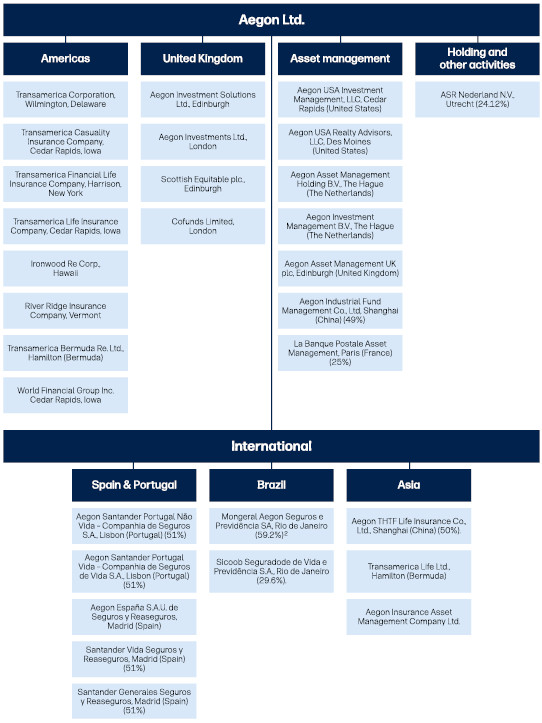
| 1 | This chart reflects the reporting structure, which is different from Aegon’s legal structure. This chart is not an exhaustive overview of Aegon’s structure. |
| 2 | Aegon has 50% voting rights in Mongeral Aegon, Seguros e Previdencia S.A., Rio de Janeiro. |
| 9 | Aegon Financial Condition Report 2025 |
|
|
||
| Business and performance Performance of investments by asset class | ||
A.6 Insurance business written by changes in liability for remaining coverage and segment by the insurance Group during the reporting period
The following table shows total insurance revenue split by component and split by reporting segment.
| Insurance revenue | ||||||||
| Amounts in EUR millions |
2025 | 2024 | ||||||
| Expected insurance claims and expenses |
7,194 | 7,870 | ||||||
| Earnings released from contractual service margin |
930 | 958 | ||||||
| Release of risk adjustment for non-financial risk |
265 | 295 | ||||||
| Allocated proportion of consideration that relates to recovery acquisition costs |
538 | 553 | ||||||
| Other |
(20 | ) | (19 | ) | ||||
| Insurance contracts not measured under the Premium Allocation Approach (PAA) |
8,906 | 9,656 | ||||||
| Insurance contracts measured under the PAA |
114 | 104 | ||||||
| Investment contracts with discretionary participation features (DPF) |
77 | 80 | ||||||
| Total Insurance revenue |
9,097 | 9,841 | ||||||
| Americas |
8,477 | 9,102 | ||||||
| United Kingdom |
422 | 543 | ||||||
| International |
1,748 | 1,674 | ||||||
| Eliminations |
(39 | ) | (45 | ) | ||||
| Segment total |
10,608 | 11,275 | ||||||
| Joint ventures and associates eliminations |
(1,511 | ) | (1,434 | ) | ||||
| Total Insurance revenue |
9,097 | 9,841 | ||||||
For further details and explanation, please refer to note 2 Material accounting policies information, note 5 Segment information and note 6 Insurance revenue of Aegon’s 2025 Integrated Annual Report.
| 10 | Aegon Financial Condition Report 2025 |
Business and performance Performance of investments by asset class
A.7 Performance of investments by asset class and details on material income and expenses incurred by the insurance Group during the reporting period
The following tables show the consolidated income statement, investment income and net result.
| Consolidated income statement | ||||||||
| Amounts in EUR millions |
2025 | 2024 | ||||||
| Insurance revenue |
9,097 | 9,841 | ||||||
| Insurance service expense |
(9,423 | ) | (9,790 | ) | ||||
| Net income / (expenses) on reinsurance held |
836 | 325 | ||||||
| Insurance service result |
511 | 376 | ||||||
| Interest revenue on financial instruments calculated using the effective interest method |
2,683 | 2,720 | ||||||
| Interest income from instruments measured at FVPL |
615 | 637 | ||||||
| Other investment income |
1,198 | 1,340 | ||||||
| Results from financial transactions |
15,632 | 11,593 | ||||||
| Impairment (losses) / reversals |
(46 | ) | (190 | ) | ||||
| Insurance finance income / (expenses) |
(20,227 | ) | (16,506 | ) | ||||
| Net reinsurance finance income/ (expenses) on reinsurance held |
564 | 611 | ||||||
| Interest expenses |
(135 | ) | (171 | ) | ||||
| Insurance net investment result |
285 | 34 | ||||||
| Interest revenue on financial instruments calculated using the effective interest method |
636 | 605 | ||||||
| Interest income from instruments measured at FVPL |
217 | 186 | ||||||
| Other investment income |
825 | 729 | ||||||
| Results from financial transactions |
10,065 | 7,634 | ||||||
| Impairment (losses) / reversals |
(22 | ) | (47 | ) | ||||
| Investment contract income / (expenses) |
(11,372 | ) | (8,781 | ) | ||||
| Interest expenses |
(18 | ) | (32 | ) | ||||
| Other net investment result |
331 | 294 | ||||||
| Interest charges |
(178 | ) | (190 | ) | ||||
| Financing net investment result |
(178 | ) | (190 | ) | ||||
| Total net investment result |
438 | 139 | ||||||
| Fees and commission income |
2,390 | 2,378 | ||||||
| Other operating expenses |
(2,928 | ) | (2,961 | ) | ||||
| Other income / (charges) |
130 | 145 | ||||||
| Other result |
(408 | ) | (438 | ) | ||||
| Results before share in profit / (loss) of joint ventures, associates and tax |
541 | 77 | ||||||
| Share and profit / (loss) of joint ventures |
303 | 238 | ||||||
| Share and profit / (loss) of associates |
200 | 345 | ||||||
| Result before tax from continuing operations |
1,045 | 660 | ||||||
| Income tax (expense) / benefit |
(65 | ) | 16 | |||||
| Net result |
980 | 676 | ||||||
| Investment income | 2025 | 2024 | ||||||||||||||||||||||||||||||
| Amounts in EUR millions | Interest income |
Dividend income |
Rental income |
Total | Interest income |
Dividend income |
Rental income |
Total | ||||||||||||||||||||||||
| Shares |
- | 1,993 | - | 1,993 | - | 2,041 | - | 2,041 | ||||||||||||||||||||||||
| Debt securities and money market instruments |
2,994 | - | - | 2,994 | 2,969 | - | - | 2,969 | ||||||||||||||||||||||||
| Loans |
420 | - | - | 420 | 428 | - | - | 428 | ||||||||||||||||||||||||
| Real estate |
- | - | 31 | 31 | - | - | 27 | 27 | ||||||||||||||||||||||||
| Other |
738 | - | - | 738 | 752 | - | - | 752 | ||||||||||||||||||||||||
| Total |
4,152 | 1,993 | 31 | 6,176 | 4,149 | 2,041 | 27 | 6,217 | ||||||||||||||||||||||||
| 11 | Aegon Financial Condition Report 2025 |
|
|
||
| Business and performance Any other material information | ||
| Results | ||||||||
| Amounts in EUR millions |
2025 | 2024 | ||||||
| Operating result geographically |
||||||||
| Americas |
1,209 | 1,062 | ||||||
| United Kingdom |
219 | 198 | ||||||
| International |
224 | 183 | ||||||
| Asset Management |
217 | 201 | ||||||
| Holding and other activities |
(224 | ) | (209 | ) | ||||
| Eliminations |
58 | 50 | ||||||
| Operating result |
1,702 | 1,485 | ||||||
| Fair value items |
80 | (208 | ) | |||||
| Realized gains / (losses) on investments |
(248 | ) | (36 | ) | ||||
| Net impairments |
(64 | ) | (236 | ) | ||||
| Non-operating items |
(231 | ) | (480 | ) | ||||
| Other income / (charges) |
(317 | ) | (245 | ) | ||||
| Result before tax |
1,154 | 760 | ||||||
| Income tax |
(174 | ) | (85 | ) | ||||
| Of which income tax from certain proportionately consolidated joint ventures and associates included income before tax | 109 | 100 | ||||||
| Net result |
980 | 676 | ||||||
For further details and explanation, please refer to note 2 Material accounting policies information, note 5 Segment information and note 6 Insurance revenue of Aegon’s 2025 Integrated Annual Report.
A.8 Any other material information
Aegon does not have any other material information regarding its business and performance to report.
| 12 | Aegon Financial Condition Report 2025 |
Governance structure
The governance structure of the Group is described in this chapter.
B.1 Parent board and senior executives
B.1.1 A description of the structure of the parent Board of Directors (Board) and senior executives, the roles, responsibilities and segregation of these responsibilities
Aegon is governed by two main corporate bodies: the Board of Directors and the General Meeting of Shareholders.
Aegon’s Board of Directors consists of ten Non-Executive Directors and one Executive Director per December 31, 2025. Subject to the provisions of the Bermuda Companies Act and the Company bye-laws, the Board manages and conducts the business of Aegon and is responsible for the general affairs of the Company, which includes setting the strategy of the Company. The Board may exercise all the powers of the Company except those powers that are required by the Bermuda Companies Act or the Company bye-laws to be exercised by the General Meeting.
The members of the Board owe a fiduciary duty to Aegon to act in good faith in their dealings with or on behalf of Aegon and exercise their powers and fulfil the duties of their office honestly. In the exercise of its duties the Board shall take into account (among other matters) the long-term consequences of decisions, sustainability, the Company’s reputation and the interests of all corporate stakeholders. For the purposes of a Director’s duty to act in the way they consider, in good faith, is in the best interests of the Company, the Director shall not be required to regard the benefit of any particular stakeholder interest or group of stakeholder interests as more important than any other.
The Board may, subject to its control, delegate all powers, authorities, and discretions relating to the day-to-day-operations and general business and affairs of Aegon to Aegon’s Chief Executive Officer (CEO). The Board oversees the execution of its responsibilities and delegated powers, authorities and discretions by the CEO and any other person or committee to which the Board has delegated any of its duties and responsibilities and is ultimately responsible for the fulfillment of the Board’s duties by them.
Pursuant to Aegon’s Board Regulations, the following matters are exclusively within the remit of the Board and cannot be delegated to the CEO:
| ● |
Reviewing and adopting (any material amendment to) the Company’s strategy and strategic plan, including the annual capital budget and allocation; |
| ● |
Reviewing the risks of the Business and the evaluation by the Board of the structure and operation of the internal risk management and control systems; |
| ● |
Reviewing and approving (any material amendment to) the (annual) business plan and the medium-term plan of the Region to the extent that it relates to the Group Budget; |
| ● |
Reviewing and approving (any material amendment to) the Group Budget; |
| ● |
Receiving, considering, and approving reports from the committees of the Board; and |
| ● |
The material matters listed in schedule 2 of Aegon Ltd. Board Regulations. |
The CEO is assisted by the Executive Committee, which provides support and expertise in safeguarding Aegon’s strategic goals. Aegon’s Executive Committee is composed of Lard Friese (CEO), Duncan Russell (CFO), Michele Bareggi, Will Fuller, Mike Holliday-Williams, Astrid Jäkel, Marco Keim, Onno van Klinken, Shawn Johnson, Deborah Waters and Holly Waters.
The Board has established an Audit Committee, Risk Committee, Compensation and Human Resource Committee and Nomination and Governance Committee from amongst its members.
General Meeting of Shareholders
A General Meeting of Shareholders (the “General Meeting”) is held annually and, if deemed necessary, the Board may convene a special General Meeting. The main function of the General Meeting is to decide on:
| ● |
(re)appointments to the Board; |
| ● |
appointment of the auditor; |
| ● |
amendments of the bye-laws; |
| ● |
adoption of the remuneration policy; |
| 13 | Aegon Financial Condition Report 2025 |
Governance structure Parent board and senior executives
| ● |
approval of resolutions of the Board entailing a significant change in the identity or character of the company or its business; |
| ● |
approval of final dividend payment; and |
| ● |
authorizing the Board to (i) limit or exclude pre-emptive rights, (ii) repurchase shares, and (iii) issue Aegon shares exceeding 10% of Aegon’s issued share capital unless the Board determines that the issuance of shares is necessary or conducive for purposes of safeguarding, conserving, or strengthening the capital position of Aegon. |
At the Annual General Meeting, the Board shall present shareholders with the annual accounts to be discussed during the meeting. The Board shall also annually present shareholders with a remuneration report that shall be put to an advisory vote, which shall not be binding on the Board or the company.
At the General Meeting, each common share carries one vote. In the absence of a Special Cause, Vereniging Aegon casts one vote for every 40 common shares B it holds.
Composition of the Board
The General Meeting appoints the members of the Board. The Board shall determine the number of Directors in its sole discretion, provided that the majority of the Board shall consist of Non-Executive Directors.
If the appointment of a member of the Board is proposed by the Board, the resolution of the General Meeting requires a simple majority of the votes cast, while otherwise, the resolution requires a two-thirds majority of the votes cast, which majority must represent at least half (1/2) of the then issued and outstanding shares.
Members of the Board will be appointed for a term of not more than four years and may be reappointed thereafter. After 12 years, a Non-Executive Director will no longer be considered independent. Aegon aims to ensure that the composition of the company’s Board is in line with Aegon’s Diversity and Inclusion Policy and is as such well-balanced in terms of professional background, geography, gender, and other relevant aspects of this policy. A profile, which is published on aegon.com as schedule 3 to the Board Regulations, has been established that outlines the required qualifications of the members of the Board. If the removal or suspension of a member of the Board is proposed by the Board, the General Meeting resolution requires a simple majority of the votes cast, while otherwise, the resolution requires a two-thirds majority of the votes cast, which majority must represent more than half (1/2) of the then issued and outstanding shares. The Board determines the remuneration and other terms of service of the Executive Director and the Non-Executive Directors, with due observance of the remuneration policy for the Board. This remuneration policy is adopted by the General Meeting ultimately at the fourth annual general meeting held after the General Meeting in which the remuneration policy was most recently adopted.
Committees
The Board also oversees the activities of its committees. These committees are composed exclusively of Non-Executive Directors and deal with specific issues related to Aegon’s financial accounts, risk management, executive remuneration, and appointments. These committees are the:
| ● |
Audit Committee; |
| ● |
Risk Committee; |
| ● |
Compensation and Human Resource Committee; and |
| ● |
Nomination and Governance Committee |
Audit Committee
Aegon has both an Audit Committee and a Risk Committee. With regard to the oversight of the operation of the risk management framework and risk control systems, including supervising the enforcement of relevant legislation and regulations, the Audit Committee operates in close coordination with the Risk Committee. Certain Board members participate in both committees and a combined meeting of the Audit and Risk Committees is scheduled on an annual basis.
The main role and responsibilities of the Audit Committee are to assist and advise the Board in fulfilling its oversight responsibilities regarding:
| ● |
The integrity and quality of the consolidated financial statements for the Group; |
| ● |
The effectiveness of the design, operation, and appropriateness of the enterprise risk management framework and internal control systems of the Group, including supervising the enforcement of the relevant legislation and regulations, supervising the operation of the code of conduct, and monitoring the internal control over financial reporting; |
| ● |
The disclosure of financial and non-financial information by the Group, including but not limited to the choice of accounting policies, application, and assessment of the effects of new rules, information about the handling of estimated items in the annual accounts, forecasts, and work of the External and Internal Auditors; |
| 14 | Aegon Financial Condition Report 2025 |
Governance structure Parent board and senior executives
| ● |
Compliance with recommendations and observations and following up on comments of Internal and External Auditors, including the review of compliance and complaints (whistleblowing) procedures and reports; |
| ● |
The role and functioning of the internal audit function; |
| ● |
The policy of the Company on tax planning; |
| ● |
Actuarial matters; |
| ● |
The funding, financing, capital structure and capital reporting of the Group, the Group Capital Plan, the Group Funding Plan, and treasury policies and procedures, including significant financial exposures; |
| ● |
Applications of information and communication technology, including risks relating to cyber security and information security; |
| ● |
Relationship with the External Auditor, including in particular its appointment, reappointment, or dismissal, qualifications, independence, remuneration, and any services for the Group; and |
| ● |
The performance of the external auditors and the effectiveness of the external audit process, including monitoring the independence and objectivity of the external auditor. |
The Audit Committee reports to the Board on its activities, identifying any matters about which it considers action or improvements are needed, and making recommendations on the steps to be taken. For more information about the functioning of the Audit Committee, please see the Audit Committee Charter on aegon.com.
Risk Committee
The Risk Committee focuses on the effectiveness of the design and operation and the appropriateness of the enterprise risk management framework and internal control systems of Aegon Ltd. This includes:
| ● |
Risk management strategy; |
| ● |
Risk tolerance; |
| ● |
Risk governance structure; |
| ● |
Risk competencies; |
| ● |
Product development and pricing; |
| ● |
Risk assessment; |
| ● |
Risk responses and internal control effectiveness; |
| ● |
Risk monitoring; and |
| ● |
Risk reporting |
Furthermore, the Risk Committee is responsible for reviewing and advising the Board with respect to the risk exposures as they relate to capital, earnings, liquidity, operations, and compliance with risk policies. The Audit Committee primarily relies on the Risk Committee for the topics mentioned above.
The Risk Committee works closely with the Audit Committee. One combined meeting was held in 2025. The meeting focused on the 2026 Group risk plan, and the 2025 Model Validation outcome and the 2026 Model Risk and Validation plan.
Compensation and Human Resource Committee
The Compensation and Human Resource Committee (formerly known as the Remuneration Committee) is designated to safeguard sound remuneration policies and practices within the company by overseeing the development and execution of these policies and practices in accordance with applicable laws and regulations. In order to ensure that the remuneration policies and practices take all types of risks properly into account, in addition to considering liquidity and capital levels, the Compensation and Human Resource Committee assesses in particular the remuneration governance processes, procedures and methodologies adopted. Furthermore, the Committee ensures that the overall remuneration policy is consistent with the longer-term strategy of the company and the longer-term interests of its shareholders, investors and other stakeholders as well as the public at large. This includes, among other things:
| ● |
Reviewing Aegon’s Global Remuneration Framework and making recommendations on the remuneration policies and advising the Board on the approval and adoption of the Global Remuneration framework; |
| ● |
Preparing a proposal for the remuneration of, and overseeing the remuneration of the Executive Directors; |
| ● |
Reviewing annually a proposal for the remuneration of the Heads of Control Functions; |
| ● |
Preparing recommendations regarding variable compensation both at the beginning and at the end of the performance year; and |
| ● |
Preparing the information provided to shareholders on remuneration policies and practices, including the Remuneration Report. |
| 15 | Aegon Financial Condition Report 2025 |
Governance structure Parent board and senior executives
Nomination and Governance Committee
The Nomination and Governance Committee focuses on the size, composition, and profile of the Board and addresses the functioning, succession, and proposed nomination of Directors and ensures that the corporate governance structure is in line with the applicable rules and regulations and advises on the responsible business strategy. This includes:
| ● |
Drawing up selection criteria and (re-)appointment procedures for nominations of Directors; |
| ● |
Preparing selection criteria and appointment procedures and proposal for the nomination of the Chief Executive Officer; |
| ● |
Updating the Board Profile and periodically assessing the size and composition of the Board and making a proposal for a composition profile of the Board; |
| ● |
Assessing the functioning of individual Directors and drawing up a plan for the succession of Directors; |
| ● |
Advising on and proposing to the Board candidates to be designated as Chairperson and Vice-Chairperson of the Board; |
| ● |
Supervising the policy of the Board on the selection criteria and appointment procedures for senior management; |
| ● |
Periodically discussing any relevant developments within the senior management and advising on any potential appointments of senior management; |
| ● |
Overseeing the corporate governance structure of the Company and compliance with any applicable corporate governance legislation and regulations; |
| ● |
Periodically assessing and advising on the responsible business strategy, including sustainability / Environmental, Social and Governance (ESG) strategy, as part of the corporate strategy; and |
| ● |
Overseeing the process of the annual self-evaluation of the Board and each of its committees. |
B.1.2 A description of remuneration policy and practices and performance-based criteria governing the parent board, senior executives and employees
Aegon’s Global Remuneration Framework (GRF) was designed in accordance with relevant rules and regulations. These included the remuneration rules of the Bermuda Monetary Authority. All remuneration policies within Aegon are derived from the GRF, such as the Directors’ Remuneration Policy and the local Remuneration Policies of our business units.
Aegon’s remuneration policies are derived from the GRF, which includes the Remuneration Policy for the Executive Director(s) and local business Remuneration Policies. These policies define specific terms and conditions for the employment of Aegon’s employee across various countries and local businesses. All steps in the remuneration process are governed by the GRF and its underlying policies. Staff from Human Resources, Risk Management and Compliance are involved in all steps of the process.
The below provides a summary of Aegon’s remuneration policies for the Directors of the Board in 2025. For further details, reference is made to the Remuneration Report on pages 68 - 79 of Aegon’s 2025 Integrated Annual Report.
The purpose of Non-Executive Director remuneration is to provide guaranteed, non-performance based, compensation for the different roles and responsibilities within the Board and its committees. The policy remains in place until the shareholders have adopted a new or revised policy in accordance with the applicable rules and regulatory requirements from the Insurance Code of Conduct of the Bermuda Monetary Authority. The Board of Directors will submit a proposal to the shareholders to adopt a remuneration policy at an Annual General Meeting at least every four years.
The remuneration of the Non-Executive Directors consists of annual Board retainers, partly paid in shares, and Committee membership retainers.
Each of these fees is a fixed amount. Where required, Aegon pays the employer social security contributions in the home country of the Non-Executive Board member. The employee social security contributions in the home country, if any, are paid by the Non-Executive Board member. The Non-Executive Board members are allowed to annually index the fees for economic developments in the Netherlands.
Executive Director remuneration in 2025
The total compensation allocated to Mr. Friese related to the 2025 performance year was EUR 3.5 million (2024: EUR 3.4 million), consisting of fixed compensation, Short-Term Incentive, pension, and benefits. The first vesting of a Long-Term Incentive grant is expected in 2028.
| 16 | Aegon Financial Condition Report 2025 |
Governance structure Fitness and proper requirements
Remuneration Executive Committee members
Members of the Executive Committee (excluding the CEO) were rewarded in 2025 based on local remuneration policies and in line with local market practice for roles with a similar scope and complexity. These policies were derived from the GRF. Their remuneration included fixed compensation, Short-Term Incentive, Long-Term Incentive, pension, and benefits. The Short-Term incentive was determined by a mix of individual and company performance indicators that are linked to Aegon’s objectives, business strategy, risk tolerance and long-term performance. Their targets, levels and performance assessment were agreed and determined by their local Remuneration Committee. The first vesting of a Long-Term Incentive grants is expected in 2028.
The Board and/or their local Remuneration Committee may decide on a potential downward adjustment of the variable compensation (based on either an ex-ante or ex-post risk assessment) or claw back.
Depending on local practices the pension arrangements may include provisions allowing for early retirement.
B.1.3 A description of pension as part of the Director remuneration policy
Pension is guaranteed remuneration which aims at the future financial security after retirement. The Executive Director is enrolled in the applicable local employee pension plan(s) and/or receives cash in lieu of pension. The annual total pension contributions equal 15% of base salary. For Mr. Friese these were paid in 2025 through the participation in Aegon’s defined contribution pension plan for employees based in the Netherlands (for their eligible earnings up to EUR 137,800) and as an additional gross allowance for the remaining part up to 15% of base salary.
B.1.4 Any material transactions with shareholder controllers, persons who exercise significant influence, the parent board or senior executives
There were no material transactions with members of the Board of Directors or Executive Committee.
B.2 Fitness and proper requirements
B.2.1 A description of the fit and proper process in assessing the parent board and senior executives
In accordance with the Bermudian Insurance Act 1978 (Insurance Act), Aegon has identified all persons who are a controller or officer as they are subject to fit and proper requirements, outlined in the Schedule, Minimum Criteria For Registration Section 1. These persons are subject to screening by the Bermuda Monetary Authority prior to their appointment in a controller or officer function as stated and defined by rule 30J of the Insurance Act. In connection with rule 5.6.A of the Insurance (Group Supervision) Rules 2011, assessment of the fit and proper condition of the controllers and officers is required on continuous basis.
Ongoing compliance with propriety requirements of the persons that effectively run the undertaking or have other key functions is a joint responsibility of the respective person as well as Aegon.
Fitness of the persons that effectively run the undertaking or have other key functions is determined at the point of selection as well as thereafter. As regards the point of selection, Aegon has drawn up a specific job profile for each function. These profiles detail the requirements in terms of the level of skills, knowledge and experience required to successfully fulfil the specific position within the company. The selection of the jobholder takes place by assessing the candidate for a position against these specific job requirements. The score on the three elements (expertise, knowledge and experience) is balanced and leads to potential recruitment in the position. Once selected, fitness of a specific person for a function is continuously assessed against this job profile. The ongoing compliance with fitness requirements is monitored as part of the regular human resource cycle within Aegon. Regular formal assessments of performance against the requirements are part of this cycle and are documented for record keeping purposes. In the human resources cycle, performance management is an important element in which targets are set and the results are monitored to assess if the jobholder continues to meet both the specific job requirements and the fitness requirements.
B.2.2 A description of the professional qualifications, skills, and expertise of the parent board and senior executives to carry out their functions
Executive Committee
The members of Aegon’s Executive Committee work alongside the CEO and help oversee operational issues and the implementation of Aegon’s strategy. Members are drawn from Aegon’s functional, business, and country units, and have both regional and global responsibilities. This ensures that Aegon is managed as an integrated international business. The Executive Committee provides vital support and expertise in pursuit of the company’s strategic objectives.
| 17 | Aegon Financial Condition Report 2025 |
|
|
||
| Governance structure Fitness and proper requirements | ||
Control functions
Furthermore, with regard to rule 4.5 of the Insurance (Group Supervision) Rules 2011, Aegon has implemented the following control functions: Risk Management, Compliance, Internal Audit, and the Actuarial Function. These functions have been in place within Aegon for many years.
Board of Directors
In accordance with Bermuda law, the Board manages and conducts the business of the Company and is responsible for the general affairs of the Company. This includes setting and evaluating the Company’s strategy, management’s policies and the effectiveness of which management implements its policies and it includes overseeing compliance with legal and regulatory requirements. In the exercise of its duties the Board shall take into account (among other matters) the long-term consequences of decisions, sustainability, Environmental, Social and Governance (ESG) priorities of the Company, the Company’s reputation, and the interest of all corporate stakeholders, including, amongst others, the shareholders, the Company’s employees, business relations, policyholders, relations with regulators, and other groups, directly or indirectly, influenced by the business of the Company, all in the broadest sense. The members of the Board of Directors can be found on Aegon’s website under the section ‘About, Governance, Board’.
The Board, as a whole, should have:
| ● |
An international composition, which does justice to the geographical spread of the Group’s activities; |
| ● |
Experience with, and understanding of, the administrative procedures and internal control systems in a large, international organization; |
| ● |
An affinity with, and knowledge of, the insurance industry, its customers, its products and services, the financial services market, and the Group’s businesses and strategy; |
| ● |
Knowledge and experience in (digital) marketing and distribution, and the application of information technology; |
| ● |
Expertise and experience in digital transformation; |
| ● |
Experience in the business world, both nationally and internationally; |
| ● |
An understanding of the main characteristics of the form of government and the social aspects of, as well as developments in, the countries in which the Group is active; |
| ● |
A financial expert, and more in general, financial, accounting and business economics’ expertise and the ability to judge issues in the areas of solvency, actuarial, currencies, investment and acquisition projects, and risk management, including the management of cybersecurity risk; |
| ● |
An understanding of employment relationships, human resources, and social developments; |
| ● |
An understanding of public policy, regulatory, compliance and legal matters, and corporate governance; |
| ● |
Insight into, and experience with, sustainability or Environmental, Social and Governance (ESG) aspects; and |
| ● |
Experience and knowledge in the area of executive remuneration. |
Risk Management
The Aegon Group Chief Risk Officer (CRO) is the function holder for risk management. The Aegon Group CRO is also member of the Executive Committee and of high-level Risk Committees. For more information about the risk management system and its functions, please refer to section B.3 Risk management Solvency self-assessment.
Compliance
The Global Head of Compliance is the function holder for compliance. For more details about the Compliance function reference is made to section B.4.1 Internal control system.
Internal Audit
The Global Head of Internal Audit is the function holder for Internal Audit. In line with the requirements, Internal Audit is objective and independent from the operational functions, reporting directly to the CEO and the Audit Committee Board of Directors. For more details about the Internal Audit function refer to section B.5 Internal Audit Function.
Actuarial Function
The Actuarial Function Holder is the Global Chief Actuary & Head of Underwriting Risk Management and is part of the second line at Aegon Group level. For more details about the Actuarial Function please refer to section B.6 Actuarial Function.
| 18 | Aegon Financial Condition Report 2025 |
Governance structure Risk management and Solvency self-assessment
The key functions stated above have the necessary resources to carry out their tasks. Resourcing of staff and other means required to execute control is documented as part of the Board Regulations and Charters agreed with the Board of Directors of Aegon Ltd. Changes to the resources require approval from the control function. The necessary operational independence of the control functions is also documented as part of the Board Regulations and Charters agreed with the Board of Directors. Issues can be brought forward to the Board of Directors for resolution.
B.3 Risk management and Solvency self-assessment
B.3.1 A description of the insurance Group’s risk management process and procedures to effectively identify, measure, manage and report on risk exposures
The Risk Management Function is defined in accordance with rule 8 of the Bermuda Insurance (Group Supervision) Rules 2011.
Risk management system
As an insurance group, Aegon manages risk for the benefit of its customers and other stakeholders. The company is exposed to a range of financial, underwriting, and operational risks. Aegon’s risk management and internal control systems are designed to ensure that these risks are managed effectively and efficiently in a way that is aligned with the company’s strategy.
For Aegon, risk management involves:
| ● |
Understanding risks that the company faces; |
| ● |
Maintaining a group-wide framework through which the risk-return trade-off associated with these risks can be assessed; |
| ● |
Maintaining risk tolerances and supporting policies to limit exposure to a particular risk or combination of risks; and |
| ● |
Monitoring risk exposures and actively maintaining oversight of the Company’s overall risk and solvency positions. |
This section describes Aegon’s risk management framework.
Enterprise Risk Management (ERM) framework
The formulation of the risk strategy starts with the principle that taking a risk should be based on serving a customer’s needs. The competence to manage the risk is assessed and Aegon’s risk preferences are formulated, considering Aegon’s risk capacity. The process results in a targeted risk profile, reflecting the risks Aegon wants to assume and the risks Aegon would like to avoid or mitigate.
Aegon’s risk appetite statement and risk tolerances are established to assist management in carrying out Aegon’s strategy within the boundaries of the resources available to Aegon. Aegon’s risk appetite statement is to:
“Fulfill our promises towards our customers and other stakeholders by delivering sustainable long-term growth through strong resilience in solvency and liquidity, implementing robust risk management practices that align with our ethical standards and regulatory requirements.”
Following from the risk appetite statement, risk tolerances are defined based on the following:
| ● |
Aegon should maintain adequate financial resources across the Group, both on Regulatory Capital and IFRS bases under adverse stress scenarios; |
| ● |
The Group should maintain sufficient resources on a market-informed basis to be able to pay policyholders and other contractual obligations under adverse stress scenarios; |
| ● |
Aegon acts as a responsible business with effective controls, which acknowledges an acceptable level of operational risk and stresses a low tolerance for (lack of) actions that could lead to material adverse risk events that result in breaking promises to or not meeting reasonable expectations of customers, legal and regulatory breaches, reputational damage, financial detriment or financial misstatement. |
The tolerances are further developed into measures, thresholds, and indicators that must be met to remain within the tolerances.
| 19 | Aegon Financial Condition Report 2025 |
|
|
||
| Governance structure Risk management and Solvency self-assessment | ||
Risk universe
Aegon’s risk universe is structured to reflect the type of risks to which the company is exposed. The identified risk categories are financial risk, underwriting risk, and operational risk. Specific risk types are identified within these risk categories. These internal or external risks may affect the company’s operations, earnings, share price, value of its investments, or the sale of products and services.
In the context of Aegon’s risk strategy, a risk appetite is set for the three identified risk categories (see table below).
| Risk category | Description | Appetite | ||
| Underwriting |
The risk of incurring losses when actual experience deviates from Aegon’s best estimate assumptions on mortality, longevity, morbidity, policyholder behavior, and property and casualty claims and expenses used to price products and establish technical provisions. | Medium to high - Underwriting risk is Aegon’s core business and meets customer needs. | ||
| Financial |
The risk of incurring financial losses due to movements in financial markets and the market value of balance sheet items. The elements of financial risk include credit risk, inflation risk, investment risk, interest rate risk, and currency risk. | Low to medium - Accepted where it meets customer needs and the risk-return profile is acceptable. | ||
| Operational |
The risk of losses resulting from inadequate or failed internal processes and controls, people and systems, or from external events, such as processing errors, legal and compliance issues, natural or man-made disasters, and cybercrime. | Low - Accepted as a necessary condition of conducting business, but mitigated as much as possible in an economically efficient manner. | ||
Risk identification and risk assessment
Aegon has identified a risk universe that captures all known material risks to which the company is exposed. To assess all risks, Aegon maintains a documented, consistent methodology for measuring risks. The risk metrics are embedded in Aegon’s key reports and are used for decision-making.
Risk response
Aegon distinguishes the following risk responses, which are particularly relevant where risks are out of tolerance:
| ● |
Risk acceptance: The risk is accepted by management; |
| ● |
Risk control: The risk is reduced by reducing the exposure, by improving processes and existing controls or by introducing new controls; |
| ● |
Risk transfer: The risk is reduced by insuring the company against the risk or by outsourcing activities to third parties; or |
| ● |
Risk avoidance: Activities that are the source of the risk are terminated. |
Risk monitoring and reporting
Risks are monitored regularly and reported internally on at least a quarterly basis. The impact of key financial, underwriting, and operational risk drivers on earnings and capital is shown in the quarterly risk dashboards for the various risk types, both separately and on an aggregate basis.
Risk exposures are compared with the measures and indicators as defined by Aegon’s risk appetite framework. Reporting also includes compliance and incident reporting. Finally, the main risks derived from Aegon’s strategy and day-to-day business are discussed, as well as forward-looking points for attention. If necessary, mitigating actions are taken and documented.
Risk control
A system of effective controls is required to mitigate the risks identified. In Aegon’s ERM framework, risk control includes risk governance, risk policies, an internal control framework, model validation, risk framework embedding, risk culture, and compliance.
Change risk management
The ERM framework, including the operational risk universe, applies to all change initiatives and special projects across Aegon. The risk function provides oversight to ensure that change initiatives adhere to the principles of the risk framework and to verify that the control framework during and after the change continues to operate in line with company requirements. For example, as Aegon moves its head office and legal seat to the United States, Risk will contribute to project oversight and provide input through regular risk reporting and risk opinions, similar to its role when Aegon moved its legal seat to Bermuda.
| 20 | Aegon Financial Condition Report 2025 |
Governance structure Risk management and Solvency self-assessment
B.3.2 A description of how the risk management and Solvency self-assessment system are implemented and integrated into
the insurance Group’s operations; including strategic planning and organizational and
decision-making process
Risk governance framework
Aegon’s risk management framework is represented across all levels of the organization, designed to encourage a coherent and integrated approach to risk management throughout the company. Similarly, Aegon offers a comprehensive range of group-wide risk policies that specify operating guidelines and limits. These policies include legal, regulatory, and internally set requirements and are designed to keep risk exposures to a manageable level. Any breach of policy limits or warning levels triggers remedial action or heightened monitoring. Further risk policies may be developed at a local level to cover situations specific to particular business units.
Aegon’s risk management governance structure has four layers:
| ● |
The Board of Directors (Board) and its Risk Committee; |
| ● |
The CEO and the Executive Committee; |
| ● |
The Group Risk & Capital Committee (GRCC) and its sub-committees; |
| ● |
The local Risk & Capital Committees. |
The Risk Committee reports to the Board on topics related to the ERM framework and the internal control system. This includes:
| ● |
Risk strategy, risk tolerance, and risk governance; |
| ● |
Product development and pricing; |
| ● |
Risk assessment; |
| ● |
Risk responses and internal control effectiveness; |
| ● |
Risk monitoring; and Risk reporting. |
The CEO and the Group’s Chief Risk Officer (CRO) are responsible for informing the Board of any risk that directly threatens the company’s solvency, liquidity, or operations. The CEO has overall responsibility for managing risk. The CEO adopts the risk strategy, risk governance, risk tolerance, and material changes in risk methodology and risk policies. The Group’s CRO has a standing invitation to attend the CEO meeting and has a direct reporting line to the Board to discuss ERM and related matters. The CRO is also a member of the Executive Committee.
The Executive Committee oversees a broad range of strategic and operational issues. While the CEO is Aegon’s statutory Executive Director, the Executive Committee provides vital support and expertise in safeguarding Aegon’s strategic goals. The Executive Committee discusses and sponsors ERM, in particular the risk strategy, risk governance, risk tolerance, and the introduction of new risk policies.
The CEO and Executive Committee are supported by the GRCC. The GRCC is Aegon’s most senior risk committee. It is responsible for managing Aegon’s balance sheet at the global level and is in charge of risk oversight, risk monitoring, and risk management-related decisions on behalf of the CEO and in line with its charter. The GRCC ensures risk-taking is within Aegon’s risk tolerances, that the capital position is adequate to support financial strength and regulatory requirements, and that capital is properly allocated. The GRCC informs the CEO about any identified breaches of overall tolerance levels and threats to the company’s solvency, liquidity, or operations.
The GRCC has three sub-committees: the ERM framework, Accounting and Actuarial Committee (ERMAAC), the Non-Financial Risk Committee (NFRC) and the Model Validation Committee (MVC).
The purpose of the ERMAAC is to assist the GRCC, CEO, and Executive Committee with the setting and maintenance of the financial risk framework across all group-level balance sheet bases, including policies, standards, guidelines, methodologies, and assumptions.
The purpose of the NFRC is to assist the GRCC, CEO and Executive Committee with non-financial risk framework setting and maintenance, including policies, standards, guidelines, and methodologies, and to act as a formal discussion and information- exchange platform on matters concerning non-financial risk management.
The MVC is responsible for approving all model validation reports across Aegon. This independent committee reports to the GRCC and the CEO to provide information on model integrity and recommendations on how to strengthen these models further.
| 21 | Aegon Financial Condition Report 2025 |
|
|
||
| Governance structure Risk management and Solvency self-assessment | ||
Aegon’s business units have a Risk, or Risk and Capital Committee, and an Audit Committee. While naming and organizational set-up can differ, the responsibilities and prerogatives of the committees are aligned with those of the company-level committees and further elaborated in their respective charters, which are tailored to local circumstances.
In addition to the four layers described above, Aegon has an established group-wide Risk function. It is the mission of the Risk function to ensure the continuity of the company by safeguarding the value of existing business, protecting Aegon’s balance sheet and reputation, and supporting the creation of sustainable value for all stakeholders.
In general, the objective of the Risk function is to support the CEO, Executive Committee, Board, and business unit boards in ensuring that the company reviews, assesses, understands, and manages its risk profile. Through oversight, the Risk function ensures the company-wide risk profile is managed in line with Aegon’s risk tolerances, and stakeholder expectations are managed under both normal business conditions and adverse conditions caused by unforeseen negative events.
The following roles are important to realize the objective of the Risk function:
| ● |
Advising on risk-related matters including risk tolerance, risk governance, risk methodology, and risk policies; |
| ● |
Supporting and facilitating the development, incorporation, maintenance, and embedding of the ERM framework and sound practices; and |
| ● |
Monitoring and challenging the implementation and effectiveness of ERM practices. |
B.3.3 A description of the relationship between the Solvency self-assessment, Solvency needs, and capital and risk management systems of the insurance Group
Aegon’s Group Solvency Self-Assessment (GSSA) process has a primary purpose of providing a holistic, inter-connected view of our business strategy, the risks to which the business is exposed and our capital levels. It assesses the financial security of the business given the risks we run.
The Aegon GSSA process includes the following elements:
| ● |
Budget/MTP: is a group-wide strategy and Budget setting process which forms the basis of the forward looking assessment of the business strategy, associated risks and the capital position. In addition to a best estimate ‘base’ scenario, the exercise also projects adverse scenarios to test the robustness of its strategic planning. The scenarios are analyzed using the risk tolerance statements and the Capital Management policy. |
| ● |
Risk Reporting Dashboard: Aegon produces a comprehensive set of risk reports to measure, monitor and manage the risks in the business. The reports show the impact of key market or financial risks and underwriting risk drivers on earnings and capital generation for the various risk types. Furthermore, it contains analyses for non-financial risk and the impact of operational risk events at the regional and aggregated levels. An important part of the risk reporting process is compliance testing. Risk exposures for various risk types and tolerance measures are compared to the indicators / target levels as defined by Aegon’s Global Risk Appetite Framework. Group Risk produces a risk dashboard on at least on a quarterly basis. However, sections of the report can be produced on a more frequent or ad hoc basis. |
| ● |
Liquidity Risk Management Plan: Risk Tolerance Statement for liquidity requires that the Group and each legal entity must have sufficient liquidity to meet cash demands after an extreme event. The Risk Tolerance Statement is further developed into a set of specific limits, policy requirements and other operating standards, methodologies and procedures that must be complied with to maintain within tolerance. |
| ● |
Aegon Recovery Plan: serves as a useful management tool for Aegon to manage through crisis situations. Among others, the recovery measures are in place to help Aegon recover from a crisis situation. It demonstrates Aegon’s ability to recover from company-specific and market-wide stresses, bringing both capital and liquidity position under pressure. It contains an up-to-date list of our contingent recovery measures which are available to improve capital and liquidity during or after a crisis. |
| ● |
Group Capital Update: it is a monthly process whereby operating units provide current quarter and year-end forecasts for their solvency position. Operating units identify the key threats and initiatives as well as market developments expected to impact their solvency position over a short term time horizon (next quarter end and year end). Next to the solvency positions of the Group and our operating units, the Cash Capital at Holding balance and the operating capital generation are forecasted. |
In addition to running our business with a GSSA mind-set, a GSSA report is produced annually and required for regulatory purposes. The GSSA report includes at least an assessment of the current and forward-looking risk profile and capital position in quantitative as well as qualitative terms, as well as a summary of how risk management is embedded within the business strategy and medium-term plan, providing a forward looking perspective to achieve our targets and remain solvent given our risk profile.
| 22 | Aegon Financial Condition Report 2025 |
Governance structure Internal controls
B.3.4 A description of the Solvency self-assessment approval process including the level of oversight and independent verification by the parent board and senior executives
The GSSA process is iterative and subject to ongoing monitoring. The CEO meeting is responsible for the direction, integration of the business strategy and key decision making in respect of the Budget/MTP. The CEO meeting oversees the delivery of the Budget/MTP and GSSA and acts as an escalation point for decisions, risks or issues up to the Board of Directors. It approves all key deliverables throughout the process. The GSSA process is also used for decision making and responding to changes impacting the business. Use of the GSSA process relates to actions recommended to the CEO arising from the GSSA, including monitoring the completion of the actions. The annually updated Aegon Recovery Plan is subject to endorsement by the Group Risk & Capital Committee and approval by the CEO and the Board of Directors. The monthly Group Capital Update and related dividend proposals are shared with and discussed in the Group Risk & Capital Committee.
All of the above is evidenced and documented in Aegon’s annual GSSA report. Quarterly reports are produced internally that document the performance against Budget throughout the year.
The GSSA report is targeted primarily at the Group Risk & Capital Committee, CEO meeting and Board of Directors as key approval bodies. However, the concepts of GSSA are business wide and all senior management engage with the GSSA process in developing business plans that are aligned with Aegon’s overall risk and capital strategy. The CEO and the Board of Directors approve and sign off the annual (and any non-regular) GSSA reports.
B.4.1 A description of the internal control system
Aegon has developed an internal control system that serves to facilitate its compliance with applicable laws, regulations, and administrative processes, and the effectiveness and efficiency of operations with regard to its objectives, in addition to the availability and reliability of financial and non-financial information. The overall internal control system ensures appropriate control activities for key processes and the documentation and reporting of administrative and accounting information. A key element of the internal control system is to facilitate action planning and embed continuous improvement regarding the internal control environment throughout the organization. The internal control system is embedded through policies and frameworks such as ERM Framework, Model Validation Framework, Operational Risk Management (ORM) Framework, and Information Technology Framework. Aegon’s internal control system is considered more encompassing in scope than the Internal Control-Integrated Framework (ICIF) issued by COSO on which criteria for the internal control system are based.
The internal control system was developed in accordance with regulations that Aegon must comply with (i.e. Sarbanes-Oxley Act or financial regulations). Aegon’s control activities should assure an adequate level of internal control over Aegon’s objectives and in particular compliance, operational and financial reporting objectives including the production of IFRS numbers. The objective is to provide assurance regarding the reliability, accuracy, completeness, timeliness and quality of internal and external (regulatory) reporting, the safeguarding of assets, and compliance with internal and external requirements.
As part of the internal control system, a financial reporting internal control framework has been established supported by Aegon’s Group Sarbanes-Oxley methodology. For more information about Aegon’s internal control framework, reference is made to the next paragraphs. Furthermore, Aegon’s internal control framework includes a Compliance Function, which is described in section B.4.2.
The Internal Audit Function and Actuarial Function are described in section B.5 and section B.6 respectively.
General principles of Aegon’s internal control system
The general principles of Aegon’s internal control system apply to all undertakings, functional areas or departments. These principles are as follows:
| ● |
All employees must comply with the Code of Conduct. The Code of Conduct states that all employees will conduct their work in an ethical manner; |
| ● |
If employees become aware of, or observe fraud, questionable accounting practices, or other unethical behavior, they should report it to a member of management, human resources or to Aegon Speak Up helpline; |
| ● |
Employees are instructed regarding the sensitivity and confidentiality of the Group and client information; |
| ● |
All departments have developed a system of internal control to ensure that the assets and records of the Group are adequately protected from loss, theft, alteration or unauthorized access; |
| ● |
Records of the Group are maintained in compliance with record retention policies and local regulatory requirements; |
| 23 | Aegon Financial Condition Report 2025 |
|
|
||
| Governance structure Internal controls | ||
| ● |
All departments embed and maintain adequate segregation of duties. Where adequate segregation cannot be achieved, other risk mitigating controls are designed, implemented, performed and results are documented; |
| ● |
All departments have business continuity plans in place that are periodically updated; and |
| ● |
The interest of the customer is considered when designing, approving and reviewing products and distribution channels (in line with Aegon’s market conduct principles). |
ORM framework
A key element of Aegon’s internal control system is to facilitate action planning and embed continuous improvement regarding the internal control environment throughout the organization. The Operational Risk Management (ORM) framework is considered an integral part of the internal control system to facilitate its compliance with applicable laws, regulation and administrative processes and the effectiveness and efficiency of operations in view of its objectives. The ORM framework is part of the more comprehensive ERM Framework. The ORM function applies building blocks of the ERM framework.
A Risk (Self) Assessment (RSA) is achieved through periodic risk control self-assessments. These are performed to understand business objectives, identify operational risks for realizing these objectives, assess the adequacy of the risk mitigating factors or controls in place given the identified risks, and assess the impact and likelihood of losses (including financial reporting errors). These assessments contribute to the understanding of all known risks for which key control activities can be determined to (partly) mitigate those risks. This risk identification is surrounded by a well-defined risk governance process contributing to the completeness of the risk assessment and the identification of handover points.
Scenario analysis is a risk assessment for instance used for appropriateness testing and is the process of developing scenarios along structured dimensions, using opinions from subject matter experts and business leaders, deriving reasoned estimates of the severity and frequency, thus enabling business improvements, better risk management and measurement of required operational risk capital (ORC). This includes particular focus on continuously emerging and evolving risks such as information & cyber security risk and climate risk. Risk Monitoring is accomplished through the effective design and implementation of Key Risk Indicators (KRIs) or other monitoring mechanisms that inform about current risk and control profiles. Relative to financial reporting, management actively monitors processes and key controls to ensure that they are designed and operating effectively. Management’s active monitoring of key controls, KRIs, or other measurements along with identifying and implementing related action plans reflects the proactive nature of risk management efforts. Appropriate metrics or measurements should be identified to the extent that they are indicators of potential risk or control deficiencies.
Risk Validation is obtained through the identification, collection and analysis of operational loss events, or through validating the effectiveness of controls that mitigate risks. The operational loss events are collected and analyzed in a centralized loss database. To stimulate learning within and as an organization, root causes of operational loss events or control deficiencies are analyzed and shared. By sharing the root causes, Aegon facilitates more effective risk management and continuous process improvement.
Risk Response & Action Plans follow the risk identification, monitoring and validation process. Risk Response is the decision- making process to accept, control, transfer or avoid risks. Action plans are developed and activities performed to achieve the desired risk mitigation. Action plans arise from losses incurred, risk assessments performed, monitoring activities (including key risk indicators identified) and control testing results.
Risk Reporting covers all aspects of operational risk management, validating and demonstrating the importance of risk management to Aegon’s operations. Reporting of (key) risks, loss events, control weaknesses and trends in KRIs provides a mechanism for taking appropriate and adequate actions on a timely basis, enhancing the decision-making process and providing feedback that gauges the success for the ORM program as a whole.
B.4.2 A description of how the Compliance Function of the insurance Group is executed
Compliance Function
At Aegon, compliance is focused on the management of integrity risk. Integrity risk is defined as the risk of adverse impacts on Aegon’s reputation, capital position, or financial results arising from insufficient compliance with applicable laws and regulations, internal policies and other binding internal rules, as well as established codes of conduct and good business practices.
| 24 | Aegon Financial Condition Report 2025 |
Governance structure Internal controls
The business is supported by the Aegon Group Compliance Function and business unit-level compliance teams by:
| ● |
Identifying new and revised regulations and managing the regulatory compliance universe; |
| ● |
Identifying and assessing risks stemming from these regulations; |
| ● |
Advising to comply with regulations; |
| ● |
Policy setting and implementation; |
| ● |
Investigating compliance breaches; and |
| ● |
Periodic and ad hoc reporting on regulatory developments, and compliance and integrity incidents. |
Aegon Group Compliance Function
The Compliance Function is defined in accordance with rule 9 of the Bermuda Insurance (Group Supervision) Rules 2011. At Aegon group level, the function holder for Compliance with any regulatory requirements is the Global Head of Compliance. The independence of the function holder is maintained by, amongst other governance practices, having the Global Head prepare and present his/her own report to the Audit Committee. At the business unit level, there are also compliance personnel who support local management in the development of the local programs. They also report to the Global Head of Compliance about the effectiveness of the local programs.
Objective of the Compliance Function
The objective of the Compliance Function is to support the CEO, Executive Committee and business unit management in ensuring that Aegon acts in line with relevant legal, regulatory requirements and Aegon Group risk tolerance. In this role, the function will promote and foster compliance with laws and regulations. Conducted effectively, strong compliance enables the organization to act with integrity, and provide optimal service delivery to Aegon’s clients. To ensure the achievement of this objective, the Compliance Function prepares an annual plan that is approved by the Audit Committee and reports on progress against the plan on a quarterly basis. Business units must also prepare local annual plans as well as a compliance monitoring plan to ensure that business is operating in accordance with the agreed-upon requirements. The Compliance Function is supported by a compliance methodology as well as certain tooling, such as sanction screening tooling, to ensure that there is alignment across the business units.
Activities
The Compliance Function is responsible for the identification and assessment of regulatory developments and associated risks, ensuring an adequate business response by supporting the implementation of activities to respond to regulatory developments (risk mitigation) and first line monitoring, and reporting of compliance with existing regulations and internal policies to ensure that Aegon operates within its integrity risk tolerance.
The following thematic regulatory areas fall within the scope of the Compliance Function:
| ● |
Market Conduct Regulation (Treating Customers Fairly); |
| ● |
Prudential Financial Regulation; |
| ● |
Organizational Conduct Regulation (Market Abuse, Anti-Trust and Competition); |
| ● |
Personal Conduct Regulation (Conflict of Interest, Fitness & Propriety; Personal Conduct Regulation); |
| ● |
Customer Conduct Regulation (Sanctions); and |
| ● |
Financial Crime Regulation (Anti-Money Laundering, Counter Terrorist Financing, Fraud, Anti-Bribery and Corruption). |
Role of management
Compliance is a control function within Aegon. The CEO, supported by the Executive Committee, is responsible for the effectiveness of the Aegon organization as a whole at all times; they are responsible for the establishment of an effective Compliance function that meets the requirements set out in the Compliance Charter.
Responsibilities & roles of the Compliance Function
Compliance acts as a gatekeeper within the organization to identify regulatory requirements, and, working with business unit management, to ensure compliance. The function maintains a charter, a framework and a suite of global policies designed to manage the risk of non-compliance.
| 25 | Aegon Financial Condition Report 2025 |
|
|
||
| Governance structure Internal Audit | ||
In realizing the objective of the function, the following aspects are important:
| ● |
Advise the CEO on: |
| ○ |
the (potential) impact of regulatory developments on Aegon; |
| ○ |
the development of a compliance framework that encompasses the relevant regulatory requirements and risks pertaining to Aegon and serves as a standard for all entities of Aegon; and |
| ○ |
the status of Aegon’s compliance with laws, regulations and appropriate Aegon Group policies. |
| ● |
Support and facilitate the CEO, the business unit management, and the business in the implementation, maintenance and embedding of the compliance framework. |
| ● |
Monitor on behalf of the CEO, and business unit management, in cooperation with local teams the implementation and effectiveness of the compliance framework. |
B.5 Internal Audit - a description of how the Internal Audit Function of the insurance Group is implemented and how it maintains its independence and objectivity when conducting its functions
Internal Audit Function
The Internal Audit Function is defined in accordance with rule 7 of the Bermuda Insurance (Group Supervision) Rules 2011. Aegon’s Internal Audit Function (Internal Audit) assists the Group Chief Executive Officer (CEO), Executive Committee, Board of Directors, and senior management in protecting Aegon’s assets, reputation, and sustainability by independently and objectively evaluating the effectiveness of internal controls, risk management, and governance processes. The Internal Audit Function is a third line function.
The Aegon Global Chief Audit Executive reports functionally and administratively to Aegon’s Group CEO and the Audit Committee of the Board of Directors. Internal Audit’s main tasks and responsibilities are to:
| ● |
Prepare and execute a risk-based audit plan which, after review by the CEO meeting, is approved by the Risk and Audit Committees of the business units and the Audit Committee of the Board of Directors; |
| ● |
Identify, and agree with management, opportunities to improve the internal controls, risk management and governance processes, and verify that such improvements are implemented effectively within a predetermined period of time; |
| ● |
Execute audits on the functioning of the first and second line; |
| ● |
Assist in the investigation of significant suspected fraudulent activities or conduct special reviews or consulting which may not usually be included in the scope of Internal Audit; and |
| ● |
Issue periodic reports to respective management and Audit Committees, summarizing the progress and results of the annual audit plan. |
Independence and objectivity of the Internal Audit Function
Internal Audit is independent of senior management, which has responsibility for the first and second lines. Internal Audit is not responsible for any management decisions or activities. This positioning enables Internal Audit to provide independent assurance opinions on the effectiveness of the systems of internal control, risk management, and governance.
The Global Chief Audit Executive (CAE) reports to the CEO of Aegon and the Chairman of the Audit Committee (AC) of the Aegon Board of Directors. The BU CAEs have two reporting lines: to the Global CAE and the BU CEO. Furthermore, the BU CAE has direct and unfettered access to the BU AC.
The independence of Internal Audit is also embedded through the authority to appoint or dismiss the Global CAE. As defined in the Board regulations, the Board of Directors appoints and dismisses the Global CAE. Such decisions will be based on the recommendation issued by the Audit Committee of Aegon.
Internal Audit will adhere to the Institute of Internal Auditors Global Internal Audit Standards. The BU CAE will ensure that the audit team has the skills and experience commensurate with the risks of the organization which is overseen by the Group CAE. Where appropriate, independent internal or external technical specialists will be engaged to supplement the core team, and quality assurance and improvement practices. Where Internal Audit uses external resources, either to alleviate temporary resource constraints or to provide access to specialisms, such resources will be required to comply with the Charter and policy.
| 26 | Aegon Financial Condition Report 2025 |
Governance structure Actuarial Function
Internal Audit must not participate in any activity or relationship that has the potential to impair its objectivity and must avoid conflicts of interest. Where such a conflict occurs, Internal Audit must report this to the AC of Aegon. Specifically, internal audit staff recruited from the business must not audit an area for which they were previously responsible until a period of at least 12 months has passed.
B.6 Actuarial Function - a description of how the insurance Group’s Actuarial Function is implemented
The Group CEO has defined the Actuarial Function in accordance with rule 10 of the Bermuda Insurance (Group Supervision) Rules 2011. In addition, to support the Actuarial Function, the Group CEO has defined the Underwriting Risk Management (URM) function (as a sub-function within Risk). There are also a number of actuarial activities which are included in the scope of the Finance Function and these are often led by the Chief Actuary in the business unit.
| ● |
The Actuarial Function is to perform or oversee the estimation of policyholder obligations, inform the Board of the adequacy and reliability of the calculation of the technical provisions, opine on the overall underwriting policy and adequacy of reinsurance arrangements and contribute to the effective implementation of the risk management system. |
| ● |
The actuarial activities performed in Finance are usually led by the Chief Actuary in the business units. The Chief Actuary’s role is to advise, to support, to facilitate, to monitor and to challenge on matters relating to the calculation of insurance liabilities, pricing and product development, reinsurance use, underwriting practices, required capital assessment and the maintenance of a strong control culture. The Chief Actuary, traditionally, oversees the setting of the assumptions and methodology, capital reporting and the oversight of pricing and reinsurance. The exact split of responsibilities depends on the organizational structure within Finance. |
| ● |
The URM function is to monitor and to challenge on matters relating to actuarial risk analysis, risk policy and limit framework setting, risk management and compliance, assessment of required capital methodology and modelling, in addition to related risk controls. Furthermore, the role of the Head of URM is to set frameworks in which the first line operates and to perform independent peer reviews of the Actuarial Function reports where these are prepared by the Chief Actuary. |
The roles and responsibilities of the Actuarial Function as defined in line with the Bermuda framework are allocated at Aegon Group and in each Insurance entity to either the Chief Actuary (in a first line position) or the Head of URM (in a second line position). In Aegon Ltd. the Head of the Actuarial Function role is a second line position and is therefore allocated to the Head of URM, reporting to the CRO. The Head of URM in Aegon Ltd. is also the Group Actuary, which is a reserved role under the Bermuda Insurance Act 1979. In the other operating units, the Head of the Actuarial Function role is allocated to the Chief Actuary in the first line.
Objectives of the function
The objectives of the Actuarial Function consist of the delivery of the requirements of rule 10 of the Bermuda Insurance (Group Supervision) Rules 2011. This includes assessing the appropriateness and reasonableness of the estimation of policyholder obligations, including risk margins by ensuring a proper control framework, appropriate guidelines, accurate reporting and appropriate data, modelling, methodology and assumptions, the assessment of the overall underwriting policy and reinsurance use and the contribution to the effective implementation of the risk management system.
The Actuarial Function is facilitated and supported by the Finance and URM functions. The Finance function provides senior management with actuarial analyses on: quarterly changes in technical provisions, product pricing, actual non-economic assumption experience and assumption setting including expert judgments, and in general the impact of strategic or management decisions on liabilities and actuarial risks. The URM function reviews and challenges matters related to non- financial assumptions, model and methodologies, pricing and reinsurance through the setting and thereafter the attestation of the policies, setting and monitoring of guidelines and the assumption review process.
It is the responsibility of the Actuarial Function to ensure the appropriateness of the methodologies and underlying models used as well as the assumptions included in the calculation of the technical provisions. This aims to ensure compliance with regulatory actuarial (reporting) requirements, including effective local actuarial sign-off on the adequacy and reliability of technical provisions. The Actuarial Function ensures the compliance of the internal actuarial framework with Bermuda legislation as well as compliance with policies and guidelines with respect to actuarial risks and supporting management in the execution of an effective underwriting policy, also covering the pricing and product development, by providing expert opinions. Furthermore, the objective of the Actuarial Function is to support management in the assessment of the appropriate use of reinsurance.
| 27 | Aegon Financial Condition Report 2025 |
|
|
||
| Governance structure Outsourcing | ||
Reporting
The Actuarial Function Holder reports periodically on their opinion about the adequacy and reliability of the technical provisions (Actuarial Function Report), actuarial assumption assumed/expected results and analysis, analysis of annual actuarial financials (movement analysis), pricing developments, reinsurance use, underwriting practices, actuarial content in regulatory reports (e.g. FCR and GSSA), and required capital methodology for actuarial risks. The URM function reports periodically about peer reviews of Actuarial Function reports (except for Aegon Group) and actuarial assumptions, actuarial/ underwriting risks versus risk indicators, compliance with pricing & product development policies, reinsurance counterparty risk exposure and policy compliance, actuarial risk framework developments, and relevant risk controls.
B.7.1 A description of the outsourcing policy and information on any key or important functions that have been outsourced
Aegon’s Third Party Risk Management Policy sets out minimum requirements for managing risks associated with Third Parties which includes outsourcing parties. The Policy applies for all strategic business units including associated Legal Entities over which Aegon has operational control, and provides a framework to identify, measure, monitor, and report third party supplier risk.
Business units provide attestation on a periodic basis that they operate in compliance with the Policy key requirements, including segmentation and system of record for in scope third parties, due diligence and required contractual clauses, performance monitoring and risk oversight.
B.7.2 A description of material intra-group outsourcing
Aegon has critical or important intra-group outsourcing agreements. At business unit level, Aegon makes use of several ancillary service companies. These companies perform a range of services for Aegon entities. These ancillary service companies are fully owned by Aegon and in most cases (hierarchically) managed by the local business units. One type of intra- group outsourcing arrangement relates to Aegon’s insurance entities having outsourced their asset management to Aegon Asset Management. Aegon Asset Management manages investments for Aegon’s insurance companies based on investment mandates.
The ‘Third Party Risk Management Policy’ also covers the Intra-group outsourcing. For intra-group outsourcing the examination of the vendor may be less detailed, provided that the business unit has greater familiarity with the vendor, and if the business unit has sufficient control over, or can influence the actions of, the vendor. However, for intra-group outsourcing agreements, Aegon requires a written agreement, including a service level agreement (SLA), stipulating duties and responsibilities of both parties.
The critical or important intra-group outsourcing arrangements at Aegon Group level are:
| ● |
Intra-group agreements in place between the various legal entities that compromise Enterprise Technology, our internal IT service provider, and the Business Units. The different services provided relate to datacenter, network, storage, hosting etc. are mutually agreed upon, which may be modified from time to time; and |
| ● |
The business unit Aegon Asset Management manages a large part of the assets of Aegon’s insurance companies, including Aegon Americas. The contracting entities Aegon Investment Management B.V. (AIM), Aegon Asset Management UK plc (AAM UK), Aegon USA Investment Management, LLC (AUIM) and Aegon USA Realty Advisors, LLC (AURA) are part of this Unit. |
B.8 Any other material information
Escalation thresholds for decision making are linked to the scale and impact of the risks to the organization. Risk tolerances, policies, methodologies and models are regularly reviewed to ensure they remain appropriate and up-to-date. Aegon’s Partial Internal Capital Model is fully integrated into Aegon’s risk management system and governance structure, and the model validation function regularly assesses the Partial Internal Capital Model and underlying components. The model integrity is assessed, including performance of the model and ongoing appropriateness of its specifications.
The conclusion of the latest assessment by Group Model Validation was that the Partial Internal Capital Model (PICM), including the underlying Internal Capital Models (ICM) and Standard Formula (SF) shocks as well as Aggregation methodology are considered fit for purpose for derivation of the Solvency II Solvency Capital Requirement (SCR) calculation.
| 28 | Aegon Financial Condition Report 2025 |
Governance structure Any other material information
In 2025, risk management and internal control topics were discussed by the relevant management committees and bodies, including the Risk Committee, as well as the CEO, the Executive Committee and the Audit Committee of the Board of Directors. An analysis of internal and external audit reports and risk reviews revealed no material weaknesses. As a result, no significant changes or major improvements were made or planned to the risk management and internal control systems.
| 29 | Aegon Financial Condition Report 2025 |
|
|
||
| Risk profile | ||
Material risks the insurance Group is exposed to, including how they are measured and mitigated, and any material risk concentrations are described in this chapter.
|
Composition of Group SCR |
||||||||||
| Amounts in EUR millions | 2025 | 2024 | ||||||||
| C.1.1 Market risk |
Market Risk (SF) | 252 | 274 | |||||||
| Market Risk (IM) | 1,132 | 1,190 | ||||||||
| C.1.3 Credit risk |
Counterparty default risk (SF) | 97 | 106 | |||||||
| Counterparty default risk (IM) | - | - | ||||||||
| C.1.2 Underwriting risk |
Life underwriting risk (SF) | 231 | 207 | |||||||
| Life underwriting risk (IM) | 1,433 | 1,518 | ||||||||
| Health underwriting risk (SF) | 44 | 39 | ||||||||
| Health underwriting risk (IM) | - | - | ||||||||
| Non-life underwriting risk (SF) | 35 | 34 | ||||||||
| Non-life underwriting risk (IM) | - | - | ||||||||
| C.1.5 Operational risk |
Operational risk (SF) | 22 | 20 | |||||||
| Operational risk (IM) | 253 | 320 | ||||||||
| LAC-DT | (424 | ) | (454 | ) | ||||||
| Total undiversified components | 3,076 | 3,255 | ||||||||
| Diversification | (1,325 | ) | (1,418 | ) | ||||||
| PIM SCR after diversification (AC only) | 1,751 | 1,837 | ||||||||
| Capital requirements for D&A, OFS and other | 3,273 | 3,770 | ||||||||
| Capital requirement for a.s.r. stake | 1,439 | 1,860 | ||||||||
| Group SCR | 6,464 | 7,466 | ||||||||
C.1 Material risks that the insurance group is exposed to, including how these risks are measured and any material changes that have occurred during the reporting period
C.1.1 Market risk
Market risk description
As an insurance group, Aegon is exposed to a variety of risks. Aegon’s largest exposures are to changes in financial markets (e.g. bond market, equity market, interest rate, currency exchange rate risks and credit risks). When market prices fall, the value of Aegon’s investments is reduced. For certain products, Aegon’s insurance liabilities may also increase, as investments held for the benefit of policyholders reduce in value. In addition, the value of future fee income potential reduces. The cost of insurance liabilities is also determined with reference to interest rates and the liabilities associated with long term benefits (such as annuities) increase and decrease as interest rates fall and rise.
Credit risk
Internally Aegon considers credit risk to be included within market risk. Credit risk has three components, namely:
| ● |
Spread risk; the risk that the value of the bond reduces due to a general widening of credit spreads; |
| ● |
Migration risk; the risk that the rating of the bond falls due to an increased risk of default and as a consequence its value falls; and |
| ● |
Default risk; the risk that the counterparty fails to meet the agreed obligations. |
For general account products, Aegon typically bears the risk for investment performance and is exposed to credit risk in the fixed-income portfolio, over-the counter derivatives and reinsurance contracts.
Aegon is also indirectly exposed to credit risk on separate account investments held for the benefit of policyholders. Credit losses reduce account values, leading to lower fee income to Aegon. For certain products, Aegon has also provided guarantees to protect customers against the risk of losses in the separate account. For these benefits Aegon is exposed to separate account credit losses.
| 30 | Aegon Financial Condition Report 2025 |
Risk profile Material risks
Aegon’s General Account portfolios are mainly invested in Fixed Interest assets. The portfolios are well diversified with a mix of Government and Corporate debt, there is also a significant investment in commercial mortgage loans in the US.
Equity market risk and other investments risk
A decline in equity markets may adversely affect Aegon’s profitability and shareholders’ equity, sales of savings and investment products, and the amount of assets under management. There is a risk for both Aegon and its customers that the market value of its equity investments declines. Exposure to equity markets exists in both assets and liabilities. Asset exposure exists through direct equity investments in which Aegon bears all or most of the investment performance risk. The existence of direct equity risk is limited, as a result of tight limits set in Aegon’s Risk policies.
Equity market exposure is also present in policyholder’ accounts for insurance and investment contracts (such as variable annuities, unit-linked products and mutual funds) in which funds are invested in equities. Although most of the risk remains with the policyholder, guarantees within certain products may transfer some or all of this risk to Aegon. Lower investment returns also reduce the asset management fee that Aegon earns on the asset balance in these products, and prolonged investment under-performance may cause existing customers to withdraw funds and potential customers not to grant investment mandates.
Some of Aegon’s insurance and investment contract businesses have minimum return or accumulation guarantees that require Aegon to establish reserves to fund these future guaranteed benefits when equity market returns do not meet these guaranteed levels. Volatile or poor market conditions may also significantly reduce the demand for some of Aegon’s savings and investment products, which may lead to lower sales and net income. Deteriorating general economic conditions may result in significant decreases in the value of Aegon’s equity investments.
Interest rate risk
Interest rate volatility or sustained low interest rate levels may adversely affect Aegon’s profitability and shareholders’ equity.
Aegon is exposed to interest rate risk, as both its assets and liabilities are sensitive to movements in long- and short-term interest rates. The majority of Aegon’s products are long term in nature and as a consequence low interest rates or high interest rate volatility may adversely affect Aegon’s profitability and shareholders’ equity. It is also the case that a very rapid rise in interest rates could have negative consequences for Aegon. For example, in such a scenario policy loans, surrenders and withdrawals may increase. This may result in cash payments by Aegon requiring the sale of invested assets at a time when the prices of those assets have fallen due to the increase in market interest rates. A rapid rise in interest rates will also create a liquidity strain due to collateral calls for interest rate derivatives.
Currency risk
As an international group, Aegon is subject to foreign currency translation risk. Fluctuations in currency exchange rates may affect Aegon’s profitability and shareholders’ equity. From a Group Solvency capital adequacy perspective Aegon does not consider currency translation risk as a risk. Foreign currency exposure also exists when policies are denominated in currencies other than Aegon’s functional currency of the Euro. Currency risk in the investment portfolios backing insurance and investment liabilities is managed using asset liability matching principles. Assets allocated to equity are kept in local currencies to the extent shareholders’ equity is required to satisfy regulatory and Aegon’s self-imposed capital requirements. Currency exchange rate fluctuations may therefore affect the level of Aegon’s consolidated shareholders’ equity as a result of translation of the equity of Aegon’s subsidiaries into Euro, Aegon’s reporting currency. Aegon holds the remainder of its capital base (capital securities, subordinated and senior debt) in various currencies in amounts that are targeted to correspond to the book value of Aegon’s business units. This balancing is intended to mitigate currency translation impacts on equity and leverage ratios. Aegon may also hedge the expected dividends from its principal business units that maintain their equity in currencies other than the Euro.
Market risk assessment
Aegon UK and Aegon Ltd. use a Partial Internal Capital Model (PICM) while the entities in Spain/Portugal use the Standard Formula (SF) to measure exposure to market risks. For entities outside Europe, Aegon developed an Economic Framework (EF) consistent with the principles of our PICM that is used to measure exposure to market risks. The combination of the PICM and the EF is an appropriate representation of Aegon’s risk profile. A quarterly assessment of the risk against stated risk tolerances is performed with the results set out in a quarterly risk dashboard.
Investment strategies are established based on asset and liability management studies. Business units set an objective function and clearly state the constraints that apply. The investment strategy seeks to achieve the objective function while satisfying the constraints.
| 31 | Aegon Financial Condition Report 2025 |
|
|
||
| Risk profile Material risks | ||
For third-party business sourced externally, Aegon Asset Management distributes its investment strategies directly to its clients. The wholesale businesses typically sell collective investment vehicles (mutual funds) to customers through wholesale distributors and independent intermediaries. The main asset classes are fixed income and equities, and the funds are usually managed against a benchmark or peer group target.
The Economic Required Capital (ERC) Risk limit indicators reflect Aegon’s risk preferences and capacity to take on risk. Aegon performed the annual review of ERC Risk limit indicators and risk strategy. The ERC limit framework was updated in 2025 to update the definition of risk capacity at Group level and to increase the alignment between Group limits and Regional limits, in line with updated Group Risk Appetite Statements.
Exposure to Credit Risk is monitored in two ways:
| ● |
At portfolio level; and |
| ● |
At the level of individual names. |
At the portfolio level, credit risk is measured under Aegon’s Economic Framework (EF) that is designed using market consistent principles. In accordance with the relevant risk policies, absolute and early warning indicators are set for each country unit, and for the Group as a whole, for the following credit risks:
| ● |
Credit spread risk; |
| ● |
Default risk; and |
| ● |
Migration risk. |
It is important to ensure that there is no concentration to a particular name. The Credit Name Limit Policy (CNLP) covers this aspect. All forms of exposure are covered by this policy, which is therefore not limited to credit. For example, exposure through reinsurance contracts, derivative positions as well as other assets are included. In addition to the CNLP limits, the Focus List is in place to enhance the monitoring and assessment of credit risk. The Focus List requires that even when individual counterparties are within the CNLP limit it may be deemed necessary to restrict further investment if news regarding the credit quality of a particular company comes to light.
The exposure to individual names is measured and reported on a quarterly basis. Limits are defined for each country unit and at a group level based upon the rating of the name, with higher ratings receiving more capacity. Compliance with these limits is expected and breaches must be reported to the relevant risk committee. Any breaches to the Group Limits are reported to the GRCC and only the GRCC can grant an exemption.
C.1.2 Underwriting risk
Underwriting risk description
Underwriting risk, sometimes referred to as “insurance risk”, arises from deviations from product pricing assumptions. These are typically actuarial assumptions that drive the size and frequency of claims. Underwriting risk is the result of both the inaccuracies in estimating the average liability cash flows over several future time periods, as well as fluctuations in the incidence of claims around that average.
Underwriting risk can be broken down into five distinct risk types: mortality risk, morbidity risk, policyholder behavior risk, property & casualty risk and expense risk. These five risk types are relevant across many of Aegon’s businesses and are detailed hereafter.
Mortality/longevity risk
Mortality risk arises from economic losses due to realized mortality levels being higher than expectation (when mortality is lower than expected, this is referred to as longevity risk).
Mortality/longevity risk can result into increased policyholder benefits, depending on the type of insurance product this can be because of mortality rates developing above or below expectation:
| ● |
In Aegon’s life insurance business (i.e. term assurance and other death protection products), mortality risk is the risk that mortality is higher than expected, leading to higher claims that need to be paid earlier. |
| ● |
In Aegon’s annuity business (i.e. annuity and pension portfolios) and Long-Term Care (providing benefits to cover required care services for elderly), mortality risk is the risk that mortality is lower than expected. For these products this leads to claims needed to be paid for longer. |
| 32 | Aegon Financial Condition Report 2025 |
Risk profile Material risks
Morbidity risk
Morbidity risk arises from economic losses due to morbidity levels deviating from expectation. These variations can be driven by changes in policyholder illness, disability and disease rates.
Morbidity risk is inherent to income protection plans (disability insurance), health insurance, Long-Term Care and critical illness protection products. For these products, increased incidence of illness increases the likelihood of policyholder claims. For many products, such as disability insurance, both the increased frequency and severity of claims are significant sources of exposure.
Policyholder behavior
Policyholder behavior risk arises from economic losses due to policyholder behavior deviating from expectation. Insurance contracts typically provide policyholders with a variety of options that they may or may not exercise. Policyholder behavior risk is the risk that actual policyholder behavior varies from the assumptions built into the reserve calculations. This includes assumptions about lapses, withdrawals, premium payment levels, allocation of funds, and the utilization of possible options in the products.
Property & casualty risk
Property & Casualty risk (P&C) covers the risk that the parameters used in setting reserves or premiums for property and casualty business are inaccurate. Due to the different nature of setting reserves for property & casualty business it has its own risk type.
In practice, Aegon has a relatively small direct exposure to Property & Casualty risk and there is an indirect exposure to P&C risk through its approximately 24% stake in a.s.r. Examples of Property & Casualty risks within Aegon are:
| ● |
Motor, which includes automobile property damage and third-party liability coverage; |
| ● |
Commercial property: commercial structures and contents; |
| ● |
Marine, aviation and transport; |
| ● |
Liability: public/third-party liability; and |
| ● |
Homeowners: buildings and contents coverage. |
Expense risk
Expense risk is the risk that the expenses arising from servicing (re)insurance contracts may develop differently than expected. There are various types of expense risk:
| ● |
Expense inflation risk: this is the risk that expenses inflate at a higher rate than that assumed in the calculation of the technical provisions. This does not cover the risk of general price inflation increases; and |
| ● |
Expense level risk: this is the risk that there will be unexpected changes in maintenance expenses for in-force business (assuming that the volumes of business are unchanged from best estimate assumptions). This risk therefore corresponds to an increase in the total expenses spread among the same number of policies – meaning the per policy expenses increase. |
Most expenses Aegon has within its businesses will be subject to expense risk if not contractually defined. These types of expenses include for example: salaries, office space, software licenses and fees to intermediaries.
Underwriting risk assessment
Aegon monitors and manages its underwriting risk by underwriting risk type. Attribution analysis is performed on earnings and reserve movements in order to understand the source of any material variation in actual results in comparison to expectations. Aegon’s units also perform experience studies for underwriting risk assumptions, comparing Aegon’s experience with industry experience as well as combining Aegon’s experience and industry experience based on the depth of the history of each source for use in Aegon’s underwriting assumptions. Where policy charges are flexible in products, Aegon uses these analyses as the basis for modifying these charges, with a view to maintain a balance between policyholder and shareholder interests. Aegon also has the ability to reduce expense levels over time, thus mitigating unfavorable expense variation.
Aegon reviews its actuarial and economic assumptions periodically. In addition, as part of an ongoing commitment to deliver operational excellence, the Company reviews and refines its models where necessary.
Aegon manages underwriting risks by regularly reviewing the experience, holding capital to cover the extreme events, monitoring the risk exposures against ERC Risk limit indicators (which are set in accordance to the risk strategy) and continuing to look for risk mitigation opportunities.
| 33 | Aegon Financial Condition Report 2025 |
|
|
||
| Risk profile Material risks | ||
C.1.3 Credit risk
Counterparty default risk
Spread risk, migration risk and default (market risk concentration) risk relating to financial investments are discussed in section C.1.1 Market risk.
Counterparty default risk mainly covers exposure to risk mitigating contracts, cash at bank and receivables for which capital is calculated under the Standard Formula. This is not a material component of Aegon’s credit risk. For a description of Aegon’s material credit risk, refer to section C.1.1.
Credit risk assessment
Counterparty default risk is assessed similarly to other credit risk types. Reference is made to section C.1.1 under Market Risk section.
Risk concentration
Counterparty default risk concentrations are assessed similarly to other credit risk types. Reference is made to section C.1.1 under Market Risk section.
Risk mitigation
Counterparty default risk is mitigated similarly to other credit risk types. Reference is made to section C.1.1 under Market Risk section.
C.1.4 Liquidity risk
Liquidity risk description
Liquidity risk is inherent in much of Aegon’s business. Each asset purchased and liability incurred has its own liquidity characteristics. For example, some policyholders have the option to cash in their policy in return for a surrender benefit, while some assets, such as privately placed loans, mortgage loans, real estate and limited partnership interests, have low liquidity. If Aegon were to require significant amounts of cash at short notice in excess of normal cash requirements and existing credit facilities, it would have difficulty in selling these investments at attractive prices or in a timely manner.
Aegon uses derivatives extensively in its hedging programs in the United States. These programs significantly reduce market risk, but collateral requirements can increase liquidity risk in the event of stock markets or interest rates moving significantly.
Liquidity risk assessment
Illiquidity of certain investment assets may prevent Aegon from selling investments at fair prices in a timely manner. Aegon needs to maintain sufficient liquidity to meet short-term cash demand under normal circumstances, as well as in crisis situations. The availability of sufficient liquidity ensures that Aegon can fulfill its obligations towards policyholders and other stakeholders for an extended period of time without becoming a forced seller. This prevents compounding losses and a loss of confidence.
Liquidity management is a fundamental building block of Aegon’s overall financial planning and capital allocation processes. The Company’s liquidity risk policy sets guidelines for its operating companies and the holding in order to achieve a prudent liquidity profile and to meet cash demands even under extreme conditions.
Aegon’s liquidity management is based on expected claims and benefit payments rather than on the contractual maturities. The projected cash benefit payments are based on management’s best estimates of the expected gross benefits and expenses, partially offset by the expected gross premiums, fees and charges relating to the existing business in force. Estimated cash benefit payments are based on mortality, morbidity and lapse assumptions based on Aegon’s historical experience, modified for recently observed trends. Actual payment obligations may differ if experience varies from these assumptions.
On a regular basis, Aegon reviews medium-term cash flow projections for each business unit and legal entity in order to identify and manage liquidity requirements over the planning horizon. Stress testing is carried out in order to assess the ability of Aegon companies to continue to manage liquidity risk in the event of a financial market stress. The most onerous stress scenario for Aegon is a rapid increase in interest rates in key markets that leads to a significant payment of collateral to Aegon’s hedge counterparties.
Aegon’s liquidity risk profile remained strong throughout 2025. Aegon makes use of (syndicated) credit facilities to serve as additional sources of liquidity.
| 34 | Aegon Financial Condition Report 2025 |
Risk profile Material risks
Many of Aegon’s derivative transactions require Aegon to pledge collateral against declines in the value of these contracts. Volatile financial markets may significantly increase requirements to pledge collateral and adversely affect Aegon’s liquidity position.
Any security Aegon issues in significant volume may be issued at higher financing costs if funding conditions are impaired, as they have been from time to time in recent years. The requirement to issue securities can be driven by a variety of factors. For instance, Aegon may need liquidity for operating expenses, debt servicing and the maintenance of capital levels of insurance subsidiaries. Although Aegon manages its liquidity position for extreme events, including greatly reduced liquidity in capital markets, if these conditions were to persist for an extended period of time, it is possible that it would be necessary for Aegon to sell assets substantially below prices at which they are currently recorded to meet its insurance obligations.
C.1.5 Operational risk
Operational risk description
Aegon Group faces operational risk resulting from operational failures or external events. Aegon defines operational risk as a potential event that may result in (complete or partial) non-achievement of the Company’s business objectives. Operational risk is further defined as the risk of unexpected consequences like financial losses, reporting errors, customer detriment, non- compliance to regulatory requirements and perceived negative reputation resulting from inadequate or failed internal processes and controls, people and systems or from external events.
This definition highlights the four causes of operational risk events: (1) external events; (2) inadequate or failing processes and controls; (3) people; and (4) systems.
Aegon’s systems and processes are designed to support complex products and transactions, and to help protect against such issues as system failures, business disruption, financial crime, and breaches of information security. Aegon monitors and analyses these risks, and retains flexibility to update and revise where necessary.
Operational risk assessment
Aegon’s approach to evaluating operational risks is based on the quantitative and qualitative rating of those risks with regard to their potential impact and likelihood after consideration of the effectiveness of controls. Risk impact is assessed along the following five impact dimensions: financial loss, customer, reputational, regulatory and financial misstatement impact. The resulting ratings reflect the (residual) risk the business area is running. The senior management of each strategic business unit reports their forward-looking risk profile on a quarterly basis, together with details of action plans that address key risks and, where appropriate, the CRO’s opinion on the effectiveness of those plans. Please see section B.4.1 ORM framework for a detailed description.
Aegon has identified eight risk categories that serve as a common language for the Group and support the preparation of operational risk reporting and analysis. The eight categories are detailed below:
Business risk
The risk of losses due to failed or inadequate strategy execution, marketing and sales practices, distribution channels, pricing, investment returns, and handling of customer complaints or late reaction to changes in the business environment.
Legal, regulatory, conduct & compliance risk
The risk that losses occur resulting from non-voluntary legal liabilities, inadequate legal documentation; or products, services, people and actions failing to deliver the reasonable expectations of its customers and other stakeholders; or failure to comply with laws, regulations and internal company rules and policies, as well as late identification of significant and potential legal and regulatory developments.
Tax risk
Tax risk is the risk associated with changes in tax laws, or the interpretation of tax laws, later jurisprudence or case law, or the introduction of new taxes or tax laws. This tax risk includes for example the risk of changes in tax rates, changes in loss carry- over rules and new rules restricting the tax deductibility of interest expenses.
| 35 | Aegon Financial Condition Report 2025 |
|
|
||
| Risk profile Material risks | ||
Tax risk also includes the risk of consequences arising from failure to comply with procedures required by tax authorities. Failure to manage tax risks may lead to increased tax charges, including financial or operating penalties. This tax risk may have a direct materially adverse effect on Aegon’s profits, capital and financial condition. Any changes in tax laws, interpretation of tax laws, later jurisprudence or case law, or the introduction of new taxes or tax laws in all countries in which Aegon operates or invests, which affects Aegon’s products, may have a materially adverse effect on Aegon’s businesses, results of operations, capital and financial condition.
Financial crime risk
A wrongful act (including money laundering), omission, breach of duty or trust, intentionally performed by an Aegon employee, intermediary or external party, which potentially could or results in disadvantage to Aegon or another.
Processing risk
The risk of losses due to inadequate or failing administrative processes and related internal controls, inadequate capturing of source data, reporting errors, modeling errors and failing outsourcing and supplier arrangements.
Information technology & business disruption risk
The risk of losses due to a failure in management of technology asset inventory and asset lifecycle management processes, lack of IT availability and performance due to ineffective incident management processes, inability to protect confidentiality, integrity, and availability of assets and data, and inability to effectively recover and resume operations following a business disruption event or other calamity.
People risk
The risk of losses due to acts inconsistent with employment, health or safety laws or agreements, from payment of personal injury claims or from diversity/discrimination incidents or losses resulting from an insufficient number of, or appropriately trained, personnel.
Facility risk
The risk of losses due to inadequate or failing physical asset management (including physical security incidents and inefficient procurement) and events causing damage to physical assets (vandalism, water damage, fire, explosions etc.).
Out of the risk categories mentioned above processing and information technology & business disruption risks are generally considered to be most material operational risks for Aegon. While systems and processes are designed to support complex transactions and avoid systems failure, fraud, information security failures, processing errors and breaches of regulation, any failure may lead to a materially adverse effect on Aegon’s results of operations and corporate reputation. In addition, Aegon must commit significant resources to maintain and enhance its existing systems in order to keep pace with industry standards and customer preferences. Material strategic business units entered into Outsourcing agreements for servicing and administering different parts of the existing business. This has increased Outsourcing & Supplier risk and resulted in further strengthening Third Party Risk management throughout the Company. If Aegon were to fail to keep up-to-date and secure its information systems, it is possible that the Company would not be able to rely on information for product pricing, risk management and underwriting decisions. In addition, although back-up and recovery systems and contingency plans are in place, Aegon cannot assure investors that interruptions, failures or breaches in security of these processes and systems will not occur, or if they do occur, that they can be adequately addressed. The occurrence of any of these events may have a materially adverse effect on Aegon’s businesses, results of operations and financial condition.
Aegon retains confidential information on its computer systems, on premise or in the cloud, including customer information and proprietary business information. Any compromise to the security of Aegon’s computer systems that results in the disclosure of personally identifiable customer information and other company information may damage the Company’s reputation, expose Aegon to litigation, increase regulatory scrutiny, and require Aegon to incur significant technical, legal and other expenses.
Other
Inaccuracies in (financial) models could have a significant adverse effect on Aegon’s business, results of operations and financial condition. Reliance on various (financial) models to measure risk, price products and establish key results, is critical to Aegon’s operations. If these models or the underlying assumptions prove to be inaccurate, this could have a significant adverse effect on Aegon’s business or performance. This risk is controlled by having robust internal controls and governance over the models, including adhering to the Group Model Risk Management and Model Change policies.
| 36 | Aegon Financial Condition Report 2025 |
Risk profile How risks of the insurance group are mitigated
Sustainability risk, including climate risk, is not considered a separate risk type but is a risk driver that impacts multiple risks. Sustainability involves financial, underwriting, business, legal, regulatory, conduct, and compliance risk angles. For example, climate change can impact future investment returns. The legal, regulatory, conduct, and compliance risk angle concerns the ability to comply with applicable legal and regulatory requirements. Sustainability is included in Aegon’s risk taxonomy, integrated into its ERM framework, and embedded in the relevant risk policies.
For more information on Environmental, Social and Governance risk reference is made to Aegon’s 2025 Integrated Annual Report.
C.1.6 Compliance risk
Compliance risk is discussed in section C.1.5 Operational risk.
C.1.7 Other risks
There are no other material risks identified.
C.1.8 Changes in the reporting period
Changes in the risk profile of Aegon are monitored by the Risk Management Function. On significant changes Aegon assures that there is risk oversight as part of the change initiative and a risk opinion is issued before the final go-live decision, if any. There are no material changes in the reporting period with a significant impact on the risk profile of the company. However, for 2025 we consider the following development as significant:
Artificial Intelligence
In 2025, Aegon has gradually been deploying generative AI primarily for internal productivity, with targeted customer-facing AI to date. Our main challenges were balancing the rapid pace of AI innovation with protection of sensitive data, navigating evolving and divergent regulatory regimes (including the EU AI Act and US state-level requirements), managing reliance on major AI providers, and addressing AI-amplified cyber threats such as deepfakes and advanced social-engineering techniques. Aegon strengthened its governance and control framework through a global AI Policy Framework, integration of AI risk into ERM with clear Board-to-management accountability, enhanced security controls (including internal AI tooling, centralized DLP, tool-level controls, and architectural reviews), targeted training, and reinforced third-party risk management.
Strategic initiatives
Following a review that was announced at the 1H 2025 results presentation, Aegon decided in December 2025 to relocate its head office and legal domicile to the United States. The move supports Aegon’s commitment to prioritize resources towards building a leading US life insurance and retirement group. To enable this move, Aegon will transition from IFRS to US GAAP reporting.
On April 15, 2026, Aegon announced the sale of Aegon UK to Standard Life marking the completion of the strategic review of Aegon UK announced at the 2025 Capital Markets Day. This transaction further supports Aegon in its ambition to become a leading US life insurance and retirement group.
Risk oversight, providing a second line challenge and risk opinion, is part of both initiatives.
C.2 How risks of the insurance group are mitigated including the methods used and the process to monitor the effectiveness of these methods
Market risk
Aegon has generally positive impacts from equity market increases and negative impacts from equity market declines as it earns fees on policyholder account balances and in certain cases provides minimum guarantees for account values. Hedging of exposures may change those effects significantly and equity hedges are used extensively to manage the equity market risk related to products with guarantees that have underlying equity funds. In Transamerica, regulatory capital ratios are currently exposed to negative impacts when equity markets decrease, and also if equity markets increase, due to the effect of cash surrender value flooring. Any negative impacts due to rising equity markets are expected to be short term and reverse over time, as long as the associated policies don’t immediately surrender.
| 37 | Aegon Financial Condition Report 2025 |
|
|
||
| Risk profile How risks of the insurance group are mitigated | ||
Equity risk is split into three types: (1) direct equity risk; (2) equity guarantee risk and (3) equity fee risk. Aegon sets a limit at Group and Regional level for each of these types of equity risk. Hedging programs are in place that are designed to manage the risks within these defined indicator levels. Equity hedge programs use equity options, dynamic option-replicating strategies and unit matching specifically in the UK to provide protection against the impact of equity market declines.
Aegon employs sophisticated interest rate risk measurement techniques. Fixed interest assets along with interest rate swap and swaption derivatives are used extensively to manage the interest rate risk exposure. Aegon sets a limit on interest rate risk at Group and regional levels. All derivative use is governed by Aegon’s Derivative Use Policy.
Aegon sets a limit on currency risk at Group and regional levels. Subsidiaries do not engage in currency speculation or program trading. Any assets or liabilities not in the functional currency of the business are hedged to that currency. In any case where this is not possible or practical, the remaining currency exposure is controlled by limits on total exposure at both group and local level.
Aegon has issued debt instruments in Euro, US Dollar and British Pound denominations. The Group uses currency derivatives such as swaps, forwards and futures to manage currency exposures.
Hedging programs are operated by many of the country units within Aegon. The performance of these hedge programs is monitored closely by both the country units and Aegon Group and is reported on a monthly basis.
Aegon manages credit risk exposure by individual counterparty, sector and asset class, including cash positions through its ERM framework as described in section B.3 Risk management and Solvency self-assessment. Different exposures are mitigated in a variety of ways as described below.
Aegon generally mitigates credit risk in derivative contracts by entering into a credit support agreement, where practical, and in ISDA (International Swaps and Derivatives Association) master netting agreements for most of Aegon’s legal entities. The counterparties to these transactions are investment banks that are typically rated ‘A’ or higher. The credit support agreement generally dictates the threshold over which collateral needs to be pledged by Aegon or its counterparty.
Transactions requiring Aegon or its counterparty to post collateral are typically the result of derivative trades, comprised mostly of interest rate swaps, equity swaps, currency swaps and credit swaps. Collateral received is mainly cash (USD and EUR). The credit support agreements that outline the acceptable collateral require high quality instruments to be posted.
New interest rate swap transactions in the United States are traded via Central Clearing Houses, as required by the Dodd- Frank act. Similar requirements were introduced in Europe through the EMIR regulations. Credit risk in these transactions is mitigated through posting of initial and variation margins.
Aegon may mitigate credit risk in reinsurance contracts by including downgrade clauses that allow the recapture of business, retaining ownership of assets required to support liabilities ceded or by requiring the reinsurer to hold assets in trust. For the resulting net credit risk exposure, Aegon employs deterministic and stochastic credit risk modelling in order to assess the Group’s credit risk profile, associated earnings and capital implications due to various credit loss scenarios. To maintain compliance with the CNLP limits, Aegon may use Credit Default Swaps to manage credit risk.
Underwriting risk
Aegon’s risk management and control systems are designed to ensure that risks are managed effectively and efficiently in a way that is aligned with the Company’s strategy. Risk management involves, among others, the monitoring of risk exposures and actively maintaining oversight of the Company’s overall risk and solvency positions. Underwriting risk is mitigated through various processes: Underwriting process.
| ● |
Underwriting serves as a key risk management tool to manage the underwriting risk by selecting or controlling the individual applications. The underwriting process determines whether a cover should be provided to a prospective policyholder, whether exclusions or amendments to the cover are required, and whether additional rates or standard terms are appropriate. |
| ● |
Claim process. Claims are the outcome of the risks on an individual case-by-case basis. When a claim is made on a policy, an assessment needs to be made as to whether the terms of the insurance policy have been met such that a claim payment is due. Where this is the case, claims are paid out. Where evidence shows potential non-disclosure of relevant information or fraudulent claims, further investigation is undertaken. |
| ● |
Best estimate assumption review process. Aegon’s business units must set up and maintain an underwriting assumption catalogue that contains all the underwriting risks that may impact financials of the Company. Each risk must be reviewed periodically in which frequency is based on materiality. Material assumptions must be reviewed at least annually. |
| 38 | Aegon Financial Condition Report 2025 |
Risk profile Material risk concentrations
| ● |
Using reinsurance to hedge existing risk. Furthermore, Aegon also mitigates existing underwriting risk by entering into reinsurance arrangements with external parties. Reinsurance arrangements allow Aegon to reduce part of the uncertainty in the mortality/longevity dependent payments by mitigating the mortality/longevity risk and it reduces the amount of required capital needed which improves Aegon’s Solvency ratio. |
Liquidity risk
Aegon operates a Liquidity Risk policy under which country units are obliged to maintain sufficient levels of highly liquid assets to meet cash demands by policyholders and account holders over the next two years. Potential cash demands are assessed under a stress scenario that includes spikes in disintermediation risk due to rising interest rates and concerns over Aegon’s financial strength due to multiple downgrades of Aegon Group’s credit rating. At the same time, the liquidity of assets other than cash and government issues is assumed to be severely impaired for an extended period of time. All legal entities and Aegon Group must maintain enough liquidity in order to meet all cash needs under this extreme scenario. The purpose of this Liquidity Risk Policy is to demonstrate effective liquidity management; liquidity is monitored and reported to Group at a minimum quarterly frequency.
Aegon Group expects to meet its obligations, even in a stressed liquidity event, from operating cash flows and the proceeds of maturing assets as well as highly liquid assets.
Aegon Group also has access to back-up credit facilities, amounting to EUR 1,351 million which were unused at the end of the reporting period (2024: EUR 1,544 million).
Internal and external credit facilities can be used to ensure liquidity needs are met. An internal agreement may be used to provide liquidity support from Group to a subsidiary. Transamerica no longer relies on external contingent liquidity sources, preferring to use a broader and more flexible range of liquidity tools that include a liquidity line with Group Treasury, alongside Federal Home Loan Bank and repo facilities.
Operational risk
Operational risks at Aegon are mitigated by maintaining a strong risk control framework and culture. Please refer to section B.4.1 ORM framework for a detailed description of the ORM framework. All operational risks that are assessed as exceeding the set risk tolerance levels require management to determine a risk response. Risk response is the decision-making process to accept, control, transfer or avoid risks. Allowances for risk mitigation (e.g. insurance, third party indemnification) are made where appropriate. As an example, operational risk scenarios are developed annually and mapped to insurance programs to provide transparency where risk mitigation is effective or not under risk transfer solutions.
C.3 Material risk concentrations
Market risk
Aegon minimizes concentration risks by maintaining a well-diversified portfolio across and within investment categories such as asset class, geographical region and industry sector. Investing in a larger number of separate market risks can also introduce concentration risks; separate exposures could all generate losses at the same time, perhaps due to a shared exposure to another risk factor. Aegon manages this exposure through the Credit Name Limit Policy. This policy, for example, covers all asset classes such as equity, cash, credit, derivatives and reinsurance use. Compliance with the indicators is expected and any breaches must be dealt with as described in the ERM Policy. The use of ERC Risk limit indicators and the quarterly monitoring process are intended to ensure that Aegon limits its exposure to a single risk type.
The risk of concentration to an individual counterparty is covered by the CNLP. The CNLP covers all asset classes such as equity, credit, cash and derivatives. The Prudent Person principle applies in this context as well. This principle is built into the Investment & Counterparty Risk Policy, and all country units are expected to comply with this principle or explain the reason for being non-compliant.
For information regarding quantitative details related to Aegon’s market and credit risk concentrations, see Note 4 Financial Risks, for credit risk concentration on pages 135 - 136, and equity market risk and other investments risk on pages 145 - 147 of Aegon’s 2025 Integrated Annual Report.
Credit risk
The general account portfolios of Aegon business units are well-diversified with high credit quality exposures spread across a range of industry sectors.
| 39 | Aegon Financial Condition Report 2025 |
|
|
||
| Risk profile Material risk concentrations | ||
Aegon operates a Credit Name Limit Policy under which limits are placed on the aggregate exposure that it has to any one counterparty. Limits are placed on the exposure at both group level and individual country units. The limits also vary by a rating system, which is a composite of the main rating agencies (S&P, Moody’s and Fitch) and Aegon’s internal rating of the counterparty. If an exposure exceeds the stated limit, then the exposure must be reduced to the limit for the country unit and rating category as soon as possible. Exceptions to these limits can only be made after explicit approval from Aegon’s GRCC. The policy is reviewed regularly.
At December 31, 2025, there were no violations of the Credit Name Limit Policy at Group level (2024: none). Aegon had large government exposures, the largest being to the United States. Highly rated government bonds and government exposure domestically issued and owned in local currency are excluded from the Credit Name Limit Policy.
Since Aegon changed its policies in 2025, Group limits are denominated in US Dollar instead of Euro. Aegon group level long- term counterparty exposure limits as at December 31, 2025, are as follows:
| Group limits per credit rating | ||||||||
| |
2025 USD million |
|
|
2024 EUR million |
| |||
| AAA |
750 | 900 | ||||||
| AA |
750 | 900 | ||||||
| A |
575 | 675 | ||||||
| BBB |
375 | 450 | ||||||
| BB |
225 | 250 | ||||||
| B |
110 | 125 | ||||||
| CCC-C |
45 | 50 | ||||||
| D |
45 | 50 | ||||||
| Not rated |
45 | 50 | ||||||
Equity market risk
Equity risk is generally well-diversified, with exposure coming through indirect exposure to policyholder account values and exposure to major market indices through derivatives instruments used for hedging. Any aggregate exposure to specific corporations is managed through the CNLP.
Underwriting risk
Besides the risk indicator levels as measured by gross ERC at group and business unit level, it’s a common practice to address ‘concentration’ of risk on insured lives or, for property and casualty business, on insured objects, using a risk limit per single life (or joint lives) and per insured object. The exposures on a few lives (or objects) with a much higher risk than the average in the portfolio can create unwanted volatility in the results. Aegon limits such exposures by setting retention limits, reducing the impact of process risk and also increasing the stability of the underwriting results. These retention limits are typically chosen in such a way that the remaining exposure is acceptable, relative to the size of the earnings and the size of the balance sheet of the Company. Risk mitigation and managing compliance with the retention limits can be achieved through reinsurance (external or internal), the underwriting process or through the product design.
Liquidity risk
Liquidity risk originating directly from insurance business is well-diversified with no material concentrations of risk.
Liquidity required to fund collateral calls depends on various market factors and some of these could be considered material risk concentrations. The main factor is the extensive use of interest rate swaps to hedge against falling interest rates. If interest rates were to rise rapidly in US and UK economies, as they did throughout 2022 and 2023, then Aegon’s main business units would have to increase liquidity requirements.
On a regular basis, Aegon reviews medium-term cash-flow projections for business units and legal entities in order to identify and manage liquidity requirements over the planning horizon. Liquidity risk originating directly from insurance business is well- diversified with no material concentrations of risk.
Stress testing is conducted in order to assess the ability of Aegon companies to manage liquidity needs in the event of financial market stress. The Aegon Group Liquidity Policy sets out a prudent stress test that all business units must perform at least quarterly and as at the fourth quarter 2025, Aegon was compliant with the requirements set out in this policy. In addition to the Group test, business units are required to create a local test that is specific to their own liquidity risks. Results of the Group and local tests are reported to Aegon’s Executive Committee and Board of Directors.
| 40 | Aegon Financial Condition Report 2025 |
Risk profile Prudent person principle
Operational risk
Operational risk concentrations can arise when specific exposures exceed Aegon’s operational risk appetite. Aegon’s management maintains a well-controlled environment supported by sound conduct standards, policies, and practices to manage these risks and keep them at appropriate levels. Operational Risk Capital (ORC) included in the Aegon PICM SCR is calculated using the Standard Formula for all units, except for Aegon UK, where ORC is derived from an Internal Model.
Operational risk for Aegon is dominated by the following material risk concentrations:
| ● |
Processing risk; and |
| ● |
IT & business disruption risk. |
Processing risk
ORC is held to cover potential but unlikely extreme loss events, including material financial misstatements, reinsurer non-payment, modelling errors, or failure of an outsourcing partner.
Aligned with Aegon’s strategic objectives, the Company continues to increase the level of digitalization and automation within its business operations, including the use of cloud based IT infrastructure and services provided by critical third parties. As a result, concentration risk related to IT and business disruption remains an important area of focus. Aegon maintains mature IT Risk Management and Third Party Risk Management frameworks, supported by Group-wide policies, standards, and guidance to promote consistent application across the organization. Adherence to these policies is monitored through the annual policy attestation process.
IT & business disruption risk
ORC is held on the basis of potential extreme loss events such as a cyber attack involving ransomware and data exfiltration. These events lead to the encryption of critical data and the theft of sensitive information, potentially resulting in prolonged service interruptions, breaches of information privacy, and instances of cyber extortion. Aegon employs a comprehensive, multi-layered security strategy (defense-in-depth), that integrates preventative, detective, and corrective controls to protect against cyber attacks. Key measures include data protection, identity and access management, network and endpoint security, application and cloud safeguards, backup and disaster recovery practices, ongoing employee security training and the real- time monitoring and response of the Global Security Operations Center.
Under the prudent person principle, the Group only assumes investment risks that it can properly identify, measure, monitor and control, taking into consideration its capital needs and resources, short-term and long-term sources and uses of funding liquidity, policyholder obligations and the protection of the interests of policyholders and beneficiaries.
The prudent person principle has been embedded into Aegon’s system of governance, and is applicable for Underwriting risk, Market risk and Credit risk.
In accordance with the Investment and Counterparty Risk policy, the business unit is required to explain how the prudent person principle requirements are met.
The risks on the investment side are presented in Risk Reporting analysis with more detailed reporting performed by Aegon Asset Management. Aegon’s Risk Appetite Framework is in place to ensure that the assets held are appropriate to the nature of the liabilities without taking on excessive risks:
| ● |
Risk indicator levels are measured by gross Economic Required Capital. ERC Risk limit indicators for market and financial risks are set and form part of the Aegon Risk Appetite Framework; |
| ● |
The Investment and Counterparty Risk Policy establishes the prudent person principle requirements; |
| ● |
Concentration in exposures is avoided by testing adverse plausible scenarios in the Budget/MTP process and by setting single counterparty limits in the Group Credit Name Limit Policy. This is supplemented with the Focus List that provides a more proactive process to monitor and control concentration in exposures; |
| ● |
The requirements related to use of derivatives can be found in the Derivative Use Policy. This policy ensures that a consistent standard of responsible derivative usage is in place across the Aegon Group. In addition, the consolidated reporting of derivative positions provides transparency to derivative usage as well as a demonstration of controls; |
| ● |
The Securities Lending and Repo Policy ensures a consistent standard for Securities Lending and Repurchase (Repo) programs within the Aegon Group. This Policy sets out the minimum required processes and documentation standards that must be in place for any unit to trade these instruments; and |
| 41 | Aegon Financial Condition Report 2025 |
|
|
||
| Risk profile The stress testing and sensitivity analysis to assess material risks | ||
| ● |
The Reinsurance Use Policy establishes the process with which reinsurance use is conducted at Aegon in order to ensure a consistent high standard of reinsurance use across the Group, to ensure proper internal controls are in place around risks arising from reinsurance wherever material (e.g. counterparty risk and basis risk), and to ensure globally consistent information on Aegon’s reinsurance treaties is available. |
C.5 The stress testing and sensitivity analysis to assess material risks, including the methods and assumptions used by the insurance Group, and the outcomes
Aegon calculates the sensitivities of its Solvency ratios as part of its capital management framework. The following table provides an overview of the sensitivities (downward and upward) to certain parameters and their estimated impact on the Solvency ratio. As of December 31, 2025, Aegon has a 24.12% stake in a.s.r. The impact from this 24.12% stake has been excluded from the sensitivities of the Group Solvency ratio. The Solvency and Financial Condition Report 2025 of a.s.r. provides the sensitivities of a.s.r.
Please note that the sensitivities listed in the tables below represent sensitivities to Aegon’s position at the balance sheet date. The sensitivities reflect single shocks, where other elements remain unchanged. Real-world market impacts (for example, lower interest rates and declining equity markets) may happen simultaneously, which can lead to more severe combined impacts and may not be equal to the sum of the individual sensitivities presented in the table. At the end of 2024, the US RBC ratio, and therefore also the Group solvency ratio, has become more sensitive to market movements driven by flooring of reserves on Variable Annuities in the US and the cliff effects that occur when deferred tax assets become inadmissible (“DTA cliff impact”). These impacts are included in the capital sensitivities per year-end 2025 presented in the table on the next page.
| Sensitivity | Description | |||||
| Equity markets | -/+ 25% | 25% fall/rise in equity markets | ||||
| Interest rates | -/+ 50 bps | 50 basis points parallel shift down/up in interest rates | ||||
| Government spreads | -/+ 50 bps | All government credit spreads 50 basis points down/up | ||||
| Non-government spreads | -/+ 50 bps | All non-government credit spread 50 basis points down/up | ||||
| US credit defaults | ~5x long-term average | Defaults equivalent to five times the long-term average over 12 months period, of which one fifth is reflected in operating capital generation and the remainder in this scenario; equivalent to a 1-in-10 scenario | ||||
| US migration | 1 big letter downgrade | Downgrade of 10% of the US general account by one big rating letter; equivalent to a 1-in-10 scenario | ||||
| Longevity | + 5% | Additional 1-time reduction of annual mortality rates by 5% | ||||
|
|
||||||
| Sensitivity1 | Solvency ratio | Solvency ratio change | ||||
| Base | 184% | |||||
| Equity markets | - 25% | 179% | (5%) | |||
| + 25% | 177% | (7%) | ||||
| Interest rates | - 50 bps | 184% | 0% | |||
| + 50 bps | 186% | 2% | ||||
| Government spreads | - 50 bps | 185% | 1% | |||
| + 50 bps | 184% | 0% | ||||
| Non-government spreads | - 50 bps | 184% | 0% | |||
| + 50 bps | 184% | 0% | ||||
| US credit defaults | ~5x long-term average | 178% | (6%) | |||
| US migration | 1 big letter downgrade | 183% | (1%) | |||
| Longevity | + 5% | 182% | (2%) | |||
| 1 | Excluding impact from 24.12% stake in a.s.r. |
| 42 | Aegon Financial Condition Report 2025 |
Risk profile Any other material information
Equity sensitivities
Aegon is exposed to equity markets, which is mainly a consequence of indirect equity exposure in the Americas.
In the Americas, equity sensitivities are primarily driven by the variable annuity (VA) business, where base contract fees are charged as a percentage of underlying funds, many of which are equity-based. While guaranteed benefits are fully hedged for equity risk, the indirect equity exposure associated with the base contract fees is not. At the end of 2024, the US RBC ratio has become more sensitive to market movements driven by flooring of reserves on Variable Annuities and the cliff effects that occur when deferred tax assets become inadmissible (“DTA cliff impact”) that Aegon takes into account per year-end 2025.
Interest rates sensitivities
Aegon’s Group Solvency ratio is not very sensitive to movements in interest rates given the asset liability management and hedging programs that are in place.
Spread sensitivities
The non-government spread sensitivities include shocks on corporate bonds and structured instruments. Overall, Aegon is exposed to the risk of widening credit spreads, which results in lower asset valuations. Aegon as a whole has little exposure to changes in government spreads.
Credit default and migration sensitivities
Credit sensitivities reflect the 1-in-10 impact of defaults and migrations separately. Defaults represent the annual impact of a level five times the long-term average with 1/5 in Operating Capital Generation and the remainder as a shock impact. Ratings migrations are equivalent to 10% of the general account portfolio dropping one letter grade. Under the default sensitivity, the credit impairments reduce the value of credit exposures, resulting in lower available capital. The downward rating migrations of credit instruments increase the amount of required capital.
Longevity sensitivities
All main business units contribute to the company-wide risk that people will live longer than the expectations embedded in our provisions.
More details on local sensitivities and comparison with last year can be found on pages 91 - 92 of Aegon’s 2025 Integrated Annual Report.
C.6 Any other material information
There is no other material information to report.
| 43 | Aegon Financial Condition Report 2025 |
|
|
||
| Solvency valuation | ||
This section sets out information on the determination of the Group Solvency. It explains the bases, methods and assumptions used for the valuation.
| Balance sheet |
||||||||
| Amounts in EUR millions | December 31, 2025 | December 31, 2024 | ||||||
| Assets |
||||||||
| Deferred tax assets |
728 | 823 | ||||||
| Pension benefit surplus |
95 | 110 | ||||||
| Property, plant & equipment held for own use |
204 | 267 | ||||||
| Investments |
130,938 | 124,224 | ||||||
| Reinsurance recoverables |
6,945 | 8,837 | ||||||
| Insurance & intermediaries receivables |
857 | 983 | ||||||
| Receivables |
630 | 893 | ||||||
| Own shares |
447 | 398 | ||||||
| Cash and cash equivalents |
746 | 678 | ||||||
| Other |
167 | 188 | ||||||
| Total assets |
141,757 | 137,401 | ||||||
| Liabilities |
||||||||
| Technical provisions |
122,119 | 115,245 | ||||||
| Best Estimate Liabilities |
121,728 | 114,831 | ||||||
| Risk Margin |
391 | 414 | ||||||
| Provisions other than technical provisions |
83 | 78 | ||||||
| Other liabilities |
7,902 | 8,479 | ||||||
| Debt owed to credit institutions |
1,430 | 1,567 | ||||||
| Financial liabilities other than debts to credit institutions |
- | - | ||||||
| Total liabilities |
131,534 | 125,368 | ||||||
| Excess of Assets over Liabilities |
10,224 | 12,033 | ||||||
The Balance sheet shown above presents Aegon’s Economic Balance sheet. This presents the consolidated value per balance sheet line item for the entities for which full consolidation is being applied. The Investments line includes also an amount of EUR 10,224 as participation value resulting from the aggregation of Deduction and Aggregation (D&A) and Other Financial Sector (OFS) entities. See for further reference in section E. Capital management under Aggregation methods.
| 44 | Aegon Financial Condition Report 2025 |
Solvency valuation The valuation basis, assumptions and methods
D.1 The valuation basis, assumptions and methods used to derive the value of each asset class
Fair value hierarchy
The table below provides an analysis of the individual instruments by level of the fair value hierarchy.
| Fair value of hierarchy of financial assets | ||||||||||||||||
| Amounts in EUR millions | Level 1 | Level 2 | Level 3 | Total | ||||||||||||
| Investments (other than assets held for index-linked and unit-linked contracts) |
3,151 | 823 | 1,482 | 5,456 | ||||||||||||
| Property (other than for own use) |
- | - | 124 | 124 | ||||||||||||
| Equities |
923 | - | 6 | 929 | ||||||||||||
| Equities - listed |
849 | - | - | 849 | ||||||||||||
| Equities - unlisted |
74 | - | 6 | 80 | ||||||||||||
| Bonds |
1,558 | 697 | 1,277 | 3,533 | ||||||||||||
| Government bonds |
1,078 | 170 | 2 | 1,250 | ||||||||||||
| Corporate bonds |
480 | 445 | 1,273 | 2,198 | ||||||||||||
| Structured notes |
- | - | 2 | 2 | ||||||||||||
| Collateralised securities |
- | 82 | - | 82 | ||||||||||||
| Collective Investments Undertakings |
650 | 9 | 58 | 718 | ||||||||||||
| Derivatives1 |
3 | (141 | ) | 6 | (132 | ) | ||||||||||
| Deposits other than cash equivalents |
16 | 257 | 11 | 284 | ||||||||||||
| Other investments |
- | - | - | - | ||||||||||||
| Assets held for index-linked and unit-linked contracts |
16,477 | 97,387 | 879 | 114,743 | ||||||||||||
| Loans and mortgages |
- | - | 1 | 1 | ||||||||||||
| Loans on policies |
- | - | - | - | ||||||||||||
| Loans and mortgages to individuals |
- | - | 1 | 1 | ||||||||||||
|
Total1 |
19,629 | 98,209 | 2,361 | 120,200 | ||||||||||||
| 1 | Note that Total Investments as shown in the table (EUR 120,200 million) do not include the net asset value of participations as reported in the Solvency balance sheet (EUR 10,552 million). In addition, there is an amount of EUR 186 million relating to the netting of derivatives. |
Note 38 Fair value of Aegon’s 2025 Integrated Annual Report provides a detailed description of fair value valuation for all asset classes.
D.2 The valuation basis, assumptions and methods used to derive the value of technical provisions
Following the transfer of Aegon’s legal domicile to Bermuda on September 30, 2023, group supervision moved from the Dutch Central Bank (DNB) to the Bermuda Monetary Authority (BMA). Aegon’s group solvency ratio under the Bermuda solvency framework is broadly aligned with that under the previously applied Solvency II framework during a transition period until the end of 2027. This includes translating Transamerica’s capital position into the group solvency position.
Aegon agreed to fully adopt the Bermuda solvency framework after the transition period. Aegon announced on May 16, 2025 that it will apply an aggregation approach to calculate its group solvency under the Bermuda solvency framework after the transition period. The resulting group solvency ratio is expected to be broadly similar to the current group solvency ratio and Aegon expects no material impact on its capital management framework.
As announced on the Capital Markets Day held on December 10, 2025, due to the proposed redomiciliation of the legal seat to the US, Aegon needs to report under the US capital framework, which is currently expected to occur per January 2028. The lead and scope of group supervision will be reassessed by relevant regulators at the time of the redomiciliation.
For the EU and UK (re)insurance legal entities, the Solvency technical provisions are calculated taking into account the requirements of the local Solvency regime, which is Solvency II in the EU and Solvency UK in the UK.
EU and UK (re)insurance legal entities are included in the Group Solvency position through Accounting Consolidation. Non-EU and Non-UK (re)insurance legal entities are included in the Group Solvency position through Deduction & Aggregation in which only these entities’ Own Funds and Solvency requirements are consolidated. The related technical provisions for these entities are not explicitly consolidated for the Group Solvency balance sheet reporting.
| 45 | Aegon Financial Condition Report 2025 |
|
|
||
| Solvency valuation The valuation basis, assumptions and methods | ||
EU and UK (re)insurance legal entities
The technical provisions consist of the Best Estimate Liability (BEL) and the Risk Margin (RM). The BEL is calculated using projection models and is the probability-weighted average of projected future cash-flows, taking account of the time value of money, using the relevant risk-free interest rate term structure, with Matching Adjustment (MA) or Volatility Adjustment (VA) where appropriate, prescribed by European Insurance and Occupational Pensions Authority (EIOPA) for the EU entities and matching those utilized within the UK sub-group regulatory filing for the UK subsidiaries as agreed upon with the BMA. This liability valuation includes the projection of mortality, lapses, expenses, fund values, charges and other factors that impact future cash flows, based on best-estimate assumptions. In cases where the liabilities do not include material embedded options or guarantees, they are calculated deterministically. The liability for material embedded options or guarantees is calculated using stochastically generated economic scenarios.
The MA is one of the long-term guarantee measures in the Solvency regulation to ensure an appropriate treatment of insurance products that include long-term guarantees. The MA can only be applied for separate portfolios of matched assets and liabilities and is designed to reflect the fact that for these portfolios there is no exposure to credit spread fluctuations that are not related to increased probability of default. The MA is applied by Aegon UK for separate portfolios of matched assets and liabilities that are covering annuity business. The calculation methodology which was adopted to implement the MA was approved by local regulators.
The VA is the other long-term guarantee measures in the Solvency regulation to ensure an appropriate treatment of insurance products that include long-term guarantees. It aims at stabilizing the Solvency balance sheet during short periods of high market volatility by adding an extra spread component to the discount rate used for the calculation of technical provisions. The VA is applied by Aegon Spain for all types of their business while Aegon UK applies the VA to all traditional and unitized with-profits business.
The RM is included in the technical provisions to allow for the uncertainty around the best estimate non-economic assumptions. SCR for non-hedgeable risks (like underwriting and operational risks) form the basis of the calculation of the RM. The RM calculation is based on a cost-of-capital method applied to a projection of SCRs based on a 99.5% confidence level and aggregation is performed by applying diversification benefits factors to each risk type that is applicable to the Solvency Partial Internal Capital Model (Aegon UK) or Standard Formula (EU legal entities). Diversification is only applied within the legal entities. The RM is calculated using Solvency II regulation for the EU legal entities and Solvency UK regulation for the UK legal entities.
Ongoing validation and review processes are in place to ensure that models being used remain appropriate and can be relied upon, including model validations, process reviews carried out by the Internal Audit Function and review of results performed by external auditors.
Assumptions - Best estimate non-economic (for EU and UK (re)insurance legal entities)
Best estimate non-economic assumptions are used by the EU and UK (re)insurance legal entities for the Solvency reporting framework (for the valuation of the BEL), as well as the EU-IFRS reporting framework.
Non-economic assumptions are proposed by the first line Chief Actuary and reviewed by the second line risk function. They are approved by the local board or local management team. This governance also requires the independent opinion and recommendation of the Actuarial Function Holder. The table below gives an overview on the significant non-economic assumptions:
| Unit | Business | Significant Non-Economic Assumptions | ||
| Aegon UK |
All business | Lapses and maintenance expenses | ||
| Aegon International |
Spain (Santander JVs and Aegon España) | Lapses, all businesses: maintenance expenses | ||
Best estimate actuarial assumptions (i.e. mortality, longevity and lapse) and maintenance expenses assumptions are developed through periodic experience studies. The frequency of these studies is determined by the relative significance of the assumption in relation to actuarial calculations, its volatility, and the amount of new experience available.
Mortality assumptions are generally developed based on a blend of company experience and industry wide studies, taking into consideration product characteristics, own risk selection criteria, target market and past experience.
Longevity assumptions are set for annuity business where benefit payments are a function of survivorship status. An important feature of the annuitant longevity as well as the mortality basis is the inclusion of a long-term rate of improvement of mortality.
| 46 | Aegon Financial Condition Report 2025 |
Solvency valuation The valuation basis, assumptions and methods
The UK used experience data for 2022, 2023 and 2024 for the most material non-economic assumptions. The basis has been updated to reflect the most recent experience from 2024, replacing 2019 as the UK previously omitted 2020 and 2021 experience on the premise that the experience in those years may not be representative of the long-term due to the effects of the Covid-19 pandemic.
Policyholder behavior (e.g. lapse, surrender, withdrawal, annuitization, and premium persistency) assumptions are set where policyholders have options to withdraw funds, cancel their contracts, cease or adjust premium amounts, or elect embedded options. Policyholder behavior assumptions depend on product features, policy duration and external circumstances such as the interest rate environment and competitors. Reliable own experience, as well as available industry wide data, are used in establishing assumptions.
Maintenance expense assumptions reflect the cost of administering policyholder contracts and are derived from the cost analysis that forms a key part of each entity’s cost management activity. Broadly speaking, cost loadings are derived by identifying the costs that are expected to be incurred in respect of administering policyholder business, and dividing this by the number of relevant contracts at a contract type level, or set as a percentage of premium. Expert judgment is mainly required in order to classify costs as acquisition or renewal, to select the drivers in order to allocate costs to products, and to classify expenses as exceptional or recurring expenses.
Non-Life claims ratios assumptions are based on recent claims experience of the entity and estimated short-term trends considering claims cost inflation. Health claims ratios are derived using Generalized linear models that estimate claims costs using clients data (age, gender, geographic location, etc.) and projected healthcare costs.
Assumptions - Economic assumptions (for EU and UK (re)insurance legal entities)
For the EU and UK (re)insurance legal entities, the key economic assumptions are the swap curve and the VA for discounting. The EU legal entities use the EIOPA swap curve, including the VA, while the UK legal entities match what is utilized within the UK sub-group regulatory filing. Furthermore, for Aegon UK, the MA is considered to be a key economic assumption. In addition, economic scenarios are generated that are applied for the stochastic valuation of the options and guarantees included in some of the liabilities (i.e. where options and guarantees are material).
Level of uncertainty associated with the value of the technical provisions (for EU and UK (re)insurance legal entities)
The main source of uncertainty associated with the technical provisions is in the setting of assumptions where a significant level of judgment may be required about how future experience may differ from past experiences. The assessment of the potential impact of this uncertainty is performed by sensitivity testing of key assumptions.
The Risk Margin is included in the technical provisions to allow for the uncertainty around the best estimate non-economic assumptions.
The value of the technical provisions (for EU and UK (re)insurance legal entities)
As per December 31, 2025, the technical provisions were as below:
| Value of technical provisions |
|
|||||||||||||||
| Amounts in EUR millions | Index-linked and unit-linked | TP - life (excluding index-linked and unit-linked) |
Non-life | Total | ||||||||||||
| Best estimate |
118,690 | 2,968 | 69 | 121,728 | ||||||||||||
| Risk margin |
294 | 93 | 4 | 391 | ||||||||||||
| Technical provision |
118,984 | 3,061 | 73 | 122,119 | ||||||||||||
| Percentage of total |
97.4% | 2.5% | 0.1% | 100.0% | ||||||||||||
Non-EU and Non-UK (re)insurance legal entities on (provisional) equivalence
Non-EU and Non-UK (re)insurance legal entities which are domiciled in third-countries that are deemed (provisional) equivalent (mainly US Life insurance companies) are included via the D&A method where capital requirements are based on local regulatory requirements. The section below focuses on the most material for US insurance companies and Aegon Group.
| 47 | Aegon Financial Condition Report 2025 |
|
|
||
| Solvency valuation A description of recoverables from reinsurance contracts | ||
In the United States, technical provisions are generally calculated based on locally prescribed formulas and also locally prescribed assumptions. However, there are several areas where the Company has the ability to set assumptions for statutory valuation based on its own experience, subject in all cases to certain limitations and/or approvals (including, for example, required margin for prudence over best estimate assumptions). The most material of these areas are Variable Annuities (reserving under Manual section 21 (VM-21), which has been updated in 2019), Universal Life (reserving under Actuarial Guideline 38), Long-Term Care, and individual life policies subject to Principle-Based Reserving (PBR) under Valuation Manual section 20 (VM-20) which includes Term issued since 2017 and index universal life issued since 2020.
In the US, most insurance liabilities are also subject to an annual Asset Adequacy Analysis (usually performed via cash flow testing). This analysis assesses the adequacy (appropriateness) of the statutory reserves, using own best estimate actuarial assumptions, plus appropriate margins for prudence, and under specified interest rate scenarios. The outcome of the Asset Adequacy Analysis may lead to the requirement to hold additional reserves.
The US updated their assumptions focusing on policyholder behavior with limited impacts due to the use of the deduction and aggregation approach used to include the US in the Group Solvency position and they also implemented a number of model enhancements with offsetting impacts but an overall unfavorable impact.
Ongoing validation and review processes are in place to ensure that models being used remain appropriate and can be relied upon, including model validations, and process reviews carried out by the Internal Audit Function.
Each of the US legal insurance entities has its own independent Appointed Actuary, which is responsible for setting the assumptions, including margins for adverse deviation, and calculating the technical provisions and performing the cash flow testing.
The US Actuarial Function Holder, appointed by the US board, provides at least once a year an independent opinion on adequacy and reliability of the technical provisions, including a summary of concerns and recommendations, if any. This is documented by the US Actuarial Function Holder and shared with the Global Chief Actuary to assist in the group opinion of technical provisions.
D.3 A description of recoverables from reinsurance contracts, including Special Purpose Insurers (SPI) and other risk transfer mechanisms
Reinsurance contracts are contracts entered into by the Group in order to receive compensation for claims/benefits incurred on contracts written by the Group (outgoing reinsurance). Reinsurance assets are also held as part of exiting the business. For contracts transferring sufficient insurance risk, a reinsurance asset is recognized for the expected future benefits, less expected future reinsurance premiums. Reinsurance contracts with insufficient insurance risk transfer are accounted for as investment or service contracts, depending on the nature of the agreement.
As technical provisions are reported gross of reinsurance contracts, a reinsurance asset is separately identified. Aegon’s recoverables from reinsurance contracts are net of material intra-group reinsurance transactions.
For EU and UK entities, Solvency II valuation of the reinsurance contracts is applied, and this is reported separately on the Solvency balance sheet. The EU legal entities apply the EU Solvency II regulation, while the UK subsidiaries match what is utilized within the UK sub-group regulatory filing. The value of a reinsurance contract is also known as the recoverable from a reinsurance contract. Reinsurance contracts are valued using a similar methodology to the technical provisions. The reinsurance cash flows are based on the nature of the reinsurance arrangements. The value of the reinsurance is measured consistently with the assumptions associated with the underlying insurance contracts and in accordance with the terms of each reinsurance contract. The value of the reinsurance contracts also allows for a best estimate default provision.
For the Non-EU and Non-UK entities, reinsurance is reflected in their technical provisions in accordance with local statutory requirements.
| 48 | Aegon Financial Condition Report 2025 |
Solvency valuation The valuation basis, assumptions and methods
D.4 The valuation basis, assumptions and methods used to derive the value of other liabilities
| Balance sheet items | ||||||||
| Amounts in EUR millions | December 31, 2025 | December 31, 2024 | ||||||
| Pension benefit obligations |
458 | 524 | ||||||
| Deferred tax liabilities / tax payable |
617 | 610 | ||||||
| Derivatives |
186 | 389 | ||||||
| Insurance & intermediarries payables |
1,217 | 1,357 | ||||||
| Reinsurance payables |
12 | 8 | ||||||
| Payables (trade, not insurance) |
1,650 | 1,582 | ||||||
| Subordinated liabilities |
3,414 | 3,621 | ||||||
| Other |
349 | 387 | ||||||
| Total other liabilities |
7,902 | 8,479 | ||||||
Pension benefit obligations
Aegon follows EU-IFRS (International Accounting Standard 19) for valuing the employee benefits and obligations. The pension benefit obligation is related to the defined benefit pension plans. Under IFRS, the defined benefit obligation is based on the terms and conditions of the plan applicable on the reporting date. In measuring the defined benefit obligation, the Group uses the projected unit credit method and actuarial assumptions that represent the best estimate of future experience.
Plan assets are comprised of qualifying insurance policies and assets held by long-term employee benefit funds that can only be used to pay employee benefits under the plan and are not available to the Group’s creditors. They are measured at fair value and are deducted from the defined benefit obligation in determining the amount recognized on the statement of financial position. For reimbursements by associated third parties of some or all of the expenditure required to settle a defined benefit obligation, a reimbursement asset is recognized on the basis of the present value of the related obligation, subject to any reduction required if the reimbursement is not recoverable in full.
Reference is made to note 33 ‘Defined benefit plans’ in Aegon’s 2025 Integrated Annual Report for more information on pension benefit obligations.
Deferred tax assets and liabilities
The total Deferred Tax Assets (DTA) and Deferred Tax Liabilities (DTL) amounted to EUR 728 million (2024: EUR 823 million) and EUR 617 million (2024: EUR 610 million) respectively, as reported in the Solvency balance sheet.
The calculation of deferred tax follows the provisions of International Accounting Standard 12 Income Taxes. DTA and DTL are recognized on the basis of the temporary differences between the carrying amounts of the assets and liabilities in the economic balance sheet and the tax balance sheet value according to local tax regulations. A deferred tax asset or liability is calculated based on these temporary differences at the current corporate tax rate. Tax losses carried forward are recognized as deferred tax assets if their future benefit is probable. Regulations do not require discounting of deferred tax assets and liabilities.
Derivatives
Derivatives are presented at fair value based on market prices when available. Fair values for exchange-traded derivatives, principally futures and certain options, are based on quoted market prices in active markets.
When market prices are not available, other valuation techniques, such as option pricing or stochastic modelling, are applied. The valuation techniques incorporate all factors that market participants would consider, and are based on observable market data to the extent possible. Models are validated before they are used and calibrated to ensure that outputs reflect actual experience and comparable market prices.
Aegon normally mitigates counterparty default risk in derivative contracts by entering into collateral agreements where practical, and into ISDA master netting agreements for each of the Group’s legal entities to facilitate Aegon’s right to offset credit exposure. Changes in the fair value of derivatives attributable to changes in counterparty credit risk were not significant in 2025.
| 49 | Aegon Financial Condition Report 2025 |
|
|
||
| Solvency valuation Any other material information | ||
Payables
A fair value approach is prescribed, excluding the effect of changes in Aegon’s own credit spread after initial recognition.
Subordinated liabilities
A fair value approach is prescribed, excluding the effect of changes in Aegon’s own credit spread after initial recognition.
Other
A fair value approach is prescribed, excluding the effect of changes in Aegon’s credit spread since initial recognition.
D.5 Any other material information
There is no other material information to report.
| 50 | Aegon Financial Condition Report 2025 |
Capital management
Aegon’s group solvency ratio and surplus under the Bermuda Solvency framework is broadly aligned with that under the previously applied Solvency II framework during a transition period until the end of 2027. After the transition period, Aegon will fully adopt the Bermudian solvency framework.
For the purpose of determining Aegon’s Group Solvency position, the solvency position of each related entity belonging to Aegon Group is calculated on a legal entity level. For each legal entity, the aggregation method is based on its nature and characteristics.
The illustration below provides an overview of the aggregation methods applied by Aegon to calculate Aegon’s Group Solvency ratio.
Aggregation methods
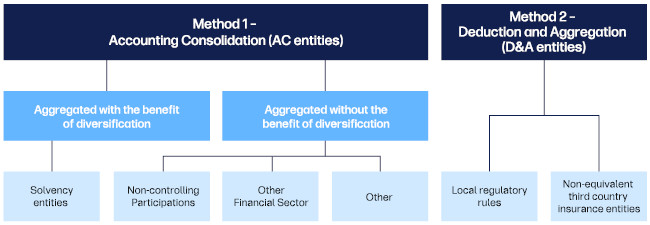
Aegon calculates its Group Solvency ratio using the combination of two methods: 1. Accounting Consolidation or Method 1; and 2. Deduction and Aggregation or Method 2. Method 1 is the default method for calculating Aegon Group’s Solvency ratio and method 2 is used in specific cases.
The entities aggregated by using the AC method are referred to as ‘AC entities’. Aegon includes Solvency II entities, Other Financial Sector (OFS) entities and Other entities in Aegon’s Group Solvency ratio calculation by applying the AC method. ‘Solvency II entities’ include European Economic Area (EEA) (re)insurance entities as well as ancillary service undertakings, mixed financial holding entities and insurance holding entities. The EEA insurance entities of Aegon are domiciled in the Spain & Portugal. Aegon’s UK insurance subsidiaries continue to be included as ‘AC entities’. Aegon Ltd.’s stake in a.s.r. is also included as ‘AC entities’.
Following the end of the Brexit transition period on December 31, 2020, UK and EU prudential regulations for insurers are distinct and UK insurers are no longer directly subject to regulation under the EU’s Solvency II. Aegon’s UK insurance subsidiaries have been incorporated into the Aegon’s Solvency calculation in accordance with Solvency UK standards, including Aegon UK’s approved Partial Internal Capital Model.
Aegon aggregates Non-EEA and Non-UK (re)insurance entities, also referred to as ‘D&A entities’ on a D&A basis. The aggregation of D&A entities is performed at the level of the top regulated entity. The value and the required capital of these entities is based on local Solvency requirements where those insurance entities are domiciled in third countries deemed to be equivalent or provisionally equivalent. The US life insurance entities are the most material entities for which D&A is applied. Based on proportionality Aegon also includes certain (re)insurance entities domiciled in non-equivalent third countries through the D&A method.
Aegon Group’s Own Funds are calculated net of material intra-group transactions.
| 51 | Aegon Financial Condition Report 2025 |
|
|
||
| Capital management Eligible Capital | ||
Accounting consolidation method
The following applies in regard to the consolidation of Own Funds and Solvency Capital Requirement using the AC method:
| ● |
Aggregation of Solvency II entities: |
| ○ |
The assets and liabilities of all entities for which full consolidation applies are consolidated on a line-by-line basis into Aegon’s Group balance sheet. The majority of Aegon’s European legal entities are reported in this category. The most significant legal entity is domiciled in the United Kingdom. Joint ventures are proportionally included based on Aegon’s share of ownership. The calculation of the related capital requirement can be either on a Solvency Partial Internal Capital Model basis or on a standard formula basis (please see section E.3.5 for more details on the difference between standard formula and Aegon’s partial internal capital model used); |
| ○ |
The benefit of diversification of capital requirements between these entities is included in this aggregation. |
| ● |
Aggregation of non-controlling entities, Other Financial Sector entities, the stake in a.s.r. and other entities: |
| ○ |
For non-controlling entities, the proportional value of the participation is included in the consolidated data. This value is calculated in accordance with the adjusted equity method; |
| ○ |
For Other Financial Sector entities (for example Asset Management), the proportional share of Own Funds and capital requirements according to relevant sectorial rules is included into the Group Solvency calculation; |
| ○ |
For the 24.12% stake in a.s.r. as of December 31, 2025 |
| ◾ |
24.12% of the Excess of Assets over Liabilities of a.s.r. (corrected for own shares and minority interests) is added to the Group Available Own Funds; |
| ◾ |
24.12% of the net SCR of a.s.r. is added to the Group net SCR; and |
| ○ |
For Other entities, the value of participations is included in the consolidated data. Preferably the market value is used, but alternatively the adjusted equity method is used; |
| ○ |
The benefit of diversification of capital requirements between these entities is not included in this aggregation. |
Deduction and Aggregation method
For consolidation of Own Funds and Solvency Capital Requirement using the D&A method (method 2), the proportional share of Own Funds according to local regulatory rules is included in the Group Own Funds. Diversification of capital requirements is not allowed between Accounting Consolidation and Deduction & Aggregation methods.
E.1.1 A description of the capital management policy and process to determine capital needs for business planning, how capital is managed and any material changes during the reporting period
Management capital
The management of capital and liquidity is of vital importance for Aegon Group, for its customers, investors in Aegon securities and for Aegon’s other stakeholders. In line with its risk tolerance, the goal of Aegon’s capital and liquidity management is to promote strong and stable capital adequacy levels for its businesses, in addition to maintaining adequate liquidity to ensure that the Company is able to meet its obligations.
Aegon follows a number of guiding principles in terms of capital and liquidity management:
| ● |
Promoting strong capital adequacy in Aegon’s businesses and operating units; |
| ● |
Managing and allocating capital efficiently in support of the strategy and in line with its risk tolerance; |
| ● |
Maintaining an efficient capital structure, with an emphasis on optimizing Aegon’s cost of capital; |
| ● |
Maintaining adequate liquidity in both the operating units and the Holding to ensure that the Company is able to meet its obligations by enforcing stringent liquidity risk policies; and |
| ● |
Maintaining continued access to international capital markets on competitive terms. |
Aegon believes that the combination of these guiding principles strengthens the Company’s ability to withstand adverse market conditions, enhances its financial flexibility, and serves both the short-term and the long-term interests of the Company, its customers and other stakeholders.
The management and monitoring of capital and liquidity is firmly embedded in Aegon’s Enterprise Risk Management framework.
| 52 | Aegon Financial Condition Report 2025 |
Capital management Eligible Capital
Material development throughout 2025
| Capital | ||||||||
| Amounts in EUR millions |
2025 | 2024 | ||||||
| Eligible Own Funds |
11,901 | 14,030 | ||||||
| SCR |
6,464 | 7,466 | ||||||
| Solvency ratio |
184% | 188% | ||||||
Aegon Group Eligible Own Funds amounted to EUR 11,901 million on December 31, 2025 (2024: EUR 14,030 million). The decrease of EUR 2,129 million is mainly driven by negative impacts from the SGUL reinsurance transaction in the US, shareholder returns including the 2025 interim dividend of 19 cents per share, the foreseeable 2025 final dividend of 21 cents per share, the two share buy backs of EUR 200 million completed in 2H 2025 and the announced EUR 227 million share buyback program for 1H 2026. This negative impact is partly offset by the positive impact from operating capital generation and the sale of 12.5 million a.s.r. shares.
Aegon’s Group SCR amounted to EUR 6,464 million on December 31, 2025 (2024: EUR 7,466 million). The decrease of EUR 1,002 million was mainly driven by a reduced a.s.r. stake and market impacts.
As a result of the above changes in Eligible Own Funds and PICM SCR, the Group Solvency ratio decreased by 4%-points to 184% in 2025.
Capital adequacy of Aegon’s operating units
Aegon manages capital in its operating units at levels sufficient to absorb moderate shocks without impacting the remittances to the Group. These moderate shocks could be caused by various factors, including general economic conditions, financial markets risks, underwriting risks, changes in government regulations, and legal and arbitration proceedings. To mitigate the impact of such factors on the ability of operating units to pay remittances to the Group, Aegon established an operating level of capital in each of the units: 400% Risk-Based Capital (RBC) Company Action Level (CAL) in the US and 150% Solvency Capital Requirement (SCR) in the UK; based on Solvency UK. Aegon manages capital in the units to their respective operating levels over-the-cycle.
After investments have been made in new business to generate organic growth, capital generated by Aegon’s operating units is available for distribution to the holding company. In addition to an operating level, Aegon established a minimum dividend payment level of capital in each of the units: 350% RBC CAL in the US and 135% SCR for Solvency units including UK. As long as the capital position of the unit is above this minimum dividend payment level, the unit is expected to pay remittances to the Group.
When the operating unit’s capital position approaches the minimum dividend payment level, capital management tools are used to ensure that units will remain well capitalized. The frequent monitoring of actual and forecasted capitalization levels of its operating units is an important element in Aegon’s capital framework in order to actively maintain adequate capitalization levels.
The regulatory capital requirement, minimum dividend payment level, operating level, and actual capitalization for Aegon’s main operating units at December 31, 2025, are included in the following table:
| Capital requirements | ||||||||||||||||
| Regulatory capital requirement |
Minimum dividend payment level |
Operating level | Actual capitalization | |||||||||||||
| US RBC ratio |
100 | % | 350 | % | 400 | % | 424 | % | ||||||||
| Scottish Equitable Plc Solvency UK ratio |
100 | % | 135 | % | 150 | % | 183 | % | ||||||||
United States (Transamerica)
The estimated RBC ratio in the United States decreased from 443% on December 31, 2024, to 424% on December 31, 2025, and remained above the operating level of 400%. The reduction was driven by adverse market impacts, restructuring costs, adverse actuarial assumption updates, and the Secondary Guarantee Universal Life (SGUL) reinsurance transaction. The negative impact of the SGUL reinsurance transaction was offset by a capital investment from the group.
| 53 | Aegon Financial Condition Report 2025 |
|
|
||
| Capital management Eligible Capital | ||
Scottish Equitable Plc (SE Plc)
The Solvency II ratio for Scottish Equitable Plc decreased from 186% on December 31, 2024, to 183% on December 31, 2025, and remained above the operating level of 150%. The capital ratio remained stable over the year, where operating capital generation almost offsets the negative impacts from one-time items and remittances.
Improving risk-return profile
Aegon has an active global reinsurance program designed to optimize the risk-return profile of insurance risks. In addition, Aegon monitors the risk-return profile of new business written, withdrawing products that do not create value for its stakeholders.
Aegon continues to take measures to improve its risk-return profile. Particularly in the United States, several actions were taken to strengthen the capital position and reduce the volatility of the local capital positions.
Management actions US
As announced during the June 2023 Capital Markets Day, Transamerica aims to improve the quantum and quality of its capital generation, while reducing its exposure to Financial Assets. During 2025, Transamerica has made good progress in implementing its plans.
During 2025 the following management actions related to the Financial Asset portfolio were executed:
| ● |
Actuarially justified rate increases in Long-Term Care with a total value of approvals achieved since the beginning of 2023 amounts to USD 871 million, which is 124% of the USD 700 million target set at the 2023 CMD. |
| ● |
Transamerica expanded its dynamic hedge program for Variable Annuities to further reduce its equity market exposure. Previously, the program hedged market risks from policy riders. The expansion now includes first order equity market exposure of 25% of the Variable Annuities base contracts held by Transamerica Life Insurance Company, Transamerica’s largest insurance carrier. This reduces the economic equity market sensitivity of the portfolio and further solidifies the run- off of the Variable Annuities portfolio. |
| ● |
Aegon decided to reinsure a block of Secondary Guarantee Universal Life (SGUL) contracts. The transaction covers 30% of the face value of Transamerica’s SGUL business, bringing the total value addressed to 80% of the total SGUL portfolio in combination with previously executed management actions. It decreases the total capital employed by USD 0.3 billion to USD 2.7 billion, well ahead of the targeted reduction in 2025. |
Cash Capital at Holding and liquidity management
Liquidity management is a fundamental building block of Aegon’s overall financial planning and capital allocation processes. Liquidity is managed both centrally and at the operating unit level and is coordinated centrally at Aegon Ltd.
The ability of the holding company to meet its cash obligations depends on the amount of liquid assets on its balance sheet and on the ability of the operating units to pay remittances to the holding company. In order to ensure the holding company’s ability to fulfill its cash obligations, to maintain sufficient flexibility to provide capital and liquidity support to Aegon’s operating units, and to provide stability in external dividends, the Company manages Cash Capital at Holding, including Aegon’s centrally managed (unregulated) holding companies, to an operating range of EUR 0.5 billion to EUR 1.5 billion.
The main sources of liquidity in Cash Capital at Holding are remittances from operating units, and divestitures. In addition, contingent internal and external liquidity programs are maintained to provide additional safeguards against extreme unexpected liquidity stresses.
Aegon uses the cash flows from its operating units to pay for holding expenses, including funding costs. The remaining free cash flow is available to execute the Company’s strategy, to strengthen the balance sheet through deleveraging or make capital injections into units as required, to make acquisitions, to fund dividends on its shares, and to return capital to shareholders if possible, all subject to maintaining targeted Cash Capital at Holding. Aegon aims to pay out a sustainable dividend to enable equity investors to share in its performance.
When determining whether to declare or propose a dividend, Aegon’s Board of Directors balances prudence with offering an attractive return to shareholders. This is particularly important during adverse economic and/or financial market conditions. Furthermore, Aegon’s operating units are subject to local insurance regulations that could restrict remittances to be paid to the holding company. There is no requirement or assurance that Aegon will declare and pay any dividends.
| 54 | Aegon Financial Condition Report 2025 |
Capital management Eligible Capital
Aegon’s Cash Capital at Holding decreased from EUR 1,725 million in 2024 to EUR 1,311 million in 2025. This decrease was largely due to EUR 1,106 million of capital returns to shareholders, consisting of the 2024 final dividend, the 2025 interim dividend and EUR 550 million of share buybacks. The proceeds from the sale of 12.5 million a.s.r. shares were offset by the capital injection in Transamerica to offset the impact of the SGUL reinsurance transaction. Free cash flow during 2025 amounted to EUR 829 million and included dividends from a.s.r. and Aegon’s participation in a share buyback program by a.s.r..
Liquidity management
The Company’s liquidity risk policy sets guidelines for its operating companies and the Holding in order to achieve a prudent liquidity profile and to meet cash demands under extreme conditions. Aegon’s liquidity is invested in accordance with the Company’s internal risk management policies. Aegon believes that its Cash Capital at Holding, backed by its external funding programs and facilities, is ample for the Company’s present requirements.
Aegon maintains a liquidity policy that requires all business units to project and assess their sources and uses of liquidity over a two-year period under normal and severe business and market scenarios. This policy ensures that liquidity is measured and managed consistently across the Company, and that liquidity stress management plans are in place.
Aegon’s operating units are engaged in life insurance and pensions business, which are long-term activities with relatively illiquid liabilities and generally matching assets. Liquidity consists of liquid assets held in investment portfolios, in addition to inflows generated by maturing assets, coupons and premium payments, and customer deposits.
Leverage
Aegon uses leverage to lower the cost of capital that supports businesses in the Company, thereby contributing to a more effective and efficient use of capital. In managing the use of leverage throughout the Company, Aegon has implemented a Leverage Use Framework as part of its broader ERM framework.
Financial leverage
Aegon defines gross financial leverage as debt or debt-like funding issued for general corporate purposes and for capitalizing Aegon’s business units. Gross financial leverage includes hybrid instruments, and subordinated and senior debt.
Gross financial leverage decreased from EUR 5.2 billion in 2024 to EUR 4.9 billion in 2025. This decrease was driven by the weakening of the US dollar against the euro.
The following are metrics that Aegon assesses in managing leverage:
| ● |
Gross financial leverage ratio; |
| ● |
Fixed charge coverage; |
| ● |
Various rating agency leverage metrics; and |
| ● |
Other metrics, including gross financial leverage divided by operating capital generation1 |
Aegon’s gross financial leverage ratio is calculated by dividing gross financial leverage by total capitalization. Aegon’s total capitalization consists of the following components:
| ● |
Shareholders’ equity based on IFRS as adopted by the EU; |
| ● |
Non-controlling interests and shares related to long-term incentive plans that have not yet vested; |
| ● |
Contractual service margin, excluding joint-ventures and associates, net of tax; and |
| ● |
Gross (or total) financial leverage. |
Aegon’s fixed charge coverage is a measure of the Company’s ability to service its financial leverage. It is calculated as the sum of operating result and interest expenses on financial leverage divided by interest payments on financial leverage. The fixed charge coverage includes the impact of interest rate hedging.
E.1.2 A description of the eligible capital of the insurance Group categorised by Tiers in accordance with the eligible capital rules
Restrictions apply to the eligibility of Restricted Tier 1 Own Funds, Tier 2 Own Funds and Tier 3 Own Funds. Restricted Tier 1 Own Funds may not exceed 20% of total Tier 1 Own Funds and Tier 2 Own Funds cannot exceed 50% of the SCR. In addition, the total of Tier 2 Own Funds and Tier 3 Own Funds may not exceed 50% of the SCR, while the eligibility of Tier 3 Own Funds is limited to 15% of the SCR. The tiering of Aegon Group’s 2025 Own Funds, compared with 2024 is shown below:
| 1 | Capital generation adjusted for market impacts and one-time items |
| 55 | Aegon Financial Condition Report 2025 |
|
|
||
| Capital management Eligible Capital | ||
| Eligible Capital | ||||||||
| Amounts in EUR millions |
2025 | 2024 | ||||||
| Unrestricted Tier 1 |
8,134 | 9,997 | ||||||
| Restricted Tier 1 |
1,754 | 1,905 | ||||||
| Tier 2 |
1,533 | 1,570 | ||||||
| Tier 3 |
480 | 557 | ||||||
| Total Eligible Own Funds |
11,901 | 14,030 | ||||||
Own funds are split into Tiers as outlined in the table below:
| Tier 1 | Tier 2 | Tier 3 | ||
| Unrestricted Tier 1 ● Equity (Share capital and share premium). ● Reconciliation Reserve
Restricted Tier 1 ● Perpetual subordinated capital instruments with loss absorption.
|
● Dated or perpetual subordinated capital instruments. ○ With an original maturity of at least 10 years. ○ Limited loss absorption. ○ With suspension of payments and deferral of interest. |
● Dated or perpetual subordinated capital instruments. ○ With an original maturity of at least 5 years. ○ Limited loss absorption. ○ With suspension of payments and deferral of interest. ● Net deferred tax assets. | ||
E.1.3 A description of the eligible capital insurance group categorised by Tiers, in accordance with the eligible capital rules used to meet the SCR and the MCR
Like for the SCR, as described in E.1.2 above, restrictions apply for the capital to meet the Minimum Consolidated Group SCR (MCR). Tier 1 Own Funds should not be below 80% of the MCR, Tier 2 Own Funds should not exceed 20% of the MCR and Tier 3 Own Funds are not eligible. Restricted Tier 1 Own Funds should also not exceed 20% of the total Tier 1 Own Funds.
| Eligible Capital | 2025 | 2024 | ||||||||||||||
| Amounts in EUR millions | SCR | MCR | SCR | MCR | ||||||||||||
| Unrestricted Tier 1 |
8,134 | 3,235 | 9,997 | 4,095 | ||||||||||||
| Restricted Tier 1 |
1,754 | 809 | 1,905 | 924 | ||||||||||||
| Tier 2 |
1,533 | 138 | 1,570 | 146 | ||||||||||||
| Tier 3 |
480 | 0 | 557 | - | ||||||||||||
| Total Eligible Own Funds |
11,901 | 4,183 | 14,030 | 5,165 | ||||||||||||
E.1.4 Confirmation that insurance Group’s eligible capital is subject to transitional arrangements as required under the eligible capital rules
The remaining grandfathered securities now consist entirely of Aegon’s junior perpetual capital securities and perpetual cumulative subordinated bonds, which are grandfathered as restricted Tier 1 for up to 10 years as of January 1, 2016.
In May 2025, the BMA concluded its review of the eligibility of Aegon’s capital instruments under the Bermuda solvency framework.
| ● |
Aegon’s Solvency II compliant instruments will continue to be eligible under the Bermuda solvency framework in the corresponding tier to Solvency II, and without any limitations. |
| ● |
The Junior Perpetual Capital Securities (JPCS), which are currently treated as Restricted Tier 1 until January 1, 2026, will now be eligible as Tier 2 Ancillary Capital following that date, and until the end of 2029. Subject to a review in 2029, eligibility may be extended. |
| ● |
The Perpetual Cumulative Subordinated Bonds (PCSB), which are currently also treated as Restricted Tier 1, will lose eligibility as of January 1, 2026. On a pro-forma basis taking into account the upcoming end of the eligibility for the PCSB, Aegon’s group solvency ratio would have been 7%-points lower compared with the group solvency ratio of 184% on December 31, 2025. |
Aegon’s debt structure and funding decisions remain driven by economic considerations, while also taking into account market circumstances, regulatory requirements, and rating agency considerations
| 56 | Aegon Financial Condition Report 2025 |
Capital management Eligible Capital
E.1.5 Identification of any factors of the insurance Group affecting encumbrances availability and transferability of capital to meet the SCR
Any surplus related to the UK With-Profit Sub-Fund of Scottish Equitable plc is restricted, as these funds are not available to the Group but are a benefit for the policyholders. There is also a fungibility restriction on the own funds related to the charitable trusts in the Americas as the local Supervisory Authority could limit the upstream to the Group, and therefore is excluded from the Group Own Funds.
Since 4Q 2024 the ATHTF (China insurance joint venture) contribution to Group solvency is capped at 100% of its core SCR ratio. This is driven by fungibility considerations in the context of low China interest rates.
E.1.6 Identification of ancillary capital instruments that have been approved by the authority
The year-end 2025 Solvency position of Aegon Group did not include any ancillary Own Funds as defined in Article 89(1) of Directive 2009/138/EC.
E.1.7 Identification of differences in shareholder’s equity as stated in the financial statement versus available statutory capital and surplus
| Reconciliation shareholders’ equity - own funds | ||||||||
| Amounts in EUR million |
December 31, 2025 | December 31, 2024 | ||||||
| IFRS Shareholders’ equity |
7,432 | 7,215 | ||||||
| IFRS adjustments for other equity instruments and non-controlling interest |
2,063 | 2,098 | ||||||
| IFRS Group equity |
9,495 | 9,313 | ||||||
| Solvency II revaluations and reclassifications |
2,190 | 4,474 | ||||||
| Transferibility restrictions |
(1,462 | ) | (1,754 | ) | ||||
| Excess of Assets over Liabilities |
10,224 | 12,033 | ||||||
| Adjustments for restricted Own Funds |
(277 | ) | (258 | ) | ||||
| Subordinated liabilities in Own Funds |
3,287 | 3,476 | ||||||
| Foreseeable dividends |
(545 | ) | (453 | ) | ||||
| Treasury shares |
(447 | ) | (398 | ) | ||||
| Availability adjustments |
2,019 | 2,367 | ||||||
| Fungibility adjustments |
(93 | ) | (105 | ) | ||||
| Available Own Funds |
12,149 | 14,295 | ||||||
The revaluations and reclassification of EUR 2,190 million positive (2024: EUR 4,474 million positive) stem from the difference in valuation and presentation between EU-IFRS and Solvency frameworks.
Revaluations can be grouped into four categories:
| ● |
Items that are not recognized under Solvency. The most relevant examples of this category for Aegon include Goodwill, Deferred Acquisition Costs (DAC) and other intangible assets; |
| ● |
Items that have a different valuation treatment between EU-IFRS and Solvency; |
| ● |
The Net Asset Value of subsidiaries that are included under the D&A method in the Group Solvency results; |
| ● |
Reclassification of capital instruments from Equity under EU-IFRS to subordinated liabilities on the Solvency balance sheet. |
The transferability restrictions reflect the restrictions on Tier 1 unrestricted Own Funds as a consequence of the RBC CAL conversion methodology, as described above.
The availability adjustments are changes to the availability of Own Funds of Aegon Group in accordance with Solvency II requirements. Examples include the adjustments for subordinated liabilities, ring-fenced funds, treasury shares and foreseeable dividend.
Finally, the fungibility restrictions limit the availability of Own Funds on Aegon Group level as prescribed by the Supervisory Authorities. These limitations refer to charitable trusts in the Americas for which the local Supervisory Authority could limit the upstream of capital to the Group and therefore are excluded for Group Solvency purposes.
| 57 | Aegon Financial Condition Report 2025 |
|
|
||
| Capital management Regulatory capital requirements | ||
E.2 Regulatory capital requirements
E.2.1 Identification of the amount of the insurance Group SCR and MCR at the end of the reporting period
| Group SCR and MCR | ||||||||
| Amounts in EUR millions |
2025 | 2024 | ||||||
| Solvency Capital Requirement (SCR) |
6,464 | 7,466 | ||||||
| Minimum Consolidated Group SCR (MCR) |
692 | 730 | ||||||
Aegon’s Group Partial Internal Capital Model SCR amounted to EUR 6,464 million on December 31, 2025 (2024: EUR 7,466 million), a decrease of EUR 1,002 million. The decrease of EUR 1,002 million was mainly driven by a reduced a.s.r. stake and market impacts. A more detailed split of the Group SCR can be found in section C.
Minimum Consolidated Group SCR (MCR)
The Minimum Consolidated Group SCR for Aegon Ltd. is calculated as the simple sum of MCRs of the participating insurance or reinsurance undertaking and the proportional shares of MCRs of related insurance and reinsurance undertakings.
At year-end 2025, the Group MCR amounted to EUR 692 million (2024: EUR 730 million) and is mainly driven by Aegon UK.
Insurance laws and regulations in local regulatory jurisdictions often contain minimum regulatory capital requirements. Bermuda and the BMA, as group supervisor and local entity supervisor of Bermuda subsidiaries, defined a minimum solvency margin. For insurance companies in the European Union and the UK also, minimum capital requirement is defined, being the Minimum Capital Requirement. An irreparable breach of the minimum regulatory capital requirements would lead to a withdrawal of the Company’s insurance license. Similarly, for the US insurance entities the withdrawal of the insurance license is triggered by a breach of the 100% Authorized Control Level (ACL), which is set at 50% of the Company Action Level (CAL).
Aegon views the higher capital requirement, 120% of the SCR for the Group or 100% of local entity Solvency requirement as the level around which supervisors will formally require management to provide regulatory recovery plans.
During 2025, the Aegon Group and the regulated entities within the Aegon Group that are subject to regulatory capital requirements on a solo-level continued to comply with the solvency requirements.
E.2.2 Identification of any non-compliance by the insurance Group with the MCR and the SCR
During 2025 there were no instances in which the estimated Aegon Group Solvency ratio was below the MCR or the SCR. The regulated entities within the Aegon Group that are subject to regulatory capital requirements on a solo level also continued to comply with such requirements.
E.2.3 A description of the amount and circumstances surrounding the insurance Group’s the non- compliance at the end of the reporting period
Not applicable (see E.2.2).
E.2.4 Where the non-compliance has not been resolved, a description of the amount of the non- compliance at the end of the reporting period
Not applicable (see E.2.2).
| 58 | Aegon Financial Condition Report 2025 |
Capital management Approved internal capital model used to derive the SCR
E.3 Approved internal capital model used to derive the SCR
E.3.1 A description of the purpose and scope of the business and risk areas where the Group SCR model is used
Aegon uses a Solvency PICM to calculate the solvency position of the Holding Company (Aegon Ltd.) and the UK Insurance Company (Scottish Equitable Ltd). For Aegon, a PICM is a better representation of the actual risk since this contains Aegon specific modelling and sensitivities as opposed to industry-wide approximations included in the Standard Formula methodology. The purpose of the internal model is to better reflect the actual risk profile of Aegon in the SCR. The most material risk types for Aegon are therefore covered by the internal model as part of the Solvency PICM, and less material risk types and business units are covered by the standard formula as part of the Solvency PICM. The table below represents the structure of the internal model:
| Structure of the internal model |
Application1 2 | |||||||
| Risk class | Risk module | Risk type | Aegon UK | Aegon Ltd | ||||
| Mismatch risk | Market risk | Interest rate | IM | IM | ||||
| Interest rate volatility | IM | IM | ||||||
| Currency | IM | IM | ||||||
| Investment & Counterpary risk | Fixed income | IM & SF | IM & SF | |||||
| Equity level | IM | n/a | ||||||
| Equity volatility | IM | n/a | ||||||
| Alternative investment | SF | n/a | ||||||
| Counterparty default risk | Counterparty | SF | SF | |||||
| Underwriting risk | Life underwriting Risk | Mortality Contagion | SF | n/a | ||||
| Mortality Parameter | IM | n/a | ||||||
| Longevity Parameter | IM | n/a | ||||||
| Disability/morbidity | SF | n/a | ||||||
| Persistency | IM | n/a | ||||||
| Expense risk | IM | n/a | ||||||
| Health underwriting Risk | Health | SF | n/a | |||||
| Persistency | n/a | n/a | ||||||
| Expense risk | n/a | n/a | ||||||
| Non-life underwriting risk | P&C | n/a | n/a | |||||
| Persistency | n/a | n/a | ||||||
| Expense risk | n/a | n/a | ||||||
| Operational risk | Operational risk | Operational | IM | n/a | ||||
| Diversification | Aggregation | IM | IM | |||||
| PICM - Integration | Integration technique 3 | Integration technique 3 | ||||||
| 1 | The table only reflects the application of Solvency PICM methodology for the legal entities with approved internal models within each country unit. |
| 2 | In the table above, IM & SF refers to SF shocks used in combination with IM shocks to determine the total component risk. |
All risk types that are not covered by the internal model are covered under the standard formula component of the Solvency PICM. The risk measure used in all components of the Solvency PICM is the 99.5% value at risk applied over a one-year time horizon.
E.3.2 Where a Partial Internal Capital Model is used, a description of how it is integrated with the Group SCR model
The standard formula SCRs and internal model SCRs are combined to calculate the Solvency PICM SCR using Integration Technique 3 (IT3) as listed in annex XVIII.D of Commission Delegated Regulation (EU) 2015/35 (Delegated Acts).
E.3.3 A description of methods used in the Group SCR model to calculate the SCR
Aegon applies a combination of the Group consolidation methods available under Solvency II, being the Accounting Consolidation and Deduction & Aggregation methods. Solvency II capital requirements are mainly used for the EEA and UK- based insurance and reinsurance entities, applying the Accounting Consolidation method. Local requirements are used for insurance and reinsurance entities in (provisionally) equivalent third-country jurisdictions (mainly US life insurance companies).
| 59 | Aegon Financial Condition Report 2025 |
|
|
||
| Capital management Approved internal capital model used to derive the SCR | ||
E.3.4 A description of aggregation methodologies and diversification effects
Under Solvency PICM, Aegon calculates the diversification benefit across country units and risk types. Within the standard formula components, diversification is determined following the prescribed Standard Formula correlation matrices.
Within the internal model, a marginal probability distribution function is fitted for every risk factor by making use of historical data and expert judgement. The overall joint probability distribution function of all the risk factors combined takes into account the dependency structure between the risks. The loss from 2 million scenarios simulating the samples from this joint distribution are used to fit an overall empirical loss distribution function. Aegon takes the 99.5% point of that loss distribution function, which is considered the 1-in-200 year loss event.
The scenarios are generated using a scenario generator and a dependency structure, defining the dependency (correlation) between risk drivers based on market data and expert judgment. Each scenario contains values for risk drivers such as interest rates, equity returns and mortality levels.
The total net SCR (after diversification) is determined by the 99.5%ile of the empirical loss distribution of Own Funds. Diversification benefit is defined as the difference between the sum of the standalone SCRs of the risk types and the total net SCR.
Diversification between the internal model and the standard formula components of the Solvency PICM are calculated using Integration Technique 3 (IT3).
E.3.5 A description of the main differences in the methods and assumptions used for the risk areas in the internal model versus the Group SCR model
The main differences between the methodologies and assumptions of the Solvency PICM and the Standard Formula are described by risk type below.
Market risk
On credit risk, the fixed income risk for bonds differs because Solvency PICM shocks are calibrated on the basis of the fixed income portfolio. In contrast to the standard formula, government bonds are shocked with a factor larger than zero.
Equity risk shocks are calibrated based on Aegon’s own portfolio. In addition, the equity exposures are also shocked for equity volatility risks.
For currency risk, the shocks are calibrated based on Aegon’s own portfolio. In addition, the Solvency PICM allows for diversification between exposures to different currencies, as opposed to no diversification between currency exposures in the Standard Formula.
The Solvency PICM results for interest rate risks differ from the standard formula results for the following reasons:
| ● |
The standard formula interest rate shock only considers a parallel shift in the interest rate curve, whereas the Solvency PICM considers not only a parallel shift, but also a flattening and twisting of the interest rate curve; |
| ● |
The Solvency PICM interest rate curve shocks are calibrated based on historical market data relevant for Aegon’s portfolio; |
| ● |
The Solvency PICM assumes that the Ultimate Forward Rate (UFR) does not change in a shock scenario, while the standard formula interest rate shock assumes that the whole curve moves, including the UFR; |
| ● |
In addition, the Solvency PICM includes a capital requirement for interest rate volatility risk; and |
| ● |
For Aegon UK, the interest rate risk under the Solvency PICM also includes an inflation shock on benefit payments and expenses, while the inflation shock on expenses is included in life expense risk under standard formula. |
Underwritting risk
The Solvency PICM for longevity risk differs from the standard formula as follows:
| ● |
The Solvency PICM distinguishes between a population mortality shock and an experience factor shock while the standard formula assumes a fixed decrease in all mortality rates; and |
| ● |
The Solvency PICM projects mortality rates by age and gender, while the Standard Formula assumes the same shock for all ages and both genders. |
Policyholder behavior (lapse) risk for Aegon UK under the Solvency PICM is the aggregate of a parameter and a contagion shock, while under standard formula it is the greater of a parameter and a contagion stress. Furthermore, the shocks are calibrated on the Aegon UK portfolio, resulting in a larger shock size than under the standard formula, which leads to a higher SCR before diversification.
| 60 | Aegon Financial Condition Report 2025 |
Capital management Approved internal capital model used to derive the SCR
The aggregate Solvency PICM expense risk shock for Aegon UK is higher than the standard formula stress as the Solvency PICM stress covers expense level, trend and volatility stress. This leads to a higher SCR before diversification.
Operational risk
For Aegon UK, the Solvency PICM for operational risk differs from the Standard Formula as follows:
| ● |
The Solvency PICM is based on the input of subject matter experts where workshops are used to generate possible scenarios supplemented by experience data. The data is then fitted into a stochastic model, while the standard formula is based on technical provisions, premiums and expenses; and |
| ● |
The Solvency PICM allows for diversification of operational risk with other risk types as opposed to the standard formula which does not allow for diversification of operational risk at all. |
Diversification
Diversification between the internal model and the standard formula components of the Solvency PICM are calculated using Integration Technique 3 (IT3). This EIOPA prescribed integration technique describes how an implied linear correlation coefficient between the internal model and standard formula components is calculated. This correlation coefficient is subsequently used to calculate the total Solvency PICM SCR using a square root formula. The Standard Formula makes use of correlation matrices to calculate the diversifications by risk module and on a total level.
E.3.6 A description of the nature and suitability of the data used in the Group SCR model
Aegon has implemented a group-wide Data Quality policy for the Solvency reporting processes, including a required data directory and a description of the criteria regarding data completeness, accuracy and appropriateness respectively. Data used in the internal model originates from internal as well as external sources, for example:
| ● |
Policy data detailing characteristics and coverage of individual insurance policies; |
| ● |
Data specifying the portfolio of assets, e.g. type of asset, amount, and maturity date; and |
| ● |
Data from external sources such as population mortality tables and prices of traded securities. |
The internal model design aims to make optimal use of all available data in the stages of model design and execution. An assessment of the appropriateness of data usage forms part of the annual overarching model validation process.
E.3.7 Any other material information
There is no other material information to report.
| 61 | Aegon Financial Condition Report 2025 |
|
|
||
| Subsequent events | ||
F.1 Description of subsequent events
Share buyback
On December 10, Aegon announced a new EUR 400 million share buyback program to be split evenly between the first and the second half of 2026. On January 12, 2026, Aegon announced that it started a EUR 227 million share buyback, which includes EUR 200 million of the EUR 400 million announced on December 10, 2025, and another EUR 27 million to meet Aegon’s obligations resulting from its share-based compensation plans for senior management.
Sale of Aegon UK
On April 15, 2026, Aegon announced the sale of Aegon UK to Standard Life marking the completion of the strategic review of Aegon UK announced at the 2025 Capital Markets Day. This transaction further supports Aegon in its ambition to become a leading US life insurance and retirement group.
The proceeds are valued at GBP 2.0 billion and consist of a shareholding of 15.3% (181.1 million shares) in Standard Life plc (Standard Life)1 and a cash amount of GBP 0.75 billion. Any remittances taken out of Aegon UK between the signing and closing of the transaction will be deducted from the GBP 0.75 billion cash amount. On a pro-forma 2025 basis, and prior to any deleveraging or share buyback initiatives, the transaction is expected to result in a 5%-point reduction in the Group Solvency ratio.
The transaction is expected to close around the end of 2026, subject to customary conditions, including regulatory approvals.
Perpetual Cumulative Subordinated Bonds
The Perpetual Cumulative Subordinated Bonds (PCSB), which in 2025 were treated as Restricted Tier 1, lost eligibility from January 1, 2026. On a pro-forma basis taking into account this ineligibility for the PCSB, Aegon’s group solvency ratio would have been 7%-points lower compared with the group solvency ratio of 184% on December 31, 2025.
F.2 Any other material information
There is no other material information to report.
| 1 | Value of 15.3% stake is based on the closing price of Standard Life’s shares on Tuesday April 14, 2026, and 181,080,690 shares to be received by Aegon upon closing of the transaction as per the agreement |
| 62 | Aegon Financial Condition Report 2025 |
Declaration
We, the Group Chief Executive Officer and Group Chief Risk Officer of Aegon Ltd., do hereby certify that to the best of our knowledge and beliefs, this Financial Condition Report fairly represents the financial condition of Aegon Ltd. in all material respects.
Signed: /s/ Lard Friese Title: Group Chief Executive Officer Date: May 19, 2026
Signed: /s/ Astrid Jäkel Title: Group Chief Risk Officer Date: May 19, 2026
| 63 | Aegon Financial Condition Report 2025 |
|
|
||
| Disclaimer | ||
Intended use of the Group FCR
The Group FCR is primarily prepared for prudential considerations, which includes informing policyholders and other beneficiaries of Aegon’s insurance products. While the document is made available to the public in general and may be of interest to stakeholders such as investors in Aegon shares and other financial instruments, it is not specifically aimed at them.
Non-audited information
Ernst & Young is the external auditor of Aegon Ltd. The external auditor’s mandate does not cover an audit on the information disclosed in this FCR.
For information on currency exchange rates and forward-looking statements please see pages 385 - 386 of Aegon’s 2025 Integrated Annual Report.
| 64 | Aegon Financial Condition Report 2025 |
Contact
Head office
Aegon Ltd.
Schiphol Boulevard 223
1118 BH Schiphol
The Netherlands
Telephone: +31 20 259 25 00
www.aegon.com
Investor relations
Telephone: +31 (0) 70 344 83 05
E-mail: ir@aegon.com
Media relations
Telephone: +31 (0) 70 344 89 56
E-mail: gcc@aegon.com
Agent for service in the United States of America
Andrew S. Williams
Telephone: +1 443 475 3243
E-mail: Andrew.S.Williams@transamerica.com
| 65 | Aegon Financial Condition Report 2025 |