
Portland General Electric EARNINGS CONFERENCE CALL FIRST QUARTER 2026 .2
Cautionary statement Information Current as of May 1, 2026 Except as expressly noted, the information in this presentation is current as of May 1, 2026 – the date on which Portland General Electric Company (PGE) filed its Quarterly Report on Form 10-Q for the quarter ended March 31, 2026 - and should not be relied upon as being current as of any subsequent date. PGE undertakes no duty to update this presentation, except as may be required by law. Forward-Looking Statements Statements in this presentation that relate to future plans, objectives, expectations, performance, events and the like may constitute "forward-looking statements" within the meaning of the Private Securities Litigation Reform Act of 1995, Section 27A of the Securities Act of 1933, as amended, and Section 21E of the Securities Exchange Act of 1934, as amended. Investors should not rely unduly on any forward-looking statements. Forward-looking statements include statements, other than statements of historical or current fact, regarding PGE’s earnings guidance (including all the assumptions and expectations upon which such guidance is based), PGE’s proposed purchase of electric utility operations and certain assets in Washington state from PacifiCorp (Acquisition), and PGE’s operating and financing plans, as well as other statements containing words such as "anticipates," "assumptions," "believes," "continue,” "could," "estimates," "expects," "expected," "forecast," "goals," "guidance,” "intends," “may,” "plans," "predicts," “proposed,” "seeks," "should," well-positioned to execute,” "will," “working to,” or similar expressions. Forward-looking statements are inherently subject to risks and uncertainties, some of which cannot be predicted or quantified, which could cause future events and actual results to differ materially from those set forth in, contemplated by, or underlying the forward-looking statements. Such risks, uncertainties and other factors include, without limitation: wildfire and public safety risks, including ignitions caused by PGE assets, the effectiveness of wildfire mitigation, vegetation management, and system hardening, the ability to implement public safety power shutoffs (PSPS), related liability exposure, and the timing and extent of regulatory cost recovery; severe weather, climate, and catastrophe risks, including extreme or unseasonable weather and other natural or human caused disasters that could endanger public safety, disrupt operations, damage assets, limit access to power or fuel supplies, increase costs, or adversely affect cost recovery; electric system operational risks, including forced outages, fires, equipment failures, adverse hydro or wind conditions, fuel supply disruptions, and complications at jointly owned facilities, resulting in increased costs or the need to procure replacement power; power and fuel supply and price risks, including availability, counterparty nonperformance, and volatility in wholesale electricity, natural gas, coal, and other fuel markets; regulatory, legislative, and policy risks, including new or revised laws, regulations, executive actions, audits, investigations, and proceedings that could affect rates, cost recovery, operations, capital plans, or financial results; Acquisition risks, including risks related to regulatory approvals, financing and joint‑venture arrangements, integration and operational execution, cost recovery, and the possibility that the anticipated benefits of the Acquisition are delayed, not realized, or cost more than expected; environmental compliance and permitting risks, including evolving environmental laws and permitting requirements and site specific remediation obligations, such as Superfund liabilities, where uncertainties regarding remediation scope, cost allocation, litigation, and regulatory cost recovery could result in material costs or adversely affect PGE’s financial position, results of operations, or cash flows; capital investment and execution risks, including supply chain disruptions, cost inflation, labor constraints, permitting delays, contractual disputes, counterparty failures, or project abandonment, which could impair timely completion or cost recovery; load growth and demand uncertainty, including accelerated or uneven growth from large customers such as data centers, changes in customer usage patterns requiring substantial capital investment, variability in demand driven by weather variations, and reduced consumption or load shifting resulting from energy efficiency measures or other changes in customer behavior; customer choice and market structure risks, including reduced demand or usage shifts due to distributed generation or increased procurement from alternative providers, such as registered Electricity Service Suppliers (ESSs) or community choice aggregation programs; cybersecurity and physical security risks, including cyberattacks, data breaches, physical attacks, or other malicious acts that could damage assets, disrupt systems, or result in the disclosure of sensitive information; geopolitical and macroeconomic risks, including acts of war, terrorism, or civil unrest—such as the war involving the United States and Iran—that could disrupt energy markets or supply chains, increase costs, or contribute to volatility in capital markets, inflation, or interest rates; economic and financial market risks, including availability and cost of capital, interest rate and equity market volatility, inflation, and trade tariffs affecting operating or capital costs; legal and litigation risks, including the timing and outcome of judicial, administrative, or regulatory proceedings, which may result in material liabilities or costs; workforce and labor risks, including the ability to attract and retain skilled employees, transitions in senior management, and potential labor disputes or work stoppages; resource procurement and All-Source Request for Proposals (RFP) project risks, including uncertainties related to the availability, cost, permitting, financing, and performance of resources selected through RFP processes and associated regulatory and counterparty risks; insurance availability and cost, particularly for wildfire or catastrophe related coverage; accounting, tax, and policy changes, including changes in accounting standards, tax laws, or regulatory accounting policies that could affect reported results or cash flows; and the other risks and uncertainties set forth in PGE’s Annual Report on Form 10‑K for the year ended December 31, 2025, as filed with the SEC.

Today’s presenters Maria Pope, President and CEO Joe Trpik, Senior Vice President of Finance and CFO
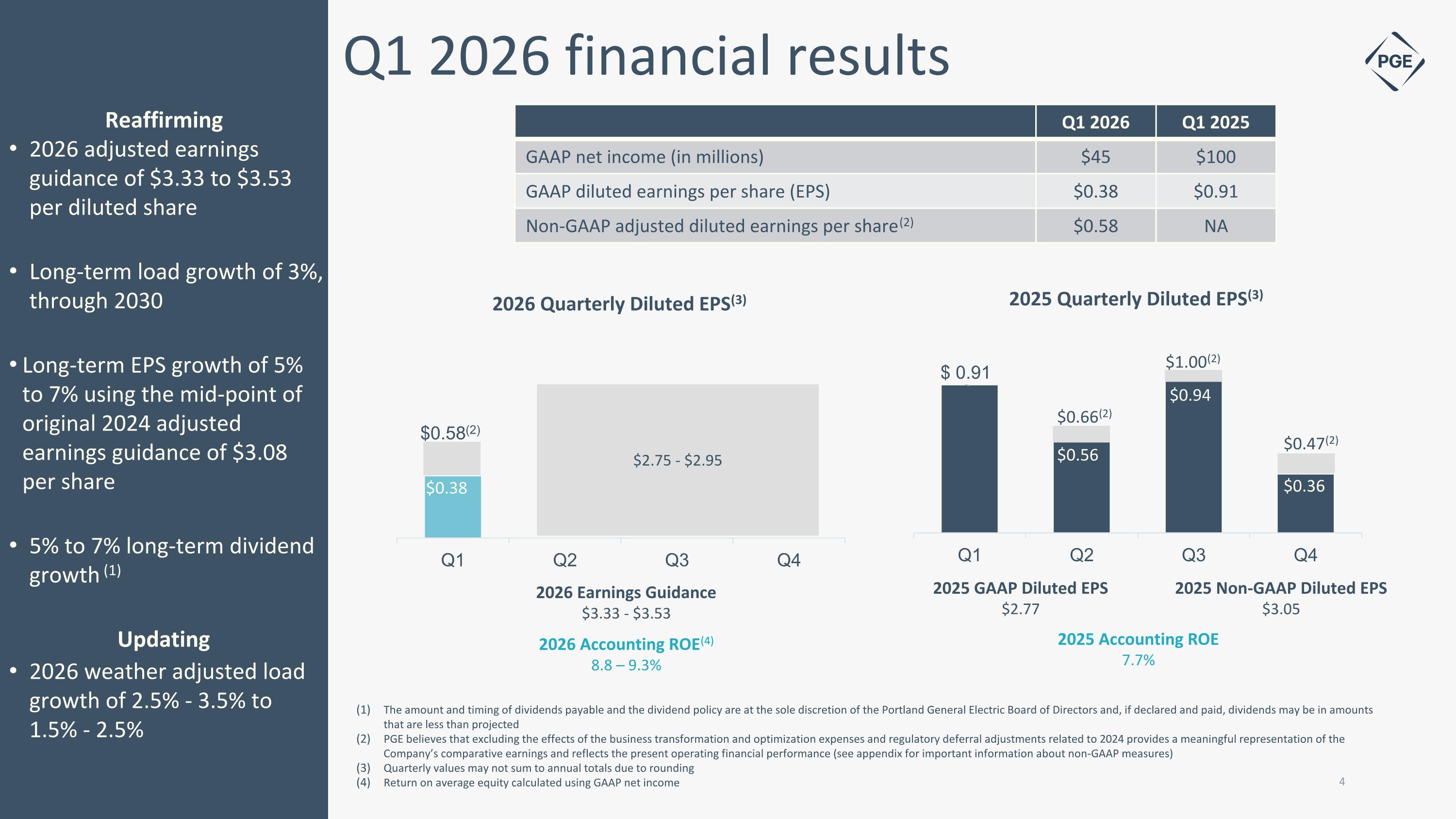
2026 Accounting ROE(4) 8.8 – 9.3% $0.38 $2.75 - $2.95 2026 Earnings Guidance $3.33 - $3.53 Q1 2026 Q1 2025 GAAP net income (in millions) $45 $100 GAAP diluted earnings per share (EPS) $0.38 $0.91 Non-GAAP adjusted diluted earnings per share(2) $0.58 NA The amount and timing of dividends payable and the dividend policy are at the sole discretion of the Portland General Electric Board of Directors and, if declared and paid, dividends may be in amounts that are less than projected PGE believes that excluding the effects of the business transformation and optimization expenses and regulatory deferral adjustments related to 2024 provides a meaningful representation of the Company’s comparative earnings and reflects the present operating financial performance (see appendix for important information about non-GAAP measures) Quarterly values may not sum to annual totals due to rounding Return on average equity calculated using GAAP net income Q1 2026 financial results Reaffirming 2026 adjusted earnings guidance of $3.33 to $3.53 per diluted share Long-term load growth of 3%, through 2030 Long-term EPS growth of 5% to 7% using the mid-point of original 2024 adjusted earnings guidance of $3.08 per share 5% to 7% long-term dividend growth (1) Updating 2026 weather adjusted load growth of 2.5% - 3.5% to 1.5% - 2.5% $1.00(2) 2025 Accounting ROE 7.7% $0.56 $0.66(2) $0.94 $0.47(2) $0.36 2025 GAAP Diluted EPS $2.77 2025 Non-GAAP Diluted EPS $3.05
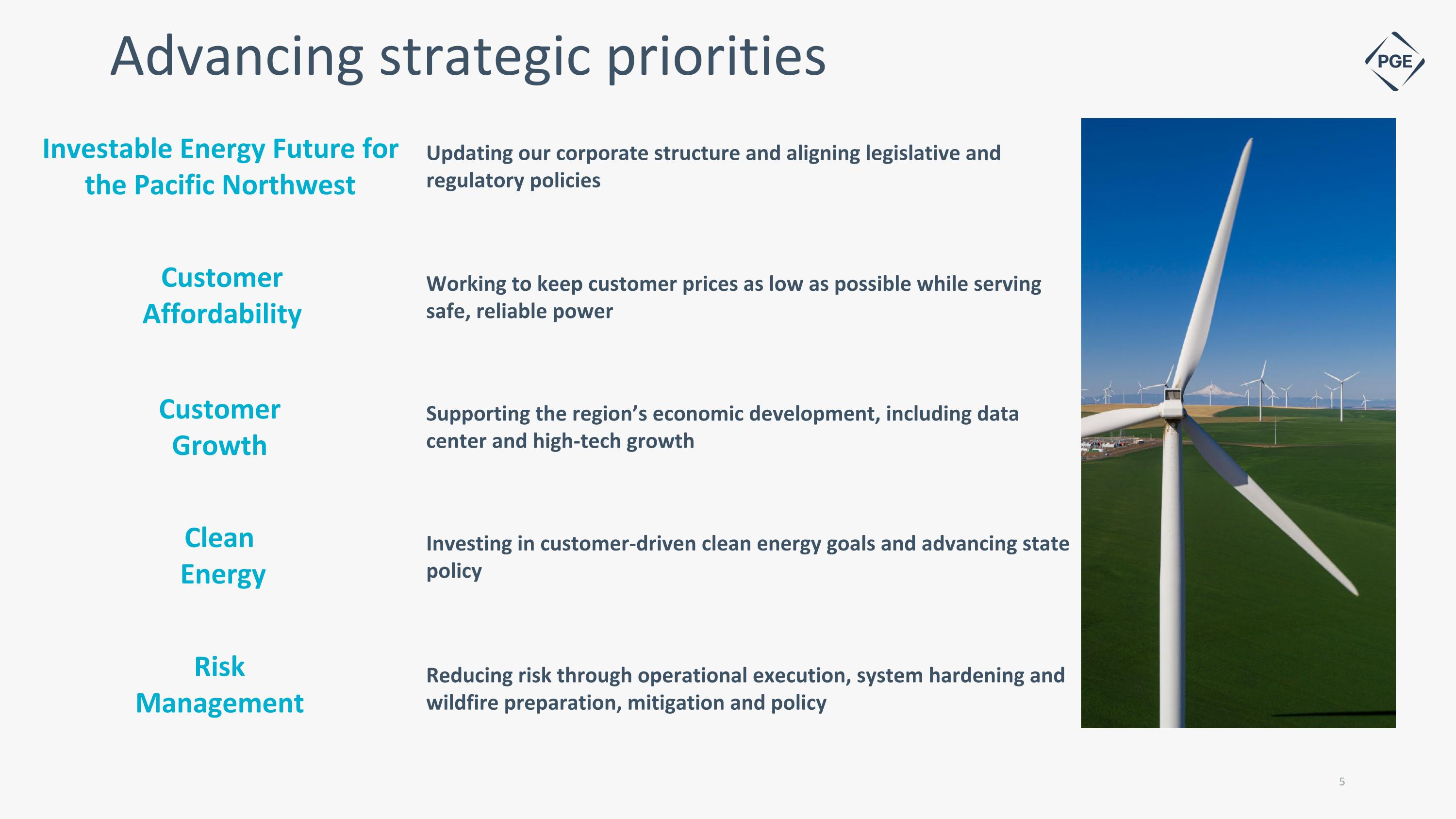
Advancing strategic priorities Investable Energy Future for the Pacific Northwest Updating our corporate structure and aligning legislative and regulatory policies Customer Growth Customer Affordability Supporting the region’s economic development, including data center and high-tech growth Working to keep customer prices as low as possible while serving safe, reliable power Clean Energy Investing in customer-driven clean energy goals and advancing state policy Risk Management Reducing risk through operational execution, system hardening and wildfire preparation, mitigation and policy
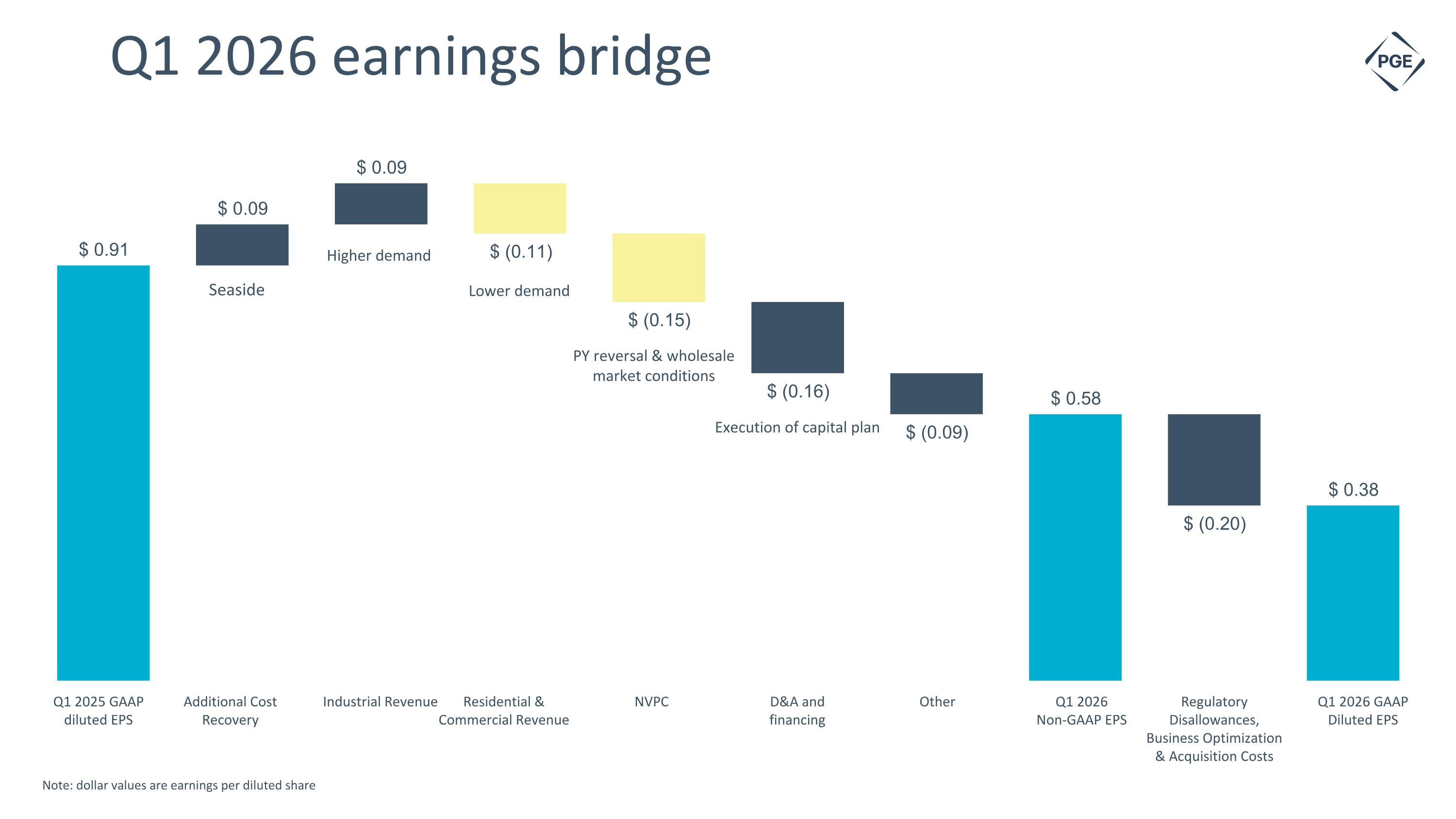
Note: dollar values are earnings per diluted share Q1 2026 GAAP Diluted EPS Q1 2025 GAAP diluted EPS Residential & Commercial Revenue Other Q1 2026 Non-GAAP EPS Regulatory Disallowances, Business Optimization & Acquisition Costs D&A and financing Additional Cost Recovery Seaside Higher demand Lower demand Execution of capital plan NVPC Industrial Revenue PY reversal & wholesale market conditions Q1 2026 earnings bridge
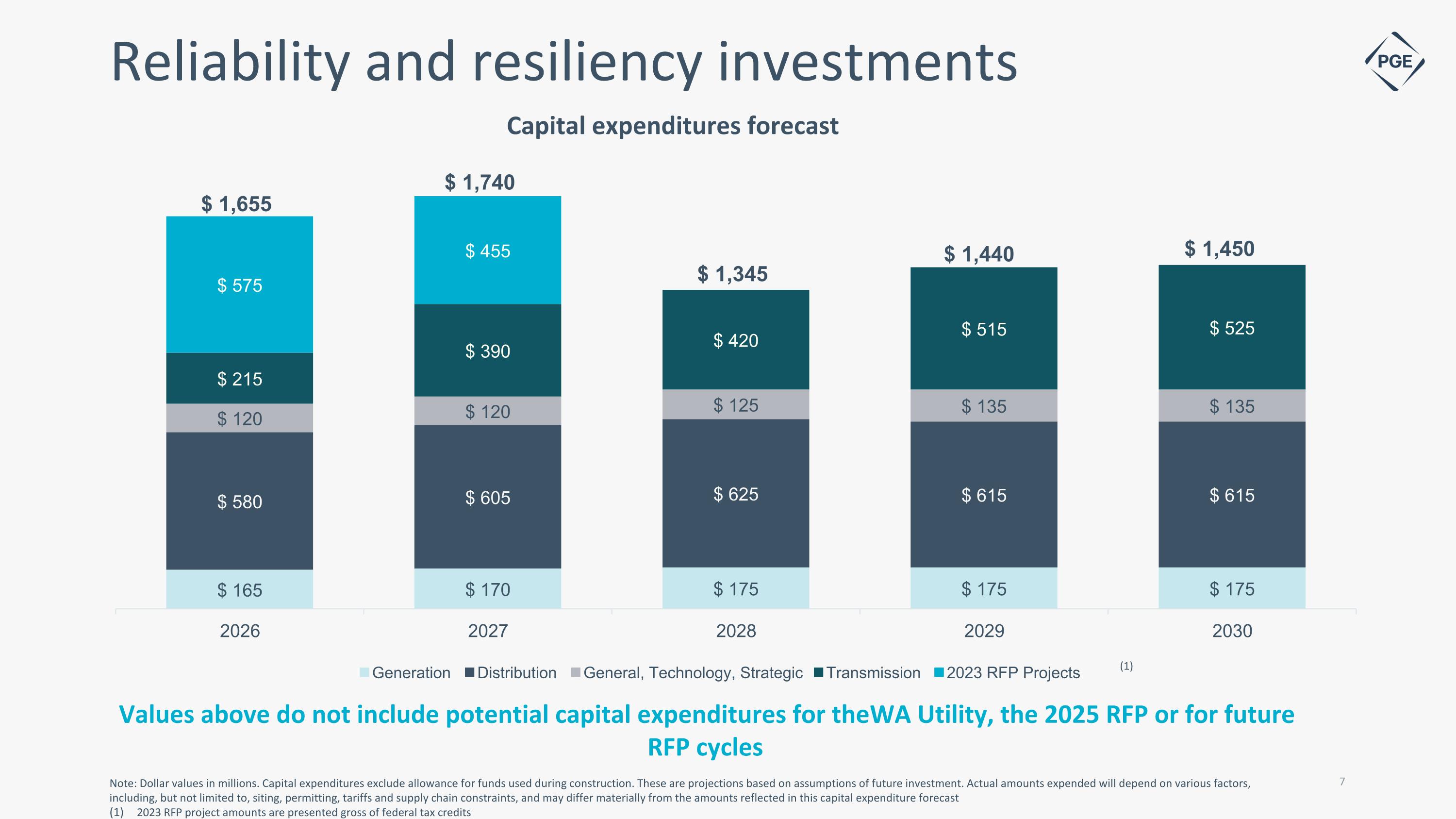
Note: Dollar values in millions. Capital expenditures exclude allowance for funds used during construction. These are projections based on assumptions of future investment. Actual amounts expended will depend on various factors, including, but not limited to, siting, permitting, tariffs and supply chain constraints, and may differ materially from the amounts reflected in this capital expenditure forecast 2023 RFP project amounts are presented gross of federal tax credits Reliability and resiliency investments Capital expenditures forecast (1) Values above do not include potential capital expenditures for the WA Utility, the 2025 RFP or for future RFP cycles
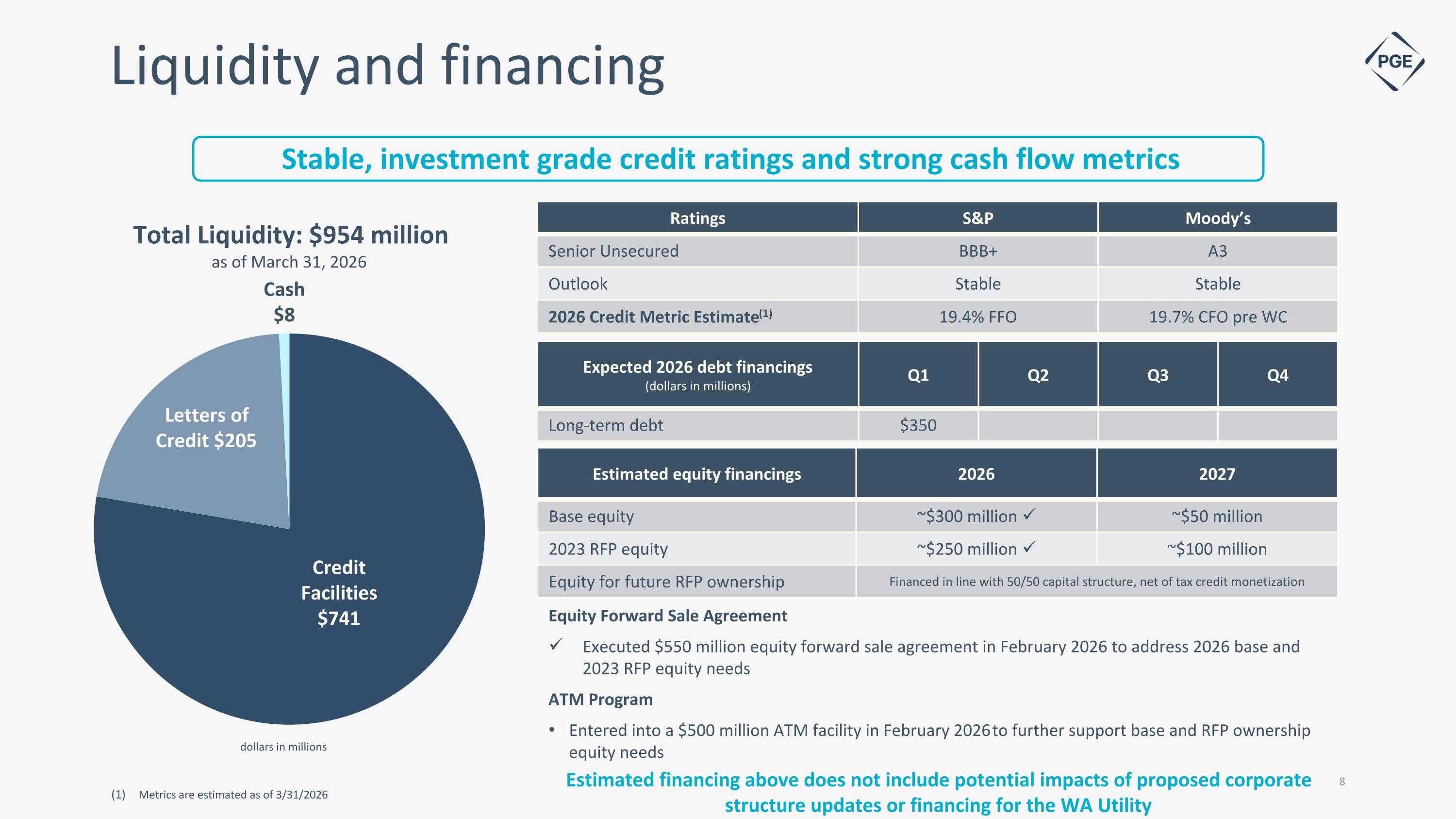
Credit Facilities $741 Letters of Credit $205 Total Liquidity: $954 million as of March 31, 2026 dollars in millions Cash $8 Ratings S&P Moody’s Senior Unsecured BBB+ A3 Outlook Stable Stable 2026 Credit Metric Estimate(1) 19.4% FFO 19.7% CFO pre WC Liquidity and financing Expected 2026 debt financings (dollars in millions) Q1 Q2 Q3 Q4 Long-term debt $350 Metrics are estimated as of 3/31/2026 Estimated equity financings 2026 2027 Base equity ~$300 million ~$50 million 2023 RFP equity ~$250 million ~$100 million Equity for future RFP ownership Financed in line with 50/50 capital structure, net of tax credit monetization Equity Forward Sale Agreement Executed $550 million equity forward sale agreement in February 2026 to address 2026 base and 2023 RFP equity needs ATM Program Entered into a $500 million ATM facility in February 2026 to further support base and RFP ownership equity needs Stable, investment grade credit ratings and strong cash flow metrics Estimated financing above does not include potential impacts of proposed corporate structure updates or financing for the WA Utility

Appendix
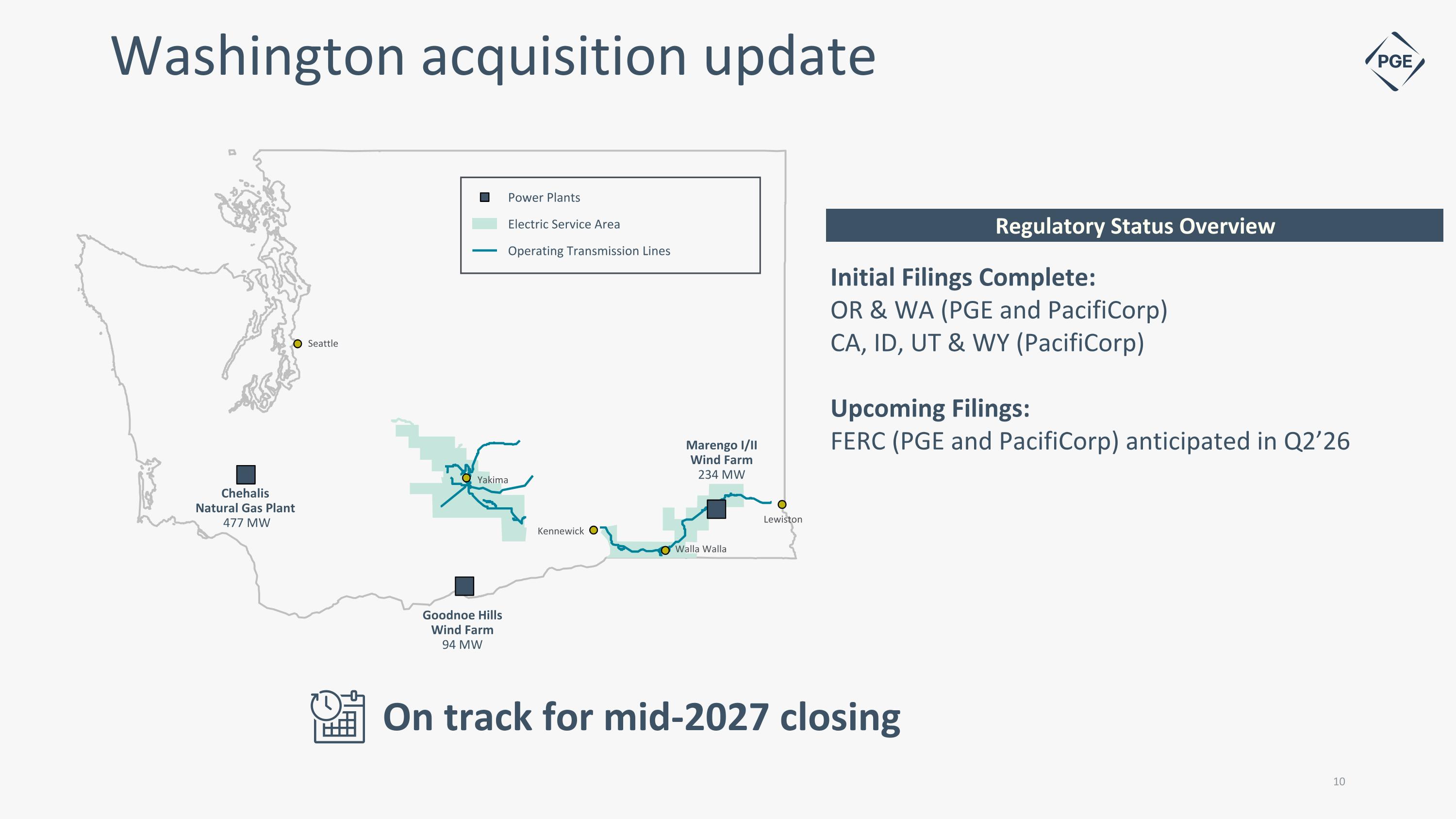
Washington acquisition update Regulatory Status Overview 10 Electric Service Area Operating Transmission Lines Power Plants Chehalis Natural Gas Plant 477 MW Seattle Goodnoe Hills Wind Farm 94 MW Marengo I/II Wind Farm 234 MW Lewiston Walla Walla Kennewick Yakima Initial Filings Complete: OR & WA (PGE and PacifiCorp) CA, ID, UT & WY (PacifiCorp) Upcoming Filings: FERC (PGE and PacifiCorp) anticipated in Q2’26 On track for mid-2027 closing
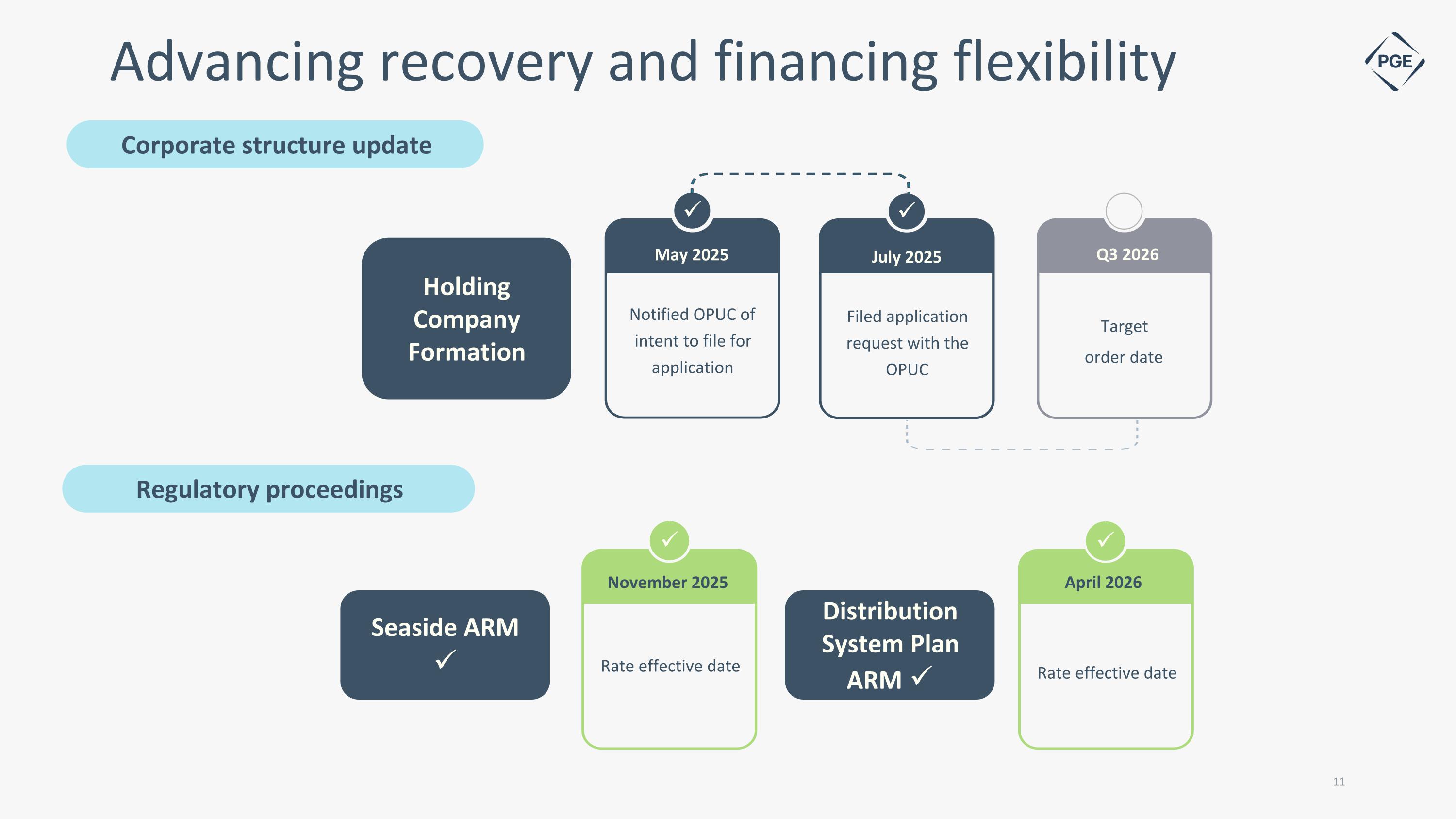
Rate effective date November 2025 Rate effective date April 2026 Advancing recovery and financing flexibility Regulatory proceedings 11 Distribution System Plan ARM Seaside ARM Corporate structure update Notified OPUC of intent to file for application May 2025 Filed application request with the OPUC July 2025 Target order date Q3 2026 Holding Company Formation
This presentation contains certain non-GAAP measures, such as adjusted earnings, adjusted EPS and adjusted earnings guidance. These non-GAAP financial measures exclude significant items that are generally not related to our ongoing business activities, are infrequent in nature, or both. PGE believes that excluding the effects of these items provides an alternative measure of the Company’s comparative earnings per share and enables investors to evaluate the Company’s operating financial performance trends, exclusive of items that are not normally associated with ongoing operations. Management utilizes non-GAAP measures to assess the Company’s current and forecasted performance, and for communications with shareholders, analysts and investors. Non-GAAP financial measures are supplementary information that should be considered in addition to, but not as a substitute for, the information prepared in accordance with GAAP. Items in the periods presented, which PGE believes impact the comparability of comparative earnings and do not represent ongoing operating financial performance, include the following: 2026: Business transformation and optimization expenses, including strategic advisory, workforce realignment and corporate structure update costs; acquisition costs, including legal, financing and strategic advisory costs; Non-cash charge related to final orders on the January 2024 storm and damage and 2024 Reliability Contingency Event regulatory deferrals 2025: Business transformation and optimization expenses, including strategic advisory, workforce realignment and corporate structure update costs Due to the forward-looking nature of PGE’s non-GAAP adjusted earnings guidance, and the inherently unpredictable nature of items and events which could lead to the recognition of non-GAAP adjustments (such as, but not limited to, regulatory disallowances or extreme weather events), management is unable to estimate the occurrence or value of specific items requiring adjustment for future periods, which could potentially impact the Company’s GAAP earnings. Therefore, management cannot provide a reconciliation of non-GAAP adjusted earnings per share guidance to the most comparable GAAP financial measure without unreasonable effort. For the same reasons, management is unable to address the probable significance of unavailable information. PGE’s reconciliation of non-GAAP earnings for the three months ended March 31, 2026, June 30, 2025, September 30, 2025 and December 31, 2025 and the year ended December 31, 2025 are on the following slide. Non-GAAP financial measures
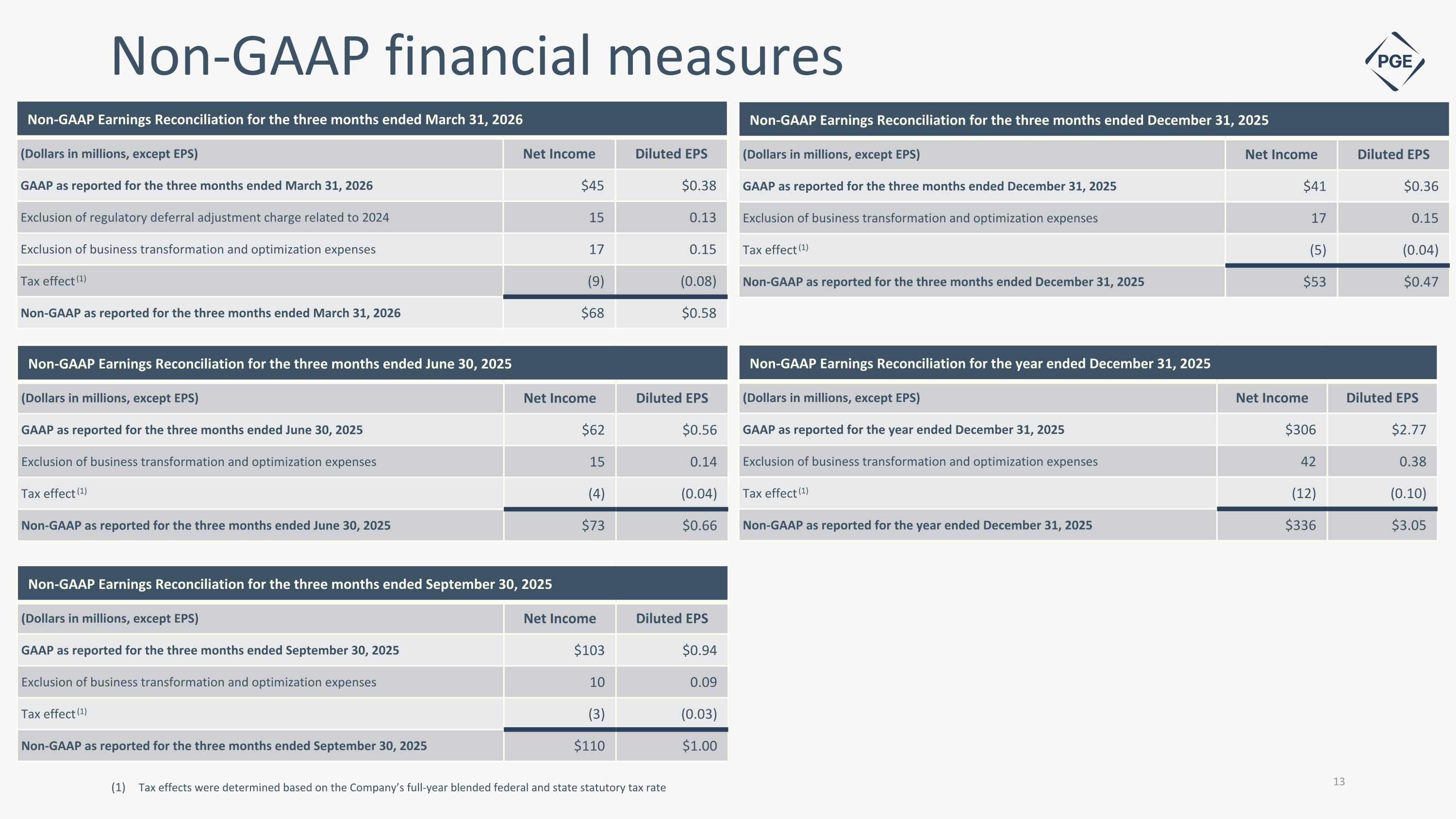
Non-GAAP Earnings Reconciliation for the three months ended March 31, 2026 (Dollars in millions, except EPS) Net Income Diluted EPS GAAP as reported for the three months ended March 31, 2026 $45 $0.38 Exclusion of regulatory deferral adjustment charge related to 2024 15 0.13 Exclusion of business transformation and optimization expenses 17 0.15 Tax effect (1) (9) (0.08) Non-GAAP as reported for the three months ended March 31, 2026 $68 $0.58 Non-GAAP financial measures Tax effects were determined based on the Company’s full-year blended federal and state statutory tax rate Non-GAAP Earnings Reconciliation for the three months ended June 30, 2025 (Dollars in millions, except EPS) Net Income Diluted EPS GAAP as reported for the three months ended June 30, 2025 $62 $0.56 Exclusion of business transformation and optimization expenses 15 0.14 Tax effect (1) (4) (0.04) Non-GAAP as reported for the three months ended June 30, 2025 $73 $0.66 Non-GAAP Earnings Reconciliation for the three months ended December 31, 2025 (Dollars in millions, except EPS) Net Income Diluted EPS GAAP as reported for the three months ended December 31, 2025 $41 $0.36 Exclusion of business transformation and optimization expenses 17 0.15 Tax effect (1) (5) (0.04) Non-GAAP as reported for the three months ended December 31, 2025 $53 $0.47 Non-GAAP Earnings Reconciliation for the three months ended September 30, 2025 (Dollars in millions, except EPS) Net Income Diluted EPS GAAP as reported for the three months ended September 30, 2025 $103 $0.94 Exclusion of business transformation and optimization expenses 10 0.09 Tax effect (1) (3) (0.03) Non-GAAP as reported for the three months ended September 30, 2025 $110 $1.00 Non-GAAP Earnings Reconciliation for the year ended December 31, 2025 (Dollars in millions, except EPS) Net Income Diluted EPS GAAP as reported for the year ended December 31, 2025 $306 $2.77 Exclusion of business transformation and optimization expenses 42 0.38 Tax effect (1) (12) (0.10) Non-GAAP as reported for the year ended December 31, 2025 $336 $3.05