
Investor Presentation PORTLAND GENERAL ELECTRIC May 12, 2026
Cautionary statement Information Current as of May 12, 2026 Except as expressly noted, the information in this presentation is current as of May 12, 2026 - and should not be relied upon as being current as of any subsequent date. PGE undertakes no duty to update this presentation, except as may be required by law. Forward-Looking Statement Statements in this presentation that relate to future plans, objectives, expectations, performance, events and the like may constitute "forward-looking statements" within the meaning of the Private Securities Litigation Reform Act of 1995, Section 27A of the Securities Act of 1933, as amended, and Section 21E of the Securities Exchange Act of 1934, as amended. Investors should not rely unduly on any forward-looking statements. Forward-looking statements include statements, other than statements of historical or current fact, regarding PGE’s earnings guidance (including all the assumptions and expectations upon which such guidance is based), PGE’s proposed purchase of electric utility operations and certain assets in Washington state from PacifiCorp (Acquisition), and PGE’s operating and financing plans, as well as other statements containing words such as "accretive," "anticipates," "assumptions," "believes," "continue,” "could," "estimates," "expects," "expected," "forecast," "guidance,” "illustrative," "intends," “may,” "opportunities," "outlook," "pipeline," "plans," “proposed,” "seeks," "should," "target," "will," or similar expressions. Forward-looking statements are inherently subject to risks and uncertainties, some of which cannot be predicted or quantified, which could cause future events and actual results to differ materially from those set forth in, contemplated by, or underlying the forward-looking statements. Such risks, uncertainties and other factors include, without limitation: wildfire and public safety risks, including ignitions caused by PGE assets, the effectiveness of wildfire mitigation, vegetation management, and system hardening, the ability to implement public safety power shutoffs (PSPS), related liability exposure, and the timing and extent of regulatory cost recovery; severe weather, climate, and catastrophe risks, including extreme or unseasonable weather and other natural or human caused disasters that could endanger public safety, disrupt operations, damage assets, limit access to power or fuel supplies, increase costs, or adversely affect cost recovery; electric system operational risks, including forced outages, fires, equipment failures, adverse hydro or wind conditions, fuel supply disruptions, and complications at jointly owned facilities, resulting in increased costs or the need to procure replacement power; power and fuel supply and price risks, including availability, counterparty nonperformance, and volatility in wholesale electricity, natural gas, coal, and other fuel markets; regulatory, legislative, and policy risks, including new or revised laws, regulations, executive actions, audits, investigations, and proceedings that could affect rates, cost recovery, operations, capital plans, or financial results; Acquisition risks, including risks related to regulatory approvals, financing and joint‑venture arrangements, integration and operational execution, cost recovery, and the possibility that the anticipated benefits of the Acquisition are delayed, not realized, or cost more than expected; environmental compliance and permitting risks, including evolving environmental laws and permitting requirements and site specific remediation obligations, such as Superfund liabilities, where uncertainties regarding remediation scope, cost allocation, litigation, and regulatory cost recovery could result in material costs or adversely affect PGE’s financial position, results of operations, or cash flows; capital investment and execution risks, including supply chain disruptions, cost inflation, labor constraints, permitting delays, contractual disputes, counterparty failures, or project abandonment, which could impair timely completion or cost recovery; load growth and demand uncertainty, including accelerated or uneven growth from large customers such as data centers, changes in customer usage patterns requiring substantial capital investment, variability in demand driven by weather variations, and reduced consumption or load shifting resulting from energy efficiency measures or other changes in customer behavior; customer choice and market structure risks, including reduced demand or usage shifts due to distributed generation or increased procurement from alternative providers, such as registered Electricity Service Suppliers (ESSs) or community choice aggregation programs; cybersecurity and physical security risks, including cyberattacks, data breaches, physical attacks, or other malicious acts that could damage assets, disrupt systems, or result in the disclosure of sensitive information; geopolitical and macroeconomic risks, including acts of war, terrorism, or civil unrest—such as the war involving the United States and Iran—that could disrupt energy markets or supply chains, increase costs, or contribute to volatility in capital markets, inflation, or interest rates; economic and financial market risks, including availability and cost of capital, interest rate and equity market volatility, inflation, and trade tariffs affecting operating or capital costs; legal and litigation risks, including the timing and outcome of judicial, administrative, or regulatory proceedings, which may result in material liabilities or costs; workforce and labor risks, including the ability to attract and retain skilled employees, transitions in senior management, and potential labor disputes or work stoppages; resource procurement and All-Source Request for Proposals (RFP) project risks, including uncertainties related to the availability, cost, permitting, financing, and performance of resources selected through RFP processes and associated regulatory and counterparty risks; insurance availability and cost, particularly for wildfire or catastrophe related coverage; accounting, tax, and policy changes, including changes in accounting standards, tax laws, or regulatory accounting policies that could affect reported results or cash flows; and the other risks and uncertainties set forth in PGE’s Annual Report on Form 10‑K for the year ended December 31, 2025, as filed with the SEC. Shiraz Bengali (503) 464-7314 Shiraz.Bengali@pgn.com Portland General Electric investors.portlandgeneral.com 121 SW Salmon Street Suite 1WTC0506 Portland, OR 97204 Erin Schwartz (503) 464-7751 Erin.schwartz@pgn.com

Current Topics of Focus
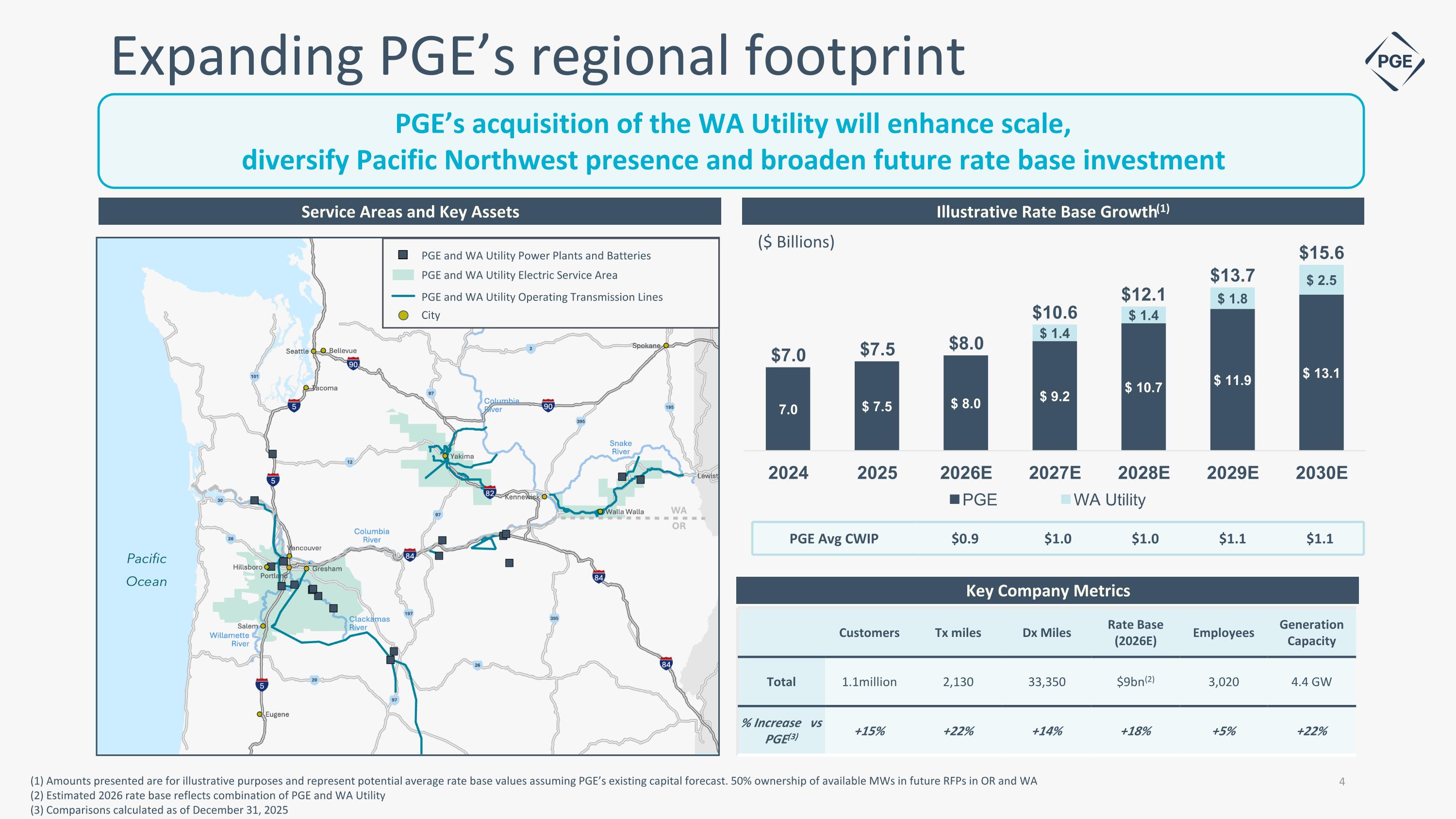
Expanding PGE’s regional footprint PGE’s acquisition of the WA Utility will enhance scale, diversify Pacific Northwest presence and broaden future rate base investment Service Areas and Key Assets Key Company Metrics Illustrative Rate Base Growth(1) Customers Tx miles Dx Miles Rate Base (2026E) Employees Generation Capacity Total 1.1million 2,130 33,350 $9bn(2) 3,020 4.4 GW % Increase vs PGE(3) +15% +22% +14% +18% +5% +22% PGE Avg CWIP $0.9 $1.0 $1.0 $1.1 $1.1 ($ Billions) PGE and WA Utility Electric Service Area PGE and WA Utility Operating Transmission Lines City PGE and WA Utility Power Plants and Batteries (1) Amounts presented are for illustrative purposes and represent potential average rate base values assuming PGE’s existing capital forecast. 50% ownership of available MWs in future RFPs in OR and WA (2) Estimated 2026 rate base reflects combination of PGE and WA Utility (3) Comparisons calculated as of December 31, 2025
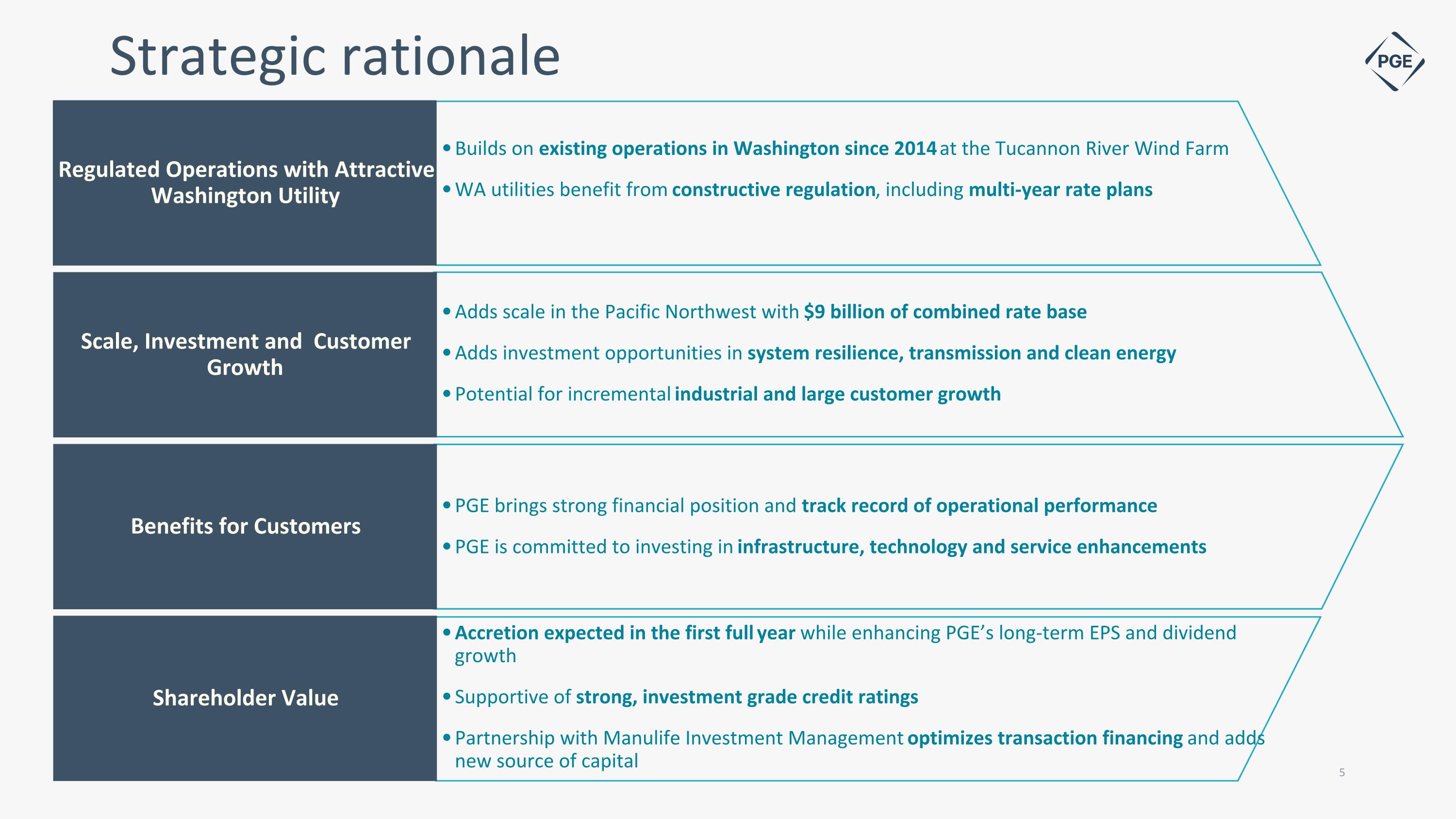
Strategic rationale Regulated Operations with Attractive Washington Utility Scale, Investment and Customer Growth Benefits for Customers Shareholder Value Builds on existing operations in Washington since 2014 at the Tucannon River Wind Farm WA utilities benefit from constructive regulation, including multi-year rate plans Adds scale in the Pacific Northwest with $9 billion of combined rate base Adds investment opportunities in system resilience, transmission and clean energy Potential for incremental industrial and large customer growth PGE brings strong financial position and track record of operational performance PGE is committed to investing in infrastructure, technology and service enhancements Accretion expected in the first full year while enhancing PGE’s long-term EPS and dividend growth Supportive of strong, investment grade credit ratings Partnership with Manulife Investment Management optimizes transaction financing and adds new source of capital 5
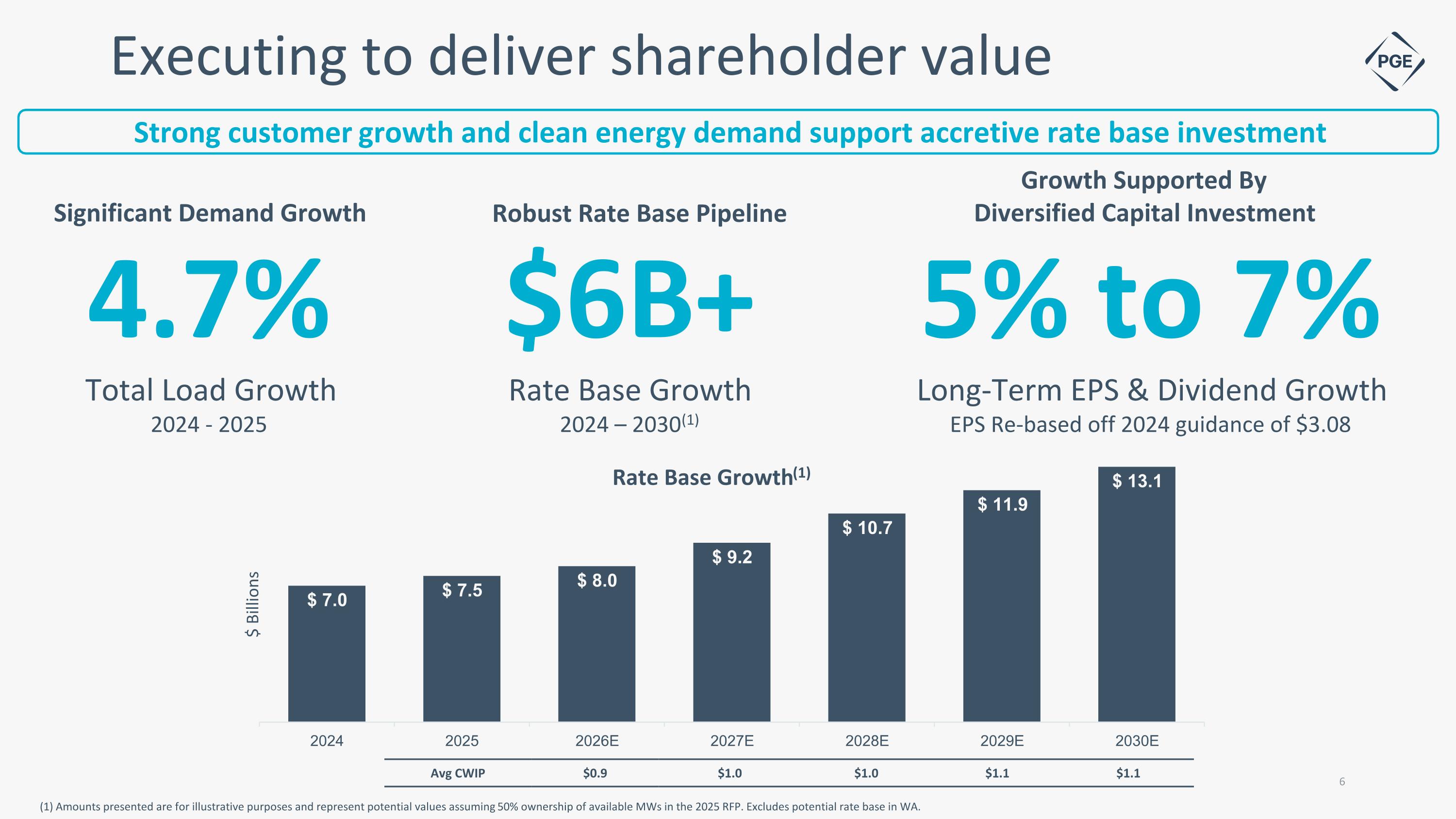
Executing to deliver shareholder value Strong customer growth and clean energy demand support accretive rate base investment $ Billions Avg CWIP $0.9 $1.0 $1.0 $1.1 $1.1 (1) Amounts presented are for illustrative purposes and represent potential values assuming 50% ownership of available MWs in the 2025 RFP. Excludes potential rate base in WA. 4.7% Total Load Growth 2024 - 2025 Significant Demand Growth 5% to 7% Long-Term EPS & Dividend Growth EPS Re-based off 2024 guidance of $3.08 Growth Supported By Diversified Capital Investment $6B+ Rate Base Growth 2024 – 2030(1) Robust Rate Base Pipeline
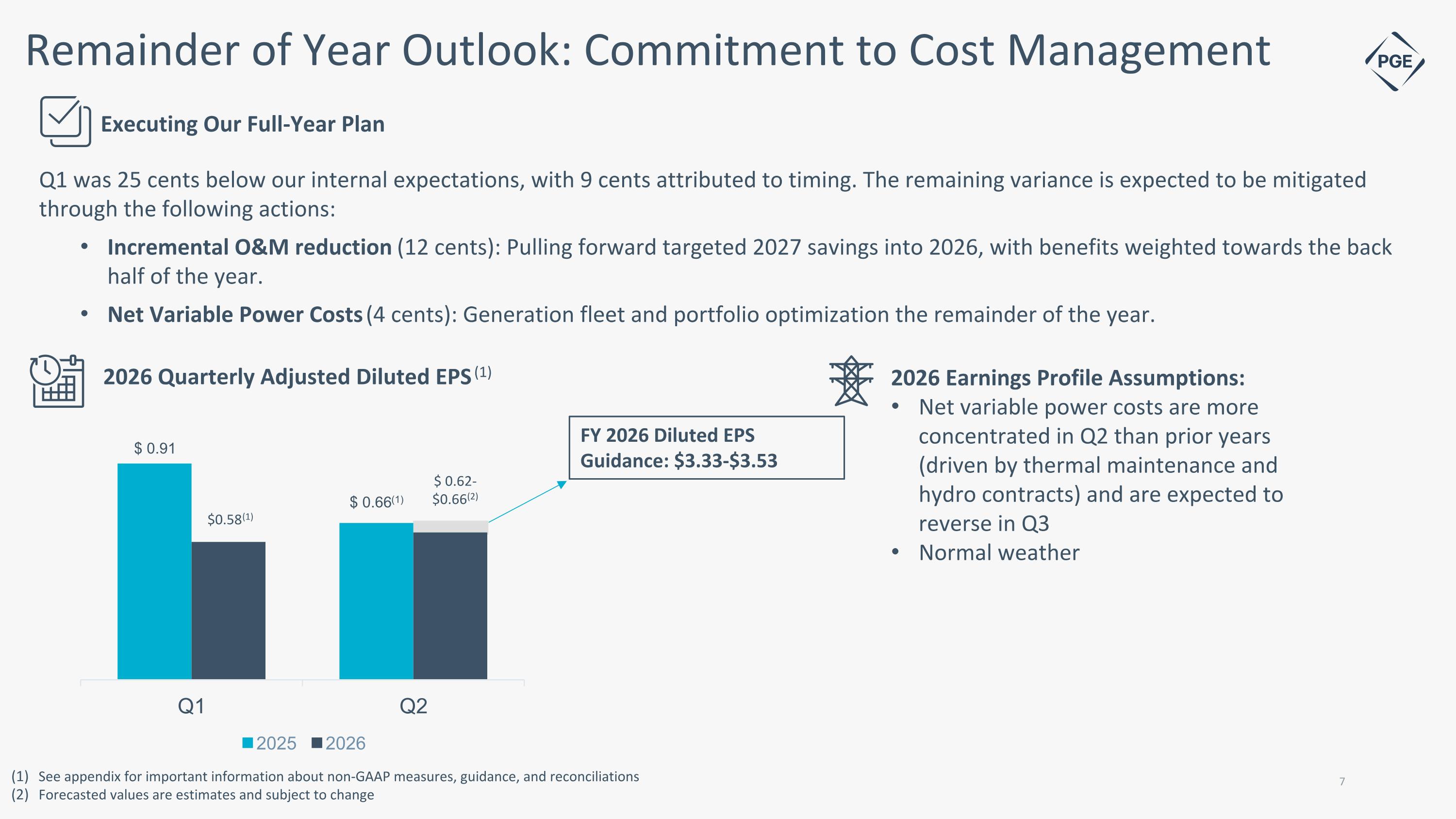
Remainder of Year Outlook: Commitment to Cost Management Q1 was 25 cents below our internal expectations, with 9 cents attributed to timing. The remaining variance is expected to be mitigated through the following actions: Incremental O&M reduction (12 cents): Pulling forward targeted 2027 savings into 2026, with benefits weighted towards the back half of the year. Net Variable Power Costs (4 cents): Generation fleet and portfolio optimization the remainder of the year. Executing Our Full-Year Plan 2026 Earnings Profile Assumptions: Net variable power costs are more concentrated in Q2 than prior years (driven by thermal maintenance and hydro contracts) and are expected to reverse in Q3 Normal weather 2026 Quarterly Adjusted Diluted EPS (1) See appendix for important information about non-GAAP measures, guidance, and reconciliations Forecasted values are estimates and subject to change FY 2026 Diluted EPS Guidance: $3.33-$3.53
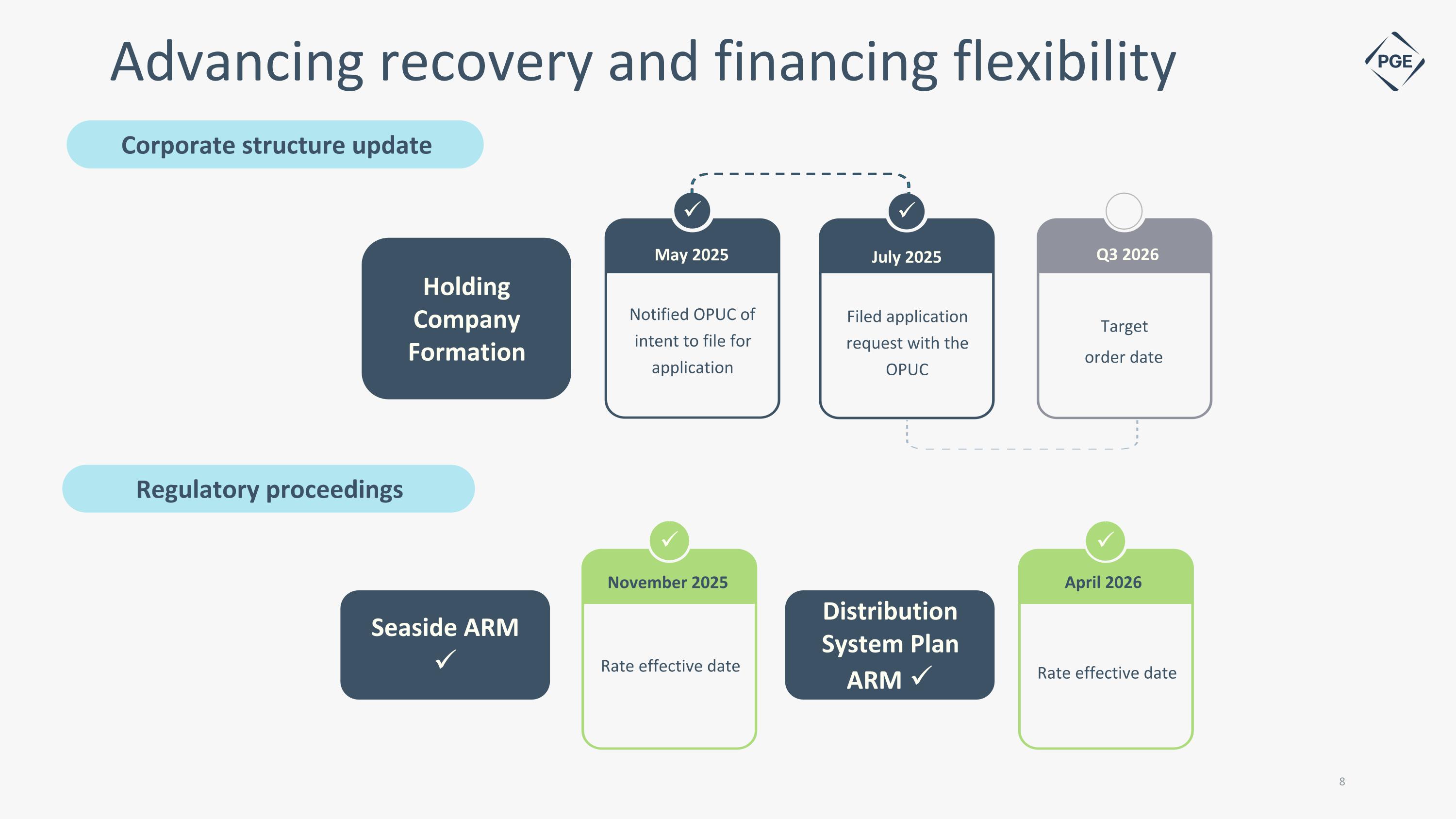
Rate effective date November 2025 Rate effective date April 2026 Advancing recovery and financing flexibility Regulatory proceedings 8 Distribution System Plan ARM Seaside ARM Corporate structure update Notified OPUC of intent to file for application May 2025 Filed application request with the OPUC July 2025 Target order date Q3 2026 Holding Company Formation
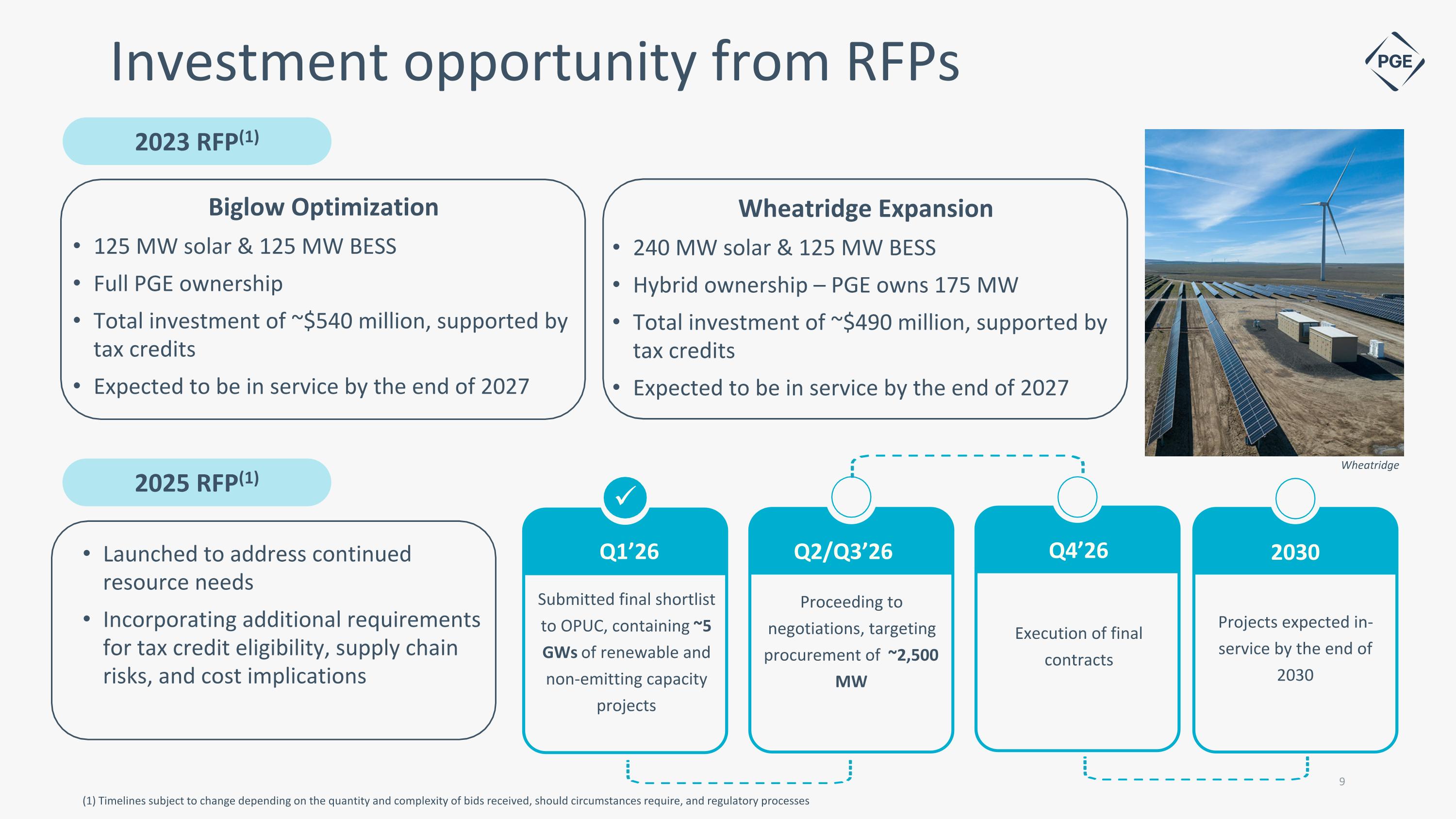
Investment opportunity from RFPs 2023 RFP(1) (1) Timelines subject to change depending on the quantity and complexity of bids received, should circumstances require, and regulatory processes 9 Submitted final shortlist to OPUC, containing ~5 GWs of renewable and non-emitting capacity projects Q1’26 2025 RFP(1) Wheatridge Expansion 240 MW solar & 125 MW BESS Hybrid ownership – PGE owns 175 MW Total investment of ~$490 million, supported by tax credits Expected to be in service by the end of 2027 Launched to address continued resource needs Incorporating additional requirements for tax credit eligibility, supply chain risks, and cost implications Proceeding to negotiations, targeting procurement of ~2,500 MW Execution of final contracts Projects expected in-service by the end of 2030 Q2/Q3’26 Q4’26 2030 Wheatridge Biglow Optimization 125 MW solar & 125 MW BESS Full PGE ownership Total investment of ~$540 million, supported by tax credits Expected to be in service by the end of 2027
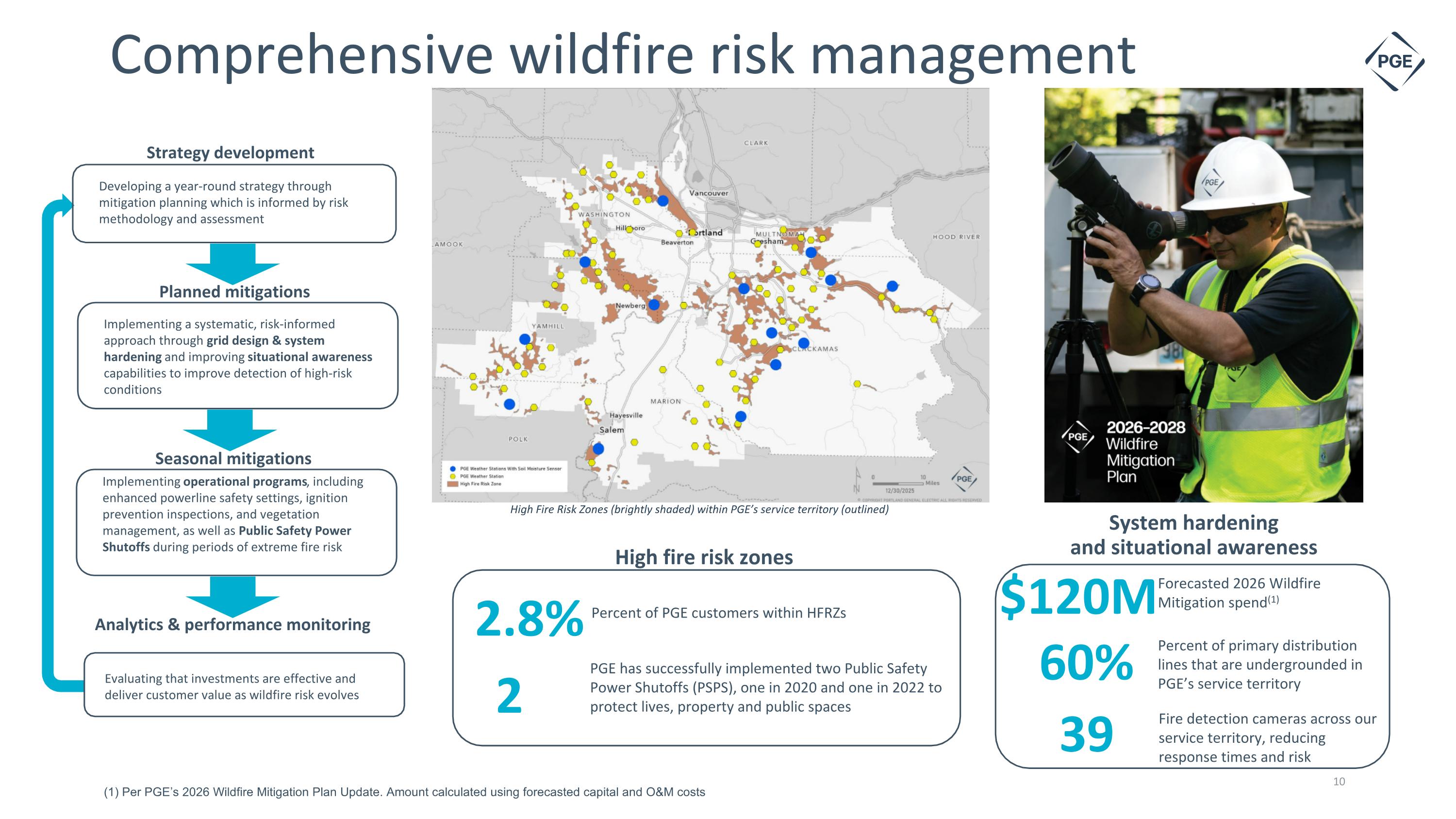
Strategy development Planned mitigations Seasonal mitigations Comprehensive wildfire risk management Developing a year-round strategy through mitigation planning which is informed by risk methodology and assessment Implementing a systematic, risk-informed approach through grid design & system hardening and improving situational awareness capabilities to improve detection of high-risk conditions Implementing operational programs, including enhanced powerline safety settings, ignition prevention inspections, and vegetation management, as well as Public Safety Power Shutoffs during periods of extreme fire risk Evaluating that investments are effective and deliver customer value as wildfire risk evolves Analytics & performance monitoring High Fire Risk Zones (brightly shaded) within PGE’s service territory (outlined) High fire risk zones 2 PGE has successfully implemented two Public Safety Power Shutoffs (PSPS), one in 2020 and one in 2022 to protect lives, property and public spaces System hardening and situational awareness Fire detection cameras across our service territory, reducing response times and risk Percent of primary distribution lines that are undergrounded in PGE’s service territory 60% 39 Forecasted 2026 Wildfire Mitigation spend(1) $120M 10 (1) Per PGE’s 2026 Wildfire Mitigation Plan Update. Amount calculated using forecasted capital and O&M costs Percent of PGE customers within HFRZs 2.8%
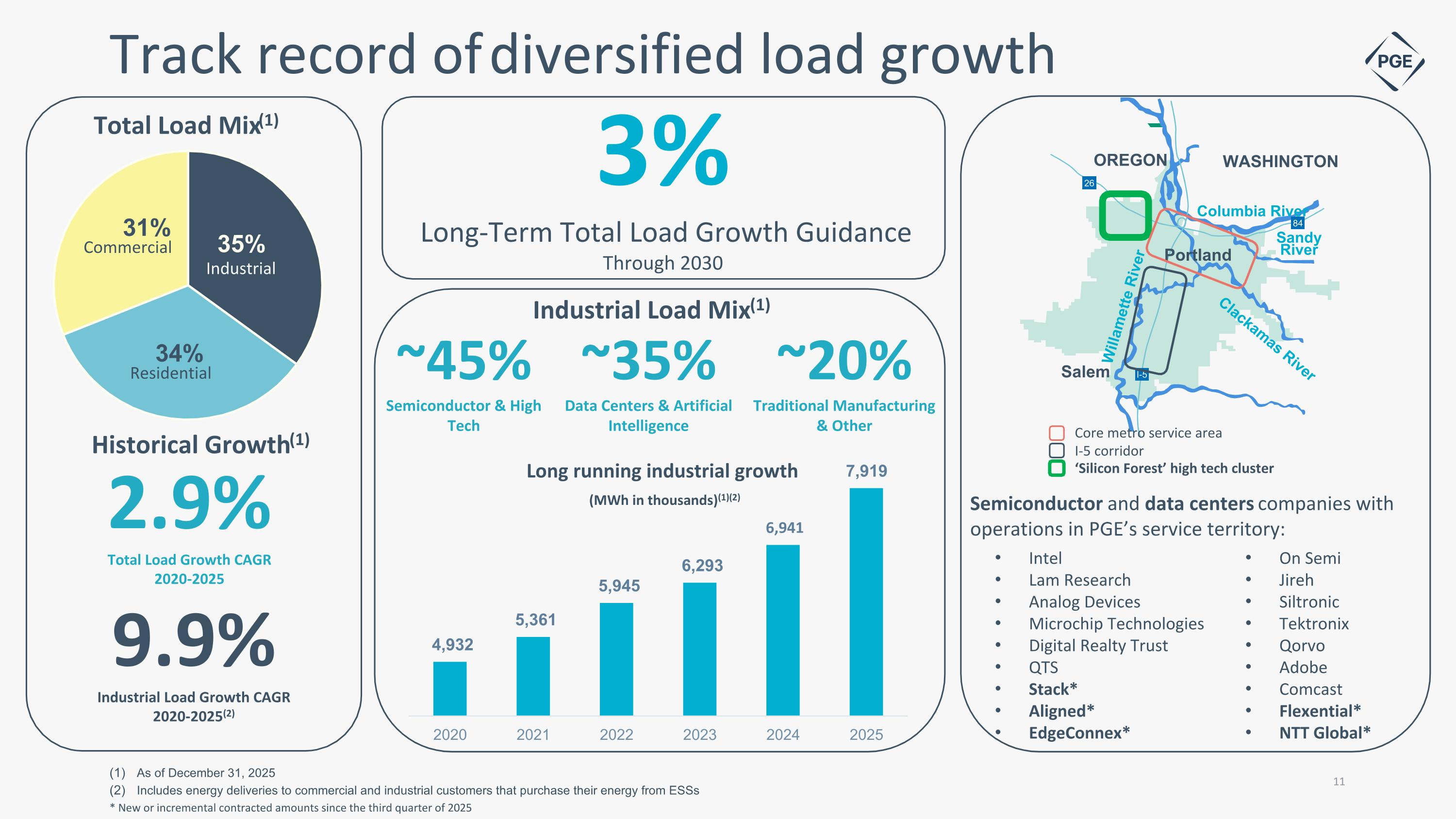
Long running industrial growth (MWh in thousands)(1)(2) Track record of diversified load growth As of December 31, 2025 Includes energy deliveries to commercial and industrial customers that purchase their energy from ESSs * New or incremental contracted amounts since the third quarter of 2025 2.9% Total Load Growth CAGR 2020-2025 Historical Growth(1) 9.9% Industrial Load Growth CAGR 2020-2025(2) ~45% Semiconductor & High Tech ~35% Data Centers & Artificial Intelligence ~20% Traditional Manufacturing & Other Industrial Load Mix(1) Semiconductor and data centers companies with operations in PGE’s service territory: Industrial Residential Commercial WASHINGTON OREGON I-5 26 84 Columbia River Sandy River Clackamas River Willamette River Salem Portland Core metro service area I-5 corridor ‘Silicon Forest’ high tech cluster On Semi Jireh Siltronic Tektronix Qorvo Adobe Comcast Flexential* NTT Global* Intel Lam Research Analog Devices Microchip Technologies Digital Realty Trust QTS Stack* Aligned* EdgeConnex* 3% Long-Term Total Load Growth Guidance Through 2030
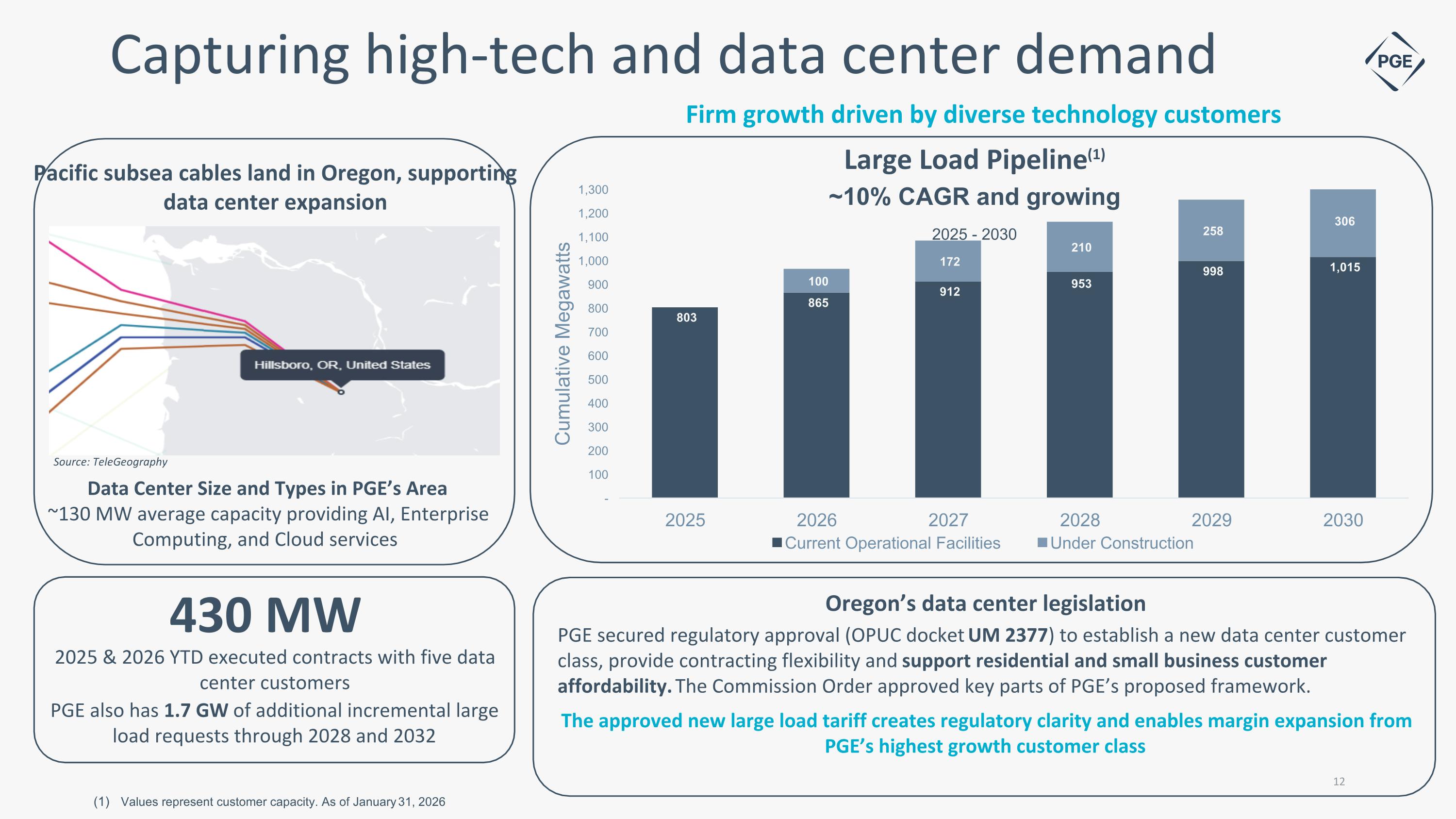
Capturing high-tech and data center demand Values represent customer capacity. As of January 31, 2026 Firm growth driven by diverse technology customers Pacific subsea cables land in Oregon, supporting data center expansion Source: TeleGeography Data Center Size and Types in PGE’s Area ~130 MW average capacity providing AI, Enterprise Computing, and Cloud services 2025 & 2026 YTD executed contracts with five data center customers 430 MW PGE also has 1.7 GW of additional incremental large load requests through 2028 and 2032 Oregon’s data center legislation PGE secured regulatory approval (OPUC docket UM 2377) to establish a new data center customer class, provide contracting flexibility and support residential and small business customer affordability. The Commission Order approved key parts of PGE’s proposed framework. The approved new large load tariff creates regulatory clarity and enables margin expansion from PGE’s highest growth customer class

The Company
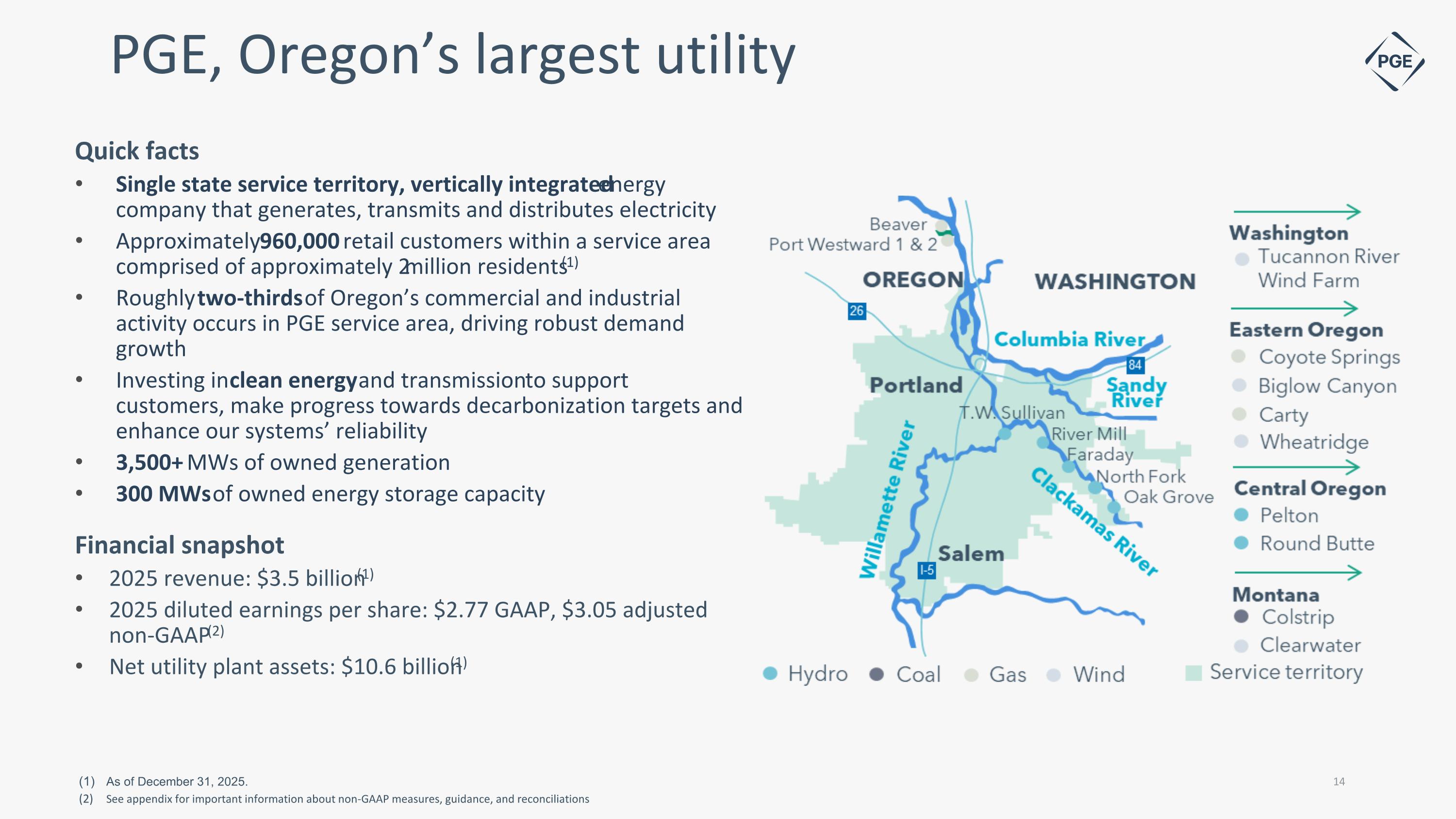
PGE, Oregon’s largest utility Quick facts Single state service territory, vertically integrated energy company that generates, transmits and distributes electricity Approximately 960,000 retail customers within a service area comprised of approximately 2 million residents(1) Roughly two-thirds of Oregon’s commercial and industrial activity occurs in PGE service area, driving robust demand growth Investing in clean energy and transmission to support customers, make progress towards decarbonization targets and enhance our systems’ reliability 3,500+ MWs of owned generation 300 MWs of owned energy storage capacity Financial snapshot 2025 revenue: $3.5 billion(1) 2025 diluted earnings per share: $2.77 GAAP, $3.05 adjusted non-GAAP(2) Net utility plant assets: $10.6 billion(1) As of December 31, 2025. See appendix for important information about non-GAAP measures, guidance, and reconciliations
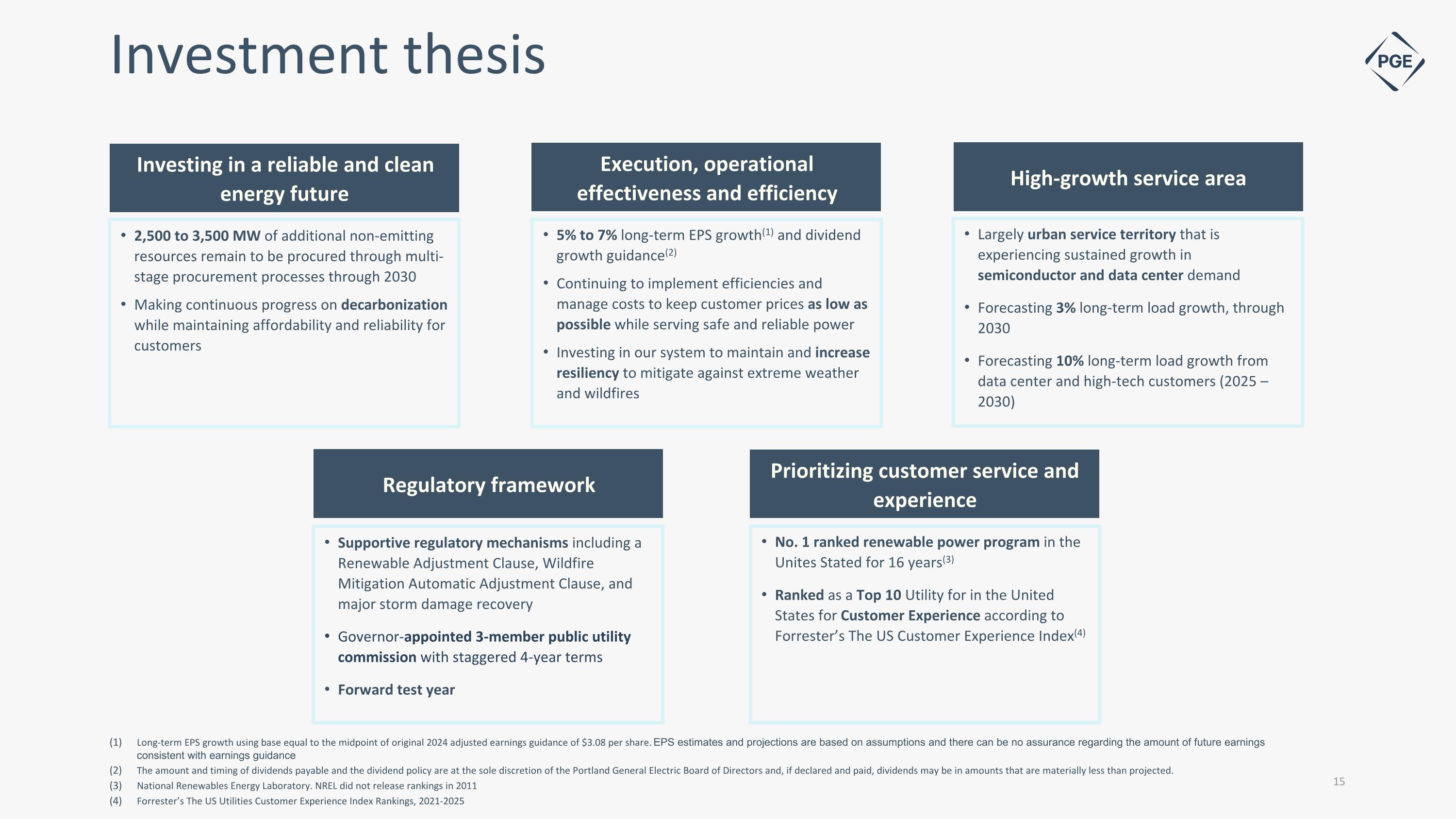
Largely urban service territory that is experiencing sustained growth in semiconductor and data center demand Forecasting 3% long-term load growth, through 2030 Forecasting 10% long-term load growth from data center and high-tech customers (2025 – 2030) 2,500 to 3,500 MW of additional non-emitting resources remain to be procured through multi-stage procurement processes through 2030 Making continuous progress on decarbonization while maintaining affordability and reliability for customers 5% to 7% long-term EPS growth(1) and dividend growth guidance(2) Continuing to implement efficiencies and manage costs to keep customer prices as low as possible while serving safe and reliable power Investing in our system to maintain and increase resiliency to mitigate against extreme weather and wildfires No. 1 ranked renewable power program in the Unites Stated for 16 years(3) Ranked as a Top 10 Utility for in the United States for Customer Experience according to Forrester’s The US Customer Experience Index(4) Supportive regulatory mechanisms including a Renewable Adjustment Clause, Wildfire Mitigation Automatic Adjustment Clause, and major storm damage recovery Governor-appointed 3-member public utility commission with staggered 4-year terms Forward test year Investing in a reliable and clean energy future Execution, operational effectiveness and efficiency High-growth service area Regulatory framework Prioritizing customer service and experience Investment thesis Long-term EPS growth using base equal to the midpoint of original 2024 adjusted earnings guidance of $3.08 per share. EPS estimates and projections are based on assumptions and there can be no assurance regarding the amount of future earnings consistent with earnings guidance The amount and timing of dividends payable and the dividend policy are at the sole discretion of the Portland General Electric Board of Directors and, if declared and paid, dividends may be in amounts that are materially less than projected. National Renewables Energy Laboratory. NREL did not release rankings in 2011 Forrester’s The US Utilities Customer Experience Index Rankings, 2021-2025
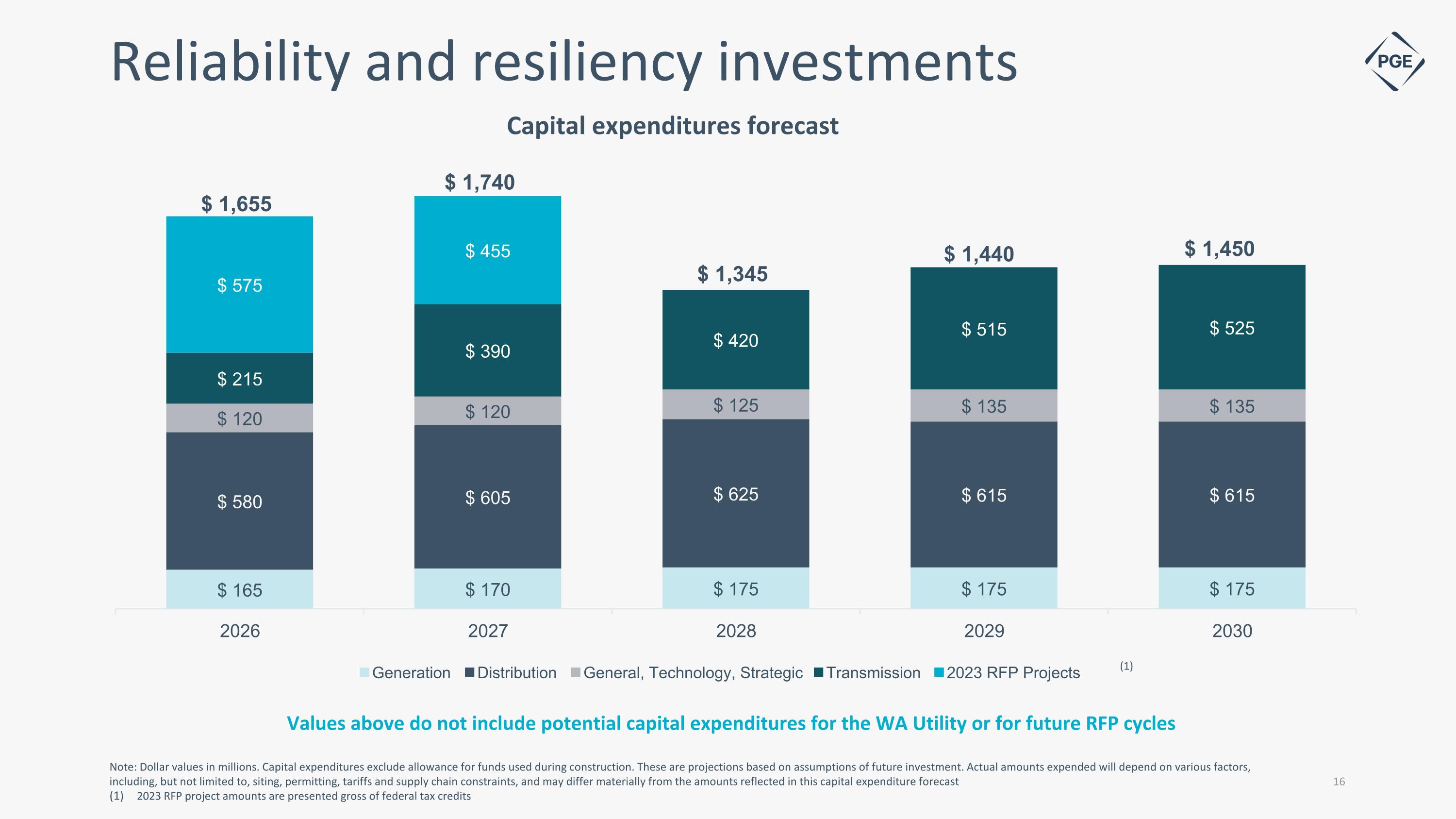
Note: Dollar values in millions. Capital expenditures exclude allowance for funds used during construction. These are projections based on assumptions of future investment. Actual amounts expended will depend on various factors, including, but not limited to, siting, permitting, tariffs and supply chain constraints, and may differ materially from the amounts reflected in this capital expenditure forecast 2023 RFP project amounts are presented gross of federal tax credits Reliability and resiliency investments Capital expenditures forecast (1) Values above do not include potential capital expenditures for the WA Utility or for future RFP cycles

Key Strengths
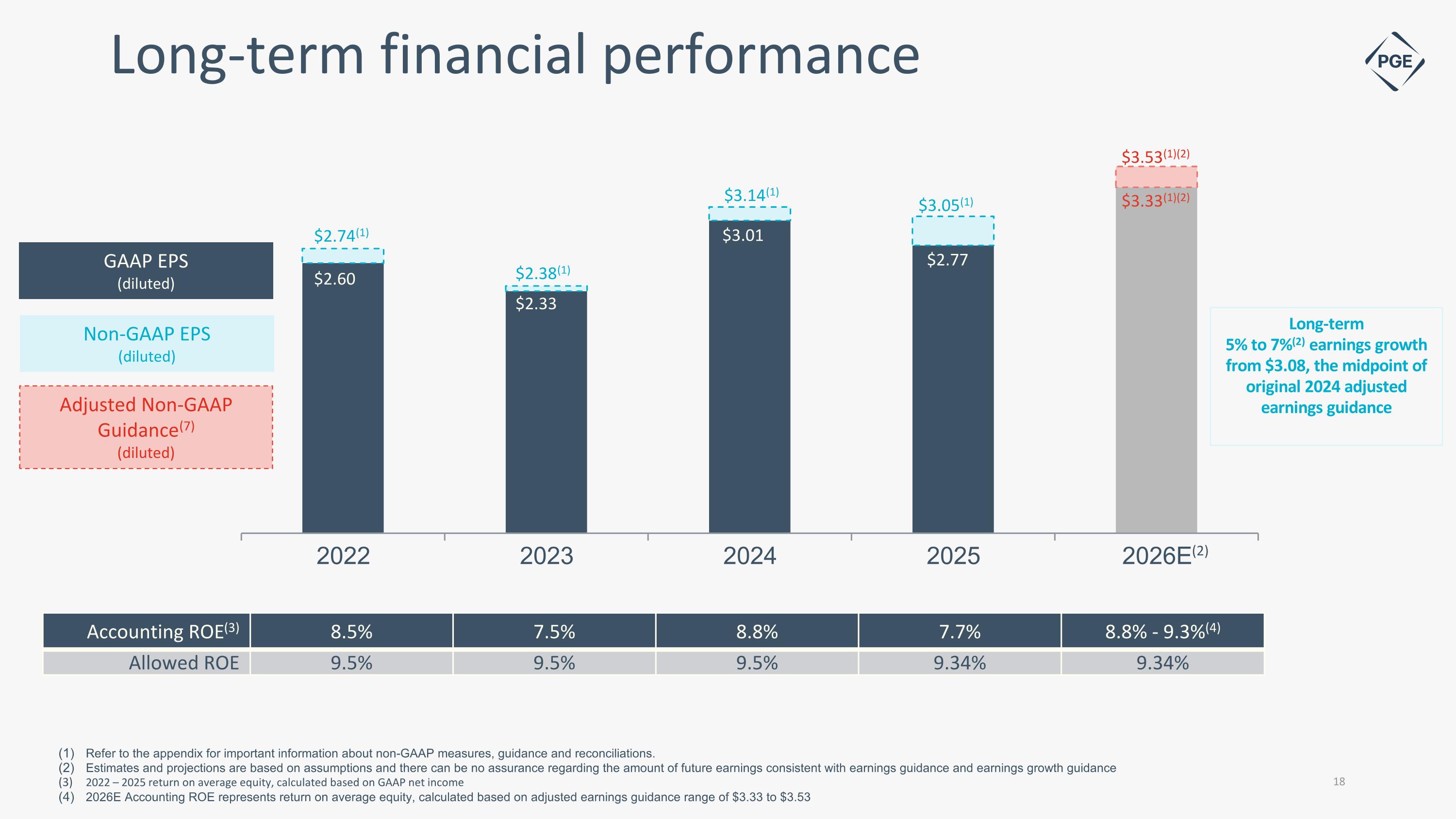
(2) $2.33 $3.01 $2.77 Accounting ROE(3) 8.5% 7.5% 8.8% 7.7% 8.8% - 9.3%(4) Allowed ROE 9.5% 9.5% 9.5% 9.34% 9.34% GAAP EPS (diluted) Long-term 5% to 7%(2) earnings growth from $3.08, the midpoint of original 2024 adjusted earnings guidance Long-term financial performance Adjusted Non-GAAP Guidance(7) (diluted) $3.53(1)(2) $3.33(1)(2) $2.60 $2.38(1) $2.74(1) Refer to the appendix for important information about non-GAAP measures, guidance and reconciliations. Estimates and projections are based on assumptions and there can be no assurance regarding the amount of future earnings consistent with earnings guidance and earnings growth guidance 2022 – 2025 return on average equity, calculated based on GAAP net income 2026E Accounting ROE represents return on average equity, calculated based on adjusted earnings guidance range of $3.33 to $3.53 Non-GAAP EPS (diluted) $3.14(1) $3.05(1)
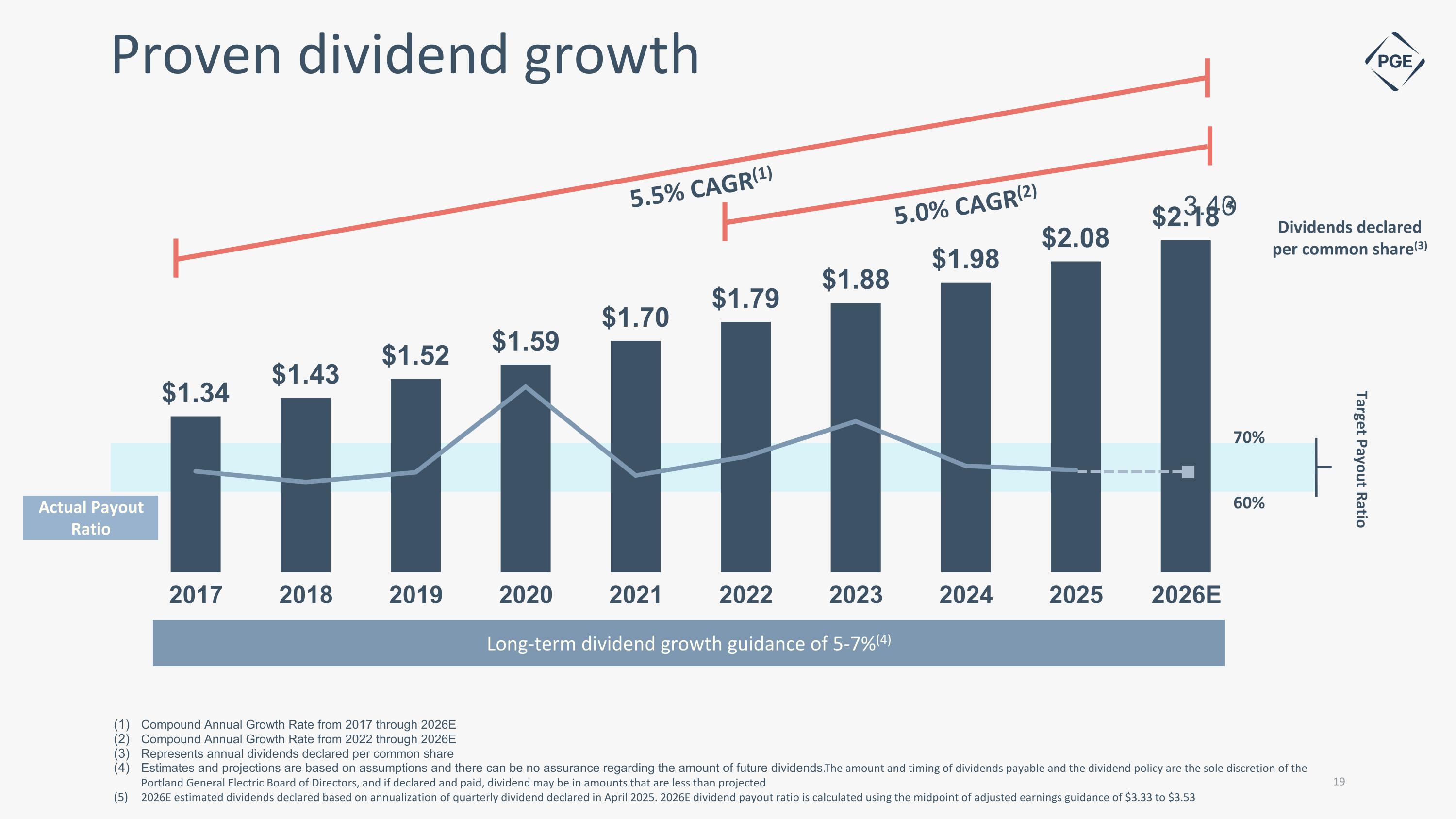
5.5% CAGR(1) 5.0% CAGR(2) Actual Payout Ratio Long-term dividend growth guidance of 5-7%(4) 70% 60% Dividends declared per common share(3) Target Payout Ratio (4) Proven dividend growth Compound Annual Growth Rate from 2017 through 2026E Compound Annual Growth Rate from 2022 through 2026E Represents annual dividends declared per common share Estimates and projections are based on assumptions and there can be no assurance regarding the amount of future dividends. The amount and timing of dividends payable and the dividend policy are the sole discretion of the Portland General Electric Board of Directors, and if declared and paid, dividend may be in amounts that are less than projected 2026E estimated dividends declared based on annualization of quarterly dividend declared in April 2025. 2026E dividend payout ratio is calculated using the midpoint of adjusted earnings guidance of $3.33 to $3.53
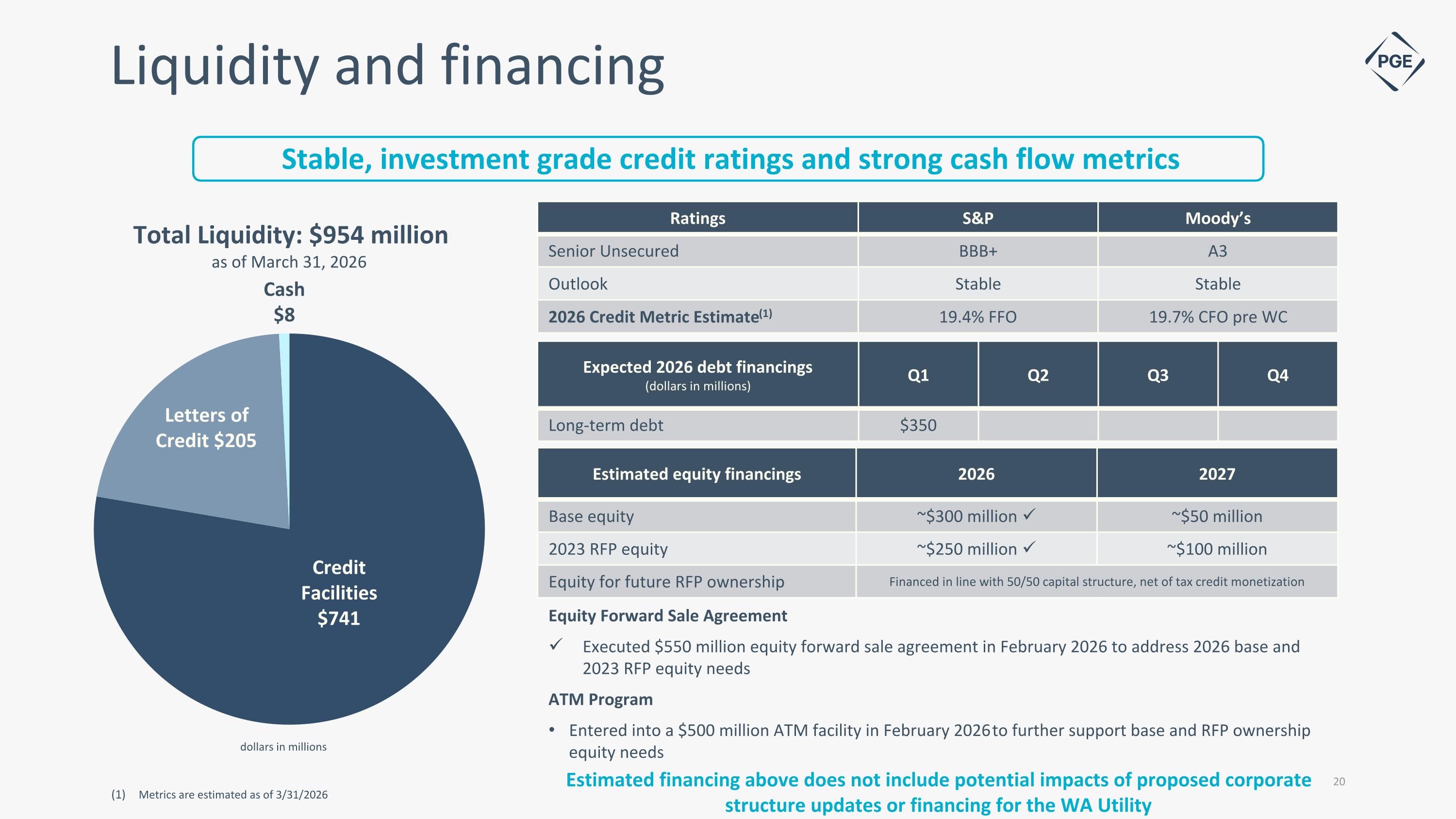
Credit Facilities $741 Letters of Credit $205 Total Liquidity: $954 million as of March 31, 2026 dollars in millions Cash $8 Ratings S&P Moody’s Senior Unsecured BBB+ A3 Outlook Stable Stable 2026 Credit Metric Estimate(1) 19.4% FFO 19.7% CFO pre WC Liquidity and financing Expected 2026 debt financings (dollars in millions) Q1 Q2 Q3 Q4 Long-term debt $350 Metrics are estimated as of 3/31/2026 Estimated equity financings 2026 2027 Base equity ~$300 million ~$50 million 2023 RFP equity ~$250 million ~$100 million Equity for future RFP ownership Financed in line with 50/50 capital structure, net of tax credit monetization Equity Forward Sale Agreement Executed $550 million equity forward sale agreement in February 2026 to address 2026 base and 2023 RFP equity needs ATM Program Entered into a $500 million ATM facility in February 2026 to further support base and RFP ownership equity needs Stable, investment grade credit ratings and strong cash flow metrics Estimated financing above does not include potential impacts of proposed corporate structure updates or financing for the WA Utility
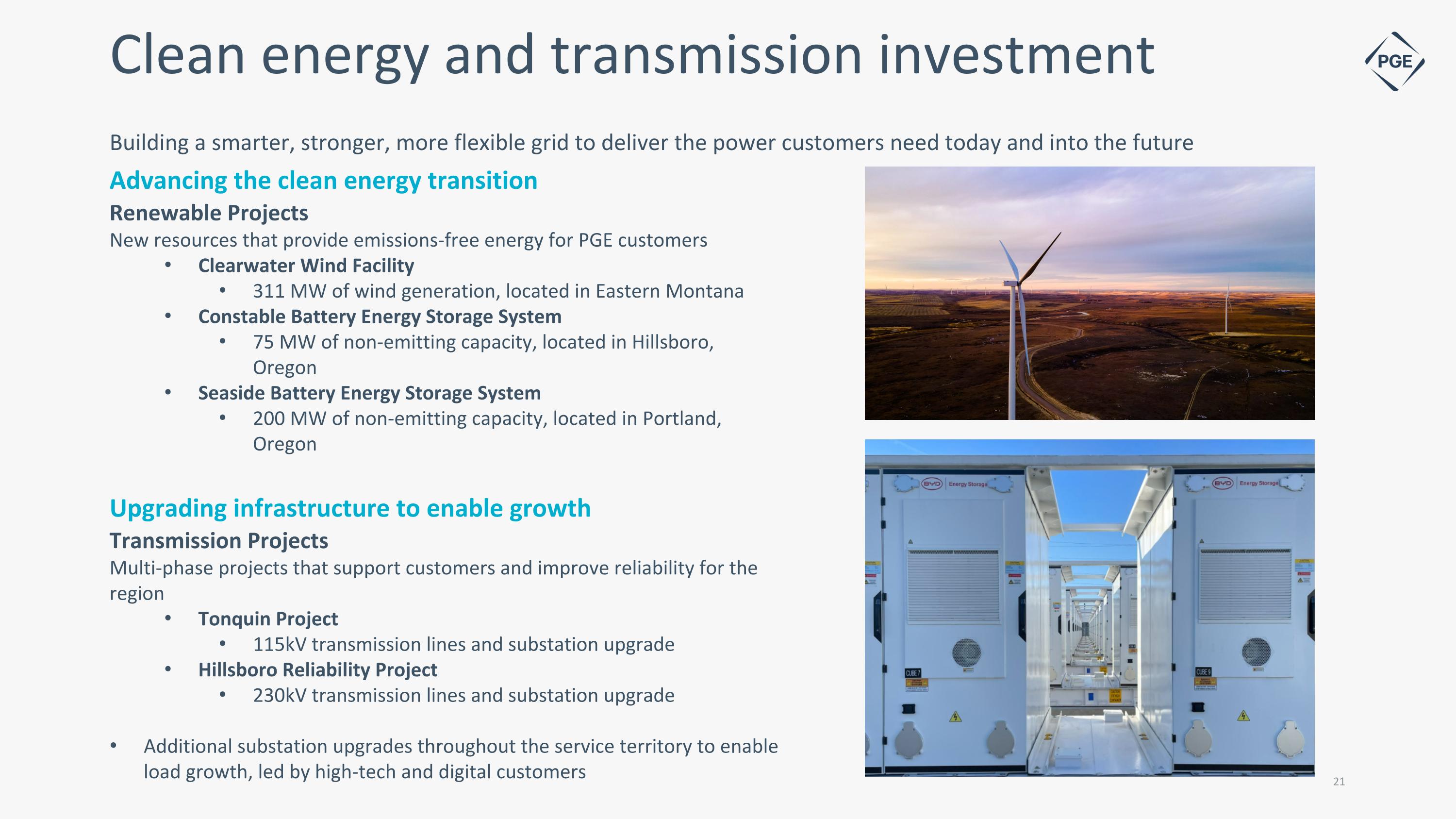
Clean energy and transmission investment Renewable Projects New resources that provide emissions-free energy for PGE customers Clearwater Wind Facility 311 MW of wind generation, located in Eastern Montana Constable Battery Energy Storage System 75 MW of non-emitting capacity, located in Hillsboro, Oregon Seaside Battery Energy Storage System 200 MW of non-emitting capacity, located in Portland, Oregon Building a smarter, stronger, more flexible grid to deliver the power customers need today and into the future Transmission Projects Multi-phase projects that support customers and improve reliability for the region Tonquin Project 115kV transmission lines and substation upgrade Hillsboro Reliability Project 230kV transmission lines and substation upgrade Additional substation upgrades throughout the service territory to enable load growth, led by high-tech and digital customers Advancing the clean energy transition Upgrading infrastructure to enable growth
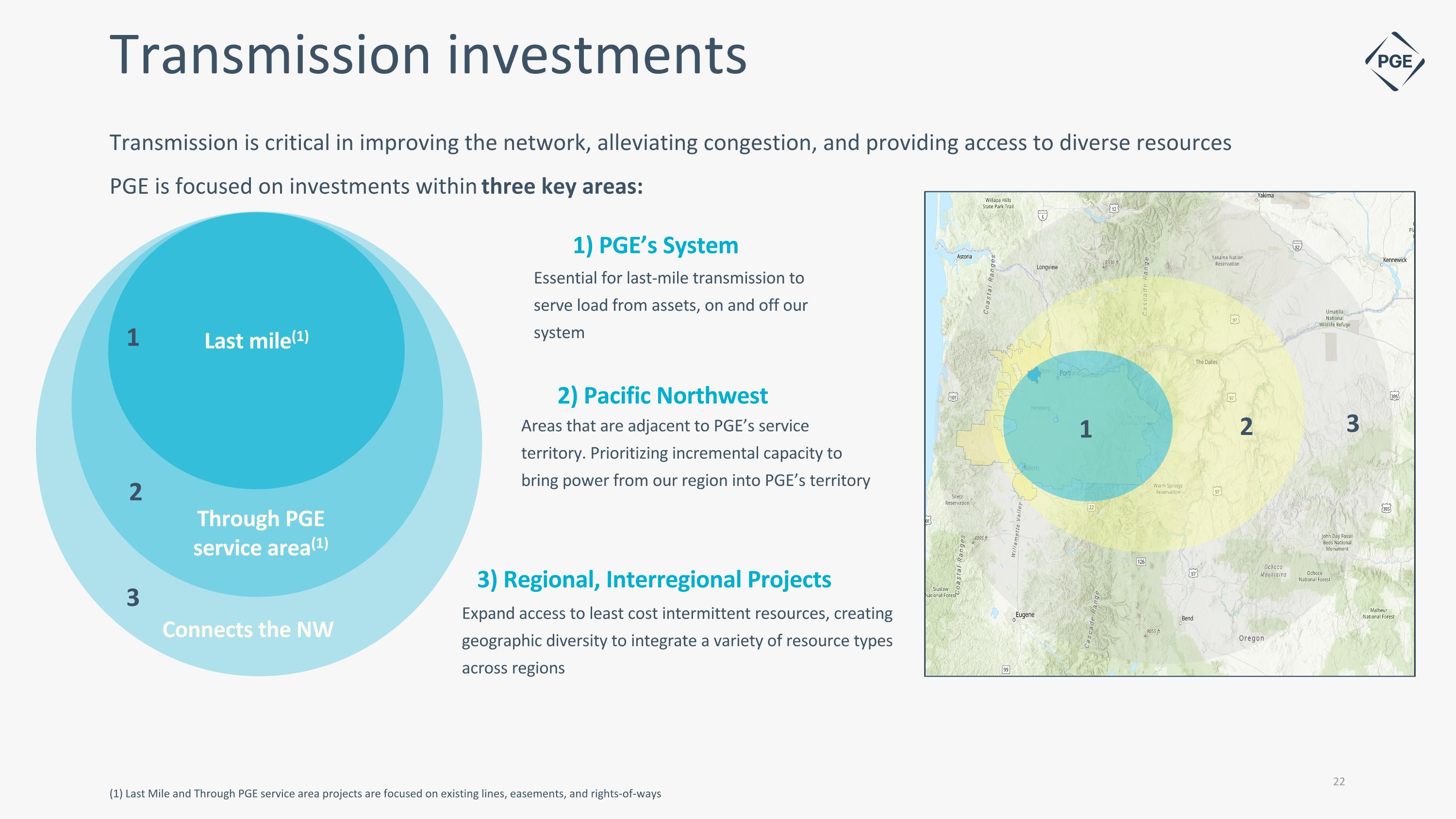
Transmission investments 3) Regional, Interregional Projects 1) PGE’s System Expand access to least cost intermittent resources, creating geographic diversity to integrate a variety of resource types across regions Last mile(1) Through PGE service area(1) Connects the NW 2) Pacific Northwest Essential for last-mile transmission to serve load from assets, on and off our system Areas that are adjacent to PGE’s service territory. Prioritizing incremental capacity to bring power from our region into PGE’s territory (1) Last Mile and Through PGE service area projects are focused on existing lines, easements, and rights-of-ways Transmission is critical in improving the network, alleviating congestion, and providing access to diverse resources PGE is focused on investments within three key areas: 1 2 3 1 2 3 22
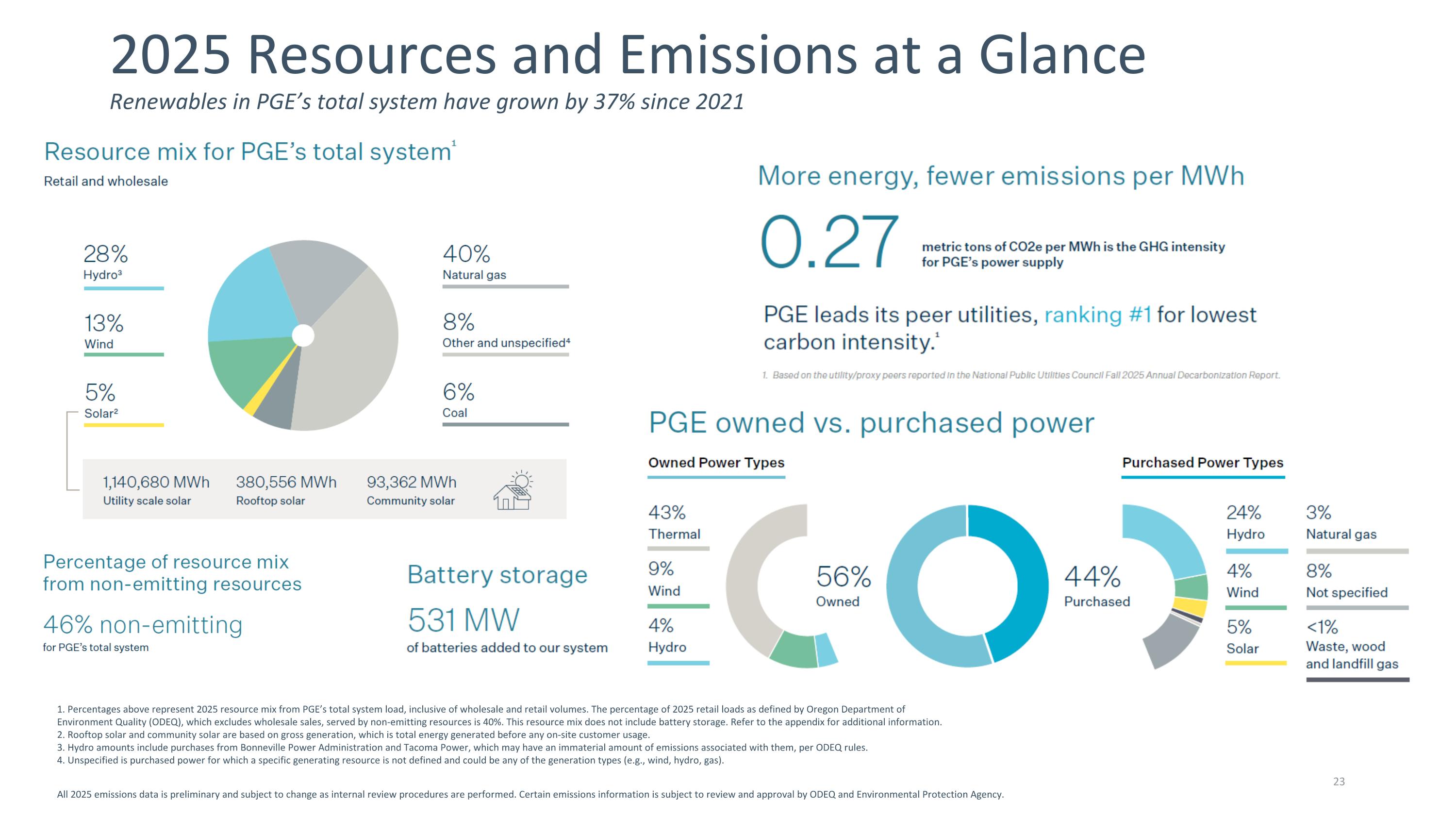
All 2025 emissions data is preliminary and subject to change as internal review procedures are performed. Certain emissions information is subject to review and approval by ODEQ and Environmental Protection Agency. 1. Percentages above represent 2025 resource mix from PGE’s total system load, inclusive of wholesale and retail volumes. The percentage of 2025 retail loads as defined by Oregon Department of Environment Quality (ODEQ), which excludes wholesale sales, served by non-emitting resources is 40%. This resource mix does not include battery storage. Refer to the appendix for additional information. 2. Rooftop solar and community solar are based on gross generation, which is total energy generated before any on-site customer usage. 3. Hydro amounts include purchases from Bonneville Power Administration and Tacoma Power, which may have an immaterial amount of emissions associated with them, per ODEQ rules. 4. Unspecified is purchased power for which a specific generating resource is not defined and could be any of the generation types (e.g., wind, hydro, gas). Renewables in PGE’s total system have grown by 37% since 2021 2025 Resources and Emissions at a Glance 23
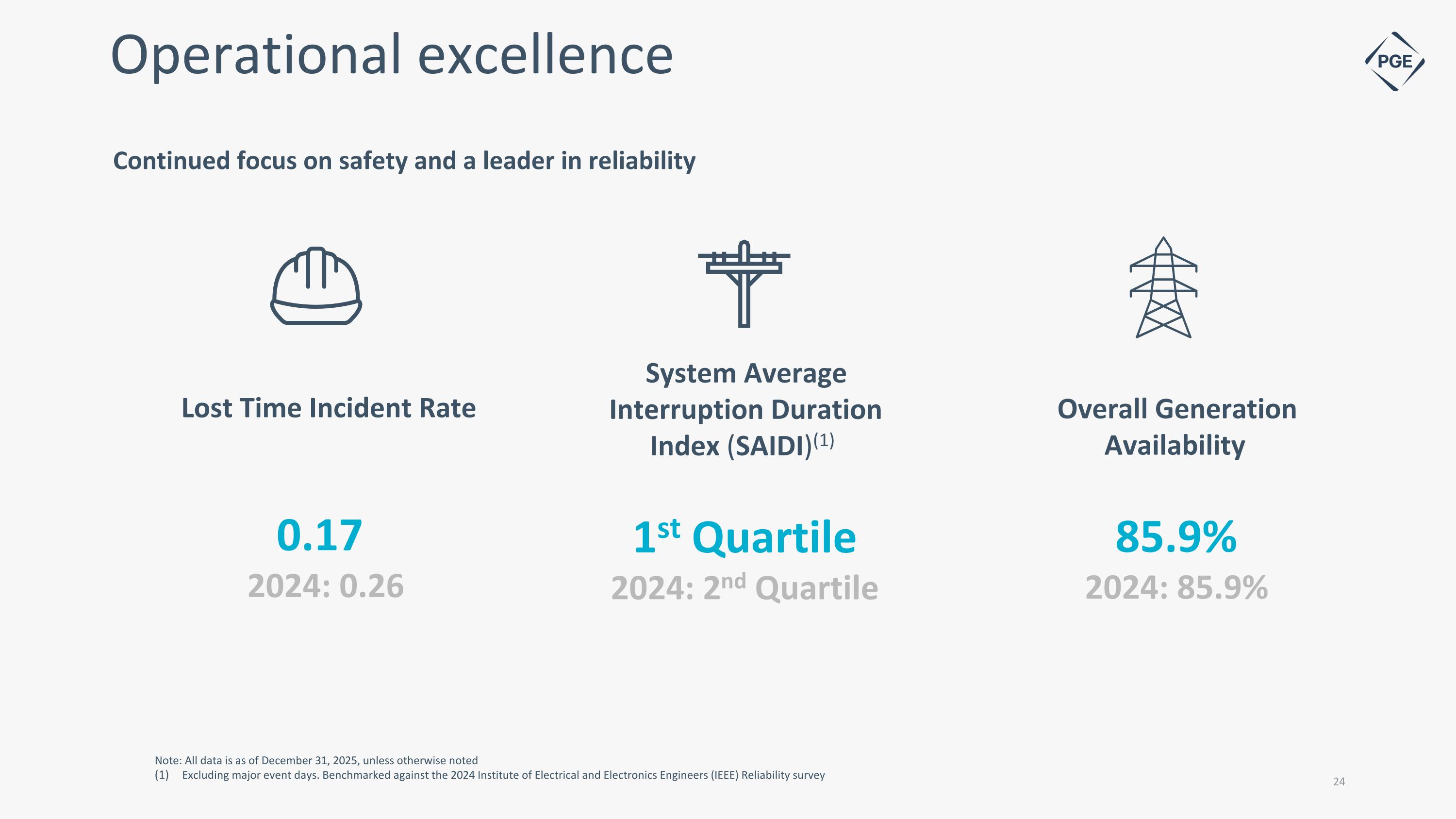
0.17 2024: 0.26 Operational excellence Note: All data is as of December 31, 2025, unless otherwise noted Excluding major event days. Benchmarked against the 2024 Institute of Electrical and Electronics Engineers (IEEE) Reliability survey System Average Interruption Duration Index (SAIDI)(1) 1st Quartile 2024: 2nd Quartile Continued focus on safety and a leader in reliability Overall Generation Availability 85.9% 2024: 85.9% Lost Time Incident Rate
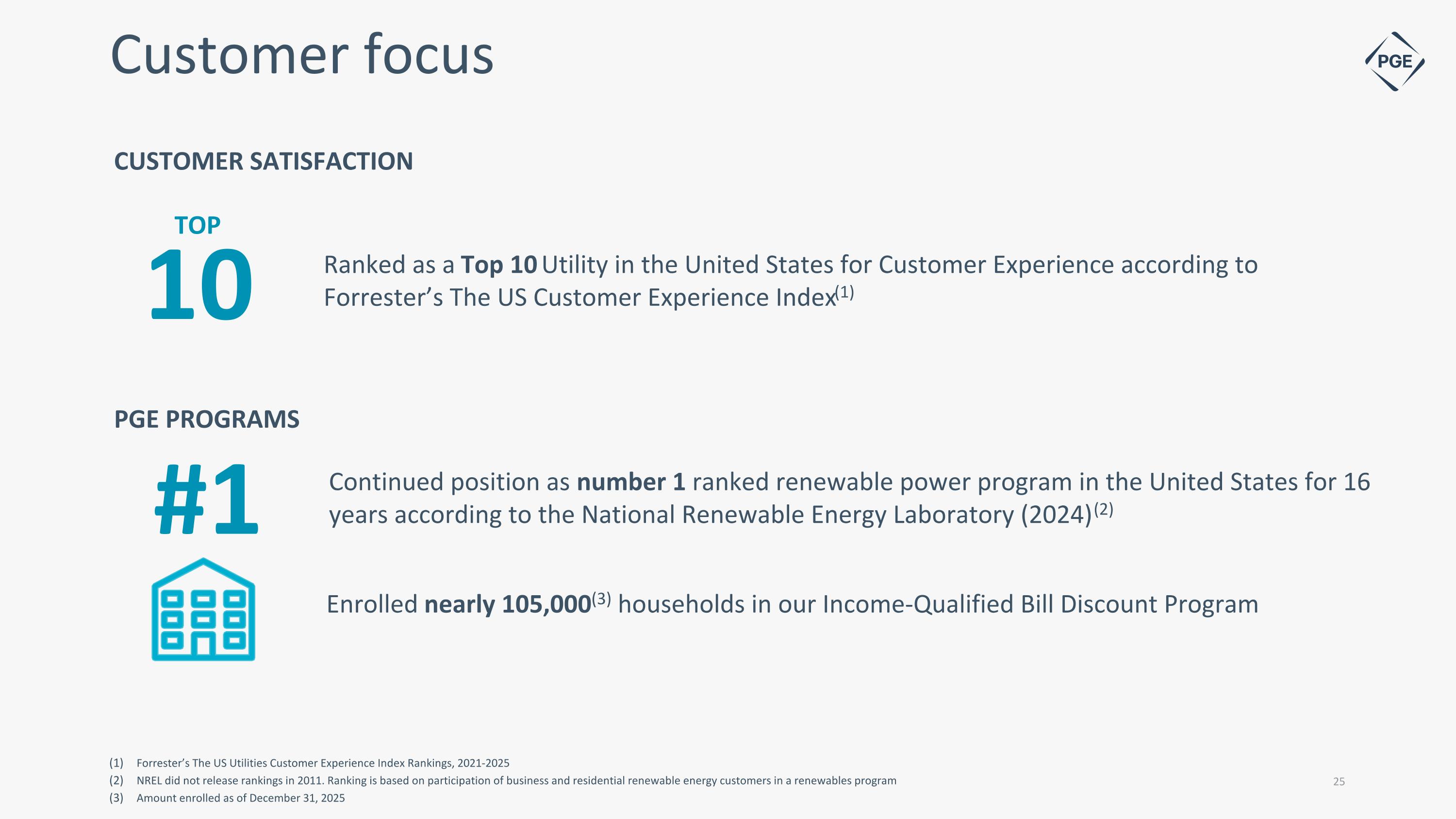
Customer focus PGE PROGRAMS Enrolled nearly 105,000(3) households in our Income-Qualified Bill Discount Program CUSTOMER SATISFACTION #1 Continued position as number 1 ranked renewable power program in the United States for 16 years according to the National Renewable Energy Laboratory (2024) (2) Forrester’s The US Utilities Customer Experience Index Rankings, 2021-2025 NREL did not release rankings in 2011. Ranking is based on participation of business and residential renewable energy customers in a renewables program Amount enrolled as of December 31, 2025 Ranked as a Top 10 Utility in the United States for Customer Experience according to Forrester’s The US Customer Experience Index(1) 10 TOP

Appendix
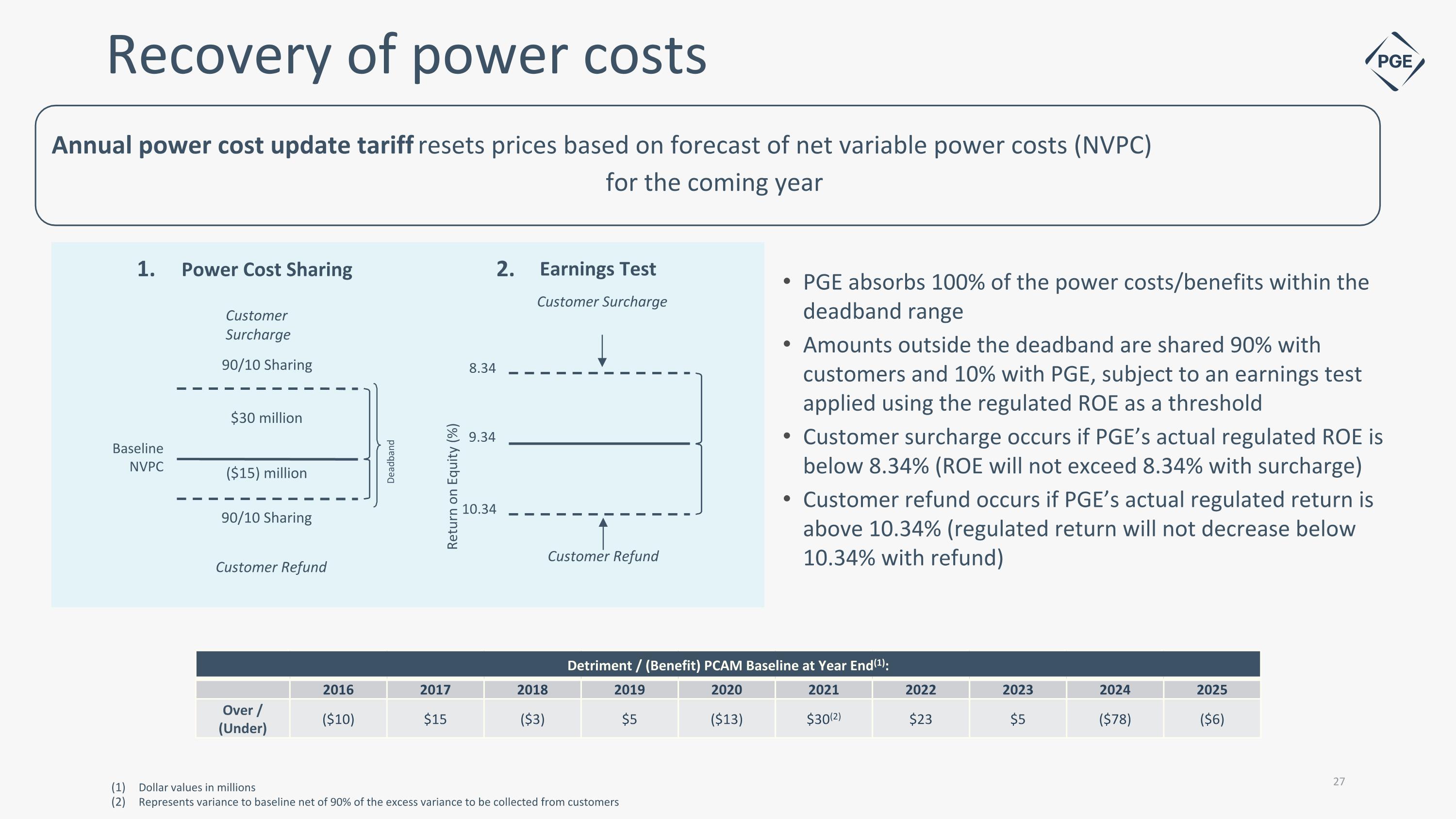
Annual power cost update tariff resets prices based on forecast of net variable power costs (NVPC) for the coming year PGE absorbs 100% of the power costs/benefits within the deadband range Amounts outside the deadband are shared 90% with customers and 10% with PGE, subject to an earnings test applied using the regulated ROE as a threshold Customer surcharge occurs if PGE’s actual regulated ROE is below 8.34% (ROE will not exceed 8.34% with surcharge) Customer refund occurs if PGE’s actual regulated return is above 10.34% (regulated return will not decrease below 10.34% with refund) Detriment / (Benefit) PCAM Baseline at Year End(1): 2016 2017 2018 2019 2020 2021 2022 2023 2024 2025 Over / (Under) ($10) $15 ($3) $5 ($13) $30(2) $23 $5 ($78) ($6) Recovery of power costs Dollar values in millions Represents variance to baseline net of 90% of the excess variance to be collected from customers 9.34 10.34 8.34 Return on Equity (%) ($15) million $30 million Customer Refund 90/10 Sharing Baseline NVPC 90/10 Sharing Customer Refund Customer Surcharge Customer Surcharge Deadband Power Cost Sharing Earnings Test 1. 2.
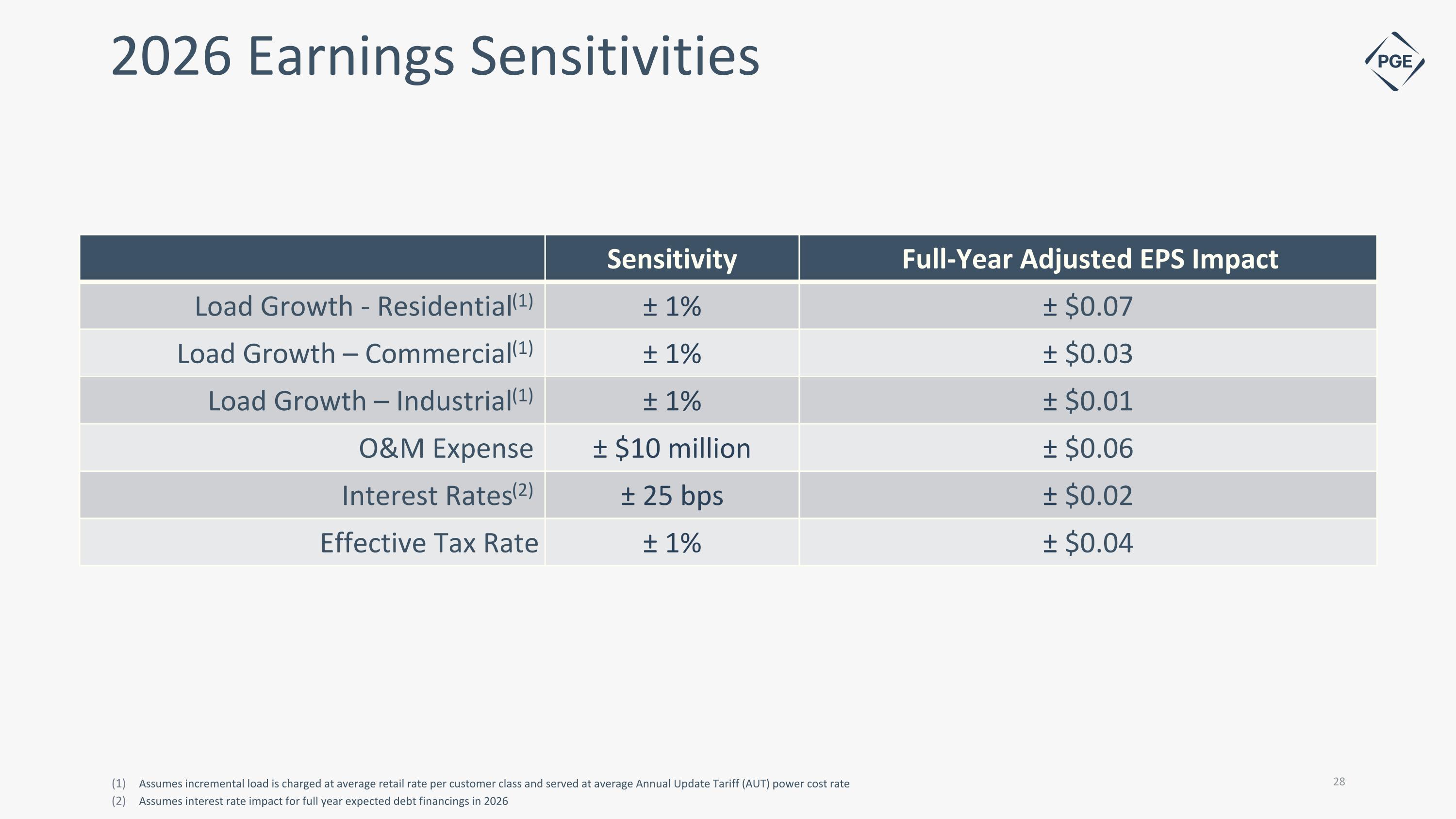
2026 Earnings Sensitivities Sensitivity Full-Year Adjusted EPS Impact Load Growth - Residential(1) ± 1% ± $0.07 Load Growth – Commercial(1) ± 1% ± $0.03 Load Growth – Industrial(1) ± 1% ± $0.01 O&M Expense ± $10 million ± $0.06 Interest Rates(2) ± 25 bps ± $0.02 Effective Tax Rate ± 1% ± $0.04 Assumes incremental load is charged at average retail rate per customer class and served at average Annual Update Tariff (AUT) power cost rate Assumes interest rate impact for full year expected debt financings in 2026
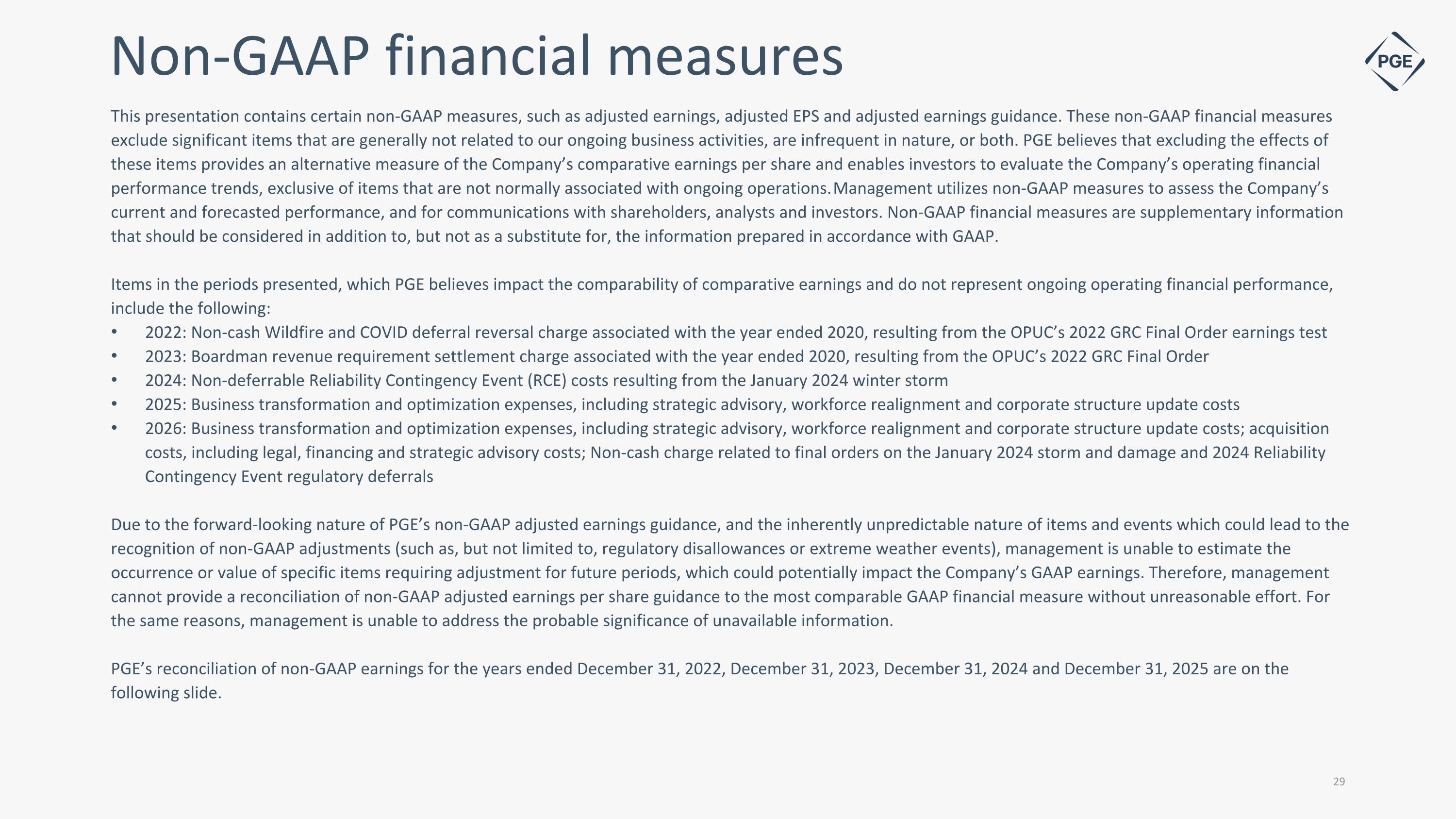
This presentation contains certain non-GAAP measures, such as adjusted earnings, adjusted EPS and adjusted earnings guidance. These non-GAAP financial measures exclude significant items that are generally not related to our ongoing business activities, are infrequent in nature, or both. PGE believes that excluding the effects of these items provides an alternative measure of the Company’s comparative earnings per share and enables investors to evaluate the Company’s operating financial performance trends, exclusive of items that are not normally associated with ongoing operations. Management utilizes non-GAAP measures to assess the Company’s current and forecasted performance, and for communications with shareholders, analysts and investors. Non-GAAP financial measures are supplementary information that should be considered in addition to, but not as a substitute for, the information prepared in accordance with GAAP. Items in the periods presented, which PGE believes impact the comparability of comparative earnings and do not represent ongoing operating financial performance, include the following: 2022: Non-cash Wildfire and COVID deferral reversal charge associated with the year ended 2020, resulting from the OPUC’s 2022 GRC Final Order earnings test 2023: Boardman revenue requirement settlement charge associated with the year ended 2020, resulting from the OPUC’s 2022 GRC Final Order 2024: Non-deferrable Reliability Contingency Event (RCE) costs resulting from the January 2024 winter storm 2025: Business transformation and optimization expenses, including strategic advisory, workforce realignment and corporate structure update costs 2026: Business transformation and optimization expenses, including strategic advisory, workforce realignment and corporate structure update costs; acquisition costs, including legal, financing and strategic advisory costs; Non-cash charge related to final orders on the January 2024 storm and damage and 2024 Reliability Contingency Event regulatory deferrals Due to the forward-looking nature of PGE’s non-GAAP adjusted earnings guidance, and the inherently unpredictable nature of items and events which could lead to the recognition of non-GAAP adjustments (such as, but not limited to, regulatory disallowances or extreme weather events), management is unable to estimate the occurrence or value of specific items requiring adjustment for future periods, which could potentially impact the Company’s GAAP earnings. Therefore, management cannot provide a reconciliation of non-GAAP adjusted earnings per share guidance to the most comparable GAAP financial measure without unreasonable effort. For the same reasons, management is unable to address the probable significance of unavailable information. PGE’s reconciliation of non-GAAP earnings for the years ended December 31, 2022, December 31, 2023, December 31, 2024 and December 31, 2025 are on the following slide. Non-GAAP financial measures
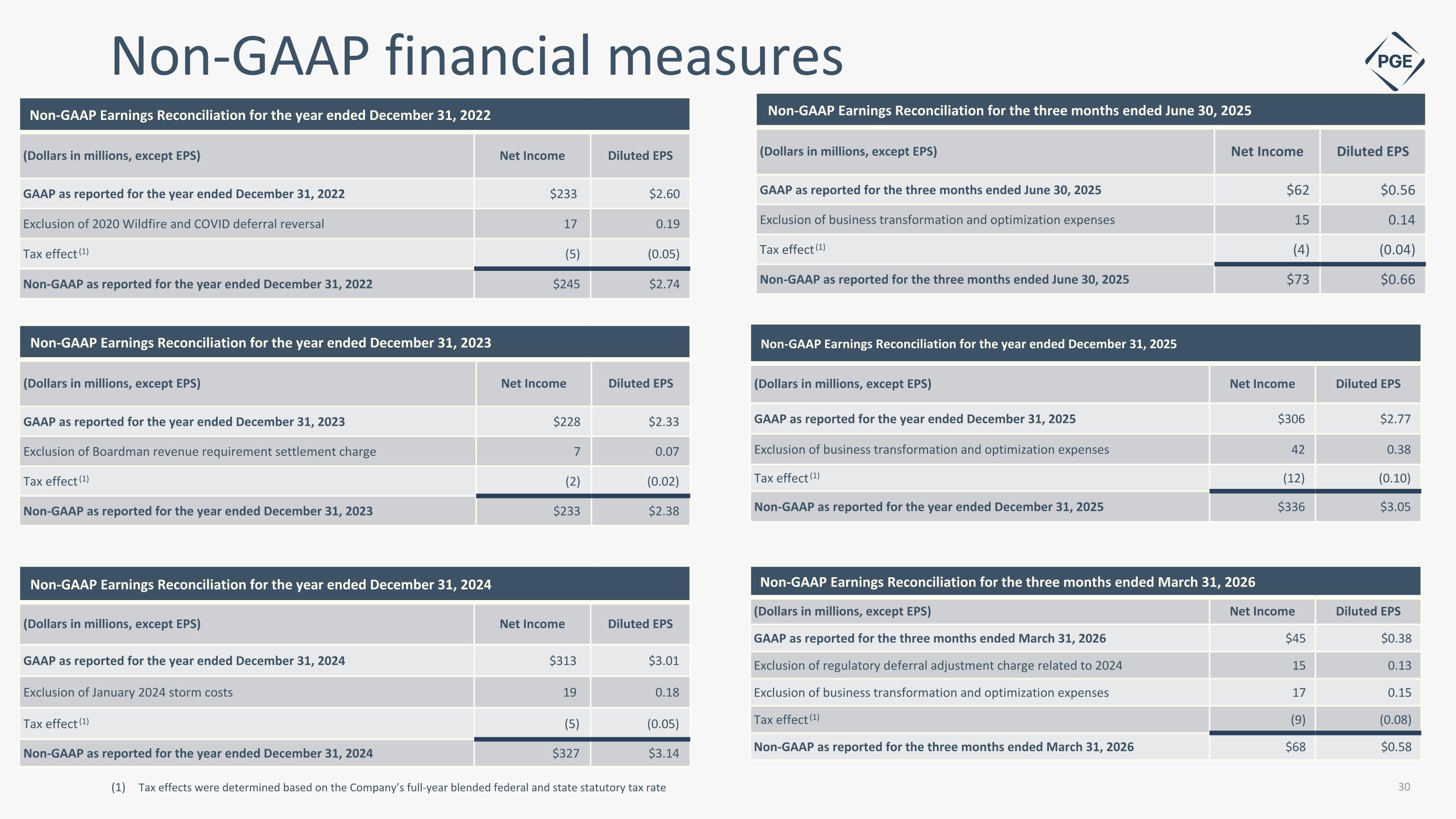
Non-GAAP Earnings Reconciliation for the year ended December 31, 2022 (Dollars in millions, except EPS) Net Income Diluted EPS GAAP as reported for the year ended December 31, 2022 $233 $2.60 Exclusion of 2020 Wildfire and COVID deferral reversal 17 0.19 Tax effect (1) (5) (0.05) Non-GAAP as reported for the year ended December 31, 2022 $245 $2.74 Non-GAAP financial measures Tax effects were determined based on the Company’s full-year blended federal and state statutory tax rate Non-GAAP Earnings Reconciliation for the year ended December 31, 2024 (Dollars in millions, except EPS) Net Income Diluted EPS GAAP as reported for the year ended December 31, 2024 $313 $3.01 Exclusion of January 2024 storm costs 19 0.18 Tax effect (1) (5) (0.05) Non-GAAP as reported for the year ended December 31, 2024 $327 $3.14 Non-GAAP Earnings Reconciliation for the year ended December 31, 2023 (Dollars in millions, except EPS) Net Income Diluted EPS GAAP as reported for the year ended December 31, 2023 $228 $2.33 Exclusion of Boardman revenue requirement settlement charge 7 0.07 Tax effect (1) (2) (0.02) Non-GAAP as reported for the year ended December 31, 2023 $233 $2.38 Non-GAAP Earnings Reconciliation for the year ended December 31, 2025 (Dollars in millions, except EPS) Net Income Diluted EPS GAAP as reported for the year ended December 31, 2025 $306 $2.77 Exclusion of business transformation and optimization expenses 42 0.38 Tax effect (1) (12) (0.10) Non-GAAP as reported for the year ended December 31, 2025 $336 $3.05 Non-GAAP Earnings Reconciliation for the three months ended March 31, 2026 (Dollars in millions, except EPS) Net Income Diluted EPS GAAP as reported for the three months ended March 31, 2026 $45 $0.38 Exclusion of regulatory deferral adjustment charge related to 2024 15 0.13 Exclusion of business transformation and optimization expenses 17 0.15 Tax effect (1) (9) (0.08) Non-GAAP as reported for the three months ended March 31, 2026 $68 $0.58 Non-GAAP Earnings Reconciliation for the three months ended June 30, 2025 (Dollars in millions, except EPS) Net Income Diluted EPS GAAP as reported for the three months ended June 30, 2025 $62 $0.56 Exclusion of business transformation and optimization expenses 15 0.14 Tax effect (1) (4) (0.04) Non-GAAP as reported for the three months ended June 30, 2025 $73 $0.66