Please wait

TABLE OF CONTENTS

UNITED STATES
SECURITIES AND EXCHANGE COMMISSION
Washington, D.C. 20549
SCHEDULE 14A

PROXY STATEMENT PURSUANT TO SECTION 14(a)
OF THE SECURITIES EXCHANGE ACT OF 1934
(Amendment No.   )
☒ Filed by the Registrant              Filed by a Party other than the Registrant
Check the appropriate box:

Preliminary Proxy Statement

Confidential, for Use of the Commission Only (as permitted by Rule 14A-6(E)(2))

Definitive Proxy Statement

Definitive Additional Materials

Soliciting Material under §240.14a-12
FISERV, INC.

(Name of Registrant as Specified in its Charter)

(Name of Person(s) Filing Proxy Statement, if other than the Registrant)
Payment of Filing Fee (Check all boxes that apply):

No fee required.

Fee paid previously with preliminary materials.

Fee computed on table in exhibit required by Item 25(b) per Exchange Act Rules 14a-6(i)(1) and 0-11.

TABLE OF CONTENTS


Dear Fellow Shareholders,
In 2025, we undertook a rigorous review of our business that led to a reset of our earnings baseline. This recalibration represents an important and revitalizing moment for Fiserv, driven by a clear-eyed assessment of where we needed to strengthen execution and accelerate investment. We used this opportunity to refocus on the pillars that have long defined our company – exceptional client service, world-class execution, value-added technology, and cutting-edge innovation – to position us to deliver sustainable, high-quality growth and long-term value for our shareholders.
One Fiserv Action Plan
With our objectives well-defined, we established a new strategic framework called the One Fiserv action plan focused on five strategic pillars: operating with a client-first mindset; building the pre-eminent small business operating platform through Clover®; creating differentiated platforms in finance and commerce; delivering operational excellence enabled by artificial intelligence; and employing disciplined capital allocation for the long-term. One Fiserv serves as the foundation of our strategy and is embedded within our 2026 operating plan.
Leadership and Board Transitions
In the past year, the board oversaw a number of leadership transitions, working closely with management to ensure continuity while enhancing the experience and capabilities of the team. We are encouraged by the opportunities created by the changes to our senior leadership team and organizational structure. In addition, as part of our multi-year board refreshment effort, we added three new directors in 2026. The new directors further enhance the board’s collective skillsets with backgrounds in financial services, experience leading transformation and financial expertise, directly supporting our enhanced focus on execution, client-centricity, operational rigor and long-term value creation. Fiserv is positioned to enter its next chapter with the talent required to deliver on the company’s long-term strategy.
Shareholder Engagement
Ongoing dialogue with our shareholders was especially important during this transition. In addition to regular engagement through earnings calls, analyst meetings, and investor and industry conferences, we undertook broad governance outreach with director participation. Across these conversations, shareholders expressed support for the leadership transitions and board refreshment efforts, while emphasizing the importance of open communication and clear alignment among compensation, strategy, and long-term value creation.
Looking Ahead
We believe no other company has the assets, breadth and scale to connect all parts of the financial ecosystem. Our position at the center of commerce and the growing connection between businesses and financial institutions provides unique opportunities in areas such as embedded finance, stablecoin, networks, and merchant liquidity. Our focus on service excellence and new technology, including artificial intelligence, is designed to accelerate our ability to capitalize on and scale these opportunities. We recognize the critical roles we play across both of our segments and are thankful for the opportunity to deliver value to our shareholders and clients.
Please join us for our annual meeting which will be held online at www.virtualshareholdermeeting.com/FISV2026 on Thursday, May 21, 2026, at 10:00 a.m. Central time. Details for attending the meeting, and how and when to vote, are included in this proxy statement. Your vote is very important to us. If you are unable to attend the annual meeting, please vote in advance of the meeting online, by mail or by telephone to ensure your shares are represented.
Thank you for your continued support and investment in Fiserv.
Sincerely,


Michael P. Lyons
Gordon M. Nixon
Chief Executive Officer
Chairman of the Board

TABLE OF CONTENTS

Notice of
2026 Annual
Meeting of
Shareholders
 
May 21, 2026
Thursday, at 10:00 a.m. (CT)
 
Virtual Annual Meeting Site
www.virtualshareholdermeeting.com/FISV2026, where you will be able to listen to the annual meeting live, submit questions and vote online
Who Can Vote
Holders of Fiserv stock at the close of business on March 24, 2026.
Participating in the Virtual Annual Meeting
The annual meeting will be held via live webcast to enable broad shareholder attendance and to provide a consistent experience to all shareholders regardless of location. Holders of Fiserv stock at the close of business on March 24, 2026 are entitled to participate in, examine our shareholder list at, and submit questions in writing during the annual meeting by visiting www.virtualshareholdermeeting.com/FISV2026. To participate in the annual meeting, you will need the 16-digit control number included on your notice of Internet availability of proxy materials, on your proxy card or on the instructions that accompanied your proxy materials. The annual meeting will begin promptly at 10:00 a.m. (CT). Online check-in will begin at 9:45 a.m. (CT). Please allow ample time for the online check-in procedures.
Date of Mailing
On April 2, 2026, we will commence mailing the notice of Internet availability of proxy materials, or a proxy statement, proxy card and annual report, to shareholders.
Matters to be Voted On
1.
Election of eleven directors to serve for a one-year term and until their successors are elected and qualified.
2.
Approval, on an advisory basis, of the compensation of our named executive officers.
3.
Ratification of appointment of Deloitte & Touche LLP as our independent registered public accounting firm for 2026.
4.
Shareholder Proposal requesting an independent board chair policy.
Any other business as may properly come before the annual meeting or any adjournments or postponements thereof.
By Order of the Board of Directors,

Eric C. Nelson
Secretary
April 2, 2026
Review your proxy statement and vote in one of four ways:

Internet
Visit proxyvote.com

By telephone
Call the telephone number
on your proxy card

By mail
Sign, date and return
your proxy card
in the enclosed envelope

During the meeting
Attend our annual meeting
and cast your vote during
the meeting
Important notice regarding the availability of proxy materials for the shareholder meeting to be held on May 21, 2026: The proxy statement, 2025 Annual Report on Form 10-K, and the means to vote by Internet are available at http://www.proxyvote.com.

TABLE OF CONTENTS

Table of Contents


Fiserv, Inc. 2026 Proxy Statement | 03

TABLE OF CONTENTS

Proxy Summary
This summary highlights selected information in this proxy statement. Please review the entire proxy statement and our Annual Report on Form 10-K for the year ended December 31, 2025, before voting your shares.
Annual Meeting Information


Time and Date
Thursday, May 21, 2026
10:00 a.m. (CT)
Virtual Meeting Site
www.virtualshareholdermeeting.com/FISV2026
Record Date
March 24, 2026
Items of Business
Board’s Recommendation
Where to
Find Details
1.
Election of eleven directors to serve for a one-year term and until their successors are elected and qualified.
FOR all nominees
P. 14 - 21
2.
Approval, on an advisory basis, of the compensation of our named executive officers.
FOR
P. 31 - 32
3.
Ratification of appointment of Deloitte & Touche LLP as our independent registered public accounting firm for 2026.
FOR
P. 78
4.
Shareholder Proposal requesting an independent board chair policy.
AGAINST
P. 81 - 84
04 | Fiserv, Inc. 2026 Proxy Statement

TABLE OF CONTENTS

Proxy Summary
Director Nominees
Director Nominees


Committee Memberships
Directors
Occupation
Age
Director
Since
Independent
Other Public
Directorships
Audit
Nominating
and Corporate
Governance
Talent and
Compensation
Risk
Michael P. Lyons
Chief Executive
Officer

55
2025


Gordon M.
Nixon(1)
Former President and Chief Executive Officer of Royal Bank of Canada
69
2026

3(2)


Stephanie E.
Cohen
Chief Strategy Officer of Cloudflare
48
2025


Henrique de Castro
Former Chief Operating Officer of Yahoo! Inc.
60
2019

1


Harry F. DiSimone
Former President of Commerce Advisors, Inc.
71
2018


Céline Dufétel
Chief Financial Officer of Bridgewater Associates, LP
45
2026


Lance M.
Fritz
Former Chairman, President and Chief Executive Officer of Union Pacific Corporation
63
2024

1


Ajei S. Gopal
President and Chief Executive Officer of Procore Technologies, Inc.
64
2024

2(3)


Wafaa Mamilli
Executive Vice President, Chief Digital and Technology Officer of Roche
58
2021


Gary S. Shedlin
Vice Chairman of BlackRock, Inc.

62
2026


Charlotte B. Yarkoni
Former President of Commerce, Ecosystems, Cloud & AI of Microsoft
56
2023

1 


  (1)
Chairman of the Board
  (2)
Mr. Nixon will not stand for re-election as a director of BCE Inc. (“BCE”) at BCE’s general shareholder meeting on May 7, 2026, following which he will hold two public directorships other than Fiserv.
  (3)
Mr. Gopal will not stand for re-election as a director of Synopsys, Inc. (“Synopsys”) at Synopsys’s annual meeting of stockholders on April 16, 2026, following which he will hold one public directorship other than Fiserv.
   
Committee Chair
Fiserv, Inc. 2026 Proxy Statement | 05

TABLE OF CONTENTS

Proxy Summary
At-A-Glance
At-A-Glance
In 2025, we strengthened our focus on client service, world-class execution, value-added technology solutions and innovation. Following a rigorous analysis, we announced our new One Fiserv action plan, and updated our financial baseline and growth plan. Our One Fiserv action plan focuses on prioritizing and enhancing client focus across five strategic pillars: operating with a client-first mindset, building the pre-eminent small business operating platform through Clover®, creating differentiated platforms in finance and commerce, delivering operational excellence enabled by artificial intelligence, and employing disciplined capital allocation for the long-term. In connection with the One Fiserv action plan, we have embraced the use of emerging technology, including generative and agentic artificial intelligence, to enhance our mission-critical software solutions, ignite our gateways and orchestration layers, facilitate embedded finance and improve our operations. With a focus on sustainable financial performance, client satisfaction and operational discipline, 2026 will be a critical investment and transition year for us, and is expected to establish the foundation for Fiserv to be a durable growth compounder generating compelling and predictable returns.
Leadership Changes
We made a number of leadership updates in 2025, including the appointment of our new Chief Executive Officer, Michael P. Lyons. Mr. Lyons was appointed President and CEO-Elect effective January 27, 2025, and served in that position until he assumed the role of Chief Executive Officer on May 6, 2025. Mr. Lyons brings significant industry experience, strategic insight, and a demonstrated track record of operational excellence. As former President of The PNC Financial Services Group, one of Fiserv’s largest clients, he assumed the role of Chief Executive Officer with a strong understanding of our customers and their needs, positioning him well to lead the company into its next chapter of execution and value creation. Mr. Lyons has also emphasized a commitment to execution and client service to support long-term shareholder value.
In coordination with the board, Mr. Lyons has made changes to our senior leadership team and organizational structure to position Fiserv for long-term success. These new appointments and organizational changes support our priorities to enhance client focus across key strategic pillars and promote long-term value, with the new members of our senior leadership team bringing skills and experience aligned with the company’s strategic initiatives. These updates reflect our commitment to building a world-class leadership team united in prioritizing a culture of strong execution and client service. The following is a summary of these 2025 leadership changes. 
Effective October 31, 2025, the company appointed Paul M. Todd as Chief Financial Officer. Mr. Todd has a strong track record as a public company chief financial officer, including serving as the Chief Financial Officer of Global Payments, Inc., with valuable industry experience, insight into emerging industry trends, and execution success.
Effective December 1, 2025, the company appointed Panagiotis (Takis) Georgakopoulos and Dhivya Suryadevara as Co-Presidents. In his role as Co-President, Mr. Georgakopoulos is responsible for the company’s Merchant Solutions business. He previously served as Executive Vice President and Chief Operating Officer, and brings strategic vision, operational expertise and deep technical leadership to the role. Ms. Suryadevara joined the company as Co-President and is responsible for the company’s Financial Solutions business. She brings extensive experience across banking, payments, finance and technology – areas critical to Fiserv’s long-term strategy and growth.
Board of Directors and Governance
Board Membership. Our board is composed of members who are leaders in their respective fields. Over the past several years, the board has added the skills and experience to oversee our strategic priorities. Since 2024, the board has appointed six new independent directors: Lance Fritz, Ajei Gopal, Stephanie Cohen, Céline Dufétel, Gordon Nixon and Gary Shedlin, with the latter three joining our board on January 1, 2026. These additions bring deep expertise in financial services, payments, digital and ecommerce innovation, capital allocation and global operational leadership, directly supporting our enhanced focus on execution, client-centricity, operational rigor and long-term value creation.
06 | Fiserv, Inc. 2026 Proxy Statement

TABLE OF CONTENTS

Proxy Summary
At-A-Glance
Mr. Nixon joined as independent Chairman, bringing extensive experience as a leader in the global financial industry, including as former Chief Executive Officer of Royal Bank of Canada and as a public company director. Mr. Shedlin, former Chief Financial Officer and current Vice Chair at BlackRock, brings a strong track record of successfully executing on key strategic initiatives and strengthening relationships with clients and partners. Ms. Dufétel, Chief Financial Officer of Bridgewater Associates, brings a differentiated investor perspective from her former Chief Financial Officer and Chief Operating Officer roles at T. Rowe Price and senior-level positions at Neuberger Berman, as well as deep industry experience as former President and Chief Operating Officer of Checkout.com. Mr. Nixon and Mr. Shedlin were identified as potential director candidates by our current chief executive officer and Ms. Dufétel was identified by a third-party search firm. These appointments emphasize the board’s commitment to aligning its capabilities with the evolving needs of the business, as reflected in the director skills matrix included in this proxy statement.
Board Leadership. The board believes strong and effective leadership is essential and maintains flexibility to adopt governance structures that it believes best serve our company and our shareholders. In 2025, the board determined to separate the roles of chairman and chief executive officer and appointed Doyle Simons as independent Chairman of the Board effective May 6, 2025. Subsequently, the board appointed Mr. Nixon as independent Chairman of the Board effective January 1, 2026 to succeed Mr. Simons upon his retirement. In appointing Mr. Nixon, the board considered his significant service as a public company director, including experience as both an independent chairman and lead independent director of large public companies. His background in governance, strategy oversight and disciplined execution positions him well to guide the board and support our strategic priorities. Mr. Nixon brings significant expertise, judgment and leadership to this role.
Committee Rotation. In early 2026, with the addition of three new directors, and as a part of our annual committee refreshment process, we reconstituted our committee memberships and chair positions. Ms. Yarkoni was appointed to the nominating and corporate governance committee and Mr. Gopal was appointed committee chair. Mr. Shedlin and Ms. Dufétel were appointed to the audit committee, with Mr. Shedlin assuming the role of committee chair. Messrs. Fritz and Shedlin were appointed to the talent and compensation committee, with Mr. Fritz assuming the role of committee chair. Ms. Dufétel was appointed to the risk committee. These changes reflect our ongoing commitment to appoint directors to committees where they are able to maximize their impact and best position directors to use their skills to provide effective oversight and deliver value to our shareholders.
Board Performance and Engagement. Through annual board assessments, full board discussions and third-party evaluations, we strive to maintain a board with the skills and experience to advance our strategy and provide effective oversight. We conduct annual evaluations of board, committee and individual director performance. Our independent chairman of the board facilitates discussions based upon the feedback received and engages with directors individually, and with the board as a whole, to discuss potential opportunities. We also periodically engage a third party to interview our directors regarding individual director and board performance and areas for enhanced skills and performance opportunities. In addition, we continue to focus on our director education program, which includes product demonstrations or presentations from external experts at each regular board meeting covering topics including emerging technology, artificial intelligence developments, the regulatory landscape, updates on the economy, administration and policy initiatives, as well as investor and governance updates.
Director Onboarding. In 2025, we refined our director onboarding program to help accelerate director integration and enable new directors to contribute effectively from the outset while supporting long-term engagement. As part of our onboarding program, we provide written orientation materials promptly following appointment and arrange structured meetings with senior management, committee chairs and key function leaders to familiarize directors with our strategy, operations, risk management and governance framework. These sessions cover a wide range of topics including the company’s strategies, key objectives for each business segment and corporate function, financial results and reporting, capital allocation, client engagement, human capital management, internal and external audit matters, corporate governance and legal updates. In addition, we arrange meetings
Fiserv, Inc. 2026 Proxy Statement | 07

TABLE OF CONTENTS

Proxy Summary
At-A-Glance
with external advisors, including industry experts and our auditor, and provide committee-specific briefings and ongoing education opportunities to ensure directors develop a strong foundational knowledge of Fiserv, our business and the evolving environment in which we operate.
Board Limits. Our governance guidelines provide that independent directors may serve on no more than four boards of directors of for-profit enterprises, including our board, without approval of our board of directors. Our governance guidelines also require that the nominating and corporate governance committee considers each director’s time commitments, including those related to employment and other board service, as part of the annual director nomination process to ensure that our directors have adequate time to fulfill their responsibilities.
Executive Compensation
Compensation Metrics. The talent and compensation committee re-evaluated the incentive compensation metrics and weightings for our annual cash incentive awards and performance share units in light of our strategic transformation and the One Fiserv action plan and approved certain updates for fiscal 2026 compensation to better align to our evolving strategy.
Equity Compensation. Equity continues to comprise a significant majority of the incentive compensation provided to executive officers, thus aligning their interests with the interests of our shareholders and promoting long-term value creation.
Clawback Policy. We maintain a compensation recoupment policy that fully complies with Securities and Exchange Commission rules and Nasdaq Global Select Market (Nasdaq) listing standards. In addition to the mandatory recoupment, the policy permits recoupment of all types of compensation (including but not limited to time-vesting equity awards as well as performance-based equity awards) other than base compensation for a restatement of our operating or financial results, a violation of our code of conduct or the law, or non-compliance with restrictive covenants, among other circumstances. The policy is available on our website at www.Fiserv.com and in our Annual Report on Form 10-K.
Corporate Social Responsibility
Associate Engagement. In 2025, 90% of our associates participated in our annual global associate engagement survey. We scored highest in the operational excellence and manager effectiveness categories, reflecting our associates’ belief that Fiserv fosters an environment where associates can thrive and succeed. We also continued to focus on providing associates with training, learning and career development opportunities and building our recruiting and internal mobility programs, and continued to cultivate leadership at all levels through programs such as Leadership Academy and Leading Fiserv, empowering excellence, engagement and growth.
Business and Community Impact. In 2025, Fiserv was named to the TIME100 Most Influential Companies. Central to the company’s TIME recognition is Clover, our cloud-based point-of-sale and business management platform that serves small and medium-sized businesses. By enabling commerce, payments and financial and business services, Clover delivers solutions that enable, connect and empower people, businesses and communities with market-leading technology.
Engaging the U.S. Military Community. Through Fiserv Salutes, we hire and support veterans and spouses, creating career pathways via partnerships. A core tenant of Fiserv’s veterans hiring and support programs is Fiserv Salutes, the company’s engagement program focused on providing educational resources, mentorship and career opportunities to U.S. service members, veterans and military spouses. Fiserv also partners with organizations like Hiring our Heroes, 50Strong, the D’Aniello Institute for Veterans and Military Families, and Student Veterans of America®, to strengthen its connection with the military community and provide meaningful pathways for employment at Fiserv. We were recognized in 2025 as a Vets Ready Employer by the Wisconsin Department of Workforce Development, highlighting the company’s focus on supporting the military community as a leader for hiring and supporting those that have served our country.
08 | Fiserv, Inc. 2026 Proxy Statement

TABLE OF CONTENTS

Proxy Summary
Shareholder Engagement
Green Building Design. As part of our real estate strategy, we continue to incorporate green building design principles into new construction, renovation and building projects. As of 2025, we had over 750,000 square feet of LEED-certified office space. This includes our executive offices in New York City (LEED Gold), our New Jersey technology campus (LEED Platinum), our collaboration center in Dublin, Ireland (LEED Platinum), our Milwaukee, Wisconsin Headquarters (LEED Gold), and our office in Columbus, Ohio (LEED Silver).
Shareholder Engagement
Our investor relations team and members of senior management regularly communicate with our shareholders, including in connection with quarterly earnings calls, analyst meetings, and investor and industry conferences. In addition, members of senior management engage with shareholders regarding corporate governance and related matters throughout the year to understand their priorities and areas of focus. Prior to our annual meeting of shareholders in May 2025, we conducted shareholder engagement focused on leadership changes, board refreshment and compensation-related matters.
In late 2025 and early 2026, we conducted shareholder engagement focused on company performance, leadership changes, board refreshment and compensation-related matters. We extended invitations to meet with shareholders collectively owning over 50% of our outstanding shares and engaged with shareholders collectively owning nearly 30% of our shares. Mr. Fritz, as then-chair of our nominating and corporate governance committee, participated in a significant majority of these meetings. Feedback received from these discussions helped inform enhancements to our executive compensation program and compensation- and governance-related disclosures.
In our discussions, shareholders expressed positive views regarding leadership additions and board refreshment. Shareholders also expressed support for continued use of equity-based awards as a significant component of our compensation program and our focus on aligning compensation with the interests of our shareholders and long-term value creation. The table below outlines board, governance and compensation-focused feedback during fall 2025 engagements, as well as the board’s considerations to address each topic.
Board and Governance Matters
What We Heard
 
What We Do
Shareholders expressed support for board refreshment and committee rotation
 
• 
Since 2024, we have added six new independent directors, each of whom has C-suite experience. These appointments reflect our commitment to maintaining a highly qualified board with the appropriate expertise to oversee our evolving strategy shifts. Our board’s thoughtful mix of tenures ensures fresh perspectives from newer directors, which complement the experience and institutional knowledge of our longer-serving members. Our independent directors have demonstrated flexibility in continuing to evaluate and assess board composition and leadership

• 
With the addition of new directors, we also reconstituted board committee memberships and chair positions to align director skills with the strategic needs of the company as it evolves

• 
In 2025, the board determined it was appropriate to separate the roles of chairman and chief executive officer and to appoint Mr. Simons, our then-lead independent director, as independent Chairman of the Board, effective upon our former chief executive officer’s resignation. Following Mr. Simons’ retirement, the board appointed Mr. Nixon as independent Chairman of the Board. Mr. Nixon’s background as a global financial institution leader and public company director positions him well to guide the board and support the company’s strategic priorities
Fiserv, Inc. 2026 Proxy Statement | 09

TABLE OF CONTENTS

Proxy Summary
Shareholder Engagement
What We Heard
 
What We Do
Shareholders asked about the skills and capabilities of our board members, including how the new additions complement board composition
 
• 
As part of our board refreshment process and in light of our evolving business, we thoughtfully considered the mix of skills, experiences and perspectives necessary to support the oversight of all aspects of our business and strategy

• 
Our directors bring a highly relevant combination of industry and functional expertise, proven strategic and operating leadership across strategy, payments, technology and risk management and a demonstrated track record of innovation and growth. The new additions to our board bolster the skills and experiences represented on our board through their executive experience within financial services, extensive knowledge of strategy and transformation, financial expertise and strong track record of independent oversight
Shareholders asked for details regarding how the board onboards new directors into their roles
 
• 
We continued to focus on our director education program, which includes product demonstrations and presentations from outside experts on emerging technology, artificial intelligence developments, the regulatory landscape, updates on the economy, administration and policy initiatives, as well as investor and governance updates

• 
We refined our director onboarding program to accelerate director integration and support our goals of enabling new board members to make an immediate impact and promoting long-term engagement. The program includes comprehensive written materials, engagement with management and committee chairs, and meetings with industry experts and other third parties
Shareholders expressed interest in the company’s governance and use of artificial intelligence and related skillsets on the board
 
• 
We are developing innovative solutions that use artificial intelligence and machine learning capabilities to help us enhance our efficiency and productivity and deliver innovative products and services to our clients

• 
We established several oversight bodies and clear policies and guidelines that document our expectations regarding the responsible use of artificial intelligence as well as a “clearinghouse” to review artificial intelligence use cases

• 
The board has made artificial intelligence governance a priority and ensured it has expertise to oversee this area, including several directors with deep experience in technology, data analytics, and risk management from leading global financial institutions and technology-driven organizations

• 
The board also receives updates from external experts to stay current on emerging artificial intelligence risks and regulatory developments
10 | Fiserv, Inc. 2026 Proxy Statement

TABLE OF CONTENTS

Proxy Summary
Shareholder Engagement
Compensation Matters
What We Heard
 
What We Do
Shareholders noted the importance of aligning compensation metrics with strategy to support long-term sustainable growth
 
• 
Our talent and compensation committee reviewed our compensation mix and incentive metrics to maximize alignment to our go-forward action plan and pay-for-performance philosophy

• 
We updated our annual cash incentive plan for executive officers for 2026 with metrics focused on adjusted revenue for incentive compensation, adjusted operating margin, and the One Fiserv action plan, each weighted equally. We also amended our annual performance share unit design for our management committee for 2026 with metrics of relative total shareholder return (“TSR”), adjusted revenue growth, adjusted earnings per share and free cash flow conversion, with relative TSR and adjusted earnings per share each weighted at 30% and adjusted revenue growth and free cash flow conversion each weighted at 20%. These changes further align the program with shareholder feedback, the broader market and our strategic goals

• 
We continue to award the majority of executive officer compensation in equity and set incentive targets designed to appropriately challenge and motivate performance that supports long-term shareholder value creation. For the relative TSR component, performance above median is required for target level vesting and payouts are capped at target if our absolute TSR over the three-year period is negative
Shareholders expressed the importance of chief executive officer and senior management retention
 
• 
Our Compensation Discussion and Analysis (page 35) (“CD&A”) describes leadership changes and applicable sign-on compensation, including replacement equity granted to new named executive officers for certain foregone compensation and forfeited awards at prior employers, and compensation decisions that support retention in the context of leadership transitions and our strategic reset
Fiserv, Inc. 2026 Proxy Statement | 11

TABLE OF CONTENTS

Our Board of Directors
Our Director Nominees
The board seeks to be comprised of directors with a broad set of skills, experiences, and backgrounds to ensure diverse perspectives and contemporary ideas. The board is comprised of individuals with proven business experience and significant accomplishments as well as diverse board tenure, age, and backgrounds. In particular, five nominees have served on the board for less than two years, four have served between two and five years, and two have served for more than six years.
Our Board’s Experience and Skills
The collective experience of our director nominees reflects a balanced mix of the skills, expertise, background and viewpoints that we believe are integral to a well-functioning board. The following table summarizes the skills for each director nominee under criteria we have identified as most relevant to our current business strategy. More detailed information about each nominee’s qualifications, skills and experience follows under “Who We Are.”
 
Nixon
Lyons
Cohen
de Castro
DiSimone
Dufétel
Fritz
Gopal
Mamilli
Shedlin
Yarkoni
“C-Level” Executive Leadership
Compensation and Talent
Ecommerce, Mobile, Digital


Finance
Global Experience
 
Government, Regulatory, Geopolitical


Payments


Public Company Board


Risk Management
 
Strategy
Technology and Information Security


12 | Fiserv, Inc. 2026 Proxy Statement

TABLE OF CONTENTS

Our Board of Directors
Our Board’s Experience and Skills
Category Guidelines
A general, non-exclusive standard for each of the categories is that the respective experience should be, as applicable, current or recent; at the C-suite or senior management level; gained at a large, complex, global company; and at a company generally known to and well-regarded by relevant peers.
Skill / Experience
Description
“C-Level” Executive Leadership
Experience as chief executive officer, chief financial officer or other executive-level manager.
Compensation and Talent
Experience in enterprise-wide human capital management and the development of human and other talent resources; employee engagement; employee training and development; and corporate culture. Experience in C-suite and other senior management performance evaluation, compensation and succession planning.
Ecommerce, Mobile, Digital
Experience in the oversight and ongoing development of financial and other technologies that innovate and measurably improve business and customer services and experiences. Experience in sophisticated mobile and digital consumer experiences or marketing and related strategic business matters.
Finance
Experience in the oversight and management of public company financial reporting, including the design, maintenance and effectiveness of internal control over financial reporting and disclosure controls and procedures, accounting and auditing. Experience in the oversight or design of capital structure strategies and policies, including capital market and other financing activities.
Global Experience
Experience working or residing outside of the U.S. or managing a complex organization doing business internationally, sufficient to enable current global perspective and general understanding of current geopolitical issues.
Government, Regulatory, Geopolitical
Experience related to compliance and regulation in complex, highly regulated industries, in particular in the global financial services or fintech and technology industries. Experience in government, public policy, or consulting organizations with oversight of or expertise in the global financial services or fintech and technology industries or other highly regulated industries. Experience within global retail or commercial banking, investment management or financial markets.
Payments
Experience with payments – particularly digital payments, including debit, credit, ACH, person-to-person, and person-to-business – with knowledge of processing infrastructure and settlement risk.
Public Company Board
Outside experience as a public company director.
Risk Management
Experience in the oversight, design and/or testing of enterprise risk management (ERM) and internal controls in alignment with or integrated into strategy. Experience in the integration of corporate social responsibility factors into ERM.
Strategy
Experience in the development and execution of business strategies designed to foster growth, including relative to sales and marketing, product, and capital allocation decisions for acquisitions, divestitures, and other strategic investments.
Technology and Information Security
Experience managing large technology projects or business transformations through large-scale software or infrastructure development. Experience in data management and information security, including artificial intelligence, cybersecurity and data privacy.
Fiserv, Inc. 2026 Proxy Statement | 13

TABLE OF CONTENTS

Our Board of Directors
Who We Are
Proposal 1: Election of Directors
Each person listed below is nominated for election to serve as a director until the next annual meeting of shareholders and until his or her successor is elected and qualified.
For
The board of directors recommends that you vote “For” each of its nominees for director.
Who We Are


Age: 55
Director
since: 2025

Committees:
• None
Michael P. Lyons
Mr. Lyons has served as our Chief Executive Officer since May 2025, and previously served as our President and CEO-Elect from January 2025 to May 2025.
Business Experience
Prior Positions
 • President of The PNC Financial Services Group, Inc. and PNC Bank, National Association (2024-2025)
 • 
Executive Vice President and Head of Corporate and Institutional Banking at PNC (2011-2024)
 • 
Head of Corporate Development and Strategic Planning for Bank of America (2010-2011)  
Reasons For Nomination
 • 
Currently serves as our Chief Executive Officer, providing deep insight into the company’s strategy, operations, and long-term value creation
 • 
Extensive experience in the financial services and banking industries, contributing seasoned leadership and industry perspective


Age: 69
Director
since: 2026
Chairman
since: 2026

Committees:
• None
Gordon M. Nixon
Mr. Nixon most recently served as President and Chief Executive Officer of Royal Bank of Canada, a global financial services company.
Business Experience
Current Directorships
 • 
BCE Inc., a communications company (public); Mr. Nixon became a director in 2014 and has decided not to stand for re-election at the upcoming general shareholder meeting in May 2026
 • 
BlackRock, Inc., a leading investment management firm (public)
 • 
George Weston Limited, a holding company with retail and real estate businesses (public)
Prior Positions
 • President and Chief Executive Officer of Royal Bank of Canada (2001-2014)
 • 
A variety of leadership positions at RBC Dominion (later known as RBC Capital Markets), including Head of Investment Banking, Head of Corporate Banking, and CEO of RBC Capital Markets
Reasons For Nomination
 • 
Extensive experience as a global financial institution leader, providing deep perspective on strategy, risk management, and governance in complex, regulated environments
 • 
Strong background as a public company director, bringing seasoned oversight, judgment, and governance expertise
14 | Fiserv, Inc. 2026 Proxy Statement

TABLE OF CONTENTS

Our Board of Directors
Who We Are


Age: 48
Director
since: 2025

Committees:
• 
Audit
• 
Risk
Stephanie E. Cohen
Ms. Cohen has served as Chief Strategy Officer of Cloudflare, a leading cloud connectivity company, since 2024.
Business Experience
Prior Positions
 • 
Global Head of Platform Solutions at Goldman Sachs, a global investment bank and financial services company (2023-2024)
 • 
Global Co-Head of Consumer & Wealth Management at Goldman Sachs (2021-2022)
 • 
Chief Strategy Officer at Goldman Sachs (2018-2020)
 • 
Global Head of Financial Sponsors M&A at Goldman Sachs (2015-2017)
 • 
Global Head of General Industrials and Global Co-Head of Industrial M&A at Goldman Sachs (2011-2014)
 • 
A variety of other positions at Goldman Sachs since 1999
Reasons For Nomination
 • 
Technology leader with extensive management experience in the global financial services industry, bringing a strong perspective on innovation and transformation
 • 
Provides deep insight into the intersection of technology, operations, and financial services strategy


Age: 60
Director
since: 2019

Committees:
• 
Nominating and Corporate Governance
• 
Talent and Compensation
Henrique de Castro
Mr. de Castro most recently served as an advisor to Cantor Fitzgerald, a global financial services firm.
Business Experience
Current Directorships
 • Banco Santander, S.A., a Spanish multinational commercial bank (public)
Prior Public Directorships
 • 
Target Corporation, a general merchandise retail company (2013-2020)
 • 
First Data Corporation (2017-2019)
 • 
CF Finance Acquisition Corp., a special purpose acquisition company (2018-2019)
Prior Positions
 • 
Chief Operating Officer of CF Finance Acquisition Corp. (2018-2019)
 • 
Advisor to Cantor Fitzgerald (2015-2019)
 • 
Chief Operating Officer at Yahoo! Inc., a web services firm (2012-2014)
 • 
President of Partner Business Worldwide, President of Media, Mobile & Platforms Worldwide and other senior executive positions at Google, a multinational technology company (2006-2012)
 • 
Senior positions at Dell Corporation, a computer technology company
 • 
Senior positions at McKinsey & Company, a leading global management consulting firm
Reasons For Nomination
 • 
Leadership and management experience in the global technology industry, including expertise in scaling platforms and driving global growth strategies
 • 
Contributes strategic and operational insight from leading large, complex technology organizations operating at global scale
Fiserv, Inc. 2026 Proxy Statement | 15

TABLE OF CONTENTS

Our Board of Directors
Who We Are


Age: 71
Director
since: 2018

Committees:
• 
Audit
• 
Risk
Harry F. DiSimone
Mr. DiSimone most recently served as the President of Commerce Advisors, Inc., a consulting and advisory services firm for the retail financial services and payments industries.
Business Experience
Prior Positions
 • 
President of Commerce Advisors, Inc. (2008-2020)
 • 
Managing Partner and Co-Founder of Encore Financial Partners, Inc., a company focused on the acquisition and management of banking organizations in the United States (2010-2015)
 • 
Executive Vice President, Chief Operating Officer of the Chase credit card business, Private Label Card and Merchant Processing Executive, Retail Bank Chief Marketing Officer, Consumer Banking, Investments and Insurance Executive, Chase Personal Financial Services Executive and other senior level positions at JPMorgan Chase & Co., a global financial services company, and its predecessor organizations (1976-2008)
 • 
Advisor to retail banking and payment organizations, including The Direct Marketing Association, the NYCE Payment Network, Chase Paymentech, Mastercard’s U.S. Business Committee, Visa Global Advisors, the New York Clearing House’s Strategic Planning Committee and the Federal Reserve Bank’s Payment Card Council
Reasons For Nomination
 • 
Extensive experience in the banking, payments and financial services industries, offering deep industry knowledge and practical operating perspective
 • 
Provides seasoned insight into financial services operations and risks relevant to the company’s business


Age: 45
Director
since: 2026

Committees:
• 
Audit
• 
Risk
Céline Dufétel
Ms. Dufétel has served as Chief Financial Officer of Bridgewater Associates, LP, an investment management firm, since May 2025.
Business Experience
Prior Positions
 • President of Checkout.com, a digital payments company (2023-2024)
 • 
Chief Financial Officer and Chief Operating Officer of Checkout.com (2021-2023)
 • 
Chief Financial Officer and Chief Operating Officer of T. Rowe Price, a financial services company (2021)
 • 
Chief Financial Officer of T. Rowe Price (2017-2021)
 • 
Partner at McKinsey & Company, a leading global management consulting firm
Reasons For Nomination
 • 
Seasoned executive with leadership experience in the financial services, digital payments, and asset management industries, providing broad industry perspective
 • 
Brings a strong investor perspective, contributing insight on strategy, capital allocation, and long-term value creation
16 | Fiserv, Inc. 2026 Proxy Statement

TABLE OF CONTENTS

Our Board of Directors
Who We Are


Age: 63
Director
since: 2024

Committees:
• 
Talent and Compensation, Chair
• 
Audit
Lance M. Fritz
Mr. Fritz most recently served as Chairman, President and Chief Executive Officer of Union Pacific Corporation, a leading transportation company.
Business Experience
Current Directorships
 • 
Parker Hannifin Corporation, a motion and controls technology company (public)
Prior Public Directorships
 • 
Union Pacific Corporation (2015-2023)
Prior Positions
 • 
Chairman, President and Chief Executive Officer of Union Pacific Corporation (2015-2023)
 • 
A variety of other leadership positions at Union Pacific Corporation since 2000
Reasons For Nomination
 • 
Extensive leadership, operations, government and regulatory, risk management, and public company experience gained through years of service as chief executive officer and chairman of a public company
 • 
Provides seasoned executive judgment and governance experience relevant to overseeing a large, complex public company


Age: 64
Director
since: 2024

Committees:
• 
Nominating and Corporate Governance, Chair
• 
Talent and Compensation
Ajei S. Gopal
Mr. Gopal has served as President and Chief Executive Officer of Procore Technologies, Inc., a global provider of cloud-based construction management software, since November 2025.
Business Experience
Current Directorships
 • Procore Technologies, Inc. (public)
 • 
Synopsys, Inc., an engineering solutions provider (public)
Prior Public Directorships
 • 
ANSYS, Inc., an engineering simulation solutions provider (2011-2025)
 • 
Citrix Systems, a cloud computing and virtualization technology company (2017-2021)
Prior Positions
 • 
President and Chief Executive Officer of ANSYS, Inc. (2017-2025)
 • 
President and Chief Operating Officer of ANSYS, Inc. (2016)
 • 
Operating Partner at Silver Lake Partners, a leading private equity technology investor (2013-2016)
 • 
Senior Vice President and General Manager, HP Software (2011-2013)
 • 
Executive Vice President at CA Technologies (2006-2011)
 • 
Executive Vice President and Chief Technology Officer at Symantec (2004-2006)
 • 
Founder of ReefEdge Networks (2000-2004)
 • 
Various positions at IBM (1988-2000)
Reasons For Nomination
 • 
Extensive executive, operational, and technology experience, offering a strong perspective on enterprise leadership and execution
 • 
Contributes deep insight into managing complex organizations and driving operational excellence
Fiserv, Inc. 2026 Proxy Statement | 17

TABLE OF CONTENTS

Our Board of Directors
Who We Are


Age: 58
Director
since: 2021

Committees:
• 
Risk, Chair
• 
Nominating and Corporate Governance
Wafaa Mamilli
Ms. Mamilli has served as Executive Vice President, Chief Digital and Technology Officer of Roche, a biotechnology, pharmaceutical and diagnostics company, since February 2025.
Business Experience
Prior Positions
 • 
Executive Vice President, Chief Digital & Technology Officer and Group President for China, Brazil and Precision Animal Health of Zoetis, Inc., a global animal health company (2022-2025)
 • 
Chief Information and Digital Officer of Zoetis (2020-2022)
 • 
Global Chief Information Officer for business units at Eli Lilly and Company, a pharmaceutical company (2019-2020)
 • 
A variety of leadership positions at Eli Lilly since 1995, including Chief Information Security Officer (2016-2019)
Reasons For Nomination
 • 
Extensive global experience and technology experience, including expertise in cybersecurity, digital, and analytics
 • 
Brings valuable perspective on technology, risk, data, and digital transformation in a global operating environment


Age: 62
Director
since: 2026

Committees:
• 
Audit, Chair
• 
Talent and Compensation
Gary S. Shedlin
Mr. Shedlin has served as Vice Chairman of BlackRock, Inc., a leading investment management firm, since 2023.
Business Experience
Prior Positions
 • 
Chief Financial Officer of BlackRock, Inc. (2013-2023)
 • 
Vice Chairman, Investment Banking, and a Managing Director in the Financial Institutions Group of Morgan Stanley, a global financial services firm (2010-2012)
 • 
Chairman of Financial Institutions Group and other senior positions at Citigroup Inc., a global banking company (2004-2010)
 • 
Co-Head of the Financial Institutions Group and a variety of other positions at Lazard, a financial advisory and asset management firm (1990-2004)
Reasons For Nomination
 • 
Deep experience in leadership, finance and audit, including ten years’ experience as a chief financial officer
 • 
Provides strong financial oversight, capital allocation, and risk management expertise to the board
18 | Fiserv, Inc. 2026 Proxy Statement

TABLE OF CONTENTS

Our Board of Directors
How We Are Selected, Elected and Evaluated


Age: 56
Director
since: 2023

Committees:
• 
Nominating and
Corporate Governance
• 
Risk
Charlotte B. Yarkoni
Ms. Yarkoni most recently served as President of Commerce, Ecosystems, Cloud & AI of Microsoft Corporation, a global technology provider.
Business Experience
Current Directorships
 • 
TransUnion, a global information and insights company (public)
Prior Positions
 • 
President of Commerce, Ecosystems, Cloud & AI of Microsoft (2022-2025)
 • 
Vice President and Chief Operating Officer, Cloud & AI of Microsoft (2021-2022)
 • 
Vice President, Commerce and Ecosystems of Microsoft (2016-2021)
 • 
President of Telstra Software Group, a strategic global software business (2013-2016)
 • 
Senior Vice President, Cloud Services, of VMware, a leading provider of multi-cloud services (2011-2013)
Reasons For Nomination
 • 
Proven technology leader with an extensive background in cloud-based applications, providing deep insight into modern technology platforms
 • 
Brings executive experience from both public and privately held technology firms, contributing strong operational and governance perspective to the board
How We Are Selected, Elected and Evaluated
More About Nominees
All of the nominees for election as director at the annual meeting have been nominated in accordance with our by-laws. There are no family relationships among any of our directors or executive officers. These nominees have consented to serve as a director if elected, and management has no reason to believe that any nominee will be unable to serve. Unless otherwise specified, the shares of common stock represented by the proxies solicited hereby will be voted in favor of the nominees proposed by the board of directors. In the event that any director nominee becomes unavailable for election as a result of an unexpected occurrence, shares will be voted for the election of such substitute nominee, if any, as the board of directors may propose.
Vote Required
Our by-laws provide that each director will be elected by the majority of the votes cast with respect to that director’s election, other than in a contested election. A majority of the votes cast means that the number of votes cast “for” a director’s election exceeds the number of votes cast “withheld” with respect to that director’s election. If, in an uncontested election of directors, any incumbent nominee receives a greater number of votes “withheld” from his or her election than votes “for” his or her election, such director will promptly tender his or her resignation. The nominating and corporate governance committee will then promptly recommend to the board whether to accept or reject the resignation, and we will promptly file a Current Report on Form 8-K with the Securities and Exchange Commission that sets forth the board’s decision in which the director who tendered a resignation will not participate. In a contested election, as determined by the chair of the board, each director will be elected by a plurality of the votes cast with respect to that director’s election at a meeting at which a quorum is present regardless of whether a contested election continues to exist as of the date of such meeting.
Fiserv, Inc. 2026 Proxy Statement | 19

TABLE OF CONTENTS

Our Board of Directors
How We Are Selected, Elected and Evaluated
What We Look for in Directors
The nominating and corporate governance committee regularly assesses the appropriate size of the board of directors, strategic needs of the board, skills and competencies of our directors, and whether any vacancies on the board of directors are expected due to retirement or otherwise. The committee evaluates prospective nominees in the context of the then current constitution of the board and considers all factors it believes appropriate, which include those set forth in our governance guidelines such as personal ethics and integrity, business judgment, experience, and an ability to represent the long-term interests of shareholders. In this regard, and to ensure diverse capabilities and viewpoints, the board should also consist of individuals with diverse director tenure, background and age who possess outstanding business experience, proven ability and significant accomplishments through other enterprises. Our governance guidelines provide that independent directors may serve on no more than four boards of directors of for-profit enterprises, including our board, without board approval, and that the committee considers each director’s time commitments, including those related to employment and other board service, as part of the annual director nomination process to ensure that the directors have adequate time to fulfill their responsibilities as a director.
How We Nominate Directors
The nominating and corporate governance committee recommends to the full board of directors the nominees to stand for election at our annual meeting of shareholders and to fill vacancies occurring on the board. The committee uses a variety of methods to identify and evaluate director candidates who may come to the attention of the committee through professional search firms, current directors, shareholders or other persons. In making recommendations to the board, the committee examines each director candidate on a case-by-case basis regardless of who recommended the candidate. The committee will consider shareholder-recommended director candidates in accordance with the foregoing and other criteria set forth in our governance guidelines and the nominating and corporate governance committee charter. Recommendations for consideration by the committee must be submitted in writing to the corporate Secretary together with appropriate biographical information concerning each proposed candidate. The committee does not evaluate shareholder-recommended director candidates differently than any other director candidate. Information regarding how shareholders may nominate director nominees is found below under “Voting, Meeting and Other Matters – Shareholder Proposals for the 2027 Annual Meeting.”
20 | Fiserv, Inc. 2026 Proxy Statement

TABLE OF CONTENTS

Our Board of Directors
How We Are Organized
How We Evaluate Our Performance
The board of directors annually considers the performance of the board, board committees and individual directors. Our board believes that a meaningful evaluation process promotes good governance practices and enhances the effective functioning of the board.
Input
Actions
• 
We conduct annual board assessments, full board discussions and third-party evaluations.

• 
We conduct director surveys regarding board performance, and our lead independent director or independent chairman, as applicable, discusses the results with each director individually, and with the board as a group.
In response to the feedback received, the board took several actions including:

 • 
Appointing three new independent directors (including an independent chairman) in 2026, each with executive leadership experience including one with chief executive officer experience

 • 
Continuing to provide director education opportunities, including presentations from outside experts at each regular board meeting

 • 
Refining our enhanced director orientation program to accelerate director integration and meet our goal of enabling new directors to make an immediate impact while promoting their long-term engagement

 • 
Rotating board committee membership to maximize the impact of directors in providing effective oversight
The board and its committees consider the results of the evaluations and, as appropriate, update their practices or areas of focus to improve the operation and performance of the board and its committees.
How We Are Organized
Our Independence
Our board of directors has determined that Stephanie E. Cohen, Henrique de Castro, Harry F. DiSimone, Céline Dufétel, Lance M. Fritz, Ajei S. Gopal, Wafaa Mamilli, Gordon M. Nixon, Gary S. Shedlin and Charlotte B. Yarkoni are “independent” within the meaning of Nasdaq Marketplace Rule 5605(a)(2). Each member of the committees of our board of directors is independent, and the members of our audit and talent and compensation committees satisfy the additional independence criteria applicable to those committees under Nasdaq or Securities and Exchange Commission rules. In addition, each member of the talent and compensation committee is a non-employee director. Mr. Lyons is not independent because he is a current employee of Fiserv.
Our Meetings and Attendance
During our fiscal year ended December 31, 2025, the board of directors held fifteen meetings. During 2025, each director attended 75% or more of the aggregate number of meetings of the board of directors and the committees on which he or she served, in each case, while the director was on the board or such committees. Our non-management directors meet in executive session without management present at each regular meeting of the board of directors. These executive sessions are led by the chairman of the board, if not an employee, or the lead director, as appropriate.
Directors are expected to attend each annual meeting of shareholders. All of the directors serving on the board at the time of our 2025 annual meeting of shareholders attended the meeting.
Fiserv, Inc. 2026 Proxy Statement | 21

TABLE OF CONTENTS

Our Board of Directors
How We Are Organized
Our Leadership
We believe that strong independent leadership is essential for our board of directors to effectively perform its primary oversight functions. It is also important for the board to retain flexibility to determine its leadership structure based on the composition of the board, the individuals serving in leadership positions, and our performance as a company.
Annual Review and Appointment. In accordance with our governance guidelines, our board of directors annually conducts an evaluation of its leadership structure and elects a chairman of the board, who may or may not be our chief executive officer, based on what it believes is in the best interests of our company and our shareholders. If the individual elected as chair is the chief executive officer or is otherwise an employee of our company, our governance guidelines provide that the non-employee directors will appoint a lead independent director.
Independent Chairman of the Board. In 2025, the board determined to separate the roles of chairman and chief executive officer and appointed Mr. Simons as independent Chairman of the Board, effective May 6, 2025. Mr. Simons served in that capacity until his retirement from the board on January 1, 2026, on which date Gordon M. Nixon assumed the role of independent Chairman of the Board. In appointing Mr. Nixon as Chairman, the board considered his extensive experience as a global financial institution leader and strong background as a public company director.
Robust Governance Practices. The board believes that our robust corporate governance practices, including a strong lead director or non-executive chair role, independent leadership of all board committees, and consistent board refreshment enables effective independent oversight. The significant majority of our directors are independent and all four of our standing board committees are chaired by independent directors and comprised fully of independent directors.
The board will continue to annually review its leadership structure in light of the needs of the board and the company at such time.
Our Committees
Our board of directors has four standing committees: an audit committee; a nominating and corporate governance committee; a talent and compensation committee; and a risk committee. Each of these committees has the responsibilities set forth in written charters adopted by the board of directors. We make copies of these charters (along with our governance guidelines and code of conduct) available on our website at https://investors.fiserv.com/corporate-governance/documents-charters. Other than the text of the charters, we are not including the information contained on or available through our website as a part of, or incorporating such information by reference into, this proxy statement. More information regarding each committee’s risk oversight responsibilities can be found below under “How We Govern – Risk Oversight.”
Nominating and Corporate Governance Committee
Mr. Gopal (Chair)
Committee Rotation. In 2025, Mr. de Castro was appointed to the committee and Mr. Gopal rotated to the talent and compensation committee. On January 1, 2026, Ms. Yarkoni was appointed to the committee, Mr. Gopal was reappointed to the committee as chair and Mr. Fritz rotated to the talent and compensation committee.

Primary Responsibilities. The nominating and corporate governance committee assists the board of directors to identify, evaluate and recommend potential director nominees and annually reviews the size, structure, composition and functioning of the board and its committees including committee rotation and leadership. The committee is also responsible for corporate governance matters.
Mr. de Castro
Ms. Mamilli
Ms. Yarkoni
Number of Meetings
held in 2025: 5
22 | Fiserv, Inc. 2026 Proxy Statement

TABLE OF CONTENTS

Our Board of Directors
How We Are Organized
Audit Committee
Mr. Shedlin (Chair)
Committee Rotation. In 2025, Ms. Cohen was appointed to the committee and Mr. de Castro rotated to the nominating and corporate governance committee. On January 1, 2026, Mr. Shedlin and Ms. Dufétel were appointed to the committee, with Mr. Shedlin assuming the role of chair, and Ms. Yarkoni rotated to the nominating and corporate governance committee.

Primary Responsibilities. The audit committee’s primary role is to provide independent review and oversight of our financial reporting processes and consolidated financial statements, system of internal controls, audit process and results of operations and financial condition. The audit committee is directly and solely responsible for the appointment, compensation, retention, termination and oversight of our independent registered public accounting firm and establishing, and periodically reviewing and approving, procedures for the receipt, retention and treatment of complaints regarding accounting, internal control or auditing matters.

Audit Committee Financial Experts and Report. The board of directors has determined that Messrs. Shedlin, DiSimone and Fritz and Mses. Cohen and Dufétel are “audit committee financial experts,” as that term is used in Item 407(d)(5) of Regulation S-K. The report of the audit committee can be found on page 79.
Ms. Cohen
Mr. DiSimone
Ms. Dufétel
Mr. Fritz
Number of Meetings
held in 2025: 8
Talent and Compensation Committee
Mr. Fritz (Chair)
Committee Rotation. In 2025, Mr. Gopal was appointed to the committee. On January 1, 2026, Messrs. Fritz and Shedlin were appointed to the committee, with Mr. Fritz assuming the role of chair.

Primary Responsibilities. The talent and compensation committee determines and implements compensation policies and programs designed to create long-term value for our shareholders, including reviewing and approving executive officer compensation, and overseeing our human capital management strategy.

CD&A and Report of the Committee. Additional information regarding the talent and compensation committee and our named executive officer compensation is provided below under the heading “Our Executive Pay – Compensation Discussion and Analysis.” The report of the talent and compensation committee can be found on page 55.
Mr. de Castro
Mr. Gopal
Mr. Shedlin
Number of Meetings
held in 2025: 6
Fiserv, Inc. 2026 Proxy Statement | 23

TABLE OF CONTENTS

Our Board of Directors
How We Govern
Risk Committee
Ms. Mamilli (Chair)
Committee Rotation. In 2025, Ms. Cohen was appointed to the committee and Ms. Mamilli assumed the role of chair. On January 1, 2026, Ms. Dufétel was appointed to the committee and Mr. Gopal rotated to the nominating and corporate governance committee.

Primary Responsibilities. The risk committee is responsible for oversight of key company risks, including cybersecurity, risk appetite, risk governance structure, regulatory exams, risk management and other risk matters.
Ms. Cohen
Mr. DiSimone
Ms. Dufétel
Ms. Yarkoni
Number of Meetings
held in 2025: 5
How We Govern
The board of directors is responsible for providing advice and oversight of the strategic and operational direction of the company to support our shareholders’ long-term interests.
Strategic Oversight
Our board is responsible for reviewing management’s strategic and financial plans. The board also monitors corporate performance against those plans including overseeing operating results on a regular basis. At least quarterly, the chief executive officer, chief financial officer, the co-presidents of each business segment and other members of management provide detailed business and strategy updates to our board. At these quarterly meetings, our directors engage with the senior leadership team and other members of management regarding, among other topics: business objectives; financial and operating performance; competitive landscape; product and technology; capital allocation plan; and potential acquisitions, investments, and partnerships. In addition, the board dedicates one meeting annually to strategic planning where it reviews the company’s long-term business plans and opportunities. Our board is also responsible for planning management succession and monitoring and encouraging ethical behavior and compliance with laws, regulations and corporate policies.
Risk Oversight
Our management is responsible for managing risk, and our board is responsible for overseeing management. To discharge this responsibility, the board seeks to be informed about the risks we face so that it may evaluate actual and potential risks and understand how management is addressing such risks. To this end, the board, as a whole and through its committees, regularly engages with management and outside advisors about the risks we face.
Risk Management Approach
We maintain an enterprise risk management (ERM) program with a top risk register and structured risk assessment process that supports strategic planning and decision making. As part of our ERM program, for each category of risk, we determine an appropriate risk appetite. We consider the risk levels of our top risks and our ability to manage those risks through mitigating controls, such that the management of significant risks can be prioritized. On an ongoing basis, we identify, categorize, assess, respond to, and monitor risks, escalating mitigation efforts as needed. We consider the ways in which risks may affect our business by measuring the impact of those risks against a consistent set of criteria, which include the potential impact to our operations, our financial performance, compliance and legal, our reputation, and our business strategy. Response plans are developed for residual risks that are above the acceptable tolerance level.
The board of directors believes that its current leadership structure best positions it to oversee the risks faced by the company today based on the company’s operations and strategic goals and the qualifications and skills of our
24 | Fiserv, Inc. 2026 Proxy Statement

TABLE OF CONTENTS

Our Board of Directors
How We Govern
directors. All members of our board apart from our chief executive officer are independent and all four of our standing board committees are chaired by independent directors. Our non-executive chairman of the board has a robust set of responsibilities under our governance guidelines that enable him to provide an independent perspective on significant matters, including the management of risk.
The board of directors and its committees provide oversight of risk within the scope of their respective responsibilities, including those described below.
Board of Directors
Maintains primary oversight of strategic, operational, and financial risks
Receives information regarding our financial performance and condition from our chief executive officer and chief financial officer to understand and address current and emerging risks
Discusses with senior management and other business leaders our business strategy, operations and results, as well as developments in our industry, to enable the board to evaluate competitive and operational risks
Risk Committee
Reviews and discusses with management key risks, including cybersecurity, business continuity, resiliency, technology, artificial intelligence, privacy and data management, credit, settlement, liquidity, third-party, regulatory compliance, and market risk, including product, geography and competition risks
Annually reviews, jointly with the audit committee, our ERM program, including the identification of top risks
Regularly reviews and approves a list of top enterprise risks, an enterprise risk appetite statement, and the tolerance levels for board-level risk metrics
Reviews and discusses with management the risk appetite relating to top risks, as well as the guidelines, policies and processes for monitoring and mitigating such risks
Reviews and discusses with management the risk governance structure and the guidelines, policies and processes regarding risk assessment and management
Reviews and discusses with management relevant regulatory exams, findings from such exams, and the status of the remediation of any such findings
Monitors the performance of the risk management function
Nominating and Corporate Governance Committee
Working closely with management and the board, oversees management of risks associated with director succession, independence, and conflicts of interest, as well as regulatory risks related to our corporate governance programs and policies
Oversees our corporate social responsibility programs, policies, stakeholder engagement, and reporting, including identifying, evaluating and monitoring related trends, opportunities and risks
Oversees our public policy activities and, at least annually, reviews our political contributions and expenditures and political expenditure policy
Fiserv, Inc. 2026 Proxy Statement | 25

TABLE OF CONTENTS

Our Board of Directors
How We Govern
Talent and Compensation Committee
Oversees management of risks relating to our human capital strategy, including with respect to talent – including recruiting, development, and retention – and culture
Reviews the design and implementation of our compensation programs and policies and the administration of our incentive plans to manage compensation-related risk
Evaluates risk relating to our succession planning for senior management
Oversees regulatory compliance with respect to compensation matters
Audit Committee
Monitors our significant internal control process, including the process of preparing interim and annual financial results, disclosure controls and procedures, corporate audit function and periodic review and approval of our code of conduct and business ethics
Meets with our chief executive officer, chief financial officer, chief legal officer and other members of management, as appropriate, in connection with our filings with the Securities and Exchange Commission, earnings press releases, and other corporate communications containing material financial and risk-related disclosures
Oversees our chief audit executive and the independent registered public accounting firm and monitors risks related to financial reporting matters, including tax, accounting, disclosure controls and procedures, and internal control over financial reporting
Annually reviews, jointly with the risk committee, our ERM program and top risks
Oversees legal and regulatory matters that may have a material impact on our financial statements, material litigation, and reports or evidence of material violations of the law or our code of conduct or fraud
Board Role in Succession Planning
Our board believes it is critical to have strong and effective leadership, and regularly considers chief executive officer and management succession plans. We have a strong internal bench of executive leaders and the board has regular and direct exposure to the members of our management committee and high-potential senior leaders at each regular board meeting. In 2024, our directors focused on the succession process, developing key attributes and skills of a chief executive officer, and discussing candidates and development initiatives. With this strong foundation, in 2025, the directors were able to quickly select Mr. Lyons as our new chief executive officer.
Review, Approval or Ratification of Transactions with Related Persons
We have adopted a written policy requiring that any related person transaction that would require disclosure under Item 404(a) of Regulation S-K under the Exchange Act be reviewed and approved by our audit committee or, if the audit committee is not able to review the transaction for any reason, a majority of our disinterested directors. Compensation matters regarding our executive officers or directors are reviewed and approved by our talent and compensation committee. The policy also provides that, at least annually, any ongoing, previously approved related person transaction is to be reviewed by the body that originally approved the transaction: to ensure that it is being pursued in accordance with all of the understandings and commitments made at the time that it was previously approved; to ensure that the commitments being made with respect to such transaction are appropriately reviewed and documented; and to affirm the continuing desirability of and need for the related person arrangement.
26 | Fiserv, Inc. 2026 Proxy Statement

TABLE OF CONTENTS

Our Board of Directors
How We Are Paid
All relevant factors with respect to a proposed related person transaction will be considered, and such a transaction will only be approved if it is in our and our shareholders’ best interests or, if an alternate standard of review is imposed by applicable laws, statutes, governing documents or listing standards, if such alternate standard of review is satisfied.
In 2025, Sam Lituchy, an employee of the company and in-law of Mr. Bisignano, received base salary of $306,000 and restricted stock units having a grant date fair value of $458,049. He was also eligible to participate in our employee benefit plans generally available to other employees.
How We Are Paid
Objectives for Director Compensation
Qualified non-employee directors are critical to our success. We believe that the primary duties of non-employee directors are to effectively represent the long-term interests of our shareholders and to provide guidance to management. Our compensation program for non-employee directors is designed to meet several key objectives:
Compensate directors for the responsibilities and time commitments required as directors of a public company
Attract the highest caliber non-employee directors by offering compensation that is consistent with that of our peers
Align the interests of our directors and shareholders by providing a significant portion of compensation in equity and requiring directors to own our stock
Provide compensation that is simple and transparent to shareholders and reflects corporate governance best practices
Where possible, provide flexibility in form and timing of payments
The talent and compensation committee of the board of directors reviews non-employee director compensation every other year and considers our financial and strategic performance, general market conditions and non-employee director compensation at the peer group companies set forth below under “Our Executive Pay – Compensation Discussion and Analysis – Determining and Structuring Compensation – Peer Group.”
Elements of 2025 Director Compensation
Our 2025 non-employee director compensation program is summarized below:
Element of Compensation
2025
Annual Equity Award
$230,000
Board Fee
100,000
Chairman Fee
150,000
Committee Fee
15,000
Committee Chair Fee
 
Nominating and Corporate Governance; Risk; Talent and Compensation
20,000
Audit
25,000
Fiserv, Inc. 2026 Proxy Statement | 27

TABLE OF CONTENTS

Our Board of Directors
How We Are Paid
Upon being elected or re-elected as a director, each non-employee director receives such number of restricted stock units as is determined by dividing $230,000 by the closing price of our common stock on the grant date. The chairman fee is paid half in cash and half in restricted stock units. Upon being elected or re-elected as chairman, as payment of one half of the chairman fee, the chairman receives such number of restricted stock units as is determined by dividing $75,000 by the closing price of our common stock on the grant date. Committee chair fees are in addition to the base committee fees and the chairman fee is in addition to the standard board fee and annual equity grant.
Restricted stock units vest on the earlier of the first anniversary of the grant date or immediately prior to the first annual meeting of shareholders following the grant date. All cash fees are payable quarterly in arrears and may be subject to deferral elections. Committee fees are payable with respect to each committee on which a director serves.
Stock Ownership Requirements
Under our stock ownership policy, non-employee directors are required to accumulate, within five years after joining the board, and hold our common stock having a market value of $1,320,000, four times (4x) the sum of the standard annual board cash fee plus the value of the standard annual equity award. As of the June 30, 2025 valuation date, all non-employee directors were in compliance with the policy.
Non-Employee Director Deferred Compensation Plan
We maintain a non-employee director deferred compensation plan that provides directors with flexibility in managing their compensation and promotes alignment with the interests of our shareholders. Each non-employee director may defer up to 100% of his or her cash fees, and based on his or her deferral election, the director is credited with a number of deferred share units at the time he or she would have otherwise received the fees being deferred. Each non-employee director also may defer receipt of up to 100% of shares due upon vesting of restricted stock units. Based on his or her election, the director is credited with one deferred share unit for the receipt of each such share that is deferred. Deferred share units are equivalent to shares of our common stock but have no voting rights.
Upon cessation of service on the board, the director receives one share of our common stock for each deferred share unit. Deferred share units credited to a director’s account are considered awards granted under the Amended and Restated Fiserv, Inc. 2007 Omnibus Incentive Plan and count against that plan’s share reserve.
28 | Fiserv, Inc. 2026 Proxy Statement

TABLE OF CONTENTS

Our Board of Directors
How We Are Paid
2025 Director Compensation
Name
Fees Earned or
Paid in Cash ($)(1)
Stock
Awards ($)(2)
Total ($)
Gordon M. Nixon(3)
Stephanie E. Cohen(4)
98,400
268,096
366,496
Henrique de Castro(4)
130,000
230,110
360,110
Harry F. DiSimone(4)
137,363
230,110
367,473
Céline Dufétel(3)
Lance M. Fritz(4)
142,637
230,110
372,747
Ajei S. Gopal(4)
130,000
230,110
360,110
Wafaa Mamilli(4)
142,637
230,110
372,747
Gary S. Shedlin(3)
Charlotte B. Yarkoni(4)
130,000
230,110
360,110
Former Directors


Heidi G. Miller(5)
55,632
55,632
Doyle R. Simons(5)(6)
199,038
305,295
504,333
Kevin M. Warren(4)(5)
155,000
230,110
385,110
(1)
This column includes fees earned or paid in cash during 2025, including the following amounts that were deferred under our non-employee director deferred compensation plan: Mr. de Castro – $130,000; Mr. DiSimone – $137,363; Mr. Fritz – $142,637; Mr. Gopal – $130,000; Ms. Mamilli – $142,637; Ms. Yarkoni – $130,000; Ms. Miller – $55,632; and Mr. Simons – $199,038.
(2)
We granted each non-employee director re-elected at our 2025 annual meeting of shareholders such number of restricted stock units determined by dividing $230,000 by $189.86, the closing price of our common stock on May 14, 2025, the date of grant, rounded up to the next whole restricted stock unit. Accordingly, each non-employee director received 1,212 restricted stock units. On that date, we also granted Mr. Simons, as our chairman, such number of restricted stock units determined by dividing $75,000 by $189.86, rounded up to the next whole restricted stock unit. Accordingly, Mr. Simons received an additional 396 restricted stock units.

Ms. Cohen joined our board on March 15, 2025, and we granted her 177 restricted stock units, representing a pro rata number based on the number of days between the date of her appointment and May 14, 2025, the date of the next annual meeting of shareholders, and using the closing price of our common stock on March 15, 2025 of $214.61.

All restricted stock units granted in 2025 vest 100% on the earlier of the first anniversary of the grant date or immediately prior to the first annual meeting of shareholders following the grant date. The dollar amount shown in the table is the grant date fair value of the award. Information about the assumptions that we used to determine the fair value of equity awards is set forth in our Annual Report on Form 10-K in Note 15 to our Consolidated Financial Statements for the year ended December 31, 2025.
(3)
Mr. Nixon, Ms. Dufétel and Mr. Shedlin joined our board in 2026 and did not receive compensation in 2025.
(4)
As of December 31, 2025, each of Ms. Cohen, Mr. de Castro, Mr. DiSimone, Mr. Fritz, Mr. Gopal, Ms. Mamilli, Ms. Yarkoni and Mr. Warren held 1,212 unvested restricted stock units.
(5)
Ms. Miller’s term as a director ended at the 2025 annual meeting of shareholders, and Messrs. Simons and Warren resigned from the board effective as of January 1, 2026.
(6)
As of December 31, 2025, Mr. Simons held 9,466 options to purchase shares of our common stock, all of which were vested, and 1,608 unvested restricted stock units.
Fiserv, Inc. 2026 Proxy Statement | 29

TABLE OF CONTENTS

Our Board of Directors
How to Communicate with Us
Shareholders and any other interested party may communicate with our board of directors, non-management or independent directors as a group, or individual directors, including our chairman, by submitting communications in writing to us at 600 N. Vel R. Phillips Avenue, Milwaukee, WI, 53203, Attention: Eric C. Nelson, Secretary. Shareholders and any other interested party may also contact us by e-mail through our investor relations department at investor.relations@fiserv.com. Communications addressed to the board of directors, non-management or independent directors as a group, or individual directors, including our chairman, other than business solicitations or similar communications, will be provided to our board of directors, such group of directors, or individual directors, as applicable.
30 | Fiserv, Inc. 2026 Proxy Statement

TABLE OF CONTENTS

Our Executive Pay
Proposal 2: Advisory Vote to Approve Executive Compensation
Background
We are conducting a non-binding, advisory vote to approve the compensation of our named executive officers, as disclosed in this proxy statement pursuant to the compensation disclosure rules of the Securities and Exchange Commission, in accordance with Section 14A of the Exchange Act (commonly referred to as “Say-on-Pay”). Our shareholders previously expressed a preference that we hold Say-on-Pay votes on an annual basis, and our board of directors accordingly determined to hold Say-on-Pay votes every year until the next required advisory vote on the frequency of future Say-on-Pay votes.
Pay-for-Performance Philosophy and Key Compensation Actions for 2025
Our talent and compensation committee seeks to structure compensation that incentivizes our leaders to strive for market-leading performance, which we expect will translate into long-term value for our shareholders and is balanced by the risk of lower performance-based compensation when we do not meet our performance objectives.
Executive officer compensation is primarily variable and in the form of equity. The annual compensation payable to our named executive officers is primarily variable and in the form of equity.
Annual incentive awards are based on financial performance objectives. Annual incentive awards to our named executive officers are based on performance against established financial performance objectives.
Our performance share units have rigorous total shareholder return and financial performance goals. Shares subject to the performance share units vest based on attainment of relative total shareholder return and achievement of financial performance goals. For the relative total shareholder return component, above-median performance at the 55th percentile relative to the S&P 500 is required for target level vesting and payouts are capped at target if our absolute total shareholder return over the three-year period is negative.
Clawback Policy. We maintain a robust compensation recoupment policy that complies with Securities and Exchange Commission rules and the Nasdaq listing standards and that contains recovery rights beyond the base requirements, including where there is a restatement of our operating or financial results, a violation of our code of conduct or the law, or non-compliance with restrictive covenants.
Fiserv, Inc. 2026 Proxy Statement | 31

TABLE OF CONTENTS

Our Executive Pay
Proposal 2: Advisory Vote to Approve Executive Compensation
Our Policies
We have a stock ownership policy that requires our chief executive officer to maintain a level of stock ownership equal to 12x his base salary and each named executive officer to own 4x their base salary.
We prohibit hedging and pledging of stock by named executive officers.
We maintain a comprehensive compensation “clawback” policy.
We encourage shareholders to review the “Compensation Discussion and Analysis” section of this proxy statement as well as the tabular and narrative disclosure under the heading “Executive Compensation.”
We believe that our executive compensation program is designed to attract, retain and incentivize management and align pay with performance, driving long-term value creation and reflecting the views of shareholders. Our executive compensation program was supported by shareholders at the 2025 annual meeting with 91% of votes cast in favor of our Say-on-Pay proposal. The adjustments to the long-term compensation program for 2026 demonstrate our continued commitment to align the program with shareholder feedback, and provide alignment on the company’s transformation goals and strategic imperatives.
Proposed Resolution
The board endorses the compensation of our named executive officers and recommends that you vote in favor of the following resolution:
“RESOLVED, that the shareholders hereby approve, on an advisory basis, the compensation of the company’s named executive officers as disclosed in this proxy statement pursuant to the compensation disclosure rules of the Securities and Exchange Commission, including under the heading ‘Compensation Discussion and Analysis’ and in the tabular and narrative disclosures under the heading ‘Executive Compensation’.”
Vote Required, Effect of Vote and Recommendation of the Board of Directors
To approve, on an advisory basis, the compensation of our named executive officers as disclosed in this proxy statement, the number of votes cast “for” the proposal must exceed the number of votes cast “against” the proposal. Unless otherwise specified, the proxies solicited hereby will be voted in favor of this proposal.
While the vote is advisory and will not be binding upon the board or the talent and compensation committee, the talent and compensation committee will carefully consider the outcome of the vote when considering future executive compensation decisions to the extent it can determine the cause or causes of any significant negative voting results.
For
The board of directors recommends that you vote “For” Proposal 2.
32 | Fiserv, Inc. 2026 Proxy Statement

TABLE OF CONTENTS

Our Executive Pay
Letter from the Talent and Compensation Committee
Dear Fellow Shareholders,
As members of the talent and compensation committee, we are committed to maintaining a compensation program that aligns with shareholder interests, reinforces pay-for-performance, and supports the attraction and retention of a strong leadership team capable of delivering long-term value. In 2025, the company executed a strategic reset and implemented a series of executive leadership transitions. Given the circumstances faced by the committee in connection with compensation actions during the year, we believe it is important to provide additional context regarding our priorities and perspectives that informed these decisions, as reflected in the Compensation Discussion and Analysis (“CD&A”).
To support effective oversight, the composition of our committee has continued to evolve. In this regard, in 2026, Lance Fritz assumed the role of committee chair and Gary Shedlin and Ajei Gopal joined the committee.
Compensation Program Enhancements
In 2025, the company launched the One Fiserv action plan designed to drive sustainable, long-term growth and position the company for future success. As part of this strategic plan, and in response to feedback from our shareholders regarding the structure of our compensation program, the committee reviewed the performance metrics and weightings used in our incentive plans to further align them with the company’s strategic priorities. These changes are intended to strengthen the link between compensation outcomes and disciplined execution, operational excellence, and long-term value creation. Additional details are provided below under “Compensation Discussion and Analysis – Shareholder Engagement.”
Leadership Alignment with Strategic Priorities
Over the past year, our executive leadership team experienced significant change, with several leaders either new to Fiserv or stepping into new or expanded roles. Michael Lyons assumed the role of Chief Executive Officer, and, in coordination with the Board, Mr. Lyons made several changes to the senior leadership team and organizational structure to better position the company for long-term success. These actions were designed to enhance client focus and align leadership responsibilities with the company’s strategic priorities.
Executive compensation decisions in the past year reflect these transitions and the actions the management team and Board have collectively taken to position the leadership team to execute the company’s strategy, advance operational and client service priorities, and deliver sustainable value for shareholders. Consistent with our long-standing compensation philosophy of emphasizing pay for performance and alignment with shareholder interests, the majority of executive compensation continues to be delivered through equity- and performance-based awards. Compensation decisions made in connection with these appointments of new leaders were intended to support the attraction and retention of critical talent and align leadership incentives with the company’s strategy during this transformative period, including the need to replace compensation forfeited from prior employers by our new management team upon joining Fiserv. These arrangements are discussed in greater detail in the CD&A.
The committee also focused on leadership retention and stability. In this context, the committee approved a supplemental, non-recurring equity award for certain executives, including a supplemental equity award for Mr. Lyons in early 2026 consisting of restricted stock units and performance stock units. These awards reflect the board’s recognition of the importance of the leadership team in executing key strategic initiatives, including the One Fiserv action plan, and are intended to promote long-term retention and alignment with shareholder value. The structure of the award directly aligns incentive opportunities with absolute and relative shareholder returns over the long-term, reinforcing accountability for sustained performance.
Fiserv, Inc. 2026 Proxy Statement | 33

TABLE OF CONTENTS

Our Executive Pay
Letter from the Talent and Compensation Committee
Ongoing Oversight and Priorities
The committee remains focused on thoughtful oversight of the compensation program as the company executes on its go-forward strategy. We believe the actions taken by this committee appropriately balanced the need for leadership continuity during a period of change with our commitment to shareholder alignment.
We appreciate the ongoing dialogue with shareholders and value the perspectives shared, which continue to inform our approach.
Sincerely,

Lance M. Fritz (Chair)
Henrique de Castro
Ajei S. Gopal
Gary S. Shedlin
34 | Fiserv, Inc. 2026 Proxy Statement

TABLE OF CONTENTS

Our Executive Pay
Compensation Discussion and Analysis
Executive Summary
This Compensation Discussion and Analysis (“CD&A”) addresses compensation for our named executive officers for 2025, including the following named executive officers currently serving as executive officers:
Named Executive Officer
Title
Michael P. Lyons
Chief Executive Officer
Paul M. Todd
Chief Financial Officer
Panagiotis (Takis) Georgakopoulos
Co-President
Dhivya Suryadevara
Co-President
Adam L. Rosman
Chief Administrative Officer and Chief Legal Officer
This CD&A also includes information regarding the following former executive officers, who are included as named executive officers for 2025 in accordance with SEC rules; however, they are either no longer with the company or their role with the company has changed:
-
Frank J. Bisignano, Former Chairman of the Board and Chief Executive Officer
-
Guy Chiarello, Former Chief Operating Officer
-
John Gibbons, Former Co-Head of Financial Institutions Group
-
Robert W. Hau, Former Chief Financial Officer
Mr. Bisignano and Mr. Hau are included as named executive officers for 2025 because they served as our principal executive officer and principal financial officer, respectively, for a portion of 2025. Mr. Chiarello and Mr. Gibbons are included as named executive officers for 2025 as individuals who each would have been one of our three most highly compensated executive officers (other than the principal executive officer and principal financial officer) but for the fact that each was not serving as an executive officer at the end of 2025.
Non-GAAP Financial Measures
In this proxy statement, we discuss financial measures that are referred to as non-GAAP financial measures, including adjusted revenue, adjusted revenue for incentive compensation, adjusted revenue growth, organic revenue, organic revenue growth, adjusted operating income, adjusted operating margin, adjusted net income, adjusted earnings per share, free cash flow, free cash flow conversion, free cash flow per share, and free cash flow per share growth. See Appendix A to this proxy statement for more information regarding these unaudited non-GAAP financial measures and reconciliations to the most directly comparable GAAP measures, including a discussion of how adjusted revenue for incentive compensation and adjusted operating income is calculated from GAAP revenue.
Strategy Update
In October 2025, we launched the One Fiserv action plan to enhance focus on delivering great client service, value-added technology solutions and leading innovation. As a leading Fintech company, we have the size, scale and suite of innovative products, networks and platforms to capitalize on the rapidly evolving finance and commerce landscape, and these actions will better position the company to drive sustainable, high-quality growth. The One Fiserv strategic pillars are:
Operating with a client-first mindset to win new enterprise clients and grow average revenue per client
Building the pre-eminent small business operating platform through Clover
Fiserv, Inc. 2026 Proxy Statement | 35

TABLE OF CONTENTS

Our Executive Pay
Compensation Discussion and Analysis
Creating differentiated, innovative platforms in finance and commerce, including embedded finance and stablecoin
Delivering operational excellence through Project Elevate, our new multi-year transformation agenda powered by artificial intelligence
Employing disciplined capital allocation for the long-term
Leadership Updates
A number of leadership updates were made in 2025, including the appointment of Mr. Lyons as our new Chief Executive Officer. Mr. Lyons was appointed President and CEO-Elect effective January 27, 2025, and served in that position until he assumed the role of Chief Executive Officer on May 6, 2025. In coordination with the board, Mr. Lyons made changes to our senior leadership team in 2025. Effective October 31, 2025, the company appointed Paul M. Todd as Chief Financial Officer. Effective December 1, 2025, the company appointed Takis Georgakopoulos and Dhivya Suryadevara as Co-Presidents.
Shareholder Engagement
Our investor relations team and members of senior management regularly communicate with our shareholders, including in connection with quarterly earnings calls, analyst meetings, and investor and industry conferences. In addition, members of senior management engage with shareholders regarding corporate governance and related matters throughout the year to understand their priorities and areas of focus. Prior to our annual meeting of shareholders in May 2025, we conducted select shareholder engagement focused on leadership changes, board refreshment, and compensation related matters.
In late 2025 and early 2026, we conducted shareholder engagement focused on company performance, executive and board leadership changes, board refreshment, and compensation related matters. We extended invitations to meet with shareholders collectively owning over 50% of our outstanding shares and engaged with shareholders collectively owning nearly 30% of our shares. Mr. Fritz, as then-chair of our nominating and corporate governance committee, participated in a significant majority of these meetings. Feedback received from these discussions helped inform enhancements to our executive compensation program and compensation- and governance-related disclosures.
During these discussions, shareholders expressed positive views regarding leadership additions and board refreshment. Shareholders also expressed support for continued use of equity-based awards as a significant component of our compensation program and our focus on aligning compensation with the interests of our shareholders and long-term value creation.
Shareholders emphasized the importance of aligning compensation metrics with strategy to support long-term sustainable growth. In consideration of this feedback, our talent and compensation committee reviewed our compensation mix and incentive metrics to maximize alignment to our go-forward action plan and pay-for-performance philosophy. As a result, we updated our annual cash incentive plan for executive officers for 2026 with metrics focused on adjusted revenue for incentive compensation, adjusted operating margin, and the One Fiserv action plan, each weighted equally. We also amended our annual performance share unit design for our management committee for 2026 with metrics of relative total shareholder return (“TSR”), adjusted revenue growth, adjusted earnings per share and free cash flow conversion, with relative TSR and adjusted earnings per share each weighted at 30% and adjusted revenue growth and free cash flow conversion each weighted at 20%. These changes align our compensation program with shareholder feedback, the broader market, and our strategic goals.
We continue to award the majority of executive officer compensation in equity and set incentive targets designed to appropriately challenge and motivate performance that supports long-term shareholder value creation. For the relative TSR component, performance above median is required for target-level vesting and payouts are capped at target if our absolute TSR over the three-year period is negative.
36 | Fiserv, Inc. 2026 Proxy Statement

TABLE OF CONTENTS

Our Executive Pay
Compensation Discussion and Analysis
Executive Compensation Practices
Our compensation program is designed to create long-term value for our shareholders by rewarding performance and sustainable growth. Our talent and compensation committee seeks to structure compensation that incentivizes our leaders to strive for market-leading performance, which we expect will translate into long-term value for our shareholders and is balanced by the risk of lower performance-based compensation when we do not meet our performance objectives.
What We Do
  
Pay for Performance. Named executive officer compensation is primarily variable and delivered in the form of long-term incentive equity awards, at least half of which are performance share units.
  
Performance Share Units. We grant performance share units that vest based on the achievement of three-year absolute and relative performance goals.
  
Performance Metrics. Annual cash incentive payments are based on quantitative financial performance objectives and strategic priorities which are established by the talent and compensation committee at the beginning of each year.
  
Rigorous Total Shareholder Return Goal. In 2025, forty percent (40%) of the performance share units granted as incentive compensation vest based on our relative total shareholder return over a three-year performance period as compared to the S&P 500 Index. These performance share units only vest at target for above-median performance, and the number of shares issued is capped at the target amount if our absolute total shareholder return over the three-year period is negative.
  
Double-Trigger Change of Control Benefits. In the event of a change of control, our executive officers will only receive a cash severance payment and vesting of unvested restricted stock units, stock options and performance share units upon a qualifying termination following the change of control.
  
Robust Stock Ownership. We have a stock ownership policy that requires our executive officers and directors to own a significant amount of Fiserv equity to further align their long-term interests with those of our shareholders.
 • 
Chief executive officer – twelve times (12x) his annual base salary
 • 
Other executive officers – four times (4x) their respective annual base salaries
 • 
Directors – four times (4x) the sum of the annual board cash fee and equity award value
  
Clawback Policy. We maintain a compensation recoupment, or “clawback,” policy which fully complies with Securities and Exchange Commission rules and Nasdaq listing standards. In addition to the mandatory recoupment, the policy permits recoupment of all types of compensation (including but not limited to time-vesting equity awards as well as performance-based equity awards) other than base salary or base fees for a restatement of our operating or financial results, a violation of our code of conduct or the law, or non-compliance with restrictive covenants, among other circumstances.
What We Don’t Do
  
No Hedging or Pledging. We have a policy that prohibits our directors and executive officers from hedging or pledging Fiserv stock.
  
No Pensions. We do not provide separate pension programs or a supplemental executive retirement plan to our executive officers.
  
No Gross-Ups. We generally do not have tax gross-up arrangements with our executive officers.
  
Calculation of Share Ownership. Performance share units do not count toward meeting our stock ownership requirements.
  
No Employment Agreements. No executive officers have employment agreements with a term.
  
No Option Repricing. Our equity plan prohibits the repricing or backdating of stock options and the cancellation of underwater stock options in exchange for a cash payment or the issuance of other securities by us to the award holder.
Fiserv, Inc. 2026 Proxy Statement | 37

TABLE OF CONTENTS

Our Executive Pay
Compensation Discussion and Analysis
Determining and Structuring Compensation
Compensation Philosophy and Objectives
The goal of our executive compensation program is the same as our goal for operating our company: to create long-term value for our shareholders and clients. To this end, we design our compensation program to incentivize and reward our executive officers for sustained financial, operating, and strategic performance; to align their interests with those of our shareholders; and to encourage them to remain with the company for long and productive careers. Our talent and compensation committee also seeks to structure compensation that is balanced by the risk of lower performance-based compensation when we do not meet our performance objectives.
Shareholder Advisory Votes on Named Executive Officer Compensation
At our 2025 annual meeting, our shareholders approved, by approximately 91% of the votes cast, the compensation of the named executive officers in our 2025 Proxy Statement. Our talent and compensation committee considered the strong results of the advisory vote in designing our executive compensation program and determining named executive officer compensation.
Components of Compensation
The principal elements of compensation that we provide to our named executive officers are base salary, annual cash incentive awards and long-term equity incentive awards. We seek to increase the percentage of total pay that is “at risk” as executive officers move to greater levels of responsibility in the company and thus have a more direct impact on company results. We intend to structure the target compensation of executive officers so that they receive a significant portion of their compensation in the form of equity to further align our executive officers’ interests with those of our shareholders.
Type
Element
Description
Purpose
Annual Compensation
Base Salary
• 
Fixed annual amount
• 
Determined by the talent and compensation committee based on market data, scope of responsibilities, market value of experience, overall effectiveness and, except in the case of our chief executive officer, the recommendation of our chief executive officer
• 
Provides the named executive officer with a competitive level of income security
 
Annual Cash Incentive
• 
Annual award based on quantitative financial performance objectives and strategic priorities which are established by the talent and compensation committee
• 
Ensures a significant portion of compensation is “at risk” and payable based on formulaic performance against financial objectives
• 
Motivates named executive officers to achieve annual financial results that, in turn, further our achievement of long-term objectives
Long-Term Compensation
Performance Share Units
• 
Equity grants for which the number of shares earned is determined by the achievement of relative and absolute performance goals over a multi-year period
• 
Incentivizes the achievement of long-term performance objectives to align our named executive officers’ economic interests with those of our shareholders
 
Restricted Stock Units
• 
Equity grants that vest over a period of several years where the ultimate value depends on our share price
• 
Promotes retention and further aligns the interests of our named executive officers and shareholders
38 | Fiserv, Inc. 2026 Proxy Statement

TABLE OF CONTENTS

Our Executive Pay
Compensation Discussion and Analysis
When making equity award decisions, we do not consider existing equity ownership because we do not want to discourage executive officers from holding significant amounts of our common stock. We also do not review realized compensation from prior equity awards when making current compensation decisions. If the value of equity awards granted in prior years increases significantly in future years, we do not believe that this positive development should impact current compensation decisions.
Determining Compensation
The Talent and Compensation Committee’s Role
The talent and compensation committee of the board of directors is responsible for, among other things:
Approving executive officer compensation including the design and related performance goals specific to short- and long-term incentive awards relevant to their compensation
Approving compensation programs and plans in which our executive officers participate
Discharging administrator responsibilities conferred to the committee by our equity incentive plans
Approving severance or similar termination payments to executive officers
With respect to executive officers, at the beginning of each year, the talent and compensation committee approves cash incentive payments based on achievement of applicable performance goals, grants long-term incentive awards in the form of equity, sets base salaries and approves cash incentive and performance share unit goals and targets. Compensation for new executive officers results from arm’s-length negotiations.
Management’s Role
Our chief executive officer annually completes a self-appraisal of his performance. For 2025, his appraisal focused on transition management, operational excellence, financial results, stakeholder engagement, strategy and talent development. The appraisal is provided to all directors, who each provide their perspective with respect to chief executive officer performance to the chair of the nominating and corporate governance committee. Director input is then compiled and shared with the full board. The talent and compensation committee considers the annual review and director feedback when determining compensation. Our chief executive officer does not attend the portion of any talent and compensation committee meeting during which the committee deliberates on matters related specifically to his compensation. Management compiles market data and information to make recommendations to the talent and compensation committee regarding compensation matters. In addition, our chief executive officer makes recommendations to the talent and compensation committee concerning the compensation of executive officers other than himself.
Consultant’s Role
The talent and compensation committee engaged Pay Governance, LLC (“Pay Governance”) as a compensation consultant for 2025. Pay Governance advised the committee regarding director and executive officer compensation, including the compensation package, design, and supplemental awards for our new chief executive officer and other executive officers, market practice on retirement provisions under equity plans, retention programs, and performance share unit design, and assisted the committee in its evaluation of amendments to the compensation peer group and succession planning. Pay Governance also provided the company with market compensation data and analysis, assistance with tally sheet calculations and assistance with certain proxy statement-related calculations. Management used the market data provided by Pay Governance as one point of consideration in formulating recommendations to the committee regarding compensation matters, and the committee used such data as a reference in assessing chief executive officer compensation. The committee reviewed Pay Governance’s work and its policies and procedures regarding independence and concluded that Pay Governance was able to provide independent advice regarding executive compensation matters during its engagement.
Fiserv, Inc. 2026 Proxy Statement | 39

TABLE OF CONTENTS

Our Executive Pay
Compensation Discussion and Analysis
Peer Group
In setting compensation levels for our executive officers, the talent and compensation committee considers, among other things, the compensation of similarly situated executives at companies in our peer group by reviewing publicly available proxy and survey data regarding comparable executive officer positions and the compensation paid to our executive officers in light of their relative functional responsibilities and experience. Notwithstanding the use of benchmarking as a tool to set compensation, comparison data only provides a context for the decisions that the talent and compensation committee makes. The committee may also consider, among other matters, market trends in executive compensation, the percentage that each component of compensation comprises of an executive officer’s total compensation and the executive officer’s tenure in position.
The peer group the talent and compensation committee considered for 2025 compensation is set forth below:
Adobe Inc.
Intuit Inc.
American Express Company
Mastercard Incorporated
Automatic Data Processing, Inc.
Nasdaq, Inc.
BlackRock, Inc.
Paychex, Inc.
Block, Inc.
PayPal Holdings, Inc.
Cognizant Technology Solutions Corporation
Salesforce, Inc.
Discover Financial Services(1)
S&P Global Inc.
Fidelity National Information Services, Inc.
The Bank of New York Mellon Corporation
Global Payments Inc.
Visa Inc.
(1)
Capital One Financial Corporation replaced Discover Financial Services in our peer group for 2026 compensation.
We believe our peer group includes companies that compete with us for talent; directly compete with us in our primary businesses; have similar business models in the financial and technology sectors because they reflect the complexities inherent in managing an organization with multiple business lines and revenue sources; and are of similar size based primarily on annual revenue and market capitalization. Adobe Inc. was added to our peer group for 2025 compensation due to its relevance from a technology standpoint and to more closely center our revenue and market capitalization at the median of the peer group.
40 | Fiserv, Inc. 2026 Proxy Statement

TABLE OF CONTENTS

Our Executive Pay
Compensation Discussion and Analysis
2025 Chief Executive Officer Compensation
Total target compensation for 2025 for Mr. Lyons was set by our board in connection with his hire as President and CEO-Elect effective as of January 27, 2025. As shown below, Mr. Lyons’s 2025 target compensation (excluding replacement and sign-on awards) was heavily weighted toward variable, performance-based elements. Key components of his 2025 target compensation include:
Chief Executive Officer 2025 Target Compensation
 

Annual Base Salary: $1,300,000
Annual base salary determined based on skills, experience, performance and market competitiveness
Base salary paid in 2025 was $1,214,236
Annual Cash Incentive: 200% of base salary
Variable based on company and individual performance to drive achievement of near-term key financial and operational goals
Mr. Lyons did not receive a payout under the annual cash incentive plan for 2025
Annual Equity Awards: $16,100,000
Variable and stock-based, comprised 60% in performance share units that cliff vest after three years subject to the achievement of performance goals and 40% in restricted stock units (RSUs) with three-year vesting
$9,660,000 in PSUs and $6,440,000 in RSUs
Total Target Compensation:
$ 20,000,000
Chief Executive Officer 2025 Target Compensation Versus Realizable Compensation
Mr. Lyons’s realizable compensation for 2025 was approximately 19% of his target compensation as of March 19, 2026.
Compensation Element(1)
Target Value
Realizable Value
Base Salary
$1,300,000
$1,300,000(2)
Annual Cash Incentive
$2,600,000
$0(3)
Annual Equity Awards(4)
$16,100,000
$2,578,331
Total
$20,000,000
$​3,878,331
(1)
Realizable compensation excludes the sign-on awards Mr. Lyons received in 2025 to replace the value of the cash incentives and unvested equity awards from his prior employer that he forfeited upon joining the company.
(2)
Realizable Value of Base Salary in the table is the target base salary for Mr. Lyons. Based on his start date of January 27, 2025, the actual amount of base salary paid in 2025 was $1,214,236.
(3)
Realizable Value of Annual Cash Incentive is $0 because the performance goals under the cash incentive plan for 2025 were not achieved.
Fiserv, Inc. 2026 Proxy Statement | 41

TABLE OF CONTENTS

Our Executive Pay
Compensation Discussion and Analysis
(4)
Target Value of Annual Equity Awards reflects the grant date value of annual restricted stock unit and performance share unit awards made to Mr. Lyons on February 7, 2025. Realizable Value of Annual Equity Awards reflects the value of the restricted stock units and the value of a projected payout of the performance share units at 40% of the target level, in each case, using the closing price of the company’s common stock as of March 19, 2026. The projected payout of the performance share units is calculated using actual organic revenue growth and adjusted earnings per share results for 2025, assumed target performance for the 2026 and 2027 organic revenue growth and adjusted earnings per share metrics, and assumed below-threshold performance for the relative total shareholder return metric.

As further described in the Summary Compensation Table, Mr. Lyons received certain benefits under his offer letter related to relocation and other matters.
2025 Named Executive Officer Annual Compensation
Base Salaries
The talent and compensation committee annually reviews and approves base salary for our named executive officers, considering competitive market data, level and scope of responsibility, experience, and individual performance. The talent and compensation committee did not increase the base salaries of any named executive officers for 2025. The base salaries of Mr. Lyons, Mr. Todd and Ms. Suryadevara resulted from arm’s-length negotiations. We believe their base salaries reflect market levels for their respective positions at a company of our size in our industry.
Annual Cash Incentive Awards
At the beginning of 2025, the talent and compensation committee set quantitative corporate performance objectives for annual cash incentive awards based on two equally weighted financial measures – adjusted revenue for incentive compensation and adjusted operating income. The committee selected adjusted revenue for incentive compensation because it believes that the long-term value of our enterprise depends on our ability to generate revenue excluding the impact of postage reimbursements and revenue attributable to acquisitions and divestitures not included in the current year plan. The committee considers adjusted operating income as both a key performance objective and a primary indicator of profitability. For 2025, the committee set the performance goals for adjusted revenue for incentive compensation and adjusted operating income such that it believed that it would be reasonably unlikely that the top end of the range would be achieved but it would be reasonably likely that the target could be achieved. The committee set these targets above the prior year targets.
42 | Fiserv, Inc. 2026 Proxy Statement

TABLE OF CONTENTS

Our Executive Pay
Compensation Discussion and Analysis
The performance objectives, weighting, and threshold, target, maximum and actual amounts for our eligible named executive officers for 2025 were as follows:
Performance Objective (in millions) and Weighting
Threshold
Target
Maximum
Actual
Adjusted Revenue for Incentive Compensation (50%)
$20,500
$20,950
$21,500  or  more
$19,599
Adjusted Operating Income (50%)
$8,290
$8,540
$8,790  or  more
$7,398
The threshold, target and maximum potential payouts for each of our eligible named executive officers were set by the talent and compensation committee based on the short-term incentive compensation available to individuals holding similar positions at our peer companies, balanced against the committee’s view that total compensation should weigh more heavily in favor of long-term versus short-term incentive compensation, and are shown in the table below titled “Grants of Plan-Based Awards in 2025.”
Because our results for adjusted revenue and adjusted operating income for 2025 were below threshold, our named executive officers did not receive any payouts under the cash incentive plan. In connection with Mr. Todd’s appointment as our Chief Financial Officer effective October 31, 2025, we agreed that Mr. Todd would receive his target cash bonus of $750,000 for 2025. In connection with Ms. Suryadevara’s appointment as our Co-President effective December 1, 2025, we agreed that Ms. Suryadevara would receive her target cash bonus of $1,200,000 for 2025. In each case, such agreements were in recognition of the fact that the executive joined the company in the fourth quarter of 2025 and forfeited their annual bonus opportunities with their prior employers.
Annual Equity Awards
Annual Equity Awards in 2025
Pursuant to his offer letter, we granted to Mr. Lyons annual equity incentive compensation consisting of restricted stock units with a grant date value of $6,440,000, which vested one-third on the first anniversary of the grant date and will vest one-third on each of the second and third anniversaries of the grant date, and performance share units with a grant date value of $9,660,000, which will cliff vest after three years based upon certification of achievement of the performance share unit performance goals and contain substantially the same terms as the performance share unit awards granted to the other members of our management committee, which includes our named executive officers currently serving as executive officers. The amount of Mr. Lyons’s awards in 2025 resulted from an arm’s-length negotiation.
The annual equity incentive awards made to named executive officers other than Mr. Lyons were based on the level of each executive officer’s responsibilities and the talent and compensation committee’s assessment of each executive’s performance in 2024 with respect to strategic impact, execution of our commitment to provide innovative solutions for our clients, talent development, risk management, and, other than with respect to his own awards, the recommendation of our chief executive officer. The talent and compensation committee also considered the company’s financial results and total shareholder return in 2024.
The annual equity mix awarded by the talent and compensation committee to each of our named executive officers is consistent with our objective of emphasizing performance-based compensation and aligning our executive officers’ economic interests with those of our shareholders. Half of the equity granted to our named executive officers during the annual grant cycle in 2025 was in the form of restricted stock units vesting ratably over three years and half was in the form of performance share units with a three-year performance period over fiscal years 2025–2027, except in the case of Mr. Bisignano and Mr. Chiarello, who each received 100% restricted stock units in anticipation of Mr. Bisignano’s government service and in consideration of Mr. Chiarello’s anticipated responsibilities over time.
Fiserv, Inc. 2026 Proxy Statement | 43

TABLE OF CONTENTS

Our Executive Pay
Compensation Discussion and Analysis
These annual equity incentive awards are reflected at grant date fair value below and in the Summary Compensation Table and Grants of Plan-Based Awards Table under “Executive Compensation” in accordance with Securities and Exchange Commission rules.
 
Performance Share Units(1)
Restricted Stock Units(1)
 
Grant Date
Fair Value ($)
Units (#)
Grant Date
Fair Value ($)
Units (#)
M. Lyons
11,169,593
43,061
6,440,070
27,993
P. Georgakopoulos
6,937,645
26,746
6,000,195
26,081
A. Rosman
2,746,162
10,587
2,375,139
10,324
F. Bisignano
25,600,157
111,276
G. Chiarello
7,500,186
32,601
J. Gibbons
3,035,382
11,702
2,625,215
11,411
R. Hau
4,422,859
17,051
3,825,208
16,627
(1)
This table shows annual equity incentive awards that were granted in February 2025. It does not include sign-on equity awards granted in 2025.
In each case, the number of performance share units granted was determined by dividing the award dollar amount approved by the talent and compensation committee by the simple average of the closing price of our common stock on each of the five trading days ending on, and inclusive of, the grant date. The number of restricted stock units was determined by dividing the award dollar amount approved by the committee by the closing price of our common stock on the grant date.
2024 and 2025 Performance Share Units
The performance share units granted in each of 2024 and 2025 to named executive officers have a three-year performance period ending December 31, 2026 and 2027, respectively. We refer to the performance share units granted in 2024 as the “2024 PSUs” and to those granted in 2025 as the “2025 PSUs.”
Performance Metrics, Description and Weighting
Performance Metrics – 2024 and 2025 PSUs
Description
Weighting
Relative total shareholder return
Relative total shareholder return compared to the S&P 500 Index aligns our pay-for-performance philosophy with the creation of shareholder value
40%
Organic revenue growth
The long-term value of our enterprise is linked to our ability to grow revenue without regard to acquisitions, dispositions, foreign currency fluctuations, and postage reimbursements
40%
Adjusted earnings per share
An increase in adjusted earnings per share can drive an increase in shareholder value
20%
Relative Total Shareholder Return
The company’s relative total shareholder return will be assessed by the talent and compensation committee based on the percentile rank of the company over the three-year performance period relative to the total shareholder return of the companies in the S&P 500 Index as of the first day of the three-year performance period applicable to each award. We require relative total shareholder return performance above the median level for the applicable portion of the performance share units to vest at target. If the company’s total shareholder return for the three-year performance period is negative on an absolute basis, the performance multiplier is capped at 100%.
44 | Fiserv, Inc. 2026 Proxy Statement

TABLE OF CONTENTS

Our Executive Pay
Compensation Discussion and Analysis
The performance multipliers to be applied to the target number of shares issuable based on relative total shareholder return at the threshold, target and maximum achievement levels are as follows:
 
Three-Year Company TSR Relative Ranking
Performance Multiplier
Threshold
30th percentile
50%
Target
55th percentile
100%
Maximum
90th percentile or greater
200%
Annual Performance Goals
Organic revenue growth and adjusted earnings per share are measured separately for each fiscal year in the three-year performance period, and the talent and compensation committee determines separate performance multipliers with respect to each metric for each such fiscal year. The average performance multiplier, calculated by taking the average of the performance multipliers earned with respect to each fiscal year in the three-year performance period, is used to calculate the number of units earned based on each metric at the end of the performance period. The 2026 performance goals for the 2024 PSUs and 2025 PSUs will be included in the proxy statement for our 2027 annual meeting of shareholders.
Performance Goals for 2024
In 2024, the talent and compensation committee established the achievement levels as follows:
2024 PSUs
Organic Revenue Growth
(40% Weighting)
Adjusted Earnings Per
Share (20% Weighting)
Performance
Multiplier
Threshold
13%
$8.30
50%
Target
16%
$8.63
100%
Maximum
19%
$9.00
200%
Performance Goals for 2025
In 2025, the talent and compensation committee established the achievement levels as follows:
2024 / 2025 PSUs
Organic Revenue Growth
(40% Weighting)
Adjusted Earnings Per
Share (20% Weighting)
Performance
Multiplier
Threshold
8%
$9.90
50%
Target
11%
$10.25
100%
Maximum
14%
$10.60
200%
2023 Performance Share Units
The performance share units granted in 2023, with a three-year performance period ended on December 31, 2025, vested at 63.4% of the target award level based on average organic revenue growth of 103% of target (40% weighting), average adjusted earnings per share growth of 110% of target (20% weighting), in each case, over the three-year period ended December 31, 2025, as well as our total shareholder return versus the S&P 500 Index over the three-year period of 0% of target (40% weighting). Upon vesting and subject to required tax withholding, Messrs. Lyons, Georgakopoulos, Rosman, Chiarello, Gibbons, and Hau received 13,176, 18,045, 7,981, 25,386, 6,179, and 14,792 shares of our common stock, respectively, with delivery made following the certification of these performance goals by the talent and compensation committee.
Fiserv, Inc. 2026 Proxy Statement | 45

TABLE OF CONTENTS

Our Executive Pay
Compensation Discussion and Analysis
Sign-On Cash and Equity Awards
Sign-On Cash Awards
Pursuant to his offer letter, Mr. Lyons received a sign-on cash award of $11,665,109 to replace $7,465,109 of unvested equity awards scheduled to vest within the month following his appointment (and which he forfeited upon joining the company) and $4,200,000 reflecting the cash portion of his 2024 annual incentive compensation that would have been paid had he remained employed by his former employer. Pursuant to her offer letter, Ms. Suryadevara received a sign-on cash award of $2,100,000. Full details on Mr. Lyons’s and Ms. Suryadevara’s compensation arrangements are provided under the heading “Agreements with Executive Officers.”
Sign-On Equity Awards
In addition to the annual equity incentive awards disclosed above, pursuant to their respective offer letters, as described below under the heading “Agreements with Executive Officers,” we also granted Mr. Lyons, Mr. Todd, and Ms. Suryadevara awards to replace unvested incentive compensation from their prior employers. These awards were approximately equal in value at the time of grant to the awards that they forfeited when they left their former employers. Certain of these replacement awards were granted in the form of restricted stock units and others were granted in the form of performance share units that vest based on the achievement of the same performance goals that apply to performance share units granted to our other named executive officers, as described above. Full details on Mr. Lyons’s, Mr. Todd’s and Ms. Suryadevara’s compensation arrangements are provided under the heading “Agreements with Executive Officers.” The replacement awards are also reflected in the Summary Compensation Table and Grants of Plan-Based Awards Table under “Executive Compensation” in accordance with Securities and Exchange Commission rules.
In consideration of the amount of unvested equity and annual cash incentives from his prior employer that he forfeited upon joining our company, Mr. Lyons received a replacement equity award comprised of: (a) $3,412,710 of restricted stock units (14,834 restricted stock units), of which 9,725 vested on December 31, 2025 and 5,109 will vest on December 31, 2026; and (b) $26,454,139 of performance share units (114,988 performance share units), of which 13,176 vested based on the achievement of our 2023–2025 performance goals and 94,207 will vest subject to the achievement of our 2024–2026 performance goals.
In consideration of the unvested equity awards from his prior employer that he forfeited upon joining our company, Mr. Todd was granted on his start date (a) $1,000,000 of restricted stock units, which will vest one-third on each of the first, second and third anniversaries of the grant date, and (b) $1,000,000 of performance share units, which will cliff vest following the 2025–2027 performance period subject to achievement of the performance goals after the conclusion of the respective performance period.
In consideration of the unvested equity awards from her prior employer that she forfeited upon joining our company, Ms. Suryadevara was granted on her start date: (1) $9,810,000 of restricted stock units, which vested 37% on February 20, 2026; and will vest 26% on February 20, 2027; 30% on February 20, 2028; and 7% on February 20, 2029; and (2) $5,190,000 of performance share units, of which $980,000 will cliff vest following the 2024–2026 performance period and $4,210,000 following the 2025–2027 performance period, in each case, subject to achievement of the performance goals after the conclusion of the respective performance period.
46 | Fiserv, Inc. 2026 Proxy Statement

TABLE OF CONTENTS

Our Executive Pay
Compensation Discussion and Analysis
Supplemental Equity Awards in 2026
In February 2026, the independent members of the board of directors, consistent with the recommendation of the talent and compensation committee, awarded Mr. Lyons a supplemental equity award (the “Supplemental CEO Award”) consisting of performance share units (60%) and restricted stock units (40%). The Supplemental CEO Award reflects the board’s recognition of the importance of Mr. Lyons’s ongoing leadership in successfully executing key strategic actions to transform the company, including the One Fiserv action plan designed to drive long-term growth and position the company for future success. The Supplemental CEO Award is designed to promote the retention of Mr. Lyons as the company’s Chief Executive Officer and align his incentive opportunity with Fiserv’s absolute and relative shareholder value creation over the long-term. The restricted stock units had a grant date value of approximately $12 million and will vest pro-rata on the first three anniversaries of the grant date. The performance share units had a grant date value of approximately $18 million and will cliff vest after three years subject to achievement of performance goals tied to relative total shareholder return and the priorities of the One Fiserv action plan.
Performance Metrics – 2026 Supplemental Performance Share Units
Relative total shareholder return (50% weighting)
This performance metric is the company’s relative total shareholder return compared to the S&P 500 Index measured at the end of the three-year performance period, with target achievement level set higher than the annual performance share units which annual awards require above-median performance for target payout. This component aligns executive compensation with the creation of shareholder value and reflects the company’s pay-for-performance philosophy focused on long-term returns driven by disciplined financial and operational execution.
 
Three-Year Company TSR Relative Ranking
Performance Multiplier
Threshold
30th percentile
50%
Target
60th percentile
100%
Maximum
90th percentile or greater
200%
One Fiserv action plan (50% weighting)
This performance metric is comprised of the five strategic and financial components described below. The targets are measured over a three-year performance period (2026–2028) and are designed to align with the company’s long-term plan and objectives of the One Fiserv action plan and require strong performance to be achieved. Each metric is objective and quantifiable and is subject to threshold, target, and maximum payouts.
One Fiserv Action Plan Performance Metrics
Description
Rationale
Weighting
• 
Cumulative new sales
Measures new sales
Supports recurring revenue growth
10%
• 
Attrition improvement
Measures reduction in Clover volume attrition and Financial Solutions revenue attrition
Emphasizes client satisfaction and growth of average revenue per client
10%
• 
Project Elevate savings
Measures run rate savings generated
Reflects progress in delivering operating and client experience improvements through productivity, efficiency and technology modernization
10%
• 
Product completion commitments
Measures whether specific product commitments are achieved
Promotes disciplined execution relative to building differentiated platforms
10%
• 
Free cash flow per share growth
Measures growth in free cash flow per share
Reinforces disciplined execution and investment
10%
We are not pre-disclosing the three-year targets for the financial and strategic metrics as such disclosure could include competitively sensitive information. Details will be disclosed following the end of the performance period.
Fiserv, Inc. 2026 Proxy Statement | 47

TABLE OF CONTENTS

Our Executive Pay
Compensation Discussion and Analysis
Mr. Georgakopoulos and Mr. Rosman also received supplemental equity awards. Mr. Georgakopoulos received $4.5 million of supplemental performance share units and $4.5 million of supplemental restricted stock units, in each case, with the same terms as the Supplemental CEO Award. Mr. Rosman received $2.0 million of supplemental restricted stock units. These supplemental equity awards were granted to provide appropriate incentives for Mr. Georgakopoulos and Mr. Rosman and to promote their retention.
2026 Annual Equity Awards
In 2026, we also granted annual long-term equity incentive awards with a prospective view to maximize alignment to our go-forward action plan and pay-for-performance philosophy, to incentivize the achievement of long-term performance objectives, to promote retention and to align the interests of our executive officers and shareholders. In this regard, Mr. Lyons received approximately $18.7 million of annual equity, comprised of 60% of performance share units, which will cliff vest after three years subject to achievement of performance goals, and 40% of restricted stock units, which will vest pro-rata on the first three anniversaries of the grant date. Our other current executive officers also received annual equity awards comprised of 50% performance share units and 50% restricted stock units, in each case, with the same terms as Mr. Lyons’s annual equity awards.
We amended our annual performance share unit design for our management committee for 2026 with metrics of relative total shareholder return, adjusted revenue growth, adjusted earnings per share and free cash flow conversion, with relative total shareholder return and adjusted earnings per share each weighted at 30% and adjusted revenue growth and free cash flow conversion each weighted at 20%. These changes align our compensation program with shareholder feedback, the broader market, and our strategic goals.
This discussion of supplemental and 2026 annual equity awards is designed to provide a holistic view of our executive officer compensation. These awards will appear in the Summary Compensation Table and Grants of Plan-Based Awards Table in the proxy statement for our 2027 annual meeting of shareholders in accordance with applicable Securities and Exchange Commission rules.
Other Compensation for Named Executive Officers
Post-Employment Benefits
We provide severance and change of control protections to our named executive officers through a severance policy and agreements which are discussed below under the heading “Agreements with Executive Officers.” Under our severance policy, the cash severance payment upon a termination without cause is equal to 1.5 times base salary plus the target cash incentive award for the year of termination. In addition, all restricted stock units and stock options and the performance share units are subject to double trigger vesting following a change of control.
Perquisites
Under Mr. Lyons’s offer letter, he is entitled to relocation assistance, reasonable use of our company aircraft for personal travel and use of company-provided security and transportation. The company provides these security and transportation services to Mr. Lyons consistent with the results of the independent, third-party security review commissioned by the company. Under Mr. Bisignano’s employment agreement, he was entitled to receive similar perquisites. Mr. Georgakopoulos also received company-provided security and transportation in 2025, but the incremental cost to the company of all perquisites and personal benefits to Mr. Georgakopoulos for 2025 was below the de minimis threshold for disclosure in the Summary Compensation Table and therefore is not included in the table. More information regarding perquisites provided to our named executive officers is available in footnote 6 to the Summary Compensation Table below.
48 | Fiserv, Inc. 2026 Proxy Statement

TABLE OF CONTENTS

Our Executive Pay
Compensation Discussion and Analysis
Health and Welfare Benefits
We provide subsidized health and welfare benefits to our named executive officers, which include medical, dental, life insurance, disability insurance and paid time off on the same terms generally available to all salaried employees, subject to limitations under applicable law. Our named executive officers were not eligible in 2025 for company matching contributions under our 401(k) savings plan, company contributions to health savings accounts or participation in the employee stock purchase plan. We do not provide a separate pension program or a supplemental executive retirement plan.
Non-Qualified Deferred Compensation Plan
Our named executive officers, along with other highly compensated employees, are eligible to participate in a non-qualified deferred compensation plan pursuant to which they can defer up to 75% of base salary, commissions and/or any cash payment earned pursuant to one of our written incentive plans. Participants must make a deferral election each year and may elect to have distributions begin on a specified date or following cessation of service, upon death or in connection with a change of control. Distributions are generally made in a lump sum or in up to 15 annual installments. Accounts are credited with earnings based on each participant’s selection among investment choices that are similar to those available under our 401(k) savings plan. Investment allocations may be changed at any time by the participant. We do not make any contributions to this plan. None of our named executive officers participated in our non-qualified deferred compensation plan during 2025.
Expense Reimbursement
In March 2026, we paid Mr. Gibbons $330,000 for certain tax equalization payments owed to him and $30,000 as reimbursement for relocation expenses previously incurred by him, in each case consistent with company policies regarding such matters.
Additional Compensation Policies
Securities Trading Policy
We have adopted the Fiserv, Inc. Securities Trading Policy, which governs the purchase, sale and other acquisitions and dispositions of our common stock by our directors, officers and employees and the company itself. We believe this policy is reasonably designed to promote compliance with insider trading laws, related Securities and Exchange Commission rules and regulations and Nasdaq listing standards.
This policy prohibits our executive officers and directors from trading in or making gifts of our common stock during certain periods at the end of each quarter until the day after the first full trading day after we disclose our financial and operating results unless such trading occurs under an approved Rule 10b5-1 plan. We may impose additional restricted trading periods at any time if we believe trading by executive officers and directors would not be appropriate because of developments that are, or could be, material. In addition, we require pre-clearance of all stock transactions by designated senior members of management and our board of directors, including the establishment of a Rule 10b5-1 trading plan, and impose a statutory waiting period after entering into a Rule 105b-1 trading plan.
This policy also prohibits our employees, officers and directors from engaging in transactions that hedge or offset, or are designed to hedge or offset, any decrease in the value of our common stock granted to, or held directly or indirectly by, our employees, officers and directors, including through the use of financial instruments such as prepaid variable forwards, equity swaps, collars and exchange funds. Our employees, officers and directors are also prohibited from engaging in short sales of our stock. Furthermore, our directors and executive officers are prohibited from pledging our stock and from entering into transactions in derivative instruments in connection with our stock.
Fiserv, Inc. 2026 Proxy Statement | 49

TABLE OF CONTENTS

Our Executive Pay
Compensation Discussion and Analysis
Stock Ownership
We believe that stock ownership by our executive officers is essential for aligning management’s long-term interests with those of our shareholders. To emphasize this principle, we maintain a stock ownership policy that requires our executive officers to own equity having a value of at least the following:
Role
Stock Ownership Requirement
Chief Executive Officer
12x annual base salary
Other Executive Officers
4x annual base salary
We believe that these levels are sufficiently rigorous to demonstrate a commitment to long-term value creation, while satisfying our executive officers’ needs for portfolio diversification. All executive officers are expected to satisfy the stock ownership requirements within five years after they become subject to them with minimum attainment levels beginning at the end of the second year. In assessing our officers’ compliance with stock ownership requirements, we include the value of unvested restricted stock units but we do not count performance share units. All named executive officers have satisfied the ownership requirements or are otherwise on track to do so within the allotted time period.
Compensation Recoupment Policy
We maintain a compensation recoupment policy under which, in the event of a qualifying accounting restatement of financial results, we must seek recovery of any erroneously awarded incentive-based compensation that was received by a covered officer during the three completed fiscal years immediately preceding the date on which we are required to prepare the accounting restatement. Recovery is mandatory other than where the direct expense of recovery exceeds the amount to be recovered, where recovery is not permitted by certain home country law or where recovery would likely disqualify a tax-qualified plan.
In the discretion of the board of directors, we may also seek to recover:
in the case of any restatement of operating or financial results, the excess amount of any incentive awards (including time-vesting equity awards) that are granted, earned, or vested based in whole or in part on the attainment of such results from any current or former employee of the company as well as independent contractors; and
in the event of a Department of Justice criminal resolution with us, certain violations of our code of conduct, or the violation of a restrictive covenant, certain compensation paid or granted (including time-vesting equity awards) to culpable individuals.
To the extent recoupment is sought, we may, in our discretion, seek to recover interest on amounts recovered and costs of collection, and we have the right to offset the repayment amount from any compensation owed by us to any affected individual. The independent members of our board of directors, or a committee thereof comprised solely of independent directors, are responsible for administering the policy. Indemnification of individuals subject to the policy against the loss of amounts subject to the policy is not permitted under the policy.
Equity Award Grant Practices
The talent and compensation committee approves annual equity awards to the company’s executive officers, including all named executive officers, in the early part of each year. The committee also delegates authority to our chief executive officer and chief financial officer to approve annual equity awards to employees who are not executive officers from an equity award pool approved by the committee for this purpose. In addition, in order to accommodate the need for periodic awards, such as in connection with newly hired employees, promotions or retention awards, the talent and compensation committee delegates authority to our chief executive officer and chief financial officer to enable either of them to grant equity awards within certain parameters; provided that all grants to directors and executive officers are specifically made by the talent and compensation committee. Our equity grant policy prescribes the timing of awards or specific grant dates. The talent and compensation committee does not take material nonpublic information into account when determining the timing and terms of an equity award, and we have not timed the
50 | Fiserv, Inc. 2026 Proxy Statement

TABLE OF CONTENTS

Our Executive Pay
Compensation Discussion and Analysis
disclosure of material nonpublic information for the purpose of affecting the value of executive compensation. Under the Amended and Restated Fiserv, Inc. 2007 Omnibus Incentive Plan (the “Incentive Plan”), the exercise price of all options to purchase shares of our common stock may not be less than the closing price of our common stock on Nasdaq on the grant date.
Deductibility of Compensation
Section 162(m) of the Internal Revenue Code places a limit of $1 million on the amount of compensation that we may deduct from our taxable income for federal income tax purposes in any one year with respect to covered employees, which group typically includes our named executive officers. The talent and compensation committee may establish compensation arrangements that otherwise may not be fully tax deductible under applicable tax laws if it believes such compensation arrangements will further the objectives of our executive compensation program.
Agreements with Executive Officers
Executive Severance and Change of Control Policy
The Fiserv, Inc. Executive Severance and Change of Control Policy (the “Severance Policy”) provides for the payment of cash severance and certain other benefits to members of the company’s management committee including our named executive officers. All restricted stock units, stock options and performance share units are subject to double trigger vesting following a change of control. A complete discussion of the terms of the Severance Policy, together with an estimate of the amounts potentially payable under the Severance Policy, appears below under the heading “Executive Compensation – Potential Payments Upon Termination or Change of Control.”
Lyons Offer Letter
In connection with Mr. Lyons’s appointment as our President and CEO-Elect, we and Mr. Lyons executed an offer letter on January 22, 2025 (the “Lyons Offer Letter”), pursuant to which Mr. Lyons is entitled to receive: (1) an annual base salary of $1,300,000, which may be increased by our board but not decreased; (2) a target annual cash incentive compensation opportunity of 200% of his then-current base salary; (3) an annual equity incentive compensation opportunity for 2025 granted as restricted stock units with a grant date value of $6,440,000, which vested one-third on the first anniversary of the grant date and will vest one-third on each of the second and third anniversaries of the grant date, and performance share units with a grant date value of $9,660,000, which will cliff vest after three years based upon certification of achievement of the performance share unit performance goals and contain substantially the same terms as the performance share unit awards granted to the other members of our management committee; (4) beginning in 2026, equity awards as determined by our board or talent and compensation committee; (5) relocation assistance; (6) perquisites, fringe and other benefits as are provided to our senior executives; and (7) company-provided security and transportation and reasonable use of company aircraft for personal travel.
In addition, in consideration of unvested equity awards and cash incentives from his prior employer that he forfeited upon joining our company, Mr. Lyons received the following replacement awards: (1) a cash payment of $11,665,109, which payment was intended to replace $7,465,109 of unvested equity awards scheduled to vest within the month following his appointment and $4,200,000, which is the cash portion of his 2024 annual incentive compensation that was expected to be provided had he remained employed by his former employer; and (2) a replacement equity award comprised of: (a) 14,834 restricted stock units, of which 9,725 vested on December 31, 2025 and 5,109 will vest on December 31, 2026 (the “Lyons Replacement RSUs”); and (b) 114,988 performance share units, of which 13,176 vested based on the achievement of our 2023–2025 performance goals and 94,207 will vest subject to the achievement of our 2024–2026 performance goals (the “Lyons Replacement PSUs”).
We have the right to terminate Mr. Lyons’s employment at any time. Pursuant to our Severance Policy, as modified by the Lyons Offer Letter, if we terminate Mr. Lyons’s employment without Cause (as defined below) or if Mr. Lyons terminates his employment for Good Reason (as defined below), then, provided he executes a release of claims, he is entitled to receive: (1) a lump sum cash payment equal to two times the sum of his then current annual base salary and target annual cash incentive; (2) a lump sum cash payment equal to a prorated portion (based on the length of his employment during the year of termination) of any annual cash incentive compensation earned for the year of
Fiserv, Inc. 2026 Proxy Statement | 51

TABLE OF CONTENTS

Our Executive Pay
Compensation Discussion and Analysis
termination based on the level of achievement of the performance goals; (3) 24 months of COBRA continuation coverage at the company’s expense; (4) immediate vesting of the Lyons Replacement RSUs and continued vesting of any other restricted stock units outstanding as of the termination date for 12 months following termination, with any such other restricted stock units that will not vest during that period forfeited as of the termination date; (5) immediate vesting of the Lyons Replacement PSUs at the target level of performance and, with respect to any other performance share units outstanding as of the termination date, receipt of a prorated portion (based on the length of his employment during the performance period) of the shares due under such other performance share units based on the actual level of achievement of the performance goals, as determined at the end of the relevant performance period. If an Eligible Termination (as defined below) occurs during the two years following a Change of Control (as defined below), then Mr. Lyons is entitled to receive the same benefits described above except the severance multiple in clause (1) above will be 2.99 and all then-outstanding equity awards will become vested in full as of the date of such termination, which, with respect to then-outstanding performance share units, will be at the higher of the target level or actual achievement, treating the date of termination as if it were the end of the applicable performance period.
For purposes of the Lyons Offer Letter, “Cause” means any of the following: (a) Mr. Lyons’s dishonesty or similar serious misconduct directly related to the performance of his duties and responsibilities under the Lyons Offer Letter, which results from a willful act or omission and which is materially injurious to the operations, financial condition or business reputation of the company; (b) Mr. Lyons’s conviction of a misdemeanor involving moral turpitude or of a felony; (c) Mr. Lyons’s drug or alcohol abuse which materially impairs the performance of his duties and responsibilities as set forth in the Lyons Offer Letter; (d) Mr. Lyons’s substantial continuing willful and unreasonable inattention to, neglect of, or refusal by him to perform his duties and responsibilities under the Lyons Offer Letter; (e) Mr. Lyons’s willful or intentional material violation of a material provision of the company’s Code of Conduct, as it may be amended from time to time, or other material company policies in effect from time to time; or (f) any other willful or intentional material breach or breaches of the Lyons Offer Letter by Mr. Lyons.
For purposes of the Lyons Offer Letter, “Good Reason” means the occurrence at any time of any of the following without Mr. Lyons’s prior written consent: (a) any breach of the Lyons Offer Letter or the Severance Policy, other than an insubstantial and inadvertent failure not occurring in bad faith that the company remedies promptly after receipt of notice thereof given by Mr. Lyons; (b) a reduction in Mr. Lyons’s (x) base salary or (y) target annual cash incentive opportunity; (c) the removal of Mr. Lyons from his position as Chief Executive Officer, except in the event that such removal relates to the termination by the company of his employment for Cause or by reason of disability (which qualifies as a disability under the company’s long-term disability plan); (d) a good faith determination by Mr. Lyons that there has been a material adverse change, without his written consent, in his working conditions or status with the company, including but not limited to (x) a significant change in the nature or scope of his authority, powers, functions, duties or responsibilities as contemplated by the Lyons Offer Letter, or (y) a significant reduction in the level of support services, staff, secretarial and other assistance, office space and accoutrements, but in each case excluding for this purpose an isolated, insubstantial and inadvertent event not occurring in bad faith that the company remedies within ten (10) days after receipt of notice thereof given by Mr. Lyons; (e) the relocation of Mr. Lyons’s principal place of employment to a location more than 35 miles from the greater New York, New York metropolitan area, provided such new location is not closer to Mr. Lyons’s principal residence; or (f) the failure by the company to obtain an agreement from any successor to the company to assume the Lyons Offer Letter.
For purposes of the Severance Policy and the Lyons Offer Letter, an “Eligible Termination” as defined under the Severance Policy shall include a resignation by Mr. Lyons for Good Reason provided that he provides written notice to the company, explaining in reasonable detail the facts and circumstances alleged to provide a basis for Good Reason termination, no later than ninety (90) days after his knowledge of the occurrence of the act alleged to provide grounds for Good Reason and he resigns from employment no later than ninety (90) days after the end of the thirty (30) day period, or such longer period as Mr. Lyons may determine is appropriate, for the company to cure any conduct or act, if curable, alleged to provide grounds for termination of employment for Good Reason.
A “Change of Control” under the Severance Policy generally will occur if: any person becomes the beneficial owner of securities representing 20% or more of our outstanding shares of common stock or combined voting power;
52 | Fiserv, Inc. 2026 Proxy Statement

TABLE OF CONTENTS

Our Executive Pay
Compensation Discussion and Analysis
specified changes occur to our incumbent board of directors; we complete a merger, consolidation or share exchange with any other corporation, or voting securities are issued in connection with a merger, consolidation or share exchange; or we complete a plan of complete liquidation or dissolution or the sale or disposition of all or substantially all of our assets occurs.
The terms of the Lyons Offer Letter resulted from an arm’s-length negotiation, the terms of which we believe reflect market terms for the leader of a company of our size in our industry.
Todd Offer Letter
In connection with his appointment as our Chief Financial Officer effective as of October 31, 2025, we and Mr. Todd executed an offer letter (the “Todd Offer Letter”), pursuant to which Mr. Todd is eligible: (1) to receive an annual base salary of $750,000; (2) to participate in our annual incentive compensation plan with a cash incentive target of $750,000 and an equity incentive target of $5,700,000 paid based on achievement of corporate objectives as adjusted to reflect individual performance; and (3) to participate in the Severance Policy. In addition, in connection with joining the company as a special advisor on September 17, 2025, in consideration of the unvested equity awards from his prior employer that he forfeited upon joining our company, Mr. Todd was granted on his start date (a) $1,000,000 of restricted stock units (the “Todd Replacement RSUs”), which will vest one-third on each of the first, second and third anniversaries of the grant date, and (b) $1,000,000 of performance share units (the “Todd Replacement PSUs”), which will cliff vest following the 2025–2027 performance period subject to achievement of the performance goals after the conclusion of the respective performance period. The Todd Offer Letter provided that his cash incentive payment for 2025 would be $750,000 and that, if Mr. Todd resigns for Good Reason (defined in the Todd Offer Letter as Mr. Lyons ceasing to serve as our chief executive officer within 12 months following Mr. Todd’s start date with the company), then the Todd Replacement RSUs will continue to vest as though a termination of employment did not occur and the Todd Replacement PSUs will cliff vest at the end of the relevant performance period based on the actual level of achievement of the applicable performance goals.
The terms of the Todd Offer Letter resulted from an arm’s-length negotiation, the terms of which we believe reflect market terms for similarly situated executives at a company of our size in our industry.
Suryadevara Offer Letter
In connection with her appointment as our Co-President effective December 1, 2025, we and Ms. Suryadevara executed an offer letter (the “Suryadevara Offer Letter”), pursuant to which Ms. Suryadevara is eligible: (1) to receive an annual base salary of $1,000,000; (2) to participate in our annual incentive compensation plan with a cash incentive target of $1,200,000 and an equity incentive target of $12,800,000 paid based on achievement of corporate objectives as adjusted to reflect individual performance; and (3) to participate in the Severance Policy. Pursuant to the Suryadevara Offer Letter, Ms. Suryadevara also received a cash sign-on payment of $2,100,000 within the first 30 days of her employment.
In addition, pursuant to the Suryadevara Offer Letter, in consideration of the unvested equity awards from her prior employer that she forfeited upon joining our company, Ms. Suryadevara was granted on her start date: (1) $9,810,000 of restricted stock units (the “Suryadevara Replacement RSUs”), which vested 37% on February 20, 2026; and will vest 26% on February 20, 2027; 30% on February 20, 2028; and 7% on February 20, 2029; and (2) $5,190,000 of performance share units (the “Suryadevara Replacement PSUs”), of which $980,000 will cliff vest following the 2024–2026 performance period and $4,210,000 following the 2025–2027 performance period, in each case, subject to achievement of the performance goals after the conclusion of the respective performance period. The Suryadevara Offer Letter also provides that if we terminate Ms. Suryadevara’s employment without Cause (as defined in the Severance Policy) or if Ms. Suryadevara resigns for Good Reason (defined in the Suryadevara Offer Letter as (a) a material reduction to Ms. Suryadevara’s base salary or target annual incentive compensation or a material adverse change to Ms. Suryadevara’s duties or responsibilities, in each case, within 39 months of her start date or (b) Mr. Lyons ceasing to serve as our chief executive officer within 12 months following Ms. Suryadevara’s start date with the company), then the Suryadevara Replacement RSUs will continue to vest as though a termination of employment did not occur and the Suryadevara Replacement PSUs will cliff vest at the end of the relevant performance period at target, regardless of actual performance results.
Fiserv, Inc. 2026 Proxy Statement | 53

TABLE OF CONTENTS

Our Executive Pay
Compensation Discussion and Analysis
For purposes of the Severance Policy, “Cause” means any behavior or reason, as determined by the company in its sole discretion, which constitutes cause for the termination of an executive’s employment and includes but shall not be limited to any of the following: willful disregard of job duties; failure to repeatedly correct informed performance deficiencies; dishonesty (including, but not limited to, falsification of reports or the unauthorized removal or misuse of any company property); theft; breach of trust; unethical conduct; insubordination (including, but not limited to, willful negligence or refusal to carry out instructions); violation of company policies, procedures, or code of conduct; disclosure of confidential information about the company; conviction for (or a plea of nolo contendere to) any act of fraud, misappropriation, theft or embezzlement, and/or a felony; or breach of any written non-disclosure, non-competition or non-solicitation agreement, or any other material written agreement, in effect with the company.
The terms of the Suryadevara Offer Letter resulted from an arm’s-length negotiation, the terms of which we believe reflect market terms for similarly situated executives at a company of our size in our industry.
Former Chief Executive Officer’s Employment Agreement, Ethics Agreement and Related Actions
Employment Agreement
During Mr. Bisignano’s service as our Chairman, Chief Executive Officer and President until January 27, 2025 and as our Chairman and Chief Executive Officer until May 6, 2025 (the “Confirmation Date,”) we had in effect an employment agreement. Under the employment agreement, which we entered into with Mr. Bisignano on December 21, 2022, Mr. Bisignano was entitled to receive: an annual salary of at least $1,400,000; an annual cash incentive opportunity with a target payout of at least $2,500,000; annual long-term equity awards as determined by our board or talent and compensation committee; reasonable use of our company aircraft for personal travel, use of a company-provided car and driver and financial planning assistance; and employee, welfare, retirement and other benefits as are generally made available to our executive officers. In the event of a conflict between his employment agreement and the terms of an equity award agreement, the employment agreement would control unless the equity award agreement provided a more favorable benefit. The terms of Mr. Bisignano’s employment agreement resulted from an arm’s-length negotiation, the terms of which we believe reflected market terms for the leader of a company of our size in our industry. Mr. Bisignano was ineligible for cash and equity incentive compensation for 2025 given his resignation from the company during the year. The term of Mr. Bisignano’s employment under the agreement ended upon Mr. Bisignano’s resignation from our company on the Confirmation Date, entitling him to the treatment of his outstanding equity awards described below.
Ethics Agreement
On February 24, 2025, Mr. Bisignano entered into an ethics agreement (the “Ethics Agreement”) with the Social Security Administration in connection with his confirmation as Commissioner which required Mr. Bisignano to divest his financial interests in the company, including vested and unvested equity awards and common stock owned by him, to comply with the requirements of applicable U.S. federal ethics laws. The talent and compensation committee took the actions below to enable Mr. Bisignano to comply with the Ethics Agreement and in recognition of his contributions during his tenure as chief executive officer.
Restricted Stock Units: Immediately prior to his resignation on the Confirmation Date, Mr. Bisignano held 174,043 unvested restricted stock units. Under Mr. Bisignano’s employment agreement, Mr. Bisignano was entitled to full vesting of his unvested restricted stock units upon his resignation as chairman and chief executive officer and a director in connection with his confirmation (the “Confirmation Departure”), provided that he would be required to hold, and would not be permitted to transfer, the net shares issued upon vesting of the restricted stock units until the date that such restricted stock units would have otherwise vested. Effective as of the Confirmation Departure, the talent and compensation committee approved the waiver of such holding periods that would otherwise be applicable to the shares of our common stock issued upon vesting of the restricted stock units to enable Mr. Bisignano to divest such shares in order to comply with the Ethics Agreement.
Performance Share Units: Immediately prior to his resignation on the Confirmation Date, Mr. Bisignano held 112,921 unvested performance share units with respect to the 2023–2025 performance period (“2023 PSUs”)
54 | Fiserv, Inc. 2026 Proxy Statement

TABLE OF CONTENTS

Our Executive Pay
Compensation Committee Interlocks and Insider Participation
and 83,899 unvested performance share units with respect to the 2024–2026 performance period (“2024 PSUs”). Under his employment agreement, Mr. Bisignano was entitled to receive a prorated portion (based on the number of months employed during the performance period) of the shares of our common stock due under such performance share units, if earned, based on the actual level of achievement of the relevant performance goals, as determined at the end of the relevant performance period. Effective as of the Confirmation Departure, to enable Mr. Bisignano to comply with the Ethics Agreement, the talent and compensation committee shortened each performance period under the performance share units to end immediately prior to the Confirmation Date, which enabled Mr. Bisignano to divest the shares of our common stock issued pursuant to the performance share units. In addition, the committee determined that achievement of the organic revenue growth and adjusted earnings per share performance goals under the performance share units would be based on actual achievement during the applicable full fiscal years and achievement of the TSR performance goal under the performance share units would be based on actual achievement through the date prior to the Confirmation Date. This resulted in the issuance of shares of our common stock upon prorated vesting of such performance share units, based upon the applicable performance multipliers for the 2023 PSUs and 2024 PSUs. Based on the previously disclosed terms of the 2023 PSUs and the 2024 PSUs, the relevant performance multiplier, and pro-rated vesting, 153,787 2023 PSUs and 57,127 2024 PSUs vested on the Confirmation Date. Unvested 2023 PSUs and 2024 PSUs as of the Confirmation Date were forfeited.
Compensation Committee Report
The talent and compensation committee has reviewed and discussed the “Compensation Discussion and Analysis” contained in this proxy statement with management. Based on our review and the discussions with management, the talent and compensation committee recommended to the board of directors that the Compensation Discussion and Analysis be included in this proxy statement and incorporated by reference in our Annual Report on Form 10-K for the year ended December 31, 2025.
Lance M. Fritz, Chair
Henrique de Castro
Ajei S. Gopal
Gary S. Shedlin
Compensation Committee Interlocks and Insider Participation
During the last fiscal year, there were no talent and compensation committee interlocks between us and other entities involving our executive officers and directors who serve as executive officers or directors of such other entities. During the last completed fiscal year, no member of the talent and compensation committee was a current or former officer or employee.
Fiserv, Inc. 2026 Proxy Statement | 55

TABLE OF CONTENTS

OUR EXECUTIVE PAY
Executive Compensation
Summary Compensation Table
The following table sets forth in summary form the compensation of our chief executive officer, our chief financial officer, our three highest paid executive officers other than the chief executive officer and chief financial officer, our former chief executive officer, our former chief financial officer, and two individuals who each would have been one of our three highest paid executive officers other than the chief executive officer and chief financial officer but for the fact that each was not serving as an executive officer at the end of 2025 (collectively, our “named executive officers”) for the year ended December 31, 2025.
Name and Principal Position
Year
Salary
($)
Bonus(1)
($)
Stock
Awards(2)(3)(4)
($)
Non-Equity
Incentive Plan
Compensation(4)(5)
($)
All Other
Compensation(6)
($)
Total
($)
Michael P. Lyons
Chief Executive Officer(7)
2025
1,214,236
11,665,109
55,881,279
1,581,368
70,341,992
Paul M. Todd
Chief Financial Officer(8)
2025
215,909
750,000
1,791,502
2,757,411
Panagiotis (Takis) Georgakopoulos
Co-President(9)
2025
1,000,000
 
12,937,840
13,937,840
Dhivya Suryadevara
Co-President(10)
2025
83,333
3,300,000
13,415,896
16,799,229
Adam L. Rosman
Chief Administrative Officer and Chief Legal Officer
2025
750,000
5,121,301
5,871,301
2024
725,000
3,387,760
4,112,760
2023
600,000
3,075,468
696,000
4,371,468
Frank J. Bisignano
Former Chairman of the Board and Chief Executive Officer(11)
2025
487,879
25,600,157
292,193
26,380,229
2024
1,400,000
22,016,635
357,848
23,774,483
2023
1,400,000
23,252,867
3,000,000
290,891
27,943,757
Guy Chiarello
Former Chief Operating Officer(12)
2025
1,000,000
7,500,186
8,500,186
2024
1,000,000
8,104,354
9,104,354
2023
1,000,000
9,782,811
1,560,000
12,342,811
John Gibbons
Former Co-Head of Financial Institutions Group(13)
2025
750,000
5,660,596
 
 
6,410,596
2024
750,000
3,965,017
63,281
4,778,297
Robert W. Hau
Former Chief Financial Officer(14)
2025
750,000
8,248,067
8,998,067
2024
750,000
5,656,705
6,406,705
2023
718,750
5,700,058
900,000
7,318,808
(1)
Upon joining our company, Mr. Lyons received a cash payment of $11,665,109 intended to replace unvested equity awards from his prior employer scheduled to vest within the month following his appointment and the cash portion of his 2024 annual incentive compensation that was expected to be provided had he
remained employed by his former employer, and Ms. Suryadevara received a cash sign-on payment of $2,100,000. Ms. Suryadevara also received an annual cash incentive of $1,200,000 pursuant to her offer letter. Mr. Todd received an annual cash incentive of $750,000 pursuant to his offer letter.
56 | Fiserv, Inc. 2026 Proxy Statement

TABLE OF CONTENTS

OUR EXECUTIVE PAY
Executive Compensation
(2)
Reflects the grant date fair value of the awards granted in the respective years under the Incentive Plan. Information about the assumptions that we used to determine the fair value of equity awards is set forth in our Annual Report on Form 10-K in Note 15 to our Consolidated Financial Statements for the year ended December 31, 2025.
(3)
The amounts shown in this column for 2025 include the grant date fair value of restricted stock units and performance share units granted to Messrs. Lyons ($46,028,499), Todd ($791,459), Georgakopoulos ($6,937,645), Rosman ($2,746,162), Gibbons ($3,035,382), and Hau ($4,422,859) and Ms. Suryadevara ($3,605,852) at the target award level. With respect to performance share units, the value realized at the end of the three-year performance period will depend on the company’s achievement of relative total shareholder return, organic revenue growth and adjusted earnings per share goals over the three-year period and will range from 0% to 200% of the target award. If the highest level of performance conditions is met, the grant date fair value of these 2025 awards would be as follows: Mr. Lyons – $92,056,998; Mr. Todd – $1,582,917; Mr. Georgakopoulos – $13,875,290; Mr. Rosman – $5,492,324; Ms. Suryadevara – $7,211,703; Mr. Gibbons – $6,070,764; and Mr. Hau – $8,845,718.
(4)
In 2023, the talent and compensation committee approved the following annual incentive amounts based on our achievement of adjusted revenue for incentive compensation and adjusted operating income in 2022: Mr. Bisignano – $2,455,000; Mr. Chiarello – $1,596,400; Mr. Hau – $921,000; Mr. Rosman – $712,240. The committee elected to pay these annual incentive awards for 2022 entirely in equity, comprised of 50% performance share units and 50% restricted stock units, except in the case of Mr. Bisignano, who received 60% performance share units and 40% restricted stock units. Because these equity grants were made in 2023, the grant date fair value of these awards is included in the stock awards column in 2023 in accordance with applicable Securities and Exchange Commission rules.
In 2025, the talent and compensation committee approved the following annual incentive amounts based on our achievement of adjusted revenue for incentive compensation and adjusted operating income for 2024: Mr. Bisignano – $2,547,500; Mr. Chiarello – $1,324,700; Mr. Gibbons – $764,250; Mr. Hau – $764,250; Mr. Rosman – $764,250. The committee elected to pay these annual incentive awards for 2024 entirely in equity, comprised of 50% performance share units and 50% restricted stock units, except in the case of Mr. Bisignano and Mr. Chiarello, who each
received 100% restricted stock units in anticipation of Mr. Bisignano’s government service and in consideration of Mr. Chiarello’s anticipated responsibilities over time. Because these equity grants were made in 2025, the grant date fair value of these awards is not included in the non-equity incentive plan compensation column for 2024; instead, the grant date fair value of these awards is included in the stock awards column in 2025 in accordance with applicable Securities and Exchange Commission rules.
(5)
Except as noted in footnote 4, these cash incentive payments were earned for the year listed and paid in the following year.
(6)
The amount in this column for Mr. Lyons for 2025 includes reimbursement for relocation expenses of $1,052,840, aggregate incremental cost of $472,077 associated with personal use of company aircraft (including $200,377 of relocation-related personal use of company aircraft) determined by multiplying the total per-hour cost of operating the aircraft for the year by the number of hours attributable to personal use, aggregate incremental cost of $9,418 associated with company-provided transportation determined by multiplying the total cost of company-provided vehicles for the year by the percentage of his personal use and by the percentage of the year Mr. Lyons was employed by the company, and aggregate incremental cost of $47,033 associated with company-provided security determined by multiplying the total cost of company-provided security personnel for the year by the percentage of his personal use and by the percentage of the year Mr. Lyons was employed by the company.
The amount in this column for Mr. Bisignano for 2025 includes aggregate incremental cost of $239,545 associated with personal use of company aircraft determined by multiplying the total per-hour cost of operating the aircraft for the year by the number of hours attributable to personal use, aggregate incremental cost of $30,249 associated with company-provided security determined by multiplying the total cost of company-provided security personnel for the year and by the percentage of his personal use and by the percentage of the year he was employed by the company, and aggregate incremental cost of $22,399 associated with company-provided transportation determined by multiplying the total cost of company-provided vehicles for the year by the percentage of his personal use and by the percentage of the year he was employed by the company.
From time to time, named executive officers may make personal use of company seats for sporting or other events at no incremental cost to the company and, if
Fiserv, Inc. 2026 Proxy Statement | 57

TABLE OF CONTENTS

OUR EXECUTIVE PAY
Executive Compensation
applicable, food and beverage expenses are valued at cost, and family members of named executive officers may travel on company aircraft at no incremental cost to the company.
(7)
Mr. Lyons joined the company on January 27, 2025 as President and CEO-Elect, and became Chief Executive Officer on May 6, 2025. For 2025, Mr. Lyons’s base salary was paid at an annualized rate of $1,300,000. The amount shown for Mr. Lyons reflects the actual amount of base salary paid to him during 2025. We granted restricted stock units and performance share units to Mr. Lyons upon joining our company in consideration of unvested equity awards forfeited upon leaving his prior employer.
(8)
Mr. Todd joined the company on September 17, 2025 as a Special Advisor and became Chief Financial Officer on October 31, 2025. For 2025, Mr. Todd’s base salary was paid at an annualized rate of $750,000. The amount shown for Mr. Todd reflects the actual amount of base salary paid to him during 2025. We granted restricted stock units and performance share units to Mr. Todd upon joining our company in consideration of unvested equity awards forfeited upon leaving his prior employer.
(9)
Mr. Georgakopoulos served as Executive Vice President until April 2, 2025, Chief Operating Officer from April 2, 2025 until December 1, 2025, and Co-President since December 1, 2025.
(10)
Ms. Suryadevara joined the company on December 1, 2025 as Co-President. For 2025, Ms. Suryadevara’s base salary was paid at an annualized rate of $1,000,000. The amount shown for Ms. Suryadevara reflects the actual amount of base salary paid to her during 2025. We granted restricted stock units and performance share units to Ms. Suryadevara upon joining our company in consideration of unvested equity awards forfeited upon leaving her prior employer.
(11)
Mr. Bisignano resigned from the company effective May 6, 2025. For 2025, Mr. Bisignano’s base salary was paid at an annualized rate of $1,400,000. The amount shown for Mr. Bisignano reflects the actual amount of base salary paid to him during 2025.
(12)
Mr. Chiarello served as Chief Operating Officer until April 2, 2025, when he became Vice Chairman.
(13)
Mr. Gibbons served as Head of Financial Institutions Group until April 2, 2025, Co-Head of Financial Institutions Group from April 2, 2025 until August 25, 2025, and Senior Advisor from August 25, 2025 until March 15, 2026.
(14)
Mr. Hau served as Chief Financial Officer until October 31, 2025, and Special Advisor from October 31, 2025 until March 31, 2026.
The material terms of the company’s offer letters with Messrs. Lyons and Todd and Ms. Suryadevara are set forth above under the heading “Compensation Discussion and Analysis – Agreements with Executive Officers.”
58 | Fiserv, Inc. 2026 Proxy Statement

TABLE OF CONTENTS

OUR EXECUTIVE PAY
Executive Compensation
Grants of Plan-Based Awards in 2025
Name
Grant
Date
Approval
Date(1)
Estimated Future Payouts Under
Non-Equity Incentive Plan Awards(2)(3)
Estimated Future Payouts
Under Equity Incentive
Plan Awards(2)(4)(5)
All Other
Stock Awards:
Number of
Shares of
Stock or
Units(2)(5)(6)
(#)
Grant Date
Fair Value of
Stock and
Option
Awards(6)
($)
Threshold
($)
Target
($)
Maximum
($)
Threshold
(#)
Target
(#)
Maximum
(#)
M. Lyons
 
 
1,300,000
2,600,000
5,200,000


2/7/2025
1/22/2025


79,025
158,049
316,098
 
46,028,499
2/7/2025
1/22/2025


42,827
9,852,780
P. Todd
 
 
375,000
750,000
1,500,000


9/17/2025
9/7/2025


3,734
7,468
14,936
 
791,459
9/17/2025
9/7/2025


7,453
1,000,044
P. Georgakopoulos
 
 
600,000
1,200,000
2,400,000


2/7/2025
2/6/2025


13,373
26,746
53,492
 
6,937,645
2/7/2025
2/6/2025


26,081
6,000,195
D. Suryadevara
 
600,000
1,200,000
2,400,000


12/1/2025
8/28/2025


42,349
84,697
169,394
 
3,605,852
12/1/2025
8/28/2025


156,485
9,810,045
A. Rosman
 
 
375,000
750,000
1,500,000


2/7/2025
2/6/2025


5,294
10,587
21,174
 
2,746,162
2/7/2025
2/6/2025


10,324
2,375,139
F. Bisignano
 
 
(7)
(7)
(7)


2/7/2025
2/6/2025


111,276
25,600,157
G. Chiarello
 
 
500,000
1,000,000
2,000,000


2/7/2025
2/6/2025


32,601
7,500,186
J. Gibbons
 
 
375,000
750,000
1,500,000


2/7/2025
2/6/2025


5,851
11,702
23,404
 
3,035,382
2/7/2025
2/6/2025


11,411
2,625,215
R. Hau
 
375,000
750,000
1,500,000


2/7/2025
2/6/2025


8,526
17,051
34,102
 
4,422,859
2/7/2025
2/6/2025


16,627
3,825,208
(1)
This column indicates the date on which our talent and compensation committee approved the award.
(2)
All of the awards reported in this table were pursuant to the Incentive Plan.
(3)
None of our named executive officers received a cash incentive award for 2025 other than Mr. Todd and Ms. Suryadevara, who received cash incentive awards for 2025 of $750,000 and $1,200,000, respectively, in accordance with the terms of their negotiated offer letters.
(4)
The performance share units reported above have a three-year performance period. The number of shares
issued at vesting will be determined as described above under “Compensation Discussion and Analysis – 2025 Named Executive Officer Annual Compensation – Annual Equity Awards – 2024 and 2025 Performance Share Units,” and will range from 0% to 200% of the target award.
(5)
One third of the restricted stock units reported above vest on each anniversary of the grant date, other than 14,834 of Mr. Lyons’s restricted stock units, of which 9,725 vested on December 31, 2025 and 5,109 will vest on December 31, 2026, and Ms. Suryadevara’s restricted stock units, of which 57,899 vested on
Fiserv, Inc. 2026 Proxy Statement | 59

TABLE OF CONTENTS

OUR EXECUTIVE PAY
Executive Compensation
February 20, 2026 and 40,686 will vest on February 20, 2027, 46,945 will vest on February 20, 2028 and 10,955 will vest on February 20, 2029. As described above under “Former Chief Executive Officer’s Employment Agreement, Ethics Agreement and Related Actions,” Mr. Bisignano’s restricted stock units vested in connection with the Confirmation Departure.
(6)
Amounts represent the grant date fair value of the restricted stock unit awards and the grant date fair value
of performance share units at the target award level. Information about the assumptions that we used to determine the grant date fair value of the awards is set forth in our Annual Report on Form 10-K in Note 15 to our Consolidated Financial Statements for the year ended December 31, 2025.
(7)
Mr. Bisignano was not eligible for a cash incentive award for 2025 due to his resignation from the company in May 2025.
Outstanding Equity Awards at December 31, 2025
Name
Option Awards
Stock Awards
Number of
Securities
Underlying
Unexercised
Options
Exercisable
(#)
Option
Exercise
Price
($)
Option
Expiration
Date
Number of
Shares or
Units of
Stock that
Have Not
Vested
(#)
Market Value
of Shares or
Units of
Stock that
Have Not
Vested(1)
($)
Equity
Incentive Plan
Awards: Number
of Unearned
Shares, Units
or Other Rights
That Have Not
Vested(2)(3)
(#)
Equity
Incentive Plan
Awards: Market
or Payout Value
of Unearned
Shares, Units
or Other Rights
That Have Not
Vested(1)
($)
M. Lyons


33,102(4)
2,223,461
115,738
7,774,121
P. Todd


7,453(5)
500,618
3,734
250,813
P. Georgakopoulos


92,647(6)
6,223,099
38,807
2,606,666
D. Suryadevara


156,485(7)
10,511,097
50,345
3,381,674
A. Rosman


21,832(8)
1,466,455
16,169
1,086,072
105,549
111.35
07/26/2031


F. Bisignano


G. Chiarello


63,502(9)
4,265,429
26,015
1,747,428
71,266
112.87
02/26/2030


J. Gibbons


23,187(10)
1,557,471
18,579
1,247,951
R. Hau


36,628(11)
2,460,303
26,684
1,792,364
71,266
112.87
02/26/2030


43,968
84.73
02/20/2029


51,340
69.90
02/21/2028


43,012
56.91
02/22/2027


(1)
The amounts in this column were calculated by multiplying the closing market price of our common stock on the last trading day of the calendar year, $67.17, by the number of unvested shares or units.
(2)
The performance share units granted in 2024 and 2025 have a three-year performance period ending December 31, 2026 and December 31, 2027, respectively, and will vest 40% based upon relative total shareholder return, 40% based on organic revenue growth and 20% based on adjusted earnings per share. The value realized by each named executive
officer at the end of the three-year performance period will depend on the company’s achievement of these goals.
(3)
In accordance with Securities and Exchange Commission rules, for the performance share units granted in 2024, performance through December 31, 2025 was above threshold level and therefore such units are included in this table at the target level, and for the performance share units granted in 2025, performance through December 31, 2025 was below threshold level and therefore such units are included in this table at the threshold level, in each case as
60 | Fiserv, Inc. 2026 Proxy Statement

TABLE OF CONTENTS

OUR EXECUTIVE PAY
Executive Compensation
follows (2024 units; 2025 units): Lyons (94,207; 21,531); Todd (0; 3,734); Georgakopoulos (25,434; 13,373); Suryadevara (15,993; 34,352); Rosman (10,875; 5,294); Chiarello (26,015; 0); Gibbons (12,728; 5,851); and Hau (18,158; 8,526).
(4)
Includes 9,331 restricted stock units that vested on February 7, 2026. The remaining restricted stock units will vest as follows: 5,109 on December 31, 2026; 9,331 on February 7, 2027; and 9,331 on February 7, 2028.
(5)
These restricted stock units will vest as follows: 2,484 on September 17, 2026; 2,484 on September 17, 2027; and 2,485 on September 17, 2028.
(6)
Includes 54,731 restricted stock units that vested on January 17, 2026 and 8,693 restricted stock units that vested on February 7, 2026. The remaining restricted stock units will vest as follows: 11,835 on January 17, 2027; 8,694 on February 7, 2027; and 8,694 on February 7, 2028.
(7)
Includes 57,899 restricted stock units that vested on February 20, 2026. The remaining restricted stock units will vest as follows: 40,686 on February 20, 2027; 46,945 on February 20, 2028; and 10,955 on February 20, 2029.
(8)
Includes 3,441 restricted stock units that vested on February 7, 2026; 3,617 restricted stock units that
vested on February 21, 2026; and 4,274 restricted stock units that vested on February 22; 2026. The remaining restricted stock units will vest as follows: 3,441 on February 7, 2027; 3,617 on February 21, 2027; and 3,442 on February 7, 2028.
(9)
Includes 10,867 restricted stock units that vested on February 7, 2026; 8,653 restricted stock units that vested on February 21, 2026; and 13,595 that vested on February 22, 2026. The remaining restricted stock units will vest as follows: 10,867 on February 7, 2027; 8,653 on February 21, 2027; and 10,867 on February 7, 2028.
(10)
Includes 3,803 restricted stock units that vested on February 7, 2026; 4,233 restricted stock units that vested on February 21, 2026; 3,309 restricted stock units that vested on February 22, 2026. 8,038 of the remaining restricted stock units will vest as follows: 3,804 on February 7, 2027 and 4,234 on February 21, 2027.
(11)
Includes 5,542 restricted stock units that vested on February 7, 2026; 6,040 restricted stock units that vested on February 21, 2026; and 7,921 restricted stock units that vested on February 22, 2026. The remaining restricted stock units will vest as follows, provided that the applicable conditions in his award agreements are satisfied: 5,542 on February 7, 2027; 6,040 on February 21, 2027; and 5,543 on February 7, 2028.
Fiserv, Inc. 2026 Proxy Statement | 61

TABLE OF CONTENTS

OUR EXECUTIVE PAY
Executive Compensation
Option Exercises and Stock Vested During 2025
During our fiscal year ended December 31, 2025, the named executive officers exercised options to purchase shares of our common stock or had restricted stock units or performance share units vest as set forth below.
 
Option Awards
Stock Awards
Name
Number of
Shares Acquired
on Exercise
(#)
Value Realized
on Exercise(1)
($)
Number of
Shares Acquired
on Vesting
(#)
Value Realized
on Vesting(2)
($)
M. Lyons
22,901
1,538,260
P. Todd
P. Georgakopoulos
99,402
18,181,526
D. Suryadevara
A. Rosman
19,742
3,268,635
F. Bisignano
159,636
16,796,900
457,918
88,149,556
G. Chiarello
61,802
10,256,959
61,132
10,010,403
J. Gibbons
16,744
2,869,716
R. Hau
35,952
5,909,893
(1)
The “Value Realized on Exercise” was calculated in accordance with Securities and Exchange Commission rules by multiplying the gross number of shares underlying the exercised stock options times the difference between the closing price of our common stock on the exercise date and the exercise price of the option and, along with the “Number of Shares Acquired on Exercise,” has not been reduced to account for any shares withheld by the company to satisfy the exercise price or tax liability incident to the exercise of stock options.
(2)
The “Value Realized on Vesting” was calculated in accordance with Securities and Exchange Commission rules by multiplying the gross number of shares underlying the vested restricted stock units or performance share units times the closing price of our common stock on the vesting date, in the case of restricted stock units, or the closing price of our common stock on December 31, 2025, the date on which the performance conditions had been satisfied, in the case of performance share units. In the case of Mr. Bisignano’s performance share units that vested in connection with his resignation from the company on May 6, 2025, the “Value Realized on Vesting” was calculated by multiplying the gross number of shares underlying such performance share units times the closing price of our common stock on the vesting date. The “Value Realized on Vesting” and “Number of Shares Acquired on Vesting” have not been reduced to account for any shares withheld by the company to satisfy the tax liability incident to the vesting of restricted stock units or performance share units.
62 | Fiserv, Inc. 2026 Proxy Statement

TABLE OF CONTENTS

OUR EXECUTIVE PAY
Potential Payments Upon Termination or Change of Control
The following descriptions of potential payments to our named executive officers upon termination of employment or a change of control are qualified in their entirety by reference to the relevant policy, plan or agreement.
“Cause” under the arrangements generally refers to specified types of serious misconduct that may harm our company. In some cases, executive officers have “good reason” to terminate their employment if we change in a negative manner their working conditions or position within our organization or if we breach the terms of the agreements. “Disability” generally means physical or mental illness that causes the executive officer to become disabled to a degree as to be unable to perform substantially all of their duties for a continuous period of six months. The definitions may vary among different arrangements. The complete definitions of cause, good reason, disability and change of control are set forth in the policy and agreements described herein, all of which we have filed with the Securities and Exchange Commission.
Severance and Change of Control Policy
General
The Fiserv, Inc. Executive Severance and Change of Control Policy (the “Severance Policy”) provides for the payment of cash severance and certain other benefits to members of our management committee including the named executive officers.
We believe the Severance Policy provides for an equitable financial transition for an executive officer when an adverse change in their employment status occurs. It also sets reasonable and appropriate limits on post-termination compensation, including in a change of control scenario, and secures our executives’ continued service to drive long-term shareholder value. In the event of a change of control, we believe the amounts and types of benefits in the Severance Policy will enable us to keep our executive officers’ interests aligned with those of our shareholders by allowing them to concentrate on taking actions that are in the best interests of our shareholders without consideration of whether their actions may ultimately have an effect on the security of their employment. Because the Severance Policy has been adopted for the specific purposes described herein, it does not affect the decisions we make with respect to annual or long-term compensation.
Benefits
Severance benefits are payable under the Severance Policy only if the named executive officer is involuntarily terminated without cause or resigns for good reason. Upon a qualifying termination, the Severance Policy provides for:
a lump sum cash severance payment equal to 1.5 times the sum of the executive’s base salary and target cash incentive amount for the year of termination;
COBRA continuation coverage at our expense for 18 months; and
continued vesting of any stock options and restricted stock unit awards outstanding as of the termination date for 12 months, with any unvested options or restricted stock units that will not vest during that period forfeited as of the termination date, and pro rata vesting of any outstanding performance share unit awards after the end of the performance period based on actual performance; provided, however, that:
if the executive also meets the definition of “retirement” under the applicable award agreement and the retirement treatment of an award is better under such agreement than under the Severance Policy, then the executive will receive the retirement treatment for such award; or
if the qualifying termination occurs within two years following a change of control, then all outstanding stock options and restricted stock units will fully vest upon such termination and performance share unit awards will be treated as required by the terms of the award agreement.
Fiserv, Inc. 2026 Proxy Statement | 63

TABLE OF CONTENTS

OUR EXECUTIVE PAY
Potential Payments Upon Termination or Change of Control
To receive benefits under the Severance Policy, the named executive officer must execute a release in favor of us, which may include restrictive covenants structured to protect us from potential loss of customers or employees and to prohibit the release of confidential company information. If the named executive officer violates any applicable restrictive covenant in the release or in any other agreement with us, we will be entitled to immediately cease payment of any remaining severance benefits under the Severance Policy and, to the extent permitted by law, require the executive to repay any severance benefits already received.
Change of Control Defined
A “change of control” under the Severance Policy generally will occur if: any person becomes the beneficial owner of securities representing 20% or more of our outstanding shares of common stock or combined voting power; specified changes occur to our incumbent board of directors; we complete a merger, consolidation or share exchange with any other corporation, or voting securities are issued in connection with a merger, consolidation or share exchange; or we complete a plan of complete liquidation or dissolution or the sale or disposition of all or substantially all of our assets occurs.
Lyons Offer Letter
In connection with Mr. Lyons’s appointment as our President and CEO-Elect, we and Mr. Lyons executed an offer letter on January 22, 2025 (the “Lyons Offer Letter”). We have the right to terminate Mr. Lyons’s employment at any time. Pursuant to the Severance Policy, as modified by the Lyons Offer Letter, if we terminate Mr. Lyons’s employment without cause (as defined in Lyons Offer Letter) or if Mr. Lyons terminates his employment for good reason (as defined in the Lyons Offer Letter), then, provided he executes a release of claims, he is entitled to receive: (1) a lump sum cash payment equal to two times the sum of his then current annual base salary and target annual cash incentive; (2) a lump sum cash payment equal to a prorated portion (based on the length of his employment during the year of termination) of any annual cash incentive compensation earned for the year of termination based on the level of achievement of the performance goals; (3) 24 months of COBRA continuation coverage at the company’s expense; (4) immediate vesting of his replacement equity award of 14,834 restricted stock units, of which 9,725 vested on December 31, 2025 and 5,109 will vest on December 31, 2026 (the “Lyons Replacement RSUs”) and continued vesting of any other restricted stock units outstanding as of the termination date for 12 months following termination, with any such other restricted stock units that will not vest during that period forfeited as of the termination date; (5) immediate vesting of his replacement equity award of 114,988 performance share units, of which 13,176 vested based on the achievement of our 2023–2025 performance goals and 94,207 will vest subject to the achievement of our 2024–2026 performance goals (the “Lyons Replacement PSUs”), at the target level of performance and, with respect to any other performance share units outstanding as of the termination date, receipt of a prorated portion (based on the length of his employment during the performance period) of the shares due under such other performance share units based on the actual level of achievement of the performance goals, as determined at the end of the relevant performance period. If an eligible termination (as defined in the Lyons Offer Letter) occurs during the two years following a change of control (as defined in the Lyons Offer Letter), then Mr. Lyons is entitled to receive the same benefits described above except the severance multiple in clause (1) above will be 2.99 and all then-outstanding equity awards will become vested in full as of the date of such termination, which, with respect to then-outstanding performance share units, will be at the higher of the target level or actual achievement, treating the date of termination as if it were the end of the applicable performance period.
Todd Offer Letter
In connection with his appointment as our Chief Financial Officer effective as of October 31, 2025, we and Mr. Todd executed an offer letter (the “Todd Offer Letter”). The Todd Offer Letter provided that, if Mr. Todd resigns for good reason (defined in the Todd Offer Letter as Mr. Lyons ceasing to serve as our chief executive officer within 12 months following Mr. Todd’s start date with the company), then the $1,000,000 of restricted stock units granted on his start date in consideration of the unvested equity awards from his prior employer (the “Todd Replacement RSUs”) will continue to vest as though a termination of employment did not occur and the $1,000,000 of performance share units granted on his start date in consideration of the unvested equity awards from his prior employer (the “Todd Replacement PSUs”) will cliff vest at the end of the relevant performance period based on the actual level of achievement of the applicable performance goals.
64 | Fiserv, Inc. 2026 Proxy Statement

TABLE OF CONTENTS

OUR EXECUTIVE PAY
Potential Payments Upon Termination or Change of Control
Suryadevara Offer Letter
In connection with her appointment as our Co-President effective December 1, 2025, we and Ms. Suryadevara executed an offer letter (the “Suryadevara Offer Letter”). The Suryadevara Offer Letter provides that if we terminate Ms. Suryadevara’s employment without cause (as defined in the Severance Policy) or if Ms. Suryadevara resigns for good reason (defined in the Suryadevara Offer Letter as (a) a material reduction to Ms. Suryadevara’s base salary or target annual incentive compensation or a material adverse change to Ms. Suryadevara’s duties or responsibilities, in each case, within 39 months of her start date or (b) Mr. Lyons ceasing to serve as our chief executive officer within 12 months following Ms. Suryadevara’s start date with the company), then the $9,810,000 of restricted stock units granted to Ms. Suryadevara on her start date in consideration of the unvested equity awards from her prior employer that she forfeited upon joining our company (the “Suryadevara Replacement RSUs”) will continue to vest as though a termination of employment did not occur and the $5,190,000 of performance share units granted to Ms. Suryadevara on her start date in consideration of the unvested equity awards from her prior employer that she forfeited upon joining our company (the “Suryadevara Replacement PSUs”) will cliff vest at the end of the relevant performance period at target, regardless of actual performance results.
Equity Award Agreements
Amended and Restated Fiserv, Inc. 2007 Omnibus Incentive Plan (the “Incentive Plan”)
Death or Disability. Upon a recipient’s death or disability, unvested restricted stock units granted will become fully vested and any performance share units granted will vest after the end of the performance period as if employment had not terminated based on actual performance.
Retirement. Following a qualified retirement and subject to compliance with ongoing retirement, non-competition, confidentiality and other obligations, restricted stock unit awards held by an executive officer will continue to vest on their original vesting schedule. In addition, vested stock options will remain exercisable until the earlier of five years following retirement or the original expiration date of the stock option. In the case of performance share units, if retirement occurs within twelve months prior to the last day of the performance period, performance share units will vest after the end of the performance period as if employment had not terminated based on actual performance. In addition, if the performance period has been in effect for at least six months as of the date of retirement, the executive officer will receive a prorated portion of the shares based on actual performance, as determined at the end of the performance period.
Change of Control. Upon a change of control, the Incentive Plan provides that the successor or purchaser may assume the stock option and restricted stock unit awards or provide substitute awards with similar terms and conditions; provided, that, if within two years following the change of control the named executive officer is terminated without cause or terminates his employment for good reason, the awards will be treated in accordance with the Severance Policy as described above. If the successor or purchaser does not assume the stock option and restricted stock unit awards or issue replacement awards, then immediately prior to the change of control, each stock option and restricted stock unit award subject to the agreements will become fully vested and exercisable and/or all restrictions on the award will lapse.
All performance share units are subject to a qualifying termination following a change of control, or a double trigger, before any performance share units will vest. In addition, as described above, all stock options and restricted stock units are subject to the Severance Policy which also requires a double trigger before any such awards will vest on an accelerated basis after a change of control.
The award agreements for performance share units provide that, upon a change of control prior to the end of the three-year performance period, the number of units that may be earned will be fixed as of the date of a change of control based on (a) actual performance for any completed fiscal years within the three-year performance period and (b) achievement of 150% of target, or where there is no target, assuming the performance goal had been met, for any other fiscal years that have not been completed as of the date of the change of control. The applicable number of performance share units will vest as of the last day of the three-year performance period subject to continued
Fiserv, Inc. 2026 Proxy Statement | 65

TABLE OF CONTENTS

OUR EXECUTIVE PAY
Potential Payments Upon Termination or Change of Control
employment on such date; however, if the named executive officer’s employment terminates before the end of the three-year performance period due to retirement, death, disability, termination by the company without cause or termination by the executive with good reason, the applicable number of performance share units will vest upon such termination of employment.
Covenants. The equity award agreements require our named executive officers to maintain the confidentiality of our confidential information and not to compete with us or solicit our employees or clients while employed by us or during the 12 months following the termination of their employment. In the event the named executive officer breaches these obligations, we are entitled to recover the value of any amounts previously paid or payable or any shares or the value of any shares delivered pursuant to any of our programs, plans or arrangements.
Cash Incentive Awards
Our Incentive Plan provides that, upon a change of control, the successor or purchaser may assume the cash incentive awards to our named executive officers or provide substitute awards with similar terms and conditions. If the successor or purchaser in the change of control does not assume the cash incentive award or issue a replacement award, then any award earned but not yet paid will be paid to the named executive officer. If the cash incentive award is not yet earned, then the award will be canceled in exchange for a cash payment equal to the product of the amount that would have been due under the canceled award as if the performance goals measured at the time of the change of control were achieved at the same rate through the end of the performance period and a fraction, the numerator of which is the number of whole months that have elapsed from the beginning of the performance period to the date of the change of control and the denominator of which is the number of whole months in the performance period.
Estimated Potential Payments Upon Termination or Change of Control
In the tables below, we estimate the maximum amount of compensation payable to our named executive officers based on their agreements in effect at, and assuming that the triggering event or events indicated occurred on, December 31, 2025. The amounts shown in the tables below rely on the following assumptions:
The amount shown in the table with respect to restricted stock units is equal to $67.17, the closing price of our common stock on the last trading day of the calendar year, times the number of unvested restricted stock units which would experience accelerated vesting.
The amount shown in the table with respect to performance share units, absent a change of control, is equal to the closing price of our common stock on the last trading day of the calendar year times a number of performance share units based on performance through December 31, 2025. We assume that performance goals will be achieved at a level below threshold for the 2024 and 2025 awards. For one-year financial performance periods that have yet to commence for the 2024 and 2025 awards, we assume that performance goals will be achieved at a target level.
For the Lyons Replacement PSUs and Lyons Replacement RSUs, in the event of a termination without cause or resignation for good reason absent a change of control, the Lyons Replacement PSUs will immediately vest at target level regardless of actual performance and the Lyons Replacement RSUs will immediately vest.
For the Suryadevara Replacement PSUs and Suryadevara Replacement RSUs, in the event of a termination without cause or resignation for good reason (as defined in the Suryadevara Offer Letter) absent a change of control, the Suryadevara Replacement PSUs will cliff vest at the end of the relevant performance period at target, regardless of actual performance results, and the Suryadevara Replacement RSUs will continue to vest as though a termination of employment did not occur.
For the Todd Replacement PSUs and Todd Replacement RSUs, in the event of resignation for good reason (as defined in the Todd Offer Letter) absent a change of control, the Todd Replacement PSUs will cliff vest at the end of the relevant performance period based on the actual level of achievement of the applicable performance goals, and the Todd Replacement RSUs will continue to vest as though a termination of employment did not occur.
66 | Fiserv, Inc. 2026 Proxy Statement

TABLE OF CONTENTS

OUR EXECUTIVE PAY
Potential Payments Upon Termination or Change of Control
Upon a qualifying termination following a change of control, the performance share units granted in 2024 and 2025 will vest after the end of the three-year performance period based on actual performance for fiscal years in the performance period that have been completed as of December 31, 2025, and at 150% of target, or as if the performance goal had been met where there is no target, for fiscal years in the performance period that have not been completed as of December 31, 2025.
Upon death or disability, performance share units granted in 2024 and 2025 will vest after the end of the performance period as if employment had not terminated based on actual performance.
As to each type of severance benefit provided by the Severance Policy, if the named executive officer is eligible for the same type of severance benefit under an offer letter or other agreement with us, then the executive will receive the benefits required by the agreement and will not receive those benefits under the Severance Policy.
The cash payments under the “Termination Without Cause or Resignation for Good Reason” and “Termination Without Cause or Resignation for Good Reason Following Change of Control” columns for Mr. Lyons were calculated in accordance with his offer letter rather than the Severance Policy because his offer letter provides for more favorable cash payments upon a termination without cause or resignation for good reason.
The amount shown in the “Retirement” column assumes that the named executive officer who was retirement-eligible at December 31, 2025, fulfills all retirement qualifications and complies with all ongoing obligations so that the applicable unvested restricted stock unit awards held by him or her as of December 31, 2025, continue to vest on their original vesting schedule.
We have assumed that, in connection with a change of control, the acquiror assumes any outstanding, unvested restricted stock units and cash incentive award opportunities.
In certain circumstances under the Severance Policy, the payments to our named executive officers could be reduced to eliminate potential excise taxes; however, for purposes of the tables below, we have assumed that no such reduction has occurred.
The amount shown for “COBRA Continuation Coverage” on a termination without cause or resignation for good reason, whether or not following a change of control, for the named executive officers other than Mr. Lyons is the value of eighteen months of continued coverage for the executive officer and, if applicable, their immediate family under COBRA. The amount shown for “COBRA Continuation Coverage” with respect to Mr. Lyons is the value of two years of continued coverage for him and, if applicable, his immediate family. The value of the benefits is based on a number of assumptions, including the continued availability of these types of coverage at expected rates. Accordingly, the amount shown is only an estimate, and the actual amount payable by us may be greater or less than the amount shown.
In accordance with the Severance Policy, the amount shown for outplacement services is 10% of the named executive officers’ respective annualized base salaries as of December 31, 2025.
The Severance Policy provides that the named executive officers are entitled to receive reimbursement for certain fees and expenses, up to $25,000, paid to consultants and legal or accounting advisors in connection with the computation of benefits under the Severance Policy.
Mr. Bisignano is not included in the tables below because he resigned from the company on May 6, 2025.
Fiserv, Inc. 2026 Proxy Statement | 67

TABLE OF CONTENTS

OUR EXECUTIVE PAY
Potential Payments Upon Termination or Change of Control
Potential Payment on a Termination of Employment
Mr. Lyons
Benefits and Payments
Death or
Disability
Prior to Change
of Control
($)
Termination
Without Cause or
Resignation for
Good Reason
($)
Death or Disability
Following Change
of Control
($)
Termination
Without Cause or
Resignation for
Good Reason
Following Change
of Control
($)
Compensation:


Cash Severance
7,800,000
11,661,000
Cash Incentive Payment
Stock Options:


Unvested
Restricted Stock Units:


Unvested
2,223,461
969,935
2,223,461
2,223,461
Performance Share Units:


Unvested
3,966,590
6,713,574
10,710,055
10,710,055
Benefits:


COBRA Continuation Coverage
70,617
70,617
Outplacement Services
130,000
130,000
Advisor Fees
25,000
25,000
Total
6,190,051
15,709,126
12,933,516
24,820,133
Mr. Todd
Benefits and Payments
Death or
Disability
Prior to Change
of Control
($)
Termination
Without Cause or
Resignation for
Good Reason
($)
Death or Disability
Following Change
of Control
($)
Termination
Without Cause or
Resignation for
Good Reason
Following Change
of Control
($)
Compensation:


Cash Severance
2,250,000
2,250,000
Stock Options:


Unvested
Restricted Stock Units:


Unvested
500,618
500,618
500,618
500,618
Performance Share Units:


Unvested
200,704
501,626
601,978
601,978
Benefits:


COBRA Continuation Coverage
36,616
36,616
Outplacement Services
75,000
75,000
Advisor Fees
25,000
25,000
Total
701,322
3,388,860
1,102,596
3,489,212
68 | Fiserv, Inc. 2026 Proxy Statement

TABLE OF CONTENTS

OUR EXECUTIVE PAY
Potential Payments Upon Termination or Change of Control
Mr. Georgakopoulos
Benefits and Payments
Death or
Disability
Prior to Change
of Control
($)
Termination
Without Cause or
Resignation for
Good Reason
($)
Death or Disability
Following Change
of Control
($)
Termination
Without Cause or
Resignation for
Good Reason
Following Change
of Control
($)
Compensation:


Cash Severance
3,300,000
3,300,000
Stock Options:


Unvested
Restricted Stock Units:


Unvested
6,223,099
4,260,257
6,223,099
6,223,099
Performance Share Units:


Unvested
1,477,203
745,318
4,110,334
4,110,334
Benefits:


COBRA Continuation Coverage
53,309
53,309
Outplacement Services
100,000
100,000
Advisor Fees
25,000
25,000
Total
7,700,302
8,483,884
10,333,433
13,811,742
Ms. Suryadevara
Benefits and Payments
Death or
Disability
Prior to Change
of Control
($)
Termination
Without Cause or
Resignation for
Good Reason
($)
Death or Disability
Following Change
of Control
($)
Termination
Without Cause or
Resignation for
Good Reason
Following Change
of Control
($)
Compensation:


Cash Severance
3,300,000
3,300,000
Stock Options:


Unvested
Restricted Stock Units:


Unvested
10,511,097
10,511,097
10,511,097
10,511,097
Performance Share Units:


Unvested
2,322,940
5,689,097
6,766,773
6,766,773
Benefits:


COBRA Continuation Coverage
Outplacement Services
100,000
100,000
Advisor Fees
25,000
25,000
Total
12,834,037
19,625,194
17,277,870
20,702,870
Fiserv, Inc. 2026 Proxy Statement | 69

TABLE OF CONTENTS

OUR EXECUTIVE PAY
Potential Payments Upon Termination or Change of Control
Mr. Rosman
Benefits and Payments
Death or
Disability
Prior to Change
of Control
($)
Termination
Without Cause or
Resignation for
Good Reason
($)
Death or Disability
Following Change
of Control
($)
Termination
Without Cause or
Resignation for
Good Reason
Following Change
of Control
($)
Compensation:


Cash Severance
2,250,000
2,250,000
Stock Options:


Unvested
Restricted Stock Units:


Unvested
1,466,455
761,170
1,466,455
1,466,455
Performance Share Units:


Unvested
608,829
311,064
1,689,057
1,689,057
Benefits:


COBRA Continuation Coverage
Outplacement Services
75,000
75,000
Advisor Fees
25,000
25,000
Total
2,075,284
3,422,234
3,155,512
5,505,512
Mr. Chiarello
Benefits and Payments
Death or
Disability
Prior to Change
of Control
($)
Retirement
($)
Termination
Without Cause or
Resignation for
Good Reason
($)
Death or Disability
Following Change
of Control
($)
Termination
Without Cause or
Resignation for
Good Reason
Following Change
of Control
($)
Compensation:


Cash Severance
3,000,000
3,000,000
Stock Options:


Unvested
Restricted Stock Units:


Unvested
4,265,429
4,265,429
4,265,429
4,265,429
4,265,429
Performance Share Units:


Unvested
775,881
517,276
517,276
1,999,114
1,999,114
Benefits:


COBRA Continuation Coverage
35,081
35,081
Outplacement Services
100,000
100,000
Advisor Fees
25,000
25,000
Total
5,041,310
4,782,705
7,942,786
6,264,543
9,424,624
70 | Fiserv, Inc. 2026 Proxy Statement

TABLE OF CONTENTS

OUR EXECUTIVE PAY
Potential Payments Upon Termination or Change of Control
Mr. Gibbons
Benefits and Payments
Death or
Disability
Prior to Change
of Control
($)
Termination
Without Cause or
Resignation for
Good Reason
($)
Death or Disability
Following Change
of Control
($)
Termination
Without Cause or
Resignation for
Good Reason
Following Change
of Control
($)
Compensation:


Cash Severance
2,250,000
2,250,000
Stock Options:


Unvested
Restricted Stock Units:


Unvested
1,557,471
762,044
1,557,471
1,557,471
Performance Share Units:


Unvested
694,068
357,949
1,921,331
1,921,331
Benefits:


COBRA Continuation Coverage
34,854
34,854
Outplacement Services
75,000
75,000
Advisor Fees
25,000
25,000
Total
2,251,539
3,504,847
3,478,802
5,863,656
Mr. Hau
Benefits and Payments
Death or
Disability
Prior to Change
of Control
($)
Termination
Without Cause or
Resignation for
Good Reason
($)
Death or Disability
Following Change
of Control
($)
Termination
Without Cause or
Resignation for
Good Reason
Following Change
of Control
($)
Compensation:


Cash Severance
2,250,000
2,250,000
Stock Options:


Unvested
Restricted Stock Units:


Unvested
2,460,370
1,310,084
2,460,370
2,460,370
Performance Share Units:


Unvested
999,758
513,851
2,769,755
2,769,755
Benefits:


COBRA Continuation Coverage
35,519
35,519
Outplacement Services
75,000
75,000
Advisor Fees
25,000
25,000
Total
3,460,128
4,209,454
5,230,125
7,615,644
Fiserv, Inc. 2026 Proxy Statement | 71

TABLE OF CONTENTS

OUR EXECUTIVE PAY
Pay Versus Performance
Pay Versus Performance Table
The table below presents named executive officer compensation and company performance information as required by applicable Securities and Exchange Commission rules.
Year
Summary
Compensation
Table Total
forPEO(1)
(Lyons)
Compensation
Actually
Paid
toPEO(1)(2)
(Lyons)
Summary
Compensation
TableTotal
forPEO(1)
(Bisignano)
Compensation
Actually
Paid
to PEO(1)(2)
(Bisignano)
Average
Summary
Compensation
Table Total
for Non-PEO
NEOs(3)
Average
Compensation
Actually
Paid to
Non-PEO
NEOs(2)(3)
Value of Initial Fixed
$100 Investment
Based on(4)
Net
Income
Attributable
to Fiserv
(MM)
Adjusted
Revenue for
Incentive
Compensation
(MM)(5)
Total
Shareholder
Return
(“TSR”)
Peer
Group
TSR
2025
$ 70,341,992
$ 20,838,113
$ 26,380,228
$273,310
$ 9,039,233
$ (6,650,328)
$59
$ 203
$ 3,480
$ 19,599
2024
23,774,483
70,732,230
6,100,529
16,739,889
180
177
3,131
19,123
2023
27,943,757
59,853,233
7,602,539
11,007,287
117
135
3,068
18,039
2022
17,822,560
21,329,135
5,038,732
5,802,524
89
121
2,530
16,732
2021
20,385,208
10,747,601
7,859,651
6,677,144
91
135
1,334
15,354
(1)
Mr. Lyons served as PEO for approximately the last eight months of 2025 and Mr. Bisignano served as PEO for all of 2021, 2022, 2023, 2024 and for approximately the first four months 2025.
(2)
Amounts shown for compensation actually paid are computed in accordance with Item 402(v) of Regulation S-K and do not reflect the actual amount of compensation realized by the NEOs during the applicable year. Compensation actually paid reflects exclusions and inclusions from the Summary Compensation Table total as set forth in the tables below.
(3)
The non-PEO NEOs reflected in these columns represent the following individuals for each of the years shown. In 2021, 2022 and 2023, these individuals were Messrs. Chiarello, Hau and Rosman, and Suzan Kereere. In 2024, these individuals were Messrs. Chiarello, Gibbons, Hau and Rosman. In 2025, these individuals were Messrs. Chiarello, Georgakopoulos, Gibbons, Hau, Rosman and Todd, and Ms. Suryadevara.
(4)
Assumes $100 invested in our common shares on December 31, 2020. The peer group used by the company is the S&P 500 Financials Index (the “Peer Index”), which is an index used in the company’s performance graph reported in Part II, Item 5 of its Annual Report on Form 10-K for the fiscal year ended December 31, 2025.
(5)
We determined adjusted revenue for incentive compensation to be the most important financial measure used to link company performance to compensation actually paid for 2025. We selected adjusted revenue for incentive compensation because we believe that the long-term value of our enterprise depends on our ability to generate revenue excluding the impact of postage reimbursements and revenue attributable to acquisitions and divestitures not included in the current year plan. A discussion of how adjusted revenue for incentive compensation is calculated from GAAP revenue is provided in Appendix A to this proxy statement.
72 | Fiserv, Inc. 2026 Proxy Statement

TABLE OF CONTENTS

OUR EXECUTIVE PAY
Pay Versus Performance
Calculation of Principal Executive Officer Compensation Actually Paid
 
Mr. Lyons
Mr. Bisignano
 
2025
2025
2024
2023
2022
2021
Summary Compensation Table Total(1)
$70,341,992
$26,380,228
$23,774,483
$27,943,757
$17,822,560
$20,385,208
Deduct amount reported for stock and option awards in the Summary Compensation Table(2)
(55,881,279)
(25,600,157)
(22,016,635)
(23,252,867)
(16,210,972)
(16,120,519)
Add year-end fair value of awards granted during the fiscal year that are outstanding and unvested as of the end of the fiscal year(3)
5,724,172
 
35,755,964
36,387,241
20,127,968
18,853,852
Change in fair value as of the vesting date (from the prior year end) for vested awards granted in any prior year(3)
 
1,273,737
3,122,660
2,997,666
1,203,552
(1,182,658)
Change in fair value as of fiscal year end (from the prior year end) for unvested and outstanding awards granted in any prior year(3)
 
 
30,095,757
15,777,434
(1,613,973)
(11,188,283)
Fair value as of prior year end of stock and option awards (from the prior year end) that failed to meet applicable vesting conditions during the fiscal year(3)(4)
 
(22,360,994)


Fair value as of the vesting date for awards granted and vested in the year(3)
653,228
20,580,496


Compensation Actually Paid
$20,838,113
$273,310
$70,732,230
$59,853,233
$21,329,135
$10,747,601
(1)
Reflects the total compensation reported in the Summary Compensation Table for each year shown.
(2)
Reflects the grant date fair value of the awards granted in the respective years under the Incentive Plan. Information about the assumptions that we used to determine the fair value of equity awards is set forth in our Annual Report on Form 10-K in Note 15 to our Consolidated Financial Statements for the year ended December 31, 2025.
(3)
The valuation assumptions used to calculate the fair values did not differ materially from those disclosed at the time of grant.
(4)
Reflects the value at the end of the prior fiscal year of the portion of Mr. Bisignano’s awards that did not vest due to the proration of his outstanding awards as a result of his resignation as PEO.
Fiserv, Inc. 2026 Proxy Statement | 73

TABLE OF CONTENTS

OUR EXECUTIVE PAY
Pay Versus Performance
Calculation of Average Non-Principal Executive Officer Compensation Actually Paid
 
2025
2024
2023
2022
2021
Average Summary Compensation Table Total(1)
$9,039,233
$6,100,529
$7,602,539
$5,038,732
$7,859,651
Deduct average amount reported for stock and option awards in the Summary Compensation Table(2)
(7,810,770)
(5,278,459)
(5,991,705)
(4,242,754)
(4,796,487)
Add year-end average fair value of awards granted during the fiscal year that are outstanding and unvested as of the end of the fiscal year(3)
2,681,850
8,378,840
6,975,641
5,267,468
5,040,055
Average change in fair value as of the vesting date (from the prior year end) for vested awards granted in any prior year(3)
808,802
844,743
496,504
(120,416)
(85,895)
Average change in fair value as of fiscal year end (from the prior year end) for unvested and outstanding awards granted in any prior year(3)
(11,369,443)
6,694,236
3,005,043
(140,508)
(1,340,180)
Fair value as of prior year end of stock and option awards (from the prior year end) that failed to meet applicable vesting conditions during the fiscal year(3)
 
 
(1,080,735)
 
 
Average Compensation Actually Paid
$(6,650,328)
$16,739,889
$11,007,287
$5,802,524
$6,677,144
(1)
Reflects the average of the total compensation reported in the Summary Compensation Table for the non-PEO NEOs in each year shown.
(2)
Reflects the grant date fair value of awards granted in the respective years under the Incentive Plan. All equity amounts in the table are the average of the non-PEO NEO totals. Information about the assumptions that we
used to determine the fair value of equity awards is set forth in our Annual Report on Form 10-K in Note 15 to our Consolidated Financial Statements for the year ended December 31, 2025.
(3)
The valuation assumptions used to calculate the fair values of awards did not differ materially from those disclosed at the time of grant.
74 | Fiserv, Inc. 2026 Proxy Statement

TABLE OF CONTENTS

OUR EXECUTIVE PAY
Pay Versus Performance
Compensation and Performance
During the five years presented:
Net income attributable to the company increased an average of 33% each year, growing from $1.3 billion in 2021 to over $3.4 billion in 2025, while PEO and other NEO compensation actually paid varied due primarily to executive officer succession, increased use of equity as a component of total compensation and changes in the value of our stock. 
Adjusted revenue for incentive compensation grew 28% over the five-year period and grew an average of 6% each year, while PEO and other NEO compensation actually paid varied due primarily to executive officer succession, increased use of equity as a component of total compensation and changes in the value of our stock.
Cumulative total shareholder return for the company decreased by 41% compared to cumulative total shareholder return for the Peer Index which increased by 103%, while PEO and other NEO compensation actually paid varied due primarily to executive officer succession, increased use of equity as a component of total compensation and changes in the value of our stock.
Determining Compensation Actually Paid; Most Important Performance Measures
The most important metrics that we used to determine compensation actually paid for 2025 were:
Adjusted Revenue for Incentive Compensation
Organic Revenue Growth
Adjusted Operating Income
Adjusted Earnings Per Share
Relative Total Shareholder Return
Fiserv, Inc. 2026 Proxy Statement | 75

TABLE OF CONTENTS

OUR EXECUTIVE PAY
Pay Ratio
Pay Ratio
For the year ended December 31, 2025:
The median annual total compensation of all our employees, other than the chief executive officer, was $88,295
The annual total compensation of Mr. Lyons, who was serving as our chief executive officer on November 30, 2025, the date we selected to identify our median employee, for purposes of the pay ratio calculation was $70,447,958  
Based on this information, the ratio of the annual total compensation of our chief executive officer to the median of the annual total compensation of all employees is reasonably estimated to be 798 to 1 under Item 402(u) of Regulation S-K.
The pay ratio for 2025 is higher than the pay ratio for 2024 due to the sign-on compensation provided to our chief executive officer upon joining Fiserv. The pay ratio would be 232 to 1 if the chief executive officer’s sign-on cash award of $11,665,109 and sign-on equity awards of $38,271,616 were each excluded from his 2025 annual total compensation. This supplemental pay ratio is provided for informational purposes only and should not be viewed as a substitute for the ratio first presented above, which has been calculated in accordance with SEC requirements.
We identified the median employee for 2025 by examining base cash compensation and target cash and equity incentive compensation plus commissions, overtime and shift differential for all individuals who were employed by us on November 30, 2025, including individuals who became our employees as a result of acquisitions completed between January 1, 2025 and November 30, 2025, but excluding our chief executive officer and employees in certain countries as described further below. We believe base cash compensation and target cash and equity incentive compensation, plus commissions, overtime and shift differential, is a reasonable basis on which to identify the median employee because those are the most significant elements of compensation for our employee population.
We began our analysis by including all worldwide employees, whether employed on a full-time, part-time or seasonal basis. As of November 30, 2025, we had approximately 38,700 employees. We excluded the following countries and approximate number of employees in each country from the median employee determination pursuant to the de minimis exclusion permitted by Securities and Exchange Commission disclosure rules: Germany (935 employees), Austria (21 employees) and Netherlands (793 employees). As a result, we included approximately 37,000 employees in the median employee determination for 2025.
Our methodology to identify the median of the annual total compensation of all employees included the following material assumptions, adjustments and estimates:
All base cash compensation for employees outside the U.S. was converted to U.S. dollars based on a conversion rate published in our internal human resources system that is updated quarterly.
While we measured compensation for 2025 through November 30, 2025, we multiplied certain components of that compensation by 12/11th, which we refer to as the “full year factor,” to approximate 12 months of compensation and facilitate the identification of the median employee as indicated further below.
We multiplied 2025 base cash compensation rates for any permanent employees, whether full- or part-time, who were employed by us from January 1, 2025, to November 30, 2025, by the full year factor. We also annualized 2025 actual base cash compensation paid to any permanent employees, whether full- or part-time, who were hired after January 1, 2025. We used actual base cash compensation paid through November 30, 2025, for all temporary or seasonal employees.
For permanent employees, we assumed that any pay increases took place on May 1, 2025. Any pay increases taking place at other times during the year are immaterial to the overall result.
For hourly employees, we calculated base cash compensation as the hourly rate for an individual times the regularly scheduled number of hours to be worked by that individual during the year.
76 | Fiserv, Inc. 2026 Proxy Statement

TABLE OF CONTENTS

OUR EXECUTIVE PAY
Pay Ratio
Commission pay for eligible employees in the U.S. was included in the median employee determination. We multiplied the actual amount of commissions paid during the first 11 months of 2025 by the full year factor.
Overtime and shift differential pay was included only for our hourly employees in the U.S., Argentina, Brazil, Colombia, India, Ireland, Italy, Mexico, Panama, Philippines, Poland, Slovakia, Spain, Tawain, United Arab Emirates, United Kingdom, and Uruguay. We multiplied the actual amount of overtime and shift differential paid to employees during the first 11 months of 2025 by the full year factor.
We reasonably estimate that approximately 0.4% of all commissions on an annualized basis were earned by employees located outside the U.S. during 2025, and that approximately 1.3% of all overtime and shift differential hours on an annualized basis were worked by employees located outside the U.S. during 2025. We believe any impact from those commissions or hours to be immaterial to the identification of the median employee.
We did not make any cost-of-living adjustments in identifying the median employee.
With respect to our median employee, we identified and calculated the elements of such employee’s annual total compensation for 2025 in accordance with the requirements of Item 402(c)(2)(x) of Regulation S-K and included the estimated value of such employee’s 2025 employer-paid life insurance, health care insurance and short-term and long-term disability insurance premiums as well as retirement and health savings account employer contributions.
With respect to the annual total compensation of our chief executive officer, given that we had multiple individuals serving in the chief executive officer role during 2025, we decided in accordance with Instruction 10 to Item 402 of Regulation S-K to annualize the compensation of Mr. Lyons, who was serving in that role on November 30, 2025. We began with the amount reported in the “Total” column of our 2025 Summary Compensation Table included in this proxy statement plus the estimated value of Mr. Lyons’s 2025 employer-paid life insurance, health care insurance and short-term and long-term disability insurance premiums. We annualized the base salary paid to Mr. Lyons in 2025 and the estimated value of Mr. Lyons’s 2025 employer-paid life insurance, health care insurance and short-term and long-term disability insurance premiums, and we concluded that no other compensation elements were affected by his partial year of service in the chief executive officer role.
The pay ratio described above may not be comparable to the pay ratio of other companies because our employee population, compensation structure, and the assumptions we made and the methodology we used in arriving at the pay ratio, may differ from those at other companies.
Fiserv, Inc. 2026 Proxy Statement | 77

TABLE OF CONTENTS

Audit and Related Matters
Proposal 3: Ratification of the Appointment of Independent Registered Public Accounting Firm
Background
The audit committee of the board of directors is directly and solely responsible for the appointment, compensation, retention, termination and oversight of our independent registered public accounting firm. The audit committee has appointed Deloitte & Touche LLP (“Deloitte”) to serve as our independent registered public accounting firm for the fiscal year ending December 31, 2026. Deloitte has served as our independent registered public accounting firm since 1985.
At least annually, the audit committee assesses the performance and independence of Deloitte to determine whether we should continue to retain the firm. To this end, at least annually, Deloitte makes a presentation to the audit committee regarding the services it provides, and our chief financial officer provides the committee with his assessment of the firm’s performance. In addition, when evaluating whether to continue to retain Deloitte, the audit committee assesses the factors described in “Audit Committee Report” below, including the impact on our company of changing the independent registered public accounting firm. In conjunction with the mandated rotation of Deloitte’s lead engagement partner, the audit committee and its chair actively participate in the selection of a successor lead engagement partner. The members of the audit committee and the board believe that the continued retention of Deloitte to serve as our independent registered public accounting firm is in the best interests of the company and its shareholders.
A representative of Deloitte is expected to attend the annual meeting, will have an opportunity to make a statement if he or she so desires, and will be available to respond to appropriate questions.
Reason for the Proposal
Appointment of our independent registered public accounting firm is not required to be submitted for shareholder approval, but the audit committee of our board of directors is seeking ratification of its appointment of Deloitte as a matter of good corporate practice. If our shareholders do not ratify this appointment, the audit committee of the board of directors will consider it a direction to seek to retain another independent registered public accounting firm. Even if the appointment is ratified, the audit committee may, in its discretion, appoint a different independent registered public accounting firm at any time if it determines that such a change would be in our shareholders’ best interests.
Vote Required and Recommendation of the Board of Directors
To ratify the appointment of Deloitte as our independent registered public accounting firm, the number of votes cast “for” the proposal must exceed the number of votes cast “against” the proposal. Unless otherwise specified, the proxies solicited hereby will be voted to ratify the appointment of Deloitte as our independent registered public accounting firm for 2026.
For
The board of directors recommends that you vote “For” Proposal 3.
78 | Fiserv, Inc. 2026 Proxy Statement

TABLE OF CONTENTS

Audit and Related Matters
Audit Committee Report
Independent Registered Public Accounting Firm and Fees
The following table presents the aggregate fees billed by Deloitte & Touche LLP, the member firms of Deloitte Touche Tohmatsu Limited, and their respective affiliates (the “Deloitte Entities”) for services provided during 2025 and 2024.
 
2025
2024
Audit Fees
$  12,211,000
$  11,591,000
Audit-Related Fees
11,142,000
11,136,000
Tax Fees
1,581,000
1,452,000
All Other Fees
Total
$24,934,000
$24,179,000
Audit Fees. Audit fees are for professional services rendered by the Deloitte Entities in connection with the integrated audit of our annual consolidated financial statements, the review of financial statements included in our quarterly reports on Form 10-Q, stand-alone audits, statutory audits, benefit plan audits and other regulatory filings.
Audit-Related Fees. Audit-related fees are for professional services rendered by the Deloitte Entities for service auditor reports, services rendered in connection with the filing of registration statements and financial due diligence advisory services.
Tax Fees. Tax fees are for tax consultations and tax return preparation and compliance.
Audit Committee Pre-Approval Policy
The audit committee has established pre-approval policies and procedures that require audit committee approval of all audit and permitted non-audit services to be provided by its independent registered public accounting firm. For certain types of services, the audit committee pre-approves the particular services, subject to certain monetary limits, after the audit committee is presented with a schedule describing the services to be approved. The audit committee’s pre-approval policies do not permit the delegation of the audit committee’s responsibilities to management. In 2025, the audit committee pre-approved all services provided by our independent registered public accounting firm.
Audit Committee Report
The audit committee consists of five members: Gary S. Shedlin, who serves as Chair of the committee, Stephanie E. Cohen, Harry F. DiSimone, Céline Dufétel and Lance M. Fritz. Each member is an independent director under Nasdaq and Securities and Exchange Commission rules and meets the standards for audit committee independence as set forth in such rules. The audit committee has the duties and powers described in its written charter adopted by the board of directors, a copy of which is available on the company’s website.
The audit committee provides independent review and oversight of the accounting and financial reporting processes and consolidated financial statements of Fiserv, Inc., the system of internal controls that management and the board of directors have established, the audit process and the results of operations of Fiserv, Inc. and its financial condition. Management has the responsibility for preparing the company’s consolidated financial statements and Deloitte & Touche LLP (“Deloitte”), the company’s independent registered public accounting firm, has the responsibility for performing an independent audit of our consolidated financial statements and expressing an opinion on the conformity of those financial statements with generally accepted accounting principles and as to the effectiveness of our internal control over financial reporting.
Fiserv, Inc. 2026 Proxy Statement | 79

TABLE OF CONTENTS

Audit and Related Matters
Audit Committee Report
Deloitte has been the company’s independent registered public accounting firm since 1985. As part of its annual auditor engagement process, the audit committee considered:
The performance of Deloitte. In this regard, at least annually, Deloitte makes a presentation to the audit committee regarding the services it provides, and our chief financial officer provides the committee with his assessment of the firm’s performance;
The independence of Deloitte, including employing its independent judgment, objectivity and professional skepticism;
The quality and candor of Deloitte’s communications with the audit committee and management;
External data relating to Deloitte’s audit quality and performance, including recent Public Company Accounting Oversight Board reports on Deloitte;
The impact of engagement partner rotation. Deloitte rotates its lead audit engagement partner every five years, and the audit committee interviews proposed candidates and with input from management selects the lead audit engagement partner;
The impact of changing the independent registered public accounting firm; and
Operational efficiencies resulting from having an independent registered public accounting firm with a meaningful history with the company.
Ultimately, the members of the audit committee and the board believe that the continued retention of Deloitte to serve as our independent registered public accounting firm is in the best interests of the company and its shareholders. The audit committee has reviewed and discussed with management and Deloitte the audited consolidated financial statements of Fiserv, Inc. for the fiscal year ended December 31, 2025. The audit committee has also discussed with Deloitte the matters required to be discussed by the applicable requirements of the Public Company Accounting Oversight Board and the Securities and Exchange Commission. The audit committee has received the written disclosures and letter from Deloitte required by applicable requirements of the Public Company Accounting Oversight Board regarding Deloitte’s communications with the audit committee concerning independence and has discussed with Deloitte its independence. The audit committee has pre-approved all services provided by the independent registered public accounting firm to Fiserv, Inc. and has concluded that such services are compatible with Deloitte’s independence.
The audit committee also discussed with management, the internal auditors and Deloitte the quality and adequacy of the internal controls of Fiserv, Inc. and the organization, responsibilities, budget and staffing of the internal audit function of Fiserv, Inc. The audit committee reviewed with both Deloitte and the internal auditors their respective audit plans, audit scope and identification of audit risks. Based on the above-mentioned reviews and discussions, the audit committee recommended to the board of directors that the audited consolidated financial statements of Fiserv, Inc. be included in its Annual Report on Form 10-K for the fiscal year ended December 31, 2025, for filing with the Securities and Exchange Commission.
Gary S. Shedlin, Chair
Stephanie E. Cohen
Harry F. DiSimone
Céline Dufétel
Lance M. Fritz
80 | Fiserv, Inc. 2026 Proxy Statement

TABLE OF CONTENTS

Proposal 4: Shareholder Proposal
The following proposal was submitted by John Chevedden of 2215 Nelson Avenue, No. 205, Redondo Beach, California 90278, who beneficially owns 100 shares of our common stock, and will be voted on at the annual meeting if it is properly presented. The board of directors asks you to read its Statement in Opposition which follows the proposal below and recommends you vote AGAINST the proposal.
The following proposal has been included exactly as we received it in accordance with the rules of the Securities and Exchange Commission, and we have not endeavored to correct any typographical errors it may contain:
Proposal 4 – Independent Board Chairman

Shareholders request that the Board of Directors adopt an enduring policy, and amend the governing documents as necessary including the Corporate Governance Guidelines in order that 2 separate people hold the office of the Chairman and the office of the CEO as soon as possible.
The Chairman of the Board shall be an Independent Director. An independent Lead Director shall not be a substitute for an independent Board Chairman.
The Board shall have the discretion to select an interim Chairman of the Board, who is not an Independent Director, to serve while the Board is required to seek an Independent Chairman of the Board on an accelerated basis. This policy could be phased in when there is a contract renewal for our current CEO or for the next CEO transition although it is better to adopt it now to obtain the maximum benefit.
An independent Board Chairman at all times improves corporate governance by bringing impartiality, objective oversight, and external expertise to board decisions, mitigating conflicts of interest, enhancing transparency, and boosting shareholder confidence.
This detached perspective allows the chairman to focus on shareholder interests, strengthen management accountability, and provide critical checks and balances, ultimately contributing to long-term sustainability and credibility.
An independent Board Chairman could also help Fiserv deal with headwinds like those that emerged in 2025:
On October 29, 2025, Fiserv’s stock plummeted 45% in one day. Fiserv stock lost 70% of its value year-to-date in 2025.
For Q3 2025 Fiserv reported adjusted earnings per share (EPS) of $2.04 and revenue of $4.92 billion, significantly missing analyst expectations of $2.65 EPS and $5.36 billion in revenue.
Fiserv slashed its full-year 2025 guidance, lowering the adjusted EPS forecast to a range of $8.50-$8.60 (from a previous range of $10.15-$10.30) and cutting its organic revenue growth outlook from 10% to 3.5%-4%.
Fiserv, under new CEO Mike Lyons, admitted that the prior financial guidance had been based on “objectively difficult to achieve” assumptions and that prior growth was potentially misleading due to short-term initiatives and currency tailwinds in Argentina.
Fiserv announced sweeping leadership changes, including a new CFO and 2 co-presidents.
A securities class-action lawsuits alleged that Fiserv made false statements to shareholders between July 23, 2025, and October 29, 2025.
A securities fraud class-action lawsuit alleged that Fiserv made false statements about its Clover platform’s growth. The suit claims Fiserv artificially inflated metrics.

Fiserv, Inc. 2026 Proxy Statement | 81

TABLE OF CONTENTS

Proposal 4: Shareholder Proposal
Senate Democrats demanded information related to the former CEO and Chairman, Frank Bisignano, regarding the missed forecasts that were “objectively difficult to achieve.”
Fiserv is facing margin pressure, a decline in its Financial Solutions segment, and reports of customer complaints about fees related to its Clover point-of-sale platform.
Please vote yes:

Independent Board Chairman – Proposal 4
82 | Fiserv, Inc. 2026 Proxy Statement

TABLE OF CONTENTS

Proposal 4: Shareholder Proposal
Fiserv’s Statement in Opposition
The board of directors has carefully considered this proposal and believes that it is not in the best interests of our shareholders. The board recommends that shareholders vote AGAINST the proposal for the reasons described below.
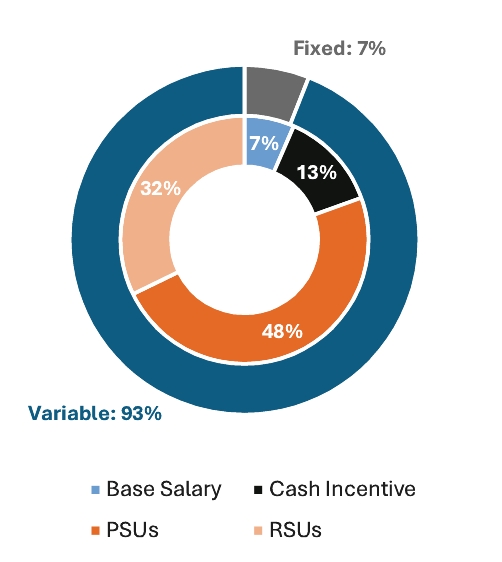
Summary of Key Considerations
Fiserv already has an independent board chair. Our current leadership structure enables our chief executive officer to provide leadership as the company pursues its strategic agenda, including innovation-driven growth and operational excellence, and our independent, non-executive board chair to provide independent oversight and perspectives.
The board believes it is important to maintain flexibility to choose the leadership structure that best fits the company’s circumstances and board composition at any given time. A policy requiring an independent board chair in all circumstances would unnecessarily restrict the board’s ability to implement a leadership structure that is in the best interests of our company and our shareholders as the needs of the board and company change over time.
The board and the company maintain leading corporate governance practices that enable our independent directors to effectively oversee management, and we have a strong track record of board and committee refreshment.
Fiserv currently has an independent board chair.
We separated the roles of board chair and chief executive officer, and appointed an independent board chair, in May 2025. Most recently, the board elected Gordon M. Nixon as independent board chair effective January 1, 2026, after determining that an independent chair continues to best serve our company and our shareholders. Mr. Nixon brings deep public company leadership experience, and his appointment as independent board chair reinforces the board’s commitment to strong, independent oversight of management.
Our current policy enables the board to adopt the leadership structure that best fits Fiserv’s circumstances as the needs of our board and our company change.
We believe that it is in our shareholders’ best interests to enable the board of directors to determine the leadership structure that best supports the company based upon its needs from time to time. Strong independent leadership is essential for our board to effectively perform its oversight functions. It is also important for the board to have flexibility to determine its leadership structure based on the composition of the board, the individuals serving in leadership positions, and our performance as a company. In accordance with our governance guidelines, during an executive session, our independent directors annually evaluate the board’s leadership structure and elect a board chair based on what they believe to be in the best interests of our company and our shareholders. If the individual elected as chair is the chief executive officer or is otherwise an employee of our company, our governance guidelines provide that the independent directors will appoint an independent lead director. Our governance guidelines clearly define the role and responsibilities of a lead director which are broad and similar to those of an independent board chair. The company’s governance guidelines enumerate the duties of the lead director including, among others:
Approving board agendas, meeting schedules, and materials
Calling meetings of the non-employee directors and acting as the principal liaison between non-employee directors of the board and the chairman
Engaging with shareholders
Presiding over executive sessions of the non-employee directors and providing feedback to the chairman regarding the same
Participating in the annual chief executive officer performance evaluation and the board and individual director performance review process
Fiserv, Inc. 2026 Proxy Statement | 83

TABLE OF CONTENTS

Proposal 4: Shareholder Proposal
Fiserv’s Statement in Opposition
The prescriptive approach set forth in this proposal, if implemented, would impair the board’s ability to determine the leadership structure that best aligns with the interests of our company and our shareholders, without regard to the relevant circumstances.
We maintain best practices regarding the roles and responsibilities of independent directors and have a strong track record of board and committee refreshment.
The board believes the strong governance framework we have in place enables effective, independent leadership and oversight. The board and the company maintain leading corporate governance practices to enable our independent directors to effectively oversee our management and make informed decisions about critical issues. All of our directors, other than Mr. Lyons, are independent, and all standing board committees consist solely of independent directors. Furthermore, our independent directors meet without management present at every regular board meeting. The board chair leads these sessions and provides Mr. Lyons with feedback regarding the matters discussed and any requested actions. These board committee membership and practices contribute to the overall strong and independent leadership of our board.
The board regularly reviews board and committee composition and leadership roles to help ensure the full board and each committee has the right balance of experience, competencies and backgrounds, and are led by the directors best positioned to fulfill their oversight obligations for our company and shareholders. Notably, seven of our ten independent directors joined the board in the last three years. We are focused primarily on adding independent directors who will complement the board’s existing skill set and can provide diverse perspectives in the boardroom. This board refreshment has contributed to a strong independent board with new perspectives and expertise.
Vote Required and Recommendation of the Board of Directors
The board should retain the flexibility to select a leadership structure that is best suited to meet the needs of our company and our shareholders. Adopting a rigid independent board chair policy as requested by this proposal would unduly impair the board’s ability to annually elect the director it believes is best suited for the role of board chair. Accordingly, we do not believe that this proposal is appropriate for our company or in the best interests of our shareholders.
The number of votes cast “for” the proposal must exceed the number of votes cast “against” the proposal for it to gain approval. Unless otherwise specified, the proxies solicited hereby will be voted against the shareholder proposal.
Against
The board of directors recommends that you vote “AGAINST” Proposal 4.
84 | Fiserv, Inc. 2026 Proxy Statement

TABLE OF CONTENTS

Our Shareholders
Common Stock Ownership
The following table sets forth information with respect to the beneficial ownership of our common stock as of February 27, 2026, by: each current director and director nominee; each executive officer appearing in the Summary Compensation Table; all current directors and executive officers as a group; and any person known by us to beneficially own more than 5% of the outstanding shares of our common stock based on our review of the reports regarding ownership filed with the Securities and Exchange Commission in accordance with Sections 13(d) and 13(g) of the Securities Exchange Act of 1934 (the “Exchange Act”) unless otherwise noted.
Name and Address of Beneficial Owner(1)
Number of Shares
of Common Stock
Beneficially Owned(2)
Percent of
Class(3)
The Vanguard Group, Inc.(4)
100 Vanguard Blvd.
Malvern, Pennsylvania 19355
63,408,549
11.9%
Dodge & Cox(5)
555 California Street, 40th Floor
San Francisco, California 94104
49,474,622
9.3%
BlackRock, Inc.(6)
50 Hudson Yards
New York, New York 10001
39,890,598
7.5%
Michael P. Lyons
18,388
* 
Paul M. Todd
17,000
* 
Panagiotis (Takis) Georgakopoulos
42,039
* 
Dhivya Suryadevara
28,305
* 
Adam L. Rosman
155,958
* 
Frank J. Bisignano
* 
Guy Chiarello
210,574
* 
John Gibbons
15,439
* 
Robert W. Hau
329,563
* 
Gordon M. Nixon
2,500
* 
Stephanie E. Cohen
177
* 
Henrique de Castro
18,689
* 
Harry F. DiSimone(7)
11,853
* 
Céline Dufétel
* 
Lance M. Fritz
13,667
* 
Ajei S. Gopal
3,602
* 
Wafaa Mamilli
7,493
* 
Gary S. Shedlin
* 
Charlotte B. Yarkoni
4,627
* 
All current directors and executive officers as a group (15 people)
324,298
* 
* Less than 1%.
(1)
Unless otherwise indicated, the address for each beneficial owner is care of Fiserv, Inc., 600 N. Vel R. Phillips Avenue, Milwaukee, WI, 53203.
(2)
All information with respect to beneficial ownership is based upon filings made by the respective beneficial owners with the Securities and Exchange Commission
Fiserv, Inc. 2026 Proxy Statement | 85

TABLE OF CONTENTS

Our Shareholders
Common Stock Ownership
or information provided to us by such beneficial owners. Except as indicated in the footnotes to this table, the persons named in the table have sole voting and investment power with respect to all shares of common stock shown as beneficially owned by them, subject to community property laws.

Includes stock options, which, as of February 27, 2026, were exercisable currently or within 60 days: Mr. Chiarello – 71,266; Mr. Hau – 209,586; Mr. Rosman – 105,549; and all current directors and executive officers as a group – 105,549.

Includes shares deferred under vested restricted stock units that, based on deferral elections and the terms of the non-employee director deferred compensation plan, may be distributed within 60 days: Ms. Cohen – 88; Mr. de Castro – 3,032; Mr. DiSimone – 2,246; Mr. Fritz – 1,709; Mr. Gopal – 1,609; Ms. Yarkoni – 1,484; and all directors as a group – 10,168.

Also includes shares eligible for issuance in connection with the deferral of cash compensation that, based on deferral elections and the terms of the non-employee director deferred compensation plan, may be distributed within 60 days: Mr. de Castro – 1,860; Mr. DiSimone – 1,961; Mr. Fritz – 1,793; Mr. Gopal – 1,606; Ms. Mamilli – 400; Ms. Yarkoni – 1,837; and all directors as a group – 9,457.
(3)
On February 27, 2026, there were 533,948,657 shares of common stock outstanding. Percentages are calculated pursuant to Rule 13d-3(d) under the Exchange Act. Shares not outstanding that are subject to options exercisable by the holder thereof within 60 days, shares due upon vesting of restricted stock units within 60 days, and shares deferred pursuant to vested restricted stock units and shares eligible for issuance pursuant to the
non-employee director deferred compensation plan that may be distributed within 60 days, are deemed outstanding for the purposes of calculating the number and percentage owned by such shareholder but not deemed outstanding for the purpose of calculating the percentage of any other person.
(4)
Based on a Schedule 13G filed by The Vanguard Group, Inc. (“Vanguard Group”) on February 5, 2026, with the Securities and Exchange Commission, which indicates that the Vanguard Group exercises shared voting power over 5,469,076 of the securities and shared dispositive power over 63,408,549 of the securities.
(5)
Based on a Schedule 13G filed by Dodge & Cox on February 13, 2026, with the Securities and Exchange Commission, which indicates that various persons have the right to receive or the power to direct the receipt of dividends from, or the proceeds from the sale of, these securities. According to the Schedule 13G, Dodge & Cox exercises sole voting power over 46,768,972 of the securities and sole dispositive power over 49,474,622 of the securities.
(6)
Based on a Schedule 13G filed by BlackRock, Inc. (“BlackRock”) on January 26, 2024, with the Securities and Exchange Commission, which indicates that various persons have the right to receive or the power to direct the receipt of dividends from, or the proceeds from the sale of, these securities. According to the Schedule 13G, BlackRock exercises sole voting power over 35,609,321 of the securities and sole dispositive power over 39,890,598 of the securities.
(7)
Includes 2,706 shares of our common stock held by the Harry DiSimone 2021 Irrevocable Exemption Trust for the benefit of family members of the reporting person and of which such family members serve as trustee.
86 | Fiserv, Inc. 2026 Proxy Statement

TABLE OF CONTENTS

Voting, Meeting and Other Matters
Notice of Internet Availability of Proxy Materials
We may furnish our proxy statement and annual report to shareholders of record by providing access to those documents via the Internet instead of mailing printed copies. The notice you received regarding the Internet availability of our proxy materials (the “Notice”) provides instructions on how to access our proxy materials and cast your vote via the Internet, by telephone or by mail.
Shareholders’ access to our proxy materials via the Internet allows us to reduce printing and delivery costs and lessen adverse environmental impacts. If you would like to receive a paper or email copy of our proxy materials, you should follow the instructions in the Notice for requesting those materials.
Who Can Vote
The board of directors has fixed the close of business on March 24, 2026, as the record date for determining the shareholders entitled to notice of, to attend and to vote at the annual meeting. On the record date, there were 532,998,979 shares of common stock outstanding and entitled to vote, and we had no other classes of securities outstanding.
All of these shares are to be voted as a single class, and you are entitled to cast one vote for each share you held as of the record date on all matters submitted to a vote of shareholders. For each proposal, abstentions and broker non-votes will be entirely excluded from the vote and will have no effect on its outcome.
How to Vote
You may vote:
By Internet
Visit www.proxyvote.com
By telephone
Dial toll-free 1-800-690-6903
By mailing your proxy card
If you requested a printed copy of the proxy materials, mark your vote on the proxy card, properly sign and date it, and return it in the enclosed envelope. The shares represented by that card will be voted as you have specified.
During the virtual annual meeting
You may attend the virtual annual meeting and vote your shares during the meeting by visiting our annual meeting website at www.virtualshareholdermeeting.com/FISV2026.
Voting through the Internet or by telephone. You can vote by proxy via the Internet or by telephone until 11:59 p.m. (ET) on May 20, 2026, by following the instructions provided in the Notice. Shareholders voting via the Internet or by telephone will bear any costs associated with electronic or telephone access, such as usage charges from Internet access providers and telephone companies.
Banks, brokers or other nominees. Shareholders who hold shares through a bank, broker or other nominee may vote by the methods that their bank or broker makes available, in which case the bank or broker will include instructions with the Notice or this proxy statement. If you wish to vote at the virtual annual meeting online, you may do so using the 16-digit control number included on the instructions that accompanied your Notice or proxy statement.
401(k) savings plan. An individual who had a beneficial interest in shares of our common stock allocated to their account under the Fiserv 401(k) Savings Plan as of March 24, 2026, may vote the shares of common stock allocated
Fiserv, Inc. 2026 Proxy Statement | 87

TABLE OF CONTENTS

Voting, Meeting and Other Matters
Proxies
to their account at Bank of America, N.A. as of such date. We will provide instructions to participants regarding how to vote. If no direction is provided by the participant about how to vote their shares by 11:59 p.m. (ET) on May 19, 2026, Bank of America, N.A. will vote the shares in the same manner and in the same proportion as the shares for which voting instructions are received from other participants, except that Bank of America, N.A., in the exercise of its fiduciary duties, may determine that it must vote the shares in some other manner.
Proxies
Our board of directors is soliciting proxies in connection with our 2026 annual meeting of shareholders. On April 2, 2026, we will commence mailing the notice of Internet availability of proxy materials, or a proxy statement, proxy card and annual report, to shareholders entitled to vote at the annual meeting.
Gordon M. Nixon, Chairman of the Board; Michael P. Lyons, Chief Executive Officer; Adam L. Rosman, Chief Administrative Officer and Chief Legal Officer; and Eric C. Nelson, Secretary, have been selected by the board of directors as proxy holders and will vote shares represented by valid proxies. All shares represented by valid proxies received and not revoked before they are exercised will be voted in the manner specified in the proxies.
If nothing is specified, the proxies will be voted: “FOR” each of the board’s nominees for director, “FOR” proposals two and three, and “AGAINST” proposal four.
Our board of directors is unaware of any other matters that may be presented for action at our annual meeting. If other matters do properly come before the annual meeting or any adjournments or postponements thereof, it is intended that shares represented by proxies will be voted in the discretion of the proxy holders.
You may revoke your proxy at any time before it is exercised by doing any of the following:
Entering a new vote using the Internet or by telephone
Giving written notice of revocation to Eric C. Nelson, Secretary, Fiserv, Inc., 600 N. Vel R. Phillips Avenue, Milwaukee, WI 53203
Submitting a subsequently dated and properly completed proxy card
Attending the virtual annual meeting and voting at the virtual annual meeting online
However, if your shares are held of record by a bank, broker or other nominee, you must obtain a proxy issued in your name from the record holder.
We will pay the cost of soliciting proxies on behalf of the board of directors. Our directors, officers and other employees may solicit proxies by mail, personal interview, telephone or electronic communication. None of them will receive any special compensation for these efforts.
We have retained the services of D.F. King & Co., Inc. to assist us in soliciting proxies by personal interview, mail, telephone or electronic communications. We expect to pay D.F. King its customary fee, approximately $14,500, plus reasonable out-of-pocket expenses incurred in the process of soliciting proxies. We also have made arrangements with brokerage firms, banks, nominees and other fiduciaries to forward proxy materials to beneficial owners of shares. We will reimburse such record holders for the reasonable out-of-pocket expenses incurred by them in connection with forwarding proxy materials. Proxies solicited hereby will be tabulated by an inspector of election, who will be designated by the board of directors and will not be an employee or director of Fiserv, Inc.
88 | Fiserv, Inc. 2026 Proxy Statement

TABLE OF CONTENTS

Voting, Meeting and Other Matters
How to Participate in the Meeting
This year’s annual meeting will again be accessible through the Internet. The annual meeting will also be accessible to all shareholders regardless of their physical location and we expect to offer the same type of participation opportunities during the meeting as an in-person meeting.
To be admitted to the annual meeting at www.virtualshareholdermeeting.com/FISV2026, you will need the 16-digit control number included on your Notice, your proxy card or the instructions that accompanied your proxy materials. The annual meeting will begin promptly at 10:00 a.m. (CT). Online check-in will begin at 9:45 a.m. (CT), and you should allow ample time for the online check-in procedures. If you hold shares through a bank, broker or other nominee, you will need to contact such bank, broker or other nominee for assistance with your 16-digit control number.
Whether or not you participate in the annual meeting, it is important that your shares be part of the voting process. The other methods by which you may vote are described above.
This year’s shareholders question and answer session will include questions submitted in advance of, and questions submitted live during, the annual meeting. You may submit a question in advance of the meeting at www.proxyvote.com after logging in with your 16-digit control number. Questions may be submitted during the annual meeting through www.virtualshareholdermeeting.com/FISV2026. We expect to respond to questions during the annual meeting and may also respond to questions on an individual basis or by posting answers on our Investor Relations website after the meeting.
Quorum
The presence, at the virtual annual meeting online or by proxy, of at least a majority of the outstanding shares of common stock entitled to vote at the annual meeting will constitute a quorum for the transaction of business. Holders of shares that abstain from voting or that are subject to a broker non-vote will be counted as present for the purpose of determining the presence or absence of a quorum for the transaction of business. In the event there are not sufficient votes for a quorum or to approve a proposal at the time of the annual meeting, the annual meeting may be adjourned or postponed, in our sole discretion, in order to permit the further solicitation of proxies.
Shareholder Proposals for the 2027 Annual Meeting
Any proposal that a shareholder desires to include in our proxy materials for our 2027 annual meeting of shareholders pursuant to Rule 14a-8 under the Exchange Act (“Rule 14a-8”) must be delivered no later than December 3, 2026, to the following address: 600 N. Vel R. Phillips Avenue, Milwaukee, WI, 53203, Attention: Eric C. Nelson, Secretary.
Under our by-laws, a shareholder, or group of up to 20 shareholders, owning continuously for at least three years shares of our stock representing an aggregate of at least 3% of our outstanding shares may nominate and include in our proxy materials director nominees constituting up to 20% of our board of directors – so called “proxy access.” Alternatively, a shareholder may nominate director nominees under our by-laws that the shareholder does not intend to have included in our proxy materials. In either case, such shareholders must comply with the procedures set forth in our by-laws, including that the shareholders and nominees satisfy the requirements in our by-laws and our corporate Secretary receives timely written notice, in proper form, of the intent to make a nomination at an annual meeting of shareholders. Among other matters, if a shareholder wishes to nominate a director nominee pursuant to proxy access, they must give written notice to our corporate Secretary not less than 120 days and not more than 150 days prior to the first anniversary of the date on which we first made available our proxy materials for the 2026 annual meeting. We must receive notice of a shareholder’s director nomination for the 2027 annual meeting pursuant to the proxy access by-law provision no sooner than November 3, 2026, and no later than December 3, 2026. If the notice is received outside of that time frame, then we are not required to include the nominees in our proxy materials for the 2027 annual meeting. The detailed requirements for nominations are set forth in our by-laws, which were attached as an exhibit to our Current Report on Form 8-K filed with the Securities and Exchange Commission on November 21, 2022. A copy of our by-laws will be provided upon written request to our corporate Secretary.
Fiserv, Inc. 2026 Proxy Statement | 89

TABLE OF CONTENTS

Voting, Meeting and Other Matters
Proxy Statement and Annual Report Delivery
A shareholder who intends to present business, other than a shareholder proposal pursuant to Rule 14a-8, or to nominate a director, other than pursuant to our proxy access by-law provision, at the 2027 annual meeting must comply with the requirements set forth in our by-laws. Among other matters, a shareholder must give written notice to our corporate Secretary not less than 45 days and not more than 70 days prior to the first anniversary of the date on which we first mailed our proxy materials for the 2026 annual meeting. We must receive notice of a shareholder’s intent to present business, other than pursuant to Rule 14a-8, or to nominate a director, other than pursuant to our proxy access by-law provision, at the 2027 annual meeting no sooner than January 22, 2027, and no later than February 16, 2027. If the notice is received outside of that time frame, then we are not required to permit the business or the nomination to be presented at the 2027 annual meeting. Nevertheless, if our board of directors permits a matter of business submitted after February 16, 2027, to be presented at the 2027 annual meeting, then the persons named in proxies solicited by the board of directors for the 2027 annual meeting may exercise discretionary voting power with respect to such proposal.
Proxy Statement and Annual Report Delivery
Our Annual Report on Form 10-K for 2025 will be made available or mailed to each shareholder on or about April 2, 2026. We will furnish such report, without charge, to any person requesting a copy thereof in writing and stating such person is a beneficial holder of shares of our common stock on the record date for the 2026 annual meeting of shareholders. Requests and inquiries should be sent to our corporate Secretary, Eric C. Nelson, at the address below.
As permitted by rules of the Securities and Exchange Commission, services that deliver our communications to shareholders who hold their stock through a bank, broker or other holder of record may deliver a single copy of our Notice, annual report and proxy statement to multiple shareholders sharing the same address. Upon written or oral request, we will promptly deliver a separate copy of our Notice, annual report and/or proxy statement to any shareholder at a shared address to which a single copy of each document was delivered. Shareholders sharing an address who are currently receiving multiple copies of the Notice, annual report and/or proxy statement may also request delivery of a single copy. Shareholders may make a request by writing to Eric C. Nelson, Secretary, Fiserv, Inc., 600 N. Vel R. Phillips Avenue, Milwaukee, WI, 53203 or calling 262-879-5000.
By Order of the Board of Directors

Eric C. Nelson, Secretary
Milwaukee, Wisconsin
April 2, 2026
90 | Fiserv, Inc. 2026 Proxy Statement

TABLE OF CONTENTS

Forward-Looking Statements
This proxy statement contains forward-looking statements within the meaning of the Private Securities Litigation Reform Act of 1995. Statements can generally be identified as forward-looking because they include words such as “believes,” “anticipates,” “expects,” “could,” “should”, “confident”, “likely”, “plan” or words of similar meaning. Statements that describe our future plans, objectives or goals are also forward-looking statements. Forward-looking statements are subject to assumptions, risks and uncertainties that may cause actual results to differ materially from those contemplated by such forward-looking statements. For a more detailed discussion of these factors, see the information under “Risk Factors” in our Annual Report on Form 10-K for the year ended December 31, 2025, and in other documents that we file with the Securities and Exchange Commission. Our forward-looking statements speak only as of the date of this proxy statement or as of the date they are made, and we undertake no obligation to update them, notwithstanding any historical practice of doing so.
Fiserv, Inc. 2026 Proxy Statement | 91

TABLE OF CONTENTS

Appendix A
Non-GAAP Financial Measures
The company reports its financial results in accordance with accounting principles generally accepted in the United States of America (“GAAP”). The company supplements its reporting of information determined in accordance with GAAP, such as revenue, operating income, operating margin, net income attributable to Fiserv, diluted earnings per share and net cash provided by operating activities, with “adjusted revenue,” “adjusted revenue growth,” “organic revenue,” “organic revenue growth,” “adjusted operating income,” “adjusted operating margin,” “adjusted net income,” “adjusted earnings per share,” “free cash flow,” and “free cash flow conversion.” The company also uses in this proxy statement additional non-GAAP measures such as “adjusted revenue for incentive compensation,” “free cash flow per share,” and “free cash flow per share growth” for purposes of executive compensation targets.
Management believes that adjustments for certain non-cash or other items and the exclusion of certain pass-through revenue and expenses should enhance shareholders’ ability to evaluate the company’s performance, as such measures provide additional insights into the factors and trends affecting its business. Therefore, the company excludes these items from its GAAP financial measures to calculate these unaudited non-GAAP measures to more clearly focus on the factors management believes are pertinent to the company’s operations, and management uses this information to make operating decisions, including the allocation of resources to the company’s various businesses. The company adjusts its non-GAAP results to exclude amortization of acquisition-related intangible assets as such amounts are inconsistent in amount and frequency and are significantly impacted by the timing and/or size of acquisitions. Management believes that the adjustment of acquisition-related intangible asset amortization supplements GAAP information with a measure that can be used to assess the comparability of operating performance. Although the company excludes amortization from acquisition-related intangible assets from its non-GAAP expenses, management believes that it is important for investors to understand that such intangible assets were recorded as part of purchase accounting and contribute to revenue generation. Management believes organic revenue growth is useful because it presents revenue growth excluding the impact of foreign currency fluctuations, acquisitions, dispositions and the impact of the company’s postage reimbursements. Management believes free cash flow is useful to measure the funds generated in a given period that are available for debt service requirements and strategic capital decisions. Management believes this supplemental information enhances shareholders’ ability to evaluate and understand the company’s core business performance.
In this proxy statement, the company discloses performance goals that were set related to cash incentive awards and performance share units based on certain defined metrics, such as adjusted revenue growth, adjusted revenue for incentive compensation, organic revenue growth, adjusted operating income, adjusted earnings per share, free cash flow conversion, free cash flow per share, and free cash flow per share growth.
Set forth below is a description of the unaudited non-GAAP financial measures discussed in this proxy statement:
“Adjusted revenue” is calculated as revenue in accordance with GAAP excluding the impact of the company’s postage reimbursements.
“Adjusted revenue for incentive compensation” is calculated as revenue in accordance with GAAP excluding the impact of the company’s postage reimbursements and revenue attributable to acquisitions and divestitures not included in the current year plan, which was $205 million in 2025.
“Organic revenue” is calculated as adjusted revenue excluding the impact of foreign currency fluctuations and revenue attributable to acquisitions and dispositions.
“Organic revenue growth” is measured as the change in organic revenue for the current year, divided by organic revenue from the prior year.
Fiserv, Inc. 2026 Proxy Statement | A-1

TABLE OF CONTENTS

Appendix A
Non-GAAP Financial Measures
“Adjusted operating income” is calculated as operating income in accordance with GAAP excluding merger and integration costs; severance costs; certain transformation related expenses associated with the company’s One Fiserv action plan; amortization of acquisition-related intangible assets; gains or losses from the sale of businesses, certain assets and investments; certain discrete tax benefits and expenses; and certain other items.
“Adjusted operating margin” is calculated as adjusted operating income divided by adjusted revenue.
“Adjusted earnings per share” is calculated as diluted earnings per share in accordance with GAAP excluding (net of related tax impact) merger and integration costs; severance costs; certain transformation related expenses associated with the company’s One Fiserv action plan; amortization of acquisition-related intangible assets; certain activities associated with non-wholly owned entities; gains or losses from the sale of businesses, certain assets and investments; non-cash impairment charges; certain discrete tax benefits and expenses; and certain other non-cash items.
“Free cash flow” is calculated as net cash provided by operating activities in accordance with GAAP, including capital expenditures, distributions paid to noncontrolling interests, and distributions from unconsolidated affiliates; and excluding severance, merger, integration, and certain transformation related payments associated with the company’s One Fiserv action plan.
“Free cash flow conversion” is calculated as free cash flow divided by adjusted net income. Adjusted net income is calculated as net income attributable to Fiserv in accordance with GAAP excluding the adjustments as described within adjusted earnings per share above.
“Free cash flow per share” is calculated as free cash flow divided by diluted shares used in computing earnings per share attributable to Fiserv.
“Free cash flow per share growth” is measured as the change in free cash flow per share for the current year, divided by free cash flow per share from the prior year.
These unaudited non-GAAP financial measures may not be comparable to similarly titled measures reported by other companies and should be considered in addition to, and not as a substitute for, revenue, operating income, operating margin, net income attributable to Fiserv, diluted earnings per share and net cash provided by operating activities or any other amount determined in accordance with GAAP.
A-2 | Fiserv, Inc. 2026 Proxy Statement

TABLE OF CONTENTS

Appendix A
Non-GAAP Financial Measures
Below are reconciliations of adjusted revenue, organic revenue, organic revenue growth, adjusted operating income, adjusted net income and adjusted earnings per share to the most directly comparable measures determined in accordance with GAAP:
(in millions, except per share amounts)
2025
2024
Growth
Revenue
$21,193
$20,456
 
Adjustments:


Postage reimbursements
(1,389)
(1,333)
 
Adjusted revenue
$19,804
$19,123
 
Adjustments:


Currency impact(1)
230
 
Acquisition adjustments
(194)
 
Divestiture adjustments
(15)
 
Organic revenue
$19,840
$19,108
4%
Operating income
$5,818
 
 
Adjustments:


Merger and integration costs(2)
59
 
 
One Fiserv transformation program expenses(3)
86
 
 
Severance costs
79
 
 
Amortization of acquisition-related intangible assets(4)
1,304
 
 
Incremental executive compensation(5)
52
 
 
Adjusted operating income
$7,398
 
 
GAAP net income attributable to Fiserv
$3,480
 
 
Adjustments:


Merger and integration costs(2)
59
 
 
One Fiserv transformation program expenses(3)
86
 
 
Severance costs
79
 
 
Amortization of acquisition-related intangible assets(4)
1,304
 
 
Non wholly-owned entity activities(6)
(11)
 
 
Gain on sale of investment(7)
(68)
 
 
Tax impact of adjustments(8)
(275)
 
 
Incremental executive compensation(5)
52
 
 
Argentine Peso devaluation(9)
39
 
 
Adjusted net income
$4,745
 
 
GAAP earnings per share attributable to Fiserv – diluted
$6.34
 
 
Adjustments – net of income taxes:


Merger and integration costs(2)
0.09
 
 
One Fiserv transformation program expenses(3)
0.13
 
 
Severance costs
0.12
 
 
Amortization of acquisition-related intangible assets(4)
1.91
 
 
Non wholly-owned entity activities(6)
(0.01)
 
 
Gain on sale of investment(7)
(0.09)
 
 
Incremental executive compensation(5)
0.09
 
 
Argentine Peso devaluation(9)
0.07
 
 
Adjusted earnings per share
$8.64
 
 
Fiserv, Inc. 2026 Proxy Statement | A-3

TABLE OF CONTENTS

Appendix A
Non-GAAP Financial Measures
(1)
Currency impact is measured as the increase or decrease in adjusted revenue for the current year by applying prior year foreign currency exchange rates to present a constant currency comparison to the prior year.
(2)
Represents acquisition and related integration costs incurred in connection with acquisitions. Merger and integration costs associated with integration activities include $21 million of third-party professional service fees and $25 million related to legal and other settlements.
(3)
Represents third-party consulting and professional service fees associated with a multi-year transformation initiative focused on operational excellence enabled by artificial intelligence, including process reengineering and technology infrastructure modernization.
(4)
Represents amortization of intangible assets acquired through acquisition, including customer relationships, software/technology and trade names. This adjustment does not exclude the amortization of other intangible assets such as contract costs (sales commissions and deferred conversion costs), capitalized and purchased software, financing costs and debt discounts.
(5)
Represents incremental compensation expense associated with the transition of the company’s Chief Executive Officer (“CEO”), comprised of $40 million of former CEO non-cash share-based compensation and related employer payroll taxes, and a $12 million cash replacement award paid to the company’s new CEO appointed in 2025.
(6)
Represents the company’s share of amortization of acquisition-related intangible assets at its unconsolidated affiliates, as well as the minority interest share of amortization of acquisition-related intangible assets at its subsidiaries in which the company holds a controlling financial interest. This adjustment also includes a $51 million gain related to the sale of an equity method investment, recorded within income from investments in unconsolidated affiliates in the consolidated statement of income.
(7)
Represents a gain associated with the sale of an equity security in the fourth quarter of 2025, recorded within other expense, net in the consolidated statement of income.
(8)
The tax impact of adjustments is calculated using a tax rate of 19.5%, which approximates the company’s annual effective tax rate, exclusive of actual tax impacts of an aggregate $30 million provision associated with the gain on certain investments.
(9)
The Argentine government announced economic policy changes, including the removal of certain currency controls, resulting in a significant devaluation of the Argentine Peso on April 14, 2025. This adjustment represents the corresponding one-day foreign currency exchange loss from the remeasurement of the company’s Argentina subsidiary’s monetary assets and liabilities in Argentina’s highly inflationary economy.
A-4 | Fiserv, Inc. 2026 Proxy Statement

TABLE OF CONTENTS


TABLE OF CONTENTS


DEF 14A 0000798354 false 0000798354 2025-01-01 2025-12-31 0000798354 fi:MichaelPLyonsMember 2025-01-01 2025-12-31 0000798354 fi:FrankBisignanoMember 2025-01-01 2025-12-31 0000798354 fi:MichaelPLyonsMember 2024-01-01 2024-12-31 0000798354 fi:FrankBisignanoMember 2024-01-01 2024-12-31 0000798354 2024-01-01 2024-12-31 0000798354 fi:MichaelPLyonsMember 2023-01-01 2023-12-31 0000798354 fi:FrankBisignanoMember 2023-01-01 2023-12-31 0000798354 2023-01-01 2023-12-31 0000798354 fi:MichaelPLyonsMember 2022-01-01 2022-12-31 0000798354 fi:FrankBisignanoMember 2022-01-01 2022-12-31 0000798354 2022-01-01 2022-12-31 0000798354 fi:MichaelPLyonsMember 2021-01-01 2021-12-31 0000798354 fi:FrankBisignanoMember 2021-01-01 2021-12-31 0000798354 2021-01-01 2021-12-31 0000798354 2025-05-07 2025-12-31 0000798354 2025-01-01 2025-05-06 0000798354 ecd:EqtyAwrdsInSummryCompstnTblForAplblYrMember ecd:PeoMember fi:MichaelPLyonsMember 2025-01-01 2025-12-31 0000798354 ecd:EqtyAwrdsInSummryCompstnTblForAplblYrMember ecd:PeoMember fi:FrankBisignanoMember 2025-01-01 2025-12-31 0000798354 ecd:EqtyAwrdsInSummryCompstnTblForAplblYrMember ecd:PeoMember fi:FrankBisignanoMember 2024-01-01 2024-12-31 0000798354 ecd:EqtyAwrdsInSummryCompstnTblForAplblYrMember ecd:PeoMember fi:FrankBisignanoMember 2023-01-01 2023-12-31 0000798354 ecd:EqtyAwrdsInSummryCompstnTblForAplblYrMember ecd:PeoMember fi:FrankBisignanoMember 2022-01-01 2022-12-31 0000798354 ecd:EqtyAwrdsInSummryCompstnTblForAplblYrMember ecd:PeoMember fi:FrankBisignanoMember 2021-01-01 2021-12-31 0000798354 ecd:YrEndFrValOfEqtyAwrdsGrntdInCvrdYrOutsdngAndUnvstdMember ecd:PeoMember fi:MichaelPLyonsMember 2025-01-01 2025-12-31 0000798354 ecd:YrEndFrValOfEqtyAwrdsGrntdInCvrdYrOutsdngAndUnvstdMember ecd:PeoMember fi:FrankBisignanoMember 2024-01-01 2024-12-31 0000798354 ecd:YrEndFrValOfEqtyAwrdsGrntdInCvrdYrOutsdngAndUnvstdMember ecd:PeoMember fi:FrankBisignanoMember 2023-01-01 2023-12-31 0000798354 ecd:YrEndFrValOfEqtyAwrdsGrntdInCvrdYrOutsdngAndUnvstdMember ecd:PeoMember fi:FrankBisignanoMember 2022-01-01 2022-12-31 0000798354 ecd:YrEndFrValOfEqtyAwrdsGrntdInCvrdYrOutsdngAndUnvstdMember ecd:PeoMember fi:FrankBisignanoMember 2021-01-01 2021-12-31 0000798354 ecd:ChngInFrValAsOfVstngDtOfPrrYrEqtyAwrdsVstdInCvrdYrMember ecd:PeoMember fi:FrankBisignanoMember 2025-01-01 2025-12-31 0000798354 ecd:ChngInFrValAsOfVstngDtOfPrrYrEqtyAwrdsVstdInCvrdYrMember ecd:PeoMember fi:FrankBisignanoMember 2024-01-01 2024-12-31 0000798354 ecd:ChngInFrValAsOfVstngDtOfPrrYrEqtyAwrdsVstdInCvrdYrMember ecd:PeoMember fi:FrankBisignanoMember 2023-01-01 2023-12-31 0000798354 ecd:ChngInFrValAsOfVstngDtOfPrrYrEqtyAwrdsVstdInCvrdYrMember ecd:PeoMember fi:FrankBisignanoMember 2022-01-01 2022-12-31 0000798354 ecd:ChngInFrValAsOfVstngDtOfPrrYrEqtyAwrdsVstdInCvrdYrMember ecd:PeoMember fi:FrankBisignanoMember 2021-01-01 2021-12-31 0000798354 ecd:ChngInFrValOfOutsdngAndUnvstdEqtyAwrdsGrntdInPrrYrsMember ecd:PeoMember fi:FrankBisignanoMember 2024-01-01 2024-12-31 0000798354 ecd:ChngInFrValOfOutsdngAndUnvstdEqtyAwrdsGrntdInPrrYrsMember ecd:PeoMember fi:FrankBisignanoMember 2023-01-01 2023-12-31 0000798354 ecd:ChngInFrValOfOutsdngAndUnvstdEqtyAwrdsGrntdInPrrYrsMember ecd:PeoMember fi:FrankBisignanoMember 2022-01-01 2022-12-31 0000798354 ecd:ChngInFrValOfOutsdngAndUnvstdEqtyAwrdsGrntdInPrrYrsMember ecd:PeoMember fi:FrankBisignanoMember 2021-01-01 2021-12-31 0000798354 ecd:FrValAsOfPrrYrEndOfEqtyAwrdsGrntdInPrrYrsFldVstngCondsDrngCvrdYrMember ecd:PeoMember fi:FrankBisignanoMember 2025-01-01 2025-12-31 0000798354 ecd:VstngDtFrValOfEqtyAwrdsGrntdAndVstdInCvrdYrMember ecd:PeoMember fi:MichaelPLyonsMember 2025-01-01 2025-12-31 0000798354 ecd:VstngDtFrValOfEqtyAwrdsGrntdAndVstdInCvrdYrMember ecd:PeoMember fi:FrankBisignanoMember 2025-01-01 2025-12-31 0000798354 ecd:EqtyAwrdsInSummryCompstnTblForAplblYrMember ecd:NonPeoNeoMember 2025-01-01 2025-12-31 0000798354 ecd:EqtyAwrdsInSummryCompstnTblForAplblYrMember ecd:NonPeoNeoMember 2024-01-01 2024-12-31 0000798354 ecd:EqtyAwrdsInSummryCompstnTblForAplblYrMember ecd:NonPeoNeoMember 2023-01-01 2023-12-31 0000798354 ecd:EqtyAwrdsInSummryCompstnTblForAplblYrMember ecd:NonPeoNeoMember 2022-01-01 2022-12-31 0000798354 ecd:EqtyAwrdsInSummryCompstnTblForAplblYrMember ecd:NonPeoNeoMember 2021-01-01 2021-12-31 0000798354 ecd:YrEndFrValOfEqtyAwrdsGrntdInCvrdYrOutsdngAndUnvstdMember ecd:NonPeoNeoMember 2025-01-01 2025-12-31 0000798354 ecd:YrEndFrValOfEqtyAwrdsGrntdInCvrdYrOutsdngAndUnvstdMember ecd:NonPeoNeoMember 2024-01-01 2024-12-31 0000798354 ecd:YrEndFrValOfEqtyAwrdsGrntdInCvrdYrOutsdngAndUnvstdMember ecd:NonPeoNeoMember 2023-01-01 2023-12-31 0000798354 ecd:YrEndFrValOfEqtyAwrdsGrntdInCvrdYrOutsdngAndUnvstdMember ecd:NonPeoNeoMember 2022-01-01 2022-12-31 0000798354 ecd:YrEndFrValOfEqtyAwrdsGrntdInCvrdYrOutsdngAndUnvstdMember ecd:NonPeoNeoMember 2021-01-01 2021-12-31 0000798354 ecd:ChngInFrValAsOfVstngDtOfPrrYrEqtyAwrdsVstdInCvrdYrMember ecd:NonPeoNeoMember 2025-01-01 2025-12-31 0000798354 ecd:ChngInFrValAsOfVstngDtOfPrrYrEqtyAwrdsVstdInCvrdYrMember ecd:NonPeoNeoMember 2024-01-01 2024-12-31 0000798354 ecd:ChngInFrValAsOfVstngDtOfPrrYrEqtyAwrdsVstdInCvrdYrMember ecd:NonPeoNeoMember 2023-01-01 2023-12-31 0000798354 ecd:ChngInFrValAsOfVstngDtOfPrrYrEqtyAwrdsVstdInCvrdYrMember ecd:NonPeoNeoMember 2022-01-01 2022-12-31 0000798354 ecd:ChngInFrValAsOfVstngDtOfPrrYrEqtyAwrdsVstdInCvrdYrMember ecd:NonPeoNeoMember 2021-01-01 2021-12-31 0000798354 ecd:ChngInFrValOfOutsdngAndUnvstdEqtyAwrdsGrntdInPrrYrsMember ecd:NonPeoNeoMember 2025-01-01 2025-12-31 0000798354 ecd:ChngInFrValOfOutsdngAndUnvstdEqtyAwrdsGrntdInPrrYrsMember ecd:NonPeoNeoMember 2024-01-01 2024-12-31 0000798354 ecd:ChngInFrValOfOutsdngAndUnvstdEqtyAwrdsGrntdInPrrYrsMember ecd:NonPeoNeoMember 2023-01-01 2023-12-31 0000798354 ecd:ChngInFrValOfOutsdngAndUnvstdEqtyAwrdsGrntdInPrrYrsMember ecd:NonPeoNeoMember 2022-01-01 2022-12-31 0000798354 ecd:ChngInFrValOfOutsdngAndUnvstdEqtyAwrdsGrntdInPrrYrsMember ecd:NonPeoNeoMember 2021-01-01 2021-12-31 0000798354 ecd:FrValAsOfPrrYrEndOfEqtyAwrdsGrntdInPrrYrsFldVstngCondsDrngCvrdYrMember ecd:NonPeoNeoMember 2023-01-01 2023-12-31 0000798354 1 2025-01-01 2025-12-31 0000798354 2 2025-01-01 2025-12-31 0000798354 3 2025-01-01 2025-12-31 0000798354 4 2025-01-01 2025-12-31 0000798354 5 2025-01-01 2025-12-31 iso4217:USD