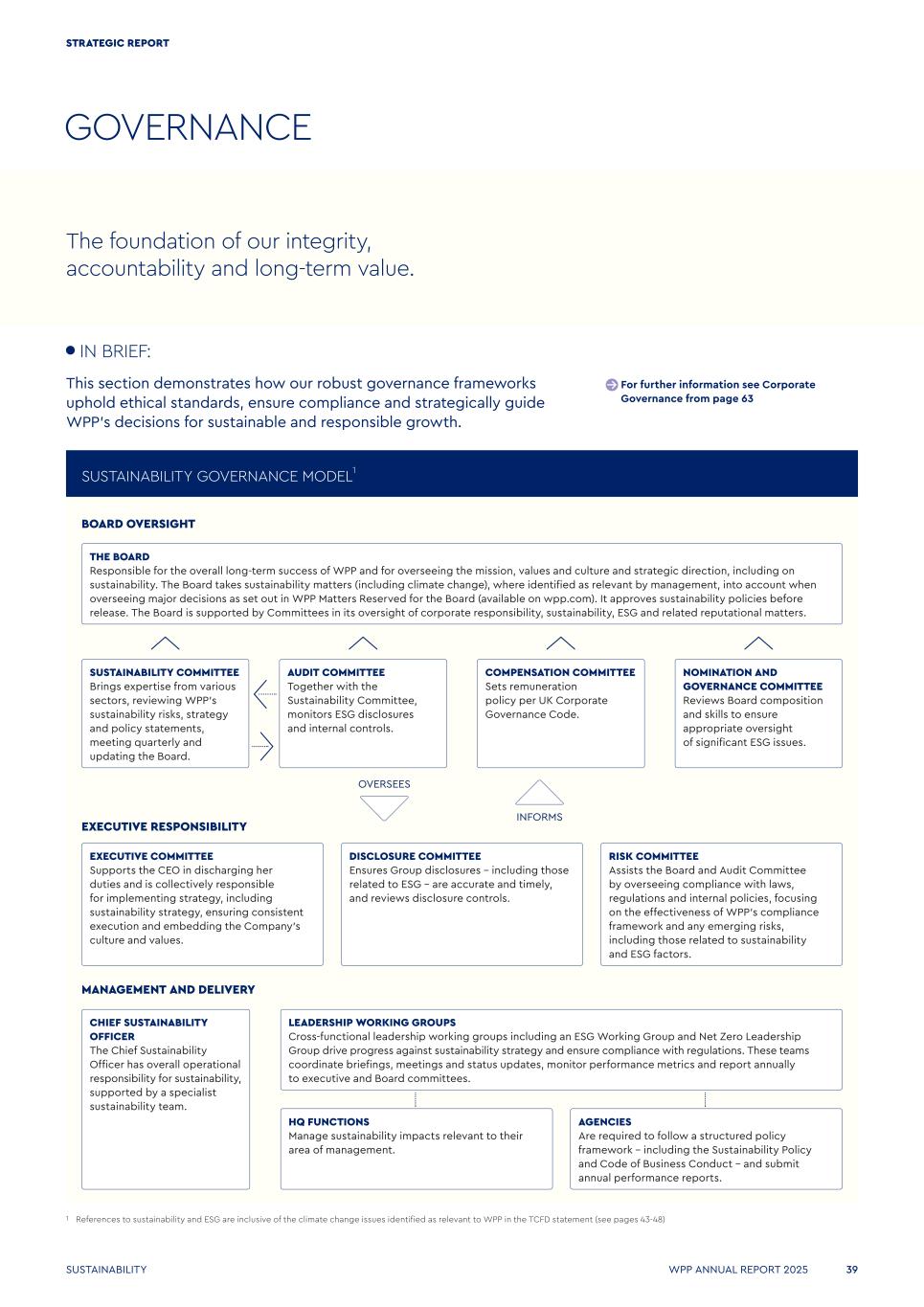
1 References to sustainability and ESG are inclusive of the climate change issues identified as relevant to WPP in the TCFD statement (see pages 43-48) SUSTAINABILITY GOVERNANCE MODEL1 BOARD OVERSIGHT EXECUTIVE RESPONSIBILITY MANAGEMENT AND DELIVERY THE BOARD Responsible for the overall long-term success of WPP and for overseeing the mission, values and culture and strategic direction, including on sustainability. The Board takes sustainability matters (including climate change), where identified as relevant by management, into account when overseeing major decisions as set out in WPP Matters Reserved for the Board (available on wpp.com). It approves sustainability policies before release. The Board is supported by Committees in its oversight of corporate responsibility, sustainability, ESG and related reputational matters. SUSTAINABILITY COMMITTEE Brings expertise from various sectors, reviewing WPP’s sustainability risks, strategy and policy statements, meeting quarterly and updating the Board. AUDIT COMMITTEE Together with the Sustainability Committee, monitors ESG disclosures and internal controls. COMPENSATION COMMITTEE Sets remuneration policy per UK Corporate Governance Code. NOMINATION AND GOVERNANCE COMMITTEE Reviews Board composition and skills to ensure appropriate oversight of significant ESG issues. EXECUTIVE COMMITTEE Supports the CEO in discharging her duties and is collectively responsible for implementing strategy, including sustainability strategy, ensuring consistent execution and embedding the Company’s culture and values. CHIEF SUSTAINABILITY OFFICER The Chief Sustainability Officer has overall operational responsibility for sustainability, supported by a specialist sustainability team. DISCLOSURE COMMITTEE Ensures Group disclosures – including those related to ESG – are accurate and timely, and reviews disclosure controls. LEADERSHIP WORKING GROUPS Cross-functional leadership working groups including an ESG Working Group and Net Zero Leadership Group drive progress against sustainability strategy and ensure compliance with regulations. These teams coordinate briefings, meetings and status updates, monitor performance metrics and report annually to executive and Board committees. RISK COMMITTEE Assists the Board and Audit Committee by overseeing compliance with laws, regulations and internal policies, focusing on the effectiveness of WPP’s compliance framework and any emerging risks, including those related to sustainability and ESG factors. HQ FUNCTIONS Manage sustainability impacts relevant to their area of management. AGENCIES Are required to follow a structured policy framework – including the Sustainability Policy and Code of Business Conduct – and submit annual performance reports. INFORMS OVERSEES GOVERNANCE The foundation of our integrity, accountability and long-term value. For further information see Corporate Governance from page 63 IN BRIEF: This section demonstrates how our robust governance frameworks uphold ethical standards, ensure compliance and strategically guide WPP’s decisions for sustainable and responsible growth. WPP ANNUAL REPORT 2025 39 STRATEGIC REPORT SUSTAINABILITY
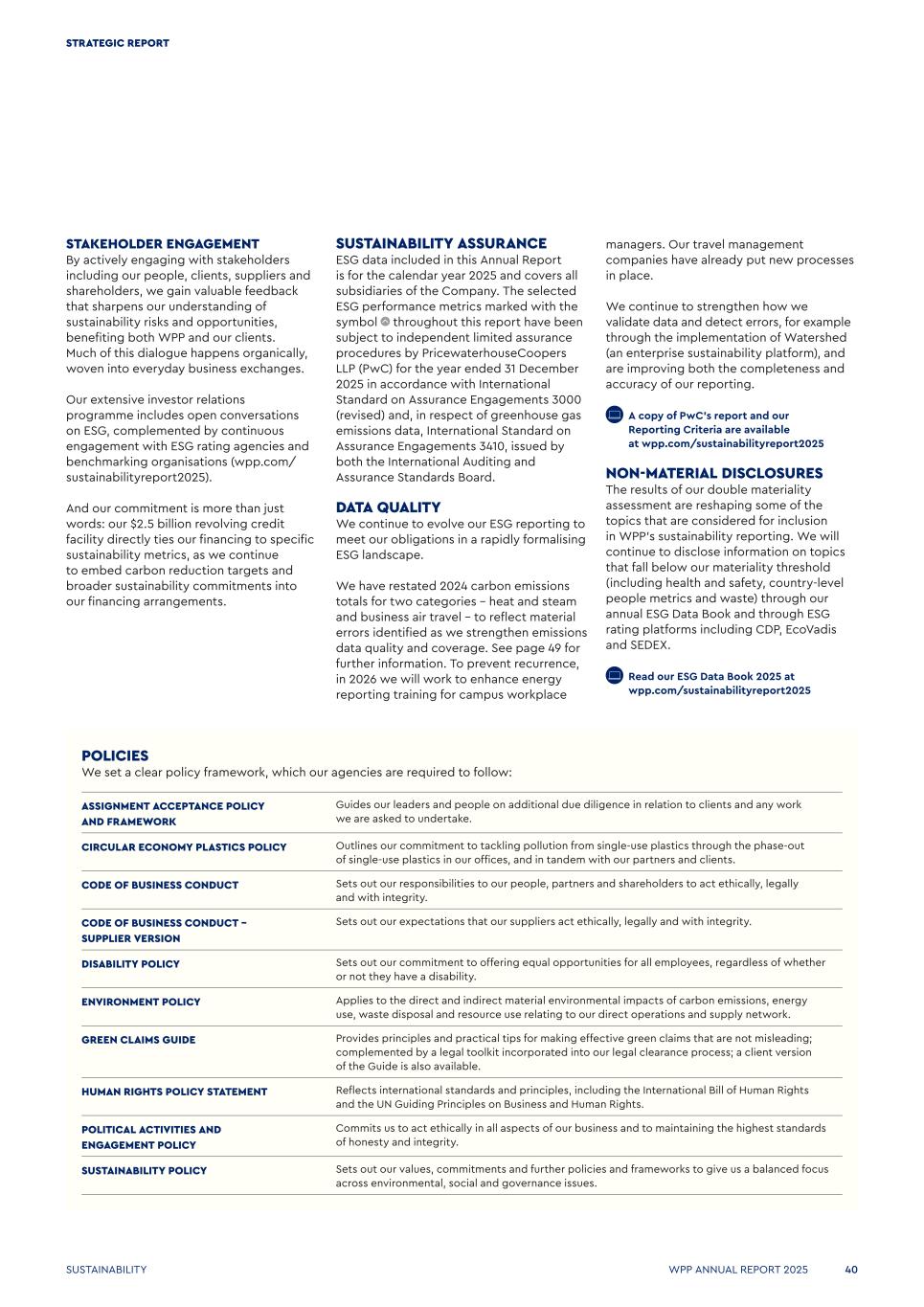
STAKEHOLDER ENGAGEMENT By actively engaging with stakeholders including our people, clients, suppliers and shareholders, we gain valuable feedback that sharpens our understanding of sustainability risks and opportunities, benefiting both WPP and our clients. Much of this dialogue happens organically, woven into everyday business exchanges. Our extensive investor relations programme includes open conversations on ESG, complemented by continuous engagement with ESG rating agencies and benchmarking organisations (wpp.com/ sustainabilityreport2025). And our commitment is more than just words: our $2.5 billion revolving credit facility directly ties our financing to specific sustainability metrics, as we continue to embed carbon reduction targets and broader sustainability commitments into our financing arrangements. SUSTAINABILITY ASSURANCE ESG data included in this Annual Report is for the calendar year 2025 and covers all subsidiaries of the Company. The selected ESG performance metrics marked with the symbol throughout this report have been subject to independent limited assurance procedures by PricewaterhouseCoopers LLP (PwC) for the year ended 31 December 2025 in accordance with International Standard on Assurance Engagements 3000 (revised) and, in respect of greenhouse gas emissions data, International Standard on Assurance Engagements 3410, issued by both the International Auditing and Assurance Standards Board. DATA QUALITY We continue to evolve our ESG reporting to meet our obligations in a rapidly formalising ESG landscape. We have restated 2024 carbon emissions totals for two categories – heat and steam and business air travel – to reflect material errors identified as we strengthen emissions data quality and coverage. See page 49 for further information. To prevent recurrence, in 2026 we will work to enhance energy reporting training for campus workplace managers. Our travel management companies have already put new processes in place. We continue to strengthen how we validate data and detect errors, for example through the implementation of Watershed (an enterprise sustainability platform), and are improving both the completeness and accuracy of our reporting. A copy of PwC’s report and our Reporting Criteria are available at wpp.com/sustainabilityreport2025 NON-MATERIAL DISCLOSURES The results of our double materiality assessment are reshaping some of the topics that are considered for inclusion in WPP’s sustainability reporting. We will continue to disclose information on topics that fall below our materiality threshold (including health and safety, country-level people metrics and waste) through our annual ESG Data Book and through ESG rating platforms including CDP, EcoVadis and SEDEX. Read our ESG Data Book 2025 at wpp.com/sustainabilityreport2025 POLICIES We set a clear policy framework, which our agencies are required to follow: ASSIGNMENT ACCEPTANCE POLICY AND FRAMEWORK Guides our leaders and people on additional due diligence in relation to clients and any work we are asked to undertake. CIRCULAR ECONOMY PLASTICS POLICY Outlines our commitment to tackling pollution from single-use plastics through the phase-out of single-use plastics in our offices, and in tandem with our partners and clients. CODE OF BUSINESS CONDUCT Sets out our responsibilities to our people, partners and shareholders to act ethically, legally and with integrity. CODE OF BUSINESS CONDUCT – SUPPLIER VERSION Sets out our expectations that our suppliers act ethically, legally and with integrity. DISABILITY POLICY Sets out our commitment to offering equal opportunities for all employees, regardless of whether or not they have a disability. ENVIRONMENT POLICY Applies to the direct and indirect material environmental impacts of carbon emissions, energy use, waste disposal and resource use relating to our direct operations and supply network. GREEN CLAIMS GUIDE Provides principles and practical tips for making effective green claims that are not misleading; complemented by a legal toolkit incorporated into our legal clearance process; a client version of the Guide is also available. HUMAN RIGHTS POLICY STATEMENT Reflects international standards and principles, including the International Bill of Human Rights and the UN Guiding Principles on Business and Human Rights. POLITICAL ACTIVITIES AND ENGAGEMENT POLICY Commits us to act ethically in all aspects of our business and to maintaining the highest standards of honesty and integrity. SUSTAINABILITY POLICY Sets out our values, commitments and further policies and frameworks to give us a balanced focus across environmental, social and governance issues. WPP ANNUAL REPORT 2025 40 STRATEGIC REPORT SUSTAINABILITY
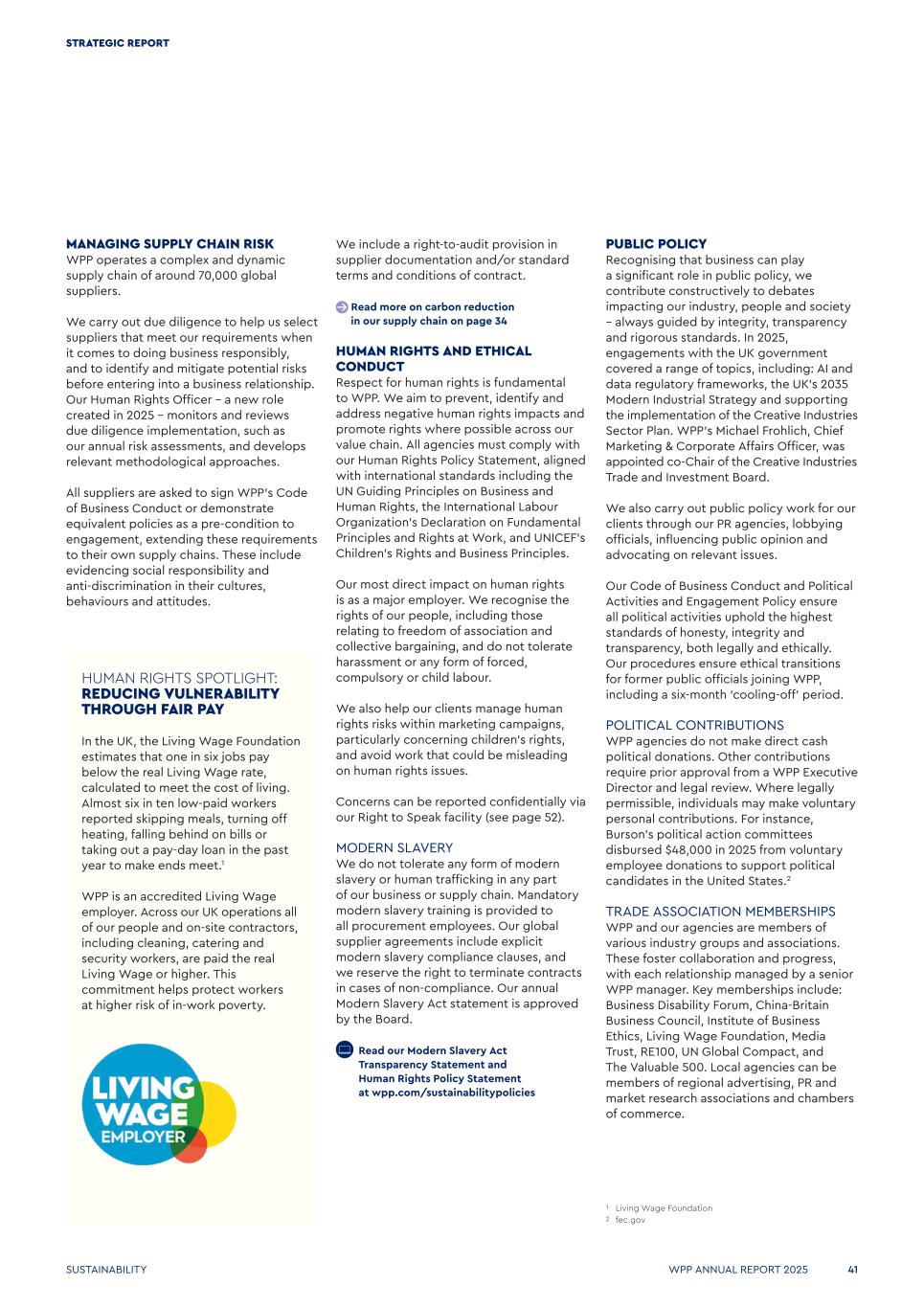
PUBLIC POLICY Recognising that business can play a significant role in public policy, we contribute constructively to debates impacting our industry, people and society – always guided by integrity, transparency and rigorous standards. In 2025, engagements with the UK government covered a range of topics, including: AI and data regulatory frameworks, the UK’s 2035 Modern Industrial Strategy and supporting the implementation of the Creative Industries Sector Plan. WPP’s Michael Frohlich, Chief Marketing & Corporate Affairs Officer, was appointed co-Chair of the Creative Industries Trade and Investment Board. We also carry out public policy work for our clients through our PR agencies, lobbying officials, influencing public opinion and advocating on relevant issues. Our Code of Business Conduct and Political Activities and Engagement Policy ensure all political activities uphold the highest standards of honesty, integrity and transparency, both legally and ethically. Our procedures ensure ethical transitions for former public officials joining WPP, including a six-month ‘cooling-off’ period. POLITICAL CONTRIBUTIONS WPP agencies do not make direct cash political donations. Other contributions require prior approval from a WPP Executive Director and legal review. Where legally permissible, individuals may make voluntary personal contributions. For instance, Burson’s political action committees disbursed $48,000 in 2025 from voluntary employee donations to support political candidates in the United States.2 TRADE ASSOCIATION MEMBERSHIPS WPP and our agencies are members of various industry groups and associations. These foster collaboration and progress, with each relationship managed by a senior WPP manager. Key memberships include: Business Disability Forum, China-Britain Business Council, Institute of Business Ethics, Living Wage Foundation, Media Trust, RE100, UN Global Compact, and The Valuable 500. Local agencies can be members of regional advertising, PR and market research associations and chambers of commerce. 1 Living Wage Foundation 2 fec.gov MANAGING SUPPLY CHAIN RISK WPP operates a complex and dynamic supply chain of around 70,000 global suppliers. We carry out due diligence to help us select suppliers that meet our requirements when it comes to doing business responsibly, and to identify and mitigate potential risks before entering into a business relationship. Our Human Rights Officer – a new role created in 2025 – monitors and reviews due diligence implementation, such as our annual risk assessments, and develops relevant methodological approaches. All suppliers are asked to sign WPP’s Code of Business Conduct or demonstrate equivalent policies as a pre-condition to engagement, extending these requirements to their own supply chains. These include evidencing social responsibility and anti-discrimination in their cultures, behaviours and attitudes. We include a right-to-audit provision in supplier documentation and/or standard terms and conditions of contract. Read more on carbon reduction in our supply chain on page 34 HUMAN RIGHTS AND ETHICAL CONDUCT Respect for human rights is fundamental to WPP. We aim to prevent, identify and address negative human rights impacts and promote rights where possible across our value chain. All agencies must comply with our Human Rights Policy Statement, aligned with international standards including the UN Guiding Principles on Business and Human Rights, the International Labour Organization’s Declaration on Fundamental Principles and Rights at Work, and UNICEF’s Children’s Rights and Business Principles. Our most direct impact on human rights is as a major employer. We recognise the rights of our people, including those relating to freedom of association and collective bargaining, and do not tolerate harassment or any form of forced, compulsory or child labour. We also help our clients manage human rights risks within marketing campaigns, particularly concerning children’s rights, and avoid work that could be misleading on human rights issues. Concerns can be reported confidentially via our Right to Speak facility (see page 52). MODERN SLAVERY We do not tolerate any form of modern slavery or human trafficking in any part of our business or supply chain. Mandatory modern slavery training is provided to all procurement employees. Our global supplier agreements include explicit modern slavery compliance clauses, and we reserve the right to terminate contracts in cases of non-compliance. Our annual Modern Slavery Act statement is approved by the Board. Read our Modern Slavery Act Transparency Statement and Human Rights Policy Statement at wpp.com/sustainabilitypolicies HUMAN RIGHTS SPOTLIGHT: REDUCING VULNERABILITY THROUGH FAIR PAY In the UK, the Living Wage Foundation estimates that one in six jobs pay below the real Living Wage rate, calculated to meet the cost of living. Almost six in ten low-paid workers reported skipping meals, turning off heating, falling behind on bills or taking out a pay-day loan in the past year to make ends meet.1 WPP is an accredited Living Wage employer. Across our UK operations all of our people and on-site contractors, including cleaning, catering and security workers, are paid the real Living Wage or higher. This commitment helps protect workers at higher risk of in-work poverty. WPP ANNUAL REPORT 2025 41 STRATEGIC REPORT SUSTAINABILITY
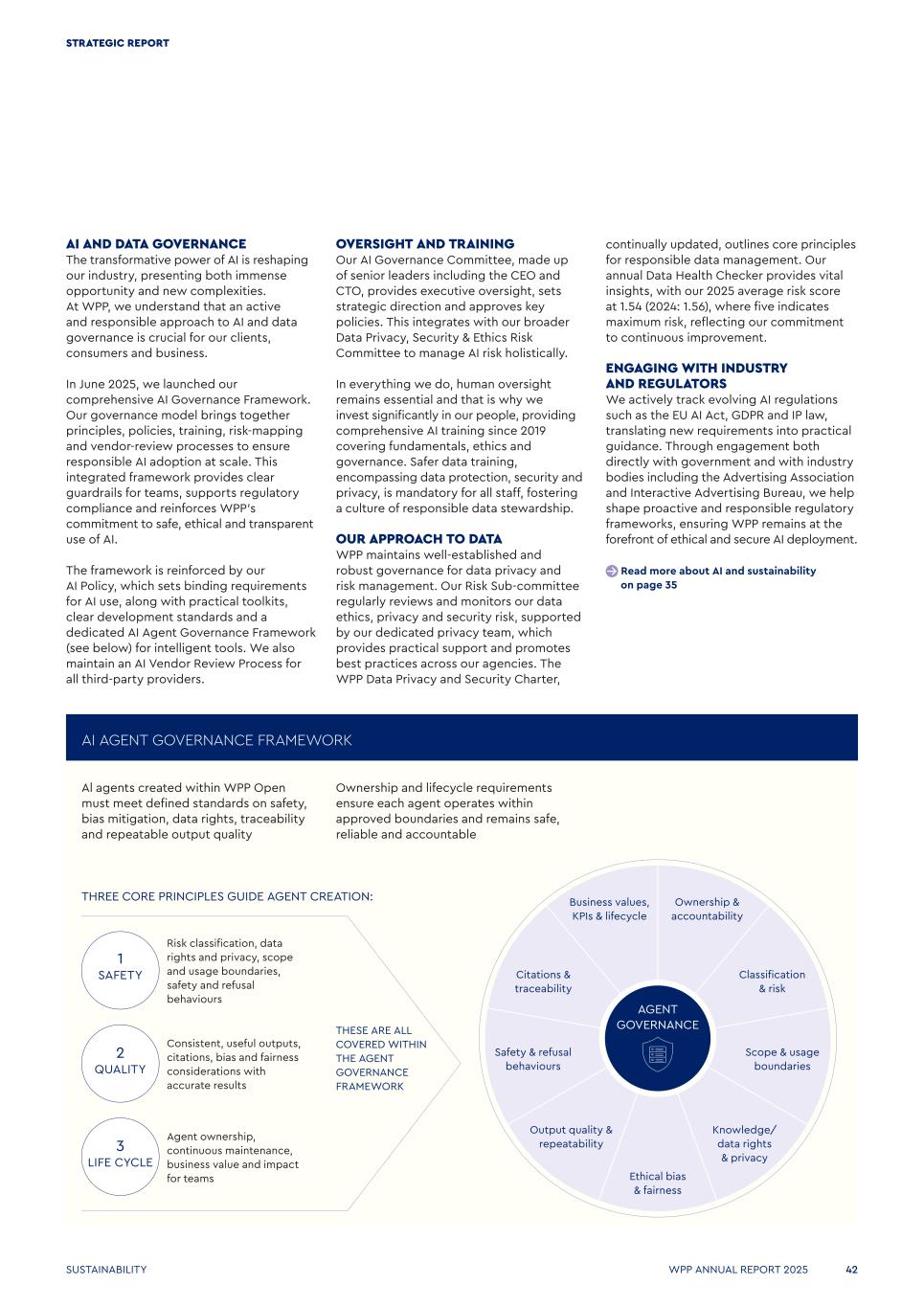
OVERSIGHT AND TRAINING Our AI Governance Committee, made up of senior leaders including the CEO and CTO, provides executive oversight, sets strategic direction and approves key policies. This integrates with our broader Data Privacy, Security & Ethics Risk Committee to manage AI risk holistically. In everything we do, human oversight remains essential and that is why we invest significantly in our people, providing comprehensive AI training since 2019 covering fundamentals, ethics and governance. Safer data training, encompassing data protection, security and privacy, is mandatory for all staff, fostering a culture of responsible data stewardship. OUR APPROACH TO DATA WPP maintains well-established and robust governance for data privacy and risk management. Our Risk Sub-committee regularly reviews and monitors our data ethics, privacy and security risk, supported by our dedicated privacy team, which provides practical support and promotes best practices across our agencies. The WPP Data Privacy and Security Charter, continually updated, outlines core principles for responsible data management. Our annual Data Health Checker provides vital insights, with our 2025 average risk score at 1.54 (2024: 1.56), where five indicates maximum risk, reflecting our commitment to continuous improvement. ENGAGING WITH INDUSTRY AND REGULATORS We actively track evolving AI regulations such as the EU AI Act, GDPR and IP law, translating new requirements into practical guidance. Through engagement both directly with government and with industry bodies including the Advertising Association and Interactive Advertising Bureau, we help shape proactive and responsible regulatory frameworks, ensuring WPP remains at the forefront of ethical and secure AI deployment. Read more about AI and sustainability on page 35 AI AND DATA GOVERNANCE The transformative power of AI is reshaping our industry, presenting both immense opportunity and new complexities. At WPP, we understand that an active and responsible approach to AI and data governance is crucial for our clients, consumers and business. In June 2025, we launched our comprehensive AI Governance Framework. Our governance model brings together principles, policies, training, risk‑mapping and vendor‑review processes to ensure responsible AI adoption at scale. This integrated framework provides clear guardrails for teams, supports regulatory compliance and reinforces WPP’s commitment to safe, ethical and transparent use of AI. The framework is reinforced by our AI Policy, which sets binding requirements for AI use, along with practical toolkits, clear development standards and a dedicated AI Agent Governance Framework (see below) for intelligent tools. We also maintain an AI Vendor Review Process for all third-party providers. AI AGENT GOVERNANCE FRAMEWORK Al agents created within WPP Open must meet defined standards on safety, bias mitigation, data rights, traceability and repeatable output quality THREE CORE PRINCIPLES GUIDE AGENT CREATION: 2 QUALITY 3 LIFE CYCLE Risk classification, data rights and privacy, scope and usage boundaries, safety and refusal behaviours Consistent, useful outputs, citations, bias and fairness considerations with accurate results Agent ownership, continuous maintenance, business value and impact for teams 1 SAFETY THESE ARE ALL COVERED WITHIN THE AGENT GOVERNANCE FRAMEWORK Ownership and lifecycle requirements ensure each agent operates within approved boundaries and remains safe, reliable and accountable Ownership & accountability Classification & risk Scope & usage boundaries Knowledge/ data rights & privacy Ethical bias & fairness Output quality & repeatability Safety & refusal behaviours Citations & traceability Business values, KPIs & lifecycle AGENT GOVERNANCE WPP ANNUAL REPORT 2025 42 STRATEGIC REPORT SUSTAINABILITY