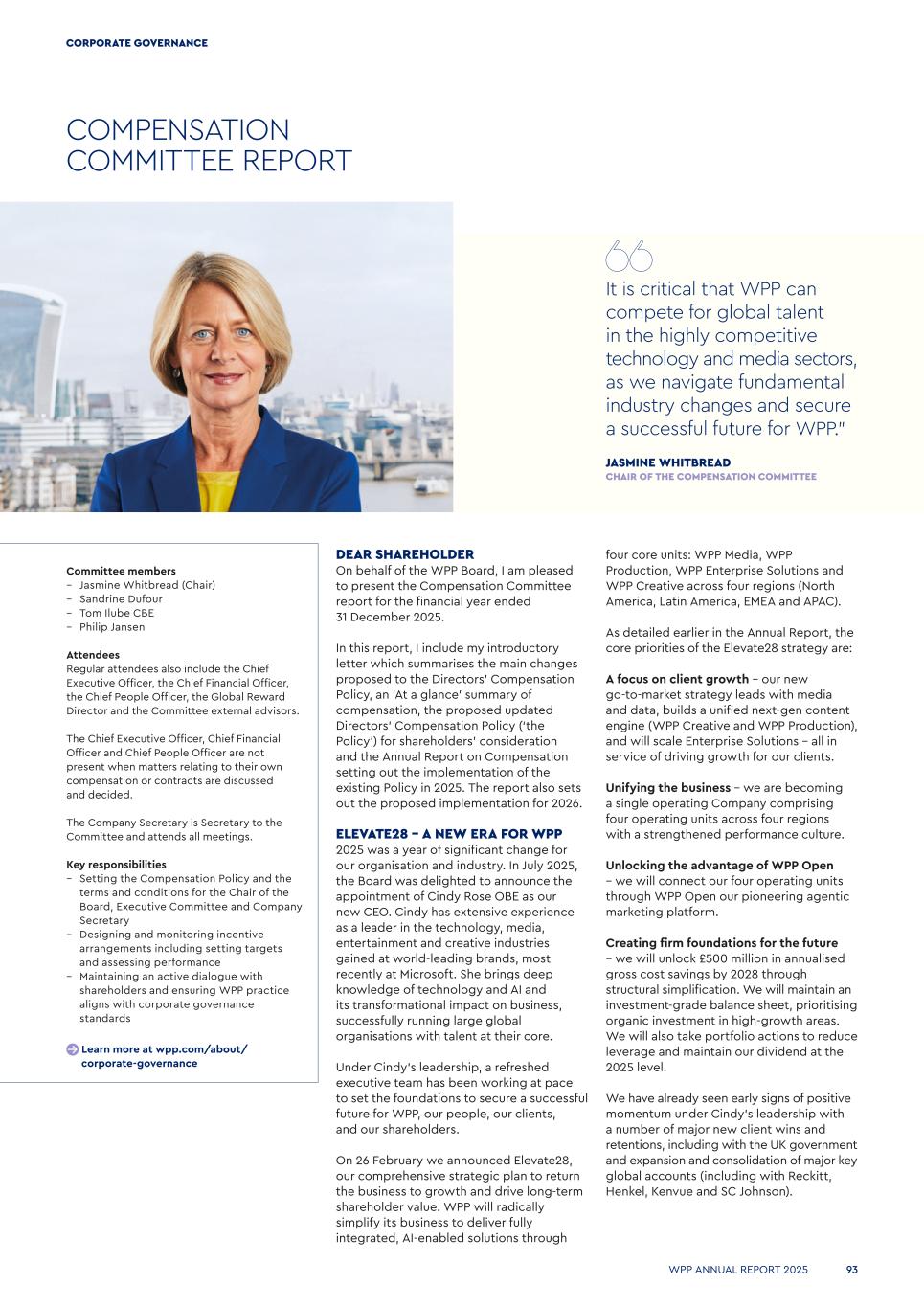
COMPENSATION COMMITTEE REPORT It is critical that WPP can compete for global talent in the highly competitive technology and media sectors, as we navigate fundamental industry changes and secure a successful future for WPP.” JASMINE WHITBREAD CHAIR OF THE COMPENSATION COMMITTEE DEAR SHAREHOLDER On behalf of the WPP Board, I am pleased to present the Compensation Committee report for the financial year ended 31 December 2025. In this report, I include my introductory letter which summarises the main changes proposed to the Directors’ Compensation Policy, an ‘At a glance’ summary of compensation, the proposed updated Directors’ Compensation Policy (‘the Policy’) for shareholders’ consideration and the Annual Report on Compensation setting out the implementation of the existing Policy in 2025. The report also sets out the proposed implementation for 2026. ELEVATE28 – A NEW ERA FOR WPP 2025 was a year of significant change for our organisation and industry. In July 2025, the Board was delighted to announce the appointment of Cindy Rose OBE as our new CEO. Cindy has extensive experience as a leader in the technology, media, entertainment and creative industries gained at world-leading brands, most recently at Microsoft. She brings deep knowledge of technology and AI and its transformational impact on business, successfully running large global organisations with talent at their core. Under Cindy’s leadership, a refreshed executive team has been working at pace to set the foundations to secure a successful future for WPP, our people, our clients, and our shareholders. On 26 February we announced Elevate28, our comprehensive strategic plan to return the business to growth and drive long-term shareholder value. WPP will radically simplify its business to deliver fully integrated, AI-enabled solutions through four core units: WPP Media, WPP Production, WPP Enterprise Solutions and WPP Creative across four regions (North America, Latin America, EMEA and APAC). As detailed earlier in the Annual Report, the core priorities of the Elevate28 strategy are: A focus on client growth – our new go-to-market strategy leads with media and data, builds a unified next-gen content engine (WPP Creative and WPP Production), and will scale Enterprise Solutions - all in service of driving growth for our clients. Unifying the business – we are becoming a single operating Company comprising four operating units across four regions with a strengthened performance culture. Unlocking the advantage of WPP Open – we will connect our four operating units through WPP Open our pioneering agentic marketing platform. Creating firm foundations for the future – we will unlock £500 million in annualised gross cost savings by 2028 through structural simplification. We will maintain an investment-grade balance sheet, prioritising organic investment in high-growth areas. We will also take portfolio actions to reduce leverage and maintain our dividend at the 2025 level. We have already seen early signs of positive momentum under Cindy’s leadership with a number of major new client wins and retentions, including with the UK government and expansion and consolidation of major key global accounts (including with Reckitt, Henkel, Kenvue and SC Johnson). Committee members – Jasmine Whitbread (Chair) – Sandrine Dufour – Tom Ilube CBE – Philip Jansen Attendees Regular attendees also include the Chief Executive Officer, the Chief Financial Officer, the Chief People Officer, the Global Reward Director and the Committee external advisors. The Chief Executive Officer, Chief Financial Officer and Chief People Officer are not present when matters relating to their own compensation or contracts are discussed and decided. The Company Secretary is Secretary to the Committee and attends all meetings. Key responsibilities – Setting the Compensation Policy and the terms and conditions for the Chair of the Board, Executive Committee and Company Secretary – Designing and monitoring incentive arrangements including setting targets and assessing performance – Maintaining an active dialogue with shareholders and ensuring WPP practice aligns with corporate governance standards Learn more at wpp.com/about/ corporate‑governance WPP ANNUAL REPORT 2025 93 CORPORATE GOVERNANCE
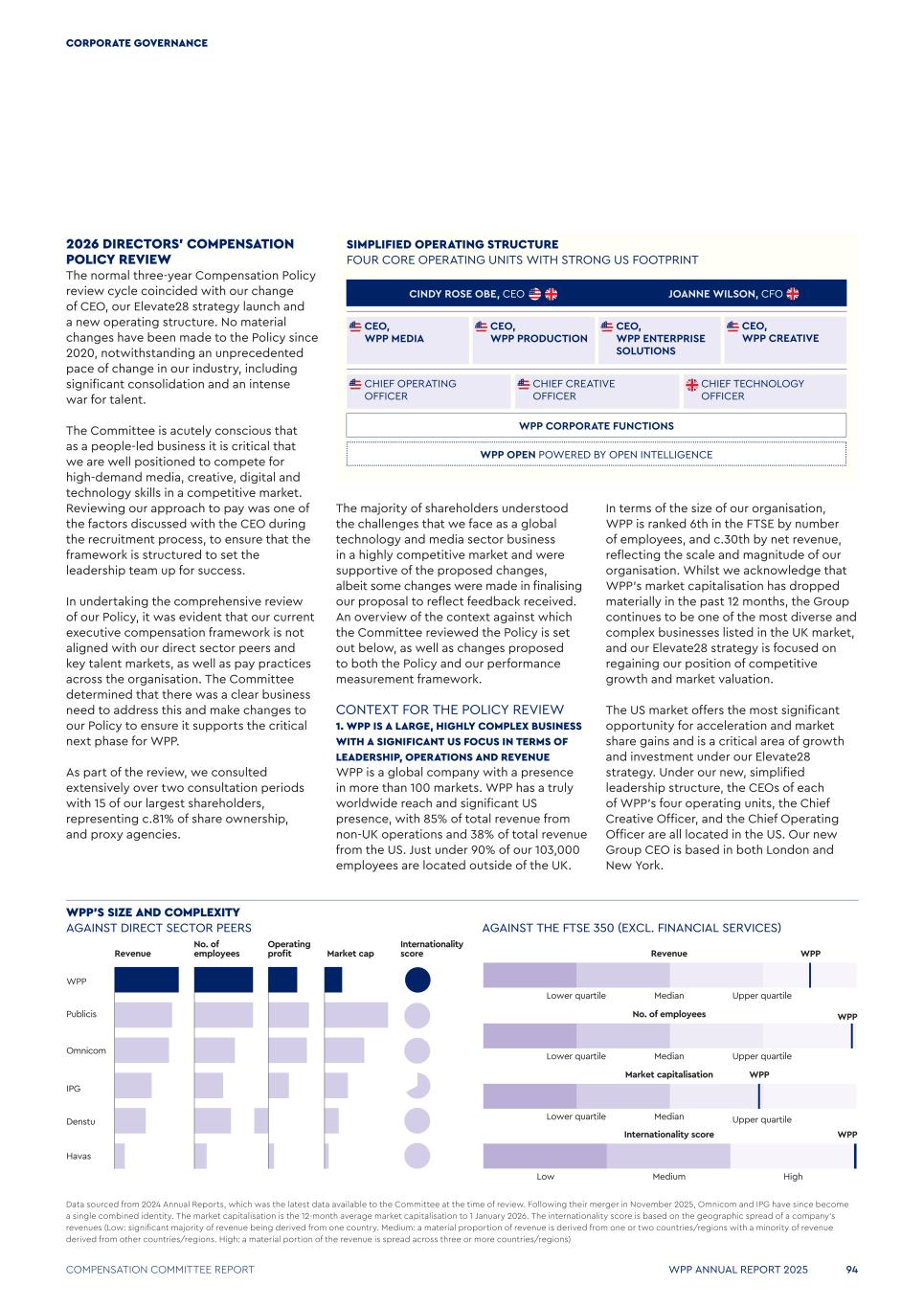
2026 DIRECTORS’ COMPENSATION POLICY REVIEW The normal three-year Compensation Policy review cycle coincided with our change of CEO, our Elevate28 strategy launch and a new operating structure. No material changes have been made to the Policy since 2020, notwithstanding an unprecedented pace of change in our industry, including significant consolidation and an intense war for talent. The Committee is acutely conscious that as a people-led business it is critical that we are well positioned to compete for high-demand media, creative, digital and technology skills in a competitive market. Reviewing our approach to pay was one of the factors discussed with the CEO during the recruitment process, to ensure that the framework is structured to set the leadership team up for success. In undertaking the comprehensive review of our Policy, it was evident that our current executive compensation framework is not aligned with our direct sector peers and key talent markets, as well as pay practices across the organisation. The Committee determined that there was a clear business need to address this and make changes to our Policy to ensure it supports the critical next phase for WPP. As part of the review, we consulted extensively over two consultation periods with 15 of our largest shareholders, representing c.81% of share ownership, and proxy agencies. The majority of shareholders understood the challenges that we face as a global technology and media sector business in a highly competitive market and were supportive of the proposed changes, albeit some changes were made in finalising our proposal to reflect feedback received. An overview of the context against which the Committee reviewed the Policy is set out below, as well as changes proposed to both the Policy and our performance measurement framework. CONTEXT FOR THE POLICY REVIEW 1. WPP IS A LARGE, HIGHLY COMPLEX BUSINESS WITH A SIGNIFICANT US FOCUS IN TERMS OF LEADERSHIP, OPERATIONS AND REVENUE WPP is a global company with a presence in more than 100 markets. WPP has a truly worldwide reach and significant US presence, with 85% of total revenue from non-UK operations and 38% of total revenue from the US. Just under 90% of our 103,000 employees are located outside of the UK. In terms of the size of our organisation, WPP is ranked 6th in the FTSE by number of employees, and c.30th by net revenue, reflecting the scale and magnitude of our organisation. Whilst we acknowledge that WPP’s market capitalisation has dropped materially in the past 12 months, the Group continues to be one of the most diverse and complex businesses listed in the UK market, and our Elevate28 strategy is focused on regaining our position of competitive growth and market valuation. The US market offers the most significant opportunity for acceleration and market share gains and is a critical area of growth and investment under our Elevate28 strategy. Under our new, simplified leadership structure, the CEOs of each of WPP’s four operating units, the Chief Creative Officer, and the Chief Operating Officer are all located in the US. Our new Group CEO is based in both London and New York. Data sourced from 2024 Annual Reports, which was the latest data available to the Committee at the time of review. Following their merger in November 2025, Omnicom and IPG have since become a single combined identity. The market capitalisation is the 12-month average market capitalisation to 1 January 2026. The internationality score is based on the geographic spread of a company’s revenues (Low: significant majority of revenue being derived from one country. Medium: a material proportion of revenue is derived from one or two countries/regions with a minority of revenue derived from other countries/regions. High: a material portion of the revenue is spread across three or more countries/regions) SIMPLIFIED OPERATING STRUCTURE FOUR CORE OPERATING UNITS WITH STRONG US FOOTPRINT WPP Revenue No. of employees Operating profit Market cap Internationality score WPP'S SIZE AND COMPLEXITY AGAINST DIRECT SECTOR PEERS AGAINST THE FTSE 350 (EXCL. FINANCIAL SERVICES) IPG Denstu Havas Omnicom Publicis Lower quartile Upper quartileMedian WPPRevenue Lower quartile Upper quartileMedian WPPNo. of employees Lower quartile Upper quartileMedian WPPMarket capitalisation Low HighMedium WPPInternationality score WPP CORPORATE FUNCTIONS WPP OPEN POWERED BY OPEN INTELLIGENCE CINDY ROSE OBE, CEO JOANNE WILSON, CFO CEO, WPP MEDIA CEO, WPP PRODUCTION CEO, WPP ENTERPRISE SOLUTIONS CEO, WPP CREATIVE CHIEF TECHNOLOGY OFFICER CHIEF OPERATING OFFICER CHIEF CREATIVE OFFICER WPP ANNUAL REPORT 2025 94 CORPORATE GOVERNANCE Compensation Committee report
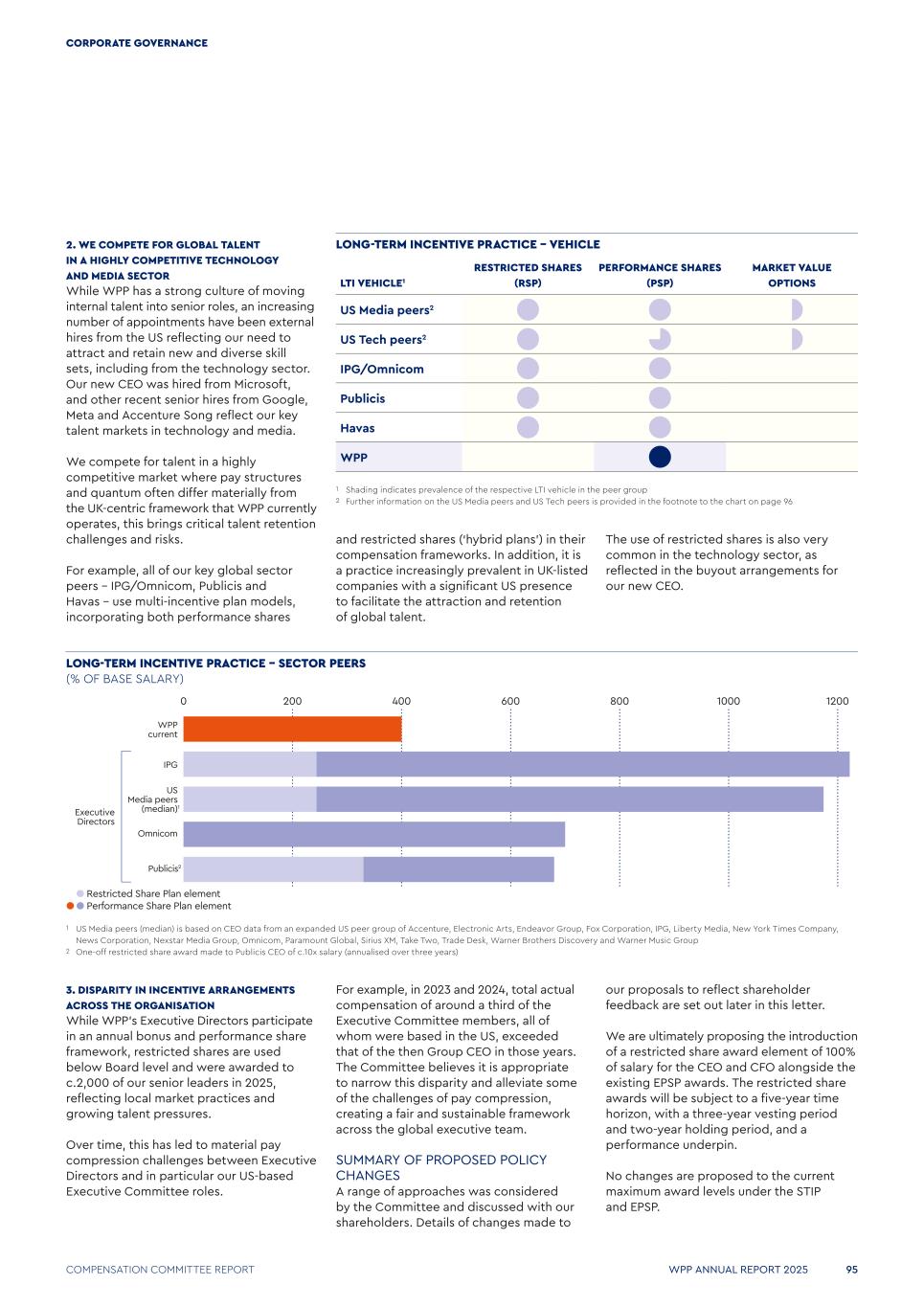
2. WE COMPETE FOR GLOBAL TALENT IN A HIGHLY COMPETITIVE TECHNOLOGY AND MEDIA SECTOR While WPP has a strong culture of moving internal talent into senior roles, an increasing number of appointments have been external hires from the US reflecting our need to attract and retain new and diverse skill sets, including from the technology sector. Our new CEO was hired from Microsoft, and other recent senior hires from Google, Meta and Accenture Song reflect our key talent markets in technology and media. We compete for talent in a highly competitive market where pay structures and quantum often differ materially from the UK-centric framework that WPP currently operates, this brings critical talent retention challenges and risks. For example, all of our key global sector peers – IPG/Omnicom, Publicis and Havas – use multi-incentive plan models, incorporating both performance shares 3. DISPARITY IN INCENTIVE ARRANGEMENTS ACROSS THE ORGANISATION While WPP’s Executive Directors participate in an annual bonus and performance share framework, restricted shares are used below Board level and were awarded to c.2,000 of our senior leaders in 2025, reflecting local market practices and growing talent pressures. Over time, this has led to material pay compression challenges between Executive Directors and in particular our US-based Executive Committee roles. and restricted shares (‘hybrid plans’) in their compensation frameworks. In addition, it is a practice increasingly prevalent in UK-listed companies with a significant US presence to facilitate the attraction and retention of global talent. For example, in 2023 and 2024, total actual compensation of around a third of the Executive Committee members, all of whom were based in the US, exceeded that of the then Group CEO in those years. The Committee believes it is appropriate to narrow this disparity and alleviate some of the challenges of pay compression, creating a fair and sustainable framework across the global executive team. SUMMARY OF PROPOSED POLICY CHANGES A range of approaches was considered by the Committee and discussed with our shareholders. Details of changes made to The use of restricted shares is also very common in the technology sector, as reflected in the buyout arrangements for our new CEO. our proposals to reflect shareholder feedback are set out later in this letter. We are ultimately proposing the introduction of a restricted share award element of 100% of salary for the CEO and CFO alongside the existing EPSP awards. The restricted share awards will be subject to a five-year time horizon, with a three-year vesting period and two-year holding period, and a performance underpin. No changes are proposed to the current maximum award levels under the STIP and EPSP. WPP current LONG-TERM INCENTIVE PRACTICE – SECTOR PEERS (% OF BASE SALARY) Restricted Share Plan element Performance Share Plan element IPG US Media peers (median)1 Omnicom Publicis2 Executive Directors 0 200 400 600 800 1000 1200 1 US Media peers (median) is based on CEO data from an expanded US peer group of Accenture, Electronic Arts, Endeavor Group, Fox Corporation, IPG, Liberty Media, New York Times Company, News Corporation, Nexstar Media Group, Omnicom, Paramount Global, Sirius XM, Take Two, Trade Desk, Warner Brothers Discovery and Warner Music Group 2 One-off restricted share award made to Publicis CEO of c.10x salary (annualised over three years) LONG-TERM INCENTIVE PRACTICE – VEHICLE LTI VEHICLE1 RESTRICTED SHARES (RSP) PERFORMANCE SHARES (PSP) MARKET VALUE OPTIONS US Media peers2 US Tech peers2 IPG/Omnicom Publicis Havas WPP 1 Shading indicates prevalence of the respective LTI vehicle in the peer group 2 Further information on the US Media peers and US Tech peers is provided in the footnote to the chart on page 96 WPP ANNUAL REPORT 2025 95 CORPORATE GOVERNANCE Compensation Committee report
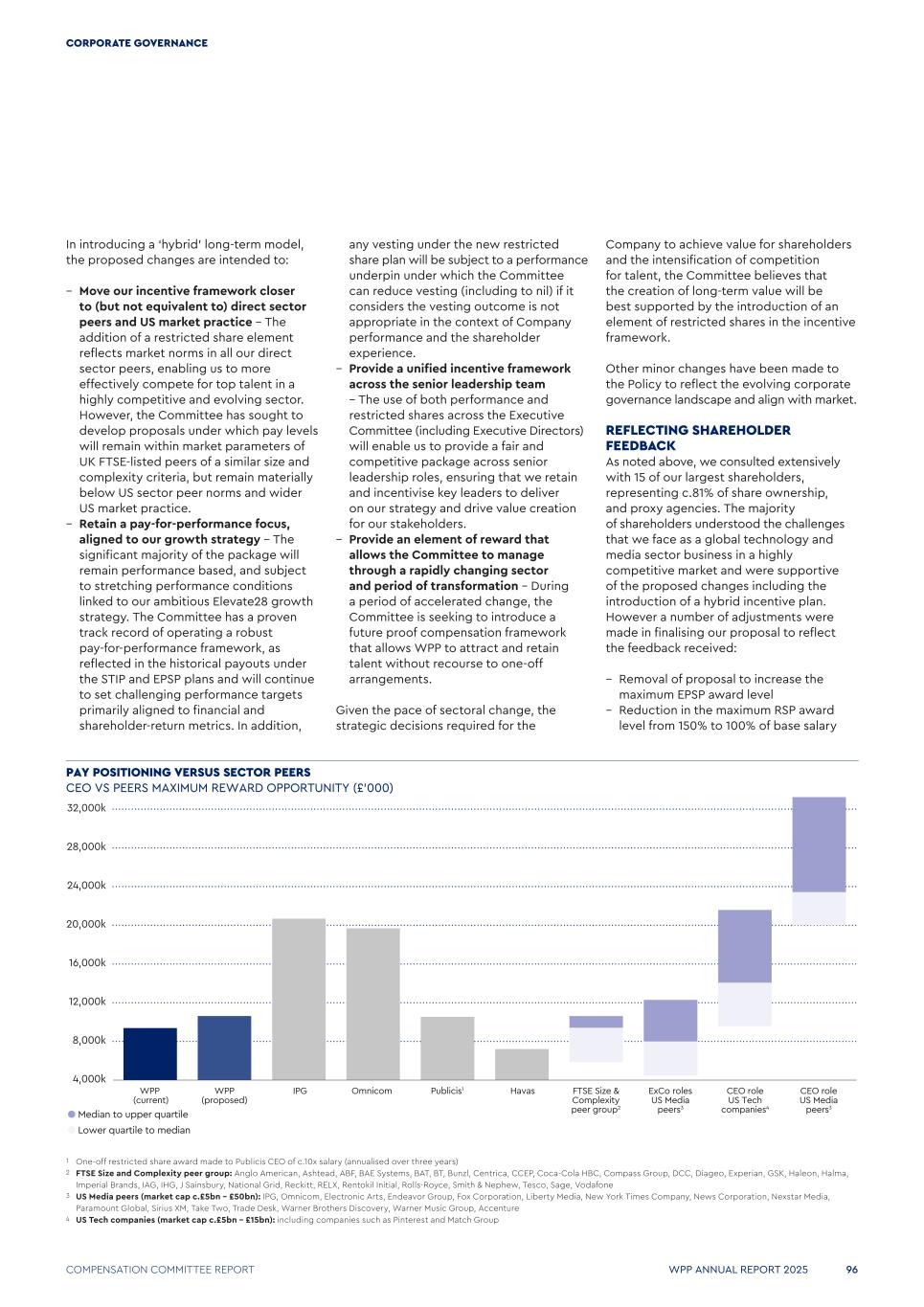
In introducing a ‘hybrid’ long-term model, the proposed changes are intended to: – Move our incentive framework closer to (but not equivalent to) direct sector peers and US market practice – The addition of a restricted share element reflects market norms in all our direct sector peers, enabling us to more effectively compete for top talent in a highly competitive and evolving sector. However, the Committee has sought to develop proposals under which pay levels will remain within market parameters of UK FTSE-listed peers of a similar size and complexity criteria, but remain materially below US sector peer norms and wider US market practice. – Retain a pay-for-performance focus, aligned to our growth strategy – The significant majority of the package will remain performance based, and subject to stretching performance conditions linked to our ambitious Elevate28 growth strategy. The Committee has a proven track record of operating a robust pay-for-performance framework, as reflected in the historical payouts under the STIP and EPSP plans and will continue to set challenging performance targets primarily aligned to financial and shareholder-return metrics. In addition, any vesting under the new restricted share plan will be subject to a performance underpin under which the Committee can reduce vesting (including to nil) if it considers the vesting outcome is not appropriate in the context of Company performance and the shareholder experience. – Provide a unified incentive framework across the senior leadership team – The use of both performance and restricted shares across the Executive Committee (including Executive Directors) will enable us to provide a fair and competitive package across senior leadership roles, ensuring that we retain and incentivise key leaders to deliver on our strategy and drive value creation for our stakeholders. – Provide an element of reward that allows the Committee to manage through a rapidly changing sector and period of transformation – During a period of accelerated change, the Committee is seeking to introduce a future proof compensation framework that allows WPP to attract and retain talent without recourse to one-off arrangements. Given the pace of sectoral change, the strategic decisions required for the Company to achieve value for shareholders and the intensification of competition for talent, the Committee believes that the creation of long-term value will be best supported by the introduction of an element of restricted shares in the incentive framework. Other minor changes have been made to the Policy to reflect the evolving corporate governance landscape and align with market. REFLECTING SHAREHOLDER FEEDBACK As noted above, we consulted extensively with 15 of our largest shareholders, representing c.81% of share ownership, and proxy agencies. The majority of shareholders understood the challenges that we face as a global technology and media sector business in a highly competitive market and were supportive of the proposed changes including the introduction of a hybrid incentive plan. However a number of adjustments were made in finalising our proposal to reflect the feedback received: – Removal of proposal to increase the maximum EPSP award level – Reduction in the maximum RSP award level from 150% to 100% of base salary WPP (current) WPP (proposed) IPG Omnicom Publicis1 Havas FTSE Size & Complexity peer group2 ExCo roles US Media peers3 CEO role US Tech companies4 CEO role US Media peers3 PAY POSITIONING VERSUS SECTOR PEERS CEO VS PEERS MAXIMUM REWARD OPPORTUNITY (£’000) 4,000k 8,000k 12,000k 16,000k 20,000k 24,000k 28,000k 32,000k Lower quartile to median Median to upper quartile 1 One-off restricted share award made to Publicis CEO of c.10x salary (annualised over three years) 2 FTSE Size and Complexity peer group: Anglo American, Ashtead, ABF, BAE Systems, BAT, BT, Bunzl, Centrica, CCEP, Coca-Cola HBC, Compass Group, DCC, Diageo, Experian, GSK, Haleon, Halma, Imperial Brands, IAG, IHG, J Sainsbury, National Grid, Reckitt, RELX, Rentokil Initial, Rolls-Royce, Smith & Nephew, Tesco, Sage, Vodafone 3 US Media peers (market cap c.£5bn – £50bn): IPG, Omnicom, Electronic Arts, Endeavor Group, Fox Corporation, Liberty Media, New York Times Company, News Corporation, Nexstar Media, Paramount Global, Sirius XM, Take Two, Trade Desk, Warner Brothers Discovery, Warner Music Group, Accenture 4 US Tech companies (market cap c.£5bn – £15bn): including companies such as Pinterest and Match Group WPP ANNUAL REPORT 2025 96 CORPORATE GOVERNANCE Compensation Committee report
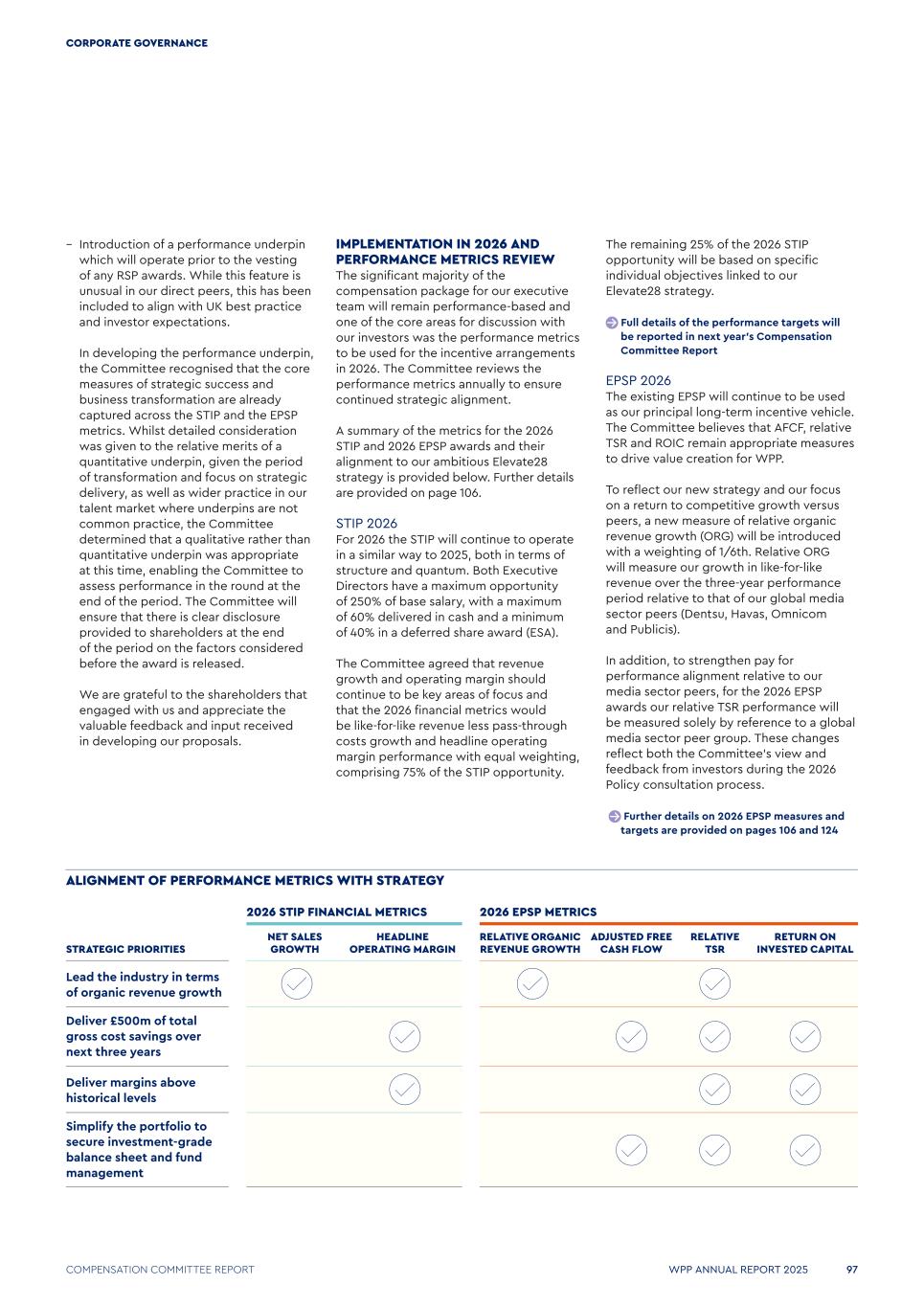
– Introduction of a performance underpin which will operate prior to the vesting of any RSP awards. While this feature is unusual in our direct peers, this has been included to align with UK best practice and investor expectations. In developing the performance underpin, the Committee recognised that the core measures of strategic success and business transformation are already captured across the STIP and the EPSP metrics. Whilst detailed consideration was given to the relative merits of a quantitative underpin, given the period of transformation and focus on strategic delivery, as well as wider practice in our talent market where underpins are not common practice, the Committee determined that a qualitative rather than quantitative underpin was appropriate at this time, enabling the Committee to assess performance in the round at the end of the period. The Committee will ensure that there is clear disclosure provided to shareholders at the end of the period on the factors considered before the award is released. We are grateful to the shareholders that engaged with us and appreciate the valuable feedback and input received in developing our proposals. IMPLEMENTATION IN 2026 AND PERFORMANCE METRICS REVIEW The significant majority of the compensation package for our executive team will remain performance-based and one of the core areas for discussion with our investors was the performance metrics to be used for the incentive arrangements in 2026. The Committee reviews the performance metrics annually to ensure continued strategic alignment. A summary of the metrics for the 2026 STIP and 2026 EPSP awards and their alignment to our ambitious Elevate28 strategy is provided below. Further details are provided on page 106. STIP 2026 For 2026 the STIP will continue to operate in a similar way to 2025, both in terms of structure and quantum. Both Executive Directors have a maximum opportunity of 250% of base salary, with a maximum of 60% delivered in cash and a minimum of 40% in a deferred share award (ESA). The Committee agreed that revenue growth and operating margin should continue to be key areas of focus and that the 2026 financial metrics would be like-for-like revenue less pass-through costs growth and headline operating margin performance with equal weighting, comprising 75% of the STIP opportunity. The remaining 25% of the 2026 STIP opportunity will be based on specific individual objectives linked to our Elevate28 strategy. Full details of the performance targets will be reported in next year’s Compensation Committee Report EPSP 2026 The existing EPSP will continue to be used as our principal long-term incentive vehicle. The Committee believes that AFCF, relative TSR and ROIC remain appropriate measures to drive value creation for WPP. To reflect our new strategy and our focus on a return to competitive growth versus peers, a new measure of relative organic revenue growth (ORG) will be introduced with a weighting of 1/6th. Relative ORG will measure our growth in like-for-like revenue over the three-year performance period relative to that of our global media sector peers (Dentsu, Havas, Omnicom and Publicis). In addition, to strengthen pay for performance alignment relative to our media sector peers, for the 2026 EPSP awards our relative TSR performance will be measured solely by reference to a global media sector peer group. These changes reflect both the Committee’s view and feedback from investors during the 2026 Policy consultation process. Further details on 2026 EPSP measures and targets are provided on pages 106 and 124 ALIGNMENT OF PERFORMANCE METRICS WITH STRATEGY 2026 STIP FINANCIAL METRICS 2026 EPSP METRICS STRATEGIC PRIORITIES NET SALES GROWTH HEADLINE OPERATING MARGIN RELATIVE ORGANIC REVENUE GROWTH ADJUSTED FREE CASH FLOW RELATIVE TSR RETURN ON INVESTED CAPITAL Lead the industry in terms of organic revenue growth Deliver £500m of total gross cost savings over next three years Deliver margins above historical levels Simplify the portfolio to secure investment-grade balance sheet and fund management WPP ANNUAL REPORT 2025 97 CORPORATE GOVERNANCE Compensation Committee report
SALARY REVIEW FOR 2026 The base salaries of the Executive Directors will be subject to review during 2026 in the usual way in line with the wider annual salary review processes which will be undertaken for our employees. COMPENSATION IN 2025 STIP 2025 All the Executive Directors participated in the 2025 STIP. The CEO, Cindy Rose, participated on a pro-rata basis from the date of her appointment and the reported outcomes shown for the former CEO, Mark Read, reflect the period to 31 August 2025 whilst he was an Executive Director. The STIP was based on a combination of financial and non-financial measures aligned to the delivery of the Company strategy and purpose. The financial measures, which determined 75% of the award, were headline operating profit margin improvement and like-for-like revenue less pass-through costs growth. The actual financial performance of the company against both these metrics in 2025 was below threshold. This resulted in no STIP bonus being payable in respect of the financial element (75% of the award) of the STIP. The Committee felt that this appropriately reflected the underlying performance of the Company and no adjustments were made. See page 119 for further detail on performance against financial targets The remaining 25% of the award is based on individual performance against non-financial priorities set by the Committee at the start of the year (or if later, shortly after joining). The Committee assessed the performance of each of the individual Executive Directors (including the former CEO, Mark Read) against their agreed non-financial priorities. In assessing individual performance the Committee was mindful of the business performance, the experiences of our broader employee base, our shareholders, and the wider stakeholder community during 2025. In evaluating Cindy’s first months in role, the Committee recognised that she had demonstrated exceptional progress: successfully leading the development of the new strategy, refreshing the executive team, overseeing significant business transformation, new client-focussed AI solutions, and securing key new business and extending a key partnership with Google. On this basis, it determined an assessment of 25%/25% (resulting in a total STIP of 25% of the maximum opportunity, totalling £261,130) appropriately reflected Cindy’s significant contribution since joining WPP. For Joanne, the Committee recognised her strong delivery, which included bolstering WPP’s long-term funding resilience through a highly successful €1bn bond issue that reinforced market confidence; driving substantial business transformation, marked by significant cost reductions; and orchestrating strategic investments in WPP Open and AI that are delivering enhanced operational efficiencies. Reflecting on Joanne’s specific achievements, the Committee conducted a review of both the collective and personal deliverables within the non-financial objectives. It was determined that she achieved 100% for the goals within the non-financial metrics directly related to her personal deliverables, which had a weighting of 10% within the total 25% allocated for non-financial metrics. Consequently, her overall assessment for the non-financial metrics resulted in a total STIP of 10% of the maximum opportunity, totalling £190,000, reflecting her singular contribution during 2025. The Committee considered these awards were appropriate given the individual performance of the CEO and CFO. However, to further align their interests with shareholders, it decided these awards would be made as deferred ESAs, vesting subject to continued employment, in March 2028, and no cash payment would be made. The Committee recognised the contribution of the outgoing Executive Directors, Andrew Scott and Mark Read, including the delivery of a proportion of non-financial objectives. However, given the outcome against the STIP financial metrics, the performance of the Company and the wider stakeholder experience, it determined that it was not appropriate for any 2025 STIP awards to be made to Andrew or Mark based on non-financial performance. Consequently, combined with no STIP bonus being payable in respect of the financial element, no 2025 STIP was awarded to Andrew or Mark. See pages 119 and 120 for further detail on performance against non-financial priorities 2023 EPSP AWARDS The 2023 EPSP awards’ three-year performance period ended on 31 December 2025. Performance against all three metrics was below threshold resulting in a formulaic vesting outcome of zero. The Committee considered this vesting outcome was an appropriate reflection of performance and no adjustments were made to the outcome. NEW CEO APPOINTMENT As disclosed on 10 July 2025, Cindy Rose was appointed on a salary of £1,250,000. Other elements of her package were set in line with the Compensation Policy on appointment. Further details are provided on page 115. DEPARTING EXECUTIVE DIRECTORS On Cindy’s appointment as CEO on 1 September 2025, Mark Read stepped down as CEO and from the Board. Following this, Mark worked with Cindy to facilitate the transition before commencing garden leave on 14 November 2025. He will retire, as previously announced, at the end of his notice period, on 8 June 2026. The termination arrangements for Mark Read (which were in accordance with the Policy) are set out on page 116. Andrew Scott also stepped down as Chief Operating Officer and from the Board on 31 December 2025. He remains an employee of the Group. CLOSING REMARKS I would like to express my appreciation to the members of the Committee for their continuing dedication and active participation over what has been a very busy year. WPP is at a pivotal moment, and the business is taking action to set itself up for future success, led by a new CEO and executive team. We are confident in Elevate28 and believe the proposed Policy changes are necessary to facilitate the delivery of our ambitious strategy. On behalf of the Committee I would like to thank our shareholders for their support and input in our consultation process and hope you will support our proposed Policy at the upcoming AGM. Jasmine Whitbread Chair of the Compensation Committee 19 March 2026 WPP ANNUAL REPORT 2025 98 CORPORATE GOVERNANCE Compensation Committee report
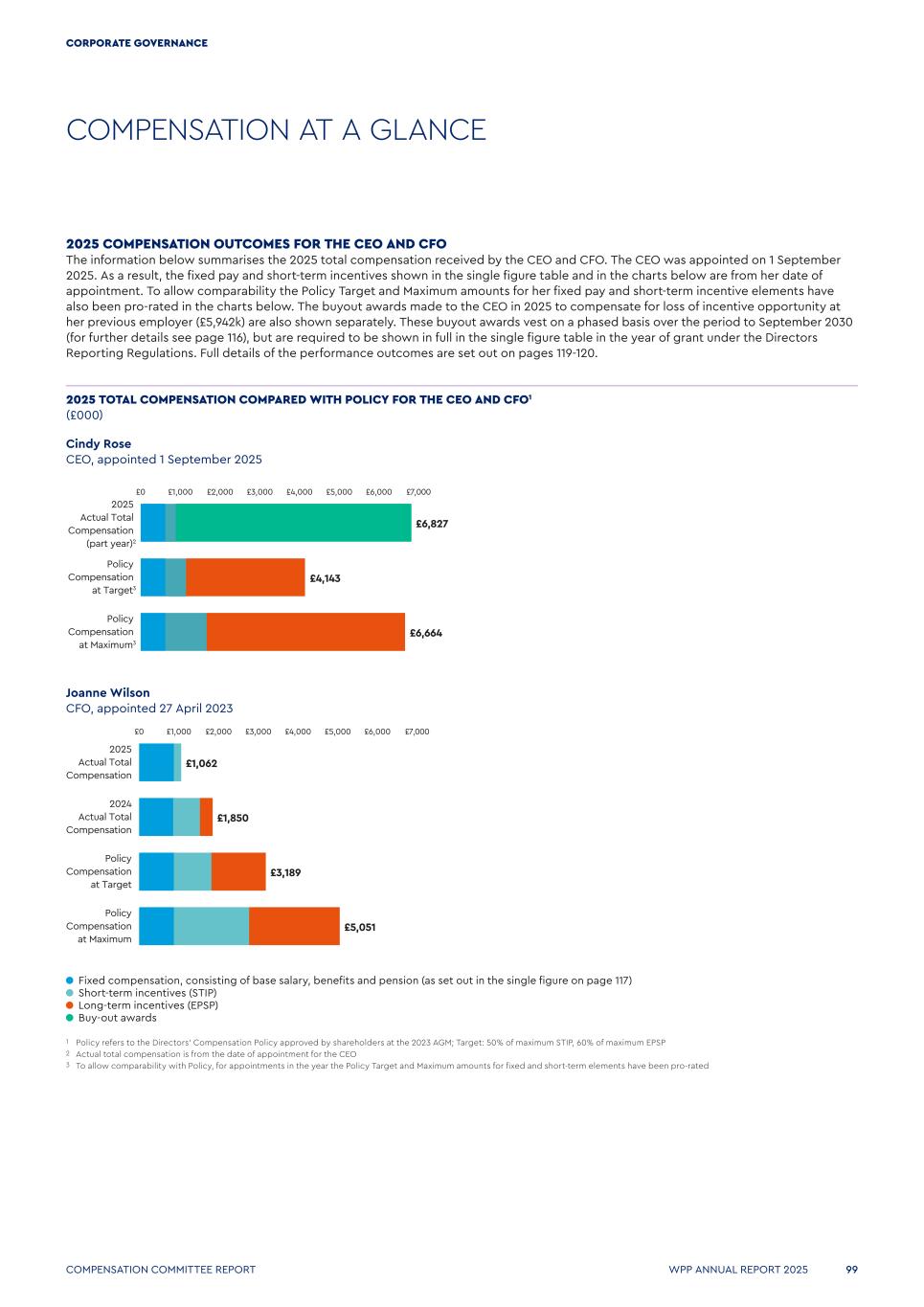
COMPENSATION AT A GLANCE 2025 COMPENSATION OUTCOMES FOR THE CEO AND CFO The information below summarises the 2025 total compensation received by the CEO and CFO. The CEO was appointed on 1 September 2025. As a result, the fixed pay and short-term incentives shown in the single figure table and in the charts below are from her date of appointment. To allow comparability the Policy Target and Maximum amounts for her fixed pay and short-term incentive elements have also been pro-rated in the charts below. The buyout awards made to the CEO in 2025 to compensate for loss of incentive opportunity at her previous employer (£5,942k) are also shown separately. These buyout awards vest on a phased basis over the period to September 2030 (for further details see page 116), but are required to be shown in full in the single figure table in the year of grant under the Directors Reporting Regulations. Full details of the performance outcomes are set out on pages 119-120. 2025 TOTAL COMPENSATION COMPARED WITH POLICY FOR THE CEO AND CFO1 (£000) Cindy Rose CEO, appointed 1 September 2025 Joanne Wilson CFO, appointed 27 April 2023 Fixed compensation, consisting of base salary, benefits and pension (as set out in the single figure on page 117) Short-term incentives (STIP) Long-term incentives (EPSP) Buy-out awards 1 Policy refers to the Directors’ Compensation Policy approved by shareholders at the 2023 AGM; Target: 50% of maximum STIP, 60% of maximum EPSP 2 Actual total compensation is from the date of appointment for the CEO 3 To allow comparability with Policy, for appointments in the year the Policy Target and Maximum amounts for fixed and short-term elements have been pro-rated 2025 Actual Total Compensation (part year)2 Policy Compensation at Target3 Policy Compensation at Maximum3 £0 £1,000 £2,000 £3,000 £4,000 £6,000£5,000 £7,000 £6,664 £4,143 £6,827 2025 Actual Total Compensation 2024 Actual Total Compensation Policy Compensation at Target Policy Compensation at Maximum £5,051 £3,189 £1,850 £1,062 £0 £1,000 £2,000 £3,000 £4,000 £6,000£5,000 £7,000 WPP ANNUAL REPORT 2025 99 CORPORATE GOVERNANCE COMPENSATION COMMITTEE REPORT
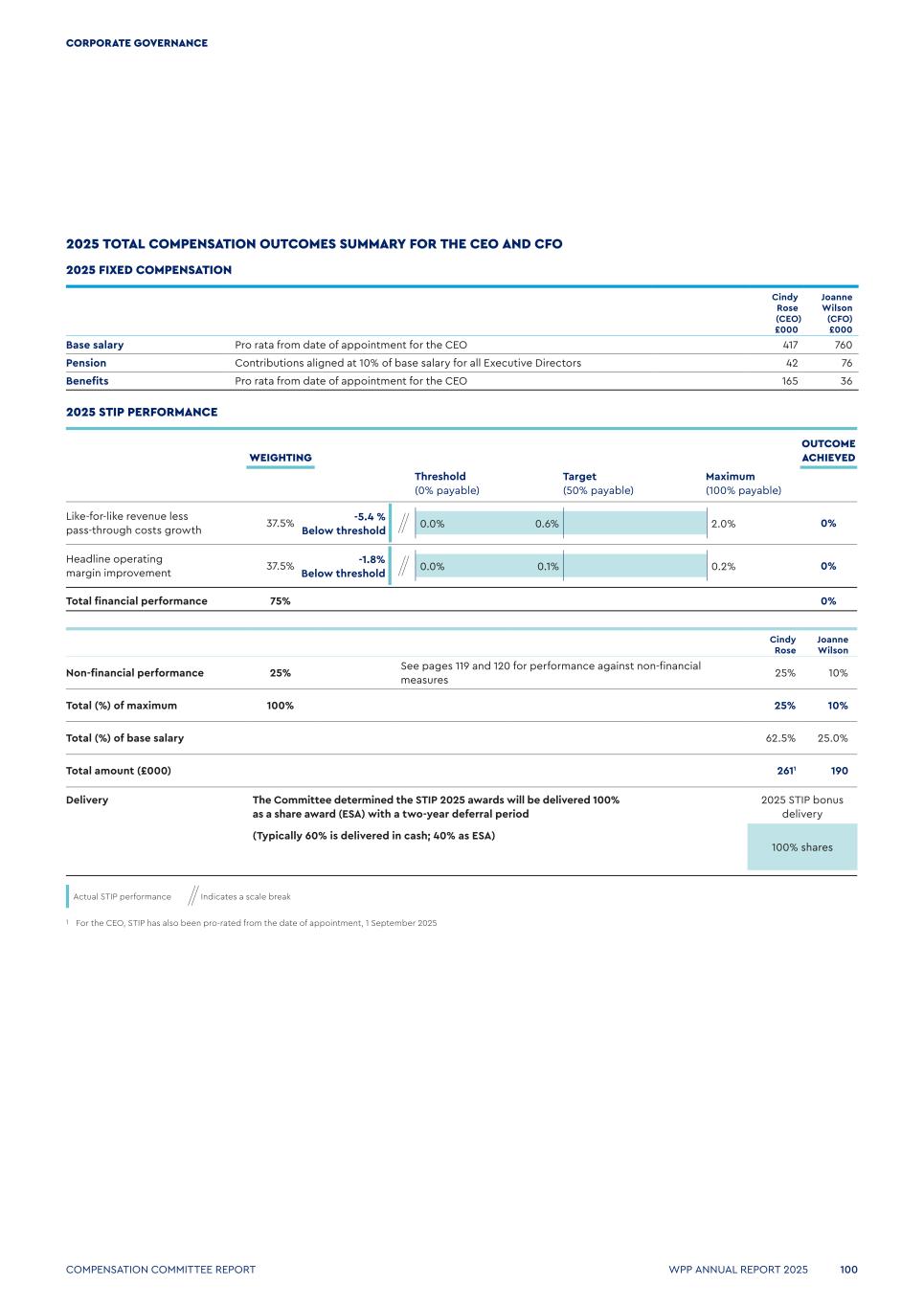
2025 TOTAL COMPENSATION OUTCOMES SUMMARY FOR THE CEO AND CFO 2025 FIXED COMPENSATION Cindy Rose (CEO) £000 Joanne Wilson (CFO) £000 Base salary Pro rata from date of appointment for the CEO 417 760 Pension Contributions aligned at 10% of base salary for all Executive Directors 42 76 Benefits Pro rata from date of appointment for the CEO 165 36 2025 STIP PERFORMANCE WEIGHTING OUTCOME ACHIEVED Threshold (0% payable) Target (50% payable) Maximum (100% payable) Like-for-like revenue less pass-through costs growth 37.5% 0% Headline operating margin improvement 37.5% 0% Total financial performance 75% 0% Cindy Rose Joanne Wilson Non-financial performance 25% See pages 119 and 120 for performance against non-financial measures 25% 10% Total (%) of maximum 100% 25% 10% Total (%) of base salary 62.5% 25.0% Total amount (£000) 2611 190 Delivery The Committee determined the STIP 2025 awards will be delivered 100% as a share award (ESA) with a two-year deferral period (Typically 60% is delivered in cash; 40% as ESA) 2025 STIP bonus delivery 100% shares Actual STIP performance Indicates a scale break 1 For the CEO, STIP has also been pro-rated from the date of appointment, 1 September 2025 -1.8% Below threshold 0.0% 0.6% 2.0% -5.4 % Below threshold 0.0% 0.1% 0.2% WPP ANNUAL REPORT 2025 100 CORPORATE GOVERNANCE COMPENSATION COMMITTEE REPORT
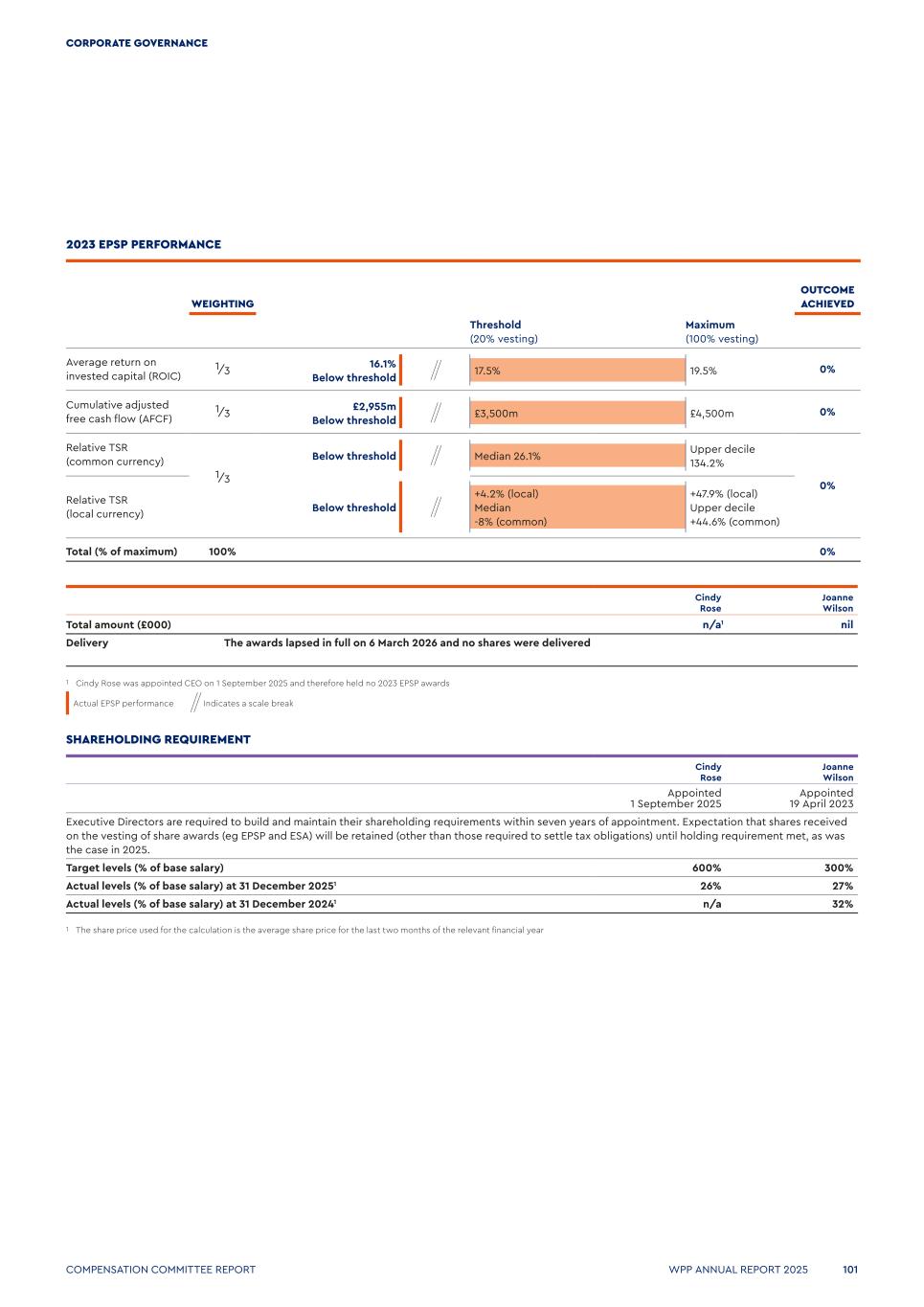
2023 EPSP PERFORMANCE WEIGHTING OUTCOME ACHIEVED Threshold (20% vesting) Maximum (100% vesting) Average return on invested capital (ROIC) 1/3 0% Cumulative adjusted free cash flow (AFCF) 1/3 0% Relative TSR (common currency) 1/3 0% Relative TSR (local currency) Total (% of maximum) 100% 0% Cindy Rose Joanne Wilson Total amount (£000) n/a1 nil Delivery The awards lapsed in full on 6 March 2026 and no shares were delivered 1 Cindy Rose was appointed CEO on 1 September 2025 and therefore held no 2023 EPSP awards Actual EPSP performance Indicates a scale break SHAREHOLDING REQUIREMENT Cindy Rose Joanne Wilson Appointed 1 September 2025 Appointed 19 April 2023 Executive Directors are required to build and maintain their shareholding requirements within seven years of appointment. Expectation that shares received on the vesting of share awards (eg EPSP and ESA) will be retained (other than those required to settle tax obligations) until holding requirement met, as was the case in 2025. Target levels (% of base salary) 600% 300% Actual levels (% of base salary) at 31 December 20251 26% 27% Actual levels (% of base salary) at 31 December 20241 n/a 32% 1 The share price used for the calculation is the average share price for the last two months of the relevant financial year 17.5% £3,500m Median 26.1% +4.2% (local) Median -8% (common) 19.5% £4,500m Upper decile 134.2% +47.9% (local) Upper decile +44.6% (common) £2,955m Below threshold Below threshold Below threshold 16.1% Below threshold WPP ANNUAL REPORT 2025 101 CORPORATE GOVERNANCE COMPENSATION COMMITTEE REPORT
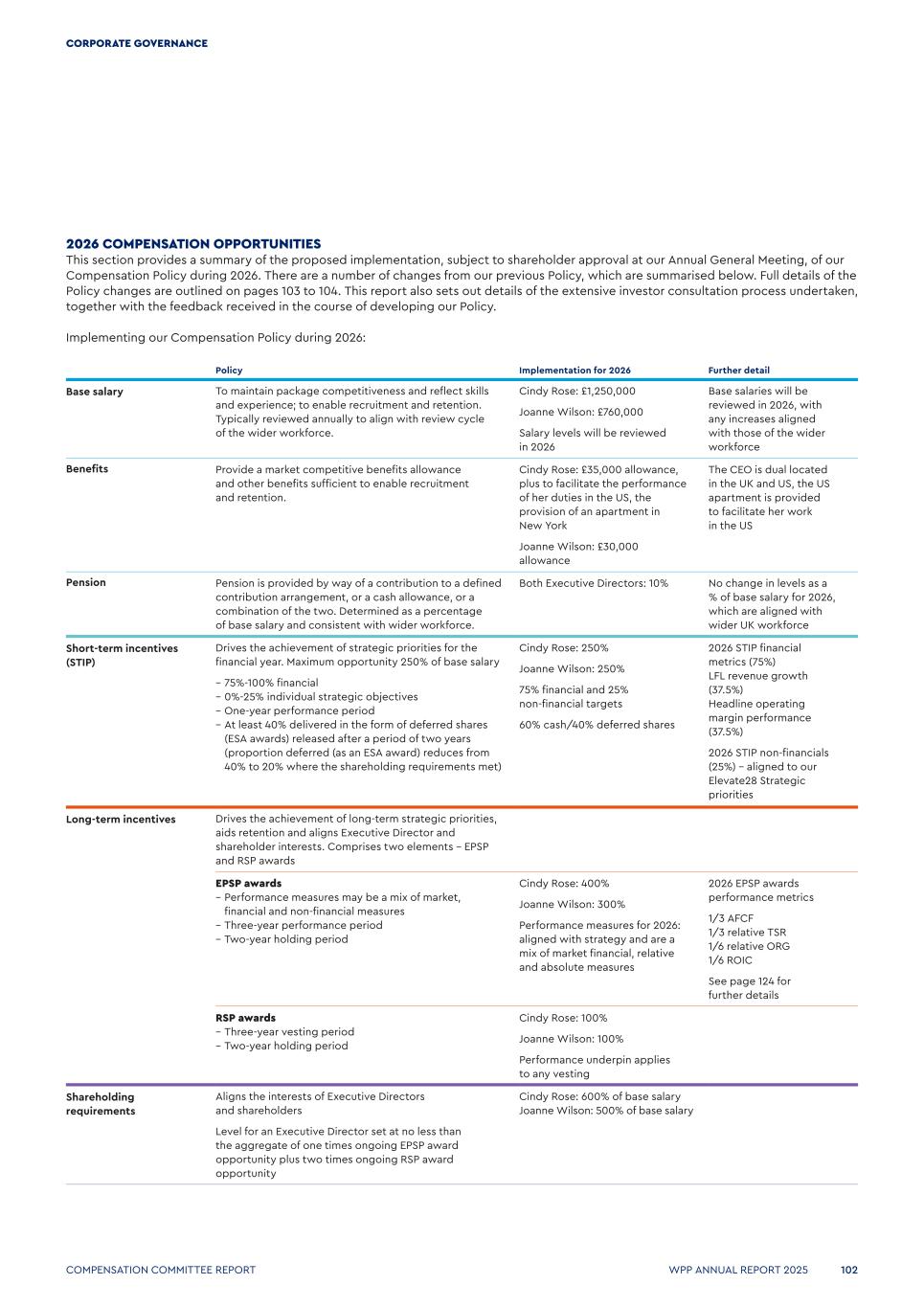
2026 COMPENSATION OPPORTUNITIES This section provides a summary of the proposed implementation, subject to shareholder approval at our Annual General Meeting, of our Compensation Policy during 2026. There are a number of changes from our previous Policy, which are summarised below. Full details of the Policy changes are outlined on pages 103 to 104. This report also sets out details of the extensive investor consultation process undertaken, together with the feedback received in the course of developing our Policy. Implementing our Compensation Policy during 2026: Policy Implementation for 2026 Further detail Base salary To maintain package competitiveness and reflect skills and experience; to enable recruitment and retention. Typically reviewed annually to align with review cycle of the wider workforce. Cindy Rose: £1,250,000 Joanne Wilson: £760,000 Salary levels will be reviewed in 2026 Base salaries will be reviewed in 2026, with any increases aligned with those of the wider workforce Benefits Provide a market competitive benefits allowance and other benefits sufficient to enable recruitment and retention. Cindy Rose: £35,000 allowance, plus to facilitate the performance of her duties in the US, the provision of an apartment in New York Joanne Wilson: £30,000 allowance The CEO is dual located in the UK and US, the US apartment is provided to facilitate her work in the US Pension Pension is provided by way of a contribution to a defined contribution arrangement, or a cash allowance, or a combination of the two. Determined as a percentage of base salary and consistent with wider workforce. Both Executive Directors: 10% No change in levels as a % of base salary for 2026, which are aligned with wider UK workforce Short-term incentives (STIP) Drives the achievement of strategic priorities for the financial year. Maximum opportunity 250% of base salary – 75%-100% financial – 0%-25% individual strategic objectives – One-year performance period – At least 40% delivered in the form of deferred shares (ESA awards) released after a period of two years (proportion deferred (as an ESA award) reduces from 40% to 20% where the shareholding requirements met) Cindy Rose: 250% Joanne Wilson: 250% 75% financial and 25% non‑financial targets 60% cash/40% deferred shares 2026 STIP financial metrics (75%) LFL revenue growth (37.5%) Headline operating margin performance (37.5%) 2026 STIP non-financials (25%) - aligned to our Elevate28 Strategic priorities Long-term incentives Drives the achievement of long-term strategic priorities, aids retention and aligns Executive Director and shareholder interests. Comprises two elements - EPSP and RSP awards EPSP awards – Performance measures may be a mix of market, financial and non-financial measures – Three-year performance period – Two-year holding period Cindy Rose: 400% Joanne Wilson: 300% Performance measures for 2026: aligned with strategy and are a mix of market financial, relative and absolute measures 2026 EPSP awards performance metrics 1/3 AFCF 1/3 relative TSR 1/6 relative ORG 1/6 ROIC See page 124 for further details RSP awards – Three-year vesting period – Two-year holding period Cindy Rose: 100% Joanne Wilson: 100% Performance underpin applies to any vesting Shareholding requirements Aligns the interests of Executive Directors and shareholders Level for an Executive Director set at no less than the aggregate of one times ongoing EPSP award opportunity plus two times ongoing RSP award opportunity Cindy Rose: 600% of base salary Joanne Wilson: 500% of base salary WPP ANNUAL REPORT 2025 102 CORPORATE GOVERNANCE COMPENSATION COMMITTEE REPORT
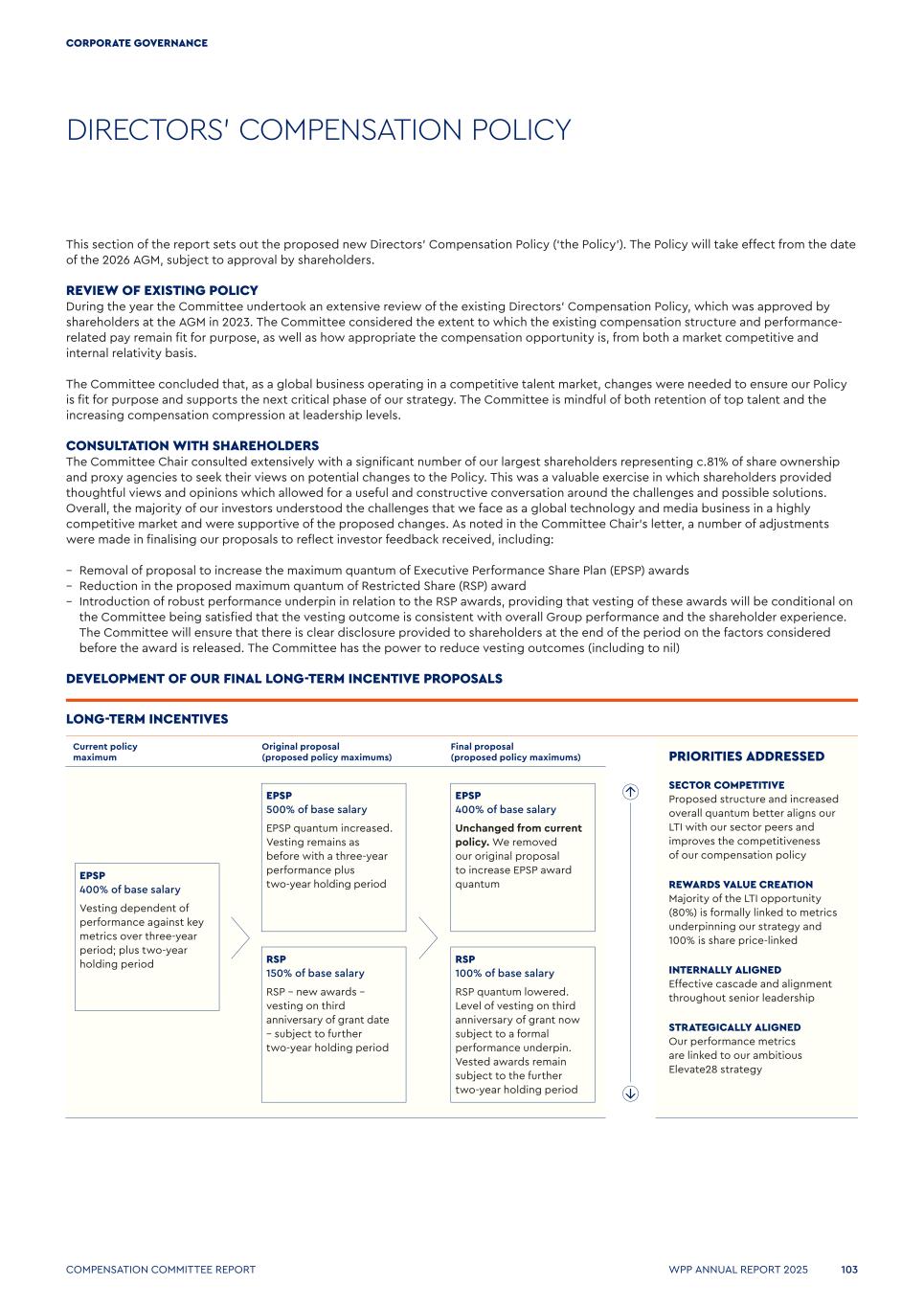
DIRECTORS’ COMPENSATION POLICY This section of the report sets out the proposed new Directors’ Compensation Policy (‘the Policy’). The Policy will take effect from the date of the 2026 AGM, subject to approval by shareholders. REVIEW OF EXISTING POLICY During the year the Committee undertook an extensive review of the existing Directors’ Compensation Policy, which was approved by shareholders at the AGM in 2023. The Committee considered the extent to which the existing compensation structure and performance- related pay remain fit for purpose, as well as how appropriate the compensation opportunity is, from both a market competitive and internal relativity basis. The Committee concluded that, as a global business operating in a competitive talent market, changes were needed to ensure our Policy is fit for purpose and supports the next critical phase of our strategy. The Committee is mindful of both retention of top talent and the increasing compensation compression at leadership levels. CONSULTATION WITH SHAREHOLDERS The Committee Chair consulted extensively with a significant number of our largest shareholders representing c.81% of share ownership and proxy agencies to seek their views on potential changes to the Policy. This was a valuable exercise in which shareholders provided thoughtful views and opinions which allowed for a useful and constructive conversation around the challenges and possible solutions. Overall, the majority of our investors understood the challenges that we face as a global technology and media business in a highly competitive market and were supportive of the proposed changes. As noted in the Committee Chair’s letter, a number of adjustments were made in finalising our proposals to reflect investor feedback received, including: – Removal of proposal to increase the maximum quantum of Executive Performance Share Plan (EPSP) awards – Reduction in the proposed maximum quantum of Restricted Share (RSP) award – Introduction of robust performance underpin in relation to the RSP awards, providing that vesting of these awards will be conditional on the Committee being satisfied that the vesting outcome is consistent with overall Group performance and the shareholder experience. The Committee will ensure that there is clear disclosure provided to shareholders at the end of the period on the factors considered before the award is released. The Committee has the power to reduce vesting outcomes (including to nil) DEVELOPMENT OF OUR FINAL LONG-TERM INCENTIVE PROPOSALS EPSP 400% of base salary Vesting dependent of performance against key metrics over three-year period; plus two-year holding period EPSP 500% of base salary EPSP quantum increased. Vesting remains as before with a three-year performance plus two-year holding period RSP 150% of base salary RSP - new awards - vesting on third anniversary of grant date – subject to further two-year holding period EPSP 400% of base salary Unchanged from current policy. We removed our original proposal to increase EPSP award quantum PRIORITIES ADDRESSED SECTOR COMPETITIVE Proposed structure and increased overall quantum better aligns our LTI with our sector peers and improves the competitiveness of our compensation policy REWARDS VALUE CREATION Majority of the LTI opportunity (80%) is formally linked to metrics underpinning our strategy and 100% is share price-linked INTERNALLY ALIGNED Effective cascade and alignment throughout senior leadership STRATEGICALLY ALIGNED Our performance metrics are linked to our ambitious Elevate28 strategy RSP 100% of base salary RSP quantum lowered. Level of vesting on third anniversary of grant now subject to a formal performance underpin. Vested awards remain subject to the further two-year holding period Current policy maximum Original proposal (proposed policy maximums) Final proposal (proposed policy maximums) LONG-TERM INCENTIVES WPP ANNUAL REPORT 2025 103 CORPORATE GOVERNANCE COMPENSATION COMMITTEE REPORT
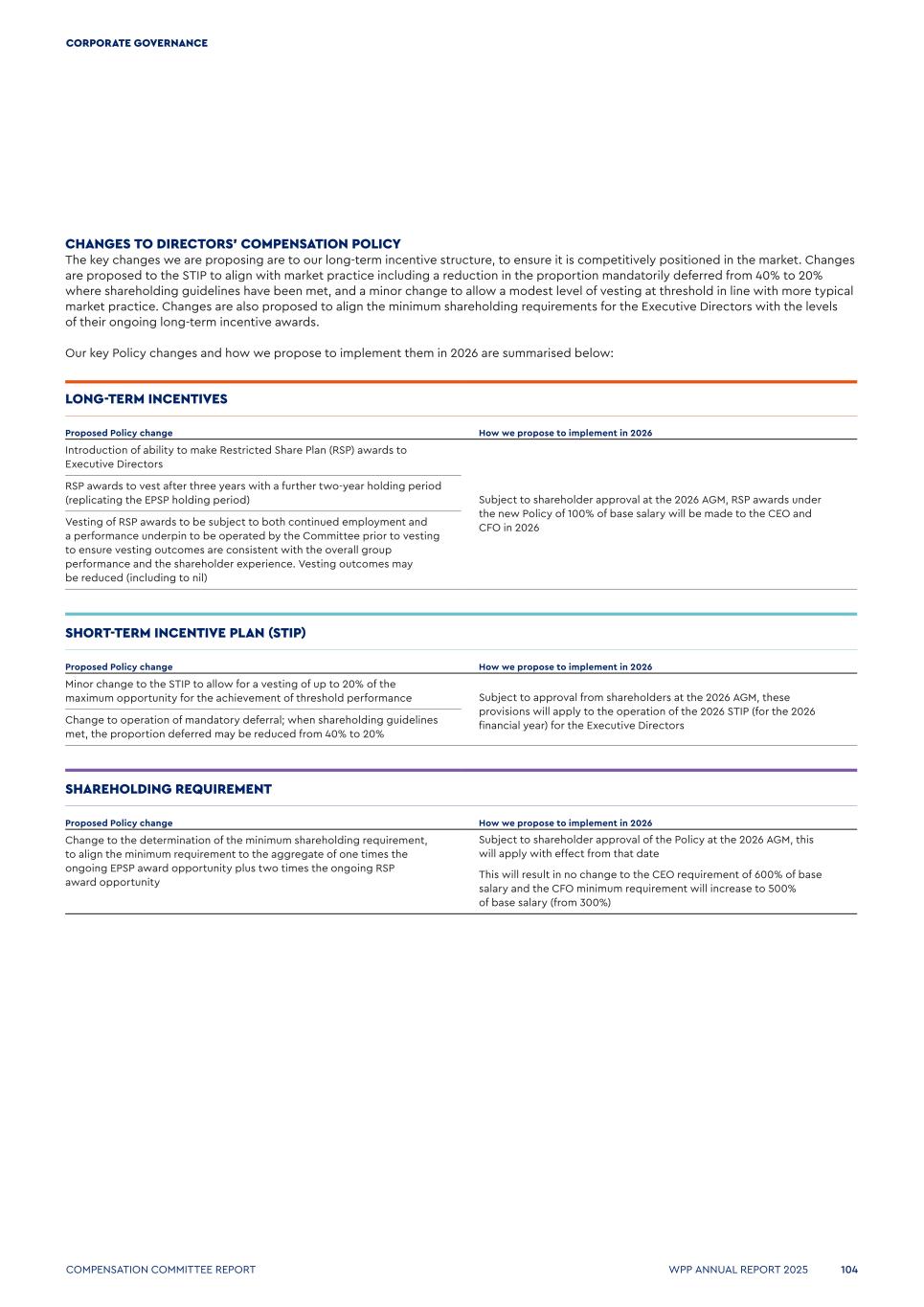
CHANGES TO DIRECTORS’ COMPENSATION POLICY The key changes we are proposing are to our long-term incentive structure, to ensure it is competitively positioned in the market. Changes are proposed to the STIP to align with market practice including a reduction in the proportion mandatorily deferred from 40% to 20% where shareholding guidelines have been met, and a minor change to allow a modest level of vesting at threshold in line with more typical market practice. Changes are also proposed to align the minimum shareholding requirements for the Executive Directors with the levels of their ongoing long-term incentive awards. Our key Policy changes and how we propose to implement them in 2026 are summarised below: LONG-TERM INCENTIVES Proposed Policy change How we propose to implement in 2026 Introduction of ability to make Restricted Share Plan (RSP) awards to Executive Directors Subject to shareholder approval at the 2026 AGM, RSP awards under the new Policy of 100% of base salary will be made to the CEO and CFO in 2026 RSP awards to vest after three years with a further two-year holding period (replicating the EPSP holding period) Vesting of RSP awards to be subject to both continued employment and a performance underpin to be operated by the Committee prior to vesting to ensure vesting outcomes are consistent with the overall group performance and the shareholder experience. Vesting outcomes may be reduced (including to nil) SHORT-TERM INCENTIVE PLAN (STIP) Proposed Policy change How we propose to implement in 2026 Minor change to the STIP to allow for a vesting of up to 20% of the maximum opportunity for the achievement of threshold performance Subject to approval from shareholders at the 2026 AGM, these provisions will apply to the operation of the 2026 STIP (for the 2026 financial year) for the Executive DirectorsChange to operation of mandatory deferral; when shareholding guidelines met, the proportion deferred may be reduced from 40% to 20% SHAREHOLDING REQUIREMENT Proposed Policy change How we propose to implement in 2026 Change to the determination of the minimum shareholding requirement, to align the minimum requirement to the aggregate of one times the ongoing EPSP award opportunity plus two times the ongoing RSP award opportunity Subject to shareholder approval of the Policy at the 2026 AGM, this will apply with effect from that date This will result in no change to the CEO requirement of 600% of base salary and the CFO minimum requirement will increase to 500% of base salary (from 300%) WPP ANNUAL REPORT 2025 104 CORPORATE GOVERNANCE COMPENSATION COMMITTEE REPORT
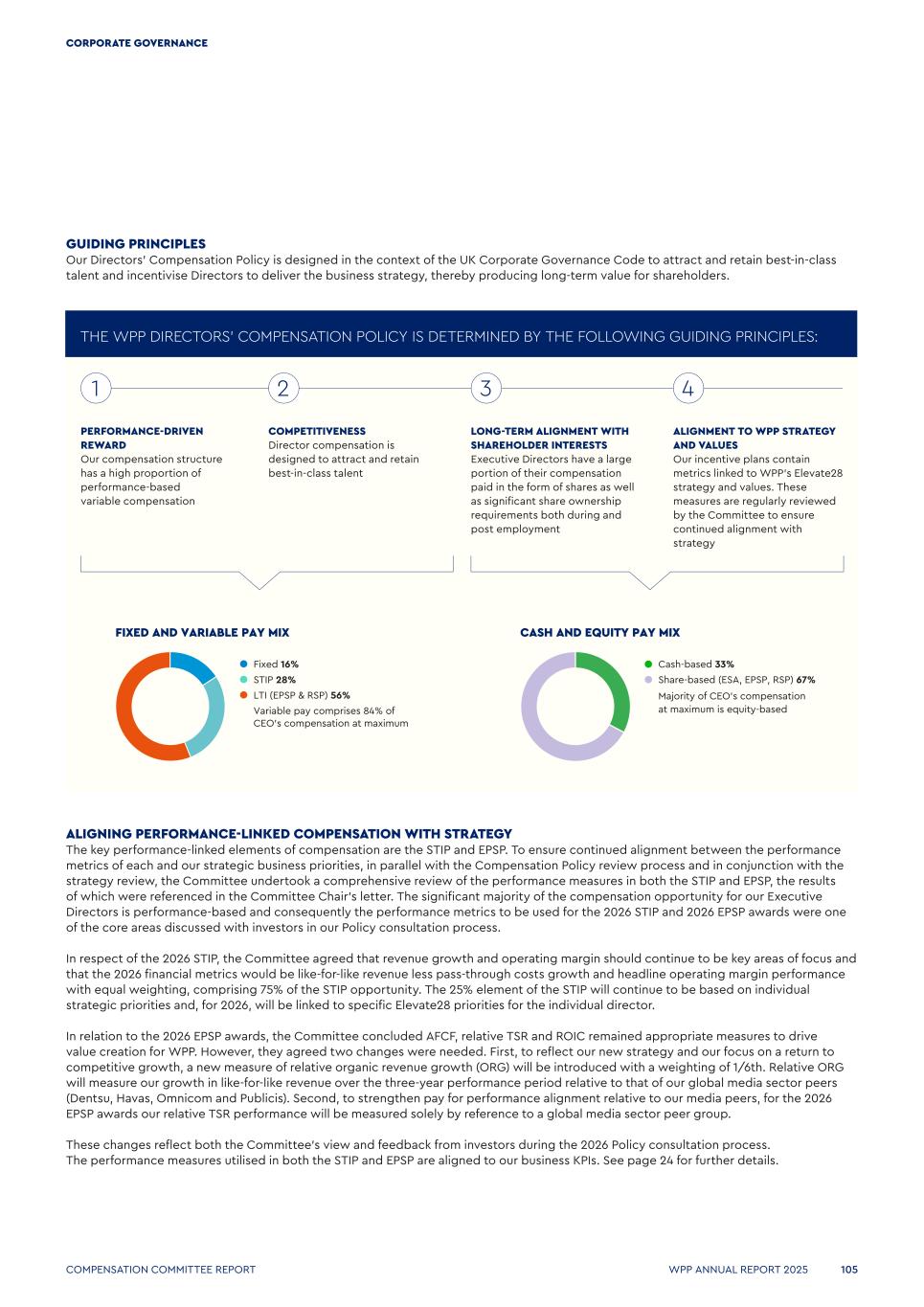
ALIGNING PERFORMANCE-LINKED COMPENSATION WITH STRATEGY The key performance-linked elements of compensation are the STIP and EPSP. To ensure continued alignment between the performance metrics of each and our strategic business priorities, in parallel with the Compensation Policy review process and in conjunction with the strategy review, the Committee undertook a comprehensive review of the performance measures in both the STIP and EPSP, the results of which were referenced in the Committee Chair’s letter. The significant majority of the compensation opportunity for our Executive Directors is performance-based and consequently the performance metrics to be used for the 2026 STIP and 2026 EPSP awards were one of the core areas discussed with investors in our Policy consultation process. In respect of the 2026 STIP, the Committee agreed that revenue growth and operating margin should continue to be key areas of focus and that the 2026 financial metrics would be like-for-like revenue less pass-through costs growth and headline operating margin performance with equal weighting, comprising 75% of the STIP opportunity. The 25% element of the STIP will continue to be based on individual strategic priorities and, for 2026, will be linked to specific Elevate28 priorities for the individual director. In relation to the 2026 EPSP awards, the Committee concluded AFCF, relative TSR and ROIC remained appropriate measures to drive value creation for WPP. However, they agreed two changes were needed. First, to reflect our new strategy and our focus on a return to competitive growth, a new measure of relative organic revenue growth (ORG) will be introduced with a weighting of 1/6th. Relative ORG will measure our growth in like-for-like revenue over the three-year performance period relative to that of our global media sector peers (Dentsu, Havas, Omnicom and Publicis). Second, to strengthen pay for performance alignment relative to our media peers, for the 2026 EPSP awards our relative TSR performance will be measured solely by reference to a global media sector peer group. These changes reflect both the Committee’s view and feedback from investors during the 2026 Policy consultation process. The performance measures utilised in both the STIP and EPSP are aligned to our business KPIs. See page 24 for further details. GUIDING PRINCIPLES Our Directors’ Compensation Policy is designed in the context of the UK Corporate Governance Code to attract and retain best-in-class talent and incentivise Directors to deliver the business strategy, thereby producing long-term value for shareholders. THE WPP DIRECTORS’ COMPENSATION POLICY IS DETERMINED BY THE FOLLOWING GUIDING PRINCIPLES: PERFORMANCE-DRIVEN REWARD Our compensation structure has a high proportion of performance-based variable compensation COMPETITIVENESS Director compensation is designed to attract and retain best-in-class talent LONG-TERM ALIGNMENT WITH SHAREHOLDER INTERESTS Executive Directors have a large portion of their compensation paid in the form of shares as well as significant share ownership requirements both during and post employment ALIGNMENT TO WPP STRATEGY AND VALUES Our incentive plans contain metrics linked to WPP’s Elevate28 strategy and values. These measures are regularly reviewed by the Committee to ensure continued alignment with strategy 1 2 3 4 Fixed 16% STIP 28% LTI (EPSP & RSP) 56% Variable pay comprises 84% of CEO's compensation at maximum FIXED AND VARIABLE PAY MIX Cash-based 33% Share-based (ESA, EPSP, RSP) 67% Majority of CEO's compensation at maximum is equity-based CASH AND EQUITY PAY MIX WPP ANNUAL REPORT 2025 105 CORPORATE GOVERNANCE COMPENSATION COMMITTEE REPORT
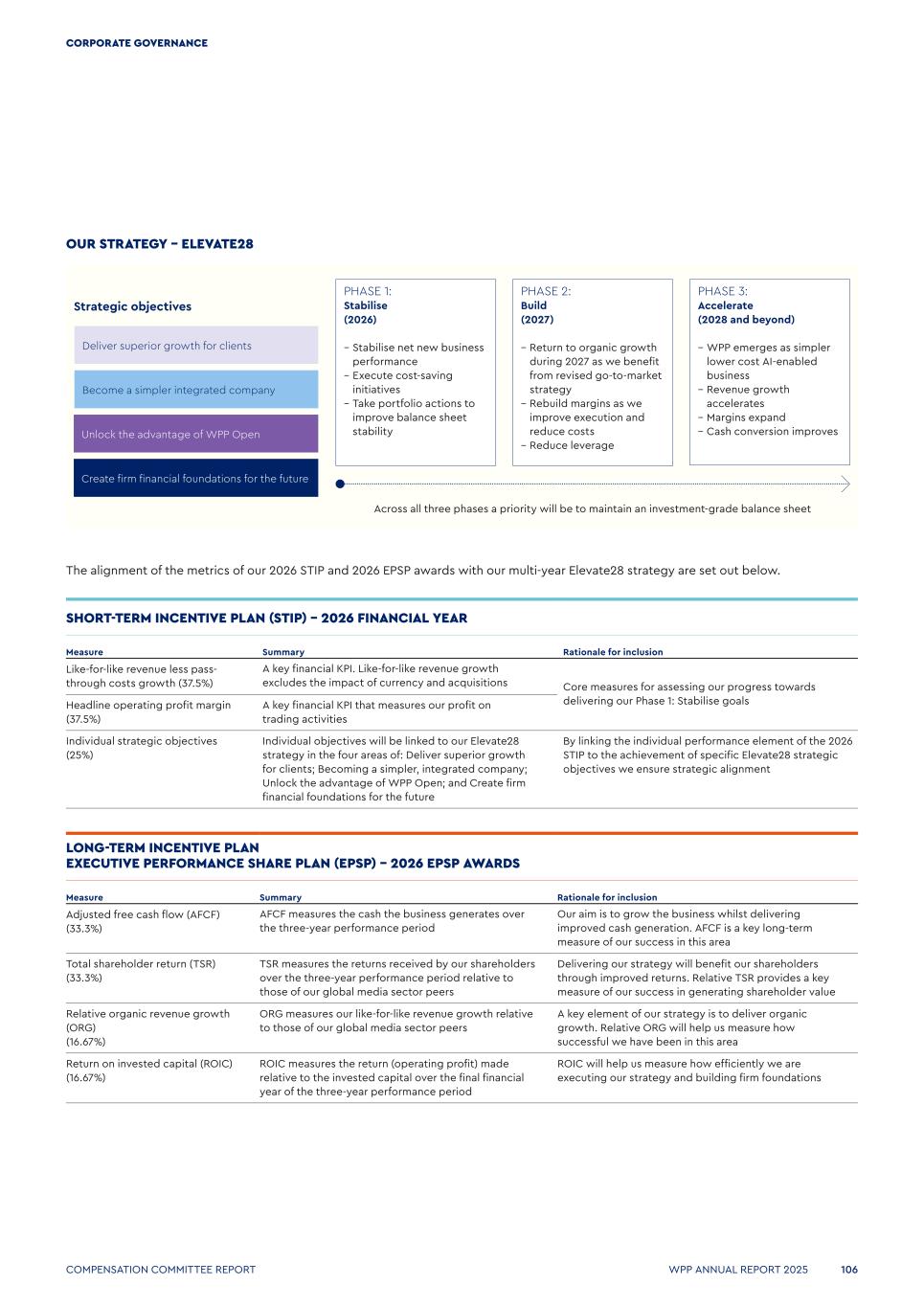
The alignment of the metrics of our 2026 STIP and 2026 EPSP awards with our multi-year Elevate28 strategy are set out below. SHORT-TERM INCENTIVE PLAN (STIP) – 2026 FINANCIAL YEAR Measure Summary Rationale for inclusion Like-for-like revenue less pass- through costs growth (37.5%) A key financial KPI. Like-for-like revenue growth excludes the impact of currency and acquisitions Core measures for assessing our progress towards delivering our Phase 1: Stabilise goalsHeadline operating profit margin (37.5%) A key financial KPI that measures our profit on trading activities Individual strategic objectives (25%) Individual objectives will be linked to our Elevate28 strategy in the four areas of: Deliver superior growth for clients; Becoming a simpler, integrated company; Unlock the advantage of WPP Open; and Create firm financial foundations for the future By linking the individual performance element of the 2026 STIP to the achievement of specific Elevate28 strategic objectives we ensure strategic alignment LONG-TERM INCENTIVE PLAN EXECUTIVE PERFORMANCE SHARE PLAN (EPSP) – 2026 EPSP AWARDS Measure Summary Rationale for inclusion Adjusted free cash flow (AFCF) (33.3%) AFCF measures the cash the business generates over the three-year performance period Our aim is to grow the business whilst delivering improved cash generation. AFCF is a key long-term measure of our success in this area Total shareholder return (TSR) (33.3%) TSR measures the returns received by our shareholders over the three-year performance period relative to those of our global media sector peers Delivering our strategy will benefit our shareholders through improved returns. Relative TSR provides a key measure of our success in generating shareholder value Relative organic revenue growth (ORG) (16.67%) ORG measures our like-for-like revenue growth relative to those of our global media sector peers A key element of our strategy is to deliver organic growth. Relative ORG will help us measure how successful we have been in this area Return on invested capital (ROIC) (16.67%) ROIC measures the return (operating profit) made relative to the invested capital over the final financial year of the three-year performance period ROIC will help us measure how efficiently we are executing our strategy and building firm foundations OUR STRATEGY - ELEVATE28 Deliver superior growth for clients Become a simpler integrated company Unlock the advantage of WPP Open Create firm financial foundations for the future Strategic objectives Across all three phases a priority will be to maintain an investment-grade balance sheet PHASE 1: Stabilise (2026) – Stabilise net new business performance – Execute cost-saving initiatives – Take portfolio actions to improve balance sheet stability PHASE 2: Build (2027) – Return to organic growth during 2027 as we benefit from revised go-to-market strategy – Rebuild margins as we improve execution and reduce costs – Reduce leverage PHASE 3: Accelerate (2028 and beyond) – WPP emerges as simpler lower cost AI-enabled business – Revenue growth accelerates – Margins expand – Cash conversion improves WPP ANNUAL REPORT 2025 106 CORPORATE GOVERNANCE COMPENSATION COMMITTEE REPORT
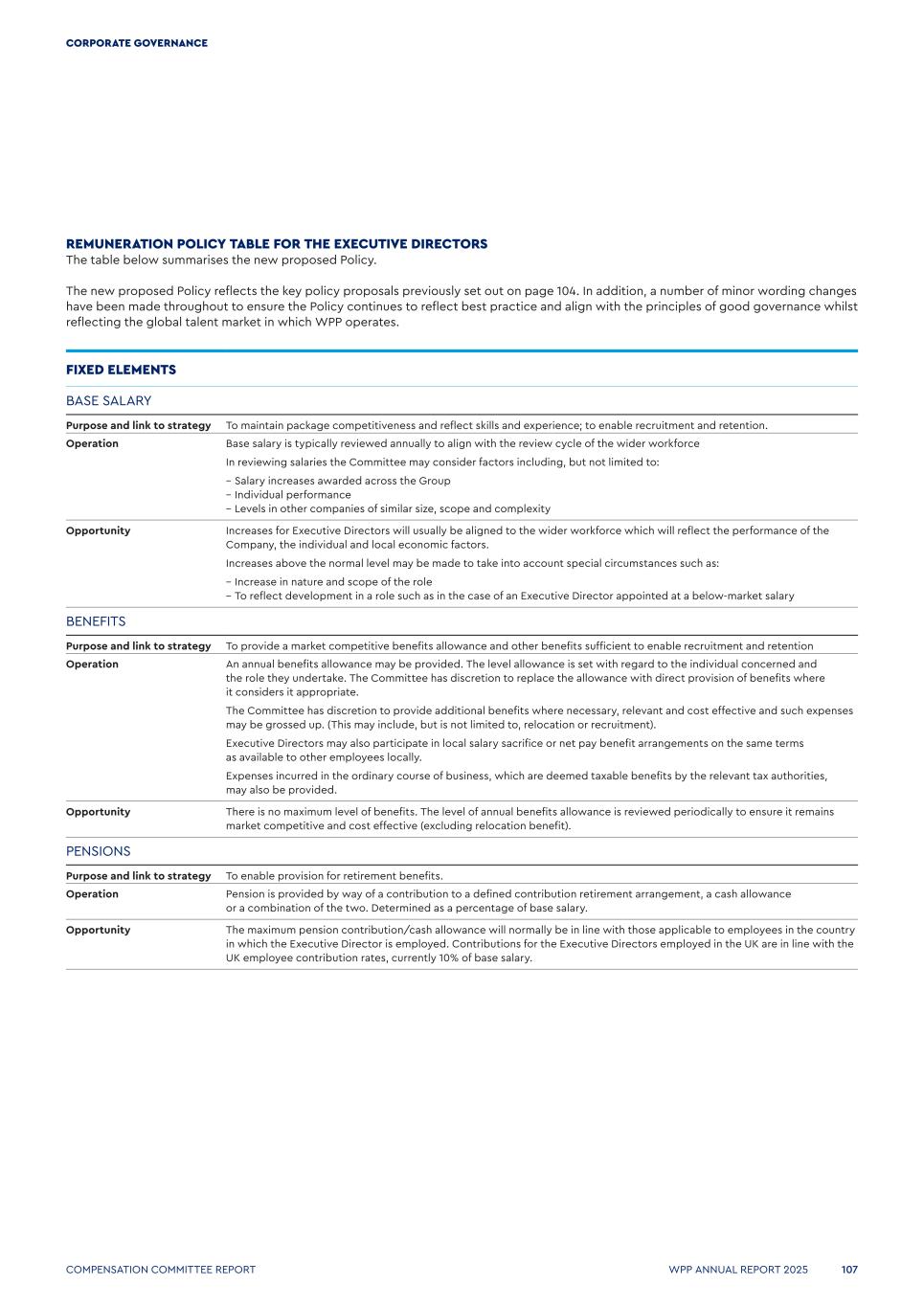
REMUNERATION POLICY TABLE FOR THE EXECUTIVE DIRECTORS The table below summarises the new proposed Policy. The new proposed Policy reflects the key policy proposals previously set out on page 104. In addition, a number of minor wording changes have been made throughout to ensure the Policy continues to reflect best practice and align with the principles of good governance whilst reflecting the global talent market in which WPP operates. FIXED ELEMENTS BASE SALARY Purpose and link to strategy To maintain package competitiveness and reflect skills and experience; to enable recruitment and retention. Operation Base salary is typically reviewed annually to align with the review cycle of the wider workforce In reviewing salaries the Committee may consider factors including, but not limited to: – Salary increases awarded across the Group – Individual performance – Levels in other companies of similar size, scope and complexity Opportunity Increases for Executive Directors will usually be aligned to the wider workforce which will reflect the performance of the Company, the individual and local economic factors. Increases above the normal level may be made to take into account special circumstances such as: – Increase in nature and scope of the role – To reflect development in a role such as in the case of an Executive Director appointed at a below-market salary BENEFITS Purpose and link to strategy To provide a market competitive benefits allowance and other benefits sufficient to enable recruitment and retention Operation An annual benefits allowance may be provided. The level allowance is set with regard to the individual concerned and the role they undertake. The Committee has discretion to replace the allowance with direct provision of benefits where it considers it appropriate. The Committee has discretion to provide additional benefits where necessary, relevant and cost effective and such expenses may be grossed up. (This may include, but is not limited to, relocation or recruitment). Executive Directors may also participate in local salary sacrifice or net pay benefit arrangements on the same terms as available to other employees locally. Expenses incurred in the ordinary course of business, which are deemed taxable benefits by the relevant tax authorities, may also be provided. Opportunity There is no maximum level of benefits. The level of annual benefits allowance is reviewed periodically to ensure it remains market competitive and cost effective (excluding relocation benefit). PENSIONS Purpose and link to strategy To enable provision for retirement benefits. Operation Pension is provided by way of a contribution to a defined contribution retirement arrangement, a cash allowance or a combination of the two. Determined as a percentage of base salary. Opportunity The maximum pension contribution/cash allowance will normally be in line with those applicable to employees in the country in which the Executive Director is employed. Contributions for the Executive Directors employed in the UK are in line with the UK employee contribution rates, currently 10% of base salary. WPP ANNUAL REPORT 2025 107 CORPORATE GOVERNANCE COMPENSATION COMMITTEE REPORT
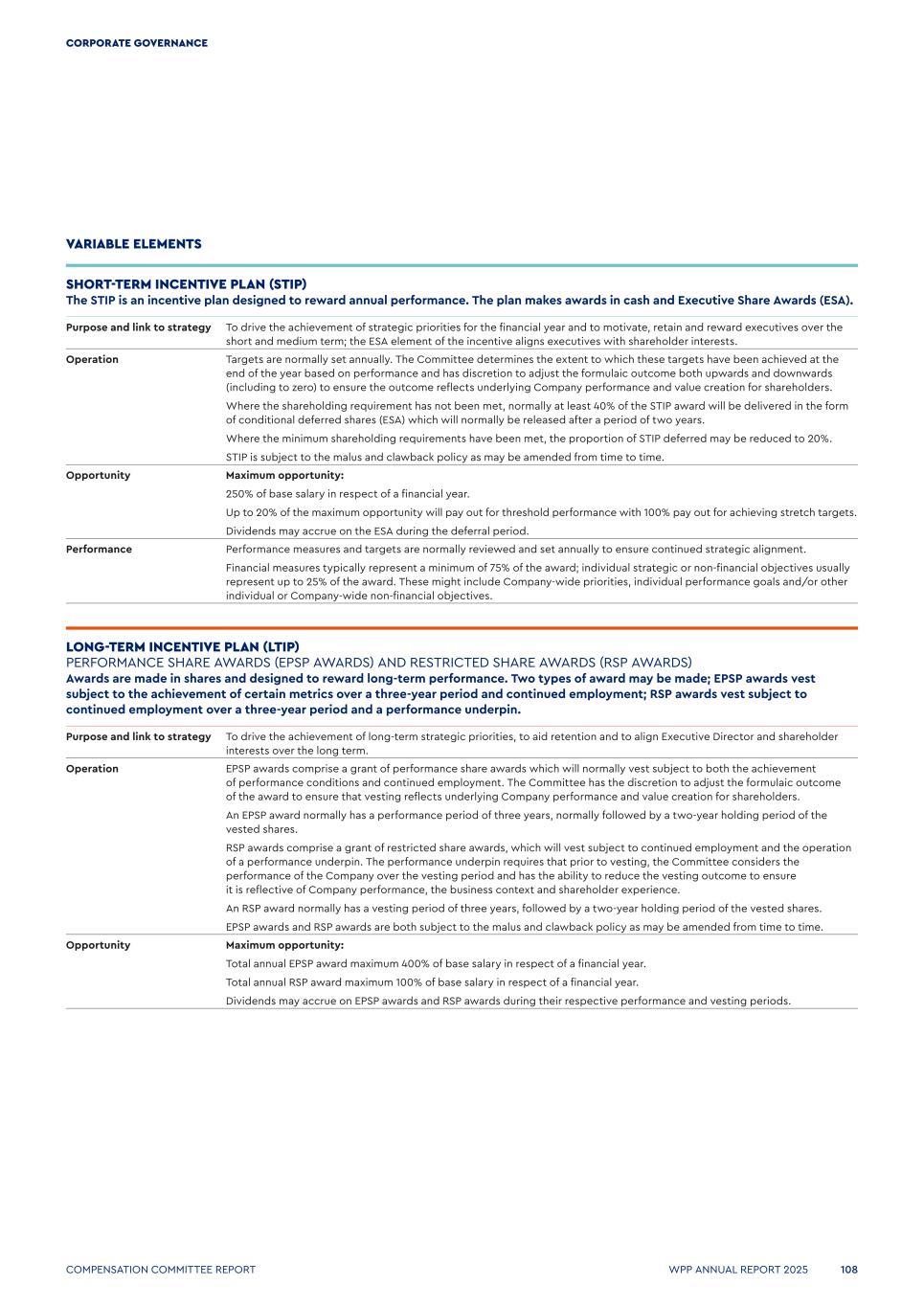
VARIABLE ELEMENTS SHORT-TERM INCENTIVE PLAN (STIP) The STIP is an incentive plan designed to reward annual performance. The plan makes awards in cash and Executive Share Awards (ESA). Purpose and link to strategy To drive the achievement of strategic priorities for the financial year and to motivate, retain and reward executives over the short and medium term; the ESA element of the incentive aligns executives with shareholder interests. Operation Targets are normally set annually. The Committee determines the extent to which these targets have been achieved at the end of the year based on performance and has discretion to adjust the formulaic outcome both upwards and downwards (including to zero) to ensure the outcome reflects underlying Company performance and value creation for shareholders. Where the shareholding requirement has not been met, normally at least 40% of the STIP award will be delivered in the form of conditional deferred shares (ESA) which will normally be released after a period of two years. Where the minimum shareholding requirements have been met, the proportion of STIP deferred may be reduced to 20%. STIP is subject to the malus and clawback policy as may be amended from time to time. Opportunity Maximum opportunity: 250% of base salary in respect of a financial year. Up to 20% of the maximum opportunity will pay out for threshold performance with 100% pay out for achieving stretch targets. Dividends may accrue on the ESA during the deferral period. Performance Performance measures and targets are normally reviewed and set annually to ensure continued strategic alignment. Financial measures typically represent a minimum of 75% of the award; individual strategic or non-financial objectives usually represent up to 25% of the award. These might include Company-wide priorities, individual performance goals and/or other individual or Company-wide non-financial objectives. LONG-TERM INCENTIVE PLAN (LTIP) PERFORMANCE SHARE AWARDS (EPSP AWARDS) AND RESTRICTED SHARE AWARDS (RSP AWARDS) Awards are made in shares and designed to reward long-term performance. Two types of award may be made; EPSP awards vest subject to the achievement of certain metrics over a three-year period and continued employment; RSP awards vest subject to continued employment over a three-year period and a performance underpin. Purpose and link to strategy To drive the achievement of long-term strategic priorities, to aid retention and to align Executive Director and shareholder interests over the long term. Operation EPSP awards comprise a grant of performance share awards which will normally vest subject to both the achievement of performance conditions and continued employment. The Committee has the discretion to adjust the formulaic outcome of the award to ensure that vesting reflects underlying Company performance and value creation for shareholders. An EPSP award normally has a performance period of three years, normally followed by a two-year holding period of the vested shares. RSP awards comprise a grant of restricted share awards, which will vest subject to continued employment and the operation of a performance underpin. The performance underpin requires that prior to vesting, the Committee considers the performance of the Company over the vesting period and has the ability to reduce the vesting outcome to ensure it is reflective of Company performance, the business context and shareholder experience. An RSP award normally has a vesting period of three years, followed by a two-year holding period of the vested shares. EPSP awards and RSP awards are both subject to the malus and clawback policy as may be amended from time to time. Opportunity Maximum opportunity: Total annual EPSP award maximum 400% of base salary in respect of a financial year. Total annual RSP award maximum 100% of base salary in respect of a financial year. Dividends may accrue on EPSP awards and RSP awards during their respective performance and vesting periods. WPP ANNUAL REPORT 2025 108 CORPORATE GOVERNANCE COMPENSATION COMMITTEE REPORT
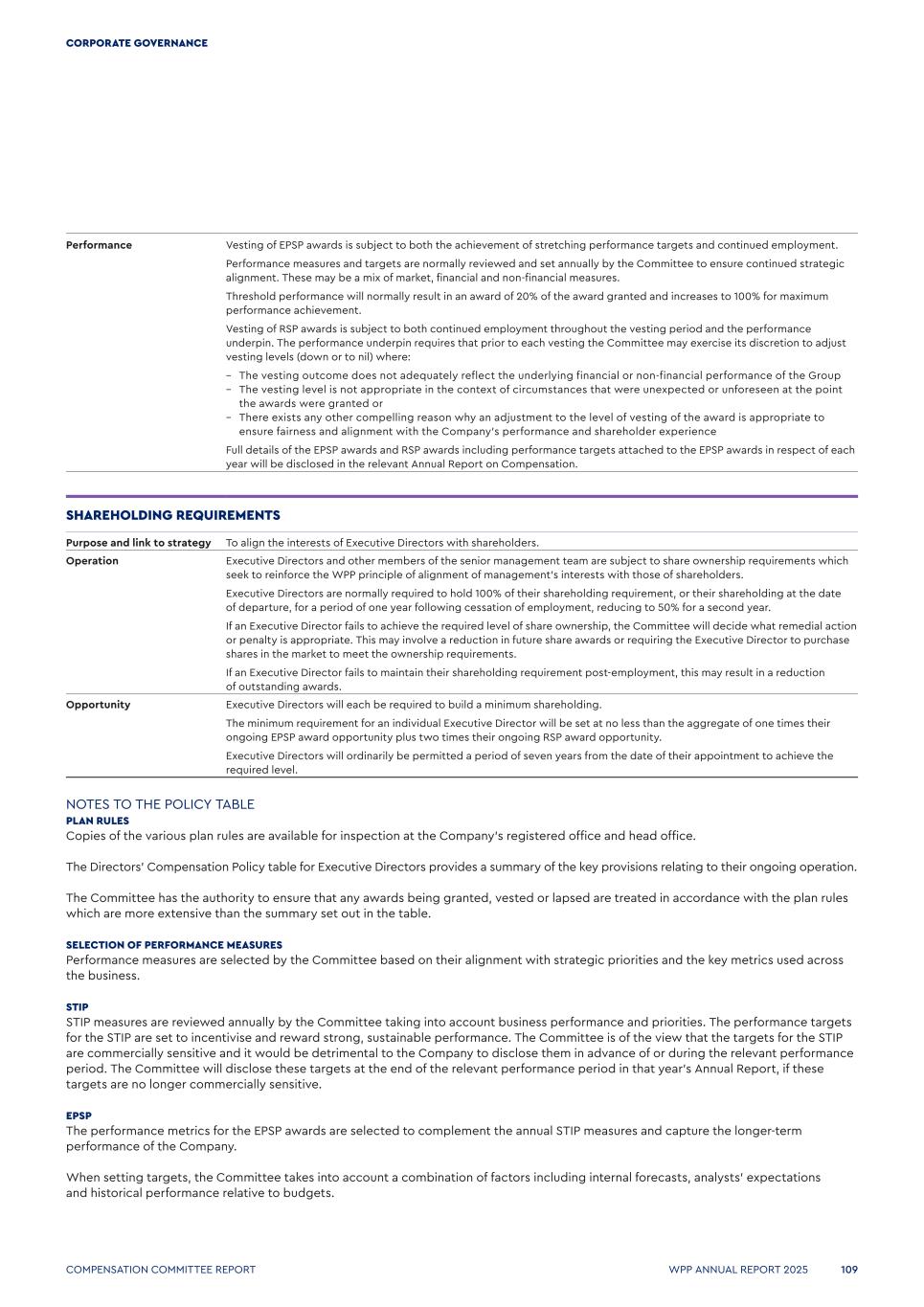
Performance Vesting of EPSP awards is subject to both the achievement of stretching performance targets and continued employment. Performance measures and targets are normally reviewed and set annually by the Committee to ensure continued strategic alignment. These may be a mix of market, financial and non-financial measures. Threshold performance will normally result in an award of 20% of the award granted and increases to 100% for maximum performance achievement. Vesting of RSP awards is subject to both continued employment throughout the vesting period and the performance underpin. The performance underpin requires that prior to each vesting the Committee may exercise its discretion to adjust vesting levels (down or to nil) where: – The vesting outcome does not adequately reflect the underlying financial or non-financial performance of the Group – The vesting level is not appropriate in the context of circumstances that were unexpected or unforeseen at the point the awards were granted or – There exists any other compelling reason why an adjustment to the level of vesting of the award is appropriate to ensure fairness and alignment with the Company’s performance and shareholder experience Full details of the EPSP awards and RSP awards including performance targets attached to the EPSP awards in respect of each year will be disclosed in the relevant Annual Report on Compensation. SHAREHOLDING REQUIREMENTS Purpose and link to strategy To align the interests of Executive Directors with shareholders. Operation Executive Directors and other members of the senior management team are subject to share ownership requirements which seek to reinforce the WPP principle of alignment of management’s interests with those of shareholders. Executive Directors are normally required to hold 100% of their shareholding requirement, or their shareholding at the date of departure, for a period of one year following cessation of employment, reducing to 50% for a second year. If an Executive Director fails to achieve the required level of share ownership, the Committee will decide what remedial action or penalty is appropriate. This may involve a reduction in future share awards or requiring the Executive Director to purchase shares in the market to meet the ownership requirements. If an Executive Director fails to maintain their shareholding requirement post-employment, this may result in a reduction of outstanding awards. Opportunity Executive Directors will each be required to build a minimum shareholding. The minimum requirement for an individual Executive Director will be set at no less than the aggregate of one times their ongoing EPSP award opportunity plus two times their ongoing RSP award opportunity. Executive Directors will ordinarily be permitted a period of seven years from the date of their appointment to achieve the required level. NOTES TO THE POLICY TABLE PLAN RULES Copies of the various plan rules are available for inspection at the Company’s registered office and head office. The Directors’ Compensation Policy table for Executive Directors provides a summary of the key provisions relating to their ongoing operation. The Committee has the authority to ensure that any awards being granted, vested or lapsed are treated in accordance with the plan rules which are more extensive than the summary set out in the table. SELECTION OF PERFORMANCE MEASURES Performance measures are selected by the Committee based on their alignment with strategic priorities and the key metrics used across the business. STIP STIP measures are reviewed annually by the Committee taking into account business performance and priorities. The performance targets for the STIP are set to incentivise and reward strong, sustainable performance. The Committee is of the view that the targets for the STIP are commercially sensitive and it would be detrimental to the Company to disclose them in advance of or during the relevant performance period. The Committee will disclose these targets at the end of the relevant performance period in that year’s Annual Report, if these targets are no longer commercially sensitive. EPSP The performance metrics for the EPSP awards are selected to complement the annual STIP measures and capture the longer-term performance of the Company. When setting targets, the Committee takes into account a combination of factors including internal forecasts, analysts’ expectations and historical performance relative to budgets. WPP ANNUAL REPORT 2025 109 CORPORATE GOVERNANCE COMPENSATION COMMITTEE REPORT
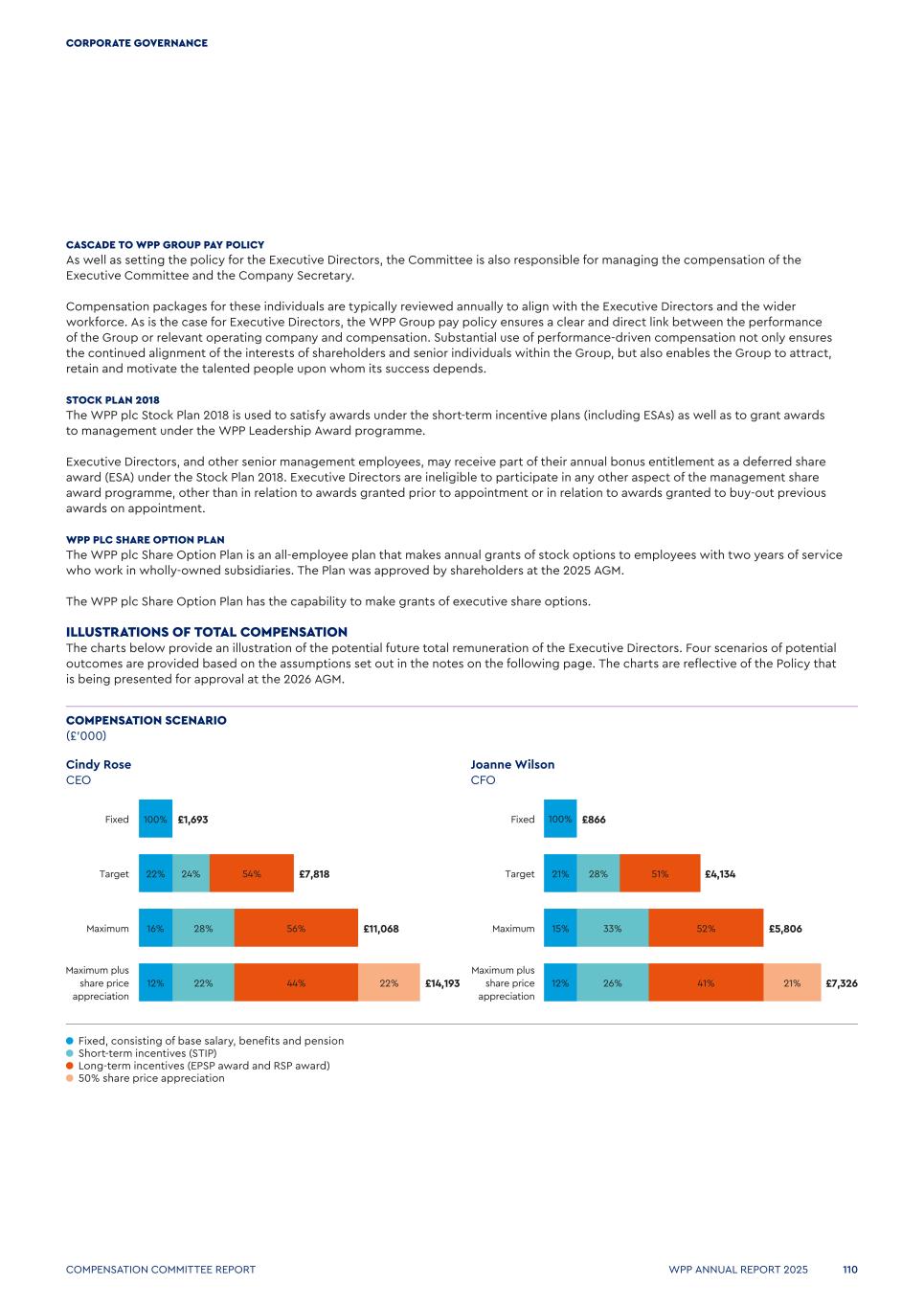
CASCADE TO WPP GROUP PAY POLICY As well as setting the policy for the Executive Directors, the Committee is also responsible for managing the compensation of the Executive Committee and the Company Secretary. Compensation packages for these individuals are typically reviewed annually to align with the Executive Directors and the wider workforce. As is the case for Executive Directors, the WPP Group pay policy ensures a clear and direct link between the performance of the Group or relevant operating company and compensation. Substantial use of performance-driven compensation not only ensures the continued alignment of the interests of shareholders and senior individuals within the Group, but also enables the Group to attract, retain and motivate the talented people upon whom its success depends. STOCK PLAN 2018 The WPP plc Stock Plan 2018 is used to satisfy awards under the short-term incentive plans (including ESAs) as well as to grant awards to management under the WPP Leadership Award programme. Executive Directors, and other senior management employees, may receive part of their annual bonus entitlement as a deferred share award (ESA) under the Stock Plan 2018. Executive Directors are ineligible to participate in any other aspect of the management share award programme, other than in relation to awards granted prior to appointment or in relation to awards granted to buy-out previous awards on appointment. WPP PLC SHARE OPTION PLAN The WPP plc Share Option Plan is an all-employee plan that makes annual grants of stock options to employees with two years of service who work in wholly-owned subsidiaries. The Plan was approved by shareholders at the 2025 AGM. The WPP plc Share Option Plan has the capability to make grants of executive share options. ILLUSTRATIONS OF TOTAL COMPENSATION The charts below provide an illustration of the potential future total remuneration of the Executive Directors. Four scenarios of potential outcomes are provided based on the assumptions set out in the notes on the following page. The charts are reflective of the Policy that is being presented for approval at the 2026 AGM. COMPENSATION SCENARIO (£’000) Cindy Rose CEO Joanne Wilson CFO Fixed, consisting of base salary, benefits and pension Short-term incentives (STIP) Long-term incentives (EPSP award and RSP award) 50% share price appreciation £14,193 £11,068 £7,818 £1,693Fixed 100% 22% 24% 54% 16% 28% 56% 12% 22% 22%44% Target Maximum Maximum plus share price appreciation £7,326 £5,806 £4,134 £866Fixed 100% 21% 28% 51% 15% 33% 52% 12% 26% 21%41% Target Maximum Maximum plus share price appreciation WPP ANNUAL REPORT 2025 110 CORPORATE GOVERNANCE COMPENSATION COMMITTEE REPORT
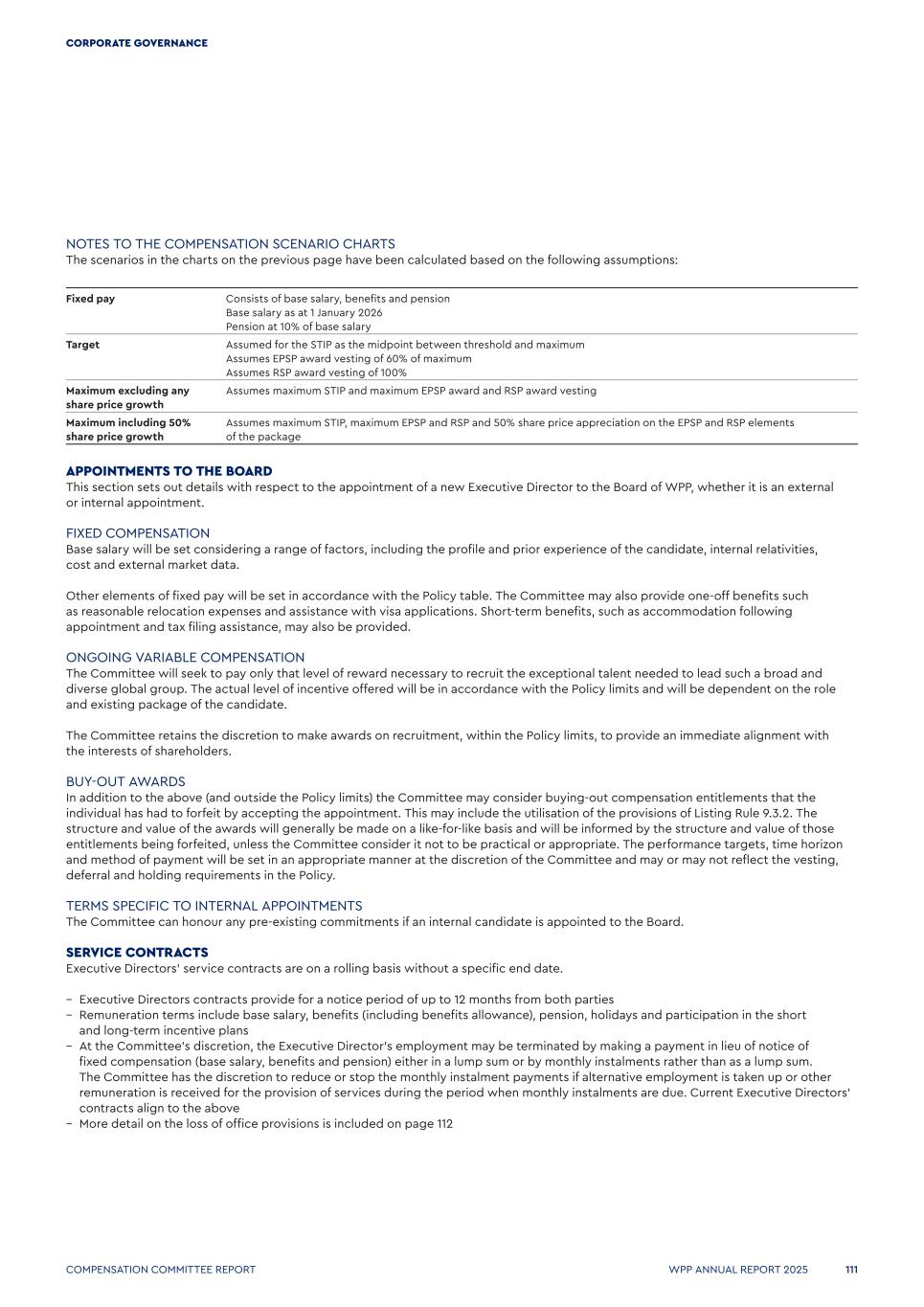
NOTES TO THE COMPENSATION SCENARIO CHARTS The scenarios in the charts on the previous page have been calculated based on the following assumptions: Fixed pay Consists of base salary, benefits and pension Base salary as at 1 January 2026 Pension at 10% of base salary Target Assumed for the STIP as the midpoint between threshold and maximum Assumes EPSP award vesting of 60% of maximum Assumes RSP award vesting of 100% Maximum excluding any share price growth Assumes maximum STIP and maximum EPSP award and RSP award vesting Maximum including 50% share price growth Assumes maximum STIP, maximum EPSP and RSP and 50% share price appreciation on the EPSP and RSP elements of the package APPOINTMENTS TO THE BOARD This section sets out details with respect to the appointment of a new Executive Director to the Board of WPP, whether it is an external or internal appointment. FIXED COMPENSATION Base salary will be set considering a range of factors, including the profile and prior experience of the candidate, internal relativities, cost and external market data. Other elements of fixed pay will be set in accordance with the Policy table. The Committee may also provide one-off benefits such as reasonable relocation expenses and assistance with visa applications. Short-term benefits, such as accommodation following appointment and tax filing assistance, may also be provided. ONGOING VARIABLE COMPENSATION The Committee will seek to pay only that level of reward necessary to recruit the exceptional talent needed to lead such a broad and diverse global group. The actual level of incentive offered will be in accordance with the Policy limits and will be dependent on the role and existing package of the candidate. The Committee retains the discretion to make awards on recruitment, within the Policy limits, to provide an immediate alignment with the interests of shareholders. BUY-OUT AWARDS In addition to the above (and outside the Policy limits) the Committee may consider buying-out compensation entitlements that the individual has had to forfeit by accepting the appointment. This may include the utilisation of the provisions of Listing Rule 9.3.2. The structure and value of the awards will generally be made on a like-for-like basis and will be informed by the structure and value of those entitlements being forfeited, unless the Committee consider it not to be practical or appropriate. The performance targets, time horizon and method of payment will be set in an appropriate manner at the discretion of the Committee and may or may not reflect the vesting, deferral and holding requirements in the Policy. TERMS SPECIFIC TO INTERNAL APPOINTMENTS The Committee can honour any pre-existing commitments if an internal candidate is appointed to the Board. SERVICE CONTRACTS Executive Directors’ service contracts are on a rolling basis without a specific end date. – Executive Directors contracts provide for a notice period of up to 12 months from both parties – Remuneration terms include base salary, benefits (including benefits allowance), pension, holidays and participation in the short and long-term incentive plans – At the Committee’s discretion, the Executive Director’s employment may be terminated by making a payment in lieu of notice of fixed compensation (base salary, benefits and pension) either in a lump sum or by monthly instalments rather than as a lump sum. The Committee has the discretion to reduce or stop the monthly instalment payments if alternative employment is taken up or other remuneration is received for the provision of services during the period when monthly instalments are due. Current Executive Directors’ contracts align to the above – More detail on the loss of office provisions is included on page 112 WPP ANNUAL REPORT 2025 111 CORPORATE GOVERNANCE COMPENSATION COMMITTEE REPORT
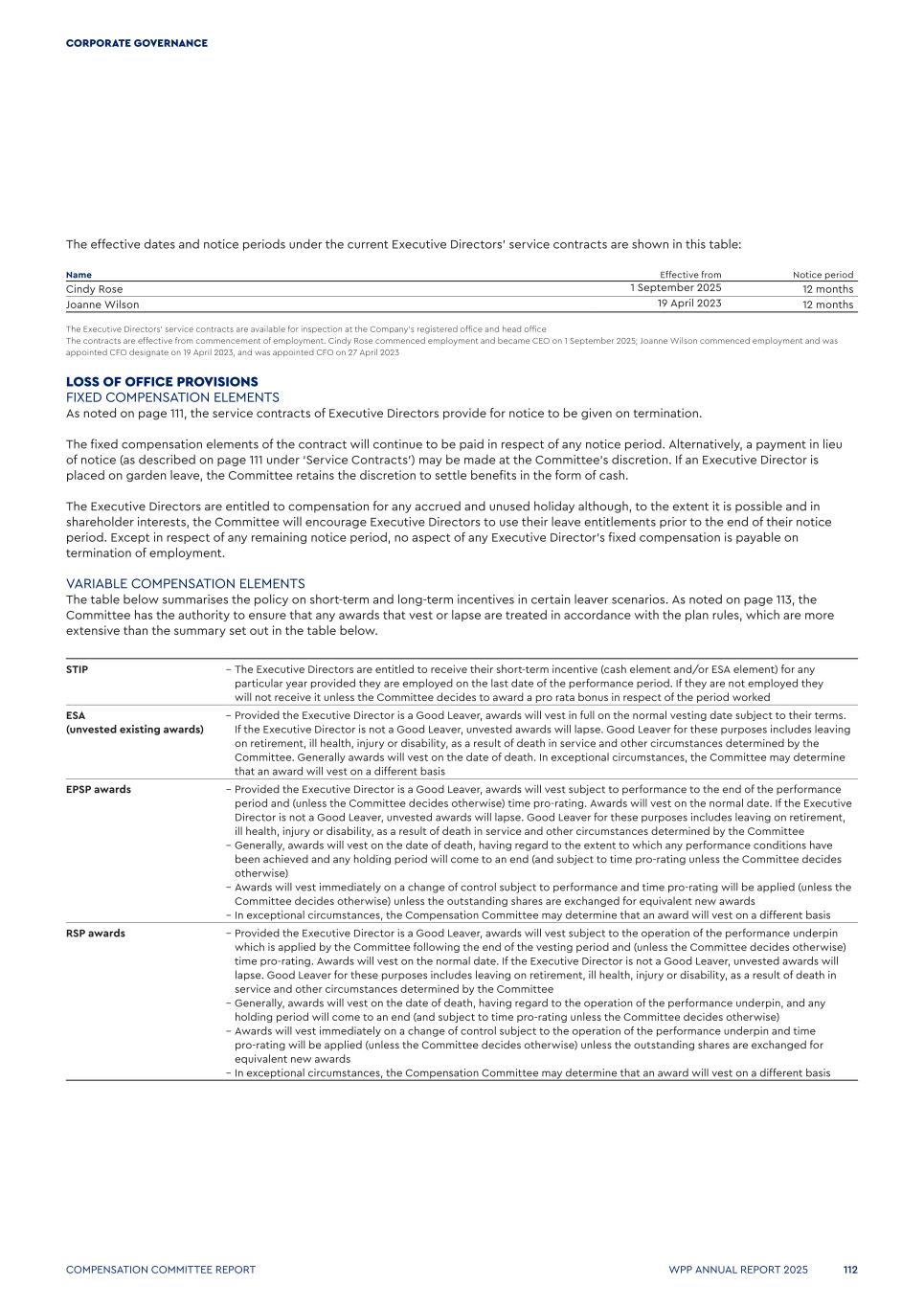
The effective dates and notice periods under the current Executive Directors’ service contracts are shown in this table: Name Effective from Notice period Cindy Rose 1 September 2025 12 months Joanne Wilson 19 April 2023 12 months The Executive Directors’ service contracts are available for inspection at the Company’s registered office and head office The contracts are effective from commencement of employment. Cindy Rose commenced employment and became CEO on 1 September 2025; Joanne Wilson commenced employment and was appointed CFO designate on 19 April 2023, and was appointed CFO on 27 April 2023 LOSS OF OFFICE PROVISIONS FIXED COMPENSATION ELEMENTS As noted on page 111, the service contracts of Executive Directors provide for notice to be given on termination. The fixed compensation elements of the contract will continue to be paid in respect of any notice period. Alternatively, a payment in lieu of notice (as described on page 111 under ‘Service Contracts’) may be made at the Committee’s discretion. If an Executive Director is placed on garden leave, the Committee retains the discretion to settle benefits in the form of cash. The Executive Directors are entitled to compensation for any accrued and unused holiday although, to the extent it is possible and in shareholder interests, the Committee will encourage Executive Directors to use their leave entitlements prior to the end of their notice period. Except in respect of any remaining notice period, no aspect of any Executive Director’s fixed compensation is payable on termination of employment. VARIABLE COMPENSATION ELEMENTS The table below summarises the policy on short-term and long-term incentives in certain leaver scenarios. As noted on page 113, the Committee has the authority to ensure that any awards that vest or lapse are treated in accordance with the plan rules, which are more extensive than the summary set out in the table below. STIP – The Executive Directors are entitled to receive their short-term incentive (cash element and/or ESA element) for any particular year provided they are employed on the last date of the performance period. If they are not employed they will not receive it unless the Committee decides to award a pro rata bonus in respect of the period worked ESA (unvested existing awards) – Provided the Executive Director is a Good Leaver, awards will vest in full on the normal vesting date subject to their terms. If the Executive Director is not a Good Leaver, unvested awards will lapse. Good Leaver for these purposes includes leaving on retirement, ill health, injury or disability, as a result of death in service and other circumstances determined by the Committee. Generally awards will vest on the date of death. In exceptional circumstances, the Committee may determine that an award will vest on a different basis EPSP awards – Provided the Executive Director is a Good Leaver, awards will vest subject to performance to the end of the performance period and (unless the Committee decides otherwise) time pro-rating. Awards will vest on the normal date. If the Executive Director is not a Good Leaver, unvested awards will lapse. Good Leaver for these purposes includes leaving on retirement, ill health, injury or disability, as a result of death in service and other circumstances determined by the Committee – Generally, awards will vest on the date of death, having regard to the extent to which any performance conditions have been achieved and any holding period will come to an end (and subject to time pro-rating unless the Committee decides otherwise) – Awards will vest immediately on a change of control subject to performance and time pro-rating will be applied (unless the Committee decides otherwise) unless the outstanding shares are exchanged for equivalent new awards – In exceptional circumstances, the Compensation Committee may determine that an award will vest on a different basis RSP awards – Provided the Executive Director is a Good Leaver, awards will vest subject to the operation of the performance underpin which is applied by the Committee following the end of the vesting period and (unless the Committee decides otherwise) time pro-rating. Awards will vest on the normal date. If the Executive Director is not a Good Leaver, unvested awards will lapse. Good Leaver for these purposes includes leaving on retirement, ill health, injury or disability, as a result of death in service and other circumstances determined by the Committee – Generally, awards will vest on the date of death, having regard to the operation of the performance underpin, and any holding period will come to an end (and subject to time pro-rating unless the Committee decides otherwise) – Awards will vest immediately on a change of control subject to the operation of the performance underpin and time pro-rating will be applied (unless the Committee decides otherwise) unless the outstanding shares are exchanged for equivalent new awards – In exceptional circumstances, the Compensation Committee may determine that an award will vest on a different basis WPP ANNUAL REPORT 2025 112 CORPORATE GOVERNANCE COMPENSATION COMMITTEE REPORT
OTHER COMMITTEE DISCRETIONS NOT SET OUT ABOVE Leaver status: the Committee has the discretion to determine an Executive Director’s leaver classification considering the guidance set out within the relevant plan rules. Settlement agreements: the Committee is authorised to reach settlement agreements with departing Executive Directors, informed by the default position set out above, such agreements may include the provision of outplacement support. Minor amendments to the Policy: the Committee has the discretion to make minor changes to the Policy set out above, for reasons which may include, but are not limited to, ensure ongoing compliance with regulatory, administrative, tax, exchange control or legal requirements, without obtaining shareholder approval for that amendment. Legacy arrangements: The Committee reserves the right to make any remuneration payments and payments for loss of office (including exercising any discretions available to it in connection with such payments), notwithstanding that they are not in line with the Policy set out in this report, where the terms of payment were agreed (i) before the Policy came into effect (provided that the commitment to make the payment complied with any applicable Compensation Policy at the time of the Company at the time it was agreed) or (ii) at a time when the relevant individual was not a Director of the Company. For these purposes, ‘payments’ includes the satisfaction of awards of variable remuneration and, in relation to awards of shares, the terms of the payment which are agreed at the time the award is granted. EXTERNAL APPOINTMENTS Executive Directors are permitted to serve as non-executives on the boards of other organisations. If the Company is a shareholder in that organisation, non-executive fees for those roles are waived. However, if the Company is not a shareholder in that organisation, any non-executive fees can be retained by the office holder. PAYMENTS AND AWARDS IN EXCEPTIONAL CIRCUMSTANCES In unforeseen and exceptional circumstances, the Committee retains the discretion to make emergency payments and awards which might not otherwise be covered by this Policy. This may include the utilisation of the provisions of Listing Rule 9.3.2. The Committee will not use this power to exceed the recruitment policy limit, nor will awards be made in excess of the limits set out in the Directors’ Compensation Policy table. An example of such an exceptional circumstances could include the untimely death of a Director, requiring another Director to take on an interim role until a permanent replacement is found. MALUS & CLAWBACK POLICY WPP operates a Malus & Clawback Policy to which certain awards under the Compensation Policy may be subject. The Malus & Clawback Policy is managed by the Committee who also have the power to amend it from time to time, to ensure, for example, it reflects current governance and regulatory requirements. The Malus & Clawback Policy applies to awards under the STIP and EPSP together with any other share awards which may be made, for example on recruitment, and subject to approval of the 2026 Compensation Policy by our shareholders will also apply to the RSP awards. Circumstances in which the operation of the Malus & Clawback Policy may be triggered are comprehensive and include actions or failures to act by the participant (covering fraud, misconduct, misbehaviour, non compliance with internal rules and policies, breach of restrictive covenants, failure to supervise others resulting in a trigger event, inducing others to breach obligations) together with material risk management or controls failures, significant downturns in financial performance, financial misstatement which resulted in a greater level of payment or vesting than would otherwise have been the case and any other circumstance which in the opinion of the Committee justify its operation. Malus may be operated over the period from the date of grant to the date of vesting. This allow awards which have not yet vested to be reduced, cancelled or forfeited. Clawback may be operated over the three-year period from vesting. This allows the recovery of amounts relating to awards which have been settled, including via reducing or lapsing other awards held, deduction from payments due or direct reclamation. The Committee considers these periods are appropriate given the design of the Group’s incentive arrangements and business cycle. WPP ANNUAL REPORT 2025 113 CORPORATE GOVERNANCE COMPENSATION COMMITTEE REPORT
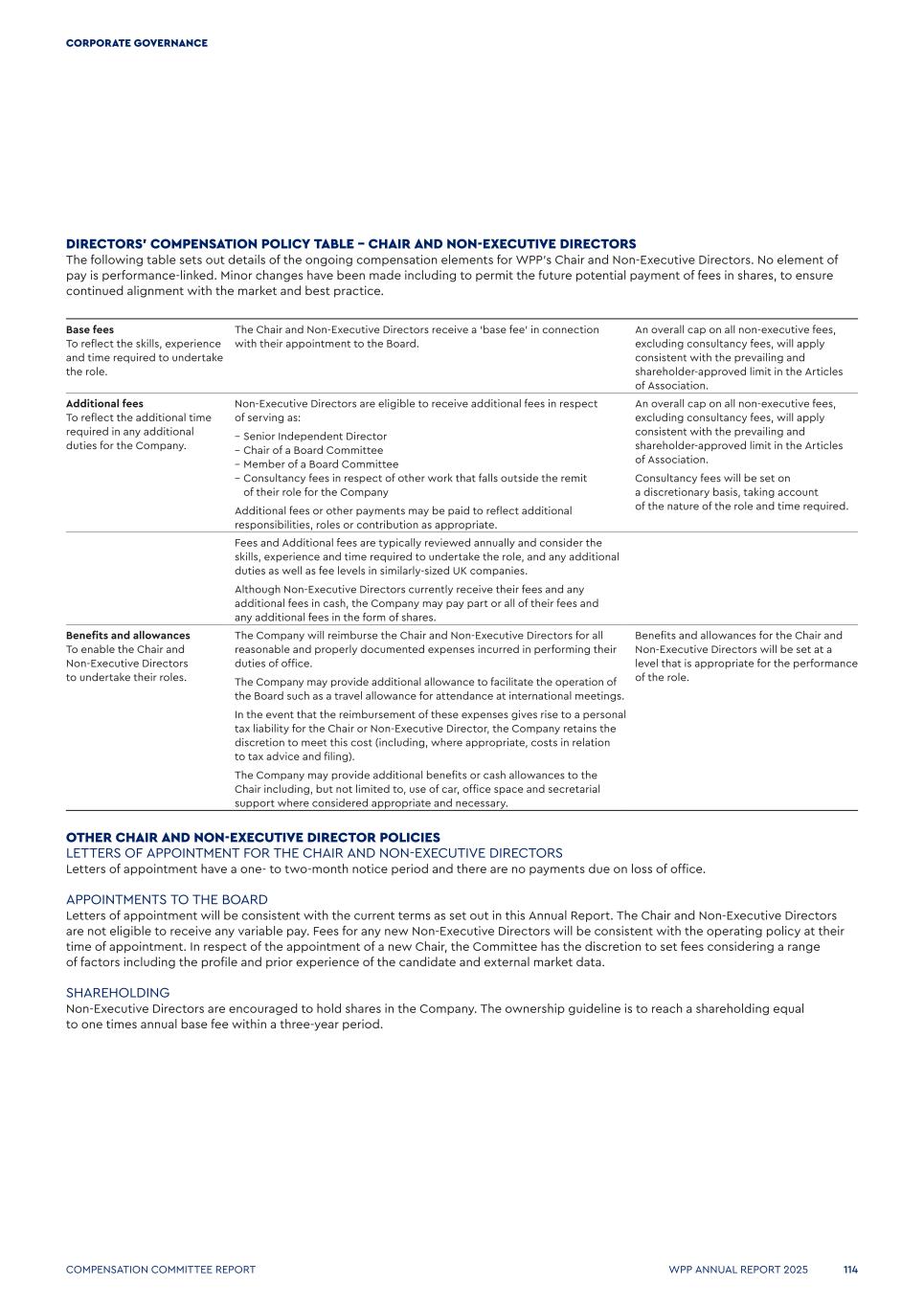
DIRECTORS’ COMPENSATION POLICY TABLE – CHAIR AND NON-EXECUTIVE DIRECTORS The following table sets out details of the ongoing compensation elements for WPP’s Chair and Non-Executive Directors. No element of pay is performance-linked. Minor changes have been made including to permit the future potential payment of fees in shares, to ensure continued alignment with the market and best practice. Base fees To reflect the skills, experience and time required to undertake the role. The Chair and Non-Executive Directors receive a ‘base fee’ in connection with their appointment to the Board. An overall cap on all non-executive fees, excluding consultancy fees, will apply consistent with the prevailing and shareholder-approved limit in the Articles of Association. Additional fees To reflect the additional time required in any additional duties for the Company. Non-Executive Directors are eligible to receive additional fees in respect of serving as: – Senior Independent Director – Chair of a Board Committee – Member of a Board Committee – Consultancy fees in respect of other work that falls outside the remit of their role for the Company Additional fees or other payments may be paid to reflect additional responsibilities, roles or contribution as appropriate. An overall cap on all non-executive fees, excluding consultancy fees, will apply consistent with the prevailing and shareholder-approved limit in the Articles of Association. Consultancy fees will be set on a discretionary basis, taking account of the nature of the role and time required. Fees and Additional fees are typically reviewed annually and consider the skills, experience and time required to undertake the role, and any additional duties as well as fee levels in similarly-sized UK companies. Although Non-Executive Directors currently receive their fees and any additional fees in cash, the Company may pay part or all of their fees and any additional fees in the form of shares. Benefits and allowances To enable the Chair and Non-Executive Directors to undertake their roles. The Company will reimburse the Chair and Non-Executive Directors for all reasonable and properly documented expenses incurred in performing their duties of office. The Company may provide additional allowance to facilitate the operation of the Board such as a travel allowance for attendance at international meetings. In the event that the reimbursement of these expenses gives rise to a personal tax liability for the Chair or Non-Executive Director, the Company retains the discretion to meet this cost (including, where appropriate, costs in relation to tax advice and filing). The Company may provide additional benefits or cash allowances to the Chair including, but not limited to, use of car, office space and secretarial support where considered appropriate and necessary. Benefits and allowances for the Chair and Non-Executive Directors will be set at a level that is appropriate for the performance of the role. OTHER CHAIR AND NON-EXECUTIVE DIRECTOR POLICIES LETTERS OF APPOINTMENT FOR THE CHAIR AND NON-EXECUTIVE DIRECTORS Letters of appointment have a one- to two-month notice period and there are no payments due on loss of office. APPOINTMENTS TO THE BOARD Letters of appointment will be consistent with the current terms as set out in this Annual Report. The Chair and Non-Executive Directors are not eligible to receive any variable pay. Fees for any new Non-Executive Directors will be consistent with the operating policy at their time of appointment. In respect of the appointment of a new Chair, the Committee has the discretion to set fees considering a range of factors including the profile and prior experience of the candidate and external market data. SHAREHOLDING Non-Executive Directors are encouraged to hold shares in the Company. The ownership guideline is to reach a shareholding equal to one times annual base fee within a three-year period. WPP ANNUAL REPORT 2025 114 CORPORATE GOVERNANCE COMPENSATION COMMITTEE REPORT
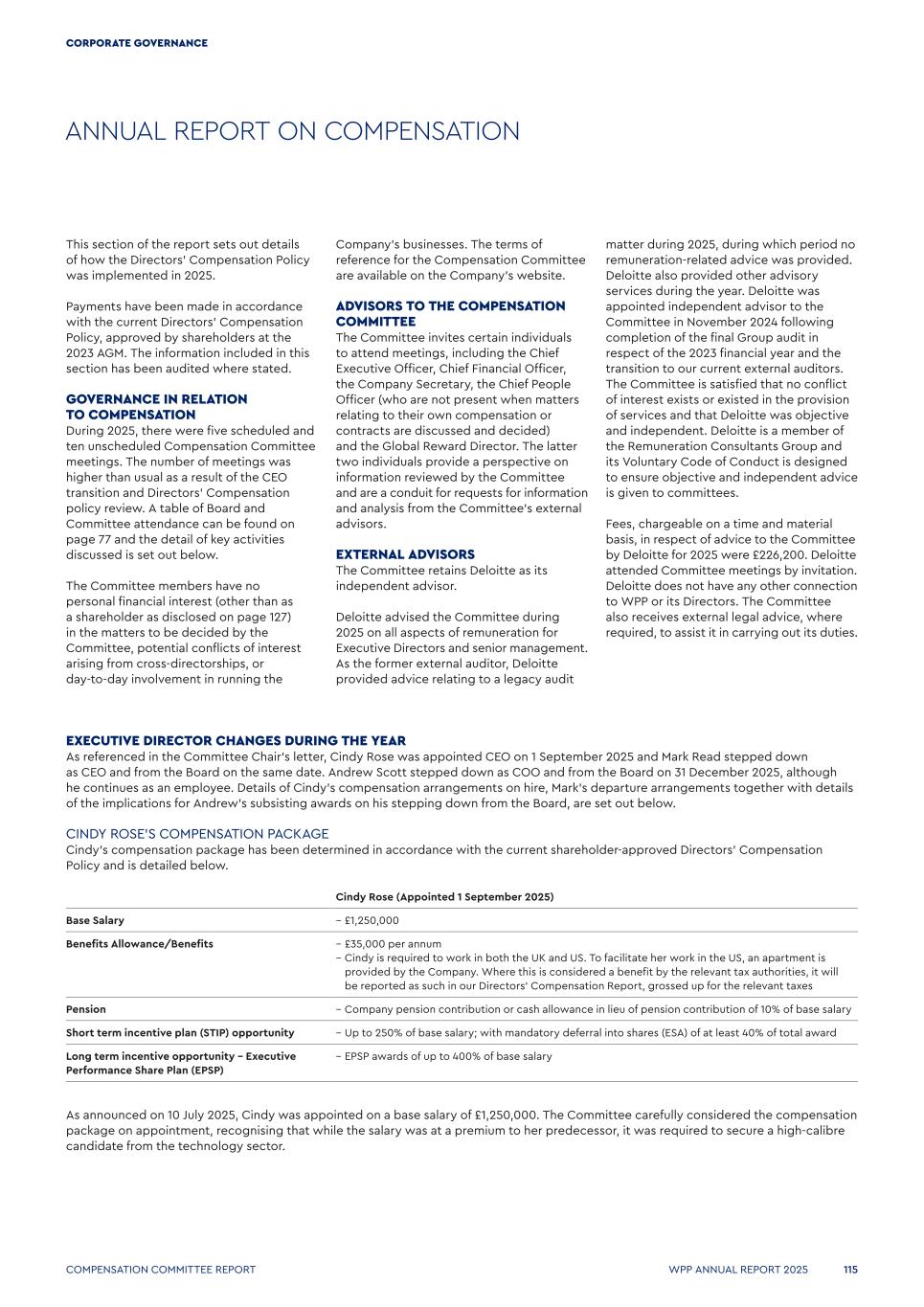
ANNUAL REPORT ON COMPENSATION This section of the report sets out details of how the Directors’ Compensation Policy was implemented in 2025. Payments have been made in accordance with the current Directors’ Compensation Policy, approved by shareholders at the 2023 AGM. The information included in this section has been audited where stated. GOVERNANCE IN RELATION TO COMPENSATION During 2025, there were five scheduled and ten unscheduled Compensation Committee meetings. The number of meetings was higher than usual as a result of the CEO transition and Directors' Compensation policy review. A table of Board and Committee attendance can be found on page 77 and the detail of key activities discussed is set out below. The Committee members have no personal financial interest (other than as a shareholder as disclosed on page 127) in the matters to be decided by the Committee, potential conflicts of interest arising from cross-directorships, or day-to-day involvement in running the matter during 2025, during which period no remuneration-related advice was provided. Deloitte also provided other advisory services during the year. Deloitte was appointed independent advisor to the Committee in November 2024 following completion of the final Group audit in respect of the 2023 financial year and the transition to our current external auditors. The Committee is satisfied that no conflict of interest exists or existed in the provision of services and that Deloitte was objective and independent. Deloitte is a member of the Remuneration Consultants Group and its Voluntary Code of Conduct is designed to ensure objective and independent advice is given to committees. Fees, chargeable on a time and material basis, in respect of advice to the Committee by Deloitte for 2025 were £226,200. Deloitte attended Committee meetings by invitation. Deloitte does not have any other connection to WPP or its Directors. The Committee also receives external legal advice, where required, to assist it in carrying out its duties. Company’s businesses. The terms of reference for the Compensation Committee are available on the Company’s website. ADVISORS TO THE COMPENSATION COMMITTEE The Committee invites certain individuals to attend meetings, including the Chief Executive Officer, Chief Financial Officer, the Company Secretary, the Chief People Officer (who are not present when matters relating to their own compensation or contracts are discussed and decided) and the Global Reward Director. The latter two individuals provide a perspective on information reviewed by the Committee and are a conduit for requests for information and analysis from the Committee’s external advisors. EXTERNAL ADVISORS The Committee retains Deloitte as its independent advisor. Deloitte advised the Committee during 2025 on all aspects of remuneration for Executive Directors and senior management. As the former external auditor, Deloitte provided advice relating to a legacy audit EXECUTIVE DIRECTOR CHANGES DURING THE YEAR As referenced in the Committee Chair’s letter, Cindy Rose was appointed CEO on 1 September 2025 and Mark Read stepped down as CEO and from the Board on the same date. Andrew Scott stepped down as COO and from the Board on 31 December 2025, although he continues as an employee. Details of Cindy’s compensation arrangements on hire, Mark’s departure arrangements together with details of the implications for Andrew’s subsisting awards on his stepping down from the Board, are set out below. CINDY ROSE’S COMPENSATION PACKAGE Cindy’s compensation package has been determined in accordance with the current shareholder-approved Directors’ Compensation Policy and is detailed below. Cindy Rose (Appointed 1 September 2025) Base Salary – £1,250,000 Benefits Allowance/Benefits – £35,000 per annum – Cindy is required to work in both the UK and US. To facilitate her work in the US, an apartment is provided by the Company. Where this is considered a benefit by the relevant tax authorities, it will be reported as such in our Directors’ Compensation Report, grossed up for the relevant taxes Pension – Company pension contribution or cash allowance in lieu of pension contribution of 10% of base salary Short term incentive plan (STIP) opportunity – Up to 250% of base salary; with mandatory deferral into shares (ESA) of at least 40% of total award Long term incentive opportunity – Executive Performance Share Plan (EPSP) – EPSP awards of up to 400% of base salary As announced on 10 July 2025, Cindy was appointed on a base salary of £1,250,000. The Committee carefully considered the compensation package on appointment, recognising that while the salary was at a premium to her predecessor, it was required to secure a high-calibre candidate from the technology sector. WPP ANNUAL REPORT 2025 115 CORPORATE GOVERNANCE COMPENSATION COMMITTEE REPORT
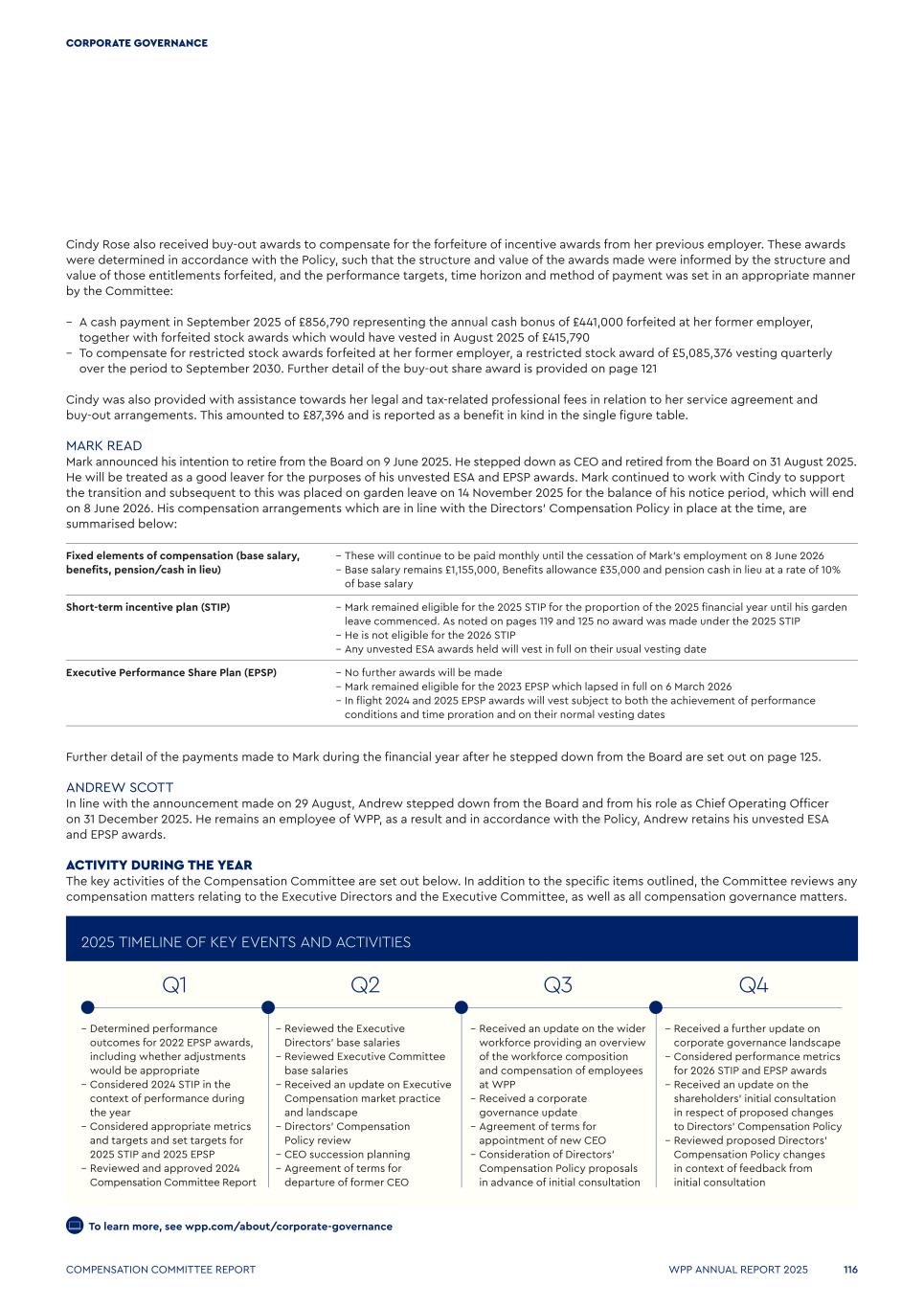
Cindy Rose also received buy-out awards to compensate for the forfeiture of incentive awards from her previous employer. These awards were determined in accordance with the Policy, such that the structure and value of the awards made were informed by the structure and value of those entitlements forfeited, and the performance targets, time horizon and method of payment was set in an appropriate manner by the Committee: – A cash payment in September 2025 of £856,790 representing the annual cash bonus of £441,000 forfeited at her former employer, together with forfeited stock awards which would have vested in August 2025 of £415,790 – To compensate for restricted stock awards forfeited at her former employer, a restricted stock award of £5,085,376 vesting quarterly over the period to September 2030. Further detail of the buy-out share award is provided on page 121 Cindy was also provided with assistance towards her legal and tax-related professional fees in relation to her service agreement and buy-out arrangements. This amounted to £87,396 and is reported as a benefit in kind in the single figure table. MARK READ Mark announced his intention to retire from the Board on 9 June 2025. He stepped down as CEO and retired from the Board on 31 August 2025. He will be treated as a good leaver for the purposes of his unvested ESA and EPSP awards. Mark continued to work with Cindy to support the transition and subsequent to this was placed on garden leave on 14 November 2025 for the balance of his notice period, which will end on 8 June 2026. His compensation arrangements which are in line with the Directors’ Compensation Policy in place at the time, are summarised below: Fixed elements of compensation (base salary, benefits, pension/cash in lieu) – These will continue to be paid monthly until the cessation of Mark’s employment on 8 June 2026 – Base salary remains £1,155,000, Benefits allowance £35,000 and pension cash in lieu at a rate of 10% of base salary Short-term incentive plan (STIP) – Mark remained eligible for the 2025 STIP for the proportion of the 2025 financial year until his garden leave commenced. As noted on pages 119 and 125 no award was made under the 2025 STIP – He is not eligible for the 2026 STIP – Any unvested ESA awards held will vest in full on their usual vesting date Executive Performance Share Plan (EPSP) – No further awards will be made – Mark remained eligible for the 2023 EPSP which lapsed in full on 6 March 2026 – In flight 2024 and 2025 EPSP awards will vest subject to both the achievement of performance conditions and time proration and on their normal vesting dates Further detail of the payments made to Mark during the financial year after he stepped down from the Board are set out on page 125. ANDREW SCOTT In line with the announcement made on 29 August, Andrew stepped down from the Board and from his role as Chief Operating Officer on 31 December 2025. He remains an employee of WPP, as a result and in accordance with the Policy, Andrew retains his unvested ESA and EPSP awards. ACTIVITY DURING THE YEAR The key activities of the Compensation Committee are set out below. In addition to the specific items outlined, the Committee reviews any compensation matters relating to the Executive Directors and the Executive Committee, as well as all compensation governance matters. 2025 TIMELINE OF KEY EVENTS AND ACTIVITIES Q1 Q2 Q3 Q4 – Determined performance outcomes for 2022 EPSP awards, including whether adjustments would be appropriate – Considered 2024 STIP in the context of performance during the year – Considered appropriate metrics and targets and set targets for 2025 STIP and 2025 EPSP – Reviewed and approved 2024 Compensation Committee Report – Reviewed the Executive Directors’ base salaries – Reviewed Executive Committee base salaries – Received an update on Executive Compensation market practice and landscape – Directors’ Compensation Policy review – CEO succession planning – Agreement of terms for departure of former CEO – Received an update on the wider workforce providing an overview of the workforce composition and compensation of employees at WPP – Received a corporate governance update – Agreement of terms for appointment of new CEO – Consideration of Directors’ Compensation Policy proposals in advance of initial consultation – Received a further update on corporate governance landscape – Considered performance metrics for 2026 STIP and EPSP awards – Received an update on the shareholders’ initial consultation in respect of proposed changes to Directors’ Compensation Policy – Reviewed proposed Directors’ Compensation Policy changes in context of feedback from initial consultation To learn more, see wpp.com/about/corporate-governance WPP ANNUAL REPORT 2025 116 CORPORATE GOVERNANCE COMPENSATION COMMITTEE REPORT
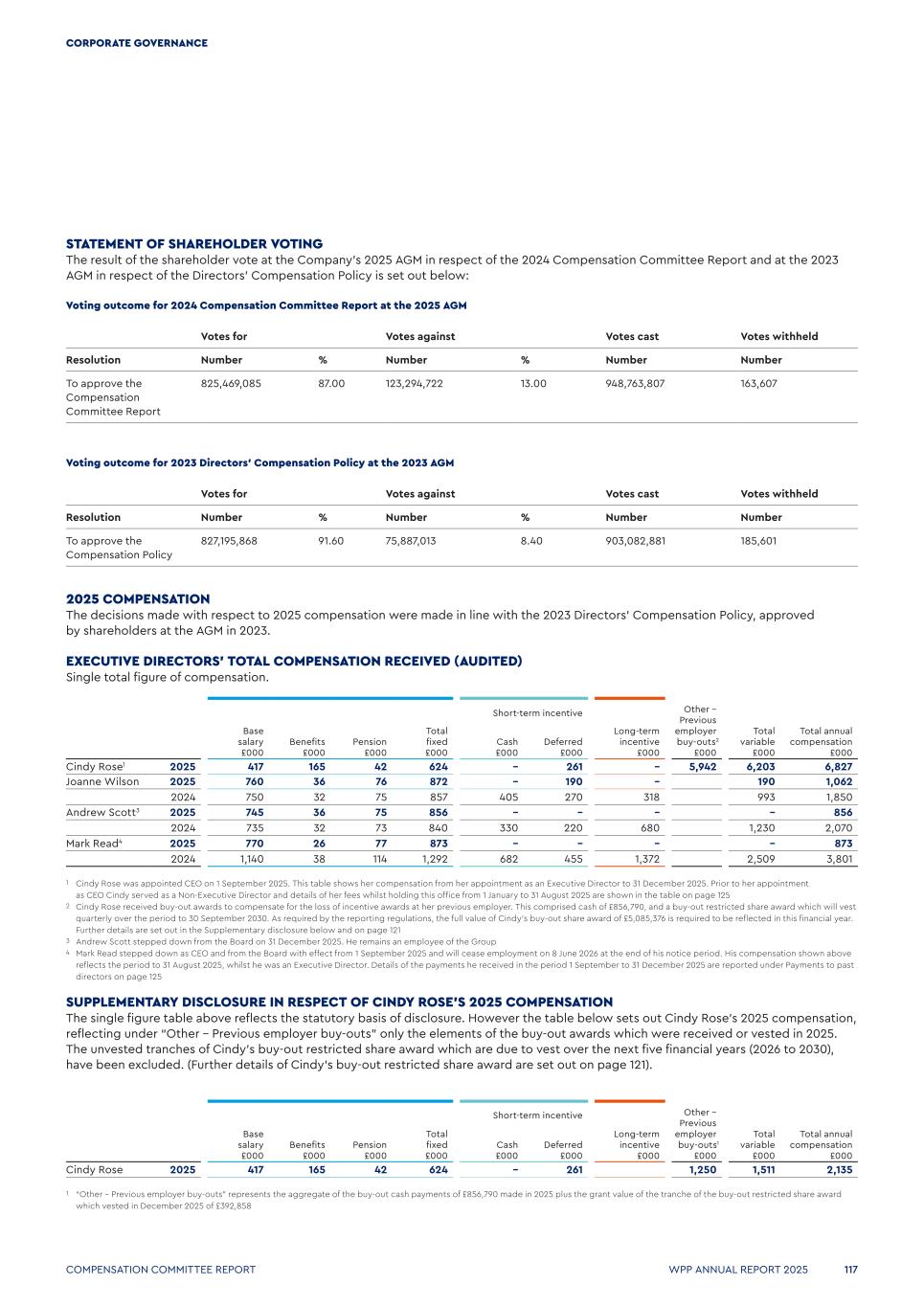
STATEMENT OF SHAREHOLDER VOTING The result of the shareholder vote at the Company’s 2025 AGM in respect of the 2024 Compensation Committee Report and at the 2023 AGM in respect of the Directors’ Compensation Policy is set out below: Voting outcome for 2024 Compensation Committee Report at the 2025 AGM Votes for Votes against Votes cast Votes withheld Resolution Number % Number % Number Number To approve the Compensation Committee Report 825,469,085 87.00 123,294,722 13.00 948,763,807 163,607 Voting outcome for 2023 Directors’ Compensation Policy at the 2023 AGM Votes for Votes against Votes cast Votes withheld Resolution Number % Number % Number Number To approve the Compensation Policy 827,195,868 91.60 75,887,013 8.40 903,082,881 185,601 2025 COMPENSATION The decisions made with respect to 2025 compensation were made in line with the 2023 Directors’ Compensation Policy, approved by shareholders at the AGM in 2023. EXECUTIVE DIRECTORS’ TOTAL COMPENSATION RECEIVED (AUDITED) Single total figure of compensation. Base salary £000 Benefits £000 Pension £000 Total fixed £000 Short-term incentive Long-term incentive £000 Other - Previous employer buy-outs2 £000 Total variable £000 Total annual compensation £000 Cash £000 Deferred £000 Cindy Rose1 2025 417 165 42 624 – 261 – 5,942 6,203 6,827 Joanne Wilson 2025 760 36 76 872 – 190 – 190 1,062 2024 750 32 75 857 405 270 318 993 1,850 Andrew Scott3 2025 745 36 75 856 – – – – 856 2024 735 32 73 840 330 220 680 1,230 2,070 Mark Read4 2025 770 26 77 873 – – – – 873 2024 1,140 38 114 1,292 682 455 1,372 2,509 3,801 1 Cindy Rose was appointed CEO on 1 September 2025. This table shows her compensation from her appointment as an Executive Director to 31 December 2025. Prior to her appointment as CEO Cindy served as a Non-Executive Director and details of her fees whilst holding this office from 1 January to 31 August 2025 are shown in the table on page 125 2 Cindy Rose received buy-out awards to compensate for the loss of incentive awards at her previous employer. This comprised cash of £856,790, and a buy-out restricted share award which will vest quarterly over the period to 30 September 2030. As required by the reporting regulations, the full value of Cindy’s buy-out share award of £5,085,376 is required to be reflected in this financial year. Further details are set out in the Supplementary disclosure below and on page 121 3 Andrew Scott stepped down from the Board on 31 December 2025. He remains an employee of the Group 4 Mark Read stepped down as CEO and from the Board with effect from 1 September 2025 and will cease employment on 8 June 2026 at the end of his notice period. His compensation shown above reflects the period to 31 August 2025, whilst he was an Executive Director. Details of the payments he received in the period 1 September to 31 December 2025 are reported under Payments to past directors on page 125 SUPPLEMENTARY DISCLOSURE IN RESPECT OF CINDY ROSE’S 2025 COMPENSATION The single figure table above reflects the statutory basis of disclosure. However the table below sets out Cindy Rose’s 2025 compensation, reflecting under “Other - Previous employer buy-outs” only the elements of the buy-out awards which were received or vested in 2025. The unvested tranches of Cindy’s buy-out restricted share award which are due to vest over the next five financial years (2026 to 2030), have been excluded. (Further details of Cindy’s buy-out restricted share award are set out on page 121). Base salary £000 Benefits £000 Pension £000 Total fixed £000 Short-term incentive Long-term incentive £000 Other - Previous employer buy-outs1 £000 Total variable £000 Total annual compensation £000 Cash £000 Deferred £000 Cindy Rose 2025 417 165 42 624 – 261 1,250 1,511 2,135 1 “Other - Previous employer buy-outs” represents the aggregate of the buy-out cash payments of £856,790 made in 2025 plus the grant value of the tranche of the buy-out restricted share award which vested in December 2025 of £392,858 WPP ANNUAL REPORT 2025 117 CORPORATE GOVERNANCE COMPENSATION COMMITTEE REPORT
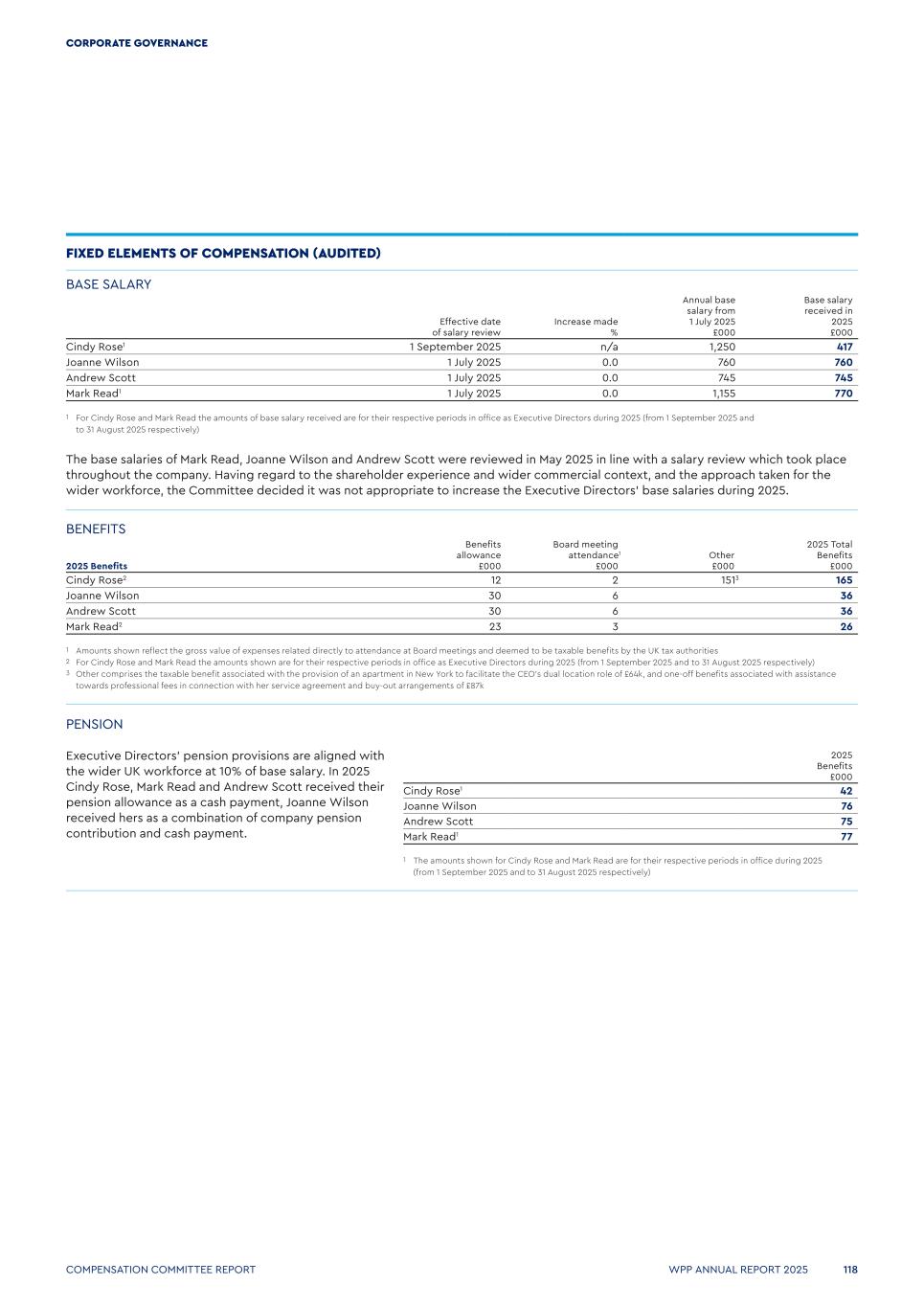
FIXED ELEMENTS OF COMPENSATION (AUDITED) BASE SALARY Effective date of salary review Increase made % Annual base salary from 1 July 2025 £000 Base salary received in 2025 £000 Cindy Rose1 1 September 2025 n/a 1,250 417 Joanne Wilson 1 July 2025 0.0 760 760 Andrew Scott 1 July 2025 0.0 745 745 Mark Read1 1 July 2025 0.0 1,155 770 1 For Cindy Rose and Mark Read the amounts of base salary received are for their respective periods in office as Executive Directors during 2025 (from 1 September 2025 and to 31 August 2025 respectively) The base salaries of Mark Read, Joanne Wilson and Andrew Scott were reviewed in May 2025 in line with a salary review which took place throughout the company. Having regard to the shareholder experience and wider commercial context, and the approach taken for the wider workforce, the Committee decided it was not appropriate to increase the Executive Directors’ base salaries during 2025. BENEFITS 2025 Benefits Benefits allowance £000 Board meeting attendance1 £000 Other £000 2025 Total Benefits £000 Cindy Rose2 12 2 1513 165 Joanne Wilson 30 6 36 Andrew Scott 30 6 36 Mark Read2 23 3 26 1 Amounts shown reflect the gross value of expenses related directly to attendance at Board meetings and deemed to be taxable benefits by the UK tax authorities 2 For Cindy Rose and Mark Read the amounts shown are for their respective periods in office as Executive Directors during 2025 (from 1 September 2025 and to 31 August 2025 respectively) 3 Other comprises the taxable benefit associated with the provision of an apartment in New York to facilitate the CEO’s dual location role of £64k, and one-off benefits associated with assistance towards professional fees in connection with her service agreement and buy-out arrangements of £87k PENSION Executive Directors’ pension provisions are aligned with the wider UK workforce at 10% of base salary. In 2025 Cindy Rose, Mark Read and Andrew Scott received their pension allowance as a cash payment, Joanne Wilson received hers as a combination of company pension contribution and cash payment. 2025 Benefits £000 Cindy Rose1 42 Joanne Wilson 76 Andrew Scott 75 Mark Read1 77 1 The amounts shown for Cindy Rose and Mark Read are for their respective periods in office during 2025 (from 1 September 2025 and to 31 August 2025 respectively) WPP ANNUAL REPORT 2025 118 CORPORATE GOVERNANCE COMPENSATION COMMITTEE REPORT
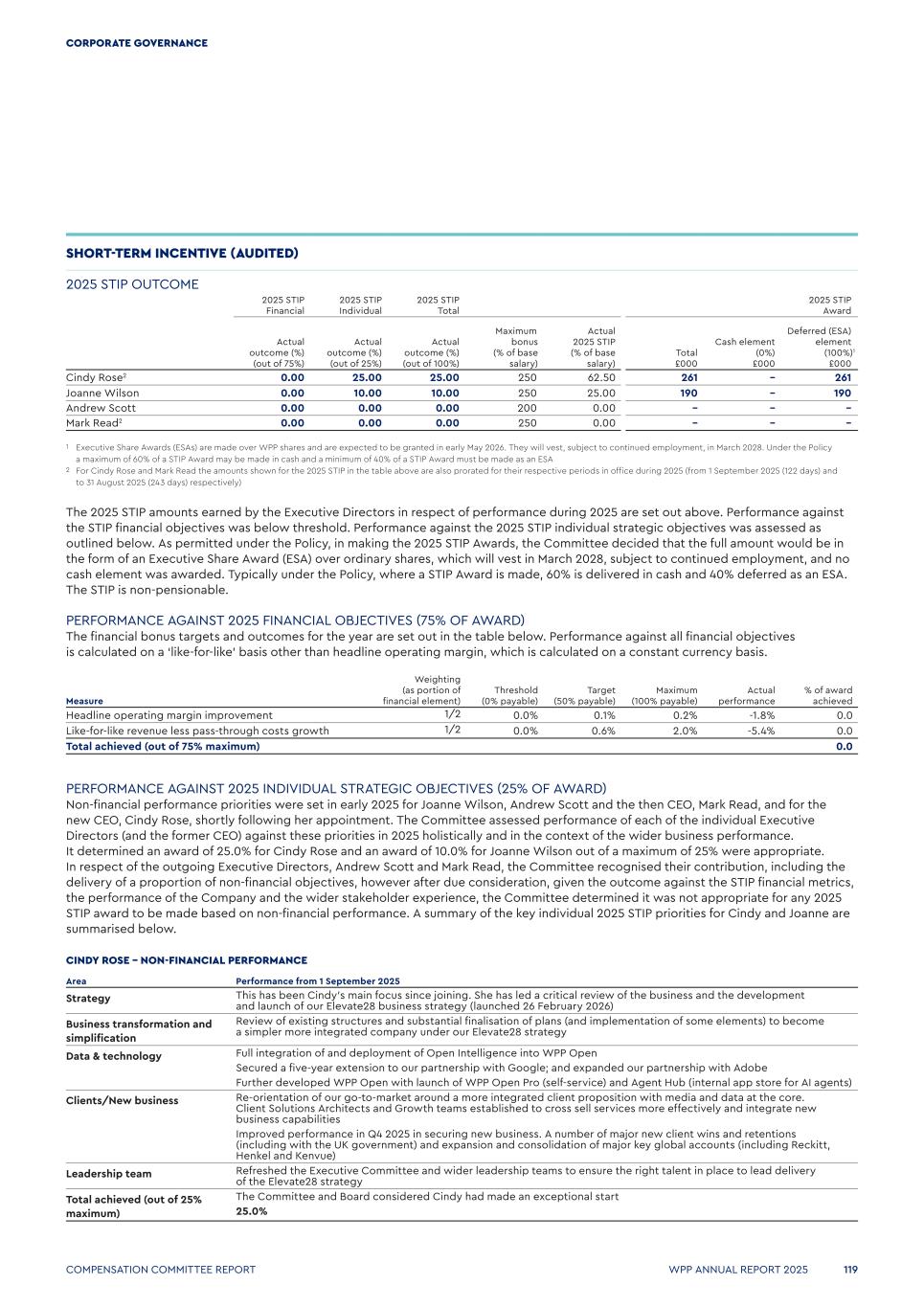
SHORT-TERM INCENTIVE (AUDITED) 2025 STIP OUTCOME 2025 STIP Financial 2025 STIP Individual 2025 STIP Total 2025 STIP Award Actual outcome (%) (out of 75%) Actual outcome (%) (out of 25%) Actual outcome (%) (out of 100%) Maximum bonus (% of base salary) Actual 2025 STIP (% of base salary) Total £000 Cash element (0%) £000 Deferred (ESA) element (100%)1 £000 Cindy Rose2 0.00 25.00 25.00 250 62.50 261 – 261 Joanne Wilson 0.00 10.00 10.00 250 25.00 190 – 190 Andrew Scott 0.00 0.00 0.00 200 0.00 – – – Mark Read2 0.00 0.00 0.00 250 0.00 – – – 1 Executive Share Awards (ESAs) are made over WPP shares and are expected to be granted in early May 2026. They will vest, subject to continued employment, in March 2028. Under the Policy a maximum of 60% of a STIP Award may be made in cash and a minimum of 40% of a STIP Award must be made as an ESA 2 For Cindy Rose and Mark Read the amounts shown for the 2025 STIP in the table above are also prorated for their respective periods in office during 2025 (from 1 September 2025 (122 days) and to 31 August 2025 (243 days) respectively) The 2025 STIP amounts earned by the Executive Directors in respect of performance during 2025 are set out above. Performance against the STIP financial objectives was below threshold. Performance against the 2025 STIP individual strategic objectives was assessed as outlined below. As permitted under the Policy, in making the 2025 STIP Awards, the Committee decided that the full amount would be in the form of an Executive Share Award (ESA) over ordinary shares, which will vest in March 2028, subject to continued employment, and no cash element was awarded. Typically under the Policy, where a STIP Award is made, 60% is delivered in cash and 40% deferred as an ESA. The STIP is non-pensionable. PERFORMANCE AGAINST 2025 FINANCIAL OBJECTIVES (75% OF AWARD) The financial bonus targets and outcomes for the year are set out in the table below. Performance against all financial objectives is calculated on a ‘like-for-like’ basis other than headline operating margin, which is calculated on a constant currency basis. Measure Weighting (as portion of financial element) Threshold (0% payable) Target (50% payable) Maximum (100% payable) Actual performance % of award achieved Headline operating margin improvement 1/2 0.0% 0.1% 0.2% -1.8% 0.0 Like-for-like revenue less pass-through costs growth 1/2 0.0% 0.6% 2.0% -5.4% 0.0 Total achieved (out of 75% maximum) 0.0 PERFORMANCE AGAINST 2025 INDIVIDUAL STRATEGIC OBJECTIVES (25% OF AWARD) Non-financial performance priorities were set in early 2025 for Joanne Wilson, Andrew Scott and the then CEO, Mark Read, and for the new CEO, Cindy Rose, shortly following her appointment. The Committee assessed performance of each of the individual Executive Directors (and the former CEO) against these priorities in 2025 holistically and in the context of the wider business performance. It determined an award of 25.0% for Cindy Rose and an award of 10.0% for Joanne Wilson out of a maximum of 25% were appropriate. In respect of the outgoing Executive Directors, Andrew Scott and Mark Read, the Committee recognised their contribution, including the delivery of a proportion of non-financial objectives, however after due consideration, given the outcome against the STIP financial metrics, the performance of the Company and the wider stakeholder experience, the Committee determined it was not appropriate for any 2025 STIP award to be made based on non-financial performance. A summary of the key individual 2025 STIP priorities for Cindy and Joanne are summarised below. CINDY ROSE – NON-FINANCIAL PERFORMANCE Area Performance from 1 September 2025 Strategy This has been Cindy’s main focus since joining. She has led a critical review of the business and the development and launch of our Elevate28 business strategy (launched 26 February 2026) Business transformation and simplification Review of existing structures and substantial finalisation of plans (and implementation of some elements) to become a simpler more integrated company under our Elevate28 strategy Data & technology Full integration of and deployment of Open Intelligence into WPP Open Secured a five-year extension to our partnership with Google; and expanded our partnership with Adobe Further developed WPP Open with launch of WPP Open Pro (self-service) and Agent Hub (internal app store for AI agents) Clients/New business Re-orientation of our go-to-market around a more integrated client proposition with media and data at the core. Client Solutions Architects and Growth teams established to cross sell services more effectively and integrate new business capabilities Improved performance in Q4 2025 in securing new business. A number of major new client wins and retentions (including with the UK government) and expansion and consolidation of major key global accounts (including Reckitt, Henkel and Kenvue) Leadership team Refreshed the Executive Committee and wider leadership teams to ensure the right talent in place to lead delivery of the Elevate28 strategy Total achieved (out of 25% maximum) The Committee and Board considered Cindy had made an exceptional start 25.0% WPP ANNUAL REPORT 2025 119 CORPORATE GOVERNANCE COMPENSATION COMMITTEE REPORT
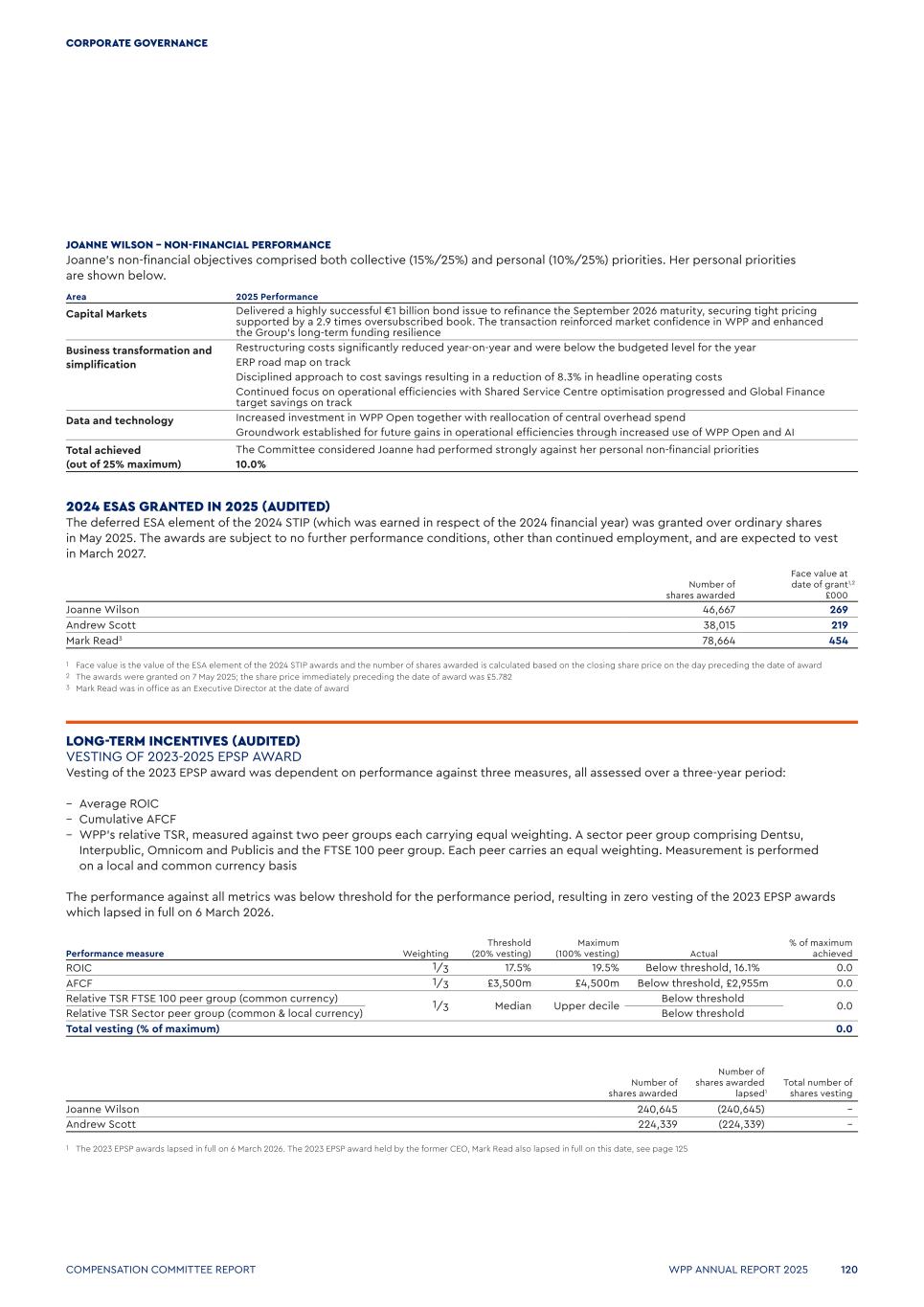
JOANNE WILSON – NON-FINANCIAL PERFORMANCE Joanne's non-financial objectives comprised both collective (15%/25%) and personal (10%/25%) priorities. Her personal priorities are shown below. Area 2025 Performance Capital Markets Delivered a highly successful €1 billion bond issue to refinance the September 2026 maturity, securing tight pricing supported by a 2.9 times oversubscribed book. The transaction reinforced market confidence in WPP and enhanced the Group's long-term funding resilience Business transformation and simplification Restructuring costs significantly reduced year-on-year and were below the budgeted level for the year ERP road map on track Disciplined approach to cost savings resulting in a reduction of 8.3% in headline operating costs Continued focus on operational efficiencies with Shared Service Centre optimisation progressed and Global Finance target savings on track Data and technology Increased investment in WPP Open together with reallocation of central overhead spend Groundwork established for future gains in operational efficiencies through increased use of WPP Open and AI Total achieved (out of 25% maximum) The Committee considered Joanne had performed strongly against her personal non-financial priorities 10.0% 2024 ESAS GRANTED IN 2025 (AUDITED) The deferred ESA element of the 2024 STIP (which was earned in respect of the 2024 financial year) was granted over ordinary shares in May 2025. The awards are subject to no further performance conditions, other than continued employment, and are expected to vest in March 2027. Number of shares awarded Face value at date of grant1,2 £000 Joanne Wilson 46,667 269 Andrew Scott 38,015 219 Mark Read3 78,664 454 1 Face value is the value of the ESA element of the 2024 STIP awards and the number of shares awarded is calculated based on the closing share price on the day preceding the date of award 2 The awards were granted on 7 May 2025; the share price immediately preceding the date of award was £5.782 3 Mark Read was in office as an Executive Director at the date of award LONG-TERM INCENTIVES (AUDITED) VESTING OF 2023-2025 EPSP AWARD Vesting of the 2023 EPSP award was dependent on performance against three measures, all assessed over a three-year period: – Average ROIC – Cumulative AFCF – WPP’s relative TSR, measured against two peer groups each carrying equal weighting. A sector peer group comprising Dentsu, Interpublic, Omnicom and Publicis and the FTSE 100 peer group. Each peer carries an equal weighting. Measurement is performed on a local and common currency basis The performance against all metrics was below threshold for the performance period, resulting in zero vesting of the 2023 EPSP awards which lapsed in full on 6 March 2026. Performance measure Weighting Threshold (20% vesting) Maximum (100% vesting) Actual % of maximum achieved ROIC 1/3 17.5% 19.5% Below threshold, 16.1% 0.0 AFCF 1/3 £3,500m £4,500m Below threshold, £2,955m 0.0 Relative TSR FTSE 100 peer group (common currency) 1/3 Median Upper decile Below threshold 0.0 Relative TSR Sector peer group (common & local currency) Below threshold Total vesting (% of maximum) 0.0 Number of shares awarded Number of shares awarded lapsed1 Total number of shares vesting Joanne Wilson 240,645 (240,645) – Andrew Scott 224,339 (224,339) – 1 The 2023 EPSP awards lapsed in full on 6 March 2026. The 2023 EPSP award held by the former CEO, Mark Read also lapsed in full on this date, see page 125 WPP ANNUAL REPORT 2025 120 CORPORATE GOVERNANCE COMPENSATION COMMITTEE REPORT
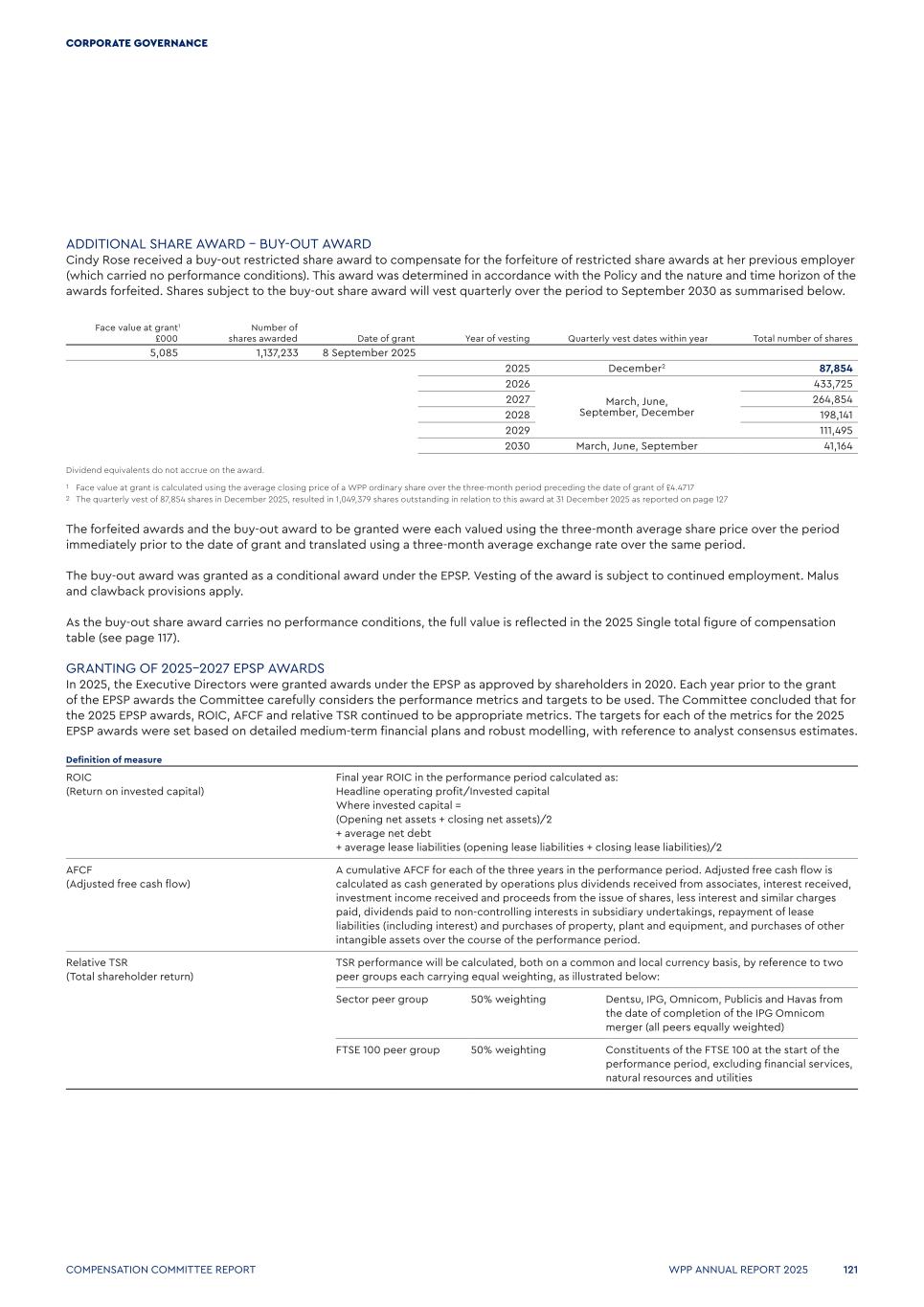
ADDITIONAL SHARE AWARD – BUY-OUT AWARD Cindy Rose received a buy-out restricted share award to compensate for the forfeiture of restricted share awards at her previous employer (which carried no performance conditions). This award was determined in accordance with the Policy and the nature and time horizon of the awards forfeited. Shares subject to the buy-out share award will vest quarterly over the period to September 2030 as summarised below. Face value at grant1 £000 Number of shares awarded Date of grant Year of vesting Quarterly vest dates within year Total number of shares 5,085 1,137,233 8 September 2025 2025 December2 87,854 2026 March, June, September, December 433,725 2027 264,854 2028 198,141 2029 111,495 2030 March, June, September 41,164 Dividend equivalents do not accrue on the award. 1 Face value at grant is calculated using the average closing price of a WPP ordinary share over the three-month period preceding the date of grant of £4.4717 2 The quarterly vest of 87,854 shares in December 2025, resulted in 1,049,379 shares outstanding in relation to this award at 31 December 2025 as reported on page 127 The forfeited awards and the buy-out award to be granted were each valued using the three-month average share price over the period immediately prior to the date of grant and translated using a three-month average exchange rate over the same period. The buy-out award was granted as a conditional award under the EPSP. Vesting of the award is subject to continued employment. Malus and clawback provisions apply. As the buy-out share award carries no performance conditions, the full value is reflected in the 2025 Single total figure of compensation table (see page 117). GRANTING OF 2025-2027 EPSP AWARDS In 2025, the Executive Directors were granted awards under the EPSP as approved by shareholders in 2020. Each year prior to the grant of the EPSP awards the Committee carefully considers the performance metrics and targets to be used. The Committee concluded that for the 2025 EPSP awards, ROIC, AFCF and relative TSR continued to be appropriate metrics. The targets for each of the metrics for the 2025 EPSP awards were set based on detailed medium-term financial plans and robust modelling, with reference to analyst consensus estimates. Definition of measure ROIC (Return on invested capital) Final year ROIC in the performance period calculated as: Headline operating profit/Invested capital Where invested capital = (Opening net assets + closing net assets)/2 + average net debt + average lease liabilities (opening lease liabilities + closing lease liabilities)/2 AFCF (Adjusted free cash flow) A cumulative AFCF for each of the three years in the performance period. Adjusted free cash flow is calculated as cash generated by operations plus dividends received from associates, interest received, investment income received and proceeds from the issue of shares, less interest and similar charges paid, dividends paid to non-controlling interests in subsidiary undertakings, repayment of lease liabilities (including interest) and purchases of property, plant and equipment, and purchases of other intangible assets over the course of the performance period. Relative TSR (Total shareholder return) TSR performance will be calculated, both on a common and local currency basis, by reference to two peer groups each carrying equal weighting, as illustrated below: Sector peer group 50% weighting Dentsu, IPG, Omnicom, Publicis and Havas from the date of completion of the IPG Omnicom merger (all peers equally weighted) FTSE 100 peer group 50% weighting Constituents of the FTSE 100 at the start of the performance period, excluding financial services, natural resources and utilities WPP ANNUAL REPORT 2025 121 CORPORATE GOVERNANCE COMPENSATION COMMITTEE REPORT
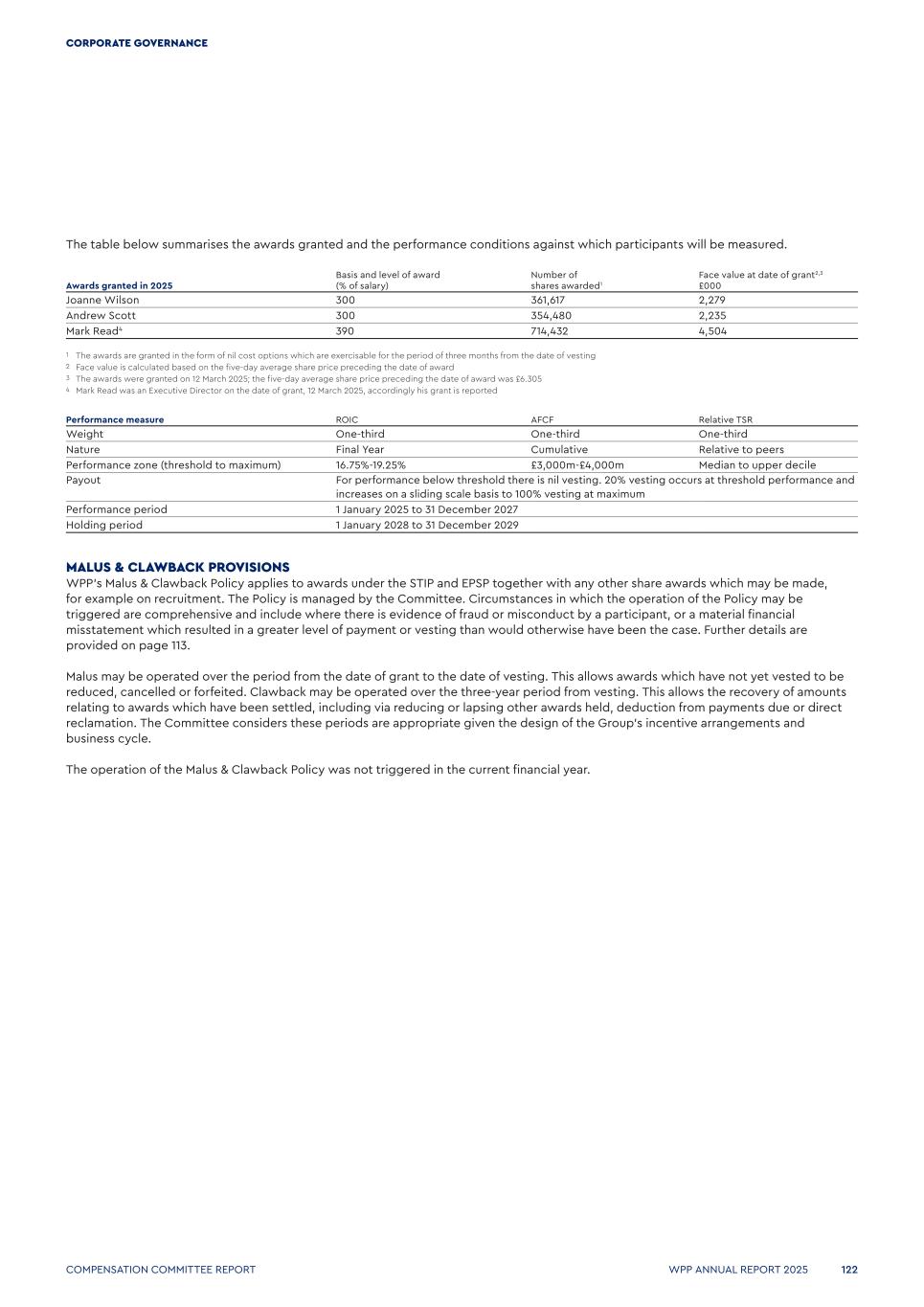
The table below summarises the awards granted and the performance conditions against which participants will be measured. Awards granted in 2025 Basis and level of award (% of salary) Number of shares awarded1 Face value at date of grant2,3 £000 Joanne Wilson 300 361,617 2,279 Andrew Scott 300 354,480 2,235 Mark Read4 390 714,432 4,504 1 The awards are granted in the form of nil cost options which are exercisable for the period of three months from the date of vesting 2 Face value is calculated based on the five-day average share price preceding the date of award 3 The awards were granted on 12 March 2025; the five-day average share price preceding the date of award was £6.305 4 Mark Read was an Executive Director on the date of grant, 12 March 2025, accordingly his grant is reported Performance measure ROIC AFCF Relative TSR Weight One‑third One-third One-third Nature Final Year Cumulative Relative to peers Performance zone (threshold to maximum) 16.75%-19.25% £3,000m-£4,000m Median to upper decile Payout For performance below threshold there is nil vesting. 20% vesting occurs at threshold performance and increases on a sliding scale basis to 100% vesting at maximum Performance period 1 January 2025 to 31 December 2027 Holding period 1 January 2028 to 31 December 2029 MALUS & CLAWBACK PROVISIONS WPP’s Malus & Clawback Policy applies to awards under the STIP and EPSP together with any other share awards which may be made, for example on recruitment. The Policy is managed by the Committee. Circumstances in which the operation of the Policy may be triggered are comprehensive and include where there is evidence of fraud or misconduct by a participant, or a material financial misstatement which resulted in a greater level of payment or vesting than would otherwise have been the case. Further details are provided on page 113. Malus may be operated over the period from the date of grant to the date of vesting. This allows awards which have not yet vested to be reduced, cancelled or forfeited. Clawback may be operated over the three-year period from vesting. This allows the recovery of amounts relating to awards which have been settled, including via reducing or lapsing other awards held, deduction from payments due or direct reclamation. The Committee considers these periods are appropriate given the design of the Group’s incentive arrangements and business cycle. The operation of the Malus & Clawback Policy was not triggered in the current financial year. WPP ANNUAL REPORT 2025 122 CORPORATE GOVERNANCE COMPENSATION COMMITTEE REPORT
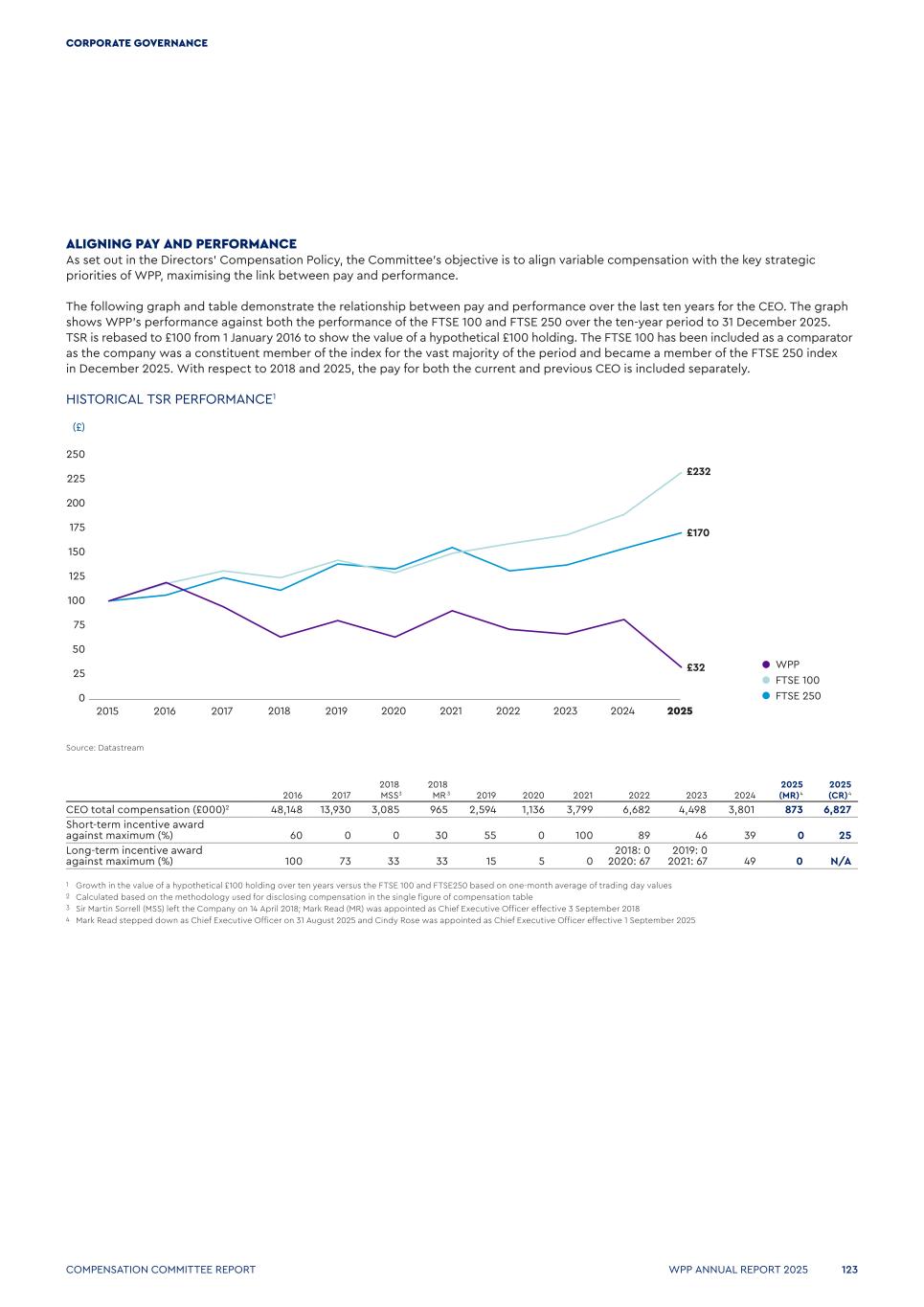
ALIGNING PAY AND PERFORMANCE As set out in the Directors’ Compensation Policy, the Committee’s objective is to align variable compensation with the key strategic priorities of WPP, maximising the link between pay and performance. The following graph and table demonstrate the relationship between pay and performance over the last ten years for the CEO. The graph shows WPP’s performance against both the performance of the FTSE 100 and FTSE 250 over the ten-year period to 31 December 2025. TSR is rebased to £100 from 1 January 2016 to show the value of a hypothetical £100 holding. The FTSE 100 has been included as a comparator as the company was a constituent member of the index for the vast majority of the period and became a member of the FTSE 250 index in December 2025. With respect to 2018 and 2025, the pay for both the current and previous CEO is included separately. HISTORICAL TSR PERFORMANCE1 WPP FTSE 100 FTSE 250 (£) 2019 20212018201720162015 2020 2022 20242023 0 25 50 75 100 125 150 175 200 225 250 2025 £32 £170 £232 Source: Datastream 2016 2017 2018 MSS3 2018 MR 3 2019 2020 2021 2022 2023 2024 2025 (MR) 4 2025 (CR) 4 CEO total compensation (£000)2 48,148 13,930 3,085 965 2,594 1,136 3,799 6,682 4,498 3,801 873 6,827 Short-term incentive award against maximum (%) 60 0 0 30 55 0 100 89 46 39 0 25 Long-term incentive award against maximum (%) 100 73 33 33 15 5 0 2018: 0 2020: 67 2019: 0 2021: 67 49 0 N/A 1 Growth in the value of a hypothetical £100 holding over ten years versus the FTSE 100 and FTSE250 based on one-month average of trading day values 2 Calculated based on the methodology used for disclosing compensation in the single figure of compensation table 3 Sir Martin Sorrell (MSS) left the Company on 14 April 2018; Mark Read (MR) was appointed as Chief Executive Officer effective 3 September 2018 4 Mark Read stepped down as Chief Executive Officer on 31 August 2025 and Cindy Rose was appointed as Chief Executive Officer effective 1 September 2025 WPP ANNUAL REPORT 2025 123 CORPORATE GOVERNANCE COMPENSATION COMMITTEE REPORT
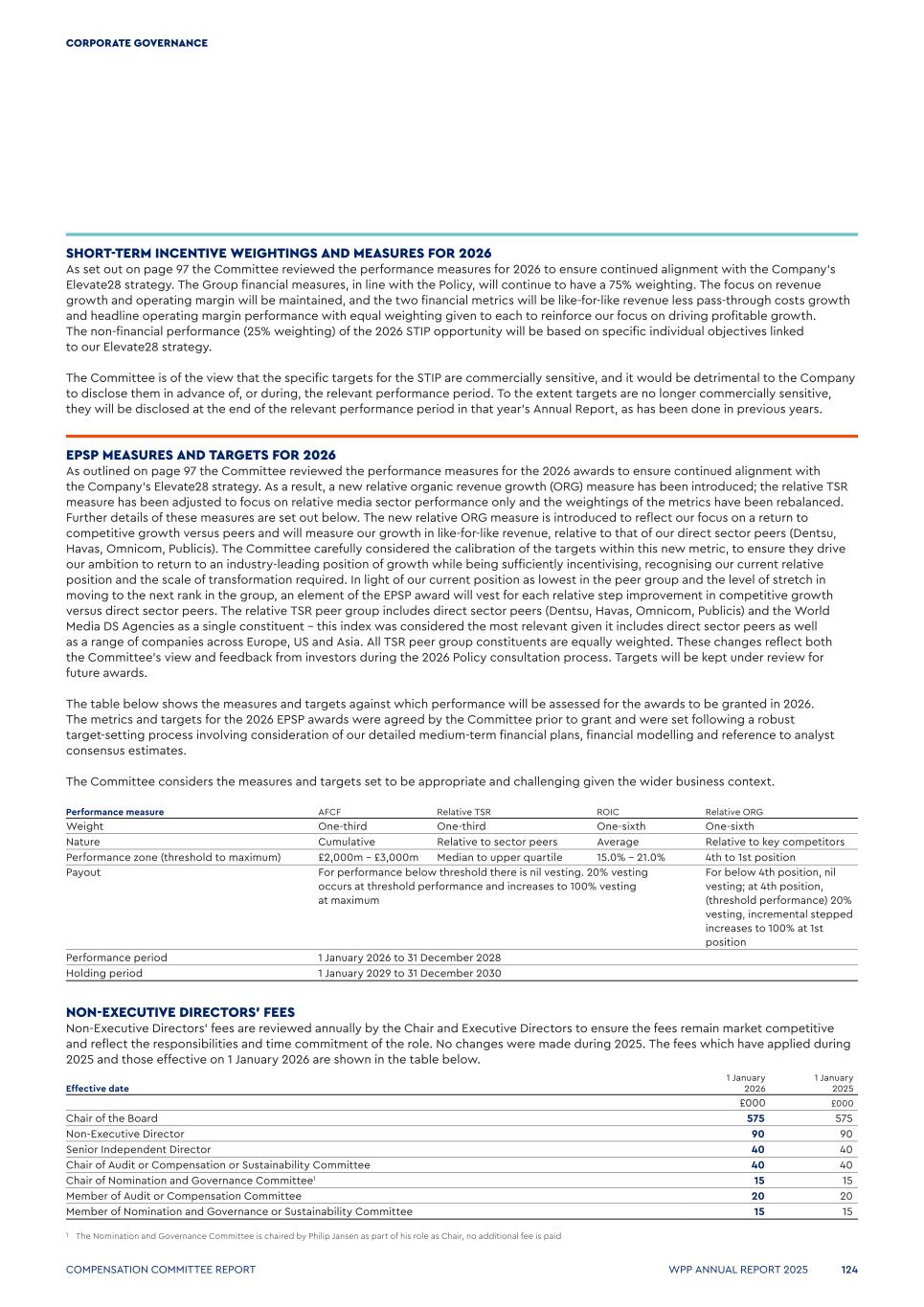
SHORT-TERM INCENTIVE WEIGHTINGS AND MEASURES FOR 2026 As set out on page 97 the Committee reviewed the performance measures for 2026 to ensure continued alignment with the Company's Elevate28 strategy. The Group financial measures, in line with the Policy, will continue to have a 75% weighting. The focus on revenue growth and operating margin will be maintained, and the two financial metrics will be like-for-like revenue less pass-through costs growth and headline operating margin performance with equal weighting given to each to reinforce our focus on driving profitable growth. The non-financial performance (25% weighting) of the 2026 STIP opportunity will be based on specific individual objectives linked to our Elevate28 strategy. The Committee is of the view that the specific targets for the STIP are commercially sensitive, and it would be detrimental to the Company to disclose them in advance of, or during, the relevant performance period. To the extent targets are no longer commercially sensitive, they will be disclosed at the end of the relevant performance period in that year’s Annual Report, as has been done in previous years. EPSP MEASURES AND TARGETS FOR 2026 As outlined on page 97 the Committee reviewed the performance measures for the 2026 awards to ensure continued alignment with the Company’s Elevate28 strategy. As a result, a new relative organic revenue growth (ORG) measure has been introduced; the relative TSR measure has been adjusted to focus on relative media sector performance only and the weightings of the metrics have been rebalanced. Further details of these measures are set out below. The new relative ORG measure is introduced to reflect our focus on a return to competitive growth versus peers and will measure our growth in like-for-like revenue, relative to that of our direct sector peers (Dentsu, Havas, Omnicom, Publicis). The Committee carefully considered the calibration of the targets within this new metric, to ensure they drive our ambition to return to an industry-leading position of growth while being sufficiently incentivising, recognising our current relative position and the scale of transformation required. In light of our current position as lowest in the peer group and the level of stretch in moving to the next rank in the group, an element of the EPSP award will vest for each relative step improvement in competitive growth versus direct sector peers. The relative TSR peer group includes direct sector peers (Dentsu, Havas, Omnicom, Publicis) and the World Media DS Agencies as a single constituent - this index was considered the most relevant given it includes direct sector peers as well as a range of companies across Europe, US and Asia. All TSR peer group constituents are equally weighted. These changes reflect both the Committee's view and feedback from investors during the 2026 Policy consultation process. Targets will be kept under review for future awards. The table below shows the measures and targets against which performance will be assessed for the awards to be granted in 2026. The metrics and targets for the 2026 EPSP awards were agreed by the Committee prior to grant and were set following a robust target-setting process involving consideration of our detailed medium-term financial plans, financial modelling and reference to analyst consensus estimates. The Committee considers the measures and targets set to be appropriate and challenging given the wider business context. Performance measure AFCF Relative TSR ROIC Relative ORG Weight One-third One-third One‑sixth One-sixth Nature Cumulative Relative to sector peers Average Relative to key competitors Performance zone (threshold to maximum) £2,000m - £3,000m Median to upper quartile 15.0% - 21.0% 4th to 1st position Payout For performance below threshold there is nil vesting. 20% vesting occurs at threshold performance and increases to 100% vesting at maximum For below 4th position, nil vesting; at 4th position, (threshold performance) 20% vesting, incremental stepped increases to 100% at 1st position Performance period 1 January 2026 to 31 December 2028 Holding period 1 January 2029 to 31 December 2030 NON-EXECUTIVE DIRECTORS’ FEES Non-Executive Directors’ fees are reviewed annually by the Chair and Executive Directors to ensure the fees remain market competitive and reflect the responsibilities and time commitment of the role. No changes were made during 2025. The fees which have applied during 2025 and those effective on 1 January 2026 are shown in the table below. Effective date 1 January 2026 1 January 2025 £000 £000 Chair of the Board 575 575 Non-Executive Director 90 90 Senior Independent Director 40 40 Chair of Audit or Compensation or Sustainability Committee 40 40 Chair of Nomination and Governance Committee1 15 15 Member of Audit or Compensation Committee 20 20 Member of Nomination and Governance or Sustainability Committee 15 15 1 The Nomination and Governance Committee is chaired by Philip Jansen as part of his role as Chair, no additional fee is paid WPP ANNUAL REPORT 2025 124 CORPORATE GOVERNANCE COMPENSATION COMMITTEE REPORT
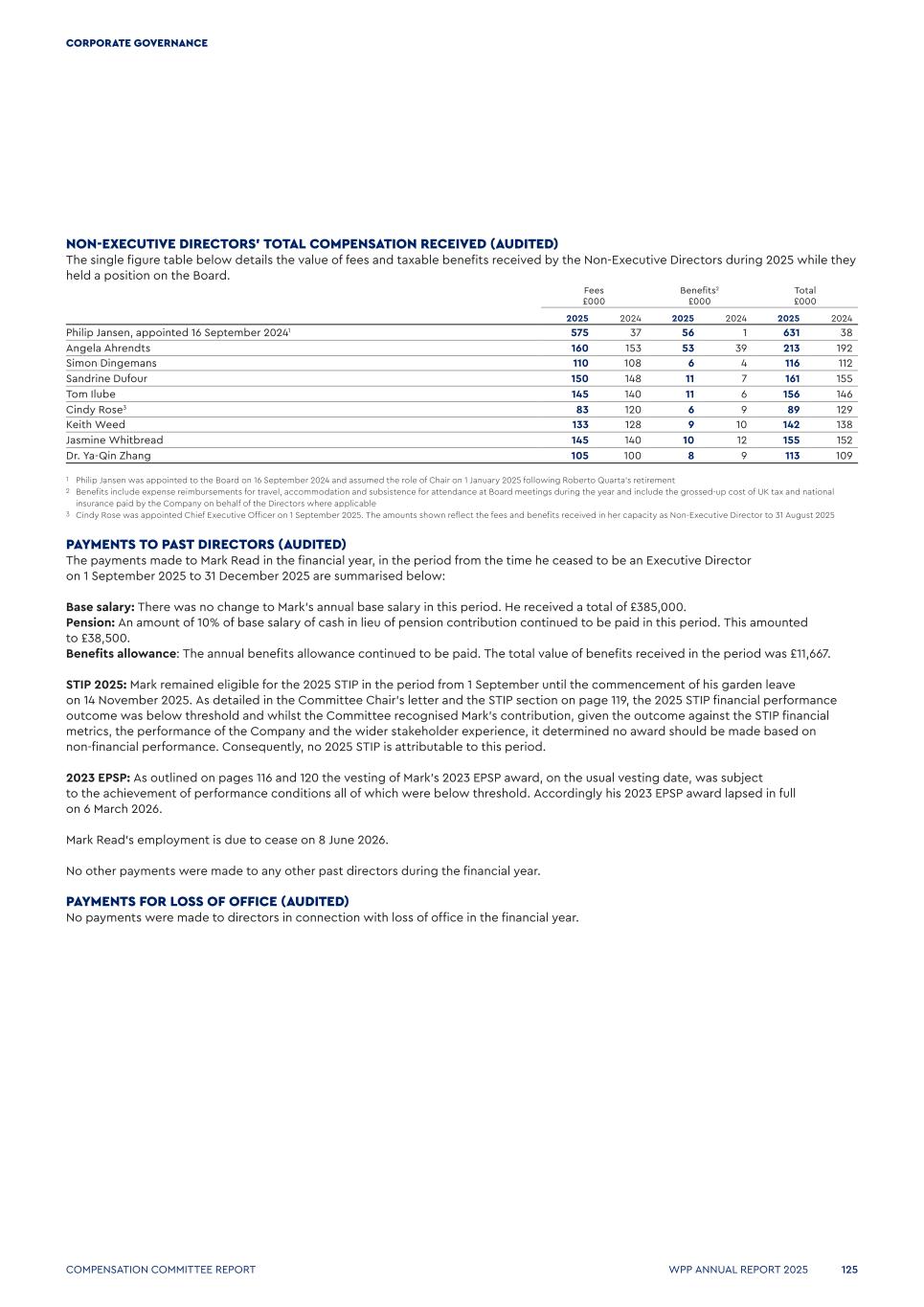
NON-EXECUTIVE DIRECTORS’ TOTAL COMPENSATION RECEIVED (AUDITED) The single figure table below details the value of fees and taxable benefits received by the Non-Executive Directors during 2025 while they held a position on the Board. Fees £000 Benefits2 £000 Total £000 2025 2024 2025 2024 2025 2024 Philip Jansen, appointed 16 September 20241 575 37 56 1 631 38 Angela Ahrendts 160 153 53 39 213 192 Simon Dingemans 110 108 6 4 116 112 Sandrine Dufour 150 148 11 7 161 155 Tom Ilube 145 140 11 6 156 146 Cindy Rose3 83 120 6 9 89 129 Keith Weed 133 128 9 10 142 138 Jasmine Whitbread 145 140 10 12 155 152 Dr. Ya-Qin Zhang 105 100 8 9 113 109 1 Philip Jansen was appointed to the Board on 16 September 2024 and assumed the role of Chair on 1 January 2025 following Roberto Quarta’s retirement 2 Benefits include expense reimbursements for travel, accommodation and subsistence for attendance at Board meetings during the year and include the grossed-up cost of UK tax and national insurance paid by the Company on behalf of the Directors where applicable 3 Cindy Rose was appointed Chief Executive Officer on 1 September 2025. The amounts shown reflect the fees and benefits received in her capacity as Non-Executive Director to 31 August 2025 PAYMENTS TO PAST DIRECTORS (AUDITED) The payments made to Mark Read in the financial year, in the period from the time he ceased to be an Executive Director on 1 September 2025 to 31 December 2025 are summarised below: Base salary: There was no change to Mark’s annual base salary in this period. He received a total of £385,000. Pension: An amount of 10% of base salary of cash in lieu of pension contribution continued to be paid in this period. This amounted to £38,500. Benefits allowance: The annual benefits allowance continued to be paid. The total value of benefits received in the period was £11,667. STIP 2025: Mark remained eligible for the 2025 STIP in the period from 1 September until the commencement of his garden leave on 14 November 2025. As detailed in the Committee Chair’s letter and the STIP section on page 119, the 2025 STIP financial performance outcome was below threshold and whilst the Committee recognised Mark’s contribution, given the outcome against the STIP financial metrics, the performance of the Company and the wider stakeholder experience, it determined no award should be made based on non-financial performance. Consequently, no 2025 STIP is attributable to this period. 2023 EPSP: As outlined on pages 116 and 120 the vesting of Mark’s 2023 EPSP award, on the usual vesting date, was subject to the achievement of performance conditions all of which were below threshold. Accordingly his 2023 EPSP award lapsed in full on 6 March 2026. Mark Read’s employment is due to cease on 8 June 2026. No other payments were made to any other past directors during the financial year. PAYMENTS FOR LOSS OF OFFICE (AUDITED) No payments were made to directors in connection with loss of office in the financial year. WPP ANNUAL REPORT 2025 125 CORPORATE GOVERNANCE COMPENSATION COMMITTEE REPORT
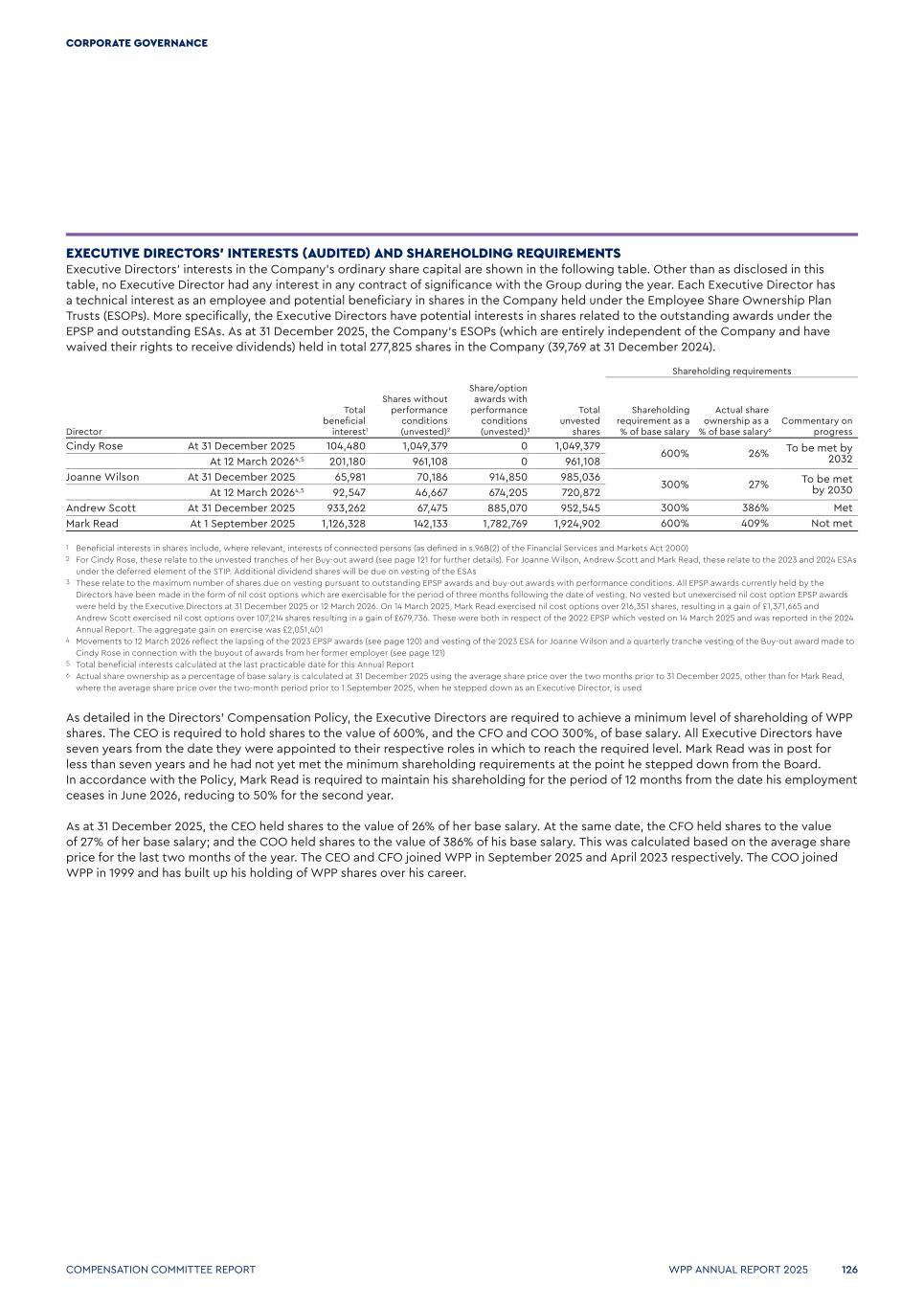
EXECUTIVE DIRECTORS’ INTERESTS (AUDITED) AND SHAREHOLDING REQUIREMENTS Executive Directors’ interests in the Company’s ordinary share capital are shown in the following table. Other than as disclosed in this table, no Executive Director had any interest in any contract of significance with the Group during the year. Each Executive Director has a technical interest as an employee and potential beneficiary in shares in the Company held under the Employee Share Ownership Plan Trusts (ESOPs). More specifically, the Executive Directors have potential interests in shares related to the outstanding awards under the EPSP and outstanding ESAs. As at 31 December 2025, the Company’s ESOPs (which are entirely independent of the Company and have waived their rights to receive dividends) held in total 277,825 shares in the Company (39,769 at 31 December 2024). Shareholding requirements Director Total beneficial interest1 Shares without performance conditions (unvested)2 Share/option awards with performance conditions (unvested)3 Total unvested shares Shareholding requirement as a % of base salary Actual share ownership as a % of base salary6 Commentary on progress Cindy Rose At 31 December 2025 104,480 1,049,379 0 1,049,379 600% 26% To be met by 2032At 12 March 20264,5 201,180 961,108 0 961,108 Joanne Wilson At 31 December 2025 65,981 70,186 914,850 985,036 300% 27% To be met by 2030At 12 March 20264,5 92,547 46,667 674,205 720,872 Andrew Scott At 31 December 2025 933,262 67,475 885,070 952,545 300% 386% Met Mark Read At 1 September 2025 1,126,328 142,133 1,782,769 1,924,902 600% 409% Not met 1 Beneficial interests in shares include, where relevant, interests of connected persons (as defined in s.96B(2) of the Financial Services and Markets Act 2000) 2 For Cindy Rose, these relate to the unvested tranches of her Buy-out award (see page 121 for further details). For Joanne Wilson, Andrew Scott and Mark Read, these relate to the 2023 and 2024 ESAs under the deferred element of the STIP. Additional dividend shares will be due on vesting of the ESAs 3 These relate to the maximum number of shares due on vesting pursuant to outstanding EPSP awards and buy-out awards with performance conditions. All EPSP awards currently held by the Directors have been made in the form of nil cost options which are exercisable for the period of three months following the date of vesting. No vested but unexercised nil cost option EPSP awards were held by the Executive Directors at 31 December 2025 or 12 March 2026. On 14 March 2025, Mark Read exercised nil cost options over 216,351 shares, resulting in a gain of £1,371,665 and Andrew Scott exercised nil cost options over 107,214 shares resulting in a gain of £679,736. These were both in respect of the 2022 EPSP which vested on 14 March 2025 and was reported in the 2024 Annual Report. The aggregate gain on exercise was £2,051,401 4 Movements to 12 March 2026 reflect the lapsing of the 2023 EPSP awards (see page 120) and vesting of the 2023 ESA for Joanne Wilson and a quarterly tranche vesting of the Buy-out award made to Cindy Rose in connection with the buyout of awards from her former employer (see page 121) 5 Total beneficial interests calculated at the last practicable date for this Annual Report 6 Actual share ownership as a percentage of base salary is calculated at 31 December 2025 using the average share price over the two months prior to 31 December 2025, other than for Mark Read, where the average share price over the two-month period prior to 1 September 2025, when he stepped down as an Executive Director, is used As detailed in the Directors’ Compensation Policy, the Executive Directors are required to achieve a minimum level of shareholding of WPP shares. The CEO is required to hold shares to the value of 600%, and the CFO and COO 300%, of base salary. All Executive Directors have seven years from the date they were appointed to their respective roles in which to reach the required level. Mark Read was in post for less than seven years and he had not yet met the minimum shareholding requirements at the point he stepped down from the Board. In accordance with the Policy, Mark Read is required to maintain his shareholding for the period of 12 months from the date his employment ceases in June 2026, reducing to 50% for the second year. As at 31 December 2025, the CEO held shares to the value of 26% of her base salary. At the same date, the CFO held shares to the value of 27% of her base salary; and the COO held shares to the value of 386% of his base salary. This was calculated based on the average share price for the last two months of the year. The CEO and CFO joined WPP in September 2025 and April 2023 respectively. The COO joined WPP in 1999 and has built up his holding of WPP shares over his career. WPP ANNUAL REPORT 2025 126 CORPORATE GOVERNANCE COMPENSATION COMMITTEE REPORT
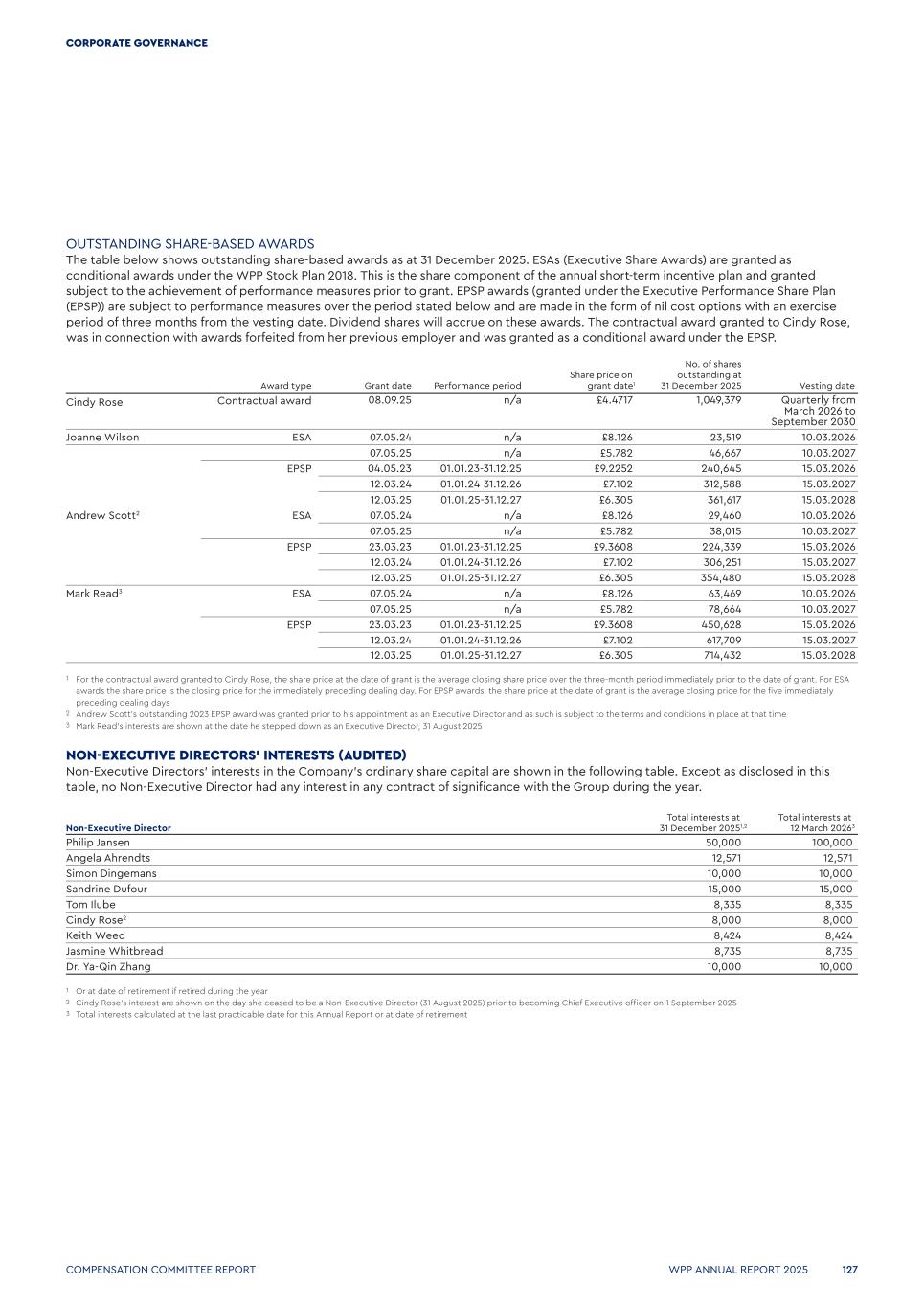
OUTSTANDING SHARE-BASED AWARDS The table below shows outstanding share-based awards as at 31 December 2025. ESAs (Executive Share Awards) are granted as conditional awards under the WPP Stock Plan 2018. This is the share component of the annual short-term incentive plan and granted subject to the achievement of performance measures prior to grant. EPSP awards (granted under the Executive Performance Share Plan (EPSP)) are subject to performance measures over the period stated below and are made in the form of nil cost options with an exercise period of three months from the vesting date. Dividend shares will accrue on these awards. The contractual award granted to Cindy Rose, was in connection with awards forfeited from her previous employer and was granted as a conditional award under the EPSP. Award type Grant date Performance period Share price on grant date1 No. of shares outstanding at 31 December 2025 Vesting date Cindy Rose Contractual award 08.09.25 n/a £4.4717 1,049,379 Quarterly from March 2026 to September 2030 Joanne Wilson ESA 07.05.24 n/a £8.126 23,519 10.03.2026 07.05.25 n/a £5.782 46,667 10.03.2027 EPSP 04.05.23 01.01.23-31.12.25 £9.2252 240,645 15.03.2026 12.03.24 01.01.24-31.12.26 £7.102 312,588 15.03.2027 12.03.25 01.01.25-31.12.27 £6.305 361,617 15.03.2028 Andrew Scott2 ESA 07.05.24 n/a £8.126 29,460 10.03.2026 07.05.25 n/a £5.782 38,015 10.03.2027 EPSP 23.03.23 01.01.23-31.12.25 £9.3608 224,339 15.03.2026 12.03.24 01.01.24-31.12.26 £7.102 306,251 15.03.2027 12.03.25 01.01.25-31.12.27 £6.305 354,480 15.03.2028 Mark Read3 ESA 07.05.24 n/a £8.126 63,469 10.03.2026 07.05.25 n/a £5.782 78,664 10.03.2027 EPSP 23.03.23 01.01.23-31.12.25 £9.3608 450,628 15.03.2026 12.03.24 01.01.24-31.12.26 £7.102 617,709 15.03.2027 12.03.25 01.01.25-31.12.27 £6.305 714,432 15.03.2028 1 For the contractual award granted to Cindy Rose, the share price at the date of grant is the average closing share price over the three-month period immediately prior to the date of grant. For ESA awards the share price is the closing price for the immediately preceding dealing day. For EPSP awards, the share price at the date of grant is the average closing price for the five immediately preceding dealing days 2 Andrew Scott’s outstanding 2023 EPSP award was granted prior to his appointment as an Executive Director and as such is subject to the terms and conditions in place at that time 3 Mark Read’s interests are shown at the date he stepped down as an Executive Director, 31 August 2025 NON-EXECUTIVE DIRECTORS’ INTERESTS (AUDITED) Non-Executive Directors’ interests in the Company’s ordinary share capital are shown in the following table. Except as disclosed in this table, no Non-Executive Director had any interest in any contract of significance with the Group during the year. Non-Executive Director Total interests at 31 December 20251,2 Total interests at 12 March 20263 Philip Jansen 50,000 100,000 Angela Ahrendts 12,571 12,571 Simon Dingemans 10,000 10,000 Sandrine Dufour 15,000 15,000 Tom Ilube 8,335 8,335 Cindy Rose2 8,000 8,000 Keith Weed 8,424 8,424 Jasmine Whitbread 8,735 8,735 Dr. Ya‑Qin Zhang 10,000 10,000 1 Or at date of retirement if retired during the year 2 Cindy Rose’s interest are shown on the day she ceased to be a Non-Executive Director (31 August 2025) prior to becoming Chief Executive officer on 1 September 2025 3 Total interests calculated at the last practicable date for this Annual Report or at date of retirement WPP ANNUAL REPORT 2025 127 CORPORATE GOVERNANCE COMPENSATION COMMITTEE REPORT
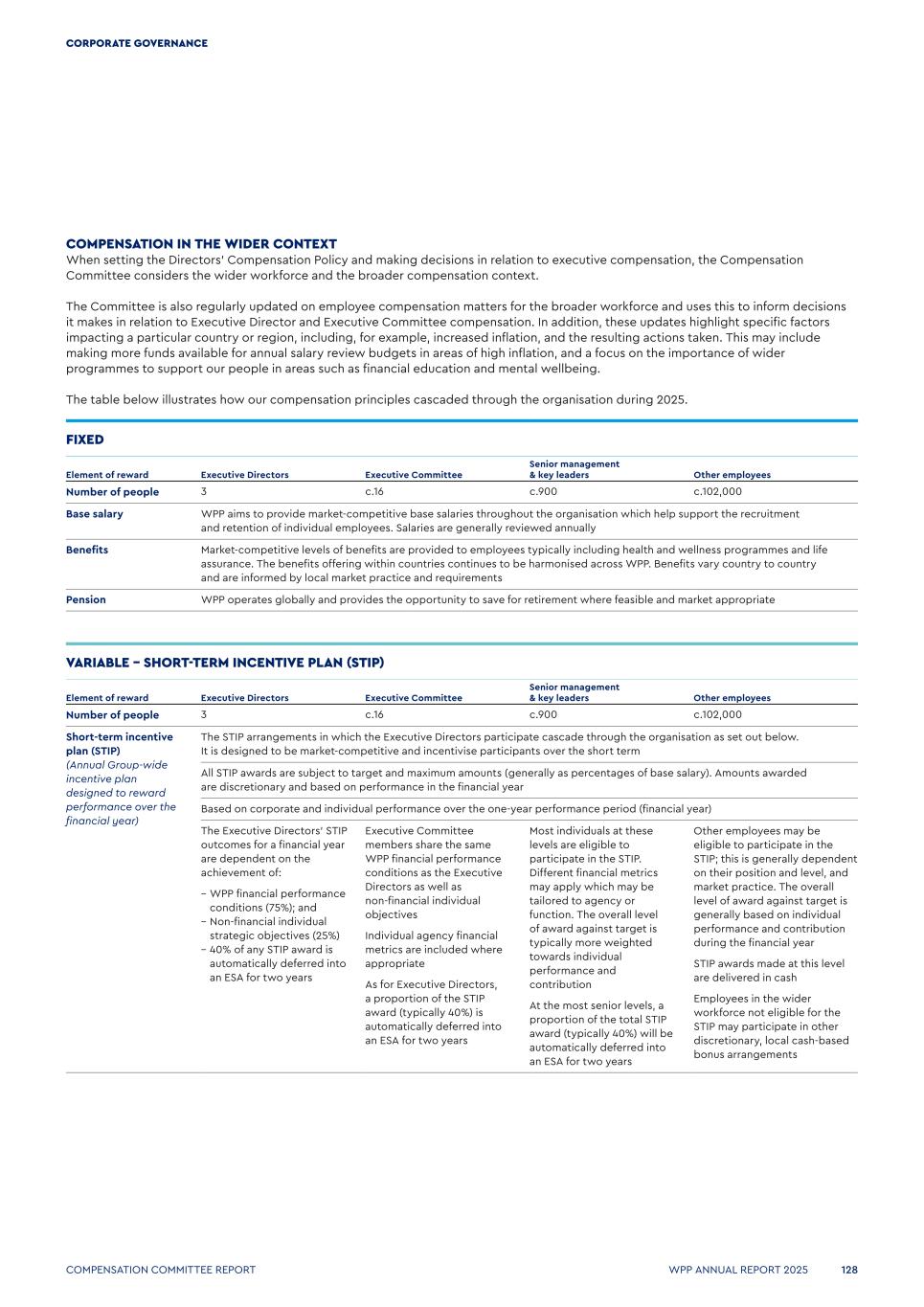
COMPENSATION IN THE WIDER CONTEXT When setting the Directors’ Compensation Policy and making decisions in relation to executive compensation, the Compensation Committee considers the wider workforce and the broader compensation context. The Committee is also regularly updated on employee compensation matters for the broader workforce and uses this to inform decisions it makes in relation to Executive Director and Executive Committee compensation. In addition, these updates highlight specific factors impacting a particular country or region, including, for example, increased inflation, and the resulting actions taken. This may include making more funds available for annual salary review budgets in areas of high inflation, and a focus on the importance of wider programmes to support our people in areas such as financial education and mental wellbeing. The table below illustrates how our compensation principles cascaded through the organisation during 2025. FIXED Element of reward Executive Directors Executive Committee Senior management & key leaders Other employees Number of people 3 c.16 c.900 c.102,000 Base salary WPP aims to provide market-competitive base salaries throughout the organisation which help support the recruitment and retention of individual employees. Salaries are generally reviewed annually Benefits Market-competitive levels of benefits are provided to employees typically including health and wellness programmes and life assurance. The benefits offering within countries continues to be harmonised across WPP. Benefits vary country to country and are informed by local market practice and requirements Pension WPP operates globally and provides the opportunity to save for retirement where feasible and market appropriate VARIABLE – SHORT-TERM INCENTIVE PLAN (STIP) Element of reward Executive Directors Executive Committee Senior management & key leaders Other employees Number of people 3 c.16 c.900 c.102,000 Short-term incentive plan (STIP) (Annual Group-wide incentive plan designed to reward performance over the financial year) The STIP arrangements in which the Executive Directors participate cascade through the organisation as set out below. It is designed to be market-competitive and incentivise participants over the short term All STIP awards are subject to target and maximum amounts (generally as percentages of base salary). Amounts awarded are discretionary and based on performance in the financial year Based on corporate and individual performance over the one-year performance period (financial year) The Executive Directors’ STIP outcomes for a financial year are dependent on the achievement of: – WPP financial performance conditions (75%); and – Non‑financial individual strategic objectives (25%) – 40% of any STIP award is automatically deferred into an ESA for two years Executive Committee members share the same WPP financial performance conditions as the Executive Directors as well as non-financial individual objectives Individual agency financial metrics are included where appropriate As for Executive Directors, a proportion of the STIP award (typically 40%) is automatically deferred into an ESA for two years Most individuals at these levels are eligible to participate in the STIP. Different financial metrics may apply which may be tailored to agency or function. The overall level of award against target is typically more weighted towards individual performance and contribution At the most senior levels, a proportion of the total STIP award (typically 40%) will be automatically deferred into an ESA for two years Other employees may be eligible to participate in the STIP; this is generally dependent on their position and level, and market practice. The overall level of award against target is generally based on individual performance and contribution during the financial year STIP awards made at this level are delivered in cash Employees in the wider workforce not eligible for the STIP may participate in other discretionary, local cash-based bonus arrangements WPP ANNUAL REPORT 2025 128 CORPORATE GOVERNANCE COMPENSATION COMMITTEE REPORT
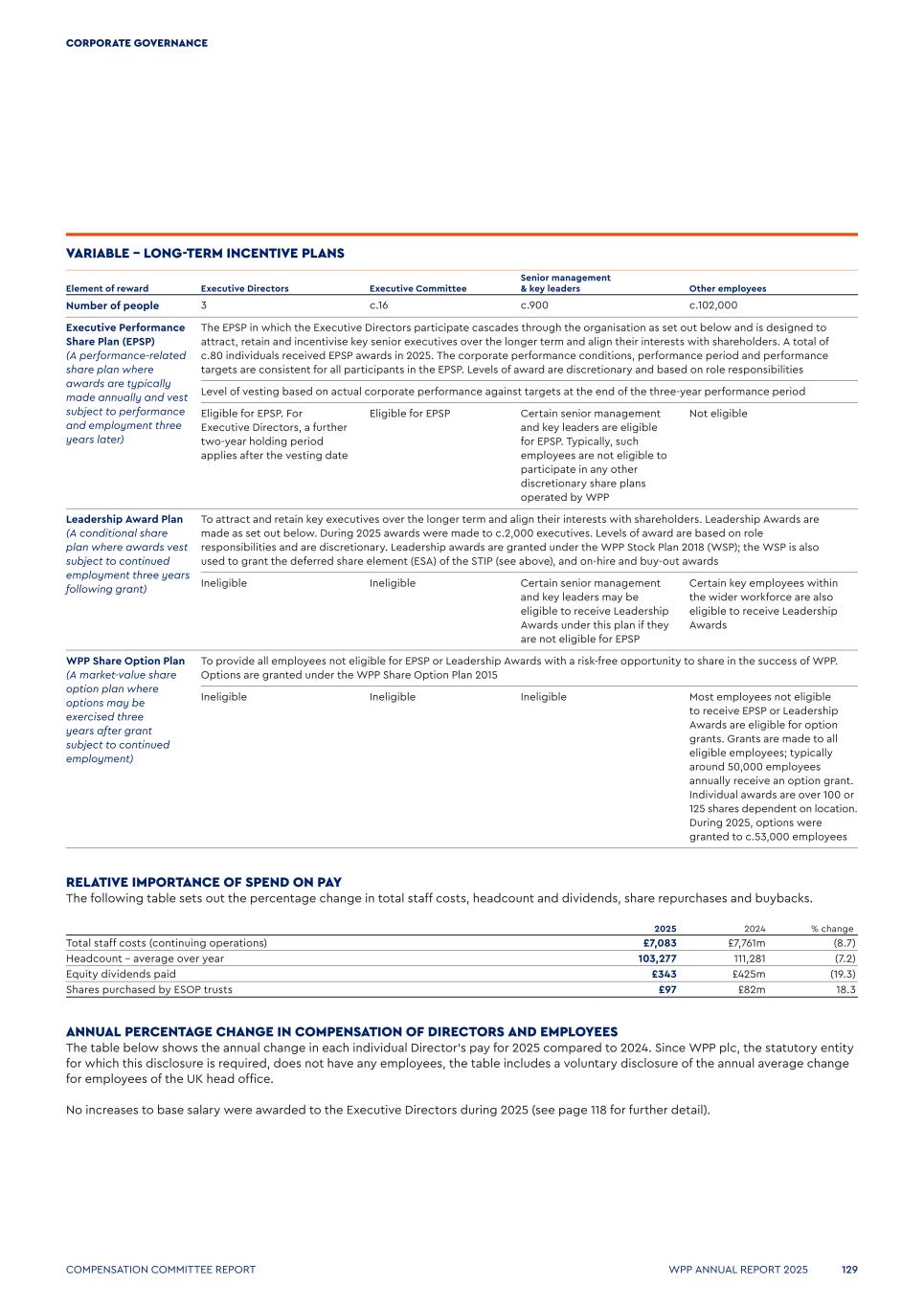
VARIABLE – LONG-TERM INCENTIVE PLANS Element of reward Executive Directors Executive Committee Senior management & key leaders Other employees Number of people 3 c.16 c.900 c.102,000 Executive Performance Share Plan (EPSP) (A performance-related share plan where awards are typically made annually and vest subject to performance and employment three years later) The EPSP in which the Executive Directors participate cascades through the organisation as set out below and is designed to attract, retain and incentivise key senior executives over the longer term and align their interests with shareholders. A total of c.80 individuals received EPSP awards in 2025. The corporate performance conditions, performance period and performance targets are consistent for all participants in the EPSP. Levels of award are discretionary and based on role responsibilities Level of vesting based on actual corporate performance against targets at the end of the three-year performance period Eligible for EPSP. For Executive Directors, a further two-year holding period applies after the vesting date Eligible for EPSP Certain senior management and key leaders are eligible for EPSP. Typically, such employees are not eligible to participate in any other discretionary share plans operated by WPP Not eligible Leadership Award Plan (A conditional share plan where awards vest subject to continued employment three years following grant) To attract and retain key executives over the longer term and align their interests with shareholders. Leadership Awards are made as set out below. During 2025 awards were made to c.2,000 executives. Levels of award are based on role responsibilities and are discretionary. Leadership awards are granted under the WPP Stock Plan 2018 (WSP); the WSP is also used to grant the deferred share element (ESA) of the STIP (see above), and on-hire and buy-out awards Ineligible Ineligible Certain senior management and key leaders may be eligible to receive Leadership Awards under this plan if they are not eligible for EPSP Certain key employees within the wider workforce are also eligible to receive Leadership Awards WPP Share Option Plan (A market-value share option plan where options may be exercised three years after grant subject to continued employment) To provide all employees not eligible for EPSP or Leadership Awards with a risk-free opportunity to share in the success of WPP. Options are granted under the WPP Share Option Plan 2015 Ineligible Ineligible Ineligible Most employees not eligible to receive EPSP or Leadership Awards are eligible for option grants. Grants are made to all eligible employees; typically around 50,000 employees annually receive an option grant. Individual awards are over 100 or 125 shares dependent on location. During 2025, options were granted to c.53,000 employees RELATIVE IMPORTANCE OF SPEND ON PAY The following table sets out the percentage change in total staff costs, headcount and dividends, share repurchases and buybacks. 2025 2024 % change Total staff costs (continuing operations) £7,083 £7,761m (8.7) Headcount – average over year 103,277 111,281 (7.2) Equity dividends paid £343 £425m (19.3) Shares purchased by ESOP trusts £97 £82m 18.3 ANNUAL PERCENTAGE CHANGE IN COMPENSATION OF DIRECTORS AND EMPLOYEES The table below shows the annual change in each individual Director’s pay for 2025 compared to 2024. Since WPP plc, the statutory entity for which this disclosure is required, does not have any employees, the table includes a voluntary disclosure of the annual average change for employees of the UK head office. No increases to base salary were awarded to the Executive Directors during 2025 (see page 118 for further detail). WPP ANNUAL REPORT 2025 129 CORPORATE GOVERNANCE COMPENSATION COMMITTEE REPORT
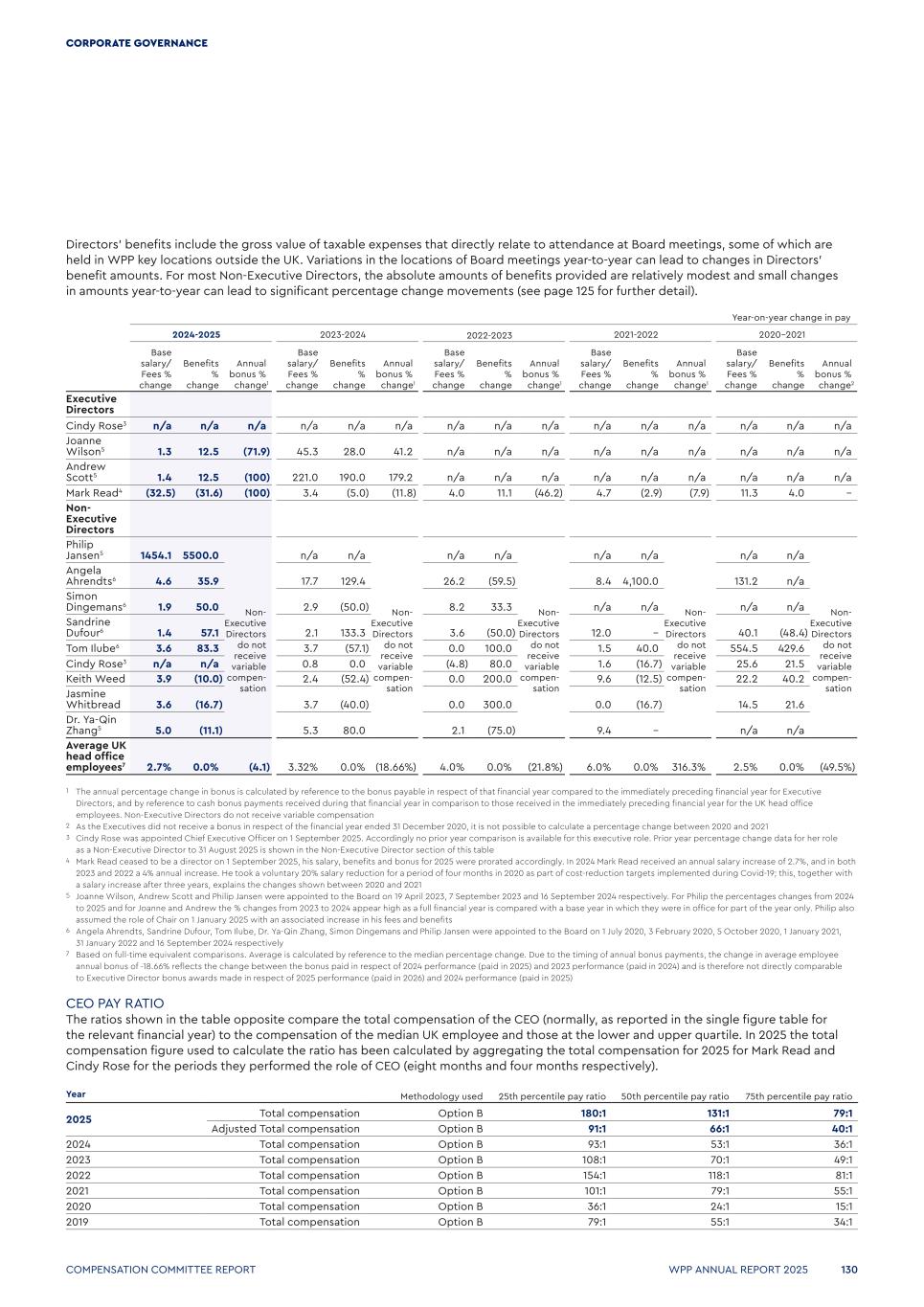
Directors’ benefits include the gross value of taxable expenses that directly relate to attendance at Board meetings, some of which are held in WPP key locations outside the UK. Variations in the locations of Board meetings year-to-year can lead to changes in Directors’ benefit amounts. For most Non-Executive Directors, the absolute amounts of benefits provided are relatively modest and small changes in amounts year-to-year can lead to significant percentage change movements (see page 125 for further detail). Year-on-year change in pay 2024-2025 2023-2024 2022-2023 2021-2022 2020-2021 Base salary/ Fees % change Benefits % change Annual bonus % change1 Base salary/ Fees % change Benefits % change Annual bonus % change1 Base salary/ Fees % change Benefits % change Annual bonus % change1 Base salary/ Fees % change Benefits % change Annual bonus % change1 Base salary/ Fees % change Benefits % change Annual bonus % change2 Executive Directors Cindy Rose3 n/a n/a n/a n/a n/a n/a n/a n/a n/a n/a n/a n/a n/a n/a n/a Joanne Wilson5 1.3 12.5 (71.9) 45.3 28.0 41.2 n/a n/a n/a n/a n/a n/a n/a n/a n/a Andrew Scott5 1.4 12.5 (100) 221.0 190.0 179.2 n/a n/a n/a n/a n/a n/a n/a n/a n/a Mark Read4 (32.5) (31.6) (100) 3.4 (5.0) (11.8) 4.0 11.1 (46.2) 4.7 (2.9) (7.9) 11.3 4.0 – Non- Executive Directors Philip Jansen5 1454.1 5500.0 n/a n/a n/a n/a n/a n/a n/a n/a Angela Ahrendts6 4.6 35.9 Non- Executive Directors do not receive variable compen- sation 17.7 129.4 Non- Executive Directors do not receive variable compen- sation 26.2 (59.5) Non- Executive Directors do not receive variable compen- sation 8.4 4,100.0 Non- Executive Directors do not receive variable compen- sation 131.2 n/a Non- Executive Directors do not receive variable compen- sation Simon Dingemans6 1.9 50.0 2.9 (50.0) 8.2 33.3 n/a n/a n/a n/a Sandrine Dufour6 1.4 57.1 2.1 133.3 3.6 (50.0) 12.0 – 40.1 (48.4) Tom Ilube6 3.6 83.3 3.7 (57.1) 0.0 100.0 1.5 40.0 554.5 429.6 Cindy Rose3 n/a n/a 0.8 0.0 (4.8) 80.0 1.6 (16.7) 25.6 21.5 Keith Weed 3.9 (10.0) 2.4 (52.4) 0.0 200.0 9.6 (12.5) 22.2 40.2 Jasmine Whitbread 3.6 (16.7) 3.7 (40.0) 0.0 300.0 0.0 (16.7) 14.5 21.6 Dr. Ya‑Qin Zhang5 5.0 (11.1) 5.3 80.0 2.1 (75.0) 9.4 – n/a n/a Average UK head office employees7 2.7% 0.0% (4.1) 3.32% 0.0% (18.66%) 4.0% 0.0% (21.8%) 6.0% 0.0% 316.3% 2.5% 0.0% (49.5%) 1 The annual percentage change in bonus is calculated by reference to the bonus payable in respect of that financial year compared to the immediately preceding financial year for Executive Directors, and by reference to cash bonus payments received during that financial year in comparison to those received in the immediately preceding financial year for the UK head office employees. Non-Executive Directors do not receive variable compensation 2 As the Executives did not receive a bonus in respect of the financial year ended 31 December 2020, it is not possible to calculate a percentage change between 2020 and 2021 3 Cindy Rose was appointed Chief Executive Officer on 1 September 2025. Accordingly no prior year comparison is available for this executive role. Prior year percentage change data for her role as a Non-Executive Director to 31 August 2025 is shown in the Non-Executive Director section of this table 4 Mark Read ceased to be a director on 1 September 2025, his salary, benefits and bonus for 2025 were prorated accordingly. In 2024 Mark Read received an annual salary increase of 2.7%, and in both 2023 and 2022 a 4% annual increase. He took a voluntary 20% salary reduction for a period of four months in 2020 as part of cost-reduction targets implemented during Covid-19; this, together with a salary increase after three years, explains the changes shown between 2020 and 2021 5 Joanne Wilson, Andrew Scott and Philip Jansen were appointed to the Board on 19 April 2023, 7 September 2023 and 16 September 2024 respectively. For Philip the percentages changes from 2024 to 2025 and for Joanne and Andrew the % changes from 2023 to 2024 appear high as a full financial year is compared with a base year in which they were in office for part of the year only. Philip also assumed the role of Chair on 1 January 2025 with an associated increase in his fees and benefits 6 Angela Ahrendts, Sandrine Dufour, Tom Ilube, Dr. Ya-Qin Zhang, Simon Dingemans and Philip Jansen were appointed to the Board on 1 July 2020, 3 February 2020, 5 October 2020, 1 January 2021, 31 January 2022 and 16 September 2024 respectively 7 Based on full-time equivalent comparisons. Average is calculated by reference to the median percentage change. Due to the timing of annual bonus payments, the change in average employee annual bonus of -18.66% reflects the change between the bonus paid in respect of 2024 performance (paid in 2025) and 2023 performance (paid in 2024) and is therefore not directly comparable to Executive Director bonus awards made in respect of 2025 performance (paid in 2026) and 2024 performance (paid in 2025) CEO PAY RATIO The ratios shown in the table opposite compare the total compensation of the CEO (normally, as reported in the single figure table for the relevant financial year) to the compensation of the median UK employee and those at the lower and upper quartile. In 2025 the total compensation figure used to calculate the ratio has been calculated by aggregating the total compensation for 2025 for Mark Read and Cindy Rose for the periods they performed the role of CEO (eight months and four months respectively). Year Methodology used 25th percentile pay ratio 50th percentile pay ratio 75th percentile pay ratio 2025 Total compensation Option B 180:1 131:1 79:1 Adjusted Total compensation Option B 91:1 66:1 40:1 2024 Total compensation Option B 93:1 53:1 36:1 2023 Total compensation Option B 108:1 70:1 49:1 2022 Total compensation Option B 154:1 118:1 81:1 2021 Total compensation Option B 101:1 79:1 55:1 2020 Total compensation Option B 36:1 24:1 15:1 2019 Total compensation Option B 79:1 55:1 34:1 WPP ANNUAL REPORT 2025 130 CORPORATE GOVERNANCE COMPENSATION COMMITTEE REPORT
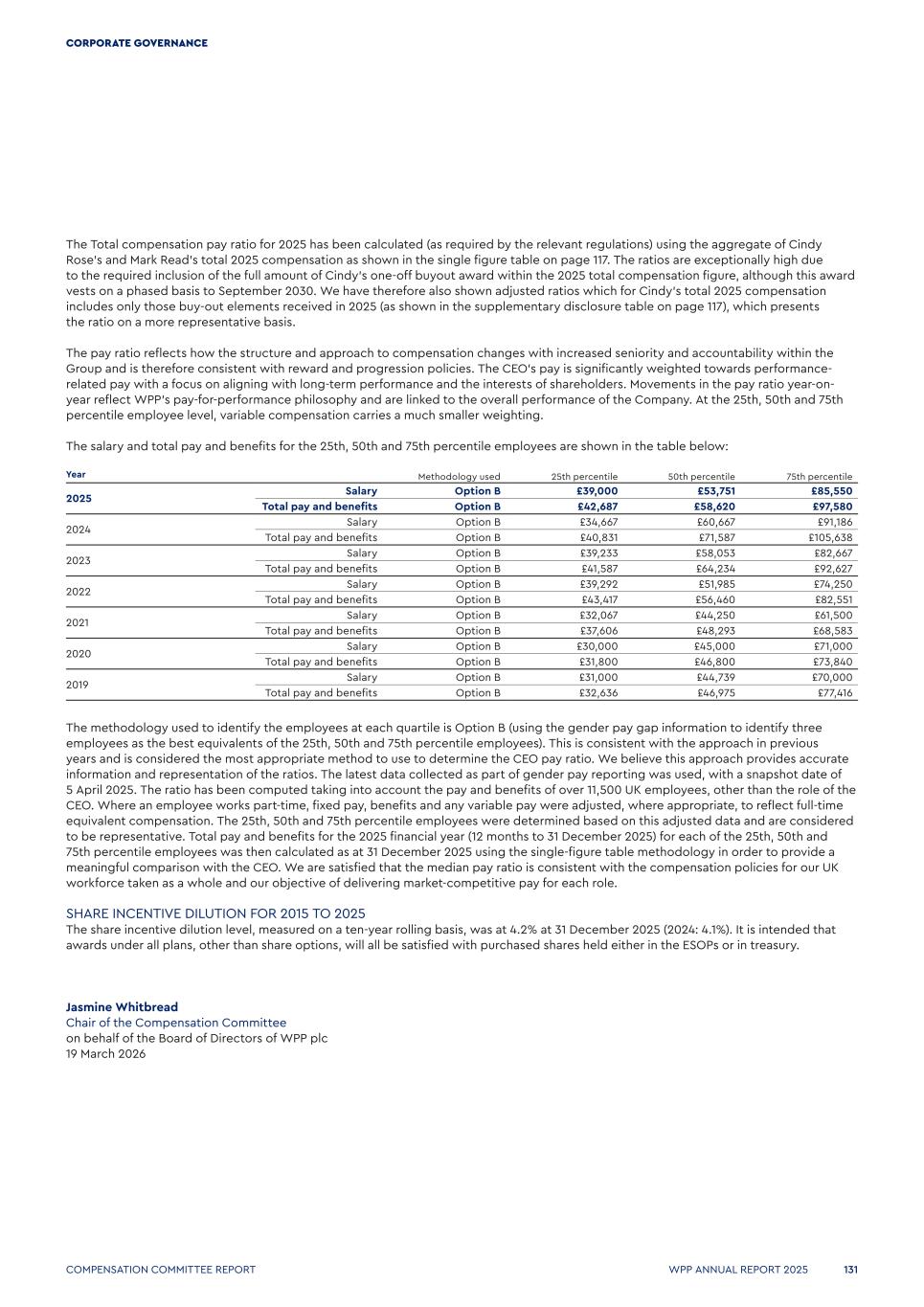
The Total compensation pay ratio for 2025 has been calculated (as required by the relevant regulations) using the aggregate of Cindy Rose’s and Mark Read’s total 2025 compensation as shown in the single figure table on page 117. The ratios are exceptionally high due to the required inclusion of the full amount of Cindy’s one-off buyout award within the 2025 total compensation figure, although this award vests on a phased basis to September 2030. We have therefore also shown adjusted ratios which for Cindy’s total 2025 compensation includes only those buy-out elements received in 2025 (as shown in the supplementary disclosure table on page 117), which presents the ratio on a more representative basis. The pay ratio reflects how the structure and approach to compensation changes with increased seniority and accountability within the Group and is therefore consistent with reward and progression policies. The CEO’s pay is significantly weighted towards performance- related pay with a focus on aligning with long-term performance and the interests of shareholders. Movements in the pay ratio year-on- year reflect WPP’s pay‑for‑performance philosophy and are linked to the overall performance of the Company. At the 25th, 50th and 75th percentile employee level, variable compensation carries a much smaller weighting. The salary and total pay and benefits for the 25th, 50th and 75th percentile employees are shown in the table below: Year Methodology used 25th percentile 50th percentile 75th percentile 2025 Salary Option B £39,000 £53,751 £85,550 Total pay and benefits Option B £42,687 £58,620 £97,580 2024 Salary Option B £34,667 £60,667 £91,186 Total pay and benefits Option B £40,831 £71,587 £105,638 2023 Salary Option B £39,233 £58,053 £82,667 Total pay and benefits Option B £41,587 £64,234 £92,627 2022 Salary Option B £39,292 £51,985 £74,250 Total pay and benefits Option B £43,417 £56,460 £82,551 2021 Salary Option B £32,067 £44,250 £61,500 Total pay and benefits Option B £37,606 £48,293 £68,583 2020 Salary Option B £30,000 £45,000 £71,000 Total pay and benefits Option B £31,800 £46,800 £73,840 2019 Salary Option B £31,000 £44,739 £70,000 Total pay and benefits Option B £32,636 £46,975 £77,416 The methodology used to identify the employees at each quartile is Option B (using the gender pay gap information to identify three employees as the best equivalents of the 25th, 50th and 75th percentile employees). This is consistent with the approach in previous years and is considered the most appropriate method to use to determine the CEO pay ratio. We believe this approach provides accurate information and representation of the ratios. The latest data collected as part of gender pay reporting was used, with a snapshot date of 5 April 2025. The ratio has been computed taking into account the pay and benefits of over 11,500 UK employees, other than the role of the CEO. Where an employee works part-time, fixed pay, benefits and any variable pay were adjusted, where appropriate, to reflect full-time equivalent compensation. The 25th, 50th and 75th percentile employees were determined based on this adjusted data and are considered to be representative. Total pay and benefits for the 2025 financial year (12 months to 31 December 2025) for each of the 25th, 50th and 75th percentile employees was then calculated as at 31 December 2025 using the single-figure table methodology in order to provide a meaningful comparison with the CEO. We are satisfied that the median pay ratio is consistent with the compensation policies for our UK workforce taken as a whole and our objective of delivering market-competitive pay for each role. SHARE INCENTIVE DILUTION FOR 2015 TO 2025 The share incentive dilution level, measured on a ten-year rolling basis, was at 4.2% at 31 December 2025 (2024: 4.1%). It is intended that awards under all plans, other than share options, will all be satisfied with purchased shares held either in the ESOPs or in treasury. Jasmine Whitbread Chair of the Compensation Committee on behalf of the Board of Directors of WPP plc 19 March 2026 WPP ANNUAL REPORT 2025 131 CORPORATE GOVERNANCE COMPENSATION COMMITTEE REPORT