Adopted by the directors: 14 April 2015 Approved by shareholders: 9 June 2015 Amended: 5 December 2019 Renewal and amendment approved by directors: 24 March 2025 Renewal and amendment approved by shareholders: 23 May 2025 Expiry: 22 May 2035 Rules of the WPP PLC Share Option Plan
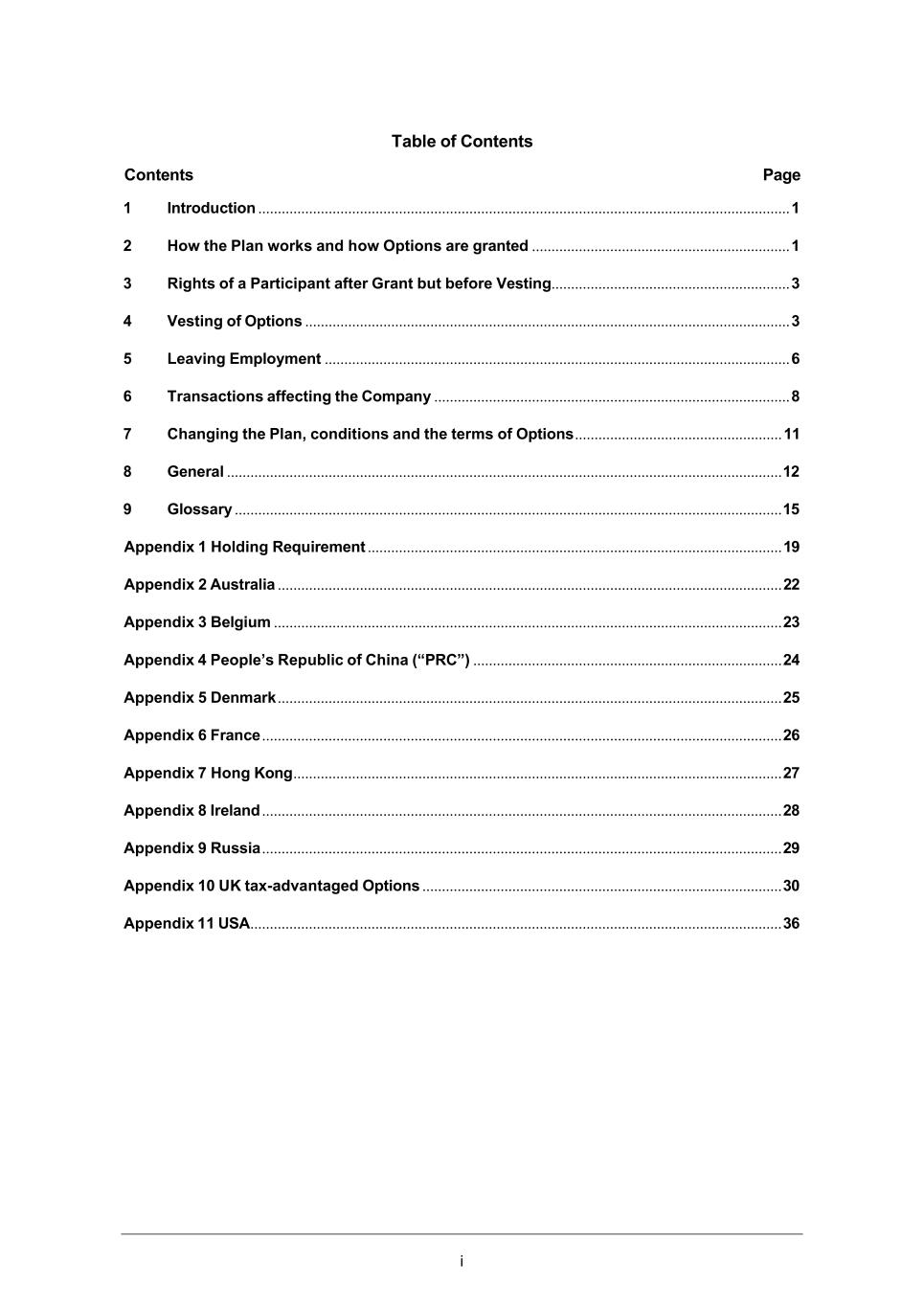
i Table of Contents Contents Page 1 Introduction ........................................................................................................................................ 1 2 How the Plan works and how Options are granted .................................................................. 1 3 Rights of a Participant after Grant but before Vesting............................................................. 3 4 Vesting of Options ............................................................................................................................ 3 5 Leaving Employment ....................................................................................................................... 6 6 Transactions affecting the Company ........................................................................................... 8 7 Changing the Plan, conditions and the terms of Options ..................................................... 11 8 General .............................................................................................................................................. 12 9 Glossary ............................................................................................................................................ 15 Appendix 1 Holding Requirement .......................................................................................................... 19 Appendix 2 Australia ................................................................................................................................. 22 Appendix 3 Belgium .................................................................................................................................. 23 Appendix 4 People’s Republic of China (“PRC”) ............................................................................... 24 Appendix 5 Denmark ................................................................................................................................. 25 Appendix 6 France ..................................................................................................................................... 26 Appendix 7 Hong Kong ............................................................................................................................. 27 Appendix 8 Ireland ..................................................................................................................................... 28 Appendix 9 Russia ..................................................................................................................................... 29 Appendix 10 UK tax-advantaged Options ............................................................................................ 30 Appendix 11 USA ........................................................................................................................................ 36
1 1 Introduction These rules apply to Options granted after the date on which shareholders approved the renewal and amendment of the Plan. Options granted before that date are governed by the rules applicable at that time. 2 How the Plan works and how Options are granted 2.1 How the Plan works The Plan gives a Participant the right to buy Shares subject to the satisfaction of certain conditions, continued employment and payment of any Option Price. 2.2 Participation An Option may be granted to any Eligible Employee selected by the Compensation Committee. However, unless the Compensation Committee considers that special circumstances exist, an Option may not be granted to an employee who, on the Grant Date, has given or received notice of termination of employment, whether or not that termination is lawful. 2.3 Timing of Option grants Options can be granted at any time prior to 23 May 2035, but Options granted to an executive director of the Company may only be granted within 42 days starting on any of the following: 2.3.1 the Business Day after the announcement of the Company’s results through a Regulatory Information Service for any period; 2.3.2 the Business Day after any general meeting of the Company; 2.3.3 any day on which the Company decides that exceptional circumstances exist that justify the grant of Options (such as in connection with a recruitment); 2.3.4 any day on which changes to the legislation or regulations affecting the Plan are announced, effected or made; or 2.3.5 the lifting of Dealing Restrictions that prevented the granting of Options during any period specified above. 2.4 Terms to be set at grant The Compensation Committee will determine the following terms when each Option is granted: 2.4.1 the number of Shares subject to the Option or the basis on which it will be determined; 2.4.2 the Option Price (which must be at least Market Value as at the Grant Date) and the Final Exercise Date (if it is not 10 years from the Grant Date); 2.4.3 the Grant Date; 2.4.4 the terms of any Performance Condition or other condition set under rule 2.8 (Conditions);
2 2.4.5 the Normal Vesting Date(s) and, if more than one, the number of Shares Vesting on each such date or how that will be determined; 2.4.6 whether Malus and Clawback applies to the Option; and 2.4.7 whether or not a Holding Requirement will apply, and, if so, when the Holding Period will normally end. If a Holding Requirement applies to an Option, Appendix 1 (Holding Requirements) will apply. 2.5 Personal limit An Option granted to an executive director of the Company, must not exceed any limit set in the Directors’ Compensation Policy as at the Grant Date. 2.6 Other limits There are also limits on the number of Shares that can be issued under the Plan - see rule 8.1 (Company limits). 2.7 Administrative errors If the Company grants an Option which is inconsistent with rule 2.2 (Participation), it will lapse immediately. If the Company purports to grant an Option that is inconsistent with rules 2.5 (Personal limit) or 2.6 (Other limits), the Option will be limited on a basis consistent with those rules with effect from the Grant Date. 2.8 Conditions 2.8.1 The Compensation Committee may decide that Vesting of an Option will be conditional on the satisfaction of one or more conditions linked to the performance of the Company, the Participant or the Business or Member of the Group for which the Participant works (a “Performance Condition”). 2.8.2 The Compensation Committee may impose other conditions when granting an Option. 2.8.3 A Performance Condition or other condition may provide that an Option will lapse to the extent it is not satisfied. The Compensation Committee may waive or change a condition in accordance with its terms or if anything happens which causes the Compensation Committee reasonably to consider it appropriate to do so. 2.9 Documentation Options must be granted by deed or other legally binding document. The terms of the Option, as determined by the Compensation Committee under rule 2.4 (Terms to be set at grant) will be specified in the deed or other document. As soon as practicable after granting an Option, the Company will provide evidence to the Participant of the grant. 2.10 No requirement to pay for an Option A Participant is not required to pay for the grant of any Option.
3 2.11 Right to decline A Participant may decline their Option within 30 days after the Grant Date by notice in writing to any person nominated by the Compensation Committee (or during such longer period as the Compensation Committee may allow if the Participant is prevented from declining the Option by any Dealing Restriction). If this happens, the Option will be treated as if it had never been granted. A Participant is not required to make any payment to decline an Option. 2.12 Malus and Clawback Where an Option is granted subject to Malus and Clawback Provisions, if there is any discrepancy between the Malus and Clawback Provisions and the Plan, the Malus and Clawback Provisions will prevail. 3 Rights of a Participant after Grant but before Vesting 3.1 No transfer of Options Subject to rule 3.2 (Transfer on death), a Participant may not transfer, assign, charge or otherwise dispose of an Option or any rights in respect of it. If a Participant does, whether voluntarily or involuntarily, then the Option will lapse immediately unless the Compensation Committee decides to the contrary. 3.2 Transfer on death Rule 3.1 (No transfer of Options) does not apply to the transfer of an Option on the death of a Participant, in which case rights under an Option are transferred to the personal representatives of a Participant as set out rule 5.5 (Death). 3.3 No share rights before exercise A Participant cannot vote and is not entitled to receive dividends or have any other rights of a shareholder in respect of the Shares subject to an Option until after the issue or transfer of Shares, as described in rule 4.7 (Share rights after exercise). 4 Vesting of Options 4.1 Determining Vesting As soon as reasonably practicable after the end of the Performance Period and subject to rule 4.4 (Adjustments to formulaic outcomes), the Compensation Committee will determine the extent to which any Performance Condition or any other condition set under rule 2.8 (Conditions) has been satisfied and the number of Shares which will Vest under it. 4.2 Timing of Vesting Subject to the rest of these rules, an Option will normally Vest on the later of: 4.2.1 the Business Day after the date on which the Compensation Committee makes its determination under rule 4.1 (Determining Vesting); 4.2.2 any other date that the Compensation Committee sets for Vesting when making the determination under rule 4.3 (Timing of Vesting – investigation); 4.2.3 the Normal Vesting Date; and
4 4.2.4 the first date on which Vesting is not prevented by a Dealing Restriction. 4.3 Timing of Vesting – investigations Notwithstanding any other provision of this Plan, if an investigation commences or is ongoing regarding whether Malus and/or Clawback should be invoked in respect of a Participant then, unless otherwise determined by the Compensation Committee: 4.3.1 any unvested Options held by that Participant will not Vest, if at all, until after such investigation has been concluded; 4.3.2 any Vested but unexercised Options held by that Participant may not be exercised, if at all, until after such investigation has been concluded; and 4.3.3 the relevant period for exercise will not expire until such date as the Compensation Committee determines. The Compensation Committee may specify that an Option can only be exercised at particular times within the relevant period for exercise. Any Option not exercised by the end of the relevant period will lapse. 4.4 Adjustment to formulaic outcomes Notwithstanding any other provision of this Plan, the Compensation Committee, acting reasonably and in good faith, may adjust (upwards or downwards and including to zero) the amount of an Option which would otherwise Vest if the formulaic outcome of any Performance Condition or other condition set under rule 2.8 (Conditions) does not reflect overall corporate performance and the experience of shareholders, as a whole, in terms of value creation. To the extent that an Option is reduced under this discretion, the Option (or part thereof) will lapse immediately. 4.5 Consequences of Vesting 4.5.1 A Participant may only exercise an Option to the extent that is has Vested. 4.5.2 To exercise the Option the Participant must give notice (in such form as the Compensation Committee may prescribe) to the Company or any person nominated by the Compensation Committee and pay the Option Price or make arrangements satisfactory to the Compensation Committee for its payment. 4.5.3 As soon as reasonably practicable after a valid exercise of an Option, the Company will arrange (subject to any Holding Requirement, rules 4.8 (Payment of cash equivalent), 4.9 (Responsibility for tax), 4.10 (Methods for paying the tax) and 8.12 (Consents)) for the transfer or issue to, or to the order of, the Participant of the number of Shares in respect of which the Option is exercised. 4.5.4 To the extent that an Option has not been exercised by the close of business on the Final Exercise Date, the Participant will, unless they have given notice in writing to the contrary and subject to the condition set out below being satisfied, be deemed to have given a valid exercise notice at the close of business on the Final Exercise Date, together with a direction to sell sufficient of the Shares issued or transferred on the exercise of the Option to fund any Option Price and any taxation or social security contributions payable under rule 4.10 (Methods of paying the tax). The remaining Shares subject to the Option will be transferred as set out in rule 4.5.3.
5 The condition referred to above is that the expected sale proceeds of the Shares resulting from the exercise of the Option is more than the Option Price plus the expected costs of any sale (including any actual or estimated liability to taxation, social security contributions and any other related costs in respect of the Option). 4.5.5 The Option will lapse, at the latest, on the close of business on the Final Exercise Date. 4.5.6 If an Option lapses under more than one provision of the rules of the Plan, the provision resulting in the shortest exercise period will prevail. 4.6 Delivery – investigation Notwithstanding any other provision of this Plan, if an investigation commences or is ongoing regarding whether Malus and/or Clawback should be invoked in respect of a Participant then, unless otherwise determined by the Compensation Committee, any exercised but as yet unsatisfied Options held by that Participant will not be satisfied, if at all, until after such investigation has been concluded. 4.7 Share rights after exercise The Participant will be entitled to all rights attaching to the Shares that are transferred or issued following exercise by reference to a record date on or after the date of the transfer or issue. 4.8 Payment of cash equivalent The Compensation Committee may decide to satisfy an Option (in whole or in part) by paying an equivalent amount in cash (subject to rules 4.9 (Responsibility for tax) and 4.10 (Methods of paying the tax) equal to the Cash Value of the Shares that would have been transferred or issued on exercise of the Option less the Option Price. The Company can decide to do this on the Grant Date or at any time before satisfaction of the Option, including after Vesting. For the avoidance of doubt, an Option which is subject to a Holding Requirement may only be satisfied as described above at or after the end of the Holding Period. In respect of Options which consist of a right to receive a cash amount, the Compensation Committee may decide instead to satisfy such Options by the delivery of Shares (subject to rule 4.9 (Responsibility for Tax) and 4.10 (Methods of paying the tax)). The number of Shares will be calculated by reference to the Cash Value of the Shares on the date of exercise. 4.9 Responsibility for tax The Participant will be responsible for all taxes, social security contributions and other levies or charges arising in respect of an Option or the acquisition, holding or disposal of Shares or any interest in them. If the Participant is to be responsible for the payment of any employers’ social security contributions, this will only apply to the extent lawful and must be specified in the terms of the Option. 4.10 Methods of paying the tax If any Member of the Group has any liability to pay or account for any item referred to in rule 4.9 (Responsibility for tax), the Participant must pay or repay that amount on demand. However, the Member of the Group or its agent (which may include the trustee of any employee benefit trust) can do any one or more of the following:
6 4.10.1 sell sufficient of the Shares subject to the Option on behalf of the Participant and retain the proceeds or pay them to any tax authority; 4.10.2 reduce the number of Shares subject to the Option or the number of Shares (or cash under rule 4.8 (Payment of cash equivalent)) to which the Participant is entitled on exercise; and/or 4.10.3 deduct the amount from any amount to which the Participant is entitled under the Plan, the Participant’s employment contract or otherwise. Where requested to do so by any Member of the Group, the Participant will enter into any elections required by the Compensation Committee, including elections under Part 7 of the Income Tax (Earnings and Pensions) Act 2003 and/or elections to transfer any liability, or agreements to pay social security contributions. Notwithstanding anything else in these rules, the Vesting of an Option or the issue or transfer of Shares or any payment of cash may be delayed until the Participant has done all things reasonably required by the Compensation Committee to give effect to this rule 4.10. 5 Leaving Employment 5.1 General rule when leaving employment Subject to the rest of this rule 5, if a Participant leaves employment before the date on which their Option Vests, the Option will lapse on the date the Participant leaves employment. 5.2 Meaning of leaving employment A Participant will be treated as “leaving employment” only when they are no longer either an employee or a director of any Member of the Group. They will not be treated as leaving if they recommence an employment or office with a Member of the Group within one calendar month or any longer period that the Compensation Committee determines for a particular Participant, as long as that determination is made within six months of the date when the Participant ceased to be an employee or director. 5.3 Good leavers Subject to rule 5.4 (Exchange of Options on a sale of employer) an Option will not lapse and the rules will continue to apply if a Participant leaves employment due to: 5.3.1 ill-health, injury, or disability, established to the satisfaction of the Compensation Committee; 5.3.2 retirement on any basis acceptable to the Compensation Committee; 5.3.3 the Participant’s employing company ceasing to be a Subsidiary; 5.3.4 a transfer of the Business, or the part of the Business, in which the Participant works to a person that is not a Member of the Group; and 5.3.5 any other reason if the Compensation Committee so decides generally or in any particular case within 20 Business Days of the Participant leaving. Vesting or exercise of the Option on or after leaving employment will be subject to such additional conditions as the Directors may impose.
7 Unless the Compensation Committee determines otherwise, subject to any Holding Requirement, the Option will not lapse but will become exercisable on the date of leaving employment, but only to the extent that any applicable Performance Condition or other condition set under rule 2.8 (Conditions) has been or is likely to be satisfied at the time the Participant leaves employment. The number of Shares in respect of which an Option Vests will be reduced to reflect the portion of the pro-rating period still to run after the date of leaving. In exceptional circumstances, the Compensation Committee may determine that the Option will Vest on a different basis. For an Executive Option, the Option will Vest on the Normal Vesting Date, unless the Compensation Committee decides otherwise. The Option will lapse to the extent it does not Vest. The “pro-rating period” is: 5.3.6 where the Option is subject to a Performance Condition or other condition set under rule 2.8 (Conditions), the Performance Period; and 5.3.7 where it is not, the period from the Grant Date to the Normal Vesting Date.1 5.4 Exchange of Options on a sale of employer If the Compensation Committee, with the agreement of any relevant purchaser, so decide before the event referred to in rules 5.3.3 or 5.3.4 (Good leavers) takes effect, Options will not Vest, but will instead be exchanged, and rules 6.4 (Exchanging Options rather than early exercise) to 6.5 (Terms of exchanged Options) will apply. In applying rules 6.4 (Exchanging Options rather than early exercise) to 6.5 (Terms of exchanged Options), the “Acquiring Company” will mean the relevant purchaser or any company nominated by the relevant purchaser and approved by the Compensation Committee. 5.5 Death If a Participant dies, the Option will Vest on the date of death. The Option will Vest to the extent determined by the Compensation Committee, having regard to the extent to which any Performance Condition or other condition set under rule 2.8 (Conditions) has been satisfied to the date of death. Unless the Compensation Committee decides otherwise, the number of Shares in respect of which the Option Vests will be reduced to reflect the portion of the pro-rating period still to run after the date of death. The Option will lapse to the extent it does not Vest. The Company will only arrange for Shares to be issued or transferred, or cash paid to the personal representatives of a deceased Participant if they have produced such evidence as the Compensation Committee may require of their status as such. The receipt of any such evidence by any person will discharge the Company from any obligation to the Participant or their estate. 5.6 Exercise period on leaving An Option which does not lapse when the Participant leaves employment will be exercisable for six months from the date of leaving (or 24 months in the case of death) or, if later, from the date on which it Vests. The Compensation Committee may extend the period for exercise but not beyond the Final Exercise Date. The Option will lapse at the end of the exercise period or any earlier period in accordance with these rules. 1 Where an Option has multiple Normal Vesting Dates, proration will be calculated on a per tranche basis.
8 5.7 Reduction in working hours If a Participant’s working hours are materially reduced before the date on which their Option Vests, the Compensation Committee may reduce the number of Shares in respect of which that Option Vests, as it considers appropriate. 6 Transactions affecting the Company 6.1 Early Vesting Subject to rules 6.2 (Extent of Vesting) to 6.4 (Exchanging Options rather than early Vesting), Options will Vest under this rule 6 if: 6.1.1 a person (or a group of persons acting in concert) obtains Control of the Company as a result of making an offer to acquire Shares or as a result of a merger or demerger under Part 18B or Part 18BA of the Companies (Jersey) Law 1991; 6.1.2 a person becomes bound or entitled to acquire Shares under Part 18 of the Companies (Jersey) Law 1991 (“squeeze-out”); 6.1.3 the court sanctions a scheme of arrangement under Part 18A of the Companies (Jersey) Law 1991 involving the acquisition of Shares; or 6.1.4 the Company passes a resolution for its voluntary winding up or an order is made for its compulsory winding up or it is declared en désastre. 6.2 Extent of Vesting Where an Option Vests under rule 6.1 (Early Vesting): 6.2.1 if the Option is subject to a Performance Condition or other condition set under rule 2.8 (Conditions), the Compensation Committee will determine the proportion of the Option which will Vest, having regard to the extent to which it has, or would have, in the opinion of the Compensation Committee, been achieved during Performance Period taking into account such factors as they consider appropriate given the curtailed Performance Period. 6.2.2 in the case of an Executive Option, unless the Directors decide otherwise, the number of Shares in respect of which it Vests will be reduced to reflect the portion of the pro-rating period (as defined in rule 5.3 (Good leavers)) still to run after the date of Vesting; and 6.2.3 in the case of an Option which is not an Executive Option, the Directors may decide that the number of Shares in respect of which it Vests will be reduced to reflect the portion of the pro-rating period (as defined in rule 5.3 (Good leavers)) still to run after the date of Vesting. Any Holding Requirement will cease to apply, as set out in paragraph 6(c) of Appendix 1 (Holding Requirement). To the extent that the Option does not Vest as a result of this rule, the Compensation Committee may decide that it will be exchanged (wholly or partly) under rule 6.4 (Exchanging Options rather than early Vesting). 6.3 Effect on Options Subject to rule 6.4 (Exchanging Options rather than early Vesting):
9 6.3.1 Options will become exercisable as described in rule 6.1 (Early Vesting) for one month and all Options will lapse at the end of that period to the extent not exercised or exchanged. 6.3.2 If an Option Vests under rule 6.1.3 (Early Vesting), the Compensation Committee may decide, at any time before the court sanction, that the Option will be deemed exercised with effect from court sanction if they consider that the consideration receivable under the scheme of arrangement for the resulting Shares is likely to be more than the Option Price. If the Compensation Committee determines that Options will be deemed exercised in accordance with this rule 6.3.2 the Company will: (i) notify each affected Participant of this decision; (ii) where the consideration receivable under the scheme of arrangement is not wholly cash, give the Participant a reasonable opportunity to direct the Company that the Option should not be deemed exercised (in which case rule 6.3.1 will apply); and (iii) deem each Participant as having given a valid exercise notice at court sanction to exercise their Option, together with a direction to: (a) sell sufficient of the Shares issued or transferred on the exercise of the Option to fund any Option Price and any taxation or social security contributions payable under rule 4.10 (Methods of paying the tax), with the remaining Shares subject to the Option to be transferred as set out in rule 4.5.3 (Consequences of Vesting); or (b) transfer the Shares subject to the Option as set out in rule 4.5.3 (Consequences of Vesting) and deduct from any consideration receivable under the scheme of arrangement by the Participant sufficient cash to fund any Option Price and any taxation or social security contributions payable under rule 4.10 (Methods of paying the tax), as determined by the Company. 6.4 Exchanging Options rather than early Vesting An Option will not Vest under rule 6.1 (Early Vesting) and a Vested Option will not be exercisable after an event described in rule 6.1 (Early Vesting) to the extent that: 6.4.1 an offer to exchange the Option is made by the Acquiring Company and accepted by the Participant; or 6.4.2 the Compensation Committee, with the consent of the Acquiring Company, decides before the person obtains Control or the court sanctions the scheme of arrangement that the Option will be automatically exchanged. 6.5 Terms of exchanged Options Where an Option is to be exchanged under rule 6.4 (Exchanging Options rather than early Vesting), the exchange will take place as soon as practicable after the relevant event and the Participant will be granted a new option in exchange for the existing Option. The new option:
10 6.5.1 must confer a right to acquire shares in the Acquiring Company or another body corporate determined by the Acquiring Company; 6.5.2 must be equivalent to the value of existing the Option; 6.5.3 subject to rule 6.8 (Malus and Clawback) and paragraph 6(c) of Appendix 1 (Holding Requirement) must be broadly equivalent to the existing Option; 6.5.4 will be treated as having been granted on the same Grant Date and will become exercisable in the same manner and at the same time as the Option it replaces; 6.5.5 may, at the discretion of the Compensation Committee, be subject to a Performance Condition or other condition set under rule 2.8 (Conditions) that will be, so far as possible, equivalent to any Performance Condition or condition applying to the existing Option; and 6.5.6 will be governed by the Plan as if references to Shares were references to the shares over which the new option is granted and references to the Company were references to the Acquiring Company or the body corporate determined under this Rule. 6.6 Demergers and other transactions If the Company is affected by a demerger (in whatever form), a special dividend or distribution (other than an ordinary dividend), delisting or other transaction, which, in the opinion of the Compensation Committee, might affect the current or future value of any Option, the Compensation Committee may decide that: 6.6.1 Options will become exercisable, in which case rules 6.2 (Extent of Vesting) and 6.3 (Effect on Options) will apply as if the Options had become exercisable under rule 6.1 (Early Vesting); or 6.6.2 Options will be exchanged, in which case rule 6.4 (Exchanging Options rather than early Vesting) and 6.5 (Terms of exchanged Options) will apply as if it was an event within rule 6.1 (Early Vesting). 6.7 Variations of capital If the Company is affected by: 6.7.1 a rights issue (or similar transaction); or 6.7.2 a demerger (in whatever form) or exempt distribution by virtue of Section 1075 of the Corporation Tax Act 2010; or 6.7.3 a special dividend or distribution; or 6.7.4 a variation in the equity share capital of the Company, including a capitalisation or sub-division, consolidation or reduction of share capital; or 6.7.5 any other corporate event which the Compensation Committee considers might affect the current or future value of any Option, the Compensation Committee may adjust the number, class and/or identity of Shares comprised in an Option and/or the Option Price accordingly.
11 6.8 Malus and Clawback Where an Option is granted subject to Malus and Clawback and if this rule 6 (Transactions affecting the Company) applies to an Option, the Compensation Committee may determine that Malus and Clawback will no longer apply to an Option (or any new option granted in exchange for it) or will be varied in its application to the Option. In relation to any cash or Shares acquired pursuant to an Option prior to the relevant event, the Compensation Committee may determine that Malus and Clawback will no longer apply to the Option or will be varied in its application to the Option. 7 Changing the Plan, conditions and the terms of Options 7.1 Compensation Committee’s right to change the Plan or Options Except as described in the rest of this rule, the Compensation Committee may at any time change the Plan, any Performance Condition or other condition set under rule 2.8 (Conditions) or the terms of any Option in any way (including changes which may be to the disadvantage of the Participant). 7.2 Limitations on the right to make changes Except as provided in rule 7.3 (Exceptions to the requirement for shareholder approval) the Company must approve by ordinary resolution in general meeting any proposed change to the Plan or any Option to the advantage of present or future Participants that relates to the following: 7.2.1 the persons to or for whom Shares may be provided under the Plan; 7.2.2 the limits on the number of Shares that may be issued under the Plan; 7.2.3 the individual limit for each Participant under the Plan; 7.2.4 the basis for determining a Participant’s entitlement to, and the terms of, Shares provided under the Plan; 7.2.5 the rights of a Participant in the event of a capitalisation issue, rights issue or open offer, sub-division or consolidation of shares or reduction of capital or any other variation of capital of the Company; or 7.2.6 the terms of this rule 7.2. 7.3 Exceptions to the requirement for shareholder approval The Compensation Committee may, without the approval of the Company in general meeting: 7.3.1 amend the terms of any Option if the rules would have permitted the grant of a new Option on those amended terms; 7.3.2 amend any condition (including, for the avoidance of doubt, any Performance Condition) set under rule 2.8 (Conditions) if anything happens which causes the Compensation Committee reasonably to consider it appropriate to do so; and 7.3.3 make minor amendments to the Plan or the terms of any Option: (i) to benefit the administration of the Plan;
12 (ii) to comply with or take account of the provisions of any proposed or existing legislation; (iii) to take account of any changes to legislation; and (iv) to obtain or maintain favourable tax, exchange control or regulatory treatment of any Member of the Group or any present or future Participant. The Compensation Committee may, without obtaining the approval of the Company in general meeting, establish further plans (by way of schedules to the rules or otherwise) based on the rules, but modified to take account of local tax, exchange control or securities law in non-UK territories. However, any Shares made available under such plans are treated as counting against any limits on individual or overall participation in the Plan. 7.4 Employees’ share scheme No amendment or operation of the Plan will be effective to the extent that the Plan would cease to be an “employees’ share scheme” as defined in Section 1166 of the Companies Act 2006. 8 General 8.1 Company limits The Company must not grant an Option if the number of Shares committed to be issued under that Option exceeds 10 per cent. of the ordinary share capital of the Company in issue immediately before that day, when added to the number of Shares which have been issued or committed to be issued to satisfy Options under the Plan, or options or awards under any other employee share plan operated by the Company, granted in the previous 10 years. For the purposes of determining the limits in this rule 8.1: 8.1.1 for so long as required by the Investment Association, Shares that have been or may be transferred out of treasury to satisfy options or awards will be treated as Shares issued or committed to be issued for the purposes of this rule 8.1; and 8.1.2 Shares subject to awards or options which have lapsed or been surrendered and Shares committed to be issued under a dividend equivalent or similar right are ignored. 8.2 Serving notice on a Participant Any notice or other document which has to be given to a person who is or, is eligible to be, a Participant under or in connection with the Plan may be: 8.2.1 delivered or sent by post to the Participant’s home address according to the records of the employing company; or 8.2.2 sent by e-mail to any e-mail address that according to the records of the employing company is used by the Participant; or, in either case, any other address that the Compensation Committee considers appropriate or communicated by any other electronic means that the Compensation Committee approves.
13 8.3 Serving notice on the Company Any notice or other document that has to be given to the Company or other duly appointed agent under or in connection with the Plan may be delivered or sent by post to the registered office of the Company (or any other place that the Compensation Committee or duly appointed agent may from time to time decide and notify to Participants) or sent by e-mail to any e-mail address or by other electronic means notified to the Participant. 8.4 Timing of delivery of notices Notices sent by post will be deemed to have been given on the second day after the date of posting. However, notices sent by or to a Participant who is working overseas will be deemed to have been given on the seventh day after the date of posting. Notices sent by e-mail, in the absence of evidence to the contrary, will be deemed to have been received on the day after sending. 8.5 The effect of Compensation Committee decisions The decision of the Compensation Committee on the interpretation of the Plan or in any dispute relating to an Option or matter relating to the Plan will be final and conclusive. 8.6 Third party rights Any Member of the Group may rely on and enforce any term of the Plan. Apart from that, nothing in this Plan confers any benefit, right or expectation on a person who is not a Participant. No third party has any rights under the Contracts (Rights of Third Parties) Act 1999 or any equivalent local legislation to enforce any term of this Plan. This does not affect any other right or remedy of a third party. 8.7 Costs The Company will pay the costs of introducing and administering the Plan. The Company may ask a Participant’s employer to bear the costs in respect of an Option to that Participant. 8.8 Termination The Plan will terminate on 22 May 2035, but the Compensation Committee may terminate the Plan at any time before that date. The termination of the Plan will not affect existing Options. 8.9 Administering the Plan The Compensation Committee has the power, from time to time, to make or vary regulations for the administration and operation of the Plan. 8.10 Relationship between the Plan and employment This rule 8.10 governs the relationship between the Plan and a Participant’s employment. 8.10.1 For the purposes of this rule 8.10, “Employee” means any employee (including an executive director) or former or prospective employee of a Member of the Group. 8.10.2 This rule 8.10 applies during an Employee’s employment and after the termination of an Employee’s employment, whether or not the termination is lawful. 8.10.3 The rules and the operation of the Plan do not form part of the contract of employment of an Employee. The rights and obligations arising from the employment relationship between the Employee and any Member of the Group are separate from,
14 and are not affected by, the Plan. Participation in the Plan does not create any right to, or expectation of, continued employment. 8.10.4 An Employee does not have a right to participate in the Plan. Participation in the Plan or the grant of Options on a particular basis in any year does not create any right to or expectation of participation in the Plan or the grant of Options on the same basis, or at all, in any future year. Benefits received under the Plan are not pensionable. 8.10.5 The terms and operation of the Plan do not entitle Employees to the exercise of any discretion in their favour. 8.10.6 An Employee will not have a claim or right of action in respect of any decision, omission or exercise of discretion relating to the Plan or an Option that may operate to the disadvantage of the Employee even if it is unreasonable, irrational or might otherwise be regarded as being in breach of the duty of trust and confidence (and/or any other implied duty) between the Employee and the employer. 8.10.7 An Employee will not have any right to compensation for any loss in relation to the Plan, including any loss in relation to: (i) any loss or reduction of rights or expectations under the Plan in any circumstances (including lawful or unlawful termination of employment); (ii) any exercise of a discretion or a decision taken in relation to an Option or to the Plan, or any failure to exercise a discretion or take a decision; or (iii) the operation, suspension, termination or amendment of the Plan. 8.10.8 Participation in the Plan is permitted only on the basis that the Participant accepts all the provisions of the rules, including this rule 8.10. By participating in the Plan, an Employee waives all rights under the Plan, other than the right to acquire Shares (or cash under rule 4.8 (Payment of cash equivalent)) subject to and in accordance with the express terms of the Plan and any conditions set under rule 2.8 (Conditions), in consideration for, and as a condition of, the grant of an Option. 8.11 Personal data 8.11.1 Subject to rule 8.11.2, by participating in the Plan and accepting an Option, the Participant consents to the holding and processing of personal information the Participant provides to any Member of the Group, trustee or third-party service provider, for all purposes relating to the operation of the Plan. These include, but are not limited to: (i) administering and maintaining Participant records; (ii) providing information to any Member of the Group, trustees of any employee benefit trust, registrars, brokers or third-party administrators of the Plan; (iii) providing information to future purchasers or merger partners of the Company, the Participant’s employing company, or the business in which the Participant works; and (iv) transferring information about the Participant to a country or territory that may not provide the same statutory protection for the information as the Participant’s home country.
15 8.11.2 The basis for any processing of personal information about the Participant under the EU’s General Data Protection Regulation (2016/679) (“GDPR”) (or any successor laws, including its incorporation into UK law as the UK GDPR) is set out in the privacy notice provided to Participants when they access e-comp and is not the consent referred to above. That notice also contains details about how the Participant’s personal information is processed and the Participant’s rights in relation to that information. The Participant has a right to review the notice. 8.12 Consents All allotments, issues and transfers of Shares will be subject to any necessary consents under any relevant legislation or regulations for the time being in force in Jersey, the United Kingdom, the United States of America or elsewhere. The Participant will be responsible for complying with any requirements that they need to fulfil in order to obtain or avoid the need for that consent. 8.13 Consistency with Directors’ Compensation Policy Nothing in these rules or the terms of any Option will oblige the Company or any other person to make any remuneration payment or payment for loss of office which would be in breach of Chapter 4A of Part 10 of the Companies Act 2006 (which requires such payments to be within an approved remuneration policy). The Company will not be obliged to seek the approval of its shareholders in general meeting for any such payment but may make such changes as are necessary or desirable to the terms of any payment to ensure that it is not in breach of that Chapter. 8.14 Shares subject to the articles of association Any Shares acquired under the Plan are subject to the articles of association of the Company from time to time in force. 8.15 Application for listing on the London Stock Exchange If and so long as the ordinary shares of the Company are listed on the Official List and traded on the London Stock Exchange, the Company will apply for listing of any ordinary shares issued under the Plan as soon as practicable. 8.16 Application for listing on the New York Stock Exchange If and so long as the ADSs of the Company are listed and traded on the New York Stock Exchange, the Company will apply for any necessary listing of any ADSs created for the purpose of satisfying Options as soon as practicable. 8.17 Governing law The laws of England and Wales govern the Plan and all Options and their construction. The courts of England and Wales have exclusive jurisdiction in respect of disputes arising under or in connection with the Plan or any Option. 9 Glossary “Acquiring Company” means the person or persons who obtain Control or the person who acquires Shares as a result of a transaction mentioned in rule 6.1 (Early Vesting) or any related company nominated by them.
16 “ADSs” means depositary instruments representing a beneficial holding in fully paid ordinary shares in the capital of the Company. “Business” means a functional business unit of the Company operating in any of the following ways: (a) within a Subsidiary; (b) across one or more Members of the Group; or (c) as a sector, operating brand or operating company (as referred to in the Company’s report and accounts). “Business Day” means a day on which both the London Stock Exchange and the New York Stock Exchange are open for the transaction of business. “Cash Value” means the value of a Share as determined by the Compensation Committee based on the price at which Shares are sold on or around the date of exercise of Options (and in the case of sales of Shares on more than one Business Day, the average of those prices). “Company” means WPP plc, a public limited company incorporated in Jersey with registered number 111714. “Compensation Committee” means the board of directors of the Company or any person or persons to whom they may delegate any of their functions under the Plan from time to time or, where any discretion has to be exercised under rule 6 (Transactions affecting the Company), the people who comprised the Compensation Committee immediately before the transaction by virtue of which that rule applies. “Control” means the power of a person, or persons acting in concert, to secure that at least 50 per cent of the voting rights in relation to the Company’s share capital are exercised in accordance with its or their wishes. “Dealing Restrictions” means any restrictions on dealing in securities imposed by statute, order, regulation, directive or any code adopted by the Company as varied from time to time. “Director’s Compensation Policy” means, at any time, the directors’ compensation policy approved by the shareholders of the Company. “Eligible Employee” means: (a) in respect of an Executive Option, an executive director or an employee of a Member of the Group; and (b) in respect of any other Option, an employee whose working time for one or more Members of the Group equals or exceeds a period determined by the Compensation Committee at the relevant Grant Date. “Executive Option” means an Option granted to an individual on bespoke terms. “Final Exercise Date” means the 10th anniversary of the date on which an Option is granted or an earlier date set under rule 2.4 (Terms to be set at grant). “Grant Date” means the date set by the Compensation Committee for the Option under rule 2.4 (Terms to be set at grant) or, if no such date is set, the date on which the Option is granted.
17 “Holding Period” means the period during which a Holding Requirement applies. “Holding Requirement” means a requirement that Shares be held during the Holding Period as described in Appendix 1 (Holding Requirement). “Holding Shares” means Shares which are subject to a Holding Requirement. “London Stock Exchange” means London Stock Exchange plc or its successor. “Malus and Clawback” means the malus and clawback provisions as set out in an award agreement and/or in the WPP plc Group Malus and Clawback Policy (as amended from time to time) (the “Malus and Clawback Provisions”) and “Malus” and “Clawback” will have the meanings given in the award agreement and/or the WPP plc Group Malus and Clawback Policy as the case may be. “Market Value” means the economic value of a Share, as calculated by the Compensation Committee. “Member of the Group” means: (a) the Company; or (b) any Subsidiary from time to time; or (c) any other company that is designated by the Compensation Committee as associated with the Company for some or all purposes of the Plan. “Normal Vesting Date” means a date set by the Compensation Committee for Vesting of an Option under rule 2.4 (Terms to be set at grant). “Official List” means the daily list maintained by the Financial Conduct Authority for the purposes of section 74(1) of the Financial Services and Markets Act 2000. “Option” means a right to acquire Shares on exercise and payment of any Option Price granted under the Plan. “Option Price” means the amount payable for each Share on the exercise of an Option set by the Compensation Committee under rule 2.4 (Terms to be set at grant). “Participant” means a person holding (or who previously held) an Option or in the event of death, the Participant’s personal representatives. “Performance Condition” has the meaning give in rule 2.8 (Conditions). “Performance Period” means the period in respect of which a condition set under rule 2.8 (Conditions) is to be satisfied. “Plan” means these rules known as the “WPP Share Option Plan” as changed from time to time. “Regulatory Information Service” means a service that is approved by the Financial Conduct Authority as meeting the Primary Information Provider criteria and is on the list of Regulatory Information Services maintained by the Financial Conduct Authority. “Shares” means fully paid ordinary shares (including treasury shares) in the capital of the Company or ADSs. “Subsidiary” means a company that is a subsidiary of the Company within the meaning of Articles 2 and 2A of the Companies (Jersey) Law 1991.

18 “Vesting” means when an Option becomes exercisable, as described in rule 4 (Vesting of Options) and “Vest”, “Vested” and “unvested” have a corresponding meaning.
19 Appendix 1 Holding Requirement This Appendix will apply if the Compensation Committee determines that a Holding Requirement will apply to the Option. 1 Effect of Holding Requirement 1.1 If an Option is subject to a Holding Requirement, it will Vest at the time and to the extent determined under rule 4.1 (Determining Vesting) or rule 5.3 (Good leavers), as the case may be, but if it is exercised during the Holding Period, the Holding Shares will be issued or transferred as described above to be held for the balance of the Holding Period, on the basis set out in this Appendix 1 subject to the deduction of tax according to paragraph 2 of this Schedule. 1.2 If required to do so by the Compensation Committee, the Participant must enter into an agreement setting out the basis on which the Holding Shares will be held under this Appendix 1. If the Participant does not do so in the manner and within the timeframe specified by the Compensation Committee, the Option will lapse, and the Holding Shares will not be issued or transferred (or will be forfeited if already issued or transferred). 1.3 If the Holding Shares have already been transferred to the Participant or to another person to be held for the benefit of the Participant, the Participant will immediately transfer their interest in the Holding Shares, for no consideration or nominal consideration, to any person (which may include the Company, where permitted) specified by the Compensation Committee. 2 Tax 2.1 Where tax is payable before the end of the Holding Period, Rules 4.9 (Responsibility for tax) and 4.10 (Methods of paying the tax) will apply. Shares may be issued or transferred and sold to the extent necessary to satisfy the liability under that rule. The Holding Requirement will apply in respect of the remainder of the Shares. 2.2 The Participant must enter into any elections in relation to Holding Shares required by the Compensation Committee, including elections under Part 7 of the Income Tax (Earnings and Pensions) Act 2003. If the Participant does not do so within any period specified by the Compensation Committee, the Option will lapse at the end of that period and the Holding Shares will not be issued or transferred (or they will be forfeited if already issued or transferred). 3 Rights during the Holding Period 3.1 Except as described below, the Participant will be entitled to vote (or give instructions as to voting) and to receive dividends and have all other rights of a shareholder in respect of the Holding Shares from the date the Shares are issued or transferred. 3.2 The Participant may not transfer, assign or otherwise dispose of the Holding Shares or any interest in them (or instruct anyone to do so) except in the case of: 3.2.1 a sale of sufficient entitlements nil-paid in relation to a Holding Share to take up the balance of the entitlements under a rights issue or similar transaction;
20 3.2.2 on forfeiture of the Holding Shares as described in paragraph 5 (Forfeiture of Holding Shares) of this Appendix; 3.2.3 to fund any tax in accordance with paragraph 2 (Tax) of this Appendix; or 3.2.4 an irrevocable undertaking to accept or vote in favour of a transaction contemplated by Rule 6.1 (Early Vesting); or 3.2.5 in any other circumstances if the Compensation Committee so allows. 3.3 Any securities which the Participant receives in respect of Holding Shares as a result of an event described in rule 6.7(Variations of capital) during the Holding Period will, unless the Compensation Committee decide otherwise, be subject to the same restrictions as the corresponding Holding Shares. This will not apply to any Shares which a Participant acquires on a rights issue or similar transaction to the extent that they exceed the number they would have acquired on a sale of sufficient rights under the rights issue nil-paid to take up the balance of the rights. 3.4 For the avoidance of doubt, where an Option was granted subject to Malus and Clawback, clawback will apply to the Holding Shares during the Holding Period. 4 Leaving employment during the Holding Period Rule 5 (Leaving Employment) will not apply to any Holding Shares during the Holding Period and the Holding Requirement will continue to apply after the Participant has left employment. However, if the Participant leaves employment during the Holding Period in circumstances in which their employment could have been terminated without notice or otherwise due to the Participant’s misconduct, the Holding Shares will be forfeited unless the Compensation Committee decides otherwise. 5 Forfeiture of Holding Shares Where any Holding Shares are forfeited, the Participant must immediately transfer their interest in the Holding Shares, for no consideration or nominal consideration, to any person (which may include the Company, where permitted) specified by the Compensation Committee. 6 End of the Holding Period The Holding Period will end on earliest of the following: (a) the date on which the Holding Period would normally end, as set by the Compensation Committee under rule 2.4 (Terms to be set at grant); (b) the date on which the Participant dies; (c) the date of an event under rule 6.1 (Early Vesting) (and, for the avoidance of doubt no Holding Requirement will apply to Options which Vest under rule 6.1 (Early Vesting) or which are exchanged under rule 6.4 (Exchanging Options rather than early Vesting)); and (d) any other date determined by the Compensation Committee.

21 At the end of the Holding Period, the restrictions relating to Holding Shares in this Appendix will cease to apply and the Holding Shares will be transferred to the Participant or as they may direct.
22 Appendix 2 Australia The Plan will apply to Options granted to residents in Australia with the following modifications: Under rule 2.4 (Terms to be set at grant), the grant of an Option over Shares to which this appendix applies will include a term that it cannot be exercised at a time when Shares of the same class as the Shares subject to the Option are listed in the London Stock Exchange Daily Official List unless Shares could be sold in the market at that time for a price that is equal to at least 110 per cent of the Option Price as determined in accordance with rule 2.4 (Terms to be set at grant). Under rule 2.4 (Terms to be set at grant), the grant of an Option over Shares to which this appendix applies will include a term that it cannot be exercised at a time when Shares of the same class as the Shares subject to the Option are not listed in the London Stock Exchange Daily Official List unless at the time of exercise the market value (within the meaning of Part VIII of the Taxation of Chargeable Gains Act 1992) of a Share at that time is equal to at least 110 per cent of the Option Price determined in accordance with rule 2.4 (Terms to be set at grant). Under rule 2.4 (Terms to be set at grant), the grant of an Option over ADSs to which this appendix applies will include a term that it cannot be exercised at a time when WPP ADSs are quoted on the New York Stock Exchange unless the price for which WPP ADSs could be sold in the market at that time is equal to at least 110 per cent of the Option Price determined in accordance with rule 2.4 (Terms to be set at grant). In the definition of Final Exercise Date, delete “10th anniversary” and replace with “date immediately preceding the seventh anniversary”.
23 Appendix 3 Belgium The Plan will apply to Options granted to residents of Belgium with the following modifications: Rule 2.11 (Right to decline) of the Plan shall be replaced with the following paragraph: Participants will be notified of the grant of Options. An Option may be declined by a Participant within 60 days after the Grant Date by notice in writing to any person nominated by the Compensation Committee. If this happens, the Option will be treated as if it had never been granted under the Plan. A Participant is not required to make any payment to decline an Option. If a Participant wants to be taxed upon grant of an Option, the Participant should accept the grant of the Option in writing within 60 days after the Grant Date. If a Participant wants to be taxed upon exercise of an Option and does not want to decline the Option, the Participant should not take any action. Rule 4.9 (Responsibility for Tax) shall be amended as follows: “The Participant will be responsible for all taxes, employee or (to the extent lawful) employer social security contributions and other levies or charges arising in respect of an Option (including, for the avoidance of doubt, any tax arising on exercise or grant of the Option) or the acquisition, holding or disposal of Share or any interest in them.” Rule 4.8 (Payment of cash equivalent) will not apply to Belgian participants.

24 Appendix 4 People’s Republic of China (“PRC”) The Plan will apply to Options granted to the holders of PRC identity cards in the PRC with the following modification: The first sentence of rule 5.6 (Exercise period on leaving) shall be amended to read “An Option which does not lapse when the Participant leaves employment will be exercisable for six months from the date of leaving or (other than in the case of death), if later, from the date on which it Vests.”

25 Appendix 5 Denmark The Plan will apply to options granted to residents of Denmark with the following modification: Where the provisions of rule 5.2 (Meaning of leaving employment), 5.3 (Good leavers) and 5.6 (Exercise period on leaving) conflict with Danish law, Danish law will prevail and the terms of these Rules will be taken to be amended accordingly but only in respect of Options granted to employees in Denmark.
26 Appendix 6 France The Plan will apply to Options granted to residents of France subject to the following modifications: Eligible Employees can be either the employees, the Chairman of the Board (Président du Conseil), the Managing Directors (Directeurs Généraux) or Managers (Gérants) as defined in Section L 225- 185 of the French Commercial Code, of a French company satisfying the conditions mentioned in Section L 225-180 of the same Code. Notwithstanding any other provision of the Plan, an Option cannot be granted to any Eligible Employee who owns more than 10 per cent of the ordinary share capital of the Company then in issue. In the case of an Option over Shares, the Option Price determined under rule 2.4 (Terms to be set at grant) must be at least equal to 80 per cent of the arithmetical average of the middle market quotations of a Share (as derived from the London Stock Exchange Daily Official List) on the 20 Business Days last preceding the Grant Date, rounded to the nearest whole penny. In the case of an Option over ADSs, the price at which ADSs may be acquired by the exercise of an Option shall be at least equal to 80 per cent of the fair market value of an ADS as quoted on the New York Stock Exchange on the 20 Business Days last preceding the Grant Date. Notwithstanding rule 6.7 (Variations of capital) of the Plan, the price at which Shares may be acquired by the exercise of the Option shall be adjusted only upon the occurrence of the events specified under Section L 225-181 of the French Commercial Code. Notwithstanding rule 5.6 (Exercise period on leaving) of the Plan, on the death of a Participant at a time when the Option in question has not lapsed, the Option may not be exercised later than six months after the date of his death. Notwithstanding what is set out under Exercise date of the Glossary (but subject to rules 5.3 (Good leavers), 5.5 (Death) and 6.1.1 (Early Vesting), an Option granted under the Plan may not be exercised before the day after the third anniversary of the Grant Date. A Director within the meaning of Section L225-185 of the French Commercial Code shall be required to retain (either registered in his own name or deposited with a nominee on his behalf) a proportion of the Shares received as a result of exercising an Option as determined by the Compensation Committee, until he ceases his role as a Director. If no other proportion is determined when the relevant Option is granted, the proportion required to be retained will be 10 per cent. Notwithstanding any other provision of the Plan, an Option granted more than 76 months after the Plan was last approved by shareholders as required by Rule 9.3.1 of the UK Listing Rules cannot be satisfied by any means involving the issue of new Shares or the transfer of Treasury Shares. A director of the Company cannot be granted an Option.

27 Appendix 7 Hong Kong The Plan will apply to Options granted to residents of Hong Kong with the addition of the following Rules: Any Shares acquired by a Participant under the Plan cannot be traded within Hong Kong within 6 months of the date of exercise of the relevant Option and, by receiving those Shares, each Participant shall be taken to have agreed to observe this restriction. Notwithstanding any other provision of the Plan, the grant of Options under and the operation of the Plan does not constitute an offer or invitation to the public within the meaning of the Companies Ordinance or the Securities and Futures Ordinance.

28 Appendix 8 Ireland The Plan will apply to Options granted to residents of the Republic of Ireland with the following modification: In the definition of Final Exercise Date, delete “10th” and substitute “seventh” and delete “or any earlier date set under rule 2.4 (Terms to be set at grant)”.

29 Appendix 9 Russia The Plan will apply to Options granted to residents in Russia with the following modification: For the purposes of the securities laws of Russia, all transactions carried out and contracts entered into in connection with the Plan and any Shares acquired by Participants will be carried out or entered into outside Russia.
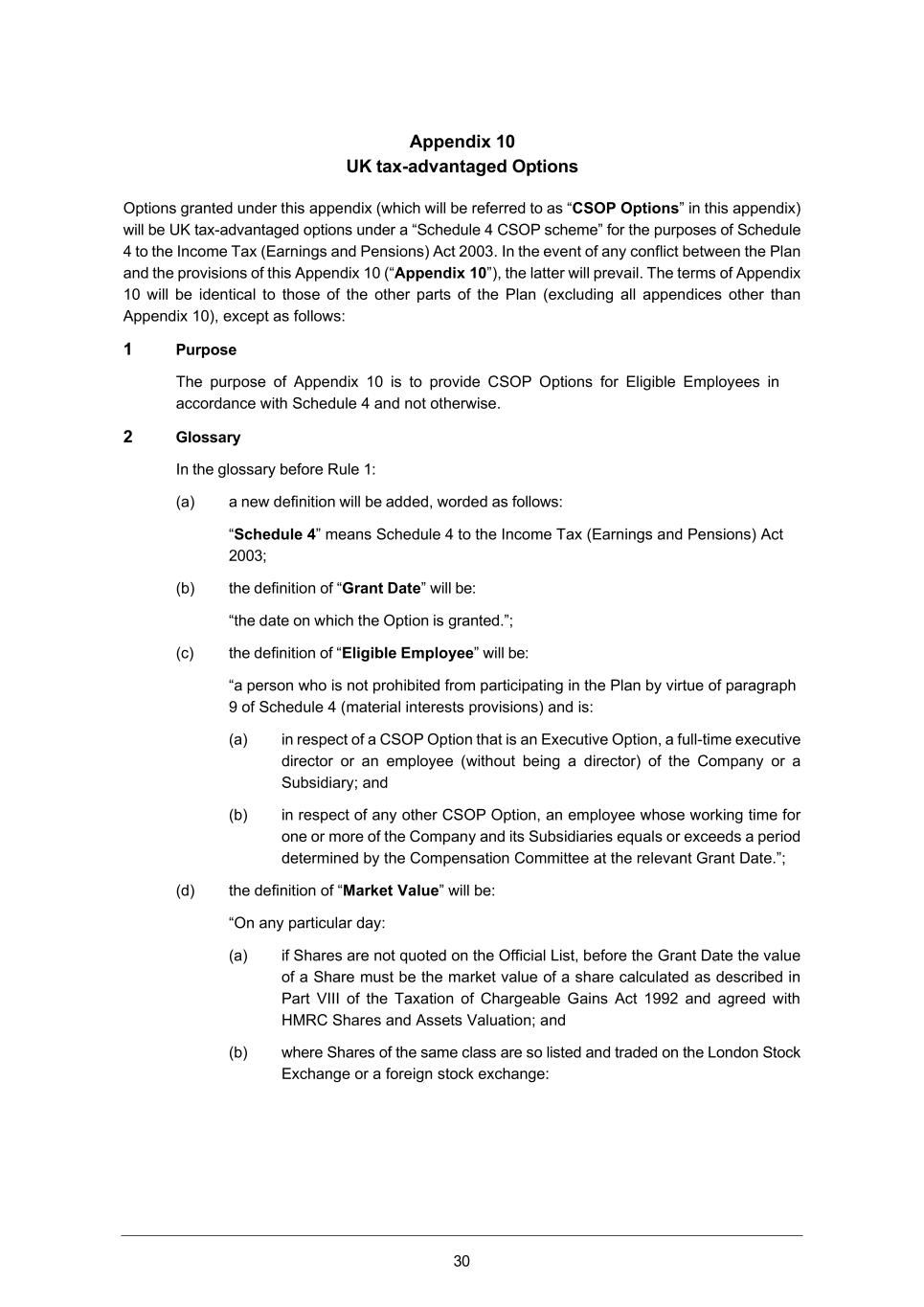
30 Appendix 10 UK tax-advantaged Options Options granted under this appendix (which will be referred to as “CSOP Options” in this appendix) will be UK tax-advantaged options under a “Schedule 4 CSOP scheme” for the purposes of Schedule 4 to the Income Tax (Earnings and Pensions) Act 2003. In the event of any conflict between the Plan and the provisions of this Appendix 10 (“Appendix 10”), the latter will prevail. The terms of Appendix 10 will be identical to those of the other parts of the Plan (excluding all appendices other than Appendix 10), except as follows: 1 Purpose The purpose of Appendix 10 is to provide CSOP Options for Eligible Employees in accordance with Schedule 4 and not otherwise. 2 Glossary In the glossary before Rule 1: (a) a new definition will be added, worded as follows: “Schedule 4” means Schedule 4 to the Income Tax (Earnings and Pensions) Act 2003; (b) the definition of “Grant Date” will be: “the date on which the Option is granted.”; (c) the definition of “Eligible Employee” will be: “a person who is not prohibited from participating in the Plan by virtue of paragraph 9 of Schedule 4 (material interests provisions) and is: (a) in respect of a CSOP Option that is an Executive Option, a full-time executive director or an employee (without being a director) of the Company or a Subsidiary; and (b) in respect of any other CSOP Option, an employee whose working time for one or more of the Company and its Subsidiaries equals or exceeds a period determined by the Compensation Committee at the relevant Grant Date.”; (d) the definition of “Market Value” will be: “On any particular day: (a) if Shares are not quoted on the Official List, before the Grant Date the value of a Share must be the market value of a share calculated as described in Part VIII of the Taxation of Chargeable Gains Act 1992 and agreed with HMRC Shares and Assets Valuation; and (b) where Shares of the same class are so listed and traded on the London Stock Exchange or a foreign stock exchange:
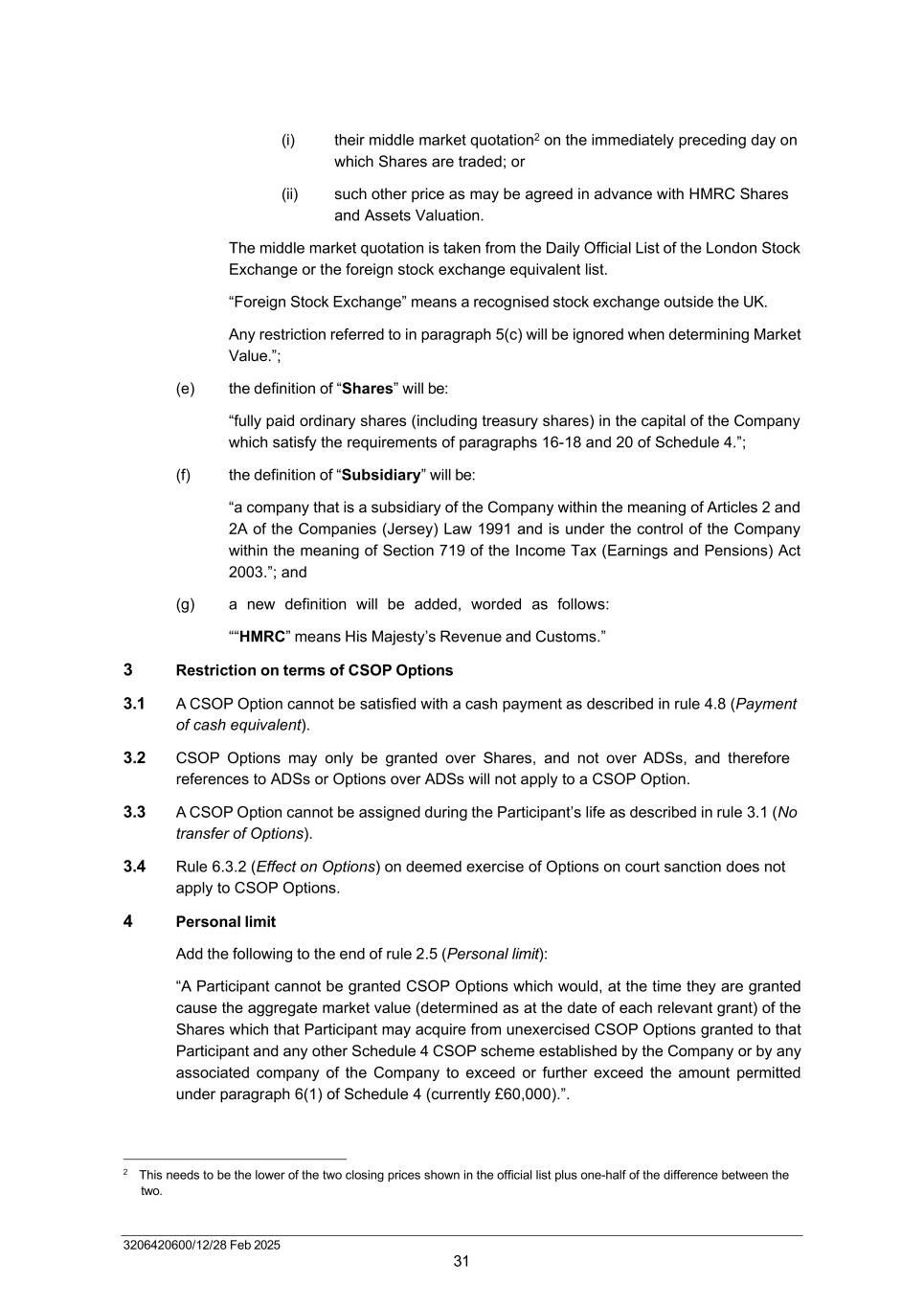
3206420600/12/28 Feb 2025 31 (i) their middle market quotation2 on the immediately preceding day on which Shares are traded; or (ii) such other price as may be agreed in advance with HMRC Shares and Assets Valuation. The middle market quotation is taken from the Daily Official List of the London Stock Exchange or the foreign stock exchange equivalent list. “Foreign Stock Exchange” means a recognised stock exchange outside the UK. Any restriction referred to in paragraph 5(c) will be ignored when determining Market Value.”; (e) the definition of “Shares” will be: “fully paid ordinary shares (including treasury shares) in the capital of the Company which satisfy the requirements of paragraphs 16-18 and 20 of Schedule 4.”; (f) the definition of “Subsidiary” will be: “a company that is a subsidiary of the Company within the meaning of Articles 2 and 2A of the Companies (Jersey) Law 1991 and is under the control of the Company within the meaning of Section 719 of the Income Tax (Earnings and Pensions) Act 2003.”; and (g) a new definition will be added, worded as follows: ““HMRC” means His Majesty’s Revenue and Customs.” 3 Restriction on terms of CSOP Options 3.1 A CSOP Option cannot be satisfied with a cash payment as described in rule 4.8 (Payment of cash equivalent). 3.2 CSOP Options may only be granted over Shares, and not over ADSs, and therefore references to ADSs or Options over ADSs will not apply to a CSOP Option. 3.3 A CSOP Option cannot be assigned during the Participant’s life as described in rule 3.1 (No transfer of Options). 3.4 Rule 6.3.2 (Effect on Options) on deemed exercise of Options on court sanction does not apply to CSOP Options. 4 Personal limit Add the following to the end of rule 2.5 (Personal limit): “A Participant cannot be granted CSOP Options which would, at the time they are granted cause the aggregate market value (determined as at the date of each relevant grant) of the Shares which that Participant may acquire from unexercised CSOP Options granted to that Participant and any other Schedule 4 CSOP scheme established by the Company or by any associated company of the Company to exceed or further exceed the amount permitted under paragraph 6(1) of Schedule 4 (currently £60,000).”. 2 This needs to be the lower of the two closing prices shown in the official list plus one-half of the difference between the two.
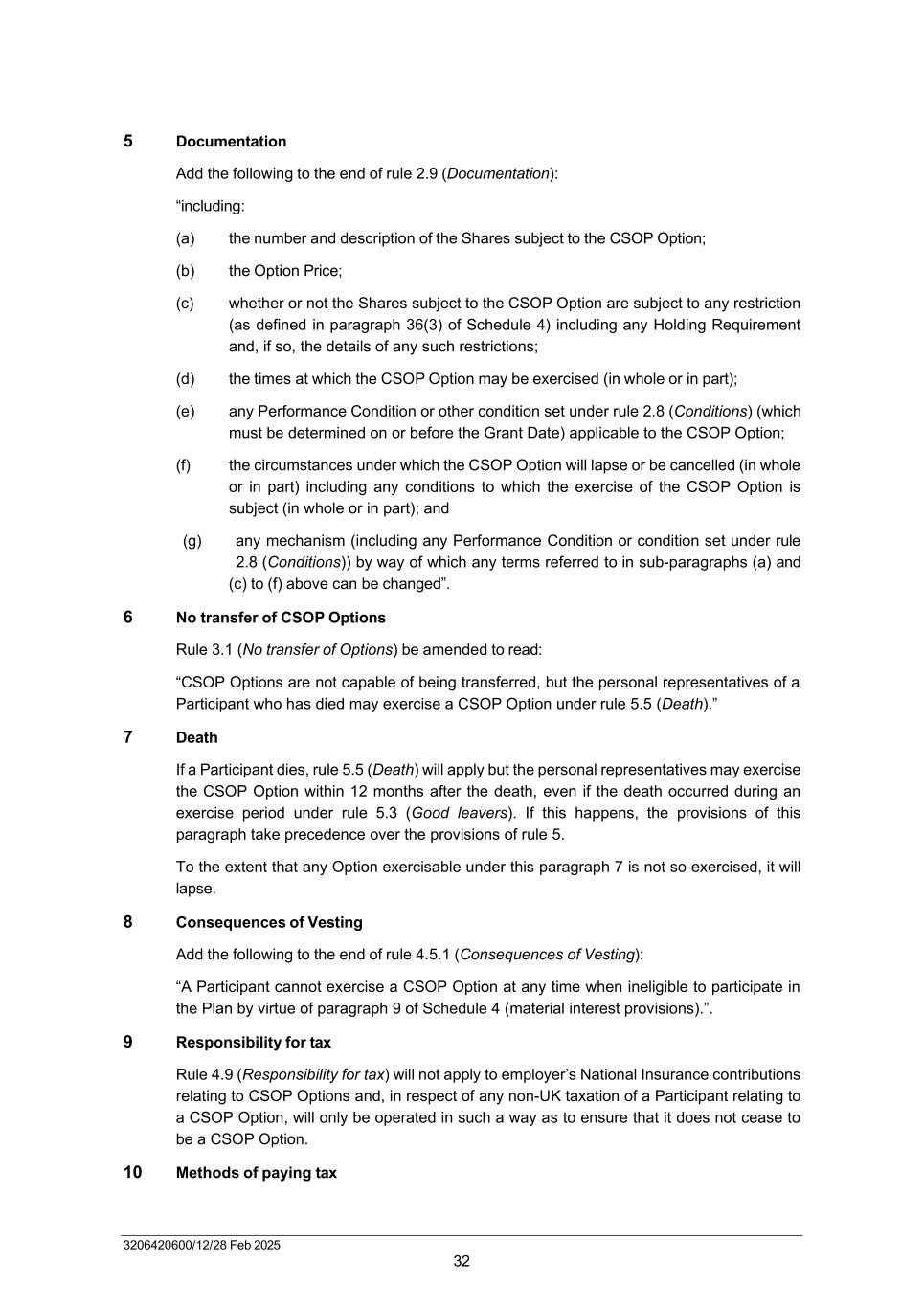
3206420600/12/28 Feb 2025 32 5 Documentation Add the following to the end of rule 2.9 (Documentation): “including: (a) the number and description of the Shares subject to the CSOP Option; (b) the Option Price; (c) whether or not the Shares subject to the CSOP Option are subject to any restriction (as defined in paragraph 36(3) of Schedule 4) including any Holding Requirement and, if so, the details of any such restrictions; (d) the times at which the CSOP Option may be exercised (in whole or in part); (e) any Performance Condition or other condition set under rule 2.8 (Conditions) (which must be determined on or before the Grant Date) applicable to the CSOP Option; (f) the circumstances under which the CSOP Option will lapse or be cancelled (in whole or in part) including any conditions to which the exercise of the CSOP Option is subject (in whole or in part); and (g) any mechanism (including any Performance Condition or condition set under rule 2.8 (Conditions)) by way of which any terms referred to in sub-paragraphs (a) and (c) to (f) above can be changed”. 6 No transfer of CSOP Options Rule 3.1 (No transfer of Options) be amended to read: “CSOP Options are not capable of being transferred, but the personal representatives of a Participant who has died may exercise a CSOP Option under rule 5.5 (Death).” 7 Death If a Participant dies, rule 5.5 (Death) will apply but the personal representatives may exercise the CSOP Option within 12 months after the death, even if the death occurred during an exercise period under rule 5.3 (Good leavers). If this happens, the provisions of this paragraph take precedence over the provisions of rule 5. To the extent that any Option exercisable under this paragraph 7 is not so exercised, it will lapse. 8 Consequences of Vesting Add the following to the end of rule 4.5.1 (Consequences of Vesting): “A Participant cannot exercise a CSOP Option at any time when ineligible to participate in the Plan by virtue of paragraph 9 of Schedule 4 (material interest provisions).”. 9 Responsibility for tax Rule 4.9 (Responsibility for tax) will not apply to employer’s National Insurance contributions relating to CSOP Options and, in respect of any non-UK taxation of a Participant relating to a CSOP Option, will only be operated in such a way as to ensure that it does not cease to be a CSOP Option. 10 Methods of paying tax
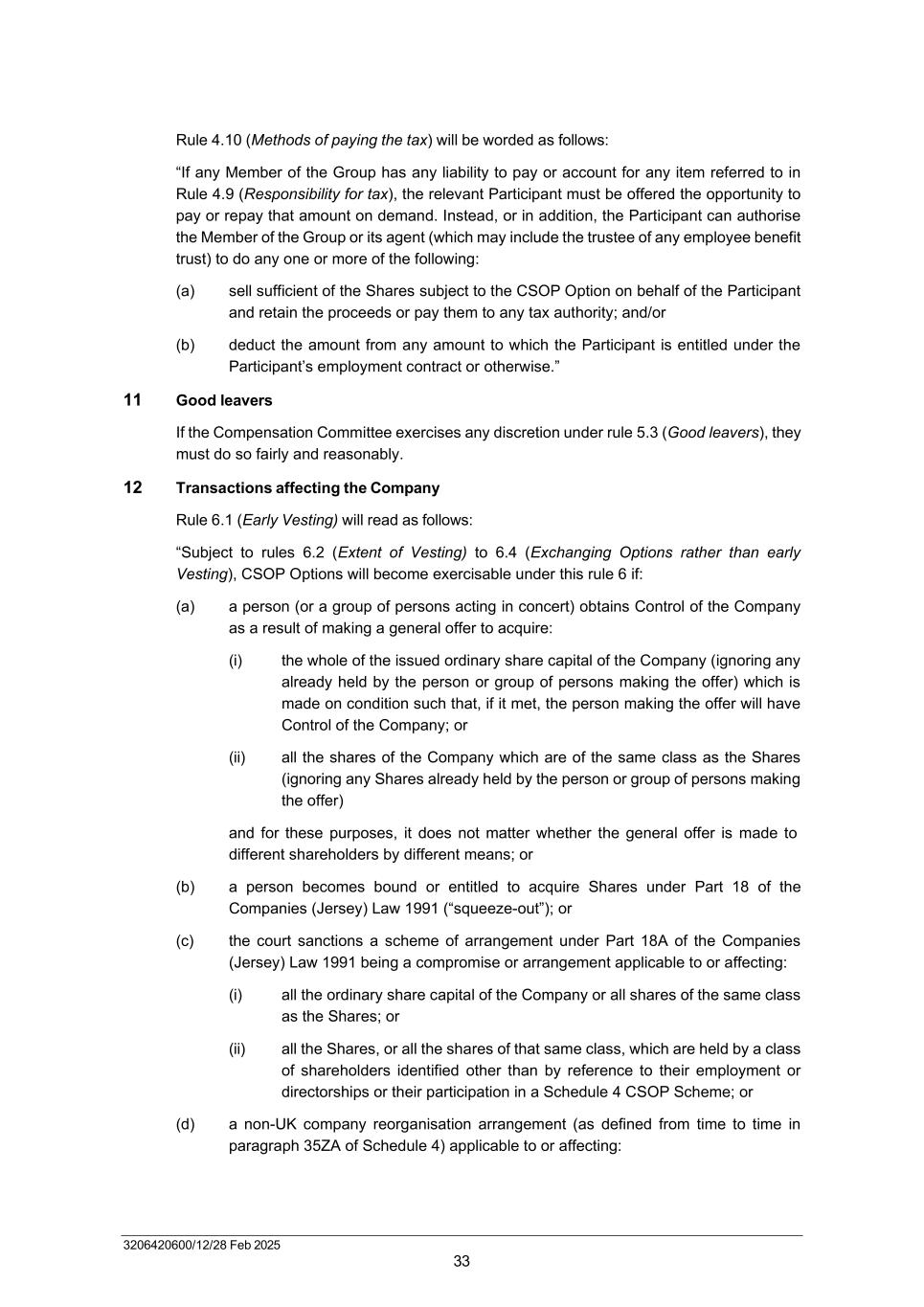
3206420600/12/28 Feb 2025 33 Rule 4.10 (Methods of paying the tax) will be worded as follows: “If any Member of the Group has any liability to pay or account for any item referred to in Rule 4.9 (Responsibility for tax), the relevant Participant must be offered the opportunity to pay or repay that amount on demand. Instead, or in addition, the Participant can authorise the Member of the Group or its agent (which may include the trustee of any employee benefit trust) to do any one or more of the following: (a) sell sufficient of the Shares subject to the CSOP Option on behalf of the Participant and retain the proceeds or pay them to any tax authority; and/or (b) deduct the amount from any amount to which the Participant is entitled under the Participant’s employment contract or otherwise.” 11 Good leavers If the Compensation Committee exercises any discretion under rule 5.3 (Good leavers), they must do so fairly and reasonably. 12 Transactions affecting the Company Rule 6.1 (Early Vesting) will read as follows: “Subject to rules 6.2 (Extent of Vesting) to 6.4 (Exchanging Options rather than early Vesting), CSOP Options will become exercisable under this rule 6 if: (a) a person (or a group of persons acting in concert) obtains Control of the Company as a result of making a general offer to acquire: (i) the whole of the issued ordinary share capital of the Company (ignoring any already held by the person or group of persons making the offer) which is made on condition such that, if it met, the person making the offer will have Control of the Company; or (ii) all the shares of the Company which are of the same class as the Shares (ignoring any Shares already held by the person or group of persons making the offer) and for these purposes, it does not matter whether the general offer is made to different shareholders by different means; or (b) a person becomes bound or entitled to acquire Shares under Part 18 of the Companies (Jersey) Law 1991 (“squeeze-out”); or (c) the court sanctions a scheme of arrangement under Part 18A of the Companies (Jersey) Law 1991 being a compromise or arrangement applicable to or affecting: (i) all the ordinary share capital of the Company or all shares of the same class as the Shares; or (ii) all the Shares, or all the shares of that same class, which are held by a class of shareholders identified other than by reference to their employment or directorships or their participation in a Schedule 4 CSOP Scheme; or (d) a non-UK company reorganisation arrangement (as defined from time to time in paragraph 35ZA of Schedule 4) applicable to or affecting:
34 (i) all the ordinary share capital of the Company or all shares of the same class to which a CSOP Option relates; or (ii) all the shares, or all the shares of that same class, which are held by a class of shareholders identified otherwise than by their employments or directorships or their participation in a Schedule 4 CSOP Scheme; becomes binding on the shareholders covered by it.” 13 Shares ceasing to qualify If in consequence of a transaction affecting the Company specified in rule 6.1 (Early Vesting), the Shares subject to outstanding CSOP Options cease to satisfy the requirements of Part 4 of Schedule 4, those CSOP Options may, if the Compensation Committee so determines, instead be exercised within 20 days of the relevant transaction as if those requirements were still satisfied and the CSOP Options will be treated as having been exercised in accordance with the relevant requirements of paragraph 25A of Schedule 4 (company events). If the Compensation Committee exercises this power, any unexercised CSOP Options will lapse at the end of this period. 14 Exchange of CSOP Options Rule 6.4 (Exchanging Options rather than early Vesting) and 6.5 (Terms of exchanged Options) will be read and interpreted, and if necessary amended, in such a way that the requirements of Part 6 of Schedule 4 are complied with (company over whose shares the replacement options are granted and equivalence of original and replacement options). The following words will be added at the end of Rule 6.4 (Exchanging Options rather than early ): “If the Participant does not agree to any exchange of the CSOP Options under that rule when required to do so by the Company, the CSOP Options will immediately lapse and will not be exchanged.” 15 Demerger Rule 6.6 (Demergers and other transactions) will be worded as follows: “If the Company is affected by a demerger (in whatever form) or a special dividend or distribution, which in the opinion of the Compensation Committee would affect the current or future value of any CSOP Options, the Compensation Committee may decide that CSOP Options will become exercisable, in which case Rules 6.2 (Extent of Vesting) and 6.3 (Effect on Options) will apply as if the CSOP Options had become exercisable under Rule 6.1 (Early Vesting).” 16 Variations of capital At the end of rule 6.7 (Variations of capital) the following words will be added “provided that any adjustment must: (i) ensure that both the aggregate market value of the Shares subject to the CSOP Option and the total Option Price for that CSOP Option are substantially the same after the adjustment as they were immediately before the adjustment; and (ii) not result in the requirements of Schedule 4 ceasing to be satisfied. An annual return relating to the Plan submitted to HMRC following any such adjustment must include a declaration that the Plan continues to comply with Schedule 4.”
35 In the final sentence of rule 6.7 (Variations of capital) the word “class” is deleted. 17 Variation of terms of CSOP Option A new rule 6.9 will be added, worded as follows: “6.9 The terms of a CSOP Option may only be varied: (a) in the case of Option Price, only under rule 6.7 (Variations of capital); (b) in the case of the number or description of Shares, only under 6.7 (Variations of capital) or by way of a mechanism stated at the Grant Date; and (c) in the case of any other term, by way of a mechanism stated at the Grant Date; and any mechanism used for (b) or (c) must be applied in a way that is fair and reasonable” A new rule 6.10 will be added, worded as follows: “6.10 An annual return submitted to HMRC following any change to a term of a CSOP Option which is necessary to comply with Parts 2 to 6 of Schedule 4 must include a declaration that the Plan continues to comply with Schedule 4 from the date of the change.” 18 Amendments A new rule 7.1.2 will be added, worded as follows: “7.1.2 Appendix 10 may not be amended if the amendment would cause Appendix 10 to cease to be a “Schedule 4 CSOP scheme” within the meaning of paragraph 1(A1) of Schedule 4 and in respect of any amendment to a key feature of Appendix 10 (being a provision that is necessary in order to meet the requirements of Schedule 4) the Company will make a declaration to HM Revenue & Customs in the next annual return relating to Appendix 10 that the alteration has not caused Appendix 10 to cease to meet the requirements of Schedule 4.”
36 Appendix 11 USA Special Rules Applicable to Grants of Incentive Stock Options Options granted in accordance with the Plan may be designated as “Incentive Stock Options” (“ISOs”) within the meaning of section 422 of the United States Internal Revenue Code of 1986, as amended (the “US Tax Code”). The aggregate number of Shares (including Shares comprised in any WPP ADS) over which ISOs may be granted under this appendix will not exceed [ ]. Eligible Employees who may receive ISOs will, in addition to the limitations imposed by Rule 2.2 of the Plan, be limited to employees of the Company or its “parent” or “subsidiary” corporations within the meaning of sections 424(f) and (g), respectively, of the US Tax Code. In addition to any other restrictions contained in the Plan, ISOs will not be transferable otherwise than by will or the laws of descent and distribution. During the lifetime of the Participant to whom an ISO is granted, the ISO will be exercisable only by that Participant. To the extent that the aggregate market value of Shares (including Shares comprised in any WPP ADS) with respect to which ISOs are exercisable (determined without regard to this sentence) for the first time by a Participant during any calendar year (under all plans or schemes of the Company or its “parent” and “subsidiary” corporations within the meaning of sections 424(f) and (g), respectively, of the US Tax Code) exceeds US $100,000, those Options will to the extent of the excess be treated as Options which are not ISOs. For this purpose, the market value of any Shares (including Shares comprised in any ADS) subject to an ISO will be determined at the time that ISO is granted. This appendix will be deemed to be included within the Plan as adopted by shareholders for the purpose of any ISO grants. Taxpayers Subject to Section 409A of the United States Internal Revenue Code The Plan will apply to participants who are taxpayers subject to Section 409A of the United States Internal Revenue Code (“Section 409A”), with the following modifications: Options granted under the Plan are intended to be exempt from the requirements of Section 409A by satisfying the requirements of the exemption under Section 1.409A-1(b)(5)(i)(A) of the United States Treasury Regulations or other applicable guidance (the “Exemption”). The Plan will be construed and interpreted in accordance with that intent. Any discretion afforded to any person or entity under the Plan the existence of which itself would cause an Option to fail to satisfy the requirements of the Exemption will not apply. At the end of the definition of “Market Value”, add the words “provided that the market value will not be less than fair market value determined in accordance with Section 409A.” Add the following paragraph to the end of rule 6.7 (Variations of capital): “Notwithstanding the foregoing, only adjustments permitted by Section 409A will be permitted to be made under this rule 6.7, including pro rata adjustments necessary to reflect a stock split, reverse stock split, and stock dividend.”