Los Angeles SMSA Limited Partnership Financial Statements As of December 31, 2025 and 2024 and for the years ended December 31, 2025, 2024 and 2023 with Report of Independent Auditors
Los Angeles SMSA Limited Partnership TABLE OF CONTENTS Report of Independent Auditors 1 Balance Sheets – As of December 31, 2025 and 2024 3 Statements of Income – For the Years Ended December 31, 2025, 2024 and 2023 4 Statements of Changes in Partners’ Capital – For the Years Ended December 31, 2025, 2024 and 2023 5 Statements of Cash Flows – For the Years Ended December 31, 2025, 2024 and 2023 6 Notes to Financial Statements 7
2603-11956-CS 1 Report of Independent Auditors The Partners of Los Angeles SMSA Limited Partnership Opinion We have audited the financial statements of Los Angeles SMSA Limited Partnership (the Partnership), which comprise the balance sheets as of December 31, 2025 and 2024, and the related statements of income, changes in partners’ capital and cash flows for each of the three years in the period ended December 31, 2025, and the related notes (collectively referred to as the “financial statements”). In our opinion, the accompanying financial statements present fairly, in all material respects, the financial position of the Partnership at December 31, 2025 and 2024, and the results of its operations and its cash flows for each of the three years in the period ended December 31, 2025 in accordance with accounting principles generally accepted in the United States of America. Basis for Opinion We conducted our audits in accordance with auditing standards generally accepted in the United States of America (GAAS). Our responsibilities under those standards are further described in the Auditor’s Responsibilities for the Audit of the Financial Statements section of our report. We are required to be independent of the Partnership and to meet our other ethical responsibilities in accordance with the relevant ethical requirements relating to our audits. We believe that the audit evidence we have obtained is sufficient and appropriate to provide a basis for our audit opinion. Responsibilities of Management for the Financial Statements Management is responsible for the preparation and fair presentation of the financial statements in accordance with accounting principles generally accepted in the United States of America, and for the design, implementation, and maintenance of internal control relevant to the preparation and fair presentation of financial statements that are free of material misstatement, whether due to fraud or error. In preparing the financial statements, management is required to evaluate whether there are conditions or events, considered in the aggregate, that raise substantial doubt about the Partnership’s ability to continue as a going concern for one year after the date that the financial statements are available to be issued. A member firm of Ernst & Young Global Limited Ernst & Young LLP Suite 2800 200 South Orange Avenue Orlando, Florida 32801 Tel: +1 407 872 6600 ey.com
2603-11956-CS 2 Auditor’s Responsibilities for the Audit of the Financial Statements Our objectives are to obtain reasonable assurance about whether the financial statements as a whole are free of material misstatement, whether due to fraud or error, and to issue an auditor’s report that includes our opinion. Reasonable assurance is a high level of assurance but is not absolute assurance and therefore is not a guarantee that an audit conducted in accordance with GAAS will always detect a material misstatement when it exists. The risk of not detecting a material misstatement resulting from fraud is higher than for one resulting from error, as fraud may involve collusion, forgery, intentional omissions, misrepresentations, or the override of internal control. Misstatements are considered material if there is a substantial likelihood that, individually or in the aggregate, they would influence the judgment made by a reasonable user based on the financial statements. In performing an audit in accordance with GAAS, we: • Exercise professional judgment and maintain professional skepticism throughout the audit. • Identify and assess the risks of material misstatement of the financial statements, whether due to fraud or error, and design and perform audit procedures responsive to those risks. Such procedures include examining, on a test basis, evidence regarding the amounts and disclosures in the financial statements. • Obtain an understanding of internal control relevant to the audit in order to design audit procedures that are appropriate in the circumstances, but not for the purpose of expressing an opinion on the effectiveness of the Partnership’s internal control. Accordingly, no such opinion is expressed. • Evaluate the appropriateness of accounting policies used and the reasonableness of significant accounting estimates made by management, as well as evaluate the overall presentation of the financial statements. • Conclude whether, in our judgment, there are conditions or events, considered in the aggregate, that raise substantial doubt about the Partnership’s ability to continue as a going concern for a reasonable period of time. We are required to communicate with those charged with governance regarding, among other matters, the planned scope and timing of the audit, significant audit findings, and certain internal control-related matters that we identified during the audit. March 30, 2026 A member firm of Ernst & Young Global Limited
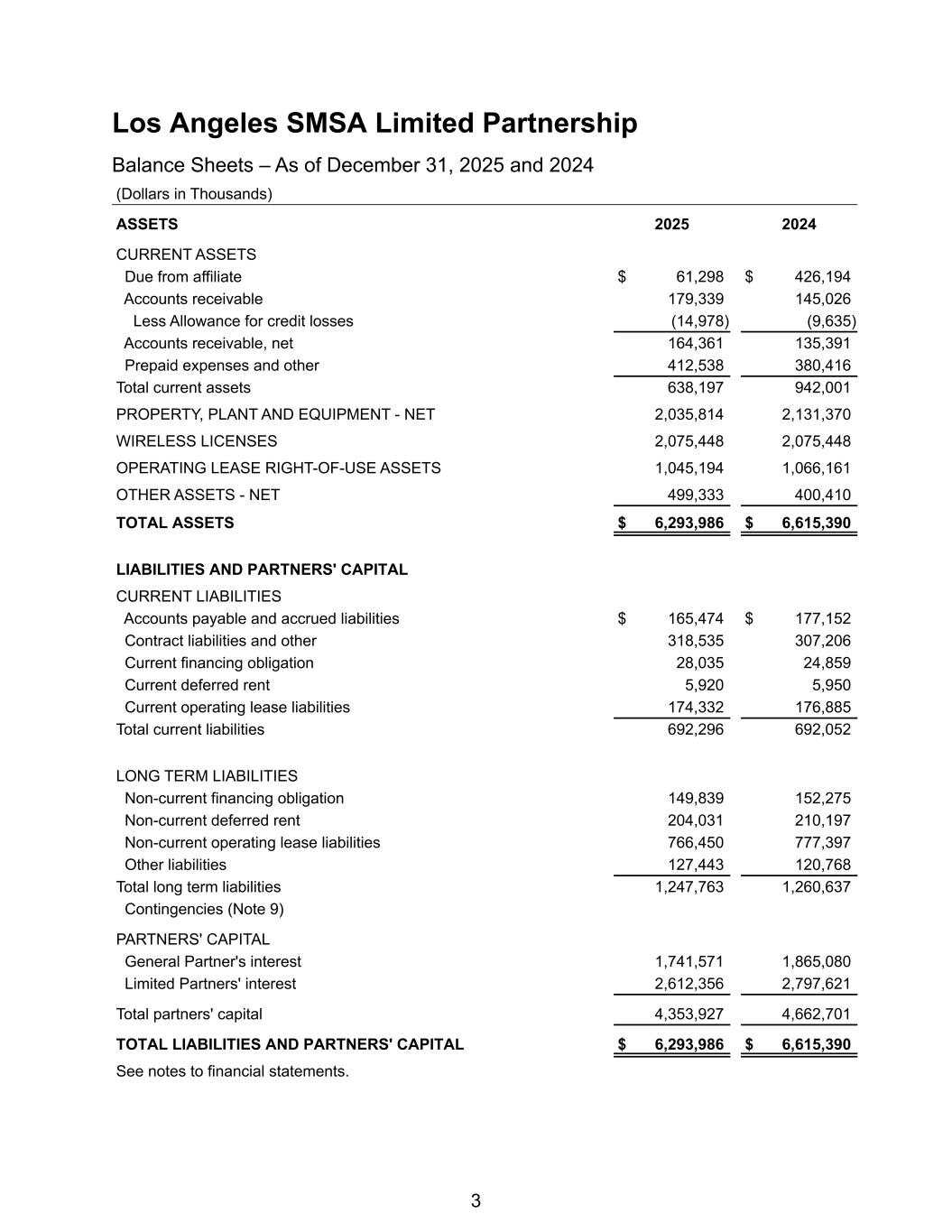
Los Angeles SMSA Limited Partnership Balance Sheets – As of December 31, 2025 and 2024 (Dollars in Thousands) ASSETS 2025 2024 CURRENT ASSETS Due from affiliate $ 61,298 $ 426,194 Accounts receivable 179,339 145,026 Less Allowance for credit losses (14,978) (9,635) Accounts receivable, net 164,361 135,391 Prepaid expenses and other 412,538 380,416 Total current assets 638,197 942,001 PROPERTY, PLANT AND EQUIPMENT - NET 2,035,814 2,131,370 WIRELESS LICENSES 2,075,448 2,075,448 OPERATING LEASE RIGHT-OF-USE ASSETS 1,045,194 1,066,161 OTHER ASSETS - NET 499,333 400,410 TOTAL ASSETS $ 6,293,986 $ 6,615,390 LIABILITIES AND PARTNERS' CAPITAL CURRENT LIABILITIES Accounts payable and accrued liabilities $ 165,474 $ 177,152 Contract liabilities and other 318,535 307,206 Current financing obligation 28,035 24,859 Current deferred rent 5,920 5,950 Current operating lease liabilities 174,332 176,885 Total current liabilities 692,296 692,052 LONG TERM LIABILITIES Non-current financing obligation 149,839 152,275 Non-current deferred rent 204,031 210,197 Non-current operating lease liabilities 766,450 777,397 Other liabilities 127,443 120,768 Total long term liabilities 1,247,763 1,260,637 Contingencies (Note 9) PARTNERS' CAPITAL General Partner's interest 1,741,571 1,865,080 Limited Partners' interest 2,612,356 2,797,621 Total partners' capital 4,353,927 4,662,701 TOTAL LIABILITIES AND PARTNERS' CAPITAL $ 6,293,986 $ 6,615,390 See notes to financial statements. 3
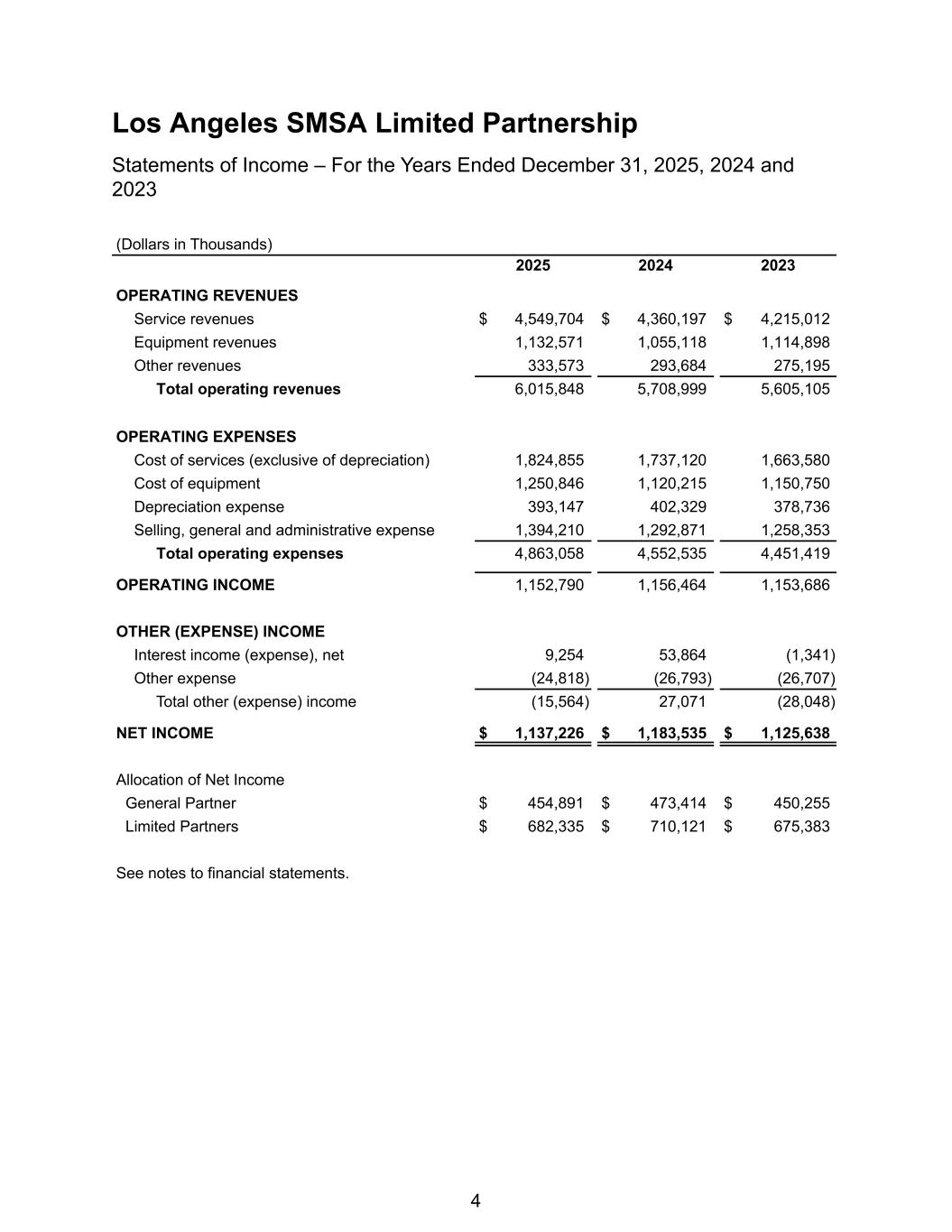
Los Angeles SMSA Limited Partnership Statements of Income – For the Years Ended December 31, 2025, 2024 and 2023 (Dollars in Thousands) 2025 2024 2023 OPERATING REVENUES Service revenues $ 4,549,704 $ 4,360,197 $ 4,215,012 Equipment revenues 1,132,571 1,055,118 1,114,898 Other revenues 333,573 293,684 275,195 Total operating revenues 6,015,848 5,708,999 5,605,105 OPERATING EXPENSES Cost of services (exclusive of depreciation) 1,824,855 1,737,120 1,663,580 Cost of equipment 1,250,846 1,120,215 1,150,750 Depreciation expense 393,147 402,329 378,736 Selling, general and administrative expense 1,394,210 1,292,871 1,258,353 Total operating expenses 4,863,058 4,552,535 4,451,419 OPERATING INCOME 1,152,790 1,156,464 1,153,686 OTHER (EXPENSE) INCOME Interest income (expense), net 9,254 53,864 (1,341) Other expense (24,818) (26,793) (26,707) Total other (expense) income (15,564) 27,071 (28,048) NET INCOME $ 1,137,226 $ 1,183,535 $ 1,125,638 Allocation of Net Income General Partner $ 454,891 $ 473,414 $ 450,255 Limited Partners $ 682,335 $ 710,121 $ 675,383 See notes to financial statements. 4
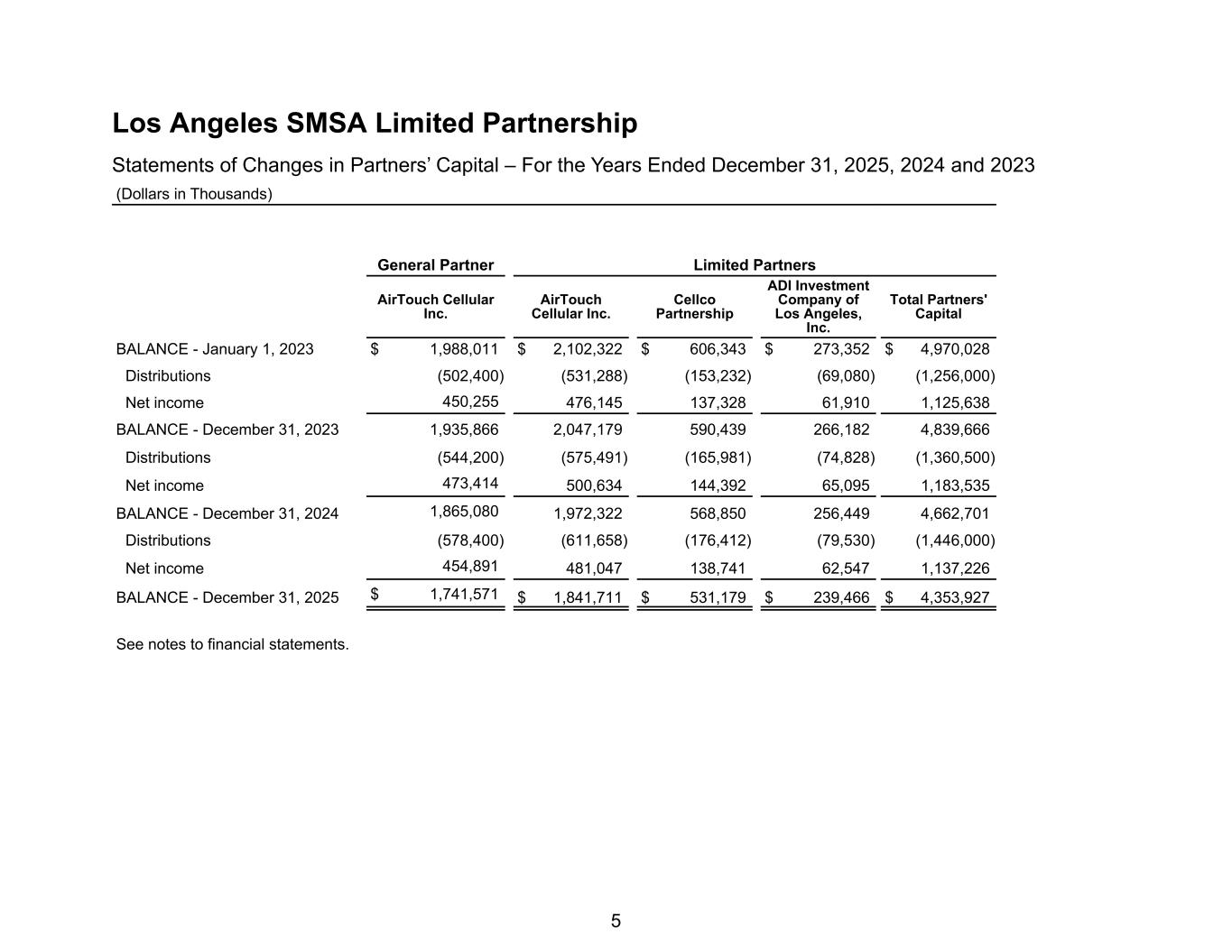
Los Angeles SMSA Limited Partnership Statements of Changes in Partners’ Capital – For the Years Ended December 31, 2025, 2024 and 2023 (Dollars in Thousands) General Partner Limited Partners AirTouch Cellular Inc. AirTouch Cellular Inc. Cellco Partnership ADI Investment Company of Los Angeles, Inc. Total Partners' Capital BALANCE - January 1, 2023 $ 1,988,011 $ 2,102,322 $ 606,343 $ 273,352 $ 4,970,028 Distributions (502,400) (531,288) (153,232) (69,080) (1,256,000) Net income 450,255 476,145 137,328 61,910 1,125,638 BALANCE - December 31, 2023 1,935,866 2,047,179 590,439 266,182 4,839,666 Distributions (544,200) (575,491) (165,981) (74,828) (1,360,500) Net income 473,414 500,634 144,392 65,095 1,183,535 BALANCE - December 31, 2024 1,865,080 1,972,322 568,850 256,449 4,662,701 Distributions (578,400) (611,658) (176,412) (79,530) (1,446,000) Net income 454,891 481,047 138,741 62,547 1,137,226 BALANCE - December 31, 2025 $ 1,741,571 $ 1,841,711 $ 531,179 $ 239,466 $ 4,353,927 See notes to financial statements. 5
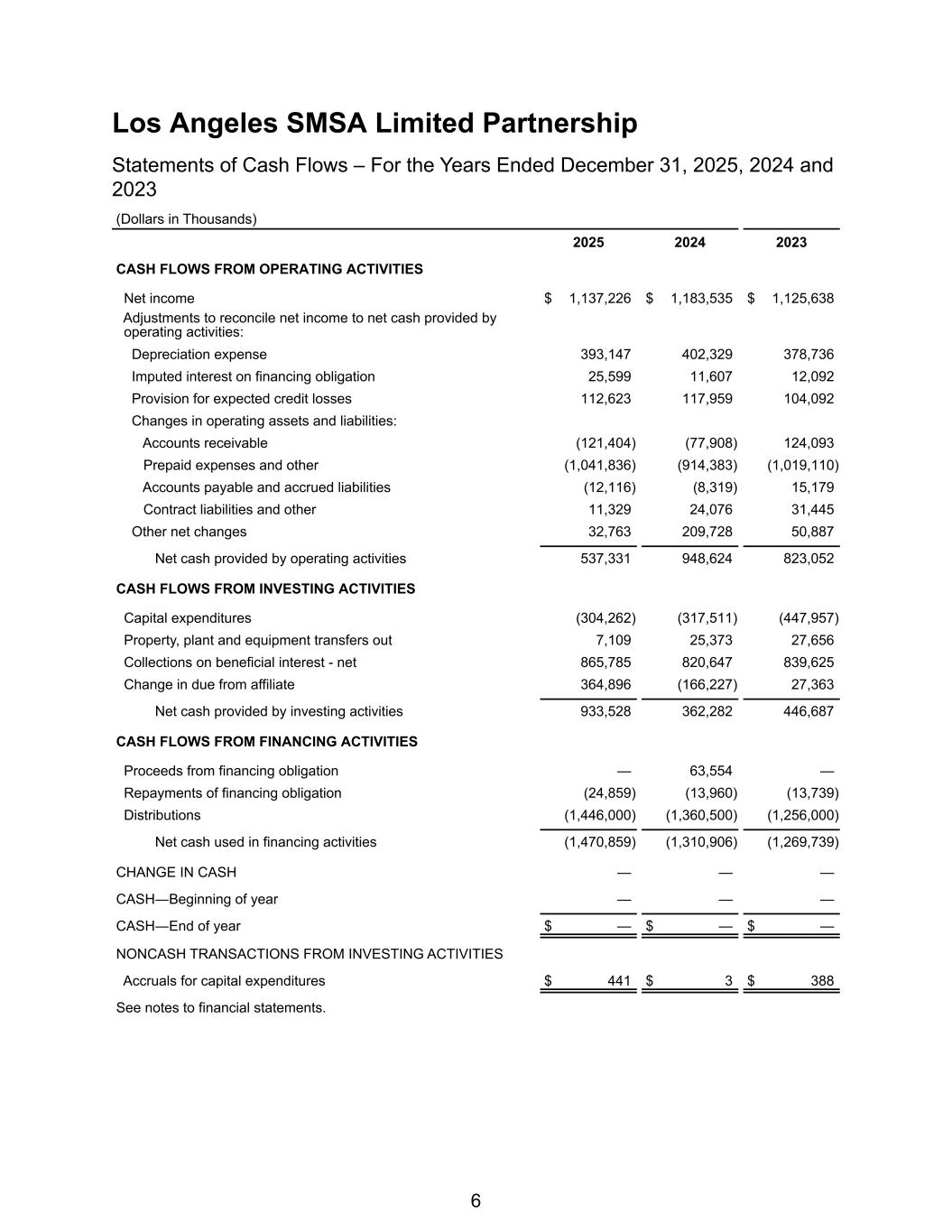
Los Angeles SMSA Limited Partnership Statements of Cash Flows – For the Years Ended December 31, 2025, 2024 and 2023 (Dollars in Thousands) 2025 2024 2023 CASH FLOWS FROM OPERATING ACTIVITIES Net income $ 1,137,226 $ 1,183,535 $ 1,125,638 Adjustments to reconcile net income to net cash provided by operating activities: Depreciation expense 393,147 402,329 378,736 Imputed interest on financing obligation 25,599 11,607 12,092 Provision for expected credit losses 112,623 117,959 104,092 Changes in operating assets and liabilities: Accounts receivable (121,404) (77,908) 124,093 Prepaid expenses and other (1,041,836) (914,383) (1,019,110) Accounts payable and accrued liabilities (12,116) (8,319) 15,179 Contract liabilities and other 11,329 24,076 31,445 Other net changes 32,763 209,728 50,887 Net cash provided by operating activities 537,331 948,624 823,052 CASH FLOWS FROM INVESTING ACTIVITIES Capital expenditures (304,262) (317,511) (447,957) Property, plant and equipment transfers out 7,109 25,373 27,656 Collections on beneficial interest - net 865,785 820,647 839,625 Change in due from affiliate 364,896 (166,227) 27,363 Net cash provided by investing activities 933,528 362,282 446,687 CASH FLOWS FROM FINANCING ACTIVITIES Proceeds from financing obligation — 63,554 — Repayments of financing obligation (24,859) (13,960) (13,739) Distributions (1,446,000) (1,360,500) (1,256,000) Net cash used in financing activities (1,470,859) (1,310,906) (1,269,739) CHANGE IN CASH — — — CASH―Beginning of year — — — CASH―End of year $ — $ — $ — NONCASH TRANSACTIONS FROM INVESTING ACTIVITIES Accruals for capital expenditures $ 441 $ 3 $ 388 See notes to financial statements. 6
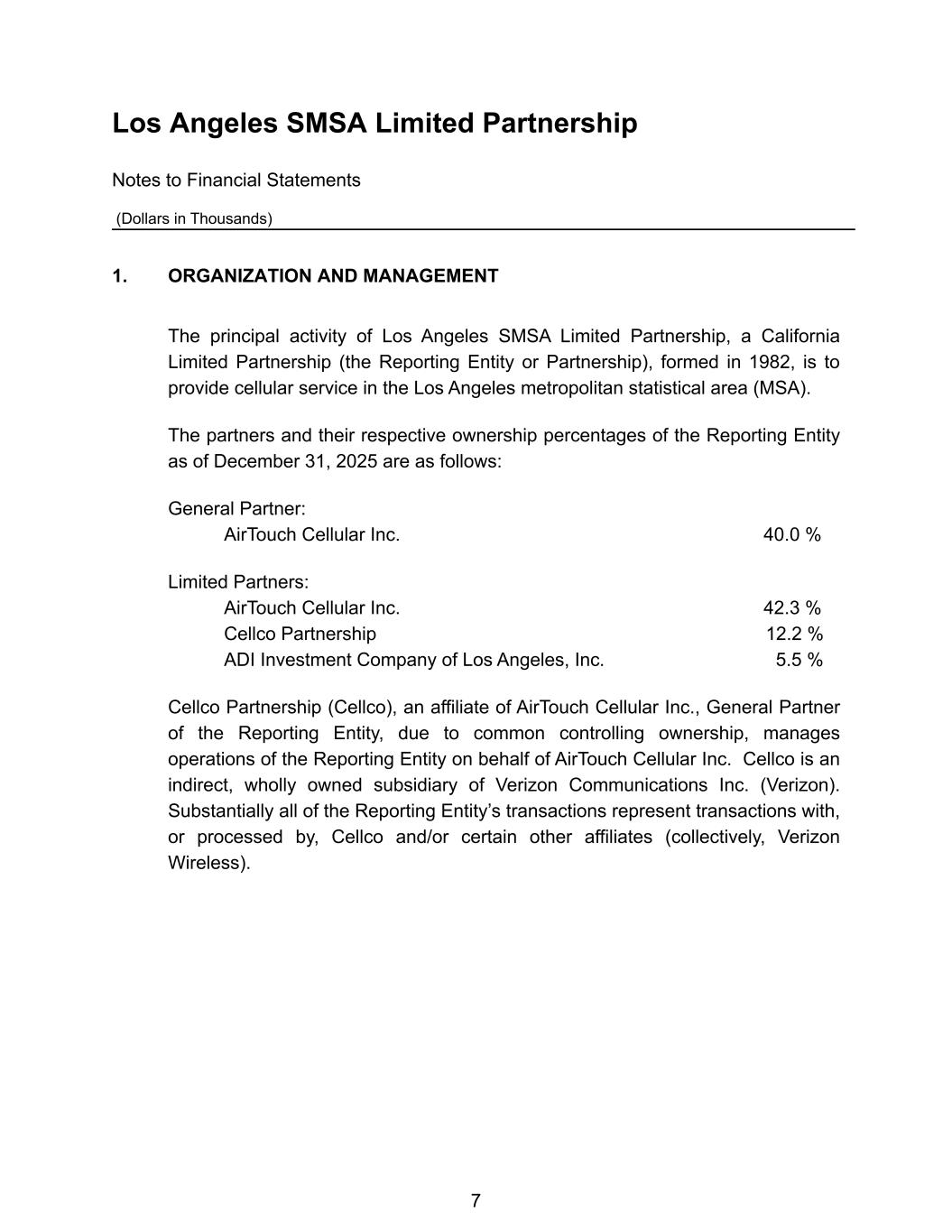
Los Angeles SMSA Limited Partnership Notes to Financial Statements (Dollars in Thousands) 1. ORGANIZATION AND MANAGEMENT The principal activity of Los Angeles SMSA Limited Partnership, a California Limited Partnership (the Reporting Entity or Partnership), formed in 1982, is to provide cellular service in the Los Angeles metropolitan statistical area (MSA). The partners and their respective ownership percentages of the Reporting Entity as of December 31, 2025 are as follows: General Partner: AirTouch Cellular Inc. 40.0 % Limited Partners: AirTouch Cellular Inc. 42.3 % Cellco Partnership 12.2 % ADI Investment Company of Los Angeles, Inc. 5.5 % Cellco Partnership (Cellco), an affiliate of AirTouch Cellular Inc., General Partner of the Reporting Entity, due to common controlling ownership, manages operations of the Reporting Entity on behalf of AirTouch Cellular Inc. Cellco is an indirect, wholly owned subsidiary of Verizon Communications Inc. (Verizon). Substantially all of the Reporting Entity’s transactions represent transactions with, or processed by, Cellco and/or certain other affiliates (collectively, Verizon Wireless). 7
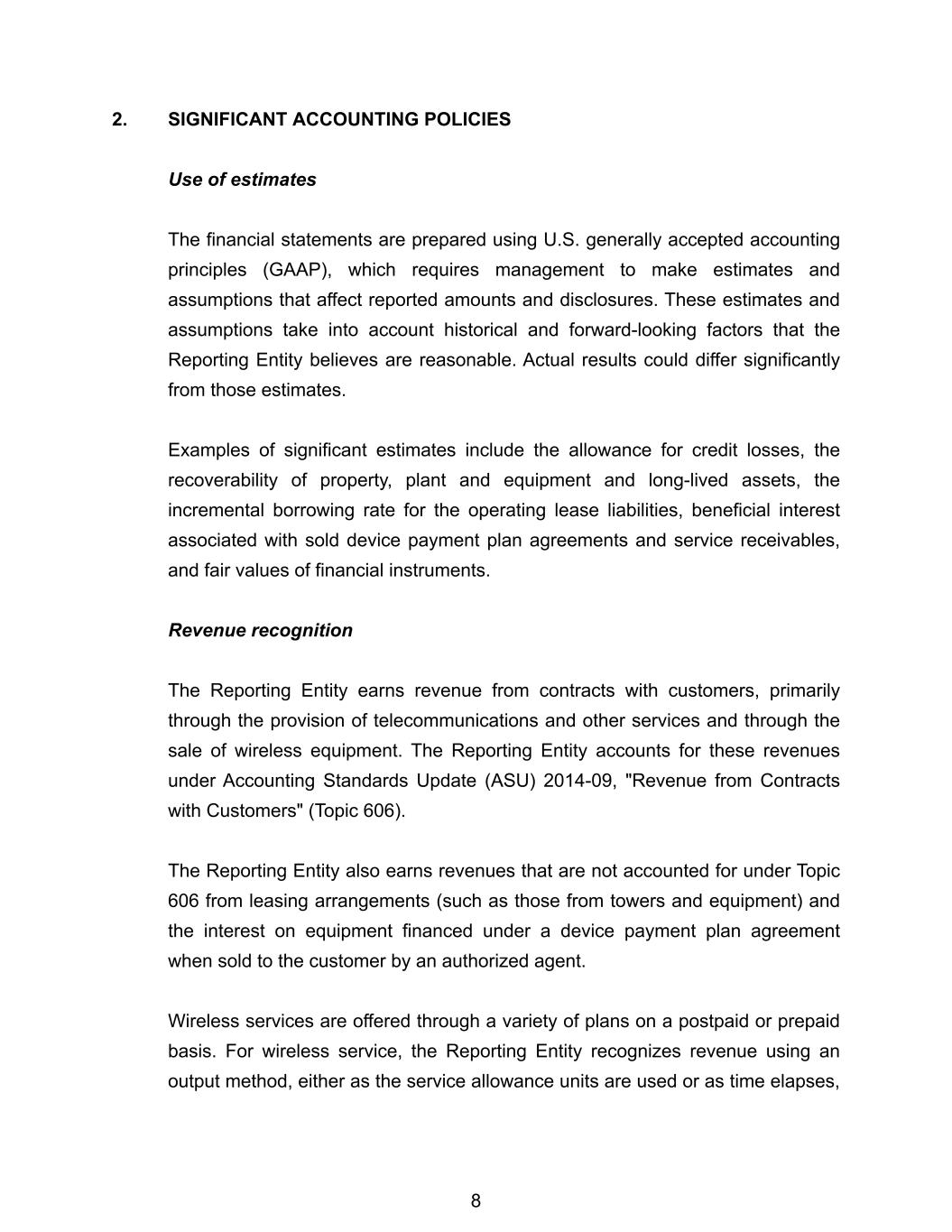
2. SIGNIFICANT ACCOUNTING POLICIES Use of estimates The financial statements are prepared using U.S. generally accepted accounting principles (GAAP), which requires management to make estimates and assumptions that affect reported amounts and disclosures. These estimates and assumptions take into account historical and forward-looking factors that the Reporting Entity believes are reasonable. Actual results could differ significantly from those estimates. Examples of significant estimates include the allowance for credit losses, the recoverability of property, plant and equipment and long-lived assets, the incremental borrowing rate for the operating lease liabilities, beneficial interest associated with sold device payment plan agreements and service receivables, and fair values of financial instruments. Revenue recognition The Reporting Entity earns revenue from contracts with customers, primarily through the provision of telecommunications and other services and through the sale of wireless equipment. The Reporting Entity accounts for these revenues under Accounting Standards Update (ASU) 2014-09, "Revenue from Contracts with Customers" (Topic 606). The Reporting Entity also earns revenues that are not accounted for under Topic 606 from leasing arrangements (such as those from towers and equipment) and the interest on equipment financed under a device payment plan agreement when sold to the customer by an authorized agent. Wireless services are offered through a variety of plans on a postpaid or prepaid basis. For wireless service, the Reporting Entity recognizes revenue using an output method, either as the service allowance units are used or as time elapses, 8
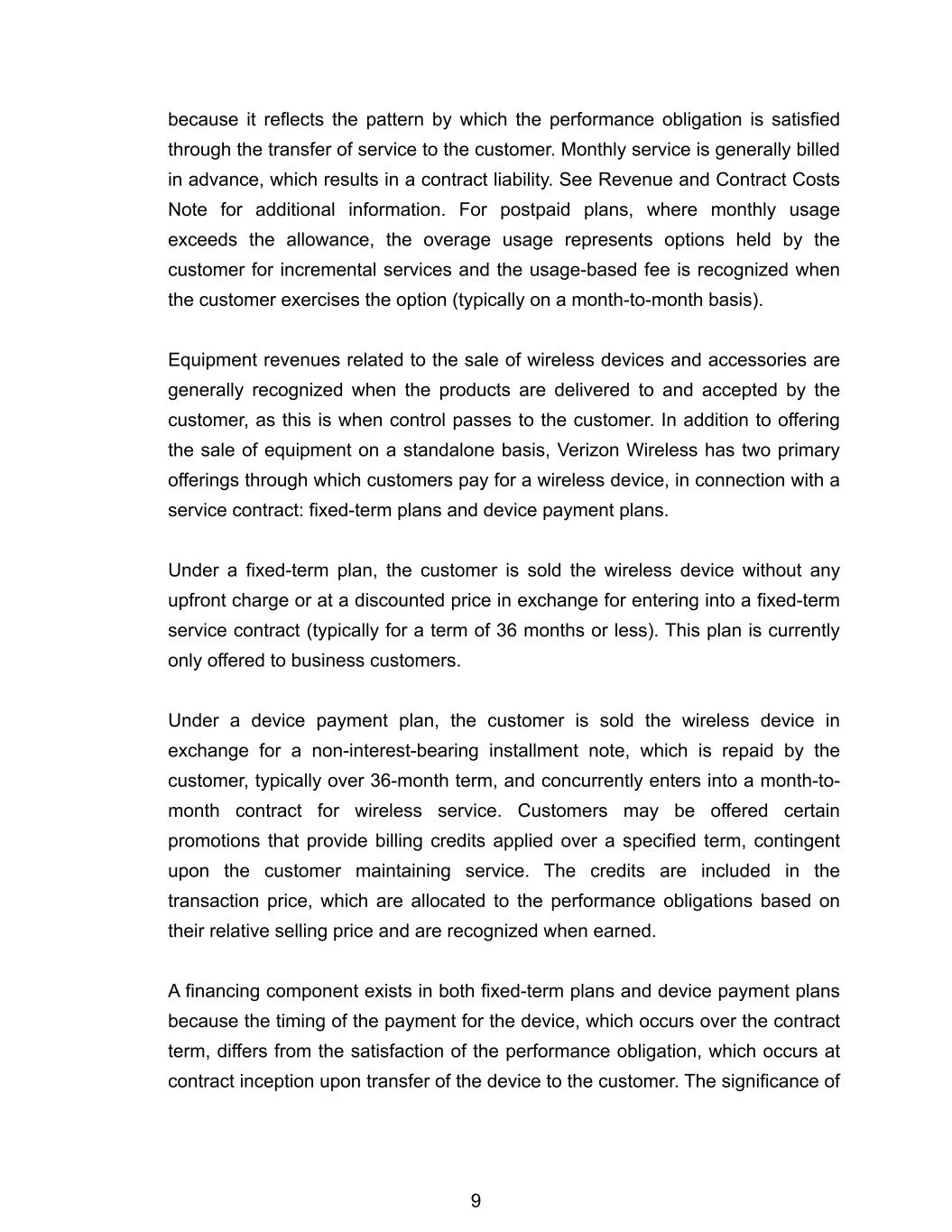
because it reflects the pattern by which the performance obligation is satisfied through the transfer of service to the customer. Monthly service is generally billed in advance, which results in a contract liability. See Revenue and Contract Costs Note for additional information. For postpaid plans, where monthly usage exceeds the allowance, the overage usage represents options held by the customer for incremental services and the usage-based fee is recognized when the customer exercises the option (typically on a month-to-month basis). Equipment revenues related to the sale of wireless devices and accessories are generally recognized when the products are delivered to and accepted by the customer, as this is when control passes to the customer. In addition to offering the sale of equipment on a standalone basis, Verizon Wireless has two primary offerings through which customers pay for a wireless device, in connection with a service contract: fixed-term plans and device payment plans. Under a fixed-term plan, the customer is sold the wireless device without any upfront charge or at a discounted price in exchange for entering into a fixed-term service contract (typically for a term of 36 months or less). This plan is currently only offered to business customers. Under a device payment plan, the customer is sold the wireless device in exchange for a non-interest-bearing installment note, which is repaid by the customer, typically over 36-month term, and concurrently enters into a month-to- month contract for wireless service. Customers may be offered certain promotions that provide billing credits applied over a specified term, contingent upon the customer maintaining service. The credits are included in the transaction price, which are allocated to the performance obligations based on their relative selling price and are recognized when earned. A financing component exists in both fixed-term plans and device payment plans because the timing of the payment for the device, which occurs over the contract term, differs from the satisfaction of the performance obligation, which occurs at contract inception upon transfer of the device to the customer. The significance of 9
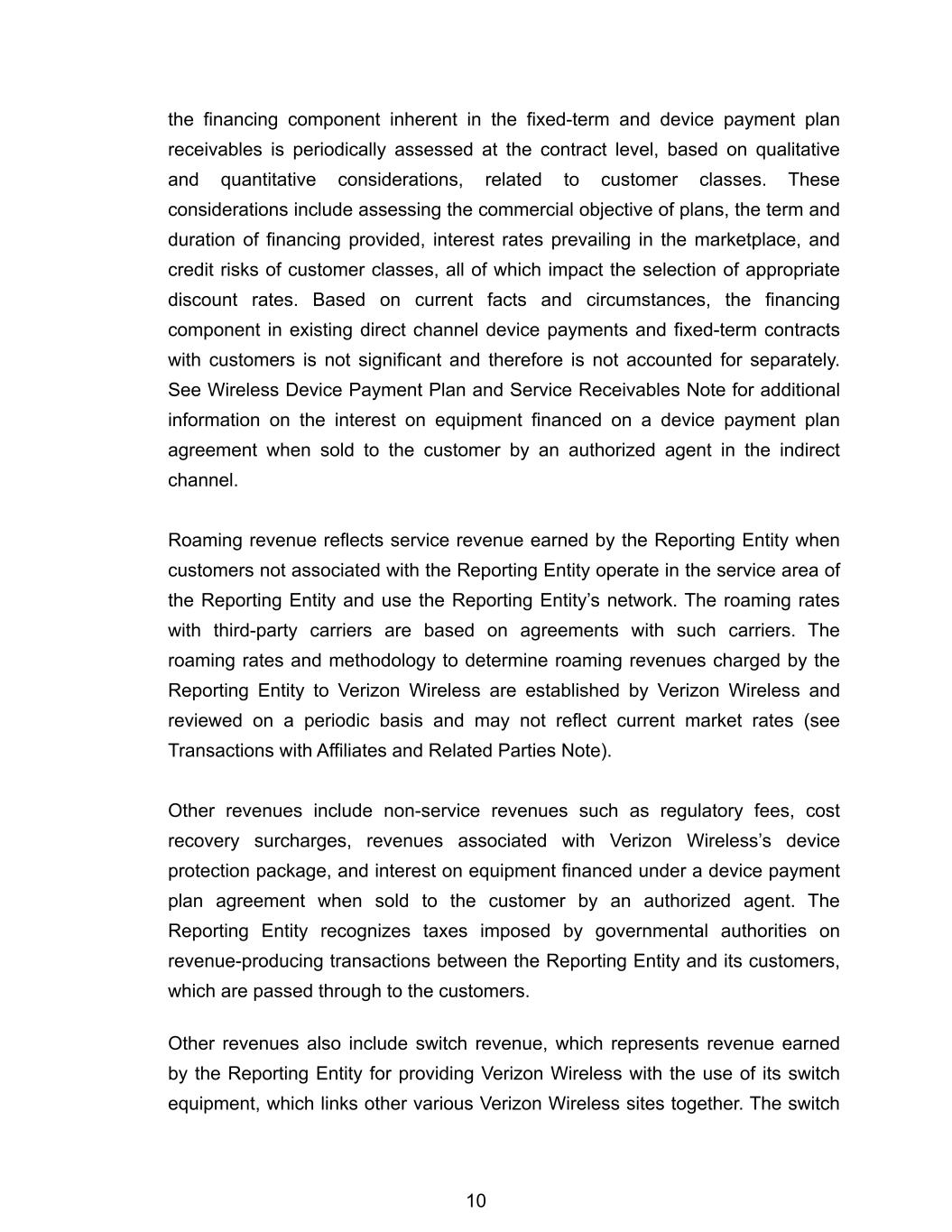
the financing component inherent in the fixed-term and device payment plan receivables is periodically assessed at the contract level, based on qualitative and quantitative considerations, related to customer classes. These considerations include assessing the commercial objective of plans, the term and duration of financing provided, interest rates prevailing in the marketplace, and credit risks of customer classes, all of which impact the selection of appropriate discount rates. Based on current facts and circumstances, the financing component in existing direct channel device payments and fixed-term contracts with customers is not significant and therefore is not accounted for separately. See Wireless Device Payment Plan and Service Receivables Note for additional information on the interest on equipment financed on a device payment plan agreement when sold to the customer by an authorized agent in the indirect channel. Roaming revenue reflects service revenue earned by the Reporting Entity when customers not associated with the Reporting Entity operate in the service area of the Reporting Entity and use the Reporting Entity’s network. The roaming rates with third-party carriers are based on agreements with such carriers. The roaming rates and methodology to determine roaming revenues charged by the Reporting Entity to Verizon Wireless are established by Verizon Wireless and reviewed on a periodic basis and may not reflect current market rates (see Transactions with Affiliates and Related Parties Note). Other revenues include non-service revenues such as regulatory fees, cost recovery surcharges, revenues associated with Verizon Wireless’s device protection package, and interest on equipment financed under a device payment plan agreement when sold to the customer by an authorized agent. The Reporting Entity recognizes taxes imposed by governmental authorities on revenue-producing transactions between the Reporting Entity and its customers, which are passed through to the customers. Other revenues also include switch revenue, which represents revenue earned by the Reporting Entity for providing Verizon Wireless with the use of its switch equipment, which links other various Verizon Wireless sites together. The switch 10
revenue rates charged by the Reporting Entity to Verizon Wireless are established by Verizon Wireless on a periodic basis and may not reflect current market rates (see Transactions with Affiliates and Related Parties Note). Wireless contracts Total contract revenue, which represents the transaction price for service and equipment, is allocated between service and equipment revenue based on their estimated standalone selling prices. The standalone selling price of the device or accessory is estimated to be its retail price, excluding subsidies or conditional purchase discounts. The standalone selling price of service is estimated to be the price that is offered to customers on month-to-month contracts that can be cancelled at any time without penalty (i.e., when there is no fixed-term for service) or when service is procured without the concurrent purchase of a device. In addition, the Reporting Entity also assesses whether the service term is impacted by certain legally enforceable rights and obligations in the contract with customers, such as penalties that a customer would have to pay to early terminate a fixed-term contract or billing credits that would cease if the month-to- month wireless service is canceled. The assessment of these legally enforceable rights and obligations involves judgment and impacts the determination of the transaction price and related disclosures. From time to time, customers on device payment plans may be offered certain promotions that provide the right to upgrade to a new device after paying a certain specified portion of the required device payment plan agreement amount and trading in their device in good working order. This trade-in right is accounted for as a guarantee obligation. The full amount of the trade-in right's fair value is recognized as a guarantee liability and results in a reduction to the revenue recognized upon the sale of the device. The guarantee liability was insignificant as of December 31, 2025 and 2024. The total transaction price is reduced by the guarantee, which is accounted for outside the scope of Topic 606, and the 11
remaining transaction price is allocated between the performance obligations within the contract. Fixed-term plans generally include the sale of a wireless device at subsidized prices. This results in the creation of a contract asset at the time of sale, which represents the recognition of equipment revenue in excess of amounts billed. For device payment plans, billing credits are accounted for as consideration payable to a customer and are included in the determination of total transaction price, resulting in a contract liability. Verizon Wireless may provide a right of return on products and services for a short time period after a sale. These rights are accounted for as variable consideration when determining the transaction price, and accordingly the Reporting Entity recognizes revenue based on the estimated amount to which the Reporting Entity expects to be entitled after considering expected returns. Returns and credits are estimated at contract inception and updated at the end of each reporting period as additional information becomes available. Verizon Wireless also may provide credits or incentives on products and services for contracts with resellers, which are accounted for as variable consideration when estimating the amount of revenue to recognize. For certain offers that also include third-party service providers, the Reporting Entity evaluates whether the Reporting Entity is acting as the principal or as the agent with respect to the goods or services provided to the customer. This principal-versus-agent assessment involves judgment and focuses on whether the facts and circumstances of the arrangement indicate that the goods or services were controlled by the Reporting Entity prior to transferring them to the customer. To evaluate if the Reporting Entity has control, various factors are considered including whether the Reporting Entity is primarily responsible for fulfillment, bears risk of loss and has discretion over pricing. 12
Operating expenses Operating expenses include expenses directly attributable to the Reporting Entity, as well as an allocation of selling, general and administrative, and other operating expenses incurred by Verizon on behalf of the Reporting Entity. Employees of Verizon provide services on behalf of the Reporting Entity. These employees are not employees of the Reporting Entity; therefore, operating expenses include allocated charges of salary and employee benefit costs for the services provided to the Reporting Entity. Verizon Wireless believes such allocations, which are principally based on retail subscribers, are calculated in accordance with the Reporting Entity agreement and are determined using a reasonable method of allocating such costs (see Transactions with Affiliates and Related Parties Note). Cost of roaming, included in Cost of services, reflects costs incurred by the Reporting Entity when customers associated with the Reporting Entity operate and use a network in a service area not associated with the Reporting Entity. The roaming rates with third-party carriers are based on agreements with such carriers. The roaming rates and methodology to determine roaming costs charged to the Reporting Entity by Verizon Wireless are established by Verizon Wireless and reviewed on a periodic basis and may not reflect current market rates (see Transactions with Affiliates and Related Parties Note). Cost of equipment is recorded upon sale of the related equipment at Verizon Wireless’s cost basis. Inventory is owned by Verizon Wireless until the moment of sale and is not recorded on the financial statements of the Reporting Entity. Maintenance and repairs The cost of maintenance and repairs, including the cost of replacing minor items not constituting substantial betterments, is charged principally to Cost of services as these costs are incurred. 13
Advertising costs Costs for advertising products and services, as well as other promotional and sponsorship costs, are allocated from Verizon Wireless and are charged to Selling, general and administrative expense in the periods in which they are incurred (see Transactions with Affiliates and Related Parties Note). Income taxes The Partnership is treated as a pass-through entity for income tax purposes and therefore, is not subject to federal, state or local income taxes. Accordingly, no provision has been recorded for income taxes in the Partnership’s financial statements. The results of operations, including taxable income, gains, losses, deductions and credits, are allocated to and reflected on the income tax returns of the respective partners. At December 31, 2025, the tax basis of the Partnership’s assets and liabilities was $3,534,652 less than the amount of the assets and liabilities reported. The Partnership files partnership income tax returns in the U.S. federal jurisdiction and various state and local jurisdictions. The Partnership remains subject to examination by tax authorities for tax years as early as 2021. It is reasonably possible that future tax examinations could result in adjustments to or require reevaluations of the Partnership’s tax positions. An estimate of the range of the possible change cannot be made until these tax matters are further developed or resolved. Due to/from affiliate Due to/from affiliate principally represents the Reporting Entity’s cash position with Verizon. Verizon manages, on behalf of the Reporting Entity, all operating, investing and financing activities of the Reporting Entity. As such, the change in due to/from affiliate is reflected as a financing activity or an investing activity, respectively, on the statement of cash flows, based on the net position. In 14
addition, cost of equipment and other operating expenses incurred by Verizon Wireless on behalf of the Reporting Entity, as well as property, plant and equipment - net and wireless license transactions with Verizon Wireless, are charged to the Reporting Entity through this account. Interest income on due from affiliate and interest expense on due to affiliate are based on the short-term Applicable Federal Rate, which was approximately 4.0%, 4.6% and 4.7% for the years ended December 31, 2025, 2024 and 2023 respectively. The interest income and interest expense related to due to/from affiliate was insignificant for the years ended December 31, 2025, 2024 and 2023, respectively. Allowance for credit losses Accounts receivable are recorded at amortized cost less an allowance for credit losses that are not expected to be recovered. The gross amount of accounts receivable and corresponding allowance for credit losses are presented separately on the Balance Sheets. The Reporting Entity maintains allowances for credit losses resulting from the expected failure or inability of customers to make required payments. The allowance for credit losses is recognized at inception and reassessed quarterly based on management’s expectation of the asset’s collectability. The allowance is based on multiple factors including historical experience with bad debts, the credit quality of the customer base, the aging of such receivables and current macroeconomic conditions, as well as management’s expectations of conditions in the future, as applicable. The allowance for credit losses is based on management’s assessment of the collectability of assets pooled together with similar risk characteristics. Device payment plan agreement receivables are pooled based on the credit quality indicators and shared risk characteristics of “new customers" and “existing customers.” New customers are defined as customers who have been with Verizon for less than 210 days. Existing customers are defined as customers who have been with Verizon for 210 days or more. An allowance is recorded to reduce the receivables to the amount that is expected to be collectible. For device 15
payment plan agreement receivables, bad debt expenses are recorded based on a default and loss calculation using Verizon’s proprietary loss model. The expected loss rate is determined based on customer credit scores and other qualitative factors as noted above. The loss rate is assigned individually on a customer by customer basis and the custom credit scores are then aggregated by vintage and used in the proprietary loss model to calculate the weighted- average loss rate used for determining the allowance balance. The collectability of service receivables is monitored as one overall pool. The service receivables allowance is calculated based on a 12 month rolling average write-off balance multiplied by the average life-cycle of an account from billing to write-off. The risk of loss is assessed over the contractual life of the receivables, and the historical loss amounts for current and future conditions are adjusted based on management’s qualitative considerations. Multiple factors are considered in determining the allowance as discussed above. Property, plant and equipment and depreciation Property, plant and equipment are recorded at cost and generally depreciated on a straight-line basis. Leasehold improvements are amortized over the shorter of the estimated life of the improvement or the remaining term of the related lease, calculated from the time the asset was placed in service. When depreciable assets are retired or otherwise disposed of, the related cost and accumulated depreciation are deducted from the property, plant and equipment accounts and any gains or losses on disposition are recognized in Selling, general and administrative expense. Transfers of property, plant and equipment between the Reporting Entity and Verizon Wireless are recorded at net book value on the date of the transfer with an offsetting amount included in due to/from affiliate. 16
Interest expense, if any, associated with the construction of network-related assets is capitalized. Capitalized interest is reported as a reduction in interest expense and depreciated as part of the cost of the network-related assets. Verizon Wireless and the Reporting Entity continue to assess the estimated useful lives of property, plant and equipment and, though the timing and extent of current deployment plans are subject to ongoing analysis and modification, the current estimates of useful lives are believed to be reasonable. Other assets - net Other assets - net primarily includes beneficial interest and long-term device payment plan agreement receivables, net of allowances of $39,763 and $30,259 as of December 31, 2025 and 2024, respectively. The Reporting Entity’s Allowance for credit losses includes an allowance for credit losses relating to beneficial interest obtained in connection with the sale of device payment plan and service receivables that were purchased with credit deterioration. The allowance is recognized at inception at the time the receivables are sold to the trust entity and is reassessed annually based on management's expectation of the asset's collectability. The allowance is based on the same factors and loss rate as the allowance for device payment plan agreement and service receivables (see Wireless Device Payment Plan and Service Receivables Note). Long-lived assets All long-lived assets are reviewed for impairment whenever events or changes in circumstances indicate that the carrying amount of the asset may not be recoverable. If any indications of impairment are present, recoverability would be tested by comparing the carrying amount of the asset group to the net undiscounted cash flows expected to be generated from the asset group. If those net undiscounted cash flows do not exceed the carrying amount, the next step 17
would be to determine the fair value of the asset group and record an impairment, if any. The useful-life determinations for these long-lived assets are re-evaluated each year to determine whether events and circumstances warrant a revision to their remaining useful lives. Wireless licenses Wireless licenses provide the Reporting Entity with the exclusive right to utilize the designated radio frequency spectrum to provide wireless communications services. In addition, Verizon Wireless maintains wireless licenses that provide the Reporting Entity with the right to utilize Verizon Wireless’s designated radio frequency spectrum to provide wireless communications services (see Transactions with Affiliates and Related Parties Note). While licenses are issued for a fixed time, generally ten to fifteen years, such licenses are subject to renewal by the Federal Communications Commission (FCC). License renewals, which are managed by Verizon Wireless, have historically occurred routinely and at nominal cost. Moreover, Verizon Wireless determined that there are currently no legal, regulatory, contractual, competitive, economic or other factors that limit the useful lives of the wireless licenses. As a result, wireless licenses are treated as an indefinite-lived intangible asset. The useful life determination for wireless licenses is re-evaluated each year to determine whether events and circumstances continue to support an indefinite useful life. The Reporting Entity owns at least one wireless license in the Los Angeles SMSA. The average remaining renewal period of the Reporting Entity’s wireless license portfolio was 2.6 years as of December 31, 2025. Interest expense, if any, incurred while qualifying activities are performed to ready wireless licenses for their intended use is capitalized as part of wireless licenses. The capitalization period ends when the development is discontinued or substantially complete and the license is ready for its intended use. 18
Wireless license balances are tested for potential impairment annually or more frequently if impairment indicators are present. The first option is to perform a qualitative assessment to determine whether it is necessary to perform a quantitative impairment test. It is Verizon Wireless’s policy to perform a quantitative impairment assessment at least every three years. When evaluating wireless licenses for impairment, Verizon Wireless and the Reporting Entity (to the extent it owns more than one license) aggregate wireless licenses into one single unit of accounting, since they are utilized on an integrated basis. In 2024, Verizon Wireless performed a quantitative impairment assessment consisting of comparing the estimated fair value of the aggregate wireless licenses to the aggregated carrying amount as of the test date. Under the quantitative assessment, the fair value of the wireless licenses is estimated using the Greenfield approach. The Greenfield approach is an income based valuation approach that values the wireless licenses to be valued by calculating the cash flow generating potential of a hypothetical start-up company that goes into business with no assets except the wireless licenses. A discounted cash flow analysis is used to estimate what a marketplace participant would be willing to pay to purchase the aggregated wireless licenses as of the valuation date. If the estimated fair value of the aggregated wireless licenses is less than the aggregated carrying amount of the wireless licenses, then an impairment charge is recognized. The annual impairment test indicated the fair value exceeded the carrying value and, therefore, did not result in an impairment charge. In 2025, Verizon Wireless performed a qualitative impairment assessment to determine whether it is more likely than not that the fair value of its aggregate wireless licenses was less than the carrying amount. As part of the assessment, several qualitative factors were considered, including market transactions, the business enterprise value of Verizon Wireless, macroeconomic conditions (including changes in interest rates and discount rates), industry and market considerations (including industry revenue and subscriber growth, as well as recent merger and acquisition activity), the recent and projected financial performance of Verizon Wireless, as well as other factors. The annual impairment 19
test indicated that it is more likely than not that the fair value of Verizon Wireless's wireless licenses remained above their carrying value and, therefore, did not result in an impairment. In 2025 and 2024, a qualitative impairment assessment similar to that described for Verizon Wireless was performed for the Reporting Entity’s aggregate wireless licenses which indicated that it is more likely than not that the fair value of the Reporting Entity's wireless licenses remained above their carrying value and, therefore, did not result in an impairment. Leases Verizon Wireless, on behalf of the Reporting Entity, and the Reporting Entity itself leases network equipment including towers, distributed antenna systems, small cells, real estate, connectivity mediums which include dark fiber, equipment, and other various types of assets for use in operations under both operating and finance leases. Verizon Wireless assesses whether an arrangement is a lease or contains a lease at inception. For arrangements considered leases or that contain a lease that is accounted for separately, the classification and initial measurement of the right-of-use asset and lease liability is determined at the lease commencement date, which is the date that the underlying asset becomes available for use. For both operating and finance leases, the Reporting Entity recognizes a right-of- use asset, which represents the right to use the underlying asset for the lease term, and a lease liability, which represents the present value of the obligation to make payments arising over the lease term. The present value of the lease payments is calculated using the incremental borrowing rate for operating and finance leases. The incremental borrowing rate is determined using a portfolio approach based on the rate of interest that Verizon Wireless would have to pay to borrow an amount equal to the lease payments on a collateralized basis over a similar term. Verizon Wireless uses the unsecured borrowing rate and risk- 20
adjusts that rate to approximate a collateralized rate, which is updated on a quarterly basis. In those circumstances where the Reporting Entity is the lessee, the Reporting Entity accounts for non-lease components associated with leases (e.g., common area maintenance costs) and lease components as a single lease component for substantially all asset classes. Additionally, in arrangements where the Reporting Entity is the lessor, there is customer premise equipment for which the reporting entity accounts for non-lease components (e.g., service revenue) and lease components as combined components under the revenue recognition guidance in Topic 606 as the service revenues are the predominant components in the arrangements. Rent expense for operating leases is recognized on a straight-line basis over the term of the lease and is included in either Cost of services or Selling, general and administrative expense in the Statements of Income, based on the use of the facility or equipment on which rent is being paid. Variable rent payments related to both operating and finance leases are expensed in the period incurred. Variable lease payments consist of payments dependent on various external indicators, including real estate taxes, common area maintenance charges and utility usage. Operating leases with a term of 12 months or less are not recorded in the Balance Sheets; the Reporting Entity recognizes rent expense for these leases on a straight-line basis over the lease term. The Reporting Entity recognizes the amortization of the right-of-use asset for finance leases on a straight-line basis over the shorter of the lease term or the useful life of the right-of-use asset in Depreciation and amortization expense in the Statements of Income. The interest expense related to finance leases is recognized using the effective interest method based on the discount rate determined at lease commencement and is included within Interest expense in the Statements of Income. 21
See Leasing Arrangements Note for additional information related to leases, including disclosure required under Topic 842. Fair value measurements Fair value of financial and non-financial assets and liabilities is defined as an exit price, representing the amount that would be received to sell an asset or paid to transfer a liability in an orderly transaction between market participants. While prioritizing the inputs used in methodologies of measuring fair value, the three- tier hierarchy for inputs is as follows: Level 1 - Quoted prices in active markets for identical assets or liabilities Level 2 - Observable inputs, other than quoted prices, in active markets for identical assets and liabilities Level 3 - Unobservable pricing inputs in the market Financial assets and financial liabilities are classified in their entirety based on the lowest level of input that is significant to the fair value measurements. The assessment of the significance of a particular input to the fair value measurements requires judgment, and may affect the valuation of the assets and liabilities being measured and their categorization within the fair value hierarchy. As of December 31, 2025 and 2024, the Reporting Entity did not have any assets or liabilities measured at fair value on a recurring basis. Partners' distributions The Reporting Entity is required to make distributions to its partners based upon the Reporting Entity’s operating results, due to/from affiliate status and financing needs, as determined by the General Partner at the date of the distribution. Partnership distributions are typically made in arrears. 22
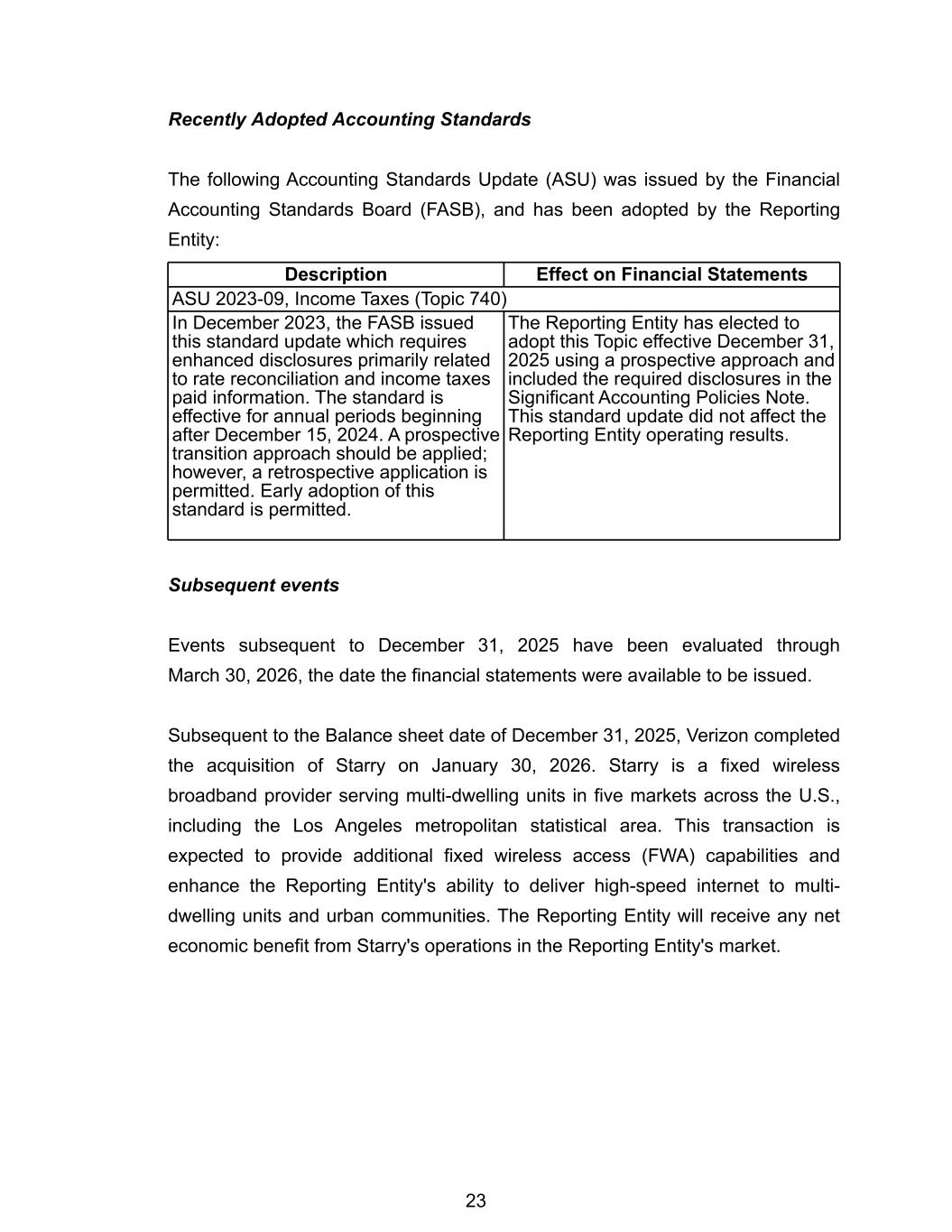
Recently Adopted Accounting Standards The following Accounting Standards Update (ASU) was issued by the Financial Accounting Standards Board (FASB), and has been adopted by the Reporting Entity: Description Effect on Financial Statements ASU 2023-09, Income Taxes (Topic 740) In December 2023, the FASB issued this standard update which requires enhanced disclosures primarily related to rate reconciliation and income taxes paid information. The standard is effective for annual periods beginning after December 15, 2024. A prospective transition approach should be applied; however, a retrospective application is permitted. Early adoption of this standard is permitted. The Reporting Entity has elected to adopt this Topic effective December 31, 2025 using a prospective approach and included the required disclosures in the Significant Accounting Policies Note. This standard update did not affect the Reporting Entity operating results. Subsequent events Events subsequent to December 31, 2025 have been evaluated through March 30, 2026, the date the financial statements were available to be issued. Subsequent to the Balance sheet date of December 31, 2025, Verizon completed the acquisition of Starry on January 30, 2026. Starry is a fixed wireless broadband provider serving multi-dwelling units in five markets across the U.S., including the Los Angeles metropolitan statistical area. This transaction is expected to provide additional fixed wireless access (FWA) capabilities and enhance the Reporting Entity's ability to deliver high-speed internet to multi- dwelling units and urban communities. The Reporting Entity will receive any net economic benefit from Starry's operations in the Reporting Entity's market. 23
3. REVENUE AND CONTRACT COSTS The Reporting Entity earns revenue from contracts with customers, primarily through the provision of telecommunications and other wireless services and through the sale of wireless equipment. Revenue is disaggregated on the Statements of Income by products and services, which is viewed as the relevant categorization for the Reporting Entity. Under Topic 606, the total consideration in the contract is allocated between wireless equipment and service based on their relative standalone selling prices. This primarily impacts arrangements that include sales of wireless devices at subsidized prices in conjunction with a fixed-term plan, also known as the subsidy model, for service. At the time the equipment is sold, this allocation results in the recognition of a contract asset equal to the difference between the amount of revenue recognized and the amount of consideration received from the customer. Verizon Wireless offers new fixed-term plans with subsidized equipment pricing only to business customers. Topic 606 also requires the deferral of incremental costs incurred to obtain a customer contract, which are then amortized to expense, as a component of Selling, general and administrative expense, over the respective periods of expected benefit. Both fixed-term plans and device payment plans include a financing component. Under Topic 606, this financing component for customers in the direct channel for wireless devices is not significant and therefore is not accounted for separately. In the indirect channel, at the time of the sale of a device, risk adjusted interest is imputed on the device payment plan agreement receivables. The imputed interest is recorded as a reduction to the related accounts receivable and interest income is recognized in Other revenues over the financed device payment term. 24
Remaining Performance Obligation When allocating the total contract transaction price to identified performance obligations, a portion of the total transaction price may relate to service performance obligations which were not satisfied or are partially satisfied as of the end of the reporting period. Below we disclose information relating to these unsatisfied performance obligations. We apply the practical expedient available under Topic 606 that provides the option to exclude the expected revenues arising from unsatisfied performance obligations related to contracts that have an original expected duration of one year or less. This situation primarily arises with respect to certain month-to-month service contracts. At December 31, 2025, 2024 and 2023, month-to-month service contracts represented approximately 95% of the Reporting Entity's wireless postpaid contracts. Additionally, certain contracts provide customers the option to purchase additional services. The fees related to these additional services are recognized when the customer exercises the option (typically on a month-to-month basis). Contracts for wireless services, with or without promotional credits that require maintenance of service, are generally either month-to-month and cancellable at any time, or considered to contain terms ranging from greater than one month to up to thirty-six months (typically under a device payment plan associated with a promotion or a fixed-term plan). Additionally, customers may incur charges based on usage or additional optional services purchased in conjunction with entering into a contract that can be cancelled at any time and therefore are not included in the transaction price. The transaction price allocated to service performance obligations, which are not satisfied or are partially satisfied as of the end of the reporting period, are generally related to contracts that are not accounted for as month-to-month contracts. The Reporting Entity's customers also include traditional wholesale resellers that purchase and resell wireless service under their own brands to their respective customers. Reseller arrangements generally include a stated contract term, which typically extends longer than two years and, in some cases, include a 25
periodic minimum revenue commitment over the contract term for which revenues will be recognized in future periods. At December 31, 2025, the aggregate amount of the transaction price related to unsatisfied performance obligations was $2,746,866, of which we expect to recognize substantially all of the revenue from origination over the next thirty-six months, with the remainder recognized thereafter. Remaining performance obligation estimates are subject to change and are affected by several factors, including terminations and changes in the timing and scope of contracts, arising from contract modifications. Accounts receivable and contract balances The timing of revenue recognition may differ from the time of billing to customers. Receivables presented on the Balance Sheets represent an unconditional right to consideration. Contract balances represent amounts from an arrangement when either the performance obligation has been satisfied by transferring goods and/or services to the customer in advance of receiving all or partial consideration for such goods and/or services from the customer, or the customer has made payment in advance of obtaining control of the goods and/or services promised to the customer in the contract. Contract assets primarily relate to rights to consideration for goods and/or services provided to the customers but for which there is not an unconditional right at the reporting date. Under a fixed-term plan, the total contract revenue is allocated between wireless services and equipment revenues, as discussed above. In conjunction with these arrangements, a contract asset is created, which represents the difference between the amount of equipment revenue recognized upon sale and the amount of consideration received from the customer when the performance obligation related to the transfer of control of the equipment is satisfied. The contract asset is recognized as accounts receivable as wireless services are provided and billed. The right to bill the customer is obtained as service is provided over time, which results in the right to the payment being unconditional. The contract asset balance is presented on the Balance Sheets as 26
Prepaid expenses and other, and Other assets - net. Contract assets are assessed for impairment on a quarterly basis and an impairment charge is recognized to the extent the carrying amount is not recoverable. The impairment charge related to contract assets was insignificant for the years ended December 31, 2025, 2024 and 2023. Increases in the contract asset balances were primarily due to new contracts and increases in sales promotions recognized upfront, driven by customer activity related to wireless services, while decreases were due to reclassifications to accounts receivable due to billings on the existing contracts and insignificant impairment charges. Contract liabilities arise when customers are billed and consideration is received in advance of providing the goods and/or services promised in the contract. The majority of the contract liability at each year end is recognized during the following year as these contract liabilities primarily relate to advanced billing of fixed monthly fees for service that are recognized within the following month when services are provided to the customer. The contract liability balances are presented on the Balance Sheets as Contract liabilities and other, and Other liabilities. Increases in contract liabilities were primarily due to increases in sales promotions recognized over time, upfront fees, and pricing actions, as well as increases in deferred revenue related to advanced billings, while decreases in contract liabilities were primarily due to the satisfaction of performance obligations related to wireless services. 27
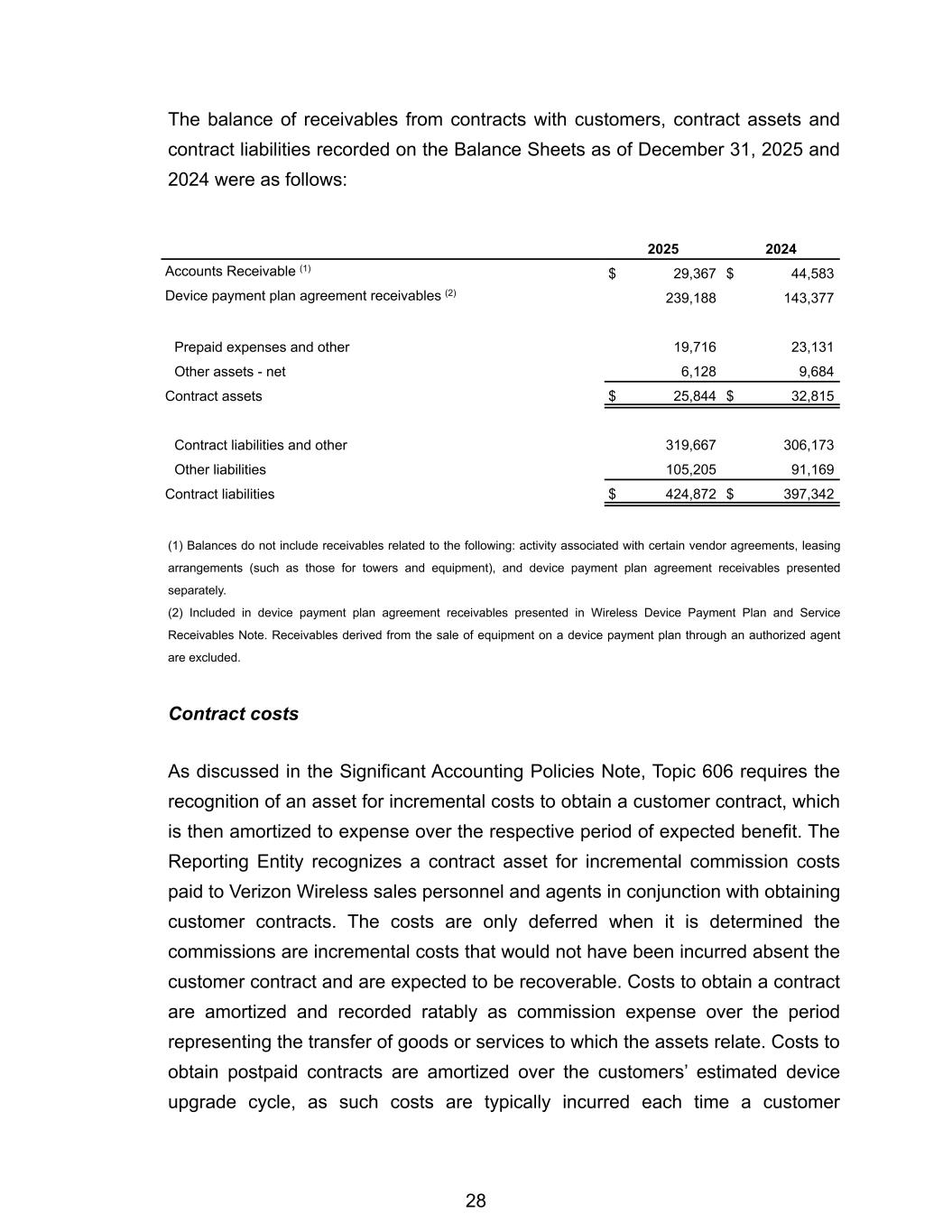
The balance of receivables from contracts with customers, contract assets and contract liabilities recorded on the Balance Sheets as of December 31, 2025 and 2024 were as follows: 2025 2024 Accounts Receivable (1) $ 29,367 $ 44,583 Device payment plan agreement receivables (2) 239,188 143,377 Prepaid expenses and other 19,716 23,131 Other assets - net 6,128 9,684 Contract assets $ 25,844 $ 32,815 Contract liabilities and other 319,667 306,173 Other liabilities 105,205 91,169 Contract liabilities $ 424,872 $ 397,342 (1) Balances do not include receivables related to the following: activity associated with certain vendor agreements, leasing arrangements (such as those for towers and equipment), and device payment plan agreement receivables presented separately. (2) Included in device payment plan agreement receivables presented in Wireless Device Payment Plan and Service Receivables Note. Receivables derived from the sale of equipment on a device payment plan through an authorized agent are excluded. Contract costs As discussed in the Significant Accounting Policies Note, Topic 606 requires the recognition of an asset for incremental costs to obtain a customer contract, which is then amortized to expense over the respective period of expected benefit. The Reporting Entity recognizes a contract asset for incremental commission costs paid to Verizon Wireless sales personnel and agents in conjunction with obtaining customer contracts. The costs are only deferred when it is determined the commissions are incremental costs that would not have been incurred absent the customer contract and are expected to be recoverable. Costs to obtain a contract are amortized and recorded ratably as commission expense over the period representing the transfer of goods or services to which the assets relate. Costs to obtain postpaid contracts are amortized over the customers’ estimated device upgrade cycle, as such costs are typically incurred each time a customer 28
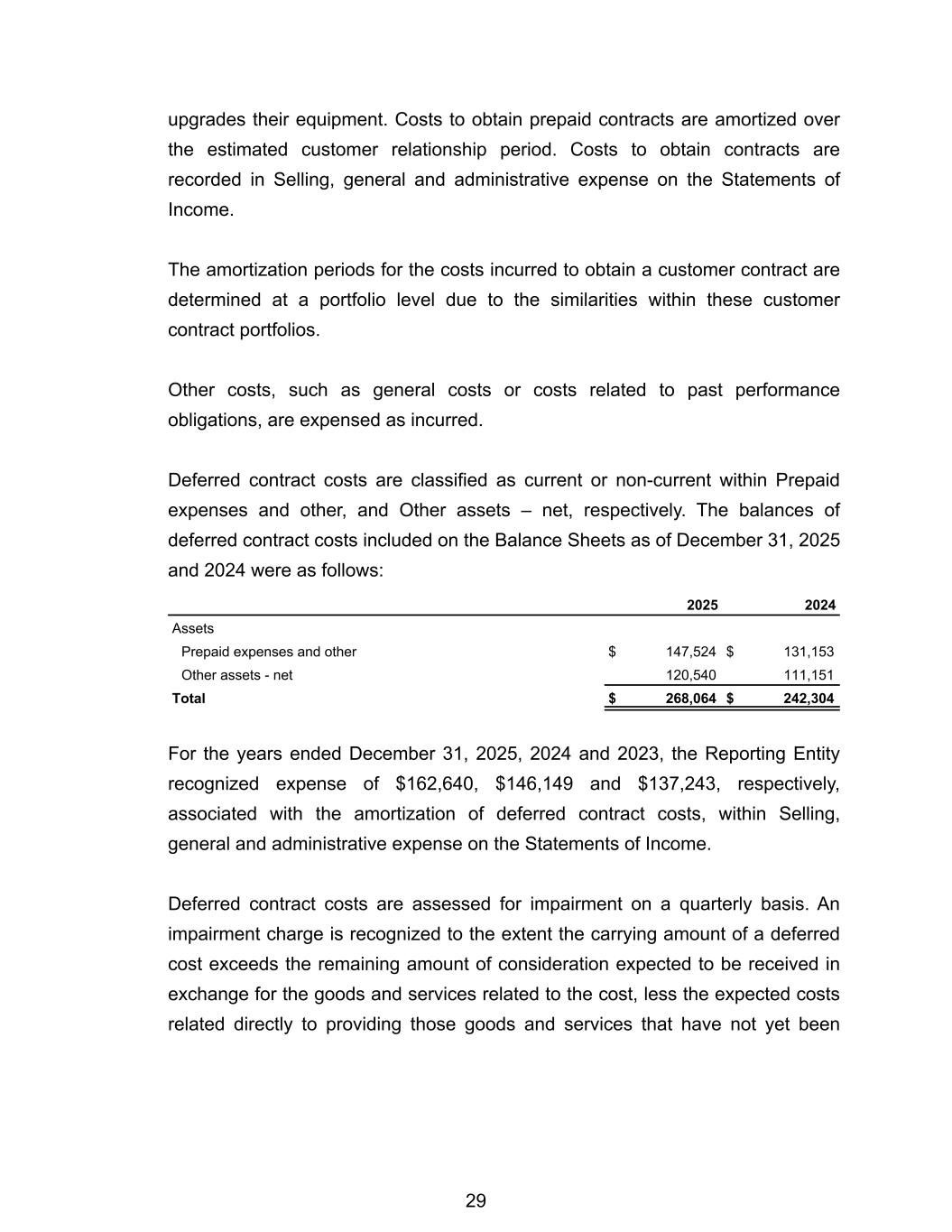
upgrades their equipment. Costs to obtain prepaid contracts are amortized over the estimated customer relationship period. Costs to obtain contracts are recorded in Selling, general and administrative expense on the Statements of Income. The amortization periods for the costs incurred to obtain a customer contract are determined at a portfolio level due to the similarities within these customer contract portfolios. Other costs, such as general costs or costs related to past performance obligations, are expensed as incurred. Deferred contract costs are classified as current or non-current within Prepaid expenses and other, and Other assets – net, respectively. The balances of deferred contract costs included on the Balance Sheets as of December 31, 2025 and 2024 were as follows: 2025 2024 Assets Prepaid expenses and other $ 147,524 $ 131,153 Other assets - net 120,540 111,151 Total $ 268,064 $ 242,304 For the years ended December 31, 2025, 2024 and 2023, the Reporting Entity recognized expense of $162,640, $146,149 and $137,243, respectively, associated with the amortization of deferred contract costs, within Selling, general and administrative expense on the Statements of Income. Deferred contract costs are assessed for impairment on a quarterly basis. An impairment charge is recognized to the extent the carrying amount of a deferred cost exceeds the remaining amount of consideration expected to be received in exchange for the goods and services related to the cost, less the expected costs related directly to providing those goods and services that have not yet been 29
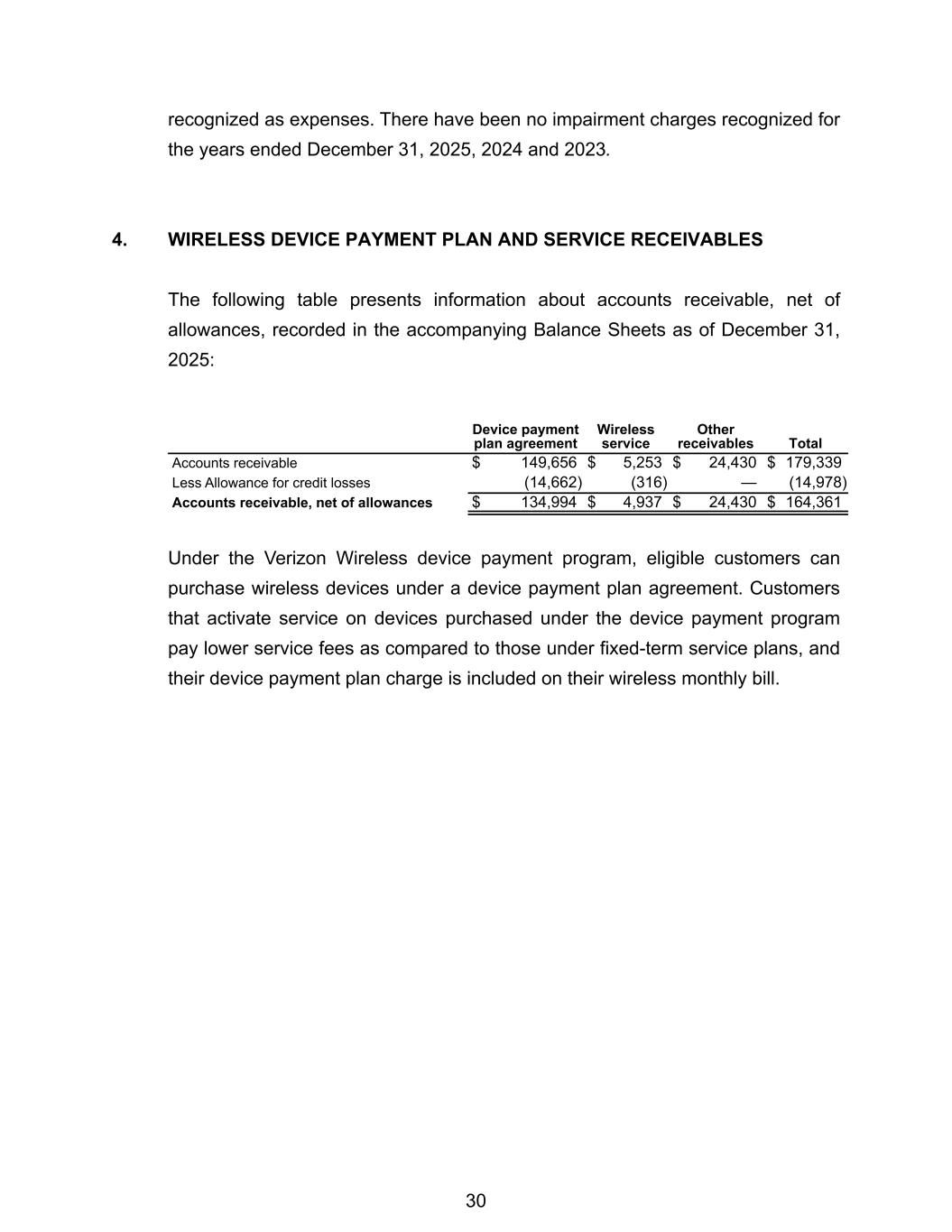
recognized as expenses. There have been no impairment charges recognized for the years ended December 31, 2025, 2024 and 2023. 4. WIRELESS DEVICE PAYMENT PLAN AND SERVICE RECEIVABLES The following table presents information about accounts receivable, net of allowances, recorded in the accompanying Balance Sheets as of December 31, 2025: Device payment plan agreement Wireless service Other receivables Total Accounts receivable $ 149,656 $ 5,253 $ 24,430 $ 179,339 Less Allowance for credit losses (14,662) (316) — (14,978) Accounts receivable, net of allowances $ 134,994 $ 4,937 $ 24,430 $ 164,361 Under the Verizon Wireless device payment program, eligible customers can purchase wireless devices under a device payment plan agreement. Customers that activate service on devices purchased under the device payment program pay lower service fees as compared to those under fixed-term service plans, and their device payment plan charge is included on their wireless monthly bill. 30
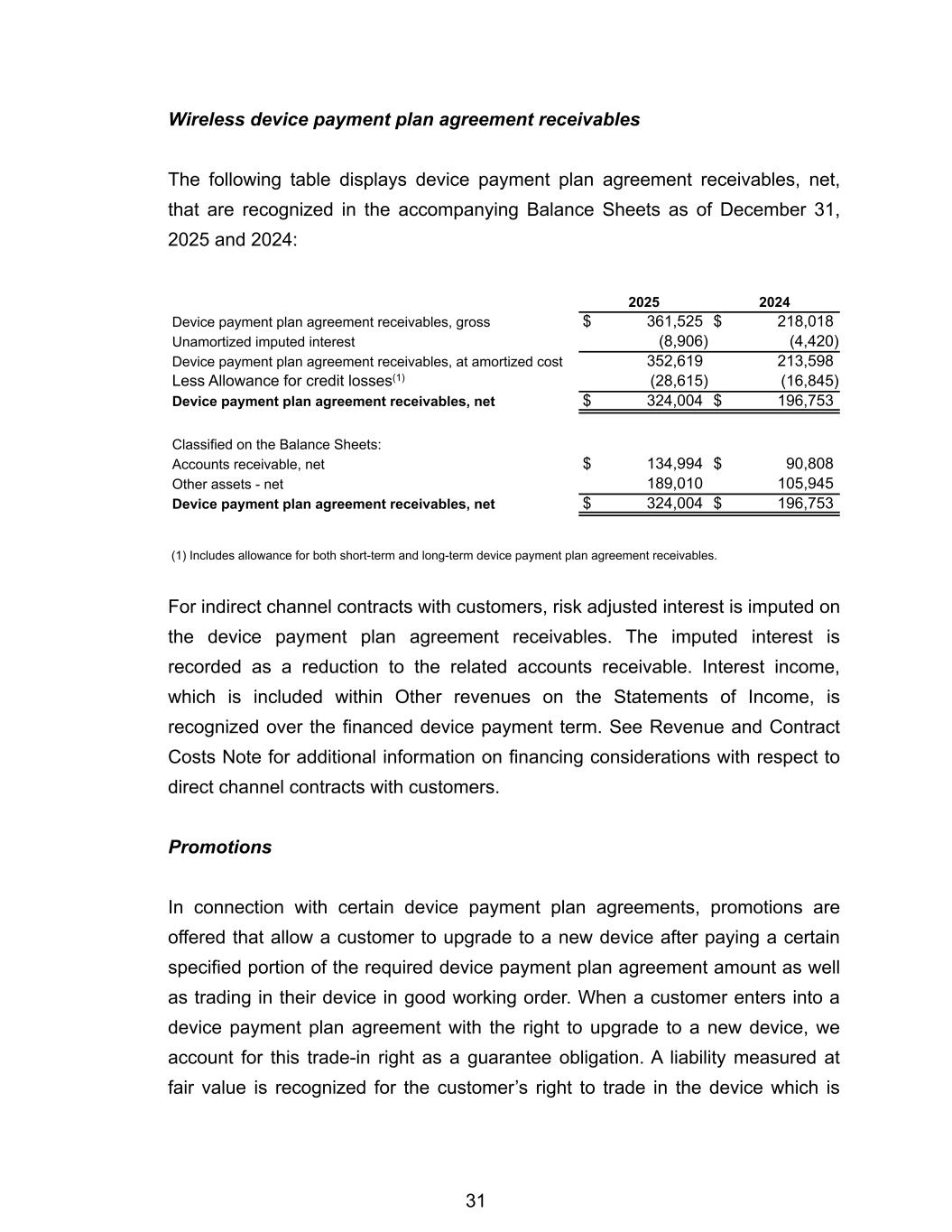
Wireless device payment plan agreement receivables The following table displays device payment plan agreement receivables, net, that are recognized in the accompanying Balance Sheets as of December 31, 2025 and 2024: 2025 2024 Device payment plan agreement receivables, gross $ 361,525 $ 218,018 Unamortized imputed interest (8,906) (4,420) Device payment plan agreement receivables, at amortized cost 352,619 213,598 Less Allowance for credit losses(1) (28,615) (16,845) Device payment plan agreement receivables, net $ 324,004 $ 196,753 Classified on the Balance Sheets: Accounts receivable, net $ 134,994 $ 90,808 Other assets - net 189,010 105,945 Device payment plan agreement receivables, net $ 324,004 $ 196,753 (1) Includes allowance for both short-term and long-term device payment plan agreement receivables. For indirect channel contracts with customers, risk adjusted interest is imputed on the device payment plan agreement receivables. The imputed interest is recorded as a reduction to the related accounts receivable. Interest income, which is included within Other revenues on the Statements of Income, is recognized over the financed device payment term. See Revenue and Contract Costs Note for additional information on financing considerations with respect to direct channel contracts with customers. Promotions In connection with certain device payment plan agreements, promotions are offered that allow a customer to upgrade to a new device after paying a certain specified portion of the required device payment plan agreement amount as well as trading in their device in good working order. When a customer enters into a device payment plan agreement with the right to upgrade to a new device, we account for this trade-in right as a guarantee obligation. A liability measured at fair value is recognized for the customer’s right to trade in the device which is 31
determined by considering several factors, including the weighted-average selling prices obtained in recent resales of similar devices eligible for trade-in. As of December 31, 2025 and 2024, the amount of the guarantee liability was insignificant to the financial statements. Certain promotions are offered that allow a customer to trade in their owned device in connection with the purchase of a new device. Under these types of promotions, the customer receives a credit for the value of the trade-in device. As of December 31, 2025 and 2024, the amount of the trade-in liability was insignificant to the financial statements. In addition, the customer may be provided with additional future billing credits that will be applied against the customer’s monthly bill as long as service is maintained. These future billing credits are accounted for as consideration payable to a customer and are included in the determination of total transaction price, resulting in a contract liability. Device payment plan agreement receivables, net, disclosed in the table above, does not reflect the trade-in liability, additional future credits or the guarantee liability. Origination of device payment plan agreements When originating device payment plan agreements, Verizon Wireless uses internal and external data sources to create a credit risk score to measure the credit quality of a customer and to determine eligibility for the device payment program. Verizon’s experience has been that the payment attributes of longer tenured customer are highly predictive for estimating their reliability to make future payments. Customers with longer tenures tend to exhibit similar risk characteristics to other customers with longer tenures, and receivables due from customers with longer tenures tend to perform better than receivables from customers that have not previously been Verizon Wireless customers. As a result of this experience, Verizon Wireless makes initial lending decisions based upon whether the customers are "established customers" or "short-tenured 32
customers." If a consumer customer has been a customer for 45 days or more, or if a business customer has been a customer for 12 months or more, the customer is considered an "established customer." For established customers, the credit decision and ongoing credit monitoring processes rely on a combination of internal and external data sources. If a consumer customer has been a customer less than 45 days, or a business customer has been a customer for less than 12 months, the customer is considered a "short-tenured customer." For short- tenured customers, the credit decision and credit monitoring processes rely more heavily on external data sources. Available external credit data from credit reporting agencies along with internal data are used to create custom credit risk scores for consumer customers. The custom credit risk score is generated automatically from the applicant’s credit data using proprietary custom credit models. The credit risk score measures the likelihood that the potential customer will become severely delinquent and be disconnected for non-payment. For a small portion of short-tenured customer applications, a traditional credit report is not available from one of the national credit reporting agencies because the potential customer does not have sufficient credit history. In those instances, alternative credit data is used for the risk assessment. For business customers, we also verify the existence of the business with external data sources. Based on the custom credit risk score, Verizon Wireless assigns each customer to a credit class, each of which has specified offers of credit. This includes an account level spending limit and a maximum amount of credit allowed per device for consumer customers or a required down payment percentage for business customers. Credit quality information Subsequent to origination, Verizon Wireless assesses indicators for the quality of its wireless device payment plan agreement portfolio using two models, one for 33
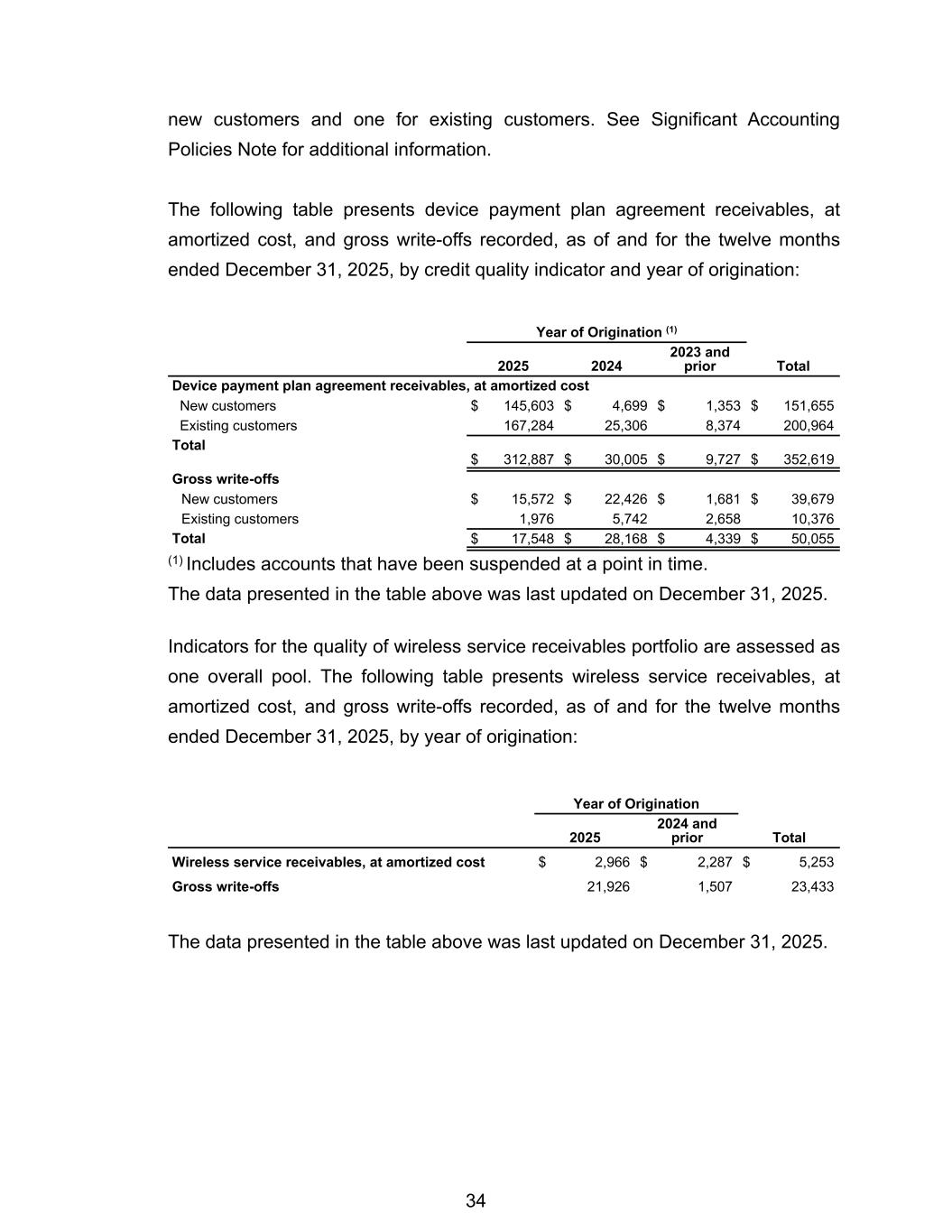
new customers and one for existing customers. See Significant Accounting Policies Note for additional information. The following table presents device payment plan agreement receivables, at amortized cost, and gross write-offs recorded, as of and for the twelve months ended December 31, 2025, by credit quality indicator and year of origination: Year of Origination (1) 2025 2024 2023 and prior Total Device payment plan agreement receivables, at amortized cost New customers $ 145,603 $ 4,699 $ 1,353 $ 151,655 Existing customers 167,284 25,306 8,374 200,964 Total $ 312,887 $ 30,005 $ 9,727 $ 352,619 Gross write-offs New customers $ 15,572 $ 22,426 $ 1,681 $ 39,679 Existing customers 1,976 5,742 2,658 10,376 Total $ 17,548 $ 28,168 $ 4,339 $ 50,055 (1) Includes accounts that have been suspended at a point in time. The data presented in the table above was last updated on December 31, 2025. Indicators for the quality of wireless service receivables portfolio are assessed as one overall pool. The following table presents wireless service receivables, at amortized cost, and gross write-offs recorded, as of and for the twelve months ended December 31, 2025, by year of origination: Year of Origination 2025 2024 and prior Total Wireless service receivables, at amortized cost $ 2,966 $ 2,287 $ 5,253 Gross write-offs 21,926 1,507 23,433 The data presented in the table above was last updated on December 31, 2025. 34
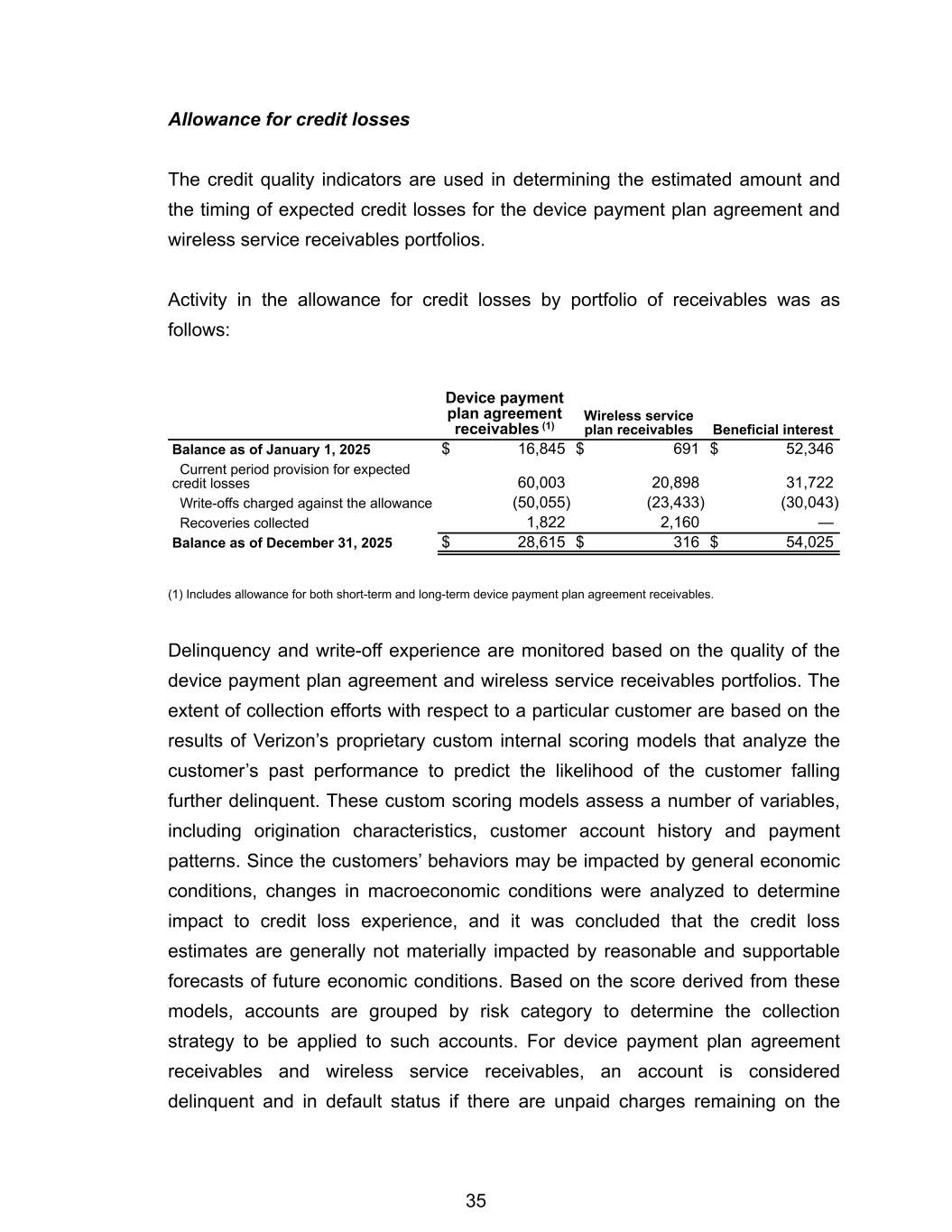
Allowance for credit losses The credit quality indicators are used in determining the estimated amount and the timing of expected credit losses for the device payment plan agreement and wireless service receivables portfolios. Activity in the allowance for credit losses by portfolio of receivables was as follows: Device payment plan agreement receivables (1) Wireless service plan receivables Beneficial interest Balance as of January 1, 2025 $ 16,845 $ 691 $ 52,346 Current period provision for expected credit losses 60,003 20,898 31,722 Write-offs charged against the allowance (50,055) (23,433) (30,043) Recoveries collected 1,822 2,160 — Balance as of December 31, 2025 $ 28,615 $ 316 $ 54,025 (1) Includes allowance for both short-term and long-term device payment plan agreement receivables. Delinquency and write-off experience are monitored based on the quality of the device payment plan agreement and wireless service receivables portfolios. The extent of collection efforts with respect to a particular customer are based on the results of Verizon’s proprietary custom internal scoring models that analyze the customer’s past performance to predict the likelihood of the customer falling further delinquent. These custom scoring models assess a number of variables, including origination characteristics, customer account history and payment patterns. Since the customers’ behaviors may be impacted by general economic conditions, changes in macroeconomic conditions were analyzed to determine impact to credit loss experience, and it was concluded that the credit loss estimates are generally not materially impacted by reasonable and supportable forecasts of future economic conditions. Based on the score derived from these models, accounts are grouped by risk category to determine the collection strategy to be applied to such accounts. For device payment plan agreement receivables and wireless service receivables, an account is considered delinquent and in default status if there are unpaid charges remaining on the 35
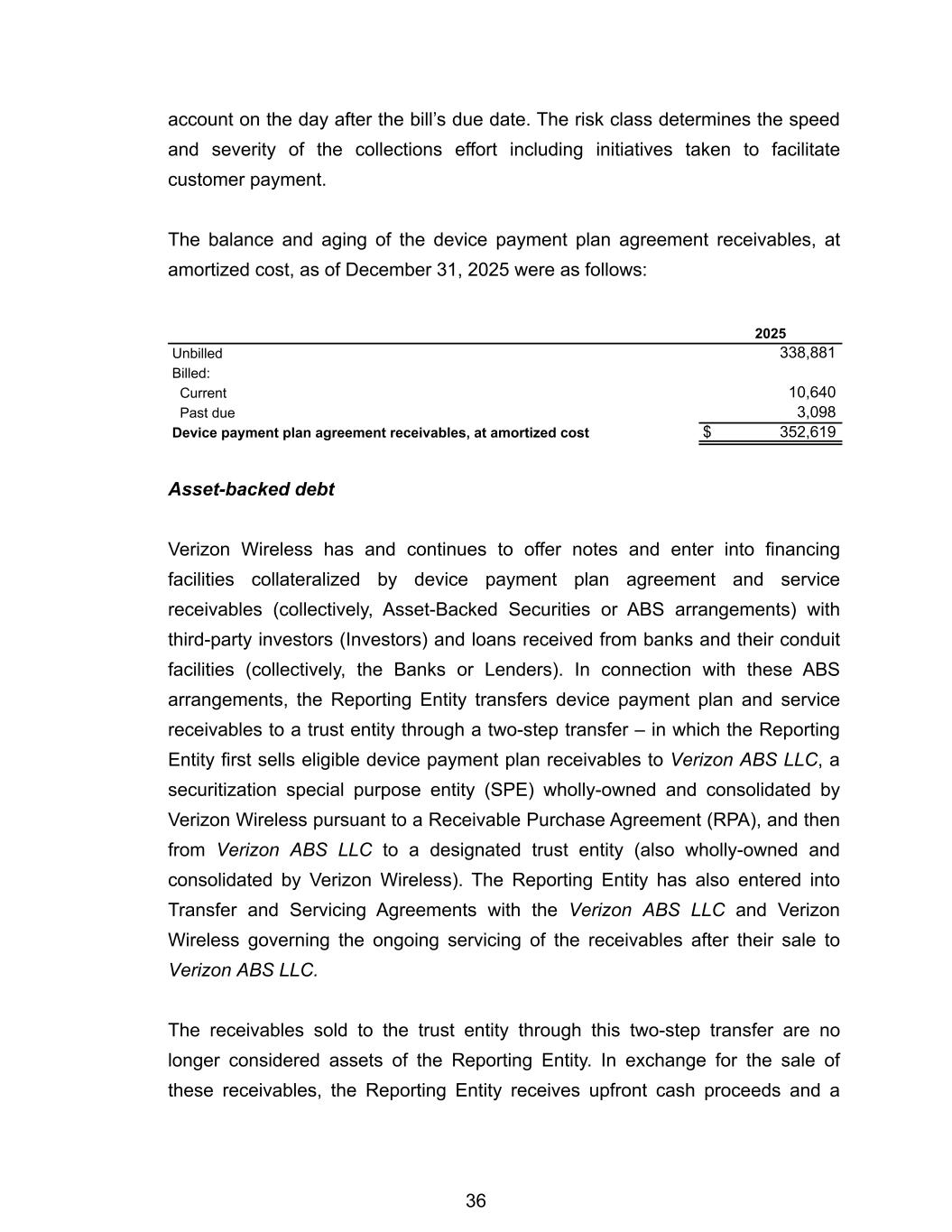
account on the day after the bill’s due date. The risk class determines the speed and severity of the collections effort including initiatives taken to facilitate customer payment. The balance and aging of the device payment plan agreement receivables, at amortized cost, as of December 31, 2025 were as follows: 2025 Unbilled 338,881 Billed: Current 10,640 Past due 3,098 Device payment plan agreement receivables, at amortized cost $ 352,619 Asset-backed debt Verizon Wireless has and continues to offer notes and enter into financing facilities collateralized by device payment plan agreement and service receivables (collectively, Asset-Backed Securities or ABS arrangements) with third-party investors (Investors) and loans received from banks and their conduit facilities (collectively, the Banks or Lenders). In connection with these ABS arrangements, the Reporting Entity transfers device payment plan and service receivables to a trust entity through a two-step transfer – in which the Reporting Entity first sells eligible device payment plan receivables to Verizon ABS LLC, a securitization special purpose entity (SPE) wholly-owned and consolidated by Verizon Wireless pursuant to a Receivable Purchase Agreement (RPA), and then from Verizon ABS LLC to a designated trust entity (also wholly-owned and consolidated by Verizon Wireless). The Reporting Entity has also entered into Transfer and Servicing Agreements with the Verizon ABS LLC and Verizon Wireless governing the ongoing servicing of the receivables after their sale to Verizon ABS LLC. The receivables sold to the trust entity through this two-step transfer are no longer considered assets of the Reporting Entity. In exchange for the sale of these receivables, the Reporting Entity receives upfront cash proceeds and a 36
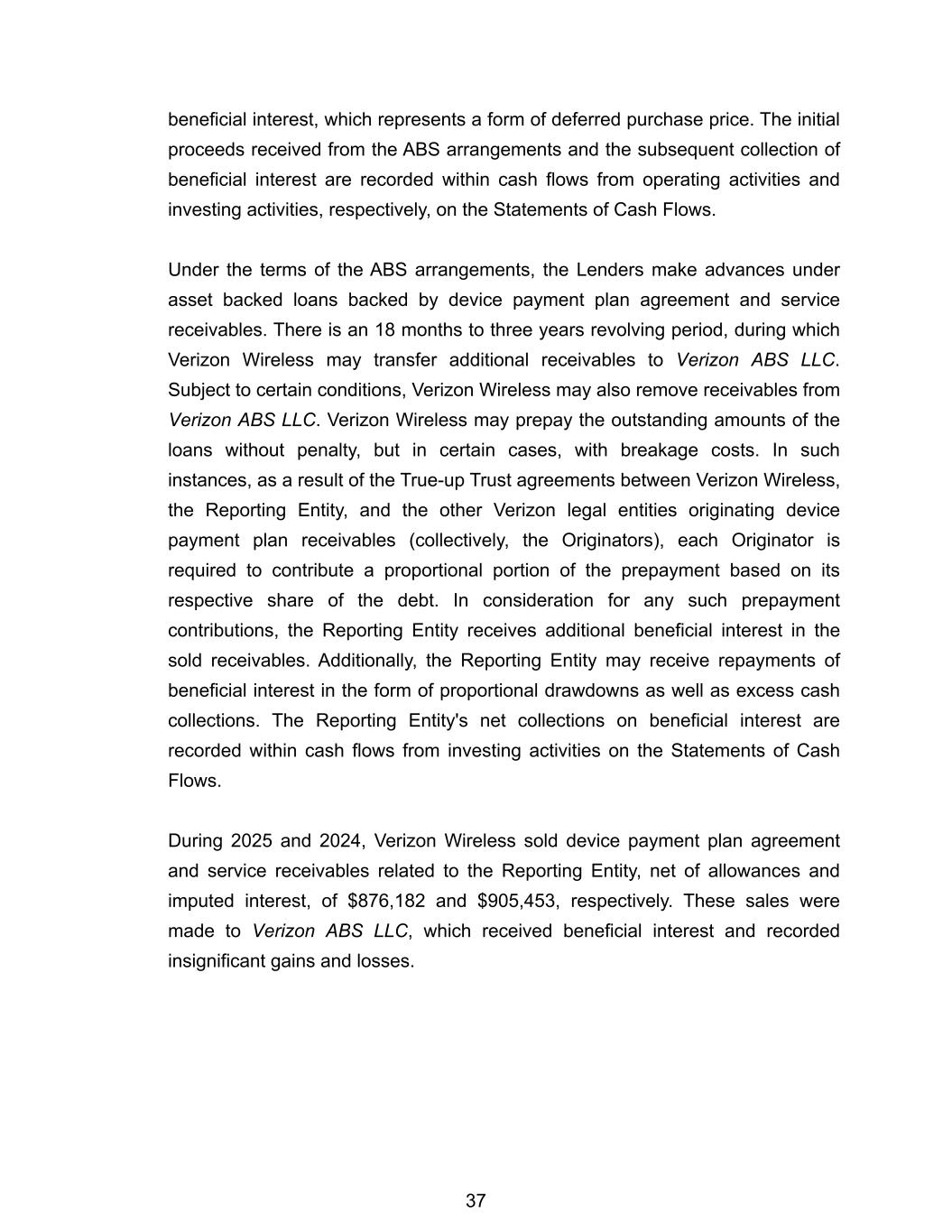
beneficial interest, which represents a form of deferred purchase price. The initial proceeds received from the ABS arrangements and the subsequent collection of beneficial interest are recorded within cash flows from operating activities and investing activities, respectively, on the Statements of Cash Flows. Under the terms of the ABS arrangements, the Lenders make advances under asset backed loans backed by device payment plan agreement and service receivables. There is an 18 months to three years revolving period, during which Verizon Wireless may transfer additional receivables to Verizon ABS LLC. Subject to certain conditions, Verizon Wireless may also remove receivables from Verizon ABS LLC. Verizon Wireless may prepay the outstanding amounts of the loans without penalty, but in certain cases, with breakage costs. In such instances, as a result of the True-up Trust agreements between Verizon Wireless, the Reporting Entity, and the other Verizon legal entities originating device payment plan receivables (collectively, the Originators), each Originator is required to contribute a proportional portion of the prepayment based on its respective share of the debt. In consideration for any such prepayment contributions, the Reporting Entity receives additional beneficial interest in the sold receivables. Additionally, the Reporting Entity may receive repayments of beneficial interest in the form of proportional drawdowns as well as excess cash collections. The Reporting Entity's net collections on beneficial interest are recorded within cash flows from investing activities on the Statements of Cash Flows. During 2025 and 2024, Verizon Wireless sold device payment plan agreement and service receivables related to the Reporting Entity, net of allowances and imputed interest, of $876,182 and $905,453, respectively. These sales were made to Verizon ABS LLC, which received beneficial interest and recorded insignificant gains and losses. 37
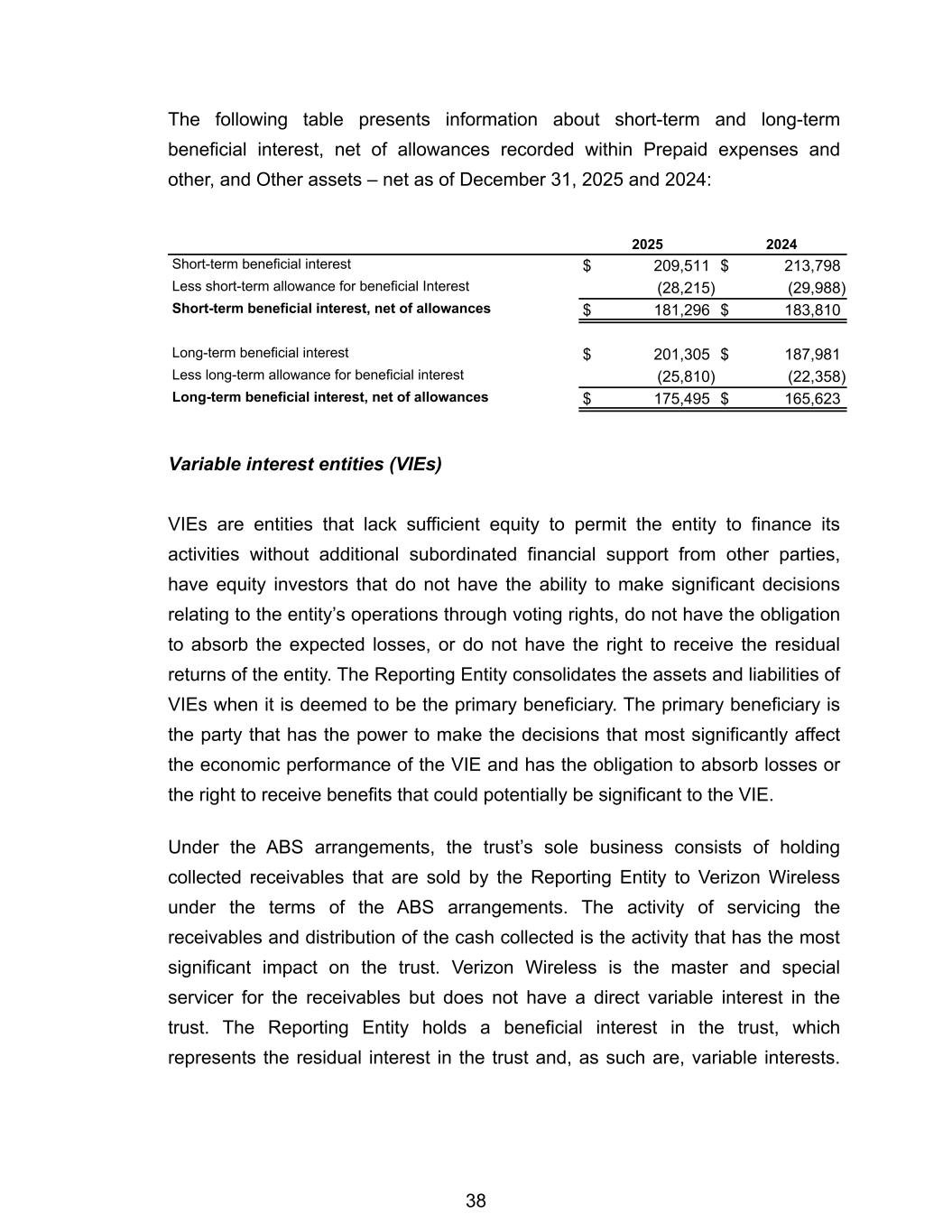
The following table presents information about short-term and long-term beneficial interest, net of allowances recorded within Prepaid expenses and other, and Other assets – net as of December 31, 2025 and 2024: 2025 2024 Short-term beneficial interest $ 209,511 $ 213,798 Less short-term allowance for beneficial Interest (28,215) (29,988) Short-term beneficial interest, net of allowances $ 181,296 $ 183,810 Long-term beneficial interest $ 201,305 $ 187,981 Less long-term allowance for beneficial interest (25,810) (22,358) Long-term beneficial interest, net of allowances $ 175,495 $ 165,623 Variable interest entities (VIEs) VIEs are entities that lack sufficient equity to permit the entity to finance its activities without additional subordinated financial support from other parties, have equity investors that do not have the ability to make significant decisions relating to the entity’s operations through voting rights, do not have the obligation to absorb the expected losses, or do not have the right to receive the residual returns of the entity. The Reporting Entity consolidates the assets and liabilities of VIEs when it is deemed to be the primary beneficiary. The primary beneficiary is the party that has the power to make the decisions that most significantly affect the economic performance of the VIE and has the obligation to absorb losses or the right to receive benefits that could potentially be significant to the VIE. Under the ABS arrangements, the trust’s sole business consists of holding collected receivables that are sold by the Reporting Entity to Verizon Wireless under the terms of the ABS arrangements. The activity of servicing the receivables and distribution of the cash collected is the activity that has the most significant impact on the trust. Verizon Wireless is the master and special servicer for the receivables but does not have a direct variable interest in the trust. The Reporting Entity holds a beneficial interest in the trust, which represents the residual interest in the trust and, as such are, variable interests. 38
Since Verizon Wireless maintains decision making rights as servicer and has an obligation to absorb losses, it is the primary beneficiary in the trust. Beneficial interest Under the ABS arrangements, the beneficial interest is initially recorded at fair value, based on the remaining device payment amounts expected to be collected, adjusted, as applicable, for the time value of money and credit risk. The initial fair value measurements are considered to be Level 3 measurements within the fair value hierarchy. The collection of the beneficial interest is contingent on collections from customers. Beneficial interests are evaluated to determine if they qualify as purchased financial assets with credit deterioration (PCD). To determine if the credit deterioration experienced since origination is more than insignificant, both (1) the extent of the credit deterioration and (2) any rating agency downgrades are evaluated. For securities categorized as PCD assets, the present value of cash flows expected to be collected from the security are compared to the par value of the security. If the present value of cash flows expected to be collected is less than the par value, credit losses are embedded in the purchase price of the PCD asset. In this situation, both an allowance for credit losses and amortized cost gross up is recorded, limited by the amount that the estimated fair value is less than the grossed-up amortized cost basis. Any difference between the purchase price and the present value of cash flows is amortized or accreted into net investment income over the life of the PCD asset. Any subsequent PCD asset allowance for credit losses is evaluated in a manner similar to the process described above for accounts receivable. 39
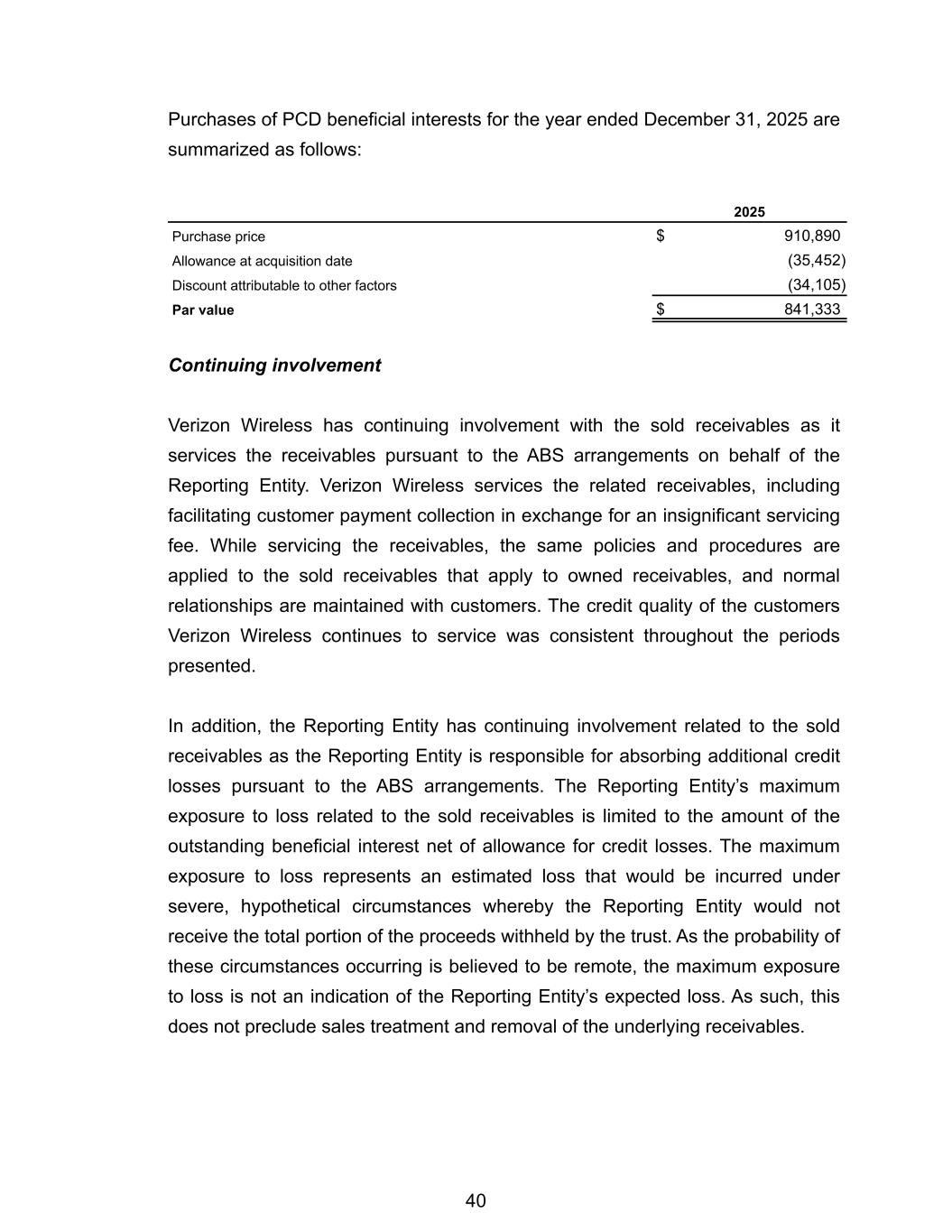
Purchases of PCD beneficial interests for the year ended December 31, 2025 are summarized as follows: 2025 Purchase price $ 910,890 Allowance at acquisition date (35,452) Discount attributable to other factors (34,105) Par value $ 841,333 Continuing involvement Verizon Wireless has continuing involvement with the sold receivables as it services the receivables pursuant to the ABS arrangements on behalf of the Reporting Entity. Verizon Wireless services the related receivables, including facilitating customer payment collection in exchange for an insignificant servicing fee. While servicing the receivables, the same policies and procedures are applied to the sold receivables that apply to owned receivables, and normal relationships are maintained with customers. The credit quality of the customers Verizon Wireless continues to service was consistent throughout the periods presented. In addition, the Reporting Entity has continuing involvement related to the sold receivables as the Reporting Entity is responsible for absorbing additional credit losses pursuant to the ABS arrangements. The Reporting Entity’s maximum exposure to loss related to the sold receivables is limited to the amount of the outstanding beneficial interest net of allowance for credit losses. The maximum exposure to loss represents an estimated loss that would be incurred under severe, hypothetical circumstances whereby the Reporting Entity would not receive the total portion of the proceeds withheld by the trust. As the probability of these circumstances occurring is believed to be remote, the maximum exposure to loss is not an indication of the Reporting Entity’s expected loss. As such, this does not preclude sales treatment and removal of the underlying receivables. 40
The outstanding device payment plan agreement and service receivables derecognized from the Reporting Entity’s Balance Sheets, but which Verizon Wireless continues to service, were $1,216,475 and $1,242,165 as of December 31, 2025 and 2024, respectively. 5. PROPERTY, PLANT AND EQUIPMENT - NET Property, plant and equipment - net consists of the following as of December 31, 2025 and 2024: Lives (years) 2025 2024 Land $ 7,716 $ 7,716 Buildings and improvements 15 to 45 1,422,221 1,392,864 Wireless plant and equipment 3 to 50 5,352,867 5,414,952 Furniture, fixtures and equipment 3 to 10 12,245 58,597 Leasehold improvements 5 to 7 585,563 566,462 7,380,612 7,440,591 Less: accumulated depreciation (5,344,798) (5,309,221) Property, plant and equipment - net $ 2,035,814 $ 2,131,370 6. LEASING ARRANGEMENTS Verizon Wireless, on behalf of the Reporting Entity, and the Reporting Entity itself enter into various lease arrangements for network equipment, including towers, distributed antenna systems, and small cells; real estate; connectivity mediums, including dark fiber; equipment; and various other types of assets for use in operations. The leases have remaining lease terms ranging from 1 year to 30 years, some of which include options to extend the leases term for up to 25 years, and some of which include options to terminate the leases. For the majority of leases entered into during the current period, the Reporting Entity concluded it is not reasonably certain that the Reporting Entity would exercise the options to extend the lease or terminate the lease. Therefore, as of the lease commencement date, the lease terms generally do not include these options. 41
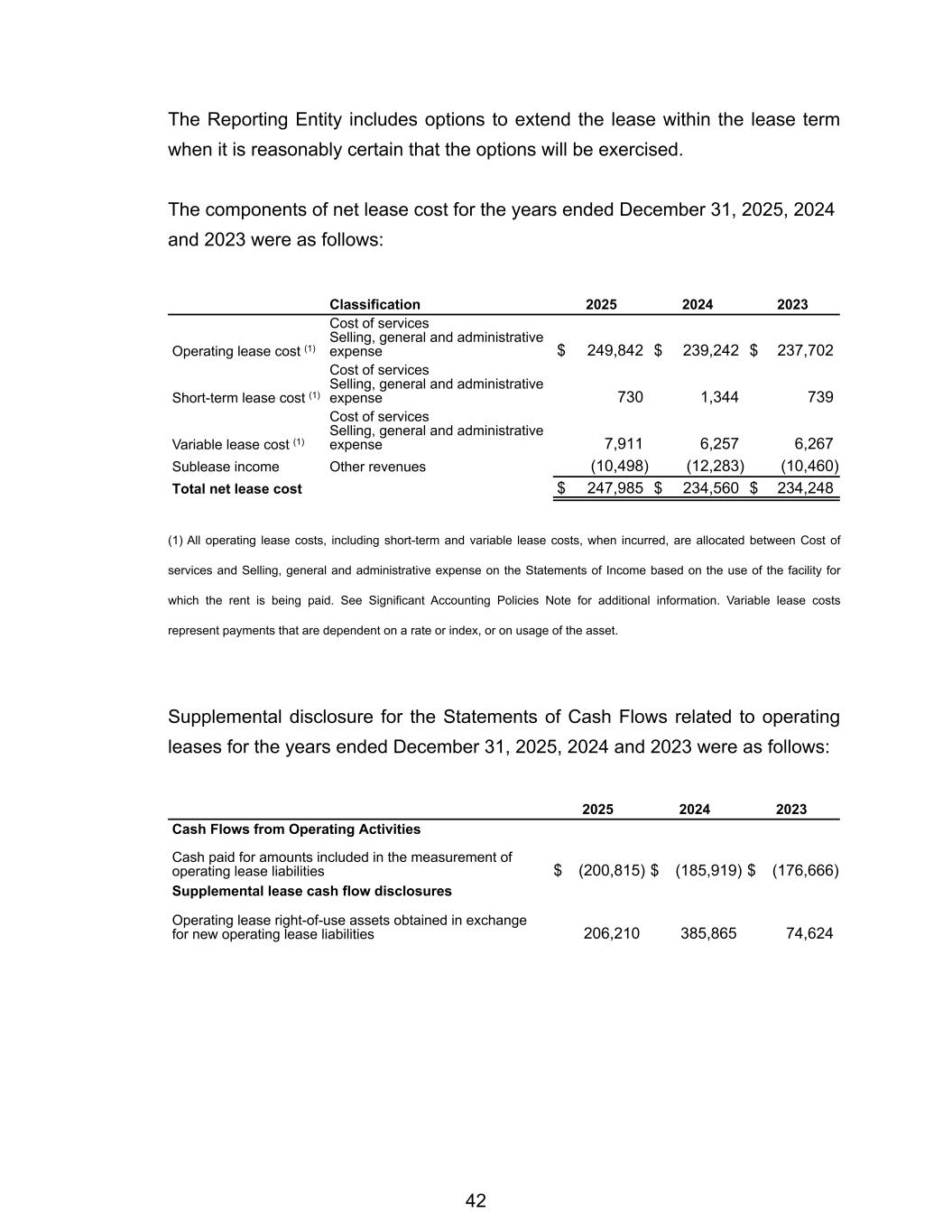
The Reporting Entity includes options to extend the lease within the lease term when it is reasonably certain that the options will be exercised. The components of net lease cost for the years ended December 31, 2025, 2024 and 2023 were as follows: Classification 2025 2024 2023 Operating lease cost (1) Cost of services Selling, general and administrative expense $ 249,842 $ 239,242 $ 237,702 Short-term lease cost (1) Cost of services Selling, general and administrative expense 730 1,344 739 Variable lease cost (1) Cost of services Selling, general and administrative expense 7,911 6,257 6,267 Sublease income Other revenues (10,498) (12,283) (10,460) Total net lease cost $ 247,985 $ 234,560 $ 234,248 (1) All operating lease costs, including short-term and variable lease costs, when incurred, are allocated between Cost of services and Selling, general and administrative expense on the Statements of Income based on the use of the facility for which the rent is being paid. See Significant Accounting Policies Note for additional information. Variable lease costs represent payments that are dependent on a rate or index, or on usage of the asset. Supplemental disclosure for the Statements of Cash Flows related to operating leases for the years ended December 31, 2025, 2024 and 2023 were as follows: 2025 2024 2023 Cash Flows from Operating Activities Cash paid for amounts included in the measurement of operating lease liabilities $ (200,815) $ (185,919) $ (176,666) Supplemental lease cash flow disclosures Operating lease right-of-use assets obtained in exchange for new operating lease liabilities 206,210 385,865 74,624 42
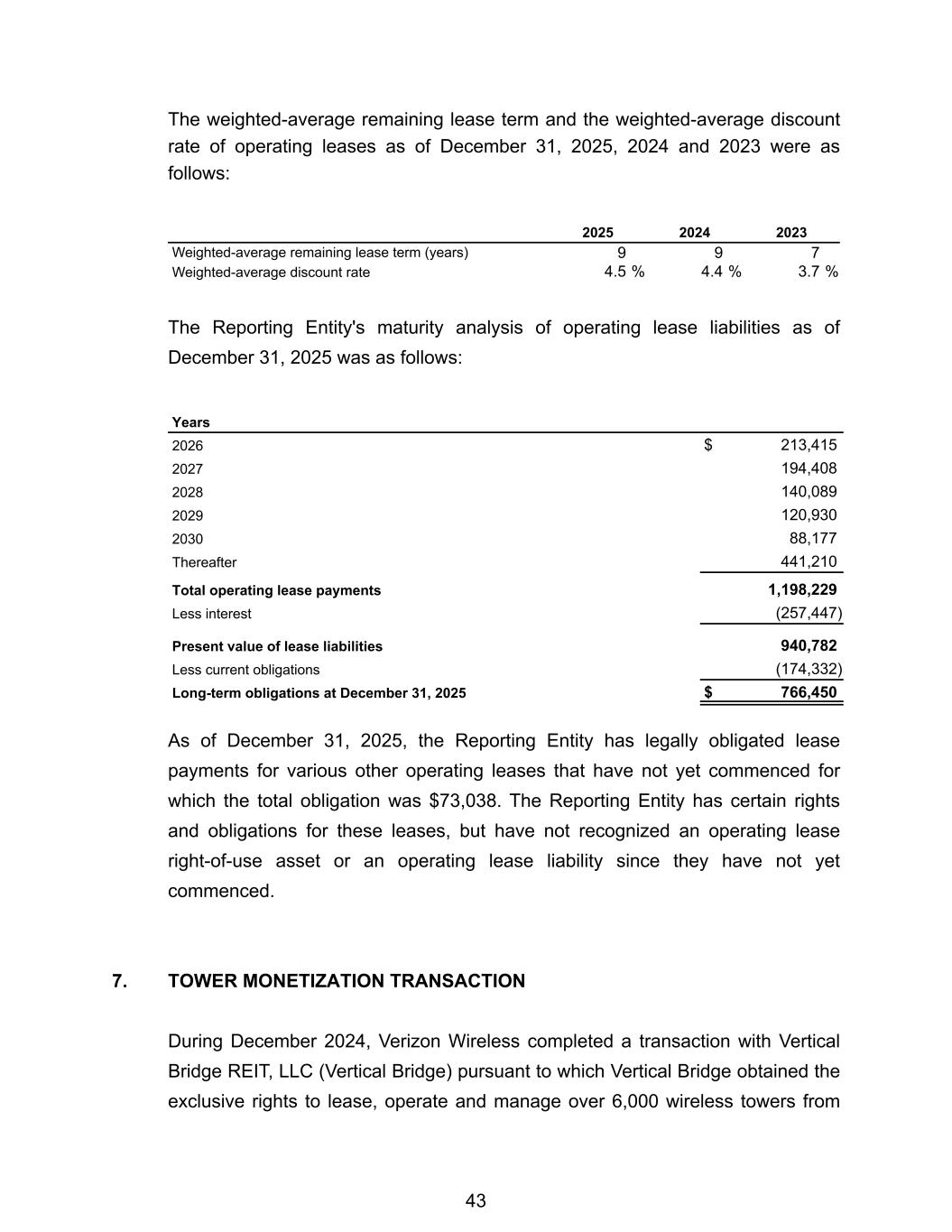
The weighted-average remaining lease term and the weighted-average discount rate of operating leases as of December 31, 2025, 2024 and 2023 were as follows: 2025 2024 2023 Weighted-average remaining lease term (years) 9 9 7 Weighted-average discount rate 4.5 % 4.4 % 3.7 % The Reporting Entity's maturity analysis of operating lease liabilities as of December 31, 2025 was as follows: Years 2026 $ 213,415 2027 194,408 2028 140,089 2029 120,930 2030 88,177 Thereafter 441,210 Total operating lease payments 1,198,229 Less interest (257,447) Present value of lease liabilities 940,782 Less current obligations (174,332) Long-term obligations at December 31, 2025 $ 766,450 As of December 31, 2025, the Reporting Entity has legally obligated lease payments for various other operating leases that have not yet commenced for which the total obligation was $73,038. The Reporting Entity has certain rights and obligations for these leases, but have not recognized an operating lease right-of-use asset or an operating lease liability since they have not yet commenced. 7. TOWER MONETIZATION TRANSACTION During December 2024, Verizon Wireless completed a transaction with Vertical Bridge REIT, LLC (Vertical Bridge) pursuant to which Vertical Bridge obtained the exclusive rights to lease, operate and manage over 6,000 wireless towers from 43
Verizon, and assumed interest in the underlying ground leases in exchange for an upfront payment of $2.8 billion. The Reporting Entity contributed 494 towers in exchange for an upfront payment of $215,783. In certain arrangements, the counterparty has fixed-price purchase options to acquire the towers based on their fair market values at the end of the lease terms. The Reporting Entity has leased back a portion of the capacity on the towers from Vertical Bridge for an initial term of 10 years, with eight optional renewal terms of five years each, subject to certain early termination rights. In addition, Verizon Wireless completed a similar transaction prior to 2017 with American Tower Corporation (American Tower) which the Reporting Entity participated in. In March 2025, Verizon Wireless renewed the lease with American Tower originally entered into in March 2015. The renewal extends the subleased capacity on the towers from American Tower for an additional 5 years with options to renew. The Reporting Entity participated in certain of these arrangements and received upfront payments that were accounted for as deferred rental income and as a financing obligation. The deferred rent represents unearned rental income and relates to the portion of the towers for which the right-of-use has passed to the counterparty. The deferred rental income, which is reflected on the Balance Sheets as deferred rent and within Other net changes in the operating section on the Statements of Cash Flows, is being recognized on a straight-line basis over the average lease term. The financing obligation, which is reflected on the Balance Sheets as Financing obligation, and on the Statements of Cash Flows within Proceeds from financing obligation in the financing section, relates to the portion of the towers that continue to be occupied and used for the Reporting Entity’s network operations. Sublease payments are recorded as repayments of financing obligation within financing activities on the Statements of Cash Flows. The Reporting Entity continues to include the towers in property, plant and equipment net on the Balance Sheets and depreciates accordingly. In addition, the minimum future payments for the ground leases have been included in the Reporting Entity's operating lease commitments (see Leasing Arrangements Note). As part of the rights obtained during the transaction, the counterparty is 44
responsible for the payment of the ground leases, and the Reporting Entity does not expect to be required to make payments unless the counterparty defaults, which the Reporting Entity determined to be remote. 8. TRANSACTIONS WITH AFFILIATES AND RELATED PARTIES In addition to fixed-asset purchases, substantially all of Service revenues, Equipment revenues, Other revenues, Cost of services, Cost of equipment and Selling, general and administrative expense of the Reporting Entity represent transactions processed by Verizon Wireless on behalf of the Reporting Entity, or represent transactions with affiliates. These transactions consist of: (1) revenues and expenses that pertain to the Reporting Entity, which are processed by Verizon Wireless and directly attributed to or directly charged to the Reporting Entity; (2) roaming revenue when customers of Verizon Wireless outside the Reporting Entity use the network of the Reporting Entity, or roaming cost when customers associated with the Reporting Entity use the network of Verizon Wireless; (3) certain revenues and expenses processed or incurred by Verizon Wireless that are allocated to the Reporting Entity principally based on total subscribers; (4) revenue generated by the Reporting Entity operating a switch; and (5) service arrangements with Verizon Wireless, where the Reporting Entity has the ability to utilize certain spectrum owned by Verizon Wireless. These transactions do not necessarily represent arm’s-length transactions and may not represent all revenues and costs that would be present if the Reporting Entity operated on a stand-alone basis. Verizon Wireless periodically reviews the methodology and allocation bases for allocating certain revenues, operating expenses and selling, general and administrative expenses to the Reporting Entity. Resulting changes, if any, in the allocated amounts have historically not been significant. Effective November 23, 2021 Verizon acquired TracFone Wireless, Inc. (TracFone). Upon the closing of this transaction, the Reporting Entity's wholesale revenue from TracFone moved to an affiliate transaction within Service revenues. 45
In addition, the Reporting Entity receives a proportionate share of the net economic benefit from TracFone's operations, which is recorded in Other income and was deemed insignificant for the years ended December 31, 2025, 2024 and 2023. Service revenues Service revenues include monthly customer billings processed by Verizon Wireless on behalf of the Reporting Entity and roaming revenues relating to customers of other affiliated markets that are specifically identified to the Reporting Entity. For the years ended December 31, 2025, 2024 and 2023, roaming revenues were $559,166, $516,138 and $531,643, respectively. Service revenues also include usage and certain revenue reductions, including revenue concessions and bill incentive credits, which are processed by Verizon Wireless, and allocated to the Reporting Entity based on certain factors deemed appropriate by Verizon Wireless. Equipment revenues Equipment revenues include equipment sales processed by Verizon Wireless and specifically identified to the Reporting Entity, as well as certain handset and accessory revenues, and contra-revenues, including equipment concessions and equipment manufacturer rebates, which are processed by Verizon Wireless and allocated to the Reporting Entity based on certain factors deemed appropriate by Verizon Wireless. The Reporting Entity also recognizes commission revenue on the sale of devices to customers whose service contract is with an affiliate market. Other revenues Other revenues include other fees and surcharges charged to the customer that are specifically identified to the Reporting Entity. 46
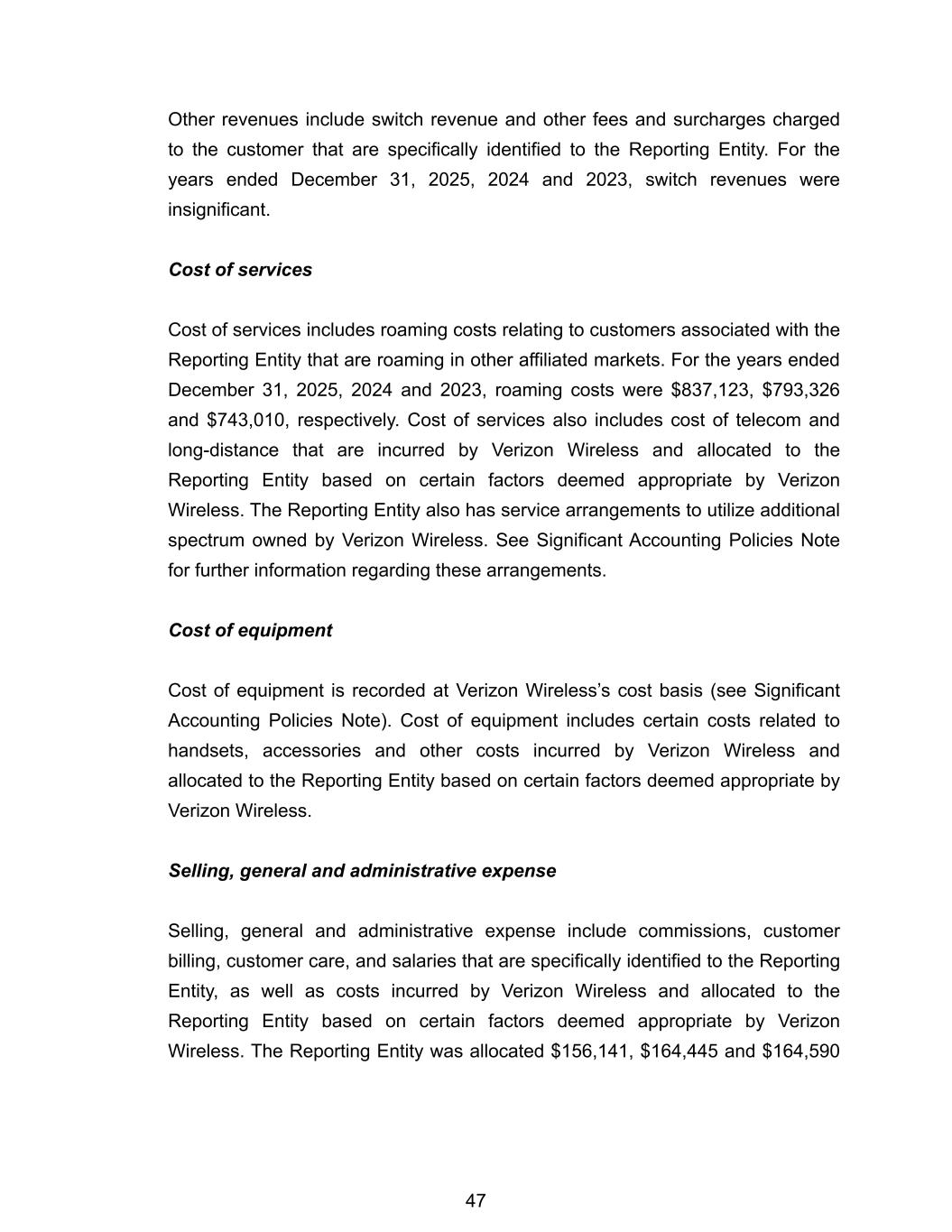
Other revenues include switch revenue and other fees and surcharges charged to the customer that are specifically identified to the Reporting Entity. For the years ended December 31, 2025, 2024 and 2023, switch revenues were insignificant. Cost of services Cost of services includes roaming costs relating to customers associated with the Reporting Entity that are roaming in other affiliated markets. For the years ended December 31, 2025, 2024 and 2023, roaming costs were $837,123, $793,326 and $743,010, respectively. Cost of services also includes cost of telecom and long-distance that are incurred by Verizon Wireless and allocated to the Reporting Entity based on certain factors deemed appropriate by Verizon Wireless. The Reporting Entity also has service arrangements to utilize additional spectrum owned by Verizon Wireless. See Significant Accounting Policies Note for further information regarding these arrangements. Cost of equipment Cost of equipment is recorded at Verizon Wireless’s cost basis (see Significant Accounting Policies Note). Cost of equipment includes certain costs related to handsets, accessories and other costs incurred by Verizon Wireless and allocated to the Reporting Entity based on certain factors deemed appropriate by Verizon Wireless. Selling, general and administrative expense Selling, general and administrative expense include commissions, customer billing, customer care, and salaries that are specifically identified to the Reporting Entity, as well as costs incurred by Verizon Wireless and allocated to the Reporting Entity based on certain factors deemed appropriate by Verizon Wireless. The Reporting Entity was allocated $156,141, $164,445 and $164,590 47
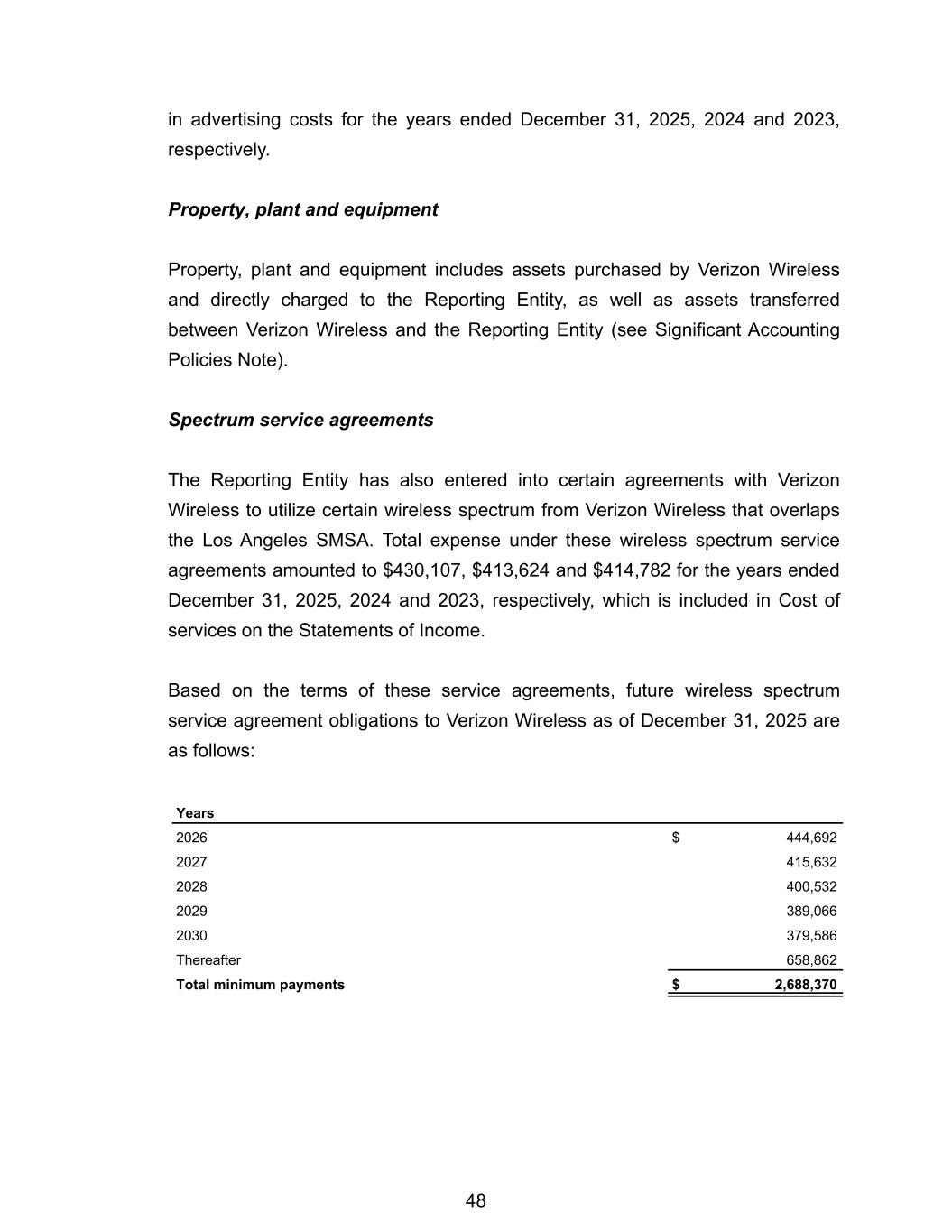
in advertising costs for the years ended December 31, 2025, 2024 and 2023, respectively. Property, plant and equipment Property, plant and equipment includes assets purchased by Verizon Wireless and directly charged to the Reporting Entity, as well as assets transferred between Verizon Wireless and the Reporting Entity (see Significant Accounting Policies Note). Spectrum service agreements The Reporting Entity has also entered into certain agreements with Verizon Wireless to utilize certain wireless spectrum from Verizon Wireless that overlaps the Los Angeles SMSA. Total expense under these wireless spectrum service agreements amounted to $430,107, $413,624 and $414,782 for the years ended December 31, 2025, 2024 and 2023, respectively, which is included in Cost of services on the Statements of Income. Based on the terms of these service agreements, future wireless spectrum service agreement obligations to Verizon Wireless as of December 31, 2025 are as follows: Years 2026 $ 444,692 2027 415,632 2028 400,532 2029 389,066 2030 379,586 Thereafter 658,862 Total minimum payments $ 2,688,370 48
9. CONTINGENCIES Verizon Wireless and the Reporting Entity are subject to lawsuits and other claims, including class actions, product liability, patent infringement, intellectual property, antitrust, partnership disputes and claims involving relations with resellers and agents. Verizon Wireless is also currently defending lawsuits filed against it and other participants in the wireless industry, alleging various adverse effects as a result of wireless phone usage. Various consumer class-action lawsuits allege that Verizon Wireless violated certain state consumer-protection laws and other statutes and defrauded customers through misleading billing practices or statements. These matters may involve indemnification obligations by third parties and/or affiliated parties covering all or part of any potential damage awards against Verizon Wireless and the Reporting Entity and/or insurance coverage. All of the above matters are subject to many uncertainties, and the outcomes are not currently predictable. The Reporting Entity may incur or be allocated a portion of the damages that may result upon adjudication of these matters, if the claimants prevail in their actions. As of December 31, 2025 and 2024, the Reporting Entity had no accrual for any pending matters. An estimate of the reasonably possible loss or range of loss with respect to these matters as of December 31, 2025 cannot be made at this time due to various factors typical in contested proceedings, including: (1) uncertain damage theories and demands; (2) a less-than-complete factual record; (3) uncertainty concerning legal theories and their resolution by courts or regulators and (4) the unpredictable nature of the opposing party and its demands. Verizon Wireless and the Reporting Entity continuously monitor these proceedings as they develop and will adjust any accrual or disclosure as needed. It is not expected that the ultimate resolution of any pending regulatory or legal matter in future periods will have a material effect on the financial condition of the Reporting Entity, but it could have a material effect on the results of operations for a given reporting period. 49