Annual Report 2026 Contents
Contents Strategic report: Our business 2 Diageo at a glance 2 Performance highlights 3 Chair’s statement 4 Chief Executive’s statement 6 Our fiscal 26 performance 8 Our turnaround plan 10 Our business model 12 Market dynamics 13 Investment case 14 Strategic report: Our performance 16 Our performance 16 Summary financial review 20 Business review 22 Group financial review 30 Spirit of Progress 32 Business integrity and human rights 34 Our people and culture 36 Health and safety 38 Promote positive drinking 40 Champion inclusion and diversity 42 Pioneering grain-to-glass sustainability 44 Our ESG reporting approach 57 Effective risk management 60 Viability statement 68 Governance report 69 Chair's introduction to Governance 70 Corporate governance structure and division of responsibilities 71 Board of Directors 73 Executive Committee 75 Corporate governance report 77 Audit Committee report 89 Nomination Committee report 96 Directors’ Remuneration report 100 Directors’ report 130 Financial statements 134 Additional information 204 Unaudited financial information 205 Cautionary statement concerning forward-looking statements 213 Independent limited assurance report to the Directors of Diageo plc on selected information 214 Other additional information 217 1 Diageo Annual Report 2026
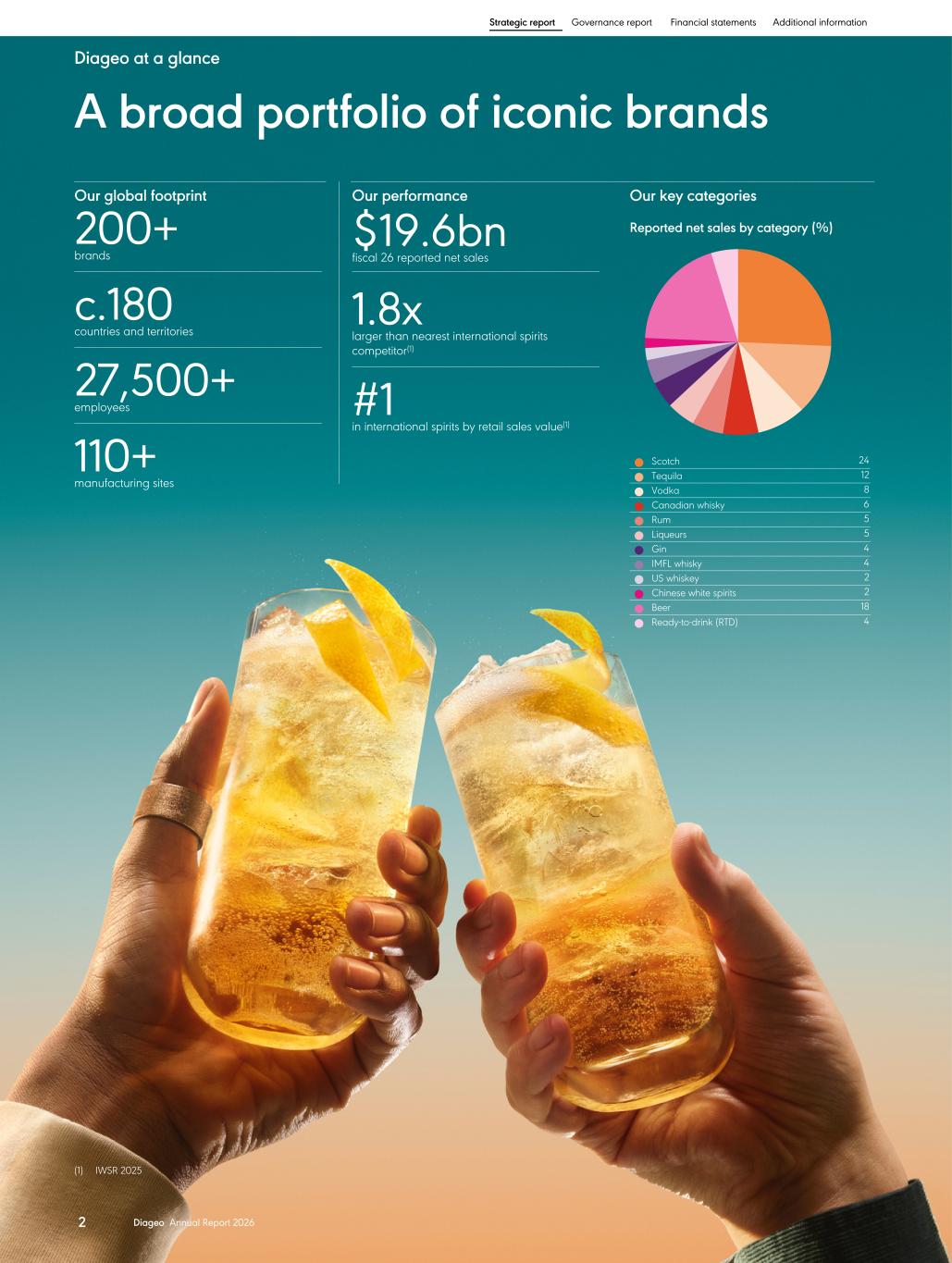
A broad portfolio of iconic brands Our global footprint 200+ brands c.180 countries and territories 27,500+ employees 110+ manufacturing sites Our performance $19.6bn fiscal 26 reported net sales 1.8x larger than nearest international spirits competitor(1) #1 in international spirits by retail sales value(1) Our key categories Reported net sales by category (%) ò Scotch 24 ò Tequila 12 ò Vodka 8 ò Canadian whisky 6 ò Rum 5 ò Liqueurs 5 ò Gin 4 ò IMFL whisky 4 ò US whiskey 2 ò Chinese white spirits 2 ò Beer 18 ò Ready-to-drink (RTD) 4 Strategic report Governance report Financial statements Additional information 2 Diageo Annual Report 2026 (1) IWSR 2025 Diageo at a glance
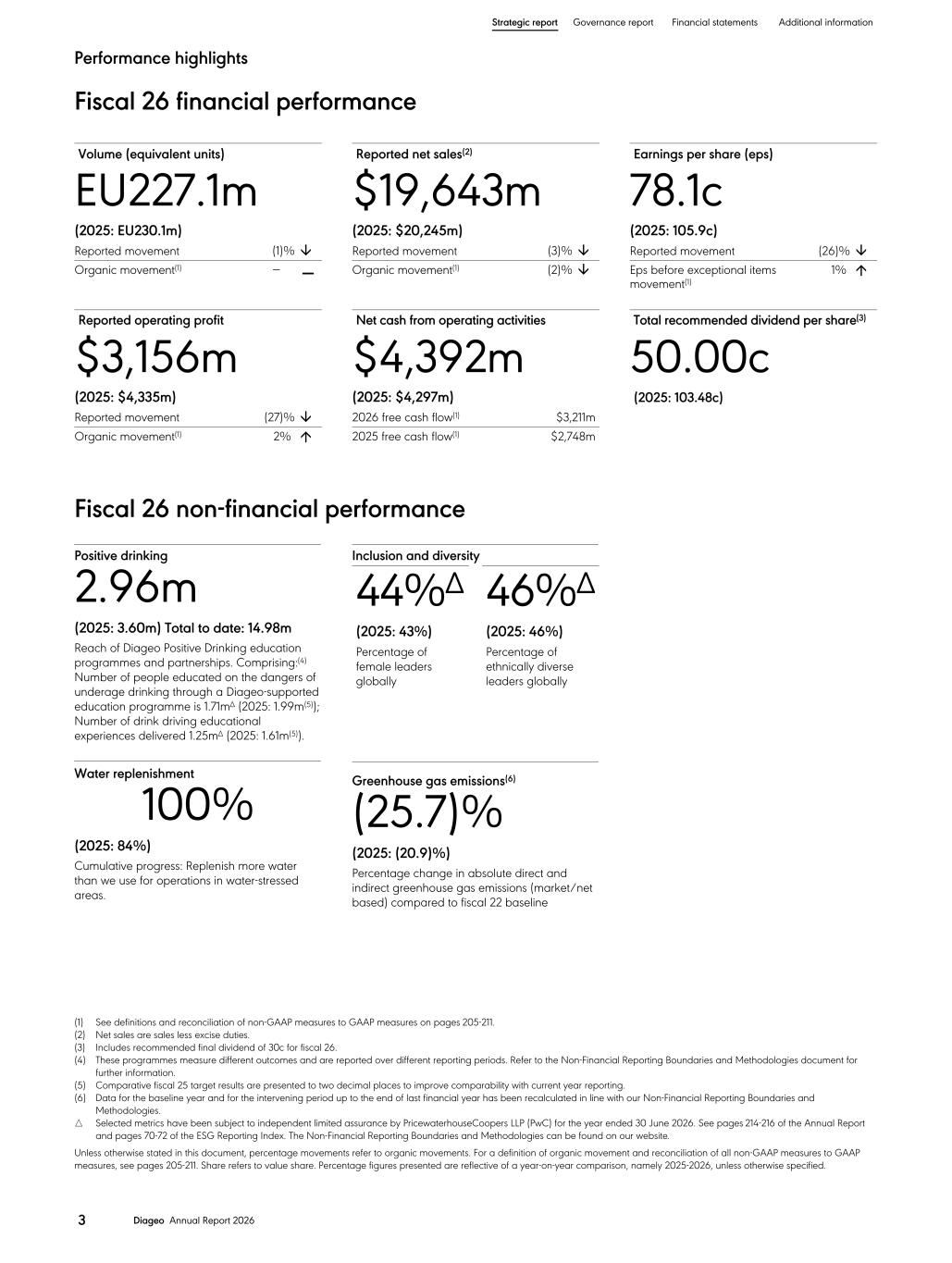
Fiscal 26 financial performance Volume (equivalent units) EU227.1m (2025: EU230.1m) Reported movement (1) % â Organic movement(1) — — Reported operating profit $3,156m (2025: $4,335m) Reported movement (27) % â Organic movement(1) 2% á Reported net sales(2) $19,643m (2025: $20,245m) Reported movement (3) % â Organic movement(1) (2) % â Net cash from operating activities $4,392m (2025: $4,297m) 2026 free cash flow(1) $3,211m 2025 free cash flow(1) $2,748m Earnings per share (eps) 78.1c (2025: 105.9c) Reported movement (26) % â Eps before exceptional items movement(1) 1% á Total recommended dividend per share(3) 50.00c (2025: 103.48c) Fiscal 26 non-financial performance Positive drinking 2.96m (2025: 3.60m) Total to date: 14.98m Reach of Diageo Positive Drinking education programmes and partnerships. Comprising:(4) Number of people educated on the dangers of underage drinking through a Diageo-supported education programme is 1.71mΔ (2025: 1.99m(5)); Number of drink driving educational experiences delivered 1.25mΔ (2025: 1.61m(5)). Water replenishment 100% (2025: 84%) Cumulative progress: Replenish more water than we use for operations in water-stressed areas. Inclusion and diversity 44%Δ (2025: 43%) Percentage of female leaders globally 46%Δ (2025: 46%) Percentage of ethnically diverse leaders globally Greenhouse gas emissions(6) (25.7)% (2025: (20.9)%) Percentage change in absolute direct and indirect greenhouse gas emissions (market/net based) compared to fiscal 22 baseline (1) See definitions and reconciliation of non-GAAP measures to GAAP measures on pages 205-211. (2) Net sales are sales less excise duties. (3) Includes recommended final dividend of 30c for fiscal 26. (4) These programmes measure different outcomes and are reported over different reporting periods. Refer to the Non-Financial Reporting Boundaries and Methodologies document for further information. (5) Comparative fiscal 25 target results are presented to two decimal places to improve comparability with current year reporting. (6) Data for the baseline year and for the intervening period up to the end of last financial year has been recalculated in line with our Non-Financial Reporting Boundaries and Methodologies. △ Selected metrics have been subject to independent limited assurance by PricewaterhouseCoopers LLP (PwC) for the year ended 30 June 2026. See pages 214-216 of the Annual Report and pages 70-72 of the ESG Reporting Index. The Non-Financial Reporting Boundaries and Methodologies can be found on our website. Unless otherwise stated in this document, percentage movements refer to organic movements. For a definition of organic movement and reconciliation of all non-GAAP measures to GAAP measures, see pages 205-211. Share refers to value share. Percentage figures presented are reflective of a year-on-year comparison, namely 2025-2026, unless otherwise specified. Strategic report Governance report Financial statements Additional information 3 Diageo Annual Report 2026 Performance highlights
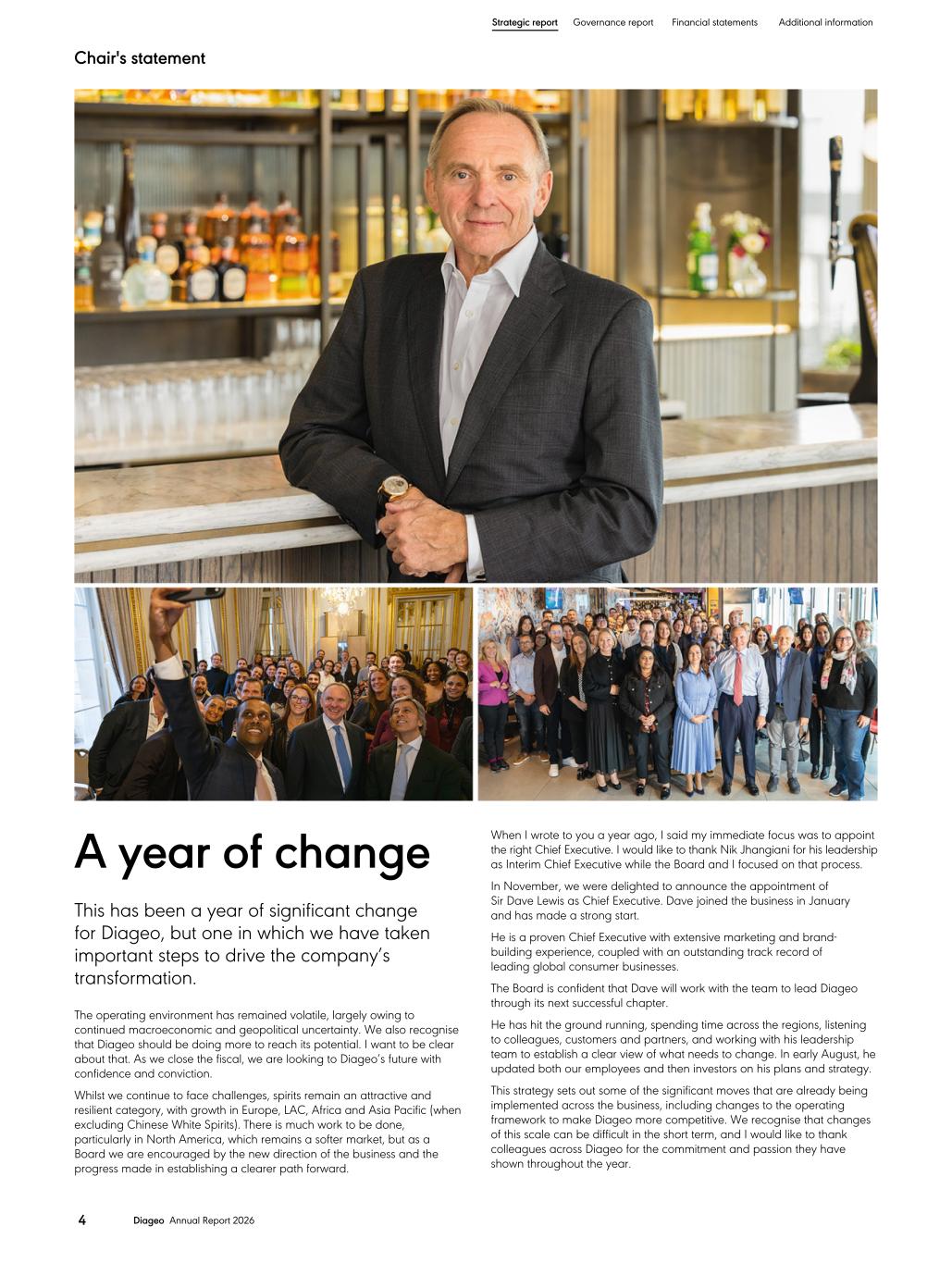
A year of change This has been a year of significant change for Diageo, but one in which we have taken important steps to drive the company’s transformation. The operating environment has remained volatile, largely owing to continued macroeconomic and geopolitical uncertainty. We also recognise that Diageo should be doing more to reach its potential. I want to be clear about that. As we close the fiscal, we are looking to Diageo’s future with confidence and conviction. Whilst we continue to face challenges, spirits remain an attractive and resilient category, with growth in Europe, LAC, Africa and Asia Pacific (when excluding Chinese White Spirits). There is much work to be done, particularly in North America, which remains a softer market, but as a Board we are encouraged by the new direction of the business and the progress made in establishing a clearer path forward. When I wrote to you a year ago, I said my immediate focus was to appoint the right Chief Executive. I would like to thank Nik Jhangiani for his leadership as Interim Chief Executive while the Board and I focused on that process. In November, we were delighted to announce the appointment of Sir Dave Lewis as Chief Executive. Dave joined the business in January and has made a strong start. He is a proven Chief Executive with extensive marketing and brand- building experience, coupled with an outstanding track record of leading global consumer businesses. The Board is confident that Dave will work with the team to lead Diageo through its next successful chapter. He has hit the ground running, spending time across the regions, listening to colleagues, customers and partners, and working with his leadership team to establish a clear view of what needs to change. In early August, he updated both our employees and then investors on his plans and strategy. This strategy sets out some of the significant moves that are already being implemented across the business, including changes to the operating framework to make Diageo more competitive. We recognise that changes of this scale can be difficult in the short term, and I would like to thank colleagues across Diageo for the commitment and passion they have shown throughout the year. Strategic report Governance report Financial statements Additional information 4 Diageo Annual Report 2026 Chair's statement
Under Dave and his leadership team, the Board is confident that Diageo is on the right path to returning to consistent growth and delivering stronger shareholder returns. Driving long-term shareholder value and strengthening the balance sheet As we look to the task ahead, our focus is firmly on restoring stronger performance across the business as a whole. We recognise that the full benefits of the new strategy will take time to come through. Consumer confidence remains fragile across many developed markets, which in turn has an impact on willingness to spend. North America has continued to experience softer demand, while geopolitical uncertainty, including ongoing conflict in the Middle East and tensions affecting global trade, have added further complexity. We need to ensure that our portfolio is positioned for how consumers are engaging with brands today, that our pricing remains relevant and that investment is focused on the areas with the greatest potential to drive sustainable growth. Delivering long-term growth also requires a stronger financial foundation. For the Board, that has meant a clear focus on strengthening Diageo’s balance sheet and reducing financial leverage. Over the course of the year, we took a number of important actions to deliver on that ambition, while continuing to drive investment behind our portfolio of brands. Steps included improving operating cash flow, progressing strategic disposals and taking the necessary decision to reduce the dividend. On disposals, we announced the sale of East African Breweries PLC, where we would like to thank colleagues across Kenya, Uganda and Tanzania for their commitment and professionalism. We also announced the sale of our stake in Royal Challengers Bengaluru cricket team. We know the dividend is important to our shareholders, and the Board did not take its decision to change the dividend policy lightly. However, we believe it was a necessary and responsible step to strengthen the balance sheet, create greater flexibility and put the business in a stronger position to invest for growth. We have already seen the impact of those decisions start to come through, with net debt to adjusted EBITDA of 3.1x at year-end, down from 3.4x year-on-year. By focusing the business on a simpler set of priorities and measures, we are confident Diageo can reinforce its position as the leading international spirits business and deliver stronger shareholder value over the coming years. Leadership changes Alongside the appointment of a new Chief Executive, the composition of the Board has continued to evolve. We were delighted to welcome John Rishton as a Non-Executive Director in November 2025. John brings more than 40 years of experience across large multinational companies and global industries, including senior roles at Rolls-Royce, Informa and British Airways. He has joined the Audit and Nomination Committees, and I would like to thank him for the contribution he has already made. The Board will also be strengthened by the appointment of Alex Keith, who joins in November. She brings with her more than 30 years of leadership experience at Procter & Gamble, most recently as CEO of P&G Beauty, alongside expertise in strategy, brand-building, international business, and sustainability. In addition to these Board changes, this financial year has marked a period of change for Diageo’s Executive Committee. While Nik Jhangiani served as Interim Chief Executive, Deirdre Mahlan returned as Interim Chief Financial Officer. We are very grateful to Deirdre for once again supporting Diageo and for her many contributions over the course of her distinguished career with the company. The Board also supported the Chief Executive as he reshaped his Executive Committee for fiscal 27 and beyond, as detailed in his statement. Having the right management team in place is essential to delivering Diageo’s strategic priorities and strengthening performance. The Board is confident that the reshaped Executive Committee brings the experience, focus and energy needed to do so. Spirit of Progress As we reshape the business, we are also maintaining our focus on the areas that are central to Diageo’s long-term resilience and values. We have continued to make progress against our Spirit of Progress ESG action plan and have achieved our ambition of replenishing more water than we use in our operations in water-stressed areas, with work continuing across markets including Mexico, India and countries across Africa. Water stewardship remains critical to the resilience of our operations and to the communities in which we operate. It is one of the areas where Diageo can make a substantial and lasting contribution. Positive drinking also remains central to our approach. Ahead of the FIFA World Cup this year, we launched “The Best Move: Celebrate Responsibly” across Latin America and the Caribbean, using the reach of the tournament and our brands to encourage simple moderation habits and responsible celebration. While Spirit of Progress is no longer part of the long-term incentive plan, the accelerated work undertaken in recent years has embedded its priorities more deeply within the business and will continue to be a focus for the Board. Together, this work reflects our continued commitment to using Diageo’s scale and influence responsibly, while supporting the long-term resilience of the business and the communities in which we operate. Looking forward The decisions made this year have laid the foundations for the next phase of Diageo’s transformation. I believe we will look back on this financial year as a year in which we took important steps to set the business up for the future. We are clear on Diageo’s growth priorities and, as a Board, we believe we have the right leadership, culture and strategy in place to deliver on them. There remains much to do, and we do not underestimate the challenges ahead. However, we remain confident in the fundamentals of the business; in the long-term attractiveness of the spirits market and the role of our spirits portfolio, including RTDs; in the continued growth potential of Guinness; and in the strength of Diageo’s market positions. I am encouraged by the start Dave and his team have made and the work they are doing to accelerate Diageo’s repositioning into a fundamentally more competitive business, capable of delivering sustainable growth and long-term value for shareholders. Finally, I would like to thank all our colleagues that were part of the journey this past year. Their commitment, resilience and passion for our brands have been deeply appreciated throughout a demanding time. The Board and I look forward to working with Dave, his leadership team and colleagues across Diageo as we take the company into its next chapter. Sir John Manzoni Chair Strategic report Governance report Financial statements Additional information 5 Diageo Annual Report 2026 Statement on Section 172 of the Companies Act 2006 Section 172 of the Companies Act 2006 requires the Directors to promote the success of the company for the benefit of the members as a whole, having regard to the interests of stakeholders in their decision-making. In making decisions, the Directors consider what is most likely to promote the success of the company for its shareholders in the long term, as well as the interests of the group’s stakeholders. The Directors understand the importance of taking into account the views of stakeholders and the impact of the company’s activities on local communities, the environment, including climate change, and the group’s reputation. Read more about how stakeholders were taken into account in decision-making on pages 80-86.
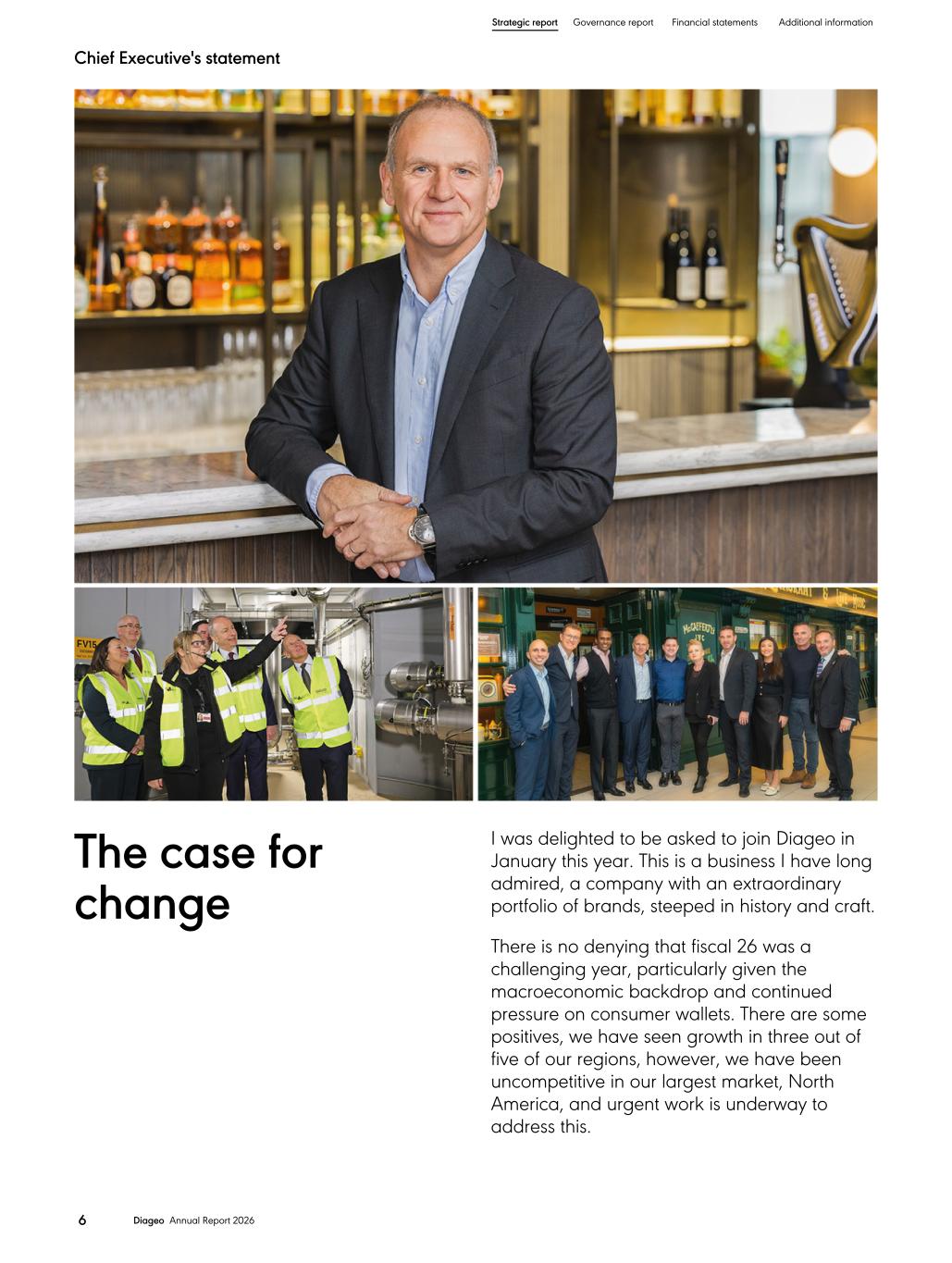
The case for change I was delighted to be asked to join Diageo in January this year. This is a business I have long admired, a company with an extraordinary portfolio of brands, steeped in history and craft. There is no denying that fiscal 26 was a challenging year, particularly given the macroeconomic backdrop and continued pressure on consumer wallets. There are some positives, we have seen growth in three out of five of our regions, however, we have been uncompetitive in our largest market, North America, and urgent work is underway to address this. Strategic report Governance report Financial statements Additional information 6 Diageo Annual Report 2026 Chief Executive's statement
Between January and April, the Executive team and I looked back to objectively analyse how we were performing. We did this through the lens of four key stakeholders (shareholders, customers, colleagues and our supply partners). This resulted in the revised strategy we recommended to the Board in April. When we look at the evolutions of our markets, three factors are really important. Demographics and the size of the Legal Drinking Age population, consumer economics and specifically disposable income and consumer attitudes and behaviours. The biggest pressure we see today is economic, with consumers being more selective about their discretionary spending. Moderation and low and no alcohol remain important trends that we stay close to and we continue to watch GLP-1s carefully. Yet, early data indicates that the impact is lower on spirits when compared to beer and wine. The shape of the spirits sector is also evolving. Premiumisation remains integral to our strategy but this is now more nuanced. We need to keep growing premium and luxury where the opportunity exists, whilst also utilising the full price and format ladder of our brand portfolio. That means better price-pack architecture, more relevant propositions, and formats that meet consumers where they are. The growth in ready-to-drink (RTD) cocktails is also interesting in this regard. We should not treat RTDs as separate from spirits. Consumers come to many RTD occasions with similar motivations to spirits occasions, and RTDs are increasingly important to how consumers engage with our brands, they are portable, consistent and represent good value for money vs an on- premise purchase. We created this space with Smirnoff Ice 25 years ago, but we lost focus. We are now aligning RTDs with our spirits brands and reassessing the opportunity. This is why we are changing the way we define the market we compete in. Going forward, our focus is on winning in total spirits, including RTDs, and on Guinness in premium beer. At our interim results in February, I outlined that customers are a critical part of the case for change. Diageo has too often relied on the strength of its brands without prioritising its customer partnership, category management, service and execution. That has to change. Our ambition is to help grow our customers’ categories and to gain from that growth – winning together. We also need to think differently about suppliers. We will have clearer expectations, stronger partnerships, more collaborative innovation and better end-to-end processes so that our suppliers can help us build a more resilient, more agile and more competitive Diageo. We have also listened very closely to our colleagues. They want a clearer, simpler, and more efficient Diageo. This has informed the new operating framework, the rewiring of the business, and the work we are doing on purpose and behaviours. As an Executive team we are confident that these changes will create stronger total shareholder returns and will allow us to look at the choices we make, the capital we deploy, and the returns these generate. Over the next two years, we will invest $1.2 billion in restructuring to generate $1 billion in annual savings. We will invest this back to advance innovation, our overall competitiveness and to protect underlying profitability. Strategic choices: people, purpose, performance Since January, we have undertaken a thorough listening programme with thousands of our employees, including leadership conversations, colleague feedback, focus groups and open-ended input from across the organisation. That work helped us define not just what needed to change but also created a new purpose for the company. This was built around a simple idea: crafting iconic drinks chosen for life’s moments. This reflects what makes Diageo special. We craft drinks, not just liquids. We build brands that are chosen by name. And we play a role in moments that matter to people. Alongside this purpose, we have begun to reset the behaviours we need to deliver the strategy. Culture is not separate from strategy. It is shaped by the purpose we pursue, the behaviours we reward, and the way we organise ourselves. The new Diageo behaviours are: One Team, Competitiveness, and Decisiveness. Our strategic focus is clear. Diageo will compete across a full price and format ladder in spirits, including RTDs, in premium beer through Guinness, and across the on-trade to ensure consistent global visibility. For Diageo to win, we have deliberately designed the business to build and extract the benefits of Diageo’s scale, capability and portfolio. We have also done significant work on the operating model. We have created five regions and 23 country or cluster organisation, to produce clearer accountabilities between global, regional and market teams. This will allow us to gain advantage from our scale, while preserving the local insight and execution that matter most to consumers and customers. During the year, the Board took action to create the financial flexibility needed to support the turnaround. We have to strengthen the balance sheet and reduce leverage, while continuing to invest in the areas that will make Diageo more competitive. These are not separate choices. A stronger balance sheet gives us greater flexibility and optionality; targeted investment in the right areas is what will rebuild growth, cash generation and long-term shareholder value. After investing $3.75 billion of capital expenditure and funding the restructuring charges, we expect to generate around $8 billion of cash over 3 years. In 2026 we have reduced leverage to 3.1x, with the expected sale of EABL and the completion of the Royal Challenges Bengaluru cricket team (both expected to close in H2 calendar 2026) we expect to see leverage be around 2.75x in fiscal 27. We will prioritise investment where it improves competitiveness, strengthens our brands, builds the capabilities we need, and has a clear path to value creation. Leadership changes Within the Executive Committee, John O’Keeffe moved to become CEO & President of Diageo North America, Dayalan Nayager became President of a newly combined EMEA region, Sujay Wasan was appointed as President, APAC, and Natalie Bickford as Chief People Officer. I would also like to thank Louise Prashad, Hina Nagarajan and Sally Grimes for their service to Diageo and for the important contributions they made to the business. Looking to the future I am encouraged by the strength of our brands, the passion of our people, and the quality of our craft, but there is hard work ahead. I want to thank our colleagues around the world for their commitment through a year of change. I also want to thank the Executive Committee, the Board and our Chair for their support and challenge as we shape the next phase of Diageo. Sir Dave Lewis Chief Executive Strategic report Governance report Financial statements Additional information 7 Diageo Annual Report 2026
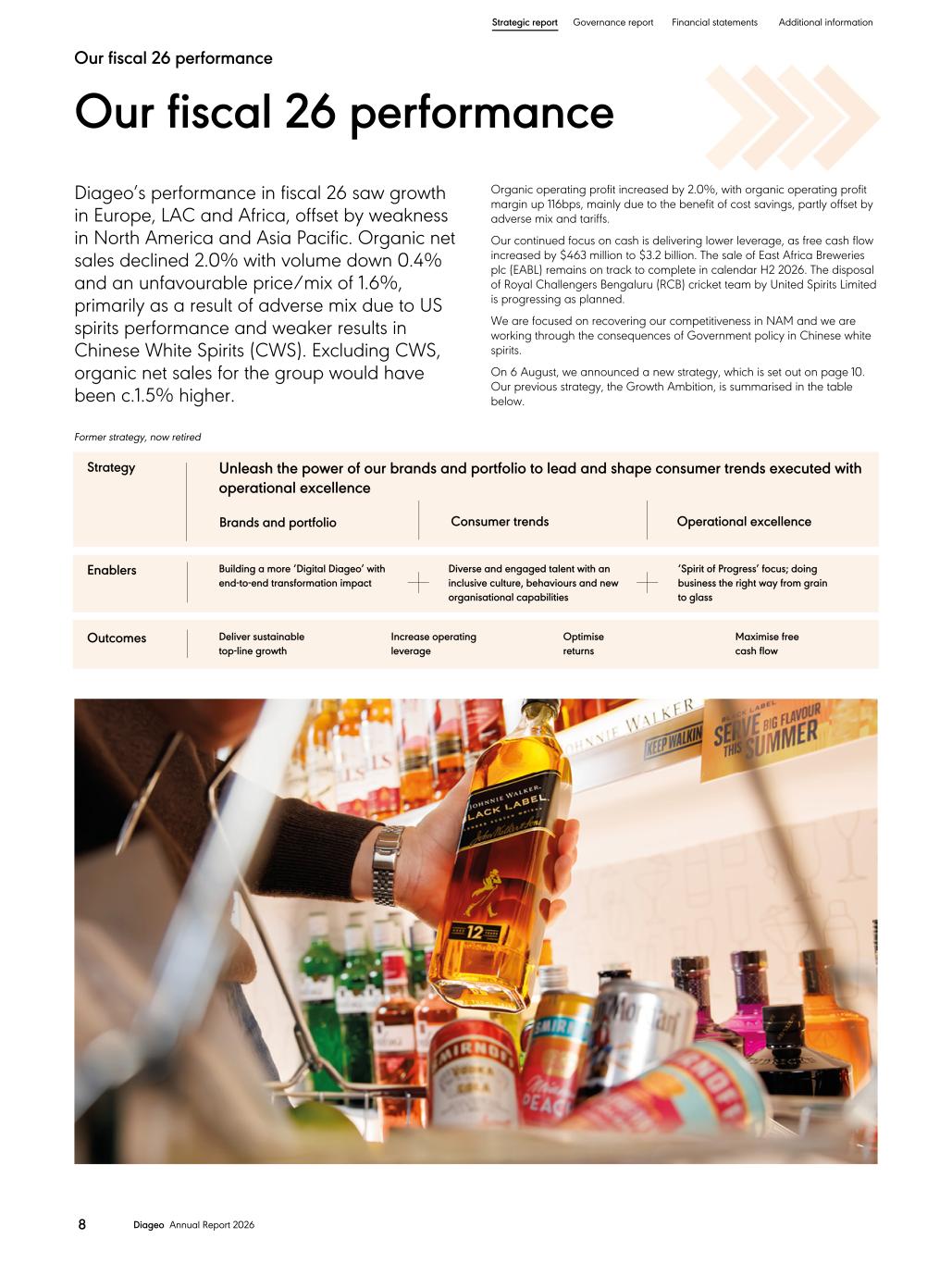
Our fiscal 26 performance Diageo’s performance in fiscal 26 saw growth in Europe, LAC and Africa, offset by weakness in North America and Asia Pacific. Organic net sales declined 2.0% with volume down 0.4% and an unfavourable price/mix of 1.6%, primarily as a result of adverse mix due to US spirits performance and weaker results in Chinese White Spirits (CWS). Excluding CWS, organic net sales for the group would have been c.1.5% higher. Organic operating profit increased by 2.0%, with organic operating profit margin up 116bps, mainly due to the benefit of cost savings, partly offset by adverse mix and tariffs. Our continued focus on cash is delivering lower leverage, as free cash flow increased by $463 million to $3.2 billion. The sale of East Africa Breweries plc (EABL) remains on track to complete in calendar H2 2026. The disposal of Royal Challengers Bengaluru (RCB) cricket team by United Spirits Limited is progressing as planned. We are focused on recovering our competitiveness in NAM and we are working through the consequences of Government policy in Chinese white spirits. On 6 August, we announced a new strategy, which is set out on page 10. Our previous strategy, the Growth Ambition, is summarised in the table below. Former strategy, now retired Strategy Unleash the power of our brands and portfolio to lead and shape consumer trends executed with operational excellence Enablers Building a more ‘Digital Diageo’ with end-to-end transformation impact Diverse and engaged talent with an inclusive culture, behaviours and new organisational capabilities ‘Spirit of Progress’ focus; doing business the right way from grain to glass Outcomes Deliver sustainable top-line growth Increase operating leverage Optimise returns Maximise free cash flow Strategic report Governance report Financial statements Additional information 8 Diageo Annual Report 2026 Our fiscal 26 performance Brands and portfolio Consumer trends Operational excellence
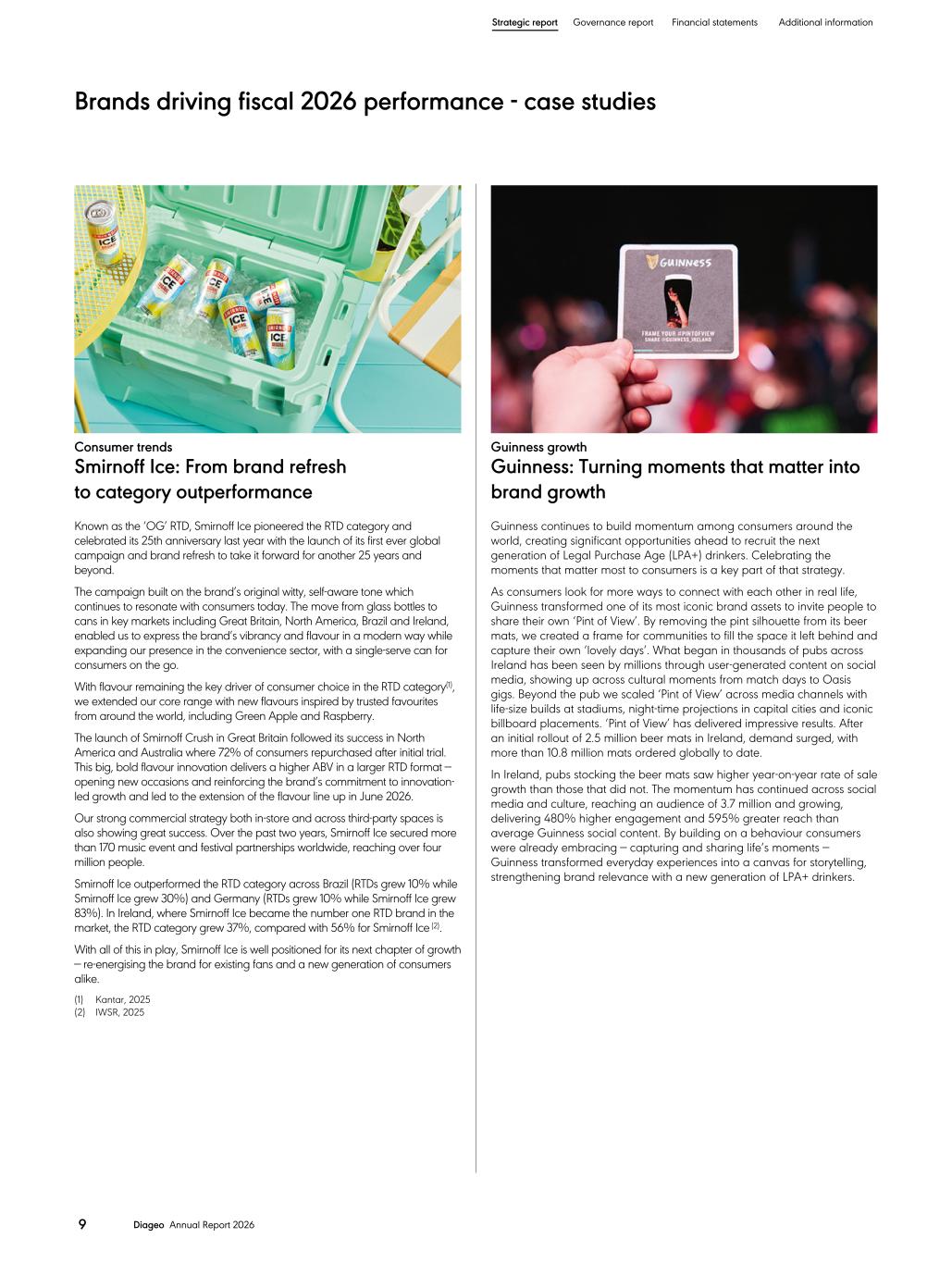
Brands driving fiscal 2026 performance - case studies Consumer trends Smirnoff Ice: From brand refresh to category outperformance Known as the ‘OG’ RTD, Smirnoff Ice pioneered the RTD category and celebrated its 25th anniversary last year with the launch of its first ever global campaign and brand refresh to take it forward for another 25 years and beyond. The campaign built on the brand’s original witty, self-aware tone which continues to resonate with consumers today. The move from glass bottles to cans in key markets including Great Britain, North America, Brazil and Ireland, enabled us to express the brand’s vibrancy and flavour in a modern way while expanding our presence in the convenience sector, with a single-serve can for consumers on the go. With flavour remaining the key driver of consumer choice in the RTD category(1), we extended our core range with new flavours inspired by trusted favourites from around the world, including Green Apple and Raspberry. The launch of Smirnoff Crush in Great Britain followed its success in North America and Australia where 72% of consumers repurchased after initial trial. This big, bold flavour innovation delivers a higher ABV in a larger RTD format — opening new occasions and reinforcing the brand’s commitment to innovation- led growth and led to the extension of the flavour line up in June 2026. Our strong commercial strategy both in-store and across third-party spaces is also showing great success. Over the past two years, Smirnoff Ice secured more than 170 music event and festival partnerships worldwide, reaching over four million people. Smirnoff Ice outperformed the RTD category across Brazil (RTDs grew 10% while Smirnoff Ice grew 30%) and Germany (RTDs grew 10% while Smirnoff Ice grew 83%). In Ireland, where Smirnoff Ice became the number one RTD brand in the market, the RTD category grew 37%, compared with 56% for Smirnoff Ice (2). With all of this in play, Smirnoff Ice is well positioned for its next chapter of growth — re-energising the brand for existing fans and a new generation of consumers alike. (1) Kantar, 2025 (2) IWSR, 2025 Guinness growth Guinness: Turning moments that matter into brand growth Guinness continues to build momentum among consumers around the world, creating significant opportunities ahead to recruit the next generation of Legal Purchase Age (LPA+) drinkers. Celebrating the moments that matter most to consumers is a key part of that strategy. As consumers look for more ways to connect with each other in real life, Guinness transformed one of its most iconic brand assets to invite people to share their own ‘Pint of View’. By removing the pint silhouette from its beer mats, we created a frame for communities to fill the space it left behind and capture their own ‘lovely days’. What began in thousands of pubs across Ireland has been seen by millions through user-generated content on social media, showing up across cultural moments from match days to Oasis gigs. Beyond the pub we scaled ‘Pint of View’ across media channels with life-size builds at stadiums, night-time projections in capital cities and iconic billboard placements. ‘Pint of View’ has delivered impressive results. After an initial rollout of 2.5 million beer mats in Ireland, demand surged, with more than 10.8 million mats ordered globally to date. In Ireland, pubs stocking the beer mats saw higher year-on-year rate of sale growth than those that did not. The momentum has continued across social media and culture, reaching an audience of 3.7 million and growing, delivering 480% higher engagement and 595% greater reach than average Guinness social content. By building on a behaviour consumers were already embracing — capturing and sharing life’s moments — Guinness transformed everyday experiences into a canvas for storytelling, strengthening brand relevance with a new generation of LPA+ drinkers. Strategic report Governance report Financial statements Additional information Our new purpose 9 Diageo Annual Report 2026
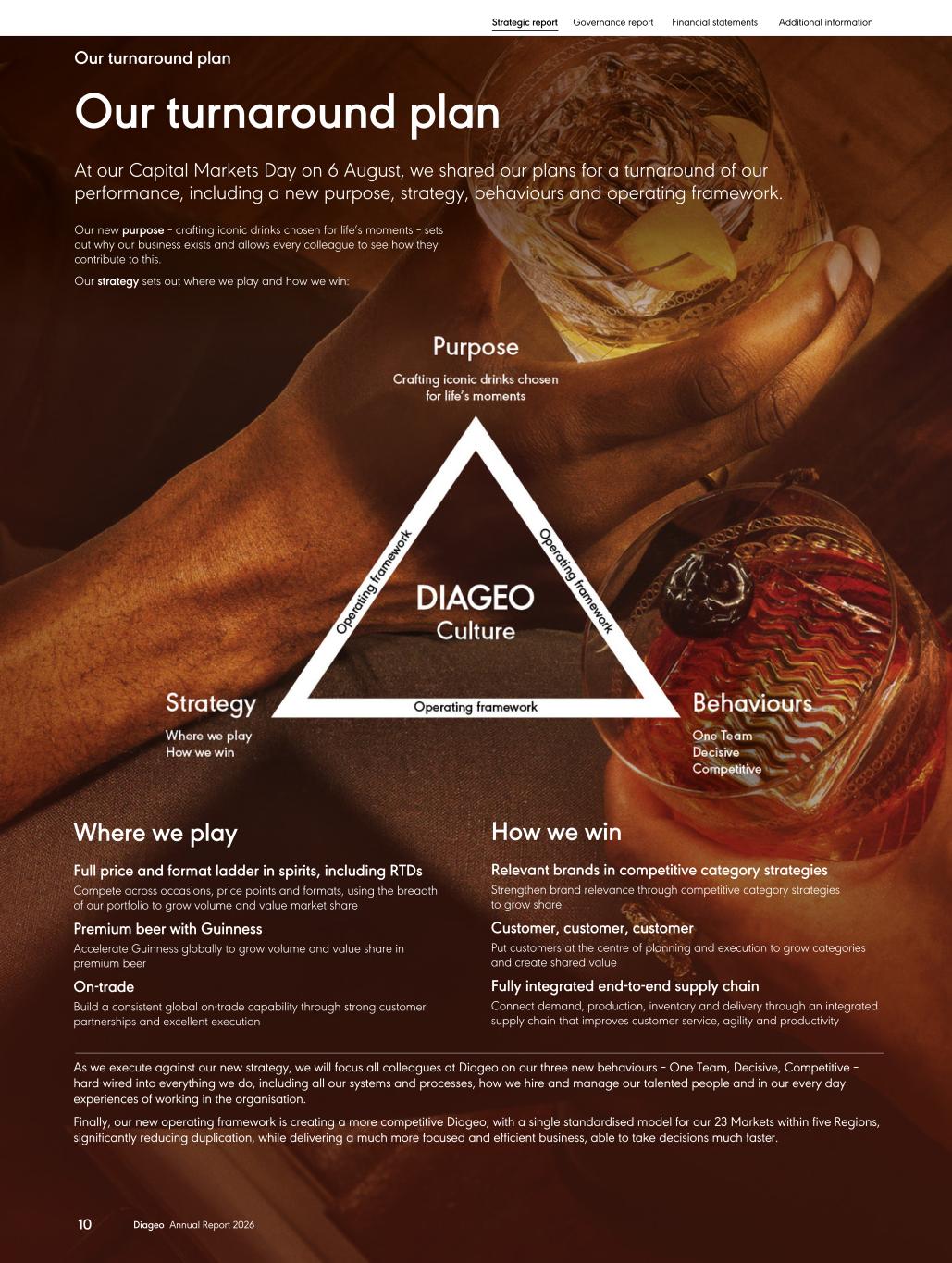
Our turnaround plan At our Capital Markets Day on 6 August, we shared our plans for a turnaround of our performance, including a new purpose, strategy, behaviours and operating framework. Our new purpose – crafting iconic drinks chosen for life’s moments – sets out why our business exists and allows every colleague to see how they contribute to this. Our strategy sets out where we play and how we win: Strategic report Governance report Financial statements Additional information 10 Diageo Annual Report 2026 Where we play Full price and format ladder in spirits, including RTDs Compete across occasions, price points and formats, using the breadth of our portfolio to grow volume and value market share Premium beer with Guinness Accelerate Guinness globally to grow volume and value share in premium beer On-trade Build a consistent global on-trade capability through strong customer partnerships and excellent execution How we win Relevant brands in competitive category strategies Strengthen brand relevance through competitive category strategies to grow share Customer, customer, customer Put customers at the centre of planning and execution to grow categories and create shared value Fully integrated end-to-end supply chain Connect demand, production, inventory and delivery through an integrated supply chain that improves customer service, agility and productivity Our turnaround plan As we execute against our new strategy, we will focus all colleagues at Diageo on our three new behaviours – One Team, Decisive, Competitive – hard-wired into everything we do, including all our systems and processes, how we hire and manage our talented people and in our every day experiences of working in the organisation. Finally, our new operating framework is creating a more competitive Diageo, with a single standardised model for our 23 Markets within five Regions, significantly reducing duplication, while delivering a much more focused and efficient business, able to take decisions much faster.
Our new strategy is already delivering The strategy has been deliberately designed to build and extract the benefits of Diageo’s scale, capability and portfolio. Below we have highlighted some of the ways in which this is already delivering stronger performance and growth. Relevant brands in competitive category strategies Whisky in the UAE Whilst the UAE is often associated with luxury spending, this represents only a small portion when looking at spirits consumption. In reality, around eight in 10 bottles of whisky consumed in the UAE sit in the standard and value segments.(1) A review of our portfolio showed that VAT 69, Black & White and JεB were priced in the same bracket as Johnnie Walker Red Label, a leader in the standard segment.(1) Further down the price ladder, however, significant volume was being captured by entry-level secondary Scotch and Indian whisky brands. Consumer insights show us that even across all price segments, shoppers are looking to premiumise. Premiumisation is not defined by a universal price point; it is relative to each consumer’s income, shopping basket and perception of value. This was especially relevant in the UAE, where many standard and value whisky consumers originate from India. In India, brands such as VAT 69 and Black & White already have strong aspirational appeal.(1) The issue was not brand relevance, but affordability and availability. We therefore repriced the brands and improved distribution in the right outlets. Once these barriers were addressed, demand accelerated quickly. In just 20 days, VAT 69 sold the same volume it had delivered over the previous year at the old price. Market share gains began to appear within three months. The initiative started in the UAE, the largest opportunity in MENA, and is now being rolled out selectively across the region. (1) IWSR, 2025 Bundaberg Rum in Australia Bundaberg Rum has always had a distinctive place in Australian culture. Known locally as Bundy, the brand is strongly associated with easy-going sociability and the moments Australians share together. When Bundaberg Campfire Bourbon Barrel Finished Rum launched in 2023, the team set out to create a more contemporary expression of one of Australia’s most iconic rum brands. Known in-market as Bundy Campfire, the innovation was designed to broaden the brand’s appeal, recruit younger LPA+ consumers and stretch Bundy into new occasions. Launched first as a glass spirit in August 2023, then expanded into RTD in February 2024, Bundy Campfire has quickly become a significant growth platform for the Bundaberg trademark. For existing Bundy drinkers, Campfire offered a fresh expression of a familiar brand. For consumers who may not have previously considered Bundy, it created a more accessible entry point into the trademark. In fiscal 26, the platform was further strengthened with the introduction of two new variants: Bundy Campfire Zero Sugar and Bundy Campfire & Dry. These additions expanded the range into more consumer occasions, responding to growing demand for lighter, more refreshing serves and zero/lower sugar options. By broadening choice while staying anchored in the distinctive Campfire liquid story, the new variants have helped accelerate performance and further build the platform’s relevance with today’s dark spirits consumers. Campfire is helping Bundy grow with new consumers and in new geographies. The platform is over-indexing with younger LPA+ consumers and expanding Bundy’s footprint outside traditional Heartland areas, helping the brand appeal to a broader national audience.(1) Since launch, Bundy Campfire has rapidly become a meaningful growth platform for the Bundaberg trademark. It now represents more than 10% of the total Bundaberg trademark, demonstrating the scale and strength of the proposition across glass and premix. Bundy was the #1 brand for dark spirits share gains, with Bundy Campfire a key driver of that momentum.(1) The success of Campfire shows how innovation can unlock new growth for an iconic trademark. (1) Circana, 2026 Strategic report Governance report Financial statements Additional information 11 Diageo Annual Report 2026
Creating value for all our stakeholders What we do 1. We source From smallholder farmers in Africa and Mexico, to multinational companies, we work with our suppliers to procure high-quality raw materials and services, with sustainability in mind. Where it is right for our business, we grow and source locally. 2. We innovate Using our deep understanding of consumer trends and socialising occasions, we focus on driving sustainable innovation that provides new products and experiences for consumers; be that a non-alcoholic option, an offering that suits convenience or improving the on-trade experience. 3. We make We distil, brew and bottle our spirits and beer brands through a globally co-ordinated supply operation, working to the highest quality and manufacturing standards. We prioritise using local production where it is right for our business. 4. We transport We move our products to where they need to be in the world; be that from a local distillery in market or shipping scotch. 5. We sell to customers We grow by working closely with our customers. Our global and local sales teams use our data, digital tools and insights to extend our sales reach, improve our execution and help generate value for us and for our customers. When our customers grow, we grow too. 6. We market to consumers We invest in world-class marketing to build vibrant brands that resonate with our consumers. To do this responsibly, we have our rigorous Diageo Marketing Code which guides everything we do. 7. We help consumers connect We continually evolve our data tools to understand consumers’ attitudes and motivations. We convert this information into insights which enable us to respond with agility to our consumers’ interests and preferences. Strategic report Governance report Financial statements Additional information 12 Diageo Annual Report 2026 Our stakeholders Our people Communities Consumers Investors Customers Government and regulators Suppliers Our business model Creating value Our business model allows us to create value across three main areas: • Financial – for our investors • Human – for our people, suppliers, customers and consumers • Social – for our communities
Understanding market dynamics We continue to believe in the long-term growth potential of spirits, including RTDs, and premium beer. The outlook is being shaped by three factors: demographics, consumer wallets and consumer behaviours. While near-term pressures remain, particularly on wallets, consumers continue to engage with our categories. Demographics Demographics remain a long-term tailwind for spirits. Population growth expands the legal purchasing age consumer base, while spirits continue to engage consumers across a broad range of ages. Compared with alcohol overall, spirits spending is sustained across a broader span of adulthood, making the category well positioned as populations age.(1) Legal purchasing age Gen-Z consumers are also engaging strongly with spirits and RTDs, with penetration above the general population across a range of markets.(2) Consumer wallets Consumer wallets are the most significant near- term pressure, particularly in developed markets where income growth has lagged inflation and discretionary spending has come under pressure. This is increasingly affecting middle- income consumers as well as lower-income households. With wallets under pressure, consumers are looking for ways to stay in the category and continue to consume premium brands, including through smaller formats and RTDs. In many emerging markets, the picture is a tailwind, with stronger income growth, economic development and an expanding middle class supporting category participation and premiumisation. Consumer behaviours Three behavioural trends are shaping the category: evolving social behaviours and alcohol's role within them, convenience, and GLP-1s. While consumers report moderating their alcohol consumption, this is a nuanced behaviour driven by both health and financial considerations, and often involves continuing to participate in the category through lower- strength products, smaller formats and RTDs. Convenience remains a persistent behavioural trend supporting RTD growth, while current evidence suggests GLP-1s have a lower impact on spirits than on beer and wine.(3) 1-3% Expected global value growth in spirits, including RTDs over the next three years(4) 1-3% Expected global value growth in premium beer over the next three years(5) Strategic report Governance report Financial statements Additional information 13 Diageo Annual Report 2026 Market dynamics (1) US Bureau of Labor Statistics, 2024: US Annual HH spend on spirits at home, by age of primary householder, indexed vs US average spend, 2024 (2) BGS Kantar F26, Claimed spirits/RTD penetration of TBA drinkers, Index of LPA-29 vs market average; spirits exclude baijiu (3) Numerator L12M spend decline delta, GLP-1 users vs non-users (ppt), average of 4 waves of analysis via Numerator - Wave 1 (Jan ’25), Wave 2 (Apr ’25), Wave 3 (Oct ’25), Wave 4 (Jan ’26) (4) Internal projections (5) Internal projections
An attractive investment case Spirits including RTDs and premium beer are resilient categories with significant growth potential. Diageo will win share by using our full portfolio of brands in competitive category strategies, with a strong focus on customer partnerships. Combined with a much more competitive and efficient operating framework, a clear financial plan to improve growth, cash generation and shareholder value creation, we believe Diageo represents an attractive investment case. 1. Spirits including RTDs and premium beer are resilient categories with significant growth potential We are positive on the outlook for spirits including RTDs, and we see long term growth potential. We firmly believe that we can grow both volume and value share. This will be supported by leveraging the strength of our brands and recruiting LPA+ consumers through a more focused RTD strategy. Our global footprint will ensure that we benefit from both developed and emerging market growth; with growth in the earlier years expected to offset performance in North America. In premium beer, we continue to see significant growth potential for Guinness. We are investing in Guinness to help sustain its double-digit growth. We have clear plans to both add capacity over the coming years and extend brand reach through a combination of business models; to support and capture Guinness and Guinness 0.0 growth potential. 2. Category strategy to serve more consumers across more occasions While the business will continue to focus on premiumisation, a key growth driver over the last decade, we are being more active across our broader portfolio. Implementation of a category strategy across the business will allow us to serve more consumers across more occasions. While some of this will involve price repositioning across the portfolio, it will also include additional formats such as smaller packs and RTD expressions. Results to date have demonstrated that this can increase both gross profit dollars and market share. Successful execution of this strategy will also enable us to better serve our customers, particularly in the off-trade, strengthening Diageo’s ability to become a category champion across categories and ultimately growing revenue for both our customers and our business. The category strategy work will take longer in North America, where a significant turnaround is required and where the three-tier system adds complexity. However, early success in Latin America and Caribbean already demonstrates the potential of this approach to drive outperformance. 3. Operating framework creating a more agile, more competitive Diageo We have made significant progress redesigning our operating framework to become more competitive. We are investing $1.2 billion in a 2-year restructuring plan, $1.1 billion in the new operating framework and $100 million in the supply chain. $752 million of this has been charged in fiscal 26, but the cash will flow out in fiscal 27 (the balance will be committed and spent in fiscal 27). By 1 September 2026, we will have implemented 90% of planned restructuring changes. More consistent organisational structures across five regions and 23 markets, a significant reduction in duplication at the centre, and implementation of end-to-end supply chain management will create a more focused business. This will enable us to be more agile as the market evolves and more focused on drivers of value creation and returns; with clear accountability across the business on each division's contribution to this. This plan will save c.$1 billion, with $850 million coming from the operating framework and c.$150 million from the supply chain. We will invest these savings back to advance innovation, selectively improve competitiveness and to protect underlying profitability. 4. Turnaround plan for North America, while growth continues in the rest of the world We have shared clear financial plans for the next 3 years, as the turnaround progresses and with detail on planned assumptions for the North America business, our largest market, where the need for a turnaround is pronounced. Our commitment to a low-single-digit CAGR in net sales from fiscal 27 to fiscal 29 is expected to be accompanied by a CAGR of mid-single-digit organic operating profit growth. Excluding North America, the rest of our business is expected to deliver net sales growth of 3-5%. Eps is expected to grow ahead of operating profit growth over this period. Our North America assumptions are clear with improved share trends across the period with share stabilisation from the second year and a return to share growth in fiscal 29. 5. Clear capital allocation priorities and significantly increased financial flexibility from fiscal 28 Cash remains a critical focus and our commitment to deliver remains key and well on track. We now expect to be at the mid-point of our target leverage range (2.5-3x net debt(1)/ EBITDA) in fiscal 27, and to be at c.2x by the end of fiscal 29 absent any actions that the Board may decide to take. This assumes completion of the EABL and RCB disposals as expected as well as the higher capex spend as we invest in Guinness. Delivery on our financial guidance will result in significantly increased financial flexibility from fiscal 28. Our capital allocation priorities are clear and unchanged, with the priority for the coming years an organic turnaround. (1) Leverage ratio is calculated using adjusted net debt which is the equivalent to adjusted net borrowings (net borrowings plus post- employment benefit liabilities before tax). Strategic report Governance report Financial statements Additional information 14 Diageo Annual Report 2026 Investment case

Strategic report Governance report Financial statements Additional information 15 Diageo Annual Report 2026
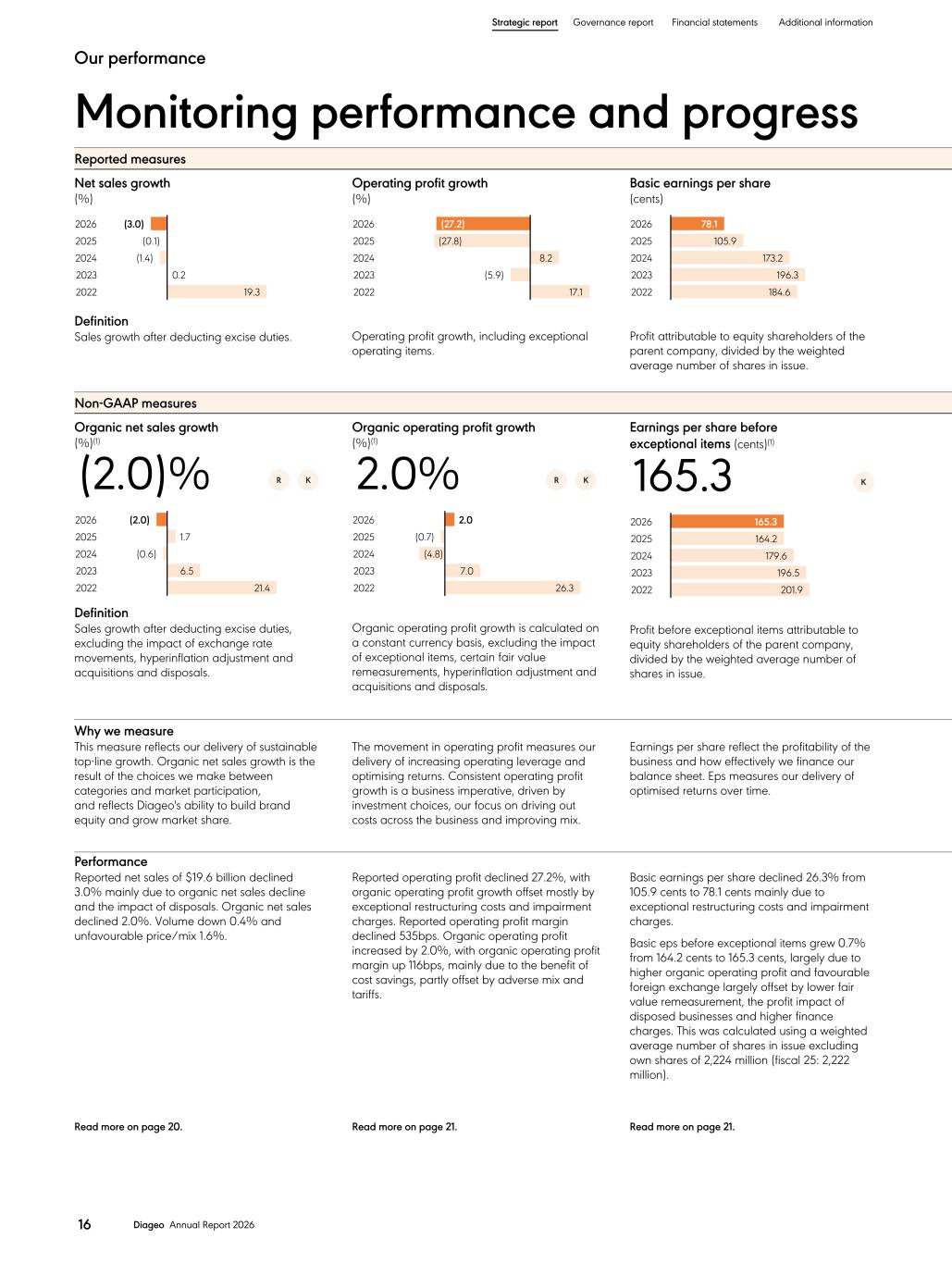
Monitoring performance and progress Reported measures Net sales growth (%) (3.0) (0.1) (1.4) 0.2 19.3 2026 2025 2024 2023 2022 Definition Sales growth after deducting excise duties. Operating profit growth (%) (27.2) (27.8) 8.2 (5.9) 17.1 2026 2025 2024 2023 2022 Operating profit growth, including exceptional operating items. Basic earnings per share (cents) 78.1 105.9 173.2 196.3 184.6 2026 2025 2024 2023 2022 Profit attributable to equity shareholders of the parent company, divided by the weighted average number of shares in issue. Non-GAAP measures Organic net sales growth (%)(1) (2.0)% (2.0) 1.7 (0.6) 6.5 21.4 2026 2025 2024 2023 2022 Definition Sales growth after deducting excise duties, excluding the impact of exchange rate movements, hyperinflation adjustment and acquisitions and disposals. Organic operating profit growth (%)(1) 2.0% 2.0 (0.7) (4.8) 7.0 26.3 2026 2025 2024 2023 2022 Organic operating profit growth is calculated on a constant currency basis, excluding the impact of exceptional items, certain fair value remeasurements, hyperinflation adjustment and acquisitions and disposals. Earnings per share before exceptional items (cents)(1) 165.3 165.3 164.2 179.6 196.5 201.9 2026 2025 2024 2023 2022 Profit before exceptional items attributable to equity shareholders of the parent company, divided by the weighted average number of shares in issue. Why we measure This measure reflects our delivery of sustainable top-line growth. Organic net sales growth is the result of the choices we make between categories and market participation, and reflects Diageo's ability to build brand equity and grow market share. The movement in operating profit measures our delivery of increasing operating leverage and optimising returns. Consistent operating profit growth is a business imperative, driven by investment choices, our focus on driving out costs across the business and improving mix. Earnings per share reflect the profitability of the business and how effectively we finance our balance sheet. Eps measures our delivery of optimised returns over time. Performance Reported net sales of $19.6 billion declined 3.0% mainly due to organic net sales decline and the impact of disposals. Organic net sales declined 2.0%. Volume down 0.4% and unfavourable price/mix 1.6%. Reported operating profit declined 27.2%, with organic operating profit growth offset mostly by exceptional restructuring costs and impairment charges. Reported operating profit margin declined 535bps. Organic operating profit increased by 2.0%, with organic operating profit margin up 116bps, mainly due to the benefit of cost savings, partly offset by adverse mix and tariffs. Basic earnings per share declined 26.3% from 105.9 cents to 78.1 cents mainly due to exceptional restructuring costs and impairment charges. Basic eps before exceptional items grew 0.7% from 164.2 cents to 165.3 cents, largely due to higher organic operating profit and favourable foreign exchange largely offset by lower fair value remeasurement, the profit impact of disposed businesses and higher finance charges. This was calculated using a weighted average number of shares in issue excluding own shares of 2,224 million (fiscal 25: 2,222 million). Read more on page 20. Read more on page 21. Read more on page 21. Strategic report Governance report Financial statements Additional information 16 Diageo Annual Report 2026 Our performance
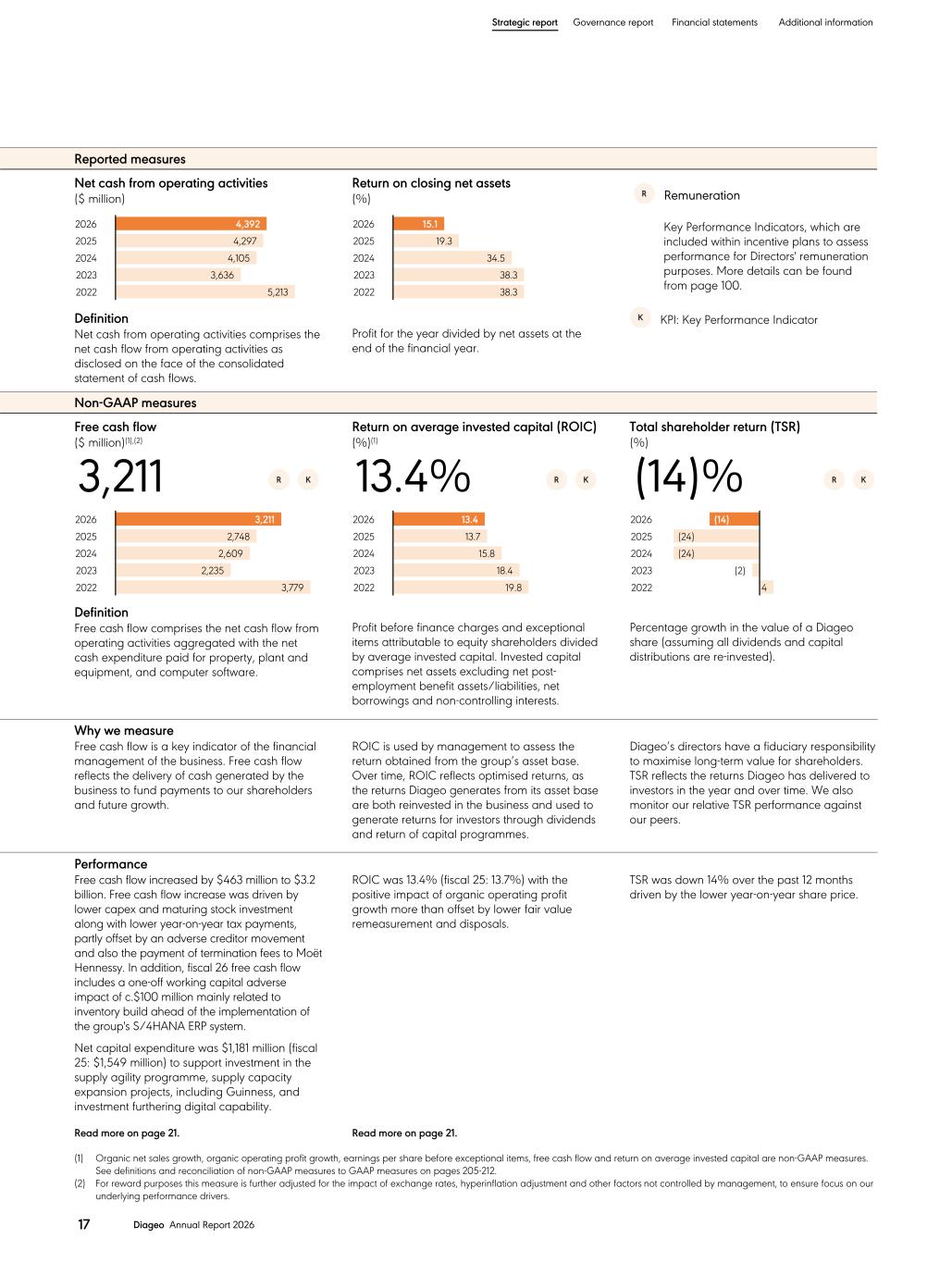
Reported measures Net cash from operating activities ($ million) 4,392 4,297 4,105 3,636 5,213 2026 2025 2024 2023 2022 Definition Net cash from operating activities comprises the net cash flow from operating activities as disclosed on the face of the consolidated statement of cash flows. Return on closing net assets (%) 15.1 19.3 34.5 38.3 38.3 2026 2025 2024 2023 2022 Profit for the year divided by net assets at the end of the financial year. Remuneration Key Performance Indicators, which are included within incentive plans to assess performance for Directors' remuneration purposes. More details can be found from page 100. KPI: Key Performance Indicator Non-GAAP measures Free cash flow ($ million)(1),(2) 3,211 3,211 2,748 2,609 2,235 3,779 2026 2025 2024 2023 2022 Definition Free cash flow comprises the net cash flow from operating activities aggregated with the net cash expenditure paid for property, plant and equipment, and computer software. Return on average invested capital (ROIC) (%)(1) 13.4% 13.4 13.7 15.8 18.4 19.8 2026 2025 2024 2023 2022 Profit before finance charges and exceptional items attributable to equity shareholders divided by average invested capital. Invested capital comprises net assets excluding net post- employment benefit assets/liabilities, net borrowings and non-controlling interests. Total shareholder return (TSR) (%) (14)% (14) (24) (24) (2) 4 2026 2025 2024 2023 2022 Percentage growth in the value of a Diageo share (assuming all dividends and capital distributions are re-invested). Why we measure Free cash flow is a key indicator of the financial management of the business. Free cash flow reflects the delivery of cash generated by the business to fund payments to our shareholders and future growth. ROIC is used by management to assess the return obtained from the group’s asset base. Over time, ROIC reflects optimised returns, as the returns Diageo generates from its asset base are both reinvested in the business and used to generate returns for investors through dividends and return of capital programmes. Diageo’s directors have a fiduciary responsibility to maximise long-term value for shareholders. TSR reflects the returns Diageo has delivered to investors in the year and over time. We also monitor our relative TSR performance against our peers. Performance Free cash flow increased by $463 million to $3.2 billion. Free cash flow increase was driven by lower capex and maturing stock investment along with lower year-on-year tax payments, partly offset by an adverse creditor movement and also the payment of termination fees to Moët Hennessy. In addition, fiscal 26 free cash flow includes a one-off working capital adverse impact of c.$100 million mainly related to inventory build ahead of the implementation of the group's S/4HANA ERP system. Net capital expenditure was $1,181 million (fiscal 25: $1,549 million) to support investment in the supply agility programme, supply capacity expansion projects, including Guinness, and investment furthering digital capability. ROIC was 13.4% (fiscal 25: 13.7%) with the positive impact of organic operating profit growth more than offset by lower fair value remeasurement and disposals. TSR was down 14% over the past 12 months driven by the lower year-on-year share price. Read more on page 21. Read more on page 21. (1) Organic net sales growth, organic operating profit growth, earnings per share before exceptional items, free cash flow and return on average invested capital are non-GAAP measures. See definitions and reconciliation of non-GAAP measures to GAAP measures on pages 205-212. (2) For reward purposes this measure is further adjusted for the impact of exchange rates, hyperinflation adjustment and other factors not controlled by management, to ensure focus on our underlying performance drivers. Strategic report Governance report Financial statements Additional information 17 Diageo Annual Report 2026
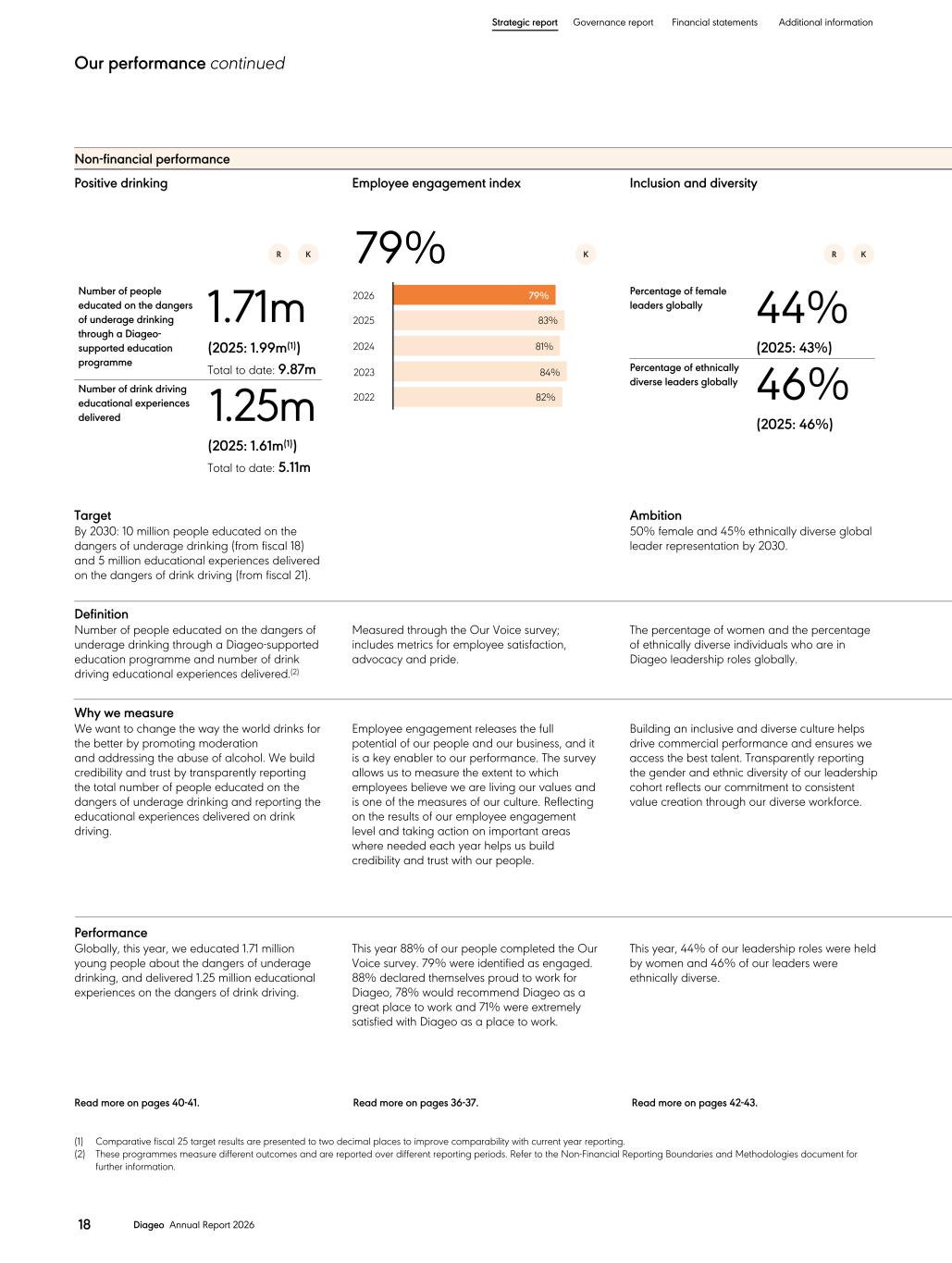
Non-financial performance Positive drinking Number of people educated on the dangers of underage drinking through a Diageo- supported education programme 1.71m (2025: 1.99m(1)) Total to date: 9.87m Number of drink driving educational experiences delivered 1.25m (2025: 1.61m(1)) Total to date: 5.11m Employee engagement index 79% 79% 83% 81% 84% 82% 2026 2025 2024 2023 2022 Inclusion and diversity Percentage of female leaders globally 44% (2025: 43%) Percentage of ethnically diverse leaders globally 46% (2025: 46%) Target By 2030: 10 million people educated on the dangers of underage drinking (from fiscal 18) and 5 million educational experiences delivered on the dangers of drink driving (from fiscal 21). Ambition 50% female and 45% ethnically diverse global leader representation by 2030. Definition Number of people educated on the dangers of underage drinking through a Diageo-supported education programme and number of drink driving educational experiences delivered.(2) Measured through the Our Voice survey; includes metrics for employee satisfaction, advocacy and pride. The percentage of women and the percentage of ethnically diverse individuals who are in Diageo leadership roles globally. Why we measure We want to change the way the world drinks for the better by promoting moderation and addressing the abuse of alcohol. We build credibility and trust by transparently reporting the total number of people educated on the dangers of underage drinking and reporting the educational experiences delivered on drink driving. Employee engagement releases the full potential of our people and our business, and it is a key enabler to our performance. The survey allows us to measure the extent to which employees believe we are living our values and is one of the measures of our culture. Reflecting on the results of our employee engagement level and taking action on important areas where needed each year helps us build credibility and trust with our people. Building an inclusive and diverse culture helps drive commercial performance and ensures we access the best talent. Transparently reporting the gender and ethnic diversity of our leadership cohort reflects our commitment to consistent value creation through our diverse workforce. Performance Globally, this year, we educated 1.71 million young people about the dangers of underage drinking, and delivered 1.25 million educational experiences on the dangers of drink driving. This year 88% of our people completed the Our Voice survey. 79% were identified as engaged. 88% declared themselves proud to work for Diageo, 78% would recommend Diageo as a great place to work and 71% were extremely satisfied with Diageo as a place to work. This year, 44% of our leadership roles were held by women and 46% of our leaders were ethnically diverse. Read more on pages 40-41. Read more on pages 36-37. Read more on pages 42-43. (1) Comparative fiscal 25 target results are presented to two decimal places to improve comparability with current year reporting. (2) These programmes measure different outcomes and are reported over different reporting periods. Refer to the Non-Financial Reporting Boundaries and Methodologies document for further information. Strategic report Governance report Financial statements Additional information Our performance continued 18 Diageo Annual Report 2026
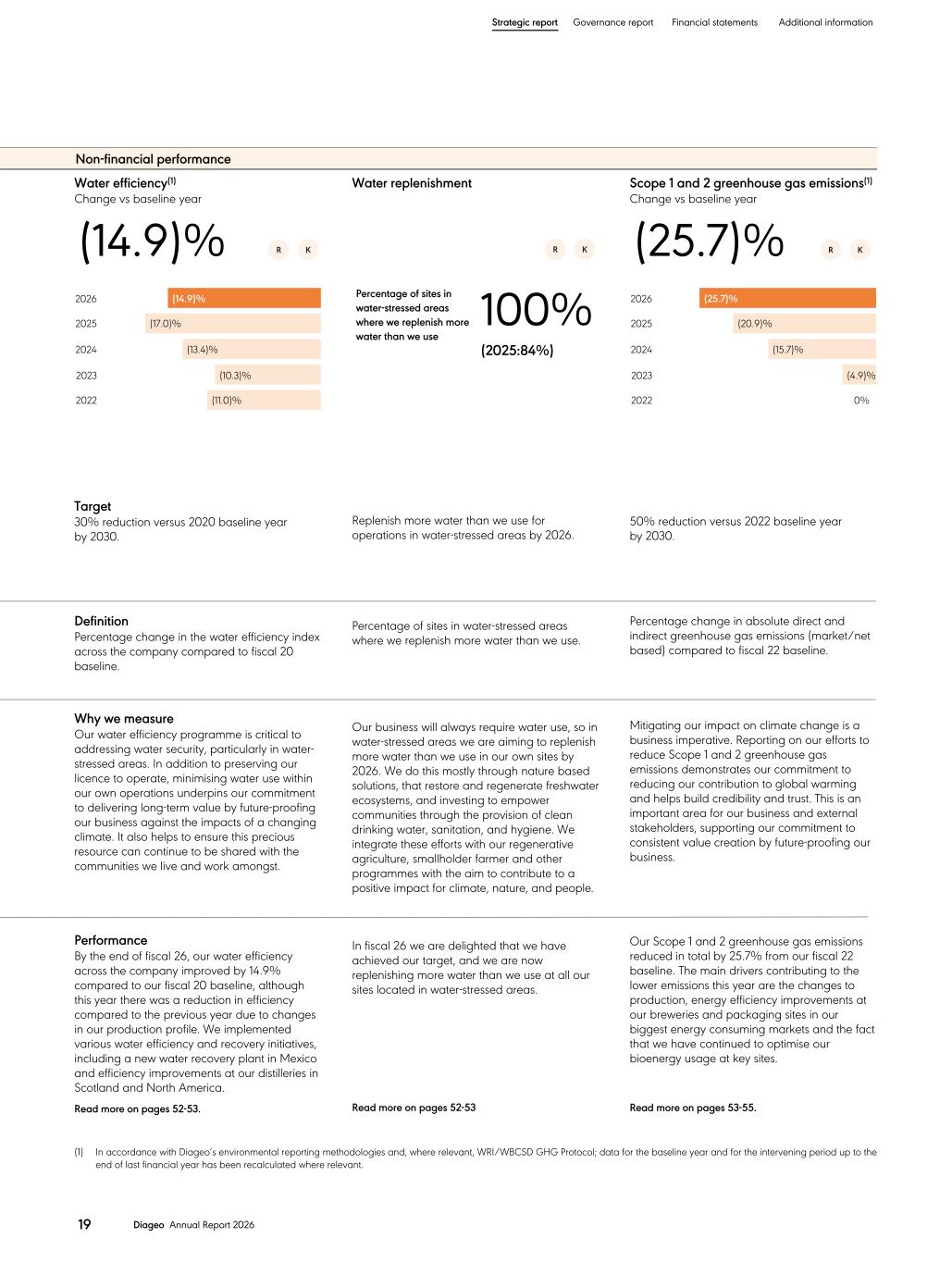
Non-financial performance Water efficiency(1) Change vs baseline year (14.9)% (14.9)% (17.0)% (13.4)% (10.3)% (11.0)% 2026 2025 2024 2023 2022 Target 30% reduction versus 2020 baseline year by 2030. Definition Percentage change in the water efficiency index across the company compared to fiscal 20 baseline. Why we measure Our water efficiency programme is critical to addressing water security, particularly in water- stressed areas. In addition to preserving our licence to operate, minimising water use within our own operations underpins our commitment to delivering long-term value by future-proofing our business against the impacts of a changing climate. It also helps to ensure this precious resource can continue to be shared with the communities we live and work amongst. Performance By the end of fiscal 26, our water efficiency across the company improved by 14.9% compared to our fiscal 20 baseline, although this year there was a reduction in efficiency compared to the previous year due to changes in our production profile. We implemented various water efficiency and recovery initiatives, including a new water recovery plant in Mexico and efficiency improvements at our distilleries in Scotland and North America. Read more on pages 52-53. Water replenishment Percentage of sites in water-stressed areas where we replenish more water than we use 100% (2025:84%) Replenish more water than we use for operations in water-stressed areas by 2026. Percentage of sites in water-stressed areas where we replenish more water than we use. Our business will always require water use, so in water-stressed areas we are aiming to replenish more water than we use in our own sites by 2026. We do this mostly through nature based solutions, that restore and regenerate freshwater ecosystems, and investing to empower communities through the provision of clean drinking water, sanitation, and hygiene. We integrate these efforts with our regenerative agriculture, smallholder farmer and other programmes with the aim to contribute to a positive impact for climate, nature, and people. In fiscal 26 we are delighted that we have achieved our target, and we are now replenishing more water than we use at all our sites located in water-stressed areas. Read more on pages 52-53 Scope 1 and 2 greenhouse gas emissions(1) Change vs baseline year (25.7)% (25.7)% (20.9)% (15.7)% (4.9)% 0% 2026 2025 2024 2023 2022 50% reduction versus 2022 baseline year by 2030. Percentage change in absolute direct and indirect greenhouse gas emissions (market/net based) compared to fiscal 22 baseline. Mitigating our impact on climate change is a business imperative. Reporting on our efforts to reduce Scope 1 and 2 greenhouse gas emissions demonstrates our commitment to reducing our contribution to global warming and helps build credibility and trust. This is an important area for our business and external stakeholders, supporting our commitment to consistent value creation by future-proofing our business. Our Scope 1 and 2 greenhouse gas emissions reduced in total by 25.7% from our fiscal 22 baseline. The main drivers contributing to the lower emissions this year are the changes to production, energy efficiency improvements at our breweries and packaging sites in our biggest energy consuming markets and the fact that we have continued to optimise our bioenergy usage at key sites. Read more on pages 53-55. (1) In accordance with Diageo’s environmental reporting methodologies and, where relevant, WRI/WBCSD GHG Protocol; data for the baseline year and for the intervening period up to the end of last financial year has been recalculated where relevant. Strategic report Governance report Financial statements Additional information 19 Diageo Annual Report 2026
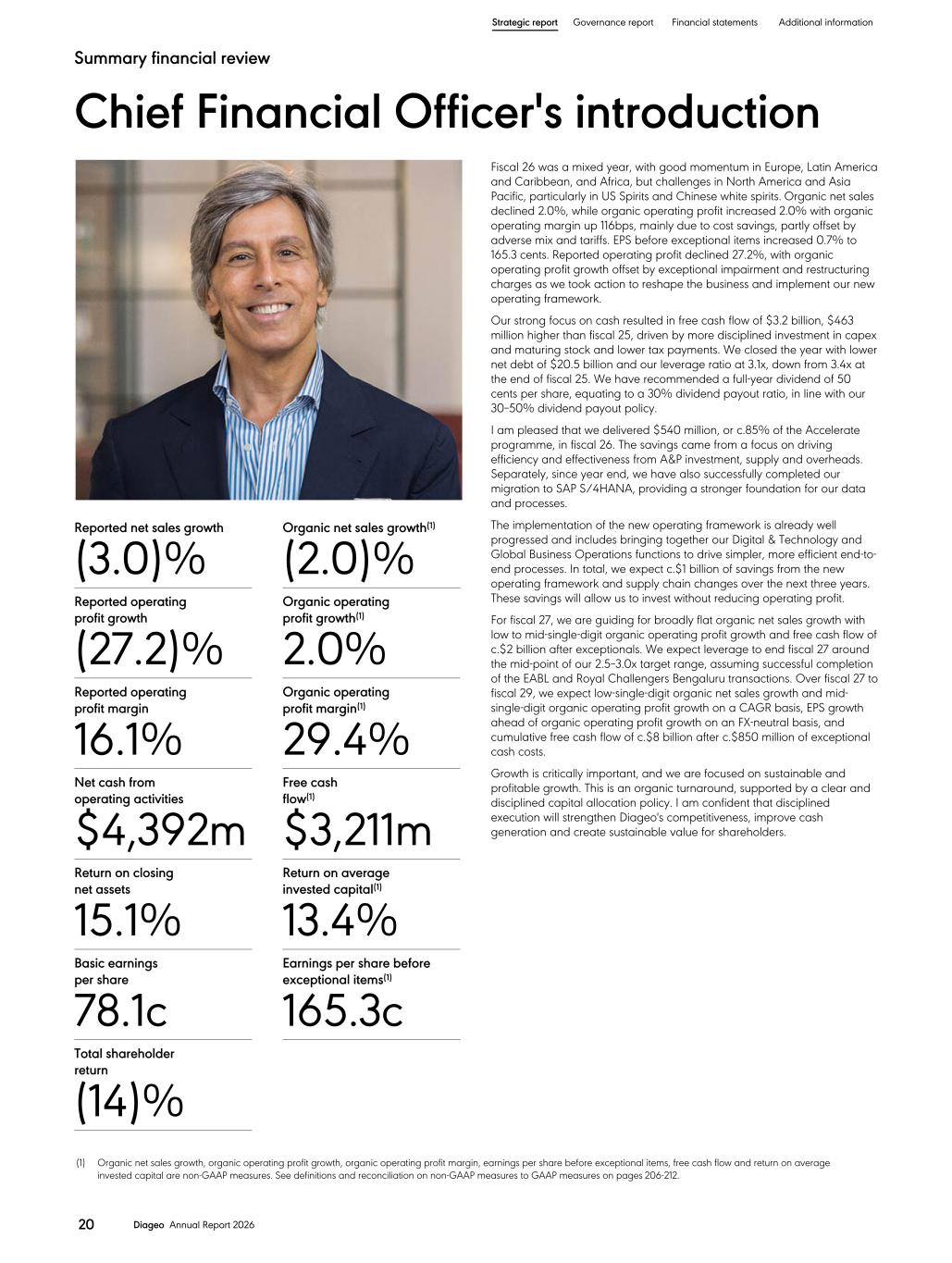
Chief Financial Officer's introduction Reported net sales growth (3.0)% Reported operating profit growth (27.2)% Reported operating profit margin 16.1% Net cash from operating activities $4,392m Return on closing net assets 15.1% Basic earnings per share 78.1c Total shareholder return (14)% Organic net sales growth(1) (2.0)% Organic operating profit growth(1) 2.0% Organic operating profit margin(1) 29.4% Free cash flow(1) $3,211m Return on average invested capital(1) 13.4% Earnings per share before exceptional items(1) 165.3c Fiscal 26 was a mixed year, with good momentum in Europe, Latin America and Caribbean, and Africa, but challenges in North America and Asia Pacific, particularly in US Spirits and Chinese white spirits. Organic net sales declined 2.0%, while organic operating profit increased 2.0% with organic operating margin up 116bps, mainly due to cost savings, partly offset by adverse mix and tariffs. EPS before exceptional items increased 0.7% to 165.3 cents. Reported operating profit declined 27.2%, with organic operating profit growth offset by exceptional impairment and restructuring charges as we took action to reshape the business and implement our new operating framework. Our strong focus on cash resulted in free cash flow of $3.2 billion, $463 million higher than fiscal 25, driven by more disciplined investment in capex and maturing stock and lower tax payments. We closed the year with lower net debt of $20.5 billion and our leverage ratio at 3.1x, down from 3.4x at the end of fiscal 25. We have recommended a full-year dividend of 50 cents per share, equating to a 30% dividend payout ratio, in line with our 30–50% dividend payout policy. I am pleased that we delivered $540 million, or c.85% of the Accelerate programme, in fiscal 26. The savings came from a focus on driving efficiency and effectiveness from A&P investment, supply and overheads. Separately, since year end, we have also successfully completed our migration to SAP S/4HANA, providing a stronger foundation for our data and processes. The implementation of the new operating framework is already well progressed and includes bringing together our Digital & Technology and Global Business Operations functions to drive simpler, more efficient end-to- end processes. In total, we expect c.$1 billion of savings from the new operating framework and supply chain changes over the next three years. These savings will allow us to invest without reducing operating profit. For fiscal 27, we are guiding for broadly flat organic net sales growth with low to mid-single-digit organic operating profit growth and free cash flow of c.$2 billion after exceptionals. We expect leverage to end fiscal 27 around the mid-point of our 2.5–3.0x target range, assuming successful completion of the EABL and Royal Challengers Bengaluru transactions. Over fiscal 27 to fiscal 29, we expect low-single-digit organic net sales growth and mid- single-digit organic operating profit growth on a CAGR basis, EPS growth ahead of organic operating profit growth on an FX-neutral basis, and cumulative free cash flow of c.$8 billion after c.$850 million of exceptional cash costs. Growth is critically important, and we are focused on sustainable and profitable growth. This is an organic turnaround, supported by a clear and disciplined capital allocation policy. I am confident that disciplined execution will strengthen Diageo's competitiveness, improve cash generation and create sustainable value for shareholders. Strategic report Governance report Financial statements Additional information 20 Diageo Annual Report 2026 Summary financial review (1) Organic net sales growth, organic operating profit growth, organic operating profit margin, earnings per share before exceptional items, free cash flow and return on average invested capital are non-GAAP measures. See definitions and reconciliation on non-GAAP measures to GAAP measures on pages 206-212.
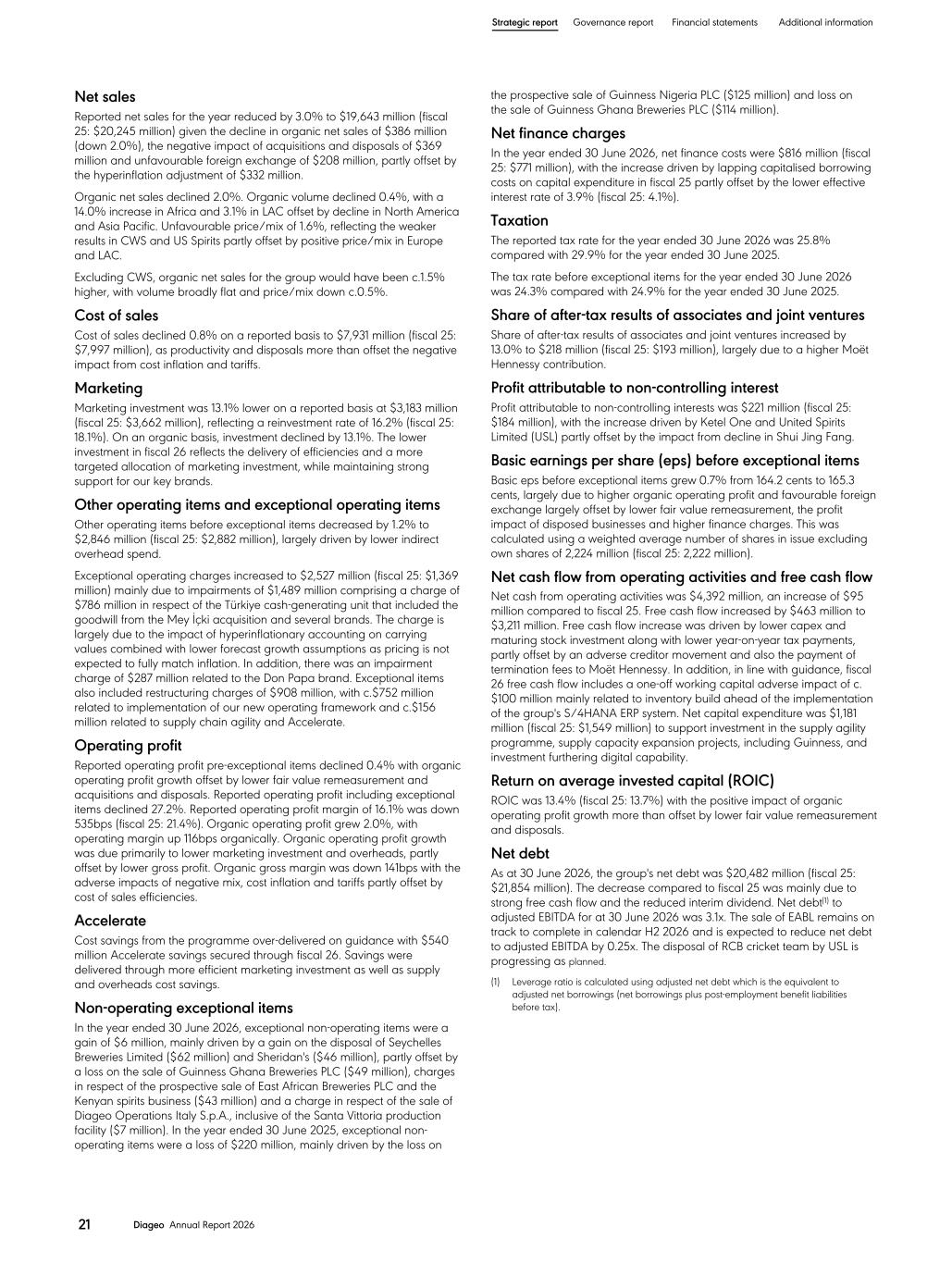
Net sales Reported net sales for the year reduced by 3.0% to $19,643 million (fiscal 25: $20,245 million) given the decline in organic net sales of $386 million (down 2.0%), the negative impact of acquisitions and disposals of $369 million and unfavourable foreign exchange of $208 million, partly offset by the hyperinflation adjustment of $332 million. Organic net sales declined 2.0%. Organic volume declined 0.4%, with a 14.0% increase in Africa and 3.1% in LAC offset by decline in North America and Asia Pacific. Unfavourable price/mix of 1.6%, reflecting the weaker results in CWS and US Spirits partly offset by positive price/mix in Europe and LAC. Excluding CWS, organic net sales for the group would have been c.1.5% higher, with volume broadly flat and price/mix down c.0.5%. Cost of sales Cost of sales declined 0.8% on a reported basis to $7,931 million (fiscal 25: $7,997 million), as productivity and disposals more than offset the negative impact from cost inflation and tariffs. Marketing Marketing investment was 13.1% lower on a reported basis at $3,183 million (fiscal 25: $3,662 million), reflecting a reinvestment rate of 16.2% (fiscal 25: 18.1%). On an organic basis, investment declined by 13.1%. The lower investment in fiscal 26 reflects the delivery of efficiencies and a more targeted allocation of marketing investment, while maintaining strong support for our key brands. Other operating items and exceptional operating items Other operating items before exceptional items decreased by 1.2% to $2,846 million (fiscal 25: $2,882 million), largely driven by lower indirect overhead spend. Exceptional operating charges increased to $2,527 million (fiscal 25: $1,369 million) mainly due to impairments of $1,489 million comprising a charge of $786 million in respect of the Türkiye cash-generating unit that included the goodwill from the Mey İçki acquisition and several brands. The charge is largely due to the impact of hyperinflationary accounting on carrying values combined with lower forecast growth assumptions as pricing is not expected to fully match inflation. In addition, there was an impairment charge of $287 million related to the Don Papa brand. Exceptional items also included restructuring charges of $908 million, with c.$752 million related to implementation of our new operating framework and c.$156 million related to supply chain agility and Accelerate. Operating profit Reported operating profit pre-exceptional items declined 0.4% with organic operating profit growth offset by lower fair value remeasurement and acquisitions and disposals. Reported operating profit including exceptional items declined 27.2%. Reported operating profit margin of 16.1% was down 535bps (fiscal 25: 21.4%). Organic operating profit grew 2.0%, with operating margin up 116bps organically. Organic operating profit growth was due primarily to lower marketing investment and overheads, partly offset by lower gross profit. Organic gross margin was down 141bps with the adverse impacts of negative mix, cost inflation and tariffs partly offset by cost of sales efficiencies. Accelerate Cost savings from the programme over-delivered on guidance with $540 million Accelerate savings secured through fiscal 26. Savings were delivered through more efficient marketing investment as well as supply and overheads cost savings. Non-operating exceptional items In the year ended 30 June 2026, exceptional non-operating items were a gain of $6 million, mainly driven by a gain on the disposal of Seychelles Breweries Limited ($62 million) and Sheridan's ($46 million), partly offset by a loss on the sale of Guinness Ghana Breweries PLC ($49 million), charges in respect of the prospective sale of East African Breweries PLC and the Kenyan spirits business ($43 million) and a charge in respect of the sale of Diageo Operations Italy S.p.A., inclusive of the Santa Vittoria production facility ($7 million). In the year ended 30 June 2025, exceptional non- operating items were a loss of $220 million, mainly driven by the loss on the prospective sale of Guinness Nigeria PLC ($125 million) and loss on the sale of Guinness Ghana Breweries PLC ($114 million). Net finance charges In the year ended 30 June 2026, net finance costs were $816 million (fiscal 25: $771 million), with the increase driven by lapping capitalised borrowing costs on capital expenditure in fiscal 25 partly offset by the lower effective interest rate of 3.9% (fiscal 25: 4.1%). Taxation The reported tax rate for the year ended 30 June 2026 was 25.8% compared with 29.9% for the year ended 30 June 2025. The tax rate before exceptional items for the year ended 30 June 2026 was 24.3% compared with 24.9% for the year ended 30 June 2025. Share of after-tax results of associates and joint ventures Share of after-tax results of associates and joint ventures increased by 13.0% to $218 million (fiscal 25: $193 million), largely due to a higher Moët Hennessy contribution. Profit attributable to non-controlling interest Profit attributable to non-controlling interests was $221 million (fiscal 25: $184 million), with the increase driven by Ketel One and United Spirits Limited (USL) partly offset by the impact from decline in Shui Jing Fang. Basic earnings per share (eps) before exceptional items Basic eps before exceptional items grew 0.7% from 164.2 cents to 165.3 cents, largely due to higher organic operating profit and favourable foreign exchange largely offset by lower fair value remeasurement, the profit impact of disposed businesses and higher finance charges. This was calculated using a weighted average number of shares in issue excluding own shares of 2,224 million (fiscal 25: 2,222 million). Net cash flow from operating activities and free cash flow Net cash from operating activities was $4,392 million, an increase of $95 million compared to fiscal 25. Free cash flow increased by $463 million to $3,211 million. Free cash flow increase was driven by lower capex and maturing stock investment along with lower year-on-year tax payments, partly offset by an adverse creditor movement and also the payment of termination fees to Moët Hennessy. In addition, in line with guidance, fiscal 26 free cash flow includes a one-off working capital adverse impact of c. $100 million mainly related to inventory build ahead of the implementation of the group's S/4HANA ERP system. Net capital expenditure was $1,181 million (fiscal 25: $1,549 million) to support investment in the supply agility programme, supply capacity expansion projects, including Guinness, and investment furthering digital capability. Return on average invested capital (ROIC) ROIC was 13.4% (fiscal 25: 13.7%) with the positive impact of organic operating profit growth more than offset by lower fair value remeasurement and disposals. Net debt As at 30 June 2026, the group's net debt was $20,482 million (fiscal 25: $21,854 million). The decrease compared to fiscal 25 was mainly due to strong free cash flow and the reduced interim dividend. Net debt(1) to adjusted EBITDA for at 30 June 2026 was 3.1x. The sale of EABL remains on track to complete in calendar H2 2026 and is expected to reduce net debt to adjusted EBITDA by 0.25x. The disposal of RCB cricket team by USL is progressing as planned. (1) Leverage ratio is calculated using adjusted net debt which is the equivalent to adjusted net borrowings (net borrowings plus post-employment benefit liabilities before tax). Strategic report Governance report Financial statements Additional information 21 Diageo Annual Report 2026
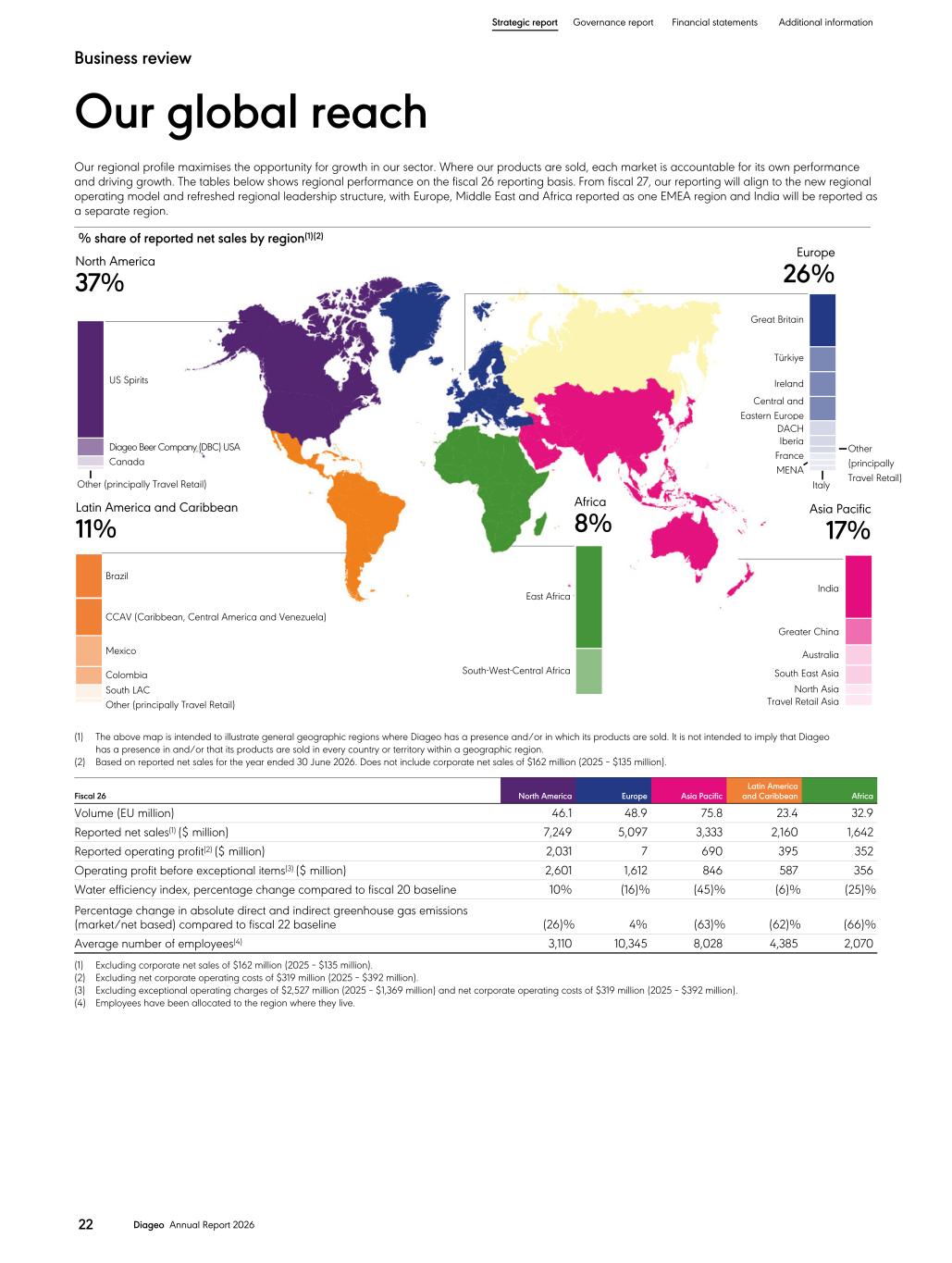
Our global reach Our regional profile maximises the opportunity for growth in our sector. Where our products are sold, each market is accountable for its own performance and driving growth. The tables below shows regional performance on the fiscal 26 reporting basis. From fiscal 27, our reporting will align to the new regional operating model and refreshed regional leadership structure, with Europe, Middle East and Africa reported as one EMEA region and India will be reported as a separate region. % share of reported net sales by region(1)(2) (1) The above map is intended to illustrate general geographic regions where Diageo has a presence and/or in which its products are sold. It is not intended to imply that Diageo has a presence in and/or that its products are sold in every country or territory within a geographic region. (2) Based on reported net sales for the year ended 30 June 2026. Does not include corporate net sales of $162 million (2025 – $135 million). Volume (EU million) 46.1 48.9 75.8 23.4 32.9 Reported net sales(1) ($ million) 7,249 5,097 3,333 2,160 1,642 Reported operating profit(2) ($ million) 2,031 7 690 395 352 Operating profit before exceptional items(3) ($ million) 2,601 1,612 846 587 356 Water efficiency index, percentage change compared to fiscal 20 baseline 10% (16) % (45) % (6) % (25) % Percentage change in absolute direct and indirect greenhouse gas emissions (market/net based) compared to fiscal 22 baseline (26) % 4% (63) % (62) % (66) % Average number of employees(4) 3,110 10,345 8,028 4,385 2,070 Fiscal 26 North America Europe Asia Pacific Latin America and Caribbean Africa (1) Excluding corporate net sales of $162 million (2025 – $135 million). (2) Excluding net corporate operating costs of $319 million (2025 – $392 million). (3) Excluding exceptional operating charges of $2,527 million (2025 – $1,369 million) and net corporate operating costs of $319 million (2025 – $392 million). (4) Employees have been allocated to the region where they live. Strategic report Governance report Financial statements Additional information 22 Diageo Annual Report 2026 Great Britain Türkiye Ireland Central and Eastern Europe DACH Iberia France MENA North America 37% Latin America and Caribbean 11% Asia Pacific 17% Europe 26% US Spirits Diageo Beer Company (DBC) USA Canada Other (principally Travel Retail) Brazil CCAV (Caribbean, Central America and Venezuela) Mexico Colombia South LAC Other (principally Travel Retail) East Africa South-West-Central Africa Africa 8% India Greater China Australia South East Asia North Asia Travel Retail Asia Other (principally Travel Retail) Italy Business review
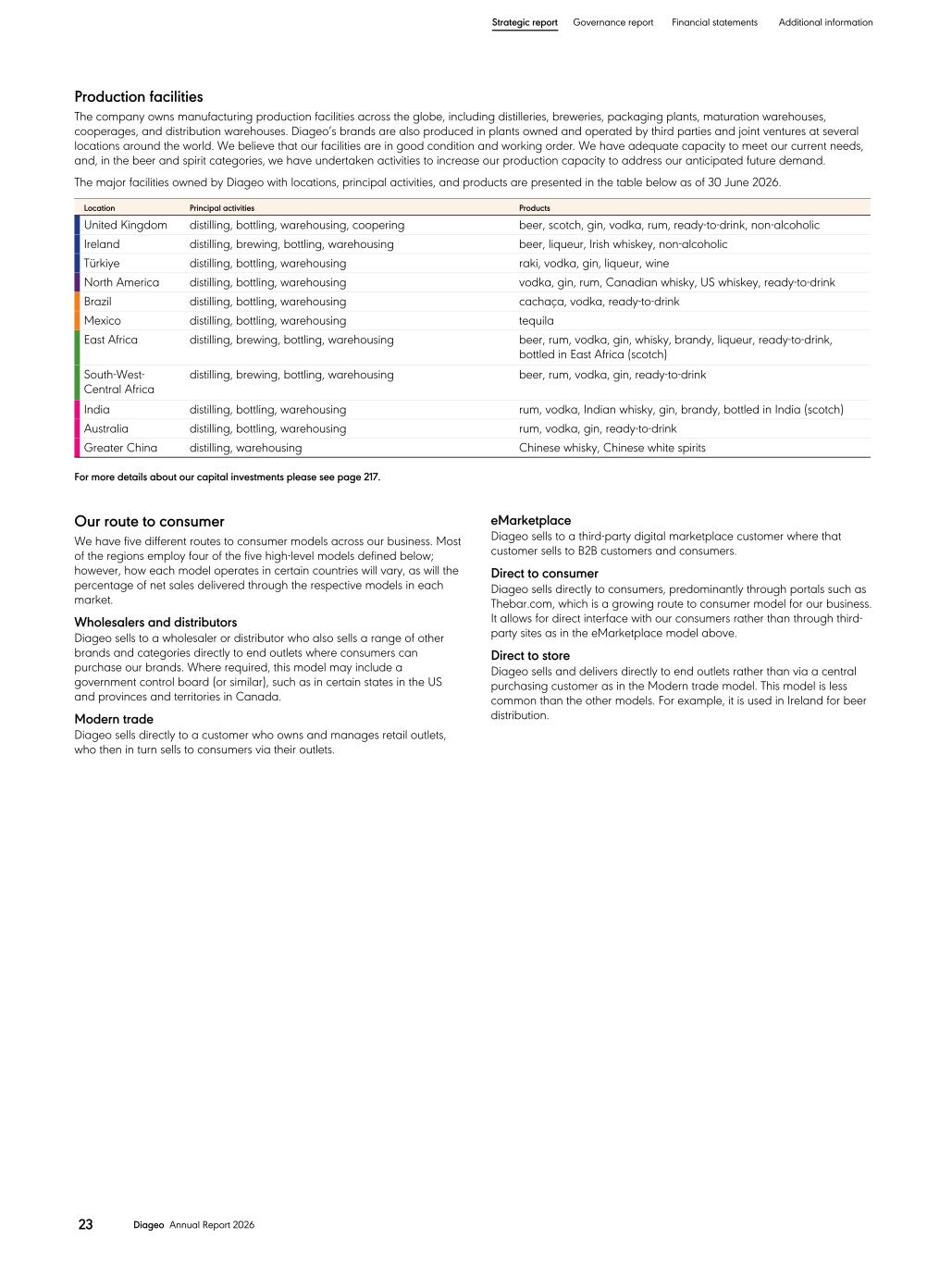
Production facilities The company owns manufacturing production facilities across the globe, including distilleries, breweries, packaging plants, maturation warehouses, cooperages, and distribution warehouses. Diageo’s brands are also produced in plants owned and operated by third parties and joint ventures at several locations around the world. We believe that our facilities are in good condition and working order. We have adequate capacity to meet our current needs, and, in the beer and spirit categories, we have undertaken activities to increase our production capacity to address our anticipated future demand. The major facilities owned by Diageo with locations, principal activities, and products are presented in the table below as of 30 June 2026. United Kingdom distilling, bottling, warehousing, coopering beer, scotch, gin, vodka, rum, ready-to-drink, non-alcoholic Ireland distilling, brewing, bottling, warehousing beer, liqueur, Irish whiskey, non-alcoholic Türkiye distilling, bottling, warehousing raki, vodka, gin, liqueur, wine North America distilling, bottling, warehousing vodka, gin, rum, Canadian whisky, US whiskey, ready-to-drink Brazil distilling, bottling, warehousing cachaça, vodka, ready-to-drink Mexico distilling, bottling, warehousing tequila East Africa distilling, brewing, bottling, warehousing beer, rum, vodka, gin, whisky, brandy, liqueur, ready-to-drink, bottled in East Africa (scotch) South-West- Central Africa distilling, brewing, bottling, warehousing beer, rum, vodka, gin, ready-to-drink India distilling, bottling, warehousing rum, vodka, Indian whisky, gin, brandy, bottled in India (scotch) Australia distilling, bottling, warehousing rum, vodka, gin, ready-to-drink Greater China distilling, warehousing Chinese whisky, Chinese white spirits Location Principal activities Products For more details about our capital investments please see page 217. Our route to consumer We have five different routes to consumer models across our business. Most of the regions employ four of the five high-level models defined below; however, how each model operates in certain countries will vary, as will the percentage of net sales delivered through the respective models in each market. Wholesalers and distributors Diageo sells to a wholesaler or distributor who also sells a range of other brands and categories directly to end outlets where consumers can purchase our brands. Where required, this model may include a government control board (or similar), such as in certain states in the US and provinces and territories in Canada. Modern trade Diageo sells directly to a customer who owns and manages retail outlets, who then in turn sells to consumers via their outlets. eMarketplace Diageo sells to a third-party digital marketplace customer where that customer sells to B2B customers and consumers. Direct to consumer Diageo sells directly to consumers, predominantly through portals such as Thebar.com, which is a growing route to consumer model for our business. It allows for direct interface with our consumers rather than through third- party sites as in the eMarketplace model above. Direct to store Diageo sells and delivers directly to end outlets rather than via a central purchasing customer as in the Modern trade model. This model is less common than the other models. For example, it is used in Ireland for beer distribution. Strategic report Governance report Financial statements Additional information 23 Diageo Annual Report 2026
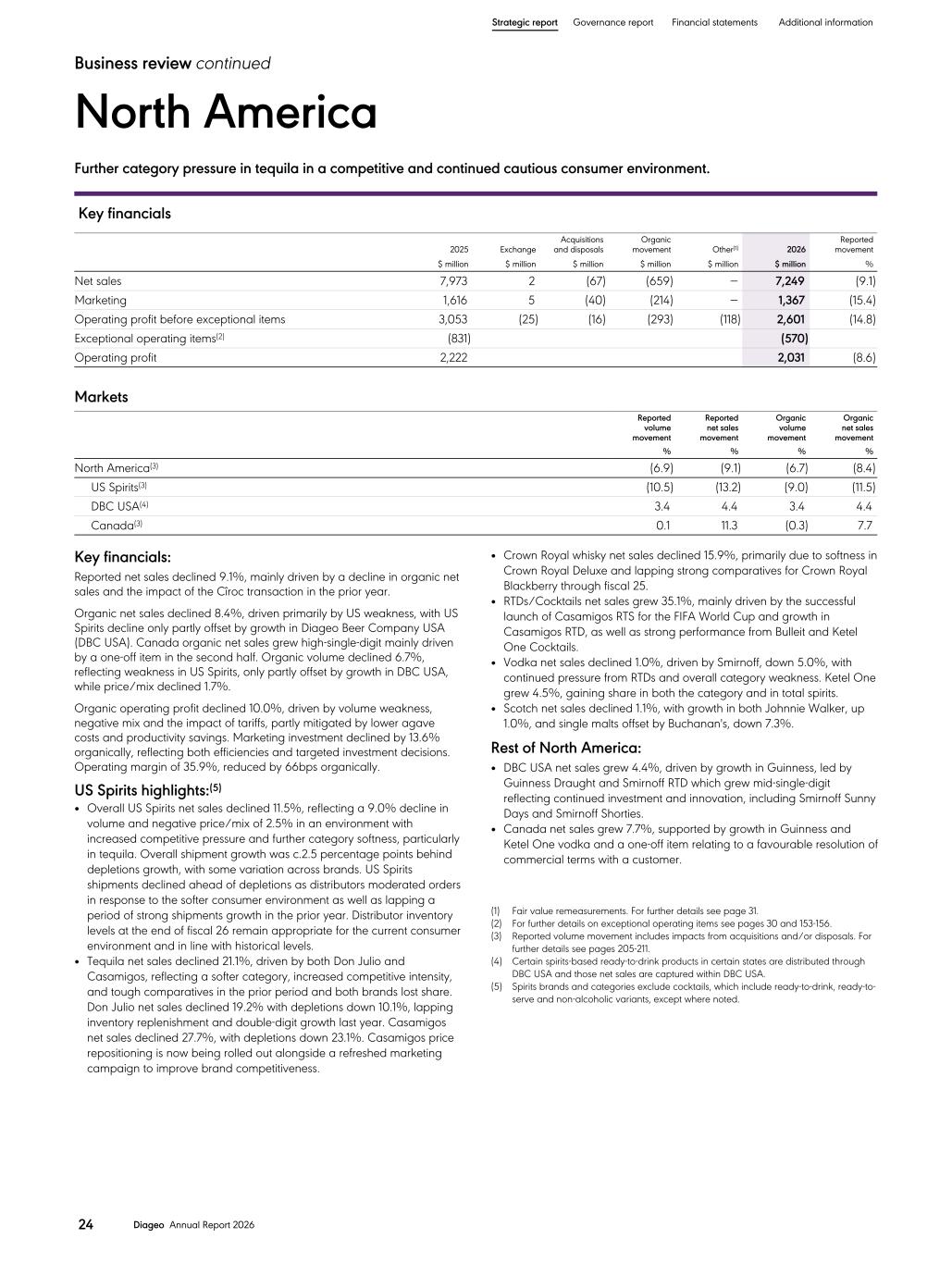
North America Further category pressure in tequila in a competitive and continued cautious consumer environment. 2025 Exchange Acquisitions and disposals Organic movement Other(1) 2026 Reported movement $ million $ million $ million $ million $ million $ million % Net sales 7,973 2 (67) (659) — 7,249 (9.1) Marketing 1,616 5 (40) (214) — 1,367 (15.4) Operating profit before exceptional items 3,053 (25) (16) (293) (118) 2,601 (14.8) Exceptional operating items(2) (831) (570) Operating profit 2,222 2,031 (8.6) Key financials Markets % % % % North America(3) (6.9) (9.1) (6.7) (8.4) US Spirits(3) (10.5) (13.2) (9.0) (11.5) DBC USA(4) 3.4 4.4 3.4 4.4 Canada(3) 0.1 11.3 (0.3) 7.7 Reported volume movement Reported net sales movement Organic volume movement Organic net sales movement Key financials: Reported net sales declined 9.1%, mainly driven by a decline in organic net sales and the impact of the Cîroc transaction in the prior year. Organic net sales declined 8.4%, driven primarily by US weakness, with US Spirits decline only partly offset by growth in Diageo Beer Company USA (DBC USA). Canada organic net sales grew high-single-digit mainly driven by a one-off item in the second half. Organic volume declined 6.7%, reflecting weakness in US Spirits, only partly offset by growth in DBC USA, while price/mix declined 1.7%. Organic operating profit declined 10.0%, driven by volume weakness, negative mix and the impact of tariffs, partly mitigated by lower agave costs and productivity savings. Marketing investment declined by 13.6% organically, reflecting both efficiencies and targeted investment decisions. Operating margin of 35.9%, reduced by 66bps organically. US Spirits highlights:(5) • Overall US Spirits net sales declined 11.5%, reflecting a 9.0% decline in volume and negative price/mix of 2.5% in an environment with increased competitive pressure and further category softness, particularly in tequila. Overall shipment growth was c.2.5 percentage points behind depletions growth, with some variation across brands. US Spirits shipments declined ahead of depletions as distributors moderated orders in response to the softer consumer environment as well as lapping a period of strong shipments growth in the prior year. Distributor inventory levels at the end of fiscal 26 remain appropriate for the current consumer environment and in line with historical levels. • Tequila net sales declined 21.1%, driven by both Don Julio and Casamigos, reflecting a softer category, increased competitive intensity, and tough comparatives in the prior period and both brands lost share. Don Julio net sales declined 19.2% with depletions down 10.1%, lapping inventory replenishment and double-digit growth last year. Casamigos net sales declined 27.7%, with depletions down 23.1%. Casamigos price repositioning is now being rolled out alongside a refreshed marketing campaign to improve brand competitiveness. • Crown Royal whisky net sales declined 15.9%, primarily due to softness in Crown Royal Deluxe and lapping strong comparatives for Crown Royal Blackberry through fiscal 25. • RTDs/Cocktails net sales grew 35.1%, mainly driven by the successful launch of Casamigos RTS for the FIFA World Cup and growth in Casamigos RTD, as well as strong performance from Bulleit and Ketel One Cocktails. • Vodka net sales declined 1.0%, driven by Smirnoff, down 5.0%, with continued pressure from RTDs and overall category weakness. Ketel One grew 4.5%, gaining share in both the category and in total spirits. • Scotch net sales declined 1.1%, with growth in both Johnnie Walker, up 1.0%, and single malts offset by Buchanan's, down 7.3%. Rest of North America: • DBC USA net sales grew 4.4%, driven by growth in Guinness, led by Guinness Draught and Smirnoff RTD which grew mid-single-digit reflecting continued investment and innovation, including Smirnoff Sunny Days and Smirnoff Shorties. • Canada net sales grew 7.7%, supported by growth in Guinness and Ketel One vodka and a one-off item relating to a favourable resolution of commercial terms with a customer. (1) Fair value remeasurements. For further details see page 31. (2) For further details on exceptional operating items see pages 30 and 153-156. (3) Reported volume movement includes impacts from acquisitions and/or disposals. For further details see pages 205-211. (4) Certain spirits-based ready-to-drink products in certain states are distributed through DBC USA and those net sales are captured within DBC USA. (5) Spirits brands and categories exclude cocktails, which include ready-to-drink, ready-to- serve and non-alcoholic variants, except where noted. Strategic report Governance report Financial statements Additional information Business review continued 24 Diageo Annual Report 2026
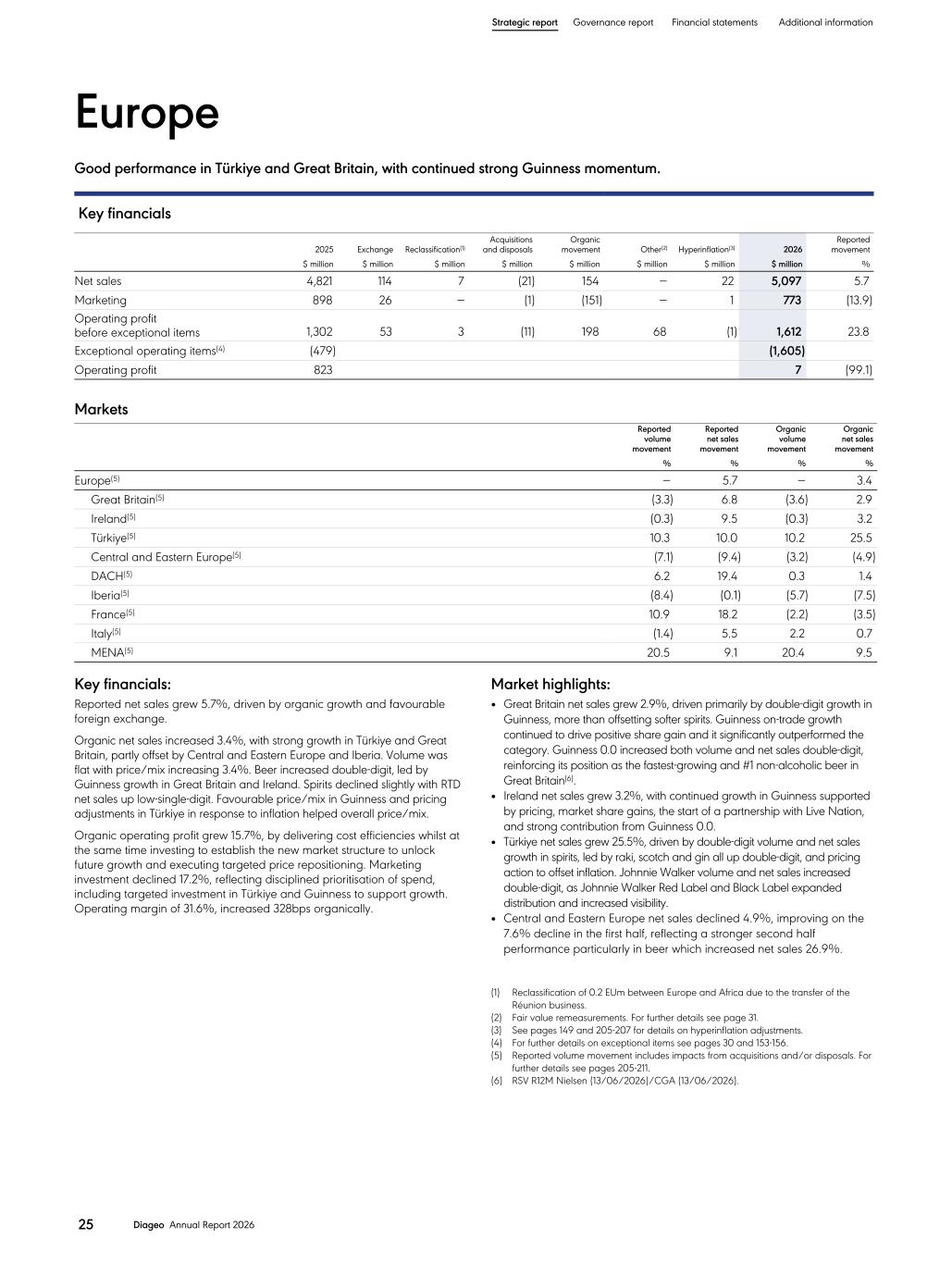
Europe Good performance in Türkiye and Great Britain, with continued strong Guinness momentum. $ million $ million $ million $ million $ million $ million $ million $ million % Net sales 4,821 114 7 (21) 154 — 22 5,097 5.7 Marketing 898 26 — (1) (151) — 1 773 (13.9) Operating profit before exceptional items 1,302 53 3 (11) 198 68 (1) 1,612 23.8 Exceptional operating items(4) (479) (1,605) Operating profit 823 7 (99.1) Key financials 2025 Exchange Reclassification(1) Acquisitions and disposals Organic movement Other(2) Hyperinflation(3) 2026 Reported movement Markets Europe(5) — 5.7 — 3.4 Great Britain(5) (3.3) 6.8 (3.6) 2.9 Ireland(5) (0.3) 9.5 (0.3) 3.2 Türkiye(5) 10.3 10.0 10.2 25.5 Central and Eastern Europe(5) (7.1) (9.4) (3.2) (4.9) DACH(5) 6.2 19.4 0.3 1.4 Iberia(5) (8.4) (0.1) (5.7) (7.5) France(5) 10.9 18.2 (2.2) (3.5) Italy(5) (1.4) 5.5 2.2 0.7 MENA(5) 20.5 9.1 20.4 9.5 Reported volume movement Reported net sales movement Organic volume movement Organic net sales movement % % % % Key financials: Reported net sales grew 5.7%, driven by organic growth and favourable foreign exchange. Organic net sales increased 3.4%, with strong growth in Türkiye and Great Britain, partly offset by Central and Eastern Europe and Iberia. Volume was flat with price/mix increasing 3.4%. Beer increased double-digit, led by Guinness growth in Great Britain and Ireland. Spirits declined slightly with RTD net sales up low-single-digit. Favourable price/mix in Guinness and pricing adjustments in Türkiye in response to inflation helped overall price/mix. Organic operating profit grew 15.7%, by delivering cost efficiencies whilst at the same time investing to establish the new market structure to unlock future growth and executing targeted price repositioning. Marketing investment declined 17.2%, reflecting disciplined prioritisation of spend, including targeted investment in Türkiye and Guinness to support growth. Operating margin of 31.6%, increased 328bps organically. Market highlights: • Great Britain net sales grew 2.9%, driven primarily by double-digit growth in Guinness, more than offsetting softer spirits. Guinness on-trade growth continued to drive positive share gain and it significantly outperformed the category. Guinness 0.0 increased both volume and net sales double-digit, reinforcing its position as the fastest-growing and #1 non-alcoholic beer in Great Britain(6). • Ireland net sales grew 3.2%, with continued growth in Guinness supported by pricing, market share gains, the start of a partnership with Live Nation, and strong contribution from Guinness 0.0. • Türkiye net sales grew 25.5%, driven by double-digit volume and net sales growth in spirits, led by raki, scotch and gin all up double-digit, and pricing action to offset inflation. Johnnie Walker volume and net sales increased double-digit, as Johnnie Walker Red Label and Black Label expanded distribution and increased visibility. • Central and Eastern Europe net sales declined 4.9%, improving on the 7.6% decline in the first half, reflecting a stronger second half performance particularly in beer which increased net sales 26.9%. (1) Reclassification of 0.2 EUm between Europe and Africa due to the transfer of the Réunion business. (2) Fair value remeasurements. For further details see page 31. (3) See pages 149 and 205-207 for details on hyperinflation adjustments. (4) For further details on exceptional items see pages 30 and 153-156. (5) Reported volume movement includes impacts from acquisitions and/or disposals. For further details see pages 205-211. (6) RSV R12M Nielsen (13/06/2026)/CGA (13/06/2026). Strategic report Governance report Financial statements Additional information 25 Diageo Annual Report 2026
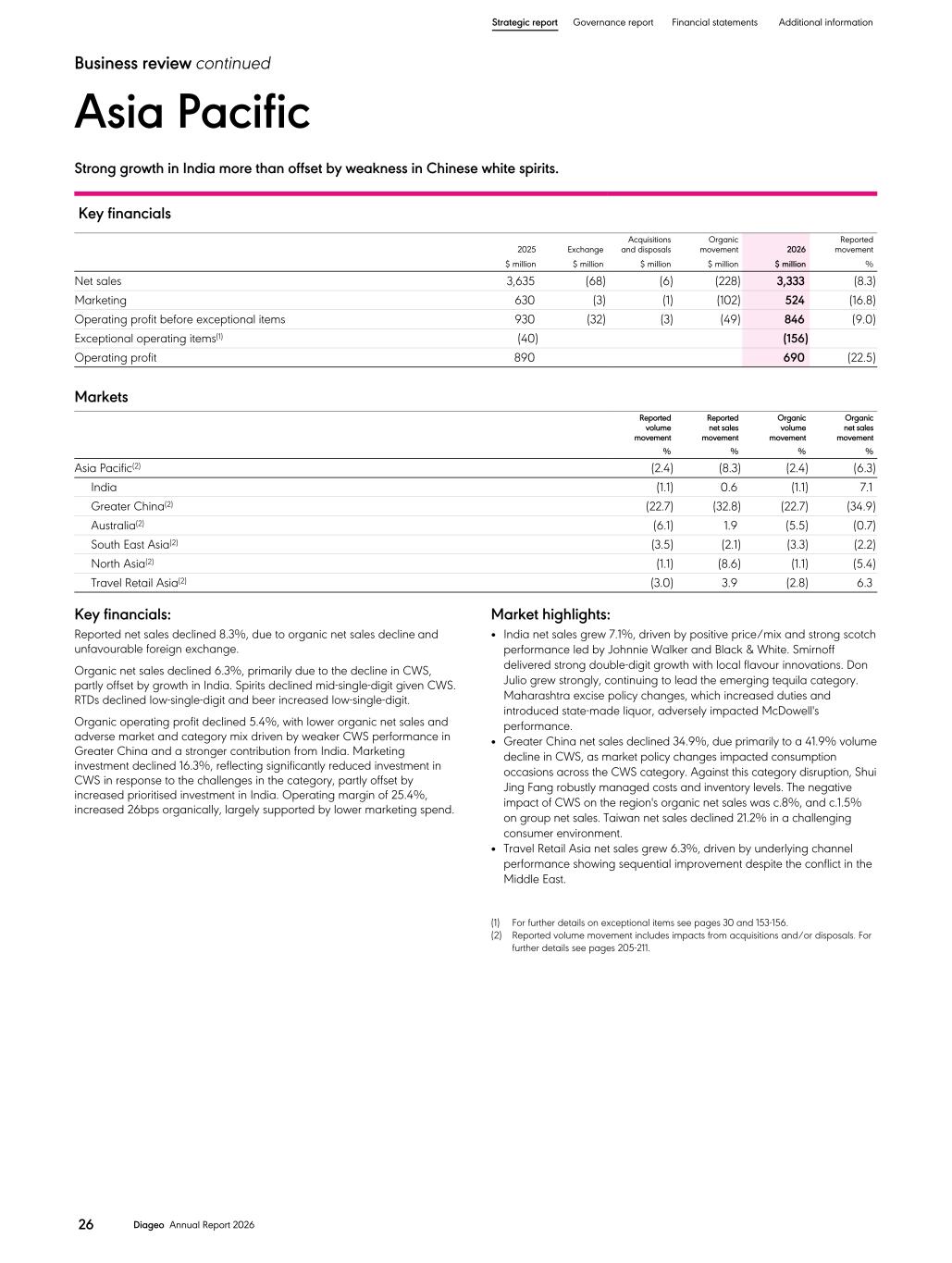
Asia Pacific Strong growth in India more than offset by weakness in Chinese white spirits. $ million $ million $ million $ million $ million % Net sales 3,635 (68) (6) (228) 3,333 (8.3) Marketing 630 (3) (1) (102) 524 (16.8) Operating profit before exceptional items 930 (32) (3) (49) 846 (9.0) Exceptional operating items(1) (40) (156) Operating profit 890 690 (22.5) Key financials 2025 Exchange Acquisitions and disposals Organic movement 2026 Reported movement Markets Asia Pacific(2) (2.4) (8.3) (2.4) (6.3) India (1.1) 0.6 (1.1) 7.1 Greater China(2) (22.7) (32.8) (22.7) (34.9) Australia(2) (6.1) 1.9 (5.5) (0.7) South East Asia(2) (3.5) (2.1) (3.3) (2.2) North Asia(2) (1.1) (8.6) (1.1) (5.4) Travel Retail Asia(2) (3.0) 3.9 (2.8) 6.3 Reported volume movement Reported net sales movement Organic volume movement Organic net sales movement % % % % Key financials: Reported net sales declined 8.3%, due to organic net sales decline and unfavourable foreign exchange. Organic net sales declined 6.3%, primarily due to the decline in CWS, partly offset by growth in India. Spirits declined mid-single-digit given CWS. RTDs declined low-single-digit and beer increased low-single-digit. Organic operating profit declined 5.4%, with lower organic net sales and adverse market and category mix driven by weaker CWS performance in Greater China and a stronger contribution from India. Marketing investment declined 16.3%, reflecting significantly reduced investment in CWS in response to the challenges in the category, partly offset by increased prioritised investment in India. Operating margin of 25.4%, increased 26bps organically, largely supported by lower marketing spend. Market highlights: • India net sales grew 7.1%, driven by positive price/mix and strong scotch performance led by Johnnie Walker and Black & White. Smirnoff delivered strong double-digit growth with local flavour innovations. Don Julio grew strongly, continuing to lead the emerging tequila category. Maharashtra excise policy changes, which increased duties and introduced state-made liquor, adversely impacted McDowell's performance. • Greater China net sales declined 34.9%, due primarily to a 41.9% volume decline in CWS, as market policy changes impacted consumption occasions across the CWS category. Against this category disruption, Shui Jing Fang robustly managed costs and inventory levels. The negative impact of CWS on the region's organic net sales was c.8%, and c.1.5% on group net sales. Taiwan net sales declined 21.2% in a challenging consumer environment. • Travel Retail Asia net sales grew 6.3%, driven by underlying channel performance showing sequential improvement despite the conflict in the Middle East. (1) For further details on exceptional items see pages 30 and 153-156. (2) Reported volume movement includes impacts from acquisitions and/or disposals. For further details see pages 205-211. Strategic report Governance report Financial statements Additional information Business review continued 26 Diageo Annual Report 2026
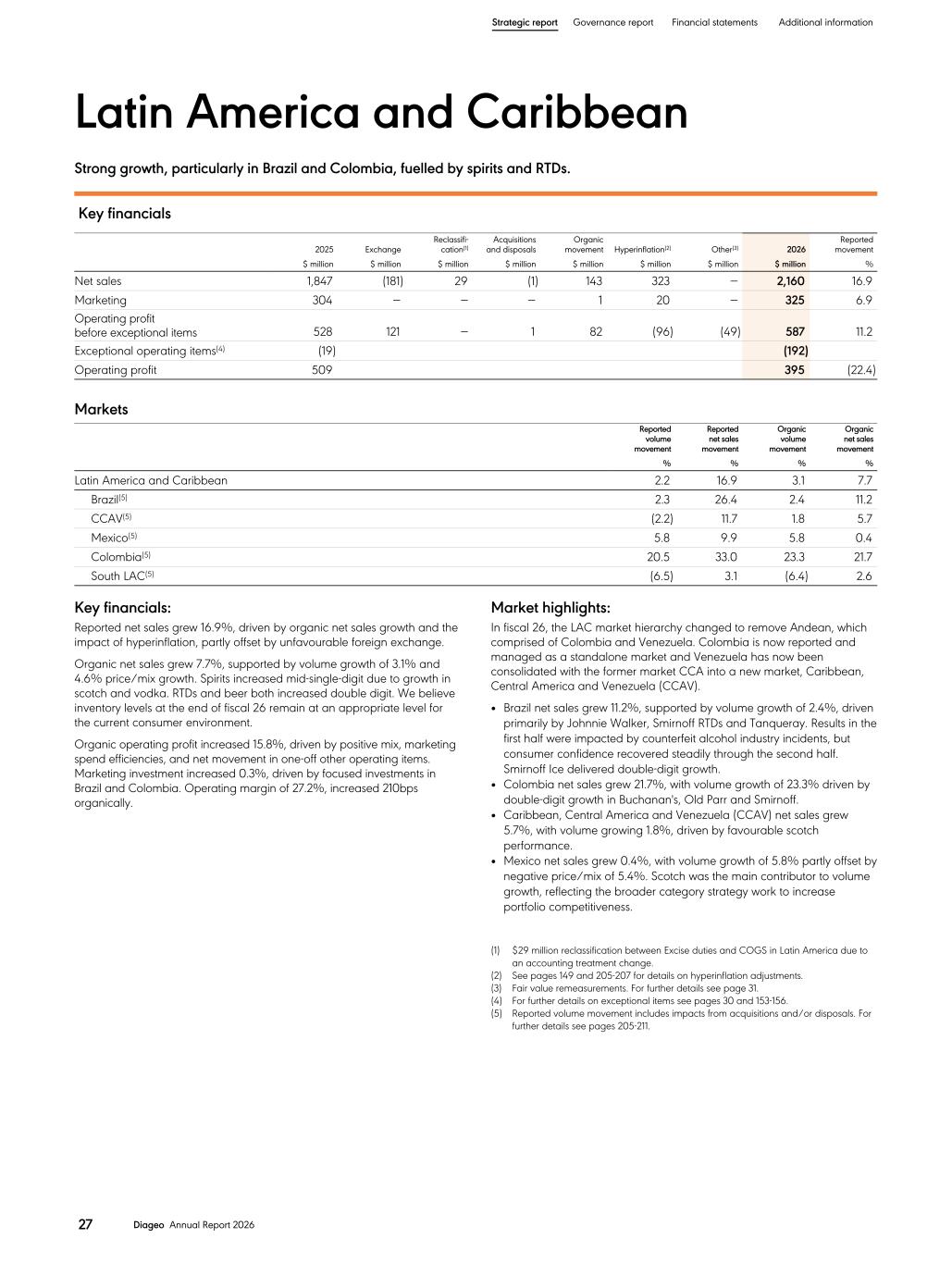
Latin America and Caribbean Strong growth, particularly in Brazil and Colombia, fuelled by spirits and RTDs. $ million $ million $ million $ million $ million $ million $ million $ million % Net sales 1,847 (181) 29 (1) 143 323 — 2,160 16.9 Marketing 304 — — — 1 20 — 325 6.9 Operating profit before exceptional items 528 121 — 1 82 (96) (49) 587 11.2 Exceptional operating items(4) (19) (192) Operating profit 509 395 (22.4) Key financials 2025 Exchange Reclassifi- cation(1) Acquisitions and disposals Organic movement Hyperinflation(2) Other(3) 2026 Reported movement Markets Latin America and Caribbean 2.2 16.9 3.1 7.7 Brazil(5) 2.3 26.4 2.4 11.2 CCAV(5) (2.2) 11.7 1.8 5.7 Mexico(5) 5.8 9.9 5.8 0.4 Colombia(5) 20.5 33.0 23.3 21.7 South LAC(5) (6.5) 3.1 (6.4) 2.6 Reported volume movement Reported net sales movement Organic volume movement Organic net sales movement % % % % Key financials: Reported net sales grew 16.9%, driven by organic net sales growth and the impact of hyperinflation, partly offset by unfavourable foreign exchange. Organic net sales grew 7.7%, supported by volume growth of 3.1% and 4.6% price/mix growth. Spirits increased mid-single-digit due to growth in scotch and vodka. RTDs and beer both increased double digit. We believe inventory levels at the end of fiscal 26 remain at an appropriate level for the current consumer environment. Organic operating profit increased 15.8%, driven by positive mix, marketing spend efficiencies, and net movement in one-off other operating items. Marketing investment increased 0.3%, driven by focused investments in Brazil and Colombia. Operating margin of 27.2%, increased 210bps organically. Market highlights: In fiscal 26, the LAC market hierarchy changed to remove Andean, which comprised of Colombia and Venezuela. Colombia is now reported and managed as a standalone market and Venezuela has now been consolidated with the former market CCA into a new market, Caribbean, Central America and Venezuela (CCAV). • Brazil net sales grew 11.2%, supported by volume growth of 2.4%, driven primarily by Johnnie Walker, Smirnoff RTDs and Tanqueray. Results in the first half were impacted by counterfeit alcohol industry incidents, but consumer confidence recovered steadily through the second half. Smirnoff Ice delivered double‑digit growth. • Colombia net sales grew 21.7%, with volume growth of 23.3% driven by double-digit growth in Buchanan's, Old Parr and Smirnoff. • Caribbean, Central America and Venezuela (CCAV) net sales grew 5.7%, with volume growing 1.8%, driven by favourable scotch performance. • Mexico net sales grew 0.4%, with volume growth of 5.8% partly offset by negative price/mix of 5.4%. Scotch was the main contributor to volume growth, reflecting the broader category strategy work to increase portfolio competitiveness. (1) $29 million reclassification between Excise duties and COGS in Latin America due to an accounting treatment change. (2) See pages 149 and 205-207 for details on hyperinflation adjustments. (3) Fair value remeasurements. For further details see page 31. (4) For further details on exceptional items see pages 30 and 153-156. (5) Reported volume movement includes impacts from acquisitions and/or disposals. For further details see pages 205-211. Strategic report Governance report Financial statements Additional information 27 Diageo Annual Report 2026
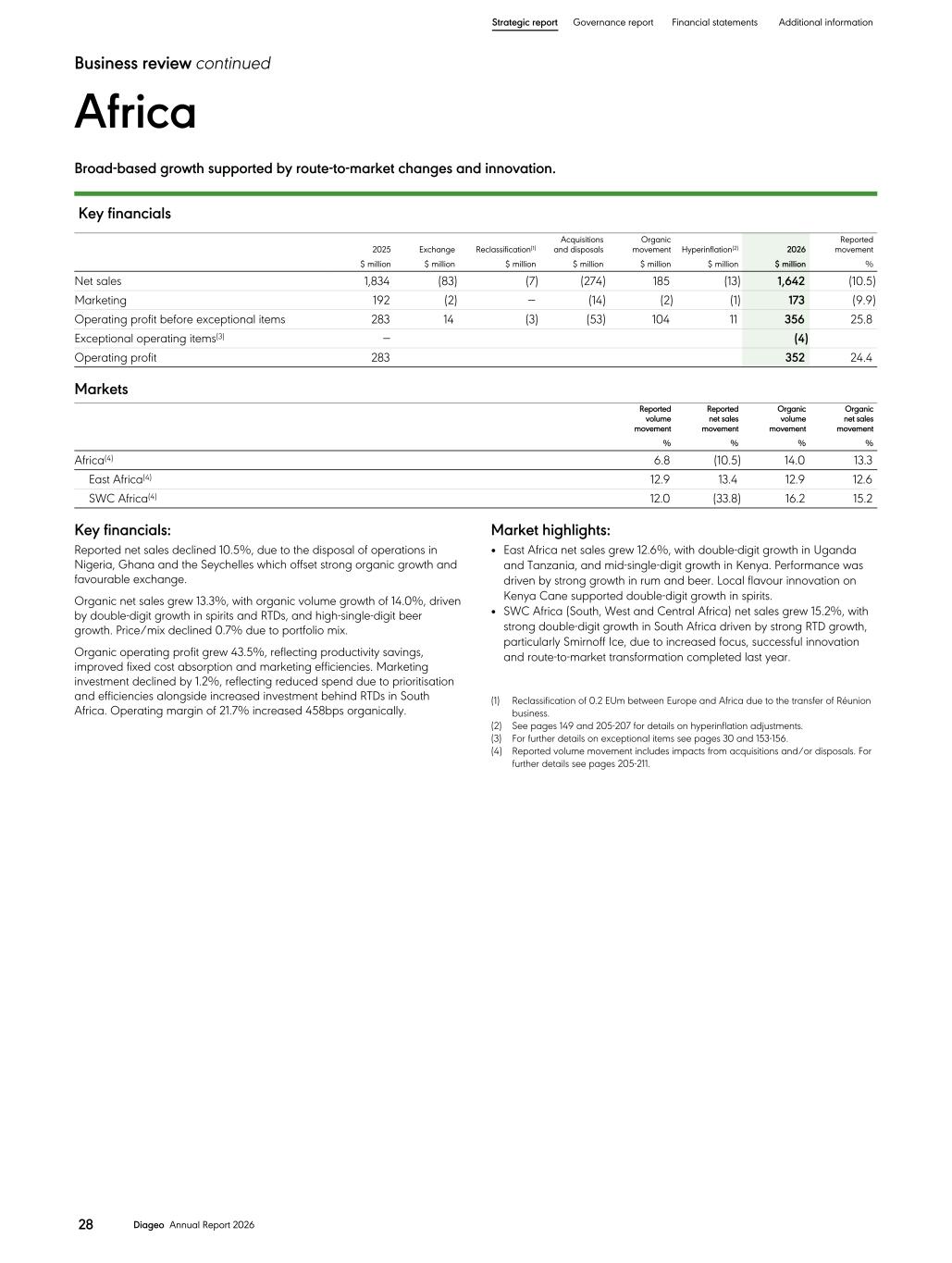
Africa Broad-based growth supported by route-to-market changes and innovation. $ million $ million $ million $ million $ million $ million $ million % Net sales 1,834 (83) (7) (274) 185 (13) 1,642 (10.5) Marketing 192 (2) — (14) (2) (1) 173 (9.9) Operating profit before exceptional items 283 14 (3) (53) 104 11 356 25.8 Exceptional operating items(3) — (4) Operating profit 283 352 24.4 Key financials 2025 Exchange Reclassification(1) Acquisitions and disposals Organic movement Hyperinflation(2) 2026 Reported movement Markets Africa(4) 6.8 (10.5) 14.0 13.3 East Africa(4) 12.9 13.4 12.9 12.6 SWC Africa(4) 12.0 (33.8) 16.2 15.2 Reported volume movement Reported net sales movement Organic volume movement Organic net sales movement % % % % Key financials: Reported net sales declined 10.5%, due to the disposal of operations in Nigeria, Ghana and the Seychelles which offset strong organic growth and favourable exchange. Organic net sales grew 13.3%, with organic volume growth of 14.0%, driven by double-digit growth in spirits and RTDs, and high-single-digit beer growth. Price/mix declined 0.7% due to portfolio mix. Organic operating profit grew 43.5%, reflecting productivity savings, improved fixed cost absorption and marketing efficiencies. Marketing investment declined by 1.2%, reflecting reduced spend due to prioritisation and efficiencies alongside increased investment behind RTDs in South Africa. Operating margin of 21.7% increased 458bps organically. Market highlights: • East Africa net sales grew 12.6%, with double-digit growth in Uganda and Tanzania, and mid-single-digit growth in Kenya. Performance was driven by strong growth in rum and beer. Local flavour innovation on Kenya Cane supported double-digit growth in spirits. • SWC Africa (South, West and Central Africa) net sales grew 15.2%, with strong double-digit growth in South Africa driven by strong RTD growth, particularly Smirnoff Ice, due to increased focus, successful innovation and route‑to‑market transformation completed last year. (1) Reclassification of 0.2 EUm between Europe and Africa due to the transfer of Réunion business. (2) See pages 149 and 205-207 for details on hyperinflation adjustments. (3) For further details on exceptional items see pages 30 and 153-156. (4) Reported volume movement includes impacts from acquisitions and/or disposals. For further details see pages 205-211. Strategic report Governance report Financial statements Additional information Business review continued 28 Diageo Annual Report 2026
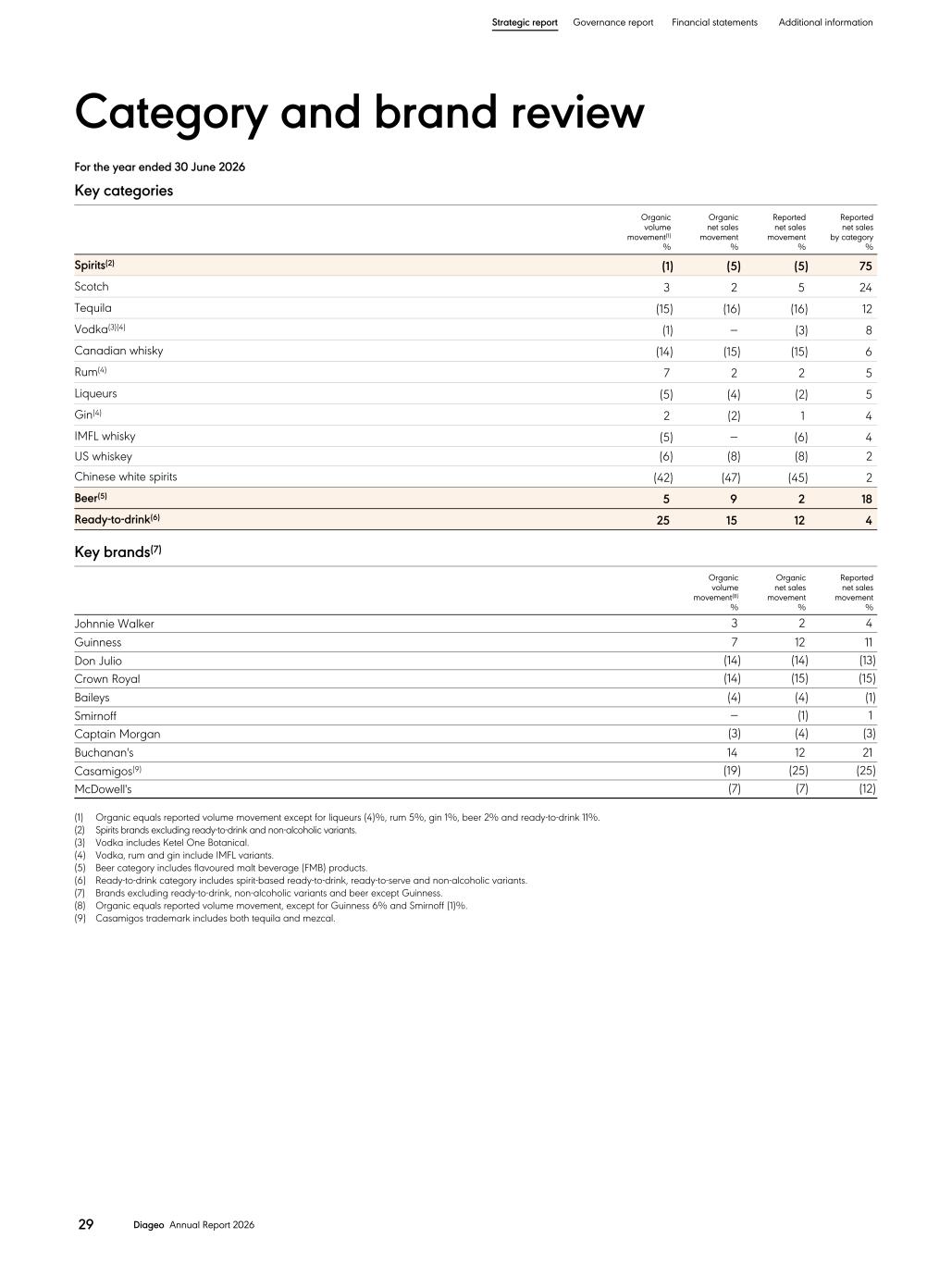
Category and brand review For the year ended 30 June 2026 Key categories Spirits(2) (1) (5) (5) 75 Scotch 3 2 5 24 Tequila (15) (16) (16) 12 Vodka(3)(4) (1) — (3) 8 Canadian whisky (14) (15) (15) 6 Rum(4) 7 2 2 5 Liqueurs (5) (4) (2) 5 Gin(4) 2 (2) 1 4 IMFL whisky (5) — (6) 4 US whiskey (6) (8) (8) 2 Chinese white spirits (42) (47) (45) 2 Beer(5) 5 9 2 18 Ready-to-drink(6) 25 15 12 4 Organic volume movement(1) % Organic net sales movement % Reported net sales movement % Reported net sales by category % Key brands(7) Johnnie Walker 3 2 4 Guinness 7 12 11 Don Julio (14) (14) (13) Crown Royal (14) (15) (15) Baileys (4) (4) (1) Smirnoff — (1) 1 Captain Morgan (3) (4) (3) Buchanan's 14 12 21 Casamigos(9) (19) (25) (25) McDowell's (7) (7) (12) Organic volume movement(8) % Organic net sales movement % Reported net sales movement % (1) Organic equals reported volume movement except for liqueurs (4)%, rum 5%, gin 1%, beer 2% and ready-to-drink 11%. (2) Spirits brands excluding ready-to-drink and non-alcoholic variants. (3) Vodka includes Ketel One Botanical. (4) Vodka, rum and gin include IMFL variants. (5) Beer category includes flavoured malt beverage (FMB) products. (6) Ready-to-drink category includes spirit-based ready-to-drink, ready-to-serve and non-alcoholic variants. (7) Brands excluding ready-to-drink, non-alcoholic variants and beer except Guinness. (8) Organic equals reported volume movement, except for Guinness 6% and Smirnoff (1)%. (9) Casamigos trademark includes both tequila and mezcal. Strategic report Governance report Financial statements Additional information 29 Diageo Annual Report 2026
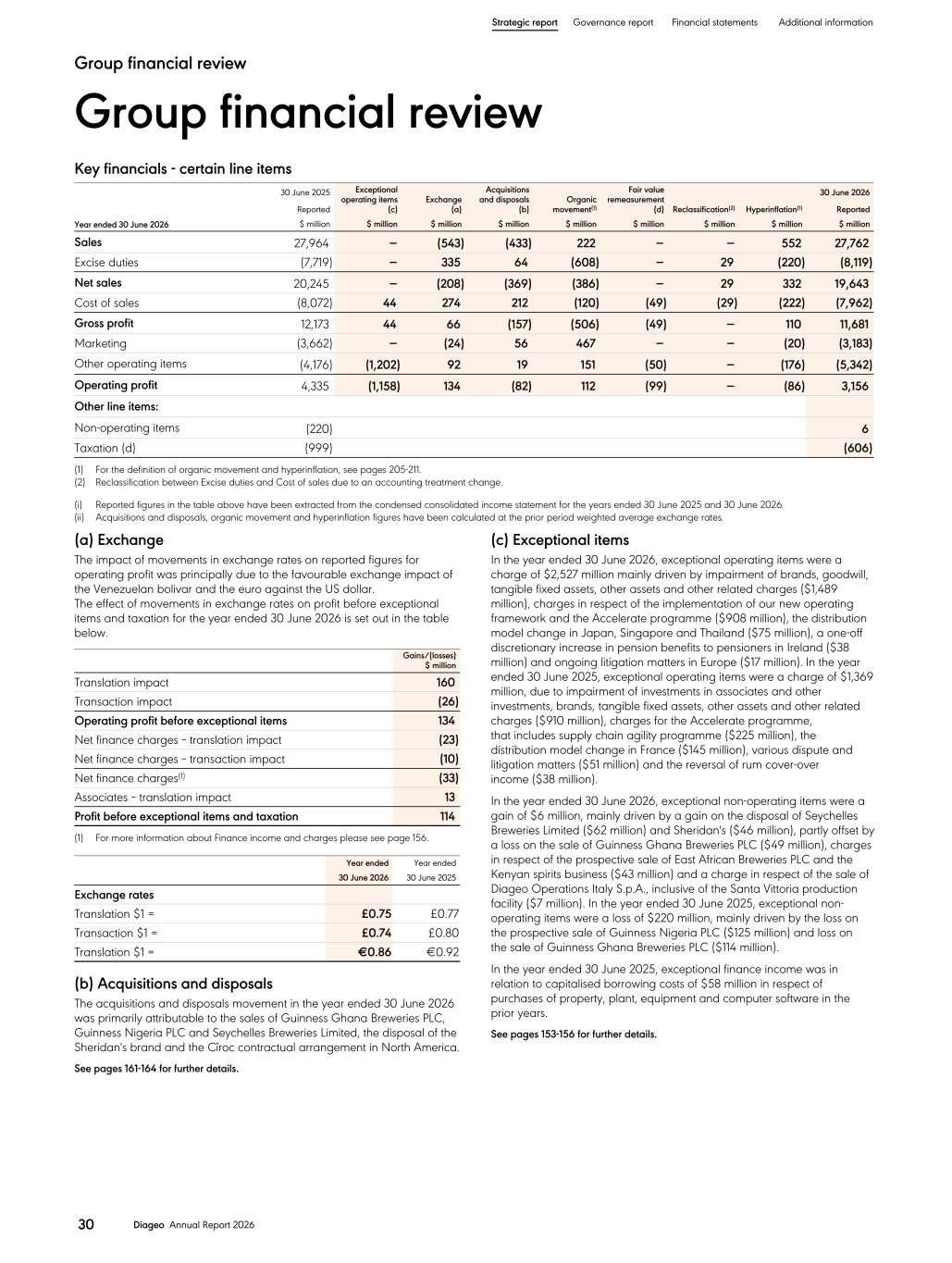
Group financial review Key financials - certain line items Sales 27,964 — (543) (433) 222 — — 552 27,762 Excise duties (7,719) — 335 64 (608) — 29 (220) (8,119) Net sales 20,245 — (208) (369) (386) — 29 332 19,643 Cost of sales (8,072) 44 274 212 (120) (49) (29) (222) (7,962) Gross profit 12,173 44 66 (157) (506) (49) — 110 11,681 Marketing (3,662) — (24) 56 467 — — (20) (3,183) Other operating items (4,176) (1,202) 92 19 151 (50) — (176) (5,342) Operating profit 4,335 (1,158) 134 (82) 112 (99) — (86) 3,156 Other line items: Non-operating items (220) 6 Taxation (d) (999) (606) 30 June 2025 Exceptional operating items (c) Exchange (a) Acquisitions and disposals (b) Organic movement(1) Fair value remeasurement (d) Reclassification(2) Hyperinflation(1) 30 June 2026 Reported Reported Year ended 30 June 2026 $ million $ million $ million $ million $ million $ million $ million $ million $ million (1) For the definition of organic movement and hyperinflation, see pages 205-211. (2) Reclassification between Excise duties and Cost of sales due to an accounting treatment change. (i) Reported figures in the table above have been extracted from the condensed consolidated income statement for the years ended 30 June 2025 and 30 June 2026. (ii) Acquisitions and disposals, organic movement and hyperinflation figures have been calculated at the prior period weighted average exchange rates. (a) Exchange The impact of movements in exchange rates on reported figures for operating profit was principally due to the favourable exchange impact of the Venezuelan bolivar and the euro against the US dollar. The effect of movements in exchange rates on profit before exceptional items and taxation for the year ended 30 June 2026 is set out in the table below. Translation impact 160 Transaction impact (26) Operating profit before exceptional items 134 Net finance charges – translation impact (23) Net finance charges – transaction impact (10) Net finance charges(1) (33) Associates – translation impact 13 Profit before exceptional items and taxation 114 Gains/(losses) $ million (1) For more information about Finance income and charges please see page 156. Exchange rates Translation $1 = £0.75 £0.77 Transaction $1 = £0.74 £0.80 Translation $1 = €0.86 €0.92 Year ended Year ended 30 June 2026 30 June 2025 (b) Acquisitions and disposals The acquisitions and disposals movement in the year ended 30 June 2026 was primarily attributable to the sales of Guinness Ghana Breweries PLC, Guinness Nigeria PLC and Seychelles Breweries Limited, the disposal of the Sheridan's brand and the Cîroc contractual arrangement in North America. See pages 161-164 for further details. (c) Exceptional items In the year ended 30 June 2026, exceptional operating items were a charge of $2,527 million mainly driven by impairment of brands, goodwill, tangible fixed assets, other assets and other related charges ($1,489 million), charges in respect of the implementation of our new operating framework and the Accelerate programme ($908 million), the distribution model change in Japan, Singapore and Thailand ($75 million), a one-off discretionary increase in pension benefits to pensioners in Ireland ($38 million) and ongoing litigation matters in Europe ($17 million). In the year ended 30 June 2025, exceptional operating items were a charge of $1,369 million, due to impairment of investments in associates and other investments, brands, tangible fixed assets, other assets and other related charges ($910 million), charges for the Accelerate programme, that includes supply chain agility programme ($225 million), the distribution model change in France ($145 million), various dispute and litigation matters ($51 million) and the reversal of rum cover-over income ($38 million). In the year ended 30 June 2026, exceptional non-operating items were a gain of $6 million, mainly driven by a gain on the disposal of Seychelles Breweries Limited ($62 million) and Sheridan's ($46 million), partly offset by a loss on the sale of Guinness Ghana Breweries PLC ($49 million), charges in respect of the prospective sale of East African Breweries PLC and the Kenyan spirits business ($43 million) and a charge in respect of the sale of Diageo Operations Italy S.p.A., inclusive of the Santa Vittoria production facility ($7 million). In the year ended 30 June 2025, exceptional non- operating items were a loss of $220 million, mainly driven by the loss on the prospective sale of Guinness Nigeria PLC ($125 million) and loss on the sale of Guinness Ghana Breweries PLC ($114 million). In the year ended 30 June 2025, exceptional finance income was in relation to capitalised borrowing costs of $58 million in respect of purchases of property, plant, equipment and computer software in the prior years. See pages 153-156 for further details. Strategic report Governance report Financial statements Additional information Group financial review 30 Diageo Annual Report 2026
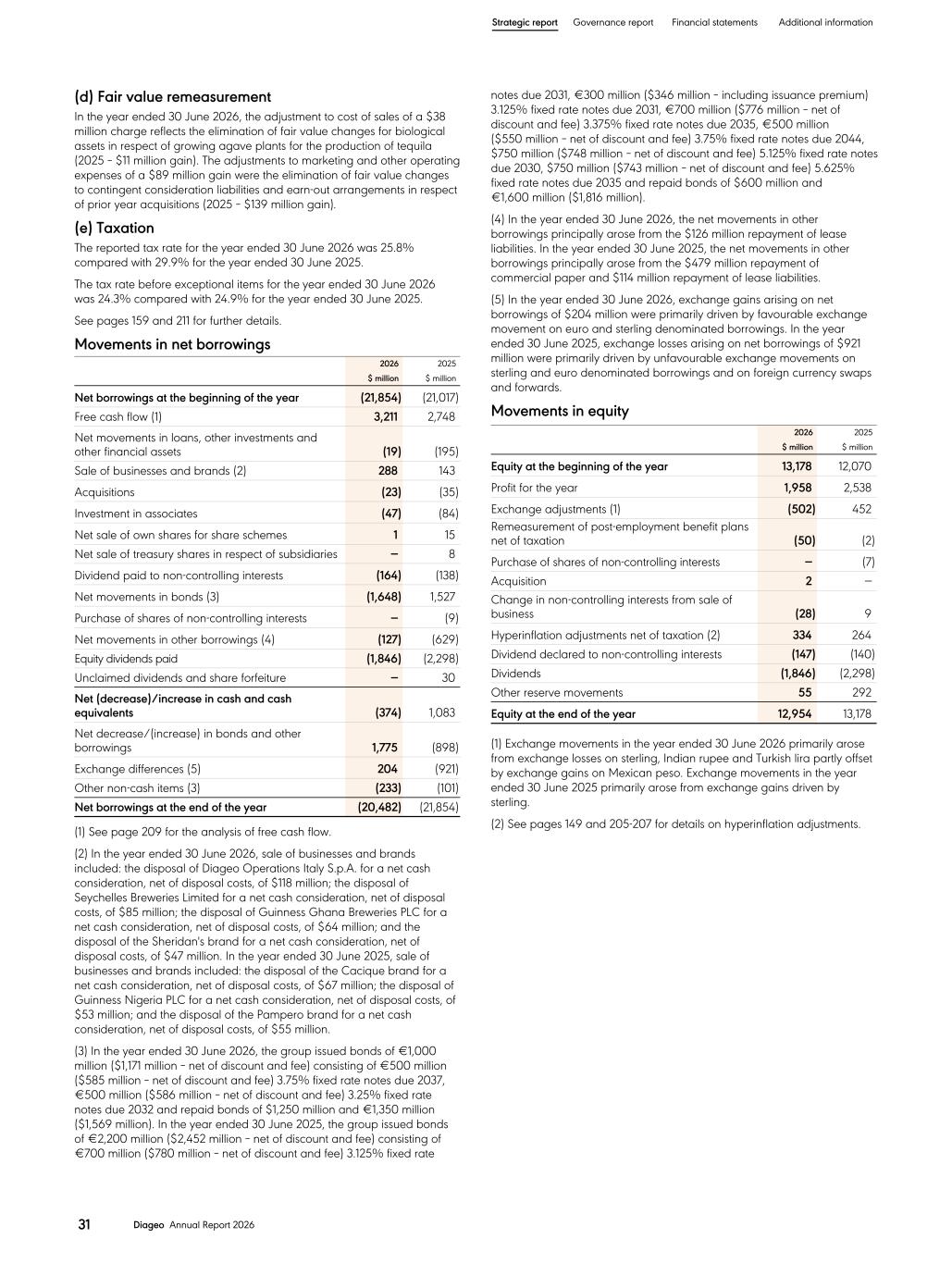
(d) Fair value remeasurement In the year ended 30 June 2026, the adjustment to cost of sales of a $38 million charge reflects the elimination of fair value changes for biological assets in respect of growing agave plants for the production of tequila (2025 – $11 million gain). The adjustments to marketing and other operating expenses of a $89 million gain were the elimination of fair value changes to contingent consideration liabilities and earn-out arrangements in respect of prior year acquisitions (2025 – $139 million gain). (e) Taxation The reported tax rate for the year ended 30 June 2026 was 25.8% compared with 29.9% for the year ended 30 June 2025. The tax rate before exceptional items for the year ended 30 June 2026 was 24.3% compared with 24.9% for the year ended 30 June 2025. See pages 159 and 211 for further details. Movements in net borrowings Net borrowings at the beginning of the year (21,854) (21,017) Free cash flow (1) 3,211 2,748 Net movements in loans, other investments and other financial assets (19) (195) Sale of businesses and brands (2) 288 143 Acquisitions (23) (35) Investment in associates (47) (84) Net sale of own shares for share schemes 1 15 Net sale of treasury shares in respect of subsidiaries — 8 Dividend paid to non-controlling interests (164) (138) Net movements in bonds (3) (1,648) 1,527 Purchase of shares of non-controlling interests — (9) Net movements in other borrowings (4) (127) (629) Equity dividends paid (1,846) (2,298) Unclaimed dividends and share forfeiture — 30 Net (decrease)/increase in cash and cash equivalents (374) 1,083 Net decrease/(increase) in bonds and other borrowings 1,775 (898) Exchange differences (5) 204 (921) Other non-cash items (3) (233) (101) Net borrowings at the end of the year (20,482) (21,854) 2026 2025 $ million $ million (1) See page 209 for the analysis of free cash flow. (2) In the year ended 30 June 2026, sale of businesses and brands included: the disposal of Diageo Operations Italy S.p.A. for a net cash consideration, net of disposal costs, of $118 million; the disposal of Seychelles Breweries Limited for a net cash consideration, net of disposal costs, of $85 million; the disposal of Guinness Ghana Breweries PLC for a net cash consideration, net of disposal costs, of $64 million; and the disposal of the Sheridan's brand for a net cash consideration, net of disposal costs, of $47 million. In the year ended 30 June 2025, sale of businesses and brands included: the disposal of the Cacique brand for a net cash consideration, net of disposal costs, of $67 million; the disposal of Guinness Nigeria PLC for a net cash consideration, net of disposal costs, of $53 million; and the disposal of the Pampero brand for a net cash consideration, net of disposal costs, of $55 million. (3) In the year ended 30 June 2026, the group issued bonds of €1,000 million ($1,171 million – net of discount and fee) consisting of €500 million ($585 million – net of discount and fee) 3.75% fixed rate notes due 2037, €500 million ($586 million – net of discount and fee) 3.25% fixed rate notes due 2032 and repaid bonds of $1,250 million and €1,350 million ($1,569 million). In the year ended 30 June 2025, the group issued bonds of €2,200 million ($2,452 million – net of discount and fee) consisting of €700 million ($780 million – net of discount and fee) 3.125% fixed rate notes due 2031, €300 million ($346 million – including issuance premium) 3.125% fixed rate notes due 2031, €700 million ($776 million – net of discount and fee) 3.375% fixed rate notes due 2035, €500 million ($550 million – net of discount and fee) 3.75% fixed rate notes due 2044, $750 million ($748 million – net of discount and fee) 5.125% fixed rate notes due 2030, $750 million ($743 million – net of discount and fee) 5.625% fixed rate notes due 2035 and repaid bonds of $600 million and €1,600 million ($1,816 million). (4) In the year ended 30 June 2026, the net movements in other borrowings principally arose from the $126 million repayment of lease liabilities. In the year ended 30 June 2025, the net movements in other borrowings principally arose from the $479 million repayment of commercial paper and $114 million repayment of lease liabilities. (5) In the year ended 30 June 2026, exchange gains arising on net borrowings of $204 million were primarily driven by favourable exchange movement on euro and sterling denominated borrowings. In the year ended 30 June 2025, exchange losses arising on net borrowings of $921 million were primarily driven by unfavourable exchange movements on sterling and euro denominated borrowings and on foreign currency swaps and forwards. Movements in equity Equity at the beginning of the year 13,178 12,070 Profit for the year 1,958 2,538 Exchange adjustments (1) (502) 452 Remeasurement of post-employment benefit plans net of taxation (50) (2) Purchase of shares of non-controlling interests — (7) Acquisition 2 — Change in non-controlling interests from sale of business (28) 9 Hyperinflation adjustments net of taxation (2) 334 264 Dividend declared to non-controlling interests (147) (140) Dividends (1,846) (2,298) Other reserve movements 55 292 Equity at the end of the year 12,954 13,178 2026 2025 $ million $ million (1) Exchange movements in the year ended 30 June 2026 primarily arose from exchange losses on sterling, Indian rupee and Turkish lira partly offset by exchange gains on Mexican peso. Exchange movements in the year ended 30 June 2025 primarily arose from exchange gains driven by sterling. (2) See pages 149 and 205-207 for details on hyperinflation adjustments. Strategic report Governance report Financial statements Additional information 31 Diageo Annual Report 2026
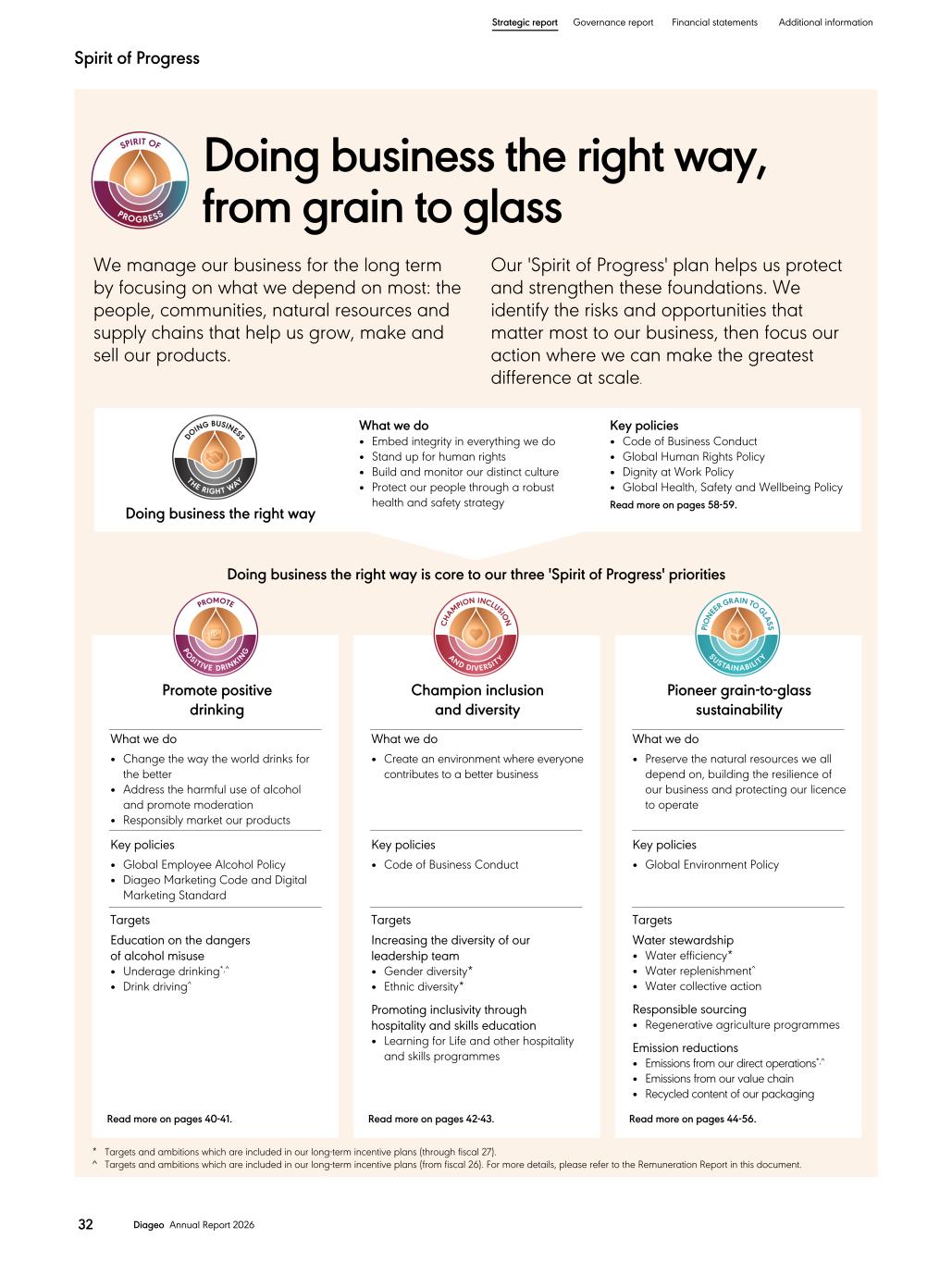
Doing business the right way, from grain to glass We manage our business for the long term by focusing on what we depend on most: the people, communities, natural resources and supply chains that help us grow, make and sell our products. Our 'Spirit of Progress' plan helps us protect and strengthen these foundations. We identify the risks and opportunities that matter most to our business, then focus our action where we can make the greatest difference at scale. Doing business the right way What we do • Embed integrity in everything we do • Stand up for human rights • Build and monitor our distinct culture • Protect our people through a robust health and safety strategy Key policies • Code of Business Conduct • Global Human Rights Policy • Dignity at Work Policy • Global Health, Safety and Wellbeing Policy Read more on pages 58-59. Doing business the right way is core to our three 'Spirit of Progress' priorities Strategic report Governance report Financial statements Additional information 32 Diageo Annual Report 2026 Promote positive drinking What we do • Change the way the world drinks for the better • Address the harmful use of alcohol and promote moderation • Responsibly market our products Key policies • Global Employee Alcohol Policy • Diageo Marketing Code and Digital Marketing Standard Targets Education on the dangers of alcohol misuse • Underage drinking*,^ • Drink driving^ Read more on pages 40-41. Read more on pages 42-43. Read more on pages 44-56. Champion inclusion and diversity What we do • Create an environment where everyone contributes to a better business Key policies • Code of Business Conduct Targets Increasing the diversity of our leadership team • Gender diversity* • Ethnic diversity* Promoting inclusivity through hospitality and skills education • Learning for Life and other hospitality and skills programmes Pioneer grain-to-glass sustainability What we do • Preserve the natural resources we all depend on, building the resilience of our business and protecting our licence to operate Key policies • Global Environment Policy Targets Water stewardship • Water efficiency* • Water replenishment^ • Water collective action Responsible sourcing • Regenerative agriculture programmes Emission reductions • Emissions from our direct operations*,^ • Emissions from our value chain • Recycled content of our packaging * Targets and ambitions which are included in our long-term incentive plans (through fiscal 27). ^ Targets and ambitions which are included in our long-term incentive plans (from fiscal 26). For more details, please refer to the Remuneration Report in this document. Spirit of Progress
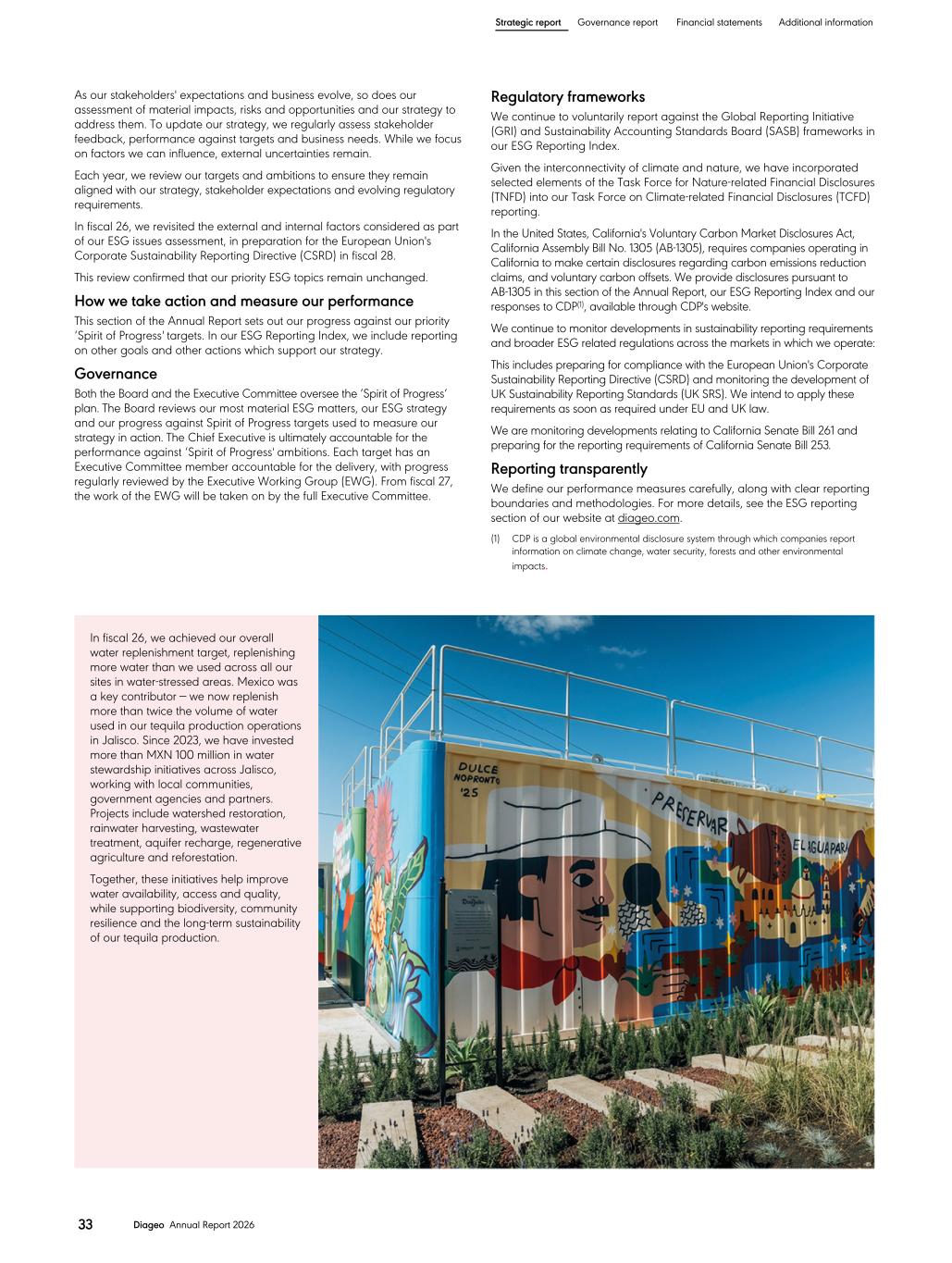
As our stakeholders' expectations and business evolve, so does our assessment of material impacts, risks and opportunities and our strategy to address them. To update our strategy, we regularly assess stakeholder feedback, performance against targets and business needs. While we focus on factors we can influence, external uncertainties remain. Each year, we review our targets and ambitions to ensure they remain aligned with our strategy, stakeholder expectations and evolving regulatory requirements. In fiscal 26, we revisited the external and internal factors considered as part of our ESG issues assessment, in preparation for the European Union's Corporate Sustainability Reporting Directive (CSRD) in fiscal 28. This review confirmed that our priority ESG topics remain unchanged. How we take action and measure our performance This section of the Annual Report sets out our progress against our priority ‘Spirit of Progress' targets. In our ESG Reporting Index, we include reporting on other goals and other actions which support our strategy. Governance Both the Board and the Executive Committee oversee the ‘Spirit of Progress‘ plan. The Board reviews our most material ESG matters, our ESG strategy and our progress against Spirit of Progress targets used to measure our strategy in action. The Chief Executive is ultimately accountable for the performance against ‘Spirit of Progress' ambitions. Each target has an Executive Committee member accountable for the delivery, with progress regularly reviewed by the Executive Working Group (EWG). From fiscal 27, the work of the EWG will be taken on by the full Executive Committee. Regulatory frameworks We continue to voluntarily report against the Global Reporting Initiative (GRI) and Sustainability Accounting Standards Board (SASB) frameworks in our ESG Reporting Index. Given the interconnectivity of climate and nature, we have incorporated selected elements of the Task Force for Nature-related Financial Disclosures (TNFD) into our Task Force on Climate-related Financial Disclosures (TCFD) reporting. In the United States, California's Voluntary Carbon Market Disclosures Act, California Assembly Bill No. 1305 (AB-1305), requires companies operating in California to make certain disclosures regarding carbon emissions reduction claims, and voluntary carbon offsets. We provide disclosures pursuant to AB-1305 in this section of the Annual Report, our ESG Reporting Index and our responses to CDP(1), available through CDP's website. We continue to monitor developments in sustainability reporting requirements and broader ESG related regulations across the markets in which we operate: This includes preparing for compliance with the European Union's Corporate Sustainability Reporting Directive (CSRD) and monitoring the development of UK Sustainability Reporting Standards (UK SRS). We intend to apply these requirements as soon as required under EU and UK law. We are monitoring developments relating to California Senate Bill 261 and preparing for the reporting requirements of California Senate Bill 253. Reporting transparently We define our performance measures carefully, along with clear reporting boundaries and methodologies. For more details, see the ESG reporting section of our website at diageo.com. (1) CDP is a global environmental disclosure system through which companies report information on climate change, water security, forests and other environmental impacts. Strategic report Governance report Financial statements Additional information 33 Diageo Annual Report 2026 In fiscal 26, we achieved our overall water replenishment target, replenishing more water than we used across all our sites in water-stressed areas. Mexico was a key contributor — we now replenish more than twice the volume of water used in our tequila production operations in Jalisco. Since 2023, we have invested more than MXN 100 million in water stewardship initiatives across Jalisco, working with local communities, government agencies and partners. Projects include watershed restoration, rainwater harvesting, wastewater treatment, aquifer recharge, regenerative agriculture and reforestation. Together, these initiatives help improve water availability, access and quality, while supporting biodiversity, community resilience and the long-term sustainability of our tequila production.
Business integrity and human rights We are committed to doing business the right way. We expect our employees and business partners to act with integrity, live our values and uphold our Code of Business Conduct. For more details, see our website at diageo.com Business integrity A strong culture of business integrity underpins our purpose and how we operate. By valuing what we do and how we do it, we protect what matters most, strengthening our culture, and supporting responsible, sustainable growth. Code of Business Conduct (Our Code) Our Code is a shared guide that supports our employees to make informed decisions, act responsibly and uphold our standards in their day-to-day work. It provides a clear framework for how we operate and interact with colleagues, customers, suppliers and communities. All employees are required to complete our Code of Business Conduct training(1) annually, either as part of our annual training campaign or new joiner onboarding. Employees are required to certify annually that they have read, understood and complied with Our Code through the Annual Declaration of Compliance. Training is delivered through an interactive, scenario-based e-learning programme, supported by in-person classroom sessions for those employees without regular computer access. Encouraging people to speak up We encourage employees to report potential breaches of our Code of Business Conduct or policies to their line manager, HR, Legal or Business Integrity. Employees may also report their concerns through SpeakUp, our global confidential whistleblowing service, which is managed by an independent company. The service is available 24 hours a day, seven days a week, via multiple channels, and supports reporting in more than 75 languages. Managing third-party risks We expect the same high standards of integrity from those we work with. Our Know Your Business Partner (KYBP) standard, part of our wider third- party risk management framework, supports the identification, assessment and management of potential risks, such as bribery and corruption, sanctions, fraud and other potential legal, compliance and reputational risks. Standing up for human rights At Diageo, we strive to create an environment where all our people feel they are treated fairly and with respect. We remain committed to acting with integrity in our roles, to ensure we are doing business in the right way. We act in line with the UN Guiding Principles on Business and Human Rights (UNGPs) and are committed to embedding respect for human rights into everyone’s working day, in every country throughout our business and supply chain. Our human rights governance Our Code and Global Human Rights Policy play an integral part of ensuring that Diageo’s culture is aligned with our purpose and values. Our human rights strategy is reviewed on a periodic basis by the Audit Committee and by a sub-group of the Executive Committee as part of our mitigation of our principal risk on 'Legal and Regulatory'. Responsibility for delivery is shared between the members of our Executive Committee that are responsible for the human rights of our employees, suppliers and communities. Our executives, senior business leaders and functional specialists lead the agenda via our Human Rights Steering Group, and assess risks, emerging issues, compliance and remediation within our enterprise risk management processes. Providing access to grievance mechanisms We encourage everyone, including any affected stakeholders, to report potential breaches of Our Code or policies, including human rights, through our global confidential grievance and whistleblowing service, SpeakUp. Focusing on salient human rights risks We focus on the salient risks that are most relevant to our business as specified in the Declaration on Fundamental Principles and Rights at Work and the UNGPs. We also consider human rights benchmarks for our industry, priority commodities in our supply chain and the increasing interdependence between human rights and climate impacts. We have identified the following salient risks: health and safety, wages and benefits, working time, harassment and bullying, discrimination, freedom of association and collective bargaining, child labour, forced labour, water sanitation and hygiene and land rights. Whilst we conduct ongoing due diligence in all areas, we have prioritised health and safety, wages and benefits, working time, harassment and bullying, and discrimination based on severity, likelihood, attribution, leverage and breach data. Vulnerable groups We recognise that some groups of people are more vulnerable to human rights breaches and we pay particular attention to these groups within our risk assessments. Determined by human rights frameworks, our value chain and human rights impact assessments, our vulnerable groups are women, ethnic minorities, persons with disabilities, the LGBTQIA+ community, indigenous peoples, migrant workers, contract and temporary workers, and children. Assessing risk in our direct operations We use a variety of risk assessment tools in our direct operations to identify risks. This includes self-assessment questionnaires for all direct operations, third-party human rights assessments for high-risk direct operations and deep dive assessments for groups that we consider more vulnerable to our salient risks. In fiscal 26, all direct operations completed an annual self- assessment questionnaire and five high-risk direct operations undertook a third-party assessment, keeping us on track to assess all high-risk direct operations by the end of fiscal 27. We use the insights from the assessments to develop action plans to resolve material human rights concerns and strengthen our approach. Where needed, we involve external experts to ensure our plans are robust. (1) For further information, please refer to the Non-Financial Reporting Boundaries and Methodologies, and the ESG Reporting Index. Strategic report Governance report Financial statements Additional information 34 Diageo Annual Report 2026 Business integrity and human rights
Assessing risk and compliance in our supply chain Our Responsible Sourcing programme, led by our Supplier Excellence team, follows a risk-based approach to assessing adherence to our Partnering with Suppliers standard. Suppliers are risk-assessed against the following criteria: location of supplier site, and category of product or service. Suppliers complete a Human Rights Third-Party Questionnaire (TPQ) as part of our third-party risk management process and suppliers who are assessed as high risk with a defined spend threshold are required to undertake an independent third-party Sedex Members Ethical Trade Audit (SMETA) or an equivalent four-pillar ethical audit. This year, we strengthened our approach and redesigned our responsible sourcing programme through the introduction of risk-based due diligence requirements, covering a broader in-scope supplier base. In line with this enhanced approach and expanded supplier scope, we have re-set an overall supplier compliance measure of 80% providing an appropriate baseline under the new methodology. This reflects the broader supplier population now included within the programme and does not represent a reduction in our expectations of supplier performance. To further strengthen our approach, we also introduced two further measures to enhance how we monitor remediation and ongoing supplier compliance. We began screening for human rights with all our potential suppliers before onboarding. This helps us make more informed decisions on human rights risks and gives us the chance to assess and mitigate the salient issues before we contract with a supplier. We have also mapped our salient risks within our priority supply chains, allowing us to prioritise our actions and drive positive social impact where it is needed most. Part of this assessment includes identifying the scale, scope, remediability and likelihood of our salient risks through different parts of our supply chain. These findings are helping us to focus our interventions on specific human rights issues in the supply chain for greater impact.1 Taking action to mitigate human rights risks Where we identify human rights risks, we take actions to mitigate them. Some examples of these mitigations are: • Refreshing our supplier risk management processes to improve visibility of risk, across our supplier base, enabling risk-based due diligence, including prioritised audit follow-up, corrective action plans, and supplier engagement. • Providing training to our procurement teams on potential human rights risk related to our purchasing categories. • Building the capability of teams who manage contract labour to strengthen our due diligence. • Working with smallholder farmers in Mexico and India to understand potential human rights risks and introduce measures to reduce risk and increase our positive social impact. • Our Global Brand Promoter standard and training establishes principles and guidelines to protect brand promoters from the risk of sexual harassment. This training is now available in 17 languages globally. To date we have trained over 319 agencies and over 30,000 brand promoters. • Conducting global pay equity and living wage analyses for Diageo employees and taking action to close gaps if identified. • Our collaboration with AIM-Progress and Oxfam aims to strengthen supplier grievance mechanisms, improve access to remediation for workers and build supplier capability to support long-term improvement. Assessing the effectiveness of our approach We measure the effectiveness of our human rights governance through our internal assurance framework and third-party human rights assessments. We continue to enhance our risk mitigation plans based on lessons learned. We also externally benchmark our progress against best practice through rankings such as the World Benchmarking Alliance (WBA) Social Transformation Benchmark and Corporate Human Rights Benchmark. Engaging our stakeholders We recognise the importance of listening to and consulting stakeholders, especially the most vulnerable ones, on issues that affect them. We do this on an ongoing basis through different mechanisms including worker interviews, reviewing grievance data and holding community dialogues within our community investment programmes. We also have processes to respond to investor and customer information requests. This focus on due diligence and disclosure is crucial to us doing business the right way. It enables us to have transparency in our engagements with all stakeholders and drive continuous improvements in our approach. We will continue to focus on this important area, embedding respect for human rights into everyone’s working day, in every country and throughout our supply chain. (1) For further information, please refer to the ESG Reporting Index and our Modern Slavery Statement, available on our website. Strategic report Governance report Financial statements Additional information 35 Diageo Annual Report 2026
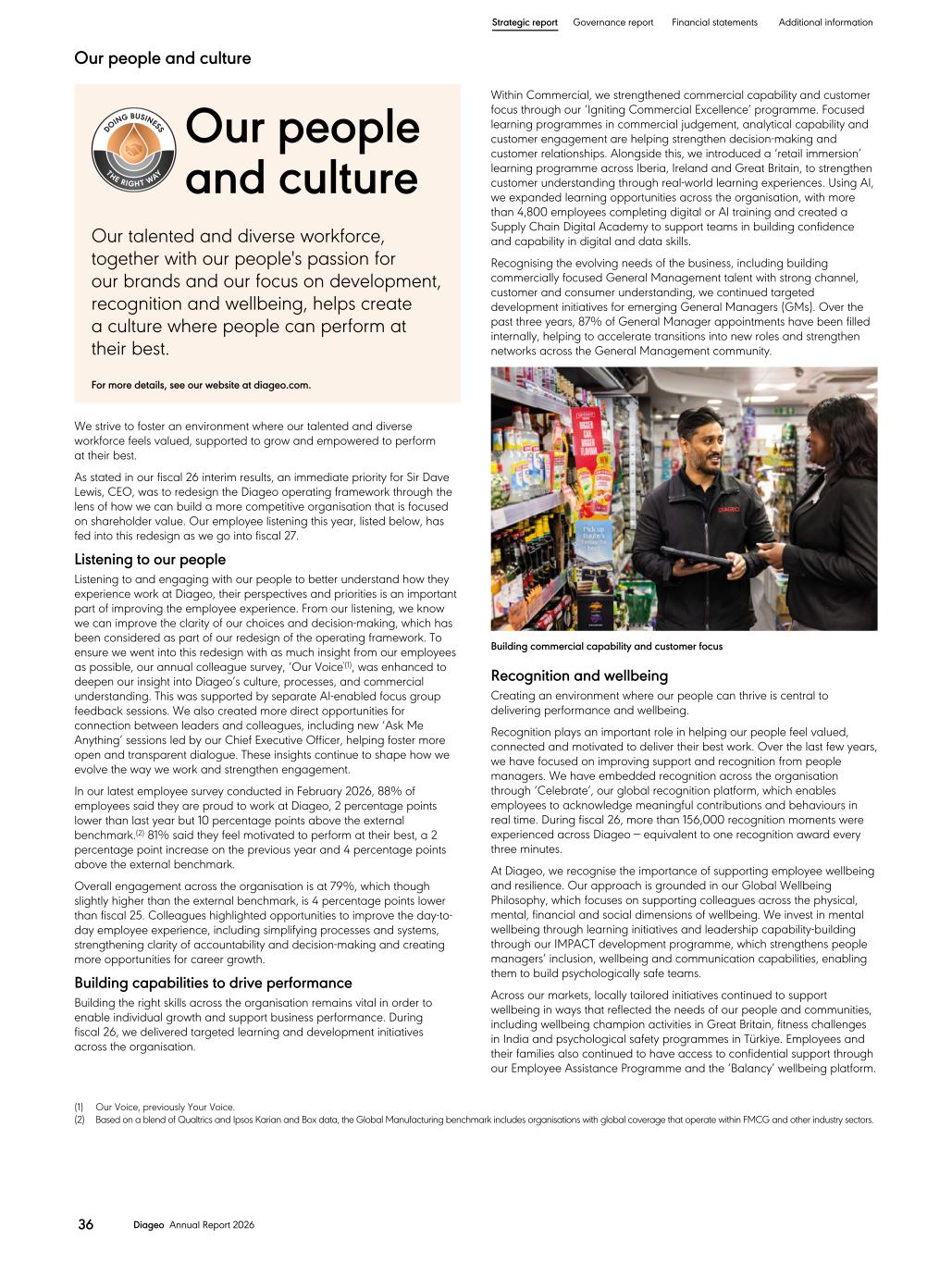
Our people and culture Our talented and diverse workforce, together with our people's passion for our brands and our focus on development, recognition and wellbeing, helps create a culture where people can perform at their best. For more details, see our website at diageo.com. We strive to foster an environment where our talented and diverse workforce feels valued, supported to grow and empowered to perform at their best. As stated in our fiscal 26 interim results, an immediate priority for Sir Dave Lewis, CEO, was to redesign the Diageo operating framework through the lens of how we can build a more competitive organisation that is focused on shareholder value. Our employee listening this year, listed below, has fed into this redesign as we go into fiscal 27. Listening to our people Listening to and engaging with our people to better understand how they experience work at Diageo, their perspectives and priorities is an important part of improving the employee experience. From our listening, we know we can improve the clarity of our choices and decision-making, which has been considered as part of our redesign of the operating framework. To ensure we went into this redesign with as much insight from our employees as possible, our annual colleague survey, ‘Our Voice’(1), was enhanced to deepen our insight into Diageo’s culture, processes, and commercial understanding. This was supported by separate AI-enabled focus group feedback sessions. We also created more direct opportunities for connection between leaders and colleagues, including new ‘Ask Me Anything’ sessions led by our Chief Executive Officer, helping foster more open and transparent dialogue. These insights continue to shape how we evolve the way we work and strengthen engagement. In our latest employee survey conducted in February 2026, 88% of employees said they are proud to work at Diageo, 2 percentage points lower than last year but 10 percentage points above the external benchmark.(2) 81% said they feel motivated to perform at their best, a 2 percentage point increase on the previous year and 4 percentage points above the external benchmark. Overall engagement across the organisation is at 79%, which though slightly higher than the external benchmark, is 4 percentage points lower than fiscal 25. Colleagues highlighted opportunities to improve the day-to- day employee experience, including simplifying processes and systems, strengthening clarity of accountability and decision-making and creating more opportunities for career growth. Building capabilities to drive performance Building the right skills across the organisation remains vital in order to enable individual growth and support business performance. During fiscal 26, we delivered targeted learning and development initiatives across the organisation. Within Commercial, we strengthened commercial capability and customer focus through our ‘Igniting Commercial Excellence’ programme. Focused learning programmes in commercial judgement, analytical capability and customer engagement are helping strengthen decision-making and customer relationships. Alongside this, we introduced a ‘retail immersion’ learning programme across Iberia, Ireland and Great Britain, to strengthen customer understanding through real-world learning experiences. Using AI, we expanded learning opportunities across the organisation, with more than 4,800 employees completing digital or AI training and created a Supply Chain Digital Academy to support teams in building confidence and capability in digital and data skills. Recognising the evolving needs of the business, including building commercially focused General Management talent with strong channel, customer and consumer understanding, we continued targeted development initiatives for emerging General Managers (GMs). Over the past three years, 87% of General Manager appointments have been filled internally, helping to accelerate transitions into new roles and strengthen networks across the General Management community. Building commercial capability and customer focus Recognition and wellbeing Creating an environment where our people can thrive is central to delivering performance and wellbeing. Recognition plays an important role in helping our people feel valued, connected and motivated to deliver their best work. Over the last few years, we have focused on improving support and recognition from people managers. We have embedded recognition across the organisation through ‘Celebrate’, our global recognition platform, which enables employees to acknowledge meaningful contributions and behaviours in real time. During fiscal 26, more than 156,000 recognition moments were experienced across Diageo — equivalent to one recognition award every three minutes. At Diageo, we recognise the importance of supporting employee wellbeing and resilience. Our approach is grounded in our Global Wellbeing Philosophy, which focuses on supporting colleagues across the physical, mental, financial and social dimensions of wellbeing. We invest in mental wellbeing through learning initiatives and leadership capability-building through our IMPACT development programme, which strengthens people managers’ inclusion, wellbeing and communication capabilities, enabling them to build psychologically safe teams. Across our markets, locally tailored initiatives continued to support wellbeing in ways that reflected the needs of our people and communities, including wellbeing champion activities in Great Britain, fitness challenges in India and psychological safety programmes in Türkiye. Employees and their families also continued to have access to confidential support through our Employee Assistance Programme and the ‘Balancy’ wellbeing platform. (1) Our Voice, previously Your Voice. (2) Based on a blend of Qualtrics and Ipsos Karian and Box data, the Global Manufacturing benchmark includes organisations with global coverage that operate within FMCG and other industry sectors. Strategic report Governance report Financial statements Additional information 36 Diageo Annual Report 2026 Our people and culture
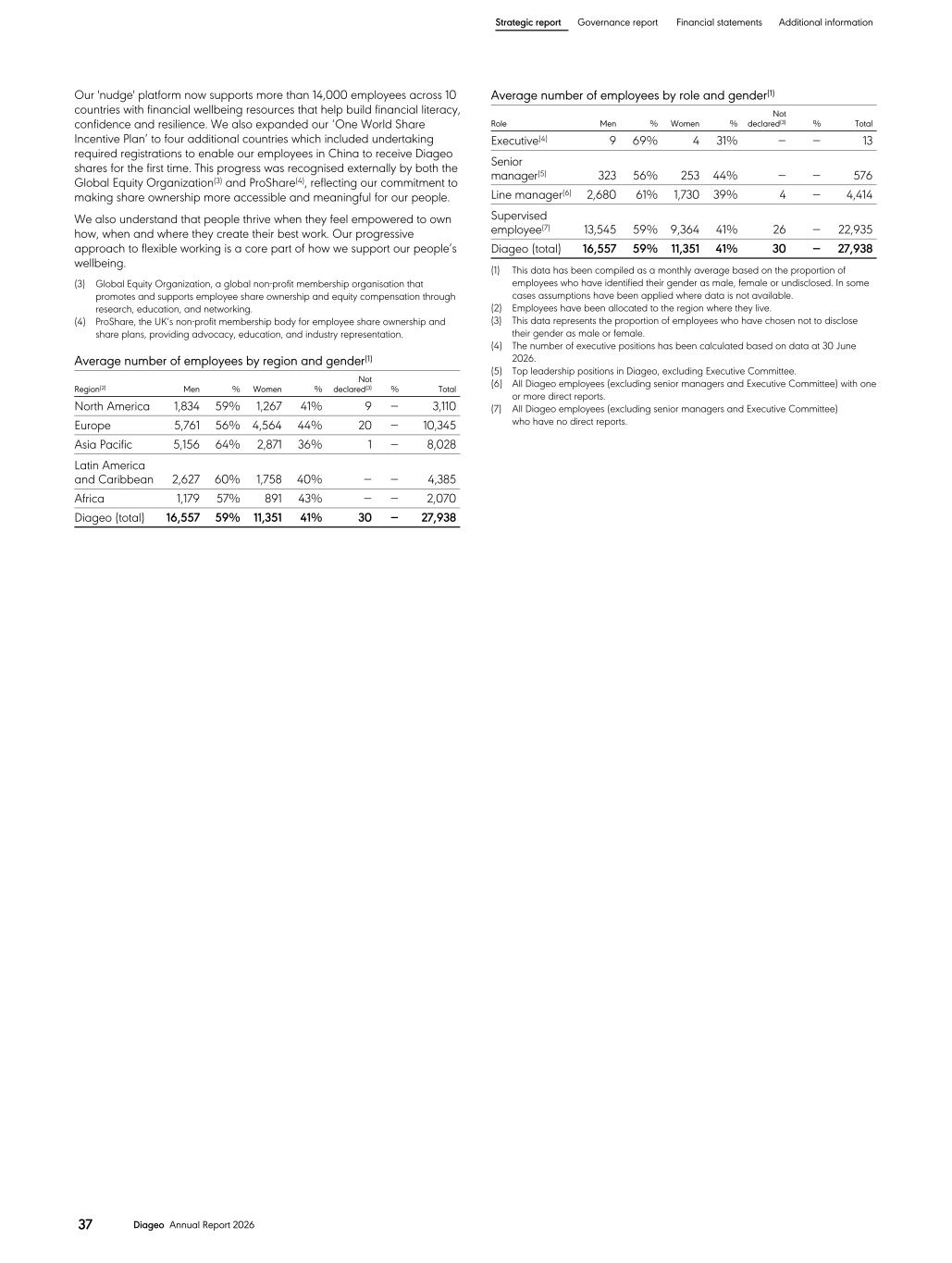
Our 'nudge' platform now supports more than 14,000 employees across 10 countries with financial wellbeing resources that help build financial literacy, confidence and resilience. We also expanded our ‘One World Share Incentive Plan’ to four additional countries which included undertaking required registrations to enable our employees in China to receive Diageo shares for the first time. This progress was recognised externally by both the Global Equity Organization(3) and ProShare(4), reflecting our commitment to making share ownership more accessible and meaningful for our people. We also understand that people thrive when they feel empowered to own how, when and where they create their best work. Our progressive approach to flexible working is a core part of how we support our people’s wellbeing. (3) Global Equity Organization, a global non-profit membership organisation that promotes and supports employee share ownership and equity compensation through research, education, and networking. (4) ProShare, the UK’s non-profit membership body for employee share ownership and share plans, providing advocacy, education, and industry representation. Average number of employees by region and gender(1) North America 1,834 59% 1,267 41% 9 — 3,110 Europe 5,761 56% 4,564 44% 20 — 10,345 Asia Pacific 5,156 64% 2,871 36% 1 — 8,028 Latin America and Caribbean 2,627 60% 1,758 40% — — 4,385 Africa 1,179 57% 891 43% — — 2,070 Diageo (total) 16,557 59% 11,351 41% 30 — 27,938 Region(2) Men % Women % Not declared(3) % Total Average number of employees by role and gender(1) Executive(4) 9 69% 4 31% — — 13 Senior manager(5) 323 56% 253 44% — — 576 Line manager(6) 2,680 61% 1,730 39% 4 — 4,414 Supervised employee(7) 13,545 59% 9,364 41% 26 — 22,935 Diageo (total) 16,557 59% 11,351 41% 30 — 27,938 Role Men % Women % Not declared(3) % Total (1) This data has been compiled as a monthly average based on the proportion of employees who have identified their gender as male, female or undisclosed. In some cases assumptions have been applied where data is not available. (2) Employees have been allocated to the region where they live. (3) This data represents the proportion of employees who have chosen not to disclose their gender as male or female. (4) The number of executive positions has been calculated based on data at 30 June 2026. (5) Top leadership positions in Diageo, excluding Executive Committee. (6) All Diageo employees (excluding senior managers and Executive Committee) with one or more direct reports. (7) All Diageo employees (excluding senior managers and Executive Committee) who have no direct reports. Strategic report Governance report Financial statements Additional information 37 Diageo Annual Report 2026
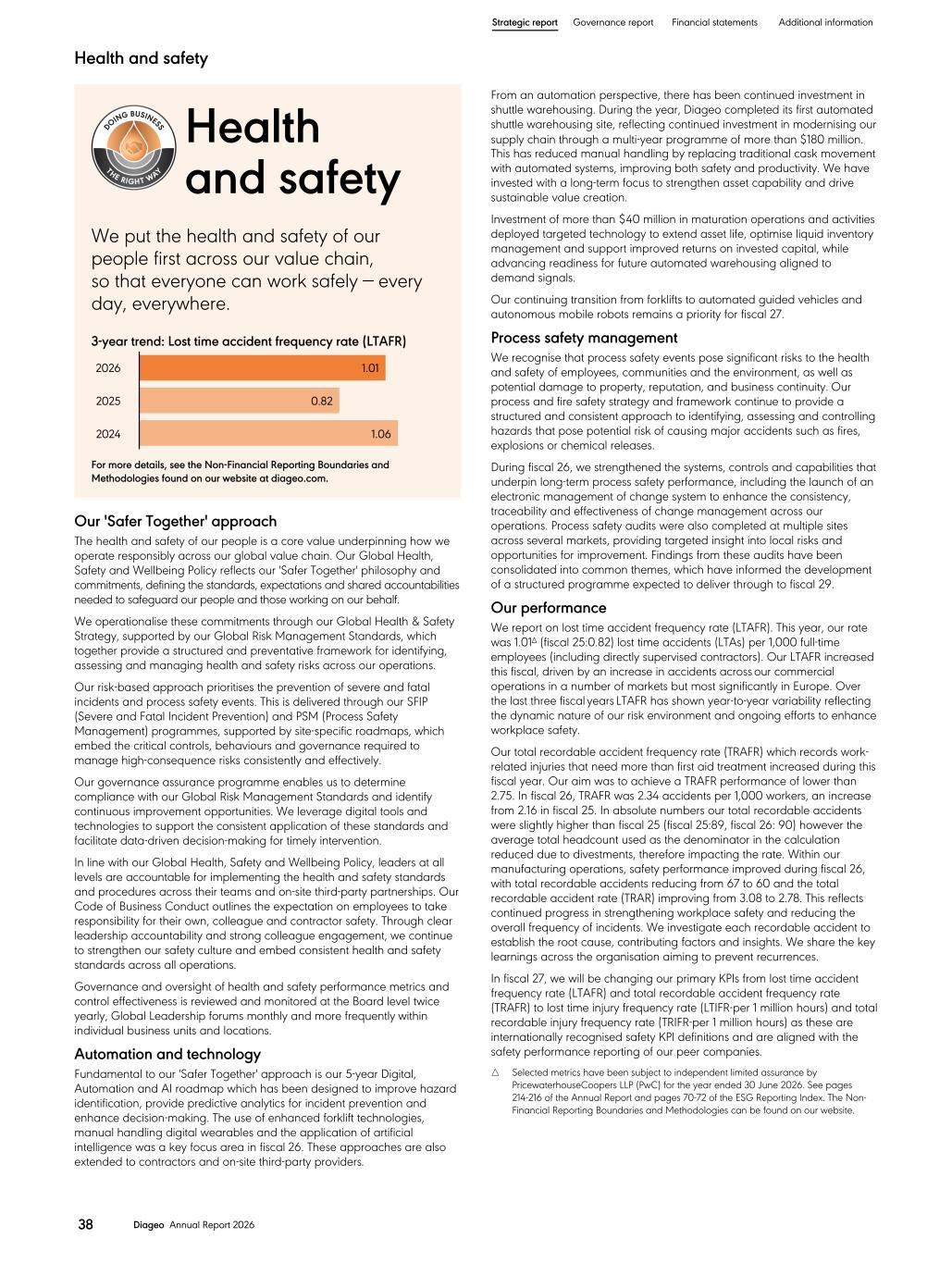
Health and safety We put the health and safety of our people first across our value chain, so that everyone can work safely — every day, everywhere. 3-year trend: Lost time accident frequency rate (LTAFR) 1.01 0.82 1.06 2026 2025 2024 For more details, see the Non-Financial Reporting Boundaries and Methodologies found on our website at diageo.com. Our 'Safer Together' approach The health and safety of our people is a core value underpinning how we operate responsibly across our global value chain. Our Global Health, Safety and Wellbeing Policy reflects our 'Safer Together' philosophy and commitments, defining the standards, expectations and shared accountabilities needed to safeguard our people and those working on our behalf. We operationalise these commitments through our Global Health & Safety Strategy, supported by our Global Risk Management Standards, which together provide a structured and preventative framework for identifying, assessing and managing health and safety risks across our operations. Our risk‑based approach prioritises the prevention of severe and fatal incidents and process safety events. This is delivered through our SFIP (Severe and Fatal Incident Prevention) and PSM (Process Safety Management) programmes, supported by site‑specific roadmaps, which embed the critical controls, behaviours and governance required to manage high‑consequence risks consistently and effectively. Our governance assurance programme enables us to determine compliance with our Global Risk Management Standards and identify continuous improvement opportunities. We leverage digital tools and technologies to support the consistent application of these standards and facilitate data-driven decision-making for timely intervention. In line with our Global Health, Safety and Wellbeing Policy, leaders at all levels are accountable for implementing the health and safety standards and procedures across their teams and on-site third‑party partnerships. Our Code of Business Conduct outlines the expectation on employees to take responsibility for their own, colleague and contractor safety. Through clear leadership accountability and strong colleague engagement, we continue to strengthen our safety culture and embed consistent health and safety standards across all operations. Governance and oversight of health and safety performance metrics and control effectiveness is reviewed and monitored at the Board level twice yearly, Global Leadership forums monthly and more frequently within individual business units and locations. Automation and technology Fundamental to our 'Safer Together' approach is our 5-year Digital, Automation and AI roadmap which has been designed to improve hazard identification, provide predictive analytics for incident prevention and enhance decision-making. The use of enhanced forklift technologies, manual handling digital wearables and the application of artificial intelligence was a key focus area in fiscal 26. These approaches are also extended to contractors and on-site third-party providers. From an automation perspective, there has been continued investment in shuttle warehousing. During the year, Diageo completed its first automated shuttle warehousing site, reflecting continued investment in modernising our supply chain through a multi-year programme of more than $180 million. This has reduced manual handling by replacing traditional cask movement with automated systems, improving both safety and productivity. We have invested with a long‑term focus to strengthen asset capability and drive sustainable value creation. Investment of more than $40 million in maturation operations and activities deployed targeted technology to extend asset life, optimise liquid inventory management and support improved returns on invested capital, while advancing readiness for future automated warehousing aligned to demand signals. Our continuing transition from forklifts to automated guided vehicles and autonomous mobile robots remains a priority for fiscal 27. Process safety management We recognise that process safety events pose significant risks to the health and safety of employees, communities and the environment, as well as potential damage to property, reputation, and business continuity. Our process and fire safety strategy and framework continue to provide a structured and consistent approach to identifying, assessing and controlling hazards that pose potential risk of causing major accidents such as fires, explosions or chemical releases. During fiscal 26, we strengthened the systems, controls and capabilities that underpin long‑term process safety performance, including the launch of an electronic management of change system to enhance the consistency, traceability and effectiveness of change management across our operations. Process safety audits were also completed at multiple sites across several markets, providing targeted insight into local risks and opportunities for improvement. Findings from these audits have been consolidated into common themes, which have informed the development of a structured programme expected to deliver through to fiscal 29. Our performance We report on lost time accident frequency rate (LTAFR). This year, our rate was 1.01Δ (fiscal 25:0.82) lost time accidents (LTAs) per 1,000 full-time employees (including directly supervised contractors). Our LTAFR increased this fiscal, driven by an increase in accidents across our commercial operations in a number of markets but most significantly in Europe. Over the last three fiscal years LTAFR has shown year-to-year variability reflecting the dynamic nature of our risk environment and ongoing efforts to enhance workplace safety. Our total recordable accident frequency rate (TRAFR) which records work- related injuries that need more than first aid treatment increased during this fiscal year. Our aim was to achieve a TRAFR performance of lower than 2.75. In fiscal 26, TRAFR was 2.34 accidents per 1,000 workers, an increase from 2.16 in fiscal 25. In absolute numbers our total recordable accidents were slightly higher than fiscal 25 (fiscal 25:89, fiscal 26: 90) however the average total headcount used as the denominator in the calculation reduced due to divestments, therefore impacting the rate. Within our manufacturing operations, safety performance improved during fiscal 26, with total recordable accidents reducing from 67 to 60 and the total recordable accident rate (TRAR) improving from 3.08 to 2.78. This reflects continued progress in strengthening workplace safety and reducing the overall frequency of incidents. We investigate each recordable accident to establish the root cause, contributing factors and insights. We share the key learnings across the organisation aiming to prevent recurrences. In fiscal 27, we will be changing our primary KPIs from lost time accident frequency rate (LTAFR) and total recordable accident frequency rate (TRAFR) to lost time injury frequency rate (LTIFR-per 1 million hours) and total recordable injury frequency rate (TRIFR-per 1 million hours) as these are internationally recognised safety KPI definitions and are aligned with the safety performance reporting of our peer companies. △ Selected metrics have been subject to independent limited assurance by PricewaterhouseCoopers LLP (PwC) for the year ended 30 June 2026. See pages 214-216 of the Annual Report and pages 70-72 of the ESG Reporting Index. The Non- Financial Reporting Boundaries and Methodologies can be found on our website. Strategic report Governance report Financial statements Additional information 38 Diageo Annual Report 2026 Health and safety
Continuous improvement initiatives In fiscal 26, we introduced and progressed several key programmes aligned to our Global Health & Safety strategy. These initiatives will continue to be developed further as part of our culture and technology roadmaps in fiscal 27. Safety culture & leadership • Safety culture assessment action plans The safety culture assessment conducted in fiscal 25 indicated strong overall performance, placing the organisation above the typical level seen across the beverage industry and close to best-in-class standards. In fiscal 26 each site translated their safety culture assessment results into an action plan, which will continue into fiscal 27. • World Health & Safety Day We celebrate the ILO World Day for Safety & Health at Work on 28 April each year across all our locations. This fiscal the ILO theme was ‘psychological safety in the working environment’. We celebrated the theme over three days and focused on the role of leadership in creating a psychologically safe working environment through global webinars, focused communications and toolbox talks at site level. Digital technology • Worker connection platform We have enhanced our digital platforms in fiscal 26 by creating a digital worker connection platform for those supply sites on the Manufacturing Excellence journey. We developed safety workflows within the platform to enable Tier 1 operators to report on hazards and unsafe conditions and carry out peer-to-peer behavioural observations. • Electronic Management System We continued the rollout and implementation of a digital solution for managing change, electronic permits and onboarding of contractors, with an emphasis in the second half of fiscal 26 in shifting from implementation to embedding and adoption of the modules. Office and commercial safety • Managing Director Health & Safety toolkits A toolkit was developed and launched by the Global H&S Team for the commercial offices and brand homes locations. It was designed to support our Managing Directors in delivering against the Diageo Global Health, Safety & Wellbeing Policy, and applicable global standards at non-manufacturing locations. • Office Health & Safety Playbooks H&S playbooks were launched across our Tier 1 offices to provide global guidance on how health and safety is managed in non-manufacturing locations. The playbooks support teams in identifying and managing risks more effectively, while reinforcing accountability and expected standards. They also help build capability at a local level, enabling a more proactive approach to safety and improving overall performance across our office-based operations. • Safer Driving On Roads Diageo’s Safer Driving Programme currently supports approximately 2,500 drivers globally. In fiscal 26, the focus was on embedding the programme into business as usual operations and improving performance through measurement of the 'Safe Driving Score' KPI (fiscal 26 global average = 80%). The Driving Skills Builder platform further enhances driver capability through personalised e-learning modules assigned based on individual driving behaviours. Transforming our health & safety strategy As part of our ambition to achieve a world-class health and safety culture with leading health and safety performance, we are transforming our strategy around five key pillars, supported by strong foundations in Process Safety and Severe and Fatal Incident Prevention (SFIP): • ISO 45001 implementation Standardising our health and safety management across all sites • Leadership capability Enhancing the safety skills and accountability of our leaders • Human Factors Linking human behaviour directly to safety performance • Digital Innovation Leveraging automation and AI to mitigate risks • Commercial safety Stronger integration of our safety standards in our commercial operations This combined approach will actively strengthen our safety culture and help generate sustained performance improvement across the organisation. Strategic report Governance report Financial statements Additional information 39 Diageo Annual Report 2026
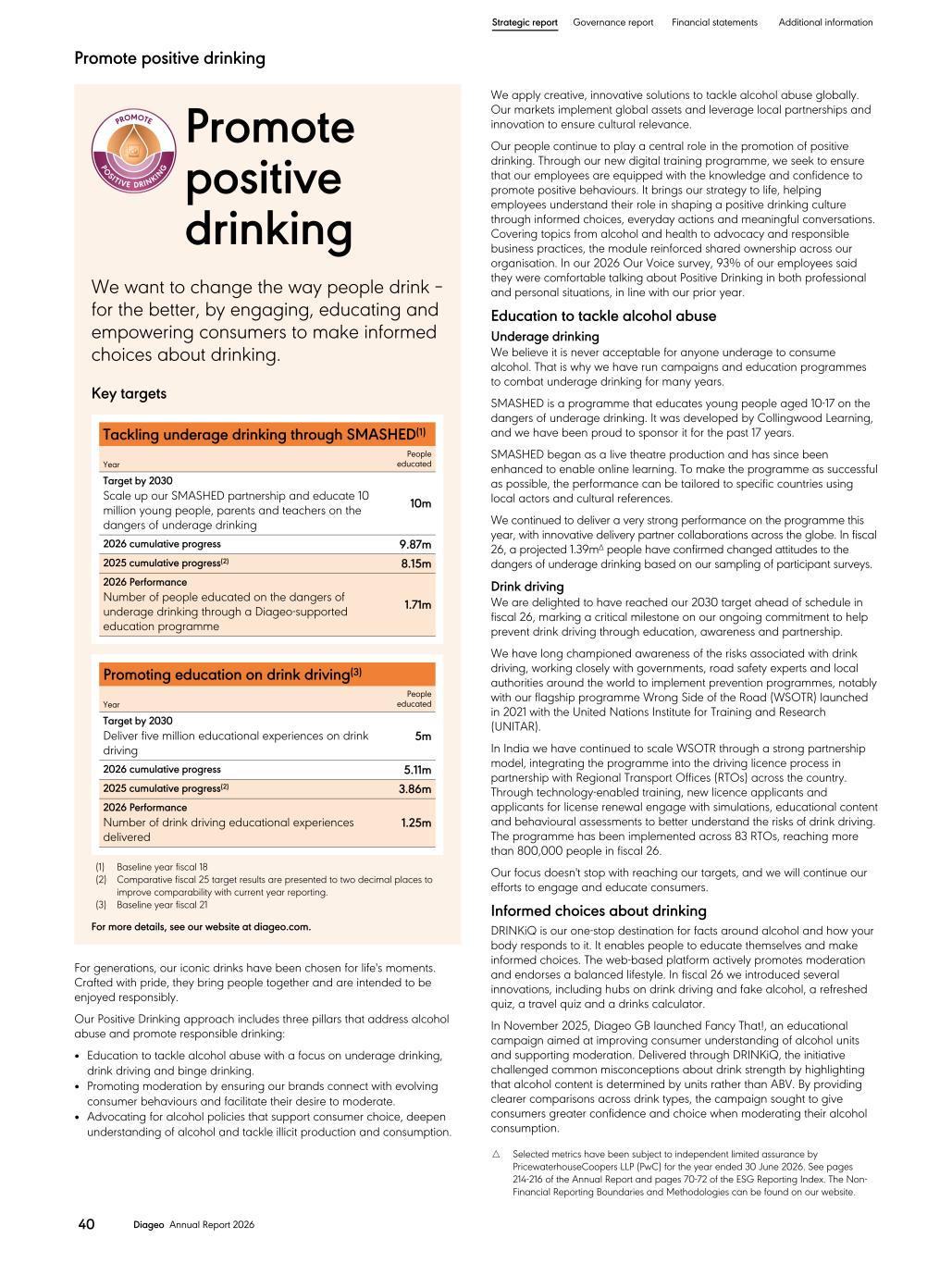
Promote positive drinking We want to change the way people drink – for the better, by engaging, educating and empowering consumers to make informed choices about drinking. Key targets Target by 2030 Scale up our SMASHED partnership and educate 10 million young people, parents and teachers on the dangers of underage drinking 10m 2026 cumulative progress 9.87m 2025 cumulative progress(2) 8.15m 2026 Performance Number of people educated on the dangers of underage drinking through a Diageo-supported education programme 1.71m Tackling underage drinking through SMASHED(1) Year People educated Target by 2030 Deliver five million educational experiences on drink driving 5m 2026 cumulative progress 5.11m 2025 cumulative progress(2) 3.86m 2026 Performance Number of drink driving educational experiences delivered 1.25m Promoting education on drink driving(3) Year People educated (1) Baseline year fiscal 18 (2) Comparative fiscal 25 target results are presented to two decimal places to improve comparability with current year reporting. (3) Baseline year fiscal 21 For more details, see our website at diageo.com. For generations, our iconic drinks have been chosen for life's moments. Crafted with pride, they bring people together and are intended to be enjoyed responsibly. Our Positive Drinking approach includes three pillars that address alcohol abuse and promote responsible drinking: • Education to tackle alcohol abuse with a focus on underage drinking, drink driving and binge drinking. • Promoting moderation by ensuring our brands connect with evolving consumer behaviours and facilitate their desire to moderate. • Advocating for alcohol policies that support consumer choice, deepen understanding of alcohol and tackle illicit production and consumption. We apply creative, innovative solutions to tackle alcohol abuse globally. Our markets implement global assets and leverage local partnerships and innovation to ensure cultural relevance. Our people continue to play a central role in the promotion of positive drinking. Through our new digital training programme, we seek to ensure that our employees are equipped with the knowledge and confidence to promote positive behaviours. It brings our strategy to life, helping employees understand their role in shaping a positive drinking culture through informed choices, everyday actions and meaningful conversations. Covering topics from alcohol and health to advocacy and responsible business practices, the module reinforced shared ownership across our organisation. In our 2026 Our Voice survey, 93% of our employees said they were comfortable talking about Positive Drinking in both professional and personal situations, in line with our prior year. Education to tackle alcohol abuse Underage drinking We believe it is never acceptable for anyone underage to consume alcohol. That is why we have run campaigns and education programmes to combat underage drinking for many years. SMASHED is a programme that educates young people aged 10-17 on the dangers of underage drinking. It was developed by Collingwood Learning, and we have been proud to sponsor it for the past 17 years. SMASHED began as a live theatre production and has since been enhanced to enable online learning. To make the programme as successful as possible, the performance can be tailored to specific countries using local actors and cultural references. We continued to deliver a very strong performance on the programme this year, with innovative delivery partner collaborations across the globe. In fiscal 26, a projected 1.39mΔ people have confirmed changed attitudes to the dangers of underage drinking based on our sampling of participant surveys. Drink driving We are delighted to have reached our 2030 target ahead of schedule in fiscal 26, marking a critical milestone on our ongoing commitment to help prevent drink driving through education, awareness and partnership. We have long championed awareness of the risks associated with drink driving, working closely with governments, road safety experts and local authorities around the world to implement prevention programmes, notably with our flagship programme Wrong Side of the Road (WSOTR) launched in 2021 with the United Nations Institute for Training and Research (UNITAR). In India we have continued to scale WSOTR through a strong partnership model, integrating the programme into the driving licence process in partnership with Regional Transport Offices (RTOs) across the country. Through technology-enabled training, new licence applicants and applicants for license renewal engage with simulations, educational content and behavioural assessments to better understand the risks of drink driving. The programme has been implemented across 83 RTOs, reaching more than 800,000 people in fiscal 26. Our focus doesn't stop with reaching our targets, and we will continue our efforts to engage and educate consumers. Informed choices about drinking DRINKiQ is our one-stop destination for facts around alcohol and how your body responds to it. It enables people to educate themselves and make informed choices. The web-based platform actively promotes moderation and endorses a balanced lifestyle. In fiscal 26 we introduced several innovations, including hubs on drink driving and fake alcohol, a refreshed quiz, a travel quiz and a drinks calculator. In November 2025, Diageo GB launched Fancy That!, an educational campaign aimed at improving consumer understanding of alcohol units and supporting moderation. Delivered through DRINKiQ, the initiative challenged common misconceptions about drink strength by highlighting that alcohol content is determined by units rather than ABV. By providing clearer comparisons across drink types, the campaign sought to give consumers greater confidence and choice when moderating their alcohol consumption. Strategic report Governance report Financial statements Additional information 40 Diageo Annual Report 2026 Promote positive drinking △ Selected metrics have been subject to independent limited assurance by PricewaterhouseCoopers LLP (PwC) for the year ended 30 June 2026. See pages 214-216 of the Annual Report and pages 70-72 of the ESG Reporting Index. The Non- Financial Reporting Boundaries and Methodologies can be found on our website.
Promoting moderation: Ensuring our brands connect with and attend to evolving consumer desire to moderate Creating aspiration around moderation - and positioning it as a positive and desirable option - is critical to fostering positive drinking attitudes and behaviours, supported by a broad range of products and strategies that respond to evolving consumer preferences and support moderation choices. Our Diageo Marketing Code equips marketers with clear principles for promoting moderation through our brands and innovation portfolio. We launched new campaigns this year which leveraged strong consumer insights and delivered against our goal of making moderation more aspirational including: • Guinness Beer Pressure: Guinness addressed the social stigma associated with choosing non-alcoholic options by challenging 'beer pressure' and championing Guinness 0.0 as a credible alternative. The campaign supports our ambition to normalise moderation at scale by making the choice to not drink alcohol feel socially accepted and culturally relevant. The campaign ran from February 2026 to June 2026, supported by significant media investment. • FIFA World Cup: During the 2026 FIFA World Cup, Diageo launched 'The Best Move: Celebrate Responsibly' across Latin and North America. Built on the insight that moderation enables passion, the campaign positioned responsible drinking as key to fully enjoying the intensity of the game, encouraging simple actions like pacing drinks, hydrating, eating, and planning safe journeys. Non-alcoholic portfolio availability We also continue to expand consumer choice through our non-alcoholic portfolio. Non-alcoholic products are now available in 17 markets up from 15 markets in fiscal 25, representing approximately 68% of our strategic markets. Guinness 0.0 is now available in 12 markets, representing approximately 48% of our strategic markets. Marketing in a responsible way The Diageo Marketing Code (DMC) sets out our principles for responsible marketing, and it represents a cornerstone of the way we do business. The DMC includes our commitment to encouraging only responsible and moderate drinking and never targeting underage audiences. We are proud to have a proven track record of compliance, which is underpinned by appropriate checks in every market we operate in. We are focused on compliance at scale and embedding compliance into the flow of work. One example is our continued exploration of AI, building on last year’s testing to support marketing content review, with plans to evolve this into a broader AI assistant that helps scale compliance and capability by embedding DMC principles into everyday marketing decisions. We regularly review reporting from advertising monitoring and industry bodies across key markets, for breaches of self-regulatory alcohol marketing codes. No complaints relating to Diageo marketing were upheld by key industry bodies this fiscal year. Complaints upheld by key industry bodies that report publicly are presented below. Incidents of non-compliance concerning marketing communications (upheld published rulings) - fiscal 26(1) United States Distilled Spirits Council of the United States (DISCUS) 2 — Australia ABAC Scheme 41 — United Kingdom Advertising Standards Authority 13 — Portman Group 22 — Republic of Ireland Advertising Standards Authority for Ireland (ASAI) 1 — Country Body Industry complaints upheld Complaints about Diageo brands upheld (1) United States, United Kingdom, Republic of Ireland - 1 July 2025 to 30 June 2026. Australia - 1 July 2025 - 31 March 2026 (Reporting is based on the latest publicly available ABAC quarterly data). Advocating improved laws and industry standards We believe industry-wide standards and sensible regulation provide an important framework for responsible drinking. We support evidence-based policies that address drinking patterns, target at-risk groups, treat all alcohol equally, and involve relevant stakeholders. We advocate for effective measures such as blood alcohol driving limits, responsible digital marketing, and legal purchase age laws, alongside industry standards for responsible marketing and consumer information. We also support programmes that help tackle alcohol misuse. Over the last decade, many countries have seen declines in binge drinking, drink driving and underage drinking. As members of the International Alliance for Responsible Drinking (IARD), we are committed to building on this progress and supporting global efforts to reduce harmful drinking. This includes delivering on the recommendations presented to the sector in the United Nations 2025 Political Declaration on non-communicable diseases and mental health, in particular by taking concrete steps towards eliminating the marketing, advertising, and sale of alcohol products to minors. As members of IARD we participated in an economic operators’ dialogue convened this year by the World Health Organization (WHO) in line with the Global Alcohol Action Plan (GAAP). At the dialogue, IARD’s members and partners shared updates regarding the actions we are taking to tackle the harmful use of alcohol as part of the whole-of-society approach established by the WHO’s Global Strategy to reduce the Harmful Use of Alcohol. Strategic report Governance report Financial statements Additional information 41 Diageo Annual Report 2026
Champion inclusion and diversity Empowering our people and strengthening performance. Key Ambitions(1)(2)(3) 2030 Ambition Champion gender diversity, with an ambition to achieve 50% representation of women in leadership roles by 2030 50% Role Women % Men % Total Leadership population (3) 256 44% 325 56% 581 Current gender representation of our leadership 2030 Ambition Champion ethnic diversity, with an ambition to increase representation of leaders from ethnically diverse backgrounds to 45% by 2030 45% Ethnically diverse % Non- ethnically diverse % Decline to self identify % Not disclosed % Total 257 46% 271 48% 15 3% 18 3% 561 Current ethnic representation of our leadership(4) (1) Statements on representation should be considered an ambition for Diageo, not a target. (2) This data is calculated as an average across the four quarters of fiscal 26. (3) Leadership population encompasses the Executive Committee and senior managers. (4) 20 leaders are based in countries that do not collect ethnicity data. These leaders are not in scope Appointments to leadership roles are made based on the candidates' capabilities, skills and experience to meet the role's requirements. For more details, see the Non-Financial Reporting Boundaries and Methodologies on our website. 2030 Ambition Provide business and hospitality skills to 200,000 people, increasing employability and improving livelihoods through Learning for Life and our other skills programmes 200k 2026 cumulative progress 164k 2025 cumulative progress 133k Building a thriving and inclusive hospitality industry (1) Year Number of people reached (1) Baseline year fiscal 21 For more details, see our website at diageo.com. Inclusion and diversity matter because they strengthen our performance. When colleagues with different backgrounds, perspectives and experiences can contribute fully, we make better decisions, encourage innovation and better serve our customers, consumers and communities, supporting long- term sustainable growth and shareholder value creation. Access and opportunity Creating an inclusive culture where everyone feels respected, supported and able to do their best work is central to our business. Across Diageo, locally relevant initiatives help make inclusive behaviours part of workplace life, supported by clear policies and practical tools. This builds on more than a decade of making inclusion and diversity part of how we operate, with clear leadership accountability. The theme of ‘Strengthening Access to Opportunities and Equality for All’ shaped this year’s International Women’s Day activity, highlighting the importance of improving access to opportunities, visibility and advancement for women, while also spotlighting the progress made across our business and future opportunities with our customers and within our commercial teams. Since fiscal 22, female representation across total commercial roles in Diageo has increased by 4 percentage points, from 34% to 38%, demonstrating continued progress in strengthening our talent pipeline. However, this has yet to translate consistently into senior commercial leadership, where female representation remains lower at 25%. Markets and functions continue to create locally relevant opportunities that broaden inclusion beyond gender, strengthening access and inclusion across Diageo. In Mexico, the third cohort of our internship programme supported individuals from lower socioeconomic backgrounds, while in Colombia, the 'Invincibles' programme, designed to support experienced professionals returning to the workplace after career breaks, increased participation among Gen X returners. Within our Zacapa Supply Chain and Procurement business, 90% of Aging Centre colleagues completed a four- month sign language programme, strengthening inclusive communication across teams. This year also marked a milestone for our Business Resource Groups (BRGs) in North America, where both the Spirited Women Network and AHEAD (African Heritage Employees at Diageo) celebrated 20 years of fostering community, advocacy and allyship, helping shape the foundation of more than 50 Employee Resource Groups (ERGs) globally. Zacapa Aging Centre sign language programme participants Gender inclusion Female leadership representation increased by one percentage point to 44% in fiscal 26, returning to prior year levels. While representation has been broadly stable in recent years, it remains above our 2020 baseline of 39%. Our performance remains strong against external benchmarks with Diageo named as a top ten company for female leadership in the FTSE Women Leaders Review for the third consecutive year, and 12 percentage points above the index average. Representation remains lower in commercial, general management and supply chain roles. However, in fiscal 26, women accounted for 49% of total leadership appointments. Our development programmes continue to support this progress. In Europe, we are building middle-management commercial capability through our 'CommEdge' programme, with women representing 67% of the first cohort. Across the Caribbean, Central America and Venezuela (CCVA) market, an early-career accelerator is strengthening the pipeline of future female leaders, with women making up 84% of participants. Strategic report Governance report Financial statements Additional information 42 Diageo Annual Report 2026 Champion inclusion and diversity
Ethnic inclusion We are proud to have surpassed our 'Spirit of Progress' ambition of 45% ethnically diverse leadership representation for a third consecutive year, with representation remaining at 46%. Representation has increased from 37% in fiscal 21, when we first reported this metric, demonstrating sustained progress. We continue to participate in the Parker Review, where Diageo is recognised for strong ethnic diversity at both Board and senior leadership levels in the United Kingdom, performing ahead of the FTSE 100 average. High levels of voluntary disclosure support our ability to transparently report. In markets where ethnicity data collection is legally permitted, 97% of leaders and 74% of Diageo’s total employee base, have completed the ethnicity field. Our global approach to advancing ethnic inclusion through talent planning and leadership capability continues to deliver locally relevant impact. In Brazil, the ‘Origens’ Internship Programme entered its fourth year supporting early-career Black talent. Despite Black and Pardo communities comprising more than half of Brazil’s population, Diageo Brazil representation stands at just 25%. ‘Origens’ is designed to help change this by supporting career progression through mentoring, language training and capability building. Promoting inclusivity through our value chain We want to make a positive impact on society by providing resources, learning, and livelihood opportunities for the communities where we source, make, and sell our brands. All our programmes are ‘inclusive by design’, aiming for 50% of beneficiaries to be women, adopting inclusive recruitment practices, providing accessible training, and including dedicated content on inclusion and diversity. In fiscal 26, Learning for Life, our business and hospitality skills programme for people from under-represented groups, reached 31,000 people in 20 markets, with women representing more than 50% of participants. This brings total participation to date to 164,000. We continue to strengthen the programme’s quality, impact and reporting globally, expanding partnerships with employers and customers to support employment outcomes, and initiated pilots in 6 markets to explore new approaches to increasing impact. Early results in Colombia showed 35% of alumni reported increased income after taking part in the programme, while 95% of surveyed graduates perceived improvements in their employability and career growth to their participation in Learning for Life. In water-stressed markets where we support communities with water, sanitation and hygiene (WASH), we partner with leading NGOs to promote equal representation on WASH committees. These committees help address social norms that can limit women’s access to WASH and their influence over decisions. This year, more than 50% of committee members were women. We also continued to expand inclusive support for smallholder farmers in Kenya and Mexico, providing equal access to agricultural training and resources. This helps strengthen economic and environmental resilience, while also supporting our supply chain. To increase social impact and make it easier for employees to get involved, we launched ‘Spirit of Giving’, a global platform enabling colleagues to support local and global causes through giving and volunteering. Aligned to our Spirit of Progress agenda, the platform has already connected employees with over 400 charities worldwide, helping support collective action at scale. Championing a diverse supply chain In fiscal 26, we continued to strengthen our value chain by expanding fair and equitable access for a broad range of suppliers across more than 30 countries. This supports a more competitive and agile supply chain. We advanced our approach to identifying and developing under- represented suppliers through partnerships, including a sustainability- focused development programme for small businesses and membership of Social Enterprise UK. We were also recognised as an Impact Sourcing Top Global Champion by WEConnect International, reflecting our inclusive sourcing commitment. For more information, please refer to our ESG Reporting Index. Inclusive marketing: Good for society and good for business We craft and market our products for everyone above legal drinking age, and want our advertising and activations to reflect the consumers who enjoy our brands around the world. As one of the world’s largest advertisers, we also have a role to play in making media more inclusive. Diageo continues to lead the wider industry in progressive portrayal in advertising. In India, Johnnie Walker brought this to life through ‘The Walkers List’, a collaboration with female voices across art, culture, sport, music and ethical fashion, all reflecting the brand’s Keep Walking philosophy. The campaign reached more than 70 million people and helped spark meaningful cultural conversation and engagement. In fiscal 26, we continued to advance the rollout of accessible content, alongside programmes to drive greater inclusivity in experiential marketing. In Ireland, Smirnoff’s ‘Sound Nation’ programme championed accessibility at festivals through wheelchair-accessible DJ booths, sonic-vibration feedback vests, sign language interpretation, braille menus and lowered bars, helping create more disability-inclusive experiences where all music fans could participate fully. For the third time, we partnered with Creative Equals in Great Britain on a career accelerator programme, supporting disabled and neurodivergent talent in the creative marketing industries. Alongside supporting 48 participants, the programme also strengthened understanding of disability inclusion with Diageo marketing colleagues and agency partners through mentoring and partnerships. Strategic report Governance report Financial statements Additional information 43 Diageo Annual Report 2026
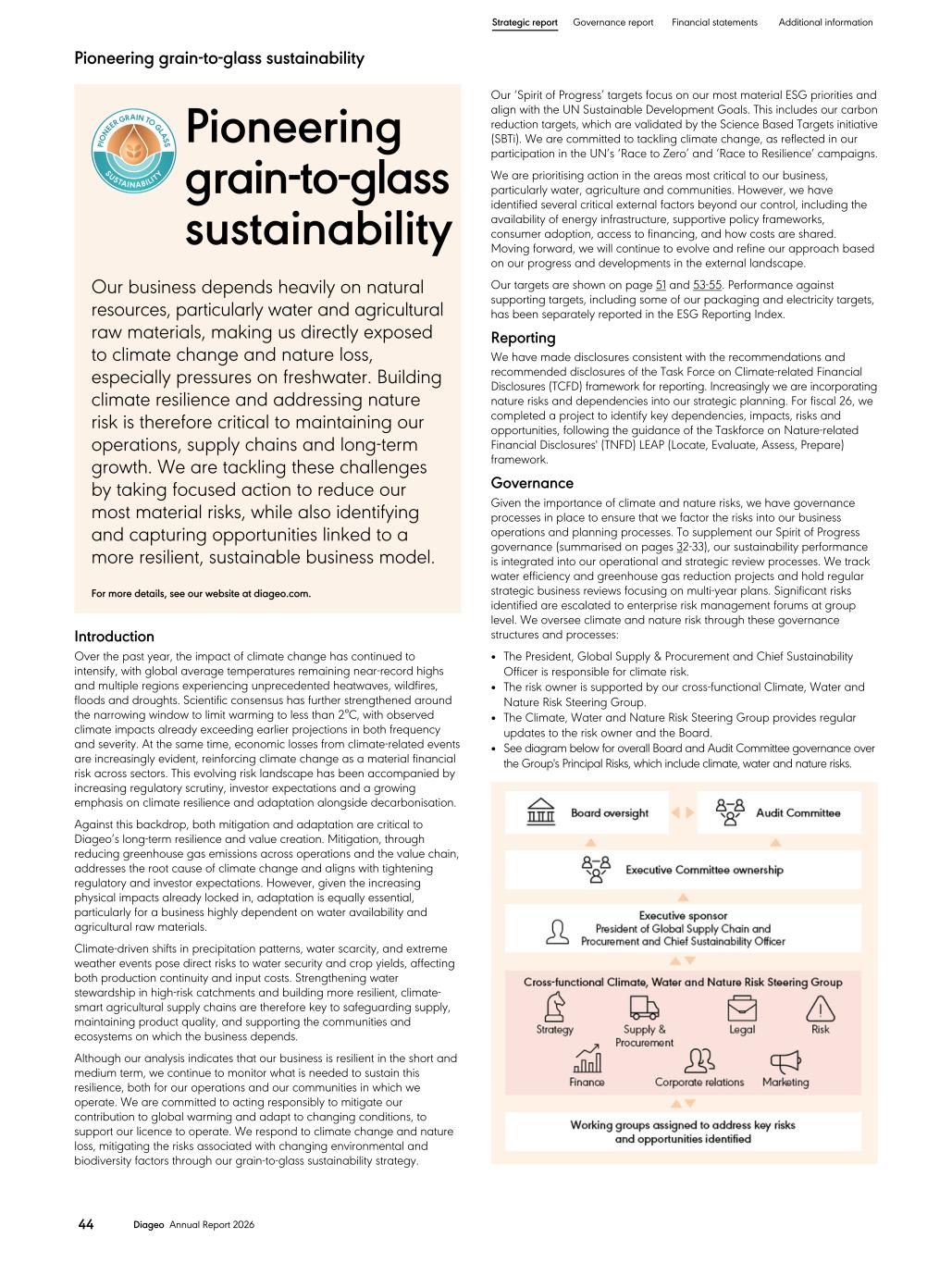
Pioneering grain-to-glass sustainability Our business depends heavily on natural resources, particularly water and agricultural raw materials, making us directly exposed to climate change and nature loss, especially pressures on freshwater. Building climate resilience and addressing nature risk is therefore critical to maintaining our operations, supply chains and long-term growth. We are tackling these challenges by taking focused action to reduce our most material risks, while also identifying and capturing opportunities linked to a more resilient, sustainable business model. For more details, see our website at diageo.com. Introduction Over the past year, the impact of climate change has continued to intensify, with global average temperatures remaining near-record highs and multiple regions experiencing unprecedented heatwaves, wildfires, floods and droughts. Scientific consensus has further strengthened around the narrowing window to limit warming to less than 2°C, with observed climate impacts already exceeding earlier projections in both frequency and severity. At the same time, economic losses from climate-related events are increasingly evident, reinforcing climate change as a material financial risk across sectors. This evolving risk landscape has been accompanied by increasing regulatory scrutiny, investor expectations and a growing emphasis on climate resilience and adaptation alongside decarbonisation. Against this backdrop, both mitigation and adaptation are critical to Diageo’s long-term resilience and value creation. Mitigation, through reducing greenhouse gas emissions across operations and the value chain, addresses the root cause of climate change and aligns with tightening regulatory and investor expectations. However, given the increasing physical impacts already locked in, adaptation is equally essential, particularly for a business highly dependent on water availability and agricultural raw materials. Climate-driven shifts in precipitation patterns, water scarcity, and extreme weather events pose direct risks to water security and crop yields, affecting both production continuity and input costs. Strengthening water stewardship in high-risk catchments and building more resilient, climate- smart agricultural supply chains are therefore key to safeguarding supply, maintaining product quality, and supporting the communities and ecosystems on which the business depends. Although our analysis indicates that our business is resilient in the short and medium term, we continue to monitor what is needed to sustain this resilience, both for our operations and our communities in which we operate. We are committed to acting responsibly to mitigate our contribution to global warming and adapt to changing conditions, to support our licence to operate. We respond to climate change and nature loss, mitigating the risks associated with changing environmental and biodiversity factors through our grain-to-glass sustainability strategy. Our ‘Spirit of Progress’ targets focus on our most material ESG priorities and align with the UN Sustainable Development Goals. This includes our carbon reduction targets, which are validated by the Science Based Targets initiative (SBTi). We are committed to tackling climate change, as reflected in our participation in the UN’s ‘Race to Zero’ and ‘Race to Resilience’ campaigns. We are prioritising action in the areas most critical to our business, particularly water, agriculture and communities. However, we have identified several critical external factors beyond our control, including the availability of energy infrastructure, supportive policy frameworks, consumer adoption, access to financing, and how costs are shared. Moving forward, we will continue to evolve and refine our approach based on our progress and developments in the external landscape. Our targets are shown on page 51 and 53-55. Performance against supporting targets, including some of our packaging and electricity targets, has been separately reported in the ESG Reporting Index. Reporting We have made disclosures consistent with the recommendations and recommended disclosures of the Task Force on Climate-related Financial Disclosures (TCFD) framework for reporting. Increasingly we are incorporating nature risks and dependencies into our strategic planning. For fiscal 26, we completed a project to identify key dependencies, impacts, risks and opportunities, following the guidance of the Taskforce on Nature-related Financial Disclosures' (TNFD) LEAP (Locate, Evaluate, Assess, Prepare) framework. Governance Given the importance of climate and nature risks, we have governance processes in place to ensure that we factor the risks into our business operations and planning processes. To supplement our Spirit of Progress governance (summarised on pages 32-33), our sustainability performance is integrated into our operational and strategic review processes. We track water efficiency and greenhouse gas reduction projects and hold regular strategic business reviews focusing on multi-year plans. Significant risks identified are escalated to enterprise risk management forums at group level. We oversee climate and nature risk through these governance structures and processes: • The President, Global Supply & Procurement and Chief Sustainability Officer is responsible for climate risk. • The risk owner is supported by our cross-functional Climate, Water and Nature Risk Steering Group. • The Climate, Water and Nature Risk Steering Group provides regular updates to the risk owner and the Board. • See diagram below for overall Board and Audit Committee governance over the Group's Principal Risks, which include climate, water and nature risks. Strategic report Governance report Financial statements Additional information 44 Diageo Annual Report 2026 Pioneering grain-to-glass sustainability
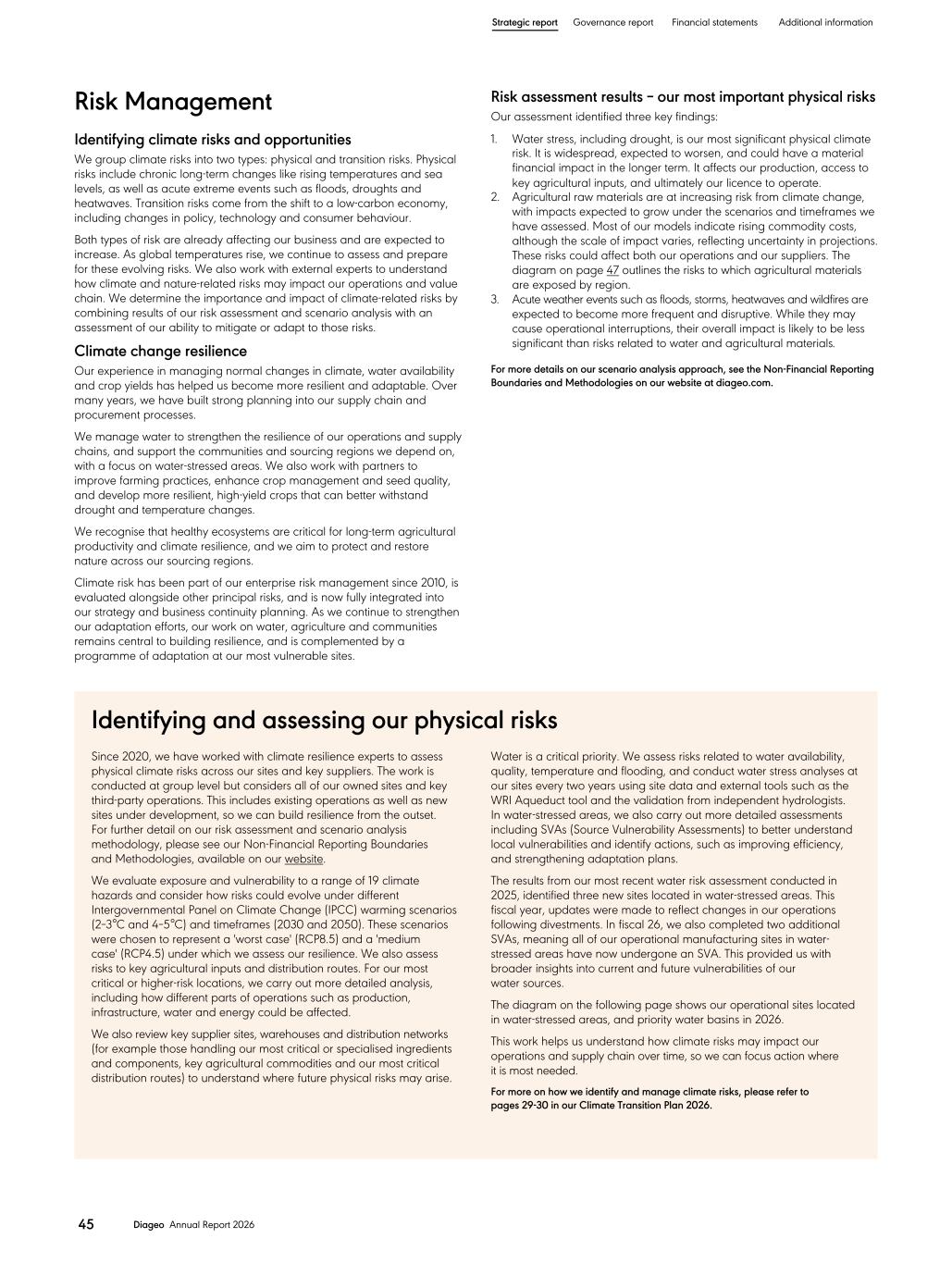
Risk Management Identifying climate risks and opportunities We group climate risks into two types: physical and transition risks. Physical risks include chronic long-term changes like rising temperatures and sea levels, as well as acute extreme events such as floods, droughts and heatwaves. Transition risks come from the shift to a low-carbon economy, including changes in policy, technology and consumer behaviour. Both types of risk are already affecting our business and are expected to increase. As global temperatures rise, we continue to assess and prepare for these evolving risks. We also work with external experts to understand how climate and nature-related risks may impact our operations and value chain. We determine the importance and impact of climate-related risks by combining results of our risk assessment and scenario analysis with an assessment of our ability to mitigate or adapt to those risks. Climate change resilience Our experience in managing normal changes in climate, water availability and crop yields has helped us become more resilient and adaptable. Over many years, we have built strong planning into our supply chain and procurement processes. We manage water to strengthen the resilience of our operations and supply chains, and support the communities and sourcing regions we depend on, with a focus on water-stressed areas. We also work with partners to improve farming practices, enhance crop management and seed quality, and develop more resilient, high-yield crops that can better withstand drought and temperature changes. We recognise that healthy ecosystems are critical for long-term agricultural productivity and climate resilience, and we aim to protect and restore nature across our sourcing regions. Climate risk has been part of our enterprise risk management since 2010, is evaluated alongside other principal risks, and is now fully integrated into our strategy and business continuity planning. As we continue to strengthen our adaptation efforts, our work on water, agriculture and communities remains central to building resilience, and is complemented by a programme of adaptation at our most vulnerable sites. Risk assessment results – our most important physical risks Our assessment identified three key findings: 1. Water stress, including drought, is our most significant physical climate risk. It is widespread, expected to worsen, and could have a material financial impact in the longer term. It affects our production, access to key agricultural inputs, and ultimately our licence to operate. 2. Agricultural raw materials are at increasing risk from climate change, with impacts expected to grow under the scenarios and timeframes we have assessed. Most of our models indicate rising commodity costs, although the scale of impact varies, reflecting uncertainty in projections. These risks could affect both our operations and our suppliers. The diagram on page 47 outlines the risks to which agricultural materials are exposed by region. 3. Acute weather events such as floods, storms, heatwaves and wildfires are expected to become more frequent and disruptive. While they may cause operational interruptions, their overall impact is likely to be less significant than risks related to water and agricultural materials. For more details on our scenario analysis approach, see the Non-Financial Reporting Boundaries and Methodologies on our website at diageo.com. Identifying and assessing our physical risks Since 2020, we have worked with climate resilience experts to assess physical climate risks across our sites and key suppliers. The work is conducted at group level but considers all of our owned sites and key third-party operations. This includes existing operations as well as new sites under development, so we can build resilience from the outset. For further detail on our risk assessment and scenario analysis methodology, please see our Non-Financial Reporting Boundaries and Methodologies, available on our website. We evaluate exposure and vulnerability to a range of 19 climate hazards and consider how risks could evolve under different Intergovernmental Panel on Climate Change (IPCC) warming scenarios (2–3°C and 4–5°C) and timeframes (2030 and 2050). These scenarios were chosen to represent a 'worst case' (RCP8.5) and a 'medium case' (RCP4.5) under which we assess our resilience. We also assess risks to key agricultural inputs and distribution routes. For our most critical or higher-risk locations, we carry out more detailed analysis, including how different parts of operations such as production, infrastructure, water and energy could be affected. We also review key supplier sites, warehouses and distribution networks (for example those handling our most critical or specialised ingredients and components, key agricultural commodities and our most critical distribution routes) to understand where future physical risks may arise. Water is a critical priority. We assess risks related to water availability, quality, temperature and flooding, and conduct water stress analyses at our sites every two years using site data and external tools such as the WRI Aqueduct tool and the validation from independent hydrologists. In water-stressed areas, we also carry out more detailed assessments including SVAs (Source Vulnerability Assessments) to better understand local vulnerabilities and identify actions, such as improving efficiency, and strengthening adaptation plans. The results from our most recent water risk assessment conducted in 2025, identified three new sites located in water-stressed areas. This fiscal year, updates were made to reflect changes in our operations following divestments. In fiscal 26, we also completed two additional SVAs, meaning all of our operational manufacturing sites in water- stressed areas have now undergone an SVA. This provided us with broader insights into current and future vulnerabilities of our water sources. The diagram on the following page shows our operational sites located in water-stressed areas, and priority water basins in 2026. This work helps us understand how climate risks may impact our operations and supply chain over time, so we can focus action where it is most needed. For more on how we identify and manage climate risks, please refer to pages 29-30 in our Climate Transition Plan 2026. Strategic report Governance report Financial statements Additional information 45 Diageo Annual Report 2026
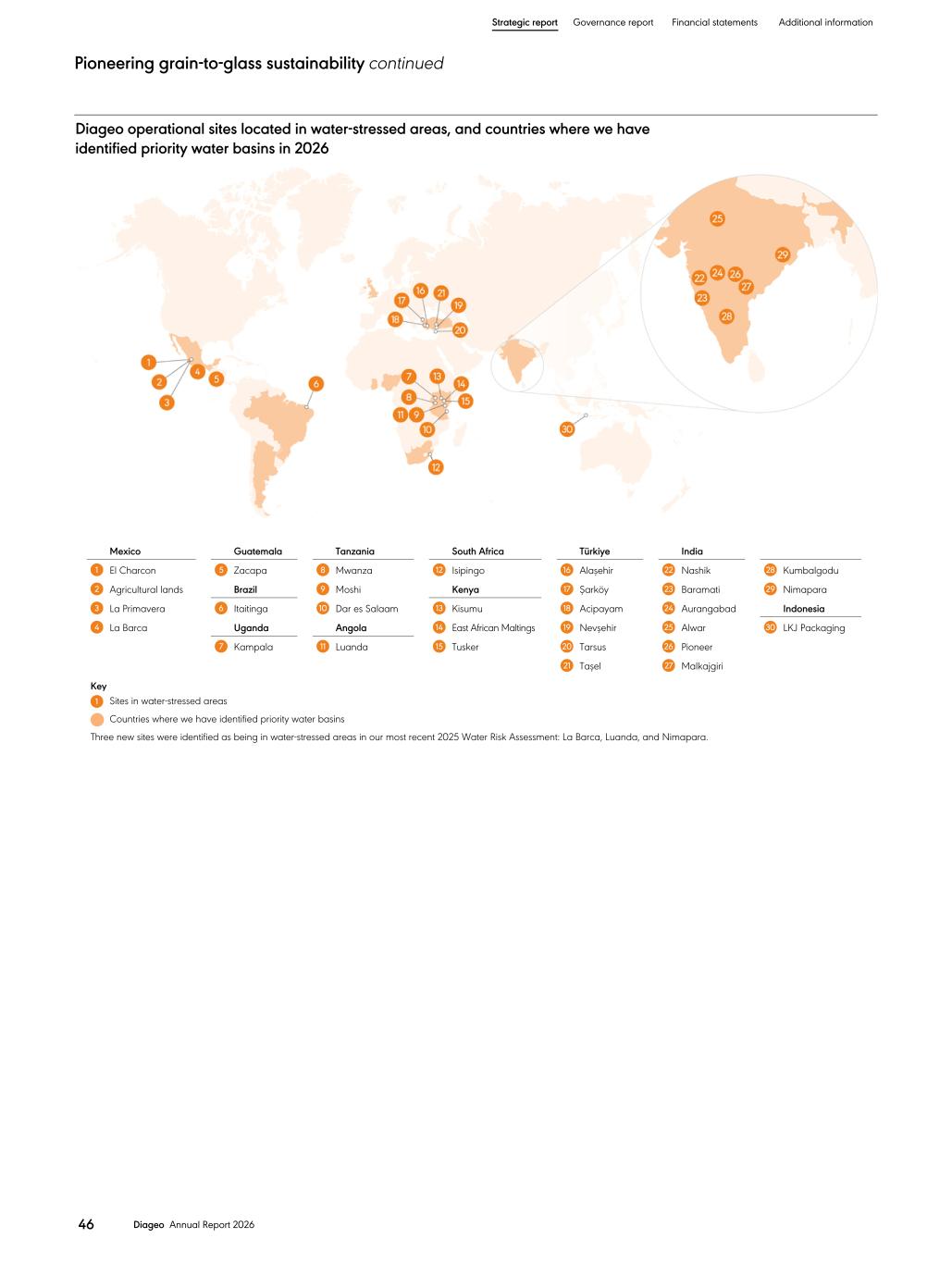
Strategic report Governance report Financial statements Additional information Pioneering grain-to-glass sustainability continued 46 Diageo Annual Report 2026 Mexico El Charcon Agricultural lands La Primavera La Barca Guatemala Zacapa Brazil Itaitinga Uganda Kampala Tanzania Mwanza Moshi Dar es Salaam Angola Luanda South Africa Isipingo Kenya Kisumu East African Maltings Tusker Kumbalgodu Nimapara Indonesia LKJ Packaging Diageo operational sites located in water-stressed areas, and countries where we have identified priority water basins in 2026 Key Sites in water-stressed areas Countries where we have identified priority water basins Three new sites were identified as being in water-stressed areas in our most recent 2025 Water Risk Assessment: La Barca, Luanda, and Nimapara. Türkiye Alaşehir Şarköy Acipayam Nevşehir Tarsus Taşel India Nashik Baramati Aurangabad Alwar Pioneer Malkajgiri
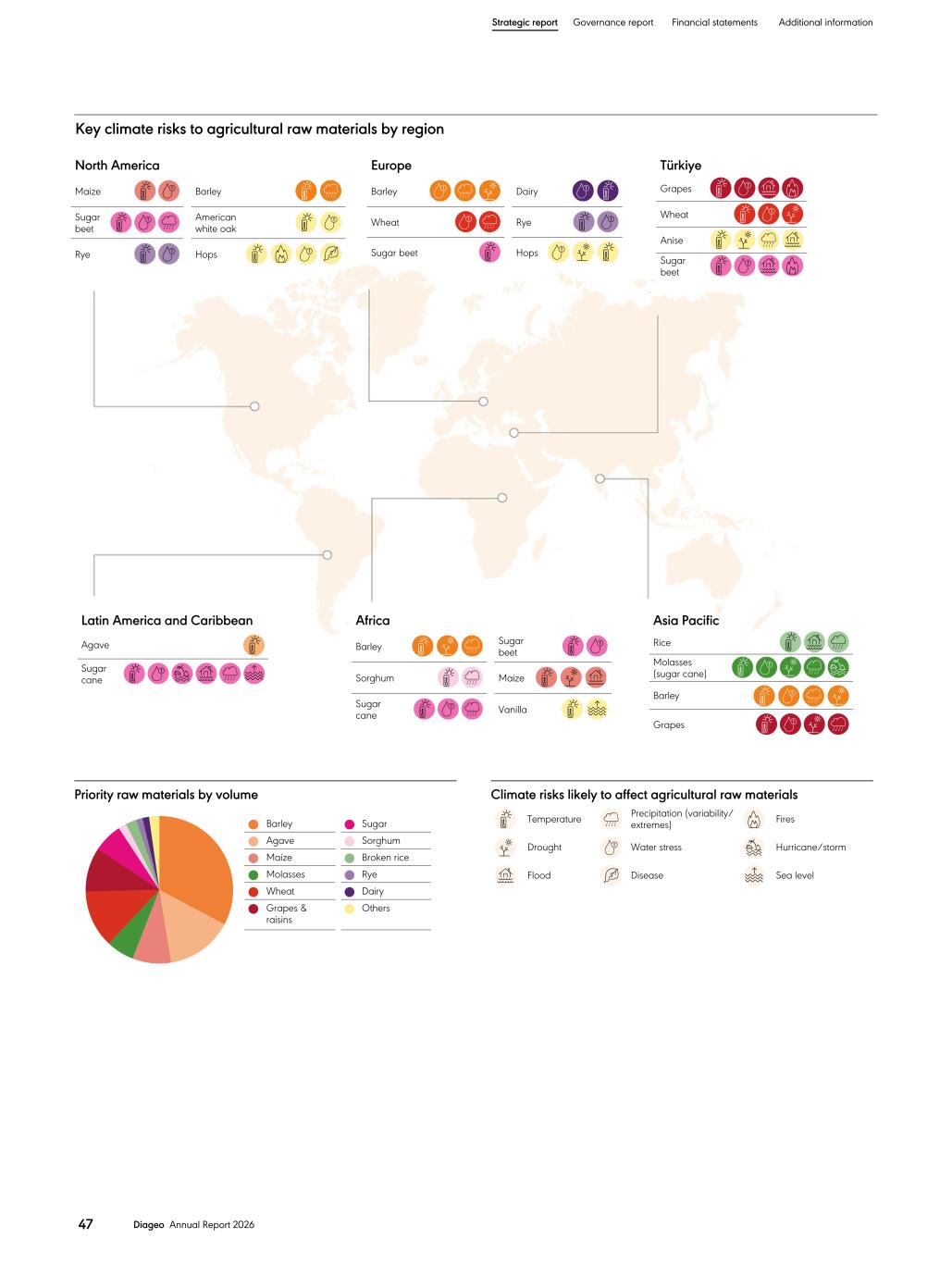
Priority raw materials by volume ò Barley ò Sugar ò Agave ò Sorghum ò Maize ò Broken rice ò Molasses ò Rye ò Wheat ò Dairy ò Grapes & raisins ò Others Climate risks likely to affect agricultural raw materials Temperature Precipitation (variability/ extremes) Fires Drought Water stress Hurricane/storm Flood Disease Sea level Strategic report Governance report Financial statements Additional information 47 Diageo Annual Report 2026 Türkiye Grapes Wheat Anise Sugar beet Asia Pacific Rice Molasses (sugar cane) Barley Grapes North America Maize Barley Sugar beet American white oak Rye Hops Europe Barley Dairy Wheat Rye Sugar beet Hops Latin America and Caribbean Agave Sugar cane Africa Barley Sugar beet Sorghum Maize Sugar cane Vanilla Key climate risks to agricultural raw materials by region
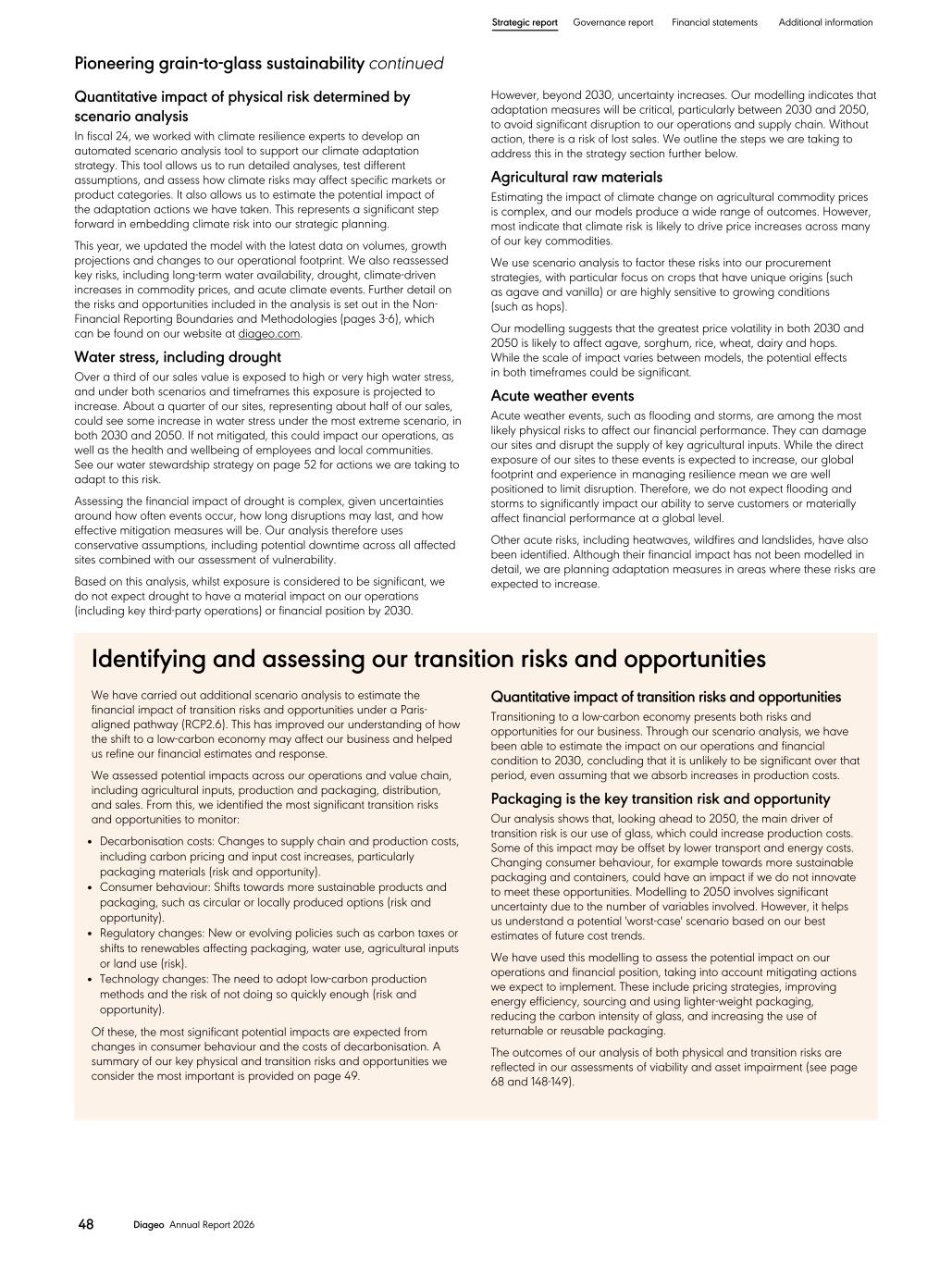
Quantitative impact of physical risk determined by scenario analysis In fiscal 24, we worked with climate resilience experts to develop an automated scenario analysis tool to support our climate adaptation strategy. This tool allows us to run detailed analyses, test different assumptions, and assess how climate risks may affect specific markets or product categories. It also allows us to estimate the potential impact of the adaptation actions we have taken. This represents a significant step forward in embedding climate risk into our strategic planning. This year, we updated the model with the latest data on volumes, growth projections and changes to our operational footprint. We also reassessed key risks, including long-term water availability, drought, climate-driven increases in commodity prices, and acute climate events. Further detail on the risks and opportunities included in the analysis is set out in the Non- Financial Reporting Boundaries and Methodologies (pages 3-6), which can be found on our website at diageo.com. Water stress, including drought Over a third of our sales value is exposed to high or very high water stress, and under both scenarios and timeframes this exposure is projected to increase. About a quarter of our sites, representing about half of our sales, could see some increase in water stress under the most extreme scenario, in both 2030 and 2050. If not mitigated, this could impact our operations, as well as the health and wellbeing of employees and local communities. See our water stewardship strategy on page 52 for actions we are taking to adapt to this risk. Assessing the financial impact of drought is complex, given uncertainties around how often events occur, how long disruptions may last, and how effective mitigation measures will be. Our analysis therefore uses conservative assumptions, including potential downtime across all affected sites combined with our assessment of vulnerability. Based on this analysis, whilst exposure is considered to be significant, we do not expect drought to have a material impact on our operations (including key third-party operations) or financial position by 2030. However, beyond 2030, uncertainty increases. Our modelling indicates that adaptation measures will be critical, particularly between 2030 and 2050, to avoid significant disruption to our operations and supply chain. Without action, there is a risk of lost sales. We outline the steps we are taking to address this in the strategy section further below. Agricultural raw materials Estimating the impact of climate change on agricultural commodity prices is complex, and our models produce a wide range of outcomes. However, most indicate that climate risk is likely to drive price increases across many of our key commodities. We use scenario analysis to factor these risks into our procurement strategies, with particular focus on crops that have unique origins (such as agave and vanilla) or are highly sensitive to growing conditions (such as hops). Our modelling suggests that the greatest price volatility in both 2030 and 2050 is likely to affect agave, sorghum, rice, wheat, dairy and hops. While the scale of impact varies between models, the potential effects in both timeframes could be significant. Acute weather events Acute weather events, such as flooding and storms, are among the most likely physical risks to affect our financial performance. They can damage our sites and disrupt the supply of key agricultural inputs. While the direct exposure of our sites to these events is expected to increase, our global footprint and experience in managing resilience mean we are well positioned to limit disruption. Therefore, we do not expect flooding and storms to significantly impact our ability to serve customers or materially affect financial performance at a global level. Other acute risks, including heatwaves, wildfires and landslides, have also been identified. Although their financial impact has not been modelled in detail, we are planning adaptation measures in areas where these risks are expected to increase. Identifying and assessing our transition risks and opportunities We have carried out additional scenario analysis to estimate the financial impact of transition risks and opportunities under a Paris- aligned pathway (RCP2.6). This has improved our understanding of how the shift to a low-carbon economy may affect our business and helped us refine our financial estimates and response. We assessed potential impacts across our operations and value chain, including agricultural inputs, production and packaging, distribution, and sales. From this, we identified the most significant transition risks and opportunities to monitor: • Decarbonisation costs: Changes to supply chain and production costs, including carbon pricing and input cost increases, particularly packaging materials (risk and opportunity). • Consumer behaviour: Shifts towards more sustainable products and packaging, such as circular or locally produced options (risk and opportunity). • Regulatory changes: New or evolving policies such as carbon taxes or shifts to renewables affecting packaging, water use, agricultural inputs or land use (risk). • Technology changes: The need to adopt low-carbon production methods and the risk of not doing so quickly enough (risk and opportunity). Of these, the most significant potential impacts are expected from changes in consumer behaviour and the costs of decarbonisation. A summary of our key physical and transition risks and opportunities we consider the most important is provided on page 49. Quantitative impact of transition risks and opportunities Transitioning to a low-carbon economy presents both risks and opportunities for our business. Through our scenario analysis, we have been able to estimate the impact on our operations and financial condition to 2030, concluding that it is unlikely to be significant over that period, even assuming that we absorb increases in production costs. Packaging is the key transition risk and opportunity Our analysis shows that, looking ahead to 2050, the main driver of transition risk is our use of glass, which could increase production costs. Some of this impact may be offset by lower transport and energy costs. Changing consumer behaviour, for example towards more sustainable packaging and containers, could have an impact if we do not innovate to meet these opportunities. Modelling to 2050 involves significant uncertainty due to the number of variables involved. However, it helps us understand a potential 'worst-case' scenario based on our best estimates of future cost trends. We have used this modelling to assess the potential impact on our operations and financial position, taking into account mitigating actions we expect to implement. These include pricing strategies, improving energy efficiency, sourcing and using lighter-weight packaging, reducing the carbon intensity of glass, and increasing the use of returnable or reusable packaging. The outcomes of our analysis of both physical and transition risks are reflected in our assessments of viability and asset impairment (see page 68 and 148-149). Strategic report Governance report Financial statements Additional information Pioneering grain-to-glass sustainability continued 48 Diageo Annual Report 2026
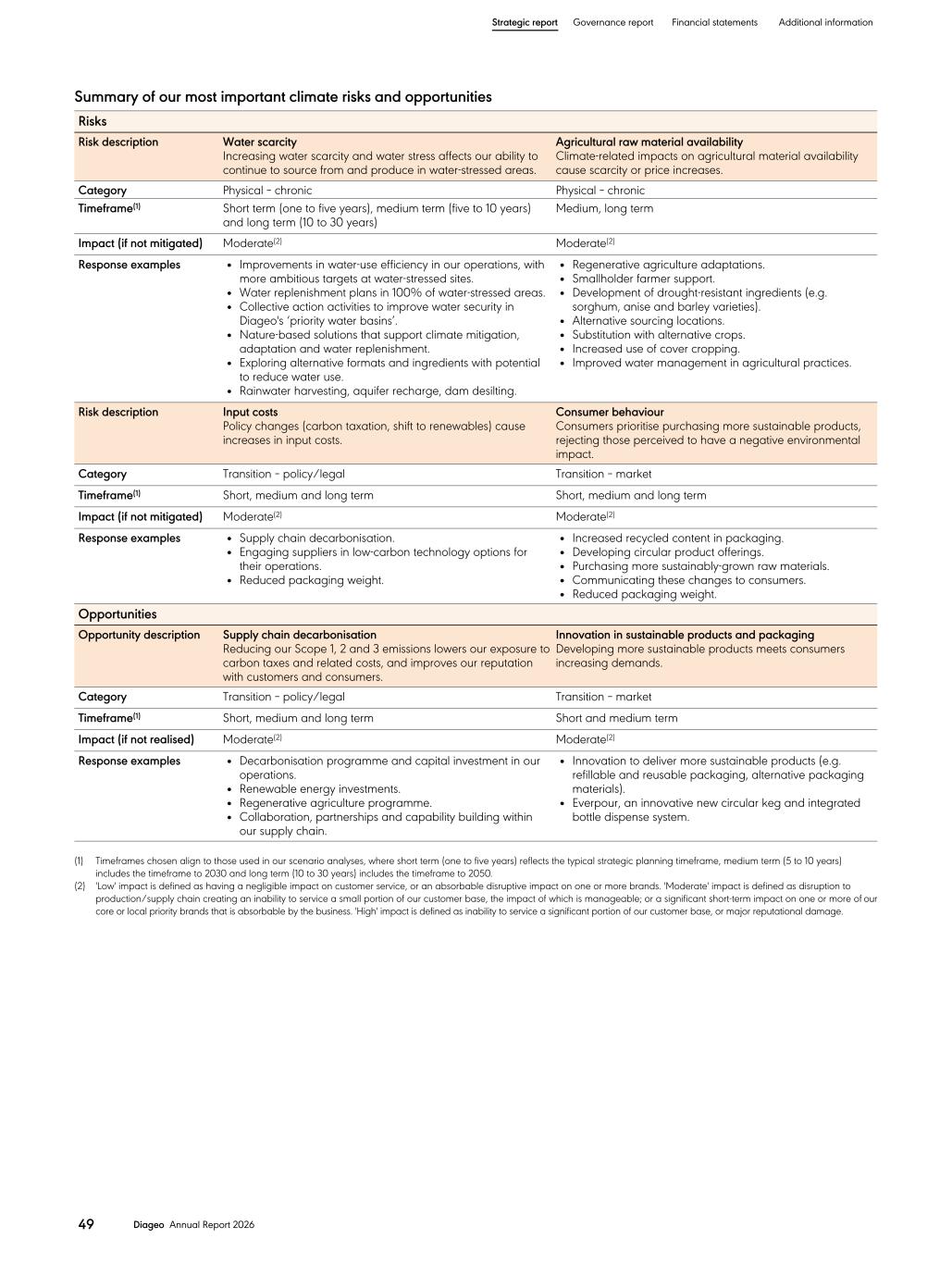
Summary of our most important climate risks and opportunities Risk description Water scarcity Increasing water scarcity and water stress affects our ability to continue to source from and produce in water‑stressed areas. Agricultural raw material availability Climate-related impacts on agricultural material availability cause scarcity or price increases. Category Physical – chronic Physical – chronic Timeframe(1) Short term (one to five years), medium term (five to 10 years) and long term (10 to 30 years) Medium, long term Impact (if not mitigated) Moderate(2) Moderate(2) Response examples • Improvements in water-use efficiency in our operations, with more ambitious targets at water-stressed sites. • Water replenishment plans in 100% of water-stressed areas. • Collective action activities to improve water security in Diageo's ‘priority water basins’. • Nature-based solutions that support climate mitigation, adaptation and water replenishment. • Exploring alternative formats and ingredients with potential to reduce water use. • Rainwater harvesting, aquifer recharge, dam desilting. • Regenerative agriculture adaptations. • Smallholder farmer support. • Development of drought-resistant ingredients (e.g. sorghum, anise and barley varieties). • Alternative sourcing locations. • Substitution with alternative crops. • Increased use of cover cropping. • Improved water management in agricultural practices. Risk description Input costs Policy changes (carbon taxation, shift to renewables) cause increases in input costs. Consumer behaviour Consumers prioritise purchasing more sustainable products, rejecting those perceived to have a negative environmental impact. Category Transition – policy/legal Transition – market Timeframe(1) Short, medium and long term Short, medium and long term Impact (if not mitigated) Moderate(2) Moderate(2) Response examples • Supply chain decarbonisation. • Engaging suppliers in low-carbon technology options for their operations. • Reduced packaging weight. • Increased recycled content in packaging. • Developing circular product offerings. • Purchasing more sustainably-grown raw materials. • Communicating these changes to consumers. • Reduced packaging weight. Opportunities Opportunity description Supply chain decarbonisation Reducing our Scope 1, 2 and 3 emissions lowers our exposure to carbon taxes and related costs, and improves our reputation with customers and consumers. Innovation in sustainable products and packaging Developing more sustainable products meets consumers increasing demands. Category Transition – policy/legal Transition – market Timeframe(1) Short, medium and long term Short and medium term Impact (if not realised) Moderate(2) Moderate(2) Response examples • Decarbonisation programme and capital investment in our operations. • Renewable energy investments. • Regenerative agriculture programme. • Collaboration, partnerships and capability building within our supply chain. • Innovation to deliver more sustainable products (e.g. refillable and reusable packaging, alternative packaging materials). • Everpour, an innovative new circular keg and integrated bottle dispense system. Risks (1) Timeframes chosen align to those used in our scenario analyses, where short term (one to five years) reflects the typical strategic planning timeframe, medium term (5 to 10 years) includes the timeframe to 2030 and long term (10 to 30 years) includes the timeframe to 2050. (2) 'Low' impact is defined as having a negligible impact on customer service, or an absorbable disruptive impact on one or more brands. 'Moderate' impact is defined as disruption to production/supply chain creating an inability to service a small portion of our customer base, the impact of which is manageable; or a significant short-term impact on one or more of our core or local priority brands that is absorbable by the business. 'High' impact is defined as inability to service a significant portion of our customer base, or major reputational damage. Strategic report Governance report Financial statements Additional information 49 Diageo Annual Report 2026
Integrating nature risk into our climate risk strategy Building on the nature baseline conducted in fiscal 24, which encompassed our agricultural upstream supply chains, our direct operations and selected packaging supply chains, we continued in fiscal 26 to strengthen our understanding of nature-related dependencies, impacts, risks and opportunities (DIRO) informed by the recommendations of the Taskforce on Nature-related Financial Disclosures (TNFD). We further assessed material pressures and the geographic areas where these could have the greatest impacts across land, water, biodiversity and ecosystem services. This culminated in the completion of a TNFD-aligned DIRO assessment using the TNFD LEAP (Locate, Evaluate, Assess and Prepare) framework. Results of our nature dependencies, impacts, risks and opportunities assessment This assessment confirmed that our business is highly dependent on nature for water- and soil-related ecosystem services which support crop growth and our operations, as well as risk mitigation ecosystem services that help protect our value chain from emerging climate-related risks like floods, storms, droughts and pests. Our agricultural raw materials have the highest dependency on nature and ecosystem services and face a range of risks as a result of widespread nature decline and biodiversity loss. We have identified risks relating to worsening water stress and declines in soil condition, more intensive land use and loss of landscape complexity which can reduce the resilience of the landscapes we rely on and worsen exposure to natural hazards and pests. These have the potential to impact some of our key crops including agave, broken rice and wheat. We are making continuous progress in understanding our nature-related DIROs, while integrating these insights into our broader approach to manage our most material ESG risks. Our integrated approach aims to recognise the ways in which taking holistic action on climate change, water stewardship and regenerative agriculture can build resilience to the nature risks we face. Our strategy for grain-to-glass sustainability Our sustainability strategy recognises the wide-ranging environmental and social impacts of climate change, as well as our reliance on natural resources and people. It reflects the close links between climate, nature, water, agriculture and communities across our value chain. The strategy focuses on our most material impacts, risks and opportunities, in particular water availability, quality and accessibility, agricultural raw material availability and greenhouse gas emissions, and is supported by clear targets. It is regularly reviewed to reflect evolving regulations and improved understanding of complex, system-wide challenges such as decarbonisation and water stewardship. By delivering and regularly reviewing our commitments, we aim to strengthen business resilience and protect our licence to operate and grow. Our greenhouse gas and water roadmaps set out the actions required to meet our Spirit of Progress targets. These plans are supported by capital investment and are regularly reviewed. More extensive and greater quality digital data is helping us better track progress and refine our approach over time. We continue to invest in the delivery of our water stewardship and carbon emissions reduction ambitions. We continue to focus on higher impact and return projects. To date, we have invested more than $400 million in projects including, for example, water replenishment and water efficiency projects in Mexico, biomass energy in Mexico and East Africa, and conversion of some Scotch distilleries to renewable energy. This reflects our disciplined approach to capital allocation and the practical dependencies associated with delivery, including infrastructure availability, regulation, technology readiness and partner capability. We remain committed to funding high-impact projects and working with partners to accelerate progress where scalable and value-accretive opportunities are available. This year we published our Climate Transition Plan which outlines in more detail how we are mitigating our carbon emissions and building adaptation to climate change impacts. Strategic report Governance report Financial statements Additional information Pioneering grain-to-glass sustainability continued 50 Diageo Annual Report 2026
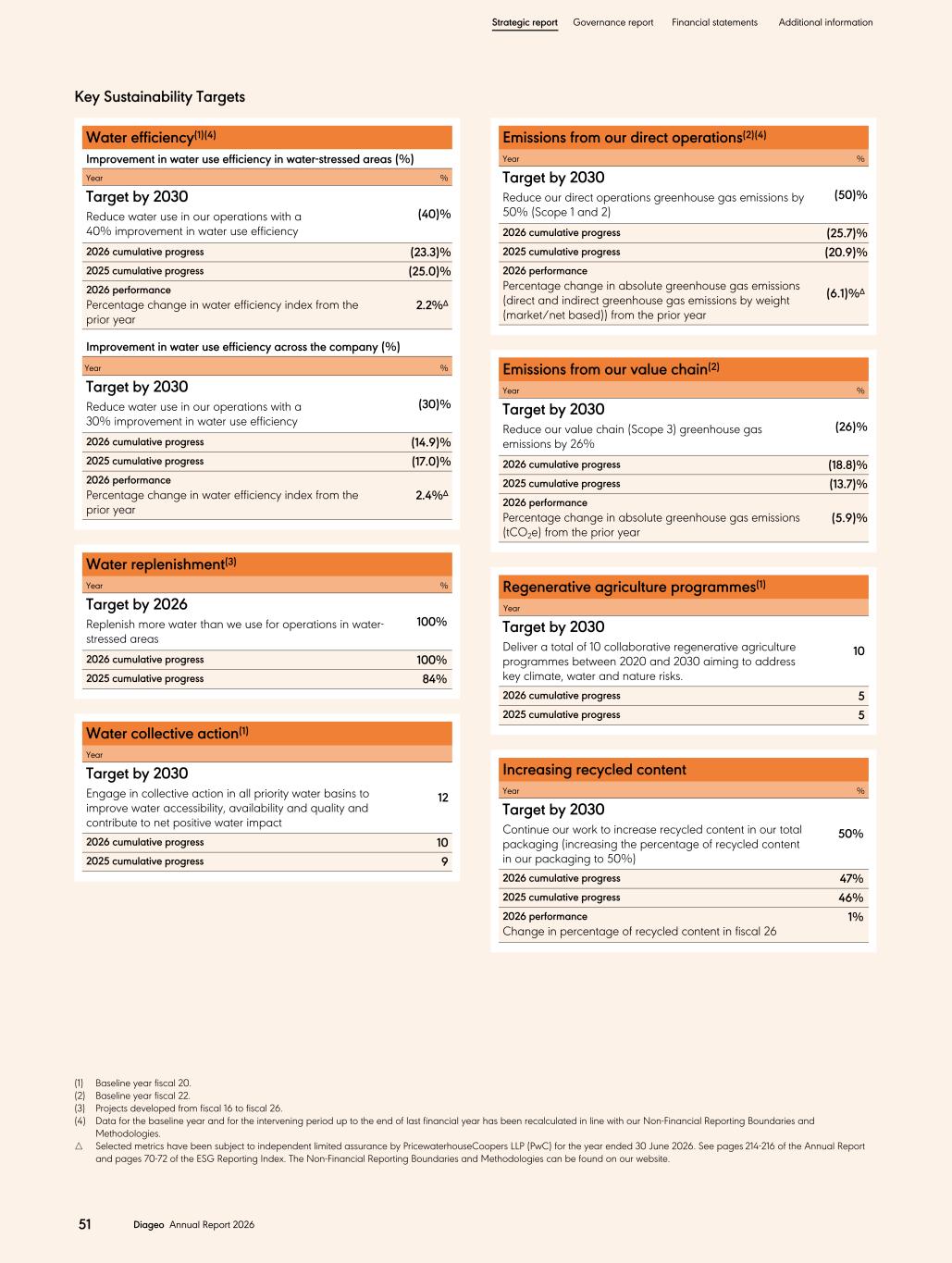
Key Sustainability Targets Water efficiency(1)(4) Improvement in water use efficiency in water-stressed areas (%) Year % Target by 2030 Reduce water use in our operations with a 40% improvement in water use efficiency (40)% 2026 cumulative progress (23.3) % 2025 cumulative progress (25.0) % 2026 performance Percentage change in water efficiency index from the prior year 2.2%Δ Improvement in water use efficiency across the company (%) Year % Target by 2030 Reduce water use in our operations with a 30% improvement in water use efficiency (30)% 2026 cumulative progress (14.9) % 2025 cumulative progress (17.0) % 2026 performance Percentage change in water efficiency index from the prior year 2.4%Δ Water replenishment(3) Year % Target by 2026 Replenish more water than we use for operations in water- stressed areas 100% 2026 cumulative progress 100% 2025 cumulative progress 84% Water collective action(1) Year Target by 2030 Engage in collective action in all priority water basins to improve water accessibility, availability and quality and contribute to net positive water impact 12 2026 cumulative progress 10 2025 cumulative progress 9 Emissions from our direct operations(2)(4) Year % Target by 2030 Reduce our direct operations greenhouse gas emissions by 50% (Scope 1 and 2) (50)% 2026 cumulative progress (25.7) % 2025 cumulative progress (20.9) % 2026 performance Percentage change in absolute greenhouse gas emissions (direct and indirect greenhouse gas emissions by weight (market/net based)) from the prior year (6.1)%Δ Emissions from our value chain(2) Year % Target by 2030 Reduce our value chain (Scope 3) greenhouse gas emissions by 26% (26)% 2026 cumulative progress (18.8) % 2025 cumulative progress (13.7) % 2026 performance Percentage change in absolute greenhouse gas emissions (tCO2e) from the prior year (5.9) % Regenerative agriculture programmes(1) Year Target by 2030 Deliver a total of 10 collaborative regenerative agriculture programmes between 2020 and 2030 aiming to address key climate, water and nature risks. 10 2026 cumulative progress 5 2025 cumulative progress 5 Increasing recycled content Year % Target by 2030 Continue our work to increase recycled content in our total packaging (increasing the percentage of recycled content in our packaging to 50%) 50% 2026 cumulative progress 47% 2025 cumulative progress 46% 2026 performance Change in percentage of recycled content in fiscal 26 1% (1) Baseline year fiscal 20. (2) Baseline year fiscal 22. (3) Projects developed from fiscal 16 to fiscal 26. (4) Data for the baseline year and for the intervening period up to the end of last financial year has been recalculated in line with our Non-Financial Reporting Boundaries and Methodologies. △ Selected metrics have been subject to independent limited assurance by PricewaterhouseCoopers LLP (PwC) for the year ended 30 June 2026. See pages 214-216 of the Annual Report and pages 70-72 of the ESG Reporting Index. The Non-Financial Reporting Boundaries and Methodologies can be found on our website. Strategic report Governance report Financial statements Additional information 51 Diageo Annual Report 2026
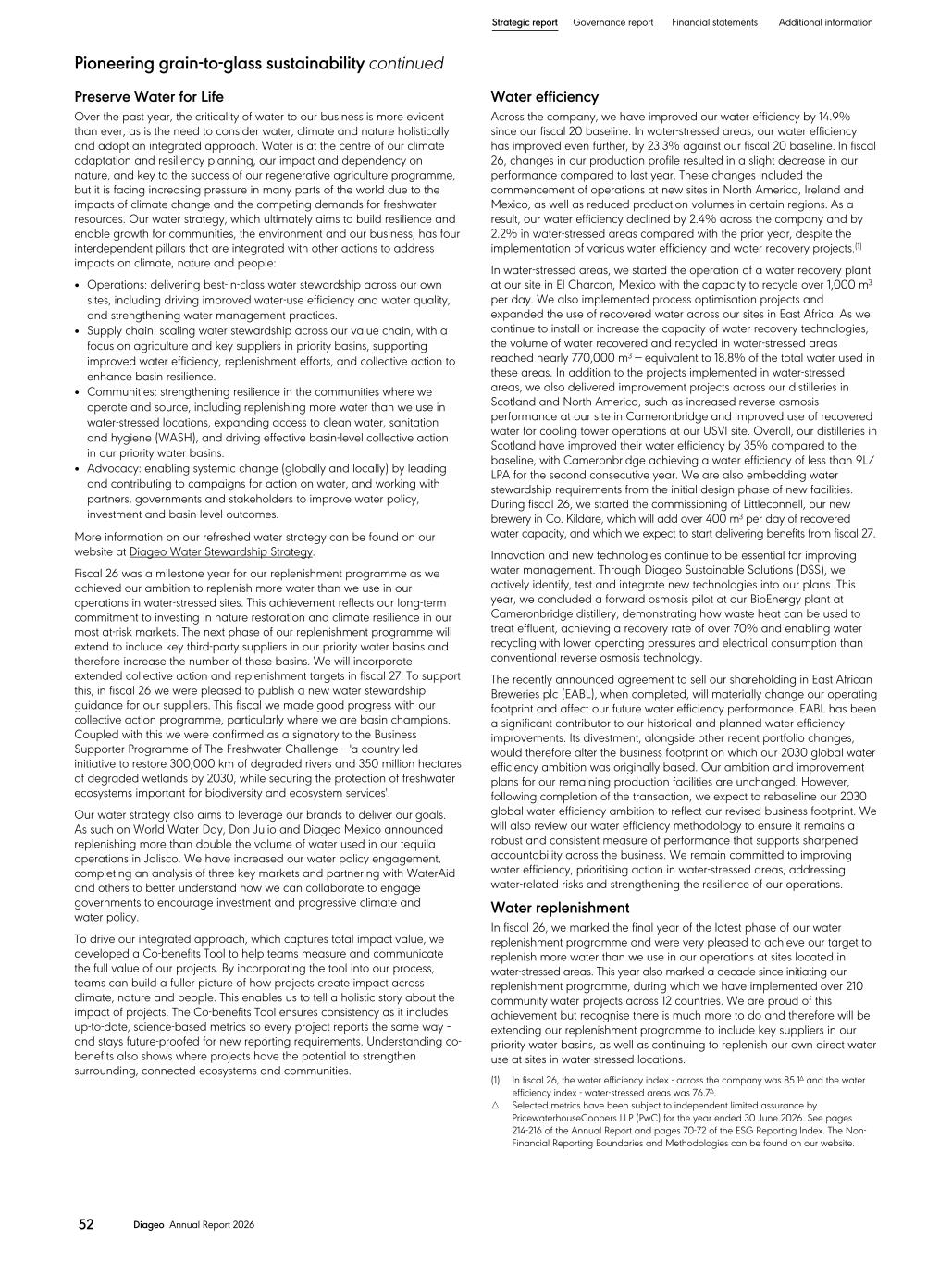
Preserve Water for Life Over the past year, the criticality of water to our business is more evident than ever, as is the need to consider water, climate and nature holistically and adopt an integrated approach. Water is at the centre of our climate adaptation and resiliency planning, our impact and dependency on nature, and key to the success of our regenerative agriculture programme, but it is facing increasing pressure in many parts of the world due to the impacts of climate change and the competing demands for freshwater resources. Our water strategy, which ultimately aims to build resilience and enable growth for communities, the environment and our business, has four interdependent pillars that are integrated with other actions to address impacts on climate, nature and people: • Operations: delivering best-in-class water stewardship across our own sites, including driving improved water-use efficiency and water quality, and strengthening water management practices. • Supply chain: scaling water stewardship across our value chain, with a focus on agriculture and key suppliers in priority basins, supporting improved water efficiency, replenishment efforts, and collective action to enhance basin resilience. • Communities: strengthening resilience in the communities where we operate and source, including replenishing more water than we use in water-stressed locations, expanding access to clean water, sanitation and hygiene (WASH), and driving effective basin-level collective action in our priority water basins. • Advocacy: enabling systemic change (globally and locally) by leading and contributing to campaigns for action on water, and working with partners, governments and stakeholders to improve water policy, investment and basin-level outcomes. More information on our refreshed water strategy can be found on our website at Diageo Water Stewardship Strategy. Fiscal 26 was a milestone year for our replenishment programme as we achieved our ambition to replenish more water than we use in our operations in water-stressed sites. This achievement reflects our long-term commitment to investing in nature restoration and climate resilience in our most at-risk markets. The next phase of our replenishment programme will extend to include key third-party suppliers in our priority water basins and therefore increase the number of these basins. We will incorporate extended collective action and replenishment targets in fiscal 27. To support this, in fiscal 26 we were pleased to publish a new water stewardship guidance for our suppliers. This fiscal we made good progress with our collective action programme, particularly where we are basin champions. Coupled with this we were confirmed as a signatory to the Business Supporter Programme of The Freshwater Challenge – 'a country-led initiative to restore 300,000 km of degraded rivers and 350 million hectares of degraded wetlands by 2030, while securing the protection of freshwater ecosystems important for biodiversity and ecosystem services'. Our water strategy also aims to leverage our brands to deliver our goals. As such on World Water Day, Don Julio and Diageo Mexico announced replenishing more than double the volume of water used in our tequila operations in Jalisco. We have increased our water policy engagement, completing an analysis of three key markets and partnering with WaterAid and others to better understand how we can collaborate to engage governments to encourage investment and progressive climate and water policy. To drive our integrated approach, which captures total impact value, we developed a Co-benefits Tool to help teams measure and communicate the full value of our projects. By incorporating the tool into our process, teams can build a fuller picture of how projects create impact across climate, nature and people. This enables us to tell a holistic story about the impact of projects. The Co-benefits Tool ensures consistency as it includes up-to-date, science-based metrics so every project reports the same way – and stays future-proofed for new reporting requirements. Understanding co- benefits also shows where projects have the potential to strengthen surrounding, connected ecosystems and communities. Water efficiency Across the company, we have improved our water efficiency by 14.9% since our fiscal 20 baseline. In water-stressed areas, our water efficiency has improved even further, by 23.3% against our fiscal 20 baseline. In fiscal 26, changes in our production profile resulted in a slight decrease in our performance compared to last year. These changes included the commencement of operations at new sites in North America, Ireland and Mexico, as well as reduced production volumes in certain regions. As a result, our water efficiency declined by 2.4% across the company and by 2.2% in water-stressed areas compared with the prior year, despite the implementation of various water efficiency and water recovery projects.(1) In water-stressed areas, we started the operation of a water recovery plant at our site in El Charcon, Mexico with the capacity to recycle over 1,000 m3 per day. We also implemented process optimisation projects and expanded the use of recovered water across our sites in East Africa. As we continue to install or increase the capacity of water recovery technologies, the volume of water recovered and recycled in water-stressed areas reached nearly 770,000 m3 — equivalent to 18.8% of the total water used in these areas. In addition to the projects implemented in water-stressed areas, we also delivered improvement projects across our distilleries in Scotland and North America, such as increased reverse osmosis performance at our site in Cameronbridge and improved use of recovered water for cooling tower operations at our USVI site. Overall, our distilleries in Scotland have improved their water efficiency by 35% compared to the baseline, with Cameronbridge achieving a water efficiency of less than 9L/ LPA for the second consecutive year. We are also embedding water stewardship requirements from the initial design phase of new facilities. During fiscal 26, we started the commissioning of Littleconnell, our new brewery in Co. Kildare, which will add over 400 m3 per day of recovered water capacity, and which we expect to start delivering benefits from fiscal 27. Innovation and new technologies continue to be essential for improving water management. Through Diageo Sustainable Solutions (DSS), we actively identify, test and integrate new technologies into our plans. This year, we concluded a forward osmosis pilot at our BioEnergy plant at Cameronbridge distillery, demonstrating how waste heat can be used to treat effluent, achieving a recovery rate of over 70% and enabling water recycling with lower operating pressures and electrical consumption than conventional reverse osmosis technology. The recently announced agreement to sell our shareholding in East African Breweries plc (EABL), when completed, will materially change our operating footprint and affect our future water efficiency performance. EABL has been a significant contributor to our historical and planned water efficiency improvements. Its divestment, alongside other recent portfolio changes, would therefore alter the business footprint on which our 2030 global water efficiency ambition was originally based. Our ambition and improvement plans for our remaining production facilities are unchanged. However, following completion of the transaction, we expect to rebaseline our 2030 global water efficiency ambition to reflect our revised business footprint. We will also review our water efficiency methodology to ensure it remains a robust and consistent measure of performance that supports sharpened accountability across the business. We remain committed to improving water efficiency, prioritising action in water-stressed areas, addressing water-related risks and strengthening the resilience of our operations. Water replenishment In fiscal 26, we marked the final year of the latest phase of our water replenishment programme and were very pleased to achieve our target to replenish more water than we use in our operations at sites located in water-stressed areas. This year also marked a decade since initiating our replenishment programme, during which we have implemented over 210 community water projects across 12 countries. We are proud of this achievement but recognise there is much more to do and therefore will be extending our replenishment programme to include key suppliers in our priority water basins, as well as continuing to replenish our own direct water use at sites in water-stressed locations. (1) In fiscal 26, the water efficiency index - across the company was 85.1Δ and the water efficiency index - water-stressed areas was 76.7Δ. △ Selected metrics have been subject to independent limited assurance by PricewaterhouseCoopers LLP (PwC) for the year ended 30 June 2026. See pages 214-216 of the Annual Report and pages 70-72 of the ESG Reporting Index. The Non- Financial Reporting Boundaries and Methodologies can be found on our website. Strategic report Governance report Financial statements Additional information Pioneering grain-to-glass sustainability continued 52 Diageo Annual Report 2026
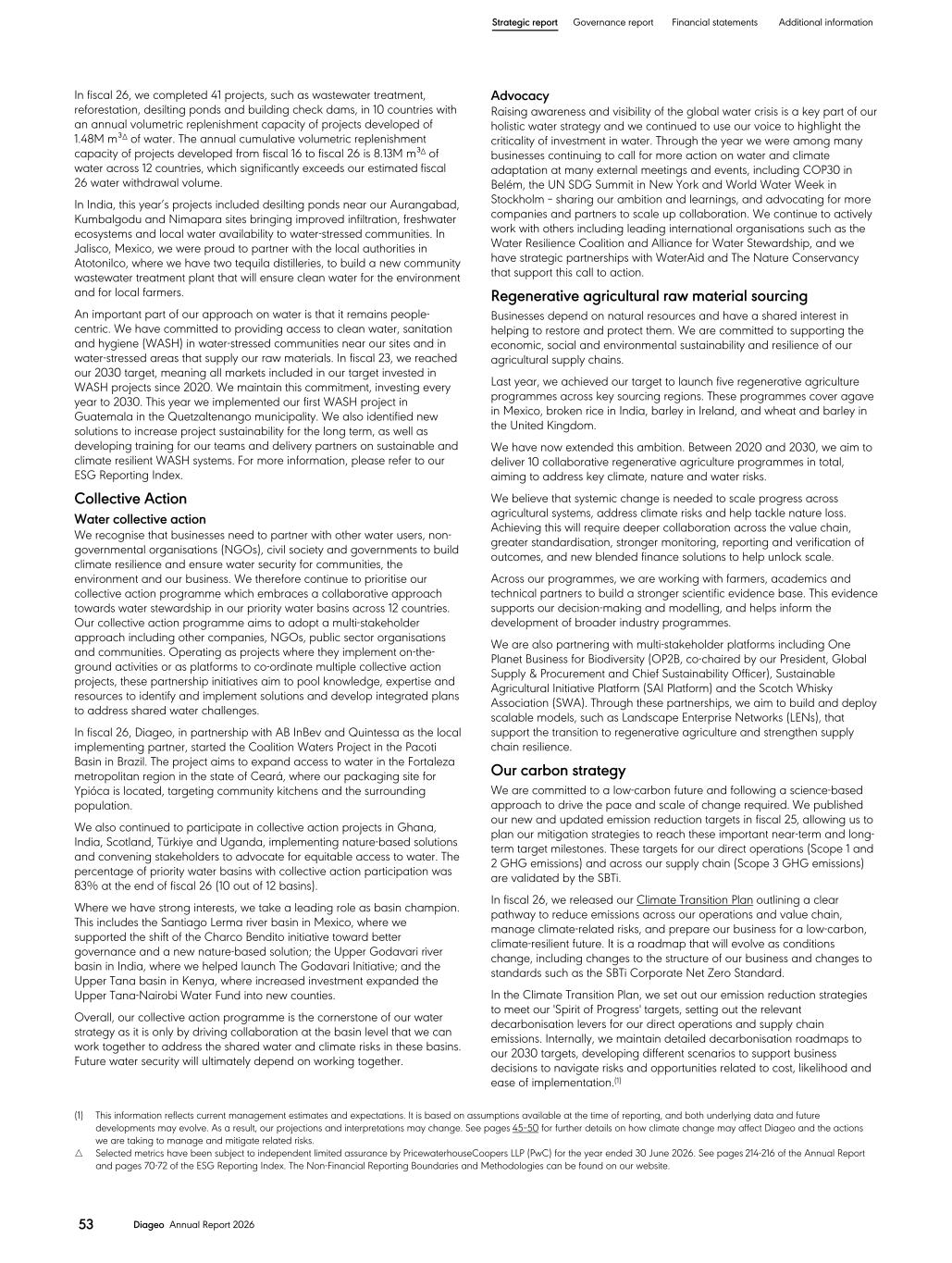
In fiscal 26, we completed 41 projects, such as wastewater treatment, reforestation, desilting ponds and building check dams, in 10 countries with an annual volumetric replenishment capacity of projects developed of 1.48M m³Δ of water. The annual cumulative volumetric replenishment capacity of projects developed from fiscal 16 to fiscal 26 is 8.13M m³Δ of water across 12 countries, which significantly exceeds our estimated fiscal 26 water withdrawal volume. In India, this year’s projects included desilting ponds near our Aurangabad, Kumbalgodu and Nimapara sites bringing improved infiltration, freshwater ecosystems and local water availability to water-stressed communities. In Jalisco, Mexico, we were proud to partner with the local authorities in Atotonilco, where we have two tequila distilleries, to build a new community wastewater treatment plant that will ensure clean water for the environment and for local farmers. An important part of our approach on water is that it remains people- centric. We have committed to providing access to clean water, sanitation and hygiene (WASH) in water-stressed communities near our sites and in water-stressed areas that supply our raw materials. In fiscal 23, we reached our 2030 target, meaning all markets included in our target invested in WASH projects since 2020. We maintain this commitment, investing every year to 2030. This year we implemented our first WASH project in Guatemala in the Quetzaltenango municipality. We also identified new solutions to increase project sustainability for the long term, as well as developing training for our teams and delivery partners on sustainable and climate resilient WASH systems. For more information, please refer to our ESG Reporting Index. Collective Action Water collective action We recognise that businesses need to partner with other water users, non- governmental organisations (NGOs), civil society and governments to build climate resilience and ensure water security for communities, the environment and our business. We therefore continue to prioritise our collective action programme which embraces a collaborative approach towards water stewardship in our priority water basins across 12 countries. Our collective action programme aims to adopt a multi-stakeholder approach including other companies, NGOs, public sector organisations and communities. Operating as projects where they implement on-the- ground activities or as platforms to co-ordinate multiple collective action projects, these partnership initiatives aim to pool knowledge, expertise and resources to identify and implement solutions and develop integrated plans to address shared water challenges. In fiscal 26, Diageo, in partnership with AB InBev and Quintessa as the local implementing partner, started the Coalition Waters Project in the Pacoti Basin in Brazil. The project aims to expand access to water in the Fortaleza metropolitan region in the state of Ceará, where our packaging site for Ypióca is located, targeting community kitchens and the surrounding population. We also continued to participate in collective action projects in Ghana, India, Scotland, Türkiye and Uganda, implementing nature-based solutions and convening stakeholders to advocate for equitable access to water. The percentage of priority water basins with collective action participation was 83% at the end of fiscal 26 (10 out of 12 basins). Where we have strong interests, we take a leading role as basin champion. This includes the Santiago Lerma river basin in Mexico, where we supported the shift of the Charco Bendito initiative toward better governance and a new nature-based solution; the Upper Godavari river basin in India, where we helped launch The Godavari Initiative; and the Upper Tana basin in Kenya, where increased investment expanded the Upper Tana-Nairobi Water Fund into new counties. Overall, our collective action programme is the cornerstone of our water strategy as it is only by driving collaboration at the basin level that we can work together to address the shared water and climate risks in these basins. Future water security will ultimately depend on working together. Advocacy Raising awareness and visibility of the global water crisis is a key part of our holistic water strategy and we continued to use our voice to highlight the criticality of investment in water. Through the year we were among many businesses continuing to call for more action on water and climate adaptation at many external meetings and events, including COP30 in Belém, the UN SDG Summit in New York and World Water Week in Stockholm – sharing our ambition and learnings, and advocating for more companies and partners to scale up collaboration. We continue to actively work with others including leading international organisations such as the Water Resilience Coalition and Alliance for Water Stewardship, and we have strategic partnerships with WaterAid and The Nature Conservancy that support this call to action. Regenerative agricultural raw material sourcing Businesses depend on natural resources and have a shared interest in helping to restore and protect them. We are committed to supporting the economic, social and environmental sustainability and resilience of our agricultural supply chains. Last year, we achieved our target to launch five regenerative agriculture programmes across key sourcing regions. These programmes cover agave in Mexico, broken rice in India, barley in Ireland, and wheat and barley in the United Kingdom. We have now extended this ambition. Between 2020 and 2030, we aim to deliver 10 collaborative regenerative agriculture programmes in total, aiming to address key climate, nature and water risks. We believe that systemic change is needed to scale progress across agricultural systems, address climate risks and help tackle nature loss. Achieving this will require deeper collaboration across the value chain, greater standardisation, stronger monitoring, reporting and verification of outcomes, and new blended finance solutions to help unlock scale. Across our programmes, we are working with farmers, academics and technical partners to build a stronger scientific evidence base. This evidence supports our decision-making and modelling, and helps inform the development of broader industry programmes. We are also partnering with multi-stakeholder platforms including One Planet Business for Biodiversity (OP2B, co-chaired by our President, Global Supply & Procurement and Chief Sustainability Officer), Sustainable Agricultural Initiative Platform (SAI Platform) and the Scotch Whisky Association (SWA). Through these partnerships, we aim to build and deploy scalable models, such as Landscape Enterprise Networks (LENs), that support the transition to regenerative agriculture and strengthen supply chain resilience. Our carbon strategy We are committed to a low-carbon future and following a science-based approach to drive the pace and scale of change required. We published our new and updated emission reduction targets in fiscal 25, allowing us to plan our mitigation strategies to reach these important near-term and long- term target milestones. These targets for our direct operations (Scope 1 and 2 GHG emissions) and across our supply chain (Scope 3 GHG emissions) are validated by the SBTi. In fiscal 26, we released our Climate Transition Plan outlining a clear pathway to reduce emissions across our operations and value chain, manage climate-related risks, and prepare our business for a low-carbon, climate-resilient future. It is a roadmap that will evolve as conditions change, including changes to the structure of our business and changes to standards such as the SBTi Corporate Net Zero Standard. In the Climate Transition Plan, we set out our emission reduction strategies to meet our 'Spirit of Progress' targets, setting out the relevant decarbonisation levers for our direct operations and supply chain emissions. Internally, we maintain detailed decarbonisation roadmaps to our 2030 targets, developing different scenarios to support business decisions to navigate risks and opportunities related to cost, likelihood and ease of implementation.(1) (1) This information reflects current management estimates and expectations. It is based on assumptions available at the time of reporting, and both underlying data and future developments may evolve. As a result, our projections and interpretations may change. See pages 45–50 for further details on how climate change may affect Diageo and the actions we are taking to manage and mitigate related risks. △ Selected metrics have been subject to independent limited assurance by PricewaterhouseCoopers LLP (PwC) for the year ended 30 June 2026. See pages 214-216 of the Annual Report and pages 70-72 of the ESG Reporting Index. The Non-Financial Reporting Boundaries and Methodologies can be found on our website. Strategic report Governance report Financial statements Additional information 53 Diageo Annual Report 2026
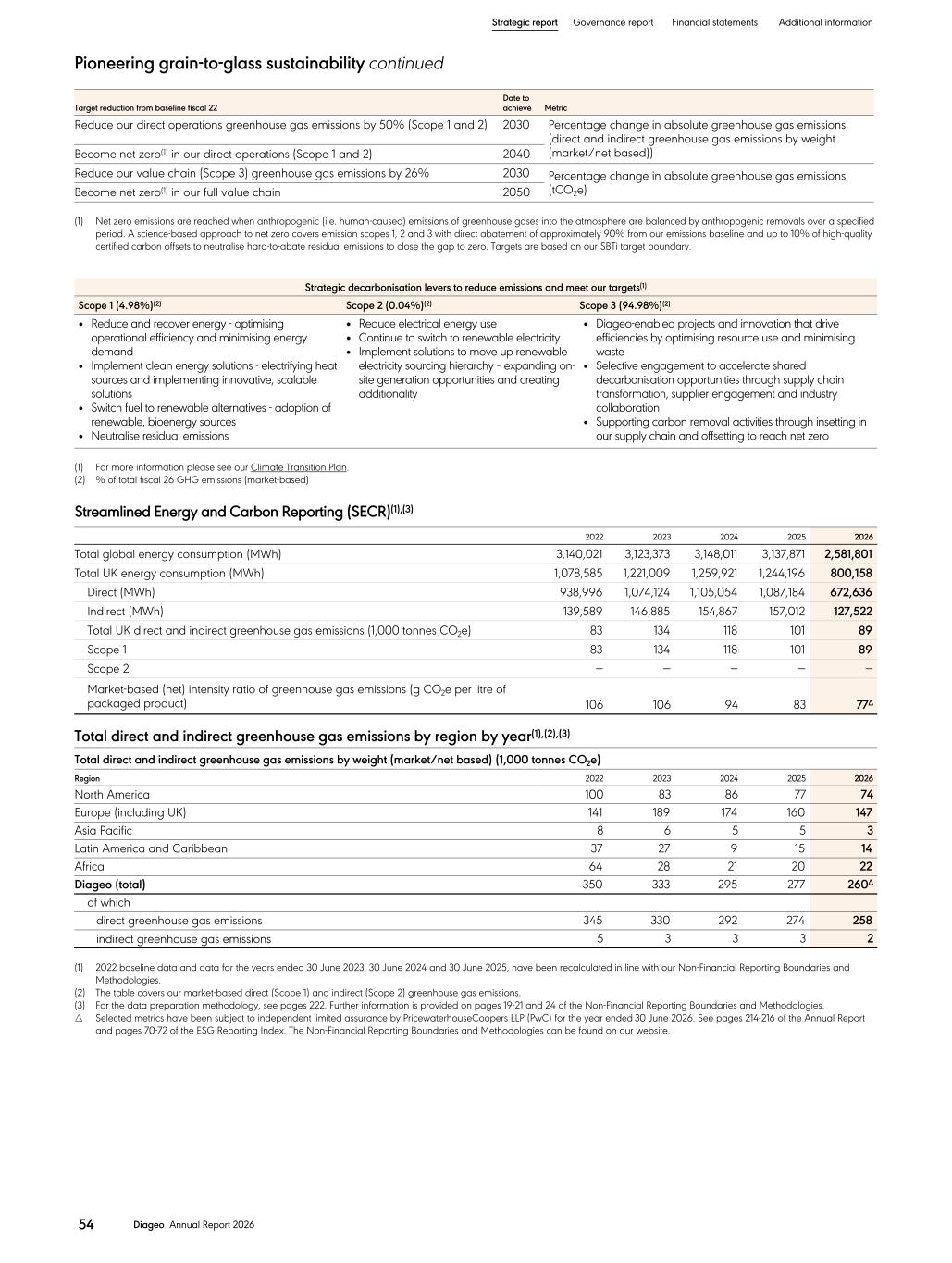
Reduce our direct operations greenhouse gas emissions by 50% (Scope 1 and 2) 2030 Percentage change in absolute greenhouse gas emissions (direct and indirect greenhouse gas emissions by weight (market/net based))Become net zero(1) in our direct operations (Scope 1 and 2) 2040 Reduce our value chain (Scope 3) greenhouse gas emissions by 26% 2030 Percentage change in absolute greenhouse gas emissions (tCO2e)Become net zero(1) in our full value chain 2050 Target reduction from baseline fiscal 22 Date to achieve Metric (1) Net zero emissions are reached when anthropogenic (i.e. human-caused) emissions of greenhouse gases into the atmosphere are balanced by anthropogenic removals over a specified period. A science-based approach to net zero covers emission scopes 1, 2 and 3 with direct abatement of approximately 90% from our emissions baseline and up to 10% of high-quality certified carbon offsets to neutralise hard-to-abate residual emissions to close the gap to zero. Targets are based on our SBTi target boundary. • Reduce and recover energy - optimising operational efficiency and minimising energy demand • Implement clean energy solutions - electrifying heat sources and implementing innovative, scalable solutions • Switch fuel to renewable alternatives - adoption of renewable, bioenergy sources • Neutralise residual emissions • Reduce electrical energy use • Continue to switch to renewable electricity • Implement solutions to move up renewable electricity sourcing hierarchy – expanding on- site generation opportunities and creating additionality • Diageo-enabled projects and innovation that drive efficiencies by optimising resource use and minimising waste • Selective engagement to accelerate shared decarbonisation opportunities through supply chain transformation, supplier engagement and industry collaboration • Supporting carbon removal activities through insetting in our supply chain and offsetting to reach net zero Strategic decarbonisation levers to reduce emissions and meet our targets(1) Scope 1 (4.98%)(2) Scope 2 (0.04%)(2) Scope 3 (94.98%)(2) (1) For more information please see our Climate Transition Plan. (2) % of total fiscal 26 GHG emissions (market-based) Total global energy consumption (MWh) 3,140,021 3,123,373 3,148,011 3,137,871 2,581,801 Total UK energy consumption (MWh) 1,078,585 1,221,009 1,259,921 1,244,196 800,158 Direct (MWh) 938,996 1,074,124 1,105,054 1,087,184 672,636 Indirect (MWh) 139,589 146,885 154,867 157,012 127,522 Total UK direct and indirect greenhouse gas emissions (1,000 tonnes CO2e) 83 134 118 101 89 Scope 1 83 134 118 101 89 Scope 2 — — — — — Market-based (net) intensity ratio of greenhouse gas emissions (g CO2e per litre of packaged product) 106 106 94 83 77Δ Streamlined Energy and Carbon Reporting (SECR)(1),(3) 2022 2023 2024 2025 2026 North America 100 83 86 77 74 Europe (including UK) 141 189 174 160 147 Asia Pacific 8 6 5 5 3 Latin America and Caribbean 37 27 9 15 14 Africa 64 28 21 20 22 Diageo (total) 350 333 295 277 260Δ of which direct greenhouse gas emissions 345 330 292 274 258 indirect greenhouse gas emissions 5 3 3 3 2 Total direct and indirect greenhouse gas emissions by region by year(1),(2),(3) Total direct and indirect greenhouse gas emissions by weight (market/net based) (1,000 tonnes CO2e) Region 2022 2023 2024 2025 2026 (1) 2022 baseline data and data for the years ended 30 June 2023, 30 June 2024 and 30 June 2025, have been recalculated in line with our Non-Financial Reporting Boundaries and Methodologies. (2) The table covers our market-based direct (Scope 1) and indirect (Scope 2) greenhouse gas emissions. (3) For the data preparation methodology, see pages 222. Further information is provided on pages 19-21 and 24 of the Non-Financial Reporting Boundaries and Methodologies. △ Selected metrics have been subject to independent limited assurance by PricewaterhouseCoopers LLP (PwC) for the year ended 30 June 2026. See pages 214-216 of the Annual Report and pages 70-72 of the ESG Reporting Index. The Non-Financial Reporting Boundaries and Methodologies can be found on our website. Strategic report Governance report Financial statements Additional information Pioneering grain-to-glass sustainability continued 54 Diageo Annual Report 2026
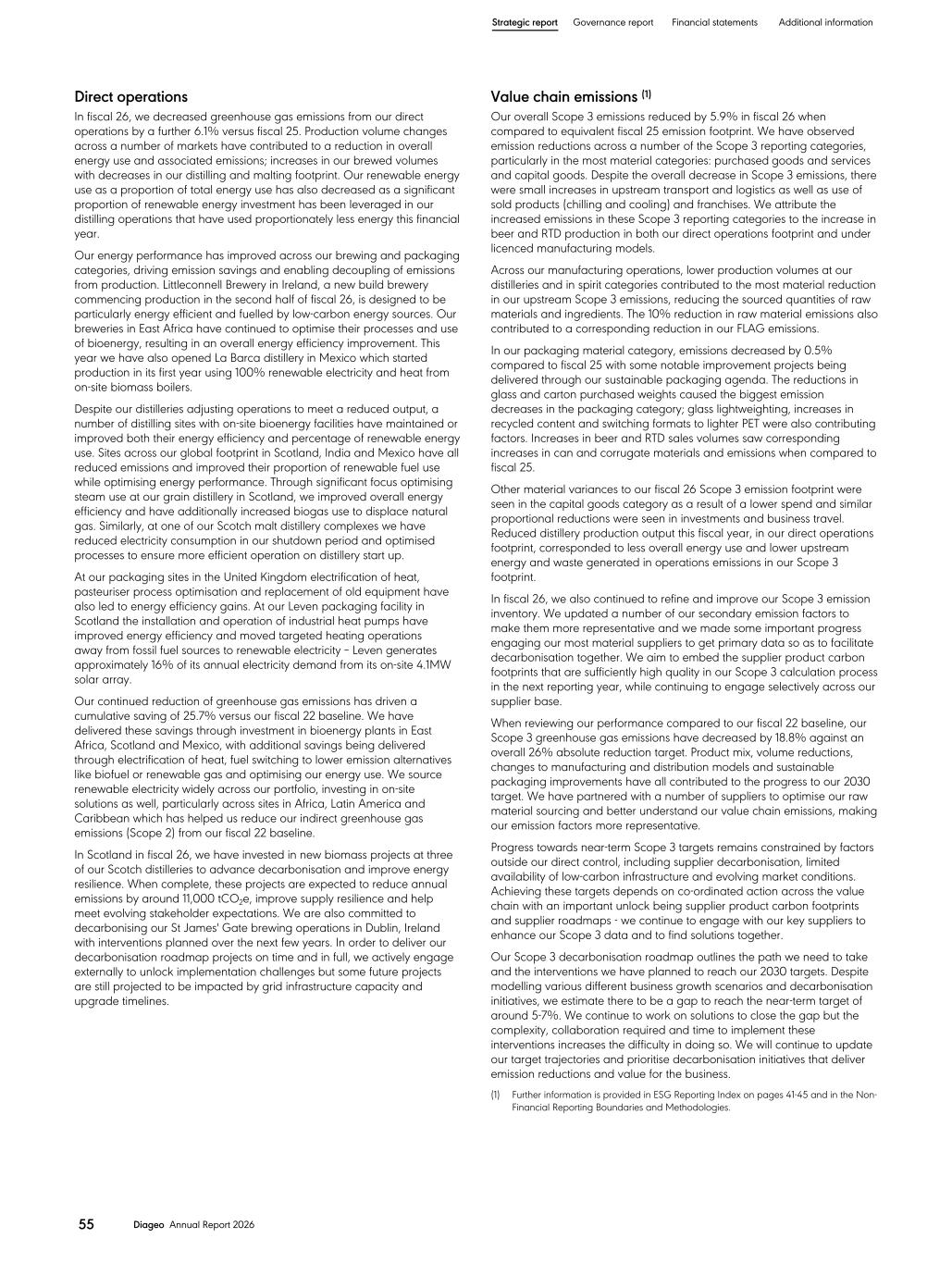
Direct operations In fiscal 26, we decreased greenhouse gas emissions from our direct operations by a further 6.1% versus fiscal 25. Production volume changes across a number of markets have contributed to a reduction in overall energy use and associated emissions; increases in our brewed volumes with decreases in our distilling and malting footprint. Our renewable energy use as a proportion of total energy use has also decreased as a significant proportion of renewable energy investment has been leveraged in our distilling operations that have used proportionately less energy this financial year. Our energy performance has improved across our brewing and packaging categories, driving emission savings and enabling decoupling of emissions from production. Littleconnell Brewery in Ireland, a new build brewery commencing production in the second half of fiscal 26, is designed to be particularly energy efficient and fuelled by low-carbon energy sources. Our breweries in East Africa have continued to optimise their processes and use of bioenergy, resulting in an overall energy efficiency improvement. This year we have also opened La Barca distillery in Mexico which started production in its first year using 100% renewable electricity and heat from on-site biomass boilers. Despite our distilleries adjusting operations to meet a reduced output, a number of distilling sites with on-site bioenergy facilities have maintained or improved both their energy efficiency and percentage of renewable energy use. Sites across our global footprint in Scotland, India and Mexico have all reduced emissions and improved their proportion of renewable fuel use while optimising energy performance. Through significant focus optimising steam use at our grain distillery in Scotland, we improved overall energy efficiency and have additionally increased biogas use to displace natural gas. Similarly, at one of our Scotch malt distillery complexes we have reduced electricity consumption in our shutdown period and optimised processes to ensure more efficient operation on distillery start up. At our packaging sites in the United Kingdom electrification of heat, pasteuriser process optimisation and replacement of old equipment have also led to energy efficiency gains. At our Leven packaging facility in Scotland the installation and operation of industrial heat pumps have improved energy efficiency and moved targeted heating operations away from fossil fuel sources to renewable electricity – Leven generates approximately 16% of its annual electricity demand from its on-site 4.1MW solar array. Our continued reduction of greenhouse gas emissions has driven a cumulative saving of 25.7% versus our fiscal 22 baseline. We have delivered these savings through investment in bioenergy plants in East Africa, Scotland and Mexico, with additional savings being delivered through electrification of heat, fuel switching to lower emission alternatives like biofuel or renewable gas and optimising our energy use. We source renewable electricity widely across our portfolio, investing in on-site solutions as well, particularly across sites in Africa, Latin America and Caribbean which has helped us reduce our indirect greenhouse gas emissions (Scope 2) from our fiscal 22 baseline. In Scotland in fiscal 26, we have invested in new biomass projects at three of our Scotch distilleries to advance decarbonisation and improve energy resilience. When complete, these projects are expected to reduce annual emissions by around 11,000 tCO2e, improve supply resilience and help meet evolving stakeholder expectations. We are also committed to decarbonising our St James' Gate brewing operations in Dublin, Ireland with interventions planned over the next few years. In order to deliver our decarbonisation roadmap projects on time and in full, we actively engage externally to unlock implementation challenges but some future projects are still projected to be impacted by grid infrastructure capacity and upgrade timelines. Value chain emissions (1) Our overall Scope 3 emissions reduced by 5.9% in fiscal 26 when compared to equivalent fiscal 25 emission footprint. We have observed emission reductions across a number of the Scope 3 reporting categories, particularly in the most material categories: purchased goods and services and capital goods. Despite the overall decrease in Scope 3 emissions, there were small increases in upstream transport and logistics as well as use of sold products (chilling and cooling) and franchises. We attribute the increased emissions in these Scope 3 reporting categories to the increase in beer and RTD production in both our direct operations footprint and under licenced manufacturing models. Across our manufacturing operations, lower production volumes at our distilleries and in spirit categories contributed to the most material reduction in our upstream Scope 3 emissions, reducing the sourced quantities of raw materials and ingredients. The 10% reduction in raw material emissions also contributed to a corresponding reduction in our FLAG emissions. In our packaging material category, emissions decreased by 0.5% compared to fiscal 25 with some notable improvement projects being delivered through our sustainable packaging agenda. The reductions in glass and carton purchased weights caused the biggest emission decreases in the packaging category; glass lightweighting, increases in recycled content and switching formats to lighter PET were also contributing factors. Increases in beer and RTD sales volumes saw corresponding increases in can and corrugate materials and emissions when compared to fiscal 25. Other material variances to our fiscal 26 Scope 3 emission footprint were seen in the capital goods category as a result of a lower spend and similar proportional reductions were seen in investments and business travel. Reduced distillery production output this fiscal year, in our direct operations footprint, corresponded to less overall energy use and lower upstream energy and waste generated in operations emissions in our Scope 3 footprint. In fiscal 26, we also continued to refine and improve our Scope 3 emission inventory. We updated a number of our secondary emission factors to make them more representative and we made some important progress engaging our most material suppliers to get primary data so as to facilitate decarbonisation together. We aim to embed the supplier product carbon footprints that are sufficiently high quality in our Scope 3 calculation process in the next reporting year, while continuing to engage selectively across our supplier base. When reviewing our performance compared to our fiscal 22 baseline, our Scope 3 greenhouse gas emissions have decreased by 18.8% against an overall 26% absolute reduction target. Product mix, volume reductions, changes to manufacturing and distribution models and sustainable packaging improvements have all contributed to the progress to our 2030 target. We have partnered with a number of suppliers to optimise our raw material sourcing and better understand our value chain emissions, making our emission factors more representative. Progress towards near-term Scope 3 targets remains constrained by factors outside our direct control, including supplier decarbonisation, limited availability of low-carbon infrastructure and evolving market conditions. Achieving these targets depends on co-ordinated action across the value chain with an important unlock being supplier product carbon footprints and supplier roadmaps - we continue to engage with our key suppliers to enhance our Scope 3 data and to find solutions together. Our Scope 3 decarbonisation roadmap outlines the path we need to take and the interventions we have planned to reach our 2030 targets. Despite modelling various different business growth scenarios and decarbonisation initiatives, we estimate there to be a gap to reach the near-term target of around 5-7%. We continue to work on solutions to close the gap but the complexity, collaboration required and time to implement these interventions increases the difficulty in doing so. We will continue to update our target trajectories and prioritise decarbonisation initiatives that deliver emission reductions and value for the business. (1) Further information is provided in ESG Reporting Index on pages 41-45 and in the Non- Financial Reporting Boundaries and Methodologies. Strategic report Governance report Financial statements Additional information 55 Diageo Annual Report 2026
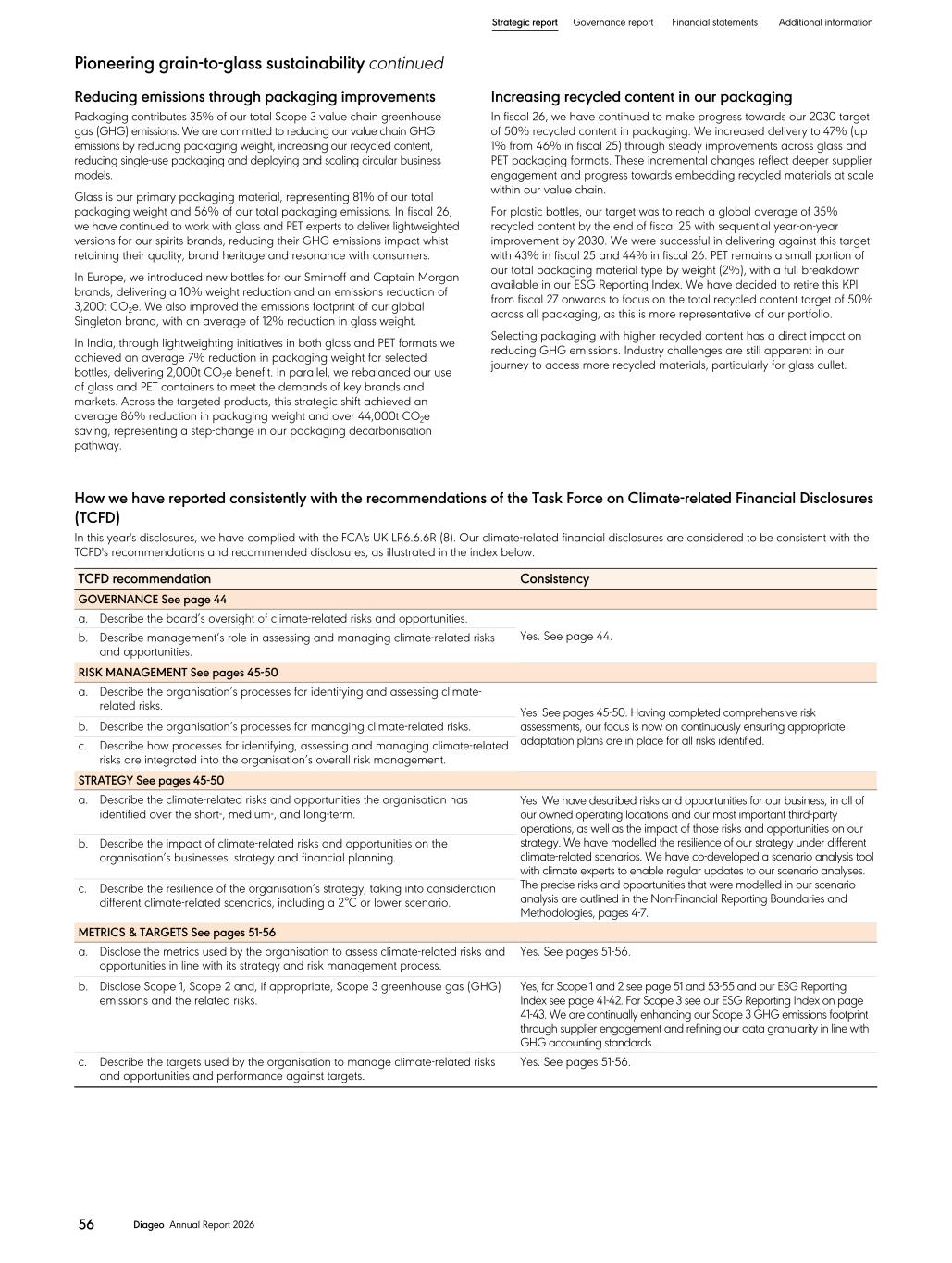
Reducing emissions through packaging improvements Packaging contributes 35% of our total Scope 3 value chain greenhouse gas (GHG) emissions. We are committed to reducing our value chain GHG emissions by reducing packaging weight, increasing our recycled content, reducing single-use packaging and deploying and scaling circular business models. Glass is our primary packaging material, representing 81% of our total packaging weight and 56% of our total packaging emissions. In fiscal 26, we have continued to work with glass and PET experts to deliver lightweighted versions for our spirits brands, reducing their GHG emissions impact whist retaining their quality, brand heritage and resonance with consumers. In Europe, we introduced new bottles for our Smirnoff and Captain Morgan brands, delivering a 10% weight reduction and an emissions reduction of 3,200t CO2e. We also improved the emissions footprint of our global Singleton brand, with an average of 12% reduction in glass weight. In India, through lightweighting initiatives in both glass and PET formats we achieved an average 7% reduction in packaging weight for selected bottles, delivering 2,000t CO2e benefit. In parallel, we rebalanced our use of glass and PET containers to meet the demands of key brands and markets. Across the targeted products, this strategic shift achieved an average 86% reduction in packaging weight and over 44,000t CO2e saving, representing a step-change in our packaging decarbonisation pathway. Increasing recycled content in our packaging In fiscal 26, we have continued to make progress towards our 2030 target of 50% recycled content in packaging. We increased delivery to 47% (up 1% from 46% in fiscal 25) through steady improvements across glass and PET packaging formats. These incremental changes reflect deeper supplier engagement and progress towards embedding recycled materials at scale within our value chain. For plastic bottles, our target was to reach a global average of 35% recycled content by the end of fiscal 25 with sequential year-on-year improvement by 2030. We were successful in delivering against this target with 43% in fiscal 25 and 44% in fiscal 26. PET remains a small portion of our total packaging material type by weight (2%), with a full breakdown available in our ESG Reporting Index. We have decided to retire this KPI from fiscal 27 onwards to focus on the total recycled content target of 50% across all packaging, as this is more representative of our portfolio. Selecting packaging with higher recycled content has a direct impact on reducing GHG emissions. Industry challenges are still apparent in our journey to access more recycled materials, particularly for glass cullet. How we have reported consistently with the recommendations of the Task Force on Climate-related Financial Disclosures (TCFD) In this year's disclosures, we have complied with the FCA's UK LR6.6.6R (8). Our climate-related financial disclosures are considered to be consistent with the TCFD's recommendations and recommended disclosures, as illustrated in the index below. GOVERNANCE See page 44 a. Describe the board’s oversight of climate-related risks and opportunities. Yes. See page 44.b. Describe management’s role in assessing and managing climate-related risks and opportunities. RISK MANAGEMENT See pages 45-50 a. Describe the organisation’s processes for identifying and assessing climate- related risks. Yes. See pages 45-50. Having completed comprehensive risk assessments, our focus is now on continuously ensuring appropriate adaptation plans are in place for all risks identified. b. Describe the organisation’s processes for managing climate-related risks. c. Describe how processes for identifying, assessing and managing climate-related risks are integrated into the organisation’s overall risk management. STRATEGY See pages 45-50 a. Describe the climate-related risks and opportunities the organisation has identified over the short-, medium-, and long-term. Yes. We have described risks and opportunities for our business, in all of our owned operating locations and our most important third-party operations, as well as the impact of those risks and opportunities on our strategy. We have modelled the resilience of our strategy under different climate-related scenarios. We have co-developed a scenario analysis tool with climate experts to enable regular updates to our scenario analyses. The precise risks and opportunities that were modelled in our scenario analysis are outlined in the Non-Financial Reporting Boundaries and Methodologies, pages 4-7. b. Describe the impact of climate-related risks and opportunities on the organisation’s businesses, strategy and financial planning. c. Describe the resilience of the organisation’s strategy, taking into consideration different climate-related scenarios, including a 2°C or lower scenario. METRICS & TARGETS See pages 51-56 a. Disclose the metrics used by the organisation to assess climate-related risks and opportunities in line with its strategy and risk management process. Yes. See pages 51-56. b. Disclose Scope 1, Scope 2 and, if appropriate, Scope 3 greenhouse gas (GHG) emissions and the related risks. Yes, for Scope 1 and 2 see page 51 and 53-55 and our ESG Reporting Index see page 41-42. For Scope 3 see our ESG Reporting Index on page 41-43. We are continually enhancing our Scope 3 GHG emissions footprint through supplier engagement and refining our data granularity in line with GHG accounting standards. c. Describe the targets used by the organisation to manage climate-related risks and opportunities and performance against targets. Yes. See pages 51-56. TCFD recommendation Consistency Strategic report Governance report Financial statements Additional information Pioneering grain-to-glass sustainability continued 56 Diageo Annual Report 2026
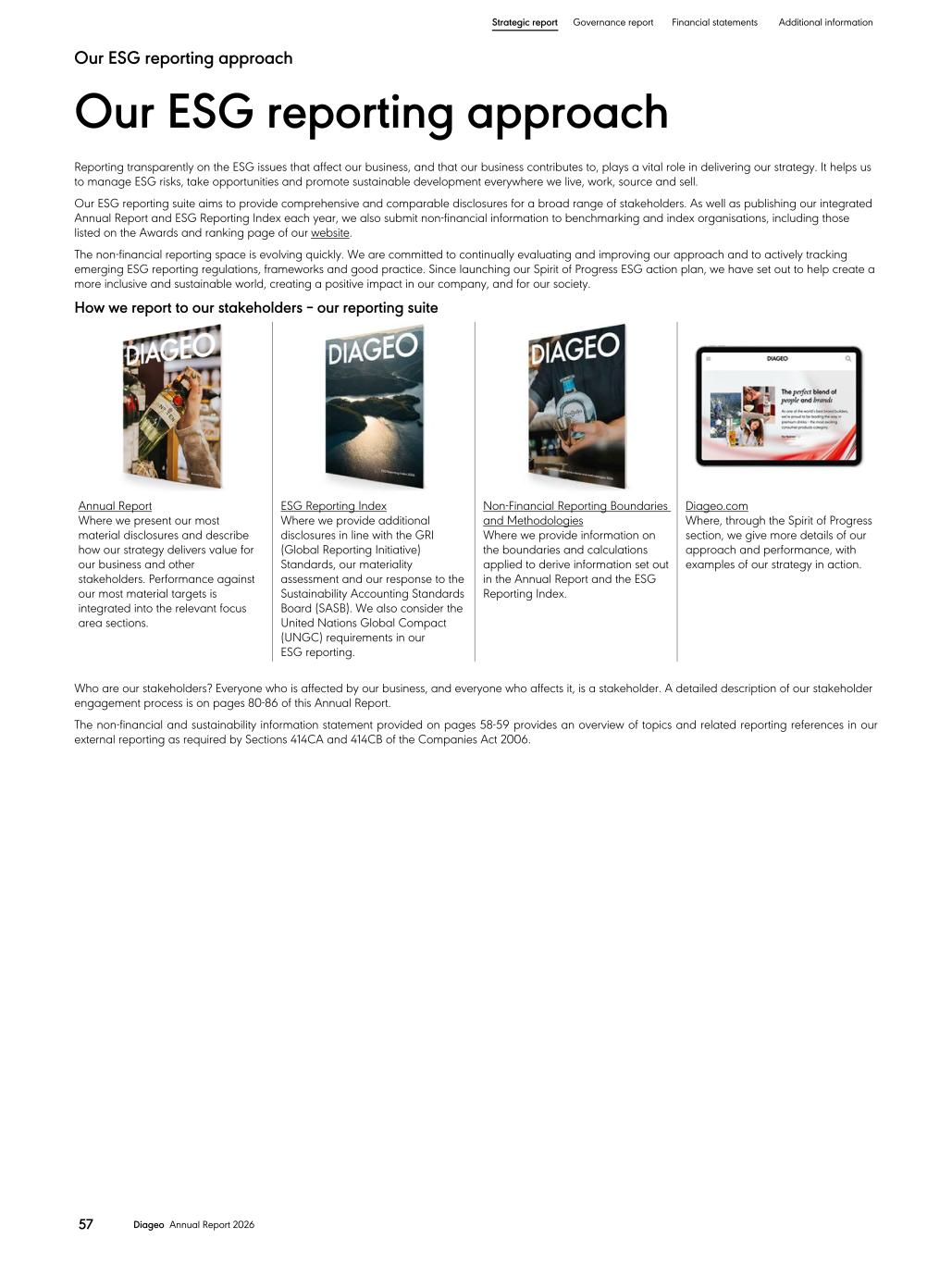
Our ESG reporting approach Reporting transparently on the ESG issues that affect our business, and that our business contributes to, plays a vital role in delivering our strategy. It helps us to manage ESG risks, take opportunities and promote sustainable development everywhere we live, work, source and sell. Our ESG reporting suite aims to provide comprehensive and comparable disclosures for a broad range of stakeholders. As well as publishing our integrated Annual Report and ESG Reporting Index each year, we also submit non-financial information to benchmarking and index organisations, including those listed on the Awards and ranking page of our website. The non-financial reporting space is evolving quickly. We are committed to continually evaluating and improving our approach and to actively tracking emerging ESG reporting regulations, frameworks and good practice. Since launching our Spirit of Progress ESG action plan, we have set out to help create a more inclusive and sustainable world, creating a positive impact in our company, and for our society. How we report to our stakeholders – our reporting suite Annual Report Where we present our most material disclosures and describe how our strategy delivers value for our business and other stakeholders. Performance against our most material targets is integrated into the relevant focus area sections. ESG Reporting Index Where we provide additional disclosures in line with the GRI (Global Reporting Initiative) Standards, our materiality assessment and our response to the Sustainability Accounting Standards Board (SASB). We also consider the United Nations Global Compact (UNGC) requirements in our ESG reporting. Non-Financial Reporting Boundaries and Methodologies Where we provide information on the boundaries and calculations applied to derive information set out in the Annual Report and the ESG Reporting Index. Diageo.com Where, through the Spirit of Progress section, we give more details of our approach and performance, with examples of our strategy in action. Who are our stakeholders? Everyone who is affected by our business, and everyone who affects it, is a stakeholder. A detailed description of our stakeholder engagement process is on pages 80-86 of this Annual Report. The non-financial and sustainability information statement provided on pages 58-59 provides an overview of topics and related reporting references in our external reporting as required by Sections 414CA and 414CB of the Companies Act 2006. Strategic report Governance report Financial statements Additional information 57 Diageo Annual Report 2026 Our ESG reporting approach
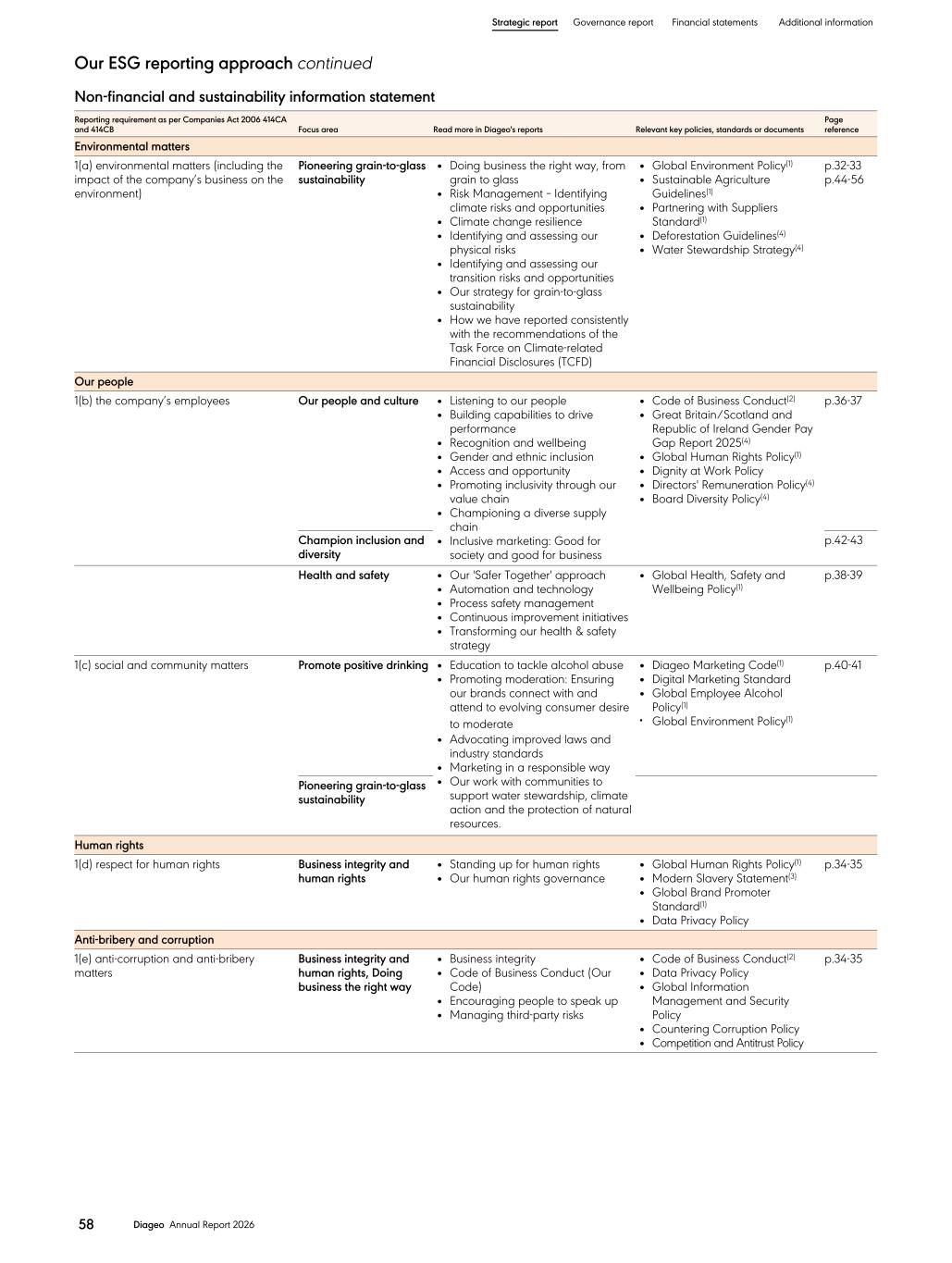
Non-financial and sustainability information statement Environmental matters 1(a) environmental matters (including the impact of the company’s business on the environment) Pioneering grain-to-glass sustainability • Doing business the right way, from grain to glass • Risk Management – Identifying climate risks and opportunities • Climate change resilience • Identifying and assessing our physical risks • Identifying and assessing our transition risks and opportunities • Our strategy for grain-to-glass sustainability • How we have reported consistently with the recommendations of the Task Force on Climate-related Financial Disclosures (TCFD) • Global Environment Policy(1) • Sustainable Agriculture Guidelines(1) • Partnering with Suppliers Standard(1) • Deforestation Guidelines(4) • Water Stewardship Strategy(4) p.32-33 p.44-56 Our people 1(b) the company’s employees Our people and culture • Listening to our people • Building capabilities to drive performance • Recognition and wellbeing • Gender and ethnic inclusion • Access and opportunity • Promoting inclusivity through our value chain • Championing a diverse supply chain • Inclusive marketing: Good for society and good for business • Code of Business Conduct(2) • Great Britain/Scotland and Republic of Ireland Gender Pay Gap Report 2025(4) • Global Human Rights Policy(1) • Dignity at Work Policy • Directors' Remuneration Policy(4) • Board Diversity Policy(4) p.36-37 Champion inclusion and diversity p.42-43 Health and safety • Our 'Safer Together' approach • Automation and technology • Process safety management • Continuous improvement initiatives • Transforming our health & safety strategy • Global Health, Safety and Wellbeing Policy(1) p.38-39 1(c) social and community matters Promote positive drinking • Education to tackle alcohol abuse • Promoting moderation: Ensuring our brands connect with and attend to evolving consumer desire to moderate • Advocating improved laws and industry standards • Marketing in a responsible way • Our work with communities to support water stewardship, climate action and the protection of natural resources. • Diageo Marketing Code(1) • Digital Marketing Standard • Global Employee Alcohol Policy(1) • Global Environment Policy(1) p.40-41 Pioneering grain-to-glass sustainability Human rights 1(d) respect for human rights Business integrity and human rights • Standing up for human rights • Our human rights governance • Global Human Rights Policy(1) • Modern Slavery Statement(3) • Global Brand Promoter Standard(1) • Data Privacy Policy p.34-35 Anti-bribery and corruption 1(e) anti-corruption and anti-bribery matters Business integrity and human rights, Doing business the right way • Business integrity • Code of Business Conduct (Our Code) • Encouraging people to speak up • Managing third-party risks • Code of Business Conduct(2) • Data Privacy Policy • Global Information Management and Security Policy • Countering Corruption Policy • Competition and Antitrust Policy p.34-35 Reporting requirement as per Companies Act 2006 414CA and 414CB Focus area Read more in Diageo's reports Relevant key policies, standards or documents Page reference Strategic report Governance report Financial statements Additional information Our ESG reporting approach continued 58 Diageo Annual Report 2026
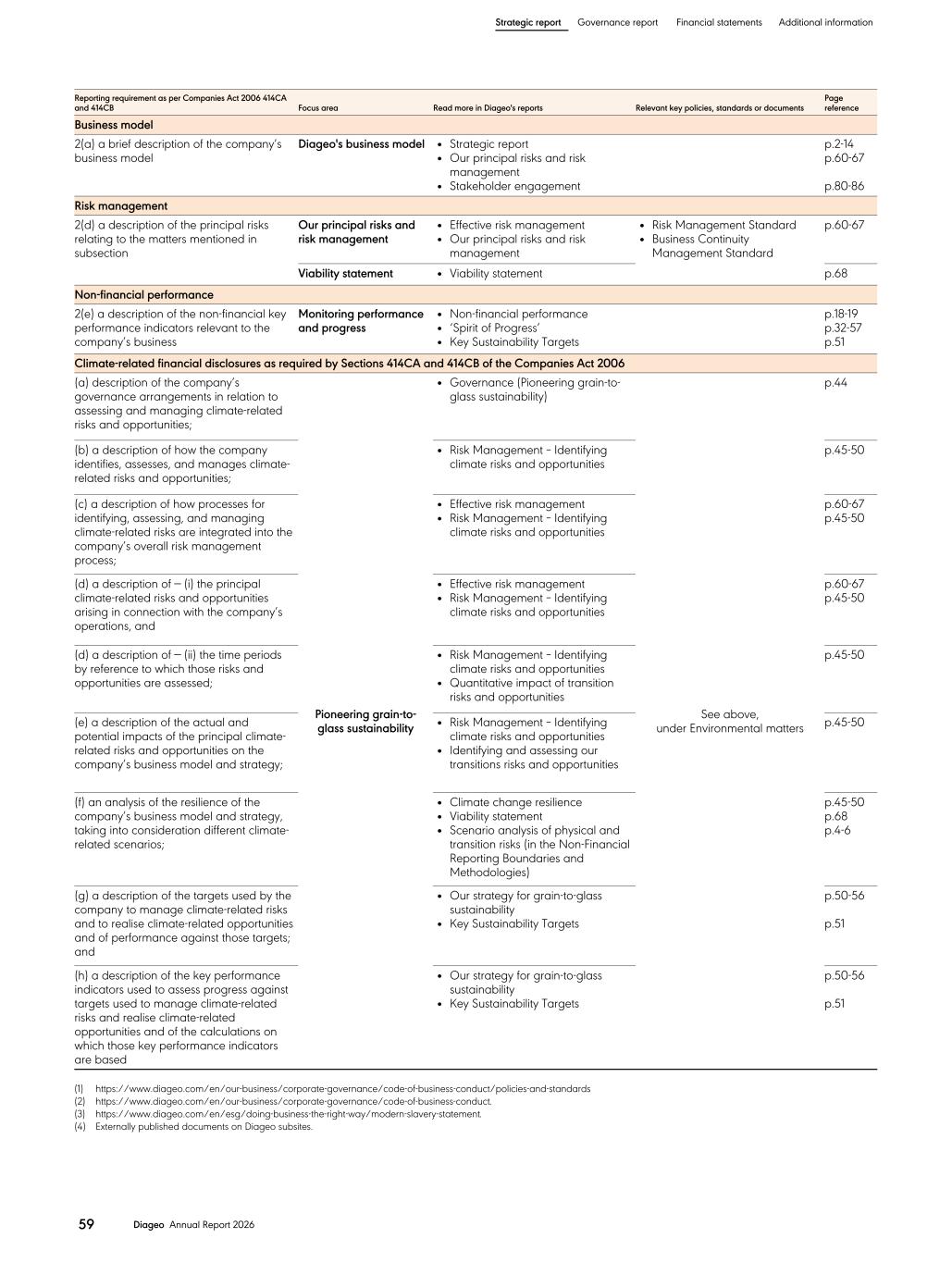
Business model 2(a) a brief description of the company’s business model Diageo's business model • Strategic report • Our principal risks and risk management • Stakeholder engagement p.2-14 p.60-67 p.80-86 Risk management 2(d) a description of the principal risks relating to the matters mentioned in subsection Our principal risks and risk management • Effective risk management • Our principal risks and risk management • Risk Management Standard • Business Continuity Management Standard p.60-67 Viability statement • Viability statement p.68 Non-financial performance 2(e) a description of the non-financial key performance indicators relevant to the company’s business Monitoring performance and progress • Non-financial performance • ‘Spirit of Progress’ • Key Sustainability Targets p.18-19 p.32-57 p.51 Climate-related financial disclosures as required by Sections 414CA and 414CB of the Companies Act 2006 (a) description of the company’s governance arrangements in relation to assessing and managing climate-related risks and opportunities; Pioneering grain-to- glass sustainability • Governance (Pioneering grain-to- glass sustainability) See above, under Environmental matters p.44 (b) a description of how the company identifies, assesses, and manages climate- related risks and opportunities; • Risk Management – Identifying climate risks and opportunities p.45-50 (c) a description of how processes for identifying, assessing, and managing climate-related risks are integrated into the company’s overall risk management process; • Effective risk management • Risk Management – Identifying climate risks and opportunities p.60-67 p.45-50 (d) a description of — (i) the principal climate-related risks and opportunities arising in connection with the company’s operations, and • Effective risk management • Risk Management – Identifying climate risks and opportunities p.60-67 p.45-50 (d) a description of — (ii) the time periods by reference to which those risks and opportunities are assessed; • Risk Management – Identifying climate risks and opportunities • Quantitative impact of transition risks and opportunities p.45-50 (e) a description of the actual and potential impacts of the principal climate- related risks and opportunities on the company’s business model and strategy; • Risk Management – Identifying climate risks and opportunities • Identifying and assessing our transitions risks and opportunities p.45-50 (f) an analysis of the resilience of the company’s business model and strategy, taking into consideration different climate- related scenarios; • Climate change resilience • Viability statement • Scenario analysis of physical and transition risks (in the Non-Financial Reporting Boundaries and Methodologies) p.45-50 p.68 p.4-6 (g) a description of the targets used by the company to manage climate-related risks and to realise climate-related opportunities and of performance against those targets; and • Our strategy for grain-to-glass sustainability • Key Sustainability Targets p.50-56 p.51 (h) a description of the key performance indicators used to assess progress against targets used to manage climate-related risks and realise climate-related opportunities and of the calculations on which those key performance indicators are based • Our strategy for grain-to-glass sustainability • Key Sustainability Targets p.50-56 p.51 Reporting requirement as per Companies Act 2006 414CA and 414CB Focus area Read more in Diageo's reports Relevant key policies, standards or documents Page reference (1) https://www.diageo.com/en/our-business/corporate-governance/code-of-business-conduct/policies-and-standards (2) https://www.diageo.com/en/our-business/corporate-governance/code-of-business-conduct. (3) https://www.diageo.com/en/esg/doing-business-the-right-way/modern-slavery-statement. (4) Externally published documents on Diageo subsites. Strategic report Governance report Financial statements Additional information 59 Diageo Annual Report 2026
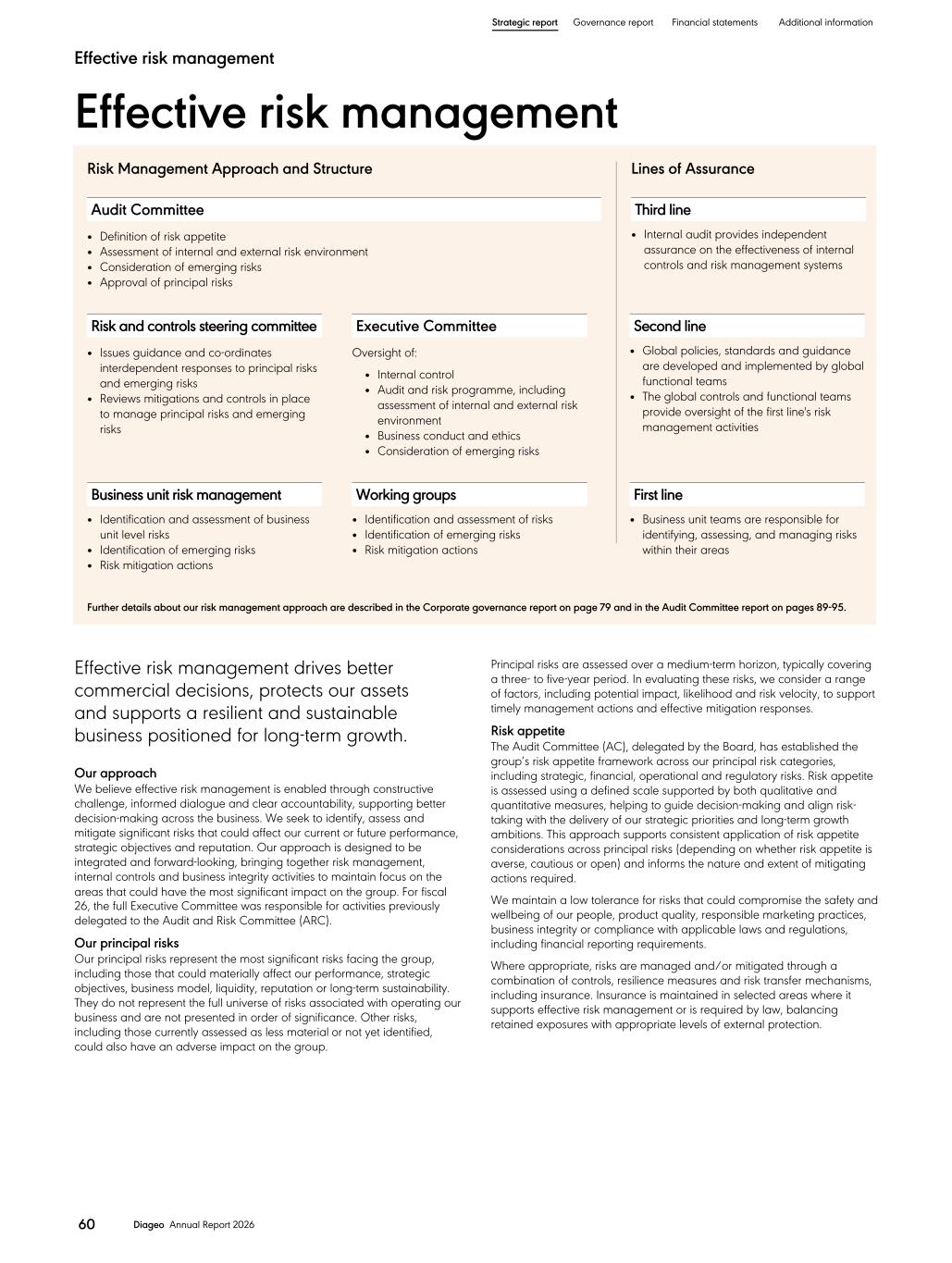
Effective risk management Risk Management Approach and Structure Lines of Assurance Audit Committee • Definition of risk appetite • Assessment of internal and external risk environment • Consideration of emerging risks • Approval of principal risks Third line • Internal audit provides independent assurance on the effectiveness of internal controls and risk management systems Risk and controls steering committee • Issues guidance and co-ordinates interdependent responses to principal risks and emerging risks • Reviews mitigations and controls in place to manage principal risks and emerging risks Executive Committee Oversight of: • Internal control • Audit and risk programme, including assessment of internal and external risk environment • Business conduct and ethics • Consideration of emerging risks Second line • Global policies, standards and guidance are developed and implemented by global functional teams • The global controls and functional teams provide oversight of the first line's risk management activities Business unit risk management • Identification and assessment of business unit level risks • Identification of emerging risks • Risk mitigation actions Working groups • Identification and assessment of risks • Identification of emerging risks • Risk mitigation actions First line • Business unit teams are responsible for identifying, assessing, and managing risks within their areas Further details about our risk management approach are described in the Corporate governance report on page 79 and in the Audit Committee report on pages 89-95. Effective risk management drives better commercial decisions, protects our assets and supports a resilient and sustainable business positioned for long-term growth. Our approach We believe effective risk management is enabled through constructive challenge, informed dialogue and clear accountability, supporting better decision-making across the business. We seek to identify, assess and mitigate significant risks that could affect our current or future performance, strategic objectives and reputation. Our approach is designed to be integrated and forward-looking, bringing together risk management, internal controls and business integrity activities to maintain focus on the areas that could have the most significant impact on the group. For fiscal 26, the full Executive Committee was responsible for activities previously delegated to the Audit and Risk Committee (ARC). Our principal risks Our principal risks represent the most significant risks facing the group, including those that could materially affect our performance, strategic objectives, business model, liquidity, reputation or long-term sustainability. They do not represent the full universe of risks associated with operating our business and are not presented in order of significance. Other risks, including those currently assessed as less material or not yet identified, could also have an adverse impact on the group. Principal risks are assessed over a medium-term horizon, typically covering a three- to five-year period. In evaluating these risks, we consider a range of factors, including potential impact, likelihood and risk velocity, to support timely management actions and effective mitigation responses. Risk appetite The Audit Committee (AC), delegated by the Board, has established the group’s risk appetite framework across our principal risk categories, including strategic, financial, operational and regulatory risks. Risk appetite is assessed using a defined scale supported by both qualitative and quantitative measures, helping to guide decision-making and align risk- taking with the delivery of our strategic priorities and long-term growth ambitions. This approach supports consistent application of risk appetite considerations across principal risks (depending on whether risk appetite is averse, cautious or open) and informs the nature and extent of mitigating actions required. We maintain a low tolerance for risks that could compromise the safety and wellbeing of our people, product quality, responsible marketing practices, business integrity or compliance with applicable laws and regulations, including financial reporting requirements. Where appropriate, risks are managed and/or mitigated through a combination of controls, resilience measures and risk transfer mechanisms, including insurance. Insurance is maintained in selected areas where it supports effective risk management or is required by law, balancing retained exposures with appropriate levels of external protection. Strategic report Governance report Financial statements Additional information 60 Diageo Annual Report 2026 Effective risk management
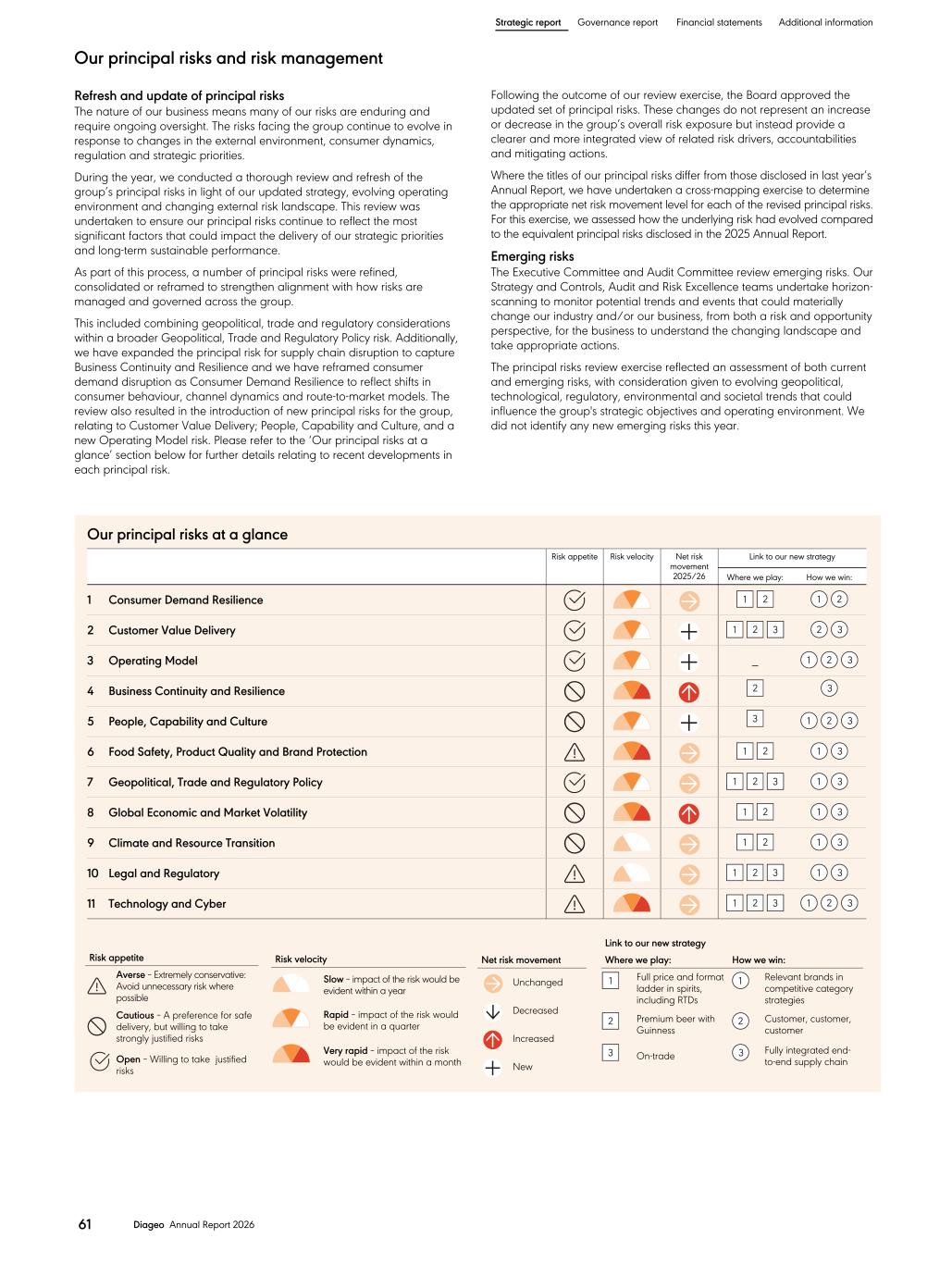
Refresh and update of principal risks The nature of our business means many of our risks are enduring and require ongoing oversight. The risks facing the group continue to evolve in response to changes in the external environment, consumer dynamics, regulation and strategic priorities. During the year, we conducted a thorough review and refresh of the group’s principal risks in light of our updated strategy, evolving operating environment and changing external risk landscape. This review was undertaken to ensure our principal risks continue to reflect the most significant factors that could impact the delivery of our strategic priorities and long-term sustainable performance. As part of this process, a number of principal risks were refined, consolidated or reframed to strengthen alignment with how risks are managed and governed across the group. This included combining geopolitical, trade and regulatory considerations within a broader Geopolitical, Trade and Regulatory Policy risk. Additionally, we have expanded the principal risk for supply chain disruption to capture Business Continuity and Resilience and we have reframed consumer demand disruption as Consumer Demand Resilience to reflect shifts in consumer behaviour, channel dynamics and route-to-market models. The review also resulted in the introduction of new principal risks for the group, relating to Customer Value Delivery; People, Capability and Culture, and a new Operating Model risk. Please refer to the ‘Our principal risks at a glance’ section below for further details relating to recent developments in each principal risk. Following the outcome of our review exercise, the Board approved the updated set of principal risks. These changes do not represent an increase or decrease in the group’s overall risk exposure but instead provide a clearer and more integrated view of related risk drivers, accountabilities and mitigating actions. Where the titles of our principal risks differ from those disclosed in last year’s Annual Report, we have undertaken a cross-mapping exercise to determine the appropriate net risk movement level for each of the revised principal risks. For this exercise, we assessed how the underlying risk had evolved compared to the equivalent principal risks disclosed in the 2025 Annual Report. Emerging risks The Executive Committee and Audit Committee review emerging risks. Our Strategy and Controls, Audit and Risk Excellence teams undertake horizon- scanning to monitor potential trends and events that could materially change our industry and/or our business, from both a risk and opportunity perspective, for the business to understand the changing landscape and take appropriate actions. The principal risks review exercise reflected an assessment of both current and emerging risks, with consideration given to evolving geopolitical, technological, regulatory, environmental and societal trends that could influence the group's strategic objectives and operating environment. We did not identify any new emerging risks this year. Our principal risks at a glance 1 Consumer Demand Resilience 2 Customer Value Delivery 3 Operating Model _ 4 Business Continuity and Resilience 5 People, Capability and Culture 6 Food Safety, Product Quality and Brand Protection 7 Geopolitical, Trade and Regulatory Policy 8 Global Economic and Market Volatility 9 Climate and Resource Transition 10 Legal and Regulatory 11 Technology and Cyber Risk appetite Risk velocity Net risk movement 2025/26 Link to our new strategy Where we play: How we win: Strategic report Governance report Financial statements Additional information 61 Diageo Annual Report 2026 Risk appetite Averse – Extremely conservative: Avoid unnecessary risk where possible Cautious – A preference for safe delivery, but willing to take strongly justified risks Open – Willing to take justified risks Risk velocity Slow – impact of the risk would be evident within a year Rapid – impact of the risk would be evident in a quarter Very rapid – impact of the risk would be evident within a month Our principal risks and risk management Net risk movement Unchanged Decreased Increased New Link to our new strategy Where we play: How we win: Full price and format ladder in spirits, including RTDs Relevant brands in competitive category strategies Premium beer with Guinness Customer, customer, customer On-trade Fully integrated end- to-end supply chain
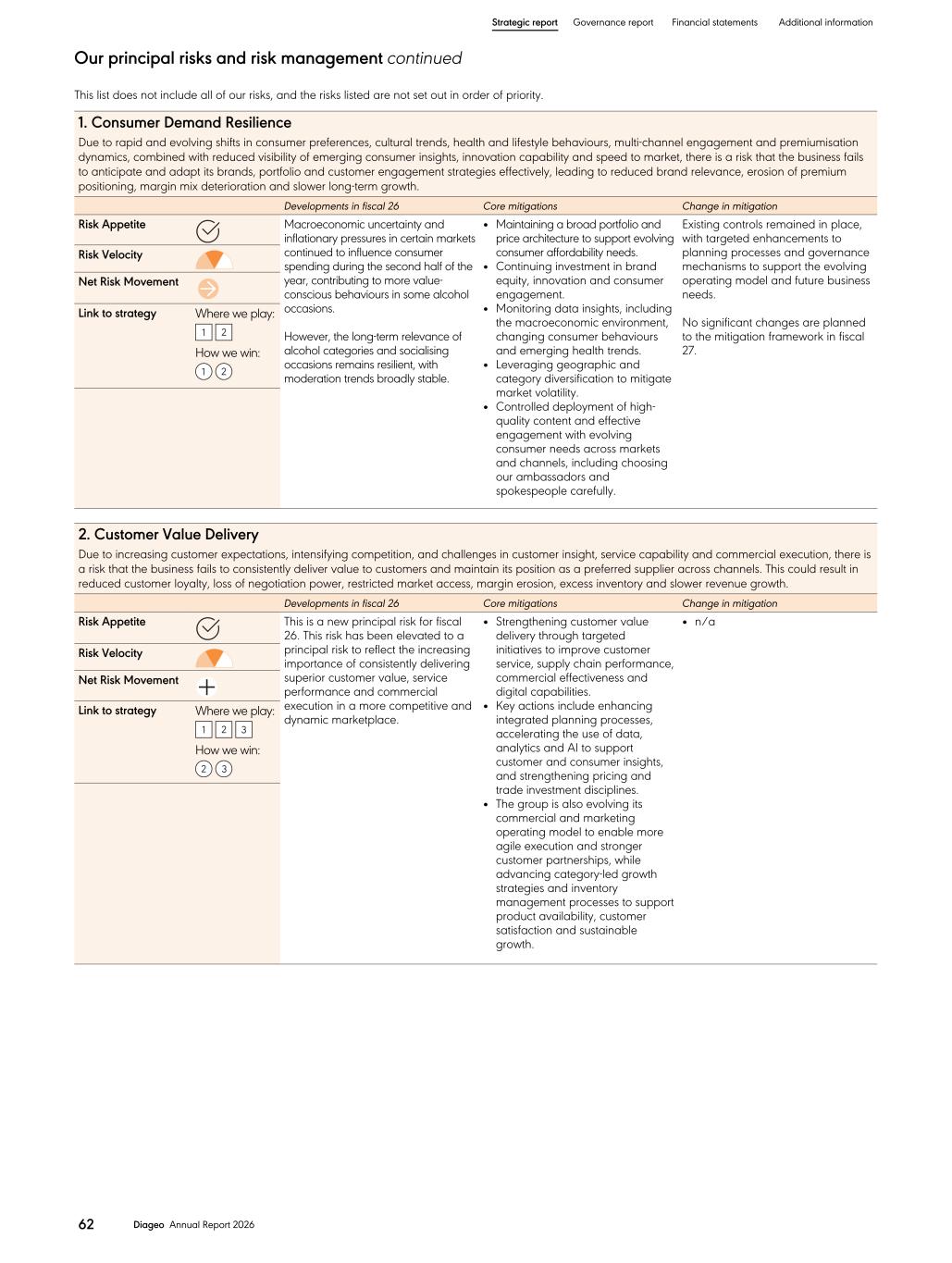
This list does not include all of our risks, and the risks listed are not set out in order of priority. 1. Consumer Demand Resilience Due to rapid and evolving shifts in consumer preferences, cultural trends, health and lifestyle behaviours, multi-channel engagement and premiumisation dynamics, combined with reduced visibility of emerging consumer insights, innovation capability and speed to market, there is a risk that the business fails to anticipate and adapt its brands, portfolio and customer engagement strategies effectively, leading to reduced brand relevance, erosion of premium positioning, margin mix deterioration and slower long-term growth. Developments in fiscal 26 Core mitigations Change in mitigation Risk Appetite Macroeconomic uncertainty and inflationary pressures in certain markets continued to influence consumer spending during the second half of the year, contributing to more value- conscious behaviours in some alcohol occasions. However, the long-term relevance of alcohol categories and socialising occasions remains resilient, with moderation trends broadly stable. • Maintaining a broad portfolio and price architecture to support evolving consumer affordability needs. • Continuing investment in brand equity, innovation and consumer engagement. • Monitoring data insights, including the macroeconomic environment, changing consumer behaviours and emerging health trends. • Leveraging geographic and category diversification to mitigate market volatility. • Controlled deployment of high- quality content and effective engagement with evolving consumer needs across markets and channels, including choosing our ambassadors and spokespeople carefully. Existing controls remained in place, with targeted enhancements to planning processes and governance mechanisms to support the evolving operating model and future business needs. No significant changes are planned to the mitigation framework in fiscal 27. Risk Velocity Net Risk Movement Link to strategy Where we play: How we win: 2. Customer Value Delivery Due to increasing customer expectations, intensifying competition, and challenges in customer insight, service capability and commercial execution, there is a risk that the business fails to consistently deliver value to customers and maintain its position as a preferred supplier across channels. This could result in reduced customer loyalty, loss of negotiation power, restricted market access, margin erosion, excess inventory and slower revenue growth. Developments in fiscal 26 Core mitigations Change in mitigation Risk Appetite This is a new principal risk for fiscal 26. This risk has been elevated to a principal risk to reflect the increasing importance of consistently delivering superior customer value, service performance and commercial execution in a more competitive and dynamic marketplace. • Strengthening customer value delivery through targeted initiatives to improve customer service, supply chain performance, commercial effectiveness and digital capabilities. • Key actions include enhancing integrated planning processes, accelerating the use of data, analytics and AI to support customer and consumer insights, and strengthening pricing and trade investment disciplines. • The group is also evolving its commercial and marketing operating model to enable more agile execution and stronger customer partnerships, while advancing category-led growth strategies and inventory management processes to support product availability, customer satisfaction and sustainable growth. • n/a Risk Velocity Net Risk Movement Link to strategy Where we play: How we win: Strategic report Governance report Financial statements Additional information 62 Diageo Annual Report 2026 Our principal risks and risk management continued
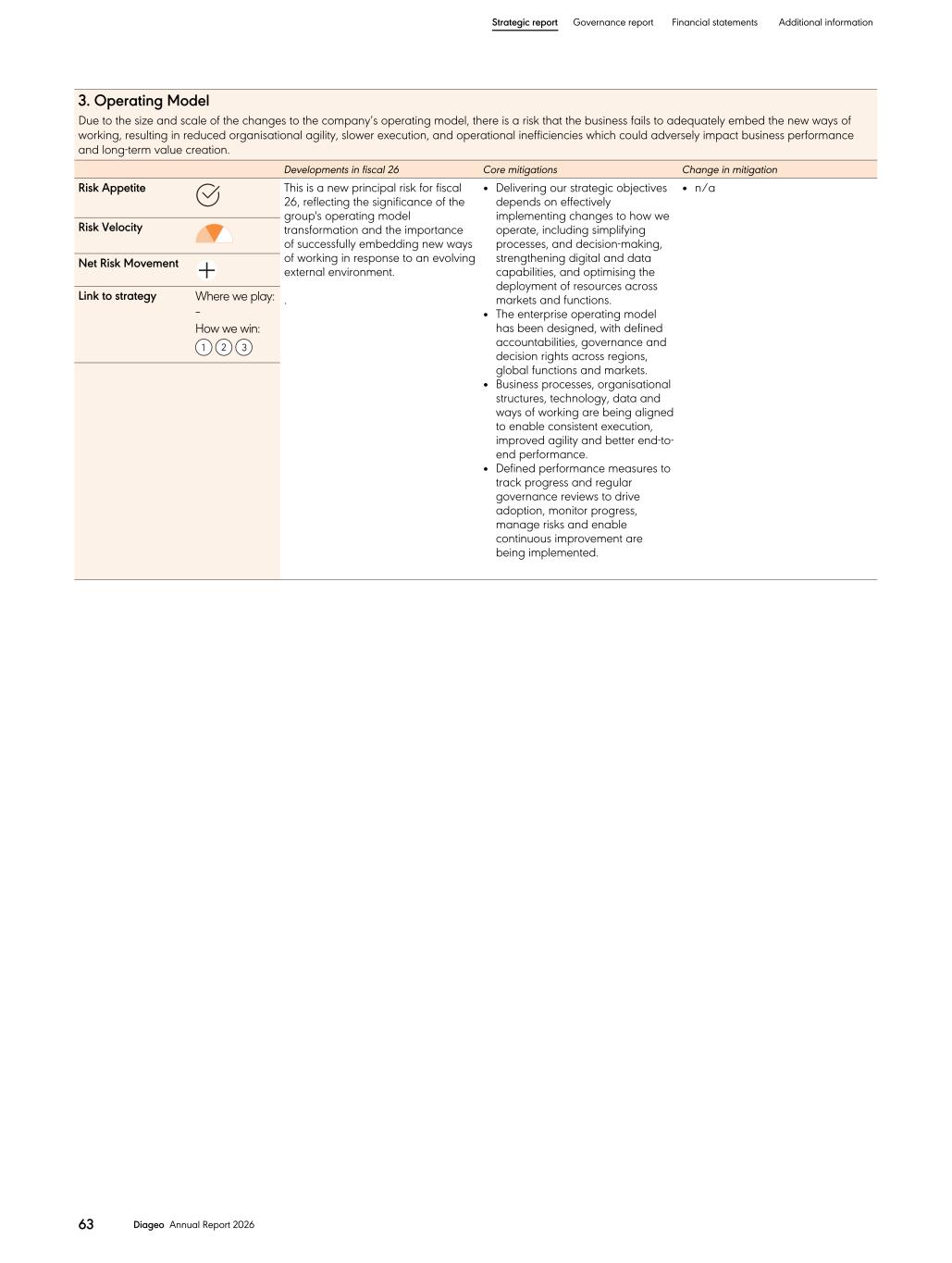
3. Operating Model Due to the size and scale of the changes to the company’s operating model, there is a risk that the business fails to adequately embed the new ways of working, resulting in reduced organisational agility, slower execution, and operational inefficiencies which could adversely impact business performance and long-term value creation. Developments in fiscal 26 Core mitigations Change in mitigation Risk Appetite This is a new principal risk for fiscal 26, reflecting the significance of the group's operating model transformation and the importance of successfully embedding new ways of working in response to an evolving external environment. . • Delivering our strategic objectives depends on effectively implementing changes to how we operate, including simplifying processes, and decision-making, strengthening digital and data capabilities, and optimising the deployment of resources across markets and functions. • The enterprise operating model has been designed, with defined accountabilities, governance and decision rights across regions, global functions and markets. • Business processes, organisational structures, technology, data and ways of working are being aligned to enable consistent execution, improved agility and better end-to- end performance. • Defined performance measures to track progress and regular governance reviews to drive adoption, monitor progress, manage risks and enable continuous improvement are being implemented. • n/a Risk Velocity Net Risk Movement Link to strategy Where we play: – How we win: Strategic report Governance report Financial statements Additional information 63 Diageo Annual Report 2026
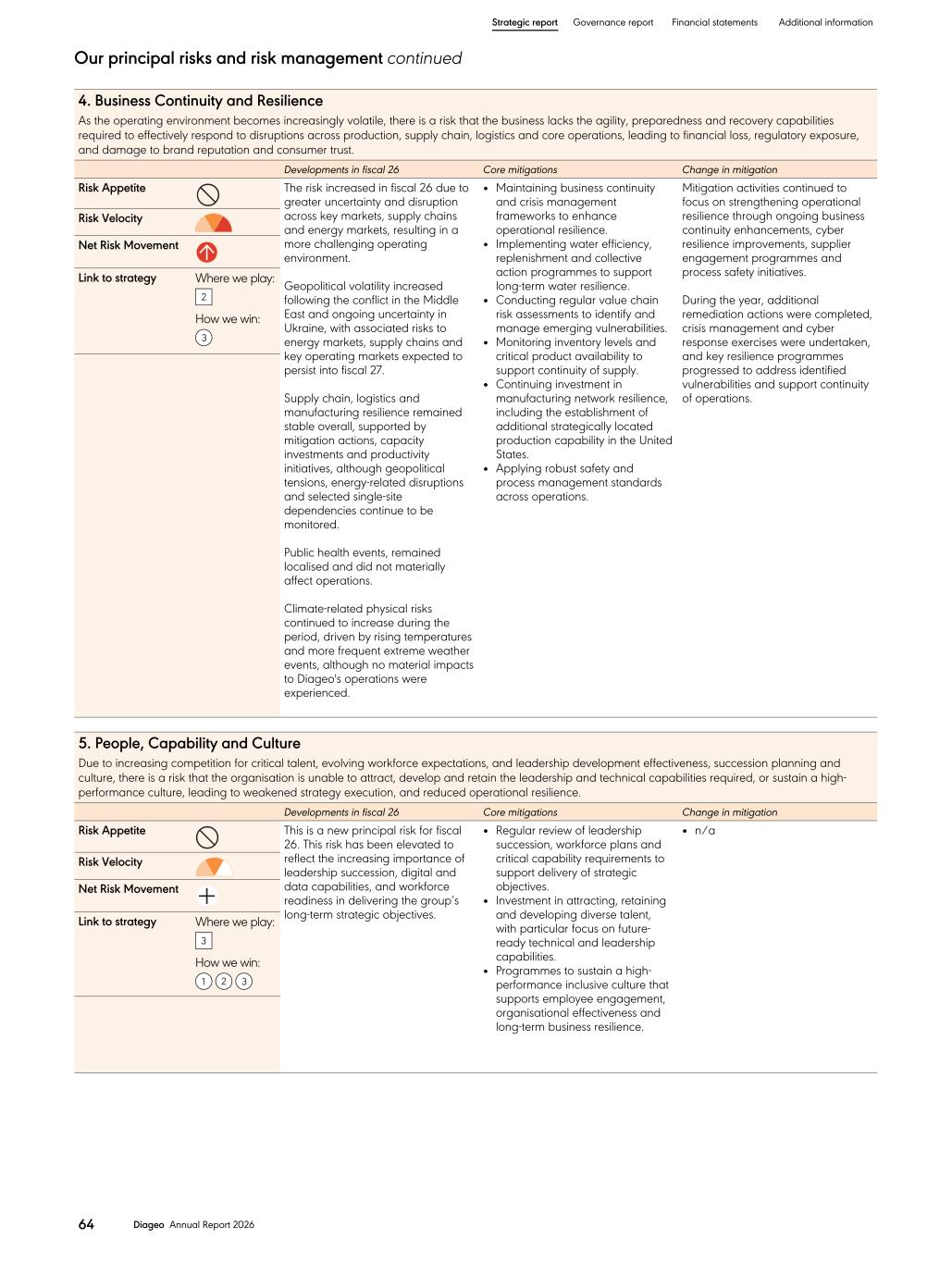
4. Business Continuity and Resilience As the operating environment becomes increasingly volatile, there is a risk that the business lacks the agility, preparedness and recovery capabilities required to effectively respond to disruptions across production, supply chain, logistics and core operations, leading to financial loss, regulatory exposure, and damage to brand reputation and consumer trust. Developments in fiscal 26 Core mitigations Change in mitigation Risk Appetite The risk increased in fiscal 26 due to greater uncertainty and disruption across key markets, supply chains and energy markets, resulting in a more challenging operating environment. Geopolitical volatility increased following the conflict in the Middle East and ongoing uncertainty in Ukraine, with associated risks to energy markets, supply chains and key operating markets expected to persist into fiscal 27. Supply chain, logistics and manufacturing resilience remained stable overall, supported by mitigation actions, capacity investments and productivity initiatives, although geopolitical tensions, energy-related disruptions and selected single-site dependencies continue to be monitored. Public health events, remained localised and did not materially affect operations. Climate-related physical risks continued to increase during the period, driven by rising temperatures and more frequent extreme weather events, although no material impacts to Diageo's operations were experienced. • Maintaining business continuity and crisis management frameworks to enhance operational resilience. • Implementing water efficiency, replenishment and collective action programmes to support long-term water resilience. • Conducting regular value chain risk assessments to identify and manage emerging vulnerabilities. • Monitoring inventory levels and critical product availability to support continuity of supply. • Continuing investment in manufacturing network resilience, including the establishment of additional strategically located production capability in the United States. • Applying robust safety and process management standards across operations. Mitigation activities continued to focus on strengthening operational resilience through ongoing business continuity enhancements, cyber resilience improvements, supplier engagement programmes and process safety initiatives. During the year, additional remediation actions were completed, crisis management and cyber response exercises were undertaken, and key resilience programmes progressed to address identified vulnerabilities and support continuity of operations. Risk Velocity Net Risk Movement Link to strategy Where we play: How we win: 5. People, Capability and Culture Due to increasing competition for critical talent, evolving workforce expectations, and leadership development effectiveness, succession planning and culture, there is a risk that the organisation is unable to attract, develop and retain the leadership and technical capabilities required, or sustain a high- performance culture, leading to weakened strategy execution, and reduced operational resilience. Developments in fiscal 26 Core mitigations Change in mitigation Risk Appetite This is a new principal risk for fiscal 26. This risk has been elevated to reflect the increasing importance of leadership succession, digital and data capabilities, and workforce readiness in delivering the group’s long-term strategic objectives. • Regular review of leadership succession, workforce plans and critical capability requirements to support delivery of strategic objectives. • Investment in attracting, retaining and developing diverse talent, with particular focus on future- ready technical and leadership capabilities. • Programmes to sustain a high- performance inclusive culture that supports employee engagement, organisational effectiveness and long-term business resilience. • n/a Risk Velocity Net Risk Movement Link to strategy Where we play: How we win: Strategic report Governance report Financial statements Additional information 64 Diageo Annual Report 2026 Our principal risks and risk management continued
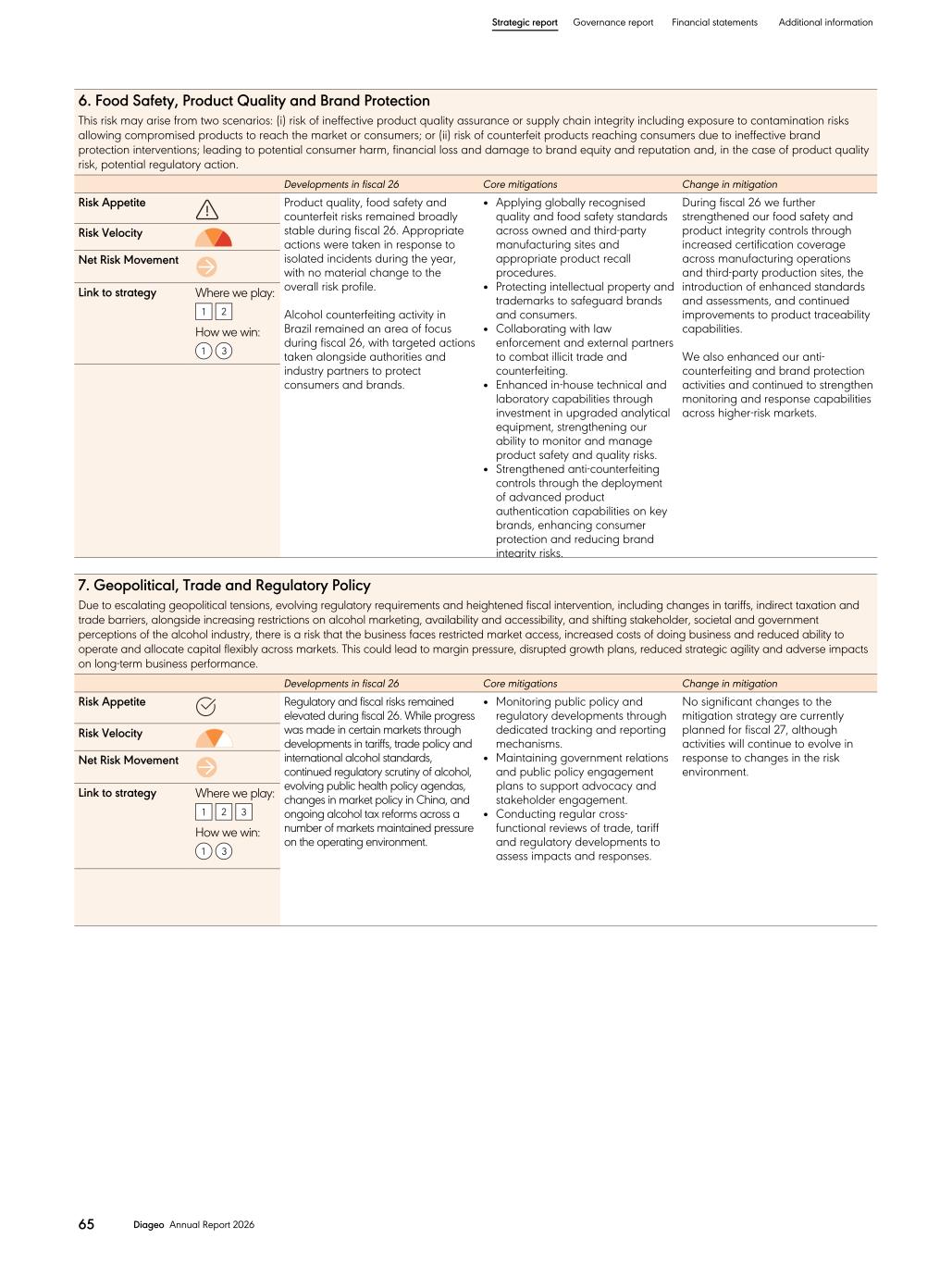
6. Food Safety, Product Quality and Brand Protection This risk may arise from two scenarios: (i) risk of ineffective product quality assurance or supply chain integrity including exposure to contamination risks allowing compromised products to reach the market or consumers; or (ii) risk of counterfeit products reaching consumers due to ineffective brand protection interventions; leading to potential consumer harm, financial loss and damage to brand equity and reputation and, in the case of product quality risk, potential regulatory action. Developments in fiscal 26 Core mitigations Change in mitigation Risk Appetite Product quality, food safety and counterfeit risks remained broadly stable during fiscal 26. Appropriate actions were taken in response to isolated incidents during the year, with no material change to the overall risk profile. Alcohol counterfeiting activity in Brazil remained an area of focus during fiscal 26, with targeted actions taken alongside authorities and industry partners to protect consumers and brands. • Applying globally recognised quality and food safety standards across owned and third-party manufacturing sites and appropriate product recall procedures. • Protecting intellectual property and trademarks to safeguard brands and consumers. • Collaborating with law enforcement and external partners to combat illicit trade and counterfeiting. • Enhanced in-house technical and laboratory capabilities through investment in upgraded analytical equipment, strengthening our ability to monitor and manage product safety and quality risks. • Strengthened anti-counterfeiting controls through the deployment of advanced product authentication capabilities on key brands, enhancing consumer protection and reducing brand integrity risks. During fiscal 26 we further strengthened our food safety and product integrity controls through increased certification coverage across manufacturing operations and third-party production sites, the introduction of enhanced standards and assessments, and continued improvements to product traceability capabilities. We also enhanced our anti- counterfeiting and brand protection activities and continued to strengthen monitoring and response capabilities across higher-risk markets. Risk Velocity Net Risk Movement Link to strategy Where we play: How we win: 7. Geopolitical, Trade and Regulatory Policy Due to escalating geopolitical tensions, evolving regulatory requirements and heightened fiscal intervention, including changes in tariffs, indirect taxation and trade barriers, alongside increasing restrictions on alcohol marketing, availability and accessibility, and shifting stakeholder, societal and government perceptions of the alcohol industry, there is a risk that the business faces restricted market access, increased costs of doing business and reduced ability to operate and allocate capital flexibly across markets. This could lead to margin pressure, disrupted growth plans, reduced strategic agility and adverse impacts on long-term business performance. Developments in fiscal 26 Core mitigations Change in mitigation Risk Appetite Regulatory and fiscal risks remained elevated during fiscal 26. While progress was made in certain markets through developments in tariffs, trade policy and international alcohol standards, continued regulatory scrutiny of alcohol, evolving public health policy agendas, changes in market policy in China, and ongoing alcohol tax reforms across a number of markets maintained pressure on the operating environment. • Monitoring public policy and regulatory developments through dedicated tracking and reporting mechanisms. • Maintaining government relations and public policy engagement plans to support advocacy and stakeholder engagement. • Conducting regular cross- functional reviews of trade, tariff and regulatory developments to assess impacts and responses. No significant changes to the mitigation strategy are currently planned for fiscal 27, although activities will continue to evolve in response to changes in the risk environment. Risk Velocity Net Risk Movement Link to strategy Where we play: How we win: Strategic report Governance report Financial statements Additional information 65 Diageo Annual Report 2026
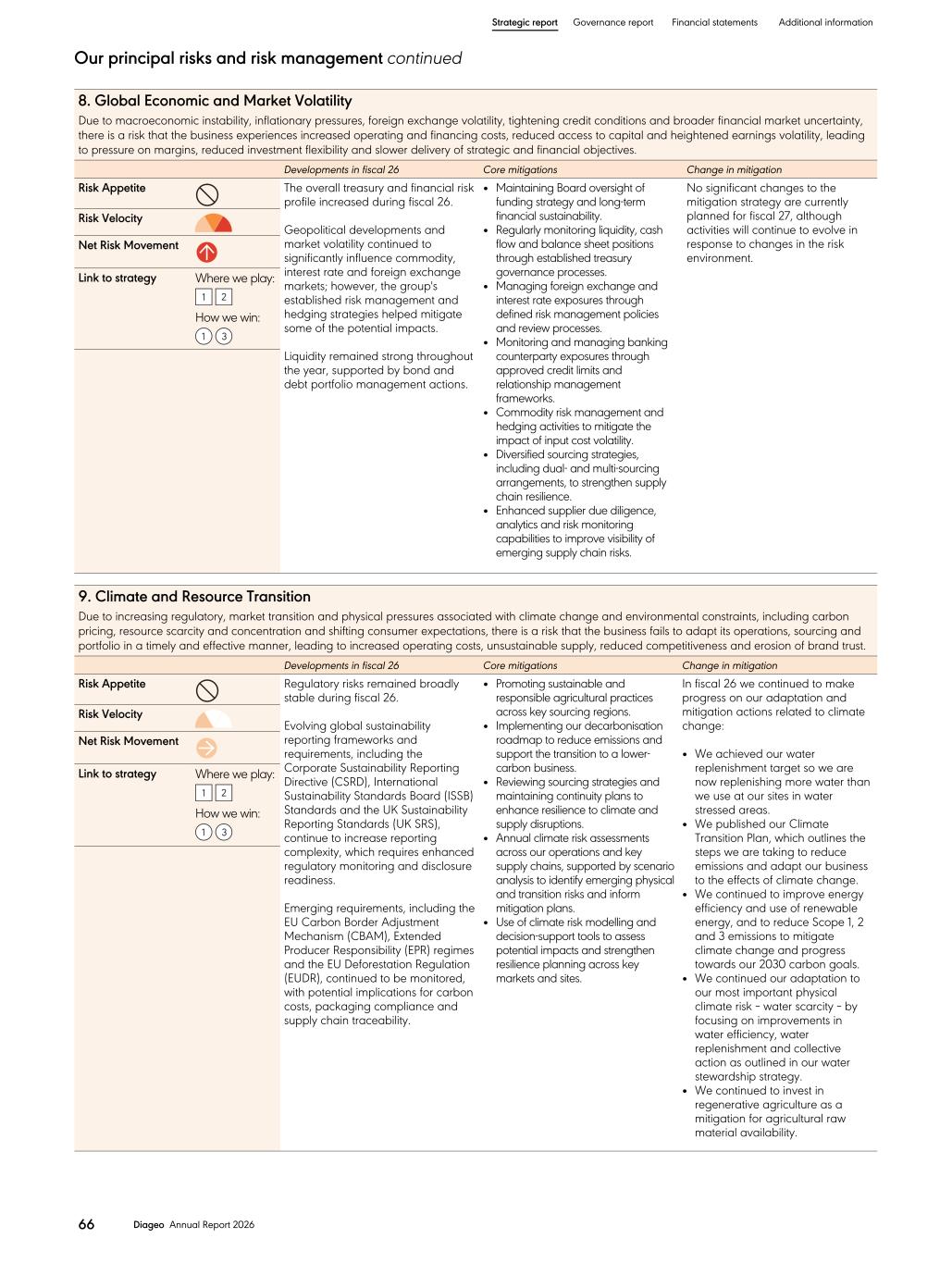
8. Global Economic and Market Volatility Due to macroeconomic instability, inflationary pressures, foreign exchange volatility, tightening credit conditions and broader financial market uncertainty, there is a risk that the business experiences increased operating and financing costs, reduced access to capital and heightened earnings volatility, leading to pressure on margins, reduced investment flexibility and slower delivery of strategic and financial objectives. Developments in fiscal 26 Core mitigations Change in mitigation Risk Appetite The overall treasury and financial risk profile increased during fiscal 26. Geopolitical developments and market volatility continued to significantly influence commodity, interest rate and foreign exchange markets; however, the group's established risk management and hedging strategies helped mitigate some of the potential impacts. Liquidity remained strong throughout the year, supported by bond and debt portfolio management actions. • Maintaining Board oversight of funding strategy and long-term financial sustainability. • Regularly monitoring liquidity, cash flow and balance sheet positions through established treasury governance processes. • Managing foreign exchange and interest rate exposures through defined risk management policies and review processes. • Monitoring and managing banking counterparty exposures through approved credit limits and relationship management frameworks. • Commodity risk management and hedging activities to mitigate the impact of input cost volatility. • Diversified sourcing strategies, including dual- and multi-sourcing arrangements, to strengthen supply chain resilience. • Enhanced supplier due diligence, analytics and risk monitoring capabilities to improve visibility of emerging supply chain risks. No significant changes to the mitigation strategy are currently planned for fiscal 27, although activities will continue to evolve in response to changes in the risk environment. Risk Velocity Net Risk Movement Link to strategy Where we play: How we win: 9. Climate and Resource Transition Due to increasing regulatory, market transition and physical pressures associated with climate change and environmental constraints, including carbon pricing, resource scarcity and concentration and shifting consumer expectations, there is a risk that the business fails to adapt its operations, sourcing and portfolio in a timely and effective manner, leading to increased operating costs, unsustainable supply, reduced competitiveness and erosion of brand trust. Developments in fiscal 26 Core mitigations Change in mitigation Risk Appetite Regulatory risks remained broadly stable during fiscal 26. Evolving global sustainability reporting frameworks and requirements, including the Corporate Sustainability Reporting Directive (CSRD), International Sustainability Standards Board (ISSB) Standards and the UK Sustainability Reporting Standards (UK SRS), continue to increase reporting complexity, which requires enhanced regulatory monitoring and disclosure readiness. Emerging requirements, including the EU Carbon Border Adjustment Mechanism (CBAM), Extended Producer Responsibility (EPR) regimes and the EU Deforestation Regulation (EUDR), continued to be monitored, with potential implications for carbon costs, packaging compliance and supply chain traceability. • Promoting sustainable and responsible agricultural practices across key sourcing regions. • Implementing our decarbonisation roadmap to reduce emissions and support the transition to a lower- carbon business. • Reviewing sourcing strategies and maintaining continuity plans to enhance resilience to climate and supply disruptions. • Annual climate risk assessments across our operations and key supply chains, supported by scenario analysis to identify emerging physical and transition risks and inform mitigation plans. • Use of climate risk modelling and decision-support tools to assess potential impacts and strengthen resilience planning across key markets and sites. In fiscal 26 we continued to make progress on our adaptation and mitigation actions related to climate change: • We achieved our water replenishment target so we are now replenishing more water than we use at our sites in water stressed areas. • We published our Climate Transition Plan, which outlines the steps we are taking to reduce emissions and adapt our business to the effects of climate change. • We continued to improve energy efficiency and use of renewable energy, and to reduce Scope 1, 2 and 3 emissions to mitigate climate change and progress towards our 2030 carbon goals. • We continued our adaptation to our most important physical climate risk – water scarcity – by focusing on improvements in water efficiency, water replenishment and collective action as outlined in our water stewardship strategy. • We continued to invest in regenerative agriculture as a mitigation for agricultural raw material availability. Risk Velocity Net Risk Movement Link to strategy Where we play: How we win: Strategic report Governance report Financial statements Additional information 66 Diageo Annual Report 2026 Our principal risks and risk management continued
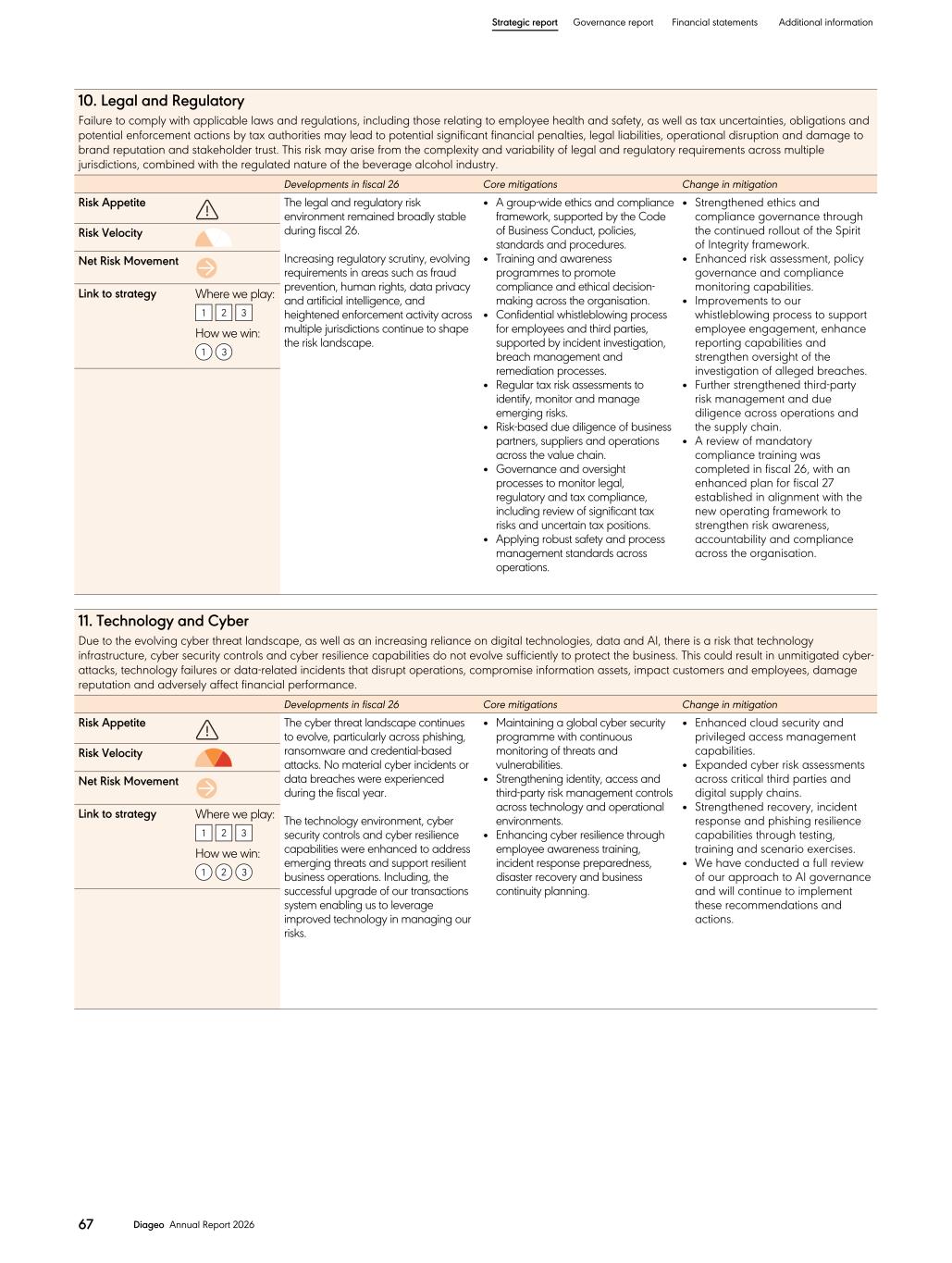
10. Legal and Regulatory Failure to comply with applicable laws and regulations, including those relating to employee health and safety, as well as tax uncertainties, obligations and potential enforcement actions by tax authorities may lead to potential significant financial penalties, legal liabilities, operational disruption and damage to brand reputation and stakeholder trust. This risk may arise from the complexity and variability of legal and regulatory requirements across multiple jurisdictions, combined with the regulated nature of the beverage alcohol industry. Developments in fiscal 26 Core mitigations Change in mitigation Risk Appetite The legal and regulatory risk environment remained broadly stable during fiscal 26. Increasing regulatory scrutiny, evolving requirements in areas such as fraud prevention, human rights, data privacy and artificial intelligence, and heightened enforcement activity across multiple jurisdictions continue to shape the risk landscape. • A group-wide ethics and compliance framework, supported by the Code of Business Conduct, policies, standards and procedures. • Training and awareness programmes to promote compliance and ethical decision- making across the organisation. • Confidential whistleblowing process for employees and third parties, supported by incident investigation, breach management and remediation processes. • Regular tax risk assessments to identify, monitor and manage emerging risks. • Risk-based due diligence of business partners, suppliers and operations across the value chain. • Governance and oversight processes to monitor legal, regulatory and tax compliance, including review of significant tax risks and uncertain tax positions. • Applying robust safety and process management standards across operations. • Strengthened ethics and compliance governance through the continued rollout of the Spirit of Integrity framework. • Enhanced risk assessment, policy governance and compliance monitoring capabilities. • Improvements to our whistleblowing process to support employee engagement, enhance reporting capabilities and strengthen oversight of the investigation of alleged breaches. • Further strengthened third-party risk management and due diligence across operations and the supply chain. • A review of mandatory compliance training was completed in fiscal 26, with an enhanced plan for fiscal 27 established in alignment with the new operating framework to strengthen risk awareness, accountability and compliance across the organisation. Risk Velocity Net Risk Movement Link to strategy Where we play: How we win: 11. Technology and Cyber Due to the evolving cyber threat landscape, as well as an increasing reliance on digital technologies, data and AI, there is a risk that technology infrastructure, cyber security controls and cyber resilience capabilities do not evolve sufficiently to protect the business. This could result in unmitigated cyber- attacks, technology failures or data-related incidents that disrupt operations, compromise information assets, impact customers and employees, damage reputation and adversely affect financial performance. Developments in fiscal 26 Core mitigations Change in mitigation Risk Appetite The cyber threat landscape continues to evolve, particularly across phishing, ransomware and credential-based attacks. No material cyber incidents or data breaches were experienced during the fiscal year. The technology environment, cyber security controls and cyber resilience capabilities were enhanced to address emerging threats and support resilient business operations. Including, the successful upgrade of our transactions system enabling us to leverage improved technology in managing our risks. • Maintaining a global cyber security programme with continuous monitoring of threats and vulnerabilities. • Strengthening identity, access and third-party risk management controls across technology and operational environments. • Enhancing cyber resilience through employee awareness training, incident response preparedness, disaster recovery and business continuity planning. • Enhanced cloud security and privileged access management capabilities. • Expanded cyber risk assessments across critical third parties and digital supply chains. • Strengthened recovery, incident response and phishing resilience capabilities through testing, training and scenario exercises. • We have conducted a full review of our approach to AI governance and will continue to implement these recommendations and actions. Risk Velocity Net Risk Movement Link to strategy Where we play: How we win: Strategic report Governance report Financial statements Additional information 67 Diageo Annual Report 2026
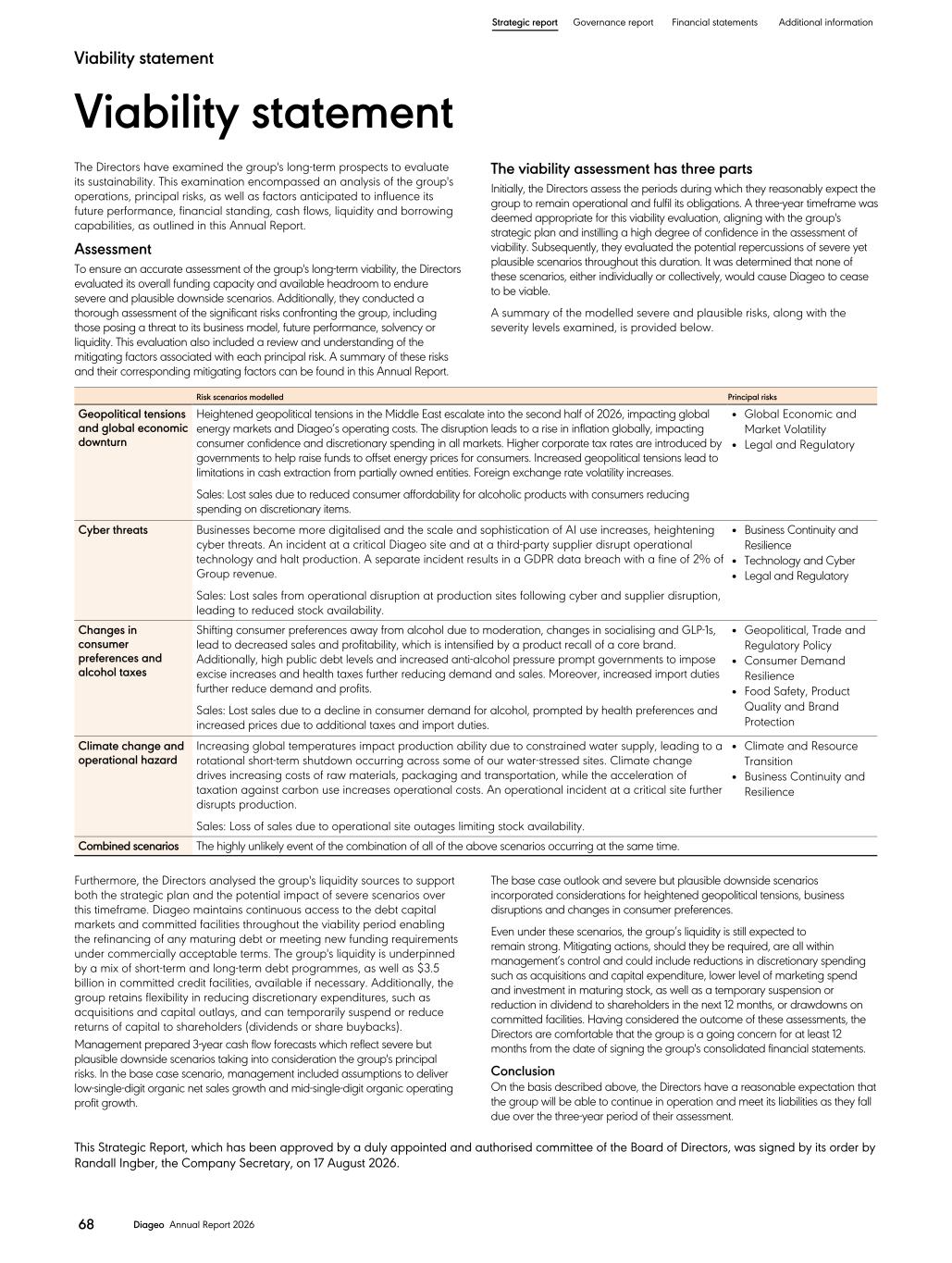
Viability statement The Directors have examined the group's long-term prospects to evaluate its sustainability. This examination encompassed an analysis of the group's operations, principal risks, as well as factors anticipated to influence its future performance, financial standing, cash flows, liquidity and borrowing capabilities, as outlined in this Annual Report. Assessment To ensure an accurate assessment of the group's long-term viability, the Directors evaluated its overall funding capacity and available headroom to endure severe and plausible downside scenarios. Additionally, they conducted a thorough assessment of the significant risks confronting the group, including those posing a threat to its business model, future performance, solvency or liquidity. This evaluation also included a review and understanding of the mitigating factors associated with each principal risk. A summary of these risks and their corresponding mitigating factors can be found in this Annual Report. The viability assessment has three parts Initially, the Directors assess the periods during which they reasonably expect the group to remain operational and fulfil its obligations. A three-year timeframe was deemed appropriate for this viability evaluation, aligning with the group's strategic plan and instilling a high degree of confidence in the assessment of viability. Subsequently, they evaluated the potential repercussions of severe yet plausible scenarios throughout this duration. It was determined that none of these scenarios, either individually or collectively, would cause Diageo to cease to be viable. A summary of the modelled severe and plausible risks, along with the severity levels examined, is provided below. Geopolitical tensions and global economic downturn Heightened geopolitical tensions in the Middle East escalate into the second half of 2026, impacting global energy markets and Diageo’s operating costs. The disruption leads to a rise in inflation globally, impacting consumer confidence and discretionary spending in all markets. Higher corporate tax rates are introduced by governments to help raise funds to offset energy prices for consumers. Increased geopolitical tensions lead to limitations in cash extraction from partially owned entities. Foreign exchange rate volatility increases. Sales: Lost sales due to reduced consumer affordability for alcoholic products with consumers reducing spending on discretionary items. • Global Economic and Market Volatility • Legal and Regulatory Cyber threats Businesses become more digitalised and the scale and sophistication of AI use increases, heightening cyber threats. An incident at a critical Diageo site and at a third-party supplier disrupt operational technology and halt production. A separate incident results in a GDPR data breach with a fine of 2% of Group revenue. Sales: Lost sales from operational disruption at production sites following cyber and supplier disruption, leading to reduced stock availability. • Business Continuity and Resilience • Technology and Cyber • Legal and Regulatory Changes in consumer preferences and alcohol taxes Shifting consumer preferences away from alcohol due to moderation, changes in socialising and GLP-1s, lead to decreased sales and profitability, which is intensified by a product recall of a core brand. Additionally, high public debt levels and increased anti-alcohol pressure prompt governments to impose excise increases and health taxes further reducing demand and sales. Moreover, increased import duties further reduce demand and profits. Sales: Lost sales due to a decline in consumer demand for alcohol, prompted by health preferences and increased prices due to additional taxes and import duties. • Geopolitical, Trade and Regulatory Policy • Consumer Demand Resilience • Food Safety, Product Quality and Brand Protection Climate change and operational hazard Increasing global temperatures impact production ability due to constrained water supply, leading to a rotational short-term shutdown occurring across some of our water-stressed sites. Climate change drives increasing costs of raw materials, packaging and transportation, while the acceleration of taxation against carbon use increases operational costs. An operational incident at a critical site further disrupts production. Sales: Loss of sales due to operational site outages limiting stock availability. • Climate and Resource Transition • Business Continuity and Resilience Combined scenarios The highly unlikely event of the combination of all of the above scenarios occurring at the same time. Risk scenarios modelled Principal risks Furthermore, the Directors analysed the group's liquidity sources to support both the strategic plan and the potential impact of severe scenarios over this timeframe. Diageo maintains continuous access to the debt capital markets and committed facilities throughout the viability period enabling the refinancing of any maturing debt or meeting new funding requirements under commercially acceptable terms. The group's liquidity is underpinned by a mix of short-term and long-term debt programmes, as well as $3.5 billion in committed credit facilities, available if necessary. Additionally, the group retains flexibility in reducing discretionary expenditures, such as acquisitions and capital outlays, and can temporarily suspend or reduce returns of capital to shareholders (dividends or share buybacks). Management prepared 3-year cash flow forecasts which reflect severe but plausible downside scenarios taking into consideration the group's principal risks. In the base case scenario, management included assumptions to deliver low-single-digit organic net sales growth and mid-single-digit organic operating profit growth. The base case outlook and severe but plausible downside scenarios incorporated considerations for heightened geopolitical tensions, business disruptions and changes in consumer preferences. Even under these scenarios, the group’s liquidity is still expected to remain strong. Mitigating actions, should they be required, are all within management’s control and could include reductions in discretionary spending such as acquisitions and capital expenditure, lower level of marketing spend and investment in maturing stock, as well as a temporary suspension or reduction in dividend to shareholders in the next 12 months, or drawdowns on committed facilities. Having considered the outcome of these assessments, the Directors are comfortable that the group is a going concern for at least 12 months from the date of signing the group's consolidated financial statements. Conclusion On the basis described above, the Directors have a reasonable expectation that the group will be able to continue in operation and meet its liabilities as they fall due over the three-year period of their assessment. This Strategic Report, which has been approved by a duly appointed and authorised committee of the Board of Directors, was signed by its order by Randall Ingber, the Company Secretary, on 17 August 2026. Strategic report Governance report Financial statements Additional information 68 Diageo Annual Report 2026 Viability statement
Governance report Contents Chair's introduction to Governance 70 Corporate governance structure and division of responsibilities 71 Board of Directors 73 Executive Committee 75 Corporate governance report 77 Audit Committee report 89 Nomination Committee report 96 Directors’ remuneration report 100 Directors’ report 130 Strategic report Governance report Financial statements Additional information 69 Diageo Annual Report 2026 Governance report
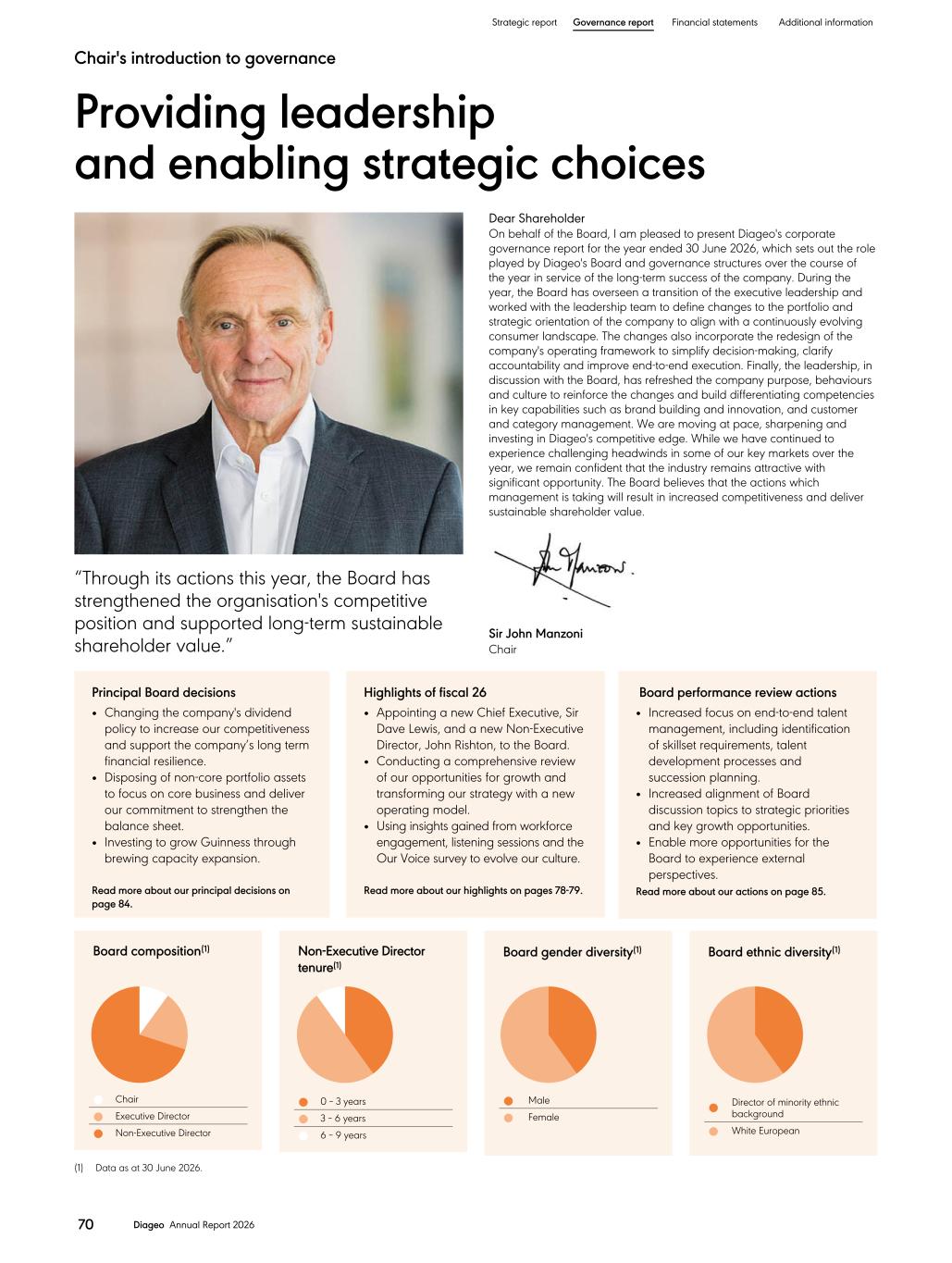
Providing leadership and enabling strategic choices “Through its actions this year, the Board has strengthened the organisation's competitive position and supported long-term sustainable shareholder value.” Dear Shareholder On behalf of the Board, I am pleased to present Diageo's corporate governance report for the year ended 30 June 2026, which sets out the role played by Diageo's Board and governance structures over the course of the year in service of the long-term success of the company. During the year, the Board has overseen a transition of the executive leadership and worked with the leadership team to define changes to the portfolio and strategic orientation of the company to align with a continuously evolving consumer landscape. The changes also incorporate the redesign of the company's operating framework to simplify decision-making, clarify accountability and improve end-to-end execution. Finally, the leadership, in discussion with the Board, has refreshed the company purpose, behaviours and culture to reinforce the changes and build differentiating competencies in key capabilities such as brand building and innovation, and customer and category management. We are moving at pace, sharpening and investing in Diageo's competitive edge. While we have continued to experience challenging headwinds in some of our key markets over the year, we remain confident that the industry remains attractive with significant opportunity. The Board believes that the actions which management is taking will result in increased competitiveness and deliver sustainable shareholder value. Sir John Manzoni Chair Principal Board decisions • Changing the company's dividend policy to increase our competitiveness and support the company’s long term financial resilience. • Disposing of non-core portfolio assets to focus on core business and deliver our commitment to strengthen the balance sheet. • Investing to grow Guinness through brewing capacity expansion. Read more about our principal decisions on page 84. Highlights of fiscal 26 • Appointing a new Chief Executive, Sir Dave Lewis, and a new Non-Executive Director, John Rishton, to the Board. • Conducting a comprehensive review of our opportunities for growth and transforming our strategy with a new operating model. • Using insights gained from workforce engagement, listening sessions and the Our Voice survey to evolve our culture. Read more about our highlights on pages 78-79. Board performance review actions • Increased focus on end-to-end talent management, including identification of skillset requirements, talent development processes and succession planning. • Increased alignment of Board discussion topics to strategic priorities and key growth opportunities. • Enable more opportunities for the Board to experience external perspectives. Read more about our actions on page 85. Board composition(1) ò Chair ò Executive Director ò Non-Executive Director Non-Executive Director tenure(1) ò 0 – 3 years ò 3 – 6 years ò 6 – 9 years Board gender diversity(1) ò Male ò Female Board ethnic diversity(1) ò Director of minority ethnic background ò White European (1) Data as at 30 June 2026. Strategic report Governance report Financial statements Additional information 70 Diageo Annual Report 2026 Chair's introduction to governance
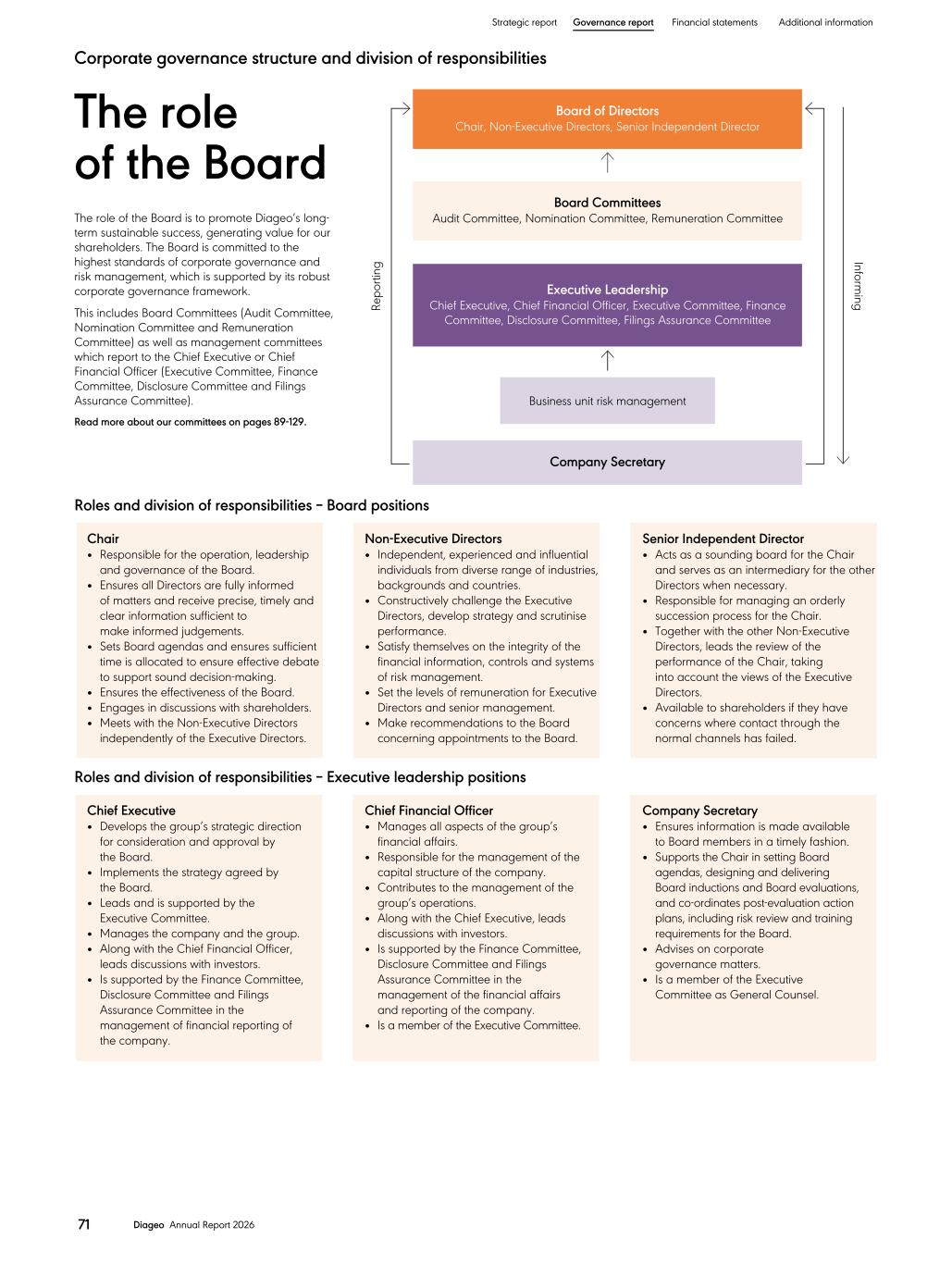
The role of the Board The role of the Board is to promote Diageo’s long- term sustainable success, generating value for our shareholders. The Board is committed to the highest standards of corporate governance and risk management, which is supported by its robust corporate governance framework. This includes Board Committees (Audit Committee, Nomination Committee and Remuneration Committee) as well as management committees which report to the Chief Executive or Chief Financial Officer (Executive Committee, Finance Committee, Disclosure Committee and Filings Assurance Committee). Read more about our committees on pages 89-129. Roles and division of responsibilities – Board positions Chair • Responsible for the operation, leadership and governance of the Board. • Ensures all Directors are fully informed of matters and receive precise, timely and clear information sufficient to make informed judgements. • Sets Board agendas and ensures sufficient time is allocated to ensure effective debate to support sound decision-making. • Ensures the effectiveness of the Board. • Engages in discussions with shareholders. • Meets with the Non-Executive Directors independently of the Executive Directors. Non-Executive Directors • Independent, experienced and influential individuals from diverse range of industries, backgrounds and countries. • Constructively challenge the Executive Directors, develop strategy and scrutinise performance. • Satisfy themselves on the integrity of the financial information, controls and systems of risk management. • Set the levels of remuneration for Executive Directors and senior management. • Make recommendations to the Board concerning appointments to the Board. Senior Independent Director • Acts as a sounding board for the Chair and serves as an intermediary for the other Directors when necessary. • Responsible for managing an orderly succession process for the Chair. • Together with the other Non-Executive Directors, leads the review of the performance of the Chair, taking into account the views of the Executive Directors. • Available to shareholders if they have concerns where contact through the normal channels has failed. Roles and division of responsibilities – Executive leadership positions Chief Executive • Develops the group’s strategic direction for consideration and approval by the Board. • Implements the strategy agreed by the Board. • Leads and is supported by the Executive Committee. • Manages the company and the group. • Along with the Chief Financial Officer, leads discussions with investors. • Is supported by the Finance Committee, Disclosure Committee and Filings Assurance Committee in the management of financial reporting of the company. Chief Financial Officer • Manages all aspects of the group’s financial affairs. • Responsible for the management of the capital structure of the company. • Contributes to the management of the group’s operations. • Along with the Chief Executive, leads discussions with investors. • Is supported by the Finance Committee, Disclosure Committee and Filings Assurance Committee in the management of the financial affairs and reporting of the company. • Is a member of the Executive Committee. Company Secretary • Ensures information is made available to Board members in a timely fashion. • Supports the Chair in setting Board agendas, designing and delivering Board inductions and Board evaluations, and co-ordinates post-evaluation action plans, including risk review and training requirements for the Board. • Advises on corporate governance matters. • Is a member of the Executive Committee as General Counsel. Strategic report Governance report Financial statements Additional information 71 Diageo Annual Report 2026 Board of Directors Chair, Non-Executive Directors, Senior Independent Director Board Committees Audit Committee, Nomination Committee, Remuneration Committee Executive Leadership Chief Executive, Chief Financial Officer, Executive Committee, Finance Committee, Disclosure Committee, Filings Assurance Committee Business unit risk management Company Secretary Inform ingRe po rti ng Corporate governance structure and division of responsibilities
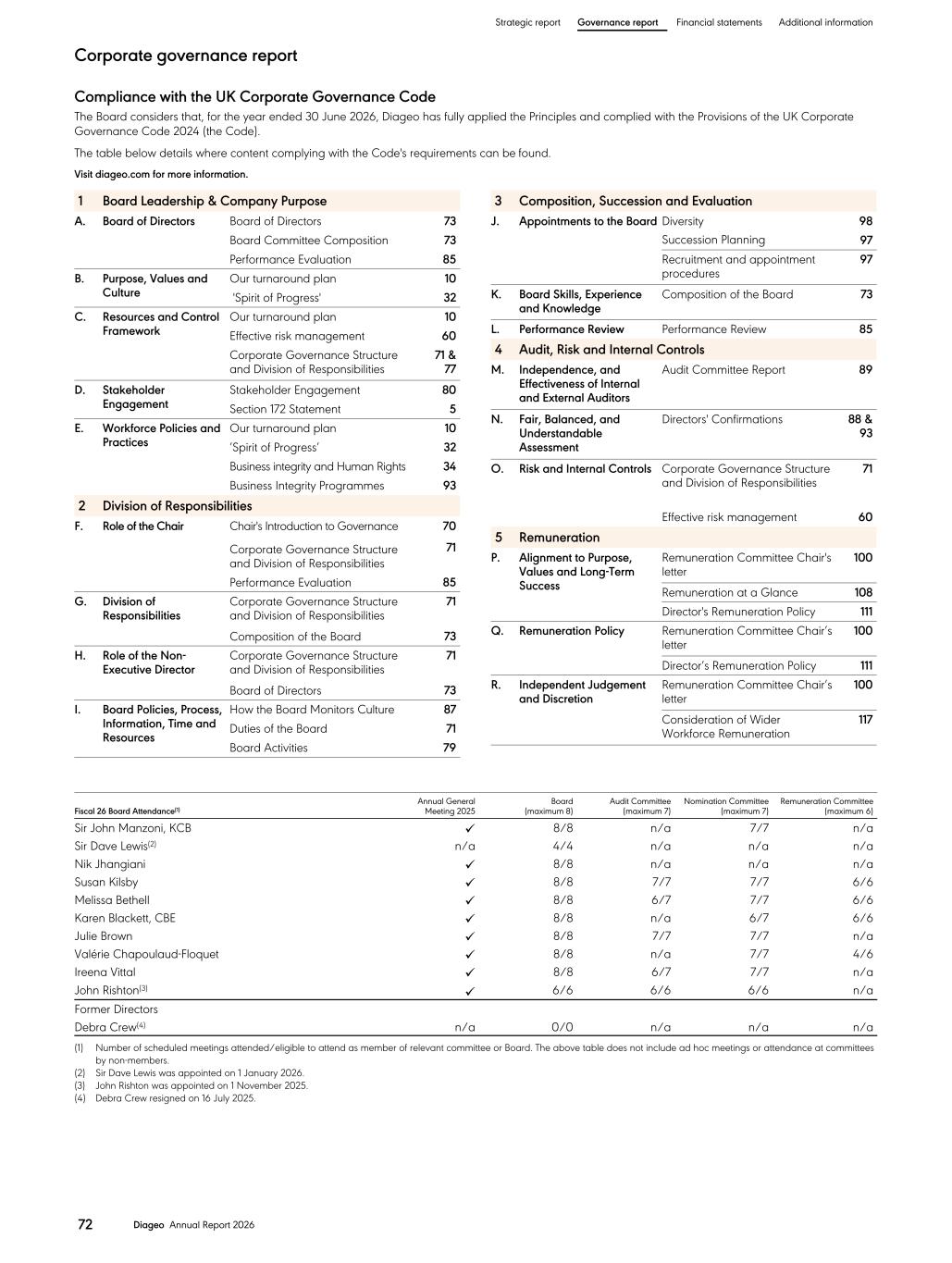
Compliance with the UK Corporate Governance Code The Board considers that, for the year ended 30 June 2026, Diageo has fully applied the Principles and complied with the Provisions of the UK Corporate Governance Code 2024 (the Code). The table below details where content complying with the Code's requirements can be found. Visit diageo.com for more information. 1 Board Leadership & Company Purpose A. Board of Directors Board of Directors 73 Board Committee Composition 73 Performance Evaluation 85 B. Purpose, Values and Culture Our turnaround plan 10 'Spirit of Progress' 32 C. Resources and Control Framework Our turnaround plan 10 Effective risk management 60 Corporate Governance Structure and Division of Responsibilities 71 & 77 D. Stakeholder Engagement Stakeholder Engagement 80 Section 172 Statement 5 E. Workforce Policies and Practices Our turnaround plan 10 ’Spirit of Progress’ 32 Business integrity and Human Rights 34 Business Integrity Programmes 93 2 Division of Responsibilities F. Role of the Chair Chair's Introduction to Governance 70 Corporate Governance Structure and Division of Responsibilities 71 Performance Evaluation 85 G. Division of Responsibilities Corporate Governance Structure and Division of Responsibilities 71 Composition of the Board 73 H. Role of the Non- Executive Director Corporate Governance Structure and Division of Responsibilities 71 Board of Directors 73 I. Board Policies, Process, Information, Time and Resources How the Board Monitors Culture 87 Duties of the Board 71 Board Activities 79 3 Composition, Succession and Evaluation J. Appointments to the Board Diversity Succession Planning 98 97 Recruitment and appointment procedures 97 K. Board Skills, Experience and Knowledge Composition of the Board 73 L. Performance Review Performance Review 85 4 Audit, Risk and Internal Controls M. Independence, and Effectiveness of Internal and External Auditors Audit Committee Report 89 N. Fair, Balanced, and Understandable Assessment Directors' Confirmations 88 & 93 O. Risk and Internal Controls Corporate Governance Structure and Division of Responsibilities 71 Effective risk management 60 5 Remuneration P. Alignment to Purpose, Values and Long-Term Success Remuneration Committee Chair's letter 100 Remuneration at a Glance 108 Director's Remuneration Policy 111 Q. Remuneration Policy Remuneration Committee Chair’s letter 100 Director’s Remuneration Policy 111 R. Independent Judgement and Discretion Remuneration Committee Chair’s letter 100 Consideration of Wider Workforce Remuneration 117 Sir John Manzoni, KCB ü 8/8 n/a 7/7 n/a Sir Dave Lewis(2) n/a 4/4 n/a n/a n/a Nik Jhangiani ü 8/8 n/a n/a n/a Susan Kilsby ü 8/8 7/7 7/7 6/6 Melissa Bethell ü 8/8 6/7 7/7 6/6 Karen Blackett, CBE ü 8/8 n/a 6/7 6/6 Julie Brown ü 8/8 7/7 7/7 n/a Valérie Chapoulaud-Floquet ü 8/8 n/a 7/7 4/6 Ireena Vittal ü 8/8 6/7 7/7 n/a John Rishton(3) ü 6/6 6/6 6/6 n/a Former Directors Debra Crew(4) n/a 0/0 n/a n/a n/a Fiscal 26 Board Attendance(1) Annual General Meeting 2025 Board (maximum 8) Audit Committee (maximum 7) Nomination Committee (maximum 7) Remuneration Committee (maximum 6) (1) Number of scheduled meetings attended/eligible to attend as member of relevant committee or Board. The above table does not include ad hoc meetings or attendance at committees by non-members. (2) Sir Dave Lewis was appointed on 1 January 2026. (3) John Rishton was appointed on 1 November 2025. (4) Debra Crew resigned on 16 July 2025. Strategic report Governance report Financial statements Additional information Corporate governance report 72 Diageo Annual Report 2026
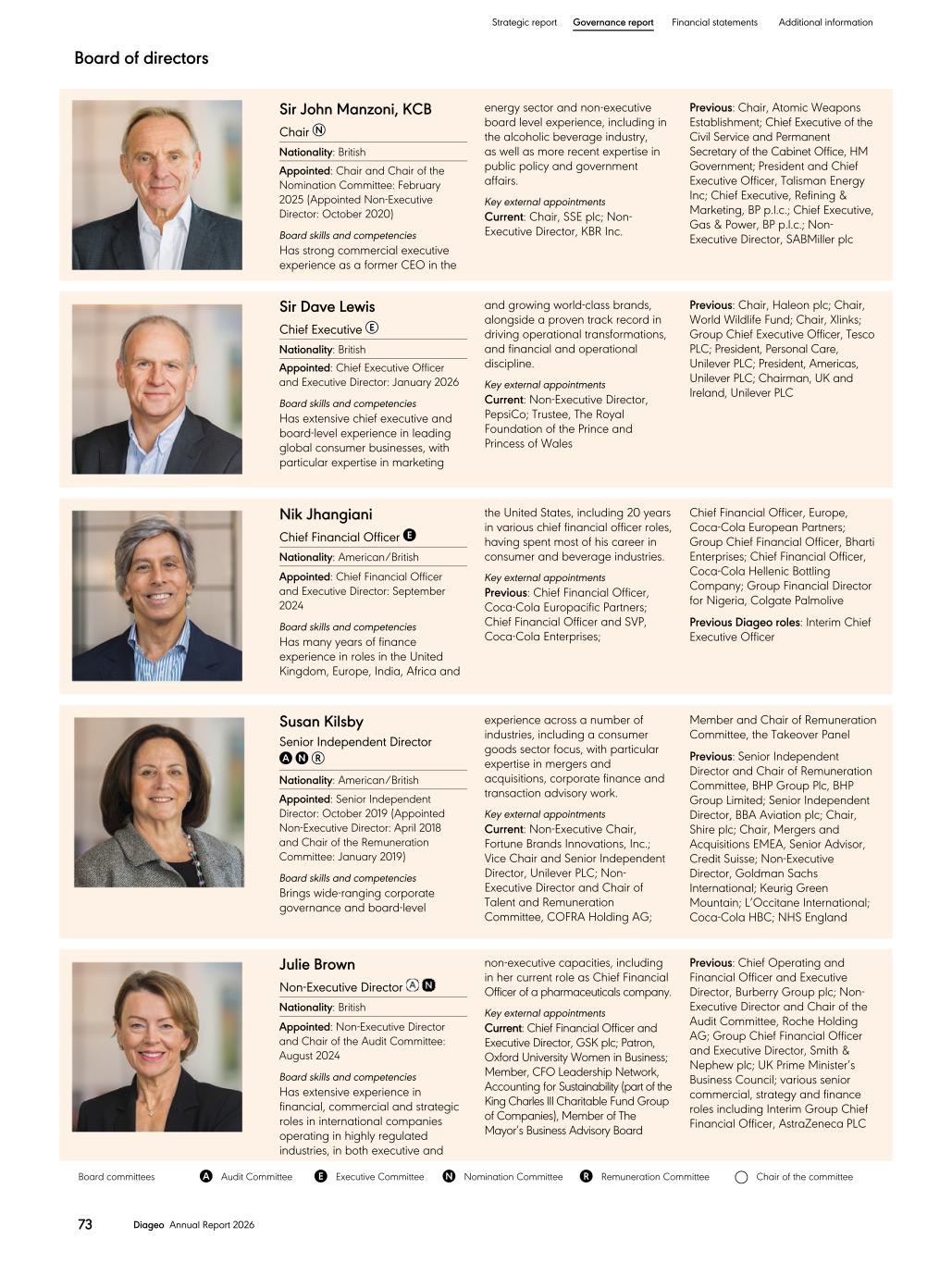
Sir John Manzoni, KCB Chair Nationality: British Appointed: Chair and Chair of the Nomination Committee: February 2025 (Appointed Non-Executive Director: October 2020) Board skills and competencies Has strong commercial executive experience as a former CEO in the energy sector and non-executive board level experience, including in the alcoholic beverage industry, as well as more recent expertise in public policy and government affairs. Key external appointments Current: Chair, SSE plc; Non- Executive Director, KBR Inc. Previous: Chair, Atomic Weapons Establishment; Chief Executive of the Civil Service and Permanent Secretary of the Cabinet Office, HM Government; President and Chief Executive Officer, Talisman Energy Inc; Chief Executive, Refining & Marketing, BP p.l.c.; Chief Executive, Gas & Power, BP p.l.c.; Non- Executive Director, SABMiller plc Sir Dave Lewis Chief Executive Nationality: British Appointed: Chief Executive Officer and Executive Director: January 2026 Board skills and competencies Has extensive chief executive and board-level experience in leading global consumer businesses, with particular expertise in marketing and growing world-class brands, alongside a proven track record in driving operational transformations, and financial and operational discipline. Key external appointments Current: Non-Executive Director, PepsiCo; Trustee, The Royal Foundation of the Prince and Princess of Wales Previous: Chair, Haleon plc; Chair, World Wildlife Fund; Chair, Xlinks; Group Chief Executive Officer, Tesco PLC; President, Personal Care, Unilever PLC; President, Americas, Unilever PLC; Chairman, UK and Ireland, Unilever PLC Nik Jhangiani Chief Financial Officer Nationality: American/British Appointed: Chief Financial Officer and Executive Director: September 2024 Board skills and competencies Has many years of finance experience in roles in the United Kingdom, Europe, India, Africa and the United States, including 20 years in various chief financial officer roles, having spent most of his career in consumer and beverage industries. Key external appointments Previous: Chief Financial Officer, Coca-Cola Europacific Partners; Chief Financial Officer and SVP, Coca-Cola Enterprises; Chief Financial Officer, Europe, Coca-Cola European Partners; Group Chief Financial Officer, Bharti Enterprises; Chief Financial Officer, Coca-Cola Hellenic Bottling Company; Group Financial Director for Nigeria, Colgate Palmolive Previous Diageo roles: Interim Chief Executive Officer Susan Kilsby Senior Independent Director Nationality: American/British Appointed: Senior Independent Director: October 2019 (Appointed Non-Executive Director: April 2018 and Chair of the Remuneration Committee: January 2019) Board skills and competencies Brings wide-ranging corporate governance and board-level experience across a number of industries, including a consumer goods sector focus, with particular expertise in mergers and acquisitions, corporate finance and transaction advisory work. Key external appointments Current: Non-Executive Chair, Fortune Brands Innovations, Inc.; Vice Chair and Senior Independent Director, Unilever PLC; Non- Executive Director and Chair of Talent and Remuneration Committee, COFRA Holding AG; Member and Chair of Remuneration Committee, the Takeover Panel Previous: Senior Independent Director and Chair of Remuneration Committee, BHP Group Plc, BHP Group Limited; Senior Independent Director, BBA Aviation plc; Chair, Shire plc; Chair, Mergers and Acquisitions EMEA, Senior Advisor, Credit Suisse; Non-Executive Director, Goldman Sachs International; Keurig Green Mountain; L’Occitane International; Coca-Cola HBC; NHS England Julie Brown Non-Executive Director Nationality: British Appointed: Non-Executive Director and Chair of the Audit Committee: August 2024 Board skills and competencies Has extensive experience in financial, commercial and strategic roles in international companies operating in highly regulated industries, in both executive and non-executive capacities, including in her current role as Chief Financial Officer of a pharmaceuticals company. Key external appointments Current: Chief Financial Officer and Executive Director, GSK plc; Patron, Oxford University Women in Business; Member, CFO Leadership Network, Accounting for Sustainability (part of the King Charles III Charitable Fund Group of Companies), Member of The Mayor’s Business Advisory Board Previous: Chief Operating and Financial Officer and Executive Director, Burberry Group plc; Non- Executive Director and Chair of the Audit Committee, Roche Holding AG; Group Chief Financial Officer and Executive Director, Smith & Nephew plc; UK Prime Minister’s Business Council; various senior commercial, strategy and finance roles including Interim Group Chief Financial Officer, AstraZeneca PLC Board committees Audit Committee Executive Committee Nomination Committee Remuneration Committee Chair of the committee Strategic report Governance report Financial statements Additional information 73 Diageo Annual Report 2026 Board of directors
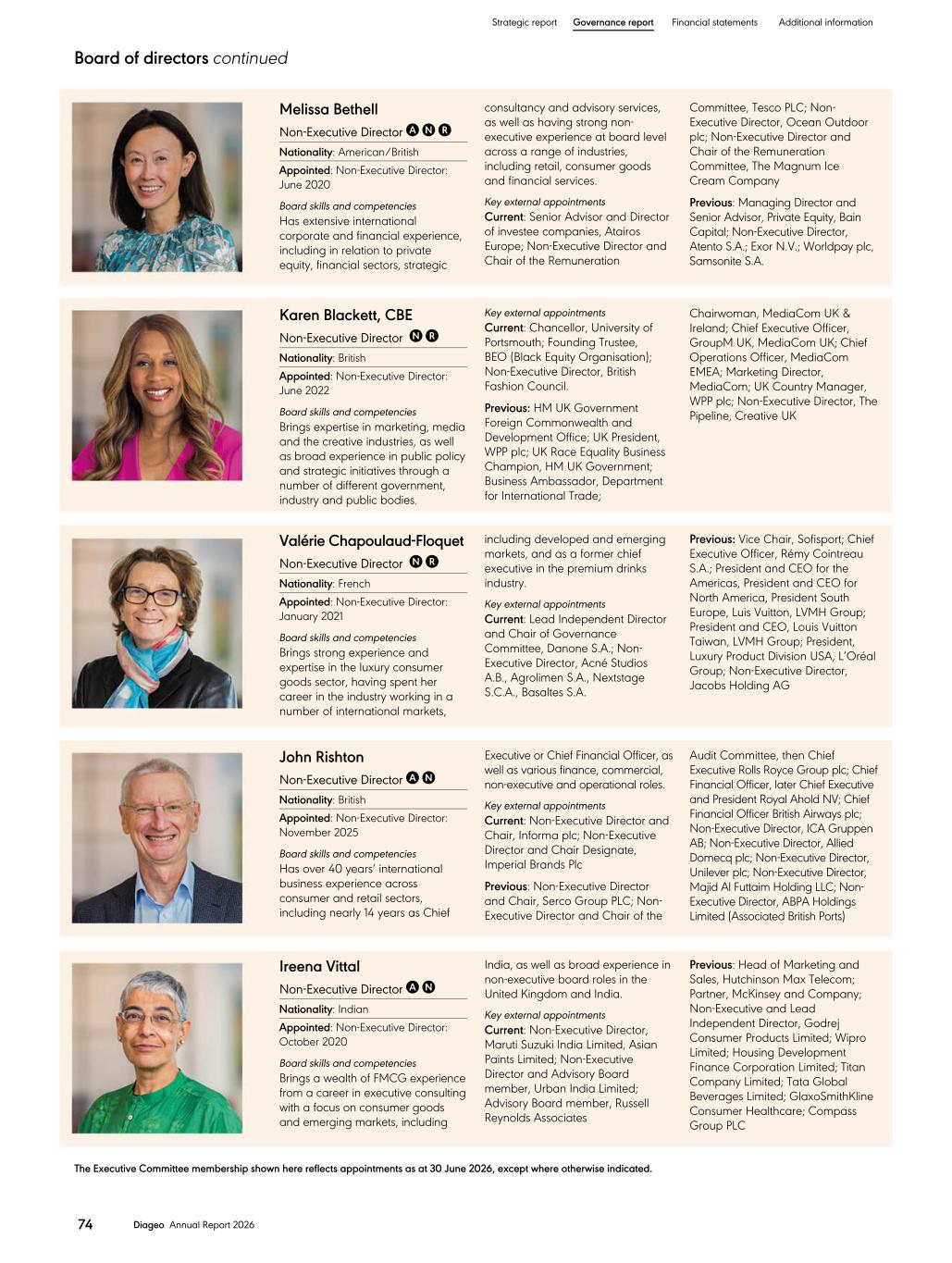
Melissa Bethell Non-Executive Director Nationality: American/British Appointed: Non-Executive Director: June 2020 Board skills and competencies Has extensive international corporate and financial experience, including in relation to private equity, financial sectors, strategic consultancy and advisory services, as well as having strong non- executive experience at board level across a range of industries, including retail, consumer goods and financial services. Key external appointments Current: Senior Advisor and Director of investee companies, Atairos Europe; Non-Executive Director and Chair of the Remuneration Committee, Tesco PLC; Non- Executive Director, Ocean Outdoor plc; Non-Executive Director and Chair of the Remuneration Committee, The Magnum Ice Cream Company Previous: Managing Director and Senior Advisor, Private Equity, Bain Capital; Non-Executive Director, Atento S.A.; Exor N.V.; Worldpay plc, Samsonite S.A. Karen Blackett, CBE Non-Executive Director Nationality: British Appointed: Non-Executive Director: June 2022 Board skills and competencies Brings expertise in marketing, media and the creative industries, as well as broad experience in public policy and strategic initiatives through a number of different government, industry and public bodies. Key external appointments Current: Chancellor, University of Portsmouth; Founding Trustee, BEO (Black Equity Organisation); Non-Executive Director, British Fashion Council. Previous: HM UK Government Foreign Commonwealth and Development Office; UK President, WPP plc; UK Race Equality Business Champion, HM UK Government; Business Ambassador, Department for International Trade; Chairwoman, MediaCom UK & Ireland; Chief Executive Officer, GroupM UK, MediaCom UK; Chief Operations Officer, MediaCom EMEA; Marketing Director, MediaCom; UK Country Manager, WPP plc; Non-Executive Director, The Pipeline, Creative UK Valérie Chapoulaud-Floquet Non-Executive Director Nationality: French Appointed: Non-Executive Director: January 2021 Board skills and competencies Brings strong experience and expertise in the luxury consumer goods sector, having spent her career in the industry working in a number of international markets, including developed and emerging markets, and as a former chief executive in the premium drinks industry. Key external appointments Current: Lead Independent Director and Chair of Governance Committee, Danone S.A.; Non- Executive Director, Acné Studios A.B., Agrolimen S.A., Nextstage S.C.A., Basaltes S.A. Previous: Vice Chair, Sofisport; Chief Executive Officer, Rémy Cointreau S.A.; President and CEO for the Americas, President and CEO for North America, President South Europe, Luis Vuitton, LVMH Group; President and CEO, Louis Vuitton Taiwan, LVMH Group; President, Luxury Product Division USA, L’Oréal Group; Non-Executive Director, Jacobs Holding AG John Rishton Non-Executive Director Nationality: British Appointed: Non-Executive Director: November 2025 Board skills and competencies Has over 40 years’ international business experience across consumer and retail sectors, including nearly 14 years as Chief Executive or Chief Financial Officer, as well as various finance, commercial, non-executive and operational roles. Key external appointments Current: Non-Executive Director and Chair, Informa plc; Non-Executive Director and Chair Designate, Imperial Brands Plc Previous: Non-Executive Director and Chair, Serco Group PLC; Non- Executive Director and Chair of the Audit Committee, then Chief Executive Rolls Royce Group plc; Chief Financial Officer, later Chief Executive and President Royal Ahold NV; Chief Financial Officer British Airways plc; Non-Executive Director, ICA Gruppen AB; Non-Executive Director, Allied Domecq plc; Non-Executive Director, Unilever plc; Non-Executive Director, Majid Al Futtaim Holding LLC; Non- Executive Director, ABPA Holdings Limited (Associated British Ports) Ireena Vittal Non-Executive Director Nationality: Indian Appointed: Non-Executive Director: October 2020 Board skills and competencies Brings a wealth of FMCG experience from a career in executive consulting with a focus on consumer goods and emerging markets, including India, as well as broad experience in non-executive board roles in the United Kingdom and India. Key external appointments Current: Non-Executive Director, Maruti Suzuki India Limited, Asian Paints Limited; Non-Executive Director and Advisory Board member, Urban India Limited; Advisory Board member, Russell Reynolds Associates Previous: Head of Marketing and Sales, Hutchinson Max Telecom; Partner, McKinsey and Company; Non-Executive and Lead Independent Director, Godrej Consumer Products Limited; Wipro Limited; Housing Development Finance Corporation Limited; Titan Company Limited; Tata Global Beverages Limited; GlaxoSmithKline Consumer Healthcare; Compass Group PLC The Executive Committee membership shown here reflects appointments as at 30 June 2026, except where otherwise indicated. Strategic report Governance report Financial statements Additional information 74 Diageo Annual Report 2026 Board of directors continued
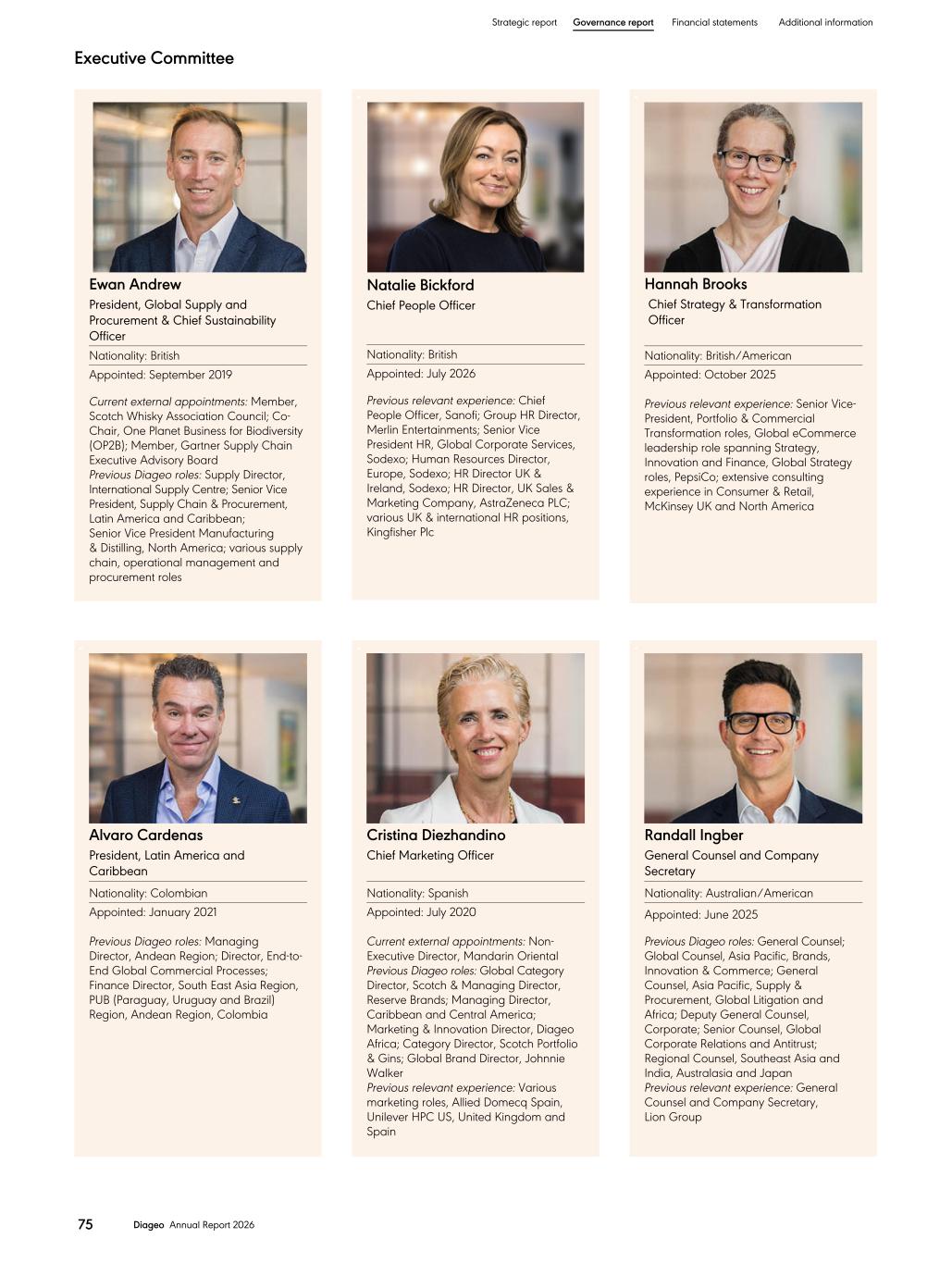
Ewan Andrew President, Global Supply and Procurement & Chief Sustainability Officer Nationality: British Appointed: September 2019 Current external appointments: Member, Scotch Whisky Association Council; Co- Chair, One Planet Business for Biodiversity (OP2B); Member, Gartner Supply Chain Executive Advisory Board Previous Diageo roles: Supply Director, International Supply Centre; Senior Vice President, Supply Chain & Procurement, Latin America and Caribbean; Senior Vice President Manufacturing & Distilling, North America; various supply chain, operational management and procurement roles • Natalie Bickford Chief People Officer Nationality: British Appointed: July 2026 Previous relevant experience: Chief People Officer, Sanofi; Group HR Director, Merlin Entertainments; Senior Vice President HR, Global Corporate Services, Sodexo; Human Resources Director, Europe, Sodexo; HR Director UK & Ireland, Sodexo; HR Director, UK Sales & Marketing Company, AstraZeneca PLC; various UK & international HR positions, Kingfisher Plc • Hannah Brooks Chief Strategy & Transformation Officer Nationality: British/American Appointed: October 2025 Previous relevant experience: Senior Vice- President, Portfolio & Commercial Transformation roles, Global eCommerce leadership role spanning Strategy, Innovation and Finance, Global Strategy roles, PepsiCo; extensive consulting experience in Consumer & Retail, McKinsey UK and North America • Alvaro Cardenas President, Latin America and Caribbean Nationality: Colombian Appointed: January 2021 Previous Diageo roles: Managing Director, Andean Region; Director, End-to- End Global Commercial Processes; Finance Director, South East Asia Region, PUB (Paraguay, Uruguay and Brazil) Region, Andean Region, Colombia • Cristina Diezhandino Chief Marketing Officer Nationality: Spanish Appointed: July 2020 Current external appointments: Non- Executive Director, Mandarin Oriental Previous Diageo roles: Global Category Director, Scotch & Managing Director, Reserve Brands; Managing Director, Caribbean and Central America; Marketing & Innovation Director, Diageo Africa; Category Director, Scotch Portfolio & Gins; Global Brand Director, Johnnie Walker Previous relevant experience: Various marketing roles, Allied Domecq Spain, Unilever HPC US, United Kingdom and Spain • Randall Ingber General Counsel and Company Secretary Nationality: Australian/American Appointed: June 2025 Previous Diageo roles: General Counsel; Global Counsel, Asia Pacific, Brands, Innovation & Commerce; General Counsel, Asia Pacific, Supply & Procurement, Global Litigation and Africa; Deputy General Counsel, Corporate; Senior Counsel, Global Corporate Relations and Antitrust; Regional Counsel, Southeast Asia and India, Australasia and Japan Previous relevant experience: General Counsel and Company Secretary, Lion Group Strategic report Governance report Financial statements Additional information 75 Diageo Annual Report 2026 Executive Committee
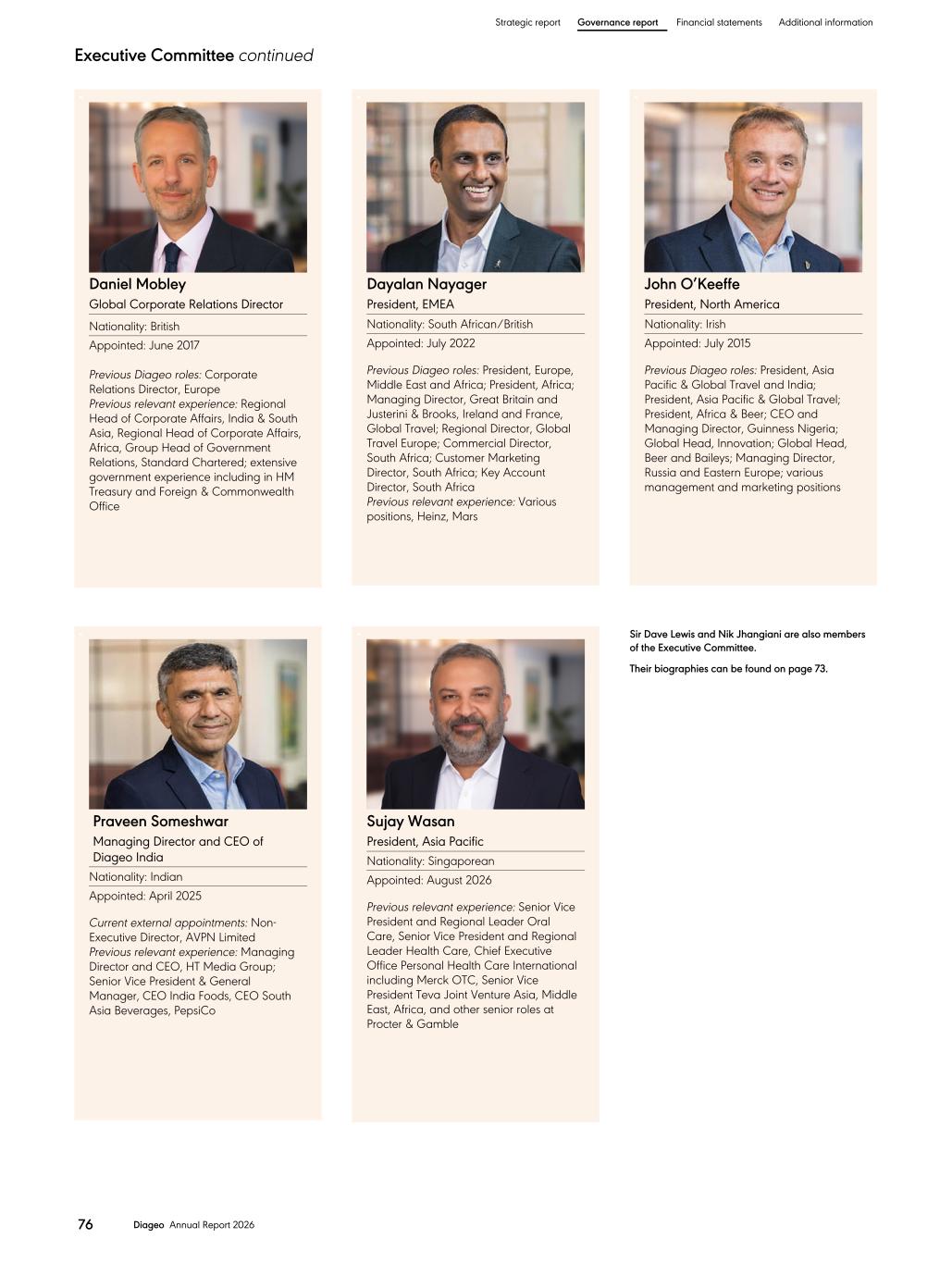
• Daniel Mobley Global Corporate Relations Director Nationality: British Appointed: June 2017 Previous Diageo roles: Corporate Relations Director, Europe Previous relevant experience: Regional Head of Corporate Affairs, India & South Asia, Regional Head of Corporate Affairs, Africa, Group Head of Government Relations, Standard Chartered; extensive government experience including in HM Treasury and Foreign & Commonwealth Office • Dayalan Nayager President, EMEA Nationality: South African/British Appointed: July 2022 Previous Diageo roles: President, Europe, Middle East and Africa; President, Africa; Managing Director, Great Britain and Justerini & Brooks, Ireland and France, Global Travel; Regional Director, Global Travel Europe; Commercial Director, South Africa; Customer Marketing Director, South Africa; Key Account Director, South Africa Previous relevant experience: Various positions, Heinz, Mars • John O’Keeffe President, North America Nationality: Irish Appointed: July 2015 Previous Diageo roles: President, Asia Pacific & Global Travel and India; President, Asia Pacific & Global Travel; President, Africa & Beer; CEO and Managing Director, Guinness Nigeria; Global Head, Innovation; Global Head, Beer and Baileys; Managing Director, Russia and Eastern Europe; various management and marketing positions • Praveen Someshwar Managing Director and CEO of Diageo India Nationality: Indian Appointed: April 2025 Current external appointments: Non- Executive Director, AVPN Limited Previous relevant experience: Managing Director and CEO, HT Media Group; Senior Vice President & General Manager, CEO India Foods, CEO South Asia Beverages, PepsiCo • Sujay Wasan President, Asia Pacific Nationality: Singaporean Appointed: August 2026 Previous relevant experience: Senior Vice President and Regional Leader Oral Care, Senior Vice President and Regional Leader Health Care, Chief Executive Office Personal Health Care International including Merck OTC, Senior Vice President Teva Joint Venture Asia, Middle East, Africa, and other senior roles at Procter & Gamble Sir Dave Lewis and Nik Jhangiani are also members of the Executive Committee. Their biographies can be found on page 73. Strategic report Governance report Financial statements Additional information Executive Committee continued 76 Diageo Annual Report 2026
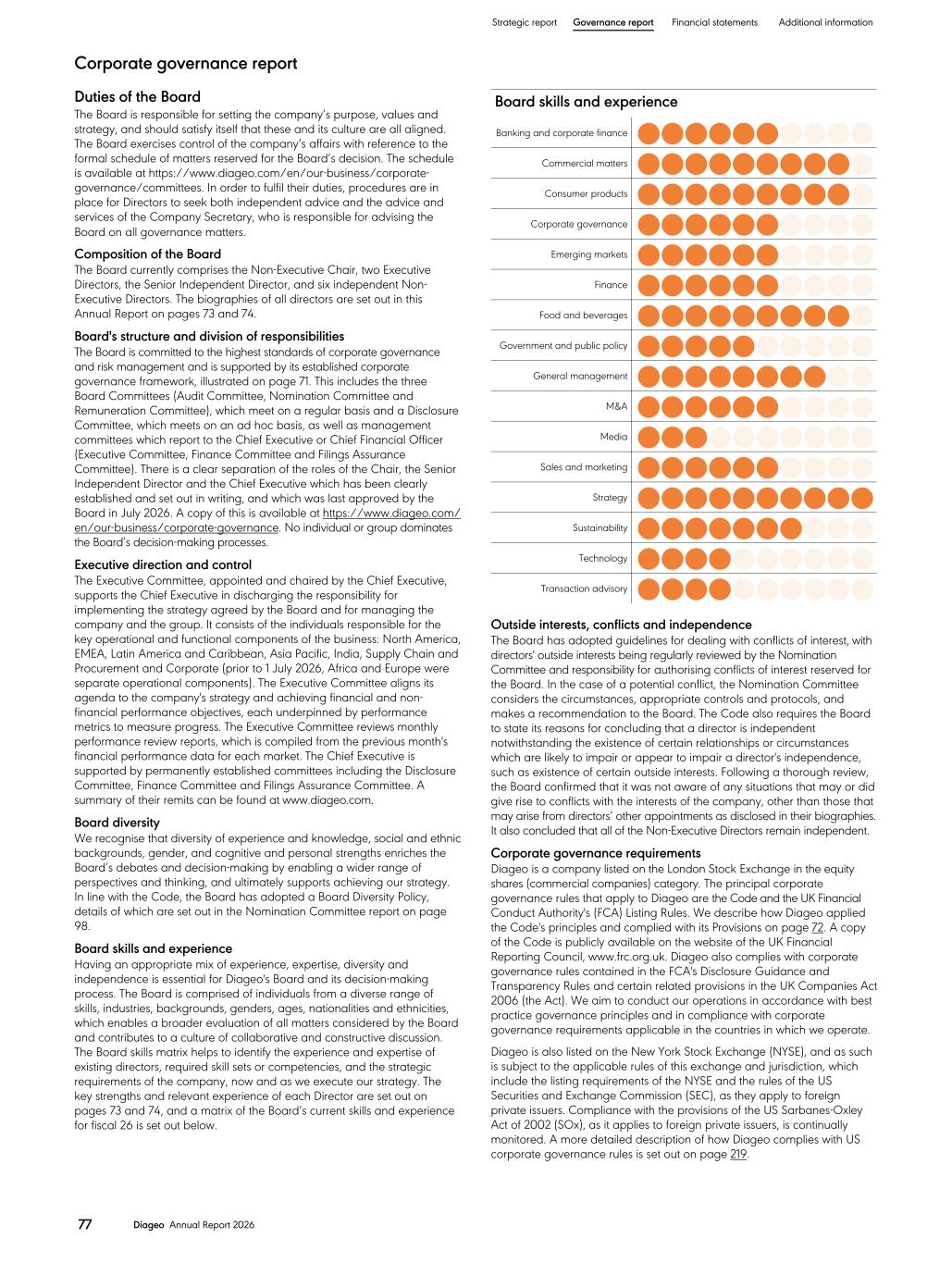
Duties of the Board The Board is responsible for setting the company’s purpose, values and strategy, and should satisfy itself that these and its culture are all aligned. The Board exercises control of the company’s affairs with reference to the formal schedule of matters reserved for the Board’s decision. The schedule is available at https://www.diageo.com/en/our-business/corporate- governance/committees. In order to fulfil their duties, procedures are in place for Directors to seek both independent advice and the advice and services of the Company Secretary, who is responsible for advising the Board on all governance matters. Composition of the Board The Board currently comprises the Non-Executive Chair, two Executive Directors, the Senior Independent Director, and six independent Non- Executive Directors. The biographies of all directors are set out in this Annual Report on pages 73 and 74. Board's structure and division of responsibilities The Board is committed to the highest standards of corporate governance and risk management and is supported by its established corporate governance framework, illustrated on page 71. This includes the three Board Committees (Audit Committee, Nomination Committee and Remuneration Committee), which meet on a regular basis and a Disclosure Committee, which meets on an ad hoc basis, as well as management committees which report to the Chief Executive or Chief Financial Officer (Executive Committee, Finance Committee and Filings Assurance Committee). There is a clear separation of the roles of the Chair, the Senior Independent Director and the Chief Executive which has been clearly established and set out in writing, and which was last approved by the Board in July 2026. A copy of this is available at https://www.diageo.com/ en/our-business/corporate-governance. No individual or group dominates the Board’s decision-making processes. Executive direction and control The Executive Committee, appointed and chaired by the Chief Executive, supports the Chief Executive in discharging the responsibility for implementing the strategy agreed by the Board and for managing the company and the group. It consists of the individuals responsible for the key operational and functional components of the business: North America, EMEA, Latin America and Caribbean, Asia Pacific, India, Supply Chain and Procurement and Corporate (prior to 1 July 2026, Africa and Europe were separate operational components). The Executive Committee aligns its agenda to the company's strategy and achieving financial and non- financial performance objectives, each underpinned by performance metrics to measure progress. The Executive Committee reviews monthly performance review reports, which is compiled from the previous month's financial performance data for each market. The Chief Executive is supported by permanently established committees including the Disclosure Committee, Finance Committee and Filings Assurance Committee. A summary of their remits can be found at www.diageo.com. Board diversity We recognise that diversity of experience and knowledge, social and ethnic backgrounds, gender, and cognitive and personal strengths enriches the Board’s debates and decision-making by enabling a wider range of perspectives and thinking, and ultimately supports achieving our strategy. In line with the Code, the Board has adopted a Board Diversity Policy, details of which are set out in the Nomination Committee report on page 98. Board skills and experience Having an appropriate mix of experience, expertise, diversity and independence is essential for Diageo's Board and its decision-making process. The Board is comprised of individuals from a diverse range of skills, industries, backgrounds, genders, ages, nationalities and ethnicities, which enables a broader evaluation of all matters considered by the Board and contributes to a culture of collaborative and constructive discussion. The Board skills matrix helps to identify the experience and expertise of existing directors, required skill sets or competencies, and the strategic requirements of the company, now and as we execute our strategy. The key strengths and relevant experience of each Director are set out on pages 73 and 74, and a matrix of the Board’s current skills and experience for fiscal 26 is set out below. Banking and corporate finance òòòòòòòòòò Commercial matters òòòòòòòòòò Consumer products òòòòòòòòòò Corporate governance òòòòòòòòòò Emerging markets òòòòòòòòòò Finance òòòòòòòòòò Food and beverages òòòòòòòòòò Government and public policy òòòòòòòòòò General management òòòòòòòòòò M&A òòòòòòòòòò Media òòòòòòòòòò Sales and marketing òòòòòòòòòò Strategy òòòòòòòòòò Sustainability òòòòòòòòòò Technology òòòòòòòòòò Transaction advisory òòòòòòòòòò Board skills and experience Outside interests, conflicts and independence The Board has adopted guidelines for dealing with conflicts of interest, with directors' outside interests being regularly reviewed by the Nomination Committee and responsibility for authorising conflicts of interest reserved for the Board. In the case of a potential conflict, the Nomination Committee considers the circumstances, appropriate controls and protocols, and makes a recommendation to the Board. The Code also requires the Board to state its reasons for concluding that a director is independent notwithstanding the existence of certain relationships or circumstances which are likely to impair or appear to impair a director's independence, such as existence of certain outside interests. Following a thorough review, the Board confirmed that it was not aware of any situations that may or did give rise to conflicts with the interests of the company, other than those that may arise from directors’ other appointments as disclosed in their biographies. It also concluded that all of the Non-Executive Directors remain independent. Corporate governance requirements Diageo is a company listed on the London Stock Exchange in the equity shares (commercial companies) category. The principal corporate governance rules that apply to Diageo are the Code and the UK Financial Conduct Authority's (FCA) Listing Rules. We describe how Diageo applied the Code's principles and complied with its Provisions on page 72. A copy of the Code is publicly available on the website of the UK Financial Reporting Council, www.frc.org.uk. Diageo also complies with corporate governance rules contained in the FCA's Disclosure Guidance and Transparency Rules and certain related provisions in the UK Companies Act 2006 (the Act). We aim to conduct our operations in accordance with best practice governance principles and in compliance with corporate governance requirements applicable in the countries in which we operate. Diageo is also listed on the New York Stock Exchange (NYSE), and as such is subject to the applicable rules of this exchange and jurisdiction, which include the listing requirements of the NYSE and the rules of the US Securities and Exchange Commission (SEC), as they apply to foreign private issuers. Compliance with the provisions of the US Sarbanes-Oxley Act of 2002 (SOx), as it applies to foreign private issuers, is continually monitored. A more detailed description of how Diageo complies with US corporate governance rules is set out on page 219. Strategic report Governance report Financial statements Additional information Corporate governance report 77 Diageo Annual Report 2026
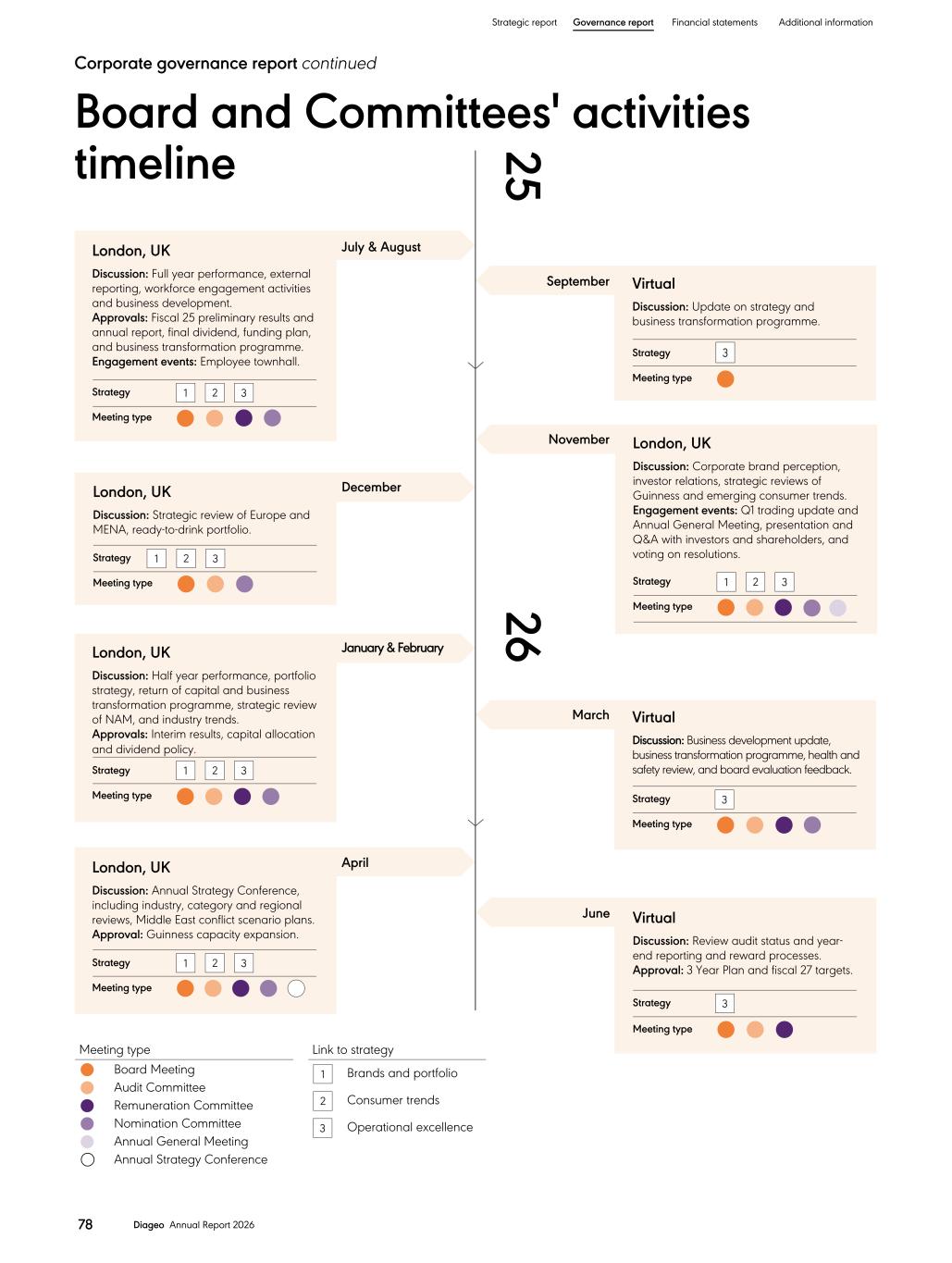
Meeting type ò Board Meeting ò Audit Committee ò Remuneration Committee ò Nomination Committee ò Annual General Meeting Annual Strategy Conference Board and Committees' activities timeline Strategic report Governance report Financial statements Additional information Corporate governance report continued 78 Diageo Annual Report 2026 London, UK Discussion: Full year performance, external reporting, workforce engagement activities and business development. Approvals: Fiscal 25 preliminary results and annual report, final dividend, funding plan, and business transformation programme. Engagement events: Employee townhall. Strategy Meeting type July & August London, UK Discussion: Corporate brand perception, investor relations, strategic reviews of Guinness and emerging consumer trends. Engagement events: Q1 trading update and Annual General Meeting, presentation and Q&A with investors and shareholders, and voting on resolutions. Strategy Meeting type December London, UK Discussion: Half year performance, portfolio strategy, return of capital and business transformation programme, strategic review of NAM, and industry trends. Approvals: Interim results, capital allocation and dividend policy. Strategy Meeting type January & February London, UK Discussion: Annual Strategy Conference, including industry, category and regional reviews, Middle East conflict scenario plans. Approval: Guinness capacity expansion. Strategy Meeting type April Virtual Discussion: Update on strategy and business transformation programme. Strategy Meeting type September London, UK Discussion: Strategic review of Europe and MENA, ready-to-drink portfolio. Strategy Meeting type November 25 26 Virtual Discussion: Business development update, business transformation programme, health and safety review, and board evaluation feedback. Strategy Meeting type March Virtual Discussion: Review audit status and year- end reporting and reward processes. Approval: 3 Year Plan and fiscal 27 targets. Strategy Meeting type June Link to strategy Brands and portfolio Consumer trends Operational excellence
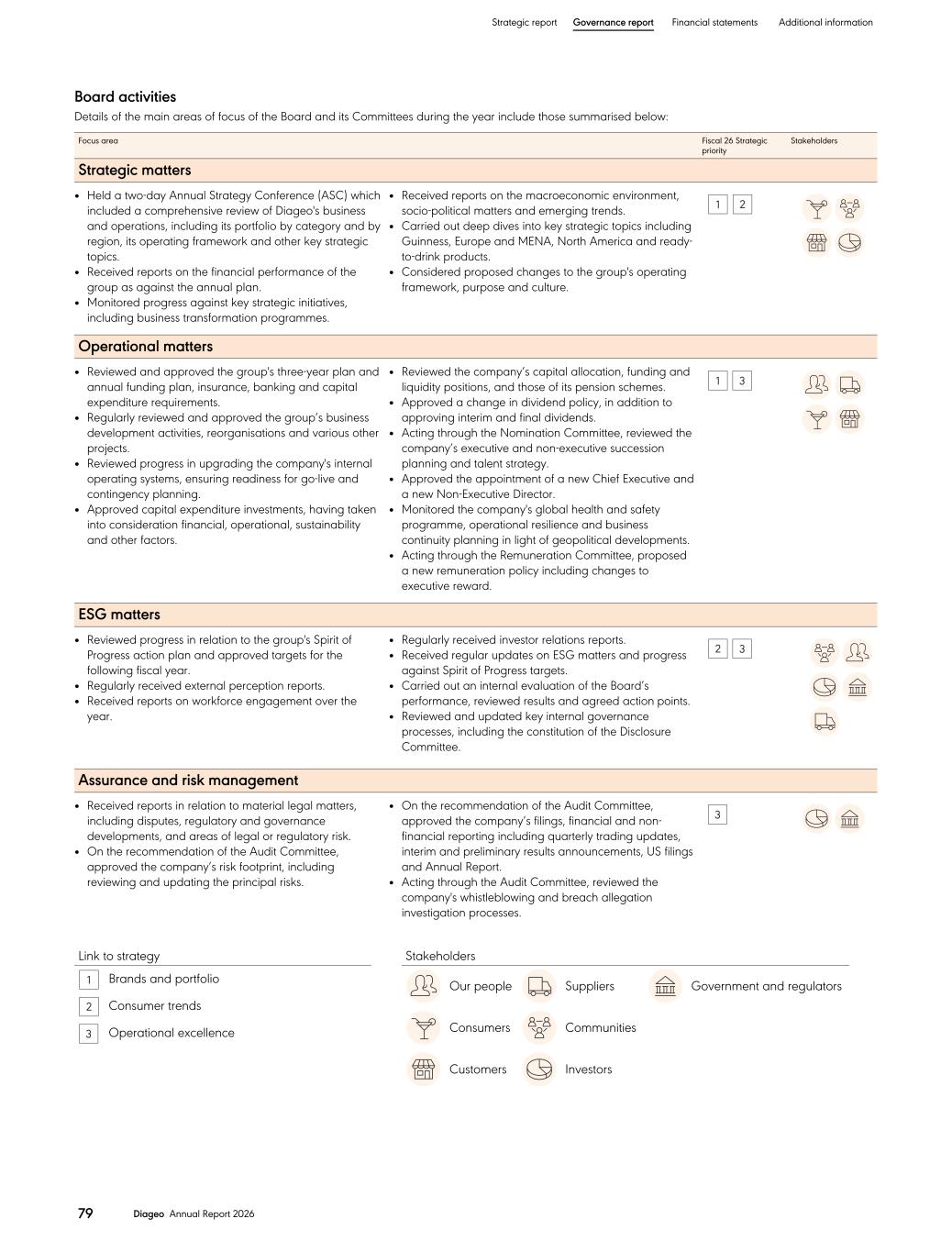
Board activities Details of the main areas of focus of the Board and its Committees during the year include those summarised below: Focus area Fiscal 26 Strategic priority Stakeholders Strategic matters • Held a two-day Annual Strategy Conference (ASC) which included a comprehensive review of Diageo's business and operations, including its portfolio by category and by region, its operating framework and other key strategic topics. • Received reports on the financial performance of the group as against the annual plan. • Monitored progress against key strategic initiatives, including business transformation programmes. • Received reports on the macroeconomic environment, socio-political matters and emerging trends. • Carried out deep dives into key strategic topics including Guinness, Europe and MENA, North America and ready- to-drink products. • Considered proposed changes to the group's operating framework, purpose and culture. Operational matters • Reviewed and approved the group's three-year plan and annual funding plan, insurance, banking and capital expenditure requirements. • Regularly reviewed and approved the group’s business development activities, reorganisations and various other projects. • Reviewed progress in upgrading the company's internal operating systems, ensuring readiness for go-live and contingency planning. • Approved capital expenditure investments, having taken into consideration financial, operational, sustainability and other factors. • Reviewed the company’s capital allocation, funding and liquidity positions, and those of its pension schemes. • Approved a change in dividend policy, in addition to approving interim and final dividends. • Acting through the Nomination Committee, reviewed the company’s executive and non-executive succession planning and talent strategy. • Approved the appointment of a new Chief Executive and a new Non-Executive Director. • Monitored the company's global health and safety programme, operational resilience and business continuity planning in light of geopolitical developments. • Acting through the Remuneration Committee, proposed a new remuneration policy including changes to executive reward. ESG matters • Reviewed progress in relation to the group's Spirit of Progress action plan and approved targets for the following fiscal year. • Regularly received external perception reports. • Received reports on workforce engagement over the year. • Regularly received investor relations reports. • Received regular updates on ESG matters and progress against Spirit of Progress targets. • Carried out an internal evaluation of the Board’s performance, reviewed results and agreed action points. • Reviewed and updated key internal governance processes, including the constitution of the Disclosure Committee. Assurance and risk management • Received reports in relation to material legal matters, including disputes, regulatory and governance developments, and areas of legal or regulatory risk. • On the recommendation of the Audit Committee, approved the company’s risk footprint, including reviewing and updating the principal risks. • On the recommendation of the Audit Committee, approved the company’s filings, financial and non- financial reporting including quarterly trading updates, interim and preliminary results announcements, US filings and Annual Report. • Acting through the Audit Committee, reviewed the company's whistleblowing and breach allegation investigation processes. Link to strategy Brands and portfolio Consumer trends Operational excellence Stakeholders Our people Suppliers Government and regulators Consumers Communities Customers Investors Strategic report Governance report Financial statements Additional information 79 Diageo Annual Report 2026
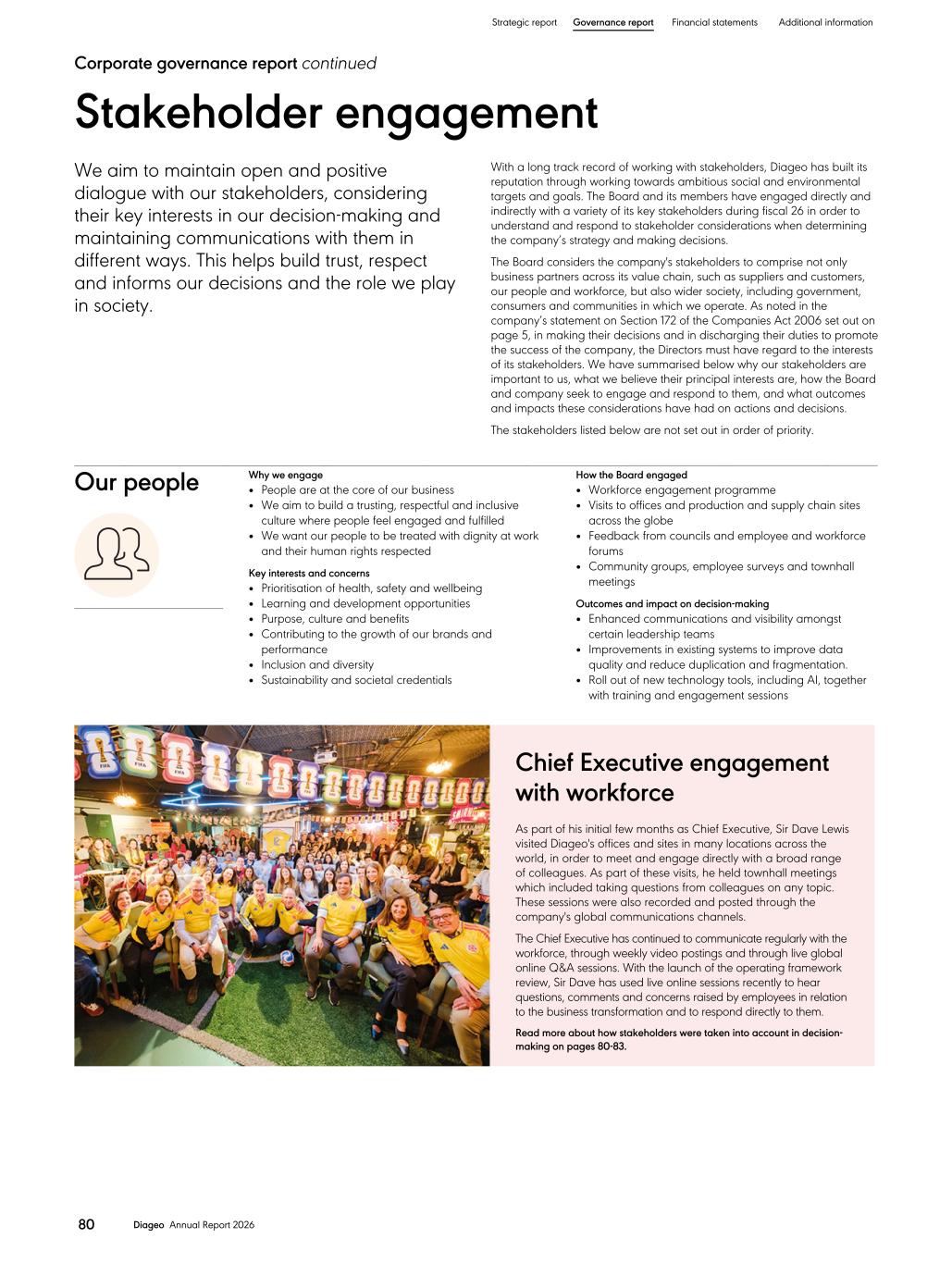
Stakeholder engagement We aim to maintain open and positive dialogue with our stakeholders, considering their key interests in our decision-making and maintaining communications with them in different ways. This helps build trust, respect and informs our decisions and the role we play in society. With a long track record of working with stakeholders, Diageo has built its reputation through working towards ambitious social and environmental targets and goals. The Board and its members have engaged directly and indirectly with a variety of its key stakeholders during fiscal 26 in order to understand and respond to stakeholder considerations when determining the company’s strategy and making decisions. The Board considers the company's stakeholders to comprise not only business partners across its value chain, such as suppliers and customers, our people and workforce, but also wider society, including government, consumers and communities in which we operate. As noted in the company’s statement on Section 172 of the Companies Act 2006 set out on page 5, in making their decisions and in discharging their duties to promote the success of the company, the Directors must have regard to the interests of its stakeholders. We have summarised below why our stakeholders are important to us, what we believe their principal interests are, how the Board and company seek to engage and respond to them, and what outcomes and impacts these considerations have had on actions and decisions. The stakeholders listed below are not set out in order of priority. Our people Why we engage • People are at the core of our business • We aim to build a trusting, respectful and inclusive culture where people feel engaged and fulfilled • We want our people to be treated with dignity at work and their human rights respected Key interests and concerns • Prioritisation of health, safety and wellbeing • Learning and development opportunities • Purpose, culture and benefits • Contributing to the growth of our brands and performance • Inclusion and diversity • Sustainability and societal credentials How the Board engaged • Workforce engagement programme • Visits to offices and production and supply chain sites across the globe • Feedback from councils and employee and workforce forums • Community groups, employee surveys and townhall meetings Outcomes and impact on decision-making • Enhanced communications and visibility amongst certain leadership teams • Improvements in existing systems to improve data quality and reduce duplication and fragmentation. • Roll out of new technology tools, including AI, together with training and engagement sessions Strategic report Governance report Financial statements Additional information Corporate governance report continued 80 Diageo Annual Report 2026 Chief Executive engagement with workforce As part of his initial few months as Chief Executive, Sir Dave Lewis visited Diageo's offices and sites in many locations across the world, in order to meet and engage directly with a broad range of colleagues. As part of these visits, he held townhall meetings which included taking questions from colleagues on any topic. These sessions were also recorded and posted through the company's global communications channels. The Chief Executive has continued to communicate regularly with the workforce, through weekly video postings and through live global online Q&A sessions. With the launch of the operating framework review, Sir Dave has used live online sessions recently to hear questions, comments and concerns raised by employees in relation to the business transformation and to respond directly to them. Read more about how stakeholders were taken into account in decision- making on pages 80-83.
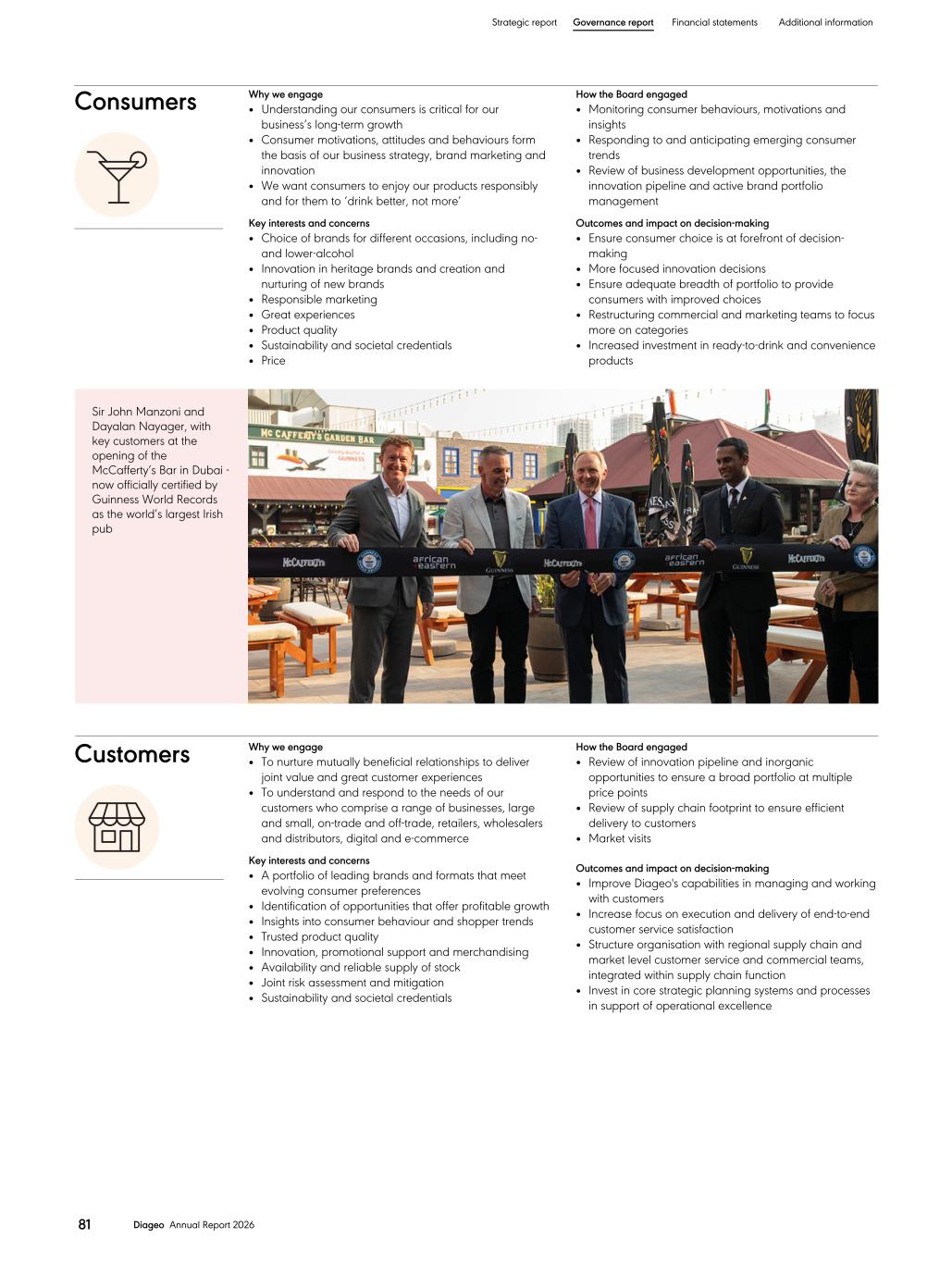
Consumers Why we engage • Understanding our consumers is critical for our business’s long-term growth • Consumer motivations, attitudes and behaviours form the basis of our business strategy, brand marketing and innovation • We want consumers to enjoy our products responsibly and for them to ‘drink better, not more’ Key interests and concerns • Choice of brands for different occasions, including no- and lower-alcohol • Innovation in heritage brands and creation and nurturing of new brands • Responsible marketing • Great experiences • Product quality • Sustainability and societal credentials • Price How the Board engaged • Monitoring consumer behaviours, motivations and insights • Responding to and anticipating emerging consumer trends • Review of business development opportunities, the innovation pipeline and active brand portfolio management Outcomes and impact on decision-making • Ensure consumer choice is at forefront of decision- making • More focused innovation decisions • Ensure adequate breadth of portfolio to provide consumers with improved choices • Restructuring commercial and marketing teams to focus more on categories • Increased investment in ready-to-drink and convenience products Customers Why we engage • To nurture mutually beneficial relationships to deliver joint value and great customer experiences • To understand and respond to the needs of our customers who comprise a range of businesses, large and small, on-trade and off-trade, retailers, wholesalers and distributors, digital and e-commerce Key interests and concerns • A portfolio of leading brands and formats that meet evolving consumer preferences • Identification of opportunities that offer profitable growth • Insights into consumer behaviour and shopper trends • Trusted product quality • Innovation, promotional support and merchandising • Availability and reliable supply of stock • Joint risk assessment and mitigation • Sustainability and societal credentials How the Board engaged • Review of innovation pipeline and inorganic opportunities to ensure a broad portfolio at multiple price points • Review of supply chain footprint to ensure efficient delivery to customers • Market visits Outcomes and impact on decision-making • Improve Diageo's capabilities in managing and working with customers • Increase focus on execution and delivery of end-to-end customer service satisfaction • Structure organisation with regional supply chain and market level customer service and commercial teams, integrated within supply chain function • Invest in core strategic planning systems and processes in support of operational excellence Strategic report Governance report Financial statements Additional information 81 Diageo Annual Report 2026 Sir John Manzoni and Dayalan Nayager, with key customers at the opening of the McCafferty’s Bar in Dubai - now officially certified by Guinness World Records as the world’s largest Irish pub
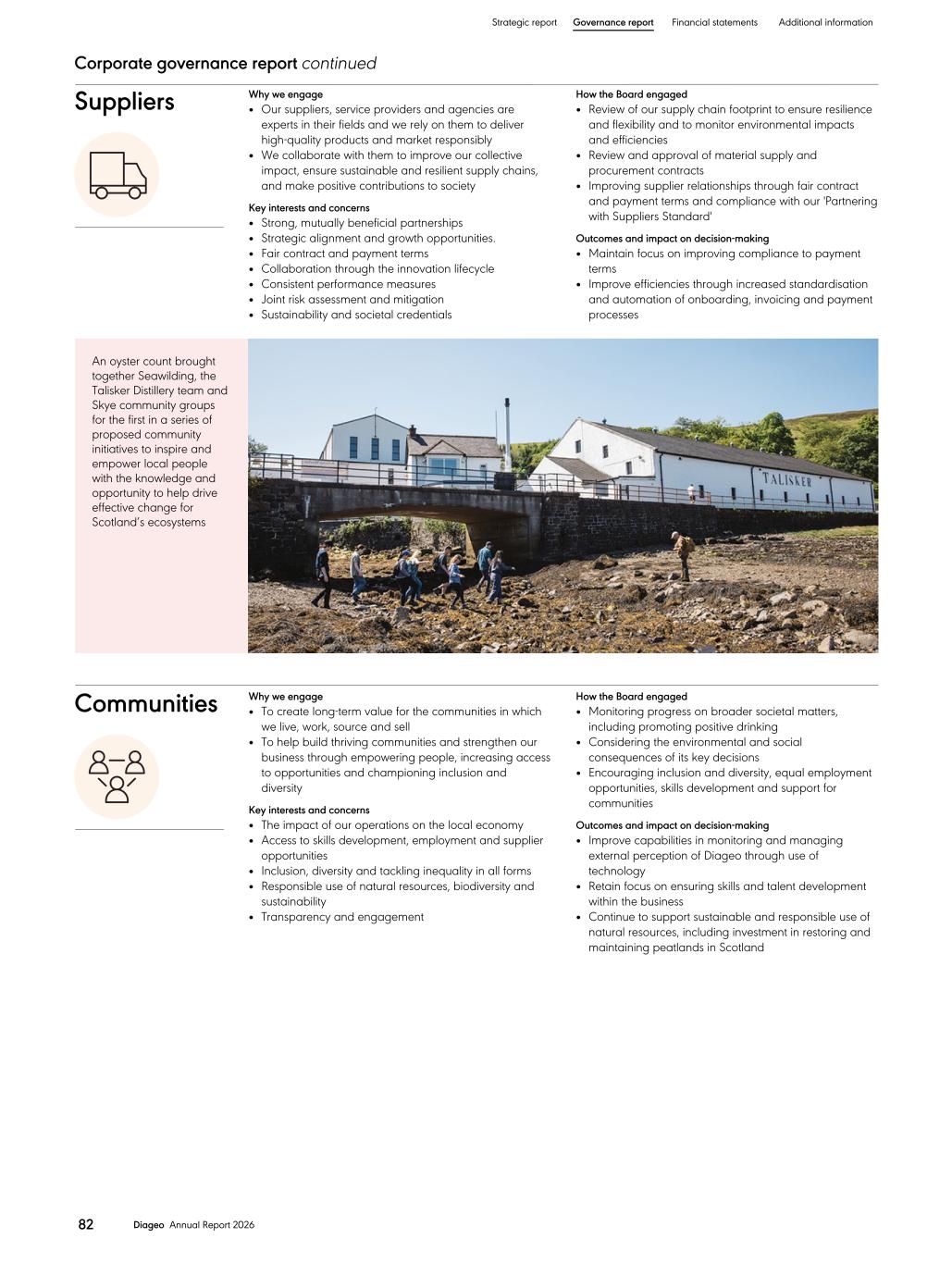
Suppliers Why we engage • Our suppliers, service providers and agencies are experts in their fields and we rely on them to deliver high-quality products and market responsibly • We collaborate with them to improve our collective impact, ensure sustainable and resilient supply chains, and make positive contributions to society Key interests and concerns • Strong, mutually beneficial partnerships • Strategic alignment and growth opportunities. • Fair contract and payment terms • Collaboration through the innovation lifecycle • Consistent performance measures • Joint risk assessment and mitigation • Sustainability and societal credentials How the Board engaged • Review of our supply chain footprint to ensure resilience and flexibility and to monitor environmental impacts and efficiencies • Review and approval of material supply and procurement contracts • Improving supplier relationships through fair contract and payment terms and compliance with our 'Partnering with Suppliers Standard' Outcomes and impact on decision-making • Maintain focus on improving compliance to payment terms • Improve efficiencies through increased standardisation and automation of onboarding, invoicing and payment processes Communities Why we engage • To create long-term value for the communities in which we live, work, source and sell • To help build thriving communities and strengthen our business through empowering people, increasing access to opportunities and championing inclusion and diversity Key interests and concerns • The impact of our operations on the local economy • Access to skills development, employment and supplier opportunities • Inclusion, diversity and tackling inequality in all forms • Responsible use of natural resources, biodiversity and sustainability • Transparency and engagement How the Board engaged • Monitoring progress on broader societal matters, including promoting positive drinking • Considering the environmental and social consequences of its key decisions • Encouraging inclusion and diversity, equal employment opportunities, skills development and support for communities Outcomes and impact on decision-making • Improve capabilities in monitoring and managing external perception of Diageo through use of technology • Retain focus on ensuring skills and talent development within the business • Continue to support sustainable and responsible use of natural resources, including investment in restoring and maintaining peatlands in Scotland Strategic report Governance report Financial statements Additional information Corporate governance report continued 82 Diageo Annual Report 2026 An oyster count brought together Seawilding, the Talisker Distillery team and Skye community groups for the first in a series of proposed community initiatives to inspire and empower local people with the knowledge and opportunity to help drive effective change for Scotland’s ecosystems
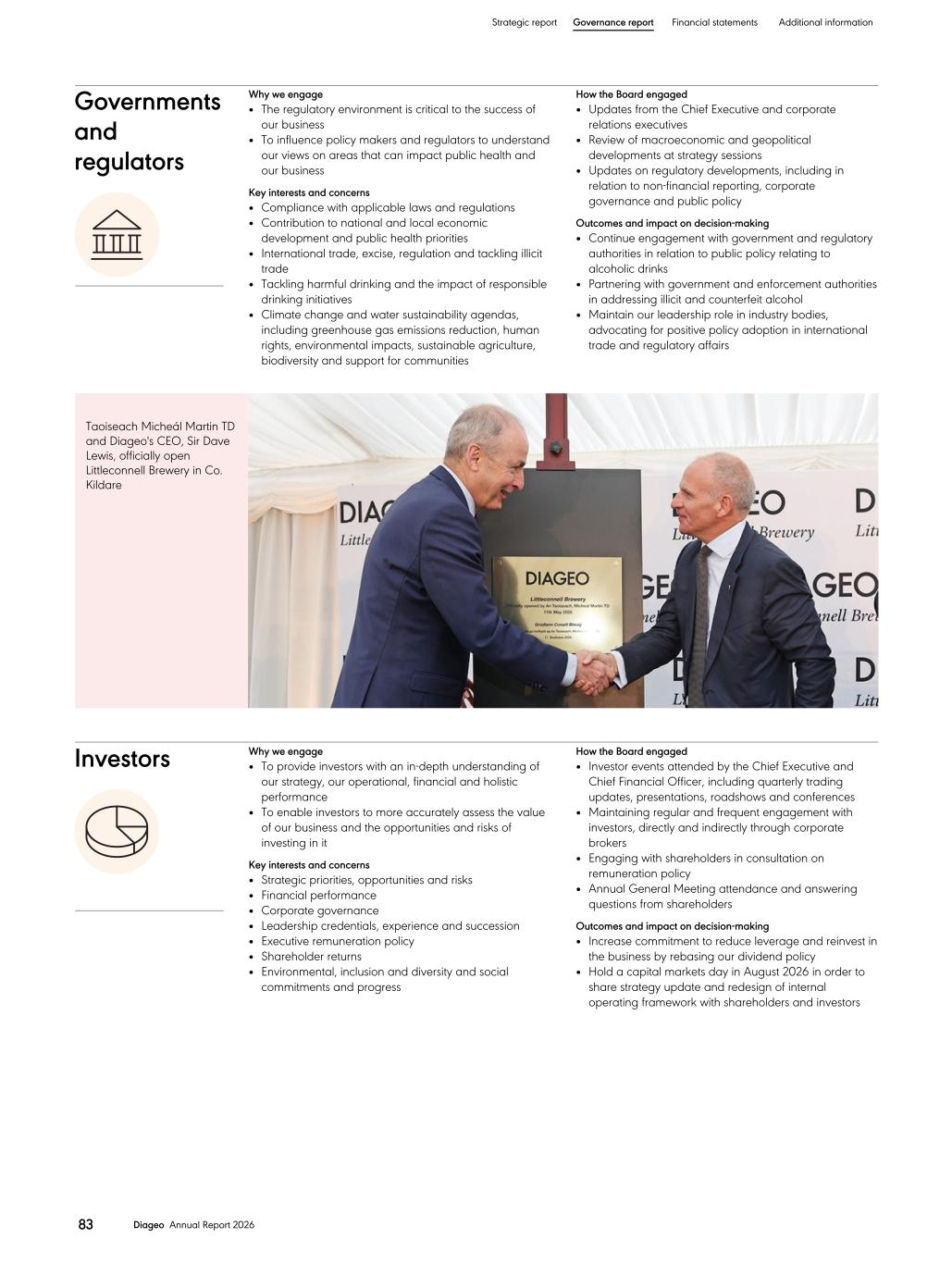
Governments and regulators Why we engage • The regulatory environment is critical to the success of our business • To influence policy makers and regulators to understand our views on areas that can impact public health and our business Key interests and concerns • Compliance with applicable laws and regulations • Contribution to national and local economic development and public health priorities • International trade, excise, regulation and tackling illicit trade • Tackling harmful drinking and the impact of responsible drinking initiatives • Climate change and water sustainability agendas, including greenhouse gas emissions reduction, human rights, environmental impacts, sustainable agriculture, biodiversity and support for communities How the Board engaged • Updates from the Chief Executive and corporate relations executives • Review of macroeconomic and geopolitical developments at strategy sessions • Updates on regulatory developments, including in relation to non-financial reporting, corporate governance and public policy Outcomes and impact on decision-making • Continue engagement with government and regulatory authorities in relation to public policy relating to alcoholic drinks • Partnering with government and enforcement authorities in addressing illicit and counterfeit alcohol • Maintain our leadership role in industry bodies, advocating for positive policy adoption in international trade and regulatory affairs Investors Why we engage • To provide investors with an in-depth understanding of our strategy, our operational, financial and holistic performance • To enable investors to more accurately assess the value of our business and the opportunities and risks of investing in it Key interests and concerns • Strategic priorities, opportunities and risks • Financial performance • Corporate governance • Leadership credentials, experience and succession • Executive remuneration policy • Shareholder returns • Environmental, inclusion and diversity and social commitments and progress How the Board engaged • Investor events attended by the Chief Executive and Chief Financial Officer, including quarterly trading updates, presentations, roadshows and conferences • Maintaining regular and frequent engagement with investors, directly and indirectly through corporate brokers • Engaging with shareholders in consultation on remuneration policy • Annual General Meeting attendance and answering questions from shareholders Outcomes and impact on decision-making • Increase commitment to reduce leverage and reinvest in the business by rebasing our dividend policy • Hold a capital markets day in August 2026 in order to share strategy update and redesign of internal operating framework with shareholders and investors Strategic report Governance report Financial statements Additional information 83 Diageo Annual Report 2026 Taoiseach Micheál Martin TD and Diageo's CEO, Sir Dave Lewis, officially open Littleconnell Brewery in Co. Kildare
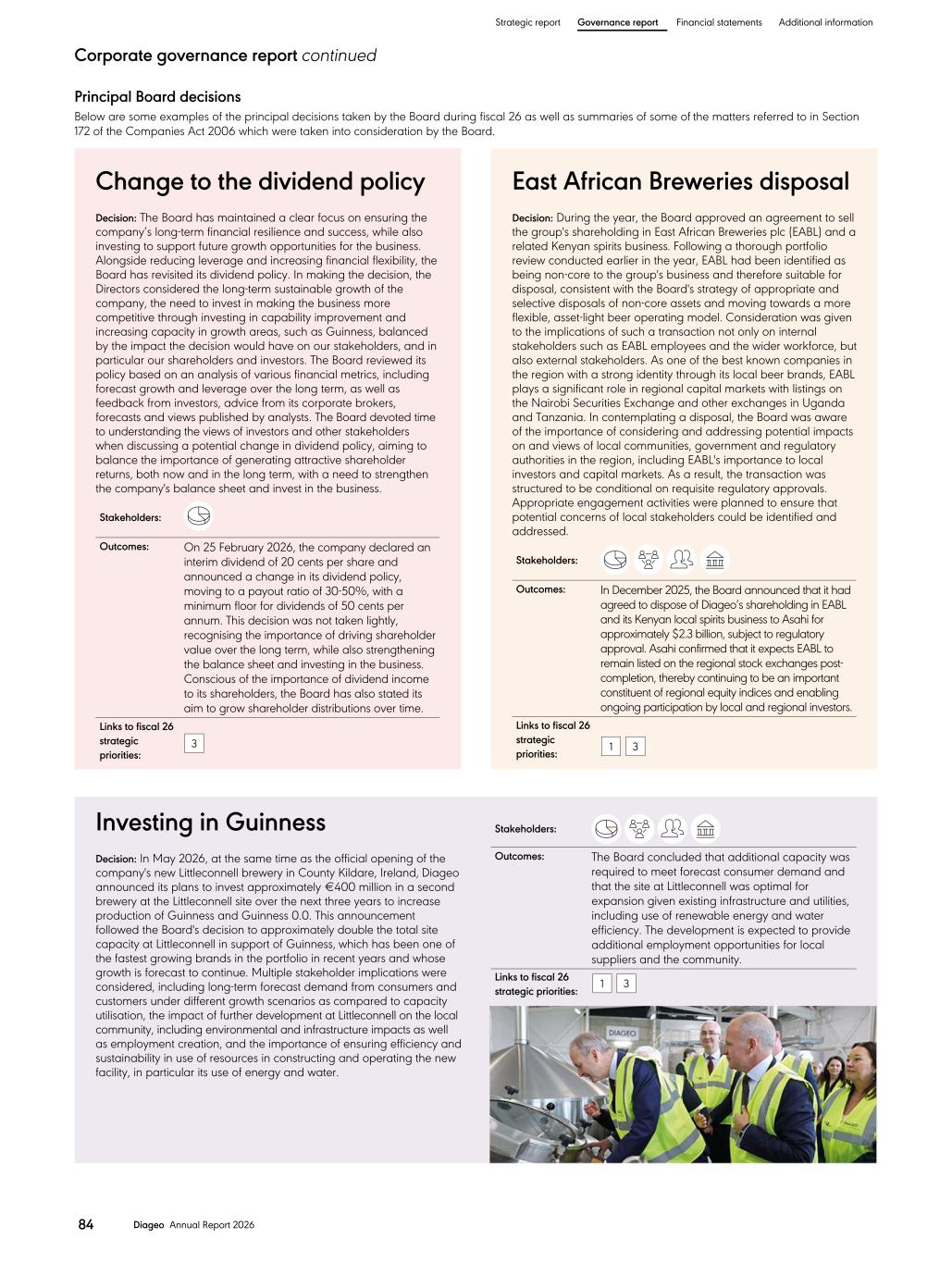
Principal Board decisions Below are some examples of the principal decisions taken by the Board during fiscal 26 as well as summaries of some of the matters referred to in Section 172 of the Companies Act 2006 which were taken into consideration by the Board. Change to the dividend policy Decision: The Board has maintained a clear focus on ensuring the company’s long-term financial resilience and success, while also investing to support future growth opportunities for the business. Alongside reducing leverage and increasing financial flexibility, the Board has revisited its dividend policy. In making the decision, the Directors considered the long-term sustainable growth of the company, the need to invest in making the business more competitive through investing in capability improvement and increasing capacity in growth areas, such as Guinness, balanced by the impact the decision would have on our stakeholders, and in particular our shareholders and investors. The Board reviewed its policy based on an analysis of various financial metrics, including forecast growth and leverage over the long term, as well as feedback from investors, advice from its corporate brokers, forecasts and views published by analysts. The Board devoted time to understanding the views of investors and other stakeholders when discussing a potential change in dividend policy, aiming to balance the importance of generating attractive shareholder returns, both now and in the long term, with a need to strengthen the company's balance sheet and invest in the business. Stakeholders: Outcomes: On 25 February 2026, the company declared an interim dividend of 20 cents per share and announced a change in its dividend policy, moving to a payout ratio of 30-50%, with a minimum floor for dividends of 50 cents per annum. This decision was not taken lightly, recognising the importance of driving shareholder value over the long term, while also strengthening the balance sheet and investing in the business. Conscious of the importance of dividend income to its shareholders, the Board has also stated its aim to grow shareholder distributions over time. Links to fiscal 26 strategic priorities: East African Breweries disposal Decision: During the year, the Board approved an agreement to sell the group's shareholding in East African Breweries plc (EABL) and a related Kenyan spirits business. Following a thorough portfolio review conducted earlier in the year, EABL had been identified as being non-core to the group's business and therefore suitable for disposal, consistent with the Board's strategy of appropriate and selective disposals of non-core assets and moving towards a more flexible, asset-light beer operating model. Consideration was given to the implications of such a transaction not only on internal stakeholders such as EABL employees and the wider workforce, but also external stakeholders. As one of the best known companies in the region with a strong identity through its local beer brands, EABL plays a significant role in regional capital markets with listings on the Nairobi Securities Exchange and other exchanges in Uganda and Tanzania. In contemplating a disposal, the Board was aware of the importance of considering and addressing potential impacts on and views of local communities, government and regulatory authorities in the region, including EABL's importance to local investors and capital markets. As a result, the transaction was structured to be conditional on requisite regulatory approvals. Appropriate engagement activities were planned to ensure that potential concerns of local stakeholders could be identified and addressed. Stakeholders: Outcomes: In December 2025, the Board announced that it had agreed to dispose of Diageo’s shareholding in EABL and its Kenyan local spirits business to Asahi for approximately $2.3 billion, subject to regulatory approval. Asahi confirmed that it expects EABL to remain listed on the regional stock exchanges post- completion, thereby continuing to be an important constituent of regional equity indices and enabling ongoing participation by local and regional investors. Links to fiscal 26 strategic priorities: Investing in Guinness Decision: In May 2026, at the same time as the official opening of the company's new Littleconnell brewery in County Kildare, Ireland, Diageo announced its plans to invest approximately €400 million in a second brewery at the Littleconnell site over the next three years to increase production of Guinness and Guinness 0.0. This announcement followed the Board's decision to approximately double the total site capacity at Littleconnell in support of Guinness, which has been one of the fastest growing brands in the portfolio in recent years and whose growth is forecast to continue. Multiple stakeholder implications were considered, including long-term forecast demand from consumers and customers under different growth scenarios as compared to capacity utilisation, the impact of further development at Littleconnell on the local community, including environmental and infrastructure impacts as well as employment creation, and the importance of ensuring efficiency and sustainability in use of resources in constructing and operating the new facility, in particular its use of energy and water. Stakeholders: Outcomes: The Board concluded that additional capacity was required to meet forecast consumer demand and that the site at Littleconnell was optimal for expansion given existing infrastructure and utilities, including use of renewable energy and water efficiency. The development is expected to provide additional employment opportunities for local suppliers and the community. Links to fiscal 26 strategic priorities: Strategic report Governance report Financial statements Additional information Corporate governance report continued 84 Diageo Annual Report 2026
Performance review The Directors consider the performance review of the Board, its Committees and themselves to be an important aspect of corporate governance, and reviews are undertaken annually, with external reviews being undertaken at least once every three years. The performance review to be undertaken in fiscal 27 is expected to be managed and facilitated externally. With the support of the Company Secretary, a review of the Board's effectiveness, including that of its Committees and Directors, was conducted internally between January and February 2026. It aimed to assess the effectiveness of the Board and its Committees and identify any areas for improvement. The Directors completed a tailored questionnaire designed to assess specific areas and allow Directors to express their views. In line with the Code recommendation, the Senior Independent Director also held a meeting with Directors, excluding the Chair. The review focused on Directors' views on the following areas: Board performance and effectiveness, Board composition and diversity, individual Director contribution, Committees' performance and effectiveness and Board support and provision of information. The Committee Chairs considered feedback on the effectiveness of their respective Committees, whilst the Chair, Senior Independent Director and the Company Secretary discussed the results of the review and feedback from all Board members. Paired with a review of the ways of working and the composition of the Board and its Committees, they drew up a plan with proposed next steps and actions for further discussion by the Board at its meeting in March 2026. The Board discussed the results and agreed on various actions, some of which are outlined below. The results of the performance review indicated that the Board and its Committees continue to work well and that each Director continued to perform effectively and demonstrates commitment to her or his role. The Nomination Committee has recommended to the Board that all Directors who wish to do so stand for election or re-election at this year’s AGM. The following table sets out a summary of key observations and actions taken following the previous year's review as well as those identified to be focused on in the coming year, based on feedback and the results of the performance review carried out in fiscal 26. Observations and actions taken following last year's review Observations and actions to focus on in 2026/27 General feedback • The Chair, with the Company Secretary’s assistance, remained focused on supporting high-quality discussions and where appropriate, expanded the time allocated for presentations and deep dives during meetings. • Discussions at the Board remained open and transparent. • There has been continued evolution of ways of working for the Board following changes in key Board roles in recent years. • The Board's annual cycle should be reviewed and streamlined to ensure efficiency and effectiveness. • Ways of working should also be reviewed to ensure that adequate focus and time is allocated to key strategic topics. • More opportunities and time should be allocated to insights into how Diageo is perceived and recognised externally. Board composition and succession • An additional Non-Executive Director appointment was made during the first half of fiscal 26. • The first half of the fiscal saw significant time and focus on the successful search for a new Chief Executive, as well as longer-term succession planning. • The Board will maintain focus on ensuring adequate succession planning for non-executive roles. • The Board's skills matrix would be reviewed to identify suitable candidates for non-executive roles. People and culture • The Board is very committed to the workforce engagement programme which provides excellent opportunities for direct engagement between Directors and the workforce. • The Board spent additional time exploring the results of employee surveys to develop a deeper, more granular understanding of what matters to colleagues. • The Board and the Nomination Committee continued to focus on succession planning and pipeline at executive and senior management level. • The Board will increase opportunities for engagement with top internal talent. • The Board should continue to evolve its way of understanding and evaluating Diageo's culture, especially given operating framework changes. • The Board will continue to focus on embedding key cultural shifts in light of changes in the company's operating framework, especially to reinforce a culture of competitiveness. • Processes relating to end-to-end talent management should be reviewed to ensure high quality pipeline of internal talent for key executive roles. Strategy and risk • The Board has strengthened its focus on delivery of business transformation programmes, including Accelerate. • The Board has continued to review key strategic topics, engaging with the Executive in a collaborative and constructive manner. • There has been improved focus on enabling external perspectives to be shared in Board discussions, through regular reporting and analyses. • Board discussions should be closely aligned to strategic priorities, with more focus on areas of most significance, aligned to the new strategy. • Increased focus is required on mechanisms to support performance monitoring, tracking and reporting to the Board. • Further opportunities will be scheduled for the Board to engage directly with certain categories of external stakeholders. Strategic report Governance report Financial statements Additional information 85 Diageo Annual Report 2026
Workforce Engagement statement At Diageo, our people are central to how we perform and how we build the business for the future. We want colleagues to understand the direction of the business, feel able to share their views and see how their feedback is being heard and considered. As we continue to evolve the business, this matters even more. Colleagues need clear context on the choices we are making, the role they play and the ways they can contribute to our strategy. Our approach to Workforce Engagement We use a range of formal and informal channels to understand our colleagues’ experiences. Diageo’s Workforce Engagement programme is an important way for the Diageo plc Board to hear directly from colleagues on key topics, including culture, strategy and ways of working. It is also a valued opportunity for colleagues to have direct access to Board members. In fiscal 26, Karen Blackett CBE, our designated Non-Executive Director for Workforce Engagement continued to lead the programme. In this role, Karen provides a consistent connection point between colleagues and the Board. She helps shape the sessions, so they are valuable for both colleagues and Board members, and ensures themes raised are discussed at Board level. Across the year, Karen, alongside other Non-Executive Directors, engaged 239 colleagues through 12 virtual, hybrid and in-person sessions. The colleagues who took part were below leadership level and represented all regions and functions. Diageo Chair, Sir John Manzoni, also visited several markets during the year, engaging a further 1,390 colleagues through informal townhall conversations. Colleagues welcomed the opportunity to share their views with the Board, and Board members valued the openness of conversations and the insights they provided into colleagues’ experience of Diageo’s culture and ways of working. In fiscal 26, we further strengthened our approach to Workforce Engagement by introducing a post-session feedback loop with local leadership teams. Colleague feedback was shared anonymously, enabling local leadership to consider the themes raised alongside broader business priorities and market action planning. Themes surfaced through Workforce Engagement This year, colleagues’ feedback has been distilled into four broad themes, covering both strengths and areas of opportunity. 1. Diageo’s culture: When discussing culture, colleagues consistently refer to Diageo’s ‘inclusive culture’ with a focus on inclusion and diversity commitments, specific people policies, and the relational aspects of working at Diageo. These areas continue to be a significant source of pride for colleagues, who often say they feel supported, listened to, and respected to truly be themselves at work. 2. Strategy and prioritisation: While colleagues are proud of Diageo’s brands and believe we have the right portfolio to support future success, through the first half of fiscal 26 they highlighted an urgent need for greater strategic clarity to address performance challenges. Since the appointment of Sir Dave Lewis as Chief Executive in January 2026, colleagues are experiencing greater clarity and have expressed optimism and belief in the future, in response to his open and transparent leadership approach. 3. Ways of working and collaboration: Collaboration at Diageo is consistently recognised as a strength. Colleagues said they feel supported by teams across regions and functions, however they also identified opportunities to improve speed and agility by clarifying decision rights and accountability. This feedback is informing work on Diageo’s new operating framework, which is designed to make the business simpler, faster and more competitive, with clearer accountabilities. 4. Digital and technology: Colleagues are optimistic about the potential of new digital tools and AI to improve efficiency and create better ways of working. They also highlighted the need to continue improving existing systems and processes, reducing complexity and helping colleagues make informed decisions at pace. We are making progress on this through large-scale digital initiatives like our recent move to SAP S/4HANA which is helping to address outdated technology and create a stronger foundation for simpler, more effective ways of working. Insights from Workforce Engagement sessions, alongside broader listening tools such as Our Voice and other listening channels, help the Board and management teams understand colleague sentiment, monitor Diageo’s culture and identify opportunities to improve the employee experience as the business continues to evolve its operating framework for the future. Purpose, values and culture The Board is responsible for setting the company’s purpose, values and culture and for monitoring how these are embedded within our business, informed by employee listening activities, including workforce engagement sessions with the Board and employee surveys. We are very conscious that we must operate with the highest standards of governance, doing business the right way, from grain to glass. This principle is embedded in our Code of Business Conduct and global policies, aligned with our 'Spirit of Progress' goals and reflected in our ways of working. We are pleased that we have a strong reputation for inclusion and diversity which reflects our values, attracts the best talent and enables our people to succeed. There are a number of ways in which the Board monitors and assesses culture, including: Site visits Directors are encouraged to visit the group’s offices, production facilities and sites in different markets and regions to further their understanding of the business and increase interactions with employees and the wider workforce. While during fiscal 26 Board meetings have generally been held in the company's headquarters in London, there have been other opportunities for Directors to visit and engage with employees in other locations. As part of the Board's workforce engagement programme, Non- Executive Directors regularly hold in-person and virtual meetings, townhalls, focus groups and question and answer sessions with employees in different locations over the course of the year. Employee surveys Each year, the Board receives the results of the company’s global annual survey, renamed this year 'Our Voice', which includes levels of employee engagement, employee perceptions of the company's purpose and of their people managers (including net promoter scores) and any themes raised. The survey results also give visibility of areas on which management must continue to focus. Results of this year's Our Voice survey are described on page 36. SpeakUp allegation reporting Regular reports are provided by the business integrity team to the Audit Committee with information and data on reported allegations of breaches of the Code of Business Conduct and other group policies, including those received through our confidential and independent whistleblowing service SpeakUp. These reports also include analyses of emerging trends, investigation status reports and closure rates, and summaries of actions taken. These reports enable Directors to gain an understanding of common issues and action planning, as well as providing insights into how well established the company's purpose, values and culture are across its markets and functions. For more details of the SpeakUp service, see page 93. Workforce engagement programme Insights drawn from the Board’s annual programme of workforce engagement are used by the Board to monitor and assess the culture of the company. Recommendations are fed back to management regularly with workforce engagement being discussed at Board meeting sessions twice a year. The engagement programme, which is led by Karen Blackett CBE, has enabled all Non-Executive Directors to participate by directly engaging with employees from a variety of regions, functions and levels in the business. Strategic report Governance report Financial statements Additional information Corporate governance report continued 86 Diageo Annual Report 2026
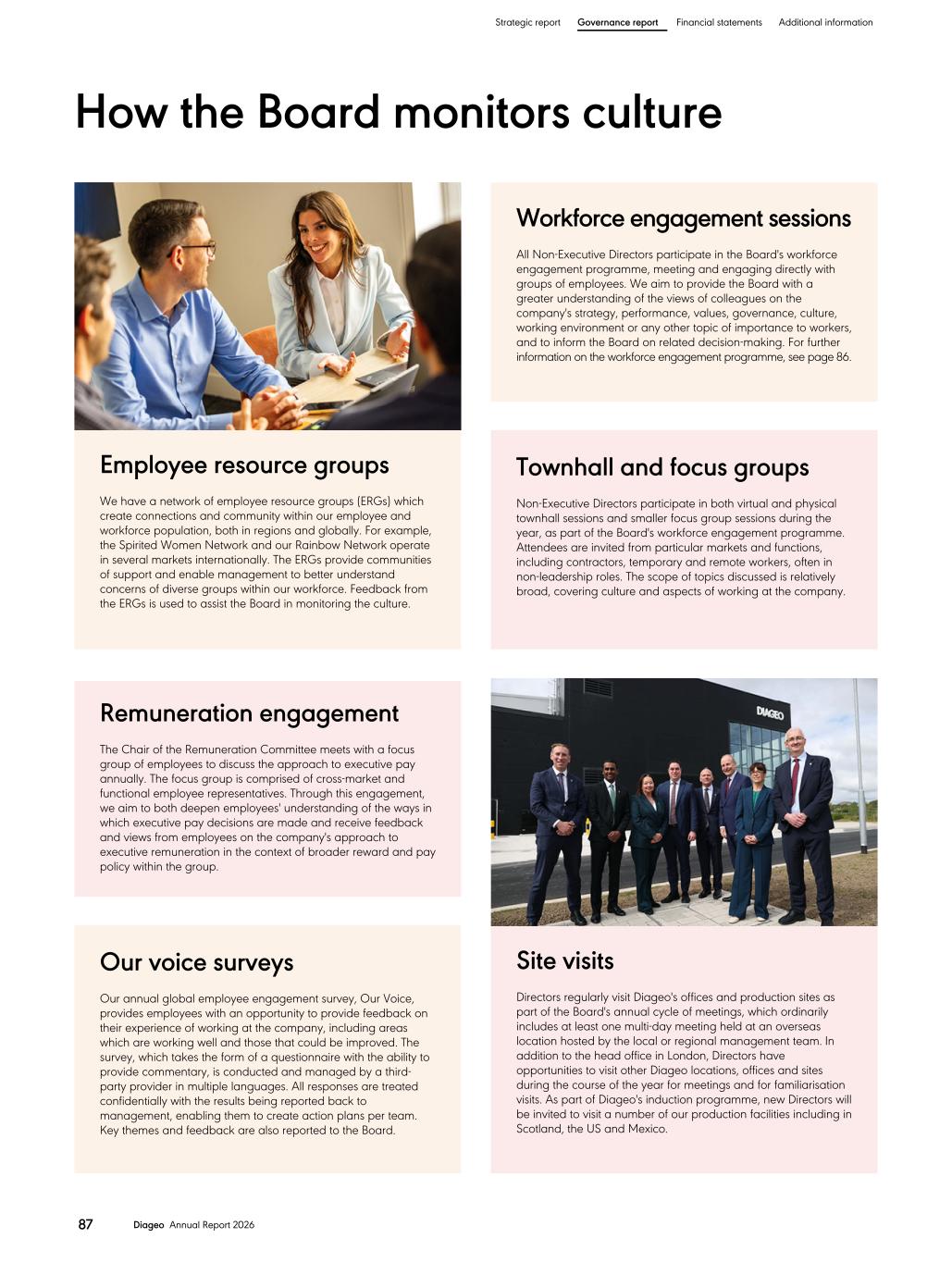
How the Board monitors culture Employee resource groups We have a network of employee resource groups (ERGs) which create connections and community within our employee and workforce population, both in regions and globally. For example, the Spirited Women Network and our Rainbow Network operate in several markets internationally. The ERGs provide communities of support and enable management to better understand concerns of diverse groups within our workforce. Feedback from the ERGs is used to assist the Board in monitoring the culture. Remuneration engagement The Chair of the Remuneration Committee meets with a focus group of employees to discuss the approach to executive pay annually. The focus group is comprised of cross-market and functional employee representatives. Through this engagement, we aim to both deepen employees' understanding of the ways in which executive pay decisions are made and receive feedback and views from employees on the company's approach to executive remuneration in the context of broader reward and pay policy within the group. Our voice surveys Our annual global employee engagement survey, Our Voice, provides employees with an opportunity to provide feedback on their experience of working at the company, including areas which are working well and those that could be improved. The survey, which takes the form of a questionnaire with the ability to provide commentary, is conducted and managed by a third- party provider in multiple languages. All responses are treated confidentially with the results being reported back to management, enabling them to create action plans per team. Key themes and feedback are also reported to the Board. Workforce engagement sessions All Non-Executive Directors participate in the Board's workforce engagement programme, meeting and engaging directly with groups of employees. We aim to provide the Board with a greater understanding of the views of colleagues on the company's strategy, performance, values, governance, culture, working environment or any other topic of importance to workers, and to inform the Board on related decision-making. For further information on the workforce engagement programme, see page 86. Townhall and focus groups Non-Executive Directors participate in both virtual and physical townhall sessions and smaller focus group sessions during the year, as part of the Board's workforce engagement programme. Attendees are invited from particular markets and functions, including contractors, temporary and remote workers, often in non-leadership roles. The scope of topics discussed is relatively broad, covering culture and aspects of working at the company. Site visits Directors regularly visit Diageo's offices and production sites as part of the Board's annual cycle of meetings, which ordinarily includes at least one multi-day meeting held at an overseas location hosted by the local or regional management team. In addition to the head office in London, Directors have opportunities to visit other Diageo locations, offices and sites during the course of the year for meetings and for familiarisation visits. As part of Diageo's induction programme, new Directors will be invited to visit a number of our production facilities including in Scotland, the US and Mexico. Strategic report Governance report Financial statements Additional information 87 Diageo Annual Report 2026
Directors' responsibilities in respect of the Annual Report, Form 20-F and financial statements The Directors are responsible for preparing the Annual Report, the information filed with the SEC on Form 20-F and the group and parent company financial statements in accordance with applicable law and regulation. Company law requires the Directors to prepare financial statements for each financial year. Under company law, the Directors have prepared the group consolidated financial statements in accordance with UK-adopted international accounting standards and the parent company financial statements in accordance with United Kingdom Generally Accepted Accounting Practice (United Kingdom Accounting Standards, comprising FRS 101 ‘Reduced Disclosure Framework’, and applicable law). In preparing the group consolidated financial statements, the Directors have also elected to comply with International Financial Reporting Standards issued by the International Accounting Standards Board (IFRS as issued by IASB). Under company law, the Directors must not approve the financial statements unless they are satisfied that they give a true and fair view of the state of affairs of the group and parent company and of the profit or loss of the group and parent company for that period. In preparing the financial statements, the Directors are required to: • select suitable accounting policies and then apply them consistently; • state whether applicable UK-adopted international accounting standards, IFRS issued by IASB have been followed for the group financial statements and United Kingdom Accounting Standards, comprising FRS 101 ‘Reduced Disclosure Framework’ and applicable law have been followed for the parent company financial statements, subject to any material departures disclosed and explained in the financial statements; • make judgements and accounting estimates that are reasonable and prudent; and • prepare the financial statements on the going concern basis unless it is inappropriate to presume that the group and company will continue in business. The Directors are responsible for safeguarding the assets of the group and parent company and hence for taking reasonable steps for the prevention and detection of fraud and other irregularities. The Directors are also responsible for keeping adequate accounting records that are sufficient to show and explain the group’s and parent company’s transactions and disclose with reasonable accuracy at any time the financial position of the group and parent company and enable them to ensure that the financial statements and the Directors’ Remuneration Report comply with the Companies Act 2006. The Directors are responsible for the maintenance and integrity of the corporate and financial information included on the company’s website. Legislation in the United Kingdom governing the preparation and dissemination of financial statements may differ from legislation in other jurisdictions. Directors’ confirmations The Directors consider that the Annual Report and financial statements, taken as a whole, are fair, balanced and understandable and provide the information necessary for shareholders to assess the group’s and parent company’s position and performance, business model and strategy. Each of the Directors, whose names and functions are listed on pages 73-74 confirm that, to the best of their knowledge: • the group consolidated financial statements, which have been prepared in accordance with UK-adopted international accounting standards, IFRSs issued by IASB, give a true and fair view of the assets, liabilities, financial position and profit of the group; • the parent company financial statements, which have been prepared in accordance with United Kingdom Accounting Standards, comprising FRS 101 ‘Reduced Disclosure Framework’ and applicable law, give a true and fair view of the assets, liabilities, financial position and profit of the parent company; and • the Strategic Report includes a fair review of the development and performance of the business and the position of the group and parent company, together with a description of the principal risks and uncertainties that it faces. In accordance with Section 418 of the Companies Act 2006, each of the Directors who held office at the date of the approval of the Directors’ report confirm that, so far as the Director is aware, there is no relevant audit information of which the group’s and parent company’s auditors are unaware, and each Director has taken all the steps that they ought to have taken as a Director in order to make themselves aware of any relevant audit information and to establish that the group's and parent company’s auditors are aware of that information. The responsibility statement was approved by a duly appointed and authorised committee of the Board of Directors on 17 August 2026. Strategic report Governance report Financial statements Additional information Corporate governance report continued 88 Diageo Annual Report 2026
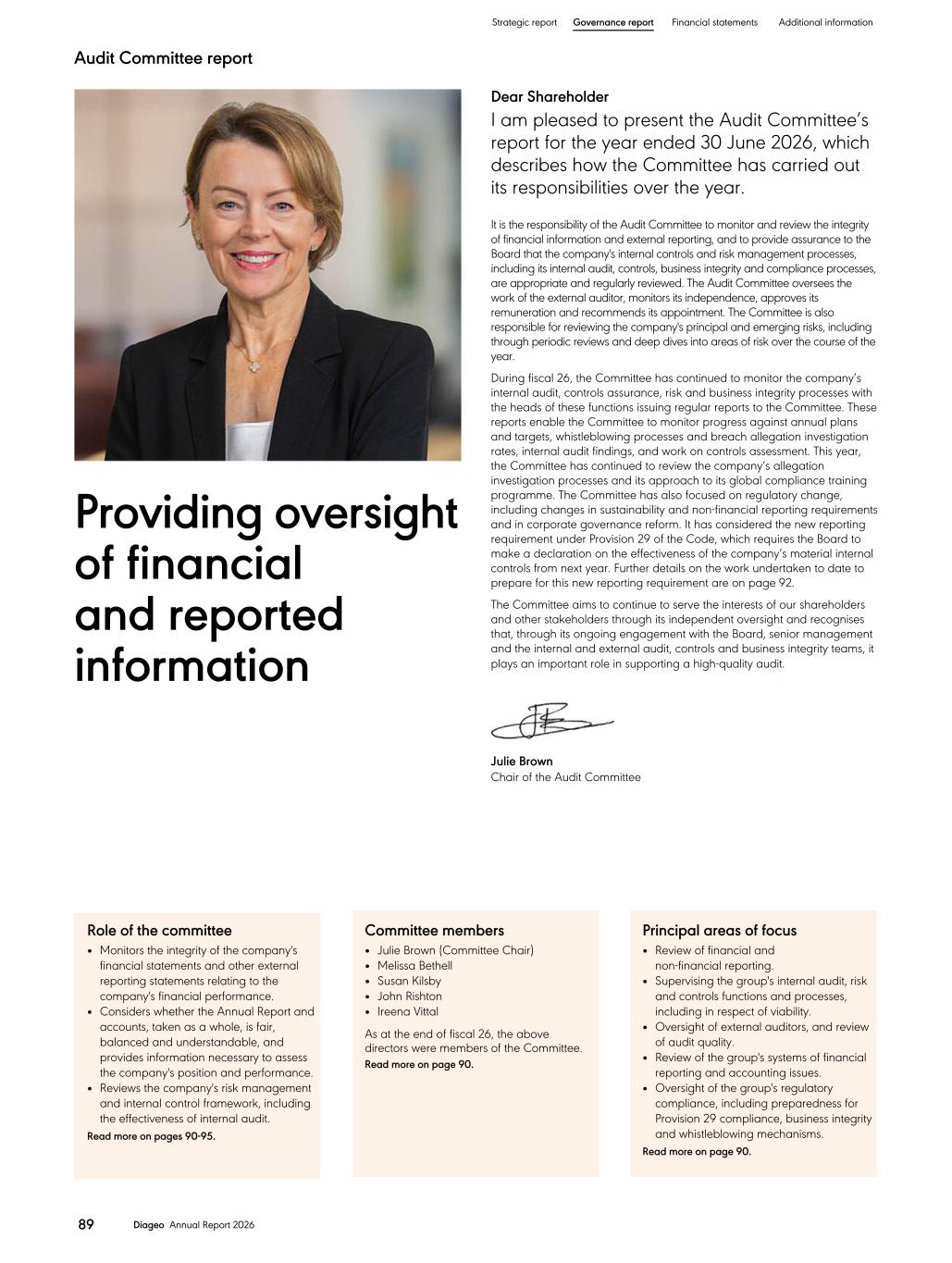
Providing oversight of financial and reported information Dear Shareholder I am pleased to present the Audit Committee’s report for the year ended 30 June 2026, which describes how the Committee has carried out its responsibilities over the year. It is the responsibility of the Audit Committee to monitor and review the integrity of financial information and external reporting, and to provide assurance to the Board that the company's internal controls and risk management processes, including its internal audit, controls, business integrity and compliance processes, are appropriate and regularly reviewed. The Audit Committee oversees the work of the external auditor, monitors its independence, approves its remuneration and recommends its appointment. The Committee is also responsible for reviewing the company's principal and emerging risks, including through periodic reviews and deep dives into areas of risk over the course of the year. During fiscal 26, the Committee has continued to monitor the company’s internal audit, controls assurance, risk and business integrity processes with the heads of these functions issuing regular reports to the Committee. These reports enable the Committee to monitor progress against annual plans and targets, whistleblowing processes and breach allegation investigation rates, internal audit findings, and work on controls assessment. This year, the Committee has continued to review the company’s allegation investigation processes and its approach to its global compliance training programme. The Committee has also focused on regulatory change, including changes in sustainability and non-financial reporting requirements and in corporate governance reform. It has considered the new reporting requirement under Provision 29 of the Code, which requires the Board to make a declaration on the effectiveness of the company’s material internal controls from next year. Further details on the work undertaken to date to prepare for this new reporting requirement are on page 92. The Committee aims to continue to serve the interests of our shareholders and other stakeholders through its independent oversight and recognises that, through its ongoing engagement with the Board, senior management and the internal and external audit, controls and business integrity teams, it plays an important role in supporting a high-quality audit. Julie Brown Chair of the Audit Committee Role of the committee • Monitors the integrity of the company's financial statements and other external reporting statements relating to the company's financial performance. • Considers whether the Annual Report and accounts, taken as a whole, is fair, balanced and understandable, and provides information necessary to assess the company's position and performance. • Reviews the company's risk management and internal control framework, including the effectiveness of internal audit. Read more on pages 90-95. Committee members • Julie Brown (Committee Chair) • Melissa Bethell • Susan Kilsby • John Rishton • Ireena Vittal As at the end of fiscal 26, the above directors were members of the Committee. Read more on page 90. Principal areas of focus • Review of financial and non‑financial reporting. • Supervising the group's internal audit, risk and controls functions and processes, including in respect of viability. • Oversight of external auditors, and review of audit quality. • Review of the group's systems of financial reporting and accounting issues. • Oversight of the group's regulatory compliance, including preparedness for Provision 29 compliance, business integrity and whistleblowing mechanisms. Read more on page 90. Strategic report Governance report Financial statements Additional information 89 Diageo Annual Report 2026 Audit Committee report
Composition of the Audit Committee As part of the review of the Board's ways of working carried out in February 2025, the Nomination Committee reviewed Diageo's practice of having all its Non-Executive Directors as members of all Board committees. It was concluded that, while this practice had positive benefits, on balance it was preferable to refresh membership of the Board committees by changing to a more conventional structure whereby each Board committee was comprised of a smaller group of Non-Executive Directors. As a result, with effect from fiscal 26, the composition of the Audit Committee changed to comprise Julie Brown (Chair), Melissa Bethell, Susan Kilsby and Ireena Vittal. On his appointment to the Board on 1 November 2025, John Rishton also joined the Audit Committee. The Chair of the Board, the Chief Executive, the Chief Financial Officer, the General Counsel and Company Secretary, the Group Controller, the Head of Controls, Assurance and Risk Excellence (CARE), the Chief Business Integrity Officer, the General Counsel Corporate and Deputy Company Secretary, the Group Reporting Director and the external auditor regularly attend meetings of the Committee. During fiscal 26, the Committee met seven times. Details of attendance of all Board and Committee meetings by Directors are set out on page 72. The terms of reference of the Committee are available at https://www.diageo.com/en/our-business/corporate- governance. The Board has satisfied itself that the membership of the Audit Committee includes at least one Director with recent and relevant financial experience and has competence in accounting and/or auditing and in the sector which the company operates, and that all members are financially literate and have experience of corporate financial matters. For the purposes of the Code and the relevant rule under SOx, Section 407, the Board has determined that Julie Brown is independent and may be regarded as an Audit Committee financial expert, having recent and relevant financial experience, and that all members of the Audit Committee are independent Non-Executive Directors with relevant financial competence and sector knowledge. See pages 73-74 for details of relevant experience of Directors. Committee activities Details of the main areas of focus of the Audit Committee during the year include those summarised below: Corporate reporting • Half and full year external reporting updates • Interim and preliminary results review and approval • Annual Report and consolidated financial statements, Form 20-F review and approval • Quarterly trading updates Internal controls • Internal audit updates • Business Integrity updates including breach investigation and reporting update • Internal training and compliance programme • Controls testing update and Section 404 assessment • Implications on controls environment of systems and process changes • Inventory and stock in trade monitoring controls review and enhancements • Preparations for compliance with Provision 29 of the Code External audit and assurance • Report on external audit at half and full year periods • Insights and observations on reporting review • Auditor independence and non-audit work reviews • Auditor independence policy review • Review of management representation letters • Appointment of auditor and review of terms of engagement and fees • Auditor performance and effectiveness review and assessment Risk management • Principal and emerging risk reviews and tracking • Risk updates, including group risk footprint and risk appetite review and approvals • Business ethics and integrity, human rights, supply chain disruption, geopolitical volatility and business interruption, business transformation, stock in trade, cyber security and IT resilience, climate change and sustainability, and international taxation risk reviews Areas of focus Key areas of focus During the year, the Audit Committee reviewed the quarterly trading updates, the interim results announcement, including the interim financial statements, the Annual Report and associated preliminary results announcement and Form 20-F, focusing on key areas of judgement and complexity, critical accounting policies, disclosures (including those relating to impairment, restructuring provisions, contingent liabilities, climate change and principal risks), viability and going concern assessments, provisioning and any changes required in these areas or policies. The Audit Committee has also focused on the effectiveness of the company's internal financial governance processes. Under the supervision of the Audit Committee, management has again sought to refine non-financial reporting in order to emphasise the most material goals and actions taken against our 'Spirit of Progress' action plan, while also complying with the recommendations of the Task Force on Climate-related Financial Disclosures. The Committee also reviewed the approach to internal compliance training and management’s proposal to enhance the programme in fiscal 27 to strengthen risk awareness, accountability and compliance across the organisation. This year the Committee has received regular progress reports in relation to management's proposed approach towards and preparations for compliance with new Provision 29 of the Code, in respect of which the company will report from fiscal 27 onwards. Strategic report Governance report Financial statements Additional information Audit Committee report continued 90 Diageo Annual Report 2026
Significant issues and judgements Significant issues and judgements that were considered in respect of the fiscal 26 financial statements are set out below. Our consideration of issues included discussion of the key audit matters as outlined in the appendix to the independent auditors report. The nature and size of any one-off items impacting the quality of the earnings and cash flows. The Audit Committee assessed whether the related presentation and disclosure of those items in the financial statements were appropriate based on management’s analysis, and concluded that they were. Items that were to be presented as exceptional. Refer to note 3 of the Financial Statements. The Audit Committee assessed whether the reporting of those items as exceptional was in line with the group’s accounting policy and that sufficient disclosure was provided in the financial statements, and concluded that they were. Whether the carrying value of brands, goodwill, tangible assets and investment in associates and joint ventures was supportable. Refer to notes 6, 9 and 10 of the Financial Statements. The Audit Committee reviewed the methodology applied in conducting impairment reviews and the result of management's impairment assessments that were performed during the year. The Committee was provided with information on the carrying amounts and the key assumptions and valuation inputs used in management’s impairment assessments, including estimates of value in use and fair value less costs of disposal. These included forecast cash flows, discount rates and long-term growth rates, as well as relevant market-based valuation evidence, including quoted share prices, market capitalisations and valuation multiples for comparable companies. The Committee reviewed the key assumptions used in the impairment reviews and agreed they were appropriate. The Committee agreed with management’s judgements and conclusions, whereby Türkiye goodwill and brands, Don Papa and other various smaller brands have been impaired by $1,274 million and reported as an exceptional operating charge. The Committee also reviewed management’s impairment assessments of property, plant and equipment and other assets arising from restructuring activities. The Committee considered the carrying amounts of the relevant assets and the key judgements and assumptions applied in determining the impairment charges and agreed with management’s conclusions. The group’s more significant tax exposures and the appropriateness of any related provisions and financial statement disclosures. Refer to note 7 and note 19 of the Financial Statements. The Audit Committee agreed that the disclosure of tax risk appropriately addresses the significant change in the international tax environment, and that appropriate provisions and other disclosure with respect to uncertain tax positions were reflected in the financial statements. The appropriateness of the valuation of post- employment liabilities, and the recognition of any surplus. Refer to note 14 of the Financial Statements. The measurement of post-employment liabilities is sensitive to changes in long-term interest rates, inflation and mortality assumptions. Having reviewed management’s papers setting out key changes to actuarial assumptions, the Audit Committee agreed that the assumptions used in the valuation are appropriate. The Committee reviewed management’s assessment of the economic benefit available as a refund of the surplus or as a reduction of contribution and the key judgements made in respect of the surplus restriction and concluded that those judgements were appropriate. The Committee reviewed and concluded that sufficient disclosures were provided in the financial statements. Significant legal matters impacting the group. Refer to note 19 of the Financial Statements. The Committee agreed that adequate provision and/or disclosure have been made for all material litigation and disputes, based on the current most likely outcomes, including the litigation summarised in note 19 of the Financial Statements. Whether the Annual Report is fair, balanced and understandable. The Audit Committee concluded that the Annual Report, taken as a whole, is fair, balanced and understandable and provides the information necessary for shareholders to assess the company’s performance, business model and strategy and that there is an appropriate balance between statutory (GAAP) and adjusted (non-GAAP) measures. The impact of climate change on the group’s financial reporting and financial statements. Refer to pages 44-56 and note 1 and note 9 of the Financial Statements. The Audit Committee agreed that the disclosures on pages 44-56 made in response to the recommendations of the Task Force on Climate-related Financial Disclosures are appropriate and that the assumptions used in the financial statements are consistent with these disclosures. Matter considered How the Audit Committee addressed the matter Challenge of significant judgments In reaching the conclusions set out above, the Audit Committee reviewed and constructively challenged the accounting methodologies, judgements and disclosures proposed by management, including the rationale supporting key judgements and assumptions and the consideration of alternatives. Areas of focus included: • Valuation methodologies used in impairment testing: The Committee challenged the approaches adopted by management to determine fair value, including the consideration of alternative approaches, techniques and models in accordance with accounting standards. • Brand, fixed asset and inventory impairment testing: The Committee challenged management’s plans, marketing and distribution strategies for certain brands in the context of recent performance, inventory levels and forecasts, and considered the impact of these plans on associated distillation assets. The Committee also challenged the key assumptions underpinning management’s impairment models. • Restructuring provisions: The Committee challenged management’s assumptions and estimates relating to severance provisions, including severance periods and other statutory obligations. • Other areas of judgement: The Committee challenged the assumptions used in the valuation of pension liabilities and the basis for the disclosure of uncertain tax positions in Brazil. Having considered the matters presented and management’s responses to its challenge, the Audit Committee concluded that the judgements adopted were reasonable and appropriately disclosed. Viability statement In accordance with the Code, the Board has considered the company’s longer-term viability, based on a robust assessment of its principal and emerging risks. This was done through the work of the Audit Committee which recommended the Viability statement to the Board. For further information about how the Board has reviewed the long-term prospects of the group, see page 68. Strategic report Governance report Financial statements Additional information 91 Diageo Annual Report 2026
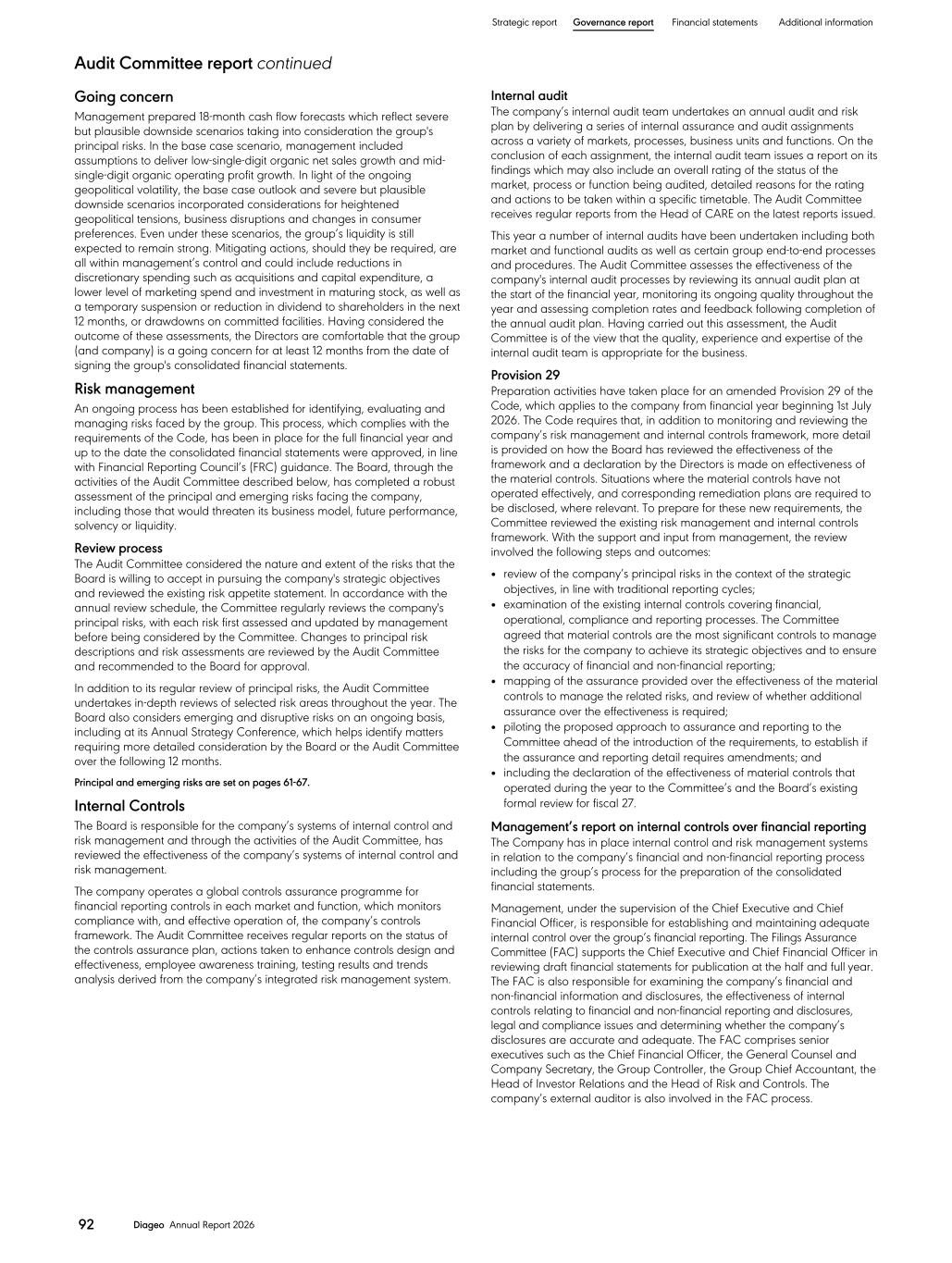
Going concern Management prepared 18-month cash flow forecasts which reflect severe but plausible downside scenarios taking into consideration the group's principal risks. In the base case scenario, management included assumptions to deliver low-single-digit organic net sales growth and mid- single-digit organic operating profit growth. In light of the ongoing geopolitical volatility, the base case outlook and severe but plausible downside scenarios incorporated considerations for heightened geopolitical tensions, business disruptions and changes in consumer preferences. Even under these scenarios, the group’s liquidity is still expected to remain strong. Mitigating actions, should they be required, are all within management’s control and could include reductions in discretionary spending such as acquisitions and capital expenditure, a lower level of marketing spend and investment in maturing stock, as well as a temporary suspension or reduction in dividend to shareholders in the next 12 months, or drawdowns on committed facilities. Having considered the outcome of these assessments, the Directors are comfortable that the group (and company) is a going concern for at least 12 months from the date of signing the group's consolidated financial statements. Risk management An ongoing process has been established for identifying, evaluating and managing risks faced by the group. This process, which complies with the requirements of the Code, has been in place for the full financial year and up to the date the consolidated financial statements were approved, in line with Financial Reporting Council’s (FRC) guidance. The Board, through the activities of the Audit Committee described below, has completed a robust assessment of the principal and emerging risks facing the company, including those that would threaten its business model, future performance, solvency or liquidity. Review process The Audit Committee considered the nature and extent of the risks that the Board is willing to accept in pursuing the company's strategic objectives and reviewed the existing risk appetite statement. In accordance with the annual review schedule, the Committee regularly reviews the company's principal risks, with each risk first assessed and updated by management before being considered by the Committee. Changes to principal risk descriptions and risk assessments are reviewed by the Audit Committee and recommended to the Board for approval. In addition to its regular review of principal risks, the Audit Committee undertakes in-depth reviews of selected risk areas throughout the year. The Board also considers emerging and disruptive risks on an ongoing basis, including at its Annual Strategy Conference, which helps identify matters requiring more detailed consideration by the Board or the Audit Committee over the following 12 months. Principal and emerging risks are set on pages 61-67. Internal Controls The Board is responsible for the company’s systems of internal control and risk management and through the activities of the Audit Committee, has reviewed the effectiveness of the company’s systems of internal control and risk management. The company operates a global controls assurance programme for financial reporting controls in each market and function, which monitors compliance with, and effective operation of, the company’s controls framework. The Audit Committee receives regular reports on the status of the controls assurance plan, actions taken to enhance controls design and effectiveness, employee awareness training, testing results and trends analysis derived from the company’s integrated risk management system. Internal audit The company’s internal audit team undertakes an annual audit and risk plan by delivering a series of internal assurance and audit assignments across a variety of markets, processes, business units and functions. On the conclusion of each assignment, the internal audit team issues a report on its findings which may also include an overall rating of the status of the market, process or function being audited, detailed reasons for the rating and actions to be taken within a specific timetable. The Audit Committee receives regular reports from the Head of CARE on the latest reports issued. This year a number of internal audits have been undertaken including both market and functional audits as well as certain group end-to-end processes and procedures. The Audit Committee assesses the effectiveness of the company's internal audit processes by reviewing its annual audit plan at the start of the financial year, monitoring its ongoing quality throughout the year and assessing completion rates and feedback following completion of the annual audit plan. Having carried out this assessment, the Audit Committee is of the view that the quality, experience and expertise of the internal audit team is appropriate for the business. Provision 29 Preparation activities have taken place for an amended Provision 29 of the Code, which applies to the company from financial year beginning 1st July 2026. The Code requires that, in addition to monitoring and reviewing the company’s risk management and internal controls framework, more detail is provided on how the Board has reviewed the effectiveness of the framework and a declaration by the Directors is made on effectiveness of the material controls. Situations where the material controls have not operated effectively, and corresponding remediation plans are required to be disclosed, where relevant. To prepare for these new requirements, the Committee reviewed the existing risk management and internal controls framework. With the support and input from management, the review involved the following steps and outcomes: • review of the company’s principal risks in the context of the strategic objectives, in line with traditional reporting cycles; • examination of the existing internal controls covering financial, operational, compliance and reporting processes. The Committee agreed that material controls are the most significant controls to manage the risks for the company to achieve its strategic objectives and to ensure the accuracy of financial and non-financial reporting; • mapping of the assurance provided over the effectiveness of the material controls to manage the related risks, and review of whether additional assurance over the effectiveness is required; • piloting the proposed approach to assurance and reporting to the Committee ahead of the introduction of the requirements, to establish if the assurance and reporting detail requires amendments; and • including the declaration of the effectiveness of material controls that operated during the year to the Committee’s and the Board’s existing formal review for fiscal 27. Management’s report on internal controls over financial reporting The Company has in place internal control and risk management systems in relation to the company’s financial and non-financial reporting process including the group’s process for the preparation of the consolidated financial statements. Management, under the supervision of the Chief Executive and Chief Financial Officer, is responsible for establishing and maintaining adequate internal control over the group’s financial reporting. The Filings Assurance Committee (FAC) supports the Chief Executive and Chief Financial Officer in reviewing draft financial statements for publication at the half and full year. The FAC is also responsible for examining the company’s financial and non-financial information and disclosures, the effectiveness of internal controls relating to financial and non-financial reporting and disclosures, legal and compliance issues and determining whether the company’s disclosures are accurate and adequate. The FAC comprises senior executives such as the Chief Financial Officer, the General Counsel and Company Secretary, the Group Controller, the Group Chief Accountant, the Head of Investor Relations and the Head of Risk and Controls. The company’s external auditor is also involved in the FAC process. Strategic report Governance report Financial statements Additional information Audit Committee report continued 92 Diageo Annual Report 2026
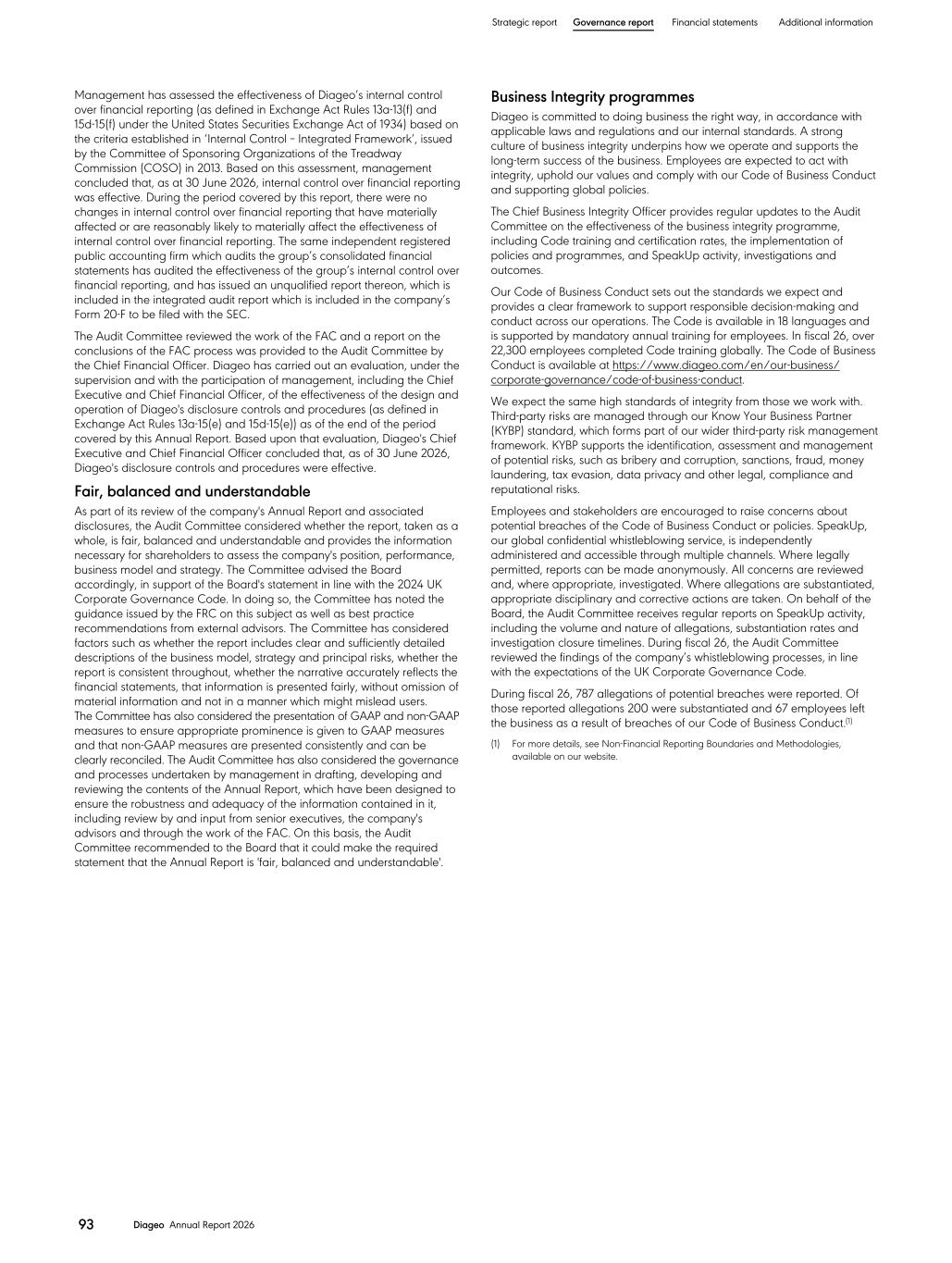
Management has assessed the effectiveness of Diageo’s internal control over financial reporting (as defined in Exchange Act Rules 13a-13(f) and 15d-15(f) under the United States Securities Exchange Act of 1934) based on the criteria established in ‘Internal Control – Integrated Framework’, issued by the Committee of Sponsoring Organizations of the Treadway Commission (COSO) in 2013. Based on this assessment, management concluded that, as at 30 June 2026, internal control over financial reporting was effective. During the period covered by this report, there were no changes in internal control over financial reporting that have materially affected or are reasonably likely to materially affect the effectiveness of internal control over financial reporting. The same independent registered public accounting firm which audits the group’s consolidated financial statements has audited the effectiveness of the group’s internal control over financial reporting, and has issued an unqualified report thereon, which is included in the integrated audit report which is included in the company’s Form 20-F to be filed with the SEC. The Audit Committee reviewed the work of the FAC and a report on the conclusions of the FAC process was provided to the Audit Committee by the Chief Financial Officer. Diageo has carried out an evaluation, under the supervision and with the participation of management, including the Chief Executive and Chief Financial Officer, of the effectiveness of the design and operation of Diageo's disclosure controls and procedures (as defined in Exchange Act Rules 13a-15(e) and 15d-15(e)) as of the end of the period covered by this Annual Report. Based upon that evaluation, Diageo's Chief Executive and Chief Financial Officer concluded that, as of 30 June 2026, Diageo's disclosure controls and procedures were effective. Fair, balanced and understandable As part of its review of the company's Annual Report and associated disclosures, the Audit Committee considered whether the report, taken as a whole, is fair, balanced and understandable and provides the information necessary for shareholders to assess the company's position, performance, business model and strategy. The Committee advised the Board accordingly, in support of the Board's statement in line with the 2024 UK Corporate Governance Code. In doing so, the Committee has noted the guidance issued by the FRC on this subject as well as best practice recommendations from external advisors. The Committee has considered factors such as whether the report includes clear and sufficiently detailed descriptions of the business model, strategy and principal risks, whether the report is consistent throughout, whether the narrative accurately reflects the financial statements, that information is presented fairly, without omission of material information and not in a manner which might mislead users. The Committee has also considered the presentation of GAAP and non-GAAP measures to ensure appropriate prominence is given to GAAP measures and that non-GAAP measures are presented consistently and can be clearly reconciled. The Audit Committee has also considered the governance and processes undertaken by management in drafting, developing and reviewing the contents of the Annual Report, which have been designed to ensure the robustness and adequacy of the information contained in it, including review by and input from senior executives, the company's advisors and through the work of the FAC. On this basis, the Audit Committee recommended to the Board that it could make the required statement that the Annual Report is 'fair, balanced and understandable'. Business Integrity programmes Diageo is committed to doing business the right way, in accordance with applicable laws and regulations and our internal standards. A strong culture of business integrity underpins how we operate and supports the long-term success of the business. Employees are expected to act with integrity, uphold our values and comply with our Code of Business Conduct and supporting global policies. The Chief Business Integrity Officer provides regular updates to the Audit Committee on the effectiveness of the business integrity programme, including Code training and certification rates, the implementation of policies and programmes, and SpeakUp activity, investigations and outcomes. Our Code of Business Conduct sets out the standards we expect and provides a clear framework to support responsible decision-making and conduct across our operations. The Code is available in 18 languages and is supported by mandatory annual training for employees. In fiscal 26, over 22,300 employees completed Code training globally. The Code of Business Conduct is available at https://www.diageo.com/en/our-business/ corporate-governance/code-of-business-conduct. We expect the same high standards of integrity from those we work with. Third-party risks are managed through our Know Your Business Partner (KYBP) standard, which forms part of our wider third-party risk management framework. KYBP supports the identification, assessment and management of potential risks, such as bribery and corruption, sanctions, fraud, money laundering, tax evasion, data privacy and other legal, compliance and reputational risks. Employees and stakeholders are encouraged to raise concerns about potential breaches of the Code of Business Conduct or policies. SpeakUp, our global confidential whistleblowing service, is independently administered and accessible through multiple channels. Where legally permitted, reports can be made anonymously. All concerns are reviewed and, where appropriate, investigated. Where allegations are substantiated, appropriate disciplinary and corrective actions are taken. On behalf of the Board, the Audit Committee receives regular reports on SpeakUp activity, including the volume and nature of allegations, substantiation rates and investigation closure timelines. During fiscal 26, the Audit Committee reviewed the findings of the company’s whistleblowing processes, in line with the expectations of the UK Corporate Governance Code. During fiscal 26, 787 allegations of potential breaches were reported. Of those reported allegations 200 were substantiated and 67 employees left the business as a result of breaches of our Code of Business Conduct.(1) (1) For more details, see Non-Financial Reporting Boundaries and Methodologies, available on our website. Strategic report Governance report Financial statements Additional information 93 Diageo Annual Report 2026
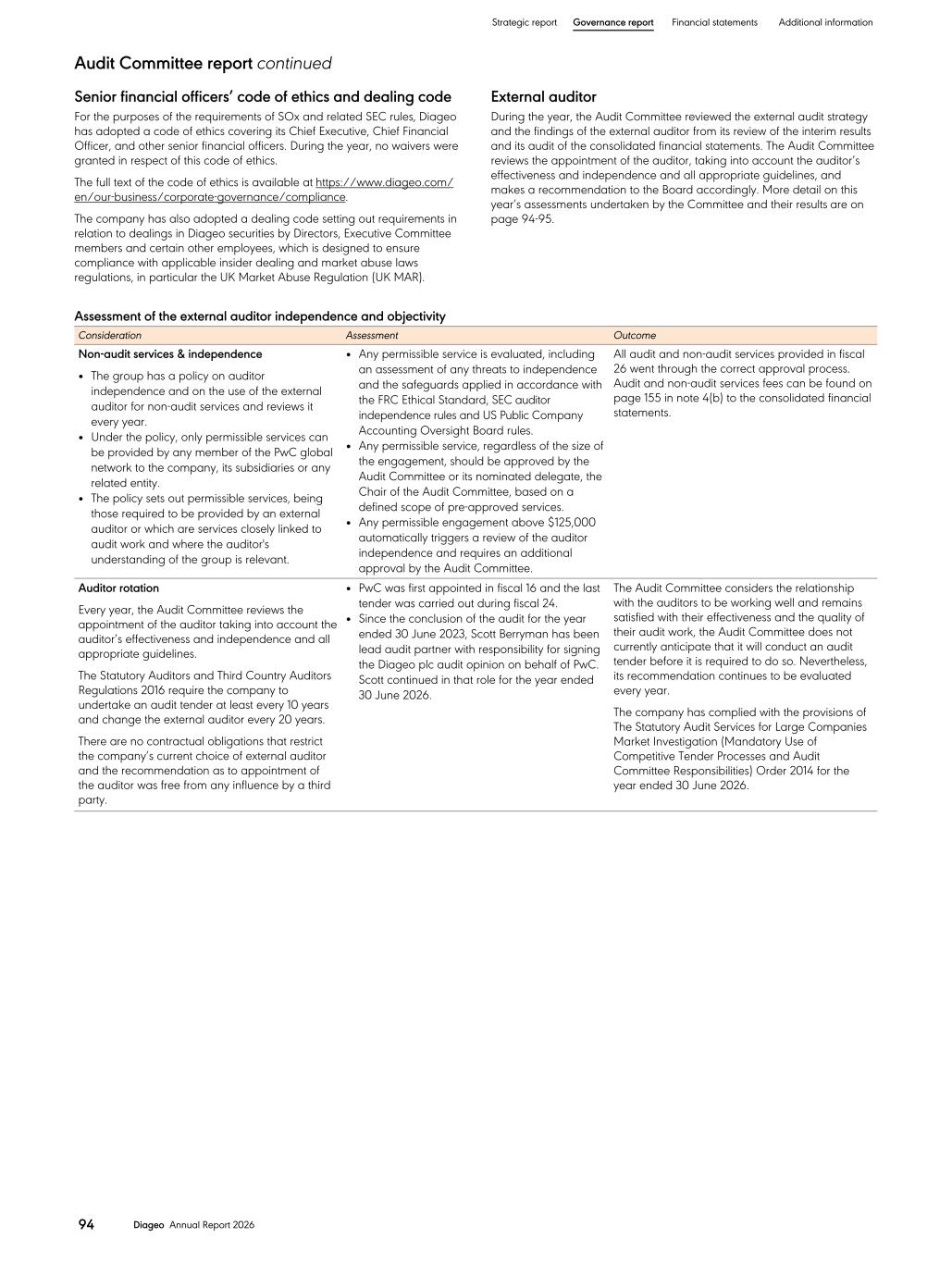
Senior financial officers’ code of ethics and dealing code For the purposes of the requirements of SOx and related SEC rules, Diageo has adopted a code of ethics covering its Chief Executive, Chief Financial Officer, and other senior financial officers. During the year, no waivers were granted in respect of this code of ethics. The full text of the code of ethics is available at https://www.diageo.com/ en/our-business/corporate-governance/compliance. The company has also adopted a dealing code setting out requirements in relation to dealings in Diageo securities by Directors, Executive Committee members and certain other employees, which is designed to ensure compliance with applicable insider dealing and market abuse laws regulations, in particular the UK Market Abuse Regulation (UK MAR). External auditor During the year, the Audit Committee reviewed the external audit strategy and the findings of the external auditor from its review of the interim results and its audit of the consolidated financial statements. The Audit Committee reviews the appointment of the auditor, taking into account the auditor’s effectiveness and independence and all appropriate guidelines, and makes a recommendation to the Board accordingly. More detail on this year’s assessments undertaken by the Committee and their results are on page 94-95. Assessment of the external auditor independence and objectivity Non-audit services & independence • The group has a policy on auditor independence and on the use of the external auditor for non-audit services and reviews it every year. • Under the policy, only permissible services can be provided by any member of the PwC global network to the company, its subsidiaries or any related entity. • The policy sets out permissible services, being those required to be provided by an external auditor or which are services closely linked to audit work and where the auditor's understanding of the group is relevant. • Any permissible service is evaluated, including an assessment of any threats to independence and the safeguards applied in accordance with the FRC Ethical Standard, SEC auditor independence rules and US Public Company Accounting Oversight Board rules. • Any permissible service, regardless of the size of the engagement, should be approved by the Audit Committee or its nominated delegate, the Chair of the Audit Committee, based on a defined scope of pre-approved services. • Any permissible engagement above $125,000 automatically triggers a review of the auditor independence and requires an additional approval by the Audit Committee. All audit and non-audit services provided in fiscal 26 went through the correct approval process. Audit and non-audit services fees can be found on page 155 in note 4(b) to the consolidated financial statements. Auditor rotation Every year, the Audit Committee reviews the appointment of the auditor taking into account the auditor’s effectiveness and independence and all appropriate guidelines. The Statutory Auditors and Third Country Auditors Regulations 2016 require the company to undertake an audit tender at least every 10 years and change the external auditor every 20 years. There are no contractual obligations that restrict the company’s current choice of external auditor and the recommendation as to appointment of the auditor was free from any influence by a third party. • PwC was first appointed in fiscal 16 and the last tender was carried out during fiscal 24. • Since the conclusion of the audit for the year ended 30 June 2023, Scott Berryman has been lead audit partner with responsibility for signing the Diageo plc audit opinion on behalf of PwC. Scott continued in that role for the year ended 30 June 2026. The Audit Committee considers the relationship with the auditors to be working well and remains satisfied with their effectiveness and the quality of their audit work, the Audit Committee does not currently anticipate that it will conduct an audit tender before it is required to do so. Nevertheless, its recommendation continues to be evaluated every year. The company has complied with the provisions of The Statutory Audit Services for Large Companies Market Investigation (Mandatory Use of Competitive Tender Processes and Audit Committee Responsibilities) Order 2014 for the year ended 30 June 2026. Consideration Assessment Outcome Strategic report Governance report Financial statements Additional information Audit Committee report continued 94 Diageo Annual Report 2026
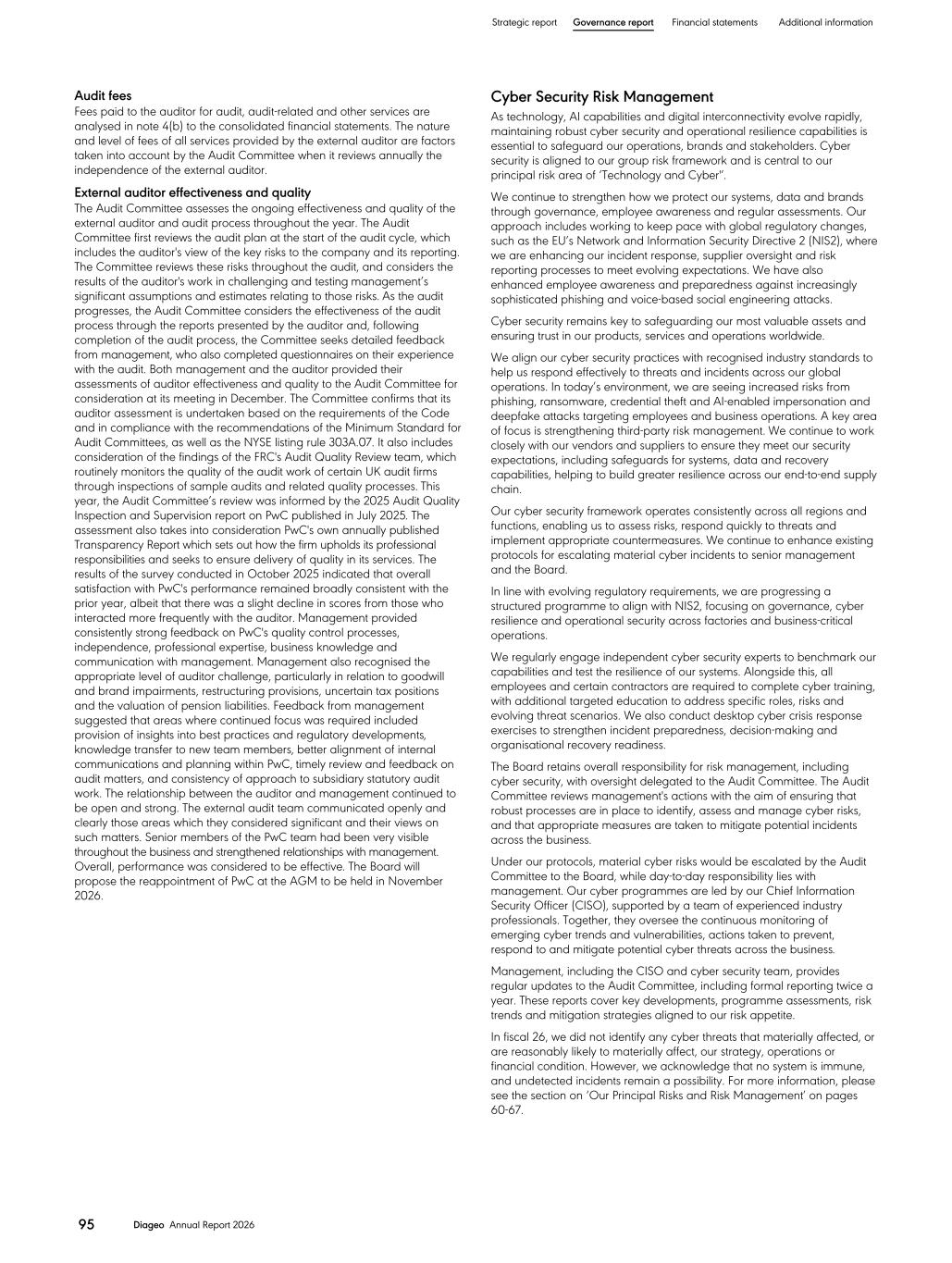
Audit fees Fees paid to the auditor for audit, audit-related and other services are analysed in note 4(b) to the consolidated financial statements. The nature and level of fees of all services provided by the external auditor are factors taken into account by the Audit Committee when it reviews annually the independence of the external auditor. External auditor effectiveness and quality The Audit Committee assesses the ongoing effectiveness and quality of the external auditor and audit process throughout the year. The Audit Committee first reviews the audit plan at the start of the audit cycle, which includes the auditor's view of the key risks to the company and its reporting. The Committee reviews these risks throughout the audit, and considers the results of the auditor's work in challenging and testing management’s significant assumptions and estimates relating to those risks. As the audit progresses, the Audit Committee considers the effectiveness of the audit process through the reports presented by the auditor and, following completion of the audit process, the Committee seeks detailed feedback from management, who also completed questionnaires on their experience with the audit. Both management and the auditor provided their assessments of auditor effectiveness and quality to the Audit Committee for consideration at its meeting in December. The Committee confirms that its auditor assessment is undertaken based on the requirements of the Code and in compliance with the recommendations of the Minimum Standard for Audit Committees, as well as the NYSE listing rule 303A.07. It also includes consideration of the findings of the FRC's Audit Quality Review team, which routinely monitors the quality of the audit work of certain UK audit firms through inspections of sample audits and related quality processes. This year, the Audit Committee’s review was informed by the 2025 Audit Quality Inspection and Supervision report on PwC published in July 2025. The assessment also takes into consideration PwC's own annually published Transparency Report which sets out how the firm upholds its professional responsibilities and seeks to ensure delivery of quality in its services. The results of the survey conducted in October 2025 indicated that overall satisfaction with PwC's performance remained broadly consistent with the prior year, albeit that there was a slight decline in scores from those who interacted more frequently with the auditor. Management provided consistently strong feedback on PwC's quality control processes, independence, professional expertise, business knowledge and communication with management. Management also recognised the appropriate level of auditor challenge, particularly in relation to goodwill and brand impairments, restructuring provisions, uncertain tax positions and the valuation of pension liabilities. Feedback from management suggested that areas where continued focus was required included provision of insights into best practices and regulatory developments, knowledge transfer to new team members, better alignment of internal communications and planning within PwC, timely review and feedback on audit matters, and consistency of approach to subsidiary statutory audit work. The relationship between the auditor and management continued to be open and strong. The external audit team communicated openly and clearly those areas which they considered significant and their views on such matters. Senior members of the PwC team had been very visible throughout the business and strengthened relationships with management. Overall, performance was considered to be effective. The Board will propose the reappointment of PwC at the AGM to be held in November 2026. Cyber Security Risk Management As technology, AI capabilities and digital interconnectivity evolve rapidly, maintaining robust cyber security and operational resilience capabilities is essential to safeguard our operations, brands and stakeholders. Cyber security is aligned to our group risk framework and is central to our principal risk area of ‘Technology and Cyber'’. We continue to strengthen how we protect our systems, data and brands through governance, employee awareness and regular assessments. Our approach includes working to keep pace with global regulatory changes, such as the EU’s Network and Information Security Directive 2 (NIS2), where we are enhancing our incident response, supplier oversight and risk reporting processes to meet evolving expectations. We have also enhanced employee awareness and preparedness against increasingly sophisticated phishing and voice-based social engineering attacks. Cyber security remains key to safeguarding our most valuable assets and ensuring trust in our products, services and operations worldwide. We align our cyber security practices with recognised industry standards to help us respond effectively to threats and incidents across our global operations. In today’s environment, we are seeing increased risks from phishing, ransomware, credential theft and AI-enabled impersonation and deepfake attacks targeting employees and business operations. A key area of focus is strengthening third-party risk management. We continue to work closely with our vendors and suppliers to ensure they meet our security expectations, including safeguards for systems, data and recovery capabilities, helping to build greater resilience across our end-to-end supply chain. Our cyber security framework operates consistently across all regions and functions, enabling us to assess risks, respond quickly to threats and implement appropriate countermeasures. We continue to enhance existing protocols for escalating material cyber incidents to senior management and the Board. In line with evolving regulatory requirements, we are progressing a structured programme to align with NIS2, focusing on governance, cyber resilience and operational security across factories and business-critical operations. We regularly engage independent cyber security experts to benchmark our capabilities and test the resilience of our systems. Alongside this, all employees and certain contractors are required to complete cyber training, with additional targeted education to address specific roles, risks and evolving threat scenarios. We also conduct desktop cyber crisis response exercises to strengthen incident preparedness, decision-making and organisational recovery readiness. The Board retains overall responsibility for risk management, including cyber security, with oversight delegated to the Audit Committee. The Audit Committee reviews management's actions with the aim of ensuring that robust processes are in place to identify, assess and manage cyber risks, and that appropriate measures are taken to mitigate potential incidents across the business. Under our protocols, material cyber risks would be escalated by the Audit Committee to the Board, while day-to-day responsibility lies with management. Our cyber programmes are led by our Chief Information Security Officer (CISO), supported by a team of experienced industry professionals. Together, they oversee the continuous monitoring of emerging cyber trends and vulnerabilities, actions taken to prevent, respond to and mitigate potential cyber threats across the business. Management, including the CISO and cyber security team, provides regular updates to the Audit Committee, including formal reporting twice a year. These reports cover key developments, programme assessments, risk trends and mitigation strategies aligned to our risk appetite. In fiscal 26, we did not identify any cyber threats that materially affected, or are reasonably likely to materially affect, our strategy, operations or financial condition. However, we acknowledge that no system is immune, and undetected incidents remain a possibility. For more information, please see the section on ‘Our Principal Risks and Risk Management’ on pages 60-67. Strategic report Governance report Financial statements Additional information 95 Diageo Annual Report 2026
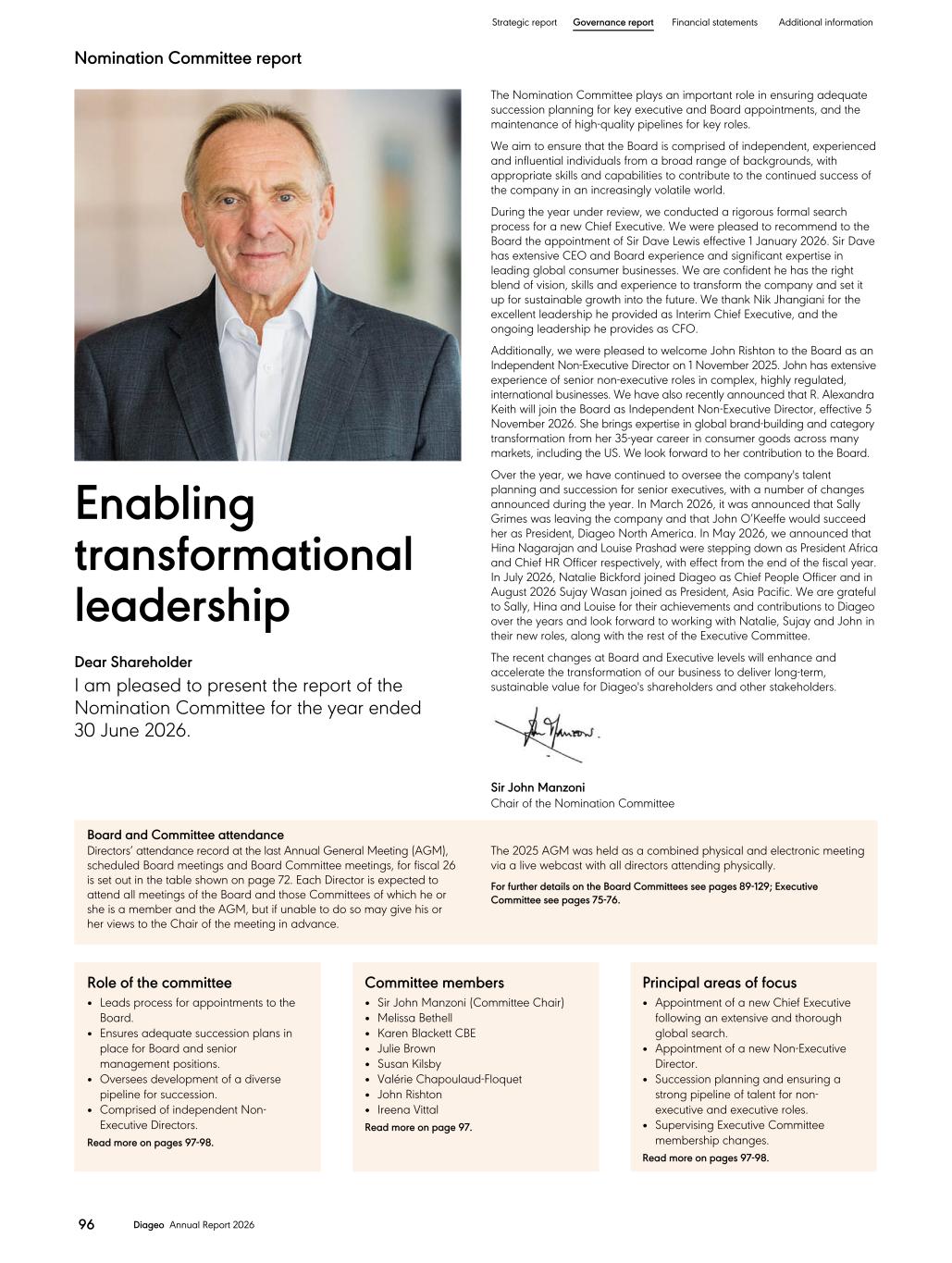
Enabling transformational leadership Dear Shareholder I am pleased to present the report of the Nomination Committee for the year ended 30 June 2026. The Nomination Committee plays an important role in ensuring adequate succession planning for key executive and Board appointments, and the maintenance of high-quality pipelines for key roles. We aim to ensure that the Board is comprised of independent, experienced and influential individuals from a broad range of backgrounds, with appropriate skills and capabilities to contribute to the continued success of the company in an increasingly volatile world. During the year under review, we conducted a rigorous formal search process for a new Chief Executive. We were pleased to recommend to the Board the appointment of Sir Dave Lewis effective 1 January 2026. Sir Dave has extensive CEO and Board experience and significant expertise in leading global consumer businesses. We are confident he has the right blend of vision, skills and experience to transform the company and set it up for sustainable growth into the future. We thank Nik Jhangiani for the excellent leadership he provided as Interim Chief Executive, and the ongoing leadership he provides as CFO. Additionally, we were pleased to welcome John Rishton to the Board as an Independent Non-Executive Director on 1 November 2025. John has extensive experience of senior non-executive roles in complex, highly regulated, international businesses. We have also recently announced that R. Alexandra Keith will join the Board as Independent Non-Executive Director, effective 5 November 2026. She brings expertise in global brand-building and category transformation from her 35-year career in consumer goods across many markets, including the US. We look forward to her contribution to the Board. Over the year, we have continued to oversee the company's talent planning and succession for senior executives, with a number of changes announced during the year. In March 2026, it was announced that Sally Grimes was leaving the company and that John O’Keeffe would succeed her as President, Diageo North America. In May 2026, we announced that Hina Nagarajan and Louise Prashad were stepping down as President Africa and Chief HR Officer respectively, with effect from the end of the fiscal year. In July 2026, Natalie Bickford joined Diageo as Chief People Officer and in August 2026 Sujay Wasan joined as President, Asia Pacific. We are grateful to Sally, Hina and Louise for their achievements and contributions to Diageo over the years and look forward to working with Natalie, Sujay and John in their new roles, along with the rest of the Executive Committee. The recent changes at Board and Executive levels will enhance and accelerate the transformation of our business to deliver long-term, sustainable value for Diageo's shareholders and other stakeholders. Sir John Manzoni Chair of the Nomination Committee Board and Committee attendance Directors’ attendance record at the last Annual General Meeting (AGM), scheduled Board meetings and Board Committee meetings, for fiscal 26 is set out in the table shown on page 72. Each Director is expected to attend all meetings of the Board and those Committees of which he or she is a member and the AGM, but if unable to do so may give his or her views to the Chair of the meeting in advance. The 2025 AGM was held as a combined physical and electronic meeting via a live webcast with all directors attending physically. For further details on the Board Committees see pages 89-129; Executive Committee see pages 75-76. Role of the committee • Leads process for appointments to the Board. • Ensures adequate succession plans in place for Board and senior management positions. • Oversees development of a diverse pipeline for succession. • Comprised of independent Non- Executive Directors. Read more on pages 97-98. Committee members • Sir John Manzoni (Committee Chair) • Melissa Bethell • Karen Blackett CBE • Julie Brown • Susan Kilsby • Valérie Chapoulaud-Floquet • John Rishton • Ireena Vittal Read more on page 97. Principal areas of focus • Appointment of a new Chief Executive following an extensive and thorough global search. • Appointment of a new Non-Executive Director. • Succession planning and ensuring a strong pipeline of talent for non- executive and executive roles. • Supervising Executive Committee membership changes. Read more on pages 97-98. Strategic report Governance report Financial statements Additional information 96 Diageo Annual Report 2026 Nomination Committee report
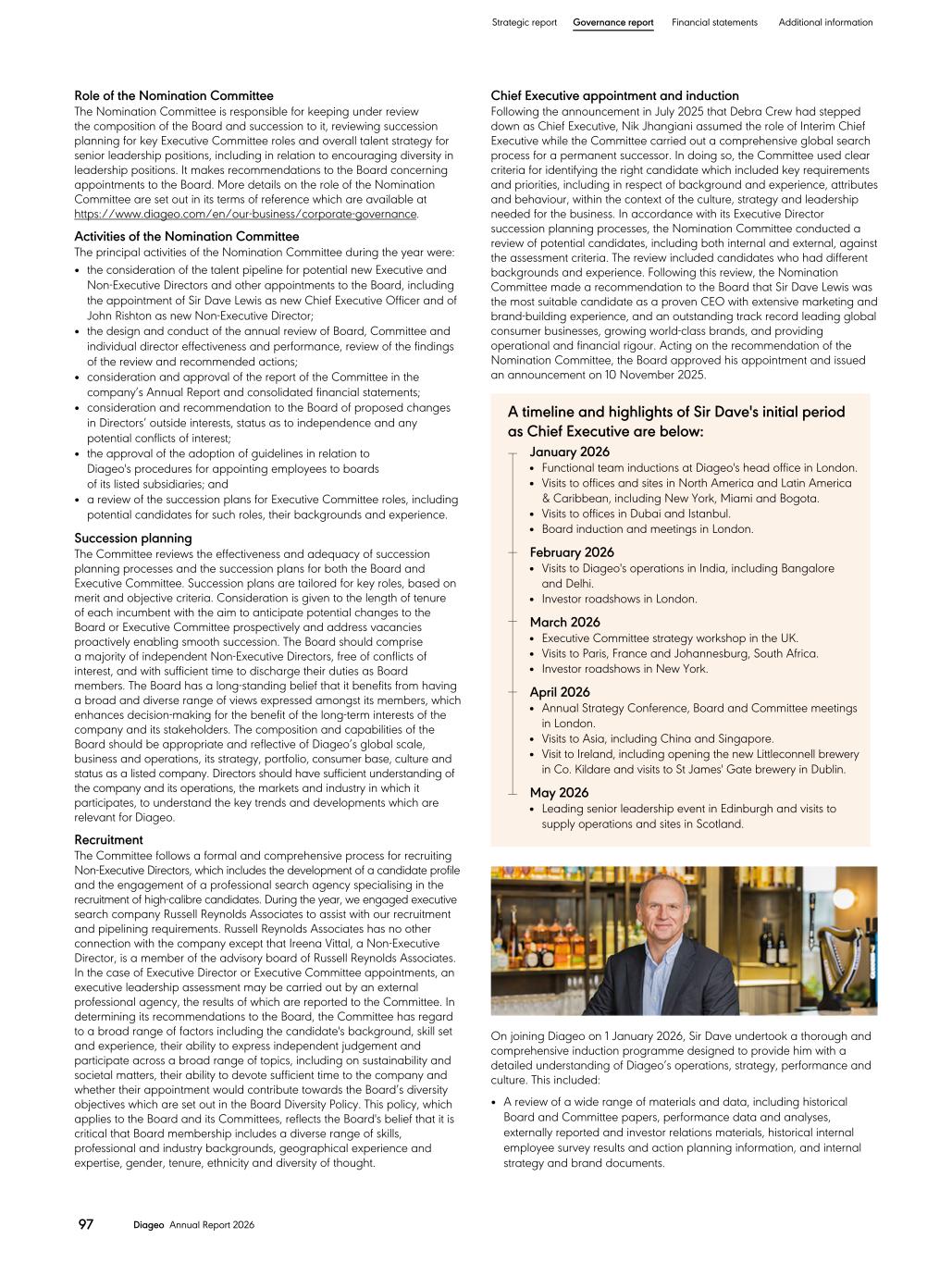
Role of the Nomination Committee The Nomination Committee is responsible for keeping under review the composition of the Board and succession to it, reviewing succession planning for key Executive Committee roles and overall talent strategy for senior leadership positions, including in relation to encouraging diversity in leadership positions. It makes recommendations to the Board concerning appointments to the Board. More details on the role of the Nomination Committee are set out in its terms of reference which are available at https://www.diageo.com/en/our-business/corporate-governance. Activities of the Nomination Committee The principal activities of the Nomination Committee during the year were: • the consideration of the talent pipeline for potential new Executive and Non-Executive Directors and other appointments to the Board, including the appointment of Sir Dave Lewis as new Chief Executive Officer and of John Rishton as new Non-Executive Director; • the design and conduct of the annual review of Board, Committee and individual director effectiveness and performance, review of the findings of the review and recommended actions; • consideration and approval of the report of the Committee in the company’s Annual Report and consolidated financial statements; • consideration and recommendation to the Board of proposed changes in Directors’ outside interests, status as to independence and any potential conflicts of interest; • the approval of the adoption of guidelines in relation to Diageo's procedures for appointing employees to boards of its listed subsidiaries; and • a review of the succession plans for Executive Committee roles, including potential candidates for such roles, their backgrounds and experience. Succession planning The Committee reviews the effectiveness and adequacy of succession planning processes and the succession plans for both the Board and Executive Committee. Succession plans are tailored for key roles, based on merit and objective criteria. Consideration is given to the length of tenure of each incumbent with the aim to anticipate potential changes to the Board or Executive Committee prospectively and address vacancies proactively enabling smooth succession. The Board should comprise a majority of independent Non-Executive Directors, free of conflicts of interest, and with sufficient time to discharge their duties as Board members. The Board has a long-standing belief that it benefits from having a broad and diverse range of views expressed amongst its members, which enhances decision-making for the benefit of the long-term interests of the company and its stakeholders. The composition and capabilities of the Board should be appropriate and reflective of Diageo’s global scale, business and operations, its strategy, portfolio, consumer base, culture and status as a listed company. Directors should have sufficient understanding of the company and its operations, the markets and industry in which it participates, to understand the key trends and developments which are relevant for Diageo. Recruitment The Committee follows a formal and comprehensive process for recruiting Non-Executive Directors, which includes the development of a candidate profile and the engagement of a professional search agency specialising in the recruitment of high-calibre candidates. During the year, we engaged executive search company Russell Reynolds Associates to assist with our recruitment and pipelining requirements. Russell Reynolds Associates has no other connection with the company except that Ireena Vittal, a Non-Executive Director, is a member of the advisory board of Russell Reynolds Associates. In the case of Executive Director or Executive Committee appointments, an executive leadership assessment may be carried out by an external professional agency, the results of which are reported to the Committee. In determining its recommendations to the Board, the Committee has regard to a broad range of factors including the candidate's background, skill set and experience, their ability to express independent judgement and participate across a broad range of topics, including on sustainability and societal matters, their ability to devote sufficient time to the company and whether their appointment would contribute towards the Board’s diversity objectives which are set out in the Board Diversity Policy. This policy, which applies to the Board and its Committees, reflects the Board's belief that it is critical that Board membership includes a diverse range of skills, professional and industry backgrounds, geographical experience and expertise, gender, tenure, ethnicity and diversity of thought. Chief Executive appointment and induction Following the announcement in July 2025 that Debra Crew had stepped down as Chief Executive, Nik Jhangiani assumed the role of Interim Chief Executive while the Committee carried out a comprehensive global search process for a permanent successor. In doing so, the Committee used clear criteria for identifying the right candidate which included key requirements and priorities, including in respect of background and experience, attributes and behaviour, within the context of the culture, strategy and leadership needed for the business. In accordance with its Executive Director succession planning processes, the Nomination Committee conducted a review of potential candidates, including both internal and external, against the assessment criteria. The review included candidates who had different backgrounds and experience. Following this review, the Nomination Committee made a recommendation to the Board that Sir Dave Lewis was the most suitable candidate as a proven CEO with extensive marketing and brand-building experience, and an outstanding track record leading global consumer businesses, growing world-class brands, and providing operational and financial rigour. Acting on the recommendation of the Nomination Committee, the Board approved his appointment and issued an announcement on 10 November 2025. A timeline and highlights of Sir Dave's initial period as Chief Executive are below: January 2026 • Functional team inductions at Diageo's head office in London. • Visits to offices and sites in North America and Latin America & Caribbean, including New York, Miami and Bogota. • Visits to offices in Dubai and Istanbul. • Board induction and meetings in London. February 2026 • Visits to Diageo's operations in India, including Bangalore and Delhi. • Investor roadshows in London. March 2026 • Executive Committee strategy workshop in the UK. • Visits to Paris, France and Johannesburg, South Africa. • Investor roadshows in New York. April 2026 • Annual Strategy Conference, Board and Committee meetings in London. • Visits to Asia, including China and Singapore. • Visit to Ireland, including opening the new Littleconnell brewery in Co. Kildare and visits to St James' Gate brewery in Dublin. May 2026 • Leading senior leadership event in Edinburgh and visits to supply operations and sites in Scotland. On joining Diageo on 1 January 2026, Sir Dave undertook a thorough and comprehensive induction programme designed to provide him with a detailed understanding of Diageo’s operations, strategy, performance and culture. This included: • A review of a wide range of materials and data, including historical Board and Committee papers, performance data and analyses, externally reported and investor relations materials, historical internal employee survey results and action planning information, and internal strategy and brand documents. Strategic report Governance report Financial statements Additional information 97 Diageo Annual Report 2026
• One-to-one meetings with key individuals, including the Chair, Chief Financial Officer, Non-Executive Directors and members of the Executive Committee, to gain a detailed understanding of the company’s strategic priorities, operational and financial performance, key opportunities and challenges. • Multi-day deep dive sessions with senior leaders from across the business, covering areas such as people and culture, supply chain and operations, corporate relations and finance. • A series of visits to key sites and operational locations, allowing Sir Dave to meet key stakeholders, experience the business across its diverse markets and engage directly with the group’s workforce, holding townhalls and Q&As. Appointment and re-appointment at the AGM Any new Directors are appointed by the Board and, in accordance with the company’s articles of association, they must be elected at the next Annual General Meeting (AGM) to continue in office. All existing Directors retire and, if they wish to do so, stand for re-election every year. The Committee has confirmed that the Non-Executive Directors standing for re-appointment at this year’s AGM continue to perform effectively, both individually and collectively as a Board, and that each Non-Executive Director demonstrates commitment to their role and continues to provide constructive challenge, strategic guidance and offer specialist advice, as well as holding management to account. As can be seen from the attendance records set out on page 72, Directors’ attendance levels have been consistently high throughout the year ended 30 June 2026. The Company’s policy is for all Directors to attend the AGM, either physically or by video conference as permitted by the company's articles of association. The 2026 AGM is scheduled to be held on 5 November 2026. Further details, including biographies, are set out in the Notice of Meeting for this year's AGM. External appointments While the Board does not have a written policy with regards to the maximum number of other appointments that Directors should have, before recommending new appointments to the Board, the Nomination Committee considers other demands on candidates’ time. As a general principle, the Committee takes the view that Non-Executive Directors should have no more than four, and Executive Directors no more than one, listed mandates in addition to their role as a Director of the company. However, each Director's situation is considered individually. Once appointed, any proposed additional external appointments are reviewed by the Nomination Committee to ensure that the additional demands on a Director’s time will not impact on the Director’s ability to perform his or her role as a Director of the company before the additional appointment is recommended for approval by the Board. Directors’ interests are reviewed and updated at each Board meeting. The Board has concluded that each Non-Executive Director has sufficient time to discharge their duties as a Director of the company, taking into consideration their external appointments and commitments. Board performance review As part of the annual Board performance review, all members of the Nomination Committee participated in an internal review of the Committee. Feedback indicated that the Committee was effective and that Directors were satisfied with its performance, and that it had been efficient in managing key executive and non-executive role succession during the year. Feedback indicated broad satisfaction with the composition of the Board, comprising a range of diverse and complementary backgrounds including good consumer products experience, and improved processes to ensure an appropriate mix of skills, knowledge and expertise. Further details of the evaluation can be found on pages 85-86. Induction and training Our customary induction processes for newly appointed Directors include individual meetings with Executive Committee members and other senior executives, visits to the company’s production facilities and offices including the company's head office in London and the group's spirits production facilities, scotch brand homes, visitor centres and archives in Scotland. This is supplemented by documents, materials and information, including corporate governance guidance materials, the Code of Business Conduct and other relevant policy documents, historical Board and Committee papers, recent results announcements and materials, investor relations reports, performance data and a wide range of other internal and external reports, presentations and analyses. Induction programmes for new Directors are tailored to suit the particular background and experience of the individual Director, with the Committee advising on priorities for that individual and tracking induction activity. These induction processes supplement existing practices whereby a continuing understanding of the business is developed through appropriate business engagements for Non-Executive Directors such as visits to customers, engagements with employees and brand events worked into the annual cycle of Board meetings. For example, in September 2025 it was announced that John Rishton would be appointed to the Board with effect from 1 November. His induction programme commenced with a series of meetings with other Board members and senior executives, as well as a tour of Diageo's headquarters in London. As part of his induction, he was provided with a broad range of materials and information, including summaries of his responsibilities and duties as Director, and received briefings from the company's corporate brokers and external legal advisors. In late October 2025, John visited a number of the company's distilleries, packaging facilities and other sites in Scotland. In early November 2025, he joined his first Board and committee meetings prior to attending the AGM, at which his appointment was approved by shareholders. Since then, he has visited the company's tequila operations in Mexico and will shortly be visiting sites in China and India. Directors are informed and trained on specific areas of risk by Executive Committee members, other internal senior leaders and external guest speakers and specialists through presentations, roundtable discussions and other sessions during the year as part of Board meetings and dinners. For example, during fiscal 26 the Board held a training session on changing regulatory requirements in relation to cyber security which was facilitated by the Chief Information Security Officer with assistance from internal legal and security specialists, as well as external legal advisors. In addition, Executive Committee members and other senior executives are invited, as appropriate, to Board and strategy meetings to give presentations on their areas of responsibility, especially during the multi-day Annual Strategy Conference. All Directors are also provided with regular briefings to ensure they are kept up to date on relevant legal and governance developments or changes, best practice developments and changing commercial and other risks. Diversity The Board has a long-standing view that it benefits from having an independent and diverse membership, enabling a broader evaluation of all matters under consideration and contributing to a culture of collaborative and constructive discussion. This is captured in the Board Diversity Policy, which applies to the Board and its Committees, reflects the Board's belief that it is critical that Board membership includes a diverse range of skills, professional and industry backgrounds, geographical experience and expertise, gender, tenure, ethnicity and diversity of thought. The Board supports the recommendations of the FTSE Women Leaders Review on gender diversity and the Parker Review on ethnic diversity. The Board's approach to inclusion and diversity includes objectively considering candidates for Board and Executive Committee roles from multiple perspectives, including on the basis of their skill set, experience, expertise, knowledge, gender, cultural and geographical backgrounds, ethnicity and age. Therefore, the Policy sets out specific objectives with parity between male and female members of the Board being the ultimate goal in terms of gender diversity, with a commitment to have no less than 40% female representation on the Board, and having at least one Director reflecting ethnic diversity as defined in accordance with the Parker Review. The Committee is pleased to confirm that the diversity targets set out in the Board Diversity Policy and by the FCA in the UK Listing Rules have been met. The Board Diversity Policy also sets out the Board’s support for management’s actions to increase the proportion of senior leadership roles held by women and by people from ethnic minority backgrounds and other under-represented groups. As at 30 June 2026, the percentage of women on the Executive Committee and their direct reports is 46%. The Board's Diversity Policy is available at https://www.diageo.com/en/ our-business/corporate-governance/board-diversity Strategic report Governance report Financial statements Additional information Nomination Committee report continued 98 Diageo Annual Report 2026
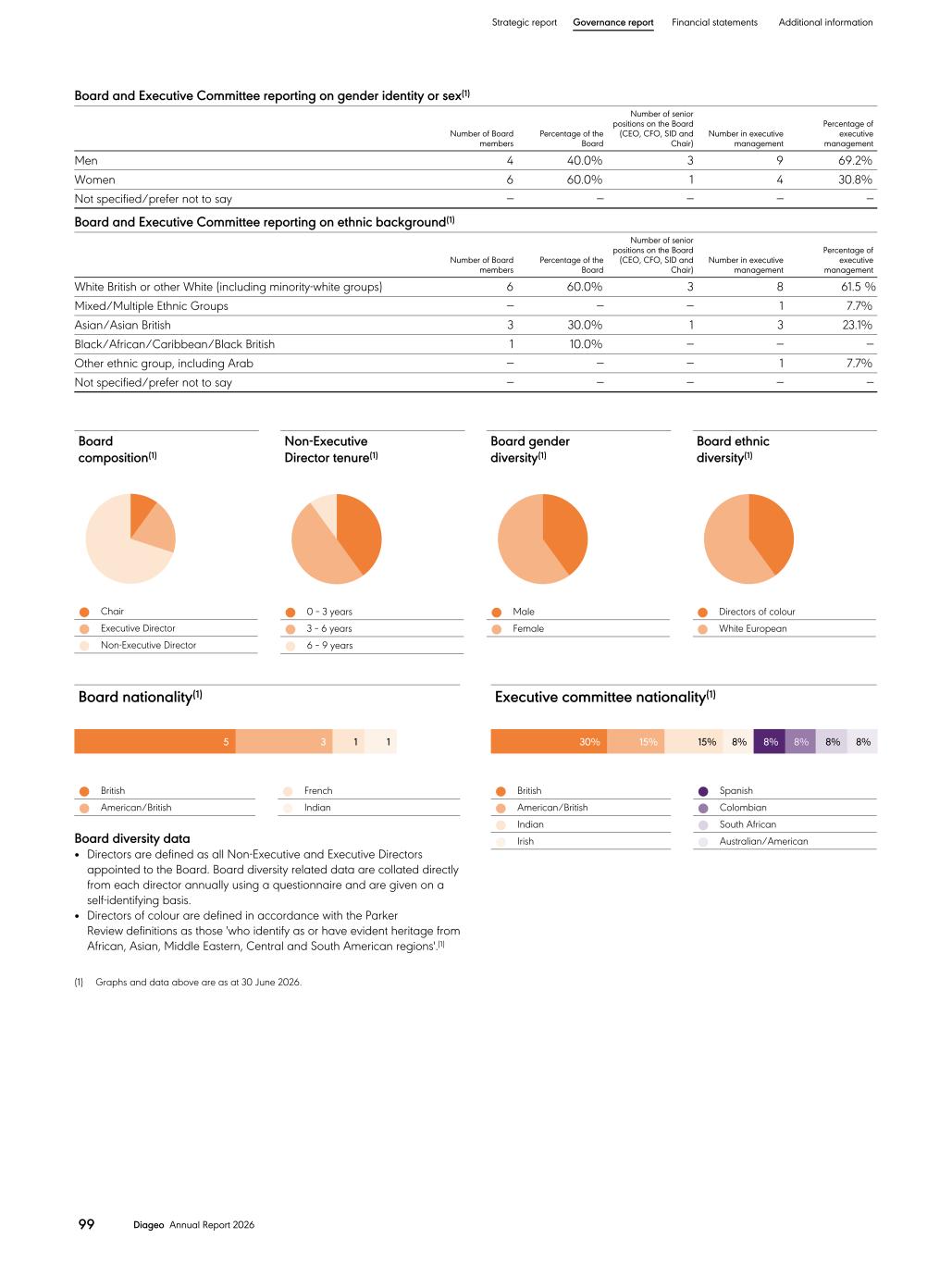
Board and Executive Committee reporting on gender identity or sex(1) Men 4 40.0% 3 9 69.2% Women 6 60.0% 1 4 30.8% Not specified/prefer not to say — — — — — Number of Board members Percentage of the Board Number of senior positions on the Board (CEO, CFO, SID and Chair) Number in executive management Percentage of executive management Board and Executive Committee reporting on ethnic background(1) White British or other White (including minority-white groups) 6 60.0% 3 8 61.5 % Mixed/Multiple Ethnic Groups — — — 1 7.7% Asian/Asian British 3 30.0% 1 3 23.1% Black/African/Caribbean/Black British 1 10.0% — — — Other ethnic group, including Arab — — — 1 7.7% Not specified/prefer not to say — — — — — Number of Board members Percentage of the Board Number of senior positions on the Board (CEO, CFO, SID and Chair) Number in executive management Percentage of executive management Board composition(1) ò Chair ò Executive Director ò Non-Executive Director Non-Executive Director tenure(1) ò 0 – 3 years ò 3 – 6 years ò 6 – 9 years Board gender diversity(1) ò Male ò Female Board ethnic diversity(1) ò Directors of colour ò White European Board nationality(1) 5 3 1 1 ò British ò French ò American/British ò Indian Board diversity data • Directors are defined as all Non-Executive and Executive Directors appointed to the Board. Board diversity related data are collated directly from each director annually using a questionnaire and are given on a self-identifying basis. • Directors of colour are defined in accordance with the Parker Review definitions as those 'who identify as or have evident heritage from African, Asian, Middle Eastern, Central and South American regions'.(1) (1) Graphs and data above are as at 30 June 2026. Executive committee nationality(1) 30% 15% 15% 8% 8% 8% 8% 8% ò British ò Spanish ò American/British ò Colombian ò Indian ò South African ò Irish ò Australian/American Strategic report Governance report Financial statements Additional information 99 Diageo Annual Report 2026
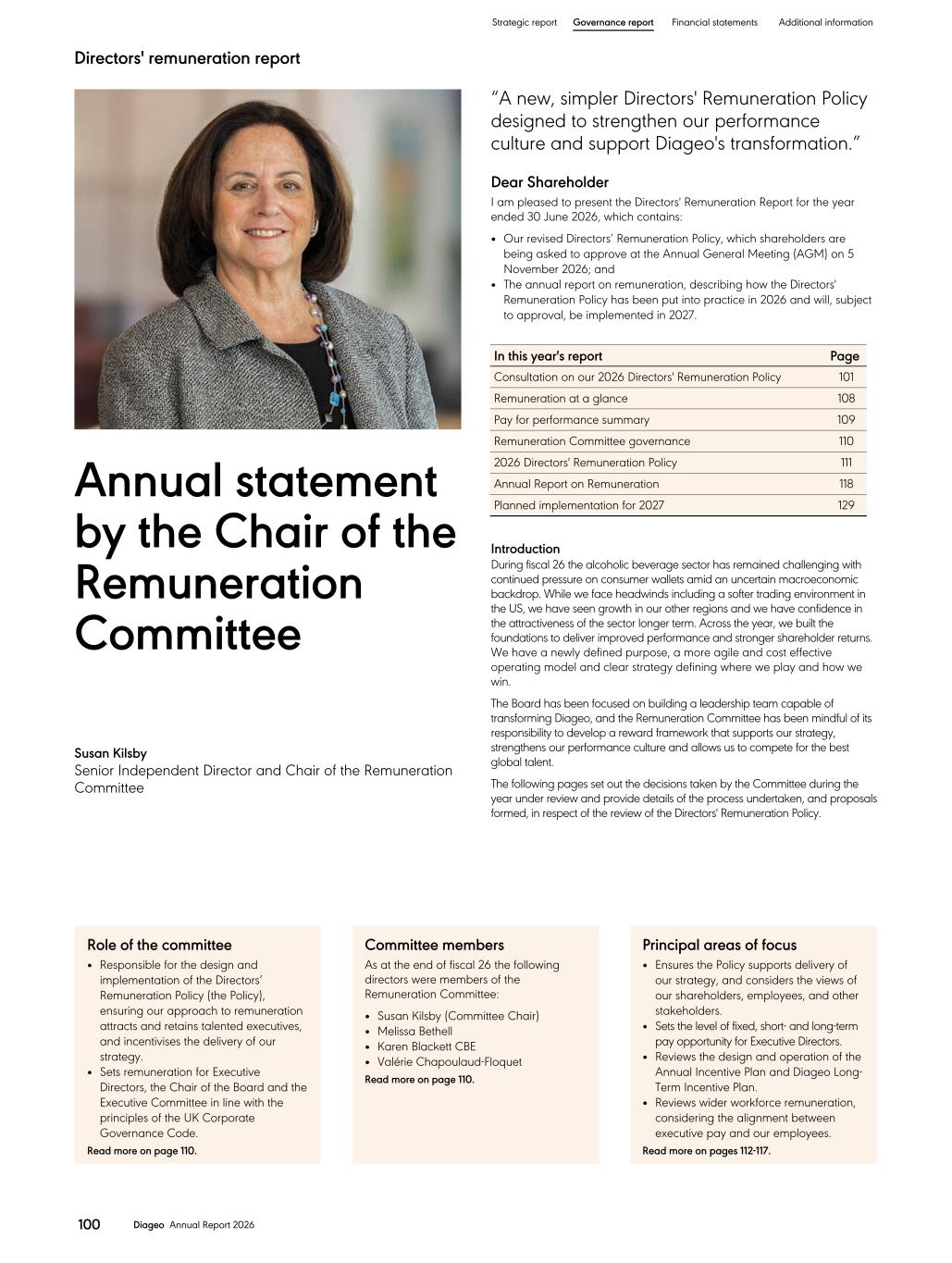
Annual statement by the Chair of the Remuneration Committee Susan Kilsby Senior Independent Director and Chair of the Remuneration Committee “A new, simpler Directors' Remuneration Policy designed to strengthen our performance culture and support Diageo's transformation.” Dear Shareholder I am pleased to present the Directors' Remuneration Report for the year ended 30 June 2026, which contains: • Our revised Directors’ Remuneration Policy, which shareholders are being asked to approve at the Annual General Meeting (AGM) on 5 November 2026; and • The annual report on remuneration, describing how the Directors' Remuneration Policy has been put into practice in 2026 and will, subject to approval, be implemented in 2027. Consultation on our 2026 Directors' Remuneration Policy 101 Remuneration at a glance 108 Pay for performance summary 109 Remuneration Committee governance 110 2026 Directors' Remuneration Policy 111 Annual Report on Remuneration 118 Planned implementation for 2027 129 In this year's report Page Introduction During fiscal 26 the alcoholic beverage sector has remained challenging with continued pressure on consumer wallets amid an uncertain macroeconomic backdrop. While we face headwinds including a softer trading environment in the US, we have seen growth in our other regions and we have confidence in the attractiveness of the sector longer term. Across the year, we built the foundations to deliver improved performance and stronger shareholder returns. We have a newly defined purpose, a more agile and cost effective operating model and clear strategy defining where we play and how we win. The Board has been focused on building a leadership team capable of transforming Diageo, and the Remuneration Committee has been mindful of its responsibility to develop a reward framework that supports our strategy, strengthens our performance culture and allows us to compete for the best global talent. The following pages set out the decisions taken by the Committee during the year under review and provide details of the process undertaken, and proposals formed, in respect of the review of the Directors' Remuneration Policy. Role of the committee • Responsible for the design and implementation of the Directors’ Remuneration Policy (the Policy), ensuring our approach to remuneration attracts and retains talented executives, and incentivises the delivery of our strategy. • Sets remuneration for Executive Directors, the Chair of the Board and the Executive Committee in line with the principles of the UK Corporate Governance Code. Read more on page 110. Committee members As at the end of fiscal 26 the following directors were members of the Remuneration Committee: • Susan Kilsby (Committee Chair) • Melissa Bethell • Karen Blackett CBE • Valérie Chapoulaud-Floquet Read more on page 110. Principal areas of focus • Ensures the Policy supports delivery of our strategy, and considers the views of our shareholders, employees, and other stakeholders. • Sets the level of fixed, short- and long-term pay opportunity for Executive Directors. • Reviews the design and operation of the Annual Incentive Plan and Diageo Long- Term Incentive Plan. • Reviews wider workforce remuneration, considering the alignment between executive pay and our employees. Read more on pages 112-117. Strategic report Governance report Financial statements Additional information 100 Diageo Annual Report 2026 Directors' remuneration report
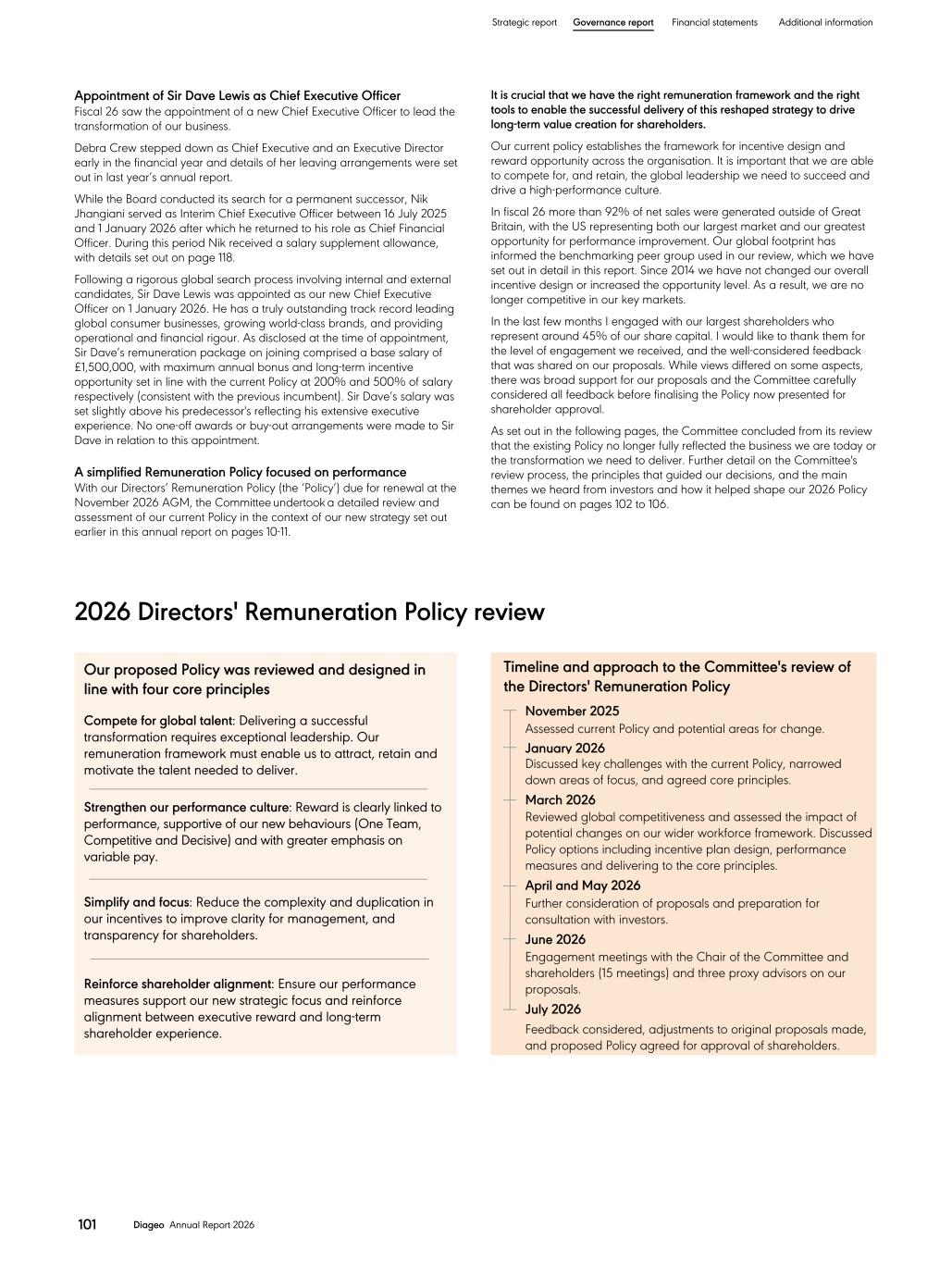
Appointment of Sir Dave Lewis as Chief Executive Officer Fiscal 26 saw the appointment of a new Chief Executive Officer to lead the transformation of our business. Debra Crew stepped down as Chief Executive and an Executive Director early in the financial year and details of her leaving arrangements were set out in last year’s annual report. While the Board conducted its search for a permanent successor, Nik Jhangiani served as Interim Chief Executive Officer between 16 July 2025 and 1 January 2026 after which he returned to his role as Chief Financial Officer. During this period Nik received a salary supplement allowance, with details set out on page 118. Following a rigorous global search process involving internal and external candidates, Sir Dave Lewis was appointed as our new Chief Executive Officer on 1 January 2026. He has a truly outstanding track record leading global consumer businesses, growing world-class brands, and providing operational and financial rigour. As disclosed at the time of appointment, Sir Dave’s remuneration package on joining comprised a base salary of £1,500,000, with maximum annual bonus and long-term incentive opportunity set in line with the current Policy at 200% and 500% of salary respectively (consistent with the previous incumbent). Sir Dave’s salary was set slightly above his predecessor's reflecting his extensive executive experience. No one-off awards or buy-out arrangements were made to Sir Dave in relation to this appointment. A simplified Remuneration Policy focused on performance With our Directors’ Remuneration Policy (the ‘Policy’) due for renewal at the November 2026 AGM, the Committee undertook a detailed review and assessment of our current Policy in the context of our new strategy set out earlier in this annual report on pages 10-11. It is crucial that we have the right remuneration framework and the right tools to enable the successful delivery of this reshaped strategy to drive long-term value creation for shareholders. Our current policy establishes the framework for incentive design and reward opportunity across the organisation. It is important that we are able to compete for, and retain, the global leadership we need to succeed and drive a high-performance culture. In fiscal 26 more than 92% of net sales were generated outside of Great Britain, with the US representing both our largest market and our greatest opportunity for performance improvement. Our global footprint has informed the benchmarking peer group used in our review, which we have set out in detail in this report. Since 2014 we have not changed our overall incentive design or increased the opportunity level. As a result, we are no longer competitive in our key markets. In the last few months I engaged with our largest shareholders who represent around 45% of our share capital. I would like to thank them for the level of engagement we received, and the well-considered feedback that was shared on our proposals. While views differed on some aspects, there was broad support for our proposals and the Committee carefully considered all feedback before finalising the Policy now presented for shareholder approval. As set out in the following pages, the Committee concluded from its review that the existing Policy no longer fully reflected the business we are today or the transformation we need to deliver. Further detail on the Committee's review process, the principles that guided our decisions, and the main themes we heard from investors and how it helped shape our 2026 Policy can be found on pages 102 to 106. 2026 Directors' Remuneration Policy review Compete for global talent: Delivering a successful transformation requires exceptional leadership. Our remuneration framework must enable us to attract, retain and motivate the talent needed to deliver. Strengthen our performance culture: Reward is clearly linked to performance, supportive of our new behaviours (One Team, Competitive and Decisive) and with greater emphasis on variable pay. Simplify and focus: Reduce the complexity and duplication in our incentives to improve clarity for management, and transparency for shareholders. Reinforce shareholder alignment: Ensure our performance measures support our new strategic focus and reinforce alignment between executive reward and long-term shareholder experience. Our proposed Policy was reviewed and designed in line with four core principles November 2025 Assessed current Policy and potential areas for change. January 2026 Discussed key challenges with the current Policy, narrowed down areas of focus, and agreed core principles. March 2026 Reviewed global competitiveness and assessed the impact of potential changes on our wider workforce framework. Discussed Policy options including incentive plan design, performance measures and delivering to the core principles. April and May 2026 Further consideration of proposals and preparation for consultation with investors. June 2026 Engagement meetings with the Chair of the Committee and shareholders (15 meetings) and three proxy advisors on our proposals. July 2026 Feedback considered, adjustments to original proposals made, and proposed Policy agreed for approval of shareholders. Timeline and approach to the Committee's review of the Directors' Remuneration Policy Strategic report Governance report Financial statements Additional information 101 Diageo Annual Report 2026
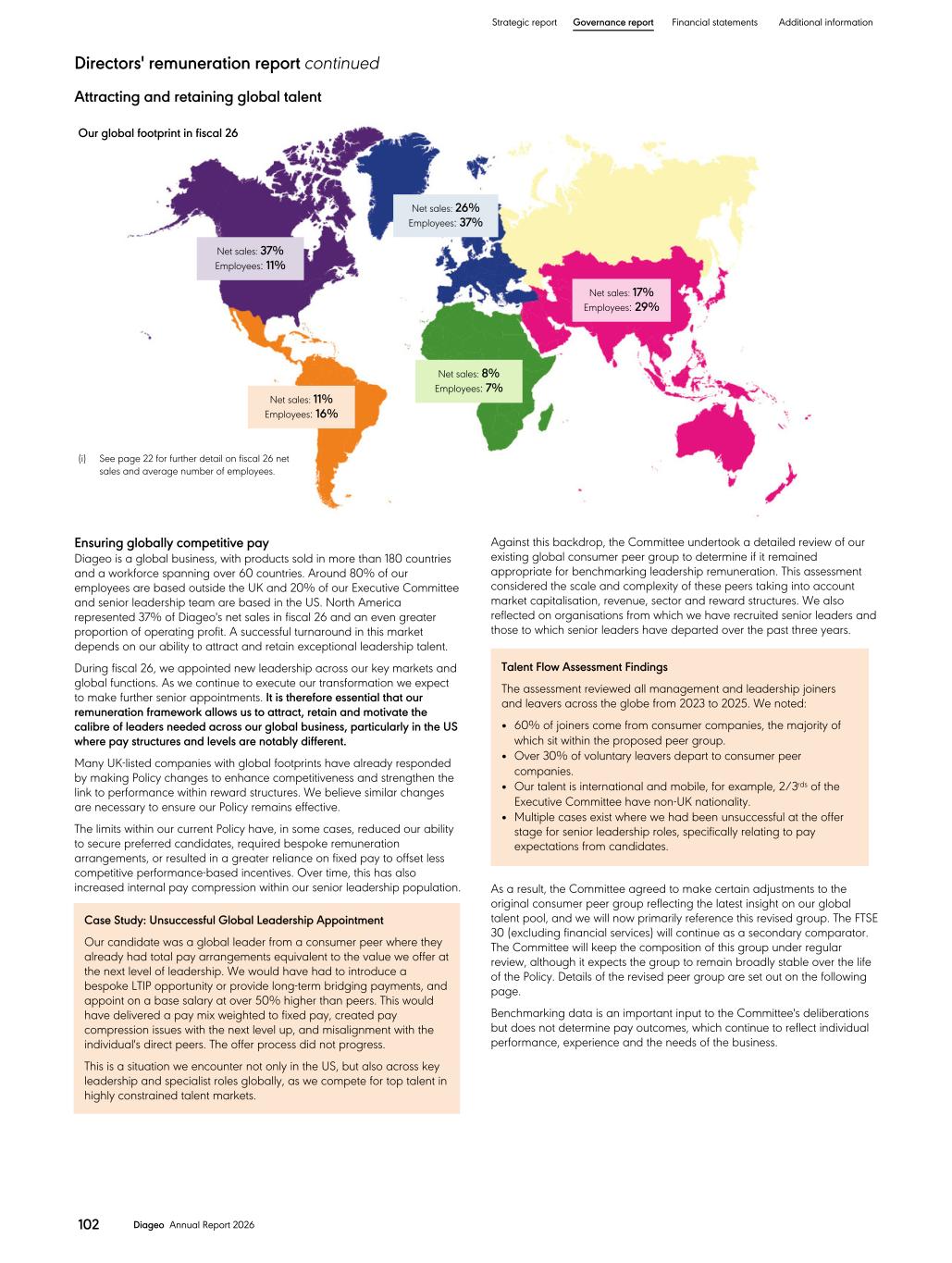
Attracting and retaining global talent Ensuring globally competitive pay Diageo is a global business, with products sold in more than 180 countries and a workforce spanning over 60 countries. Around 80% of our employees are based outside the UK and 20% of our Executive Committee and senior leadership team are based in the US. North America represented 37% of Diageo's net sales in fiscal 26 and an even greater proportion of operating profit. A successful turnaround in this market depends on our ability to attract and retain exceptional leadership talent. During fiscal 26, we appointed new leadership across our key markets and global functions. As we continue to execute our transformation we expect to make further senior appointments. It is therefore essential that our remuneration framework allows us to attract, retain and motivate the calibre of leaders needed across our global business, particularly in the US where pay structures and levels are notably different. Many UK-listed companies with global footprints have already responded by making Policy changes to enhance competitiveness and strengthen the link to performance within reward structures. We believe similar changes are necessary to ensure our Policy remains effective. The limits within our current Policy have, in some cases, reduced our ability to secure preferred candidates, required bespoke remuneration arrangements, or resulted in a greater reliance on fixed pay to offset less competitive performance-based incentives. Over time, this has also increased internal pay compression within our senior leadership population. Against this backdrop, the Committee undertook a detailed review of our existing global consumer peer group to determine if it remained appropriate for benchmarking leadership remuneration. This assessment considered the scale and complexity of these peers taking into account market capitalisation, revenue, sector and reward structures. We also reflected on organisations from which we have recruited senior leaders and those to which senior leaders have departed over the past three years. As a result, the Committee agreed to make certain adjustments to the original consumer peer group reflecting the latest insight on our global talent pool, and we will now primarily reference this revised group. The FTSE 30 (excluding financial services) will continue as a secondary comparator. The Committee will keep the composition of this group under regular review, although it expects the group to remain broadly stable over the life of the Policy. Details of the revised peer group are set out on the following page. Benchmarking data is an important input to the Committee's deliberations but does not determine pay outcomes, which continue to reflect individual performance, experience and the needs of the business. Strategic report Governance report Financial statements Additional information Directors' remuneration report continued 102 Diageo Annual Report 2026 Talent Flow Assessment Findings The assessment reviewed all management and leadership joiners and leavers across the globe from 2023 to 2025. We noted: • 60% of joiners come from consumer companies, the majority of which sit within the proposed peer group. • Over 30% of voluntary leavers depart to consumer peer companies. • Our talent is international and mobile, for example, 2/3rds of the Executive Committee have non-UK nationality. • Multiple cases exist where we had been unsuccessful at the offer stage for senior leadership roles, specifically relating to pay expectations from candidates. Our global footprint in fiscal 26 Net sales: 17% Employees: 29% (i) See page 22 for further detail on fiscal 26 net sales and average number of employees. Net sales: 8% Employees: 7% Net sales: 26% Employees: 37% Net sales: 11% Employees: 16% Net sales: 37% Employees: 11% Case Study: Unsuccessful Global Leadership Appointment Our candidate was a global leader from a consumer peer where they already had total pay arrangements equivalent to the value we offer at the next level of leadership. We would have had to introduce a bespoke LTIP opportunity or provide long-term bridging payments, and appoint on a base salary at over 50% higher than peers. This would have delivered a pay mix weighted to fixed pay, created pay compression issues with the next level up, and misalignment with the individual's direct peers. The offer process did not progress. This is a situation we encounter not only in the US, but also across key leadership and specialist roles globally, as we compete for top talent in highly constrained talent markets.
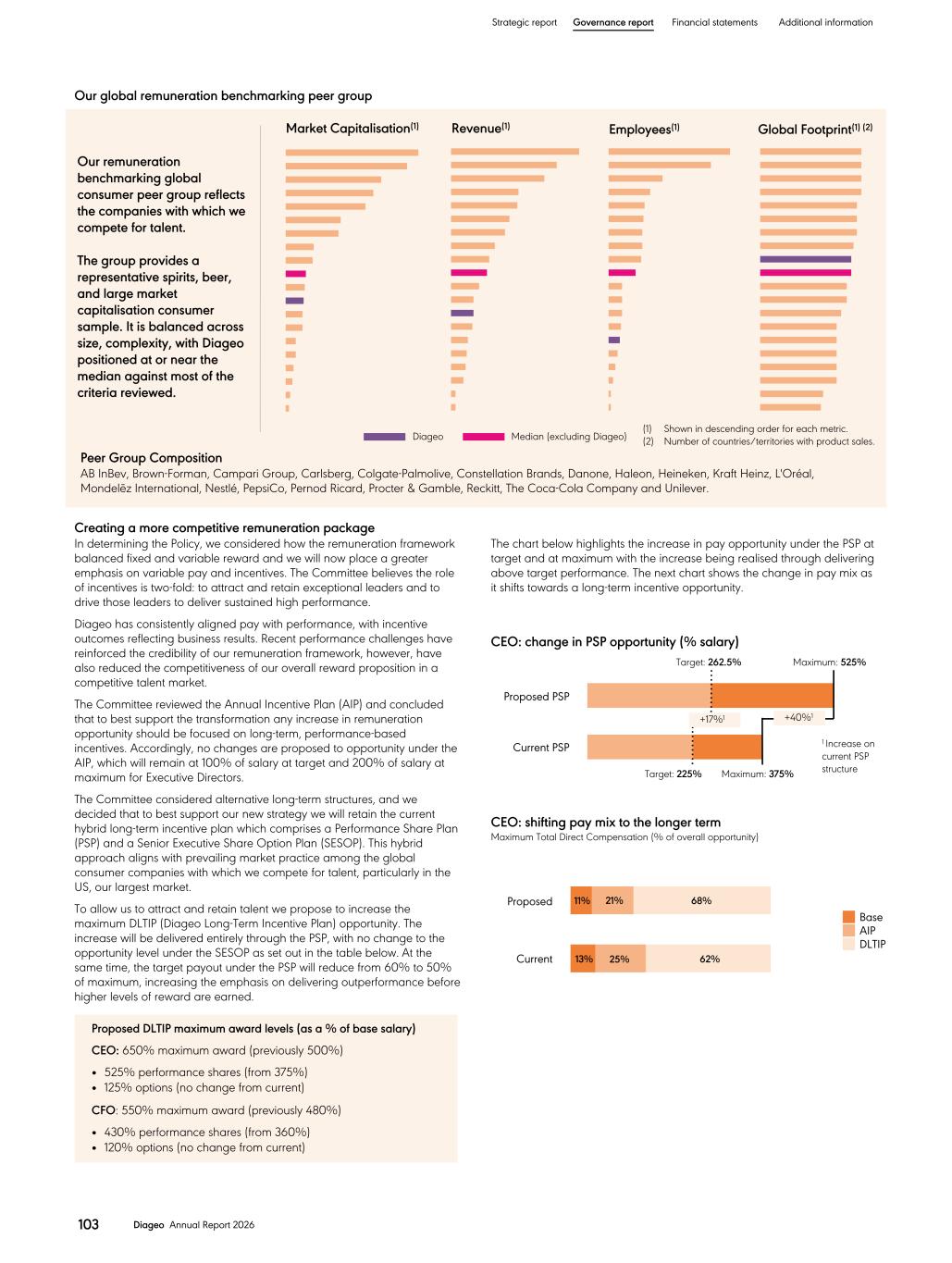
Our global remuneration benchmarking peer group Creating a more competitive remuneration package In determining the Policy, we considered how the remuneration framework balanced fixed and variable reward and we will now place a greater emphasis on variable pay and incentives. The Committee believes the role of incentives is two-fold: to attract and retain exceptional leaders and to drive those leaders to deliver sustained high performance. Diageo has consistently aligned pay with performance, with incentive outcomes reflecting business results. Recent performance challenges have reinforced the credibility of our remuneration framework, however, have also reduced the competitiveness of our overall reward proposition in a competitive talent market. The Committee reviewed the Annual Incentive Plan (AIP) and concluded that to best support the transformation any increase in remuneration opportunity should be focused on long-term, performance-based incentives. Accordingly, no changes are proposed to opportunity under the AIP, which will remain at 100% of salary at target and 200% of salary at maximum for Executive Directors. The Committee considered alternative long-term structures, and we decided that to best support our new strategy we will retain the current hybrid long-term incentive plan which comprises a Performance Share Plan (PSP) and a Senior Executive Share Option Plan (SESOP). This hybrid approach aligns with prevailing market practice among the global consumer companies with which we compete for talent, particularly in the US, our largest market. To allow us to attract and retain talent we propose to increase the maximum DLTIP (Diageo Long-Term Incentive Plan) opportunity. The increase will be delivered entirely through the PSP, with no change to the opportunity level under the SESOP as set out in the table below. At the same time, the target payout under the PSP will reduce from 60% to 50% of maximum, increasing the emphasis on delivering outperformance before higher levels of reward are earned. The chart below highlights the increase in pay opportunity under the PSP at target and at maximum with the increase being realised through delivering above target performance. The next chart shows the change in pay mix as it shifts towards a long-term incentive opportunity. CEO: change in PSP opportunity (% salary) CEO: shifting pay mix to the longer term Maximum Total Direct Compensation (% of overall opportunity) Strategic report Governance report Financial statements Additional information 103 Diageo Annual Report 2026 Proposed PSP Current PSP Market Capitalisation(1) Revenue(1) (1) Shown in descending order for each metric. (2) Number of countries/territories with product sales. Employees(1) Global Footprint(1) (2) Diageo Median (excluding Diageo) Target: 262.5% Maximum: 525% Target: 225% Peer Group Composition AB InBev, Brown-Forman, Campari Group, Carlsberg, Colgate-Palmolive, Constellation Brands, Danone, Haleon, Heineken, Kraft Heinz, L'Oréal, Mondelēz International, Nestlé, PepsiCo, Pernod Ricard, Procter & Gamble, Reckitt, The Coca-Cola Company and Unilever. Base AIP DLTIP Proposed Current 68% 62% 21% 25% Proposed DLTIP maximum award levels (as a % of base salary) CEO: 650% maximum award (previously 500%) • 525% performance shares (from 375%) • 125% options (no change from current) CFO: 550% maximum award (previously 480%) • 430% performance shares (from 360%) • 120% options (no change from current) Maximum: 375% 11% 13% +40%1 1 Increase on current PSP structure +17%1 Our remuneration benchmarking global consumer peer group reflects the companies with which we compete for talent. The group provides a representative spirits, beer, and large market capitalisation consumer sample. It is balanced across size, complexity, with Diageo positioned at or near the median against most of the criteria reviewed.
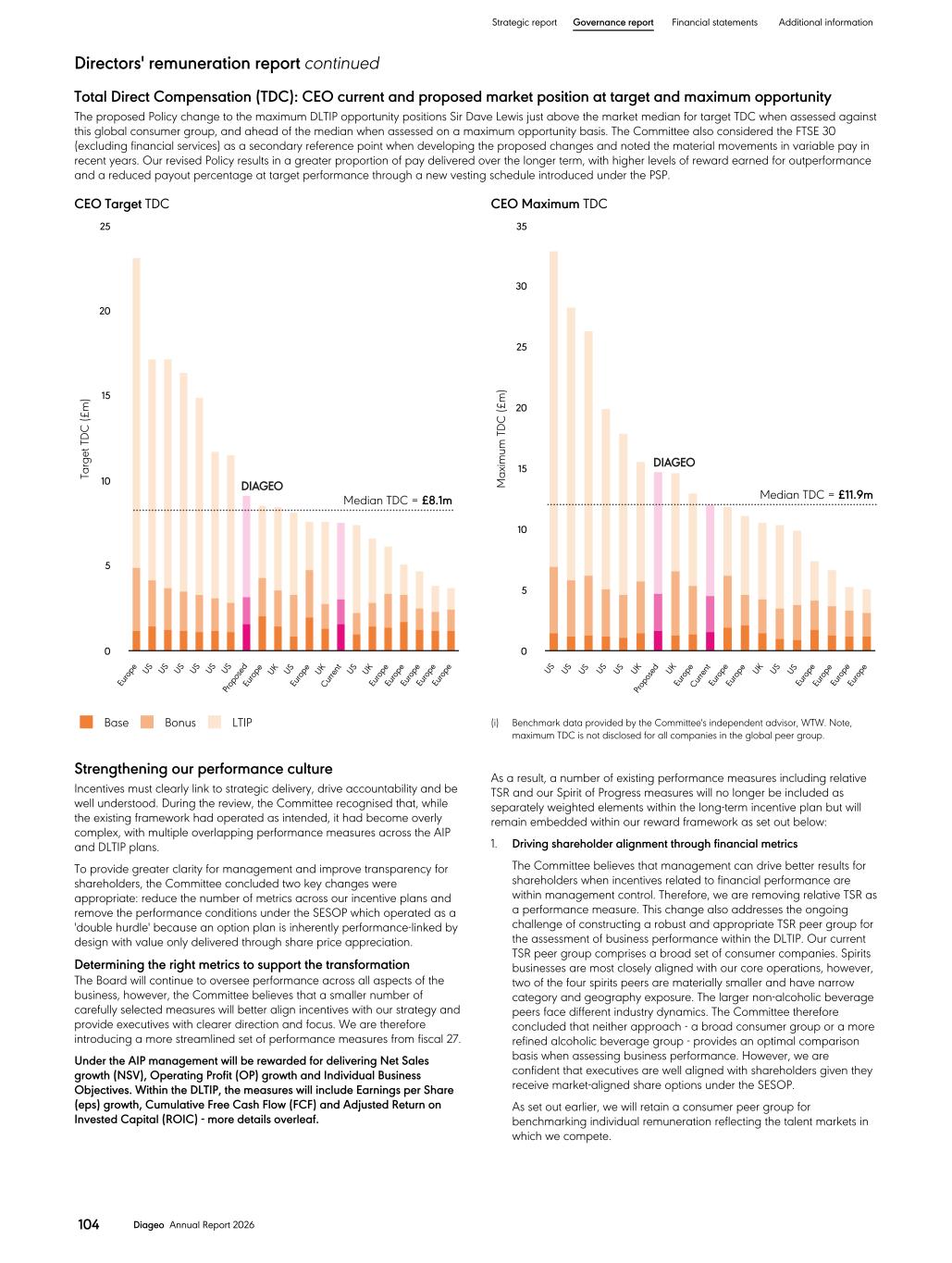
Total Direct Compensation (TDC): CEO current and proposed market position at target and maximum opportunity The proposed Policy change to the maximum DLTIP opportunity positions Sir Dave Lewis just above the market median for target TDC when assessed against this global consumer group, and ahead of the median when assessed on a maximum opportunity basis. The Committee also considered the FTSE 30 (excluding financial services) as a secondary reference point when developing the proposed changes and noted the material movements in variable pay in recent years. Our revised Policy results in a greater proportion of pay delivered over the longer term, with higher levels of reward earned for outperformance and a reduced payout percentage at target performance through a new vesting schedule introduced under the PSP. CEO Target TDC Ta rg et T DC (£ m ) Eu rop e US US US US US US Pro po se d Eu rop e UK US Eu rop e UK Curr en t US UK Eu rop e Eu rop e Eu rop e Eu rop e Eu rop e 0 5 10 15 20 25 ¢ Base ¢ Bonus ¢ LTIP Strengthening our performance culture Incentives must clearly link to strategic delivery, drive accountability and be well understood. During the review, the Committee recognised that, while the existing framework had operated as intended, it had become overly complex, with multiple overlapping performance measures across the AIP and DLTIP plans. To provide greater clarity for management and improve transparency for shareholders, the Committee concluded two key changes were appropriate: reduce the number of metrics across our incentive plans and remove the performance conditions under the SESOP which operated as a 'double hurdle' because an option plan is inherently performance-linked by design with value only delivered through share price appreciation. Determining the right metrics to support the transformation The Board will continue to oversee performance across all aspects of the business, however, the Committee believes that a smaller number of carefully selected measures will better align incentives with our strategy and provide executives with clearer direction and focus. We are therefore introducing a more streamlined set of performance measures from fiscal 27. Under the AIP management will be rewarded for delivering Net Sales growth (NSV), Operating Profit (OP) growth and Individual Business Objectives. Within the DLTIP, the measures will include Earnings per Share (eps) growth, Cumulative Free Cash Flow (FCF) and Adjusted Return on Invested Capital (ROIC) - more details overleaf. CEO Maximum TDC M ax im um T DC (£ m ) US US US US US UK Pro po se d UK Eu rop e Curr en t Eu rop e Eu rop e UK US US Eu rop e Eu rop e Eu rop e Eu rop e 0 5 10 15 20 25 30 35 (i) Benchmark data provided by the Committee's independent advisor, WTW. Note, maximum TDC is not disclosed for all companies in the global peer group. As a result, a number of existing performance measures including relative TSR and our Spirit of Progress measures will no longer be included as separately weighted elements within the long-term incentive plan but will remain embedded within our reward framework as set out below: 1. Driving shareholder alignment through financial metrics The Committee believes that management can drive better results for shareholders when incentives related to financial performance are within management control. Therefore, we are removing relative TSR as a performance measure. This change also addresses the ongoing challenge of constructing a robust and appropriate TSR peer group for the assessment of business performance within the DLTIP. Our current TSR peer group comprises a broad set of consumer companies. Spirits businesses are most closely aligned with our core operations, however, two of the four spirits peers are materially smaller and have narrow category and geography exposure. The larger non-alcoholic beverage peers face different industry dynamics. The Committee therefore concluded that neither approach - a broad consumer group or a more refined alcoholic beverage group - provides an optimal comparison basis when assessing business performance. However, we are confident that executives are well aligned with shareholders given they receive market-aligned share options under the SESOP. As set out earlier, we will retain a consumer peer group for benchmarking individual remuneration reflecting the talent markets in which we compete. Strategic report Governance report Financial statements Additional information Directors' remuneration report continued 104 Diageo Annual Report 2026 Median TDC = £8.1m Median TDC = £11.9m
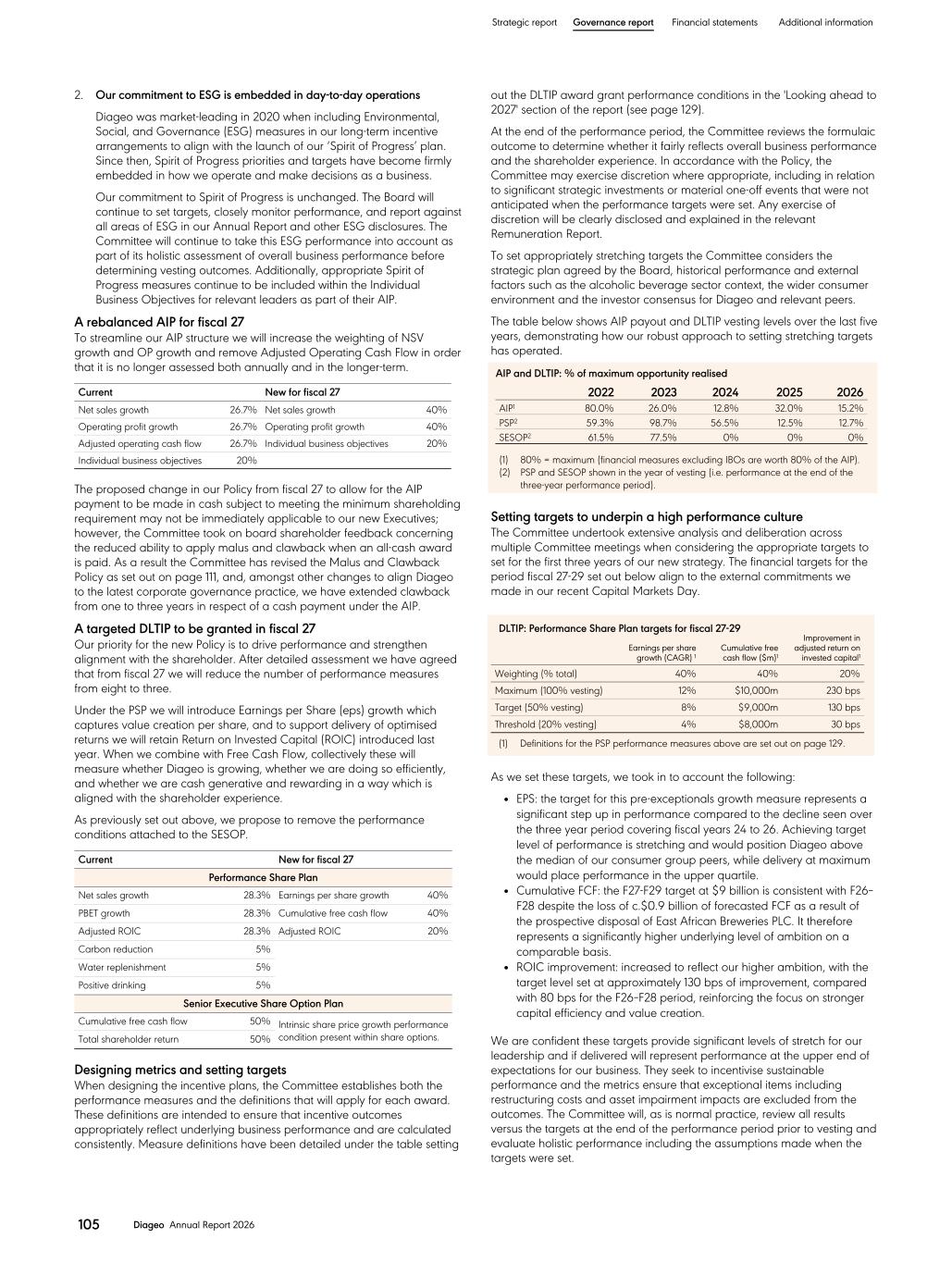
2. Our commitment to ESG is embedded in day-to-day operations Diageo was market-leading in 2020 when including Environmental, Social, and Governance (ESG) measures in our long-term incentive arrangements to align with the launch of our ‘Spirit of Progress’ plan. Since then, Spirit of Progress priorities and targets have become firmly embedded in how we operate and make decisions as a business. Our commitment to Spirit of Progress is unchanged. The Board will continue to set targets, closely monitor performance, and report against all areas of ESG in our Annual Report and other ESG disclosures. The Committee will continue to take this ESG performance into account as part of its holistic assessment of overall business performance before determining vesting outcomes. Additionally, appropriate Spirit of Progress measures continue to be included within the Individual Business Objectives for relevant leaders as part of their AIP. A rebalanced AIP for fiscal 27 To streamline our AIP structure we will increase the weighting of NSV growth and OP growth and remove Adjusted Operating Cash Flow in order that it is no longer assessed both annually and in the longer-term. Net sales growth 26.7% Net sales growth 40% Operating profit growth 26.7% Operating profit growth 40% Adjusted operating cash flow 26.7% Individual business objectives 20% Individual business objectives 20% Current New for fiscal 27 The proposed change in our Policy from fiscal 27 to allow for the AIP payment to be made in cash subject to meeting the minimum shareholding requirement may not be immediately applicable to our new Executives; however, the Committee took on board shareholder feedback concerning the reduced ability to apply malus and clawback when an all-cash award is paid. As a result the Committee has revised the Malus and Clawback Policy as set out on page 111, and, amongst other changes to align Diageo to the latest corporate governance practice, we have extended clawback from one to three years in respect of a cash payment under the AIP. A targeted DLTIP to be granted in fiscal 27 Our priority for the new Policy is to drive performance and strengthen alignment with the shareholder. After detailed assessment we have agreed that from fiscal 27 we will reduce the number of performance measures from eight to three. Under the PSP we will introduce Earnings per Share (eps) growth which captures value creation per share, and to support delivery of optimised returns we will retain Return on Invested Capital (ROIC) introduced last year. When we combine with Free Cash Flow, collectively these will measure whether Diageo is growing, whether we are doing so efficiently, and whether we are cash generative and rewarding in a way which is aligned with the shareholder experience. As previously set out above, we propose to remove the performance conditions attached to the SESOP. Performance Share Plan Net sales growth 28.3% Earnings per share growth 40% PBET growth 28.3% Cumulative free cash flow 40% Adjusted ROIC 28.3% Adjusted ROIC 20% Carbon reduction 5% Water replenishment 5% Positive drinking 5% Senior Executive Share Option Plan Cumulative free cash flow 50% Intrinsic share price growth performance condition present within share options.Total shareholder return 50% Current New for fiscal 27 Designing metrics and setting targets When designing the incentive plans, the Committee establishes both the performance measures and the definitions that will apply for each award. These definitions are intended to ensure that incentive outcomes appropriately reflect underlying business performance and are calculated consistently. Measure definitions have been detailed under the table setting out the DLTIP award grant performance conditions in the 'Looking ahead to 2027' section of the report (see page 129). At the end of the performance period, the Committee reviews the formulaic outcome to determine whether it fairly reflects overall business performance and the shareholder experience. In accordance with the Policy, the Committee may exercise discretion where appropriate, including in relation to significant strategic investments or material one-off events that were not anticipated when the performance targets were set. Any exercise of discretion will be clearly disclosed and explained in the relevant Remuneration Report. To set appropriately stretching targets the Committee considers the strategic plan agreed by the Board, historical performance and external factors such as the alcoholic beverage sector context, the wider consumer environment and the investor consensus for Diageo and relevant peers. The table below shows AIP payout and DLTIP vesting levels over the last five years, demonstrating how our robust approach to setting stretching targets has operated. Setting targets to underpin a high performance culture The Committee undertook extensive analysis and deliberation across multiple Committee meetings when considering the appropriate targets to set for the first three years of our new strategy. The financial targets for the period fiscal 27-29 set out below align to the external commitments we made in our recent Capital Markets Day. Earnings per share growth (CAGR) 1 Cumulative free cash flow ($m)1 Improvement in adjusted return on invested capital1 Weighting (% total) 40% 40% 20% Maximum (100% vesting) 12% $10,000m 230 bps Target (50% vesting) 8% $9,000m 130 bps Threshold (20% vesting) 4% $8,000m 30 bps As we set these targets, we took in to account the following: • EPS: the target for this pre-exceptionals growth measure represents a significant step up in performance compared to the decline seen over the three year period covering fiscal years 24 to 26. Achieving target level of performance is stretching and would position Diageo above the median of our consumer group peers, while delivery at maximum would place performance in the upper quartile. • Cumulative FCF: the F27-F29 target at $9 billion is consistent with F26– F28 despite the loss of c.$0.9 billion of forecasted FCF as a result of the prospective disposal of East African Breweries PLC. It therefore represents a significantly higher underlying level of ambition on a comparable basis. • ROIC improvement: increased to reflect our higher ambition, with the target level set at approximately 130 bps of improvement, compared with 80 bps for the F26–F28 period, reinforcing the focus on stronger capital efficiency and value creation. We are confident these targets provide significant levels of stretch for our leadership and if delivered will represent performance at the upper end of expectations for our business. They seek to incentivise sustainable performance and the metrics ensure that exceptional items including restructuring costs and asset impairment impacts are excluded from the outcomes. The Committee will, as is normal practice, review all results versus the targets at the end of the performance period prior to vesting and evaluate holistic performance including the assumptions made when the targets were set. Strategic report Governance report Financial statements Additional information 105 Diageo Annual Report 2026 2022 2023 2024 2025 2026 AIP1 80.0% 26.0% 12.8% 32.0% 15.2% PSP2 59.3% 98.7% 56.5% 12.5% 12.7% SESOP2 61.5% 77.5% 0% 0% 0% (1) 80% = maximum (financial measures excluding IBOs are worth 80% of the AIP). (2) PSP and SESOP shown in the year of vesting (i.e. performance at the end of the three-year performance period). AIP and DLTIP: % of maximum opportunity realised DLTIP: Performance Share Plan targets for fiscal 27-29 (1) Definitions for the PSP performance measures above are set out on page 129.
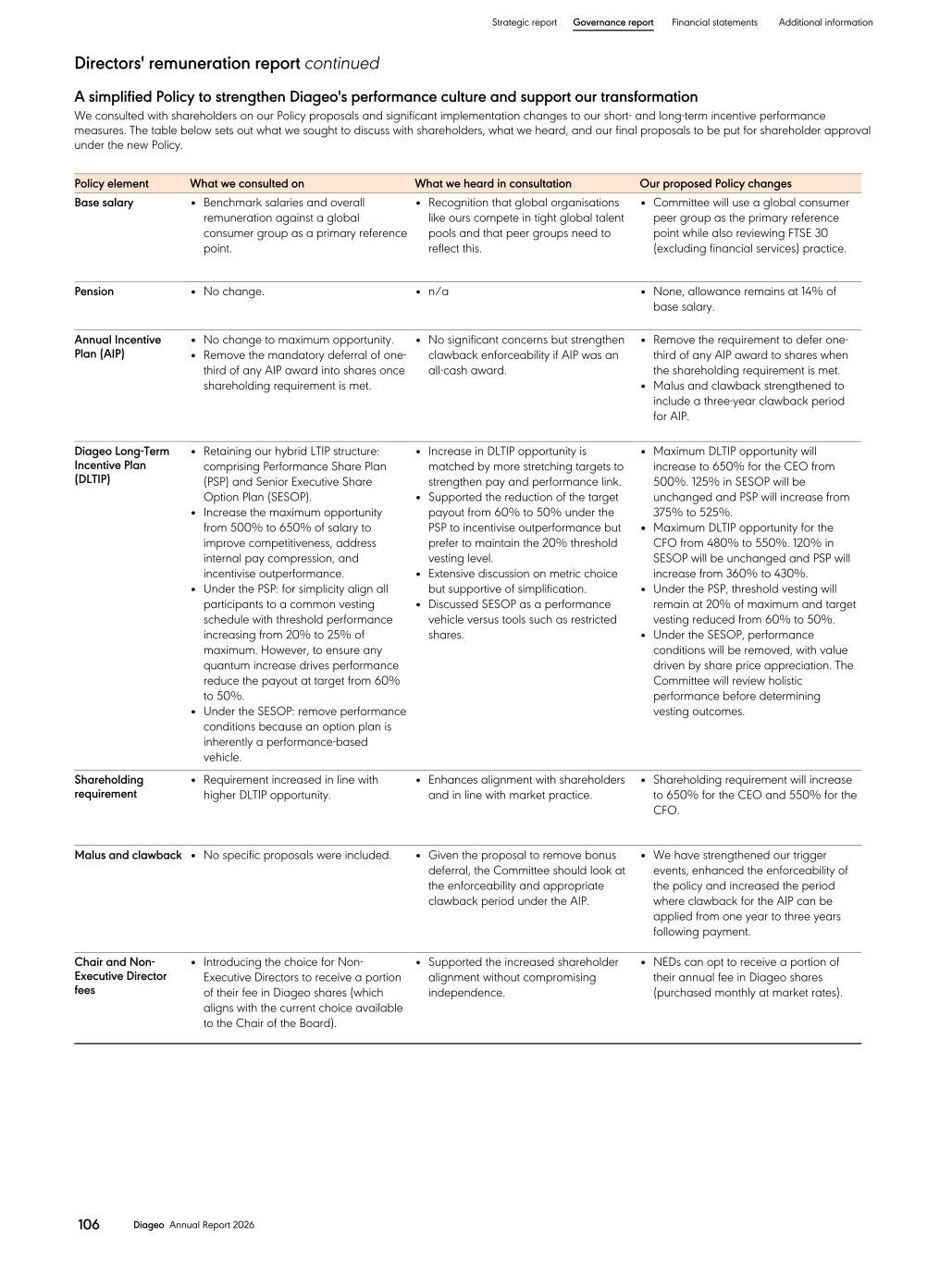
A simplified Policy to strengthen Diageo's performance culture and support our transformation We consulted with shareholders on our Policy proposals and significant implementation changes to our short- and long-term incentive performance measures. The table below sets out what we sought to discuss with shareholders, what we heard, and our final proposals to be put for shareholder approval under the new Policy. Policy element What we consulted on What we heard in consultation Our proposed Policy changes Base salary • Benchmark salaries and overall remuneration against a global consumer group as a primary reference point. • Recognition that global organisations like ours compete in tight global talent pools and that peer groups need to reflect this. • Committee will use a global consumer peer group as the primary reference point while also reviewing FTSE 30 (excluding financial services) practice. Pension • No change. • n/a • None, allowance remains at 14% of base salary. Annual Incentive Plan (AIP) • No change to maximum opportunity. • Remove the mandatory deferral of one- third of any AIP award into shares once shareholding requirement is met. • No significant concerns but strengthen clawback enforceability if AIP was an all-cash award. • Remove the requirement to defer one- third of any AIP award to shares when the shareholding requirement is met. • Malus and clawback strengthened to include a three-year clawback period for AIP. Diageo Long-Term Incentive Plan (DLTIP) • Retaining our hybrid LTIP structure: comprising Performance Share Plan (PSP) and Senior Executive Share Option Plan (SESOP). • Increase the maximum opportunity from 500% to 650% of salary to improve competitiveness, address internal pay compression, and incentivise outperformance. • Under the PSP: for simplicity align all participants to a common vesting schedule with threshold performance increasing from 20% to 25% of maximum. However, to ensure any quantum increase drives performance reduce the payout at target from 60% to 50%. • Under the SESOP: remove performance conditions because an option plan is inherently a performance-based vehicle. • Increase in DLTIP opportunity is matched by more stretching targets to strengthen pay and performance link. • Supported the reduction of the target payout from 60% to 50% under the PSP to incentivise outperformance but prefer to maintain the 20% threshold vesting level. • Extensive discussion on metric choice but supportive of simplification. • Discussed SESOP as a performance vehicle versus tools such as restricted shares. • Maximum DLTIP opportunity will increase to 650% for the CEO from 500%. 125% in SESOP will be unchanged and PSP will increase from 375% to 525%. • Maximum DLTIP opportunity for the CFO from 480% to 550%. 120% in SESOP will be unchanged and PSP will increase from 360% to 430%. • Under the PSP, threshold vesting will remain at 20% of maximum and target vesting reduced from 60% to 50%. • Under the SESOP, performance conditions will be removed, with value driven by share price appreciation. The Committee will review holistic performance before determining vesting outcomes. Shareholding requirement • Requirement increased in line with higher DLTIP opportunity. • Enhances alignment with shareholders and in line with market practice. • Shareholding requirement will increase to 650% for the CEO and 550% for the CFO. Malus and clawback • No specific proposals were included. • Given the proposal to remove bonus deferral, the Committee should look at the enforceability and appropriate clawback period under the AIP. • We have strengthened our trigger events, enhanced the enforceability of the policy and increased the period where clawback for the AIP can be applied from one year to three years following payment. Chair and Non- Executive Director fees • Introducing the choice for Non- Executive Directors to receive a portion of their fee in Diageo shares (which aligns with the current choice available to the Chair of the Board). • Supported the increased shareholder alignment without compromising independence. • NEDs can opt to receive a portion of their annual fee in Diageo shares (purchased monthly at market rates). Strategic report Governance report Financial statements Additional information Directors' remuneration report continued 106 Diageo Annual Report 2026
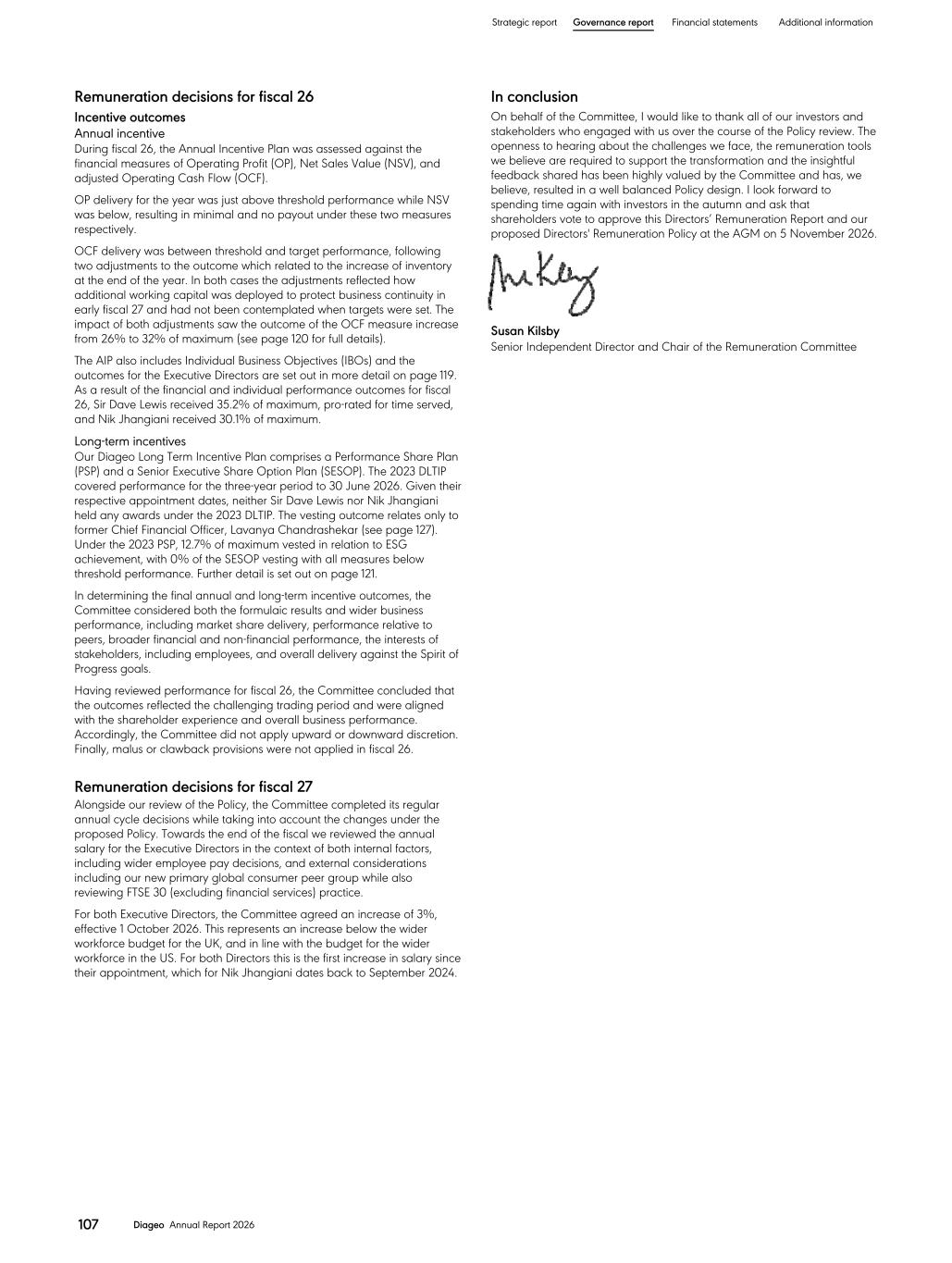
Remuneration decisions for fiscal 26 Incentive outcomes Annual incentive During fiscal 26, the Annual Incentive Plan was assessed against the financial measures of Operating Profit (OP), Net Sales Value (NSV), and adjusted Operating Cash Flow (OCF). OP delivery for the year was just above threshold performance while NSV was below, resulting in minimal and no payout under these two measures respectively. OCF delivery was between threshold and target performance, following two adjustments to the outcome which related to the increase of inventory at the end of the year. In both cases the adjustments reflected how additional working capital was deployed to protect business continuity in early fiscal 27 and had not been contemplated when targets were set. The impact of both adjustments saw the outcome of the OCF measure increase from 26% to 32% of maximum (see page 120 for full details). The AIP also includes Individual Business Objectives (IBOs) and the outcomes for the Executive Directors are set out in more detail on page 119. As a result of the financial and individual performance outcomes for fiscal 26, Sir Dave Lewis received 35.2% of maximum, pro-rated for time served, and Nik Jhangiani received 30.1% of maximum. Long-term incentives Our Diageo Long Term Incentive Plan comprises a Performance Share Plan (PSP) and a Senior Executive Share Option Plan (SESOP). The 2023 DLTIP covered performance for the three-year period to 30 June 2026. Given their respective appointment dates, neither Sir Dave Lewis nor Nik Jhangiani held any awards under the 2023 DLTIP. The vesting outcome relates only to former Chief Financial Officer, Lavanya Chandrashekar (see page 127). Under the 2023 PSP, 12.7% of maximum vested in relation to ESG achievement, with 0% of the SESOP vesting with all measures below threshold performance. Further detail is set out on page 121. In determining the final annual and long-term incentive outcomes, the Committee considered both the formulaic results and wider business performance, including market share delivery, performance relative to peers, broader financial and non-financial performance, the interests of stakeholders, including employees, and overall delivery against the Spirit of Progress goals. Having reviewed performance for fiscal 26, the Committee concluded that the outcomes reflected the challenging trading period and were aligned with the shareholder experience and overall business performance. Accordingly, the Committee did not apply upward or downward discretion. Finally, malus or clawback provisions were not applied in fiscal 26. Remuneration decisions for fiscal 27 Alongside our review of the Policy, the Committee completed its regular annual cycle decisions while taking into account the changes under the proposed Policy. Towards the end of the fiscal we reviewed the annual salary for the Executive Directors in the context of both internal factors, including wider employee pay decisions, and external considerations including our new primary global consumer peer group while also reviewing FTSE 30 (excluding financial services) practice. For both Executive Directors, the Committee agreed an increase of 3%, effective 1 October 2026. This represents an increase below the wider workforce budget for the UK, and in line with the budget for the wider workforce in the US. For both Directors this is the first increase in salary since their appointment, which for Nik Jhangiani dates back to September 2024. In conclusion On behalf of the Committee, I would like to thank all of our investors and stakeholders who engaged with us over the course of the Policy review. The openness to hearing about the challenges we face, the remuneration tools we believe are required to support the transformation and the insightful feedback shared has been highly valued by the Committee and has, we believe, resulted in a well balanced Policy design. I look forward to spending time again with investors in the autumn and ask that shareholders vote to approve this Directors’ Remuneration Report and our proposed Directors' Remuneration Policy at the AGM on 5 November 2026. Susan Kilsby Senior Independent Director and Chair of the Remuneration Committee Strategic report Governance report Financial statements Additional information 107 Diageo Annual Report 2026
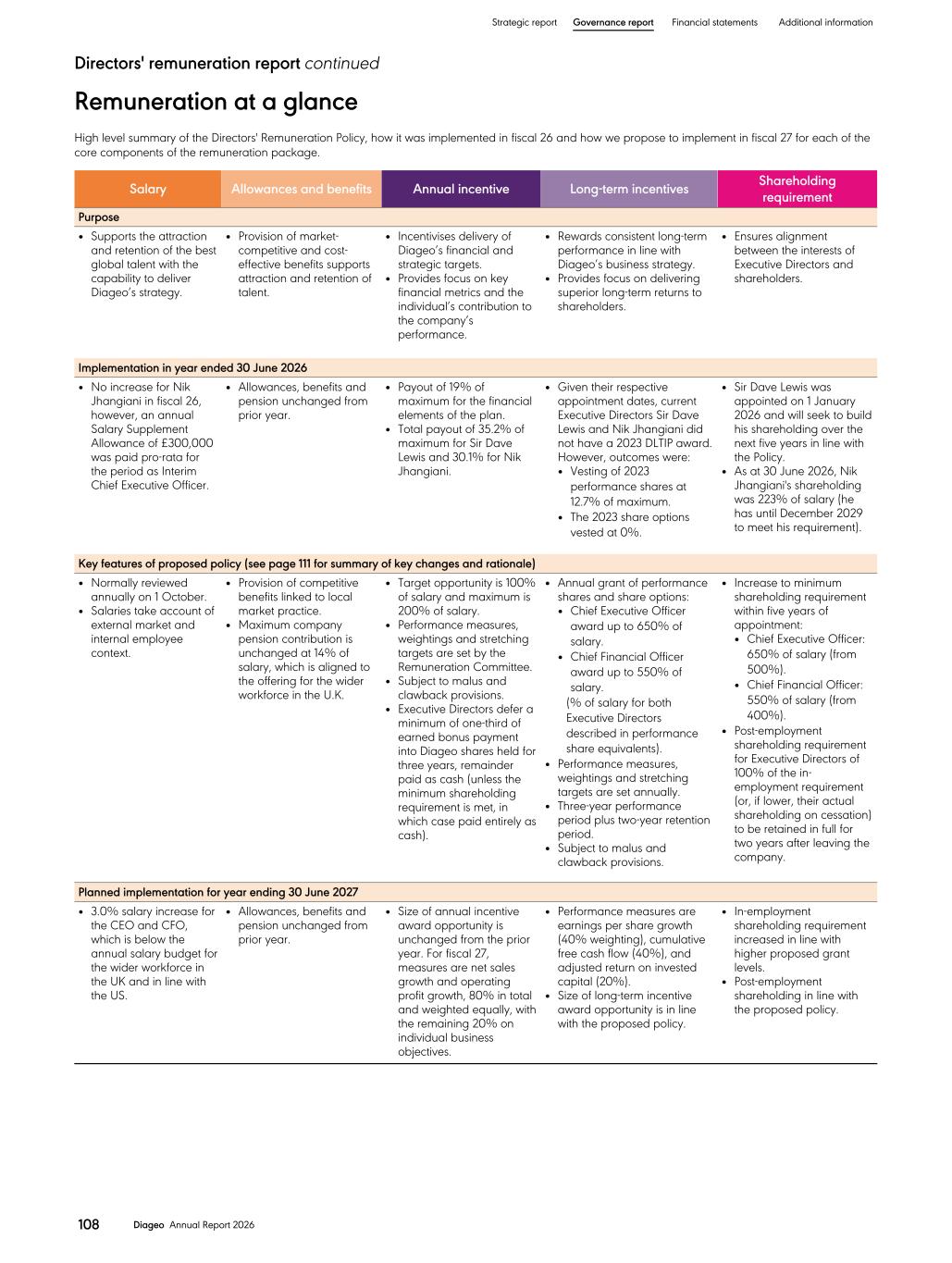
Remuneration at a glance High level summary of the Directors' Remuneration Policy, how it was implemented in fiscal 26 and how we propose to implement in fiscal 27 for each of the core components of the remuneration package. Purpose • Supports the attraction and retention of the best global talent with the capability to deliver Diageo’s strategy. • Provision of market- competitive and cost- effective benefits supports attraction and retention of talent. • Incentivises delivery of Diageo’s financial and strategic targets. • Provides focus on key financial metrics and the individual’s contribution to the company’s performance. • Rewards consistent long-term performance in line with Diageo’s business strategy. • Provides focus on delivering superior long-term returns to shareholders. • Ensures alignment between the interests of Executive Directors and shareholders. Implementation in year ended 30 June 2026 • No increase for Nik Jhangiani in fiscal 26, however, an annual Salary Supplement Allowance of £300,000 was paid pro-rata for the period as Interim Chief Executive Officer. • Allowances, benefits and pension unchanged from prior year. • Payout of 19% of maximum for the financial elements of the plan. • Total payout of 35.2% of maximum for Sir Dave Lewis and 30.1% for Nik Jhangiani. • Given their respective appointment dates, current Executive Directors Sir Dave Lewis and Nik Jhangiani did not have a 2023 DLTIP award. However, outcomes were: • Vesting of 2023 performance shares at 12.7% of maximum. • The 2023 share options vested at 0%. • Sir Dave Lewis was appointed on 1 January 2026 and will seek to build his shareholding over the next five years in line with the Policy. • As at 30 June 2026, Nik Jhangiani's shareholding was 223% of salary (he has until December 2029 to meet his requirement). Key features of proposed policy (see page 111 for summary of key changes and rationale) • Normally reviewed annually on 1 October. • Salaries take account of external market and internal employee context. • Provision of competitive benefits linked to local market practice. • Maximum company pension contribution is unchanged at 14% of salary, which is aligned to the offering for the wider workforce in the U.K. • Target opportunity is 100% of salary and maximum is 200% of salary. • Performance measures, weightings and stretching targets are set by the Remuneration Committee. • Subject to malus and clawback provisions. • Executive Directors defer a minimum of one-third of earned bonus payment into Diageo shares held for three years, remainder paid as cash (unless the minimum shareholding requirement is met, in which case paid entirely as cash). • Annual grant of performance shares and share options: • Chief Executive Officer award up to 650% of salary. • Chief Financial Officer award up to 550% of salary. (% of salary for both Executive Directors described in performance share equivalents). • Performance measures, weightings and stretching targets are set annually. • Three-year performance period plus two-year retention period. • Subject to malus and clawback provisions. • Increase to minimum shareholding requirement within five years of appointment: • Chief Executive Officer: 650% of salary (from 500%). • Chief Financial Officer: 550% of salary (from 400%). • Post-employment shareholding requirement for Executive Directors of 100% of the in- employment requirement (or, if lower, their actual shareholding on cessation) to be retained in full for two years after leaving the company. Planned implementation for year ending 30 June 2027 • 3.0% salary increase for the CEO and CFO, which is below the annual salary budget for the wider workforce in the UK and in line with the US. • Allowances, benefits and pension unchanged from prior year. • Size of annual incentive award opportunity is unchanged from the prior year. For fiscal 27, measures are net sales growth and operating profit growth, 80% in total and weighted equally, with the remaining 20% on individual business objectives. • Performance measures are earnings per share growth (40% weighting), cumulative free cash flow (40%), and adjusted return on invested capital (20%). • Size of long-term incentive award opportunity is in line with the proposed policy. • In-employment shareholding requirement increased in line with higher proposed grant levels. • Post-employment shareholding in line with the proposed policy. Salary Allowances and benefits Annual incentive Long-term incentives Shareholding requirement Strategic report Governance report Financial statements Additional information Directors' remuneration report continued 108 Diageo Annual Report 2026
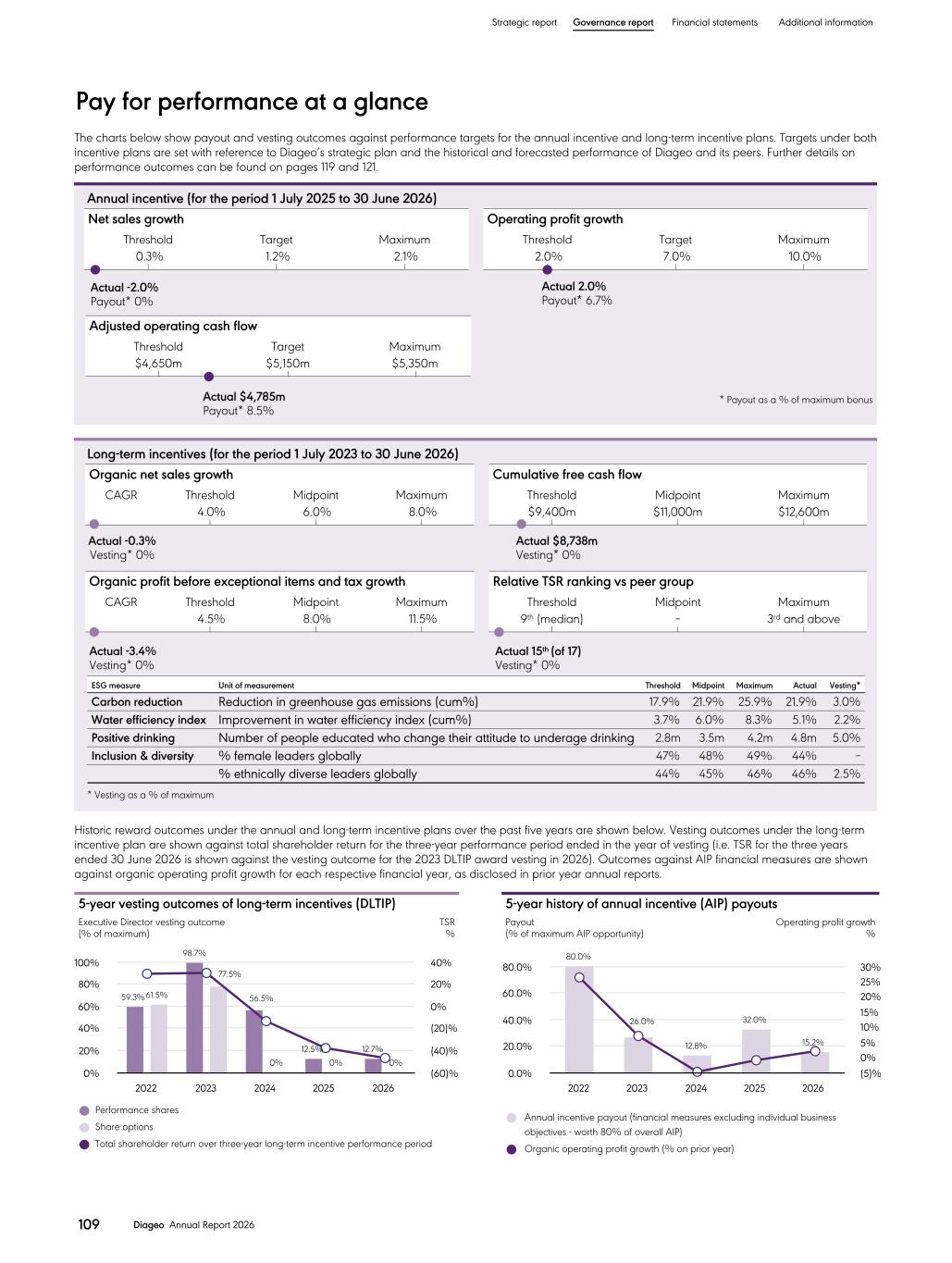
Pay for performance at a glance The charts below show payout and vesting outcomes against performance targets for the annual incentive and long-term incentive plans. Targets under both incentive plans are set with reference to Diageo’s strategic plan and the historical and forecasted performance of Diageo and its peers. Further details on performance outcomes can be found on pages 119 and 121. Annual incentive (for the period 1 July 2025 to 30 June 2026) Threshold Target Maximum Threshold Target Maximum 0.3% 1.2% 2.1% 2.0% 7.0% 10.0% Net sales growth Operating profit growth Threshold Target Maximum $4,650m $5,150m $5,350m Adjusted operating cash flow * Payout as a % of maximum bonus Long-term incentives (for the period 1 July 2023 to 30 June 2026) Organic net sales growth Cumulative free cash flow CAGR Threshold Midpoint Maximum Threshold Midpoint Maximum 4.0% 6.0% 8.0% $9,400m $11,000m $12,600m CAGR Threshold Midpoint Maximum Threshold Midpoint Maximum 4.5% 8.0% 11.5% 9th (median) – 3rd and above Organic profit before exceptional items and tax growth Relative TSR ranking vs peer group Carbon reduction Reduction in greenhouse gas emissions (cum%) 17.9% 21.9% 25.9% 21.9% 3.0% Water efficiency index Improvement in water efficiency index (cum%) 3.7% 6.0% 8.3% 5.1% 2.2% Positive drinking Number of people educated who change their attitude to underage drinking 2.8m 3.5m 4.2m 4.8m 5.0% Inclusion & diversity % female leaders globally 47% 48% 49% 44% – % ethnically diverse leaders globally 44% 45% 46% 46% 2.5% ESG measure Unit of measurement Threshold Midpoint Maximum Actual Vesting* * Vesting as a % of maximum Historic reward outcomes under the annual and long-term incentive plans over the past five years are shown below. Vesting outcomes under the long-term incentive plan are shown against total shareholder return for the three-year performance period ended in the year of vesting (i.e. TSR for the three years ended 30 June 2026 is shown against the vesting outcome for the 2023 DLTIP award vesting in 2026). Outcomes against AIP financial measures are shown against organic operating profit growth for each respective financial year, as disclosed in prior year annual reports. 5-year vesting outcomes of long-term incentives (DLTIP) Executive Director vesting outcome (% of maximum) TSR % 59.3% 98.7% 12.5% 12.7% 61.5% 0% 0% 0% 2022 2023 2024 2025 2026 0% 20% 40% 60% 80% 100% (60)% (40)% (20)% 0% 20% 40% ò Performance shares ò Share options ò Total shareholder return over three-year long-term incentive performance period 5-year history of annual incentive (AIP) payouts Payout (% of maximum AIP opportunity) Operating profit growth % 80.0% 12.8% 32.0% 15.2% 2022 2023 2024 2025 2026 0.0% 20.0% 40.0% 60.0% 80.0% (5)% 0% 5% 10% 15% 20% 25% 30% ò Annual incentive payout (financial measures excluding individual business objectives - worth 80% of overall AIP) ò Organic operating profit growth (% on prior year) Strategic report Governance report Financial statements Additional information 109 Diageo Annual Report 2026 26.0% 77.5% 56.5% Actual 2.0% Payout* 6.7% Actual -2.0% Payout* 0% Actual $4,785m Payout* 8.5% Actual -0.3% Vesting* 0% Actual $8,738m Vesting* 0% Actual -3.4% Vesting* 0% Actual 15th (of 17) Vesting* 0%
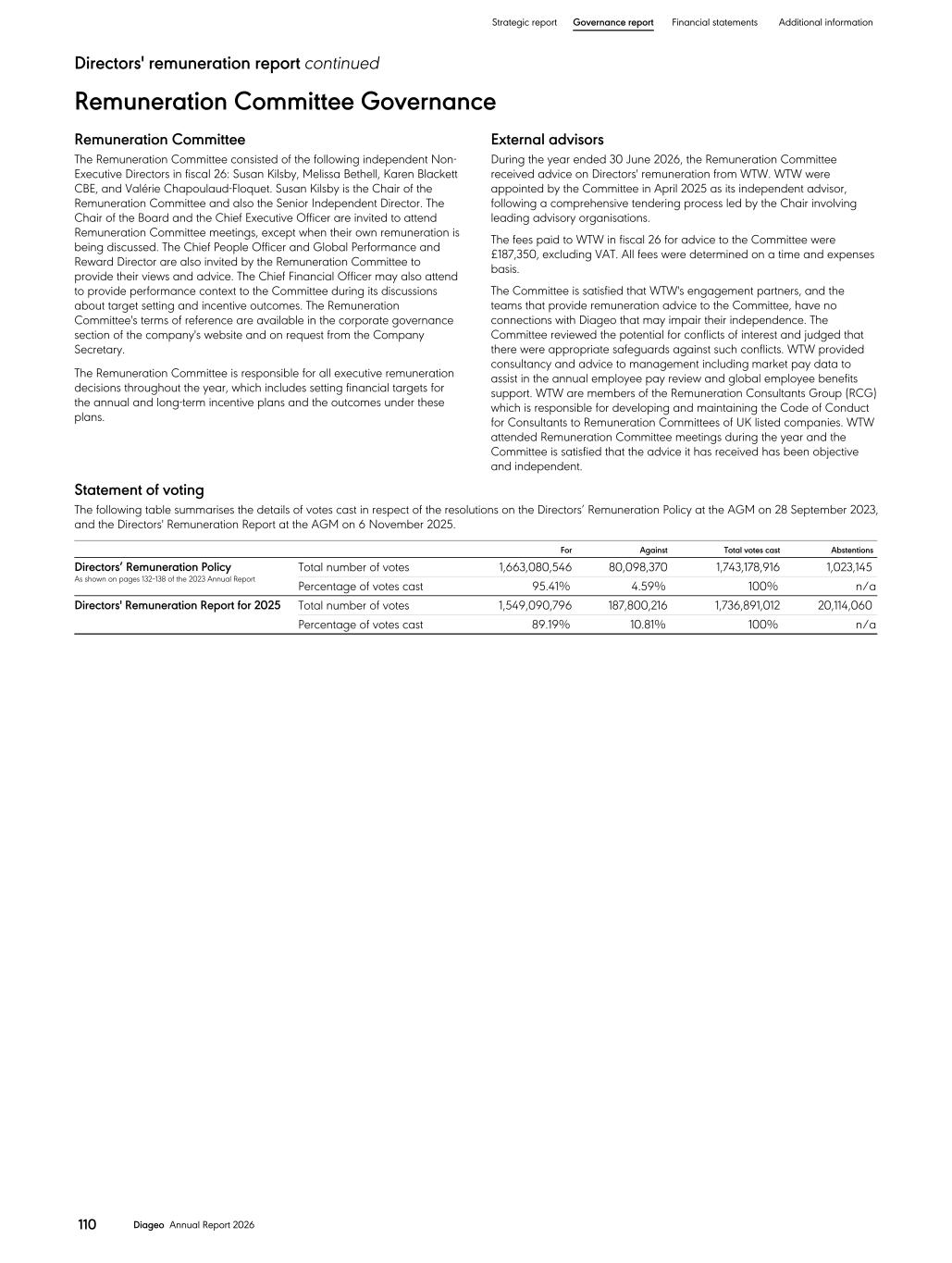
Remuneration Committee Governance Remuneration Committee The Remuneration Committee consisted of the following independent Non- Executive Directors in fiscal 26: Susan Kilsby, Melissa Bethell, Karen Blackett CBE, and Valérie Chapoulaud-Floquet. Susan Kilsby is the Chair of the Remuneration Committee and also the Senior Independent Director. The Chair of the Board and the Chief Executive Officer are invited to attend Remuneration Committee meetings, except when their own remuneration is being discussed. The Chief People Officer and Global Performance and Reward Director are also invited by the Remuneration Committee to provide their views and advice. The Chief Financial Officer may also attend to provide performance context to the Committee during its discussions about target setting and incentive outcomes. The Remuneration Committee's terms of reference are available in the corporate governance section of the company's website and on request from the Company Secretary. The Remuneration Committee is responsible for all executive remuneration decisions throughout the year, which includes setting financial targets for the annual and long-term incentive plans and the outcomes under these plans. External advisors During the year ended 30 June 2026, the Remuneration Committee received advice on Directors' remuneration from WTW. WTW were appointed by the Committee in April 2025 as its independent advisor, following a comprehensive tendering process led by the Chair involving leading advisory organisations. The fees paid to WTW in fiscal 26 for advice to the Committee were £187,350, excluding VAT. All fees were determined on a time and expenses basis. The Committee is satisfied that WTW's engagement partners, and the teams that provide remuneration advice to the Committee, have no connections with Diageo that may impair their independence. The Committee reviewed the potential for conflicts of interest and judged that there were appropriate safeguards against such conflicts. WTW provided consultancy and advice to management including market pay data to assist in the annual employee pay review and global employee benefits support. WTW are members of the Remuneration Consultants Group (RCG) which is responsible for developing and maintaining the Code of Conduct for Consultants to Remuneration Committees of UK listed companies. WTW attended Remuneration Committee meetings during the year and the Committee is satisfied that the advice it has received has been objective and independent. Statement of voting The following table summarises the details of votes cast in respect of the resolutions on the Directors’ Remuneration Policy at the AGM on 28 September 2023, and the Directors' Remuneration Report at the AGM on 6 November 2025. Directors’ Remuneration Policy As shown on pages 132–138 of the 2023 Annual Report Total number of votes 1,663,080,546 80,098,370 1,743,178,916 1,023,145 Percentage of votes cast 95.41% 4.59% 100% n/a Directors' Remuneration Report for 2025 Total number of votes 1,549,090,796 187,800,216 1,736,891,012 20,114,060 Percentage of votes cast 89.19% 10.81% 100% n/a For Against Total votes cast Abstentions Strategic report Governance report Financial statements Additional information Directors' remuneration report continued 110 Diageo Annual Report 2026
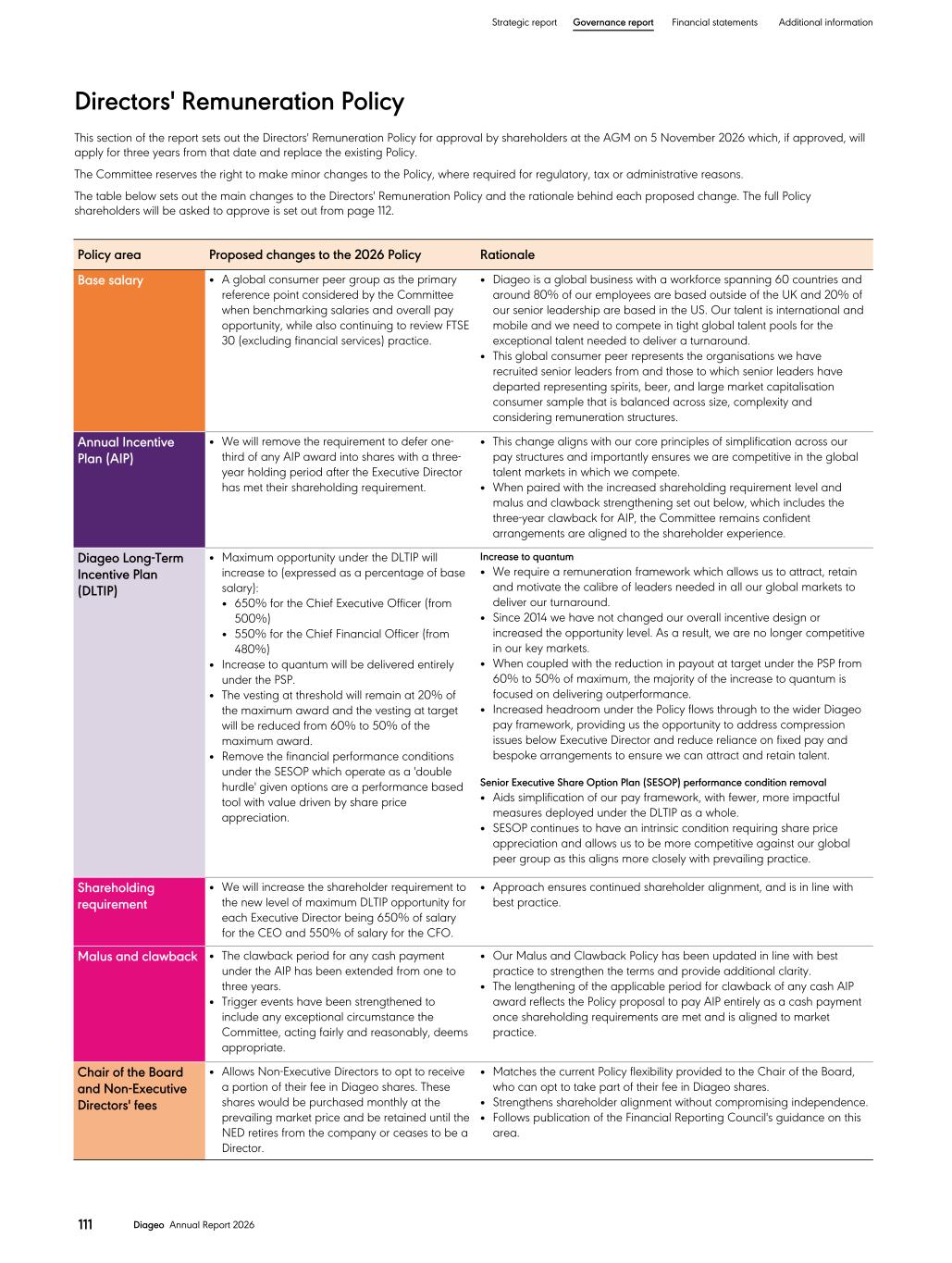
Directors' Remuneration Policy This section of the report sets out the Directors' Remuneration Policy for approval by shareholders at the AGM on 5 November 2026 which, if approved, will apply for three years from that date and replace the existing Policy. The Committee reserves the right to make minor changes to the Policy, where required for regulatory, tax or administrative reasons. The table below sets out the main changes to the Directors' Remuneration Policy and the rationale behind each proposed change. The full Policy shareholders will be asked to approve is set out from page 112. Strategic report Governance report Financial statements Additional information 111 Diageo Annual Report 2026 Policy area Proposed changes to the 2026 Policy Rationale Base salary • A global consumer peer group as the primary reference point considered by the Committee when benchmarking salaries and overall pay opportunity, while also continuing to review FTSE 30 (excluding financial services) practice. • Diageo is a global business with a workforce spanning 60 countries and around 80% of our employees are based outside of the UK and 20% of our senior leadership are based in the US. Our talent is international and mobile and we need to compete in tight global talent pools for the exceptional talent needed to deliver a turnaround. • This global consumer peer represents the organisations we have recruited senior leaders from and those to which senior leaders have departed representing spirits, beer, and large market capitalisation consumer sample that is balanced across size, complexity and considering remuneration structures. Annual Incentive Plan (AIP) • We will remove the requirement to defer one- third of any AIP award into shares with a three- year holding period after the Executive Director has met their shareholding requirement. • This change aligns with our core principles of simplification across our pay structures and importantly ensures we are competitive in the global talent markets in which we compete. • When paired with the increased shareholding requirement level and malus and clawback strengthening set out below, which includes the three-year clawback for AIP, the Committee remains confident arrangements are aligned to the shareholder experience. Diageo Long-Term Incentive Plan (DLTIP) • Maximum opportunity under the DLTIP will increase to (expressed as a percentage of base salary): • 650% for the Chief Executive Officer (from 500%) • 550% for the Chief Financial Officer (from 480%) • Increase to quantum will be delivered entirely under the PSP. • The vesting at threshold will remain at 20% of the maximum award and the vesting at target will be reduced from 60% to 50% of the maximum award. • Remove the financial performance conditions under the SESOP which operate as a 'double hurdle' given options are a performance based tool with value driven by share price appreciation. Increase to quantum • We require a remuneration framework which allows us to attract, retain and motivate the calibre of leaders needed in all our global markets to deliver our turnaround. • Since 2014 we have not changed our overall incentive design or increased the opportunity level. As a result, we are no longer competitive in our key markets. • When coupled with the reduction in payout at target under the PSP from 60% to 50% of maximum, the majority of the increase to quantum is focused on delivering outperformance. • Increased headroom under the Policy flows through to the wider Diageo pay framework, providing us the opportunity to address compression issues below Executive Director and reduce reliance on fixed pay and bespoke arrangements to ensure we can attract and retain talent. Senior Executive Share Option Plan (SESOP) performance condition removal • Aids simplification of our pay framework, with fewer, more impactful measures deployed under the DLTIP as a whole. • SESOP continues to have an intrinsic condition requiring share price appreciation and allows us to be more competitive against our global peer group as this aligns more closely with prevailing practice. Shareholding requirement • We will increase the shareholder requirement to the new level of maximum DLTIP opportunity for each Executive Director being 650% of salary for the CEO and 550% of salary for the CFO. • Approach ensures continued shareholder alignment, and is in line with best practice. Malus and clawback • The clawback period for any cash payment under the AIP has been extended from one to three years. • Trigger events have been strengthened to include any exceptional circumstance the Committee, acting fairly and reasonably, deems appropriate. • Our Malus and Clawback Policy has been updated in line with best practice to strengthen the terms and provide additional clarity. • The lengthening of the applicable period for clawback of any cash AIP award reflects the Policy proposal to pay AIP entirely as a cash payment once shareholding requirements are met and is aligned to market practice. Chair of the Board and Non-Executive Directors' fees • Allows Non-Executive Directors to opt to receive a portion of their fee in Diageo shares. These shares would be purchased monthly at the prevailing market price and be retained until the NED retires from the company or ceases to be a Director. • Matches the current Policy flexibility provided to the Chair of the Board, who can opt to take part of their fee in Diageo shares. • Strengthens shareholder alignment without compromising independence. • Follows publication of the Financial Reporting Council's guidance on this area.
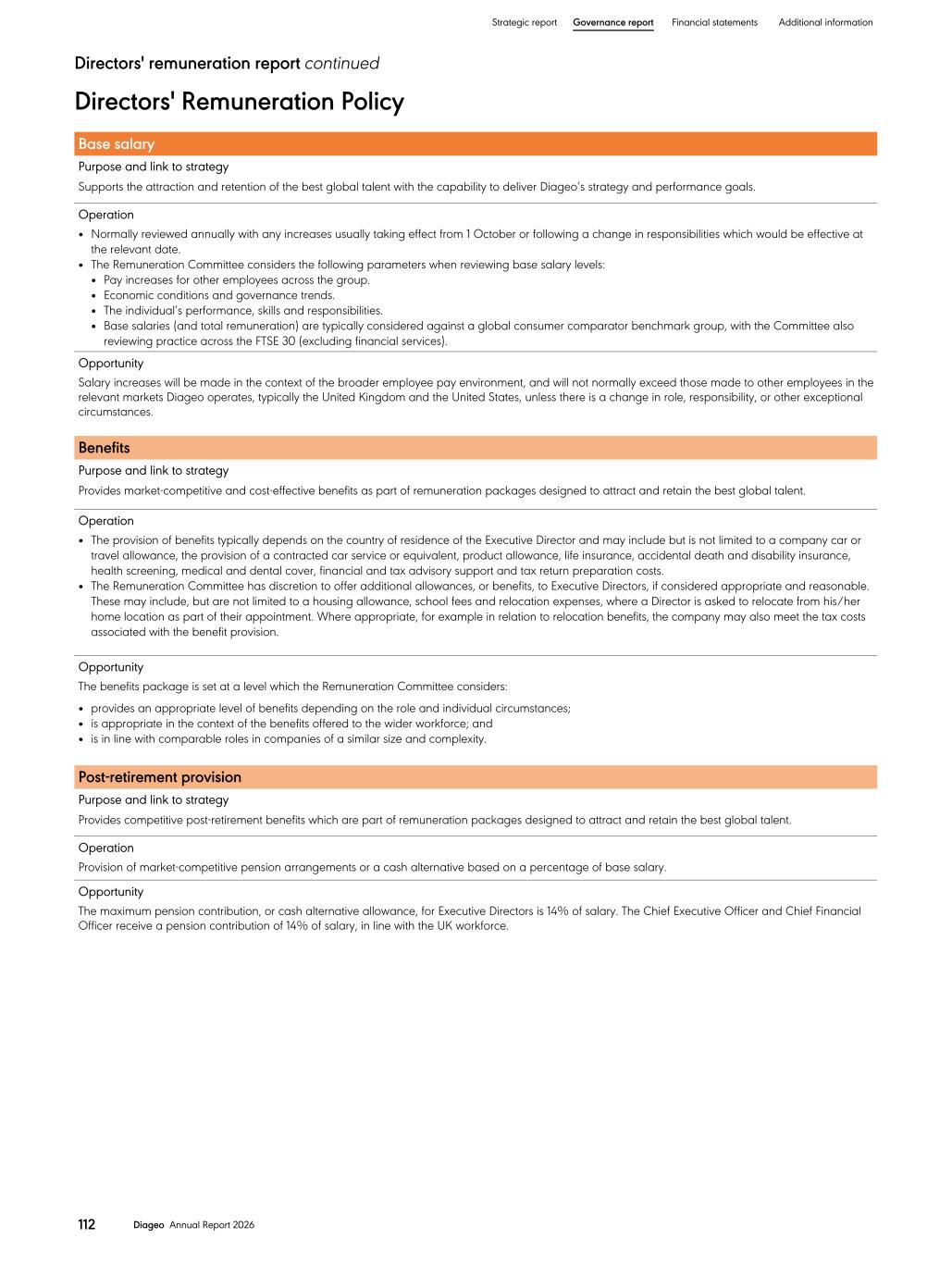
Directors' Remuneration Policy Purpose and link to strategy Supports the attraction and retention of the best global talent with the capability to deliver Diageo’s strategy and performance goals. Operation • Normally reviewed annually with any increases usually taking effect from 1 October or following a change in responsibilities which would be effective at the relevant date. • The Remuneration Committee considers the following parameters when reviewing base salary levels: • Pay increases for other employees across the group. • Economic conditions and governance trends. • The individual’s performance, skills and responsibilities. • Base salaries (and total remuneration) are typically considered against a global consumer comparator benchmark group, with the Committee also reviewing practice across the FTSE 30 (excluding financial services). Opportunity Salary increases will be made in the context of the broader employee pay environment, and will not normally exceed those made to other employees in the relevant markets Diageo operates, typically the United Kingdom and the United States, unless there is a change in role, responsibility, or other exceptional circumstances. Base salary Purpose and link to strategy Provides market-competitive and cost-effective benefits as part of remuneration packages designed to attract and retain the best global talent. Operation • The provision of benefits typically depends on the country of residence of the Executive Director and may include but is not limited to a company car or travel allowance, the provision of a contracted car service or equivalent, product allowance, life insurance, accidental death and disability insurance, health screening, medical and dental cover, financial and tax advisory support and tax return preparation costs. • The Remuneration Committee has discretion to offer additional allowances, or benefits, to Executive Directors, if considered appropriate and reasonable. These may include, but are not limited to a housing allowance, school fees and relocation expenses, where a Director is asked to relocate from his/her home location as part of their appointment. Where appropriate, for example in relation to relocation benefits, the company may also meet the tax costs associated with the benefit provision. Opportunity The benefits package is set at a level which the Remuneration Committee considers: • provides an appropriate level of benefits depending on the role and individual circumstances; • is appropriate in the context of the benefits offered to the wider workforce; and • is in line with comparable roles in companies of a similar size and complexity. Benefits Purpose and link to strategy Provides competitive post-retirement benefits which are part of remuneration packages designed to attract and retain the best global talent. Operation Provision of market-competitive pension arrangements or a cash alternative based on a percentage of base salary. Opportunity The maximum pension contribution, or cash alternative allowance, for Executive Directors is 14% of salary. The Chief Executive Officer and Chief Financial Officer receive a pension contribution of 14% of salary, in line with the UK workforce. Post-retirement provision Strategic report Governance report Financial statements Additional information Directors' remuneration report continued 112 Diageo Annual Report 2026
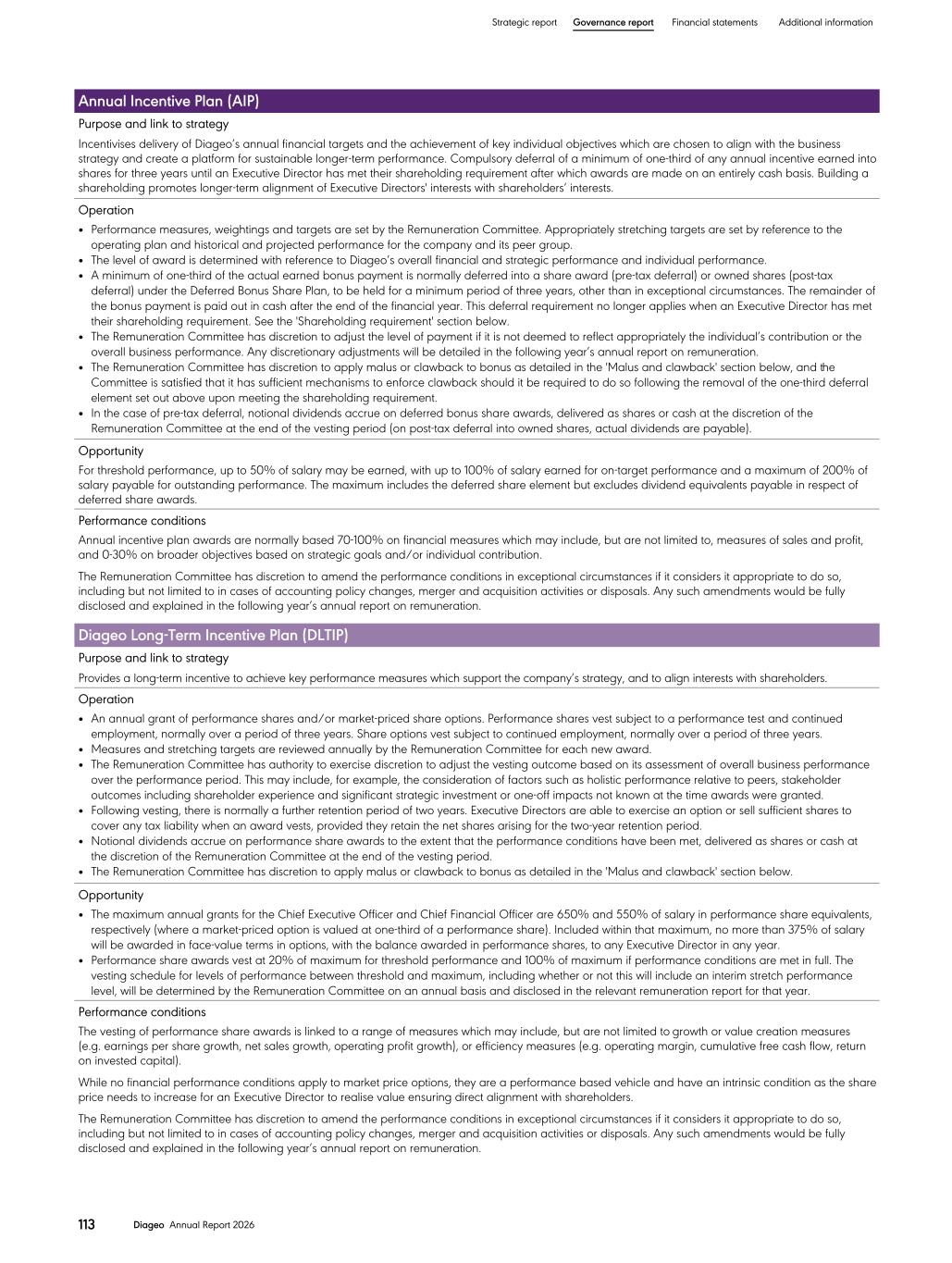
Purpose and link to strategy Incentivises delivery of Diageo’s annual financial targets and the achievement of key individual objectives which are chosen to align with the business strategy and create a platform for sustainable longer-term performance. Compulsory deferral of a minimum of one-third of any annual incentive earned into shares for three years until an Executive Director has met their shareholding requirement after which awards are made on an entirely cash basis. Building a shareholding promotes longer-term alignment of Executive Directors' interests with shareholders’ interests. Operation • Performance measures, weightings and targets are set by the Remuneration Committee. Appropriately stretching targets are set by reference to the operating plan and historical and projected performance for the company and its peer group. • The level of award is determined with reference to Diageo’s overall financial and strategic performance and individual performance. • A minimum of one-third of the actual earned bonus payment is normally deferred into a share award (pre-tax deferral) or owned shares (post-tax deferral) under the Deferred Bonus Share Plan, to be held for a minimum period of three years, other than in exceptional circumstances. The remainder of the bonus payment is paid out in cash after the end of the financial year. This deferral requirement no longer applies when an Executive Director has met their shareholding requirement. See the 'Shareholding requirement' section below. • The Remuneration Committee has discretion to adjust the level of payment if it is not deemed to reflect appropriately the individual’s contribution or the overall business performance. Any discretionary adjustments will be detailed in the following year’s annual report on remuneration. • The Remuneration Committee has discretion to apply malus or clawback to bonus as detailed in the 'Malus and clawback' section below, and the Committee is satisfied that it has sufficient mechanisms to enforce clawback should it be required to do so following the removal of the one-third deferral element set out above upon meeting the shareholding requirement. • In the case of pre-tax deferral, notional dividends accrue on deferred bonus share awards, delivered as shares or cash at the discretion of the Remuneration Committee at the end of the vesting period (on post-tax deferral into owned shares, actual dividends are payable). Opportunity For threshold performance, up to 50% of salary may be earned, with up to 100% of salary earned for on-target performance and a maximum of 200% of salary payable for outstanding performance. The maximum includes the deferred share element but excludes dividend equivalents payable in respect of deferred share awards. Performance conditions Annual incentive plan awards are normally based 70-100% on financial measures which may include, but are not limited to, measures of sales and profit, and 0-30% on broader objectives based on strategic goals and/or individual contribution. The Remuneration Committee has discretion to amend the performance conditions in exceptional circumstances if it considers it appropriate to do so, including but not limited to in cases of accounting policy changes, merger and acquisition activities or disposals. Any such amendments would be fully disclosed and explained in the following year’s annual report on remuneration. Annual Incentive Plan (AIP) Purpose and link to strategy Provides a long-term incentive to achieve key performance measures which support the company’s strategy, and to align interests with shareholders. Operation • An annual grant of performance shares and/or market-priced share options. Performance shares vest subject to a performance test and continued employment, normally over a period of three years. Share options vest subject to continued employment, normally over a period of three years. • Measures and stretching targets are reviewed annually by the Remuneration Committee for each new award. • The Remuneration Committee has authority to exercise discretion to adjust the vesting outcome based on its assessment of overall business performance over the performance period. This may include, for example, the consideration of factors such as holistic performance relative to peers, stakeholder outcomes including shareholder experience and significant strategic investment or one-off impacts not known at the time awards were granted. • Following vesting, there is normally a further retention period of two years. Executive Directors are able to exercise an option or sell sufficient shares to cover any tax liability when an award vests, provided they retain the net shares arising for the two-year retention period. • Notional dividends accrue on performance share awards to the extent that the performance conditions have been met, delivered as shares or cash at the discretion of the Remuneration Committee at the end of the vesting period. • The Remuneration Committee has discretion to apply malus or clawback to bonus as detailed in the 'Malus and clawback' section below. Opportunity • The maximum annual grants for the Chief Executive Officer and Chief Financial Officer are 650% and 550% of salary in performance share equivalents, respectively (where a market-priced option is valued at one-third of a performance share). Included within that maximum, no more than 375% of salary will be awarded in face-value terms in options, with the balance awarded in performance shares, to any Executive Director in any year. • Performance share awards vest at 20% of maximum for threshold performance and 100% of maximum if performance conditions are met in full. The vesting schedule for levels of performance between threshold and maximum, including whether or not this will include an interim stretch performance level, will be determined by the Remuneration Committee on an annual basis and disclosed in the relevant remuneration report for that year. Performance conditions The vesting of performance share awards is linked to a range of measures which may include, but are not limited to growth or value creation measures (e.g. earnings per share growth, net sales growth, operating profit growth), or efficiency measures (e.g. operating margin, cumulative free cash flow, return on invested capital). While no financial performance conditions apply to market price options, they are a performance based vehicle and have an intrinsic condition as the share price needs to increase for an Executive Director to realise value ensuring direct alignment with shareholders. The Remuneration Committee has discretion to amend the performance conditions in exceptional circumstances if it considers it appropriate to do so, including but not limited to in cases of accounting policy changes, merger and acquisition activities or disposals. Any such amendments would be fully disclosed and explained in the following year’s annual report on remuneration. Diageo Long-Term Incentive Plan (DLTIP) Strategic report Governance report Financial statements Additional information 113 Diageo Annual Report 2026
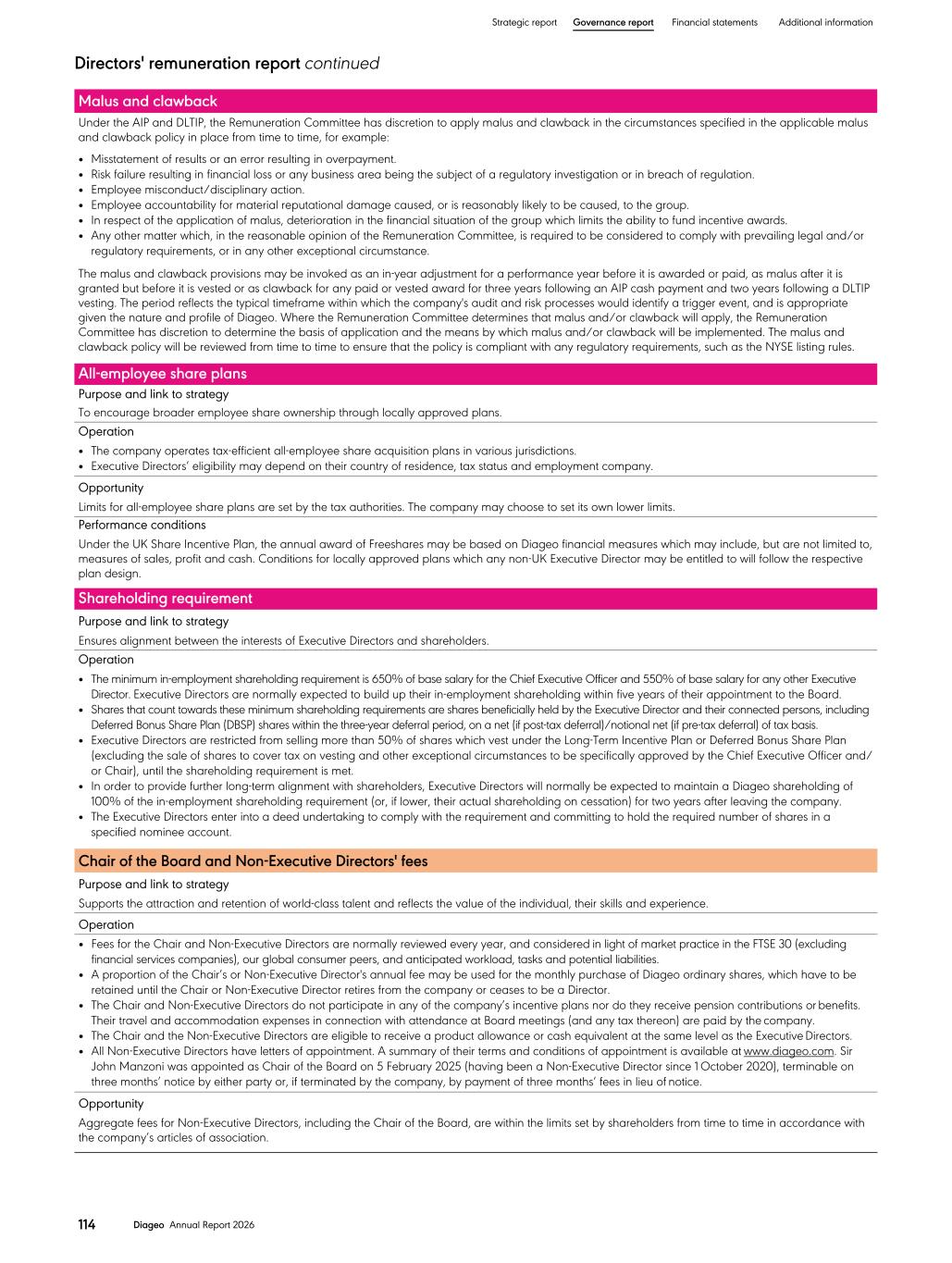
Malus and clawback Under the AIP and DLTIP, the Remuneration Committee has discretion to apply malus and clawback in the circumstances specified in the applicable malus and clawback policy in place from time to time, for example: • Misstatement of results or an error resulting in overpayment. • Risk failure resulting in financial loss or any business area being the subject of a regulatory investigation or in breach of regulation. • Employee misconduct/disciplinary action. • Employee accountability for material reputational damage caused, or is reasonably likely to be caused, to the group. • In respect of the application of malus, deterioration in the financial situation of the group which limits the ability to fund incentive awards. • Any other matter which, in the reasonable opinion of the Remuneration Committee, is required to be considered to comply with prevailing legal and/or regulatory requirements, or in any other exceptional circumstance. The malus and clawback provisions may be invoked as an in-year adjustment for a performance year before it is awarded or paid, as malus after it is granted but before it is vested or as clawback for any paid or vested award for three years following an AIP cash payment and two years following a DLTIP vesting. The period reflects the typical timeframe within which the company's audit and risk processes would identify a trigger event, and is appropriate given the nature and profile of Diageo. Where the Remuneration Committee determines that malus and/or clawback will apply, the Remuneration Committee has discretion to determine the basis of application and the means by which malus and/or clawback will be implemented. The malus and clawback policy will be reviewed from time to time to ensure that the policy is compliant with any regulatory requirements, such as the NYSE listing rules. Purpose and link to strategy To encourage broader employee share ownership through locally approved plans. Operation • The company operates tax-efficient all-employee share acquisition plans in various jurisdictions. • Executive Directors’ eligibility may depend on their country of residence, tax status and employment company. Opportunity Limits for all-employee share plans are set by the tax authorities. The company may choose to set its own lower limits. Performance conditions Under the UK Share Incentive Plan, the annual award of Freeshares may be based on Diageo financial measures which may include, but are not limited to, measures of sales, profit and cash. Conditions for locally approved plans which any non-UK Executive Director may be entitled to will follow the respective plan design. All-employee share plans Purpose and link to strategy Ensures alignment between the interests of Executive Directors and shareholders. Operation • The minimum in-employment shareholding requirement is 650% of base salary for the Chief Executive Officer and 550% of base salary for any other Executive Director. Executive Directors are normally expected to build up their in-employment shareholding within five years of their appointment to the Board. • Shares that count towards these minimum shareholding requirements are shares beneficially held by the Executive Director and their connected persons, including Deferred Bonus Share Plan (DBSP) shares within the three-year deferral period, on a net (if post-tax deferral)/notional net (if pre-tax deferral) of tax basis. • Executive Directors are restricted from selling more than 50% of shares which vest under the Long-Term Incentive Plan or Deferred Bonus Share Plan (excluding the sale of shares to cover tax on vesting and other exceptional circumstances to be specifically approved by the Chief Executive Officer and/ or Chair), until the shareholding requirement is met. • In order to provide further long-term alignment with shareholders, Executive Directors will normally be expected to maintain a Diageo shareholding of 100% of the in-employment shareholding requirement (or, if lower, their actual shareholding on cessation) for two years after leaving the company. • The Executive Directors enter into a deed undertaking to comply with the requirement and committing to hold the required number of shares in a specified nominee account. Shareholding requirement Purpose and link to strategy Supports the attraction and retention of world-class talent and reflects the value of the individual, their skills and experience. Operation • Fees for the Chair and Non-Executive Directors are normally reviewed every year, and considered in light of market practice in the FTSE 30 (excluding financial services companies), our global consumer peers, and anticipated workload, tasks and potential liabilities. • A proportion of the Chair’s or Non-Executive Director's annual fee may be used for the monthly purchase of Diageo ordinary shares, which have to be retained until the Chair or Non-Executive Director retires from the company or ceases to be a Director. • The Chair and Non-Executive Directors do not participate in any of the company’s incentive plans nor do they receive pension contributions or benefits. Their travel and accommodation expenses in connection with attendance at Board meetings (and any tax thereon) are paid by the company. • The Chair and the Non-Executive Directors are eligible to receive a product allowance or cash equivalent at the same level as the Executive Directors. • All Non-Executive Directors have letters of appointment. A summary of their terms and conditions of appointment is available at www.diageo.com. Sir John Manzoni was appointed as Chair of the Board on 5 February 2025 (having been a Non-Executive Director since 1 October 2020), terminable on three months’ notice by either party or, if terminated by the company, by payment of three months’ fees in lieu of notice. Opportunity Aggregate fees for Non-Executive Directors, including the Chair of the Board, are within the limits set by shareholders from time to time in accordance with the company’s articles of association. Chair of the Board and Non-Executive Directors' fees Strategic report Governance report Financial statements Additional information Directors' remuneration report continued 114 Diageo Annual Report 2026
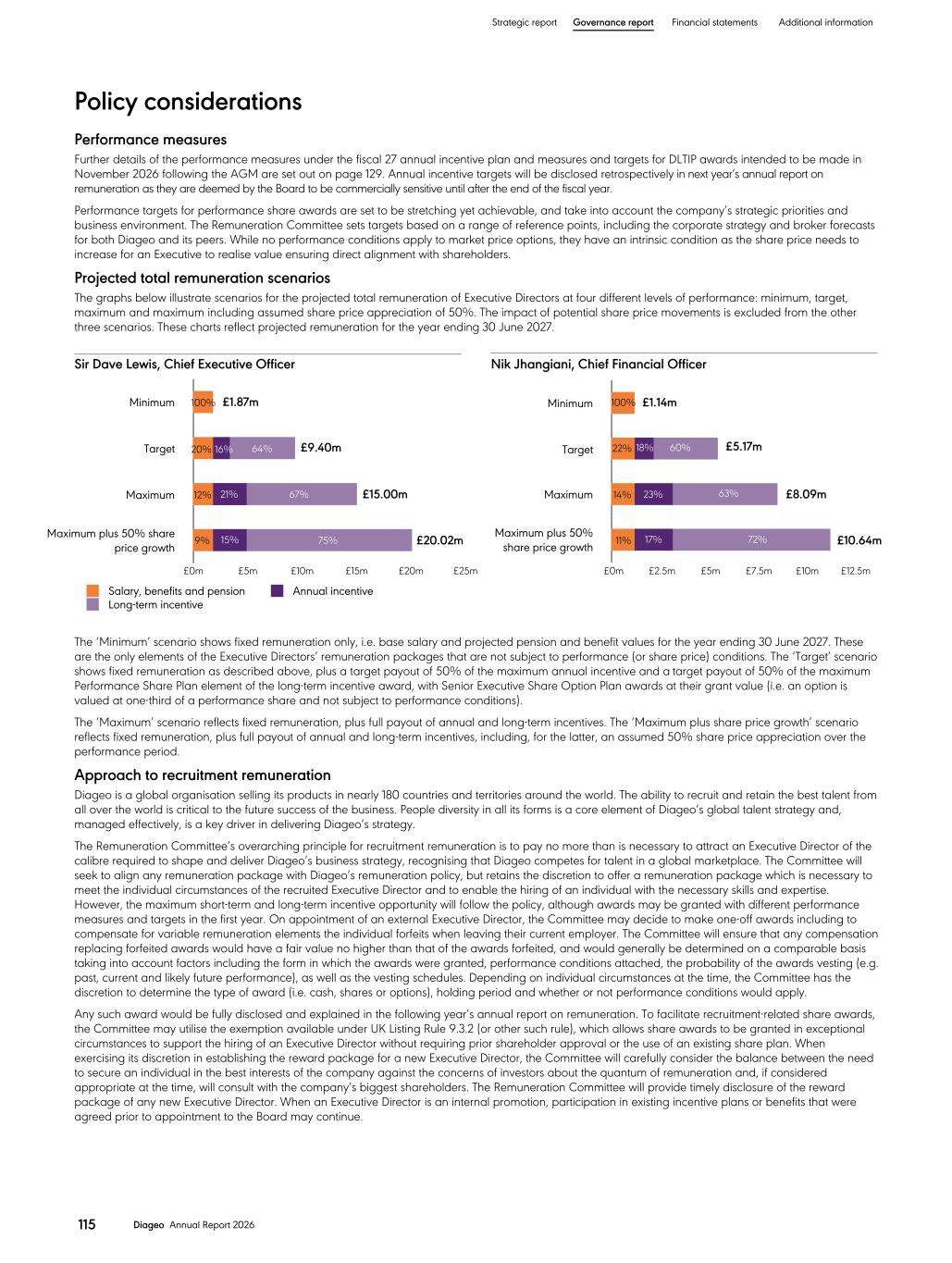
Policy considerations Performance measures Further details of the performance measures under the fiscal 27 annual incentive plan and measures and targets for DLTIP awards intended to be made in November 2026 following the AGM are set out on page 129. Annual incentive targets will be disclosed retrospectively in next year’s annual report on remuneration as they are deemed by the Board to be commercially sensitive until after the end of the fiscal year. Performance targets for performance share awards are set to be stretching yet achievable, and take into account the company’s strategic priorities and business environment. The Remuneration Committee sets targets based on a range of reference points, including the corporate strategy and broker forecasts for both Diageo and its peers. While no performance conditions apply to market price options, they have an intrinsic condition as the share price needs to increase for an Executive to realise value ensuring direct alignment with shareholders. Projected total remuneration scenarios The graphs below illustrate scenarios for the projected total remuneration of Executive Directors at four different levels of performance: minimum, target, maximum and maximum including assumed share price appreciation of 50%. The impact of potential share price movements is excluded from the other three scenarios. These charts reflect projected remuneration for the year ending 30 June 2027. Sir Dave Lewis, Chief Executive Officer Nik Jhangiani, Chief Financial Officer The ‘Minimum’ scenario shows fixed remuneration only, i.e. base salary and projected pension and benefit values for the year ending 30 June 2027. These are the only elements of the Executive Directors’ remuneration packages that are not subject to performance (or share price) conditions. The ‘Target’ scenario shows fixed remuneration as described above, plus a target payout of 50% of the maximum annual incentive and a target payout of 50% of the maximum Performance Share Plan element of the long-term incentive award, with Senior Executive Share Option Plan awards at their grant value (i.e. an option is valued at one-third of a performance share and not subject to performance conditions). The ‘Maximum’ scenario reflects fixed remuneration, plus full payout of annual and long-term incentives. The ‘Maximum plus share price growth’ scenario reflects fixed remuneration, plus full payout of annual and long-term incentives, including, for the latter, an assumed 50% share price appreciation over the performance period. Approach to recruitment remuneration Diageo is a global organisation selling its products in nearly 180 countries and territories around the world. The ability to recruit and retain the best talent from all over the world is critical to the future success of the business. People diversity in all its forms is a core element of Diageo’s global talent strategy and, managed effectively, is a key driver in delivering Diageo’s strategy. The Remuneration Committee’s overarching principle for recruitment remuneration is to pay no more than is necessary to attract an Executive Director of the calibre required to shape and deliver Diageo’s business strategy, recognising that Diageo competes for talent in a global marketplace. The Committee will seek to align any remuneration package with Diageo’s remuneration policy, but retains the discretion to offer a remuneration package which is necessary to meet the individual circumstances of the recruited Executive Director and to enable the hiring of an individual with the necessary skills and expertise. However, the maximum short-term and long-term incentive opportunity will follow the policy, although awards may be granted with different performance measures and targets in the first year. On appointment of an external Executive Director, the Committee may decide to make one-off awards including to compensate for variable remuneration elements the individual forfeits when leaving their current employer. The Committee will ensure that any compensation replacing forfeited awards would have a fair value no higher than that of the awards forfeited, and would generally be determined on a comparable basis taking into account factors including the form in which the awards were granted, performance conditions attached, the probability of the awards vesting (e.g. past, current and likely future performance), as well as the vesting schedules. Depending on individual circumstances at the time, the Committee has the discretion to determine the type of award (i.e. cash, shares or options), holding period and whether or not performance conditions would apply. Any such award would be fully disclosed and explained in the following year’s annual report on remuneration. To facilitate recruitment-related share awards, the Committee may utilise the exemption available under UK Listing Rule 9.3.2 (or other such rule), which allows share awards to be granted in exceptional circumstances to support the hiring of an Executive Director without requiring prior shareholder approval or the use of an existing share plan. When exercising its discretion in establishing the reward package for a new Executive Director, the Committee will carefully consider the balance between the need to secure an individual in the best interests of the company against the concerns of investors about the quantum of remuneration and, if considered appropriate at the time, will consult with the company’s biggest shareholders. The Remuneration Committee will provide timely disclosure of the reward package of any new Executive Director. When an Executive Director is an internal promotion, participation in existing incentive plans or benefits that were agreed prior to appointment to the Board may continue. Strategic report Governance report Financial statements Additional information 115 Diageo Annual Report 2026 Salary, benefits and pension Annual incentive Long-term incentive Minimum Target Maximum Maximum plus 50% share price growth Minimum Target Maximum Maximum plus 50% share price growth 100% 20% 16% 64% 12% 21% 67% 9% 15% 75% £1.87m £9.40m £15.00m £20.02m 100% £1.14m £5.17m22% 18% 60% 14% 23% 63% 11% 17% 72% £8.09m £10.64m £5m £10m £15m £20m £25m£0m £2.5m £5m £7.5m £10m £12.5m£0m
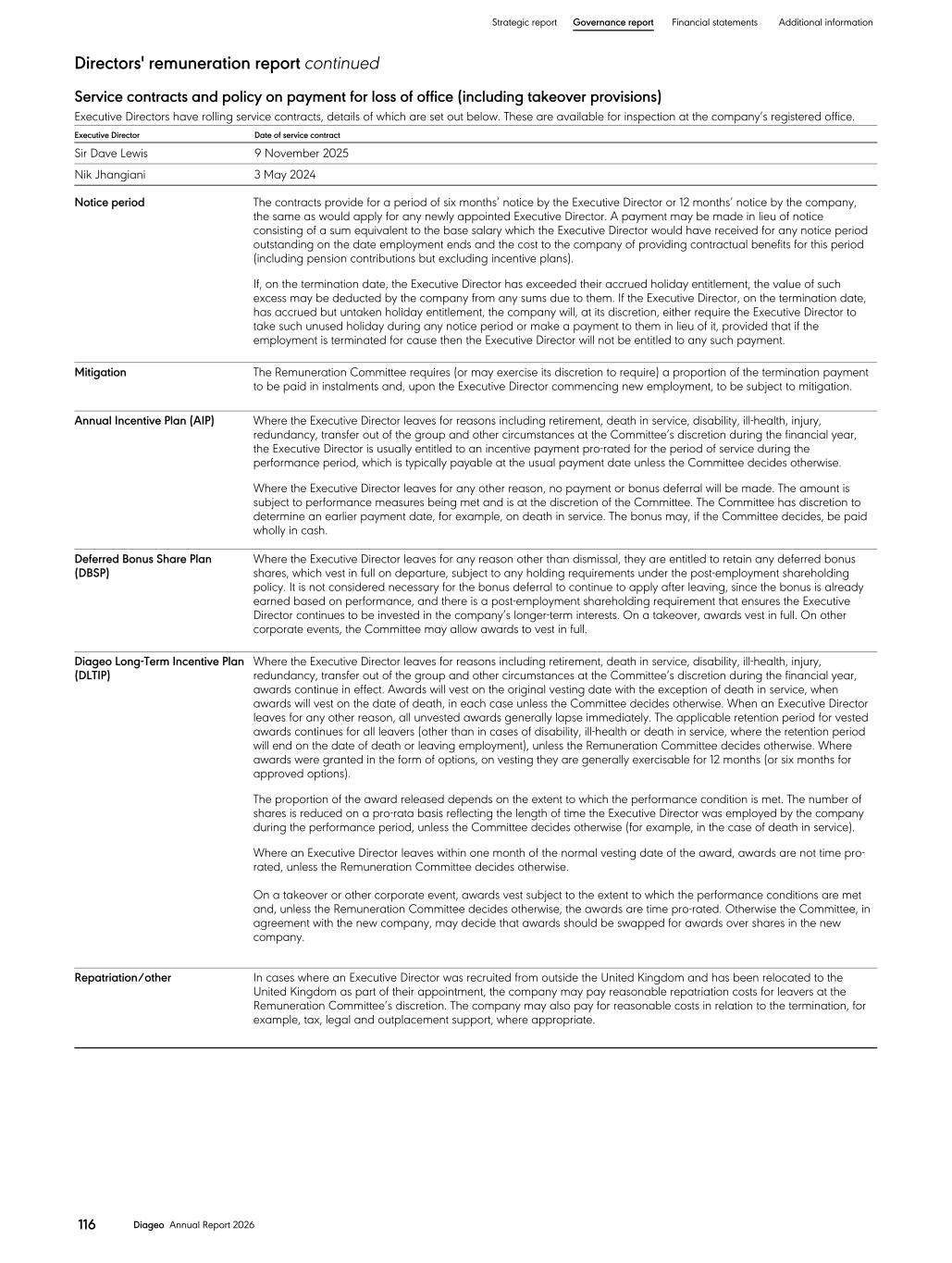
Service contracts and policy on payment for loss of office (including takeover provisions) Executive Directors have rolling service contracts, details of which are set out below. These are available for inspection at the company’s registered office. Sir Dave Lewis 9 November 2025 Nik Jhangiani 3 May 2024 Executive Director Date of service contract Notice period The contracts provide for a period of six months’ notice by the Executive Director or 12 months’ notice by the company, the same as would apply for any newly appointed Executive Director. A payment may be made in lieu of notice consisting of a sum equivalent to the base salary which the Executive Director would have received for any notice period outstanding on the date employment ends and the cost to the company of providing contractual benefits for this period (including pension contributions but excluding incentive plans). If, on the termination date, the Executive Director has exceeded their accrued holiday entitlement, the value of such excess may be deducted by the company from any sums due to them. If the Executive Director, on the termination date, has accrued but untaken holiday entitlement, the company will, at its discretion, either require the Executive Director to take such unused holiday during any notice period or make a payment to them in lieu of it, provided that if the employment is terminated for cause then the Executive Director will not be entitled to any such payment. Mitigation The Remuneration Committee requires (or may exercise its discretion to require) a proportion of the termination payment to be paid in instalments and, upon the Executive Director commencing new employment, to be subject to mitigation. Annual Incentive Plan (AIP) Where the Executive Director leaves for reasons including retirement, death in service, disability, ill-health, injury, redundancy, transfer out of the group and other circumstances at the Committee’s discretion during the financial year, the Executive Director is usually entitled to an incentive payment pro-rated for the period of service during the performance period, which is typically payable at the usual payment date unless the Committee decides otherwise. Where the Executive Director leaves for any other reason, no payment or bonus deferral will be made. The amount is subject to performance measures being met and is at the discretion of the Committee. The Committee has discretion to determine an earlier payment date, for example, on death in service. The bonus may, if the Committee decides, be paid wholly in cash. Deferred Bonus Share Plan (DBSP) Where the Executive Director leaves for any reason other than dismissal, they are entitled to retain any deferred bonus shares, which vest in full on departure, subject to any holding requirements under the post-employment shareholding policy. It is not considered necessary for the bonus deferral to continue to apply after leaving, since the bonus is already earned based on performance, and there is a post-employment shareholding requirement that ensures the Executive Director continues to be invested in the company’s longer-term interests. On a takeover, awards vest in full. On other corporate events, the Committee may allow awards to vest in full. Diageo Long-Term Incentive Plan (DLTIP) Where the Executive Director leaves for reasons including retirement, death in service, disability, ill-health, injury, redundancy, transfer out of the group and other circumstances at the Committee’s discretion during the financial year, awards continue in effect. Awards will vest on the original vesting date with the exception of death in service, when awards will vest on the date of death, in each case unless the Committee decides otherwise. When an Executive Director leaves for any other reason, all unvested awards generally lapse immediately. The applicable retention period for vested awards continues for all leavers (other than in cases of disability, ill-health or death in service, where the retention period will end on the date of death or leaving employment), unless the Remuneration Committee decides otherwise. Where awards were granted in the form of options, on vesting they are generally exercisable for 12 months (or six months for approved options). The proportion of the award released depends on the extent to which the performance condition is met. The number of shares is reduced on a pro-rata basis reflecting the length of time the Executive Director was employed by the company during the performance period, unless the Committee decides otherwise (for example, in the case of death in service). Where an Executive Director leaves within one month of the normal vesting date of the award, awards are not time pro- rated, unless the Remuneration Committee decides otherwise. On a takeover or other corporate event, awards vest subject to the extent to which the performance conditions are met and, unless the Remuneration Committee decides otherwise, the awards are time pro-rated. Otherwise the Committee, in agreement with the new company, may decide that awards should be swapped for awards over shares in the new company. Repatriation/other In cases where an Executive Director was recruited from outside the United Kingdom and has been relocated to the United Kingdom as part of their appointment, the company may pay reasonable repatriation costs for leavers at the Remuneration Committee’s discretion. The company may also pay for reasonable costs in relation to the termination, for example, tax, legal and outplacement support, where appropriate. Strategic report Governance report Financial statements Additional information Directors' remuneration report continued 116 Diageo Annual Report 2026
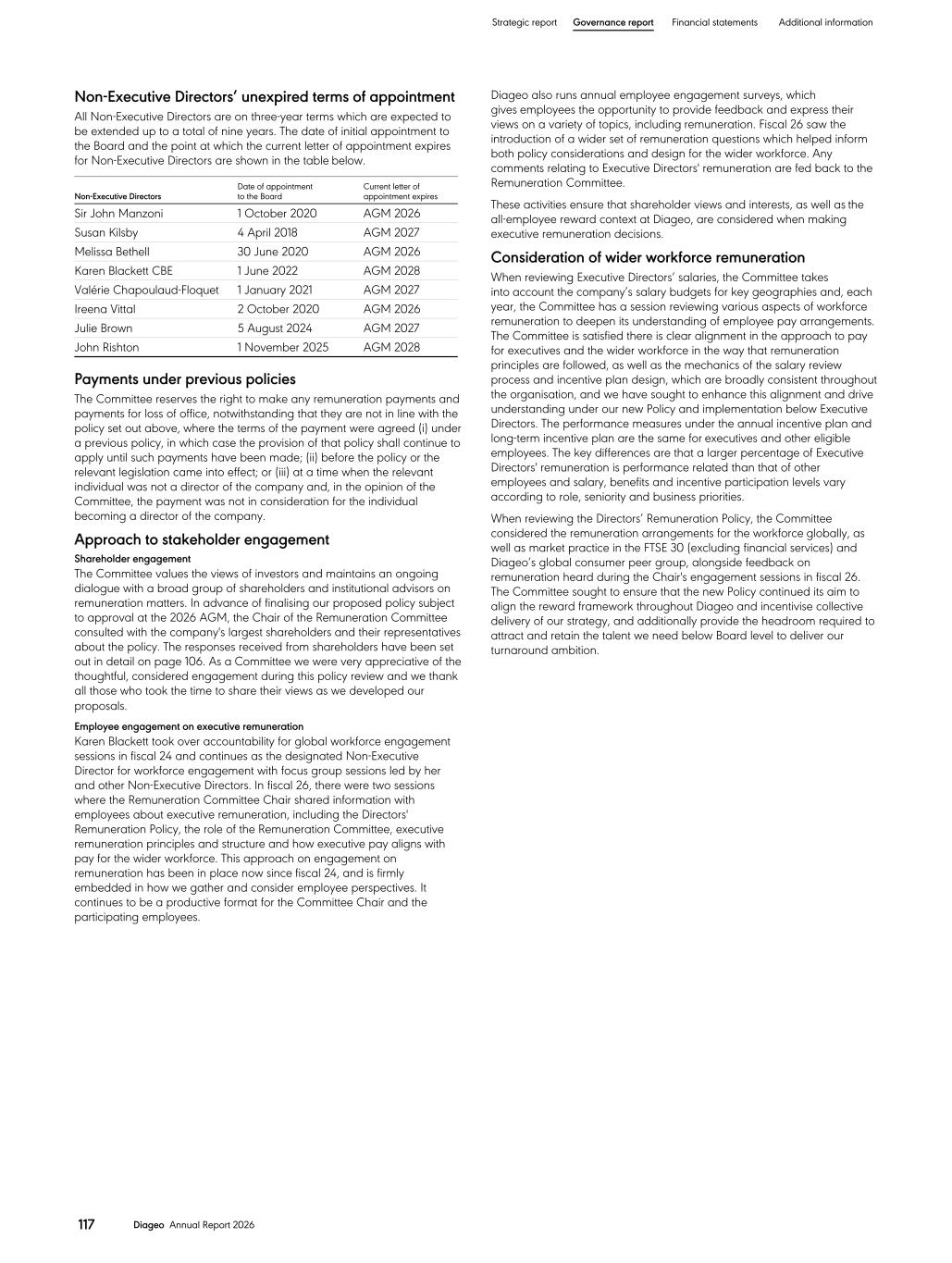
Non-Executive Directors’ unexpired terms of appointment All Non-Executive Directors are on three-year terms which are expected to be extended up to a total of nine years. The date of initial appointment to the Board and the point at which the current letter of appointment expires for Non-Executive Directors are shown in the table below. Sir John Manzoni 1 October 2020 AGM 2026 Susan Kilsby 4 April 2018 AGM 2027 Melissa Bethell 30 June 2020 AGM 2026 Karen Blackett CBE 1 June 2022 AGM 2028 Valérie Chapoulaud-Floquet 1 January 2021 AGM 2027 Ireena Vittal 2 October 2020 AGM 2026 Julie Brown 5 August 2024 AGM 2027 John Rishton 1 November 2025 AGM 2028 Non-Executive Directors Date of appointment to the Board Current letter of appointment expires Payments under previous policies The Committee reserves the right to make any remuneration payments and payments for loss of office, notwithstanding that they are not in line with the policy set out above, where the terms of the payment were agreed (i) under a previous policy, in which case the provision of that policy shall continue to apply until such payments have been made; (ii) before the policy or the relevant legislation came into effect; or (iii) at a time when the relevant individual was not a director of the company and, in the opinion of the Committee, the payment was not in consideration for the individual becoming a director of the company. Approach to stakeholder engagement Shareholder engagement The Committee values the views of investors and maintains an ongoing dialogue with a broad group of shareholders and institutional advisors on remuneration matters. In advance of finalising our proposed policy subject to approval at the 2026 AGM, the Chair of the Remuneration Committee consulted with the company's largest shareholders and their representatives about the policy. The responses received from shareholders have been set out in detail on page 106. As a Committee we were very appreciative of the thoughtful, considered engagement during this policy review and we thank all those who took the time to share their views as we developed our proposals. Employee engagement on executive remuneration Karen Blackett took over accountability for global workforce engagement sessions in fiscal 24 and continues as the designated Non-Executive Director for workforce engagement with focus group sessions led by her and other Non-Executive Directors. In fiscal 26, there were two sessions where the Remuneration Committee Chair shared information with employees about executive remuneration, including the Directors' Remuneration Policy, the role of the Remuneration Committee, executive remuneration principles and structure and how executive pay aligns with pay for the wider workforce. This approach on engagement on remuneration has been in place now since fiscal 24, and is firmly embedded in how we gather and consider employee perspectives. It continues to be a productive format for the Committee Chair and the participating employees. Diageo also runs annual employee engagement surveys, which gives employees the opportunity to provide feedback and express their views on a variety of topics, including remuneration. Fiscal 26 saw the introduction of a wider set of remuneration questions which helped inform both policy considerations and design for the wider workforce. Any comments relating to Executive Directors' remuneration are fed back to the Remuneration Committee. These activities ensure that shareholder views and interests, as well as the all-employee reward context at Diageo, are considered when making executive remuneration decisions. Consideration of wider workforce remuneration When reviewing Executive Directors’ salaries, the Committee takes into account the company’s salary budgets for key geographies and, each year, the Committee has a session reviewing various aspects of workforce remuneration to deepen its understanding of employee pay arrangements. The Committee is satisfied there is clear alignment in the approach to pay for executives and the wider workforce in the way that remuneration principles are followed, as well as the mechanics of the salary review process and incentive plan design, which are broadly consistent throughout the organisation, and we have sought to enhance this alignment and drive understanding under our new Policy and implementation below Executive Directors. The performance measures under the annual incentive plan and long-term incentive plan are the same for executives and other eligible employees. The key differences are that a larger percentage of Executive Directors' remuneration is performance related than that of other employees and salary, benefits and incentive participation levels vary according to role, seniority and business priorities. When reviewing the Directors’ Remuneration Policy, the Committee considered the remuneration arrangements for the workforce globally, as well as market practice in the FTSE 30 (excluding financial services) and Diageo’s global consumer peer group, alongside feedback on remuneration heard during the Chair's engagement sessions in fiscal 26. The Committee sought to ensure that the new Policy continued its aim to align the reward framework throughout Diageo and incentivise collective delivery of our strategy, and additionally provide the headroom required to attract and retain the talent we need below Board level to deliver our turnaround ambition. Strategic report Governance report Financial statements Additional information 117 Diageo Annual Report 2026
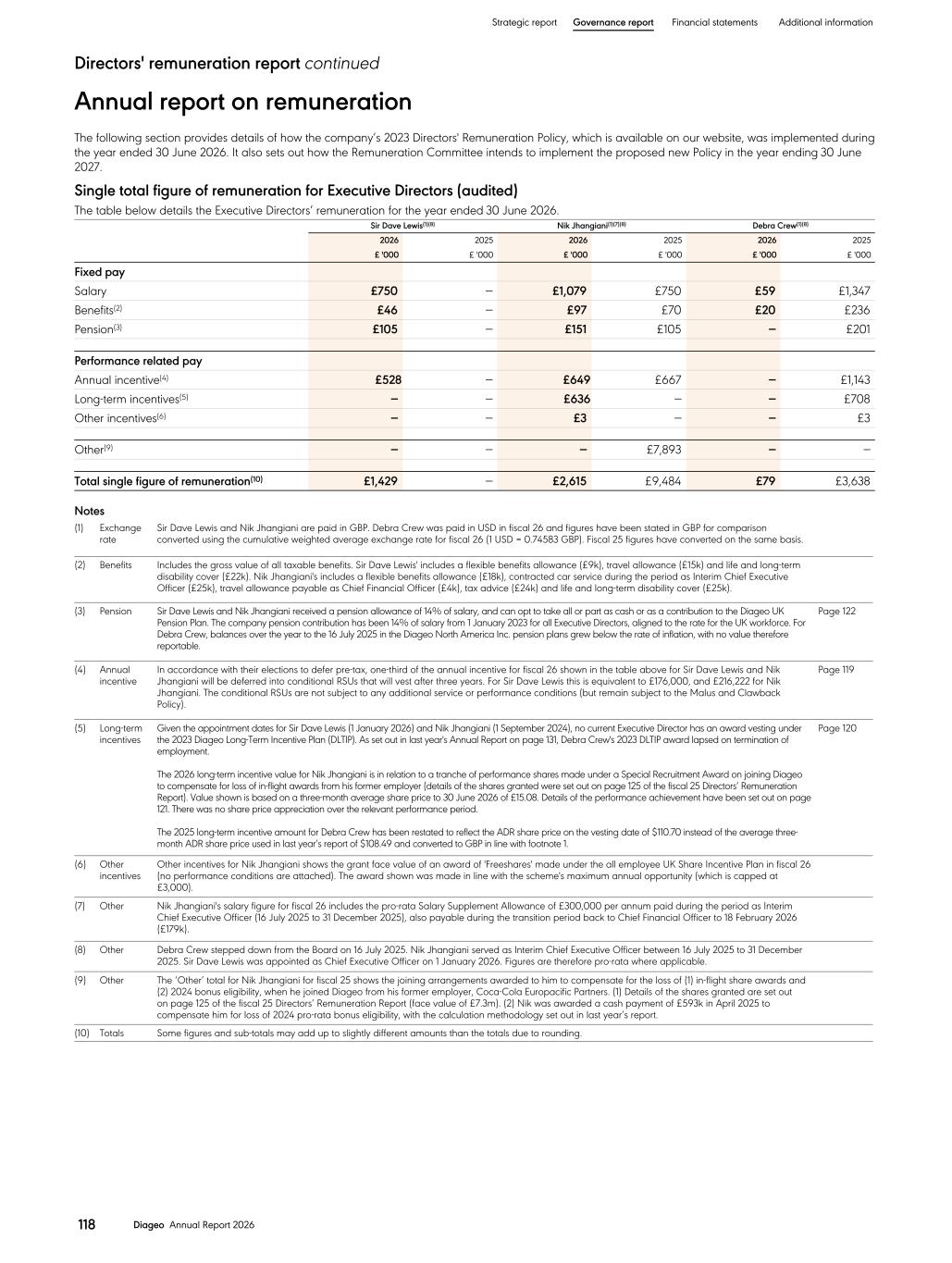
Annual report on remuneration The following section provides details of how the company’s 2023 Directors' Remuneration Policy, which is available on our website, was implemented during the year ended 30 June 2026. It also sets out how the Remuneration Committee intends to implement the proposed new Policy in the year ending 30 June 2027. Single total figure of remuneration for Executive Directors (audited) The table below details the Executive Directors’ remuneration for the year ended 30 June 2026. Fixed pay Salary £750 — £1,079 £750 £59 £1,347 Benefits(2) £46 — £97 £70 £20 £236 Pension(3) £105 — £151 £105 — £201 Performance related pay Annual incentive(4) £528 — £649 £667 — £1,143 Long-term incentives(5) — — £636 — — £708 Other incentives(6) — — £3 — — £3 Other(9) — — — £7,893 — — Total single figure of remuneration(10) £1,429 — £2,615 £9,484 £79 £3,638 Sir Dave Lewis(1)(8) Nik Jhangiani(1)(7)(8) Debra Crew(1)(8) 2026 2025 2026 2025 2026 2025 £ '000 £ '000 £ '000 £ '000 £ '000 £ '000 Notes (1) Exchange rate Sir Dave Lewis and Nik Jhangiani are paid in GBP. Debra Crew was paid in USD in fiscal 26 and figures have been stated in GBP for comparison converted using the cumulative weighted average exchange rate for fiscal 26 (1 USD = 0.74583 GBP). Fiscal 25 figures have converted on the same basis. (2) Benefits Includes the gross value of all taxable benefits. Sir Dave Lewis' includes a flexible benefits allowance (£9k), travel allowance (£15k) and life and long-term disability cover (£22k). Nik Jhangiani's includes a flexible benefits allowance (£18k), contracted car service during the period as Interim Chief Executive Officer (£25k), travel allowance payable as Chief Financial Officer (£4k), tax advice (£24k) and life and long-term disability cover (£25k). (3) Pension Sir Dave Lewis and Nik Jhangiani received a pension allowance of 14% of salary, and can opt to take all or part as cash or as a contribution to the Diageo UK Pension Plan. The company pension contribution has been 14% of salary from 1 January 2023 for all Executive Directors, aligned to the rate for the UK workforce. For Debra Crew, balances over the year to the 16 July 2025 in the Diageo North America Inc. pension plans grew below the rate of inflation, with no value therefore reportable. Page 122 (4) Annual incentive In accordance with their elections to defer pre-tax, one-third of the annual incentive for fiscal 26 shown in the table above for Sir Dave Lewis and Nik Jhangiani will be deferred into conditional RSUs that will vest after three years. For Sir Dave Lewis this is equivalent to £176,000, and £216,222 for Nik Jhangiani. The conditional RSUs are not subject to any additional service or performance conditions (but remain subject to the Malus and Clawback Policy). Page 119 (5) Long-term incentives Given the appointment dates for Sir Dave Lewis (1 January 2026) and Nik Jhangiani (1 September 2024), no current Executive Director has an award vesting under the 2023 Diageo Long-Term Incentive Plan (DLTIP). As set out in last year's Annual Report on page 131, Debra Crew's 2023 DLTIP award lapsed on termination of employment. The 2026 long-term incentive value for Nik Jhangiani is in relation to a tranche of performance shares made under a Special Recruitment Award on joining Diageo to compensate for loss of in-flight awards from his former employer (details of the shares granted were set out on page 125 of the fiscal 25 Directors’ Remuneration Report). Value shown is based on a three-month average share price to 30 June 2026 of £15.08. Details of the performance achievement have been set out on page 121. There was no share price appreciation over the relevant performance period. The 2025 long-term incentive amount for Debra Crew has been restated to reflect the ADR share price on the vesting date of $110.70 instead of the average three- month ADR share price used in last year’s report of $108.49 and converted to GBP in line with footnote 1. Page 120 (6) Other incentives Other incentives for Nik Jhangiani shows the grant face value of an award of 'Freeshares' made under the all employee UK Share Incentive Plan in fiscal 26 (no performance conditions are attached). The award shown was made in line with the scheme's maximum annual opportunity (which is capped at £3,000). (7) Other Nik Jhangiani's salary figure for fiscal 26 includes the pro-rata Salary Supplement Allowance of £300,000 per annum paid during the period as Interim Chief Executive Officer (16 July 2025 to 31 December 2025), also payable during the transition period back to Chief Financial Officer to 18 February 2026 (£179k). (8) Other Debra Crew stepped down from the Board on 16 July 2025. Nik Jhangiani served as Interim Chief Executive Officer between 16 July 2025 to 31 December 2025. Sir Dave Lewis was appointed as Chief Executive Officer on 1 January 2026. Figures are therefore pro-rata where applicable. (9) Other The ‘Other’ total for Nik Jhangiani for fiscal 25 shows the joining arrangements awarded to him to compensate for the loss of (1) in-flight share awards and (2) 2024 bonus eligibility, when he joined Diageo from his former employer, Coca-Cola Europacific Partners. (1) Details of the shares granted are set out on page 125 of the fiscal 25 Directors’ Remuneration Report (face value of £7.3m). (2) Nik was awarded a cash payment of £593k in April 2025 to compensate him for loss of 2024 pro-rata bonus eligibility, with the calculation methodology set out in last year’s report. (10) Totals Some figures and sub-totals may add up to slightly different amounts than the totals due to rounding. Strategic report Governance report Financial statements Additional information Directors' remuneration report continued 118 Diageo Annual Report 2026
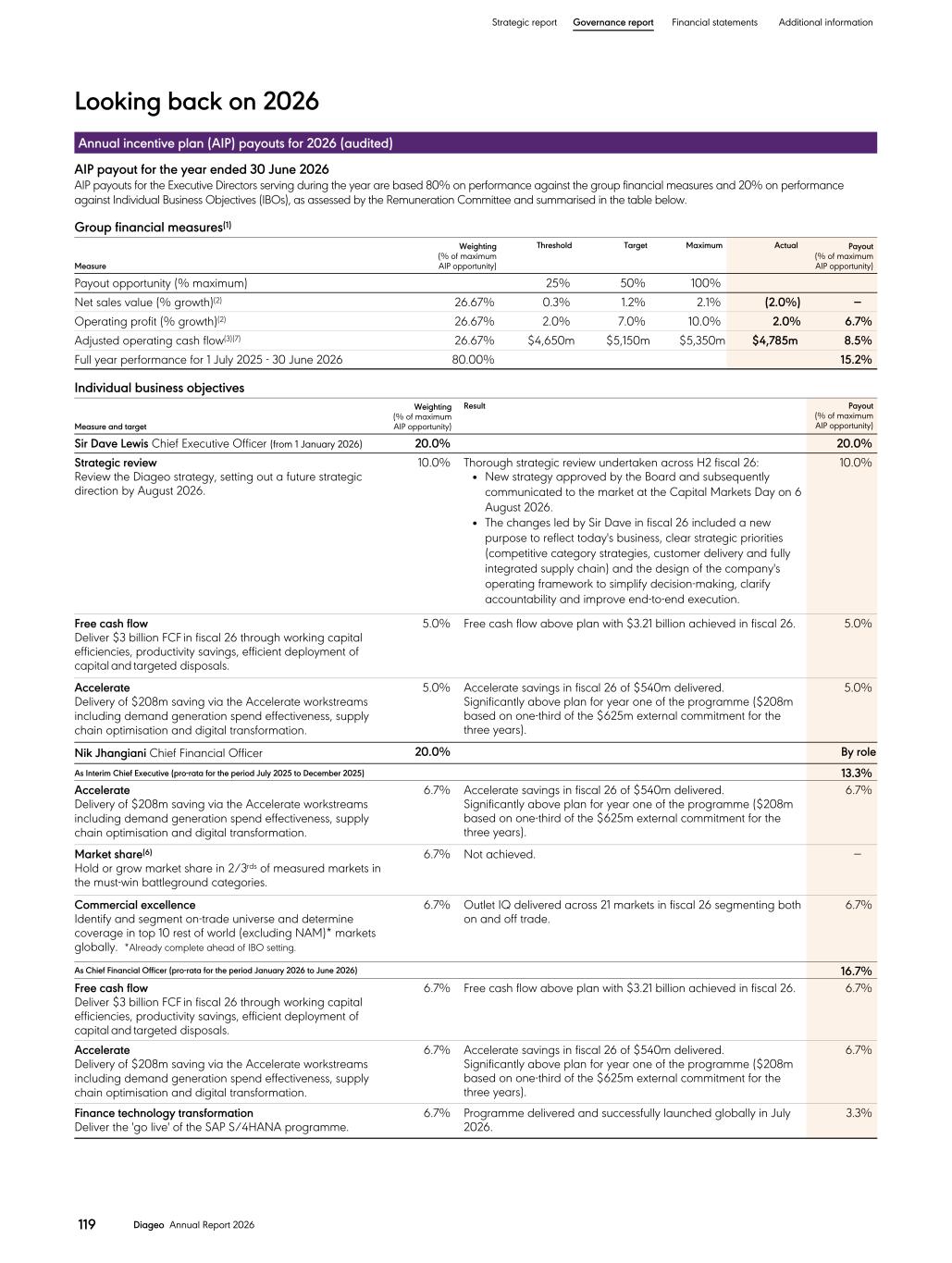
Looking back on 2026 Annual incentive plan (AIP) payouts for 2026 (audited) AIP payout for the year ended 30 June 2026 AIP payouts for the Executive Directors serving during the year are based 80% on performance against the group financial measures and 20% on performance against Individual Business Objectives (IBOs), as assessed by the Remuneration Committee and summarised in the table below. Payout opportunity (% maximum) 25% 50% 100% Net sales value (% growth)(2) 26.67% 0.3% 1.2% 2.1% (2.0%) — Operating profit (% growth)(2) 26.67% 2.0% 7.0% 10.0% 2.0% 6.7% Adjusted operating cash flow(3)(7) 26.67% $4,650m $5,150m $5,350m $4,785m 8.5% Full year performance for 1 July 2025 - 30 June 2026 80.00% 15.2% Group financial measures(1) Measure Weighting (% of maximum AIP opportunity) Threshold Target Maximum Actual Payout (% of maximum AIP opportunity) Sir Dave Lewis Chief Executive Officer (from 1 January 2026) 20.0% 20.0% Strategic review Review the Diageo strategy, setting out a future strategic direction by August 2026. 10.0% Thorough strategic review undertaken across H2 fiscal 26: • New strategy approved by the Board and subsequently communicated to the market at the Capital Markets Day on 6 August 2026. • The changes led by Sir Dave in fiscal 26 included a new purpose to reflect today's business, clear strategic priorities (competitive category strategies, customer delivery and fully integrated supply chain) and the design of the company's operating framework to simplify decision-making, clarify accountability and improve end-to-end execution. 10.0% Free cash flow Deliver $3 billion FCF in fiscal 26 through working capital efficiencies, productivity savings, efficient deployment of capital and targeted disposals. 5.0% Free cash flow above plan with $3.21 billion achieved in fiscal 26. 5.0% Accelerate Delivery of $208m saving via the Accelerate workstreams including demand generation spend effectiveness, supply chain optimisation and digital transformation. 5.0% Accelerate savings in fiscal 26 of $540m delivered. Significantly above plan for year one of the programme ($208m based on one-third of the $625m external commitment for the three years). 5.0% Nik Jhangiani Chief Financial Officer 20.0% By role As Interim Chief Executive (pro-rata for the period July 2025 to December 2025) 13.3% Accelerate Delivery of $208m saving via the Accelerate workstreams including demand generation spend effectiveness, supply chain optimisation and digital transformation. 6.7% Accelerate savings in fiscal 26 of $540m delivered. Significantly above plan for year one of the programme ($208m based on one-third of the $625m external commitment for the three years). 6.7% Market share(6) Hold or grow market share in 2/3rds of measured markets in the must-win battleground categories. 6.7% Not achieved. — Commercial excellence Identify and segment on-trade universe and determine coverage in top 10 rest of world (excluding NAM)* markets globally. *Already complete ahead of IBO setting. 6.7% Outlet IQ delivered across 21 markets in fiscal 26 segmenting both on and off trade. 6.7% As Chief Financial Officer (pro-rata for the period January 2026 to June 2026) 16.7% Free cash flow Deliver $3 billion FCF in fiscal 26 through working capital efficiencies, productivity savings, efficient deployment of capital and targeted disposals. 6.7% Free cash flow above plan with $3.21 billion achieved in fiscal 26. 6.7% Accelerate Delivery of $208m saving via the Accelerate workstreams including demand generation spend effectiveness, supply chain optimisation and digital transformation. 6.7% Accelerate savings in fiscal 26 of $540m delivered. Significantly above plan for year one of the programme ($208m based on one-third of the $625m external commitment for the three years). 6.7% Finance technology transformation Deliver the 'go live' of the SAP S/4HANA programme. 6.7% Programme delivered and successfully launched globally in July 2026. 3.3% Individual business objectives Measure and target Weighting (% of maximum AIP opportunity) Result Payout (% of maximum AIP opportunity) Strategic report Governance report Financial statements Additional information 119 Diageo Annual Report 2026
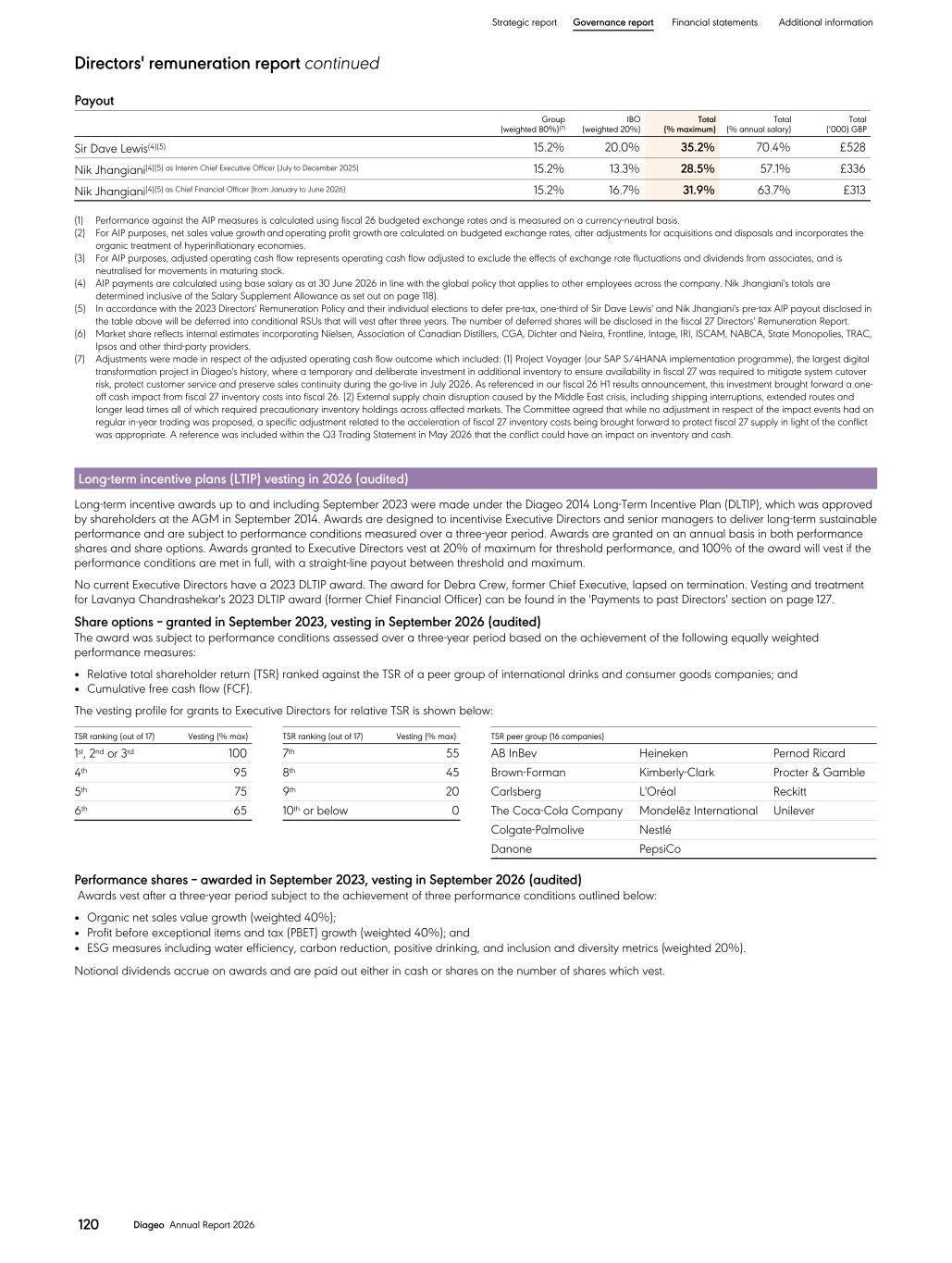
Sir Dave Lewis(4)(5) 15.2% 20.0% 35.2% 70.4% £528 Nik Jhangiani(4)(5) as Interim Chief Executive Officer (July to December 2025) 15.2% 13.3% 28.5% 57.1% £336 Nik Jhangiani(4)(5) as Chief Financial Officer (from January to June 2026) 15.2% 16.7% 31.9% 63.7% £313 Payout Group (weighted 80%)(7) IBO (weighted 20%) Total (% maximum) Total (% annual salary) Total (’000) GBP (1) Performance against the AIP measures is calculated using fiscal 26 budgeted exchange rates and is measured on a currency-neutral basis. (2) For AIP purposes, net sales value growth and operating profit growth are calculated on budgeted exchange rates, after adjustments for acquisitions and disposals and incorporates the organic treatment of hyperinflationary economies. (3) For AIP purposes, adjusted operating cash flow represents operating cash flow adjusted to exclude the effects of exchange rate fluctuations and dividends from associates, and is neutralised for movements in maturing stock. (4) AIP payments are calculated using base salary as at 30 June 2026 in line with the global policy that applies to other employees across the company. Nik Jhangiani's totals are determined inclusive of the Salary Supplement Allowance as set out on page 118). (5) In accordance with the 2023 Directors' Remuneration Policy and their individual elections to defer pre-tax, one-third of Sir Dave Lewis' and Nik Jhangiani's pre-tax AIP payout disclosed in the table above will be deferred into conditional RSUs that will vest after three years. The number of deferred shares will be disclosed in the fiscal 27 Directors' Remuneration Report. (6) Market share reflects internal estimates incorporating Nielsen, Association of Canadian Distillers, CGA, Dichter and Neira, Frontline, Intage, IRI, ISCAM, NABCA, State Monopolies, TRAC, Ipsos and other third-party providers. (7) Adjustments were made in respect of the adjusted operating cash flow outcome which included: (1) Project Voyager (our SAP S/4HANA implementation programme), the largest digital transformation project in Diageo's history, where a temporary and deliberate investment in additional inventory to ensure availability in fiscal 27 was required to mitigate system cutover risk, protect customer service and preserve sales continuity during the go-live in July 2026. As referenced in our fiscal 26 H1 results announcement, this investment brought forward a one- off cash impact from fiscal 27 inventory costs into fiscal 26. (2) External supply chain disruption caused by the Middle East crisis, including shipping interruptions, extended routes and longer lead times all of which required precautionary inventory holdings across affected markets. The Committee agreed that while no adjustment in respect of the impact events had on regular in-year trading was proposed, a specific adjustment related to the acceleration of fiscal 27 inventory costs being brought forward to protect fiscal 27 supply in light of the conflict was appropriate. A reference was included within the Q3 Trading Statement in May 2026 that the conflict could have an impact on inventory and cash. Long-term incentive plans (LTIP) vesting in 2026 (audited) Long-term incentive awards up to and including September 2023 were made under the Diageo 2014 Long-Term Incentive Plan (DLTIP), which was approved by shareholders at the AGM in September 2014. Awards are designed to incentivise Executive Directors and senior managers to deliver long-term sustainable performance and are subject to performance conditions measured over a three-year period. Awards are granted on an annual basis in both performance shares and share options. Awards granted to Executive Directors vest at 20% of maximum for threshold performance, and 100% of the award will vest if the performance conditions are met in full, with a straight-line payout between threshold and maximum. No current Executive Directors have a 2023 DLTIP award. The award for Debra Crew, former Chief Executive, lapsed on termination. Vesting and treatment for Lavanya Chandrashekar's 2023 DLTIP award (former Chief Financial Officer) can be found in the 'Payments to past Directors' section on page 127. Share options – granted in September 2023, vesting in September 2026 (audited) The award was subject to performance conditions assessed over a three-year period based on the achievement of the following equally weighted performance measures: • Relative total shareholder return (TSR) ranked against the TSR of a peer group of international drinks and consumer goods companies; and • Cumulative free cash flow (FCF). The vesting profile for grants to Executive Directors for relative TSR is shown below: 1st, 2nd or 3rd 100 4th 95 5th 75 6th 65 TSR ranking (out of 17) Vesting (% max) 7th 55 8th 45 9th 20 10th or below 0 TSR ranking (out of 17) Vesting (% max) AB InBev Heineken Pernod Ricard Brown-Forman Kimberly-Clark Procter & Gamble Carlsberg L'Oréal Reckitt The Coca-Cola Company Mondelēz International Unilever Colgate-Palmolive Nestlé Danone PepsiCo TSR peer group (16 companies) Performance shares – awarded in September 2023, vesting in September 2026 (audited) Awards vest after a three-year period subject to the achievement of three performance conditions outlined below: • Organic net sales value growth (weighted 40%); • Profit before exceptional items and tax (PBET) growth (weighted 40%); and • ESG measures including water efficiency, carbon reduction, positive drinking, and inclusion and diversity metrics (weighted 20%). Notional dividends accrue on awards and are paid out either in cash or shares on the number of shares which vest. Strategic report Governance report Financial statements Additional information Directors' remuneration report continued 120 Diageo Annual Report 2026
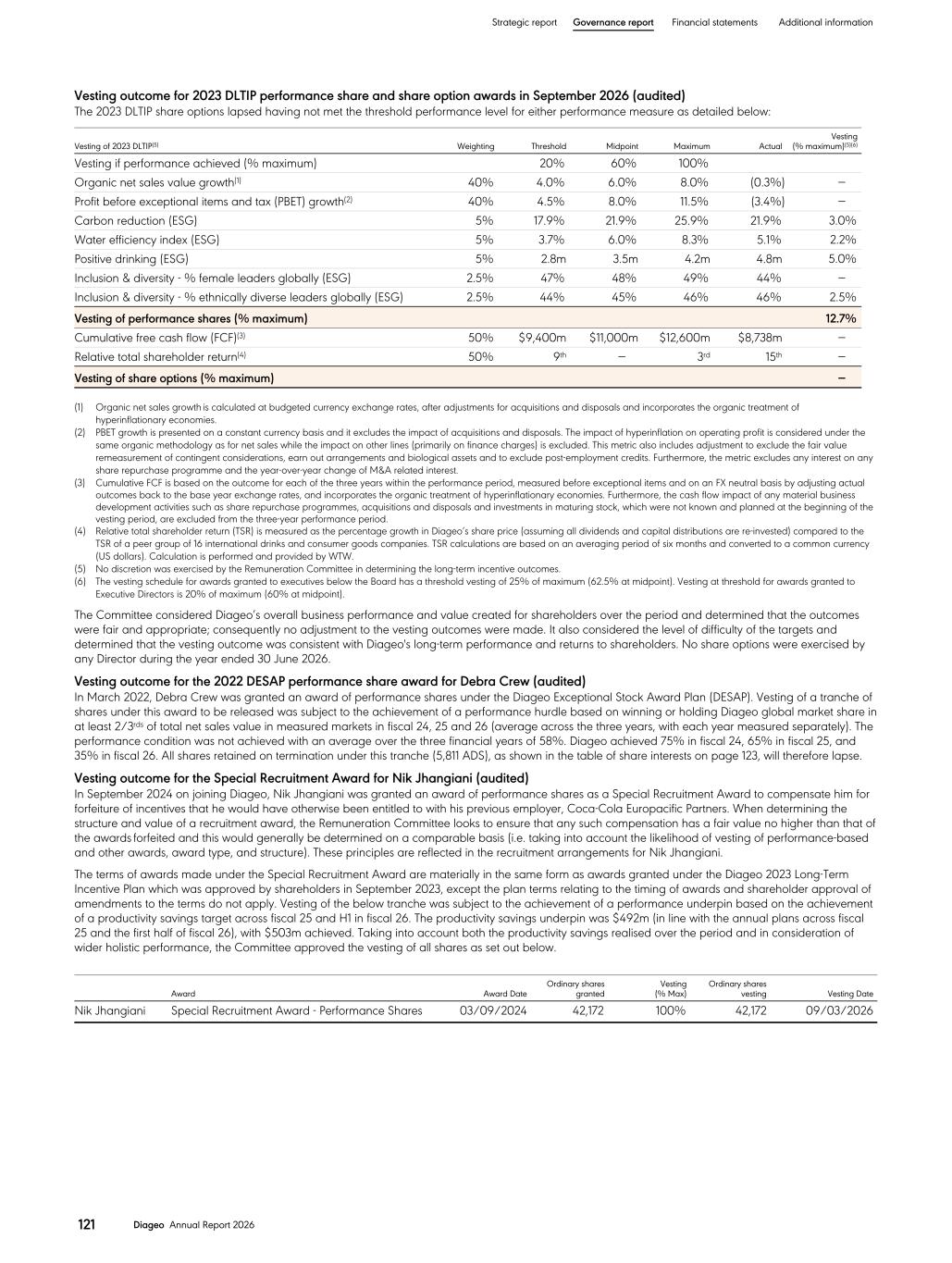
Vesting outcome for 2023 DLTIP performance share and share option awards in September 2026 (audited) The 2023 DLTIP share options lapsed having not met the threshold performance level for either performance measure as detailed below: Vesting if performance achieved (% maximum) 20% 60% 100% Organic net sales value growth(1) 40% 4.0% 6.0% 8.0% (0.3%) — Profit before exceptional items and tax (PBET) growth(2) 40% 4.5% 8.0% 11.5% (3.4%) — Carbon reduction (ESG) 5% 17.9% 21.9% 25.9% 21.9% 3.0% Water efficiency index (ESG) 5% 3.7% 6.0% 8.3% 5.1% 2.2% Positive drinking (ESG) 5% 2.8m 3.5m 4.2m 4.8m 5.0% Inclusion & diversity - % female leaders globally (ESG) 2.5% 47% 48% 49% 44% — Inclusion & diversity - % ethnically diverse leaders globally (ESG) 2.5% 44% 45% 46% 46% 2.5% Vesting of performance shares (% maximum) 12.7% Cumulative free cash flow (FCF)(3) 50% $9,400m $11,000m $12,600m $8,738m — Relative total shareholder return(4) 50% 9th — 3rd 15th — Vesting of share options (% maximum) — Vesting of 2023 DLTIP(5) Weighting Threshold Midpoint Maximum Actual Vesting (% maximum)(5)(6) (1) Organic net sales growth is calculated at budgeted currency exchange rates, after adjustments for acquisitions and disposals and incorporates the organic treatment of hyperinflationary economies. (2) PBET growth is presented on a constant currency basis and it excludes the impact of acquisitions and disposals. The impact of hyperinflation on operating profit is considered under the same organic methodology as for net sales while the impact on other lines (primarily on finance charges) is excluded. This metric also includes adjustment to exclude the fair value remeasurement of contingent considerations, earn out arrangements and biological assets and to exclude post-employment credits. Furthermore, the metric excludes any interest on any share repurchase programme and the year-over-year change of M&A related interest. (3) Cumulative FCF is based on the outcome for each of the three years within the performance period, measured before exceptional items and on an FX neutral basis by adjusting actual outcomes back to the base year exchange rates, and incorporates the organic treatment of hyperinflationary economies. Furthermore, the cash flow impact of any material business development activities such as share repurchase programmes, acquisitions and disposals and investments in maturing stock, which were not known and planned at the beginning of the vesting period, are excluded from the three-year performance period. (4) Relative total shareholder return (TSR) is measured as the percentage growth in Diageo’s share price (assuming all dividends and capital distributions are re-invested) compared to the TSR of a peer group of 16 international drinks and consumer goods companies. TSR calculations are based on an averaging period of six months and converted to a common currency (US dollars). Calculation is performed and provided by WTW. (5) No discretion was exercised by the Remuneration Committee in determining the long-term incentive outcomes. (6) The vesting schedule for awards granted to executives below the Board has a threshold vesting of 25% of maximum (62.5% at midpoint). Vesting at threshold for awards granted to Executive Directors is 20% of maximum (60% at midpoint). The Committee considered Diageo’s overall business performance and value created for shareholders over the period and determined that the outcomes were fair and appropriate; consequently no adjustment to the vesting outcomes were made. It also considered the level of difficulty of the targets and determined that the vesting outcome was consistent with Diageo's long-term performance and returns to shareholders. No share options were exercised by any Director during the year ended 30 June 2026. Vesting outcome for the 2022 DESAP performance share award for Debra Crew (audited) In March 2022, Debra Crew was granted an award of performance shares under the Diageo Exceptional Stock Award Plan (DESAP). Vesting of a tranche of shares under this award to be released was subject to the achievement of a performance hurdle based on winning or holding Diageo global market share in at least 2/3rds of total net sales value in measured markets in fiscal 24, 25 and 26 (average across the three years, with each year measured separately). The performance condition was not achieved with an average over the three financial years of 58%. Diageo achieved 75% in fiscal 24, 65% in fiscal 25, and 35% in fiscal 26. All shares retained on termination under this tranche (5,811 ADS), as shown in the table of share interests on page 123, will therefore lapse. Vesting outcome for the Special Recruitment Award for Nik Jhangiani (audited) In September 2024 on joining Diageo, Nik Jhangiani was granted an award of performance shares as a Special Recruitment Award to compensate him for forfeiture of incentives that he would have otherwise been entitled to with his previous employer, Coca-Cola Europacific Partners. When determining the structure and value of a recruitment award, the Remuneration Committee looks to ensure that any such compensation has a fair value no higher than that of the awards forfeited and this would generally be determined on a comparable basis (i.e. taking into account the likelihood of vesting of performance-based and other awards, award type, and structure). These principles are reflected in the recruitment arrangements for Nik Jhangiani. The terms of awards made under the Special Recruitment Award are materially in the same form as awards granted under the Diageo 2023 Long-Term Incentive Plan which was approved by shareholders in September 2023, except the plan terms relating to the timing of awards and shareholder approval of amendments to the terms do not apply. Vesting of the below tranche was subject to the achievement of a performance underpin based on the achievement of a productivity savings target across fiscal 25 and H1 in fiscal 26. The productivity savings underpin was $492m (in line with the annual plans across fiscal 25 and the first half of fiscal 26), with $503m achieved. Taking into account both the productivity savings realised over the period and in consideration of wider holistic performance, the Committee approved the vesting of all shares as set out below. Award Award Date Ordinary shares granted Vesting (% Max) Ordinary shares vesting Vesting Date Nik Jhangiani Special Recruitment Award - Performance Shares 03/09/2024 42,172 100% 42,172 09/03/2026 Strategic report Governance report Financial statements Additional information 121 Diageo Annual Report 2026
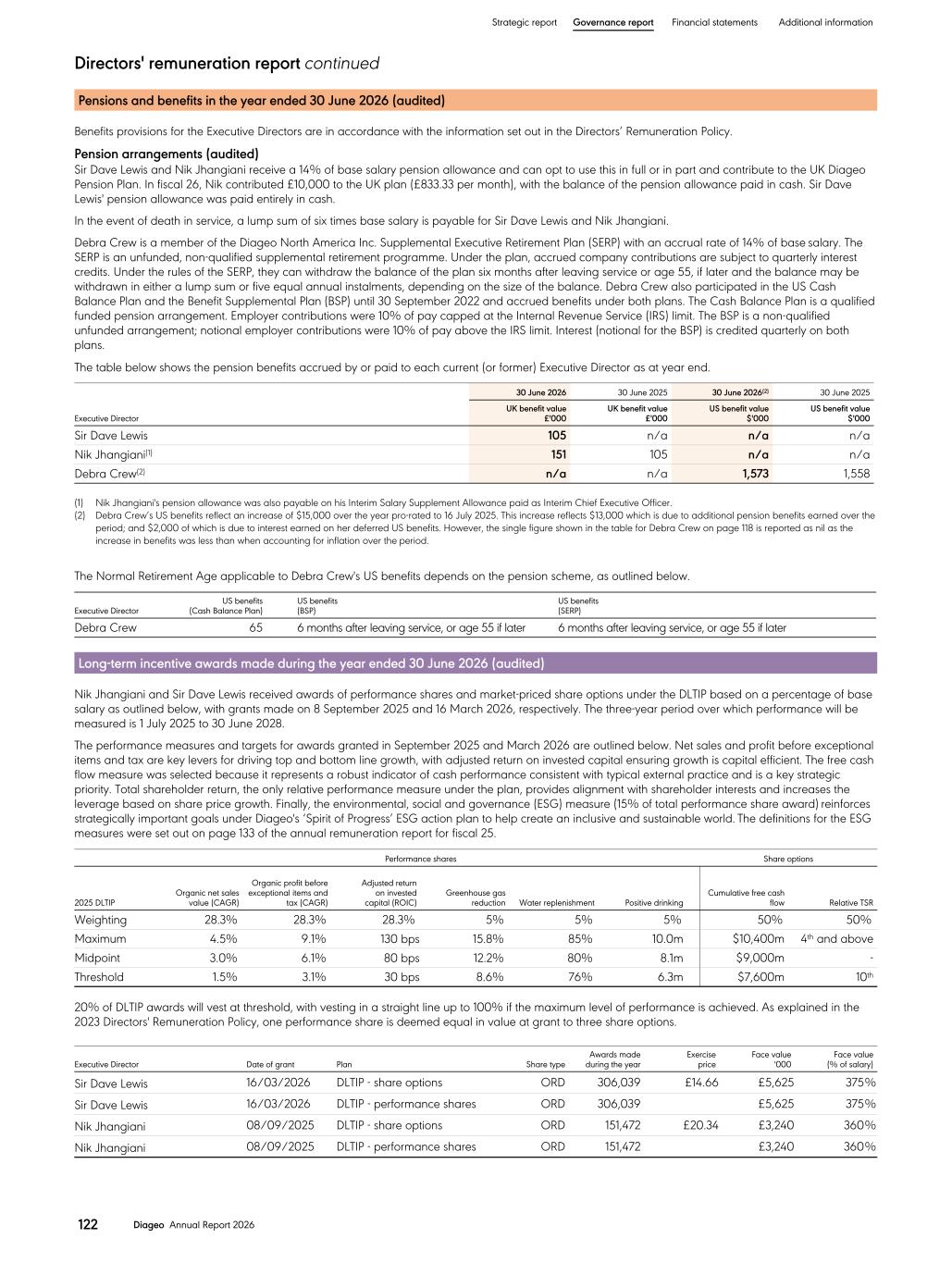
Pensions and benefits in the year ended 30 June 2026 (audited) Benefits provisions for the Executive Directors are in accordance with the information set out in the Directors’ Remuneration Policy. Pension arrangements (audited) Sir Dave Lewis and Nik Jhangiani receive a 14% of base salary pension allowance and can opt to use this in full or in part and contribute to the UK Diageo Pension Plan. In fiscal 26, Nik contributed £10,000 to the UK plan (£833.33 per month), with the balance of the pension allowance paid in cash. Sir Dave Lewis' pension allowance was paid entirely in cash. In the event of death in service, a lump sum of six times base salary is payable for Sir Dave Lewis and Nik Jhangiani. Debra Crew is a member of the Diageo North America Inc. Supplemental Executive Retirement Plan (SERP) with an accrual rate of 14% of base salary. The SERP is an unfunded, non-qualified supplemental retirement programme. Under the plan, accrued company contributions are subject to quarterly interest credits. Under the rules of the SERP, they can withdraw the balance of the plan six months after leaving service or age 55, if later and the balance may be withdrawn in either a lump sum or five equal annual instalments, depending on the size of the balance. Debra Crew also participated in the US Cash Balance Plan and the Benefit Supplemental Plan (BSP) until 30 September 2022 and accrued benefits under both plans. The Cash Balance Plan is a qualified funded pension arrangement. Employer contributions were 10% of pay capped at the Internal Revenue Service (IRS) limit. The BSP is a non-qualified unfunded arrangement; notional employer contributions were 10% of pay above the IRS limit. Interest (notional for the BSP) is credited quarterly on both plans. The table below shows the pension benefits accrued by or paid to each current (or former) Executive Director as at year end. Sir Dave Lewis 105 n/a n/a n/a Nik Jhangiani(1) 151 105 n/a n/a Debra Crew(2) n/a n/a 1,573 1,558 30 June 2026 30 June 2025 30 June 2026(2) 30 June 2025 Executive Director UK benefit value £'000 UK benefit value £'000 US benefit value $'000 US benefit value $'000 (1) Nik Jhangiani's pension allowance was also payable on his Interim Salary Supplement Allowance paid as Interim Chief Executive Officer. (2) Debra Crew’s US benefits reflect an increase of $15,000 over the year pro-rated to 16 July 2025. This increase reflects $13,000 which is due to additional pension benefits earned over the period; and $2,000 of which is due to interest earned on her deferred US benefits. However, the single figure shown in the table for Debra Crew on page 118 is reported as nil as the increase in benefits was less than when accounting for inflation over the period. The Normal Retirement Age applicable to Debra Crew's US benefits depends on the pension scheme, as outlined below. Executive Director US benefits (Cash Balance Plan) US benefits (BSP) US benefits (SERP) Debra Crew 65 6 months after leaving service, or age 55 if later 6 months after leaving service, or age 55 if later Long-term incentive awards made during the year ended 30 June 2026 (audited) Nik Jhangiani and Sir Dave Lewis received awards of performance shares and market-priced share options under the DLTIP based on a percentage of base salary as outlined below, with grants made on 8 September 2025 and 16 March 2026, respectively. The three-year period over which performance will be measured is 1 July 2025 to 30 June 2028. The performance measures and targets for awards granted in September 2025 and March 2026 are outlined below. Net sales and profit before exceptional items and tax are key levers for driving top and bottom line growth, with adjusted return on invested capital ensuring growth is capital efficient. The free cash flow measure was selected because it represents a robust indicator of cash performance consistent with typical external practice and is a key strategic priority. Total shareholder return, the only relative performance measure under the plan, provides alignment with shareholder interests and increases the leverage based on share price growth. Finally, the environmental, social and governance (ESG) measure (15% of total performance share award) reinforces strategically important goals under Diageo's ‘Spirit of Progress’ ESG action plan to help create an inclusive and sustainable world. The definitions for the ESG measures were set out on page 133 of the annual remuneration report for fiscal 25. Weighting 28.3% 28.3% 28.3% 5% 5% 5% 50% 50% Maximum 4.5% 9.1% 130 bps 15.8% 85% 10.0m $10,400m 4th and above Midpoint 3.0% 6.1% 80 bps 12.2% 80% 8.1m $9,000m - Threshold 1.5% 3.1% 30 bps 8.6% 76% 6.3m $7,600m 10th Performance shares Share options 2025 DLTIP Organic net sales value (CAGR) Organic profit before exceptional items and tax (CAGR) Adjusted return on invested capital (ROIC) Greenhouse gas reduction Water replenishment Positive drinking Cumulative free cash flow Relative TSR 20% of DLTIP awards will vest at threshold, with vesting in a straight line up to 100% if the maximum level of performance is achieved. As explained in the 2023 Directors' Remuneration Policy, one performance share is deemed equal in value at grant to three share options. Sir Dave Lewis 16/03/2026 DLTIP - share options ORD 306,039 £14.66 £5,625 375 % Sir Dave Lewis 16/03/2026 DLTIP - performance shares ORD 306,039 £5,625 375 % Nik Jhangiani 08/09/2025 DLTIP - share options ORD 151,472 £20.34 £3,240 360 % Nik Jhangiani 08/09/2025 DLTIP - performance shares ORD 151,472 £3,240 360 % Executive Director Date of grant Plan Share type Awards made during the year Exercise price Face value '000 Face value (% of salary) Strategic report Governance report Financial statements Additional information Directors' remuneration report continued 122 Diageo Annual Report 2026
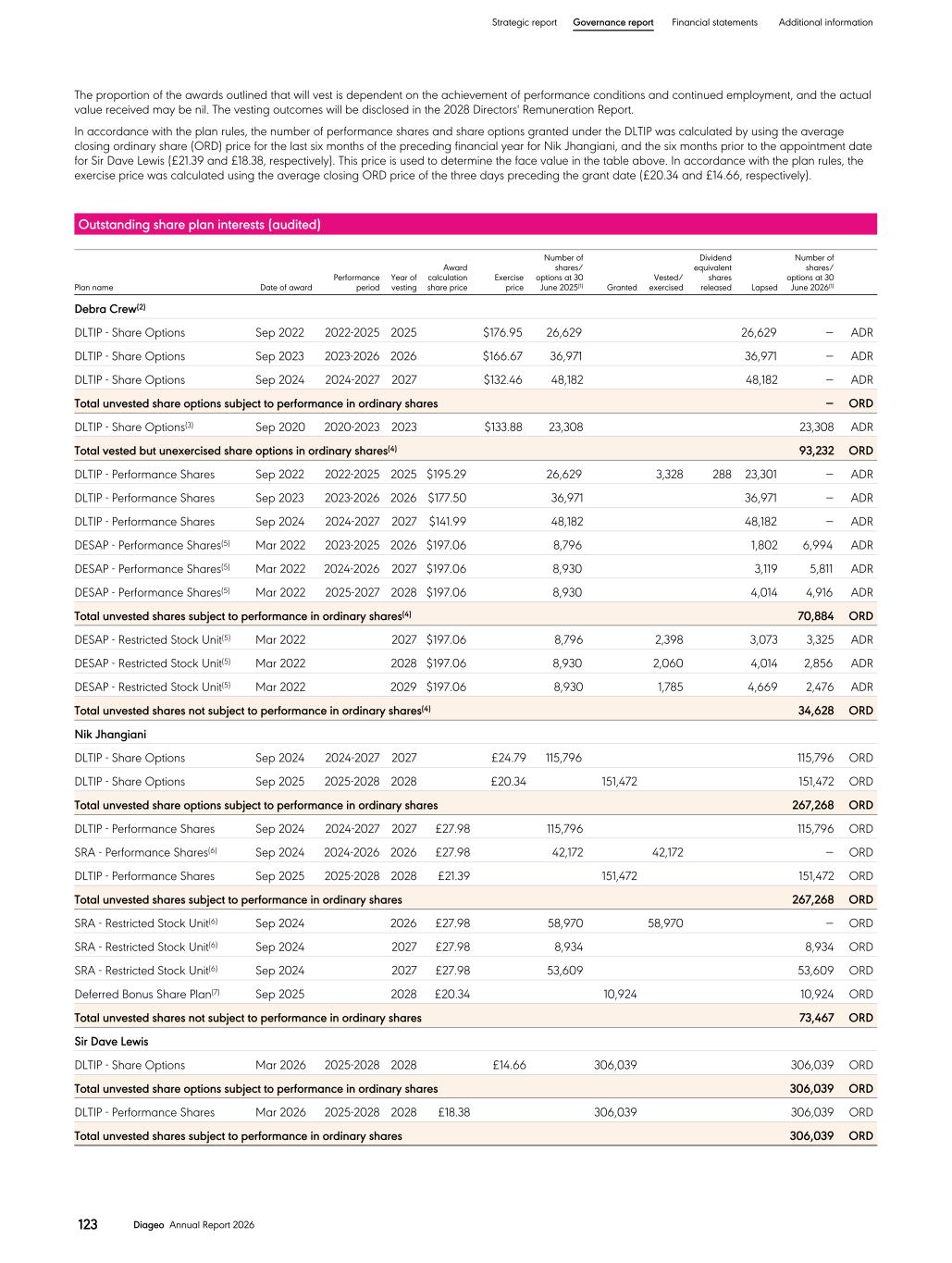
The proportion of the awards outlined that will vest is dependent on the achievement of performance conditions and continued employment, and the actual value received may be nil. The vesting outcomes will be disclosed in the 2028 Directors' Remuneration Report. In accordance with the plan rules, the number of performance shares and share options granted under the DLTIP was calculated by using the average closing ordinary share (ORD) price for the last six months of the preceding financial year for Nik Jhangiani, and the six months prior to the appointment date for Sir Dave Lewis (£21.39 and £18.38, respectively). This price is used to determine the face value in the table above. In accordance with the plan rules, the exercise price was calculated using the average closing ORD price of the three days preceding the grant date (£20.34 and £14.66, respectively). Outstanding share plan interests (audited) Debra Crew(2) DLTIP - Share Options Sep 2022 2022-2025 2025 $176.95 26,629 26,629 — ADR DLTIP - Share Options Sep 2023 2023-2026 2026 $166.67 36,971 36,971 — ADR DLTIP - Share Options Sep 2024 2024-2027 2027 $132.46 48,182 48,182 — ADR Total unvested share options subject to performance in ordinary shares — ORD DLTIP - Share Options(3) Sep 2020 2020-2023 2023 $133.88 23,308 23,308 ADR Total vested but unexercised share options in ordinary shares(4) 93,232 ORD DLTIP - Performance Shares Sep 2022 2022-2025 2025 $195.29 26,629 3,328 288 23,301 — ADR DLTIP - Performance Shares Sep 2023 2023-2026 2026 $177.50 36,971 36,971 — ADR DLTIP - Performance Shares Sep 2024 2024-2027 2027 $141.99 48,182 48,182 — ADR DESAP - Performance Shares(5) Mar 2022 2023-2025 2026 $197.06 8,796 1,802 6,994 ADR DESAP - Performance Shares(5) Mar 2022 2024-2026 2027 $197.06 8,930 3,119 5,811 ADR DESAP - Performance Shares(5) Mar 2022 2025-2027 2028 $197.06 8,930 4,014 4,916 ADR Total unvested shares subject to performance in ordinary shares(4) 70,884 ORD DESAP - Restricted Stock Unit(5) Mar 2022 2027 $197.06 8,796 2,398 3,073 3,325 ADR DESAP - Restricted Stock Unit(5) Mar 2022 2028 $197.06 8,930 2,060 4,014 2,856 ADR DESAP - Restricted Stock Unit(5) Mar 2022 2029 $197.06 8,930 1,785 4,669 2,476 ADR Total unvested shares not subject to performance in ordinary shares(4) 34,628 ORD Nik Jhangiani DLTIP - Share Options Sep 2024 2024-2027 2027 £24.79 115,796 115,796 ORD DLTIP - Share Options Sep 2025 2025-2028 2028 £20.34 151,472 151,472 ORD Total unvested share options subject to performance in ordinary shares 267,268 ORD DLTIP - Performance Shares Sep 2024 2024-2027 2027 £27.98 115,796 115,796 ORD SRA - Performance Shares(6) Sep 2024 2024-2026 2026 £27.98 42,172 42,172 — ORD DLTIP - Performance Shares Sep 2025 2025-2028 2028 £21.39 151,472 151,472 ORD Total unvested shares subject to performance in ordinary shares 267,268 ORD SRA - Restricted Stock Unit(6) Sep 2024 2026 £27.98 58,970 58,970 — ORD SRA - Restricted Stock Unit(6) Sep 2024 2027 £27.98 8,934 8,934 ORD SRA - Restricted Stock Unit(6) Sep 2024 2027 £27.98 53,609 53,609 ORD Deferred Bonus Share Plan(7) Sep 2025 2028 £20.34 10,924 10,924 ORD Total unvested shares not subject to performance in ordinary shares 73,467 ORD Sir Dave Lewis DLTIP - Share Options Mar 2026 2025-2028 2028 £14.66 306,039 306,039 ORD Total unvested share options subject to performance in ordinary shares 306,039 ORD DLTIP - Performance Shares Mar 2026 2025-2028 2028 £18.38 306,039 306,039 ORD Total unvested shares subject to performance in ordinary shares 306,039 ORD Plan name Date of award Performance period Year of vesting Award calculation share price Exercise price Number of shares/ options at 30 June 2025(1) Granted Vested/ exercised Dividend equivalent shares released Lapsed Number of shares/ options at 30 June 2026(1) Strategic report Governance report Financial statements Additional information 123 Diageo Annual Report 2026
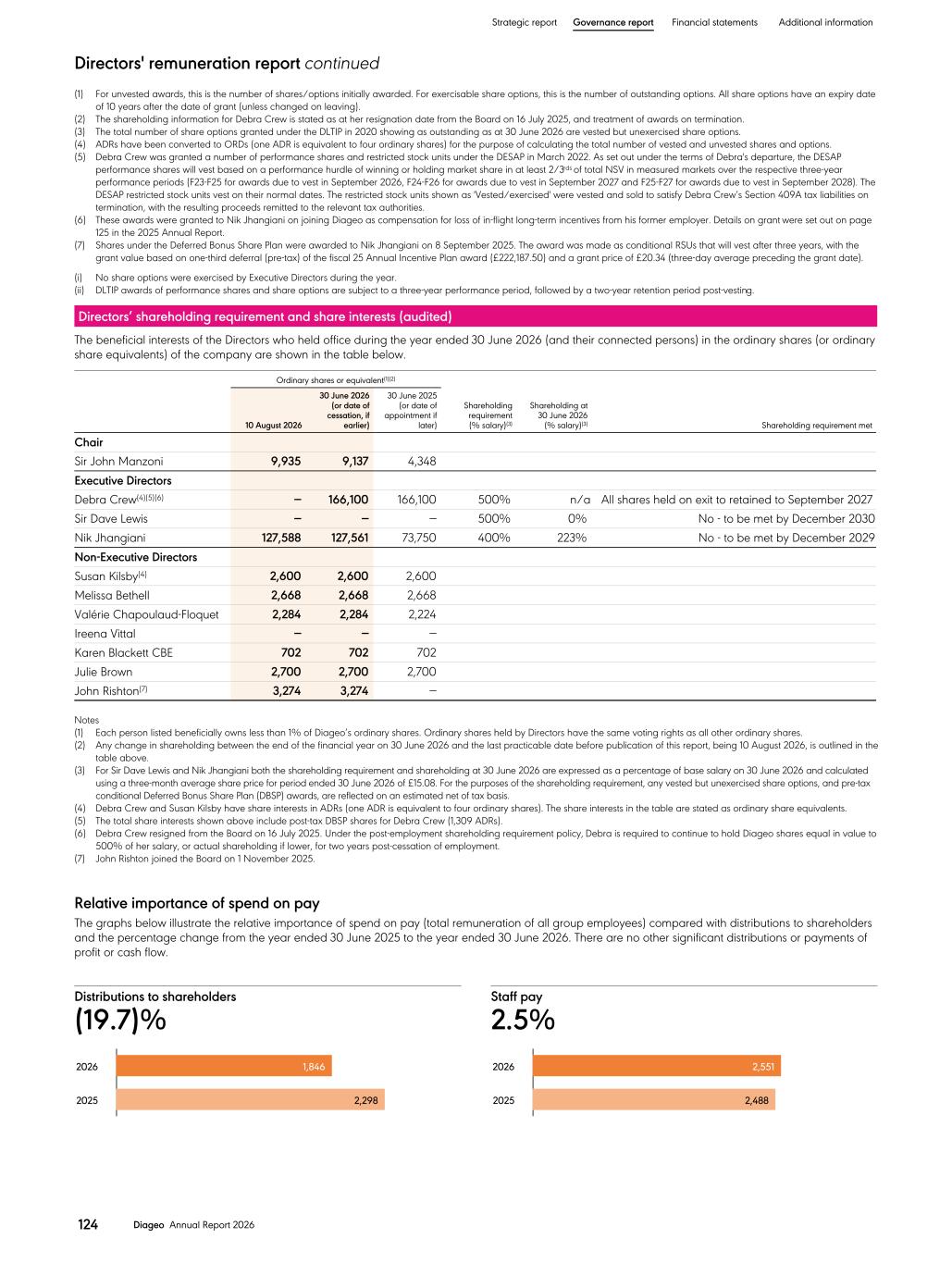
(1) For unvested awards, this is the number of shares/options initially awarded. For exercisable share options, this is the number of outstanding options. All share options have an expiry date of 10 years after the date of grant (unless changed on leaving). (2) The shareholding information for Debra Crew is stated as at her resignation date from the Board on 16 July 2025, and treatment of awards on termination. (3) The total number of share options granted under the DLTIP in 2020 showing as outstanding as at 30 June 2026 are vested but unexercised share options. (4) ADRs have been converted to ORDs (one ADR is equivalent to four ordinary shares) for the purpose of calculating the total number of vested and unvested shares and options. (5) Debra Crew was granted a number of performance shares and restricted stock units under the DESAP in March 2022. As set out under the terms of Debra's departure, the DESAP performance shares will vest based on a performance hurdle of winning or holding market share in at least 2/3rds of total NSV in measured markets over the respective three-year performance periods (F23-F25 for awards due to vest in September 2026, F24-F26 for awards due to vest in September 2027 and F25-F27 for awards due to vest in September 2028). The DESAP restricted stock units vest on their normal dates. The restricted stock units shown as 'Vested/exercised' were vested and sold to satisfy Debra Crew’s Section 409A tax liabilities on termination, with the resulting proceeds remitted to the relevant tax authorities. (6) These awards were granted to Nik Jhangiani on joining Diageo as compensation for loss of in-flight long-term incentives from his former employer. Details on grant were set out on page 125 in the 2025 Annual Report. (7) Shares under the Deferred Bonus Share Plan were awarded to Nik Jhangiani on 8 September 2025. The award was made as conditional RSUs that will vest after three years, with the grant value based on one-third deferral (pre-tax) of the fiscal 25 Annual Incentive Plan award (£222,187.50) and a grant price of £20.34 (three-day average preceding the grant date). (i) No share options were exercised by Executive Directors during the year. (ii) DLTIP awards of performance shares and share options are subject to a three-year performance period, followed by a two-year retention period post-vesting. Directors’ shareholding requirement and share interests (audited) The beneficial interests of the Directors who held office during the year ended 30 June 2026 (and their connected persons) in the ordinary shares (or ordinary share equivalents) of the company are shown in the table below. Chair Sir John Manzoni 9,935 9,137 4,348 Executive Directors Debra Crew(4)(5)(6) — 166,100 166,100 500% n/a All shares held on exit to retained to September 2027 Sir Dave Lewis — — — 500% 0% No - to be met by December 2030 Nik Jhangiani 127,588 127,561 73,750 400% 223% No - to be met by December 2029 Non-Executive Directors Susan Kilsby(4) 2,600 2,600 2,600 Melissa Bethell 2,668 2,668 2,668 Valérie Chapoulaud-Floquet 2,284 2,284 2,224 Ireena Vittal — — — Karen Blackett CBE 702 702 702 Julie Brown 2,700 2,700 2,700 John Rishton(7) 3,274 3,274 — Ordinary shares or equivalent(1)(2) 10 August 2026 30 June 2026 (or date of cessation, if earlier) 30 June 2025 (or date of appointment if later) Shareholding requirement (% salary)(3) Shareholding at 30 June 2026 (% salary)(3) Shareholding requirement met Notes (1) Each person listed beneficially owns less than 1% of Diageo’s ordinary shares. Ordinary shares held by Directors have the same voting rights as all other ordinary shares. (2) Any change in shareholding between the end of the financial year on 30 June 2026 and the last practicable date before publication of this report, being 10 August 2026, is outlined in the table above. (3) For Sir Dave Lewis and Nik Jhangiani both the shareholding requirement and shareholding at 30 June 2026 are expressed as a percentage of base salary on 30 June 2026 and calculated using a three-month average share price for period ended 30 June 2026 of £15.08. For the purposes of the shareholding requirement, any vested but unexercised share options, and pre-tax conditional Deferred Bonus Share Plan (DBSP) awards, are reflected on an estimated net of tax basis. (4) Debra Crew and Susan Kilsby have share interests in ADRs (one ADR is equivalent to four ordinary shares). The share interests in the table are stated as ordinary share equivalents. (5) The total share interests shown above include post-tax DBSP shares for Debra Crew (1,309 ADRs). (6) Debra Crew resigned from the Board on 16 July 2025. Under the post-employment shareholding requirement policy, Debra is required to continue to hold Diageo shares equal in value to 500% of her salary, or actual shareholding if lower, for two years post-cessation of employment. (7) John Rishton joined the Board on 1 November 2025. Relative importance of spend on pay The graphs below illustrate the relative importance of spend on pay (total remuneration of all group employees) compared with distributions to shareholders and the percentage change from the year ended 30 June 2025 to the year ended 30 June 2026. There are no other significant distributions or payments of profit or cash flow. Distributions to shareholders (19.7)% — 1,846 2,298 2026 2025 Staff pay 2.5% — 2,551 2,488 2026 2025 Strategic report Governance report Financial statements Additional information Directors' remuneration report continued 124 Diageo Annual Report 2026
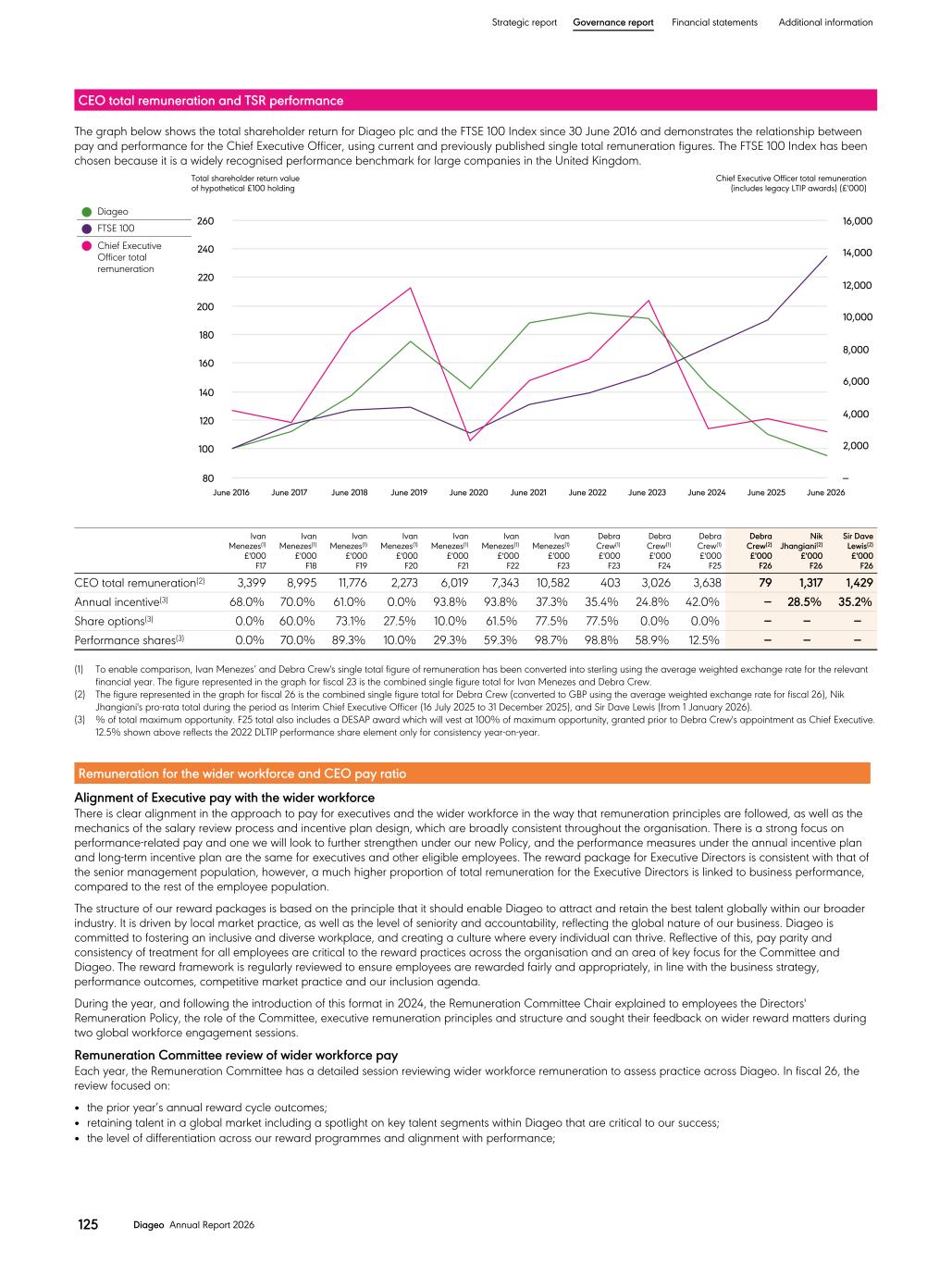
CEO total remuneration and TSR performance The graph below shows the total shareholder return for Diageo plc and the FTSE 100 Index since 30 June 2016 and demonstrates the relationship between pay and performance for the Chief Executive Officer, using current and previously published single total remuneration figures. The FTSE 100 Index has been chosen because it is a widely recognised performance benchmark for large companies in the United Kingdom. Total shareholder return value of hypothetical £100 holding Chief Executive Officer total remuneration (includes legacy LTIP awards) (£'000) June 2016 June 2017 June 2018 June 2019 June 2020 June 2021 June 2022 June 2023 June 2024 June 2025 June 2026 80 100 120 140 160 180 200 220 240 260 — 2,000 4,000 6,000 8,000 10,000 12,000 14,000 16,000 CEO total remuneration(2) 3,399 8,995 11,776 2,273 6,019 7,343 10,582 403 3,026 3,638 79 1,317 1,429 Annual incentive(3) 68.0% 70.0% 61.0% 0.0% 93.8% 93.8% 37.3% 35.4% 24.8% 42.0% — 28.5% 35.2% Share options(3) 0.0% 60.0% 73.1% 27.5% 10.0% 61.5% 77.5% 77.5% 0.0% 0.0% — — — Performance shares(3) 0.0% 70.0% 89.3% 10.0% 29.3% 59.3% 98.7% 98.8% 58.9% 12.5% — — — Ivan Menezes(1) £'000 F17 Ivan Menezes(1) £'000 F18 Ivan Menezes(1) £'000 F19 Ivan Menezes(1) £'000 F20 Ivan Menezes(1) £'000 F21 Ivan Menezes(1) £'000 F22 Ivan Menezes(1) £'000 F23 Debra Crew(1) £'000 F23 Debra Crew(1) £'000 F24 Debra Crew(1) £'000 F25 Debra Crew(2) £'000 F26 Nik Jhangiani(2) £'000 F26 Sir Dave Lewis(2) £'000 F26 (1) To enable comparison, Ivan Menezes’ and Debra Crew's single total figure of remuneration has been converted into sterling using the average weighted exchange rate for the relevant financial year. The figure represented in the graph for fiscal 23 is the combined single figure total for Ivan Menezes and Debra Crew. (2) The figure represented in the graph for fiscal 26 is the combined single figure total for Debra Crew (converted to GBP using the average weighted exchange rate for fiscal 26), Nik Jhangiani's pro-rata total during the period as Interim Chief Executive Officer (16 July 2025 to 31 December 2025), and Sir Dave Lewis (from 1 January 2026). (3) % of total maximum opportunity. F25 total also includes a DESAP award which will vest at 100% of maximum opportunity, granted prior to Debra Crew's appointment as Chief Executive. 12.5% shown above reflects the 2022 DLTIP performance share element only for consistency year-on-year. Remuneration for the wider workforce and CEO pay ratio Alignment of Executive pay with the wider workforce There is clear alignment in the approach to pay for executives and the wider workforce in the way that remuneration principles are followed, as well as the mechanics of the salary review process and incentive plan design, which are broadly consistent throughout the organisation. There is a strong focus on performance-related pay and one we will look to further strengthen under our new Policy, and the performance measures under the annual incentive plan and long-term incentive plan are the same for executives and other eligible employees. The reward package for Executive Directors is consistent with that of the senior management population, however, a much higher proportion of total remuneration for the Executive Directors is linked to business performance, compared to the rest of the employee population. The structure of our reward packages is based on the principle that it should enable Diageo to attract and retain the best talent globally within our broader industry. It is driven by local market practice, as well as the level of seniority and accountability, reflecting the global nature of our business. Diageo is committed to fostering an inclusive and diverse workplace, and creating a culture where every individual can thrive. Reflective of this, pay parity and consistency of treatment for all employees are critical to the reward practices across the organisation and an area of key focus for the Committee and Diageo. The reward framework is regularly reviewed to ensure employees are rewarded fairly and appropriately, in line with the business strategy, performance outcomes, competitive market practice and our inclusion agenda. During the year, and following the introduction of this format in 2024, the Remuneration Committee Chair explained to employees the Directors' Remuneration Policy, the role of the Committee, executive remuneration principles and structure and sought their feedback on wider reward matters during two global workforce engagement sessions. Remuneration Committee review of wider workforce pay Each year, the Remuneration Committee has a detailed session reviewing wider workforce remuneration to assess practice across Diageo. In fiscal 26, the review focused on: • the prior year’s annual reward cycle outcomes; • retaining talent in a global market including a spotlight on key talent segments within Diageo that are critical to our success; • the level of differentiation across our reward programmes and alignment with performance; Strategic report Governance report Financial statements Additional information 125 Diageo Annual Report 2026 ò Diageo ò FTSE 100 ò Chief Executive Officer total remuneration
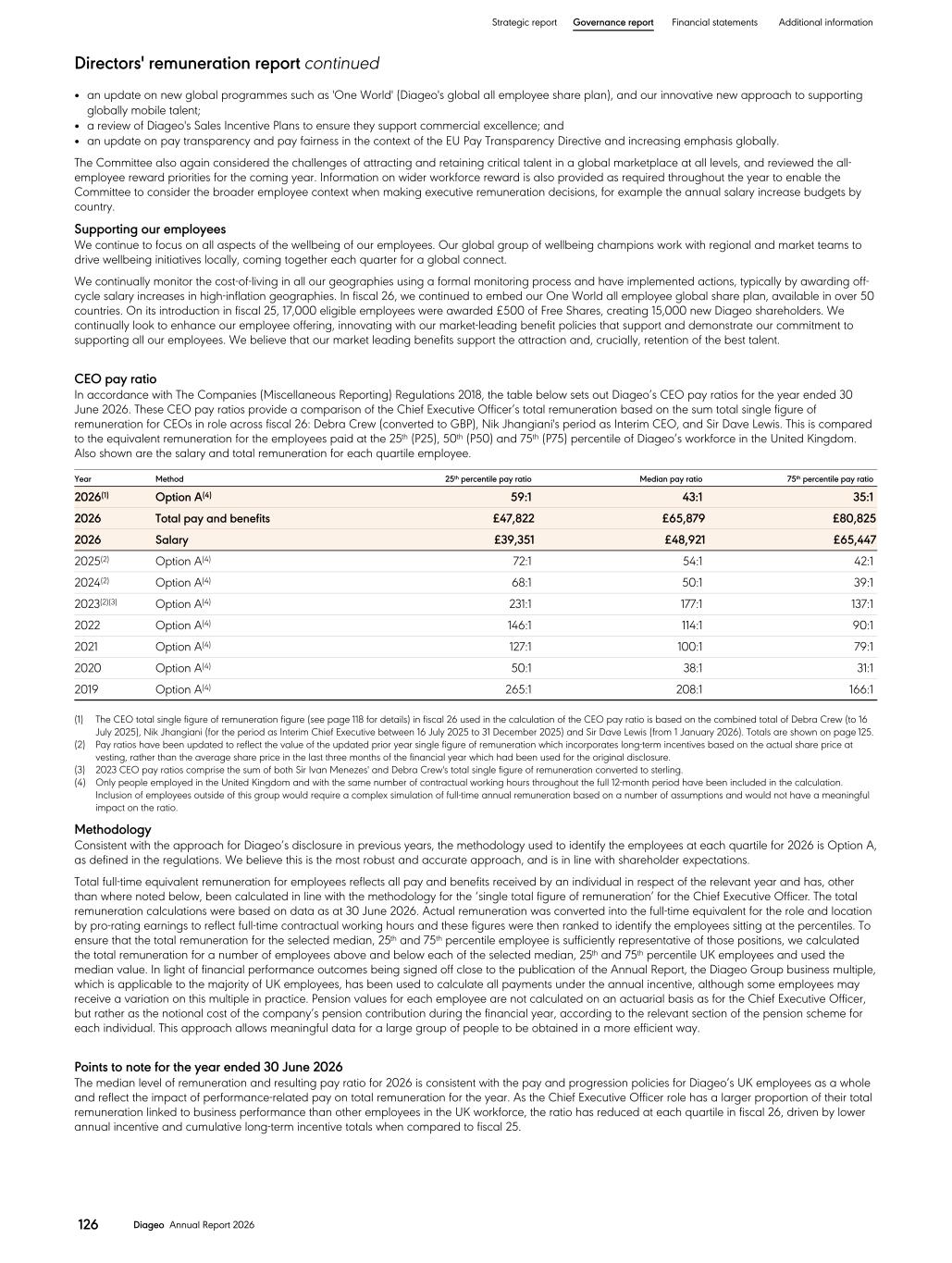
• an update on new global programmes such as 'One World' (Diageo's global all employee share plan), and our innovative new approach to supporting globally mobile talent; • a review of Diageo's Sales Incentive Plans to ensure they support commercial excellence; and • an update on pay transparency and pay fairness in the context of the EU Pay Transparency Directive and increasing emphasis globally. The Committee also again considered the challenges of attracting and retaining critical talent in a global marketplace at all levels, and reviewed the all- employee reward priorities for the coming year. Information on wider workforce reward is also provided as required throughout the year to enable the Committee to consider the broader employee context when making executive remuneration decisions, for example the annual salary increase budgets by country. Supporting our employees We continue to focus on all aspects of the wellbeing of our employees. Our global group of wellbeing champions work with regional and market teams to drive wellbeing initiatives locally, coming together each quarter for a global connect. We continually monitor the cost-of-living in all our geographies using a formal monitoring process and have implemented actions, typically by awarding off- cycle salary increases in high-inflation geographies. In fiscal 26, we continued to embed our One World all employee global share plan, available in over 50 countries. On its introduction in fiscal 25, 17,000 eligible employees were awarded £500 of Free Shares, creating 15,000 new Diageo shareholders. We continually look to enhance our employee offering, innovating with our market-leading benefit policies that support and demonstrate our commitment to supporting all our employees. We believe that our market leading benefits support the attraction and, crucially, retention of the best talent. CEO pay ratio In accordance with The Companies (Miscellaneous Reporting) Regulations 2018, the table below sets out Diageo’s CEO pay ratios for the year ended 30 June 2026. These CEO pay ratios provide a comparison of the Chief Executive Officer’s total remuneration based on the sum total single figure of remuneration for CEOs in role across fiscal 26: Debra Crew (converted to GBP), Nik Jhangiani's period as Interim CEO, and Sir Dave Lewis. This is compared to the equivalent remuneration for the employees paid at the 25th (P25), 50th (P50) and 75th (P75) percentile of Diageo’s workforce in the United Kingdom. Also shown are the salary and total remuneration for each quartile employee. 2026(1) Option A(4) 59:1 43:1 35:1 2026 Total pay and benefits £47,822 £65,879 £80,825 2026 Salary £39,351 £48,921 £65,447 2025(2) Option A(4) 72:1 54:1 42:1 2024(2) Option A(4) 68:1 50:1 39:1 2023(2)(3) Option A(4) 231:1 177:1 137:1 2022 Option A(4) 146:1 114:1 90:1 2021 Option A(4) 127:1 100:1 79:1 2020 Option A(4) 50:1 38:1 31:1 2019 Option A(4) 265:1 208:1 166:1 Year Method 25th percentile pay ratio Median pay ratio 75th percentile pay ratio (1) The CEO total single figure of remuneration figure (see page 118 for details) in fiscal 26 used in the calculation of the CEO pay ratio is based on the combined total of Debra Crew (to 16 July 2025), Nik Jhangiani (for the period as Interim Chief Executive between 16 July 2025 to 31 December 2025) and Sir Dave Lewis (from 1 January 2026). Totals are shown on page 125. (2) Pay ratios have been updated to reflect the value of the updated prior year single figure of remuneration which incorporates long-term incentives based on the actual share price at vesting, rather than the average share price in the last three months of the financial year which had been used for the original disclosure. (3) 2023 CEO pay ratios comprise the sum of both Sir Ivan Menezes' and Debra Crew's total single figure of remuneration converted to sterling. (4) Only people employed in the United Kingdom and with the same number of contractual working hours throughout the full 12-month period have been included in the calculation. Inclusion of employees outside of this group would require a complex simulation of full-time annual remuneration based on a number of assumptions and would not have a meaningful impact on the ratio. Methodology Consistent with the approach for Diageo’s disclosure in previous years, the methodology used to identify the employees at each quartile for 2026 is Option A, as defined in the regulations. We believe this is the most robust and accurate approach, and is in line with shareholder expectations. Total full-time equivalent remuneration for employees reflects all pay and benefits received by an individual in respect of the relevant year and has, other than where noted below, been calculated in line with the methodology for the ‘single total figure of remuneration’ for the Chief Executive Officer. The total remuneration calculations were based on data as at 30 June 2026. Actual remuneration was converted into the full-time equivalent for the role and location by pro-rating earnings to reflect full-time contractual working hours and these figures were then ranked to identify the employees sitting at the percentiles. To ensure that the total remuneration for the selected median, 25th and 75th percentile employee is sufficiently representative of those positions, we calculated the total remuneration for a number of employees above and below each of the selected median, 25th and 75th percentile UK employees and used the median value. In light of financial performance outcomes being signed off close to the publication of the Annual Report, the Diageo Group business multiple, which is applicable to the majority of UK employees, has been used to calculate all payments under the annual incentive, although some employees may receive a variation on this multiple in practice. Pension values for each employee are not calculated on an actuarial basis as for the Chief Executive Officer, but rather as the notional cost of the company’s pension contribution during the financial year, according to the relevant section of the pension scheme for each individual. This approach allows meaningful data for a large group of people to be obtained in a more efficient way. Points to note for the year ended 30 June 2026 The median level of remuneration and resulting pay ratio for 2026 is consistent with the pay and progression policies for Diageo’s UK employees as a whole and reflect the impact of performance-related pay on total remuneration for the year. As the Chief Executive Officer role has a larger proportion of their total remuneration linked to business performance than other employees in the UK workforce, the ratio has reduced at each quartile in fiscal 26, driven by lower annual incentive and cumulative long-term incentive totals when compared to fiscal 25. Strategic report Governance report Financial statements Additional information Directors' remuneration report continued 126 Diageo Annual Report 2026
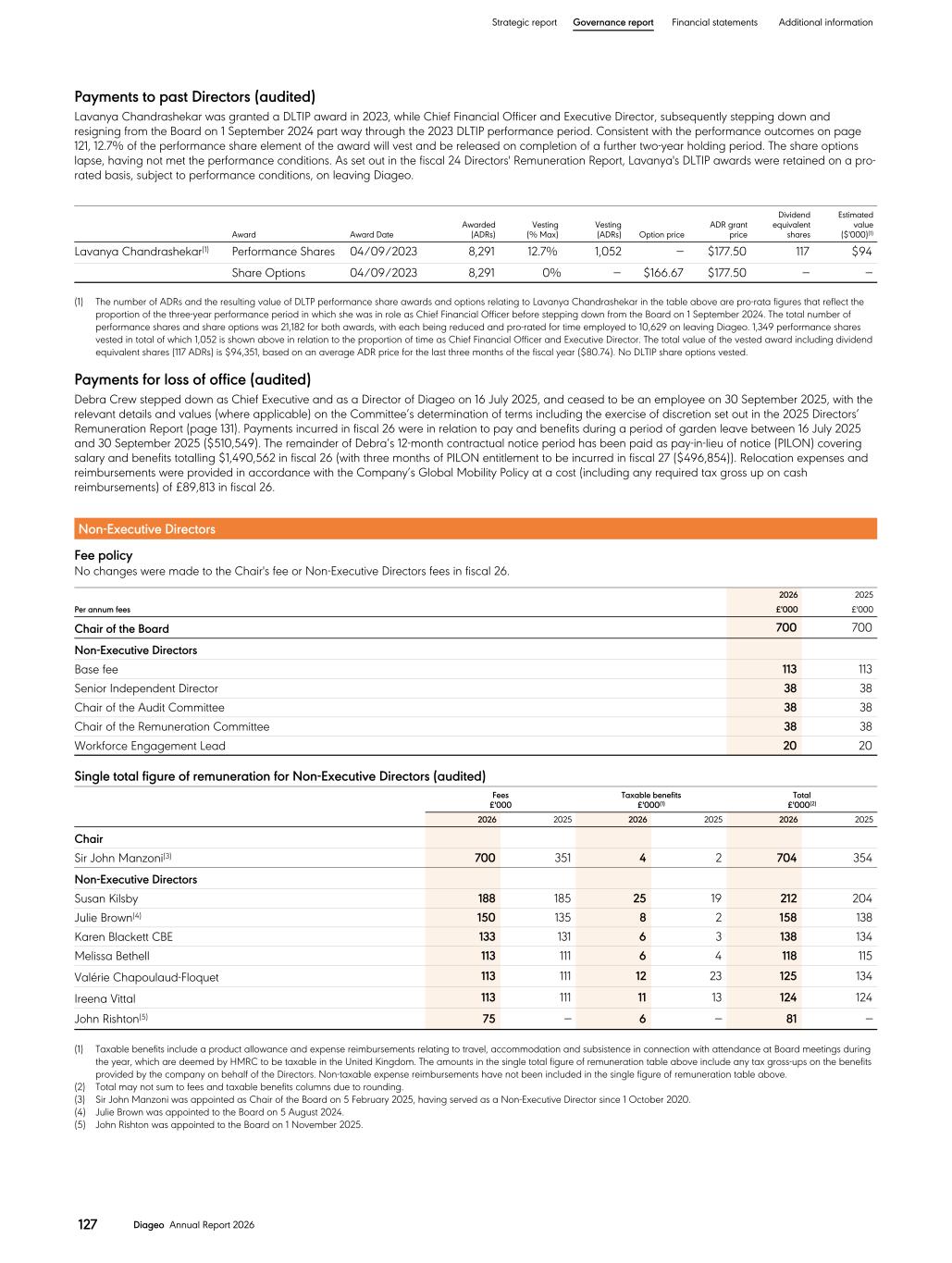
Payments to past Directors (audited) Lavanya Chandrashekar was granted a DLTIP award in 2023, while Chief Financial Officer and Executive Director, subsequently stepping down and resigning from the Board on 1 September 2024 part way through the 2023 DLTIP performance period. Consistent with the performance outcomes on page 121, 12.7% of the performance share element of the award will vest and be released on completion of a further two-year holding period. The share options lapse, having not met the performance conditions. As set out in the fiscal 24 Directors' Remuneration Report, Lavanya's DLTIP awards were retained on a pro- rated basis, subject to performance conditions, on leaving Diageo. Lavanya Chandrashekar(1) Performance Shares 04/09/2023 8,291 12.7% 1,052 — $177.50 117 $94 Share Options 04/09/2023 8,291 0% — $166.67 $177.50 — — Award Award Date Awarded (ADRs) Vesting (% Max) Vesting (ADRs) Option price ADR grant price Dividend equivalent shares Estimated value ($'000)(1) (1) The number of ADRs and the resulting value of DLTP performance share awards and options relating to Lavanya Chandrashekar in the table above are pro-rata figures that reflect the proportion of the three-year performance period in which she was in role as Chief Financial Officer before stepping down from the Board on 1 September 2024. The total number of performance shares and share options was 21,182 for both awards, with each being reduced and pro-rated for time employed to 10,629 on leaving Diageo. 1,349 performance shares vested in total of which 1,052 is shown above in relation to the proportion of time as Chief Financial Officer and Executive Director. The total value of the vested award including dividend equivalent shares (117 ADRs) is $94,351, based on an average ADR price for the last three months of the fiscal year ($80.74). No DLTIP share options vested. Payments for loss of office (audited) Debra Crew stepped down as Chief Executive and as a Director of Diageo on 16 July 2025, and ceased to be an employee on 30 September 2025, with the relevant details and values (where applicable) on the Committee’s determination of terms including the exercise of discretion set out in the 2025 Directors’ Remuneration Report (page 131). Payments incurred in fiscal 26 were in relation to pay and benefits during a period of garden leave between 16 July 2025 and 30 September 2025 ($510,549). The remainder of Debra’s 12-month contractual notice period has been paid as pay-in-lieu of notice (PILON) covering salary and benefits totalling $1,490,562 in fiscal 26 (with three months of PILON entitlement to be incurred in fiscal 27 ($496,854)). Relocation expenses and reimbursements were provided in accordance with the Company’s Global Mobility Policy at a cost (including any required tax gross up on cash reimbursements) of £89,813 in fiscal 26. Non-Executive Directors Fee policy No changes were made to the Chair's fee or Non-Executive Directors fees in fiscal 26. Chair of the Board 700 700 Non-Executive Directors Base fee 113 113 Senior Independent Director 38 38 Chair of the Audit Committee 38 38 Chair of the Remuneration Committee 38 38 Workforce Engagement Lead 20 20 2026 2025 Per annum fees £'000 £'000 Single total figure of remuneration for Non-Executive Directors (audited) Chair Sir John Manzoni(3) 700 351 4 2 704 354 Non-Executive Directors Susan Kilsby 188 185 25 19 212 204 Julie Brown(4) 150 135 8 2 158 138 Karen Blackett CBE 133 131 6 3 138 134 Melissa Bethell 113 111 6 4 118 115 Valérie Chapoulaud-Floquet 113 111 12 23 125 134 Ireena Vittal 113 111 11 13 124 124 John Rishton(5) 75 — 6 — 81 — Fees £'000 Taxable benefits £'000(1) Total £'000(2) 2026 2025 2026 2025 2026 2025 (1) Taxable benefits include a product allowance and expense reimbursements relating to travel, accommodation and subsistence in connection with attendance at Board meetings during the year, which are deemed by HMRC to be taxable in the United Kingdom. The amounts in the single total figure of remuneration table above include any tax gross-ups on the benefits provided by the company on behalf of the Directors. Non-taxable expense reimbursements have not been included in the single figure of remuneration table above. (2) Total may not sum to fees and taxable benefits columns due to rounding. (3) Sir John Manzoni was appointed as Chair of the Board on 5 February 2025, having served as a Non-Executive Director since 1 October 2020. (4) Julie Brown was appointed to the Board on 5 August 2024. (5) John Rishton was appointed to the Board on 1 November 2025. Strategic report Governance report Financial statements Additional information 127 Diageo Annual Report 2026
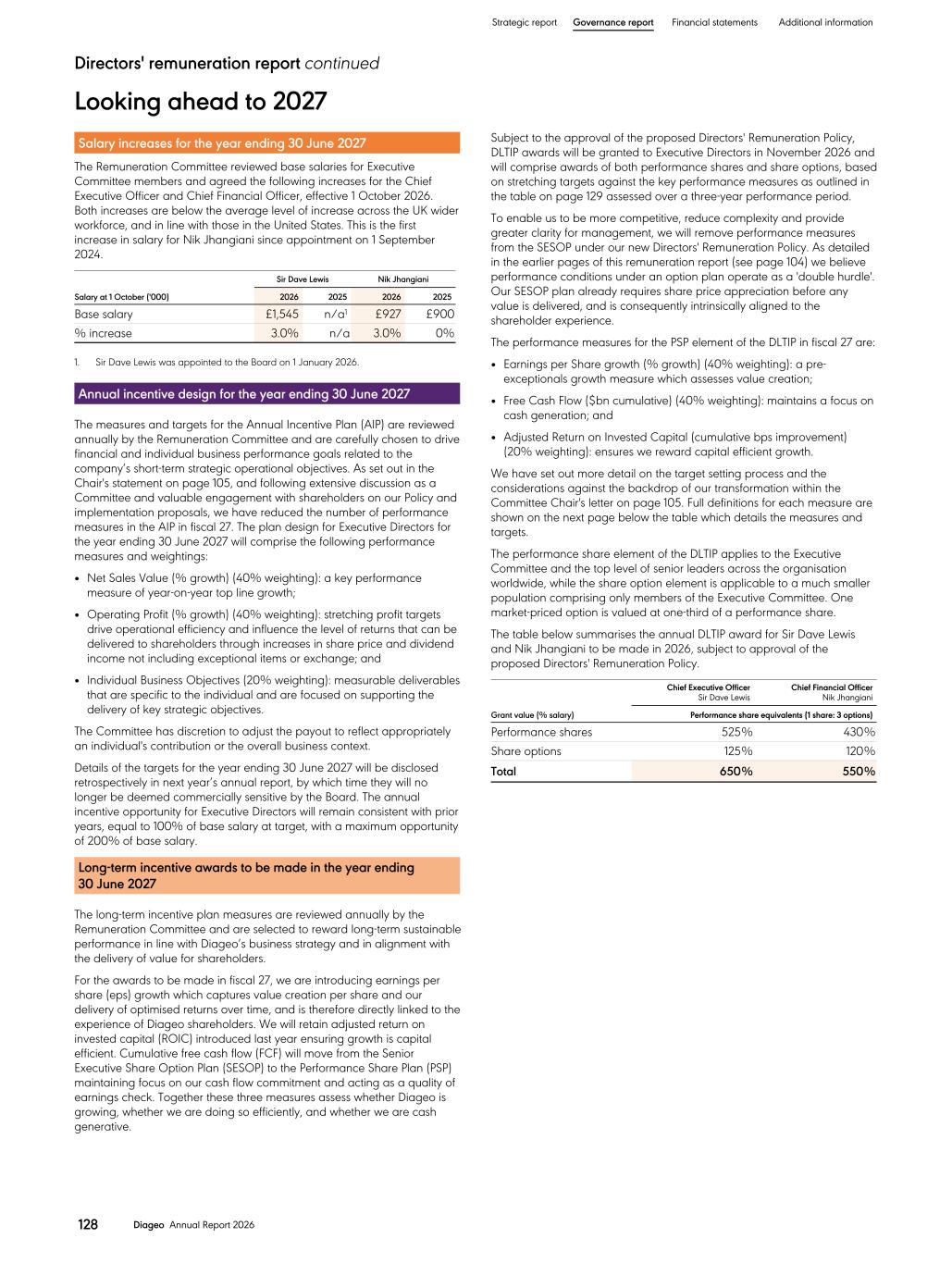
Looking ahead to 2027 Salary increases for the year ending 30 June 2027 The Remuneration Committee reviewed base salaries for Executive Committee members and agreed the following increases for the Chief Executive Officer and Chief Financial Officer, effective 1 October 2026. Both increases are below the average level of increase across the UK wider workforce, and in line with those in the United States. This is the first increase in salary for Nik Jhangiani since appointment on 1 September 2024. Base salary £1,545 n/a1 £927 £900 % increase 3.0% n/a 3.0% 0% Sir Dave Lewis Nik Jhangiani Salary at 1 October ('000) 2026 2025 2026 2025 1. Sir Dave Lewis was appointed to the Board on 1 January 2026. Annual incentive design for the year ending 30 June 2027 The measures and targets for the Annual Incentive Plan (AIP) are reviewed annually by the Remuneration Committee and are carefully chosen to drive financial and individual business performance goals related to the company’s short-term strategic operational objectives. As set out in the Chair's statement on page 105, and following extensive discussion as a Committee and valuable engagement with shareholders on our Policy and implementation proposals, we have reduced the number of performance measures in the AIP in fiscal 27. The plan design for Executive Directors for the year ending 30 June 2027 will comprise the following performance measures and weightings: • Net Sales Value (% growth) (40% weighting): a key performance measure of year-on-year top line growth; • Operating Profit (% growth) (40% weighting): stretching profit targets drive operational efficiency and influence the level of returns that can be delivered to shareholders through increases in share price and dividend income not including exceptional items or exchange; and • Individual Business Objectives (20% weighting): measurable deliverables that are specific to the individual and are focused on supporting the delivery of key strategic objectives. The Committee has discretion to adjust the payout to reflect appropriately an individual's contribution or the overall business context. Details of the targets for the year ending 30 June 2027 will be disclosed retrospectively in next year’s annual report, by which time they will no longer be deemed commercially sensitive by the Board. The annual incentive opportunity for Executive Directors will remain consistent with prior years, equal to 100% of base salary at target, with a maximum opportunity of 200% of base salary. Long-term incentive awards to be made in the year ending 30 June 2027 The long-term incentive plan measures are reviewed annually by the Remuneration Committee and are selected to reward long-term sustainable performance in line with Diageo’s business strategy and in alignment with the delivery of value for shareholders. For the awards to be made in fiscal 27, we are introducing earnings per share (eps) growth which captures value creation per share and our delivery of optimised returns over time, and is therefore directly linked to the experience of Diageo shareholders. We will retain adjusted return on invested capital (ROIC) introduced last year ensuring growth is capital efficient. Cumulative free cash flow (FCF) will move from the Senior Executive Share Option Plan (SESOP) to the Performance Share Plan (PSP) maintaining focus on our cash flow commitment and acting as a quality of earnings check. Together these three measures assess whether Diageo is growing, whether we are doing so efficiently, and whether we are cash generative. Subject to the approval of the proposed Directors' Remuneration Policy, DLTIP awards will be granted to Executive Directors in November 2026 and will comprise awards of both performance shares and share options, based on stretching targets against the key performance measures as outlined in the table on page 129 assessed over a three-year performance period. To enable us to be more competitive, reduce complexity and provide greater clarity for management, we will remove performance measures from the SESOP under our new Directors' Remuneration Policy. As detailed in the earlier pages of this remuneration report (see page 104) we believe performance conditions under an option plan operate as a 'double hurdle'. Our SESOP plan already requires share price appreciation before any value is delivered, and is consequently intrinsically aligned to the shareholder experience. The performance measures for the PSP element of the DLTIP in fiscal 27 are: • Earnings per Share growth (% growth) (40% weighting): a pre- exceptionals growth measure which assesses value creation; • Free Cash Flow ($bn cumulative) (40% weighting): maintains a focus on cash generation; and • Adjusted Return on Invested Capital (cumulative bps improvement) (20% weighting): ensures we reward capital efficient growth. We have set out more detail on the target setting process and the considerations against the backdrop of our transformation within the Committee Chair's letter on page 105. Full definitions for each measure are shown on the next page below the table which details the measures and targets. The performance share element of the DLTIP applies to the Executive Committee and the top level of senior leaders across the organisation worldwide, while the share option element is applicable to a much smaller population comprising only members of the Executive Committee. One market-priced option is valued at one-third of a performance share. The table below summarises the annual DLTIP award for Sir Dave Lewis and Nik Jhangiani to be made in 2026, subject to approval of the proposed Directors' Remuneration Policy. Performance shares 525 % 430 % Share options 125 % 120 % Total 650 % 550 % Grant value (% salary) Chief Executive Officer Sir Dave Lewis Chief Financial Officer Nik Jhangiani Performance share equivalents (1 share: 3 options) Strategic report Governance report Financial statements Additional information Directors' remuneration report continued 128 Diageo Annual Report 2026
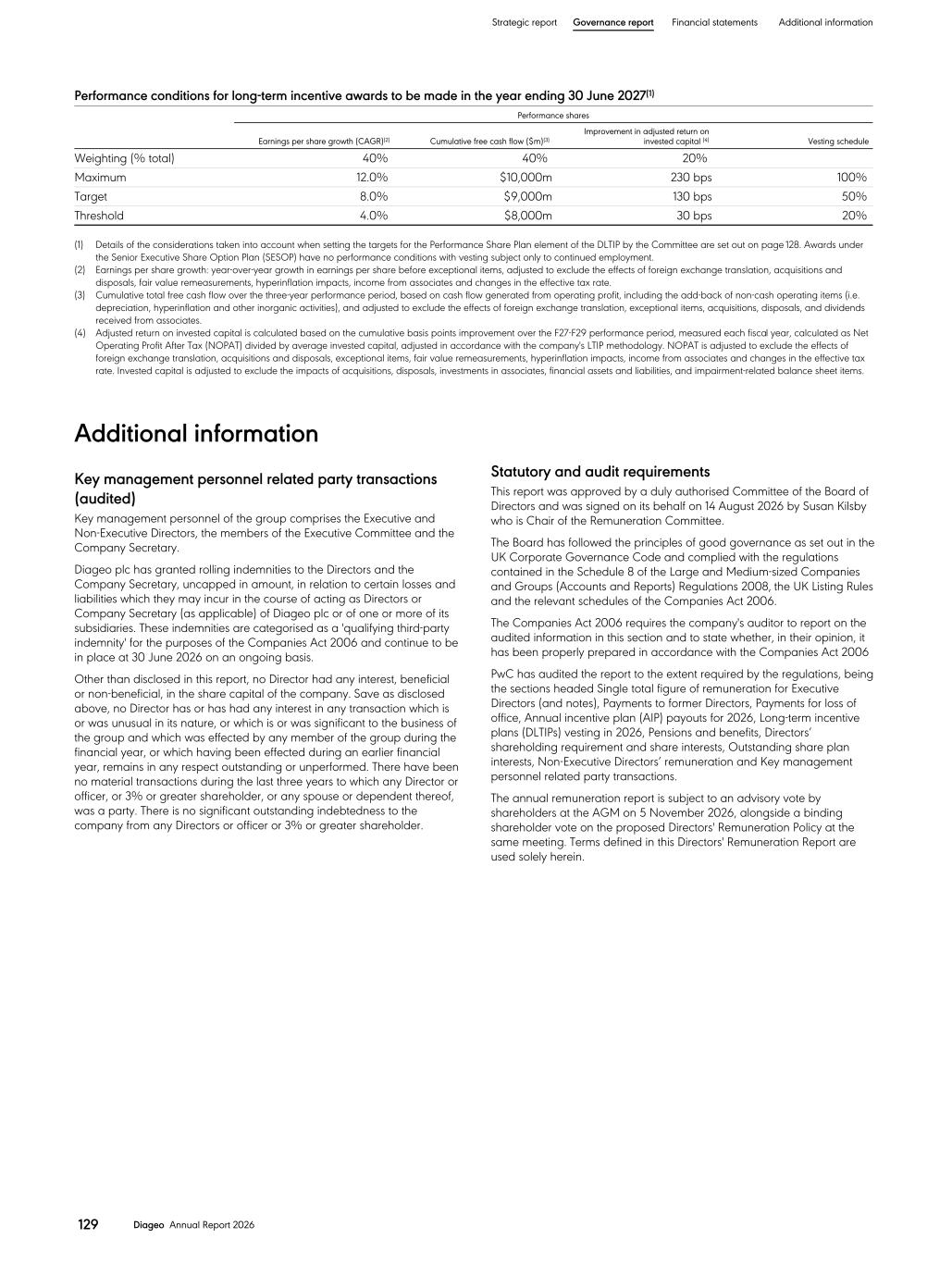
Performance conditions for long-term incentive awards to be made in the year ending 30 June 2027(1) Maximum 12.0% $10,000m 230 bps 100% Target 8.0% $9,000m 130 bps 50% Threshold 4.0% $8,000m 30 bps 20% Performance shares Earnings per share growth (CAGR)(2) Cumulative free cash flow ($m)(3) Improvement in adjusted return on invested capital (4) Vesting schedule Weighting (% total) 40% 40% 20% (1) Details of the considerations taken into account when setting the targets for the Performance Share Plan element of the DLTIP by the Committee are set out on page 128. Awards under the Senior Executive Share Option Plan (SESOP) have no performance conditions with vesting subject only to continued employment. (2) Earnings per share growth: year-over-year growth in earnings per share before exceptional items, adjusted to exclude the effects of foreign exchange translation, acquisitions and disposals, fair value remeasurements, hyperinflation impacts, income from associates and changes in the effective tax rate. (3) Cumulative total free cash flow over the three-year performance period, based on cash flow generated from operating profit, including the add-back of non-cash operating items (i.e. depreciation, hyperinflation and other inorganic activities), and adjusted to exclude the effects of foreign exchange translation, exceptional items, acquisitions, disposals, and dividends received from associates. (4) Adjusted return on invested capital is calculated based on the cumulative basis points improvement over the F27-F29 performance period, measured each fiscal year, calculated as Net Operating Profit After Tax (NOPAT) divided by average invested capital, adjusted in accordance with the company's LTIP methodology. NOPAT is adjusted to exclude the effects of foreign exchange translation, acquisitions and disposals, exceptional items, fair value remeasurements, hyperinflation impacts, income from associates and changes in the effective tax rate. Invested capital is adjusted to exclude the impacts of acquisitions, disposals, investments in associates, financial assets and liabilities, and impairment-related balance sheet items. Additional information Key management personnel related party transactions (audited) Key management personnel of the group comprises the Executive and Non-Executive Directors, the members of the Executive Committee and the Company Secretary. Diageo plc has granted rolling indemnities to the Directors and the Company Secretary, uncapped in amount, in relation to certain losses and liabilities which they may incur in the course of acting as Directors or Company Secretary (as applicable) of Diageo plc or of one or more of its subsidiaries. These indemnities are categorised as a 'qualifying third-party indemnity' for the purposes of the Companies Act 2006 and continue to be in place at 30 June 2026 on an ongoing basis. Other than disclosed in this report, no Director had any interest, beneficial or non-beneficial, in the share capital of the company. Save as disclosed above, no Director has or has had any interest in any transaction which is or was unusual in its nature, or which is or was significant to the business of the group and which was effected by any member of the group during the financial year, or which having been effected during an earlier financial year, remains in any respect outstanding or unperformed. There have been no material transactions during the last three years to which any Director or officer, or 3% or greater shareholder, or any spouse or dependent thereof, was a party. There is no significant outstanding indebtedness to the company from any Directors or officer or 3% or greater shareholder. Statutory and audit requirements This report was approved by a duly authorised Committee of the Board of Directors and was signed on its behalf on 14 August 2026 by Susan Kilsby who is Chair of the Remuneration Committee. The Board has followed the principles of good governance as set out in the UK Corporate Governance Code and complied with the regulations contained in the Schedule 8 of the Large and Medium-sized Companies and Groups (Accounts and Reports) Regulations 2008, the UK Listing Rules and the relevant schedules of the Companies Act 2006. The Companies Act 2006 requires the company's auditor to report on the audited information in this section and to state whether, in their opinion, it has been properly prepared in accordance with the Companies Act 2006 PwC has audited the report to the extent required by the regulations, being the sections headed Single total figure of remuneration for Executive Directors (and notes), Payments to former Directors, Payments for loss of office, Annual incentive plan (AIP) payouts for 2026, Long-term incentive plans (DLTIPs) vesting in 2026, Pensions and benefits, Directors’ shareholding requirement and share interests, Outstanding share plan interests, Non-Executive Directors’ remuneration and Key management personnel related party transactions. The annual remuneration report is subject to an advisory vote by shareholders at the AGM on 5 November 2026, alongside a binding shareholder vote on the proposed Directors' Remuneration Policy at the same meeting. Terms defined in this Directors' Remuneration Report are used solely herein. Strategic report Governance report Financial statements Additional information 129 Diageo Annual Report 2026
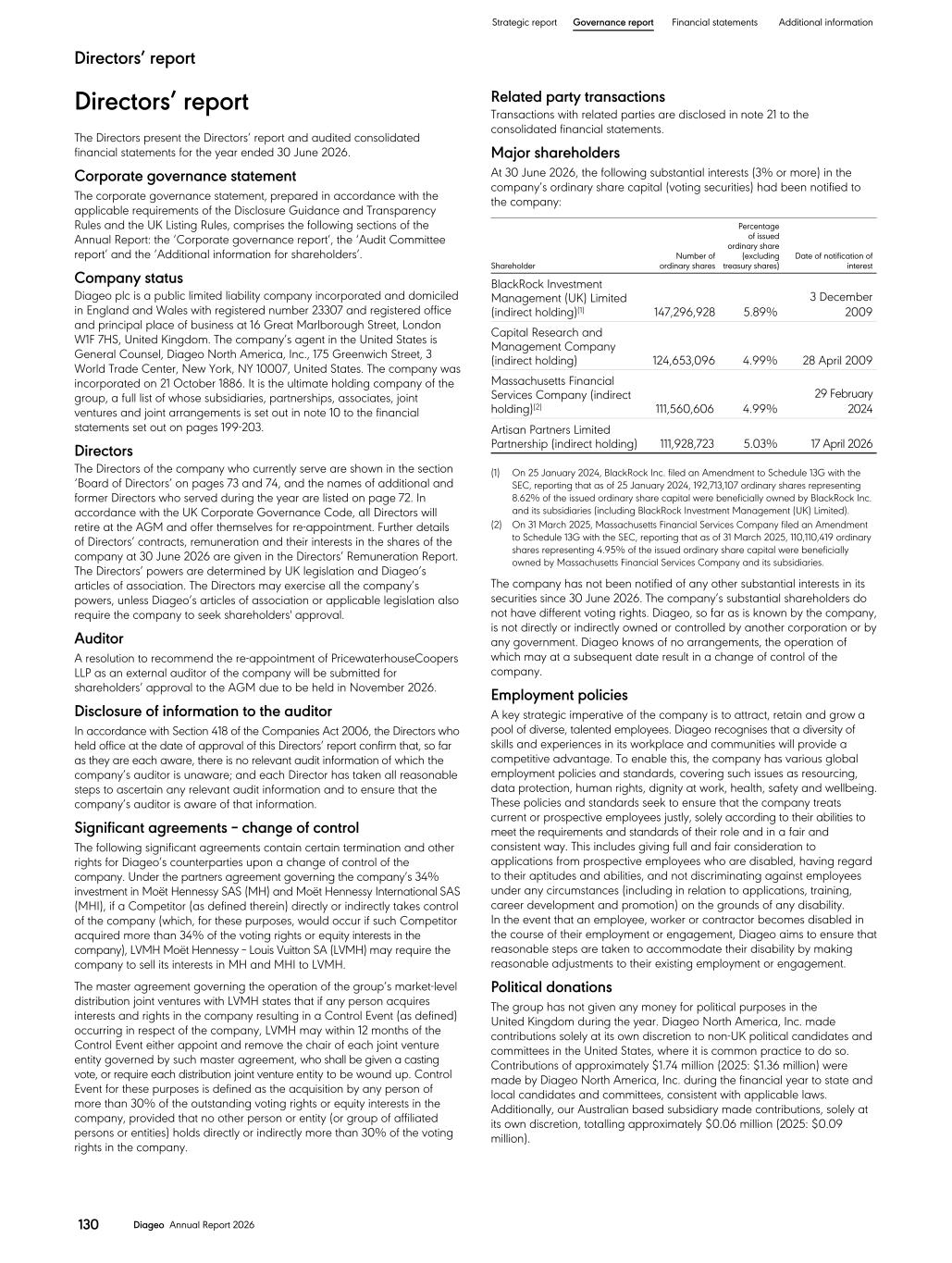
Directors’ report The Directors present the Directors’ report and audited consolidated financial statements for the year ended 30 June 2026. Corporate governance statement The corporate governance statement, prepared in accordance with the applicable requirements of the Disclosure Guidance and Transparency Rules and the UK Listing Rules, comprises the following sections of the Annual Report: the ‘Corporate governance report’, the ‘Audit Committee report’ and the ‘Additional information for shareholders’. Company status Diageo plc is a public limited liability company incorporated and domiciled in England and Wales with registered number 23307 and registered office and principal place of business at 16 Great Marlborough Street, London W1F 7HS, United Kingdom. The company’s agent in the United States is General Counsel, Diageo North America, Inc., 175 Greenwich Street, 3 World Trade Center, New York, NY 10007, United States. The company was incorporated on 21 October 1886. It is the ultimate holding company of the group, a full list of whose subsidiaries, partnerships, associates, joint ventures and joint arrangements is set out in note 10 to the financial statements set out on pages 199-203. Directors The Directors of the company who currently serve are shown in the section ‘Board of Directors’ on pages 73 and 74, and the names of additional and former Directors who served during the year are listed on page 72. In accordance with the UK Corporate Governance Code, all Directors will retire at the AGM and offer themselves for re-appointment. Further details of Directors’ contracts, remuneration and their interests in the shares of the company at 30 June 2026 are given in the Directors’ Remuneration Report. The Directors’ powers are determined by UK legislation and Diageo’s articles of association. The Directors may exercise all the company’s powers, unless Diageo’s articles of association or applicable legislation also require the company to seek shareholders' approval. Auditor A resolution to recommend the re-appointment of PricewaterhouseCoopers LLP as an external auditor of the company will be submitted for shareholders’ approval to the AGM due to be held in November 2026. Disclosure of information to the auditor In accordance with Section 418 of the Companies Act 2006, the Directors who held office at the date of approval of this Directors’ report confirm that, so far as they are each aware, there is no relevant audit information of which the company’s auditor is unaware; and each Director has taken all reasonable steps to ascertain any relevant audit information and to ensure that the company’s auditor is aware of that information. Significant agreements – change of control The following significant agreements contain certain termination and other rights for Diageo’s counterparties upon a change of control of the company. Under the partners agreement governing the company’s 34% investment in Moët Hennessy SAS (MH) and Moët Hennessy International SAS (MHI), if a Competitor (as defined therein) directly or indirectly takes control of the company (which, for these purposes, would occur if such Competitor acquired more than 34% of the voting rights or equity interests in the company), LVMH Moët Hennessy – Louis Vuitton SA (LVMH) may require the company to sell its interests in MH and MHI to LVMH. The master agreement governing the operation of the group’s market-level distribution joint ventures with LVMH states that if any person acquires interests and rights in the company resulting in a Control Event (as defined) occurring in respect of the company, LVMH may within 12 months of the Control Event either appoint and remove the chair of each joint venture entity governed by such master agreement, who shall be given a casting vote, or require each distribution joint venture entity to be wound up. Control Event for these purposes is defined as the acquisition by any person of more than 30% of the outstanding voting rights or equity interests in the company, provided that no other person or entity (or group of affiliated persons or entities) holds directly or indirectly more than 30% of the voting rights in the company. Related party transactions Transactions with related parties are disclosed in note 21 to the consolidated financial statements. Major shareholders At 30 June 2026, the following substantial interests (3% or more) in the company’s ordinary share capital (voting securities) had been notified to the company: BlackRock Investment Management (UK) Limited (indirect holding)(1) 147,296,928 5.89% 3 December 2009 Capital Research and Management Company (indirect holding) 124,653,096 4.99% 28 April 2009 Massachusetts Financial Services Company (indirect holding)(2) 111,560,606 4.99% 29 February 2024 Artisan Partners Limited Partnership (indirect holding) 111,928,723 5.03% 17 April 2026 Shareholder Number of ordinary shares Percentage of issued ordinary share (excluding treasury shares) Date of notification of interest (1) On 25 January 2024, BlackRock Inc. filed an Amendment to Schedule 13G with the SEC, reporting that as of 25 January 2024, 192,713,107 ordinary shares representing 8.62% of the issued ordinary share capital were beneficially owned by BlackRock Inc. and its subsidiaries (including BlackRock Investment Management (UK) Limited). (2) On 31 March 2025, Massachusetts Financial Services Company filed an Amendment to Schedule 13G with the SEC, reporting that as of 31 March 2025, 110,110,419 ordinary shares representing 4.95% of the issued ordinary share capital were beneficially owned by Massachusetts Financial Services Company and its subsidiaries. The company has not been notified of any other substantial interests in its securities since 30 June 2026. The company’s substantial shareholders do not have different voting rights. Diageo, so far as is known by the company, is not directly or indirectly owned or controlled by another corporation or by any government. Diageo knows of no arrangements, the operation of which may at a subsequent date result in a change of control of the company. Employment policies A key strategic imperative of the company is to attract, retain and grow a pool of diverse, talented employees. Diageo recognises that a diversity of skills and experiences in its workplace and communities will provide a competitive advantage. To enable this, the company has various global employment policies and standards, covering such issues as resourcing, data protection, human rights, dignity at work, health, safety and wellbeing. These policies and standards seek to ensure that the company treats current or prospective employees justly, solely according to their abilities to meet the requirements and standards of their role and in a fair and consistent way. This includes giving full and fair consideration to applications from prospective employees who are disabled, having regard to their aptitudes and abilities, and not discriminating against employees under any circumstances (including in relation to applications, training, career development and promotion) on the grounds of any disability. In the event that an employee, worker or contractor becomes disabled in the course of their employment or engagement, Diageo aims to ensure that reasonable steps are taken to accommodate their disability by making reasonable adjustments to their existing employment or engagement. Political donations The group has not given any money for political purposes in the United Kingdom during the year. Diageo North America, Inc. made contributions solely at its own discretion to non-UK political candidates and committees in the United States, where it is common practice to do so. Contributions of approximately $1.74 million (2025: $1.36 million) were made by Diageo North America, Inc. during the financial year to state and local candidates and committees, consistent with applicable laws. Additionally, our Australian based subsidiary made contributions, solely at its own discretion, totalling approximately $0.06 million (2025: $0.09 million). Strategic report Governance report Financial statements Additional information 130 Diageo Annual Report 2026 Directors’ report
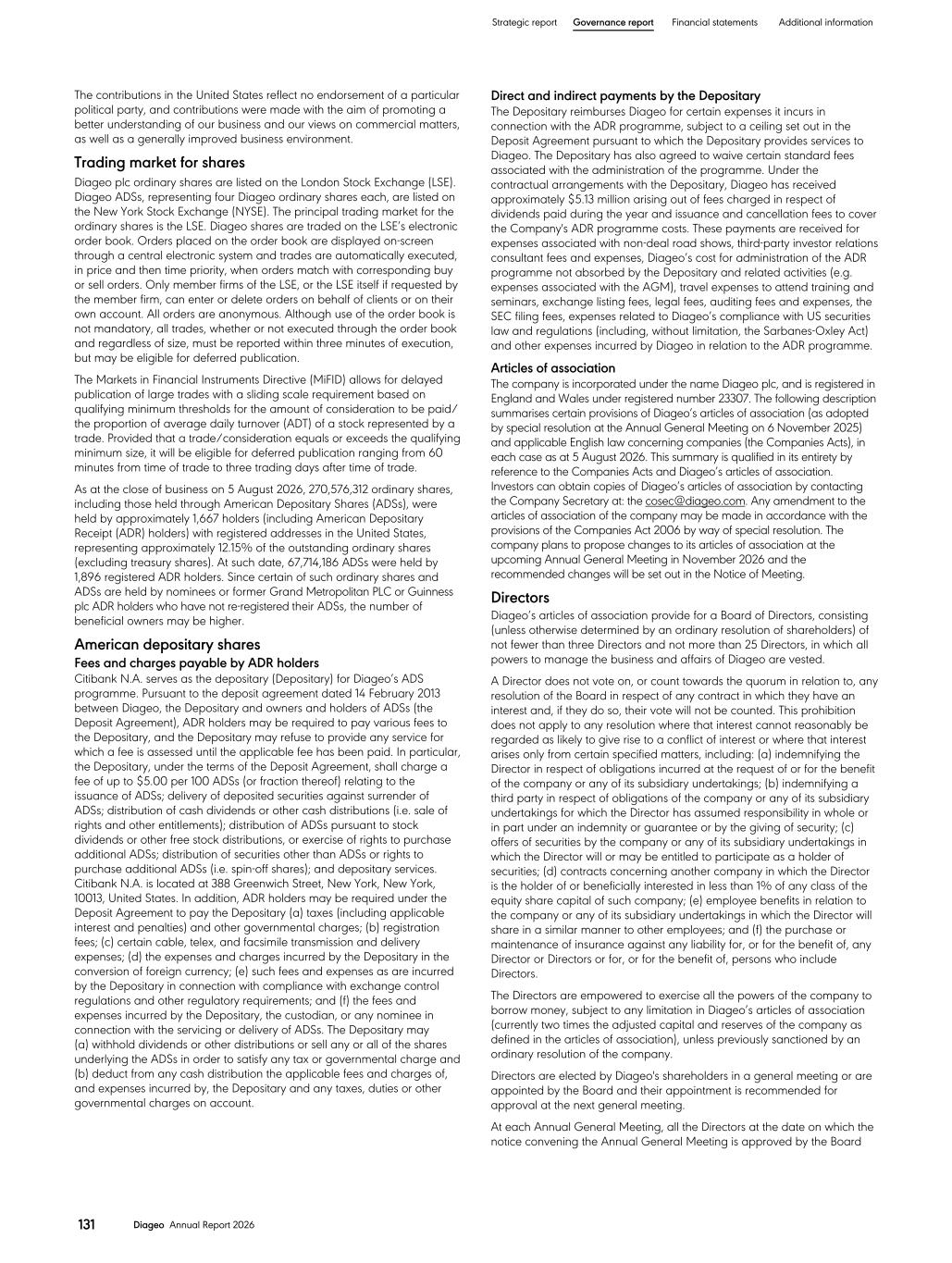
The contributions in the United States reflect no endorsement of a particular political party, and contributions were made with the aim of promoting a better understanding of our business and our views on commercial matters, as well as a generally improved business environment. Trading market for shares Diageo plc ordinary shares are listed on the London Stock Exchange (LSE). Diageo ADSs, representing four Diageo ordinary shares each, are listed on the New York Stock Exchange (NYSE). The principal trading market for the ordinary shares is the LSE. Diageo shares are traded on the LSE’s electronic order book. Orders placed on the order book are displayed on-screen through a central electronic system and trades are automatically executed, in price and then time priority, when orders match with corresponding buy or sell orders. Only member firms of the LSE, or the LSE itself if requested by the member firm, can enter or delete orders on behalf of clients or on their own account. All orders are anonymous. Although use of the order book is not mandatory, all trades, whether or not executed through the order book and regardless of size, must be reported within three minutes of execution, but may be eligible for deferred publication. The Markets in Financial Instruments Directive (MiFID) allows for delayed publication of large trades with a sliding scale requirement based on qualifying minimum thresholds for the amount of consideration to be paid/ the proportion of average daily turnover (ADT) of a stock represented by a trade. Provided that a trade/consideration equals or exceeds the qualifying minimum size, it will be eligible for deferred publication ranging from 60 minutes from time of trade to three trading days after time of trade. As at the close of business on 5 August 2026, 270,576,312 ordinary shares, including those held through American Depositary Shares (ADSs), were held by approximately 1,667 holders (including American Depositary Receipt (ADR) holders) with registered addresses in the United States, representing approximately 12.15% of the outstanding ordinary shares (excluding treasury shares). At such date, 67,714,186 ADSs were held by 1,896 registered ADR holders. Since certain of such ordinary shares and ADSs are held by nominees or former Grand Metropolitan PLC or Guinness plc ADR holders who have not re-registered their ADSs, the number of beneficial owners may be higher. American depositary shares Fees and charges payable by ADR holders Citibank N.A. serves as the depositary (Depositary) for Diageo’s ADS programme. Pursuant to the deposit agreement dated 14 February 2013 between Diageo, the Depositary and owners and holders of ADSs (the Deposit Agreement), ADR holders may be required to pay various fees to the Depositary, and the Depositary may refuse to provide any service for which a fee is assessed until the applicable fee has been paid. In particular, the Depositary, under the terms of the Deposit Agreement, shall charge a fee of up to $5.00 per 100 ADSs (or fraction thereof) relating to the issuance of ADSs; delivery of deposited securities against surrender of ADSs; distribution of cash dividends or other cash distributions (i.e. sale of rights and other entitlements); distribution of ADSs pursuant to stock dividends or other free stock distributions, or exercise of rights to purchase additional ADSs; distribution of securities other than ADSs or rights to purchase additional ADSs (i.e. spin-off shares); and depositary services. Citibank N.A. is located at 388 Greenwich Street, New York, New York, 10013, United States. In addition, ADR holders may be required under the Deposit Agreement to pay the Depositary (a) taxes (including applicable interest and penalties) and other governmental charges; (b) registration fees; (c) certain cable, telex, and facsimile transmission and delivery expenses; (d) the expenses and charges incurred by the Depositary in the conversion of foreign currency; (e) such fees and expenses as are incurred by the Depositary in connection with compliance with exchange control regulations and other regulatory requirements; and (f) the fees and expenses incurred by the Depositary, the custodian, or any nominee in connection with the servicing or delivery of ADSs. The Depositary may (a) withhold dividends or other distributions or sell any or all of the shares underlying the ADSs in order to satisfy any tax or governmental charge and (b) deduct from any cash distribution the applicable fees and charges of, and expenses incurred by, the Depositary and any taxes, duties or other governmental charges on account. Direct and indirect payments by the Depositary The Depositary reimburses Diageo for certain expenses it incurs in connection with the ADR programme, subject to a ceiling set out in the Deposit Agreement pursuant to which the Depositary provides services to Diageo. The Depositary has also agreed to waive certain standard fees associated with the administration of the programme. Under the contractual arrangements with the Depositary, Diageo has received approximately $5.13 million arising out of fees charged in respect of dividends paid during the year and issuance and cancellation fees to cover the Company's ADR programme costs. These payments are received for expenses associated with non-deal road shows, third-party investor relations consultant fees and expenses, Diageo’s cost for administration of the ADR programme not absorbed by the Depositary and related activities (e.g. expenses associated with the AGM), travel expenses to attend training and seminars, exchange listing fees, legal fees, auditing fees and expenses, the SEC filing fees, expenses related to Diageo’s compliance with US securities law and regulations (including, without limitation, the Sarbanes-Oxley Act) and other expenses incurred by Diageo in relation to the ADR programme. Articles of association The company is incorporated under the name Diageo plc, and is registered in England and Wales under registered number 23307. The following description summarises certain provisions of Diageo’s articles of association (as adopted by special resolution at the Annual General Meeting on 6 November 2025) and applicable English law concerning companies (the Companies Acts), in each case as at 5 August 2026. This summary is qualified in its entirety by reference to the Companies Acts and Diageo’s articles of association. Investors can obtain copies of Diageo’s articles of association by contacting the Company Secretary at: the cosec@diageo.com. Any amendment to the articles of association of the company may be made in accordance with the provisions of the Companies Act 2006 by way of special resolution. The company plans to propose changes to its articles of association at the upcoming Annual General Meeting in November 2026 and the recommended changes will be set out in the Notice of Meeting. Directors Diageo’s articles of association provide for a Board of Directors, consisting (unless otherwise determined by an ordinary resolution of shareholders) of not fewer than three Directors and not more than 25 Directors, in which all powers to manage the business and affairs of Diageo are vested. A Director does not vote on, or count towards the quorum in relation to, any resolution of the Board in respect of any contract in which they have an interest and, if they do so, their vote will not be counted. This prohibition does not apply to any resolution where that interest cannot reasonably be regarded as likely to give rise to a conflict of interest or where that interest arises only from certain specified matters, including: (a) indemnifying the Director in respect of obligations incurred at the request of or for the benefit of the company or any of its subsidiary undertakings; (b) indemnifying a third party in respect of obligations of the company or any of its subsidiary undertakings for which the Director has assumed responsibility in whole or in part under an indemnity or guarantee or by the giving of security; (c) offers of securities by the company or any of its subsidiary undertakings in which the Director will or may be entitled to participate as a holder of securities; (d) contracts concerning another company in which the Director is the holder of or beneficially interested in less than 1% of any class of the equity share capital of such company; (e) employee benefits in relation to the company or any of its subsidiary undertakings in which the Director will share in a similar manner to other employees; and (f) the purchase or maintenance of insurance against any liability for, or for the benefit of, any Director or Directors or for, or for the benefit of, persons who include Directors. The Directors are empowered to exercise all the powers of the company to borrow money, subject to any limitation in Diageo’s articles of association (currently two times the adjusted capital and reserves of the company as defined in the articles of association), unless previously sanctioned by an ordinary resolution of the company. Directors are elected by Diageo's shareholders in a general meeting or are appointed by the Board and their appointment is recommended for approval at the next general meeting. At each Annual General Meeting, all the Directors at the date on which the notice convening the Annual General Meeting is approved by the Board Strategic report Governance report Financial statements Additional information 131 Diageo Annual Report 2026
retire from office and may offer themselves for re-election by shareholders. There is no age limit requirement in respect of directors. Directors may also be removed before the expiration of their term of office in accordance with the provisions of the Companies Acts. Directors are not required to hold any shares of the company by way of qualification. Voting rights At Diageo’s Annual General Meetings, voting is usually conducted on a poll. On a poll, every shareholder who is present in person or by proxy has one vote for every share held by that shareholder, but a shareholder or proxy entitled to more than one vote need not cast all his/her votes or cast them all in the same way (the deadline for exercising voting rights by proxy is set out in the form of proxy). In line with Diageo’s articles of association and the Companies Acts, matters are recommended to shareholders for approval as: • ordinary resolutions, which include resolutions for the election, re-election and removal of Directors, the declaration of final dividends, the appointment and re-appointment of the external auditor, the remuneration report and remuneration policy, and the granting of authority to allot shares; and • special resolutions, which include resolutions for the amendment of Diageo’s articles of association, resolutions relating to the disapplication of pre-emption rights, and resolutions modifying the rights of any class of Diageo’s shares at a meeting of the holders of such class. An ordinary resolution requires a simple majority of votes cast in favour in order to be passed, while special resolutions require not less than three- quarters of the votes to be cast in favour in order to be passed. A shareholder is not entitled to vote at any general meeting or class meeting if they have been served with a restriction notice (as defined in Diageo's articles of association) after failure to provide Diageo with information concerning interests in those shares required to be provided under the Companies Acts. Pre-emption rights and new issues of shares While holders of ordinary shares have no pre-emptive rights under Diageo’s articles of association, the ability of the Directors to cause Diageo to issue shares, securities convertible into shares or rights to shares, otherwise than pursuant to an employee share scheme, is restricted. Under the Companies Acts, with certain exceptions, the directors need to seek shareholder approval to exercise the power to allot shares, but which in either event cannot last for more than five years. Under the Companies Acts, Diageo may also not allot shares for cash (otherwise than pursuant to an employee share scheme) without first making an offer to existing shareholders to allot shares to them on the same or more favourable terms in proportion to their respective shareholdings, unless this requirement is waived by a special resolution of the shareholders. Repurchase of shares Subject to authorisation by special resolution, Diageo may purchase its own shares in accordance with the Companies Acts. Any shares which have been bought back may be held as treasury shares or will be cancelled immediately upon completion of the purchase, thereby reducing the amount of Diageo’s issued share capital. The Directors’ authority to buy back shares (up to a maximum of 222,565,850 ordinary shares) was renewed at last year’s AGM and will expire at the end of the AGM in 2026. No shares have been repurchased during the year under review. The Directors will propose to seek new authority at the forthcoming AGM, as set out in the Notice of Meeting. This authority, unless renewed, will expire at the conclusion of the AGM in 2027 or if earlier, 15 months from the passing of the resolution. The Board would only authorise such purchases after careful consideration, taking account of other investment opportunities, appropriate gearing levels, the overall financial position of the group and whether the effect would be an increase in earnings per share and in the best interests of shareholders generally. Restrictions on transfers of shares The Board may decline to register a transfer of a certificated Diageo share unless the instrument of transfer (a) is duly stamped or certified or otherwise shown to the satisfaction of the Board to be exempt from stamp duty, and is accompanied by the relevant share certificate and such other evidence of the right to transfer as the Board may reasonably require, (b) is in respect of only one class of share and (c) if to joint transferees, is in favour of not more than four such transferees. Registration of a transfer of an uncertificated share may be refused in the circumstances set out in the uncertificated securities rules (as defined in Diageo’s articles of association) and where, in the case of a transfer to joint holders, the number of joint holders to whom the uncertificated share is to be transferred exceeds four. The Board may decline to register a transfer of any of Diageo’s certificated shares by a person with a 0.25% interest (as defined in Diageo’s articles of association) if such a person has been served with a restriction notice (as defined in Diageo’s articles of association) after failure to provide Diageo with information concerning interests in those shares required to be provided under the Companies Acts, unless the transfer is shown to the Board to be pursuant to an arm’s-length sale (as defined in Diageo’s articles of association). Strategic report Governance report Financial statements Additional information Directors' report continued 132 Diageo Annual Report 2026
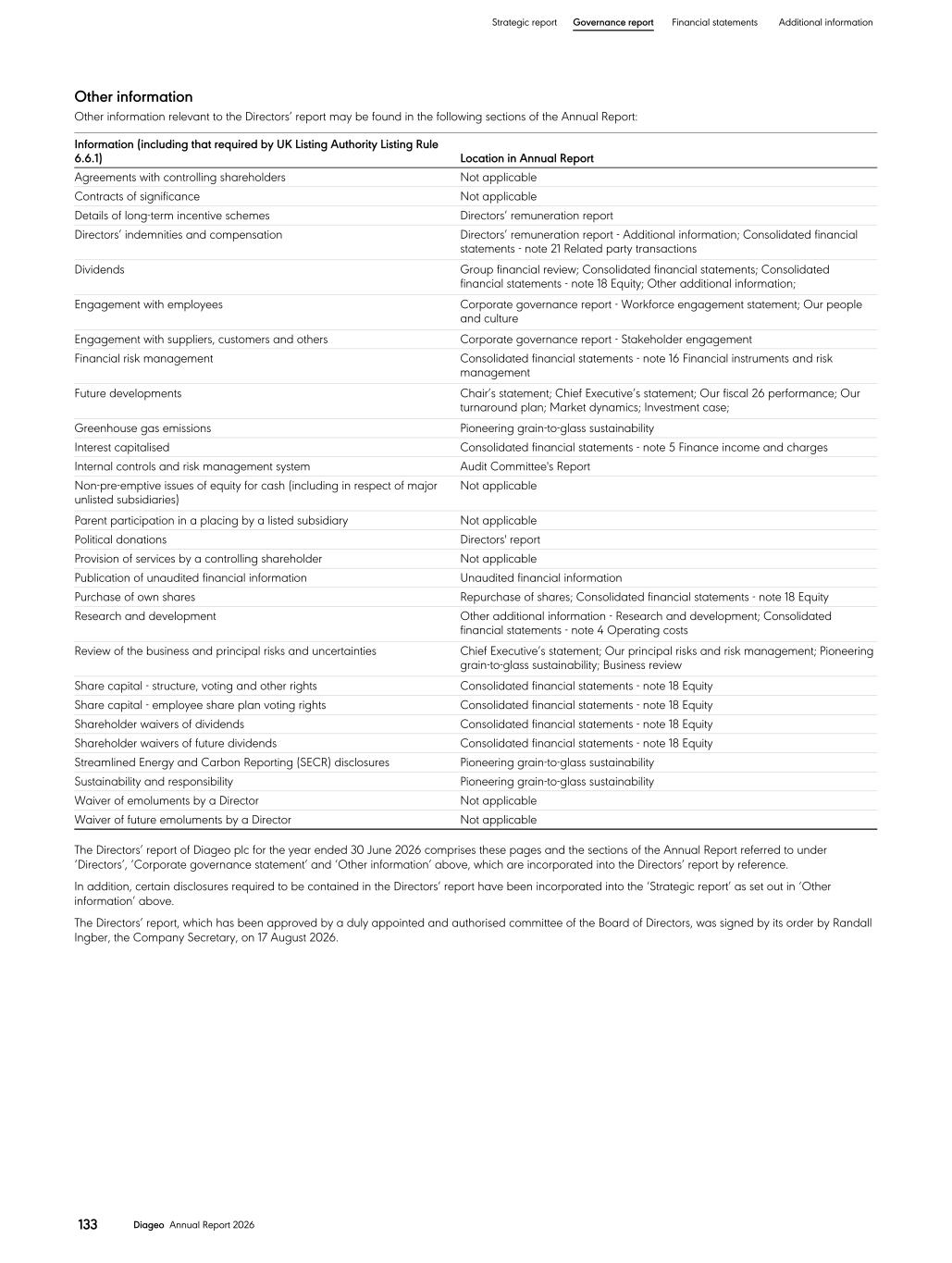
Other information Other information relevant to the Directors’ report may be found in the following sections of the Annual Report: Information (including that required by UK Listing Authority Listing Rule 6.6.1) Location in Annual Report Agreements with controlling shareholders Not applicable Contracts of significance Not applicable Details of long-term incentive schemes Directors’ remuneration report Directors’ indemnities and compensation Directors’ remuneration report - Additional information; Consolidated financial statements - note 21 Related party transactions Dividends Group financial review; Consolidated financial statements; Consolidated financial statements - note 18 Equity; Other additional information; Engagement with employees Corporate governance report - Workforce engagement statement; Our people and culture Engagement with suppliers, customers and others Corporate governance report - Stakeholder engagement Financial risk management Consolidated financial statements - note 16 Financial instruments and risk management Future developments Chair’s statement; Chief Executive’s statement; Our fiscal 26 performance; Our turnaround plan; Market dynamics; Investment case; Greenhouse gas emissions Pioneering grain-to-glass sustainability Interest capitalised Consolidated financial statements - note 5 Finance income and charges Internal controls and risk management system Audit Committee's Report Non-pre-emptive issues of equity for cash (including in respect of major unlisted subsidiaries) Not applicable Parent participation in a placing by a listed subsidiary Not applicable Political donations Directors' report Provision of services by a controlling shareholder Not applicable Publication of unaudited financial information Unaudited financial information Purchase of own shares Repurchase of shares; Consolidated financial statements - note 18 Equity Research and development Other additional information - Research and development; Consolidated financial statements - note 4 Operating costs Review of the business and principal risks and uncertainties Chief Executive’s statement; Our principal risks and risk management; Pioneering grain-to-glass sustainability; Business review Share capital - structure, voting and other rights Consolidated financial statements - note 18 Equity Share capital - employee share plan voting rights Consolidated financial statements - note 18 Equity Shareholder waivers of dividends Consolidated financial statements - note 18 Equity Shareholder waivers of future dividends Consolidated financial statements - note 18 Equity Streamlined Energy and Carbon Reporting (SECR) disclosures Pioneering grain-to-glass sustainability Sustainability and responsibility Pioneering grain-to-glass sustainability Waiver of emoluments by a Director Not applicable Waiver of future emoluments by a Director Not applicable The Directors’ report of Diageo plc for the year ended 30 June 2026 comprises these pages and the sections of the Annual Report referred to under ‘Directors’, ‘Corporate governance statement’ and ‘Other information’ above, which are incorporated into the Directors’ report by reference. In addition, certain disclosures required to be contained in the Directors’ report have been incorporated into the ‘Strategic report’ as set out in ‘Other information’ above. The Directors’ report, which has been approved by a duly appointed and authorised committee of the Board of Directors, was signed by its order by Randall Ingber, the Company Secretary, on 17 August 2026. Strategic report Governance report Financial statements Additional information 133 Diageo Annual Report 2026
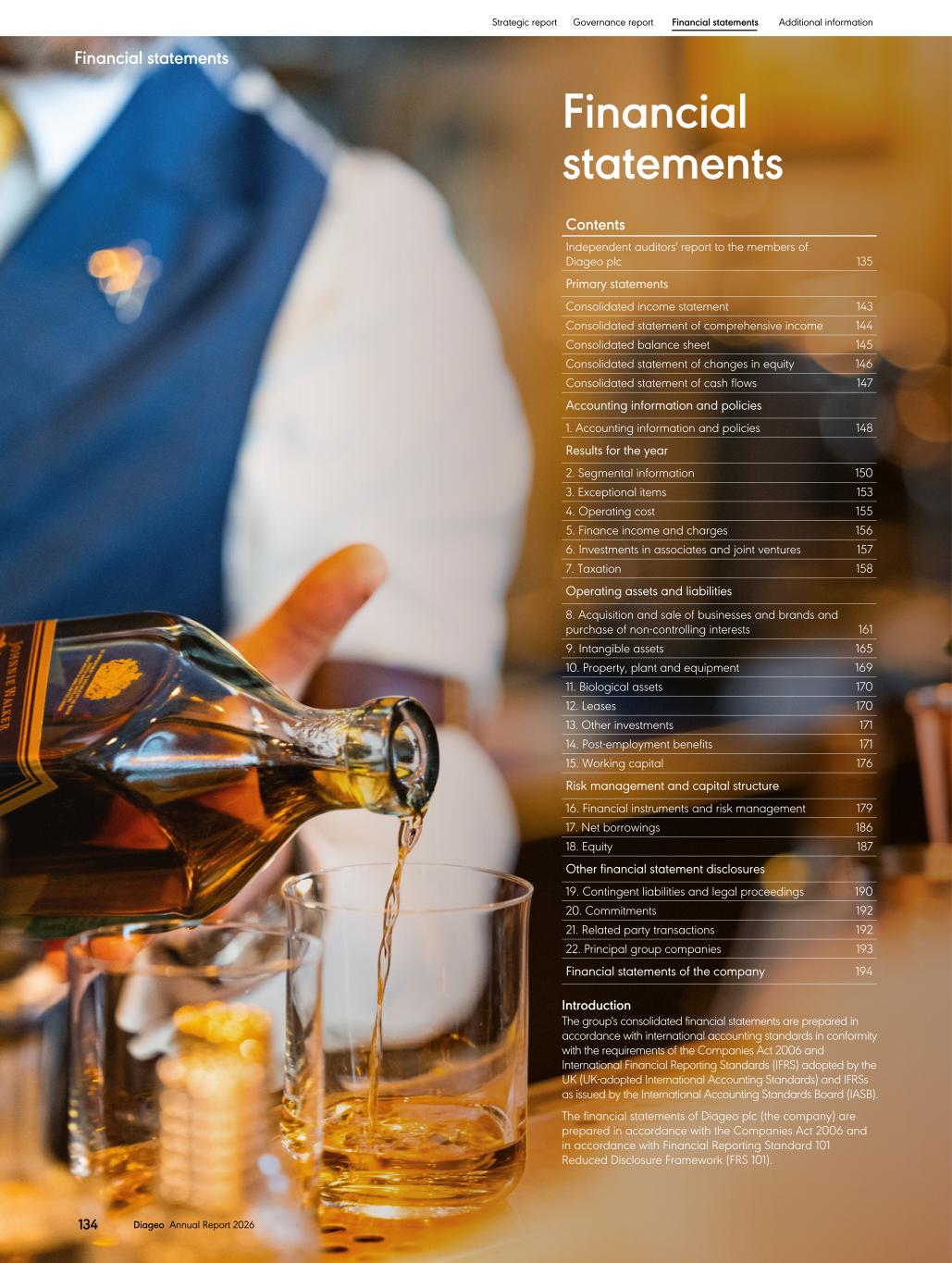
Financial statements Contents Independent auditors' report to the members of Diageo plc 135 Primary statements Consolidated income statement 143 Consolidated statement of comprehensive income 144 Consolidated balance sheet 145 Consolidated statement of changes in equity 146 Consolidated statement of cash flows 147 Accounting information and policies 1. Accounting information and policies 148 Results for the year 2. Segmental information 150 3. Exceptional items 153 4. Operating cost 155 5. Finance income and charges 156 6. Investments in associates and joint ventures 157 7. Taxation 158 Operating assets and liabilities 8. Acquisition and sale of businesses and brands and purchase of non-controlling interests 161 9. Intangible assets 165 10. Property, plant and equipment 169 11. Biological assets 170 12. Leases 170 13. Other investments 171 14. Post-employment benefits 171 15. Working capital 176 Risk management and capital structure 16. Financial instruments and risk management 179 17. Net borrowings 186 18. Equity 187 Other financial statement disclosures 19. Contingent liabilities and legal proceedings 190 20. Commitments 192 21. Related party transactions 192 22. Principal group companies 193 Financial statements of the company 194 Introduction The group's consolidated financial statements are prepared in accordance with international accounting standards in conformity with the requirements of the Companies Act 2006 and International Financial Reporting Standards (IFRS) adopted by the UK (UK-adopted International Accounting Standards) and IFRSs as issued by the International Accounting Standards Board (IASB). The financial statements of Diageo plc (the company) are prepared in accordance with the Companies Act 2006 and in accordance with Financial Reporting Standard 101 Reduced Disclosure Framework (FRS 101). Strategic report Governance report Financial statements Additional information 134 Diageo Annual Report 2026 Financial statements
Independent auditors' report to the members of Diageo plc Report on the audit of the financial statements Opinion In our opinion: • Diageo plc’s (‘‘Diageo’’) group consolidated financial statements and company financial statements (the “financial statements”) give a true and fair view of the state of the group’s and of the company’s affairs as at 30 June 2026 and of the group’s profit and the group’s cash flows for the year then ended; • the group consolidated financial statements have been properly prepared in accordance with UK-adopted international accounting standards as applied in accordance with the provisions of the Companies Act 2006; • the company financial statements have been properly prepared in accordance with United Kingdom Generally Accepted Accounting Practice (United Kingdom Accounting Standards, including FRS 101 “Reduced Disclosure Framework”, and applicable law); and • the financial statements have been prepared in accordance with the requirements of the Companies Act 2006. We have audited the financial statements, included within the Annual Report, which comprise: • the consolidated and company balance sheets as at 30 June 2026; • the consolidated income statement; • the consolidated statement of comprehensive income; • the consolidated statement of cash flows; • the consolidated and company statements of changes in equity for the year then ended; and • the notes to the financial statements, comprising material accounting policy information and other explanatory information. Our opinion is consistent with our reporting to the Audit Committee. Separate opinion in relation to IFRSs as issued by the IASB As explained in note 1(a) to the financial statements, the group, in addition to applying UK-adopted international accounting standards, has also applied international financial reporting standards (IFRSs) as issued by the International Accounting Standards Board (IASB). In our opinion, the group consolidated financial statements have been properly prepared in accordance with IFRSs as issued by the IASB. Basis for opinion We conducted our audit in accordance with International Standards on Auditing (UK) (“ISAs (UK)”) and applicable law. Our responsibilities under ISAs (UK) are further described in the Auditors’ responsibilities for the audit of the financial statements section of our report. We believe that the audit evidence we have obtained is sufficient and appropriate to provide a basis for our opinion. Independence We remained independent of the group in accordance with the ethical requirements that are relevant to our audit of the financial statements in the UK, which includes the FRC’s Ethical Standard, as applicable to listed public interest entities, and we have fulfilled our other ethical responsibilities in accordance with these requirements. To the best of our knowledge and belief, we declare that non-audit services prohibited by the FRC’s Ethical Standard were not provided. Other than those disclosed in note 4(b) of the group consolidated financial statements, we have provided no non-audit services to the company or its controlled undertakings in the period under audit. Our audit approach Overview Audit scope • We identified six components which required a full scope audit over their financial information due to their size or risk characteristics. Specific audit procedures and/or an audit over certain financial statement line items were performed at a further four components. In addition, audit procedures at the corporate function which included the group consolidation and areas of judgement (including taxation, goodwill, brand and other intangible asset impairment, treasury activities and post-retirement benefits) were directly performed by the group audit team. • The audit work performed accounted for 68% of sales and 84% of the group's profit before tax and exceptional items. Key audit matters • Carrying value of goodwill, brands and investments in associates and joint ventures (group) • Uncertain tax positions in respect of indirect taxes in Brazil (group) • Valuation of post-employment benefit liabilities (group and company) • Carrying value of investments in subsidiary undertakings (company) Materiality • Overall group materiality: $250m (2025: $250m) based on 5% of profit before tax and exceptional items. • Overall company materiality: $259m (2025: $342m) based on 0.5% of net assets. • Performance materiality: $187m (2025: $188m) (group) and $194m (2025: $257m) (company). Strategic report Governance report Financial statements Additional information 135 Diageo Annual Report 2026 Independent auditors' report to the members of Diageo plc
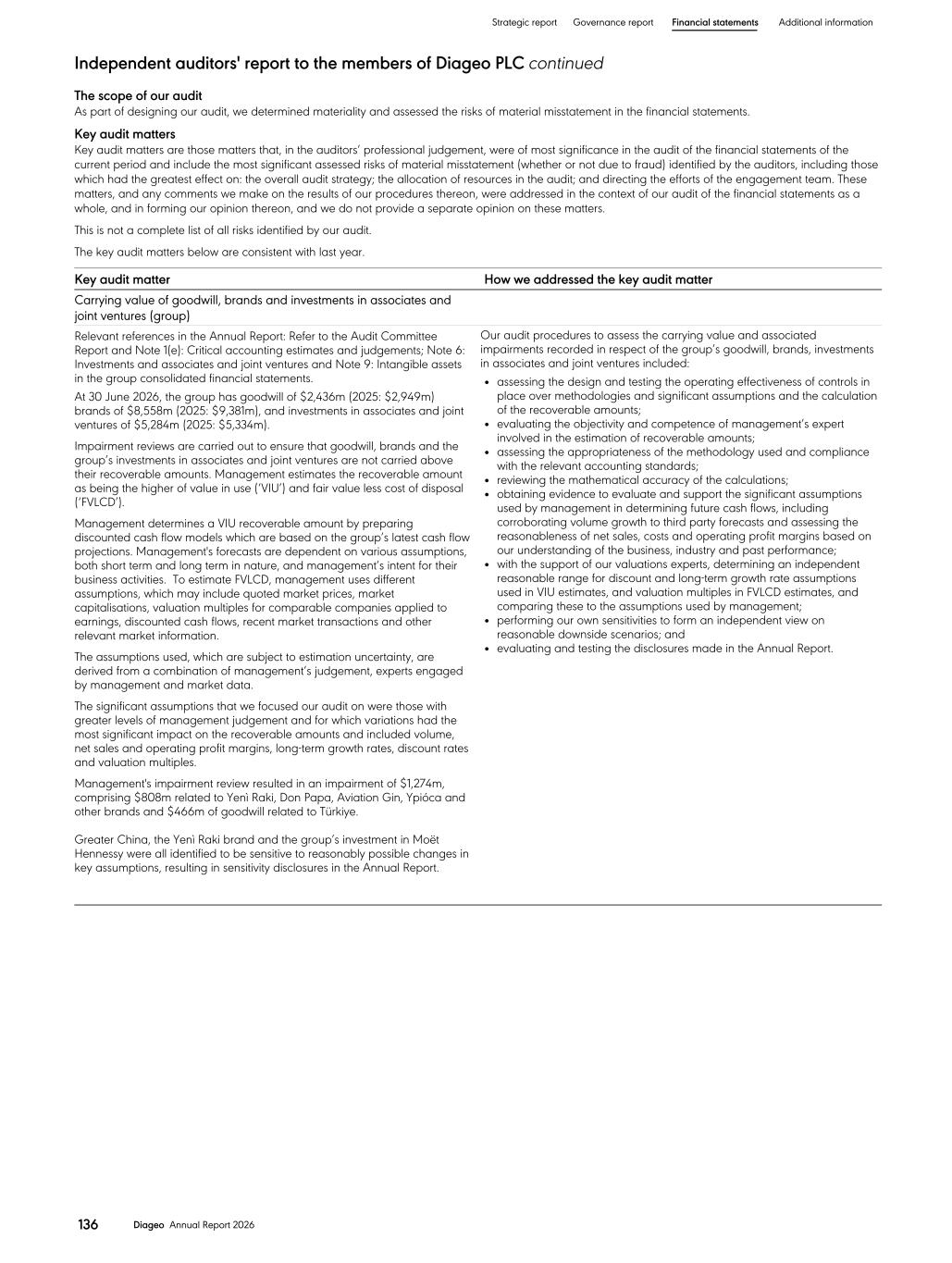
The scope of our audit As part of designing our audit, we determined materiality and assessed the risks of material misstatement in the financial statements. Key audit matters Key audit matters are those matters that, in the auditors’ professional judgement, were of most significance in the audit of the financial statements of the current period and include the most significant assessed risks of material misstatement (whether or not due to fraud) identified by the auditors, including those which had the greatest effect on: the overall audit strategy; the allocation of resources in the audit; and directing the efforts of the engagement team. These matters, and any comments we make on the results of our procedures thereon, were addressed in the context of our audit of the financial statements as a whole, and in forming our opinion thereon, and we do not provide a separate opinion on these matters. This is not a complete list of all risks identified by our audit. The key audit matters below are consistent with last year. Key audit matter How we addressed the key audit matter Carrying value of goodwill, brands and investments in associates and joint ventures (group) Relevant references in the Annual Report: Refer to the Audit Committee Report and Note 1(e): Critical accounting estimates and judgements; Note 6: Investments and associates and joint ventures and Note 9: Intangible assets in the group consolidated financial statements. At 30 June 2026, the group has goodwill of $2,436m (2025: $2,949m) brands of $8,558m (2025: $9,381m), and investments in associates and joint ventures of $5,284m (2025: $5,334m). Impairment reviews are carried out to ensure that goodwill, brands and the group’s investments in associates and joint ventures are not carried above their recoverable amounts. Management estimates the recoverable amount as being the higher of value in use (‘VIU’) and fair value less cost of disposal (‘FVLCD’). Management determines a VIU recoverable amount by preparing discounted cash flow models which are based on the group’s latest cash flow projections. Management's forecasts are dependent on various assumptions, both short term and long term in nature, and management’s intent for their business activities. To estimate FVLCD, management uses different assumptions, which may include quoted market prices, market capitalisations, valuation multiples for comparable companies applied to earnings, discounted cash flows, recent market transactions and other relevant market information. The assumptions used, which are subject to estimation uncertainty, are derived from a combination of management’s judgement, experts engaged by management and market data. The significant assumptions that we focused our audit on were those with greater levels of management judgement and for which variations had the most significant impact on the recoverable amounts and included volume, net sales and operating profit margins, long-term growth rates, discount rates and valuation multiples. Management's impairment review resulted in an impairment of $1,274m, comprising $808m related to Yenì Raki, Don Papa, Aviation Gin, Ypióca and other brands and $466m of goodwill related to Türkiye. Greater China, the Yenì Raki brand and the group’s investment in Moët Hennessy were all identified to be sensitive to reasonably possible changes in key assumptions, resulting in sensitivity disclosures in the Annual Report. Our audit procedures to assess the carrying value and associated impairments recorded in respect of the group’s goodwill, brands, investments in associates and joint ventures included: • assessing the design and testing the operating effectiveness of controls in place over methodologies and significant assumptions and the calculation of the recoverable amounts; • evaluating the objectivity and competence of management’s expert involved in the estimation of recoverable amounts; • assessing the appropriateness of the methodology used and compliance with the relevant accounting standards; • reviewing the mathematical accuracy of the calculations; • obtaining evidence to evaluate and support the significant assumptions used by management in determining future cash flows, including corroborating volume growth to third party forecasts and assessing the reasonableness of net sales, costs and operating profit margins based on our understanding of the business, industry and past performance; • with the support of our valuations experts, determining an independent reasonable range for discount and long-term growth rate assumptions used in VIU estimates, and valuation multiples in FVLCD estimates, and comparing these to the assumptions used by management; • performing our own sensitivities to form an independent view on reasonable downside scenarios; and • evaluating and testing the disclosures made in the Annual Report. Strategic report Governance report Financial statements Additional information Independent auditors' report to the members of Diageo PLC continued 136 Diageo Annual Report 2026
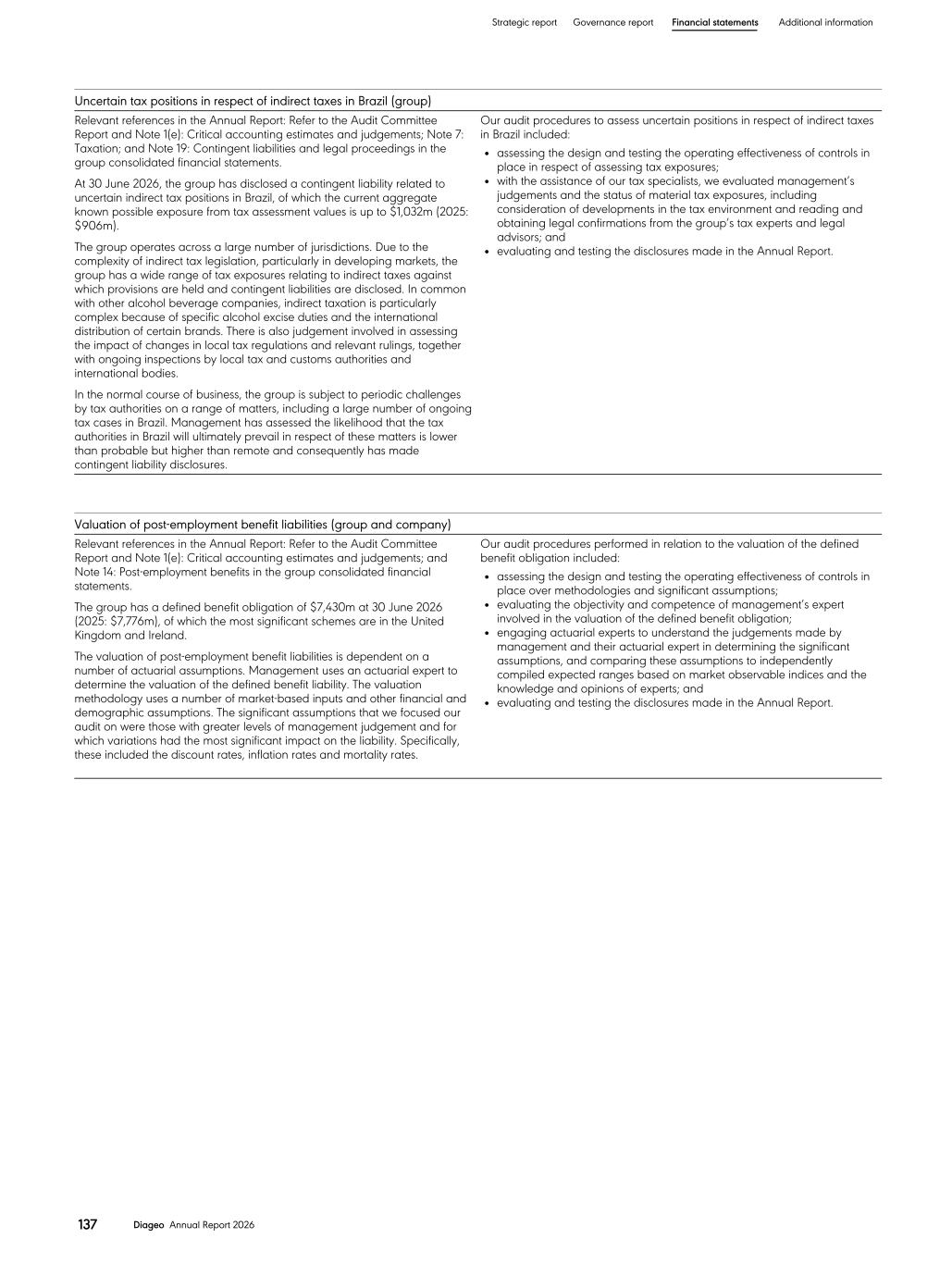
Uncertain tax positions in respect of indirect taxes in Brazil (group) Relevant references in the Annual Report: Refer to the Audit Committee Report and Note 1(e): Critical accounting estimates and judgements; Note 7: Taxation; and Note 19: Contingent liabilities and legal proceedings in the group consolidated financial statements. At 30 June 2026, the group has disclosed a contingent liability related to uncertain indirect tax positions in Brazil, of which the current aggregate known possible exposure from tax assessment values is up to $1,032m (2025: $906m). The group operates across a large number of jurisdictions. Due to the complexity of indirect tax legislation, particularly in developing markets, the group has a wide range of tax exposures relating to indirect taxes against which provisions are held and contingent liabilities are disclosed. In common with other alcohol beverage companies, indirect taxation is particularly complex because of specific alcohol excise duties and the international distribution of certain brands. There is also judgement involved in assessing the impact of changes in local tax regulations and relevant rulings, together with ongoing inspections by local tax and customs authorities and international bodies. In the normal course of business, the group is subject to periodic challenges by tax authorities on a range of matters, including a large number of ongoing tax cases in Brazil. Management has assessed the likelihood that the tax authorities in Brazil will ultimately prevail in respect of these matters is lower than probable but higher than remote and consequently has made contingent liability disclosures. Our audit procedures to assess uncertain positions in respect of indirect taxes in Brazil included: • assessing the design and testing the operating effectiveness of controls in place in respect of assessing tax exposures; • with the assistance of our tax specialists, we evaluated management’s judgements and the status of material tax exposures, including consideration of developments in the tax environment and reading and obtaining legal confirmations from the group’s tax experts and legal advisors; and • evaluating and testing the disclosures made in the Annual Report. Valuation of post-employment benefit liabilities (group and company) Relevant references in the Annual Report: Refer to the Audit Committee Report and Note 1(e): Critical accounting estimates and judgements; and Note 14: Post-employment benefits in the group consolidated financial statements. The group has a defined benefit obligation of $7,430m at 30 June 2026 (2025: $7,776m), of which the most significant schemes are in the United Kingdom and Ireland. The valuation of post-employment benefit liabilities is dependent on a number of actuarial assumptions. Management uses an actuarial expert to determine the valuation of the defined benefit liability. The valuation methodology uses a number of market-based inputs and other financial and demographic assumptions. The significant assumptions that we focused our audit on were those with greater levels of management judgement and for which variations had the most significant impact on the liability. Specifically, these included the discount rates, inflation rates and mortality rates. Our audit procedures performed in relation to the valuation of the defined benefit obligation included: • assessing the design and testing the operating effectiveness of controls in place over methodologies and significant assumptions; • evaluating the objectivity and competence of management’s expert involved in the valuation of the defined benefit obligation; • engaging actuarial experts to understand the judgements made by management and their actuarial expert in determining the significant assumptions, and comparing these assumptions to independently compiled expected ranges based on market observable indices and the knowledge and opinions of experts; and • evaluating and testing the disclosures made in the Annual Report. Strategic report Governance report Financial statements Additional information 137 Diageo Annual Report 2026
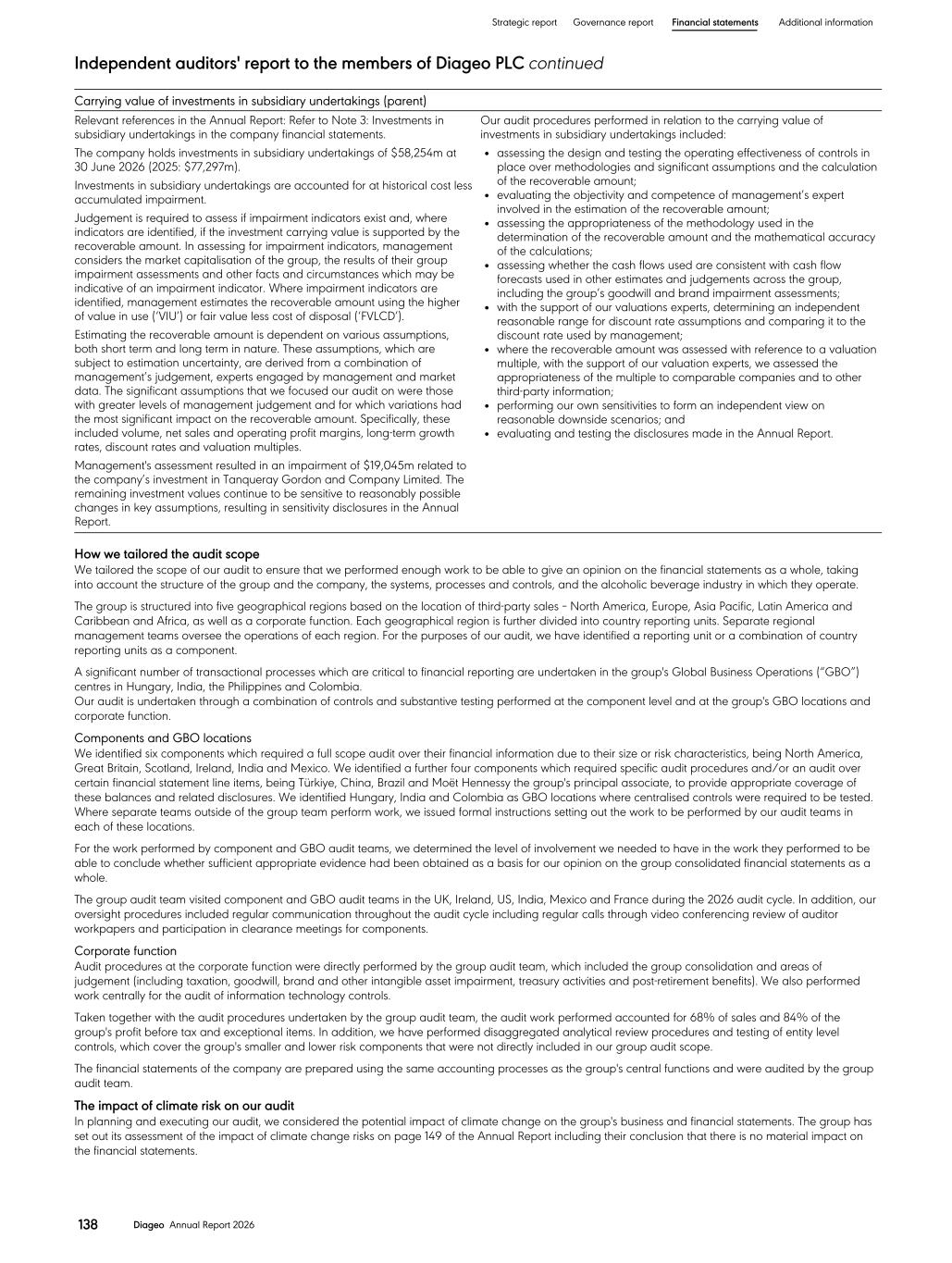
Carrying value of investments in subsidiary undertakings (parent) Relevant references in the Annual Report: Refer to Note 3: Investments in subsidiary undertakings in the company financial statements. The company holds investments in subsidiary undertakings of $58,254m at 30 June 2026 (2025: $77,297m). Investments in subsidiary undertakings are accounted for at historical cost less accumulated impairment. Judgement is required to assess if impairment indicators exist and, where indicators are identified, if the investment carrying value is supported by the recoverable amount. In assessing for impairment indicators, management considers the market capitalisation of the group, the results of their group impairment assessments and other facts and circumstances which may be indicative of an impairment indicator. Where impairment indicators are identified, management estimates the recoverable amount using the higher of value in use (‘VIU’) or fair value less cost of disposal (‘FVLCD’). Estimating the recoverable amount is dependent on various assumptions, both short term and long term in nature. These assumptions, which are subject to estimation uncertainty, are derived from a combination of management’s judgement, experts engaged by management and market data. The significant assumptions that we focused our audit on were those with greater levels of management judgement and for which variations had the most significant impact on the recoverable amount. Specifically, these included volume, net sales and operating profit margins, long-term growth rates, discount rates and valuation multiples. Management's assessment resulted in an impairment of $19,045m related to the company’s investment in Tanqueray Gordon and Company Limited. The remaining investment values continue to be sensitive to reasonably possible changes in key assumptions, resulting in sensitivity disclosures in the Annual Report. Our audit procedures performed in relation to the carrying value of investments in subsidiary undertakings included: • assessing the design and testing the operating effectiveness of controls in place over methodologies and significant assumptions and the calculation of the recoverable amount; • evaluating the objectivity and competence of management’s expert involved in the estimation of the recoverable amount; • assessing the appropriateness of the methodology used in the determination of the recoverable amount and the mathematical accuracy of the calculations; • assessing whether the cash flows used are consistent with cash flow forecasts used in other estimates and judgements across the group, including the group’s goodwill and brand impairment assessments; • with the support of our valuations experts, determining an independent reasonable range for discount rate assumptions and comparing it to the discount rate used by management; • where the recoverable amount was assessed with reference to a valuation multiple, with the support of our valuation experts, we assessed the appropriateness of the multiple to comparable companies and to other third-party information; • performing our own sensitivities to form an independent view on reasonable downside scenarios; and • evaluating and testing the disclosures made in the Annual Report. How we tailored the audit scope We tailored the scope of our audit to ensure that we performed enough work to be able to give an opinion on the financial statements as a whole, taking into account the structure of the group and the company, the systems, processes and controls, and the alcoholic beverage industry in which they operate. The group is structured into five geographical regions based on the location of third-party sales – North America, Europe, Asia Pacific, Latin America and Caribbean and Africa, as well as a corporate function. Each geographical region is further divided into country reporting units. Separate regional management teams oversee the operations of each region. For the purposes of our audit, we have identified a reporting unit or a combination of country reporting units as a component. A significant number of transactional processes which are critical to financial reporting are undertaken in the group's Global Business Operations (“GBO”) centres in Hungary, India, the Philippines and Colombia. Our audit is undertaken through a combination of controls and substantive testing performed at the component level and at the group's GBO locations and corporate function. Components and GBO locations We identified six components which required a full scope audit over their financial information due to their size or risk characteristics, being North America, Great Britain, Scotland, Ireland, India and Mexico. We identified a further four components which required specific audit procedures and/or an audit over certain financial statement line items, being Türkiye, China, Brazil and Moët Hennessy the group's principal associate, to provide appropriate coverage of these balances and related disclosures. We identified Hungary, India and Colombia as GBO locations where centralised controls were required to be tested. Where separate teams outside of the group team perform work, we issued formal instructions setting out the work to be performed by our audit teams in each of these locations. For the work performed by component and GBO audit teams, we determined the level of involvement we needed to have in the work they performed to be able to conclude whether sufficient appropriate evidence had been obtained as a basis for our opinion on the group consolidated financial statements as a whole. The group audit team visited component and GBO audit teams in the UK, Ireland, US, India, Mexico and France during the 2026 audit cycle. In addition, our oversight procedures included regular communication throughout the audit cycle including regular calls through video conferencing review of auditor workpapers and participation in clearance meetings for components. Corporate function Audit procedures at the corporate function were directly performed by the group audit team, which included the group consolidation and areas of judgement (including taxation, goodwill, brand and other intangible asset impairment, treasury activities and post-retirement benefits). We also performed work centrally for the audit of information technology controls. Taken together with the audit procedures undertaken by the group audit team, the audit work performed accounted for 68% of sales and 84% of the group's profit before tax and exceptional items. In addition, we have performed disaggregated analytical review procedures and testing of entity level controls, which cover the group's smaller and lower risk components that were not directly included in our group audit scope. The financial statements of the company are prepared using the same accounting processes as the group's central functions and were audited by the group audit team. The impact of climate risk on our audit In planning and executing our audit, we considered the potential impact of climate change on the group's business and financial statements. The group has set out its assessment of the impact of climate change risks on page 149 of the Annual Report including their conclusion that there is no material impact on the financial statements. Strategic report Governance report Financial statements Additional information Independent auditors' report to the members of Diageo PLC continued 138 Diageo Annual Report 2026
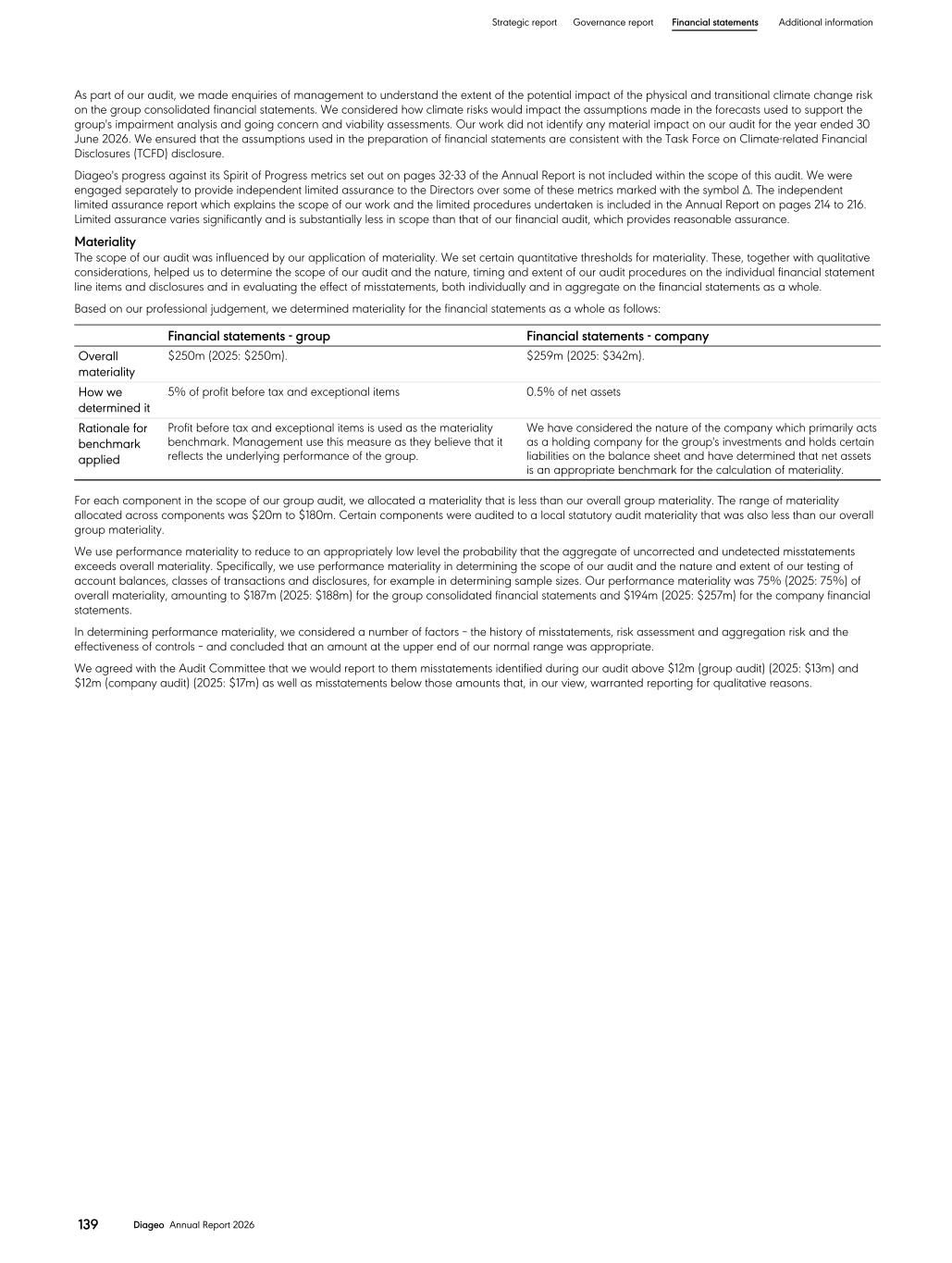
As part of our audit, we made enquiries of management to understand the extent of the potential impact of the physical and transitional climate change risk on the group consolidated financial statements. We considered how climate risks would impact the assumptions made in the forecasts used to support the group's impairment analysis and going concern and viability assessments. Our work did not identify any material impact on our audit for the year ended 30 June 2026. We ensured that the assumptions used in the preparation of financial statements are consistent with the Task Force on Climate-related Financial Disclosures (TCFD) disclosure. Diageo's progress against its Spirit of Progress metrics set out on pages 32-33 of the Annual Report is not included within the scope of this audit. We were engaged separately to provide independent limited assurance to the Directors over some of these metrics marked with the symbol Δ. The independent limited assurance report which explains the scope of our work and the limited procedures undertaken is included in the Annual Report on pages 214 to 216. Limited assurance varies significantly and is substantially less in scope than that of our financial audit, which provides reasonable assurance. Materiality The scope of our audit was influenced by our application of materiality. We set certain quantitative thresholds for materiality. These, together with qualitative considerations, helped us to determine the scope of our audit and the nature, timing and extent of our audit procedures on the individual financial statement line items and disclosures and in evaluating the effect of misstatements, both individually and in aggregate on the financial statements as a whole. Based on our professional judgement, we determined materiality for the financial statements as a whole as follows: Financial statements - group Financial statements - company Overall materiality $250m (2025: $250m). $259m (2025: $342m). How we determined it 5% of profit before tax and exceptional items 0.5% of net assets Rationale for benchmark applied Profit before tax and exceptional items is used as the materiality benchmark. Management use this measure as they believe that it reflects the underlying performance of the group. We have considered the nature of the company which primarily acts as a holding company for the group's investments and holds certain liabilities on the balance sheet and have determined that net assets is an appropriate benchmark for the calculation of materiality. For each component in the scope of our group audit, we allocated a materiality that is less than our overall group materiality. The range of materiality allocated across components was $20m to $180m. Certain components were audited to a local statutory audit materiality that was also less than our overall group materiality. We use performance materiality to reduce to an appropriately low level the probability that the aggregate of uncorrected and undetected misstatements exceeds overall materiality. Specifically, we use performance materiality in determining the scope of our audit and the nature and extent of our testing of account balances, classes of transactions and disclosures, for example in determining sample sizes. Our performance materiality was 75% (2025: 75%) of overall materiality, amounting to $187m (2025: $188m) for the group consolidated financial statements and $194m (2025: $257m) for the company financial statements. In determining performance materiality, we considered a number of factors – the history of misstatements, risk assessment and aggregation risk and the effectiveness of controls – and concluded that an amount at the upper end of our normal range was appropriate. We agreed with the Audit Committee that we would report to them misstatements identified during our audit above $12m (group audit) (2025: $13m) and $12m (company audit) (2025: $17m) as well as misstatements below those amounts that, in our view, warranted reporting for qualitative reasons. Strategic report Governance report Financial statements Additional information 139 Diageo Annual Report 2026
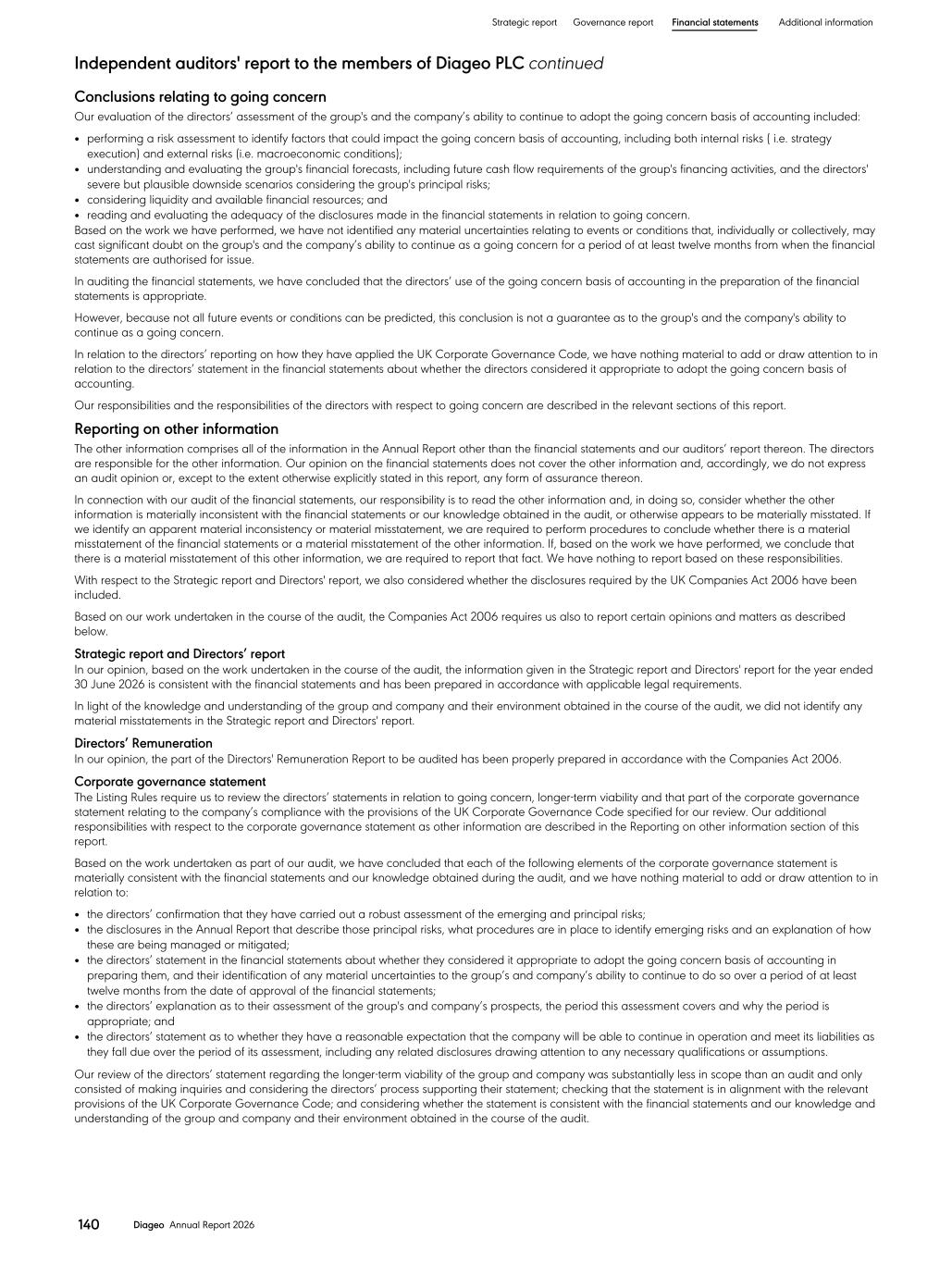
Conclusions relating to going concern Our evaluation of the directors’ assessment of the group's and the company’s ability to continue to adopt the going concern basis of accounting included: • performing a risk assessment to identify factors that could impact the going concern basis of accounting, including both internal risks ( i.e. strategy execution) and external risks (i.e. macroeconomic conditions); • understanding and evaluating the group's financial forecasts, including future cash flow requirements of the group's financing activities, and the directors' severe but plausible downside scenarios considering the group's principal risks; • considering liquidity and available financial resources; and • reading and evaluating the adequacy of the disclosures made in the financial statements in relation to going concern. Based on the work we have performed, we have not identified any material uncertainties relating to events or conditions that, individually or collectively, may cast significant doubt on the group's and the company’s ability to continue as a going concern for a period of at least twelve months from when the financial statements are authorised for issue. In auditing the financial statements, we have concluded that the directors’ use of the going concern basis of accounting in the preparation of the financial statements is appropriate. However, because not all future events or conditions can be predicted, this conclusion is not a guarantee as to the group's and the company's ability to continue as a going concern. In relation to the directors’ reporting on how they have applied the UK Corporate Governance Code, we have nothing material to add or draw attention to in relation to the directors’ statement in the financial statements about whether the directors considered it appropriate to adopt the going concern basis of accounting. Our responsibilities and the responsibilities of the directors with respect to going concern are described in the relevant sections of this report. Reporting on other information The other information comprises all of the information in the Annual Report other than the financial statements and our auditors’ report thereon. The directors are responsible for the other information. Our opinion on the financial statements does not cover the other information and, accordingly, we do not express an audit opinion or, except to the extent otherwise explicitly stated in this report, any form of assurance thereon. In connection with our audit of the financial statements, our responsibility is to read the other information and, in doing so, consider whether the other information is materially inconsistent with the financial statements or our knowledge obtained in the audit, or otherwise appears to be materially misstated. If we identify an apparent material inconsistency or material misstatement, we are required to perform procedures to conclude whether there is a material misstatement of the financial statements or a material misstatement of the other information. If, based on the work we have performed, we conclude that there is a material misstatement of this other information, we are required to report that fact. We have nothing to report based on these responsibilities. With respect to the Strategic report and Directors' report, we also considered whether the disclosures required by the UK Companies Act 2006 have been included. Based on our work undertaken in the course of the audit, the Companies Act 2006 requires us also to report certain opinions and matters as described below. Strategic report and Directors’ report In our opinion, based on the work undertaken in the course of the audit, the information given in the Strategic report and Directors' report for the year ended 30 June 2026 is consistent with the financial statements and has been prepared in accordance with applicable legal requirements. In light of the knowledge and understanding of the group and company and their environment obtained in the course of the audit, we did not identify any material misstatements in the Strategic report and Directors' report. Directors’ Remuneration In our opinion, the part of the Directors' Remuneration Report to be audited has been properly prepared in accordance with the Companies Act 2006. Corporate governance statement The Listing Rules require us to review the directors’ statements in relation to going concern, longer-term viability and that part of the corporate governance statement relating to the company’s compliance with the provisions of the UK Corporate Governance Code specified for our review. Our additional responsibilities with respect to the corporate governance statement as other information are described in the Reporting on other information section of this report. Based on the work undertaken as part of our audit, we have concluded that each of the following elements of the corporate governance statement is materially consistent with the financial statements and our knowledge obtained during the audit, and we have nothing material to add or draw attention to in relation to: • the directors’ confirmation that they have carried out a robust assessment of the emerging and principal risks; • the disclosures in the Annual Report that describe those principal risks, what procedures are in place to identify emerging risks and an explanation of how these are being managed or mitigated; • the directors’ statement in the financial statements about whether they considered it appropriate to adopt the going concern basis of accounting in preparing them, and their identification of any material uncertainties to the group’s and company’s ability to continue to do so over a period of at least twelve months from the date of approval of the financial statements; • the directors’ explanation as to their assessment of the group's and company’s prospects, the period this assessment covers and why the period is appropriate; and • the directors’ statement as to whether they have a reasonable expectation that the company will be able to continue in operation and meet its liabilities as they fall due over the period of its assessment, including any related disclosures drawing attention to any necessary qualifications or assumptions. Our review of the directors’ statement regarding the longer-term viability of the group and company was substantially less in scope than an audit and only consisted of making inquiries and considering the directors’ process supporting their statement; checking that the statement is in alignment with the relevant provisions of the UK Corporate Governance Code; and considering whether the statement is consistent with the financial statements and our knowledge and understanding of the group and company and their environment obtained in the course of the audit. Strategic report Governance report Financial statements Additional information Independent auditors' report to the members of Diageo PLC continued 140 Diageo Annual Report 2026
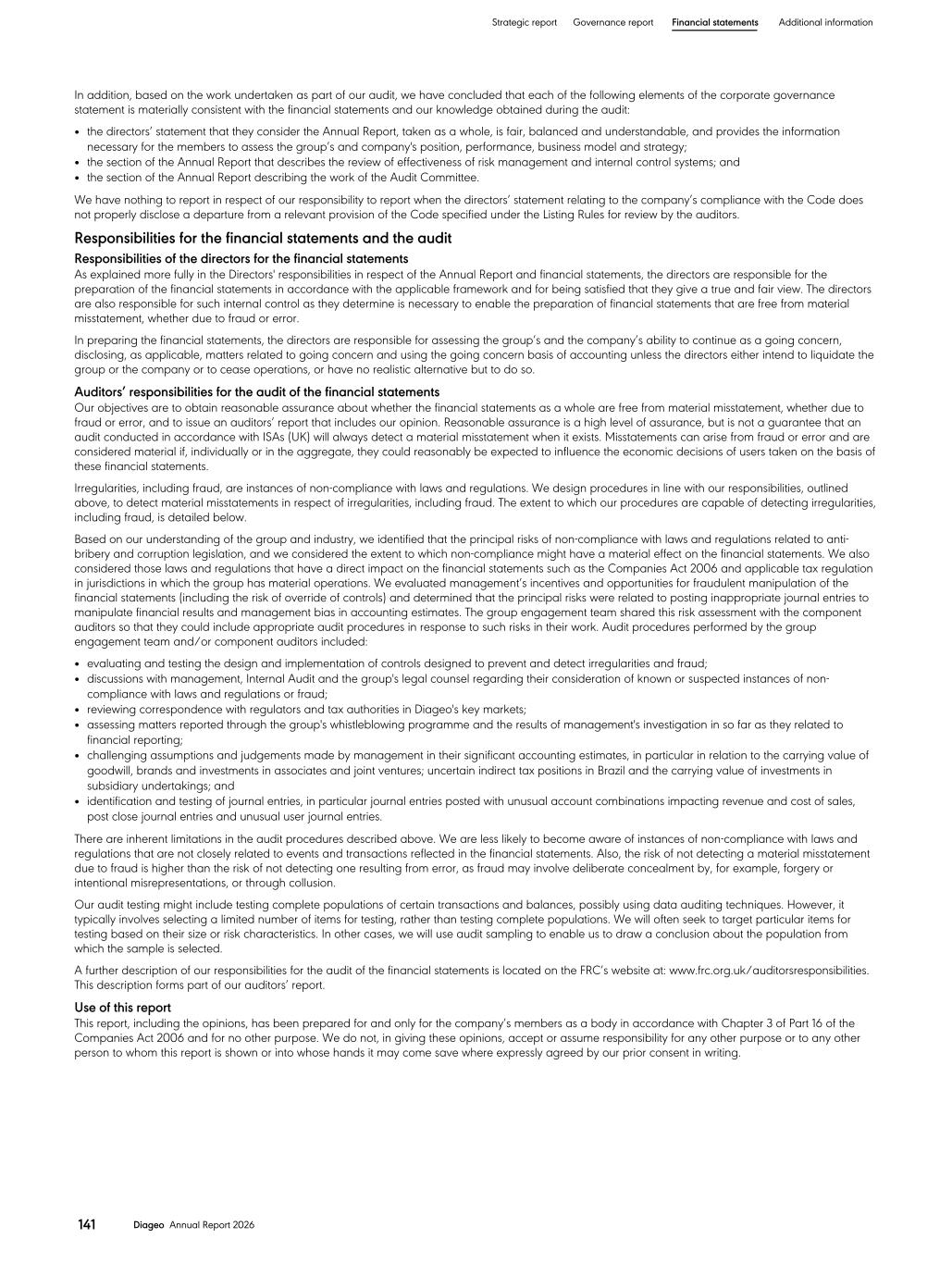
In addition, based on the work undertaken as part of our audit, we have concluded that each of the following elements of the corporate governance statement is materially consistent with the financial statements and our knowledge obtained during the audit: • the directors’ statement that they consider the Annual Report, taken as a whole, is fair, balanced and understandable, and provides the information necessary for the members to assess the group’s and company's position, performance, business model and strategy; • the section of the Annual Report that describes the review of effectiveness of risk management and internal control systems; and • the section of the Annual Report describing the work of the Audit Committee. We have nothing to report in respect of our responsibility to report when the directors’ statement relating to the company’s compliance with the Code does not properly disclose a departure from a relevant provision of the Code specified under the Listing Rules for review by the auditors. Responsibilities for the financial statements and the audit Responsibilities of the directors for the financial statements As explained more fully in the Directors' responsibilities in respect of the Annual Report and financial statements, the directors are responsible for the preparation of the financial statements in accordance with the applicable framework and for being satisfied that they give a true and fair view. The directors are also responsible for such internal control as they determine is necessary to enable the preparation of financial statements that are free from material misstatement, whether due to fraud or error. In preparing the financial statements, the directors are responsible for assessing the group’s and the company’s ability to continue as a going concern, disclosing, as applicable, matters related to going concern and using the going concern basis of accounting unless the directors either intend to liquidate the group or the company or to cease operations, or have no realistic alternative but to do so. Auditors’ responsibilities for the audit of the financial statements Our objectives are to obtain reasonable assurance about whether the financial statements as a whole are free from material misstatement, whether due to fraud or error, and to issue an auditors’ report that includes our opinion. Reasonable assurance is a high level of assurance, but is not a guarantee that an audit conducted in accordance with ISAs (UK) will always detect a material misstatement when it exists. Misstatements can arise from fraud or error and are considered material if, individually or in the aggregate, they could reasonably be expected to influence the economic decisions of users taken on the basis of these financial statements. Irregularities, including fraud, are instances of non-compliance with laws and regulations. We design procedures in line with our responsibilities, outlined above, to detect material misstatements in respect of irregularities, including fraud. The extent to which our procedures are capable of detecting irregularities, including fraud, is detailed below. Based on our understanding of the group and industry, we identified that the principal risks of non-compliance with laws and regulations related to anti- bribery and corruption legislation, and we considered the extent to which non-compliance might have a material effect on the financial statements. We also considered those laws and regulations that have a direct impact on the financial statements such as the Companies Act 2006 and applicable tax regulation in jurisdictions in which the group has material operations. We evaluated management’s incentives and opportunities for fraudulent manipulation of the financial statements (including the risk of override of controls) and determined that the principal risks were related to posting inappropriate journal entries to manipulate financial results and management bias in accounting estimates. The group engagement team shared this risk assessment with the component auditors so that they could include appropriate audit procedures in response to such risks in their work. Audit procedures performed by the group engagement team and/or component auditors included: • evaluating and testing the design and implementation of controls designed to prevent and detect irregularities and fraud; • discussions with management, Internal Audit and the group's legal counsel regarding their consideration of known or suspected instances of non- compliance with laws and regulations or fraud; • reviewing correspondence with regulators and tax authorities in Diageo's key markets; • assessing matters reported through the group's whistleblowing programme and the results of management's investigation in so far as they related to financial reporting; • challenging assumptions and judgements made by management in their significant accounting estimates, in particular in relation to the carrying value of goodwill, brands and investments in associates and joint ventures; uncertain indirect tax positions in Brazil and the carrying value of investments in subsidiary undertakings; and • identification and testing of journal entries, in particular journal entries posted with unusual account combinations impacting revenue and cost of sales, post close journal entries and unusual user journal entries. There are inherent limitations in the audit procedures described above. We are less likely to become aware of instances of non-compliance with laws and regulations that are not closely related to events and transactions reflected in the financial statements. Also, the risk of not detecting a material misstatement due to fraud is higher than the risk of not detecting one resulting from error, as fraud may involve deliberate concealment by, for example, forgery or intentional misrepresentations, or through collusion. Our audit testing might include testing complete populations of certain transactions and balances, possibly using data auditing techniques. However, it typically involves selecting a limited number of items for testing, rather than testing complete populations. We will often seek to target particular items for testing based on their size or risk characteristics. In other cases, we will use audit sampling to enable us to draw a conclusion about the population from which the sample is selected. A further description of our responsibilities for the audit of the financial statements is located on the FRC’s website at: www.frc.org.uk/auditorsresponsibilities. This description forms part of our auditors’ report. Use of this report This report, including the opinions, has been prepared for and only for the company’s members as a body in accordance with Chapter 3 of Part 16 of the Companies Act 2006 and for no other purpose. We do not, in giving these opinions, accept or assume responsibility for any other purpose or to any other person to whom this report is shown or into whose hands it may come save where expressly agreed by our prior consent in writing. Strategic report Governance report Financial statements Additional information 141 Diageo Annual Report 2026
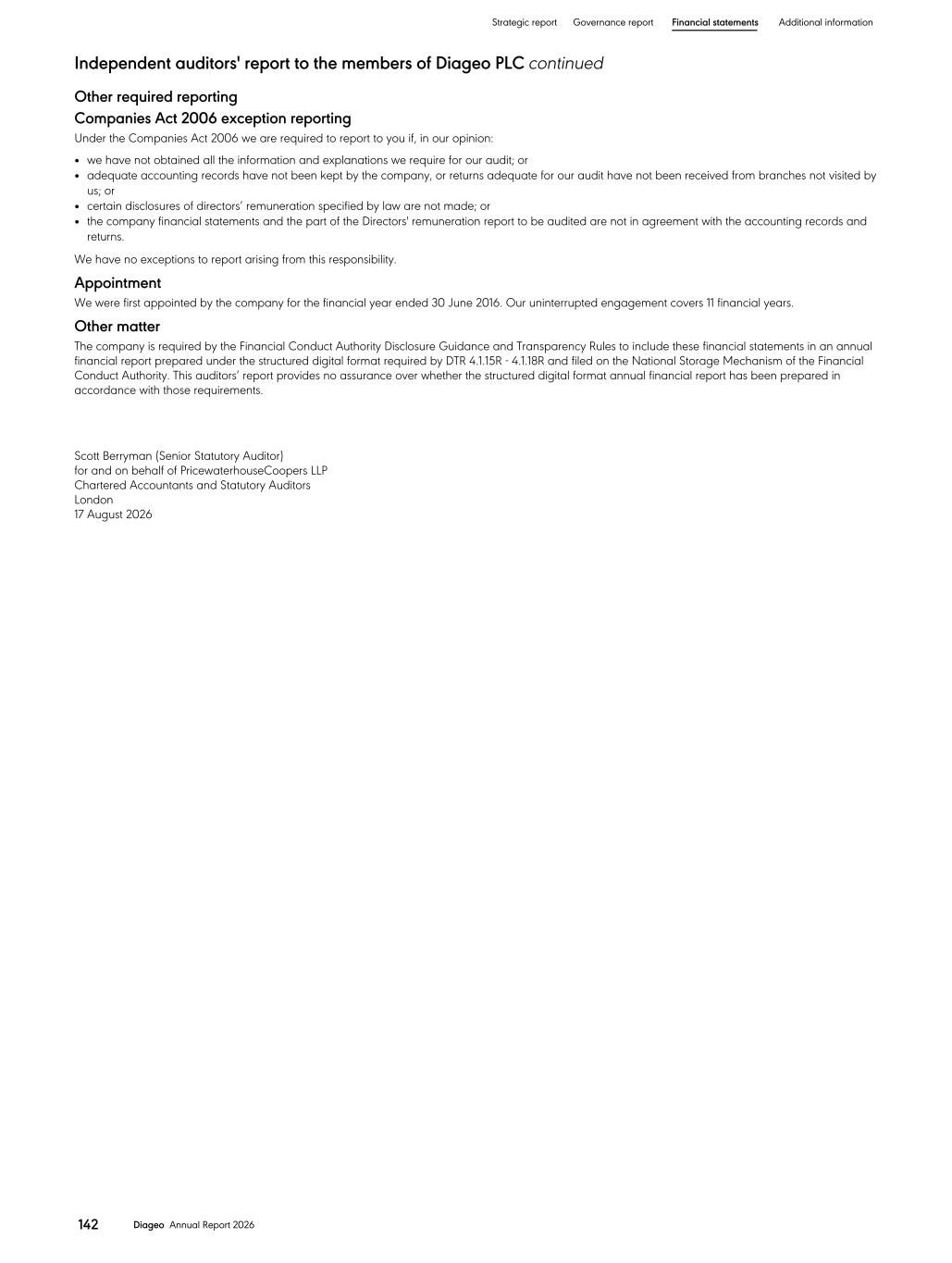
Other required reporting Companies Act 2006 exception reporting Under the Companies Act 2006 we are required to report to you if, in our opinion: • we have not obtained all the information and explanations we require for our audit; or • adequate accounting records have not been kept by the company, or returns adequate for our audit have not been received from branches not visited by us; or • certain disclosures of directors’ remuneration specified by law are not made; or • the company financial statements and the part of the Directors' remuneration report to be audited are not in agreement with the accounting records and returns. We have no exceptions to report arising from this responsibility. Appointment We were first appointed by the company for the financial year ended 30 June 2016. Our uninterrupted engagement covers 11 financial years. Other matter The company is required by the Financial Conduct Authority Disclosure Guidance and Transparency Rules to include these financial statements in an annual financial report prepared under the structured digital format required by DTR 4.1.15R - 4.1.18R and filed on the National Storage Mechanism of the Financial Conduct Authority. This auditors’ report provides no assurance over whether the structured digital format annual financial report has been prepared in accordance with those requirements. Scott Berryman (Senior Statutory Auditor) for and on behalf of PricewaterhouseCoopers LLP Chartered Accountants and Statutory Auditors London 17 August 2026 Strategic report Governance report Financial statements Additional information Independent auditors' report to the members of Diageo PLC continued 142 Diageo Annual Report 2026
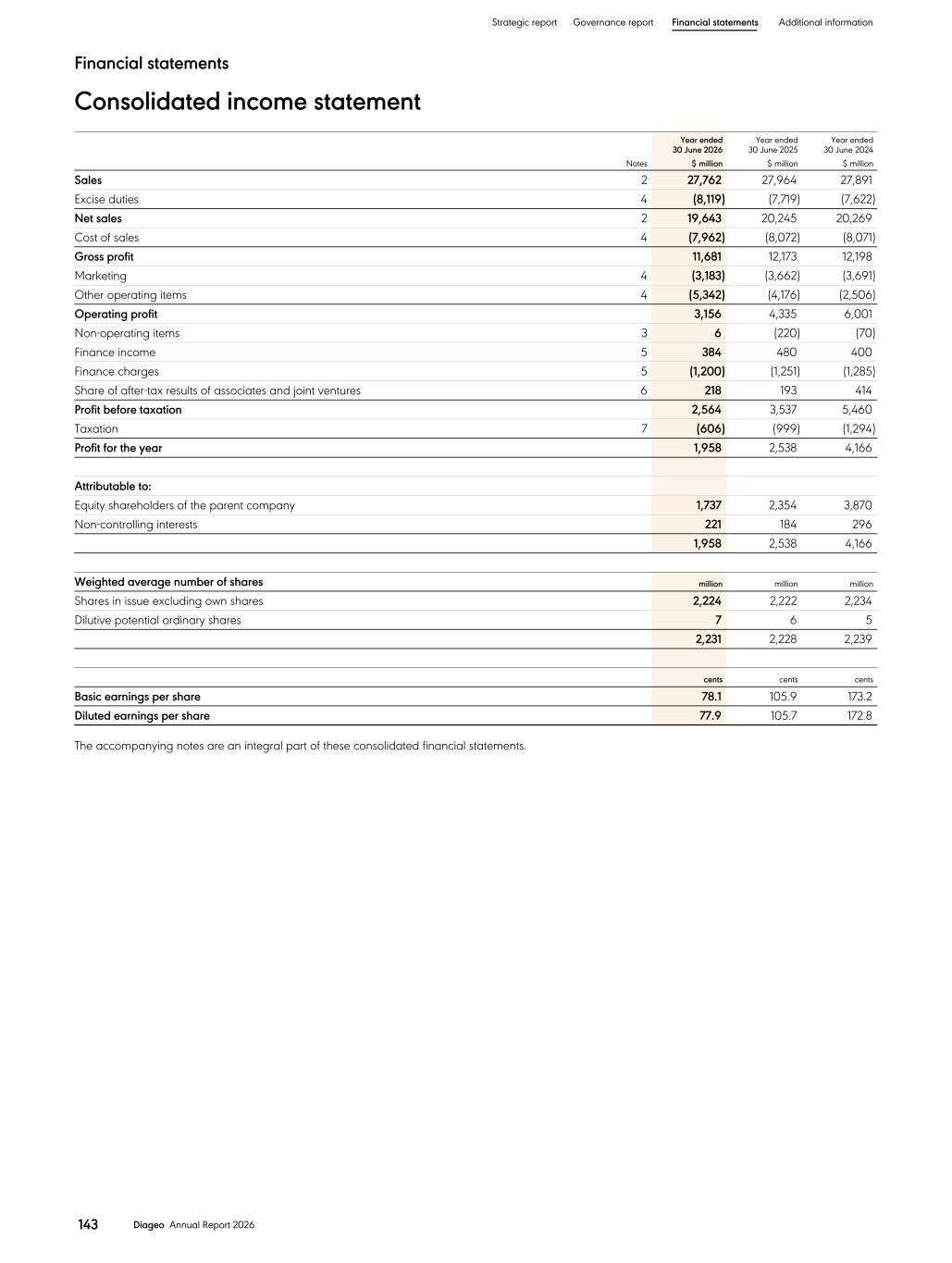
Consolidated income statement Sales 2 27,762 27,964 27,891 Excise duties 4 (8,119) (7,719) (7,622) Net sales 2 19,643 20,245 20,269 Cost of sales 4 (7,962) (8,072) (8,071) Gross profit 11,681 12,173 12,198 Marketing 4 (3,183) (3,662) (3,691) Other operating items 4 (5,342) (4,176) (2,506) Operating profit 3,156 4,335 6,001 Non-operating items 3 6 (220) (70) Finance income 5 384 480 400 Finance charges 5 (1,200) (1,251) (1,285) Share of after-tax results of associates and joint ventures 6 218 193 414 Profit before taxation 2,564 3,537 5,460 Taxation 7 (606) (999) (1,294) Profit for the year 1,958 2,538 4,166 Attributable to: Equity shareholders of the parent company 1,737 2,354 3,870 Non-controlling interests 221 184 296 1,958 2,538 4,166 Weighted average number of shares million million million Shares in issue excluding own shares 2,224 2,222 2,234 Dilutive potential ordinary shares 7 6 5 2,231 2,228 2,239 cents cents cents Basic earnings per share 78.1 105.9 173.2 Diluted earnings per share 77.9 105.7 172.8 Year ended 30 June 2026 Year ended 30 June 2025 Year ended 30 June 2024 Notes $ million $ million $ million The accompanying notes are an integral part of these consolidated financial statements. Strategic report Governance report Financial statements Additional information Financial statements 143 Diageo Annual Report 2026
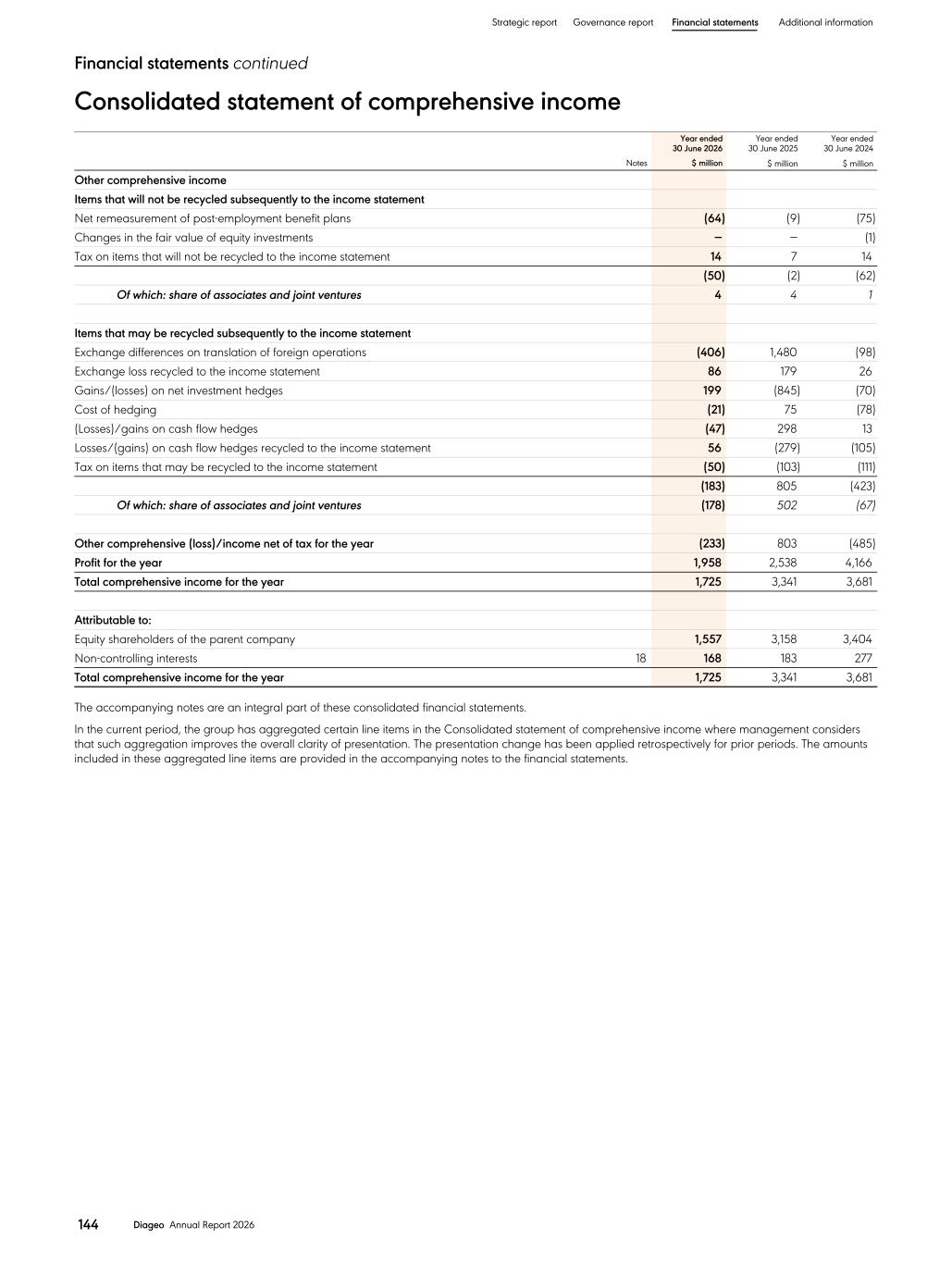
Consolidated statement of comprehensive income Other comprehensive income Items that will not be recycled subsequently to the income statement Net remeasurement of post-employment benefit plans (64) (9) (75) Changes in the fair value of equity investments — — (1) Tax on items that will not be recycled to the income statement 14 7 14 (50) (2) (62) Of which: share of associates and joint ventures 4 4 1 Items that may be recycled subsequently to the income statement Exchange differences on translation of foreign operations (406) 1,480 (98) Exchange loss recycled to the income statement 86 179 26 Gains/(losses) on net investment hedges 199 (845) (70) Cost of hedging (21) 75 (78) (Losses)/gains on cash flow hedges (47) 298 13 Losses/(gains) on cash flow hedges recycled to the income statement 56 (279) (105) Tax on items that may be recycled to the income statement (50) (103) (111) (183) 805 (423) Of which: share of associates and joint ventures (178) 502 (67) Other comprehensive (loss)/income net of tax for the year (233) 803 (485) Profit for the year 1,958 2,538 4,166 Total comprehensive income for the year 1,725 3,341 3,681 Attributable to: Equity shareholders of the parent company 1,557 3,158 3,404 Non-controlling interests 18 168 183 277 Total comprehensive income for the year 1,725 3,341 3,681 Year ended 30 June 2026 Year ended 30 June 2025 Year ended 30 June 2024 Notes $ million $ million $ million The accompanying notes are an integral part of these consolidated financial statements. In the current period, the group has aggregated certain line items in the Consolidated statement of comprehensive income where management considers that such aggregation improves the overall clarity of presentation. The presentation change has been applied retrospectively for prior periods. The amounts included in these aggregated line items are provided in the accompanying notes to the financial statements. Strategic report Governance report Financial statements Additional information Financial statements continued 144 Diageo Annual Report 2026
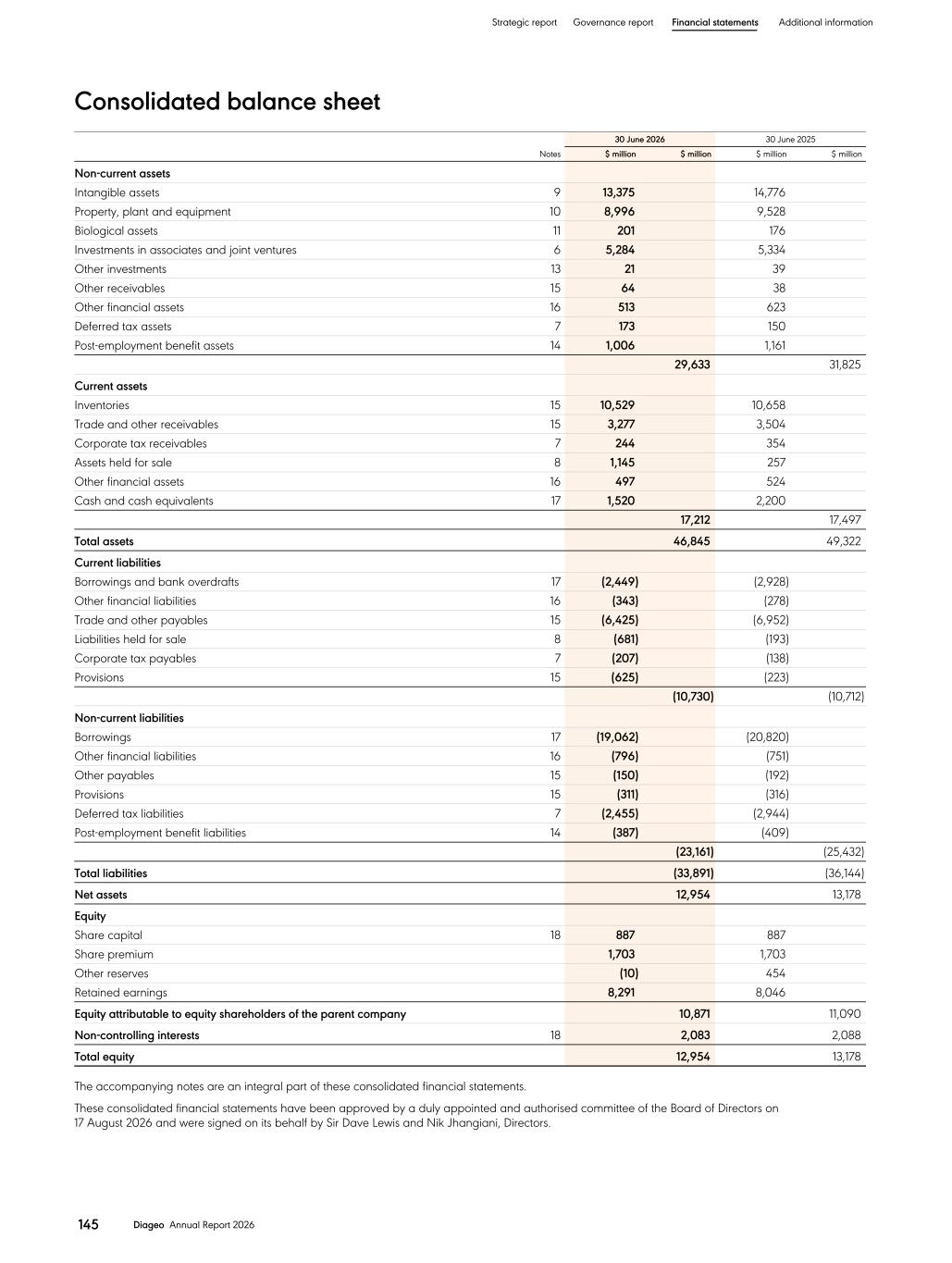
Consolidated balance sheet Non-current assets Intangible assets 9 13,375 14,776 Property, plant and equipment 10 8,996 9,528 Biological assets 11 201 176 Investments in associates and joint ventures 6 5,284 5,334 Other investments 13 21 39 Other receivables 15 64 38 Other financial assets 16 513 623 Deferred tax assets 7 173 150 Post-employment benefit assets 14 1,006 1,161 29,633 31,825 Current assets Inventories 15 10,529 10,658 Trade and other receivables 15 3,277 3,504 Corporate tax receivables 7 244 354 Assets held for sale 8 1,145 257 Other financial assets 16 497 524 Cash and cash equivalents 17 1,520 2,200 17,212 17,497 Total assets 46,845 49,322 Current liabilities Borrowings and bank overdrafts 17 (2,449) (2,928) Other financial liabilities 16 (343) (278) Trade and other payables 15 (6,425) (6,952) Liabilities held for sale 8 (681) (193) Corporate tax payables 7 (207) (138) Provisions 15 (625) (223) (10,730) (10,712) Non-current liabilities Borrowings 17 (19,062) (20,820) Other financial liabilities 16 (796) (751) Other payables 15 (150) (192) Provisions 15 (311) (316) Deferred tax liabilities 7 (2,455) (2,944) Post-employment benefit liabilities 14 (387) (409) (23,161) (25,432) Total liabilities (33,891) (36,144) Net assets 12,954 13,178 Equity Share capital 18 887 887 Share premium 1,703 1,703 Other reserves (10) 454 Retained earnings 8,291 8,046 Equity attributable to equity shareholders of the parent company 10,871 11,090 Non-controlling interests 18 2,083 2,088 Total equity 12,954 13,178 30 June 2026 30 June 2025 Notes $ million $ million $ million $ million The accompanying notes are an integral part of these consolidated financial statements. These consolidated financial statements have been approved by a duly appointed and authorised committee of the Board of Directors on 17 August 2026 and were signed on its behalf by Sir Dave Lewis and Nik Jhangiani, Directors. Strategic report Governance report Financial statements Additional information 145 Diageo Annual Report 2026
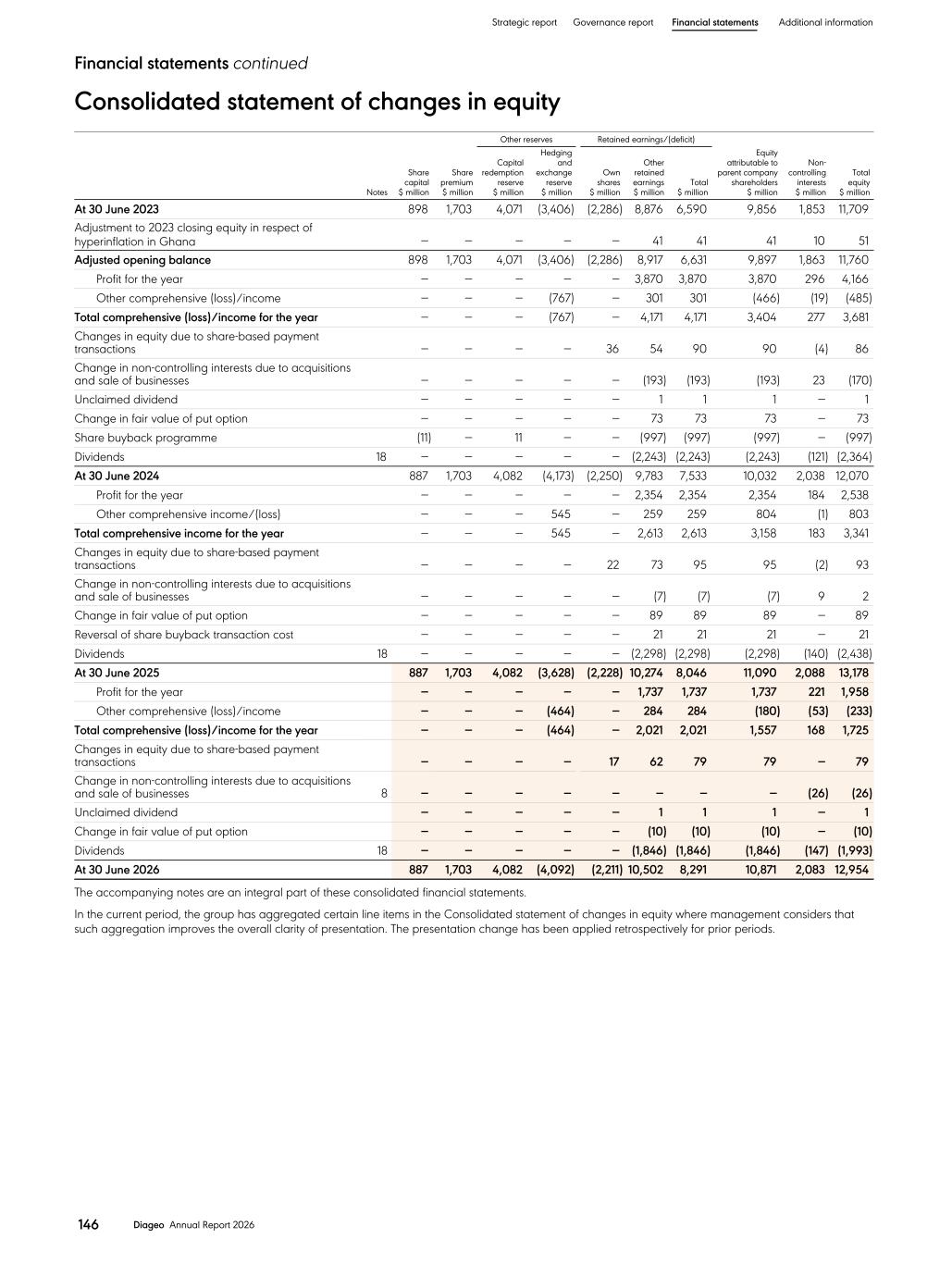
Consolidated statement of changes in equity Other reserves Retained earnings/(deficit) Notes Share capital $ million Share premium $ million Capital redemption reserve $ million Hedging and exchange reserve $ million Own shares $ million Other retained earnings $ million Total $ million Equity attributable to parent company shareholders $ million Non- controlling interests $ million Total equity $ million At 30 June 2023 898 1,703 4,071 (3,406) (2,286) 8,876 6,590 9,856 1,853 11,709 Adjustment to 2023 closing equity in respect of hyperinflation in Ghana — — — — — 41 41 41 10 51 Adjusted opening balance 898 1,703 4,071 (3,406) (2,286) 8,917 6,631 9,897 1,863 11,760 Profit for the year — — — — — 3,870 3,870 3,870 296 4,166 Other comprehensive (loss)/income — — — (767) — 301 301 (466) (19) (485) Total comprehensive (loss)/income for the year — — — (767) — 4,171 4,171 3,404 277 3,681 Changes in equity due to share-based payment transactions — — — — 36 54 90 90 (4) 86 Change in non-controlling interests due to acquisitions and sale of businesses — — — — — (193) (193) (193) 23 (170) Unclaimed dividend — — — — — 1 1 1 — 1 Change in fair value of put option — — — — — 73 73 73 — 73 Share buyback programme (11) — 11 — — (997) (997) (997) — (997) Dividends 18 — — — — — (2,243) (2,243) (2,243) (121) (2,364) At 30 June 2024 887 1,703 4,082 (4,173) (2,250) 9,783 7,533 10,032 2,038 12,070 Profit for the year — — — — — 2,354 2,354 2,354 184 2,538 Other comprehensive income/(loss) — — — 545 — 259 259 804 (1) 803 Total comprehensive income for the year — — — 545 — 2,613 2,613 3,158 183 3,341 Changes in equity due to share-based payment transactions — — — — 22 73 95 95 (2) 93 Change in non-controlling interests due to acquisitions and sale of businesses — — — — — (7) (7) (7) 9 2 Change in fair value of put option — — — — — 89 89 89 — 89 Reversal of share buyback transaction cost — — — — — 21 21 21 — 21 Dividends 18 — — — — — (2,298) (2,298) (2,298) (140) (2,438) At 30 June 2025 887 1,703 4,082 (3,628) (2,228) 10,274 8,046 11,090 2,088 13,178 Profit for the year — — — — — 1,737 1,737 1,737 221 1,958 Other comprehensive (loss)/income — — — (464) — 284 284 (180) (53) (233) Total comprehensive (loss)/income for the year — — — (464) — 2,021 2,021 1,557 168 1,725 Changes in equity due to share-based payment transactions — — — — 17 62 79 79 — 79 Change in non-controlling interests due to acquisitions and sale of businesses 8 — — — — — — — — (26) (26) Unclaimed dividend — — — — — 1 1 1 — 1 Change in fair value of put option — — — — — (10) (10) (10) — (10) Dividends 18 — — — — — (1,846) (1,846) (1,846) (147) (1,993) At 30 June 2026 887 1,703 4,082 (4,092) (2,211) 10,502 8,291 10,871 2,083 12,954 The accompanying notes are an integral part of these consolidated financial statements. In the current period, the group has aggregated certain line items in the Consolidated statement of changes in equity where management considers that such aggregation improves the overall clarity of presentation. The presentation change has been applied retrospectively for prior periods. Strategic report Governance report Financial statements Additional information Financial statements continued 146 Diageo Annual Report 2026
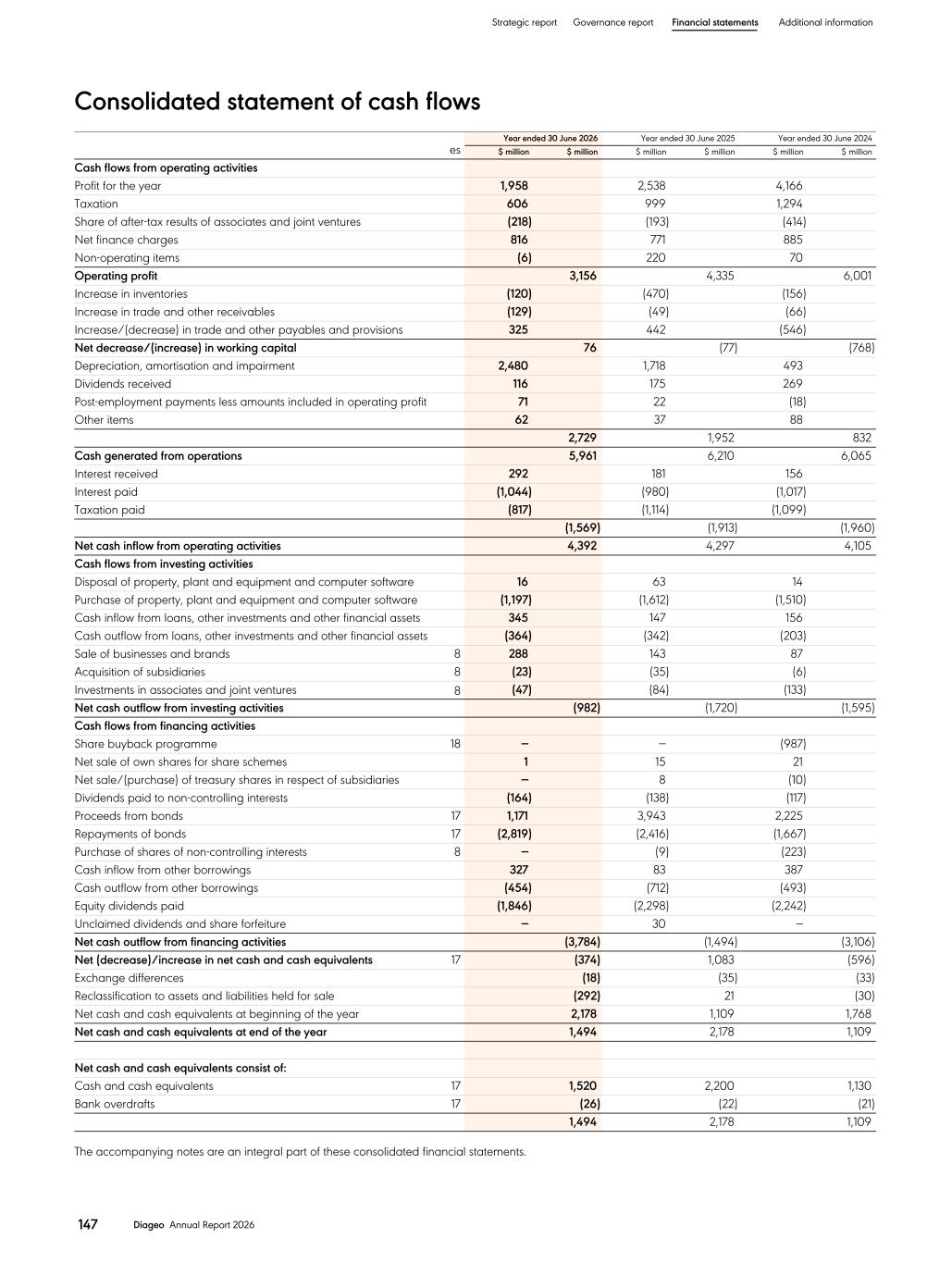
Consolidated statement of cash flows Cash flows from operating activities Profit for the year 1,958 2,538 4,166 Taxation 606 999 1,294 Share of after-tax results of associates and joint ventures (218) (193) (414) Net finance charges 816 771 885 Non-operating items (6) 220 70 Operating profit 3,156 4,335 6,001 Increase in inventories (120) (470) (156) Increase in trade and other receivables (129) (49) (66) Increase/(decrease) in trade and other payables and provisions 325 442 (546) Net decrease/(increase) in working capital 76 (77) (768) Depreciation, amortisation and impairment 2,480 1,718 493 Dividends received 116 175 269 Post-employment payments less amounts included in operating profit 71 22 (18) Other items 62 37 88 2,729 1,952 832 Cash generated from operations 5,961 6,210 6,065 Interest received 292 181 156 Interest paid (1,044) (980) (1,017) Taxation paid (817) (1,114) (1,099) (1,569) (1,913) (1,960) Net cash inflow from operating activities 4,392 4,297 4,105 Cash flows from investing activities Disposal of property, plant and equipment and computer software 16 63 14 Purchase of property, plant and equipment and computer software (1,197) (1,612) (1,510) Cash inflow from loans, other investments and other financial assets 345 147 156 Cash outflow from loans, other investments and other financial assets (364) (342) (203) Sale of businesses and brands 8 288 143 87 Acquisition of subsidiaries 8 (23) (35) (6) Investments in associates and joint ventures 8 (47) (84) (133) Net cash outflow from investing activities (982) (1,720) (1,595) Cash flows from financing activities Share buyback programme 18 — — (987) Net sale of own shares for share schemes 1 15 21 Net sale/(purchase) of treasury shares in respect of subsidiaries — 8 (10) Dividends paid to non-controlling interests (164) (138) (117) Proceeds from bonds 17 1,171 3,943 2,225 Repayments of bonds 17 (2,819) (2,416) (1,667) Purchase of shares of non-controlling interests 8 — (9) (223) Cash inflow from other borrowings 327 83 387 Cash outflow from other borrowings (454) (712) (493) Equity dividends paid (1,846) (2,298) (2,242) Unclaimed dividends and share forfeiture — 30 — Net cash outflow from financing activities (3,784) (1,494) (3,106) Net (decrease)/increase in net cash and cash equivalents 17 (374) 1,083 (596) Exchange differences (18) (35) (33) Reclassification to assets and liabilities held for sale (292) 21 (30) Net cash and cash equivalents at beginning of the year 2,178 1,109 1,768 Net cash and cash equivalents at end of the year 1,494 2,178 1,109 Net cash and cash equivalents consist of: Cash and cash equivalents 17 1,520 2,200 1,130 Bank overdrafts 17 (26) (22) (21) 1,494 2,178 1,109 Year ended 30 June 2026 Year ended 30 June 2025 Year ended 30 June 2024 es $ million $ million $ million $ million $ million $ million The accompanying notes are an integral part of these consolidated financial statements. Strategic report Governance report Financial statements Additional information 147 Diageo Annual Report 2026
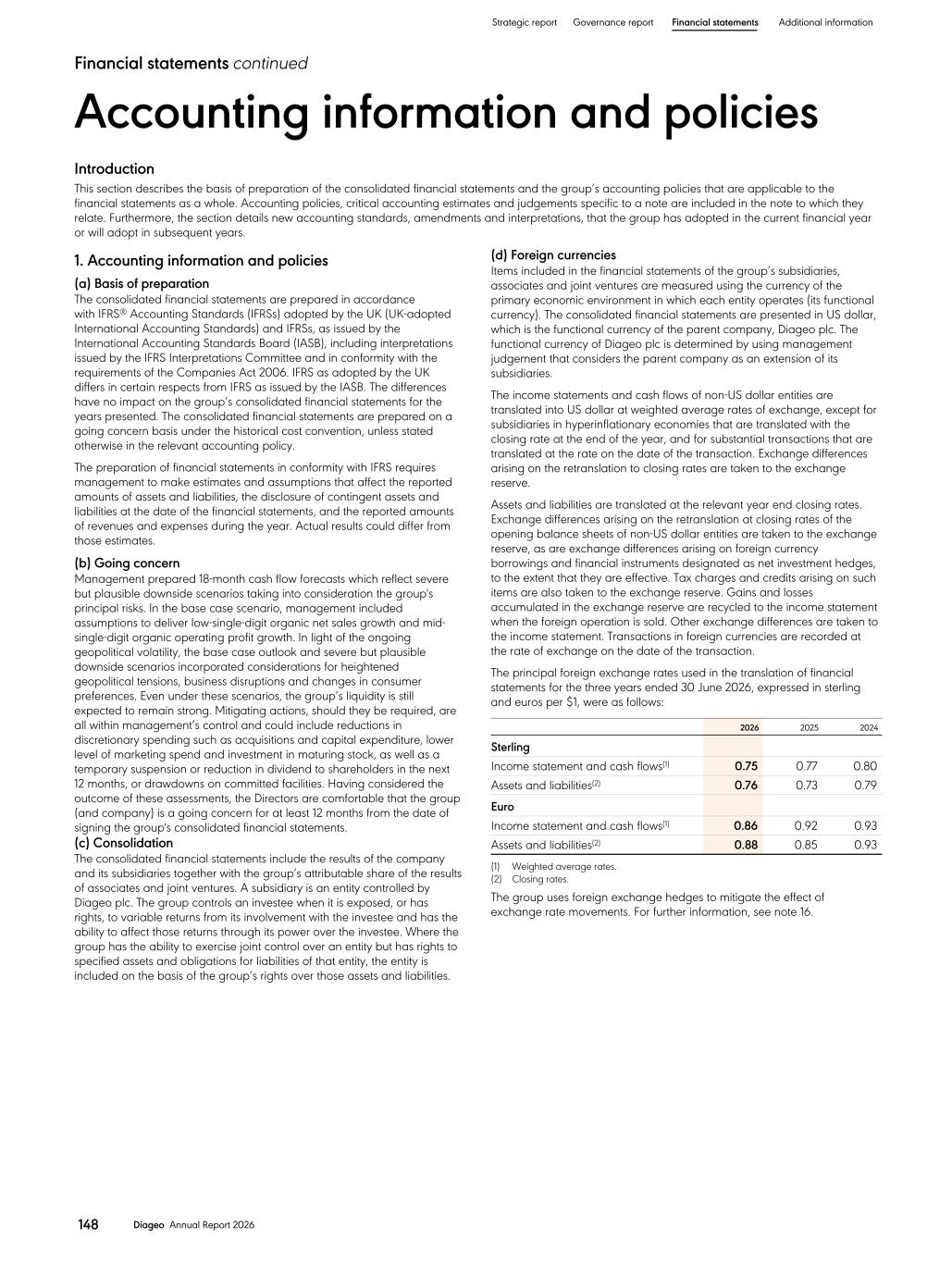
Accounting information and policies Introduction This section describes the basis of preparation of the consolidated financial statements and the group’s accounting policies that are applicable to the financial statements as a whole. Accounting policies, critical accounting estimates and judgements specific to a note are included in the note to which they relate. Furthermore, the section details new accounting standards, amendments and interpretations, that the group has adopted in the current financial year or will adopt in subsequent years. 1. Accounting information and policies (a) Basis of preparation The consolidated financial statements are prepared in accordance with IFRS® Accounting Standards (IFRSs) adopted by the UK (UK-adopted International Accounting Standards) and IFRSs, as issued by the International Accounting Standards Board (IASB), including interpretations issued by the IFRS Interpretations Committee and in conformity with the requirements of the Companies Act 2006. IFRS as adopted by the UK differs in certain respects from IFRS as issued by the IASB. The differences have no impact on the group’s consolidated financial statements for the years presented. The consolidated financial statements are prepared on a going concern basis under the historical cost convention, unless stated otherwise in the relevant accounting policy. The preparation of financial statements in conformity with IFRS requires management to make estimates and assumptions that affect the reported amounts of assets and liabilities, the disclosure of contingent assets and liabilities at the date of the financial statements, and the reported amounts of revenues and expenses during the year. Actual results could differ from those estimates. (b) Going concern Management prepared 18-month cash flow forecasts which reflect severe but plausible downside scenarios taking into consideration the group's principal risks. In the base case scenario, management included assumptions to deliver low-single-digit organic net sales growth and mid- single-digit organic operating profit growth. In light of the ongoing geopolitical volatility, the base case outlook and severe but plausible downside scenarios incorporated considerations for heightened geopolitical tensions, business disruptions and changes in consumer preferences. Even under these scenarios, the group’s liquidity is still expected to remain strong. Mitigating actions, should they be required, are all within management’s control and could include reductions in discretionary spending such as acquisitions and capital expenditure, lower level of marketing spend and investment in maturing stock, as well as a temporary suspension or reduction in dividend to shareholders in the next 12 months, or drawdowns on committed facilities. Having considered the outcome of these assessments, the Directors are comfortable that the group (and company) is a going concern for at least 12 months from the date of signing the group's consolidated financial statements. (c) Consolidation The consolidated financial statements include the results of the company and its subsidiaries together with the group’s attributable share of the results of associates and joint ventures. A subsidiary is an entity controlled by Diageo plc. The group controls an investee when it is exposed, or has rights, to variable returns from its involvement with the investee and has the ability to affect those returns through its power over the investee. Where the group has the ability to exercise joint control over an entity but has rights to specified assets and obligations for liabilities of that entity, the entity is included on the basis of the group’s rights over those assets and liabilities. (d) Foreign currencies Items included in the financial statements of the group’s subsidiaries, associates and joint ventures are measured using the currency of the primary economic environment in which each entity operates (its functional currency). The consolidated financial statements are presented in US dollar, which is the functional currency of the parent company, Diageo plc. The functional currency of Diageo plc is determined by using management judgement that considers the parent company as an extension of its subsidiaries. The income statements and cash flows of non-US dollar entities are translated into US dollar at weighted average rates of exchange, except for subsidiaries in hyperinflationary economies that are translated with the closing rate at the end of the year, and for substantial transactions that are translated at the rate on the date of the transaction. Exchange differences arising on the retranslation to closing rates are taken to the exchange reserve. Assets and liabilities are translated at the relevant year end closing rates. Exchange differences arising on the retranslation at closing rates of the opening balance sheets of non-US dollar entities are taken to the exchange reserve, as are exchange differences arising on foreign currency borrowings and financial instruments designated as net investment hedges, to the extent that they are effective. Tax charges and credits arising on such items are also taken to the exchange reserve. Gains and losses accumulated in the exchange reserve are recycled to the income statement when the foreign operation is sold. Other exchange differences are taken to the income statement. Transactions in foreign currencies are recorded at the rate of exchange on the date of the transaction. The principal foreign exchange rates used in the translation of financial statements for the three years ended 30 June 2026, expressed in sterling and euros per $1, were as follows: Sterling Income statement and cash flows(1) 0.75 0.77 0.80 Assets and liabilities(2) 0.76 0.73 0.79 Euro Income statement and cash flows(1) 0.86 0.92 0.93 Assets and liabilities(2) 0.88 0.85 0.93 2026 2025 2024 (1) Weighted average rates. (2) Closing rates. The group uses foreign exchange hedges to mitigate the effect of exchange rate movements. For further information, see note 16. Strategic report Governance report Financial statements Additional information Financial statements continued 148 Diageo Annual Report 2026
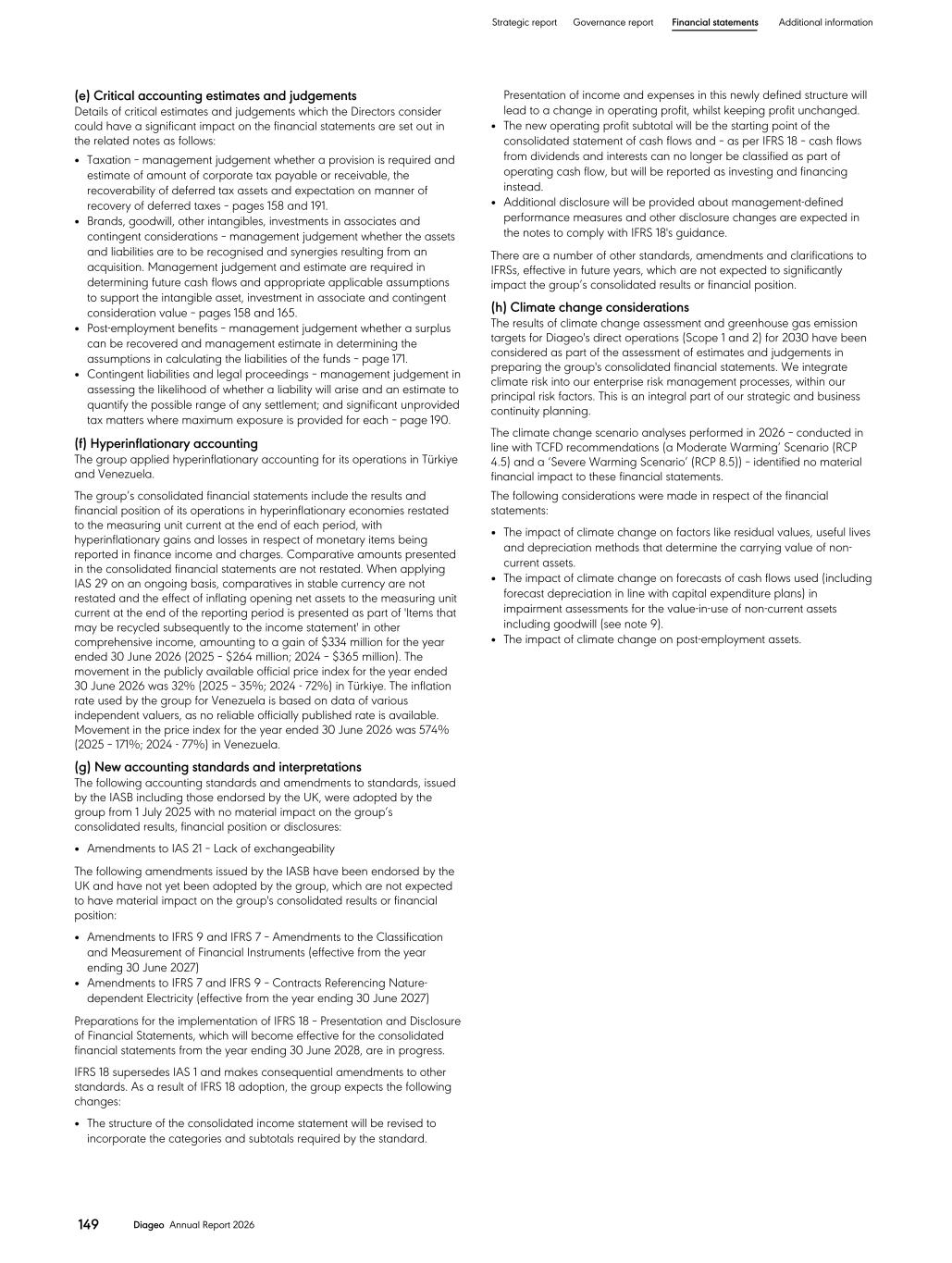
(e) Critical accounting estimates and judgements Details of critical estimates and judgements which the Directors consider could have a significant impact on the financial statements are set out in the related notes as follows: • Taxation – management judgement whether a provision is required and estimate of amount of corporate tax payable or receivable, the recoverability of deferred tax assets and expectation on manner of recovery of deferred taxes – pages 158 and 191. • Brands, goodwill, other intangibles, investments in associates and contingent considerations – management judgement whether the assets and liabilities are to be recognised and synergies resulting from an acquisition. Management judgement and estimate are required in determining future cash flows and appropriate applicable assumptions to support the intangible asset, investment in associate and contingent consideration value – pages 158 and 165. • Post-employment benefits – management judgement whether a surplus can be recovered and management estimate in determining the assumptions in calculating the liabilities of the funds – page 171. • Contingent liabilities and legal proceedings – management judgement in assessing the likelihood of whether a liability will arise and an estimate to quantify the possible range of any settlement; and significant unprovided tax matters where maximum exposure is provided for each – page 190. (f) Hyperinflationary accounting The group applied hyperinflationary accounting for its operations in Türkiye and Venezuela. The group’s consolidated financial statements include the results and financial position of its operations in hyperinflationary economies restated to the measuring unit current at the end of each period, with hyperinflationary gains and losses in respect of monetary items being reported in finance income and charges. Comparative amounts presented in the consolidated financial statements are not restated. When applying IAS 29 on an ongoing basis, comparatives in stable currency are not restated and the effect of inflating opening net assets to the measuring unit current at the end of the reporting period is presented as part of 'Items that may be recycled subsequently to the income statement' in other comprehensive income, amounting to a gain of $334 million for the year ended 30 June 2026 (2025 – $264 million; 2024 – $365 million). The movement in the publicly available official price index for the year ended 30 June 2026 was 32% (2025 – 35%; 2024 - 72%) in Türkiye. The inflation rate used by the group for Venezuela is based on data of various independent valuers, as no reliable officially published rate is available. Movement in the price index for the year ended 30 June 2026 was 574% (2025 – 171%; 2024 - 77%) in Venezuela. (g) New accounting standards and interpretations The following accounting standards and amendments to standards, issued by the IASB including those endorsed by the UK, were adopted by the group from 1 July 2025 with no material impact on the group’s consolidated results, financial position or disclosures: • Amendments to IAS 21 – Lack of exchangeability The following amendments issued by the IASB have been endorsed by the UK and have not yet been adopted by the group, which are not expected to have material impact on the group's consolidated results or financial position: • Amendments to IFRS 9 and IFRS 7 – Amendments to the Classification and Measurement of Financial Instruments (effective from the year ending 30 June 2027) • Amendments to IFRS 7 and IFRS 9 – Contracts Referencing Nature- dependent Electricity (effective from the year ending 30 June 2027) Preparations for the implementation of IFRS 18 – Presentation and Disclosure of Financial Statements, which will become effective for the consolidated financial statements from the year ending 30 June 2028, are in progress. IFRS 18 supersedes IAS 1 and makes consequential amendments to other standards. As a result of IFRS 18 adoption, the group expects the following changes: • The structure of the consolidated income statement will be revised to incorporate the categories and subtotals required by the standard. Presentation of income and expenses in this newly defined structure will lead to a change in operating profit, whilst keeping profit unchanged. • The new operating profit subtotal will be the starting point of the consolidated statement of cash flows and – as per IFRS 18 – cash flows from dividends and interests can no longer be classified as part of operating cash flow, but will be reported as investing and financing instead. • Additional disclosure will be provided about management-defined performance measures and other disclosure changes are expected in the notes to comply with IFRS 18's guidance. There are a number of other standards, amendments and clarifications to IFRSs, effective in future years, which are not expected to significantly impact the group’s consolidated results or financial position. (h) Climate change considerations The results of climate change assessment and greenhouse gas emission targets for Diageo's direct operations (Scope 1 and 2) for 2030 have been considered as part of the assessment of estimates and judgements in preparing the group's consolidated financial statements. We integrate climate risk into our enterprise risk management processes, within our principal risk factors. This is an integral part of our strategic and business continuity planning. The climate change scenario analyses performed in 2026 – conducted in line with TCFD recommendations (a Moderate Warming’ Scenario (RCP 4.5) and a ‘Severe Warming Scenario’ (RCP 8.5)) – identified no material financial impact to these financial statements. The following considerations were made in respect of the financial statements: • The impact of climate change on factors like residual values, useful lives and depreciation methods that determine the carrying value of non- current assets. • The impact of climate change on forecasts of cash flows used (including forecast depreciation in line with capital expenditure plans) in impairment assessments for the value-in-use of non-current assets including goodwill (see note 9). • The impact of climate change on post-employment assets. Strategic report Governance report Financial statements Additional information 149 Diageo Annual Report 2026
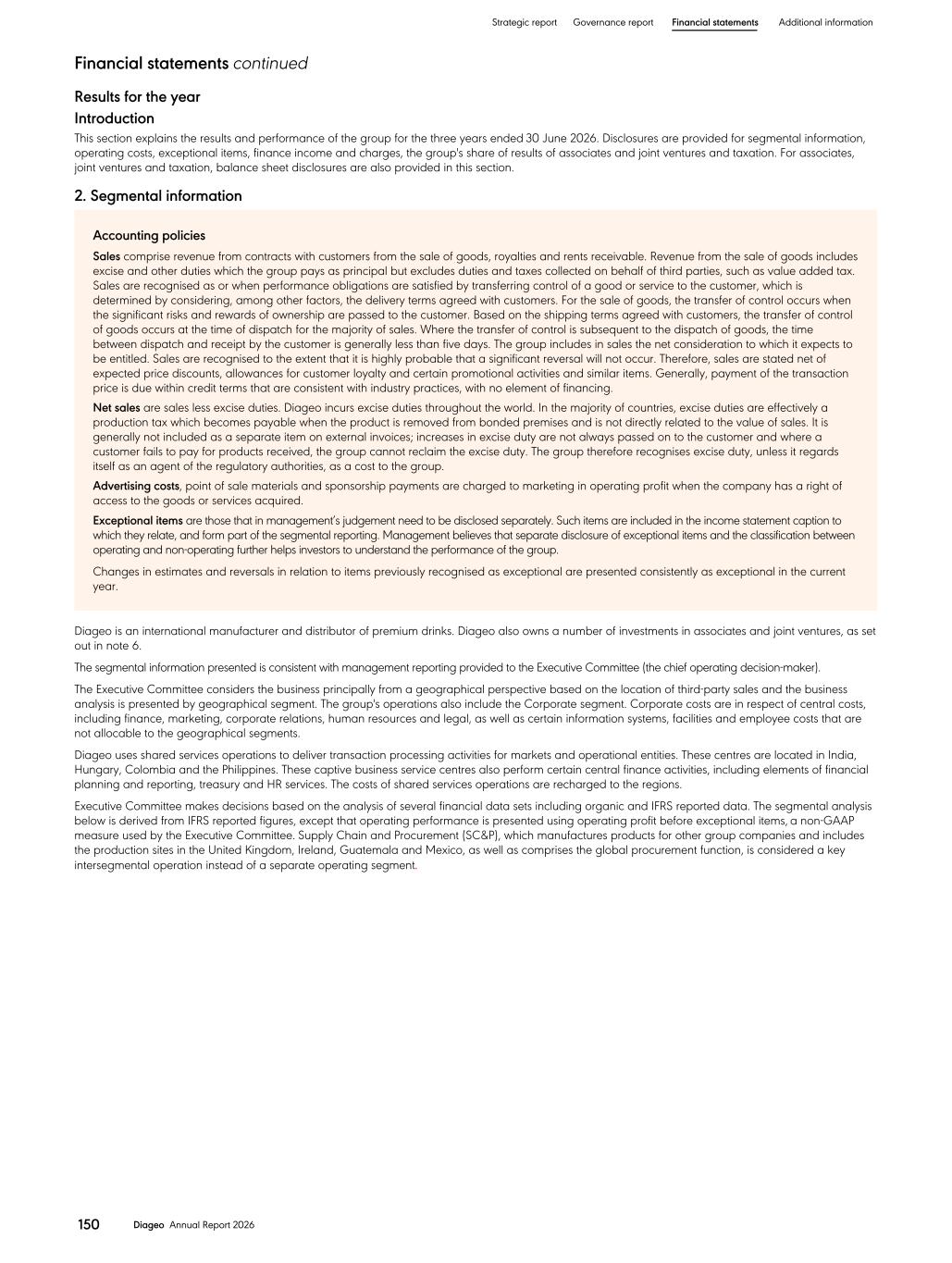
Results for the year Introduction This section explains the results and performance of the group for the three years ended 30 June 2026. Disclosures are provided for segmental information, operating costs, exceptional items, finance income and charges, the group's share of results of associates and joint ventures and taxation. For associates, joint ventures and taxation, balance sheet disclosures are also provided in this section. 2. Segmental information Accounting policies Sales comprise revenue from contracts with customers from the sale of goods, royalties and rents receivable. Revenue from the sale of goods includes excise and other duties which the group pays as principal but excludes duties and taxes collected on behalf of third parties, such as value added tax. Sales are recognised as or when performance obligations are satisfied by transferring control of a good or service to the customer, which is determined by considering, among other factors, the delivery terms agreed with customers. For the sale of goods, the transfer of control occurs when the significant risks and rewards of ownership are passed to the customer. Based on the shipping terms agreed with customers, the transfer of control of goods occurs at the time of dispatch for the majority of sales. Where the transfer of control is subsequent to the dispatch of goods, the time between dispatch and receipt by the customer is generally less than five days. The group includes in sales the net consideration to which it expects to be entitled. Sales are recognised to the extent that it is highly probable that a significant reversal will not occur. Therefore, sales are stated net of expected price discounts, allowances for customer loyalty and certain promotional activities and similar items. Generally, payment of the transaction price is due within credit terms that are consistent with industry practices, with no element of financing. Net sales are sales less excise duties. Diageo incurs excise duties throughout the world. In the majority of countries, excise duties are effectively a production tax which becomes payable when the product is removed from bonded premises and is not directly related to the value of sales. It is generally not included as a separate item on external invoices; increases in excise duty are not always passed on to the customer and where a customer fails to pay for products received, the group cannot reclaim the excise duty. The group therefore recognises excise duty, unless it regards itself as an agent of the regulatory authorities, as a cost to the group. Advertising costs, point of sale materials and sponsorship payments are charged to marketing in operating profit when the company has a right of access to the goods or services acquired. Exceptional items are those that in management’s judgement need to be disclosed separately. Such items are included in the income statement caption to which they relate, and form part of the segmental reporting. Management believes that separate disclosure of exceptional items and the classification between operating and non-operating further helps investors to understand the performance of the group. Changes in estimates and reversals in relation to items previously recognised as exceptional are presented consistently as exceptional in the current year. Diageo is an international manufacturer and distributor of premium drinks. Diageo also owns a number of investments in associates and joint ventures, as set out in note 6. The segmental information presented is consistent with management reporting provided to the Executive Committee (the chief operating decision-maker). The Executive Committee considers the business principally from a geographical perspective based on the location of third-party sales and the business analysis is presented by geographical segment. The group's operations also include the Corporate segment. Corporate costs are in respect of central costs, including finance, marketing, corporate relations, human resources and legal, as well as certain information systems, facilities and employee costs that are not allocable to the geographical segments. Diageo uses shared services operations to deliver transaction processing activities for markets and operational entities. These centres are located in India, Hungary, Colombia and the Philippines. These captive business service centres also perform certain central finance activities, including elements of financial planning and reporting, treasury and HR services. The costs of shared services operations are recharged to the regions. Executive Committee makes decisions based on the analysis of several financial data sets including organic and IFRS reported data. The segmental analysis below is derived from IFRS reported figures, except that operating performance is presented using operating profit before exceptional items, a non-GAAP measure used by the Executive Committee. Supply Chain and Procurement (SC&P), which manufactures products for other group companies and includes the production sites in the United Kingdom, Ireland, Guatemala and Mexico, as well as comprises the global procurement function, is considered a key intersegmental operation instead of a separate operating segment. Strategic report Governance report Financial statements Additional information Financial statements continued 150 Diageo Annual Report 2026
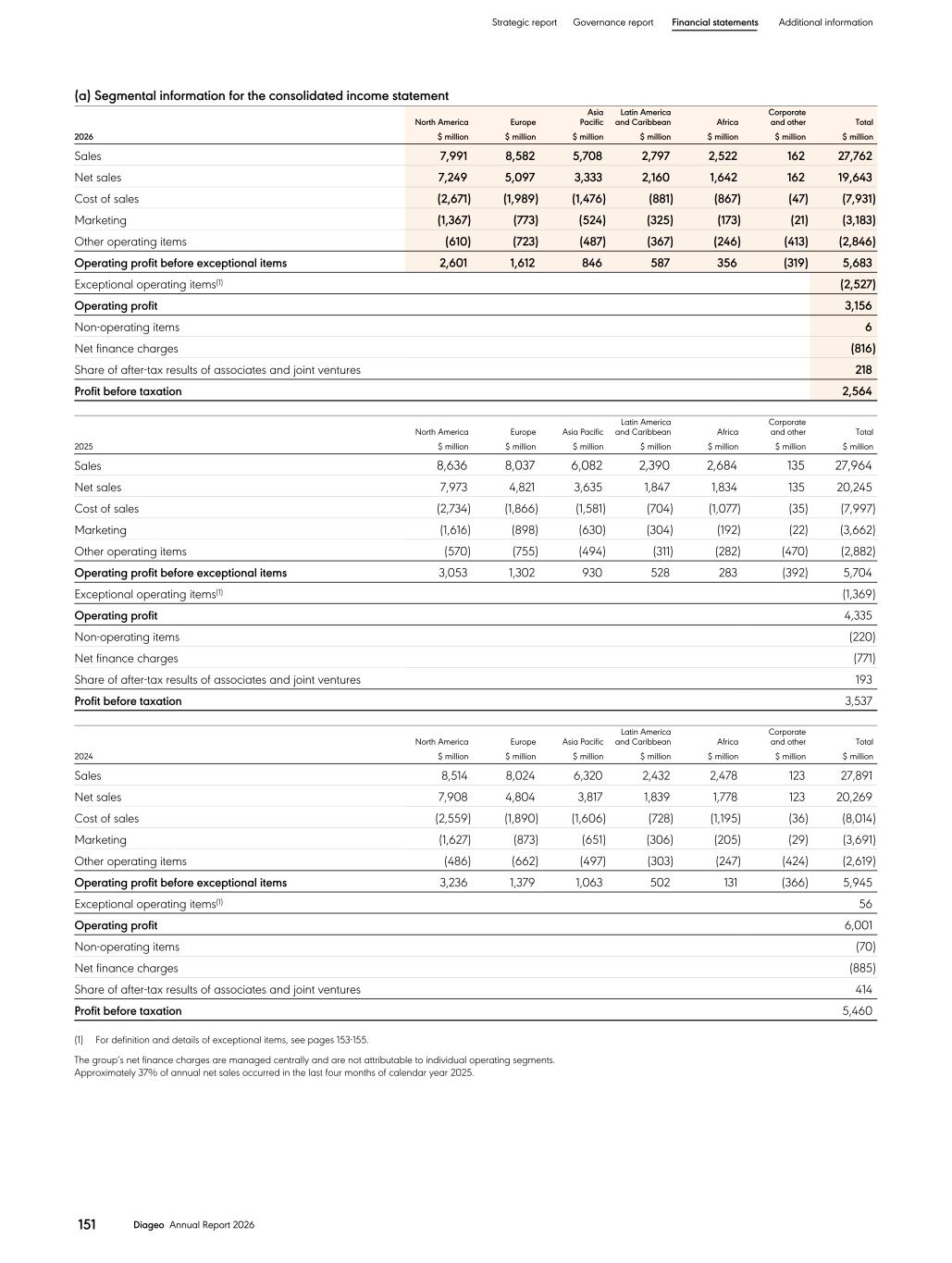
(a) Segmental information for the consolidated income statement Sales 7,991 8,582 5,708 2,797 2,522 162 27,762 Net sales 7,249 5,097 3,333 2,160 1,642 162 19,643 Cost of sales (2,671) (1,989) (1,476) (881) (867) (47) (7,931) Marketing (1,367) (773) (524) (325) (173) (21) (3,183) Other operating items (610) (723) (487) (367) (246) (413) (2,846) Operating profit before exceptional items 2,601 1,612 846 587 356 (319) 5,683 Exceptional operating items(1) (2,527) Operating profit 3,156 Non-operating items 6 Net finance charges (816) Share of after-tax results of associates and joint ventures 218 Profit before taxation 2,564 North America Europe Asia Pacific Latin America and Caribbean Africa Corporate and other Total 2026 $ million $ million $ million $ million $ million $ million $ million Sales 8,636 8,037 6,082 2,390 2,684 135 27,964 Net sales 7,973 4,821 3,635 1,847 1,834 135 20,245 Cost of sales (2,734) (1,866) (1,581) (704) (1,077) (35) (7,997) Marketing (1,616) (898) (630) (304) (192) (22) (3,662) Other operating items (570) (755) (494) (311) (282) (470) (2,882) Operating profit before exceptional items 3,053 1,302 930 528 283 (392) 5,704 Exceptional operating items(1) (1,369) Operating profit 4,335 Non-operating items (220) Net finance charges (771) Share of after-tax results of associates and joint ventures 193 Profit before taxation 3,537 North America Europe Asia Pacific Latin America and Caribbean Africa Corporate and other Total 2025 $ million $ million $ million $ million $ million $ million $ million Sales 8,514 8,024 6,320 2,432 2,478 123 27,891 Net sales 7,908 4,804 3,817 1,839 1,778 123 20,269 Cost of sales (2,559) (1,890) (1,606) (728) (1,195) (36) (8,014) Marketing (1,627) (873) (651) (306) (205) (29) (3,691) Other operating items (486) (662) (497) (303) (247) (424) (2,619) Operating profit before exceptional items 3,236 1,379 1,063 502 131 (366) 5,945 Exceptional operating items(1) 56 Operating profit 6,001 Non-operating items (70) Net finance charges (885) Share of after-tax results of associates and joint ventures 414 Profit before taxation 5,460 North America Europe Asia Pacific Latin America and Caribbean Africa Corporate and other Total 2024 $ million $ million $ million $ million $ million $ million $ million (1) For definition and details of exceptional items, see pages 153-155. The group’s net finance charges are managed centrally and are not attributable to individual operating segments. Approximately 37% of annual net sales occurred in the last four months of calendar year 2025. Strategic report Governance report Financial statements Additional information 151 Diageo Annual Report 2026
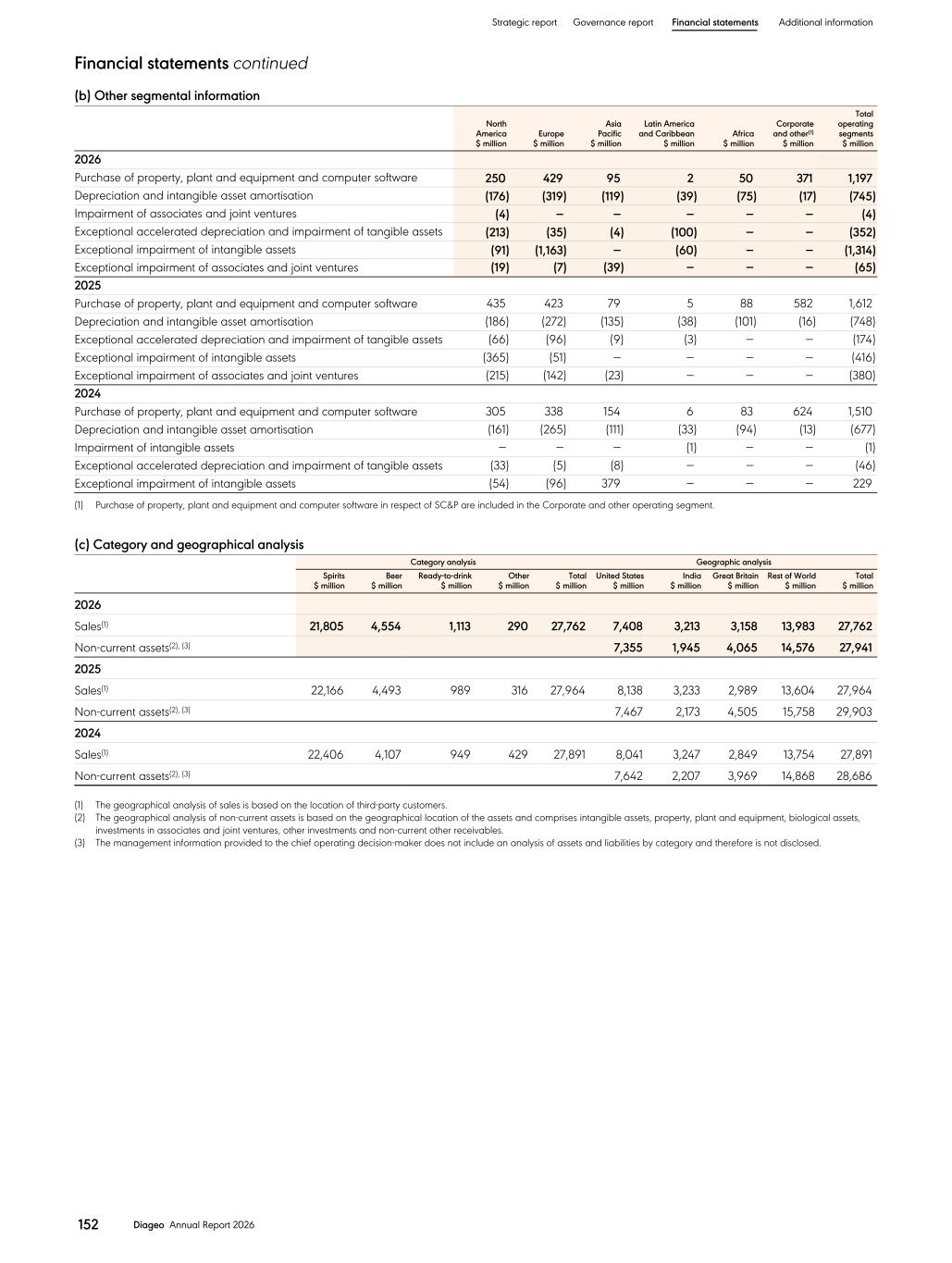
(b) Other segmental information 2026 Purchase of property, plant and equipment and computer software 250 429 95 2 50 371 1,197 Depreciation and intangible asset amortisation (176) (319) (119) (39) (75) (17) (745) Impairment of associates and joint ventures (4) — — — — — (4) Exceptional accelerated depreciation and impairment of tangible assets (213) (35) (4) (100) — — (352) Exceptional impairment of intangible assets (91) (1,163) — (60) — — (1,314) Exceptional impairment of associates and joint ventures (19) (7) (39) — — — (65) 2025 Purchase of property, plant and equipment and computer software 435 423 79 5 88 582 1,612 Depreciation and intangible asset amortisation (186) (272) (135) (38) (101) (16) (748) Exceptional accelerated depreciation and impairment of tangible assets (66) (96) (9) (3) — — (174) Exceptional impairment of intangible assets (365) (51) — — — — (416) Exceptional impairment of associates and joint ventures (215) (142) (23) — — — (380) 2024 Purchase of property, plant and equipment and computer software 305 338 154 6 83 624 1,510 Depreciation and intangible asset amortisation (161) (265) (111) (33) (94) (13) (677) Impairment of intangible assets — — — (1) — — (1) Exceptional accelerated depreciation and impairment of tangible assets (33) (5) (8) — — — (46) Exceptional impairment of intangible assets (54) (96) 379 — — — 229 North America $ million Europe $ million Asia Pacific $ million Latin America and Caribbean $ million Africa $ million Corporate and other(1) $ million Total operating segments $ million (1) Purchase of property, plant and equipment and computer software in respect of SC&P are included in the Corporate and other operating segment. (c) Category and geographical analysis 2026 Sales(1) 21,805 4,554 1,113 290 27,762 7,408 3,213 3,158 13,983 27,762 Non-current assets(2), (3) 7,355 1,945 4,065 14,576 27,941 2025 Sales(1) 22,166 4,493 989 316 27,964 8,138 3,233 2,989 13,604 27,964 Non-current assets(2), (3) 7,467 2,173 4,505 15,758 29,903 2024 Sales(1) 22,406 4,107 949 429 27,891 8,041 3,247 2,849 13,754 27,891 Non-current assets(2), (3) 7,642 2,207 3,969 14,868 28,686 Category analysis Geographic analysis Spirits $ million Beer $ million Ready-to-drink $ million Other $ million Total $ million United States $ million India $ million Great Britain $ million Rest of World $ million Total $ million (1) The geographical analysis of sales is based on the location of third-party customers. (2) The geographical analysis of non-current assets is based on the geographical location of the assets and comprises intangible assets, property, plant and equipment, biological assets, investments in associates and joint ventures, other investments and non-current other receivables. (3) The management information provided to the chief operating decision-maker does not include an analysis of assets and liabilities by category and therefore is not disclosed. Strategic report Governance report Financial statements Additional information Financial statements continued 152 Diageo Annual Report 2026
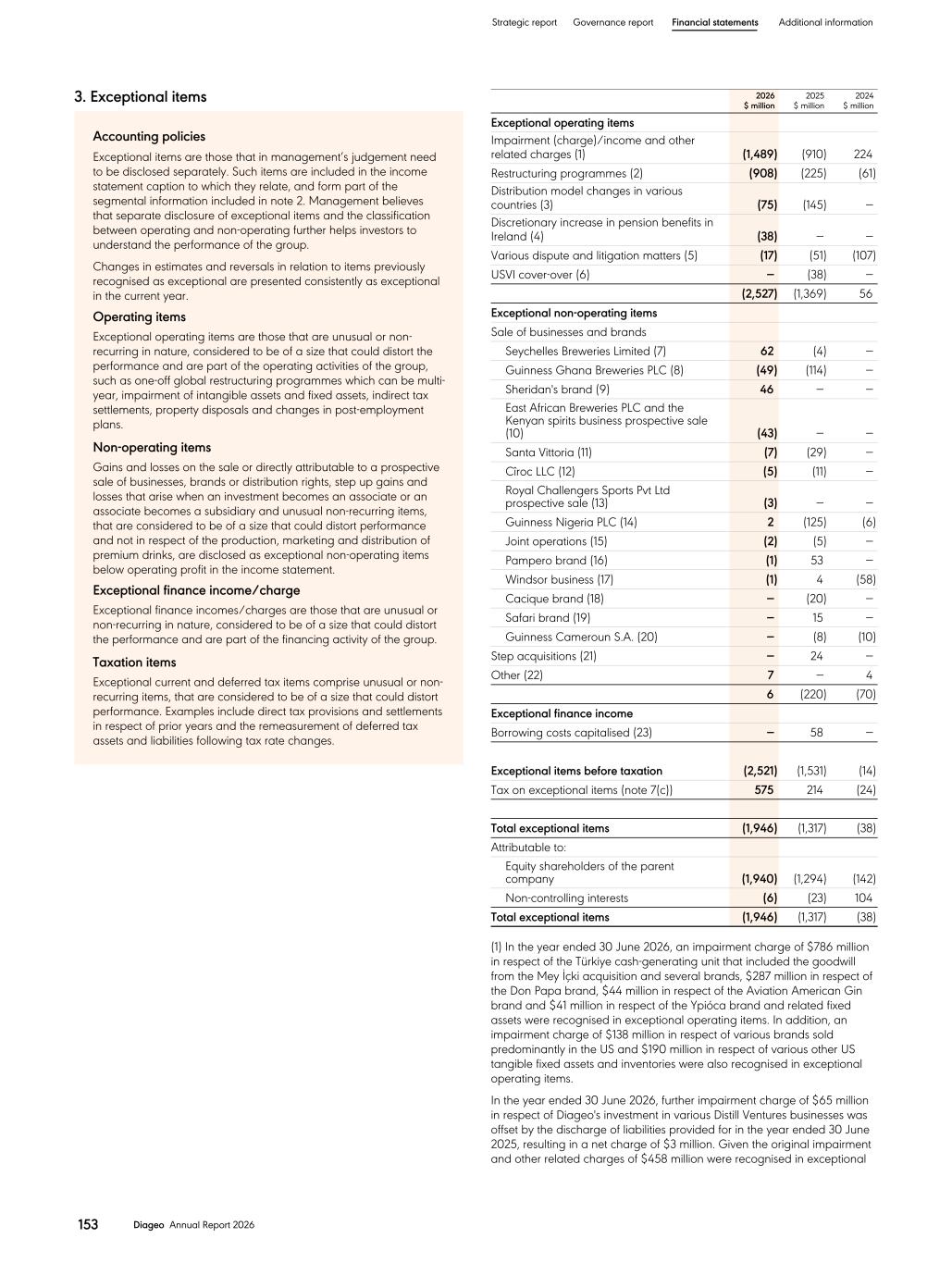
3. Exceptional items Accounting policies Exceptional items are those that in management’s judgement need to be disclosed separately. Such items are included in the income statement caption to which they relate, and form part of the segmental information included in note 2. Management believes that separate disclosure of exceptional items and the classification between operating and non-operating further helps investors to understand the performance of the group. Changes in estimates and reversals in relation to items previously recognised as exceptional are presented consistently as exceptional in the current year. Operating items Exceptional operating items are those that are unusual or non- recurring in nature, considered to be of a size that could distort the performance and are part of the operating activities of the group, such as one-off global restructuring programmes which can be multi- year, impairment of intangible assets and fixed assets, indirect tax settlements, property disposals and changes in post-employment plans. Non-operating items Gains and losses on the sale or directly attributable to a prospective sale of businesses, brands or distribution rights, step up gains and losses that arise when an investment becomes an associate or an associate becomes a subsidiary and unusual non-recurring items, that are considered to be of a size that could distort performance and not in respect of the production, marketing and distribution of premium drinks, are disclosed as exceptional non-operating items below operating profit in the income statement. Exceptional finance income/charge Exceptional finance incomes/charges are those that are unusual or non-recurring in nature, considered to be of a size that could distort the performance and are part of the financing activity of the group. Taxation items Exceptional current and deferred tax items comprise unusual or non- recurring items, that are considered to be of a size that could distort performance. Examples include direct tax provisions and settlements in respect of prior years and the remeasurement of deferred tax assets and liabilities following tax rate changes. Exceptional operating items Impairment (charge)/income and other related charges (1) (1,489) (910) 224 Restructuring programmes (2) (908) (225) (61) Distribution model changes in various countries (3) (75) (145) — Discretionary increase in pension benefits in Ireland (4) (38) — — Various dispute and litigation matters (5) (17) (51) (107) USVI cover-over (6) — (38) — (2,527) (1,369) 56 Exceptional non-operating items Sale of businesses and brands Seychelles Breweries Limited (7) 62 (4) — Guinness Ghana Breweries PLC (8) (49) (114) — Sheridan's brand (9) 46 — — East African Breweries PLC and the Kenyan spirits business prospective sale (10) (43) — — Santa Vittoria (11) (7) (29) — Cîroc LLC (12) (5) (11) — Royal Challengers Sports Pvt Ltd prospective sale (13) (3) — — Guinness Nigeria PLC (14) 2 (125) (6) Joint operations (15) (2) (5) — Pampero brand (16) (1) 53 — Windsor business (17) (1) 4 (58) Cacique brand (18) — (20) — Safari brand (19) — 15 — Guinness Cameroun S.A. (20) — (8) (10) Step acquisitions (21) — 24 — Other (22) 7 — 4 6 (220) (70) Exceptional finance income Borrowing costs capitalised (23) — 58 — Exceptional items before taxation (2,521) (1,531) (14) Tax on exceptional items (note 7(c)) 575 214 (24) Total exceptional items (1,946) (1,317) (38) Attributable to: Equity shareholders of the parent company (1,940) (1,294) (142) Non-controlling interests (6) (23) 104 Total exceptional items (1,946) (1,317) (38) 2026 $ million 2025 $ million 2024 $ million (1) In the year ended 30 June 2026, an impairment charge of $786 million in respect of the Türkiye cash-generating unit that included the goodwill from the Mey İçki acquisition and several brands, $287 million in respect of the Don Papa brand, $44 million in respect of the Aviation American Gin brand and $41 million in respect of the Ypióca brand and related fixed assets were recognised in exceptional operating items. In addition, an impairment charge of $138 million in respect of various brands sold predominantly in the US and $190 million in respect of various other US tangible fixed assets and inventories were also recognised in exceptional operating items. In the year ended 30 June 2026, further impairment charge of $65 million in respect of Diageo's investment in various Distill Ventures businesses was offset by the discharge of liabilities provided for in the year ended 30 June 2025, resulting in a net charge of $3 million. Given the original impairment and other related charges of $458 million were recognised in exceptional Strategic report Governance report Financial statements Additional information 153 Diageo Annual Report 2026
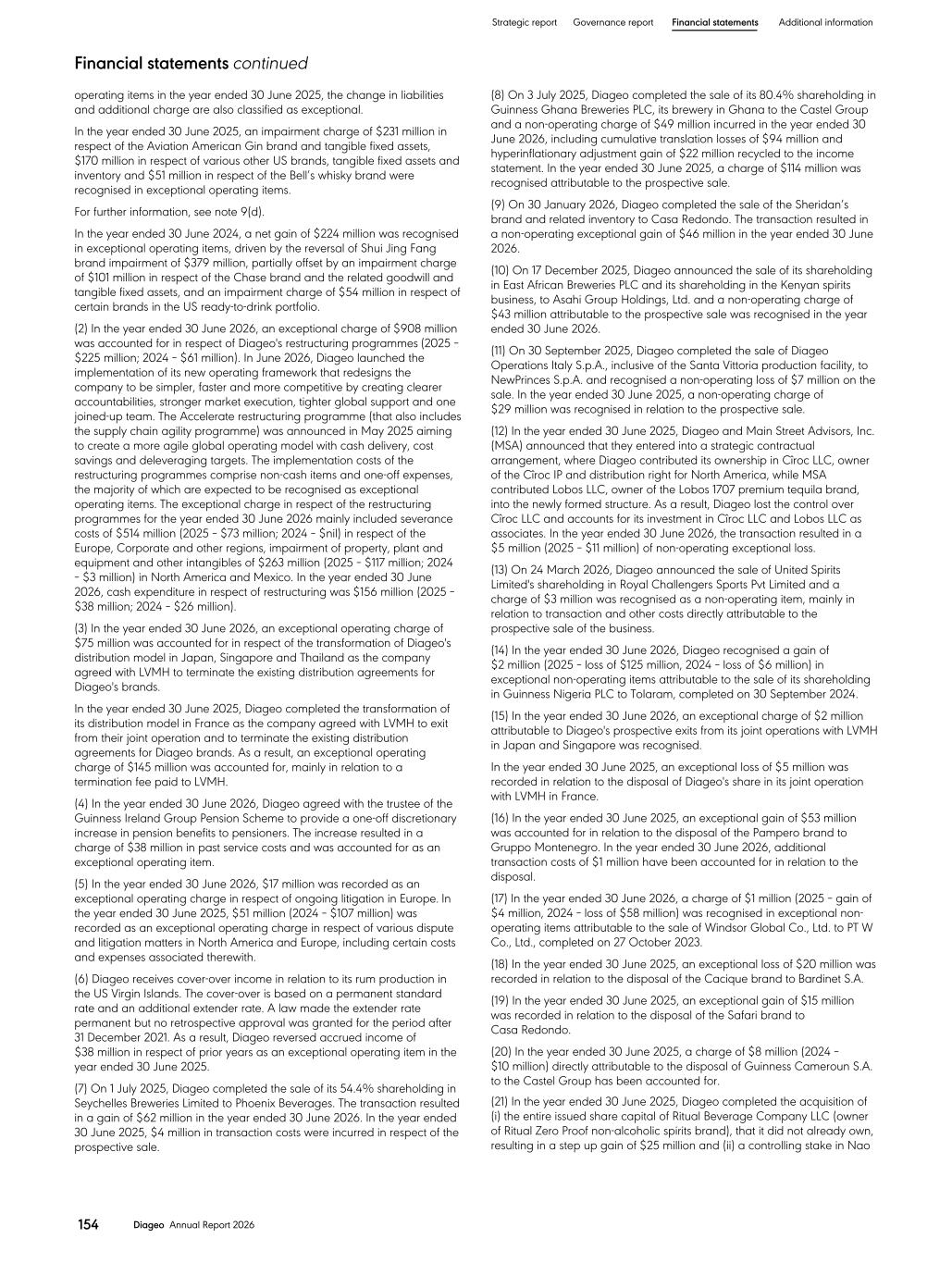
operating items in the year ended 30 June 2025, the change in liabilities and additional charge are also classified as exceptional. In the year ended 30 June 2025, an impairment charge of $231 million in respect of the Aviation American Gin brand and tangible fixed assets, $170 million in respect of various other US brands, tangible fixed assets and inventory and $51 million in respect of the Bell’s whisky brand were recognised in exceptional operating items. For further information, see note 9(d). In the year ended 30 June 2024, a net gain of $224 million was recognised in exceptional operating items, driven by the reversal of Shui Jing Fang brand impairment of $379 million, partially offset by an impairment charge of $101 million in respect of the Chase brand and the related goodwill and tangible fixed assets, and an impairment charge of $54 million in respect of certain brands in the US ready-to-drink portfolio. (2) In the year ended 30 June 2026, an exceptional charge of $908 million was accounted for in respect of Diageo's restructuring programmes (2025 – $225 million; 2024 – $61 million). In June 2026, Diageo launched the implementation of its new operating framework that redesigns the company to be simpler, faster and more competitive by creating clearer accountabilities, stronger market execution, tighter global support and one joined-up team. The Accelerate restructuring programme (that also includes the supply chain agility programme) was announced in May 2025 aiming to create a more agile global operating model with cash delivery, cost savings and deleveraging targets. The implementation costs of the restructuring programmes comprise non-cash items and one-off expenses, the majority of which are expected to be recognised as exceptional operating items. The exceptional charge in respect of the restructuring programmes for the year ended 30 June 2026 mainly included severance costs of $514 million (2025 – $73 million; 2024 – $nil) in respect of the Europe, Corporate and other regions, impairment of property, plant and equipment and other intangibles of $263 million (2025 – $117 million; 2024 – $3 million) in North America and Mexico. In the year ended 30 June 2026, cash expenditure in respect of restructuring was $156 million (2025 – $38 million; 2024 – $26 million). (3) In the year ended 30 June 2026, an exceptional operating charge of $75 million was accounted for in respect of the transformation of Diageo's distribution model in Japan, Singapore and Thailand as the company agreed with LVMH to terminate the existing distribution agreements for Diageo's brands. In the year ended 30 June 2025, Diageo completed the transformation of its distribution model in France as the company agreed with LVMH to exit from their joint operation and to terminate the existing distribution agreements for Diageo brands. As a result, an exceptional operating charge of $145 million was accounted for, mainly in relation to a termination fee paid to LVMH. (4) In the year ended 30 June 2026, Diageo agreed with the trustee of the Guinness Ireland Group Pension Scheme to provide a one-off discretionary increase in pension benefits to pensioners. The increase resulted in a charge of $38 million in past service costs and was accounted for as an exceptional operating item. (5) In the year ended 30 June 2026, $17 million was recorded as an exceptional operating charge in respect of ongoing litigation in Europe. In the year ended 30 June 2025, $51 million (2024 – $107 million) was recorded as an exceptional operating charge in respect of various dispute and litigation matters in North America and Europe, including certain costs and expenses associated therewith. (6) Diageo receives cover-over income in relation to its rum production in the US Virgin Islands. The cover-over is based on a permanent standard rate and an additional extender rate. A law made the extender rate permanent but no retrospective approval was granted for the period after 31 December 2021. As a result, Diageo reversed accrued income of $38 million in respect of prior years as an exceptional operating item in the year ended 30 June 2025. (7) On 1 July 2025, Diageo completed the sale of its 54.4% shareholding in Seychelles Breweries Limited to Phoenix Beverages. The transaction resulted in a gain of $62 million in the year ended 30 June 2026. In the year ended 30 June 2025, $4 million in transaction costs were incurred in respect of the prospective sale. (8) On 3 July 2025, Diageo completed the sale of its 80.4% shareholding in Guinness Ghana Breweries PLC, its brewery in Ghana to the Castel Group and a non-operating charge of $49 million incurred in the year ended 30 June 2026, including cumulative translation losses of $94 million and hyperinflationary adjustment gain of $22 million recycled to the income statement. In the year ended 30 June 2025, a charge of $114 million was recognised attributable to the prospective sale. (9) On 30 January 2026, Diageo completed the sale of the Sheridan’s brand and related inventory to Casa Redondo. The transaction resulted in a non-operating exceptional gain of $46 million in the year ended 30 June 2026. (10) On 17 December 2025, Diageo announced the sale of its shareholding in East African Breweries PLC and its shareholding in the Kenyan spirits business, to Asahi Group Holdings, Ltd. and a non-operating charge of $43 million attributable to the prospective sale was recognised in the year ended 30 June 2026. (11) On 30 September 2025, Diageo completed the sale of Diageo Operations Italy S.p.A., inclusive of the Santa Vittoria production facility, to NewPrinces S.p.A. and recognised a non-operating loss of $7 million on the sale. In the year ended 30 June 2025, a non-operating charge of $29 million was recognised in relation to the prospective sale. (12) In the year ended 30 June 2025, Diageo and Main Street Advisors, Inc. (MSA) announced that they entered into a strategic contractual arrangement, where Diageo contributed its ownership in Cîroc LLC, owner of the Cîroc IP and distribution right for North America, while MSA contributed Lobos LLC, owner of the Lobos 1707 premium tequila brand, into the newly formed structure. As a result, Diageo lost the control over Cîroc LLC and accounts for its investment in Cîroc LLC and Lobos LLC as associates. In the year ended 30 June 2026, the transaction resulted in a $5 million (2025 – $11 million) of non-operating exceptional loss. (13) On 24 March 2026, Diageo announced the sale of United Spirits Limited's shareholding in Royal Challengers Sports Pvt Limited and a charge of $3 million was recognised as a non-operating item, mainly in relation to transaction and other costs directly attributable to the prospective sale of the business. (14) In the year ended 30 June 2026, Diageo recognised a gain of $2 million (2025 – loss of $125 million, 2024 – loss of $6 million) in exceptional non-operating items attributable to the sale of its shareholding in Guinness Nigeria PLC to Tolaram, completed on 30 September 2024. (15) In the year ended 30 June 2026, an exceptional charge of $2 million attributable to Diageo's prospective exits from its joint operations with LVMH in Japan and Singapore was recognised. In the year ended 30 June 2025, an exceptional loss of $5 million was recorded in relation to the disposal of Diageo's share in its joint operation with LVMH in France. (16) In the year ended 30 June 2025, an exceptional gain of $53 million was accounted for in relation to the disposal of the Pampero brand to Gruppo Montenegro. In the year ended 30 June 2026, additional transaction costs of $1 million have been accounted for in relation to the disposal. (17) In the year ended 30 June 2026, a charge of $1 million (2025 – gain of $4 million, 2024 – loss of $58 million) was recognised in exceptional non- operating items attributable to the sale of Windsor Global Co., Ltd. to PT W Co., Ltd., completed on 27 October 2023. (18) In the year ended 30 June 2025, an exceptional loss of $20 million was recorded in relation to the disposal of the Cacique brand to Bardinet S.A. (19) In the year ended 30 June 2025, an exceptional gain of $15 million was recorded in relation to the disposal of the Safari brand to Casa Redondo. (20) In the year ended 30 June 2025, a charge of $8 million (2024 – $10 million) directly attributable to the disposal of Guinness Cameroun S.A. to the Castel Group has been accounted for. (21) In the year ended 30 June 2025, Diageo completed the acquisition of (i) the entire issued share capital of Ritual Beverage Company LLC (owner of Ritual Zero Proof non-alcoholic spirits brand), that it did not already own, resulting in a step up gain of $25 million and (ii) a controlling stake in Nao Strategic report Governance report Financial statements Additional information Financial statements continued 154 Diageo Annual Report 2026
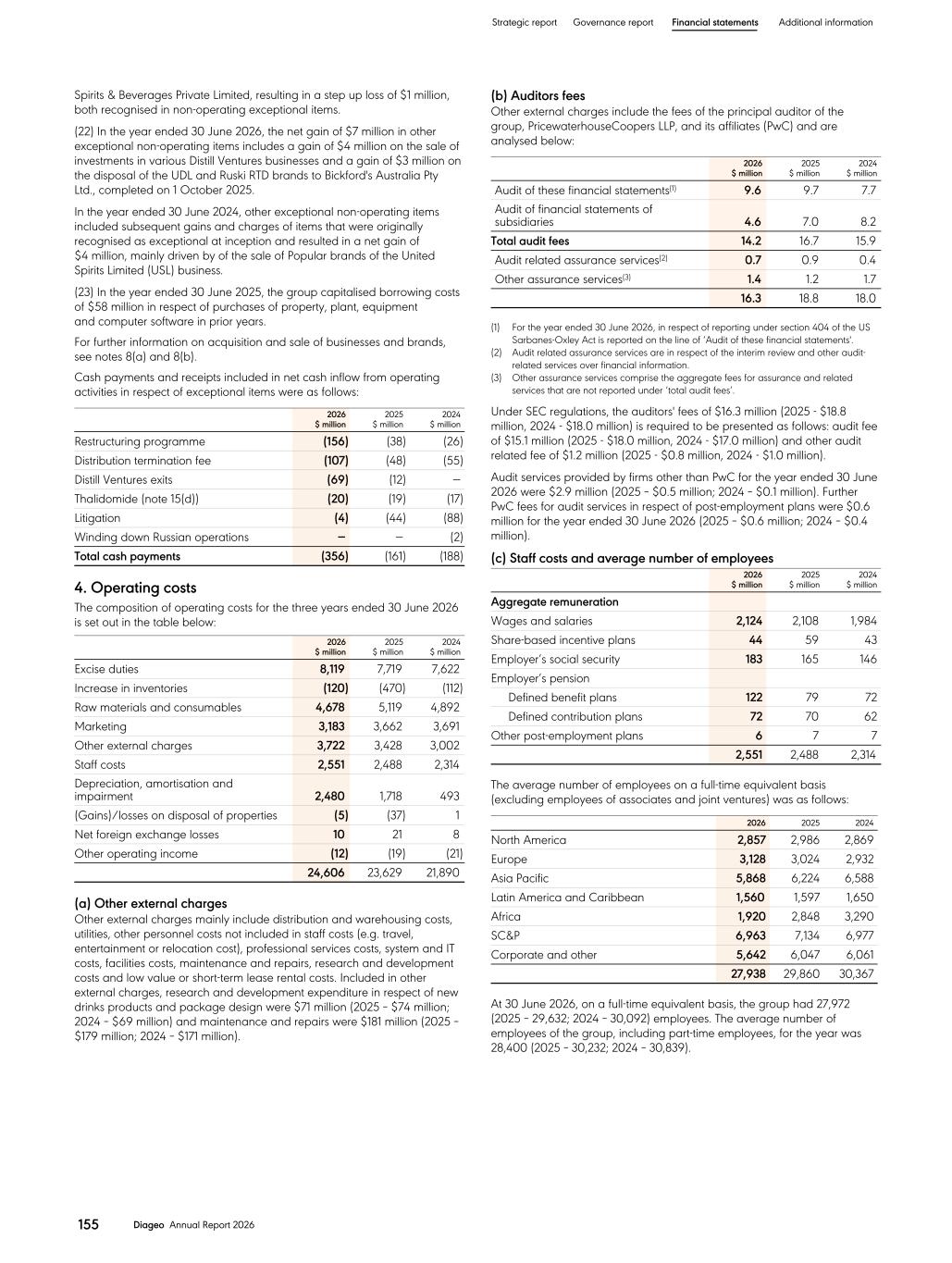
Spirits & Beverages Private Limited, resulting in a step up loss of $1 million, both recognised in non-operating exceptional items. (22) In the year ended 30 June 2026, the net gain of $7 million in other exceptional non-operating items includes a gain of $4 million on the sale of investments in various Distill Ventures businesses and a gain of $3 million on the disposal of the UDL and Ruski RTD brands to Bickford's Australia Pty Ltd., completed on 1 October 2025. In the year ended 30 June 2024, other exceptional non-operating items included subsequent gains and charges of items that were originally recognised as exceptional at inception and resulted in a net gain of $4 million, mainly driven by of the sale of Popular brands of the United Spirits Limited (USL) business. (23) In the year ended 30 June 2025, the group capitalised borrowing costs of $58 million in respect of purchases of property, plant, equipment and computer software in prior years. For further information on acquisition and sale of businesses and brands, see notes 8(a) and 8(b). Cash payments and receipts included in net cash inflow from operating activities in respect of exceptional items were as follows: Restructuring programme (156) (38) (26) Distribution termination fee (107) (48) (55) Distill Ventures exits (69) (12) — Thalidomide (note 15(d)) (20) (19) (17) Litigation (4) (44) (88) Winding down Russian operations — — (2) Total cash payments (356) (161) (188) 2026 $ million 2025 $ million 2024 $ million 4. Operating costs The composition of operating costs for the three years ended 30 June 2026 is set out in the table below: Excise duties 8,119 7,719 7,622 Increase in inventories (120) (470) (112) Raw materials and consumables 4,678 5,119 4,892 Marketing 3,183 3,662 3,691 Other external charges 3,722 3,428 3,002 Staff costs 2,551 2,488 2,314 Depreciation, amortisation and impairment 2,480 1,718 493 (Gains)/losses on disposal of properties (5) (37) 1 Net foreign exchange losses 10 21 8 Other operating income (12) (19) (21) 24,606 23,629 21,890 2026 $ million 2025 $ million 2024 $ million (a) Other external charges Other external charges mainly include distribution and warehousing costs, utilities, other personnel costs not included in staff costs (e.g. travel, entertainment or relocation cost), professional services costs, system and IT costs, facilities costs, maintenance and repairs, research and development costs and low value or short-term lease rental costs. Included in other external charges, research and development expenditure in respect of new drinks products and package design were $71 million (2025 – $74 million; 2024 – $69 million) and maintenance and repairs were $181 million (2025 – $179 million; 2024 – $171 million). (b) Auditors fees Other external charges include the fees of the principal auditor of the group, PricewaterhouseCoopers LLP, and its affiliates (PwC) and are analysed below: Audit of these financial statements(1) 9.6 9.7 7.7 Audit of financial statements of subsidiaries 4.6 7.0 8.2 Total audit fees 14.2 16.7 15.9 Audit related assurance services(2) 0.7 0.9 0.4 Other assurance services(3) 1.4 1.2 1.7 16.3 18.8 18.0 2026 $ million 2025 $ million 2024 $ million (1) For the year ended 30 June 2026, in respect of reporting under section 404 of the US Sarbanes-Oxley Act is reported on the line of ‘Audit of these financial statements'. (2) Audit related assurance services are in respect of the interim review and other audit- related services over financial information. (3) Other assurance services comprise the aggregate fees for assurance and related services that are not reported under ‘total audit fees’. Under SEC regulations, the auditors' fees of $16.3 million (2025 - $18.8 million, 2024 - $18.0 million) is required to be presented as follows: audit fee of $15.1 million (2025 - $18.0 million, 2024 - $17.0 million) and other audit related fee of $1.2 million (2025 - $0.8 million, 2024 - $1.0 million). Audit services provided by firms other than PwC for the year ended 30 June 2026 were $2.9 million (2025 – $0.5 million; 2024 – $0.1 million). Further PwC fees for audit services in respect of post-employment plans were $0.6 million for the year ended 30 June 2026 (2025 – $0.6 million; 2024 – $0.4 million). (c) Staff costs and average number of employees Aggregate remuneration Wages and salaries 2,124 2,108 1,984 Share-based incentive plans 44 59 43 Employer’s social security 183 165 146 Employer’s pension Defined benefit plans 122 79 72 Defined contribution plans 72 70 62 Other post-employment plans 6 7 7 2,551 2,488 2,314 2026 $ million 2025 $ million 2024 $ million The average number of employees on a full-time equivalent basis (excluding employees of associates and joint ventures) was as follows: North America 2,857 2,986 2,869 Europe 3,128 3,024 2,932 Asia Pacific 5,868 6,224 6,588 Latin America and Caribbean 1,560 1,597 1,650 Africa 1,920 2,848 3,290 SC&P 6,963 7,134 6,977 Corporate and other 5,642 6,047 6,061 27,938 29,860 30,367 2026 2025 2024 At 30 June 2026, on a full-time equivalent basis, the group had 27,972 (2025 – 29,632; 2024 – 30,092) employees. The average number of employees of the group, including part-time employees, for the year was 28,400 (2025 – 30,232; 2024 – 30,839). Strategic report Governance report Financial statements Additional information 155 Diageo Annual Report 2026
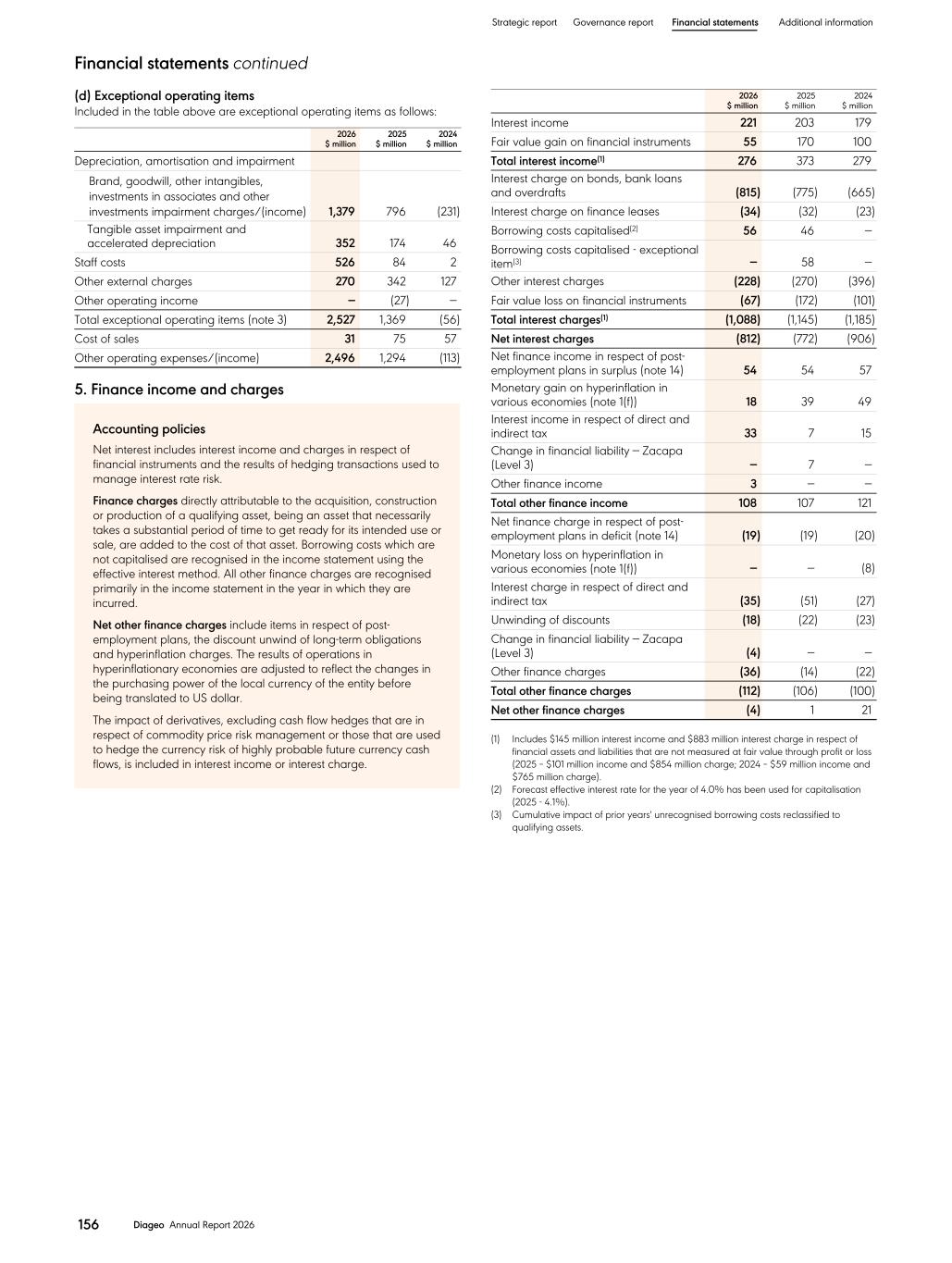
(d) Exceptional operating items Included in the table above are exceptional operating items as follows: Depreciation, amortisation and impairment Brand, goodwill, other intangibles, investments in associates and other investments impairment charges/(income) 1,379 796 (231) Tangible asset impairment and accelerated depreciation 352 174 46 Staff costs 526 84 2 Other external charges 270 342 127 Other operating income — (27) — Total exceptional operating items (note 3) 2,527 1,369 (56) Cost of sales 31 75 57 Other operating expenses/(income) 2,496 1,294 (113) 2026 $ million 2025 $ million 2024 $ million 5. Finance income and charges Accounting policies Net interest includes interest income and charges in respect of financial instruments and the results of hedging transactions used to manage interest rate risk. Finance charges directly attributable to the acquisition, construction or production of a qualifying asset, being an asset that necessarily takes a substantial period of time to get ready for its intended use or sale, are added to the cost of that asset. Borrowing costs which are not capitalised are recognised in the income statement using the effective interest method. All other finance charges are recognised primarily in the income statement in the year in which they are incurred. Net other finance charges include items in respect of post- employment plans, the discount unwind of long-term obligations and hyperinflation charges. The results of operations in hyperinflationary economies are adjusted to reflect the changes in the purchasing power of the local currency of the entity before being translated to US dollar. The impact of derivatives, excluding cash flow hedges that are in respect of commodity price risk management or those that are used to hedge the currency risk of highly probable future currency cash flows, is included in interest income or interest charge. Interest income 221 203 179 Fair value gain on financial instruments 55 170 100 Total interest income(1) 276 373 279 Interest charge on bonds, bank loans and overdrafts (815) (775) (665) Interest charge on finance leases (34) (32) (23) Borrowing costs capitalised(2) 56 46 — Borrowing costs capitalised - exceptional item(3) — 58 — Other interest charges (228) (270) (396) Fair value loss on financial instruments (67) (172) (101) Total interest charges(1) (1,088) (1,145) (1,185) Net interest charges (812) (772) (906) Net finance income in respect of post- employment plans in surplus (note 14) 54 54 57 Monetary gain on hyperinflation in various economies (note 1(f)) 18 39 49 Interest income in respect of direct and indirect tax 33 7 15 Change in financial liability — Zacapa (Level 3) — 7 — Other finance income 3 — — Total other finance income 108 107 121 Net finance charge in respect of post- employment plans in deficit (note 14) (19) (19) (20) Monetary loss on hyperinflation in various economies (note 1(f)) — — (8) Interest charge in respect of direct and indirect tax (35) (51) (27) Unwinding of discounts (18) (22) (23) Change in financial liability — Zacapa (Level 3) (4) — — Other finance charges (36) (14) (22) Total other finance charges (112) (106) (100) Net other finance charges (4) 1 21 2026 $ million 2025 $ million 2024 $ million (1) Includes $145 million interest income and $883 million interest charge in respect of financial assets and liabilities that are not measured at fair value through profit or loss (2025 – $101 million income and $854 million charge; 2024 – $59 million income and $765 million charge). (2) Forecast effective interest rate for the year of 4.0% has been used for capitalisation (2025 - 4.1%). (3) Cumulative impact of prior years' unrecognised borrowing costs reclassified to qualifying assets. Strategic report Governance report Financial statements Additional information Financial statements continued 156 Diageo Annual Report 2026
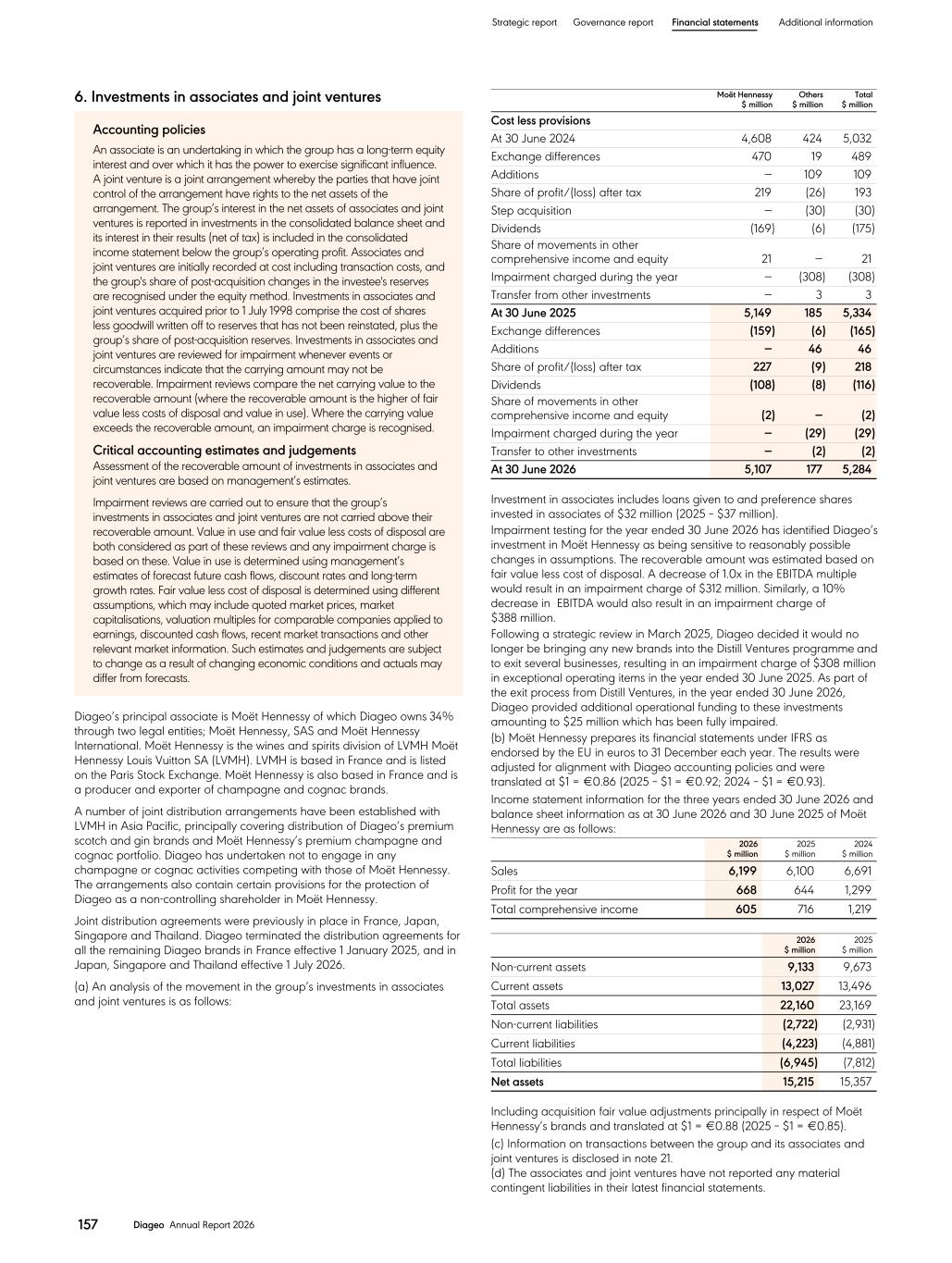
6. Investments in associates and joint ventures Accounting policies An associate is an undertaking in which the group has a long-term equity interest and over which it has the power to exercise significant influence. A joint venture is a joint arrangement whereby the parties that have joint control of the arrangement have rights to the net assets of the arrangement. The group’s interest in the net assets of associates and joint ventures is reported in investments in the consolidated balance sheet and its interest in their results (net of tax) is included in the consolidated income statement below the group’s operating profit. Associates and joint ventures are initially recorded at cost including transaction costs, and the group's share of post-acquisition changes in the investee's reserves are recognised under the equity method. Investments in associates and joint ventures acquired prior to 1 July 1998 comprise the cost of shares less goodwill written off to reserves that has not been reinstated, plus the group’s share of post-acquisition reserves. Investments in associates and joint ventures are reviewed for impairment whenever events or circumstances indicate that the carrying amount may not be recoverable. Impairment reviews compare the net carrying value to the recoverable amount (where the recoverable amount is the higher of fair value less costs of disposal and value in use). Where the carrying value exceeds the recoverable amount, an impairment charge is recognised. Critical accounting estimates and judgements Assessment of the recoverable amount of investments in associates and joint ventures are based on management’s estimates. Impairment reviews are carried out to ensure that the group’s investments in associates and joint ventures are not carried above their recoverable amount. Value in use and fair value less costs of disposal are both considered as part of these reviews and any impairment charge is based on these. Value in use is determined using management’s estimates of forecast future cash flows, discount rates and long-term growth rates. Fair value less cost of disposal is determined using different assumptions, which may include quoted market prices, market capitalisations, valuation multiples for comparable companies applied to earnings, discounted cash flows, recent market transactions and other relevant market information. Such estimates and judgements are subject to change as a result of changing economic conditions and actuals may differ from forecasts. Diageo’s principal associate is Moët Hennessy of which Diageo owns 34% through two legal entities; Moët Hennessy, SAS and Moët Hennessy International. Moët Hennessy is the wines and spirits division of LVMH Moët Hennessy Louis Vuitton SA (LVMH). LVMH is based in France and is listed on the Paris Stock Exchange. Moët Hennessy is also based in France and is a producer and exporter of champagne and cognac brands. A number of joint distribution arrangements have been established with LVMH in Asia Pacific, principally covering distribution of Diageo’s premium scotch and gin brands and Moët Hennessy’s premium champagne and cognac portfolio. Diageo has undertaken not to engage in any champagne or cognac activities competing with those of Moët Hennessy. The arrangements also contain certain provisions for the protection of Diageo as a non-controlling shareholder in Moët Hennessy. Joint distribution agreements were previously in place in France, Japan, Singapore and Thailand. Diageo terminated the distribution agreements for all the remaining Diageo brands in France effective 1 January 2025, and in Japan, Singapore and Thailand effective 1 July 2026. (a) An analysis of the movement in the group’s investments in associates and joint ventures is as follows: Cost less provisions At 30 June 2024 4,608 424 5,032 Exchange differences 470 19 489 Additions — 109 109 Share of profit/(loss) after tax 219 (26) 193 Step acquisition — (30) (30) Dividends (169) (6) (175) Share of movements in other comprehensive income and equity 21 — 21 Impairment charged during the year — (308) (308) Transfer from other investments — 3 3 At 30 June 2025 5,149 185 5,334 Exchange differences (159) (6) (165) Additions — 46 46 Share of profit/(loss) after tax 227 (9) 218 Dividends (108) (8) (116) Share of movements in other comprehensive income and equity (2) — (2) Impairment charged during the year — (29) (29) Transfer to other investments — (2) (2) At 30 June 2026 5,107 177 5,284 Moët Hennessy $ million Others $ million Total $ million Investment in associates includes loans given to and preference shares invested in associates of $32 million (2025 – $37 million). Impairment testing for the year ended 30 June 2026 has identified Diageo’s investment in Moët Hennessy as being sensitive to reasonably possible changes in assumptions. The recoverable amount was estimated based on fair value less cost of disposal. A decrease of 1.0x in the EBITDA multiple would result in an impairment charge of $312 million. Similarly, a 10% decrease in EBITDA would also result in an impairment charge of $388 million. Following a strategic review in March 2025, Diageo decided it would no longer be bringing any new brands into the Distill Ventures programme and to exit several businesses, resulting in an impairment charge of $308 million in exceptional operating items in the year ended 30 June 2025. As part of the exit process from Distill Ventures, in the year ended 30 June 2026, Diageo provided additional operational funding to these investments amounting to $25 million which has been fully impaired. (b) Moët Hennessy prepares its financial statements under IFRS as endorsed by the EU in euros to 31 December each year. The results were adjusted for alignment with Diageo accounting policies and were translated at $1 = €0.86 (2025 – $1 = €0.92; 2024 – $1 = €0.93). Income statement information for the three years ended 30 June 2026 and balance sheet information as at 30 June 2026 and 30 June 2025 of Moët Hennessy are as follows: Sales 6,199 6,100 6,691 Profit for the year 668 644 1,299 Total comprehensive income 605 716 1,219 2026 $ million 2025 $ million 2024 $ million Non-current assets 9,133 9,673 Current assets 13,027 13,496 Total assets 22,160 23,169 Non-current liabilities (2,722) (2,931) Current liabilities (4,223) (4,881) Total liabilities (6,945) (7,812) Net assets 15,215 15,357 2026 $ million 2025 $ million Including acquisition fair value adjustments principally in respect of Moët Hennessy’s brands and translated at $1 = €0.88 (2025 – $1 = €0.85). (c) Information on transactions between the group and its associates and joint ventures is disclosed in note 21. (d) The associates and joint ventures have not reported any material contingent liabilities in their latest financial statements. Strategic report Governance report Financial statements Additional information 157 Diageo Annual Report 2026
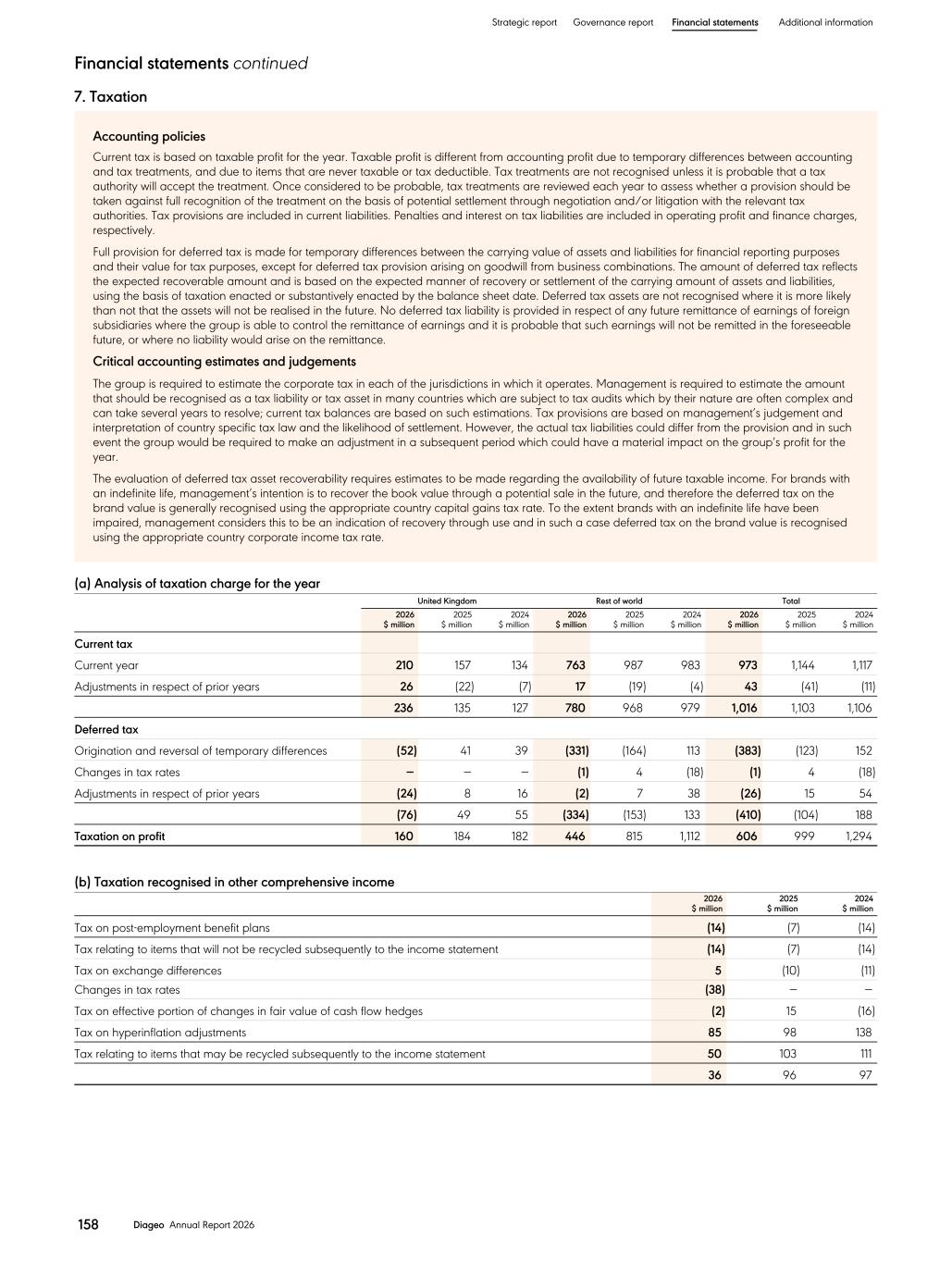
7. Taxation Accounting policies Current tax is based on taxable profit for the year. Taxable profit is different from accounting profit due to temporary differences between accounting and tax treatments, and due to items that are never taxable or tax deductible. Tax treatments are not recognised unless it is probable that a tax authority will accept the treatment. Once considered to be probable, tax treatments are reviewed each year to assess whether a provision should be taken against full recognition of the treatment on the basis of potential settlement through negotiation and/or litigation with the relevant tax authorities. Tax provisions are included in current liabilities. Penalties and interest on tax liabilities are included in operating profit and finance charges, respectively. Full provision for deferred tax is made for temporary differences between the carrying value of assets and liabilities for financial reporting purposes and their value for tax purposes, except for deferred tax provision arising on goodwill from business combinations. The amount of deferred tax reflects the expected recoverable amount and is based on the expected manner of recovery or settlement of the carrying amount of assets and liabilities, using the basis of taxation enacted or substantively enacted by the balance sheet date. Deferred tax assets are not recognised where it is more likely than not that the assets will not be realised in the future. No deferred tax liability is provided in respect of any future remittance of earnings of foreign subsidiaries where the group is able to control the remittance of earnings and it is probable that such earnings will not be remitted in the foreseeable future, or where no liability would arise on the remittance. Critical accounting estimates and judgements The group is required to estimate the corporate tax in each of the jurisdictions in which it operates. Management is required to estimate the amount that should be recognised as a tax liability or tax asset in many countries which are subject to tax audits which by their nature are often complex and can take several years to resolve; current tax balances are based on such estimations. Tax provisions are based on management’s judgement and interpretation of country specific tax law and the likelihood of settlement. However, the actual tax liabilities could differ from the provision and in such event the group would be required to make an adjustment in a subsequent period which could have a material impact on the group’s profit for the year. The evaluation of deferred tax asset recoverability requires estimates to be made regarding the availability of future taxable income. For brands with an indefinite life, management’s intention is to recover the book value through a potential sale in the future, and therefore the deferred tax on the brand value is generally recognised using the appropriate country capital gains tax rate. To the extent brands with an indefinite life have been impaired, management considers this to be an indication of recovery through use and in such a case deferred tax on the brand value is recognised using the appropriate country corporate income tax rate. (a) Analysis of taxation charge for the year Current tax Current year 210 157 134 763 987 983 973 1,144 1,117 Adjustments in respect of prior years 26 (22) (7) 17 (19) (4) 43 (41) (11) 236 135 127 780 968 979 1,016 1,103 1,106 Deferred tax Origination and reversal of temporary differences (52) 41 39 (331) (164) 113 (383) (123) 152 Changes in tax rates — — — (1) 4 (18) (1) 4 (18) Adjustments in respect of prior years (24) 8 16 (2) 7 38 (26) 15 54 (76) 49 55 (334) (153) 133 (410) (104) 188 Taxation on profit 160 184 182 446 815 1,112 606 999 1,294 United Kingdom Rest of world Total 2026 $ million 2025 $ million 2024 $ million 2026 $ million 2025 $ million 2024 $ million 2026 $ million 2025 $ million 2024 $ million (b) Taxation recognised in other comprehensive income Tax on post-employment benefit plans (14) (7) (14) Tax relating to items that will not be recycled subsequently to the income statement (14) (7) (14) Tax on exchange differences 5 (10) (11) Changes in tax rates (38) — — Tax on effective portion of changes in fair value of cash flow hedges (2) 15 (16) Tax on hyperinflation adjustments 85 98 138 Tax relating to items that may be recycled subsequently to the income statement 50 103 111 36 96 97 2026 $ million 2025 $ million 2024 $ million Strategic report Governance report Financial statements Additional information Financial statements continued 158 Diageo Annual Report 2026
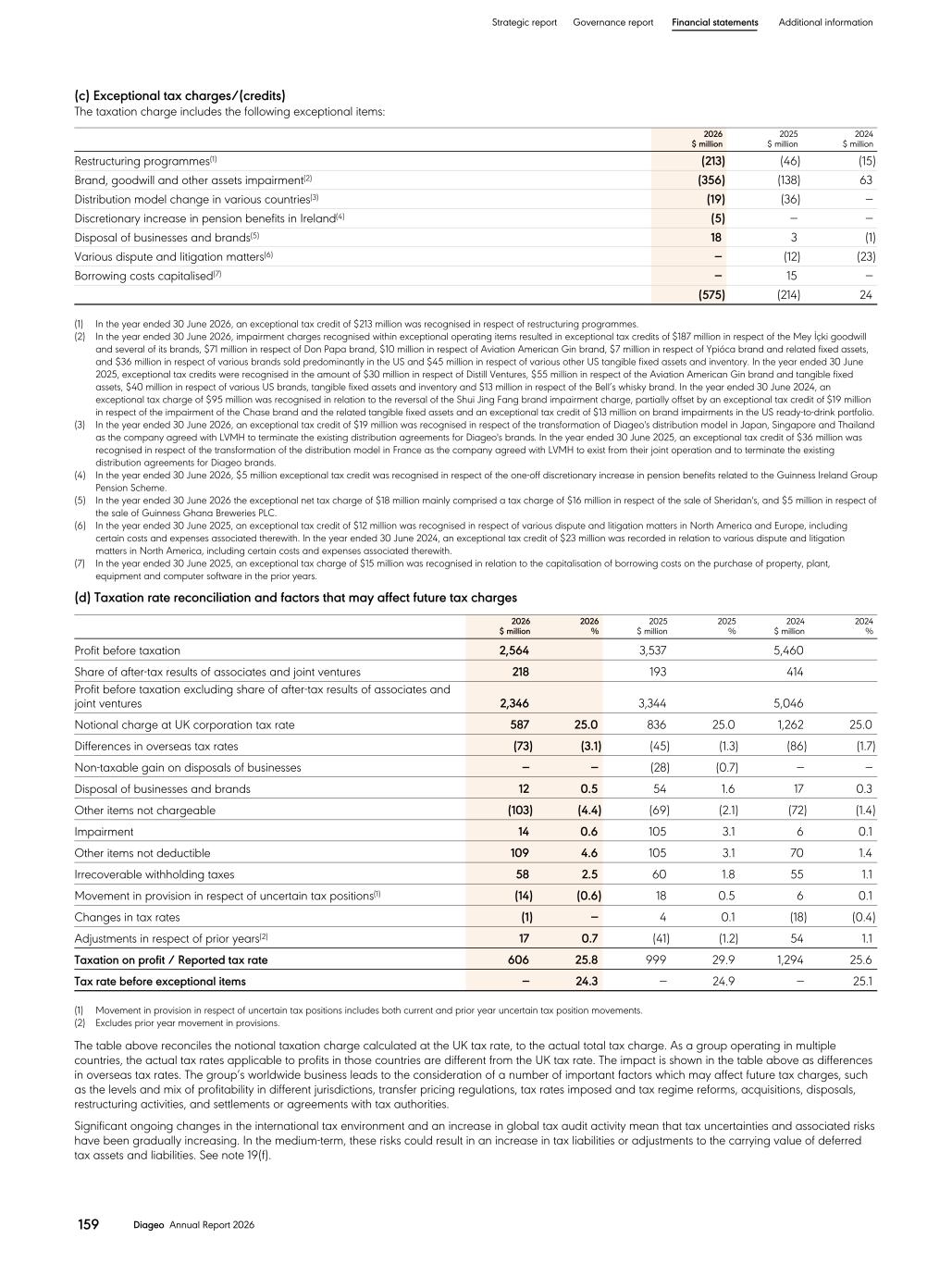
(c) Exceptional tax charges/(credits) The taxation charge includes the following exceptional items: Restructuring programmes(1) (213) (46) (15) Brand, goodwill and other assets impairment(2) (356) (138) 63 Distribution model change in various countries(3) (19) (36) — Discretionary increase in pension benefits in Ireland(4) (5) — — Disposal of businesses and brands(5) 18 3 (1) Various dispute and litigation matters(6) — (12) (23) Borrowing costs capitalised(7) — 15 — (575) (214) 24 2026 $ million 2025 $ million 2024 $ million (1) In the year ended 30 June 2026, an exceptional tax credit of $213 million was recognised in respect of restructuring programmes. (2) In the year ended 30 June 2026, impairment charges recognised within exceptional operating items resulted in exceptional tax credits of $187 million in respect of the Mey İçki goodwill and several of its brands, $71 million in respect of Don Papa brand, $10 million in respect of Aviation American Gin brand, $7 million in respect of Ypióca brand and related fixed assets, and $36 million in respect of various brands sold predominantly in the US and $45 million in respect of various other US tangible fixed assets and inventory. In the year ended 30 June 2025, exceptional tax credits were recognised in the amount of $30 million in respect of Distill Ventures, $55 million in respect of the Aviation American Gin brand and tangible fixed assets, $40 million in respect of various US brands, tangible fixed assets and inventory and $13 million in respect of the Bell’s whisky brand. In the year ended 30 June 2024, an exceptional tax charge of $95 million was recognised in relation to the reversal of the Shui Jing Fang brand impairment charge, partially offset by an exceptional tax credit of $19 million in respect of the impairment of the Chase brand and the related tangible fixed assets and an exceptional tax credit of $13 million on brand impairments in the US ready-to-drink portfolio. (3) In the year ended 30 June 2026, an exceptional tax credit of $19 million was recognised in respect of the transformation of Diageo's distribution model in Japan, Singapore and Thailand as the company agreed with LVMH to terminate the existing distribution agreements for Diageo's brands. In the year ended 30 June 2025, an exceptional tax credit of $36 million was recognised in respect of the transformation of the distribution model in France as the company agreed with LVMH to exist from their joint operation and to terminate the existing distribution agreements for Diageo brands. (4) In the year ended 30 June 2026, $5 million exceptional tax credit was recognised in respect of the one-off discretionary increase in pension benefits related to the Guinness Ireland Group Pension Scheme. (5) In the year ended 30 June 2026 the exceptional net tax charge of $18 million mainly comprised a tax charge of $16 million in respect of the sale of Sheridan's, and $5 million in respect of the sale of Guinness Ghana Breweries PLC. (6) In the year ended 30 June 2025, an exceptional tax credit of $12 million was recognised in respect of various dispute and litigation matters in North America and Europe, including certain costs and expenses associated therewith. In the year ended 30 June 2024, an exceptional tax credit of $23 million was recorded in relation to various dispute and litigation matters in North America, including certain costs and expenses associated therewith. (7) In the year ended 30 June 2025, an exceptional tax charge of $15 million was recognised in relation to the capitalisation of borrowing costs on the purchase of property, plant, equipment and computer software in the prior years. (d) Taxation rate reconciliation and factors that may affect future tax charges Profit before taxation 2,564 3,537 5,460 Share of after-tax results of associates and joint ventures 218 193 414 Profit before taxation excluding share of after-tax results of associates and joint ventures 2,346 3,344 5,046 Notional charge at UK corporation tax rate 587 25.0 836 25.0 1,262 25.0 Differences in overseas tax rates (73) (3.1) (45) (1.3) (86) (1.7) Non-taxable gain on disposals of businesses — — (28) (0.7) — — Disposal of businesses and brands 12 0.5 54 1.6 17 0.3 Other items not chargeable (103) (4.4) (69) (2.1) (72) (1.4) Impairment 14 0.6 105 3.1 6 0.1 Other items not deductible 109 4.6 105 3.1 70 1.4 Irrecoverable withholding taxes 58 2.5 60 1.8 55 1.1 Movement in provision in respect of uncertain tax positions(1) (14) (0.6) 18 0.5 6 0.1 Changes in tax rates (1) — 4 0.1 (18) (0.4) Adjustments in respect of prior years(2) 17 0.7 (41) (1.2) 54 1.1 Taxation on profit / Reported tax rate 606 25.8 999 29.9 1,294 25.6 Tax rate before exceptional items — 24.3 — 24.9 — 25.1 2026 $ million 2026 % 2025 $ million 2025 % 2024 $ million 2024 % (1) Movement in provision in respect of uncertain tax positions includes both current and prior year uncertain tax position movements. (2) Excludes prior year movement in provisions. The table above reconciles the notional taxation charge calculated at the UK tax rate, to the actual total tax charge. As a group operating in multiple countries, the actual tax rates applicable to profits in those countries are different from the UK tax rate. The impact is shown in the table above as differences in overseas tax rates. The group’s worldwide business leads to the consideration of a number of important factors which may affect future tax charges, such as the levels and mix of profitability in different jurisdictions, transfer pricing regulations, tax rates imposed and tax regime reforms, acquisitions, disposals, restructuring activities, and settlements or agreements with tax authorities. Significant ongoing changes in the international tax environment and an increase in global tax audit activity mean that tax uncertainties and associated risks have been gradually increasing. In the medium-term, these risks could result in an increase in tax liabilities or adjustments to the carrying value of deferred tax assets and liabilities. See note 19(f). Strategic report Governance report Financial statements Additional information 159 Diageo Annual Report 2026
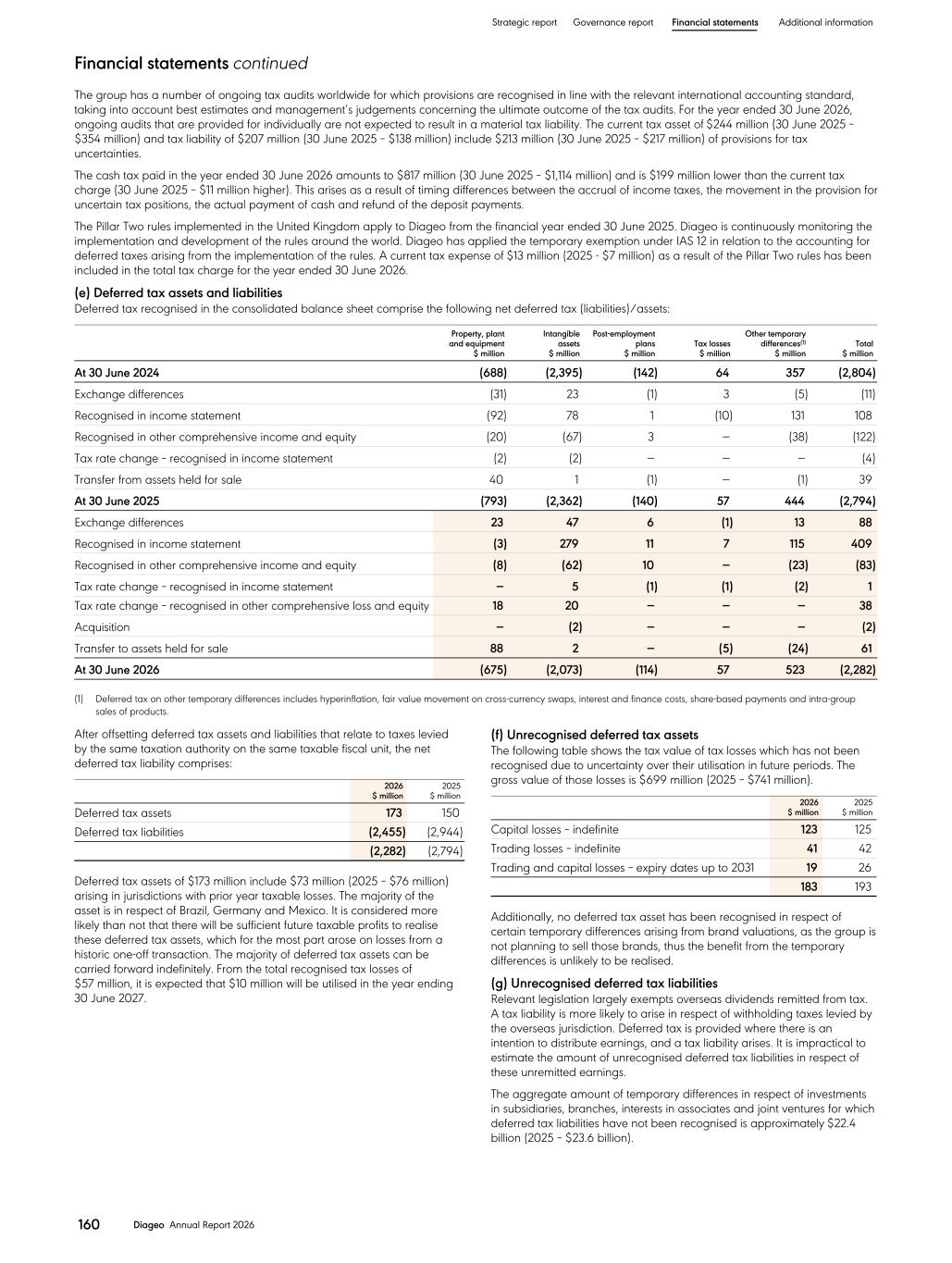
The group has a number of ongoing tax audits worldwide for which provisions are recognised in line with the relevant international accounting standard, taking into account best estimates and management’s judgements concerning the ultimate outcome of the tax audits. For the year ended 30 June 2026, ongoing audits that are provided for individually are not expected to result in a material tax liability. The current tax asset of $244 million (30 June 2025 – $354 million) and tax liability of $207 million (30 June 2025 – $138 million) include $213 million (30 June 2025 – $217 million) of provisions for tax uncertainties. The cash tax paid in the year ended 30 June 2026 amounts to $817 million (30 June 2025 – $1,114 million) and is $199 million lower than the current tax charge (30 June 2025 – $11 million higher). This arises as a result of timing differences between the accrual of income taxes, the movement in the provision for uncertain tax positions, the actual payment of cash and refund of the deposit payments. The Pillar Two rules implemented in the United Kingdom apply to Diageo from the financial year ended 30 June 2025. Diageo is continuously monitoring the implementation and development of the rules around the world. Diageo has applied the temporary exemption under IAS 12 in relation to the accounting for deferred taxes arising from the implementation of the rules. A current tax expense of $13 million (2025 - $7 million) as a result of the Pillar Two rules has been included in the total tax charge for the year ended 30 June 2026. (e) Deferred tax assets and liabilities Deferred tax recognised in the consolidated balance sheet comprise the following net deferred tax (liabilities)/assets: At 30 June 2024 (688) (2,395) (142) 64 357 (2,804) Exchange differences (31) 23 (1) 3 (5) (11) Recognised in income statement (92) 78 1 (10) 131 108 Recognised in other comprehensive income and equity (20) (67) 3 — (38) (122) Tax rate change – recognised in income statement (2) (2) — — — (4) Transfer from assets held for sale 40 1 (1) — (1) 39 At 30 June 2025 (793) (2,362) (140) 57 444 (2,794) Exchange differences 23 47 6 (1) 13 88 Recognised in income statement (3) 279 11 7 115 409 Recognised in other comprehensive income and equity (8) (62) 10 — (23) (83) Tax rate change – recognised in income statement — 5 (1) (1) (2) 1 Tax rate change – recognised in other comprehensive loss and equity 18 20 — — — 38 Acquisition — (2) — — — (2) Transfer to assets held for sale 88 2 — (5) (24) 61 At 30 June 2026 (675) (2,073) (114) 57 523 (2,282) Property, plant and equipment $ million Intangible assets $ million Post-employment plans $ million Tax losses $ million Other temporary differences(1) $ million Total $ million (1) Deferred tax on other temporary differences includes hyperinflation, fair value movement on cross-currency swaps, interest and finance costs, share-based payments and intra-group sales of products. After offsetting deferred tax assets and liabilities that relate to taxes levied by the same taxation authority on the same taxable fiscal unit, the net deferred tax liability comprises: Deferred tax assets 173 150 Deferred tax liabilities (2,455) (2,944) (2,282) (2,794) 2026 $ million 2025 $ million Deferred tax assets of $173 million include $73 million (2025 – $76 million) arising in jurisdictions with prior year taxable losses. The majority of the asset is in respect of Brazil, Germany and Mexico. It is considered more likely than not that there will be sufficient future taxable profits to realise these deferred tax assets, which for the most part arose on losses from a historic one-off transaction. The majority of deferred tax assets can be carried forward indefinitely. From the total recognised tax losses of $57 million, it is expected that $10 million will be utilised in the year ending 30 June 2027. (f) Unrecognised deferred tax assets The following table shows the tax value of tax losses which has not been recognised due to uncertainty over their utilisation in future periods. The gross value of those losses is $699 million (2025 – $741 million). Capital losses – indefinite 123 125 Trading losses – indefinite 41 42 Trading and capital losses – expiry dates up to 2031 19 26 183 193 2026 $ million 2025 $ million Additionally, no deferred tax asset has been recognised in respect of certain temporary differences arising from brand valuations, as the group is not planning to sell those brands, thus the benefit from the temporary differences is unlikely to be realised. (g) Unrecognised deferred tax liabilities Relevant legislation largely exempts overseas dividends remitted from tax. A tax liability is more likely to arise in respect of withholding taxes levied by the overseas jurisdiction. Deferred tax is provided where there is an intention to distribute earnings, and a tax liability arises. It is impractical to estimate the amount of unrecognised deferred tax liabilities in respect of these unremitted earnings. The aggregate amount of temporary differences in respect of investments in subsidiaries, branches, interests in associates and joint ventures for which deferred tax liabilities have not been recognised is approximately $22.4 billion (2025 – $23.6 billion). Strategic report Governance report Financial statements Additional information Financial statements continued 160 Diageo Annual Report 2026
Operating assets and liabilities Introduction This section describes the assets used in the group’s operations and the liabilities incurred. Liabilities relating to the group’s financing activities are included in section ‘Risk management and capital structure’ and balance sheet information in respect of associates, joint ventures and taxation are covered in section ‘Results for the year’. This section also provides detailed disclosures on the group’s recent acquisitions and disposals, performance and financial position of its defined benefit post-employment plans. 8. Acquisition and sale of businesses and brands and purchase of non-controlling interests Accounting policies The consolidated financial statements include the results of the company and its subsidiaries together with the group’s attributable share of the results of associates and joint ventures. The results of subsidiaries acquired or sold are included in the income statement from, or up to, the date that control passes. Business combinations are accounted for using the acquisition method. Identifiable assets, liabilities and contingent liabilities acquired are measured at fair value at acquisition date. The consideration payable is measured at fair value and includes the fair value of any contingent consideration. Among other factors, the group considers the nature of, and compensation for the selling shareholders' continuing employment to determine if any contingent payments are for post-combination employee services, which are excluded from consideration. On the acquisition of a business, or of an interest in an associate or joint venture, fair values, reflecting conditions at the date of acquisition, are attributed to the net assets, including identifiable intangible assets and contingent liabilities acquired. Directly attributable acquisition costs in respect of subsidiary companies acquired are recognised in other external charges as incurred. The non-controlling interests on the date of acquisition can be measured either at the fair value or at the non-controlling shareholder’s proportion of the net fair value of the identifiable assets assumed. This choice is made separately for each acquisition. Where the group has issued a put option over shares held by a non-controlling interest, the group derecognises the non-controlling interests and instead recognises a contingent deferred consideration liability for the estimated amount likely to be paid to the non-controlling interest on the exercise of those options. Movements in the estimated liability in respect of put options are recognised in retained earnings. Transactions with non-controlling interests are recorded directly in retained earnings. For all entities in which the company directly or indirectly owns equity, a judgement is made to determine whether it controls and therefore should fully consolidate the investee. An assessment is carried out to determine whether the group has the exposure or rights to the variable returns of the investee and has the ability to affect those returns through its power over the investee. To establish control, an analysis is carried out of the substantive and protective rights that the group and the other investors hold. This assessment is dependent on the activities and purpose of the investee and the rights of the other shareholders, such as which party controls the board, executive committee and material policies of the investee. Determining whether the rights that the group holds are substantive, requires management judgement. Where less than 50% of the equity of an investee is held, and the group holds significantly more voting rights than any other vote holder or organised group of vote holders, this may be an indicator of de facto control. An assessment is needed to determine all the factors relevant to the relationship with the investee to ascertain whether control has been established and whether the investee should be consolidated as a subsidiary. Where voting power and returns from an investment are split equally between two entities then the arrangement is accounted for as a joint venture. On an acquisition, fair values are attributed to the assets and liabilities acquired. This may involve material judgement to determine these values. Strategic report Governance report Financial statements Additional information 161 Diageo Annual Report 2026
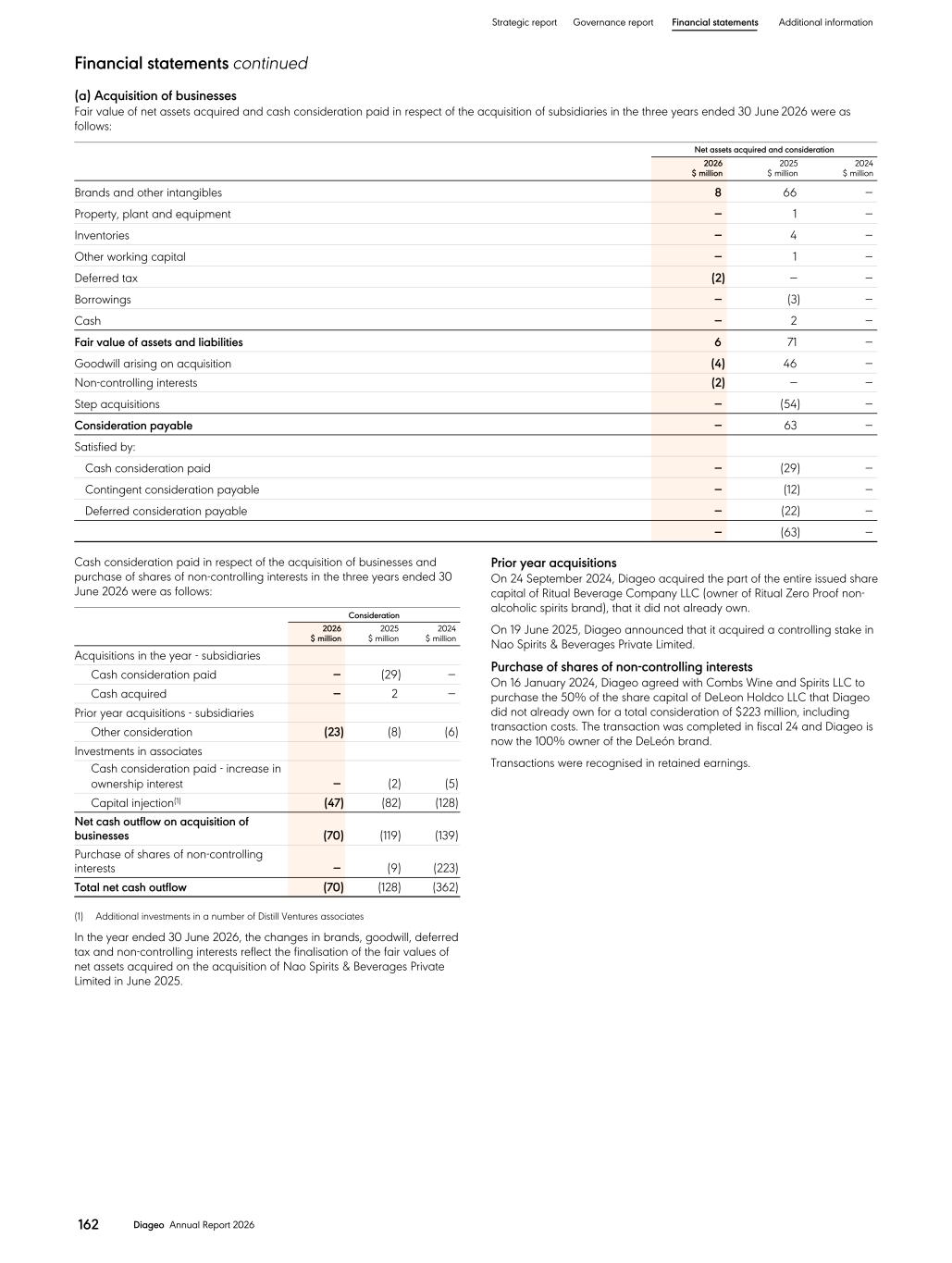
(a) Acquisition of businesses Fair value of net assets acquired and cash consideration paid in respect of the acquisition of subsidiaries in the three years ended 30 June 2026 were as follows: Brands and other intangibles 8 66 — Property, plant and equipment — 1 — Inventories — 4 — Other working capital — 1 — Deferred tax (2) — — Borrowings — (3) — Cash — 2 — Fair value of assets and liabilities 6 71 — Goodwill arising on acquisition (4) 46 — Non-controlling interests (2) — — Step acquisitions — (54) — Consideration payable — 63 — Satisfied by: Cash consideration paid — (29) — Contingent consideration payable — (12) — Deferred consideration payable — (22) — — (63) — Net assets acquired and consideration 2026 $ million 2025 $ million 2024 $ million Cash consideration paid in respect of the acquisition of businesses and purchase of shares of non-controlling interests in the three years ended 30 June 2026 were as follows: Acquisitions in the year - subsidiaries Cash consideration paid — (29) — Cash acquired — 2 — Prior year acquisitions - subsidiaries Other consideration (23) (8) (6) Investments in associates Cash consideration paid - increase in ownership interest — (2) (5) Capital injection(1) (47) (82) (128) Net cash outflow on acquisition of businesses (70) (119) (139) Purchase of shares of non-controlling interests — (9) (223) Total net cash outflow (70) (128) (362) Consideration 2026 $ million 2025 $ million 2024 $ million (1) Additional investments in a number of Distill Ventures associates In the year ended 30 June 2026, the changes in brands, goodwill, deferred tax and non-controlling interests reflect the finalisation of the fair values of net assets acquired on the acquisition of Nao Spirits & Beverages Private Limited in June 2025. Prior year acquisitions On 24 September 2024, Diageo acquired the part of the entire issued share capital of Ritual Beverage Company LLC (owner of Ritual Zero Proof non- alcoholic spirits brand), that it did not already own. On 19 June 2025, Diageo announced that it acquired a controlling stake in Nao Spirits & Beverages Private Limited. Purchase of shares of non-controlling interests On 16 January 2024, Diageo agreed with Combs Wine and Spirits LLC to purchase the 50% of the share capital of DeLeon Holdco LLC that Diageo did not already own for a total consideration of $223 million, including transaction costs. The transaction was completed in fiscal 24 and Diageo is now the 100% owner of the DeLeón brand. Transactions were recognised in retained earnings. Strategic report Governance report Financial statements Additional information Financial statements continued 162 Diageo Annual Report 2026
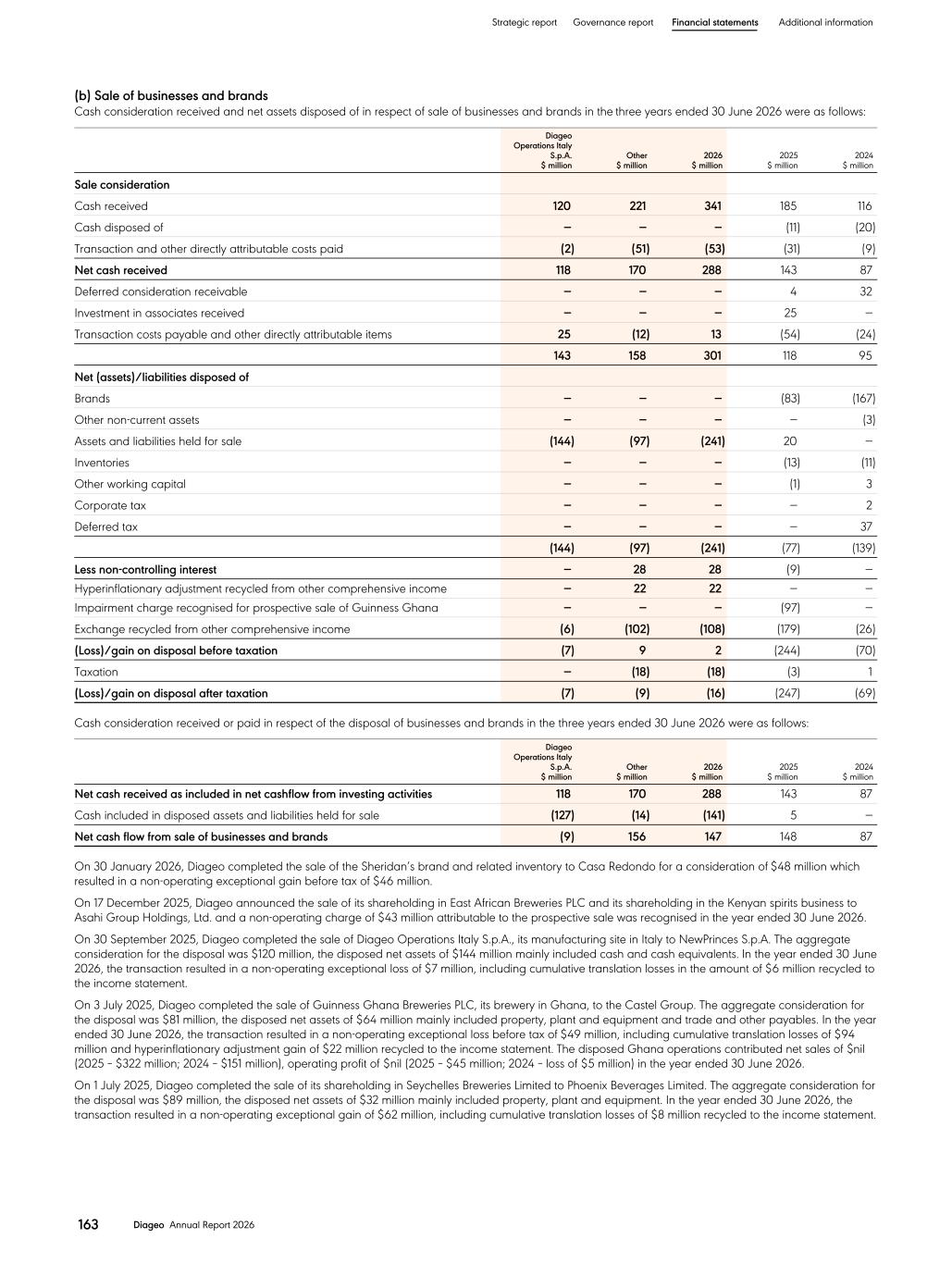
(b) Sale of businesses and brands Cash consideration received and net assets disposed of in respect of sale of businesses and brands in the three years ended 30 June 2026 were as follows: Sale consideration Cash received 120 221 341 185 116 Cash disposed of — — — (11) (20) Transaction and other directly attributable costs paid (2) (51) (53) (31) (9) Net cash received 118 170 288 143 87 Deferred consideration receivable — — — 4 32 Investment in associates received — — — 25 — Transaction costs payable and other directly attributable items 25 (12) 13 (54) (24) 143 158 301 118 95 Net (assets)/liabilities disposed of Brands — — — (83) (167) Other non-current assets — — — — (3) Assets and liabilities held for sale (144) (97) (241) 20 — Inventories — — — (13) (11) Other working capital — — — (1) 3 Corporate tax — — — — 2 Deferred tax — — — — 37 (144) (97) (241) (77) (139) Less non-controlling interest — 28 28 (9) — Hyperinflationary adjustment recycled from other comprehensive income — 22 22 — — Impairment charge recognised for prospective sale of Guinness Ghana — — — (97) — Exchange recycled from other comprehensive income (6) (102) (108) (179) (26) (Loss)/gain on disposal before taxation (7) 9 2 (244) (70) Taxation — (18) (18) (3) 1 (Loss)/gain on disposal after taxation (7) (9) (16) (247) (69) Diageo Operations Italy S.p.A. $ million Other $ million 2026 $ million 2025 $ million 2024 $ million Cash consideration received or paid in respect of the disposal of businesses and brands in the three years ended 30 June 2026 were as follows: Diageo Operations Italy S.p.A. $ million Other $ million 2026 $ million 2025 $ million 2024 $ million Net cash received as included in net cashflow from investing activities 118 170 288 143 87 Cash included in disposed assets and liabilities held for sale (127) (14) (141) 5 — Net cash flow from sale of businesses and brands (9) 156 147 148 87 On 30 January 2026, Diageo completed the sale of the Sheridan’s brand and related inventory to Casa Redondo for a consideration of $48 million which resulted in a non-operating exceptional gain before tax of $46 million. On 17 December 2025, Diageo announced the sale of its shareholding in East African Breweries PLC and its shareholding in the Kenyan spirits business to Asahi Group Holdings, Ltd. and a non-operating charge of $43 million attributable to the prospective sale was recognised in the year ended 30 June 2026. On 30 September 2025, Diageo completed the sale of Diageo Operations Italy S.p.A., its manufacturing site in Italy to NewPrinces S.p.A. The aggregate consideration for the disposal was $120 million, the disposed net assets of $144 million mainly included cash and cash equivalents. In the year ended 30 June 2026, the transaction resulted in a non-operating exceptional loss of $7 million, including cumulative translation losses in the amount of $6 million recycled to the income statement. On 3 July 2025, Diageo completed the sale of Guinness Ghana Breweries PLC, its brewery in Ghana, to the Castel Group. The aggregate consideration for the disposal was $81 million, the disposed net assets of $64 million mainly included property, plant and equipment and trade and other payables. In the year ended 30 June 2026, the transaction resulted in a non-operating exceptional loss before tax of $49 million, including cumulative translation losses of $94 million and hyperinflationary adjustment gain of $22 million recycled to the income statement. The disposed Ghana operations contributed net sales of $nil (2025 – $322 million; 2024 – $151 million), operating profit of $nil (2025 – $45 million; 2024 – loss of $5 million) in the year ended 30 June 2026. On 1 July 2025, Diageo completed the sale of its shareholding in Seychelles Breweries Limited to Phoenix Beverages Limited. The aggregate consideration for the disposal was $89 million, the disposed net assets of $32 million mainly included property, plant and equipment. In the year ended 30 June 2026, the transaction resulted in a non-operating exceptional gain of $62 million, including cumulative translation losses of $8 million recycled to the income statement. Strategic report Governance report Financial statements Additional information 163 Diageo Annual Report 2026
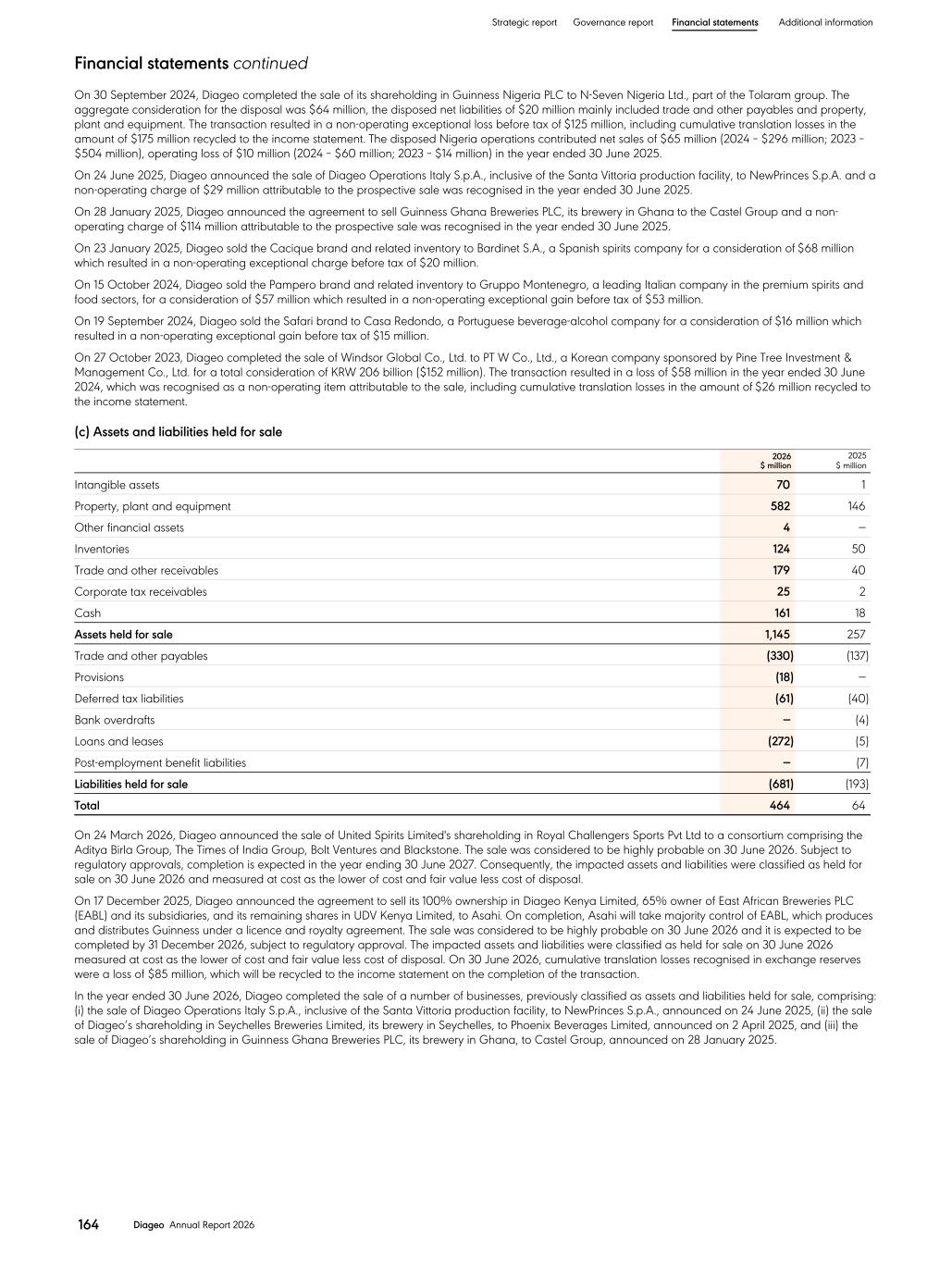
On 30 September 2024, Diageo completed the sale of its shareholding in Guinness Nigeria PLC to N-Seven Nigeria Ltd., part of the Tolaram group. The aggregate consideration for the disposal was $64 million, the disposed net liabilities of $20 million mainly included trade and other payables and property, plant and equipment. The transaction resulted in a non-operating exceptional loss before tax of $125 million, including cumulative translation losses in the amount of $175 million recycled to the income statement. The disposed Nigeria operations contributed net sales of $65 million (2024 – $296 million; 2023 – $504 million), operating loss of $10 million (2024 – $60 million; 2023 – $14 million) in the year ended 30 June 2025. On 24 June 2025, Diageo announced the sale of Diageo Operations Italy S.p.A., inclusive of the Santa Vittoria production facility, to NewPrinces S.p.A. and a non-operating charge of $29 million attributable to the prospective sale was recognised in the year ended 30 June 2025. On 28 January 2025, Diageo announced the agreement to sell Guinness Ghana Breweries PLC, its brewery in Ghana to the Castel Group and a non- operating charge of $114 million attributable to the prospective sale was recognised in the year ended 30 June 2025. On 23 January 2025, Diageo sold the Cacique brand and related inventory to Bardinet S.A., a Spanish spirits company for a consideration of $68 million which resulted in a non-operating exceptional charge before tax of $20 million. On 15 October 2024, Diageo sold the Pampero brand and related inventory to Gruppo Montenegro, a leading Italian company in the premium spirits and food sectors, for a consideration of $57 million which resulted in a non-operating exceptional gain before tax of $53 million. On 19 September 2024, Diageo sold the Safari brand to Casa Redondo, a Portuguese beverage-alcohol company for a consideration of $16 million which resulted in a non-operating exceptional gain before tax of $15 million. On 27 October 2023, Diageo completed the sale of Windsor Global Co., Ltd. to PT W Co., Ltd., a Korean company sponsored by Pine Tree Investment & Management Co., Ltd. for a total consideration of KRW 206 billion ($152 million). The transaction resulted in a loss of $58 million in the year ended 30 June 2024, which was recognised as a non-operating item attributable to the sale, including cumulative translation losses in the amount of $26 million recycled to the income statement. (c) Assets and liabilities held for sale Intangible assets 70 1 Property, plant and equipment 582 146 Other financial assets 4 — Inventories 124 50 Trade and other receivables 179 40 Corporate tax receivables 25 2 Cash 161 18 Assets held for sale 1,145 257 Trade and other payables (330) (137) Provisions (18) — Deferred tax liabilities (61) (40) Bank overdrafts — (4) Loans and leases (272) (5) Post-employment benefit liabilities — (7) Liabilities held for sale (681) (193) Total 464 64 2026 $ million 2025 $ million On 24 March 2026, Diageo announced the sale of United Spirits Limited's shareholding in Royal Challengers Sports Pvt Ltd to a consortium comprising the Aditya Birla Group, The Times of India Group, Bolt Ventures and Blackstone. The sale was considered to be highly probable on 30 June 2026. Subject to regulatory approvals, completion is expected in the year ending 30 June 2027. Consequently, the impacted assets and liabilities were classified as held for sale on 30 June 2026 and measured at cost as the lower of cost and fair value less cost of disposal. On 17 December 2025, Diageo announced the agreement to sell its 100% ownership in Diageo Kenya Limited, 65% owner of East African Breweries PLC (EABL) and its subsidiaries, and its remaining shares in UDV Kenya Limited, to Asahi. On completion, Asahi will take majority control of EABL, which produces and distributes Guinness under a licence and royalty agreement. The sale was considered to be highly probable on 30 June 2026 and it is expected to be completed by 31 December 2026, subject to regulatory approval. The impacted assets and liabilities were classified as held for sale on 30 June 2026 measured at cost as the lower of cost and fair value less cost of disposal. On 30 June 2026, cumulative translation losses recognised in exchange reserves were a loss of $85 million, which will be recycled to the income statement on the completion of the transaction. In the year ended 30 June 2026, Diageo completed the sale of a number of businesses, previously classified as assets and liabilities held for sale, comprising: (i) the sale of Diageo Operations Italy S.p.A., inclusive of the Santa Vittoria production facility, to NewPrinces S.p.A., announced on 24 June 2025, (ii) the sale of Diageo’s shareholding in Seychelles Breweries Limited, its brewery in Seychelles, to Phoenix Beverages Limited, announced on 2 April 2025, and (iii) the sale of Diageo’s shareholding in Guinness Ghana Breweries PLC, its brewery in Ghana, to Castel Group, announced on 28 January 2025. Strategic report Governance report Financial statements Additional information Financial statements continued 164 Diageo Annual Report 2026
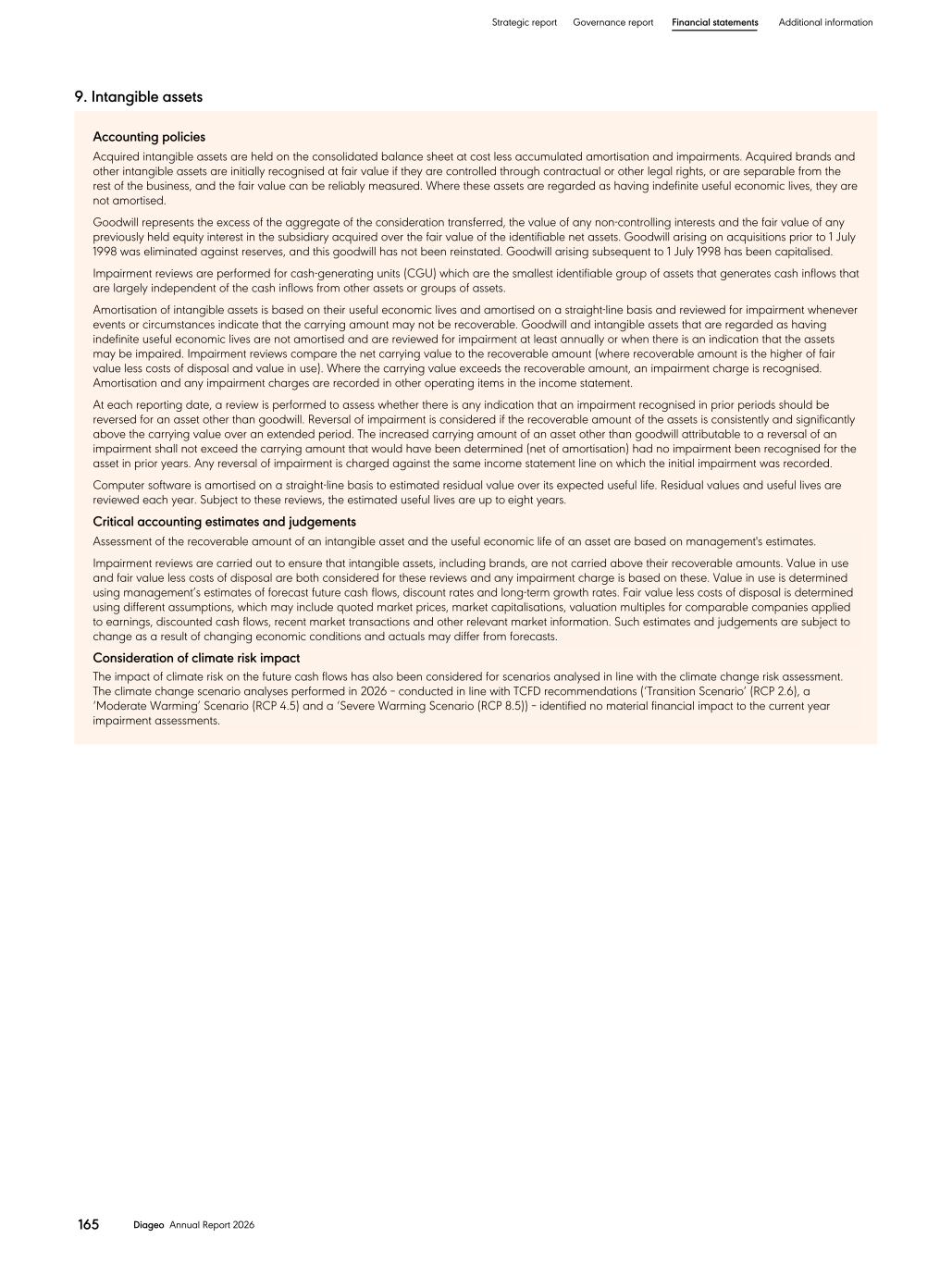
9. Intangible assets Accounting policies Acquired intangible assets are held on the consolidated balance sheet at cost less accumulated amortisation and impairments. Acquired brands and other intangible assets are initially recognised at fair value if they are controlled through contractual or other legal rights, or are separable from the rest of the business, and the fair value can be reliably measured. Where these assets are regarded as having indefinite useful economic lives, they are not amortised. Goodwill represents the excess of the aggregate of the consideration transferred, the value of any non-controlling interests and the fair value of any previously held equity interest in the subsidiary acquired over the fair value of the identifiable net assets. Goodwill arising on acquisitions prior to 1 July 1998 was eliminated against reserves, and this goodwill has not been reinstated. Goodwill arising subsequent to 1 July 1998 has been capitalised. Impairment reviews are performed for cash-generating units (CGU) which are the smallest identifiable group of assets that generates cash inflows that are largely independent of the cash inflows from other assets or groups of assets. Amortisation of intangible assets is based on their useful economic lives and amortised on a straight-line basis and reviewed for impairment whenever events or circumstances indicate that the carrying amount may not be recoverable. Goodwill and intangible assets that are regarded as having indefinite useful economic lives are not amortised and are reviewed for impairment at least annually or when there is an indication that the assets may be impaired. Impairment reviews compare the net carrying value to the recoverable amount (where recoverable amount is the higher of fair value less costs of disposal and value in use). Where the carrying value exceeds the recoverable amount, an impairment charge is recognised. Amortisation and any impairment charges are recorded in other operating items in the income statement. At each reporting date, a review is performed to assess whether there is any indication that an impairment recognised in prior periods should be reversed for an asset other than goodwill. Reversal of impairment is considered if the recoverable amount of the assets is consistently and significantly above the carrying value over an extended period. The increased carrying amount of an asset other than goodwill attributable to a reversal of an impairment shall not exceed the carrying amount that would have been determined (net of amortisation) had no impairment been recognised for the asset in prior years. Any reversal of impairment is charged against the same income statement line on which the initial impairment was recorded. Computer software is amortised on a straight-line basis to estimated residual value over its expected useful life. Residual values and useful lives are reviewed each year. Subject to these reviews, the estimated useful lives are up to eight years. Critical accounting estimates and judgements Assessment of the recoverable amount of an intangible asset and the useful economic life of an asset are based on management's estimates. Impairment reviews are carried out to ensure that intangible assets, including brands, are not carried above their recoverable amounts. Value in use and fair value less costs of disposal are both considered for these reviews and any impairment charge is based on these. Value in use is determined using management’s estimates of forecast future cash flows, discount rates and long-term growth rates. Fair value less costs of disposal is determined using different assumptions, which may include quoted market prices, market capitalisations, valuation multiples for comparable companies applied to earnings, discounted cash flows, recent market transactions and other relevant market information. Such estimates and judgements are subject to change as a result of changing economic conditions and actuals may differ from forecasts. Consideration of climate risk impact The impact of climate risk on the future cash flows has also been considered for scenarios analysed in line with the climate change risk assessment. The climate change scenario analyses performed in 2026 – conducted in line with TCFD recommendations (‘Transition Scenario’ (RCP 2.6), a ‘Moderate Warming’ Scenario (RCP 4.5) and a ‘Severe Warming Scenario (RCP 8.5)) – identified no material financial impact to the current year impairment assessments. Strategic report Governance report Financial statements Additional information 165 Diageo Annual Report 2026
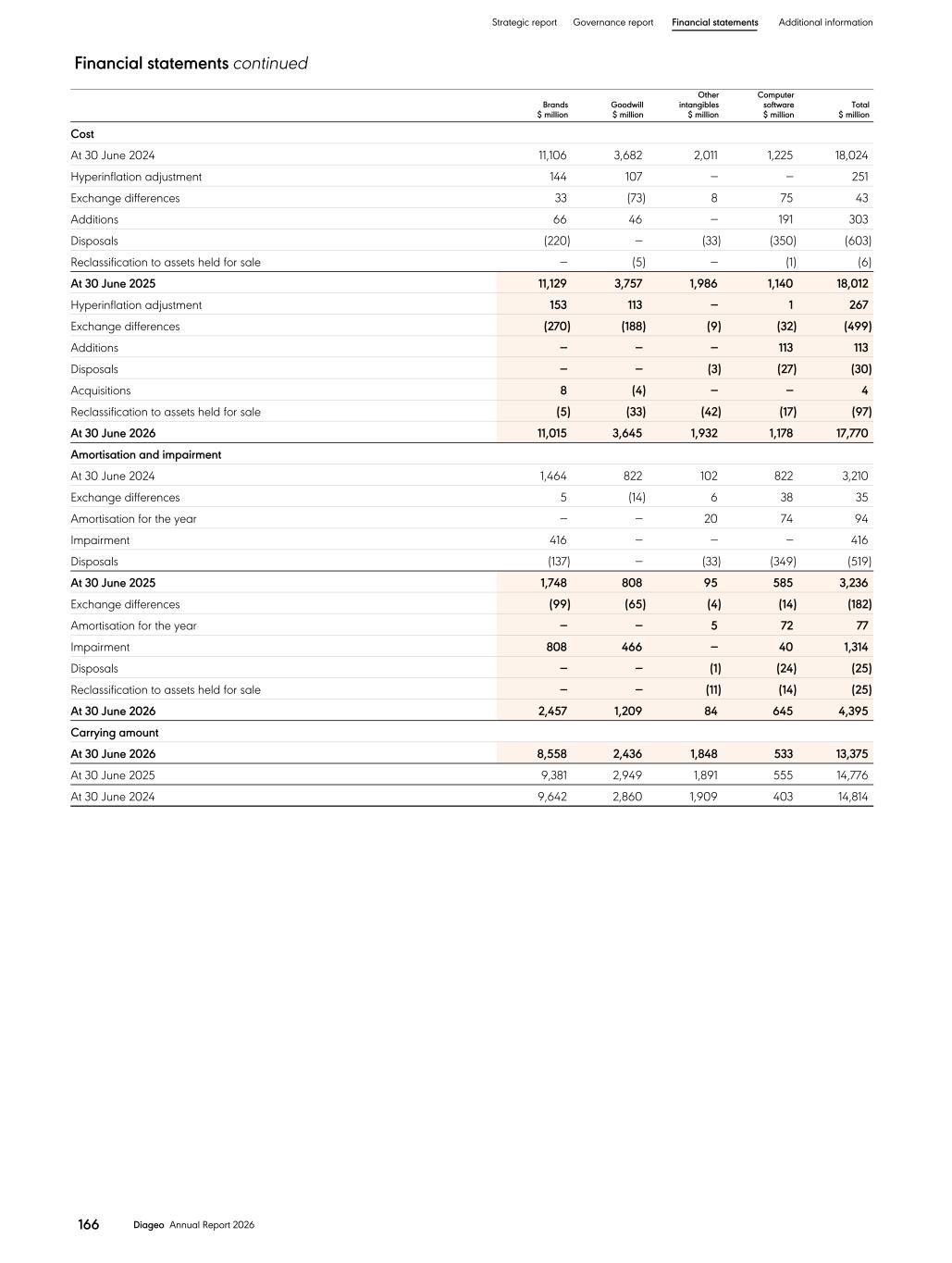
Cost At 30 June 2024 11,106 3,682 2,011 1,225 18,024 Hyperinflation adjustment 144 107 — — 251 Exchange differences 33 (73) 8 75 43 Additions 66 46 — 191 303 Disposals (220) — (33) (350) (603) Reclassification to assets held for sale — (5) — (1) (6) At 30 June 2025 11,129 3,757 1,986 1,140 18,012 Hyperinflation adjustment 153 113 — 1 267 Exchange differences (270) (188) (9) (32) (499) Additions — — — 113 113 Disposals — — (3) (27) (30) Acquisitions 8 (4) — — 4 Reclassification to assets held for sale (5) (33) (42) (17) (97) At 30 June 2026 11,015 3,645 1,932 1,178 17,770 Amortisation and impairment At 30 June 2024 1,464 822 102 822 3,210 Exchange differences 5 (14) 6 38 35 Amortisation for the year — — 20 74 94 Impairment 416 — — — 416 Disposals (137) — (33) (349) (519) At 30 June 2025 1,748 808 95 585 3,236 Exchange differences (99) (65) (4) (14) (182) Amortisation for the year — — 5 72 77 Impairment 808 466 — 40 1,314 Disposals — — (1) (24) (25) Reclassification to assets held for sale — — (11) (14) (25) At 30 June 2026 2,457 1,209 84 645 4,395 Carrying amount At 30 June 2026 8,558 2,436 1,848 533 13,375 At 30 June 2025 9,381 2,949 1,891 555 14,776 At 30 June 2024 9,642 2,860 1,909 403 14,814 Brands $ million Goodwill $ million Other intangibles $ million Computer software $ million Total $ million Strategic report Governance report Financial statements Additional information Financial statements continued 166 Diageo Annual Report 2026
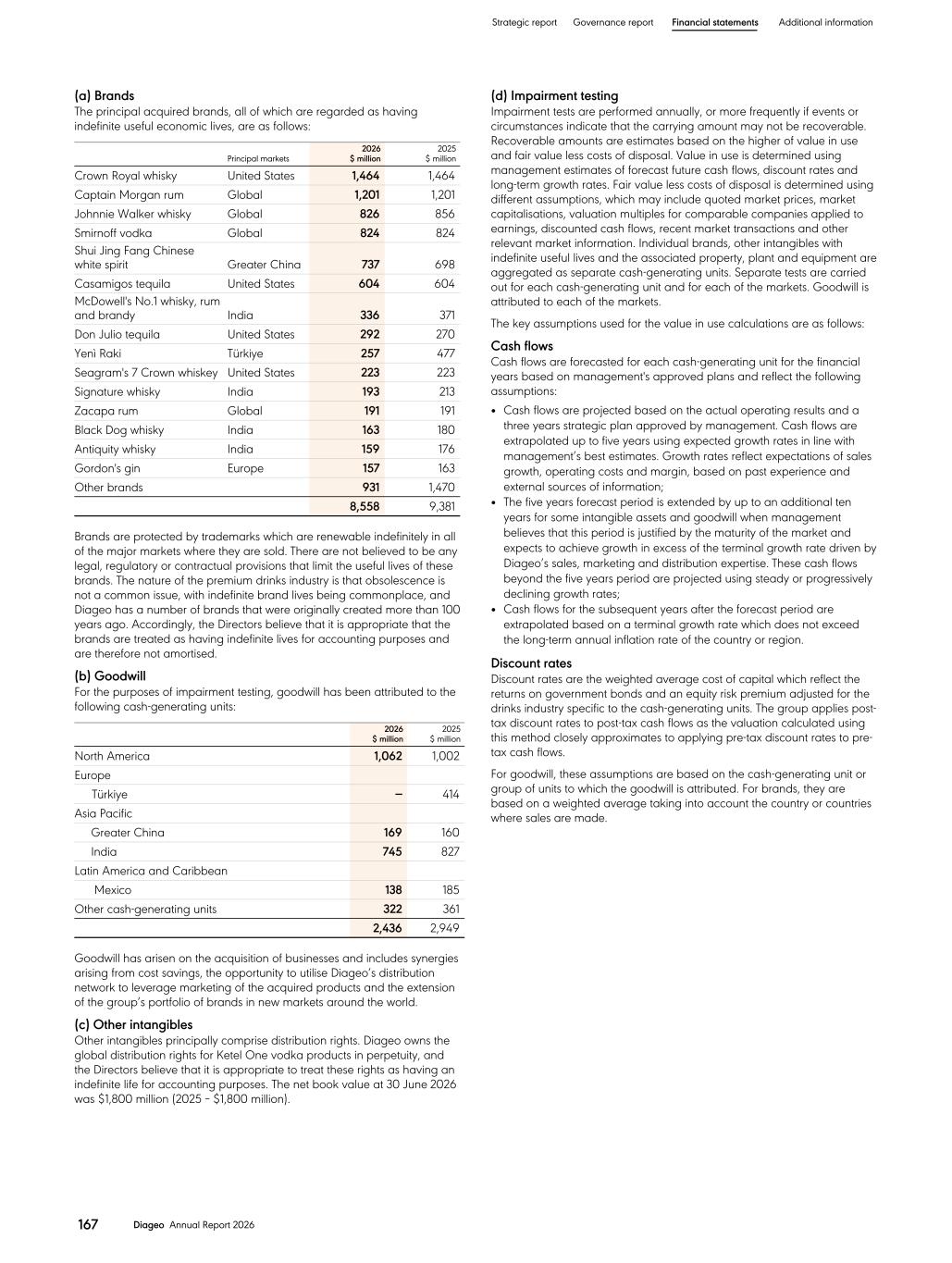
(a) Brands The principal acquired brands, all of which are regarded as having indefinite useful economic lives, are as follows: Crown Royal whisky United States 1,464 1,464 Captain Morgan rum Global 1,201 1,201 Johnnie Walker whisky Global 826 856 Smirnoff vodka Global 824 824 Shui Jing Fang Chinese white spirit Greater China 737 698 Casamigos tequila United States 604 604 McDowell's No.1 whisky, rum and brandy India 336 371 Don Julio tequila United States 292 270 Yenì Raki Türkiye 257 477 Seagram's 7 Crown whiskey United States 223 223 Signature whisky India 193 213 Zacapa rum Global 191 191 Black Dog whisky India 163 180 Antiquity whisky India 159 176 Gordon's gin Europe 157 163 Other brands 931 1,470 8,558 9,381 Principal markets 2026 $ million 2025 $ million Brands are protected by trademarks which are renewable indefinitely in all of the major markets where they are sold. There are not believed to be any legal, regulatory or contractual provisions that limit the useful lives of these brands. The nature of the premium drinks industry is that obsolescence is not a common issue, with indefinite brand lives being commonplace, and Diageo has a number of brands that were originally created more than 100 years ago. Accordingly, the Directors believe that it is appropriate that the brands are treated as having indefinite lives for accounting purposes and are therefore not amortised. (b) Goodwill For the purposes of impairment testing, goodwill has been attributed to the following cash-generating units: North America 1,062 1,002 Europe Türkiye — 414 Asia Pacific Greater China 169 160 India 745 827 Latin America and Caribbean Mexico 138 185 Other cash-generating units 322 361 2,436 2,949 2026 $ million 2025 $ million Goodwill has arisen on the acquisition of businesses and includes synergies arising from cost savings, the opportunity to utilise Diageo’s distribution network to leverage marketing of the acquired products and the extension of the group’s portfolio of brands in new markets around the world. (c) Other intangibles Other intangibles principally comprise distribution rights. Diageo owns the global distribution rights for Ketel One vodka products in perpetuity, and the Directors believe that it is appropriate to treat these rights as having an indefinite life for accounting purposes. The net book value at 30 June 2026 was $1,800 million (2025 – $1,800 million). (d) Impairment testing Impairment tests are performed annually, or more frequently if events or circumstances indicate that the carrying amount may not be recoverable. Recoverable amounts are estimates based on the higher of value in use and fair value less costs of disposal. Value in use is determined using management estimates of forecast future cash flows, discount rates and long-term growth rates. Fair value less costs of disposal is determined using different assumptions, which may include quoted market prices, market capitalisations, valuation multiples for comparable companies applied to earnings, discounted cash flows, recent market transactions and other relevant market information. Individual brands, other intangibles with indefinite useful lives and the associated property, plant and equipment are aggregated as separate cash-generating units. Separate tests are carried out for each cash-generating unit and for each of the markets. Goodwill is attributed to each of the markets. The key assumptions used for the value in use calculations are as follows: Cash flows Cash flows are forecasted for each cash-generating unit for the financial years based on management's approved plans and reflect the following assumptions: • Cash flows are projected based on the actual operating results and a three years strategic plan approved by management. Cash flows are extrapolated up to five years using expected growth rates in line with management’s best estimates. Growth rates reflect expectations of sales growth, operating costs and margin, based on past experience and external sources of information; • The five years forecast period is extended by up to an additional ten years for some intangible assets and goodwill when management believes that this period is justified by the maturity of the market and expects to achieve growth in excess of the terminal growth rate driven by Diageo’s sales, marketing and distribution expertise. These cash flows beyond the five years period are projected using steady or progressively declining growth rates; • Cash flows for the subsequent years after the forecast period are extrapolated based on a terminal growth rate which does not exceed the long-term annual inflation rate of the country or region. Discount rates Discount rates are the weighted average cost of capital which reflect the returns on government bonds and an equity risk premium adjusted for the drinks industry specific to the cash-generating units. The group applies post- tax discount rates to post-tax cash flows as the valuation calculated using this method closely approximates to applying pre-tax discount rates to pre- tax cash flows. For goodwill, these assumptions are based on the cash-generating unit or group of units to which the goodwill is attributed. For brands, they are based on a weighted average taking into account the country or countries where sales are made. Strategic report Governance report Financial statements Additional information 167 Diageo Annual Report 2026
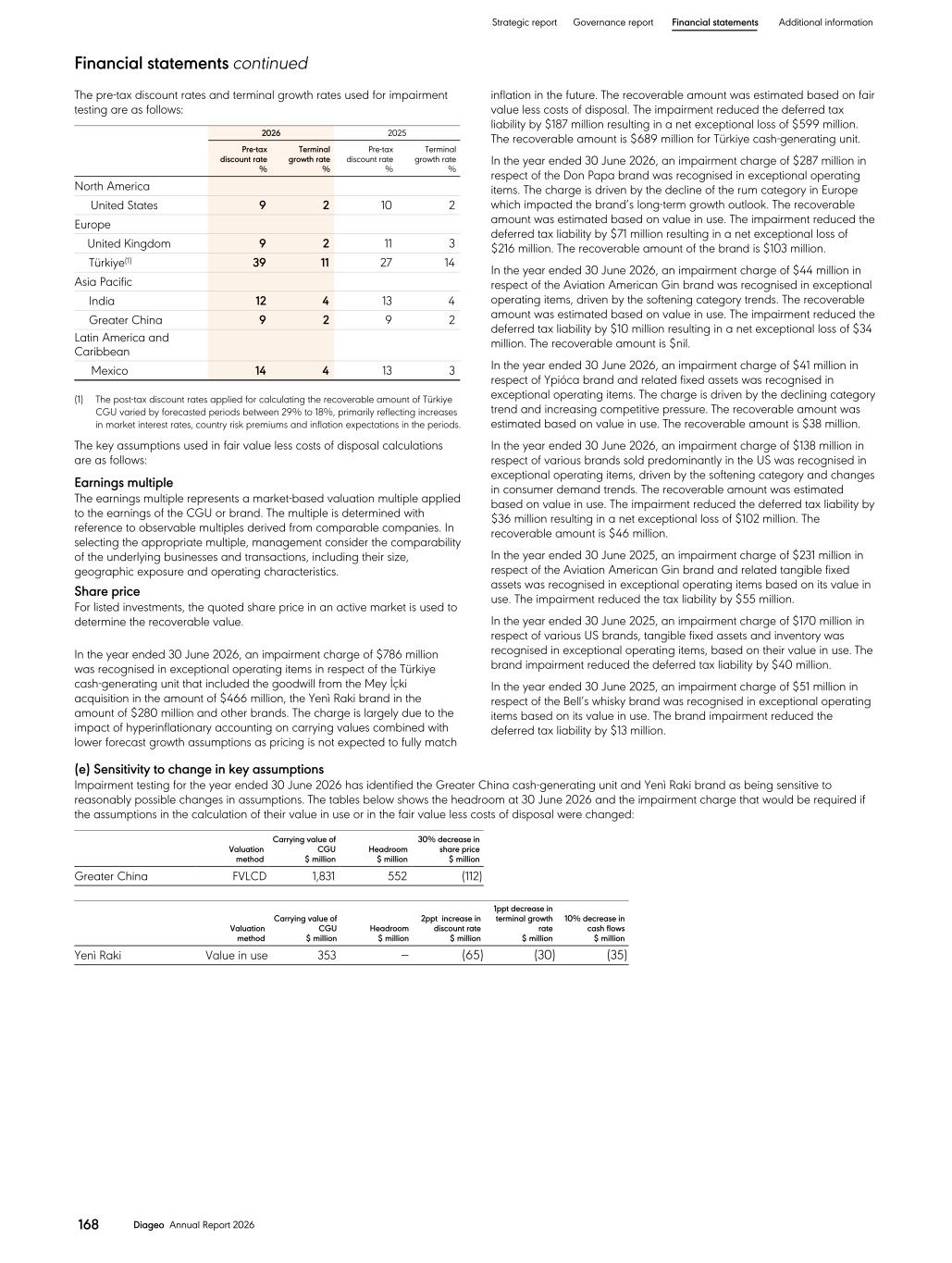
The pre-tax discount rates and terminal growth rates used for impairment testing are as follows: North America United States 9 2 10 2 Europe United Kingdom 9 2 11 3 Türkiye(1) 39 11 27 14 Asia Pacific India 12 4 13 4 Greater China 9 2 9 2 Latin America and Caribbean Mexico 14 4 13 3 2026 2025 Pre-tax discount rate % Terminal growth rate % Pre-tax discount rate % Terminal growth rate % (1) The post-tax discount rates applied for calculating the recoverable amount of Türkiye CGU varied by forecasted periods between 29% to 18%, primarily reflecting increases in market interest rates, country risk premiums and inflation expectations in the periods. The key assumptions used in fair value less costs of disposal calculations are as follows: Earnings multiple The earnings multiple represents a market-based valuation multiple applied to the earnings of the CGU or brand. The multiple is determined with reference to observable multiples derived from comparable companies. In selecting the appropriate multiple, management consider the comparability of the underlying businesses and transactions, including their size, geographic exposure and operating characteristics. Share price For listed investments, the quoted share price in an active market is used to determine the recoverable value. In the year ended 30 June 2026, an impairment charge of $786 million was recognised in exceptional operating items in respect of the Türkiye cash-generating unit that included the goodwill from the Mey İçki acquisition in the amount of $466 million, the Yenì Raki brand in the amount of $280 million and other brands. The charge is largely due to the impact of hyperinflationary accounting on carrying values combined with lower forecast growth assumptions as pricing is not expected to fully match inflation in the future. The recoverable amount was estimated based on fair value less costs of disposal. The impairment reduced the deferred tax liability by $187 million resulting in a net exceptional loss of $599 million. The recoverable amount is $689 million for Türkiye cash-generating unit. In the year ended 30 June 2026, an impairment charge of $287 million in respect of the Don Papa brand was recognised in exceptional operating items. The charge is driven by the decline of the rum category in Europe which impacted the brand’s long-term growth outlook. The recoverable amount was estimated based on value in use. The impairment reduced the deferred tax liability by $71 million resulting in a net exceptional loss of $216 million. The recoverable amount of the brand is $103 million. In the year ended 30 June 2026, an impairment charge of $44 million in respect of the Aviation American Gin brand was recognised in exceptional operating items, driven by the softening category trends. The recoverable amount was estimated based on value in use. The impairment reduced the deferred tax liability by $10 million resulting in a net exceptional loss of $34 million. The recoverable amount is $nil. In the year ended 30 June 2026, an impairment charge of $41 million in respect of Ypióca brand and related fixed assets was recognised in exceptional operating items. The charge is driven by the declining category trend and increasing competitive pressure. The recoverable amount was estimated based on value in use. The recoverable amount is $38 million. In the year ended 30 June 2026, an impairment charge of $138 million in respect of various brands sold predominantly in the US was recognised in exceptional operating items, driven by the softening category and changes in consumer demand trends. The recoverable amount was estimated based on value in use. The impairment reduced the deferred tax liability by $36 million resulting in a net exceptional loss of $102 million. The recoverable amount is $46 million. In the year ended 30 June 2025, an impairment charge of $231 million in respect of the Aviation American Gin brand and related tangible fixed assets was recognised in exceptional operating items based on its value in use. The impairment reduced the tax liability by $55 million. In the year ended 30 June 2025, an impairment charge of $170 million in respect of various US brands, tangible fixed assets and inventory was recognised in exceptional operating items, based on their value in use. The brand impairment reduced the deferred tax liability by $40 million. In the year ended 30 June 2025, an impairment charge of $51 million in respect of the Bell’s whisky brand was recognised in exceptional operating items based on its value in use. The brand impairment reduced the deferred tax liability by $13 million. (e) Sensitivity to change in key assumptions Impairment testing for the year ended 30 June 2026 has identified the Greater China cash-generating unit and Yenì Raki brand as being sensitive to reasonably possible changes in assumptions. The tables below shows the headroom at 30 June 2026 and the impairment charge that would be required if the assumptions in the calculation of their value in use or in the fair value less costs of disposal were changed: Greater China FVLCD 1,831 552 (112) Valuation method Carrying value of CGU $ million Headroom $ million 30% decrease in share price $ million Valuation method Carrying value of CGU $ million Headroom $ million 2ppt increase in discount rate $ million 1ppt decrease in terminal growth rate $ million 10% decrease in cash flows $ million Yenì Raki Value in use 353 — (65) (30) (35) Strategic report Governance report Financial statements Additional information Financial statements continued 168 Diageo Annual Report 2026
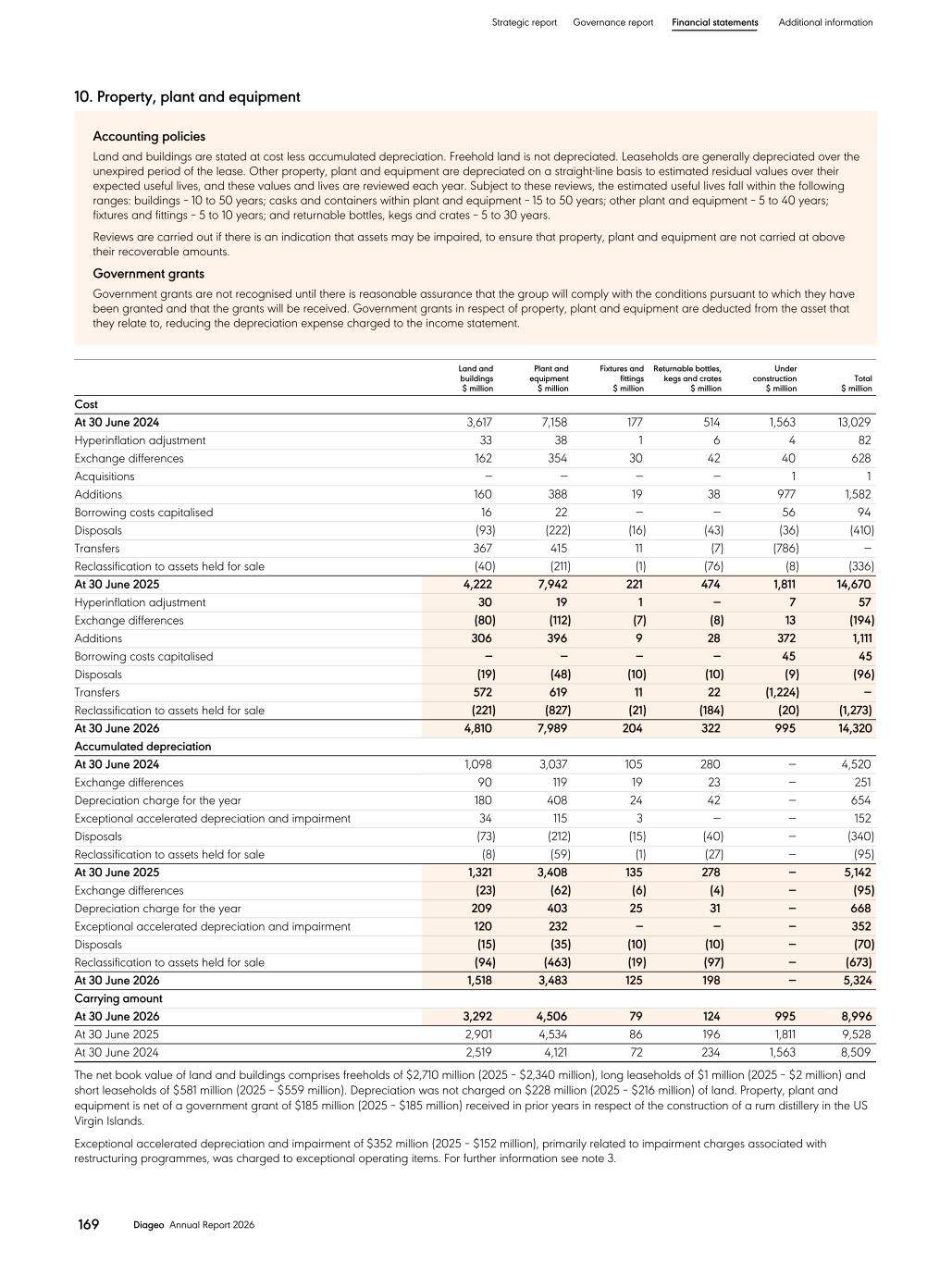
10. Property, plant and equipment Accounting policies Land and buildings are stated at cost less accumulated depreciation. Freehold land is not depreciated. Leaseholds are generally depreciated over the unexpired period of the lease. Other property, plant and equipment are depreciated on a straight-line basis to estimated residual values over their expected useful lives, and these values and lives are reviewed each year. Subject to these reviews, the estimated useful lives fall within the following ranges: buildings – 10 to 50 years; casks and containers within plant and equipment – 15 to 50 years; other plant and equipment – 5 to 40 years; fixtures and fittings – 5 to 10 years; and returnable bottles, kegs and crates – 5 to 30 years. Reviews are carried out if there is an indication that assets may be impaired, to ensure that property, plant and equipment are not carried at above their recoverable amounts. Government grants Government grants are not recognised until there is reasonable assurance that the group will comply with the conditions pursuant to which they have been granted and that the grants will be received. Government grants in respect of property, plant and equipment are deducted from the asset that they relate to, reducing the depreciation expense charged to the income statement. Cost At 30 June 2024 3,617 7,158 177 514 1,563 13,029 Hyperinflation adjustment 33 38 1 6 4 82 Exchange differences 162 354 30 42 40 628 Acquisitions — — — — 1 1 Additions 160 388 19 38 977 1,582 Borrowing costs capitalised 16 22 — — 56 94 Disposals (93) (222) (16) (43) (36) (410) Transfers 367 415 11 (7) (786) — Reclassification to assets held for sale (40) (211) (1) (76) (8) (336) At 30 June 2025 4,222 7,942 221 474 1,811 14,670 Hyperinflation adjustment 30 19 1 — 7 57 Exchange differences (80) (112) (7) (8) 13 (194) Additions 306 396 9 28 372 1,111 Borrowing costs capitalised — — — — 45 45 Disposals (19) (48) (10) (10) (9) (96) Transfers 572 619 11 22 (1,224) — Reclassification to assets held for sale (221) (827) (21) (184) (20) (1,273) At 30 June 2026 4,810 7,989 204 322 995 14,320 Accumulated depreciation At 30 June 2024 1,098 3,037 105 280 — 4,520 Exchange differences 90 119 19 23 — 251 Depreciation charge for the year 180 408 24 42 — 654 Exceptional accelerated depreciation and impairment 34 115 3 — — 152 Disposals (73) (212) (15) (40) — (340) Reclassification to assets held for sale (8) (59) (1) (27) — (95) At 30 June 2025 1,321 3,408 135 278 — 5,142 Exchange differences (23) (62) (6) (4) — (95) Depreciation charge for the year 209 403 25 31 — 668 Exceptional accelerated depreciation and impairment 120 232 — — — 352 Disposals (15) (35) (10) (10) — (70) Reclassification to assets held for sale (94) (463) (19) (97) — (673) At 30 June 2026 1,518 3,483 125 198 — 5,324 Carrying amount At 30 June 2026 3,292 4,506 79 124 995 8,996 At 30 June 2025 2,901 4,534 86 196 1,811 9,528 At 30 June 2024 2,519 4,121 72 234 1,563 8,509 Land and buildings $ million Plant and equipment $ million Fixtures and fittings $ million Returnable bottles, kegs and crates $ million Under construction $ million Total $ million The net book value of land and buildings comprises freeholds of $2,710 million (2025 – $2,340 million), long leaseholds of $1 million (2025 – $2 million) and short leaseholds of $581 million (2025 – $559 million). Depreciation was not charged on $228 million (2025 – $216 million) of land. Property, plant and equipment is net of a government grant of $185 million (2025 – $185 million) received in prior years in respect of the construction of a rum distillery in the US Virgin Islands. Exceptional accelerated depreciation and impairment of $352 million (2025 – $152 million), primarily related to impairment charges associated with restructuring programmes, was charged to exceptional operating items. For further information see note 3. Strategic report Governance report Financial statements Additional information 169 Diageo Annual Report 2026
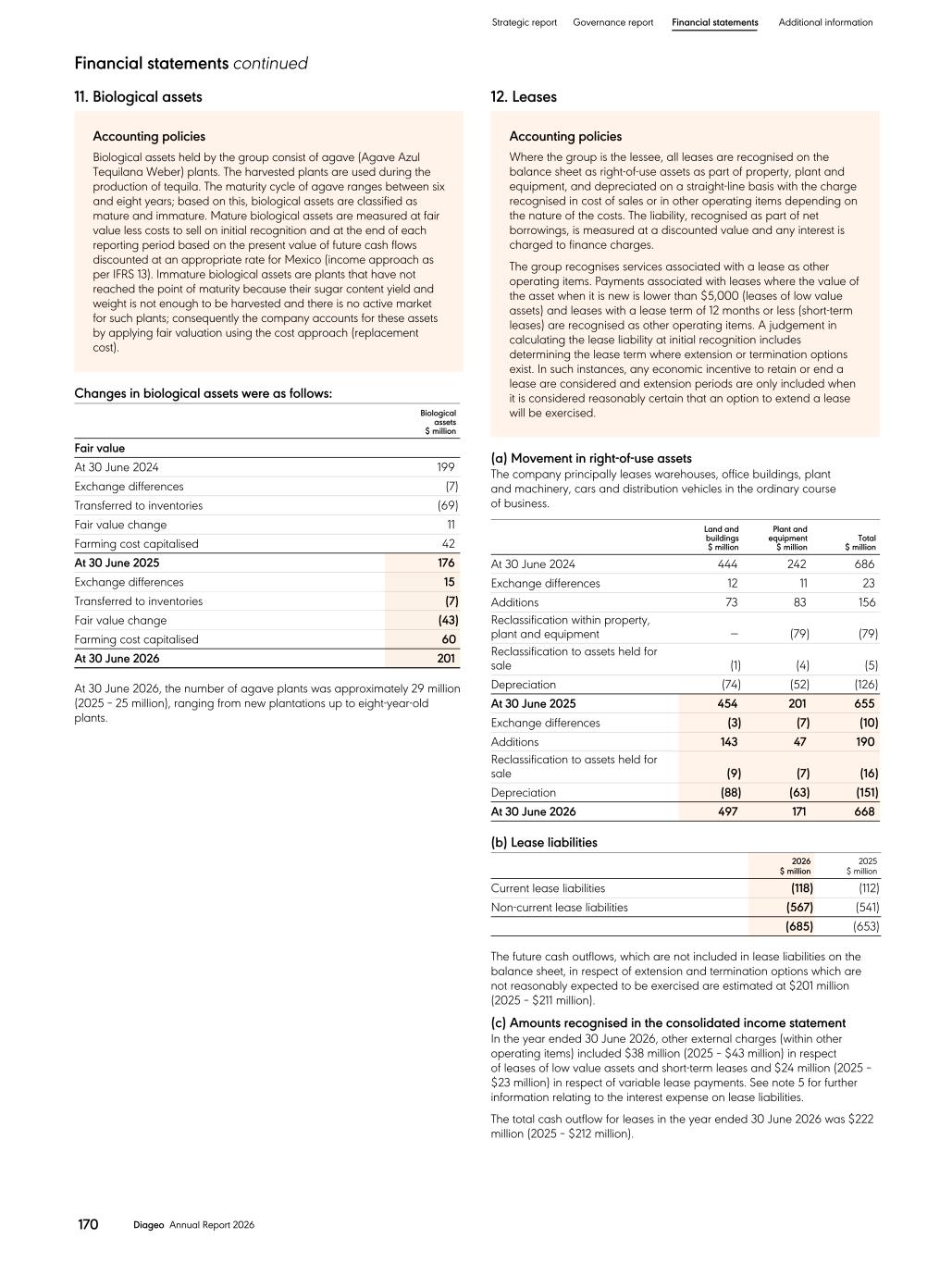
11. Biological assets Accounting policies Biological assets held by the group consist of agave (Agave Azul Tequilana Weber) plants. The harvested plants are used during the production of tequila. The maturity cycle of agave ranges between six and eight years; based on this, biological assets are classified as mature and immature. Mature biological assets are measured at fair value less costs to sell on initial recognition and at the end of each reporting period based on the present value of future cash flows discounted at an appropriate rate for Mexico (income approach as per IFRS 13). Immature biological assets are plants that have not reached the point of maturity because their sugar content yield and weight is not enough to be harvested and there is no active market for such plants; consequently the company accounts for these assets by applying fair valuation using the cost approach (replacement cost). Changes in biological assets were as follows: Fair value At 30 June 2024 199 Exchange differences (7) Transferred to inventories (69) Fair value change 11 Farming cost capitalised 42 At 30 June 2025 176 Exchange differences 15 Transferred to inventories (7) Fair value change (43) Farming cost capitalised 60 At 30 June 2026 201 Biological assets $ million At 30 June 2026, the number of agave plants was approximately 29 million (2025 – 25 million), ranging from new plantations up to eight-year-old plants. 12. Leases Accounting policies Where the group is the lessee, all leases are recognised on the balance sheet as right-of-use assets as part of property, plant and equipment, and depreciated on a straight-line basis with the charge recognised in cost of sales or in other operating items depending on the nature of the costs. The liability, recognised as part of net borrowings, is measured at a discounted value and any interest is charged to finance charges. The group recognises services associated with a lease as other operating items. Payments associated with leases where the value of the asset when it is new is lower than $5,000 (leases of low value assets) and leases with a lease term of 12 months or less (short-term leases) are recognised as other operating items. A judgement in calculating the lease liability at initial recognition includes determining the lease term where extension or termination options exist. In such instances, any economic incentive to retain or end a lease are considered and extension periods are only included when it is considered reasonably certain that an option to extend a lease will be exercised. (a) Movement in right-of-use assets The company principally leases warehouses, office buildings, plant and machinery, cars and distribution vehicles in the ordinary course of business. At 30 June 2024 444 242 686 Exchange differences 12 11 23 Additions 73 83 156 Reclassification within property, plant and equipment — (79) (79) Reclassification to assets held for sale (1) (4) (5) Depreciation (74) (52) (126) At 30 June 2025 454 201 655 Exchange differences (3) (7) (10) Additions 143 47 190 Reclassification to assets held for sale (9) (7) (16) Depreciation (88) (63) (151) At 30 June 2026 497 171 668 Land and buildings $ million Plant and equipment $ million Total $ million (b) Lease liabilities Current lease liabilities (118) (112) Non-current lease liabilities (567) (541) (685) (653) 2026 $ million 2025 $ million The future cash outflows, which are not included in lease liabilities on the balance sheet, in respect of extension and termination options which are not reasonably expected to be exercised are estimated at $201 million (2025 – $211 million). (c) Amounts recognised in the consolidated income statement In the year ended 30 June 2026, other external charges (within other operating items) included $38 million (2025 – $43 million) in respect of leases of low value assets and short-term leases and $24 million (2025 – $23 million) in respect of variable lease payments. See note 5 for further information relating to the interest expense on lease liabilities. The total cash outflow for leases in the year ended 30 June 2026 was $222 million (2025 – $212 million). Strategic report Governance report Financial statements Additional information Financial statements continued 170 Diageo Annual Report 2026
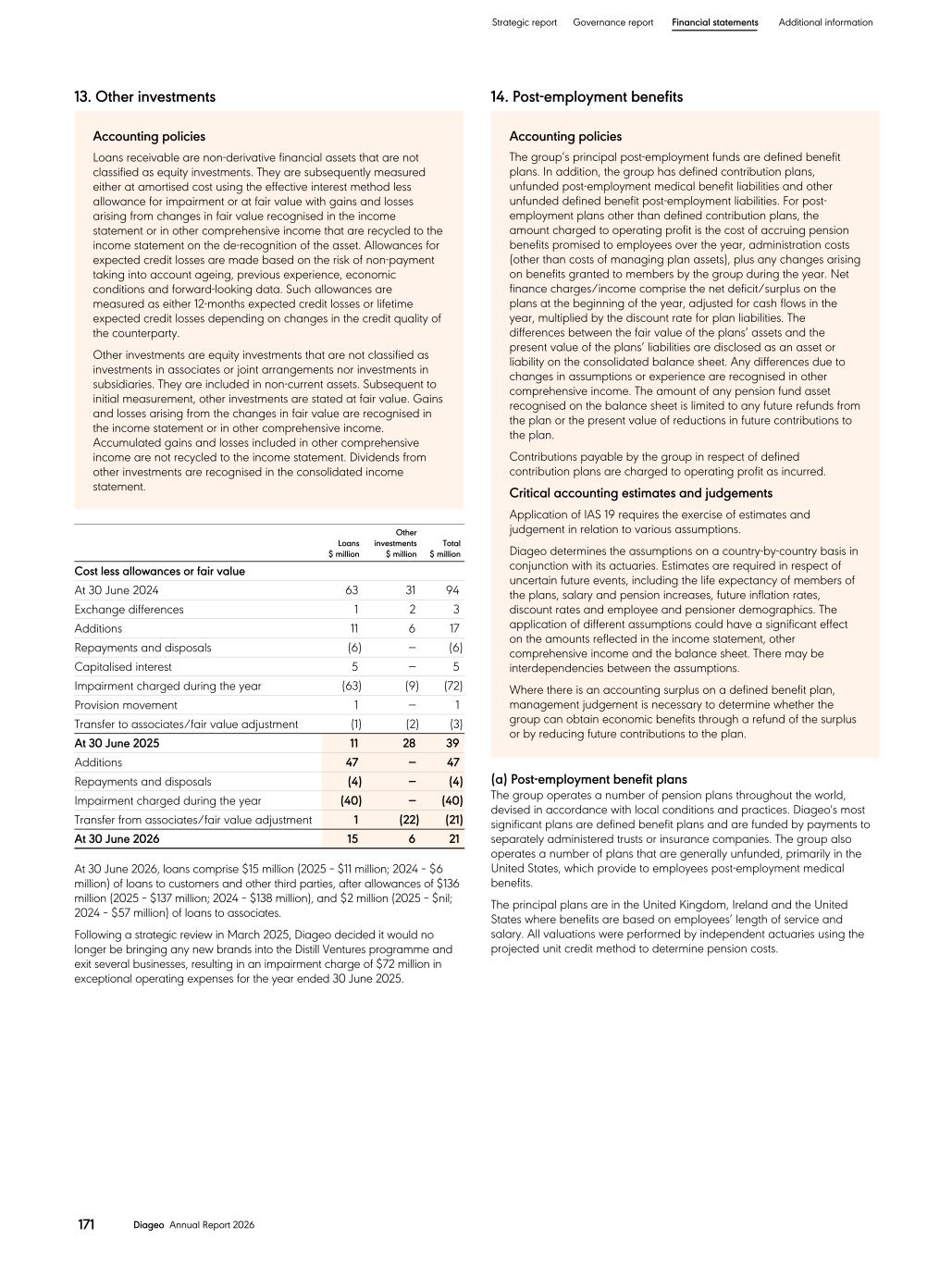
13. Other investments Accounting policies Loans receivable are non-derivative financial assets that are not classified as equity investments. They are subsequently measured either at amortised cost using the effective interest method less allowance for impairment or at fair value with gains and losses arising from changes in fair value recognised in the income statement or in other comprehensive income that are recycled to the income statement on the de-recognition of the asset. Allowances for expected credit losses are made based on the risk of non-payment taking into account ageing, previous experience, economic conditions and forward-looking data. Such allowances are measured as either 12-months expected credit losses or lifetime expected credit losses depending on changes in the credit quality of the counterparty. Other investments are equity investments that are not classified as investments in associates or joint arrangements nor investments in subsidiaries. They are included in non-current assets. Subsequent to initial measurement, other investments are stated at fair value. Gains and losses arising from the changes in fair value are recognised in the income statement or in other comprehensive income. Accumulated gains and losses included in other comprehensive income are not recycled to the income statement. Dividends from other investments are recognised in the consolidated income statement. Cost less allowances or fair value At 30 June 2024 63 31 94 Exchange differences 1 2 3 Additions 11 6 17 Repayments and disposals (6) — (6) Capitalised interest 5 — 5 Impairment charged during the year (63) (9) (72) Provision movement 1 — 1 Transfer to associates/fair value adjustment (1) (2) (3) At 30 June 2025 11 28 39 Additions 47 — 47 Repayments and disposals (4) — (4) Impairment charged during the year (40) — (40) Transfer from associates/fair value adjustment 1 (22) (21) At 30 June 2026 15 6 21 Loans $ million Other investments $ million Total $ million At 30 June 2026, loans comprise $15 million (2025 – $11 million; 2024 – $6 million) of loans to customers and other third parties, after allowances of $136 million (2025 – $137 million; 2024 – $138 million), and $2 million (2025 – $nil; 2024 – $57 million) of loans to associates. Following a strategic review in March 2025, Diageo decided it would no longer be bringing any new brands into the Distill Ventures programme and exit several businesses, resulting in an impairment charge of $72 million in exceptional operating expenses for the year ended 30 June 2025. 14. Post-employment benefits Accounting policies The group’s principal post-employment funds are defined benefit plans. In addition, the group has defined contribution plans, unfunded post-employment medical benefit liabilities and other unfunded defined benefit post-employment liabilities. For post- employment plans other than defined contribution plans, the amount charged to operating profit is the cost of accruing pension benefits promised to employees over the year, administration costs (other than costs of managing plan assets), plus any changes arising on benefits granted to members by the group during the year. Net finance charges/income comprise the net deficit/surplus on the plans at the beginning of the year, adjusted for cash flows in the year, multiplied by the discount rate for plan liabilities. The differences between the fair value of the plans’ assets and the present value of the plans’ liabilities are disclosed as an asset or liability on the consolidated balance sheet. Any differences due to changes in assumptions or experience are recognised in other comprehensive income. The amount of any pension fund asset recognised on the balance sheet is limited to any future refunds from the plan or the present value of reductions in future contributions to the plan. Contributions payable by the group in respect of defined contribution plans are charged to operating profit as incurred. Critical accounting estimates and judgements Application of IAS 19 requires the exercise of estimates and judgement in relation to various assumptions. Diageo determines the assumptions on a country-by-country basis in conjunction with its actuaries. Estimates are required in respect of uncertain future events, including the life expectancy of members of the plans, salary and pension increases, future inflation rates, discount rates and employee and pensioner demographics. The application of different assumptions could have a significant effect on the amounts reflected in the income statement, other comprehensive income and the balance sheet. There may be interdependencies between the assumptions. Where there is an accounting surplus on a defined benefit plan, management judgement is necessary to determine whether the group can obtain economic benefits through a refund of the surplus or by reducing future contributions to the plan. (a) Post-employment benefit plans The group operates a number of pension plans throughout the world, devised in accordance with local conditions and practices. Diageo's most significant plans are defined benefit plans and are funded by payments to separately administered trusts or insurance companies. The group also operates a number of plans that are generally unfunded, primarily in the United States, which provide to employees post-employment medical benefits. The principal plans are in the United Kingdom, Ireland and the United States where benefits are based on employees’ length of service and salary. All valuations were performed by independent actuaries using the projected unit credit method to determine pension costs. Strategic report Governance report Financial statements Additional information 171 Diageo Annual Report 2026
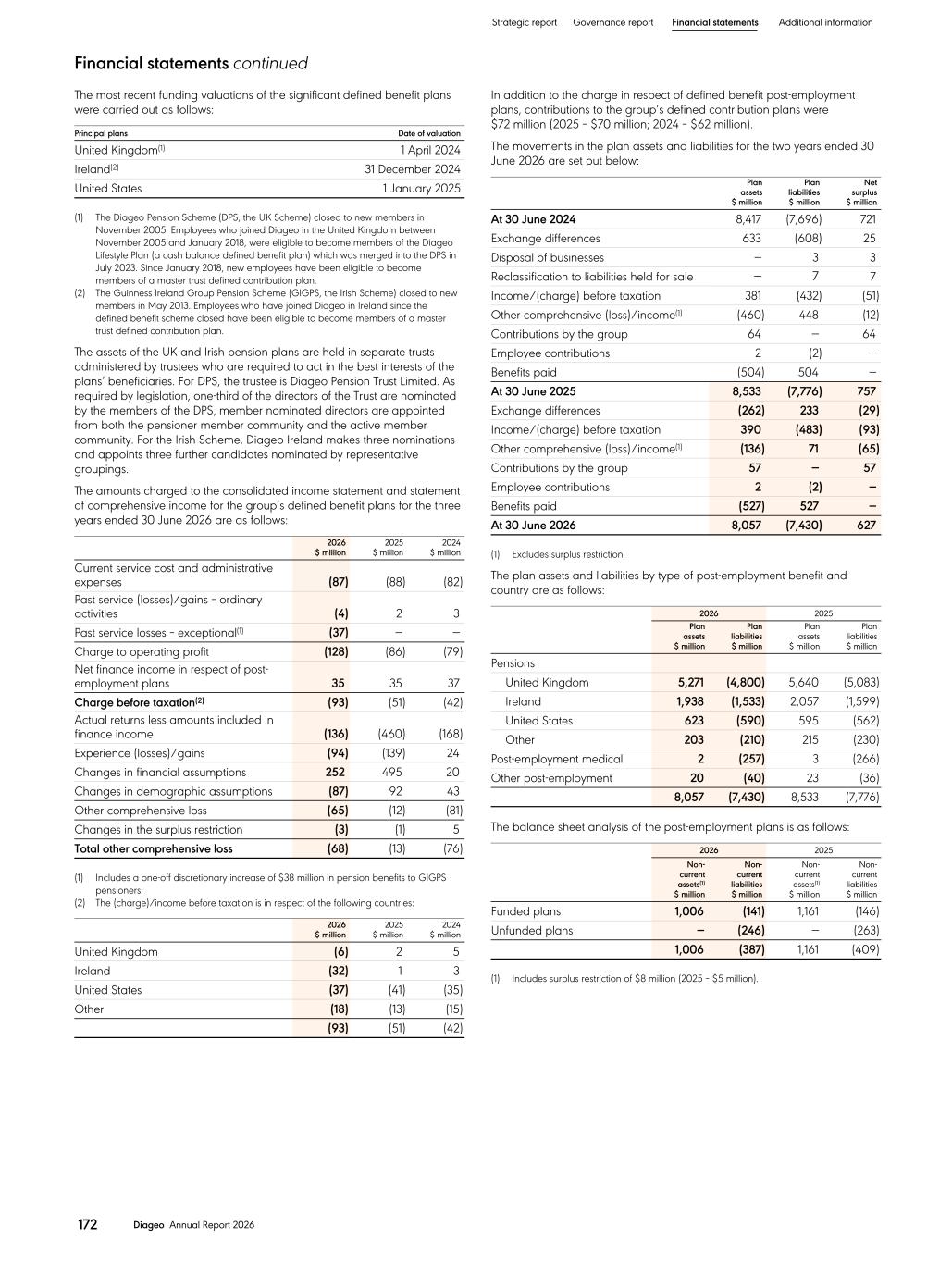
The most recent funding valuations of the significant defined benefit plans were carried out as follows: United Kingdom(1) 1 April 2024 Ireland(2) 31 December 2024 United States 1 January 2025 Principal plans Date of valuation (1) The Diageo Pension Scheme (DPS, the UK Scheme) closed to new members in November 2005. Employees who joined Diageo in the United Kingdom between November 2005 and January 2018, were eligible to become members of the Diageo Lifestyle Plan (a cash balance defined benefit plan) which was merged into the DPS in July 2023. Since January 2018, new employees have been eligible to become members of a master trust defined contribution plan. (2) The Guinness Ireland Group Pension Scheme (GIGPS, the Irish Scheme) closed to new members in May 2013. Employees who have joined Diageo in Ireland since the defined benefit scheme closed have been eligible to become members of a master trust defined contribution plan. The assets of the UK and Irish pension plans are held in separate trusts administered by trustees who are required to act in the best interests of the plans’ beneficiaries. For DPS, the trustee is Diageo Pension Trust Limited. As required by legislation, one-third of the directors of the Trust are nominated by the members of the DPS, member nominated directors are appointed from both the pensioner member community and the active member community. For the Irish Scheme, Diageo Ireland makes three nominations and appoints three further candidates nominated by representative groupings. The amounts charged to the consolidated income statement and statement of comprehensive income for the group’s defined benefit plans for the three years ended 30 June 2026 are as follows: Current service cost and administrative expenses (87) (88) (82) Past service (losses)/gains – ordinary activities (4) 2 3 Past service losses – exceptional(1) (37) — — Charge to operating profit (128) (86) (79) Net finance income in respect of post- employment plans 35 35 37 Charge before taxation(2) (93) (51) (42) Actual returns less amounts included in finance income (136) (460) (168) Experience (losses)/gains (94) (139) 24 Changes in financial assumptions 252 495 20 Changes in demographic assumptions (87) 92 43 Other comprehensive loss (65) (12) (81) Changes in the surplus restriction (3) (1) 5 Total other comprehensive loss (68) (13) (76) 2026 $ million 2025 $ million 2024 $ million (1) Includes a one-off discretionary increase of $38 million in pension benefits to GIGPS pensioners. (2) The (charge)/income before taxation is in respect of the following countries: United Kingdom (6) 2 5 Ireland (32) 1 3 United States (37) (41) (35) Other (18) (13) (15) (93) (51) (42) 2026 $ million 2025 $ million 2024 $ million In addition to the charge in respect of defined benefit post-employment plans, contributions to the group’s defined contribution plans were $72 million (2025 – $70 million; 2024 – $62 million). The movements in the plan assets and liabilities for the two years ended 30 June 2026 are set out below: At 30 June 2024 8,417 (7,696) 721 Exchange differences 633 (608) 25 Disposal of businesses — 3 3 Reclassification to liabilities held for sale — 7 7 Income/(charge) before taxation 381 (432) (51) Other comprehensive (loss)/income(1) (460) 448 (12) Contributions by the group 64 — 64 Employee contributions 2 (2) — Benefits paid (504) 504 — At 30 June 2025 8,533 (7,776) 757 Exchange differences (262) 233 (29) Income/(charge) before taxation 390 (483) (93) Other comprehensive (loss)/income(1) (136) 71 (65) Contributions by the group 57 — 57 Employee contributions 2 (2) — Benefits paid (527) 527 — At 30 June 2026 8,057 (7,430) 627 Plan assets $ million Plan liabilities $ million Net surplus $ million (1) Excludes surplus restriction. The plan assets and liabilities by type of post-employment benefit and country are as follows: Pensions United Kingdom 5,271 (4,800) 5,640 (5,083) Ireland 1,938 (1,533) 2,057 (1,599) United States 623 (590) 595 (562) Other 203 (210) 215 (230) Post-employment medical 2 (257) 3 (266) Other post-employment 20 (40) 23 (36) 8,057 (7,430) 8,533 (7,776) 2026 2025 Plan assets $ million Plan liabilities $ million Plan assets $ million Plan liabilities $ million The balance sheet analysis of the post-employment plans is as follows: Funded plans 1,006 (141) 1,161 (146) Unfunded plans — (246) — (263) 1,006 (387) 1,161 (409) 2026 2025 Non- current assets(1) $ million Non- current liabilities $ million Non- current assets(1) $ million Non- current liabilities $ million (1) Includes surplus restriction of $8 million (2025 – $5 million). Strategic report Governance report Financial statements Additional information Financial statements continued 172 Diageo Annual Report 2026
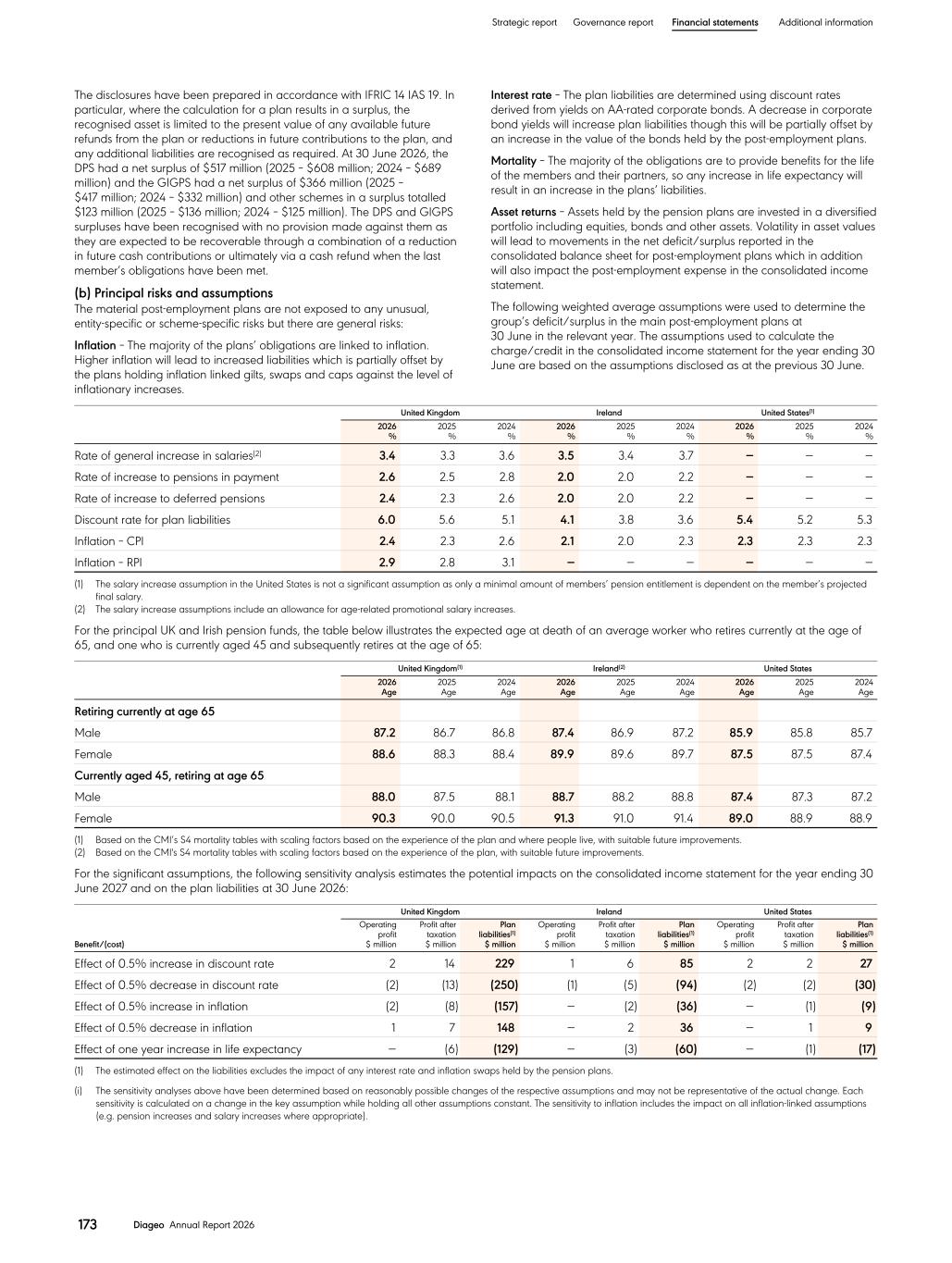
The disclosures have been prepared in accordance with IFRIC 14 IAS 19. In particular, where the calculation for a plan results in a surplus, the recognised asset is limited to the present value of any available future refunds from the plan or reductions in future contributions to the plan, and any additional liabilities are recognised as required. At 30 June 2026, the DPS had a net surplus of $517 million (2025 – $608 million; 2024 – $689 million) and the GIGPS had a net surplus of $366 million (2025 – $417 million; 2024 – $332 million) and other schemes in a surplus totalled $123 million (2025 – $136 million; 2024 – $125 million). The DPS and GIGPS surpluses have been recognised with no provision made against them as they are expected to be recoverable through a combination of a reduction in future cash contributions or ultimately via a cash refund when the last member’s obligations have been met. (b) Principal risks and assumptions The material post-employment plans are not exposed to any unusual, entity-specific or scheme-specific risks but there are general risks: Inflation – The majority of the plans’ obligations are linked to inflation. Higher inflation will lead to increased liabilities which is partially offset by the plans holding inflation linked gilts, swaps and caps against the level of inflationary increases. Interest rate – The plan liabilities are determined using discount rates derived from yields on AA-rated corporate bonds. A decrease in corporate bond yields will increase plan liabilities though this will be partially offset by an increase in the value of the bonds held by the post-employment plans. Mortality – The majority of the obligations are to provide benefits for the life of the members and their partners, so any increase in life expectancy will result in an increase in the plans’ liabilities. Asset returns – Assets held by the pension plans are invested in a diversified portfolio including equities, bonds and other assets. Volatility in asset values will lead to movements in the net deficit/surplus reported in the consolidated balance sheet for post-employment plans which in addition will also impact the post-employment expense in the consolidated income statement. The following weighted average assumptions were used to determine the group’s deficit/surplus in the main post-employment plans at 30 June in the relevant year. The assumptions used to calculate the charge/credit in the consolidated income statement for the year ending 30 June are based on the assumptions disclosed as at the previous 30 June. Rate of general increase in salaries(2) 3.4 3.3 3.6 3.5 3.4 3.7 — — — Rate of increase to pensions in payment 2.6 2.5 2.8 2.0 2.0 2.2 — — — Rate of increase to deferred pensions 2.4 2.3 2.6 2.0 2.0 2.2 — — — Discount rate for plan liabilities 6.0 5.6 5.1 4.1 3.8 3.6 5.4 5.2 5.3 Inflation – CPI 2.4 2.3 2.6 2.1 2.0 2.3 2.3 2.3 2.3 Inflation – RPI 2.9 2.8 3.1 — — — — — — United Kingdom Ireland United States(1) 2026 % 2025 % 2024 % 2026 % 2025 % 2024 % 2026 % 2025 % 2024 % (1) The salary increase assumption in the United States is not a significant assumption as only a minimal amount of members’ pension entitlement is dependent on the member’s projected final salary. (2) The salary increase assumptions include an allowance for age-related promotional salary increases. For the principal UK and Irish pension funds, the table below illustrates the expected age at death of an average worker who retires currently at the age of 65, and one who is currently aged 45 and subsequently retires at the age of 65: Retiring currently at age 65 Male 87.2 86.7 86.8 87.4 86.9 87.2 85.9 85.8 85.7 Female 88.6 88.3 88.4 89.9 89.6 89.7 87.5 87.5 87.4 Currently aged 45, retiring at age 65 Male 88.0 87.5 88.1 88.7 88.2 88.8 87.4 87.3 87.2 Female 90.3 90.0 90.5 91.3 91.0 91.4 89.0 88.9 88.9 United Kingdom(1) Ireland(2) United States 2026 Age 2025 Age 2024 Age 2026 Age 2025 Age 2024 Age 2026 Age 2025 Age 2024 Age (1) Based on the CMI’s S4 mortality tables with scaling factors based on the experience of the plan and where people live, with suitable future improvements. (2) Based on the CMI's S4 mortality tables with scaling factors based on the experience of the plan, with suitable future improvements. For the significant assumptions, the following sensitivity analysis estimates the potential impacts on the consolidated income statement for the year ending 30 June 2027 and on the plan liabilities at 30 June 2026: Effect of 0.5% increase in discount rate 2 14 229 1 6 85 2 2 27 Effect of 0.5% decrease in discount rate (2) (13) (250) (1) (5) (94) (2) (2) (30) Effect of 0.5% increase in inflation (2) (8) (157) — (2) (36) — (1) (9) Effect of 0.5% decrease in inflation 1 7 148 — 2 36 — 1 9 Effect of one year increase in life expectancy — (6) (129) — (3) (60) — (1) (17) United Kingdom Ireland United States Benefit/(cost) Operating profit $ million Profit after taxation $ million Plan liabilities(1) $ million Operating profit $ million Profit after taxation $ million Plan liabilities(1) $ million Operating profit $ million Profit after taxation $ million Plan liabilities(1) $ million (1) The estimated effect on the liabilities excludes the impact of any interest rate and inflation swaps held by the pension plans. (i) The sensitivity analyses above have been determined based on reasonably possible changes of the respective assumptions and may not be representative of the actual change. Each sensitivity is calculated on a change in the key assumption while holding all other assumptions constant. The sensitivity to inflation includes the impact on all inflation-linked assumptions (e.g. pension increases and salary increases where appropriate). Strategic report Governance report Financial statements Additional information 173 Diageo Annual Report 2026
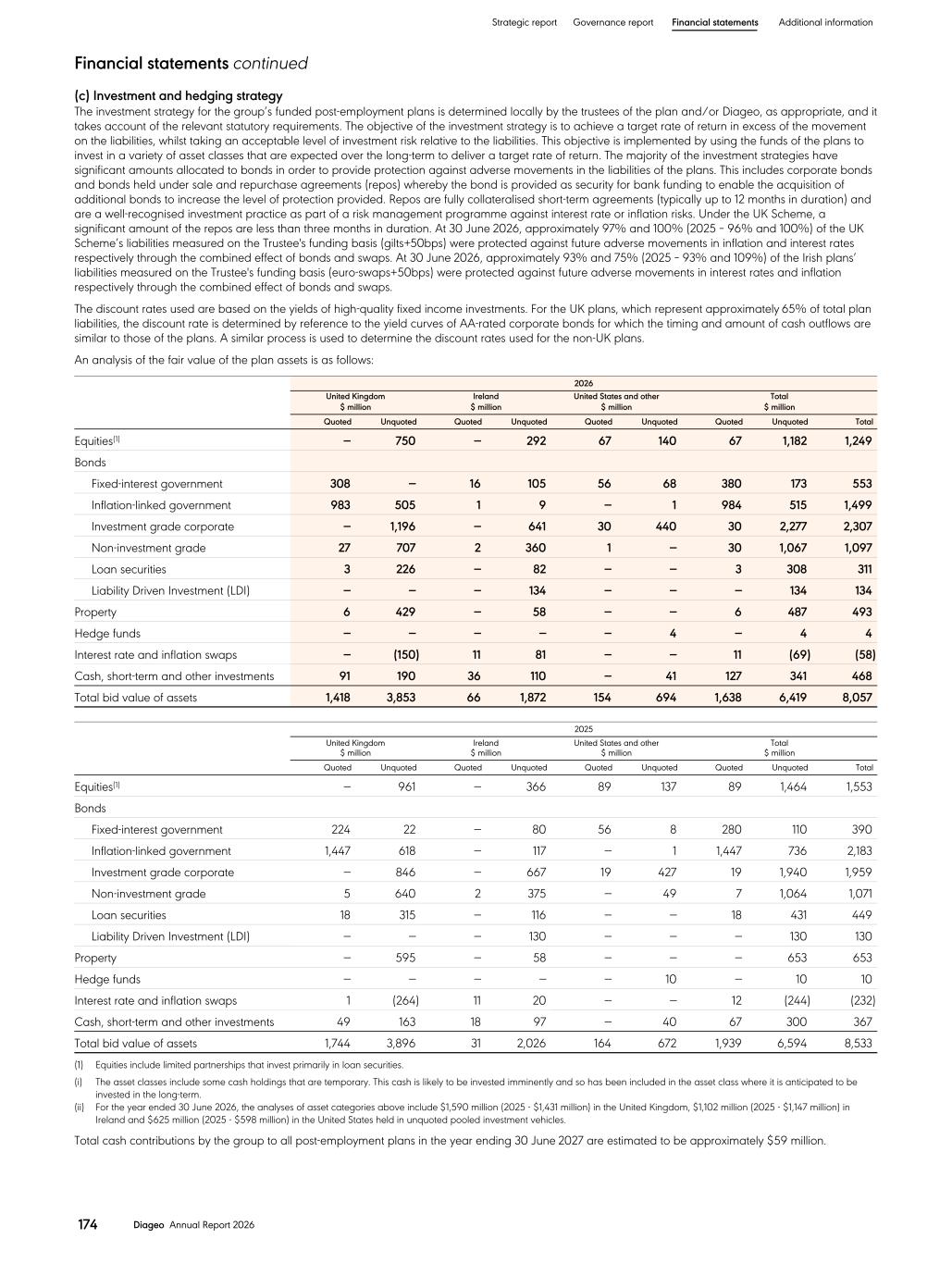
(c) Investment and hedging strategy The investment strategy for the group’s funded post-employment plans is determined locally by the trustees of the plan and/or Diageo, as appropriate, and it takes account of the relevant statutory requirements. The objective of the investment strategy is to achieve a target rate of return in excess of the movement on the liabilities, whilst taking an acceptable level of investment risk relative to the liabilities. This objective is implemented by using the funds of the plans to invest in a variety of asset classes that are expected over the long-term to deliver a target rate of return. The majority of the investment strategies have significant amounts allocated to bonds in order to provide protection against adverse movements in the liabilities of the plans. This includes corporate bonds and bonds held under sale and repurchase agreements (repos) whereby the bond is provided as security for bank funding to enable the acquisition of additional bonds to increase the level of protection provided. Repos are fully collateralised short-term agreements (typically up to 12 months in duration) and are a well-recognised investment practice as part of a risk management programme against interest rate or inflation risks. Under the UK Scheme, a significant amount of the repos are less than three months in duration. At 30 June 2026, approximately 97% and 100% (2025 – 96% and 100%) of the UK Scheme’s liabilities measured on the Trustee's funding basis (gilts+50bps) were protected against future adverse movements in inflation and interest rates respectively through the combined effect of bonds and swaps. At 30 June 2026, approximately 93% and 75% (2025 – 93% and 109%) of the Irish plans’ liabilities measured on the Trustee's funding basis (euro-swaps+50bps) were protected against future adverse movements in interest rates and inflation respectively through the combined effect of bonds and swaps. The discount rates used are based on the yields of high-quality fixed income investments. For the UK plans, which represent approximately 65% of total plan liabilities, the discount rate is determined by reference to the yield curves of AA-rated corporate bonds for which the timing and amount of cash outflows are similar to those of the plans. A similar process is used to determine the discount rates used for the non-UK plans. An analysis of the fair value of the plan assets is as follows: Equities(1) — 750 — 292 67 140 67 1,182 1,249 Bonds Fixed-interest government 308 — 16 105 56 68 380 173 553 Inflation-linked government 983 505 1 9 — 1 984 515 1,499 Investment grade corporate — 1,196 — 641 30 440 30 2,277 2,307 Non-investment grade 27 707 2 360 1 — 30 1,067 1,097 Loan securities 3 226 — 82 — — 3 308 311 Liability Driven Investment (LDI) — — — 134 — — — 134 134 Property 6 429 — 58 — — 6 487 493 Hedge funds — — — — — 4 — 4 4 Interest rate and inflation swaps — (150) 11 81 — — 11 (69) (58) Cash, short-term and other investments 91 190 36 110 — 41 127 341 468 Total bid value of assets 1,418 3,853 66 1,872 154 694 1,638 6,419 8,057 2026 United Kingdom $ million Ireland $ million United States and other $ million Total $ million Quoted Unquoted Quoted Unquoted Quoted Unquoted Quoted Unquoted Total Equities(1) — 961 — 366 89 137 89 1,464 1,553 Bonds Fixed-interest government 224 22 — 80 56 8 280 110 390 Inflation-linked government 1,447 618 — 117 — 1 1,447 736 2,183 Investment grade corporate — 846 — 667 19 427 19 1,940 1,959 Non-investment grade 5 640 2 375 — 49 7 1,064 1,071 Loan securities 18 315 — 116 — — 18 431 449 Liability Driven Investment (LDI) — — — 130 — — — 130 130 Property — 595 — 58 — — — 653 653 Hedge funds — — — — — 10 — 10 10 Interest rate and inflation swaps 1 (264) 11 20 — — 12 (244) (232) Cash, short-term and other investments 49 163 18 97 — 40 67 300 367 Total bid value of assets 1,744 3,896 31 2,026 164 672 1,939 6,594 8,533 2025 United Kingdom $ million Ireland $ million United States and other $ million Total $ million Quoted Unquoted Quoted Unquoted Quoted Unquoted Quoted Unquoted Total (1) Equities include limited partnerships that invest primarily in loan securities. (i) The asset classes include some cash holdings that are temporary. This cash is likely to be invested imminently and so has been included in the asset class where it is anticipated to be invested in the long-term. (ii) For the year ended 30 June 2026, the analyses of asset categories above include $1,590 million (2025 - $1,431 million) in the United Kingdom, $1,102 million (2025 - $1,147 million) in Ireland and $625 million (2025 - $598 million) in the United States held in unquoted pooled investment vehicles. Total cash contributions by the group to all post-employment plans in the year ending 30 June 2027 are estimated to be approximately $59 million. Strategic report Governance report Financial statements Additional information Financial statements continued 174 Diageo Annual Report 2026
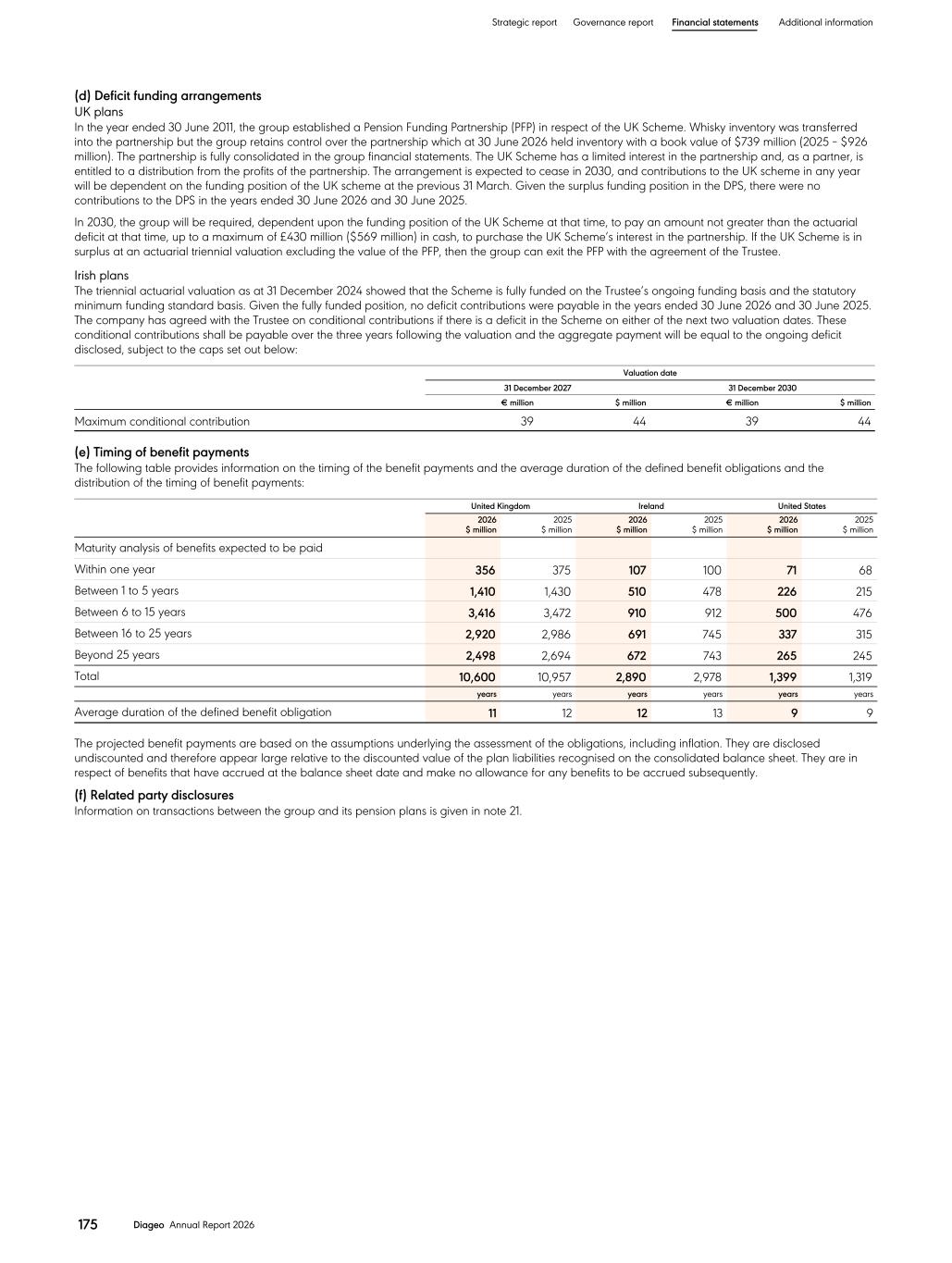
(d) Deficit funding arrangements UK plans In the year ended 30 June 2011, the group established a Pension Funding Partnership (PFP) in respect of the UK Scheme. Whisky inventory was transferred into the partnership but the group retains control over the partnership which at 30 June 2026 held inventory with a book value of $739 million (2025 – $926 million). The partnership is fully consolidated in the group financial statements. The UK Scheme has a limited interest in the partnership and, as a partner, is entitled to a distribution from the profits of the partnership. The arrangement is expected to cease in 2030, and contributions to the UK scheme in any year will be dependent on the funding position of the UK scheme at the previous 31 March. Given the surplus funding position in the DPS, there were no contributions to the DPS in the years ended 30 June 2026 and 30 June 2025. In 2030, the group will be required, dependent upon the funding position of the UK Scheme at that time, to pay an amount not greater than the actuarial deficit at that time, up to a maximum of £430 million ($569 million) in cash, to purchase the UK Scheme’s interest in the partnership. If the UK Scheme is in surplus at an actuarial triennial valuation excluding the value of the PFP, then the group can exit the PFP with the agreement of the Trustee. Irish plans The triennial actuarial valuation as at 31 December 2024 showed that the Scheme is fully funded on the Trustee’s ongoing funding basis and the statutory minimum funding standard basis. Given the fully funded position, no deficit contributions were payable in the years ended 30 June 2026 and 30 June 2025. The company has agreed with the Trustee on conditional contributions if there is a deficit in the Scheme on either of the next two valuation dates. These conditional contributions shall be payable over the three years following the valuation and the aggregate payment will be equal to the ongoing deficit disclosed, subject to the caps set out below: Maximum conditional contribution 39 44 39 44 Valuation date 31 December 2027 31 December 2030 € million $ million € million $ million (e) Timing of benefit payments The following table provides information on the timing of the benefit payments and the average duration of the defined benefit obligations and the distribution of the timing of benefit payments: Maturity analysis of benefits expected to be paid Within one year 356 375 107 100 71 68 Between 1 to 5 years 1,410 1,430 510 478 226 215 Between 6 to 15 years 3,416 3,472 910 912 500 476 Between 16 to 25 years 2,920 2,986 691 745 337 315 Beyond 25 years 2,498 2,694 672 743 265 245 Total 10,600 10,957 2,890 2,978 1,399 1,319 years years years years years years Average duration of the defined benefit obligation 11 12 12 13 9 9 United Kingdom Ireland United States 2026 $ million 2025 $ million 2026 $ million 2025 $ million 2026 $ million 2025 $ million The projected benefit payments are based on the assumptions underlying the assessment of the obligations, including inflation. They are disclosed undiscounted and therefore appear large relative to the discounted value of the plan liabilities recognised on the consolidated balance sheet. They are in respect of benefits that have accrued at the balance sheet date and make no allowance for any benefits to be accrued subsequently. (f) Related party disclosures Information on transactions between the group and its pension plans is given in note 21. Strategic report Governance report Financial statements Additional information 175 Diageo Annual Report 2026
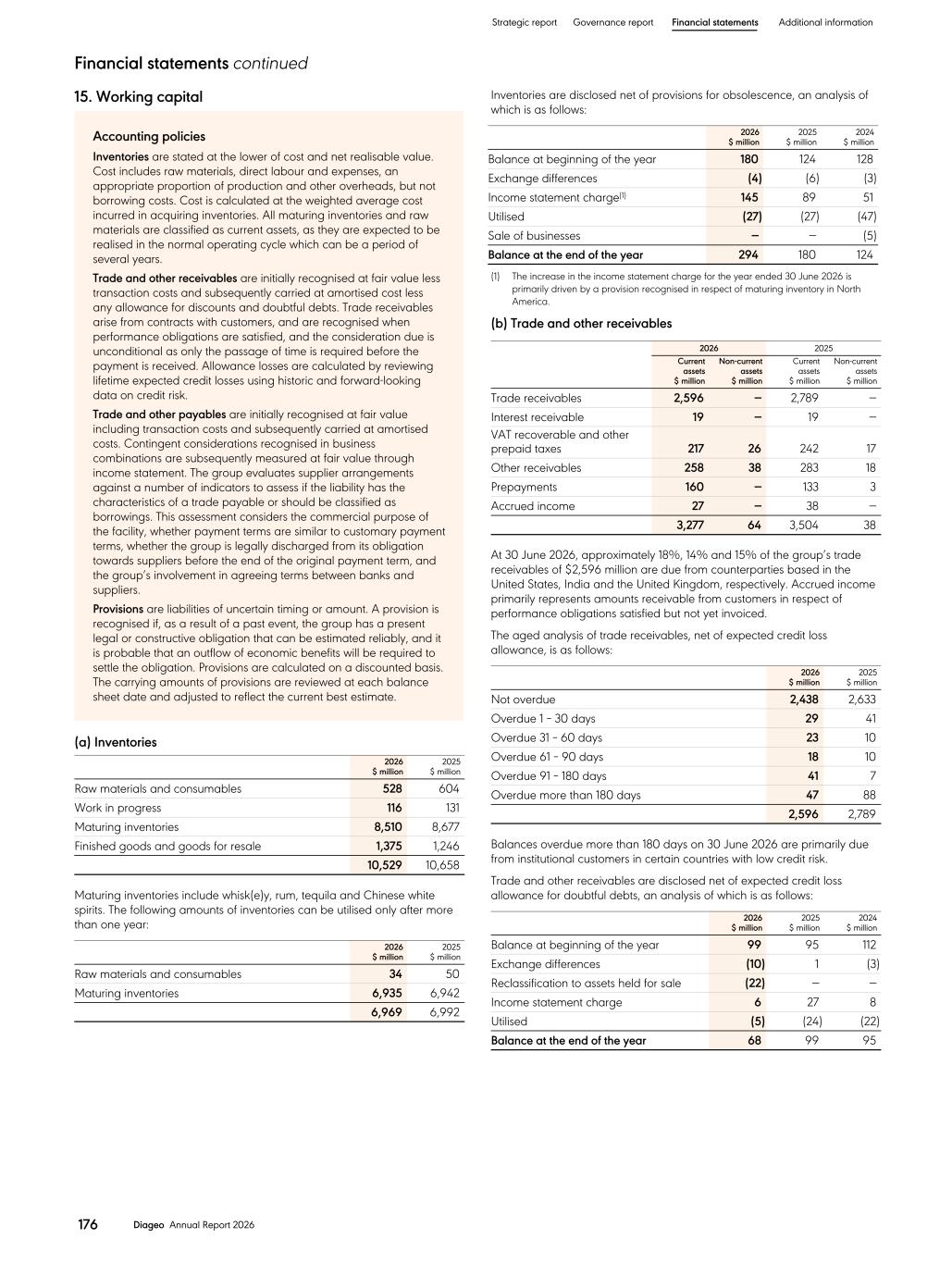
15. Working capital Accounting policies Inventories are stated at the lower of cost and net realisable value. Cost includes raw materials, direct labour and expenses, an appropriate proportion of production and other overheads, but not borrowing costs. Cost is calculated at the weighted average cost incurred in acquiring inventories. All maturing inventories and raw materials are classified as current assets, as they are expected to be realised in the normal operating cycle which can be a period of several years. Trade and other receivables are initially recognised at fair value less transaction costs and subsequently carried at amortised cost less any allowance for discounts and doubtful debts. Trade receivables arise from contracts with customers, and are recognised when performance obligations are satisfied, and the consideration due is unconditional as only the passage of time is required before the payment is received. Allowance losses are calculated by reviewing lifetime expected credit losses using historic and forward-looking data on credit risk. Trade and other payables are initially recognised at fair value including transaction costs and subsequently carried at amortised costs. Contingent considerations recognised in business combinations are subsequently measured at fair value through income statement. The group evaluates supplier arrangements against a number of indicators to assess if the liability has the characteristics of a trade payable or should be classified as borrowings. This assessment considers the commercial purpose of the facility, whether payment terms are similar to customary payment terms, whether the group is legally discharged from its obligation towards suppliers before the end of the original payment term, and the group’s involvement in agreeing terms between banks and suppliers. Provisions are liabilities of uncertain timing or amount. A provision is recognised if, as a result of a past event, the group has a present legal or constructive obligation that can be estimated reliably, and it is probable that an outflow of economic benefits will be required to settle the obligation. Provisions are calculated on a discounted basis. The carrying amounts of provisions are reviewed at each balance sheet date and adjusted to reflect the current best estimate. (a) Inventories Raw materials and consumables 528 604 Work in progress 116 131 Maturing inventories 8,510 8,677 Finished goods and goods for resale 1,375 1,246 10,529 10,658 2026 $ million 2025 $ million Maturing inventories include whisk(e)y, rum, tequila and Chinese white spirits. The following amounts of inventories can be utilised only after more than one year: Raw materials and consumables 34 50 Maturing inventories 6,935 6,942 6,969 6,992 2026 $ million 2025 $ million Inventories are disclosed net of provisions for obsolescence, an analysis of which is as follows: Balance at beginning of the year 180 124 128 Exchange differences (4) (6) (3) Income statement charge(1) 145 89 51 Utilised (27) (27) (47) Sale of businesses — — (5) Balance at the end of the year 294 180 124 2026 $ million 2025 $ million 2024 $ million (1) The increase in the income statement charge for the year ended 30 June 2026 is primarily driven by a provision recognised in respect of maturing inventory in North America. (b) Trade and other receivables Trade receivables 2,596 — 2,789 — Interest receivable 19 — 19 — VAT recoverable and other prepaid taxes 217 26 242 17 Other receivables 258 38 283 18 Prepayments 160 — 133 3 Accrued income 27 — 38 — 3,277 64 3,504 38 2026 2025 Current assets $ million Non-current assets $ million Current assets $ million Non-current assets $ million At 30 June 2026, approximately 18%, 14% and 15% of the group’s trade receivables of $2,596 million are due from counterparties based in the United States, India and the United Kingdom, respectively. Accrued income primarily represents amounts receivable from customers in respect of performance obligations satisfied but not yet invoiced. The aged analysis of trade receivables, net of expected credit loss allowance, is as follows: Not overdue 2,438 2,633 Overdue 1 – 30 days 29 41 Overdue 31 – 60 days 23 10 Overdue 61 – 90 days 18 10 Overdue 91 – 180 days 41 7 Overdue more than 180 days 47 88 2,596 2,789 2026 $ million 2025 $ million Balances overdue more than 180 days on 30 June 2026 are primarily due from institutional customers in certain countries with low credit risk. Trade and other receivables are disclosed net of expected credit loss allowance for doubtful debts, an analysis of which is as follows: Balance at beginning of the year 99 95 112 Exchange differences (10) 1 (3) Reclassification to assets held for sale (22) — — Income statement charge 6 27 8 Utilised (5) (24) (22) Balance at the end of the year 68 99 95 2026 $ million 2025 $ million 2024 $ million Strategic report Governance report Financial statements Additional information Financial statements continued 176 Diageo Annual Report 2026
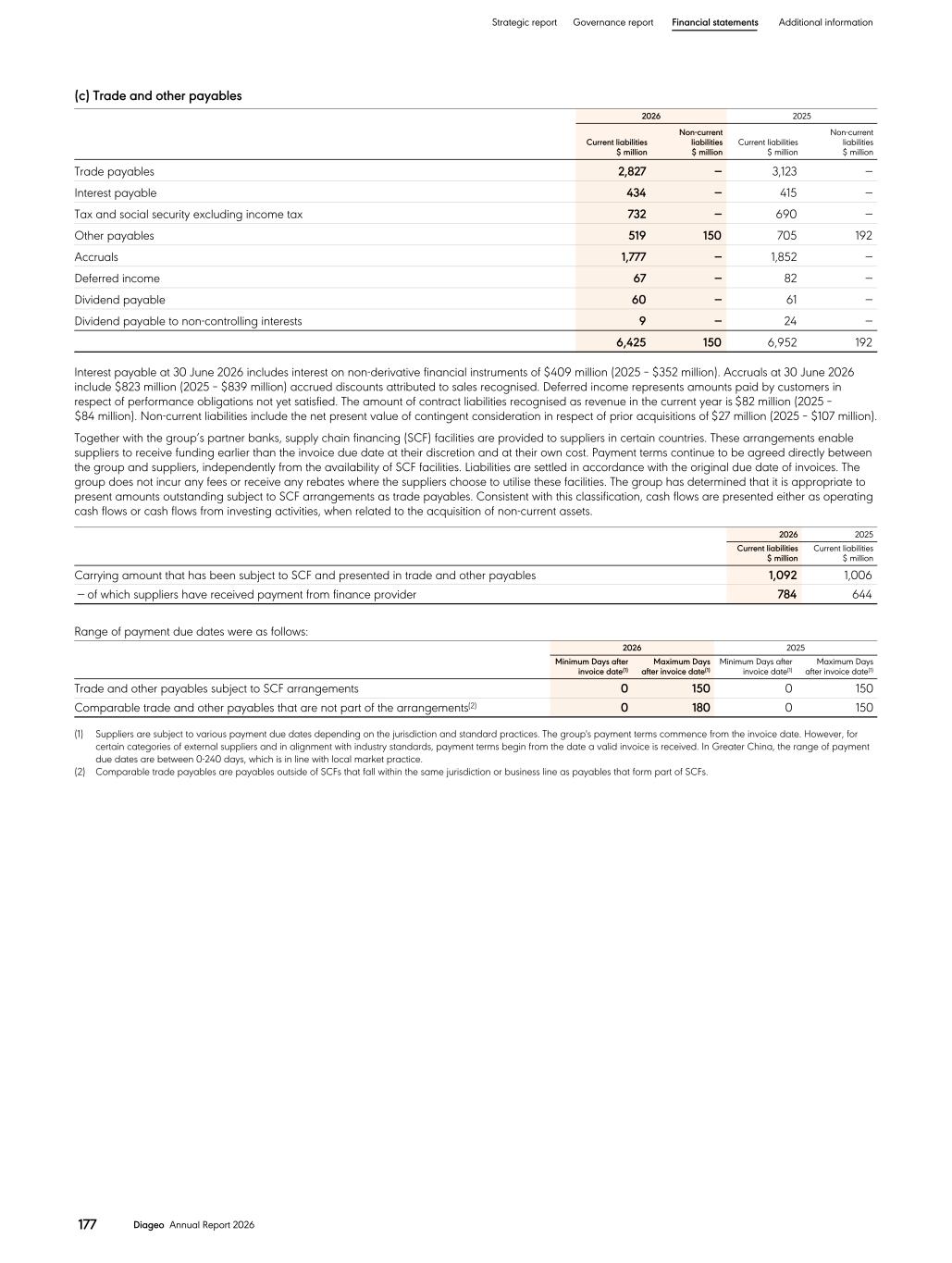
(c) Trade and other payables Trade payables 2,827 — 3,123 — Interest payable 434 — 415 — Tax and social security excluding income tax 732 — 690 — Other payables 519 150 705 192 Accruals 1,777 — 1,852 — Deferred income 67 — 82 — Dividend payable 60 — 61 — Dividend payable to non-controlling interests 9 — 24 — 6,425 150 6,952 192 2026 2025 Current liabilities $ million Non-current liabilities $ million Current liabilities $ million Non-current liabilities $ million Interest payable at 30 June 2026 includes interest on non-derivative financial instruments of $409 million (2025 – $352 million). Accruals at 30 June 2026 include $823 million (2025 – $839 million) accrued discounts attributed to sales recognised. Deferred income represents amounts paid by customers in respect of performance obligations not yet satisfied. The amount of contract liabilities recognised as revenue in the current year is $82 million (2025 – $84 million). Non-current liabilities include the net present value of contingent consideration in respect of prior acquisitions of $27 million (2025 – $107 million). Together with the group’s partner banks, supply chain financing (SCF) facilities are provided to suppliers in certain countries. These arrangements enable suppliers to receive funding earlier than the invoice due date at their discretion and at their own cost. Payment terms continue to be agreed directly between the group and suppliers, independently from the availability of SCF facilities. Liabilities are settled in accordance with the original due date of invoices. The group does not incur any fees or receive any rebates where the suppliers choose to utilise these facilities. The group has determined that it is appropriate to present amounts outstanding subject to SCF arrangements as trade payables. Consistent with this classification, cash flows are presented either as operating cash flows or cash flows from investing activities, when related to the acquisition of non-current assets. Carrying amount that has been subject to SCF and presented in trade and other payables 1,092 1,006 — of which suppliers have received payment from finance provider 784 644 2026 2025 Current liabilities $ million Current liabilities $ million Range of payment due dates were as follows: Trade and other payables subject to SCF arrangements 0 150 0 150 Comparable trade and other payables that are not part of the arrangements(2) 0 180 0 150 2026 2025 Minimum Days after invoice date(1) Maximum Days after invoice date(1) Minimum Days after invoice date(1) Maximum Days after invoice date(1) (1) Suppliers are subject to various payment due dates depending on the jurisdiction and standard practices. The group's payment terms commence from the invoice date. However, for certain categories of external suppliers and in alignment with industry standards, payment terms begin from the date a valid invoice is received. In Greater China, the range of payment due dates are between 0-240 days, which is in line with local market practice. (2) Comparable trade payables are payables outside of SCFs that fall within the same jurisdiction or business line as payables that form part of SCFs. Strategic report Governance report Financial statements Additional information 177 Diageo Annual Report 2026
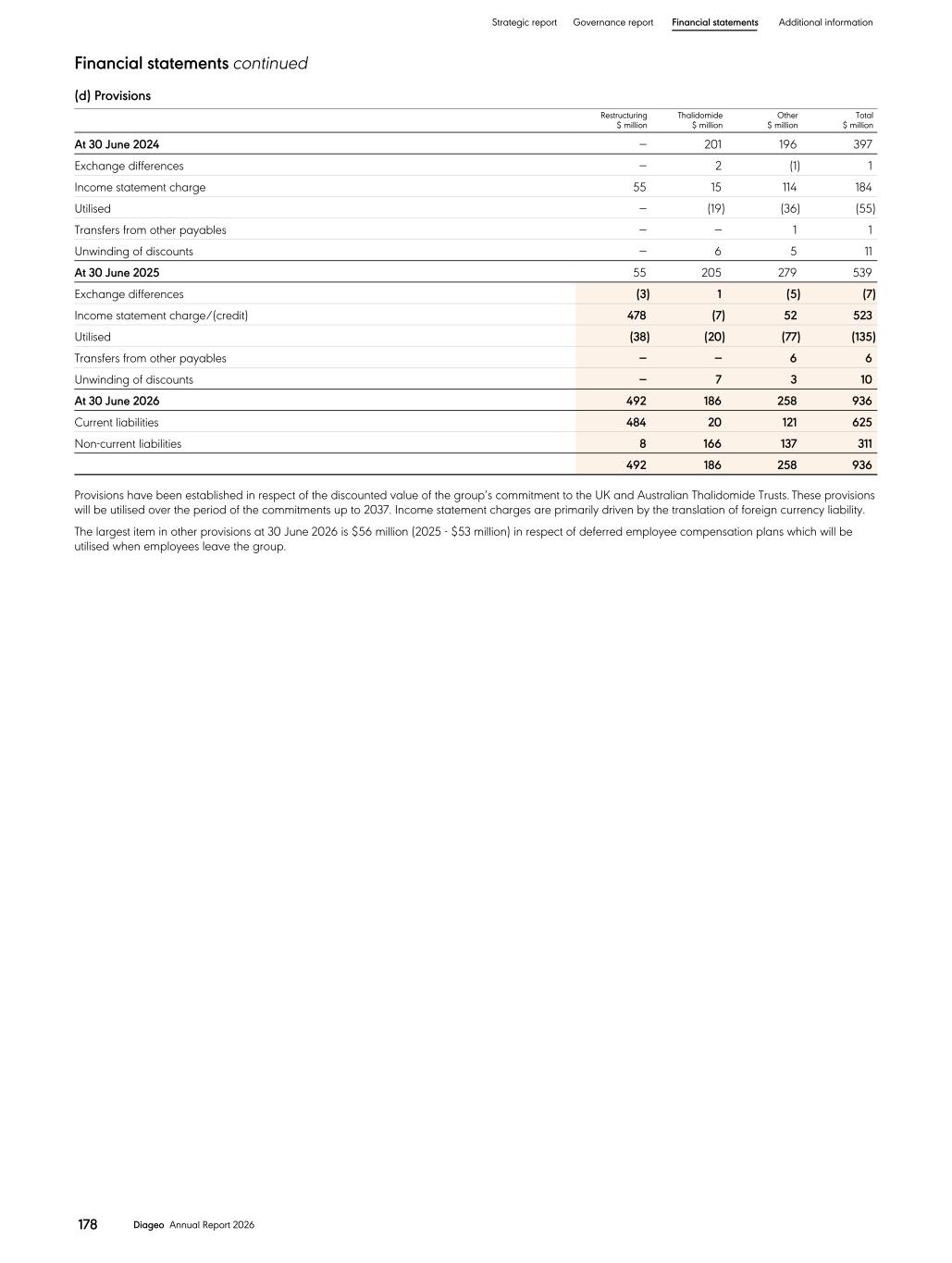
(d) Provisions At 30 June 2024 — 201 196 397 Exchange differences — 2 (1) 1 Income statement charge 55 15 114 184 Utilised — (19) (36) (55) Transfers from other payables — — 1 1 Unwinding of discounts — 6 5 11 At 30 June 2025 55 205 279 539 Exchange differences (3) 1 (5) (7) Income statement charge/(credit) 478 (7) 52 523 Utilised (38) (20) (77) (135) Transfers from other payables — — 6 6 Unwinding of discounts — 7 3 10 At 30 June 2026 492 186 258 936 Current liabilities 484 20 121 625 Non-current liabilities 8 166 137 311 492 186 258 936 Restructuring $ million Thalidomide $ million Other $ million Total $ million Provisions have been established in respect of the discounted value of the group’s commitment to the UK and Australian Thalidomide Trusts. These provisions will be utilised over the period of the commitments up to 2037. Income statement charges are primarily driven by the translation of foreign currency liability. The largest item in other provisions at 30 June 2026 is $56 million (2025 - $53 million) in respect of deferred employee compensation plans which will be utilised when employees leave the group. Strategic report Governance report Financial statements Additional information Financial statements continued 178 Diageo Annual Report 2026
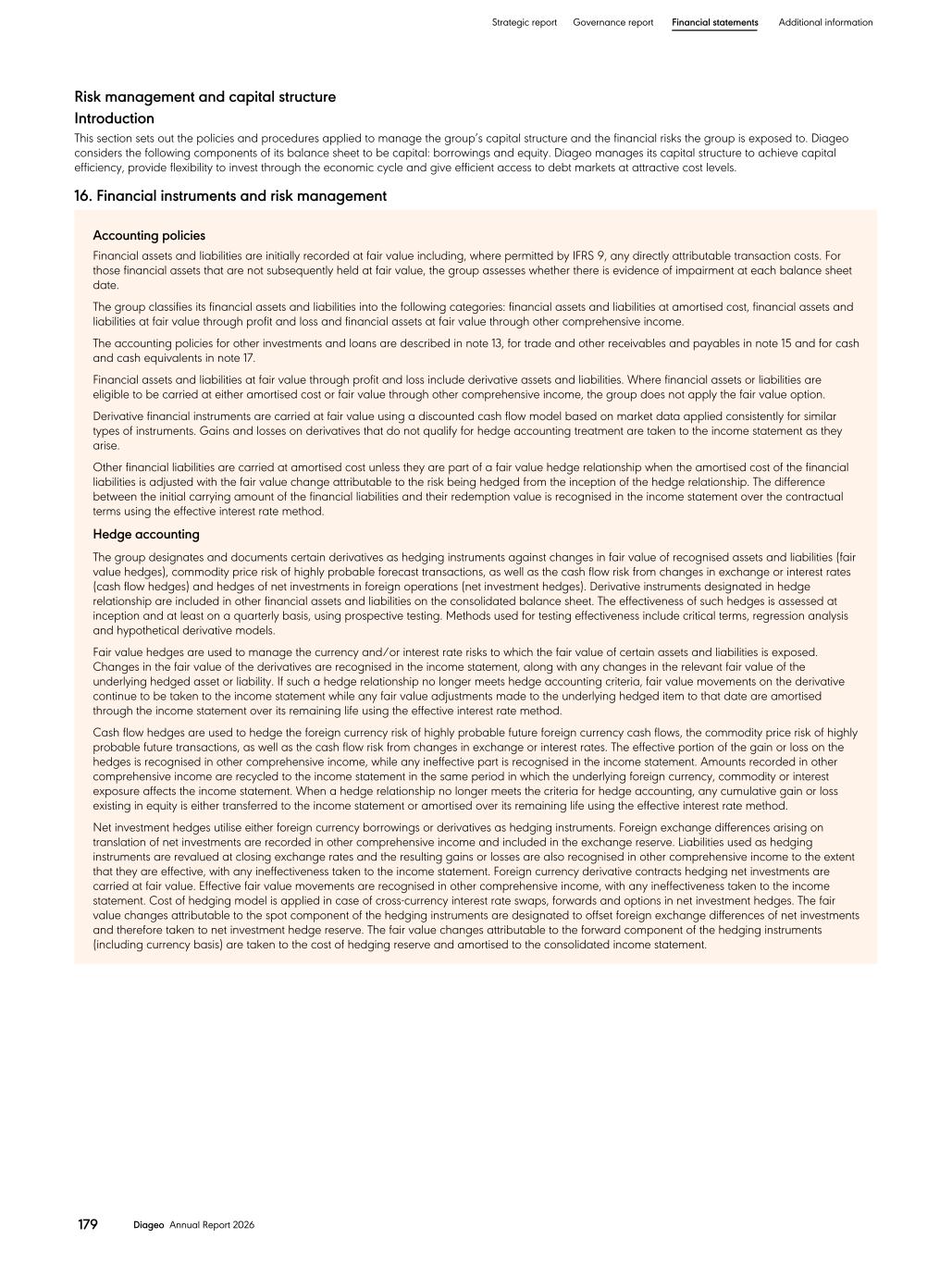
Risk management and capital structure Introduction This section sets out the policies and procedures applied to manage the group’s capital structure and the financial risks the group is exposed to. Diageo considers the following components of its balance sheet to be capital: borrowings and equity. Diageo manages its capital structure to achieve capital efficiency, provide flexibility to invest through the economic cycle and give efficient access to debt markets at attractive cost levels. 16. Financial instruments and risk management Accounting policies Financial assets and liabilities are initially recorded at fair value including, where permitted by IFRS 9, any directly attributable transaction costs. For those financial assets that are not subsequently held at fair value, the group assesses whether there is evidence of impairment at each balance sheet date. The group classifies its financial assets and liabilities into the following categories: financial assets and liabilities at amortised cost, financial assets and liabilities at fair value through profit and loss and financial assets at fair value through other comprehensive income. The accounting policies for other investments and loans are described in note 13, for trade and other receivables and payables in note 15 and for cash and cash equivalents in note 17. Financial assets and liabilities at fair value through profit and loss include derivative assets and liabilities. Where financial assets or liabilities are eligible to be carried at either amortised cost or fair value through other comprehensive income, the group does not apply the fair value option. Derivative financial instruments are carried at fair value using a discounted cash flow model based on market data applied consistently for similar types of instruments. Gains and losses on derivatives that do not qualify for hedge accounting treatment are taken to the income statement as they arise. Other financial liabilities are carried at amortised cost unless they are part of a fair value hedge relationship when the amortised cost of the financial liabilities is adjusted with the fair value change attributable to the risk being hedged from the inception of the hedge relationship. The difference between the initial carrying amount of the financial liabilities and their redemption value is recognised in the income statement over the contractual terms using the effective interest rate method. Hedge accounting The group designates and documents certain derivatives as hedging instruments against changes in fair value of recognised assets and liabilities (fair value hedges), commodity price risk of highly probable forecast transactions, as well as the cash flow risk from changes in exchange or interest rates (cash flow hedges) and hedges of net investments in foreign operations (net investment hedges). Derivative instruments designated in hedge relationship are included in other financial assets and liabilities on the consolidated balance sheet. The effectiveness of such hedges is assessed at inception and at least on a quarterly basis, using prospective testing. Methods used for testing effectiveness include critical terms, regression analysis and hypothetical derivative models. Fair value hedges are used to manage the currency and/or interest rate risks to which the fair value of certain assets and liabilities is exposed. Changes in the fair value of the derivatives are recognised in the income statement, along with any changes in the relevant fair value of the underlying hedged asset or liability. If such a hedge relationship no longer meets hedge accounting criteria, fair value movements on the derivative continue to be taken to the income statement while any fair value adjustments made to the underlying hedged item to that date are amortised through the income statement over its remaining life using the effective interest rate method. Cash flow hedges are used to hedge the foreign currency risk of highly probable future foreign currency cash flows, the commodity price risk of highly probable future transactions, as well as the cash flow risk from changes in exchange or interest rates. The effective portion of the gain or loss on the hedges is recognised in other comprehensive income, while any ineffective part is recognised in the income statement. Amounts recorded in other comprehensive income are recycled to the income statement in the same period in which the underlying foreign currency, commodity or interest exposure affects the income statement. When a hedge relationship no longer meets the criteria for hedge accounting, any cumulative gain or loss existing in equity is either transferred to the income statement or amortised over its remaining life using the effective interest rate method. Net investment hedges utilise either foreign currency borrowings or derivatives as hedging instruments. Foreign exchange differences arising on translation of net investments are recorded in other comprehensive income and included in the exchange reserve. Liabilities used as hedging instruments are revalued at closing exchange rates and the resulting gains or losses are also recognised in other comprehensive income to the extent that they are effective, with any ineffectiveness taken to the income statement. Foreign currency derivative contracts hedging net investments are carried at fair value. Effective fair value movements are recognised in other comprehensive income, with any ineffectiveness taken to the income statement. Cost of hedging model is applied in case of cross-currency interest rate swaps, forwards and options in net investment hedges. The fair value changes attributable to the spot component of the hedging instruments are designated to offset foreign exchange differences of net investments and therefore taken to net investment hedge reserve. The fair value changes attributable to the forward component of the hedging instruments (including currency basis) are taken to the cost of hedging reserve and amortised to the consolidated income statement. Strategic report Governance report Financial statements Additional information 179 Diageo Annual Report 2026
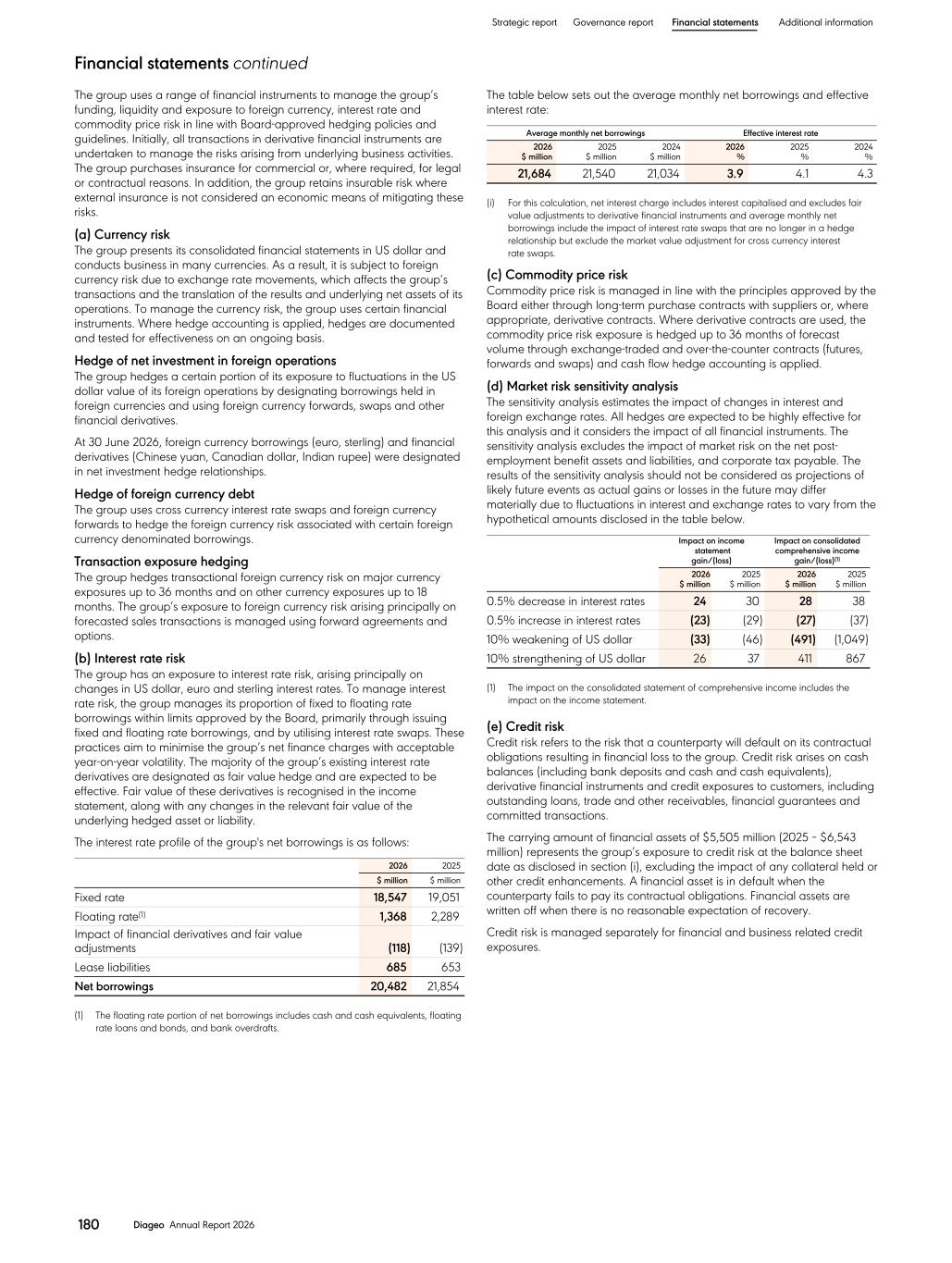
The group uses a range of financial instruments to manage the group’s funding, liquidity and exposure to foreign currency, interest rate and commodity price risk in line with Board-approved hedging policies and guidelines. Initially, all transactions in derivative financial instruments are undertaken to manage the risks arising from underlying business activities. The group purchases insurance for commercial or, where required, for legal or contractual reasons. In addition, the group retains insurable risk where external insurance is not considered an economic means of mitigating these risks. (a) Currency risk The group presents its consolidated financial statements in US dollar and conducts business in many currencies. As a result, it is subject to foreign currency risk due to exchange rate movements, which affects the group’s transactions and the translation of the results and underlying net assets of its operations. To manage the currency risk, the group uses certain financial instruments. Where hedge accounting is applied, hedges are documented and tested for effectiveness on an ongoing basis. Hedge of net investment in foreign operations The group hedges a certain portion of its exposure to fluctuations in the US dollar value of its foreign operations by designating borrowings held in foreign currencies and using foreign currency forwards, swaps and other financial derivatives. At 30 June 2026, foreign currency borrowings (euro, sterling) and financial derivatives (Chinese yuan, Canadian dollar, Indian rupee) were designated in net investment hedge relationships. Hedge of foreign currency debt The group uses cross currency interest rate swaps and foreign currency forwards to hedge the foreign currency risk associated with certain foreign currency denominated borrowings. Transaction exposure hedging The group hedges transactional foreign currency risk on major currency exposures up to 36 months and on other currency exposures up to 18 months. The group’s exposure to foreign currency risk arising principally on forecasted sales transactions is managed using forward agreements and options. (b) Interest rate risk The group has an exposure to interest rate risk, arising principally on changes in US dollar, euro and sterling interest rates. To manage interest rate risk, the group manages its proportion of fixed to floating rate borrowings within limits approved by the Board, primarily through issuing fixed and floating rate borrowings, and by utilising interest rate swaps. These practices aim to minimise the group’s net finance charges with acceptable year-on-year volatility. The majority of the group’s existing interest rate derivatives are designated as fair value hedge and are expected to be effective. Fair value of these derivatives is recognised in the income statement, along with any changes in the relevant fair value of the underlying hedged asset or liability. The interest rate profile of the group's net borrowings is as follows: Fixed rate 18,547 19,051 Floating rate(1) 1,368 2,289 Impact of financial derivatives and fair value adjustments (118) (139) Lease liabilities 685 653 Net borrowings 20,482 21,854 2026 2025 $ million $ million (1) The floating rate portion of net borrowings includes cash and cash equivalents, floating rate loans and bonds, and bank overdrafts. The table below sets out the average monthly net borrowings and effective interest rate: 21,684 21,540 21,034 3.9 4.1 4.3 Average monthly net borrowings Effective interest rate 2026 $ million 2025 $ million 2024 $ million 2026 % 2025 % 2024 % (i) For this calculation, net interest charge includes interest capitalised and excludes fair value adjustments to derivative financial instruments and average monthly net borrowings include the impact of interest rate swaps that are no longer in a hedge relationship but exclude the market value adjustment for cross currency interest rate swaps. (c) Commodity price risk Commodity price risk is managed in line with the principles approved by the Board either through long-term purchase contracts with suppliers or, where appropriate, derivative contracts. Where derivative contracts are used, the commodity price risk exposure is hedged up to 36 months of forecast volume through exchange-traded and over-the-counter contracts (futures, forwards and swaps) and cash flow hedge accounting is applied. (d) Market risk sensitivity analysis The sensitivity analysis estimates the impact of changes in interest and foreign exchange rates. All hedges are expected to be highly effective for this analysis and it considers the impact of all financial instruments. The sensitivity analysis excludes the impact of market risk on the net post- employment benefit assets and liabilities, and corporate tax payable. The results of the sensitivity analysis should not be considered as projections of likely future events as actual gains or losses in the future may differ materially due to fluctuations in interest and exchange rates to vary from the hypothetical amounts disclosed in the table below. 0.5% decrease in interest rates 24 30 28 38 0.5% increase in interest rates (23) (29) (27) (37) 10% weakening of US dollar (33) (46) (491) (1,049) 10% strengthening of US dollar 26 37 411 867 Impact on income statement gain/(loss) Impact on consolidated comprehensive income gain/(loss)(1) 2026 $ million 2025 $ million 2026 $ million 2025 $ million (1) The impact on the consolidated statement of comprehensive income includes the impact on the income statement. (e) Credit risk Credit risk refers to the risk that a counterparty will default on its contractual obligations resulting in financial loss to the group. Credit risk arises on cash balances (including bank deposits and cash and cash equivalents), derivative financial instruments and credit exposures to customers, including outstanding loans, trade and other receivables, financial guarantees and committed transactions. The carrying amount of financial assets of $5,505 million (2025 – $6,543 million) represents the group’s exposure to credit risk at the balance sheet date as disclosed in section (i), excluding the impact of any collateral held or other credit enhancements. A financial asset is in default when the counterparty fails to pay its contractual obligations. Financial assets are written off when there is no reasonable expectation of recovery. Credit risk is managed separately for financial and business related credit exposures. Strategic report Governance report Financial statements Additional information Financial statements continued 180 Diageo Annual Report 2026
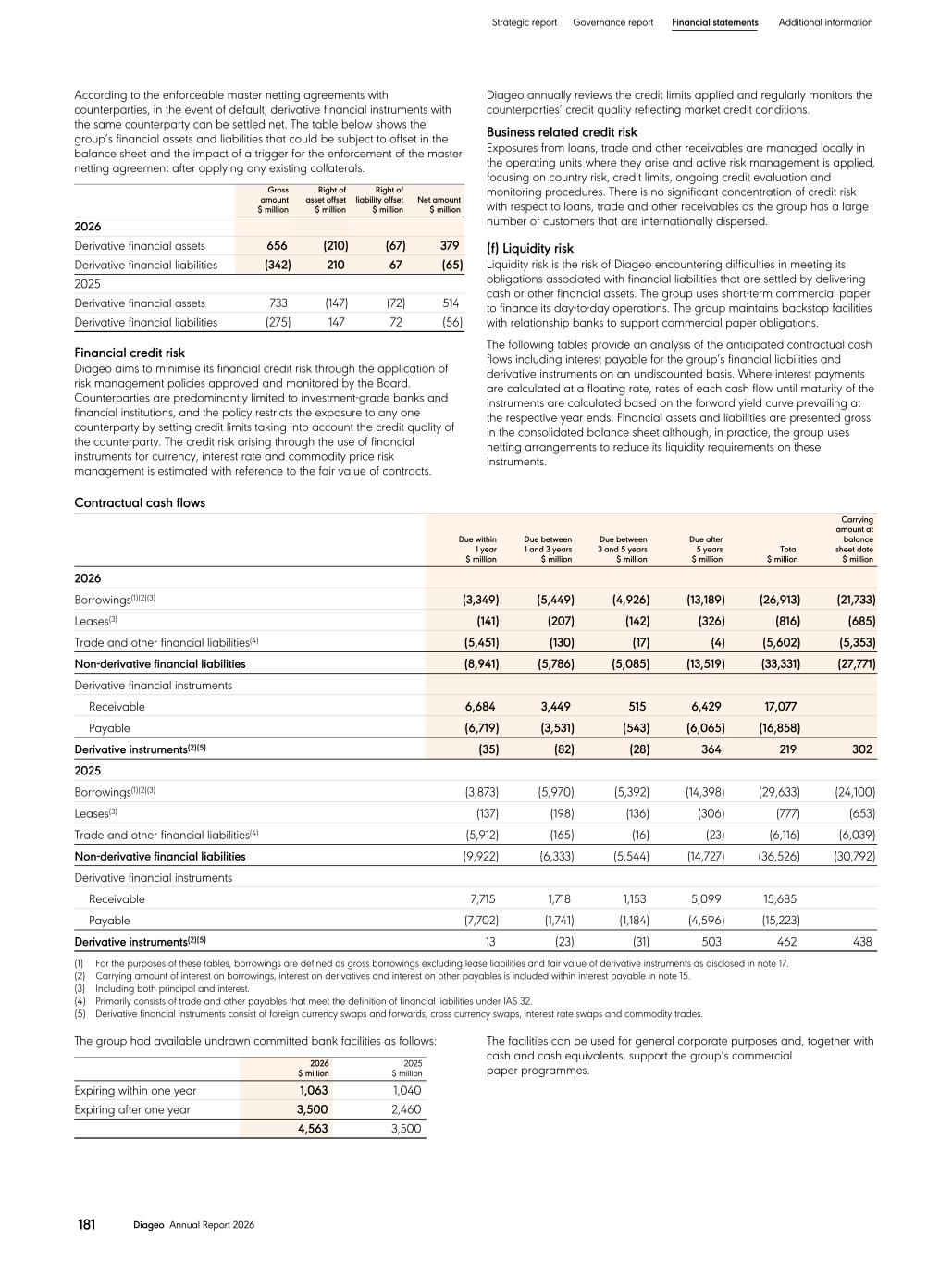
According to the enforceable master netting agreements with counterparties, in the event of default, derivative financial instruments with the same counterparty can be settled net. The table below shows the group’s financial assets and liabilities that could be subject to offset in the balance sheet and the impact of a trigger for the enforcement of the master netting agreement after applying any existing collaterals. 2026 Derivative financial assets 656 (210) (67) 379 Derivative financial liabilities (342) 210 67 (65) 2025 Derivative financial assets 733 (147) (72) 514 Derivative financial liabilities (275) 147 72 (56) Gross amount $ million Right of asset offset $ million Right of liability offset $ million Net amount $ million Financial credit risk Diageo aims to minimise its financial credit risk through the application of risk management policies approved and monitored by the Board. Counterparties are predominantly limited to investment-grade banks and financial institutions, and the policy restricts the exposure to any one counterparty by setting credit limits taking into account the credit quality of the counterparty. The credit risk arising through the use of financial instruments for currency, interest rate and commodity price risk management is estimated with reference to the fair value of contracts. Diageo annually reviews the credit limits applied and regularly monitors the counterparties’ credit quality reflecting market credit conditions. Business related credit risk Exposures from loans, trade and other receivables are managed locally in the operating units where they arise and active risk management is applied, focusing on country risk, credit limits, ongoing credit evaluation and monitoring procedures. There is no significant concentration of credit risk with respect to loans, trade and other receivables as the group has a large number of customers that are internationally dispersed. (f) Liquidity risk Liquidity risk is the risk of Diageo encountering difficulties in meeting its obligations associated with financial liabilities that are settled by delivering cash or other financial assets. The group uses short-term commercial paper to finance its day-to-day operations. The group maintains backstop facilities with relationship banks to support commercial paper obligations. The following tables provide an analysis of the anticipated contractual cash flows including interest payable for the group’s financial liabilities and derivative instruments on an undiscounted basis. Where interest payments are calculated at a floating rate, rates of each cash flow until maturity of the instruments are calculated based on the forward yield curve prevailing at the respective year ends. Financial assets and liabilities are presented gross in the consolidated balance sheet although, in practice, the group uses netting arrangements to reduce its liquidity requirements on these instruments. Contractual cash flows 2026 Borrowings(1)(2)(3) (3,349) (5,449) (4,926) (13,189) (26,913) (21,733) Leases(3) (141) (207) (142) (326) (816) (685) Trade and other financial liabilities(4) (5,451) (130) (17) (4) (5,602) (5,353) Non-derivative financial liabilities (8,941) (5,786) (5,085) (13,519) (33,331) (27,771) Derivative financial instruments Receivable 6,684 3,449 515 6,429 17,077 Payable (6,719) (3,531) (543) (6,065) (16,858) Derivative instruments(2)(5) (35) (82) (28) 364 219 302 2025 Borrowings(1)(2)(3) (3,873) (5,970) (5,392) (14,398) (29,633) (24,100) Leases(3) (137) (198) (136) (306) (777) (653) Trade and other financial liabilities(4) (5,912) (165) (16) (23) (6,116) (6,039) Non-derivative financial liabilities (9,922) (6,333) (5,544) (14,727) (36,526) (30,792) Derivative financial instruments Receivable 7,715 1,718 1,153 5,099 15,685 Payable (7,702) (1,741) (1,184) (4,596) (15,223) Derivative instruments(2)(5) 13 (23) (31) 503 462 438 Due within 1 year $ million Due between 1 and 3 years $ million Due between 3 and 5 years $ million Due after 5 years $ million Total $ million Carrying amount at balance sheet date $ million (1) For the purposes of these tables, borrowings are defined as gross borrowings excluding lease liabilities and fair value of derivative instruments as disclosed in note 17. (2) Carrying amount of interest on borrowings, interest on derivatives and interest on other payables is included within interest payable in note 15. (3) Including both principal and interest. (4) Primarily consists of trade and other payables that meet the definition of financial liabilities under IAS 32. (5) Derivative financial instruments consist of foreign currency swaps and forwards, cross currency swaps, interest rate swaps and commodity trades. The group had available undrawn committed bank facilities as follows: Expiring within one year 1,063 1,040 Expiring after one year 3,500 2,460 4,563 3,500 2026 $ million 2025 $ million The facilities can be used for general corporate purposes and, together with cash and cash equivalents, support the group’s commercial paper programmes. Strategic report Governance report Financial statements Additional information 181 Diageo Annual Report 2026
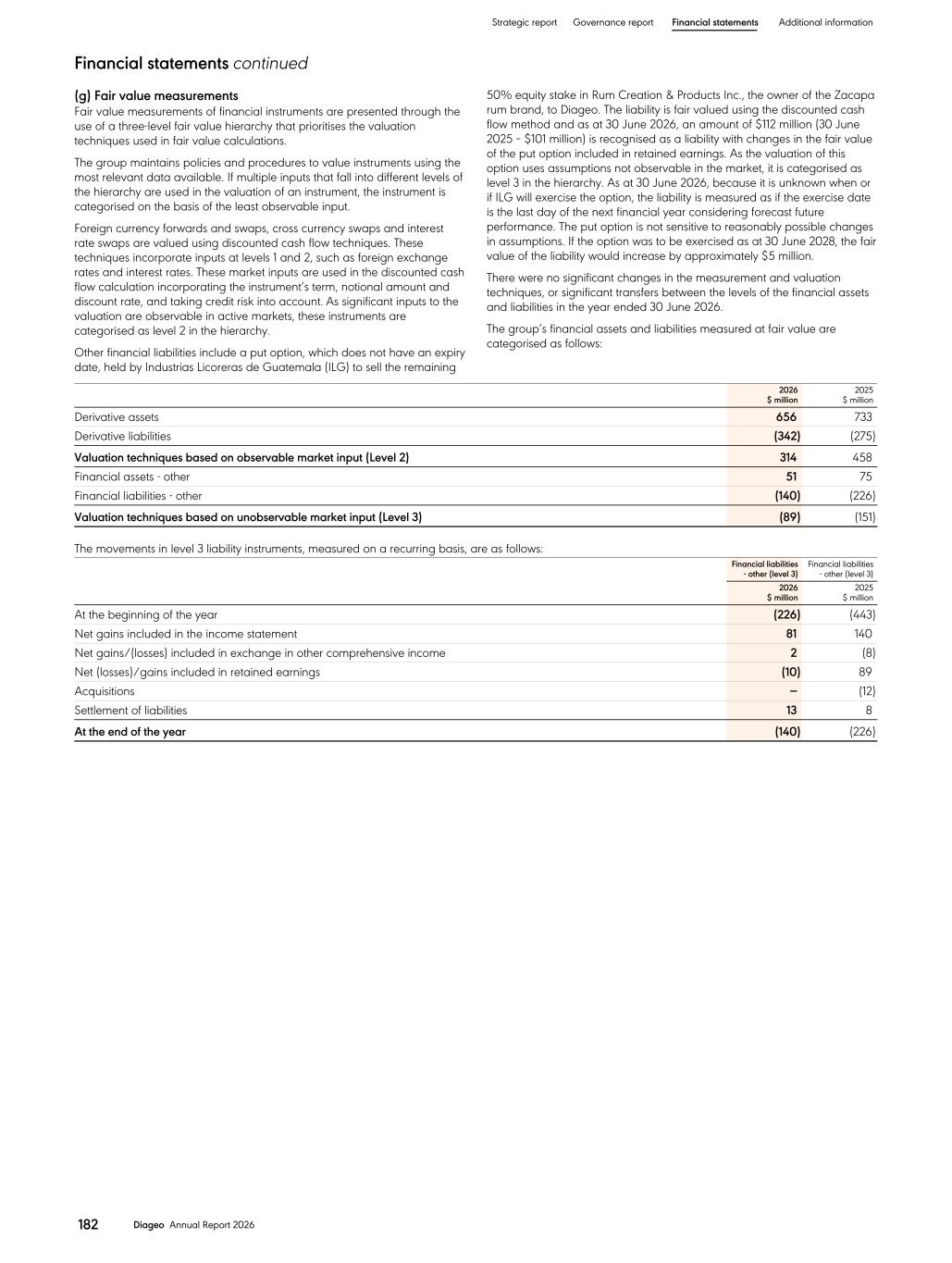
(g) Fair value measurements Fair value measurements of financial instruments are presented through the use of a three-level fair value hierarchy that prioritises the valuation techniques used in fair value calculations. The group maintains policies and procedures to value instruments using the most relevant data available. If multiple inputs that fall into different levels of the hierarchy are used in the valuation of an instrument, the instrument is categorised on the basis of the least observable input. Foreign currency forwards and swaps, cross currency swaps and interest rate swaps are valued using discounted cash flow techniques. These techniques incorporate inputs at levels 1 and 2, such as foreign exchange rates and interest rates. These market inputs are used in the discounted cash flow calculation incorporating the instrument’s term, notional amount and discount rate, and taking credit risk into account. As significant inputs to the valuation are observable in active markets, these instruments are categorised as level 2 in the hierarchy. Other financial liabilities include a put option, which does not have an expiry date, held by Industrias Licoreras de Guatemala (ILG) to sell the remaining 50% equity stake in Rum Creation & Products Inc., the owner of the Zacapa rum brand, to Diageo. The liability is fair valued using the discounted cash flow method and as at 30 June 2026, an amount of $112 million (30 June 2025 – $101 million) is recognised as a liability with changes in the fair value of the put option included in retained earnings. As the valuation of this option uses assumptions not observable in the market, it is categorised as level 3 in the hierarchy. As at 30 June 2026, because it is unknown when or if ILG will exercise the option, the liability is measured as if the exercise date is the last day of the next financial year considering forecast future performance. The put option is not sensitive to reasonably possible changes in assumptions. If the option was to be exercised as at 30 June 2028, the fair value of the liability would increase by approximately $5 million. There were no significant changes in the measurement and valuation techniques, or significant transfers between the levels of the financial assets and liabilities in the year ended 30 June 2026. The group’s financial assets and liabilities measured at fair value are categorised as follows: Derivative assets 656 733 Derivative liabilities (342) (275) Valuation techniques based on observable market input (Level 2) 314 458 Financial assets - other 51 75 Financial liabilities - other (140) (226) Valuation techniques based on unobservable market input (Level 3) (89) (151) 2026 $ million 2025 $ million The movements in level 3 liability instruments, measured on a recurring basis, are as follows: Financial liabilities - other (level 3) Financial liabilities - other (level 3) 2026 $ million 2025 $ million At the beginning of the year (226) (443) Net gains included in the income statement 81 140 Net gains/(losses) included in exchange in other comprehensive income 2 (8) Net (losses)/gains included in retained earnings (10) 89 Acquisitions — (12) Settlement of liabilities 13 8 At the end of the year (140) (226) Strategic report Governance report Financial statements Additional information Financial statements continued 182 Diageo Annual Report 2026
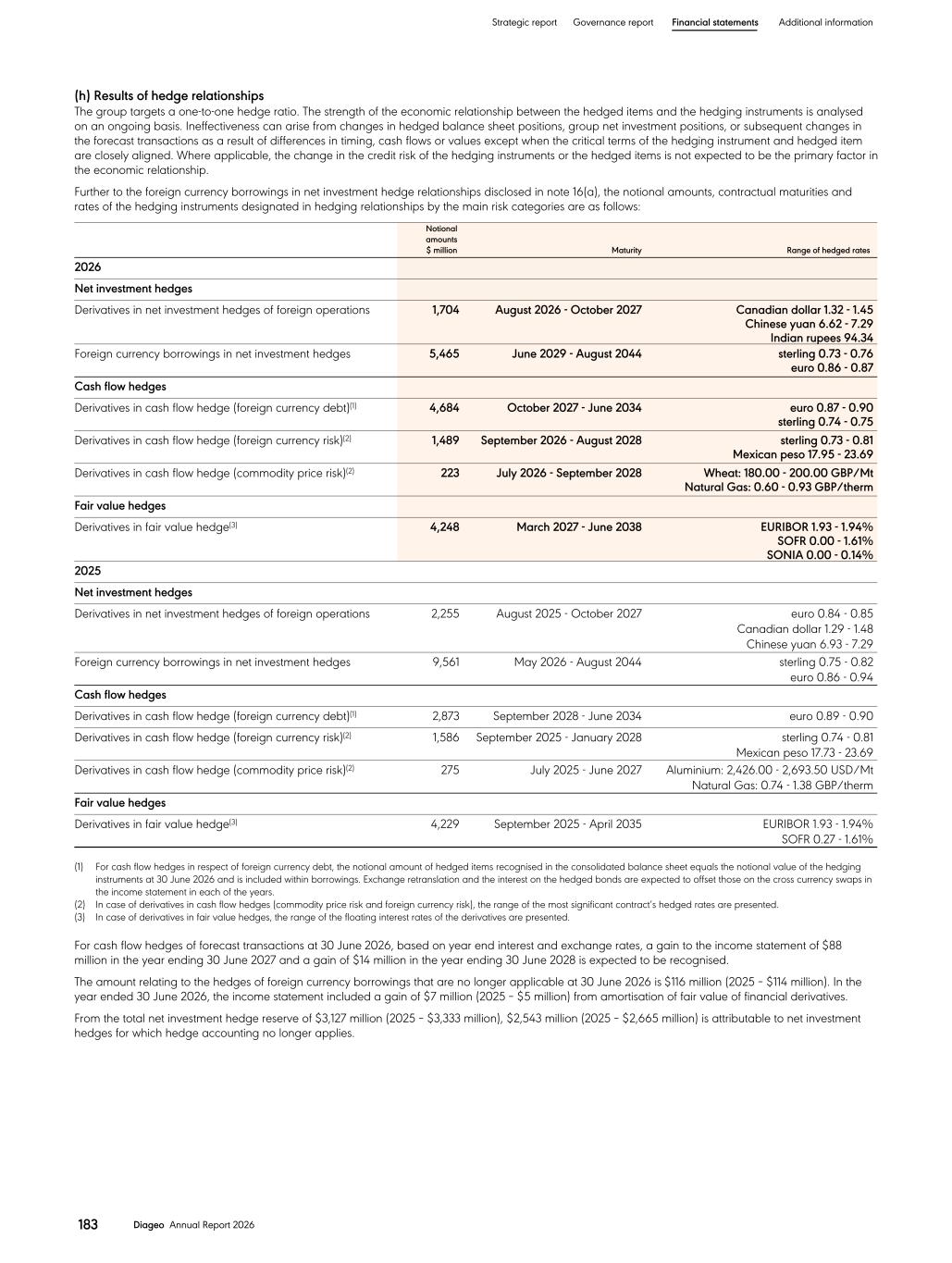
(h) Results of hedge relationships The group targets a one-to-one hedge ratio. The strength of the economic relationship between the hedged items and the hedging instruments is analysed on an ongoing basis. Ineffectiveness can arise from changes in hedged balance sheet positions, group net investment positions, or subsequent changes in the forecast transactions as a result of differences in timing, cash flows or values except when the critical terms of the hedging instrument and hedged item are closely aligned. Where applicable, the change in the credit risk of the hedging instruments or the hedged items is not expected to be the primary factor in the economic relationship. Further to the foreign currency borrowings in net investment hedge relationships disclosed in note 16(a), the notional amounts, contractual maturities and rates of the hedging instruments designated in hedging relationships by the main risk categories are as follows: 2026 Net investment hedges Derivatives in net investment hedges of foreign operations 1,704 August 2026 - October 2027 Canadian dollar 1.32 - 1.45 Chinese yuan 6.62 - 7.29 Indian rupees 94.34 Foreign currency borrowings in net investment hedges 5,465 June 2029 - August 2044 sterling 0.73 - 0.76 euro 0.86 - 0.87 Cash flow hedges Derivatives in cash flow hedge (foreign currency debt)(1) 4,684 October 2027 - June 2034 euro 0.87 - 0.90 sterling 0.74 - 0.75 Derivatives in cash flow hedge (foreign currency risk)(2) 1,489 September 2026 - August 2028 sterling 0.73 - 0.81 Mexican peso 17.95 - 23.69 Derivatives in cash flow hedge (commodity price risk)(2) 223 July 2026 - September 2028 Wheat: 180.00 - 200.00 GBP/Mt Natural Gas: 0.60 - 0.93 GBP/therm Fair value hedges Derivatives in fair value hedge(3) 4,248 March 2027 - June 2038 EURIBOR 1.93 - 1.94% SOFR 0.00 - 1.61% SONIA 0.00 - 0.14% 2025 Net investment hedges Derivatives in net investment hedges of foreign operations 2,255 August 2025 - October 2027 euro 0.84 - 0.85 Canadian dollar 1.29 - 1.48 Chinese yuan 6.93 - 7.29 Foreign currency borrowings in net investment hedges 9,561 May 2026 - August 2044 sterling 0.75 - 0.82 euro 0.86 - 0.94 Cash flow hedges Derivatives in cash flow hedge (foreign currency debt)(1) 2,873 September 2028 - June 2034 euro 0.89 - 0.90 Derivatives in cash flow hedge (foreign currency risk)(2) 1,586 September 2025 - January 2028 sterling 0.74 - 0.81 Mexican peso 17.73 - 23.69 Derivatives in cash flow hedge (commodity price risk)(2) 275 July 2025 - June 2027 Aluminium: 2,426.00 - 2,693.50 USD/Mt Natural Gas: 0.74 - 1.38 GBP/therm Fair value hedges Derivatives in fair value hedge(3) 4,229 September 2025 - April 2035 EURIBOR 1.93 - 1.94% SOFR 0.27 - 1.61% Notional amounts $ million Maturity Range of hedged rates (1) For cash flow hedges in respect of foreign currency debt, the notional amount of hedged items recognised in the consolidated balance sheet equals the notional value of the hedging instruments at 30 June 2026 and is included within borrowings. Exchange retranslation and the interest on the hedged bonds are expected to offset those on the cross currency swaps in the income statement in each of the years. (2) In case of derivatives in cash flow hedges (commodity price risk and foreign currency risk), the range of the most significant contract’s hedged rates are presented. (3) In case of derivatives in fair value hedges, the range of the floating interest rates of the derivatives are presented. For cash flow hedges of forecast transactions at 30 June 2026, based on year end interest and exchange rates, a gain to the income statement of $88 million in the year ending 30 June 2027 and a gain of $14 million in the year ending 30 June 2028 is expected to be recognised. The amount relating to the hedges of foreign currency borrowings that are no longer applicable at 30 June 2026 is $116 million (2025 – $114 million). In the year ended 30 June 2026, the income statement included a gain of $7 million (2025 – $5 million) from amortisation of fair value of financial derivatives. From the total net investment hedge reserve of $3,127 million (2025 – $3,333 million), $2,543 million (2025 – $2,665 million) is attributable to net investment hedges for which hedge accounting no longer applies. Strategic report Governance report Financial statements Additional information 183 Diageo Annual Report 2026
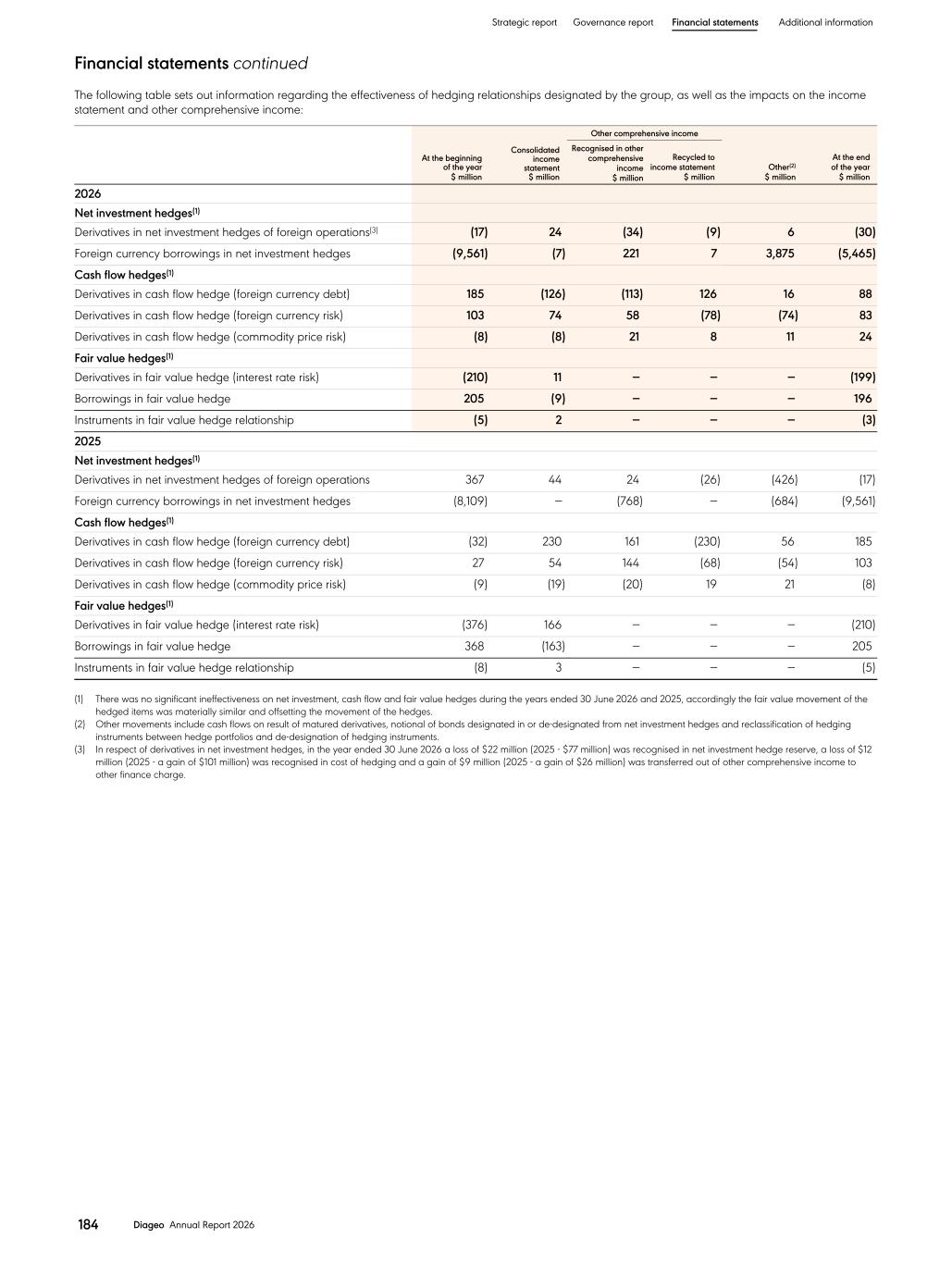
The following table sets out information regarding the effectiveness of hedging relationships designated by the group, as well as the impacts on the income statement and other comprehensive income: At the beginning of the year $ million Consolidated income statement $ million Recognised in other comprehensive income $ million Recycled to income statement $ million Other(2) $ million At the end of the year $ million 2026 Net investment hedges(1) Derivatives in net investment hedges of foreign operations(3) (17) 24 (34) (9) 6 (30) Foreign currency borrowings in net investment hedges (9,561) (7) 221 7 3,875 (5,465) Cash flow hedges(1) Derivatives in cash flow hedge (foreign currency debt) 185 (126) (113) 126 16 88 Derivatives in cash flow hedge (foreign currency risk) 103 74 58 (78) (74) 83 Derivatives in cash flow hedge (commodity price risk) (8) (8) 21 8 11 24 Fair value hedges(1) Derivatives in fair value hedge (interest rate risk) (210) 11 — — — (199) Borrowings in fair value hedge 205 (9) — — — 196 Instruments in fair value hedge relationship (5) 2 — — — (3) 2025 Net investment hedges(1) Derivatives in net investment hedges of foreign operations 367 44 24 (26) (426) (17) Foreign currency borrowings in net investment hedges (8,109) — (768) — (684) (9,561) Cash flow hedges(1) Derivatives in cash flow hedge (foreign currency debt) (32) 230 161 (230) 56 185 Derivatives in cash flow hedge (foreign currency risk) 27 54 144 (68) (54) 103 Derivatives in cash flow hedge (commodity price risk) (9) (19) (20) 19 21 (8) Fair value hedges(1) Derivatives in fair value hedge (interest rate risk) (376) 166 — — — (210) Borrowings in fair value hedge 368 (163) — — — 205 Instruments in fair value hedge relationship (8) 3 — — — (5) Other comprehensive income (1) There was no significant ineffectiveness on net investment, cash flow and fair value hedges during the years ended 30 June 2026 and 2025, accordingly the fair value movement of the hedged items was materially similar and offsetting the movement of the hedges. (2) Other movements include cash flows on result of matured derivatives, notional of bonds designated in or de-designated from net investment hedges and reclassification of hedging instruments between hedge portfolios and de-designation of hedging instruments. (3) In respect of derivatives in net investment hedges, in the year ended 30 June 2026 a loss of $22 million (2025 - $77 million) was recognised in net investment hedge reserve, a loss of $12 million (2025 - a gain of $101 million) was recognised in cost of hedging and a gain of $9 million (2025 - a gain of $26 million) was transferred out of other comprehensive income to other finance charge. Strategic report Governance report Financial statements Additional information Financial statements continued 184 Diageo Annual Report 2026
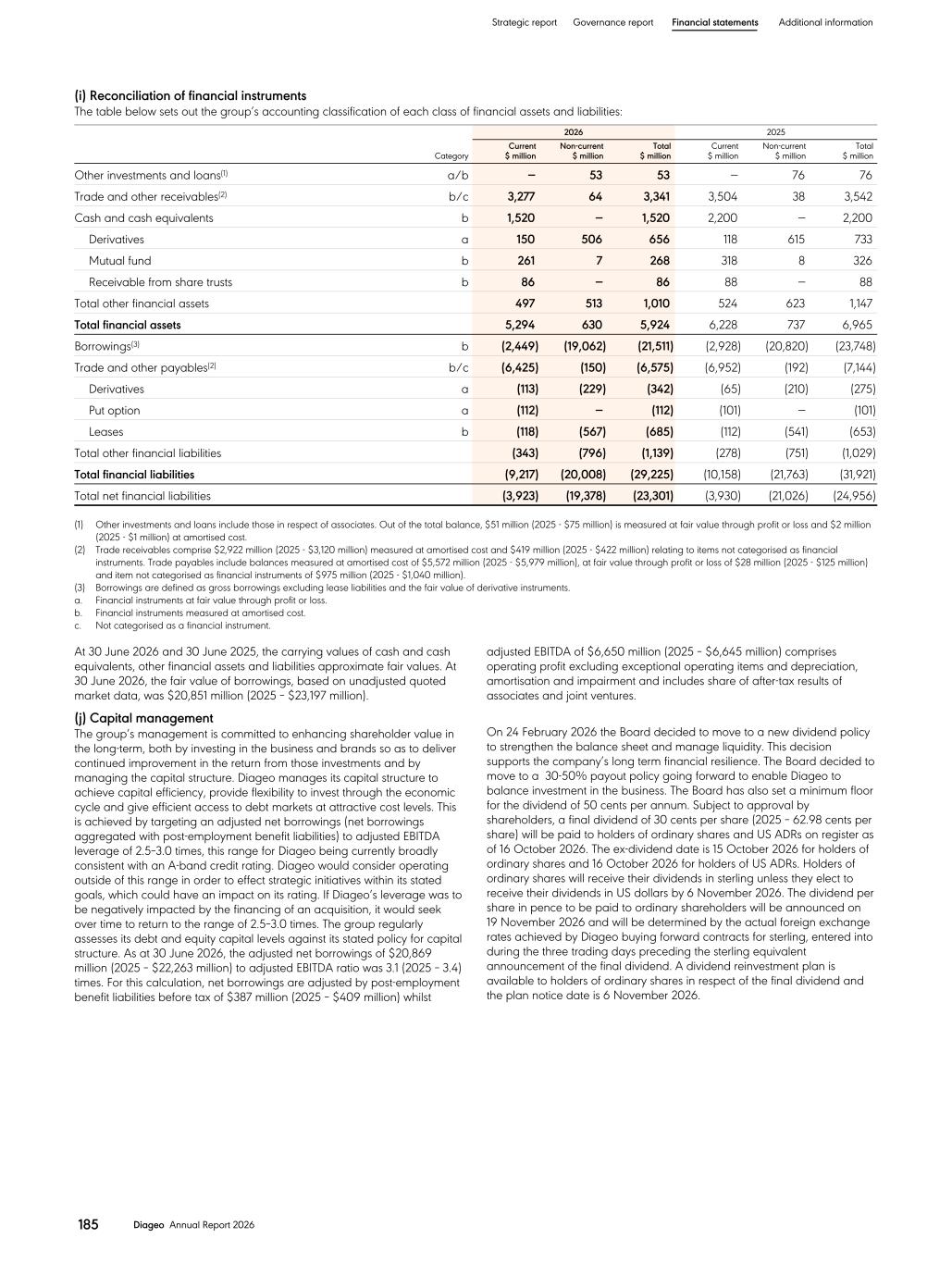
(i) Reconciliation of financial instruments The table below sets out the group’s accounting classification of each class of financial assets and liabilities: 2026 2025 Category Current $ million Non-current $ million Total $ million Current $ million Non-current $ million Total $ million Other investments and loans(1) a/b — 53 53 — 76 76 Trade and other receivables(2) b/c 3,277 64 3,341 3,504 38 3,542 Cash and cash equivalents b 1,520 — 1,520 2,200 — 2,200 Derivatives a 150 506 656 118 615 733 Mutual fund b 261 7 268 318 8 326 Receivable from share trusts b 86 — 86 88 — 88 Total other financial assets 497 513 1,010 524 623 1,147 Total financial assets 5,294 630 5,924 6,228 737 6,965 Borrowings(3) b (2,449) (19,062) (21,511) (2,928) (20,820) (23,748) Trade and other payables(2) b/c (6,425) (150) (6,575) (6,952) (192) (7,144) Derivatives a (113) (229) (342) (65) (210) (275) Put option a (112) — (112) (101) — (101) Leases b (118) (567) (685) (112) (541) (653) Total other financial liabilities (343) (796) (1,139) (278) (751) (1,029) Total financial liabilities (9,217) (20,008) (29,225) (10,158) (21,763) (31,921) Total net financial liabilities (3,923) (19,378) (23,301) (3,930) (21,026) (24,956) (1) Other investments and loans include those in respect of associates. Out of the total balance, $51 million (2025 - $75 million) is measured at fair value through profit or loss and $2 million (2025 - $1 million) at amortised cost. (2) Trade receivables comprise $2,922 million (2025 - $3,120 million) measured at amortised cost and $419 million (2025 - $422 million) relating to items not categorised as financial instruments. Trade payables include balances measured at amortised cost of $5,572 million (2025 - $5,979 million), at fair value through profit or loss of $28 million (2025 - $125 million) and item not categorised as financial instruments of $975 million (2025 - $1,040 million). (3) Borrowings are defined as gross borrowings excluding lease liabilities and the fair value of derivative instruments. a. Financial instruments at fair value through profit or loss. b. Financial instruments measured at amortised cost. c. Not categorised as a financial instrument. At 30 June 2026 and 30 June 2025, the carrying values of cash and cash equivalents, other financial assets and liabilities approximate fair values. At 30 June 2026, the fair value of borrowings, based on unadjusted quoted market data, was $20,851 million (2025 – $23,197 million). (j) Capital management The group’s management is committed to enhancing shareholder value in the long-term, both by investing in the business and brands so as to deliver continued improvement in the return from those investments and by managing the capital structure. Diageo manages its capital structure to achieve capital efficiency, provide flexibility to invest through the economic cycle and give efficient access to debt markets at attractive cost levels. This is achieved by targeting an adjusted net borrowings (net borrowings aggregated with post-employment benefit liabilities) to adjusted EBITDA leverage of 2.5–3.0 times, this range for Diageo being currently broadly consistent with an A-band credit rating. Diageo would consider operating outside of this range in order to effect strategic initiatives within its stated goals, which could have an impact on its rating. If Diageo’s leverage was to be negatively impacted by the financing of an acquisition, it would seek over time to return to the range of 2.5–3.0 times. The group regularly assesses its debt and equity capital levels against its stated policy for capital structure. As at 30 June 2026, the adjusted net borrowings of $20,869 million (2025 – $22,263 million) to adjusted EBITDA ratio was 3.1 (2025 – 3.4) times. For this calculation, net borrowings are adjusted by post-employment benefit liabilities before tax of $387 million (2025 – $409 million) whilst adjusted EBITDA of $6,650 million (2025 – $6,645 million) comprises operating profit excluding exceptional operating items and depreciation, amortisation and impairment and includes share of after-tax results of associates and joint ventures. On 24 February 2026 the Board decided to move to a new dividend policy to strengthen the balance sheet and manage liquidity. This decision supports the company’s long term financial resilience. The Board decided to move to a 30-50% payout policy going forward to enable Diageo to balance investment in the business. The Board has also set a minimum floor for the dividend of 50 cents per annum. Subject to approval by shareholders, a final dividend of 30 cents per share (2025 – 62.98 cents per share) will be paid to holders of ordinary shares and US ADRs on register as of 16 October 2026. The ex-dividend date is 15 October 2026 for holders of ordinary shares and 16 October 2026 for holders of US ADRs. Holders of ordinary shares will receive their dividends in sterling unless they elect to receive their dividends in US dollars by 6 November 2026. The dividend per share in pence to be paid to ordinary shareholders will be announced on 19 November 2026 and will be determined by the actual foreign exchange rates achieved by Diageo buying forward contracts for sterling, entered into during the three trading days preceding the sterling equivalent announcement of the final dividend. A dividend reinvestment plan is available to holders of ordinary shares in respect of the final dividend and the plan notice date is 6 November 2026. Strategic report Governance report Financial statements Additional information 185 Diageo Annual Report 2026
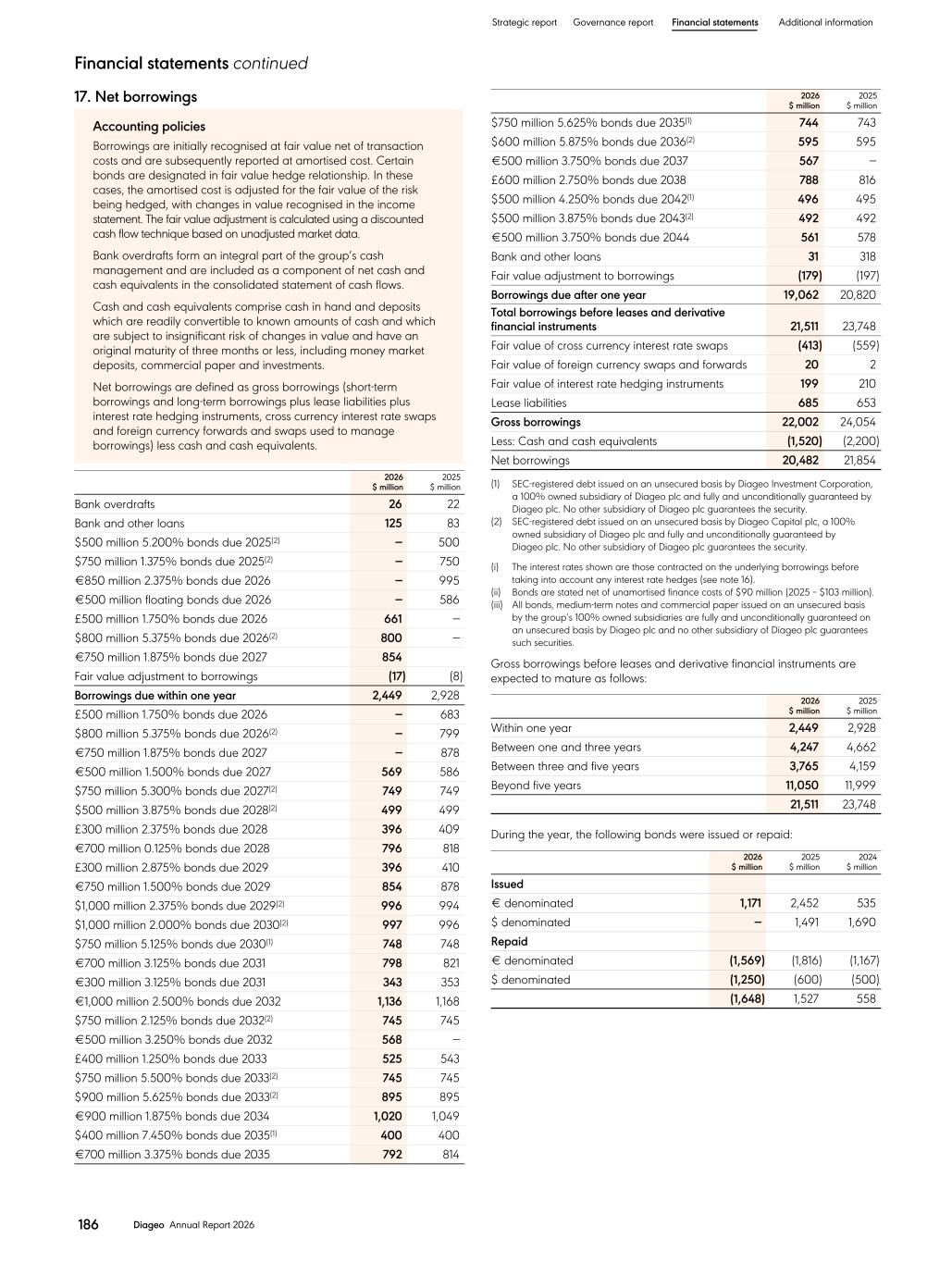
17. Net borrowings Accounting policies Borrowings are initially recognised at fair value net of transaction costs and are subsequently reported at amortised cost. Certain bonds are designated in fair value hedge relationship. In these cases, the amortised cost is adjusted for the fair value of the risk being hedged, with changes in value recognised in the income statement. The fair value adjustment is calculated using a discounted cash flow technique based on unadjusted market data. Bank overdrafts form an integral part of the group’s cash management and are included as a component of net cash and cash equivalents in the consolidated statement of cash flows. Cash and cash equivalents comprise cash in hand and deposits which are readily convertible to known amounts of cash and which are subject to insignificant risk of changes in value and have an original maturity of three months or less, including money market deposits, commercial paper and investments. Net borrowings are defined as gross borrowings (short-term borrowings and long-term borrowings plus lease liabilities plus interest rate hedging instruments, cross currency interest rate swaps and foreign currency forwards and swaps used to manage borrowings) less cash and cash equivalents. Bank overdrafts 26 22 Bank and other loans 125 83 $500 million 5.200% bonds due 2025(2) — 500 $750 million 1.375% bonds due 2025(2) — 750 €850 million 2.375% bonds due 2026 — 995 €500 million floating bonds due 2026 — 586 £500 million 1.750% bonds due 2026 661 — $800 million 5.375% bonds due 2026(2) 800 — €750 million 1.875% bonds due 2027 854 Fair value adjustment to borrowings (17) (8) Borrowings due within one year 2,449 2,928 £500 million 1.750% bonds due 2026 — 683 $800 million 5.375% bonds due 2026(2) — 799 €750 million 1.875% bonds due 2027 — 878 €500 million 1.500% bonds due 2027 569 586 $750 million 5.300% bonds due 2027(2) 749 749 $500 million 3.875% bonds due 2028(2) 499 499 £300 million 2.375% bonds due 2028 396 409 €700 million 0.125% bonds due 2028 796 818 £300 million 2.875% bonds due 2029 396 410 €750 million 1.500% bonds due 2029 854 878 $1,000 million 2.375% bonds due 2029(2) 996 994 $1,000 million 2.000% bonds due 2030(2) 997 996 $750 million 5.125% bonds due 2030(1) 748 748 €700 million 3.125% bonds due 2031 798 821 €300 million 3.125% bonds due 2031 343 353 €1,000 million 2.500% bonds due 2032 1,136 1,168 $750 million 2.125% bonds due 2032(2) 745 745 €500 million 3.250% bonds due 2032 568 — £400 million 1.250% bonds due 2033 525 543 $750 million 5.500% bonds due 2033(2) 745 745 $900 million 5.625% bonds due 2033(2) 895 895 €900 million 1.875% bonds due 2034 1,020 1,049 $400 million 7.450% bonds due 2035(1) 400 400 €700 million 3.375% bonds due 2035 792 814 2026 $ million 2025 $ million $750 million 5.625% bonds due 2035(1) 744 743 $600 million 5.875% bonds due 2036(2) 595 595 €500 million 3.750% bonds due 2037 567 — £600 million 2.750% bonds due 2038 788 816 $500 million 4.250% bonds due 2042(1) 496 495 $500 million 3.875% bonds due 2043(2) 492 492 €500 million 3.750% bonds due 2044 561 578 Bank and other loans 31 318 Fair value adjustment to borrowings (179) (197) Borrowings due after one year 19,062 20,820 Total borrowings before leases and derivative financial instruments 21,511 23,748 Fair value of cross currency interest rate swaps (413) (559) Fair value of foreign currency swaps and forwards 20 2 Fair value of interest rate hedging instruments 199 210 Lease liabilities 685 653 Gross borrowings 22,002 24,054 Less: Cash and cash equivalents (1,520) (2,200) Net borrowings 20,482 21,854 2026 $ million 2025 $ million (1) SEC-registered debt issued on an unsecured basis by Diageo Investment Corporation, a 100% owned subsidiary of Diageo plc and fully and unconditionally guaranteed by Diageo plc. No other subsidiary of Diageo plc guarantees the security. (2) SEC-registered debt issued on an unsecured basis by Diageo Capital plc, a 100% owned subsidiary of Diageo plc and fully and unconditionally guaranteed by Diageo plc. No other subsidiary of Diageo plc guarantees the security. (i) The interest rates shown are those contracted on the underlying borrowings before taking into account any interest rate hedges (see note 16). (ii) Bonds are stated net of unamortised finance costs of $90 million (2025 – $103 million). (iii) All bonds, medium-term notes and commercial paper issued on an unsecured basis by the group’s 100% owned subsidiaries are fully and unconditionally guaranteed on an unsecured basis by Diageo plc and no other subsidiary of Diageo plc guarantees such securities. Gross borrowings before leases and derivative financial instruments are expected to mature as follows: Within one year 2,449 2,928 Between one and three years 4,247 4,662 Between three and five years 3,765 4,159 Beyond five years 11,050 11,999 21,511 23,748 2026 $ million 2025 $ million During the year, the following bonds were issued or repaid: Issued € denominated 1,171 2,452 535 $ denominated — 1,491 1,690 Repaid € denominated (1,569) (1,816) (1,167) $ denominated (1,250) (600) (500) (1,648) 1,527 558 2026 $ million 2025 $ million 2024 $ million Strategic report Governance report Financial statements Additional information Financial statements continued 186 Diageo Annual Report 2026
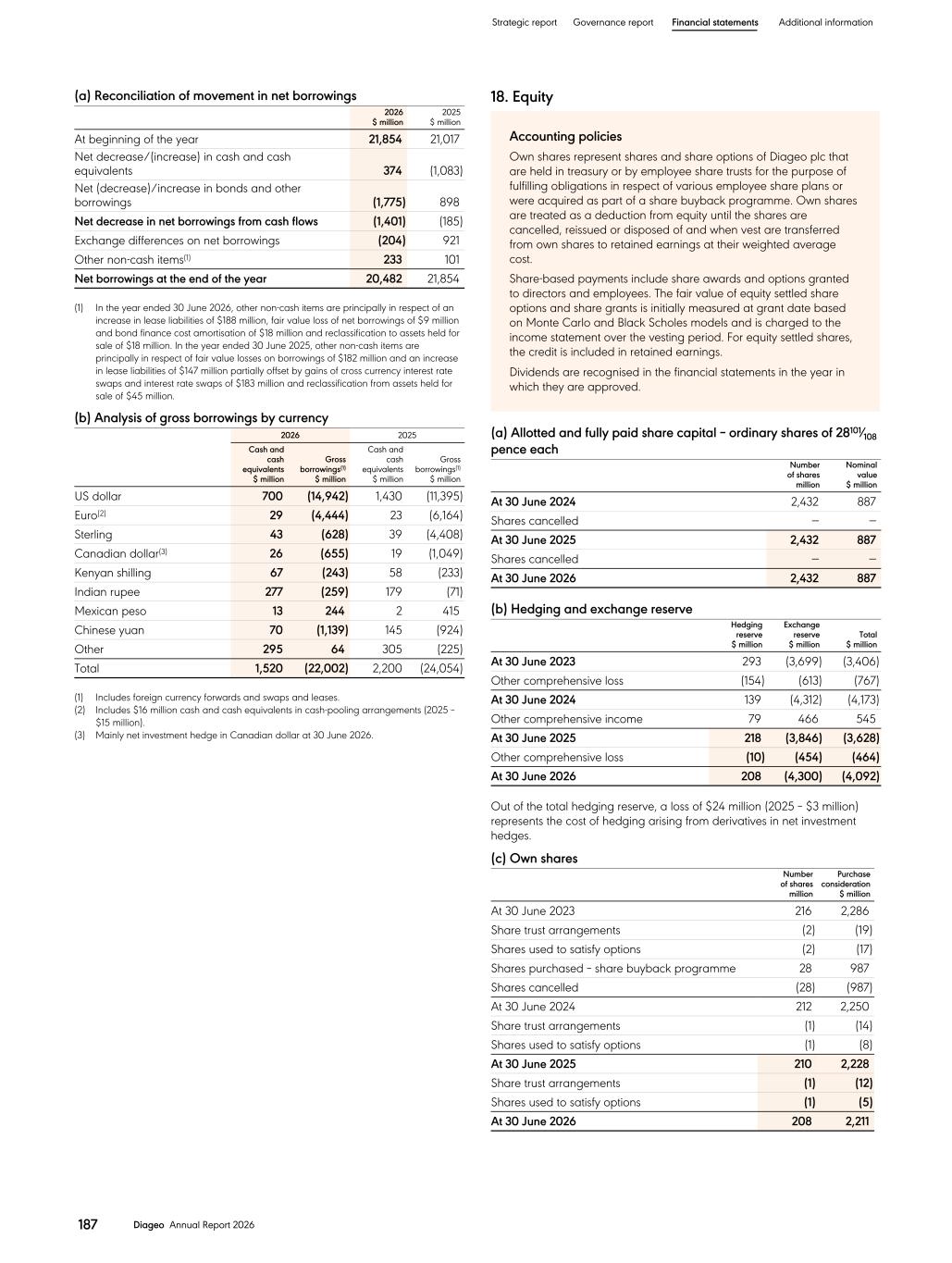
(a) Reconciliation of movement in net borrowings At beginning of the year 21,854 21,017 Net decrease/(increase) in cash and cash equivalents 374 (1,083) Net (decrease)/increase in bonds and other borrowings (1,775) 898 Net decrease in net borrowings from cash flows (1,401) (185) Exchange differences on net borrowings (204) 921 Other non-cash items(1) 233 101 Net borrowings at the end of the year 20,482 21,854 2026 $ million 2025 $ million (1) In the year ended 30 June 2026, other non-cash items are principally in respect of an increase in lease liabilities of $188 million, fair value loss of net borrowings of $9 million and bond finance cost amortisation of $18 million and reclassification to assets held for sale of $18 million. In the year ended 30 June 2025, other non-cash items are principally in respect of fair value losses on borrowings of $182 million and an increase in lease liabilities of $147 million partially offset by gains of cross currency interest rate swaps and interest rate swaps of $183 million and reclassification from assets held for sale of $45 million. (b) Analysis of gross borrowings by currency US dollar 700 (14,942) 1,430 (11,395) Euro(2) 29 (4,444) 23 (6,164) Sterling 43 (628) 39 (4,408) Canadian dollar(3) 26 (655) 19 (1,049) Kenyan shilling 67 (243) 58 (233) Indian rupee 277 (259) 179 (71) Mexican peso 13 244 2 415 Chinese yuan 70 (1,139) 145 (924) Other 295 64 305 (225) Total 1,520 (22,002) 2,200 (24,054) 2026 2025 Cash and cash equivalents $ million Gross borrowings(1) $ million Cash and cash equivalents $ million Gross borrowings(1) $ million (1) Includes foreign currency forwards and swaps and leases. (2) Includes $16 million cash and cash equivalents in cash-pooling arrangements (2025 – $15 million). (3) Mainly net investment hedge in Canadian dollar at 30 June 2026. 18. Equity Accounting policies Own shares represent shares and share options of Diageo plc that are held in treasury or by employee share trusts for the purpose of fulfilling obligations in respect of various employee share plans or were acquired as part of a share buyback programme. Own shares are treated as a deduction from equity until the shares are cancelled, reissued or disposed of and when vest are transferred from own shares to retained earnings at their weighted average cost. Share-based payments include share awards and options granted to directors and employees. The fair value of equity settled share options and share grants is initially measured at grant date based on Monte Carlo and Black Scholes models and is charged to the income statement over the vesting period. For equity settled shares, the credit is included in retained earnings. Dividends are recognised in the financial statements in the year in which they are approved. (a) Allotted and fully paid share capital – ordinary shares of 28101⁄108 pence each At 30 June 2024 2,432 887 Shares cancelled — — At 30 June 2025 2,432 887 Shares cancelled — — At 30 June 2026 2,432 887 Number of shares million Nominal value $ million (b) Hedging and exchange reserve At 30 June 2023 293 (3,699) (3,406) Other comprehensive loss (154) (613) (767) At 30 June 2024 139 (4,312) (4,173) Other comprehensive income 79 466 545 At 30 June 2025 218 (3,846) (3,628) Other comprehensive loss (10) (454) (464) At 30 June 2026 208 (4,300) (4,092) Hedging reserve $ million Exchange reserve $ million Total $ million Out of the total hedging reserve, a loss of $24 million (2025 – $3 million) represents the cost of hedging arising from derivatives in net investment hedges. (c) Own shares At 30 June 2023 216 2,286 Share trust arrangements (2) (19) Shares used to satisfy options (2) (17) Shares purchased – share buyback programme 28 987 Shares cancelled (28) (987) At 30 June 2024 212 2,250 Share trust arrangements (1) (14) Shares used to satisfy options (1) (8) At 30 June 2025 210 2,228 Share trust arrangements (1) (12) Shares used to satisfy options (1) (5) At 30 June 2026 208 2,211 Number of shares million Purchase consideration $ million Strategic report Governance report Financial statements Additional information 187 Diageo Annual Report 2026
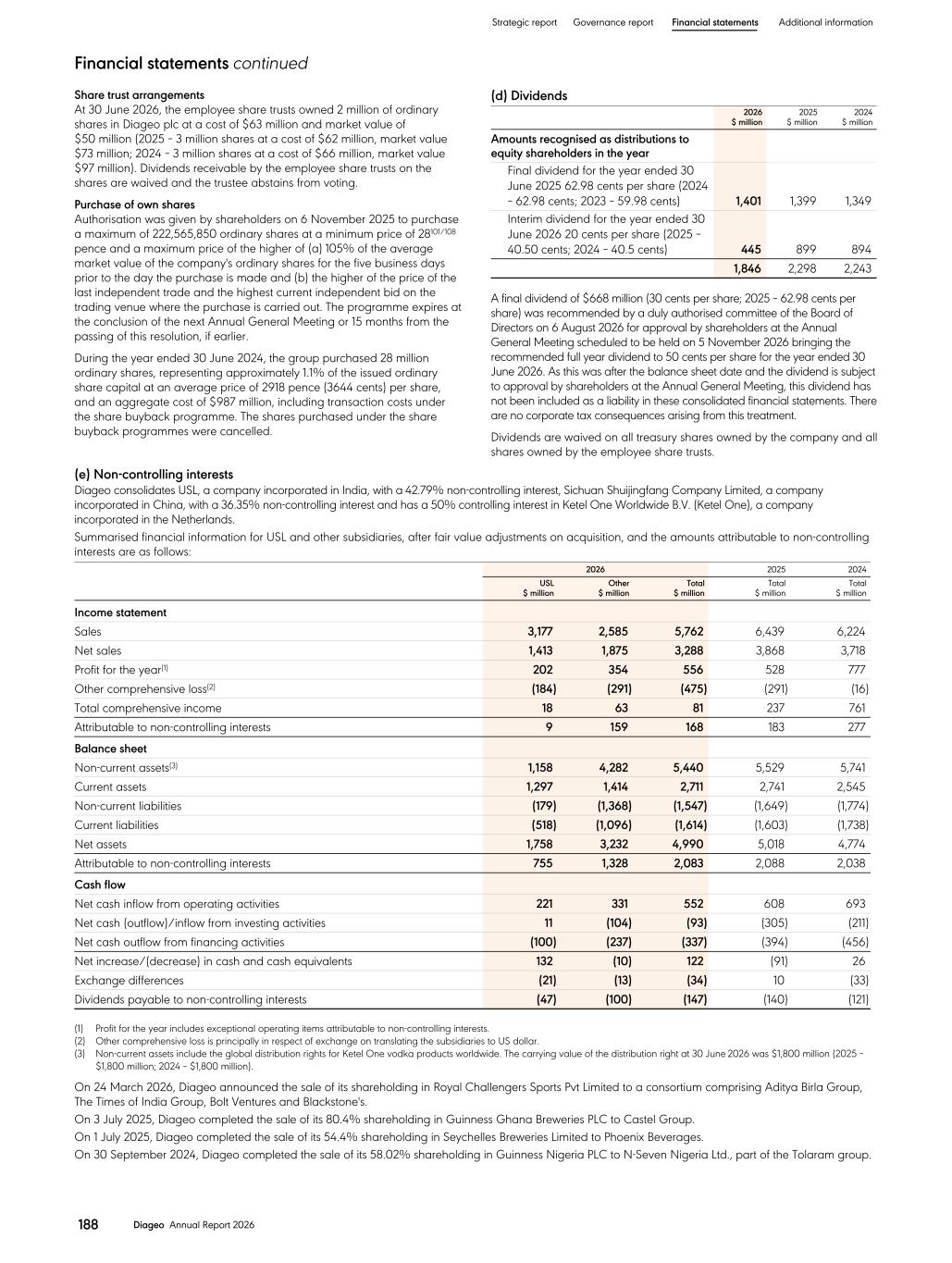
Share trust arrangements At 30 June 2026, the employee share trusts owned 2 million of ordinary shares in Diageo plc at a cost of $63 million and market value of $50 million (2025 – 3 million shares at a cost of $62 million, market value $73 million; 2024 – 3 million shares at a cost of $66 million, market value $97 million). Dividends receivable by the employee share trusts on the shares are waived and the trustee abstains from voting. Purchase of own shares Authorisation was given by shareholders on 6 November 2025 to purchase a maximum of 222,565,850 ordinary shares at a minimum price of 28101/108 pence and a maximum price of the higher of (a) 105% of the average market value of the company's ordinary shares for the five business days prior to the day the purchase is made and (b) the higher of the price of the last independent trade and the highest current independent bid on the trading venue where the purchase is carried out. The programme expires at the conclusion of the next Annual General Meeting or 15 months from the passing of this resolution, if earlier. During the year ended 30 June 2024, the group purchased 28 million ordinary shares, representing approximately 1.1% of the issued ordinary share capital at an average price of 2918 pence (3644 cents) per share, and an aggregate cost of $987 million, including transaction costs under the share buyback programme. The shares purchased under the share buyback programmes were cancelled. (d) Dividends Amounts recognised as distributions to equity shareholders in the year Final dividend for the year ended 30 June 2025 62.98 cents per share (2024 – 62.98 cents; 2023 – 59.98 cents) 1,401 1,399 1,349 Interim dividend for the year ended 30 June 2026 20 cents per share (2025 – 40.50 cents; 2024 – 40.5 cents) 445 899 894 1,846 2,298 2,243 2026 $ million 2025 $ million 2024 $ million A final dividend of $668 million (30 cents per share; 2025 – 62.98 cents per share) was recommended by a duly authorised committee of the Board of Directors on 6 August 2026 for approval by shareholders at the Annual General Meeting scheduled to be held on 5 November 2026 bringing the recommended full year dividend to 50 cents per share for the year ended 30 June 2026. As this was after the balance sheet date and the dividend is subject to approval by shareholders at the Annual General Meeting, this dividend has not been included as a liability in these consolidated financial statements. There are no corporate tax consequences arising from this treatment. Dividends are waived on all treasury shares owned by the company and all shares owned by the employee share trusts. (e) Non-controlling interests Diageo consolidates USL, a company incorporated in India, with a 42.79% non-controlling interest, Sichuan Shuijingfang Company Limited, a company incorporated in China, with a 36.35% non-controlling interest and has a 50% controlling interest in Ketel One Worldwide B.V. (Ketel One), a company incorporated in the Netherlands. Summarised financial information for USL and other subsidiaries, after fair value adjustments on acquisition, and the amounts attributable to non-controlling interests are as follows: Income statement Sales 3,177 2,585 5,762 6,439 6,224 Net sales 1,413 1,875 3,288 3,868 3,718 Profit for the year(1) 202 354 556 528 777 Other comprehensive loss(2) (184) (291) (475) (291) (16) Total comprehensive income 18 63 81 237 761 Attributable to non-controlling interests 9 159 168 183 277 Balance sheet Non-current assets(3) 1,158 4,282 5,440 5,529 5,741 Current assets 1,297 1,414 2,711 2,741 2,545 Non-current liabilities (179) (1,368) (1,547) (1,649) (1,774) Current liabilities (518) (1,096) (1,614) (1,603) (1,738) Net assets 1,758 3,232 4,990 5,018 4,774 Attributable to non-controlling interests 755 1,328 2,083 2,088 2,038 Cash flow Net cash inflow from operating activities 221 331 552 608 693 Net cash (outflow)/inflow from investing activities 11 (104) (93) (305) (211) Net cash outflow from financing activities (100) (237) (337) (394) (456) Net increase/(decrease) in cash and cash equivalents 132 (10) 122 (91) 26 Exchange differences (21) (13) (34) 10 (33) Dividends payable to non-controlling interests (47) (100) (147) (140) (121) 2026 2025 2024 USL $ million Other $ million Total $ million Total $ million Total $ million (1) Profit for the year includes exceptional operating items attributable to non-controlling interests. (2) Other comprehensive loss is principally in respect of exchange on translating the subsidiaries to US dollar. (3) Non-current assets include the global distribution rights for Ketel One vodka products worldwide. The carrying value of the distribution right at 30 June 2026 was $1,800 million (2025 – $1,800 million; 2024 – $1,800 million). On 24 March 2026, Diageo announced the sale of its shareholding in Royal Challengers Sports Pvt Limited to a consortium comprising Aditya Birla Group, The Times of India Group, Bolt Ventures and Blackstone's. On 3 July 2025, Diageo completed the sale of its 80.4% shareholding in Guinness Ghana Breweries PLC to Castel Group. On 1 July 2025, Diageo completed the sale of its 54.4% shareholding in Seychelles Breweries Limited to Phoenix Beverages. On 30 September 2024, Diageo completed the sale of its 58.02% shareholding in Guinness Nigeria PLC to N-Seven Nigeria Ltd., part of the Tolaram group. Strategic report Governance report Financial statements Additional information Financial statements continued 188 Diageo Annual Report 2026
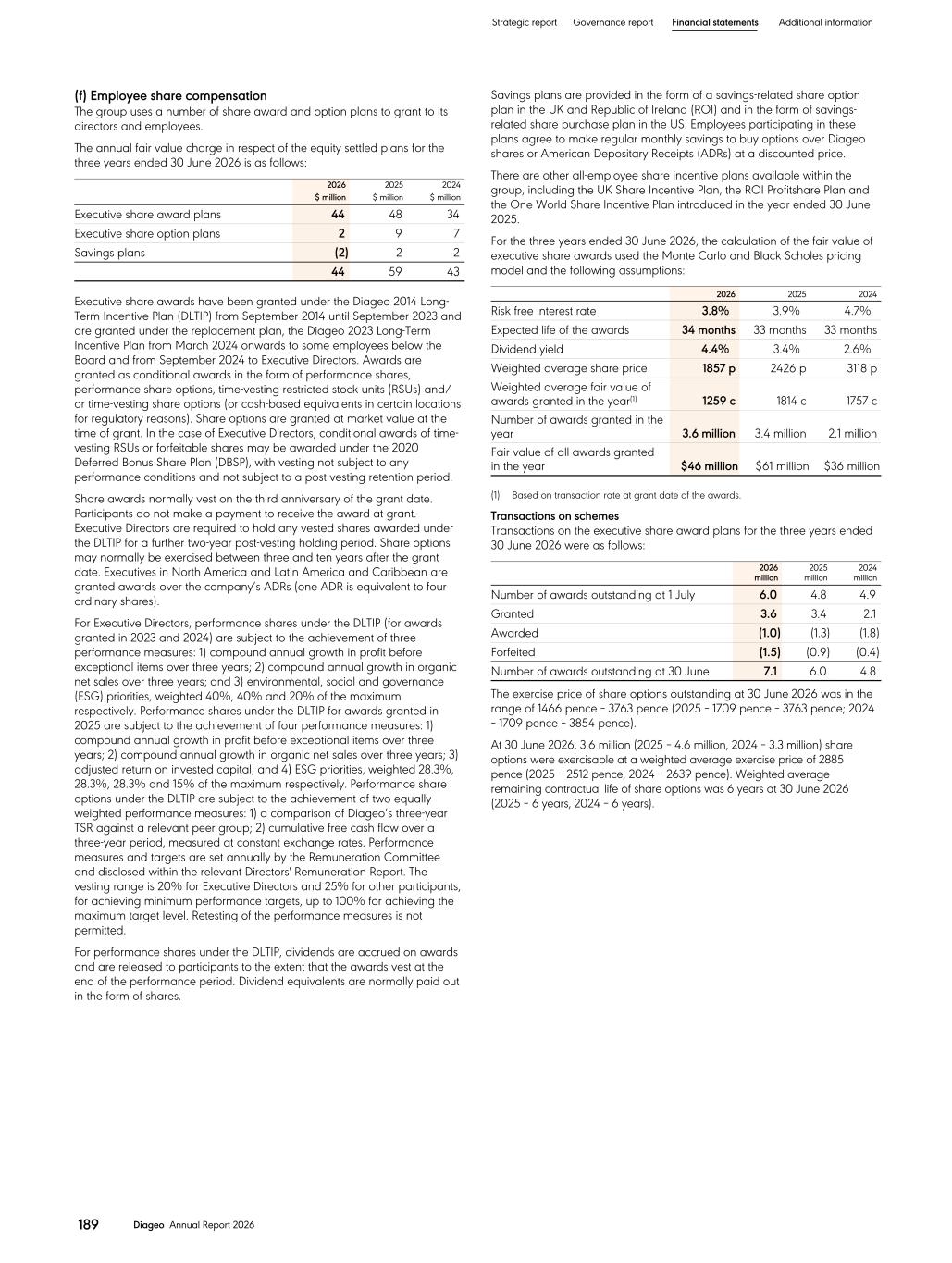
(f) Employee share compensation The group uses a number of share award and option plans to grant to its directors and employees. The annual fair value charge in respect of the equity settled plans for the three years ended 30 June 2026 is as follows: Executive share award plans 44 48 34 Executive share option plans 2 9 7 Savings plans (2) 2 2 44 59 43 2026 $ million 2025 $ million 2024 $ million Executive share awards have been granted under the Diageo 2014 Long- Term Incentive Plan (DLTIP) from September 2014 until September 2023 and are granted under the replacement plan, the Diageo 2023 Long-Term Incentive Plan from March 2024 onwards to some employees below the Board and from September 2024 to Executive Directors. Awards are granted as conditional awards in the form of performance shares, performance share options, time-vesting restricted stock units (RSUs) and/ or time-vesting share options (or cash-based equivalents in certain locations for regulatory reasons). Share options are granted at market value at the time of grant. In the case of Executive Directors, conditional awards of time- vesting RSUs or forfeitable shares may be awarded under the 2020 Deferred Bonus Share Plan (DBSP), with vesting not subject to any performance conditions and not subject to a post-vesting retention period. Share awards normally vest on the third anniversary of the grant date. Participants do not make a payment to receive the award at grant. Executive Directors are required to hold any vested shares awarded under the DLTIP for a further two-year post-vesting holding period. Share options may normally be exercised between three and ten years after the grant date. Executives in North America and Latin America and Caribbean are granted awards over the company’s ADRs (one ADR is equivalent to four ordinary shares). For Executive Directors, performance shares under the DLTIP (for awards granted in 2023 and 2024) are subject to the achievement of three performance measures: 1) compound annual growth in profit before exceptional items over three years; 2) compound annual growth in organic net sales over three years; and 3) environmental, social and governance (ESG) priorities, weighted 40%, 40% and 20% of the maximum respectively. Performance shares under the DLTIP for awards granted in 2025 are subject to the achievement of four performance measures: 1) compound annual growth in profit before exceptional items over three years; 2) compound annual growth in organic net sales over three years; 3) adjusted return on invested capital; and 4) ESG priorities, weighted 28.3%, 28.3%, 28.3% and 15% of the maximum respectively. Performance share options under the DLTIP are subject to the achievement of two equally weighted performance measures: 1) a comparison of Diageo’s three-year TSR against a relevant peer group; 2) cumulative free cash flow over a three-year period, measured at constant exchange rates. Performance measures and targets are set annually by the Remuneration Committee and disclosed within the relevant Directors' Remuneration Report. The vesting range is 20% for Executive Directors and 25% for other participants, for achieving minimum performance targets, up to 100% for achieving the maximum target level. Retesting of the performance measures is not permitted. For performance shares under the DLTIP, dividends are accrued on awards and are released to participants to the extent that the awards vest at the end of the performance period. Dividend equivalents are normally paid out in the form of shares. Savings plans are provided in the form of a savings-related share option plan in the UK and Republic of Ireland (ROI) and in the form of savings- related share purchase plan in the US. Employees participating in these plans agree to make regular monthly savings to buy options over Diageo shares or American Depositary Receipts (ADRs) at a discounted price. There are other all-employee share incentive plans available within the group, including the UK Share Incentive Plan, the ROI Profitshare Plan and the One World Share Incentive Plan introduced in the year ended 30 June 2025. For the three years ended 30 June 2026, the calculation of the fair value of executive share awards used the Monte Carlo and Black Scholes pricing model and the following assumptions: Risk free interest rate 3.8% 3.9% 4.7% Expected life of the awards 34 months 33 months 33 months Dividend yield 4.4% 3.4% 2.6% Weighted average share price 1857 p 2426 p 3118 p Weighted average fair value of awards granted in the year(1) 1259 c 1814 c 1757 c Number of awards granted in the year 3.6 million 3.4 million 2.1 million Fair value of all awards granted in the year $46 million $61 million $36 million 2026 2025 2024 (1) Based on transaction rate at grant date of the awards. Transactions on schemes Transactions on the executive share award plans for the three years ended 30 June 2026 were as follows: Number of awards outstanding at 1 July 6.0 4.8 4.9 Granted 3.6 3.4 2.1 Awarded (1.0) (1.3) (1.8) Forfeited (1.5) (0.9) (0.4) Number of awards outstanding at 30 June 7.1 6.0 4.8 2026 million 2025 million 2024 million The exercise price of share options outstanding at 30 June 2026 was in the range of 1466 pence – 3763 pence (2025 – 1709 pence – 3763 pence; 2024 – 1709 pence – 3854 pence). At 30 June 2026, 3.6 million (2025 – 4.6 million, 2024 – 3.3 million) share options were exercisable at a weighted average exercise price of 2885 pence (2025 – 2512 pence, 2024 – 2639 pence). Weighted average remaining contractual life of share options was 6 years at 30 June 2026 (2025 – 6 years, 2024 – 6 years). Strategic report Governance report Financial statements Additional information 189 Diageo Annual Report 2026
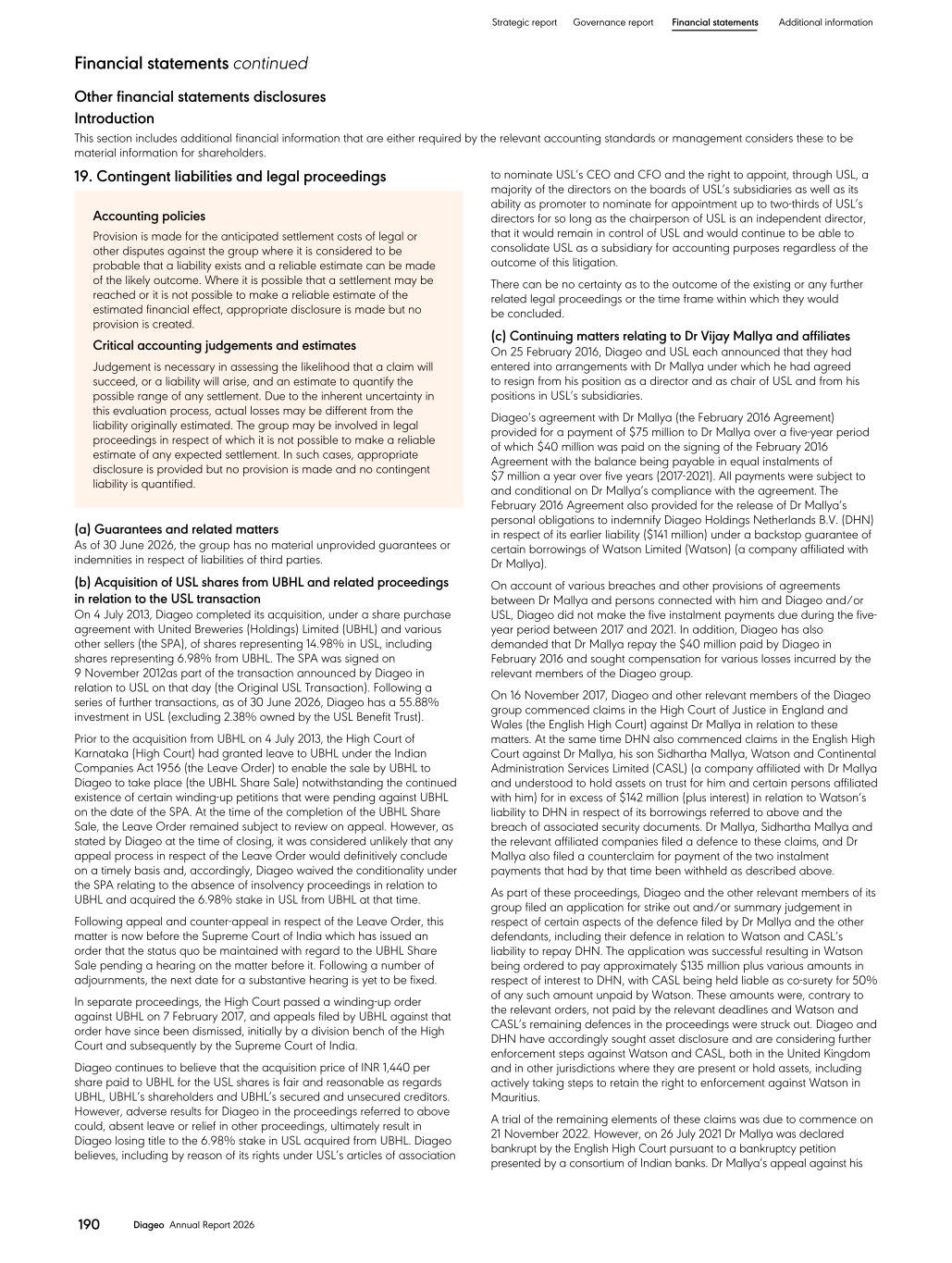
Other financial statements disclosures Introduction This section includes additional financial information that are either required by the relevant accounting standards or management considers these to be material information for shareholders. 19. Contingent liabilities and legal proceedings Accounting policies Provision is made for the anticipated settlement costs of legal or other disputes against the group where it is considered to be probable that a liability exists and a reliable estimate can be made of the likely outcome. Where it is possible that a settlement may be reached or it is not possible to make a reliable estimate of the estimated financial effect, appropriate disclosure is made but no provision is created. Critical accounting judgements and estimates Judgement is necessary in assessing the likelihood that a claim will succeed, or a liability will arise, and an estimate to quantify the possible range of any settlement. Due to the inherent uncertainty in this evaluation process, actual losses may be different from the liability originally estimated. The group may be involved in legal proceedings in respect of which it is not possible to make a reliable estimate of any expected settlement. In such cases, appropriate disclosure is provided but no provision is made and no contingent liability is quantified. (a) Guarantees and related matters As of 30 June 2026, the group has no material unprovided guarantees or indemnities in respect of liabilities of third parties. (b) Acquisition of USL shares from UBHL and related proceedings in relation to the USL transaction On 4 July 2013, Diageo completed its acquisition, under a share purchase agreement with United Breweries (Holdings) Limited (UBHL) and various other sellers (the SPA), of shares representing 14.98% in USL, including shares representing 6.98% from UBHL. The SPA was signed on 9 November 2012as part of the transaction announced by Diageo in relation to USL on that day (the Original USL Transaction). Following a series of further transactions, as of 30 June 2026, Diageo has a 55.88% investment in USL (excluding 2.38% owned by the USL Benefit Trust). Prior to the acquisition from UBHL on 4 July 2013, the High Court of Karnataka (High Court) had granted leave to UBHL under the Indian Companies Act 1956 (the Leave Order) to enable the sale by UBHL to Diageo to take place (the UBHL Share Sale) notwithstanding the continued existence of certain winding-up petitions that were pending against UBHL on the date of the SPA. At the time of the completion of the UBHL Share Sale, the Leave Order remained subject to review on appeal. However, as stated by Diageo at the time of closing, it was considered unlikely that any appeal process in respect of the Leave Order would definitively conclude on a timely basis and, accordingly, Diageo waived the conditionality under the SPA relating to the absence of insolvency proceedings in relation to UBHL and acquired the 6.98% stake in USL from UBHL at that time. Following appeal and counter-appeal in respect of the Leave Order, this matter is now before the Supreme Court of India which has issued an order that the status quo be maintained with regard to the UBHL Share Sale pending a hearing on the matter before it. Following a number of adjournments, the next date for a substantive hearing is yet to be fixed. In separate proceedings, the High Court passed a winding-up order against UBHL on 7 February 2017, and appeals filed by UBHL against that order have since been dismissed, initially by a division bench of the High Court and subsequently by the Supreme Court of India. Diageo continues to believe that the acquisition price of INR 1,440 per share paid to UBHL for the USL shares is fair and reasonable as regards UBHL, UBHL’s shareholders and UBHL’s secured and unsecured creditors. However, adverse results for Diageo in the proceedings referred to above could, absent leave or relief in other proceedings, ultimately result in Diageo losing title to the 6.98% stake in USL acquired from UBHL. Diageo believes, including by reason of its rights under USL’s articles of association to nominate USL’s CEO and CFO and the right to appoint, through USL, a majority of the directors on the boards of USL’s subsidiaries as well as its ability as promoter to nominate for appointment up to two-thirds of USL’s directors for so long as the chairperson of USL is an independent director, that it would remain in control of USL and would continue to be able to consolidate USL as a subsidiary for accounting purposes regardless of the outcome of this litigation. There can be no certainty as to the outcome of the existing or any further related legal proceedings or the time frame within which they would be concluded. (c) Continuing matters relating to Dr Vijay Mallya and affiliates On 25 February 2016, Diageo and USL each announced that they had entered into arrangements with Dr Mallya under which he had agreed to resign from his position as a director and as chair of USL and from his positions in USL’s subsidiaries. Diageo’s agreement with Dr Mallya (the February 2016 Agreement) provided for a payment of $75 million to Dr Mallya over a five-year period of which $40 million was paid on the signing of the February 2016 Agreement with the balance being payable in equal instalments of $7 million a year over five years (2017-2021). All payments were subject to and conditional on Dr Mallya’s compliance with the agreement. The February 2016 Agreement also provided for the release of Dr Mallya’s personal obligations to indemnify Diageo Holdings Netherlands B.V. (DHN) in respect of its earlier liability ($141 million) under a backstop guarantee of certain borrowings of Watson Limited (Watson) (a company affiliated with Dr Mallya). On account of various breaches and other provisions of agreements between Dr Mallya and persons connected with him and Diageo and/or USL, Diageo did not make the five instalment payments due during the five- year period between 2017 and 2021. In addition, Diageo has also demanded that Dr Mallya repay the $40 million paid by Diageo in February 2016 and sought compensation for various losses incurred by the relevant members of the Diageo group. On 16 November 2017, Diageo and other relevant members of the Diageo group commenced claims in the High Court of Justice in England and Wales (the English High Court) against Dr Mallya in relation to these matters. At the same time DHN also commenced claims in the English High Court against Dr Mallya, his son Sidhartha Mallya, Watson and Continental Administration Services Limited (CASL) (a company affiliated with Dr Mallya and understood to hold assets on trust for him and certain persons affiliated with him) for in excess of $142 million (plus interest) in relation to Watson’s liability to DHN in respect of its borrowings referred to above and the breach of associated security documents. Dr Mallya, Sidhartha Mallya and the relevant affiliated companies filed a defence to these claims, and Dr Mallya also filed a counterclaim for payment of the two instalment payments that had by that time been withheld as described above. As part of these proceedings, Diageo and the other relevant members of its group filed an application for strike out and/or summary judgement in respect of certain aspects of the defence filed by Dr Mallya and the other defendants, including their defence in relation to Watson and CASL’s liability to repay DHN. The application was successful resulting in Watson being ordered to pay approximately $135 million plus various amounts in respect of interest to DHN, with CASL being held liable as co-surety for 50% of any such amount unpaid by Watson. These amounts were, contrary to the relevant orders, not paid by the relevant deadlines and Watson and CASL’s remaining defences in the proceedings were struck out. Diageo and DHN have accordingly sought asset disclosure and are considering further enforcement steps against Watson and CASL, both in the United Kingdom and in other jurisdictions where they are present or hold assets, including actively taking steps to retain the right to enforcement against Watson in Mauritius. A trial of the remaining elements of these claims was due to commence on 21 November 2022. However, on 26 July 2021 Dr Mallya was declared bankrupt by the English High Court pursuant to a bankruptcy petition presented by a consortium of Indian banks. Dr Mallya’s appeal against his Strategic report Governance report Financial statements Additional information Financial statements continued 190 Diageo Annual Report 2026
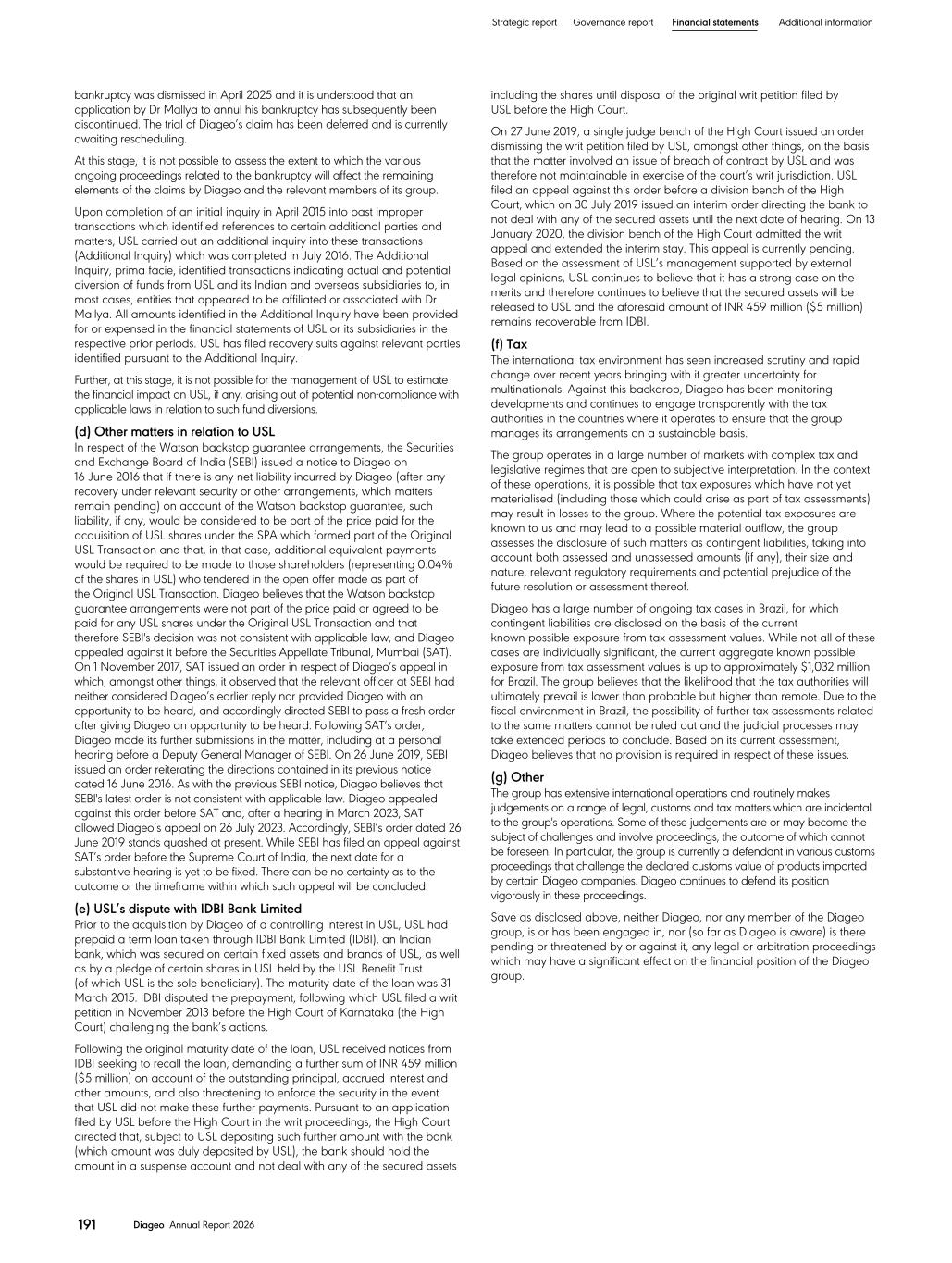
bankruptcy was dismissed in April 2025 and it is understood that an application by Dr Mallya to annul his bankruptcy has subsequently been discontinued. The trial of Diageo’s claim has been deferred and is currently awaiting rescheduling. At this stage, it is not possible to assess the extent to which the various ongoing proceedings related to the bankruptcy will affect the remaining elements of the claims by Diageo and the relevant members of its group. Upon completion of an initial inquiry in April 2015 into past improper transactions which identified references to certain additional parties and matters, USL carried out an additional inquiry into these transactions (Additional Inquiry) which was completed in July 2016. The Additional Inquiry, prima facie, identified transactions indicating actual and potential diversion of funds from USL and its Indian and overseas subsidiaries to, in most cases, entities that appeared to be affiliated or associated with Dr Mallya. All amounts identified in the Additional Inquiry have been provided for or expensed in the financial statements of USL or its subsidiaries in the respective prior periods. USL has filed recovery suits against relevant parties identified pursuant to the Additional Inquiry. Further, at this stage, it is not possible for the management of USL to estimate the financial impact on USL, if any, arising out of potential non-compliance with applicable laws in relation to such fund diversions. (d) Other matters in relation to USL In respect of the Watson backstop guarantee arrangements, the Securities and Exchange Board of India (SEBI) issued a notice to Diageo on 16 June 2016 that if there is any net liability incurred by Diageo (after any recovery under relevant security or other arrangements, which matters remain pending) on account of the Watson backstop guarantee, such liability, if any, would be considered to be part of the price paid for the acquisition of USL shares under the SPA which formed part of the Original USL Transaction and that, in that case, additional equivalent payments would be required to be made to those shareholders (representing 0.04% of the shares in USL) who tendered in the open offer made as part of the Original USL Transaction. Diageo believes that the Watson backstop guarantee arrangements were not part of the price paid or agreed to be paid for any USL shares under the Original USL Transaction and that therefore SEBI's decision was not consistent with applicable law, and Diageo appealed against it before the Securities Appellate Tribunal, Mumbai (SAT). On 1 November 2017, SAT issued an order in respect of Diageo’s appeal in which, amongst other things, it observed that the relevant officer at SEBI had neither considered Diageo’s earlier reply nor provided Diageo with an opportunity to be heard, and accordingly directed SEBI to pass a fresh order after giving Diageo an opportunity to be heard. Following SAT’s order, Diageo made its further submissions in the matter, including at a personal hearing before a Deputy General Manager of SEBI. On 26 June 2019, SEBI issued an order reiterating the directions contained in its previous notice dated 16 June 2016. As with the previous SEBI notice, Diageo believes that SEBI's latest order is not consistent with applicable law. Diageo appealed against this order before SAT and, after a hearing in March 2023, SAT allowed Diageo’s appeal on 26 July 2023. Accordingly, SEBI’s order dated 26 June 2019 stands quashed at present. While SEBI has filed an appeal against SAT’s order before the Supreme Court of India, the next date for a substantive hearing is yet to be fixed. There can be no certainty as to the outcome or the timeframe within which such appeal will be concluded. (e) USL’s dispute with IDBI Bank Limited Prior to the acquisition by Diageo of a controlling interest in USL, USL had prepaid a term loan taken through IDBI Bank Limited (IDBI), an Indian bank, which was secured on certain fixed assets and brands of USL, as well as by a pledge of certain shares in USL held by the USL Benefit Trust (of which USL is the sole beneficiary). The maturity date of the loan was 31 March 2015. IDBI disputed the prepayment, following which USL filed a writ petition in November 2013 before the High Court of Karnataka (the High Court) challenging the bank’s actions. Following the original maturity date of the loan, USL received notices from IDBI seeking to recall the loan, demanding a further sum of INR 459 million ($5 million) on account of the outstanding principal, accrued interest and other amounts, and also threatening to enforce the security in the event that USL did not make these further payments. Pursuant to an application filed by USL before the High Court in the writ proceedings, the High Court directed that, subject to USL depositing such further amount with the bank (which amount was duly deposited by USL), the bank should hold the amount in a suspense account and not deal with any of the secured assets including the shares until disposal of the original writ petition filed by USL before the High Court. On 27 June 2019, a single judge bench of the High Court issued an order dismissing the writ petition filed by USL, amongst other things, on the basis that the matter involved an issue of breach of contract by USL and was therefore not maintainable in exercise of the court’s writ jurisdiction. USL filed an appeal against this order before a division bench of the High Court, which on 30 July 2019 issued an interim order directing the bank to not deal with any of the secured assets until the next date of hearing. On 13 January 2020, the division bench of the High Court admitted the writ appeal and extended the interim stay. This appeal is currently pending. Based on the assessment of USL’s management supported by external legal opinions, USL continues to believe that it has a strong case on the merits and therefore continues to believe that the secured assets will be released to USL and the aforesaid amount of INR 459 million ($5 million) remains recoverable from IDBI. (f) Tax The international tax environment has seen increased scrutiny and rapid change over recent years bringing with it greater uncertainty for multinationals. Against this backdrop, Diageo has been monitoring developments and continues to engage transparently with the tax authorities in the countries where it operates to ensure that the group manages its arrangements on a sustainable basis. The group operates in a large number of markets with complex tax and legislative regimes that are open to subjective interpretation. In the context of these operations, it is possible that tax exposures which have not yet materialised (including those which could arise as part of tax assessments) may result in losses to the group. Where the potential tax exposures are known to us and may lead to a possible material outflow, the group assesses the disclosure of such matters as contingent liabilities, taking into account both assessed and unassessed amounts (if any), their size and nature, relevant regulatory requirements and potential prejudice of the future resolution or assessment thereof. Diageo has a large number of ongoing tax cases in Brazil, for which contingent liabilities are disclosed on the basis of the current known possible exposure from tax assessment values. While not all of these cases are individually significant, the current aggregate known possible exposure from tax assessment values is up to approximately $1,032 million for Brazil. The group believes that the likelihood that the tax authorities will ultimately prevail is lower than probable but higher than remote. Due to the fiscal environment in Brazil, the possibility of further tax assessments related to the same matters cannot be ruled out and the judicial processes may take extended periods to conclude. Based on its current assessment, Diageo believes that no provision is required in respect of these issues. (g) Other The group has extensive international operations and routinely makes judgements on a range of legal, customs and tax matters which are incidental to the group's operations. Some of these judgements are or may become the subject of challenges and involve proceedings, the outcome of which cannot be foreseen. In particular, the group is currently a defendant in various customs proceedings that challenge the declared customs value of products imported by certain Diageo companies. Diageo continues to defend its position vigorously in these proceedings. Save as disclosed above, neither Diageo, nor any member of the Diageo group, is or has been engaged in, nor (so far as Diageo is aware) is there pending or threatened by or against it, any legal or arbitration proceedings which may have a significant effect on the financial position of the Diageo group. Strategic report Governance report Financial statements Additional information 191 Diageo Annual Report 2026
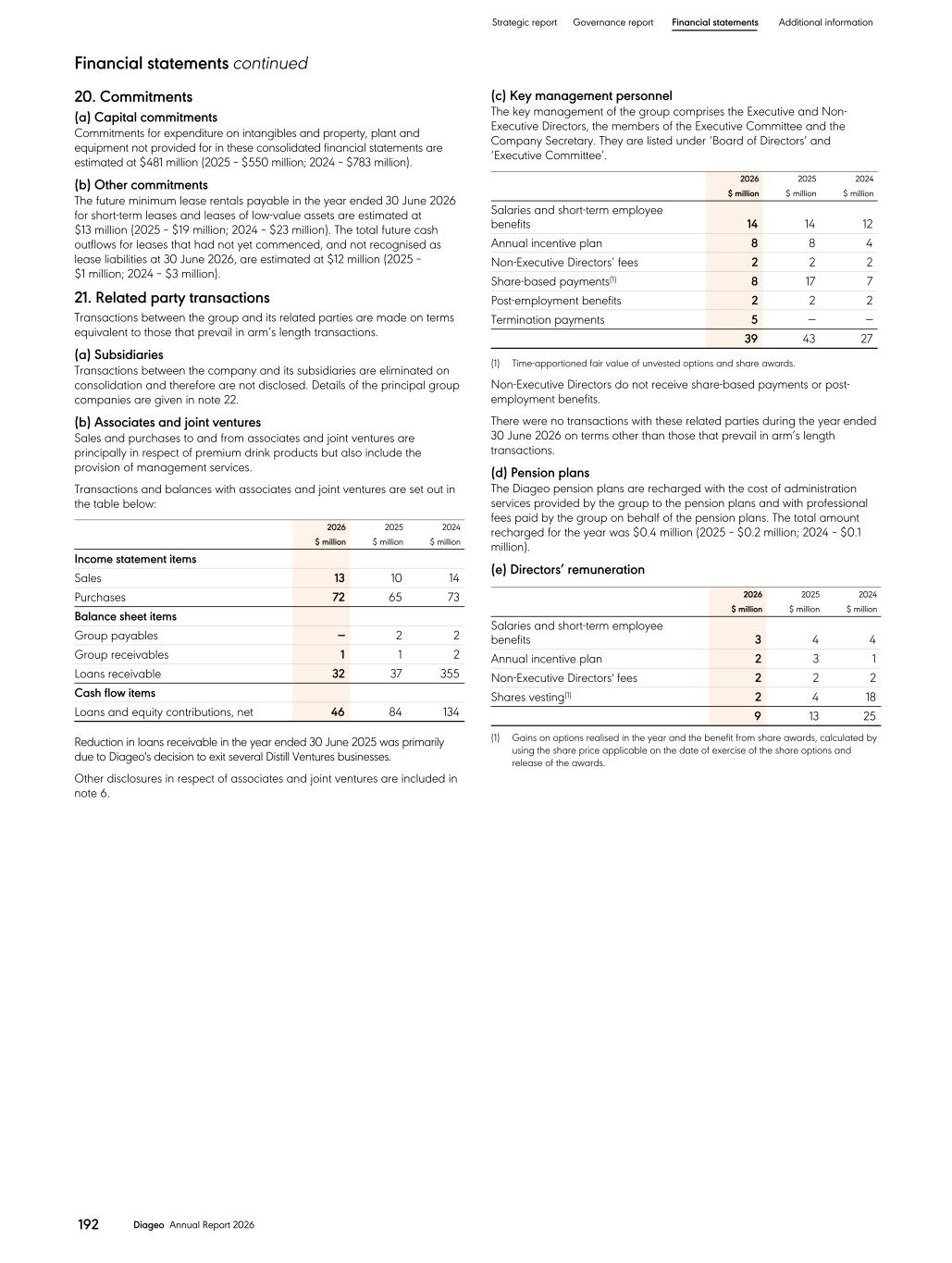
20. Commitments (a) Capital commitments Commitments for expenditure on intangibles and property, plant and equipment not provided for in these consolidated financial statements are estimated at $481 million (2025 – $550 million; 2024 – $783 million). (b) Other commitments The future minimum lease rentals payable in the year ended 30 June 2026 for short-term leases and leases of low-value assets are estimated at $13 million (2025 – $19 million; 2024 – $23 million). The total future cash outflows for leases that had not yet commenced, and not recognised as lease liabilities at 30 June 2026, are estimated at $12 million (2025 – $1 million; 2024 – $3 million). 21. Related party transactions Transactions between the group and its related parties are made on terms equivalent to those that prevail in arm’s length transactions. (a) Subsidiaries Transactions between the company and its subsidiaries are eliminated on consolidation and therefore are not disclosed. Details of the principal group companies are given in note 22. (b) Associates and joint ventures Sales and purchases to and from associates and joint ventures are principally in respect of premium drink products but also include the provision of management services. Transactions and balances with associates and joint ventures are set out in the table below: $ million $ million $ million Income statement items Sales 13 10 14 Purchases 72 65 73 Balance sheet items Group payables — 2 2 Group receivables 1 1 2 Loans receivable 32 37 355 Cash flow items Loans and equity contributions, net 46 84 134 2026 2025 2024 Reduction in loans receivable in the year ended 30 June 2025 was primarily due to Diageo's decision to exit several Distill Ventures businesses. Other disclosures in respect of associates and joint ventures are included in note 6. (c) Key management personnel The key management of the group comprises the Executive and Non- Executive Directors, the members of the Executive Committee and the Company Secretary. They are listed under ‘Board of Directors’ and ‘Executive Committee’. Salaries and short-term employee benefits 14 14 12 Annual incentive plan 8 8 4 Non-Executive Directors’ fees 2 2 2 Share-based payments(1) 8 17 7 Post-employment benefits 2 2 2 Termination payments 5 — — 39 43 27 2026 2025 2024 $ million $ million $ million (1) Time-apportioned fair value of unvested options and share awards. Non-Executive Directors do not receive share-based payments or post- employment benefits. There were no transactions with these related parties during the year ended 30 June 2026 on terms other than those that prevail in arm’s length transactions. (d) Pension plans The Diageo pension plans are recharged with the cost of administration services provided by the group to the pension plans and with professional fees paid by the group on behalf of the pension plans. The total amount recharged for the year was $0.4 million (2025 – $0.2 million; 2024 – $0.1 million). (e) Directors’ remuneration Salaries and short-term employee benefits 3 4 4 Annual incentive plan 2 3 1 Non-Executive Directors' fees 2 2 2 Shares vesting(1) 2 4 18 9 13 25 2026 2025 2024 $ million $ million $ million (1) Gains on options realised in the year and the benefit from share awards, calculated by using the share price applicable on the date of exercise of the share options and release of the awards. Strategic report Governance report Financial statements Additional information Financial statements continued 192 Diageo Annual Report 2026
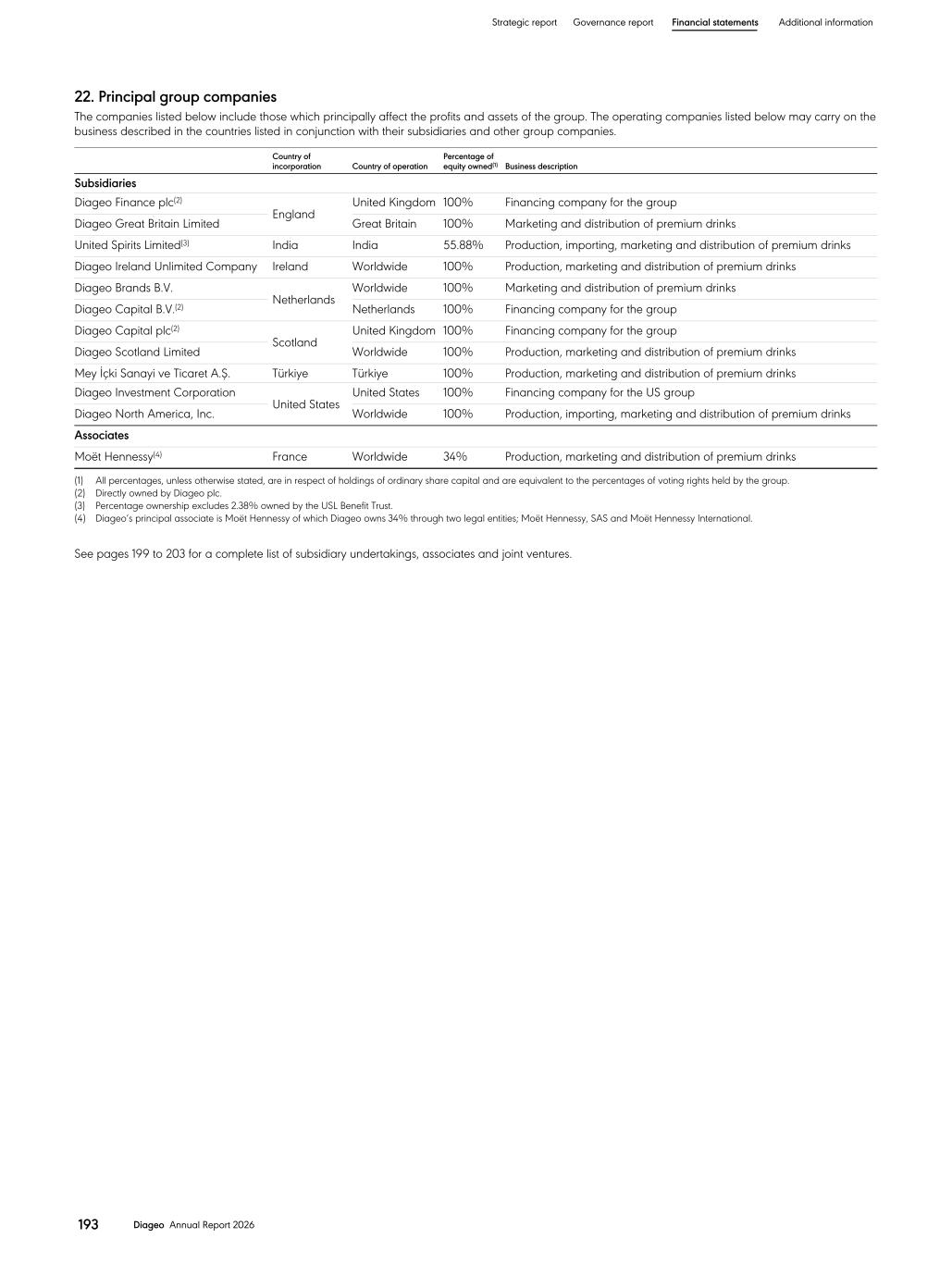
22. Principal group companies The companies listed below include those which principally affect the profits and assets of the group. The operating companies listed below may carry on the business described in the countries listed in conjunction with their subsidiaries and other group companies. Subsidiaries Diageo Finance plc(2) England United Kingdom 100% Financing company for the group Diageo Great Britain Limited Great Britain 100% Marketing and distribution of premium drinks United Spirits Limited(3) India India 55.88% Production, importing, marketing and distribution of premium drinks Diageo Ireland Unlimited Company Ireland Worldwide 100% Production, marketing and distribution of premium drinks Diageo Brands B.V. Netherlands Worldwide 100% Marketing and distribution of premium drinks Diageo Capital B.V.(2) Netherlands 100% Financing company for the group Diageo Capital plc(2) Scotland United Kingdom 100% Financing company for the group Diageo Scotland Limited Worldwide 100% Production, marketing and distribution of premium drinks Mey İçki Sanayi ve Ticaret A.Ş. Türkiye Türkiye 100% Production, marketing and distribution of premium drinks Diageo Investment Corporation United States United States 100% Financing company for the US group Diageo North America, Inc. Worldwide 100% Production, importing, marketing and distribution of premium drinks Associates Moët Hennessy(4) France Worldwide 34% Production, marketing and distribution of premium drinks Country of incorporation Country of operation Percentage of equity owned(1) Business description (1) All percentages, unless otherwise stated, are in respect of holdings of ordinary share capital and are equivalent to the percentages of voting rights held by the group. (2) Directly owned by Diageo plc. (3) Percentage ownership excludes 2.38% owned by the USL Benefit Trust. (4) Diageo’s principal associate is Moët Hennessy of which Diageo owns 34% through two legal entities; Moët Hennessy, SAS and Moët Hennessy International. See pages 199 to 203 for a complete list of subsidiary undertakings, associates and joint ventures. Strategic report Governance report Financial statements Additional information 193 Diageo Annual Report 2026
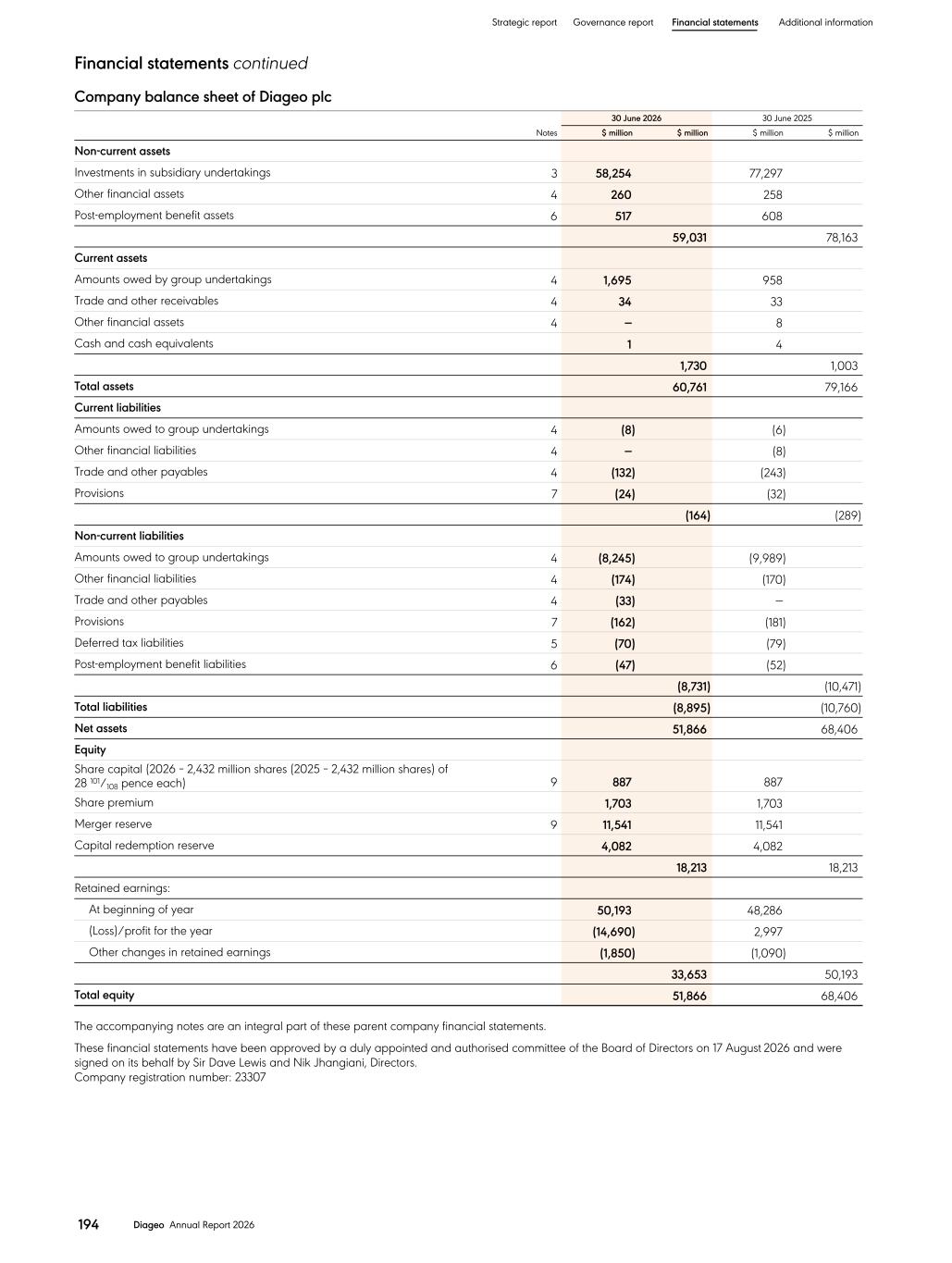
Company balance sheet of Diageo plc Non-current assets Investments in subsidiary undertakings 3 58,254 77,297 Other financial assets 4 260 258 Post-employment benefit assets 6 517 608 59,031 78,163 Current assets Amounts owed by group undertakings 4 1,695 958 Trade and other receivables 4 34 33 Other financial assets 4 — 8 Cash and cash equivalents 1 4 1,730 1,003 Total assets 60,761 79,166 Current liabilities Amounts owed to group undertakings 4 (8) (6) Other financial liabilities 4 — (8) Trade and other payables 4 (132) (243) Provisions 7 (24) (32) (164) (289) Non-current liabilities Amounts owed to group undertakings 4 (8,245) (9,989) Other financial liabilities 4 (174) (170) Trade and other payables 4 (33) — Provisions 7 (162) (181) Deferred tax liabilities 5 (70) (79) Post-employment benefit liabilities 6 (47) (52) (8,731) (10,471) Total liabilities (8,895) (10,760) Net assets 51,866 68,406 Equity Share capital (2026 – 2,432 million shares (2025 – 2,432 million shares) of 28 101/108 pence each) 9 887 887 Share premium 1,703 1,703 Merger reserve 9 11,541 11,541 Capital redemption reserve 4,082 4,082 18,213 18,213 Retained earnings: At beginning of year 50,193 48,286 (Loss)/profit for the year (14,690) 2,997 Other changes in retained earnings (1,850) (1,090) 33,653 50,193 Total equity 51,866 68,406 30 June 2026 30 June 2025 Notes $ million $ million $ million $ million The accompanying notes are an integral part of these parent company financial statements. These financial statements have been approved by a duly appointed and authorised committee of the Board of Directors on 17 August 2026 and were signed on its behalf by Sir Dave Lewis and Nik Jhangiani, Directors. Company registration number: 23307 Strategic report Governance report Financial statements Additional information Financial statements continued 194 Diageo Annual Report 2026
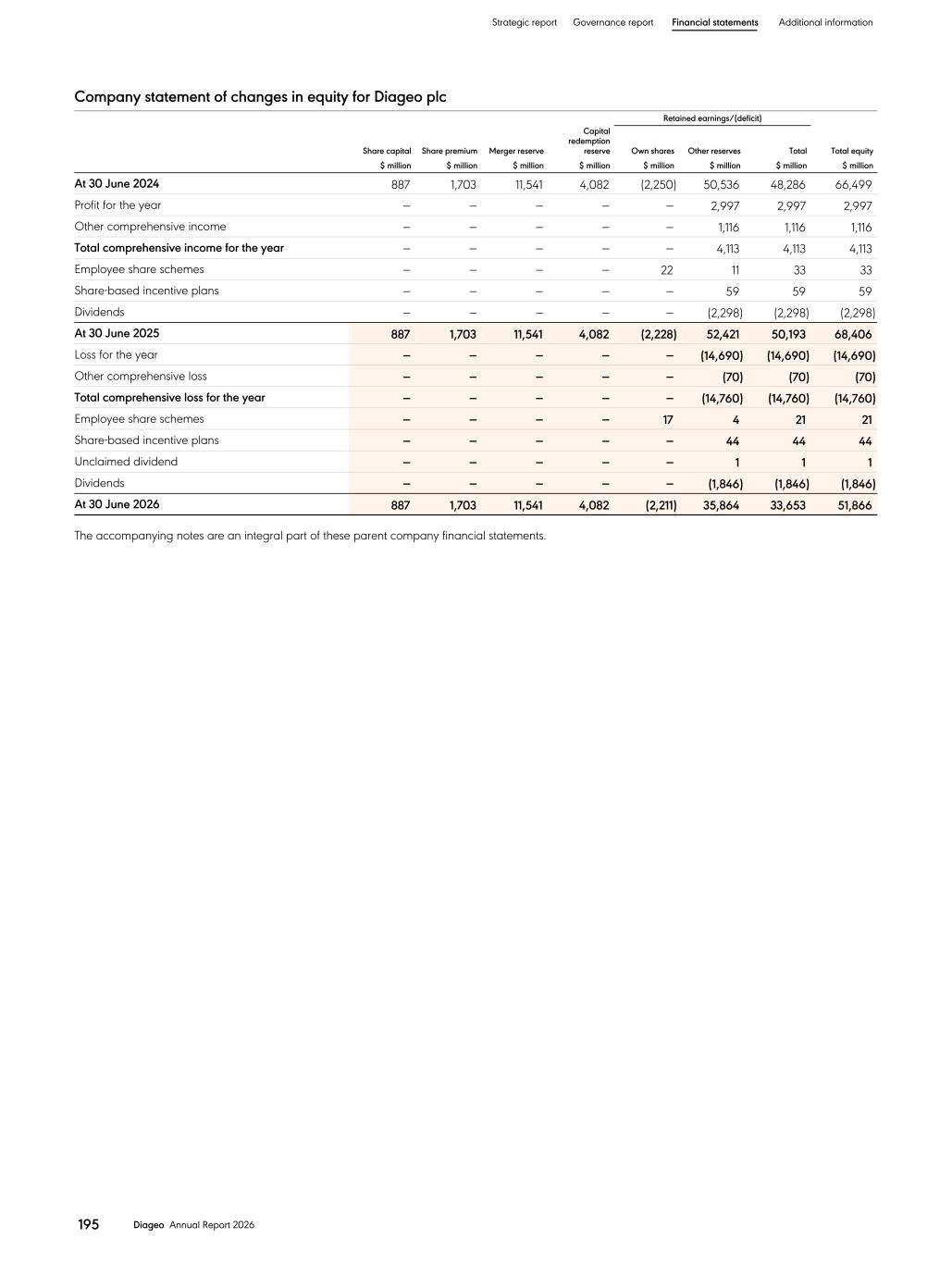
Company statement of changes in equity for Diageo plc At 30 June 2024 887 1,703 11,541 4,082 (2,250) 50,536 48,286 66,499 Profit for the year — — — — — 2,997 2,997 2,997 Other comprehensive income — — — — — 1,116 1,116 1,116 Total comprehensive income for the year — — — — — 4,113 4,113 4,113 Employee share schemes — — — — 22 11 33 33 Share-based incentive plans — — — — — 59 59 59 Dividends — — — — — (2,298) (2,298) (2,298) At 30 June 2025 887 1,703 11,541 4,082 (2,228) 52,421 50,193 68,406 Loss for the year — — — — — (14,690) (14,690) (14,690) Other comprehensive loss — — — — — (70) (70) (70) Total comprehensive loss for the year — — — — — (14,760) (14,760) (14,760) Employee share schemes — — — — 17 4 21 21 Share-based incentive plans — — — — — 44 44 44 Unclaimed dividend — — — — — 1 1 1 Dividends — — — — — (1,846) (1,846) (1,846) At 30 June 2026 887 1,703 11,541 4,082 (2,211) 35,864 33,653 51,866 Retained earnings/(deficit) Share capital Share premium Merger reserve Capital redemption reserve Own shares Other reserves Total Total equity $ million $ million $ million $ million $ million $ million $ million $ million The accompanying notes are an integral part of these parent company financial statements. • Strategic report Governance report Financial statements Additional information 195 Diageo Annual Report 2026
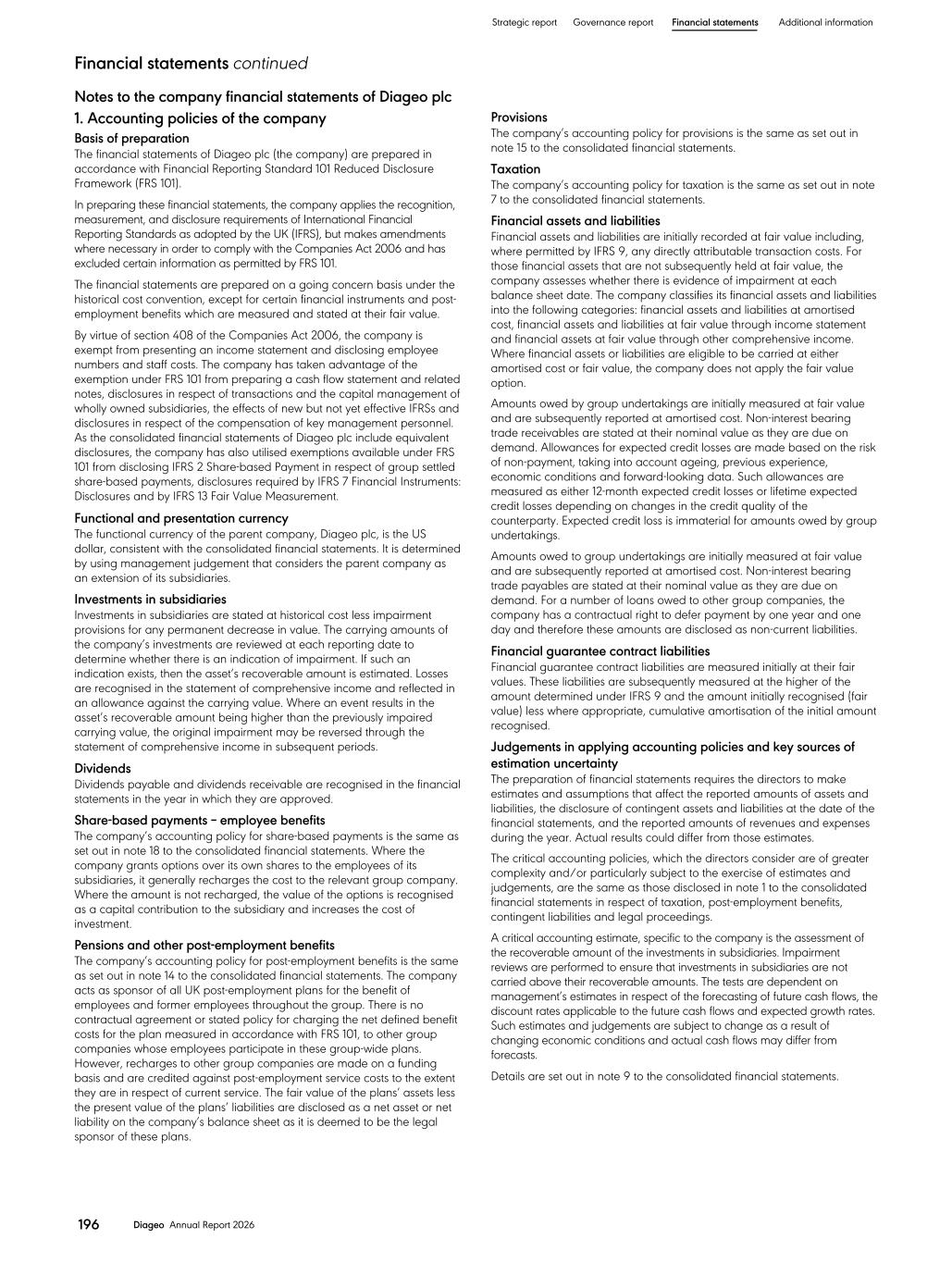
Notes to the company financial statements of Diageo plc 1. Accounting policies of the company Basis of preparation The financial statements of Diageo plc (the company) are prepared in accordance with Financial Reporting Standard 101 Reduced Disclosure Framework (FRS 101). In preparing these financial statements, the company applies the recognition, measurement, and disclosure requirements of International Financial Reporting Standards as adopted by the UK (IFRS), but makes amendments where necessary in order to comply with the Companies Act 2006 and has excluded certain information as permitted by FRS 101. The financial statements are prepared on a going concern basis under the historical cost convention, except for certain financial instruments and post- employment benefits which are measured and stated at their fair value. By virtue of section 408 of the Companies Act 2006, the company is exempt from presenting an income statement and disclosing employee numbers and staff costs. The company has taken advantage of the exemption under FRS 101 from preparing a cash flow statement and related notes, disclosures in respect of transactions and the capital management of wholly owned subsidiaries, the effects of new but not yet effective IFRSs and disclosures in respect of the compensation of key management personnel. As the consolidated financial statements of Diageo plc include equivalent disclosures, the company has also utilised exemptions available under FRS 101 from disclosing IFRS 2 Share-based Payment in respect of group settled share-based payments, disclosures required by IFRS 7 Financial Instruments: Disclosures and by IFRS 13 Fair Value Measurement. Functional and presentation currency The functional currency of the parent company, Diageo plc, is the US dollar, consistent with the consolidated financial statements. It is determined by using management judgement that considers the parent company as an extension of its subsidiaries. Investments in subsidiaries Investments in subsidiaries are stated at historical cost less impairment provisions for any permanent decrease in value. The carrying amounts of the company’s investments are reviewed at each reporting date to determine whether there is an indication of impairment. If such an indication exists, then the asset’s recoverable amount is estimated. Losses are recognised in the statement of comprehensive income and reflected in an allowance against the carrying value. Where an event results in the asset’s recoverable amount being higher than the previously impaired carrying value, the original impairment may be reversed through the statement of comprehensive income in subsequent periods. Dividends Dividends payable and dividends receivable are recognised in the financial statements in the year in which they are approved. Share-based payments – employee benefits The company’s accounting policy for share-based payments is the same as set out in note 18 to the consolidated financial statements. Where the company grants options over its own shares to the employees of its subsidiaries, it generally recharges the cost to the relevant group company. Where the amount is not recharged, the value of the options is recognised as a capital contribution to the subsidiary and increases the cost of investment. Pensions and other post-employment benefits The company’s accounting policy for post-employment benefits is the same as set out in note 14 to the consolidated financial statements. The company acts as sponsor of all UK post-employment plans for the benefit of employees and former employees throughout the group. There is no contractual agreement or stated policy for charging the net defined benefit costs for the plan measured in accordance with FRS 101, to other group companies whose employees participate in these group-wide plans. However, recharges to other group companies are made on a funding basis and are credited against post-employment service costs to the extent they are in respect of current service. The fair value of the plans’ assets less the present value of the plans’ liabilities are disclosed as a net asset or net liability on the company’s balance sheet as it is deemed to be the legal sponsor of these plans. Provisions The company’s accounting policy for provisions is the same as set out in note 15 to the consolidated financial statements. Taxation The company’s accounting policy for taxation is the same as set out in note 7 to the consolidated financial statements. Financial assets and liabilities Financial assets and liabilities are initially recorded at fair value including, where permitted by IFRS 9, any directly attributable transaction costs. For those financial assets that are not subsequently held at fair value, the company assesses whether there is evidence of impairment at each balance sheet date. The company classifies its financial assets and liabilities into the following categories: financial assets and liabilities at amortised cost, financial assets and liabilities at fair value through income statement and financial assets at fair value through other comprehensive income. Where financial assets or liabilities are eligible to be carried at either amortised cost or fair value, the company does not apply the fair value option. Amounts owed by group undertakings are initially measured at fair value and are subsequently reported at amortised cost. Non-interest bearing trade receivables are stated at their nominal value as they are due on demand. Allowances for expected credit losses are made based on the risk of non-payment, taking into account ageing, previous experience, economic conditions and forward-looking data. Such allowances are measured as either 12-month expected credit losses or lifetime expected credit losses depending on changes in the credit quality of the counterparty. Expected credit loss is immaterial for amounts owed by group undertakings. Amounts owed to group undertakings are initially measured at fair value and are subsequently reported at amortised cost. Non-interest bearing trade payables are stated at their nominal value as they are due on demand. For a number of loans owed to other group companies, the company has a contractual right to defer payment by one year and one day and therefore these amounts are disclosed as non-current liabilities. Financial guarantee contract liabilities Financial guarantee contract liabilities are measured initially at their fair values. These liabilities are subsequently measured at the higher of the amount determined under IFRS 9 and the amount initially recognised (fair value) less where appropriate, cumulative amortisation of the initial amount recognised. Judgements in applying accounting policies and key sources of estimation uncertainty The preparation of financial statements requires the directors to make estimates and assumptions that affect the reported amounts of assets and liabilities, the disclosure of contingent assets and liabilities at the date of the financial statements, and the reported amounts of revenues and expenses during the year. Actual results could differ from those estimates. The critical accounting policies, which the directors consider are of greater complexity and/or particularly subject to the exercise of estimates and judgements, are the same as those disclosed in note 1 to the consolidated financial statements in respect of taxation, post-employment benefits, contingent liabilities and legal proceedings. A critical accounting estimate, specific to the company is the assessment of the recoverable amount of the investments in subsidiaries. Impairment reviews are performed to ensure that investments in subsidiaries are not carried above their recoverable amounts. The tests are dependent on management’s estimates in respect of the forecasting of future cash flows, the discount rates applicable to the future cash flows and expected growth rates. Such estimates and judgements are subject to change as a result of changing economic conditions and actual cash flows may differ from forecasts. Details are set out in note 9 to the consolidated financial statements. Strategic report Governance report Financial statements Additional information Financial statements continued 196 Diageo Annual Report 2026
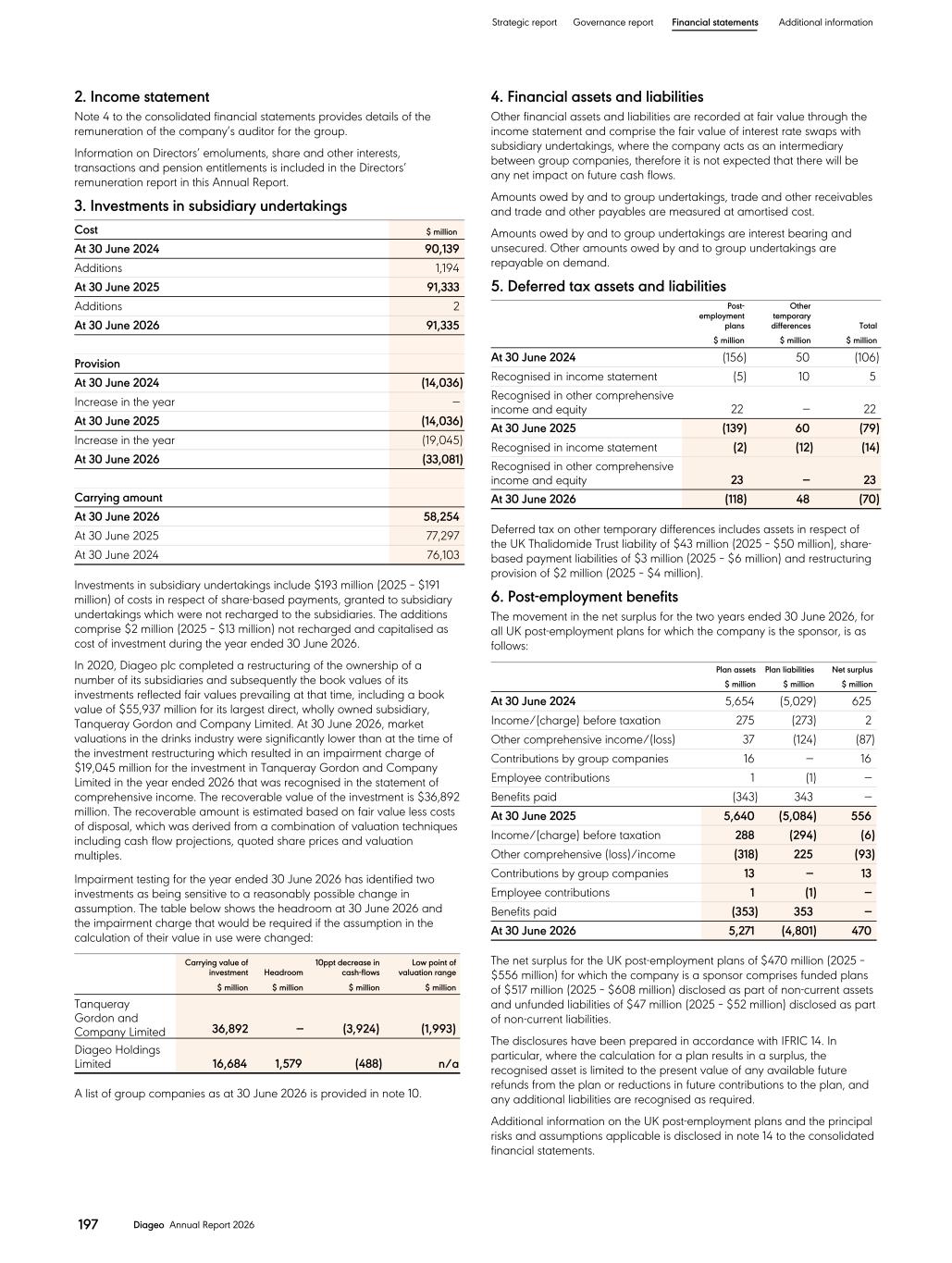
2. Income statement Note 4 to the consolidated financial statements provides details of the remuneration of the company’s auditor for the group. Information on Directors’ emoluments, share and other interests, transactions and pension entitlements is included in the Directors’ remuneration report in this Annual Report. 3. Investments in subsidiary undertakings Cost $ million At 30 June 2024 90,139 Additions 1,194 At 30 June 2025 91,333 Additions 2 At 30 June 2026 91,335 Provision At 30 June 2024 (14,036) Increase in the year — At 30 June 2025 (14,036) Increase in the year (19,045) At 30 June 2026 (33,081) Carrying amount At 30 June 2026 58,254 At 30 June 2025 77,297 At 30 June 2024 76,103 Investments in subsidiary undertakings include $193 million (2025 – $191 million) of costs in respect of share-based payments, granted to subsidiary undertakings which were not recharged to the subsidiaries. The additions comprise $2 million (2025 – $13 million) not recharged and capitalised as cost of investment during the year ended 30 June 2026. In 2020, Diageo plc completed a restructuring of the ownership of a number of its subsidiaries and subsequently the book values of its investments reflected fair values prevailing at that time, including a book value of $55,937 million for its largest direct, wholly owned subsidiary, Tanqueray Gordon and Company Limited. At 30 June 2026, market valuations in the drinks industry were significantly lower than at the time of the investment restructuring which resulted in an impairment charge of $19,045 million for the investment in Tanqueray Gordon and Company Limited in the year ended 2026 that was recognised in the statement of comprehensive income. The recoverable value of the investment is $36,892 million. The recoverable amount is estimated based on fair value less costs of disposal, which was derived from a combination of valuation techniques including cash flow projections, quoted share prices and valuation multiples. Impairment testing for the year ended 30 June 2026 has identified two investments as being sensitive to a reasonably possible change in assumption. The table below shows the headroom at 30 June 2026 and the impairment charge that would be required if the assumption in the calculation of their value in use were changed: $ million $ million $ million $ million Tanqueray Gordon and Company Limited 36,892 — (3,924) (1,993) Diageo Holdings Limited 16,684 1,579 (488) n/a Carrying value of investment Headroom 10ppt decrease in cash-flows Low point of valuation range A list of group companies as at 30 June 2026 is provided in note 10. 4. Financial assets and liabilities Other financial assets and liabilities are recorded at fair value through the income statement and comprise the fair value of interest rate swaps with subsidiary undertakings, where the company acts as an intermediary between group companies, therefore it is not expected that there will be any net impact on future cash flows. Amounts owed by and to group undertakings, trade and other receivables and trade and other payables are measured at amortised cost. Amounts owed by and to group undertakings are interest bearing and unsecured. Other amounts owed by and to group undertakings are repayable on demand. 5. Deferred tax assets and liabilities $ million $ million $ million At 30 June 2024 (156) 50 (106) Recognised in income statement (5) 10 5 Recognised in other comprehensive income and equity 22 — 22 At 30 June 2025 (139) 60 (79) Recognised in income statement (2) (12) (14) Recognised in other comprehensive income and equity 23 — 23 At 30 June 2026 (118) 48 (70) Post- employment plans Other temporary differences Total Deferred tax on other temporary differences includes assets in respect of the UK Thalidomide Trust liability of $43 million (2025 – $50 million), share- based payment liabilities of $3 million (2025 – $6 million) and restructuring provision of $2 million (2025 – $4 million). 6. Post-employment benefits The movement in the net surplus for the two years ended 30 June 2026, for all UK post-employment plans for which the company is the sponsor, is as follows: At 30 June 2024 5,654 (5,029) 625 Income/(charge) before taxation 275 (273) 2 Other comprehensive income/(loss) 37 (124) (87) Contributions by group companies 16 — 16 Employee contributions 1 (1) — Benefits paid (343) 343 — At 30 June 2025 5,640 (5,084) 556 Income/(charge) before taxation 288 (294) (6) Other comprehensive (loss)/income (318) 225 (93) Contributions by group companies 13 — 13 Employee contributions 1 (1) — Benefits paid (353) 353 — At 30 June 2026 5,271 (4,801) 470 Plan assets Plan liabilities Net surplus $ million $ million $ million The net surplus for the UK post-employment plans of $470 million (2025 – $556 million) for which the company is a sponsor comprises funded plans of $517 million (2025 – $608 million) disclosed as part of non-current assets and unfunded liabilities of $47 million (2025 – $52 million) disclosed as part of non-current liabilities. The disclosures have been prepared in accordance with IFRIC 14. In particular, where the calculation for a plan results in a surplus, the recognised asset is limited to the present value of any available future refunds from the plan or reductions in future contributions to the plan, and any additional liabilities are recognised as required. Additional information on the UK post-employment plans and the principal risks and assumptions applicable is disclosed in note 14 to the consolidated financial statements. Strategic report Governance report Financial statements Additional information 197 Diageo Annual Report 2026
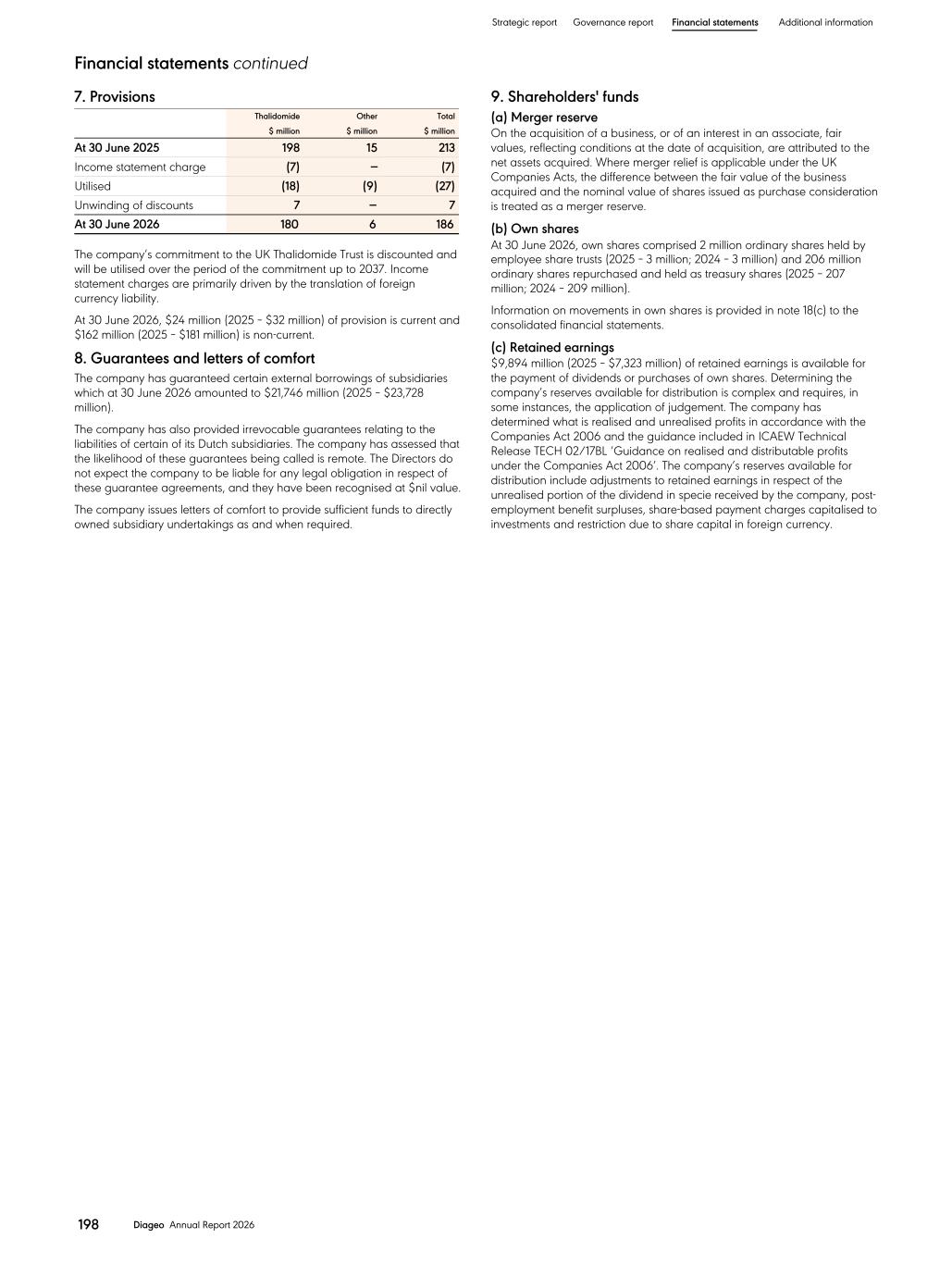
7. Provisions At 30 June 2025 198 15 213 Income statement charge (7) — (7) Utilised (18) (9) (27) Unwinding of discounts 7 — 7 At 30 June 2026 180 6 186 Thalidomide Other Total $ million $ million $ million The company’s commitment to the UK Thalidomide Trust is discounted and will be utilised over the period of the commitment up to 2037. Income statement charges are primarily driven by the translation of foreign currency liability. At 30 June 2026, $24 million (2025 – $32 million) of provision is current and $162 million (2025 – $181 million) is non-current. 8. Guarantees and letters of comfort The company has guaranteed certain external borrowings of subsidiaries which at 30 June 2026 amounted to $21,746 million (2025 – $23,728 million). The company has also provided irrevocable guarantees relating to the liabilities of certain of its Dutch subsidiaries. The company has assessed that the likelihood of these guarantees being called is remote. The Directors do not expect the company to be liable for any legal obligation in respect of these guarantee agreements, and they have been recognised at $nil value. The company issues letters of comfort to provide sufficient funds to directly owned subsidiary undertakings as and when required. 9. Shareholders' funds (a) Merger reserve On the acquisition of a business, or of an interest in an associate, fair values, reflecting conditions at the date of acquisition, are attributed to the net assets acquired. Where merger relief is applicable under the UK Companies Acts, the difference between the fair value of the business acquired and the nominal value of shares issued as purchase consideration is treated as a merger reserve. (b) Own shares At 30 June 2026, own shares comprised 2 million ordinary shares held by employee share trusts (2025 – 3 million; 2024 – 3 million) and 206 million ordinary shares repurchased and held as treasury shares (2025 – 207 million; 2024 – 209 million). Information on movements in own shares is provided in note 18(c) to the consolidated financial statements. (c) Retained earnings $9,894 million (2025 – $7,323 million) of retained earnings is available for the payment of dividends or purchases of own shares. Determining the company’s reserves available for distribution is complex and requires, in some instances, the application of judgement. The company has determined what is realised and unrealised profits in accordance with the Companies Act 2006 and the guidance included in ICAEW Technical Release TECH 02/17BL ‘Guidance on realised and distributable profits under the Companies Act 2006’. The company’s reserves available for distribution include adjustments to retained earnings in respect of the unrealised portion of the dividend in specie received by the company, post- employment benefit surpluses, share-based payment charges capitalised to investments and restriction due to share capital in foreign currency. Strategic report Governance report Financial statements Additional information Financial statements continued 198 Diageo Annual Report 2026
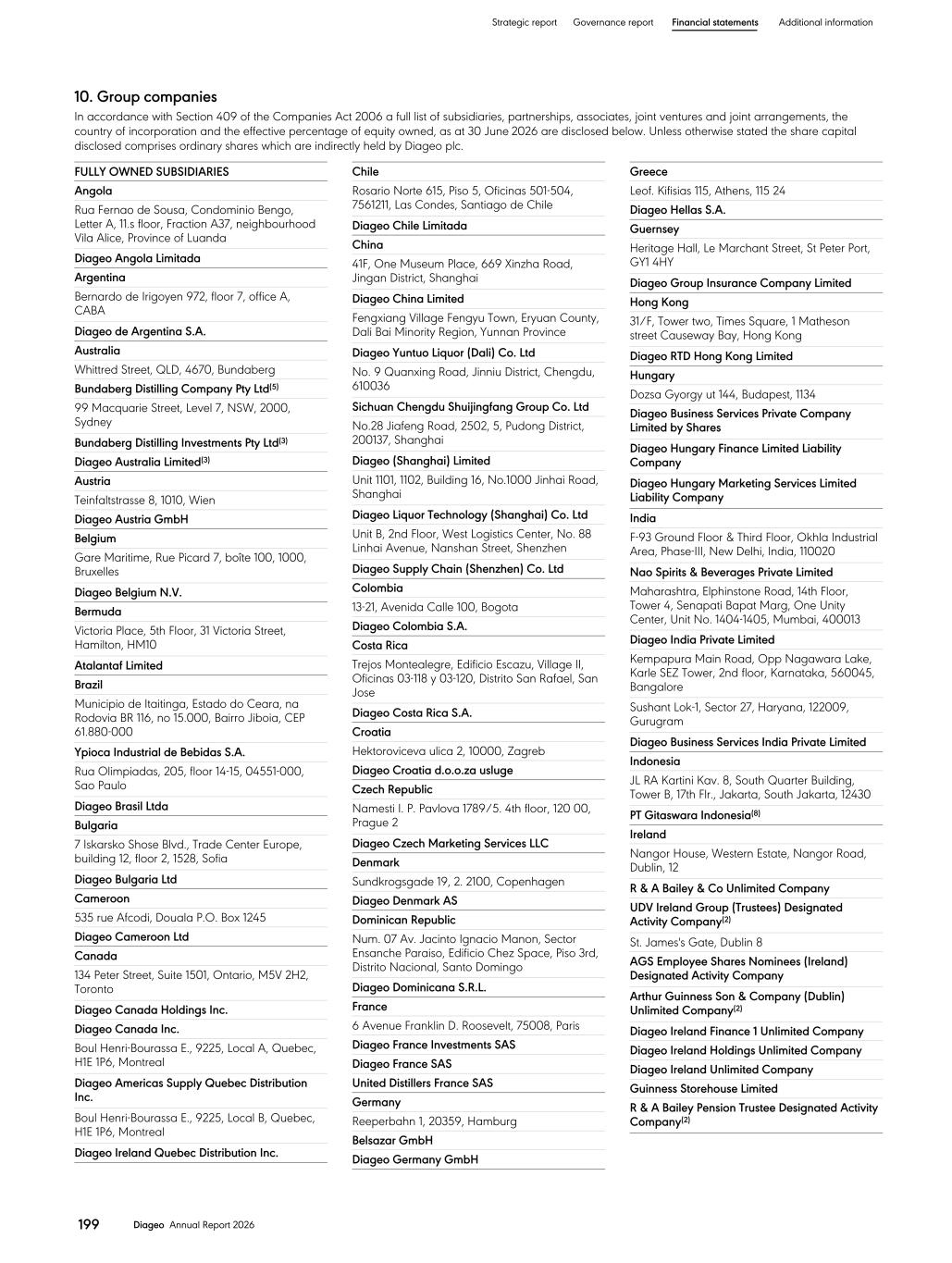
10. Group companies In accordance with Section 409 of the Companies Act 2006 a full list of subsidiaries, partnerships, associates, joint ventures and joint arrangements, the country of incorporation and the effective percentage of equity owned, as at 30 June 2026 are disclosed below. Unless otherwise stated the share capital disclosed comprises ordinary shares which are indirectly held by Diageo plc. FULLY OWNED SUBSIDIARIES Angola Rua Fernao de Sousa, Condominio Bengo, Letter A, 11.s floor, Fraction A37, neighbourhood Vila Alice, Province of Luanda Diageo Angola Limitada Argentina Bernardo de Irigoyen 972, floor 7, office A, CABA Diageo de Argentina S.A. Australia Whittred Street, QLD, 4670, Bundaberg Bundaberg Distilling Company Pty Ltd(5) 99 Macquarie Street, Level 7, NSW, 2000, Sydney Bundaberg Distilling Investments Pty Ltd(3) Diageo Australia Limited(3) Austria Teinfaltstrasse 8, 1010, Wien Diageo Austria GmbH Belgium Gare Maritime, Rue Picard 7, boîte 100, 1000, Bruxelles Diageo Belgium N.V. Bermuda Victoria Place, 5th Floor, 31 Victoria Street, Hamilton, HM10 Atalantaf Limited Brazil Municipio de Itaitinga, Estado do Ceara, na Rodovia BR 116, no 15.000, Bairro Jiboia, CEP 61.880-000 Ypioca Industrial de Bebidas S.A. Rua Olimpiadas, 205, floor 14-15, 04551-000, Sao Paulo Diageo Brasil Ltda Bulgaria 7 Iskarsko Shose Blvd., Trade Center Europe, building 12, floor 2, 1528, Sofia Diageo Bulgaria Ltd Cameroon 535 rue Afcodi, Douala P.O. Box 1245 Diageo Cameroon Ltd Canada 134 Peter Street, Suite 1501, Ontario, M5V 2H2, Toronto Diageo Canada Holdings Inc. Diageo Canada Inc. Boul Henri-Bourassa E., 9225, Local A, Quebec, H1E 1P6, Montreal Diageo Americas Supply Quebec Distribution Inc. Boul Henri-Bourassa E., 9225, Local B, Quebec, H1E 1P6, Montreal Diageo Ireland Quebec Distribution Inc. Chile Rosario Norte 615, Piso 5, Oficinas 501-504, 7561211, Las Condes, Santiago de Chile Diageo Chile Limitada China 41F, One Museum Place, 669 Xinzha Road, Jingan District, Shanghai Diageo China Limited Fengxiang Village Fengyu Town, Eryuan County, Dali Bai Minority Region, Yunnan Province Diageo Yuntuo Liquor (Dali) Co. Ltd No. 9 Quanxing Road, Jinniu District, Chengdu, 610036 Sichuan Chengdu Shuijingfang Group Co. Ltd No.28 Jiafeng Road, 2502, 5, Pudong District, 200137, Shanghai Diageo (Shanghai) Limited Unit 1101, 1102, Building 16, No.1000 Jinhai Road, Shanghai Diageo Liquor Technology (Shanghai) Co. Ltd Unit B, 2nd Floor, West Logistics Center, No. 88 Linhai Avenue, Nanshan Street, Shenzhen Diageo Supply Chain (Shenzhen) Co. Ltd Colombia 13-21, Avenida Calle 100, Bogota Diageo Colombia S.A. Costa Rica Trejos Montealegre, Edificio Escazu, Village II, Oficinas 03-118 y 03-120, Distrito San Rafael, San Jose Diageo Costa Rica S.A. Croatia Hektoroviceva ulica 2, 10000, Zagreb Diageo Croatia d.o.o.za usluge Czech Republic Namesti I. P. Pavlova 1789/5. 4th floor, 120 00, Prague 2 Diageo Czech Marketing Services LLC Denmark Sundkrogsgade 19, 2. 2100, Copenhagen Diageo Denmark AS Dominican Republic Num. 07 Av. Jacinto Ignacio Manon, Sector Ensanche Paraiso, Edificio Chez Space, Piso 3rd, Distrito Nacional, Santo Domingo Diageo Dominicana S.R.L. France 6 Avenue Franklin D. Roosevelt, 75008, Paris Diageo France Investments SAS Diageo France SAS United Distillers France SAS Germany Reeperbahn 1, 20359, Hamburg Belsazar GmbH Diageo Germany GmbH Greece Leof. Kifisias 115, Athens, 115 24 Diageo Hellas S.A. Guernsey Heritage Hall, Le Marchant Street, St Peter Port, GY1 4HY Diageo Group Insurance Company Limited Hong Kong 31/F, Tower two, Times Square, 1 Matheson street Causeway Bay, Hong Kong Diageo RTD Hong Kong Limited Hungary Dozsa Gyorgy ut 144, Budapest, 1134 Diageo Business Services Private Company Limited by Shares Diageo Hungary Finance Limited Liability Company Diageo Hungary Marketing Services Limited Liability Company India F-93 Ground Floor & Third Floor, Okhla Industrial Area, Phase-III, New Delhi, India, 110020 Nao Spirits & Beverages Private Limited Maharashtra, Elphinstone Road, 14th Floor, Tower 4, Senapati Bapat Marg, One Unity Center, Unit No. 1404-1405, Mumbai, 400013 Diageo India Private Limited Kempapura Main Road, Opp Nagawara Lake, Karle SEZ Tower, 2nd floor, Karnataka, 560045, Bangalore Sushant Lok-1, Sector 27, Haryana, 122009, Gurugram Diageo Business Services India Private Limited Indonesia JL RA Kartini Kav. 8, South Quarter Building, Tower B, 17th Flr., Jakarta, South Jakarta, 12430 PT Gitaswara Indonesia(8) Ireland Nangor House, Western Estate, Nangor Road, Dublin, 12 R & A Bailey & Co Unlimited Company UDV Ireland Group (Trustees) Designated Activity Company(2) St. James's Gate, Dublin 8 AGS Employee Shares Nominees (Ireland) Designated Activity Company Arthur Guinness Son & Company (Dublin) Unlimited Company(2) Diageo Ireland Finance 1 Unlimited Company Diageo Ireland Holdings Unlimited Company Diageo Ireland Unlimited Company Guinness Storehouse Limited R & A Bailey Pension Trustee Designated Activity Company(2) Strategic report Governance report Financial statements Additional information 199 Diageo Annual Report 2026
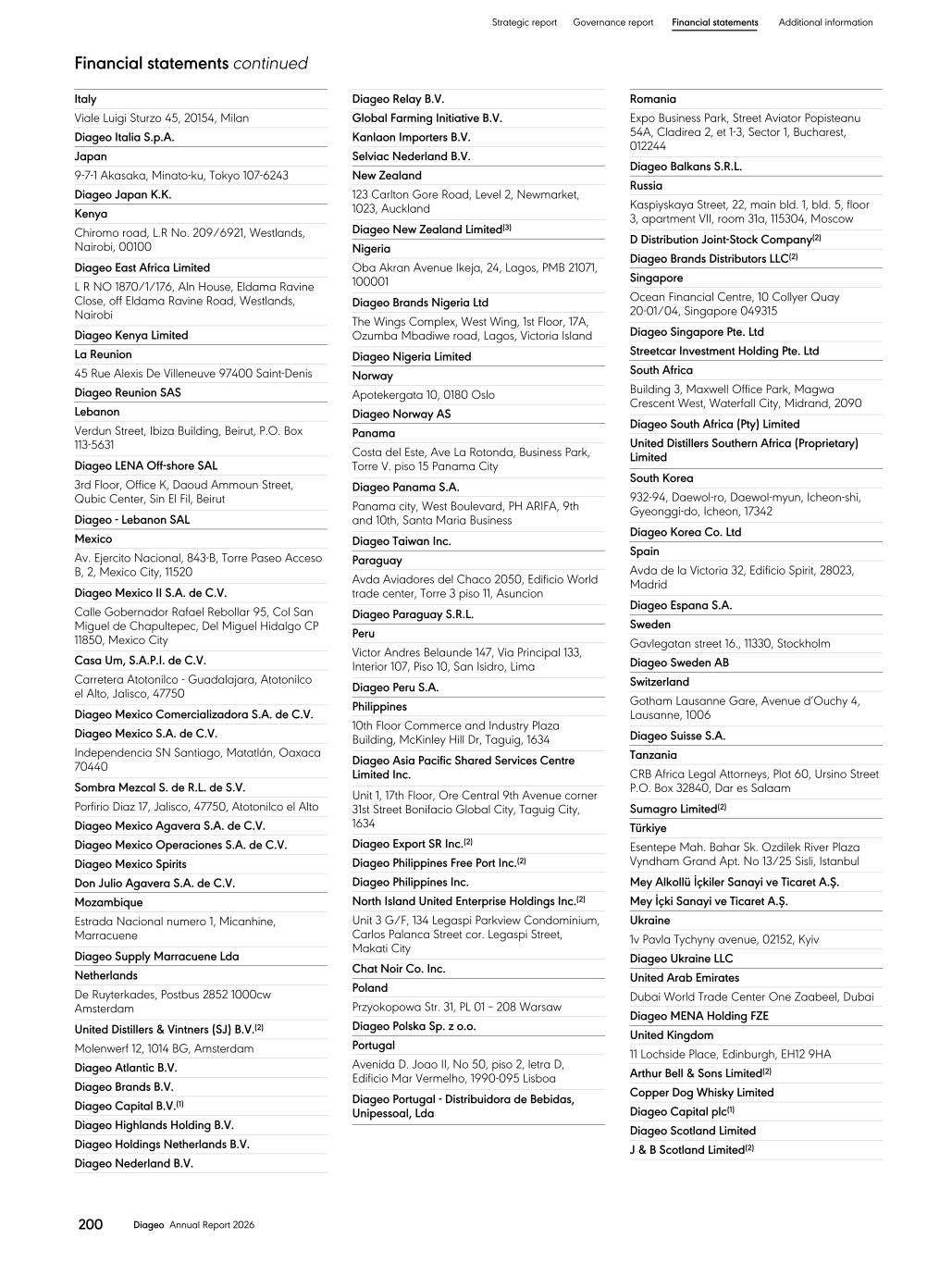
Italy Viale Luigi Sturzo 45, 20154, Milan Diageo Italia S.p.A. Japan 9-7-1 Akasaka, Minato-ku, Tokyo 107-6243 Diageo Japan K.K. Kenya Chiromo road, L.R No. 209/6921, Westlands, Nairobi, 00100 Diageo East Africa Limited L R NO 1870/1/176, Aln House, Eldama Ravine Close, off Eldama Ravine Road, Westlands, Nairobi Diageo Kenya Limited La Reunion 45 Rue Alexis De Villeneuve 97400 Saint-Denis Diageo Reunion SAS Lebanon Verdun Street, Ibiza Building, Beirut, P.O. Box 113-5631 Diageo LENA Off-shore SAL 3rd Floor, Office K, Daoud Ammoun Street, Qubic Center, Sin El Fil, Beirut Diageo - Lebanon SAL Mexico Av. Ejercito Nacional, 843-B, Torre Paseo Acceso B, 2, Mexico City, 11520 Diageo Mexico II S.A. de C.V. Calle Gobernador Rafael Rebollar 95, Col San Miguel de Chapultepec, Del Miguel Hidalgo CP 11850, Mexico City Casa Um, S.A.P.I. de C.V. Carretera Atotonilco - Guadalajara, Atotonilco el Alto, Jalisco, 47750 Diageo Mexico Comercializadora S.A. de C.V. Diageo Mexico S.A. de C.V. Independencia SN Santiago, Matatlán, Oaxaca 70440 Sombra Mezcal S. de R.L. de S.V. Porfirio Diaz 17, Jalisco, 47750, Atotonilco el Alto Diageo Mexico Agavera S.A. de C.V. Diageo Mexico Operaciones S.A. de C.V. Diageo Mexico Spirits Don Julio Agavera S.A. de C.V. Mozambique Estrada Nacional numero 1, Micanhine, Marracuene Diageo Supply Marracuene Lda Netherlands De Ruyterkades, Postbus 2852 1000cw Amsterdam United Distillers & Vintners (SJ) B.V.(2) Molenwerf 12, 1014 BG, Amsterdam Diageo Atlantic B.V. Diageo Brands B.V. Diageo Capital B.V.(1) Diageo Highlands Holding B.V. Diageo Holdings Netherlands B.V. Diageo Nederland B.V. Diageo Relay B.V. Global Farming Initiative B.V. Kanlaon Importers B.V. Selviac Nederland B.V. New Zealand 123 Carlton Gore Road, Level 2, Newmarket, 1023, Auckland Diageo New Zealand Limited(3) Nigeria Oba Akran Avenue Ikeja, 24, Lagos, PMB 21071, 100001 Diageo Brands Nigeria Ltd The Wings Complex, West Wing, 1st Floor, 17A, Ozumba Mbadiwe road, Lagos, Victoria Island Diageo Nigeria Limited Norway Apotekergata 10, 0180 Oslo Diageo Norway AS Panama Costa del Este, Ave La Rotonda, Business Park, Torre V. piso 15 Panama City Diageo Panama S.A. Panama city, West Boulevard, PH ARIFA, 9th and 10th, Santa Maria Business Diageo Taiwan Inc. Paraguay Avda Aviadores del Chaco 2050, Edificio World trade center, Torre 3 piso 11, Asuncion Diageo Paraguay S.R.L. Peru Victor Andres Belaunde 147, Via Principal 133, Interior 107, Piso 10, San Isidro, Lima Diageo Peru S.A. Philippines 10th Floor Commerce and Industry Plaza Building, McKinley Hill Dr, Taguig, 1634 Diageo Asia Pacific Shared Services Centre Limited Inc. Unit 1, 17th Floor, Ore Central 9th Avenue corner 31st Street Bonifacio Global City, Taguig City, 1634 Diageo Export SR Inc.(2) Diageo Philippines Free Port Inc.(2) Diageo Philippines Inc. North Island United Enterprise Holdings Inc.(2) Unit 3 G/F, 134 Legaspi Parkview Condominium, Carlos Palanca Street cor. Legaspi Street, Makati City Chat Noir Co. Inc. Poland Przyokopowa Str. 31, PL 01 – 208 Warsaw Diageo Polska Sp. z o.o. Portugal Avenida D. Joao II, No 50, piso 2, letra D, Edificio Mar Vermelho, 1990-095 Lisboa Diageo Portugal - Distribuidora de Bebidas, Unipessoal, Lda Romania Expo Business Park, Street Aviator Popisteanu 54A, Cladirea 2, et 1-3, Sector 1, Bucharest, 012244 Diageo Balkans S.R.L. Russia Kaspiyskaya Street, 22, main bld. 1, bld. 5, floor 3, apartment VII, room 31a, 115304, Moscow D Distribution Joint-Stock Company(2) Diageo Brands Distributors LLC(2) Singapore Ocean Financial Centre, 10 Collyer Quay 20-01/04, Singapore 049315 Diageo Singapore Pte. Ltd Streetcar Investment Holding Pte. Ltd South Africa Building 3, Maxwell Office Park, Magwa Crescent West, Waterfall City, Midrand, 2090 Diageo South Africa (Pty) Limited United Distillers Southern Africa (Proprietary) Limited South Korea 932-94, Daewol-ro, Daewol-myun, Icheon-shi, Gyeonggi-do, Icheon, 17342 Diageo Korea Co. Ltd Spain Avda de la Victoria 32, Edificio Spirit, 28023, Madrid Diageo Espana S.A. Sweden Gavlegatan street 16., 11330, Stockholm Diageo Sweden AB Switzerland Gotham Lausanne Gare, Avenue d’Ouchy 4, Lausanne, 1006 Diageo Suisse S.A. Tanzania CRB Africa Legal Attorneys, Plot 60, Ursino Street P.O. Box 32840, Dar es Salaam Sumagro Limited(2) Türkiye Esentepe Mah. Bahar Sk. Ozdilek River Plaza Vyndham Grand Apt. No 13/25 Sisli, Istanbul Mey Alkollü İçkiler Sanayi ve Ticaret A.Ş. Mey İçki Sanayi ve Ticaret A.Ş. Ukraine 1v Pavla Tychyny avenue, 02152, Kyiv Diageo Ukraine LLC United Arab Emirates Dubai World Trade Center One Zaabeel, Dubai Diageo MENA Holding FZE United Kingdom 11 Lochside Place, Edinburgh, EH12 9HA Arthur Bell & Sons Limited(2) Copper Dog Whisky Limited Diageo Capital plc(1) Diageo Scotland Limited J & B Scotland Limited(2) Strategic report Governance report Financial statements Additional information Financial statements continued 200 Diageo Annual Report 2026
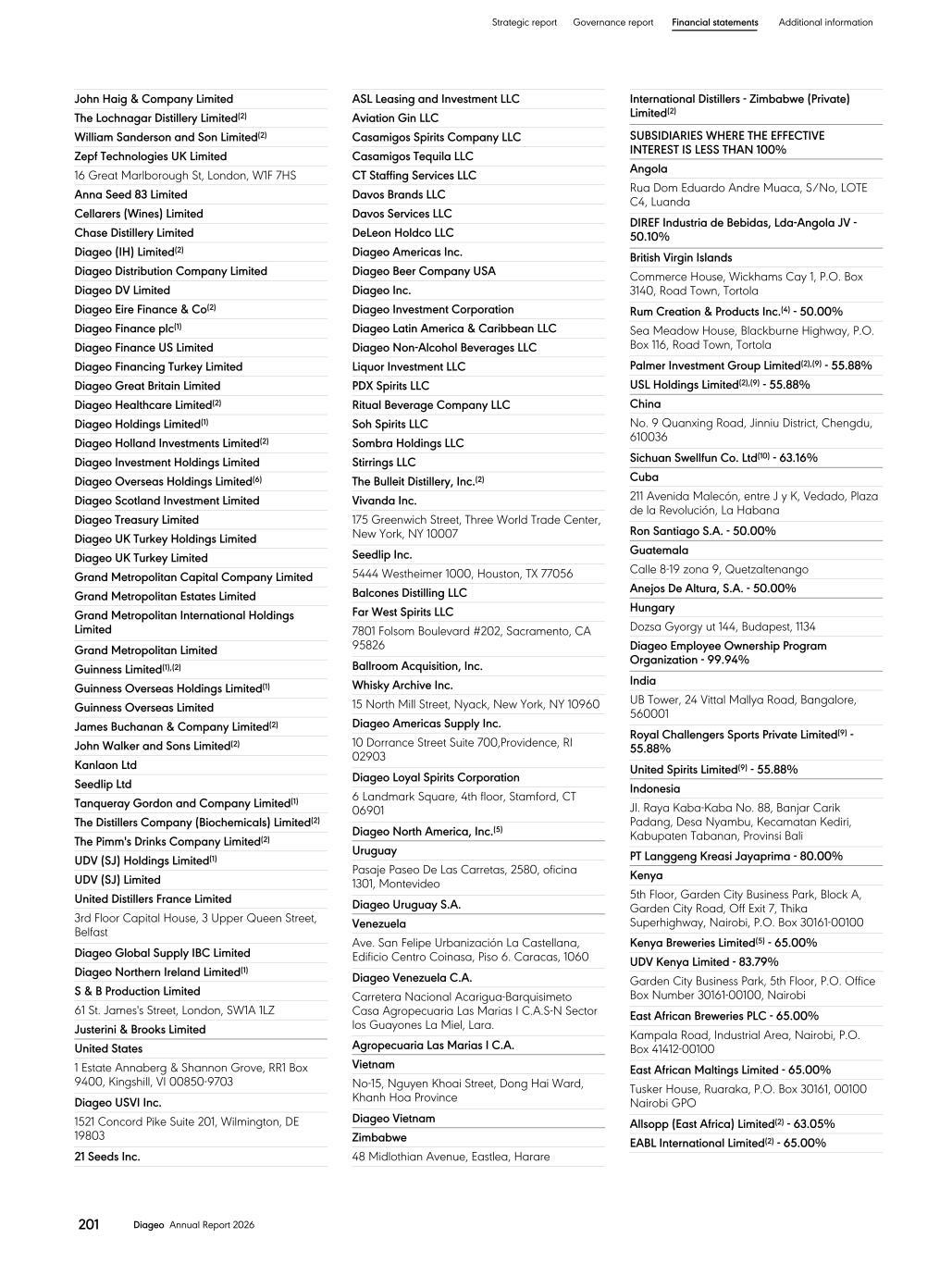
John Haig & Company Limited The Lochnagar Distillery Limited(2) William Sanderson and Son Limited(2) Zepf Technologies UK Limited 16 Great Marlborough St, London, W1F 7HS Anna Seed 83 Limited Cellarers (Wines) Limited Chase Distillery Limited Diageo (IH) Limited(2) Diageo Distribution Company Limited Diageo DV Limited Diageo Eire Finance & Co(2) Diageo Finance plc(1) Diageo Finance US Limited Diageo Financing Turkey Limited Diageo Great Britain Limited Diageo Healthcare Limited(2) Diageo Holdings Limited(1) Diageo Holland Investments Limited(2) Diageo Investment Holdings Limited Diageo Overseas Holdings Limited(6) Diageo Scotland Investment Limited Diageo Treasury Limited Diageo UK Turkey Holdings Limited Diageo UK Turkey Limited Grand Metropolitan Capital Company Limited Grand Metropolitan Estates Limited Grand Metropolitan International Holdings Limited Grand Metropolitan Limited Guinness Limited(1),(2) Guinness Overseas Holdings Limited(1) Guinness Overseas Limited James Buchanan & Company Limited(2) John Walker and Sons Limited(2) Kanlaon Ltd Seedlip Ltd Tanqueray Gordon and Company Limited(1) The Distillers Company (Biochemicals) Limited(2) The Pimm's Drinks Company Limited(2) UDV (SJ) Holdings Limited(1) UDV (SJ) Limited United Distillers France Limited 3rd Floor Capital House, 3 Upper Queen Street, Belfast Diageo Global Supply IBC Limited Diageo Northern Ireland Limited(1) S & B Production Limited 61 St. James's Street, London, SW1A 1LZ Justerini & Brooks Limited United States 1 Estate Annaberg & Shannon Grove, RR1 Box 9400, Kingshill, VI 00850-9703 Diageo USVI Inc. 1521 Concord Pike Suite 201, Wilmington, DE 19803 21 Seeds Inc. ASL Leasing and Investment LLC Aviation Gin LLC Casamigos Spirits Company LLC Casamigos Tequila LLC CT Staffing Services LLC Davos Brands LLC Davos Services LLC DeLeon Holdco LLC Diageo Americas Inc. Diageo Beer Company USA Diageo Inc. Diageo Investment Corporation Diageo Latin America & Caribbean LLC Diageo Non-Alcohol Beverages LLC Liquor Investment LLC PDX Spirits LLC Ritual Beverage Company LLC Soh Spirits LLC Sombra Holdings LLC Stirrings LLC The Bulleit Distillery, Inc.(2) Vivanda Inc. 175 Greenwich Street, Three World Trade Center, New York, NY 10007 Seedlip Inc. 5444 Westheimer 1000, Houston, TX 77056 Balcones Distilling LLC Far West Spirits LLC 7801 Folsom Boulevard #202, Sacramento, CA 95826 Ballroom Acquisition, Inc. Whisky Archive Inc. 15 North Mill Street, Nyack, New York, NY 10960 Diageo Americas Supply Inc. 10 Dorrance Street Suite 700,Providence, RI 02903 Diageo Loyal Spirits Corporation 6 Landmark Square, 4th floor, Stamford, CT 06901 Diageo North America, Inc.(5) Uruguay Pasaje Paseo De Las Carretas, 2580, oficina 1301, Montevideo Diageo Uruguay S.A. Venezuela Ave. San Felipe Urbanización La Castellana, Edificio Centro Coinasa, Piso 6. Caracas, 1060 Diageo Venezuela C.A. Carretera Nacional Acarigua-Barquisimeto Casa Agropecuaria Las Marias I C.A.S-N Sector los Guayones La Miel, Lara. Agropecuaria Las Marias I C.A. Vietnam No-15, Nguyen Khoai Street, Dong Hai Ward, Khanh Hoa Province Diageo Vietnam Zimbabwe 48 Midlothian Avenue, Eastlea, Harare International Distillers - Zimbabwe (Private) Limited(2) SUBSIDIARIES WHERE THE EFFECTIVE INTEREST IS LESS THAN 100% Angola Rua Dom Eduardo Andre Muaca, S/No, LOTE C4, Luanda DIREF Industria de Bebidas, Lda-Angola JV - 50.10% British Virgin Islands Commerce House, Wickhams Cay 1, P.O. Box 3140, Road Town, Tortola Rum Creation & Products Inc.(4) - 50.00% Sea Meadow House, Blackburne Highway, P.O. Box 116, Road Town, Tortola Palmer Investment Group Limited(2),(9) - 55.88% USL Holdings Limited(2),(9) - 55.88% China No. 9 Quanxing Road, Jinniu District, Chengdu, 610036 Sichuan Swellfun Co. Ltd(10) - 63.16% Cuba 211 Avenida Malecón, entre J y K, Vedado, Plaza de la Revolución, La Habana Ron Santiago S.A. - 50.00% Guatemala Calle 8-19 zona 9, Quetzaltenango Anejos De Altura, S.A. - 50.00% Hungary Dozsa Gyorgy ut 144, Budapest, 1134 Diageo Employee Ownership Program Organization - 99.94% India UB Tower, 24 Vittal Mallya Road, Bangalore, 560001 Royal Challengers Sports Private Limited(9) - 55.88% United Spirits Limited(9) - 55.88% Indonesia Jl. Raya Kaba-Kaba No. 88, Banjar Carik Padang, Desa Nyambu, Kecamatan Kediri, Kabupaten Tabanan, Provinsi Bali PT Langgeng Kreasi Jayaprima - 80.00% Kenya 5th Floor, Garden City Business Park, Block A, Garden City Road, Off Exit 7, Thika Superhighway, Nairobi, P.O. Box 30161-00100 Kenya Breweries Limited(5) - 65.00% UDV Kenya Limited - 83.79% Garden City Business Park, 5th Floor, P.O. Office Box Number 30161-00100, Nairobi East African Breweries PLC - 65.00% Kampala Road, Industrial Area, Nairobi, P.O. Box 41412-00100 East African Maltings Limited - 65.00% Tusker House, Ruaraka, P.O. Box 30161, 00100 Nairobi GPO Allsopp (East Africa) Limited(2) - 63.05% EABL International Limited(2) - 65.00% Strategic report Governance report Financial statements Additional information 201 Diageo Annual Report 2026
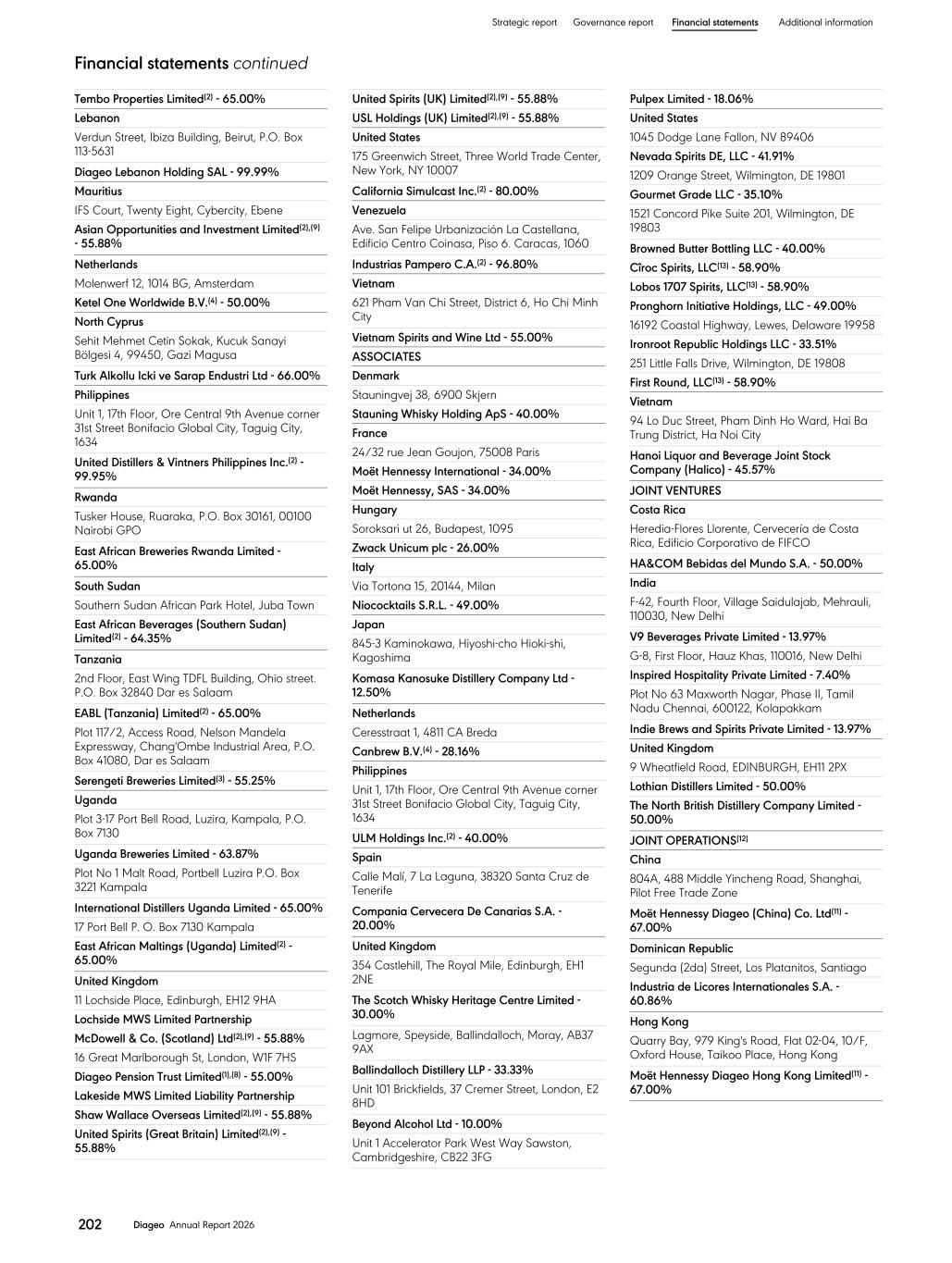
Tembo Properties Limited(2) - 65.00% Lebanon Verdun Street, Ibiza Building, Beirut, P.O. Box 113-5631 Diageo Lebanon Holding SAL - 99.99% Mauritius IFS Court, Twenty Eight, Cybercity, Ebene Asian Opportunities and Investment Limited(2),(9) - 55.88% Netherlands Molenwerf 12, 1014 BG, Amsterdam Ketel One Worldwide B.V.(4) - 50.00% North Cyprus Sehit Mehmet Cetin Sokak, Kucuk Sanayi Bölgesi 4, 99450, Gazi Magusa Turk Alkollu Icki ve Sarap Endustri Ltd - 66.00% Philippines Unit 1, 17th Floor, Ore Central 9th Avenue corner 31st Street Bonifacio Global City, Taguig City, 1634 United Distillers & Vintners Philippines Inc.(2) - 99.95% Rwanda Tusker House, Ruaraka, P.O. Box 30161, 00100 Nairobi GPO East African Breweries Rwanda Limited - 65.00% South Sudan Southern Sudan African Park Hotel, Juba Town East African Beverages (Southern Sudan) Limited(2) - 64.35% Tanzania 2nd Floor, East Wing TDFL Building, Ohio street. P.O. Box 32840 Dar es Salaam EABL (Tanzania) Limited(2) - 65.00% Plot 117/2, Access Road, Nelson Mandela Expressway, Chang'Ombe Industrial Area, P.O. Box 41080, Dar es Salaam Serengeti Breweries Limited(3) - 55.25% Uganda Plot 3-17 Port Bell Road, Luzira, Kampala, P.O. Box 7130 Uganda Breweries Limited - 63.87% Plot No 1 Malt Road, Portbell Luzira P.O. Box 3221 Kampala International Distillers Uganda Limited - 65.00% 17 Port Bell P. O. Box 7130 Kampala East African Maltings (Uganda) Limited(2) - 65.00% United Kingdom 11 Lochside Place, Edinburgh, EH12 9HA Lochside MWS Limited Partnership McDowell & Co. (Scotland) Ltd(2),(9) - 55.88% 16 Great Marlborough St, London, W1F 7HS Diageo Pension Trust Limited(1),(8) - 55.00% Lakeside MWS Limited Liability Partnership Shaw Wallace Overseas Limited(2),(9) - 55.88% United Spirits (Great Britain) Limited(2),(9) - 55.88% United Spirits (UK) Limited(2),(9) - 55.88% USL Holdings (UK) Limited(2),(9) - 55.88% United States 175 Greenwich Street, Three World Trade Center, New York, NY 10007 California Simulcast Inc.(2) - 80.00% Venezuela Ave. San Felipe Urbanización La Castellana, Edificio Centro Coinasa, Piso 6. Caracas, 1060 Industrias Pampero C.A.(2) - 96.80% Vietnam 621 Pham Van Chi Street, District 6, Ho Chi Minh City Vietnam Spirits and Wine Ltd - 55.00% ASSOCIATES Denmark Stauningvej 38, 6900 Skjern Stauning Whisky Holding ApS - 40.00% France 24/32 rue Jean Goujon, 75008 Paris Moët Hennessy International - 34.00% Moët Hennessy, SAS - 34.00% Hungary Soroksari ut 26, Budapest, 1095 Zwack Unicum plc - 26.00% Italy Via Tortona 15, 20144, Milan Niococktails S.R.L. - 49.00% Japan 845-3 Kaminokawa, Hiyoshi-cho Hioki-shi, Kagoshima Komasa Kanosuke Distillery Company Ltd - 12.50% Netherlands Ceresstraat 1, 4811 CA Breda Canbrew B.V.(4) - 28.16% Philippines Unit 1, 17th Floor, Ore Central 9th Avenue corner 31st Street Bonifacio Global City, Taguig City, 1634 ULM Holdings Inc.(2) - 40.00% Spain Calle Malí, 7 La Laguna, 38320 Santa Cruz de Tenerife Compania Cervecera De Canarias S.A. - 20.00% United Kingdom 354 Castlehill, The Royal Mile, Edinburgh, EH1 2NE The Scotch Whisky Heritage Centre Limited - 30.00% Lagmore, Speyside, Ballindalloch, Moray, AB37 9AX Ballindalloch Distillery LLP - 33.33% Unit 101 Brickfields, 37 Cremer Street, London, E2 8HD Beyond Alcohol Ltd - 10.00% Unit 1 Accelerator Park West Way Sawston, Cambridgeshire, CB22 3FG Pulpex Limited - 18.06% United States 1045 Dodge Lane Fallon, NV 89406 Nevada Spirits DE, LLC - 41.91% 1209 Orange Street, Wilmington, DE 19801 Gourmet Grade LLC - 35.10% 1521 Concord Pike Suite 201, Wilmington, DE 19803 Browned Butter Bottling LLC - 40.00% Cîroc Spirits, LLC(13) - 58.90% Lobos 1707 Spirits, LLC(13) - 58.90% Pronghorn Initiative Holdings, LLC - 49.00% 16192 Coastal Highway, Lewes, Delaware 19958 Ironroot Republic Holdings LLC - 33.51% 251 Little Falls Drive, Wilmington, DE 19808 First Round, LLC(13) - 58.90% Vietnam 94 Lo Duc Street, Pham Dinh Ho Ward, Hai Ba Trung District, Ha Noi City Hanoi Liquor and Beverage Joint Stock Company (Halico) - 45.57% JOINT VENTURES Costa Rica Heredia-Flores Llorente, Cervecería de Costa Rica, Edificio Corporativo de FIFCO HA&COM Bebidas del Mundo S.A. - 50.00% India F-42, Fourth Floor, Village Saidulajab, Mehrauli, 110030, New Delhi V9 Beverages Private Limited - 13.97% G-8, First Floor, Hauz Khas, 110016, New Delhi Inspired Hospitality Private Limited - 7.40% Plot No 63 Maxworth Nagar, Phase II, Tamil Nadu Chennai, 600122, Kolapakkam Indie Brews and Spirits Private Limited - 13.97% United Kingdom 9 Wheatfield Road, EDINBURGH, EH11 2PX Lothian Distillers Limited - 50.00% The North British Distillery Company Limited - 50.00% JOINT OPERATIONS(12) China 804A, 488 Middle Yincheng Road, Shanghai, Pilot Free Trade Zone Moët Hennessy Diageo (China) Co. Ltd(11) - 67.00% Dominican Republic Segunda (2da) Street, Los Platanitos, Santiago Industria de Licores Internationales S.A. - 60.86% Hong Kong Quarry Bay, 979 King's Road, Flat 02-04, 10/F, Oxford House, Taikoo Place, Hong Kong Moët Hennessy Diageo Hong Kong Limited(11) - 67.00% Strategic report Governance report Financial statements Additional information Financial statements continued 202 Diageo Annual Report 2026
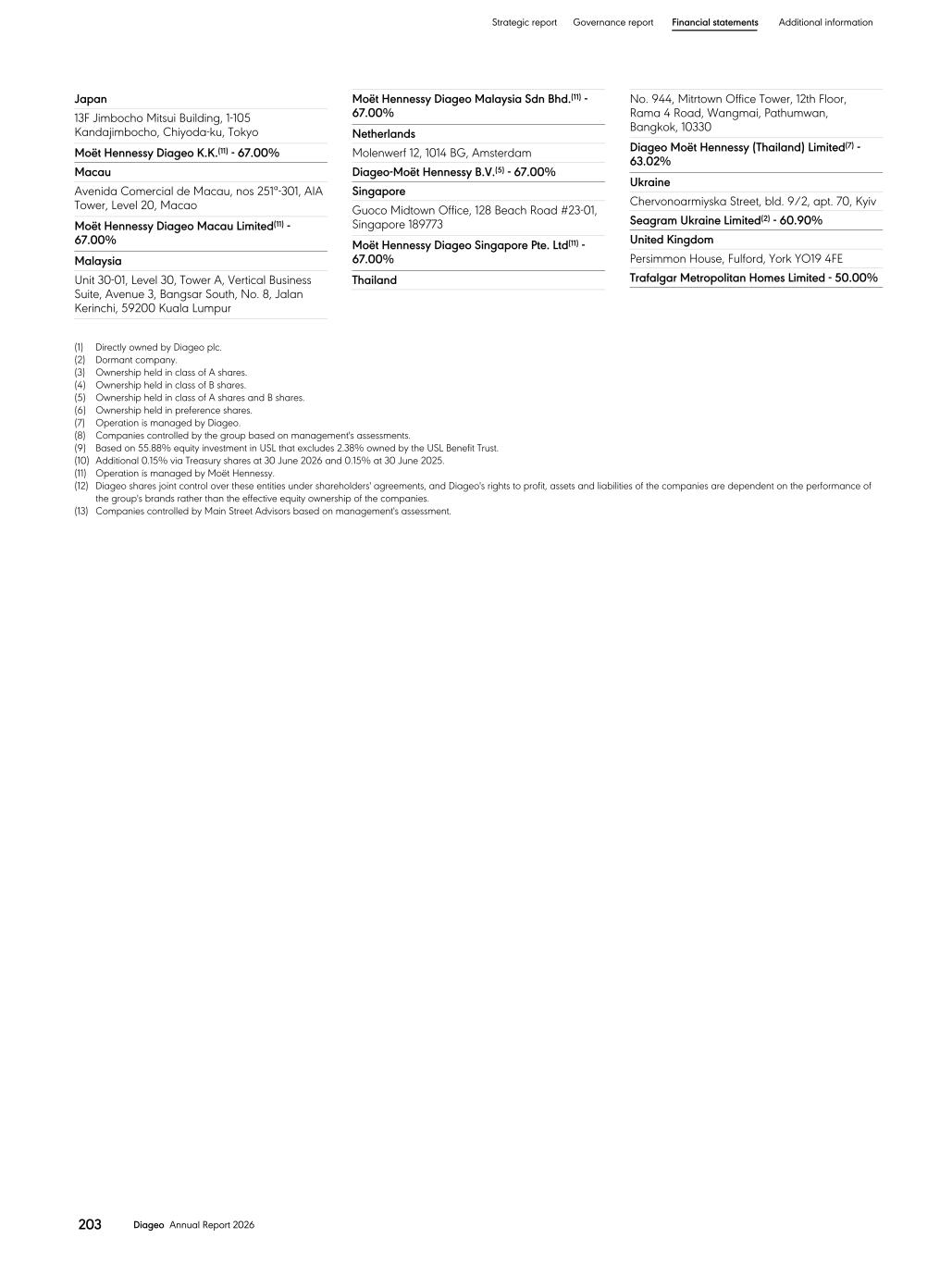
Japan 13F Jimbocho Mitsui Building, 1-105 Kandajimbocho, Chiyoda-ku, Tokyo Moët Hennessy Diageo K.K.(11) - 67.00% Macau Avenida Comercial de Macau, nos 251ª-301, AIA Tower, Level 20, Macao Moët Hennessy Diageo Macau Limited(11) - 67.00% Malaysia Unit 30-01, Level 30, Tower A, Vertical Business Suite, Avenue 3, Bangsar South, No. 8, Jalan Kerinchi, 59200 Kuala Lumpur Moët Hennessy Diageo Malaysia Sdn Bhd.(11) - 67.00% Netherlands Molenwerf 12, 1014 BG, Amsterdam Diageo-Moët Hennessy B.V.(5) - 67.00% Singapore Guoco Midtown Office, 128 Beach Road #23-01, Singapore 189773 Moët Hennessy Diageo Singapore Pte. Ltd(11) - 67.00% Thailand No. 944, Mitrtown Office Tower, 12th Floor, Rama 4 Road, Wangmai, Pathumwan, Bangkok, 10330 Diageo Moët Hennessy (Thailand) Limited(7) - 63.02% Ukraine Chervonoarmiyska Street, bld. 9/2, apt. 70, Kyiv Seagram Ukraine Limited(2) - 60.90% United Kingdom Persimmon House, Fulford, York YO19 4FE Trafalgar Metropolitan Homes Limited - 50.00% (1) Directly owned by Diageo plc. (2) Dormant company. (3) Ownership held in class of A shares. (4) Ownership held in class of B shares. (5) Ownership held in class of A shares and B shares. (6) Ownership held in preference shares. (7) Operation is managed by Diageo. (8) Companies controlled by the group based on management's assessments. (9) Based on 55.88% equity investment in USL that excludes 2.38% owned by the USL Benefit Trust. (10) Additional 0.15% via Treasury shares at 30 June 2026 and 0.15% at 30 June 2025. (11) Operation is managed by Moët Hennessy. (12) Diageo shares joint control over these entities under shareholders' agreements, and Diageo's rights to profit, assets and liabilities of the companies are dependent on the performance of the group's brands rather than the effective equity ownership of the companies. (13) Companies controlled by Main Street Advisors based on management's assessment. Strategic report Governance report Financial statements Additional information 203 Diageo Annual Report 2026
Additional information Contents Unaudited financial information 205 Cautionary statement concerning forward-looking statements 213 Independent Limited Assurance Report to the Directors of Diageo plc on selected information 214 Other additional information 217 Strategic report Governance report Financial statements Additional information 204 Diageo Annual Report 2026 Additional information
1. Definitions and reconciliation of non-GAAP measures to GAAP measures Diageo’s strategic planning process is based on certain non-GAAP measures, including organic movements. These non-GAAP measures are chosen for planning and reporting, and some of them are used for incentive purposes. The group’s management believes that these measures provide valuable additional information for users of the financial statements in understanding the group’s performance. These non-GAAP measures should be viewed as complementary to, and not replacements for, the comparable GAAP measures and reported movements therein. It is not possible to reconcile the forecast tax rate before exceptional items, forecast free cash flow, forecast effective interest rate, forecast organic net sales growth and forecast organic operating profit growth to the most comparable GAAP measure as it is not possible to predict, without unreasonable effort, with reasonable certainty, the future impact of changes in exchange rates, acquisitions and disposals, and potential exceptional items. Volume Volume is a performance indicator that is measured on an equivalent units basis to nine-litre cases of spirits. An equivalent unit represents one nine-litre case of spirits, which is approximately 272 servings. A serving comprises 33ml of spirits, 165ml of wine, or 330ml of ready-to-drink or beer. Therefore, to convert volume of products other than spirits to equivalent units, the following guide has been used: beer in hectolitres, divide by 0.9; wine in nine-litre cases, divide by five; ready-to-drink and certain pre-mixed products that are classified as ready-to-drink in nine-litre cases, divide by ten. As part of the move to an asset-light beer operating model, calculation of volume for Guinness flavour extract and other concentrate sales has been amended to represent the equivalent finished goods volume. Comparatives for prior periods have been restated. Organic movements Organic information is presented using US dollar amounts on a constant currency basis excluding the impact of exceptional items, certain fair value remeasurements, hyperinflation, and acquisitions and disposals. Organic measures enable users to focus on the performance of the business which is common to both years and which represents those measures that local managers are most directly able to influence. Calculation of organic movements The organic movement percentage is the amount in the row titled ‘Organic movement’ in the tables below, expressed as a percentage of the relevant absolute amount in the row titled ‘Year ended 30 June 2025 adjusted’. Organic operating margin is calculated by dividing operating profit before exceptional items by net sales after excluding the impact of exchange rate movements, certain fair value remeasurements, hyperinflation and acquisitions and disposals. (a) Exchange rates Exchange in the organic movement calculation reflects the adjustment to recalculate the reported results as if they had been generated at the prior period weighted average exchange rates. Exchange impacts in respect of the external hedging of intergroup sales by the markets in a currency other than their functional currency and the intergroup recharging of services are also translated at prior period weighted average exchange rates and are allocated to the geographical segment to which they relate. Residual exchange impacts are reported as part of the Corporate segment. Results from hyperinflationary economies are translated at forward-looking rates. (b) Acquisitions and disposals For acquisitions in the current period, the post-acquisition results are excluded from the organic movement calculations. For acquisitions in the prior period, post-acquisition results are included in full in the prior period but are included in the organic movement calculation from the anniversary of the acquisition date in the current period. The acquisition row also eliminates the impact of transaction costs that have been charged to operating profit in the current or prior period in respect of acquisitions that, in management’s judgement, are expected to be completed. Where a business, brand, brand distribution right or agency agreement was disposed of or terminated in the reporting period, the group, in the organic movement calculations, excludes the results for that business from the current and prior period. In the calculation of operating profit, the overheads included in disposals are only those directly attributable to the businesses disposed of, and do not result from subjective judgements of management. (c) Exceptional items Exceptional items are those that in management’s judgement need to be disclosed separately. Such items are included in the income statement caption to which they relate, and form part of the segmental reporting, and are excluded from the organic movement calculations. Management believes that separate disclosure of exceptional items and the classification between operating and non-operating further helps investors to understand the performance of the group. Changes in estimates and reversals in relation to items previously recognised as exceptional are presented consistently as exceptional in the current year. Exceptional operating items are those that are unusual or non-recurring in nature, considered to be of a size that could distort performance and are part of the operating activities of the group, such as one-off global restructuring programmes which can be multi-year, impairment of intangible assets and fixed assets, indirect tax settlements, property disposals and changes in post-employment plans. Gains and losses on the sale or directly attributable to a prospective sale of businesses, brands or distribution rights, step up gains and losses that arise when an investment becomes an associate or an associate becomes a subsidiary and other unusual non-recurring items, that are considered to be of a size that could distort performance and not in respect of the production, marketing and distribution of premium drinks, are disclosed as exceptional non-operating items below operating profit in the income statement. Exceptional finance incomes/charges are those that are unusual or non- recurring in nature, considered to be of a size that could distort the performance and are part of the financing activity of the group. Exceptional current and deferred tax items comprise unusual or non- recurring items, that are considered to be of a size that could distort performance. Examples include direct tax provisions and settlements in respect of prior years and the remeasurement of deferred tax assets and liabilities following tax rate changes. (d) Fair value remeasurements Fair value remeasurements in the organic movement calculation reflect an adjustment to eliminate the impact of fair value changes in biological assets, earn-out arrangements that are accounted for as remuneration and fair value changes relating to contingent consideration liabilities and equity options that arose on acquisitions recognised in the income statement. Adjustment in respect of hyperinflation The group's experience is that hyperinflationary conditions result in price increases that include both normal pricing actions reflecting changes in demand, commodity and other input costs or considerations to drive commercial competitiveness, as well as hyperinflationary elements and that for the calculation of organic movements, the distortion from hyperinflationary elements should be excluded. Cumulative inflation over 100% (2% per month compounded) over three years is one of the key indicators within IAS 29 to assess whether an economy is deemed to be hyperinflationary. As a result, the definition of 'Organic movements' includes price growth in markets deemed to be hyperinflationary economies, up to a maximum of 2% per month while also being on a constant currency basis. Corresponding adjustments have been made to all income statement related lines in the organic movement calculations. In the tables presenting the calculation of organic movements, 'hyperinflation' is included as a reconciling item between reported and organic movements and that also includes the relevant IAS 29 adjustments. Strategic report Governance report Financial statements Additional information 205 Diageo Annual Report 2026 Unaudited financial information
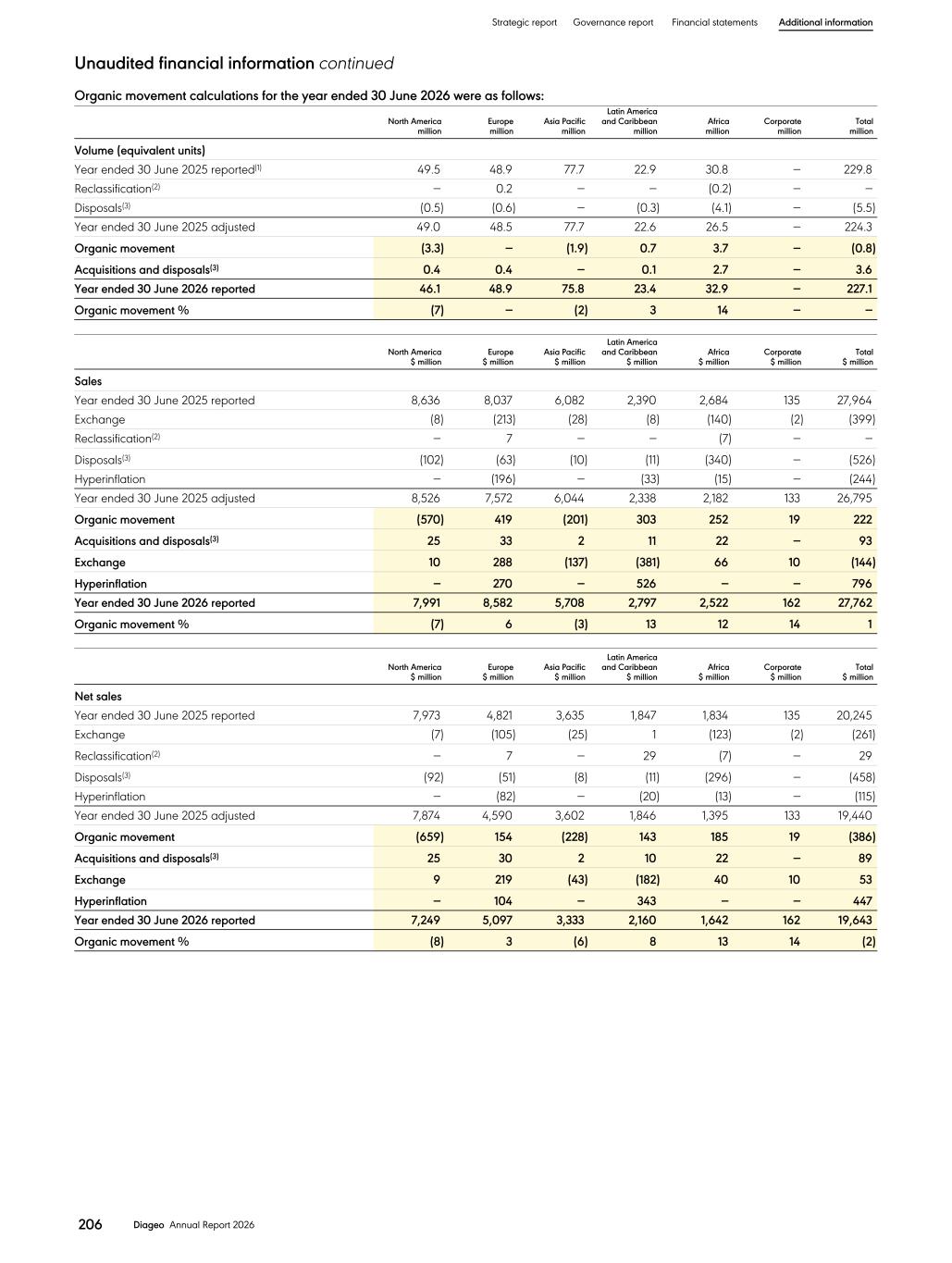
Organic movement calculations for the year ended 30 June 2026 were as follows: Volume (equivalent units) Year ended 30 June 2025 reported(1) 49.5 48.9 77.7 22.9 30.8 — 229.8 Reclassification(2) — 0.2 — — (0.2) — — Disposals(3) (0.5) (0.6) — (0.3) (4.1) — (5.5) Year ended 30 June 2025 adjusted 49.0 48.5 77.7 22.6 26.5 — 224.3 Organic movement (3.3) — (1.9) 0.7 3.7 — (0.8) Acquisitions and disposals(3) 0.4 0.4 — 0.1 2.7 — 3.6 Year ended 30 June 2026 reported 46.1 48.9 75.8 23.4 32.9 — 227.1 Organic movement % (7) — (2) 3 14 — — North America million Europe million Asia Pacific million Latin America and Caribbean million Africa million Corporate million Total million Sales Year ended 30 June 2025 reported 8,636 8,037 6,082 2,390 2,684 135 27,964 Exchange (8) (213) (28) (8) (140) (2) (399) Reclassification(2) — 7 — — (7) — — Disposals(3) (102) (63) (10) (11) (340) — (526) Hyperinflation — (196) — (33) (15) — (244) Year ended 30 June 2025 adjusted 8,526 7,572 6,044 2,338 2,182 133 26,795 Organic movement (570) 419 (201) 303 252 19 222 Acquisitions and disposals(3) 25 33 2 11 22 — 93 Exchange 10 288 (137) (381) 66 10 (144) Hyperinflation — 270 — 526 — — 796 Year ended 30 June 2026 reported 7,991 8,582 5,708 2,797 2,522 162 27,762 Organic movement % (7) 6 (3) 13 12 14 1 North America $ million Europe $ million Asia Pacific $ million Latin America and Caribbean $ million Africa $ million Corporate $ million Total $ million Net sales Year ended 30 June 2025 reported 7,973 4,821 3,635 1,847 1,834 135 20,245 Exchange (7) (105) (25) 1 (123) (2) (261) Reclassification(2) — 7 — 29 (7) — 29 Disposals(3) (92) (51) (8) (11) (296) — (458) Hyperinflation — (82) — (20) (13) — (115) Year ended 30 June 2025 adjusted 7,874 4,590 3,602 1,846 1,395 133 19,440 Organic movement (659) 154 (228) 143 185 19 (386) Acquisitions and disposals(3) 25 30 2 10 22 — 89 Exchange 9 219 (43) (182) 40 10 53 Hyperinflation — 104 — 343 — — 447 Year ended 30 June 2026 reported 7,249 5,097 3,333 2,160 1,642 162 19,643 Organic movement % (8) 3 (6) 8 13 14 (2) North America $ million Europe $ million Asia Pacific $ million Latin America and Caribbean $ million Africa $ million Corporate $ million Total $ million Strategic report Governance report Financial statements Additional information Unaudited financial information continued 206 Diageo Annual Report 2026
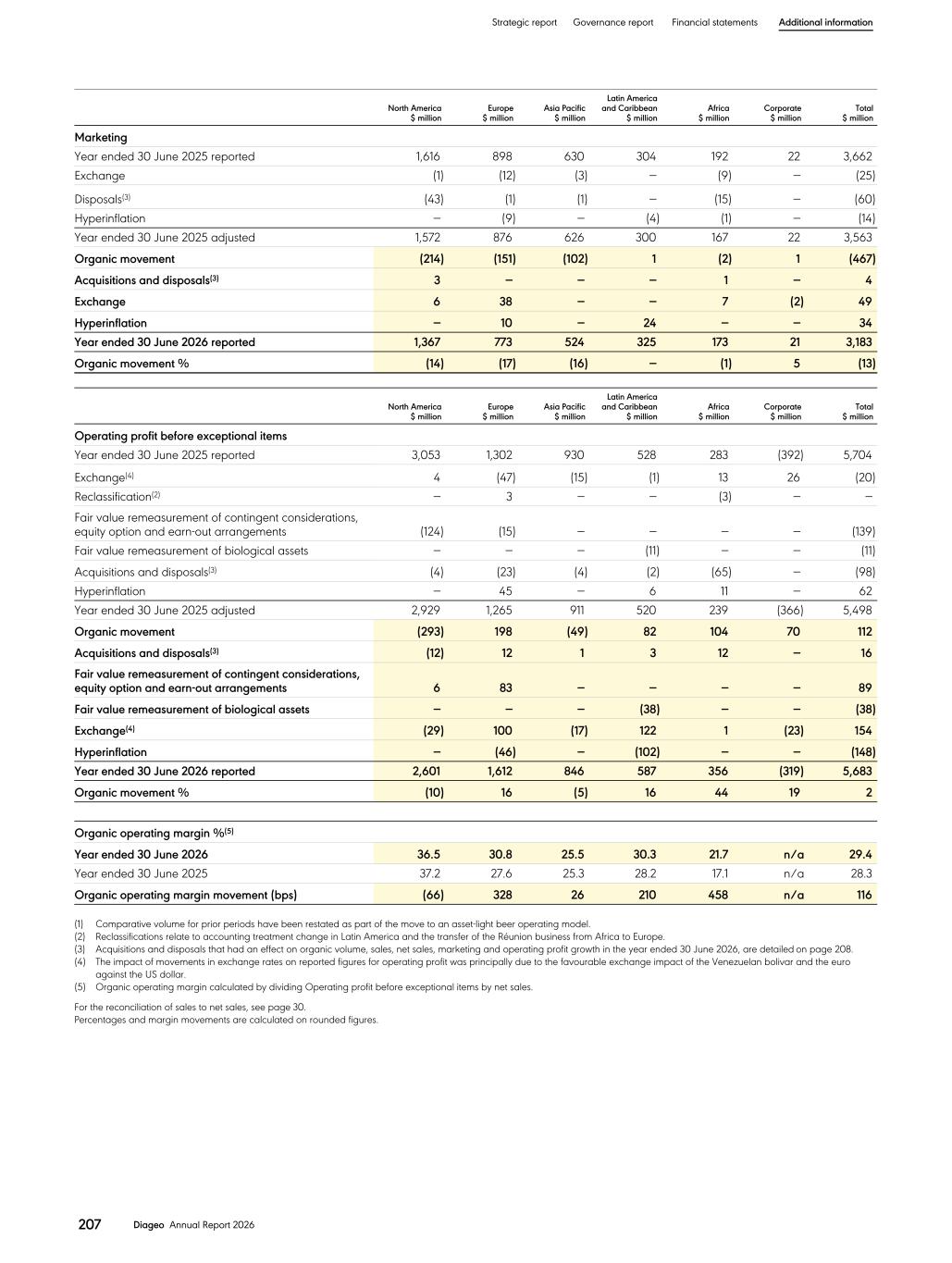
Marketing Year ended 30 June 2025 reported 1,616 898 630 304 192 22 3,662 Exchange (1) (12) (3) — (9) — (25) Disposals(3) (43) (1) (1) — (15) — (60) Hyperinflation — (9) — (4) (1) — (14) Year ended 30 June 2025 adjusted 1,572 876 626 300 167 22 3,563 Organic movement (214) (151) (102) 1 (2) 1 (467) Acquisitions and disposals(3) 3 — — — 1 — 4 Exchange 6 38 — — 7 (2) 49 Hyperinflation — 10 — 24 — — 34 Year ended 30 June 2026 reported 1,367 773 524 325 173 21 3,183 Organic movement % (14) (17) (16) — (1) 5 (13) North America $ million Europe $ million Asia Pacific $ million Latin America and Caribbean $ million Africa $ million Corporate $ million Total $ million Operating profit before exceptional items Year ended 30 June 2025 reported 3,053 1,302 930 528 283 (392) 5,704 Exchange(4) 4 (47) (15) (1) 13 26 (20) Reclassification(2) — 3 — — (3) — — Fair value remeasurement of contingent considerations, equity option and earn-out arrangements (124) (15) — — — — (139) Fair value remeasurement of biological assets — — — (11) — — (11) Acquisitions and disposals(3) (4) (23) (4) (2) (65) — (98) Hyperinflation — 45 — 6 11 — 62 Year ended 30 June 2025 adjusted 2,929 1,265 911 520 239 (366) 5,498 Organic movement (293) 198 (49) 82 104 70 112 Acquisitions and disposals(3) (12) 12 1 3 12 — 16 Fair value remeasurement of contingent considerations, equity option and earn-out arrangements 6 83 — — — — 89 Fair value remeasurement of biological assets — — — (38) — — (38) Exchange(4) (29) 100 (17) 122 1 (23) 154 Hyperinflation — (46) — (102) — — (148) Year ended 30 June 2026 reported 2,601 1,612 846 587 356 (319) 5,683 Organic movement % (10) 16 (5) 16 44 19 2 Organic operating margin %(5) Year ended 30 June 2026 36.5 30.8 25.5 30.3 21.7 n/a 29.4 Year ended 30 June 2025 37.2 27.6 25.3 28.2 17.1 n/a 28.3 Organic operating margin movement (bps) (66) 328 26 210 458 n/a 116 North America $ million Europe $ million Asia Pacific $ million Latin America and Caribbean $ million Africa $ million Corporate $ million Total $ million (1) Comparative volume for prior periods have been restated as part of the move to an asset-light beer operating model. (2) Reclassifications relate to accounting treatment change in Latin America and the transfer of the Réunion business from Africa to Europe. (3) Acquisitions and disposals that had an effect on organic volume, sales, net sales, marketing and operating profit growth in the year ended 30 June 2026, are detailed on page 208. (4) The impact of movements in exchange rates on reported figures for operating profit was principally due to the favourable exchange impact of the Venezuelan bolivar and the euro against the US dollar. (5) Organic operating margin calculated by dividing Operating profit before exceptional items by net sales. For the reconciliation of sales to net sales, see page 30. Percentages and margin movements are calculated on rounded figures. Strategic report Governance report Financial statements Additional information 207 Diageo Annual Report 2026
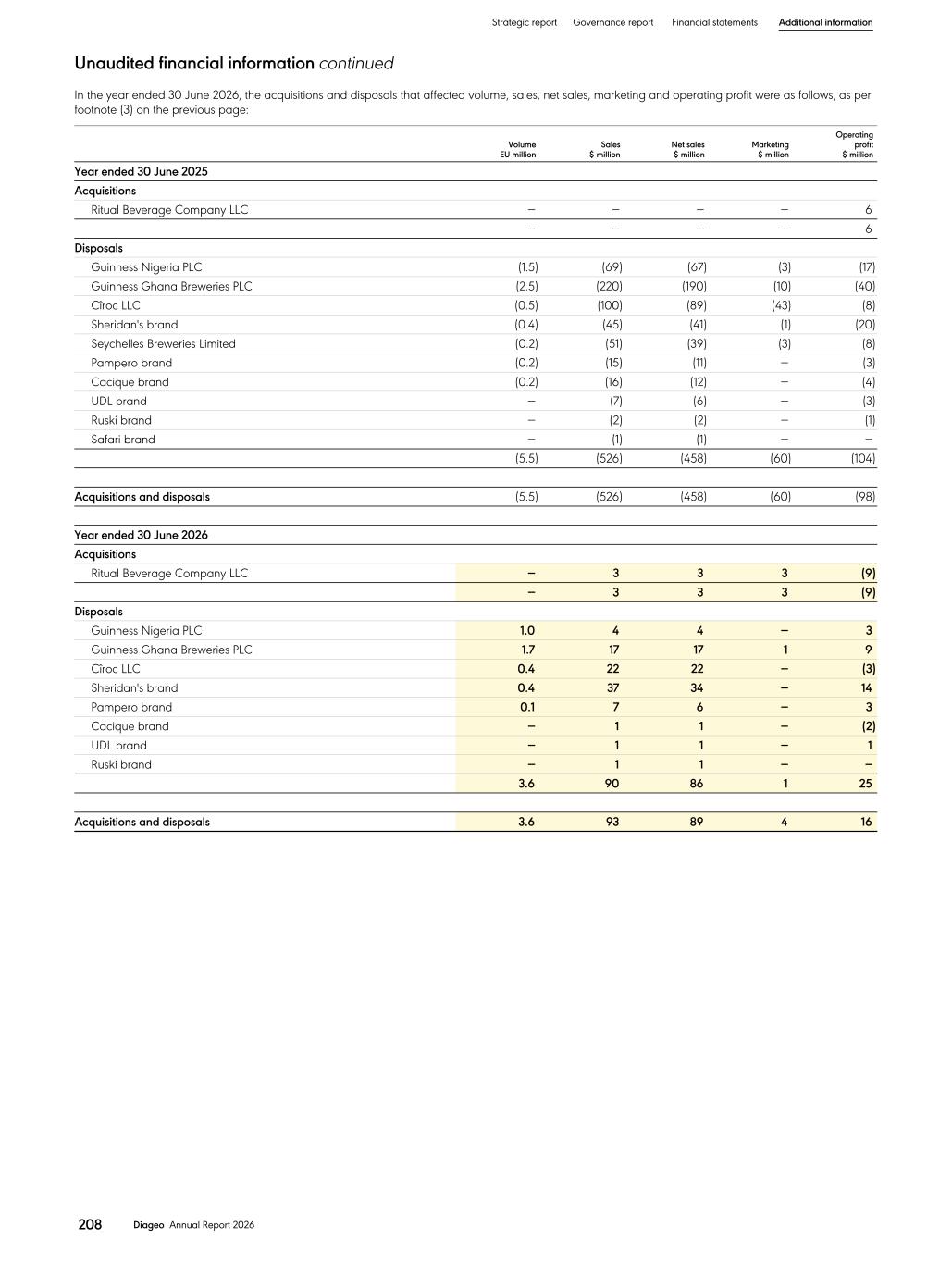
In the year ended 30 June 2026, the acquisitions and disposals that affected volume, sales, net sales, marketing and operating profit were as follows, as per footnote (3) on the previous page: Year ended 30 June 2025 Acquisitions Ritual Beverage Company LLC — — — — 6 — — — — 6 Disposals Guinness Nigeria PLC (1.5) (69) (67) (3) (17) Guinness Ghana Breweries PLC (2.5) (220) (190) (10) (40) Cîroc LLC (0.5) (100) (89) (43) (8) Sheridan's brand (0.4) (45) (41) (1) (20) Seychelles Breweries Limited (0.2) (51) (39) (3) (8) Pampero brand (0.2) (15) (11) — (3) Cacique brand (0.2) (16) (12) — (4) UDL brand — (7) (6) — (3) Ruski brand — (2) (2) — (1) Safari brand — (1) (1) — — (5.5) (526) (458) (60) (104) Acquisitions and disposals (5.5) (526) (458) (60) (98) Year ended 30 June 2026 Acquisitions Ritual Beverage Company LLC — 3 3 3 (9) — 3 3 3 (9) Disposals Guinness Nigeria PLC 1.0 4 4 — 3 Guinness Ghana Breweries PLC 1.7 17 17 1 9 Cîroc LLC 0.4 22 22 — (3) Sheridan's brand 0.4 37 34 — 14 Pampero brand 0.1 7 6 — 3 Cacique brand — 1 1 — (2) UDL brand — 1 1 — 1 Ruski brand — 1 1 — — 3.6 90 86 1 25 Acquisitions and disposals 3.6 93 89 4 16 Volume EU million Sales $ million Net sales $ million Marketing $ million Operating profit $ million Strategic report Governance report Financial statements Additional information Unaudited financial information continued 208 Diageo Annual Report 2026
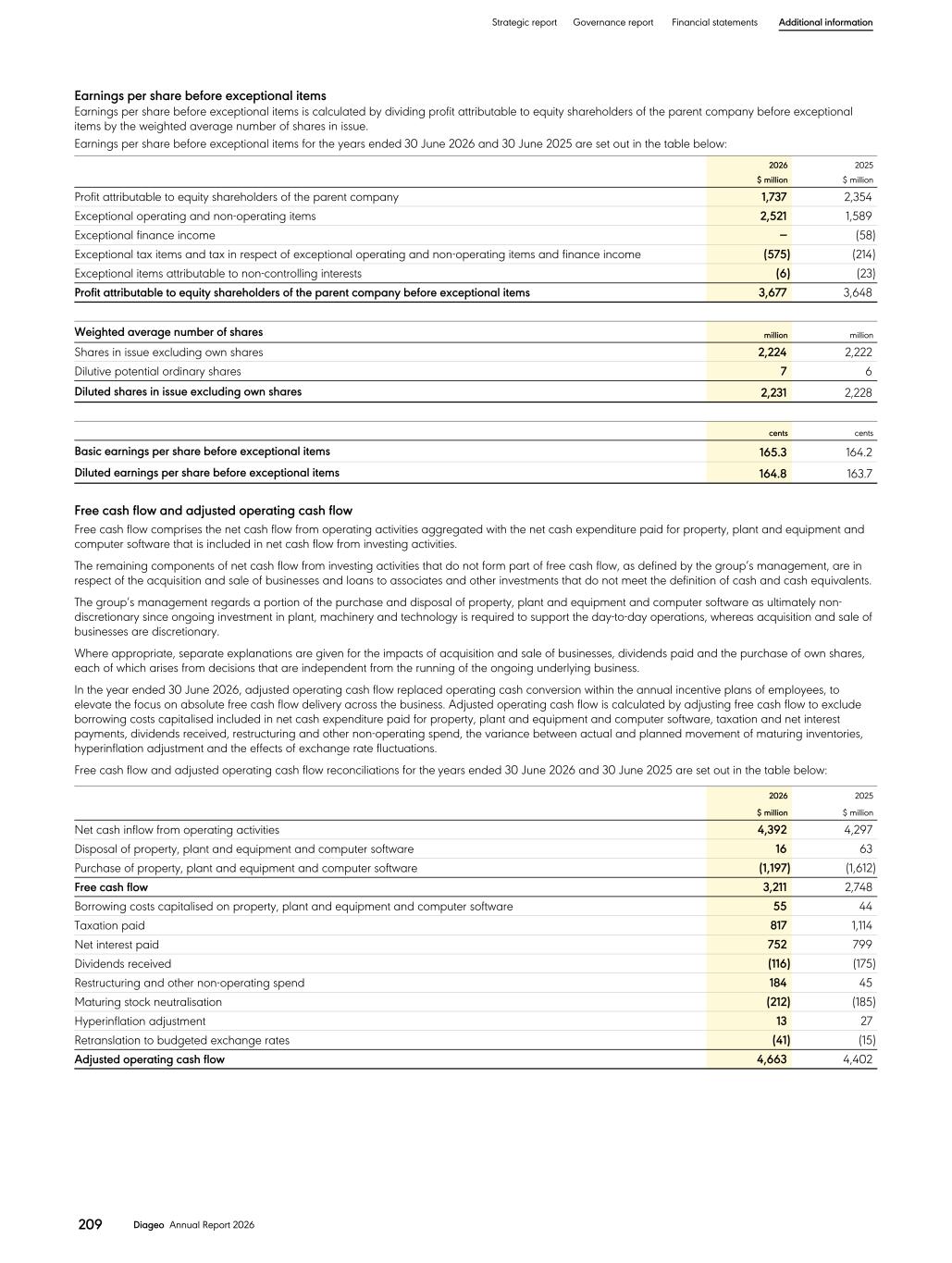
Earnings per share before exceptional items Earnings per share before exceptional items is calculated by dividing profit attributable to equity shareholders of the parent company before exceptional items by the weighted average number of shares in issue. Earnings per share before exceptional items for the years ended 30 June 2026 and 30 June 2025 are set out in the table below: Profit attributable to equity shareholders of the parent company 1,737 2,354 Exceptional operating and non-operating items 2,521 1,589 Exceptional finance income — (58) Exceptional tax items and tax in respect of exceptional operating and non-operating items and finance income (575) (214) Exceptional items attributable to non-controlling interests (6) (23) Profit attributable to equity shareholders of the parent company before exceptional items 3,677 3,648 Weighted average number of shares million million Shares in issue excluding own shares 2,224 2,222 Dilutive potential ordinary shares 7 6 Diluted shares in issue excluding own shares 2,231 2,228 cents cents Basic earnings per share before exceptional items 165.3 164.2 Diluted earnings per share before exceptional items 164.8 163.7 2026 2025 $ million $ million Free cash flow and adjusted operating cash flow Free cash flow comprises the net cash flow from operating activities aggregated with the net cash expenditure paid for property, plant and equipment and computer software that is included in net cash flow from investing activities. The remaining components of net cash flow from investing activities that do not form part of free cash flow, as defined by the group’s management, are in respect of the acquisition and sale of businesses and loans to associates and other investments that do not meet the definition of cash and cash equivalents. The group’s management regards a portion of the purchase and disposal of property, plant and equipment and computer software as ultimately non- discretionary since ongoing investment in plant, machinery and technology is required to support the day-to-day operations, whereas acquisition and sale of businesses are discretionary. Where appropriate, separate explanations are given for the impacts of acquisition and sale of businesses, dividends paid and the purchase of own shares, each of which arises from decisions that are independent from the running of the ongoing underlying business. In the year ended 30 June 2026, adjusted operating cash flow replaced operating cash conversion within the annual incentive plans of employees, to elevate the focus on absolute free cash flow delivery across the business. Adjusted operating cash flow is calculated by adjusting free cash flow to exclude borrowing costs capitalised included in net cash expenditure paid for property, plant and equipment and computer software, taxation and net interest payments, dividends received, restructuring and other non-operating spend, the variance between actual and planned movement of maturing inventories, hyperinflation adjustment and the effects of exchange rate fluctuations. Free cash flow and adjusted operating cash flow reconciliations for the years ended 30 June 2026 and 30 June 2025 are set out in the table below: 2026 2025 $ million $ million Net cash inflow from operating activities 4,392 4,297 Disposal of property, plant and equipment and computer software 16 63 Purchase of property, plant and equipment and computer software (1,197) (1,612) Free cash flow 3,211 2,748 Borrowing costs capitalised on property, plant and equipment and computer software 55 44 Taxation paid 817 1,114 Net interest paid 752 799 Dividends received (116) (175) Restructuring and other non-operating spend 184 45 Maturing stock neutralisation (212) (185) Hyperinflation adjustment 13 27 Retranslation to budgeted exchange rates (41) (15) Adjusted operating cash flow 4,663 4,402 Strategic report Governance report Financial statements Additional information 209 Diageo Annual Report 2026
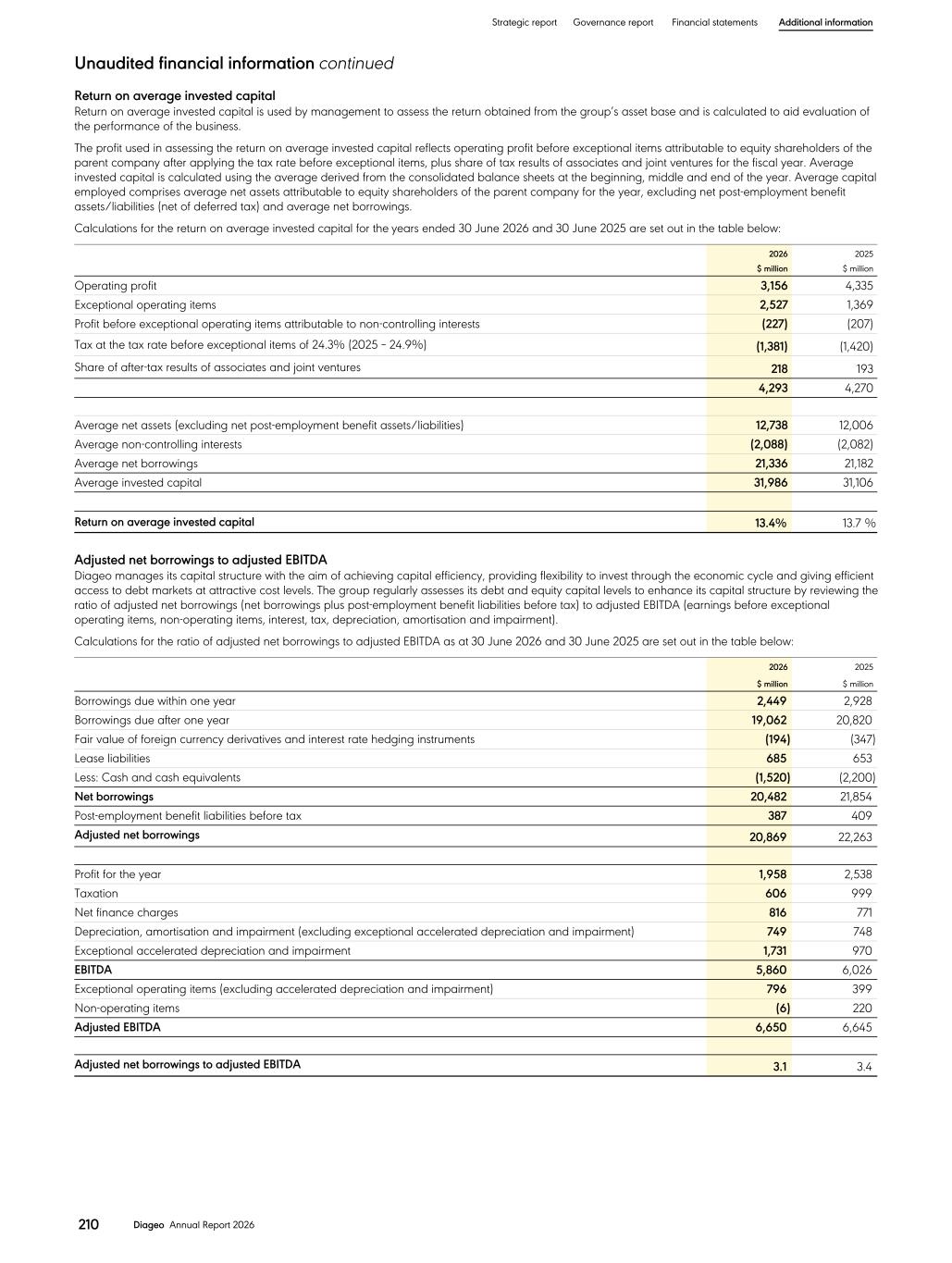
Return on average invested capital Return on average invested capital is used by management to assess the return obtained from the group’s asset base and is calculated to aid evaluation of the performance of the business. The profit used in assessing the return on average invested capital reflects operating profit before exceptional items attributable to equity shareholders of the parent company after applying the tax rate before exceptional items, plus share of tax results of associates and joint ventures for the fiscal year. Average invested capital is calculated using the average derived from the consolidated balance sheets at the beginning, middle and end of the year. Average capital employed comprises average net assets attributable to equity shareholders of the parent company for the year, excluding net post-employment benefit assets/liabilities (net of deferred tax) and average net borrowings. Calculations for the return on average invested capital for the years ended 30 June 2026 and 30 June 2025 are set out in the table below: Operating profit 3,156 4,335 Exceptional operating items 2,527 1,369 Profit before exceptional operating items attributable to non-controlling interests (227) (207) Tax at the tax rate before exceptional items of 24.3% (2025 – 24.9%) (1,381) (1,420) Share of after-tax results of associates and joint ventures 218 193 4,293 4,270 Average net assets (excluding net post-employment benefit assets/liabilities) 12,738 12,006 Average non-controlling interests (2,088) (2,082) Average net borrowings 21,336 21,182 Average invested capital 31,986 31,106 Return on average invested capital 13.4% 13.7 % 2026 2025 $ million $ million Adjusted net borrowings to adjusted EBITDA Diageo manages its capital structure with the aim of achieving capital efficiency, providing flexibility to invest through the economic cycle and giving efficient access to debt markets at attractive cost levels. The group regularly assesses its debt and equity capital levels to enhance its capital structure by reviewing the ratio of adjusted net borrowings (net borrowings plus post-employment benefit liabilities before tax) to adjusted EBITDA (earnings before exceptional operating items, non-operating items, interest, tax, depreciation, amortisation and impairment). Calculations for the ratio of adjusted net borrowings to adjusted EBITDA as at 30 June 2026 and 30 June 2025 are set out in the table below: Borrowings due within one year 2,449 2,928 Borrowings due after one year 19,062 20,820 Fair value of foreign currency derivatives and interest rate hedging instruments (194) (347) Lease liabilities 685 653 Less: Cash and cash equivalents (1,520) (2,200) Net borrowings 20,482 21,854 Post-employment benefit liabilities before tax 387 409 Adjusted net borrowings 20,869 22,263 Profit for the year 1,958 2,538 Taxation 606 999 Net finance charges 816 771 Depreciation, amortisation and impairment (excluding exceptional accelerated depreciation and impairment) 749 748 Exceptional accelerated depreciation and impairment 1,731 970 EBITDA 5,860 6,026 Exceptional operating items (excluding accelerated depreciation and impairment) 796 399 Non-operating items (6) 220 Adjusted EBITDA 6,650 6,645 Adjusted net borrowings to adjusted EBITDA 3.1 3.4 2026 2025 $ million $ million Strategic report Governance report Financial statements Additional information Unaudited financial information continued 210 Diageo Annual Report 2026
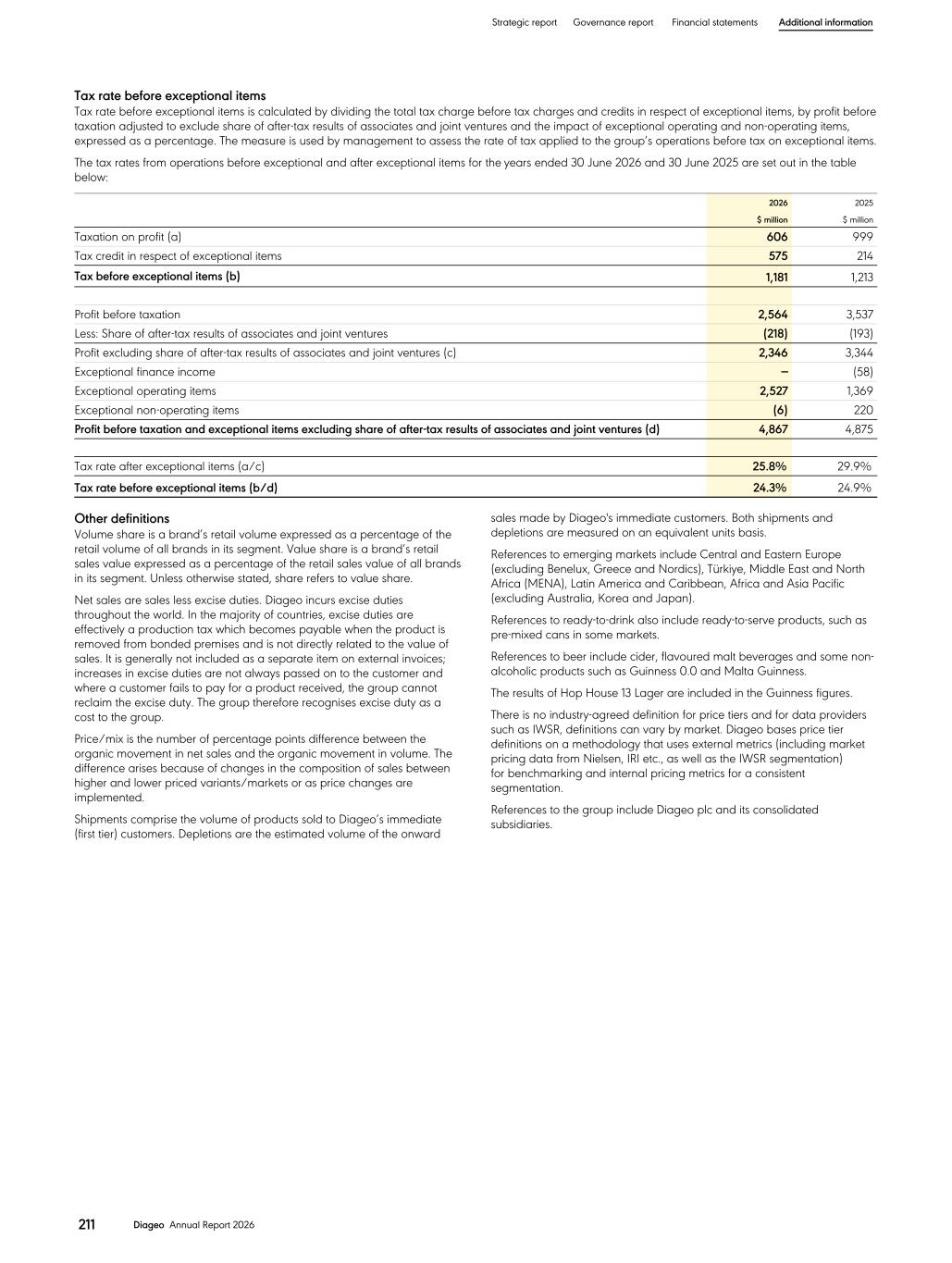
Tax rate before exceptional items Tax rate before exceptional items is calculated by dividing the total tax charge before tax charges and credits in respect of exceptional items, by profit before taxation adjusted to exclude share of after-tax results of associates and joint ventures and the impact of exceptional operating and non-operating items, expressed as a percentage. The measure is used by management to assess the rate of tax applied to the group’s operations before tax on exceptional items. The tax rates from operations before exceptional and after exceptional items for the years ended 30 June 2026 and 30 June 2025 are set out in the table below: Taxation on profit (a) 606 999 Tax credit in respect of exceptional items 575 214 Tax before exceptional items (b) 1,181 1,213 Profit before taxation 2,564 3,537 Less: Share of after-tax results of associates and joint ventures (218) (193) Profit excluding share of after-tax results of associates and joint ventures (c) 2,346 3,344 Exceptional finance income — (58) Exceptional operating items 2,527 1,369 Exceptional non-operating items (6) 220 Profit before taxation and exceptional items excluding share of after-tax results of associates and joint ventures (d) 4,867 4,875 Tax rate after exceptional items (a/c) 25.8% 29.9% Tax rate before exceptional items (b/d) 24.3% 24.9% 2026 2025 $ million $ million Other definitions Volume share is a brand’s retail volume expressed as a percentage of the retail volume of all brands in its segment. Value share is a brand’s retail sales value expressed as a percentage of the retail sales value of all brands in its segment. Unless otherwise stated, share refers to value share. Net sales are sales less excise duties. Diageo incurs excise duties throughout the world. In the majority of countries, excise duties are effectively a production tax which becomes payable when the product is removed from bonded premises and is not directly related to the value of sales. It is generally not included as a separate item on external invoices; increases in excise duties are not always passed on to the customer and where a customer fails to pay for a product received, the group cannot reclaim the excise duty. The group therefore recognises excise duty as a cost to the group. Price/mix is the number of percentage points difference between the organic movement in net sales and the organic movement in volume. The difference arises because of changes in the composition of sales between higher and lower priced variants/markets or as price changes are implemented. Shipments comprise the volume of products sold to Diageo’s immediate (first tier) customers. Depletions are the estimated volume of the onward sales made by Diageo's immediate customers. Both shipments and depletions are measured on an equivalent units basis. References to emerging markets include Central and Eastern Europe (excluding Benelux, Greece and Nordics), Türkiye, Middle East and North Africa (MENA), Latin America and Caribbean, Africa and Asia Pacific (excluding Australia, Korea and Japan). References to ready-to-drink also include ready-to-serve products, such as pre-mixed cans in some markets. References to beer include cider, flavoured malt beverages and some non- alcoholic products such as Guinness 0.0 and Malta Guinness. The results of Hop House 13 Lager are included in the Guinness figures. There is no industry-agreed definition for price tiers and for data providers such as IWSR, definitions can vary by market. Diageo bases price tier definitions on a methodology that uses external metrics (including market pricing data from Nielsen, IRI etc., as well as the IWSR segmentation) for benchmarking and internal pricing metrics for a consistent segmentation. References to the group include Diageo plc and its consolidated subsidiaries. Strategic report Governance report Financial statements Additional information 211 Diageo Annual Report 2026
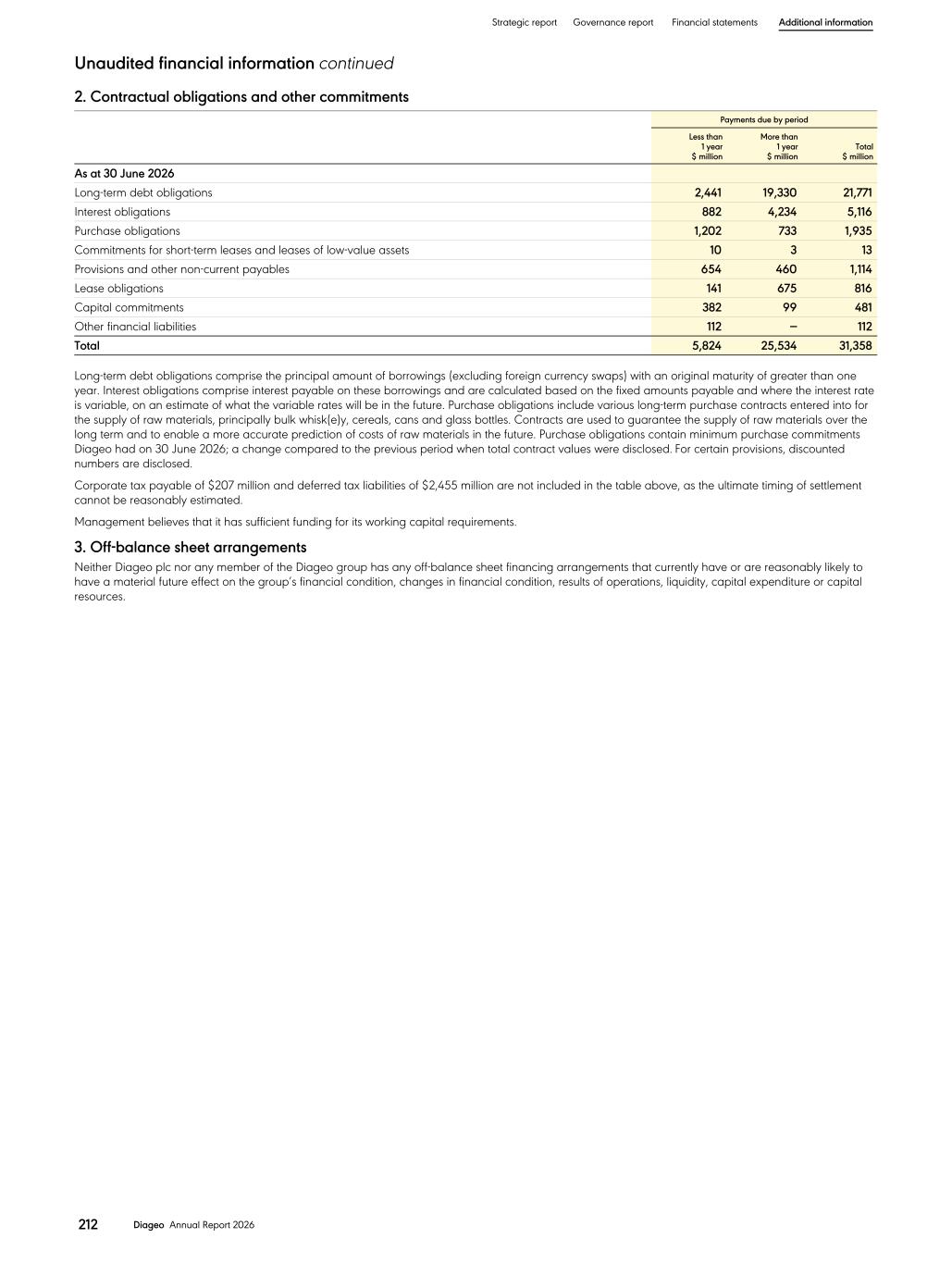
2. Contractual obligations and other commitments As at 30 June 2026 Long-term debt obligations 2,441 19,330 21,771 Interest obligations 882 4,234 5,116 Purchase obligations 1,202 733 1,935 Commitments for short-term leases and leases of low-value assets 10 3 13 Provisions and other non-current payables 654 460 1,114 Lease obligations 141 675 816 Capital commitments 382 99 481 Other financial liabilities 112 — 112 Total 5,824 25,534 31,358 Payments due by period Less than 1 year $ million More than 1 year $ million Total $ million Long-term debt obligations comprise the principal amount of borrowings (excluding foreign currency swaps) with an original maturity of greater than one year. Interest obligations comprise interest payable on these borrowings and are calculated based on the fixed amounts payable and where the interest rate is variable, on an estimate of what the variable rates will be in the future. Purchase obligations include various long-term purchase contracts entered into for the supply of raw materials, principally bulk whisk(e)y, cereals, cans and glass bottles. Contracts are used to guarantee the supply of raw materials over the long term and to enable a more accurate prediction of costs of raw materials in the future. Purchase obligations contain minimum purchase commitments Diageo had on 30 June 2026; a change compared to the previous period when total contract values were disclosed. For certain provisions, discounted numbers are disclosed. Corporate tax payable of $207 million and deferred tax liabilities of $2,455 million are not included in the table above, as the ultimate timing of settlement cannot be reasonably estimated. Management believes that it has sufficient funding for its working capital requirements. 3. Off-balance sheet arrangements Neither Diageo plc nor any member of the Diageo group has any off-balance sheet financing arrangements that currently have or are reasonably likely to have a material future effect on the group’s financial condition, changes in financial condition, results of operations, liquidity, capital expenditure or capital resources. Strategic report Governance report Financial statements Additional information Unaudited financial information continued 212 Diageo Annual Report 2026
This document contains 'forward-looking' statements. These statements can be identified by the fact that they do not relate only to historical or current facts and may generally, but not always, be identified by the use of words such as 'will', 'anticipates', 'should', 'could', 'would', 'targets', 'aims', 'may', 'expects', 'intends' or similar expressions statements. In this document, such statements include those that express forecasts, expectations, plans, outlook, objectives and projections with respect to future matters, including information related to Diageo’s fiscal 27 outlook, Diageo’s medium-term guidance, Diageo’s Accelerate programme, the impact of tariffs and any other statements relating to Diageo’s performance for the year ending 30 June 2027 or thereafter. Forward-looking statements involve risk and uncertainty because they relate to events and depend on circumstances that will occur in the future. There are a number of factors that could cause actual results and developments to differ materially from those expressed or implied by these forward-looking statements, including factors that are outside Diageo's control, which include (but are not limited to): (i) economic, political, social or other developments in countries and markets in which Diageo operates, including geopolitical instability as a result of Russia's invasion of Ukraine and the conflicts in the Middle East and macroeconomic events that may affect Diageo’s customers, suppliers and/or financial counterparties; (ii) the effects of climate change, or legal, regulatory or market measures intended to address climate change; (iii) changes in consumer preferences and tastes, including as a result of disruptive market forces, changes in demographics and evolving social trends (including any shifts in consumer tastes towards at-home occasions, premiumisation, small-batch craft alcohol, lower or non-alcoholic products or THC and hemp-based THC beverages, increased use of GLP-1 medications, and/or developments in e- commerce); (iv) changes in the domestic and international tax environment that could lead to uncertainty around the application of existing and new tax laws and unexpected tax exposures; (v) changes in the cost of production, including as a result of increases in the cost of commodities, labour and/or energy due to inflation and/or supply chain disruptions; (vi) any litigation or other similar proceedings (including with tax, customs, competition, environmental, anti-corruption or other regulatory authorities); (vii) legal and regulatory developments, including changes in regulations relating to environmental issues and/or e-commerce; (viii) the consequences of any failure of internal controls; (ix) the consequences of any failure by Diageo or its associates to comply with anti-corruption, sanctions, trade restrictions or similar laws and regulations, or any failure of Diageo’s related internal policies and procedures to comply with applicable law or regulation; (x) Diageo’s ability to make sufficient progress against or achieve its ESG ambitions; (xi) cyber-attacks and IT threats or any other disruptions to core business operations; (xii) contamination, counterfeiting or other circumstances which could harm the level of customer support for Diageo’s brands and adversely impact its sales; (xiii) Diageo’s ability to maintain its brand image and corporate reputation or to adapt to a changing media environment; (xiv) fluctuations in exchange rates and/or interest rates; (xv) Diageo’s ability to successfully execute its strategic business transformation projects; (xvi) Diageo’s ability to derive the expected benefits from its business strategies, including the implementation of competitive category strategies, investments in joint ventures, productivity initiatives or inventory forecasting; (xvii) Diageo's ability to consistently deliver value, service performance, commercial execution and suitable portfolio choices to its customers; (xviii) increased competitive product and pricing pressures, including as a result of introductions of new products or categories that compete with Diageo’s products and consolidations by competitors and retailers; (xix) increased costs for, or shortages of, talent, as well as labour strikes or disputes; (xx) movements in the value of the assets and liabilities related to Diageo’s pension plans; (xxi) Diageo’s ability to renew supply, distribution, manufacturing or licence agreements (or related rights) and licences on favourable terms, or at all, when they expire; or (xxii) any failure by Diageo to protect its intellectual property rights. In preparing the ESG-related information contained in this document, Diageo has made a number of key judgements, estimations and assumptions and the processes and issues involved are complex. The ESG- related forward-looking statements should be treated with special caution, as ESG and climate data, models and methodologies are often relatively new, are rapidly evolving and are not of the same standard as those available in the context of other financial information, nor are they subject to the same or equivalent disclosure standards, historical reference points, benchmarks, market consensus or globally accepted accounting principles. In particular, it is not possible to rely on historical data as a strong indicator of future trajectories in the case of climate change and its evolution. Outputs of models, processed data and methodologies are also likely to be affected by underlying data quality, which can be hard to assess and we expect industry guidance, market practice, and regulations in this field to continue to change. There are also challenges faced in relation to the ability to access data on a timely basis and the lack of consistency and comparability between data that is available. This means the ESG-related forward-looking statements and ESG metrics discussed in this document carry an additional degree of inherent risk and uncertainty, and therefore, our actual results and developments could differ materially from those expressed or implied by the ESG-related forward-looking statements in this document. In light of the uncertainty as to the nature of future policy and market responses to climate change, including between regions, and the effectiveness of any such responses, Diageo may have to re-evaluate its progress and adapt its approach towards its ESG ambitions, commitments and targets in the future, update the methodologies it uses or alter its approach to ESG and climate analysis and may be required to amend, update and recalculate its ESG disclosures and assessments in the future, as market practice and data quality and availability develop rapidly. All oral and written forward-looking statements made on or after the date of this document and attributable to Diageo are expressly qualified in their entirety by the cautionary statements contained or referred to in this section. Further details of potential risks and uncertainties affecting Diageo are described in our filings with the London Stock Exchange and the US Securities and Exchange Commission (SEC), including in our Annual Report on Form 20-F for the year ended 30 June 2026. Any forward-looking statements made by or on behalf of Diageo speak only as of the date they are made. Diageo expressly disclaims any obligation or undertaking to publicly update or revise these forward-looking statements other than as required by applicable law. The reader should, however, consult any additional disclosures that Diageo may make in any documents which it publishes and/or files with the SEC. All readers, wherever located, should take note of these disclosures. This document includes names of Diageo’s products, which constitute trademarks or trade names which Diageo owns, or which others own and license to Diageo for use. All rights reserved. © Diageo plc 2026. The information in this document does not constitute an offer to sell or an invitation to buy shares in Diageo plc or an invitation or inducement to engage in any other investment activities. This document may include information about Diageo’s target debt rating. A security rating is not a recommendation to buy, sell or hold securities and may be subject to revision or withdrawal at any time by the assigning rating organisation. Each rating should be evaluated independently of any other rating. Past performance cannot be relied upon as a guide to future performance. References in this document to information on websites are included as an aid to their location and such information is not incorporated in, and does not form part of, this document unless otherwise noted. Strategic report Governance report Financial statements Additional information 213 Diageo Annual Report 2026 Cautionary statement concerning forward-looking statements
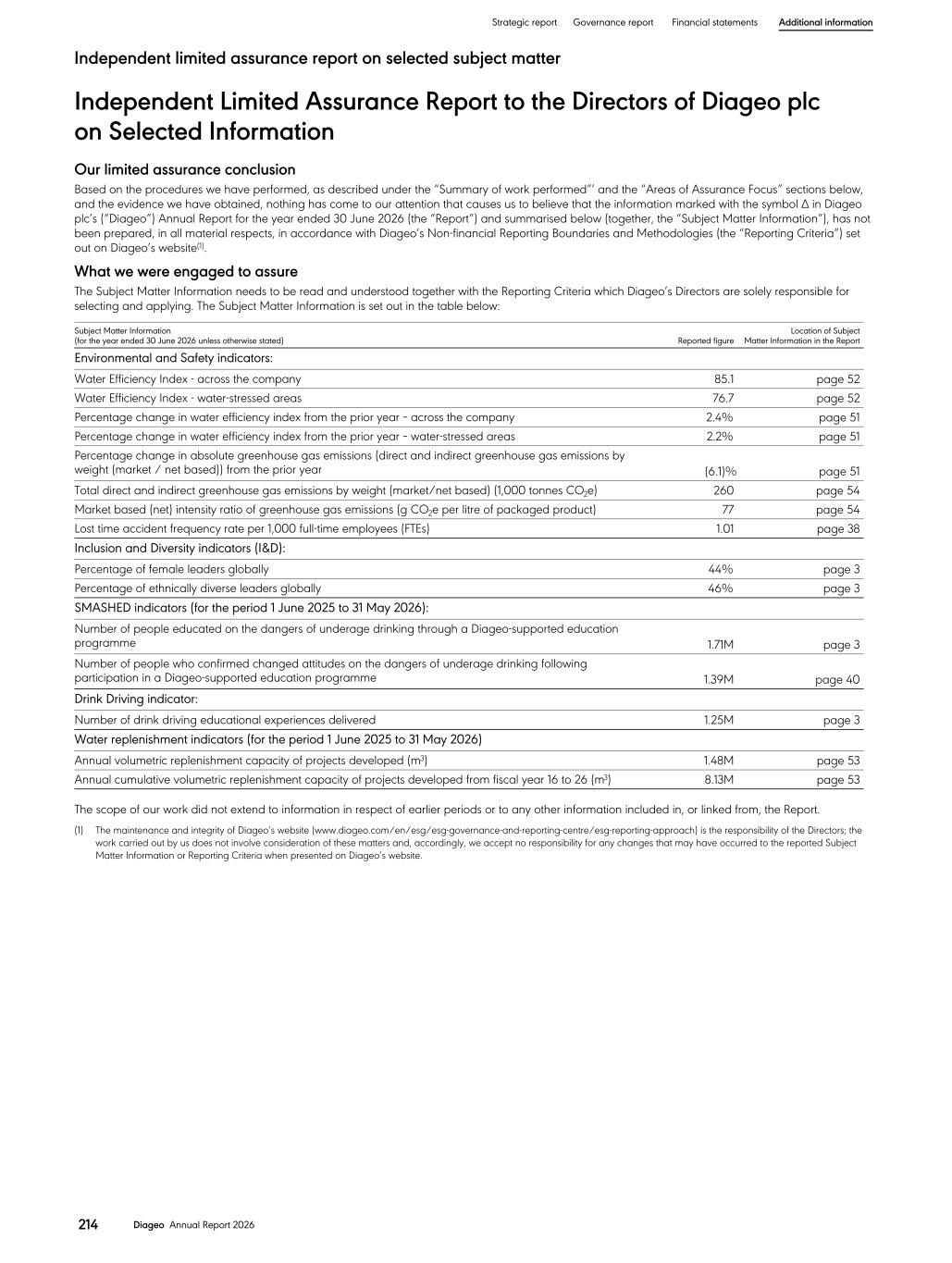
Independent Limited Assurance Report to the Directors of Diageo plc on Selected Information Our limited assurance conclusion Based on the procedures we have performed, as described under the “Summary of work performed”’ and the “Areas of Assurance Focus” sections below, and the evidence we have obtained, nothing has come to our attention that causes us to believe that the information marked with the symbol Δ in Diageo plc’s (“Diageo”) Annual Report for the year ended 30 June 2026 (the “Report”) and summarised below (together, the “Subject Matter Information”), has not been prepared, in all material respects, in accordance with Diageo’s Non-financial Reporting Boundaries and Methodologies (the “Reporting Criteria”) set out on Diageo’s website(1). What we were engaged to assure The Subject Matter Information needs to be read and understood together with the Reporting Criteria which Diageo’s Directors are solely responsible for selecting and applying. The Subject Matter Information is set out in the table below: Environmental and Safety indicators: Water Efficiency Index - across the company 85.1 page 52 Water Efficiency Index - water-stressed areas 76.7 page 52 Percentage change in water efficiency index from the prior year – across the company 2.4% page 51 Percentage change in water efficiency index from the prior year – water-stressed areas 2.2% page 51 Percentage change in absolute greenhouse gas emissions (direct and indirect greenhouse gas emissions by weight (market / net based)) from the prior year (6.1) % page 51 Total direct and indirect greenhouse gas emissions by weight (market/net based) (1,000 tonnes CO2e) 260 page 54 Market based (net) intensity ratio of greenhouse gas emissions (g CO2e per litre of packaged product) 77 page 54 Lost time accident frequency rate per 1,000 full-time employees (FTEs) 1.01 page 38 Inclusion and Diversity indicators (I&D): Percentage of female leaders globally 44% page 3 Percentage of ethnically diverse leaders globally 46% page 3 SMASHED indicators (for the period 1 June 2025 to 31 May 2026): Number of people educated on the dangers of underage drinking through a Diageo-supported education programme 1.71M page 3 Number of people who confirmed changed attitudes on the dangers of underage drinking following participation in a Diageo-supported education programme 1.39M page 40 Drink Driving indicator: Number of drink driving educational experiences delivered 1.25M page 3 Water replenishment indicators (for the period 1 June 2025 to 31 May 2026) Annual volumetric replenishment capacity of projects developed (m3) 1.48M page 53 Annual cumulative volumetric replenishment capacity of projects developed from fiscal year 16 to 26 (m3) 8.13M page 53 Subject Matter Information (for the year ended 30 June 2026 unless otherwise stated) Reported figure Location of Subject Matter Information in the Report The scope of our work did not extend to information in respect of earlier periods or to any other information included in, or linked from, the Report. (1) The maintenance and integrity of Diageo’s website (www.diageo.com/en/esg/esg-governance-and-reporting-centre/esg-reporting-approach) is the responsibility of the Directors; the work carried out by us does not involve consideration of these matters and, accordingly, we accept no responsibility for any changes that may have occurred to the reported Subject Matter Information or Reporting Criteria when presented on Diageo’s website. Strategic report Governance report Financial statements Additional information 214 Diageo Annual Report 2026 Independent limited assurance report on selected subject matter
Our work Professional standards applied We performed a limited assurance engagement in accordance with International Standard on Assurance Engagements 3000 (Revised) ‘Assurance Engagements other than Audits or Reviews of Historical Financial Information’ and, in respect of the greenhouse gas (GHG) emissions, in accordance with International Standard on Assurance Engagements 3410 ‘Assurance Engagements on Greenhouse Gas Statements’, issued by the International Auditing and Assurance Standards Board. Our independence and quality control We have complied with the Institute of Chartered Accountants in England and Wales Code of Ethics, which includes independence and other requirements founded on fundamental principles of integrity, objectivity, professional competence and due care, confidentiality and professional behaviour, that are at least as demanding as the applicable provisions of the International Code of Ethics for Professional Accountants (including International Independence Standards) issued by the International Ethics Standards Board for Accountants (IESBA Code). We apply International Standard on Quality Management (UK) 1 and accordingly maintain a comprehensive system of quality management including documented policies and procedures regarding compliance with ethical requirements, professional standards and applicable legal and regulatory requirements. Summary of work performed We performed a limited assurance engagement. Because the level of assurance obtained in a limited assurance can vary, we give more detail about the procedures performed, so that the intended users of the Subject Matter Information can understand the nature, timing and extent of procedures we performed as context for our conclusion. These procedures performed vary in nature and timing from, and are less in extent than for, a reasonable assurance engagement. Consequently, the level of assurance obtained in a limited assurance engagement is substantially lower than the assurance that would have been obtained had a reasonable assurance engagement been performed. In performing our assurance procedures, which were based on our professional judgement, we performed the following: • evaluated the suitability in the circumstances of Diageo’s use of the Reporting Criteria as the basis for preparing the Subject Matter Information including the associated reporting boundaries; • through enquiries, obtained an understanding of Diageo’s control environment, processes and systems relevant to the preparation of the Subject Matter Information. Our procedures did not include evaluating the suitability of design, obtaining evidence about their implementation or testing operating effectiveness of particular control activities; • evaluated whether Diageo’s methods for developing certain estimates are reasonable and have been consistently applied, noting that our procedures did not involve testing the data on which the estimates are based or separately developing our own estimates against which to evaluate Diageo’s estimates; • compared year on year movements and obtained explanations from management for significant movements we identified; • performed limited substantive testing of the Subject Matter Information. Testing included agreeing arithmetical accuracy of calculations and agreeing data points to or from source information; • specific to the environmental indicators, undertook site visits at five of Diageo’s operational sites to perform inspection and substantive analytical procedures, observe local records and agree data to local source information. We selected these sites based on their inherent risk and materiality to Diageo; and • evaluated the disclosures in, and overall presentation of, the Subject Matter Information. Materiality Our responsibility is to plan and perform an assurance engagement to obtain limited assurance about whether the Subject Matter Information is free from material misstatement, whether due to fraud or error, and to issue a limited assurance report that includes our conclusion. We set certain quantitative thresholds for materiality. These, together with qualitative considerations, helped us to determine the nature, timing and extent of our procedures in support of our conclusion. We believe that it is important that the intended users have the information they need to understand the concept and the level of materiality to place our conclusion in context. Based on our professional judgement, we determined materiality for the Subject Matter Information as follows: Overall materiality Materiality may differ depending upon the nature of the Subject Matter Information. We apply professional judgement to consider the most appropriate materiality benchmark for each aspect of the Subject Matter Information, having considered how the intended users may use the information. The benchmark approach for each aspect of the Subject Matter Information is 5% of the reported figure, whether the metrics are an absolute number, ratio, percentage or percentage change. We also agreed to report to the Directors misstatements (“reportable misstatements”) identified during our work at a level below overall materiality, as well as misstatements below that lower level that in our view warranted reporting for qualitative reasons. The Directors are responsible for deciding whether adjustments should be made to the Subject Matter Information in respect of those items. Strategic report Governance report Financial statements Additional information 215 Diageo Annual Report 2026
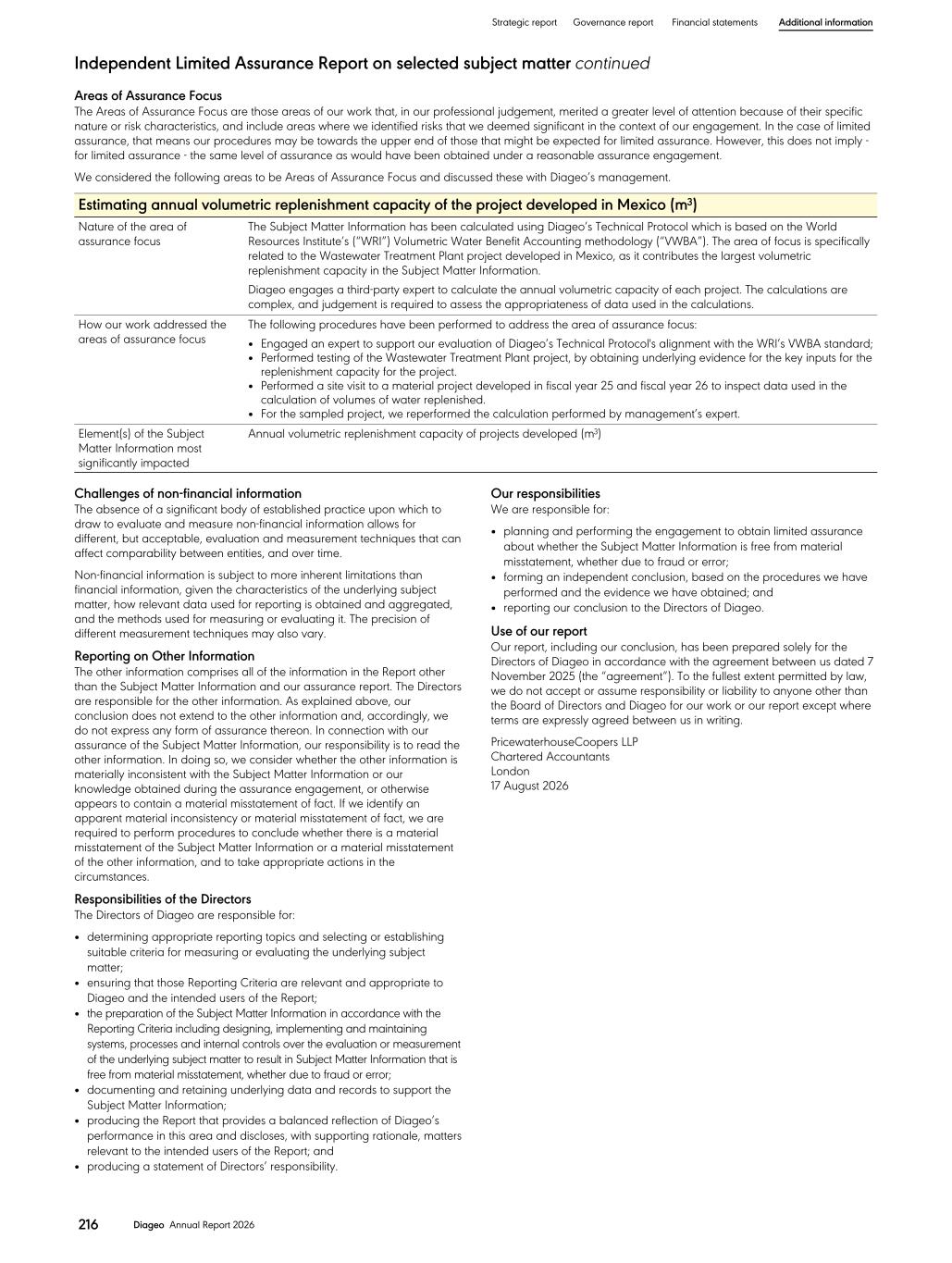
Areas of Assurance Focus The Areas of Assurance Focus are those areas of our work that, in our professional judgement, merited a greater level of attention because of their specific nature or risk characteristics, and include areas where we identified risks that we deemed significant in the context of our engagement. In the case of limited assurance, that means our procedures may be towards the upper end of those that might be expected for limited assurance. However, this does not imply - for limited assurance - the same level of assurance as would have been obtained under a reasonable assurance engagement. We considered the following areas to be Areas of Assurance Focus and discussed these with Diageo’s management. Estimating annual volumetric replenishment capacity of the project developed in Mexico (m3) Nature of the area of assurance focus The Subject Matter Information has been calculated using Diageo’s Technical Protocol which is based on the World Resources Institute’s (“WRI”) Volumetric Water Benefit Accounting methodology (“VWBA”). The area of focus is specifically related to the Wastewater Treatment Plant project developed in Mexico, as it contributes the largest volumetric replenishment capacity in the Subject Matter Information. Diageo engages a third-party expert to calculate the annual volumetric capacity of each project. The calculations are complex, and judgement is required to assess the appropriateness of data used in the calculations. How our work addressed the areas of assurance focus The following procedures have been performed to address the area of assurance focus: • Engaged an expert to support our evaluation of Diageo’s Technical Protocol's alignment with the WRI’s VWBA standard; • Performed testing of the Wastewater Treatment Plant project, by obtaining underlying evidence for the key inputs for the replenishment capacity for the project. • Performed a site visit to a material project developed in fiscal year 25 and fiscal year 26 to inspect data used in the calculation of volumes of water replenished. • For the sampled project, we reperformed the calculation performed by management’s expert. Element(s) of the Subject Matter Information most significantly impacted Annual volumetric replenishment capacity of projects developed (m3) Challenges of non-financial information The absence of a significant body of established practice upon which to draw to evaluate and measure non-financial information allows for different, but acceptable, evaluation and measurement techniques that can affect comparability between entities, and over time. Non-financial information is subject to more inherent limitations than financial information, given the characteristics of the underlying subject matter, how relevant data used for reporting is obtained and aggregated, and the methods used for measuring or evaluating it. The precision of different measurement techniques may also vary. Reporting on Other Information The other information comprises all of the information in the Report other than the Subject Matter Information and our assurance report. The Directors are responsible for the other information. As explained above, our conclusion does not extend to the other information and, accordingly, we do not express any form of assurance thereon. In connection with our assurance of the Subject Matter Information, our responsibility is to read the other information. In doing so, we consider whether the other information is materially inconsistent with the Subject Matter Information or our knowledge obtained during the assurance engagement, or otherwise appears to contain a material misstatement of fact. If we identify an apparent material inconsistency or material misstatement of fact, we are required to perform procedures to conclude whether there is a material misstatement of the Subject Matter Information or a material misstatement of the other information, and to take appropriate actions in the circumstances. Responsibilities of the Directors The Directors of Diageo are responsible for: • determining appropriate reporting topics and selecting or establishing suitable criteria for measuring or evaluating the underlying subject matter; • ensuring that those Reporting Criteria are relevant and appropriate to Diageo and the intended users of the Report; • the preparation of the Subject Matter Information in accordance with the Reporting Criteria including designing, implementing and maintaining systems, processes and internal controls over the evaluation or measurement of the underlying subject matter to result in Subject Matter Information that is free from material misstatement, whether due to fraud or error; • documenting and retaining underlying data and records to support the Subject Matter Information; • producing the Report that provides a balanced reflection of Diageo’s performance in this area and discloses, with supporting rationale, matters relevant to the intended users of the Report; and • producing a statement of Directors’ responsibility. Our responsibilities We are responsible for: • planning and performing the engagement to obtain limited assurance about whether the Subject Matter Information is free from material misstatement, whether due to fraud or error; • forming an independent conclusion, based on the procedures we have performed and the evidence we have obtained; and • reporting our conclusion to the Directors of Diageo. Use of our report Our report, including our conclusion, has been prepared solely for the Directors of Diageo in accordance with the agreement between us dated 7 November 2025 (the “agreement”). To the fullest extent permitted by law, we do not accept or assume responsibility or liability to anyone other than the Board of Directors and Diageo for our work or our report except where terms are expressly agreed between us in writing. PricewaterhouseCoopers LLP Chartered Accountants London 17 August 2026 Strategic report Governance report Financial statements Additional information Independent Limited Assurance Report on selected subject matter continued 216 Diageo Annual Report 2026
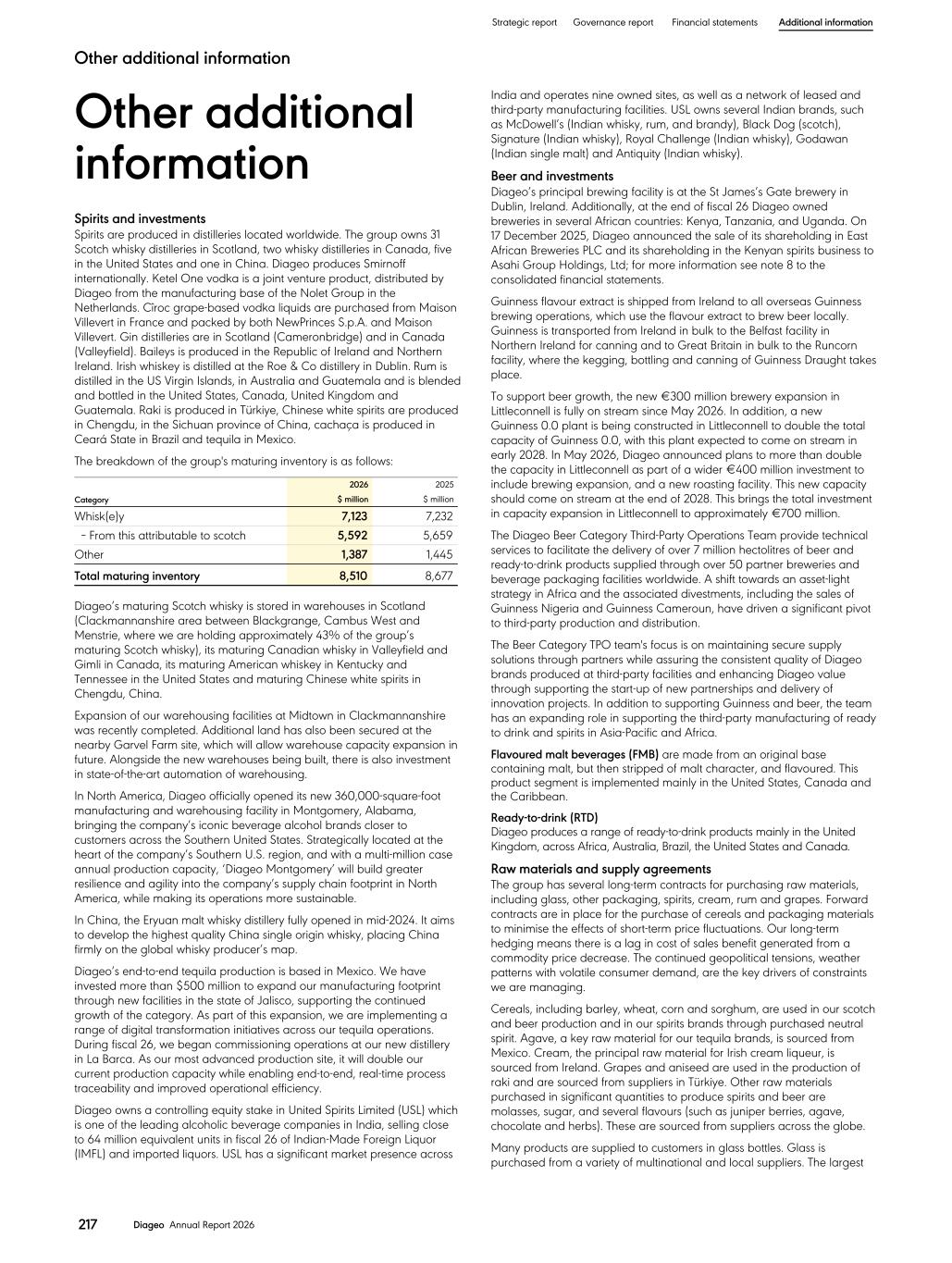
Other additional information Spirits and investments Spirits are produced in distilleries located worldwide. The group owns 31 Scotch whisky distilleries in Scotland, two whisky distilleries in Canada, five in the United States and one in China. Diageo produces Smirnoff internationally. Ketel One vodka is a joint venture product, distributed by Diageo from the manufacturing base of the Nolet Group in the Netherlands. Cîroc grape-based vodka liquids are purchased from Maison Villevert in France and packed by both NewPrinces S.p.A. and Maison Villevert. Gin distilleries are in Scotland (Cameronbridge) and in Canada (Valleyfield). Baileys is produced in the Republic of Ireland and Northern Ireland. Irish whiskey is distilled at the Roe & Co distillery in Dublin. Rum is distilled in the US Virgin Islands, in Australia and Guatemala and is blended and bottled in the United States, Canada, United Kingdom and Guatemala. Raki is produced in Türkiye, Chinese white spirits are produced in Chengdu, in the Sichuan province of China, cachaça is produced in Ceará State in Brazil and tequila in Mexico. The breakdown of the group's maturing inventory is as follows: Whisk(e)y 7,123 7,232 – From this attributable to scotch 5,592 5,659 Other 1,387 1,445 Total maturing inventory 8,510 8,677 2026 2025 Category $ million $ million Diageo’s maturing Scotch whisky is stored in warehouses in Scotland (Clackmannanshire area between Blackgrange, Cambus West and Menstrie, where we are holding approximately 43% of the group’s maturing Scotch whisky), its maturing Canadian whisky in Valleyfield and Gimli in Canada, its maturing American whiskey in Kentucky and Tennessee in the United States and maturing Chinese white spirits in Chengdu, China. Expansion of our warehousing facilities at Midtown in Clackmannanshire was recently completed. Additional land has also been secured at the nearby Garvel Farm site, which will allow warehouse capacity expansion in future. Alongside the new warehouses being built, there is also investment in state-of-the-art automation of warehousing. In North America, Diageo officially opened its new 360,000-square-foot manufacturing and warehousing facility in Montgomery, Alabama, bringing the company’s iconic beverage alcohol brands closer to customers across the Southern United States. Strategically located at the heart of the company’s Southern U.S. region, and with a multi-million case annual production capacity, ‘Diageo Montgomery’ will build greater resilience and agility into the company’s supply chain footprint in North America, while making its operations more sustainable. In China, the Eryuan malt whisky distillery fully opened in mid-2024. It aims to develop the highest quality China single origin whisky, placing China firmly on the global whisky producer’s map. Diageo’s end-to-end tequila production is based in Mexico. We have invested more than $500 million to expand our manufacturing footprint through new facilities in the state of Jalisco, supporting the continued growth of the category. As part of this expansion, we are implementing a range of digital transformation initiatives across our tequila operations. During fiscal 26, we began commissioning operations at our new distillery in La Barca. As our most advanced production site, it will double our current production capacity while enabling end-to-end, real-time process traceability and improved operational efficiency. Diageo owns a controlling equity stake in United Spirits Limited (USL) which is one of the leading alcoholic beverage companies in India, selling close to 64 million equivalent units in fiscal 26 of Indian-Made Foreign Liquor (IMFL) and imported liquors. USL has a significant market presence across India and operates nine owned sites, as well as a network of leased and third-party manufacturing facilities. USL owns several Indian brands, such as McDowell’s (Indian whisky, rum, and brandy), Black Dog (scotch), Signature (Indian whisky), Royal Challenge (Indian whisky), Godawan (Indian single malt) and Antiquity (Indian whisky). Beer and investments Diageo’s principal brewing facility is at the St James’s Gate brewery in Dublin, Ireland. Additionally, at the end of fiscal 26 Diageo owned breweries in several African countries: Kenya, Tanzania, and Uganda. On 17 December 2025, Diageo announced the sale of its shareholding in East African Breweries PLC and its shareholding in the Kenyan spirits business to Asahi Group Holdings, Ltd; for more information see note 8 to the consolidated financial statements. Guinness flavour extract is shipped from Ireland to all overseas Guinness brewing operations, which use the flavour extract to brew beer locally. Guinness is transported from Ireland in bulk to the Belfast facility in Northern Ireland for canning and to Great Britain in bulk to the Runcorn facility, where the kegging, bottling and canning of Guinness Draught takes place. To support beer growth, the new €300 million brewery expansion in Littleconnell is fully on stream since May 2026. In addition, a new Guinness 0.0 plant is being constructed in Littleconnell to double the total capacity of Guinness 0.0, with this plant expected to come on stream in early 2028. In May 2026, Diageo announced plans to more than double the capacity in Littleconnell as part of a wider €400 million investment to include brewing expansion, and a new roasting facility. This new capacity should come on stream at the end of 2028. This brings the total investment in capacity expansion in Littleconnell to approximately €700 million. The Diageo Beer Category Third-Party Operations Team provide technical services to facilitate the delivery of over 7 million hectolitres of beer and ready-to-drink products supplied through over 50 partner breweries and beverage packaging facilities worldwide. A shift towards an asset-light strategy in Africa and the associated divestments, including the sales of Guinness Nigeria and Guinness Cameroun, have driven a significant pivot to third-party production and distribution. The Beer Category TPO team's focus is on maintaining secure supply solutions through partners while assuring the consistent quality of Diageo brands produced at third-party facilities and enhancing Diageo value through supporting the start-up of new partnerships and delivery of innovation projects. In addition to supporting Guinness and beer, the team has an expanding role in supporting the third-party manufacturing of ready to drink and spirits in Asia-Pacific and Africa. Flavoured malt beverages (FMB) are made from an original base containing malt, but then stripped of malt character, and flavoured. This product segment is implemented mainly in the United States, Canada and the Caribbean. Ready-to-drink (RTD) Diageo produces a range of ready-to-drink products mainly in the United Kingdom, across Africa, Australia, Brazil, the United States and Canada. Raw materials and supply agreements The group has several long-term contracts for purchasing raw materials, including glass, other packaging, spirits, cream, rum and grapes. Forward contracts are in place for the purchase of cereals and packaging materials to minimise the effects of short-term price fluctuations. Our long-term hedging means there is a lag in cost of sales benefit generated from a commodity price decrease. The continued geopolitical tensions, weather patterns with volatile consumer demand, are the key drivers of constraints we are managing. Cereals, including barley, wheat, corn and sorghum, are used in our scotch and beer production and in our spirits brands through purchased neutral spirit. Agave, a key raw material for our tequila brands, is sourced from Mexico. Cream, the principal raw material for Irish cream liqueur, is sourced from Ireland. Grapes and aniseed are used in the production of raki and are sourced from suppliers in Türkiye. Other raw materials purchased in significant quantities to produce spirits and beer are molasses, sugar, and several flavours (such as juniper berries, agave, chocolate and herbs). These are sourced from suppliers across the globe. Many products are supplied to customers in glass bottles. Glass is purchased from a variety of multinational and local suppliers. The largest Strategic report Governance report Financial statements Additional information 217 Diageo Annual Report 2026 Other additional information
suppliers are Ardagh Packaging in the United Kingdom and Owens-Illinois in the United States. Like other consumer goods companies, we maintain stocks in markets to compensate for extended lead times and demand volatility. Diageo is managing well through the current levels of uncertainty and constraints in our supply chain by expanding our supplier base and maintaining agility in our logistics networks. Competition Diageo’s brands compete primarily on the basis of quality and price. Our business is built on getting the right product to the right consumer for the right occasion, and at the right price, including through taking into account ever evolving shopper landscapes, technologies and consumer preferences. Diageo also seeks to recruit and re-recruit consumers to its portfolio of brands, including through meaningful consumer engagement, sustainable innovation and investment in brands. In spirits, Diageo’s major global competitors are Pernod Ricard, Suntory Global Spirits, Bacardi, Campari and Brown-Forman, each of which has several brands that compete directly with Diageo’s brands. In addition, Diageo faces competition from regional and local companies in the countries in which it operates. In beer, Diageo also competes globally, as well as on a regional and local basis (with the profile varying between regions) with several competitors, including AB InBev, Asahi, Molson Coors, Heineken, Constellation Brands and Carlsberg. Research and development Innovation forms an important part of Diageo’s growth strategy, playing a key role in positioning its brands for continued growth in both developed and emerging markets. The strength and depth of Diageo’s brand range also provides a solid platform from which to drive sustainable innovation that leads to new products and experiences for consumers, whether or not they choose to drink alcohol. Diageo focuses its innovation on its strategic priorities and the most significant consumer opportunities, including the development of global brand extensions and new-to-world products, and continuously invests to deepen its understanding of evolving trends and consumer socialising occasions to inform product and packaging development, ranging from global brand redesigns to cutting edge innovations. Supporting this, the group has ongoing programmes to develop new beverage products which are managed internally by the innovation and research and development functions. Trademarks and other intellectual property Diageo produces, sells and distributes branded goods, and is therefore substantially dependent on the maintenance and protection of its trademarks. All brand names mentioned in this document are protected by trademarks. The group also holds trade secrets, as well as has substantial trade knowledge related to its products. The group believes that its significant trademarks are registered and/or otherwise protected (insofar as legal protection is available) in all material respects in its most important markets. Diageo also owns valuable patents and trade secrets for technology and takes all reasonable steps to protect these rights. Seasonality The beverage alcohol industry is subject to seasonality in each major category. Our spirits sales are typically highest during the second quarter of our fiscal year, primarily due to seasonal holiday buying in our largest markets. Employees Many of our employees are represented by unions, with a variety of collective bargaining agreements in place. We believe our relationships with the unions that represent our employees are satisfactory in all material respects. Compliance with US corporate governance rules Under applicable SEC rules and the NYSE’s corporate governance rules for listed companies, Diageo must disclose any significant ways in which its corporate governance practices differ from those followed by US companies under NYSE listing standards. Diageo believes the following to be the significant areas in which there are differences between its corporate governance practices and NYSE corporate governance rules applicable to US companies. This information is also provided on the company’s website at https://www.diageo.com/en/our-business/corporate-governance. • Basis of regulation: UK listed companies are required to include in their annual report a narrative statement of (i) how they have applied the principles of the Code and (ii) whether or not they have complied with the best practice provisions of the Code. NYSE listed companies must adopt and disclose their corporate governance guidelines. UK listed companies are required to include in their annual report statements as to (i) how directors have complied with Section 172 of the Act, which requires directors to promote the success of the company for the benefit of its members as a whole, having regard to the interests of stakeholders and (ii) how directors have engaged with and taken account of the views of the company’s workforce and other stakeholder groups. Diageo complied throughout the year with the best practice provisions of the Code and the disclosure requirements noted above. • Director independence: The Code requires at least half the Board (excluding the Chair) to be independent non-executive directors, as determined by affirmatively concluding that a director is independent in character and judgement and determining whether there are relationships and circumstances which are likely to affect, or could appear to affect, the director’s judgement. The Code requires the Board to state its reasons if it determines that a director is independent notwithstanding the existence of relationships or circumstances which may appear relevant to its determination. NYSE rules require a majority of independent directors, according to the NYSE’s own 'brightline' tests and an affirmative determination by the Board that the director has no material relationship with the listed company. Diageo’s Board has determined that, in its judgement and without taking into account the NYSE brightline tests, all of the Non-Executive Directors are independent. As such, currently seven of Diageo’s directors are independent. Further details of this determination are set out below. • Chair and Chief Executive: The Code requires these roles to be separate. There is no corresponding requirement for US companies. Diageo has a separate Chair and Chief Executive. • Non-Executive Director meetings: NYSE rules require non-management directors to meet regularly without management present and independent directors to meet separately at least once a year. The Code requires non-executive directors to meet without the Chair present at least annually to appraise the Chair’s performance. During the year, Diageo has complied with these requirements with independent Non- Executive Directors, including the Chair, meeting without the Executive Directors present seven times and independent Non-Executive Directors meeting without the Chair or Executive Directors present once. • Board committees: Diageo has a number of Board committees that are similar in purpose and constitution to those required by NYSE rules. Diageo’s Audit, Remuneration and Nomination Committees consist entirely of independent non-executive directors. Under NYSE standards, companies are required to have a nominating/corporate governance committee, which develops and recommends a set of corporate governance principles and is composed entirely of independent directors. The terms of reference for Diageo’s Nomination Committee, which comply with the Code, do not contain such a requirement. In accordance with the requirements of the Code, Diageo has disclosed on page 85 the results and means of its annual evaluation of the Board, its Committees and the directors, and it provides extensive information regarding the Directors’ compensation in the Directors’ remuneration report on pages 100-129. • Code of ethics: NYSE rules require a code of business conduct and code of ethics to be adopted for directors, executive officers and employees and disclosure of any waivers for executive directors or officers. Diageo has adopted a Code of Business Conduct for all directors, officers and employees, as well as a Code of Ethics for Senior Financial Officers in accordance with the requirements of SOx. See page 94 for further details. Strategic report Governance report Financial statements Additional information Other additional information continued 218 Diageo Annual Report 2026
• Compliance certification: NYSE rules require chief executives to certify to the NYSE their awareness of any NYSE corporate governance violations. Diageo is exempt from this as a foreign private issuer but is required to notify the NYSE if any executive officer becomes aware of any non- compliance with NYSE corporate governance standards. No such notification was necessary during the period covered by this report. Regulations and taxes Diageo’s worldwide operations are subject to extensive regulatory requirements relating to production, product liability, distribution, importation, marketing, promotion, sales, pricing, labelling, packaging, advertising, antitrust, labour, pensions, compliance and control systems and environmental issues. In the United States, the beverage alcohol industry is subject to strict federal and state government regulations. At the federal level, the Alcohol and Tobacco Tax and Trade Bureau, or TTB, of the US Treasury Department oversees the US beverage alcohol industry, including through regulating and collecting taxes on the production of alcohol within the United States and regulating trade practices. In addition, individual US states, as well as some local authorities in US jurisdictions in which Diageo sells or produces its products, administer and enforce industry-specific regulations and may apply additional excise taxes and, in many states, sales taxes. Federal, state and local regulations cover virtually every aspect of Diageo's US operations, including production, importation, distribution, marketing, promotion, sales, pricing, labelling, packaging and advertising. Spirits and beer are subject to national import and excise duties in many markets around the world. Most countries impose excise duties on beverage alcohol products, although the form of such taxation varies significantly from a simple application to units of alcohol by volume, to advanced systems based on the imported or wholesale value of the product. Several countries impose additional import duty on distilled spirits, often discriminating between categories (such as Scotch whisky or bourbon) in the rate of such tariffs. Within the European Union, such products are subject to different rates of excise duty in each country, but within the overall European Union framework there are minimum rates of excise duties that must first be applied to each relevant category of beverage alcohol. The UK's current alcohol duty system charges duty based on alcohol by volume (rather than by product type). Rates of UK alcohol duty were increased in line with inflation, effective from 1 February 2026. This regime remains relatively new in its application and subject to ongoing developments; for example, on 13 July 2026, draft legislation was published proposing that penalties for late filing and late payment of UK alcohol duty be brought within the existing points-based penalty regime. As such, the impact of this regime on Diageo's business continues to be assessed. Import and excise duties can have a significant impact on the final pricing of Diageo’s products to consumers. These duties can affect a product’s revenue or margin, both by reducing consumption and/or by encouraging consumers to switch to lower-taxed categories of beverages. The group devotes resources to encouraging the equitable taxation treatment of all beverage alcohol categories and to reducing government imposed barriers to fair trading. The advertising, marketing and sale of alcohol are subject to various restrictions in markets around the world. These range from a complete prohibition of alcohol in certain cultures and jurisdictions, such as in certain states in India, to the prohibition of the import into a certain jurisdiction of spirits and beer, and to restrictions on the advertising style, media and content. In a number of countries, television is a prohibited medium for the marketing of spirits brands, while in other countries, television advertising, while permitted, is carefully regulated. Many countries also strictly regulate the use of internet-based advertising and social media in connection with alcohol sales. Any further prohibitions imposed on advertising or marketing, particularly within Diageo’s most significant markets, could have an adverse impact on beverage alcohol sales. Labelling of beverage alcohol products is also regulated in many markets, varying from the required inclusion of health warning labels to manufacturer or importer identification, alcohol strength and other consumer information. As well as producer, importer or bottler identification, specific warning statements related to the risks of drinking beverage alcohol products are required to be included on all beverage alcohol products sold in the US, in certain countries within the EU, and in a number of other jurisdictions in which Diageo operates. Spirits and beer are also regulated in distribution. In many countries, alcohol may only be sold through licenced outlets, both on- and off-trade, varying from government- or state-operated monopoly outlets (for example, in the off-trade channel in Norway, certain Canadian provinces, and certain US states) to the system of licenced on-trade outlets (for example, licenced bars and restaurants) which prevails in much of the Western world, including in the majority of US states, in the UK and in much of the EU. In a number of states in the US, wholesalers of alcoholic beverages must publish price lists periodically and/or must file price changes in some instances up to three months before they become effective. In a response to public health concerns, some governments have imposed or are considering imposing minimum pricing on beverage alcohol products and may consider raising the legal drinking age, further limiting the number, type or opening hours of retail outlets and/or expanding retail licencing requirements. Regulatory decisions and changes in the legal and regulatory environment could also increase Diageo’s costs and liabilities and/or impact on its business activities. Taxation This section provides a descriptive summary of certain US federal income tax and UK tax consequences that are likely to be material to the holders of the ordinary shares or ADSs, but only those who hold their ordinary shares or ADSs as capital assets for tax purposes. It does not purport to be a complete technical analysis or a listing of all potential tax effects relevant to the ownership of the ordinary shares or ADSs, and does not address the potential application of the provisions of the Internal Revenue Code of 1986, as amended, known as the Medicare contribution tax. This section does not apply to any holder who is subject to special rules, including: • certain financial institutions; • a dealer in securities or foreign currency; • a trader in securities that elects to use a mark-to-market method of tax accounting for securities holdings; • a tax-exempt organisation; • an insurance company; • a person liable for alternative minimum tax; • a person that actually or constructively owns 10% or more of the combined voting power of voting stock of Diageo or of the total value of stock of Diageo; • a person that holds ordinary shares or ADSs as part of a straddle or a hedging or conversion transaction; • a person that holds ordinary shares or ADSs as part of a wash sale for tax purposes; or • a US holder (as defined below) whose functional currency is not US dollar. If an entity or arrangement treated as a partnership for US federal income tax purposes holds ordinary shares or ADSs, the US federal income tax treatment of a partner will generally depend on the status of the partner and the tax treatment of the partnership. A partner in a partnership holding ordinary shares or ADSs should consult its tax advisor with regard to the US federal income tax treatment of an investment in ordinary shares or ADSs. For UK tax purposes, this section applies only to persons who are the absolute beneficial owners of ordinary shares or ADSs and who hold their ordinary shares or ADSs as investments. It assumes that holders of ADSs will be treated as holders of the underlying ordinary shares. In addition to those persons mentioned above, this section does not apply to holders that are banks, regulated investment companies, other financial institutions, or to persons who have or are deemed to have acquired their ordinary shares or ADSs in the course of an employment or trade. This summary applies to persons who are treated as resident in the United Kingdom for the purposes of UK tax law but not those to whom special rules relating to residence apply (including qualifying new residents, temporary non-residents or those to whom 'split year' treatment applies). This section is based on the Internal Revenue Code of 1986, as amended, its legislative history, existing and proposed regulations, published rulings and court decisions, the laws of the United Kingdom and the practice of His Majesty’s Revenue and Customs (HMRC), all as currently in effect, as well as on the Convention Between the Government of the United Kingdom of Strategic report Governance report Financial statements Additional information 219 Diageo Annual Report 2026
Great Britain and Northern Ireland and the Government of the United States of America for the Avoidance of Double Taxation and the Prevention of Fiscal Evasion with Respect to Taxes on Income and Capital Gains (the Treaty). These laws are subject to change, possibly on a retroactive basis. In addition, this section is based in part upon the representations of the Depositary and the assumption that each obligation in the Deposit Agreement and any related agreement will be performed in accordance with its terms. In general, and taking into account this assumption, for US federal income tax purposes and for the purposes of the Treaty, holders of ADRs evidencing ADSs should be treated as the owner of the shares represented by those ADSs. Exchanges of shares for ADRs, and ADRs for shares, generally will not be subject to US federal income tax or to UK tax on profits or gains. A US holder is a beneficial owner of ordinary shares or ADSs that is for US federal income tax purposes: • a citizen or resident for tax purposes of the United States and who is not and has at no point been resident in the United Kingdom; • a US domestic corporation, or other US entity taxable as a corporation; • an estate whose income is subject to US federal income tax regardless of its source; or • a trust if a US court can exercise primary supervision over the trust’s administration and one or more US persons are authorised to control all substantial decisions of the trust. This section is not intended to provide specific advice and no action should be taken or omitted in reliance upon it. This section addresses only certain aspects of US federal income tax and UK income tax, corporation tax, capital gains tax, inheritance tax and stamp taxes. Holders of the ordinary shares or ADSs are urged to consult their own tax advisors regarding the US federal, state and local, and UK and other tax consequences of owning and disposing of the shares or ADSs in their respective circumstances. In particular, holders are encouraged to confirm with their advisor whether they are US holders eligible for the benefits of the Treaty. Dividends UK taxation The company will not be required to withhold tax at source when paying a dividend. All dividends received by an individual shareholder or ADS holder who is resident in the UK for tax purposes will, except to the extent that they are earned through an ISA or other regime which exempts the dividends from tax, form part of that individual’s total income for income tax purposes and will represent the highest part of that income. A nil rate of income tax will apply to the first £500 of taxable dividend income received by an individual shareholder in the 2026/2027 tax year (the Nil Rate Amount), regardless of what tax rate would otherwise apply to that dividend income. Any taxable dividend income in excess of the Nil Rate Amount will be subject to income tax at the following special rates (for the 2026/2027 tax year): • at the rate of 10.75%, to the extent that the relevant dividend income falls below the threshold for the higher rate of income tax; • at the rate of 35.75%, to the extent that the relevant dividend income falls above the threshold for the higher rate of income tax but below the threshold for the additional rate of income tax; and • at the rate of 39.35%, to the extent that the relevant dividend income falls above the threshold for the additional rate of income tax. In determining whether and, if so, to what extent the relevant dividend income falls above or below the threshold for the higher rate of income tax or, as the case may be, the additional rate of income tax, the individual’s total taxable dividend income for the tax year in question (including the part within the Nil Rate Amount) will, as noted above, be treated as the highest part of that individual’s total income for income tax purposes. Shareholders within the charge to UK corporation tax which are small companies (for the purposes of the UK taxation of dividends) will not generally be subject to tax on dividends from the company. Other shareholders within the charge to UK corporation tax will not be subject to tax on dividends from the company so long as the dividends fall within an exempt class and certain conditions are met. In general, dividends paid on shares that are ordinary share capital for UK tax purposes and are not redeemable and dividends paid to a person holding less than 10% of the issued share capital of the payer (or any class of that share capital) are examples of dividends that fall within an exempt class. US taxation Under the US federal income tax laws, and subject to the passive foreign investment company (PFIC) rules discussed below, the gross amount of any distribution (other than certain pro-rata distribution of ordinary shares) paid to a US holder by Diageo in respect of its ordinary shares or ADSs out of its current or accumulated earnings and profits (as determined for US federal income tax purposes) will be treated as a dividend that is subject to US federal income taxation. Dividends paid to certain non-corporate US holders that constitute qualified dividend income will be taxed at the preferential rates applicable to long- term capital gains, provided that the ordinary shares or ADSs are held for more than 60 days during the 121-day period beginning 60 days before the ex-dividend date and the holder meets other holding period requirements. Dividends paid by Diageo with respect to its ordinary shares or ADSs generally will be qualified dividend income to US holders that meet the holding period requirement, provided that, in the year that they receive the dividend, we are eligible for the benefits of the Treaty. We believe that we are currently eligible for the benefits of the Treaty and we therefore expect that dividends on the ordinary shares or ADSs will be qualified dividend income, but there can be no assurance that we will continue to be eligible for the benefits of the Treaty. Under UK law, dividends paid by the company are not subject to UK withholding tax. Therefore, the US holder will include in income for US federal income tax purposes the amount of the dividend received, and the receipt of a dividend will not entitle the US holder to a foreign tax credit. The dividend must be included in income when the US holder, in the case of ordinary shares, or the Depositary, in the case of ADSs, receives the dividend, actually or constructively. The dividend will not be eligible for the dividends-received deduction generally allowed to US corporations in respect of dividends received from other US corporations. Dividends will generally be income from sources outside the United States and will generally be ‘passive’ income for purposes of computing the foreign tax credit allowable to a US holder. Distributions in excess of current and accumulated earnings and profits, as determined for US federal income tax purposes, will be treated as a non-taxable return of capital to the extent of the holder’s basis in the ordinary shares or ADSs and thereafter as capital gain. However, Diageo does not expect to calculate earnings and profits in accordance with US federal income tax principles. Accordingly, a US holder should expect to generally treat distributions Diageo makes as dividends. Taxation of capital gains UK taxation A citizen or resident (for tax purposes) of the United States who has at no time been resident in the United Kingdom will not be liable for UK tax on capital gains realised or accrued on the sale or other disposal of ordinary shares or ADSs, unless the ordinary shares or ADSs are held in connection with a trade or business carried on by the holder in the United Kingdom through a UK branch, agency or a permanent establishment. A disposal (or deemed disposal) of shares or ADSs by a holder who is resident in the United Kingdom may, depending on the holder’s particular circumstances, and subject to any available exemption or relief, give rise to a chargeable gain or an allowable loss for the purposes of UK tax on capital gains. US taxation Subject to the PFIC rules discussed below, a US holder who sells or otherwise disposes of ordinary shares or ADSs will recognise capital gain or loss for US federal income tax purposes equal to the difference between the US dollar value of the amount that is realised and the tax basis, determined in US dollars, in the ordinary shares or ADSs. Capital gain of a non-corporate US holder is generally taxed at preferential rates where the property is held for more than one year. The gain or loss will generally be income or loss from sources within the United States for foreign tax credit limitation purposes. The deductibility of capital losses is subject to limitations. Strategic report Governance report Financial statements Additional information Other additional information continued 220 Diageo Annual Report 2026
PFIC rules Diageo believes that ordinary shares and ADSs should not currently be treated as stock of a PFIC for US federal income tax purposes, and we do not expect to become a PFIC in the foreseeable future. However this conclusion is a factual determination that is made annually and thus may be subject to change. It is therefore possible that we could become a PFIC in a future taxable year. If treated as a PFIC, gain realised on the sale or other disposition of ordinary shares or ADSs would in general not be treated as capital gain. Instead, unless a US holder elects to be taxed annually on a mark-to- market basis with respect to the ordinary shares or ADSs, US holders would be treated as if the holder had realised such gain and certain ‘excess distributions’ pro-rated over the holder’s holding period for the ordinary shares or ADSs. To the extent gain is allocated to the taxable year of the sale or other disposition of ordinary shares or ADSs and to any year before Diageo became a PFIC, it would be taxed as ordinary income. The amount allocated to each other taxable year would be taxed at the highest tax rate in effect (for individuals or corporations, as applicable) for each such year to which the gain was allocated, together with an interest charge in respect of the tax attributable to each such year. With certain exceptions, a holder’s ordinary shares or ADSs will be treated as stock in a PFIC if Diageo were a PFIC at any time during the holding period in a holder’s ordinary shares or ADSs. In addition, dividends received from Diageo will not be eligible for the special tax rates applicable to qualified dividend income if Diageo is a PFIC (or is treated as a PFIC with respect to the holder) either in the taxable year of the distribution or the preceding taxable year, but instead will be taxable at rates applicable to ordinary income. If any investor owns our shares or ADSs during any year that we are a PFIC with respect to them, they may be required to file IRS Form 8621. UK inheritance tax Subject to certain provisions relating to trusts or settlements, an ordinary share or ADS held by an individual shareholder who is domiciled in the United States for the purposes of the Convention between the United States and the United Kingdom relating to estate and gift taxes (the Convention) and who is neither domiciled in the United Kingdom nor (where certain conditions are met) a UK national (as defined in the Convention), will generally not be subject to UK inheritance tax on the individual’s death (whether held on the date of death or gifted during the individual’s lifetime) except where the ordinary share or ADS is part of the business property of a UK permanent establishment of the individual or pertains to a UK fixed base of an individual who performs independent personal services. In a case where an ordinary share or ADS is subject both to UK inheritance tax and to US federal gift or estate tax, the Convention generally provides for inheritance tax paid in the United Kingdom to be credited against federal gift or estate tax payable in the United States, or for federal gift or estate tax paid in the United States to be credited against any inheritance tax payable in the United Kingdom, based on priority rules set forth in the Convention. Effective from 6 April 2025, UK inheritance tax is charged based on long-term residence (and not domicile). Particularly in view of this reform, UK inheritance tax and its interaction with the Convention is complex. Any person who is in doubt about the application of UK inheritance tax in relation to their ordinary shares or ADSs, or the effect of the Convention, should consult appropriately qualified tax advisers. UK stamp duty and stamp duty reserve tax No stamp duty or stamp duty reserve tax (SDRT) will arise upon the deposit of an underlying ordinary share with the Depositary if that deposit is effected by (a) the issue of that share or (b) a transfer of that share in the course of (i) capital-raising arrangements or (ii) qualifying listing arrangements. Otherwise, stamp duty or SDRT applies at the higher rate of 1.5% of the amount or value of the consideration payable or, in certain circumstances, the value of the ordinary shares (rounded up to the nearest multiple of £5 in the case of stamp duty). The Depositary will pay the stamp duty or SDRT but will recover an amount in respect of such tax from the initial holders of ADSs. No UK stamp duty will be payable on the acquisition or transfer of ADRs. Furthermore, an agreement to transfer ADSs in the form of ADRs will not give rise to a liability to SDRT. Purchases of ordinary shares (as opposed to ADRs) will be subject to UK stamp duty, and/or SDRT as the case may be, at the rate of 0.5% of the price payable for the ordinary shares at the time of the transfer (or, in certain circumstances, the value of the ordinary shares). Stamp duty applies where a physical instrument of transfer is used to effect the transfer. SDRT applies to any agreement to transfer ordinary shares (regardless of whether or not the transfer is effected electronically or by way of an instrument of transfer). However, where the ordinary shares being acquired are transferred direct to the Depositary’s nominee, the only charge will generally be the higher charge of 1.5%, subject to the applicability of any exemptions to the 1.5% charge discussed above. Any stamp duty payable (as opposed to SDRT) is rounded up to the nearest £5. No stamp duty (as opposed to SDRT) will be payable if the amount or value of the consideration is (and is certified to be) £1,000 or less. Stamp duty and SDRT are usually paid or borne by the purchaser. Whilst stamp duty and SDRT may in certain circumstances both apply to the same transaction, in practice usually only one or the other will need to be paid. UK stamp duty and SDRT are expected to be replaced by a new single tax in 2027, the Securities Transfer Tax (STT). Draft legislation for the STT was published on 13 July 2026. The STT is intended to modernise the existing stamp taxes regime, by simplifying and digitising the administration and payment of tax on transactions in securities. Based on the draft legislation as currently published, no material changes to the current rates or method of computation are anticipated, although there may be further changes prior to the legislation being implemented. As such, the impact of the STT on transactions involving the acquisition or transfer of the ordinary shares or ADSs remains uncertain. US backup withholding and information reporting Payments of dividends and sales proceeds with respect to ordinary shares and ADSs may be reported to the IRS and to the US holder. Backup withholding may apply to these reportable payments if the US holder fails to provide an accurate taxpayer identification number or certification of exempt status or fails to report all interest and dividends required to be shown on its US federal income tax returns. Certain US holders (including, among others, corporations) are not subject to information reporting and backup withholding. The amount of any backup withholding from a payment to a US holder will be allowed as a credit against the holder’s US federal income tax liability and may entitle the holder to a refund, provided that the required information is timely furnished to the IRS. US holders should consult their tax advisors as to their qualification for exemption from backup withholding and the procedure for obtaining an exemption. Certain US holders who are individuals (and certain specified entities), may be required to report information relating to their ownership of non-US securities unless the securities are held in accounts at financial institutions (in which case the accounts may be reportable if maintained by non-US financial institutions). US holders should consult their tax advisors regarding any reporting obligations they may have with respect to the ordinary shares or ADSs. Strategic report Governance report Financial statements Additional information 221 Diageo Annual Report 2026
Data preparation methodology for SECR tables Data preparation methodology for Scope 1 and 2 greenhouse gas emissions We calculate CO2e emissions data based on direct measurement of energy use (meter readings/invoices) for the majority of sites. We externally report Scope 1 and 2 greenhouse gas emissions using metric tonnes of CO2e to compare the emissions from the seven main greenhouse gases based on their global warming potential. We base our CO2e reduction targets and reporting protocols (since 2007) on market-based emissions. Direct (Scope 1) emissions We report fuel consumption by fuel type at site level using the environmental management system. Using calorific values, the fuel is then converted to energy consumption, in kilowatt hours (kWh), by fuel type and is multiplied by the relevant CO2e emission factor to derive total CO2e emissions. Scope 1 emission factors for fuels are typically average fuel CO2e emissions factors and calorific values (the latest available at the end of the period) from the UK Government Department for Energy Security and Net Zero (DESNZ) for fossil fuels and from UK Government National Air Emissions Inventory (NAEI) for bioenergy sources. For market-based emissions calculations, we apply product-specific factors where available. Energy attribute certificates (EACs), derived from our distillery by-product feedstock and processed by a third party to generate biomethane, form a component of our decarbonisation, together with purchased renewable gas EACs (i.e. from certificate-backed biomethane supplied indirectly through the natural gas grid). Fugitive and owned agricultural (Scope 1) emissions We calculate fugitive emissions based on the amount of emitted ozone- depleting substances and fluorinated gases, multiplied by the relevant emission factor to represent the global warming potential in tonnes of CO2e. Annually, each site reports the quantity (mass) of each material and/or gas emitted based on any added and/or topped-up amount, reported via the environmental management system. The mass of each emitted ozone-depleting substance and fluorinated gas is multiplied by the relevant emission factor from the Intergovernmental Panel on Climate Change Sixth Assessment Report (IPCC AR6) and then added together to report the equivalent GHG emissions in tonnes of CO2e. We calculate Scope 1 FLAG emissions from our owned agricultural direct impacts (i.e. fertiliser use). The relevant quantities of fertiliser are multiplied by the percentage of nitrogen content and by the relevant GHG emission and conversion factors (e.g. nitrogen to nitrous oxide, nitrous oxide GHG emission factor) to determine the equivalent tonnes CO2e emissions. Indirect (Scope 2) emissions We report greenhouse gas emissions from electricity (Scope 2) as market- based emissions and as location-based emissions in line with the World Resources Institute (WRI)/World Business Council for Sustainable Development (WBCSD) GHG Protocol Scope 2 guidance 2015. For market- based emissions, electricity consumption recorded on our environmental management system is multiplied by emissions factors specified in EACs, contracts, power purchase agreements and supplier utility emissions, as detailed in the GHG Protocol’s Scope 2 guidance. We use GHG Protocol Scope 2 to ensure EACs and associated financial instruments meet the required standards. GHG emission factors, relating to indirect (Scope 2) emissions, are updated to the latest available by end of the period. Total direct and indirect greenhouse gas emission (Scope 1 and Scope 2 data aggregation) For market-based: total direct and indirect greenhouse gas emissions by weight (market/net based) (1,000 tonnes CO2e) is the aggregation of Scope 1 and 2 GHG emissions with fugitive and owned agriculture emissions to calculate total direct operations market-based emissions. The percentage reduction in absolute greenhouse gas emissions (direct and indirect greenhouse gas emissions by weight (market/net based)) from the prior year is a percentage change calculation with reference to the corresponding prior year figure. Our direct operations emissions target for 2030 remains consistent with earlier reporting protocols and is based on market-based emissions. GHG emission intensity ratios Total, aggregated direct operations market-based emissions are divided by the volume of direct operations packaged product reported in the same period. The market-based emissions are converted to grammes of CO2e and the volume of packaged product is reported in litres to generate relevant GHG emission intensity ratios in g CO2e/litre packaged. Data preparation methodology for energy consumption We report total energy and renewable energy in MWh and/or TJ. We calculate direct and indirect energy data based on the direct measurement of energy use (meter readings/invoices for volumes of fuel supplied). We determine direct energy (renewable/non-renewable) from the quantity of different fuel types (in metric tonnes, litres) of renewable and non- renewable fuels and by applying the relevant calorific value (either from DESNZ or the supplier). We report fuel consumption by fuel type at site level using the environmental management system. Using calorific values, the fuel is then converted to energy consumption, in kWh, by fuel type and classified as either renewable or non-renewable based on fuel type or source. EACs, derived from our distillery by-product feedstock and processed by a third- party to generate biogas, together with purchased renewable gas EACs, are applied to relevant natural gas supplied to sites via a common carrier pipeline/network. We measure indirect energy (renewable/non-renewable) in MWh and/or TJ from energy utilities or suppliers and/or by applying the relevant EACs. All indirect energy generated and used on site, along with purchased indirect energy supplied through the grid is classified as renewable by the allocation of EACs, contracts, power purchase agreements and supplier- specific utility factors, where relevant. We include directly connected renewable energy generated on or near our sites, where all energy is used on site and no EACs are created (e.g. roof- mounted solar panels with all generated renewable electricity used on site). Strategic report Governance report Financial statements Additional information Other additional information continued 222 Diageo Annual Report 2026
Additional information for shareholders Annual General Meeting (AGM) The AGM will be held at Convene 133 Houndsditch, London, EC3A 7DB on 5 November 2026 at 2.30 pm. Documents on display The Annual Report on Form 20-F and any other documents filed by the company with the US Securities Exchange Commission (SEC) may be inspected at the SEC’s office of Investor Education and Advocacy located at 100 F Street, NE, Washington, DC 20549-0213, USA. Please call the SEC at 1-800-SEC-0330 for further information on the public reference rooms and their copy charges. Filings with the SEC are also available to the public from commercial document retrieval services, and from the website maintained by the US Securities and Exchange Commission at https:// www.sec.gov. Warning to shareholders – share fraud Please beware of the share fraud of ‘boiler room’ scams, where shareholders are called ‘out of the blue’ by fraudsters (sometimes claiming to represent Diageo) attempting to obtain money or property dishonestly. Further information on boiler room scams can be found on the Financial Conduct Authority’s website (https://www.fca.org.uk/consumers/share-bond-and-boiler-room- scams) but in short, if in doubt, take proper professional advice before making any investment decision. Electronic communications Shareholders can register for an account to manage their shareholding online, including being able to check the number of shares they own and the value of their shareholding; register for electronic communications; update their personal details; provide a dividend mandate instruction; apply for the Dividend Reinvestment Plan; access dividend confirmations; and use the online share dealing service. To register for an account, shareholders should visit https://www.diageoregistrars.com/welcome. Dividend payments Direct payment into bank account UK shareholders: The Company normally pays dividends twice each year and have taken the decision that these will only be made directly to shareholder's bank or building society. This is a more secure method of payment and avoids delays or cheques being lost. Shareholders can register their bank account details for this purpose online at https:// www.diageoregistrars.com/welcome or call the Registrar on +44 (0)371 277 1010* to supply the details over the phone. For shareholders outside the UK, MUFG Corporate Markets (a trading name of MUFG Pension & Market Services and a member of MUFG, a global financial group) may be able to provide you with a range of services relating to your shareholding. To learn more about the services available to you please visit the Share Portal at https://www.diageoregistrars.com/welcome or call +44 (0)371 277 1010.* Dividend Reinvestment Plan A Dividend Reinvestment Plan is offered by the Registrar, MUFG Corporate Markets, to give shareholders the opportunity to build up their shareholding in Diageo by using their cash dividends to purchase additional Diageo shares. Shareholders can join the Dividend Reinvestment Plan online at https://www.diageoregistrars.com/welcome or call the Registrar, MUFG Corporate Markets, on +44 (0)371 277 1010* to request the relevant application form. Dividend currency election Holders of ordinary shares will receive their dividends in sterling unless they wish to elect to receive their dividends in US dollars. To elect to receive their dividends in US dollars, shareholders can download the relevant election form on the shareholder portal at https://www.diageoregistrars.com or call +44 (0)371 277 1010.* Exchange controls Other than certain economic sanctions which may be in effect from time to time, there are currently no UK foreign exchange control restrictions on the payment of dividends, interest or other payments to holders of Diageo’s securities who are non-residents of the UK or on the conduct of Diageo’s operations. There are no restrictions under the company’s articles of association or under English law that limit the right of non-resident or foreign owners to hold or vote the company’s ordinary shares. Please refer to the ‘Taxation’ section on pages 220-222 for details relating to the taxation of dividend payments. Useful contacts The Registrar/Shareholder queries MUFG Corporate Markets acts as the company’s registrar and can be contacted as follows: By email: Diageo@cm.mpms.mufg.com By telephone: +44 (0) 371 277 1010* In writing: Registrars – MUFG Corporate Markets, Central Square, 29 Wellington Street, Leeds, LS1 1DL. * Calls are charged at the standard geographic rate and will vary by provider. Calls outside the United Kingdom will be charged at the applicable international rate. Lines are open 08:00 to 17:30 UK time, Monday to Friday, excluding public holidays in England and Wales. ADR administration Citibank Shareholder Services acts as the company’s ADR administrator and can be contacted as follows: By email: citibank@shareholders-online.com By telephone: +1 866 253 0933/ (International) +1 781 575 4555** In writing: Citibank Shareholder Services. PO Box 43077, Providence, RI 02940-3077 ** Lines are open Monday to Friday 8:30 to 18:00 EST General Counsel and Company Secretary Randall Ingber The.cosec@diageo.com Investor Relations investor.relations@diageo.com Strategic report Governance report Financial statements Additional information 223 Diageo Annual Report 2026

224 Diageo Annual Report 2026

Printed on UPM Fine, an FSC ® certified mixed sources paper. Printed by Paragon Customer Communications, an FSC ® and ISO 140001 certified company. Consultancy and design by Black Sun Global www.blacksun-global.com

Diageo plc 16 Great Marlborough Street London W1F 7HS United Kingdom T: +44 (0) 20 7947 9100 www.diageo.com Registered in England No. 23307 © 2026 Diageo plc. All rights reserved. All brands mentioned in this Annual Report are trademarks and are registered and/or otherwise protected in accordance with applicable law.