Please wait

Exhibit 1.01

Vodafone Conflict Minerals Report 2025

This Conflict Minerals Report for the year ended 31 December 2025 is presented by Vodafone Group Plc (‘Vodafone’) in accordance with Rule 13p-1 (the ‘Rule’) under the US Securities Exchange Act of 1934 (the ‘Exchange Act’).

The Rule applies to companies required to file reports with the US Securities and Exchange Commission (‘SEC’) under Section 13(a) or 15(d) of the Exchange Act if any of the products they manufacture or contract to manufacture contain conflict minerals necessary to the functionality or production of the product (‘In-Scope Products’). As defined by the content requirements of SEC Form SD, ‘Conflict Minerals’ include columbite-tantalite (‘coltan’), cassiterite, wolframite and/or gold, or their derivatives, which are limited to tantalum, tin and tungsten (each a ‘3TG metal’).

Please refer to the requirements of SEC Form SD for definitions of many of the terms used in this report, including ‘Covered Countries’ (Democratic Republic of Congo (‘DRC’) or an adjoining country).

COMPANY OVERVIEW

Vodafone is a leading European and African telecoms company.

We provide mobile and fixed services to approximately 300 million customers in 15 countries and have over 59 million FinTech users. Through our joint ventures and associates we serve a further 72 million customers and 44 million FinTech users.

Our mission is to connect everyone. We provide innovative mobile and fixed connectivity solutions to empower our customers across the globe. We are constantly expanding coverage to bridge continents and spread inclusion, even in the most remote places. Together with our trusted partners, we’re also connecting people with the future – pioneering digital tools and services to build sustainable growth, resilience and shared value for years to come.

Everyone connected.

For more information, please visit Vodafone.com, follow us on X (formerly Twitter) at @VodafoneGroup or connect with us on LinkedIn at www.linkedin.com/company/vodafone.

Vodafone’s American Depositary Shares are listed on the NASDAQ Global Select Market LLC (‘NASDAQ’). We are therefore subject to the NASDAQ listing rules and file reports with the SEC under Section 13(a) of the Exchange Act.

We use electronic equipment in our operations, and we sell a range of products to our customers, including SIM cards, fixed broadband routers, TV set-top boxes and IoT devices. Vodafone Automotive also sells electronic products, such as anti-theft, parking assistance and telematics systems, to vehicle manufacturers.

Most of the products that we resell to customers, such as smartphones, routers and tablets, are produced by suppliers categorised as original equipment manufacturers (‘OEMs’). OEMs are major companies with internationally recognised brands that report sustainability actions in their own right.


1


We also offer our customers a range of devices that carry the Vodafone logo, which is when we contract with suppliers to manufacture these for us. These devices are designed and built on our behalf by suppliers known as original design manufacturers (‘ODMs’). We contract ODMs to design and manufacture these products according to our specifications and therefore have some degree of influence over the manufacturing of the product, such as specifying certain criteria for the materials, parts or components to be used. However, we do not own, operate or control the manufacturing plants where they are made. Vodafone Automotive also operates a small technology device manufacturing plant in Italy.

‘In-Scope Products’ (defined on page 4) only account for a small proportion of our total expenditure (less than 1%). The agreements in place with our ‘In-Scope Suppliers’ (defined on page 4 give Vodafone the right to perform supplier quality audits and to ensure that we only select vendors that work with integrity, safety and quality. Our Annual Report and Modern Slavery Statement provide more information about our supply chain and how we manage relevant sustainability risks. These are available on our website.

APPLICABILITY

Our products contain numerous components that may contain one or more of the 3TG metals. For example, tin is often used as a soldering material for electronic components, gold and tantalum are typically used in components such as connectors or capacitors, and tungsten may be used in printed circuit boards.

We conduct an annual analysis of our suppliers’ procurement and manufacturing activities to determine which products the Rule applies to (‘In-Scope Products’) by:


Identifying the products that are likely to include 3TG metals. We do this by reviewing product categories through our supplier qualification process and, for Vodafone Automotive products, checking whether components are listed as including 3TG metals on the automotive industry’s International Material Data System.


Determining which of these products are likely to be ones that we contract to manufacture or, in the case of Vodafone Automotive products, manufacture.

For the year ended 31 December 2025, we identified six types of In-Scope Products:


Connected home devices (i.e. routers, modems and set-top boxes)


Datacards (i.e. mobile broadband dongles)


Internet of Things devices


Vehicle anti-theft systems, such as alarm sirens and intrusion sensors


Parking assistance products, such as sensors and electronic units that assist drivers in parking their vehicles


Telematic control units for vehicles, such as tracking systems based on Global System for Mobile Communications (‘GSM’) and Global Positioning System (‘GPS’) technologies.

We sourced these In-Scope Products, or their components, from 60 suppliers (‘In-Scope Suppliers’) in the year ended 31 December 2025.

REASONABLE COUNTRY OF ORIGIN INQUIRY

In accordance with the Rule, we carried out a Reasonable Country of Origin Inquiry (‘RCOI’) and due diligence process to determine the origin of the 3TG metals used in our In-Scope Products.


2


The smelters and refiners (‘Smelters’) that produce 3TG metals, and the mines from which the minerals are originally sourced, are many steps away from Vodafone in the supply chain. We therefore rely on our In-Scope Suppliers to provide information to support our due diligence efforts.

We include Conflict Minerals reporting requirements as part of our In-Scope Suppliers’ contractual obligations. These require In-Scope Suppliers to conduct due diligence to identify the origin of the 3TG metals in the components or products they sell to us and ensure that the 3TG metals are sourced responsibly. Our direct In-Scope Suppliers are expected to extend similar requirements to their own suppliers and cascade them down the supply chain until the origin of the 3TG metals contained in the products supplied to us (either directly or indirectly) can be identified.

Identified In-Scope Suppliers are required to report on their progress annually by completing the Responsible Minerals Initiative (‘RMI’) Conflict Minerals Reporting Template (‘CMRT’). The RMI is an industry initiative in which we participate to support the collection of information, increase transparency and establish a chain of custody over the mineral supply chain.

We conduct our RCOI based on the Smelter information received from our In-Scope Suppliers in their CMRT submission. In cases where the information provided by our direct suppliers is incomplete, we engage with them to ensure that their final CMRT submission includes smelters known by the RMI. We then compare the received Smelter list with the RCOI database compiled by the RMI. The RCOI database contains aggregated data on the country of origin information for the mined material of conformant Smelters in the RMI’s Responsible Minerals Assurance Process (‘RMAP’) and gold refiners that have successfully completed a cross-recognised assessment through the London Bullion Market Association (LBMA) or Responsible Jewellery Council (RJC).

In some cases, information provided by our direct suppliers is incomplete and suppliers are unable to confirm the ‘Country of Origin’ information for 3TG metals.

RCOI CONCLUSION

Based on data collected from our In-Scope Suppliers for the year ended 31 December 2025, we believe that some 3TG metals contained in our In-Scope Products originate from Covered Countries and we have conducted due diligence as described later in this report.

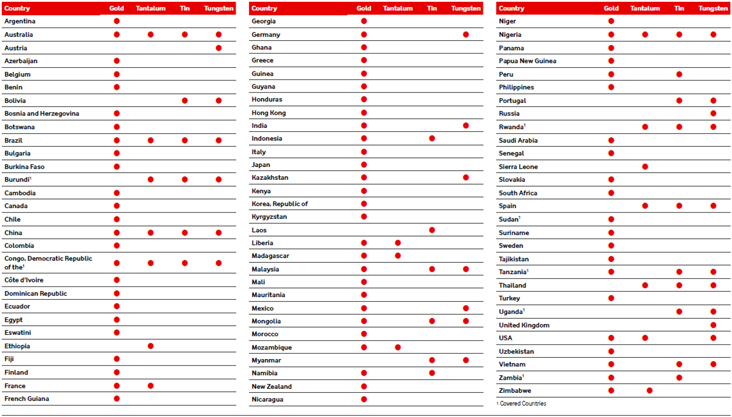
See the Annex for a list of the confirmed Smelters included in the Conflict Minerals reports submitted by our In-Scope Suppliers and the compiled Countries of Origin Information.

Vodafone’s commitment to sustainable business in the DRC

We have operated in the DRC since 2002 through our Vodacom Subsidiary, Vodacom Congo (RDC) S.A. (‘Vodacom DRC’). Vodacom DRC is a subsidiary of Vodacom Group Limited (which is a member of the Vodafone Group) and is the largest provider of telecommunications services in the DRC, generating revenues of US$ 814 million in the financial year ended 31 March 2026 (FY2026).

Operating in a conflict-affected and high-risk area, our presence in the DRC is underpinned by a commitment to responsible business conduct, respect for human rights, and the promotion of inclusive development outcomes. Our purpose – to connect for a better future – guides our approach to responsible sourcing, digital and financial inclusion, and the responsible use of technology to support socio-economic development.


3


Through the provision of connectivity and technology solutions, supported by strategic partnerships and complementary initiatives delivered through our Foundations (Vodacom Foundation DRC and Vodafone Foundation), we seek to contribute to improved access to services, economic participation and community resilience. At the same time, we recognise the importance of robust due diligence processes to identify, prevent, mitigate and address potential risks associated with operating in the DRC.

Initiatives in the year ended 31 December 2025 include:


Our Alerte Rouge programme, led by the Vodacom Foundation DRC, which provides rapid humanitarian support to communities affected by conflict, displacement and natural emergencies in the DRC. Through partnerships with NGOs and community organisations, the programme delivers essential assistance, including emergency education support, psychosocial services and digital tools for humanitarian coordination. Activities in high-risk areas such as Goma and Bukavu were temporarily suspended during 2025 due to security concerns, while support continued in more stable regions. Alerte Rouge remains a key mechanism for protecting vulnerable communities and maintaining access to essential services during crises. Since 2023, Alerte Rouge has provided survival kits to 1,027 households, distributed 5,000 school supplies and built 10 emergency classrooms, benefiting around 1,200 children.


Vodaflex, our new broadband connectivity solution designed to support small and medium-sized enterprises (SMEs). Vodaflex provides reliable, flexible and cost-effective connectivity which enables SMEs to improve their operational efficiency, productivity and business continuity.


M-Pesa Open API, which promotes local economic inclusion by enabling the secure integration of digital payment solutions across value chains. The platform allows local enterprises, SMEs, startups and innovators to automate payments, integrate with banking systems and develop e-commerce solutions, strengthening participation in the digital economy and supporting inclusive, locally-driven growth.


Our pilot of the Agritech Moloni platform, which reached approximately 10,000 smallholder farmers, demonstrating the viability of the platform in supporting sustainable agricultural livelihoods. Building on the success of this pilot, we are scaling up implementation with the long-term ambition to connect at least 20,000 farmers through the platform by creating strong partnerships with key stakeholders.


A new food security programme, in collaboration with the Peasant Confederation of Congo (COPACO), being implemented in the Kasai region. In the initial phase, 1,000 farmers from COPACO-affiliated organisations will receive targeted support, including access to agricultural inputs through an e-vouchering system. Farmers receive e-vouchers with a unique code that allows them to access seeds and farming tools, enabling improved monitoring, transparency and accountability. Participating farmers will be connected to our Moloni platform to access information on sustainable farming practices, climate conditions and market opportunities, alongside access to M-Pesa loans to support financial inclusion and strengthen market participation. The focus on food security responds to ongoing humanitarian challenges in the Kasai region, where livelihoods and agricultural systems were significantly disrupted by the 2016–2017 conflict. Many households continue to experience acute food insecurity and high levels of malnutrition, making agricultural recovery and farmer support a critical development priority.


4


The Bomoyi Ya Mama na Muana (Life of Mother and Child) initiative to address gaps in maternal and neonatal healthcare, particularly in Lubumbashi, where access to quality maternity services is limited. The project focuses on improving emergency contact and response through a short telephone number. as well as strengthening healthcare worker capacity through training delivered in partnership with United Nations Population Fund (UNFPA).


Hospital renovations and provision of equipment for a maternity ward, supported by the Vodacom Foundation DRC, to mark the centenary of Sendwe General Hospital, reinforcing our commitment to supporting access to essential health services and community resilience in a conflict-affected operating environment.


Support for improved vaccine coverage for vulnerable children, in partnership with the Ministry of Health, the Expanded Programme on Immunization (EPI), Flowminder and Gavi. Through this public-private partnership, anonymised mobility data is used to support more effective vaccination planning and outreach to zero-dose and under-vaccinated children. Funded by Gavi, the initiative demonstrates the responsible use of technology to strengthen equitable access to essential health services in a high-risk operating environment.


KADEA Learn, which supports youth employability and inclusive participation in the digital economy by providing access to connectivity, equipping young people with practical digital skills. With a strong focus on youth and women, the programme has trained more than 8,000 young people, strengthening digital literacy, employability and readiness for the future of work.


Je Suis Cap (I Am Capable), which supports the economic empowerment and social inclusion of women living with disabilities across the DRC by enabling them to become mobile-money micro-entrepreneurs. Delivered in partnership with M-Pesa, Fonds pour l’inclusion financière en RDC (FPM), the Ministry of Persons Living with Disabilities and Visa, the programme provides digital and financial training, M-Pesa starter kits and ongoing coaching. Je Suis Cap has trained more than 1,600 women across multiple provinces, enabling over 1,000 to operate as active M-Pesa agents and facilitating US$33.8 million in transactions, strengthening financial autonomy, local economic participation and long-term income generation within communities.


Highlighting the role of digital connectivity and inclusion in supporting more sustainable and responsible mining practices at the 2025 DRC Mining Week conference, where we showcased initiatives that extend network coverage to remote mining areas, support digital skills development and enable financial inclusion through mobile platforms. Reliable communication infrastructure and technology solutions are critical enablers of operational efficiency, safety, and improved socio-economic outcomes for communities linked to mining activities, reinforcing the importance of responsible engagement in conflict-affected and high-risk environments.


5


We believe that success should not come at the cost of the environment, and we are committed to managing direct environmental impact through e-waste management, recycling and energy management while supporting government and local community initiatives. We continue to advance our network waste management strategy through the structured collection and sale of Waste Electrical and Electronic Equipment (WEEE). Vodacom employees participated in a number of volunteering activities in support of environmental sustainability in the year ended 31 December 2025.

For more on our commitment to sustainable business in the DRC, see the Vodacom Group 2026 Environmental, Social and Governance (ESG) report which will be released in June 2026 on vodacom.com/reporting-centre.php.

RESPONSIBLE MINERAL SOURCING

3TG metals come from many different Smelters in a complex and often opaque supply chain. Minerals are extracted from mines, Smelters procure minerals and process them into useable metals, and these metals are then used to make components to go into electronic products.

We conduct due diligence to support our commitment to source minerals responsibly and to comply with relevant disclosure regulations. Our aim is to ensure that none of the products or components we buy contain 3TG metals that have helped to fund conflict (as set out in our Responsible Minerals Statement) or contribute to other risks identified in the Organisation for Economic Cooperation and Development (‘OECD’) Due Diligence Guidance for Responsible Supply Chains of Minerals from Conflict-Affected and High-Risk Areas (Third Edition) (‘OECD Due Diligence Guidance’) Annex II.

Our process is designed to comply with the Rule and interpretive guidance and conform with the internationally recognised framework set out in the OECD Due Diligence Guidance.

DUE DILIGENCE

Our due diligence process follows the five-step framework set out in the OECD Due Diligence Guidance.

Step 1: Establish strong company management systems

We have an internal policy related to the sourcing of Conflict Minerals. Based on this policy, we developed and publicly communicated our Vodafone Responsible Minerals Statement, which is also referenced in our Group Human Rights Statement. Overall accountability for implementation of the policy lies with our Group Commercial Director.

The policy is overseen by our Group Devices Director, who leads the function responsible for sourcing mobile phones, tablets, set-top boxes and other such devices. Representatives from corporate functions provide legal expertise and subject matter expertise, and our procurement teams manage relationships with In-Scope Suppliers, all of whom support the implementation of due diligence activities.

We work together with specialist consultancy service providers to assist in tracking data, assessing risks and preparing our reporting. Our data management system is continuously updated and accessible in real-time.

Additionally, we have engaged with a third-party auditor to assess the processes and procedures of our Responsible Minerals Programme to the requirements of the Rule and conformance to the OECD Due Diligence Guidance. The audit results are used to validate the implementation of our process and identify potential opportunities for improvements in future.


6


We have established a process to identify In-Scope Suppliers (as outlined in the Applicability section on page 4) and we include Conflict Minerals clauses in their contracts. These clauses require In-Scope Suppliers to conduct due diligence to identify the smelters of 3TG metals in the components or products they sell to us in an effort to demonstrate that the 3TG metals are not from a source which directly or indirectly finances or benefits armed groups or contributes to other OECD risks (as set out in the OECD Guidance Annex II). The Conflict Minerals clauses require In-Scope Suppliers to work towards having only Smelters in their supply chain which are classified as Conformant and/or Active according to the definitions and criteria specified by recognised third-party assessment programmes (RMI, LBMA or RJC).

Our direct In-Scope Suppliers are expected to extend a similar identification process (as described on page 4) to their own suppliers and cascade them down the supply chain until the smelter of the 3TG metals contained in the In-Scope Products can be identified.

The identified In-Scope Suppliers must report on their progress through the RMI CMRT, which they are required to complete on an annual basis. The CMRT is designed to identify the Smelters from which any 3TG metals in each In-Scope Product are sourced.

We engage with In-Scope Suppliers to raise awareness of our processes and requirements, and help them understand how to meet the requirements of the contract clause on Conflict Minerals and how to improve accuracy in CMRT data collection. If required, we provide support and training. We also share advice on how to complete the CMRT and apply lessons learned from the previous year’s disclosure process.

In addition, we provide a dedicated point of contact at Vodafone to respond to suppliers’ questions on Conflict Minerals Reporting. Our established Speak Up process, outlined in our Code of Conduct, provides a companywide grievance mechanism for reporting any concerns related to allegations of illegal or unethical practices or breaches of Vodafone’s Code of Conduct and policies, including those related to Conflict Minerals. It can be used by employees, contractors, suppliers’ employees or contractors, business partners or any other individual or organisation to report concerns, anonymously if they prefer. Information on supplier ethics and Speak Up is available on our website.

Step 2: Identify and assess risks in the supply chain

To identify and assess Conflict Minerals risks in our supply chain, we required all suppliers of In-Scope Products (identified through the applicability assessment outlined on page 4) to complete the CMRT.

We compared the Smelters identified in the In-Scope Supplier responses with the RMI List of All Eligible 3TG Smelters, the RMI Smelter Revision History List, The RMI List of Conformant Smelters and the RMI List of Active Smelters. These lists are maintained online by the RMI and are frequently updated to reflect changes in the reported status of Smelters.

See Annex for:


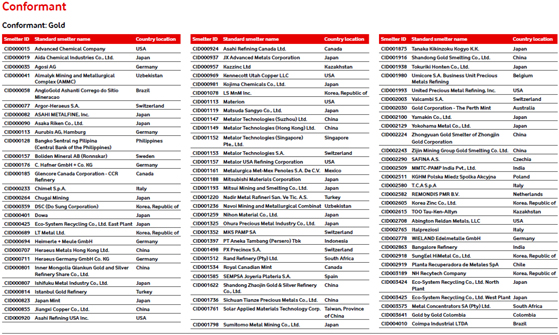
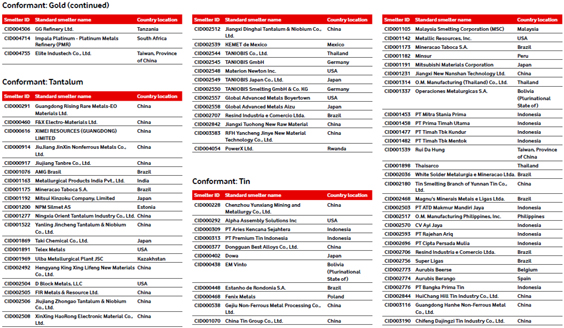
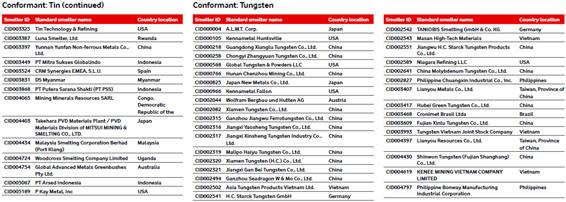
A list of RMI-eligible Smelters which were included in the reports submitted by our In-Scope Suppliers and identified as ‘RMI Conformant’ by the RMI. RMI Conformant Smelters have successfully completed a RMAP audit and maintain good standing in the programme through a continual validation process. They have the systems and processes in place to support responsible sourcing of raw materials and can provide evidence to support their sourcing activities.


7


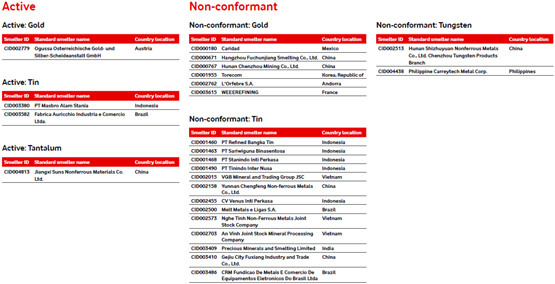
A list of RMI-eligible Smelters which were included in the reports submitted by our In-Scope Suppliers and identified as ‘RMI Active’, meaning they are progressing to become RMI Conformant but have not yet completed the mandatory RMAP audit conducted by an independent audit firm. RMI Active Smelters have signed an Agreement for the Exchange of Confidential Information and Auditee Agreement contracts. If they are deemed by the RMI not to be progressing toward a RMAP audit, gap closure or re-audit for a period of more than 90 days, they will be removed from the Active list.


A list of In-Scope Supplier-reported Smelters that Vodafone categorises as ‘RMI Nonconformant’. These Smelters have been validated by the RMI as eligible but either do not participate in the RMI RMAP process or have been suspended by the London Bullion Market Association (LBMA) from its Good Delivery List and consequently removed from the RMI’s Conformant and Active Lists.

In addition to assessing the reported Smelters based on the RMI’s classification, we have also reviewed the Smelters against the economic sanctions lists applicable to Vodafone and have not identified any reported Smelters on any such sanctions list.

Based on our analysis of the 60 In-Scope Suppliers, we identified some CMRT issues, such as incomplete reporting of sub-suppliers, inconsistencies in the Declaration section of the CMRT, incomplete reporting at company level and identification of RMI Non-conformant Smelters in the supply chain. We followed up with relevant In-Scope Suppliers to further assess, address and resolve these issues through direct supplier engagement.

Step 3: Design and implement a strategy to respond to identified risks

Our strategy to respond to identified risks includes a range of measures that form part of our due diligence process. We have a communication and escalation process in place to notify and engage, if required, our Group Commercial Director where any potentially significant risks are identified.

We use legal and contractual mechanisms to obligate our In-Scope Suppliers to comply with relevant regulations.

We review In-Scope Supplier responses to the CMRT and follow up with In-Scope Suppliers to request clarification or more complete responses where necessary. Where any risks are identified, we engage with In-Scope Suppliers and request their commitment to corrective actions to manage these risks. We follow up on agreed corrective actions.

If In-Scope Suppliers identify Smelters within our supply chain that are RMI Nonconformant, we ask In-Scope Suppliers to encourage these Smelters to participate in the RMAP process by a specific date, or consider alternate sourcing arrangements.

Through the application of our due diligence process, we strive to reduce the number of RMI Non-conformant Smelters, while continuing to support local economies by allowing the use of materials from Conflict-Affected and High-Risk Areas1, including the Covered Countries, that have been processed by Smelters that are RMI Conformant.

We also participate in wider industry efforts to support responsible sourcing and audit Smelters’ due diligence activities through our membership (member code: VODA) of the RMI (see box, below).

 
1 

Definition of Conflict-Affected and High-Risk Areas: https://www.responsiblemineralsinitiative.org/minerals-due-diligence/riskmanagement/conflict-affected-and-high-risk-areas/


8


Participating in the RMI


LOGO

We participate in industry efforts to support responsible sourcing of minerals as a member of the RMI. The RMI works to validate Smelters as conflict-free and assists companies in making informed decisions about Conflict Minerals in their supply chain. The data that informs certain statements in this declaration, such as the RCOI report, was obtained through our membership of the RMI.

Step 4: Carry out independent third-party audits of Smelter due diligence practices

We do not directly purchase raw minerals, ores or 3TG metals. We are many steps removed from the mines and Smelters that supply the minerals, ores and 3TG metals contained in our products. Therefore, our due diligence efforts rely on cross-industry initiatives, such as the RMI, to conduct audits of Smelters’ due diligence practices.

Step 5: Report annually on supply chain due diligence

In accordance with the Rule and the OECD Due Diligence Guidance, our reporting on Conflict Minerals is publicly available on our website within our Responsible Minerals Report.

DETERMINATION

As we do not directly purchase raw minerals, ores or 3TG metals, we rely on our direct (Tier 1) In-Scope Suppliers to gather information about Smelters in our supply chain.

Vodafone is dedicated to responsible sourcing, and we have made progress in reducing the number of non-conformant smelters within our supply chain. However, we acknowledge that some non-conformant smelters are still commonly used across the industry and global supply chain, which presents challenges in removing them from the supply chain to achieve 100% RMI conformance.

We recognise these issues and actively collaborate with our suppliers and industry partners to address these challenges and promote responsible sourcing practices.

We received CMRT responses for the year ended 31 December 2025 from all 60 In-Scope Suppliers (100%). RMI reference data and supplier information was assessed on a continuous basis throughout calendar year 2025, incorporating RMI updates and supplier communications as they became available. RMI data received as of 14 January 2026 was used to finalise the reporting dataset.

Based on In-Scope Supplier responses for the year ended 31 December 2025, we have identified 238 Smelters that are on the RMI list of known Smelters. Of these, 91% were either RMI Conformant or RMI Active: 213 are certified as RMI Conformant and 4 are Active. The remaining 21 Smelters were identified as RMI Non-conformant.


9
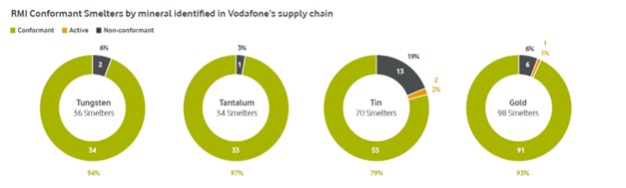

See the Annex for the lists of identified Smelters and their RMAP status.

We will engage with the In-Scope Suppliers that have identified Non-conformant Smelters as being within their supply chain to either encourage the Smelters to become RMI Conformant through escalatory measures or remove them from the supply chain.

The data provided by In-Scope Suppliers continues to improve with additional Smelter details being included in our In-Scope Suppliers’ CMRT responses. However, there are still gaps in the information provided where suppliers in the supply chain have failed to provide details for all components. Responses from In-Scope Suppliers showed that there are still significant challenges relating to information about the Country of Origin of 3TG metals, and the Smelters from which 3TG metals were sourced. Information received from In-Scope Suppliers regarding their supply chain can be incomplete or potentially erroneous.

We will continue engaging with In-Scope Suppliers to improve the completeness and quality of information provided.

Based on the RCOI enquiry and due diligence efforts described above, we have determined that some Conflict Minerals contained in our In-Scope Products originated in Covered Countries. As a result of the incompleteness of some In-Scope Suppliers’ responses received so far through our ongoing due diligence programme, we are unable to determine the origin of all Conflict Minerals contained in all our In-Scope Products.

In line with the OECD risk-based due diligence approach, we ask In-Scope Suppliers to prioritise Smelters identified as high-risk.

RMI Conformant Smelters by mineral identified in Vodafone’s supply chain


LOGO


CONTINUOUS IMPROVEMENT EFFORTS TO MITIGATE RISK

We are taking a range of steps to enhance the due diligence process and further mitigate any risk that Conflict Minerals used in the company’s products may benefit armed groups.

We are engaging with In-Scope Suppliers to:


Encourage them to put a Conflict Minerals policy in place or improve their existing responsible minerals programme;


Improve the completeness and quality of information provided, particularly in relation to the identification of Smelters and the Country of Origin of 3TG metals, and in providing CMRT information on Smelters at product level; and


10


Seek their commitment to implement further improvements in relation to due diligence processes, including asking them to reach out to RMI Non-conformant Smelters identified as being within our supply chain to encourage these Smelters to undergo a RMAP audit.

We will also continue to work with our In-Scope Suppliers to remove RMI Non-conformant Smelters from our supply chain that may experience a change in their RMI conformance status, in addition to ongoing monitoring of the status of Smelters impacted by conflict-related activities in the Covered Countries.

We are participating in industry efforts to address issues related to Conflict Minerals in supply chains, increase the number of Smelters sourcing from the Covered Countries that are conflict-free and improve Country of Origin information.

FORWARD-LOOKING STATEMENTS

This report contains ‘forward-looking statements’ within the meaning of the US Private Securities Litigation Reform Act of 1995 with respect to Vodafone’s financial condition, results of operations and businesses and certain of Vodafone’s plans and objectives.

Forward-looking statements are sometimes but not always identified by their use of a date in the future or such words as ‘will’, ‘may’, ‘plans’, ‘further’, ‘ongoing’ or ‘targets’. By their nature, forward-looking statements are inherently predictive, speculative and involve risk and uncertainty because they relate to events and depend on circumstances that will occur in the future. There are a number of factors that could cause actual results and developments to differ materially from those expressed or implied by these forward-looking statements.


11


Annex: List of known smelters

The table lists the Smelters identified through In-Scope Supplier CMRT responses for the year ended 31 December 2025 and their RMAP status as of 14 January 2026.


LOGO


LOGO


12


LOGO


LOGO


13


Annex: Country of origin information by mineral

The Reasonable Country of Origin Inquiry (RCOI) data as of 30th January 2026 provides reasonable country of origin information for the mined material of conformant smelters and refiners in the Responsible Minerals Assurance Process and gold refiners that have successfully completed a cross-recognised assessment through the London Bullion Market Association (LBMA) or Responsible Jewellery Council (RJC). The following countries of origin were identified.


LOGO


14