Please wait
DEF 14Afalse0000842162iso4217:USDxbrli:pure00008421622025-01-012025-12-310000842162ecd:NonPeoNeoMember2025-01-012025-12-3100008421622024-01-012024-12-3100008421622023-01-012023-12-3100008421622022-01-012022-12-3100008421622021-01-012021-12-31000084216212025-01-012025-12-310000842162lea:ChangeInPensionValueMemberecd:PeoMember2025-01-012025-12-310000842162lea:StockAwardsMemberecd:PeoMember2025-01-012025-12-310000842162ecd:YrEndFrValOfEqtyAwrdsGrntdInCvrdYrOutsdngAndUnvstdMemberecd:PeoMember2025-01-012025-12-310000842162ecd:ChngInFrValOfOutsdngAndUnvstdEqtyAwrdsGrntdInPrrYrsMemberecd:PeoMember2025-01-012025-12-310000842162ecd:ChngInFrValAsOfVstngDtOfPrrYrEqtyAwrdsVstdInCvrdYrMemberecd:PeoMember2025-01-012025-12-310000842162ecd:PeoMember2025-01-012025-12-310000842162lea:ChangeInPensionValueMemberecd:NonPeoNeoMember2025-01-012025-12-310000842162lea:StockAwardsMemberecd:NonPeoNeoMember2025-01-012025-12-310000842162ecd:YrEndFrValOfEqtyAwrdsGrntdInCvrdYrOutsdngAndUnvstdMemberecd:NonPeoNeoMember2025-01-012025-12-310000842162ecd:ChngInFrValOfOutsdngAndUnvstdEqtyAwrdsGrntdInPrrYrsMemberecd:NonPeoNeoMember2025-01-012025-12-310000842162ecd:ChngInFrValAsOfVstngDtOfPrrYrEqtyAwrdsVstdInCvrdYrMemberecd:NonPeoNeoMember2025-01-012025-12-310000842162lea:ChangeInPensionValueMemberecd:PeoMember2024-01-012024-12-310000842162lea:StockAwardsMemberecd:PeoMember2024-01-012024-12-310000842162ecd:YrEndFrValOfEqtyAwrdsGrntdInCvrdYrOutsdngAndUnvstdMemberecd:PeoMember2024-01-012024-12-310000842162ecd:ChngInFrValOfOutsdngAndUnvstdEqtyAwrdsGrntdInPrrYrsMemberecd:PeoMember2024-01-012024-12-310000842162ecd:ChngInFrValAsOfVstngDtOfPrrYrEqtyAwrdsVstdInCvrdYrMemberecd:PeoMember2024-01-012024-12-310000842162ecd:PeoMember2024-01-012024-12-310000842162lea:ChangeInPensionValueMemberecd:NonPeoNeoMember2024-01-012024-12-310000842162lea:StockAwardsMemberecd:NonPeoNeoMember2024-01-012024-12-310000842162ecd:YrEndFrValOfEqtyAwrdsGrntdInCvrdYrOutsdngAndUnvstdMemberecd:NonPeoNeoMember2024-01-012024-12-310000842162ecd:ChngInFrValOfOutsdngAndUnvstdEqtyAwrdsGrntdInPrrYrsMemberecd:NonPeoNeoMember2024-01-012024-12-310000842162ecd:ChngInFrValAsOfVstngDtOfPrrYrEqtyAwrdsVstdInCvrdYrMemberecd:NonPeoNeoMember2024-01-012024-12-310000842162ecd:NonPeoNeoMember2024-01-012024-12-310000842162lea:ChangeInPensionValueMemberecd:PeoMember2023-01-012023-12-310000842162lea:StockAwardsMemberecd:PeoMember2023-01-012023-12-310000842162ecd:YrEndFrValOfEqtyAwrdsGrntdInCvrdYrOutsdngAndUnvstdMemberecd:PeoMember2023-01-012023-12-310000842162ecd:ChngInFrValOfOutsdngAndUnvstdEqtyAwrdsGrntdInPrrYrsMemberecd:PeoMember2023-01-012023-12-310000842162ecd:ChngInFrValAsOfVstngDtOfPrrYrEqtyAwrdsVstdInCvrdYrMemberecd:PeoMember2023-01-012023-12-310000842162ecd:PeoMember2023-01-012023-12-310000842162lea:ChangeInPensionValueMemberecd:NonPeoNeoMember2023-01-012023-12-310000842162lea:StockAwardsMemberecd:NonPeoNeoMember2023-01-012023-12-310000842162ecd:YrEndFrValOfEqtyAwrdsGrntdInCvrdYrOutsdngAndUnvstdMemberecd:NonPeoNeoMember2023-01-012023-12-310000842162ecd:ChngInFrValOfOutsdngAndUnvstdEqtyAwrdsGrntdInPrrYrsMemberecd:NonPeoNeoMember2023-01-012023-12-310000842162ecd:ChngInFrValAsOfVstngDtOfPrrYrEqtyAwrdsVstdInCvrdYrMemberecd:NonPeoNeoMember2023-01-012023-12-310000842162ecd:NonPeoNeoMember2023-01-012023-12-310000842162lea:ChangeInPensionValueMemberecd:PeoMember2022-01-012022-12-310000842162lea:StockAwardsMemberecd:PeoMember2022-01-012022-12-310000842162ecd:YrEndFrValOfEqtyAwrdsGrntdInCvrdYrOutsdngAndUnvstdMemberecd:PeoMember2022-01-012022-12-310000842162ecd:ChngInFrValOfOutsdngAndUnvstdEqtyAwrdsGrntdInPrrYrsMemberecd:PeoMember2022-01-012022-12-310000842162ecd:ChngInFrValAsOfVstngDtOfPrrYrEqtyAwrdsVstdInCvrdYrMemberecd:PeoMember2022-01-012022-12-310000842162ecd:PeoMember2022-01-012022-12-310000842162lea:ChangeInPensionValueMemberecd:NonPeoNeoMember2022-01-012022-12-310000842162lea:StockAwardsMemberecd:NonPeoNeoMember2022-01-012022-12-310000842162ecd:YrEndFrValOfEqtyAwrdsGrntdInCvrdYrOutsdngAndUnvstdMemberecd:NonPeoNeoMember2022-01-012022-12-310000842162ecd:ChngInFrValOfOutsdngAndUnvstdEqtyAwrdsGrntdInPrrYrsMemberecd:NonPeoNeoMember2022-01-012022-12-310000842162ecd:ChngInFrValAsOfVstngDtOfPrrYrEqtyAwrdsVstdInCvrdYrMemberecd:NonPeoNeoMember2022-01-012022-12-310000842162ecd:NonPeoNeoMember2022-01-012022-12-310000842162lea:ChangeInPensionValueMemberecd:PeoMember2021-01-012021-12-310000842162lea:StockAwardsMemberecd:PeoMember2021-01-012021-12-310000842162ecd:YrEndFrValOfEqtyAwrdsGrntdInCvrdYrOutsdngAndUnvstdMemberecd:PeoMember2021-01-012021-12-310000842162ecd:ChngInFrValOfOutsdngAndUnvstdEqtyAwrdsGrntdInPrrYrsMemberecd:PeoMember2021-01-012021-12-310000842162ecd:ChngInFrValAsOfVstngDtOfPrrYrEqtyAwrdsVstdInCvrdYrMemberecd:PeoMember2021-01-012021-12-310000842162ecd:PeoMember2021-01-012021-12-310000842162lea:ChangeInPensionValueMemberecd:NonPeoNeoMember2021-01-012021-12-310000842162lea:StockAwardsMemberecd:NonPeoNeoMember2021-01-012021-12-310000842162ecd:YrEndFrValOfEqtyAwrdsGrntdInCvrdYrOutsdngAndUnvstdMemberecd:NonPeoNeoMember2021-01-012021-12-310000842162ecd:ChngInFrValOfOutsdngAndUnvstdEqtyAwrdsGrntdInPrrYrsMemberecd:NonPeoNeoMember2021-01-012021-12-310000842162ecd:ChngInFrValAsOfVstngDtOfPrrYrEqtyAwrdsVstdInCvrdYrMemberecd:NonPeoNeoMember2021-01-012021-12-310000842162ecd:NonPeoNeoMember2021-01-012021-12-310000842162lea:StockPriceLowMember2025-01-012025-12-310000842162lea:StockPriceHighMember2025-01-012025-12-310000842162lea:StockPriceAtYearEndMember2025-01-012025-12-310000842162lea:StockPriceLowMember2024-01-012024-12-310000842162lea:StockPriceHighMember2024-01-012024-12-310000842162lea:StockPriceAtYearEndMember2024-01-012024-12-310000842162lea:StockPriceLowMember2023-01-012023-12-310000842162lea:StockPriceHighMember2023-01-012023-12-310000842162lea:StockPriceAtYearEndMember2023-01-012023-12-310000842162lea:StockPriceLowMember2022-01-012022-12-310000842162lea:StockPriceHighMember2022-01-012022-12-310000842162lea:StockPriceAtYearEndMember2022-01-012022-12-310000842162lea:StockPriceLowMember2021-01-012021-12-310000842162lea:StockPriceHighMember2021-01-012021-12-310000842162lea:StockPriceAtYearEndMember2021-01-012021-12-31000084216222025-01-012025-12-31000084216232025-01-012025-12-31000084216242025-01-012025-12-31
UNITED STATES
SECURITIES AND EXCHANGE COMMISSION
Washington, D.C. 20549
________________________
SCHEDULE 14A
Proxy Statement Pursuant to Section 14(a) of the
Securities Exchange Act of 1934
________________________
Filed by the Registrant x
Filed by a Party other than the Registrant o
Check the appropriate box:
| | | | | |
| o | Preliminary Proxy Statement |
| |
| o | Confidential, for Use of the Commission Only (as permitted by Rule 14a-6(e)(2)) |
| |
| x | Definitive Proxy Statement |
| |
| o | Definitive Additional Materials |
| |
| o | Soliciting Material Pursuant to §240.14a-12 |
Lear Corporation
(Name of Registrant as Specified in its Charter)
(Name of Person(s) Filing Proxy Statement, if other than the Registrant)
Payment of Filing Fee (Check the appropriate box):
| | | | | |
| x | No fee required. |
| |
| o | Fee paid previously with preliminary materials. |
| |
| o | Fee computed on table in exhibit required by Item 25(b) per Exchange Act Rules 14a-6(i)(1) and 0-11. |
21557 Telegraph Road
Southfield, Michigan 48033
April 2, 2026
Dear Shareholder:
On behalf of the Board of Directors of Lear Corporation, you are cordially invited to attend the 2026 Annual Meeting of Shareholders (the “Annual Meeting”) to be held through a virtual web conference at www.virtualshareholdermeeting.com/LEA2026 on May 14, 2026, at 9:00 a.m. (Eastern Time). You will be able to attend the Annual Meeting online, vote your shares electronically, and submit questions in advance of and during the meeting by logging in to the website listed above using the 16-digit control number included in your Notice of Internet Availability of Proxy Materials, on your proxy card, or in any additional voting instructions accompanying these proxy materials. We recommend that you log in a few minutes before the meeting to ensure you are admitted when the meeting starts.
To facilitate broad shareholder attendance and participation and provide a consistent experience to all shareholders, regardless of location, the Annual Meeting will once again be virtual. We have included with this letter a proxy statement that provides you with detailed information about the Annual Meeting. We encourage you to read the entire proxy statement carefully. You may also obtain more information about Lear Corporation from documents we have filed with the Securities and Exchange Commission (the “SEC”).
We are delivering our proxy statement and annual report on Form 10-K pursuant to the SEC rules that allow companies to furnish proxy materials to their shareholders over the Internet. We believe that this delivery method expedites shareholders’ receipt of proxy materials and lowers the cost and environmental impact of our Annual Meeting. On or about April 2, 2026, we will mail to our shareholders a notice containing instructions on how to access our proxy materials. In addition, the notice includes instructions on how you can receive a paper copy of our proxy materials.
You are being asked at the Annual Meeting to elect directors named in the accompanying proxy statement, to ratify the retention of Ernst & Young LLP as our independent registered public accounting firm, to provide an advisory vote to approve our executive compensation, to approve the amendment and restatement of our 2019 Long-Term Stock Incentive Plan and to transact any other business properly brought before the Annual Meeting.
As always, we encourage you to vote your shares prior to the Annual Meeting. You may vote your shares through one of the methods described in the enclosed proxy statement. We strongly urge you to read the accompanying proxy statement carefully and to vote FOR the nominees proposed by the Board of Directors and in accordance with the recommendations of the Board of Directors on the other proposals by following the voting instructions contained in the proxy statement.
| | | | | | | | |
Sincerely, | | |
| | |
Greg C. Smith | | Raymond E. Scott |
| Non-Executive Chairman | | President, Chief Executive Officer and Director |
This proxy statement is dated April 2, 2026, and is first being made available to shareholders via the Internet on or about April 2, 2026.
21557 Telegraph Road
Southfield, Michigan 48033
NOTICE OF ANNUAL MEETING OF SHAREHOLDERS
| | | | | |
| Time and Date: | Thursday, May 14, 2026, at 9:00 a.m. (Eastern Time) Online check-in will be available beginning at 8:30 a.m. (Eastern Time). Please allow ample time for the online check-in process. |
| |
| Place: | The Annual Meeting will be held through a virtual web conference at www.virtualshareholdermeeting.com/LEA2026. To participate in the Annual Meeting, you will need your 16-digit control number included in your Notice of Internet Availability of the Proxy Materials, on your proxy card, or in any additional voting instructions accompanying these Proxy Materials. |
| |
| Record Date: | March 16, 2026 |
| |
| Items of Business: | 1. To elect the following eleven nominees to the Board of Directors (the “Board”): Julian G. Blissett, Jonathan F. Foster, Bradley M. Halverson, Mary Lou Jepsen, Roger A. Krone, Rod A. Lache, Patricia L. Lewis, Kathleen A. Ligocki, Conrad L. Mallett, Jr., Raymond E. Scott and Greg C. Smith; 2. To ratify the retention of Ernst & Young LLP as the Company’s registered public accounting firm for 2026; 3. To approve, in a non-binding advisory vote, the Company’s executive compensation; 4. To approve the amendment and restatement of the Company’s 2019 Long-Term Stock Incentive Plan, as amended and restated as of May 18, 2023 (the “Plan,” which once further amended and restated, the “Amended Plan”); and 5. To conduct any other business properly brought before the Annual Meeting or any postponement thereof. |
| |
| Proxy Voting: | YOUR VOTE IS IMPORTANT. WHETHER OR NOT YOU PLAN TO ATTEND THE ANNUAL MEETING, PLEASE VOTE YOUR SHARES OVER THE TELEPHONE, VIA THE INTERNET OR BY COMPLETING, DATING, SIGNING AND RETURNING A PROXY CARD, AS DESCRIBED IN THE PROXY STATEMENT. YOUR PROMPT COOPERATION IS GREATLY APPRECIATED. |
| | | | | |
| By Order of the Board of Directors, | |
| |
Amanda J. Pontes | |
Vice President, General Counsel and Corporate Secretary April 2, 2026 | |
| | |
Notice of Internet Availability of Proxy Materials We are making the accompanying proxy statement and our annual report on Form 10-K available to shareholders electronically via the Internet. On or about April 2, 2026, we will mail to most of our shareholders a notice containing instructions on how to access this proxy statement and our annual report on Form 10-K and to vote via the Internet or by telephone. Other shareholders, in accordance with their prior requests, will receive e-mail notification of how to access our proxy materials and vote via the Internet or by telephone or will be mailed paper copies of our proxy materials and a proxy card on or about April 2, 2026. |
TABLE OF CONTENTS
LEAR CORPORATION
2026 PROXY STATEMENT SUMMARY
This summary highlights information that is contained elsewhere in this proxy statement by Lear Corporation (the "Company," "Lear," "we," "our" or "us"). It does not include all of the information necessary to make a voting decision, and you should carefully read this proxy statement in its entirety before casting your vote. Please see the section "Questions and Answers" beginning on page 92 for important information about proxy materials, voting, the Annual Meeting, the Company, documents and communications. Annual Meeting of Shareholders
Proxy Voting Roadmap
Shareholders will be asked to vote on the following matters at the Annual Meeting. This section does not contain all of the information that you should consider in deciding how to vote. You should read the entirety of this proxy statement carefully before voting.
| | | | | | | | | | | |
| Voting Matter | Board Vote Recommendation | Page Reference |
Item 1 | Election of Director Nominees Named in this Proxy Statement | FOR all eleven director nominees | |
Item 2 | Ratification of Retention of Independent Registered Public Accounting Firm | FOR | |
Item
3 | Advisory Vote to Approve the Company's Executive Compensation | FOR | |
Item 4 | Vote to Approve the Amended Plan | FOR | |
Lear at a Glance
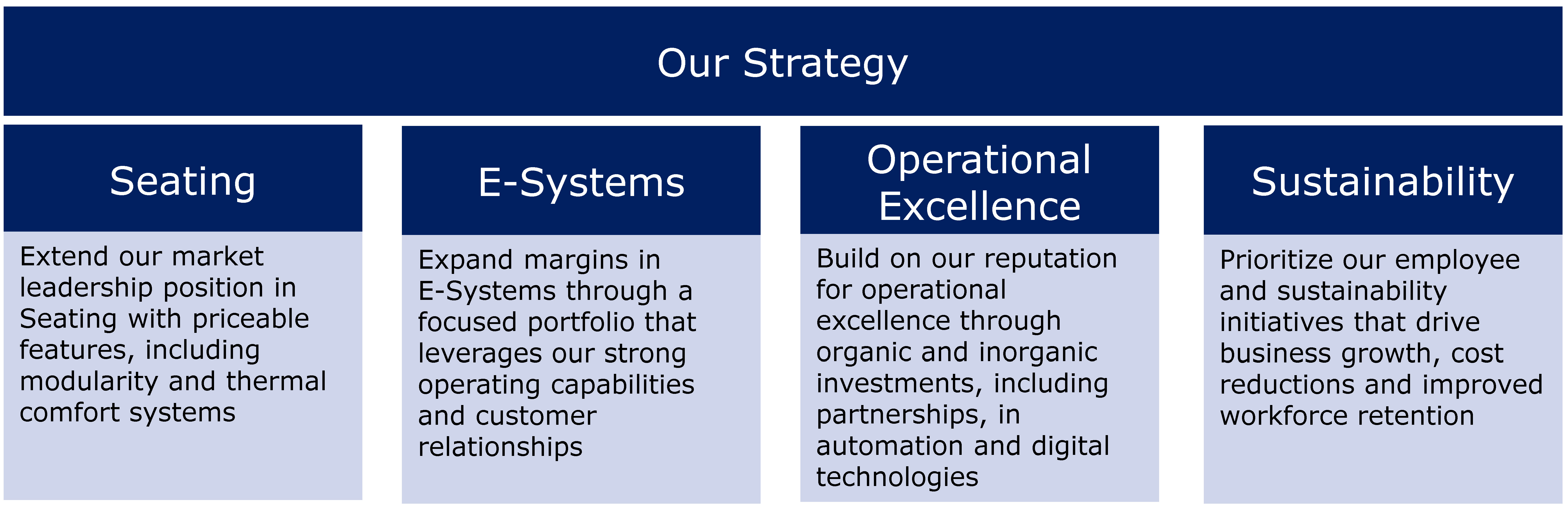
Lear Corporation is a global automotive technology leader in Seating and E-Systems, enabling superior in-vehicle experiences for consumers around the world. We supply products such as complete seat systems, key seat components, complete electrical distribution and connection systems, high-voltage power distribution products, including battery disconnect units ("BDUs"), and low-voltage power distribution products and electronic controllers to all of the world's major automotive manufacturers. At Lear, we are Making every drive betterTM by providing technology for safer, smarter and more comfortable journeys, while adhering to our values — Be Inclusive. Be Inventive. Get Results the Right Way.
*See page 3 and Appendix A “Reconciliation of Non-GAAP Financial Measures” on page 97 for more information on this non-GAAP financial measure and how it is used. We serve all major global automotive manufacturers, with content on more than 500 vehicle nameplates worldwide, and frequently supply both Seating and E‑Systems content on the same vehicle platform. Our businesses benefit from shared global operating standards, common engineering and manufacturing processes, and centralized support functions, which together underpin our reputation for operational excellence. We continue to strengthen these capabilities through IDEA by LearTM - Innovative. Digital. Engineered. Automated. IDEA by LearTM supports our strategy to drive growth and improve profitability through the development of innovative products and the utilization of advanced technologies and process automation that increase efficiency and extend our leadership position in operational excellence.
Business Segments
Our business operates through two reporting segments: Seating and E‑Systems, each offering a broad portfolio of products and technologies. We actively manage these portfolios to align with industry trends and risk‑adjusted returns, enabling us to deliver value‑added solutions to our customers.
Seating
The Seating segment designs, develops, engineers and manufactures complete seat systems and key seat components, supported by vertically integrated operations and just‑in‑time delivery capabilities. Our product offerings include seat trim covers, surface materials, mechanisms, cushioning, headrests and thermal comfort systems, all compatible with internal combustion engine architectures, hybrid vehicles and battery electric vehicles and enabled by our electronics, software and system integration expertise.
E-Systems
The E‑Systems segment designs, develops, engineers and manufactures complete electrical distribution and connection systems, high‑ and low‑voltage power distribution products and electronic controllers. Our portfolio supports both internal combustion engine and electrified architectures and includes wire harnesses, terminals and connectors, high‑voltage battery connection systems, engineered components, BDUs, zonal controllers and body domain control modules, and our software offerings include embedded control, cybersecurity software and software to control hardware devices.
Business Highlights
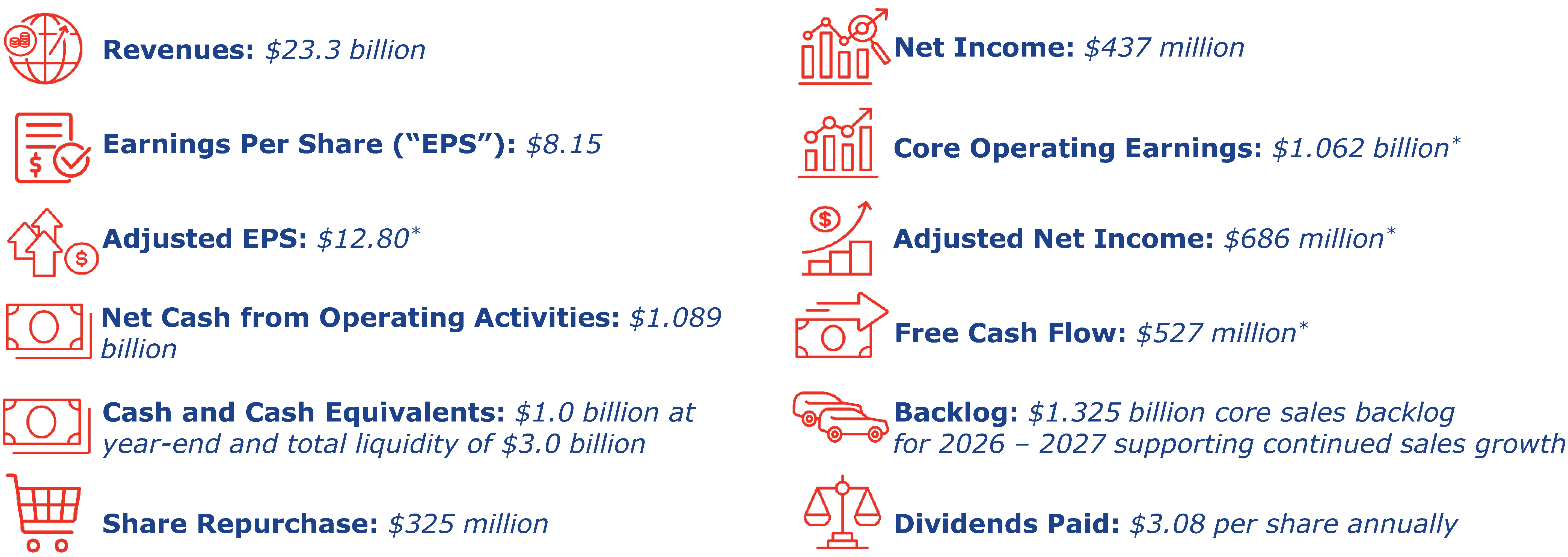
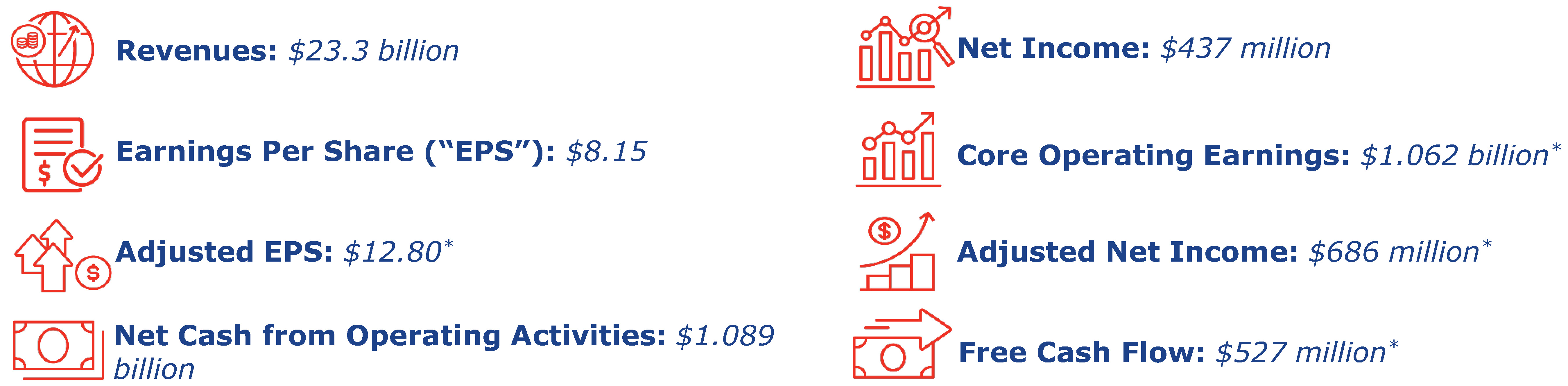
2025 Financial Performance
* Contained above, and elsewhere in this proxy statement, are certain financial measures that are not calculated in accordance with accounting principles generally accepted in the United States ("GAAP"). These measures, along with their corresponding GAAP measures and reconciliations thereto, have been previously disclosed in the exhibit to Lear’s Current Report on Form 8-K filed with the Securities and Exchange Commission (the "SEC") on February 4, 2026. Also see Appendix A “Reconciliation of Non-GAAP Financial Measures” on page 97 for more information on these non-GAAP financial measures and how they are used. 2025 Business Performance
| | | | | |
• Total shareholder return, including dividends, of 26.8% in 2025 | • Increased adjusted earnings per share for the fifth consecutive year |
• Achieved record level $195 million of net performance** despite very challenging operating conditions, including tariffs and lower vehicle production | • Awarded complete seat assembly on a major truck program from an American automaker, Lear’s largest conquest award in history demonstrating the viability of our automation capabilities |
| • Selected as the supplier of complete seats for full-size pickup trucks and SUVs on-shored to the United States from Mexico by General Motors | • Obtained operating control of two joint ventures in China, which support several programs for a number of Chinese domestic automakers |
•Awarded several complete seat programs with key Chinese domestic automakers, including Changan, Dongfeng and Leapmotor, and a thermal comfort program with BYD | • Received a record 11 quality awards from customers in E-Systems, demonstrating the success of our multi-year operational efficiency and quality improvement initiatives across our manufacturing facilities |
•Secured ~$1.4 billion of E-Systems business awards, the largest annual total in over a decade | • Acquired StoneShield Engineering to enhance our IDEA by LearTM advanced automation capabilities, improving our wire harness production efficiency in E-Systems |
• Achieved seven top-four finishes in the J.D. Power 2025 U.S. Seat Quality and Satisfaction StudySM — more than any other seating competitor for the third consecutive year | • Won a 2025 Automotive News PACE award for our innovative Zone Control Module featuring a highly configurable software solution |
| • Completed the first cohort of the Lear Fellowship program with Palantir Technologies, Inc., a leading provider of AI software, to accelerate our digital and AI capabilities across our global manufacturing footprint | • Recognized as a 2026 Automobiles and Parts industry leader in the Just Capital and CNBC Best of American Business rankings |
** Net performance is our internal measure of our ability to generate savings and efficiencies against contractual obligations and inflationary increases. To calculate net performance, positive drivers of performance (e.g., operational efficiencies, automation, restructuring savings, commercial recoveries and foreign exchange gains) are offset by negative drivers (e.g., contractual price reductions, inflation and foreign exchange losses.)
How Our Compensation Program Supports Our Business Strategy
Our executive compensation program is designed to support shareholder value creation by driving and rewarding long-term business outcomes, promoting strong governance practices and encouraging responsible risk-taking. This is achieved by linking individual pay to the Company’s performance over a diverse set of financial measures. Lear has a long-standing commitment to pay for performance. The majority of all senior executives' compensation is variable and covers annual and multi-year performance periods, and all senior executives have meaningful long-term Lear stock holdings. Long-term incentives use three-year performance-vesting awards ("Performance Shares") to align senior executives' compensation with the Company’s long-term performance.
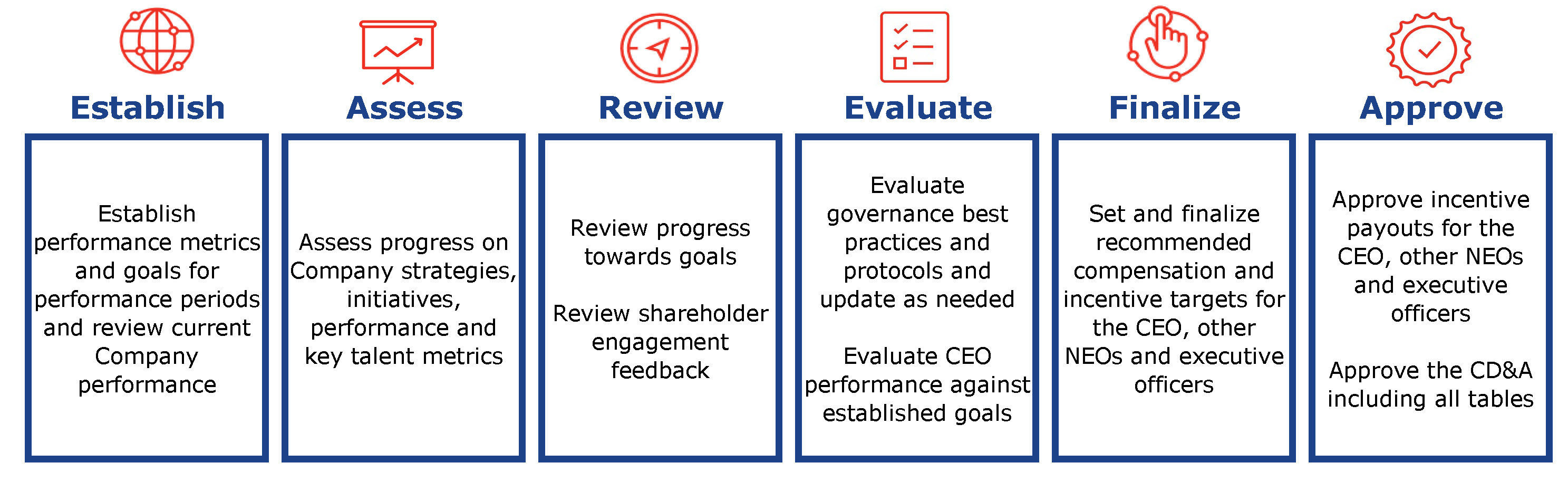
Our Board’s People and Compensation Committee (“P&C Committee”), with the assistance of its independent compensation consultant, provides strong oversight through the approval of performance goals across all financial measures and the certification of performance outcomes.
Our executive compensation program, including our compensation guiding principles, decision-making process and performance measures, is discussed in detail in the "Compensation Discussion and Analysis" of this proxy statement beginning on page 32. 2025 Compensation Highlights
2025 Annual Incentive Plan ("AIP") Design Overview
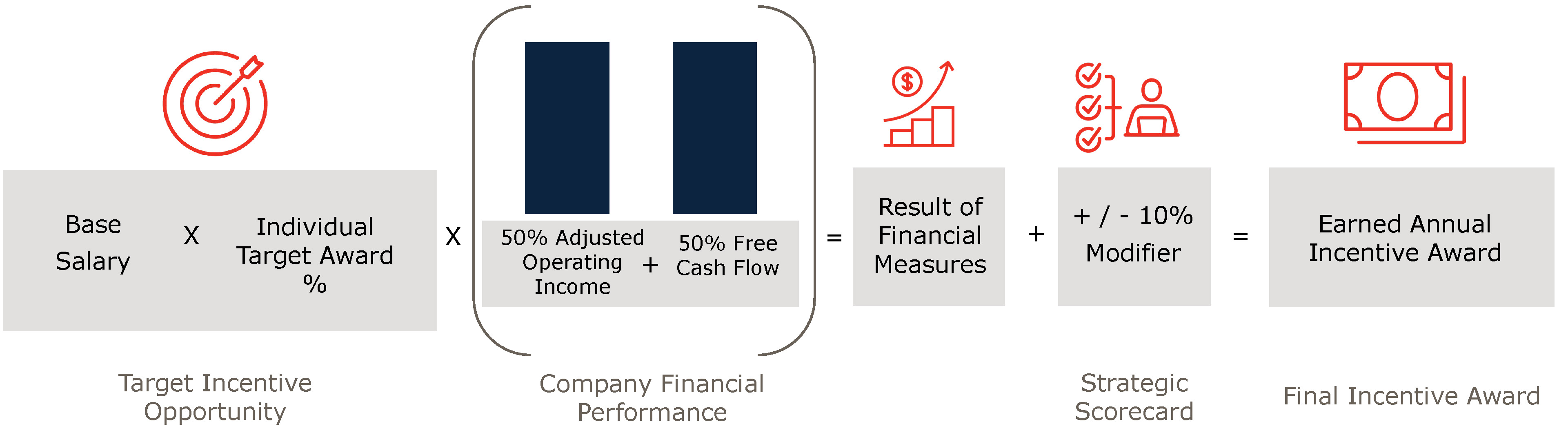
•Maintained Lear's traditional equal weighting for the two financial measures that determine the AIP – Adjusted Operating Income and Free Cash Flow.
•Continued the Strategic Scorecard modifier, introduced in 2024, which can increase (or decrease) the AIP results based on the two financial measures by up to 10% depending on the achievement of specific and objective goals relating to innovation in areas of strategic importance such as automation and digitization.
2025-2027 Long-Term Stock Incentive Plan ("LTI") Design Overview
For the 2025-2027 LTI grants, the P&C Committee continued to align our leadership’s compensation with shareholder interests:
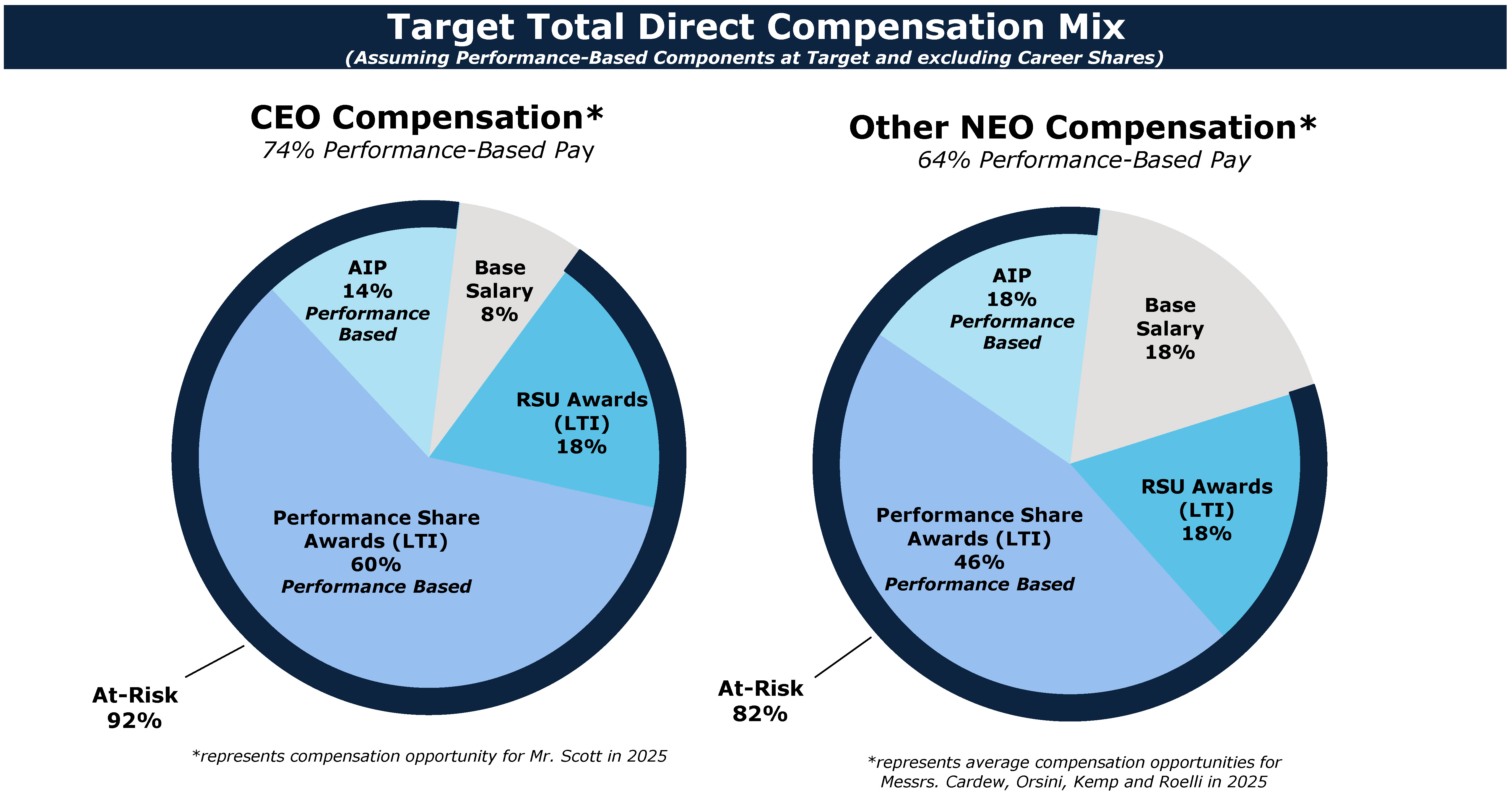
•Maintained award mix that heavily emphasizes Performance Shares designed to reward financial and Total Shareholder Return ("TSR") results:
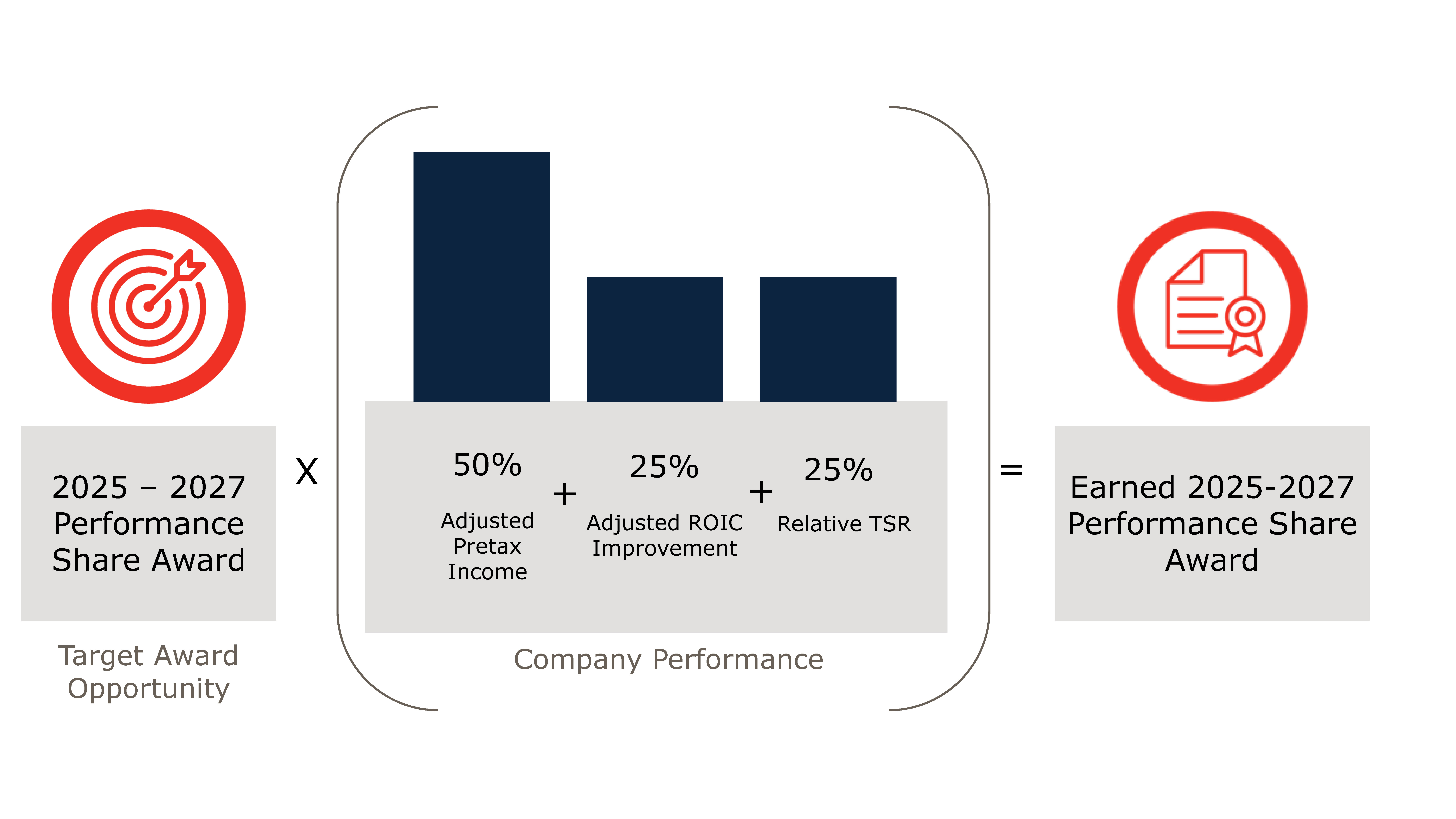
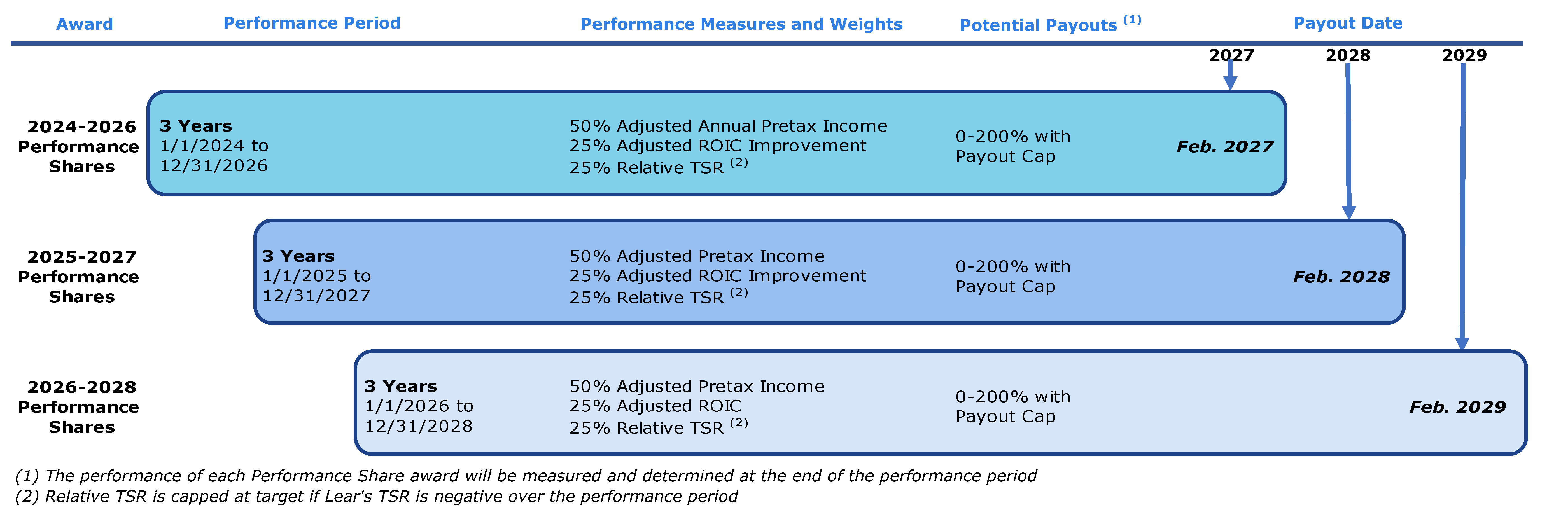
•The 2025-2027 Performance Shares can be earned based on the following performance measures (beginning on page 49): •Adjusted Pretax Income (50% of the award)
•Adjusted Return on Invested Capital ("ROIC") Improvement (25% of the award)
•Relative TSR (25% of the award)
•Goal setting aligns with our long-range plan, with all financial targets set prior to the start of the performance period:
•For the 2025-2027 Performance Shares, all performance goals were established and approved by the P&C Committee prior to the start of the performance period.
•For both Adjusted Pretax Income and Adjusted ROIC Improvement, the results for each year will be measured and the final payout will be based on the average of the annual results.
Pay-for-Performance Alignment
Base salary and annual and long-term incentive award opportunities are the core elements of total direct compensation of our Chief Executive Officer ("CEO"), our Chief Financial Officer ("CFO") and our other executive officers listed in the Summary Compensation Table (collectively, our Named Executive Officers, referred to herein as our "NEOs"). As shown below, the significant portion of performance-based pay aligns our NEOs' compensation with our shareholders’ interests. The target compensation mix for our CEO and our other NEOs on average for 2025 is shown below and further discussed in detail in the "Compensation Discussion and Analysis" of this proxy statement beginning on page 32:
Corporate Governance
Governance Highlights
| | | | | | | | | | | | | | | | | |
| Board Structure and Independence |
| •All of our non-executive directors are independent | | •Our highly skilled Board provides a range of expertise and viewpoints | | •Our Board committees hold executive sessions without management present |
| •We maintain separate Chairperson of the Board and CEO roles | | •We conduct regular reviews of our Board skills matrix | | |
| •Our Board committees are comprised solely of independent directors | | •Independent directors meet regularly without management present | | |
| Shareholder Rights |
| •We hold an annual election of all directors | | •We have majority voting in uncontested director elections | | •We have advance notice provisions in our Second Amended and Restated Bylaws (the "Bylaws") |
| Board Oversight |
| •We have structured processes for the Board's oversight of the Company's annual business plan and corporate strategy | | •The Audit Committee oversees the integrity of the Company's financial statements, related regulatory and legal compliance, cybersecurity risk and compliance with Lear's Code of Conduct & Business Ethics | | •Management conducts a strategic and comprehensive succession planning review, leadership talent review and human capital overview in a separate session with all Board members annually |
| •We conduct a regular review and assessment of committee responsibilities | | •The Governance and Sustainability Committee (the "G&S Committee") oversees corporate governance and sustainability matters, including Board succession planning | | |
| •We have a structured and robust process for the Board’s assessment and oversight of key enterprise risks, including risks related to geopolitical events, cybersecurity and AI | | •The P&C Committee oversees human capital management, executive compensation programs, talent metrics and strategies | | |
| Strong Corporate Governance Practices |
| •We maintain robust share ownership guidelines for executive officers and directors | | •We have a responsive, active and ongoing shareholder engagement program | | •We have adopted a comprehensive sustainability strategy and corresponding goals |
| •We prohibit hedging and pledging transactions by executive officers and directors | | •We have a robust Code of Business Conduct & Ethics for employees and directors | | •We conduct an annual risk assessment of compensation programs, practices and policies |
| •We have a supplemental Improper Conduct Compensation Recoupment Policy in addition to recoupments required by law, regulation or applicable listing standard | | •We have limits on annual director compensation, and limits on the number of other public company boards and other public company board audit committees on which directors may serve | | •We conduct annual Board and committee self-assessments |
Shareholder Outreach and Engagement
We believe that strong corporate governance practices should include regular outreach and conversations with our shareholders. Our Board also reviews material shareholder engagements, as well as any shareholder inquiries directly related to its responsibilities.
We regularly discuss our business outlook, financial performance, strategic priorities, industry dynamics, compensation, sustainability initiatives, corporate governance and other topics of importance with investors. We actively engage with shareholders of all sizes through a combination of virtual and in-person engagements, including our annual meeting, our website, investor conferences and one-on-one meetings when appropriate.
During 2025, we engaged with shareholders representing approximately 76% of our outstanding shares. We also had 366 interactions with 146 institutions during 2025 as part of our regular ongoing shareholder engagement. These regular engagements allow us to obtain feedback on our shareholders’ perception and understanding of our markets, business and industry. We are committed to maintaining an active dialogue with investors to better understand their perspectives and consider their input.
2026 Annual Meeting of Shareholders
•Date and Time: May 14, 2026, 9:00 a.m. (Eastern Time). Online check-in will be available at 8:30 a.m. (Eastern Time). Please allow ample time for the online check-in process.
•Location: The Annual Meeting will be held through a virtual web conference at www.virtualshareholdermeeting.com/LEA2026. To participate in the Annual Meeting, you will need your 16-digit control number included in your Notice of Internet Availability of the Proxy Materials, on your proxy card, or in any additional voting instructions accompanying these proxy materials.
•Record Date: March 16, 2026
•Voting: Shareholders as of the close of business on the record date are entitled to vote. Each share of common stock is entitled to one vote for each director nominee and one vote for the other proposals to be voted on.
•Shares of Common Stock Outstanding (as of the record date): 50,626,959
•Stock Symbol: LEA
•Exchange: New York Stock Exchange (“NYSE”)
•Registrar & Transfer Agent: Computershare Trust Company, N.A.
•Principal Executive Office: 21557 Telegraph Road, Southfield, Michigan 48033
•Corporate Website: lear.com
•Investor Relations Website: https://ir.lear.com
Items to be Voted on
| | | | | |
| Proposal | Our Board’s Recommendation |
Election of Director Nominees Named in this Proxy Statement (page 10) | FOR |
Ratification of Retention of Independent Registered Public Accounting Firm (page 82) | FOR |
Advisory Vote to Approve the Company’s Executive Compensation (page 83) | FOR |
Vote to Approve the Amended Plan (page 84) | FOR |
| YOUR VOTE IS IMPORTANT. WHETHER OR NOT YOU PLAN TO ATTEND THE ANNUAL MEETING, PLEASE VOTE YOUR SHARES OVER THE TELEPHONE, VIA THE INTERNET OR BY COMPLETING, DATING, SIGNING AND RETURNING A PROXY CARD, AS DESCRIBED IN THE PROXY STATEMENT. YOUR PROMPT COOPERATION IS GREATLY APPRECIATED. |
Director Nominees
| | | | | | | | | | | | | | | | | |
| | | Committee Membership |
| Name and Principal Occupation | Age | Director Since | AC | P&C | G&S |
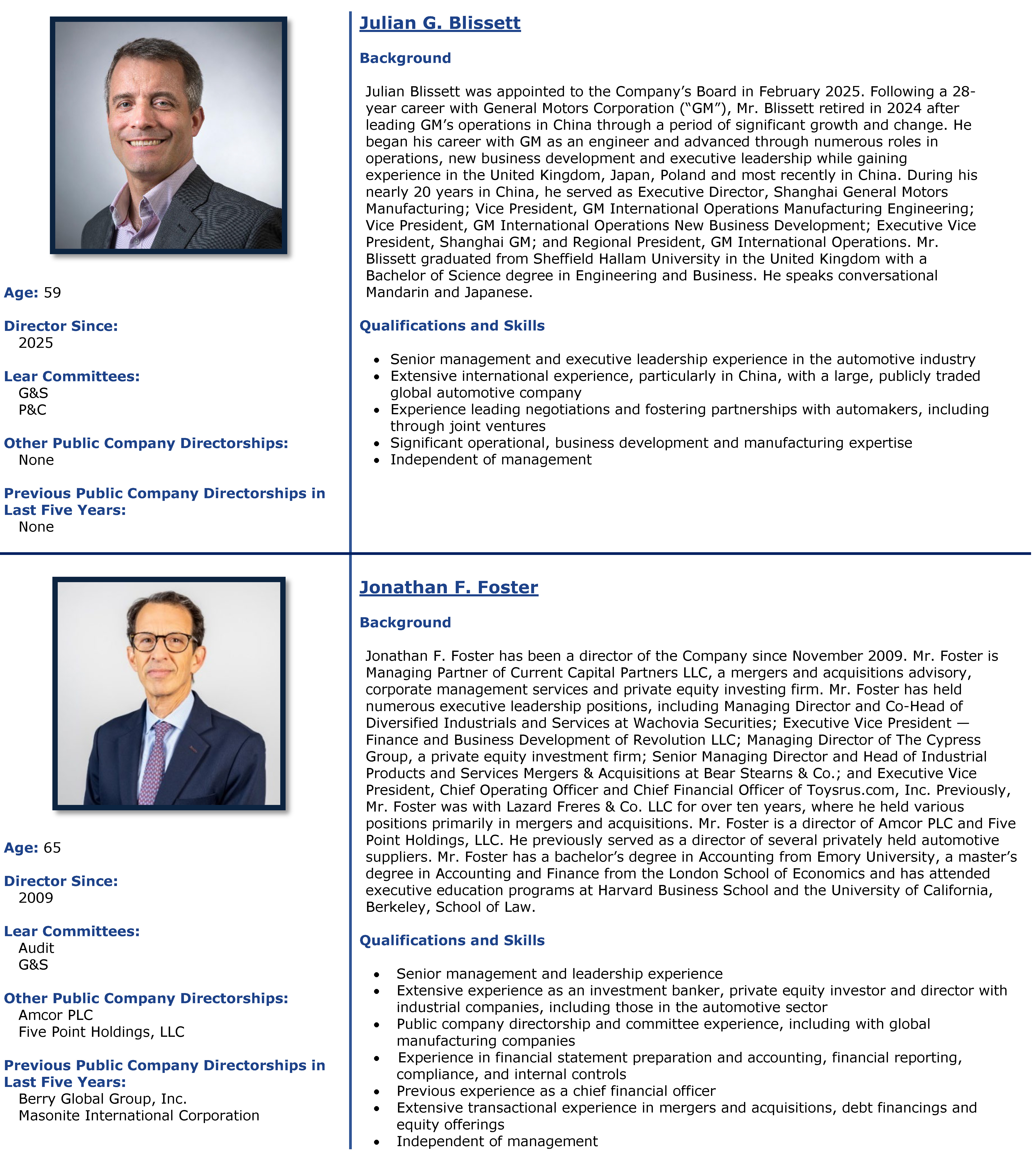
Julian G. Blissett IND Former Executive Vice President and President GM China, General Motors | 59 | 2025 | | • | • |
Jonathan F. Foster IND Managing Partner, Current Capital Partners LLC | 65 | 2009 | • | | • |
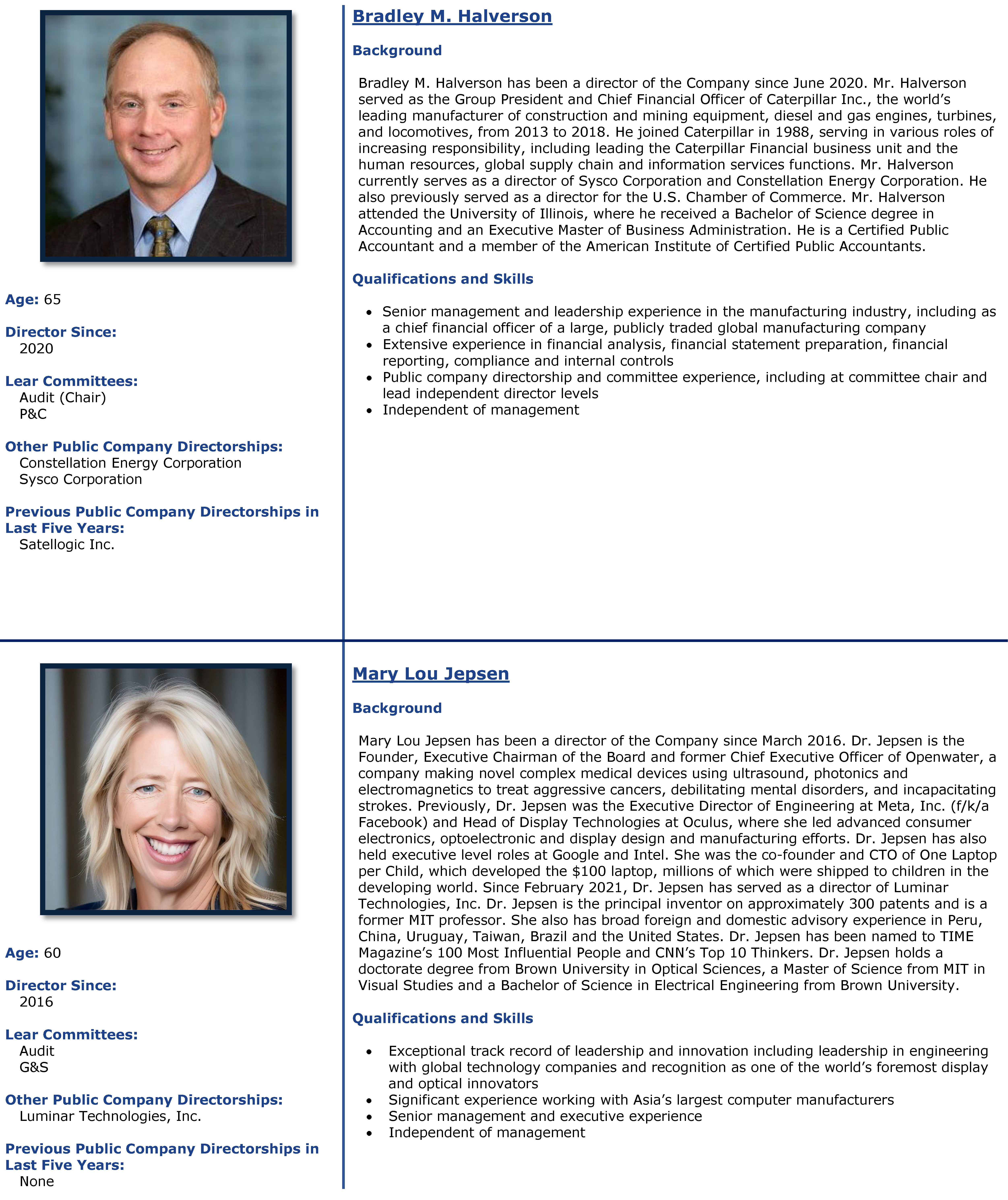
Bradley M. Halverson IND Former Group President and CFO, Caterpillar Inc. | 65 | 2020 | • | • | |
Mary Lou Jepsen IND Founder, Executive Chairman and Former CEO, Openwater | 60 | 2016 | • |
| • |
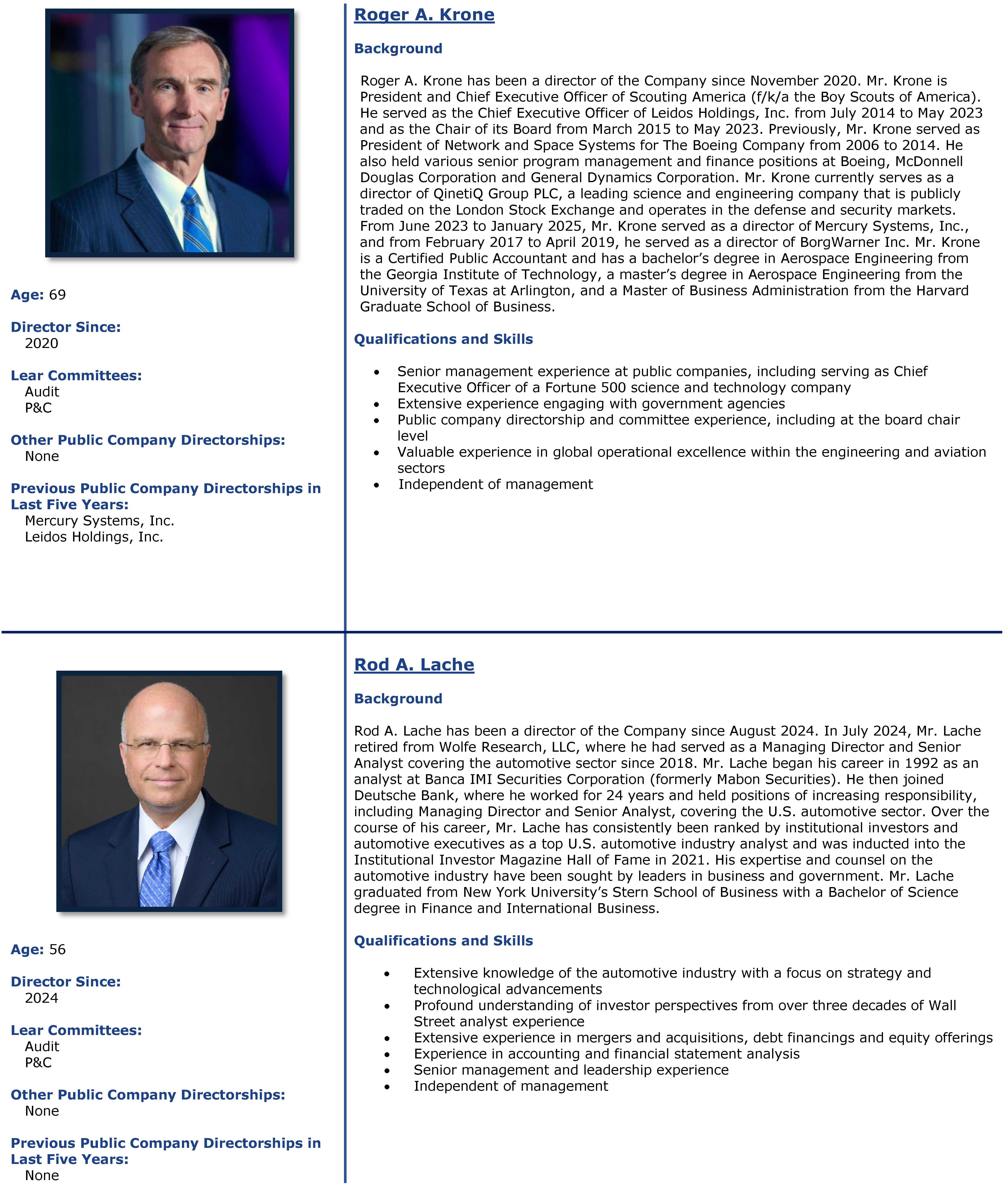
Roger A. Krone IND President and CEO, Scouting America | 69 | 2020 | • | • |
|
Rod A. Lache IND Former Managing Director and Senior Analyst, Wolfe Research, LLC | 56 | 2024 | • | • | |
Patricia L. Lewis IND Former Executive Vice President and Chief Sustainability Officer, UnitedHealth Group Incorporated | 64 | 2020 | | • | • |
Kathleen A. Ligocki IND Former CEO, Tower Automotive and Agility Fuel Solutions | 69 | 2012 | | • | • |
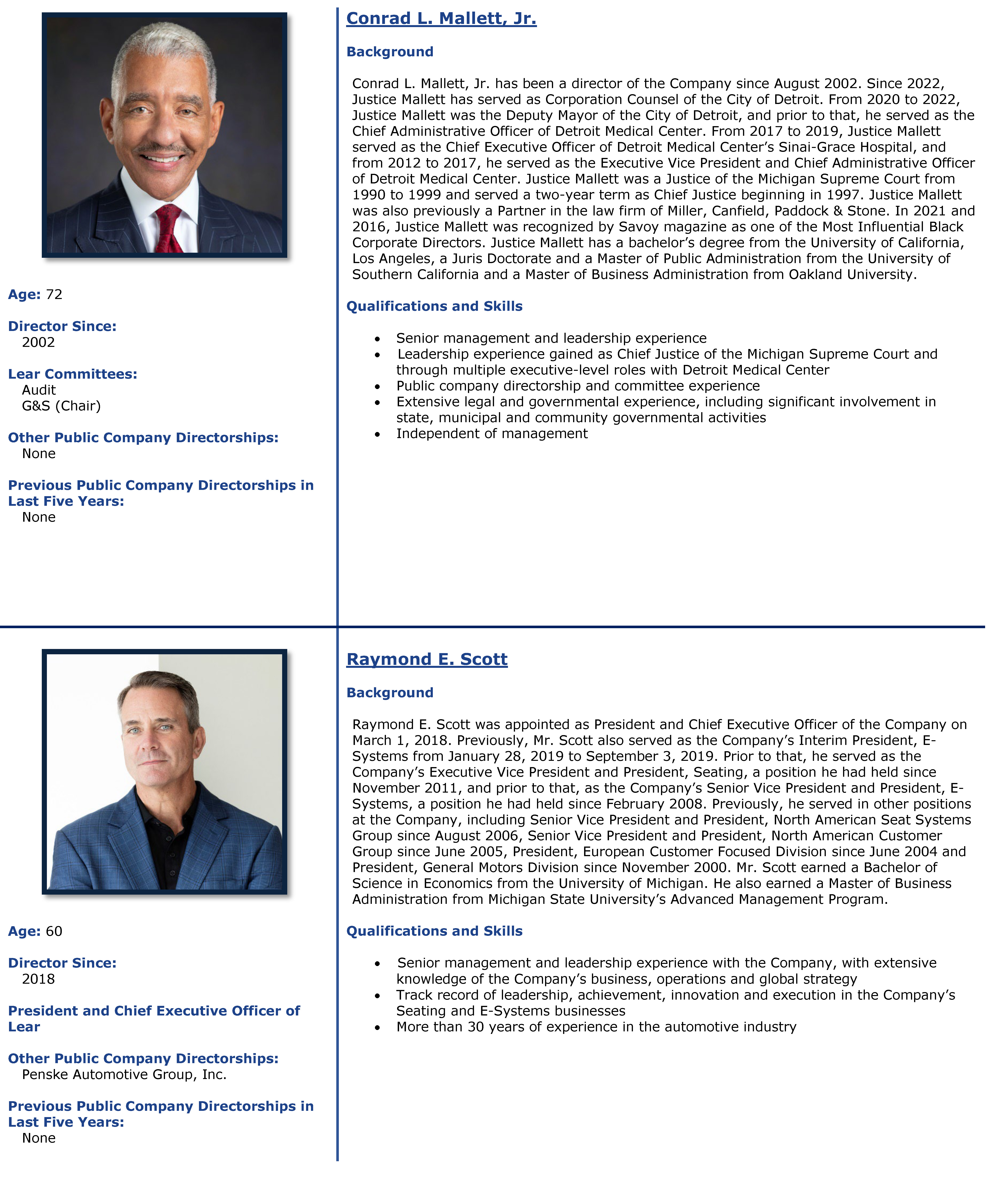
Conrad L. Mallett, Jr. IND Corporation Counsel, City of Detroit | 72 | 2002 | • | | • |
Raymond E. Scott President and CEO, Lear Corporation | 60 | 2018 | | | |
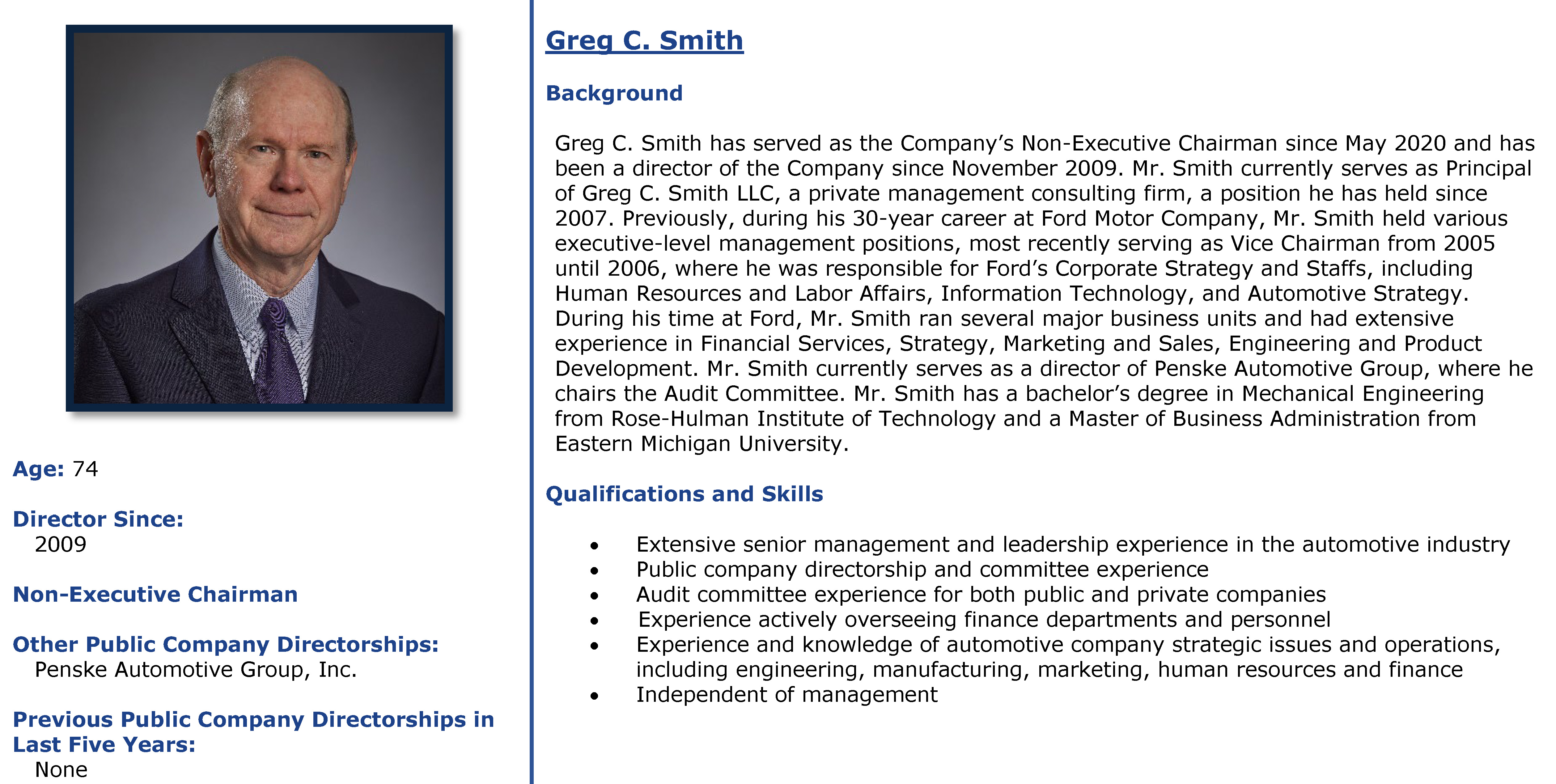
Greg C. Smith IND Former Vice Chairman, Ford Motor Company | 74 | 2009 | E | E | E |
AC Audit Committee
P&C People and Compensation Committee
G&S Governance and Sustainability Committee
IND Independent director under NYSE and SEC rules
•Chair
•Member
EEx Officio Member
Director Term: One Year
Board Meetings in 2025: 9
Standard Board Committee Meetings in 2025: Audit Committee 10, P&C Committee 6, G&S Committee 5
Sustainability Highlights for 2025
Responsible and sustainable practices are integral to Lear’s strategy. We are committed to integrating sustainability into critical processes, including enterprise risk management, facilities management, supplier selection and evaluation, and product innovation. These efforts reflect our core value of Getting Results the Right Way and underscore our dedication to creating lasting positive impacts. By pursuing these initiatives, we not only strengthen our strategic objectives but also contribute to the well-being of our people, the health of our planet and the success of our business. Our key actions during 2025 included the following:
| | | | | | | | | | | | | | |
| | |
Environment | | Human Capital Management | | Governance |
| | |
• Awarded business to supply innovative products that align with key sustainable and emerging industry trends, including the ComfortFlex by LearTM seating module, which efficiently combines heat, ventilation and massage, and ComfortMax Seat by LearTM, which delivers superior thermal management with up to 40% faster time-to-sensation and up to 50% fewer parts •Continued to advance innovation across our sustainable product portfolio, supported by more than 1,000 global patents and pending patent applications focused on next-generation sustainable products and manufacturing technologies • Leveraged our internally developed waste generation and water usage playbooks globally to promote best practices within our facilities, enabling increased operational efficiency and reduced costs | | • Conducted our annual in-depth talent review with the Board, including succession planning, as well as a comprehensive review of organizational talent and strategies to attract, motivate, develop and retain key employees •Conducted Expect Respect / Expect Inclusion anti-harassment training at all locations globally from 2024 through 2025 • Supported leadership development through programs such as Global Shop Floor Leadership Program (GREAT), which equips plant supervisors with essential leadership skills, and Together We Grow (TWG), which helps high-potential leaders build networks and advance their careers at Lear •Continued to expand our global Driving Wellness program, which includes localized initiatives to support the mental health and wellness of employees | | •Increased efforts to support supply chain resiliency, compliance and sustainability, including expanded use of AI-enabled supply chain intelligence tools and the collection of mapping data from our suppliers •Continued comprehensive training for internal supply chain purchasing teams on our sustainability strategy, policies, requirements and core principles •Provided forced and child labor training materials and resources to all suppliers through our Supplier Information Portal at lear.com •Continued to enhance transparency and sustainability reporting with reference to the Global Reporting Initiative’s (“GRI”) standards, as well as the Sustainability Accounting Standards Board (“SASB”) and Task Force on Climate-Related Financial Disclosures (“TCFD”) recommendations •Conducted training for non-production suppliers in Europe, Africa, Brazil and China on Lear's Code of Business Conduct & Ethics, anti-bribery and anti-corruption policy, and purchasing policies and processes |
ELECTION OF DIRECTORS (PROPOSAL NO. 1)
Upon the recommendation of our G&S Committee, the Board has nominated the 11 individuals listed below to stand for election to the Board for a one-year term ending at the annual meeting of shareholders in 2027 or until their successors, if any, are elected or appointed. Our Bylaws provide for the annual election of directors. Each director nominee must receive the affirmative vote of a majority of the votes cast to be elected (i.e., the number of shares voted “for” a director nominee must exceed the number of votes cast “against” that nominee). Unless contrary instructions are given, the shares represented by your proxy will be voted FOR the election of all director nominees. In addition, our Bylaws and Corporate Governance Guidelines contain a resignation policy which provides that in the event an incumbent director fails to receive a majority of the votes cast in an uncontested election, such director shall promptly tender his or her resignation to the Board for consideration. The Board has determined that each director nominee, other than Mr. Scott, if elected, would be an independent director, as further described on page 20 in “Directors and Corporate Governance — Independence of Directors.” Our Corporate Governance Guidelines also include a mandatory retirement age policy whereby an individual who has reached the age of 75 may not stand for election or re-election to the Board, as well as a policy that non-employee directors shall serve on no more than three public company boards in addition to Lear's Board, the CEO shall serve on no more than one public company board in addition to Lear's Board, and employee directors (other than the CEO) shall serve on no more than two public company boards in addition to Lear's Board.
All of the director nominees listed below have consented to being named in this proxy statement and to serve if elected. However, if any nominee becomes unable to serve, proxy holders will have discretion and authority to vote for another nominee proposed by our Board. Alternatively, our Board may reduce the number of directors to be elected at the Annual Meeting.
| | | | | | |
| Name | Position | |
Julian G. Blissett | Director | |
| Jonathan F. Foster | Director | |
| Bradley M. Halverson | Director | |
| Mary Lou Jepsen | Director | |
| Roger A. Krone | Director | |
Rod A. Lache | Director | |
| Patricia L. Lewis | Director | |
| Kathleen A. Ligocki | Director | |
| Conrad L. Mallett, Jr. | Director | |
Raymond E. Scott | Director, President and CEO | |
Greg C. Smith | Director, Non-Executive Chairman | |
Biographical information relating to each of the director nominees is set forth below under “Directors and Corporate Governance” and incorporated by reference herein.
THE BOARD UNANIMOUSLY RECOMMENDS A VOTE “FOR” THE ELECTION OF EACH OF LEAR’S DIRECTOR NOMINEES NAMED IN THIS PROXY STATEMENT.
PROXIES SOLICITED BY THE BOARD WILL BE VOTED “FOR” THE ELECTION OF EACH OF LEAR’S DIRECTOR NOMINEES NAMED IN THIS PROXY STATEMENT UNLESS SHAREHOLDERS SPECIFY A CONTRARY VOTE.
| | | | | |
| DIRECTORS AND CORPORATE GOVERNANCE |
DIRECTORS AND CORPORATE GOVERNANCE
Director Biographical Information and Qualifications
Set forth below is a description of the business experience of each director nominee, as well as the specific qualifications, skills and experiences considered by the G&S Committee and the Board in recommending our slate of director nominees. Each director nominee listed below is nominated for election to the Board for a term expiring at the annual meeting of shareholders in 2027. See “Election of Directors (Proposal No. 1).”
| | | | | |
| DIRECTORS AND CORPORATE GOVERNANCE | |
| | | | | |
| DIRECTORS AND CORPORATE GOVERNANCE |
| | | | | |
| DIRECTORS AND CORPORATE GOVERNANCE | |
| | | | | |
| DIRECTORS AND CORPORATE GOVERNANCE |
| | | | | |
| DIRECTORS AND CORPORATE GOVERNANCE | |
| | | | | |
| DIRECTORS AND CORPORATE GOVERNANCE |
Criteria for Selection of Directors and Director Recruitment Process
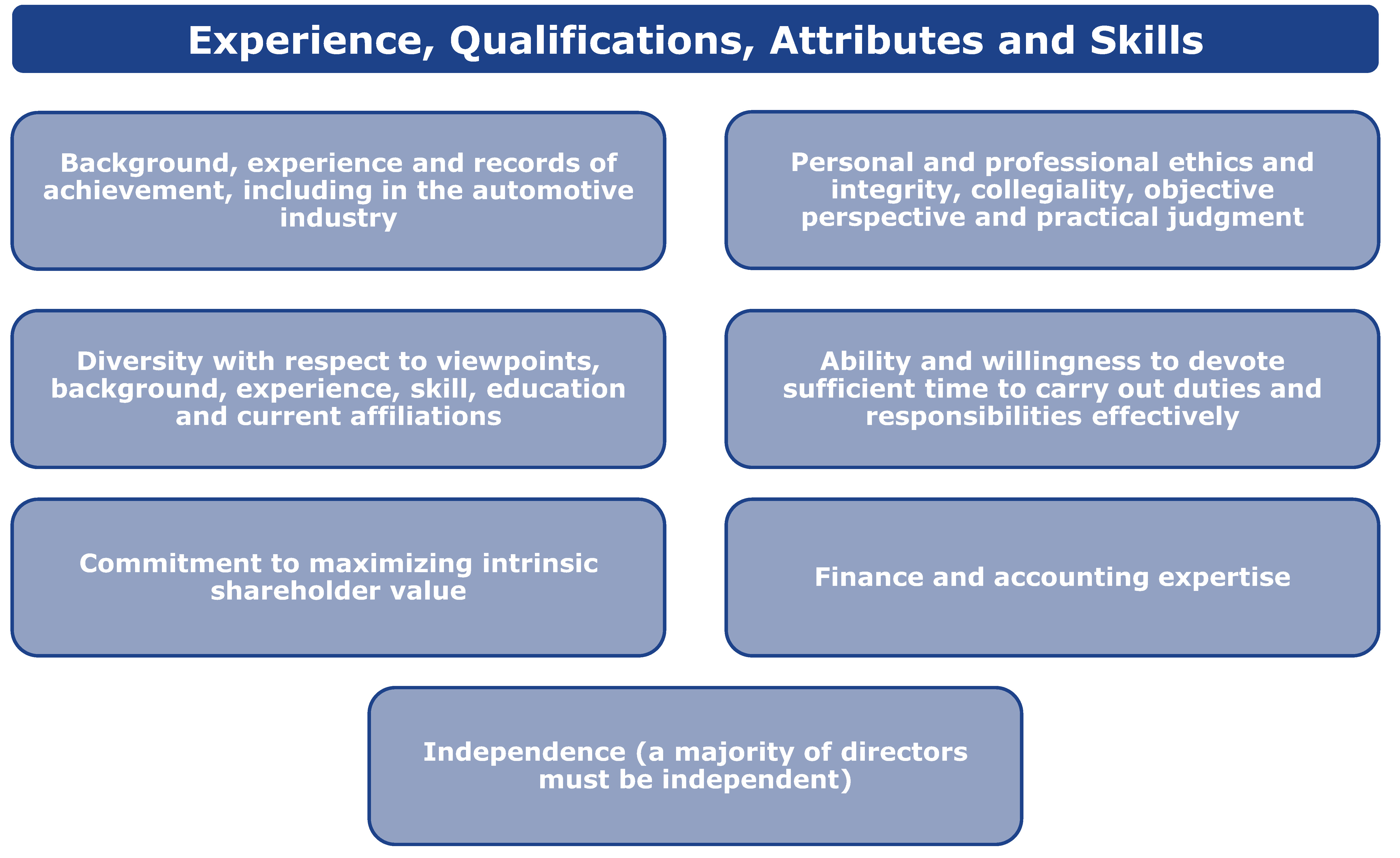
The G&S Committee utilizes several criteria in evaluating and selecting candidates for Board membership including, without limitation, a director nominee’s independence, skills, experience, perspective, background and diversity (which we define broadly to include, without limitation, differences in viewpoints, background, experience, skill, education and current affiliations that may offer the Company exposure to contemporary business issues and is considered in the context of the Board as a whole). These criteria may vary from year to year, depending on the needs of the Company at the time.
The general criteria set forth below are not listed in any particular order of importance:
The above criteria should not be construed as minimum qualifications for director selection nor is it expected that director nominees will possess all of the criteria identified. Rather, they represent the range of complementary talents, backgrounds and experiences that the G&S Committee believes would contribute to the effective functioning of our Board.
Our Corporate Governance Guidelines and G&S Committee charter provide guidelines with respect to the consideration of director candidates. Under the Corporate Governance Guidelines, the G&S Committee is responsible for, subject to approval by the Board, establishing and periodically reviewing the criteria for Board membership, including independence standards, and selection of new directors. The G&S Committee also may recommend to the Board changes to the portfolio of director skills, experience, perspective and background required for the effective functioning of the Board, considering the Company’s strategy and its regulatory, geographic and market environments. Any such changes to the director selection criteria must be approved by the Board.
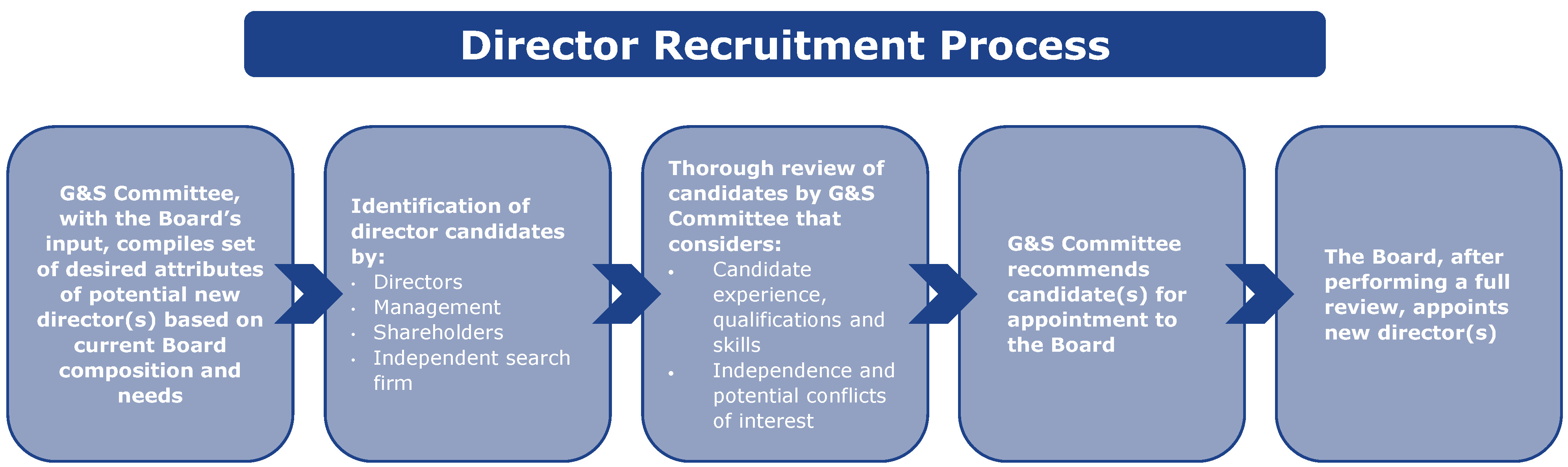
To ensure that the Board is comprised of the talent necessary to effectively serve the Company and its shareholders, the Board regularly reviews its composition and succession plan. Based on the Board's current composition and needs, and with input from the Board, the G&S Committee may compile a set of desired attributes of a potential new director. The G&S Committee may also engage an independent third party to perform benchmarking with respect to current and desired attributes of directors. Candidates for Board membership may be suggested by G&S Committee members and other Board members, as well as by management and shareholders. The G&S Committee also may retain a search firm (which may be paid a fee) to identify director candidates. Once potential candidates that possess one or more of the desired attributes have been identified, the G&S Committee evaluates the potential candidates using a robust process that includes initial candidate screening, interviews with members of the G&S Committee and opportunities for interaction with other Board members. All director candidates are evaluated on the same basis. Candidates also are evaluated in light of Board policies, such as those relating to director independence and service on other boards, as well as considerations relating to the size and structure of the Board. In addition, candidates are
| | | | | |
| DIRECTORS AND CORPORATE GOVERNANCE | |
evaluated for their cultural fit with the Board. Following this process, the G&S Committee may recommend director nominees to the Board for approval.
While the Board believes that longer-serving directors are integral to the Company's success given their deep understanding of our business and culture, the Board also understands the value that fresh perspectives bring in a challenging and dynamic industry. Prior to and in anticipation of Mei-Wei Cheng's retirement from the Board in May 2025, the Board identified international experience, particularly in Asian markets, as a desired attribute of a new director. Using the director recruitment process described above, the Board appointed Mr. Blissett, who brings to the Board extensive international experience in the automotive industry, as a new director in February 2025.
In the coming years, certain of Lear's current directors will reach the mandatory retirement age under Lear's Corporate Governance Guidelines. As potential openings arise, the Board will review its then-current composition and needs and initiate the director recruitment process described above to identify potential director nominees.
| | | | | |
| DIRECTORS AND CORPORATE GOVERNANCE |
Board Composition and Tenure
The following matrix provides certain information regarding the members of our Board, including certain types of knowledge, skills, experiences and attributes possessed by one or more of our directors which our Board believes are relevant to our business or industry. The matrix does not encompass all of the knowledge, skills, experiences or attributes of our directors, and the fact that a particular knowledge, skill, experience or attribute is not listed does not mean that a director does not possess it. In addition, the absence of a particular type of knowledge, skill, experience, or attribute with respect to any of our directors does not mean the director in question is unable to contribute to the decision-making process in that area. The type and degree of knowledge, skill and experience listed below may vary among members of the Board.
| | | | | | | | | | | | | | | | | | | | | | | | | | | | | | | | | | | |
| Profile / Skills | Julian Blissett | Jon
Foster | Brad
Halverson | Mary Lou Jepsen | Roger
Krone | Rod Lache | Patricia
Lewis | Kathleen Ligocki | Conrad Mallett | Raymond Scott | Greg
Smith |
| | | | | | | | | | | |
| Skills / Experience |
| CEO / Large Business Head | u | u | u | u | u | | | u | u | u | u |
| CFO / Treasurer / Fin. Serv. Exec. | | u | u | | u | | | | | | u |
| Auto Industry | u | u | | | u | u | | u | | u | u |
| Technology | | | | u | u | u | u | u | | u | u |
| Strategy | u | u | u | u | u | u | u | u | u | u | u |
| Finance | u | u | u | | u | u | | u | u | | u |
| Commercial / Marketing | u | | | u | | | | u | u | u | u |
| Operations | u | | | u | u | | u | u | u | u | u |
| Human Capital Management | u | | u | u | u | | u | u | u | u | u |
| Legal / Governmental | u | u | | | u | | | | u | | |
| Environmental, Social, Governance | | u | u | u | u | | u | u | u | u | u |
| International | u | u | u | u | u | | u | u | | u | u |
In the table above, a “u” indicates experience in the category gained directly or through active oversight of responsible person for the category.
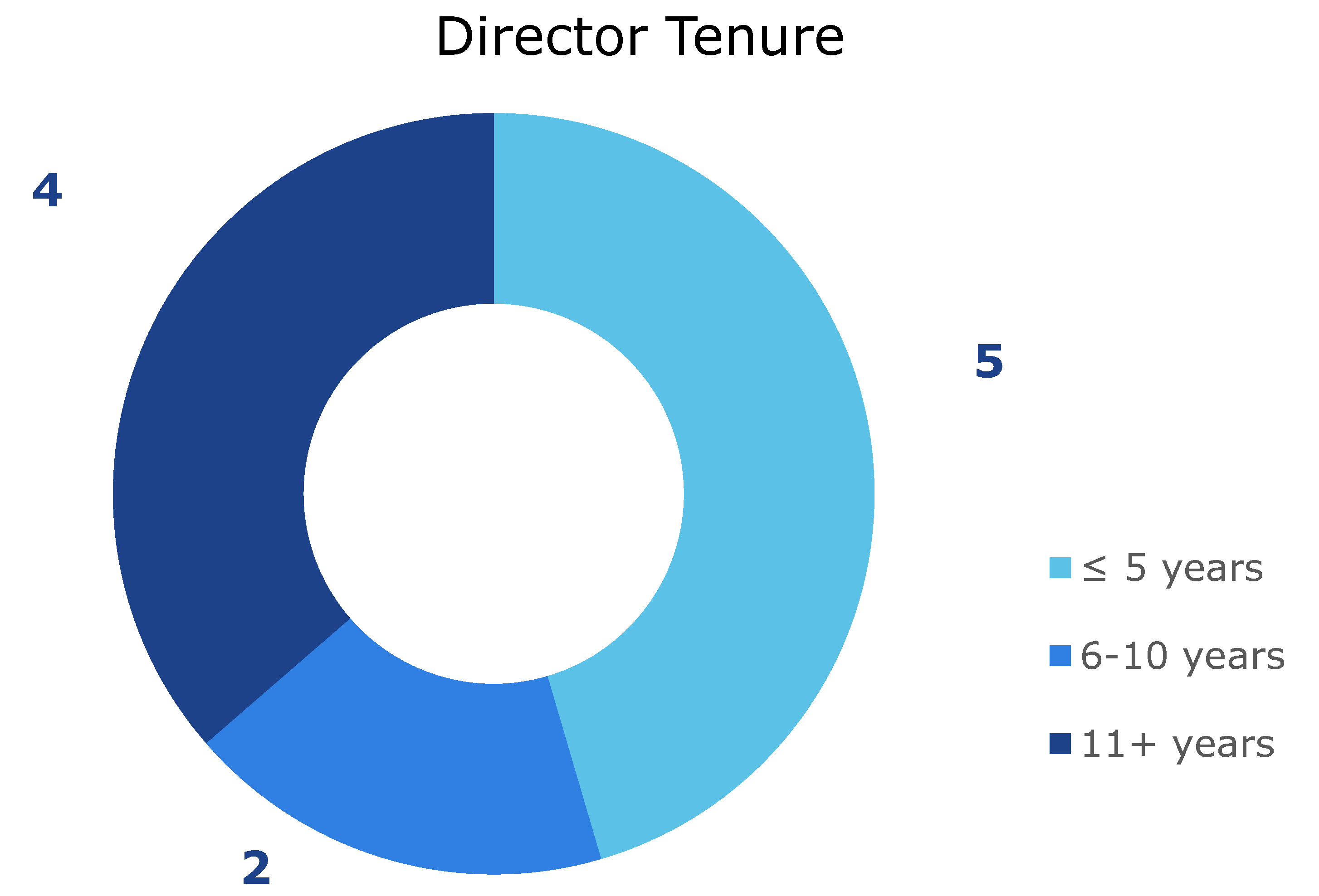
The following chart sets forth the range of tenure of our current directors. Our directors' tenure is calculated based on full years of completed service from the date of initial appointment to the date of this proxy statement.
| | | | | |
| DIRECTORS AND CORPORATE GOVERNANCE | |
Recommendation of Directors by Shareholders
In accordance with its charter, the G&S Committee will consider candidates for election as a director of the Company recommended by any Lear shareholder, provided that the recommending shareholder follows the procedures set forth in Section 1.13 of the Company’s Bylaws for nominations by shareholders of persons to serve as directors. The G&S Committee evaluates such candidates in the same manner by which it evaluates other director candidates considered by the G&S Committee, as described above.
Pursuant to Section 1.13 of the Bylaws, nominations of persons for election to the Board at a meeting of shareholders may be made by any shareholder of the Company entitled to vote for the election of directors at the meeting who sends a timely notice in writing to our Corporate Secretary. To be timely, a shareholder’s notice must be delivered to, or mailed and received by, our Corporate Secretary at the Company’s principal executive offices not less than 90 nor more than 120 days prior to the first anniversary of the preceding year’s annual meeting; provided, however, that if the annual meeting is more than 30 days prior to the anniversary of the preceding year’s annual meeting or more than 70 days after such anniversary date, notice by the shareholder must be delivered not earlier than the close of business on the 120th day prior to such annual meeting and not later than the close of business on the later of the 90th day prior to such annual meeting or the 10th day following the day on which “public announcement” of the date of such annual meeting is made by the Company. For purposes of the Bylaws, “public announcement” means disclosure in a press release reported by the Dow Jones News Service, Associated Press or a comparable national news service or in a document publicly filed by us with the SEC.
The shareholder’s notice or recommendation is required to contain certain prescribed information about each person whom the shareholder proposes to recommend for election as a director, the shareholder giving notice and the beneficial owner, if any, on whose behalf notice is given. The shareholder’s notice must also include the consent of the person proposed to be nominated and to serve as a director if elected. Recommendations or notices relating to director nominations should be sent to Lear Corporation, 21557 Telegraph Road, Southfield, Michigan 48033, Attention: Amanda J. Pontes, Vice President, General Counsel and Corporate Secretary. See “Shareholder Proposals for 2027 Annual Meeting of Shareholders.” In addition, to comply with the universal proxy rules, shareholders who intend to solicit proxies in support of director nominees other than Lear nominees must provide notice that sets forth the information required by Rule 14a-19 under the Securities Exchange Act of 1934, as amended (the "Exchange Act"). Within two business days after delivering such notice required by Section 1.13 of the Bylaws and Rule 14a-19, the shareholder shall certify to and notify the Secretary of the Company that the shareholder has met and complied with all of the requirements under the Bylaws and of Rule 14a-19. The shareholder shall supplement such notice as necessary so that the information provided or required remains true and correct not later than five business days after the shareholder files a definitive proxy statement in connection with the annual meeting. Any deficiencies may be grounds for exclusion of the shareholder’s nominee.
A copy of our Bylaws has been filed as an exhibit to our 2025 Annual Report on Form 10-K filed with the SEC on February 13, 2026.
Independence of Directors
A majority of the members of the Board, and each member of the Audit Committee, P&C Committee and G&S Committee, must meet the criteria for independence set forth under applicable law and the NYSE listing standards. No director qualifies as independent unless the Board determines that the director has no direct or indirect material relationship with the Company. In addition to considering the NYSE independence criteria, the Board will consider all relevant facts and circumstances of which it is aware in making an independence determination with respect to any director.
The Board has made director independence determinations with respect to each of our current directors. Based on the NYSE independence guidelines and consideration of the relevant facts and circumstances, the Board has affirmatively determined that (i) Messrs. Blissett, Foster and Halverson, Dr. Jepsen, Messrs. Krone and Lache, Mses. Lewis and Ligocki, and Messrs. Mallett and Smith (a) have no relationships or only immaterial relationships with the Company, (b) meet the NYSE independence guidelines with respect to any such relationships and (c) are independent; and (ii) Mr. Scott is not independent. Mr. Scott is our President and CEO.
| | | | | |
| DIRECTORS AND CORPORATE GOVERNANCE |
Board’s Role in Risk Oversight
The Company’s management continually monitors the material risks facing the Company. Our enterprise risk management process, which was enhanced in 2025 with the assistance of an outside expert, is designed to facilitate the identification, assessment and management of certain key risks the Company may encounter and which may impact our ability to achieve our strategic objectives. The enterprise risk management process supplements management’s ongoing responsibilities to monitor and address risks by working with risk owners to identify the key mitigating actions for certain risks, which then are discussed with senior management.
The Board, with the assistance of its committees, is responsible for overseeing such management actions to ensure that material risks affecting the Company are identified and managed appropriately. The Board and its committees oversee risks associated with their principal areas of focus, as summarized below:
Board/Committee Areas of Risk Oversight and Actions
| | | | | |
| Full Board | • Carefully evaluates the reports received from management and makes inquiries of management on areas of particular interest to the Board
• Reviews with management material strategic, operational, financial and legal risks, including risks related to geopolitical events, cybersecurity, AI, emerging technologies, and product quality and safety
• Considers specific risk topics in connection with strategic planning and other matters
• Oversees risk oversight and related activities conducted by the Board committees through reports of the committee chairperson to the Board
|
| Audit Committee | • Ensures that the Company has an internal audit function to provide management and the Audit Committee with ongoing assessments of the Company’s risk management process and system of internal controls
• Discusses with management the Company’s process for assessing and managing risks, including the Company’s major risk exposures related to tax matters, financial instruments, litigation, legal and compliance matters, cybersecurity and information security and the steps necessary to monitor and control such exposures
• Oversees financial and ethics and compliance risks
• Periodically meets with senior management, our vice president of audit services, our chief compliance officer and our independent auditor, Ernst & Young LLP, and reports on its findings at each regularly scheduled meeting of the Board
• Oversees the Company's enterprise risk management process, including the identification of risks
• Periodically reviews and approves all changes to our Code of Business Conduct & Ethics
|
| P&C Committee | • Oversees the review and evaluation of risks associated with our compensation policies and practices (see also “Compensation and Risk”)
•Oversees human capital management, including succession planning and talent strategies, and risks related thereto |
| G&S Committee | • Oversees risks associated with our governance structure and processes
• Reviews our organizational documents, Corporate Governance Guidelines and other policies
• Oversees sustainability issues, including as they pertain to environmental (including climate), corporate social responsibility and supply chain matters
|
| | | | | |
| DIRECTORS AND CORPORATE GOVERNANCE | |
Sustainability
Through our sustainability initiatives, we are committed to safety in our workplaces, integrity in the conduct of our business, increasing efficiency in our operations and products, and supporting the global communities in which we live and work. Furthermore, we expect all of our suppliers of goods and services to share our commitment to environmental stewardship, social responsibility and ethical conduct.
Sustainability Oversight
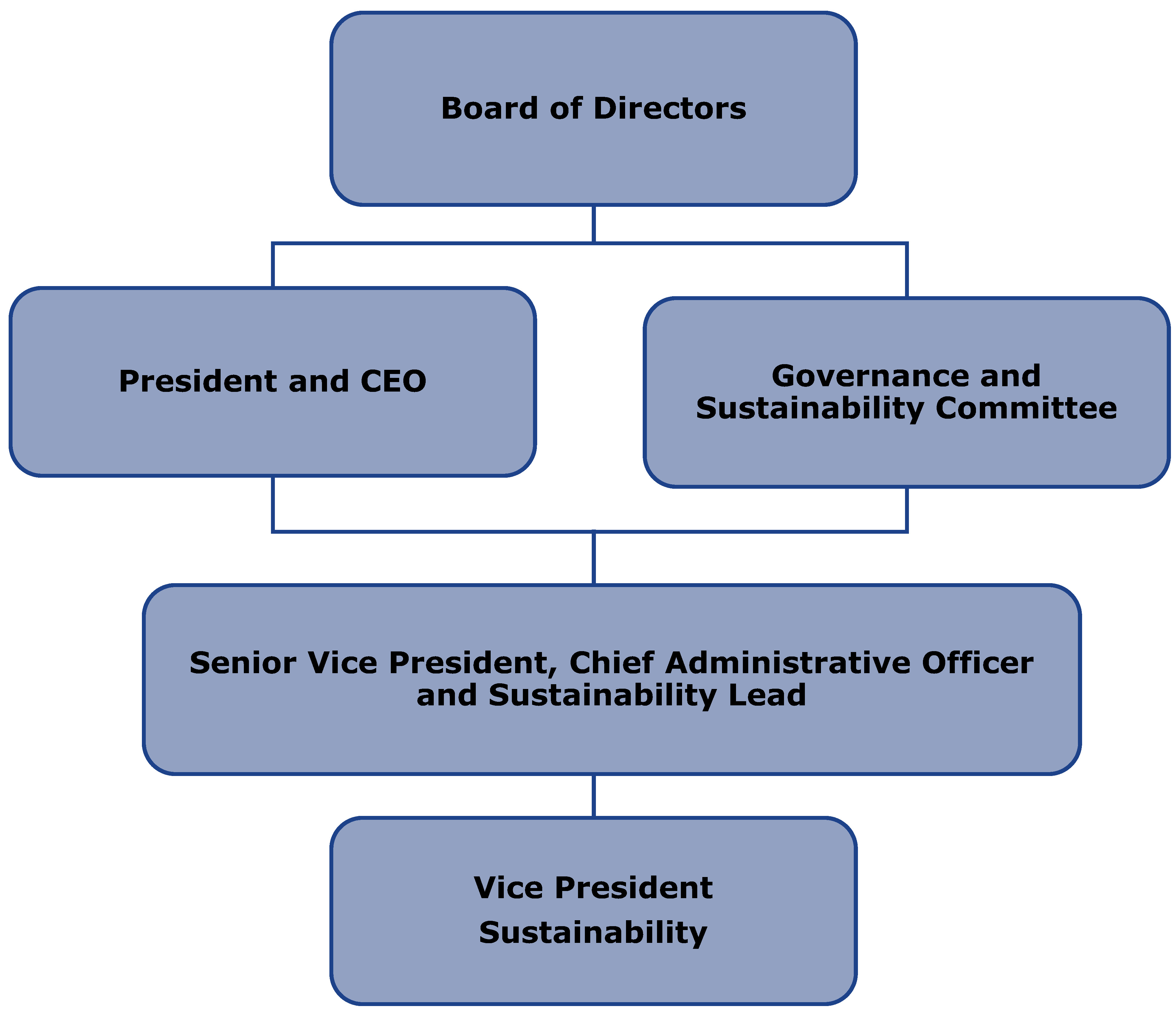
The G&S Committee of our Board has responsibility for oversight of the Company’s sustainability strategy, including as it pertains to environmental, human rights and other corporate social responsibility matters. In this regard, the G&S Committee works closely with our Audit and P&C Committees, which have responsibility for overseeing certain related sustainability topics such as compliance and human capital management, respectively. To better integrate sustainability considerations throughout our Company, Lear also has added specific responsibilities to senior management (as shown in the chart below).
Our sustainability strategy is realized through, among other things, our comprehensive human capital management initiatives which emphasize leadership development, employee engagement and a culture that values individuals of all backgrounds; innovative product development focused on key trends like sustainable materials and electrification; and policies, procedures and practices that ensure alignment with our core value to Get Results the Right Way. In addition, we value transparency in communication. In 2025, Lear released our annual Sustainability Report that includes disclosures with reference to the GRI standards, as well as reporting with the SASB and TCFD recommendations. To learn more, see Lear’s Sustainability Report: www.lear.com/sustainability. The information on our website is not part of this proxy statement and is not deemed to be incorporated by reference herein.
| | | | | |
| DIRECTORS AND CORPORATE GOVERNANCE |
Environmental Efforts
We are committed to advancing sustainability in our products and operations to leverage customer demand and cost savings opportunities. Our core value of innovation helps us create and use environmentally friendly materials and develop advanced technologies that facilitate sustainable, longer-term automotive industry megatrends. Our core capability of operational excellence drives our focus on improving energy efficiency while reducing our consumption of natural resources and creation of waste. More specifically:
Our innovative technologies are aligned with customer and consumer opportunities
•Our vertical integration capabilities, together with our lightweight seat recliners, tracks, latches and other components, can facilitate weight reductions and other performance efficiencies in our products, in turn enabling enhanced fuel efficiency, lower emissions and increased battery driving range.
•We are leveraging available technology to create more sustainable alternatives, such as FlexAir®, our 100% recyclable non-foam alternative that reduces CO2 emissions and mass compared to traditional foam offerings.
•We have developed and are commercializing a range of fabrics that contain recycled, renewable or recyclable yarns, including our ReNewKnit® sustainable sueded alternative material, which is a first-to-market automotive textile that is fully recyclable at its end of life and composed of 100% recycled plastic bottles. Our ReNewKnit® material received a 2024 Creativity in Implementing Sustainable Practices award from the Suppliers Partnership for the Environment.
•Our ComfortFlex by LearTM and ComfortMax Seat by LearTM modules improve vehicle efficiency by streamlining design and enhancing comfort. These technologies integrate heating, ventilation, lumbar support and massage directly into our seat covers. By reducing components by up to 50% and boosting airflow to occupants by up to 40%, they make vehicles both lighter and more efficient.
•Our innovative thermal comfort portfolio — including ComfortFlex by LearTM, ComfortMax Seat by LearTM and FlexAir® — has secured 33 new business awards with 15 customers, reflecting strong global customer adoption. These wins include nine programs already in production, 14 programs launching in 2026 and ten programs launching in 2027 or thereafter.
•We have products that are aligned with vehicle electrification, such as our electrical distribution and connection systems and BDUs, which control all electrical energy flowing into and out of the high voltage battery on electrified vehicles.
We have set carbon reduction goals against a 2019 baseline and continue to implement a multifaceted strategy to achieve these goals in a cost-effective manner
•Our near-term climate goals for 2030 include 100% usage of renewable energy for electricity consumption and a 50% reduction in Scopes 1 and 2 carbon emissions at our facilities globally. We also aim to achieve a 35% reduction in Scope 3 emissions by 2033.
•Twenty-two on-site solar array installations at Lear facilities in nine countries are providing a portion of the electricity we consume in a cost-effective manner.
•We source renewable energy for all Lear facilities in the United Kingdom, Germany, Spain, Portugal, Brazil and Argentina.
We are reducing emissions, saving energy and conserving natural resources in our operations
•Our Energy Efficiency Playbook, first released in 2021, continues to be leveraged at our global manufacturing sites on an ongoing basis to improve energy efficiency and reduce energy usage.
•In 2023, we implemented additional playbooks specific to waste generation and water usage which, like the Energy Efficiency Playbook, are focused on promoting sustainable operating practices within our global facilities, while at the same time increasing operational efficiency and potentially reducing costs.
•In 2025, more than 180 of our sites worldwide conducted "energy treasure hunts," identifying projects with potential annual savings of approximately 20 million kilowatt-hours of energy — enough energy to power more than 1,000 homes for a year.
| | | | | |
| DIRECTORS AND CORPORATE GOVERNANCE | |
We deliver the highest quality products and services by maintaining a work environment that prioritizes safety and fosters collaboration, inclusion, tolerance and respect. More specifically:
We create meaningful employment and focus on development opportunities for our team members around the world
•Our approximately 143,000 hourly employees receive competitive pay and benefits such as transportation, meals, medical leave, paid holidays and health care.
•In 2025, we delivered more than 6 million hours of safety, development, leadership, quality, continuous improvement, lean manufacturing, and ISO and International Automotive Task Force certification training.
•Our health and safety management system is compliant with the ISO 45001:2015 standard, and we are continuing to implement a more comprehensive health and safety program which combines ISO 14001:2015 and 45001:2018 requirements to improve efficiency and performance. Over 75% of Lear sites are now ISO 45001:2018 certified.
•In 2025, our continued focus on employee safety led to a 7% reduction in lost time injury and illness cases across our global operations, supporting a total Company recordable injury rate that is well below the industry benchmark.
•We are evolving our Together We Win (TWW) global engagement program to focus on the Employee Experience (EX) in order to improve every stage of the employee lifecycle — from hiring to retirement — through continuous feedback and tailored workplace adjustments based on that feedback.
•Our Driving Wellness campaign promotes well-being in mind, body, nutrition and balance for our employees, including training mental health first aiders to help coworkers cope with stress, anxiety and depression. We also provide financial training, conflict resolution and other wellness initiatives.
•Our Global Wellness Council leverages our various well-being programs where possible for our employees.
We value collaboration, inclusion, and respect
•We conducted Expect Respect / Expect Inclusion anti-harassment training at all locations globally from 2024 through 2025.
•Our Together We Grow (TWG) program helps high-potential future leaders build networks and advance their careers at Lear, with a strong emphasis on engagement and relationship development. The program now spans all regions globally, with more than 100 participants and alumni and a 95% retention rate.
Lear employees dedicate themselves to supporting the global communities where they live and work
•In 2025, we were especially proud of our employees' efforts to support our global communities. For example, through our Operation GIVE campaign at our Southfield, Michigan headquarters, more than $700,000 in employee contributions benefited local programs focused on economic well-being, education and the environment. In addition, our teams completed numerous volunteer projects to support the global communities where we live and work.
Governance
Governance at Lear is driven by our commitment to Get Results the Right Way. This means not only developing systems and processes to ensure compliance with regulations and company policies, but also creating a culture of ethics and integrity in everything we do. We expect our vendors and supply chain partners to share and demonstrate the same commitment, and we work with them to reinforce this expectation.
We partner with our suppliers to ensure sustainability throughout the supply chain
•We require suppliers to comply with our Supplier Sustainability Policy, which includes commitments to human rights, environmental standards, safe working conditions and responsible sourcing.
•We provide our suppliers with training on critical sustainability topics, including our supplier sustainability minimum requirements and sustainability assessment validation criteria.
•Leveraging a third-party supply chain evaluation partner, we continue to assess global production suppliers against sustainability criteria, including environmental stewardship and human rights, using a risk-based approach.
•Lear’s Supplier Portal provides access to our policies and commitments, along with resources and awareness materials on certain sustainability topics, such as human rights, and forced and child labor.
•We provide training for our global suppliers on Lear's Code of Business Conduct & Ethics, anti-bribery and anti-corruption policy, and purchasing policies and processes.
| | | | | |
| DIRECTORS AND CORPORATE GOVERNANCE |
•We have a comprehensive training program designed to educate our internal supply chain purchasing teams on our sustainability policies, requirements and strategy, as well as key sustainability practices and principles.
•Our No Deforestation Policy requires that all materials supplied to us are from legal sources, that land is not clear-cut or burned for production or development, and that our suppliers comply with governmental laws, regulations and guidelines regarding deforestation.
Our cybersecurity efforts protect our products, our customers and our enterprise
•Our information security team, led by our Chief Information Officer and Chief Information Security Officer, is comprised of cybersecurity specialists with extensive experience and relevant certifications. We have implemented and maintain multiple layers of physical, administrative and technical security processes designed to protect our manufacturing facilities from disruptions that may result from cybersecurity incidents, as well as safeguard the confidentiality of our critical systems and data residing on those systems, including employee data, customer data and intellectual property.
Other key aspects of our corporate governance efforts include:
•All of our director nominees are independent, except our President and CEO;
•We have a Non-Executive Chairman of the Board;
•We have a majority voting standard with a director resignation policy for uncontested director elections;
•We have robust stock ownership guidelines for our directors and executive officers;
•Risk oversight is conducted by the full Board and its committees;
•All directors are elected annually;
•Executive sessions of independent directors are held at regularly scheduled Board meetings;
•Excellent track record of attendance at all Board and committee meetings in 2025; and
•Board and its committees complete annual formal written self-evaluations and participate in oral evaluations, and periodically, we have engaged a third-party firm to conduct an independent evaluation of our Board and its overall effectiveness, including individual director assessments (last completed in 2024).
The Board has approved Corporate Governance Guidelines, as well as a Code of Business Conduct & Ethics. Our corporate governance documents, including the Corporate Governance Guidelines, the Code of Business Conduct & Ethics and committee charters, are available on our website at www.lear.com or in printed form upon request by contacting Lear Corporation at 21557 Telegraph Road, Southfield, Michigan 48033, Attention: Investor Relations. The Board regularly reviews corporate governance developments and modifies these documents as warranted. Any modifications will be reflected on our website. The information on our website is not part of this proxy statement and is not deemed to be incorporated by reference herein.
Other Board Information
Leadership Structure of the Board
Greg C. Smith is our Non-Executive Chairman of the Board and has served in that role since May 2020. Our Board has decided to maintain separate Chairperson and CEO roles to allow our CEO to focus on the execution of our business strategy, growth and development, while allowing the Chairperson to lead the Board in its fundamental role of providing advice to, and independent oversight of, management, as well as oversight of Board meetings. The Board recognizes the time, effort and energy that the CEO is required to devote to his position in the current business environment, as well as the commitment required to serve as our Chairperson. While our Bylaws and Corporate Governance Guidelines do not require that our Chairperson and CEO positions be separate, the Board believes that having separate positions and having an independent director serve as Non-Executive Chairperson is the appropriate leadership structure for the Company at this time.
Board Meetings
In 2025, our Board held nine meetings. In addition to our Board meetings, our directors attend meetings of committees established by our Board. Each of Lear’s directors attended at least 75% of the meetings of our Board and the committees on which he or she served during 2025. Our directors are encouraged to attend all annual and special meetings of our shareholders. In 2025, our annual meeting of shareholders was held on May 16, 2025, in virtual format, and all directors attended.
| | | | | |
| DIRECTORS AND CORPORATE GOVERNANCE | |
Meetings of Non-Employee Directors
In accordance with our Corporate Governance Guidelines and the listing standards of the NYSE, our non-employee directors meet regularly in executive sessions of the Board without management present. Mr. Smith, our Non-Executive Chairman, presided over these executive sessions in 2025.
Committees of the Board
The Board has three standing committees: the Audit Committee, the P&C Committee and the G&S Committee. The following chart sets forth the non-employee directors who currently serve as members of each of the Board committees.
| | | | | | | | | | | |
| Non-employee Directors | Audit
Committee | P&C
Committee | G&S Committee |
Julian G. Blissett | | X | X |
| Jonathan F. Foster | X | | X |
| Bradley M. Halverson | C | X | |
| Mary Lou Jepsen | X |
| X |
| Roger A. Krone | X | X |
|
Rod A. Lache | X | X | |
| Patricia L. Lewis | | C | X |
| Kathleen A. Ligocki | | X | X |
| Conrad L. Mallett, Jr. | X | | C |
| Greg C. Smith, Non-Executive Chairman of the Board | E | E | E |
"C"denotes member and chair of committee, "X" denotes member, and "E" denotes ex officio member
Audit Committee
In 2025, the Audit Committee held ten meetings. Each member of the Audit Committee is a non-employee director. In addition, the Board has determined that (i) all of the members of the Audit Committee are (a) independent as defined in the listing standards of the NYSE and under Rule 10A-3 of the Exchange Act and (b) financially literate, and (ii) Messrs. Foster, Halverson, Krone, Lache and Mallett are financial experts, as further discussed in “Audit Committee Report.” For a description of the Audit Committee’s responsibilities and findings and additional information about the Audit Committee, see “Audit Committee Report.”
A copy of the Audit Committee charter is available on our website at https://ir.lear.com or in printed form upon request.
People and Compensation Committee
In 2025, the P&C Committee held six meetings. Each member of the P&C Committee is a non-employee director. In addition, the Board has determined that all of the members of the P&C Committee are independent as defined in the listing standards of the NYSE, including the independence standards applicable to compensation committees.
The P&C Committee has overall responsibility for approving and evaluating director and officer compensation plans, policies and programs of the Company and reviewing the disclosure of such plans, policies and programs to our shareholders in the Company's annual proxy statement. The P&C Committee also supports initiatives pertaining to human capital management, including talent development and retention, the employee experience and timely succession planning for the CEO and senior executive officers. The P&C Committee utilizes an independent compensation consultant to assist it in its duties. The P&C Committee operates under a written charter setting forth its functions and responsibilities. A copy of the P&C Committee charter is available on our website at https://ir.lear.com or in printed form upon request.
In consultation with the Company’s management, the P&C Committee establishes the general policies relating to senior management compensation and oversees the development and administration of such compensation programs. Our human resources executives and staff support the P&C Committee in its work. These members of management work with compensation consultants whose engagements have been approved by the P&C Committee, accountants and legal counsel, as necessary, to implement the P&C Committee’s decisions, to monitor evolving competitive practices. The P&C Committee has final authority to approve, modify or reject the independent consultant's recommendations and to make its decisions in executive session. The P&C Committee approves all compensation of our executive officers, including equity awards. Under our equity award policy, an aggregate equity award pool to non-executive officers may be approved by the P&C Committee and allocated to individuals by the CEO. The policy also allows the P&C Committee to delegate to the CEO the ability to grant equity awards to non-executive officer employees who are newly hired or promoted or deemed to be deserving of special retention or recognition awards.
| | | | | |
| DIRECTORS AND CORPORATE GOVERNANCE |
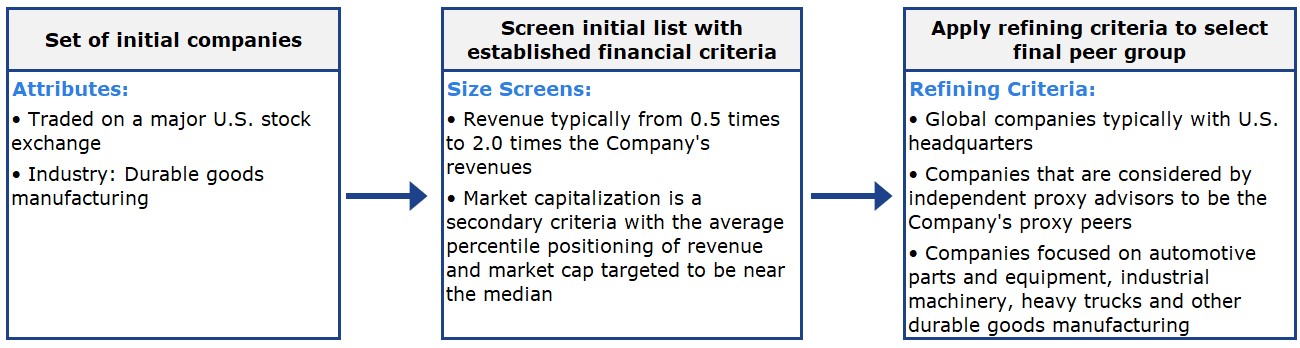
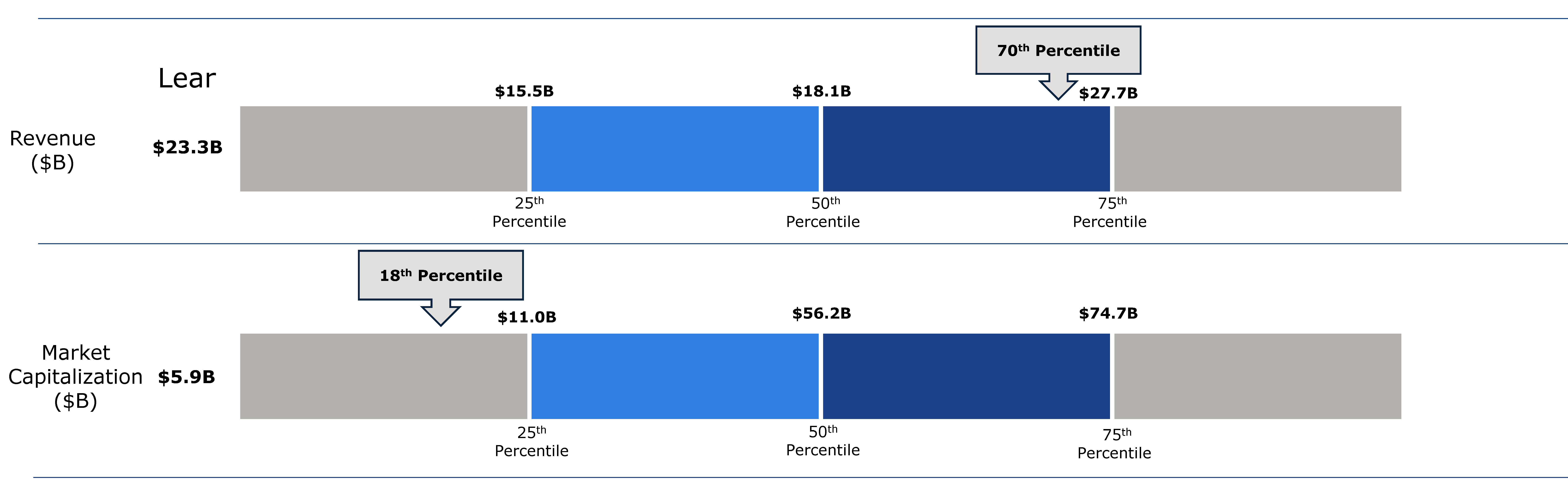
Pay Governance LLC (“Pay Governance”) is the P&C Committee's independent compensation consultant. Pay Governance reports directly to the P&C Committee, including with respect to management’s recommendations of compensation programs and awards. The P&C Committee has the sole authority to approve the scope and terms of the engagement of such compensation consultant and to terminate such engagement. The mandate of Pay Governance is to serve the Company and work with the P&C Committee in its review of executive and director compensation practices, including the competitiveness of pay levels, program design, market trends and technical considerations. Pay Governance has assisted the P&C Committee with the development of competitive market data and a related assessment of the Company’s executive and director compensation levels, evaluation of annual and long-term incentive compensation strategy and compilation and review of total compensation data and pay tally sheets (including data for certain termination and change in control scenarios) for the Company’s NEOs. As part of this process, the P&C Committee also reviewed a comprehensive analysis of peer group companies provided by Pay Governance. See “Compensation Discussion and Analysis — Decision-Making Framework — Benchmarking Methodology and Peer Group Selection.” Other than with respect to consulting on executive and director compensation matters, Pay Governance has performed no other services for the P&C Committee or the Company.
The Company and the P&C Committee reviewed the independence of Pay Governance in light of SEC rules and NYSE listing standards regarding compensation consultants and has concluded that the work performed by Pay Governance does not constitute a conflict of interest.
Governance and Sustainability Committee
In 2025, the G&S Committee held five meetings. Each of the members of the G&S Committee is a non-employee director. In addition, the Board has determined that all of the members of the G&S Committee are independent as defined in the listing standards of the NYSE.
The G&S Committee is responsible for, among other things: (i) Board succession planning and identifying individuals qualified to become members of the Board, consistent with criteria approved by the Board; (ii) recommending director nominees to the Board for election at the next annual meeting of the shareholders of the Company; (iii) in the event of a vacancy on or an increase in the size of the Board, recommending director nominees to the Board to fill such vacancy or newly established Board seat; (iv) recommending directors to the Board for membership on each committee of the Board; (v) establishing and reviewing annually our Corporate Governance Guidelines; (vi) reviewing potential conflicts of interest involving our executive officers; and (vii) overseeing sustainability issues, including as they pertain to environmental, human rights and other corporate social responsibility matters. The G&S Committee operates under a written charter setting forth its functions and responsibilities.
A copy of the G&S Committee charter is available on our website at https://ir.lear.com or in printed form upon request.
Communications to the Board
Shareholders and interested parties can contact the Board (including the Non-Executive Chairman and non-employee directors) through written communication sent to Lear Corporation, 21557 Telegraph Road, Southfield, Michigan 48033, Attention: Amanda J. Pontes, Vice President, General Counsel and Corporate Secretary. Our General Counsel reviews all written communications and forwards to the Board a summary and/or copies of any material correspondence that is directed to the Board or that, in the opinion of the General Counsel, deals with the functions of the Board or its committees or that she otherwise determines requires the Board’s or any Board committee’s attention. Concerns relating to accounting, internal accounting controls or auditing matters are immediately brought to the attention of our internal audit department and handled in accordance with procedures established by the Audit Committee with respect to such matters. From time to time, the Board may change the process by which shareholders may communicate with the Board. Any such changes will be reflected in our Corporate Governance Guidelines, which are posted on our website at https://ir.lear.com.
Communications of a confidential nature can be made directly to our non-employee directors or the Chairman of the Audit Committee regarding any matter, including any accounting, internal accounting control or auditing matter, by submitting such concerns to the Audit Committee or the Non-Executive Chairman. Any submissions to the Audit Committee or the Non-Executive Chairman should be marked confidential and addressed to the Chairman of the Audit Committee or the Non-Executive Chairman, as the case may be, c/o Lear Corporation, P.O. Box 604, Southfield, Michigan 48037. In addition, confidential communications may be submitted in accordance with other procedures set forth from time to time in our Corporate Governance Guidelines, which are posted on our website at https://ir.lear.com. Any submission should contain, to the extent possible, a full and complete description of the matter, the parties involved, the date of the occurrence or, if the matter is ongoing, the date the matter was initiated and any other information that the reporting party believes would assist the Audit Committee or the Non-Executive Chairman in the investigation of such matter.
| | | | | |
| DIRECTORS AND CORPORATE GOVERNANCE | |
Director Compensation
Overview
In order to attract and retain highly qualified directors to represent our shareholders, our philosophy is to set compensation within a competitive range of non-employee director pay at comparable companies. At least every two years, the independent compensation consultant presents an analysis of director pay levels among our Comparator Group (described in “Compensation Discussion and Analysis — Benchmarking” beginning on page 37) and a broader set of large companies. We use the same Comparator Group and process to review and set director pay as is used for our NEOs. The following table summarizes the compensation that each non-employee director was entitled to receive in 2025 under our Outside Directors Compensation Plan:
| | | | | | | | |
Outside Directors Compensation Plan |
| Annual Cash Retainer | Annual RSU Award |
Annual Board Retainer | $135,000 | $175,000 |
Additional Position Amounts: | | |
Non-Executive Chair | $80,000 | $120,000 |
Audit Committee Chair | $30,000 | |
G&S Committee Chair | $25,000 | |
P&C Committee Chair | $25,000 | |
Presiding Director(1) | $10,000 | |
(1) Because we have an independent Non-Executive Chair, we do not have a Presiding Director.
General
Directors who are also our employees receive no compensation for their services as directors, except reimbursement of expenses incurred in attending meetings of our Board or its committees.
Annual Cash Retainer
The annual cash retainer for each non-employee director is paid in advance in equal installments on the last business day of the month.
Non-employee directors generally do not receive Board or Board committee meeting fees; however, each non-employee director is eligible to receive $1,500 for each Board meeting in excess of twelve that he or she attends in a calendar year.
Annual RSU Award
Each non-employee director is granted RSUs on the date of the annual meeting of shareholders at which a director is elected or re-elected to serve on the Board. For 2025, non-employee directors received RSUs with a grant date value of approximately $175,000 (with an additional $120,000 granted to the Non-Executive Chair). The RSU awards vest on the earlier of the first anniversary of the grant date and the date of the next annual meeting of shareholders that is at least 50 weeks following the immediately preceding year’s annual meeting, subject to forfeiture in the event that a director’s service on the Board ceases for any reason prior to the vesting date. If a non-employee director joins the Board other than on the date of the annual meeting, a pro-rated RSU award is granted. Effective with the date of the Annual Meeting, the Annual RSU Award will increase by $10,000 to $185,000. This increase was made following the independent compensation consultant's September 2025 analysis of director compensation levels among the Comparator Group.
Deferrals
A non-employee director may elect to defer receipt of all or a portion of the annual retainer and any meeting fees. To the extent that any such cash payments are deferred, they are credited to a notional account and bear interest at an annual rate equal to the prime rate (as defined in the Outside Directors Compensation Plan). Non-employee directors may also elect to defer all or a portion of the annual RSU grant into a stock account where, subject to and following satisfaction of the applicable vesting requirements, notional stock units are credited until distribution in the form of shares of common stock at pre-selected date(s).
In general, and subject to Section 409A of the Internal Revenue Code, amounts deferred are paid upon the earliest of:
| | | | | |
| DIRECTORS AND CORPORATE GOVERNANCE |
•the date selected by such director;
•the date the director ceases to be a director; or
•the date of a change in control (as defined in the Outside Directors Compensation Plan).
Cash amounts that are deferred are paid in cash in a lump sum payment or installments in accordance with the director’s election. RSUs that are deferred are paid in shares of common stock in a lump sum or installments in accordance with the director’s election.
2025 Director Compensation Table
The following table provides information on the compensation paid to our non-employee directors for 2025. Mr. Scott, who is also an employee, receives no additional compensation for his service as a director.
| | | | | | | | | | | |
2025 Director Compensation |
| Name | Fees Earned or Paid in Cash(1) | Stock Awards(2) | Total |
Julian Blissett(3) | $123,750 | $218,587 | $342,337 |
Mei-Wei Cheng(4) | $56,250 | $0 | $56,250 |
| Jonathan F. Foster | $135,000 | $174,932 | $309,932 |
| Bradley M. Halverson | $165,000 | $174,932 | $339,932 |
| Mary Lou Jepsen | $135,000 | $174,932 | $309,932 |
Roger A. Krone | $135,000 | $174,932 | $309,932 |
Rod A. Lache | $135,000 | $174,932 | $309,932 |
| Patricia L. Lewis | $160,000 | $174,932 | $334,377 |
| Kathleen A. Ligocki | $135,000 | $174,932 | $309,932 |
| Conrad L. Mallett, Jr. | $160,000 | $174,932 | $334,932 |
Greg C. Smith | $215,000 | $294,909 | $509,909 |
(1)Includes cash retainer and other fees earned for service as directors in 2025.
(2)As described in “Equity Compensation” below, on May 16, 2025, each of our non-employee directors who were members of the Board on the date of the 2025 annual meeting of shareholders received a RSU grant that vests on the earlier of the first anniversary of the grant date and the date of the next annual meeting of shareholders that is at least 50 weeks following the immediately preceding year’s annual meeting of shareholders, subject to each director’s continued service on the Board. The amounts reported in this column reflect the aggregate grant date fair value determined in accordance with Accounting Standards Codification (“ASC”) 718, “Compensation-Stock Compensation.” As of December 31, 2025, each of our non-employee directors who were members of the Board on such date held the following outstanding and unvested RSUs: Mr. Blissett - 2,307, Messrs. Foster, Halverson, Krone, Lache and Mallett, along with Dr. Jepsen and Mses. Lewis and Ligocki - 1,859; and Mr. Smith - 3,134. Mr. Lache and Ms. Ligocki elected to defer their 2025 RSU grants, and Mr. Mallett elected to defer 5% of his 2025 RSU grant (in each case, subject to vesting of the RSUs).
(3)In addition to receiving the Annual RSU Award in May 2025, Mr. Blissett received a pro-rated RSU grant when he was appointed to the Board in February 2025.
(4)Mr. Cheng did not stand for re-election at the 2025 annual meeting because he had reached the Company’s mandatory retirement age for directors. The fees earned represent the amounts he earned prior to his retirement, all of which he elected to defer.
The Company has a long-standing practice of having stock ownership guidelines for non-employee directors. Each non-employee director must achieve a stock ownership level of a number of shares with a value equal to five times the base annual cash retainer and must hold 50% of the net shares from their annual stock grants received until they are in compliance with these guidelines. As of our latest measurement date (December 31, 2025), Messrs. Foster, Mallett and Smith, Dr. Jensen and Ms. Ligocki have achieved the required stock ownership level. Mr. Halverson, who joined the Board in June 2020, Mr. Krone and Ms. Lewis, who joined the Board in November 2020, Mr. Lache, who joined the Board in August 2024, and Mr. Blissett, who joined the Board in February 2025, are each in compliance with the 50% net share holding requirement.
| | | | | |
| DIRECTORS AND CORPORATE GOVERNANCE | |
Security Ownership of Certain Beneficial Owners, Directors and Management
The following table sets forth, as of the record date, March 16, 2026 (except as indicated below), beneficial ownership, as defined by SEC rules, of our common stock, including shares of common stock subject to stock options that are currently exercisable or exercisable within 60 days following the record date and shares of common stock that could be issued within 60 days following the record date in respect of restricted stock units ("RSUs"). The table also sets forth the number of RSUs held for which shares of common stock will not be issued within 60 days following the record date, and which are accordingly not included in the number of shares of common stock owned beneficially by such persons. Each of the persons listed below has sole voting and investment power with respect to the beneficially owned shares listed unless otherwise indicated. The percentage calculations set forth in the table are based on 50,626,959 shares of common stock outstanding on the record date, rather than based on the percentages set forth in shareholders’ Schedules 13G or 13D, as applicable, filed with the SEC.
| | | | | | | | | | | |
| Number of Shares
of Common Stock
Owned Beneficially | Percentage of
Common Stock
Owned Beneficially | Number of RSUs Held Not Included in Shares of Common Stock Owned Beneficially(14) |
| 5% Beneficial Owners: | | | |
BlackRock, Inc.(1) | 4,727,096 | 9.3% | 0 |
Dimensional Fund Advisors LP(2) | 2,726,667 | 5.4% | 0 |
Pzena Investment Management, LLC(3) | 7,764,912 | 15.3% | 0 |
The Vanguard Group(4) | 6,491,850 | 12.8% | 0 |
| NEOs and Directors: | | | |
Raymond E. Scott(5)(6)(7) | 280,386 | * | 90,020 |
Jason M. Cardew(5)(6) | 73,586 | * | 42,342 |
Frank C. Orsini(5)(8) | 46,214 | * | 87,326 |
Harry A. Kemp(5) | 17,423 | * | 31,721 |
Nicholas J. Roelli(5) | 4,675 | * | 20,969 |
Julian G. Blissett(7)(9) | 2,230 | * | 0 |
Jonathan F. Foster(7)(9) | 15,641 | * | 0 |
Bradley M. Halverson(7)(9) | 8,171 | * | 0 |
Mary Lou Jepsen(7)(9) | 12,971 | * | 0 |
Roger A. Krone(7)(9) | 4,039 | * | 3,347 |
Rod A. Lache(7) | 3,383 | * | 1,859 |
Patricia L. Lewis(7)(9) | 7,386 | * | 0 |
Kathleen A. Ligocki(7)(10) | 3,890 | * | 18,463 |
Conrad L. Mallett, Jr.(7)(11) | 1,873 | * | 11,740 |
Greg C. Smith(7)(12) | 19,280 | * | 0 |
Total Executive Officers and Directors as a Group (18 individuals)(13) | 515,521 | * | 346,306 |
*Less than 1%.
(1)Information is based on a report on Schedule 13G/A filed with the SEC on April 24, 2025, by BlackRock, Inc. (“BlackRock”). BlackRock is the beneficial owner of 4,727,096 shares, with sole dispositive power as to all such shares and sole voting power as to 4,574,473 such shares. BlackRock’s principal place of business is 50 Hudson Yards, New York, New York 10001.
(2)Information is based on a report on Schedule 13G filed with the SEC on July 15, 2025, by Dimensional Fund Advisors LP ("Dimensional"). Dimensional is the beneficial owner of 2,726,667 shares, with sole dispositive power as to all such shares and sole voting power as to 2,650,187 such shares. Dimensional's principal place of business is 6300 Bee Cave Road, Building One, Austin, Texas 78746.
(3)Information is based on a report on Schedule 13G filed with the SEC on October 7, 2024, by Pzena Investment Management, LLC (“Pzena”). Pzena is the beneficial owner of 7,764,912 shares, with sole dispositive power as to all such shares and sole voting power as to 6,617,051 such shares. Pzena’s principal place of business is 320 Park Avenue, 8th Floor, New York, New York 10022.
(4)Information is based on a report on Schedule 13G/A filed with the SEC on January 31, 2025, by The Vanguard Group (“Vanguard”). Vanguard is the beneficial owner of 6,491,850 shares, with sole dispositive power as to 6,388,423 such shares, shared dispositive power as to 103,427 such shares and shared voting power as to 32,327 such shares. Vanguard’s principal place of business is 100 Vanguard Blvd., Malvern, Pennsylvania 19355.
| | | | | |
| DIRECTORS AND CORPORATE GOVERNANCE |
(5)The individual is a NEO.
(6)The shares reported as owned beneficially by Messrs. Scott and Cardew include (i) 77,636 and 26,489 shares of common stock, respectively, that could be acquired within 60 days following the record date upon accelerated vesting of RSUs in connection with a retirement and (ii) 102,961 and 24,356 shares of common stock, respectively, that may be acquired pursuant to stock options that may be exercised within 60 days following the record date.
(7)The individual is a director.
(8)Includes 24,356 shares of common stock that may be acquired pursuant to stock options that may be exercised within 60 days following the record date.
(9)Includes 1,859 shares of common stock issuable pursuant to RSUs scheduled to vest on May 14, 2026, within 60 days following the record date.
(10)Includes 53 shares of common stock issuable pursuant to RSUs previously deferred that were distributed on April 1, 2026, within 60 days following the record date.
(11)Includes 1,767 shares of common stock issuable pursuant to RSUs scheduled to vest on May 14, 2026, within 60 days following the record date.
(12)Includes 3,134 shares of common stock issuable pursuant to RSUs scheduled to vest on May 14, 2026, within 60 days following the record date, and 13,891 shares of common stock held in Ann Cournoyer Smith Irrev Trust for the benefit of Mr. Smith’s children of which Mr. Smith is the trustee.
(13)Includes Alicia Davis, Amy Doyle and Marianne Vidershain.
(14)Includes RSUs granted in the form of Career Shares held by executive officers and other RSUs held by executive officers for which shares of common stock are not issuable within 60 days following the record date. For non-employee directors, includes RSUs that are fully vested or will be fully vested within 60 days following the record date that the director has elected to defer. Career Shares, RSUs and deferred vested RSUs are subject to all of the economic risks of stock ownership but may not be voted or sold and, with the exception of deferred vested RSUs, are subject to vesting provisions.
COMPENSATION DISCUSSION AND ANALYSIS ("CD&A")
| | | | | |
| COMPENSATION DISCUSSION AND ANALYSIS |
CD&A Executive Summary
Letter from the People and Compensation Committee
Dear Shareholders:
Despite continuing challenging geopolitical and industry conditions, including the imposition of new and increased tariffs, in 2025 Lear achieved a record $195 million of net performance and 26.8% TSR for the year. Despite lower production volumes in our key markets, Lear delivered revenue of $23.3 billion and made significant progress in achieving key strategic initiatives. This included (1) Seating awards for the complete seat assembly on a major truck program from an American automaker (largest conquest award in Lear's history) and General Motors full-size pickup trucks and SUVs at its U.S. Orion Assembly where production was transferred from Mexico and increased, (2) E-Systems new business awards totaling ~$1.4 billion, and (3) significant business wins with key Chinese domestic automakers.
On behalf of Lear's P&C Committee, thank you for your continuing support of Lear's executive compensation program. The P&C Committee represents our shareholders and diligently works to ensure that Lear's executive compensation program aligns with the interests of our shareholders and long-term value creation, while serving to attract, retain and reward our talented workforce.
The P&C Committee, on behalf of the Board, prioritizes responsiveness to your views on executive compensation. We especially want to thank those shareholders who have provided feedback to us over the course of the last year. We were pleased to hear favorable feedback about our program.
At Lear, our executive incentive compensation plans reflect:
•our actual and relative business results, using financial measures such as adjusted operating income, free cash flow, adjusted pretax income, adjusted ROIC improvement and relative total shareholder return;
•a focus on product and process innovation;
•our sustainable long-term focus with multi-year timeframes, consistent structures and focus on meaningful stock ownership; and
•our emphasis on human capital, values and leadership.
As we look forward, we know that the pace of change in our industry will not slow, and we will face new challenges. To meet these challenges, we established IDEA by LearTM. The four pillars of IDEA - Innovative, Digital, Engineered and Automated - create an interconnected framework to drive transformation in our operations. IDEA by LearTM supports our strategy to drive growth and improve profitability through the development of innovative products and the utilization of advanced technologies and process automation. We believe that the capabilities we are developing through IDEA by LearTM are a distinct performance differentiator, as evidenced by the growth noted above and will continue to be instrumental to our future success.
The "Compensation Discussion and Analysis" that follows summarizes the alignment between the Company's demonstrated performance and the compensation outcomes for the NEOs. When determining incentive performance and payout results, the P&C Committee uses a rigorous process against pre-established financial measures. The 2025 pay results for our NEOs are summarized on page 35. We believe our executive compensation program demonstrates our commitment to linking executive compensation to the Company's near-term and long-term strategies while being responsive to shareholder feedback. The P&C Committee encourages management to make decisions that drive long-term value creation. We look forward to your feedback to ensure continued alignment between our executive compensation program and shareholder interests, while allowing the Company to attract and retain the talent we need to execute the Company's strategy.
Sincerely,
Patricia L. Lewis
People and Compensation Committee Chair
| | | | | |
| COMPENSATION DISCUSSION AND ANALYSIS | |
About Lear
Lear Corporation is a global automotive technology leader in Seating and E-Systems. We supply complete seat systems, key seat components, complete electrical distribution and connection systems, high-voltage power distribution products, including BDUs, and low-voltage power distribution products and electronic controllers to all the world's major automotive manufacturers. Our mission - Making every drive betterTM - reflects our focus on technologies that improve safety, comfort and performance, guided by our values: Be Inclusive. Be Inventive. Get Results the Right Way.
Our business is organized under two reporting segments: Seating and E-Systems. Each of these segments has a varied product and technology portfolio across a number of component categories. We continuously evaluate this portfolio, aligning it with industry trends while balancing risk-adjusted returns, which allows us to offer value-added solutions to our customers.
2025 Financial Performance Highlights
* See page 3 and Appendix A “Reconciliation of Non-GAAP Financial Measures” on page 97 for more information on these non-GAAP financial measures and how they are used. Named Executive Officers ("NEOs")
The CD&A and Executive Compensation Tables outline Lear Corporation's executive compensation program and process for determining pay as it applies to the NEOs. For 2025, Lear's NEOs were:
| | | | | |
| COMPENSATION DISCUSSION AND ANALYSIS |
Summary of NEO Pay Results for 2025
•Annual Incentive Plan ("AIP") paid at 124% of target
•Performance Shares for the 2023-2025 performance cycle paid at 122% of target
•Base salaries were unchanged for Messrs. Scott, Cardew and Orsini. Effective October 1, 2025, Mr. Kemp's base salary was increased by 4%, and Mr. Roelli's base salary was increased by 3.1%.
Decision-Making Framework
Our executive compensation program is designed to reward financial performance, strong leadership and operational excellence - capabilities that drive sustainable growth and long‑term shareholder value. The program enables Lear to attract, retain and motivate the caliber of executives required to execute our strategy in a highly competitive global industry. The framework is grounded in widely accepted compensation governance practices, ensuring that pay outcomes align with performance, support prudent risk‑taking and reflect the interests of our shareholders.
Total Rewards Philosophy and Compensation Principles
Our underlying total rewards philosophy is to provide performance-based and market competitive programs tied to performance and aligned with the interests of our shareholders. Our objective is to attract, motivate and retain the caliber of executive officers and other key employees necessary to deliver sustained long-term performance for our shareholders in a challenging and dynamic industry. The P&C Committee strives to create a pay-for-performance culture and strongly believes that executive compensation should be tied to the successful execution of our long-term corporate strategy. Our total rewards programs are an important part of delivering on this overall value proposition.
Our pay-for-performance structure and the resulting compensation provided to our executives are guided by the following principles:
•Align with Our Shareholders: Our incentive plans and resulting compensation paid are designed to align directly with the long-term interests of our shareholders.
•Enable Company Strategy: Compensation earned is based on the achievement of stretch goals that drive our strategies both for the near-term and the long-term.
•Drive Business Performance: The performance measures in our incentive plans are selected and weighted based on our strategy to drive and reward annual and long-term business performance. As a result, incentive payouts and the resulting total realized or potentially realized pay are commensurate with our performance relative to goals set prior to the start of the respective performance periods. Further, the value of equity awards, which represent the majority of our executives' total compensation, directly aligns with the experience of our shareholders.
•Avoid Excessive Risk-Taking: Our incentive compensation plans have an appropriate mix of short-term and long-term pay components with varying performance measures, weightings and goal ranges, and other elements. Our governance practices help us avoid risks that are reasonably likely to have a material adverse effect on the Company.
•Be Market Competitive: Target compensation opportunities and the resulting compensation earned are competitive with that provided to executives at peer companies to attract, motivate and retain key talent and be reflective of our global business structure and market conditions.
| | | | | |
| COMPENSATION DISCUSSION AND ANALYSIS | |
Compensation Governance
We believe our executive compensation practices drive performance and serve our shareholders’ long-term interests. We avoid practices that do not adhere to our compensation principles or further our shareholders’ interests. The following table summarizes the key governance and design features of our executive compensation program.
| | | | | | | | | | | | | | |
What We Do | | What We Do Not Do |
| ✓ | Pay program aligned with business strategy | | ✘ | Provide single-trigger change in control vesting of equity awards |
| ✓ | Balanced mix of performance measures | | ✘ | Provide single-trigger change in control severance benefits |
| ✓ | High percentage of performance-based pay | | ✘ | Reprice, backdate or spring-load equity awards |
| ✓ | Individual incentive compensation payouts are capped | | ✘ | Allow directors and officers to hedge or pledge our stock |
| ✓ | Incentive compensation payouts vary and are commensurate with results | | ✘ | Provide change in control excise tax gross-ups |
| ✓ | Annual market practices and comprehensive compensation risk review | | ✘ | Guarantee regular incentive plan awards |
| ✓ | Robust stock ownership guidelines | | ✘ | Provide excessive perquisites |
| ✓ | Robust compensation recoupment policies cover equity awards (performance and time-vesting), cash awards and severance and termination benefits | | ✘ | Pay dividend equivalents on equity awards during vesting or performance periods |
| ✓ | Fully independent compensation consultant retained by the P&C Committee | | ✘ | Include evergreen provisions in our LTI |
| ✓ | Lengthy holding period for Career Shares (underlying shares generally not distributed until the earlier of age 62 or three years after retirement) to drive retention and shareholder alignment | | ✘ | Provide excessive severance benefits |
Total Compensation Process and Review
The P&C Committee oversees the executive compensation program design and decision-making process for our NEOs and other executive officers. The P&C Committee is comprised of independent, non-employee members of the Board and works very closely with its independent compensation consultant and management to review the effectiveness of the Company’s executive compensation program throughout the year. The P&C Committee’s charter, which reflects the specific details of its authority and responsibilities, may be accessed on our website at: https://ir.lear.com/corporate-governance.
| | | | | |
| COMPENSATION DISCUSSION AND ANALYSIS |
The P&C Committee annually reviews key elements of our executive compensation program, including the various components of compensation for our NEOs and a summary of market practices and emerging trends, and discusses potential implications to the Company in the context of our business strategy and talent needs. This includes a specific review of dollar amounts for pay elements and potential payment obligations under our executive employment agreements and pay tally sheets for our NEOs. In addition, although the P&C Committee assesses each component independently, the total complement of the components must work in harmony to achieve a proper balance, which, in turn, helps manage compensation risk. To this end, we also annually complete a comprehensive compensation risk assessment with assistance from our legal counsel and independent compensation consultant.
Our human resources staff supports the P&C Committee's efforts, in partnership with its compensation consultant and our accountants, legal counsel and other advisors, and works to implement the P&C Committee’s decisions, monitor evolving competitive practices and make compensation recommendations (except with respect to the CEO's pay for which recommendations are presented by the independent compensation consultant) to the P&C Committee.
The P&C Committee has engaged Pay Governance as an independent, outside consultant and advisor for rigorous review, analysis and advice related to the compensation of our executive officers and other executive compensation-related matters. Pay Governance takes direction from and is solely responsible to the P&C Committee. At least one representative from Pay Governance attended all P&C Committee meetings, either in person or virtually, consulted with and advised P&C Committee members on executive compensation, developed executive benchmarking and other executive compensation data, and advised on the structure, design and amounts of the various compensation elements. For most compensation topics for which the P&C Committee is responsible, it has directed Pay Governance to work with management to develop recommendations that reflect the P&C Committee’s objectives for the compensation program. Pay Governance performs no other services for the Company. The P&C Committee annually reviews the services provided, independence, performance, fees paid and other factors when assessing the independence and performance of Pay Governance.
The P&C Committee typically meets in executive session after each of its regularly scheduled meetings to discuss and decide executive compensation matters.
The P&C Committee anchors its compensation decisions in a clearly articulated compensation philosophy with strong pay-for-performance alignment, recommendations and market data from the independent compensation consultant, shareholder feedback, its assessment of NEO and other executive officer performance and achievement of Company goals, and consideration of the business climate and industry factors.
Authority of P&C Committee Under Incentive Plans
Under the AIP and the LTI, the P&C Committee has the authority to select a range of award types, performance measures and weightings and to apply adjustments to the financial measures used for annual and long-term incentive awards. Such adjustments may exclude, without limitation, the impact of gains or losses on the sale of assets, the effects of changes in accounting principles or the application thereof, or unusual or non-recurring items, including the impact of significant differences from the assumptions contained in the financial budget or long-range plan upon which the applicable performance targets were established. Any such adjustments to financial measures are intended to better reflect the performance of approximately 8,800 AIP and 140 performance-based LTI award participants, align award payments with decisions that support our long-term financial plan and strategies, avoid unintended inflation or deflation of awards due to unusual or non-recurring items during the performance period, and emphasize our preference for long-term, sustainable growth. Except for gains or losses related to acquisitions or divestitures that were not contemplated when incentive plan goals were set, adjustments are infrequent.
Benchmarking Methodology and Peer Group Selection
The P&C Committee targets base salaries, annual incentive awards, long-term incentive awards and total direct compensation of our NEOs and other executive officers on average to be within a competitive range (i.e., +/- 15%) of the median of the Company’s compensation comparator group (the “Comparator Group”) and other comparably sized general industrial companies. We believe the Comparator Group represents the industries and companies with which we currently compete with for executive talent and/or business.
In addition to reviewing annual market pay benchmarking, other factors (including our business strategy, talent needs, succession planning, executives’ experience levels and cost) are considered in setting target pay which may result in some positions having target pay higher or lower than the competitive range. Actual compensation relative to target pay opportunities will vary based on performance and, for long-term incentive awards, the value of our common stock at payment. The P&C Committee regularly assesses the composition of the Comparator Group.
| | | | | |
| COMPENSATION DISCUSSION AND ANALYSIS | |
See below for our Comparator Group selection process:
The Company supplements its review of the Comparator Group with a broader nationally published survey of general industrial companies (not individually selected or identified) for benchmarking of executive compensation levels and, as appropriate, compensation design practices.
Lear Versus 2025 Comparator Group
The annual revenues of the companies in the 2025 Comparator Group for their most recently reported fiscal year ranged from $7.5 billion to $45.6 billion, with a median of $18.1 billion. How Lear compares to the companies in the 2025 Comparator Group for 2025 revenue and market capitalization as of December 31, 2025, is shown below.
The 2025 Comparator Group is unchanged from the 2024 Comparator Group. The companies in the 2025 Comparator Group are shown below.
| | | | | | | | | | | | | | | | | | | | |
2025 Comparator Group |
| Adient plc (ADNT) | | Dana Incorporated (DAN) | | Honeywell International Inc. (HON) | | Parker-Hannifin Corporation (PH) |
| Aptiv PLC (APTV) | | Deere & Company (DE) | | Illinois Tool Works Inc. (ITW) | | Stanley Black & Decker, Inc. (SWK) |
| BorgWarner Inc. (BWA) | | Eaton Corporation plc (ETN) | | L3Harris Technologies, Inc. (LHX) | | TE Connectivity plc (TEL) |
| Corning Incorporated (GLW) | | Emerson Electric Co. (EMR) | | Magna International Inc. (MGA) | | Textron Inc. (TXT) |
| Cummins Inc. (CMI) | | Goodyear Tire & Rubber Company (GT) | | PACCAR Inc. (PCAR) | | Whirlpool Corporation (WHR) |
To assess the Relative TSR performance measure of our Performance Shares, a second peer group consisting of 24 companies that are automotive suppliers and other industrial companies (the "Relative TSR Peer Group") is used. The Relative TSR Peer Group is described in more detail beginning on page 50.
| | | | | |
| COMPENSATION DISCUSSION AND ANALYSIS |
Pay Setting Process and Cycles
Tally Sheets
When determining compensation for the CEO, other NEOs and executive officers, the P&C Committee reviews tally sheets that detail the various elements of compensation for each executive officer. These tally sheets are used to evaluate the appropriateness of the total compensation package, to compare each NEO’s total compensation opportunity with the actual aggregate payment and to ensure that the compensation appropriately reflects the compensation program’s focus on pay for performance. Tally sheets provide for an overall assessment of our compensation program, while ensuring the proper linkage to financial performance and shareholder interests.
Say-on-Pay Results
The P&C Committee reviewed the results of the shareholder advisory vote on NEO compensation and incorporated these results as one of the many factors considered in connection with the overall review of our compensation program. Our compensation practices have been consistently supported by our shareholders, as evidenced by our Say-on-Pay results. Last year, we received 98.2% shareholder support, and our average Say-on-Pay shareholder support over the prior five years is 92.1% (in both cases, excluding abstentions and broker non-votes).
Compensation Alignment with Shareholders
Our executive compensation program is designed to drive the execution of our business strategy by strongly aligning pay opportunities with performance outcomes. The P&C Committee considers multiple perspectives in assessing the achievement of this critical objective, including a multi-year history of incentive payouts as a percentage of target, financial and TSR results, and the NEOs’ pay relative to the Comparator Group. These analyses, which are prepared by the P&C Committee's independent compensation consultant, found that relative to the Comparator Group:
•NEO target pay levels are in the competitive range (i.e., +/- 15%) of market median with an emphasis on performance-based pay opportunities.
•Our incentive plan performance measures are well-aligned to our business strategy, correlative to TSR and generally consistent with the performance measures used by the Comparator Group (and the broader industrial market).
•Our annual incentive and performance share payouts are directionally aligned with performance relative to the Comparator Group.
Our typical approach for newly promoted executives is to start pay below the market median and then increase pay to the market median over several years, while emphasizing at-risk, performance-based incentive award opportunities.
Consistent with our pay-for-performance philosophy, stretch goals are set for the AIP and Performance Share award opportunities. As such, in some years, payouts will be above target (when results exceed target), and in other years, payouts will be below target (when results are below target). Our last five completed performance periods reflect this pay-for-performance alignment with payouts varying commensurate with results, as shown below:
| | | | | | | | | | | | | | | | | |
| Historical Performance Payouts |
| AIP | 2021 | 2022 | 2023 | 2024 | 2025 |
| 100% | 124% | 170% | 89% | 124% |
| Performance Shares | 2019-2021 | 2020-2022 | 2021-2023 | 2022-2024 | 2023-2025 |
| 74% | 111% | 118% | 112% | 122% |
The actual amounts realized, if any, from Performance Share award opportunities can vary significantly, due to performance and Lear’s stock price, from the grant amounts shown in the Stock Awards column of the Summary Compensation Table. This is reflected in the CEO’s target pay mix, with 92% of total pay at-risk and 74% of total pay from performance-based pay opportunities.
Engaging with Shareholders to Continue to Enhance our Compensation Program
Our directors and management recognize the benefits of robust dialogue with shareholders and have engaged consistently in governance-focused shareholder outreach. We continue to solicit the perspectives of our investors which we share with the P&C Committee. Among other topics, we invite dialogue with our shareholders regarding best practices and policy issues, our compensation programs, the financial measures that drive our business strategy and other issues to inform our compensation program review process. During fall 2025, we reached out to 17 shareholders whose holdings represent approximately 70% of our shares outstanding to gather feedback on various topics,
| | | | | |
| COMPENSATION DISCUSSION AND ANALYSIS | |
including our executive compensation program. The feedback we received from investors was that they were supportive of our compensation programs and practices.
The P&C Committee and the management team review and discuss feedback as part of our comprehensive review of our compensation program's alignment to our business strategy, support of our talent needs, and relevance to market practices and other factors. Based on consistent feedback from the 2024 shareholder outreach, we retained our annual and long-term incentive designs for 2025.
In addition to the formal outreach discussed above, members of management continue to have regular and extensive interaction with our investors throughout the year to discuss our business segments, end markets, financial results and operational execution at investor conferences, Company-hosted events, non-deal roadshows and quarterly conference calls. In 2025, Lear met with 136 institutional investors for a total of 343 interactions. We share financial and sustainability information relevant to our shareholders through our Sustainability Report, our Investor Relations website, our Annual Report on Form 10-K and this proxy statement.
| | | | | |
| COMPENSATION DISCUSSION AND ANALYSIS |
What We Pay and Why: Elements of Executive Compensation
Executive Compensation Objectives and Core Elements
Our executive compensation program reflects our pay-for-performance philosophy and encourages executives to make decisions that drive the creation of shareholder value for the short and long term.
The P&C Committee uses a mix of fixed and variable compensation elements in order to achieve the following objectives of our compensation program:
•link executive pay to Company performance;
•optimize profitability, cash flow and revenue growth, as well as return on investment;
•align the interests of management with those of shareholders;
•utilize multi-year vesting periods and performance measures aligned to long-term shareholder value creation including stock performance;
•align management’s compensation with our business strategy and goals;
•promote teamwork within our group of global managers (our “One Lear” concept); and
•attract, motivate, reward and retain executive talent with market-based competitive compensation opportunities.
To achieve these objectives, we provide a total compensation program for executive officers that consists of base salary, annual and long-term incentive award opportunities, which are summarized below for 2025, as well as certain benefits (covered later).
| | | | | | | | | | | | | | | | | | | | | | | | | | |
| Element | | Base Salary | | 2025 Annual Incentive Plan (AIP) | | Long-Term Stock Incentive Plan (LTI) RSUs(1)(2) | | Long-Term Stock Incentive Plan (LTI) 2025-2027 Performance Shares(2) |
| Purpose | | Provide competitive rate of pay to attract, motivate and retain executive officers | | Align a portion of annual pay to performance against key goals for the year | | Align executive pay with long-term shareholder interests and value creation | | Align executive pay with performance against key financial goals and long-term shareholder interests and value creation |
| | | | | | | | |
| Fixed vs. Variable | | Fixed Cash | | Variable Cash | | Variable Equity | | Variable Equity |
| | | | | | | | |
| Performance Period | | -- | | One Year: 01/01/2025- 12/31/2025 | | Three-Year cliff vesting for annual RSU awards | | Three Years: 01/01/2025 - 12/31/2027 |
| Performance Measure(s) | | Individual Performance | | Two financial measures:
50% Adjusted Operating Income
50% Free Cash Flow
The Strategic Scorecard modifier of +/- 10% is applied to the result of the two financial measures | | Stock Price Alignment | | In addition to stock price alignment, three financial measures: 50% Adjusted Annual Pretax Income
25% Adjusted ROIC Improvement
25% Relative TSR(3) |
| | | | | | | | |
| Award Opportunity | | Merit Increases | | 0% - 200%
Awards capped at 200%, inclusive of Strategic Scorecard Modifier | | Stock Price Appreciation | | 0% - 200% |
| | | | | | | | |
| | (1) An RSU represents the right to receive a share of common stock when the RSU vests and is settled |
| | (2) RSUs and Performance Shares are settled in common stock |
| | (3) Relative TSR is capped at target (i.e., 100%) if Lear's TSR is negative over the performance period |
| | | | | |
| COMPENSATION DISCUSSION AND ANALYSIS | |
Pay for Performance
Our incentive plans are designed to optimize long-term financial returns for our shareholders and reward our NEOs for delivering on the Company’s strategy. As part of a market-based pay program, we maintain many design features and corporate governance practices to ensure a strong link between executive pay, Company performance and shareholder interests:
•We use a high percentage of performance-based pay, with 92% of the 2025 target annual compensation for the CEO at risk including 78% granted in long-term equity, and, on average, 82% of the 2025 target annual compensation for the other NEOs at risk including 64% granted in long-term equity.
•Our compensation program is aligned with our business strategy, and earnings is the key driver for us to achieve our business strategy goals.
•To drive these results, our incentive plans use key performance measures including Adjusted Operating Income, Free Cash Flow, Adjusted Pretax Income and Adjusted ROIC Improvement.
•We use Relative TSR as a Performance Share market measure to align shareholder interests with executive pay outcomes.
Our strategic, operational and financial performance over time is reflected in our results and returns to shareholders. All of the annual incentive award opportunity and the majority of the long-term incentive award opportunity are determined based on specific performance measures that drive achievement of our business strategy, while ensuring sharp focus on critical results. In addition, as part of our long-term strategy to provide competitive retirement benefits, we have historically granted time-based Career Shares, including in 2025. See page 52 for more detailed information on Career Shares. In order to drive profitable growth with efficient capital management, we selected complementary performance measures (which assess earnings and capital management, as well as relative TSR, over annual or three-year periods) to use in our 2025 incentive plans:
| | | | | | | | |
| Measure | Weighting | Background, Definition and Rationale |
| Annual Incentive Plan (AIP) |
| Adjusted Operating Income | 50% | • Pretax income before equity income, interest expense, other income/expense, restructuring costs, and certain transactions and non-recurring items. • Adjusted Operating Income is a well understood operating metric that can be influenced by all levels of employees of the Company. • Provides motivation to maximize earnings from current operations. |
| Free Cash Flow | 50% | • Net cash provided by operating activities, less capital expenditures, excluding certain transactions and other non-recurring items. • Free Cash Flow is a well understood operating metric that can be influenced by all levels of employees of the Company. • Provides motivation to maximize cash flow through earnings and appropriate management of working capital and investments. |
| Strategic Scorecard Modifier | Modifier +/- 10% | • Drives performance in strategic areas that contribute to long-term success and ensures successful execution of critical innovation and strategic priorities. |
| | | | | |
| COMPENSATION DISCUSSION AND ANALYSIS |
| | | | | | | | |
| Measure | Weighting | Background, Definition and Rationale |
| Long-Term Stock Incentive Plan (LTI) |
Adjusted Pretax Income | 50% for Performance Shares | • Net income for each year in the three-year performance period before provision for income taxes, income attributable to non-controlling interests, restructuring costs, and certain transactions and non-recurring items. • Focuses on earnings generated from products sold, encouraging profitable revenue growth and efficient management of costs over time. •Performance goals for all years were set prior to the start of the three-year performance period. Performance results for each year are independently assessed and then averaged to determine the three-year payout. |
| Adjusted ROIC Improvement | 25% for Performance Shares | •Adjusted Operating Income less taxes divided by average invested capital. • Focuses on the basis point improvement over the baseline of 2024 Adjusted ROIC. • Performance goals for all years were set prior to the start of the three-year performance period. Performance results for each year are independently assessed and then averaged to determine the three-year payout. |
| Relative TSR | 25% for Performance Shares | • Relative TSR for the Performance Share awards for the three-year performance period (2025-2027) based on the three-year TSR achieved by the Company relative to the three-year TSR achieved by a group of automotive suppliers and industrial companies listed on page 49 over the performance period (starting TSR assessment period in December 2024 compared to ending TSR assessment period in December 2027). • Focuses on alignment of executive pay with value creation for our shareholders relative to our peers. • Target award earned for median Relative TSR, with maximum award of 200% of target for Relative TSR of at least the 75th percentile. Award is capped at target if the Company’s TSR is negative for the performance period. |
| | | | | |
| COMPENSATION DISCUSSION AND ANALYSIS | |
Compensation Mix
Target Pay Mix for CEO and Other NEOs
Base salary and annual and long-term incentive award opportunities are the elements of our NEOs’ total direct compensation. To support our compensation philosophy, our NEOs’ total direct compensation opportunity is heavily weighted toward at-risk compensation within our annual and long-term incentive plans. Our annual incentive awards and the performance-based component of our long-term incentive awards are considered performance-based pay, as the payouts are dependent on the achievement of specific financial performance measures. Our long-term incentive plan also utilizes time-based RSU awards subject to three-year cliff vesting, further aligning the NEOs with our shareholders as the final value realized is based on the Company’s share price after the three-year period.
The significant portion of at-risk performance-based pay directly aligns our NEOs with our shareholders’ interests. The 2025 target total direct compensation mix for our CEO and our other NEOs on average is shown below:
2025 Performance Results and Compensation Decisions
Base Salary
Base salaries for our NEOs are targeted, on average, around the median level for comparable positions based on market benchmarking. The process of determining base salaries includes a review of scope, duties and responsibilities for each NEO role, an evaluation of NEO performance and experience, and attention to internal equity considerations. Our CEO’s base salary and total compensation are reviewed by the P&C Committee following the annual CEO performance review. Generally, in February of each year, the CEO and P&C Committee reach agreement on the goals and objectives for the upcoming year, and the P&C Committee evaluates the CEO's performance for the prior year against the prior year’s agreed goals and objectives. Our CEO has traditionally received a lower percentage of his total compensation in the form of fixed amounts like base salary relative to our other executives in order to more closely link his compensation to the performance of the Company. Increases in base salary for our senior executives are also determined by the results of the Board’s annual leadership review. At this review, our CEO assesses the performance of our senior executives and presents his perspectives to our Board.
Except for salary increases, effective October 1, 2025, for Messrs. Kemp and Roelli as a result of market competitiveness reviews, the 2025 base salary of each NEO is unchanged from 2024. The 2024 and 2025 base salaries of our NEOs are summarized in the table below.
| | | | | |
| COMPENSATION DISCUSSION AND ANALYSIS |
| | | | | | | | | | | | | | | | | |
| Base Salaries |
| 2024 Base Salary Rate | | 2025 Base Salary Rate | | % Change |
| Raymond E. Scott | $ | 1,370,000 | | | $ | 1,370,000 | | | — | % |
| Jason M. Cardew | $ | 880,000 | | | $ | 880,000 | | | — | % |
| Frank C. Orsini | $ | 900,000 | | | $ | 900,000 | | | — | % |
| Harry A. Kemp | $ | 750,000 | | | $ | 780,000 | | | 4.0 | % |
| Nicholas J. Roelli | $ | 650,000 | | | $ | 670,000 | | | 3.1 | % |
Annual Incentive Plan (AIP)
Our NEOs and approximately 8,800 other salaried employees are eligible to participate in the AIP, which provides annual cash incentive award opportunities based upon the achievement of performance goals important to our success. Awards, if earned, are paid early in the following year based on our performance achieved in the prior fiscal year.
2025 Award Opportunity
Each NEO is assigned an annual target opportunity expressed as a percentage of his or her base salary. An executive’s target annual incentive percentage generally increases as his or her ability to affect our performance increases. Consequently, as an executive’s responsibilities increase, his or her variable compensation in the form of an annual incentive, which is dependent on Company performance, generally makes up a larger portion of the executive’s total compensation opportunity. Other than for Mr. Scott, whose target AIP increased from 160% to 170% of base salary, and Mr. Kemp, whose target AIP increased from 90% to 100% of base salary, as a result of market competitiveness reviews, the 2025 target AIP for each NEO is unchanged from 2024.
| | | | | | | | | | | | | | | | | |
2025 Target Annual Incentive Award Opportunity |
| 2025 Base Salary Rate | | Target AIP (% of Base Salary) | | Target AIP Opportunity |
| Raymond E. Scott | $ | 1,370,000 | | | 170% | | $ | 2,329,000 | |
| Jason M. Cardew | $ | 880,000 | | | 100% | | $ | 880,000 | |
| Frank C. Orsini | $ | 900,000 | | | 100% | | $ | 900,000 | |
| Harry A. Kemp | $ | 780,000 | | | 100% | | $ | 780,000 | |
| Nicholas J. Roelli | $ | 670,000 | | | 80% | | $ | 536,000 | |
AIP awards, if any, are determined based on our final financial performance and the application of the Strategic Scorecard modifier which can impact results by up to +/- 10%. The potential payouts range from 0 to 200 percent of target AIP opportunity, inclusive of the Strategic Scorecard modifier.
2025 Financial Performance Measures
Consistent with 2024 and prior years, the 2025 AIP used Adjusted Operating Income and Free Cash Flow as equally weighted measures because they are highly visible and important measures of operating performance that are relied upon by investors.
•Adjusted Operating Income weighted at 50%, measures our profit from operations.
•Free Cash Flow weighted at 50%, measures our ability to generate cash through earnings and the efficient use of working capital and fixed assets.
The performance goals for each financial measure were established and approved by the P&C Committee in December 2024, prior to the beginning of the performance period.
2025 Strategic Scorecard Modifier (+/- 10%)
For 2025, the P&C Committee continued to use the Strategic Scorecard modifier that was first used in the 2024 AIP. The Strategic Modifier can increase or decrease the payout under the AIP by up to 10 percentage points, subject to the overall maximum payout of 200% of an AIP participant's target bonus. The modifier was added to drive performance and accelerate advancement in strategic areas important to our long-term success, especially in the
| | | | | |
| COMPENSATION DISCUSSION AND ANALYSIS | |
areas of product and process innovation and automation, and because it allows the P&C Committee to consider progress towards or achievement of critical innovation and strategic priorities in addition to financial performance under the AIP.
There were nine specific and quantifiable goals under the modifier focused on automation, growth in key product areas and the deployment of new technologies. The goals, which were not individually weighted but which were tiered based on significance, included deploying automation and robotic processes, winning key business awards and using Palantir's Foundry to drive efficiencies. Specific levels were established for threshold performance and maximum performance. At overall threshold performance, no adjustment is made to the 2025 AIP payout. Performance above threshold can result in an increase to the AIP payout, and performance below threshold can result in a decrease to the AIP payout.
2025 Performance Goals
We operate in a highly cyclical industry with volatility and uncertainty having increased significantly since 2020 due to a variety of factors, including macroeconomic and geopolitical issues resulting in challenging conditions. These included the imposition of new and increased tariffs, a cybersecurity incident at one of our customers, shortages of semiconductor chips and other components, elevated inflation levels on commodities and labor, higher interest rates, and labor and energy shortages in certain markets, as well as slower than anticipated electric vehicle adoption rates, particularly in Europe and North America, our two largest markets. All of these factors impact the budgeting process that is the basis for the target financial goals which are set each year to have comparable degrees of difficulty based on the challenges and opportunities forecasted at the start of a given year. As a result, in many years, this yields target goals above the prior year actual results (particularly in upward automotive industry cycles), and in other years, the target goals may be below the prior year actual results, with the intent of setting appropriate performance goals each year that reflect our expectations for the year or for Performance Shares, over the three-year period.
The 2025 AIP performance goals and payout calculation are shown below:
For 2025, our performance goals decreased from those set for 2024 due to lower forecasts, both internal and external, of vehicle production volumes on customer programs with Lear content. For the 2025 performance period, our Adjusted Operating Income target goal was set at $1,050 million, $51 million lower than the result achieved in 2024, and our Free Cash Flow target goal was set at $500 million, $61 million lower than the result achieved in 2024.
The P&C Committee reviews the annual and long-range financial plans, recommendations from management, input from the independent compensation consultant and performance of the open incentive performance periods prior to approving the targets for the AIP performance measures.
The 2025 AIP goals were set based on the Board-approved budget, with the target goals reflecting a stretch level of performance which was anticipated to be challenging but achievable and the maximum goals set well above target, requiring significant achievements and reflecting a level of performance at which the P&C Committee believed a 200% of target award was warranted.
The P&C Committee approves the AIP performance measures, including the goals in the Strategic Scorecard modifier, late in the year prior to the start of the performance period. Because the financial performance measures and goals are set before year end, the actual results for the current year and current performance period are not known. Therefore, the P&C Committee uses projected year-end results as a comparison when setting the goals for the upcoming year.
| | | | | |
| COMPENSATION DISCUSSION AND ANALYSIS |
2025 Performance Results and Corresponding Payouts
AIP payouts are aligned and directly commensurate with our financial results. As shown below, the AIP, before the application of the Strategic Scorecard modifier, was earned at 116% of target, reflecting our performance against 2025 Adjusted Operating Income and Free Cash Flow goals (including certain adjustments as described on pages 97-98). 2025 financial results for AIP purposes:
•Adjusted Operating Income of $1,070 million(1) exceeded the target of $1,050 million
•Free Cash Flow of $527 million exceeded the target of $500 million
•The P&C Committee determined that the Strategic Scorecard modifier should increase the 2025 AIP payout by 8% because of the nine strategic goals, seven were achieved at the maximum level and two were achieved at the threshold level
(1) Adjusted Operating Income is calculated in the same manner as Core Operating Earnings (see Appendix A on page 97), except consistent with historical practice $8 million was added to Adjusted Operating Income to reflect the lost operating income associated with an unplanned divestiture that occurred in 2025. | | | | | | | | | | | | | | | | | | | | |
2025 Annual Incentive Plan Goals & Results |
| Weight | Threshold | Target | Maximum | Performance Result | Performance Result as % of Target |
| Adjusted Operating Income | 50% | $788M | $1,050M | $1,260M | $1,070M | 110% |
| Free Cash Flow | 50% | $375M | $500M | $625M | $527M | 122% |
| | | Financial Performance Payout | 116% |
| | | Scorecard Adjustment | 8% |
| | | | Final Payout | 124% |
The AIP award for each NEO is shown below:
| | | | | | | | | | | | | | | | | | | | | | | |
2025 Annual Incentive Plan Payouts |
| Target Opportunity (as % of Base) | | Target Amount(1) | | Payout % | | 2025 Incentive Amount(2) |
| Raymond E. Scott | 170% | | $ | 2,329,000 | | | 124% | | $ | 2,887,960 | |
| Jason M. Cardew | 100% | | $ | 880,000 | | | 124% | | $ | 1,091,200 | |
| Frank C. Orsini | 100% | | $ | 900,000 | | | 124% | | $ | 1,116,000 | |
| Harry A. Kemp | 100% | | $ | 780,000 | | | 124% | | $ | 967,200 | |
| Nicholas J. Roelli | 80% | | $ | 536,000 | | | 124% | | $ | 664,640 | |
(1)Reflects base salary as of December 31, 2025, multiplied by the Target Opportunity.
(2)The 2025 Incentive Amount represents the amount actually earned, which is calculated by multiplying the Target Amount by the Payout %.
Long-Term Stock Incentive Plan ("LTI") Compensation
The long-term incentive component of our executive compensation program is designed to provide our senior management with performance-based award opportunities, to drive superior long-term performance and to align the interests of our senior management with those of our shareholders.
2023-2025 Performance Results and Corresponding Payouts
LTI payouts are aligned and directly commensurate with our financial results. Earned equity awards are also subject to changes in our stock price over the three-year performance period. Our strategic, operational and financial performance over time is reflected in our results and returns to shareholders. The 2023-2025 performance-based incentive cycle was completed with a payout of 122% of target, reflecting our performance against the underlying performance goals that were set prior to the commencement of the performance period.
The 2023-2025 Performance Shares were distributed on February 12, 2026. Final performance share results were approved by the P&C Committee as shown below:
| | | | | |
| COMPENSATION DISCUSSION AND ANALYSIS | |
| | | | | | | | | | | | | | | | | | | | | | | |
2023-2025 Performance Shares |
| Weight | Threshold | Target | Maximum | Performance Result | | Payout Results as % of Target |
| Adjusted Pretax Income ($) | 50.0% | $1,822M | $2,803M | $3,223M | $3,035M | | 149% |
Adjusted ROIC Improvement | 25.0% | 9.07% | 9.80% | 10.83% | 10.17% | | 122% |
| Relative TSR (Percentile) | 25.0% | 25th | 50th | 75th | 35th | | 70% |
| | | | Final Payout | | 122% |
In determining the payouts, consistent with historical practice, Adjusted Pretax Income results to exclude the impact of acquisitions and divestitures made during the performance period. The 2023 Adjusted Pretax Income result was reduced by $5 million to exclude the income from a divestiture that occurred later than was forecasted when the goal was established. The 2024 and 2025 Adjusted Pretax Income results were increased by $5 million and $8 million, respectively, to include the forecasted income from divestitures that were not contemplated when the respective goals were established. In addition, the 2025 Adjusted Pretax Income result was increased by $54 million and the 2025 Adjusted ROIC Improvement was increased from 10.01% to 10.17% to neutralize the impact of second half 2025 production disruptions at a key customer due to a cybersecurity incident impacting the customer. The cybersecurity incident was an unusual, unanticipated, one-time event beyond management's control that was not indicative of the Company's core operating performance. Further, the management team took actions within their control to mitigate the impact of the incident, the impact on current results could be clearly measured and the impact on future results can also be clearly measured for purposes of determining future incentive payments. Neutralizing the impact of the cybersecurity incident increased the payout from 111% to 122% of target.
The resulting share amounts earned by our NEOs are shown below:
| | | | | | | | | | | | | | | | | |
2023-2025 Performance Shares |
| Target Shares
(#) | | Result | | Actual Shares Earned
(#) |
| Raymond E. Scott | 70,251 | | 122% | | 85,707 |
| Jason M. Cardew | 18,908 | | 122% | | 23,067 |
| Frank C. Orsini | 18,908 | | 122% | | 23,067 |
| Harry A. Kemp | 9,926 | | 122% | | 12,110 |
| Nicholas J. Roelli | 2,995 | | 122% | | 3,655 |
2025-2027 Long-Term Incentive Award Opportunity
The 2025 LTI award mix for our CEO was approximately 75% Performance Shares and 25% RSUs and was 70% Performance Shares and 30% RSUs for our other NEOs. The weightings and the target LTI opportunity as a percentage of salary for our CEO and Mr. Cardew are unchanged from 2023. As a result of market competitiveness reviews, the 2025-2027 Long-Term Incentive Award Opportunities for Messrs. Orsini and Kemp were increased year-over-year. Mr. Orsini's target was increased from 400% to 425% of salary, and Mr. Kemp's target was increased from 255% to 270% of salary. Mr. Roelli's target was established at 225% of salary when he was promoted to his current position in 2024 and was unchanged for 2025. Vesting of Performance Shares is based on the achievement of performance goals over the three-year performance period (2025-2027). RSUs vest on the third anniversary of the date of grant, with exceptions for death, disability, retirement, qualifying terminations within two years following a change in control and certain other qualifying involuntary terminations.
| | | | | | | | | | | | | | | | | |
2025-2027 Target Long-Term Incentive Award Opportunity |
| 2025 Base Salary Rate(1) | | Target LTI (% of Base Salary) | | Target LTI Opportunity(2) |
| Raymond E. Scott | $ | 1,370,000 | | | 900% | | $ | 12,330,000 | |
| Jason M. Cardew | $ | 880,000 | | | 400% | | $ | 3,520,000 | |
| Frank C. Orsini | $ | 900,000 | | | 425% | | $ | 3,825,000 | |
| Harry A. Kemp | $ | 750,000 | | | 270% | | $ | 2,025,000 | |
| Nicholas J. Roelli | $ | 650,000 | | | 225% | | $ | 1,462,500 | |
(1)The values reflect the base salary rate in effect when the awards were granted in January 2025.
| | | | | |
| COMPENSATION DISCUSSION AND ANALYSIS |
(2)The values reflected in the Summary Compensation Table and the 2025 Grants of Plan-Based Awards table, both shown in "Executive Compensation Tables" beginning on page 56, may differ from these target values due to the fair value determination of the Relative TSR component under the accounting standards. 2025-2027 Performance Measures and Goals
The Performance Shares granted for the performance period are earned based on three performance measures.
Adjusted Pretax Income (50% weighting)
The Adjusted Pretax Income goals were approved by the P&C Committee in late 2024 based on our Board-approved 2025 annual budget and our expectations for 2026 and 2027 set forth in our long-range plan, which reflected lower forecasts, both internal and external, of production volumes on customer programs with Lear content. Given these forecasts, the cumulative target goal for 2025-2027 is 12.7% lower than that used for the 2024-2026 performance period, but represents a 6.3% increase over our 2023-2025 Adjusted Pretax Income result. The results for each year will be measured, and the final payout will be based on the average of the annual results.
Adjusted ROIC Improvement (25% Weighting)
The Adjusted ROIC Improvement goals were approved by the P&C Committee in late 2024 based on our Board-approved 2025 annual budget and our expectations for 2026 and 2027 set forth in our long-range plan, which reflected lower forecasts, both internal and external, of production volumes on customer programs with Lear content. Given these forecasts, the Adjusted ROIC target goal for 2025 declined as compared to the 10.08% Adjusted ROIC achieved in 2024, but the target goals for 2026 and 2027 both increase year-over-year and exceed that which was achieved in 2024. The results for each year will be measured, and the final payout will be based on the average of the annual results.
Relative TSR (25% Weighting)
Relative TSR performance will be measured based on the Company’s three-year TSR relative to the TSR of the Relative TSR Peer Group, which is comprised of automotive suppliers and other industrial companies. Unlike the Comparator Group that is selected, in part, based on comparable revenues and is used for compensation benchmarking and pay decisions, the Relative TSR Peer Group includes companies with a wider range of revenues and a strong historical stock price correlation to our common stock and is used to assess performance versus peer companies. The portion of the Performance Share award based on the achievement of this metric is capped at the target payout (i.e., 100%) if our TSR is negative for the performance period even if our TSR outperforms that of the Relative TSR Peer Group. TSR is calculated based on the stock price change from the average 20-trading day closing price prior to the beginning of the 2025-2027 performance period to the average 20-trading day closing price prior to the end of the performance period, including the reinvestment of dividends paid.
The table below shows the resulting payout based on our TSR compared to that of the Peer Group (i.e., Relative TSR Performance).
| | | | | |
| COMPENSATION DISCUSSION AND ANALYSIS | |
| | | | | | | | | |
Relative TSR Performance | Resulting Payout | |
Below 25th Percentile | No payout | Payouts are limited to 100% of target in the event that Lear's TSR is negative at the end of the three-year performance period. | |
25th Percentile (Threshold) | 50% payout | |
50th Percentile (Target) | 100% payout | |
75th Percentile (Maximum) | 200% payout | |
If our Relative TSR Performance is between between threshold and target or between target and maximum, the resulting payout is determined using linear interpolation.
Consistent with our market median-based pay philosophy, the relative TSR target payout is set at the 50th percentile (“P50”) of the Relative TSR Peer Group. This directly aligns the award payout with relative performance (i.e., P50 for P50 TSR) and reflects the most common practice among our Comparator Group and other similarly situated large companies.
Companies in the Relative TSR Peer Group may vary slightly cycle-to-cycle, reflecting mergers and acquisitions, significant changes in company structure and other factors. For the 2025-2027 cycle, there were no changes to the Relative TSR Peer Group from the 2024-2026 cycle. The Relative TSR Peer Group for the 2025-2027 cycle is as follows:
| | | | | | | | | | | |
2025-2027 Performance Shares – Relative TSR Peer Group |
Adient plc (ADNT) | Continental Aktiengesellschaft (CON) | Gentherm Incorporated (THRM) | Standard Motor Products, Inc. (SMP) |
Allison Transmission Holdings, Inc. (ALSN) | Cummins Inc. (CMI) | LCI Industries (LCII) | TE Connectivity PLC (TEL) |
American Axle & Mfg. Holdings, Inc. (AXL) | Dana Incorporated (DAN) | Magna International Inc. (MGA) | Textron Inc. (TXT) |
Aptiv PLC (APTV) | Eaton Corporation plc (ETN) | Modine Manufacturing Company (MOD) | The Goodyear Tire & Rubber Company (GT) |
Autoliv, Inc. (ALV) | Forvia SE (FRVIA) | PACCAR Inc. (PCAR) | Valeo SA (FR) |
BorgWarner Inc. (BWA) | Gentex Corporation (GNTX) | Phinia Inc. (PHIN) | Visteon Corporation (VC) |
Summary of Outstanding Performance Periods
Each Performance Share award reflects a three-year performance period resulting in overlapping awards. The potential payout for each Performance Share ranges from 0 to 200 percent of the target opportunity.
•For the 2024-2026 Performance Shares, we returned to the traditional approach of establishing all performance goals for the three-year performance period prior to the start of the performance period based on the Board-approved 2024 annual budget and the expectations for 2025 and 2026 set forth in our long-range plan. For the performance period, the Adjusted Pretax Income target goal was set 31.8% higher than the 2023-2025 target goal, and the Adjusted ROIC target goal requires improvement over the performance period.
◦As of December 31, 2025, the 2024-2026 Performance Shares are forecasted to pay between threshold and target performance for each of the performance metrics.
•For the 2025-2027 Performance Shares, all performance goals for the three-year performance period were established prior to the start of the performance period. For a description of the goal setting for the 2025-2027 Performance Shares, please see the discussion starting on page 49. ◦As of December 31, 2025, the 2025-2027 Performance Shares are forecasted to pay between target and maximum for Adjusted Pretax Income and Relative TSR and between threshold and target for Adjusted ROIC Improvement.
•For the 2026-2028 Performance Shares, all performance goals for the three-year performance period were established prior to the start of the performance period. The cumulative Adjusted Pretax Income and the Adjusted ROIC goals were set slightly lower as compared to the 2025-2027 Performance Share goals given the expected decline in industry production volumes and EV adoption rates in Europe and North America.
The chart below reflects the performance period for the three outstanding Performance Share awards, including the corresponding performance measures and weightings.
| | | | | |
| COMPENSATION DISCUSSION AND ANALYSIS |
Other Pay Elements
Perquisites
To remain competitive in the market, we provide our executives with enhanced life insurance benefits and a low-cost annual executive physical through a company-designated provider. In addition, we permit Mr. Scott, our CEO, to have limited personal use of corporate aircraft so long as the aggregate incremental cost to Lear does not exceed $50,000 per year. Due to credible threats made, we engaged an independent third-party firm to conduct a comprehensive security assessment in 2024. Based on that review, the Board determined that additional security services should be provided to our executive officers for their protection and to protect Lear's interests. We provide our NEOs with an executive protection risk assessment, home security system with monitoring, personal security as appropriate and cybersecurity protection (e.g., digital privacy protection, personal device security, home network security). The P&C Committee and the Board believe the costs of our security program are an appropriate and necessary business expense and does not consider such costs to be a perquisite. Pursuant to SEC guidance, we have reported the aggregate incremental costs of the security program in the "All Other Compensation" column of the Summary Compensation Table.
Retirement Benefits
Our NEOs participate in our 401(k) retirement savings plan, frozen qualified pension plan, frozen pension equalization plan and supplemental savings plan, as eligible. These benefits provide rewards for long-term service to the Company and an income source in an executive’s post-employment years. The various components of our retirement benefit program (including our frozen defined benefit pension plans) disclosed in this proxy statement are summarized in the table below. The general terms of these plans and formulas for calculating benefits are summarized following the Summary Compensation Table, 2025 Pension Benefits table and 2025 Nonqualified Deferred Compensation table, respectively, in “Executive Compensation” beginning on page 56.
| | | | | |
| COMPENSATION DISCUSSION AND ANALYSIS | |
| | | | | | | | | | | | | | |
| Summary of Retirement Benefits |
| Type | Plan/Program | Component/Feature | Purpose | Pages for Further Details |
| Defined Contribution | Salaried Retirement Program (Qualified) | Deferral | Standard 401(k) plan and matching contribution | |
| Company Match |
Automatic Company Contribution | Non-matching contribution |
| Salaried Retirement Restoration Program (Non-Qualified) | Deferral | Program for amounts above tax-qualified plan limits | |
| Company Match |
Automatic Company Contribution |
| Defined Benefit (frozen as of 12/31/06) | Lear Corporation Pension Plan | Qualified Pension Plan (frozen) | N/A | |
| Pension Equalization Program | Part of SERP (frozen) | |
| Salaried Retirement Restoration Program (Pension Makeup) | Part of SERP (frozen) | |
| Additional | Career Shares (described below) | Shares not distributed until earlier of age 62 or 3 years after retirement | Facilitates a very long-term shareholder perspective by the NEOs and other senior executives | |
Career Shares
Each November, the P&C Committee grants Career Shares, which are RSUs that generally must be held until after retirement. The annual granting of Career Shares is an integral component of the Company’s strategy to align NEOs and other senior executives with the mindset of a very long-term shareholder. The grants are also intended to motivate and retain key talent during industry cycles and support long-term talent initiatives and succession planning. Individual awards are differentiated by position level, performance and other factors.
On November 19, 2025, the P&C Committee approved grants of Career Shares to our NEOs, in the amounts reported in the Summary Compensation Table on page 56 and the 2025 Grants of Plan-Based Awards table on page 59, and other senior leaders. Career Shares are generally required to be held until retirement, since they are generally not distributed until the earlier of age 62 or three years after retirement. Governance Policies and Practices
Equity Award Policy
We do not time the grant of equity awards in coordination with the release of material non-public information. Our equity awards are generally approved on the dates of our regularly scheduled P&C Committee meetings and are effective as of such dates or specified prospective dates.
The P&C Committee's equity award policy provides that the effective grant date of equity awards must be either the date of P&C Committee or other committee approval or some future date or event date specifically identified in such approval. We currently do not grant stock options or stock appreciation rights, but if such awards were to be granted, the exercise price would not be less than the closing market price of our common stock on the grant date. The P&C Committee must approve all awards to our executive officers. The policy also allows the P&C Committee to delegate to the CEO the ability to grant equity awards to non-executive officer employees who are newly hired or promoted or deemed to be deserving of special retention or recognition awards. The CEO must report to the P&C Committee at least annually on the exercise of his authority under this delegation. The aggregate award pool for awards to non-executive officers is approved by the P&C Committee.
Employment Agreements/Termination/Change in Control Benefits
As described in detail and quantified in “Executive Compensation — Potential Payments Upon Termination or Change in Control” on page 66, our NEOs receive certain benefits under their employment agreements upon their termination by the Company without “cause” or upon their resignation for “good reason,” including such terminations following a change in control of the Company. The employment agreements also provide for restrictive covenants relating to non-competition, confidential information and non-solicitation of the Company’s employees and customers. These benefits are intended to ensure that members of senior management are not influenced by their personal situations and are able to be objective in evaluating a potential change in control transaction. The P&C Committee regularly reviews
| | | | | |
| COMPENSATION DISCUSSION AND ANALYSIS |
termination and change in control benefits and believes that the severance benefits in connection with certain terminations of employment constitute reasonable levels of protection for our executives. The LTI provides all participants, including NEOs, double-trigger vesting (i.e., qualifying termination of employment within two years following a change in control) of equity awards (that are not assumed or replaced by the successor company), which protects employees and supports an orderly transition of leadership.
None of the employment agreements with the Company’s executive officers contains an excise tax gross-up provision.
Compensation and Risk
Annually, the P&C Committee reviews the potential impact of our compensation programs on organizational risk. The risk assessment was conducted by senior leaders of the Company, including representatives from finance, legal and human resources, and included a review of the employee compensation structures and pay administration practices. The P&C Committee and its independent compensation consultant reviewed and discussed the findings of the assessment and concluded that our employee compensation programs are designed with the appropriate balance of risk and reward in relation to our overall business strategy and do not incent executives or other employees to take unnecessary or excessive risks.
As a result, we believe that risks arising from our employee compensation policies and practices are not reasonably likely to have a material adverse effect on the Company. In reaching these conclusions, we considered the attributes of all of our programs, including:
•Appropriate compensation mix between fixed (base salary) and variable (annual and long-term incentive) pay opportunities;
•Review of market data and competitive practices for elements of executive compensation;
•Performance measures tied to key Company annual and long-term performance measures and correlated to total shareholder returns;
•Alignment of annual and long-term award objectives to ensure that both types of awards encourage consistent behaviors and sustainable performance results;
•Balanced mix of performance measures for incentive awards (Adjusted Operating Income, Free Cash Flow, Adjusted Pretax Income, Adjusted ROIC Improvement, Relative TSR) that encourage value creation, retention and stock price appreciation;
•Long history of pay outcomes aligning to our performance with incentive award opportunities and payouts varying commensurate with our financial and TSR performance results;
•Stock Ownership Guidelines; and
•Robust compensation recoupment policies for improper conduct and accounting restatements.
We also reviewed our compensation programs for certain design features that may have the potential to encourage excessive risk-taking, including: over-weighting towards annual incentives, highly leveraged payout curves, unreasonable performance thresholds and steep payout cliffs at certain performance levels that may encourage short-term business decisions to meet payout thresholds. We concluded that our compensation programs do not include such elements.
Stock Ownership Guidelines
The management stock ownership guidelines create a strong link between our long-term success and the ultimate pay of our executive officers, as shown in the table below.
•Covers all executive officers and establishes a multiple of each executive officer's base salary.
•Includes only actual share holdings and a portion of unvested RSUs (60%) if the executive is retirement eligible and has held the RSUs a minimum of 12 months.
•Excludes unvested Performance Shares and excludes unvested RSUs (except as otherwise described above).
•Excludes stock options.
•Requires each executive to hold 50% of the net shares acquired upon the vesting of equity awards until the ownership requirement is achieved.
•Share ownership targets for executives reaching age 60 are reduced by 10% annually up to a maximum reduction of 50%.
| | | | | |
| COMPENSATION DISCUSSION AND ANALYSIS | |
Our stock ownership guidelines are reviewed periodically to ensure ongoing alignment with market practice and for reasonableness. As of our latest measurement date (December 31, 2025), all NEOs have met their respective ownership requirement, other than Messrs. Kemp and Roelli, each of whom continues to retain at least 50% of the net shares acquired upon vesting of equity awards until his stock ownership target guideline is achieved.
Insider Trading Policy
We have adopted an Insider Trading Policy applicable to our directors, officers and certain other designated employees, as well as related persons and controlled entities of the foregoing, that governs the purchase, sale and other dispositions of the Company's securities. While the Company is not subject to the Insider Trading Policy itself, the Company will not engage in transactions in its securities while aware of material nonpublic information. We believe that the Company's Insider Trading Policy is reasonably designed to promote compliance with insider trading laws, rules and regulations, and listing standards applicable to the Company.
Our Insider Trading Policy, which is available on our website at https://ir.lear.com/corporate-governance, also prohibits our officers and directors from:
•speculating in our stock (quick buy and sell or vice versa)
•selling our stock "short"
•using publicly traded options (e.g., puts, calls and other derivative securities)
•using standing orders or margin accounts for our stock
•using pledges, hedges or other monetization transactions relating to our stock
These prohibitions, which apply whether or not the securities were granted to or held directly or indirectly by the officer or director, are, among other things, designed to not allow the officer or director to hedge or offset any decrease in the value of our common stock.
Compensation Recoupment Policies
Lear maintains two compensation recovery policies:
•Incentive-Based Compensation Recoupment Policy (the "Recoupment Policy")
•Improper Conduct Compensation Recoupment Policy (the "Improper Conduct Policy")
The Recoupment Policy requires Lear, in the event of a financial restatement, to recover from our current and former executive officers the amount of incentive compensation received during the three completed fiscal years immediately preceding the required financial restatement date that exceeds the amount of incentive compensation that would have been received had the restated financial statements been used to calculate the incentive compensation.
Our Improper Conduct Policy covers more Lear employees and applies in a broader range of circumstances. The material terms of our Improper Conduct Policy are summarized below.
| | | | | |
| COMPENSATION DISCUSSION AND ANALYSIS |
| | | | | |
Improper Conduct Policy |
Provision | Policy |
| Triggers | Any conduct, act or omission that causes (or has the potential to cause) material financial, operational or reputational harm to Lear or material disruption, damage, impairment of or interference with, our business and that relates to acts of fraud, bribery or embezzlement; certain criminal acts (such as violation of the Foreign Corrupt Practices Act); breaches of obligations under our Code of Business Conduct & Ethics relating to law or regulations; breaches of a restrictive covenant; violations of certain internal policies (e.g., the Harassment-Free Workplace Policy, the Romantic Relations Policy, the Equal Employment Opportunities Policy); or the creation of a hostile work environment. |
| Who Is Covered | Current and former LTI participants (approximately 350 people) |
| Compensation Subject to Recovery | All incentive-based cash and LTI awards (both time and performance-based), proceeds following a sale of shares, severance and termination benefits and any compensation designated by the P&C Committee |
| Look-back Period | 3 years from date the P&C Committee determines the policy was triggered |
| Oversight | P&C Committee |
| Effective Date | 10/2/2023 |
Tax Treatment of Executive Compensation
While the P&C Committee considers corporate tax deductibility as one of several relevant factors in determining compensation, it retains the flexibility to design and maintain executive compensation arrangements that it believes will attract and retain executive talent consistent with Lear's best interests and those of its shareholders, even if such compensation is not deductible by Lear for federal income tax purposes. For 2025, Section 162(m) of the Internal Revenue Code limited Lear's deduction to $1 million for the annual compensation paid to each of our NEOs.
Accounting Treatment
We have generally considered the accounting treatment of various forms of awards in determining the components of our overall compensation program. We have generally sought to grant stock-settled equity awards to executives, which receive fixed accounting treatment, as opposed to cash-settled equity awards, which receive variable accounting treatment. We intend to continue to evaluate these factors in the future.
EXECUTIVE COMPENSATION TABLES
The following table shows information concerning the annual compensation for services to the Company and its subsidiaries in all capacities of the CEO, CFO and the other NEOs during the last three completed fiscal years. The footnotes accompanying the Summary Compensation Table generally explain amounts reported for 2025, unless otherwise noted.
| | | | | | | | | | | | | | | | | | | | | | | | | | | | | | | | | | |
Summary Compensation Table | | | | | | | | |
Year
| Salary ($) | Bonus ($) | Stock Awards(2) ($) | Option Awards ($) | Non-Equity Incentive Plan Compensation(3) ($) | Change in Pension Value and Nonqualified Deferred Compensation Earnings(4) ($) | All Other Compensation(5) ($) | Total Compensation ($) | | | | | | | | |
Raymond E. Scott President and CEO | | | | | | | | |
| 2025 | 1,370,000 | | — | | 13,924,254 | | — | | 2,887,960 | | 72,544 | | 635,240 | | 18,889,998 | | | | | | | | | |
| 2024 | 1,323,333 | | — | | 13,263,959 | | — | | 1,950,880 | | 44,310 | | 859,053 | | 17,441,535 | | | | | | | | | |
| 2023 | 1,300,000 | | — | | 13,349,215 | | — | | 3,536,000 | | 41,649 | | 664,508 | | 18,891,372 | | | | | | | | | |
Jason M. Cardew Senior Vice President and Chief Financial Officer | | | | | | | | |
| 2025 | 880,000 | | — | | 4,018,129 | | — | | 1,091,200 | | 32,484 | | 280,482 | | 6,302,295 | | | | | | | | | |
| 2024 | 860,000 | | — | | 4,891,937 | | — | | 783,200 | | — | | 393,719 | | 6,928,856 | | | | | | | | | |
| 2023 | 850,000 | | — | | 3,914,999 | | — | | 1,445,000 | | 35,123 | | 310,215 | | 6,555,337 | | | | | | | | | |
Frank C. Orsini Executive Vice President and President, Seating | | | | | | | | |
| 2025 | 900,000 | | — | | 4,340,332 | | — | | 1,116,000 | | 44,076 | | 294,385 | | 6,694,793 | | | | | | | | | |
| 2024 | 866,667 | | — | | 5,891,903 | | — | | 801,000 | | — | | 403,840 | | 7,963,410 | | | | | | | | | |
| 2023 | 850,000 | | — | | 3,914,999 | | — | | 1,445,000 | | 32,755 | | 282,456 | | 6,525,210 | | | | | | | | | |
Harry A. Kemp(1) Senior Vice President and Chief Administrative Officer | | | | | | | | |
| 2025 | 757,500 | | — | | 2,388,960 | | — | | 967,200 | | — | | 189,725 | | 4,303,385 | | | | | | | | | |
| 2024 | 716,667 | | — | | 2,135,742 | | — | | 600,750 | | — | | 213,263 | | 3,666,422 | | | | | | | | | |
| 2023 | 700,000 | | — | | 2,147,667 | | — | | 1,071,000 | | — | | 181,464 | | 4,100,131 | | | | | | | | | |
Nicholas J. Roelli(1) Senior Vice President and President, E-Systems | | | | | | | | |
| 2025 | 655,000 | | — | | 1,744,783 | | — | | 664,640 | | 12,882 | | 178,170 | | 3,255,475 | | | | | | | | | |
(1)The 2025 amounts reported in the "Salary" column include the base salary increases for Messrs. Kemp and Roelli that were effective October 1, 2025.
(2)The amounts reported for 2025 reflect the aggregate value of Career Shares, RSUs and Performance Shares awarded under the LTI in 2025. The 2025 values by award type are shown below. The grant date fair value of the Career Shares and RSUs has been determined in accordance with ASC 718, "Compensation - Stock Compensation." The award date value of Performance Shares is based on the probable outcome of the performance conditions and is consistent with the estimate of aggregate compensation cost to be recognized over the service period determined as of the award date, excluding the effect of estimated forfeitures. For purposes of the Summary Compensation Table, we have assumed that the probable outcome of the performance conditions would result in the award vesting at target and the best estimate available for the aggregate compensation cost to be recognized over the service period as of the award date would reflect the value of each performance share at the Company's stock price on the award date. There can be no assurance that these values will ever be realized. See Note 11, "Stock-Based Compensation," to the Company's consolidated financial statements in our 2025 Annual Report on Form 10-K for more information related to determining these values.
| | | | | | | | | | | | | | | | | |
| Name | Career
Share
RSU Grant
Date Value
($) | RSU Grant
Date Value
($) | 2025 Performance Shares Award Grant Date Value ($) | Total Grant
Date Value
($) | 2025 Performance Shares at Maximum Value ($) |
| Raymond E. Scott | 849,925 | | 3,082,469 | | 9,991,860 | | 13,924,254 | | 18,494,998 | |
| Jason M. Cardew | 299,913 | | 1,055,908 | | 2,662,308 | | 4,018,129 | | 4,927,942 | |
| Frank C. Orsini | 299,913 | | 1,147,472 | | 2,892,947 | | 4,340,332 | | 5,354,870 | |
| Harry A. Kemp | 249,996 | | 607,458 | | 1,531,506 | | 2,388,960 | | 2,834,866 | |
| Nicholas J. Roelli | 199,976 | | 438,709 | | 1,106,098 | | 1,744,783 | | 2,047,434 | |
(3) The amounts reported for 2025 represent the amounts earned under the AIP, based on achievement of the 2025 AIP targets, as described in "Compensation Discussion and Analysis - Annual Incentive Plan (AIP)" on page 45. (4) Represents the net aggregate annualized change in the actuarial present value of each applicable NEO's accumulated benefit under all defined benefit pension plans (including supplemental plans), all of which have been frozen since December 31, 2006. Present values were determined using a December 31, 2025 measurement date and reflect benefits accrued based on service and pay earned through such date. There were no above-market earnings on any non-qualified deferred compensation benefits.
(5) The amounts reported under All Other Compensation for 2025 for each NEO include:
| | | | | | | | | | | | | | | | | | | | | | | |
| Name | Company Contributions to RSP/SRRP (A) ($) | Life Insurance Coverage - Imputed Income
($) | Life Insurance Premiums
($) | Personal Use of Company Aircraft (B) ($) | Security Services (C) ($) | Executive Physical Cost
($) | Total All Other Compensation
($) |
| Raymond E. Scott | 540,901 | | 5,544 | | 531 | | 36,617 | | 49,797 | | 1,850 | | 635,240 | |
| Jason M. Cardew | 267,384 | | 3,612 | | 531 | | — | | 7,105 | | 1,850 | | 280,482 | |
| Frank C. Orsini | 273,621 | | 1,932 | | 531 | | — | | 16,451 | | 1,850 | | 294,385 | |
| Harry A. Kemp | 178,081 | | 1,932 | | 531 | | — | | 7,331 | | 1,850 | | 189,725 | |
| Nicholas J. Roelli | 166,752 | | 1,932 | | 531 | | — | | 7,105 | | 1,850 | | 178,170 | |
(A) Matching and automatic non-matching company contributions allocated by the Company to each NEO pursuant to the tax-qualified Salaried Retirement Savings Program ("RSP") and the non-qualified Salaried Retirement Restoration Program ("SRRP") as follows:
| | | | | | | | | | | | | | |
| Name | RSP
Matching Contribution
($) | RSP
Non-matching Contribution
($) | SRRP
Matching Contribution
($) | SRRP
Non-matching Contribution
($) |
| Raymond E. Scott | 15,750 | | 30,750 | | 133,690 | | 360,712 | |
| Jason M. Cardew | 15,750 | | 30,750 | | 59,094 | | 161,790 | |
| Frank C. Orsini | 15,750 | | 30,750 | | 60,795 | | 166,326 | |
| Harry A. Kemp | 15,750 | | 26,217 | | 45,371 | | 90,743 | |
| Nicholas J. Roelli | 11,544 | | 34,956 | | 35,855 | | 84,397 | |
(B) The aggregate incremental cost related to Mr. Scott's personal use of the Company's aircraft was $36,617. This was calculated based on the incremental variable cost to the Company, including fuel, aircraft maintenance expenses, flight crew travel expenses, landing fees, ground transportation fees, catering, and other miscellaneous variable expenses related to the air travel. Fixed costs, which do not change based on usage, such as lease expense, insurance, and aviation management service fees, are excluded as the Company's aircraft is used predominantly for business purposes.
(C) Consists of personal security detail, home security system installation and monitoring services, and cybersecurity protection.
Employment Agreements
We have entered into employment agreements with each of our NEOs. Each employment agreement specifies the annual base salary for the executive, which may be increased at the discretion of the P&C Committee. In addition, the employment agreements specify that the executives are eligible for an annual incentive bonus and participation in the Company's long-term stock incentive plan. Under the terms of the employment agreements, each NEO is also eligible to participate in the welfare, retirement and other benefit plans, practices, policies and programs, as may be in effect from time to time, for senior executives of the Company generally. Under the employment agreements, if the Company reduces an executive's base salary, adversely changes the manner of computing an executive's incentive compensation opportunity, defers payment of his or her compensation or eliminates or substantially modifies his or her benefits, the executive would have a basis to invoke his or her right to terminate his or her employment for "good reason" under the agreement. For a description of the severance provisions of the employment agreements, see "Potential Payments Upon Termination or Change in Control" on page 66. Lear Corporation Salaried Retirement Program ("RSP")
The RSP was established pursuant to Section 401(a) of the Internal Revenue Code and permits eligible employees to elect to contribute, on a pre-tax and/or Roth basis, a portion of their base salary and annual bonus each year. Lear provides a matching contribution and an automatic non-matching contribution. The matching contribution is equal to 100% of the employee's contribution up to the first 3% of the employee's eligible compensation, plus 50% of the employee's contribution up to the next 3% of the employee's eligible compensation. The amount of the automatic non-matching contribution is based on the employee's "points," which is the sum of the employee's age and years of service as of January 1 of the plan year. Based on the employee's points, Lear contributes (i) from 3% to 8% of eligible compensation up to the Social Security Taxable Wage Base and (ii) from 4.5% to 12% of eligible compensation in excess of the Social Security Taxable Wage Base. Automatic non-matching contributions are allocated semi-annually, and all Company contributions vest at a rate of 20% per year for each full year of service. For more information on the Salaried Retirement Program, see page 64. Salaried Retirement Restoration Program ("SRRP")
The SRRP permits employees to make deferrals of salary and bonus above the limits permitted under the tax-qualified RSP. Participants may defer up to 75% of their salary and AIP awards under the SRRP. Participants also receive Company matching and automatic non-matching contributions under the SRRP that were limited under the RSP due to Internal Revenue Code limits. Participants generally become vested in Company contributions under the SRRP after three years of vesting service. Distributions from the SRRP, which can be made during or after employment, are made in accordance with the participant’s deferral election and may be made in a lump sum or in up to ten annual installments. Participants may modify their distribution dates as permitted under Section 409A of the Internal Revenue Code. Plan earnings on contributions made to the SRRP are based on rates of return on investments similar to those available under the tax-qualified RSP and are directed by plan participants. Participants are able to change investments as frequently as they wish under the SRRP.
| | | | | | | | | | | | | | | | | | | | | | | | | | | | | | | | | | | | | | |
2025 Grants of Plan-Based Awards |
| | | | Estimated Future Payouts Under Non-Equity Incentive Plan Awards(1) | | Estimated Future Payouts
Under Equity Incentive Plan
Awards | All Other Stock Awards: Number of Shares of Stock or Units (#) | Grant Date Value of Stock Awards(2) ($) |
Name | Type of Award | Grant Date | Approval Date | Threshold ($) | Target ($) | Maximum ($) | | Threshold (#) | Target (#) | Maximum (#) |
| Raymond E. Scott | Annual Incentive Award | — | 12/8/2024 | $ | 1,164,500 | | $ | 2,329,000 | | $ | 4,658,000 | | | | | | | |
| Performance Share Award(3) | 1/2/2025 | 12/8/2024 | | | | | 49,841 | 99,682 | 199,364 | | $9,991,860 |
| RSU Award(4) | 1/2/2025 | 12/8/2024 | | | | | | | | 33,227 | $3,082,469 |
| | RSU Award (Career Shares)(5) | 11/19/2025 | 11/19/2025 | | | | | | | | 8,275 | $849,925 |
| Jason M. Cardew | Annual Incentive Award | — | 12/8/2024 | $ | 440,000 | | $ | 880,000 | | $ | 1,760,000 | | | | | | | |
| Performance Share Award(3) | 1/2/2025 | 12/8/2024 | | | | | 13,280 | 26,560 | 53,120 | | $2,662,308 |
| RSU Award(4) | 1/2/2025 | 12/8/2024 | | | | | | | | 11,382 | $1,055,908 |
| | RSU Award (Career Shares)(5) | 11/19/2025 | 11/19/2025 | | | | | | | | 2,920 | $299,913 |
| Frank C. Orsini | Annual Incentive Award | — | 12/8/2024 | $ | 450,000 | | $ | 900,000 | | $ | 1,800,000 | | | | | | | |
| Performance Share Award(3) | 1/2/2025 | 12/8/2024 | | | | | 14,431 | 28,861 | 57,722 | | $2,892,947 |
| RSU Award(4) | 1/2/2025 | 12/8/2024 | | | | | | | | 12,369 | $1,147,472 |
| | RSU Award (Career Shares)(5) | 11/19/2025 | 11/19/2025 | | | | | | | | 2,920 | $299,913 |
| Harry A. Kemp | Annual Incentive Award | — | 12/8/2024 | $ | 390,000 | | $ | 780,000 | | $ | 1,560,000 | | | | | | | |
| Performance Share Award(3) | 1/2/2025 | 12/8/2024 | | | | | 7,640 | 15,279 | 30,558 | | $1,531,506 |
| RSU Award(4) | 1/2/2025 | 12/8/2024 | | | | | | | | 6,548 | $607,458 |
| | RSU Award (Career Shares)(5) | 11/19/2025 | 11/19/2025 | | | | | | | | 2,434 | $249,996 |
| Nicholas J. Roelli | Annual Incentive Award | — | 12/8/2024 | $ | 268,000 | | $ | 536,000 | | $ | 1,072,000 | | | | | | | |
| Performance Share Award(3) | 1/2/2025 | 12/8/2024 | | | | | 5,518 | 11,035 | 22,070 | | $1,106,098 |
| RSU Award(4) | 1/2/2025 | 12/8/2024 | | | | | | | | 4,729 | $438,709 |
| | RSU Award (Career Shares)(5) | 11/19/2025 | 11/19/2025 | | | | | | | | 1,947 | $199,976 |
(1)For the annual incentive award, the threshold, target and maximum amounts represent 50%, 100% and 200%, respectively, of the total bonus opportunity for each NEO. If actual performance falls between threshold and target or between target and maximum, the award would be calculated using linear interpolation. For the annual incentive award, the target bonus opportunity for the NEOs was also based on a percentage of base salary, which was 170% for Mr. Scott, 100% for Messrs. Cardew, Orsini and Kemp, and 80% for Mr. Roelli.
(2)The amounts reported for 2025 reflect the aggregate value of Performance Shares, RSUs and Career Shares under the LTI awarded in the year. There can be no assurance that these values will ever be realized. See Note 11, “Stock-Based Compensation,” to the Company’s consolidated financial statements in our 2025 Annual Report on Form 10-K for more information related to determining these values.
(3)See “Performance Shares” below for an explanation regarding the vesting and distribution of the Performance Shares.
(4)The RSU award granted on January 2, 2025, will vest on January 4, 2028.
(5)See “Career Shares” below for an explanation regarding the vesting and distribution of the Career Shares.
Annual Incentives
A summary description of the Company’s AIP is included in “Compensation Discussion and Analysis — Annual Incentive Plan ("AIP") beginning on page 45. Long-Term Incentives
The Performance Shares and RSUs were all granted pursuant to the LTI, a summary description of which is included in “Compensation Discussion and Analysis — Long-Term Stock Incentive Plan ("LTI") Compensation” beginning on page 47.
Performance Shares
Payment of each Performance Share award is contingent on the Company attaining certain levels of Adjusted Pretax Income, Adjusted ROIC Improvement and Relative TSR in the 2025-2027 performance period. Fifty percent (50%) of the Performance Shares can be earned based on Adjusted Pretax Income performance, twenty-five percent (25%) can be earned based on Adjusted ROIC Improvement and twenty-five percent (25%) can be earned based on Relative TSR performance. Adjusted Pretax Income goals and performance were set prior to the beginning of the performance period, and performance will be measured annually, with final award payouts based on the average of the three annual results. Adjusted ROIC Improvement goals for the three-year performance period were set prior to the beginning of the performance period, and performance will be measured annually, with final award payouts based on the average of the three annual results. If threshold, target or maximum performance goals are attained in the performance period, 50%, 100% or 200% of the target amount, respectively, will be earned. If actual performance falls between threshold and maximum, the award will be calculated using linear interpolation. For a description of the effect of a termination of employment or a change in control on the vesting of Performance Shares, please see “Executive Compensation — Potential Payments Upon Termination or Change in Control” beginning on page 66. Dividend equivalents are credited with respect to Performance Shares at the same time as dividends are paid on the Company’s common stock; however, the dollar amount of these dividend equivalents is not paid unless and until the performance goals are met with respect to the underlying Performance Shares.
Restricted Stock Units
The annual RSUs granted to our NEOs vest and settle in shares of common stock on the third anniversary of the grant date, generally subject to the executive’s continued employment. For a description of the effect of a termination of employment or a change in control on the vesting of RSUs, please see “Executive Compensation — Potential Payments Upon Termination or Change in Control" beginning on page 66. Dividend equivalents are accrued with respect to RSUs at the same time as dividends are paid on the Company’s common stock. However, the dollar amount of these dividend equivalents is not paid unless and until the underlying RSUs vest and are settled.
Retirement Benefits
Career Shares
In general, the underlying shares of common stock for vested Career Shares are not distributed until the executive attains age 62. However, if an executive terminates due to a Career Share “qualifying retirement” (i.e., voluntary termination at or after age 62 or the date that the executive attains a combined number of age and years of service of 65, with a minimum age of 55 and minimum service of five years), or if after becoming “qualifying retirement” eligible the executive is terminated without "cause" or terminates for "good reason," the underlying shares of common stock for vested Career Shares are not distributed until the earlier of (i) age 62 (or such later vesting date) or (ii) three years after the executive’s termination date.
| | | | | | | | | | | | | | | | | | | | | | | | | | | | | |
Outstanding Equity Awards at December 31, 2025 |
| Option Awards | | Stock Awards |
Name | Number of Shares Underlying Unexercised Options Exercisable (#) | Number of Shares Underlying Unexercised Options Unexercisable (#) | Option Exercise Price ($) | Option Expiration Date | | Number of Shares or Units of Stock That Have Not Vested(3) (#) | Market Value of Shares or Units of Stock That Have Not Vested(4) ($) | Equity Incentive Plan Awards: Number of Unearned Shares, Units or Other Rights That Have Not Vested(5) (#) | Equity Incentive Plan Awards: Market or Payout Value of Unearned Shares, Units or Other Rights That Have Not Vested(5) ($) |
| Raymond E. Scott | 47,552 | | — | | 157.44 | | 1/4/2031 | (1) | 100,080 | | 12,034,286 | | 261,727 | | 31,037,494 | |
| 55,409 | | — | | 140.09 | | 1/2/2030 | (2) | | | | |
| Jason M. Cardew | 11,888 | | — | | 157.44 | | 1/4/2031 | (1) | 44,231 | | 5,312,753 | | 69,905 | | 8,290,284 | |
| 12,468 | | — | | 140.09 | | 1/2/2030 | (2) | | | | |
| Frank C. Orsini | 13,587 | | — | | 157.44 | | 1/4/2031 | (1) | 54,302 | | 6,514,075 | | 74,507 | | 8,832,262 | |
| 15,832 | | — | | 140.09 | | 1/2/2030 | (2) | | | | |
| Harry A. Kemp | — | | — | | — | | — | | | 21,636 | | 2,596,268 | | 39,370 | | 4,666,830 | |
| Nicholas J. Roelli | — | | — | | — | | — | | | 12,400 | | 1,471,365 | | 27,716 | | 3,281,090 | |
(1)The stock options vested ratably over three years, starting on the first anniversary of January 4, 2021.
(2)The stock options vested ratably over three years, starting on the first anniversary of January 2, 2020.
(3)The figures represent the following RSU awards:
| | | | | | | | | | | | | | | | | | | | | | | |
Name | Number of 2023 RSUs vesting January 4, 2026
(#) | Number of 2024 RSUs vesting January 4, 2027
(#) | Number of 2025 RSUs vesting January 4, 2028
(#) | Number of Special RSUs with unique vesting (B) (#) | Number of 2023 Career Shares Vesting November 13, 2026
(#) | Number of 2024 Career Shares Vesting November 20, 2027
(#) | Number of 2025 Career Shares Vesting November 19, 2028
(#) |
| Raymond E. Scott | 22,701 | | 20,153 | | 33,227 | | — | | 6,639 | | 9,085 | | 8,275 | |
| Jason M. Cardew | 8,103 | | 7,193 | | 11,382 | | 9,084 | | 2,343 | | 3,206 | | 2,920 | |
| Frank C. Orsini | 8,103 | | 7,193 | | 12,369 | | 18,168 | | 2,343 | | 3,206 | | 2,920 | |
| Harry A. Kemp | 4,254 | | 3,776 | | 6,548 | | — | | 1,952 | | 2,672 | | 2,434 | |
Nicholas Roelli (A) | 427 | | 1,996 | | 4,729 | | 383 | | 781 | | 2,137 | | 1,947 | |
(A) RSUs granted in 2023 and a portion of RSUs granted in 2024 vest in equal installments on the first three anniversaries of the grant date.
(B) Mr. Cardew's Special RSU award vests in two equal installments on December 31, 2026 and December 31, 2027; Mr. Orsini's Special RSU award vests in three equal installments on the third, fourth and fifth anniversaries of the grant date.
(4)The total values equal the total number of RSUs held by each NEO multiplied by the market price of Company common stock at the close of the last trading day in 2025, which was $114.60 per share, plus the following accrued dividend equivalents and interest at the prime rate (which are paid if and when the underlying RSUs vest and are distributed): Mr. Scott - $565,118, Mr. Cardew - $243,880, Mr. Orsini - $291,066, Mr. Kemp - $116,782, and Mr. Roelli - $50,325.
(5)The total amounts and values represent the total number of Performance Shares, at the maximum level for the 2025-2027 performance period and at target level for the 2024-2026 performance period, held by each NEO multiplied by the market price of Company common stock at the close of the last trading day in 2025, which was $114.60 per share, plus the following accrued dividend equivalents and interest at the prime rate (which are paid if and when the underlying Performance Shares vest and are distributed): Mr. Scott - $1,043,580, Mr. Cardew - $279,171, Mr. Orsini - $293,760, Mr. Kemp - $155,028 and Mr. Roelli - $104,837. These amounts exclude Performance Shares for the 2023-2025 performance period that vested based on performance through December 31, 2025, and are reported in the 2025 Options Exercised and Stock Vested table below.
| | |
2025 Options Exercised and Stock Vested |
| | | | | | | | | | | | | | | | | |
| Option Awards | | Stock Awards |
Name | Number of Shares Acquired on Exercise (#) | Value Realized on Exercise ($) | | Number of Shares Acquired on Vesting(1) (#) | Value Realized on Vesting(1)(2) ($) |
| Raymond E. Scott | — | — | | | 105,644 | 14,737,948 | |
| Jason M. Cardew | — | — | | | 28,959 | 4,029,651 | |
| Frank C. Orsini | — | — | | | 28,959 | 4,029,651 | |
| Harry A. Kemp | — | — | | | 14,219 | 2,017,432 | |
| Nicholas J. Roelli | — | — | | | 5,814 | 770,422 | |
(1)For Messrs. Scott, Cardew and Orsini, consists of 2022 RSU awards that cliff vested on January 4, 2025; for Messrs. Kemp and Roelli, consists of the third tranche of their 2022 RSU awards that vested on January 4, 2025; for Mr. Roelli, also consists of the second tranche of his 2023 RSU award that vested on January 4, 2025, the first tranche of his 2024 RSU award that vested on January 4, 2025, and the second tranche of his special RSU award granted on November 7, 2023 that vested on November 7, 2025; and for all NEOs, consists of the 2022 Career Shares that vested on November 14, 2025, and the Performance Shares for the three-year period ended December 31, 2025 (which were paid in February 2026) in the following amounts:
| | | | | | | | | | | | | | | | | | | | |
| | Number of 2022-2024 RSU Shares Acquired on Vesting (#) | 2022-2024 RSU Value Realized on Vesting ($) | Number of 2022 Career Shares Acquired on Vesting (#) | 2022 Career Share Value Realized on Vesting ($) | Number of Performance Shares Acquired on Vesting (#) | Performance Shares Value Realized on Vesting ($) |
| Raymond E. Scott | 14,820 | | 1,380,335 | | 5,117 | | 542,556 | | 85,707 | | 11,718,718 | |
| Jason M. Cardew | 3,846 | | 358,216 | | 2,046 | | 216,937 | | 23,067 | | 3,153,951 | |
| Frank C. Orsini | 3,846 | | 358,216 | | 2,046 | | 216,937 | | 23,067 | | 3,153,951 | |
| Harry A. Kemp | 745 | | 69,389 | | 1,364 | | 144,625 | | 12,110 | | 1,655,800 | |
| Nicholas J. Roelli | 1,477 | | 144,075 | | 682 | | 72,312 | | 3,655 | | 499,748 | |
(2)For all NEOs, includes dividend equivalent payments, including interest, in the following amounts: Mr. Scott - $1,096,340, Mr. Cardew - $300,547, Mr. Orsini - $300,547, Mr. Kemp - $147,617 and Mr. Roelli - $54,287.
| | | | | | | | | | | | | | | | | |
2025 Pension Benefits |
Name | Plan Name | Number of Years Credited Service (#) | Number of Years of Vesting Service(1) (#) | Present Value of Accumulated Benefit(2) ($) | Payments During Last Fiscal Year ($) |
| Raymond E. Scott | Pension Plan (tax-qualified plan) | 18.4 | 37.4 | 532,141 | — | |
| Pension Equalization Program | 18.4 | 37.4 | 582,361 | — | |
| Salaried Retirement Restoration Program (Pension Make Up Account) | 18.4 | 37.4 | 377,622 | — | |
| Jason M. Cardew | Pension Plan (tax-qualified plan) | 14.5 | 33.5 | 296,658 | — | |
| Pension Equalization Program | 14.5 | 33.5 | 6,079 | — | |
| Salaried Retirement Restoration Program (Pension Make Up Account) | 14.5 | 33.5 | 20,428 | — | |
| Frank C. Orsini | Pension Plan (tax-qualified plan) | 12.7 | 31.7 | 253,812 | — | |
| Pension Equalization Program | 12.7 | 31.7 | 86,282 | — | |
| Salaried Retirement Restoration Program (Pension Make Up Account) | 12.7 | 31.7 | 110,369 | — | |
| Harry A. Kemp | N/A(3) | — | — | — | | — | |
| Nicholas J. Roelli | Pension Plan (tax-qualified plan)(3) | 13.0 | 21.0 | 121,961 | | — | |
(1)The pension programs were frozen with respect to any new benefits as of December 31, 2006, but vesting service continues to accrue after such date towards vesting requirements. As a result of their vesting service and/or age and service, all participating NEOs are vested in their pension benefits.
(2)Present values determined using a December 31, 2025 measurement date and reflect benefits accrued based on service and pay earned through such date. Figures for the tax-qualified pension plan are determined based on post-commencement valuation mortality (white collar Pri-2012 retiree mortality table with 92.7% multiplier, projected generationally using MP-2021 improvement scale), commencement of benefits at age 65 and an assumed discount rate of 5.45% as of the measurement date. Figures for the Pension Equalization Program and Salaried Retirement Restoration Program (collectively, the "SERP") are determined based on the mortality prescribed by Revenue Ruling 2001-62, commencement of benefits at the later of age 60 and full vesting and an assumed discount rate of 4.35% as of the measurement date. The assumed future SERP present value conversion rate for those not yet in payment is 4.70%.
(3)Mr.Kemp is not a participant in the Pension Plan, the Pension Equalization Program or in the Pension Make Up Account. Mr. Roelli is not a participant in the Pension Equalization Program or in the Pension Make Up Account.
Qualified Pension Plan
The NEOs (and other eligible employees), other than Mr. Kemp, participate in the Lear Corporation Pension Plan (the “Pension Plan”), which was frozen with respect to any new benefits as of December 31, 2006. The Pension Plan is intended to be a qualified pension plan under the Internal Revenue Code, and its benefits are integrated with Social Security benefits. In general, an eligible employee became a participant on July 1st or January 1st after completing one year of service (as defined in the plan). Benefits are funded by employer contributions that are determined under accepted actuarial principles and the Internal Revenue Code. The Company may make contributions in excess of any minimum funding requirements when the Company believes it is financially advantageous to do so and based on its other capital requirements and other considerations.
The Pension Plan contains multiple benefit formulas. Under the principal formula, applicable to all participating NEOs, pension benefits are based on “final average pay,” which is the average of the participant’s compensation as of December 31, 2006, for the five calendar years in the last ten years of employment prior to the freeze of the Pension Plan in which the participant had the highest earnings. Compensation is generally defined under the plan to mean (i) all cash compensation reported for federal income tax purposes other than long-term incentive bonuses, and (ii) any elective contributions that are not includable in gross income under Internal Revenue Code Section 125 or 401(k). A participant’s annual retirement benefit, payable as a life annuity at age 65, equals the greater of:
•(a) 1.10% times final average annual earnings times years of credited service before 1997 (to a maximum of 35 years) plus (b) 1.00% times final average annual earnings times years of credited service after 1996 (with a maximum of 35 years reduced by years of credited service before 1997) plus (c) 0.65% times final average annual earnings in excess of covered compensation (as defined in IRS Notice 89-70) times years of credited service (with a maximum of 35 years); and
•$360.00 times years of credited service.
Messrs. Scott and Cardew are currently eligible for early retirement under the Pension Plan. A participant who has attained age 55 and has at least 10 years of service is eligible for early retirement and may commence receipt of his or her annual retirement benefit (calculated in accordance with the above) prior to reaching age 65, but such benefit will be actuarially reduced to account for early commencement.
The benefits under the Pension Plan became vested once the participant accrued five years of vesting service under the plan. Service performed after December 31, 2006, continued to count towards vesting credit even though no additional benefits accrued under the plan after that date. All Pension Plan participants are 100% vested.
Pension Equalization Program
The Pension Equalization Program, which was frozen for new benefits as of December 31, 2006, provides benefits in addition to the Pension Plan. The Pension Plan is subject to rules in the Internal Revenue Code that restrict the level of retirement income that can be provided to, and the amount of compensation that can be considered for, highly paid executives under the Pension Plan. The Pension Equalization Program is intended to supplement the benefits under the Pension Plan for certain highly paid executives whose Pension Plan benefits are limited by those Internal Revenue Code limits. A participant’s Pension Equalization Program benefit equals the difference between the executive’s actual vested accrued Pension Plan benefit and the Pension Plan benefit the executive would have accrued under the Company’s formula if the Internal Revenue Code limits on considered cash compensation and total benefits did not apply. Highly compensated executives and other employees whose compensation exceeds the Internal Revenue Code limits for at least three years are eligible to participate in the Pension Equalization Program. The NEOs, other than Messrs. Kemp and Roelli, participate in the Pension Equalization Program. The benefits under the Pension Equalization Program become vested once the participant has either (i) attained age 55 and has at least 10 years of vesting service, attained age 65, or becomes eligible for disability retirement under the Pension Plan, or (ii) attained 20 years of vesting service. Vesting service will continue to accrue after December 31, 2006.
On December 18, 2007, the Pension Equalization Program was amended to provide for its termination and the wind down of the Company’s obligations pursuant thereto. For an active participant who is eligible to receive benefits, amounts that would otherwise be payable will be used to fund a third-party annuity or other investment vehicle. In such event, the participant will not receive any cash payments until the participant retires or otherwise terminates employment with the Company.
Salaried Retirement Restoration Program
The Salaried Retirement Restoration Program, as amended and restated as of January 1, 2013, contains both defined benefit and defined contribution elements. The defined benefit element is quantified and described in the Pension Benefits table and in the narrative below. For more information on the defined contribution element, see page 58. The Salaried Retirement Restoration Program (through a Pension Make-up Account) provides retirement benefits that would have been accrued through December 31, 2006, under the Pension Plan and/or the Pension Equalization Program if the participant had not elected to defer compensation under the Salaried Retirement Restoration Program.
| | | | | | | | | | | | | | | | | | | | |
2025 Nonqualified Deferred Compensation |
Name | Plan Name | Executive Contributions in Last FY ($) | Company Contributions in Last FY(1) ($) | Aggregate Earnings in Last FY(2) ($) | Aggregate Withdrawals/ Distributions ($) | Aggregate Balance at Last FYE(3)(4)(5) ($) |
| Raymond E. Scott | Salaried Retirement Restoration Program | 199,253 | | 494,401 | | 2,102,790 | | — | | 13,936,707 | |
| Vested Career Shares | — | | 595,773 | | 1,242,329 | | — | | 7,349,745 | |
| Jason M. Cardew | Salaried Retirement Restoration Program | 99,792 | | 220,884 | | 637,574 | | — | | 5,233,951 | |
| Vested Career Shares | — | | 238,215 | | 479,691 | | — | | 2,847,049 | |
| Frank C. Orsini | Salaried Retirement Restoration Program | 102,060 | | 227,121 | | 820,388 | | — | | 7,025,484 | |
| Vested Career Shares | — | | 238,215 | | 661,416 | | — | | 3,873,822 | |
| Harry A. Kemp | Salaried Retirement Restoration Program | 81,495 | | 136,114 | | 317,935 | | — | | 2,142,725 | |
| Vested Career Shares | — | | 158,811 | | 154,260 | | — | | 945,515 | |
| Nicholas J. Roelli | Salaried Retirement Restoration Program | 187,649 | | 120,252 | | 294,699 | | — | | 2,213,815 | |
| | Vested Career Shares | — | | 79,405 | | 81,281 | | — | | 499,535 | |
(1)Salaried Retirement Restoration Program amounts are included in the All Other Compensation column of the Summary Compensation Table. For vested Career Shares, amounts reflect the value of the vested Career Shares (and accrued dividend equivalents and interest) on November 14, 2025, the vesting date.
(2)For vested Career Shares, amounts reflect accrued dividend equivalents and interest plus stock price appreciation or depreciation.
(3)For vested Career Shares, amounts reflect the closing price of the Company’s common stock on the last trading day in 2025, which was $114.60, and accrued dividend equivalents and interest on these awards.
(4)All amounts reflected in this table are vested.
(5)The following amounts have been included in the Summary Compensation Table in prior years: Mr. Scott ($6,590,569 for SRRP and $8,309,451 for Career Shares), Mr. Cardew ($1,725,864 for SRRP and $2,513,686 for Career Shares), Mr. Orsini ($3,208,460 for SRRP and $3,726,475 for Career Shares) and Mr. Kemp ($374,418 for SRRP and $499,887 for Career Shares). Mr. Roelli is appearing in the Summary Compensation Table for the first time so no amount has been included in prior years.
Salaried Retirement Restoration Program
The defined contribution element of the Salaried Retirement Restoration Program is described in the narrative following the Summary Compensation Table.
Vested Career Shares
Vested Career Shares are included in the 2025 Nonqualified Deferred Compensation table because such awards vested in previous years but distribution of the underlying shares of common stock is deferred, as described in the narrative on the Career Shares program accompanying the 2025 Grants of Plan-Based Awards table above.
Potential Payments Upon Termination or Change in Control
The table below shows estimates of the compensation payable to each of our NEOs upon their termination of employment with the Company. The amount payable is shown for each of six categories of termination triggers. All amounts are calculated as if the executive terminated effective December 31, 2025. Values of accelerated equity awards are based on the closing price of the Company's common stock on the last trading day in 2025, which was $114.60. The actual amounts due to any one of the NEOs upon termination of employment can only be determined at the time, and depending on the circumstances, of the termination. There can be no assurance that a termination or change in control would produce the same or similar results as those described below if it occurs on any other date or at any other stock price, or if any assumption is not, in fact, correct.
Accrued amounts under the Company’s pension and deferred compensation plans are not included in this table. For these amounts, see the 2025 Pension Benefits table and the 2025 Nonqualified Deferred Compensation table above.
| | | | | | | | | | | | | | |
| NEO and Triggering Event | Cash Severance(1) ($) | Continuation of Medical/ Welfare Benefits (Present Value)(2) ($) | Accelerated Vesting or Payout of Equity Awards ($) | Total Termination Benefits ($) |
| Raymond E. Scott |
Involuntary Termination without Cause (or for Good Reason) With Change in Control | 7,398,000 | | 95,984 | | 31,332,231 | | 38,826,215 | |
Involuntary Termination without Cause (or for Good Reason) | 7,398,000 | | 95,984 | | 20,031,751 | | 27,525,735 | |
Retirement(3) | — | | 50,183 | | 20,031,751 | | 20,081,934 | |
Voluntary Termination (or Involuntary Termination for Cause) | — | | — | | — | | — | |
Disability(4) | — | | 50,183 | | 20,986,438 | | 21,036,621 | |
Death(5) | — | | — | | 20,986,438 | | 20,986,438 | |
| Jason M. Cardew |
Involuntary Termination without Cause (or for Good Reason) With Change in Control | 3,520,000 | | 96,203 | | 10,475,066 | | 14,091,269 | |
Involuntary Termination without Cause (or for Good Reason) | 3,520,000 | | 96,203 | | 7,374,597 | | 10,990,800 | |
Retirement(3) | — | | 54,105 | | 6,289,513 | | 6,343,618 | |
Voluntary Termination (or Involuntary Termination for Cause) | — | | — | | — | | — | |
Disability(4) | — | | 54,105 | | 7,711,477 | | 7,765,582 | |
Death(5) | — | | — | | 7,711,477 | | 7,711,477 | |
| Frank C. Orsini |
| Involuntary Termination without Cause (or for Good Reason) With Change in Control | 3,600,000 | | 38,878 | | 11,947,377 | | 15,586,255 | |
| Involuntary Termination without Cause (or for Good Reason) | 3,600,000 | | 38,878 | | 8,666,249 | | 12,305,127 | |
| Retirement | N/A | N/A | N/A | N/A |
| Voluntary Termination (or Involuntary Termination for Cause) | — | | — | | — | | — | |
Disability or Death(5) | — | | — | | 9,003,130 | | 9,003,130 | |
| Harry A. Kemp |
| Involuntary Termination without Cause (or for Good Reason) With Change in Control | 3,120,000 | | 38,878 | | 5,463,690 | | 8,622,568 | |
| Involuntary Termination without Cause (or for Good Reason) | 3,120,000 | | 38,878 | | 3,627,310 | | 6,786,188 | |
| Retirement | N/A | N/A | N/A | N/A |
| Voluntary Termination (or Involuntary Termination for Cause) | — | | — | | — | | — | |
Disability or Death(5) | — | | — | | 3,908,120 | | 3,908,120 | |
| Nicholas J. Roelli |
| Involuntary Termination without Cause (or for Good Reason) With Change in Control | 2,412,000 | | 38,878 | | 3,452,863 | | 5,903,741 | |
| Involuntary Termination without Cause (or for Good Reason) | 2,412,000 | | 38,878 | | 2,134,381 | | 4,585,259 | |
| Retirement | N/A | N/A | N/A | N/A |
| Voluntary Termination (or Involuntary Termination for Cause) | — | | — | | — | | — | |
Disability or Death(5) | — | | — | | 2,359,006 | | 2,359,006 | |
(1)Cash severance (in an amount equal to two times the sum of base salary plus target annual incentive bonus amount) is paid in a lump sum to each NEO. In addition to the amounts shown in the table, the executive would receive any accrued salary, bonus and all other amounts to which he or she is entitled under the terms of any compensation or benefit plans of the Company upon termination for any reason and would receive the 2025 AIP payment in the event of termination without “cause” or for “good reason” since the table assumes a December 31, 2025 termination date.
(2)Consists of continuation of health insurance, life insurance premium, imputed income amounts, and for Messrs. Scott and Cardew who are retirement eligible, the present value of expected future payments under the Executive Retiree Health Reimbursement Account Plan assuming a 5.2% discount rate, expected payments of 17 years for Mr. Scott and 21 years for Mr. Cardew, and reimbursement of 50% of the available benefit.
(3)As of December 31, 2025, Messrs. Scott and Cardew are retirement-eligible, and therefore, qualify for accelerated vesting of certain incentive awards upon retirement. The Company does not provide for enhanced early retirement benefits under its pension programs.
(4)As of December 31, 2025, Messrs. Scott and Cardew are retirement-eligible, and therefore, qualify for coverage under the Executive Retiree Health Reimbursement Account Plan upon a termination of service due to disability.
(5)Messrs. Scott, Cardew, Orsini and Roelli are fully vested in their pension benefits, and as such, there would be no pension vesting enhancement with respect to death benefits. Mr. Kemp does not participate in the Pension Plan, and as such, is not eligible for death benefits.
Executive Retiree Health Reimbursement Account Plan
The Executive Retiree Health Reimbursement Account Plan (Retiree HRA) was adopted effective January 1, 2023, to provide a limited class of eligible retirees the means to obtain reimbursement of eligible health care expenses incurred by the eligible retiree, subject to an annual maximum of $10,000. Benefits, if any, are provided by the Company out of its general assets.
Termination or Change in Control
Payments and benefits to an NEO upon termination or a change in control of the Company are determined according to the terms of his or her employment agreement and equity or incentive awards and the Company’s compensation and incentive plans. The severance benefit payments shown in the table and discussed below are generally available to our executive officers, including NEOs, who currently have employment agreements with the Company. The amounts due to an executive upon his or her termination of employment depend largely on the circumstances of his or her termination, as described below.
Change in Control
The employment agreements do not provide benefits solely upon a change in control. The LTI provides for accelerated vesting or payout of awards immediately upon a “change in control” (as defined in the LTI) only if the successor company does not agree to assume or replace such existing awards with an equivalent award upon the change in control. Otherwise, awards will only receive accelerated vesting if a change in control occurs and, within 24 months thereafter, the executive is terminated by the Company without “cause” (as defined in the LTI) or resigns for “good reason” (as defined in the executive’s employment agreement, if applicable).
Payments Made Upon Involuntary Termination (or for “Good Reason”) with a Change in Control
If a change in control occurs, the awards are assumed or replaced with equivalent awards, and the NEO is terminated by the Company without “cause” (as defined in the LTI) or resigns for “good reason” (as defined in the NEO’s employment agreement) within 24 months of such change in control, the NEO will receive accelerated vesting with respect to outstanding and unvested equity awards, as disclosed in the table above. Unvested Performance Shares will vest at target, any unvested RSUs (other than Career Shares) and unvested stock options that were granted less than 12 months prior to the NEO’s termination of employment will vest on a pro rata basis. Vested stock options will remain exercisable for 60 days post-termination.
None of our NEOs are entitled to an excise tax gross-up if they become subject to the "golden parachute" tax under Section 4999 of the Internal Revenue Code upon a change in control. Instead, their employment agreements contain a provision that reduces their change in control benefits below the level at which an excise tax is triggered, but only if the reduction results in greater after-tax proceeds to the executive.
Payments Made Upon Involuntary Termination (or for “Good Reason”)
Upon termination of employment by the executive for “good reason” (as defined in the employment agreements) or by the Company other than for “cause” or “incapacity” (each as defined in the employment agreement), the executive will receive base salary (at the higher of the rate in effect upon termination or the rate in effect 90 days prior to termination) through the date of termination, plus all other amounts owed under any compensation or benefit plans. If the executive executes a release relating to his or her employment, he or she will also receive a lump sum payment equal to two times the sum of his or her annual base salary rate and annual target bonus amount, each as in effect as of the termination date.
In the event of an involuntary termination for any reason other than cause, or by the executive for good reason, the award agreements under the LTI provide that (i) all unvested RSUs (other than Career Shares) and stock options that were granted at least 12 months prior to the termination of employment become vested in their entirety, (ii) all unvested RSUs (other than Career Shares) and stock options that were granted less than 12 months prior to the termination of employment vest on a pro rata basis, and (iii) a pro rata amount of Performance Shares may be earned
through the termination date if actual performance during the performance period meets the pre-established performance requirements. Each NEO’s employment agreement provides more favorable treatment than items (i) and (ii) in the foregoing sentence, and instead, any unvested awards (including Career Shares) that vest based on the passage of time would immediately vest in their entirety upon a termination by the NEO for good reason or by the Company for incapacity or other than for cause. In addition, executives would receive all dividend equivalents with interest associated with the accelerated RSUs and any prorated Performance Shares earned at the time of vesting. Vested stock options will remain exercisable for 60 days post-termination.
Payments Made Upon Retirement
The employment agreements do not distinguish between retirement and voluntary termination for other reasons, but under the LTI, an executive who retires with a combined number of age and years of service of at least 65, with a minimum age of 55 and minimum service of five years when he or she terminates, is entitled to additional vesting credit for RSU and stock option awards. The executive will be entitled to receive the shares underlying the RSUs and will be entitled to exercise the portion of any stock option, in each case, that would have vested if the date of termination had been 24 months later than it actually occurred. A pro rata amount of Performance Shares may be earned through the retirement date if actual performance during the performance period meets the pre-established performance requirements. In addition, executives would receive all dividend equivalents with interest associated with the accelerated RSUs and any Performance Shares earned at the time of vesting. Each vested stock option will remain exercisable until its normal expiration date.
Payments Made Upon Voluntary Termination (or for “Cause”)
An executive who voluntarily resigns or whose employment is terminated by the Company for “cause” (as defined in the employment agreement) will receive unpaid salary and benefits, if any, he or she has accrued through the effective date of his or her termination. If an executive terminates voluntarily and has not attained a combined number of age and years of service of at least 65, with a minimum age of 55 and minimum service of five years, he or she will be entitled to receive all of the shares underlying his or her vested RSUs and associated dividend equivalents with interest and will be entitled to exercise any then-vested stock options for 60 days post-termination, but all unvested RSUs and Performance Shares and any associated dividend equivalents with interest, and any unvested stock options, will be forfeited. If an executive is terminated for cause, he or she will forfeit all RSUs, stock options, and Performance Shares along with any associated dividend equivalents with interest (if applicable).
Payments Made Upon Termination for Disability
Following termination of the executive’s employment for disability, the executive will receive all base salary and other accrued amounts then payable through the date of termination. The executive will also receive compensation payable under the Company’s disability and medical plans. In the event of the executive’s termination for disability, all unvested RSUs and stock options become vested in their entirety upon termination and a pro rata amount of Performance Shares may be earned through the termination date if actual performance during the performance period meets the pre-established performance requirements. In addition, executives would receive all dividend equivalents with interest associated with the accelerated RSUs and any Performance Shares earned at the time of distribution. Each vested stock option will remain exercisable until 12 months following the termination of employment.
Treatment of Career Shares
All Career Shares (vested and unvested) are forfeited by the executive upon a voluntary termination by the executive prior to the Career Share qualifying retirement date (i.e., age 62 or the date that the executive attains a combined number of age and years of service of 65, with a minimum age of 55 and minimum service of five years) or for violating non-competition and non-solicitation covenants prior to distribution of the shares. If the executive has a Career Share qualifying retirement or is terminated without “cause” or resigns for “good reason,” in each case within 24 months of the vesting date, any Career Shares will continue to vest as originally scheduled, subject to achievement of any applicable performance goals for the Performance-Based Career Shares.
In general, the underlying shares of common stock for vested Career Shares are not distributed until the later of (i) age 62 or (ii) the vesting date. If the executive terminates due to a qualifying retirement or is terminated without "cause" or for "good reason" after having become retirement eligible, the underlying shares of common stock for vested Career Shares are not distributed until the earlier of (i) age 62 (or such later vesting date) or (ii) three years after the executive’s qualifying retirement/termination.
Unvested Career Shares become vested (subject to achievement of any applicable performance goals) and the underlying shares are immediately distributed (along with those for vested Career Shares) upon the executive’s (i) death, (ii) disability or (iii) involuntary or “good reason” termination of employment within 24 months following a change in control. The Career Shares do not automatically vest nor are the underlying shares distributed upon a change in control unless the successor company does not assume or replace the awards with awards of equivalent terms and value.
Payments Made Upon Death
Following the death of the executive, we will pay to his or her estate or designated beneficiary a pro rata portion of any bonus earned prior to the date of death. In the event of the executive’s death, all unvested RSUs and stock options become vested in their entirety and a pro rata amount of Performance Shares may be earned through the date of death if actual performance during the performance period meets the pre-established performance requirements. In addition, the estate or designated beneficiary would receive all dividend equivalents with interest associated with the accelerated RSUs and any Performance Shares earned at the time of vesting. Each vested stock option will remain exercisable for 12 months following the termination of employment.
Conditions and Obligations of the Executive
Each executive who has entered into an employment agreement with the Company is obligated to:
•comply with non-competition and non-solicitation covenants during employment and for one year thereafter (extended to two years in the case of termination upon disability, termination by the Company without “cause” or termination by the executive for “good reason”);
•sign a general release of claims relating to his or her employment in order to receive severance under the employment agreement;
•return Company data and materials;
•make himself or herself reasonably available to respond to periodic requests for information regarding the Company or his or her employment; and
•cooperate with litigation matters or investigations.
CEO Pay Ratio
Under the Dodd-Frank Wall Street Reform and Consumer Protection Act, we are required to disclose the median of the annual total compensation of all employees, the annual total compensation of our principal executive officer, Raymond E. Scott, and the ratio of these two amounts. Lear's global employee population is approximately 164,300 employees, with 9,800 employees located in the United States and 154,500 employees located in countries outside of the United States.
We identified the median employee in 2023 and used the same median employee to calculate the CEO pay ratio for 2024 and 2025, as permitted by SEC rules, because there were no changes to our employee population or compensation arrangements that would significantly change our pay ratio disclosure. To identify the median employee in 2023, we used the following methodology:
•Calculated annualized base salaries (our consistently applied compensation measure) as of October 1, 2023, for all employees, excluding the CEO;
•Identified the middle 51 employees using annualized base salaries converted to U.S. dollars as a consistently applied compensation measure;
•Calculated annual total compensation for the 51 middle employees using the same SEC requirements used to determine total compensation in the Summary Compensation Table; and
•Re-ranked the middle 51 employees based on annual total compensation and selected the median employee. Using this methodology, we determined that the estimated median employee was an hourly employee located outside of the United States.
We determined the 2025 CEO Pay Ratio using the same employee as was used in 2023 based on the following:
•The median of the annual total compensation of all employees, excluding the CEO, was $15,619; and
•The annual total compensation of our CEO was $18,889,998.
Based on this information, for 2025, our CEO’s annual total compensation was approximately 1,209 times that of the annual total compensation of the median employee.
The majority of Mr. Scott's 2025 total compensation is directly linked to the performance of the Company, as discussed in the "Compensation Discussion and Analysis" above. Our CEO pay ratio is a reasonable estimate calculated in a manner consistent with SEC rules. SEC rules for identifying the median employee and calculating the CEO pay ratio based on that employee’s annual total compensation allow companies to adopt a variety of methodologies to identify the median employee. SEC rules also allow companies to exclude up to 5% of their total employees who are located in a particular country or countries outside of the United States and to make reasonable estimates and assumptions regarding their employee populations. As a result, the CEO pay ratio reported by other companies may not be comparable to the CEO pay ratio reported above. Other companies may have different employee populations
and compensation practices and utilize different methodologies, exclusions, estimates and assumptions in calculating their own CEO pay ratios.
Pay Versus Performance ("PVP") Disclosures
As required by the Dodd-Frank Wall Street Reform and Consumer Protection Act, we have calculated Compensation Actually Paid ("CAP") and the relationship of CAP to certain financial performance metrics of the Company.
Background
The amounts set forth below in the required table are calculated pursuant to SEC rules but do not represent amounts that have actually been earned or realized by our NEOs, including Performance Share awards. For many of these awards, performance conditions have not yet been satisfied and the applicable performance period is not yet complete. As a result, this information does not reflect compensation that has actually been paid or realized.
To calculate the CAP for the CEO and the Average CAP for the non-CEO NEOs, adjustments are made to total compensation reported in the Summary Compensation Table for the applicable years. These adjustments are described in the tables below the PVP Table.
The P&C Committee does not use CAP or Average CAP as a basis for making compensation decisions, nor does it use the performance measures defined by the SEC for the PVP Table to measure performance for incentive plan purposes. Paying for performance is a key element of both our compensation philosophy and compensation principles. As detailed in the "Compensation Discussion and Analysis" above, the P&C Committee places substantial importance on the assessment of Company performance when determining NEO compensation. We believe that the structure of our equity-based awards, including our heavy weighting of performance-based equity, provides an intrinsic link to the Company's longer-term performance. Through the use of Performance Shares, the amounts ultimately realized by our NEOs with respect to compensation are subject to ongoing performance measures and are further tied to the Company's longer-term performance through the stock price.
Pay Versus Performance Table
Our long-term incentive award mix is heavily weighted toward Performance Shares, resulting in more compensation at risk. These awards are impacted directly by the Company’s performance and stock price. See the “Compensation Discussion and Analysis” for details regarding the equity award mix.
CAP and Average CAP amounts can vary significantly from year-to-year. The key drivers of this volatility for Lear include:
•Point in time measurements, reflecting value only on certain specific and required dates;
•Changes in expected performance year-over-year (to a lesser extent); and
•Stock price volatility.
Base salary, annual bonus, non-equity incentive plan compensation and all other compensation are each calculated in the same manner for both Summary Compensation Table (“SCT”) and CAP purposes. The difference between SCT and CAP total compensation is due primarily to changes in the fair value of equity awards and changes in the expected or actual performance of performance-based equity awards. The CAP table includes changes in the fair value of equity awards and does not represent the CEO’s and non-CEO NEOs’ actual compensation received or earned. The difference between SCT and CAP total compensation reflects differences in the value assigned to equity awards under each calculation as described below:
| | | | | | | | | | | | | | |
| | SCT | | | CAP(1) |
| Equity Awards | Grant date fair value of equity awards granted during the current year | | | SCT and CAP calculations use the same methodologies to determine the fair value of equity awards. However, CAP total compensation includes changes in the fair value of equity awards during each year as a result of changes in stock price and expected or actual performance of each equity award (which is not included in SCT total compensation). 1. Granted During the Year: End of year fair value of equity awards outstanding at the end of the year and/or vesting date fair value of equity awards that vested during the year 2. Prior Awards that Remain Outstanding: Change in fair value during the year of equity awards that are unvested at both end of prior year and end of current year 3. Prior Awards that Vested During the Year: Change in fair value of equity awards that vested during the year from end of prior year to the vesting date |
(1) CAP reflects the end of year and/or vesting date fair value of the current year award (1.) as summarized in the right column above. CAP also adds two other categories of equity awards that are not part of the SCT (2. and 3.) as summarized above.
The table below reflects CAP in accordance with the PVP disclosure rule for the previous years.
| | | | | | | | | | | | | | | | | | | | | | | | | | |
| | | | | Value of Initial Fixed $100 Investment Based on(4): | | |
Year(1) | SCT Total for CEO ($) | CAP to CEO(2) ($) | Average SCT Total for non-CEO NEOs(3) ($) | Average CAP to non-CEO NEOs(2) ($) | Total Shareholder Return(4) ($) | Peer Group Total Shareholder Return(4)(5) ($) | Net Income ($) in millions | Adjusted Operating Income(6) ($) in millions |
| 2025 | 18,889,998 | | 25,187,338 | | 5,138,987 | | 6,953,126 | | 81 | | 79 | | 437 | | 1,106 | |
| 2024 | 17,441,535 | | 3,762,974 | | 5,099,892 | | 1,275,429 | | 65 | | 62 | | 507 | | 1,091 | |
| 2023 | 18,891,372 | | 25,295,686 | | 5,368,345 | | 7,211,982 | | 94 | | 83 | | 573 | | 1,115 | |
| 2022 | 15,376,344 | | 4,822,793 | | 4,550,657 | | 530,131 | | 81 | | 78 | | 328 | | 886 | |
| 2021 | 13,306,375 | | 23,444,040 | | 4,073,394 | | 6,711,337 | | 116 | | 115 | | 374 | | 958 | |
(1) The table below reflects the current and former NEOs by year:
| | | | | | | | | | | | | | | | | |
NEO | 2021 | 2022 | 2023 | 2024 | 2025 |
| Raymond E. Scott | CEO NEO | CEO NEO | CEO NEO | CEO NEO | CEO NEO |
| Jason M. Cardew | x | x | x | x | x |
| Frank C. Orsini | x | x | x | x | x |
| Harry A. Kemp | | | x | x | x |
| Nicholas J. Roelli | | | | | x |
Carl A. Esposito | x | x | x | x | |
Alicia J. Davis | | | | x | |
Thomas A. DiDonato | x | x | | | |
(2) Represents CAP for our CEO and Average CAP for our non-CEO NEOs as a group, as determined in accordance with Item 402(v) of Regulation S-K, and does not reflect the compensation ultimately earned or realized by our CEO or non-CEO NEOs.
(3) Reflects the average SCT total of our non-CEO NEOs (determined as set forth below).
(4) Reflects our Cumulative TSR and our Peer Group Cumulative TSR for each measurement period from December 31, 2020 through December 31, 2025. Dividends are assumed to be reinvested, and the returns of each company in our PVP Peer Group are weighted to reflect relative stock market capitalization. Results assume that $100 was invested on December 31, 2020, in each of our common stock and the stocks comprising our PVP Peer Group.
(5) Our PVP Peer Group is the same peer group used in the performance graph included in our 2025 Annual Report on Form 10‑K pursuant to Item 201(e)(1)(ii) of Regulation S‑K (the “10‑K Peer Group”). We selected the 10‑K Peer Group because we do not believe there is a single published industry or line‑of‑business index that is appropriate for comparing TSR. Accordingly, the 10‑K Peer Group is comprised of representative independent automotive suppliers whose common stock is publicly traded.
For 2025, 2024, 2023, 2022 and 2021, this column reflects the five‑year, four‑year, three‑year, two‑year and one‑year Peer Group Cumulative TSR, respectively, of the 10‑K Peer Group. For 2025, the 10‑K Peer Group consists of Adient plc, Aptiv PLC, Aumovio SE, Autoliv, Inc., BorgWarner Inc., Dana Incorporated, Dauch Corporation (formerly known as American Axle & Manufacturing Holdings, Inc.), Forvia SE, Gentex Corporation, Gentherm Incorporated, Magna International Inc., PHINIA Inc., Valeo and Visteon Corporation. Continental AG, which was included in the 2024 10-K Peer Group, was removed and replaced with its spin‑off, Aumovio SE, because it represents the automotive part of Continental's business. PHINIA Inc., an automotive supplier of fuel and electrical systems, was added to the 2025 10-K Peer Group following its spin‑off from BorgWarner Inc. Had the PVP Peer Group remained unchanged from 2024, the Peer Group Cumulative TSR for 2025 would have been $80.
(6) Adjusted Operating Income is a performance measure in the AIP and highly correlated to the other financial measures used in the annual and long-term incentive plans. See the “Compensation Discussion and Analysis” above for a description of how this measure was determined in 2025 and the “Compensation Discussion and Analysis” in our 2024, 2023, 2022 and 2021 proxy statements for descriptions of how this measure was determined in 2024, 2023, 2022 and 2021, respectively. Adjusted Operating Income is a Non-GAAP financial measure. See pages 42 and 47 and Appendix A "Reconciliation of Non-GAAP Financial Measures" on page 97 for more information on this financial measure and how it is used.
Reconciliations of SCT Total Compensation to CAP Total Compensation for our CEO and Average SCT Total Compensation to Average CAP Total Compensation for our non-CEO NEOs is shown below:
| | | | | | | | | | | | | | | | | | | | | | | | | | |
| | | Pension Valuation Adjustments | Equity Award Adjustments(2) |
| Year | Executive(s) | Reported SCT Total ($) | Deduct Change in Pension Value ($)(1) | Deduct Stock Awards ($) | Add Year-End Value of Unvested Equity Awards Granted in Year ($) | Change in Value of Unvested Equity Awards Granted in Prior Years ($) | Change in Value of Equity Awards Granted in Prior Years Which Vested in Year ($) | CAP Total ($) |
| 2025 | CEO | 18,889,998 | | (72,544) | | (13,924,254) | | 18,610,759 | | (277,026) | | 1,960,405 | | 25,187,338 | |
Non-CEO NEO | 5,138,987 | | (22,361) | | (3,123,051) | | 4,136,358 | | 472,600 | | 350,593 | | 6,953,126 | |
| 2024 | CEO | 17,441,535 | | (44,310) | | (13,263,959) | | 7,670,699 | | (4,988,058) | | (3,052,932) | | 3,762,974 | |
Non-CEO NEO | 5,099,892 | | — | | (3,423,975) | | 2,207,171 | | (2,088,040) | | (519,618) | | 1,275,430 | |
| 2023 | CEO | 18,891,372 | | (41,649) | | (13,349,215) | | 17,035,840 | | 1,363,813 | | 1,395,525 | | 25,295,686 | |
Non-CEO NEO | 5,368,345 | | (16,970) | | (3,096,481) | | 3,904,657 | | 670,357 | | 382,074 | | 7,211,982 | |
| 2022 | CEO | 15,376,344 | | — | | (11,118,747) | | 7,283,518 | | (3,867,535) | | (2,850,787) | | 4,822,793 | |
Non-CEO NEO | 4,550,657 | | — | | (2,631,326) | | 1,730,867 | | (2,238,827) | | (881,241) | | 530,130 | |
2021 | CEO | 13,306,375 | | — | | (9,737,072) | | 12,089,428 | | 1,757,058 | | 6,028,251 | | 23,444,040 | |
Non-CEO NEO | 4,073,394 | | — | | (2,431,458) | | 3,009,472 | | 1,110,158 | | 949,771 | | 6,711,337 | |
(1)Reflects a deduction for the aggregate change in the actuarial present value of the amounts reported in the “Change in Pension Value and Nonqualified Deferred Compensation Earnings” column of the Summary Compensation Table. For all years, there was no pension value attributable to “service cost” or “prior service cost,” so no adjustments are reflected for these values required to be added as part of the CAP pension valuation adjustments.
(2)For all years, (a) no equity awards vested in the year of grant, (b) no equity awards granted in prior years were forfeited, (c) no equity awards were modified during the year, and (d) no dividends or other earnings were paid prior to the applicable vesting date that were not otherwise accounted for in total compensation for the year, so no adjustments are reflected for these values required to be added as part of the CAP equity award adjustments. The fair value of option and stock awards is determined in accordance with ASC 718, “Compensation – Stock Compensation.” The fair value of outstanding performance-based stock awards reflects the expected performance results as of year-end.
In the tables above, changes in our stock price following the grant date of an equity award impact reported CAP values. The values reported above in each year, and over the five-year cumulative period, reflect how the awarded compensation can fluctuate year-over-year, largely as a result of the measurement date stock price, among other factors. This illustrates our pay-for-performance philosophy, as well as the design of our compensation program. The values in the table above reflect that the compensation of our CEO and our non-CEO NEOs is higher when our stock price increases and lower when the stock price decreases, demonstrating the clear alignment of the interests of our CEO and non-CEO NEOs and our shareholders.
The values in the table above are based on the measurement date stock price, as required under the PVP disclosure rule. The automotive industry has been significantly impacted by the COVID-19 pandemic and supply chain disruptions, and our stock price fluctuated significantly. Our low stock price, high stock price and year-end stock price for each year in the table are shown below:
| | | | | | | | | | | |
| Year | Stock Price
Low
($) | Stock Price
High
($) | Stock Price at
Year-End
($) |
| 2025 | 75.18 | 118.82 | 114.60 |
| 2024 | 92.95 | 146.07 | 94.70 |
| 2023 | 118.96 | 155.51 | 141.21 |
| 2022 | 119.69 | 192.81 | 124.02 |
| 2021 | 146.17 | 203.13 | 182.95 |
Accordingly, CAP for our CEO and Average CAP for our non-CEO NEOs could have been significantly different if other dates were used to value our stock or if our stock price happened to be higher or lower on the last day of the applicable year.
Additionally, the value of performance-based stock awards is impacted by the expected performance results which may vary from year to year and from actual performance at the completion of the performance periods.
Most Important Measures Used to Determine 2025 CAP
The four most important performance metrics used to determine CAP for 2025 are listed below. While we utilize several financial performance measures to align executive compensation with Lear’s performance, not all of those measures are represented in the table below. For further information on these measures, see the “Compensation Discussion and Analysis” on page 32. | | |
| Most Important Performance Measures |
Adjusted Operating Income* |
Adjusted Pretax Income* |
Free Cash Flow* |
Adjusted ROIC Improvement* |
*See page 42 and Appendix A "Reconciliation of Non-GAAP Financial Measures" on page 97 for more information on these non-GAAP financial measures and how they are used. For more information on the financial measures in our 2025 annual and long-term incentive plans, see pages 45 and 49 in the “Compensation Discussion and Analysis.” Discussion of the PVP Table
An overview of our compensation philosophy, pay-for-performance alignment, and other key features of our compensation program is below. For more detailed descriptions, as well as data that our P&C Committee finds most valuable in designing and administering our executive compensation program, see the “Compensation Discussion and Analysis.”
Compensation Philosophy and Pay-for-Performance Alignment
The executive compensation program is designed to drive execution of our business strategy by strongly aligning pay opportunities with performance outcomes. Both our annual and long-term incentive plans consist only of key objective financial measures that are selected to achieve our primary objectives including:
•Linking executive pay to Company performance;
•Optimizing profitability, cash flow and revenue growth, as well as return on investment; and
•Aligning the interests of management and our shareholders by using annual and multi-year measures that drive shareholder value.
Equity Award Opportunities Are the Largest Component Yielding a Highly Variable, Performance-Based Pay Package
For our CEO more than 75% of his target compensation is in the form of equity, and for our non-CEO NEOs approximately 65% of their target compensation is in the form of equity. This results in stock price changes having a significant impact on the value of pay at each measurement period and the ultimate value received. Our equity award mix consists of 75% Performance Shares and 25% RSUs for our CEO and 70% Performance Shares and 30% RSUs for our non-CEO NEOs, which ties more NEO compensation to Company performance and stock price. The heavy weighting toward Performance Shares increases the sensitivity of the value of our NEOs’ long-term equity incentives to Company performance – not only does the underlying value of a Performance Share fluctuate generally with changes to the Company’s stock price, but the number of shares earned varies based on the Company’s achievement of financial and relative TSR goals.
Performance Measures and Granting of Stock Awards
Collectively, the performance measures used in the annual and long-term incentive plans are selected to drive long-term shareholder value. Performance measures span a three-year performance period and include relative TSR. Further for long-term incentives, the underlying value of the award is directly aligned to changes in the Company’s stock price over the performance/vesting period. For annual grants of incentive awards, the Company sets annual and long-term incentive goals in November prior to the start of the performance periods. The number of shares to grant is determined on the first business day in January and is based on the stock price at that point in time (grant date) which is generally the value reflected in the SCT for stock awards. While Performance Shares are outstanding the expected level of performance and corresponding payout will be updated each year until the end of the three-year period when the earned award is paid.
Relationship Between CAP and Performance Measures
The charts below illustrate the relationship between the CEO and average non-CEO NEO CAP amounts and the SEC required performance measures for CAP during the period 2021–2025. Since equity awards are the largest component of CAP, this value will vary over time and by measurement period based on changes in our stock price, financial performance and TSR performance. As such, it remains important to review the “Compensation Discussion and Analysis” for a comprehensive discussion and analysis of industry conditions, business highlights, our pay setting cycle, history of pay-performance alignment and other factors relevant to CEO and other NEO pay.
Relationship between CAP and Company Cumulative TSR and Peer Group Cumulative TSR during 2021-2025
The chart below reflects the relationship between (1) CAP for the CEO and Average CAP for the non-CEO NEOs and (2) the Company’s Cumulative TSR and the PVP Peer Group Cumulative TSR (assuming an initial fixed investment of $100) for the years ended December 31, 2025, 2024, 2023, 2022 and 2021.
-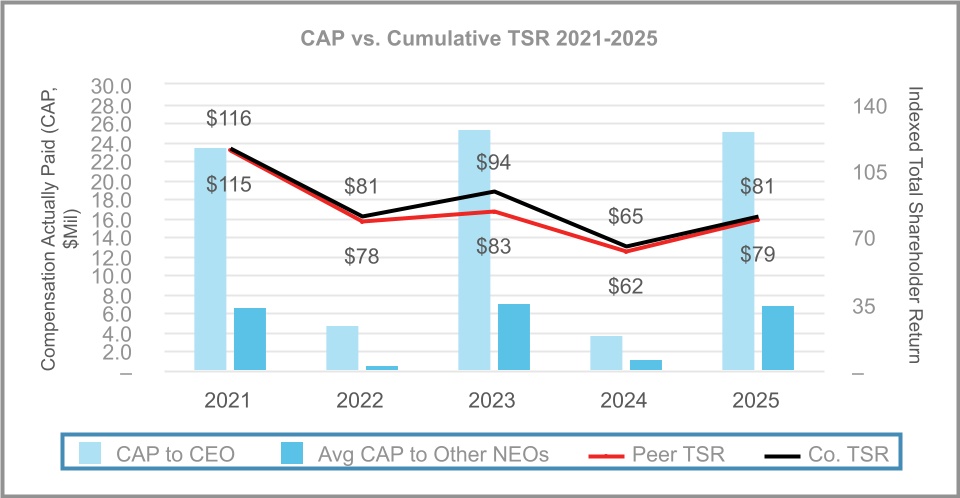
Relationship between CAP and Company Net Income over 2021-2025
As shown below, the Company’s CAP for the CEO and Average CAP for the non-CEO NEO varied significantly each year, primarily due to the Company’s significant emphasis on equity incentives, which are sensitive to changes in stock price.
-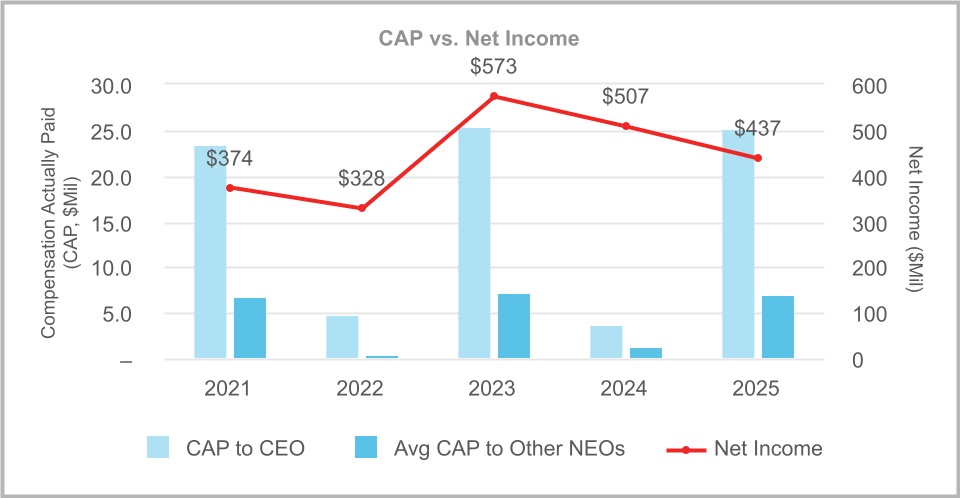
Relationship between CAP and Company Adjusted Operating Income* over 2021-2025
The chart below illustrates the relationship between the CEO and average non-CEO NEO CAP amounts and the Company's Adjusted Operating Income. We consider Adjusted Operating Income to be the most important financial measure used to link pay to performance during this period because it is both a key measure in our AIP and is the largest driver of a key measure in our LTI (Adjusted Annual Pretax Income).
*Adjusted Operating Income is a Non-GAAP financial measure. See pages 42 and 47 and Appendix A "Reconciliation of Non-GAAP Financial Measures" on page 97 for more information on this financial measure and how it is used. All information provided in “Pay Versus Performance Disclosures” above will not be deemed to be incorporated by reference into any filing of the Company under the Securities Act of 1933, as amended, or the Securities Exchange Act of 1934, as amended, whether made before or after the date hereof and irrespective of any general incorporation language in any such filing, except to the extent the Company specifically incorporates such information by reference.
P&C COMMITTEE INTERLOCKS AND INSIDER PARTICIPATION
The following persons served on our P&C Committee during all or a portion of 2025: Messrs. Cheng, Halverson and Lache, Dr. Jepsen, and Mses. Lewis and Ligocki. No member of the P&C Committee was, during the fiscal year ended December 31, 2025, an officer, former officer or employee of the Company or any of our subsidiaries. None of our executive officers served as a member of:
•the compensation committee of another entity in which one of the executive officers of such entity served on our P&C Committee;
•the board of directors of another entity in which one of the executive officers of such entity served on our P&C Committee; or
•the compensation committee of another entity in which one of the executive officers of such entity served as a member of our Board.
| | | | | | | | |
| | ADDITIONAL PROXY MATERIALS |
P&C COMMITTEE REPORT
The information contained in this Report shall not be deemed to be “soliciting material” or to be “filed” with the SEC or subject to Regulation 14A or 14C other than as set forth in Item 407 of Regulation S-K, or subject to the liabilities of Section 18 of the Exchange Act, except to the extent that we specifically request that the information contained in this Report be treated as soliciting material, nor shall such information be incorporated by reference into any past or future filing under the Securities Act of 1933, as amended (the “Securities Act”), or the Exchange Act, except to the extent that we specifically incorporate it by reference in such filing.
The P&C Committee of the Board has reviewed and discussed the “Compensation Discussion and Analysis” required by Item 402(b) of Regulation S-K with management, and based on such review and discussions, the P&C Committee recommended to the Board that the “Compensation Discussion and Analysis” be included in this proxy statement and the Annual Report on Form 10-K for the year ended December 31, 2025.
This Report is submitted by Messrs. Blissett, Halverson, Krone and Lache, and Mses. Lewis and Ligocki, being all of the current members of the P&C Committee, as well as by Dr. Jepsen, who served on the P&C Committee during 2025.
Patricia L. Lewis, Chair
Julian G. Blissett*
Bradley M. Halverson
Roger A. Krone*
Rod A. Lache
Mary Lou Jepsen
Kathleen A. Ligocki
* Messrs. Blissett and Krone were appointed to the P&C Committee on February 12, 2026, and did not participate in the review, discussion and recommendation reflected in this P&C Committee report.
AUDIT COMMITTEE REPORT
The information contained in this Report shall not be deemed to be “soliciting material” or to be “filed” with the SEC or subject to Regulation 14A or 14C, other than as set forth in Item 407 of Regulation S-K, or subject to the liabilities of Section 18 of the Exchange Act, except to the extent that we specifically request that the information contained in this Report be treated as soliciting material, nor shall such information be incorporated by reference into any past or future filing under the Securities Act or the Exchange Act, except to the extent that we specifically incorporate it by reference in such filing.
The Audit Committee of the Board is responsible for evaluating audit performance, appointing, compensating, retaining and overseeing the work of our independent registered public accounting firm and evaluating policies and procedures relating to internal accounting functions and controls. The Audit Committee also oversees the audit fee negotiations associated with the retention of Ernst & Young LLP. The Audit Committee has discussed the advantages and disadvantages of independent registered public accounting firm rotation. Further, in connection with the periodic mandated rotation of the independent registered public accounting firm’s lead engagement partner, the Audit Committee is involved in the selection of Ernst & Young LLP’s lead engagement partner.
The Audit Committee is currently comprised of Messrs. Foster and Halverson, Dr. Jepsen, and Messrs. Krone, Lache and Mallett, each a non-employee director, and operates under a written charter that was last amended by our Board in May 2025. A copy of the current charter is available on the investor relations page of our website (https://ir.lear.com/) or in printed form upon request. Our Board has determined that all of the members of the Audit Committee are “independent” as defined in the listing standards of the NYSE and under Rule 10A-3 of the Exchange Act and that all such members are financially literate and have accounting or related financial management expertise. Our Board also has determined that Messrs. Foster, Halverson, Krone, Lache and Mallett are “audit committee financial experts,” as defined in Item 407(D) of Regulation S-K under the Exchange Act.
The Audit Committee members are neither professional accountants nor auditors, and their functions are not intended to duplicate or to certify the activities of management or the independent auditor, nor can the Audit Committee certify that the independent auditor is “independent” under applicable rules. The Audit Committee serves a board-level oversight role in which it provides advice, counsel and direction to management and the auditors on the basis of the information it receives, discussions with management and the auditors and the experience of the Audit Committee’s members in business, financial and accounting matters. Our management has the primary responsibility for the financial statements and reporting process, including our systems of internal controls. In fulfilling its oversight responsibilities, the Audit Committee reviewed and discussed with management the audited consolidated financial statements included in the Annual Report on Form 10-K for the fiscal year ended December 31, 2025, as well as the report of management, for the year ended December 31, 2025, regarding the Company’s internal control over financial reporting required by Section 404 of the Sarbanes-Oxley Act.
The Audit Committee has retained Ernst & Young LLP as the Company’s independent registered public accounting firm for 2025. Ernst & Young LLP has been the independent registered public accounting firm for the Company since 2002. The members of the Audit Committee and the Board believe that the continued retention of Ernst & Young LLP to serve as the Company’s independent registered public accounting firm is in the best interests of the Company and its shareholders. In reaching this conclusion, the Audit Committee considered Ernst & Young LLP’s integrity, controls and processes to ensure Ernst & Young LLP’s independence, objectivity, industry and company-specific experience, quality and effectiveness of personnel and communications, commitment to serving the Company, appropriateness of fees for audit and non-audit services and external data on audit quality and performance, including recent Public Company Accounting Oversight Board (United States) (PCAOB) reports on Ernst & Young LLP and tenure as the Company’s auditors, including the benefits of having a long-tenured auditor.
The Audit Committee has discussed with the Company’s internal auditors and Ernst & Young LLP the overall scope and plans of their respective audits. The Audit Committee meets with the Company’s internal auditors and Ernst & Young LLP, with and without management present, to discuss the results of their procedures, their evaluations of the Company’s internal control, including internal control over financial reporting, and the overall quality of the Company’s financial reporting.
The Audit Committee reviewed and discussed with Ernst & Young LLP, its judgments as to the quality, not just the acceptability, of the Company’s accounting policies and such other matters as are required to be discussed by the applicable requirements of the PCAOB and the SEC. The Audit Committee has also received written disclosures and the letter from Ernst & Young LLP required by applicable requirements of the PCAOB regarding Ernst & Young LLP’s communications with the Audit Committee concerning independence and has discussed with Ernst & Young LLP its independence from the Company. The Audit Committee has considered whether the provision of non-audit services to the Company is compatible with maintaining the independence of Ernst & Young LLP.
| | | | | | | | |
| | ADDITIONAL PROXY MATERIALS |
Based on the review and discussions referred to above, the Audit Committee recommended to the Board that the Company’s audited consolidated financial statements be included in the Company’s Annual Report on Form 10-K for the fiscal year ended December 31, 2025, filed with the SEC on February 13, 2025.
This Report is submitted by Messrs. Foster and Halverson, Dr. Jepsen, and Messrs. Krone, Lache and Mallett, being all of the members of the Audit Committee.
Bradley M. Halverson, Chair
Jonathan F. Foster
Mary Lou Jepsen*
Roger A. Krone
Rod A. Lache
Conrad L. Mallett, Jr.
* Dr. Jepsen was appointed to the Audit Committee on February 12, 2026, and did not participate in the review, discussion and recommendation reflected in this Audit Committee report.
FEES OF INDEPENDENT ACCOUNTANTS
In addition to retaining Ernst & Young LLP to audit our consolidated financial statements for 2025, we retained Ernst & Young LLP, as well as other accounting firms, to provide tax and other advisory services in 2025. We understand the need for Ernst & Young LLP to maintain objectivity and independence in its audit of our consolidated financial statements. It is also the Audit Committee’s goal that the fees that the Company pays to Ernst & Young LLP for permitted non-audit services in any year should not exceed the audit and audit-related fees paid to Ernst & Young LLP in such year, a goal that the Company achieved in 2025 and 2024.
In order to assure that the provision of audit and permitted non-audit services provided by Ernst & Young LLP does not impair its independence, the Audit Committee is required to pre-approve the audit and permitted non-audit services to be performed by Ernst & Young LLP, other than de minimis services that satisfy the requirements pertaining to de minimis exceptions for non-audit services described in Section 10A of the Exchange Act. The Audit Committee also has adopted policies and procedures for pre-approving all audit and permitted non-audit work performed by Ernst & Young LLP. Any pre-approval must set forth in detail the particular service or category of services approved and is generally subject to a specific cost limit. All of the fees for audit, audit-related, tax and other services performed by Ernst & Young LLP were pre-approved by the Audit Committee in accordance with the pre-approval policies and procedures described in this paragraph.
The Audit Committee has adopted policies regarding our ability to hire employees, former employees and certain relatives of employees of the Company’s independent registered public accounting firm.
During 2025 and 2024, we retained Ernst & Young LLP to provide services in the following categories and amounts (in thousands):
| | | | | | | | |
| 2025 | 2024 |
Audit fees(1) | $14,178 | | $13,457 | |
Audit-related fees(2) | 255 | | 747 | |
Tax fees(3) | 3,003 | | 2,619 | |
All other fees(4) | 49 | | — | |
(1)Audit fees include services related to the annual audit of our consolidated financial statements, the audit of our internal controls over financial reporting, the reviews of our Quarterly Reports on Form 10-Q, international statutory audits and other services that are normally provided by the independent accountants in connection with our regulatory filings.
(2)Audit-related fees include services related to the audits of employee benefit plans and agreed-upon procedures related to certain due diligence services in connection with acquisitions and divestitures.
(3)Tax fees include services related to tax compliance, tax advice and tax planning.
(4)All other fees include services that are not contained in the above categories and consist of permissible non-audit services. These fees relate to a statutorily required cybersecurity program assessment.
| | | | | | | | |
| | ADDITIONAL PROXY MATERIALS |
CERTAIN RELATIONSHIPS AND RELATED PARTY TRANSACTIONS
Our Code of Business Conduct & Ethics prohibits activities that conflict with, or have the appearance of conflicting with, the best interests of the Company and its shareholders. Such conflicts of interest may arise when an employee, or a member of such employee’s immediate family, receives improper personal benefits as a result of such employee's position in the Company. We also maintain a Related Party Transaction Policy regarding the identification, review, monitoring and, as necessary, approval of transactions between the Company and related parties. Related parties include directors and director nominees, executive officers and such other employees as may be designated by the Company from time to time (together with executive officers, “senior officers”), significant shareholders and immediate family members of any of the foregoing. Under the policy, a related party transaction includes any transaction, or series of transactions, involving the Company and a related party in excess of $120,000, whether undertaken in or outside the ordinary course of our business and where the related party has a direct or indirect material interest in such transaction or series of transactions. All related party transactions must be reviewed and approved by the G&S Committee.
Under the policy, directors and senior officers are required to complete an annual questionnaire regarding their immediate family members, related entities and potential related party transactions. Following review of such questionnaires, the Vice President of Audit Services and Chief Accounting Officer determine whether the Company has engaged in any transactions with the identified individuals and entities. All such transactions, if any, are reviewed by the General Counsel, other members of management and outside counsel, as necessary, to evaluate whether such transactions constitute related party transactions and are therefore subject to the review and approval of the G&S Committee.
In connection with any required approval of the G&S Committee, a member of senior management must represent to the G&S Committee that the related party at issue has been held to the same standards as unaffiliated third parties. The G&S Committee assesses the terms of the transaction, the business purpose of the transaction, the benefit to the Company and to the related party, whether the transaction was in the ordinary course of business and any other relevant factors. G&S Committee members having (or having an immediate family member that has) a direct or indirect interest in the transaction must recuse themselves and abstain from voting on the approval or ratification of the related party transaction. All related party transactions are disclosed annually in our proxy statement.
Certain Transactions
Joshua Scott and Jacob Scott, sons of Raymond E. Scott, a director of the Company and the Company's President and CEO, are employed by the Company as a platform management lead and a sales manager, respectively. In 2025, the total compensation (base salary and cash bonus) paid to Joshua Scott and Jacob Scott was approximately $147,000 and $164,000, respectively. Barbara Allor, a purchasing manager for the Company and daughter-in-law of Raymond E. Scott, received total compensation of approximately $164,000 in 2025. The compensation paid to these individuals was reviewed and approved by the G&S Committee and was in accordance with the Company’s standard compensation practices for similarly situated employees.
RATIFICATION OF RETENTION OF INDEPENDENT REGISTERED PUBLIC ACCOUNTING FIRM FOR 2026 (PROPOSAL NO. 2)
Our Audit Committee has retained Ernst & Young LLP as our independent registered public accounting firm for the year ending December 31, 2026. A proposal will be presented at the Annual Meeting to ratify this retention. Ratification of the retention of our independent registered public accounting firm requires the affirmative vote of the majority of shares present in person or represented by proxy at the Annual Meeting and entitled to vote. If the shareholders fail to ratify such selection, another independent registered public accounting firm will be considered by our Audit Committee, but the Audit Committee may nonetheless choose to engage Ernst & Young LLP. Even if the retention of Ernst & Young LLP is ratified, the Audit Committee in its discretion may select a different independent registered public accounting firm at any time during the year if it determines that such a change would be in the best interests of the Company and its shareholders. We have been advised that a representative of Ernst & Young LLP will be present at the Annual Meeting and will be available to respond to appropriate questions and, if such person chooses to do so, make a statement.
THE BOARD UNANIMOUSLY RECOMMENDS A VOTE “FOR” RATIFICATION OF THE RETENTION OF ERNST & YOUNG LLP AS OUR INDEPENDENT REGISTERED PUBLIC ACCOUNTING FIRM FOR 2026.
PROXIES SOLICITED BY THE BOARD WILL BE VOTED “FOR” THE PROPOSAL UNLESS SHAREHOLDERS SPECIFY A CONTRARY VOTE.
| | | | | | | | |
| | ADDITIONAL PROXY MATERIALS |
ADVISORY VOTE TO APPROVE THE COMPANY’S EXECUTIVE COMPENSATION SET FORTH IN THIS PROXY STATEMENT (PROPOSAL NO. 3)
Pursuant to Section 14A of the Exchange Act, we are seeking the advisory approval by shareholders of the Company’s executive compensation program and practices as disclosed in this proxy statement. As most recently approved by shareholders at the annual meeting of shareholders in 2025 and consistent with the Board’s recommendation, we are submitting this proposal for a non-binding vote on an annual basis. While this vote is advisory, and not binding on the Board, it will provide information to the Board and P&C Committee regarding investor sentiment about our executive compensation programs and practices, which the P&C Committee will carefully review when evaluating our executive compensation program. At the annual meeting of shareholders in 2025, our executive compensation program and practices disclosed in our 2025 proxy statement received a favorable vote by 98.2% of shares voted (excluding abstentions and broker non-votes).
Shareholders are being asked to vote on the following advisory resolution:
“RESOLVED, that the Company’s shareholders approve, on an advisory basis, the compensation of the Company’s executive officers, as disclosed in the 2026 proxy statement pursuant to the compensation disclosure rules of the Securities and Exchange Commission, including the Compensation Discussion and Analysis, the 2025 Summary Compensation Table and the other related tables and disclosures.”
The Company is committed to maintaining executive compensation programs and practices that are aligned with the Company’s business strategy. As a result, the Company has a strong pay-for-performance philosophy that greatly impacts its decisions regarding executive compensation. Our executive compensation programs seek to align management’s interests with our shareholders’ interests to support long-term value creation and pay for performance. This philosophy and the compensation structure are essential to the Company’s ability to attract, retain and motivate individuals who can achieve superior financial results in the best interests of the Company and its shareholders. To that end, our program links pay to performance by delivering a significant majority of the total compensation opportunity of our NEOs in variable or performance-based compensation programs (annual and long-term incentive plans). Performance measures used in the Company’s annual and long-term incentive plans support the Company’s annual operating plan and longer-term strategy and are tied to key Company measures of short and long-term performance. Our program also aligns the NEOs’ financial interests with those of our shareholders by delivering a substantial portion of their total compensation in the form of equity awards and other long-term incentive vehicles.
We urge our shareholders to read the “Compensation Discussion and Analysis” above, which describes in detail how our executive compensation program and practices operate and are designed to achieve our compensation objectives, as well as the accompanying compensation tables which provide detailed information on the compensation of our NEOs.
The affirmative vote of a majority of the shares of common stock present in person or represented by proxy and entitled to be voted on the proposal at the Annual Meeting is required for approval of this advisory resolution.
THE BOARD UNANIMOUSLY RECOMMENDS A VOTE “FOR” THE ADVISORY APPROVAL OF THE COMPANY’S EXECUTIVE COMPENSATION SET FORTH IN THIS PROXY STATEMENT.
PROXIES SOLICITED BY THE BOARD WILL BE VOTED “FOR” THE ADVISORY APPROVAL OF THE COMPANY’S EXECUTIVE COMPENSATION SET FORTH IN THIS PROXY STATEMENT UNLESS SHAREHOLDERS SPECIFY A CONTRARY VOTE.
VOTE TO APPROVE THE AMENDED PLAN (PROPOSAL NO. 4)
We are requesting shareholder approval of the 2019 Long-Term Stock Incentive Plan, as amended and restated as of May 14, 2026 (the "Amended Plan"). The Amended Plan amends and restates our 2019 Long-Term Stock Incentive Plan, originally effective May 16, 2019, and later amended and restated as of May 18, 2023 (the "Plan"). The Amended Plan has been approved and adopted by our P&C Committee and is subject to approval by our shareholders as required by the NYSE.
The primary purpose of the proposal is to authorize an additional 1,725,000 shares for future issuance under the Amended Plan. As of March 16, 2026, approximately 675,786 shares previously approved by shareholders remained available for issuance under the Plan. In addition, the Amended Plan expands the class of participants eligible to participate by permitting consultants to the Company to receive awards and includes certain administrative changes.
Equity Usage and Overhang
In developing our share request for the Amended Plan and analyzing the impact of granting equity on our shareholders, the P&C Committee considered our equity usage, or "burn rate," and "overhang."
Equity usage provides a measure of the potential dilutive impact of our annual equity award program. Our equity usage for 2025, 2024 and 2023, as well as the average equity usage over those years, is shown below.
Overhang measures the extent to which long-term incentives awarded to employees and non-employee directors dilute the Company's outstanding shares. A higher overhang indicates a greater dilutive impact.
We expect that approval of this proposal will allow us to continue to issue shares under the Amended Plan until it expires in 2029, based on our current and anticipated grant practices, subject to the oversight and approval of the P&C Committee. The actual duration may vary based on changes in participation, our stock price and market practice.
| | | | | | | | |
| | ADDITIONAL PROXY MATERIALS |
Proposed Updates to the Plan
We are requesting shareholder approval of the Amended Plan, which would authorize an additional 1,725,000 shares for future issuance. If this increase is approved, the authorized share reserve under the Amended Plan available for future issuance, after including the number of shares currently available for new awards under the Plan (675,786 shares as of March 16, 2026) would provide up to 2,400,786 shares available for issuance for future awards under the Amended Plan. See "Available Shares; Available Limits" below for more information on the authorized share reserve and "share recycling" provisions.
In addition to the increase in shares available for issuance as described above, the Amended Plan would result in the following material changes:
•The Amended Plan defines the events that constitute "Good Reason." The Plan does not define Good Reason but provides that Good Reason would be defined in a separate agreement between the Company and the participant. If such agreement did not define Good Reason, the term would not apply to the participant under the Plan. Under both the Plan and the Amended Plan, participants who resign with Good Reason (as now defined in the Amended Plan) within twenty-four months following a Change in Control of the Company receive accelerated vesting of their unvested awards.
•Under the Amended Plan, the Company has the ability to grant awards to current or prospective consultants to the Company.
The Amended Plan also includes certain other changes, including (i) updates to certain defined terms, including the definition of "Cause," (ii) adding a definition of "Termination of Service," (iii) providing flexibility to the Company to determine that the fair market value of shares withheld upon the payment of an award may be determined on a date prior to the date a participant recognizes taxable income on the award (e.g., the day prior) and (iv) an update to the recoupment provisions to provide that awards are not only subject to the Company's Incentive Compensation Recoupment Policy but also the Company's Improper Conduct Compensation Recoupment Policy.
The Board believes that the Amended Plan benefits shareholders and has served, and will continue to serve, its intended objectives of:
•Driving profitability and growth
•Linking the interests of management and shareholders
•Providing participants with incentives for excellence
•Promoting team work
•Attracting, retaining and motivating participants who make significant contributions to the Lear's success
How does the Amended Plan Protect Shareholders?
The following features protect shareholders' interests and mitigate potential risk:
•No repricing of stock options or stock appreciation rights ("SARs") without shareholder approval
•No discount or underwater buyouts of stock options or SARS
•No evergreen provisions
•Awards do not automatically vest on a Change in Control
•No liberal share recycling
•Robust compensation recoupment policies (see page 54 for more details) •Award agreements with executives contain restrictive covenants
•No dividends or dividend equivalents issued prior to award vesting
•Minimum vesting requirements
•No assignment or transfer of awards for value
•Limits on the number of awards that a participant may receive
•Limits on non-employee director compensation
Summary of Material Terms of the Amended Plan
We have provided a brief summary of the material terms of the Amended Plan below, which is also qualified in its entirety by reference to the full copy of the Amended Plan, attached as Appendix B to this proxy statement.
Purpose
The Amended Plan is designed to provide competitive incentives intended to attract, retain, motivate and reward eligible participants.
Eligible Participants
Non-employee directors, officers and other key employees, and consultants of the Company and its subsidiaries are eligible to participate in the Amended Plan. There are currently approximately 140 executives, 730 non-executive employees and ten non-employee directors who are eligible to receive awards under the Amended Plan.
Plan Administration
The Amended Plan is administered by the P&C Committee. Unless the Board decides otherwise, the P&C Committee's membership is intended to satisfy the "non-employee director" provisions of Section 16(b) of the Exchange Act so long as the Company is subject to the registration requirements of the Exchange Act. The members of the P&C Committee will be appointed from time to time by, and will serve at the discretion of, the Board. Except as limited by law and subject to the provisions of the Amended Plan, the P&C Committee selects the eligible participants who receive awards under the Amended Plan; determines the sizes and types of awards; determines the terms and conditions of awards in a manner consistent with the Amended Plan; construes and interprets the Amended Plan and any agreement or instrument entered into under the Amended Plan; establishes, amends or waives rules and regulations for the Amended Plan's administration; corrects any defect, supplies any omission or reconciles any inconsistency in the Amended Plan or in any award thereunder; and amends the terms and conditions of any outstanding award to the extent that the Amended Plan provides that they are within the discretion of the P&C Committee. Further, the P&C Committee is empowered to make other determinations it deems necessary or advisable to administer the Amended Plan properly. The P&C Committee may, to the extent permitted by law, delegate some or all of its authority under the Amended Plan to any person or persons selected by it so long as such delegation would not cause a transaction under the Amended Plan to be subject to (and not exempt from) Section 16(b) of the Exchange Act. The P&C Committee can revoke a delegation at any time.
Available Shares; Award Limits
The number of shares that may be issued or transferred to participants under the Amended Plan, after the effective date of the Amended Plan, will not exceed the sum of (i) 2,400,786 shares, which includes 1,725,000 additional shares and 675,786 shares as of March 16, 2026 authorized and available for issuance under the Plan and (ii) any shares subject to awards granted under the Plan or any predecessor thereto that are outstanding as of the effective date of the Amended Plan and that, after the effective date of the Amended Plan, are forfeited, terminated, lapsed or satisfied thereunder in cash or property other than shares. Subject to adjustment as described below, the maximum number of shares and share-equivalent units that may be granted to any one participant in a calendar year under any Amended Plan awards is 1,000,000. The maximum number of shares that may be issued pursuant to options that are intended to be ISOs (as defined below) is 1,000,000. The maximum aggregate dollar amount that may be paid to any one participant in a calendar year under performance units or cash incentive awards is $20,000,000. Shares underlying awards that are subject to the achievement of performance goals will be counted against the share reserve and limits based on the target value of such awards unless and until such time as the awards become vested and settled in shares.
The following explains how awards are counted against the available shares in the Amended Plan.
| | | | | |
| Grant of awards (regardless of the type of the award) | Number of shares available for future awards is reduced by one for each awarded share. Shares that are subject to performance goals are adjusted to reflect actual performance when the award is settled in shares. |
| Award forfeitures, cancellations, expirations or terminations | Number of shares available for future awards is increased by one for each forfeited, cancelled, expired or terminated share. |
| Awarded shares otherwise issuable or issued for an award that are withheld to cover taxes or applicable exercise price | Shares are not made available for future awards. |
| | | | | | | | |
| | ADDITIONAL PROXY MATERIALS |
| | | | | |
| Shares subject to stock-settled SARs that are exercised | Shares are not made available for future awards. |
| Shares tendered to exercise stock options or other awards or to cover taxes | Shares are not made available for future awards. |
| Cash settlement of awards | Awards settled in cash do not reduce the share pool. |
Adjustments
If there is any change in the Company's capitalization resulting from a stock split or a corporate transaction, including a merger, consolidation, separation, or other distribution of stock of the Company, a spin-off, or any reorganization, the P&C Committee will adjust the number and kind of shares of stock or other securities permitted to be delivered under the Amended Plan, adjust the terms of outstanding awards, including the number and kind of shares of stock or other securities subject to outstanding awards, in each case as and to the extent the P&C Committee determines an adjustment to be appropriate and equitable, to prevent dilution or enlargement of rights.
Non-Employee Director Limit
Any compensation paid to a non-employee director, including cash fees and awards under the Amended Plan (based on the grant date fair market value of such awards for financial reporting purposes), will not exceed $900,000 per fiscal year in respect to his or her service as a non-employee director. Compensation will count toward this limit in the Board compensation year in which it is earned.
Minimum Vesting Requirement
Except in the case of substitute awards, awards granted under the Amended Plan are subject to a minimum vesting period of one year from the date of grant. Notwithstanding the foregoing, the P&C Committee may provide that the vesting of the award will accelerate in the event of a participant's death, disability, retirement or a change in control, and the P&C Committee may grant awards covering 5% or fewer of the shares reserved for issuance under the Amended Plan without regard to the minimum vesting provision. The vesting of any unvested awards granted to non-employee directors will be deemed to satisfy the one-year minimum vesting provision if the awards vest on the earlier of the one-year anniversary of the date of grant and the next regular annual meeting of stockholders that is at least 50 weeks after the immediately preceding year's annual meeting.
Awards
Under the Amended Plan, the P&C Committee is authorized to grant stock options (including nonqualified stock options (“NQSOs”) and incentive stock options (“ISOs”), SARs, restricted stock, RSUs, restricted units, performance units, Performance Shares and other awards, each of which may be made subject to the achievement of specified performance measures established by the P&C Committee. The P&C Committee may also grant substitute awards under the Amended Plan. The P&C determines the terms and conditions of each award at the time of grant, including whether payment of awards will be subject to the achievement of performance goals, consistent with the provisions of the Amended Plan, and the extent to which awards will be retained following the termination of employment or service.
Options and SARs
An option entitles the holder thereof to purchase a specific number of shares at a specified exercise price. A SAR entitles the holder thereof to, upon exercise, receive a payment in an amount determined by multiplying the excess (or a specified portion of the excess), if any, of the fair market value on the date of exercise over the grant price specified in the award agreement, by the number of shares as to which the SAR is exercised. Payment of a SAR may be made in cash, shares, or a combination of the two. The applicable exercise or grant price of an option or a SAR must be equal to at least 100% of the fair market value on the date of grant, unless granted through a substitute award. The term of an option or SAR will be set by the P&C Committee at the time of grant, but no option or SAR will be exercisable more than 10 years after the date of grant. At the time of exercise of an option, the exercise price must be paid in full and may be paid in cash, by tendering shares already owned, through a “cashless” exercise, or through a combination of any of the foregoing. ISOs are subject to additional limitations set forth in the Amended Plan and the Code.
Restricted Stock, RSUs, and Restricted Units
Restricted stock awards are shares that are issued to a participant subject to transfer and other restrictions as the P&C Committee may determine. RSUs and restricted units entitle a participant to receive, at a specified future date, shares or an amount equal to the fair market value of a specified number of shares (or other unit of measurement).
The P&C Committee may impose any conditions or restrictions that it deems advisable on restricted stock, RSU and restricted unit awards, including performance- and/or time-based vesting conditions. While awards of restricted stock, RSUs and restricted units are subject to restrictions, unless otherwise determined by the P&C Committee and set forth in an award agreement, participants will be credited with regular cash dividends or dividend equivalents with respect to such awards. No dividends or dividend equivalents will be paid on unvested awards, but to the extent that such awards contain the right to receive dividends or dividend equivalents during the restriction period, such dividends or dividend equivalents will be accumulated and paid once and to the extent that the underlying award vests.
Performance Units and Performance Shares
Performance units and Performance Shares have an initial value that is established by the P&C Committee at the time of grant (for Performance Shares, such value per performance share is equal to the fair market value of a share at the time of grant). The P&C Committee will set performance periods and performance objectives that, depending to the extent to which they are met, will determine the number and/or value of the performance units or Performance Shares that will be earned by a participant. These awards may be paid in cash, shares, or a combination of the two, as determined by the P&C Committee. Unless otherwise determined by the P&C Committee and set forth in an award agreement, participants will be credited with dividend equivalents with respect to awards of Performance Shares. The P&C Committee may, in its sole discretion, provide that dividend equivalents will be paid on awards of performance units. No dividend equivalents will be paid on unvested awards, but to the extent that such awards contain the right to receive dividend equivalents during the performance period, such dividend equivalents will be accumulated and paid once and to the extent that the underlying award vests.
Substitute Awards
Substitute awards are awards that may be granted in replacement of stock or stock-based awards from another business held by current and former employees or non-employee directors of such business that is, or whose stock is, acquired by the Company, in order to preserve the economic value of all or a portion of a substituted award on such terms and conditions (including price) as the P&C Committee determines. Substitute awards will not reduce the shares authorized for issuance under the Amended Plan.
Other Awards
In addition to the awards described above, and subject to the terms of the Amended Plan, the P&C Committee may grant other incentives payable in cash or shares under the Amended Plan as it determines to be in the best interests of the Company and subject to such other terms and conditions as it deems appropriate. The P&C Committee may, in its sole discretion, provide that dividend equivalents will be paid on such other awards. No dividend equivalents will be paid on unvested awards, but to the extent that such awards contain the right to receive dividend equivalents during the performance period, such dividend equivalents will be accumulated and paid once and to the extent that the underlying award vests.
Performance Goals
The P&C Committee may establish performance goals for performance-based awards under the Amended Plan which may be based on any performance measures selected by the P&C Committee. Such performance goals may include, but are not limited to, any of the following: earnings (including, without limitation, earnings before interest and taxes, earnings before taxes, and net earnings); operating earnings or income; earnings growth; net sales growth; net income (absolute or competitive growth rates comparative); net income applicable to common stock; cash flow (including operating cash flow, free cash flow, discounted cash flow return on investment and cash flow in excess of cost of capital); earnings per share; return on stockholders’ equity (absolute or peer-group comparative); stock price (absolute or peer-group comparative); absolute and/or relative return on common stockholders’ equity; absolute and/or relative return on capital; absolute and/or relative return on assets; economic value added (income in excess of cost of capital); customer satisfaction; quality metrics; expense reduction; and ratio of operating expenses to operating revenues. If the P&C Committee determines that any events or circumstances render performance goals to be unsuitable, the P&C Committee may modify such goals as it deems appropriate.
Change in Control
The Amended Plan provides for accelerated vesting or payout of awards immediately upon a change in control (as defined in the Amended Plan) only if the successor company does not agree to assume or replace such existing awards with an equivalent award upon the change in control. Otherwise, awards will only receive accelerated vesting if a change in control occurs and the participant is terminated by the Company without Cause or resigns for Good Reason (each as defined in the Amended Plan) within 24 months following such change in control.
| | | | | | | | |
| | ADDITIONAL PROXY MATERIALS |
Amendment, Modification, and Termination
The P&C Committee or Board may amend, modify or terminate the Amended Plan. However, the P&C Committee or Board may not increase the number of shares that may be issued under the Amended Plan (subject to adjustment as described in the Amended Plan). No termination, amendment, or modification of the Amended Plan may affect adversely in any material way any award already granted under the Amended Plan, without the written consent of the participant who holds the award. Except for certain capitalization adjustments or adjustments upon events described in the Amended Plan, the P&C Committee will not modify any outstanding option or SAR so as to specify a lower exercise price or grant price (and will not cancel an option or SAR and substitute for it an option or SAR with a lower exercise price or grant price) without the approval of the Company’s stockholders. In addition, except for certain capitalization adjustments or adjustments upon certain events described in the Amended Plan, the P&C Committee may not cancel an outstanding option or SAR whose exercise price or grant price is equal to or greater than the current fair market value of a share and substitute for it another award or cash payment without the prior approval of the Company’s stockholders.
Incentive Compensation Recoupment Policy
All awards granted under the Amended Plan are subject to the Company’s Incentive Compensation Recoupment Policy, the Company's Improper Conduct Compensation Recoupment Policy, each as in effect from time to time, and any other compensation recovery and/or recoupment policy adopted by the Company from time to time.
Effective Date and Plan Term
The P&C Committee approved the Amended Plan on March 23, 2026, and the Amended Plan will become effective on May 14, 2026, provided that shareholder approval is obtained at the Annual Meeting. The Amended Plan will expire on May 16, 2029, the ten year anniversary of the date shareholders first approved the Plan.
U.S. Federal Income Tax Considerations
The following is a brief description of the federal income tax treatment that generally applies to Amended Plan awards as of the date of this Proxy Statement. The description is based on current federal tax laws, rules and regulations, which are subject to change, and does not purport to be a complete description of the federal income tax aspects of the Amended Plan. This description assumes all awards are exempt from or comply with the rules under Section 409A of the Internal Revenue Code. A participant may also be subject to state and local taxes.
Awards. In general, a participant will not recognize taxable income at the time a stock option is granted. Upon exercise of an NQSO, a participant will recognize compensation, taxable as ordinary income, equal to the excess of the value of the shares purchased over the exercise price. Upon sale of the stock, the participant will have capital gain or loss equal to the difference between the sale proceeds and the value of the stock on the date of exercise. This capital gain or loss will be long-term if the participant has held the stock for more than one-year and otherwise will be short-term. In the case of an “incentive stock option,” within the meaning of Code Section 422, a participant will not recognize ordinary income at the time of exercise (except for purposes of the alternative minimum tax), and if the participant observes certain holding period requirements, then when the shares are sold, the entire gain over the exercise price will be taxable at capital gains rates. If a participant sells the stock prior to satisfying these holding period requirements, then the participant will have engaged in a disqualifying disposition and a portion of the profit will be ordinary income and a portion may be capital gain. This capital gain will be long-term if the participant has held the stock for more than one year and otherwise will be short term. A participant has no taxable income at the time SARs, Performance Shares and performance units are granted, but will recognize compensation taxable as ordinary income upon exercise or settlement in an amount equal to the value of any shares on the date of exercise or delivery, as the case may be, and the amount of cash paid by the Company. Upon sale of any stock delivered under such an award, the participant will have a capital gain or loss equal to the difference between the sale proceeds and the value of the stock on the date of exercise or delivery, as the case may be. This capital gain or loss will be long-term if the participant has held the stock for more than one year and otherwise will be short-term. A participant who is granted shares of restricted stock, RSUs and restricted units generally will not recognize taxable income at the time the of grant, but will recognize compensation taxable as ordinary income at the time the restrictions lapse in an amount equal to the excess of the value of the shares at such time over the amount, if any, paid for such shares. When the stock is sold, the participant will have capital gain or loss equal to the sales proceeds less the value of the stock on the vesting or delivery date, as the case may be. Any capital gain or loss will be long-term if the participant held the stock for more than one year and otherwise will be short term. A participant instead may elect to recognize compensation taxable as ordinary income on the date the restricted stock is granted in an amount equal to the value of the shares on that date over the amount, if any, paid for such shares. In such case, when the stock is sold, the participant will have capital gain or loss equal to the sales proceeds less the value of the stock on the date of grant. Any capital gain or loss will be long-term if the participant held the stock for more than one year and otherwise will be short term.
Subject to the deduction limitation, described below, contained in Code Section 162(m), the Company may deduct, as a compensation expense, the amount of ordinary income recognized by a participant in connection with the Amended Plan at the time such ordinary income is recognized by that participant.
Code Section 162(m). In general, Code Section 162(m) denies a publicly held corporation a deduction for U.S. federal income tax purposes for compensation in excess of $1,000,000 per year per covered employee.
Deferrals and Code Section 409A. The P&C Committee may, consistent with the requirements of Code Section 409A, permit a participant to defer receipt of cash or shares that would otherwise be due by virtue of the lapse or waiver of restrictions on restricted stock, RSUs, restricted units or other awards, or the satisfaction of any requirements or objectives with respect to performance units, Performance Shares or other awards. If any such deferral election is permitted, the P&C Committee will, in its sole discretion, establish rules and procedures for such deferrals consistent with the requirements of Code Section 409A.
New Plan Benefits
As of the date of this Proxy Statement, no awards have been granted under the Amended Plan. All future awards to be made under the Amended Plan are subject to the future exercise of discretion by the P&C Committee or its delegates, and accordingly are not presently determinable, other than with respect to annual stock grants to our non-employee directors. In accordance with our outside directors' compensation program, our non-employee directors are entitled to receive annual stock grants with an aggregate value of $1,970,000 following the Annual Meeting, which would be issued under the Amended Plan, with the share amounts determined by dividing the dollar value by the average of the high and low stock prices on the date of the Annual Meeting. Please refer to the Directors Compensation and Security Ownership of Certain Beneficial Owners, Directors and Management tables on pages 29-31 and the Outstanding Equity Awards at December 31, 2025 on page 61 for details on the awards previously granted under the Plan as of December 31, 2025, for our non-employee directors and NEOs. The closing price of Lear common stock on March 16, 2026, as reported on the NYSE, was $116.15.
Equity Compensation Plan Information
| | | | | | | | | | | |
Outstanding Awards and Shares Available for Issuance |
| Number of securities to be issued upon exercise of outstanding options, warrants and rights (a) | Weighted average exercise price of outstanding options, warrants and rights | Number of securities available for future issuance under equity compensation plans (excluding securities reflected in column (a)) |
As of December 31, 2025 |
Equity compensation plans approved by security holders | 2,460,331(1) | $10.91(2) | 508,265 |
Equity compensation plans not approved by security holders | N/A | N/A | N/A |
(1) Consists of 792,097 restricted stock units, 1,487,044 performance shares and 181,190 stock options. Outstanding performance shares are reflected at the maximum possible payout that may be earned during the relevant performance periods.
(2) Reflects restricted stock units and performance shares at a weighted average price of zero and stock options at a weighted average exercise price of $148.16.
| | | | | | | | |
| | ADDITIONAL PROXY MATERIALS |
Updated Share Information
The following table presents the number of shares subject to outstanding equity awards and shares available for future issuance as of March 16, 2026 (the record date). On March 16, 2026, the total number of shares of common stock outstanding was 50,626,959.
| | | | | |
| As of March 16, 2026 |
| Number of stock options outstanding | 188,190 | |
| Weighted average exercise price of outstanding stock options | $148.16 |
| Weighted average remaining term of outstanding stock options | 4.26 years |
| Number of RSUs outstanding | 849,249 | |
| Number of Performance Shares outstanding (assumes target performance) | 862,118 | |
| Shares remaining available for future issuance under the Plan | 675,786 | |
| Additional shares requested for future issuance under the Amended Plan | 1,725,000 | |
| Total shares available for issuance under the Amended Plan | 2,400,786 | |
The affirmative vote of a majority of the shares of common stock present in person or represented by proxy and entitled to be voted on the proposal at the Annual Meeting is required for approval of this proposal.
THE BOARD RECOMMENDS A VOTE "FOR" THE AMENDED PLAN.
PROXIES SOLICITED BY THE BOARD WILL BE VOTED FOR THE "FOR" THE AMENDED PLAN UNLESS STOCKHOLDERS SPECIFY A CONTRARY VOTE.
QUESTIONS AND ANSWERS ABOUT THE ANNUAL MEETING
Why did you send me this proxy statement?
We sent you this proxy statement because the Board is soliciting your proxy to vote at the Annual Meeting to be held on May 14, 2026, at 9:00 a.m. (Eastern Time) and at any postponements or adjournments of the Annual Meeting. This proxy statement summarizes information that is intended to assist you in making an informed vote on the proposals described in this proxy statement.
Who can vote at the Annual Meeting?
Only shareholders of record as of the record date are entitled to vote at the Annual Meeting. The record date to determine shareholders entitled to notice of and to vote at the Annual Meeting is the close of business on March 16, 2026. On the record date, there were 50,626,959 shares of our common stock, par value $0.01 per share, outstanding. Our common stock is the only class of voting securities outstanding.
How many shares must be present to conduct the Annual Meeting?
We must have a quorum present in person or by proxy to conduct the Annual Meeting. A quorum is established when a majority of shares entitled to vote is present in person or represented by proxy at the Annual Meeting. Abstentions and broker non-votes (as described below) are counted for purposes of determining whether a quorum is present.
What matters are to be voted on at the Annual Meeting?
The agenda for the Annual Meeting is to:
1.elect eleven directors named in this proxy statement;
2.ratify the retention of Ernst & Young LLP as our independent registered public accounting firm for 2026;
3.provide an advisory vote to approve our executive compensation;
4.provide a vote to approve the Amended Plan; and
5.conduct any other business properly brought before the Annual Meeting or any adjournments or postponements thereof.
As of the date of this proxy statement, we do not know of any other matters to be presented at the Annual Meeting. If any other matters properly come before the Annual Meeting, however, the persons named as proxies will be authorized to vote or otherwise act in accordance with their judgment.
How does the Board recommend that I vote?
The Board recommends that you vote:
1.FOR the election of each of Lear’s director nominees named in this proxy statement;
2.FOR the ratification of the retention of Ernst & Young LLP as our independent registered public accounting firm for 2026;
3.FOR the approval, on an advisory basis, of our executive compensation; and
4.FOR the approval of the Amended Plan.
How do I vote at the Annual Meeting?
If you do not request printed copies of the proxy materials by mail, you will receive a Notice of Internet Availability of Proxy Materials. Shareholders that receive a Notice of Internet Availability of Proxy Materials may vote via the Internet in the following ways:
1.Prior to the Annual Meeting — You can vote via the Internet by navigating to www.proxyvote.com and entering the 16-digit control number included on the Notice of Internet Availability of Proxy Materials, proxy card or voting instructions form previously distributed; or
2.At the Annual Meeting — You may vote via the Internet at the Annual Meeting by attending the live meeting at www.virtualshareholdermeeting.com/LEA2026 and entering the 16-digit control number included on the Notice of Internet Availability of Proxy Materials, proxy card or voting instructions form previously distributed.
| | | | | | | | |
| | ADDITIONAL PROXY MATERIALS |
If you request printed copies of the proxy materials by mail, you will receive a proxy card or a voting instruction form and will be able to vote in the following ways in addition to the methods of voting via the Internet described above:
1.By Telephone — You can vote by proxy by calling the toll-free number found on your proxy card or voting instruction form. You will need to use the 16-digit control number included on the proxy card to vote by telephone. The availability of telephone voting may depend on the voting process of the organization that holds your shares; or
2.By Mail — You can vote by completing, dating, signing and returning the proxy card or voting instruction form.
Telephone and Internet voting facilities will be available 24 hours a day. You may vote over the telephone or via the Internet at www.proxyvote.com until 11:59 p.m. on May 13, 2026. Even if you plan to attend the Annual Meeting, we recommend that you vote in advance of the meeting via Internet or submit your proxy or voting instructions as described above so that your vote will be counted if you later decide not to attend the Annual Meeting.
Your proxy will be voted in accordance with your instructions so long as, in the case of a proxy card returned by mail, such card has been signed and dated. If you vote your shares via the Internet, by telephone or by executing and returning a proxy card by mail but you do not provide specific instructions with respect to the proposals, your shares will be voted FOR the director nominees named in this proxy statement, FOR the ratification of the retention of our independent registered public accounting firm, FOR the advisory approval of executive compensation described in this proxy statement and FOR the approval of the Amended Plan.
As of the date of this proxy statement, we do not know of any matters to be presented at the Annual Meeting except those described in this proxy statement. If any other matters properly come before the Annual Meeting, however, the persons named as proxies will be authorized to vote or otherwise act in accordance with their judgment.
What does it mean if I receive more than one Notice of Internet Availability of Proxy Materials?
You may receive more than one Notice of Internet Availability of Proxy Materials, more than one e-mail or multiple proxy cards or voting instruction cards. For example, if you hold your shares in more than one brokerage account, you may receive a separate Notice of Internet Availability of Proxy Materials, a separate e-mail or a separate voting instruction card for each brokerage account in which you hold shares. If you are a shareholder of record and your shares are registered in more than one name, you may receive more than one Notice of Internet Availability of Proxy Materials, more than one e-mail or more than one proxy card. To vote all of your shares by proxy, you must complete, sign, date and return each proxy card and voting instruction card that you receive and vote over the Internet the shares represented by each Notice of Internet Availability of Proxy Materials that you receive (unless you have requested and received a proxy card or voting instruction card for the shares represented by one or more of those Notices of Internet Availability of Proxy Materials).
May I change my vote?
Yes. You may revoke your proxy at any time before it is voted at the Annual Meeting. To change your vote, you may vote your shares electronically as described above, submit another later dated proxy by telephone or mail or submit new voting instructions to your bank, broker, trustee or nominee. Your attendance at the Annual Meeting will not, by itself, revoke your proxy; you must vote via the Internet during the meeting to revoke your proxy.
Do common shareholders have appraisal rights?
Holders of shares of our common stock do not have appraisal rights under Delaware law or under the Company's governing documents in connection with this solicitation.
What vote is required to elect directors and approve the other matters described in this proxy statement?
Because this is an uncontested election, the director nominees must receive the affirmative vote of a majority of the votes cast to be elected (i.e., the number of shares voted “for” a director nominee must exceed the number of votes cast “against” that nominee) (Proposal No. 1). Abstentions and broker non-votes will have no effect on the outcome of the election of directors. In an uncontested election, our Bylaws provide that any incumbent director that fails to receive a majority of votes cast shall immediately tender his or her resignation. Our Board, in a process managed by the G&S Committee and following a recommendation by that committee, must decide whether or not to accept the tendered resignation.
For the ratification of the retention of Ernst & Young LLP as our independent registered public accounting firm (Proposal No. 2), the advisory approval of our executive compensation (Proposal No. 3) and the approval of the Amended Plan (Proposal No. 4), the affirmative vote of the holders of a majority of the shares represented in person or by proxy and entitled to vote on the proposal will be required for approval. For Proposal No. 2, Proposal No. 3 and Proposal No. 4, abstentions and broker non-votes will be counted as shares represented and entitled to vote for the
purposes of determining whether there is a quorum. Abstentions will have the same effect as a vote against Proposal No. 2, Proposal No. 3 and Proposal No. 4. Absent specific instructions on Proposal No. 2, brokers are permitted to exercise voting discretion with respect to such proposal. Broker non-votes will have no effect on Proposal No. 3 and Proposal No. 4. For additional information about broker non-votes see “How do I vote if my bank or broker holds my shares in ‘street name’?”
What is the difference between holding shares as a shareholder of record and as a beneficial owner?
If your shares are registered in your name on the Company’s books and records or with our transfer agent, you are the “shareholder of record” of those shares, and this proxy statement and accompanying materials have been provided directly to you by the Company. On the other hand, if you purchased your shares through a brokerage or other financial intermediary, the brokerage or other financial intermediary will automatically put your shares into “street name” which means that the brokerage or other financial intermediary will hold your shares in its name or another nominee’s name and not in your name but will keep records showing you as the “beneficial owner.” If you hold shares beneficially in street name, this proxy statement and accompanying materials have been forwarded to you by your broker, bank or other holder of record.
How do I vote if my bank or broker holds my shares in “street name”?
If you hold your shares in “street name” through a bank, broker or other nominee, such bank, broker or nominee will vote those shares in accordance with your instructions. To so instruct your bank, broker or nominee, you should refer to the information provided to you by such entity. Without instructions from you, a bank, broker or nominee will be permitted to exercise its own voting discretion with respect to so-called routine matters (Proposal No. 2 - ratification of auditors) but will not be permitted to exercise voting discretion with respect to non-routine matters (Proposals No. 1 - director elections, No. 3 - advisory vote on our executive compensation and No. 4 - vote on the Amended Plan). Thus, if you do not give your bank, broker or nominee specific instructions with respect to Proposal No. 2, your shares will be voted in such entity’s discretion. If you do not give your bank, broker or nominee specific instructions with respect to the remaining proposals, your shares will not be voted on such proposals. This is called a “broker non-vote.” Shares represented by such broker non-votes will be counted in determining whether there is a quorum and will have no effect on the non-routine proposals. We urge you to promptly provide your bank, broker or nominee with appropriate voting instructions so that all your shares may be voted at the Annual Meeting.
How many votes do I have?
Each share of common stock that you hold as of the record date entitles you to one vote, without cumulation, on each matter to be voted upon at the Annual Meeting.
How will the votes be counted at the Annual Meeting?
The votes will be counted by the inspector of election appointed for the Annual Meeting.
How will the Company announce the voting results?
The Company will report the final results of the voting at the Annual Meeting in a filing with the SEC on a Current Report on Form 8-K.
Who pays for the Company’s solicitation of proxies?
The Board is soliciting your proxy to vote your shares of common stock at our Annual Meeting. We will bear the cost of soliciting proxies on behalf of the Company, including preparing, printing and mailing this proxy statement. Proxies may be solicited personally, by mail, email or by telephone by certain of our directors, officers, employees or representatives.
Our directors and employees will not be paid any additional compensation for soliciting proxies. We will reimburse brokerage houses, banks, custodians and other nominees and fiduciaries for out-of-pocket expenses incurred in forwarding our proxy solicitation materials.
What is “householding” and how does it work?
Under the rules adopted by the SEC, we may deliver a single set of proxy materials to one address shared by two or more of our shareholders. This delivery method is referred to as “householding” and can result in significant cost savings. To take advantage of this opportunity, we have delivered only one set of proxy materials to multiple shareholders who share an address, unless we received contrary instructions from the impacted shareholders prior to the mailing date. We agree to deliver promptly, upon written or oral request, a separate copy of the proxy materials, as requested, to any shareholder at the shared address to which a single copy of these documents was delivered. If
| | | | | | | | |
| | ADDITIONAL PROXY MATERIALS |
you prefer to receive separate copies of the Notice of Internet Availability of Proxy Materials, proxy statement or annual report, contact Broadridge Financial Solutions, Inc. by calling 1-800-542-1061 or in writing at Broadridge, Householding Department, 51 Mercedes Way, Edgewood, New York 11717.
In addition, if you currently are a shareholder who shares an address with another shareholder and would like to receive only one copy of future notices and proxy materials for your household, you may notify your broker if your shares are held in a brokerage account or you may notify us if you hold registered shares. Registered shareholders may notify us by contacting Broadridge Financial Solutions, Inc. at the above telephone number or address or sending a written request to Lear Corporation, 21557 Telegraph Road, Southfield, Michigan 48033, Attention: Investor Relations.
How do I participate in the Annual Meeting?
We are hosting the Annual Meeting through a virtual web conference. You will not be able to attend the meeting in person. You will be able to attend the virtual meeting, vote your shares electronically, and submit your questions during the live webcast of the meeting by visiting www.virtualshareholdermeeting.com/LEA2026 and entering your 16-digit control number included in your Notice of Internet Availability of Proxy Materials, on your proxy card, or in any additional voting instructions accompanying these proxy materials. The Annual Meeting will begin promptly at 9:00 a.m. (Eastern Time). Online check-in will be available beginning at 8:30 a.m. (Eastern Time). Please allow ample time for the online check-in process. Please be assured that you will be afforded the same rights and opportunities to participate in the virtual meeting as you would at an in-person meeting.
As part of the Annual Meeting, we will hold a question and answer session, during which we intend to answer questions submitted during the meeting in accordance with the Annual Meeting procedures which are pertinent to the Company and the meeting matters, as time permits. Questions may be submitted during the Annual Meeting through www.virtualshareholdermeeting.com/LEA2026. Questions and answers will be grouped by topic and substantially similar questions will be grouped and answered once.
There will be technicians ready to assist you with any technical difficulties you may have accessing the virtual meeting website. If you encounter any difficulties accessing the virtual meeting website during the check-in or meeting time, please call the technical support number that will be posted on the Annual Meeting login page.
SHAREHOLDER PROPOSALS FOR 2027 ANNUAL MEETING OF SHAREHOLDERS
Shareholders who intend to present proposals at the Company’s annual meeting of shareholders in 2027 pursuant to Rule 14a-8 under the Exchange Act must send notice of their proposal to us so that we receive it no later than December 3, 2026. Shareholders who intend to present proposals at the annual meeting of shareholders in 2027 other than pursuant to Rule 14a-8 must comply with the notice provisions in our Bylaws. The notice provisions in our Bylaws require that, for a proposal to be properly brought before the annual meeting of shareholders in 2027, proper notice of the proposal must be received by us not less than 90 days nor more than 120 days prior to the first anniversary of the preceding year’s annual meeting; provided, however that in the event next year’s annual meeting is more than 30 days before or more than 70 days after such anniversary date, notice must be delivered not less than the later of 90 days prior to next year’s annual meeting or the 10th day following the day the Company first publicly announces next year’s annual meeting date. Under these requirements, the deadline for proposals brought under our Bylaws is no earlier than January 14, 2027, and no later than February 13, 2027. Additionally, any nominations of directors must comply with the universal proxy rules contained in Rule 14a-19. Please note that the notice requirements under Rule 14a-19 are in addition to the applicable notice requirements under the advance notice provisions of our Bylaws as described above. Shareholder proposals should be addressed to Lear Corporation, 21557 Telegraph Road, Southfield, Michigan 48033, Attention: Amanda J. Pontes, Vice President, General Counsel and Corporate Secretary.
OTHER MATTERS
We know of no other matters to be submitted to the shareholders at the Annual Meeting. If any other matters properly come before the Annual Meeting, persons named in the proxy intend to vote the shares they represent in accordance with their own judgments.
Upon written request by any shareholder entitled to vote at the Annual Meeting, we will promptly furnish, without charge, a copy of the Annual Report on Form 10-K for the fiscal year ended December 31, 2025, which we filed with the SEC, including the financial statements and schedule. If the person requesting the report was not a shareholder of record on March 16, 2026, the request must contain a good faith representation that he or she was a beneficial owner of our common stock at the close of business on that date. Requests should be addressed to Lear Corporation, 21557 Telegraph Road, Southfield, Michigan 48033, Attention: Amanda J. Pontes, Vice President, General Counsel and Corporate Secretary.
YOUR VOTE IS IMPORTANT. WE URGE YOU TO VOTE TODAY BY TELEPHONE, VIA THE INTERNET OR BY MAIL.
By Order of the Board of Directors,
Amanda J. Pontes
Vice President, General Counsel
and Corporate Secretary
| | | | | | | | |
| | ADDITIONAL PROXY MATERIALS |
APPENDIX A RECONCILIATION OF NON-GAAP FINANCIAL MEASURES
The information presented in this proxy statement in “Proxy Summary” and “Compensation Discussion and Analysis — Executive Summary” regarding core operating earnings, adjusted net income, adjusted earnings per share and free cash flow does not conform to GAAP and should not be construed as an alternative to the reported financial results of the Company determined in accordance with GAAP.
Management believes that the non-GAAP information used in this proxy statement is useful to both management and investors in their analysis of the Company’s financial position and results of operations. In particular, management believes that core operating earnings, adjusted net income and adjusted earnings per share are useful measures in assessing the Company’s financial performance by excluding certain items that are not indicative of the Company’s core operating performance or that may obscure trends useful in evaluating the Company’s continuing operating activities. Management also believes that these measures are useful to both management and investors in their analysis of the Company’s results of operations and provide improved comparability between fiscal periods. Management believes that free cash flow is useful to both management and investors in their analysis of the Company’s ability to service and repay its debt. Further, management uses these non-GAAP financial measures for planning and forecasting future periods.
The non-GAAP information provided may not be consistent with methodologies used by other companies. All non-GAAP information regarding core operating earnings, adjusted net income, adjusted earnings per share and free cash flow is reconciled to the most directly comparable reported GAAP results in the tables below.
Core Operating Earnings
| | | | | | | | |
| (unaudited; in millions) | 2025 | 2024 |
| Net income attributable to Lear | $ | 436.8 | | $ | 506.6 | |
| Interest expense | 100.8 | | 106.2 | |
| Other expense, net | 51.4 | | 48.6 | |
| Income taxes | 150.0 | | 191.1 | |
| Equity in net income of affiliates | (52.0) | | (50.0) | |
| Net income attributable to noncontrolling interests | 90.3 | | 85.2 | |
| Restructuring costs and other special items - | | |
| Costs related to restructuring actions | 260.1 | | 158.5 | |
| Acquisition costs | (0.1) | | 0.6 | |
| Disposal costs | 0.7 | | — | |
| Costs related to CrowdStrike Holdings, Inc. | — | | 3.2 | |
| Impairments (recoveries) related to Fisker, Inc., net | (1.1) | | 15.0 | |
| Recoveries related to Russian operations, net of costs | (1.2) | | (1.7) | |
| | |
| | |
| | |
| Other | 26.2 | | 32.8 | |
| Core operating earnings | $ | 1,061.9 | | $ | 1,096.1 | |
Adjusted Net Income and Adjusted Earnings Per Share
| | | | | | | | |
| (unaudited; in millions, except per share amounts) | 2025 | 2024 |
| Net income attributable to Lear | $ | 436.8 | | $ | 506.6 | |
| Restructuring costs and other special items - | | |
| Costs related to restructuring actions | 257.3 | | 145.0 | |
| Acquisition costs | (0.1) | | 0.6 | |
| | |
| Loss related to disposal of a non-core business | 2.7 | | 24.4 | |
| Disposal costs | 0.7 | | — | |
| Debt refinancing | 0.8 | | — | |
| Costs related to CrowdStrike Holdings, Inc. | — | | 3.2 | |
| Impairments (recoveries) related to Fisker, Inc., net | (1.1) | | 15.0 | |
| Recoveries related to Russian operations, net of costs | (1.2) | | (1.7) | |
| | |
| | |
| Non-cash settlement loss on pension lump-sum payout | — | | 6.6 | |
| Foreign exchange (gains) losses due to foreign exchange rate volatility related to Russia | 2.8 | | (2.0) | |
| Favorable tax ruling in a foreign jurisdiction | — | | — | |
| Loss related to affiliates, net | 0.4 | | — | |
| Other | 20.8 | | 39.7 | |
Tax impact of special items and other net tax adjustments(1) | (33.8) | | (24.6) | |
| Adjusted net income attributable to Lear | $ | 686.1 | | $ | 712.8 | |
| Weighted average number of diluted shares outstanding | 53.6 | 56.5 |
| Diluted net income per share attributable to Lear | $ | 8.15 | | $ | 8.97 | |
| Adjusted earnings per share | $ | 12.80 | | $ | 12.62 | |
(1)Reflects the tax effect of restructuring costs and other special items, as well as several discrete tax items. The identification of these tax items is judgmental in nature, and their calculation is based on various assumptions and estimates.
Free Cash Flow
| | | | | | | | |
| (unaudited; in millions) | 2025 | 2024 |
| Net cash provided by operating activities | $ | 1,088.8 | | $ | 1,120.1 | |
| | |
| Capital expenditures | (561.6) | | (558.7) | |
| Free cash flow | $ | 527.2 | | $ | 561.4 | |
| | | | | | | | |
| | ADDITIONAL PROXY MATERIALS |
APPENDIX B THE 2019 LONG-TERM STOCK INCENTIVE PLAN, AS AMENDED AND RESTATED AS OF MAY 14, 2026
LEAR CORPORATION
2019 LONG-TERM STOCK INCENTIVE PLAN
(As Amended and Restated as of May 14, 2026)
Article 1.Establishment, Objectives and Duration
1.1Establishment of the Plan. Lear Corporation, a Delaware corporation (the “Company”), hereby establishes this Lear Corporation 2019 Long-Term Stock Incentive Plan, as set forth in this document and as may be amended or amended and restated from time to time (the “Plan”). Capitalized terms used but not otherwise defined herein will have the meanings given to them in Article 2. The Plan permits the grant of Nonqualified Stock Options, Incentive Stock Options, Stock Appreciation Rights, Restricted Stock, Restricted Units, Restricted Stock Units, Performance Shares, Performance Units and other cash and equity incentive Awards. The Plan was first approved by the Committee on March 26, 2019, and by the Company’s shareholders on May 16, 2019 (the “Effective Date”). It was subsequently amended and restated on May 14, 2023, and the Company’s shareholders approved an increase in the number of Shares that could be awarded under the Plan. The Plan was most recently amended and restated by the Committee on March [21], 2026, and approved by the Company’s shareholders on May 14, 2026. The Plan will remain in effect as provided in Section 1.3 hereof.
1.2Objectives of the Plan. The objectives of the Plan are to optimize the profitability and growth of the Company through long-term incentives that are consistent with the Company’s objectives and that link the interests of Participants to those of the Company’s shareholders; to provide Participants with an incentive for excellence in individual performance; to promote teamwork among Participants; and to give the Company a significant advantage in attracting and retaining officers, key Employees and Directors.
The Plan is further intended to provide flexibility to the Company in its ability to motivate, attract and retain the services of Participants who make significant contributions to the Company’s success, and to allow Participants to share in the success of the Company.
1.3Duration of the Plan. The Plan commenced on the Effective Date, as defined in Article 2, and will remain in effect, subject to the right of the Committee to amend or terminate the Plan at any time pursuant to Article 15, until all Shares subject to it pursuant to Article 4 have been issued or transferred according to the Plan’s provisions. In no event may an Award be granted under the Plan on or after the ten (10) year anniversary of the Effective Date.
Article 2.Definitions
Whenever used in the Plan, the following terms have the meanings set forth below, and when the meaning is intended, the initial letter of the word is capitalized:
“Affiliates” means any entity that, directly or indirectly, is controlled by, controls or is under common control with, the Company or in which the Company has a significant equity interest, in either case as determined by the Committee; provided, however, that the definition of Affiliate shall be limited to entities that are eligible issuers of service recipient stock (as defined in Treas. Reg. Section 1.409A-1(b)(5)(iii)(E), or applicable successor regulation) for Awards that would otherwise be subject to Section 409A, unless the Committee determines otherwise. Notwithstanding the foregoing, for purposes of determining whether a Participant has terminated employment with the Company and all Affiliates, “Affiliates” means any corporation (or partnership, limited liability company, joint venture, or other enterprise) of which the Company owns or controls, directly or indirectly, at least ten percent (10%) of the outstanding shares of stock normally entitled to vote for the election of directors (or comparable equity participation and voting power). The minimum percentage of ownership or control in the previous sentence shall be raised from ten percent (10%) to twenty percent (20%) for purposes of determining timing of payment of an Award, or amount payable with respect to an Award, that is “deferred compensation” for purposes of Code Section 409A, if payment of such Award or amount would be accelerated or otherwise triggered by a Participant’s termination of employment.
“Automatic Exercise Date” means, with respect to an Option or a Stock Appreciation Right, the last business day of the applicable term of the Option pursuant to Section 6.12 or the Stock Appreciation Right pursuant to Section 7.9.
“Award” means, individually or collectively, a grant under this Plan to a Participant of Nonqualified Stock Options, Incentive Stock Options, Stock Appreciation Rights, Restricted Stock, Restricted Units, Restricted Stock Units, Performance Shares, Performance Units or other types of equity-based or cash-based incentives hereafter approved by the Committee.
“Award Agreement” means an agreement entered into by the Company and a Participant setting forth the terms and provisions applicable to an Award or Awards granted to the Participant.
“Beneficial Owner” has the meaning ascribed to that term in Rule 13d-3 of the General Rules and Regulations under the Exchange Act.
“Board” or “Board of Directors” means the Board of Directors of the Company.
“Cause” means, unless otherwise set forth in the applicable Award Agreement, with respect to a Participant, “Cause” as defined in any unexpired, written employment or severance or similar agreement between the Participant and the Company or an Affiliate. If there is no such agreement or if such agreement does not define “Cause,” then “Cause” means:
(a)the willful and continued failure of the Participant substantially to perform his or her duties with or for the Company or an Affiliate;
(b)the Participant’s engaging in conduct that is significantly injurious to the Company or an Affiliate, monetarily, reputationally or otherwise;
(c)the Participant’s commission of a crime that is significantly injurious to the Company or an Affiliate, monetarily, reputationally or otherwise;
(d)the Participant’s abuse of illegal drugs or other controlled substances or intoxication that impairs the Participant’s ability to perform his or her duties with or for the Company or an Affiliate;
(e)the Participant’s breach of any non-competition, non-solicitation or confidentiality covenants contained in any written agreement between the Participant and the Company or an Affiliate; or
(f)prior to a Change in Control, such other events as shall be determined by the Committee as to whether “Cause” exists.
Unless otherwise defined in the Participant’s written employment or severance or similar agreement, an act or omission is “willful” for the purpose of determining whether a termination of employment was made for “cause” if it was knowingly done, or knowingly omitted to be done, by the Participant not in good faith and without reasonable belief that the act or omission was in the best interest of the Company or an Affiliate. For purposes of this Plan, if a Participant is convicted of a crime or pleads nolo contendere to a criminal charge, he or she will conclusively be deemed to have committed the crime. The Committee has the discretion, in other circumstances, to determine in good faith, from all the facts and circumstances reasonably available to it, whether a Participant who is under investigation for, or has been charged with, a crime will be deemed to have committed it for purposes of this Plan. Following a Change in Control, any determination by the Committee as to whether “Cause” exists shall be subject to de novo review.
A “Change in Control” of the Company will be deemed to have occurred (as of a particular day, as specified by the Board) as of the first day any one or more of the following paragraphs is satisfied.
(a)Any Person (other than the Company or a trustee or other fiduciary holding securities under an employee benefit plan of the Company, or a corporation owned directly or indirectly by the shareholders of the Company in substantially the same proportions as their ownership of stock of the Company) becomes the Beneficial Owner, directly or indirectly, of securities of the Company, representing more than twenty percent (20%) of the combined voting power of the Company’s then outstanding securities.
(b)During any period of twenty-four (24) consecutive months beginning on or after the Effective Date, individuals who at the beginning of the period constituted the Board cease for any reason (other than death, Disability or Retirement) to constitute a majority of the Board. For this purpose, any new Director whose election by the Board, or nomination for election by the Company’s shareholders, was approved by a vote of at least two-thirds (2/3) of the Directors then still in office, and who either were Directors at the beginning of the period or whose election or nomination for election was so approved, will be deemed to have been a Director at the beginning of any twenty-four (24) month period under consideration.
(c)Consummation of: (i) a sale or disposition of all or substantially all the Company’s assets; or (ii) a merger, consolidation or reorganization of the Company with or involving any other corporation, other than a merger, consolidation or reorganization that results in the voting securities of the Company outstanding immediately prior thereto continuing to represent (either by remaining outstanding or by being converted into voting securities of the surviving entity) at least fifty percent (50%) of the combined voting power of the voting securities of the Company (or such surviving entity) outstanding immediately after such merger, consolidation, or reorganization.
(d)The shareholders of the Company approve a plan of complete liquidation or dissolution of the Company.
Notwithstanding the foregoing, if an Award, or amount payable with respect to an Award, is “deferred compensation” for purposes of Code Section 409A, and if a payment of such Award or amount would be accelerated or otherwise triggered upon a “Change in Control,” then the foregoing definition is modified, to the extent necessary to avoid the imposition of an excise tax under Code Section 409A, to mean a “change in control event” as such term is defined for purposes of Code Section 409A. For purposes of clarity, if an Award would, for example, vest and be paid on a
| | | | | | | | |
| | ADDITIONAL PROXY MATERIALS |
“Change in Control” as defined herein but payment of such Award would violate the provisions of Code Section 409A, then the Award shall vest but will be paid only in compliance with its terms and Code Section 409A (i.e., upon a permissible payment event).
“Change in Control Price” means the Fair Market Value of a Share upon a Change in Control. To the extent that the consideration paid in any such Change in Control transaction consists all or in part of securities or other non-cash consideration, the value of such securities or other non-cash consideration shall be determined in good faith by the Committee.
“Code” means the Internal Revenue Code of 1986, as amended from time to time, and any successor thereto, the Treasury Regulations thereunder and other relevant interpretive guidance issued by the Internal Revenue Service or the Treasury Department. Reference to any specific section of the Code shall be deemed to include such regulations and guidance, as well as any successor provision of the Code.
“Committee” means, as designated in accordance with Section 3.1, the People and Compensation Committee of the Board or such other committee as may be appointed by the Board to administer the Plan.
“Company” has the meaning given to such term in Section 1.1 hereof, and includes, without limitation, any successor thereto as provided in Article 18.
“Consultant” means any current or prospective consultant or independent contractor of the Company or an Affiliate thereof, in each case, who is not an Employee, executive officer (within the meaning of Rule 3b-7 under the Exchange Act) of the Company or a Director. Notwithstanding the foregoing, a person is treated as a Consultant for purposes of this Plan only if a registration statement on Form S-8 or a successor form under the Securities Act of 1933, as amended from time to time, is available to register either the offer or the sale of the Company’s securities to such person.
“Director” means any individual who is a member of the Board of Directors and who is not employed by the Company or an Affiliate thereof.
“Disability” means, with respect to any Participant, (a) long-term disability as defined under the long-term disability plan of the Company or an Affiliate that covers such Participant, or (b) if the Participant is not covered by such a long-term disability plan, disability as defined for purposes of eligibility for a disability award under the Social Security Act. Notwithstanding the foregoing, for purposes of determining the period of time after termination of employment during which a Participant may exercise an ISO, “Disability” will have the meaning set forth in Code Section 22(e)(3), which is, generally, that the Participant is unable to engage in any substantial gainful activity by reason of a medically determinable physical or mental impairment that can be expected to result in death or that has lasted or can be expected to last for a continuous period of at least twelve (12) months.
Notwithstanding the foregoing, if an Award, or amount payable with respect to an Award, is “deferred compensation” for purposes of Code Section 409A, and if a payment of such Award or amount would be accelerated or otherwise triggered upon a “Disability,” then the foregoing definition is modified, to the extent necessary to avoid the imposition of an excise tax under Code Section 409A, to refer to a Participant who is “disabled,” as such term is defined for purposes of Code Section 409A. For purposes of clarity, if an Award would, for example, vest and be paid on a “Disability” as defined herein but payment of such Award would violate the provisions of Code Section 409A, then the Award shall vest but will be paid only in compliance with its terms and Code Section 409A (i.e., upon a permissible payment event).
“Disaffiliation” means an Affiliate’s ceasing to be an Affiliate for any reason (including as a result of a public offering, or a spinoff or sale by the Company, of the stock of the Affiliate) or a sale of a division of the Company and its Affiliates.
“Effective Date” has the meaning given to such term in Section 1.1 hereof.
“Eligible Person” means any Employee, Consultant or Director.
“Employee” means any employee of the Company or any of its Affiliates.
“Exchange Act” means the Securities Exchange Act of 1934, as amended from time to time, or any successor act thereto.
“Exercise Price” means the price at which a Share may be purchased by a Participant pursuant to an Option.
“Fair Market Value” means, except as otherwise determined by the Committee:
(a)the closing trading price of the Shares on the measurement date on the New York Stock Exchange or, if the Shares are not traded on the New York Stock Exchange, on the NASDAQ Stock Market or any other exchange on which they are traded or, if Shares were not traded on the applicable exchange on such measurement date, then the closing trading price of the Shares on the preceding date on which Shares were traded on the applicable exchange; or
(b)if the Shares are not traded on any exchange, the mean between the closing bid and asked prices of the Shares in the over-the-counter market; or
(c)if those bid and asked prices are not available, then the fair market value as reported by any nationally recognized quotation service selected by the Committee or as determined in good faith by the Committee.
Notwithstanding the foregoing, for purposes of Awards intended to be exempt from Code Section 409A, the Fair Market Value shall be no less than the “fair market value,” as such term is defined for purposes of Code Section 409A.
“Good Reason” has the meaning set forth in any unexpired, written employment or severance or similar agreement between a Participant and the Company or an Affiliate, solely if and to the extent that such term is defined in such an agreement. If a Participant does not have a written employment or severance or similar agreement with the Company or an Affiliate, or if such agreement does not define “Good Reason,” it shall mean the occurrence of the following circumstances or events:
(a)any reduction by the Company in the Participant’s base salary or adverse change in the manner of computing the Participant’s incentive compensation opportunity, as in effect from time to time;
(b)the failure by the Company to pay or provide to the Participant any amounts of base salary or earned incentive compensation or any benefits which are due, owing and payable to the Participant, or to pay to the Participant any portion of an installment of deferred compensation due under any deferred compensation program of the Company;
(c)the failure by the Company to continue to provide the Participant with benefits substantially similar in the aggregate to the Company’s life insurance, medical, dental, health, accident or disability plans in which the Participant is participating immediately prior to the Change in Control;
(d)except on a temporary basis due to the Participant’s Disability, a material adverse change in the Participant’s responsibilities, position, reporting relationships, authority or duties. For purposes of clarification, the Participant agrees that it will not be a material adverse change for the Company to reassign the Participant to a position with at least substantially similar responsibilities and authority; or
(e)the transfer of the Participant’s principal place of employment to a location fifty (50) or more miles from its location immediately preceding the transfer.
Notwithstanding anything else herein, Good Reason shall not exist if, with regard to the circumstances or events relied upon in the Participant’s notice of termination of employment given to the Company (the “Notice of Termination”): (x) the Participant failed to provide a Notice of Termination to the Company within sixty (60) days of the date the Participant knew or should have known of such circumstances or events, (y) the circumstances or events are fully corrected by the Company prior to the date of termination of employment or (z) the Participant gives Participant’s express written consent to the circumstances or events.
“Incentive Stock Option” or “ISO” means an Option to purchase Shares granted under Article 6 that is designated as an Incentive Stock Option and that is intended to meet the requirements of Code Section 422.
“Nonqualified Stock Option” or “NQSO” means an Option to purchase Shares granted under Article 6 that is not intended to meet the requirements of Code Section 422.
“Option” means an Incentive Stock Option or a Nonqualified Stock Option, as described in Article 6.
“Participant” means an Eligible Person who has been selected by the Committee to participate in the Plan pursuant to Section 5.2 and who has outstanding an Award granted under the Plan.
“Performance Goals” means the performance goals established by the Committee in connection with the grant of an Award which may be based on attainment of specified levels of one or more of the following measures, or of any other measures determined by the Committee in its discretion: earnings (including, but not limited to, earnings before interest and taxes, earnings before taxes, and net earnings), operating earnings or income, earnings growth, net sales growth, net income (absolute or competitive growth rates comparative), net income applicable to common stock, cash flow (including operating cash flow, free cash flow, discounted cash flow return on investment and cash flow in excess of cost of capital), earnings per share, return on shareholders equity (absolute or peer-group comparative), stock price (absolute or peer-group comparative), absolute and/or relative return on common shareholders equity, absolute and/or relative return on capital, absolute and/or relative return on assets, economic value added (income in excess of cost of capital), customer satisfaction, quality metrics, expense reduction, and ratio of operating expenses to operating revenues.
Performance Period” means the time period, set by the Committee in its discretion, during which performance objectives must be met in order for a Participant to earn Performance Units or Performance Shares granted under Article 9.
| | | | | | | | |
| | ADDITIONAL PROXY MATERIALS |
“Performance Share” means an Award with an initial value equal to the Fair Market Value on the date of grant which is based on the attainment of Performance Goals, as described in Article 9.
“Performance Unit” means an Award with an initial value established by the Committee at the time of grant which is based on the attainment of performance objectives, as described in Article 9.
“Person” has the meaning ascribed to that term in Section 3(a)(9) of the Exchange Act and used in Sections 13(d) and 14(d) thereof, including a “group” as defined in Section 13(d) thereof.
“Plan” has the meaning given to such term in Section 1.1 hereof.
“Prior Plan” means the Lear Corporation 2009 Long-Term Stock Incentive Plan, as amended.
“Replacement Award” means an Award resulting from the exchange or substitution specified in Section 14.1 upon a Change in Control and meeting the applicable conditions specified in Section 14.1, provided that such Award is issued by a company (foreign or domestic) the majority of the equity of which is listed under and in compliance with the domestic company listing rules of the New York Stock Exchange or with a similarly liquid exchange which has comparable standards to the domestic listing standards of the New York Stock Exchange.
“Restricted Stock” means a contingent grant of Shares awarded to a Participant pursuant to Article 8.
“Restricted Stock Unit” means a Restricted Unit granted to a Participant, as described in Article 8, that is payable in Shares.
“Restricted Unit” means a notional account established pursuant to an Award granted to a Participant, as described in Article 8, that is (a) credited with amounts equal to Shares or some other unit of measurement specified in the Award Agreement, (b) subject to restrictions, including, without limitation, a Restriction Period, and (c) payable in cash or Shares.
“Restriction Period” means the period during which the transfer of shares of Restricted Stock is limited in some way (based on the passage of time, the achievement of performance objectives, or the occurrence of other events as determined by the Committee, at its discretion) or the shares of Restricted Stock, Restricted Stock Units or Restricted Units are not vested.
“Retirement” means termination of employment or service on or after (a) reaching the age established by the Company as the normal retirement age in any unexpired employment, severance or similar agreement between the Participant and the Company or an Affiliate, or, in the absence of such an agreement, the normal retirement age under the tax-qualified defined benefit retirement plan or, if none, the tax-qualified defined contribution retirement plan, sponsored by the Company or an Affiliate in which the Participant participates, (b) attaining a combination of years of age and service with the Company and its Affiliates (including, to the extent applicable and credited by the Company, service with another company prior to it becoming an Affiliate) of at least 65, with a minimum age of 55 and at least five years of service with the Company and its Affiliates (only if an Affiliate at the time of service) or (c) solely with respect to a Director, the Participant’s cessation of service as a Director as a result of being ineligible to stand for re-election after attaining a certain age.
“Shares” means the shares of common stock, $0.01 par value, of the Company, including their associated preferred share purchase rights, if applicable.
“Stock Appreciation Right” or “SAR” means an Award designated as an SAR pursuant to the terms of Article 7.
“Substitute Award” means an Award granted under the Plan upon the assumption of, or in substitution for, outstanding equity awards granted by a company or other entity in connection with a corporate transaction, such as a merger, combination, consolidation, or acquisition of property or stock; provided, however, that in no event shall the term “Substitute Award” be construed to refer to an Award made in connection with the cancellation and repricing of an Option or SAR.
“Termination of Service” means the termination of the applicable Participant’s employment with, or performance of services for, the Company and its Affiliates. Unless otherwise determined by the Committee: (i) if a Participant’s employment with the Company and its Affiliates terminates but such Participant continues to provide services to the Company and its Affiliates in a consultant capacity, such change in status shall not be deemed a Termination of Service and (ii) a Participant employed by, or performing services for, an Affiliate or a division of the Company and its Affiliates shall be deemed to incur a Termination of Service if, as a result of a Disaffiliation, the Participant does not immediately thereafter become an employee of, or consultant for, the Company or another Affiliate. Temporary absences from employment because of illness, vacation or leave of absence and transfers among the Company and its Affiliates shall not be considered a Termination of Service. Subject to applicable law, absences from employment by reason of notice periods, garden leaves or similar paid leaves implemented in contemplation of a permanent termination of employment shall not be recognized as service under this Plan. Notwithstanding the foregoing provisions of this definition, with respect to any Award that constitutes “nonqualified deferred compensation” subject to Section 409A of the Code, a Participant shall not be considered to have experienced a “Termination of Service”
unless the Participant has experienced a “separation from service” within the meaning of Section 409A of the Code (a “Separation from Service”), and a Separation from Service shall be deemed to occur where the Participant and the Company and its Affiliates reasonably anticipate that the bona fide level of services that the Participant will perform (whether as an employee or as an independent contractor) will be permanently reduced to a level that is less than twenty (20%) of the average level of bona fide services the Participant performed during the immediately preceding 36 months (or the entire period the Participant has provided services if the Participant has been providing services to the Company and/or any Affiliates for less than 36 months).
“Vested Options and SARs” has the meaning given to such term in Section 14.1(a)(i) hereof.
Article 3.Administration
3.1The Committee. The Plan will be administered by the People and Compensation Committee, or by any other committee appointed by the Board, which Committee (unless otherwise determined by the Board) will satisfy the “non-employee director” requirements of Rule 16b-3 under the Exchange Act and the regulations of Rule 16b-3 under the Exchange Act, or any successor regulations or provisions, so long as the Company is subject to the registration requirements of the Exchange Act. The members of the Committee will be appointed from time to time by, and serve at the discretion of, the Board of Directors. The Committee will act by a majority of its members at the time in office and eligible to vote on any particular matter, and Committee action may be taken either by a vote at a meeting or in writing without a meeting.
3.2Authority of the Committee. Except as limited by law and subject to the provisions of this Plan, the Committee will have full power to: select Eligible Persons to participate in the Plan; determine the sizes and types of Awards; determine the terms and conditions of Awards in a manner consistent with the Plan; construe and interpret the Plan and any agreement or instrument entered into under the Plan; establish, amend or waive rules and regulations for the Plan’s administration; correct any defect, supply any omission or reconcile any inconsistency in the Plan or in any Award in the manner and to the extent it deems necessary to carry out the intent of the Plan; and (subject to the provisions of Section 4.5 and Article 15) amend the terms and conditions of any outstanding Award to the extent they are within the discretion of the Committee as provided in the Plan. Further, the Committee will make all other determinations that may be necessary or advisable to administer the Plan. As permitted by law, the Committee may delegate some or all of its authority under the Plan to any person or persons selected by it so long as no delegation would cause a transaction under the Plan to be subject to (and not exempt from) Section 16(b) of the Exchange Act. The Committee may revoke a delegation at any time.
3.3Decisions Binding. All determinations and decisions made by the Committee or any appropriately delegated person pursuant to the provisions of the Plan will be final, conclusive and binding on all persons, including, without limitation, the Company, its Board of Directors, its shareholders, all Affiliates, Employees, Participants and their estates and beneficiaries.
Article 4.Shares Subject to the Plan and Limitations on Awards
4.1Number of Shares Available for Grants. Subject to adjustment as provided in Sections 4.1 and 4.3, the number of Shares that may be issued or transferred to Participants under the Plan shall not exceed the sum of (a) 5,951,858 (being the sum of (i) 2,526,858, the number of shares authorized when the Plan was first adopted, (ii) 1,700,000, the increase approved by shareholders in 2023 and (iii) 1,725,000, the increase approved by shareholders in 2026) and (b) any Shares under the Prior Plan subject to awards that, after May 16, 2019, are forfeited, terminated, lapsed or satisfied thereunder in cash or property other than Shares. Subject to adjustment as provided in Section 4.3, the maximum number of Shares and Share equivalent units that may be granted during any calendar year to any one Participant under Options, SARs, Restricted Stock, Restricted Units, Restricted Stock Units, Performance Shares or any other Award is 1,000,000. The maximum number of Shares that may be issued pursuant to Options intended to be ISOs is 1,000,000. The maximum aggregate dollar amount that may be paid to any one Participant during any calendar year under Performance Units or any cash incentive Award granted under Section 9.10 is $20,000,000. The Shares with respect to which Awards may be made will include authorized but unissued Shares, and Shares that are currently held or subsequently acquired by the Company as treasury Shares, including Shares purchased in the open market or in private transactions. For the avoidance of doubt, Shares underlying Awards that are subject to the achievement of performance goals shall be counted against the share reserve and the limits in this Section 4.1 based on the target value of such Awards unless and until such time as such Awards become vested and settled in Shares.
4.2Lapsed Awards. Any Shares subject to an Award under the Plan that, after the Effective Date, are forfeited, canceled, settled or otherwise terminated without a distribution of Shares to a Participant will thereafter be deemed to be available for Awards. In applying the immediately preceding sentence, if (a) Shares otherwise issuable or issued in respect of, or as part of, any Award are withheld to cover taxes or any applicable Exercise Price, such Shares shall be treated as having been issued under the Plan and shall not be available for issuance under the Plan, and (b) any Share-settled SARs are exercised, the aggregate number of Shares subject to such SARs shall be deemed issued under the Plan and shall not be available for issuance under the Plan. In addition, Shares tendered to exercise
| | | | | | | | |
| | ADDITIONAL PROXY MATERIALS |
outstanding Options or other Awards or to cover applicable taxes on Awards shall not be available for issuance under the Plan.
4.3Adjustments in Authorized Shares.
(a)If the Shares, as currently constituted, are changed into or exchanged for a different number or kind of shares of stock or other securities of the Company or of another corporation (whether because of merger, consolidation, recapitalization, reclassification, split, reverse split, combination of shares, or other similar change in the corporate structure of the Company affecting the Shares) or if the number of Shares is increased through the payment of a stock dividend, then the Committee will substitute for or add to each Share previously appropriated, later subject to, or which may become subject to, an Award, the number and kind of shares of stock or other securities into which each outstanding Share was changed for which each such Share was exchanged, or to which each such Share is entitled, as the case may be. Outstanding Awards will also be appropriately adjusted as to price and other terms, to the extent necessary to reflect the events described above.
(b)Fractional Shares resulting from any adjustment in Awards pursuant to this section may be settled in cash or otherwise as the Committee determines. The Company will give notice of any adjustment to each Participant who holds an Award that has been adjusted and the adjustment (whether or not that notice is given) will be effective and binding for all Plan purposes.
4.4Limitation on Non-Employee Director Compensation. Notwithstanding anything herein to the contrary, compensation paid to a Director, including cash fees and Awards under the Plan (based on the grant date Fair Market Value of such Awards for financial reporting purposes), shall not exceed $900,000 per fiscal year in respect of his or her service as a Director. For the avoidance of doubt, compensation shall be counted towards this limit for the Board compensation year in which it is earned (and not when it is paid or settled in the event that it is deferred).
4.5Minimum Vesting Requirements. Except in the case of Substitute Awards granted pursuant to Section 4.6 and subject to the following sentence, Awards granted under the Plan shall be subject to a minimum vesting period of one (1) year. Notwithstanding the foregoing, (a) the Committee may provide that the vesting of an Award shall accelerate in the event of the Participant’s death, Disability, or Retirement, or the occurrence of a Change in Control, and (b) the Committee may grant Awards covering five percent (5%) or fewer of the total number of Shares authorized under the Plan without respect to the above-described minimum vesting requirement. Notwithstanding the foregoing, with respect to Awards to Directors, the vesting of such Awards will be deemed to satisfy the one (1) year minimum vesting requirement to the extent that the Awards vest on the earlier of the one (1) year anniversary of the date of grant and the next annual meeting of the Company’s shareholders that is at least fifty (50) weeks after the immediately preceding year’s annual meeting.
4.6Substitute Awards.
(a)Substitute Awards shall not reduce the Shares authorized for grant under the Plan. In the event that a company acquired by the Company or any Affiliate or with which the Company or any Affiliate combines has shares available under a pre-existing plan approved by stockholders not adopted in contemplation of such acquisition or combination, the shares available for grant pursuant to the terms of such pre-existing plan (as adjusted, to the extent appropriate, using the exchange ratio or other adjustment or valuation ratio or formula used in such acquisition or combination to determine the consideration payable to the holders of common stock of the entities party to such acquisition or combination) may be used for Awards under the Plan and shall not reduce the Shares authorized for grant under the Plan; provided that Awards using such available Shares shall not be made after the date awards or grants could have been made under the terms of the pre-existing plan, absent the acquisition or combination, and shall only be made to individuals who were not employed by or providing services to the Company or its Affiliates immediately prior to such acquisition or combination.
(b)In the event that the Company or an Affiliate consummates a transaction described in Code Section 424(a) (e.g., the acquisition of property or stock from an unrelated corporation), persons who become Employees or Directors on account of such transaction may be granted Substitute Awards in substitution for awards granted by their former employer, and any such substitute Options or SARs may be granted with an Exercise Price less than the Fair Market Value of a Share on the grant date thereof; provided, however, the grant of such substitute Option or SAR shall not constitute a “modification” as defined in Code Section 424(h)(3) and the applicable Treasury regulations.
Article 5.Eligibility and Participation
5.1Eligibility. All Eligible Persons, including Eligible Persons who are members of the Board, are eligible to participate in this Plan.
5.2Actual Participation. Subject to the provisions of the Plan, the Committee will, from time to time, select those Eligible Persons to whom Awards will be granted, and will determine the nature and amount of each Award.
Article 6.Stock Options
6.1Grant of Options. Subject to the terms and provisions of the Plan, Options may be granted to Eligible Persons in the number, and upon the terms, and at any time and from time to time, as determined by the Committee.
6.2Award Agreement. Each Option grant will be evidenced by an Award Agreement that specifies the Exercise Price, the duration of the Option, the number of Shares to which the Option pertains, the manner, time and rate of exercise or vesting of the Option, and such other provisions as the Committee determines. The Award Agreement will also specify whether the Option is intended to be an ISO or an NQSO.
6.3Exercise Price. The Exercise Price for each Share subject to an Option will be at least one hundred percent (100%) of the Fair Market Value on the date the Option is granted.
6.4Duration of Options. Each Option will expire at the time determined by the Committee at the time of grant, but no later than the tenth (10th) anniversary of the date of its grant. Notwithstanding any contrary provision herein, if, on the date an outstanding Option would expire, the exercise of the Option, including by a “net exercise” or “cashless” exercise, would violate applicable securities laws or any insider trading policy maintained by the Company from time to time, the expiration date applicable to the Option will be extended, except to the extent such extension would violate Section 409A, to a date that is thirty (30) calendar days after the date the exercise of the Option would no longer violate applicable securities laws or any such insider trading policy.
6.5No Dividend Equivalents. Subject to Section 4.3, the Committee may not grant payments in connection with Options that are equivalent to dividends declared and paid on the Shares underlying the Options.
6.6Exercise of Options. Options will be exercisable at such times and be subject to such restrictions and conditions as the Committee in each instance approves, which need not be the same for each Award or for each Participant.
6.7Payment. The holder of an Option may exercise the Option only by delivering a written notice of exercise to the Company setting forth the number of Shares as to which the Option is to be exercised, together with full payment at the Exercise Price for the Shares and any withholding tax relating to the exercise of the Option.
The Exercise Price and any related withholding taxes will be payable to the Company in full either: (a) in cash, or its equivalent, in United States dollars; (b) by tendering Shares owned by the Participant and duly endorsed for transfer to the Company, Shares issuable to the Participant upon exercise of the Option, or any combination of cash, certified or cashier’s check and Shares described in this clause (b); or (c) by any other means the Committee determines to be consistent with the Plan’s purposes and applicable law. Cashless exercise must meet the requirements of the Federal Reserve Board’s Regulation T and any applicable securities law restrictions. For this purpose, “cashless” exercise will mean that the Participant notifies the Company it will exercise, and the Company is instructed to deliver the Share issuable on exercise to a broker, who sells the Shares and holds back the Exercise Price (and, often, the federal and state withholdings). Notwithstanding anything herein to the contrary, the Committee may, in its sole discretion, permit a Participant to satisfy such Participant’s tax withholding obligation by tendering Shares having a Fair Market Value equal to the amount required to be withheld or other greater amount up to the maximum statutory rate under applicable law, as applicable to such Participant, if such other greater amount would not result in adverse financial accounting treatment, as determined by the Committee (including in connection with the effectiveness of FASB Accounting Standards Update 2016-09).
6.8Restrictions on Share Transferability. The Committee may impose such restrictions on any Shares acquired through exercise of an Option as it deems necessary or advisable, including, without limitation, restrictions under applicable federal securities laws, under the requirements of any stock exchange or market upon which the Shares are then listed or traded, and under any blue sky or state securities laws applicable to the Shares.
6.9Termination of Service. Each Option Award Agreement will set forth the extent to which the Participant has the right to exercise the Option after his or her Termination of Service. These terms will be determined by the Committee in its sole discretion, need not be uniform among all Options, and may reflect, among other things, distinctions based on the reasons for termination.
6.10Nontransferability of Options. Except as otherwise provided in a Participant’s Award Agreement, no Option granted under the Plan may be sold, transferred, pledged, assigned, or otherwise alienated or hypothecated, other than by will or by the laws of descent and distribution, or pursuant to a domestic relations order (as defined in Code Section 414(p)). Further, except as otherwise provided in a Participant’s Award Agreement, all Options will be exercisable during the Participant’s lifetime only by the Participant or his or her guardian or legal representative. The Committee may, in its discretion, require a Participant’s guardian or legal representative to supply it with the evidence the Committee deems necessary to establish the authority of the guardian or legal representative to act on behalf of the Participant.
6.11Incentive Stock Options. The grant of ISOs hereunder shall be subject to all of the requirements of Code Section 422, including the following limitations:
| | | | | | | | |
| | ADDITIONAL PROXY MATERIALS |
(a)If an ISO is granted to a Participant who (together with persons whose stock ownership is attributed to the Participant pursuant to Code Section 424(d)) owns stock possessing more than ten percent (10%) of the total combined voting power of all classes of stock of the Company or any of its subsidiaries, (i) the Exercise Price for each Share subject to the ISO shall not be less than one-hundred and ten percent (110%) of the Fair Market Value of a Share on the date of grant, and (ii) the ISO will expire upon the earlier of the time specified by the Committee in the Award Agreement and the fifth (5th) anniversary of the date of grant.
(b)ISOs may be granted only to persons who are, as of the date of grant, common-law Employees of the Company or a subsidiary (as such term is defined in Code Sections 424(e) and (f)).
(c)To the extent that the aggregate Fair Market Value of the Shares with respect to which ISOs are exercisable for the first time by any individual during any calendar year (under all plans of the Company) exceeds $100,000, such Options will be treated as NQSOs to the extent required by Code Section 422. For purposes of this Section 6.11(c), ISOs shall be taken into account in the order in which they were granted. The Fair Market Value of the Shares shall be determined as of the time the Option with respect to such Shares is granted.
(d)No Option that is intended to be an ISO may be granted under the Plan unless the Company’s shareholders approve the Plan within twelve (12) months after the Committee’s adoption of the Plan.
(e)In the event of a Participant’s change of status from Employee to Director, an ISO held by the Participant shall cease to be treated as an ISO and shall be treated for tax purposes as an NQSO three (3) months and one (1) day following such change of status.
6.12Automatic Exercise. Unless provided by the Committee in an Award Agreement or otherwise, or as otherwise directed by the Participant in writing to the Company, each vested and exercisable Option outstanding on the Automatic Exercise Date with an Exercise Price per Share that is less than the Fair Market Value per Share as of such date shall automatically and without further action by the Participant or the Company be exercised on the Automatic Exercise Date. In the sole discretion of the Committee, payment of the Exercise Price of any such Option shall be made pursuant to Section 6.7 and the Company or any Affiliate shall deduct or withhold an amount sufficient to satisfy all taxes associated with such exercise in accordance with Section 16.1. Unless otherwise determined by the Committee, this Section 6.12 shall not apply to an Option if the Participant’s employment or service has terminated on or before the Automatic Exercise Date. For the avoidance of doubt, no Option with an Exercise Price per Share that is equal to or greater than the Fair Market Value per Share on the Automatic Exercise Date shall be exercised pursuant to this Section 6.12.
Article 7.Stock Appreciation Rights
7.1Grant of SARs. Subject to the terms and conditions of the Plan, SARs may be granted to Participants at any time and from time to time, as determined by the Committee.
Within the limits of Article 4, the Committee will have sole discretion to determine the number of SARs granted to each Participant and, consistent with the provisions of the Plan, to determine the terms and conditions pertaining to SARs.
The grant price of a SAR will be equal to or greater than the Fair Market Value on the date of grant of the SAR.
7.2Exercise of SARs. SARs may be exercised upon whatever terms and conditions the Committee, in its sole discretion, imposes.
7.3Award Agreement. Each SAR grant will be evidenced by an Award Agreement that specifies the grant price, the term of the SAR and such other provisions as the Committee determines.
7.4Term of SARs. The term of an SAR will be determined by the Committee, in its sole discretion, but may not exceed ten (10) years. Notwithstanding any contrary provision herein, if, on the date an outstanding SAR would expire, the exercise of the SAR would violate applicable securities laws or any insider trading policy maintained by the Company from time to time, the expiration date applicable to the SAR will be extended, except to the extent such extension would violate Section 409A, to a date that is thirty (30) calendar days after the date the exercise of the SAR would no longer violate applicable securities laws or any such insider trading policy.
7.5Payment of SAR Amount. Upon exercise of an SAR, a Participant will be entitled to receive payment from the Company in an amount determined by multiplying:
(a)the excess (or some portion of the excess as determined at the time of the grant by the Committee) if any, of the Fair Market Value on the date of exercise of the SAR over the grant price specified in the Award Agreement; by
(b)the number of Shares as to which the SAR is exercised.
The payment upon SAR exercise may be made in cash, in Shares of equivalent Fair Market Value or in some combination of the two, as specified in the Award Agreement.
7.6Termination of Service. Each SAR Award Agreement will set forth the extent to which the Participant has the right to exercise the SAR after his or her Termination of Service. These terms will be determined by the Committee in its sole discretion, need not be uniform among all SARs issued under the Plan, and may reflect, among other things, distinctions based on the reasons for termination.
7.7Nontransferability of SARs. Except as otherwise provided in a Participant’s Award Agreement, no SAR may be sold, transferred, pledged, assigned, or otherwise alienated or hypothecated, other than by will or by the laws of descent and distribution, or pursuant to a domestic relations order (as defined in Code Section 414(p)). Further, except as otherwise provided in a Participant’s Award Agreement, all SARs will be exercisable during the Participant’s lifetime only by the Participant or the Participant’s guardian or legal representative. The Committee may, in its discretion, require a Participant’s guardian or legal representative to supply it with evidence the Committee deems necessary to establish the authority of the guardian or legal representative to act on behalf of the Participant.
7.8No Dividend Equivalents. Subject to Section 4.3, the Committee may not grant payments in connection with SARs that are equivalent to dividends declared and paid on the Shares underlying the SARs.
7.9Automatic Exercise. Unless provided by the Committee in an Award Agreement or otherwise, or as otherwise directed by the Participant in writing to the Company, each vested and exercisable SAR outstanding on the Automatic Exercise Date with an Exercise Price per Share that is less than the Fair Market Value per Share as of such date shall automatically and without further action by the Participant or the Company be exercised on the Automatic Exercise Date. The Company or any Affiliate shall deduct or withhold an amount sufficient to satisfy all taxes associated with such exercise in accordance with Section 16.1. Unless otherwise determined by the Committee, this Section 7.9 shall not apply to a SAR if the Participant’s employment or service has terminated on or before the Automatic Exercise Date. For the avoidance of doubt, no SAR with an Exercise Price per Share that is equal to or greater than the Fair Market Value per Share on the Automatic Exercise Date shall be exercised pursuant to this Section 7.9.
Article 8.Restricted Stock, Restricted Stock Units and Restricted Units
8.1Grant of Restricted Stock, Restricted Stock Units or Restricted Units. Subject to the terms and provisions of the Plan, the Committee may, at any time and from time to time, grant Restricted Stock, Restricted Stock Units or Restricted Units to Participants in such amounts as it determines.
8.2Award Agreement. Each grant of Restricted Stock, Restricted Units or Restricted Stock Units will be evidenced by an Award Agreement that specifies the Restriction Periods, the number of Shares or Share equivalent units granted, and such other provisions as the Committee determines.
8.3Nontransferability. Restricted Stock, Restricted Units and Restricted Stock Units granted herein may not be sold, transferred, pledged, assigned, or otherwise alienated or hypothecated, other than by will or by the laws of descent and distribution, or pursuant to a domestic relations order (as defined in Code Section 414(p)), until the end of the applicable Restriction Period as specified in the Award Agreement, or upon earlier satisfaction of any other conditions specified by the Committee in its sole discretion and set forth in the Award Agreement. All rights with respect to Restricted Stock, Restricted Units and Restricted Stock Units will be available during the Participant’s lifetime only to the Participant or the Participant’s guardian or legal representative. The Committee may, in its discretion, require a Participant’s guardian or legal representative to supply it with evidence the Committee deems necessary to establish the authority of the guardian or legal representative to act on behalf of the Participant.
8.4Other Restrictions. The Committee may impose such other conditions or restrictions on any Restricted Stock, Restricted Units or Restricted Stock Units as it deems advisable including, without limitation, restrictions based upon the achievement of specific performance objectives (Company-wide, business unit, individual, or any combination of them), time-based restrictions on vesting following the attainment of the performance objectives, and restrictions under applicable federal or state securities laws. The Committee may provide that restrictions established under this Section 8.4 as to any given Award will lapse all at once or in installments.
The Company will retain the certificates representing Shares of Restricted Stock in its possession until all conditions and restrictions applicable to the Shares have been satisfied.
8.5Payment of Awards. Except as otherwise provided in this Article 8, Shares covered by each Restricted Stock grant will become freely transferable by the Participant after the last day of the applicable Restriction Period, and Share equivalent units covered by a Restricted Unit or Restricted Stock Unit will be paid out in cash or Shares to the Participant following the last day of the applicable Restriction Period, or on a later date provided in the Award Agreement.
8.6Voting Rights. During the Restriction Period, Participants holding Shares of Restricted Stock may exercise full voting rights with respect to those Shares.
8.7Dividends and Other Distributions. During the Restriction Period, unless otherwise determined by the Committee and set forth in an Award Agreement, Participants awarded Shares of Restricted Stock, Restricted Units or
| | | | | | | | |
| | ADDITIONAL PROXY MATERIALS |
Restricted Stock Units hereunder will be credited with regular cash dividends or dividend equivalents paid on those Shares or with respect to those Share equivalent units. The Committee may apply any restrictions it deems advisable to the crediting and payment of dividends and other distributions; provided, that no dividends or dividend equivalents will be paid on unvested Awards of Restricted Stock, Restricted Units or Restricted Stock Units during the Restriction Period, but to the extent that any such Awards contain the right to receive dividends or dividend equivalents during the Restriction Period, such dividends or dividend equivalents will be accumulated and paid once (and to the extent that) the underlying Awards vest.
8.8Termination of Service. Each Award Agreement will set forth the extent to which the Participant has the right to retain unvested Restricted Stock, Restricted Stock Units or Restricted Units after his or her Termination of Service. These terms will be determined by the Committee in its sole discretion, need not be uniform among all Awards of Restricted Stock, Restricted Stock Units and Restricted Units, and may reflect, among other things, distinctions based on the reasons for termination.
Article 9.Performance Units, Performance Shares and Other Awards
9.1Grant of Performance Units or Performance Shares. Subject to the terms of the Plan, Performance Units or Performance Shares may be granted to Participants in such amounts and upon such terms, and at any time and from time to time, as the Committee determines.
9.2Value of Performance Units and Performance Shares. Each Performance Unit will have an initial value established by the Committee at the time of grant. Each Performance Share will have an initial value equal to the Fair Market Value on the date of grant. The Committee will set performance objectives and a Performance Period during which the performance objectives must be met in its discretion which, depending on the extent to which they are met, will determine the number or value (or both) of Performance Units or Performance Shares that will be paid out to the Participant.
9.3Earning of Performance Units and Performance Shares. Subject to the terms of this Plan, after the applicable Performance Period has ended, the holder of Performance Units or Performance Shares will be entitled to receive payout on the number and value of Performance Units or Performance Shares earned by the Participant over the Performance Period, to be determined as a function of the extent to which the corresponding performance objectives have been achieved.
9.4Award Agreement. Each grant of Performance Units or Performance Shares will be evidenced by an Award Agreement specifying the material terms and conditions of the Award (including the form of payment of earned Performance Units or Performance Shares), and such other provisions as the Committee determines.
9.5Dividend Equivalents. Unless otherwise determined by the Committee and set forth in an Award Agreement, dividend equivalents will be paid on Awards of Performance Shares. Dividend equivalents may be paid on Awards of Performance Units in the Committee’s sole discretion. The Committee may apply any restrictions it deems advisable to the crediting and payment of dividend equivalents with respect to Performance Shares and Performance Units; provided, that no dividend equivalents will be paid on unvested Performance Shares or Performance Units, but to the extent that any such Awards contain the right to receive dividend equivalents during the Performance Period, such dividend equivalents will be accumulated and paid once (and to the extent that) the underlying Awards vest.
9.6Form and Timing of Payment of Performance Units and Performance Shares. Except as provided in Article 12, payment of earned Performance Units and Performance Shares will be made as soon as practicable after the close of the applicable Performance Period, in a manner determined by the Committee in its sole discretion. The Committee will pay earned Performance Units and Performance Shares in the form of cash, in Shares, or in a combination of cash and Shares, as specified in the Award Agreement. Performance Shares may be paid subject to any restrictions deemed appropriate by the Committee.
9.7Termination of Service. Each Award Agreement will set forth the extent to which the Participant has the right to retain Performance Units and Performance Shares after his or her Termination of Service. These terms will be determined by the Committee in its sole discretion, need not be uniform among all Awards of Performance Units and Performance Shares, and may reflect, among other things, distinctions based on the reasons for termination.
9.8Nontransferability. Except as otherwise provided in a Participant’s Award Agreement, Performance Units and Performance Shares may not be sold, transferred, pledged, assigned or otherwise alienated or hypothecated, other than by will or by the laws of descent and distribution, or pursuant to a domestic relations order (as defined in Code Section 414(p)). Further, except as otherwise provided in a Participant’s Award Agreement, a Participant’s rights under the Plan will be exercisable during the Participant’s lifetime only by the Participant or Participant’s guardian or legal representative. The Committee may, in its discretion, require a Participant’s guardian or legal representative to supply it with evidence the Committee deems necessary to establish the authority of the guardian or legal representative to act on behalf of the Participant.
9.9Other Awards. In addition to the Awards described in Articles 6 through 8 and Sections 9.1 through 9.8 above, and subject to the terms of the Plan, the Committee may grant other incentives payable in cash or Shares
under the Plan as it determines to be in the best interests of the Company and subject to such other terms and conditions as it deems appropriate. Dividend equivalents may be paid on such other Awards in the Committee’s sole discretion. The Committee may apply any restrictions it deems advisable to the crediting and payment of dividend equivalents with respect to such other Awards; provided, that no dividend equivalents will be paid on any such unvested Awards, but to the extent that any such Awards contain the right to receive dividend equivalents prior to vesting, such dividend equivalents will be accumulated and paid once (and to the extent that) the underlying Awards vest.
Article 10.Performance Goals
The Committee may establish Performance Goals for performance-based Awards under the Plan. The Committee may specify any reasonable definition of the Performance Goals it uses, and the goals may be described in terms of Company-wide objectives, objectives that relate to the performance of an individual Participant, an Affiliate, or a division, region, department, function or segment within the Company or an Affiliate. Such definitions may provide for reasonable adjustments and may include or exclude items, including but not limited to: investment gains and losses; unusual or non-recurring items; gains or losses on the sale of assets; effects of changes in accounting principles or the application thereof; asset impairment charges; effects of currency fluctuations; acquisitions, divestitures, or financing activities; recapitalizations, including stock splits and dividends; expenses for restructuring or productivity initiatives; discontinued operations; changes in applicable law or the application thereof; and other non-operating items. If the Committee determines that a change in the business, operations, corporate structure or capital structure of the Company or the manner in which the Company or an Affiliate conducts its business, or other events or circumstances render performance goals to be unsuitable, the Committee may modify such performance goals in whole or in part, as the Committee deems appropriate. If a Participant is promoted, demoted or transferred to a different business unit or function during a Performance Period, the Committee may determine that the performance goals or Performance Period are no longer appropriate and may (i) adjust, change or eliminate the performance goals or the applicable Performance Period as it deems appropriate to make such goals and period comparable to the initial goals and period, or (ii) make a cash payment to the Participant in an amount determined by the Committee.
Article 11.Beneficiary Designation
Each Participant may, from time to time, name any beneficiary or beneficiaries (who may be named contingently or successively) to whom any benefit under the Plan is to be paid in case the Participant should die before receiving any or all of his or her Plan benefits. Each beneficiary designation will revoke all prior designations by the same Participant, must be in a form prescribed by the Committee, and must be made during the Participant’s lifetime. If the Participant’s designated beneficiary predeceases the Participant or no beneficiary has been designated, benefits remaining unpaid at the Participant’s death will be paid in the following order to (a) the beneficiary designated by the Participant for purposes of the tax-qualified defined benefit retirement plan or, if none, the tax-qualified defined contribution retirement plan of the Company or an Affiliate in which the Participant participates, (b) the Participant’s spouse, if living, or (c) the Participant’s estate or other entity described in the Participant’s Award Agreement.
Article 12.Deferrals
The Committee may, consistent with the requirements of Code Section 409A, permit a Participant to defer receipt of cash or Shares that would otherwise be due to him or her by virtue of an Option or SAR exercise, the lapse or waiver of restrictions on Restricted Stock, Restricted Stock Units, Restricted Units or other Awards, or the satisfaction of any requirements or objectives with respect to Performance Units, Performance Shares or other Awards. If any such deferral election is permitted, the Committee will, in its sole discretion, establish rules and procedures for such deferrals consistent with the requirements of Code Section 409A.
Article 13.Rights of Employees
13.1Employment or Service. Nothing in the Plan will interfere with or limit in any way the right of the Company or any Affiliate to terminate any Participant’s employment or service at any time, or confer upon any Participant any right to continue in the employ or service of the Company or any Affiliate.
13.2Participation. No Eligible Person will have the right to receive an Award under this Plan, or, having received any Award, to receive a future Award.
Article 14.Change in Control
14.1Treatment of Awards upon a Change in Control. Upon the occurrence of a Change in Control, the following provisions of this Section 14.1 shall apply to all Awards, unless the Committee shall determine otherwise at the time of grant with respect to a particular Award and unless otherwise specifically prohibited under applicable laws, or by the rules and regulations of any governing governmental agencies or national securities exchanges:
(a)Options and SARs.
(i)Any outstanding Options and SARs, unless exchanged by the Company for a Replacement Award, will become immediately exercisable (and will deemed to be exercisable immediately prior to the Change in Control), and will
| | | | | | | | |
| | ADDITIONAL PROXY MATERIALS |
remain exercisable throughout the remainder of their term (the “Vested Options and SARs”); provided, however, that, with respect to Vested Options and SARs that are not exercised upon the Change in Control, such Vested Options and SARs will be subject to the provisions of Section 14.1(d) below, as applicable. To the extent that this provision causes ISOs to exceed the dollar limitation set forth in Code Section 422(d), the excess Options shall be deemed to be NQSOs.
(ii)Any Option or SAR may be exchanged by the Company upon the Change in Control for a Replacement Award that satisfies the conditions of this Section 14.1(a)(ii). The Replacement Award shall have equivalent value and vest and become exercisable in accordance with the vesting schedule and term for exercisability, in each case that applied to the corresponding Option or SAR for which it is being exchanged, provided, however, that if within twenty-four (24) months following such Change in Control, the Participant’s service with the Company is terminated by the Company without Cause or by the Participant for Good Reason, such Award, to the extent then outstanding, shall become fully vested and exercisable upon such Termination of Service.
(b)Restricted Stock, Restricted Stock Units and Restricted Units.
(i)Any Restriction Periods or other restrictions imposed on Restricted Stock, Restricted Stock Units and Restricted Units that are not exchanged by the Company for a Replacement Award will lapse, except that the degree of vesting associated with those Awards that is conditioned on the achievement of performance conditions will be determined as set forth in Section 14.1(c).
(ii)Any Restricted Stock, Restricted Stock Unit, or Restricted Unit may be exchanged by the Company upon the Change in Control for a Replacement Award that satisfies the conditions of this Section 14.1(b)(ii). The Replacement Award shall have equivalent value to the Award for which it is being exchanged and shall vest in accordance with the vesting schedule that applied to the corresponding Award for which it is being exchanged, provided, however, that if within twenty-four (24) months following such Change in Control, the Participant’s service with the Company is terminated by the Company without Cause or by the Participant for Good Reason, such Award, to the extent then outstanding, shall become free of all contingencies, restrictions and limitations and become vested and transferable (or paid)upon such Termination of Service.
(c)Performance Shares and Performance Units.
(i)Except as otherwise provided in the Award Agreement, the vesting of all Performance Units and Performance Shares that are not exchanged by the Company for a Replacement Award will be accelerated as of the effective date of the Change in Control, and Participants will be paid, within thirty (30) days after the effective date of the Change in Control, an amount in cash based on an assumed achievement of all relevant performance objectives at target levels.
(ii)Any Performance Share or Performance Unit may be exchanged by the Company upon a Change in Control for a Replacement Award that satisfies the conditions of this Section 14.1(c)(ii). The Replacement Award shall not be subject to any performance condition referred to in Article 10 above or otherwise, but instead shall be subject solely to the restrictions, if any, of the Award for which it is being exchanged that are based on the passage of time through the expiration date of the Performance Period utilized in the Award for which it is being exchanged. The number or value of such Replacement Award shall be determined based on the assumed achievement of all of the relevant performance objectives of the Award for which it is being exchanged at their target levels. Notwithstanding the foregoing in this Section 14.1(c)(ii), if within twenty-four (24) months following such Change in Control, the Participant’s service with the Company is terminated by the Company without Cause or by the Participant for Good Reason, such Replacement Award, to the extent then outstanding, shall become free of all contingencies, restrictions and limitations and become vested and transferable (or paid) upon such Termination of Service.
(d)
(i)If the Company is a party to an agreement that is reasonably likely to result in a Change in Control, such agreement may provide for settlement of the Vested Options and SARs for the Change in Control Price (less, to the extent applicable, the per Share Exercise Price or grant price), or, if the per Share Exercise Price or grant price equals or exceeds the Change in Control Price, such Vested Options and SARs shall terminate and be canceled.
(ii)To the extent that Restricted Stock, Restricted Units and Restricted Stock Units settle in Shares in accordance with their terms upon a Change in Control, such Shares shall be entitled to receive as a result of the Change in Control transaction the same consideration as the Shares held by shareholders of the Company as a result of the Change in Control transaction.
14.2Termination, Amendment and Modifications of Change in Control Provisions. Notwithstanding any other provision of this Plan or any provision in an Award Agreement, this Article 14 may not be terminated, amended or modified on or after the effective date of a Change in Control in a way that would adversely affect any Award in any material way theretofore granted to a Participant, unless the Participant gives his or her prior written consent to the termination, amendment or modification.
Article 15.Amendment, Modification and Termination
15.1Amendment, Modification and Termination. Subject to Section 14.2, the Committee or Board may at any time and from time to time, alter, amend, modify or terminate the Plan in whole or in part. The Committee or Board will not, however, increase the number of Shares that may be issued or transferred to Participants under the Plan, as described in the first sentence of Section 4.1 (and subject to adjustment as provided in Sections 4.2 and 4.3).
Subject to the terms and conditions of the Plan, the Committee may modify, extend or renew outstanding Awards under the Plan, or accept the surrender of outstanding Awards (to the extent not already exercised) and grant new Awards in substitution of them (to the extent not already exercised). Except as provided in Sections 4.3 and 15.2, the Committee will not, however, modify any outstanding Option or SAR so as to specify a lower Exercise Price or grant price (and will not cancel an Option or SAR and substitute for it an Option or SAR with a lower Exercise Price or grant price), without the approval of the Company’s shareholders. In addition, except as provided in Sections 4.3 and 15.2, the Committee may not cancel an outstanding Option or SAR whose Exercise Price or grant price is equal to or greater than the current Fair Market Value of a Share and substitute for it another Award or cash payment without the prior approval of the Company’s shareholders. Notwithstanding the foregoing, no alteration, modification or termination of an Award will, without the prior written consent of the Participant, adversely alter or impair any rights or obligations under any Award already granted under the Plan.
15.2Adjustment of Awards Upon the Occurrence of Certain Unusual or Nonrecurring Events. The Committee may, using reasonable care, make adjustments in the terms and conditions of, and the criteria included in, Awards in order to prevent dilution or enlargement of the benefits or potential benefits intended to be made available under the Plan (a) in recognition of unusual or nonrecurring events (including, without limitation, the events described in Section 4.3) affecting the Company or its financial statements, (b) in recognition of changes in applicable laws, regulations, or accounting principles, or (c) whenever the Committee determines that such adjustments are necessary, equitable and/or appropriate.
15.3Awards Previously Granted. No termination, amendment or modification of the Plan will adversely affect in any material way any Award already granted, without the written consent of the Participant who holds the Award.
15.4Compliance with Code Section 409A. The Plan and Awards, and all amounts payable with respect to Awards, are intended to comply with, or be exempt from, Code Section 409A and the interpretative guidance thereunder and shall be construed, interpreted and administered accordingly. If an unintentional operational failure occurs with respect to Code Section 409A, any affected Participant or beneficiary shall fully cooperate with the Company to correct the failure to the extent possible in accordance with any correction procedure established by the U.S. Department of the Treasury. If a Participant is a “specified employee” (as such term is defined for purposes of Code Section 409A) at the time of his or her Termination of Service, no amount that is subject to Code Section 409A and that becomes payable by reason of such termination of employment shall be paid to the Participant before the earlier of (a) the expiration of the six (6) month period measured from the date of the Participant’s termination of employment, and (b) the date of the Participant’s death.
Article 16.Withholding
16.1Tax Withholding. The Company will have the power and the right to deduct or withhold, or require a Participant to remit to the Company, an amount sufficient to satisfy federal, state, and local taxes, domestic or foreign, required by law or regulation to be withheld with respect to any taxable event arising under this Plan. No Award Agreement will permit reload Options to be granted in connection with any Shares used to pay a tax withholding obligation.
16.2Share Withholding. With respect to withholding required upon the exercise of Options or SARs, upon the lapse of restrictions on Restricted Stock, or upon any other taxable event arising as a result of Awards granted hereunder, the Company may satisfy the withholding requirement for supplemental wages, in whole or in part, by withholding Shares having a Fair Market Value (determined on the date the Participant recognizes taxable income on the Award or a preceding date as may be determined by the Company) equal to the amount required to be withheld or other greater amount up to the maximum statutory rate required to be collected on the transaction under applicable law, as applicable to the Participant, if such other greater amount would not result in adverse financial accounting treatment, as determined by the Committee (including in connection with the effectiveness of FASB Accounting Standards Update 2016-09). The Participant may elect, subject to the approval of the Committee, to deliver the necessary funds to satisfy the withholding obligation to the Company, in which case there will be no reduction in the Shares otherwise distributable to the Participant.
Article 17.Indemnification
Each person who is or has been a member of the Committee or the Board will be indemnified and held harmless by the Company from and against any loss, cost, liability, or expense that may be imposed upon or reasonably incurred by him or her in connection with or as a result of any claim, action, suit or proceeding to which he or she may be a party or in which he or she may be involved by reason of any action taken, or failure to act, under the Plan. Each such person will also be indemnified and held harmless by the Company from and against any and all amounts paid by him or her in a settlement approved by the Company, or paid by him or her in satisfaction of any judgment, of or in a
| | | | | | | | |
| | ADDITIONAL PROXY MATERIALS |
claim, action, suit or proceeding against him or her and described in the previous sentence, so long as he or she gives the Company an opportunity, at its own expense, to handle and defend the claim, action, suit or proceeding before he or she undertakes to handle and defend it. The foregoing right of indemnification will not be exclusive of any other rights of indemnification to which a person who is or has been a member of the Committee or the Board may be entitled under the Company’s Certificate of Incorporation or By-Laws, as a matter of law, or otherwise, or any power that the Company may have to indemnify him or her or hold him or her harmless.
Article 18.Successors
All obligations of the Company under the Plan or any Award Agreement will be binding on any successor to the Company, whether the existence of the successor results from a direct or indirect purchase of all or substantially all of the business or assets of the Company or both, or a merger, consolidation, or otherwise.
Article 19.Legal Construction
19.1Number. Except where otherwise indicated by the context, any plural term used in this Plan includes the singular and a singular term includes the plural.
19.2Severability. If any provision of the Plan is held illegal or invalid for any reason, the illegality or invalidity will not affect the remaining parts of the Plan, and the Plan will be construed and enforced as if the illegal or invalid provision had not been included.
19.3Requirements of Law. The granting of Awards and the issuance of Share or cash payouts under the Plan will be subject to all applicable laws, rules, and regulations, and to any approvals by governmental agencies or national securities exchanges as may be required.
19.4Securities Law Compliance. As to any individual who is, on the relevant date, an officer, director or ten percent (10%) beneficial owner of any class of the Company’s equity securities that is registered pursuant to Section 12 of the Exchange Act, all as defined under Section 16 of the Exchange Act, transactions under this Plan are intended to comply with all applicable conditions of Rule 16b-3 under the Exchange Act, or any successor rule. To the extent any provision of the Plan or action by the Committee fails to so comply, it will be deemed null and void, to the extent permitted by law and deemed advisable by the Committee.
19.5Awards to Foreign Nationals and Employees Outside the United States. To the extent the Committee deems it necessary, appropriate or desirable to comply with foreign law or practice and to further the purposes of this Plan, the Committee may, without amending the Plan, (i) establish a sub-plan hereunder and/or rules applicable to Awards granted to Participants who are foreign nationals, are employed outside the United States, or both, including rules that differ from those set forth in this Plan, and (ii) grant Awards to such Participants in accordance with those rules.
19.6Unfunded Status of the Plan. The Plan is intended to constitute an “unfunded” plan for incentive and deferred compensation. With respect to any payments or deliveries of Shares not yet made to a Participant by the Company, the Participant’s rights are no greater than those of a general creditor of the Company. The Committee may authorize the establishment of trusts or other arrangements to meet the obligations created under the Plan, so long as the arrangement does not cause the Plan to lose its legal status as an unfunded plan.
19.7Governing Law. To the extent not preempted by federal law, the Plan and all agreements hereunder will be construed in accordance with and governed by the laws of the State of Michigan without giving effect to principles of conflicts of law.
19.8Offsets. To the extent permitted by applicable law, the Company shall have the right to offset from any Award payable hereunder any amount that a Participant owes to the Company or any Affiliate without the consent of the Participant (or his or her beneficiary, in the event of the Participant’s death).
19.9Plan Document Controls. The Plan and each Award Agreement constitute the entire agreement with respect to the subject matter hereof and thereof; provided, that in the event of any inconsistency between the Plan and an Award Agreement, the terms and conditions of the Plan shall control.
Article 20.Recoupment Policies
Notwithstanding any provision in the Plan or in any Award Agreement to the contrary, all Awards are subject to the Company’s Incentive Compensation Recoupment Policy and the Company’s Improper Conduct Compensation Recoupment Policy, each as amended from time to time, and any other compensation recovery and/or recoupment policy adopted by the Company to comply with applicable law or any listing exchange requirement, or to comport with good corporate governance practices, as such policies may be amended from time to time.
* * * * *