| NatWest Group plc Annual Report on Form 20-F Exhibit 15.2 Succeeding with customers |

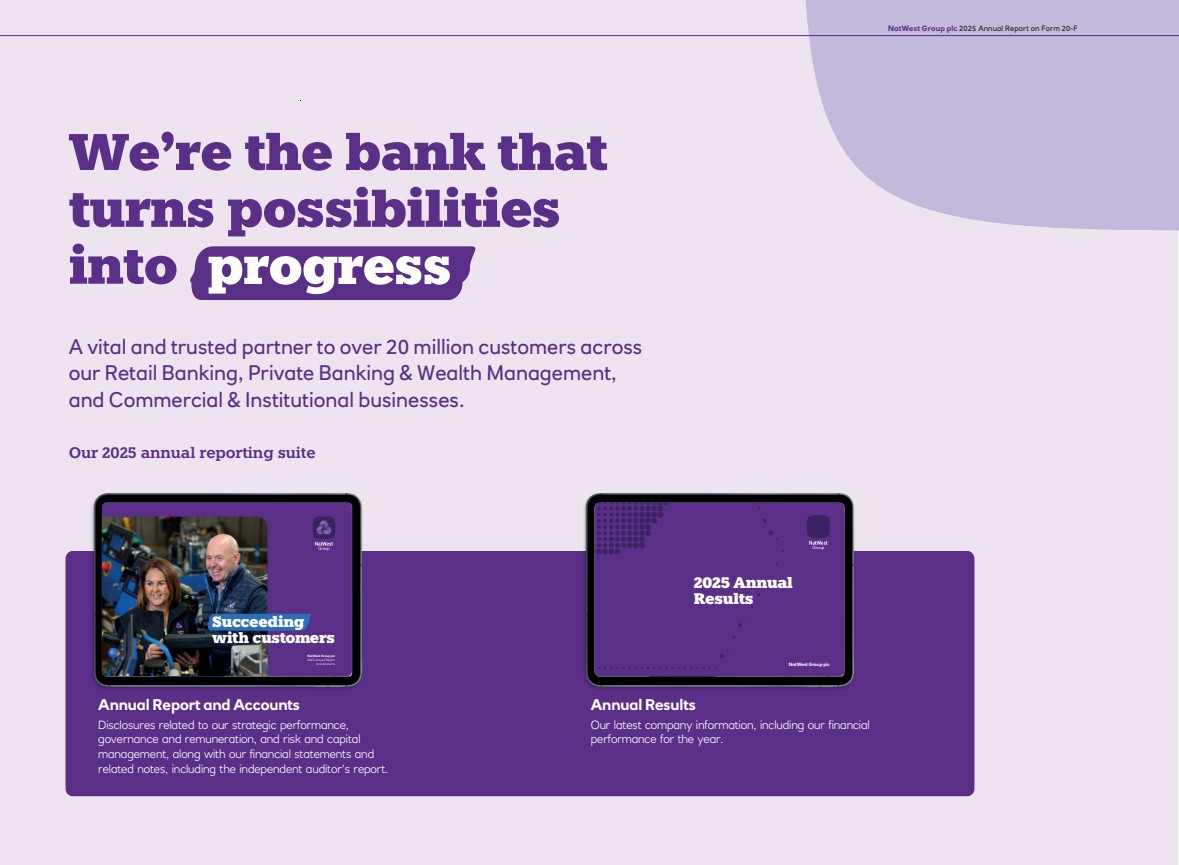
| NatWest Group plc 2025 Annual Report and Accounts Succeeding with customers 2025 Annual Results NatWest Group plc A vital and trusted partner to over 20 million customers across our Retail Banking, Private Banking & Wealth Management, and Commercial & Institutional businesses. progress We’re the bank that turns possibilities into Annual Report and Accounts Disclosures related to our strategic performance, governance and remuneration, and risk and capital management, along with our financial statements and related notes, including the independent auditor’s report. Annual Results Our latest company information, including our financial performance for the year. Our 2025 annual reporting suite Strategic report Financial review Governance and remuneration Risk and capital management Financial statements Additional information NatWest Group plc NatWest Group plc 2025 Annual Report and Accounts 2025 Annual Report on Form 20-F |
| NatWest Group plc 2025 Annual Report and Accounts Succeeding with customers NatWest Group plc 2025 Climate Transition Plan Report Succeeding with customers 2025 Annual Results NatWest Group plc A vital and trusted partner to over 20 million customers across our Retail Banking, Private Banking & Wealth Management, and Commercial & Institutional businesses. progress We’re the bank that turns possibilities into Annual Report and Accounts Disclosures related to our strategic performance, governance and remuneration, and risk and capital management, along with our financial statements and related notes, including the independent auditor’s report. Climate Transition Plan Report Disclosures related to progress against our climate transition plan. Annual Results Our latest company information, including our financial performance for the year. Our 2025 annual reporting suite Read more and download our reports at natwestgroup.com Strategic report Financial review Governance and remuneration Risk and capital management Financial statements Additional information NatWest Group plc 2025 Annual Report and Accounts Inside this report 01 Strategic report 25 Retail Banking 39 Our approach to sustainability 48 Supporting the climate transition 78 Governance and remuneration and Governance Committee 113 Governance in action 123 Directors’ remuneration report The directors’ remuneration policy and wider workforce remuneration Approval of Strategic report By order of the Board Gary Moore Chief Governance Officer and Company Secretary 12 February 2026 Group Chair: Rick Haythornthwaite Executive directors: Paul Thwaite (Group CEO) Katie Murray (Group CFO) Non-executive directors: Josh Critchley Roisin Donnelly Patrick Flynn Geeta Gopalan Yasmin Jetha Stuart Lewis Gill Whitehead Lena Wilson Strategic report Governance and remuneration NatWest Group plc 2025 Annual Report on Form 20-F 1 04 2025 financial highlights 06 Group Chair’s statement 08 Group Chief Executive’s review 12 Our business model 15 Delivering our strategy 16 Our investment case 18 Key performance indicators 20 Progress against our 2025 strategic priorities 22 Market environment 25 Business performance review 28 Private Banking & Wealth Management 31 Commercial & Institutional 33 Our stakeholders 36 Section 172(1) statement 39 Sustainability review 41 Supporting customers and communities through our banking products 43 Innovation in our products and services 57 Safeguarding information and tackling financial crime 59 Skilled, engaged and inclusive workforce 64 Driving a culture of integrity and responsible risk management 67 Additional sustainability information 76 Risk overview 78 Corporate governance report 79 Our Board 82 Board composition 83 Executive management team 84 Chair’s introduction 85 Governance at a glance 105 Report of the Group Nominations 107 Report of the Group Audit Committee 114 Report of the Group Board Risk Committee 120 Report of the Group Technology, Innovation and Simplification Committee 127 Remuneration at a glance 129 134 Annual remuneration report 152 Compliance report 155 Report of the directors 159 Statement of directors’ responsibilities The Strategic report for the year ended 31 December 2025 set out on pages 2 to 7 7 was approved by the Board of directors on 12 February 2026. |
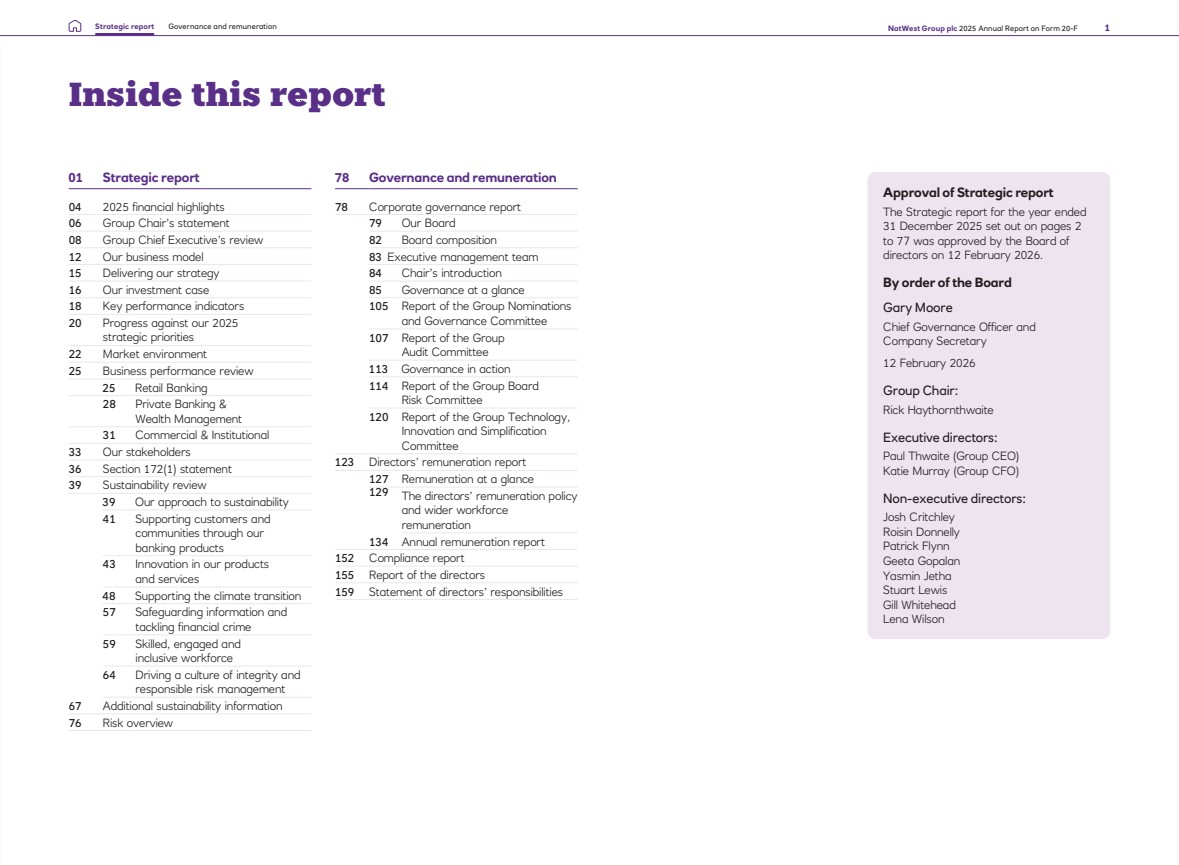
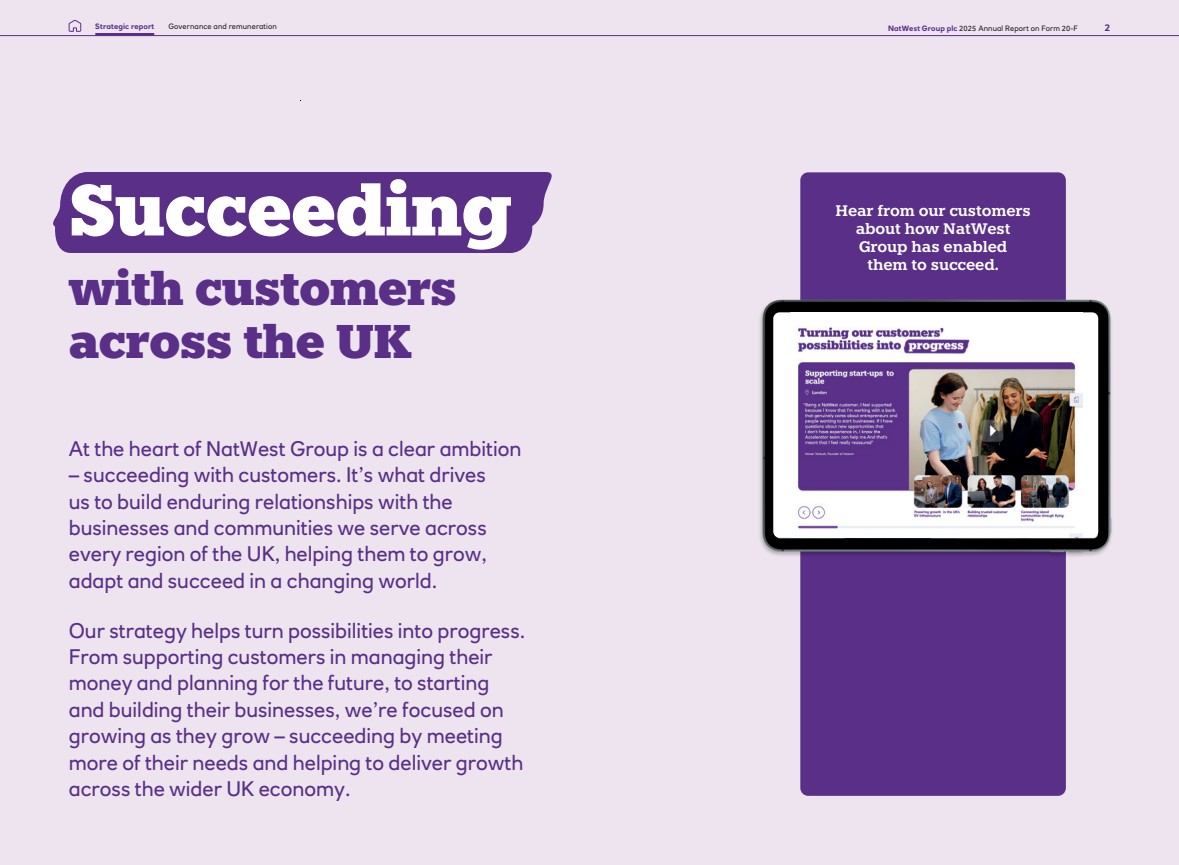
| Succeeding At the heart of NatWest Group is a clear ambition – succeeding with customers. It’s what drives us to build enduring relationships with the businesses and communities we serve across every region of the UK, helping them to grow, adapt and succeed in a changing world. Our strategy helps turn possibilities into progress. From supporting customers in managing their money and planning for the future, to starting and building their businesses, we’re focused on growing as they grow – succeeding by meeting more of their needs and helping to deliver growth across the wider UK economy. with customers across the UK Hear from our customers about how NatWest Group has enabled them to succeed. Strategic report Strategic report Governance and remuneration Financial review Governance and remuneration Risk and capital management Financial statements Additional information NatWest Group plc NatWest Group plc 2025 Annual Report and Accounts 2025 Annual Report on Form 20-F 22 |
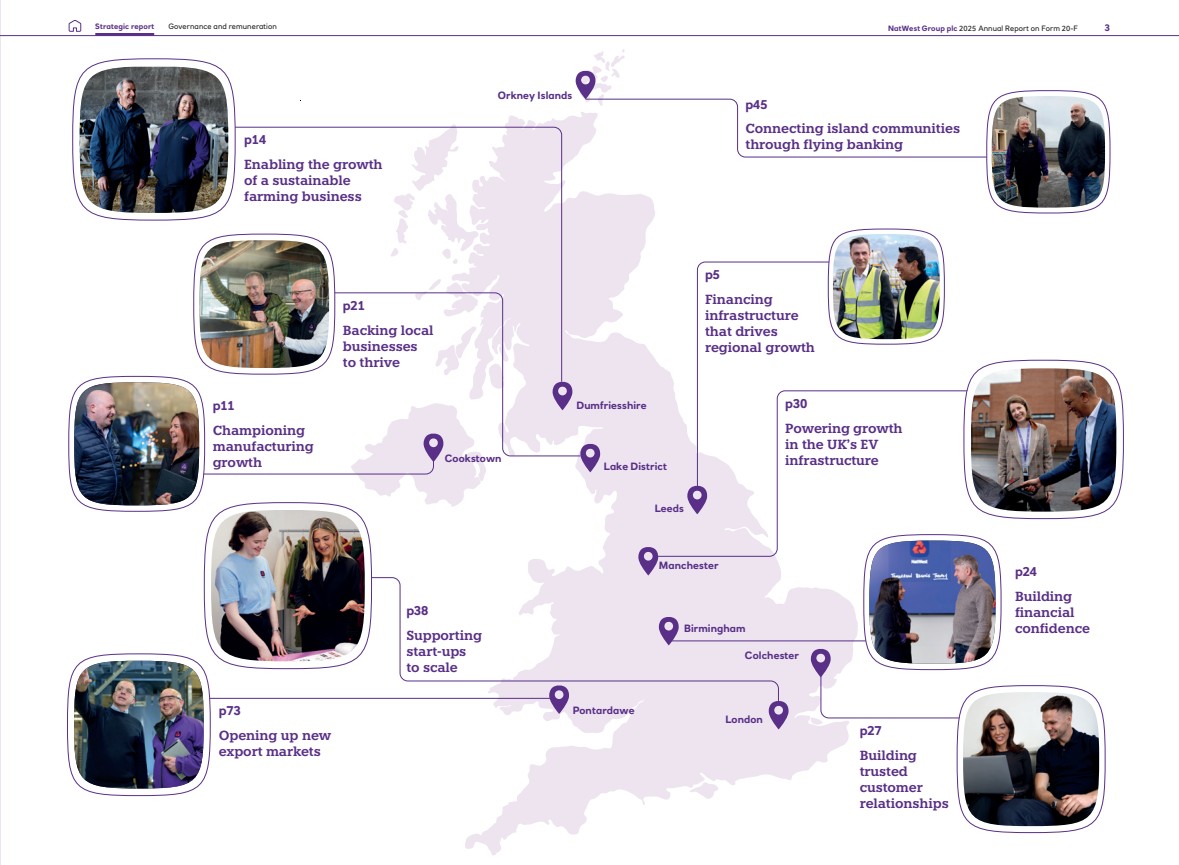
| Succeeding At the heart of NatWest Group is a clear ambition – succeeding with customers. It’s what drives us to build enduring relationships with the businesses and communities we serve across every region of the UK, helping them to grow, adapt and succeed in a changing world. Our strategy helps turn possibilities into progress. From supporting customers in managing their money and planning for the future, to starting and building their businesses, we’re focused on growing as they grow – succeeding by meeting more of their needs and helping to deliver growth across the wider UK economy. with customers across the UK Hear from our customers about how NatWest Group has enabled them to succeed. investors.natwestgroup.com/ annual-report Strategic report Financial review Governance and remuneration Risk and capital management Financial statements Additional information NatWest Group plc 2025 Annual Report and Accounts 2 Colchester London Lake District Dumfriesshire Manchester Birmingham Leeds Orkney Islands p45 Connecting island communities through flying banking p21 Backing local businesses to thrive p5 Financing infrastructure that drives regional growth p27 Building trusted customer relationships p30 Powering growth in the UK’s EV infrastructure p24 Building financial confidence p14 Enabling the growth of a sustainable farming business p73 Opening up new export markets p38 Supporting start-ups to scale p11 Championing manufacturing growth Pontardawe Cookstown Strategic report Strategic report Governance and remuneration Financial review Governance and remuneration Risk and capital management Financial statements Additional information NatWest Group plc NatWest Group plc 2025 Annual Report and Accounts 2025 Annual Report on Form 20-F 33 |
| 2025: another year of strong financial performance (1) Litigation and conduct costs of £167 million (2024 – £295 million). 2025 financial highlights Delivering attractive returns Link to remuneration Key performance indicators Return on Tangible Equity 19.2% 2024: 17.5% Dividend per ordinary share 32.5p 2024: 21.5p Total capital returned to shareholders(5) £4.1bn 2024: £4.0bn Buybacks £1.5bn 2024: £2.2bn Income £16,641m 2024: £14,703m Operating expenses £8,262m 2024: £8,149m Capital generation pre-distributions 252bps 2024: 243bps Profit before tax £7,708m 2024: £6,195m Operating expenses (excl. litigation and conduct)(1) £8,095m 2024: £7,854m Common Equity Tier 1 (CET1) ratio 14.0% 2024: 13.6% Loans and advances to customers £418.9bn 2024: £400.3bn Retail Banking customers banking entirely digital(2) 81.8% 2024: 78.7% Risk-weighted assets (RWA) management actions(4) £10.9bn 2024: £6.8bn Customer deposits £443.0bn 2024: £433.5bn Commercial & Institutional customers banking digital first(3) 84.5% 2024: 82.9% Average Liquidity Coverage Ratio (LCR) 147% 2024:151% Highlights against our strategic priorities Disciplined growth Bank-wide simplification Active balance sheet and risk management +13% +24% +5% +2% Strategic report Strategic report Governance and remuneration Financial review Governance and remuneration Risk and capital management Financial statements Additional information NatWest Group plc NatWest Group plc 2025 Annual Report and Accounts 2025 Annual Report on Form 20-F 44 (4) RWA management savings are achieved through multiple levers including significant risk transfers, credit risk insurance, asset sales and balance sheet optimisation. (5) Distributions paid and proposed. For full details of our distributions over the last three years refer to page 17. (2) Retail Banking customers with active current accounts that have accessed a digital platform (online or mobile) and not used the branch or telephony in a rolling 90 days in the reporting period. Inactive customers and customers with no channel usage, mortgages and savings accounts, and interactions via the Post Office are excluded from the scope of measurement. (3) Commercial & Institutional (ring-fenced bank) customers with active non-personal account/s that access their account 95% or higher through digital channels for three rolling months in the reporting period ending 31 December 2025. Read more in our Financial review on pages 8 to 26 of the Annual Report on Form 20-F |
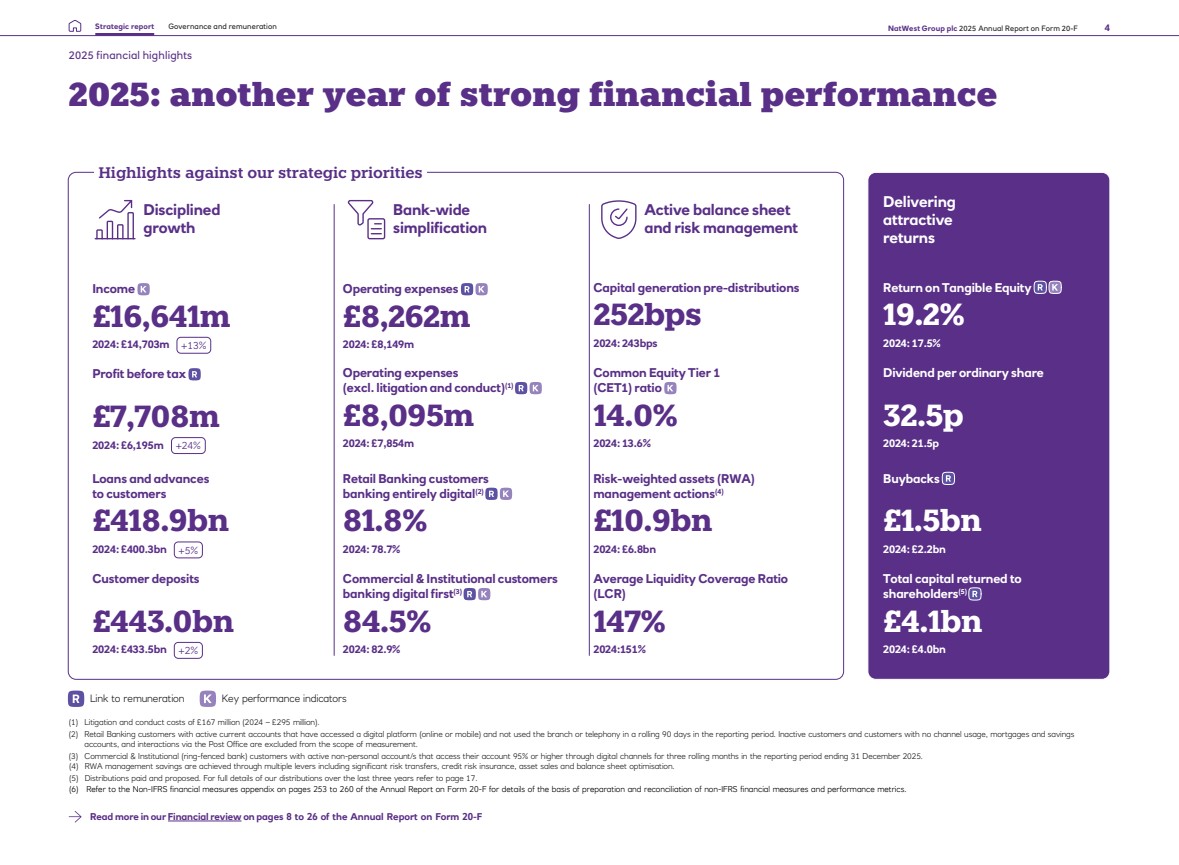
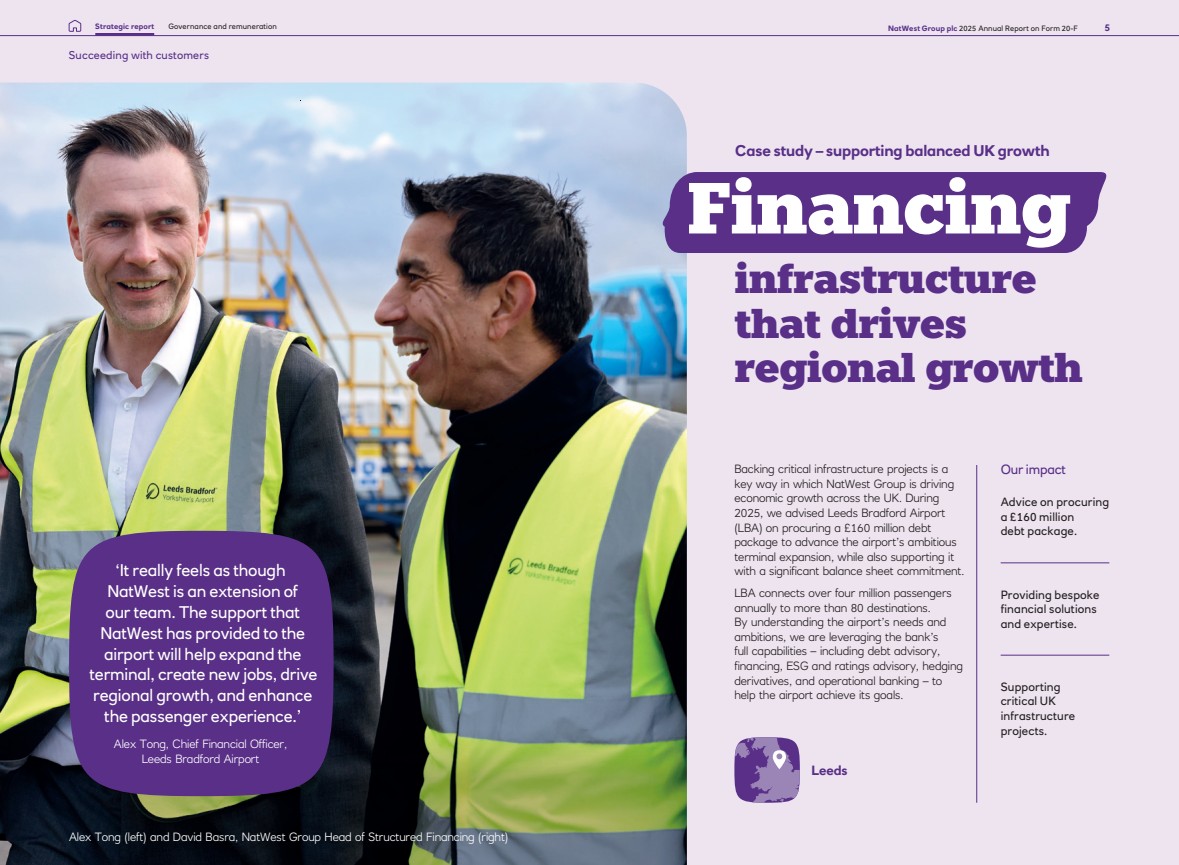
| 2025: another year of strong financial performance (1) Litigation and conduct costs of £167 million (2024 – £295 million). (2) Retail Banking customers with active current accounts that have accessed a digital platform (online or mobile) and not used the branch or telephony in a rolling 90 days in the reporting period. Inactive customers and customers with no channel usage, mortgages and savings accounts, and interactions via the Post Office are excluded from the scope of measurement. Read more on the scope of measurement in 2025 Sustainability Basis of Reporting. (3) Commercial & Institutional (ring-fenced bank) customers with active non-personal account/s that access their account 95% or higher through digital channels for three rolling months in the reporting period ending 31 December 2025. Read more on the scope of measurement in our 2025 Sustainability Basis of Reporting. (4) RWA management savings are achieved through multiple levers including significant risk transfers, credit risk insurance, asset sales and balance sheet optimisation. (5) Distributions paid and proposed. For full details of our distributions over the last three years refer to page 17. (LA)Metric subject to independent Limited Assurance by EY. Refer to page 71. Read more in our Financial review on pages 83 to 94. 2025 financial highlights Delivering attractive returns Link to remuneration Key performance indicators Return on Tangible Equity 19.2% 2024: 17.5% Dividend per ordinary share 32.5p 2024: 21.5p Total capital returned to shareholders(5) £4.1bn 2024: £4.0bn Buybacks £1.5bn 2024: £2.2bn Income £16,641m 2024: £14,703m Operating expenses £8,262m 2024: £8,149m Capital generation pre-distributions 252bps 2024: 243bps Profit before tax £7,708m 2024: £6,195m Operating expenses (excl. litigation and conduct)(1) £8,095m 2024: £7,854m Common Equity Tier 1 (CET1) ratio 14.0% 2024: 13.6% Loans and advances to customers £418.9bn 2024: £400.3bn Retail Banking customers banking entirely digital(2) 81.8%(LA) 2024: 78.7% Risk-weighted assets (RWA) management actions(4) £10.9bn 2024: £6.8bn Customer deposits £443.0bn 2024: £433.5bn Commercial & Institutional customers banking digital first(3) 84.5%(LA) 2024: 82.9% Average Liquidity Coverage Ratio (LCR) 147% 2024:151% Highlights against our strategic priorities Disciplined growth Bank-wide simplification Active balance sheet and risk management +13% +24% +5% +2% Strategic report Financial review Governance and remuneration Risk and capital management Financial statements Additional information NatWest Group plc 2025 Annual Report and Accounts 4 Advice on procuring a £160 million debt package. Providing bespoke financial solutions and expertise. Supporting critical UK infrastructure projects. Case study – supporting balanced UK growth Alex Tong (left) and David Basra, NatWest Group Head of Structured Financing (right) ‘It really feels as though NatWest is an extension of our team. The support that NatWest has provided to the airport will help expand the terminal, create new jobs, drive regional growth, and enhance the passenger experience.’ Alex Tong, Chief Financial Officer, Leeds Bradford Airport infrastructure that drives regional growth Succeeding with customers Financing Backing critical infrastructure projects is a Our impact key way in which NatWest Group is driving economic growth across the UK. During 2025, we advised Leeds Bradford Airport (LBA) on procuring a £160 million debt package to advance the airport’s ambitious terminal expansion, while also supporting it with a significant balance sheet commitment. LBA connects over four million passengers annually to more than 80 destinations. By understanding the airport’s needs and ambitions, we are leveraging the bank’s full capabilities – including debt advisory, financing, ESG and ratings advisory, hedging derivatives, and operational banking – to help the airport achieve its goals. Leeds Strategic report Strategic report Governance and remuneration Financial review Governance and remuneration Risk and capital management Financial statements Additional information NatWest Group plc NatWest Group plc 2025 Annual Report and Accounts 2025 Annual Report on Form 20-F 55 |
| Building the conditions for growth Group Chair’s statement Dear shareholders, 2025 was a year of strong performance and progress for our bank. Indeed, profits and returns were both up from 2024, so too our lending, deposits and the number of customers we serve. We consistently outperformed expectations – delivering for our customers, shareholders, and the wider UK. These achievements reflect the dedication of our colleagues and the trust placed in us by those who choose to bank with us, as well as by the communities we serve. Invest, innovate and succeed Fundamentally, I’m optimistic about the future for our bank and for the UK. In the short term, our economy continues to demonstrate considerable resilience, with lower inflation and modest growth on the horizon for 2026. Yet the economic landscape remains complex: uncertainty in global markets continues to affect sentiment; energy prices remain volatile; and some sectors are still adjusting to increases in the cost of doing business. Looking further ahead, the UK’s inherent advantages – talent, infrastructure, and a spirit of enterprise – are sources of enduring strength. And banks are the connective tissue of the UK economy. Our sector’s performance over the past 12 months underscored the vital role we play as strategic assets, driving economic growth in every country and region. Of course, a predictable, proportionate approach to regulation and policy making is essential; this is the underlying drumbeat that gives businesses and consumers the confidence to invest, innovate and succeed. The UK Government’s growth agenda has made important early progress, most notably through the Leeds Reforms and a shift towards a more proportionate, pro-growth regulatory approach. But delivery at pace now matters, and collaboration between the private sector and government remains crucial. Together, we can build a stable, supportive environment that fosters innovation and secures the UK’s position as a global financial leader. Succeeding with customers and the UK My domestic and international engagements with regulators, business leaders and investors throughout the course of 2025 only served to reinforce for me the scale of opportunity in the UK. From Singapore to Washington and from Edinburgh to Romford, Birmingham and Liverpool, it’s clear that there is a genuine appetite to understand how banks in the UK can drive growth and have a positive social impact. Our unique regional infrastructure means we have a particular role in facilitating balanced UK growth. That role is rooted in our purpose, as the bank that turns possibilities into progress. By focusing on our core activity, we help businesses start, scale and adapt, and we support individuals to manage their money and plan for the future. I’ve seen the impact of this first-hand. At our Accelerator anniversary pitch event in Manchester in July, entrepreneurs shared how our hubs helped them secure funding and expand their businesses. I’ve also seen our Financial Foundations workshops in action, giving people the confidence to build financial resilience and plan ahead. And, in November, Strategic report Strategic report Governance and remuneration Financial review Governance and remuneration Risk and capital management Financial statements Additional information NatWest Group plc NatWest Group plc 2025 Annual Report and Accounts 2025 Annual Report on Form 20-F 66 |
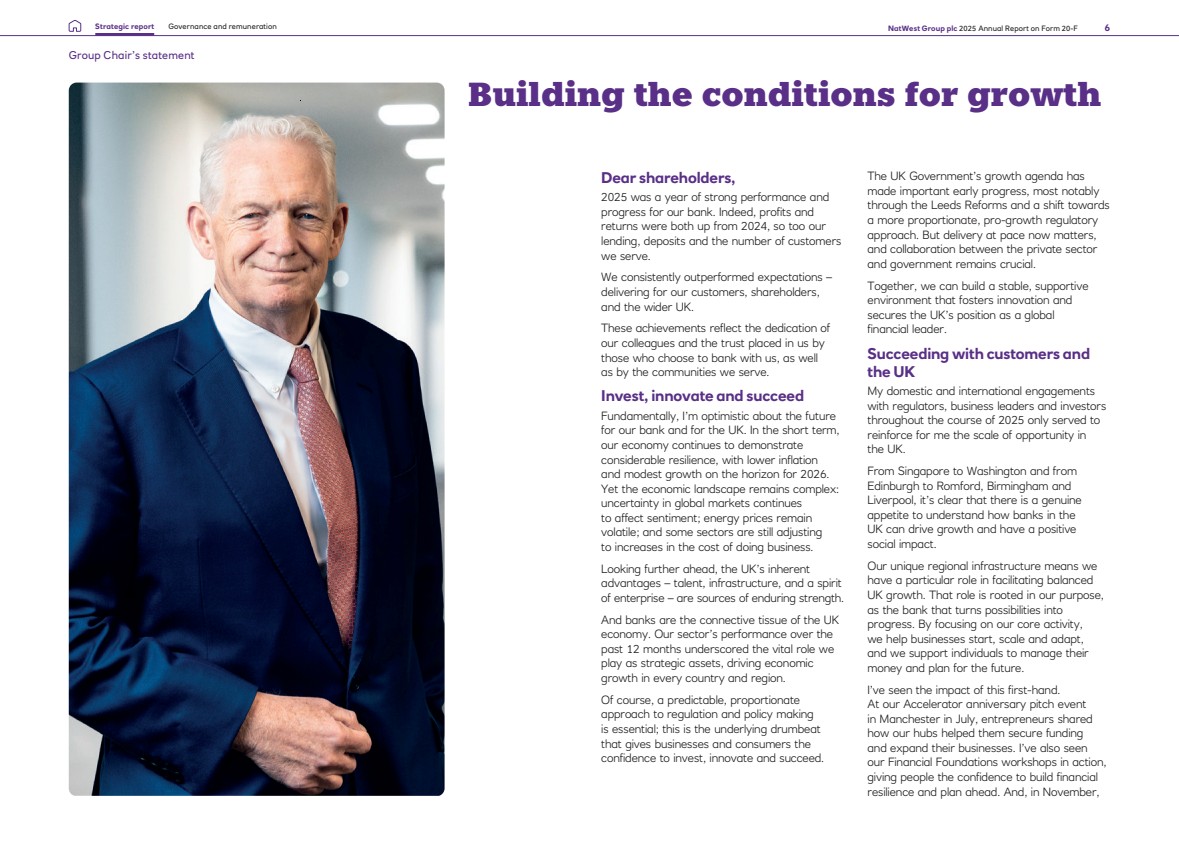
| Building the conditions for growth Group Chair’s statement Dear shareholders, 2025 was a year of strong performance and progress for our bank. Indeed, profits and returns were both up from 2024, so too our lending, deposits and the number of customers we serve. We consistently outperformed expectations – delivering for our customers, shareholders, and the wider UK. These achievements reflect the dedication of our colleagues and the trust placed in us by those who choose to bank with us, as well as by the communities we serve. Invest, innovate and succeed Fundamentally, I’m optimistic about the future for our bank and for the UK. In the short term, our economy continues to demonstrate considerable resilience, with lower inflation and modest growth on the horizon for 2026. Yet the economic landscape remains complex: uncertainty in global markets continues to affect sentiment; energy prices remain volatile; and some sectors are still adjusting to increases in the cost of doing business. Looking further ahead, the UK’s inherent advantages – talent, infrastructure, and a spirit of enterprise – are sources of enduring strength. And banks are the connective tissue of the UK economy. Our sector’s performance over the past 12 months underscored the vital role we play as strategic assets, driving economic growth in every country and region. Of course, a predictable, proportionate approach to regulation and policy making is essential; this is the underlying drumbeat that gives businesses and consumers the confidence to invest, innovate and succeed. The UK Government’s growth agenda has made important early progress, most notably through the Leeds Reforms and a shift towards a more proportionate, pro-growth regulatory approach. But delivery at pace now matters, and collaboration between the private sector and government remains crucial. Together, we can build a stable, supportive environment that fosters innovation and secures the UK’s position as a global financial leader. Succeeding with customers and the UK My domestic and international engagements with regulators, business leaders and investors throughout the course of 2025 only served to reinforce for me the scale of opportunity in the UK. From Singapore to Washington and from Edinburgh to Romford, Birmingham and Liverpool, it’s clear that there is a genuine appetite to understand how banks in the UK can drive growth and have a positive social impact. Our unique regional infrastructure means we have a particular role in facilitating balanced UK growth. That role is rooted in our purpose, as the bank that turns possibilities into progress. By focusing on our core activity, we help businesses start, scale and adapt, and we support individuals to manage their money and plan for the future. I’ve seen the impact of this first-hand. At our Accelerator anniversary pitch event in Manchester in July, entrepreneurs shared how our hubs helped them secure funding and expand their businesses. I’ve also seen our Financial Foundations workshops in action, giving people the confidence to build financial resilience and plan ahead. And, in November, Strategic report Financial review Governance and remuneration Risk and capital management Financial statements Additional information NatWest Group plc 2025 Annual Report and Accounts 6 Group Chair’s statement continued at the University of Oxford Equinox Partnership dinner, I had the opportunity to connect with academic and business leaders – bringing together diverse perspectives and expertise to unlock new opportunities for our customers and communities. By investing in local communities and supporting the transition to a net-zero economy we are helping to deliver sustainable growth. For example, when I visited Tyseley Energy Park in Birmingham, I saw how our support is helping to deliver practical low-carbon initiatives, like renewable energy and cleaner transport options, that aim to make a real difference for local businesses and the community. In 2025, NatWest Group stepped up and stepped forward, and there is much more we can do in 2026 and beyond. Because this is what our growth plan really stands for: supporting our customers to succeed in a changing world. Competing and winning in a changing market As a Board, our role is to work with the executive team to ensure we have a strategy that delivers value today and positions NatWest Group for sustainable success in the years ahead. Transformations at scale are never easy but they are necessary. Our financial performance demonstrates that the strategy set by NatWest Group’s CEO Paul Thwaite and his team is delivering. In a rapidly changing environment, its strength rests on two fundamentals: being close to customers, while ensuring the bank remains agile and adaptable. The depth of our relationships in the communities that we serve, combined with the scale of our data, is a source of competitive advantage. It helps us to understand, anticipate and respond to our customers’ changing needs – from the demand for seamless, personalised experiences to the opportunities created by emerging technologies. These insights allow us to innovate with purpose and deliver solutions that make banking simpler, safer and more accessible. One of the clearly emerging customer needs is the growing requirement for financial planning, savings and investment advice. As a Board, we fully supported the £2.7 billion acquisition of Evelyn Partners – creating the UK’s leading private bank and wealth management business. We are confident it meets the high bars Paul has set for acquisitions; it is strategically and financially compelling, operationally deliverable and Evelyn Partners is a strong cultural fit, with a shared customer-first focus. The companies that will win in today’s landscape are those that start with the customer in everything they do. This means more than using data and insight effectively. It’s about empowering the front line, trusting those closest to our customers to make the decisions on how best to serve them and ensuring our central teams and functions work seamlessly in service of them. Because one thing is certain – customer expectations and how they choose to bank will look very different in the years ahead. In an environment where competition is coming from every corner, we need a bank that is agile, adaptable and able to innovate at pace – while shaping the future responsibly. That means setting the benchmark for trust and innovation in financial services, ensuring progress is sustainable, and leading the industry in a way that benefits customers, communities and the wider economy. A strengthened and engagedBoard Since taking up the role of Chair, my priority has been to build a Board that is highly engaged and constructively challenging – a group of trusted colleagues to complement our executive team. Through our ‘Board on the Road’ programme, directors have spent more time with customers and colleagues across the UK, gaining first-hand insight into the challenges and opportunities they face. These experiences inform our thinking and ensure that strategy is grounded in reality. In November 2025, we welcomed Josh Critchley as an independent non-executive director and on 23 February 2026, Albert Hitchcock will join the Board. With decades of experience across banking and other sectors, their deep expertise will be an asset to the Board, particularly as we continue to pursue our growth ambitions and navigate an evolving market landscape. We also announced that Yasmin Jetha will retire from the Board on 31 March 2026. I’d like to thank Yasmin for her outstanding contribution to the Board and its committees since her appointment in 2017. She has been a highly valued director and colleague, and she leaves with our very best wishes for the future. I would like to thank all of the Board, and all of our colleagues, for their hard work and the support they have given to our customers throughout 2025. Having a team that is committed to steering NatWest Group through a period of rapid change with clarity and confidence ensures we remain focused on delivering growth and securing NatWest Group’s long-term success. I must also recognise the great sadness all of us felt at the passing of Frank Dangeard, Chair of NatWest Markets, in August 2025. Frank’s wisdom, integrity, and commitment left an indelible mark on all who had the privilege to work alongside him, both at NatWest Group and across the course of his career. On behalf of the Board, I extend our deepest condolences to Frank’s family and all who knew him. Return to private ownership – a forward-looking chapter Of course, 2025 also marked a key milestone for NatWest Group – our return to full private ownership. In May 2025, the UK Government sold its very last shares in the bank – a testament to our consistently strong performance, the considerable progress that has been made under successive management teams and a marker of the long-term transformation that has made NatWest Group simpler, stronger, and more customer-focused. We saw a continued strong share price performance throughout 2025 – up 62% – reflecting greater certainty at a macro level, heightened positivity around UK banks, and, above all, the consistency of our delivery, as well as the confidence investors have in our future ambitions. We have also delivered for shareholders. Having increased our ordinary dividend payout ratio to around 50% of attributable profit, we have declared total dividends of 32.5p per share for 2025 (up 51.2% year on year), and announced £750 million of on-market buybacks for the year – all underpinned by strong capital generation and a CET1 ratio of 14.0%. We are deeply grateful to the UK public and Government for their support over the years. As we move forward, we do so as a partner in growth, committed to building value for our shareholders and the UK. This milestone marks the beginning of a new chapter. We begin 2026 with confidence, conviction and positive momentum on which we can build. I am proud of what NatWest Group accomplished in 2025. Our progress is the result of collective effort, disciplined execution, and a steadfast commitment to our purpose. As we look ahead, I firmly believe that NatWest Group is well positioned to lead, to innovate, and to deliver for all of our stakeholders. Rick Haythornthwaite Chair Strategic report Strategic report Governance and remuneration Financial review Governance and remuneration Risk and capital management Financial statements Additional information NatWest Group plc NatWest Group plc 2025 Annual Report and Accounts 2025 Annual Report on Form 20-F 77 |
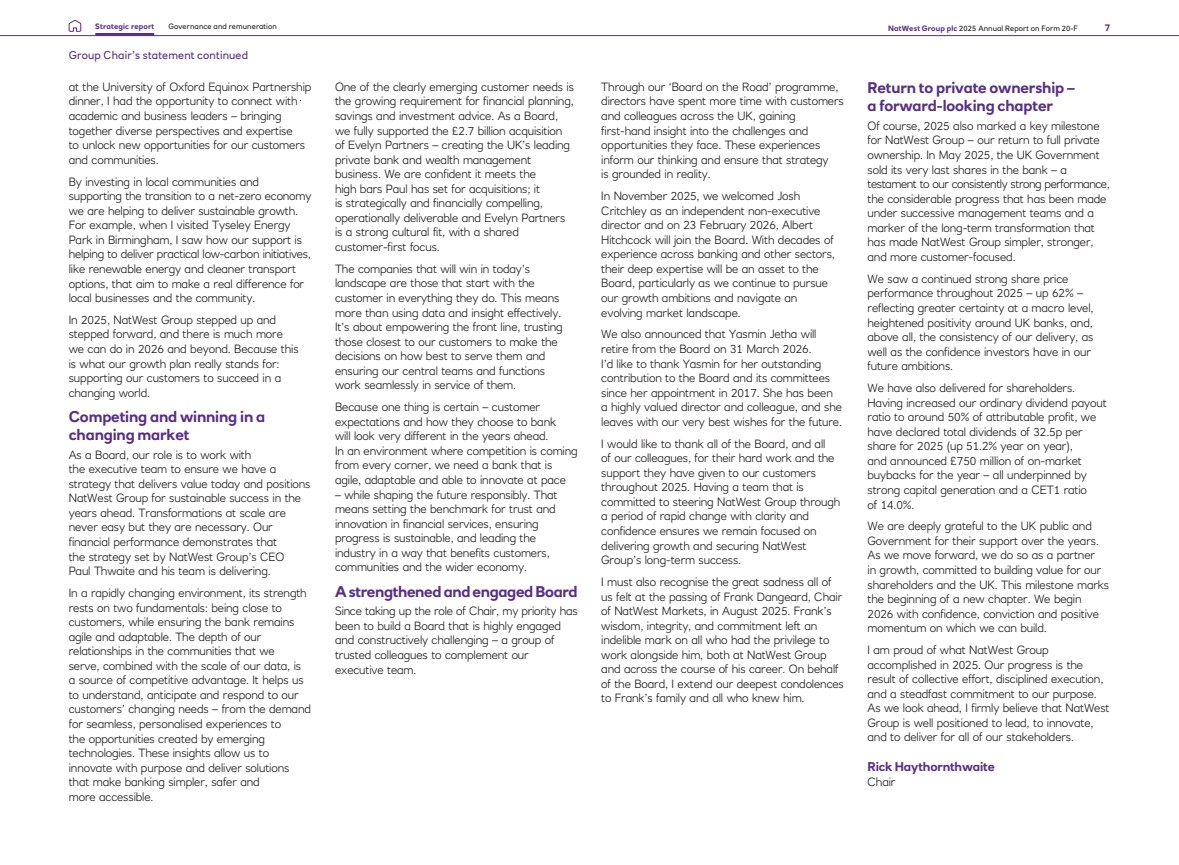
| Group Chief Executive’s review Accelerating from a position of strength NatWest Group delivered another strong year in 2025, rooted in our support for people, families and businesses in every nation and region of the UK. We increased our customer base by around a million customers, grew our profit before tax to £7.7 billion, and delivered a Return on Tangible Equity (RoTE) of 19.2%, while strong capital generation and distributions came from increased profitability and disciplined balance sheet and risk management. What matters most, however, is what sits behind these results: the trust our customers place in us every day; the commitment of our colleagues; and our responsibility to create sustainable value for our shareholders. 2025 also marked a symbolic milestone as we returned to full private ownership, offering an opportunity to reflect on how far the bank has come. Looking ahead, we have renewed confidence in what we can achieve for NatWest Group, our shareholders, and as a trusted partner to our customers and the wider UK economy. I’m proud to have led this bank over the past two years. In this time, we’ve moved decisively: we’ve sharpened our customer focus; simplified the organisation; accelerated our technology strategy; and invested with intent in our future. These choices are now translating into robust performance and clear momentum across NatWest Group. We start 2026 from a position of strength. That strength gives us the confidence to raise our ambition and accelerate our progress – so we can go further to win together with our customers, colleagues, shareholders and the communities we are proud to serve across the UK. Succeeding with customers Disciplined growth All three of our customer businesses – Retail Banking, Private Banking & Wealth Management, and Commercial & Institutional – delivered broad-based growth in 2025, with more customers choosing to bank with us. We now serve over 20 million people, families and businesses across the UK – acting as a trusted partner to help meet their ambitions. We supported more customers to manage their money with confidence, with deposit growth in all three business segments totalling £10.4 billion across NatWest Group in 2025. And, with saving and investing increasingly part of the national conversation, more than 50,000 customers invested with us for the first time, benefiting from the expert advice of our wealth management teams and ease of our digital offer. This helped us to grow assets under management and administration by 20%. We also supported customers through key life events, such as helping more than 200,000 new customers to buy or remortgage a home in 2025 – up 18% on 2024 – and empowered more families to build healthy financial habits through our youth proposition, Rooster Money, which now serves 15 times more customers than when we acquired it in 2021. Our success reflects our ability to anticipate and respond to changing customer needs, with the right services and innovative propositions. For personal customers, our Family-Backed Mortgage addresses the real challenge of affordability for many people and allows family members to help first-time buyers while preserving independent ownership. This contributed to our increased support for first-time buyers, helping over 50,000 customers get onto the housing ladder in 2025. Strategic report Strategic report Governance and remuneration Financial review Governance and remuneration Risk and capital management Financial statements Additional information NatWest Group plc NatWest Group plc 2025 Annual Report and Accounts 2025 Annual Report on Form 20-F 88 |
| Group Chief Executive’s review Accelerating from a position of strength NatWest Group delivered another strong year in 2025, rooted in our support for people, families and businesses in every nation and region of the UK. We increased our customer base by around a million customers, grew our profit before tax to £7.7 billion, and delivered a Return on Tangible Equity (RoTE) of 19.2%, while strong capital generation and distributions came from increased profitability and disciplined balance sheet and risk management. What matters most, however, is what sits behind these results: the trust our customers place in us every day; the commitment of our colleagues; and our responsibility to create sustainable value for our shareholders. 2025 also marked a symbolic milestone as we returned to full private ownership, offering an opportunity to reflect on how far the bank has come. Looking ahead, we have renewed confidence in what we can achieve for NatWest Group, our shareholders, and as a trusted partner to our customers and the wider UK economy. I’m proud to have led this bank over the past two years. In this time, we’ve moved decisively: we’ve sharpened our customer focus; simplified the organisation; accelerated our technology strategy; and invested with intent in our future. These choices are now translating into robust performance and clear momentum across NatWest Group. We start 2026 from a position of strength. That strength gives us the confidence to raise our ambition and accelerate our progress – so we can go further to win together with our customers, colleagues, shareholders and the communities we are proud to serve across the UK. Succeeding with customers Disciplined growth All three of our customer businesses – Retail Banking, Private Banking & Wealth Management, and Commercial & Institutional – delivered broad-based growth in 2025, with more customers choosing to bank with us. We now serve over 20 million people, families and businesses across the UK – acting as a trusted partner to help meet their ambitions. We supported more customers to manage their money with confidence, with deposit growth in all three business segments totalling £10.4 billion across NatWest Group in 2025. And, with saving and investing increasingly part of the national conversation, more than 50,000 customers invested with us for the first time, benefiting from the expert advice of our wealth management teams and ease of our digital offer. This helped us to grow assets under management and administration by 20%. We also supported customers through key life events, such as helping more than 200,000 new customers to buy or remortgage a home in 2025 – up 18% on 2024 – and empowered more families to build healthy financial habits through our youth proposition, Rooster Money, which now serves 15 times more customers than when we acquired it in 2021. Our success reflects our ability to anticipate and respond to changing customer needs, with the right services and innovative propositions. For personal customers, our Family-Backed Mortgage addresses the real challenge of affordability for many people and allows family members to help first-time buyers while preserving independent ownership. This contributed to our increased support for first-time buyers, helping over 50,000 customers get onto the housing ladder in 2025. Strategic report Financial review Governance and remuneration Risk and capital management Financial statements Additional information NatWest Group plc 2025 Annual Report and Accounts 8 Group Chief Executive’s review continued Strong organic growth was complemented by the successful integration of around one million Sainsbury’s Bank customers and the £2.3 billion Metro Bank mortgage portfolio – demonstrating our integration capability and, most importantly, creating the opportunity to deepen relationships with new customers. As the UK’s biggest bank for business, we support 1.5 million companies, from sole-traders to multinational corporates. With a leading share of UK start-ups, and the largest presence in the mid-market sector, we’re uniquely positioned to partner businesses at every stage of their growth. We helped more of our business customers to scale and grow, with lending across Commercial & Institutional up around 10% in 2025, compared with 2024. By supporting UK businesses, we’re also helping to deliver key economic priorities for the UK. In 2025, we were the leading lender to UK infrastructure, and we expanded our support to social housing and sustainable finance – helping to strengthen communities and underpin long-term growth. In an increasingly volatile market, we’ve helped more businesses manage their risk effectively by making it easier to access our foreign exchange (FX) and international payment services through faster onboarding and a simpler digital experience, with over 130 currencies now supported. Improvements in our offer meant around 700 mid-market businesses used the service for the first time in 2025. We also helped more high-potential firms to grow with access to our innovative intellectual property-backed lending. Around 50% of the completed IP-backed loans were with customers new to NatWest Group, demonstrating the opportunity open to us when we pair our expertise with a distinctive customer proposition. A simpler bank Today, NatWest Group is a simpler bank. It is less complex, with transformed capabilities and the right building blocks to scale and adapt efficiently as customer expectations evolve. The technology foundations across our estate have effectively been rebuilt and this investment has increased our agility and strengthened resilience. We have decommissioned legacy platforms and advanced our data transformation at pace. In Private Banking & Wealth Management, we have migrated our engineering operations from Switzerland to the UK and India, creating the capacity to scale. For our Commercial & Institutional customers, the re-platforming of Bankline (our digital channel for mid-market and corporate customers) has created a more connected experience and allows us to provide more services digitally in one place. Building a single trusted view of our customers is enabling us to offer a more personalised service, faster decision-making and more intelligent risk management across the bank. To drive delivery across the bank, we have rapidly scaled our in-house engineering team and opened a new hub in Bengaluru, India. We are now innovating faster and have almost halved the time it takes to deploy new features, compared with 2024 – making banking quicker, easier and safer for customers. Strategic partnerships with global technology leaders, including AWS, OpenAI and Google, have helped us to accelerate and scale our technology strategy, and in turn, increase productivity. In addition, our newly established AI Research Office is at the forefront of cutting-edge research, leading responsible innovation and building further AI capabilities for the bank. Our investment in our FinTech Growth Programme has also significantly strengthened our innovation pipeline. These initiatives give us early access to new and emerging technologies. By providing all colleagues with AI tools to support their daily work, we have freed up capacity to better meet customers’ immediate needs and understand their future requirements. A trusted partner for UK growth 2025 was a year of macroeconomic uncertainty, with international and domestic events affecting customers in different ways. Despite the volatility, we remained cautiously optimistic about the outlook with several factors reinforcing this measured optimism: the UK economy has continued to grow; unemployment remains low by historical standards; inflation is moving in broadly the right direction; and, on aggregate, households and businesses continue to hold relatively robust savings buffers. This economic resilience was reflected in the healthy levels of customer activity during 2025. Housing market activity remained robust, with mortgage volume growth across the sector supported by temporary changes to stamp duty thresholds in the first half of the year. Retail sales volumes returned to positive year-over-year growth after a challenging few years and discretionary spending picked up in areas such as travel and hospitality. Businesses continued to invest for the future, and UK exports increased despite headwinds. Taken together, these are encouraging signals that the underlying conditions for growth remain in place. We strongly believe in the UK’s long-term potential. The UK Government has positioned the financial services sector as central to its growth strategy and to the UK’s strength on the global stage. The UK has world-class universities and innovation clusters, leading scientific research, deep capital markets and highly skilled people – the potential of which can be unlocked through an internationally competitive banking sector. Strong economies need strong banks. But our role goes well beyond lending: it demands our deep expertise; our convening power across sectors and regions; and our ability to connect capital with opportunity. I have seen the impact we can deliver for our customers and communities across the UK. For example, start-ups participating in our free Accelerator community grow their turnover 35% more on average than peers; and the expertise of our colleagues is building financial confidence at scale – our NatWest Thrive and Financial Foundations programmes reached more than one million people in 2025, providing financial education in the places where people live, learn and work. In March 2025, we brought together our first Mid-Market Growth Council to provide a unified voice and to advocate for the often-overlooked mid-sized business sector, helping to unlock their significant growth potential. Our research found that just 1% growth in this segment could add £35 billion to the UK economy, with £24 billion of that outside the south-east of England. Our commitment to sustainable growth is rooted in our purpose, with the aim of delivering positive impact through our core activity as a bank. By turning our customers’ possibilities into progress we can help build better, more resilient businesses, and support people and families to manage their money, save and invest for the future. The conditions for growth will be built further by a stable and proportionate regulatory and policy environment. The UK Government’s focus on balanced regulation which promotes competition and growth, as well as managing risk and consumer protection, is a welcome step forward. We have already seen tangible change in targeted areas. For example, the adjustment to mortgage rules enabled us to lend more to first-time buyers, and we have committed to grow our support in 2026, with a further £10 billion of lending. As we look ahead to 2026, further regulatory review could unlock additional customer benefits and UK growth opportunities; for example, the ongoing Advice Guidance Boundary Review should help to make financial advice more accessible, and the Prudential Regulation Authority’s review of its rules on ring-fencing has the potential to create greater capital capacity for the banking sector to support growth. Strategic report Strategic report Governance and remuneration Financial review Governance and remuneration Risk and capital management Financial statements Additional information NatWest Group plc NatWest Group plc 2025 Annual Report and Accounts 2025 Annual Report on Form 20-F 99 |
| Group Chief Executive’s review continued Based on our current macroeconomic assumptions, In 2026(2) we expect: • Total income excluding notable items in the range of £17.2-17.6 billion. • Operating expenses, excluding litigation and conduct costs, around £8.2 billion. • Loan impairment rate below 25 basis points. • Return on Tangible Equity greater than 17%. • Capital generation pre-distributions around 200 basis points. In 2028 we expect: • Customer assets and liabilities(3) to grow at a compound annual rate of greater than 4% from the end 2025 to end 2028. • Cost:income ratio, excluding litigation and conduct costs, below 45%. • Return on Tangible Equity greater than 18%. • Capital generation pre-distributions greater than 200 basis points. Capital • We now target a CET1 ratio of around 13.0%. • We continue to expect to pay ordinary dividends of around 50% of attributable profit and will consider buybacks as appropriate. • We expect Basel 3.1 to increase RWAs by around £10 billion on 1 January 2027. (2) Excludes the impact of the Evelyn Partners acquisition. (3) Customer assets and liabilities (CAL) includes customer deposits, gross loans to customers and AUMA across three businesses Retail Banking, Private Banking & Wealth Management, and Commercial & Institutional. Investment cash is deducted as it is reported within customer deposits and AUMA. Raising our ambition Our progress has been significant, and it is clear our strategy is working for both our customers and our shareholders. But success today does not guarantee success tomorrow. Our sector is evolving at pace, with customer expectations increasing, technology redefining what ‘best in class’ looks like, and competition more intense than ever. Against this backdrop, we are sharpening our strategic focus around disciplined growth, leveraging simplification, and active balance sheet and risk management to drive sustainable value creation. It is our consistent delivery and the inherent strengths of this bank that give us confidence we can go further and faster in this next phase. Our conviction stems from the enduring strength of our customer relationships and is built on our key differentiators. Deep community roots, expert colleagues, and a UK-wide relationship manager network mean we are connected to our customers in their communities. These strengths, underpinned by technology and the scale of our customer insight, give us real competitive advantage. Customer growth comes from being first choice in the moments that matter: helping families with everyday banking and home ownership; supporting affluent and high-net worth customers to manage and grow their wealth; and backing high-growth businesses, whether they are start-ups or those with global ambitions. Our recently announced acquisition of Evelyn Partners will create the UK’s leading private bank and wealth management business. Not only does this build scale and strength in our Private Banking & Wealth Management business, but it will transform the services our customers across NatWest Group can expect from us. Evelyn Partners brings leading investment capabilities, a quality direct-to-customer investment platform in Bestinvest – and the biggest in-house team of financial planners in the UK, as well as a strong regional footprint – helping us to better support and serve customers through each stage of their financial lives. We’re also building and deepening our customer relationships with more personalised, relevant experiences, propositions and partnerships. For example, our specialist Venture Banking support has been carefully designed to help boost the UK’s innovation economy and our newly announced strategic partnership with Rightmove will help ensure we’re there at the right time, as a trusted partner when customers are making key financial decisions. Leveraging simplification The next phase of our simplification sees us move from ‘build’ to ‘benefits’, leveraging the investment we’ve made in our infrastructure and capabilities to deliver customer growth and even greater productivity. In a highly competitive environment, future strength will be decided by how seamlessly a bank operates in service of its customers. Harnessed correctly, technological advancement and AI can be a game-changing accelerant, reducing complexity and removing bureaucracy to help make decisions faster, deepen relationships and deliver transformed customer experiences. Trust, however, remains the keystone of banking. As technology accelerates, we are focused on keeping customers safe, protecting them from new and emerging risks, and leading in the responsible and ethical use of data and AI. To realise our ambition, it’s essential we drive active balance sheet and risk management. We are bringing more dynamism to how we manage pricing, capital and risk, ensuring we remain resilient through cycles – a safe, secure and dependable partner for customers, while sustaining attractive returns. Customer success We want to be known not only for the quality of our service and the strength of our technology platforms, but also for the depth of our relationships and expertise of our people. As trusted partners, we are empowering our front-line colleagues to use their insights to make the right decisions for customers and orientating the whole organisation around our customers’ needs: measuring all colleagues’ success by the quality of our customers’ experiences. The stretching targets we have set for growth, productivity and returns reflect our belief that in pursuing these priorities we will create sustainable shareholder value. For customers, the prize is a bank that feels effortless, with connected, intelligent and personalised services available whenever and however they choose. Read more on our Strategy on pages 15 to 20. Looking ahead Our progress and strengthened position are thanks to the hard work and dedication of our colleagues across the UK and internationally. While we have momentum across NatWest Group, there is no room for complacency. Banking moves quickly, and customer expectations move faster still. We’ve built the foundations and capabilities to both anticipate change and respond at pace. All this is done in service of our customers, deepening trust and relationships. We can further accelerate our growth potential using the full strength of NatWest Group – using the expertise and connections across our three businesses to build even stronger customer relationships, deliver sustainable returns and make a meaningful contribution to the UK economy. Paul Thwaite Group Chief Executive Officer Strategic report Strategic report Governance and remuneration Financial review Governance and remuneration Risk and capital management Financial statements Additional information NatWest Group plc NatWest Group plc 2025 Annual Report and Accounts 2025 Annual Report on Form 20-F 1010 (1) The guidance, targets, expectations, and trends discussed in this section represent NatWest Group plc management’s current expectations and are subject to change, including as a result of the factors described in the Risk Factors section of the 2025 Annual Report on Form 20-F. These statements constitute forward-looking statements. Refer to Forward-looking statements in the 2025 Annual Report on Form 20-F. (4) Management does not assess forward-looking “total income”, "operating expenses" and "return on equity" as performance indicators of the business, and therefore reconciliation of the forward-looking non-IFRS measures “total income excluding notable items”, "operating expenses excluding litigation and conduct costs", "return on tangible equity" and "cost:income ratio excluding litigation and conduct costs" to an equivalent IFRS measure is not available without unreasonable efforts. Outlook(1,4) Read more on our approach to sustainability on pages 39 to 70. |
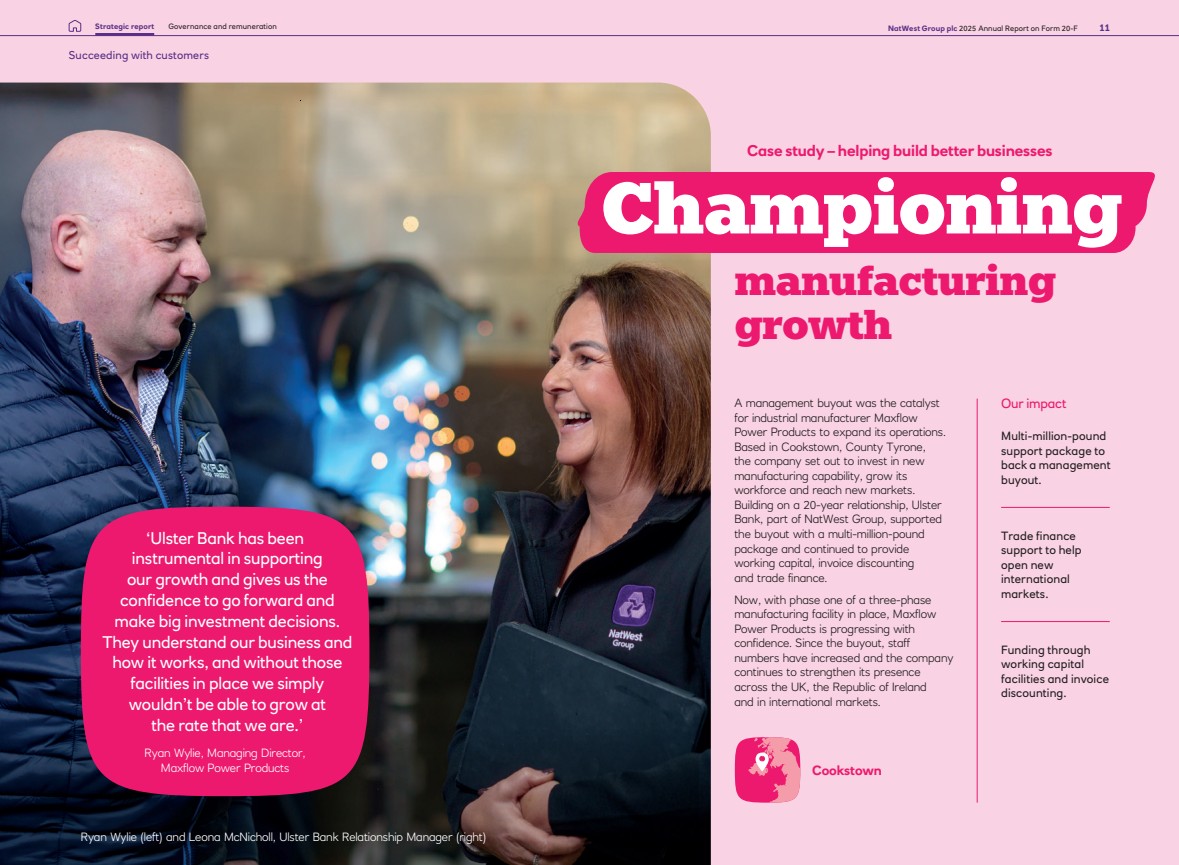
| Group Chief Executive’s review continued Based on our current macroeconomic assumptions, In 2026(2) we expect: • Total income excluding notable items in the range of £17.2-17.6 billion. • Operating expenses, excluding litigation and conduct costs, around £8.2 billion. • Loan impairment rate below 25 basis points. • Return on Tangible Equity greater than 17%. • Capital generation pre-distributions around 200 basis points. In 2028 we expect: • Customer assets and liabilities(3) to grow at a compound annual rate of greater than 4% from the end 2025 to end 2028. • Cost:income ratio, excluding litigation and conduct costs, below 45%. • Return on Tangible Equity greater than 18%. • Capital generation pre-distributions greater than 200 basis points. Capital • We now target a CET1 ratio of around 13.0%. • We continue to expect to pay ordinary dividends of around 50% of attributable profit and will consider buybacks as appropriate. • We expect Basel 3.1 to increase RWAs by around £10 billion on 1 January 2027. Outlook(1) (1) The guidance, targets, expectations, and trends discussed in this section represent NatWest Group plc management’s current expectations and are subject to change, including as a result of the factors described in the Risk Factors section. These statements constitute forward-looking statements. Refer to Forward-looking statements in this report. (2) Excludes the impact of the Evelyn Partners acquisition. (3) Customer assets and liabilities (CAL) includes customer deposits, gross loans to customers and AUMA across three businesses Retail Banking, Private Banking & Wealth Management, and Commercial & Institutional. Investment cash is deducted as it is reported within customer deposits and AUMA. Raising our ambition Our progress has been significant, and it is clear our strategy is working for both our customers and our shareholders. But success today does not guarantee success tomorrow. Our sector is evolving at pace, with customer expectations increasing, technology redefining what ‘best in class’ looks like, and competition more intense than ever. Against this backdrop, we are sharpening our strategic focus around disciplined growth, leveraging simplification, and active balance sheet and risk management to drive sustainable value creation. It is our consistent delivery and the inherent strengths of this bank that give us confidence we can go further and faster in this next phase. Our conviction stems from the enduring strength of our customer relationships and is built on our key differentiators. Deep community roots, expert colleagues, and a UK-wide relationship manager network mean we are connected to our customers in their communities. These strengths, underpinned by technology and the scale of our customer insight, give us real competitive advantage. Customer growth comes from being first choice in the moments that matter: helping families with everyday banking and home ownership; supporting affluent and high-net worth customers to manage and grow their wealth; and backing high-growth businesses, whether they are start-ups or those with global ambitions. Our recently announced acquisition of Evelyn Partners will create the UK’s leading private bank and wealth management business. Not only does this build scale and strength in our Private Banking & Wealth Management business, but it will transform the services our customers across NatWest Group can expect from us. Evelyn Partners brings leading investment capabilities, a quality direct-to-customer investment platform in Bestinvest – and the biggest in-house team of financial planners in the UK, as well as a strong regional footprint – helping us to better support and serve customers through each stage of their financial lives. We’re also building and deepening our customer relationships with more personalised, relevant experiences, propositions and partnerships. For example, our specialist Venture Banking support has been carefully designed to help boost the UK’s innovation economy and our newly announced strategic partnership with Rightmove will help ensure we’re there at the right time, as a trusted partner when customers are making key financial decisions. Leveraging simplification The next phase of our simplification sees us move from ‘build’ to ‘benefits’, leveraging the investment we’ve made in our infrastructure and capabilities to deliver customer growth and even greater productivity. In a highly competitive environment, future strength will be decided by how seamlessly a bank operates in service of its customers. Harnessed correctly, technological advancement and AI can be a game-changing accelerant, reducing complexity and removing bureaucracy to help make decisions faster, deepen relationships and deliver transformed customer experiences. Trust, however, remains the keystone of banking. As technology accelerates, we are focused on keeping customers safe, protecting them from new and emerging risks, and leading in the responsible and ethical use of data and AI. To realise our ambition, it’s essential we drive active balance sheet and risk management. We are bringing more dynamism to how we manage pricing, capital and risk, ensuring we remain resilient through cycles – a safe, secure and dependable partner for customers, while sustaining attractive returns. Customer success We want to be known not only for the quality of our service and the strength of our technology platforms, but also for the depth of our relationships and expertise of our people. As trusted partners, we are empowering our front-line colleagues to use their insights to make the right decisions for customers and orientating the whole organisation around our customers’ needs: measuring all colleagues’ success by the quality of our customers’ experiences. The stretching targets we have set for growth, productivity and returns reflect our belief that in pursuing these priorities we will create sustainable shareholder value. For customers, the prize is a bank that feels effortless, with connected, intelligent and personalised services available whenever and however they choose. Read more on our Strategy on pages 15 to 20. Read more on our approach to sustainability on pages 39 to 72. Looking ahead Our progress and strengthened position are thanks to the hard work and dedication of our colleagues across the UK and internationally. While we have momentum across NatWest Group, there is no room for complacency. Banking moves quickly, and customer expectations move faster still. We’ve built the foundations and capabilities to both anticipate change and respond at pace. All this is done in service of our customers, deepening trust and relationships. We can further accelerate our growth potential using the full strength of NatWest Group – using the expertise and connections across our three businesses to build even stronger customer relationships, deliver sustainable returns and make a meaningful contribution to the UK economy. Paul Thwaite Group Chief Executive Officer Strategic report Financial review Governance and remuneration Risk and capital management Financial statements Additional information NatWest Group plc 2025 Annual Report and Accounts 10 A management buyout was the catalyst for industrial manufacturer Maxflow Power Products to expand its operations. Based in Cookstown, County Tyrone, the company set out to invest in new manufacturing capability, grow its workforce and reach new markets. Building on a 20-year relationship, Ulster Bank, part of NatWest Group, supported the buyout with a multi-million-pound package and continued to provide working capital, invoice discounting and trade finance. Now, with phase one of a three-phase manufacturing facility in place, Maxflow Power Products is progressing with confidence. Since the buyout, staff numbers have increased and the company continues to strengthen its presence across the UK, the Republic of Ireland and in international markets. Our impact Multi-million-pound support package to back a management buyout. Trade finance support to help open new international markets. Funding through working capital facilities and invoice discounting. Cookstown Case study – helping build better businesses Ryan Wylie (left) and Leona McNicholl, Ulster Bank Relationship Manager (right) Succeeding with customers ‘Ulster Bank has been instrumental in supporting our growth and gives us the confidence to go forward and make big investment decisions. They understand our business and how it works, and without those facilities in place we simply wouldn’t be able to grow at the rate that we are.’ Ryan Wylie, Managing Director, Maxflow Power Products manufacturing growth Championing Strategic report Strategic report Governance and remuneration Financial review Governance and remuneration Risk and capital management Financial statements Additional information NatWest Group plc NatWest Group plc 2025 Annual Report and Accounts 2025 Annual Report on Form 20-F 1111 |
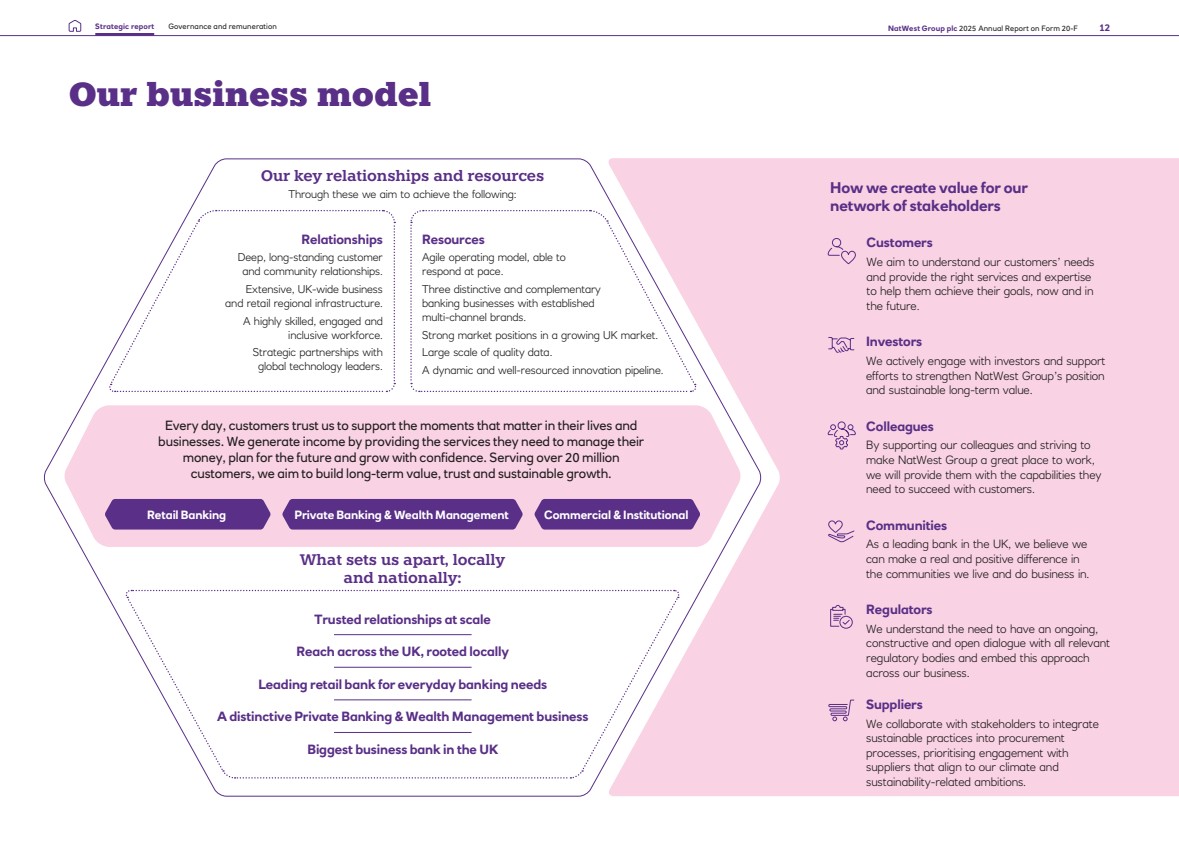
| Our business model How we create value for our network of stakeholders Investors We actively engage with investors and support efforts to strengthen NatWest Group’s position and sustainable long-term value. Colleagues By supporting our colleagues and striving to make NatWest Group a great place to work, we will provide them with the capabilities they need to succeed with customers. Communities As a leading bank in the UK, we believe we can make a real and positive difference in the communities we live and do business in. Regulators We understand the need to have an ongoing, constructive and open dialogue with all relevant regulatory bodies and embed this approach across our business. Suppliers We collaborate with stakeholders to integrate sustainable practices into procurement processes, prioritising engagement with suppliers that align to our climate and sustainability-related ambitions. Every day, customers trust us to support the moments that matter in their lives and businesses. We generate income by providing the services they need to manage their money, plan for the future and grow with confidence. Serving over 20 million customers, we aim to build long-term value, trust and sustainable growth. Retail Banking Private Banking & Wealth Management Commercial & Institutional Our key relationships and resources Through these we aim to achieve the following: What sets us apart, locally and nationally: Trusted relationships at scale Reach across the UK, rooted locally Leading retail bank for everyday banking needs A distinctive Private Banking & Wealth Management business Biggest business bank in the UK Customers We aim to understand our customers’ needs and provide the right services and expertise to help them achieve their goals, now and in the future. Relationships Deep, long-standing customer and community relationships. Extensive, UK-wide business and retail regional infrastructure. A highly skilled, engaged and inclusive workforce. Strategic partnerships with global technology leaders. Resources Agile operating model, able to respond at pace. Three distinctive and complementary banking businesses with established multi-channel brands. Strong market positions in a growing UK market. Large scale of quality data. A dynamic and well-resourced innovation pipeline. Strategic report Strategic report Governance and remuneration Financial review Governance and remuneration Risk and capital management Financial statements Additional information NatWest Group plc NatWest Group plc 2025 Annual Report and Accounts 2025 Annual Report on Form 20-F 1212 |
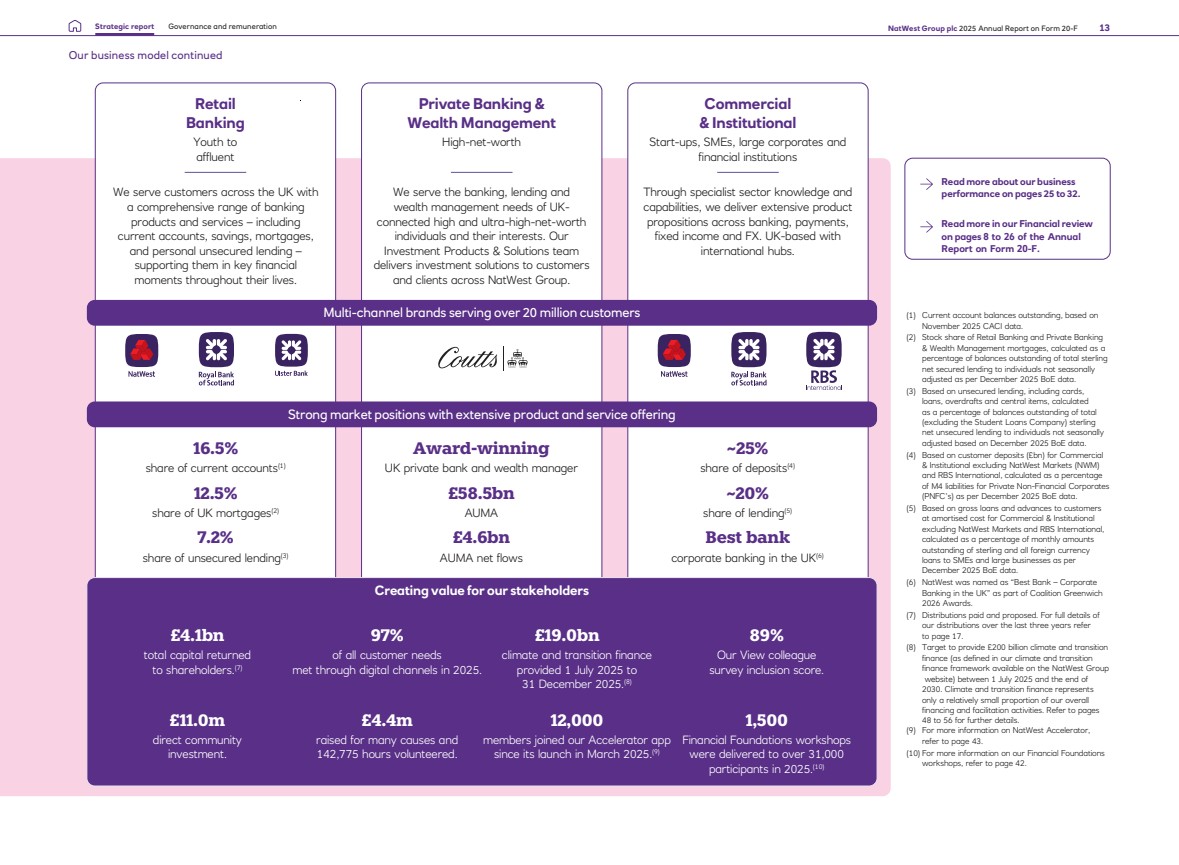
| Our business model How we create value for our network of stakeholders Investors We actively engage with investors and support efforts to strengthen NatWest Group’s position and sustainable long-term value. Colleagues By supporting our colleagues and striving to make NatWest Group a great place to work, we will provide them with the capabilities they need to succeed with customers. Communities As a leading bank in the UK, we believe we can make a real and positive difference in the communities we live and do business in. Regulators We understand the need to have an ongoing, constructive and open dialogue with all relevant regulatory bodies and embed this approach across our business. Suppliers We collaborate with stakeholders to integrate sustainable practices into procurement processes, prioritising engagement with suppliers that align to our climate and sustainability-related ambitions. Every day, customers trust us to support the moments that matter in their lives and businesses. We generate income by providing the services they need to manage their money, plan for the future and grow with confidence. Serving over 20 million customers, we aim to build long-term value, trust and sustainable growth. Retail Banking Private Banking & Wealth Management Commercial & Institutional Our key relationships and resources Through these we aim to achieve the following: What sets us apart, locally and nationally: Trusted relationships at scale Reach across the UK, rooted locally Leading retail bank for everyday banking needs A distinctive Private Banking & Wealth Management business Biggest business bank in the UK Customers We aim to understand our customers’ needs and provide the right services and expertise to help them achieve their goals, now and in the future. Relationships Deep, long-standing customer and community relationships. Extensive, UK-wide business and retail regional infrastructure. A highly skilled, engaged and inclusive workforce. Strategic partnerships with global technology leaders. Resources Agile operating model, able to respond at pace. Three distinctive and complementary banking businesses with established multi-channel brands. Strong market positions in a growing UK market. Large scale of quality data. A dynamic and well-resourced innovation pipeline. Strategic report Financial review Governance and remuneration Risk and capital management Financial statements Additional information NatWest Group plc 2025 Annual Report and Accounts 12 Our business model continued Multi-channel brands serving over 20 million customers 16.5% share of current accounts(1) 12.5% share of UK mortgages(2) 7.2% share of unsecured lending(3) Award-winning UK private bank and wealth manager £58.5bn AUMA £4.6bn AUMA net flows ~25% share of deposits(4) ~20% share of lending(5) Best bank corporate banking in the UK(6) Strong market positions with extensive product and service offering (1) Current account balances outstanding, based on November 2025 CACI data. (2) Stock share of Retail Banking and Private Banking & Wealth Management mortgages, calculated as a percentage of balances outstanding of total sterling net secured lending to individuals not seasonally adjusted as per December 2025 BoE data. (3) Based on unsecured lending, including cards, loans, overdrafts and central items, calculated as a percentage of balances outstanding of total (excluding the Student Loans Company) sterling net unsecured lending to individuals not seasonally adjusted based on December 2025 BoE data. (4) Based on customer deposits (£bn) for Commercial & Institutional excluding NatWest Markets (NWM) and RBS International, calculated as a percentage of M4 liabilities for Private Non-Financial Corporates (PNFC’s) as per December 2025 BoE data. (5) Based on gross loans and advances to customers at amortised cost for Commercial & Institutional excluding NatWest Markets and RBS International, calculated as a percentage of monthly amounts outstanding of sterling and all foreign currency loans to SMEs and large businesses as per December 2025 BoE data. (6) NatWest was named as “Best Bank – Corporate Banking in the UK” as part of Coalition Greenwich 2026 Awards. (7) Distributions paid and proposed. For full details of our distributions over the last three years refer to page 17. (9) For more information on NatWest Accelerator, refer to page 43. (10) For more information on our Financial Foundations workshops, refer to page 42. We serve customers across the UK with a comprehensive range of banking products and services – including current accounts, savings, mortgages, and personal unsecured lending – supporting them in key financial moments throughout their lives. We serve the banking, lending and wealth management needs of UK-connected high and ultra-high-net-worth individuals and their interests. Our Investment Products & Solutions team delivers investment solutions to customers and clients across NatWest Group. Through specialist sector knowledge and capabilities, we deliver extensive product propositions across banking, payments, fixed income and FX. UK-based with international hubs. Creating value for our stakeholders Retail Banking Youth to affluent Private Banking & Wealth Management High-net-worth Commercial & Institutional Start-ups, SMEs, large corporates and financial institutions £4.1bn total capital returned to shareholders.(7) 97% of all customer needs met through digital channels in 2025. climate and transition finance provided 1 July 2025 to 31 December 2025.(8) 89% Our View colleague survey inclusion score. £11.0m direct community investment. £4.4m raised for many causes and 142,775 hours volunteered. 12,000 members joined our Accelerator app since its launch in March 2025.(9) 1,500 Financial Foundations workshops were delivered to over 31,000 participants in 2025.(10) Read more about our business performance on pages 25 to 32. Strategic report Strategic report Governance and remuneration Financial review Governance and remuneration Risk and capital management Financial statements Additional information NatWest Group plc NatWest Group plc 2025 Annual Report and Accounts 2025 Annual Report on Form 20-F 1313 £19.0bn (8) Target to provide £200 billion climate and transition finance (as defined in our climate and transition finance framework available on the NatWest Group website) between 1 July 2025 and the end of 2030. Climate and transition finance represents only a relatively small proportion of our overall financing and facilitation activities. Refer to pages 48 to 56 for further details. Read more in our Financial review on pages 8 to 26 of the Annual Report on Form 20-F. |
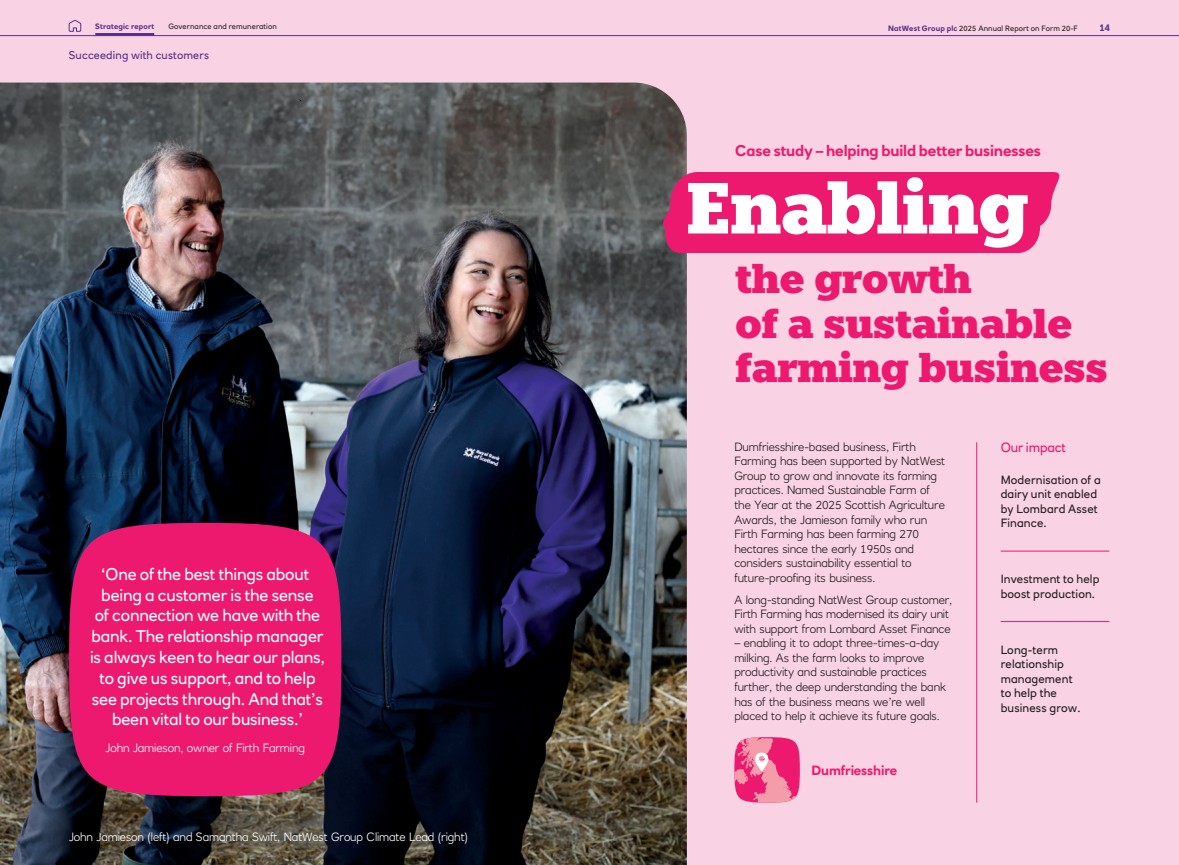
| Dumfriesshire-based business, Firth Farming has been supported by NatWest Group to grow and innovate its farming practices. Named Sustainable Farm of the Year at the 2025 Scottish Agriculture Awards, the Jamieson family who run Firth Farming has been farming 270 hectares since the early 1950s and considers sustainability essential to future-proofing its business. A long-standing NatWest Group customer, Firth Farming has modernised its dairy unit with support from Lombard Asset Finance – enabling it to adopt three-times-a-day milking. As the farm looks to improve productivity and sustainable practices further, the deep understanding the bank has of the business means we’re well placed to help it achieve its future goals. Our impact Modernisation of a dairy unit enabled by Lombard Asset Finance. Investment to help boost production. Long-term relationship management to help the business grow. Dumfriesshire the growth of a sustainable farming business Case study – helping build better businesses Enabling John Jamieson (left) and Samantha Swift, NatWest Group Climate Lead (right) Succeeding with customers ‘One of the best things about being a customer is the sense of connection we have with the bank. The relationship manager is always keen to hear our plans, to give us support, and to help see projects through. And that’s been vital to our business.’ John Jamieson, owner of Firth Farming Strategic report Strategic report Governance and remuneration Financial review Governance and remuneration Risk and capital management Financial statements Additional information NatWest Group plc NatWest Group plc 2025 Annual Report and Accounts 2025 Annual Report on Form 20-F 1414 |
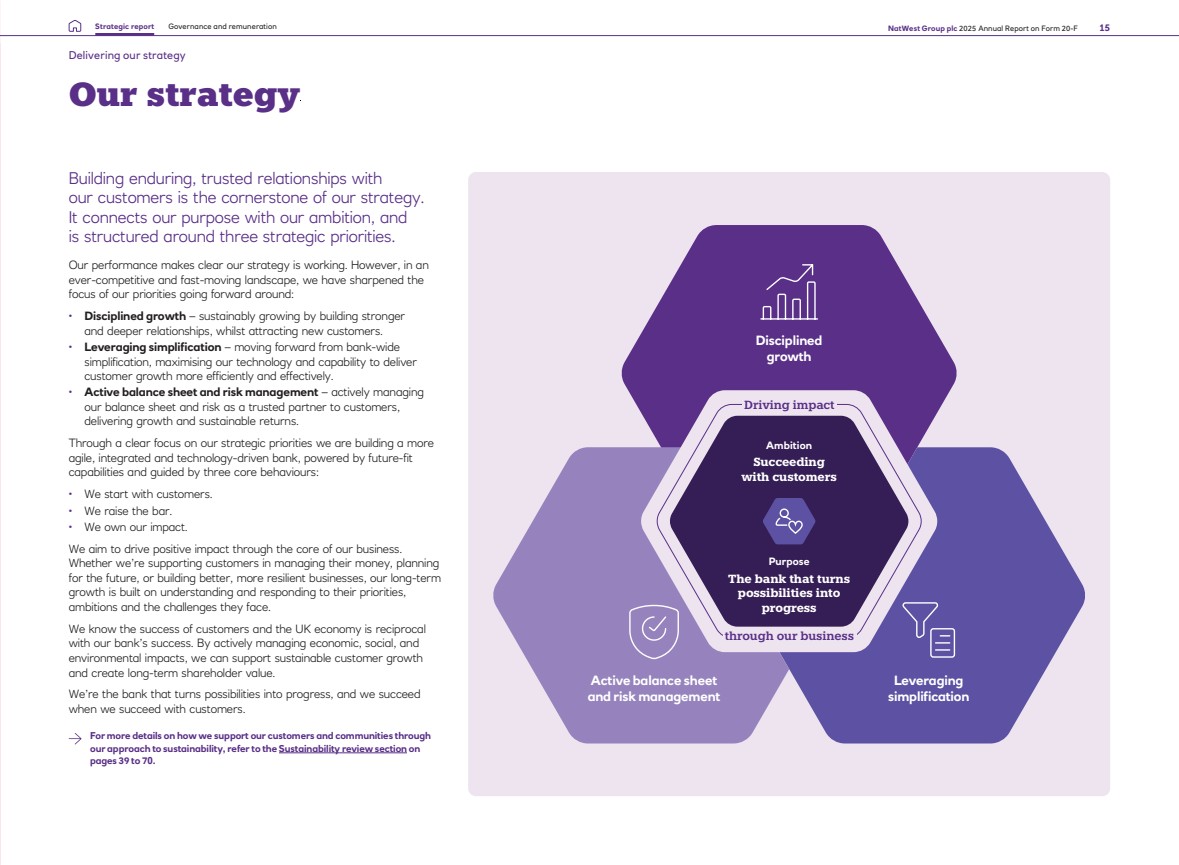
| Dumfriesshire-based business, Firth Farming has been supported by NatWest Group to grow and innovate its farming practices. Named Sustainable Farm of the Year at the 2025 Scottish Agriculture Awards, the Jamieson family who run Firth Farming has been farming 270 hectares since the early 1950s and considers sustainability essential to future-proofing its business. A long-standing NatWest Group customer, Firth Farming has modernised its dairy unit with support from Lombard Asset Finance – enabling it to adopt three-times-a-day milking. As the farm looks to improve productivity and sustainable practices further, the deep understanding the bank has of the business means we’re well placed to help it achieve its future goals. Our impact Modernisation of a dairy unit enabled by Lombard Asset Finance. Investment to help boost production. Long-term relationship management to help the business grow. Dumfriesshire the growth of a sustainable farming business Case study – helping build better businesses Enabling John Jamieson (left) and Samantha Swift, NatWest Group Climate Lead (right) Succeeding with customers ‘One of the best things about being a customer is the sense of connection we have with the bank. The relationship manager is always keen to hear our plans, to give us support, and to help see projects through. And that’s been vital to our business.’ John Jamieson, owner of Firth Farming Strategic report Financial review Governance and remuneration Risk and capital management Financial statements Additional information NatWest Group plc 2025 Annual Report and Accounts 14 Our strategy Delivering our strategy Building enduring, trusted relationships with our customers is the cornerstone of our strategy. It connects our purpose with our ambition, and is structured around three strategic priorities. Our performance makes clear our strategy is working. However, in an ever-competitive and fast-moving landscape, we have sharpened the focus of our priorities going forward around: • Disciplined growth – sustainably growing by building stronger and deeper relationships, whilst attracting new customers. • Leveraging simplification – moving forward from bank-wide simplification, maximising our technology and capability to deliver customer growth more efficiently and effectively. • Active balance sheet and risk management – actively managing our balance sheet and risk as a trusted partner to customers, delivering growth and sustainable returns. Through a clear focus on our strategic priorities we are building a more agile, integrated and technology-driven bank, powered by future-fit capabilities and guided by three core behaviours: • We start with customers. • We raise the bar. • We own our impact. We aim to drive positive impact through the core of our business. Whether we’re supporting customers in managing their money, planning for the future, or building better, more resilient businesses, our long-term growth is built on understanding and responding to their priorities, ambitions and the challenges they face. We know the success of customers and the UK economy is reciprocal with our bank’s success. By actively managing economic, social, and environmental impacts, we can support sustainable customer growth and create long-term shareholder value. We’re the bank that turns possibilities into progress, and we succeed when we succeed with customers. Active balance sheet and risk management Disciplined growth Leveraging simplification Driving impact through our business Ambition Succeeding with customers Purpose The bank that turns possibilities into progress Strategic report Strategic report Governance and remuneration Financial review Governance and remuneration Risk and capital management Financial statements Additional information NatWest Group plc NatWest Group plc 2025 Annual Report and Accounts 2025 Annual Report on Form 20-F 1515 For more details on how we support our customers and communities through our approach to sustainability, refer to the Sustainability review section on pages 39 to 70. |
| Investment case Leading positions in a growing UK market A vital and trusted partner to over 20 million customers across our Retail Banking, Private Banking & Wealth Management, and Commercial & Institutional businesses with a strong track record of disciplined growth. • Extensive footprint in the UK serving 19 million Retail Banking customers 16.5% share of current accounts. • Leading private bank and wealth manager; Coutts, which has been a trusted brand for over 330 years. • The biggest bank for business in the UK, and one of the leading banks for UK start-ups. Our strategic priorities drive sustainable shareholder value creation Solid capital and liquidity position supporting a target CET1 ratio of ~13% Ordinary dividend payout ratio target: ~50% Surplus capital deployed in pursuit of organic or inorganic growth with residual returned to shareholders via buybacks 7-year track record of CAL growth of above 4.6% ~1 million customers added in 2025 Disciplined growth Sustainably growing by building stronger and deeper relationships, whilst attracting new customers. At least 4% CAGR Leveraging simplification Maximising our technology and capability to deliver customer growth more efficiently and effectively. (exc. litigation and conduct) below 45% Active balance sheet and risk management Actively managing our balance sheet and risk as a trusted partner to customers, delivering growth and sustainable returns. pre-distributions >200bps 2028 Return on Tangible Equity >18% Purpose: The bank that turns possibilities into progress Ambition: Succeeding with customers Strategic report Strategic report Governance and remuneration Financial review Governance and remuneration Risk and capital management Financial statements Additional information NatWest Group plc NatWest Group plc 2025 Annual Report and Accounts 2025 Annual Report on Form 20-F 1616 2025–2028 target(1): Customer assets and liabilities (CAL) 2028 target(1): Capital generation 2028 target(1): Cost:income ratio Targeting attractive, sustainable growth and returns for shareholders(1) (1) The guidance, targets, expectations, and trends discussed in this section represent NatWest Group plc management’s current expectations and are subject to change, including as a result of the factors described in the Risk Factors section of the 2025 Annual Report on Form 20-F. These statements constitute forward-looking statements. Refer to Forward-looking statements in the 2025 Annual Report on Form 20-F. |
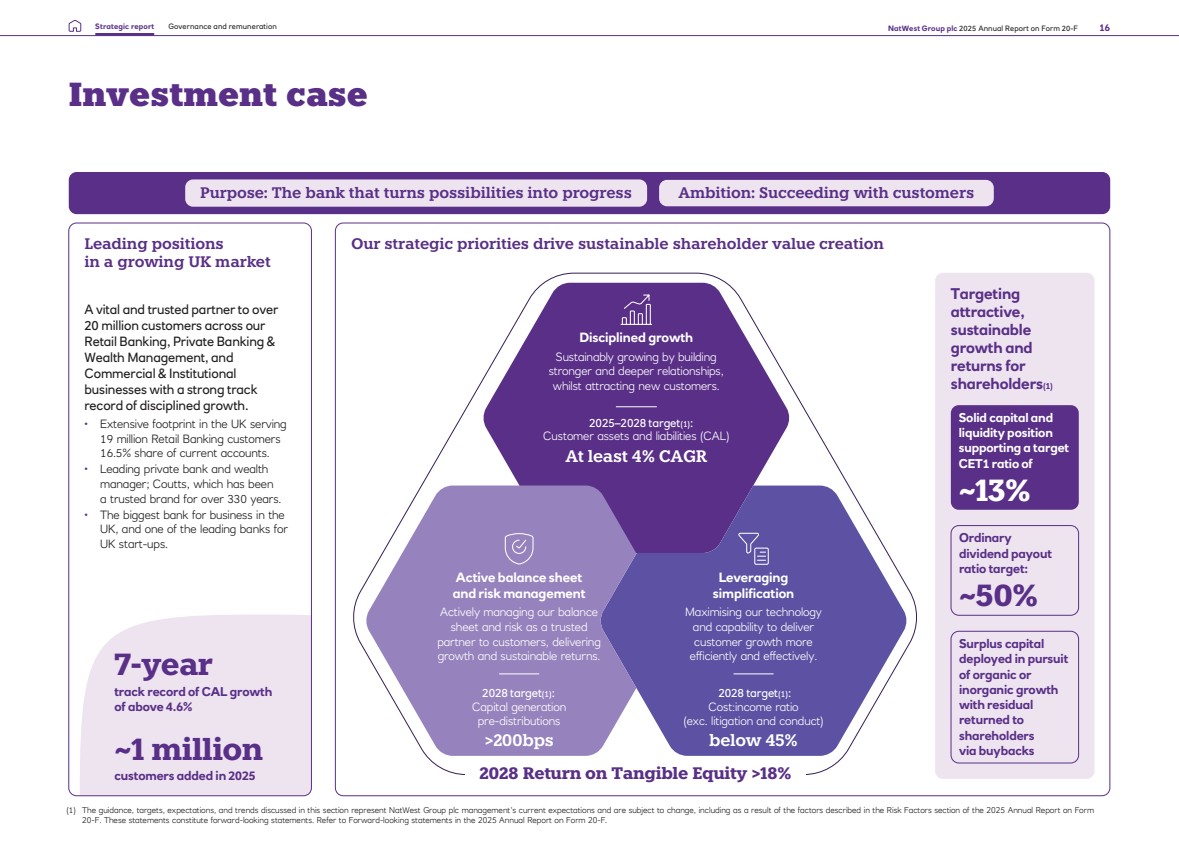
| Investment case Leading positions in a growing UK market A vital and trusted partner to over 20 million customers across our Retail Banking, Private Banking & Wealth Management, and Commercial & Institutional businesses with a strong track record of disciplined growth. • Extensive footprint in the UK serving 19 million Retail Banking customers 16.5% share of current accounts. • Leading private bank and wealth manager; Coutts, which has been a trusted brand for over 330 years. • The biggest bank for business in the UK, and one of the leading banks for UK start-ups. Our strategic priorities drive sustainable shareholder value creation Targeting attractive, sustainable growth and returns for shareholders Solid capital and liquidity position supporting a target CET1 ratio of ~13% Ordinary dividend payout ratio target: ~50% Surplus capital deployed in pursuit of organic or inorganic growth with residual returned to shareholders via buybacks 7-year track record of CAL growth of above 4.6% ~1 million customers added in 2025 Disciplined growth Sustainably growing by building stronger and deeper relationships, whilst attracting new customers. 2025–2028 target: Customer assets and liabilities (CAL) At least 4% CAGR Leveraging simplification Maximising our technology and capability to deliver customer growth more efficiently and effectively. 2028 target: Cost:income ratio (exc. litigation and conduct) below 45% Active balance sheet and risk management Actively managing our balance sheet and risk as a trusted partner to customers, delivering growth and sustainable returns. 2028 target: Capital generation pre-distributions >200bps 2028 Return on Tangible Equity >18% Purpose: The bank that turns possibilities into progress Ambition: Succeeding with customers Strategic report Financial review Governance and remuneration Risk and capital management Financial statements Additional information NatWest Group plc 2025 Annual Report and Accounts 16 2025 2024 2023 Interim dividend Final dividend 5.5 11.5 6.0 15.5 17.0p 21.5p 9.5 23.0 32.5p 2025 2024 2023 Directed buyback On market buyback 0.8 1.3 2.2 2.1 2.2 1.5 1.5 2025 2024 2023 68.0 53.5 47.9 2025 2024 2023 384 329 292 Investment case continued 2025 total shareholder returns(1) 71% 19% 2 year CAGR Earnings per share (EPS) (pence) 15% 2 year CAGR Tangible net asset value (TNAV) per share (pence)(4) Delivering shareholder value 2025 was another strong year of delivery, as reflected by an increase in share price of 62.1% and a total shareholder return (TSR) of 71.0%. This was underpinned by high returns (RoTE 19.2%) and growth in CAL (+4.8%), leading to growth in EPS (+27.1%), DPS (+51.2%) and TNAV per share (+16.7%). (1) Total shareholder return includes the share price change between 31 December 2023 and 31 December 2025 plus dividends paid during the year, the 2023 and 2024 final dividend and the 2025 interim dividend, assuming reinvestment at the prevailing share price (2) Paid and proposed. (3) As at 31 December. (4) The number of ordinary shares in issue excludes own shares held. 38% 2 year CAGR Ordinary dividend per share (DPS) (pence)(2) Ordinary shares outstanding(3)(bn) UK Government ownership(3)(%) £5.8bn 3 year cumulative 2023-2025 Total buybacks (£bn) 8.0 0 8.0 9.99 8.8 37.97 49.7% 95.6% 71% 2023 2024 2025 +27% vs 2024 +12% vs 2023 +51% vs 2024 +17% vs 2024 +13% vs 2023 +27% vs 2023 Strategic report Strategic report Governance and remuneration Financial review Governance and remuneration Risk and capital management Financial statements Additional information NatWest Group plc NatWest Group plc 2025 Annual Report and Accounts 2025 Annual Report on Form 20-F 1717 |
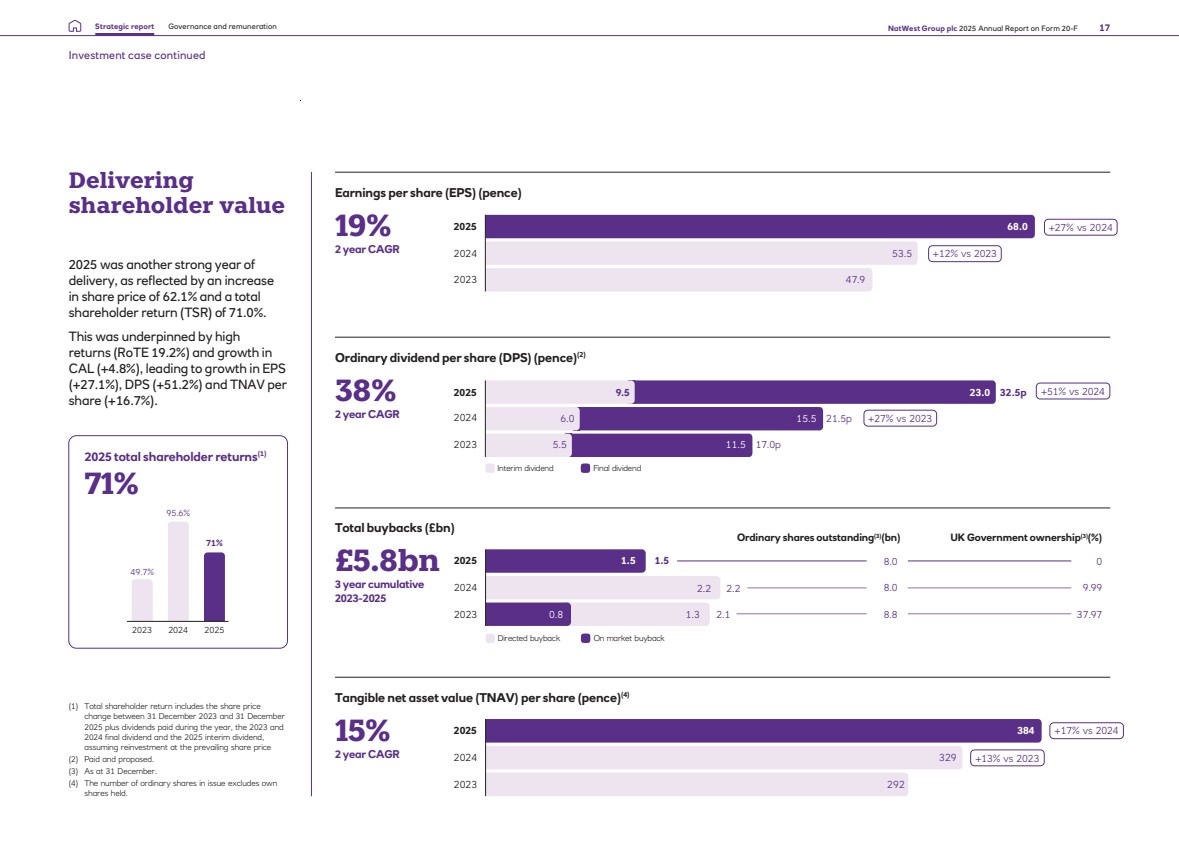
| Measuring our 2025 performance Financial Key performance indicators Read more: Sustainability review on pages 48 to 56 and Section 172(1) statement on page 36. Read more: Our investment case on page 16 and our Outlook statement on page 10. Read more: Our investment case on page 16 and our Outlook statement on page 10. Read more: Our investment case on page 16 and our Outlook statement on page 10. Read more: Our investment case on page 16 and our Outlook statement on page 10. (2) Target to provide £100 billion of climate and sustainable funding and financing between 1 July 2021 and the end of 2025. (1) Operating costs, excluding litigation and conduct costs, to be around £8.1 billion including £0.1 billion of one-time integration costs in 2025. (1) Income excluding notable items to be in the range of £15.2–15.7 billion in 2025. (1) Continue to target a CET1 ratio in the range of 13–14%. (1) Achieve a Return on Tangible Equity in the range of 15–16% in 2025. Return on Tangible Equity 19.2% Common Equity Tier 1 (CET1) ratio 14.0% Income (excluding notable items) £16,400m Operating expenses (excluding litigation and conduct) £8,095m Climate and sustainable funding and financing(3) (£bn) £110.3bn 17.8% 17.5% 19.2% 2023 2024 2025 2023 2024 2025 13.4% 13.6% 14.0% £14,339m£14,648m £16,400m 2023 2024 2025 £7,641m £7,854m £8,095m 2023 2024 2025 2023H2 2021 2022 2024 TotalH1 2025 £29.3bn £24.5bn £8.1bn £31.5bn £16.9bn £110.3bn Strategic report Strategic report Governance and remuneration Financial review Governance and remuneration Risk and capital management Financial statements Additional information NatWest Group plc NatWest Group plc 2025 Annual Report and Accounts 2025 Annual Report on Form 20-F 1818 (4) The guidance, targets, expectations, and trends discussed in this section represent NatWest Group plc management’s current expectations and are subject to change, including as a result of the factors described in the Risk Factors section of the 2025 Annual Report on Form 20-F. These statements constitute forward-looking statements. Refer to Forward-looking statements in the 2025 Annual Report on Form 20-F. targets and companies for inclusion. For the year ended 31 December 2023, the CSFFI criteria published in December 2022 were applied. For the year ended 31 December 2022, the CSFFI criteria published in October 2021 were applied. Climate and sustainable funding and financing represents only a relatively small proportion of our overall funding and financing activities. The climate and sustainable funding and financing criteria which underpinned our £100 billion target has been retired and replaced with our climate and transition finance framework (available on the NatWest Group website), which underpins our target to provide £200 billion climate and transition finance (as defined in the framework) between 1 July 2025 and the end of 2030. (1) Performance against 2025 guidance given in our 2024 Annual Report on Form 20-F. (2) Performance against 2025 targets given in our 2024 Annual Report on Form 20-F. (3) For the reporting periods ended 31 December 2024 and 30 June 2025, the NatWest Group climate and sustainable funding and financing inclusion (CSFFI) criteria (available on the NatWest Group website) published in March 2024 were used to determine eligible assets, activities, (5) Refer to the Non-IFRS financial measures appendix on pages 250 to 257 of the Annual Report on Form 20-F for details of the basis of preparation and reconciliation of non-IFRS financial measures and performance metrics. |
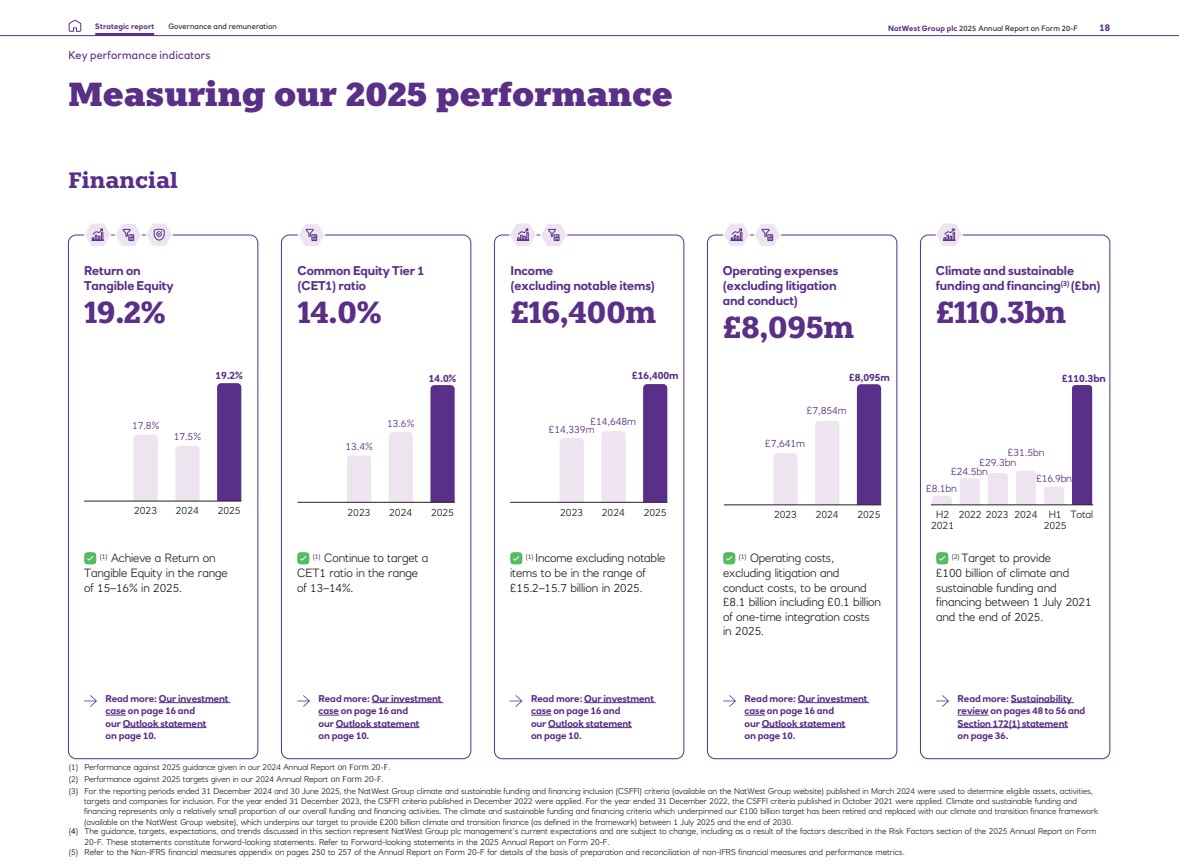
| Measuring our 2025 performance Financial Key performance indicators Read more: Sustainability review on pages 48 to 56 and Section 172(1) statement on page 36. Read more: Our investment case on page 16 and our Outlook statement on page 10. Read more: Our investment case on page 16 and our Outlook statement on page 10. Read more: Our investment case on page 16 and our Outlook statement on page 10. Read more: Our investment case on page 16 and our Outlook statement on page 10. (2) Target to provide £100 billion of climate and sustainable funding and financing between 1 July 2021 and the end of 2025. (1) Operating costs, excluding litigation and conduct costs, to be around £8.1 billion including £0.1 billion of one-time integration costs in 2025. (1) Income excluding notable items to be in the range of £15.2–15.7 billion in 2025. (1) Continue to target a CET1 ratio in the range of 13–14%. (1) Achieve a Return on Tangible Equity in the range of 15–16% in 2025. Return on Tangible Equity 19.2% Common Equity Tier 1 (CET1) ratio 14.0% Income (excluding notable items) £16,400m Operating expenses (excluding litigation and conduct) £8,095m Climate and sustainable funding and financing(3) (£bn) £110.3bn(LA) (1) Performance against 2025 guidance given in our 2024 Annual Report and Accounts. (2) Performance against 2025 targets given in our 2024 Annual Report and Accounts. (3) For the reporting periods ended 31 December 2024 and 30 June 2025, the NatWest Group climate and sustainable funding and financing inclusion (CSFFI) criteria (available at natwestgroup.com) published in March 2024 were used to determine eligible assets, activities, targets and companies for inclusion. For the year ended 31 December 2023, the CSFFI criteria published in December 2022 were applied. For the year ended 31 December 2022, the CSFFI criteria published in October 2021 were applied. Climate and sustainable funding and financing represents only a relatively small proportion of our overall funding and financing activities. The climate and sustainable funding and financing criteria which underpinned our £100 billion target has been retired and replaced with our climate and transition finance framework (available at natwestgroup.com), which underpins our target to provide £200 billion climate and transition finance (as defined in the framework) between 1 July 2025 and the end of 2030. 17.8% 17.5% 19.2% 2023 2024 2025 2023 2024 2025 13.4% 13.6% 14.0% £14,339m£14,648m £16,400m 2023 2024 2025 £7,641m £7,854m £8,095m 2023 2024 2025 2023H2 2021 2022 2024 TotalH1 2025 £29.3bn £24.5bn £8.1bn £31.5bn £16.9bn £110.3bn Strategic report Financial review Governance and remuneration Risk and capital management Financial statements Additional information NatWest Group plc 2025 Annual Report and Accounts 18 Key performance indicators continued Commercial & Institutional banking digitally first 84.5% Build and strengthen a healthy culture(4) 84% Net Promoter Score® (NPS)(5) Non-financial (4) The culture index used to measure culture consists of 10 questions as defined and measured in Our View, our colleague survey. NatWest Group Our View results exclude our colleagues in Ulster Bank RoI, Poland and FreeAgent. To enable like-for-like year-on-year comparisons, all scores are based on the Willis Tower Watson (WTW) calculation methodology. (5) NPS® and the NPS-related emoticons are registered trademarks of Bain & Company, Inc., NICE Systems, Inc., and Fred Reichheld. (6) NatWest Group uses Net Promoter Score (NPS) methodology across the customer business segments, reflecting the contribution of each segment to NatWest Group income. Where NPS is not applicable, an internal Customer Touchpoint Rating (CTR) and independent Deal League tables is applied to assess NatWest Markets’ customer performance. We met or exceeded 11 out of the 12 customer goals set for 2025. Read more: Customer trust and advocacy on page 35. Read more: Sustainability review on pages 59 to 63. Read more: Sustainability review on pages 46 to 47. Read more: Sustainability review on pages 46 to 47. (1,3) Our target was 85% for Commercial & Institutional customers for banking digital first. We narrowly missed our target, achieving 84.5% in 2025. (1) Achieve our culture target of 83 points as measured through the Our View colleague survey. (1,2) Achieve our 80% target for Retail Banking customers for banking entirely digital. (1) On average, to meet our targets.(6) Targets are set to maintain or improve. 2025 2024 2023 Disciplined growth Bank-wide simplification Active balance sheet and risk management 2025 target achieved Target on track Retail Banking customers banking entirely digital 81.8% 2023 2024 2025 76.8% 78.7% 81.8% 2023 2024 2025 80.9% 82.9% 84.5% 2023 2024 2025 83% 83% 84% Commercial & Institutional NatWest £0-£750k NatWest Retail Banking Commercial & Institutional NatWest £750k-£250m 21 -8 23 -7 -5 25 8 5 6 Key Target not met Strategic report Strategic report Governance and remuneration Financial review Governance and remuneration Risk and capital management Financial statements Additional information NatWest Group plc NatWest Group plc 2025 Annual Report and Accounts 2025 Annual Report on Form 20-F 1919 (2) Retail Banking customers with active current accounts that have accessed a digital platform (online or mobile) and not used the branch or telephony in a rolling 90 days in the reporting period. Inactive customers and customers with no channel usage, mortgages and savings accounts, and interactions via the Post Office are excluded from the scope of measurement. (3) Commercial & Institutional (ring-fenced bank) customers with active non-personal account/s that access their account 95% or higher through digital channels for three rolling months in the reporting period ending 31 December 2025. (1) Performance against 2025 targets given in our 2024 Annual Report on Form 20-F. Link to remuneration. Read more: Annual remuneration report on pages 134 to 151 |
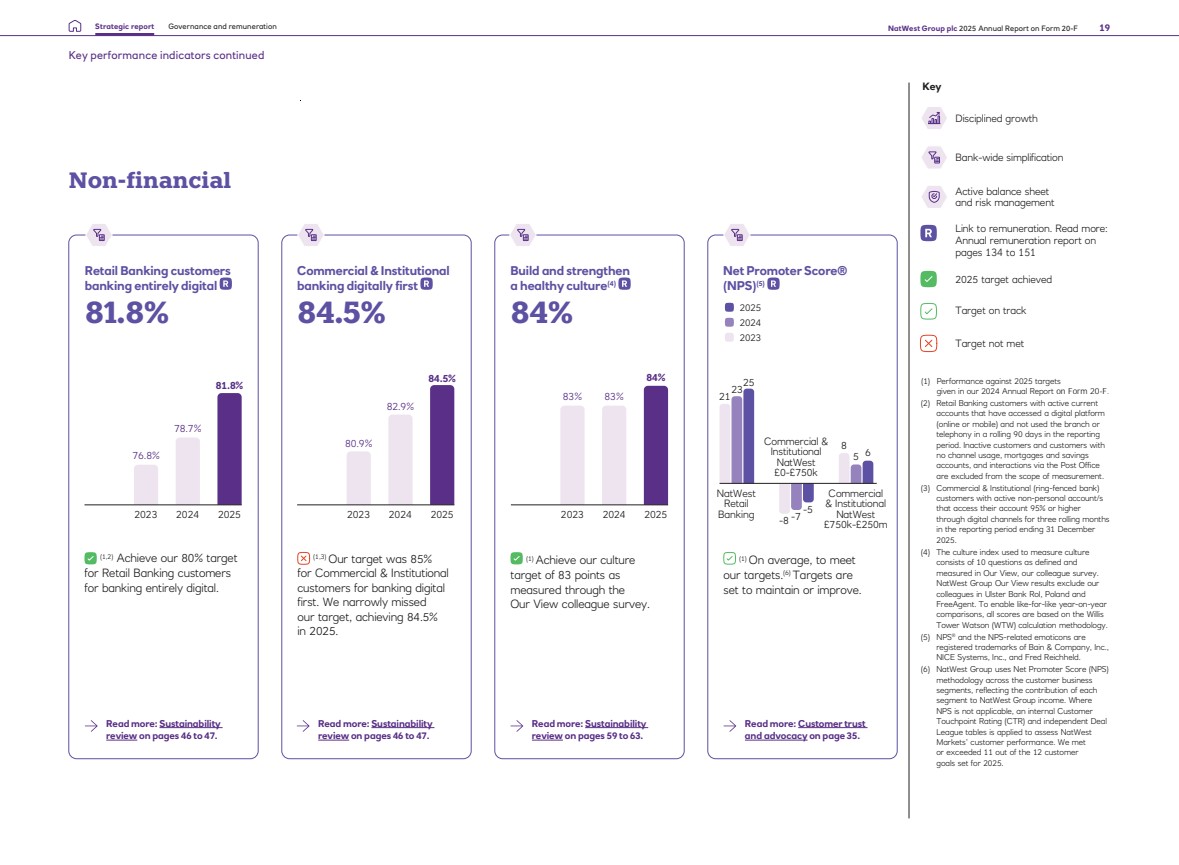
| Progress against our 2025 strategic priorities Delivering our strategy continued #1 Leading lender in the UK infrastructure sector and leading flow in digital self-serve mortgages around 1 million Sainsbury’s Bank customer accounts successfully integrated 49% Share of AUMA in total Private Banking & Wealth Management CAL 252bps of capital generation delivered pre-distributions in 2025 £10.9 billion benefit from RWA management actions as we continued to actively manage our balance sheet and create capacity for lending growth 16bps Loan impairment rate – below the 2025 guidance of 20 basis points Disciplined growth We’ve continued to grow our customer base to over 20 million customers. During 2025, we successfully integrated around one million Sainsbury’s Bank customer accounts and launched new NatWest Boxed strategic partnerships with The AA and Saga. In Private Banking & Wealth Management we grew customer assets and liabilities (CAL) by 10% to £119 billion. In 2025, Commercial & Institutional grew lending by £12.3 billion, and committed £4.6 billion to UK social housing. 5.6 days average deployment frequency of code to business applications in 2025, down from 10.0 days in 2024 51% of internal and external business service applications on the cloud in 2025 (2024 – 44%) >12,000 coders have access to AI coding assistants Bank-wide simplification Our focus on bank-wide simplification enabled us to reduce complexity in our operating model, drive long-term customer growth and achieve greater productivity. To accelerate our progress, we are developing in-house capabilities to deliver efficiency and innovation. We have advanced our transition to cloud infrastructure and established partnerships with global technology leaders, becoming the first UK bank to sign a strategic collaboration with OpenAI. Active balance sheet and risk management In 2025, we strengthened our balance sheet, reduced risk-weighted assets (RWAs) by £10.9 billion, kept cost of risk low, and returned £4.1 billion to shareholders. Across the business, we improved data quality, executed mortgage securitisation, enhanced risk analytics, and delivered stable funding – reflecting disciplined management and resilience. Strategic report Strategic report Governance and remuneration Financial review Governance and remuneration Risk and capital management Financial statements Additional information NatWest Group plc NatWest Group plc 2025 Annual Report and Accounts 2025 Annual Report on Form 20-F 2020 Read more: Chief Executive Officer’s review on pages 8 to 10, Business performance review on pages 25 to 32 of this exhibit and Financial review on pages 8 to 26 of the Annual Report on Form 20-F |
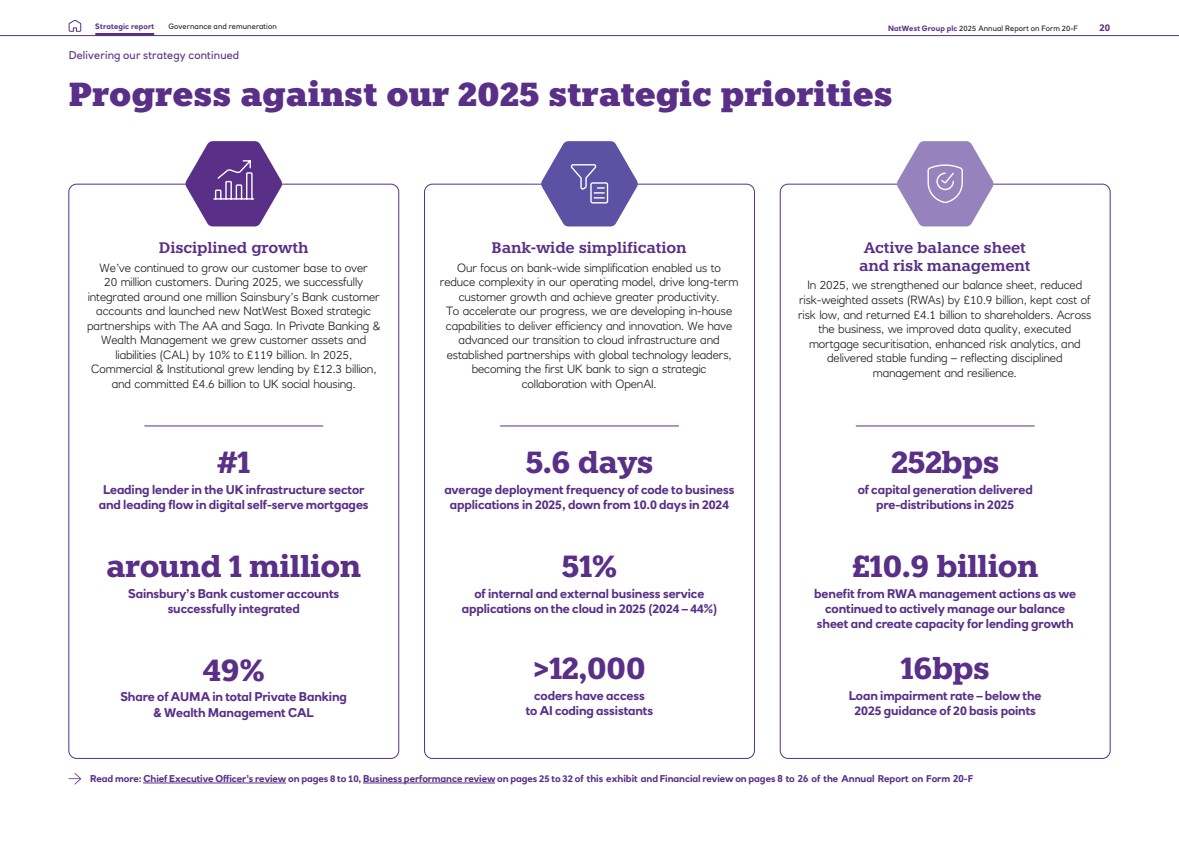
| Progress against our 2025 strategic priorities Delivering our strategy continued Read more: Chief Executive Officer’s review on pages 8 to 10, Business performance review on pages 25 to 32 and Financial review on pages 83 to 94. #1 Leading lender in the UK infrastructure sector and leading flow in digital self-serve mortgages around 1 million Sainsbury’s Bank customer accounts successfully integrated 49% Share of AUMA in total Private Banking & Wealth Management CAL 252bps of capital generation delivered pre-distributions in 2025 £10.9 billion benefit from RWA management actions as we continued to actively manage our balance sheet and create capacity for lending growth 16bps Loan impairment rate – below the 2025 guidance of 20 basis points Disciplined growth We’ve continued to grow our customer base to over 20 million customers. During 2025, we successfully integrated around one million Sainsbury’s Bank customer accounts and launched new NatWest Boxed strategic partnerships with The AA and Saga. In Private Banking & Wealth Management we grew customer assets and liabilities (CAL) by 10% to £119 billion. In 2025, Commercial & Institutional grew lending by £12.3 billion, and committed £4.6 billion to UK social housing. 5.6 days average deployment frequency of code to business applications in 2025, down from 10.0 days in 2024 51% of internal and external business service applications on the cloud in 2025 (2024 – 44%) >12,000 coders have access to AI coding assistants Bank-wide simplification Our focus on bank-wide simplification enabled us to reduce complexity in our operating model, drive long-term customer growth and achieve greater productivity. To accelerate our progress, we are developing in-house capabilities to deliver efficiency and innovation. We have advanced our transition to cloud infrastructure and established partnerships with global technology leaders, becoming the first UK bank to sign a strategic collaboration with OpenAI. Active balance sheet and risk management In 2025, we strengthened our balance sheet, reduced risk-weighted assets (RWAs) by £10.9 billion, kept cost of risk low, and returned £4.1 billion to shareholders. Across the business, we improved data quality, executed mortgage securitisation, enhanced risk analytics, and delivered stable funding – reflecting disciplined management and resilience. Strategic report Financial review Governance and remuneration Risk and capital management Financial statements Additional information NatWest Group plc 2025 Annual Report and Accounts 20 As a teenager, Dave Keeler worked at the Strands Hotel and Screes Inn in Nether Wasdale, Cumbria, launching his career in hospitality there. After working all over the world in the sector, Dave returned to the Lake District with the ambition of running the hotel and restaurant where it all began for him. NatWest Group helped Dave and his business partners to purchase the business, and with the support of his relationship manager, he’s upgrading the hotel’s operations and forging links in the local community, which allow him to support other local businesses and create local jobs. Our impact Enabling business investment. Support for a local enterprise, creating local jobs. Providing long-term business support. The Lake District ‘Being a NatWest customer – it’s feeling like you’re dealing with a local business, but one that has the strength of a big corporation. Without the support of NatWest, I wouldn’t be standing here. We wouldn’t have the ability to do this.’ Dave Keeler, owner of the Strands Hotel and Screes Inn, Nether Wasdale, The Lake District local businesses to grow and thrive Case study – helping build better businesses Backing Dave Keeler (left) and NatWest Group Senior Relationship Manager, Mark Ward (right) Succeeding with customers Strategic report Strategic report Governance and remuneration Financial review Governance and remuneration Risk and capital management Financial statements Additional information NatWest Group plc NatWest Group plc 2025 Annual Report and Accounts 2025 Annual Report on Form 20-F 2121 |
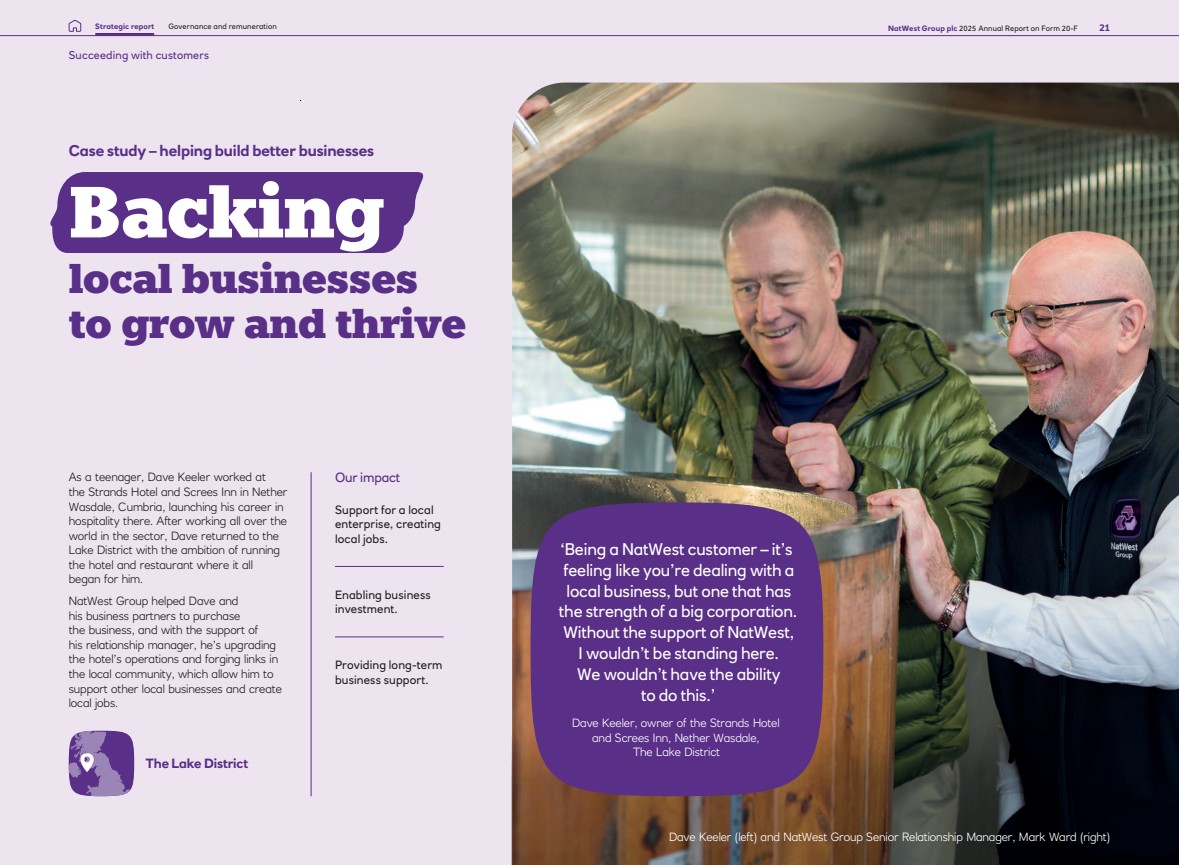
| Market environment Adapting to evolving market trends The environment we operate in is constantly evolving. Understanding the influences on our business and our customers enables us to prepare for change, respond quickly and create value for the long term. Disciplined growth Bank-wide simplification Active balance sheet and risk management Investing in digital security to keep customers safe Protecting our customers remains a top priority against the backdrop of a threat landscape which is being shaped by geopolitical tensions, ransomware attacks, and increasingly sophisticated adversaries. Regulatory expectations are also rising, with key frameworks setting new standards, and firms expected to demonstrate robust cyber defences and operational resilience. Our response NatWest Group continued to invest in security and resilience measures to protect its customers and operations in 2025: • The Security Operations Centre expanded its team of analysts in 2025, increasing coverage of real-time monitoring, backed by investment in automation. This enabled an increasingly rapid response to threats. • Assurance processes continued to be enhanced to ensure new products and services have the required security controls in place. Over 57,000 colleagues completed cybersecurity learning in 2025, reinforcing a culture of security awareness. UK inflation rose to 3.8% in 2025, before falling towards the end of the year. Unemployment increased steadily, reaching 5.1% in November 2025. Wage growth slowed, but at 4.7% in November 2025, remained higher than inflation. The Bank of England cut the base rate four times from 4.75% at the start of 2025, to close the year at 3.75%. House prices rose modestly in most regions of the UK, but fell in London. GDP growth looked set to beat modest forecasts, with the Office for Budget Responsibility predicting 1.5% growth for 2025. In markets, sterling strengthened against the US dollar, but weakened against the euro. The FTSE All Share Index rose strongly in 2025, along with most major indices. Our response In 2025, we continued to adapt our services to meet the evolving needs of our customers. As well as maintaining competitive interest rates on our savings and lending products, we adjusted our lending criteria to allow increased borrowing, responding to the need for greater flexibility highlighted by the Financial Conduct Authority. Meeting customer needs through changing macroeconomic conditions Over 12,000 small businesses supported through our Accelerator app at the end of 2025. In April 2025, we introduced Family-Backed Mortgages – allowing eligible customers to apply for a joint mortgage with a family member or friend – to help more first-time buyers own their own home. In November 2025, we launched Shared Ownership Mortgages, which allow customers to buy a percentage of their home. In March 2025, we announced our ambition to significantly expand support to UK businesses to start up and scale by offering 10,000 entrepreneurs the chance to join the Accelerator community. And to enable more high-growth companies to access funding against the value of their intellectual property, we announced plans in October 2025 to expand the availability of IP-backed loans to businesses in Scotland. We also continued to be a vital voice for business in 2025, convening our inaugural Mid-Market Growth Council meeting to support mid-market companies. • Through NatWest Group’s AI Centre of Excellence, we continued to develop the use of AI technologies to enhance our defensive capabilities against the threat of bad actors using AI and machine learning for deep fakes and advanced phishing. • We enhanced our approach to identity and access management to safeguard sensitive information and mitigate risks associated with unauthorised access. • We mandated that all suppliers based in, or operating out of the UK hold independent assurance, accredited to Cyber Essentials Plus at minimum. • Over 57,000 colleagues completed cybersecurity learning in 2025, reinforcing a culture of security awareness. Strategic report Strategic report Governance and remuneration Financial review Governance and remuneration Risk and capital management Financial statements Additional information NatWest Group plc NatWest Group plc 2025 Annual Report and Accounts 2025 Annual Report on Form 20-F 2222 |
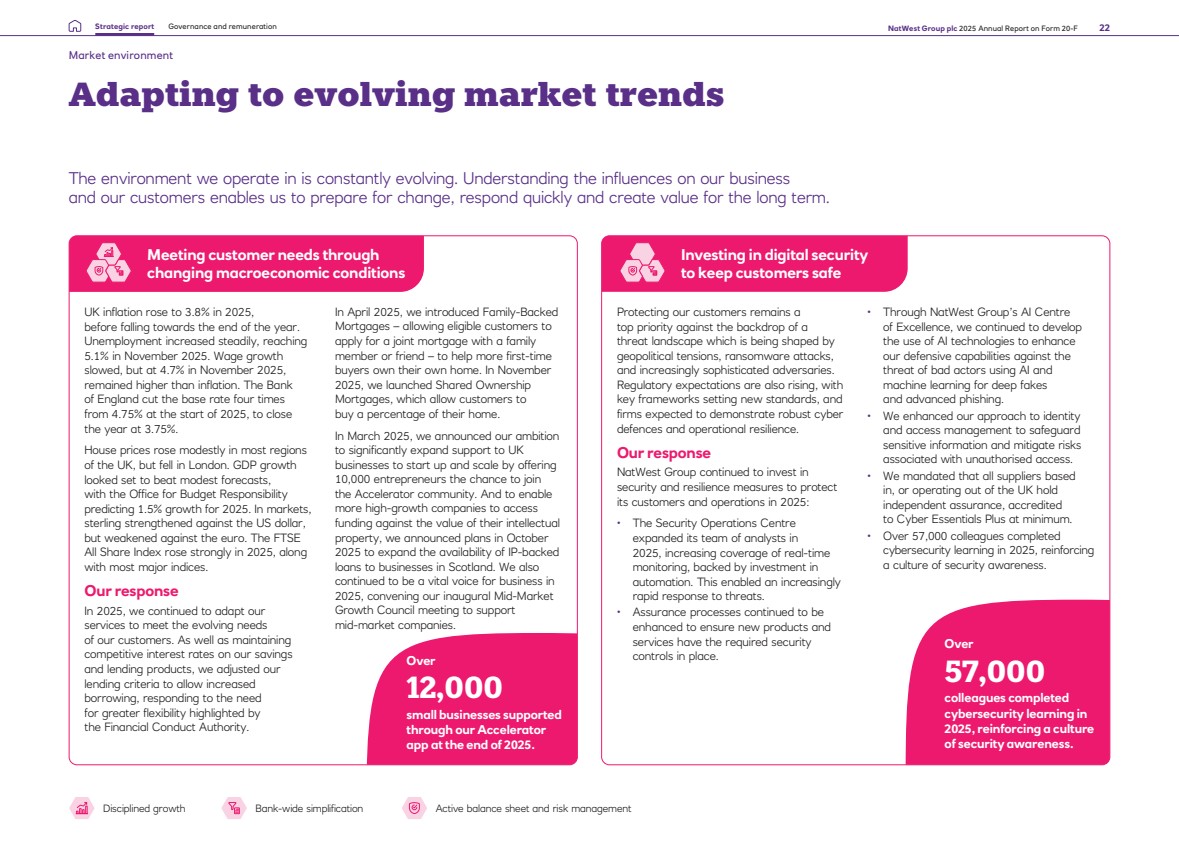
| Market environment Adapting to evolving market trends The environment we operate in is constantly evolving. Understanding the influences on our business and our customers enables us to prepare for change, respond quickly and create value for the long term. Disciplined growth Bank-wide simplification Active balance sheet and risk management Investing in digital security to keep customers safe Protecting our customers remains a top priority against the backdrop of a threat landscape which is being shaped by geopolitical tensions, ransomware attacks, and increasingly sophisticated adversaries. Regulatory expectations are also rising, with key frameworks setting new standards, and firms expected to demonstrate robust cyber defences and operational resilience. Our response NatWest Group continued to invest in security and resilience measures to protect its customers and operations in 2025: • The Security Operations Centre expanded its team of analysts in 2025, increasing coverage of real-time monitoring, backed by investment in automation. This enabled an increasingly rapid response to threats. • Assurance processes continued to be enhanced to ensure new products and services have the required security controls in place. Over 57,000 colleagues completed cybersecurity learning in 2025, reinforcing a culture of security awareness. UK inflation rose to 3.8% in 2025, before falling towards the end of the year. Unemployment increased steadily, reaching 5.1% in November 2025. Wage growth slowed, but at 4.7% in November 2025, remained higher than inflation. The Bank of England cut the base rate four times from 4.75% at the start of 2025, to close the year at 3.75%. House prices rose modestly in most regions of the UK, but fell in London. GDP growth looked set to beat modest forecasts, with the Office for Budget Responsibility predicting 1.5% growth for 2025. In markets, sterling strengthened against the US dollar, but weakened against the euro. The FTSE All Share Index rose strongly in 2025, along with most major indices. Our response In 2025, we continued to adapt our services to meet the evolving needs of our customers. As well as maintaining competitive interest rates on our savings and lending products, we adjusted our lending criteria to allow increased borrowing, responding to the need for greater flexibility highlighted by the Financial Conduct Authority. Meeting customer needs through changing macroeconomic conditions Over 12,000 small businesses supported through our Accelerator app at the end of 2025. In April 2025, we introduced Family-Backed Mortgages – allowing eligible customers to apply for a joint mortgage with a family member or friend – to help more first-time buyers own their own home. In November 2025, we launched Shared Ownership Mortgages, which allow customers to buy a percentage of their home. In March 2025, we announced our ambition to significantly expand support to UK businesses to start up and scale by offering 10,000 entrepreneurs the chance to join the Accelerator community. And to enable more high-growth companies to access funding against the value of their intellectual property, we announced plans in October 2025 to expand the availability of IP-backed loans to businesses in Scotland. We also continued to be a vital voice for business in 2025, convening our inaugural Mid-Market Growth Council meeting to support mid-market companies. • Through NatWest Group’s AI Centre of Excellence, we continued to develop the use of AI technologies to enhance our defensive capabilities against the threat of bad actors using AI and machine learning for deep fakes and advanced phishing. • We enhanced our approach to identity and access management to safeguard sensitive information and mitigate risks associated with unauthorised access. • We mandated that all suppliers based in, or operating out of the UK hold independent assurance, accredited to Cyber Essentials Plus at minimum. • Over 57,000 colleagues completed cybersecurity learning in 2025, reinforcing a culture of security awareness. Strategic report Financial review Governance and remuneration Risk and capital management Financial statements Additional information NatWest Group plc 2025 Annual Report and Accounts 22 Disciplined growth Bank-wide simplification Active balance sheet and risk management Market environment continued We have an ambition to be net zero across our financed emissions, assets under management and operational value chain by 2050. This is aligned with the UK’s legal obligation to be net zero by 2050. We continue to focus on supporting our customers’ transition and our own ambitions to be net zero. Achieving our climate-related ambitions and targets is dependent on a range of factors, including timely and appropriate government policy, technology developments, and on suppliers, customers and society supporting the transition. Our response We’re focused on supporting customers’ climate transitions by providing products, tools and insights that help them reduce emissions, build resilience and access sustainable finance opportunities. Our ambition is to be net zero across our financed emissions, assets under management and operational value chain by 2050. This is aligned with the UK’s legal obligation to be net zero by 2050. Our climate transition plan is embedded within our financial planning process, ensuring climate-related risks and opportunities inform strategic decisions. Responding to climate-related risks and opportunities The financial services industry is undergoing rapid transformation, driven by accelerated advancements in generative AI, digital technology and data capabilities. These changes are reshaping business models, customer expectations, and risk landscapes. Our response NatWest Group is aiming to be a trusted leader in AI-enabled financial services, investing in AI at scale and modernising our digital services: • We’re transforming our data estate to provide a single view of each customer and better anticipate customers’ needs. We have formed strategic partnerships to help us build a centralised, AI-powered data platform, empowering colleagues, and enabling real-time customer engagement. • We’ve embedded AI in our customer journeys to improve the customer experience. AI tools, such as Cora, our virtual assistant, are improving timeliness and quality of responses to customers, and AI has reduced complaints handling time by c.19 minutes per case, saving the equivalent of over 22,000 hours in 2025. • We use AI to aid in the detection and prevention of fraud and financial crime, with innovations like Tunic Pay enhancing risk assessment and customer protection. • We’ve set ourselves standards for responsible AI with our AI and Data Ethics Code of Conduct. In 2025, we rolled out AI tools including GitLab Duo and Microsoft Copilot to colleagues to help meet customer needs safely and responsibly. Scaling our capabilities in technology We operate in a highly-regulated market that continues to evolve. Regulatory focus is currently centred on changes needed to deliver the UK Government’s plans for economic growth. We remain involved in work to shape and implement post-financial crisis prudential measures, through the Basel 3.1 Framework, and helping to drive reforms to deliver a more robust regulatory landscape. Our response We constantly monitor regulatory change and work with regulators to help shape developments that materially impact the bank, responding either bilaterally or in partnership with one of our industry bodies. We implement new regulatory requirements where applicable and engage frequently with regulators to discuss their priorities. Focus areas in 2025 included: • Capital and liquidity management, including the UK’s approach to the implementation of Basel 3.1. • Working with the FCA to define a new targeted support model to narrow the gap between generic guidance and affordable financial advice. • Supporting the regulator’s plans to modernise the UK redress system and the role of the Financial Ombudsman Service in customer disputes. • Influencing the strategic direction of the UK payments network. Focusing on a rapidly evolving regulatory landscape Strategic partnerships with global technology leaders, including AWS, OpenAI and Google. Engagement with 37 regulatory consultations. Climate and sustainable funding and financing provided between 1 July 2021 and 30 June 2025. £110.3 bn Strategic report Strategic report Governance and remuneration Financial review Governance and remuneration Risk and capital management Financial statements Additional information NatWest Group plc NatWest Group plc 2025 Annual Report and Accounts 2025 Annual Report on Form 20-F 2323 (1) Climate and sustainable funding and financing and climate and transition finance represent only a relatively small proportion of our overall funding, financing and facilitation activities. (2) The guidance, targets, expectations, and trends discussed in this section represent NatWest Group plc management’s current expectations and are subject to change, including as a result of the factors described in the Risk Factors section of the 2025 Annual Report on Form 20-F. These statements constitute forward-looking statements. Refer to Forward-looking statements in the 2025 Annual Report on Form 20-F. In July 2025, we set a new target(2) to provide £200 billion in climate and transition finance between 1 July 2025 and the end of 2030. Our climate and transition finance framework has replaced the climate and sustainable funding and financing framework which underpinned our previous £100 billion target, which was exceeded in Q1 2025. (1) |
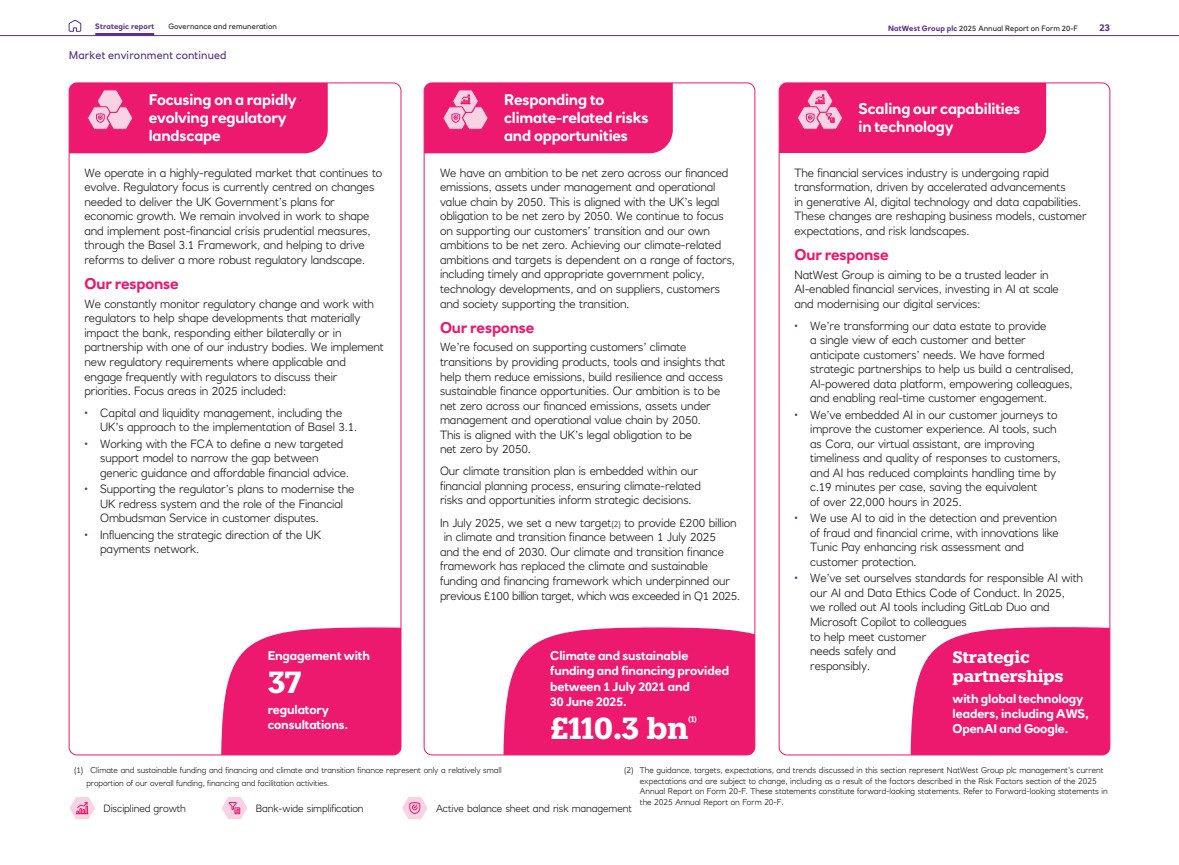
| With 46% of UK adults lacking financial confidence (according to the MoneyView 2025 report), NatWest Group recognises the need for simple, practical support to improve financial wellbeing across the country. Financial Foundations is NatWest Group’s free financial wellbeing programme, delivered largely by Retail Banking colleagues trained to provide impartial guidance and encourage open conversations about money management. Built around interactive workshops, the programme offers practical help to businesses, charities and community groups, whether they bank with NatWest or not. In 2025, more than 1,500 workshops reached almost 31,000 people, helping attendees build budgeting skills, understand fraud risks and improve their financial resilience. Our impact 90% feel more confident about managing/ protecting their finances since the workshop. Participants leave with tools to take action and 92% would recommend the workshops. 93% feel they learnt things about better managing money. Birmingham financial confidence Case study – helping people manage their money Gurpreet Kaur Sohal, Manager, Walsall Branch (left) and Atli Coakley (right) Succeeding with customers ‘The workshop made a real difference. Hearing others share their experiences and receive practical guidance helped me understand where I could make small changes, and I left feeling much more confident and in control.’ Atli Coakley, Regional Account Manager, Portico Building Strategic report Strategic report Governance and remuneration Financial review Governance and remuneration Risk and capital management Financial statements Additional information NatWest Group plc NatWest Group plc 2025 Annual Report and Accounts 2025 Annual Report on Form 20-F 2424 |
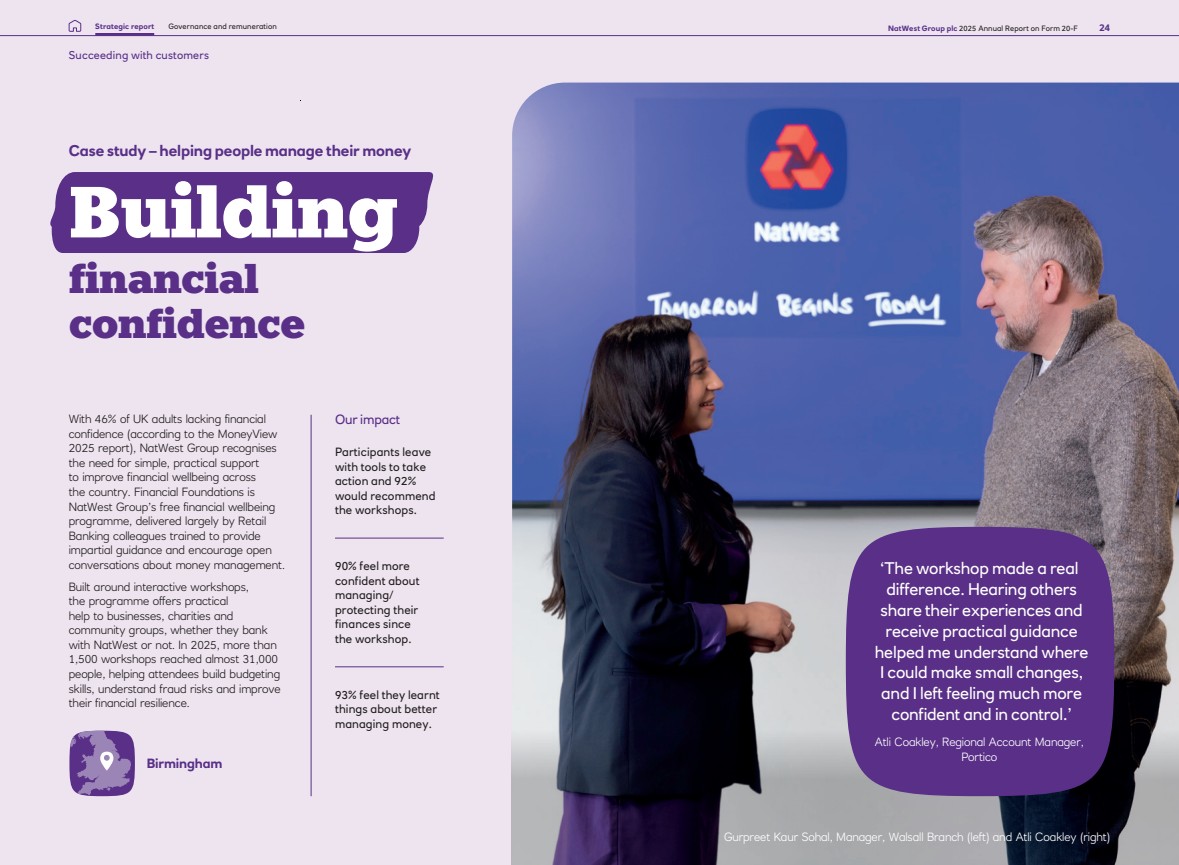
| With 46% of UK adults lacking financial confidence (according to the MoneyView 2025 report), NatWest Group recognises the need for simple, practical support to improve financial wellbeing across the country. Financial Foundations is NatWest Group’s free financial wellbeing programme, delivered largely by Retail Banking colleagues trained to provide impartial guidance and encourage open conversations about money management. Built around interactive workshops, the programme offers practical help to businesses, charities and community groups, whether they bank with NatWest or not. In 2025, more than 1,500 workshops reached almost 31,000 people, helping attendees build budgeting skills, understand fraud risks and improve their financial resilience. Our impact 90% feel more confident about managing/ protecting their finances since the workshop. Participants leave with tools to take action and 92% would recommend the workshops. 93% feel they learnt things about better managing money. Birmingham financial confidence Case study – helping people manage their money Gurpreet Kaur Sohal, Manager, Walsall Branch (left) and Atli Coakley (right) Succeeding with customers ‘The workshop made a real difference. Hearing others share their experiences and receive practical guidance helped me understand where I could make small changes, and I left feeling much more confident and in control.’ Atli Coakley, Regional Account Manager, Portico Building Strategic report Financial review Governance and remuneration Risk and capital management Financial statements Additional information NatWest Group plc 2025 Annual Report and Accounts 24 Retail Banking Business performance review In Retail Banking, our aim is to be our customers’ trusted partner as we make banking simpler and more personal. We are here to succeed with our 19 million customers in the moments that matter – from helping with first savings goals and buying a home, to building financial confidence and helping people and families with planning for their future. We are combining national reach with the local expertise of our colleagues to help people across the UK make real progress with their financial ambitions. Our focus in 2025 We continued to grow our customer base and deepen our engagement with a focus on youth, families and affluent. Our Youth proposition enjoyed another year of strong performance, achieving 5% growth; Rooster Money, which empowers young people and families to build healthy financial habits, is now serving 15 times more customers than when we first acquired the company. Retention of our younger customers, as they move into adulthood, remained strong at 97%, reflecting the trust built through early engagement. And among families, we supported one in three UK households with their financial needs – both for the everyday and the bigger life moments. In 2025, we also welcomed around one million customer accounts from Sainsbury’s Bank into NatWest Group, who accessed over 27,000 additional products in the first two months post integration. Making it easier to manage money Helping customers achieve their goals Supporting customers’ long-term financial wellbeing remained a priority. We delivered more than 307,000 Financial Health Checks with tailored guidance on budgeting and planning ahead. NatWest colleagues also ran over 1,500 Financial Foundations workshops, supporting 31,000 people to help strengthen their financial resilience. And through NatWest Thrive, our youth education programme, we reached over one million young people across the UK in 2025. ‘We combine the best of our technology with the magic of our people to deepen connection and engagement with our customers. We continue to attract customers by being there in the moments that matter, with the experience and expertise they need.’ Solange Chamberlain, CEO, Retail Banking Financial highlights Net loans to customers £216.1bn 2024: £208.4bn Total income £6,495m 2024: £5,650m Customer deposits £202.6bn 2024: £194.8bn Return on equity 24.7% 2024: 19.9% Operating profit £3,121m 2024: £2,431m Risk-weighted assets £68.5bn 2024: £65.5bn Strategic report Strategic report Governance and remuneration Financial review Governance and remuneration Risk and capital management Financial statements Additional information NatWest Group plc NatWest Group plc 2025 Annual Report and Accounts 2025 Annual Report on Form 20-F 2525 Our customers continued to embrace digital banking as their preferred way to manage their everyday finances, with 81.8%(1) of our customers banking entirely digitally in 2025. Across our customer base, digital engagement continued to grow with 325 million interactions per month and customers logging into the app more than 30 times on average monthly. As a result, 97% of all our customers’ needs were met through digital channels. Our mobile app is designed to make money management clear and intuitive. Our Spending and Budget Tracker, Savings Pot feature, Virtual Cards and Subscription Tools were used millions of times each month in 2025. Alongside our digital banking tools, colleagues supported customers through more than 1,100 points of physical presence, providing personal guidance and support. We served around 1.2 million affluent customers, of which almost half were served via our Premier proposition, broadening our reach and engagement with these customers. (1) Retail Banking customers with active current accounts that have accessed a digital platform (online or mobile) and not used the branch or telephony in a rolling 90 days in the reporting period. Inactive customers and customers with no channel usage, mortgages and savings accounts, and interactions via the Post Office are excluded from the scope of measurement. |
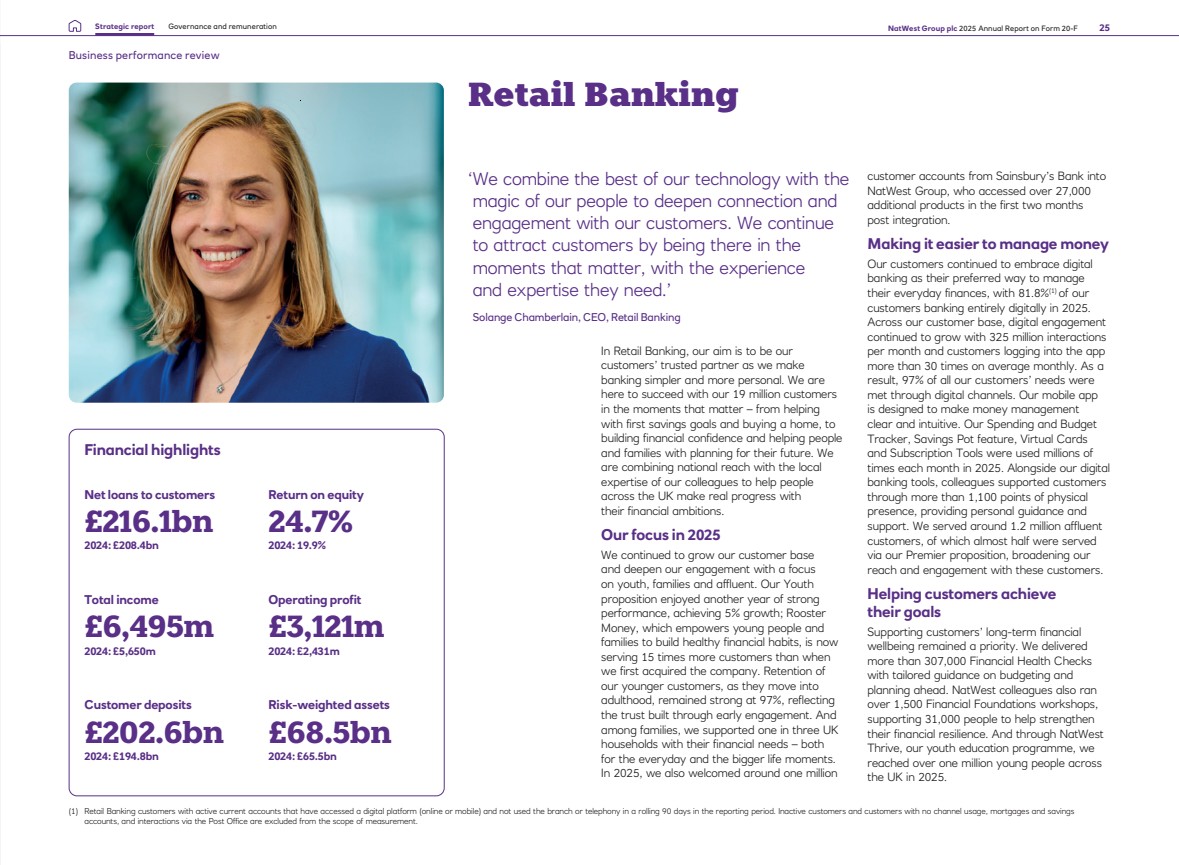
| Business performance review continued We also worked to simplify borrowing so customers can access credit confidently. Around 99% of loan applications are now completed digitally. Credit card market share has increased by one percentage point to 11%, supported by the balances acquired from Sainsbury’s Bank. Expanding our offering to whole of market and strengthening our presence across aggregator sites, attracted over 700,000 new customers since launch. More than 60% of customers accessed Know Your Credit Score to help them take control of their credit health, and over 3.5 million spending insights were delivered to our customers. Helping customers to save, invest and manage their money remained central to us being their trusted partner. Competitive savings products and simple in-app journeys led to 1.3 million new savings accounts being opened in 2025. Our investment proposition also expanded, with more than 170,000 Retail Banking customers investing through NatWest Invest. We supported more people on their journey to owning a new home in 2025. We helped 50,000 first-time buyers onto the property ladder, with our new Family-Backed Mortgage and Shared Ownership options opening the door for many who would have otherwise struggled to buy alone. And we made the home-buying journey faster, with average application times reduced by 30%. We also expanded access to buy-to-let mortgages through a new strategic partnership with Landbay delivering solutions for landlords and investors operating through limited companies. Simplifying processes to provide better customer experiences We simplified our technology estate, and improved our ability to scale, by moving to a single online banking platform. Our mortgage platform improvements reduced the time required to change the rate we offer customers to two days at the end of 2025. In addition, new deployment capabilities allowed us to release banking app changes as soon as they are ready, rather than monthly. We have also reduced legacy telephony systems so that customers experience a more reliable, consistent service every time they bank with us. In 2025, we launched our real-time fraud self-service, allowing customers to take immediate, informed action to protect themselves, giving them greater peace of mind and reducing call volumes. This helped lift our fraud Net Promoter Score® (NPS) to +60 and reduced fraud-related call volumes by around half. Our overall fraud-prevention performance remained sector-leading, and we continued to rank first among UK banks in the Payment Systems Regulator league tables. Customers’ expectations continue to evolve at pace and we are using AI to create a more connected, agile, and personalised experience for our customers. Cora, our virtual assistant, handled millions of conversations each month, giving customers quick, easy access to help whenever they needed it. We are also leveraging AI to remove complexity for colleagues, saving over 70,000 hours through automated call and chat summaries and another 17,500 hours through faster, high-quality complaint responses. Colleagues completed over 20,000 hours of AI learning in 2025 and more than 12,000 engineers bankwide now have access to AI coding assistants, supporting efficiency and faster feature deployment. Our priorities for 2026 Our ambition is to help customers build financial confidence and achieve their goals with greater certainty. We aim to grow by deepening relationships across youth, families and affluent segments. As part of this, we have made a £10 billion commitment to support first-time buyers in 2026. We plan to grow Premier Banking customers to one million and treble the number of Retail Banking customers investing with us from 170,000 to over 500,000. We plan to invest in modern, intuitive digital experiences alongside our national and local presence to deliver a simpler, smarter, and more personalised banking experience, reducing our cost:income ratio below 40% by 2028. Spotlight Helping families open doors: NatWest Group’s innovative mortgage solution NatWest Group remains committed to responsible lending, aiming to help more people achieve home ownership with confidence and security. To support first-time buyers in entering the property market sooner, NatWest Group launched the Family-Backed Mortgage in April 2025, with over £300 million of lending delivered by December 2025. This product allows eligible customers to apply for a joint mortgage with a family member or friend while retaining sole ownership of the home. Known as a Joint Borrower Sole Proprietor (JBSP) mortgage, it combines the incomes of both parties, increasing the borrower’s capacity to secure a larger mortgage. Notably, the Family-Backed Mortgage doesn’t require the non-owner to contribute a deposit or hold any ownership rights. We believe this is another innovative way in which we have responded to the needs of our customers, creating new pathways to home ownership and supporting a 1.9 percentage-point year-on-year increase in our share of the first-time buyer new business market. Strategic report Strategic report Governance and remuneration Financial review Governance and remuneration Risk and capital management Financial statements Additional information NatWest Group plc NatWest Group plc 2025 Annual Report and Accounts 2025 Annual Report on Form 20-F 2626 |
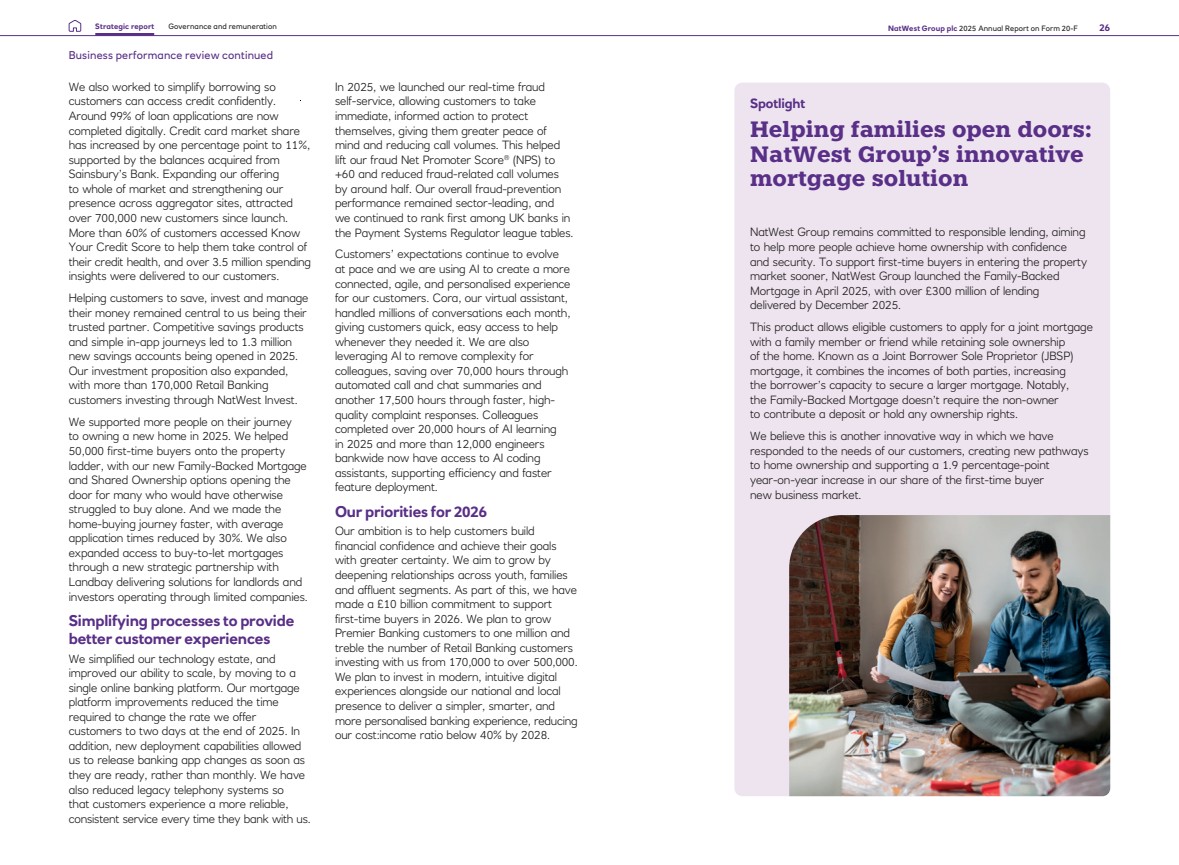
| Business performance review continued We also worked to simplify borrowing so customers can access credit confidently. Around 99% of loan applications are now completed digitally. Credit card market share has increased by one percentage point to 11%, supported by the balances acquired from Sainsbury’s Bank. Expanding our offering to whole of market and strengthening our presence across aggregator sites, attracted over 700,000 new customers since launch. More than 60% of customers accessed Know Your Credit Score to help them take control of their credit health, and over 3.5 million spending insights were delivered to our customers. Helping customers to save, invest and manage their money remained central to us being their trusted partner. Competitive savings products and simple in-app journeys led to 1.3 million new savings accounts being opened in 2025. Our investment proposition also expanded, with more than 170,000 Retail Banking customers investing through NatWest Invest. We supported more people on their journey to owning a new home in 2025. We helped 50,000 first-time buyers onto the property ladder, with our new Family-Backed Mortgage and Shared Ownership options opening the door for many who would have otherwise struggled to buy alone. And we made the home-buying journey faster, with average application times reduced by 30%. We also expanded access to buy-to-let mortgages through a new strategic partnership with Landbay delivering solutions for landlords and investors operating through limited companies. Simplifying processes to provide better customer experiences We simplified our technology estate, and improved our ability to scale, by moving to a single online banking platform. Our mortgage platform improvements reduced the time required to change the rate we offer customers to two days at the end of 2025. In addition, new deployment capabilities allowed us to release banking app changes as soon as they are ready, rather than monthly. We have also reduced legacy telephony systems so that customers experience a more reliable, consistent service every time they bank with us. In 2025, we launched our real-time fraud self-service, allowing customers to take immediate, informed action to protect themselves, giving them greater peace of mind and reducing call volumes. This helped lift our fraud Net Promoter Score® (NPS) to +60 and reduced fraud-related call volumes by around half. Our overall fraud-prevention performance remained sector-leading, and we continued to rank first among UK banks in the Payment Systems Regulator league tables. Customers’ expectations continue to evolve at pace and we are using AI to create a more connected, agile, and personalised experience for our customers. Cora, our virtual assistant, handled millions of conversations each month, giving customers quick, easy access to help whenever they needed it. We are also leveraging AI to remove complexity for colleagues, saving over 70,000 hours through automated call and chat summaries and another 17,500 hours through faster, high-quality complaint responses. Colleagues completed over 20,000 hours of AI learning in 2025 and more than 12,000 engineers bankwide now have access to AI coding assistants, supporting efficiency and faster feature deployment. Our priorities for 2026 Our ambition is to help customers build financial confidence and achieve their goals with greater certainty. We aim to grow by deepening relationships across youth, families and affluent segments. As part of this, we have made a £10 billion commitment to support first-time buyers in 2026. We plan to grow Premier Banking customers to one million and treble the number of Retail Banking customers investing with us from 170,000 to over 500,000. We plan to invest in modern, intuitive digital experiences alongside our national and local presence to deliver a simpler, smarter, and more personalised banking experience, reducing our cost:income ratio below 40% by 2028. Spotlight Helping families open doors: NatWest Group’s innovative mortgage solution NatWest Group remains committed to responsible lending, aiming to help more people achieve home ownership with confidence and security. To support first-time buyers in entering the property market sooner, NatWest Group launched the Family-Backed Mortgage in April 2025, with over £300 million of lending delivered by December 2025. This product allows eligible customers to apply for a joint mortgage with a family member or friend while retaining sole ownership of the home. Known as a Joint Borrower Sole Proprietor (JBSP) mortgage, it combines the incomes of both parties, increasing the borrower’s capacity to secure a larger mortgage. Notably, the Family-Backed Mortgage doesn’t require the non-owner to contribute a deposit or hold any ownership rights. We believe this is another innovative way in which we have responded to the needs of our customers, creating new pathways to home ownership and supporting a 1.9 percentage-point year-on-year increase in our share of the first-time buyer new business market. Strategic report Financial review Governance and remuneration Risk and capital management Financial statements Additional information NatWest Group plc 2025 Annual Report and Accounts 26 Succeeding with customers trusted customer relationships Case study – helping people manage their money Building When Olympic boxing medallist Lewis Richardson reached out to NatWest Group at the start of his professional career, colleagues from the Business Banking and Premier Banking team worked with him to understand his unique requirements. From assisting Lewis to swiftly open a Business Banking account before his first professional fight, to explaining the full range of benefits of Premier Banking, NatWest Group is helping this professional athlete to turn his possibilities into progress. Now, with a dedicated team behind him and tailored financial planning support, Lewis confidently focuses on his boxing career, knowing NatWest Group is a trusted partner in his financial journey. Our impact Dedicated business relationship manager support. Rapid Business Banking account opening. Access to the full range of Premier Banking products and investment advice. Colchester Tara Cusack, NatWest Group Premier Banking Manager (left) and Lewis Richardson (right) ‘I’ve never felt in a better place with my banking. The support from NatWest feels too good to be true. They really understand me, my career, and the financial challenges that come with my profession’. Lewis Richardson, Olympic medallist and professional boxer Strategic report Strategic report Governance and remuneration Financial review Governance and remuneration Risk and capital management Financial statements Additional information NatWest Group plc NatWest Group plc 2025 Annual Report and Accounts 2025 Annual Report on Form 20-F 2727 |

| Business performance review continued Financial highlights Total income £1,131m 2024: £969m Customer deposits £42.7bn 2024: £42.4bn Net loans to customers £18.9bn 2024: £18.2bn Return on equity 21.7% 2024: 14.2% Operating profit £394m 2024: £264m AUMA £58.5bn 2024: £48.9bn Private Banking & Wealth Management ‘In 2025, we built on our foundations for sustainable growth and set clear strategic priorities. Our clients remain at the heart of everything we do, and we aim to deepen our relationships with them every day across banking, lending, financial planning and investment management.’ Emma Crystal, CEO, Private Banking & Wealth Management With over 330 years of experience in Private Banking & Wealth Management, Coutts serves UK-connected high and ultra-high-net-worth individuals and their business interests. Our comprehensive suite of services and products – including banking, lending and wealth management – are tailored to meet the diverse needs of our clients. In addition, through our investment products and services we meet the needs of customers across NatWest Group. Our focus and highlights in 2025 In 2025, we continued to be a trusted partner for our clients. We managed £119.0 billion in customer assets and liabilities (CAL), growing balances by £10.5 billion during 2025. At the end of 2025, we delivered a return on equity of 21.7% and registered a two-point increase in our Net Promoter Score® (NPS) which rose to +50, underscoring the strength of our client relationships and the value we create. In 2025, we announced our ambition to be the UK’s number one chosen partner for Private Banking & Wealth Management. We developed and implemented a more personalised and structured engagement model, ensuring each client has an experience which best meets their needs. We also announced our refreshed fee structure and enhanced our technical infrastructure to support this. Our strong relationships with the Retail Banking and Commercial & Institutional business segments continue to deepen, allowing us to offer the best of NatWest Group to eligible clients. Throughout 2025, we deepened relationships with clients through proactive engagement, including support around market uncertainty. Our investment offering delivered strong growth in 2025 as assets under management and administration (AUMA) increased by £9.6 billion, including £4.6 billion AUMA net inflows, to £58.5 billion, which forms 49% of our customer assets and liabilities. Our clients’ digital experience also continues to improve – for example, through enhanced investment reporting in our mobile app which allows clients to more easily view their accounts and returns over time – and is evidenced by our mobile NPS, which rose to +54 at the end of 2025. Putting technology to work for clients Simplifying our business to deliver efficiencies and promote sustainable growth remains a priority. We have commenced the transfer of our technology operations and digital engineering to alternative locations to optimise costs whilst retaining our operating system expertise where we find the highest level of specialist knowledge. Our newly launched client engagement workflow tool will significantly reduce the time taken to provide clients with straightforward advice. Strategic report Strategic report Governance and remuneration Financial review Governance and remuneration Risk and capital management Financial statements Additional information NatWest Group plc NatWest Group plc 2025 Annual Report and Accounts 2025 Annual Report on Form 20-F 2828 |
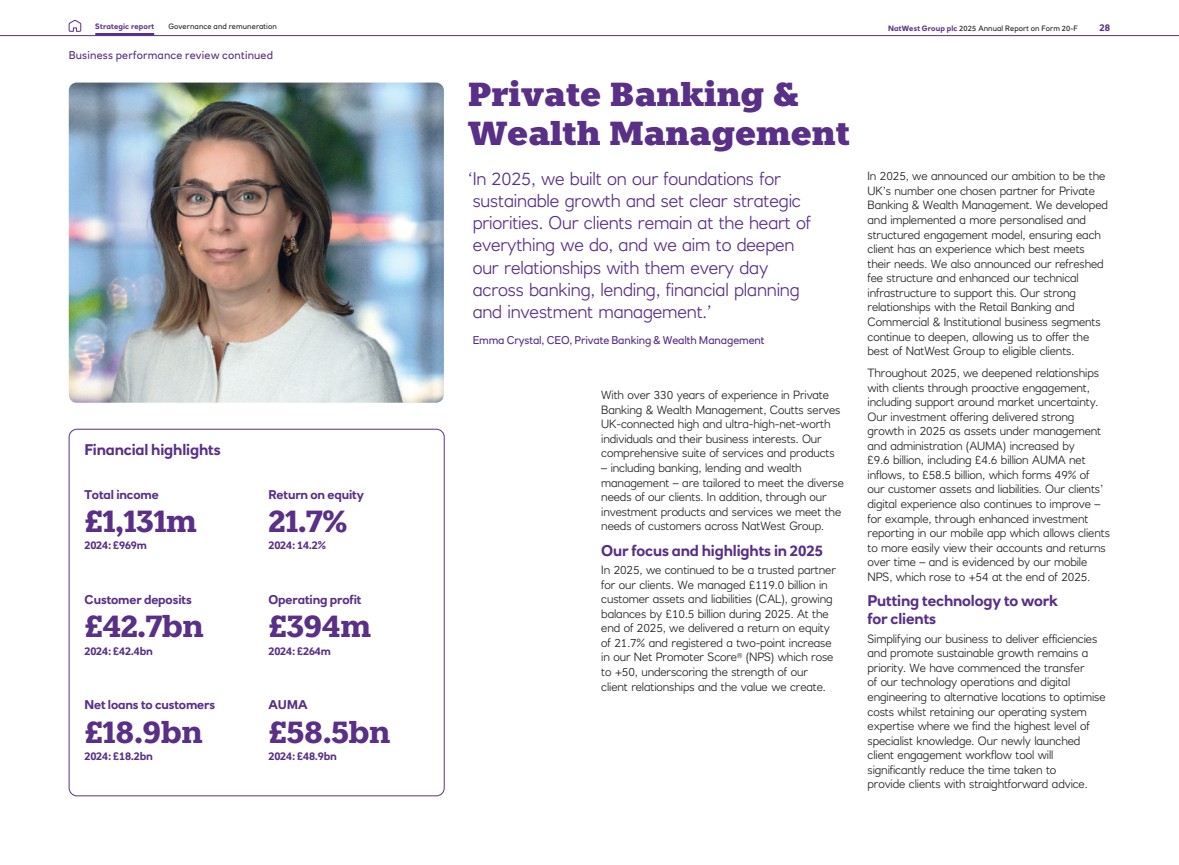
| Business performance review continued Financial highlights Total income £1,131m 2024: £969m Customer deposits £42.7bn 2024: £42.4bn Net loans to customers £18.9bn 2024: £18.2bn Return on equity 21.7% 2024: 14.2% Operating profit £394m 2024: £264m AUMA £58.5bn 2024: £48.9bn Private Banking & Wealth Management ‘In 2025, we built on our foundations for sustainable growth and set clear strategic priorities. Our clients remain at the heart of everything we do, and we aim to deepen our relationships with them every day across banking, lending, financial planning and investment management.’ Emma Crystal, CEO, Private Banking & Wealth Management With over 330 years of experience in Private Banking & Wealth Management, Coutts serves UK-connected high and ultra-high-net-worth individuals and their business interests. Our comprehensive suite of services and products – including banking, lending and wealth management – are tailored to meet the diverse needs of our clients. In addition, through our investment products and services we meet the needs of customers across NatWest Group. Our focus and highlights in 2025 In 2025, we continued to be a trusted partner for our clients. We managed £119.0 billion in customer assets and liabilities (CAL), growing balances by £10.5 billion during 2025. At the end of 2025, we delivered a return on equity of 21.7% and registered a two-point increase in our Net Promoter Score® (NPS) which rose to +50, underscoring the strength of our client relationships and the value we create. In 2025, we announced our ambition to be the UK’s number one chosen partner for Private Banking & Wealth Management. We developed and implemented a more personalised and structured engagement model, ensuring each client has an experience which best meets their needs. We also announced our refreshed fee structure and enhanced our technical infrastructure to support this. Our strong relationships with the Retail Banking and Commercial & Institutional business segments continue to deepen, allowing us to offer the best of NatWest Group to eligible clients. Throughout 2025, we deepened relationships with clients through proactive engagement, including support around market uncertainty. Our investment offering delivered strong growth in 2025 as assets under management and administration (AUMA) increased by £9.6 billion, including £4.6 billion AUMA net inflows, to £58.5 billion, which forms 49% of our customer assets and liabilities. Our clients’ digital experience also continues to improve – for example, through enhanced investment reporting in our mobile app which allows clients to more easily view their accounts and returns over time – and is evidenced by our mobile NPS, which rose to +54 at the end of 2025. Putting technology to work for clients Simplifying our business to deliver efficiencies and promote sustainable growth remains a priority. We have commenced the transfer of our technology operations and digital engineering to alternative locations to optimise costs whilst retaining our operating system expertise where we find the highest level of specialist knowledge. Our newly launched client engagement workflow tool will significantly reduce the time taken to provide clients with straightforward advice. Strategic report Financial review Governance and remuneration Risk and capital management Financial statements Additional information NatWest Group plc 2025 Annual Report and Accounts 28 Business performance review continued Additionally, the implementation of AI tools has delivered notable efficiencies. For example, by reducing call summarisation time by more than 70% we have been able to increase the amount of time spent speaking to our clients. Enhancements to our client journeys in 2025 have created a smoother experience, including streamlining our digital mortgage switch journey, which has supported a nine percentage-point increase in mortgage retention since 2024. Investing for the future Simplifying our business In December 2025, we announced an agreement for the sale of our majority stake in Cushon, a workplace savings and pensions FinTech. This transaction is consistent with our strategic priorities, as we focus on delivering disciplined growth across NatWest Group, while simplifying our bank and actively managing our balance sheet to deliver attractive returns. The sale is expected to complete in the first half of 2026, subject to regulatory approval. Cushon represents £4.0 billion of assets under administration (AUA) as at the end of 2025. Our priorities for 2026 In 2026, we aim to deepen relationships with clients by further enhancing our proposition, with an emphasis on transforming how we meet our clients’ investment needs, including developing our digital propositions for customers across NatWest Group. We plan to continue to simplify our operational foundations for scalable growth, investing in technology which further improves our capabilities to enhance the client experience and support our colleagues. We’ll look to expand our business development pipeline, using the existing network of prospective clients across NatWest Group. This includes supporting Retail Banking to achieve its goal of trebling the number of customers investing with us, and offering a personalised experience to help customers achieve their financial goals. This will continue to be enabled through responsible and sustainable balance sheet and risk management, alongside diversification of income. We remain committed to achieving the 2027 targets shared at our 2025 investor spotlight event. These include intensifying our focus on UK-connected high and ultra-high-net-worth clients, both new and existing, and to increase the number of clients with £3 million+ CAL by around 20%(2). In addition, we’ll aim to treble the number of Commercial & Institutional customer referrals, and broaden and enhance our investment management proposition for our clients, as well as further extending it to customers across NatWest Group. (1) Climate and sustainable funding and financing and climate and transition finance represent only a relatively small proportion of our overall funding, financing and facilitation activities. (2) Excluding impact of Evelyn Partners acquisition. Spotlight Coutts website relaunch: improving the customer experience This incorporated its refreshed brand and visual identity as well as enhanced functionality to improve user experience, resulting in a 128% increase in overall site accessibility and usability. Site security and usability were prioritised, with a new client log-in process and a redesigned insights section – the latter providing access to much richer content, including our new programme of investment and wealth planning insights, and thought leadership. The new site has resonated well with clients, evidenced by the average browsing time for content more than doubling. In the first four weeks after launch, monthly visits were up 41%, and 79% of clients that we surveyed responded that they love the new look and feel, layout and navigation of the website. Strategic report Strategic report Governance and remuneration Financial review Governance and remuneration Risk and capital management Financial statements Additional information NatWest Group plc NatWest Group plc 2025 Annual Report and Accounts 2025 Annual Report on Form 20-F 2929 Our ambition for our financed emissions and assets under management to be net zero by 2050 is dependent on external factors. We have continued to support our clients with £196 million of climate and sustainable funding and financing(1) during the first half of 2025 and £199 million climate and transition finance(1) in the second half of 2025. For investments, 50% of our managed assets were considered portfolio aligned as at 31 December 2025. In 2025, we reviewed our responsible investing approach, including our climate ambitions, to ensure alignment with customer needs and market standards. Following the review, we have withdrawn portfolio alignment from our entity level 2030 ambitions, recognising a lack of market consensus on how to define portfolio alignment within a wealth management context. We have retained our 2030 Weighted Average Carbon Intensity (WACI) ambition, which reflects market best practice and continues to provide a standardised measure through which we can monitor progress towards our net zero by 2050 ambition. Coutts relaunched its website in November 2025. |
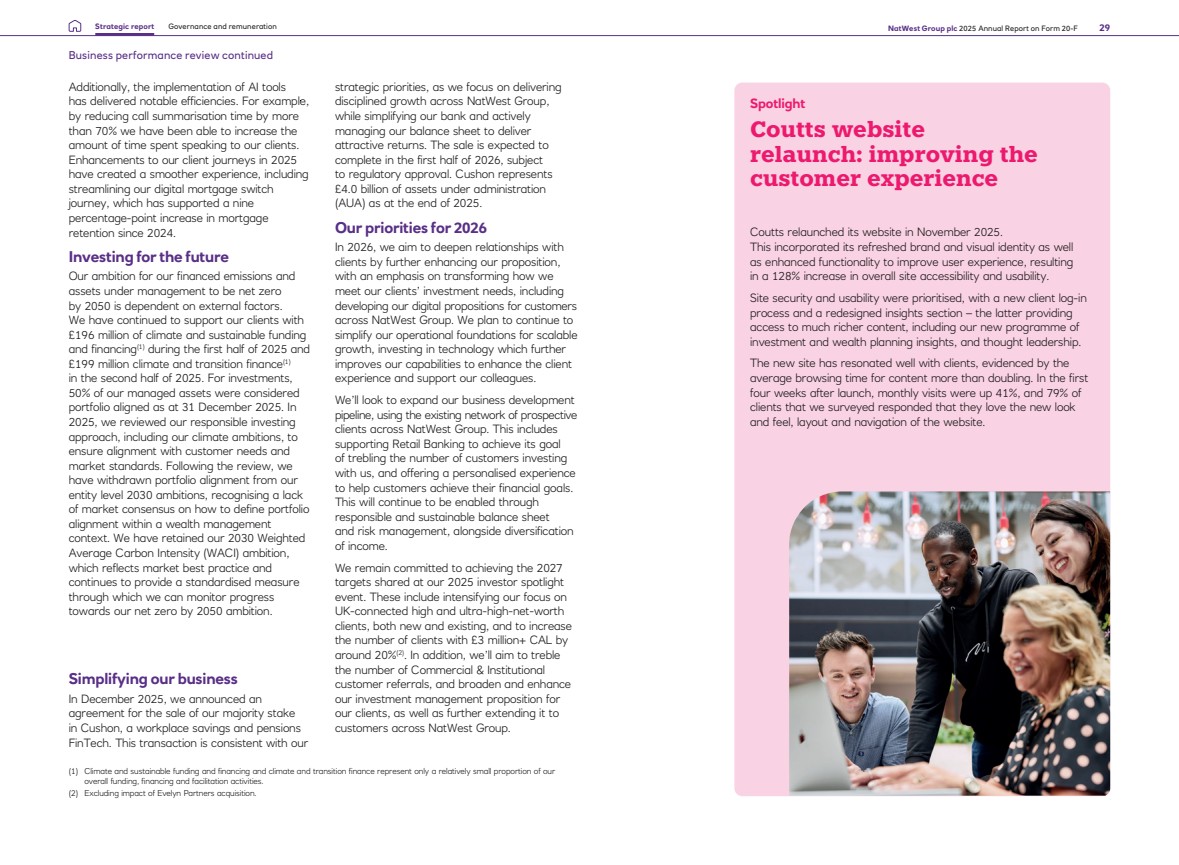
| NatWest Group supported Be.EV – a fast-growing, mid-market electric vehicle (EV) charging network – by using our extensive infrastructure roll out experience to tailor a flexible financing solution. Acting as one of two lenders and the sole UK bank, NatWest Group financed Be.EV’s capital expenditure to deploy around 600 new charge points across the country. With teams in London and Manchester, we provided comprehensive services including interest rate hedging, agency and security trustee roles, and transactional banking. Beyond funding, NatWest Group offered guidance on business planning, operational controls, and future refinancing, establishing ourselves as a trusted partner supporting Be.EV’s growth and long-term success. Our impact Financing the roll out of around 600 new EV charge points. Guidance in establishing a bankable business plan. Funding for critical sectors within the UK economy. Manchester growth in the UK’s EV infrastructure Case study – supporting balanced UK growth Powering Madeleine Mullane, Vice President, NatWest Group Structured Finance team (left) and Asif Ghafoor (right) ‘The support from NatWest has been very important for Be.EV. At this early stage of the company’s growth, we want to work with a banking partner that can adapt and evolve as we’re evolving. Thanks to the financing we’ve received, we’ve been able to roll out charging infrastructure rapidly across the UK.’ Asif Ghafoor, CEO, Be.EV Succeeding with customers Strategic report Strategic report Governance and remuneration Financial review Governance and remuneration Risk and capital management Financial statements Additional information NatWest Group plc NatWest Group plc 2025 Annual Report and Accounts 2025 Annual Report on Form 20-F 3030 |
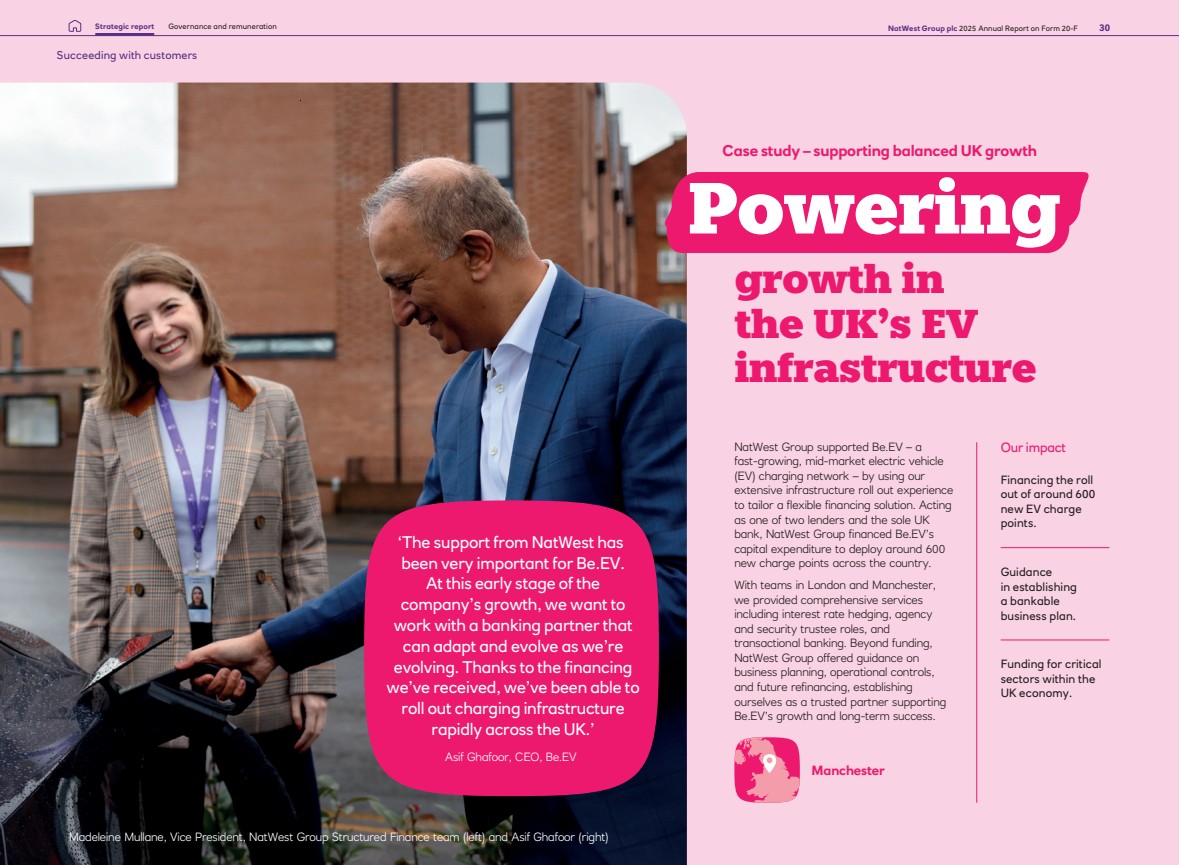
| NatWest Group supported Be.EV – a fast-growing, mid-market electric vehicle (EV) charging network – by using our extensive infrastructure roll out experience to tailor a flexible financing solution. Acting as one of two lenders and the sole UK bank, NatWest Group financed Be.EV’s capital expenditure to deploy around 600 new charge points across the country. With teams in London and Manchester, we provided comprehensive services including interest rate hedging, agency and security trustee roles, and transactional banking. Beyond funding, NatWest Group offered guidance on business planning, operational controls, and future refinancing, establishing ourselves as a trusted partner supporting Be.EV’s growth and long-term success. Our impact Financing the roll out of around 600 new EV charge points. Guidance in establishing a bankable business plan. Funding for critical sectors within the UK economy. Manchester growth in the UK’s EV infrastructure Case study – supporting balanced UK growth Powering Madeleine Mullane, Vice President, NatWest Group Structured Finance team (left) and Asif Ghafoor (right) ‘The support from NatWest has been very important for Be.EV. At this early stage of the company’s growth, we want to work with a banking partner that can adapt and evolve as we’re evolving. Thanks to the financing we’ve received, we’ve been able to roll out charging infrastructure rapidly across the UK.’ Asif Ghafoor, CEO, Be.EV Succeeding with customers Strategic report Financial review Governance and remuneration Risk and capital management Financial statements Additional information NatWest Group plc 2025 Annual Report and Accounts 30 Business performance review continued Financial highlights Total income £8,809m 2024: £7,957m Customer deposits £196.4bn 2024: £194.1bn Net loans to customers £154.2bn 2024: £141.9bn Return on equity 19.1% 2024: 17.2% Operating profit £4,064m 2024: £3,585m Risk-weighted assets £111.9bn 2024: £104.7bn Commercial & Institutional ‘We will support UK-wide growth by backing regions, championing mid-sized businesses, investing in future infrastructure, and supporting entrepreneurs and innovators to thrive across dynamic businesses and sectors.’ Robert Begbie, CEO, Commercial & Institutional As the biggest bank for businesses in the UK, Commercial & Institutional serves over 1.5 million customers with an extensive presence across all regions and nations of the UK. From start-ups to global institutions, we connect our customers with expertise, industry insights and the solutions they need. Our focus in 2025 We are a leading UK bank for mid-market businesses and small and medium-sized enterprises (SMEs), serving one in every five small and mid-market businesses across the UK. Our unparalleled network of relationship managers, local insight, and commitment to simplifying and enhancing value, from banking technology to digital interactions, sets us apart as we deepen existing customer connections and build new ones across all our segments. Supporting innovation Innovation is a fundamental driver of sustainable growth for the UK, and we provide the services, expertise, and networks that help businesses to turn their ideas from possibilities into progress. Doing so allows us to directly contribute to a stronger, more dynamic UK economy. 2025 marked the tenth anniversary of our NatWest Accelerator network for entrepreneurs. Since 2015, this programme has helped create over 12,000 jobs and facilitate £684 million in investment for businesses. In 2025, we significantly expanded our Accelerator community to more than 12,000 members. Extending beyond financial support, our Accelerator Hubs offer full wraparound support to help businesses take the next step in their journey. Universities also play an important role as innovation incubators and powerful engines of growth for the UK, as reflected in the Industrial Strategy. In November 2025, we agreed to open new Accelerators with four leading universities, and plan to expand to ten by 2027. In parallel, we are strengthening our Venture Banking team to support the country’s most innovative, venture-backed scale-ups with customised financial solutions and strategic expertise. Removing barriers to investment Our ability to remove barriers for our mid-market customers remains a core part of the value we deliver. In 2025, our CEO convened the first four meetings of the Mid-Market Growth Council, underlining our commitment to increasing connectivity and advocacy in this vital sector. We continued to work with our customers to unlock growth aligned to key structural and policy priorities in the UK, particularly social housing and infrastructure investment. In 2025, we committed £4.6 billion of lending in to the UK social housing sector, taking total commitments to £8.7 billion – surpassing our upgraded ambition of £7.5 billion by the end of 2026. We’re going further; our new ambition is £10 billion between 1 January 2026 and the end of 2028. At the same time, we retained our position as the number one lender to the UK infrastructure sector, completing more deals in 2025 than any other UK bank. Strategic report Strategic report Governance and remuneration Financial review Governance and remuneration Risk and capital management Financial statements Additional information NatWest Group plc NatWest Group plc 2025 Annual Report and Accounts 2025 Annual Report on Form 20-F 3131 |
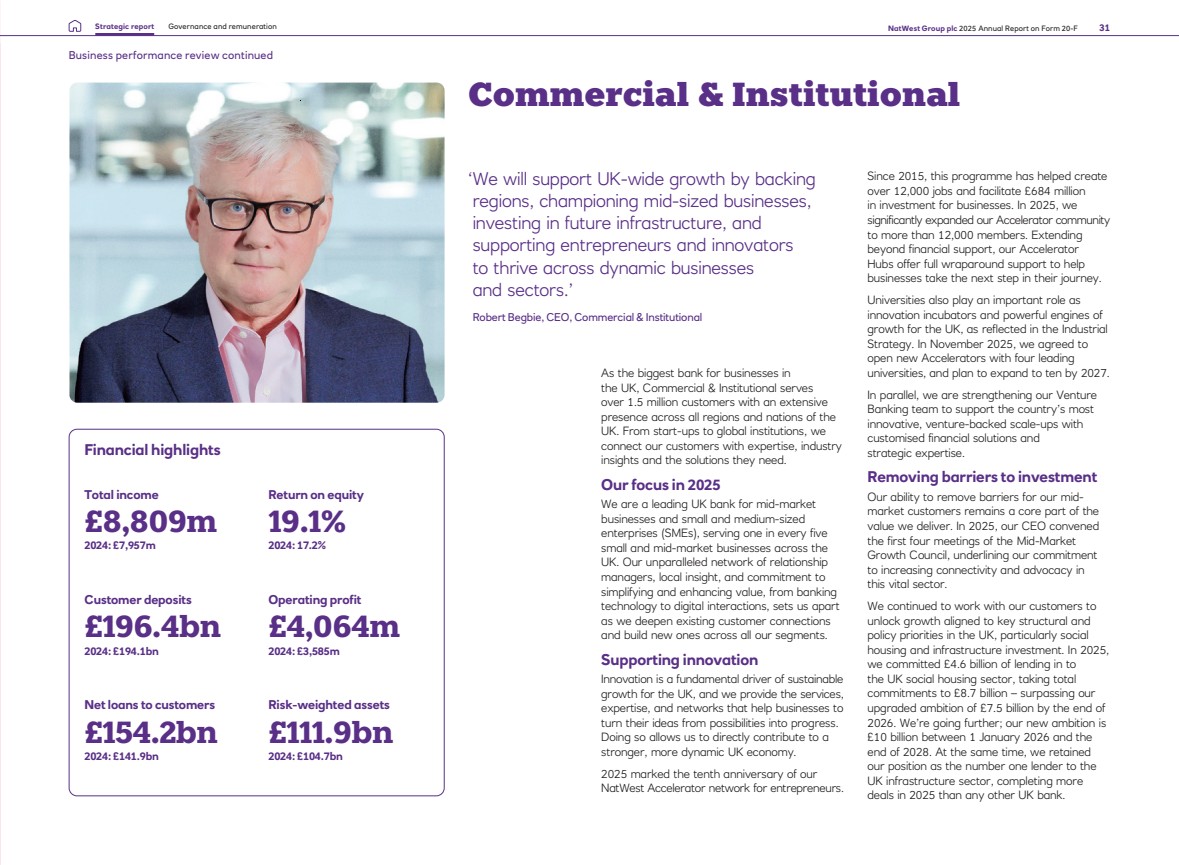
| Business performance review continued Spotlight Simplifying payments for enterprises: NatWest Group partners with Prommt Many businesses still depend on manual bank transfers or card payments that can come with high fees, fraud risks, and slow processing times. We partnered with Prommt in August 2025, to give customers greater control, efficiency, and simplicity in managing payments. Prommt is a leading pay-by-link platform that combines our business payment solutions Payit and Tyl into a single seamless solution for enterprise clients. By merging the speed and security of open banking with the flexibility of card payments, we’re giving businesses a smarter, faster, and safer way to collect payments. Our customers now benefit from a smarter selection of the best payment methods based on transaction value, and enterprise-ready features such as branded payment requests and recurring payments. We have also strengthened security through bank-authenticated payments. Making banking simpler We improved flexibility and convenience for our small business customers by increasing domestic payment limits from £100,000 to £250,000 on our mobile app, online banking and Open Banking. We also expanded credit card functionality, empowering businesses to optimise cash flow. Our digital-only proposition for the self-employed, Mettle, debuted strongly in the Competition and Markets Authority satisfaction survey, ranking second overall and scoring highly across all categories. For our mid-market and corporate customers, we have made significant progress in updating our main digital channel, Bankline. We have now integrated our asset finance, trade finance, invoice finance, BACS, commercial cards and Agile Markets platforms into Bankline via single sign-on, making it easier for customers to access these products. We modernised critical features our clients need for complex payments and account management, which have been used more than one million times in 2025. For our corporate clients, we were recognised as the ‘UK’s Best FX Bank for Corporates’ and ‘UK’s Best FX Prime Brokerage’ in the 2025 Euromoney Foreign Exchange Awards. As well as integration of Agile Markets into Bankline, we enhanced digital products for automated settlement, and expanded our markets foreign exchange offering to over 130 currencies. Working towards a more sustainable future Supporting the shift to a more sustainable future remains a core priority for our business. In Q1 2025, NatWest Group exceeded its target to provide £100 billion of climate and sustainable funding and financing between 1 July 2021 and the end of 2025. Commercial & Institutional delivered £95 billion against this target. Looking ahead, Commercial & Institutional will continue to play a critical role for NatWest Group to achieve its new target to provide £200 billion in climate and transition finance between 1 July 2025 and the end of 2030. Our efforts supporting customers earned two awards at the Environmental Finance Bond Awards 2025 – ‘Lead manager of the year, green bonds – sovereigns’ and ‘Lead manager of the year, social bonds – financial institutions’. We supported Électricité de France (EDF) update its green finance framework to include UK nuclear power activities and subsequently acted as a bookrunner for EDF’s €1.25 billion green hybrid bond issued to support European nuclear power generation. Our priorities for 2026 In 2026, we plan to accelerate our strategy. Our objective is to be the bank of choice in our priority segments: the leading bank for Startups; a leading hub for the UK Innovation Economy; and the top bank for UK mid-market corporates. We aim to create integrated propositions with other NatWest Group businesses and support entrepreneurs from start-up to scale-up, while meeting their personal financial needs. We plan to continue to invest in technology to make banking simpler and strengthen customer relationships. This includes equipping relationship managers with AI-enabled tools, enhancing Bankline as a leading digital platform, and expanding more digital journeys with increased product and self-service capabilities. We aim to strengthen our balance sheet and risk management with flexible capital allocation, dynamic pricing capabilities, disciplined resource management and expanded distribution capabilities to increase capital velocity. Strategic report Strategic report Governance and remuneration Financial review Governance and remuneration Risk and capital management Financial statements Additional information NatWest Group plc NatWest Group plc 2025 Annual Report and Accounts 2025 Annual Report on Form 20-F 3232 We continued to leverage technology to make banking simpler and more rewarding for our customers. 84.5%(1) our customers primarily use digital channels to interact with us, enabling our front-line teams to focus their support where customers most value it. We also deployed new generative AI technology, for the benefit of our customers and colleagues. For example, all complaint calls are now summarised and transcribed by AI, this means we have a clearer and accurate record of the conversation enabling us to answer complaints faster and improve services. In Business Banking, AI summarisation is helping more than 200 colleagues save time and increase capacity for more impactful customer interactions. (1) Commercial & Institutional (ring-fenced bank) customers with active non-personal account/s that access their account 95% or higher through digital channels for three rolling months in the reporting period ending 31 December 2025. |
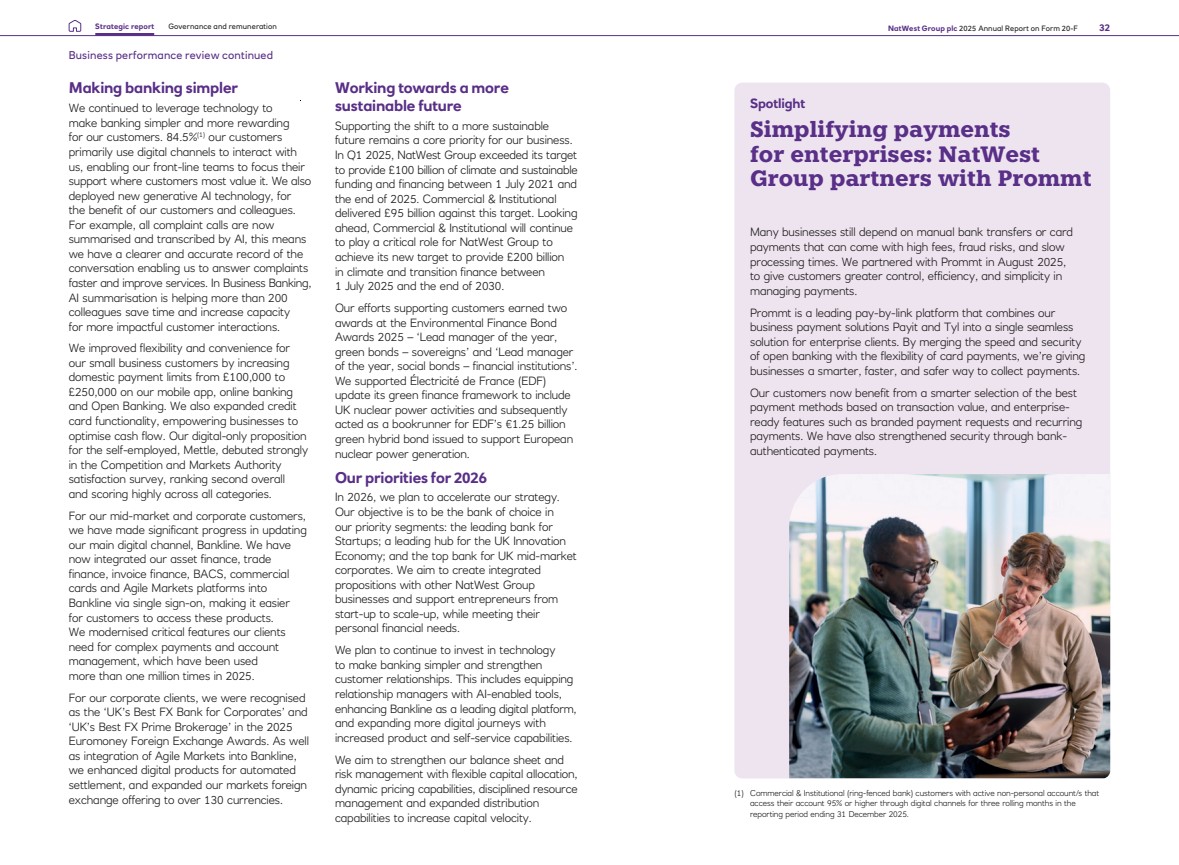
| Business performance review continued Spotlight Simplifying payments for enterprises: NatWest Group partners with Prommt Many businesses still depend on manual bank transfers or card payments that can come with high fees, fraud risks, and slow processing times. We partnered with Prommt in August 2025, to give customers greater control, efficiency, and simplicity in managing payments. Prommt is a leading pay-by-link platform that combines our business payment solutions Payit and Tyl into a single seamless solution for enterprise clients. By merging the speed and security of open banking with the flexibility of card payments, we’re giving businesses a smarter, faster, and safer way to collect payments. Our customers now benefit from a smarter selection of the best payment methods based on transaction value, and enterprise-ready features such as branded payment requests and recurring payments. We have also strengthened security through bank-authenticated payments. Making banking simpler We continued to leverage technology to make banking simpler and more rewarding for our customers. 84.5%(1)(LA) of our customers primarily use digital channels to interact with us, enabling our front-line teams to focus their support where customers most value it. We also deployed new generative AI technology, for the benefit of our customers and colleagues. For example, all complaint calls are now summarised and transcribed by AI, this means we have a clearer and accurate record of the conversation enabling us to answer complaints faster and improve services. In Business Banking, AI summarisation is helping more than 200 colleagues save time and increase capacity for more impactful customer interactions. We improved flexibility and convenience for our small business customers by increasing domestic payment limits from £100,000 to £250,000 on our mobile app, online banking and Open Banking. We also expanded credit card functionality, empowering businesses to optimise cash flow. Our digital-only proposition for the self-employed, Mettle, debuted strongly in the Competition and Markets Authority satisfaction survey, ranking second overall and scoring highly across all categories. For our mid-market and corporate customers, we have made significant progress in updating our main digital channel, Bankline. We have now integrated our asset finance, trade finance, invoice finance, BACS, commercial cards and Agile Markets platforms into Bankline via single sign-on, making it easier for customers to access these products. We modernised critical features our clients need for complex payments and account management, which have been used more than one million times in 2025. For our corporate clients, we were recognised as the ‘UK’s Best FX Bank for Corporates’ and ‘UK’s Best FX Prime Brokerage’ in the 2025 Euromoney Foreign Exchange Awards. As well as integration of Agile Markets into Bankline, we enhanced digital products for automated settlement, and expanded our markets foreign exchange offering to over 130 currencies. Working towards a more sustainable future Supporting the shift to a more sustainable future remains a core priority for our business. In Q1 2025, NatWest Group exceeded its target to provide £100 billion of climate and sustainable funding and financing between 1 July 2021 and the end of 2025. Commercial & Institutional delivered £95 billion against this target. Looking ahead, Commercial & Institutional will continue to play a critical role for NatWest Group to achieve its new target to provide £200 billion in climate and transition finance between 1 July 2025 and the end of 2030. Our efforts supporting customers earned two awards at the Environmental Finance Bond Awards 2025 – ‘Lead manager of the year, green bonds – sovereigns’ and ‘Lead manager of the year, social bonds – financial institutions’. We supported Électricité de France (EDF) update its green finance framework to include UK nuclear power activities and subsequently acted as a bookrunner for EDF’s €1.25 billion green hybrid bond issued to support European nuclear power generation. Our priorities for 2026 In 2026, we plan to accelerate our strategy. Our objective is to be the bank of choice in our priority segments: the leading bank for Startups; a leading hub for the UK Innovation Economy; and the top bank for UK mid-market corporates. We aim to create integrated propositions with other NatWest Group businesses and support entrepreneurs from start-up to scale-up, while meeting their personal financial needs. We plan to continue to invest in technology to make banking simpler and strengthen customer relationships. This includes equipping relationship managers with AI-enabled tools, enhancing Bankline as a leading digital platform, and expanding more digital journeys with increased product and self-service capabilities. We aim to strengthen our balance sheet and risk management with flexible capital allocation, dynamic pricing capabilities, disciplined resource management and expanded distribution capabilities to increase capital velocity. (1) Commercial & Institutional (ring-fenced bank) customers with active non-personal account/s that access their account 95% or higher through digital channels for three rolling months in the reporting period ending 31 December 2025. Read more on the scope of measurement in our 2025 Sustainability Basis of Reporting. Read more on the scope of measurement in 2025 Sustainability Basis of Reporting. Metric subject to independent Limited Assurance by EY. Refer to page 71 for details. Strategic report Financial review Governance and remuneration Risk and capital management Financial statements Additional information NatWest Group plc 2025 Annual Report and Accounts 32 Our stakeholders Investors Customers Colleagues We have a global engagement programme servicing our institutional equity and fixed-income investors, and private shareholders. We actively engaged with prospective investors during 2025, particularly as the UK Government exited its position in NatWest Group. We know that our success depends on the success of our customers. We want to understand their challenges, ambitions, financial objectives and concerns, and help them progress towards their goals by providing the right services at the right time. By supporting our colleagues in what they do and by striving to make NatWest Group a great place to work, we provide them with the capabilities they need to succeed with customers. How we engaged • In 2025, we delivered a total shareholder return of 71.0%. • We held 370 meetings with equity investors and 270 meetings with fixed-income investors in 2025, attracting further investment by global equity funds, while maintaining strong relationships with our existing shareholders. • In addition to our quarterly results updates, we hosted three investor spotlights, offering a deep dive into NatWest Group’s core businesses: Retail Banking, Private Banking & Wealth Management, and Commercial & Institutional. Investors and analysts were given an opportunity to engage with senior management and discuss their priorities and ambitions for the businesses. • We continued to adapt to the challenge of how investors access shareholder information in different ways. This included ongoing consideration of investors’ increasing use of AI search. How we engaged • Following the 2024 transaction to acquire the retail banking assets and liabilities of Sainsbury’s Bank, NatWest Group successfully completed the migration of around one million accounts in November 2025. To help ensure the transitioning customers were kept informed throughout the process, NatWest Group worked with the FCA and Sainsbury’s Bank on engagement plans and established a dedicated phone number to support new customers. • We responded to requests from Coutts clients in 2025 by enhancing key features in the Coutts app and Coutts online banking – introducing valuation, performance charts and the latest investment insight articles. • In April 2025, we extended the Business Banking Lending Journey to customers supported by our regional relationship manager (RRM) teams. RRM customers can now self-serve 24/7, receive personalised quotes in under three minutes, and complete applications in as little as 10 minutes. How we engaged • Our colleague listening strategy in 2025 included: regular colleague opinion surveys; a Colleague Advisory Panel, connected directly with our Board; the Colleague Experience Squad, which provided feedback on colleague products and services; and Engage, our internal social media platform. • The Our View colleague survey, enables us to track metrics and key performance indicators, which we can benchmark with sector and high-performing comparisons. Over 50,000 colleagues (an 83% participant rate) participated in our September 2025 survey.(1) • We have continued to make progress in some key areas, with our overall scores up by an average of one point year on year. Our lead strategic measures – Strategy, vision and behaviours (+2), Purposeful leadership (+1), Performance culture (+1), and Becoming a Simpler Bank (+2) – have all improved. However, we acknowledge we still have work to do to generate greater efficiency in our processes to best support our customers. Refer to Our investment case on pages 16-17. For our Net Promoter Scores, refer to page 35. Refer to Skilled, engaged and inclusive workforce on pages 59 to 63. (1) NatWest Group Our View results exclude our colleagues in Ulster Bank RoI, Poland & FreeAgent. Strategic report Strategic report Governance and remuneration Financial review Governance and remuneration Risk and capital management Financial statements Additional information NatWest Group plc NatWest Group plc 2025 Annual Report and Accounts 2025 Annual Report on Form 20-F 3333 Understanding and supporting our stakeholders is vital to the success of our business. Detailed below are our key stakeholder engagements and how they help us improve outcomes for our customers, communities, and the environment. For further information on how stakeholder considerations influenced the Board’s discussions and decision-making, refer to our section 172(1) statement on pages 36 and 37, and our Corporate governance report on pages 100 to 101. |
| Our stakeholders continued Communities Regulators Suppliers As a leading bank in the UK, we believe we can make a real and positive difference to the communities we live and do business in. We operate in a highly regulated market which continues to evolve. We understand the need to have an ongoing, constructive and open dialogue with all relevant regulatory bodies and embed this in our business as a priority. We are committed to creating a diverse and responsible supply chain, being fair and transparent with our suppliers and to reach net zero by 2050 across our operational value chain. How we engaged • We established and built relationships, with direct community investment of £11.0 million in 2025. Across our fundraising and volunteering programmes, colleagues raised £4.4 million and gave 142,775 volunteering hours. As well as our network of regional managers, our seven Regional Boards are also deeply connected into cities, towns and communities across all nations and regions of the UK. • We supported enterprise and engaged young people: our Accelerator app supported over 12,000 small business at the end of 2025. Through our youth educational programme, NatWest Thrive, we reached over one million young people across the UK in 2025, with 80% reporting a positive change in behaviour towards their financial wellbeing after participation. • Empowering financial confidence: our free Financial Foundations workshops are designed to help participants take control of their money and future. In 2025, our trained bank facilitators delivered 1,500 workshops to 31,000 participants. How we engaged • We worked closely with policymakers to support the UK Government’s drive for economic growth, which included FCA proposals for a targeted support model that aims to narrow the ‘advice gap’ between generic guidance and affordable financial advice, and deliver improved retail investment opportunities. • During 2025 we responded to material consultations, including FCA proposals on reforming the Financial Ombudsman Service, Senior Managers & Certification Regime, and Consumer Credit Act, as well as proposals on the regulatory treatment of UK stablecoins and new, more customer-focused, mortgage rules. • With regard to developing the UK’s capital framework, we continued to engage with the authorities to promote an approach that shifts the balance towards supporting economic growth, while maintaining proportionate risk management. How we engaged • We introduced a new AI-powered sustainability risk tool that enables NatWest Group to proactively assess and manage supplier risks. It integrates multi-source data and risk modelling to heatmap suppliers, identify emerging risks, and enhance transparency supporting regulatory compliance. • NatWest Group received the Gold Award from the Office of the Small Business Commissioner under the Fair Payment Code, recognising our commitment to ethical business and SME support. The award is given to organisations that pay over 95% of invoices within 30 days. • A challenge for our supply chain in 2025 was to strengthen sourcing and contracting controls, improving consistency in supplier due diligence and contract adequacy checks. Enhancements to toolkits, guidance and data validation helped reduce risk and improve governance for the supply chain. Refer to Supporting customers and communities through our Refer to the Driving a culture of integrity and responsible risk management on pages 64 to 66. Strategic report Strategic report Governance and remuneration Financial review Governance and remuneration Risk and capital management Financial statements Additional information NatWest Group plc NatWest Group plc 2025 Annual Report and Accounts 2025 Annual Report on Form 20-F 3434 Refer to the Risk overview on pages 72 to 77. banking products and services on pages 41 to 44. |
| Our stakeholders continued Communities Regulators Suppliers As a leading bank in the UK, we believe we can make a real and positive difference to the communities we live and do business in. We operate in a highly regulated market which continues to evolve. We understand the need to have an ongoing, constructive and open dialogue with all relevant regulatory bodies and embed this in our business as a priority. We are committed to creating a diverse and responsible supply chain, being fair and transparent with our suppliers and to reach net zero by 2050 across our operational value chain. How we engaged • We established and built relationships, with direct community investment of £11.0 million in 2025. Across our fundraising and volunteering programmes, colleagues raised £4.4 million and gave 142,775 volunteering hours. As well as our network of regional managers, our seven Regional Boards are also deeply connected into cities, towns and communities across all nations and regions of the UK. • We supported enterprise and engaged young people: our Accelerator app supported over 12,000 small business at the end of 2025. Through our youth educational programme, NatWest Thrive, we reached over one million young people across the UK in 2025, with 80% reporting a positive change in behaviour towards their financial wellbeing after participation. • Empowering financial confidence: our free Financial Foundations workshops are designed to help participants take control of their money and future. In 2025, our trained bank facilitators delivered 1,500 workshops to 31,000 participants. How we engaged • We worked closely with policymakers to support the UK Government’s drive for economic growth, which included FCA proposals for a targeted support model that aims to narrow the ‘advice gap’ between generic guidance and affordable financial advice, and deliver improved retail investment opportunities. • During 2025 we responded to material consultations, including FCA proposals on reforming the Financial Ombudsman Service, Senior Managers & Certification Regime, and Consumer Credit Act, as well as proposals on the regulatory treatment of UK stablecoins and new, more customer-focused, mortgage rules. • With regard to developing the UK’s capital framework, we continued to engage with the authorities to promote an approach that shifts the balance towards supporting economic growth, while maintaining proportionate risk management. How we engaged • We introduced a new AI-powered sustainability risk tool that enables NatWest Group to proactively assess and manage supplier risks. It integrates multi-source data and risk modelling to heatmap suppliers, identify emerging risks, and enhance transparency supporting regulatory compliance. • NatWest Group received the Gold Award from the Office of the Small Business Commissioner under the Fair Payment Code, recognising our commitment to ethical business and SME support. The award is given to organisations that pay over 95% of invoices within 30 days. • A challenge for our supply chain in 2025 was to strengthen sourcing and contracting controls, improving consistency in supplier due diligence and contract adequacy checks. Enhancements to toolkits, guidance and data validation helped reduce risk and improve governance for the supply chain. Refer to Supporting customers and communities through our banking products and services on pages 41 to 44. Refer to the Risk overview on pages 74 to 79. Refer to the Driving a culture of integrity and responsible risk management on pages 64 to 66. Strategic report Financial review Governance and remuneration Risk and capital management Financial statements Additional information NatWest Group plc 2025 Annual Report and Accounts 34 Our stakeholders continued Spotlight Building customer trust and advocacy Measuring customer advocacy through our Net Promoter Score We track customer advocacy for our key brands using the Net Promoter Score® (NPS), a commonly used metric in the banking industry globally.(1) The improvements we have made saw NatWest Retail’s NPS increase; we’ve also remained in 4th place in a competitive market. In Commercial & Institutional, NatWest £0–£750k NPS improved, with ranking increasing from 4th to 3rd place; NatWest £750k–£250m NPS remains the market leader in this segment with a small improvement in NPS. Royal Bank’s NPS increased for Retail and £750k–£250m, and dropped in £0–£750k although improved rank position. Listening to our customers To ensure we understand our customers and can continue to meet their evolving needs, we measure customer satisfaction, advocacy and trust in our key brands and services via independent surveys. These insights are reported at the most senior levels of the bank and play a crucial role in informing our strategic priorities. Consumer trust in Q4 2025 NatWest consumer trust improved in 2025 (49% vs 47% in 2024), as did Royal Bank of Scotland (34% vs 32% in 2024). NatWest 49% Q4 2024: 47% Source: Kantar/NatWest Brand Guidance Programme, GB, Trust among consumers, 12-month rolling. Royal Bank of Scotland 34% Q4 2024: 32% Source: Kantar/NatWest Brand Guidance Programme, GB, Trust among consumers, 12-month rolling. Retail Banking(2) 25 Q4 2024: 23 Retail Banking(5) 28 Q4 2024: 21 Account opening(2) 29 Q4 2024: 28 Commercial & Institutional £0-£750k(3),(8) -5 Q4 2024: -7 Commercial & Institutional £0-£750k(6),(8) -4 Q4 2024: 5 Mortgages(2) 27 Q4 2024: 25 Commercial & Institutional £750k –£250m(4),(8) 6 Q4 2024: 5 Commercial & Institutional £750k –£250m(7),(8) 15 Q4 2024: 7 Mobile banking(2) 51 Q4 2024: 49 Online banking(2) 35 Q4 2024: 32 NatWest Q4 2025 Royal Bank of Scotland Q4 2025 Retail Banking – key measures Q4 2025 (1) NPS® and the NPS-related emoticons are registered trademarks of Bain & Company, Inc., NICE Systems, Inc., and Fred Reichheld. (2) Source: Strategic NPS benchmarking study run through InMoment, England & Wales, 12-month rolling. (3) Source: MarketVue Business Banking from Savanta, England & Wales, Businesses with a turnover up to £750k, 12-month rolling. (4) Source: MarketVue Business Banking from Savanta, England & Wales, Businesses with a turnover between £750k-£250m, 12-month rolling. (5) Source: Strategic NPS benchmarking study run through InMoment, Scotland, 12-month rolling. (6) Source: MarketVue Business Banking from Savanta, Scotland, Businesses with a turnover up to £750k, 12-month rolling. (7) Source: MarketVue Business Banking from Savanta, Scotland, Businesses with a turnover between £750k-£250m, 12-month rolling. (8) The measure’s name has been updated for clarity, with no change to its underlying definition or calculation. (9) Coutts Voice of the Client survey run through Ipsos, 12-month rolling. Coutts(9) 50 Q4 2024: 48 Coutts Q4 2025 Strategic report Strategic report Governance and remuneration Financial review Governance and remuneration Risk and capital management Financial statements Additional information NatWest Group plc NatWest Group plc 2025 Annual Report and Accounts 2025 Annual Report on Form 20-F 3535 |
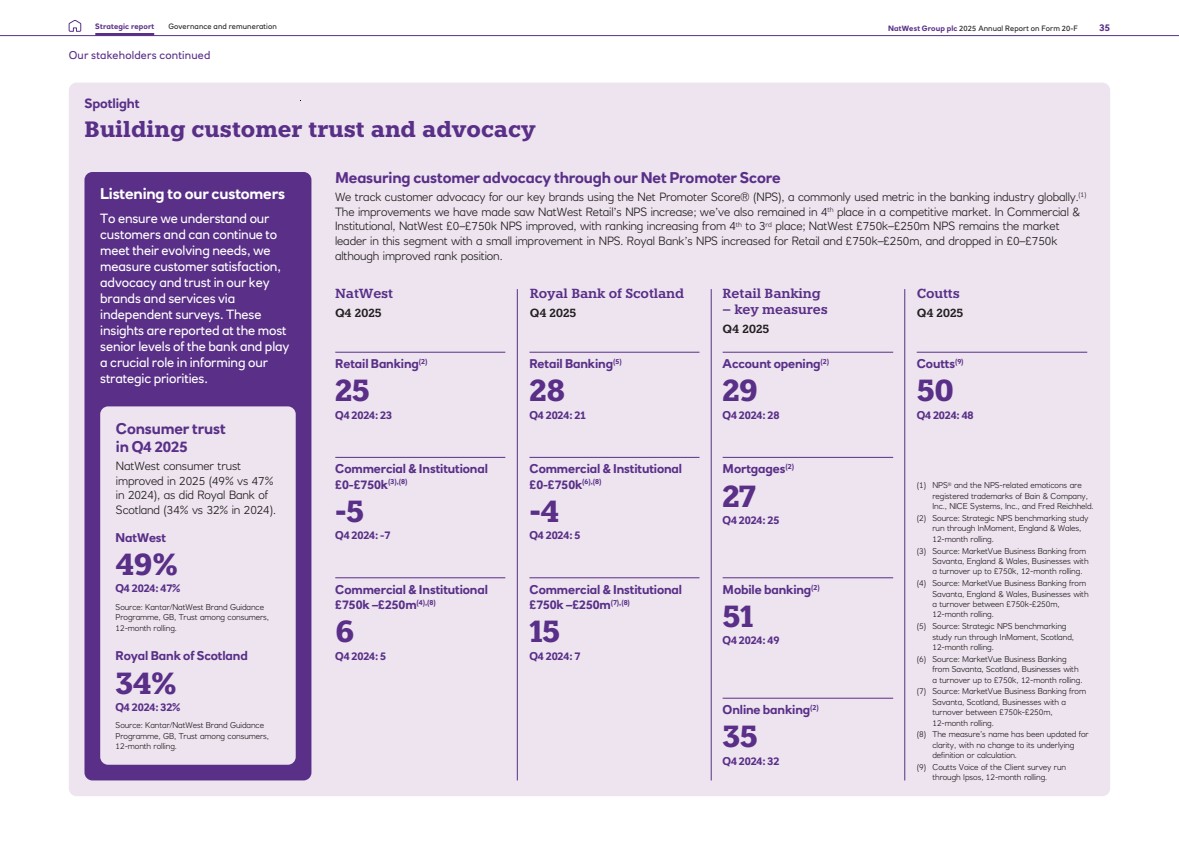
| The Board reviews and confirms its key stakeholder groups for the purposes of section 172 annually. For 2025, these remained investors, customers, colleagues, communities, regulators and suppliers. Our directors are mindful that it is not always possible to achieve an outcome which meets the expectations of all our stakeholders, and that there may be impacted stakeholders outside the six key groups the Board has identified. The following illustrative examples provide insights into how principal decisions in two areas were made by the Board during 2025. Principal decisions are those decisions taken by the Board that are material, or of strategic importance to the company, or are significant to NatWest Group’s key stakeholders. Climate and sustainability s172 factors considered: a, b, c, d, e What was the decision-making process? In March 2025, the Board reviewed the evolving ESG landscape and reflected on the bank’s broader strategic direction, including how sustainability considerations could support long-term value and good customer outcomes. These early discussions helped frame subsequent conversations and decision-making on climate and sustainability matters during 2025, and ensured directors remained alert to external developments. At a dedicated climate spotlight session in October 2025, directors considered the UK’s progress towards clean power and the infrastructure and investment that would be needed to accelerate the transition. They discussed the significance of the financial sector’s role in supporting customers and the real economy through this period of change. In addition, directors reviewed proposals from management to define sustainability at NatWest Group, to review the bank’s ambition to at least halve the climate impact of our financing activity by 2030, against a 2019 baseline, and to review the bank’s baseline target-setting framework, to ensure the framework remained focused, credible and aligned with the bank’s strategic priorities. In December 2025, the Board received an update on the energy system review carried out during 2025. This review had been conducted to ensure NatWest Group’s strategy reflects the interconnected risks and opportunities across the energy value chain as the economy transitions toward net zero. It considered the systemic nature of the energy transition, which anticipates further growth in renewables, the How did the directors fulfil their duties under section 172? How were stakeholders considered? Directors considered the interests of investors, customers, colleagues, regulators and wider society in their discussions on these matters. The Board recognised that customers expected the bank to help them transition while continuing to support their day-to-day financing needs. The October 2025 climate spotlight reinforced that customer needs would evolve quickly as the UK invests in clean power and modernises its energy system. Directors considered how financing, advisory support and sector expertise could be aligned to help customers adapt. Regulator and investor expectations were also important considerations. Directors noted that legal and compliance assessments of NatWest Group’s climate and sustainability disclosures had been conducted to support compliance with regulatory reporting requirements. Investor feedback highlighted the importance of clear progress against climate and sustainability-related ambitions, targets and commitments and the need for a coherent narrative linking sustainability to the bank’s long-term growth and risk management. Directors took all of this into account when considering NatWest Group’s definition of sustainability, and our climate and sustainability-related ambitions, targets and commitments. Section 172(1) statement In this statement, we describe how our directors have had regard to the matters set out in section 172(1) (a) to (f) of the Companies Act 2006 (section 172) when performing their duty to promote the success of the company. The s172 factors (a) likely long-term consequences, (b) employee interests, (c) relationships with customers, suppliers and others, (d) the impact on community and environment, (e) maintaining a reputation for high standards of business conduct, (f) acting fairly between members of the company. Strategic report Strategic report Governance and remuneration Financial review Governance and remuneration Risk and capital management Financial statements Additional information NatWest Group plc NatWest Group plc 2025 Annual Report and Accounts 2025 Annual Report on Form 20-F 3636 Our Board and committee terms of reference (available on the NatWest Group website) reinforce the importance of considering the matters set out in section 172 (the s172 factors, as set out opposite). Our Board and committee paper template also supports consideration of stakeholders and enables good decision-making. important yet declining role of oil and gas, significant infrastructure investment and demand-side electrification. The Board supported management proposals for NatWest Group’s new Environmental & Social (E&S) Energy Supply Sectors Risk Acceptance Criteria which reflect the outcome of this review. Examples of how the Board has engaged with stakeholders can be found in this statement and in the Corporate governance report on pages 100 to 101. |
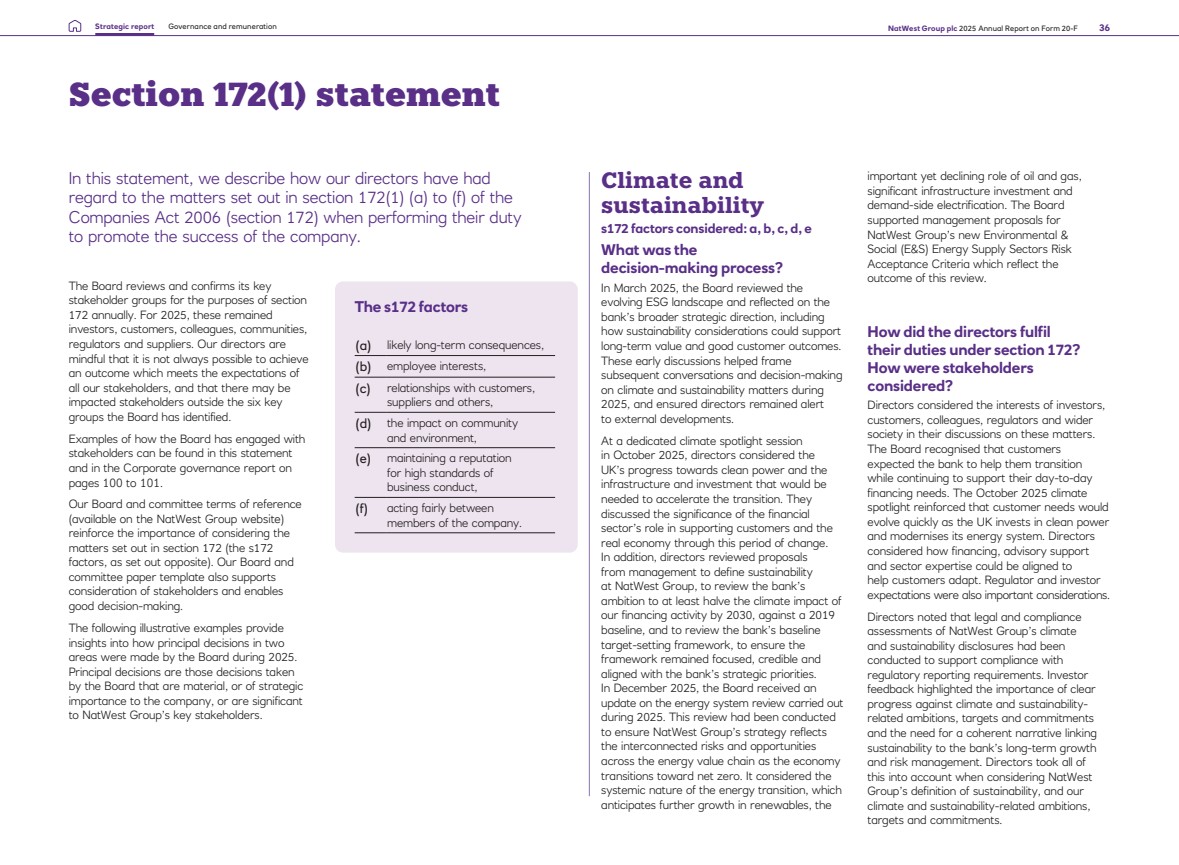
| The Board reviews and confirms its key stakeholder groups for the purposes of section 172 annually. For 2025, these remained investors, customers, colleagues, communities, regulators and suppliers. Our directors are mindful that it is not always possible to achieve an outcome which meets the expectations of all our stakeholders, and that there may be impacted stakeholders outside the six key groups the Board has identified. Examples of how the Board has engaged with stakeholders can be found in this statement and in the Corporate governance report on pages 117 to 118. Our Board and committee terms of reference (available at natwestgroup.com) reinforce the importance of considering the matters set out in section 172 (the s172 factors, as set out opposite). Our Board and committee paper template also supports consideration of stakeholders and enables good decision-making. The following illustrative examples provide insights into how principal decisions in two areas were made by the Board during 2025. Principal decisions are those decisions taken by the Board that are material, or of strategic importance to the company, or are significant to NatWest Group’s key stakeholders. Climate and sustainability s172 factors considered: a, b, c, d, e What was the decision-making process? In March 2025, the Board reviewed the evolving ESG landscape and reflected on the bank’s broader strategic direction, including how sustainability considerations could support long-term value and good customer outcomes. These early discussions helped frame subsequent conversations and decision-making on climate and sustainability matters during 2025, and ensured directors remained alert to external developments. At a dedicated climate spotlight session in October 2025, directors considered the UK’s progress towards clean power and the infrastructure and investment that would be needed to accelerate the transition. They discussed the significance of the financial sector’s role in supporting customers and the real economy through this period of change. In addition, directors reviewed proposals from management to define sustainability at NatWest Group, to review the bank’s ambition to at least halve the climate impact of our financing activity by 2030, against a 2019 baseline, and to review the bank’s baseline target-setting framework, to ensure the framework remained focused, credible and aligned with the bank’s strategic priorities. In December 2025, the Board received an update on the energy system review carried out during 2025. This review had been conducted to ensure NatWest Group’s strategy reflects the interconnected risks and opportunities across the energy value chain as the economy transitions toward net zero. It considered the systemic nature of the energy transition, which anticipates further growth in renewables, the important yet declining role of oil and gas, significant infrastructure investment and demand-side electrification. The Board supported management proposals for NatWest Group’s new Environmental & Social (E&S) Energy Supply Sectors Risk Acceptance Criteria which reflect the outcome of this review, as described in more detail in the NatWest Group plc 2025 Climate Transition Plan Report. How did the directors fulfil their duties under section 172? How were stakeholders considered? Directors considered the interests of investors, customers, colleagues, regulators and wider society in their discussions on these matters. The Board recognised that customers expected the bank to help them transition while continuing to support their day-to-day financing needs. The October 2025 climate spotlight reinforced that customer needs would evolve quickly as the UK invests in clean power and modernises its energy system. Directors considered how financing, advisory support and sector expertise could be aligned to help customers adapt. Regulator and investor expectations were also important considerations. Directors noted that legal and compliance assessments of NatWest Group’s climate and sustainability disclosures had been conducted to support compliance with regulatory reporting requirements. Investor feedback highlighted the importance of clear progress against climate and sustainability-related ambitions, targets and commitments and the need for a coherent narrative linking sustainability to the bank’s long-term growth and risk management. Directors took all of this into account when considering NatWest Group’s definition of sustainability, and our climate and sustainability-related ambitions, targets and commitments. Section 172(1) statement In this statement, we describe how our directors have had regard to the matters set out in section 172(1) (a) to (f) of the Companies Act 2006 (section 172) when performing their duty to promote the success of the company. The s172 factors (a) likely long-term consequences, (b) employee interests, (c) relationships with customers, suppliers and others, (d) the impact on community and environment, (e) maintaining a reputation for high standards of business conduct, (f) acting fairly between members of the company. Strategic report Financial review Governance and remuneration Risk and capital management Financial statements Additional information NatWest Group plc 2025 Annual Report and Accounts 36 Actions and outcomes In July 2025, the Board approved a new target to provide £200 billion of climate and transition finance between 1 July 2025 and the end of 2030. Our climate and transition finance framework has replaced the climate and sustainable funding and financing inclusion criteria that underpinned our previous £100 billion target, which was exceeded in Q1 2025. In October 2025, the Board approved: • retaining NatWest Group’s climate ambition to at least halve the climate impact of our financing activity by 2030, against a 2019 baseline. • proposals to withdraw our previously disclosed 16 portfolio-level sector targets (validated by the Science Based Targets Initiative) and replace them with nine new portfolio-level activity-based targets. Directors also supported management’s proposed definition of sustainability at NatWest Group, stemming from purpose, starting with customers and focusing on the impact that comes from the core business of the bank. Actions and outcomes The final dividend on 15.5 pence per ordinary share was approved by shareholders at the Annual General Meeting in April 2025 and an interim dividend on 9.5 pence per ordinary share was approved by the Board in July 2025. An on-market buyback was approved by the Board in July 2025 up to a value of £750 million. Capital s172 factors considered: a, e, f What was the decision-making process? During 2025, the Board approved a range of capital distributions, including the final dividend in April 2025 and the interim dividend and an on-market buyback of ordinary shares of up to £750 million, both in July 2025. As part of our annual results announcement in February 2025, the Board also confirmed its intention to increase our ordinary dividend payout ratio from c.40% to c.50% from 2025 onwards. In October 2025, the Board undertook a focused review of NatWest Group’s capital framework and considered recommendations to revise our Common Equity Tier 1 target ratio. This review was conducted within the context of evolving regulatory capital requirements, peer benchmarks and feedback from shareholders and other stakeholders. In line with standard practice, the Group Board Risk Committee reviewed all capital distribution proposals and our capital framework prior to submission to the Board, taking into account views from the second and third lines of defence. Section 172(1) statement continued How did the directors fulfil their duties under section 172? How were stakeholders considered? When evaluating proposed capital distributions and revisions to the capital framework, the Board was focused on promoting the long-term success and financial resilience of NatWest Group for the benefit of all stakeholders. Directors considered the likely long-term consequences of each decision, NatWest Group’s ongoing capacity to invest in the business, and our ability to continue serving customers sustainably. The Board considered external expectations of capital distributions, noting differing preferences between equity investors and bondholders, as well as the importance of delivering consistent and predictable shareholder returns. The Board also considered regulatory changes to our capital requirements, peer benchmarks and the need to maintain robust capital buffers to enable NatWest Group to continue to deliver shareholder value and to support customers and the wider economy throughout the economic cycle. The Board considered colleagues and internal capabilities when reviewing the E&S Risk Acceptance Criteria, including the support required for colleagues working with customers in sectors undergoing transition. Strategic report Strategic report Governance and remuneration Financial review Governance and remuneration Risk and capital management Financial statements Additional information NatWest Group plc NatWest Group plc 2025 Annual Report and Accounts 2025 Annual Report on Form 20-F 3737 The Board also ensured its decisions in relation to capital distributions were aligned with the commitment to a c.50% payout ratio, as noted in the NatWest Group plc 2024 Annual Report on Form 20-F, and external guidance provided in February 2025 and then updated in July 2025. Directors additionally considered societal expectations regarding responsible capital management, the importance of maintaining a resilient balance sheet, and the need to continue investing in NatWest Group’s strategic priorities and technology transformation. Further information on our climate governance framework can be found on page 89. |
| Succeeding with customers Through the NatWest Accelerator, we’re supporting small businesses – like Hanan Tantush’s adaptive clothing company, Intotum – by providing tailored workshops, one-to-one coaching, and networking opportunities. After Hanan won our first Accelerator pitch competition in July 2025, we helped her develop growth strategies, connect with retail experts, and launch her new collection. By offering this kind of practical support, funding guidance, space for collaboration, and (from 2025) access to our Accelerator app, our Accelerator community is empowering entrepreneurs to scale their businesses successfully. Our impact 12 Accelerator Hubs across the UK. Over 12,000 small businesses supported through the Accelerator app at the end of 2025. New partnerships with four leading UK universities to strengthen the UK’s innovation and start-up ecosystem. London start-ups to scale Case study – helping build better businesses Supporting Elizabeth Parker, NatWest Group Acceleration Journey Manager (left) and Hanan Tantush (right) ‘Being a NatWest customer, I feel supported because I know that I’m working with a bank that genuinely cares about entrepreneurs and people wanting to start businesses. If I have questions about new opportunities that I don’t have experience in, I know the Accelerator team can help me or connect me with someone with relevant experience. And that’s meant that I feel really reassured.’ Hanan Tantush, Founder of Intotum Strategic report Strategic report Governance and remuneration Financial review Governance and remuneration Risk and capital management Financial statements Additional information NatWest Group plc NatWest Group plc 2025 Annual Report and Accounts 2025 Annual Report on Form 20-F 3838 |
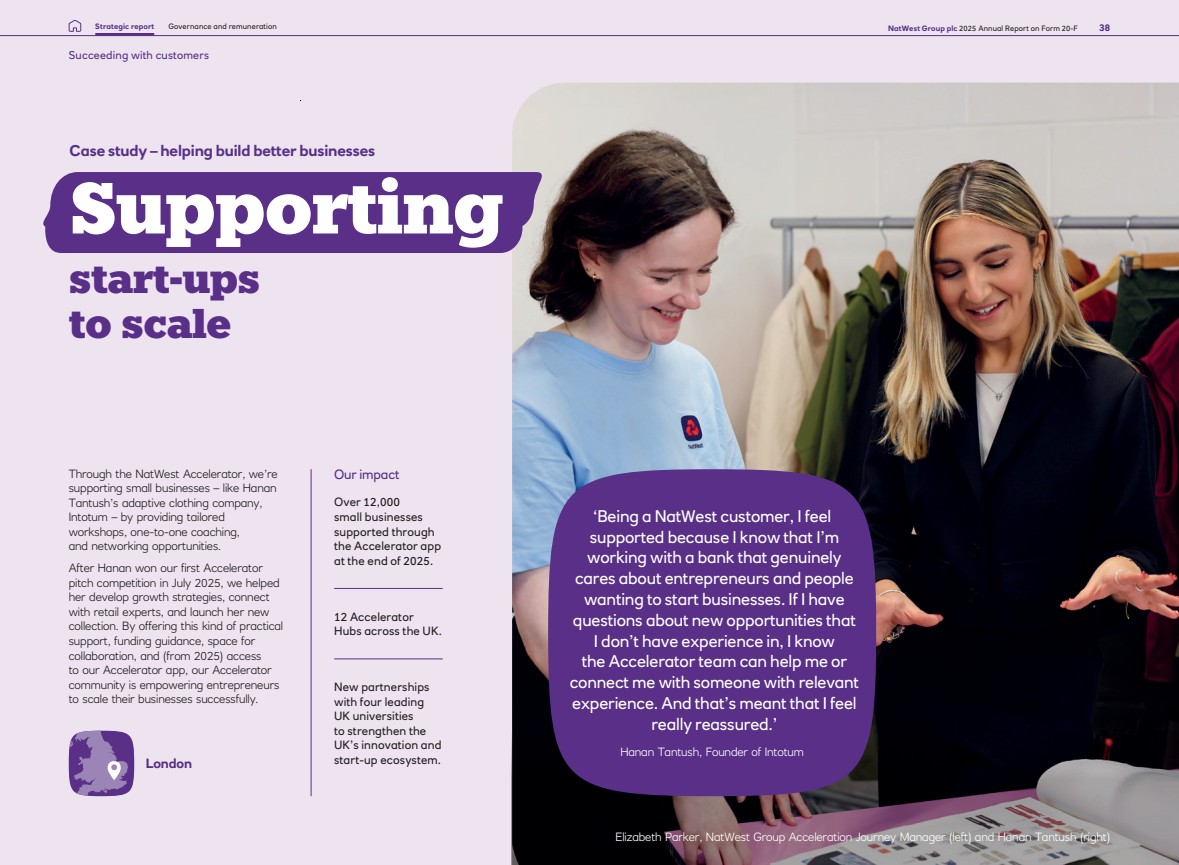
| Succeeding with customers Through the NatWest Accelerator, we’re supporting small businesses – like Hanan Tantush’s adaptive clothing company, Intotum – by providing tailored workshops, one-to-one coaching, and networking opportunities. After Hanan won our first Accelerator pitch competition in July 2025, we helped her develop growth strategies, connect with retail experts, and launch her new collection. By offering this kind of practical support, funding guidance, space for collaboration, and (from 2025) access to our Accelerator app, our Accelerator community is empowering entrepreneurs to scale their businesses successfully. Our impact 12 Accelerator Hubs across the UK. Over 12,000 small businesses supported through the Accelerator app at the end of 2025. New partnerships with four leading UK universities to strengthen the UK’s innovation and start-up ecosystem. London start-ups to scale Case study – helping build better businesses Supporting Elizabeth Parker, NatWest Group Acceleration Journey Manager (left) and Hanan Tantush (right) ‘Being a NatWest customer, I feel supported because I know that I’m working with a bank that genuinely cares about entrepreneurs and people wanting to start businesses. If I have questions about new opportunities that I don’t have experience in, I know the Accelerator team can help me or connect me with someone with relevant experience. And that’s meant that I feel really reassured.’ Hanan Tantush, Founder of Intotum Strategic report Financial review Governance and remuneration Risk and capital management Financial statements Additional information NatWest Group plc 2025 Annual Report and Accounts 38 Our approach to sustainability Sustainability review Stems from our purpose We’re the bank that turns possibilities into progress. We work to understand our customers’ hopes and needs, and help them achieve their goals. We believe that doing this well helps our communities and the UK economy to progress. Helping customers manage their money and plan for the future Helping customers build better and more resilient businesses Facilitating balanced economic growth through our UK-wide network Disciplined growth Leveraging simplification Active balance sheet and risk management Supported by informed decision-making We manage our impact by actively considering economic, social, and environmental factors in our decisions. We believe that as a bank we can make a positive difference for our customers, communities, and the UK economy. Our success is rooted in the success of our customers, so we focus on the impact that comes from the core of our business, what we do as a bank, building a strategy that is sustainable. A strategy that is sustainable Impact through our business Read more about how this informs our key sustainability topics Strategic report Strategic report Governance and remuneration Financial review Governance and remuneration Risk and capital management Financial statements Additional information NatWest Group plc NatWest Group plc 2025 Annual Report and Accounts 2025 Annual Report on Form 20-F 3939 Read more: Our business model on page 12 to 13 and Our strategy on page 15. Read more on our Sustainability Disclosures on the NatWest Group website. |
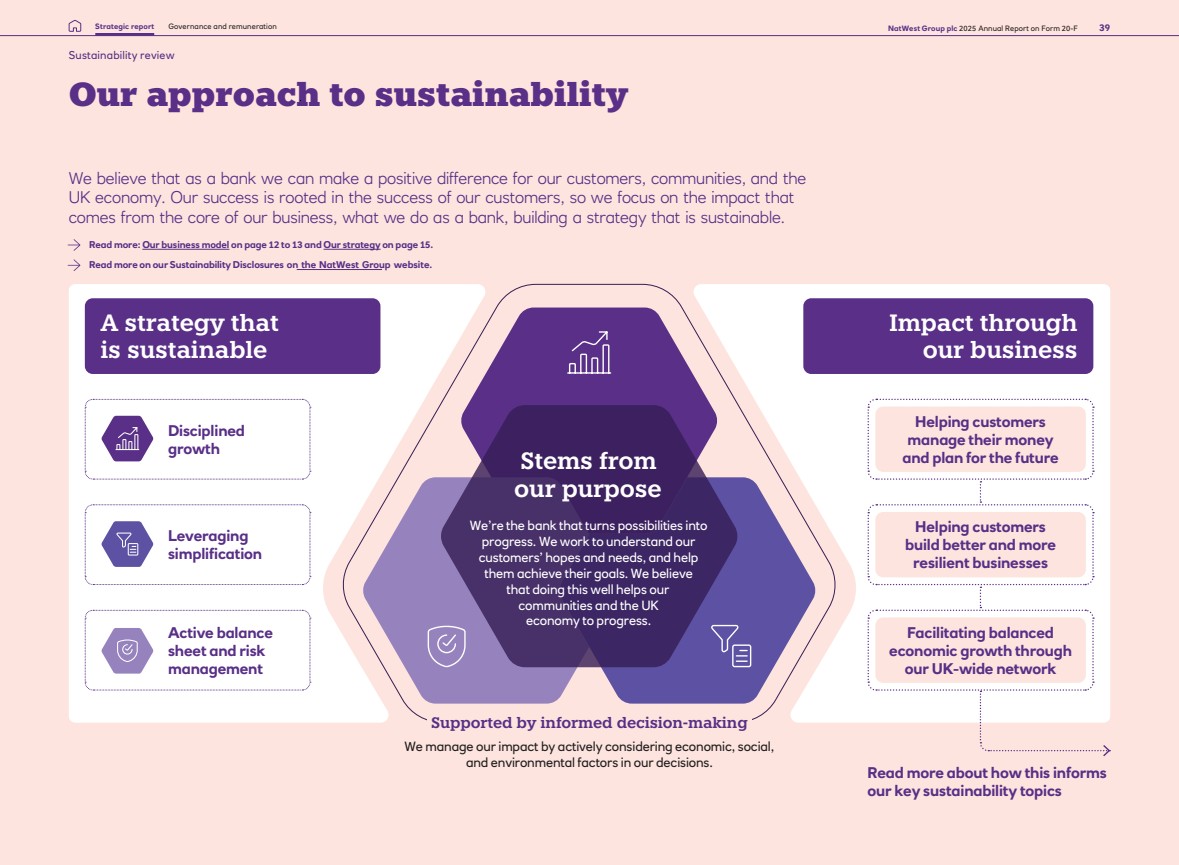
| Sustainability review continued Key sustainability topics for our stakeholders and our business To build enduring, trusted relationships with our customers and other stakeholders, we regularly engage with them to understand their needs and priorities. The themes that emerge help us identify where we can drive meaningful value through our activities, both for our business and society. We have defined the following topics as priorities in our efforts to address key sustainability challenges. Investors Customers Colleagues Communities Regulators Suppliers Read more on how we performed our assessment of sustainability topics in Our approach to assessment of key sustainability topics on page 67. Key sustainability topics Supporting customers and communities through our banking products and services Safeguarding information and tackling financial crime Innovation in our products and services Supporting the climate transition Driving a culture of integrity and responsible risk management Skilled, engaged and inclusive workforce We help people manage their money, plan for the future and build more resilient businesses by offering banking products and services. By doing so, we believe we can contribute to more resilient communities and sustainable growth. • Our business model: pages 12 to 13 • Business performance review: pages 25 to 32 • Helping people manage their money and plan for the future: pages 41 to 43 • Helping people build better and more resilient businesses: pages 43 to 44 We are focusing on innovation and digital transformation to improve our customer experience and help them build more resilient businesses. • Business performance review: pages 25 to 32 • Improving customer experience and accessibility of our digital channels: pages 46 to 47 • Embedding AI in our customer journeys: page 47 • Digital stability: page 47 We are helping to address the climate challenge by supporting our customers’ transition to a net-zero economy, embedding climate considerations into decision-making and risk management and pursuing our own ambition to be net-zero by 2050. • Supporting the climate transition: pages 48 to 56 We keep our customers’ and colleagues’ data safe to protect their privacy, and we have robust controls in place to tackle financial crime. • Managing data privacy: page 57 • Detecting and preventing financial crime, corruption and bribery: pages 57 to 58 • Combatting fraud: page 58 • Cybersecurity and payment systems regulator performance data: page 58 We are building a highly skilled, motivated, inclusive and diverse workforce to meet the needs of our customers today and in the future. • Building a future-ready workforce: pages 59 to 60 • Investing in talent and leadership capability: page 60 • Supporting colleague wellbeing: page 61 • Creating a diverse and inclusive workforce: pages 62 to 63 We want stakeholders to trust us to do the right thing; so we are building a culture of integrity, respect for human rights, and preventing corruption and bribery. • Refreshing Our Code: page 64 • Protecting whistleblowers: page 64 • Conflicts of interest and advocacy and political involvement: page 65 • Respect for human rights: page 65 • Environmental and social risks: page 66 • Meeting our tax responsibilities: page 66 Driving impact through our business Helping people manage their money and plan for the future Helping build better and more resilient businesses Facilitating balanced growth across the UK Read more on… Strategic report Strategic report Governance and remuneration Financial review Governance and remuneration Risk and capital management Financial statements Additional information NatWest Group plc NatWest Group plc 2025 Annual Report and Accounts 2025 Annual Report on Form 20-F 4040 |
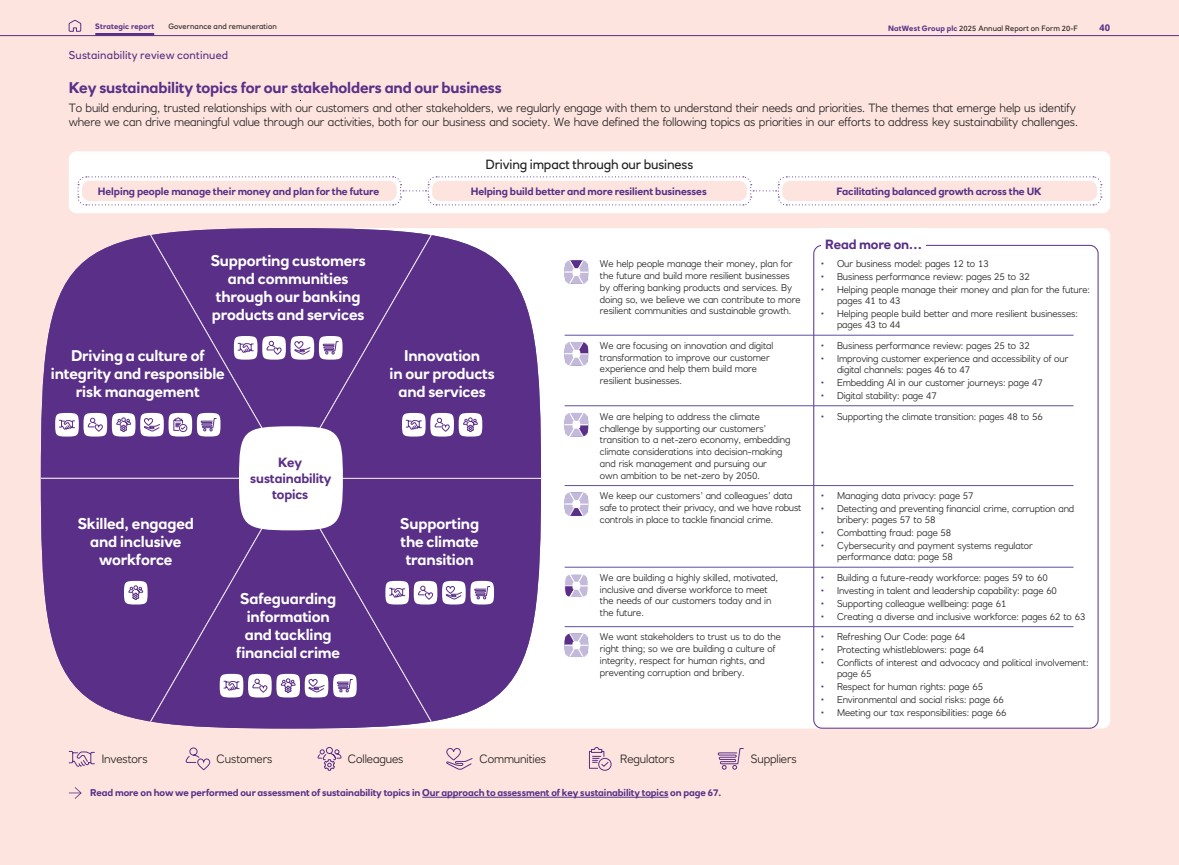
| Sustainability review continued Key sustainability topics for our stakeholders and our business To build enduring, trusted relationships with our customers and other stakeholders, we regularly engage with them to understand their needs and priorities. The themes that emerge help us identify where we can drive meaningful value through our activities, both for our business and society. We have defined the following topics as priorities in our efforts to address key sustainability challenges. Investors Customers Colleagues Communities Regulators Suppliers Read more on how we performed our assessment of sustainability topics in Our approach to assessment of key sustainability topics on page 67. Key sustainability topics Supporting customers and communities through our banking products and services Safeguarding information and tackling financial crime Innovation in our products and services Supporting the climate transition Driving a culture of integrity and responsible risk management Skilled, engaged and inclusive workforce We help people manage their money, plan for the future and build more resilient businesses by offering banking products and services. By doing so, we believe we can contribute to more resilient communities and sustainable growth. • Our business model: pages 12 to 13 • Business performance review: pages 25 to 32 • Helping people manage their money and plan for the future: pages 41 to 43 • Helping people build better and more resilient businesses: pages 43 to 44 We are focusing on innovation and digital transformation to improve our customer experience and help them build more resilient businesses. • Business performance review: pages 25 to 32 • Improving customer experience and accessibility of our digital channels: pages 46 to 47 • Embedding AI in our customer journeys: page 47 • Digital stability: page 47 We are helping to address the climate challenge by supporting our customers’ transition to a net-zero economy, embedding climate considerations into decision-making and risk management and pursuing our own ambition to be net-zero by 2050. • Supporting the climate transition: pages 48 to 56 • Other document: NatWest Group plc 2025 Climate Transition Plan Report We keep our customers’ and colleagues’ data safe to protect their privacy, and we have robust controls in place to tackle financial crime. • Managing data privacy: page 57 • Detecting and preventing financial crime, corruption and bribery: pages 57 to 58 • Combatting fraud: page 58 • Cybersecurity and payment systems regulator performance data: page 58 We are building a highly skilled, motivated, inclusive and diverse workforce to meet the needs of our customers today and in the future. • Building a future-ready workforce: pages 59 to 60 • Investing in talent and leadership capability: page 60 • Supporting colleague wellbeing: page 61 • Creating a diverse and inclusive workforce: pages 62 to 63 We want stakeholders to trust us to do the right thing; so we are building a culture of integrity, respect for human rights, and preventing corruption and bribery. • Refreshing Our Code: page 64 • Protecting whistleblowers: page 64 • Conflicts of interest and advocacy and political involvement: page 65 • Respect for human rights: page 65 • Environmental and social risks: page 66 • Meeting our tax responsibilities: page 66 Driving impact through our business Helping people manage their money and plan for the future Helping build better and more resilient businesses Facilitating balanced growth across the UK Read more on… Strategic report Financial review Governance and remuneration Risk and capital management Financial statements Additional information NatWest Group plc 2025 Annual Report and Accounts 40 Helping people manage their money and plan for the future Helping people manage their financial wellbeing is integrated into the design of our products. People across the UK, regardless of their income, continue to seek to feel more confident in managing their finances. According to the MoneyView 2025 survey, 46% of UK adults didn’t feel confident managing their money and 52% were struggling to keep up or have fallen behind with their commitments.(1) Building financial understanding is an important step, and we’re aiming to help this through our products and services. We offer a range of products, digital tools and features that support customers to improve their financial knowledge and wellbeing. These include personalised coaching plans based on their unique financial situation, and in-app tools such as Savings Goals, Round Ups and Know Your Credit Score. We also offer NatWest Rooster Money which is a children’s prepaid debit card and pocket money app designed to help young people, up to the age of 17, gain confidence with money and build responsible spending habits. It reached 600,000 subscribers in 2025, compared with 474,000 in 2024, driven largely by new features and marketing partnerships. Supporting customers with suitable products and services The challenges that people experience when banking, with us or any other bank, informs the way we create products that make banking possible for more people. Our approach to supporting our customers through our products, services and tools is set out in Our Code. As part of our product governance, we assess how customers with characteristics of vulnerability may be impacted by product design or changes through our Customer Vulnerability Impact Assessment. Before implementing any changes we make sure we have the right mitigants in place. Through our marketing and communications, we focus on giving customers clear, fair and accurate information about our products so that they can make decisions about their finances. We explain the risks, costs and conditions of our products in plain language and make key details easy to find, not hidden in lengthy terms and conditions. We offer financial products to support a wide range of customers and communities. In 2025, we looked to continue strengthening our accessible banking proposition, launching a new product to improve access to credit – the Credit Builder Credit Card. It is designed to help people boost their credit score and to start borrowing in a responsible, supportive way, with low credit limits and rewards to establish healthy repayment behaviour. We also offer affordable credit options like overdrafts and credit card instalment plans, supported with tools that help customers borrow responsibly. In 2025, 420,000 instalment plans were set up compared with 372,000 in 2024. We continued offering our Foundation account which provides basic banking with no fees or credit access for those with poor or no credit history, serving 860,000 customers in 2025, compared with 883,000 in 2024. Getting onto the property ladder continues to be a financial challenge for people in the UK, especially first-time buyers facing rising house Supporting customers and communities through our banking products and services Sustainability review continued (1) Survey by Money & Pensions Service can be found at maps.org.uk/en/publications/. We help people manage their money, plan for the future and build better, more resilient businesses. By doing this well, we believe we can make a positive difference for communities and support sustainable growth. We focus on driving impact through the core of what we do, as a bank, for our customers. That involves improving financial wellbeing, helping our customers overcome barriers to starting up and growing their businesses, and making banking more accessible. Our Digital Regular Saver Account helped over 1.8 million customers build savings habits Rooster Money helped build confidence of 600,000 young people with money Our Accelerator app grew with 12,000 members Through Banking My Way 640,000 customers told us about the support they need to bank with us More than 50,000 first time buyers took their first step on the housing ladder with us Know My Credit Score was used over 32 million times by customers In 2025 Strategic report Strategic report Governance and remuneration Financial review Governance and remuneration Risk and capital management Financial statements Additional information NatWest Group plc NatWest Group plc 2025 Annual Report and Accounts 2025 Annual Report on Form 20-F 4141 |
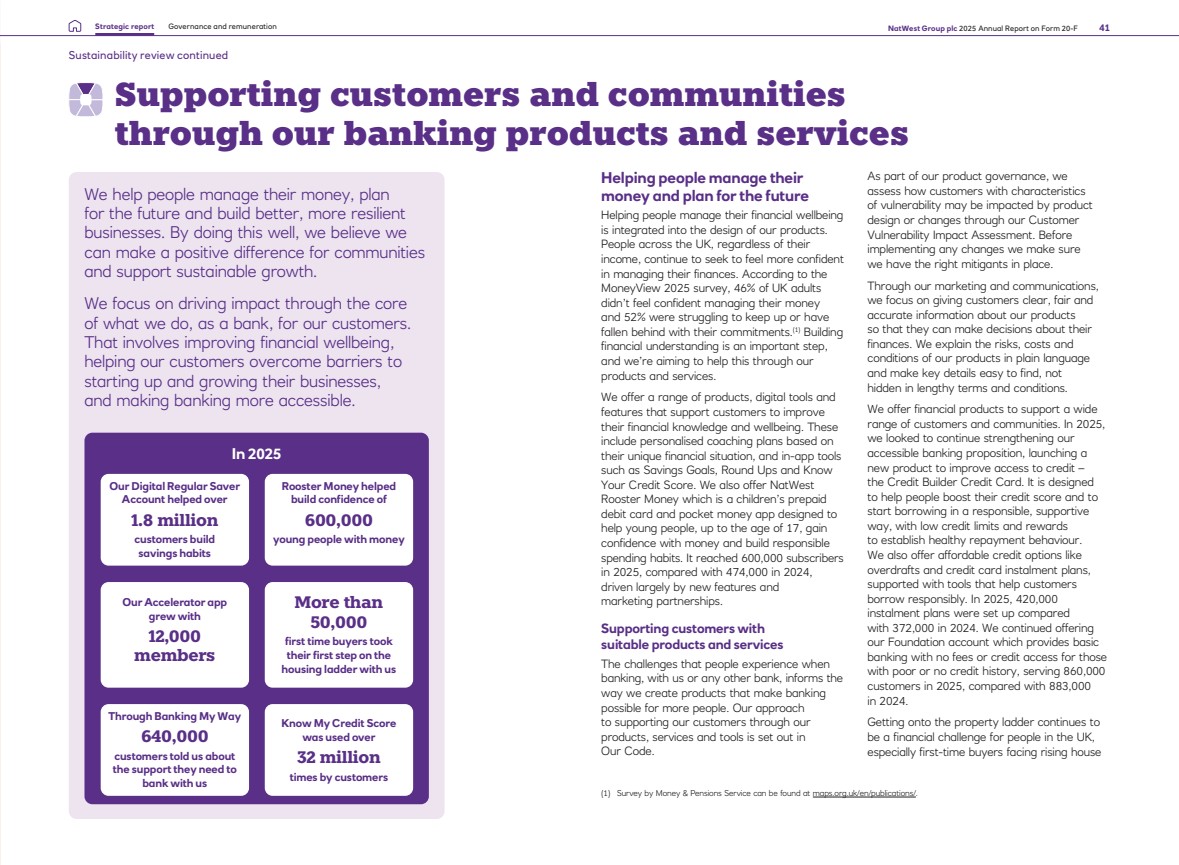
| Sustainability review continued | Supporting customers and communities through our banking products and services continued prices, high deposit requirements, and affordability pressures. First-time buyers make up over 30% of our new mortgage lending which is around £10 billion and we provided mortgages to more than 50,000 customers to take their first step onto the property ladder in 2025. We aim to continue our lending support by providing £10 billion in mortgage applications in 2026. Read more on our Family-Backed Mortgage on page 26. Our senior personal bankers provide free reviews of finances for personal and business customers, supporting them to understand which products or services could help them progress towards their financial goals. We provided Financial Health Checks to 307,000 Retail Banking customers in 2025, compared with 321,000 in 2024. We communicate with customers who may be struggling financially and provide them with access to a dedicated Financial Health and Support Team who offer specialist support and bespoke assistance. In 2025, we answered over 600,000 calls, sent over five million communications, and had over 500,000 digital engagements with our most financially vulnerable customers. Our communications signpost customers to tools and support to help improve their financial position. If a customer contacts us, we have a wide range of tailored solutions available to support them. We suppress interest on overdrafts at 32 days in excess and where customers miss payments on secured or unsecured debt, we give customers the flexibility to spread the repayment of missed payments over up to two years. Also, in May 2025, we removed unpaid direct debit fees for mortgage customers to align with loans and credit cards. We took an active role in shaping the recommendations of the UK Government’s Financial Inclusion Strategy. In 2025, it was announced we are one of the five banks to commit to piloting a refreshed approach to identity and verification for people experiencing housing insecurity and homelessness. Through our Banking Facilities For All (BFFA) initiative, we support UK residents who face difficulties in providing traditional identification documents. These customers are typically refugees, individuals experiencing homelessness, those fleeing abuse and prison leavers. Through BFFA, we are working to end barriers to opening an account by accepting alternative forms of identification. We actively support the UK Says No More campaign by offering Safe Spaces in 268 of our branches. These locations provide a private room for individuals experiencing domestic abuse to access a phone and contact support discreetly. Our colleagues have received specialist training on Safe Spaces and domestic abuse awareness. Providing banking channels for customers It is important to us that all our customers find banking with us simple and through a channel of their choice. Banking My Way helps us tailor our service to each customer. It allows customers to tell us the support they need to make banking easier, with a range of adjustments including a sign language interpreter, braille statements or simply speaking more slowly. It is available through the mobile app, online banking, in our branches and with our telephone teams. As at 31 December 2025, 640,000 customers had registered for additional support through Banking My Way compared with 397,000 in 2024. We continued to offer mobile branches throughout 2025 with 613 unique stops as at 31 December 2025, compared with 600 in 2024. These branches allow customers to carry out their everyday banking, such as making deposits, withdrawing cash and paying bills. We also continued to operate our network of 1,954 ATMs as at 31 December 2025, compared to 2,150 in 2024. This reduction in ATMs is due to a combination of branch closures and removal of remote ATMs. Throughout 2025, we have installed a new generation of ATMs that provide access to enhanced features aimed at improving accessibility, multi-language support and security. In 2025, we closed 100 branches, bringing our total number of branches as at 31 December 2025 to 384. In January 2026, we announced the closure of 32 branches. We closed mobile branches in locations with a Cash Access UK (CAUK) Banking Hub, as this offers customers a more permanent and comprehensive banking service. We are committed to providing customers with 12 weeks notice of a branch closure announcement. There are lots of other ways customers can bank with us, including mobile and online banking, video banking, our telephony teams, and the Post Office. We continue to work with CAUK and other banks to bring shared cash and banking services to communities. As at 31 December 2025, there were approximately 200 Banking Hubs and 150 shared cash deposit and withdrawal services across the UK. In most locations, a member of our team will be on hand once a week to help customers with their banking. In 2025, we renewed our commitment to delivering access to everyday banking services through over 11,500 Post Office locations. Reviewing our products policies, and processes As part of our ongoing review of our products, policies and processes, we made further enhancements to our ‘Good Customer Outcomes Monitoring’. This involved surfacing an additional 200 data points to help identify and manage scenarios of potential harm, where customers may not be experiencing their products or services as intended by design. We have also continued to improve the precision of our Price and Value Documentation, required under the FCA Consumer Duty Regulation, so they cover different customer segments, notably those customers whose characteristics indicate they may be more susceptible to a poorer outcome. Spotlight Financial Foundations workshops Following a successful pilot last year, Financial Foundations was expanded in 2025 to reach communities across the UK. This programme aims to help people make the most of their money and take control of their financial future through free, in-person, impartial money guidance workshops and a range of digital tools and resources. We expanded the programme through our Commercial & Institutional customers, helping to support employee financial wellbeing and, in turn, enhance engagement, productivity and retention. Financial Foundations supports adults at all life stages, equipping them to develop financial resilience, plan for their future and protect against fraud and scams. Delivering workshops in person allows us to reach individuals within their local communities and workplaces, where it is accessible and convenient. Evaluation of the pilot improved and refined content and delivery and helped us understand the need for money guidance. Ongoing monitoring of post-survey data demonstrates participants feel more confident managing their money. During 2025, 1,500 workshops were delivered to over 31,000 participants. We are now aiming to support 50,000 people with free financial education in 2026, in their workplaces and communities. Strategic report Strategic report Governance and remuneration Financial review Governance and remuneration Risk and capital management Financial statements Additional information NatWest Group plc NatWest Group plc 2025 Annual Report and Accounts 2025 Annual Report on Form 20-F 4242 |
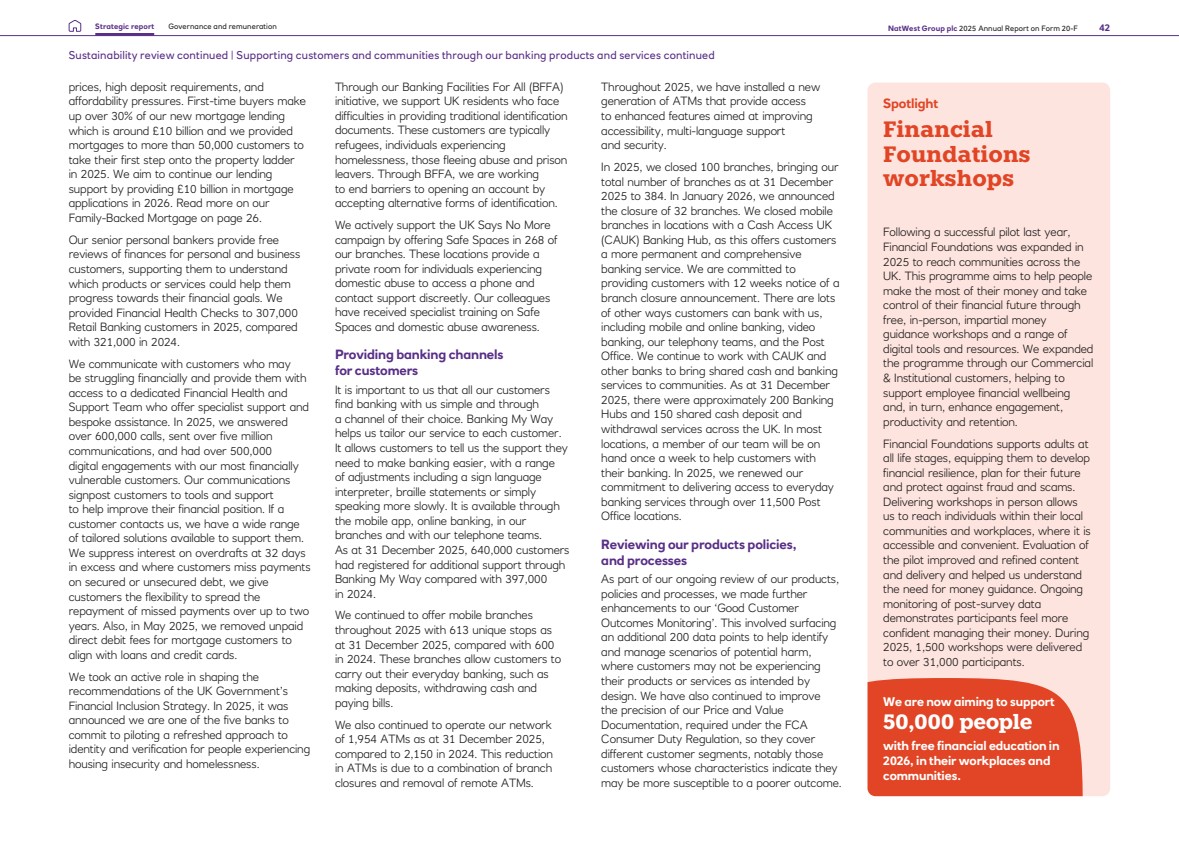
| Sustainability review continued | Supporting customers and communities through our banking products and services continued prices, high deposit requirements, and affordability pressures. First-time buyers make up over 30% of our new mortgage lending which is around £10 billion and we provided mortgages to more than 50,000 customers to take their first step onto the property ladder in 2025. We aim to continue our lending support by providing £10 billion in mortgage applications in 2026. Read more on our Family-Backed Mortgage on page 26. Our senior personal bankers provide free reviews of finances for personal and business customers, supporting them to understand which products or services could help them progress towards their financial goals. We provided Financial Health Checks to 307,000 Retail Banking customers in 2025, compared with 321,000 in 2024. We communicate with customers who may be struggling financially and provide them with access to a dedicated Financial Health and Support Team who offer specialist support and bespoke assistance. In 2025, we answered over 600,000 calls, sent over five million communications, and had over 500,000 digital engagements with our most financially vulnerable customers. Our communications signpost customers to tools and support to help improve their financial position. If a customer contacts us, we have a wide range of tailored solutions available to support them. We suppress interest on overdrafts at 32 days in excess and where customers miss payments on secured or unsecured debt, we give customers the flexibility to spread the repayment of missed payments over up to two years. Also, in May 2025, we removed unpaid direct debit fees for mortgage customers to align with loans and credit cards. We took an active role in shaping the recommendations of the UK Government’s Financial Inclusion Strategy. In 2025, it was announced we are one of the five banks to commit to piloting a refreshed approach to identity and verification for people experiencing housing insecurity and homelessness. Through our Banking Facilities For All (BFFA) initiative, we support UK residents who face difficulties in providing traditional identification documents. These customers are typically refugees, individuals experiencing homelessness, those fleeing abuse and prison leavers. Through BFFA, we are working to end barriers to opening an account by accepting alternative forms of identification. We actively support the UK Says No More campaign by offering Safe Spaces in 268 of our branches. These locations provide a private room for individuals experiencing domestic abuse to access a phone and contact support discreetly. Our colleagues have received specialist training on Safe Spaces and domestic abuse awareness. Providing banking channels for customers It is important to us that all our customers find banking with us simple and through a channel of their choice. Banking My Way helps us tailor our service to each customer. It allows customers to tell us the support they need to make banking easier, with a range of adjustments including a sign language interpreter, braille statements or simply speaking more slowly. It is available through the mobile app, online banking, in our branches and with our telephone teams. As at 31 December 2025, 640,000 customers had registered for additional support through Banking My Way compared with 397,000 in 2024. We continued to offer mobile branches throughout 2025 with 613 unique stops as at 31 December 2025, compared with 600 in 2024. These branches allow customers to carry out their everyday banking, such as making deposits, withdrawing cash and paying bills. We also continued to operate our network of 1,954 ATMs as at 31 December 2025, compared to 2,150 in 2024. This reduction in ATMs is due to a combination of branch closures and removal of remote ATMs. Throughout 2025, we have installed a new generation of ATMs that provide access to enhanced features aimed at improving accessibility, multi-language support and security. In 2025, we closed 100 branches, bringing our total number of branches as at 31 December 2025 to 384. In January 2026, we announced the closure of 32 branches. We closed mobile branches in locations with a Cash Access UK (CAUK) Banking Hub, as this offers customers a more permanent and comprehensive banking service. We are committed to providing customers with 12 weeks notice of a branch closure announcement. There are lots of other ways customers can bank with us, including mobile and online banking, video banking, our telephony teams, and the Post Office. We continue to work with CAUK and other banks to bring shared cash and banking services to communities. As at 31 December 2025, there were approximately 200 Banking Hubs and 150 shared cash deposit and withdrawal services across the UK. In most locations, a member of our team will be on hand once a week to help customers with their banking. In 2025, we renewed our commitment to delivering access to everyday banking services through over 11,500 Post Office locations. Reviewing our products policies, and processes As part of our ongoing review of our products, policies and processes, we made further enhancements to our ‘Good Customer Outcomes Monitoring’. This involved surfacing an additional 200 data points to help identify and manage scenarios of potential harm, where customers may not be experiencing their products or services as intended by design. We have also continued to improve the precision of our Price and Value Documentation, required under the FCA Consumer Duty Regulation, so they cover different customer segments, notably those customers whose characteristics indicate they may be more susceptible to a poorer outcome. Spotlight Financial Foundations workshops Following a successful pilot last year, Financial Foundations was expanded in 2025 to reach communities across the UK. This programme aims to help people make the most of their money and take control of their financial future through free, in-person, impartial money guidance workshops and a range of digital tools and resources. We expanded the programme through our Commercial & Institutional customers, helping to support employee financial wellbeing and, in turn, enhance engagement, productivity and retention. Financial Foundations supports adults at all life stages, equipping them to develop financial resilience, plan for their future and protect against fraud and scams. Delivering workshops in person allows us to reach individuals within their local communities and workplaces, where it is accessible and convenient. Evaluation of the pilot improved and refined content and delivery and helped us understand the need for money guidance. Ongoing monitoring of post-survey data demonstrates participants feel more confident managing their money. During 2025, 1,500 workshops were delivered to over 31,000 participants. We are now aiming to support 50,000 people with free financial education in 2026, in their workplaces and communities. Strategic report Financial review Governance and remuneration Risk and capital management Financial statements Additional information NatWest Group plc 2025 Annual Report and Accounts 42 Sustainability review continued | Supporting customers and communities through our banking products and services continued Dealing with customer complaints effectively builds customer trust and complies with FCA standards. We focus on identifying and addressing the root causes of complaints to reduce them and, in turn, make banking easier for our customers. In 2025, we received 255,000 reportable complaints, compared with 239,000 in 2024. In 2025, we received 255,000 reportable complaints, up from 239,000, driven partly by the onboarding of Sainsbury’s Bank customers, increased customer awareness, and rising levels of fraud and scams. Approach to financial wellbeing We set an ambition in 2023 to help 10 million people per year manage their financial wellbeing by 2027. In 2024, we exceeded our annual ambition to help 7 million people manage their financial wellbeing by supporting 7.8 million people. After reaching this milestone, we reviewed our ambition in the context of our strategy and decided to no longer separately measure, track, and report on this target. Financial wellbeing is now sufficiently embedded in our strategy, and we continue to support customers through both broad and tailored products and services such as our Digital Regular Saver, Round Ups, NatWest Thrive programme, and Financial Foundations workshops, which will continue to be offered unless otherwise specified. Two key programmes, NatWest Thrive and Financial Foundations, remain central to our work to improve financial wellbeing among our customers and communities. NatWest Thrive: building confidence with money and future skills for the next generation For over 30 years, we have run programmes to help young people grow their financial confidence. In 2025, we brought together several of these long-standing programmes – MoneySense, Dream Bigger and CareerSense – into a single free educational programme called NatWest Thrive. NatWest Thrive provides bite-sized learning content for teachers, parents and youth workers. To connect with young people, we use relatable role models and real-life scenarios that help money matters and careers feel relevant. For example, we have drawn on our partnerships with Team GB and ParalympicsGB to bring in athlete ambassadors to inspire young people to take steps to shape the future they want. Spotlight Expanding NatWest Accelerator Hubs Our 12 Hubs are central to the Accelerator community, delivering local tailored interventions designed to meet local needs. We have partnered with the Universities of Manchester, Oxford, York and Brighton to establish local Accelerator Hubs in their campuses to continue expanding the community. We plan to set up hubs in up to 10 universities over the next two years. This initiative is part of our wider strategy launched in spring 2025, to harness academic expertise and regional strengths as we grow the reach of the community. it easier for businesses to manage their finances and overcome hurdles while focusing on building their business. NatWest Accelerator: evolving to empower more entrepreneurs and businesses The NatWest Accelerator community offers coaching, networking and resources to start-ups and small businesses, helping them grow and build vital foundations for long-term resilience. To extend the community’s reach and impact, we switched to a hybrid model, launching the NatWest Accelerator app in March 2025. The app provides UK-wide access to learning, collaboration spaces, mentors and events, and as 31 December 2025 we had approximately 12,000 members registered on the app. In 2025, we forged partnerships to drive inclusive growth and innovation. Our collaboration with Google supports responsible AI adoption, boosting digital capability for entrepreneurs. With JCDecaux UK, they empower early-stage businesses to scale through Out-of-Home advertising, increasing visibility and creating opportunities for sustainable business growth. We also launched NatWest Accelerator Pitch, showcasing UK entrepreneurial talent and innovation to help increase their visibility and growth opportunities. Pitch provides a national platform for founders to present to expert judges and industry leaders. Since launching in March 2025, NatWest Pitch has attracted around 1,000 applications from founders nationwide. Its first two live finals, hosted in Manchester in July 2025 and London in November 2025, awarded £200,000 to six innovative businesses. To contribute to inclusive entrepreneurship, approximately half of our support through the NatWest Accelerator community is directed to women in business, and a significant proportion to individuals from ethnic minority backgrounds. We continue to work with partners including Digital Boost, Buy Women Built and Hatch to create an equitable, empowering ecosystem for diverse founders. We are now aiming to grow our Accelerator community to 50,000 members in 2026. In 2025, NatWest Thrive reached over 1 million young people across the UK, with 80% of young people across schools and youth clubs reporting a positive change in behaviour towards their financial wellbeing after participating in NatWest Thrive. Supporting women in business We continue to support female entrepreneurs through access to finance, mentorship and tailored networks. Between 2020 and June 2025, we approved more than 55,900 loans for women-led businesses, totalling £2.8 billion. Partnerships with platforms such as MP HERoes have provided female entrepreneurs with practical support, networking opportunities, mentoring and events, alongside the Begin programme for aspiring entrepreneurs. Expanding the impact of NatWest Thrive with the National Youth Agency Youth clubs can be an important hub for young people to access information they trust, in a setting they feel comfortable in. Our partnership with the National Youth Agency enables us to connect with young people through youth clubs in underserved communities. Our £5 million levy fund pledge, which was increased from £3 million in 2025, continues to bring more qualified youth workers into the sector. Of those beginning a youth work degree apprenticeship qualification in the UK in 2025, NatWest Group supported a third through our apprenticeship levy funding. Helping people build better and more resilient businesses Homegrown businesses are the cornerstone of the UK economy. We believe we can contribute to more disciplined growth by supporting businesses of all sizes to start up, scale and adapt. Through core products and additional programmes, we are making Strategic report Strategic report Governance and remuneration Financial review Governance and remuneration Risk and capital management Financial statements Additional information NatWest Group plc NatWest Group plc 2025 Annual Report and Accounts 2025 Annual Report on Form 20-F 4343 |
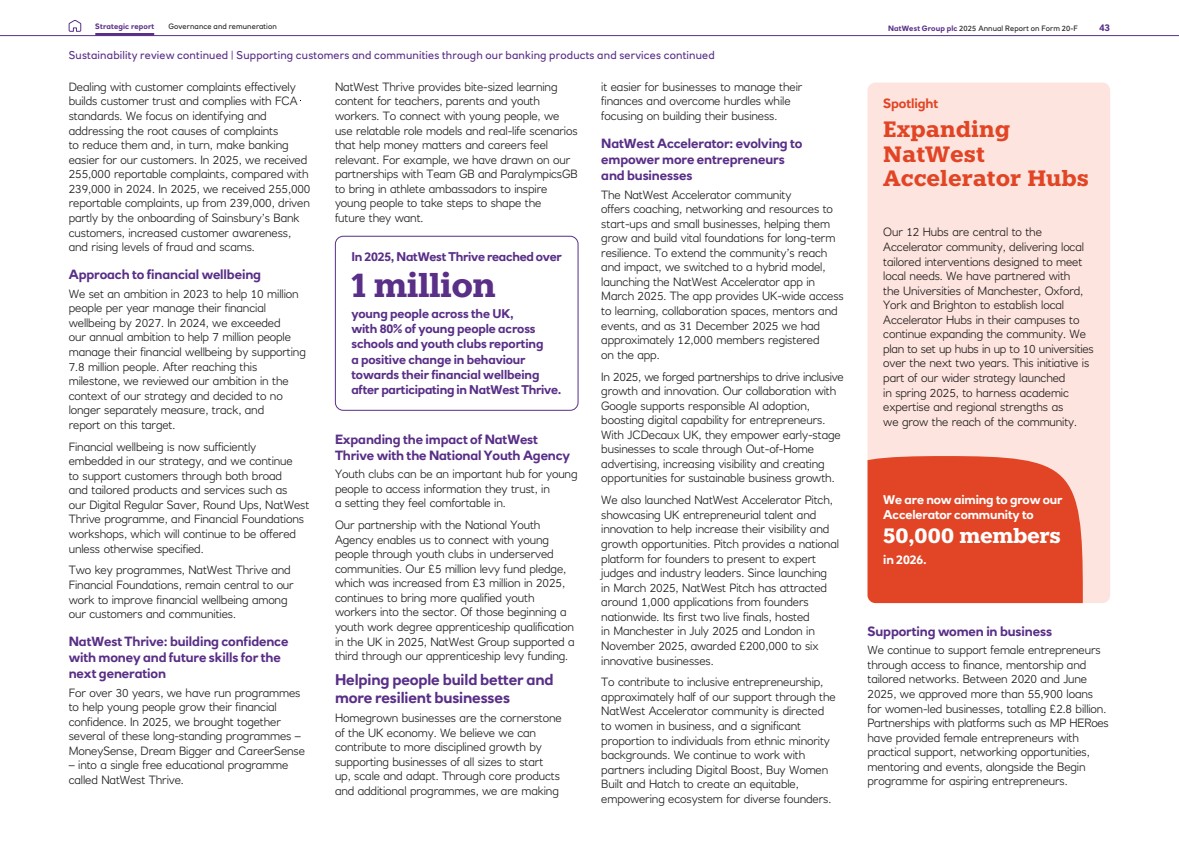
| focused on turning possibilities into progress, we can use our financial products to support investment and delivery of schemes that lay the foundations for more balanced growth and look to support environmental and social outcomes for our customers. We contributed to the Cambridge Institute for Sustainability Leadership’s report, advocating for retrofit as a national priority. The report highlights the economic, social and health benefits of energy efficiency, framing retrofit as essential to climate action, public wellbeing and long-term productivity. Supporting customers’ social financing NatWest Markets, acting as arranger and dealer, continued to support corporate and institutional customers with their social and sustainability bond issuances through private placements, public bonds, and tap transactions, to facilitate projects that improve access to essential services, like affordable housing, healthcare, and other socially beneficial activities. In 2025, we lead managed 22 sustainability and 12 social bonds, acting as arranger and dealer, facilitating a total notional of £18.8 billion(1) of which £5 billion was attributable to NatWest Group as at 31 December 2025 (2024: total notional £24 billion, £5.4 billion attributable). Use of proceeds from our green and social bonds Our Green, Social and Sustainability (GSS) Financing Framework is designed with the aim of attracting dedicated and diversified funding that supports lending and investment activities with the potential to deliver positive environmental and social outcomes. Since 2019 this has included the issuance of(2): • Five social bonds, with a total nominal value at issuance of £3.9 billion, across three asset classes. • Four green bonds, with a total nominal value at issuance of £2.6 billion, also across three asset classes. Spotlight Supporting the building of social rented homes In July 2025, NatWest Group launched a first-to-market £500 million loan product to be used for the building of social rented homes. This loan product aims to help address the housing crisis, offering discounted rates and no arrangement fees(3) to housing associations. Following strong demand, we increased the level of lending to £1 billion in December 2025, potentially saving the sector in finance costs. This lending is expected to be delivered throughout 2026, subject to market conditions. Sustainability review continued | Supporting customers and communities through our banking products and services continued In 2025, we completed £168.5 million of lending to support the building of social rented homes.(1) We set an ambition to provide £7.5 billion of targeted lending to the social housing sector between 1 January 2024 and 31 December 2026. Having delivered £8.7billion(1) in lending across 2024 and 2025, and achieving our ambition early, we are now aiming to deliver £10 billion in new lending between 1 January 2026 and 31 December 2028. (1) Social finance and facilitation represent only a relatively small proportion of our overall financing and facilitation activities. (2) Of the nine green and social bonds issued by NatWest Group, as at 31 December 2025 seven remain outstanding, two issuances having been redeemed at their first call date. (3) Discounted rates and no arrangement fees based on internal margins. Banking support for small businesses We support small businesses through a suite of digital products designed to simplify financial management and accelerate growth. An example is Mettle, our digital business bank account for sole traders, small businesses and limited companies, that makes it easy for customers to raise and send invoices, upload receipts and integrate with FreeAgent. In 2025, we expanded Mettle+, making it more widely available to customers. The service enables businesses to create and send bespoke quotes and convert them to invoices on the go. Mettle was voted ‘Best Business Banking Provider’ at the British Bank Awards and ‘Best Customer Service’ at Engage Awards 2025. As at 31 December 2025, Mettle reached approximately 150,000 open accounts, up from approximately 132,000 at the end of 2024. FreeAgent continues to bring accounting software to small businesses, supporting approximately 225,000 customers in 2025, compared with 200,000 in 2024. It simplifies bookkeeping, tax, and financial planning, so that small businesses can better understand and manage their finances. Tyl by NatWest, our payments solution, supported approximately 40,000 merchants during 2025, compared with approximately 38,000 in 2024. It offers flexible, easy-to-use payment options that help businesses get paid faster and manage transactions more efficiently. In 2025, we launched a new suite of terminals and a merchant portal to further improve the experience for small businesses, micro-businesses and seasonal traders. Building for the future by partnering with our corporate clients to support social and sustainability goals Social housing and sustainable infrastructure are fundamental to building resilient communities. We believe that as a bank This funding supports our customers with the delivery of new homes, improved living conditions and the UK’s progress towards net zero. Strategic partnerships supporting the housing sector NatWest Group collaborated through strategic partnerships to support efforts towards driving inclusive and sustainable housing solutions across the UK. In April 2025, the National Wealth Fund announced a financial guarantee of up to £400 million to cover a series of new loans provided by NatWest Group to registered providers for the retrofit of social housing stock in the UK. This lending aims to accelerate the decarbonisation of social housing by funding measures such as lighting, insulation and renewable energy generation like solar panels. Strategic report Strategic report Governance and remuneration Financial review Governance and remuneration Risk and capital management Financial statements Additional information NatWest Group plc NatWest Group plc 2025 Annual Report and Accounts 2025 Annual Report on Form 20-F 4444 |
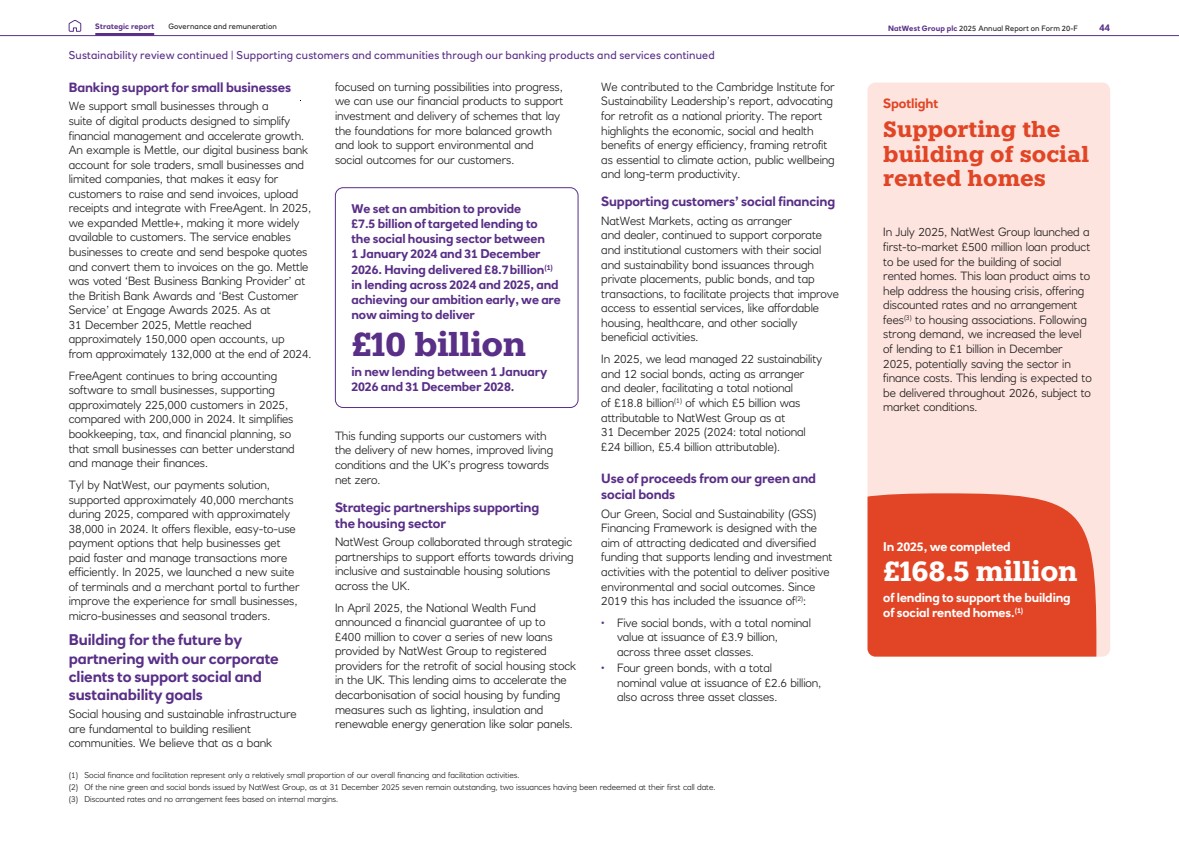
| focused on turning possibilities into progress, we can use our financial products to support investment and delivery of schemes that lay the foundations for more balanced growth and look to support environmental and social outcomes for our customers. We contributed to the Cambridge Institute for Sustainability Leadership’s report, advocating for retrofit as a national priority. The report highlights the economic, social and health benefits of energy efficiency, framing retrofit as essential to climate action, public wellbeing and long-term productivity. Supporting customers’ social financing NatWest Markets, acting as arranger and dealer, continued to support corporate and institutional customers with their social and sustainability bond issuances through private placements, public bonds, and tap transactions, to facilitate projects that improve access to essential services, like affordable housing, healthcare, and other socially beneficial activities. In 2025, we lead managed 22 sustainability and 12 social bonds, acting as arranger and dealer, facilitating a total notional of £18.8 billion(1) of which £5 billion was attributable to NatWest Group as at 31 December 2025 (2024: total notional £24 billion, £5.4 billion attributable). Use of proceeds from our green and social bonds Our Green, Social and Sustainability (GSS) Financing Framework is designed with the aim of attracting dedicated and diversified funding that supports lending and investment activities with the potential to deliver positive environmental and social outcomes. Since 2019 this has included the issuance of(2): • Five social bonds, with a total nominal value at issuance of £3.9 billion, across three asset classes. • Four green bonds, with a total nominal value at issuance of £2.6 billion, also across three asset classes. Read more on our 2024 Green, Social and Sustainability Bonds Allocation and Impact Report and GSS Framework at natwestgroup.com. Spotlight Supporting the building of social rented homes In July 2025, NatWest Group launched a first-to-market £500 million loan product to be used for the building of social rented homes. This loan product aims to help address the housing crisis, offering discounted rates and no arrangement fees(3) to housing associations. Following strong demand, we increased the level of lending to £1 billion in December 2025, potentially saving the sector in finance costs. This lending is expected to be delivered throughout 2026, subject to market conditions. Sustainability review continued | Supporting customers and communities through our banking products and services continued In 2025, we completed £168.5 million of lending to support the building of social rented homes.(1) We set an ambition to provide £7.5 billion of targeted lending to the social housing sector between 1 January 2024 and 31 December 2026. Having delivered £8.7billion(1) in lending across 2024 and 2025, and achieving our ambition early, we are now aiming to deliver £10 billion in new lending between 1 January 2026 and 31 December 2028. (1) Social finance and facilitation represent only a relatively small proportion of our overall financing and facilitation activities. (2) Of the nine green and social bonds issued by NatWest Group, as at 31 December 2025 seven remain outstanding, two issuances having been redeemed at their first call date. (3) Discounted rates and no arrangement fees based on internal margins. Banking support for small businesses We support small businesses through a suite of digital products designed to simplify financial management and accelerate growth. An example is Mettle, our digital business bank account for sole traders, small businesses and limited companies, that makes it easy for customers to raise and send invoices, upload receipts and integrate with FreeAgent. In 2025, we expanded Mettle+, making it more widely available to customers. The service enables businesses to create and send bespoke quotes and convert them to invoices on the go. Mettle was voted ‘Best Business Banking Provider’ at the British Bank Awards and ‘Best Customer Service’ at Engage Awards 2025. As at 31 December 2025, Mettle reached approximately 150,000 open accounts, up from approximately 132,000 at the end of 2024. FreeAgent continues to bring accounting software to small businesses, supporting approximately 225,000 customers in 2025, compared with 200,000 in 2024. It simplifies bookkeeping, tax, and financial planning, so that small businesses can better understand and manage their finances. Tyl by NatWest, our payments solution, supported approximately 40,000 merchants during 2025, compared with approximately 38,000 in 2024. It offers flexible, easy-to-use payment options that help businesses get paid faster and manage transactions more efficiently. In 2025, we launched a new suite of terminals and a merchant portal to further improve the experience for small businesses, micro-businesses and seasonal traders. Building for the future by partnering with our corporate clients to support social and sustainability goals Social housing and sustainable infrastructure are fundamental to building resilient communities. We believe that as a bank This funding supports our customers with the delivery of new homes, improved living conditions and the UK’s progress towards net zero. Strategic partnerships supporting the housing sector NatWest Group collaborated through strategic partnerships to support efforts towards driving inclusive and sustainable housing solutions across the UK. In April 2025, the National Wealth Fund announced a financial guarantee of up to £400 million to cover a series of new loans provided by NatWest Group to registered providers for the retrofit of social housing stock in the UK. This lending aims to accelerate the decarbonisation of social housing by funding measures such as lighting, insulation and renewable energy generation like solar panels. Strategic report Financial review Governance and remuneration Risk and capital management Financial statements Additional information NatWest Group plc 2025 Annual Report and Accounts 44 Succeeding with customers Across the wide spread of communities we serve in the UK, connections are sometimes required beyond our branches. This is especially true for areas of the country where customers can find it difficult to access our physical locations. NatWest Group has a pioneering history in mobile branch banking and continues to reach communities that are distanced from our main branch buildings. In the Orkney Islands, for instance, the Royal Bank of Scotland is the only bank in the UK to operate a ‘flying banking’ service. From the Royal Bank of Scotland branch in Kirkwall, it’s the role of Personal Banker, Lois Canning, to fly to three islands – Westray, once a week; and Stronsay and Sanday, every fortnight – to provide essential in-person banking services. Our impact Providing vital access to cash. Supporting local businesses and their communities. Promoting online and telephone banking for 24-hour access. Orkney Islands island communities through flying banking Case study – helping people manage their money Connecting Lois Canning (left) and Stuart Groat, Royal Bank of Scotland customer (right) ‘There are lots of people in smaller communities that really do need our support, so it’s important we can find a way to reach them. Succeeding with customers means understanding their lives and being there for them, wherever they are.’ Lois Canning, Royal Bank of Scotland, Personal Banker, Kirkwall, Orkney Islands. Strategic report Strategic report Governance and remuneration Financial review Governance and remuneration Risk and capital management Financial statements Additional information NatWest Group plc NatWest Group plc 2025 Annual Report and Accounts 2025 Annual Report on Form 20-F 4545 |
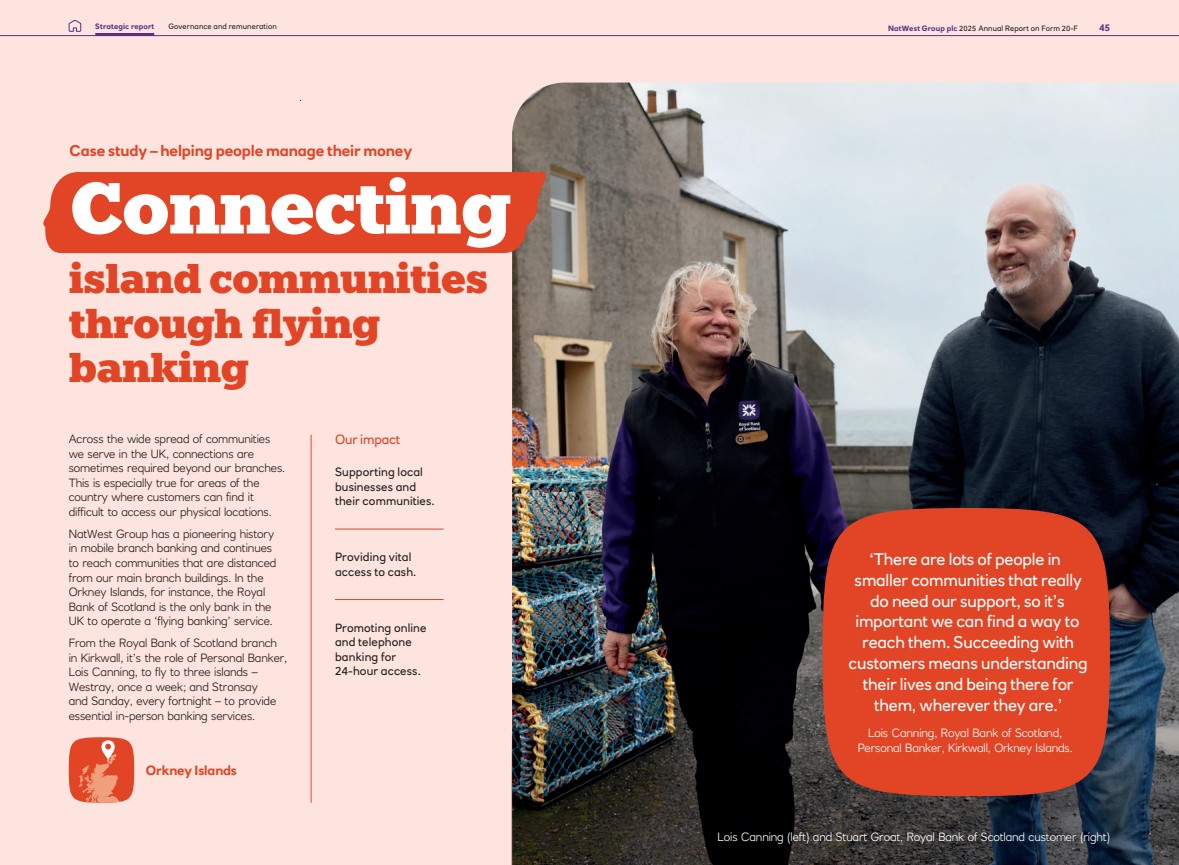
| Innovation in our products and services Sustainability review continued Improving the customer experience and accessibility of our digital channels We focus on exploring and embracing innovation and technology that helps customers access financial services that they need and bank in a way that works for them. Banking apps and online platforms are an essential tool for making it more convenient for our customers to manage money. We continue to explore ways to further personalise our online services to customer preferences and make essential banking easier. We continue to operate in a rapidly changing landscape, and as we evolve our digital services and adopt emerging technologies that support our customers, maintaining accessibility, stability, and responsible use of data and AI, is essential. Enhancements to mobile apps and online platforms We recognise there is always room to strengthen the services we provide and our development focus for the retail app in 2025 has been to make it easier and more supportive for our customers. The following changes reflect that focus for 2025: • Subscription management helps customers see their subscriptions in one convenient place within the app. Where possible, we have included direct links to company websites for simple management – helping customers manage their payments. • Offering virtual debit cards making online purchases easier. • Introducing Budget Pots for Ulster Bank customers, enabling them to set aside money. • Providing real-time credit limit management. We also invested in our award-winning Coutts app to enhance the client experience and deepen engagement. We introduced a set of enhancements in addition to refreshing our website to improve accessibility. Some key achievements include: • All non-bespoke savings products available as digital journeys, resulting in an 11.3% uplift in digital balances year-on-year. • Offering further insights for clients on their investments with the introduction of Valuation and Performance charts. • Sharing expert market commentary to better showcase our expertise and meet client needs. Following the 2025 enhancements, our Coutts digital experience is now attracting a Net Promoter Score® of +54. We also upgraded Bankline, the digital channel for Commercial & Institutional customers, in 2025. This was done to make it simpler to use, and to enable our customers to access other products and services more efficiently, through a single sign-on. Customers can now access a wide range of NatWest Group products through Bankline, including: • FacFlow, our invoice finance service. • Lombard, our asset finance platform. • ClearSpend, our corporate card platform. • Agile Markets, our foreign exchange (FX) application. • Trade360, our trade finance platform. We want to strengthen our relationships with our customers by connecting them with the best technology available to us to help them manage their money for day-to-day banking, plan for the future, achieve their long-term financial goals, and build better, more resilient businesses. Emerging technologies and shifting customer preferences are transforming how people bank. That’s why we are aiming to build a bank that develops and adopts tools that improve customer experience and access to our services. Retail customers banking entirely digital 81.8% Target: 80% (2024: 78.7%) Commercial & Institutional customers banking digital first 84.5% Target: 85% (2024: 82.9%) (1) Retail Banking customers with active current accounts that have accessed a digital platform (online or mobile) and not used the branch or telephony for 90 days in the reporting period ended on 31 December 2025. Inactive customers and customers with no channel use excluded. Mortgages and savings accounts, and interactions via the Post Office are excluded from the scope of measurement. (2) Commercial & Institutional (ring-fenced bank) customers with active non-personal account/s that access their account 95% or higher through digital channels for three rolling months in the reporting period ended on 31 December. 2025 Access to account through a digital channel may not result in a transaction. Link to remuneration Key performance indicators Strategic report Strategic report Governance and remuneration Financial review Governance and remuneration Risk and capital management Financial statements Additional information NatWest Group plc NatWest Group plc 2025 Annual Report and Accounts 2025 Annual Report on Form 20-F 4646 (3) For more information on these targets, refer to the NatWest Group 2025 Basis of Reporting. (1,3) (2,3) |
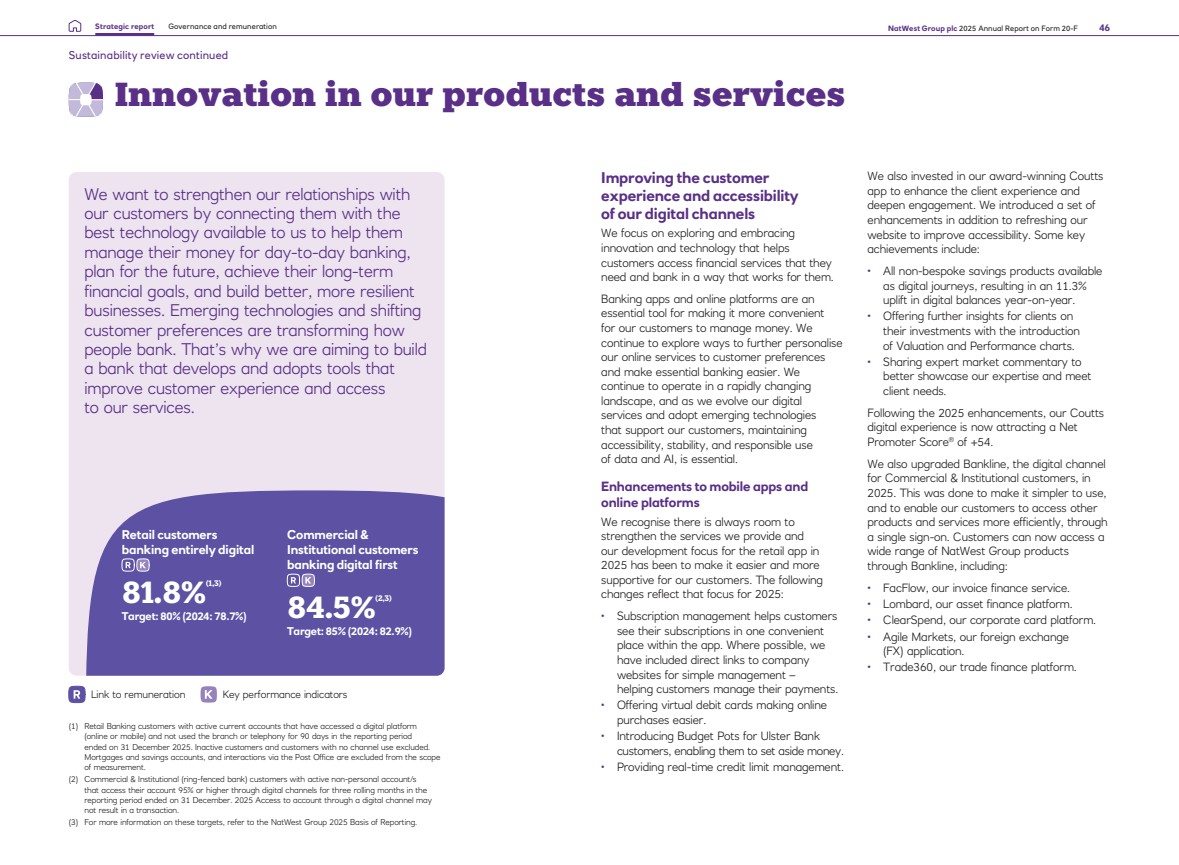
| Innovation in our products and services Sustainability review continued Improving the customer experience and accessibility of our digital channels We focus on exploring and embracing innovation and technology that helps customers access financial services that they need and bank in a way that works for them. Banking apps and online platforms are an essential tool for making it more convenient for our customers to manage money. We continue to explore ways to further personalise our online services to customer preferences and make essential banking easier. We continue to operate in a rapidly changing landscape, and as we evolve our digital services and adopt emerging technologies that support our customers, maintaining accessibility, stability, and responsible use of data and AI, is essential. Enhancements to mobile apps and online platforms We recognise there is always room to strengthen the services we provide and our development focus for the retail app in 2025 has been to make it easier and more supportive for our customers. The following changes reflect that focus for 2025: • Subscription management helps customers see their subscriptions in one convenient place within the app. Where possible, we have included direct links to company websites for simple management – helping customers manage their payments. • Offering virtual debit cards making online purchases easier. • Introducing Budget Pots for Ulster Bank customers, enabling them to set aside money. • Providing real-time credit limit management. We also invested in our award-winning Coutts app to enhance the client experience and deepen engagement. We introduced a set of enhancements in addition to refreshing our website to improve accessibility. Some key achievements include: • All non-bespoke savings products available as digital journeys, resulting in an 11.3% uplift in digital balances year-on-year. • Offering further insights for clients on their investments with the introduction of Valuation and Performance charts. • Sharing expert market commentary to better showcase our expertise and meet client needs. Following the 2025 enhancements, our Coutts digital experience is now attracting a Net Promoter Score® of +54. We also upgraded Bankline, the digital channel for Commercial & Institutional customers, in 2025. This was done to make it simpler to use, and to enable our customers to access other products and services more efficiently, through a single sign-on. Customers can now access a wide range of NatWest Group products through Bankline, including: • FacFlow, our invoice finance service. • Lombard, our asset finance platform. • ClearSpend, our corporate card platform. • Agile Markets, our foreign exchange (FX) application. • Trade360, our trade finance platform. We want to strengthen our relationships with our customers by connecting them with the best technology available to us to help them manage their money for day-to-day banking, plan for the future, achieve their long-term financial goals, and build better, more resilient businesses. Emerging technologies and shifting customer preferences are transforming how people bank. That’s why we are aiming to build a bank that develops and adopts tools that improve customer experience and access to our services. Retail customers banking entirely digital 81.8%(1,3) (LA) Target: 80% (2024: 78.7%) Commercial & Institutional customers banking digital first 84.5%(2,3) (LA) Target: 85% (2024: 82.9%) (1) Retail Banking customers with active current accounts that have accessed a digital platform (online or mobile) and not used the branch or telephony for 90 days in the reporting period ended on 31 December 2025. Inactive customers and customers with no channel use excluded. Mortgages and savings accounts, and interactions via the Post Office are excluded from the scope of measurement. (2) Commercial & Institutional (ring-fenced bank) customers with active non-personal account/s that access their account 95% or higher through digital channels for three rolling months in the reporting period ended on 31 December. 2025 Access to account through a digital channel may not result in a transaction. (3) For more information on these targets, refer to the NatWest Group 2025 Basis of Reporting. (LA)Metric subject to independent Limited Assurance by EY. Refer to page 71. Link to remuneration Key performance indicators Strategic report Financial review Governance and remuneration Risk and capital management Financial statements Additional information NatWest Group plc 2025 Annual Report and Accounts 46 Sustainability review continued | Innovation in our products and services continued Embedding AI in our customer journeys We want our customers to find banking with us easier, and AI is a capability that we believe can help us become a simpler organisation for our customers to engage with. As we develop our AI capability across our operations, products, and services, we are starting to see the value it can add. Cora, our digital assistant, deals with over 100 topics across mobile, online, and telephony banking. In 2025, Cora handled 12.9 million conversations, with 50% of these interactions requiring no human intervention from our teams, so we can serve the customers who do need personal support more quickly. Through 2025, we’ve made significant investment in bringing Generative AI (GenAI) into the customer experience. This enabled us to introduce GenAI to 17 additional Cora customer journeys (now 21, as at 31 December 2025). As a result, we have seen around a 20-percentage-point increase in queries resolved without any human intervention, compared to the equivalent non-Gen AI supported Cora journey. We also introduced a new AI-based identification process for approximately one million Commercial & Institutional customers. It offers a secure way to provide identity documents to NatWest digitally, reducing completion time from days to minutes. This removes the need for document certification, which often incurs a cost for customers. For security, AI-based analytics detect potential alterations or manipulation, and biometric facial comparison algorithms confirm the customer identity. To better support our colleagues, we use AI summaries to help triage customer needs. In 2025, the technology benefitted approximately 9,000 customer support agents, freeing up their time to focus on speaking with customers and dealing with more complex queries. There was one Criticality 1 incident(2) compared with zero for 2024. These numbers include all events that had an impact on our operations, not just system issues. Through strong control frameworks, we remain focused on our operational resilience with customer service a priority. We have policies, standards and mature processes in place to minimise the potential for any technology or IT system disruptions. These include recovery procedures and incident response plans, all of which are tested on a regular basis to reduce risk. Spotlight Using AI responsibly In 2025, we focused on strengthening our internal capabilities to safely embed AI and data ethics across our organisation and customer journeys. We continued to embed AI and data ethics into our AI development, procurement, deployment and use across the bank, and we also grew our Responsible AI Team to support with this. Through a partnership with the University of Edinburgh, we are upskilling team members in responsible AI. A second cohort of 32 colleagues completed a bespoke practitioners’ course based on the University’s Data and AI Ethics masters course, with more cohorts planned for 2026. We published our AI and Data Ethics (AIDE) Code of Conduct to be transparent about our approach to the development, procurement, deployment and use of AI. In addition, the Responsible AI Team refined the AIDE process to include a triage for all AI use cases. This system allows us to assess ethical risks proportionately across use cases and recommend actions to help ensure compliance with our AIDE Code of Conduct. It also streamlines our governance processes by removing unnecessary steps. More broadly, we are enhancing our risk framework and controls with the aim to ensure our AI systems are robust, secure and properly governed. NatWest Group’s Enterprise-Wide Risk Management Framework (EWRMF) provides the appropriate guardrails to ensure the safe and secure deployment of AI.(1) Improving digital accessibility Our aim is to provide a consistent and accessible experience for all our customers, which includes engaging disabled and neurodivergent people in the design of our digital platforms. We recognise there is still scope to develop this further, and it continues to guide our work. We aim to conform to the World Wide Web Consortium’s (W3C) Web Content Accessibility (WCAG) v2.2 at Level AA, which is reflected in our NatWest Digital Accessibility Standards. These standards also reference the British Standards Institution (BSI) Vocal Accessibility PAS 901 and act as a guide for our approach. In 2025, we commissioned research on font scaling and target touch size and will use the findings to inform our design system. We also updated guidance within our supplier code of best practice with an expectation that suppliers conform to the most recent version of the international accessibility standards, WCAG v2.2 AA. Leveraging innovation to enhance customer experience By investing in innovation to improve our technology and refine our processes, we are working to improve our digital stability for our customers and tackle fraud. Digital stability Problems with our digital environment can have a detrimental impact on our customers’ ability to access and manage their money. In 2025, we had consistently high performance and stability of our most critical systems, which have been available 99.99% of the time. (1) This includes Model Risk requirements regarding use of modelled outputs, Conduct Risk and customer outcomes, and information integrity with regard to Operational Risk. Recognising the increasing complexity and volume of AI deployment, work is underway to identify and drive forward enhancements as required across the EWRMF to ensure the continued safe deployment of AI use cases. (2) Availability of our key systems is currently calculated against our Important Business Services – those defined as the most critical. By way of illustration, a Criticality 1 incident could be a loss of key IT systems resulting in an impact to more than 15% of the bank’s customers or an incident that leads to a financial loss of over £10 million. 21,500 colleagues completed the digital accessibility learning module in 2025. In 2025, approximately 58,000 colleagues completed internally developed AI and data ethics training. We continue to strengthen our role-based training pathways to increase understanding of the importance of accessibility. Our Digital Accessibility learning module was completed by approximately 21,500 colleagues in 2025. Colleagues in many different areas of the bank completed the module including Retail Banking, Private Banking & Wealth Management, Commercial & Institutional, and Digital X. Beyond our own business, in 2025 we worked with external partners supporting the Business Disability Forum Technology Task Force to advance industry-wide digital accessibility maturity. In addition, we facilitated the livestream of Europe’s largest accessibility conference, TechShare Pro, and delivered content to its online audience. Strategic report Strategic report Governance and remuneration Financial review Governance and remuneration Risk and capital management Financial statements Additional information NatWest Group plc NatWest Group plc 2025 Annual Report and Accounts 2025 Annual Report on Form 20-F 4747 For further information on our AI approach refer to page 76 in Risk overview. |
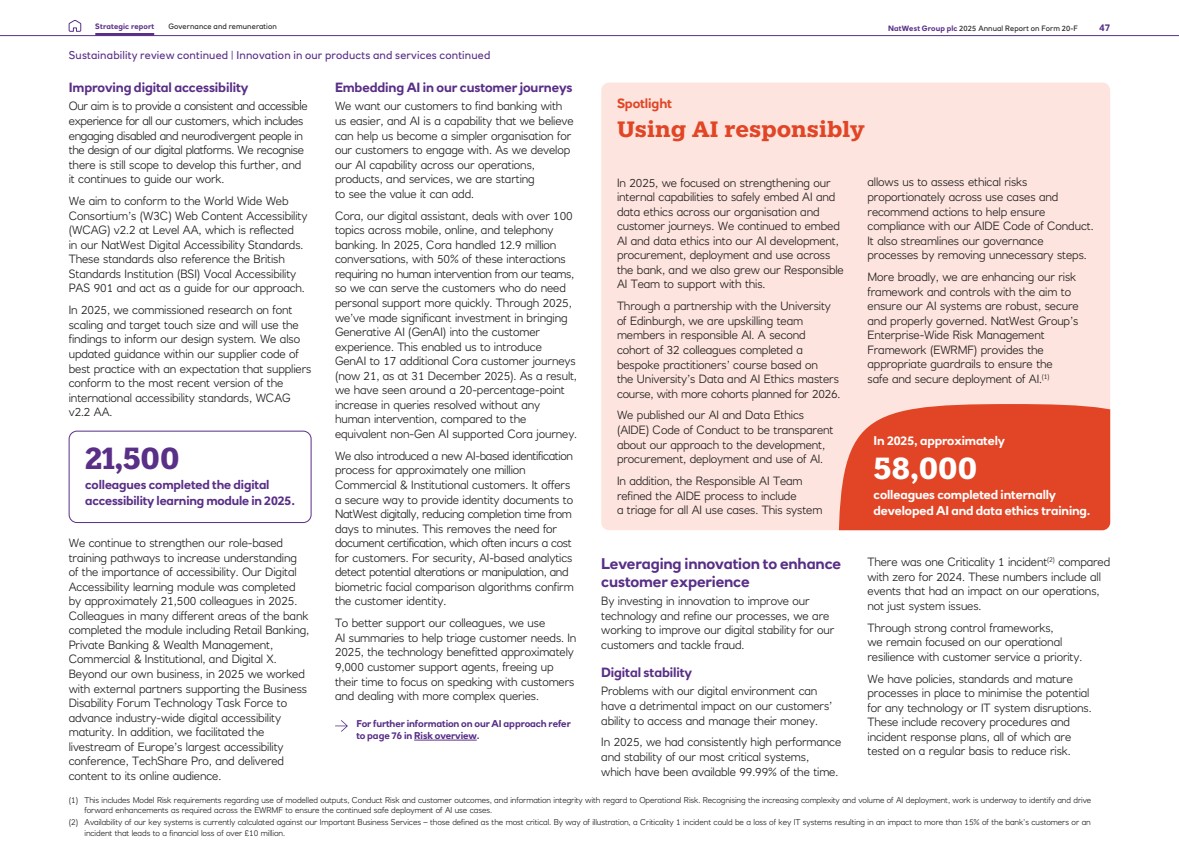
| Supporting the climate transition Sustainability review continued At NatWest Group, we aim to help our customers on their journey toward net zero, including engaging on how we could support their transition ambitions. We continue to integrate our own climate ambitions into our core business practices as part of our commitment to delivering long-term value and managing risk. While the path to net zero by 2050 is far from clear at this stage, we continue to focus on supporting our customers’ transition and our own ambitions to be net zero. Achievement of our climate ambitions and targets is dependent on a range of factors, including timely and appropriate government policy, technology developments, and on suppliers, customers and society supporting the transition. Governance Our governance framework provides clear oversight of climate ambitions and targets, with Board-level accountability for progress and risk. Our climate ambitions, targets and our climate transition plan enable us to focus on the actions we can take to succeed with our customers and deliver sustainable shareholder value over time, including: • Helping customers manage their money and plan for the future by, for example, providing retrofit and home energy support through NatWest Group’s Home Energy Hub. • Helping customers build better and more resilient businesses by financing sustainable solutions that may lower running costs, improve efficiency and strengthen long-term viability. • Facilitating balanced economic growth by financing large-scale renewable projects, energy networks and demand-side electrification, driving progress across the UK economy. Risk management We continue to integrate climate, and increasingly nature considerations into how we assess and manage risk. Climate-related opportunities We continue to support customers in accessing sustainable solutions and financing the transition to net zero. • Refer to pages 49 to 52 for summary information. Emissions and emissions estimates We track and monitor various sources of emissions to monitor progress and inform our climate transition plan. • Refer to pages 54 to 56 and 68 for summary information. Strategic report Strategic report Governance and remuneration Financial review Governance and remuneration Risk and capital management Financial statements Additional information NatWest Group plc NatWest Group plc 2025 Annual Report and Accounts 2025 Annual Report on Form 20-F 4848 As well as being a key sustainability topic for NatWest Group, climate-related information required under sections 414CA and 414CB of the Companies Act 2006 is integrated throughout this report. Refer to the table below and the Task Force on Climate-related Financial Disclosures (TCFD) index on page 70. • Refer to page 89 for more information on climate governance and pages 79 to 81 for Board skills, experience and knowledge. Annual Report on Form 20-F for our approach to climate and nature risk. Annual Report on Form 20-F for information on climate considerations in credit risk. • Refer to pages 116 to 120 of the • Refer to page 72 of the |
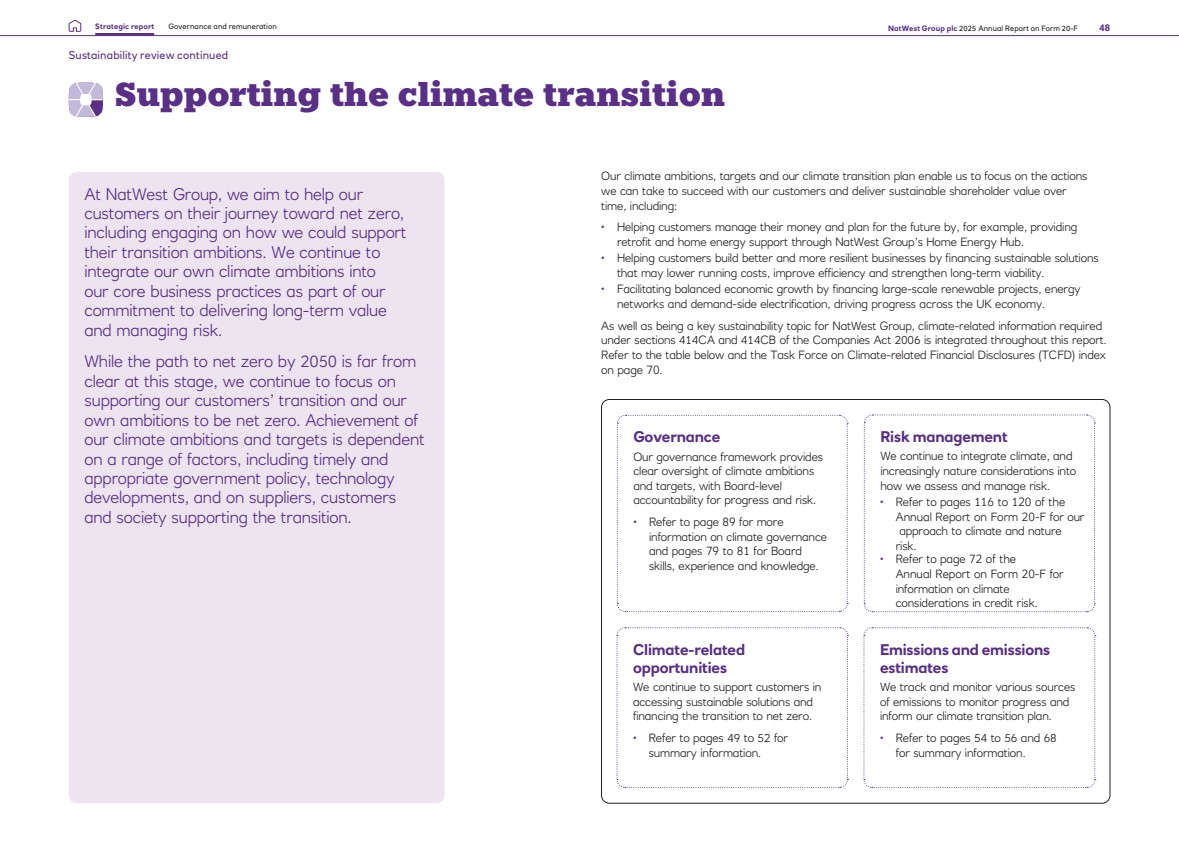
| Supporting the climate transition Sustainability review continued At NatWest Group, we aim to help our customers on their journey toward net zero, including engaging on how we could support their transition ambitions. We continue to integrate our own climate ambitions into our core business practices as part of our commitment to delivering long-term value and managing risk. While the path to net zero by 2050 is far from clear at this stage, we continue to focus on supporting our customers’ transition and our own ambitions to be net zero. Achievement of our climate ambitions and targets is dependent on a range of factors, including timely and appropriate government policy, technology developments, and on suppliers, customers and society supporting the transition. Governance Our governance framework provides clear oversight of climate ambitions and targets, with Board-level accountability for progress and risk. • Refer to page 106 for more information on climate governance and pages 103 and 113 for Board skills, experience and knowledge. Find out more in the NatWest Group plc 2025 Climate Transition Plan Report. NatWest Group plc 2025 Climate Transition Plan Report Succeeding with customers Our climate ambitions, targets and our climate transition plan enable us to focus on the actions we can take to succeed with our customers and deliver sustainable shareholder value over time, including: • Helping customers manage their money and plan for the future by, for example, providing retrofit and home energy support through NatWest Group’s Home Energy Hub. • Helping customers build better and more resilient businesses by financing sustainable solutions that may lower running costs, improve efficiency and strengthen long-term viability. • Facilitating balanced economic growth by financing large-scale renewable projects, energy networks and demand-side electrification, driving progress across the UK economy. As well as being a key sustainability topic for NatWest Group, climate-related information required under sections 414CA and 414CB of the Companies Act 2006 is integrated throughout this report. Refer to the table below and the Task Force on Climate-related Financial Disclosures (TCFD) index on page 70 and non-financial and sustainability information statement on pages 71 and 72. Risk management We continue to integrate climate, and increasingly nature considerations into how we assess and manage risk. • Refer to pages 254 to 256 for our approach to climate and nature risk. • Refer to pages 213 and 214 for information on climate considerations in credit risk. Climate-related opportunities We continue to support customers in accessing sustainable solutions and financing the transition to net zero. • Refer to pages 49 to 52 for summary information. Emissions and emissions estimates We track and monitor various sources of emissions to monitor progress and inform our climate transition plan. • Refer to pages 54 to 56 and 68 for summary information. Strategic report Financial review Governance and remuneration Risk and capital management Financial statements Additional information NatWest Group plc 2025 Annual Report and Accounts 48 Sustainability review continued | Supporting the climate transition continued We have an ambition to be net zero across our financed emissions, assets under management and operational value chain by 2050. This is aligned with the UK’s legal obligation to be net zero by 2050. Achievement of our climate ambitions and targets is dependent on a range of factors, including timely and appropriate government policy, technology developments, and on suppliers, customers and society supporting the transition. We have retained our ambition to at least halve the climate impact of our financing activity by 2030, against a 2019 baseline In February 2025, we disclosed that we continued to consider the achievement of our ambition to at least halve the climate impact of our financing activity by 2030, against a 2019 baseline, to be increasingly challenging. We also disclosed our intention to review our climate ambitions and targets during 2025 in light of the advice issued by the UK Climate Change Committee (UK CCC) to the UK Government on setting the Seventh Carbon Budget. Following this review, we have retained our ambition to at least halve the climate impact of our financing activity by 2030, against a 2019 baseline, having achieved a 39% reduction between 2019 and 2024, primarily through strategic decisions, methodology and data enhancements. We acknowledge that emission reductions are unlikely to be linear and that the UK Parliament will legislate a new legal limit on greenhouse gas emissions as part of the Seventh Carbon Budget by June 2026. A simplified and focused approach In 2022, we set 16 science-based portfolio-level sector targets for 2030. These targets were validated by the Science Based Targets initiative (SBTi) and covered 79% of our lending book and 57% of debt securities and equity shares, excluding sovereign debt securities as at 31 December 2019. They had a 2019 baseline and underpinned the development of our initial climate transition plan and the opportunities we identified to help our customers transition to a more sustainable economy. We have continued to refine our climate transition plan to focus on the most material activities across a range of sectors, including the metrics and methodologies used to track progress against our plan. As a result we have withdrawn our 16 portfolio-level sector targets and replaced these targets with nine portfolio-level activity-based targets for 2030. Our new targets are science-based, have a 2023 baseline and have been developed using the UN Environment Programme Finance Initiative (UNEP FI) Guidance for Climate Target Setting for Banks, ensuring coverage of carbon-intensive sectors, material sources of emissions and adequate coverage of our balance sheet. They cover 61% of our lending book and 0.02% of debt securities and equity shares, excluding sovereign debt as at 31 December 2023. We have not sought SBTi validation of our new portfolio-level activity-based targets. The scope of our new targets reflect our role as a provider of finance to a range of industries and the activities recognised by the UK CCC as playing a critical role in enabling the UK’s transition to net zero by 2050. This helps us to better understand the transition risks and opportunities that may impact our customers and to better support the UK’s transition to net zero. Operational emissions We continue to aim for a 70% reduction in Scope 1 and location-based Scope 2 emissions and a 50% reduction in Scope 3 operational emissions from applicable categories 1–14 by 2030, against a 2019 baseline. We also continue to consume 100% renewable electricity across our global operations in line with our RE100 commitment. While we will maintain a science-based pathway to 2030, we have withdrawn our three science-based targets which were validated by the Science Based Targets initiative (SBTi). Financing the transition In July 2025, we set a new target to provide £200 billion in climate and transition finance between 1 July 2025 and the end of 2030. Our climate and transition finance framework has replaced the climate and sustainable funding and financing inclusion criteria that underpinned our previous £100 billion target, which was exceeded in Q1 2025. This evolution recognises that supporting the alignment and transition of the real economy towards net zero needs significant investment across a broader spectrum of industries, including hard-to-abate and emission intensive sectors, alongside those delivering climate solutions. Responsible investment In 2025, we reviewed our responsible investing approach, including our climate ambitions, to ensure alignment with customer needs and market standards. Following the review, we have withdrawn portfolio alignment from our entity level 2030 ambitions, recognising a lack of market consensus on how to define portfolio alignment within a wealth management context. We have retained our 2030 Weighted Average Carbon Intensity (WACI) ambition, which reflects market best practice and continues to provide a standardised measure through which we can monitor progress towards our net zero by 2050 ambition. Energy system review We also stated that we would review our Environmental, Social and Ethical (ESE) Risk Acceptance Criteria for major oil and gas customers. The scope of the energy system review was broader than the ESE Risk Acceptance Criteria for major oil and gas customers. From 1 January 2026, we updated the name of our ESE Risk Framework to the Environmental and Social (E&S) Risk Framework. Recognising the complexity of the energy transition, we conducted an energy system review during 2025 to ensure our strategy reflects the interconnected risks and opportunities across the energy value chain as the economy transitions toward net zero. The energy system review considered the systemic nature of the energy transition which anticipates further growth in renewables, the important yet declining role of oil and gas, significant infrastructure investment and demand-side electrification. Reflecting the outcome of our energy system review, we have published a new E&S Energy Supply Sectors Risk Acceptance Criteria. Refreshing our climate ambitions We made a number of changes to our climate ambitions, targets and Environmental and Social (E&S) Risk Acceptance Criteria: Strategic report Strategic report Governance and remuneration Financial review Governance and remuneration Risk and capital management Financial statements Additional information NatWest Group plc NatWest Group plc 2025 Annual Report and Accounts 2025 Annual Report on Form 20-F 4949 |
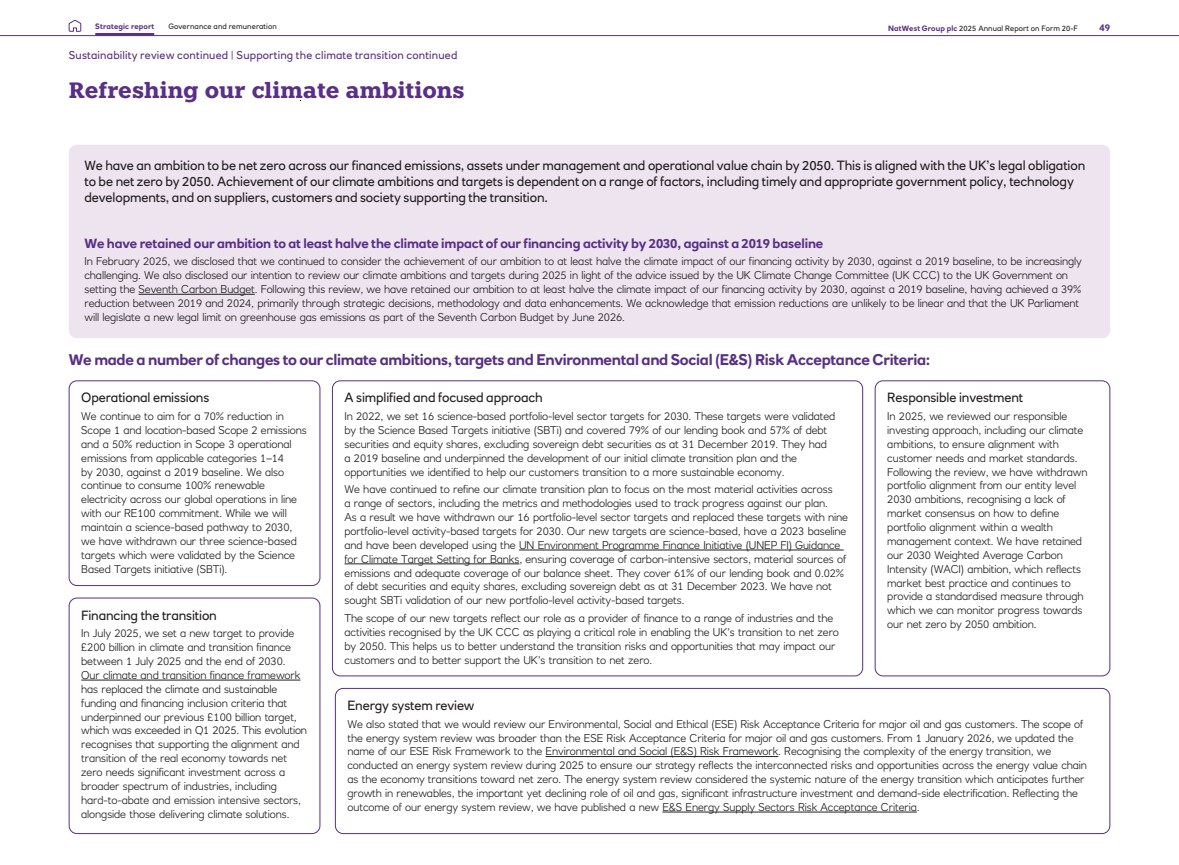
| Sustainability review continued | Supporting the climate transition continued (2) Climate and sustainable funding and financing (as defined in our climate and sustainable funding and financing inclusion criteria) and climate and transition finance, (as defined in our climate and transition finance framework) represent only a relatively small proportion of our overall funding, financing and facilitation activities. (3) Our operational emissions comprise greenhouse gas emissions Scopes 1, 2 and 3 (categories 1–14, excluding categories 8, 10 and 14) and does not include Scope 3 category 15 financed emissions. The reporting year runs from 1 October to 30 September. (4) Our WACI ambition includes listed equity and corporate fixed income asset classes. We consider Managed Assets (those assets we invest on our customers’ behalf, which represented 81% of AUM as at 31 December 2025) to be in-scope for our WACI ambition. Due to improved data sourcing, current WACI measurement includes additional data for government bond asset classes and Bespoke portfolios. Our WACI ambition applies to equity and corporate fixed income assets only. (5) Scope 3 category 15 financed emissions (customer Scope 1 and 2) from lending and investments, refer to page 54. Estimated financed emissions are reported as at 31 December 2024. Our financing activity may result in a non-linear emissions profile, both within and across sectors. (6) Based on 2024 emissions, reflecting the nine portfolio-level activity-based targets for which convergence pathways have been developed with reference to external scenarios. A 2023 comparative is not provided as these are new targets. In general, year-on-year fluctuations in convergence status are expected as the availability of customer emissions data improves and methodologies are refined. (7) The phase-out of coal refers to the exit of the customer relationship by NatWest Group. This relates to all grades of thermal coal (e.g. bituminous, sub-bituminous, and lignite) typically used as a fuel for coal-fired generation. Data challenges, particularly the lack of granular customer information, create challenges in identifying customers with ‘coal-related infrastructure’ and other customers with coal-related operations within NatWest Group’s large and diversified customer portfolios. As such, the scope excludes (i) companies who generate less than 5% of their revenues via coal related activity (in line with the UN Environment Programme Finance Initiative (UNEP FI) Guidance for Climate Target Setting for Banks) (ii) companies with a turnover of <£50 million, and (iii) commodity traders. Metallurgical coal is excluded from scope. Climate and sustainable funding and financing(2) £110.3bn provided between 1 July 2021 and 30 June 2025 In 2025, we exceeded our target to provide £100 billion in climate and sustainable funding and financing between 1 July 2021 and the end of 2025 We have a target to provide £200 billion in climate and transition finance between 1 July 2025 and the end of 2030 Climate and transition finance(2) £19.0bn provided 1 July to 31 December 2025 We have an ambition to reduce emissions for our operational value chain, against a 2019 baseline by: reducing Scope 1 and Scope 2 emissions by 70% by 2030, while continuing to consume 100% renewable electricity in our direct own global operations Operational emissions(3) Scope 1 and Scope 2 66% reduction against a 2019 baseline (2024: 60%) We have an ambition to reduce emissions for our operational value chain, against a 2019 baseline by: reducing Scope 3 emissions by 50% by 2030 Operational emissions(3) Scope 3 47% reduction against a 2019 baseline (2024: 44%) Progress against our climate ambitions and targets We have an ambition to be net zero by 2050 across our financed emissions, assets under management (AUM) and operational value chain. Our climate ambitions and targets(1) enable us to focus on actions we can take to succeed with our customers and deliver sustainable shareholder value. We aim to reduce the WACI of our Managed Assets by 50% by 2030 against a 2019 baseline Weighted Average Carbon Intensity (WACI)(4) 43% reduction (2024: 34%) We have an ambition for 50% of our UK residential mortgage portfolio to have an EPC rating of C or better by 2030, where EPCs are available UK residential mortgage portfolio rated at EPC C or better, where EPCs are available, as at 31 December 2025 48.8% (2024: 46.3%) We have an ambition to at least halve the climate impact of our financing activity by 2030, against a 2019 baseline, supported by portfolio-level, activity-based targets Climate impact of our financing activity against a 2019 baseline(5): 39% reduction (2024: 33%) Portfolios aligned to decarbonisation convergence pathways(6): 6 out of 9 We have an ambition to phase-out of coal(7) for customers who have coal production, coal-fired generation and coal-related infrastructure globally by 1 January 2030 Exposure to coal customers remained in line with the prior year £0.6bn Strategic report Strategic report Governance and remuneration Financial review Governance and remuneration Risk and capital management Financial statements Additional information NatWest Group plc NatWest Group plc 2025 Annual Report and Accounts 2025 Annual Report on Form 20-F 5050 (1) For details on dependencies applicable to and reliance on our climate and sustainability-related ambitions, targets and commitments, refer to ‘Climate and sustainability-related risks’, ‘Additional cautionary statement regarding climate and sustainability-related data, metrics and forward looking statements’, and ‘Cautionary statements in relation to the climate and sustainability related of the Annual Report on Form 20-F. disclosures in this report’ on pages 2 to 4 and 269 to 289 |
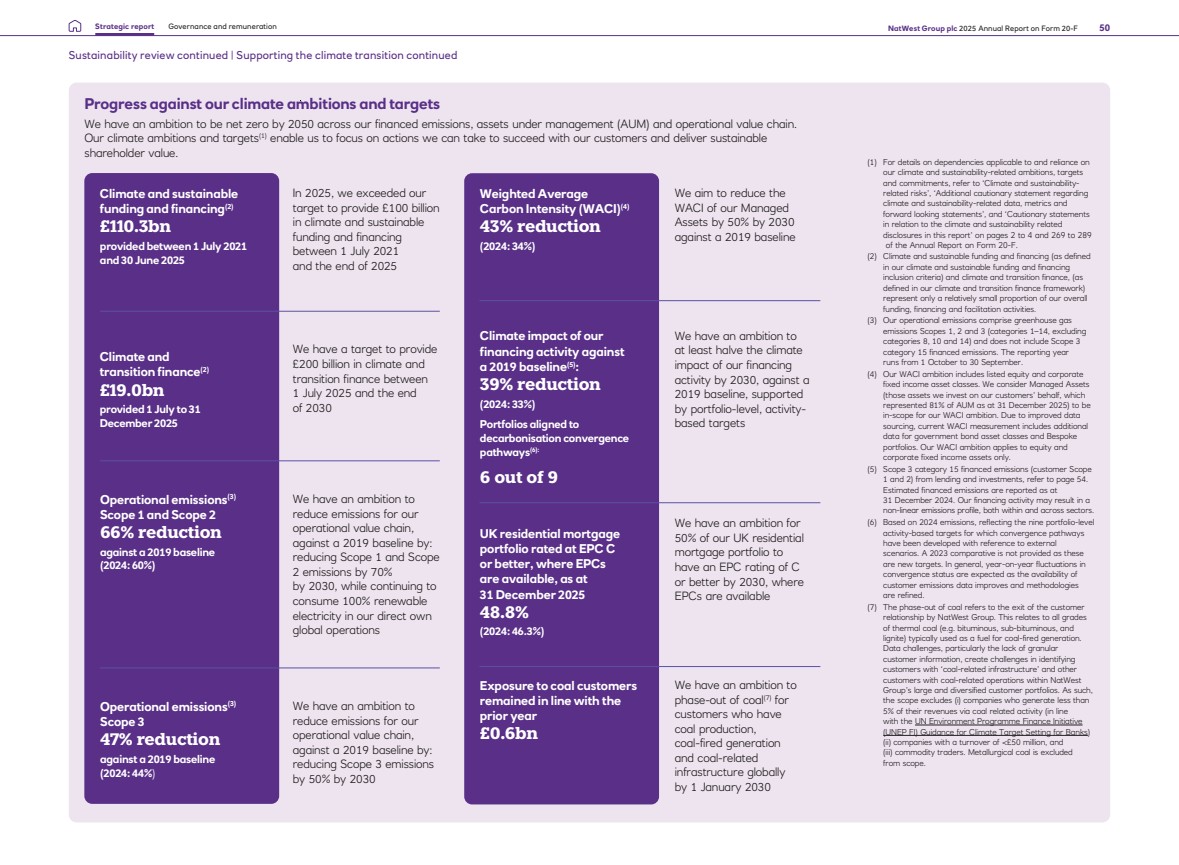
| Sustainability review continued | Supporting the climate transition continued (1) For details on dependencies applicable to and reliance on our climate and sustainability-related ambitions, targets and commitments, refer to ‘Climate and sustainability-related risks’, ‘Additional cautionary statement regarding climate and sustainability-related data, metrics and forward looking statements’, and ‘Cautionary statements in relation to the climate and sustainability related disclosures in this report’ on pages 420 to 422, 429 and 430 of this report. (2) Climate and sustainable funding and financing (as defined in our climate and sustainable funding and financing inclusion criteria) and climate and transition finance, (as defined in our climate and transition finance framework) represent only a relatively small proportion of our overall funding, financing and facilitation activities. (3) Our operational emissions comprise greenhouse gas emissions Scopes 1, 2 and 3 (categories 1–14, excluding categories 8, 10 and 14) and does not include Scope 3 category 15 financed emissions. The reporting year runs from 1 October to 30 September. (4) Our WACI ambition includes listed equity and corporate fixed income asset classes. We consider Managed Assets (those assets we invest on our customers’ behalf, which represented 81% of AUM as at 31 December 2025) to be in-scope for our WACI ambition. Due to improved data sourcing, current WACI measurement includes additional data for government bond asset classes and Bespoke portfolios. Our WACI ambition applies to equity and corporate fixed income assets only. (5) Scope 3 category 15 financed emissions (customer Scope 1 and 2) from lending and investments, refer to page 54. Estimated financed emissions are reported as at 31 December 2024. Our financing activity may result in a non-linear emissions profile, both within and across sectors. (6) Based on 2024 emissions, reflecting the nine portfolio-level activity-based targets for which convergence pathways have been developed with reference to external scenarios. A 2023 comparative is not provided as these are new targets. In general, year-on-year fluctuations in convergence status are expected as the availability of customer emissions data improves and methodologies are refined. (7) The phase-out of coal refers to the exit of the customer relationship by NatWest Group. This relates to all grades of thermal coal (e.g. bituminous, sub-bituminous, and lignite) typically used as a fuel for coal-fired generation. Data challenges, particularly the lack of granular customer information, create challenges in identifying customers with ‘coal-related infrastructure’ and other customers with coal-related operations within NatWest Group’s large and diversified customer portfolios. As such, the scope excludes (i) companies who generate less than 5% of their revenues via coal related activity (in line with the UN Environment Programme Finance Initiative (UNEP FI) Guidance for Climate Target Setting for Banks) (ii) companies with a turnover of <£50 million, and (iii) commodity traders. Metallurgical coal is excluded from scope. Metric subject to independent Limited Assurance by EY. Metric subject to independent Reasonable Assurance by EY. Refer to page 71. Climate and sustainable funding and financing(2) £110.3bn(LA) provided between 1 July 2021 and 30 June 2025 In 2025, we exceeded our target to provide £100 billion in climate and sustainable funding and financing between 1 July 2021 and the end of 2025 We have a target to provide £200 billion in climate and transition finance between 1 July 2025 and the end of 2030 Climate and transition finance(2) £19.0bn(LA) provided 1 July to 31 December 2025 We have an ambition to reduce emissions for our operational value chain, against a 2019 baseline by: reducing Scope 1 and Scope 2 emissions by 70% by 2030, while continuing to consume 100% renewable electricity in our direct own global operations Operational emissions(3) Scope 1 and Scope 2 66% reduction against a 2019 baseline (2024: 60%) We have an ambition to reduce emissions for our operational value chain, against a 2019 baseline by: reducing Scope 3 emissions by 50% by 2030 Operational emissions(3) Scope 3 47% reduction against a 2019 baseline (2024: 44%) Progress against our climate ambitions and targets We have an ambition to be net zero by 2050 across our financed emissions, assets under management (AUM) and operational value chain. Our climate ambitions and targets(1) enable us to focus on actions we can take to succeed with our customers and deliver sustainable shareholder value. We aim to reduce the WACI of our Managed Assets by 50% by 2030 against a 2019 baseline Weighted Average Carbon Intensity (WACI)(4) 43% reduction (2024: 34%) We have an ambition for 50% of our UK residential mortgage portfolio to have an EPC rating of C or better by 2030, where EPCs are available UK residential mortgage portfolio rated at EPC C or better, where EPCs are available, as at 31 December 2025 48.8%(RA) (2024: 46.3%) We have an ambition to at least halve the climate impact of our financing activity by 2030, against a 2019 baseline, supported by portfolio-level, activity-based targets Climate impact of our financing activity against a 2019 baseline(5): 39% reduction (2024: 33%) Portfolios aligned to decarbonisation convergence pathways(6): 6 out of 9 We have an ambition to phase-out of coal(7) for customers who have coal production, coal-fired generation and coal-related infrastructure globally by 1 January 2030 Exposure to coal customers remained in line with the prior year £0.6bn(LA) Strategic report Financial review Governance and remuneration Risk and capital management Financial statements Additional information NatWest Group plc 2025 Annual Report and Accounts 50 Climate-related risks and opportunities Climate change, nature loss and the responses to these challenges have implications for the economy, society, and the financial system. As well as managing the risks they pose, we pursue the opportunities arising from the transition to a net-zero economy. This approach aims to help protect the bank’s financial resilience and support its strategy, with an aim of generating sustainable returns for our shareholders. The transition to a net-zero economy requires significant investment in climate change mitigation and adaptation, including nature-based solutions. This creates opportunities for capital providers and for collaboration between the public and private sectors to drive the technological advancements society needs. We assess climate-related opportunities across the organisation and within each business segment through our integrated governance model. We review opportunities and their potential financial impacts annually as part of the ongoing integration of our climate transition plan into our financial planning and related processes. While climate change, nature loss and the associated political, societal and environmental responses to it present opportunities, they also present risks. We continue to work to integrate management of these climate and nature-related risks into strategic planning, transactions and decision-making. However, we recognise that our approach to nature-related risk is not as mature as our approach to climate-related risk. We identify three key sources of climate-related risk – physical, transition, and liability – and assess them at strategic, portfolio, and transaction levels. Our approach is designed to identify where these risks exist across the organisation and implement measures to manage them proactively. We define short-term climate-related risks and opportunities as those within our five-year planning horizon, medium term as five to 15 years, and long term as beyond 15 years. NatWest Group Board Board level (collective accountability) Group Board Risk Committee Group Audit Committee Group Performance and Remuneration Committee Group Nominations and Governance Committee Group Technology, Innovation and Simplification Committee(1) Executive team Management delivery (individual accountability) Executive Risk Committee Executive Disclosure Committee Group Reputational Risk Committee Business and functional governance Business/functional delivery Retail Banking CEO, supported by Retail ExCo Private Banking & Wealth Management CEO, supported by Private Banking & Wealth Management ExCo Commercial & Institutional CEO, supported by Commercial & Institutional ExCo Core cross-bank working groups Sustainability review continued | Supporting the climate transition continued Oversight and decision-making on climate-related matters We have embedded climate governance and decision-making across NatWest Group and we monitor the effectiveness of these arrangements to ensure climate-related risks and opportunities are considered appropriately for the bank and our stakeholders. The NatWest Group plc Board, subsidiaries, Board Committees, executive fora and cross-bank working groups all have a role to play in the governance of climate-related matters. At management level, consideration of climate-related risks and opportunities is integrated within day-to-day decision-making. In addition to formal governance fora, management also consider climate matters frequently and, where required, on an ad hoc basis through, for example, cross bank working groups and programme meetings. This approach ensures climate considerations are embedded across business activities. For Executive Director remuneration, climate-related measures account for 15% of the Performance Share Plan (PSP) scorecard for awards proposed to be granted in March 2026 in respect of performance year 2025. Spotlight Building climate capability across NatWest Group Following the conclusion of our three-year partnership with the University of Edinburgh Centre for Business, Climate Change and Sustainability, we continued to embed sustainability knowledge across the organisation. In 2025, colleagues demonstrated strong commitment to learning, with around 12,700 completions of our climate and nature education resources. Our targeted approach aims to ensure insights are available at the point of need, helping colleagues make informed decisions and support customers and suppliers. We advanced Future Fit training, sector-specific tools, and short instructional videos to navigate sustainability risks and opportunities. By equipping teams with practical knowledge, we aim to enhance our colleagues’ capability, while supporting customers in the transition to a low-carbon economy. c.12,700 colleague completions of our climate and nature education resources in 2025. (2024: c.30,000). Strategic report Strategic report Governance and remuneration Financial review Governance and remuneration Risk and capital management Financial statements Additional information NatWest Group plc NatWest Group plc 2025 Annual Report and Accounts 2025 Annual Report on Form 20-F 5151 The chart below provides an overview of the NatWest Group-level integrated approach to climate governance. Refer to page 89 for more information on the roles played by each. Refer to page 129 for details of how remuneration is linked to strategy and sustainability priorities. (1) Sustainable Banking Committee (SBC) transitioned into the Group Technology, Innovation and Simplification Committee (TISC), with a number of SBC focus areas, including ESG (including climate) elevated to become Board-level matters. As such, TISC has no specific responsibilities in relation to climate-related risks and opportunities. Refer to page 85 and 89. |
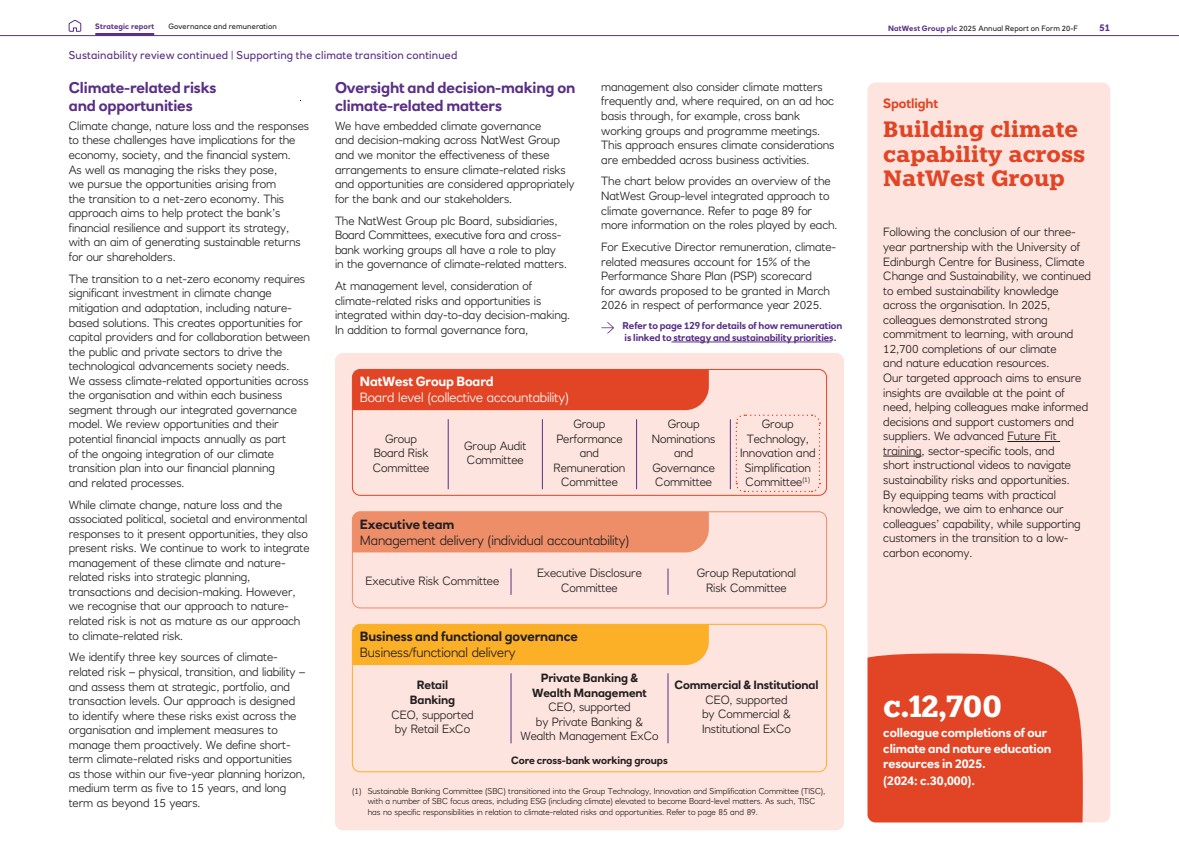
| Sustainability review continued | Supporting the climate transition continued Implementing our climate transition plan supports progress against our bank-wide strategic priorities As a predominantly UK-focused bank, our climate transition plan is designed through a UK lens, while also incorporating global considerations for our Investment Products and Solutions and our focused international footprint in Corporate and Institutional Banking. We identify and assess climate-related risks and opportunities at NatWest Group level and within our business segments, Retail Banking; Private Banking & Wealth Management; and Commercial & Institutional, through an integrated governance model, prioritising those most significant to our strategy and financial planning. Opportunities include aligning our balance sheet, assets under management and operational value chain with our 2030 and 2050 climate ambitions. Our climate transition plan also sets out how we aim to help customers invest in growth, efficiency and resilience, for example through access to financing, tools and guidance. These activities form part of how we seek to make progress against our climate ambitions and targets. NatWest Group’s approach reflects our aim of driving impact through our business; helping customers manage their money and build more resilient businesses, as well as facilitating balanced economic growth across the UK. These principles align with the three strategic priorities shown in the diagram on the right, which illustrates how our climate transition plan supports progress against our bank-wide strategic objectives. Supporting customers’ climate transitions by providing products, tools and insights that help them reduce emissions, build resilience and access sustainable finance opportunities. Disciplined growth Ongoing integration of climate into customer journeys, decision-making and financial planning, as well as supplier engagements. We are also reducing complexity around our transition plan to enable clear, transparent progress. Leveraging simplification Evolving our policies and procedures to identify, assess, and manage climate and nature-related risks(1). Providing finance to support the UK’s transition strengthens resilience and reduces exposure to higher-risk sectors. Active balance sheet and risk management Climate-related opportunities and risks Potential financial impacts • Increased volume of climate and transition finance. • Increased balance sheet volumes through demand for new products and services that support transition. • Additional expenditure to develop new products and services to support the transition. • Additional fee income through advisory and underwriting activities. • Increased investment to support reduction in carbon footprint and nature-related effects in our own operations. • Continue to invest in the Climate Decisioning Framework (CDF) and Environmental Decisioning Framework (EDF). These tools deepen customer engagement on transition progress and environmental and climate-related risks. • Reduced exposure and geographical footprint related to prohibited and restricted activities as identified in our E&S Risk Acceptance Criteria. • Changes in expected credit losses (ECL). (1) While our approach to nature-related risk is less mature than our approach to climate-related risk, we continued to make progress during 2025. Strategic report Strategic report Governance and remuneration Financial review Governance and remuneration Risk and capital management Financial statements Additional information NatWest Group plc NatWest Group plc 2025 Annual Report and Accounts 2025 Annual Report on Form 20-F 5252 |
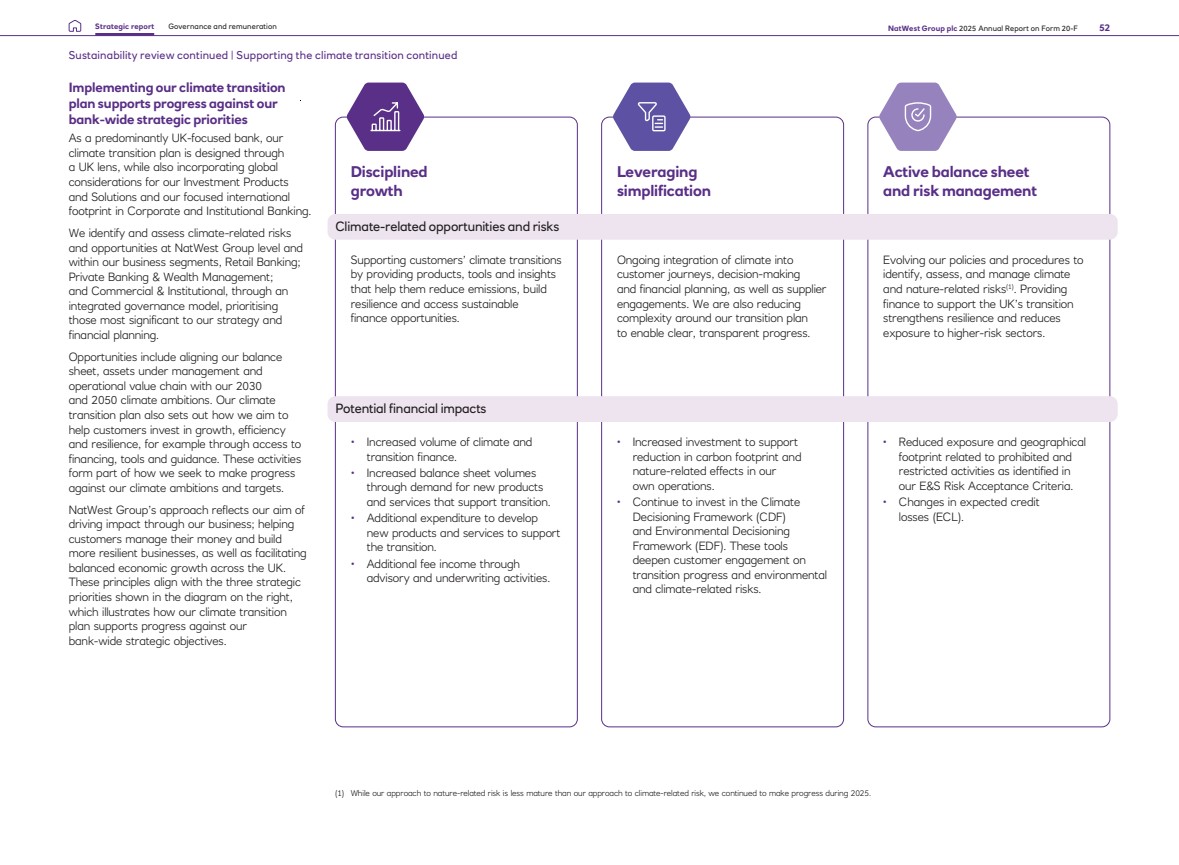
| Sustainability review continued | Supporting the climate transition continued Implementing our climate transition plan supports progress against our bank-wide strategic priorities As a predominantly UK-focused bank, our climate transition plan is designed through a UK lens, while also incorporating global considerations for our Investment Products and Solutions and our focused international footprint in Corporate and Institutional Banking. We identify and assess climate-related risks and opportunities at NatWest Group level and within our business segments, Retail Banking; Private Banking & Wealth Management; and Commercial & Institutional, through an integrated governance model, prioritising those most significant to our strategy and financial planning. Opportunities include aligning our balance sheet, assets under management and operational value chain with our 2030 and 2050 climate ambitions. Our climate transition plan also sets out how we aim to help customers invest in growth, efficiency and resilience, for example through access to financing, tools and guidance. These activities form part of how we seek to make progress against our climate ambitions and targets. NatWest Group’s approach reflects our aim of driving impact through our business; helping customers manage their money and build more resilient businesses, as well as facilitating balanced economic growth across the UK. These principles align with the three strategic priorities shown in the diagram on the right, which illustrates how our climate transition plan supports progress against our bank-wide strategic objectives. Supporting customers’ climate transitions by providing products, tools and insights that help them reduce emissions, build resilience and access sustainable finance opportunities. Disciplined growth Ongoing integration of climate into customer journeys, decision-making and financial planning, as well as supplier engagements. We are also reducing complexity around our transition plan to enable clear, transparent progress. Leveraging simplification Evolving our policies and procedures to identify, assess, and manage climate and nature-related risks(1). Providing finance to support the UK’s transition strengthens resilience and reduces exposure to higher-risk sectors. Active balance sheet and risk management Climate-related opportunities and risks Potential financial impacts • Increased volume of climate and transition finance. • Increased balance sheet volumes through demand for new products and services that support transition. • Additional expenditure to develop new products and services to support the transition. • Additional fee income through advisory and underwriting activities. • Increased investment to support reduction in carbon footprint and nature-related effects in our own operations. • Continue to invest in the Climate Decisioning Framework (CDF) and Environmental Decisioning Framework (EDF). These tools deepen customer engagement on transition progress and environmental and climate-related risks. • Reduced exposure and geographical footprint related to prohibited and restricted activities as identified in our E&S Risk Acceptance Criteria. • Changes in expected credit losses (ECL). (1) While our approach to nature-related risk is less mature than our approach to climate-related risk, we continued to make progress during 2025. Strategic report Financial review Governance and remuneration Risk and capital management Financial statements Additional information NatWest Group plc 2025 Annual Report and Accounts 52 The impact of climate-related risks and opportunities on our businesses, strategy and financial planning Our climate transition plan is embedded within our financial planning process, ensuring climate-related risks and opportunities inform strategic decisions. We continue to enhance this integration so colleagues across segments and sectors can make choices aligned with our climate ambitions, targets and business objectives. In 2025, our financial planning tools were used to forecast climate-related initiatives across customer segments and sectors, enabling senior stakeholders to review and challenge both financial plans and associated emissions profiles. Through this approach, we identify financial opportunities and actions that support our customers transition plans, where relevant, and contribute towards our climate ambitions and targets. To strengthen integration further, we are incorporating climate considerations into the assessment of financial and non-financial factors, including cost and risk, within our planning processes. This provides a mechanism to monitor progress against climate targets and ambitions, and evaluate trade-offs transparently in strategic decision-making. Resilience of our strategy and business model We monitor the resilience of our strategy and business model by assessing our exposure to climate-related risks at portfolio level, and by analysing climate-related risks in certain scenarios. £215.2 billion of heightened exposure relates to our residential mortgage portfolio, while the most material sector exposures in our Commercial & Institutional wholesale lending As well as risks from the transition, we monitor physical risks. In 2025, we ran an event-based scenario, which modelled the impact on our residential mortgage portfolio of flood and windstorm events across the UK over a three-year period. This enabled better understanding of credit risk drivers, including location, property type, and insurance coverage. A key conclusion of the analysis was the importance of Flood Re protection in mitigating increases in impairment rates, pointing to the importance of monitoring insurance availability for customers. Commercial & Institutional wholesale lending In 2025, we used scenarios to assess the climate-related transition and physical risks in our Commercial & Institutional wholesale lending portfolio. To assess transition risk, we used the Network for Greening the Financial System’s Net Zero 2050 transition scenario, and assumed rapid decarbonisation over a 10-year period. Consistent with the outcomes seen in our 2024 scenario analysis, impacts across sectors were primarily driven by higher carbon costs and shifting demand for products linked to the energy transition, such as electric vehicles. Company level analysis enhanced our understanding of how the effects of transition risk depends on company strategy, asset mix, emissions profile, and financial strength. This reinforces the importance of engaging with customers through our CDF tools to assess how they manage these risks. Following completion of the analysis, sector teams focused on energy-, mobility- and manufacturing-related sectors within our Commercial & Institutional business segment were invited to deep-dive sessions on the scenario analysis findings, with the aim of enhancing their understanding of transition risks to inform sector-level strategy and transition plans. Scenario analysis helps us to understand climate-related risks and to assess the resilience of our strategy and business model. The purpose of scenario analysis is not to forecast the future but to understand and prepare to manage risks that could arise. It also helps us to understand potential climate change impacts on capital adequacy and expected credit losses. While we recognise that climate and nature-related risks may amplify other risk drivers, potentially leading to impacts such as reduced competitiveness, diminished profitability, or reputational harm, NatWest Group remains resilient overall to these risks within the scope of the scenarios assessed. Residential mortgage portfolio Climate-related transition risks to our mortgage portfolio include impacts on property values and customer affordability from increasing energy costs and changes in regulatory expectations, particularly in the buy-to-let market. In 2025, through scenario analysis we modelled the potential effects of transition policies on our mortgage portfolio, considering rising energy prices and regulatory measures such as mandatory heat pump installation and EPC upgrades to band C by 2032. In the scenario findings, EPC was confirmed to be a key determinant of transition risk through its impact on property value, affordability and therefore credit risk. To help mitigate transition risk, we continue to support residential mortgage customers through our green mortgage products and other initiatives, such as our Home Energy Hub. We also have an ambition for 50% of our residential mortgage portfolio to have an EPC rating of C or better by 2030, where EPC data is available. Refer to page 50. We also considered the impacts of physical risks on our corporate lending book by modelling severe weather events over a five-year period, including UK floods and windstorms, European wildfires, and a US hurricane. While analysis covered the full portfolio, data limitations, particularly outside the UK, constrained insights on asset location and hazard exposure. To help address this, we have invested in third party data, which we plan to integrate into future scenario analysis. Capital adequacy and expected credit losses In the ICAAP exercise due to conclude in Q1 2026, one of the stress scenarios tested incorporates assumptions about physical risks and accelerated transition policy weighing on the economy. The outcome of the current exercise on capital resilience to climate risks modelled through the scenario will be reported in the 2026 ICAAP. Other principal risks Alongside credit risk, we have used scenario analysis to test the resilience of other principal risks to climate-related risk drivers. Exercises considering market, liquidity, pension, conduct and operational risk allowed us to consider the resilience of our strategy and business model. Sustainability review continued | Supporting the climate transition continued Strategic report Strategic report Governance and remuneration Financial review Governance and remuneration Risk and capital management Financial statements Additional information NatWest Group plc NatWest Group plc 2025 Annual Report and Accounts 2025 Annual Report on Form 20-F 5353 We continue to monitor present day flood risk across our UK residential mortgage portfolio. On a total volume basis, currently, 3.4% of assessed UK mortgages are at high flood risk and 1.3% at very high risk, compared to UK-wide averages of 3.1% and 1.6%. As at 31 December 2025, total heightened climate-related risk exposure was £333.9 billion, representing 57.9% of NatWest Group’s total sector exposure. This compares with heightened exposure of £333.0 billion representing 60.5% of total sector exposure as at 31 December 2024. portfolio are commercial real estate, power utilities and housing associations. There is alignment between portfolios and sectors identified as being exposed to heightened climate-related risk and those included in our climate transition plan. We test the resilience of our balance sheet through our Internal Capital Adequacy Assessment Process (ICAAP), and climate-driven macroeconomic stress is considered as part of this. One conclusion from the ICAAP finalised in March 2025 was NatWest Group’s resilience to the climate risks explored in the ICAAP stress scenarios. For expected credit losses, NatWest Group estimates an aggregate macroeconomic impact of climate transition policies and their contribution to ECL. Climate transition policy contribution to the total ECL was immaterial at the end of 2025. Refer to page 49 of the Annual Report on Form 20-F for more information. |
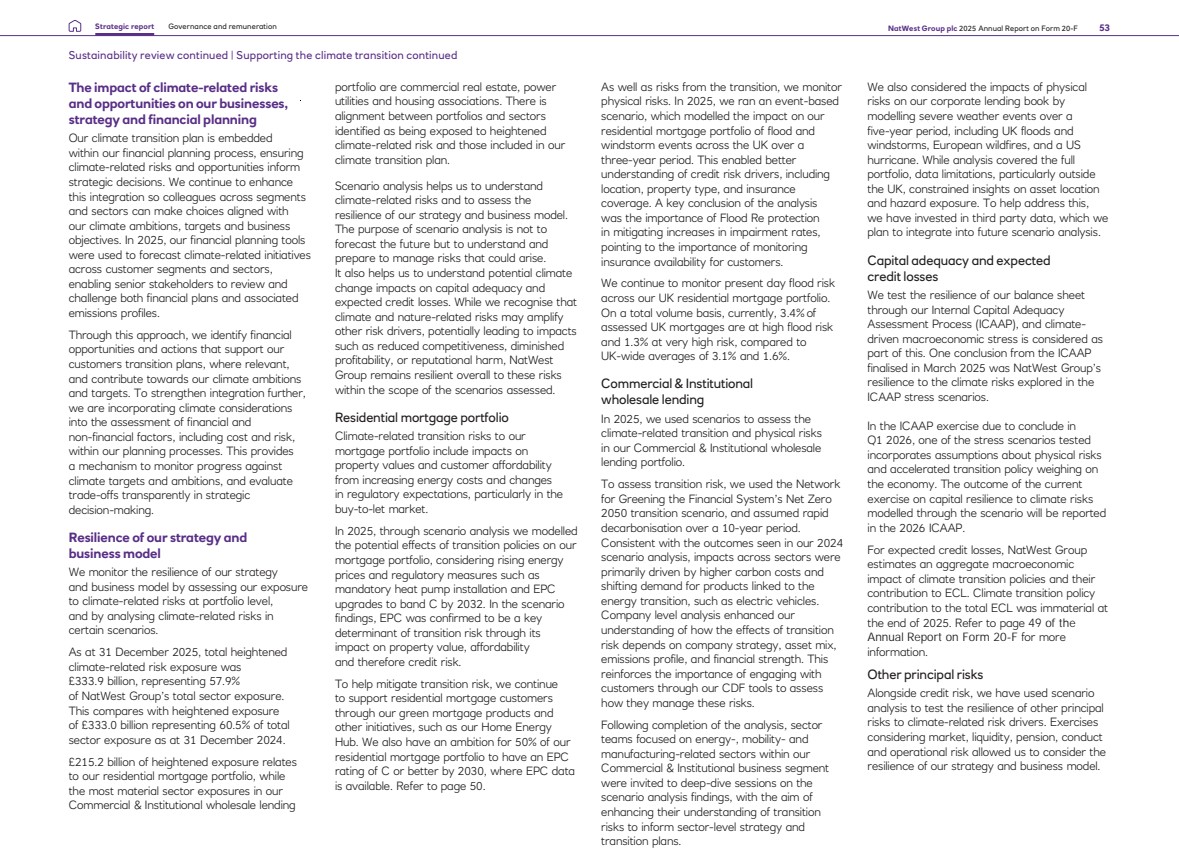
| Sustainability review continued | Supporting the climate transition continued Total emissions and emissions estimates for NatWest Group Data availability and emissions estimation methodologies continue to evolve, and variations in estimated emissions may not always reflect changes in customer activity. Our work has been guided by the available methodologies for estimating financed emissions, most notably from the Partnership for Carbon Accounting Financials (PCAF). (3) Scope 3 category 15 estimated financed emissions for AUM are calculated based on equity, corporate fixed income and government bond values as at 31 July 2025 and estimated emissions as at 31 December 2024. These figures were first disclosed in 2023, 2019 is therefore marked as NF. Comparatives have been represented in this report to ensure the latest available data is included in the current reporting period. 2025 MtCO2e 2024 MtCO2e 2023 MtCO2e 2019 MtCO2e Primary source of NatWest Group emissions Scope 1 0.01 0.01 0.01 0.02 Natural gas and fuel Scope 2 (location-based) 0.04 0.05 0.05 0.12 Purchased electricity 1. Purchased goods and services 0.28 0.29 0.32 0.51 Supply chain 2. Capital goods 0.04 0.03 0.05 0.04 3. Fuel and energy-related activities 0.01 0.02 0.02 0.03 Employee activities 4. Upstream transportation and distribution – – 0.01 0.02 Supply chain 5. Waste – – – – Employee activities 6. Business travel 0.03 0.03 0.03 0.05 7. Commuting and working from home 0.06 0.06 0.04 0.07 9. Downstream transportation and distribution 0.05 0.04 0.03 0.16 Customer activities 11. Use of sold products – – 0.01 – 12. End-of-life treatment for sold products – – – – 13. Leased assets 0.02 0.02 0.01 0.03 Tenant activities Total applicable Scope 3 operational emissions categories 0.49 0.49 0.52 0.91 Scope 3 category 15: Estimated financed emissions(2) 15. Estimated financed emissions: Lending and investments NF 13.4 14.9 22.1 Financing activities 15. Estimated financed emissions: AUM(3) 1.3 1.1 1.2 NF Total Scope 3 category 15: Estimated financed emissions 14.5 16.1 Estimated facilitated emissions from bond underwriting and syndicated lending Estimated facilitated emissions(4) 0.5 1.1 1.5 NF Financing activities Easier to directly influence Partially influenceable Harder to directly influence NF (no figures): where no data is calculated, refer to footnotes. A dash (–) indicates where data is calculated but rounds to 0.00 MtCO2e. Scope 1 and Scope 2 operational emissions Scope 1 emissions are direct emissions from sources owned and controlled by NatWest Group, for example, natural gas and fuel consumption. Scope 2 emissions are indirect emissions from energy which NatWest Group purchases, for example, electricity used for lighting, heating and cooling. We have an ambition to reduce our Scope 1 and location-based Scope 2 emissions by 70% by 2030, against a 2019 baseline, while continuing to consume 100% renewable electricity in our direct own global operations in line with our RE100 commitment. Scope 3 operational emissions categories relevant to NatWest Group Scope 3 category 1-14 emissions include both upstream and downstream emissions. We only disclose the categories that are relevant to NatWest Group(1). We have an ambition to reduce our Scope 3 operational emissions by 50%, against a 2019 baseline, by 2030. Scope 3 category 15: Estimated financed emissions Scope 3 category 15 emissions are those associated with NatWest Group’s lending and investment activities. Our estimation work is guided by the PCAF standard. Refer to page 68 for details. We have an ambition to at least halve the climate impact of our financing activity by 2030, against a 2019 baseline, supported by portfolio-level activity-based targets. Strategic report Strategic report Governance and remuneration Financial review Governance and remuneration Risk and capital management Financial statements Additional information NatWest Group plc NatWest Group plc 2025 Annual Report and Accounts 2025 Annual Report on Form 20-F 5454 Total Scope 1 and location-based Scope 2 0.05 0.06 0.06 0.14 Scope 3 operational emissions categories relevant to NatWest Group(1) Scope 1 and location-based Scope 2 operational emissions(1) (1) Our operational emissions comprise greenhouse gas emissions Scopes 1, 2 and 3 (categories 1-14, excluding categories 8, 10 and 14) and do not include Scope 3 category 15 financed emissions. The reporting year runs from 1 October to 30 September. We have re-baselined or restated several applicable Scope 3 categories for our 2019 and 2024 operational emissions, to reflect improved data quality and methodology used for our 2025 estimates and aligned with our approach to re-baselining and restatement. Previously reported totals were: 2024: 0.48 MtCO2e and 2019: 0.86 MtCO2e. Revised totals are: 2024: 0.49 MtCO2e and 2019: 0.91 MtCO2e. MtCO2e refers to million tonnes of CO2 equivalent. (4) Estimated facilitated emissions relate to emissions from off balance sheet activities such as the facilitation of bond issuance and syndicated lending. Since 2024, we applied a 33% weighting factor to emissions, aligned with the December 2023 PCAF Standard. In 2023, we applied a 100% weighting factor. Due to a change in reporting scope, the 2024 estimated facilitated emissions comparative has been updated from 1.28 MtCO2e to 1.07 MtCO2e. Estimated facilitated emissions were calculated for the first time in 2023, therefore 2022 and 2019 are marked NF. During 2025, we continued to progress actions aligned with our ambition to be net zero across our financed emissions, assets under management and operational value chain. Our climate transition plan mainly focuses on Scope 3 category 15 (customer Scope 1 and Scope 2) estimated financed emissions as these represent 88% of our total emissions and emissions estimates. (2) Scope 3 category 15 financed estimated emissions are calculated based on exposure and emissions as at 31 December 2024. 2025 is therefore marked NF, reflecting the time it takes to prepare and review estimated emissions. In line with our approach to emissions re-baselining and restatements. 2023 estimated financed emissions for lending and investments has been re-baselined. The previously disclosed 2023 customer Scope 1 and Scope 2 financed emissions estimate of 15.1 MtCO2e has been updated to 14.9 MtCO2e, reflecting improved data quality and alignment with our updated methodologies. We are also now including total 2019 estimated financed emissions for lending and investments, whereas previously 2019 was marked as NF, as estimates were limited to specific sectors. The financed emissions estimates included in this table should be read in conjunction with the risk factors on pages 269 to 289. of the Annual Report on Form 20-F. |
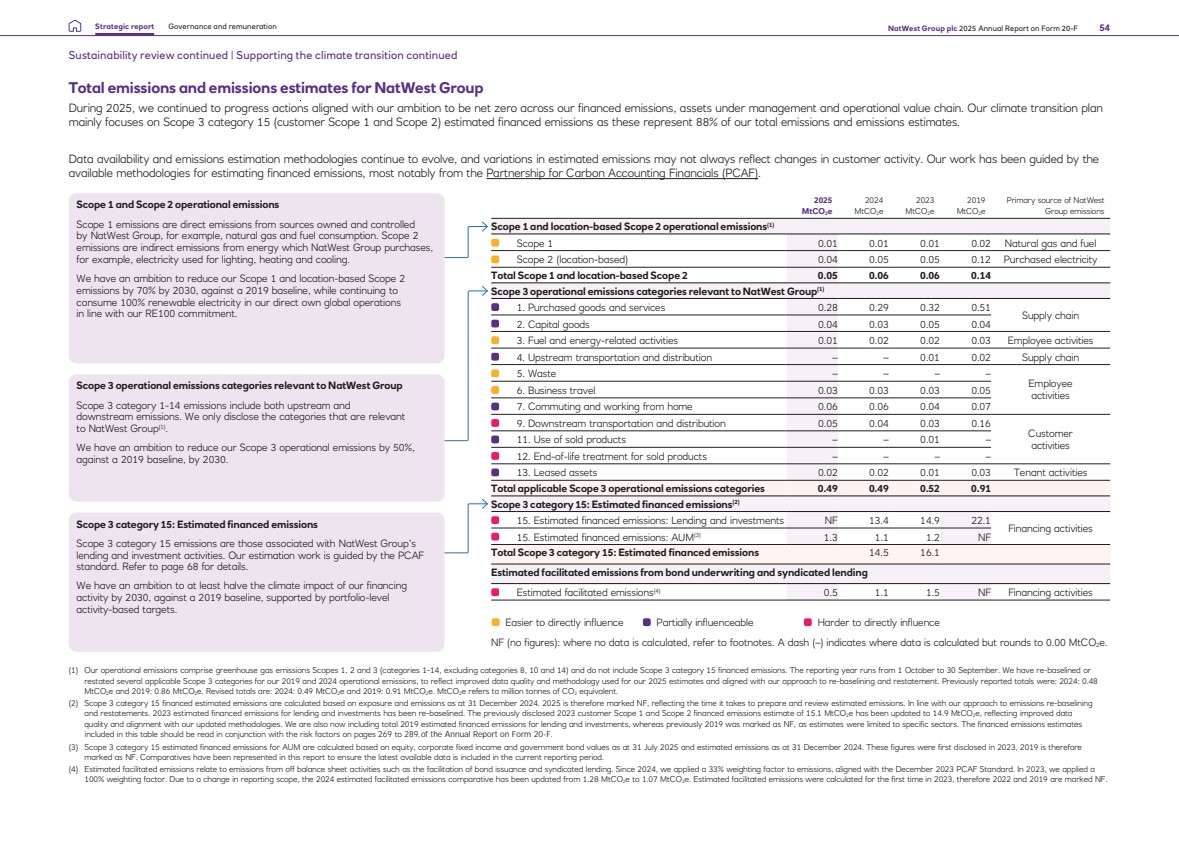
| Sustainability review continued | Supporting the climate transition continued Total emissions and emissions estimates for NatWest Group During 2025, we continued to progress actions aligned with our ambition to be net zero across our financed emissions, assets under management and operational value chain. Our climate transition plan mainly focuses on Scope 3 category 15 (customer Scope 1 and Scope 2) estimated financed emissions as these represent 88% of our total emissions and emissions estimates. The operational emissions and estimates of financed emissions in the table below are based on methodologies outlined in the NatWest Group plc 2025 Sustainability Basis of Reporting. Data availability and emissions estimation methodologies continue to evolve, and variations in estimated emissions may not always reflect changes in customer activity. Our work has been guided by the available methodologies for estimating financed emissions, most notably from the Partnership for Carbon Accounting Financials (PCAF). (1) Our operational emissions comprise greenhouse gas emissions Scopes 1, 2 and 3 (categories 1-14, excluding categories 8, 10 and 14) and do not include Scope 3 category 15 financed emissions. The reporting year runs from 1 October to 30 September. We have re-baselined or restated several applicable Scope 3 categories for our 2019 and 2024 operational emissions, to reflect improved data quality and methodology used for our 2025 estimates and aligned with our approach to re-baselining and restatement, outlined on page 45 of the NatWest Group plc 2025 Climate Transition Plan Report. Previously reported totals were: 2024: 0.48 MtCO2e and 2019: 0.86 MtCO2e. Revised totals are: 2024: 0.49 MtCO2e and 2019: 0.91 MtCO2e. MtCO2e refers to million tonnes of CO2 equivalent. (2) Scope 3 category 15 financed estimated emissions are calculated based on exposure and emissions as at 31 December 2024. 2025 is therefore marked NF, reflecting the time it takes to prepare and review estimated emissions. In line with our approach to emissions re-baselining and restatements, refer to page 45 of the NatWest Group plc 2025 Climate Transition Plan Report, 2023 estimated financed emissions for lending and investments has been re-baselined. The previously disclosed 2023 customer Scope 1 and Scope 2 financed emissions estimate of 15.1 MtCO2e has been updated to 14.9 MtCO2e, reflecting improved data quality and alignment with our updated methodologies. We are also now including total 2019 estimated financed emissions for lending and investments, whereas previously 2019 was marked as NF, as estimates were limited to specific sectors. The financed emissions estimates included in this table should be read in conjunction with the risk factors on pages 420 to 422, as well as the data limitations noted on page 42 and the cautionary statements on pages 70 to 73 of the NatWest Group plc 2025 Climate Transition Plan Report. (3) Scope 3 category 15 estimated financed emissions for AUM are calculated based on equity, corporate fixed income and government bond values as at 31 July 2025 and estimated emissions as at 31 December 2024. These figures were first disclosed in 2023, 2019 is therefore marked as NF. Comparatives have been represented in this report to ensure the latest available data is included in the current reporting period. (4) Estimated facilitated emissions relate to emissions from off balance sheet activities such as the facilitation of bond issuance and syndicated lending. Since 2024, we applied a 33% weighting factor to emissions, aligned with the December 2023 PCAF Standard. In 2023, we applied a 100% weighting factor. Due to a change in reporting scope, the 2024 estimated facilitated emissions comparative has been updated from 1.28 MtCO2e to 1.07 MtCO2e. Estimated facilitated emissions were calculated for the first time in 2023, therefore 2022 and 2019 are marked NF. Refer to pages 43 to 45 of the NatWest Group plc 2025 Climate Transition Plan Report for further details. 2025 MtCO2e 2024 MtCO2e 2023 MtCO2e 2019 MtCO2e Primary source of NatWest Group emissions Scope 1 and location-based Scope 2 operational emissions(1)(RA) Scope 1 0.01 0.01 0.01 0.02 Natural gas and fuel Scope 2 (location-based) 0.04 0.05 0.05 0.12 Purchased electricity Total Scope 1 and location-based Scope 2 0.05 0.06 0.06 0.14 Scope 3 operational emissions categories relevant to NatWest Group(1)(LA) 1. Purchased goods and services 0.28 0.29 0.32 0.51 Supply chain 2. Capital goods 0.04 0.03 0.05 0.04 3. Fuel and energy-related activities 0.01 0.02 0.02 0.03 Employee activities 4. Upstream transportation and distribution – – 0.01 0.02 Supply chain 5. Waste – – – – Employee activities 6. Business travel 0.03 0.03 0.03 0.05 7. Commuting and working from home 0.06 0.06 0.04 0.07 9. Downstream transportation and distribution 0.05 0.04 0.03 0.16 Customer activities 11. Use of sold products – – 0.01 – 12. End-of-life treatment for sold products – – – – 13. Leased assets 0.02 0.02 0.01 0.03 Tenant activities Total applicable Scope 3 operational emissions categories 0.49 0.49 0.52 0.91 Scope 3 category 15: Estimated financed emissions(2) 15. Estimated financed emissions: Lending and investments NF 13.4 14.9 22.1 Financing activities 15. Estimated financed emissions: AUM(3) 1.3 1.1 1.2 NF Total Scope 3 category 15: Estimated financed emissions 14.5 16.1 Estimated facilitated emissions from bond underwriting and syndicated lending Estimated facilitated emissions(4) 0.5 1.1 1.5 NF Financing activities Easier to directly influence Partially influenceable Harder to directly influence NF (no figures): where no data is calculated, refer to footnotes. A dash (–) indicates where data is calculated but rounds to 0.00 MtCO2e. Scope 1 and Scope 2 operational emissions Scope 1 emissions are direct emissions from sources owned and controlled by NatWest Group, for example, natural gas and fuel consumption. Scope 2 emissions are indirect emissions from energy which NatWest Group purchases, for example, electricity used for lighting, heating and cooling. We have an ambition to reduce our Scope 1 and location-based Scope 2 emissions by 70% by 2030, against a 2019 baseline, while continuing to consume 100% renewable electricity in our direct own global operations in line with our RE100 commitment. Refer to pages 12 to 16 of the NatWest Group plc 2025 Climate Transition Plan Report. Scope 3 operational emissions categories relevant to NatWest Group Scope 3 category 1-14 emissions include both upstream and downstream emissions. We only disclose the categories that are relevant to NatWest Group(1). We have an ambition to reduce our Scope 3 operational emissions by 50%, against a 2019 baseline, by 2030. Refer to pages 12 to 16 of the NatWest Group plc 2025 Climate Transition Plan Report. Scope 3 category 15: Estimated financed emissions Scope 3 category 15 emissions are those associated with NatWest Group’s lending and investment activities. Our estimation work is guided by the PCAF standard. Refer to page 68 for details. We have an ambition to at least halve the climate impact of our financing activity by 2030, against a 2019 baseline, supported by portfolio-level activity-based targets. Refer to pages 39 to 42 of the NatWest Group plc 2025 Climate Transition Plan Report. Strategic report Financial review Governance and remuneration Risk and capital management Financial statements Additional information NatWest Group plc 2025 Annual Report and Accounts 54 0.49 0.49 0.91 0.05 0.06 0.14 2025 2024 2019 baseline Scope 1 and location-based Scope 2 Scope 3 operational emissions Business travel Purchased goods and services Downstream transportation and distribution 0.03 0.28 0.05 Fuel and energy-related activities Commuting and working from home Leased assets 0.01 0.06 0.02 Capital goods 0.04 2025 breakdown of operational emissions(1) (MtCO2e) Scope 1 Total operational emissions Easier to influence Partially influenceable Harder to influence Location-based Scope 2 Scope 3 operational emissions 0.54 MtCO2e(1) Scope 3 operational emissions: 0.49 MtCO2e(1) Operational emissions progress (MtCO2e) Operational emissions Our Scope 1 and location-based Scope 2 emissions have decreased by 66% compared with our 2019 baseline, and applicable operational Scope 3 categories(1) have reduced by 47%. This reflects tangible actions across our properties and supply chain, underpinned by improvements in data quality and methodology. We continue to work towards the ambitions outlined on page 54, supported by ongoing improvements in data quality, methodology and transparency. Energy reduction initiatives relating to Scope 1 and location-based Scope 2 emissions A multi-year programme of energy efficiency and decarbonisation drove our Scope 1 and location-based Scope 2 operational emissions reductions in 2025. We upgraded LED lighting across our properties and advanced our Building Management Systems (BMS) programme, which uses AI-driven analytics to optimise energy performance. Since its launch in November 2021, the programme has delivered cumulative savings of around 23,650 Megawatt-hours (MWh), including 12,230 MWh in 2025 alone. At two of our UK data centres, improvements such as advanced air-cooling systems, LED upgrades and optimised temperature set-points saved over 425 MWh in 2025. We are also transitioning away from fossil fuels in our backup power systems. At our Gogarburn campus in Edinburgh, we installed standby generators configured for hydrotreated vegetable oil (HVO), a lower-emission alternative to diesel, following a successful move by our Bristol office from diesel to HVO for its existing standby generators. This is the first step in replacing diesel and kerosene with HVO across selected locations requiring standby power. We aim to source 100% renewable electricity across our direct own global operations. We maintained our RE100 (Renewable Energy 100%) commitment through Corporate Power Purchase Agreements (CPPA), green tariffs(2) and on-site solar generation. We also purchased Renewable Energy Certificates (RECs) for landlord-supplied properties where renewable sources cannot be specified. Scope 3 operational emissions Our Scope 3 operational emissions have decreased by 47% since 2019. Supply chain emissions, which make up around 65% of our Scope 3 operational emissions, have fallen by 44% since 2019, driven by lower UK service industry emissions and changes in influenced spend(3), as we predominantly use spend-based methods. To sustain our momentum, we closely monitor year-on-year trends. We intend to continue driving supplier engagement by encouraging suppliers to make disclosures to CDP, to set science-based targets(4) and to adopt transparent transition plans up to 2030 and beyond. Risks and dependencies Achieving our climate ambitions depends on several factors. Rising energy demand from AI workloads, both in-house and through third-party cloud services, may increase our operational emissions. We are currently closely assessing the impacts on our footprint. Progress also relies on voluntary supplier emissions reductions and the continued resilience of our supply chain, with risk if performance falls short of stated targets. National and regional decarbonisation policies, infrastructure changes and government priorities could also influence our trajectory. We believe that both the availability and affordability of renewable certificates, high-integrity carbon credits, and low-carbon technologies remain critical. We continue to closely monitor these risks and dependencies to ensure timely action and maintain progress. (1) Our operational emissions comprise greenhouse gas emissions Scopes 1, 2 and 3 (Categories 1–14, excluding Categories 8, 10 and 14) and do not include Scope 3 Category 15 financed emissions. For details of the Greenhouse Gas Protocol, including upstream and downstream activities, refer to the diagram of scopes and emissions across the value chain. Our operational emissions in 2025 of 533,604 tCO2e represent a 49% reduction from our 2019 baseline of 1,048,017 tCO2e. As part of this Scope 1 and location-based Scope 2 emissions of 47,540 tCO2e collectively reduced by 66% (2019: 139,050 tCO2e) and Scope 3 operational emissions of 486,064 tCO2e reduced by 47% (2019: 908,967 tCO2e). (2) Tariffs are labelled as green if electricity use is matched by units generated from a verified renewable energy source. (3) Influenced spend refers to spend for purchased goods and services over which NatWest Group has direct control. (4) Science-based targets are emissions-reduction goals based on the latest climate science, ensuring the pace and scale of decarbonisation needed to keep global warming within internationally agreed temperature limits. They are self-reported by suppliers, and NatWest Group attributes a net-zero-aligned status to a supplier if they have a Scope 1, 2 and 3 science-based target. Sustainability review continued | Supporting the climate transition continued The following categories are excluded from the pie as individually they each round to 0.00 and in aggregate to 0.005: 4. upstream transportation, 5. waste, 11. use of sold products, 12. end of life treatment of sold products. Strategic report Strategic report Governance and remuneration Financial review Governance and remuneration Risk and capital management Financial statements Additional information NatWest Group plc NatWest Group plc 2025 Annual Report and Accounts 2025 Annual Report on Form 20-F 5555 0.49 0.01 0.04 |
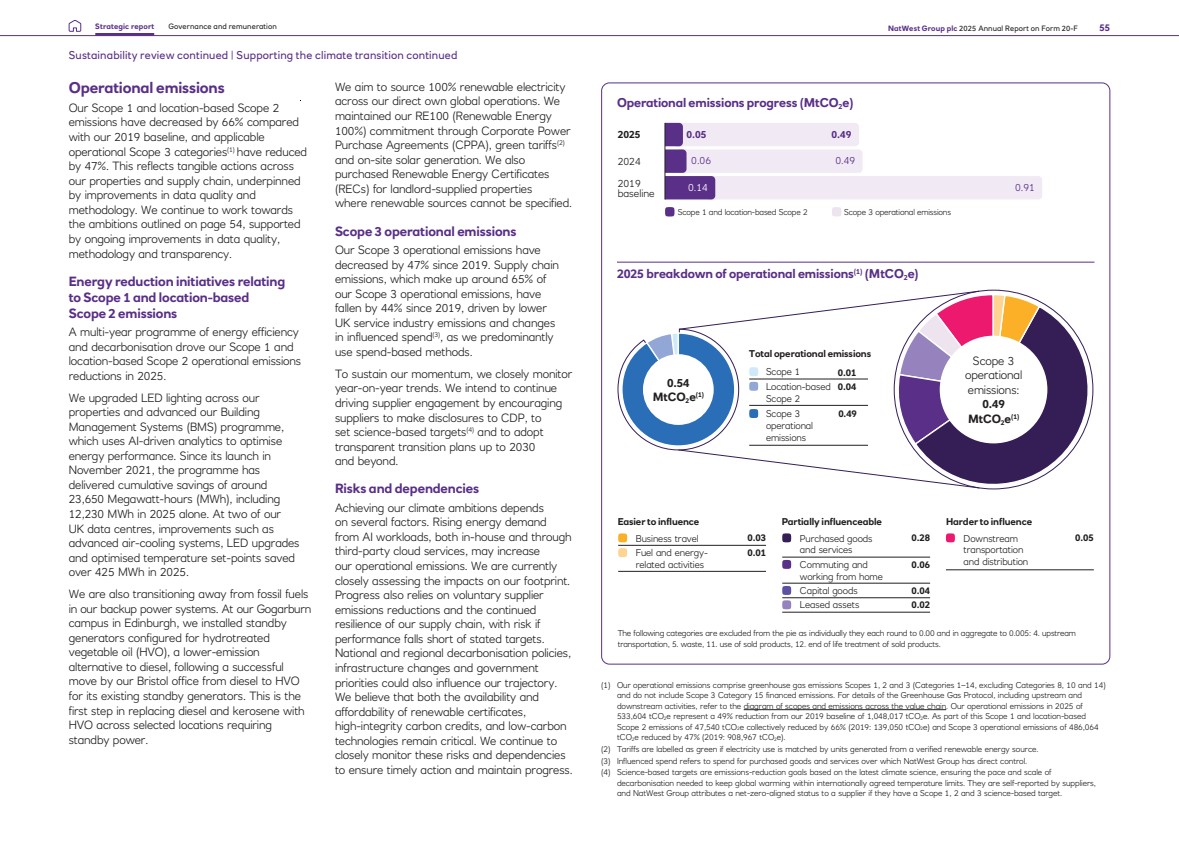
| Streamlined Energy and Carbon Reporting (SECR) Our Streamlined Energy and Carbon Reporting disclosure has been prepared in line with the framework for sustainability reporting that covers greenhouse gas emissions and energy usage to encourage improved energy efficiency. It covers our performance for 2024 and 2025. implement the UK Government’s policy on SECR. Our reporting year runs from 1 October 2024 to 30 September 2025. The emissions reporting boundary is defined as all entities and facilities either owned or under our operational control. Emissions methodology and basis of preparation Boundary: This statement has been prepared in accordance with our regulatory obligation to report greenhouse gas (GHG) emissions pursuant to the Companies (Directors’ Report) and Limited Liability Partnerships (Energy and Carbon Report) Regulations 2018 which 1 Oct 2024 – 30 Sep 2025 1 Oct 2023 – 30 Sep 2024 Greenhouse gas (GHG) emissions UK and Global total (excluding UK Global total (excluding UK Sustainability review continued | Supporting the climate transition continued Strategic report Strategic report Governance and remuneration Financial review Governance and remuneration Risk and capital management Financial statements Additional information NatWest Group plc NatWest Group plc 2025 Annual Report and Accounts 2025 Annual Report on Form 20-F 5656 In 2025, we enhanced our approach to align with best practice and improve transparency. Following the retirement of our ‘direct own operations’ ambitions, we removed the associated boundary from the SECR disclosure and prioritised reporting against Scope 1, Scope 2 and all relevant Scope 3 operational offshore area(1) UK and and offshore)(1) Total and offshore)(1) offshore area Total (1) Emissions from the combustion of fuel and operation of any facility (Scope 1 direct(2) ) (tonnes of CO2e) 8,666 560 9,226 8,716 686 9,402 Emissions from the purchase of electricity, heat, steam and cooling by the company for its own use (Scope 2(3) indirect) (location-based) (tonnes of CO2e) 28,002 10,312 38,314 35,219 11,665 46,884 Total gross Scope 1 and Scope 2 (location-based) (tonnes of CO2e) 36,668 10,872 47,540 43,935 12,351 56,286 Intensity ratio: Location-based CO2e emissions per FTE (Scopes 1 and 2) (tonnes/FTE) 1.0 0.5 0.8 1.1 0.6 1.0 Scope 2(4) (market-based) (tonnes of CO2e) 12 110 122 14 112 126 Energy consumption used to calculate above emissions (kWh) 203,089,756 20,169,002 223,258,758 214,360,749 23,512,232 237,872,981 Scope 3(5) CO2e emissions 373,131 112,933 486,064 389,637 98,904 488,541 Total gross CO2e emissions (Scope 1, location-based Scope 2 and Scope 3 (tonnes) 409,799 123,805 533,604 433,572 111,255 544,827 Intensity ratio: Location-based CO2e emissions per FTE (Scopes 1, 2 and 3) (tonnes/FTE) 10.8 6.2 9.2 11.0 5.6 9.2 emissions categories (1–14)(5) . This creates consistency across the annual reporting suite, while simplifying future reporting. It also strengthens comparability across years and provides stakeholders with a clearer view of our full operational emissions. We restated previously disclosed Scope 3 figures for 2024 to reflect this updated boundary. Reporting(6,7) : Emissions have been reported using the Greenhouse Gas Protocol Corporate Standard and associated guidance and include all greenhouse gases, reported in tonnes of carbon dioxide equivalent (CO2e) and global warming potential values. When converting data to carbon emissions, we use Emission Factors from UK Government Emissions Conversion Factors for Company Reporting (Department for Energy, Security and Net Zero, 2025), CO2 emissions from fuel combustion (International Energy Agency, 2024(8) ) or relevant local authorities as required. NatWest Group uses a third-party software system, to capture and record our environmental impact and ensure that control framework and assurance requirements are met. All data is aggregated at a regional level to reflect the total regional consumption. The regional consumption results are then collated to reflect the total NatWest Group footprint. CO2e values are attributed to these sources via an automatic conversion module in the third-party system. (1) Offshore area as defined in The Companies (Directors’ Report) and Limited Liability Partnerships (Energy and Carbon) Regulations 2018. This includes Isle of Man, Jersey, Guernsey and Gibraltar but not our overseas sites in America, EMEA and Asia-Pacific. These are included in the global total (excluding UK and offshore). (2) Scope 1 emissions from natural gas, liquid fossil fuels, fluorinated gas losses and owned/leased vehicles. (3) Scope 2 emissions from electricity, district heating and cooling used in NatWest Group premises. Our ambition is location-based to drive absolute reductions in consumption. Location-based GHG emissions method reflects the grid-average emissions. Market-based emissions reflect purchased electricity sources (e.g. renewables), which have near-zero emissions. (4) We have procured 100% electricity from renewable sources globally using green tariffs and renewable electricity certificates. The remaining Scope 2 market-based emissions arise from district cooling, district heating and the residual amount of non-renewable electricity. (5) Scope 3 operational emissions sources cover applicable categories 1–14, (excluding categories 8, 10 and 14) and do not include Scope 3 category 15 financed emissions. (6) Low data accuracy is a key risk of our reporting, as this could lead to misreporting of operational emissions. To mitigate this, we maintain robust internal controls processes. (7) The historic values reported in the table above are updated from values we reported in 2024. Scope 3 operational emissions for reporting year 2024 have been restated in line with NatWest Group’s re-baselining policy. In addition to this we have retired the direct own operations terminology, and are now reporting against relevant Scope 3 categories 1-14. Further, future data is subject to change following any significant change to our business size and scope, as baseline recalculation may result in differing emissions reductions. (8) Based on IEA data from the IEA (2024) Emissions factors. All rights reserved; as modified by NatWest Group. |
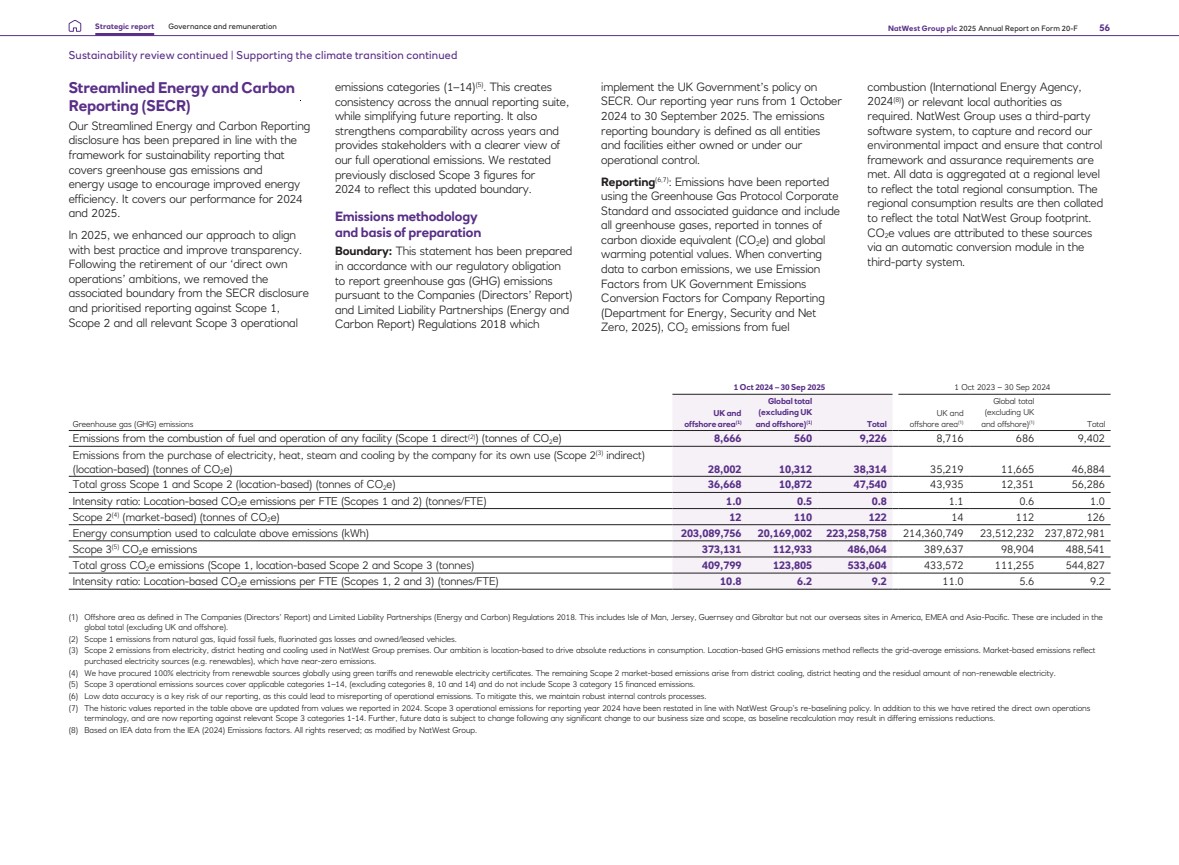
| Streamlined Energy and Carbon Reporting (SECR) Our Streamlined Energy and Carbon Reporting disclosure has been prepared in line with the framework for sustainability reporting that covers greenhouse gas emissions and energy usage to encourage improved energy efficiency. It covers our performance for 2024 and 2025. In 2025, we enhanced our approach to align with best practice and improve transparency. Following the retirement of our ‘direct own operations’ ambitions(1), we removed the associated boundary from the SECR disclosure and prioritised reporting against Scope 1, Scope 2 and all relevant Scope 3 operational implement the UK Government’s policy on SECR. Our reporting year runs from 1 October 2024 to 30 September 2025. The emissions reporting boundary is defined as all entities and facilities either owned or under our operational control. Reporting(7,8): Emissions have been reported using the Greenhouse Gas Protocol Corporate Standard and associated guidance and include all greenhouse gases, reported in tonnes of carbon dioxide equivalent (CO2e) and global warming potential values. When converting data to carbon emissions, we use Emission Factors from UK Government Emissions Conversion Factors for Company Reporting (Department for Energy, Security and Net Zero, 2025), CO2 emissions from fuel emissions categories (1–14)(6). This creates consistency across the annual reporting suite, while simplifying future reporting. It also strengthens comparability across years and provides stakeholders with a clearer view of our full operational emissions. We restated previously disclosed Scope 3 figures for 2024 to reflect this updated boundary. Emissions methodology and basis of preparation Boundary: This statement has been prepared in accordance with our regulatory obligation to report greenhouse gas (GHG) emissions pursuant to the Companies (Directors’ Report) and Limited Liability Partnerships (Energy and Carbon Report) Regulations 2018 which combustion (International Energy Agency, 2024(9)) or relevant local authorities as required. NatWest Group uses a third-party software system, to capture and record our environmental impact and ensure that control framework and assurance requirements are met. All data is aggregated at a regional level to reflect the total regional consumption. The regional consumption results are then collated to reflect the total NatWest Group footprint. CO2e values are attributed to these sources via an automatic conversion module in the third-party system. For more information, refer to the operational emissions page at www.natwestgroup.com. 1 Oct 2024 – 30 Sep 2025 1 Oct 2023 – 30 Sep 2024 Greenhouse gas (GHG) emissions UK and offshore area(2) Global total (excluding UK and offshore)(2) Total UK and offshore area(2) Global total (excluding UK and offshore)(2) Total Emissions from the combustion of fuel and operation of any facility (Scope 1 direct(3)) (tonnes of CO2e)(RA) 8,666 560 9,226 8,716 686 9,402 Emissions from the purchase of electricity, heat, steam and cooling by the company for its own use (Scope 2(4) indirect) (location-based) (tonnes of CO2e)(RA) 28,002 10,312 38,314 35,219 11,665 46,884 Total gross Scope 1 and Scope 2 (location-based) (tonnes of CO2e)(RA) 36,668 10,872 47,540 43,935 12,351 56,286 Intensity ratio: Location-based CO2e emissions per FTE (Scopes 1 and 2) (tonnes/FTE) 1.0 0.5 0.8 1.1 0.6 1.0 Scope 2(5) (market-based) (tonnes of CO2e)(RA) 12 110 122 14 112 126 Energy consumption used to calculate above emissions (kWh) 203,089,756 20,169,002 223,258,758 214,360,749 23,512,232 237,872,981 Scope 3(6) CO2e emissions(LA) 373,131 112,933 486,064 389,637 98,904 488,541 Total gross CO2e emissions (Scope 1(RA), location-based Scope 2(RA) and Scope 3(LA) (tonnes) 409,799 123,805 533,604 433,572 111,255 544,827 Intensity ratio: Location-based CO2e emissions per FTE (Scopes 1, 2 and 3) (tonnes/FTE) 10.8 6.2 9.2 11.0 5.6 9.2 (1) For details of the achievement and retirement of our direct own operations ambitions, refer to page 49 of the NatWest Group plc 2024 Sustainability Report. (2) Offshore area as defined in The Companies (Directors’ Report) and Limited Liability Partnerships (Energy and Carbon) Regulations 2018. This includes Isle of Man, Jersey, Guernsey and Gibraltar but not our overseas sites in America, EMEA and Asia-Pacific. These are included in the global total (excluding UK and offshore). (3) Scope 1 emissions from natural gas, liquid fossil fuels, fluorinated gas losses and owned/leased vehicles. (4) Scope 2 emissions from electricity, district heating and cooling used in NatWest Group premises. Our ambition is location-based to drive absolute reductions in consumption. Location-based GHG emissions method reflects the grid-average emissions. Market-based emissions reflect purchased electricity sources (e.g. renewables), which have near-zero emissions. (5) We have procured 100% electricity from renewable sources globally using green tariffs and renewable electricity certificates. The remaining Scope 2 market-based emissions arise from district cooling, district heating and the residual amount of non-renewable electricity. (6) Scope 3 operational emissions sources cover applicable categories 1–14, (excluding categories 8, 10 and 14) and do not include Scope 3 category 15 financed emissions. (7) Low data accuracy is a key risk of our reporting, as this could lead to misreporting of operational emissions. To mitigate this, we maintain robust internal controls processes, and our data and associated claims are subject to independent assurance. (8) The historic values reported in the table above are updated from values we reported in 2024. Scope 3 operational emissions for reporting year 2024 have been restated in line with NatWest Group’s re-baselining policy. In addition to this we have retired the direct own operations terminology, and are now reporting against relevant Scope 3 categories 1-14. Further, future data is subject to change following any significant change to our business size and scope, as baseline recalculation may result in differing emissions reductions. (9) Based on IEA data from the IEA (2024) Emissions factors. All rights reserved; as modified by NatWest Group. Metric subject to independent Limited Assurance by EY. Metric subject to independent Reasonable Assurance by EY. Refer to page 71. Sustainability review continued | Supporting the climate transition continued Strategic report Financial review Governance and remuneration Risk and capital management Financial statements Additional information NatWest Group plc 2025 Annual Report and Accounts 56 Safeguarding information and tackling financial crime Sustainability review continued Managing data privacy Protecting privacy is vital to retaining trust and growing customer engagement. We aim to address privacy requirements through the application of privacy by design and by default principles within our systems and processes. Everyone in NatWest Group must follow our Privacy and Client Confidentiality (P&CC) policy that sets out how we safeguard the personal data of our customers, colleagues and third parties, including our communities, suppliers and investors. Our policies and procedures also demonstrate our aim to comply with legal and regulatory requirements, including the UK GDPR, the Data Protection Act 2018 and the Data (Use and Access) Act 2025. All colleagues and contractors undertake mandatory P&CC training annually. This training is reviewed and updated every year to cover new topics and technologies, emerging risks and any lessons learned from the previous year. Job-specific training is also provided as necessary for colleagues, for example, privacy training to our data and artificial intelligence colleagues. During 2025, there were a small number of breaches of GDPR and confidentiality (impacting a very small percentage of customers and employees) that we remediated, but there were no material reportable ‘personal data breaches’ under GDPR and no enforcement action by data protection authorities. We endeavour to respond to and remediate privacy complaints as quickly as we can. Detecting and preventing financial crime, corruption and bribery Financial crime has a significant impact on our society. NatWest Group seeks to detect and prevent financial crime and fraud. We have measures in place to protect our customers and to support compliance with relevant financial crime and fraud legislation. Our Financial Crime Statement sets out our Financial Crime Programme, covering anti-bribery and corruption, anti-tax evasion, anti-money laundering, counter terrorist financing and proliferation financing, sanctions and fraud. The programme is built around the following pillars. Customers: we seek to know our customers by conducting risk-based due diligence and monitoring. Policies and procedures: we have policies and procedures in place to help us prevent, detect and tackle financial crime that may arise in relation to our operations, products, services, customers and suppliers. Regular risk assessments: Risk assessments are conducted on a regular basis to strengthen procedures if required. Independent audit: we continuously assess the effectiveness of our controls. Process and technology: we aim to have high-quality detection and prevention systems and controls across the bank to manage risk. Culture and colleagues: we promote a culture of financial crime awareness among all our colleagues, supported by deep expertise in specialist roles. All colleagues undertake annual training and awareness activity to understand their role in tackling financial crime. We also conduct awareness activities to help customers protect themselves from financial crime. Protecting our customers, colleagues and communities is central to how we operate. We recognise that strong data protection, cybersecurity and financial crime controls are essential to maintaining trust in our organisation and in the wider financial system. Our approach is built on robust policies, clear governance and consistently applied standards that look to ensure customers feel secure and confident when they bank with us. This helps us as we strive to deliver safe and responsible banking that helps customers manage their money, plan for the future, and build better, more resilient businesses. Approximately 57,000 colleagues completed cybersecurity learning in 2025, reinforcing a culture of security awareness. Strategic report Strategic report Governance and remuneration Financial review Governance and remuneration Risk and capital management Financial statements Additional information NatWest Group plc NatWest Group plc 2025 Annual Report and Accounts 2025 Annual Report on Form 20-F 5757 Read more on our approach to privacy and customer confidentiality on the NatWest Group website |
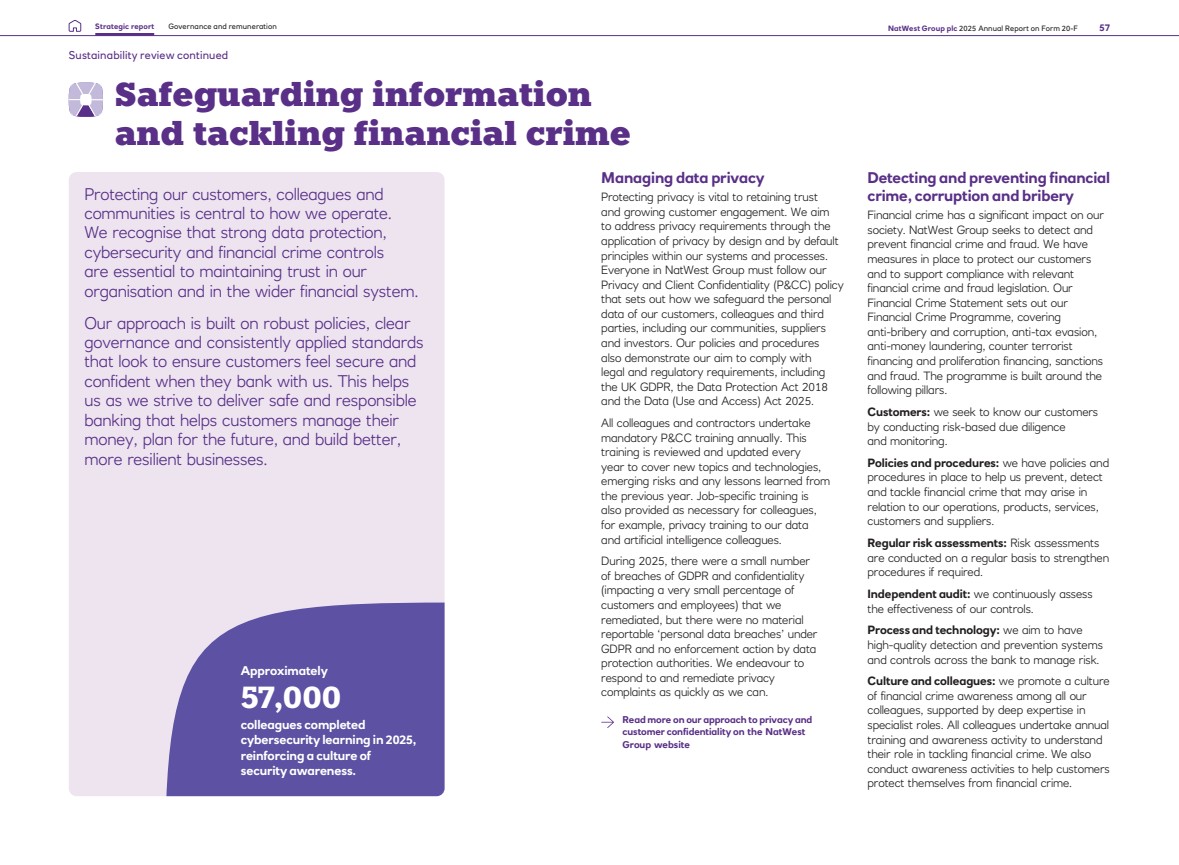
| Partnership working: we strive with a range of partners, including industry bodies, law enforcement, regulators and government, to tackle financial crime. Governance: we have financial crime governance in place to oversee our financial crime programme and monitor its effectiveness. Cybersecurity Throughout 2025, NatWest Group was certified by the IASME Consortium Ltd (IASME) in Cyber Essentials Plus, a recognised government-owned scheme operated by the National Cyber Security Centre (NCSC). We have a set of layered security defences against new and emerging cybersecurity threats. These are regularly tested by both our in-house security testing team and leading independent experts in the cybersecurity industry. All colleagues must complete annual cybersecurity training. There were no instances of security breach caused by a cybersecurity threat in the last three years. Combatting fraud We are committed to combatting fraud and supporting our customers when they fall victim to scams. We continue to operate in market facing a persistent and evolving threat of fraud. UK Finance reported a 3% increase in fraud losses across the UK industry in the first half of 2025 compared with the same period in 2024, with total losses reaching £629 million.(1) While losses from unauthorised fraud fell by 3%, losses linked to Authorised Push Payment (APP) fraud rose by 12%, highlighting the growing and increasingly sophisticated threat of scams in the UK. Sustainability review continued | Safeguarding information and tackling financial crime continued To respond to the growing threat, we continue to improve and build new tooling to support our customers should they be impacted by fraud. This includes new functionality in our mobile applications that allows customers to respond in real time to fraud alerts directly from their phones, improving fraud prevention and enabling them to transact more efficiently. Our efforts to provide the best experience for customers when dealing with fraud claims resulted in an NPS® score from surveyed customers of +60 for Q4 2025. In March 2025, NatWest Group announced its collaboration with OpenAI to deliver a streamlined customer experience when identifying, reporting and resolving fraud and scam cases. This new partnership reflects our ambitions to adopt new technologies that will aid us in creating a safer customer ecosystem. Payment Systems Regulator (PSR) performance data In July 2024, the PSR updated its Authorised Push Payment (APP) fraud performance data for 23 banks, including 14 major UK banking groups and nine smaller firms. The performance data relates to 2023.(2) Key achievements for NatWest Group included: • Ranking fourth for reimbursing customers who fell victim to APP scams. • Having the third lowest value of APP scams sent per £ million of transactions. For every £1 million of transactions sent in 2023, £92 was APP fraud; down from £134 in 2022. Read more on the PSR website. Spotlight Partnering with Meta to disrupt online scams NatWest Group is a founding partner in Meta’s Fraud Intelligence Reciprocal Exchange (FIRE) – a collaborative initiative designed to disrupt online scams. FIRE is a cross-industry threat intelligence sharing programme, allowing banks and other companies to share intelligence directly with each other to stop scammers and protect users. NatWest was the first bank in the UK to participate in the programme. As part of the pilot, we shared vital information based on reports from scam victims, helping Meta to identify and remove fraudulent accounts and content more quickly and effectively. This partnership is just one example of our commitment to working across sectors to improve protections for customers and reduce the impact of online fraud. From 1 January to 30 November 2025, in line with PSR regulations, we reimbursed 76% of APP scam victims which covered 80% of all money lost to fraudsters. Strategic report Strategic report Governance and remuneration Financial review Governance and remuneration Risk and capital management Financial statements Additional information NatWest Group plc NatWest Group plc 2025 Annual Report and Accounts 2025 Annual Report on Form 20-F 5858 (1) UK Finance Half Year Fraud Report 2025 can be found at www.ukfinance.org.uk. (2) As per the latest performance data available on the PSR website. More information on our cybersecurity risk Read more on Financial crime risk on page 141 to 142 of the Annual Report on Form 20-F management can be found on pages 138 to 139 of the Annual Report on Form 20-F |
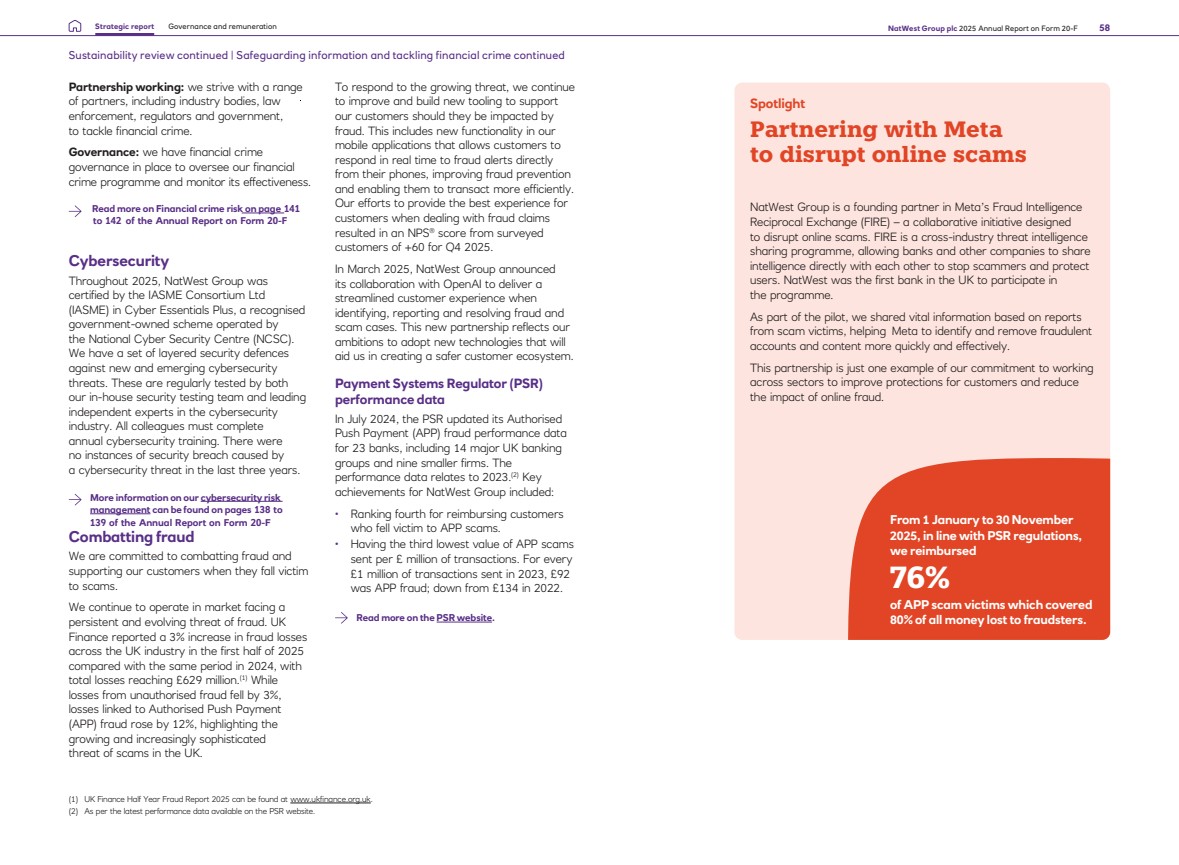
| Partnership working: we strive with a range of partners, including industry bodies, law enforcement, regulators and government, to tackle financial crime. Governance: we have financial crime governance in place to oversee our financial crime programme and monitor its effectiveness. For more information, refer to our Financial Crime statement. Read more on Financial crime risk on page 273. Cybersecurity Throughout 2025, NatWest Group was certified by the IASME Consortium Ltd (IASME) in Cyber Essentials Plus, a recognised government-owned scheme operated by the National Cyber Security Centre (NCSC). We have a set of layered security defences against new and emerging cybersecurity threats. These are regularly tested by both our in-house security testing team and leading independent experts in the cybersecurity industry. All colleagues must complete annual cybersecurity training. There were no instances of security breach caused by a cybersecurity threat in the last three years. More information on our cybersecurity risk management can be found on pages 268 to 271. Combatting fraud We are committed to combatting fraud and supporting our customers when they fall victim to scams. We continue to operate in market facing a persistent and evolving threat of fraud. UK Finance reported a 3% increase in fraud losses across the UK industry in the first half of 2025 compared with the same period in 2024, with total losses reaching £629 million.(1) While losses from unauthorised fraud fell by 3%, losses linked to Authorised Push Payment (APP) fraud rose by 12%, highlighting the growing and increasingly sophisticated threat of scams in the UK. Sustainability review continued | Safeguarding information and tackling financial crime continued To respond to the growing threat, we continue to improve and build new tooling to support our customers should they be impacted by fraud. This includes new functionality in our mobile applications that allows customers to respond in real time to fraud alerts directly from their phones, improving fraud prevention and enabling them to transact more efficiently. Our efforts to provide the best experience for customers when dealing with fraud claims resulted in an NPS® score from surveyed customers of +60 for Q4 2025. In March 2025, NatWest Group announced its collaboration with OpenAI to deliver a streamlined customer experience when identifying, reporting and resolving fraud and scam cases. This new partnership reflects our ambitions to adopt new technologies that will aid us in creating a safer customer ecosystem. Payment Systems Regulator (PSR) performance data In July 2024, the PSR updated its Authorised Push Payment (APP) fraud performance data for 23 banks, including 14 major UK banking groups and nine smaller firms. The performance data relates to 2023.(2) Key achievements for NatWest Group included: • Ranking fourth for reimbursing customers who fell victim to APP scams. • Having the third lowest value of APP scams sent per £ million of transactions. For every £1 million of transactions sent in 2023, £92 was APP fraud; down from £134 in 2022. Read more on the PSR website. Spotlight Partnering with Meta to disrupt online scams NatWest Group is a founding partner in Meta’s Fraud Intelligence Reciprocal Exchange (FIRE) – a collaborative initiative designed to disrupt online scams. FIRE is a cross-industry threat intelligence sharing programme, allowing banks and other companies to share intelligence directly with each other to stop scammers and protect users. NatWest was the first bank in the UK to participate in the programme. As part of the pilot, we shared vital information based on reports from scam victims, helping Meta to identify and remove fraudulent accounts and content more quickly and effectively. This partnership is just one example of our commitment to working across sectors to improve protections for customers and reduce the impact of online fraud. From 1 January to 30 November 2025, in line with PSR regulations, we reimbursed 76% of APP scam victims which covered 80% of all money lost to fraudsters. (1) UK Finance Half Year Fraud Report 2025 can be found at www.ukfinance.org.uk. (2) As per the latest performance data available on the PSR website. The above information is disclosed in line with page 84 of our NatWest Group plc 2024 Sustainability Report. Strategic report Financial review Governance and remuneration Risk and capital management Financial statements Additional information NatWest Group plc 2025 Annual Report and Accounts 58 Building a future-ready workforce Workforce planning To build a more connected and future-focused workforce, we take a strategic approach to workforce planning to ensure we have the skills and capabilities we need to deliver on our strategy and meet evolving customer needs. Through the implementation of Workday Adaptive Planning in 2025, our bank-wide employee data forecasting tool, we transformed our workforce planning, with improved visibility, tighter controls, and a materially more stable workforce outlook. To enable effective usage of this tool we ran over 100 training sessions in 2025, upskilling almost 400 colleagues. We also introduced automation of future dated worker transactions, specifically all movements of joiners, movers, leavers and worker changes. As a result, around 3,500 FTE movements have been automated via Workday Adaptive Planning, saving workforce planners approximately 350 hours per month. Enabling skills and career development To adapt and meet customers’ changing needs, we foster continuous learning, offering all colleagues two dedicated learning days annually. They can also access a comprehensive suite of learning opportunities to enable skills and professional development at every stage of their career. Our learning programme to support our performance philosophy, Beyond, has supported almost 62,000 colleagues in building skills for performance and culture change, with around 165,000 learning hours completed since launch in January 2024. Colleagues consistently reported increased understanding, confidence and capability post completion of Beyond learning modules, with positive scoring ranging from 83% to 96%. In March 2025, we launched the Power Up Your Career pilot to empower colleagues to take an active role in steering their career development. Pre and post pilot session questionnaires demonstrated increased colleague confidence in career progression, rising from 11% to 71%. In Commercial & Institutional, we launched Precision Growth, a sales and business development programme, in September 2025. This enabled 460 colleagues to build the knowledge, skills and practical application needed to support meaningful, trusted relationships with customers. The programme aims to systemise sales excellence practices, improve consistency and reinforce leadership oversight through performance coaching. 90% of colleagues from the programme reported increased confidence in their abilities to ask powerful questions. Expanding future skills and AI capability We are investing in AI skills development for every colleague to support the bank-wide roll out of AI tools (Co-Pilot and Aiden, our internally developed generative AI tool). In 2025, almost 63,000 colleagues completed foundational AI learning, while around 11,000 colleagues enrolled in AI Power Sprints, guided, practical, social learning experiences designed to boost knowledge and confidence. AI skills dominate elective learning, with 15 of the top 20 courses completed being AI-related. We have established strategic partnerships with Microsoft and the University of Edinburgh to accelerate our AI capabilities and adoption. Skilled, engaged and inclusive workforce Sustainability review continued Our people are the foundation of our ambition to succeed with customers. We are investing in the capabilities that matter most for the future, including data, AI and deep technical expertise, to support progression and enable high performance. By equipping colleagues to make better decisions in service of customers and operate at pace, we are building a culture that delivers stronger customer outcomes and drives sustainable, customer-led growth. Since the launch of Beyond in January 2024, approximately 165,000 learning hours have been completed. c.11,000 colleagues enrolled in AI Power Sprints. Strong Our View Inclusion score of 89% and Wellbeing score of 82%, sitting at +8 and +7 vs the Global Financial Services Norm. (1) Colleagues means all permanent employees and, in some instances, members of the wider workforce e.g. temporary employees and agency workers. Strategic report Strategic report Governance and remuneration Financial review Governance and remuneration Risk and capital management Financial statements Additional information NatWest Group plc NatWest Group plc 2025 Annual Report and Accounts 2025 Annual Report on Form 20-F 5959 |
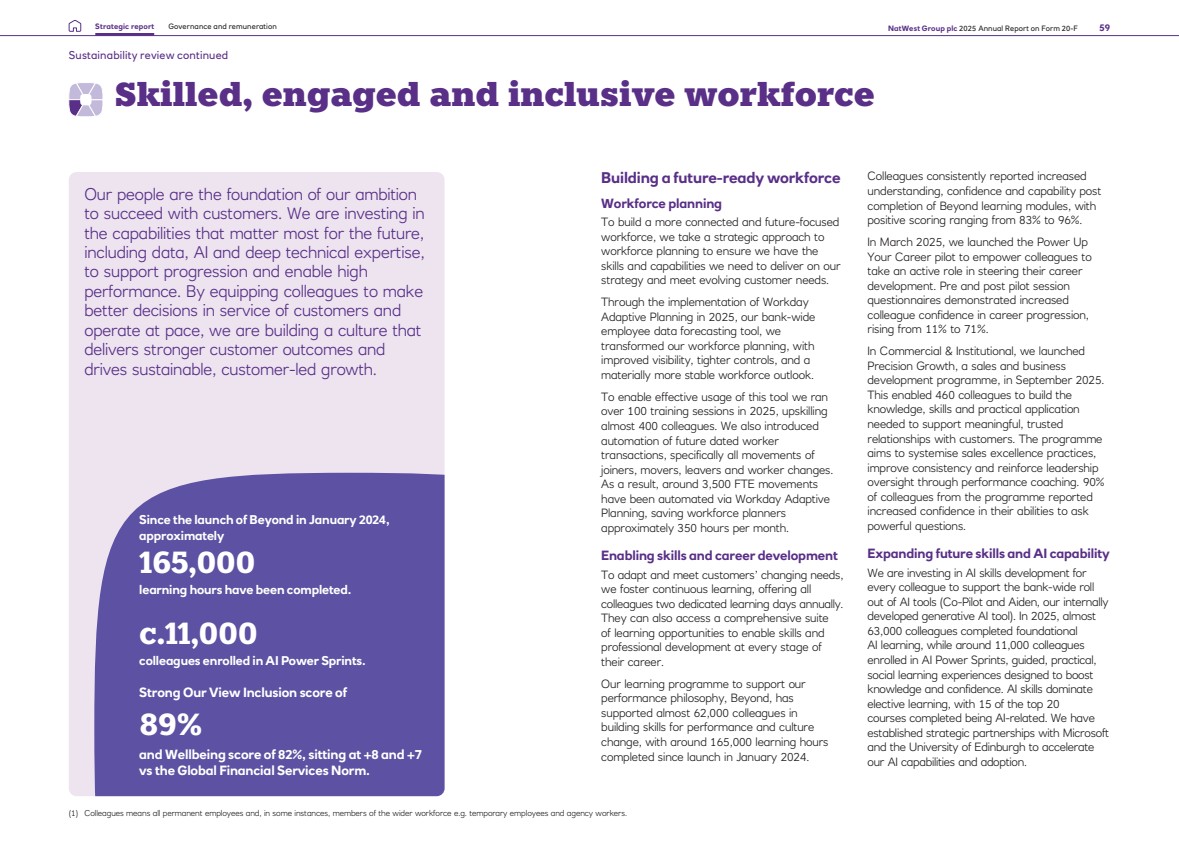
| To further help build capability in critical skills for a future-ready workforce, we support and encourage colleagues to complete future skills learning. In 2025, 77% of colleagues completed future skills elective learning, with around 307,000 learning hours completed. In the spirit of simplification, in 2025 we reduced mandatory learning time by 29%, compared with 2024, while maintaining strong colleague feedback on our learning and development programmes. According to our colleague survey, Our View, 88% of colleagues agreed that our learning and development programmes had prepared them for the work they do. During UK National Learning at Work Week in May 2025, our Get Connected campaign inspired colleagues to learn and grow, attracting 6,248 live attendees. Feedback was overwhelmingly positive, with 97% of attendees feeling inspired to develop their skills further. Enabling internal mobility To boost internal mobility across NatWest Group, 818 colleagues completed a gig – a small, discrete piece of work that colleagues can perform alongside their day job across various areas in the bank – in 2025, which supported skills development and mobility. In addition, the UK Mobility Hub offers support to colleagues at risk of redundancy and helps them find new roles. In 2025, the hub provided one or more services to 1,969 colleagues. Of 679 colleagues who registered for redeployment support, 73% were successfully redeployed into new roles. The hub received a Net Promoter Score®(2) of +89. Leadership development To strengthen our leadership capability, leaders at every stage of development can access support, training and resources from our Leadership Academy. This investment in our leaders is paying off, demonstrated by an uplift in scores from 2024 on purposeful leadership, performance culture and line manager capability in our colleague survey, Our View. During 2025, 1,678 of our senior leaders participated in executive coaching with a specific focus on development aligned with NatWest Group behaviours. We also partnered with global leadership consultancy, Spencer Stuart, to better understand the cultural and leadership style profiles of our executive leaders. Investing in talent and leadership capability Attracting, identifying and developing talent Building a strong pipeline of talent for our workforce relies on attracting talented individuals to start their careers with us, identifying those with the potential to excel in their fields and then providing the support they need throughout their career to thrive. Through our Early Talent Programmes in 2025, we hired 868 graduates, interns and apprentices across the UK and India. This included 96 apprentices through our Elevate programme that partners with the charity, Leadership Through Sport and Business, to support individuals from lower-income socio-economic backgrounds.(3) (1) Colleagues means all permanent employees and, in some instances, members of the wider workforce e.g. temporary employees and agency workers. (2) Net Promoter®, NPS®, NPS Prism®, and the NPS-related emoticons are registered trademarks of Bain & Company, Inc., NICE Systems, Inc.,and Fred Reichheld. (3) Through working with third-party organisations, eligibility is based on qualification for Free School Meals (FSM) in secondary education; residence in bottom 30% areas of the Index of Multiple Deprivation (IMD); and other personal disadvantage. Sustainability review continued | Skilled, engaged and inclusive workforce continued Succession planning To continue building a leadership pipeline that proactively supports leaders’ development, we enhanced our succession planning approach for CEO-1 and CEO-2 positions and critical roles in 2025 by revising the timescales for target role readiness, increasing our focus on internal mobility and introducing feeder roles to support tailored career planning. A number of successors have advanced into Executive and Group Executive Committee (ExCo) roles in the last 12 months. 868 graduates, interns and apprentices hired across the UK and India in 2025. To nurture our talent we have a talent identification process to help leaders identify colleagues with the potential to progress further and faster. In 2025, we identified 1,635 colleagues across the bank who will be placed on a talent development pathway to help them shape career growth aligned to their goals and ambitions. Strategic report Strategic report Governance and remuneration Financial review Governance and remuneration Risk and capital management Financial statements Additional information NatWest Group plc NatWest Group plc 2025 Annual Report and Accounts 2025 Annual Report on Form 20-F 6060 Read more about our Early Talent Programme on the NatWest Group website |
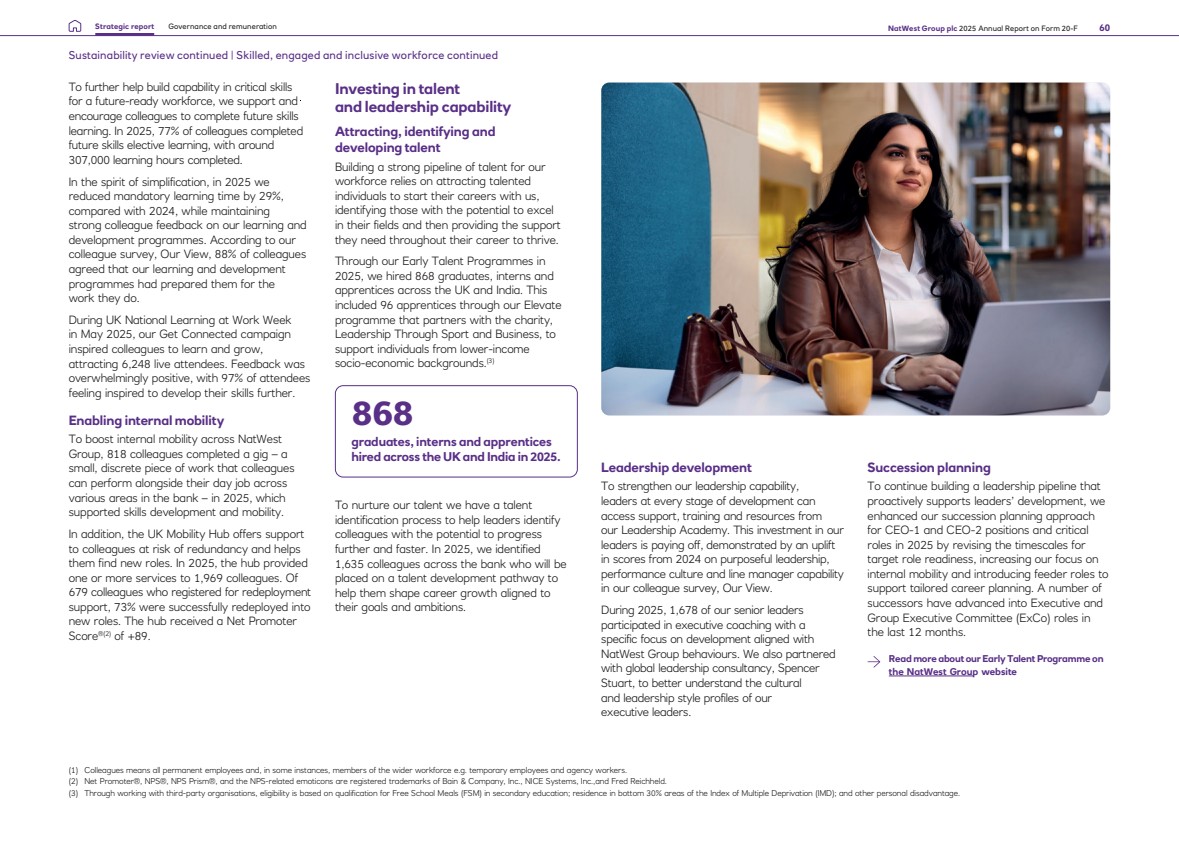
| To further help build capability in critical skills for a future-ready workforce, we support and encourage colleagues to complete future skills learning. In 2025, 77% of colleagues completed future skills elective learning, with around 307,000 learning hours completed. In the spirit of simplification, in 2025 we reduced mandatory learning time by 29%, compared with 2024, while maintaining strong colleague feedback on our learning and development programmes. According to our colleague survey, Our View, 88% of colleagues agreed that our learning and development programmes had prepared them for the work they do. During UK National Learning at Work Week in May 2025, our Get Connected campaign inspired colleagues to learn and grow, attracting 6,248 live attendees. Feedback was overwhelmingly positive, with 97% of attendees feeling inspired to develop their skills further. Enabling internal mobility To boost internal mobility across NatWest Group, 818 colleagues completed a gig – a small, discrete piece of work that colleagues can perform alongside their day job across various areas in the bank – in 2025, which supported skills development and mobility. In addition, the UK Mobility Hub offers support to colleagues at risk of redundancy and helps them find new roles. In 2025, the hub provided one or more services to 1,969 colleagues. Of 679 colleagues who registered for redeployment support, 73% were successfully redeployed into new roles. The hub received a Net Promoter Score®(2) of +89. Leadership development To strengthen our leadership capability, leaders at every stage of development can access support, training and resources from our Leadership Academy. This investment in our leaders is paying off, demonstrated by an uplift in scores from 2024 on purposeful leadership, performance culture and line manager capability in our colleague survey, Our View. During 2025, 1,678 of our senior leaders participated in executive coaching with a specific focus on development aligned with NatWest Group behaviours. We also partnered with global leadership consultancy, Spencer Stuart, to better understand the cultural and leadership style profiles of our executive leaders. Investing in talent and leadership capability Attracting, identifying and developing talent Building a strong pipeline of talent for our workforce relies on attracting talented individuals to start their careers with us, identifying those with the potential to excel in their fields and then providing the support they need throughout their career to thrive. Through our Early Talent Programmes in 2025, we hired 868 graduates, interns and apprentices across the UK and India. This included 96 apprentices through our Elevate programme that partners with the charity, Leadership Through Sport and Business, to support individuals from lower-income socio-economic backgrounds.(3) (1) Colleagues means all permanent employees and, in some instances, members of the wider workforce e.g. temporary employees and agency workers. (2) Net Promoter®, NPS®, NPS Prism®, and the NPS-related emoticons are registered trademarks of Bain & Company, Inc., NICE Systems, Inc.,and Fred Reichheld. (3) Through working with third-party organisations, eligibility is based on qualification for Free School Meals (FSM) in secondary education; residence in bottom 30% areas of the Index of Multiple Deprivation (IMD); and other personal disadvantage. Sustainability review continued | Skilled, engaged and inclusive workforce continued Succession planning To continue building a leadership pipeline that proactively supports leaders’ development, we enhanced our succession planning approach for CEO-1 and CEO-2 positions and critical roles in 2025 by revising the timescales for target role readiness, increasing our focus on internal mobility and introducing feeder roles to support tailored career planning. A number of successors have advanced into Executive and Group Executive Committee (ExCo) roles in the last 12 months. Read more about our Early Talent Programme at natwestgroup.com, and for a full breakdown of our Early Talent Programme profiles, refer to our NatWest Group plc 2025 Sustainability Datasheet. 868 graduates, interns and apprentices hired across the UK and India in 2025. To nurture our talent we have a talent identification process to help leaders identify colleagues with the potential to progress further and faster. In 2025, we identified 1,635 colleagues across the bank who will be placed on a talent development pathway to help them shape career growth aligned to their goals and ambitions. Strategic report Financial review Governance and remuneration Risk and capital management Financial statements Additional information NatWest Group plc 2025 Annual Report and Accounts 60 Spotlight Winning Together: aligning purpose, culture and performance to deliver for customers In February 2025, we launched Winning Together, our bank-wide framework that brings together our purpose, strategy, ambition and cultural aspirations. It underpins our approach to building a high-performing, customer-focused organisation. It explains clearly what we’re aiming to achieve, and has strengthened our performance culture by setting clear expectations of leadership, accountability and impact. These expectations were embedded through Beyond, our performance management philosophy. A greater emphasis has been placed on clarity of objectives, quality of delivery and continuous development. This has supported a shift towards earlier, more constructive performance conversations, with the aim of enabling colleagues to perform at their best while maintaining results-focused discipline across the organisation. Our new behaviours In March 2025, we introduced the new NatWest Group behaviours – a pivotal step in cultural transformation. Through extensive engagement with the Group Executive Committee, senior leaders and focus groups across the bank, we explored what truly matters in how we deliver for customers and work together effectively. This insight informed the design of three clear behaviours that reflect our shared priorities and now guide how we drive performance across the organisation. Our new behaviours provide a consistent benchmark for how colleagues work together, make decisions and deliver on our purpose and ambitions. They aim to reinforce a strong connection between individual contribution, team performance and enterprise priorities. Our new behaviours: We start with customers We raise the bar We own our impact The three behaviours replaced multiple colleague frameworks, including our values and critical people capabilities, creating a single, consistent and practical way of describing how we work. Our research showed that behaviours, expressed through clear and active language, are more actionable for colleagues and easier to apply in day-to-day decision-making. We have embedded these behaviours into how we operate, from recruitment and onboarding through to performance, development and reward. As part of this simplification, we reduced the number of behavioural indicators from over 180 to 15, making expectations clearer, more memorable and easier for colleagues to understand and put into practice. We complemented these changes with the introduction of Recognise, our bank-wide approach to acknowledging and celebrating contribution and behaviours-led impact, celebrating success as it happens. Sustainability review continued | Skilled, engaged and inclusive workforce continued (1) Churches, Charities and Local Authorities (CCLA) is a UK charity fund manager, working with charities, religious organisations and the public sector. Supporting colleague wellbeing We are committed to supporting our colleagues’ wellbeing throughout their career, and this commitment is reflected in our Live Well Being You strategy. Colleagues globally can access wellbeing resources across mind, body, life and money, with a proactive focus on prevention. These efforts are supported by our Executive Wellbeing Sponsor and Wellbeing Implementation Committee, and c.2,000 Wellbeing Champions embedded across NatWest Group. Our wellbeing initiatives are informed by colleague feedback, engagement data and absence trends, enabling targeted communications and timely interventions. c.2,000 Wellbeing Champions throughout our business. Enabling financial wellbeing Our virtual Financial Wellbeing Zone offers tailored guides and support for colleagues and their families, covering budgeting, planning, and expert advice. Themed education programmes are planned to coincide with national events, and thousands joined live webinars during Financial Wellbeing Month. In 2025, free personal financial health checks and Financial Foundations workshops were available, and participation rates in the flagship Retirement Savings Plan (RSP) were high, supported by initiatives like Save More Tomorrow. All our employees have access to benefits through the NatWest Group Benefits Hub that provides a wide range of pension, protection, healthcare, lifestyle and discount benefits. Mental health support and engagement During 2025, we embedded menopause, menstrual and reproductive wellbeing into our core wellbeing strategy, partnering with our Gender Network, unions and external experts to steer our approach. As part of this effort, we hosted monthly support cafés, refreshed our online resources and ran expert-led events to normalise conversations and encourage accessing confidential advice. Our award-winning cancer line manager training, developed with Macmillan Cancer Support, continued to enhance manager confidence and enable psychological safety for colleagues. We also saw almost 16,000 questions on mental health answered on our Just Ask A Question (JAAQ) platform in 2025, with a mental health campaign extending this service to customers via our branch network. In 2025, we continued our practice of engaging colleagues, customers and communities through our UK-wide baton relay and virtual activity challenge, promoting mental and physical wellbeing behaviours. Through our partnership with Team GB and Paralympics GB, we welcomed leading experts in sleep, stress and menopause, who shared insights from their work with elite athletes and translated these lessons into the workplace, reaching around 2,500 colleagues who attended their sessions. NatWest Group achieved top tier accreditation in the MindForward Alliance’s Thriving at Work Assessment and maintained Tier 2 in the CCLA(1) Corporate Mental Health Benchmark. These help us benchmark our wellbeing offering externally and, alongside our colleague survey, Our View, inform our wellbeing strategy. Strategic report Strategic report Governance and remuneration Financial review Governance and remuneration Risk and capital management Financial statements Additional information NatWest Group plc NatWest Group plc 2025 Annual Report and Accounts 2025 Annual Report on Form 20-F 6161 Read more about how we support colleagues with their wellbeing on the NatWest Group website For further information on how we are strengthening performance and recognition, see our Directors’ remuneration report, page 123. |
| Creating an inclusive workforce Understanding the diverse perspectives and needs of our communities helps us support our customers to the best of our ability. That’s why we strive to be an inclusive business that gives all our colleagues and customers the opportunity to turn possibilities into progress. Driving inclusion across the bank Our efforts to drive inclusion are steered by our Enterprise Inclusion committee, jointly led by our Chief People Officer and Chief Marketing Officer. The Committee takes a focused and impactful approach to embedding inclusion across the bank, bringing together leaders, networks and working groups to align priorities, share insights, and ensure meaningful progress. It unifies all our inclusion activity, focusing on key levers such as attraction, development, retention, and workplace culture, taking a holistic organisation wide approach with sustainable, long-term impact. NatWest Group’s commitment to inclusivity has been recognised by winning the ‘Social Mobility Network of the Year Award’ at the UK Social Mobility Awards, in October 2025. Supporting our employee-led networks Our eight employee-led networks (ELNs), with approximately 15,000 unique members, help to foster an inclusive environment at NatWest Group. In June 2025, we held a pan-ELN summit to develop closer relations across our ELNs, increase collaboration, focus on intersectionality and work with our networks to effectively support the business strategy. In October 2025, we introduced a two-stage ELN co-chair learning programme, to equip co-chairs with an industry-recognised qualification. Promoting inclusive recruitment and retention To ensure our hiring processes are inclusive, we use our Recruitment Yes Check, a comprehensive checklist that emphasises inclusion and candidate experience throughout the hiring process. All hiring managers must complete inclusion focused recruitment training. We encourage the use of Inclusive Interview Ambassadors to bring diversity of thought to interviews, and it is mandatory for all senior level interviews to include Inclusive Interview Ambassadors. Around 900 colleagues in the UK participated in this programme in 2025, and the initiative was also launched in India in October 2025. We continued to embed sponsorship across the bank, through business-led programmes to support career development and to accelerate the entry of underrepresented groups into senior roles. Disability and neurodiversity We achieved silver in the Business Disability Forum (BDF) Disability Smart Audit and renewed our status as a Disability Confident Leader. In May 2025, we established a disability inclusion action group to work on the outputs of the audit and support our progress towards achieving a gold standard in the next audit. We also marked Global Accessibility Awareness Day and International Day of Persons with Disabilities with a series of colleague events. In 2025, 758 colleagues accessed the neuro-developmental pathway through our private medical cover, which provides assessment, diagnosis and short-term support for attention deficit hyperactivity disorder (ADHD), autism spectrum disorder (ASD) and Tourette’s Syndrome. Socio-economic diversity We strengthened our commitment to socio-economic inclusion by contributing to Progress Together’s Shaping the Growth: Socio-economic Diversity in Financial Services Report – the largest study of its kind exploring the link between career progression and socio-economic background. Five colleagues participated in the KPMG Thrive Together Programme, a six-month pilot to enhance socio-economic inclusion through cross-organisational mentorship. We also hosted a social mobility day event in June 2025 focused on ‘shifting mindsets’, recognising the distinct strengths of colleagues from lower socio-economic backgrounds and discussing organisational mindset on opportunity. Additionally, the Legal, Governance and Regulatory Affairs function continued to run the week-long First Step programme that enables students and apprentices from underrepresented communities to gain an insight into the legal profession. LGBTQ+ Our LGBTQ+ Rainbow Network, in collaboration with the Wellbeing team, launched Bi+ the Way in October 2025 – a dedicated virtual support space for Bi colleagues. To further support inclusion and learning, the Network also ran online allyship at work sessions in collaboration with the Gender network, designed to help deepen self awareness, understand personal influence, and take practical action to support colleagues. In 2025, we also launched Grow with Pride, a developmental learning pathway co-created with LGBTQ+ colleagues, focusing on the soft skills they most want to develop. Furthermore, NatWest Group India ranked as one of the top 10 employers for LGBT+ Inclusion in the India Workplace Equality Index 2025. Sustainability review continued | Skilled, engaged and inclusive workforce continued Gender The FTSE Women Leaders Review ranked NatWest Group 9th in the FTSE 100 Rankings 2024 for Women on Boards and in Leadership. We were also once again named in The Times Top 50 employer for Gender Equality. As a Women in Finance Charter signatory, we joined an industry-wide hackathon in July 2025, to accelerate progress for women in leadership. Our Gender Network’s development programme supported 152 colleagues in 2025, enabled by 85 coaches. We enhanced wellbeing support by including free period products in UK offices and introducing colleague support circles for menstrual health, men’s mental health and women’s safety. Ethnicity In 2025, we were recognised as an ‘Advanced Employer’ by Investing in Ethnicity’s maturity matrix. As part of Race Equality Week in February 2025, we organised several events around the theme ‘Every Action Counts’ to highlight our efforts to meet our Banking on Racial Equality commitments, which moving forward will be managed through the Enterprise Inclusion Committee. In Black History Month in October 2025, we continued our internal focus on action with the theme ‘Committed to Action, Moving Forward Together’. We held an event about the future of Black enterprise with The Financial Times, and a panel discussion exploring how leaders can foster inclusive environments. The Black Talent Awards recognised our Multicultural Network as a finalist in the Employee Resource Group (ERG) of the Year category. Strategic report Strategic report Governance and remuneration Financial review Governance and remuneration Risk and capital management Financial statements Additional information NatWest Group plc NatWest Group plc 2025 Annual Report and Accounts 2025 Annual Report on Form 20-F 6262 For full details of our 2025 awards, refer to the NatWest Group website For more details on our ELNs, refer to the NatWest Group website |
| Creating an inclusive workforce Understanding the diverse perspectives and needs of our communities helps us support our customers to the best of our ability. That’s why we strive to be an inclusive business that gives all our colleagues and customers the opportunity to turn possibilities into progress. Driving inclusion across the bank Our efforts to drive inclusion are steered by our Enterprise Inclusion committee, jointly led by our Chief People Officer and Chief Marketing Officer. The Committee takes a focused and impactful approach to embedding inclusion across the bank, bringing together leaders, networks and working groups to align priorities, share insights, and ensure meaningful progress. It unifies all our inclusion activity, focusing on key levers such as attraction, development, retention, and workplace culture, taking a holistic organisation wide approach with sustainable, long-term impact. NatWest Group’s commitment to inclusivity has been recognised by winning the ‘Social Mobility Network of the Year Award’ at the UK Social Mobility Awards, in October 2025. For full details of our 2025 awards, refer to natwestgroup.com. Supporting our employee-led networks Our eight employee-led networks (ELNs), with approximately 15,000 unique members, help to foster an inclusive environment at NatWest Group. In June 2025, we held a pan-ELN summit to develop closer relations across our ELNs, increase collaboration, focus on intersectionality and work with our networks to effectively support the business strategy. In October 2025, we introduced a two-stage ELN co-chair learning programme, to equip co-chairs with an industry-recognised qualification. For more details on our ELNs, refer to natwestgroup.com. Promoting inclusive recruitment and retention To ensure our hiring processes are inclusive, we use our Recruitment Yes Check, a comprehensive checklist that emphasises inclusion and candidate experience throughout the hiring process. All hiring managers must complete inclusion focused recruitment training. We encourage the use of Inclusive Interview Ambassadors to bring diversity of thought to interviews, and it is mandatory for all senior level interviews to include Inclusive Interview Ambassadors. Around 900 colleagues in the UK participated in this programme in 2025, and the initiative was also launched in India in October 2025. We continued to embed sponsorship across the bank, through business-led programmes to support career development and to accelerate the entry of underrepresented groups into senior roles. Disability and neurodiversity We achieved silver in the Business Disability Forum (BDF) Disability Smart Audit and renewed our status as a Disability Confident Leader. In May 2025, we established a disability inclusion action group to work on the outputs of the audit and support our progress towards achieving a gold standard in the next audit. We also marked Global Accessibility Awareness Day and International Day of Persons with Disabilities with a series of colleague events. In 2025, 758 colleagues accessed the neuro-developmental pathway through our private medical cover, which provides assessment, diagnosis and short-term support for attention deficit hyperactivity disorder (ADHD), autism spectrum disorder (ASD) and Tourette’s Syndrome. Socio-economic diversity We strengthened our commitment to socio-economic inclusion by contributing to Progress Together’s Shaping the Growth: Socio-economic Diversity in Financial Services Report – the largest study of its kind exploring the link between career progression and socio-economic background. Five colleagues participated in the KPMG Thrive Together Programme, a six-month pilot to enhance socio-economic inclusion through cross-organisational mentorship. We also hosted a social mobility day event in June 2025 focused on ‘shifting mindsets’, recognising the distinct strengths of colleagues from lower socio-economic backgrounds and discussing organisational mindset on opportunity. Additionally, the Legal, Governance and Regulatory Affairs function continued to run the week-long First Step programme that enables students and apprentices from underrepresented communities to gain an insight into the legal profession. LGBTQ+ Our LGBTQ+ Rainbow Network, in collaboration with the Wellbeing team, launched Bi+ the Way in October 2025 – a dedicated virtual support space for Bi colleagues. To further support inclusion and learning, the Network also ran online allyship at work sessions in collaboration with the Gender network, designed to help deepen self awareness, understand personal influence, and take practical action to support colleagues. In 2025, we also launched Grow with Pride, a developmental learning pathway co-created with LGBTQ+ colleagues, focusing on the soft skills they most want to develop. Furthermore, NatWest Group India ranked as one of the top 10 employers for LGBT+ Inclusion in the India Workplace Equality Index 2025. Sustainability review continued | Skilled, engaged and inclusive workforce continued Gender The FTSE Women Leaders Review ranked NatWest Group 9th in the FTSE 100 Rankings 2024 for Women on Boards and in Leadership. We were also once again named in The Times Top 50 employer for Gender Equality. As a Women in Finance Charter signatory, we joined an industry-wide hackathon in July 2025, to accelerate progress for women in leadership. Our Gender Network’s development programme supported 152 colleagues in 2025, enabled by 85 coaches. We enhanced wellbeing support by including free period products in UK offices and introducing colleague support circles for menstrual health, men’s mental health and women’s safety. Ethnicity In 2025, we were recognised as an ‘Advanced Employer’ by Investing in Ethnicity’s maturity matrix. As part of Race Equality Week in February 2025, we organised several events around the theme ‘Every Action Counts’ to highlight our efforts to meet our Banking on Racial Equality commitments, which moving forward will be managed through the Enterprise Inclusion Committee. In Black History Month in October 2025, we continued our internal focus on action with the theme ‘Committed to Action, Moving Forward Together’. We held an event about the future of Black enterprise with The Financial Times, and a panel discussion exploring how leaders can foster inclusive environments. The Black Talent Awards recognised our Multicultural Network as a finalist in the Employee Resource Group (ERG) of the Year category. Strategic report Financial review Governance and remuneration Risk and capital management Financial statements Additional information NatWest Group plc 2025 Annual Report and Accounts 62 Our progress and targets In 2025, through our colleague survey, Our View, 95% of colleagues reported that they believe NatWest Group provides a working environment free of discrimination and harassment +8 vs the Global Financial Services Norm and +4 vs the High Performing Norm. Our Board composition exceeded the FTSE Women Leaders Review target of a minimum of 40% women’s representation by the end of 2025, with a figure of 55%, as at 31 December 2025. Our executive management team was made up of 43% women as at 31 December 2025, with the Group Chief Financial Officer, CEO, Private Banking & Wealth Management, CEO, Retail, Group Chief Marketing Officer, Group Chief People Officer and Group Chief Corporate Affairs Officer roles held by women. In 2025, we introduced new diversity targets to be achieved by 2030. Our targets are aimed at increasing diversity in our senior roles. We monitor, review progress and report against our diversity targets through monthly data dashboards, bi-annual diversity reviews with Group Executive Committee members and senior leaders and via our quarterly Enterprise Inclusion Committee. Our targets are informed by census data and bench-marked externally. We are committed to pay equality. The mean gender pay gap for NatWest Bank, our largest reporting entity, is 23.5% closing the gap by 1.9 percentage points since 2024. The mean gender bonus gap is 41.2% closing the gap by 1.8 percentage points from 2024. In line with our commitment to transparency under the UK Government’s Race at Work Charter, we have voluntarily disclosed our aggregated ethnicity pay gap for NatWest Group UK. The mean ethnicity pay gap is 5.4%, this gap increased by 0.47 percentage points since 2024. The mean ethnicity bonus gap is 31.0%, this gap increased by 5.2 percentage points since 2024. We have broken down our ethnicity pay gaps to compare the average hourly pay of Asian, Black, mixed/multiple, and other ethnic minority colleagues with that of White colleagues at NatWest Group in Great Britain. This highlighted a wider pay gap between Black and White colleagues than the average ethnicity pay gap. The targets, alongside other initiatives, aim to increase the number of Black colleagues in UK roles, to address under-representation in this area. Sustainability review continued | Skilled, engaged and inclusive workforce continued (1) Global targets remain subject to local laws and regulations. (2) The senior leadership population is CEO-2+ and our management population is grades C11+. (3) Black mixed ethnicity categories are included in our Black diversity target calculations. (4) NatWest Group’s management structures were revised during 2025. For the purpose of remuneration reporting, the representation targets were set based on the management structures in place at the start of 2025. Companies Act 2006, section 414C (8)(c) disclosure Male # Female # Directors of the company 5 6 Executive employees 63 46 Directors of subsidiaries 154 69 Permanent employees (active and inactive) 32,100 28,100 There were 332 senior managers (in accordance with the definition contained within the relevant Companies Act legislation), which comprises our executive population and individuals who are directors of our subsidiaries. UK Corporate Governance Code (the Code) Provision 23: As at 31 December 2025, the gender balance of those in the senior management and their direct reports was 42% female and 58% male. For the purposes of this note, ‘the senior management’ means our executive management team and the company secretary (as required by the Code). Strategic report Strategic report Governance and remuneration Financial review Governance and remuneration Risk and capital management Financial statements Additional information NatWest Group plc NatWest Group plc 2025 Annual Report and Accounts 2025 Annual Report on Form 20-F 6363 We have a target to achieve 5% of UK Black(3) colleagues in our senior leadership population(2) and our management population(2) by 2030. We continue to work towards having Black colleague representation at senior leadership level and recognise we have more work to do. As at 31 December 2025,(4) we have 1.5% of UK Black(3) colleagues in our management population.(2) Overall, of those who disclose their ethnicity, 4% of all colleagues in the UK identify as being Black.(3) We have a target to achieve 50% female representation globally(1) in our senior leadership population(2) and 45% female representation globally(1) in our management population(2) by 2030. As at 31 December 2025,(4) we had 46.7% female representation globally(1) in our senior leadership population(2) and 34.4% female representation globally(1) in our management population.(2) We have a target to achieve 19% of UK colleagues from ethnic minority groups in our senior leadership population(2) and our management population(2) by 2030. As at 31 December 2025,(4) of 79% of our senior leadership colleagues who disclosed their ethnicity, we had 10.8% of UK colleagues from ethnic minority groups in our senior leadership population.(2) As at 31 December 2025(4), of 85% of our management colleagues who disclosed their ethnicity, we had 14.5% of UK colleagues from ethnic minority groups in our management population.(2) Overall, of those who disclose their ethnicity, 23% of all colleagues in the UK identify as being from an ethnic minority group, a two percentage point increase since 2024. For a full breakdown of our colleague data refer to our Pay Gap Report available on the NatWest Group website. For details on the calculation of our inclusion metrics, refer to our Basis of Reporting available on the NatWest Group website For Board and executive management diversity disclosures (UK Listing Rule 6.6.6R (10)), refer to page 86. |
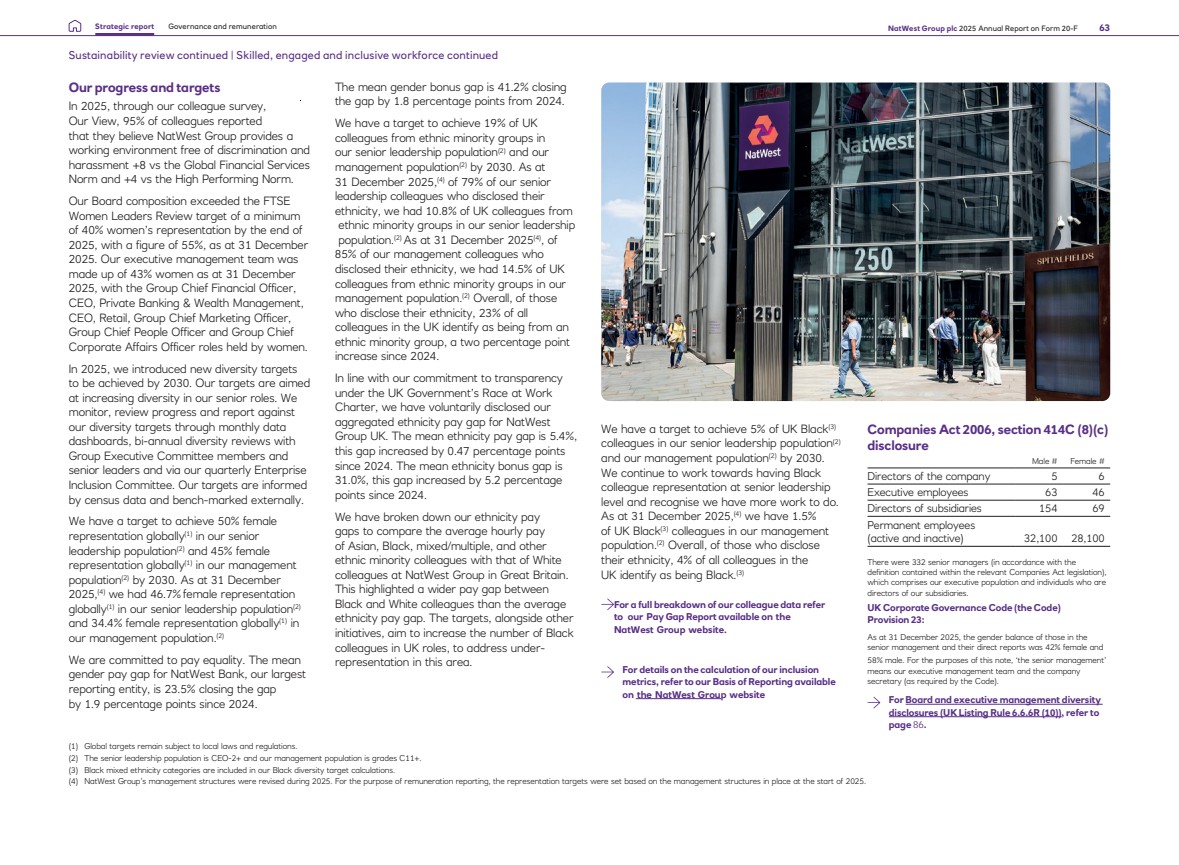
| Driving a culture of integrity and responsible risk management Sustainability review continued Refreshing our Code Our Code guides how we act ethically, responsibly and with integrity to deliver positive outcomes for our customers, communities and shareholders. In 2025, we refreshed Our Code to better reflect our evolved ambitions, our customers’ challenges and the macroeconomic trends that are shaping how we work. We used this opportunity to bring a number of policies under Our Code, giving colleagues a clear standard to maintain as we work together towards the same goals. It is hosted online, giving our colleagues one convenient place to find the information they need. We also publish Our Code externally to be transparent and open with all our stakeholders about the approach at NatWest Group. Monitoring compliance with Our Code We have several systems in place to monitor compliance with Our Code and other policies. Employee performance and remuneration are linked to conduct, behaviour and risk management, with these included in the accountability review process and reflected in pay outcomes where required. Each year, all colleagues undertake mandatory training on Our Code and conduct policies. Breaches can lead to disciplinary actions, including dismissal and notification to authorities in some instances. Read more on how the key tools guide the way we work together in Our Code disclosure. Protecting whistleblowers Everyone at NatWest Group plays a role in reinforcing Our Code. We want our colleagues and any individuals we interact with to feel confident to raise concerns about wrongdoing or misconduct without fear of retaliation. Speak Up is our formal whistleblowing framework, which gives individuals a secure reporting system to share concerns in confidence, and anonymously if preferred. It is operated by an independent third party and available to all employees and those acting on behalf of or representing NatWest Group such as contractors, subcontractors, suppliers, temporary staff, secondees, consultants, interns and volunteers. This also includes anyone formerly in these roles. In 2025, 419 reports were made through Speak Up compared with 434 in 2024. Of 504 reports closed/investigated in 2025, 39% of all allegations related to behaviour not consistent with Our Code, including discrimination and harassment. We do not tolerate any form of harassment or discrimination and where reports were substantiated, appropriate action was taken to rectify the situation, following a discussion with the People function and the respective business unit. In 2025, 97% of those completing our colleague engagement survey, Our View, agreed that they know how to raise concerns about wrongdoing in their business. 88% of colleagues also agreed it was safe to speak up in their business area, and believe that concerns will be handled appropriately. Managing risks and behaviours driven by ethics and integrity are vital to protecting the trust and confidence of our customers, colleagues and wider stakeholders. These responsibilities are shared by everyone at NatWest Group. Our policies underpin our decisions and set expectations for acting with integrity, sound judgement and accountability. We are proactive in monitoring our risks, reviewing our policies and educating our employees to maintain a strong approach to managing risk. 97% of those who completed the Our View engagement survey in 2025 agreed that they know how to raise concerns about wrongdoing in their business units. Strategic report Strategic report Governance and remuneration Financial review Governance and remuneration Risk and capital management Financial statements Additional information NatWest Group plc NatWest Group plc 2025 Annual Report and Accounts 2025 Annual Report on Form 20-F 6464 Details of our approach to preventing and managing conflicts of interest and our obligations to competing fairly can be found in Our Code on the NatWest Group website Read more on our Whistleblowing pages on the NatWest Group website |
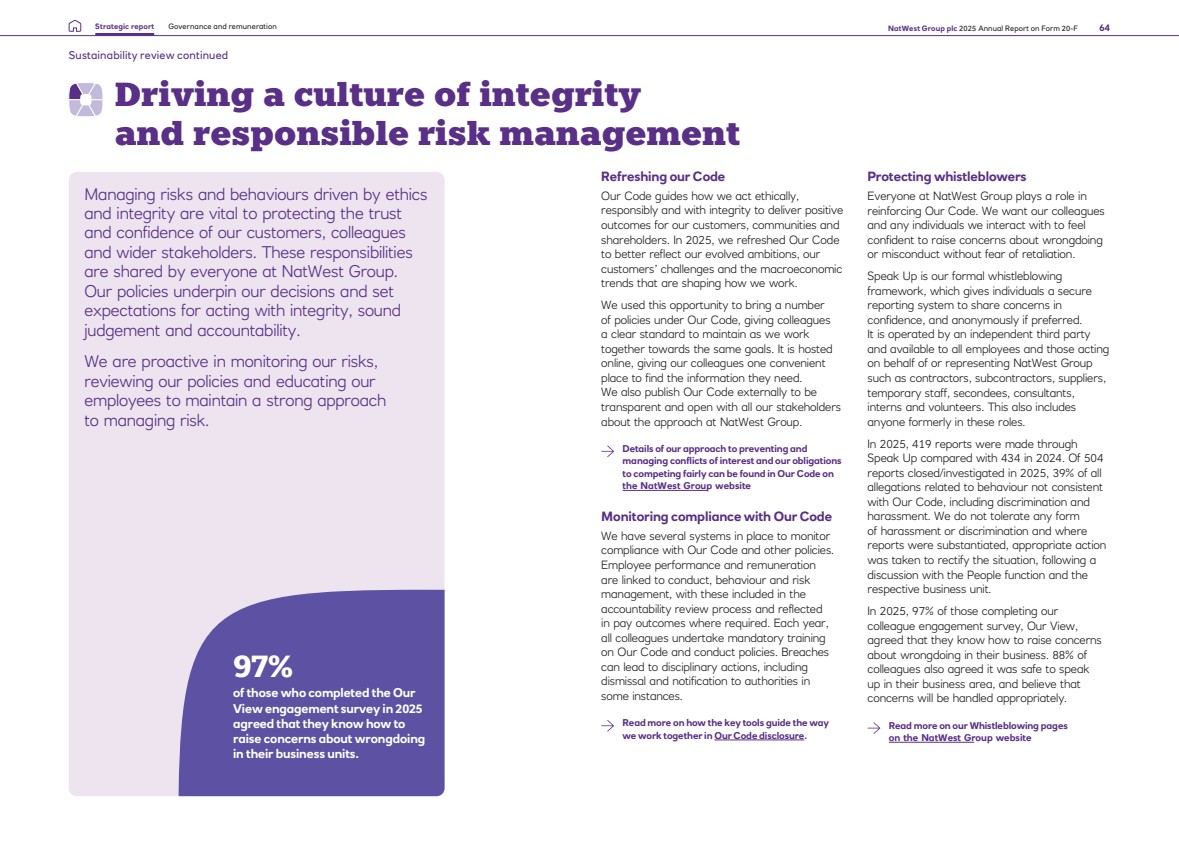
| Driving a culture of integrity and responsible risk management Sustainability review continued Refreshing our Code Our Code guides how we act ethically, responsibly and with integrity to deliver positive outcomes for our customers, communities and shareholders. In 2025, we refreshed Our Code to better reflect our evolved ambitions, our customers’ challenges and the macroeconomic trends that are shaping how we work. We used this opportunity to bring a number of policies under Our Code, giving colleagues a clear standard to maintain as we work together towards the same goals. It is hosted online, giving our colleagues one convenient place to find the information they need. We also publish Our Code externally to be transparent and open with all our stakeholders about the approach at NatWest Group. Details of our approach to preventing and managing conflicts of interest and our obligations to competing fairly can be found in Our Code at natwestgroup.com. Monitoring compliance with Our Code We have several systems in place to monitor compliance with Our Code and other policies. Employee performance and remuneration are linked to conduct, behaviour and risk management, with these included in the accountability review process and reflected in pay outcomes where required. Each year, all colleagues undertake mandatory training on Our Code and conduct policies. Breaches can lead to disciplinary actions, including dismissal and notification to authorities in some instances. Read more on how the key tools guide the way we work together in Our Code disclosure. Protecting whistleblowers Everyone at NatWest Group plays a role in reinforcing Our Code. We want our colleagues and any individuals we interact with to feel confident to raise concerns about wrongdoing or misconduct without fear of retaliation. Speak Up is our formal whistleblowing framework, which gives individuals a secure reporting system to share concerns in confidence, and anonymously if preferred. It is operated by an independent third party and available to all employees and those acting on behalf of or representing NatWest Group such as contractors, subcontractors, suppliers, temporary staff, secondees, consultants, interns and volunteers. This also includes anyone formerly in these roles. In 2025, 419 reports were made through Speak Up compared with 434 in 2024. Of 504 reports closed/investigated in 2025, 39% of all allegations related to behaviour not consistent with Our Code, including discrimination and harassment. We do not tolerate any form of harassment or discrimination and where reports were substantiated, appropriate action was taken to rectify the situation, following a discussion with the People function and the respective business unit. In 2025, 97% of those completing our colleague engagement survey, Our View, agreed that they know how to raise concerns about wrongdoing in their business. 88% of colleagues also agreed it was safe to speak up in their business area, and believe that concerns will be handled appropriately. Read more on our Whistleblowing pages at natwestgroup.com. Managing risks and behaviours driven by ethics and integrity are vital to protecting the trust and confidence of our customers, colleagues and wider stakeholders. These responsibilities are shared by everyone at NatWest Group. Our policies underpin our decisions and set expectations for acting with integrity, sound judgement and accountability. We are proactive in monitoring our risks, reviewing our policies and educating our employees to maintain a strong approach to managing risk. 97% of those who completed the Our View engagement survey in 2025 agreed that they know how to raise concerns about wrongdoing in their business units. Strategic report Financial review Governance and remuneration Risk and capital management Financial statements Additional information NatWest Group plc 2025 Annual Report and Accounts 64 (1) Numbers represent the number of reports to Speak Up which qualified as whistleblowing concerns in line with the NatWest Group Speak Up policy. (2) Read more on the CCLA Modern Slavery Benchmark and its outcomes at ccla.co.uk. (3) The two webinars on modern slavery concerns in the UK care sector were attended by 55 colleagues and 48 colleagues and healthcare clients respectively. (4) 96 colleagues attended our training from the Supply Chain Sustainability School. Reports via Speak Up(1) 2023 2024 2025 419 434 419 Sustainability review continued | Driving a culture of integrity and responsible risk management continued Additional policies and guidelines to manage risks In line with good business practice, we have clear policies relating to conflicts of interest, political neutrality, respecting human rights and managing environmental and social risks. Conflicts of interest The NatWest Group Conflicts of Interest Policy sets out how we identify, prevent or manage actual and potential conflicts of interest that may arise. It applies to all employees, contractors and agency staff and covers all business segments, functions and legal entities within NatWest Group. We take appropriate steps to identify, prevent and manage conflicts of interest, including those arising between different parts of NatWest Group, between NatWest Group and its customers, or between customers themselves. Managing conflicts effectively requires a range of measures tailored to the nature of the conflict, where it arises and the parties involved. These measures include: • establishing information barriers, • separate supervision of employees involved in potentially conflicting business activities, • a remuneration policy designed to avoid conflicts, and • maintaining a conflicts register. In some cases, it may involve maintaining a register of activities with regular review and reporting, declining personal dealing requests or outside business interests where an actual or perceived conflict exists. Internal guidance and training underpin these practices. Advocacy and political involvement NatWest Group does not make political donations or have affiliation to any political party. As a result, we made no political donations in 2025. However, we do engage with political parties and participate in government consultations and discussions to share our industry perspective. Our relationship with governments (UK and devolved) is focused on protecting the operation of our business and the interests of our customers and shareholders. Our employee conduct policy ensures that any colleague involvement in politics is kept entirely separate from their bank role. Respect for human rights In June 2025, we published our first standalone Human Rights Report, which brought together our Human Rights Position Statement and Salient Human Rights Issues disclosure. It explained both our approach to upholding and respecting human rights, and our management of our identified salient human rights issues. We used the UN Guiding Principles Reporting Framework to assess our current approach and identify areas where we have more to do. Our internal Human Rights Action Group met bi-monthly to drive progress on our bank-wide approach and we further embedded our human rights risk acceptance criteria across our commercial banking relationships. We continue to monitor legislative changes, and in 2025, we mapped our risk standards to the updated UK Home Office Transparency in Supply Chain statutory guidance. There were also notable trends and patterns in customer and stakeholder concerns relating to the salient issue of conflict and security. In response, our Human Rights Action Group coordinated risk-based due diligence, including additional monitoring and engagement with our commercial customers, suppliers and investment portfolios, drawing on our human rights risk acceptance criteria. Our ninth Modern Slavery and Human Trafficking Statement was published in June 2025 and retained Tier 2 status in the CCLA(2) 2025 Modern Slavery Benchmark. In September, we won gold for Business Impact at the 2025 Unseen Business Awards for our approach to tackling modern slavery. Spotlight Raising awareness of human rights and modern slavery Recognising the heightened risks of human rights and modern slavery in our own supply chain and in some parts of our commercial banking business, we ran a series of training programmes and discussions to explore important topics among our colleagues and clients, including: • A webinar on modern slavery concerns in the UK care sector for healthcare Relationship Managers, followed by a joint session with colleagues and healthcare clients to discuss these risks together.(3) • Modern slavery training for our Supply Chain and Third-Party Risk Management colleagues from Action Sustainability, through the Supply Chain Sustainability School, to understand and address the risks and challenges in their roles.(4) • A week-long campaign of live webinars in recognition of Anti-Slavery Day. Key topics included modern slavery risks in the agricultural sector and detection of financial crime associated with child sexual abuse. Almost 2,000 colleagues took part in our Anti-Slavery Day Awareness Week. Strategic report Strategic report Governance and remuneration Financial review Governance and remuneration Risk and capital management Financial statements Additional information NatWest Group plc NatWest Group plc 2025 Annual Report and Accounts 2025 Annual Report on Form 20-F 6565 Read our Human Rights Report on the NatWest Group website. |
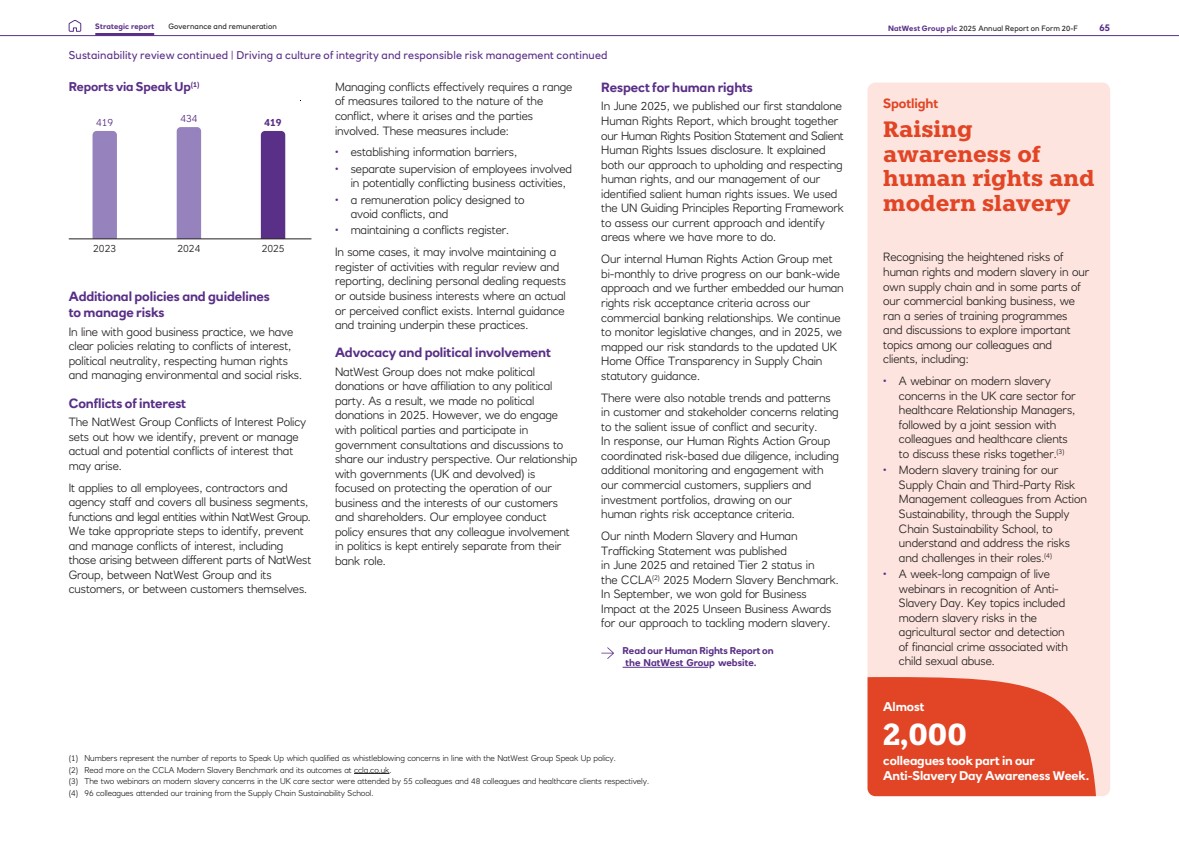
| Sustainability review continued | Driving a culture of integrity and responsible risk management continued £2,630 million of tax was paid by NatWest Group in the UK during 2025 Corporate income tax 1,567 1,792 147 Irrecoverable VAT/sales tax 516 544 818 Bank Levy 125 127 Employer payroll taxes 362 412 Business rates/other taxes 60 66 £2,941 million of tax was paid by NatWest Group globally during 2025 Corporate income tax Irrecoverable VAT/sales tax Bank levy Employer payroll taxes Business rates/other taxes £965 million of tax was collected by NatWest Group in the UK during 2025 Net VAT and other taxes collected Employee income tax and NIC Environmental and social risks The activities of our customers often have environmental and social impacts, including polluting activities and the potential for human rights violations. From 1 January 2026, we updated the name of our Environmental, Social and Ethical (ESE) Risk Framework to the Environmental and Social (E&S) Risk Framework.(1) The E&S Risk Framework applies to all legal entities in NatWest Group for the onboarding of non-personal customers for the purpose of providing financing and applies to the management of E&S risk throughout these customers’ life-cycles. It is comprised of E&S Risk Acceptance Criteria (RAC) for seven sectors which present heightened E&S risk and a RAC for human rights.(2) Customers whose activities fall within a sector RAC, or any other customer where associated E&S risk concerns have been identified, are subject to enhanced due diligence. Customers whose activities fall within a sector RAC, or any other customer where associated E&S risk concerns have been identified, are subject to enhanced due diligence. From 13 February 2026 the scope of the E&S Risk Framework was expanded from lending and loan underwriting to cover a broader definition of financing by including bond underwriting. Meeting our tax responsibilities At NatWest Group, we aim to pay the right amount of tax, both in the UK and other jurisdictions where we operate, following the spirit as well as the letter of the law. During 2025, we paid a total of £2.63 billion of tax in the UK, compared to £2.46 billion in 2024. We were ranked as one of the highest taxpayers in terms of UK taxes paid in the PwC 2025 Total Tax Contribution survey of The 100 Group, which referenced our tax payments in 2024. The 100 Group represents members of the FTSE 100 along with several large private companies in the UK. In addition to the taxes we pay, we also collect and administer taxes and social security contributions on behalf of governments. During 2025 we collected a total of £0.97 billion, compared to £0.89 billion in 2024, of tax on behalf of the UK Government, primarily in relation to employee income tax and National Insurance contributions (NIC). The charts opposite show the different taxes we paid globally and in the UK, as well as the taxes we collected in the UK in 2025. (1) This change better reflects the framework’s underlying methodology which focuses on a risk-based approach aligned to our organisational risk appetite, rather than values-based judgements. (2) As at the date of this publication, there are Risk Acceptance Criteria in place for the following sectors – Adult Entertainment, Animal Welfare, Defence & Private Security, Forestry, Fisheries & Agribusiness, Gambling, Mining & Metals, Energy Supply Sector, and Human Rights, which continue to be subject to change. In 2025, we carried out enhanced due diligence in relation to 292 customers compared to 330 in 2024. We performed enhanced due diligence in relation to 67 trade-related transactions involving defence equipment, compared to 71 in 2024. £2,630m £2,941m £965m Strategic report Strategic report Governance and remuneration Financial review Governance and remuneration Risk and capital management Financial statements Additional information NatWest Group plc NatWest Group plc 2025 Annual Report and Accounts 2025 Annual Report on Form 20-F 6666 Read more about the taxes we paid in the UK and globally during 2025 on our tax webpage on the NatWest Group website Form 20-F for more information on our approach to reputational risk. Read more about our E&S RAC on the NatWest Group website Refer to page 145 of the Annual Report on |
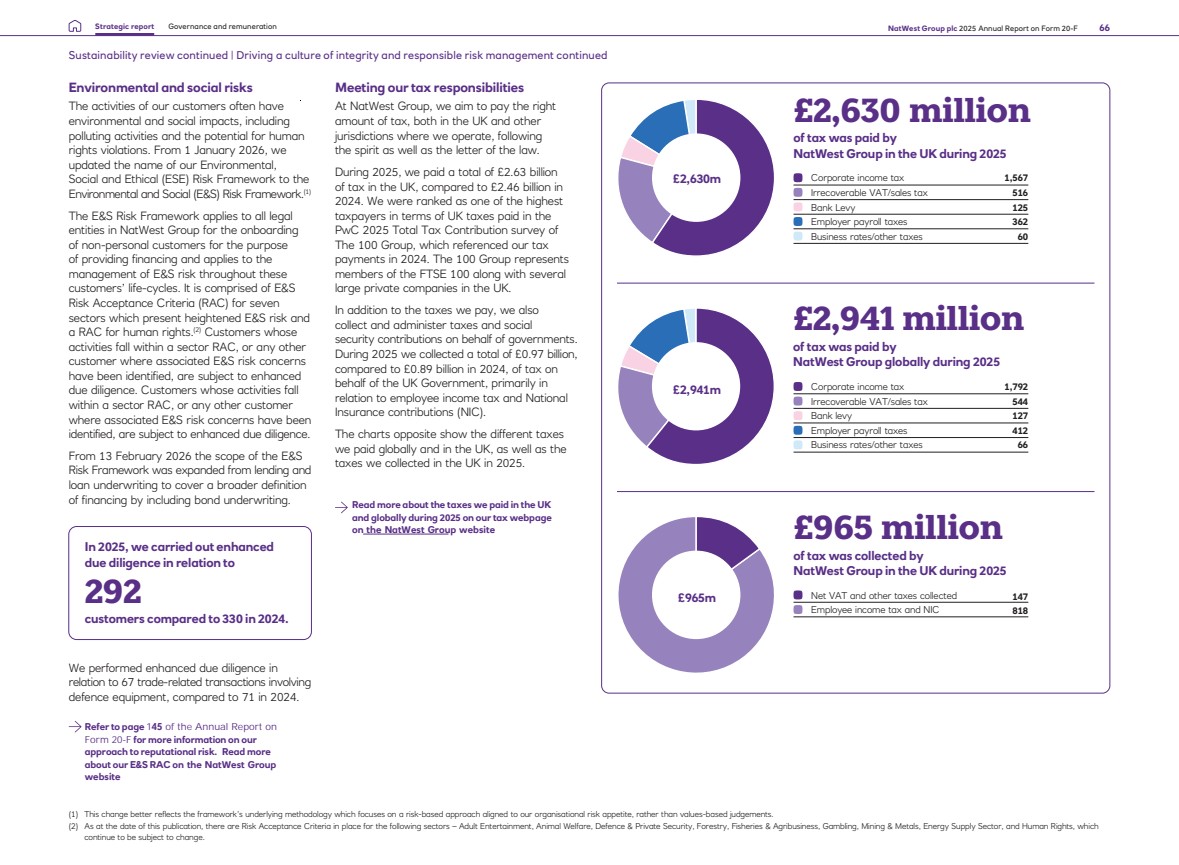
| Sustainability review continued | Driving a culture of integrity and responsible risk management continued £2,630 million of tax was paid by NatWest Group in the UK during 2025 Corporate income tax 1,567 1,792 147 Irrecoverable VAT/sales tax 516 544 818 Bank Levy 125 127 Employer payroll taxes 362 412 Business rates/other taxes 60 66 £2,941 million of tax was paid by NatWest Group globally during 2025 Corporate income tax Irrecoverable VAT/sales tax Bank levy Employer payroll taxes Business rates/other taxes £965 million of tax was collected by NatWest Group in the UK during 2025 Net VAT and other taxes collected Employee income tax and NIC Environmental and social risks The activities of our customers often have environmental and social impacts, including polluting activities and the potential for human rights violations. From 1 January 2026, we updated the name of our Environmental, Social and Ethical (ESE) Risk Framework to the Environmental and Social (E&S) Risk Framework.(1) The E&S Risk Framework applies to all legal entities in NatWest Group for the onboarding of non-personal customers for the purpose of providing financing and applies to the management of E&S risk throughout these customers’ life-cycles. It is comprised of E&S Risk Acceptance Criteria (RAC) for seven sectors which present heightened E&S risk and a RAC for human rights.(2) Customers whose activities fall within a sector RAC, or any other customer where associated E&S risk concerns have been identified, are subject to enhanced due diligence. Customers whose activities fall within a sector RAC, or any other customer where associated E&S risk concerns have been identified, are subject to enhanced due diligence. From 13 February 2026 the scope of the E&S Risk Framework was expanded from lending and loan underwriting to cover a broader definition of financing by including bond underwriting. Meeting our tax responsibilities At NatWest Group, we aim to pay the right amount of tax, both in the UK and other jurisdictions where we operate, following the spirit as well as the letter of the law. During 2025, we paid a total of £2.63 billion of tax in the UK, compared to £2.46 billion in 2024. We were ranked as one of the highest taxpayers in terms of UK taxes paid in the PwC 2025 Total Tax Contribution survey of The 100 Group, which referenced our tax payments in 2024. The 100 Group represents members of the FTSE 100 along with several large private companies in the UK. In addition to the taxes we pay, we also collect and administer taxes and social security contributions on behalf of governments. During 2025 we collected a total of £0.97 billion, compared to £0.89 billion in 2024, of tax on behalf of the UK Government, primarily in relation to employee income tax and National Insurance contributions (NIC). The charts opposite show the different taxes we paid globally and in the UK, as well as the taxes we collected in the UK in 2025. Read more about our approach to tax and management of tax risk in Our Tax Strategy and 2024 Tax Transparency Report. Read more about the taxes we paid in the UK and globally during 2025 on our tax webpage at natwestgroup.com. (1) This change better reflects the framework’s underlying methodology which focuses on a risk-based approach aligned to our organisational risk appetite, rather than values-based judgements. (2) As at the date of this publication, there are Risk Acceptance Criteria in place for the following sectors – Adult Entertainment, Animal Welfare, Defence & Private Security, Forestry, Fisheries & Agribusiness, Gambling, Mining & Metals, Energy Supply Sector, and Human Rights, which continue to be subject to change. In 2025, we carried out enhanced due diligence in relation to 292 customers compared to 330 in 2024. We performed enhanced due diligence in relation to 67 trade-related transactions involving defence equipment, compared to 71 in 2024. Refer to page 275 for more information on our approach to reputational risk. Read more about our E&S RAC at natwestgroup.com. Refer to page 28 of the NatWest Group plc 2025 Climate Transition Plan Report for further information on our E&S Risk Acceptance Criteria. £2,630m £2,941m £965m Strategic report Financial review Governance and remuneration Risk and capital management Financial statements Additional information NatWest Group plc 2025 Annual Report and Accounts 66 Additional sustainability information Our approach to assessment of key sustainability topics To ensure our sustainability efforts deliver meaningful value to our stakeholders, we use a methodical assessment process to identify and assess themes of importance to our business and interests of our stakeholders. This disciplined approach enables us to focus on the topics that are important to our shared success and on creating sustainable value. Our assessment approach In determining the sustainability information to be included in this report, NatWest Group has complied with the mandatory requirements of sections 414CA and 414CB of the Companies Act 2006. In addition, we identified and prioritised the key sustainability topics included in this report through stakeholder engagement and considerations relating to our own strategy and core business activities. We engaged with stakeholders through interviews, consultation workshops, meetings and surveys, along with drawing on insights from peer reviews, trends and industry practice. These perspectives were considered as part of an internal review of the identified topics from a business and strategic lens, including consideration of their relevance to NatWest Group’s activities and strategic direction, and the potential interactions between NatWest Group’s activities and its stakeholders, including investors, customers, colleagues, communities and suppliers. NatWest Group has also monitored developments in relation to the UN Principles of Responsible Banking, the Global Reporting Initiative (GRI) and the Sustainability Accounting Standards Board (SASB) standards. We used these frameworks for reference purposes only in identifying key sustainability topics. We have not yet sought to fully align with these frameworks and they should not be interpreted as fully applied or adopted by NatWest Group. By identifying the key sustainability topics, NatWest Group seeks to better prioritise matters most relevant to its stakeholders, embed sustainability considerations into decision making, manage emerging risks and capture opportunities. Applied across NatWest Group’s value chain, this understanding is intended to help manage potential negative sustainability-related impacts, enhance potential contributions and align NatWest Group’s actions with stakeholder expectations. The assessment processes described above have not been conducted in accordance with the financial reporting requirements of the International Financial Reporting Standards, nor are they aligned with the sustainability-related disclosure standards expected to be introduced in the future. As such, the assessment process and any topics identified through them should be interpreted with appropriate caution. Scope, challenges and limitations The topics presented on page 40 represent key sustainability topics for NatWest Group and may differ across our legal entities and geographical footprint. Progress against individual topics can be varied. The topics are not necessarily indicative of, and may be different to, the topics we may disclose in future. Our list of key sustainability topics and stakeholders engaged may continue to evolve as subsequent key topics assessments are completed and as our, and the industry’s understanding of the sustainability-related impacts, risks and opportunities (IROs) continues to develop. Like many of our peer companies we continue to face challenges on data availability, comparability, and uncertainty on the extent of other industry standards and evolving market practice to inform the ongoing development of our approach. We continue to evolve our approach to assessing key sustainability topics, building on existing processes to develop a structured and consistent approach that informs our thinking and supports readiness for legal and regulatory requirements. In 2024, we piloted an initial approach with the objective of refining our understanding of sustainability topics and developing an assessment framework and underlying criteria, alongside an initial list of key topics. As part of this pilot, we mapped our stakeholders across our current view of our value chain to identify potential sustainability-related IROs which might arise, engaged internal teams to assess them, and validated findings through additional stakeholder input. The outcomes of this pilot provided a foundation for the further development of our approach and support future reporting and disclosure requirements as expectations continue to evolve. In 2025, we continued to build on the pilot by further developing the assessment framework for key sustainability topics, and identifying potential data sources to support future analysis, our thinking and topic assessment. These activities remain in exploration and in the development phase. They provide early insight into potential sustainability-related IROs and inform our longer term thinking. However, they did not determine the key sustainability topics for our 2025 reporting suite (as defined in this report) and previous reports which have not reflected the outcomes of this work. As our understanding of sustainability-related IROs continues to mature, across both NatWest Group and the wider industry, our approach to the assessment of key sustainability topics may evolve accordingly. Sustainability review continued sustainability-related impacts, as well as associated financial risks and opportunities. We also continue to actively consider new insights and data which may influence or enhance our view on key sustainability topics. We will continue to review industry developments and evolve our approach to the assessment of key sustainability topics with regards to new insights, data and developing regulatory requirements and frameworks. As a result, we expect that certain disclosures made in this report may be amended, updated, recalculated and/or restated in the future as the quality and completeness of our data and methodologies continue to improve. Preparing for incoming sustainability reporting standards NatWest Group continues to monitor legal and regulatory reporting and disclosure requirements (such as the recent Financial Conduct Authority consultation on Aligning listed issuers’ sustainability disclosures with international standards and the EU Corporate Sustainability Reporting Directive) with the aim to ensure that its disclosures are transparent, robust, and aligned with applicable legal and regulatory requirements and market expectations. In addition, we continue to monitor reporting standards, such as the UK Sustainability Reporting Standards and European Sustainability Reporting Standards, Strategic report Strategic report Governance and remuneration Financial review Governance and remuneration Risk and capital management Financial statements Additional information NatWest Group plc NatWest Group plc 2025 Annual Report and Accounts 2025 Annual Report on Form 20-F 6767 Readers of the sustainability content of this report should take into consideration this section together with the Climate and of the Annual Report on Form 20-F, alongside with Additional cautionary statement regarding climate and sustainability-related data, metrics and forward-looking statements and Cautionary statements in relation to the climate and sustainability-related disclosures on pages 2 to 4 of the Annual Report on Form 20-F. sustainability-related risks on pages 287 to 289 |
| Operational emissions NatWest Group’s operational emissions methodology accounts for greenhouse gas emissions across Scopes 1, 2 and 3. The reporting boundary includes all entities and facilities under our operational control. Emissions reporting adheres to the Greenhouse Gas Protocol Corporate Standard, utilising both actual and estimated data to fill gaps. As shown on page 55, Scope 1 includes direct emissions from fossil fuels and vehicles, while Scope 2 includes emissions from electricity. Scope 3 includes indirect emissions such as supply chain, business travel, commuting, omitting leased assets, processing of sold goods, franchises and investments from its operational value chain as these are reported elsewhere in the Group’s carbon footprint or they are not considered relevant. For indirect emissions, we use a combination of supplier-specific, product and service-specific, and industry average data to estimate supply chain emissions. Our emissions estimation methodology is regularly updated to enhance accuracy and reporting integrity, with a recalculation policy in place to adjust figures exceeding a 5% change threshold. Financed emissions Financed emissions: lending and investments Financed emissions and emissions intensities are currently estimated on an annual basis for the total in-scope balance sheet. We publish our absolute emissions and emissions intensities one year in arrears of our financial reporting date to allow time for appropriate data sourcing, measurement and review. A common theme for emissions estimation across all sectors is data limitations, including lack of published emissions data and granularity of customer information. As a result, our estimates on page 54 are premised on use of the assumptions, extrapolations or aggregation at subsector levels. We expect our estimates of emissions to change as we improve the granularity and coverage of customer and asset climate data and develop our methodologies further. Specific limitations include: • availability, accuracy and comparability of customer data and other public data sources • susceptibility to variation year on year • lack of industry comparability • complex corporate structures • double counting of Scope 3 • Scope 3 definition differences. Financed emissions: assets under management Scope 1 and 2 estimated emissions from underlying investments and WACI covered 84% of Managed Assets and Bespoke AUM as at 31 July 2025. This included listed equity, corporate fixed income and government bond asses classes, equating to £30.2 billion. Coverage increased from £17.1 billion in 2024 (55% of Managed and Bespoke AUM), driven by the availability of data for funds launched in 2024. Advisory assets continue to be excluded as investment decisions sit with our customers. Cash is also out of scope due to the lack of a defined methodology for this asset class. Scope 3 emissions from underlying funds are excluded owing to uncertainty in the accuracy of available data. We continue to review our approach and anticipate changes in data coverage as our business operations change and new regulatory requirements take effect in our investment jurisdictions. Facilitated emissions from bond underwriting and syndicated lending NatWest Group estimates its facilitated emissions based on annual transaction volume. This reflects the transactional nature of capital markets activities and the period in which banks generate revenue from them. In line with the Standard, we allocated transactions based on actual volume facilitated where available. For remaining positions volume was apportioned equally among bookrunners/arrangers. Where available, we use customer-level emissions data to estimate greenhouse gas emissions. If customer-level data was unavailable, emissions estimates (PCAF 4) or emission sector averages (PCAF 5) were used for emission intensities from 2024 and applied against 2025 volumes. Sustainability review | Additional sustainability information continued NatWest Group climate and transition finance framework. Strategic report Strategic report Governance and remuneration Financial review Governance and remuneration Risk and capital management Financial statements Additional information NatWest Group plc NatWest Group plc 2025 Annual Report and Accounts 2025 Annual Report on Form 20-F 6868 Emissions and emissions estimates, methodologies and limitations We followed the PCAF Part B Global Greenhouse Gas Accounting and Reporting Standard for Facilitated Emissions to define an issuer as an organisation that issues debt or equity capital markets instruments.(1) We also included green bond, green loan syndication(2,3) and the role of co-manager(4) in the estimation of facilitated emissions. (1) NatWest Group’s own bond issuances are not included within estimates of facilitated emissions. (2) Green bonds and loans are excluded from PCAF’s facilitated emissions standard. While these instruments are expected to have lower emissions intensity, there is currently no agreed method to quantify their emissions and NatWest Group does not distinguish these from conventional transactions or apply lower emissions. NatWest Group treats sustainability-linked and sustainable bond and loan activities as conventional for the purpose of estimating and reporting on facilitated emissions. (3) NatWest Group 2024 climate and sustainable funding and financing inclusion criteria was used to determine the assets, activities and companies eligible for inclusion up to 30 June 2025. From 1 July 2025, the NatWest Group climate and transition finance framework was used. (4) Co-managers are not captured by the PCAF Standard. We include transactions where we act as a co-manager in alignment with the GHG accounting ‘follow the money approach’ and with NatWest Group’s climate and sustainable funding and financing inclusion criteria and the |
| Operational emissions NatWest Group’s operational emissions methodology accounts for greenhouse gas emissions across Scopes 1, 2 and 3. The reporting boundary includes all entities and facilities under our operational control. Emissions reporting adheres to the Greenhouse Gas Protocol Corporate Standard, utilising both actual and estimated data to fill gaps. As shown on page 55, Scope 1 includes direct emissions from fossil fuels and vehicles, while Scope 2 includes emissions from electricity. Scope 3 includes indirect emissions such as supply chain, business travel, commuting, omitting leased assets, processing of sold goods, franchises and investments from its operational value chain as these are reported elsewhere in the Group’s carbon footprint or they are not considered relevant. For indirect emissions, we use a combination of supplier-specific, product and service-specific, and industry average data to estimate supply chain emissions. Our emissions estimation methodology is regularly updated to enhance accuracy and reporting integrity, with a recalculation policy in place to adjust figures exceeding a 5% change threshold. Refer to pages 13 to 16 of the NatWest Group plc 2025 Climate Transition Plan Report and pages 3 to 5 of the NatWest Group 2025 Sustainability Basis of Reporting for further details of our own operational emissions. Financed emissions Financed emissions: lending and investments Financed emissions and emissions intensities are currently estimated on an annual basis for the total in-scope balance sheet. We publish our absolute emissions and emissions intensities one year in arrears of our financial reporting date to allow time for appropriate data sourcing, measurement and review. A common theme for emissions estimation across all sectors is data limitations, including lack of published emissions data and granularity of customer information. As a result, our estimates on page 54 are premised on use of the assumptions, extrapolations or aggregation at subsector levels. We expect our estimates of emissions to change as we improve the granularity and coverage of customer and asset climate data and develop our methodologies further. Refer to page 41 of the NatWest Group plc 2025 Climate Transition Plan Report for a summary of our PCAF data quality scores by sector. Specific limitations include: • availability, accuracy and comparability of customer data and other public data sources • susceptibility to variation year on year • lack of industry comparability • complex corporate structures • double counting of Scope 3 • Scope 3 definition differences. Refer to pages 39 to 42 of the NatWest Group plc 2025 Climate Transition Plan Report and pages 16 to 32 of the NatWest Group 2025 Sustainability Basis of Reporting for further details of our estimates of financed emissions. Financed emissions: assets under management Scope 1 and 2 estimated emissions from underlying investments and WACI covered 84% of Managed Assets and Bespoke AUM as at 31 July 2025. This included listed equity, corporate fixed income and government bond asses classes, equating to £30.2 billion. Coverage increased from £17.1 billion in 2024 (55% of Managed and Bespoke AUM), driven by the availability of data for funds launched in 2024. Advisory assets continue to be excluded as investment decisions sit with our customers. Cash is also out of scope due to the lack of a defined methodology for this asset class. Scope 3 emissions from underlying funds are excluded owing to uncertainty in the accuracy of available data. We continue to review our approach and anticipate changes in data coverage as our business operations change and new regulatory requirements take effect in our investment jurisdictions. Refer to page 67 and pages 70 to 72 of the NatWest Group plc 2025 Climate Transition Plan Report for further details. Facilitated emissions from bond underwriting and syndicated lending NatWest Group estimates its facilitated emissions based on annual transaction volume. This reflects the transactional nature of capital markets activities and the period in which banks generate revenue from them. We followed the PCAF Part B Global Greenhouse Gas Accounting and Reporting Standard for Facilitated Emissions to define an issuer as an organisation that issues debt or equity capital markets instruments.(2) We also included green bond, green loan syndication(3,4) and the role of co-manager(5) in the estimation of facilitated emissions. In line with the Standard, we allocated transactions based on actual volume facilitated where available. For remaining positions volume was apportioned equally among bookrunners/arrangers. Where available, we use customer-level emissions data to estimate greenhouse gas emissions. If customer-level data was unavailable, emissions estimates (PCAF 4) or emission sector averages (PCAF 5) were used for emission intensities from 2024 and applied against 2025 volumes. Refer to pages 43 to 44 NatWest Group plc 2025 Climate Transition Plan Report and pages 53 to 55 of the 2025 NatWest Markets Annual Report and Accounts for further details of estimated facilitated emissions. Emissions and emissions estimates, methodologies and limitations(1) Sustainability review | Additional sustainability information continued (1) Refer to page 45 of the NatWest Group plc 2025 Climate Transition Plan Report for our approach to restatements and re-baselining for our emissions and emissions estimates. (2) NatWest Group’s own bond issuances are not included within estimates of facilitated emissions. (3) Green bonds and loans are excluded from PCAF’s facilitated emissions standard. While these instruments are expected to have lower emissions intensity, there is currently no agreed method to quantify their emissions and NatWest Group does not distinguish these from conventional transactions or apply lower emissions. NatWest Group treats sustainability-linked and sustainable bond and loan activities as conventional for the purpose of estimating and reporting on facilitated emissions. (4) NatWest Group 2024 climate and sustainable funding and financing inclusion criteria was used to determine the assets, activities and companies eligible for inclusion up to 30 June 2025. From 1 July 2025, the NatWest Group climate and transition finance framework was used. (5) Co-managers are not captured by the PCAF Standard. We include transactions where we act as a co-manager in alignment with the GHG accounting ‘follow the money approach’ and with NatWest Group’s climate and sustainable funding and financing inclusion criteria and the NatWest Group climate and transition finance framework. Strategic report Financial review Governance and remuneration Risk and capital management Financial statements Additional information NatWest Group plc 2025 Annual Report and Accounts 68 We have adopted this approach to seek to ensure that we have presented the detailed and technical content in the clearest position for users of these reports. The climate-related disclosures in the 2025 Climate-related Disclosures Reporting Suite do not cover NatWest Group’s Pension Fund (including both Defined Benefit Scheme and Retirement Savings Plan), which are reported on in separate climate-related disclosures published by the trustee of that Fund and regulated by The Pensions Regulator. Task Force on Climate-related Financial Disclosures (TCFD) overview Sustainability review | Additional sustainability information continued Disclosures addressing our regulatory obligation to report greenhouse gas (GHG) emissions pursuant to the Companies (Directors’ Report) and Limited Liability Partnerships (Energy and Carbon Report) Regulations 2018 which implement the government’s policy on Streamlined Energy and Carbon Reporting (SECR) have been included on page 56. NatWest Group confirms that it has: Strategic report Strategic report Governance and remuneration Financial review Governance and remuneration Risk and capital management Financial statements Additional information NatWest Group plc NatWest Group plc 2025 Annual Report and Accounts 2025 Annual Report on Form 20-F 6969 • made climate-related financial disclosures for the year ended 31 December 2025 that it believes are consistent with the Task Force on Climate-related Financial Disclosures (TCFD) Recommendations and Recommended Disclosures (as defined in the FCA’s Listing Rules, as amended by the Disclosure of Climate-Related Financial Information (No 2) Instrument 2021) which include (i) Final Report – Recommendations of TCFD (June 2017) (focusing in particular on the four recommendations and the eleven recommended disclosures set out in Figure 4 of Section C of the TCFD Final Report); (ii) Implementing the Recommendations of TCFD (October 2021 version); (iii) Technical Supplement – the Use of Scenario Analysis in Disclosure of Climate-related Risks and Opportunities (June 2017); (iv) Guidance on Risk Management Integration and Disclosure (October 2020); and (v) TCFD Guidance on Metrics, Targets and Transition Plans (October 2021 version); and • set out its climate-related financial disclosures in part in this report, (published on 13 February 2026 and available on the NatWest Group website) to ensure that the disclosures are included in the most relevant sections in each report, as appropriate. In 2025, climate-related disclosures have been made within the NatWest Group plc 2025 Annual Report on Form 20-F. Refer to the Non-financial and sustainability information statement on page 70 for cross-referencing against the Climate-related financial disclosures required by sections 414CA and 414CB of the Companies Act 2006. |
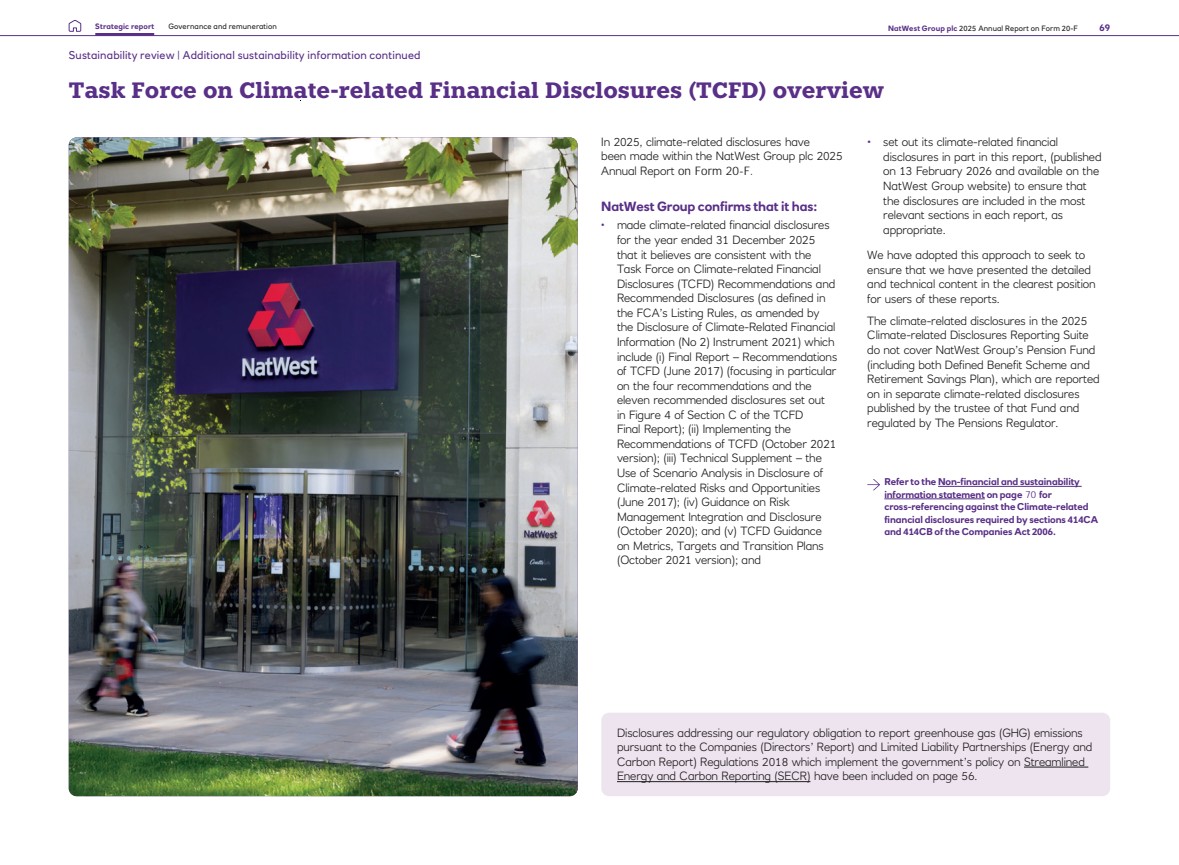
| Governance • Section 172(1) statement • Governance and remuneration • Governance at a glance • Diversity in the boardroom • UK Corporate Governance Code 2024 • Our governance framework • Directors’ remuneration report • Annual remuneration report • Report of the directors • Statement of directors’ responsibilities Social matters • Our business model • Our strategy • Measuring our 2025 performance • Progress against our 2025 strategic priorities • Business performance • Our stakeholders • Supporting customers and communities through our banking products and services • Skilled, engaged and inclusive workforce • Creating an inclusive workforce • Conflicts of interest, Advocacy and political involvement • 12 to 13 • 15 • 18 to 19 • 20 • 25 to 26, 28 to 29, 31 to 32 • 33 to 34 • 41 to 44 • 59 to 63 • 62 to 63 • 65 Anti-bribery and corruption (ABC) • Detecting and preventing financial crime, corruption and bribery • Protecting whistleblowers • Risk overview • Risk management framework • Compliance and conduct risk • Financial crime risk Risk management • Risk overview • Risk and capital management • Risk factors Climate-related financial disclosures as required by sections 414CA and 414CB of the Companies Act 2006 • A description of the company’s governance arrangements in relation to assessing and managing climate-related risks and opportunities. • A description of how the company identifies, assesses, and manages climate-related risks and opportunities. • A description of how processes for identifying, assessing, and managing climate-related risks are integrated into the company’s overall risk management process. • A description of (i) the principal climate-related risks and opportunities arising in connection with the company’s operations, and (ii) the time periods by reference to which those risks and opportunities are assessed. • A description of the actual and potential impacts of the principal climate-related risks and opportunities on the company’s business model and strategy. • An analysis of the resilience of the company’s business model and strategy, taking into account consideration of different climate-related scenarios. • A description of the targets used by the company to manage climate-related risks and to realise climate-related opportunities and of performance against those targets. • The key performance indicators used to assess progress against targets used to manage climate-related risks and realise climate-related opportunities and a description of the calculations on which those key performance indicators are based. • 51 • 51 to 53 • 51 to 53 • 51 to 53 • 51 to 53 • 53 • 49 to 56 • 49 to 55, 68 Sustainability review | Additional sustainability information continued Strategic report Strategic report Governance and remuneration Financial review Governance and remuneration Risk and capital management Financial statements Additional information NatWest Group plc NatWest Group plc 2025 Annual Report and Accounts 2025 Annual Report on Form 20-F 7270 Respect for human rights • Respect for human rights • 65 Reporting requirement Page references in Exhibit 15.2 unless otherise specified • 36 to 37 • 78 to 159 • 85 • 86 • 87 • 88 • 123 to 126 • 134 to 151 • 155 to 158 • 159 • 57 to 58 • 64 to 65 • 72 to 77 • 29 to 40 of the Annual Report on Form 20-F • 72 to 77 • 140 to 141 of the Annual Report on Form 20-F • 141 to 142 of the Annual Report on Form 20-F • 29 to 145 of the Annual Report on Form 20-F • 269 to 289 of the Annual Report on Form 20-F |
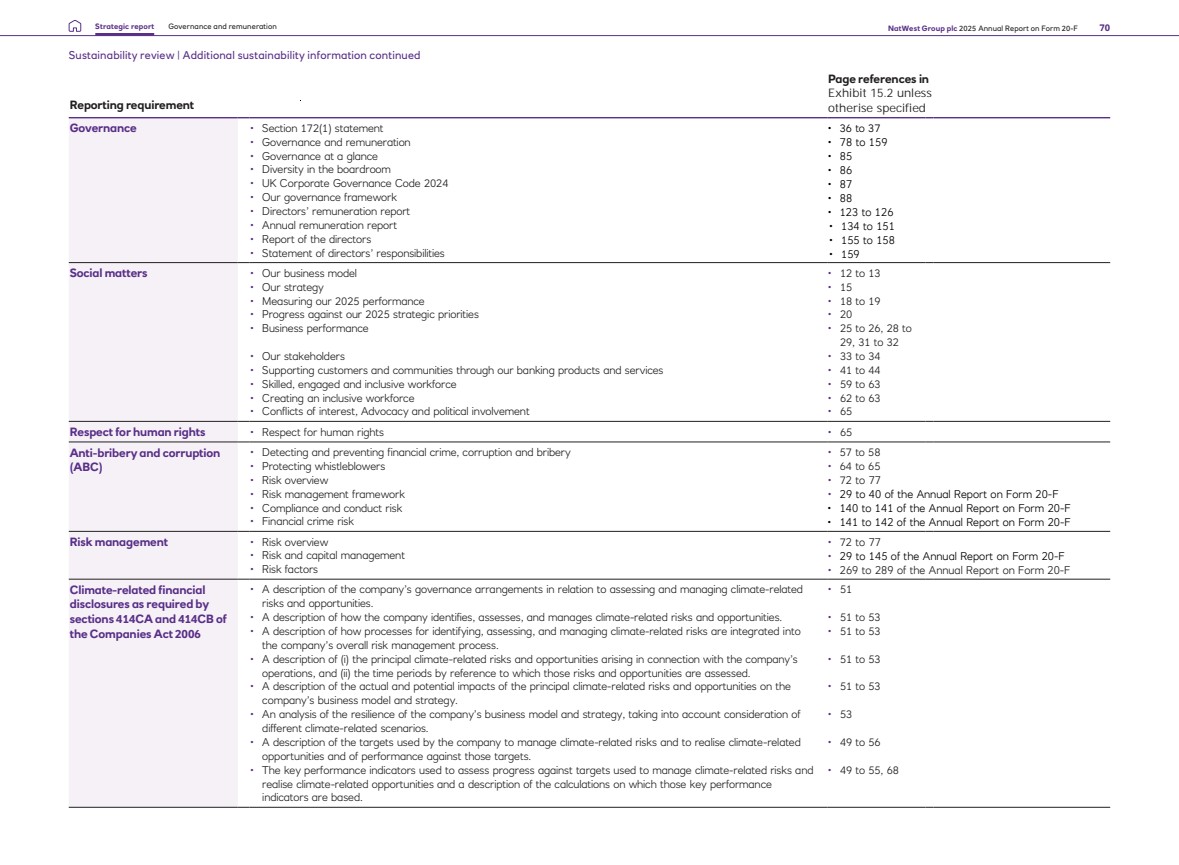
| Reporting requirement Page references in this report Relevant policy or document available at natwestgroup.com Governance • Section 172(1) statement • Governance and remuneration • Governance at a glance • Diversity in the boardroom • UK Corporate Governance Code 2024 • Our governance framework • Directors’ remuneration report • Annual remuneration report • Report of the directors • Statement of directors’ responsibilities • 36 to 37 • 95 to 176 • 102 • 103 • 104 • 105 • 140 to 150 • 151 to 168 • 172 to 175 • 176 Boardroom Inclusion Policy Social matters • Our business model • Our strategy • Measuring our 2025 performance • Progress against our 2025 strategic priorities • Business performance • Our stakeholders • Supporting customers and communities through our banking products and services • Skilled, engaged and inclusive workforce • Creating an inclusive workforce • Conflicts of interest, Advocacy and political involvement • 12 to 13 • 15 • 18 to 19 • 20 • 25 to 26, 28 to 29, 31 to 32 • 33 to 34 • 41 to 44 • 59 to 63 • 62 to 63 • 65 Supplier Code of Best Practice Respect for human rights • Respect for human rights • 65 Human Rights Report Anti-bribery and corruption (ABC) • Detecting and preventing financial crime, corruption and bribery • Protecting whistleblowers • Risk overview • Risk management framework • Compliance and conduct risk • Financial crime risk • 57 to 58 • 64 to 65 • 74 to 79 • 177 to 186 • 272 • 273 Financial crime statement Risk management • Risk overview • Risk and capital management • Risk factors • 74 to 79 • 177 to 275 • 403 to 422 Environmental and Social Risk Acceptance Criteria Climate-related financial disclosures as required by sections 414CA and 414CB of the Companies Act 2006 • A description of the company’s governance arrangements in relation to assessing and managing climate-related risks and opportunities. • A description of how the company identifies, assesses, and manages climate-related risks and opportunities. • A description of how processes for identifying, assessing, and managing climate-related risks are integrated into the company’s overall risk management process. • A description of (i) the principal climate-related risks and opportunities arising in connection with the company’s operations, and (ii) the time periods by reference to which those risks and opportunities are assessed. • A description of the actual and potential impacts of the principal climate-related risks and opportunities on the company’s business model and strategy. • An analysis of the resilience of the company’s business model and strategy, taking into account consideration of different climate-related scenarios. • A description of the targets used by the company to manage climate-related risks and to realise climate-related opportunities and of performance against those targets. • The key performance indicators used to assess progress against targets used to manage climate-related risks and realise climate-related opportunities and a description of the calculations on which those key performance indicators are based. • 51 • 51 to 53 • 51 to 53 • 51 to 53 • 51 to 53 • 53 • 49 to 56 • 49 to 55, 68 NatWest Group plc 2025 Climate Transition Plan Report Sustainability review | Additional sustainability information continued Strategic report Financial review Governance and remuneration Risk and capital management Financial statements Additional information NatWest Group plc 2025 Annual Report and Accounts 72 Succeeding with customers Case study – helping build better businesses When Wall Colmonoy Ltd, a global materials engineering group, began investing in new technologies to grow its manufacturing capabilities, the management team knew they were entering an important phase for the Swansea Valley business. They wanted to move into new markets, manage the currency risks of international trading, and protect around 200 jobs at the company. As the plans took shape, the company worked closely with NatWest Group, who supported day-to-day banking and foreign exchange (FX) hedging, while also helping the business navigate major investment stages. Regular, open communication meant the bank could tailor financial guidance and products to meet the pace and structure of each upgrade. Now, with new processes in place and a clearer route into additional international markets, Wall Colmonoy Ltd is progressing with confidence. Our impact Investment support to strengthen growth strategy. FX hedging and guidance to help manage international currency exposure. Backing to protect around 200 jobs and create new training pathways in the Swansea Valley. Pontardawe Rob Davies (left) and Paul Dunne – NatWest Group Relationship Manager (right) up new export markets Opening ‘Working with NatWest gives us confidence to strive forward in the way that we are. We’ve been offered great customer support and products. In turn, that has allowed us to deliver on strategic objectives to grow our business’ Rob Davies, Managing Director, Wall Colmonoy Ltd. Strategic report Strategic report Governance and remuneration Financial review Governance and remuneration Risk and capital management Financial statements Additional information NatWest Group plc NatWest Group plc 2025 Annual Report and Accounts 2025 Annual Report on Form 20-F 7371 |
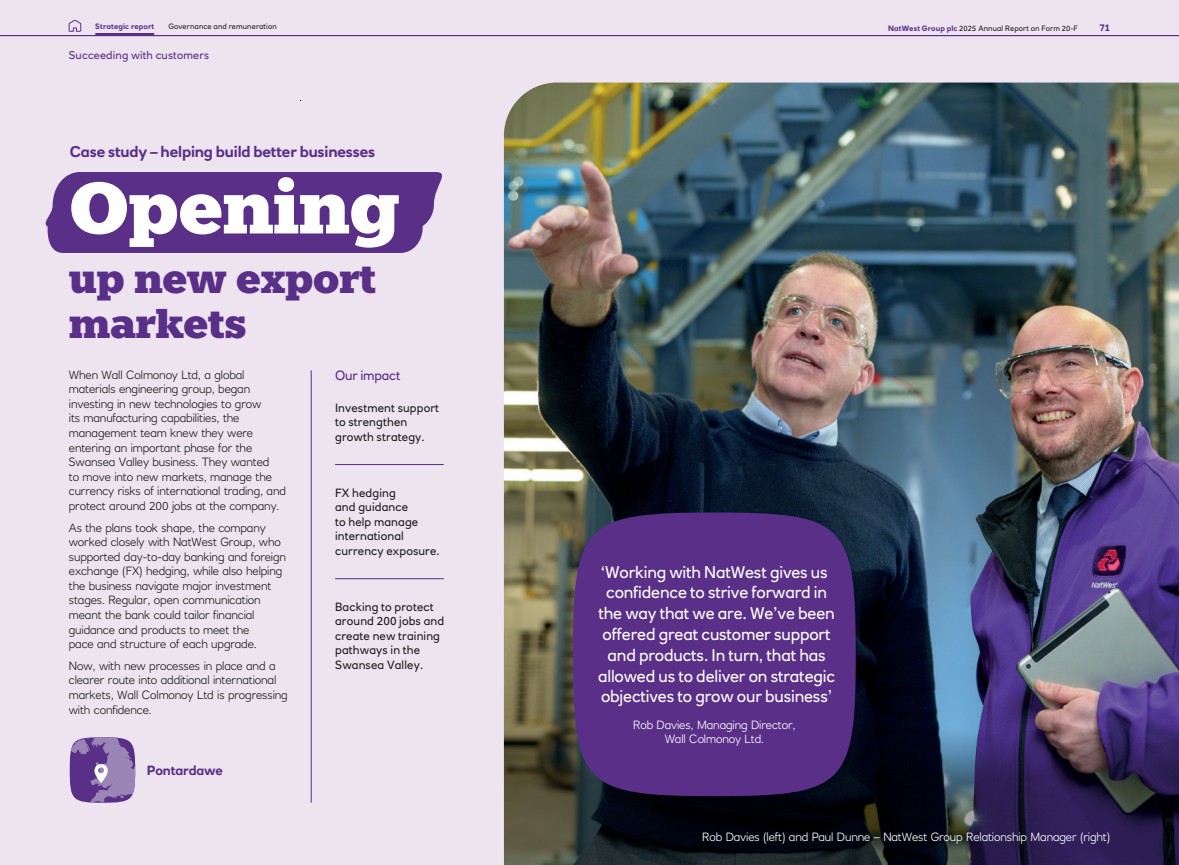
| Risk overview Effective risk management helps to ensure that NatWest Group delivers its long-term strategy. Approach to risk management The enterprise-wide risk management framework (EWRMF) sets out the approach to managing risk across NatWest Group and provides a common risk language to facilitate effective risk management. The framework applies to all subsidiary legal entities, business segments and functions to help deliver NatWest Group’s strategy in a safe and sustainable way. Risk culture Our approach to risk culture, under the banner of intelligent risk-taking, ensures a focus on robust risk management behaviours and practices. This approach, in line with our strategy across all three lines of defence, enables us to support better customer outcomes, develop a stronger and more sustainable business. During 2025, we reviewed and evolved the key outcomes to deliver on the intelligent risk-taking approach. The new outcomes focus on effective decision-making, empowered outcomes and embedded risk practices. Risk governance The Board is collectively responsible for promoting the long-term sustainable success of NatWest Group, driving shareholder value and NatWest Group’s contribution to wider society by providing direction and leadership within a framework of prudent and effective controls which enables risks to be assessed and managed. It reviews the performance of NatWest Group relative to risk appetite and oversees management’s implementation of the risk appetite framework and the embedding of risk appetite within NatWest Group. The ERC receives and reviews reports on emerging risks, reviews the EWRMF, key risk policies(1) and the EWRMS and supports their recommendation to the BRC. It drives the implementation and embedding of the EWRMF. Three lines of defence In line with industry best practice and sound risk governance principles, NatWest Group adopts a three lines of defence model of risk governance. Everyone has a responsibility for the intelligent management of risk in day-to-day activities. This includes actively demonstrating risk practices and behaviours that are consistent with NatWest Group’s desired risk culture. As the second line of defence, the Risk function has a mandate to undertake proactive risk oversight and monitoring of all risk management activities including maintaining a robust control environment. The Risk function designs and maintains the EWRMF. The CRO leads the Risk function and plays an integral role in advising the Board on NatWest Group’s risk profile. This includes continuous monitoring to confirm that NatWest Group engages in sustainable risk-taking activities in pursuit of strategic objectives. It reviews and approves the EWRMF (including NatWest Group’s risk appetite framework) and approves the risk appetite in accordance with the risk appetite framework. It monitors performance against risk appetite, considers material risks and reviews the effectiveness of risk management and internal control systems. The Group Board Risk Committee (BRC) provides oversight and advice to the Board on current and potential future risk exposures, future risk profile including risk appetite and the approval and effectiveness of the EWRMF. It reviews performance relative to risk appetite, the effectiveness of internal controls required to manage risk and all material risk exposures and management’s recommendations to monitor, control and mitigate such exposures, including for all principal and emerging risks. The BRC also approves the key risk policies in accordance with the EWRMF, approves the enterprise-wide risk management strategy (EWRMS)(1), and oversees its effective delivery. It reviews and as required approves (subject to the escalation of any material concerns to the Board as appropriate) the results of material internal and regulatory NatWest Group-wide stress tests and the ICAAP and ILAAP submissions. The Executive Risk Committee (ERC) supports the Chief Risk Officer (CRO) and other accountable executives in discharging their risk management accountabilities. It reviews, challenges and debates all material risk exposures including all principal risks, and management’s recommendations to monitor and control such exposures. Risk appetite The risk appetite framework is a component of the EWRMF and establishes the extent of permissible risk-taking to support business outcomes and delivery of the strategy. The EWRMF sets out the requirements regarding how risk appetite is implemented through risk policies and standards and translated into operational procedures. This consistent approach is followed for all principal risks, frameworks, tools and techniques. Risk appetite is approved at least annually by the Board on the BRC’s recommendation to ensure it remains appropriate and aligned to strategy. Risk profile NatWest Group maintained a stable risk profile in 2025 despite geopolitical tensions creating an uncertain risk environment. The overall financial risk profile remained within risk appetite supported by stable economic conditions. Key developments included: • A strong capital position was maintained in 2025, with a CET1 ratio of 14.0%. • A robust liquidity and funding risk profile was maintained throughout 2025, with an average liquidity coverage ratio of 147% and an average net stable funding ratio of 135%. (1) Risk policies are in place for each principal risk and define, at a high level, the cascade of qualitative expectation, guidance and standards that stipulate the nature and extent of permissible risk-taking. They are consistently applied across NatWest Group and subsidiary legal entities and form part of the qualitative expression of risk appetite for each principal risk. Strategic report Strategic report Governance and remuneration Financial review Governance and remuneration Risk and capital management Financial statements Additional information NatWest Group plc NatWest Group plc 2025 Annual Report and Accounts 2025 Annual Report on Form 20-F 7472 (2) The factors dicsussed in this section and elsewhere in this document should not be regarded as a complete and comprehensive statement of all risks and uncertainties facing NatWest Group. Refer to the Risk Factors on pages 230 to 252 of the 2025 Annual Report on Form 20-F for further details. |
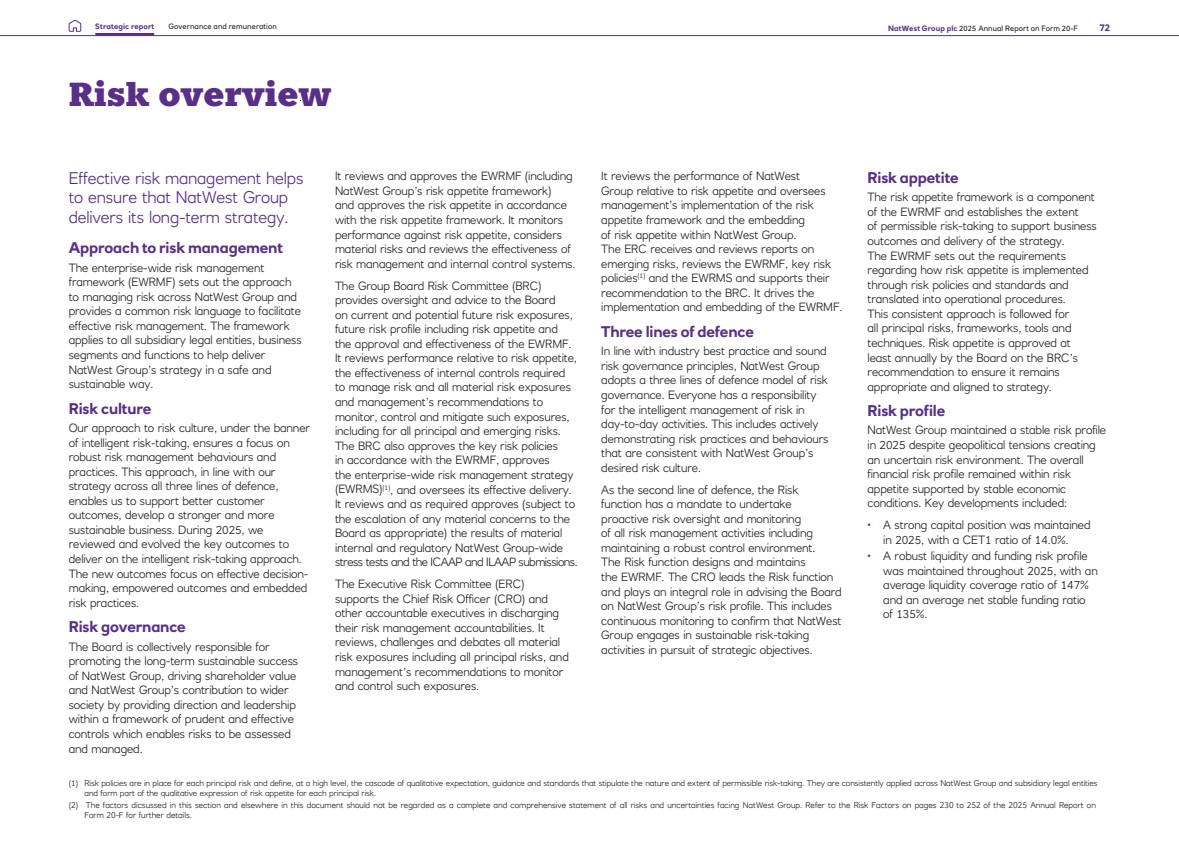
| Risk overview Effective risk management helps to ensure that NatWest Group delivers its long-term strategy. Approach to risk management The enterprise-wide risk management framework (EWRMF) sets out the approach to managing risk across NatWest Group and provides a common risk language to facilitate effective risk management. The framework applies to all subsidiary legal entities, business segments and functions to help deliver NatWest Group’s strategy in a safe and sustainable way. Risk culture Our approach to risk culture, under the banner of intelligent risk-taking, ensures a focus on robust risk management behaviours and practices. This approach, in line with our strategy across all three lines of defence, enables us to support better customer outcomes, develop a stronger and more sustainable business. During 2025, we reviewed and evolved the key outcomes to deliver on the intelligent risk-taking approach. The new outcomes focus on effective decision-making, empowered outcomes and embedded risk practices. Risk governance The Board is collectively responsible for promoting the long-term sustainable success of NatWest Group, driving shareholder value and NatWest Group’s contribution to wider society by providing direction and leadership within a framework of prudent and effective controls which enables risks to be assessed and managed. It reviews the performance of NatWest Group relative to risk appetite and oversees management’s implementation of the risk appetite framework and the embedding of risk appetite within NatWest Group. The ERC receives and reviews reports on emerging risks, reviews the EWRMF, key risk policies(1) and the EWRMS and supports their recommendation to the BRC. It drives the implementation and embedding of the EWRMF. Three lines of defence In line with industry best practice and sound risk governance principles, NatWest Group adopts a three lines of defence model of risk governance. Everyone has a responsibility for the intelligent management of risk in day-to-day activities. This includes actively demonstrating risk practices and behaviours that are consistent with NatWest Group’s desired risk culture. As the second line of defence, the Risk function has a mandate to undertake proactive risk oversight and monitoring of all risk management activities including maintaining a robust control environment. The Risk function designs and maintains the EWRMF. The CRO leads the Risk function and plays an integral role in advising the Board on NatWest Group’s risk profile. This includes continuous monitoring to confirm that NatWest Group engages in sustainable risk-taking activities in pursuit of strategic objectives. It reviews and approves the EWRMF (including NatWest Group’s risk appetite framework) and approves the risk appetite in accordance with the risk appetite framework. It monitors performance against risk appetite, considers material risks and reviews the effectiveness of risk management and internal control systems. The Group Board Risk Committee (BRC) provides oversight and advice to the Board on current and potential future risk exposures, future risk profile including risk appetite and the approval and effectiveness of the EWRMF. It reviews performance relative to risk appetite, the effectiveness of internal controls required to manage risk and all material risk exposures and management’s recommendations to monitor, control and mitigate such exposures, including for all principal and emerging risks. The BRC also approves the key risk policies in accordance with the EWRMF, approves the enterprise-wide risk management strategy (EWRMS)(1), and oversees its effective delivery. It reviews and as required approves (subject to the escalation of any material concerns to the Board as appropriate) the results of material internal and regulatory NatWest Group-wide stress tests and the ICAAP and ILAAP submissions. The Executive Risk Committee (ERC) supports the Chief Risk Officer (CRO) and other accountable executives in discharging their risk management accountabilities. It reviews, challenges and debates all material risk exposures including all principal risks, and management’s recommendations to monitor and control such exposures. Risk appetite The risk appetite framework is a component of the EWRMF and establishes the extent of permissible risk-taking to support business outcomes and delivery of the strategy. The EWRMF sets out the requirements regarding how risk appetite is implemented through risk policies and standards and translated into operational procedures. This consistent approach is followed for all principal risks, frameworks, tools and techniques. Risk appetite is approved at least annually by the Board on the BRC’s recommendation to ensure it remains appropriate and aligned to strategy. Risk profile NatWest Group maintained a stable risk profile in 2025 despite geopolitical tensions creating an uncertain risk environment. The overall financial risk profile remained within risk appetite supported by stable economic conditions. Key developments included: • A strong capital position was maintained in 2025, with a CET1 ratio of 14.0%. • A robust liquidity and funding risk profile was maintained throughout 2025, with an average liquidity coverage ratio of 147% and an average net stable funding ratio of 135%. (1) Risk policies are in place for each principal risk and define, at a high level, the cascade of qualitative expectation, guidance and standards that stipulate the nature and extent of permissible risk-taking. They are consistently applied across NatWest Group and subsidiary legal entities and form part of the qualitative expression of risk appetite for each principal risk. Strategic report Financial review Governance and remuneration Risk and capital management Financial statements Additional information NatWest Group plc 2025 Annual Report and Accounts 74 Enterprise-wide risk management framework Risk overview continued Enterprise-wide risk management framework Common risk language, architecture and approach Risk appetite Risk appetite is defined as the type and aggregate level of risk NatWest Group is willing to accept in pursuit of its strategic objectives and business plans. Risk governance NatWest Group’s governance structure facilitates sound risk management decision- making, in line with standards of good corporate governance. Three lines of defence NatWest Group adopts a three lines of defence model of risk governance. Everyone has a responsibility for intelligent risk-taking. Risk culture The EWRMF is centred on the embedding of a strong risk culture that encompasses both prudential and conduct risk outcomes and prescribed behaviours. Risk directory and principal risks The risk directory provides a common language to ensure that consistent terminology is used across NatWest Group to describe the principal risks. Principal risk policies Risk policies are in place for each principal risk and define, at a high level, the cascade of qualitative expectations, guidance and standards that stipulate the nature and extent of permissible risk-taking. Risk standards Risk standards provide a more granular expression of the risk policies and provide the detail for the first line of defence to develop operational policies/procedures. Risk toolkits Risk toolkits define the approaches, tools and techniques for managing risk (split by all principal risks, financial and non-financial risks). Principal risks are used as the basis for setting risk appetite and risk identification. Financial risks • Credit risk • Capital risk • Liquidity and funding risk • Climate and nature risk • Non-traded market risk • Traded market risk • Pension risk Non-financial risks • Operational risk • Compliance risk • Conduct risk • Financial crime risk • Model risk • Reputational risk The enterprise-wide risk management framework (EWRMF) sets out our approach to managing risk across NatWest Group and provides a common risk language and framework to facilitate effective risk management. The building blocks of the EWRMF are: The EWRMF sets out a common risk language and standard definitions to ensure consistency in the application of risk management terminology. The risk toolkit cycle outlines the NatWest Group-wide approach to identify, assess, mitigate, monitor and report risks. The risk toolkit cycle Identify and assess Effective risk identification and assessment to understand the risk profile. Report Reporting of the risk profile, emerging themes, current issues and other key information. Mitigate Determination of the appropriate action for how risks are managed or mitigated. Monitor Monitoring of the risk profile through principal risk indicators or other key metrics. Risk toolkit cycle Strategic report Strategic report Governance and remuneration Financial review Governance and remuneration Risk and capital management Financial statements Additional information NatWest Group plc NatWest Group plc 2025 Annual Report and Accounts 2025 Annual Report on Form 20-F 7573 |
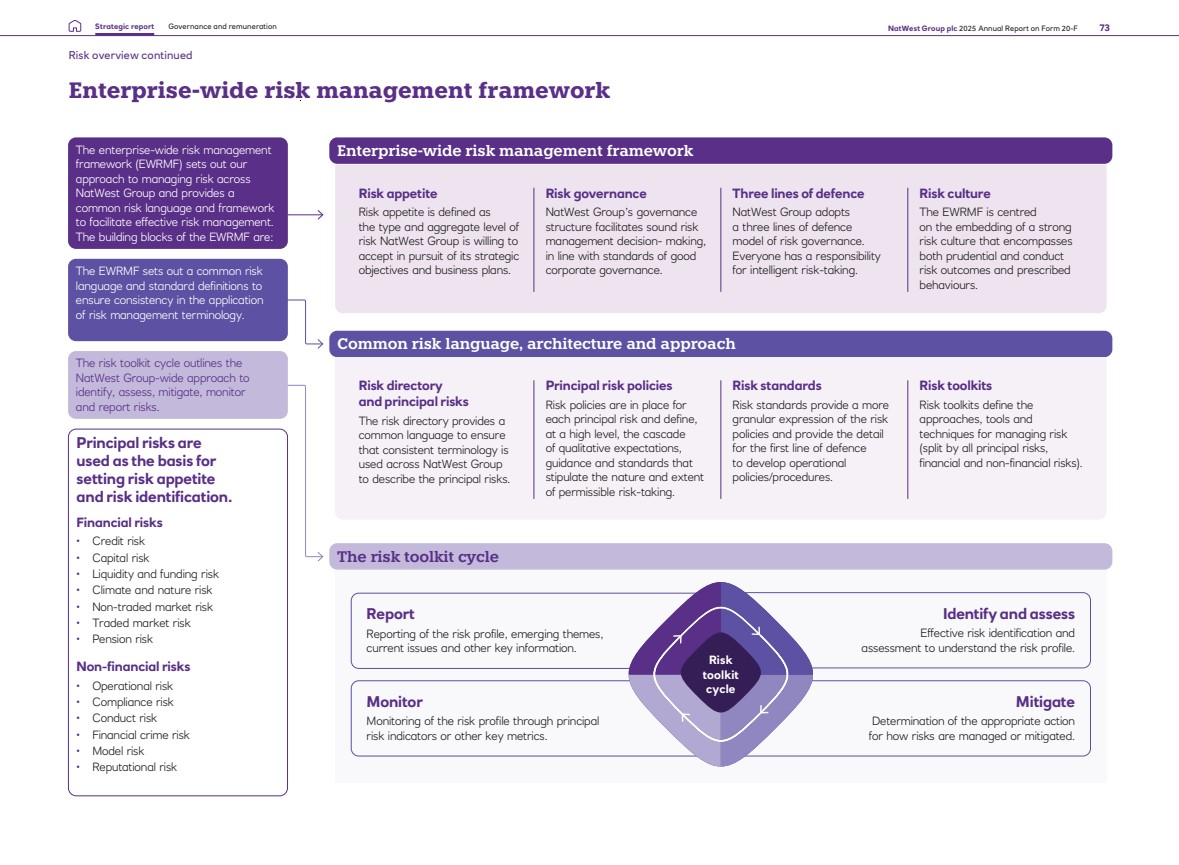
| Risk directory and principal risks Risk overview continued Principal risks – financial Key developments in 2025 Risk management actions Credit risk – the risk that customers, counterparties or issuers fail to meet a contractual obligation to settle outstanding amounts. • Personal portfolio growth in 2025 was a result of continuing organic demand as well as the Sainsbury’s acquisition. • Non-Personal portfolio growth was mainly across strategic areas including funds financing and corporates. • Extensive and thorough credit processes, strategies and controls are in place to ensure effective risk identification, management and oversight. • Personal credit risk – adjustments are made to affordability assumptions and stress rates to ensure that lending continues to be assessed appropriately. • Non-Personal credit risk – sector appetite continues to be reviewed regularly, with particular focus on sector clusters and sub-sectors that are deemed to represent a heightened risk. Capital risk – the risk that there is the inability to conduct business in base or stress conditions on a risk or leverage basis due to insufficient qualifying capital as well as the failure to assess, monitor, plan and manage capital adequacy requirements. • A strong capital position was maintained in 2025, with a CET1 ratio of 14.0%, which was within NatWest Group’s target of 13-14%. • Capital planning is integrated into NatWest Group’s wider annual budgeting process with capital plans produced over a five-year planning horizon under expected and stress conditions. • Stress testing is a principal risk management tool and is used to quantify and evaluate the potential impact of risks on the financial strength and capital position. Liquidity risk – the risk of being unable to meet actual or potential financial obligations in a timely manner when they fall due in the short term. Funding risk – the risk that current or prospective financial obligations cannot be met as they fall due in the medium to long term, either at all or without increasing funding costs unacceptably. • A robust liquidity and funding risk profile was maintained throughout 2025, with an average liquidity coverage ratio of 147% and an average net stable funding ratio of 135%. • A suite of tools is used to monitor, limit and stress test the liquidity and funding risks on the balance sheet. Limit frameworks are in place to control the level of liquidity risk, asset and liability mismatches and funding concentrations. Liquidity condition indicators are monitored daily. • Performance is reported to the Asset & Liability Management Committee on a regular basis. Climate and nature risk – the threat of financial loss or adverse non-financial impacts associated with climate change and nature loss respectively and the political, economic and environmental responses to it. • Climate risk modelling capabilities, including internal physical risk modelling, continued to be enhanced. • The coverage of the climate decisioning framework and its associated use also broadened during the year. • Climate risk analytics are increasingly integrated within risk management processes such as capital adequacy, impairments, and transition plan processes. • Consideration of climate risk within credit risk decisioning at a customer level is maturing. Initial use cases have been introduced: higher-risk transactions are identified for enhanced oversight or escalated approval. Non-traded market risk – the risk to the value of assets or liabilities outside the trading book, or the risk to income, that arises from changes in market prices such as interest rates, foreign exchange rates and equity prices, or from changes in managed rates. • Overall, total value-at-risk (VaR) decreased. The largest component, credit spread VaR, remained relatively stable as bond holdings in the liquidity portfolio remained generally consistent. • The notional of the structural hedge rose slightly, reflecting increased equity structural hedging and deposit stability. • Non-traded market risk appetite is measured via VaR, SVaR, sensitivity and stress limits, and earnings-at-risk limits. • Limits are reviewed to reflect changes in risk appetite, business plans, portfolio composition and the market and economic environments. • Non-traded market risk stress results are combined with those for other risks into capital planning. Traded market risk – the risk of losses in trading book positions from fluctuations in market variables, such as interest rates, credit spreads, foreign exchange rates, equity prices, implied volatilities and asset correlations. • Drivers of market volatility during the year included global inflationary concerns, US tariffs, the ongoing Russia-Ukraine conflict and geopolitical tensions in the Middle East. • Traded VaR and SVaR remained within appetite, aided by NatWest Group’s continued disciplined approach to risk-taking. • VaR, SVaR and the incremental risk charge are used to measure traded market risk. • Traded market risk exposures are monitored against limits and analysed daily. • Limit reporting is supplemented with regulatory capital and stress testing. Pension risk – The inability to meet contractual obligations and other liabilities to the established employee or related company pension scheme. • During the year, the Trustee of the Main section of the NatWest Group Pension Fund completed partial buy-in transactions, in addition to those completed during 2024, passing demographic and market risk to third-party insurers. Over 40% of the scheme’s liabilities are now covered by buy-in policies, which is an increase from one-third at the end of 2024. • Pension risk is monitored by the Executive Risk Committee and the Board Risk Committee. Relevant pension risk matters are escalated to the Board as applicable. • NatWest Group also undertakes stress tests on its material defined benefit pension schemes each year. These tests are also used to satisfy the requests of regulatory bodies such as the Bank of England. Strategic report Strategic report Governance and remuneration Financial review Governance and remuneration Risk and capital management Financial statements Additional information NatWest Group plc NatWest Group plc 2025 Annual Report and Accounts 2025 Annual Report on Form 20-F 7476 |
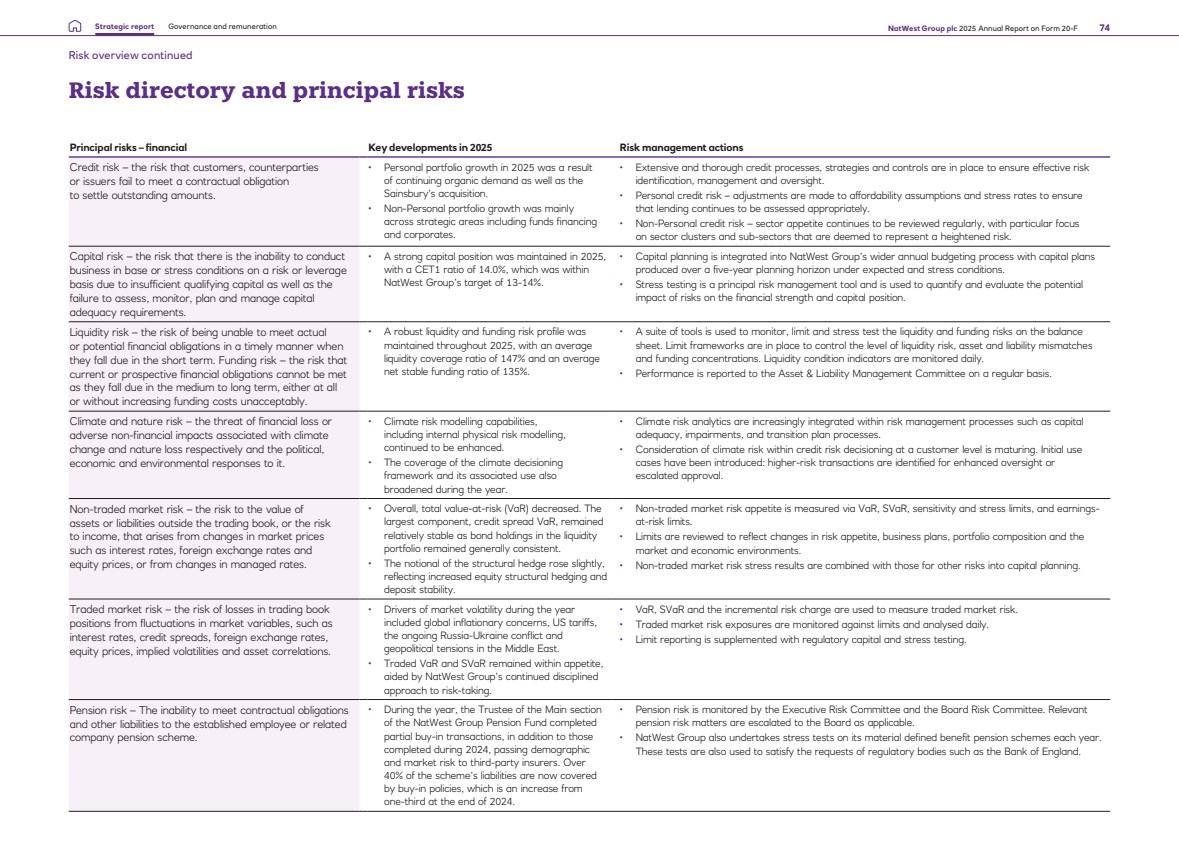
| Risk directory and principal risks Risk overview continued Principal risks – financial Key developments in 2025 Risk management actions Credit risk – the risk that customers, counterparties or issuers fail to meet a contractual obligation to settle outstanding amounts. • Personal portfolio growth in 2025 was a result of continuing organic demand as well as the Sainsbury’s acquisition. • Non-Personal portfolio growth was mainly across strategic areas including funds financing and corporates. • Extensive and thorough credit processes, strategies and controls are in place to ensure effective risk identification, management and oversight. • Personal credit risk – adjustments are made to affordability assumptions and stress rates to ensure that lending continues to be assessed appropriately. • Non-Personal credit risk – sector appetite continues to be reviewed regularly, with particular focus on sector clusters and sub-sectors that are deemed to represent a heightened risk. Capital risk – the risk that there is the inability to conduct business in base or stress conditions on a risk or leverage basis due to insufficient qualifying capital as well as the failure to assess, monitor, plan and manage capital adequacy requirements. • A strong capital position was maintained in 2025, with a CET1 ratio of 14.0%, which was within NatWest Group’s target of 13-14%. • Capital planning is integrated into NatWest Group’s wider annual budgeting process with capital plans produced over a five-year planning horizon under expected and stress conditions. • Stress testing is a principal risk management tool and is used to quantify and evaluate the potential impact of risks on the financial strength and capital position. Liquidity risk – the risk of being unable to meet actual or potential financial obligations in a timely manner when they fall due in the short term. Funding risk – the risk that current or prospective financial obligations cannot be met as they fall due in the medium to long term, either at all or without increasing funding costs unacceptably. • A robust liquidity and funding risk profile was maintained throughout 2025, with an average liquidity coverage ratio of 147% and an average net stable funding ratio of 135%. • A suite of tools is used to monitor, limit and stress test the liquidity and funding risks on the balance sheet. Limit frameworks are in place to control the level of liquidity risk, asset and liability mismatches and funding concentrations. Liquidity condition indicators are monitored daily. • Performance is reported to the Asset & Liability Management Committee on a regular basis. Climate and nature risk – the threat of financial loss or adverse non-financial impacts associated with climate change and nature loss respectively and the political, economic and environmental responses to it. • Climate risk modelling capabilities, including internal physical risk modelling, continued to be enhanced. • The coverage of the climate decisioning framework and its associated use also broadened during the year. • Climate risk analytics are increasingly integrated within risk management processes such as capital adequacy, impairments, and transition plan processes. • Consideration of climate risk within credit risk decisioning at a customer level is maturing. Initial use cases have been introduced: higher-risk transactions are identified for enhanced oversight or escalated approval. Non-traded market risk – the risk to the value of assets or liabilities outside the trading book, or the risk to income, that arises from changes in market prices such as interest rates, foreign exchange rates and equity prices, or from changes in managed rates. • Overall, total value-at-risk (VaR) decreased. The largest component, credit spread VaR, remained relatively stable as bond holdings in the liquidity portfolio remained generally consistent. • The notional of the structural hedge rose slightly, reflecting increased equity structural hedging and deposit stability. • Non-traded market risk appetite is measured via VaR, SVaR, sensitivity and stress limits, and earnings-at-risk limits. • Limits are reviewed to reflect changes in risk appetite, business plans, portfolio composition and the market and economic environments. • Non-traded market risk stress results are combined with those for other risks into capital planning. Traded market risk – the risk of losses in trading book positions from fluctuations in market variables, such as interest rates, credit spreads, foreign exchange rates, equity prices, implied volatilities and asset correlations. • Drivers of market volatility during the year included global inflationary concerns, US tariffs, the ongoing Russia-Ukraine conflict and geopolitical tensions in the Middle East. • Traded VaR and SVaR remained within appetite, aided by NatWest Group’s continued disciplined approach to risk-taking. • VaR, SVaR and the incremental risk charge are used to measure traded market risk. • Traded market risk exposures are monitored against limits and analysed daily. • Limit reporting is supplemented with regulatory capital and stress testing. Pension risk – The inability to meet contractual obligations and other liabilities to the established employee or related company pension scheme. • During the year, the Trustee of the Main section of the NatWest Group Pension Fund completed partial buy-in transactions, in addition to those completed during 2024, passing demographic and market risk to third-party insurers. Over 40% of the scheme’s liabilities are now covered by buy-in policies, which is an increase from one-third at the end of 2024. • Pension risk is monitored by the Executive Risk Committee and the Board Risk Committee. Relevant pension risk matters are escalated to the Board as applicable. • NatWest Group also undertakes stress tests on its material defined benefit pension schemes each year. These tests are also used to satisfy the requests of regulatory bodies such as the Bank of England. Strategic report Financial review Governance and remuneration Risk and capital management Financial statements Additional information NatWest Group plc 2025 Annual Report and Accounts 76 Principal risks – non-financial Key developments in 2025 Risk management actions Operational risk – the risk of loss resulting from inadequate or failed internal processes, people and systems, or external events. It arises from day-to-day operations and is relevant to every aspect of the business. • The enhanced risk and control self-assessment approach was refined further with a focus on material operational risks and controls across the key end-to-end processes. • Operational resilience continued to evolve, UK/EU Digital Operational Resilience Act compliance was achieved along with the assessment of plausible, increasingly severe, complex, and prolonged scenario tests for cyber, third-party, and major IT failure risks. • Threat horizon scanning and vulnerability management processes were enhanced to support risk identification, scenario testing and the prioritisation of risk mitigation activities. • The operational risk frameworks outline the principles and approaches used across NatWest Group, which are aligned to regulatory requirements and risk appetite. These frameworks outline controls, management information and standards used to identify, manage, and reduce operational risks and support continued operational resilience. • A robust approach to operational resilience is maintained through comprehensive NatWest Group-wide processes. These include regular scenario tests that simulate increasingly severe and sophisticated disruption events. Compliance risk – the risk that NatWest Group fails to observe the letter and spirit of all relevant laws, codes, rules, regulations and standards of good market practice. • On 4 September 2025, the US Court of Appeal approved an amendment of the plea agreement and formally terminated the Monitorship (extended oversight) of NatWest Markets Plc (NWM) obligations under the plea agreement and probation has been extended until December 2026. Going forward, NWM will report progress on the compliance programme directly to the US Department of Justice. • The Judicial Review challenging the Financial Ombudsman Service’s interpretation of ‘unfair relationships’ under Section 140 of the Consumer Credit Act remains ongoing. NatWest Group and peer banks have raised concerns over the reopening of closed complaints, with the FCA intervening in support of NatWest Group’s position. • Regulatory horizon scanning is conducted to identify and address changes in regulatory requirements. Rules mapping exists to ensure the key products and supporting services that NatWest Group provides are compliant with all applicable regulatory requirements, including structured breach identification, remediation. Reporting processes are in place that include mandatory reporting timelines. • Policies and procedures set out the principles that apply across NatWest Group, aligned to its risk appetite, with appropriate control frameworks, management information, standards and training implemented to identify and manage regulatory compliance risk. Conduct risk – the risk of inappropriate behaviour towards customers, or in the markets in which NatWest Group operates, which leads to poor or inappropriate customer outcomes and/or undermines market integrity. • The compliance and conduct risk framework was reviewed against the Operational Riskdata eXchange Association regulatory compliance and conduct risk taxonomy leading to proposals for new level 2 risks and a potential merger of conduct and regulatory compliance into a single risk from 2026. These changes aim to improve risk coverage, align with the EWRMF, and reflect industry best practice. • Risk standards are in place to ensure appropriate controls and processes that deliver good customer outcomes and support market integrity. • Ongoing monitoring and testing of good customer outcome measures to ensure good outcomes are delivered for customers, and to ensure products continue to offer customers fair value, throughout the product and service lifecycle, driving continuous improvement. Financial crime risk – the risk that NatWest Group’s products, services, employees and/or third parties are intentionally or unintentionally used to facilitate financial crime in the form of money laundering, terrorist financing, bribery and corruption, sanctions and tax evasion, as well as external or internal fraud. • Significant investment continued to be made to support the delivery of the multi-year transformation plan across financial crime risk management. • Enhancements were made to technology, data quality and data analytics to improve the effectiveness of systems used to monitor customers and transactions. • The financial crime framework, relevant policies, systems, processes and controls are used to mitigate and manage financial crime risk. This includes the use of dedicated screening and monitoring systems and controls to identify people, organisations, transactions and behaviours that may require further investigation or other actions. Model risk – the potential for adverse consequences from model errors or the inappropriate use of modelled outputs to inform business decisions. • The model risk management framework was updated in line with SS1/23, including bringing material and complex deterministic quantitative methods into scope. • Model inventory system design and model risk data accuracy were improved to strengthen overall model risk management and oversight. • Model risk appetite is set to limit the level of model risk that NatWest Group is willing to accept in the course of its business activities. Policies, toolkits and model standards related to the development, validation, approval, implementation, use and ongoing monitoring of models are in place to ensure adequate control across the lifecycle of an individual model. This includes refining, redeveloping or restricting use of models where appropriate. Reputational risk – the risk of damage to stakeholder trust due to negative consequences arising from internal actions or external events. • Enhancements were made to expand the requirements of the reputational risk policy to suppliers and third parties. • The environmental, social and ethical (ESE) animal welfare, mining and metals and forestry, fisheries and agribusiness risk acceptance criteria were reviewed and updated in line with strategic objectives. • From 1 January 2026, the name of the ESE risk framework was updated to the Environmental and Social Risk Framework. This change better reflects the framework’s underlying methodology which focuses on a risk-based approach aligned to organisational risk appetite, rather than values-based judgements. • Relevant internal and external factors are monitored through regular reporting via reputational risk registers at business or legal entity level. They are escalated, where appropriate, to the relevant business risk committee and, where material, to the Group Reputational Risk Committee. • Standards of conduct are in place across NatWest Group requiring strict adherence to policies, procedures and ways of working to ensure business is transacted in a way that meets – or exceeds – stakeholder expectations. Risk overview continued Strategic report Strategic report Governance and remuneration Financial review Governance and remuneration Risk and capital management Financial statements Additional information NatWest Group plc NatWest Group plc 2025 Annual Report and Accounts 2025 Annual Report on Form 20-F 7775 |
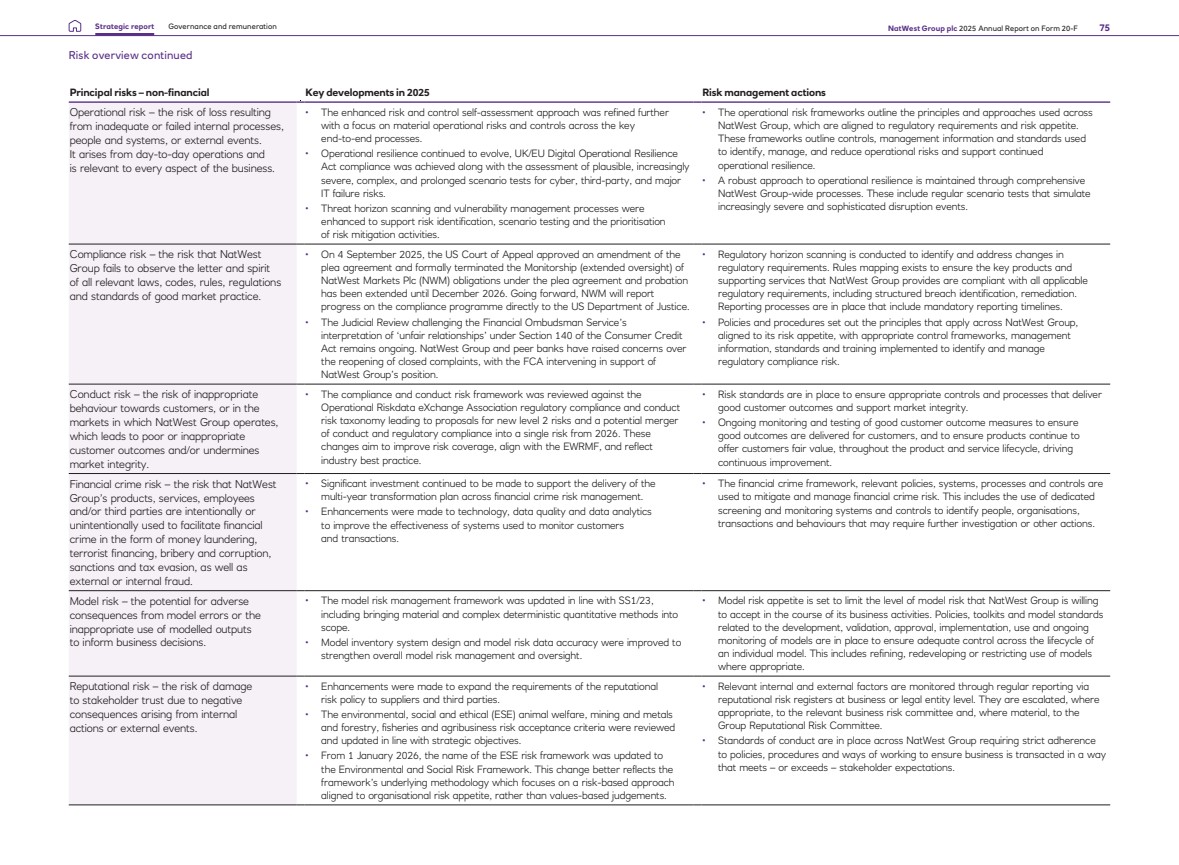
| Top and emerging risks Risk overview continued Top and emerging risks are future scenarios that could have a significantly negative impact on our ability to operate or deliver our strategy and are managed through the EWRMF toolkit. They usually combine elements of several principal risks and require a coordinated management response. Top risks could occur or require management action within two years, while emerging risks are evolving and/or could occur over a longer time horizon but have the potential to become a top risk. In 2025, the ERC, the BRC and the Board received regular reporting on top and emerging risks. The BRC also engaged in a focused horizon scanning session in 2025 and discussed top and emerging risks regularly during 2025 to enable their early identification and mitigation. The top and emerging risks scenarios that follow are shown in alphabetical order. Top risk scenarios in focus in 2025 Description Risk management actions Artificial intelligence Innovations in artificial intelligence (AI), including generative AI, may rapidly transform and disrupt customer interactions, the industry and the economy. NatWest Group’s ability to continue to deploy AI solutions and integrate AI in systems and controls will become increasingly important to retaining and growing business. There can be no certainty that NatWest Group’s innovation strategy will be successful, and competitors may be more successful in implementing AI technologies, in turn, affecting industry competitive dynamics. Developments in AI may also result in increased model risk and rising levels of fraud. • NatWest Group closely monitors developments in disruptive technologies, including AI. Strategy is developed as appropriate to leverage AI across NatWest Group with a focus on helping improve customer journeys, personalisation, colleague effectiveness and improved risk and capital management. Using AI safely and ethically is a key area of focus, alongside compliance with evolving AI regulation. This includes developing a robust set of controls for the use of AI models and tools across NatWest Group. AI risk management is being developed proactively to reflect technological and systems advances. Climate ambitions NatWest Group’s climate strategy – including ambitions, targets, and transition planning – carries significant financial and non-financial risks. Achieving these goals depends on timely and appropriate government policy, technology developments, and on suppliers, customers and society supporting the transition. • Following the review of our climate ambitions and targets in 2025 in the context of the UK Committee on Climate Change’s (UK CCC) issued advice and our progress to date, we have retained our ambition to at least halve the climate impact of our financing activity by 2030, against a 2019 baseline, having achieved a 39% reduction between 2019 and 2024, primarily through strategic decisions and methodology and data enhancements. Cyberattack There is a constantly evolving threat from cyberattacks which are increasing in terms of frequency, sophistication, impact and severity. This includes hostile attempts to gain access to and exploit potential vulnerabilities of IT systems including via malware. Any failure in NatWest Group’s cybersecurity policies, procedures or controls, may result in significant financial losses, major business disruption, inability to deliver customer services, loss of data and associated reputational damage. • NatWest Group continues to invest in additional capability to defend against threats including developing and evolving cybersecurity policies, procedures and controls that are designed to minimise the possibility of, and the potential effect of such attacks. The focus is to manage the impact of the attacks and maintain services for NatWest Group’s customers. This includes proving cyber resilience capabilities via stress testing of NatWest Group’s important business services. In addition, NatWest Group utilises threat intelligence to inform its approach to identifying and responding to potential cyber risks. Digital currency NatWest Group operates in markets which would be exposed to any developments in digital currency and/or assets, including tokenised deposits, stablecoins and a UK central bank digital currency (CBDC). The introduction of new digital currencies could result in deposit outflows, higher funding costs, and/or other implications for UK banks including NatWest Group. • NatWest Group is focused on delivery of its digital asset strategy which includes participation in tokenised deposit pilots, and close engagement with regulators on future regulatory regimes for digital assets and monitoring of industry developments. This approach ensures alignment with emerging market practices and regulatory expectations. • NatWest Group maintains an Executive Steering Group on digital assets which oversees developments and engagement on digital currencies. It also coordinates engagement with the UK Government and regulators on digital currency developments and financial market infrastructures such as proposals on regulatory treatment of UK stablecoins. Strategic report Strategic report Governance and remuneration Financial review Governance and remuneration Risk and capital management Financial statements Additional information NatWest Group plc NatWest Group plc 2025 Annual Report and Accounts 2025 Annual Report on Form 20-F 7876 |
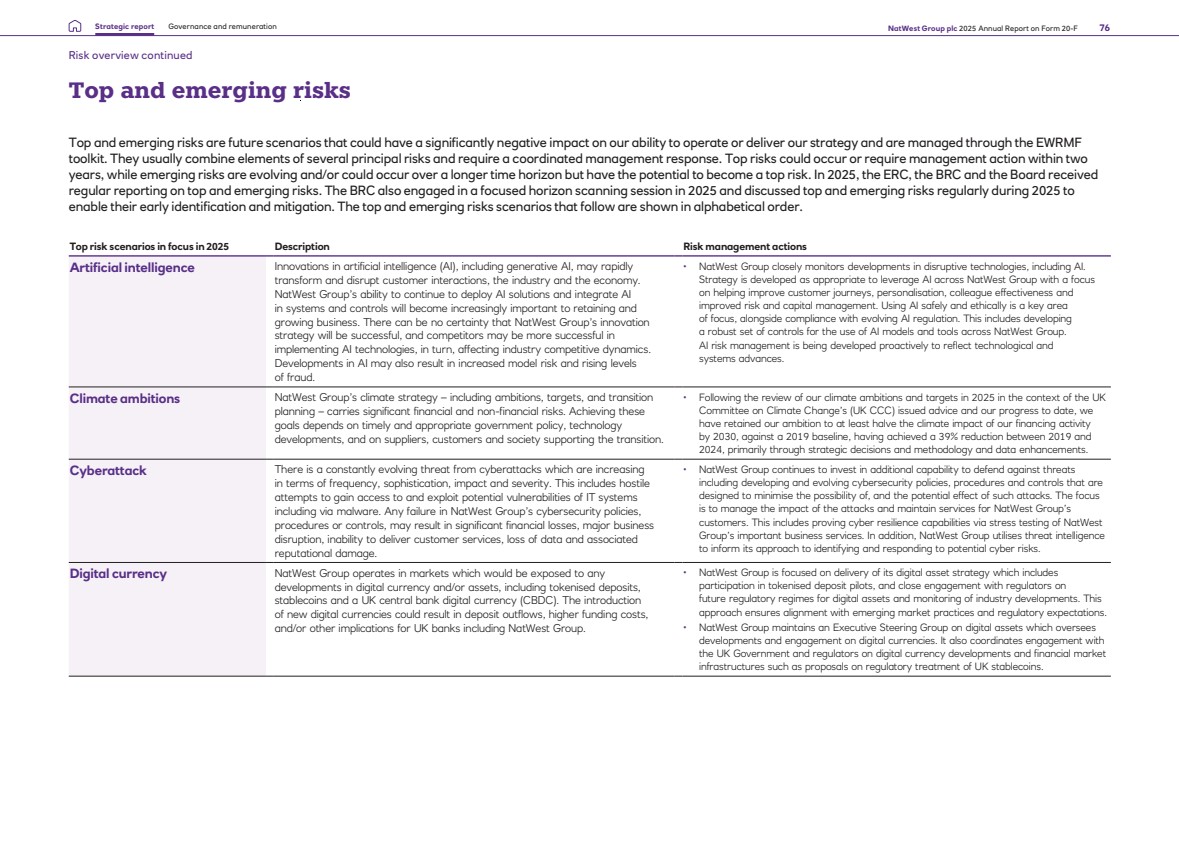
| Top and emerging risks Risk overview continued Top and emerging risks are future scenarios that could have a significantly negative impact on our ability to operate or deliver our strategy and are managed through the EWRMF toolkit. They usually combine elements of several principal risks and require a coordinated management response. Top risks could occur or require management action within two years, while emerging risks are evolving and/or could occur over a longer time horizon but have the potential to become a top risk. In 2025, the ERC, the BRC and the Board received regular reporting on top and emerging risks. The BRC also engaged in a focused horizon scanning session in 2025 and discussed top and emerging risks regularly during 2025 to enable their early identification and mitigation. The top and emerging risks scenarios that follow are shown in alphabetical order. Top risk scenarios in focus in 2025 Description Risk management actions Artificial intelligence Innovations in artificial intelligence (AI), including generative AI, may rapidly transform and disrupt customer interactions, the industry and the economy. NatWest Group’s ability to continue to deploy AI solutions and integrate AI in systems and controls will become increasingly important to retaining and growing business. There can be no certainty that NatWest Group’s innovation strategy will be successful, and competitors may be more successful in implementing AI technologies, in turn, affecting industry competitive dynamics. Developments in AI may also result in increased model risk and rising levels of fraud. • NatWest Group closely monitors developments in disruptive technologies, including AI. Strategy is developed as appropriate to leverage AI across NatWest Group with a focus on helping improve customer journeys, personalisation, colleague effectiveness and improved risk and capital management. Using AI safely and ethically is a key area of focus, alongside compliance with evolving AI regulation. This includes developing a robust set of controls for the use of AI models and tools across NatWest Group. AI risk management is being developed proactively to reflect technological and systems advances. Climate ambitions NatWest Group’s climate strategy – including ambitions, targets, and transition planning – carries significant financial and non-financial risks. Achieving these goals depends on timely and appropriate government policy, technology developments, and on suppliers, customers and society supporting the transition. • Following the review of our climate ambitions and targets in 2025 in the context of the UK Committee on Climate Change’s (UK CCC) issued advice and our progress to date, we have retained our ambition to at least halve the climate impact of our financing activity by 2030, against a 2019 baseline, having achieved a 39% reduction between 2019 and 2024, primarily through strategic decisions and methodology and data enhancements. Cyberattack There is a constantly evolving threat from cyberattacks which are increasing in terms of frequency, sophistication, impact and severity. This includes hostile attempts to gain access to and exploit potential vulnerabilities of IT systems including via malware. Any failure in NatWest Group’s cybersecurity policies, procedures or controls, may result in significant financial losses, major business disruption, inability to deliver customer services, loss of data and associated reputational damage. • NatWest Group continues to invest in additional capability to defend against threats including developing and evolving cybersecurity policies, procedures and controls that are designed to minimise the possibility of, and the potential effect of such attacks. The focus is to manage the impact of the attacks and maintain services for NatWest Group’s customers. This includes proving cyber resilience capabilities via stress testing of NatWest Group’s important business services. In addition, NatWest Group utilises threat intelligence to inform its approach to identifying and responding to potential cyber risks. Digital currency NatWest Group operates in markets which would be exposed to any developments in digital currency and/or assets, including tokenised deposits, stablecoins and a UK central bank digital currency (CBDC). The introduction of new digital currencies could result in deposit outflows, higher funding costs, and/or other implications for UK banks including NatWest Group. • NatWest Group is focused on delivery of its digital asset strategy which includes participation in tokenised deposit pilots, and close engagement with regulators on future regulatory regimes for digital assets and monitoring of industry developments. This approach ensures alignment with emerging market practices and regulatory expectations. • NatWest Group maintains an Executive Steering Group on digital assets which oversees developments and engagement on digital currencies. It also coordinates engagement with the UK Government and regulators on digital currency developments and financial market infrastructures such as proposals on regulatory treatment of UK stablecoins. Strategic report Financial review Governance and remuneration Risk and capital management Financial statements Additional information NatWest Group plc 2025 Annual Report and Accounts 78 Risk overview continued Top risk scenarios in focus in 2025 Description Risk management actions Economic and interest rate volatility Economic conditions could deteriorate, depending on factors including weak economic activity, fiscal policies, volatility in interest rates, liquidity pressures, sharp falls in asset prices, escalating geopolitical tensions and concerns regarding sovereign debt or sovereign credit ratings. Any of these may have a materially adverse effect on NatWest Group’s future financial prospects. • A range of complementary approaches is used to mitigate the risks, such as targeted scenario analysis, stress tests, targeted customer reviews and reviews of risk appetite. Stress tests in 2025 included completion of regulatory stress tests as well as a range of internal scenarios. Evolving regulation NatWest Group’s businesses are subject to substantial regulation and oversight, both of which are constantly evolving and may have an adverse impact on NatWest Group. Areas of ongoing regulatory focus include Basel 3.1 standards implementation, including the resulting effect on RWAs and models, as well as the effective management of financial crime. • NatWest Group constantly monitors regulatory change. It engages closely with regulators in the shaping of regulation that materially impacts NatWest Group, responding when necessary, either bilaterally or in partnership with one of the affiliated industry bodies. NatWest Group implements new responses to regulatory requirements where applicable and uses frequent engagement meetings with regulators to discuss key priorities. Increased competition Competitive pressures could intensify, impeding NatWest Group’s ability to grow or retain market share, impacting revenues and profitability, particularly in the UK Retail Banking and Commercial & Institutional segments. Drivers of competition mainly relate to developments in technology, evolving incumbents, challengers, new entrants to the market, shifts in customer behaviour and changes in regulation. For example, increased competition from technology conglomerates, who may have competitive advantages in scale, technology and customer engagement (including brand recognition). • NatWest Group closely monitors the competitive environment and adapts its strategy as appropriate. This includes using scenario analysis and assessing how mega-trends will impact industry competitive dynamics. Strategic responses are focused on the delivery of innovative and compelling propositions for customers and effectively leveraging acquisitions and partnerships. Operational risk scenarios Operational risks are inherent in NatWest Group’s businesses and a broad range of scenarios are considered. NatWest Group could be adversely impacted by scenarios including a failure to access current, complete, and accurate data, or disruption to services if a third-party service provider experienced any interruptions. These scenarios could result in business and customer interruption and related reputational damage, significant compensation costs, regulatory sanctions and/or a breach of applicable regulations. • NatWest Group maintains a robust approach to operational resilience through comprehensive, Group-wide processes and regular scenario tests to ensure effective management of interconnected operational risks. • NatWest Group devotes significant resources to third-party risk management. Focus areas include identifying critical-service suppliers, developing robust exit and contingency plans in the event of supply chain disruption, and ensuring appropriate monitoring and oversight of third-party performance. • Effective and ethical use of data is critical to NatWest Group’s goals, with continued focus on delivering our long-term data strategy alongside enhancing control and policy frameworks governing data usage. Emerging risk scenarios in focus in 2025 Description Risk management actions Geopolitical risk NatWest Group is exposed to risks arising from geopolitical events or political developments. Geopolitical tensions remain elevated and a range of potential scenarios and impacts are considered. This includes the potential impact of armed conflict, global trade and supply chain disruption, volatility in commodity prices, protectionist policies or trade barriers and state-sponsored cyberattacks. • NatWest Group closely monitors the geopolitical risk outlook and undertakes regular scenario analysis to understand the potential impacts and takes mitigating actions as required. This includes second and third-order analysis of impacts, for example, through customers’ supply chain disruption or disruption to third-party providers. Market-based finance (MBF) NatWest Group is exposed to vulnerabilities within shadow banking or MBF, given the interlinkages between UK banks and MBF. This includes the potential for stress events or shocks to financial markets. • NatWest Group closely monitors exposure to MBF. An internal framework for the identification, management, control and mitigation of the risks associated with exposure to MBF is maintained. This includes effective reporting and governance in respect of such exposure. Physical climate risk Intensifying physical climate-related risks, including climate events, materially increasing in frequency and/or severity, results in direct impacts on property, infrastructure, supply chains, geopolitics and economic activity. This could lead to significant credit, operational (for example, business continuity), market, liquidity, pension risks and/or non-financial risks and, if those risks are not mitigated, losses. • NatWest Group leverages scenario analysis to explore the potential impact of physical climate risks and ensure appropriate mitigation. NatWest Group includes a scenario exploring quantifiable impacts of chronic physical climate effects, such as a drag on labour and land productivity, and acute physical shocks such as droughts, heatwaves, wildfires and floods within its suite of stress-testing scenarios. In addition, a qualitative scenario is used to explore cascading and complex risks, including potential earth system tipping points, that are currently challenging for quantitative scenarios and models to capture. Strategic report Strategic report Governance and remuneration Financial review Governance and remuneration Risk and capital management Financial statements Additional information NatWest Group plc NatWest Group plc 2025 Annual Report and Accounts 2025 Annual Report on Form 20-F 7977 |
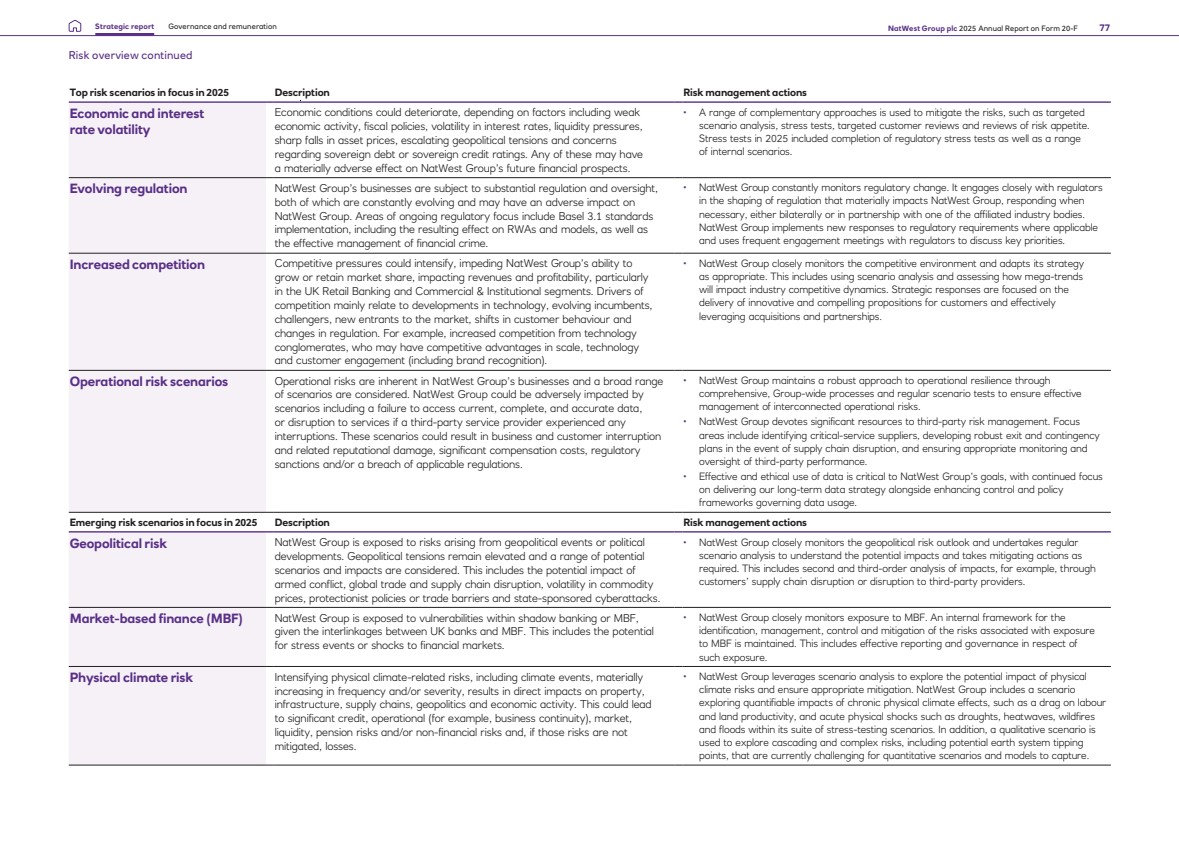
| Board visit to Tyseley Energy Park in Birmingham Governance and remuneration Strategic report Financial review Risk and capital management Financial statements Additional information Strategic report Governance and remuneration Governance and remuneration NatWest Group plc NatWest Group plc 2025 Annual Report and Accounts 2025 Annual Report on Form 20-F 7895 78 Corporate governance report 79 Our Board 82 Board composition 83 Executive management team 84 Chair’s introduction 85 Governance at a glance 105 Report of the Group Nominations and Governance Committee 107 Report of the Group Audit Committee 114 Report of the Group Board Risk Committee 120 Report of the Group Technology, Innovation and Simplification Committee 127 Remuneration at a glance 129 The directors’ remuneration policy and wider workforce remuneration 134 Annual remuneration report 152 Compliance report 155 Report of the directors 159 Statement of directors’ responsibilities 123 Directors’ remuneration report |
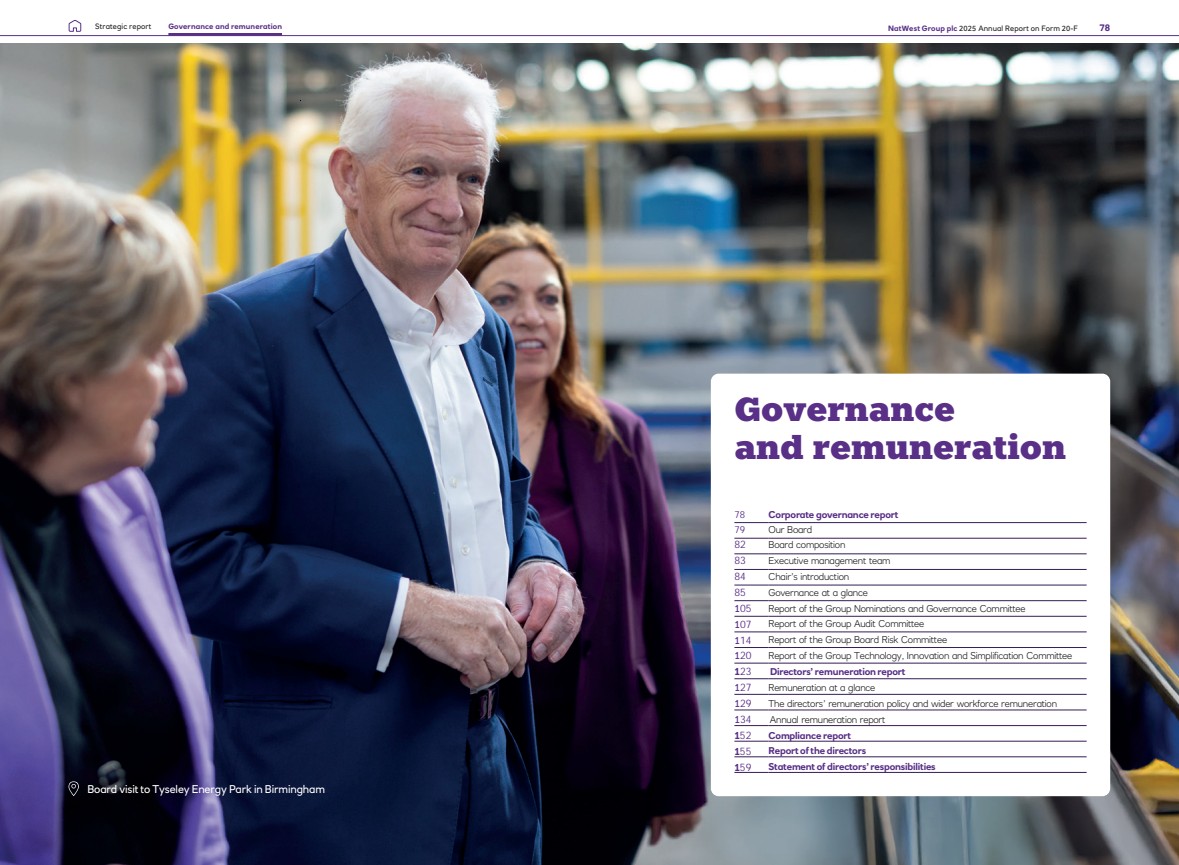
| Board visit to Tyseley Energy Park in Birmingham Governance and remuneration 95 Corporate governance report 96 Our Board 99 Board composition 100 Executive management team 101 Chair’s introduction 102 Governance at a glance 122 Report of the Group Nominations and Governance Committee 124 Report of the Group Audit Committee 131 Report of the Group Board Risk Committee 137 Report of the Group Technology, Innovation and Simplification Committee 140 Directors’ remuneration report 144 Remuneration at a glance 146 The directors’ remuneration policy and wider workforce remuneration 151 Annual remuneration report 169 Compliance report 172 Report of the directors 176 Statement of directors’ responsibilities Strategic report Financial review Governance and remuneration Risk and capital management Financial statements Additional information NatWest Group plc 2025 Annual Report and Accounts 95 Our Board Rick Haythornthwaite Chair Paul Thwaite Group Chief Executive Officer Katie Murray Group Chief Financial Officer Date of appointment: 8 January 2024 (Board), 15 April 2024 (Chair) Contribution to the Board Rick is a highly experienced Chair who combines a successful commercial career with a deep knowledge of financial services markets and technology, as well as a strong track record of delivery at significant customer-facing organisations. Rick’s Chair experience extends across industry sectors, including Ocado Group plc, which provides technology and automation solutions for grocery retailers; Embedded Finance, a fintech company; QiO Technologies Limited, the industrial AI company that Rick co-founded; Xynteo, a Norway-based sustainability consultancy and Mastercard Inc., a global technology company. Relevant experience While Rick was Chair of Mastercard Inc. the company was transformed from a credit card company to a global technology company and its market capitalisation increased from $5 billion to over $350 billion. He also chaired Arc International Holdings, Centrica plc and Network Rail Limited, and was a partner at Star Capital. Rick’s past non-executive directorships include Globant S.A., Cookson plc, Lafarge S.A., Land Securities plc and ICI plc. Rick also led the Haythornthwaite Review of UK Armed Forces Incentivisation. Rick has been responsible for several high-profile business transformations and rescues, including Invensys, then one of the world’s leading industrial controls companies, as CEO. External appointments: • Chair of AA Limited • Senior advisory partner at Moelis & Co • Visiting Fellow at the Saïd Business School, Oxford University Date of appointment: 25 July 2023 Contribution to the Board Paul has over 30 years’ experience in financial services having held senior roles within Wholesale, Corporate, International, Risk and Retail Banking, across the UK, Europe and the US. Prior to his appointment as Chief Executive Officer, Paul was Chief Executive of the bank’s Commercial & Institutional business, bringing together the teams that support NatWest’s business customers, ranging from entrepreneurs and start-ups through to multi-nationals and financial institutions. Throughout his executive and non-executive career, Paul has taken an active role in promoting talent, and building and leading inclusive teams across multiple regions, geographies and disciplines, to deliver performance for customers and wider stakeholders. Relevant experience Paul brings strong UK and international expertise in strategic and cultural transformation, scale leadership, balance sheet management and risk, plus a sharp focus on customer experience. External appointments: • Member of the Board of Trustees at the University of Manchester Date of appointment: 1 January 2019 Contribution to the Board Katie Murray is a Chartered Accountant with more than 30 years’ experience in financial services across the UK, Europe and Africa. She brings deep expertise in financial leadership, large-scale transformation, capital management, investor relations and corporate development, with a strong track record of supporting organisations through complex strategic and regulatory change. As Group Chief Financial Officer of NatWest Group, Katie plays a central role in shaping NatWest Group’s long-term strategy, financial resilience and stakeholder engagement. She has led key initiatives to strengthen balance sheet resilience, enhance performance discipline and support sustainable value creation for shareholders and wider stakeholders. She also leads NatWest’s climate transition plan, supporting the UK’s journey to net zero. Katie is a recognised leader in promoting diversity and inclusion across the profession and has sponsored a number of initiatives to improve representation and progression in financial services. Relevant experience Katie was appointed Group Chief Financial Officer of NatWest Group in January 2019, following senior roles within NatWest Group as Director of Finance and Deputy CFO. Previously, Katie was the Group Finance Director for Old Mutual Emerging Markets, based in Johannesburg, having held various roles across Old Mutual from 2002. Katie is also a member of The Institute of Chartered Accountants of Scotland. External appointments: • Non-executive director and Audit Committee Chair of Phoenix Group Holdings plc Lena Wilson CBE Senior Independent Director Date of appointment: 1 January 2018 (Board), 1 April 2025 (Senior Independent Director) Contribution to the Board Lena contributes significant knowledge and experience to the Board drawn from a broad executive and non-executive career. She has extensive transformation and development skills, with experience in enterprise, stakeholder management, ESG and general management. As a former Chair of the NatWest Group Colleague Advisory Panel, Lena provides valuable insights on customer and people issues in particular. Relevant experience Lena has a portfolio of Chair roles in the listed and private sectors. She has been a FTSE 100 non-executive director for over 20 years and previously served on the boards of Scottish Power Renewables Limited and Intertek Group plc and as Chair of Picton Property Income Limited and AGS Airports Limited. Lena was Chief Executive of Scottish Enterprise (2009-2017) and prior to that, was Senior Investment Advisor to The World Bank in Washington DC. Lena was a member of the Prime Minister’s Business Council, Scotland’s Financial Services Advisory Board and Chair of Scotland’s Energy Jobs Taskforce. In June 2015 she received a CBE for services to economic development in Scotland and was elected a Fellow of the Royal Society of Edinburgh. External appointments: • Chair and Nominations Committee Chair of FirstGroup plc • Visiting Professor, University of Strathclyde Business School • Member of the European Advisory Board of Workday Inc. Group Audit Committee (GAC) Group Board Risk Committee (BRC) Group Nominations and Governance Committee (N&G) Group Technology, Innovation and Simplification Committee (TISC) Group Performance and Remuneration Committee (RemCo) Solid background denotes Committee Chair Strategic report Strategic report Governance and remuneration Financial review Governance and remuneration Risk and capital management Financial statements Additional information NatWest Group plc NatWest Group plc 2025 Annual Report and Accounts 2025 Annual Report on Form 20-F 7996 |
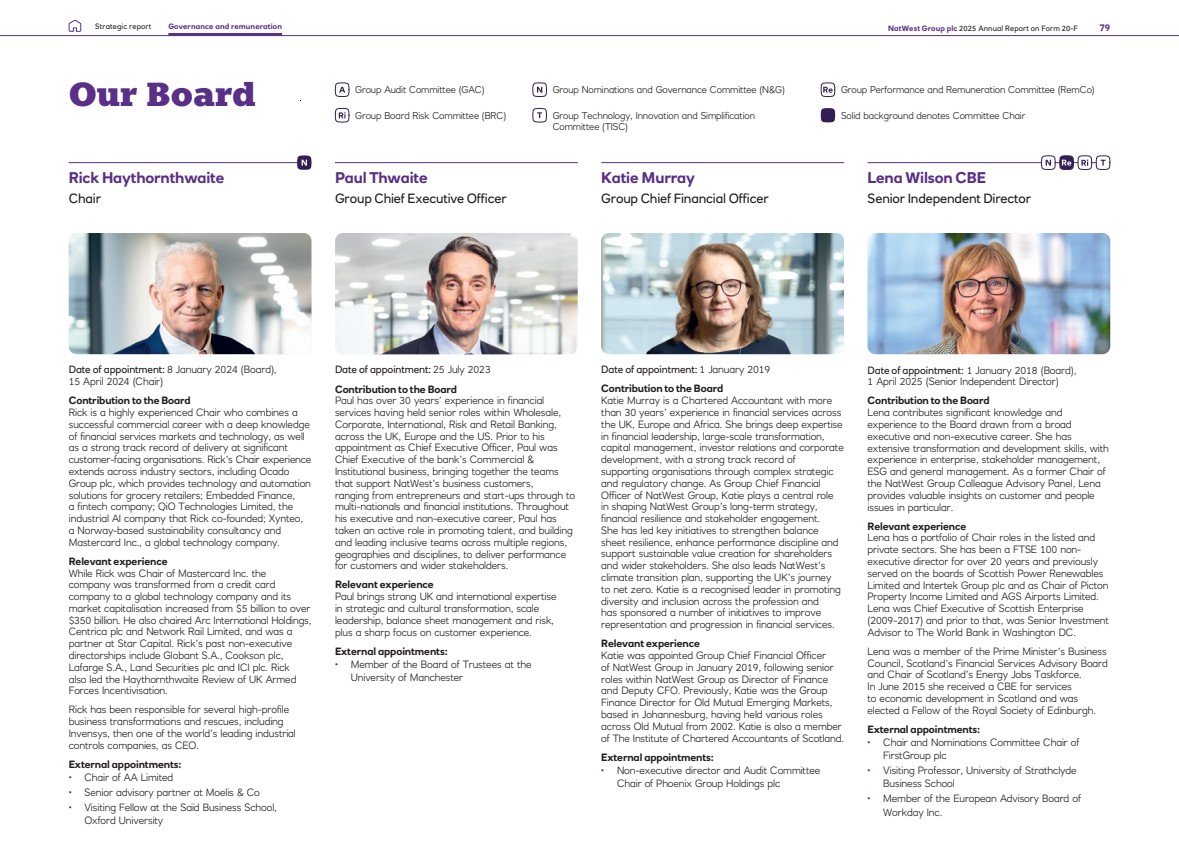
| Our Board continued Roisin Donnelly Independent non-executive director Josh Critchley Independent non-executive director Patrick Flynn Independent non-executive director Geeta Gopalan Independent non-executive director Date of appointment: 1 October 2022 Contribution to the Board Roisin brings extensive customer, marketing and branding experience to the Board, gained during her long executive career at Procter & Gamble. She has a strong background in digital transformation and data, and significant knowledge and experience of developing ESG strategies at board level. Roisin also brings practical board and committee experience to the role, having served on a number of listed company boards. In April 2023, Roisin was appointed as NatWest Group’s Consumer Duty Board Champion. She is also the Chair of the NatWest Group Colleague Advisory Panel, which provides a valuable link to colleague and customer issues. Relevant experience Roisin spent over 30 years leading marketing and brand building at Procter & Gamble in different UK and international roles. Most recently Roisin served as Chief Marketing Officer for Procter & Gamble Northern Europe (2014-2016) and prior to that served as Chief Marketing Officer for Procter & Gamble UK and Ireland (2002-2014). Roisin’s previous non-executive directorships include HomeServe plc, Just Eat plc, Holland and Barrett Limited, and Bourne Leisure Limited. She is an Honorary Fellow of the Marketing Society. External appointments: • Non-executive director of Premier Foods plc • Non-executive director and Remuneration Committee Chair of The Sage Group plc • Member of the Digital Advisory Board, Coca-Cola Europacific Partners plc • Non-executive Advisor, Internet Advertising Bureau • Trustee of The British Heart Foundation Date of appointment: 3 November 2025 Contribution to the Board Josh is a senior financial services leader with over 30 years’ experience in investment banking. He has advised company boards and management teams around the world on complex financial, operational, and capital market matters. His expertise in capital markets and investment banking strengthens the Board’s knowledge, especially in supporting strategy and growth. Relevant experience Josh is the former Vice Chair of Global Investment Banking at the Royal Bank of Canada (RBC). Prior to that, he spent twelve years (2011–2022) leading RBC’s European and Asian Investment Banking teams, including 7 years as a member of the firm’s Global Operating Committee. He originally joined RBC in 2009 to help expand its investment banking and equities presence in Europe, supporting the bank’s transformation into a full-service investment banking provider. Before joining RBC, Josh held senior roles at Goldman Sachs and Merrill Lynch. External appointments: • Trustee and Investment Committee Chair at Great Ormond Street Hospital Charity • Honorary Senior Visiting Fellow at Bayes Business School, City St George’s, University of London Date of appointment: 1 June 2018 Contribution to the Board Patrick contributes significant retail and commercial banking experience to the Board, together with a background in complex organisational restructuring and technology transformation. This experience enables Patrick to provide insightful contributions to Board discussions on complex matters, alongside his significant financial knowledge and expertise. Relevant experience Patrick was the Chief Financial Officer and a member of the Executive Board of ING Group for over eight years to May 2017. Prior to that, he worked for HSBC for 20 years. He is also a Fellow of Chartered Accountants Ireland. External appointments: • Senior Independent Director and Audit Committee Chair of Aviva plc Date of appointment: 1 July 2024 Contribution to the Board Geeta brings substantial financial and banking expertise to the Board with over 25 years of expertise in business leadership and management roles across commercial and retail financial services in the UK and internationally, as well as social investment and community development. Geeta has a strong track record as a non-executive director, having served on boards in a variety of industries including financial services, pharmaceuticals and technology. Relevant experience Geeta has served as a non-executive director of Virgin Money UK plc, where she chaired the Risk Committee; Dechra Pharmaceuticals Ltd, Ultra Electronics Plc, WiZink Bank S.A., and Vocalink. Geeta is also a Qualified Chartered Accountant of the Chartered Accountants Institute, India. External appointments: • Non-executive director of Intrum AB • Non-executive director of Auto Trader Group plc • Non-executive director of Clear Score Technology Limited • Trustee and Finance Committee Chair at The Old Vic Theatre Strategic report Strategic report Governance and remuneration Financial review Governance and remuneration Risk and capital management Financial statements Additional information NatWest Group plc NatWest Group plc 2025 Annual Report and Accounts 2025 Annual Report on Form 20-F 9780 |
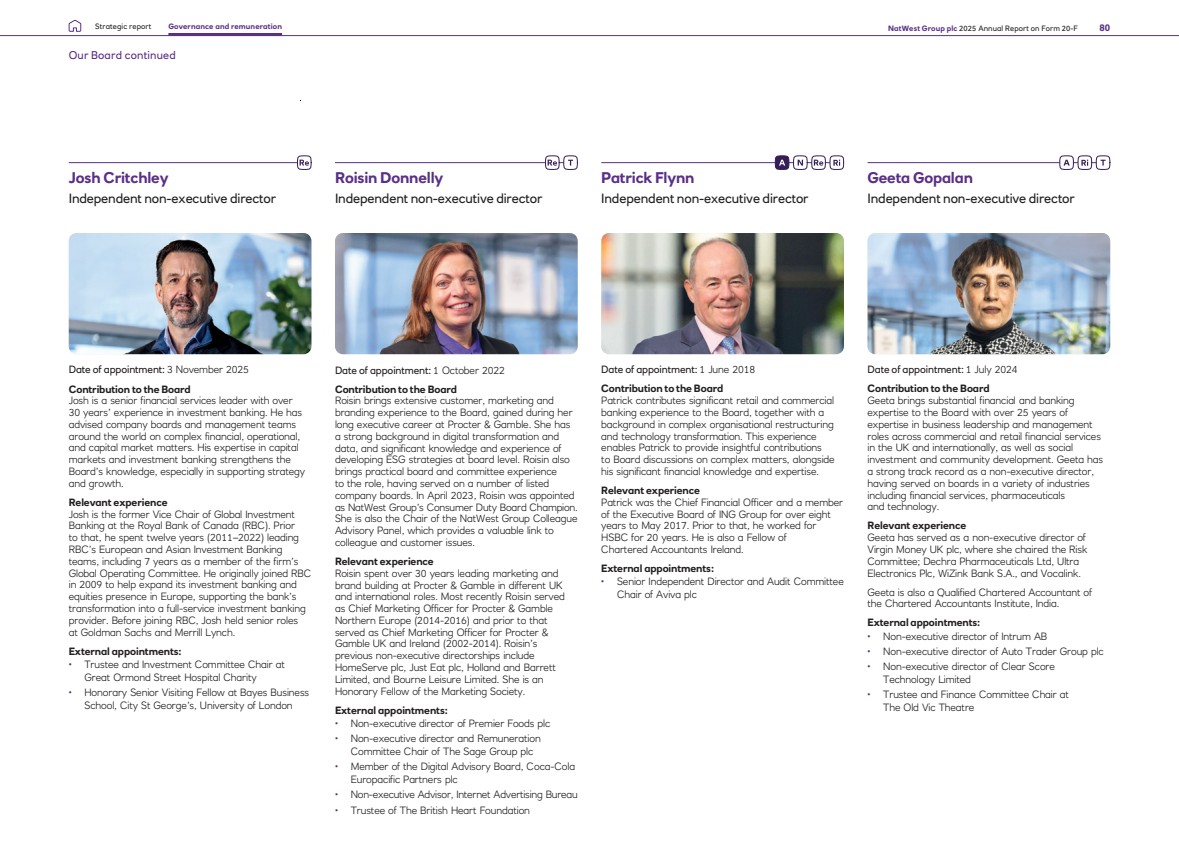
| Our Board continued Roisin Donnelly Independent non-executive director Josh Critchley Independent non-executive director Patrick Flynn Independent non-executive director Geeta Gopalan Independent non-executive director Date of appointment: 1 October 2022 Contribution to the Board Roisin brings extensive customer, marketing and branding experience to the Board, gained during her long executive career at Procter & Gamble. She has a strong background in digital transformation and data, and significant knowledge and experience of developing ESG strategies at board level. Roisin also brings practical board and committee experience to the role, having served on a number of listed company boards. In April 2023, Roisin was appointed as NatWest Group’s Consumer Duty Board Champion. She is also the Chair of the NatWest Group Colleague Advisory Panel, which provides a valuable link to colleague and customer issues. Relevant experience Roisin spent over 30 years leading marketing and brand building at Procter & Gamble in different UK and international roles. Most recently Roisin served as Chief Marketing Officer for Procter & Gamble Northern Europe (2014-2016) and prior to that served as Chief Marketing Officer for Procter & Gamble UK and Ireland (2002-2014). Roisin’s previous non-executive directorships include HomeServe plc, Just Eat plc, Holland and Barrett Limited, and Bourne Leisure Limited. She is an Honorary Fellow of the Marketing Society. External appointments: • Non-executive director of Premier Foods plc • Non-executive director and Remuneration Committee Chair of The Sage Group plc • Member of the Digital Advisory Board, Coca-Cola Europacific Partners plc • Non-executive Advisor, Internet Advertising Bureau • Trustee of The British Heart Foundation Date of appointment: 3 November 2025 Contribution to the Board Josh is a senior financial services leader with over 30 years’ experience in investment banking. He has advised company boards and management teams around the world on complex financial, operational, and capital market matters. His expertise in capital markets and investment banking strengthens the Board’s knowledge, especially in supporting strategy and growth. Relevant experience Josh is the former Vice Chair of Global Investment Banking at the Royal Bank of Canada (RBC). Prior to that, he spent twelve years (2011–2022) leading RBC’s European and Asian Investment Banking teams, including 7 years as a member of the firm’s Global Operating Committee. He originally joined RBC in 2009 to help expand its investment banking and equities presence in Europe, supporting the bank’s transformation into a full-service investment banking provider. Before joining RBC, Josh held senior roles at Goldman Sachs and Merrill Lynch. External appointments: • Trustee and Investment Committee Chair at Great Ormond Street Hospital Charity • Honorary Senior Visiting Fellow at Bayes Business School, City St George’s, University of London Date of appointment: 1 June 2018 Contribution to the Board Patrick contributes significant retail and commercial banking experience to the Board, together with a background in complex organisational restructuring and technology transformation. This experience enables Patrick to provide insightful contributions to Board discussions on complex matters, alongside his significant financial knowledge and expertise. Relevant experience Patrick was the Chief Financial Officer and a member of the Executive Board of ING Group for over eight years to May 2017. Prior to that, he worked for HSBC for 20 years. He is also a Fellow of Chartered Accountants Ireland. External appointments: • Senior Independent Director and Audit Committee Chair of Aviva plc Date of appointment: 1 July 2024 Contribution to the Board Geeta brings substantial financial and banking expertise to the Board with over 25 years of expertise in business leadership and management roles across commercial and retail financial services in the UK and internationally, as well as social investment and community development. Geeta has a strong track record as a non-executive director, having served on boards in a variety of industries including financial services, pharmaceuticals and technology. Relevant experience Geeta has served as a non-executive director of Virgin Money UK plc, where she chaired the Risk Committee; Dechra Pharmaceuticals Ltd, Ultra Electronics Plc, WiZink Bank S.A., and Vocalink. Geeta is also a Qualified Chartered Accountant of the Chartered Accountants Institute, India. External appointments: • Non-executive director of Intrum AB • Non-executive director of Auto Trader Group plc • Non-executive director of Clear Score Technology Limited • Trustee and Finance Committee Chair at The Old Vic Theatre Strategic report Financial review Governance and remuneration Risk and capital management Financial statements Additional information NatWest Group plc 2025 Annual Report and Accounts 97 Yasmin Jetha Independent non-executive director Date of appointment: 1 April 2020 Contribution to the Board Yasmin brings a wealth of retail banking and customer experience to the Board, as well as valuable technology and innovation insights. On 1 April 2020 Yasmin re-joined the Board of NatWest Group plc, having first been appointed in June 2017. Yasmin stepped down in April 2018 to serve solely as a director of our key ring-fenced entities, She continues to serve on these boards in addition to the Board of NatWest Group plc. Relevant experience During her executive career, Yasmin held Chief Information Officer roles at Bupa and the Financial Times, where she later became the Chief Operating Officer. Prior to that Yasmin held several senior roles at Abbey National PLC, in a career spanning nearly 20 years, where latterly she served as an executive director on the board. External appointments: • Non-executive director of Guardian Media Group plc Our Board continued Gill Whitehead OBE Independent non-executive director Stuart Lewis Independent non-executive director Gary Moore Chief Governance Officer and Company Secretary Date of appointment: 8 January 2025 Contribution to the Board Gill has over 25 years of executive experience in the consumer technology and media sectors having worked at Ofcom, Google, Channel 4 and the BBC. She is a Visiting Policy Fellow at the University of Oxford’s Internet Institute, focusing on global developments in online and AI safety. Her board experience spans FTSE 50 companies, public bodies, and sport. Gill is a fellow of the Institute of Chartered Accountants of England and Wales. Relevant experience Gill has served as a non-executive director of the Financial Ombudsman Service and Camelot (operator of the National Lottery). She also served as Google UK’s Senior Director of Client Solutions & Analytics. Prior to this, Gill worked in media at Channel 4 and the BBC and supervised several big tech firms at Ofcom. Gill was awarded an OBE for services to women’s rugby in the King’s New Year Honours list for 2026. External appointments: • Non-executive director and Audit Committee Chair of Informa plc • Non-executive director of the British Olympic Association • Chair of the Women’s Rugby World Cup 2025 • Member of the Advisory Council at Frontier Economics Date of appointment: 1 April 2023 Contribution to the Board Stuart brings extensive risk management, financial services and regulatory experience to the Board gained during his executive career, predominantly at Deutsche Bank, where he served for 10 years on the Management Board as Chief Risk Officer. Stuart also brings practical board-level experience, having served on a number of boards and committees in both executive and non-executive capacities. Relevant experience Stuart was previously a non-executive director of the London Stock Exchange Group plc. He was also previously a Member of the Foundation Board of the International Financial Risk Institute and served as Chair. External appointments: • Non-executive director of Singapore Exchange Limited • Member of the Board of Trustees of the Global Association of Risk Professionals • Visiting Professor in Practice in the Finance Department, London School of Economics Date of appointment: 14 February 2025 Contribution to the Board Gary works closely with the Chair to ensure effective and efficient functioning of the Board and appropriate alignment and information flows between the Board and its committees. He is responsible for advising the Board and individual directors on all governance matters, while also facilitating Board induction and directors’ professional development. Relevant experience Gary is a qualified lawyer with significant governance, legal and regulatory experience. Prior to his appointment as Chief Governance Officer and Company Secretary, Gary held various roles in the Corporate Governance function, including Head of Corporate Secretariat and Deputy Company Secretary. Prior to joining NatWest, Gary was a Senior Associate at Allen & Overy. Former directors • Mark Seligman retired from the Board on 31 March 2025 • Frank Dangeard stepped down from the Board on 23 April 2025 Strategic report Strategic report Governance and remuneration Financial review Governance and remuneration Risk and capital management Financial statements Additional information NatWest Group plc NatWest Group plc 2025 Annual Report and Accounts 2025 Annual Report on Form 20-F 9881 |
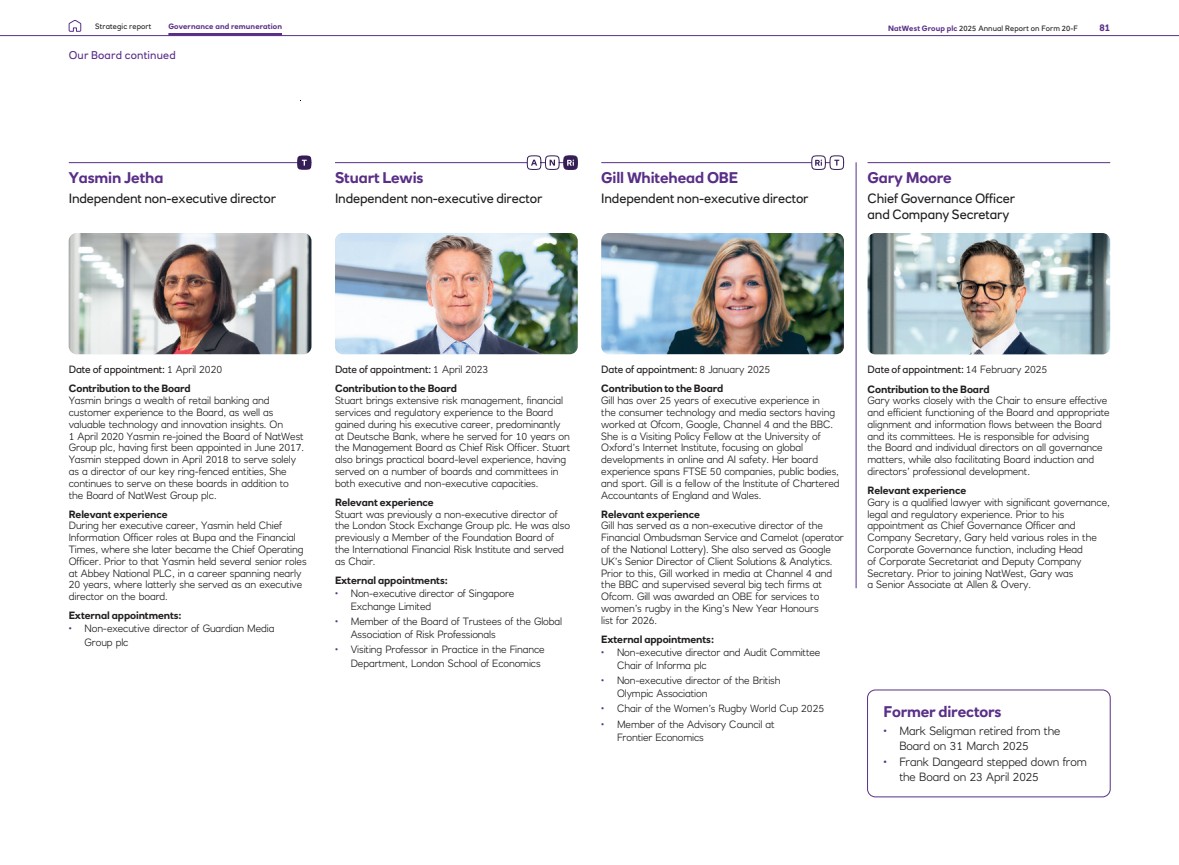
| Board composition overview Board and committee changes 2025 1 January Geeta Gopalan joined the Group Audit Committee, Group Board Risk Committee and Group Sustainable Banking Committee. 8 January Gill Whitehead was appointed as an independent non-executive director, and joined the Group Board Risk Committee and Group Sustainable Banking Committee. 31 March Mark Seligman retired from the Board and as Senior Independent Director. 1 April Lena Wilson assumed the role of Senior Independent Director. 23 April Frank Dangeard stepped down as a director and as Chair of NatWest Markets Plc and NatWest Markets N.V. 10 June Patrick Flynn joined the Group Performance and Remuneration Committee. 3 November Josh Critchley was appointed as an independent non-executive director. 11 December Josh Critchley joined the Group Performance and Remuneration Committee. 2026 23 February* Albert Hitchcock will join the Board as an independent non-executive director. 31 March Yasmin Jetha will retire from the Board, and Patrick Flynn will step down as a member of the Group Performance and Remuneration Committee. * Albert’s appointment date will be one week later than previously announced, due to a scheduling adjustment. Female Minority ethnic 45-55 Chair 55% 2 3 1 Male White 56-65 66-75 Executive directors 45% 9 6 2 2 Independent non-executive directors Chair and non-executive directors’ tenure Full Board average tenure: 3.4 years 2017 2018 2019 2020 2021 2022 2023 2024 2025 2026 2027 2028 2029 2030 2031 2032 2033 2034 Yasmin Jetha Lena Wilson* Patrick Flynn Roisin Donnelly Stuart Lewis Rick Haythornthwaite* Geeta Gopalan Gill Whitehead* Josh Critchley * Will reach 9 years in January of the relevant year. 8 Independence Sex Ethnicity Age range As at 31 December 2025 there were 11 directors on the Board. Strategic report Strategic report Governance and remuneration Financial review Governance and remuneration Risk and capital management Financial statements Additional information NatWest Group plc NatWest Group plc 2025 Annual Report and Accounts 2025 Annual Report on Form 20-F 9982 |
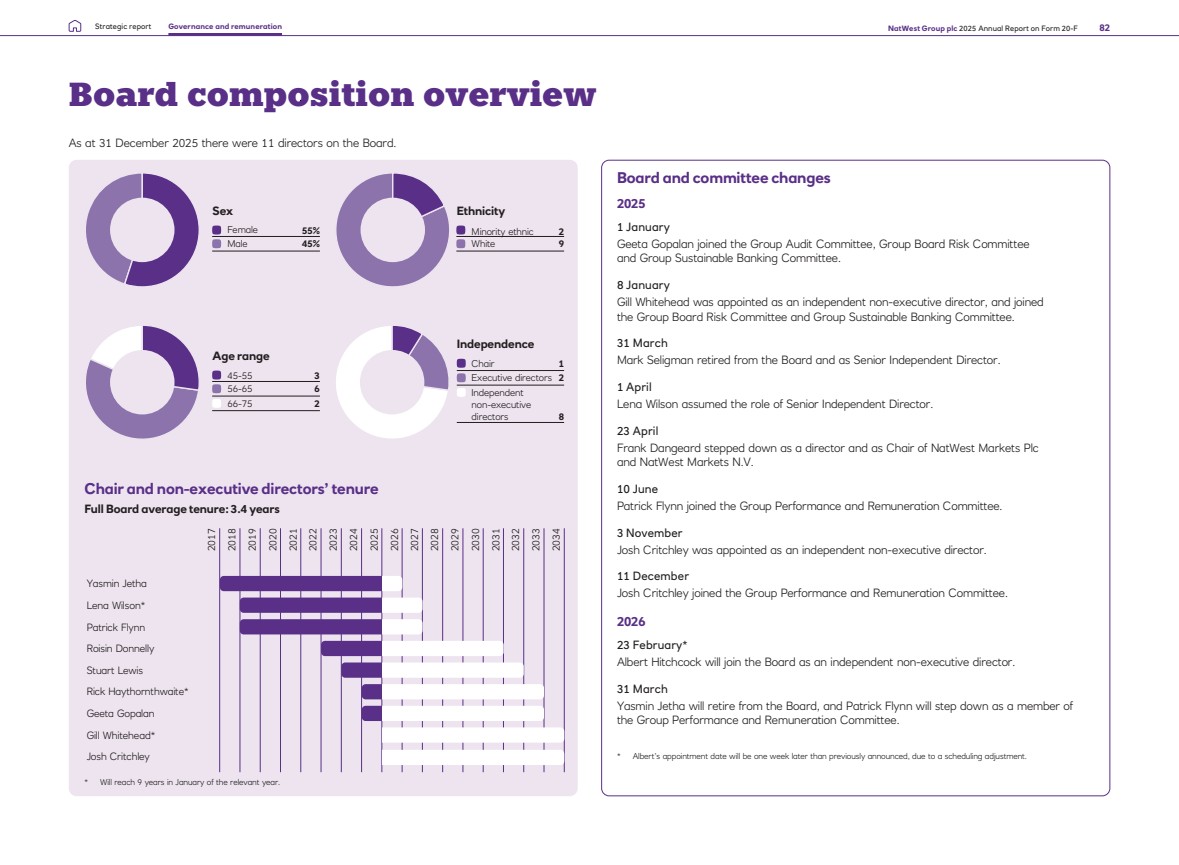
| Board composition overview Board and committee changes 2025 1 January Geeta Gopalan joined the Group Audit Committee, Group Board Risk Committee and Group Sustainable Banking Committee. 8 January Gill Whitehead was appointed as an independent non-executive director, and joined the Group Board Risk Committee and Group Sustainable Banking Committee. 31 March Mark Seligman retired from the Board and as Senior Independent Director. 1 April Lena Wilson assumed the role of Senior Independent Director. 23 April Frank Dangeard stepped down as a director and as Chair of NatWest Markets Plc and NatWest Markets N.V. 10 June Patrick Flynn joined the Group Performance and Remuneration Committee. 3 November Josh Critchley was appointed as an independent non-executive director. 11 December Josh Critchley joined the Group Performance and Remuneration Committee. 2026 23 February* Albert Hitchcock will join the Board as an independent non-executive director. 31 March Yasmin Jetha will retire from the Board, and Patrick Flynn will step down as a member of the Group Performance and Remuneration Committee. * Albert’s appointment date will be one week later than previously announced, due to a scheduling adjustment. Female Minority ethnic 45-55 Chair 55% 2 3 1 WhiteMale 56-65 66-75 Executive directors 45% 9 6 2 2 Independent non-executive directors Chair and non-executive directors’ tenure Full Board average tenure: 3.4 years 2017 2018 2019 2020 2021 2022 2023 2024 2025 2026 2027 2028 2029 2030 2031 2032 2033 2034 Yasmin Jetha Lena Wilson* Patrick Flynn Roisin Donnelly Stuart Lewis Rick Haythornthwaite* Geeta Gopalan Gill Whitehead* Josh Critchley * Will reach 9 years in January of the relevant year. 8 Independence EthnicitySex Age range As at 31 December 2025 there were 11 directors on the Board. Strategic report Financial review Risk and capital management Financial statements Additional information Governance and remuneration NatWest Group plc 2025 Annual Report and Accounts 99 Executive management team Paul Thwaite Group Chief Executive Officer Robert Begbie CEO, Commercial & Institutional Scott Marcar Group Chief Information Officer Katie Murray Group Chief Financial Officer James Holian Chief Customer & Operations Officer Sean Pilcher Interim Group Chief Risk Officer Maria Kokkinou Group Chief People Officer Rachel Hopcroft CBE Group Chief Corporate Affairs Officer Solange Chamberlain CEO, Retail Emma Crystal CEO, Private Banking & Wealth Management Margaret Jobling Group Chief Marketing Officer Will Luker Group Chief Legal Officer and General Counsel Peter Norton Group Director, Strategy, Economics and Corporate Development Nick Curle Group Chief Audit Executive The executive management team supports the Group Chief Executive Officer (CEO) in managing NatWest Group’s businesses and in the discharge of his regulatory accountabilities. The team holds regular meetings, including the Group Executive Committee. Strategic report Financial review Risk and capital management Financial statements Additional information Strategic report Governance and remuneration Governance and remuneration NatWest Group plc NatWest Group plc 2025 Annual Report and Accounts 2025 Annual Report on Form 20-F 10083 Executive management team biographies are available on the NatWest Group website Further information on the responsibilities of the executive management team can be found on page 88. |
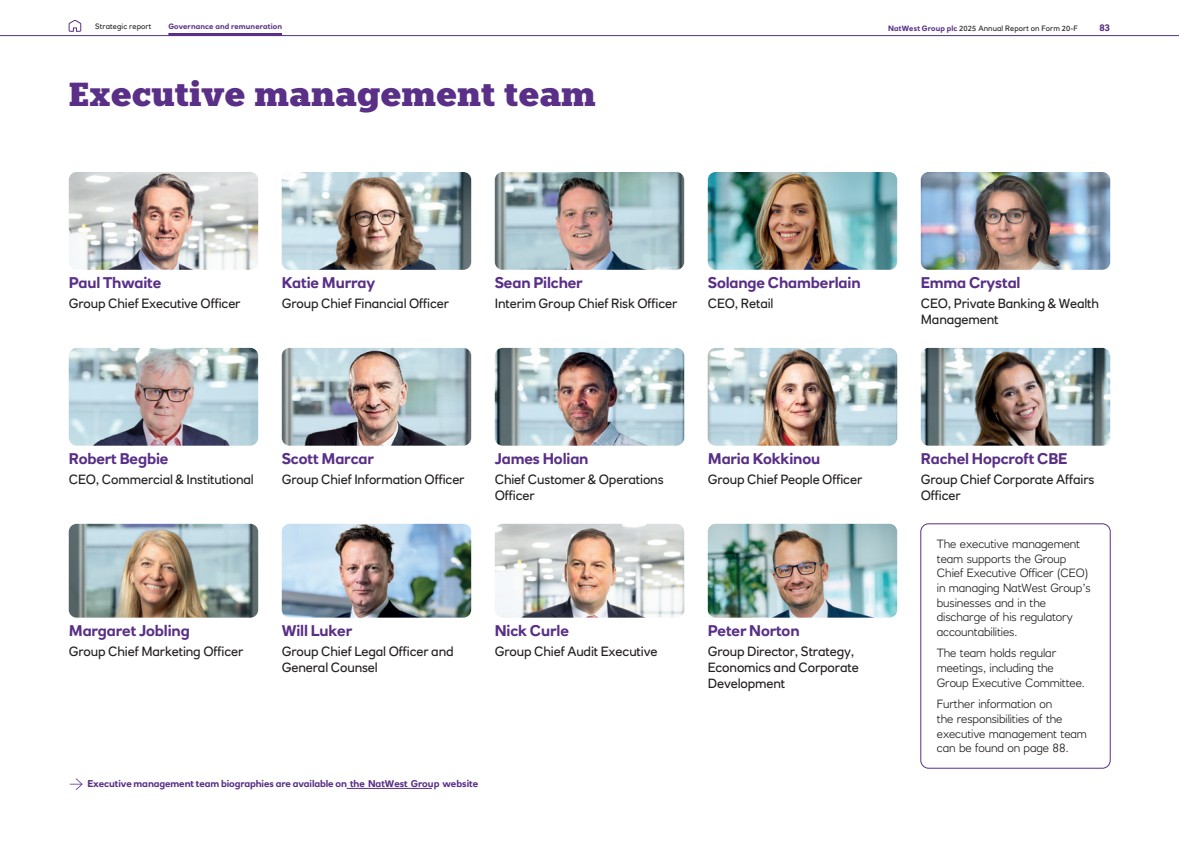
| Chair’s introduction elevated to become Board-level matters. By delegating routine matters to Board committees, we have been able to devote more time in Board meetings to strategic discussions on customer-centric topics such as digital assets, climate and sustainability, and the innovation economy. The Board has also considered how changes in the regulatory, geopolitical and economic environment inform our approach to resilience and relevance, with a particular focus on safeguarding and enhancing the customer experience in a changing world. 2025 also brought several changes in Board membership. Lena Wilson succeeded Mark Seligman as Senior Independent Director following Mark’s retirement at the end of March. The Board welcomed Josh Critchley as an independent non-executive director in November 2025 and I am delighted that Albert Hitchcock will join the Board as an independent non-executive director on 23 February 2026. I would like to thank my fellow directors for their valuable contribution and professionalism throughout 2025. The Board’s collective expertise and constructive challenge has been central to our progress, and I am grateful for the support and engagement shown both in the boardroom and across the business. I look forward to continuing our work together as we support delivery of NatWest Group’s strategic priorities in the year ahead. Rick Haythornthwaite Chair of the Board 12 February 2026 Principal areas of focus • Purpose and strategy • Culture • Stakeholder engagement • Customers • Risk and controls • Financial • Legal, regulatory and governance Dear Shareholder, I am pleased to present the 2025 Corporate governance report. Before going any further, I’d like to pause and reflect on the sad news of Frank Dangeard’s passing in August. Frank was a highly valued and respected director, colleague and friend to many of us at NatWest, and his wise counsel will be greatly missed. 2025 was a year of meaningful transformation and progress for the Board of directors. Building on the themes identified during the 2024 Board effectiveness review and my own reflections since taking on the role of Chair, we entered 2025 with a renewed commitment to evolve our Board and governance operating model, focused on our ambition to develop further as a high-performing Board. In support of a refreshed governance operating model, the Board and management conducted a comprehensive review of the remit of the Board and its committees, to ensure each forum remains focused on the most critical matters. Notably, the Group Sustainable Banking Committee (SBC) transitioned into the Group Technology, Innovation and Simplification Committee, underscoring our commitment to technological advancement and organisational agility, with a number of SBC focus areas, such as ESG, Consumer Duty, organisational development and culture ‘The Board remains committed to supporting our customers and the wider UK economy. We will continue to evolve our Board and governance operating model to ensure we are well-positioned for the challenges and opportunities ahead.’ Strategic report Financial review Risk and capital management Financial statements Additional information Strategic report Governance and remuneration Governance and remuneration NatWest Group plc NatWest Group plc 2025 Annual Report and Accounts 2025 Annual Report on Form 20-F 10184 The introduction of new performance metrics has further enhanced our understanding of business performance and customer outcomes. During 2025, the Board held a number of performance-related spotlight sessions on key topics, including: deposits, mortgages, customer onboarding, and customer experience. These sessions were underpinned by performance data and analysis, which provided the Board with deeper insights into progress against strategic objectives, enabled more informed decision-making, and supported targeted actions to drive improvements in such areas. As part of our commitment to deepening strategic engagement and understanding the needs of our customers and colleagues, the Board visited Birmingham and the West Midlands in September 2025, meeting with local clients, colleagues and stakeholders to hear first-hand about the opportunities and challenges facing the region. You can find further details of the visit on page 95. During 2025, the Board’s priorities have included strengthening directors’ expertise, enhancing strategic engagement, improving Board dynamics, sharpening our focus on ESG, and leveraging data and analytics to guide our decisions. These priorities have shaped the Board agenda and are described in more detail on page 85 and reflected throughout this Corporate governance report. Yasmin Jetha will retire from the Board on 31 March 2026 having made an outstanding contribution. Yasmin leaves with our very best wishes for the future. See page 82 for full details of Board and committee membership changes in 2025/2026. |
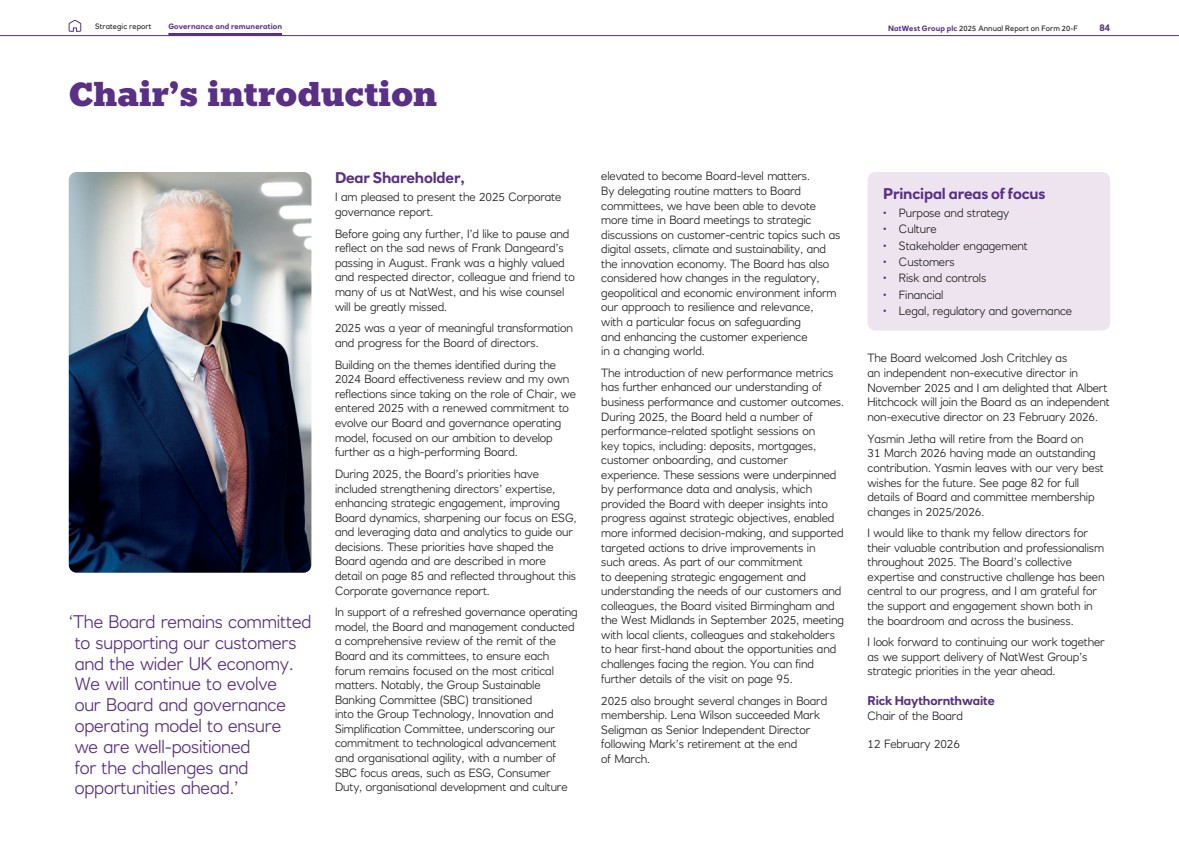
| Chair’s introduction elevated to become Board-level matters. By delegating routine matters to Board committees, we have been able to devote more time in Board meetings to strategic discussions on customer-centric topics such as digital assets, climate and sustainability, and the innovation economy. The Board has also considered how changes in the regulatory, geopolitical and economic environment inform our approach to resilience and relevance, with a particular focus on safeguarding and enhancing the customer experience in a changing world. The introduction of new performance metrics has further enhanced our understanding of business performance and customer outcomes. During 2025, the Board held a number of performance-related spotlight sessions on key topics, including: deposits, mortgages, customer onboarding, and customer experience. These sessions were underpinned by performance data and analysis, which provided the Board with deeper insights into progress against strategic objectives, enabled more informed decision-making, and supported targeted actions to drive improvements in such areas. As part of our commitment to deepening strategic engagement and understanding the needs of our customers and colleagues, the Board visited Birmingham and the West Midlands in September 2025, meeting with local clients, colleagues and stakeholders to hear first-hand about the opportunities and challenges facing the region. You can find further details of the visit on page 112. 2025 also brought several changes in Board membership. Lena Wilson succeeded Mark Seligman as Senior Independent Director following Mark’s retirement at the end of March. The Board welcomed Josh Critchley as an independent non-executive director in November 2025 and I am delighted that Albert Hitchcock will join the Board as an independent non-executive director on 23 February 2026. Yasmin Jetha will retire from the Board on 31 March 2026 having made an outstanding contribution. Yasmin leaves with our very best wishes for the future. See page 99 for full details of Board and committee membership changes in 2025/2026. I would like to thank my fellow directors for their valuable contribution and professionalism throughout 2025. The Board’s collective expertise and constructive challenge has been central to our progress, and I am grateful for the support and engagement shown both in the boardroom and across the business. I look forward to continuing our work together as we support delivery of NatWest Group’s strategic priorities in the year ahead. Rick Haythornthwaite Chair of the Board 12 February 2026 Principal areas of focus • Purpose and strategy • Culture • Stakeholder engagement • Customers • Risk and controls • Financial • Legal, regulatory and governance Dear Shareholder, I am pleased to present the 2025 Corporate governance report. Before going any further, I’d like to pause and reflect on the sad news of Frank Dangeard’s passing in August. Frank was a highly valued and respected director, colleague and friend to many of us at NatWest, and his wise counsel will be greatly missed. 2025 was a year of meaningful transformation and progress for the Board of directors. Building on the themes identified during the 2024 Board effectiveness review and my own reflections since taking on the role of Chair, we entered 2025 with a renewed commitment to evolve our Board and governance operating model, focused on our ambition to develop further as a high-performing Board. During 2025, the Board’s priorities have included strengthening directors’ expertise, enhancing strategic engagement, improving Board dynamics, sharpening our focus on ESG, and leveraging data and analytics to guide our decisions. These priorities have shaped the Board agenda and are described in more detail on page 102 and reflected throughout this Corporate governance report. In support of a refreshed governance operating model, the Board and management conducted a comprehensive review of the remit of the Board and its committees, to ensure each forum remains focused on the most critical matters. Notably, the Group Sustainable Banking Committee (SBC) transitioned into the Group Technology, Innovation and Simplification Committee, underscoring our commitment to technological advancement and organisational agility, with a number of SBC focus areas, such as ESG, Consumer Duty, organisational development and culture ‘The Board remains committed to supporting our customers and the wider UK economy. We will continue to evolve our Board and governance operating model to ensure we are well-positioned for the challenges and opportunities ahead.’ Strategic report Financial review Governance and remuneration Risk and capital management Financial statements Additional information NatWest Group plc 2025 Annual Report and Accounts 101 Governance at a glance Continuing to evolve and enhance our Board and committee governance in support of our sustainable strategy. In February, 2025 the Board set an ambition to develop further as a high-performing Board, driving innovation, ensuring robust governance and delivering sustained, profitable growth. The Board agreed to progress a series of actions under the themes shown below to build further on the Board’s strong foundations and acknowledging the key findings of the 2024 Board effectiveness review. The outcomes of our Board evolution action plan are highlighted throughout this Corporate governance report and sign-posted opposite. Board evolution in action Strengthening a nd analytics ESG focus Board dyna mic s Enhancing strategic Board expertise L e ve raging data Sharpening Improving engagement Strengthening Board expertise by… p.103 Using our Board skills matrix to support Board composition and succession planning, and new non-executive director induction. p.113 Developing an enhanced approach to Board learning, including the use of online tools and resources. p.122 Evolving and systemising our search and recruitment process and practices for new non-executive directors. Enhancing strategic engagement by… p.108 Re-balancing Board and committee oversight responsibilities to support the Board’s strategic focus. p.108 Continuing to bring a range of external perspectives into the boardroom. p.137 Establishing the Group Technology, Innovation and Simplification Committee. Improving Board dynamics by… p.108 Fostering a culture of collaboration, constructive challenge and collegiality. p.116 Considering Board culture and behaviours and how the Board sets the ‘tone from the top’. Sharpening ESG focus by… p.36 Considering NatWest Group’s definition of sustainability, and its climate ambition and targets. p.106 Enhancing Board visibility and oversight of ESG matters. Leveraging data and analytics by… p.108 Reviewing how Board and committee agenda time is allocated. p.116 Sharpening strategic focus through performance management oversight. Our Board evolution action plan Strategic report Strategic report Governance and remuneration Financial review Governance and remuneration Risk and capital management Financial statements Additional information NatWest Group plc NatWest Group plc 2025 Annual Report and Accounts 2025 Annual Report on Form 20-F 10285 |
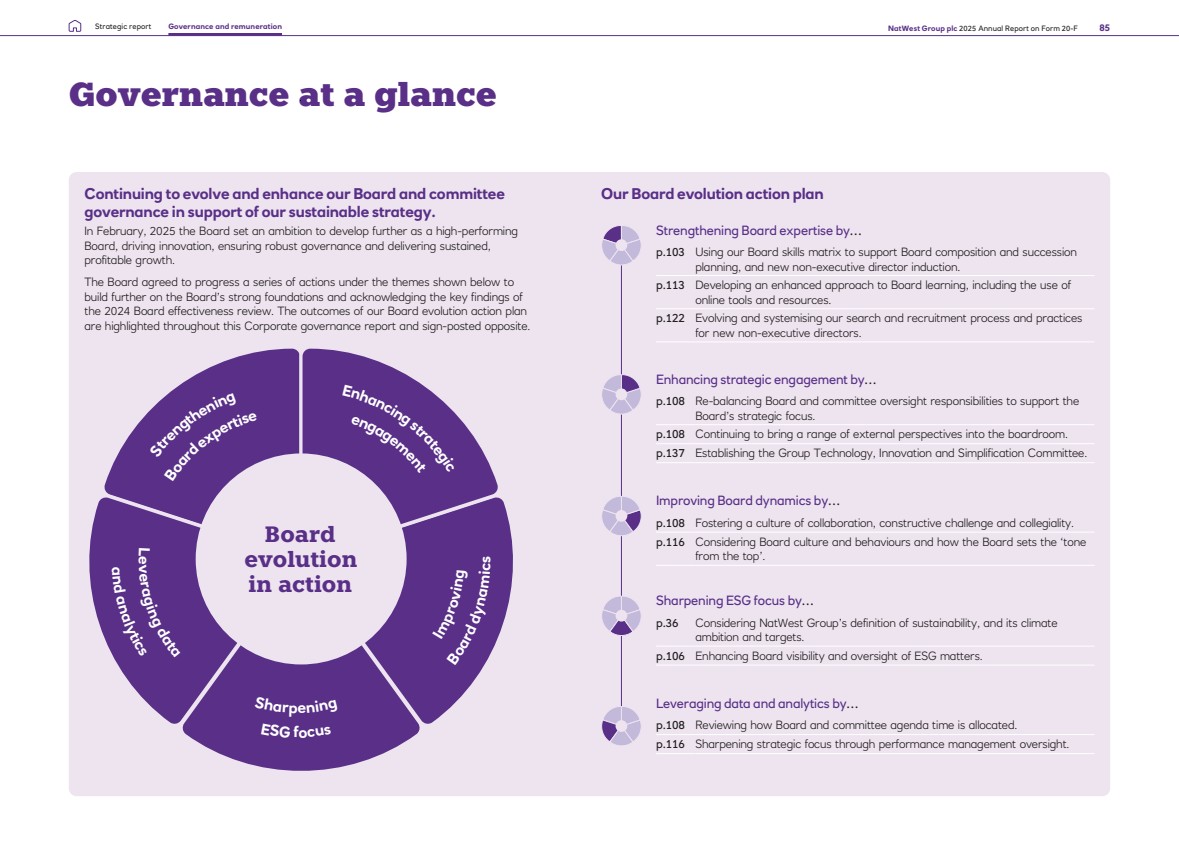
| Diversity in the boardroom Strengthening Board expertise Board skills and experience The Board recognises the value and importance of a comprehensive Board skills matrix to support effective governance and strategic oversight. In December 2025, our Board skills assessment was refreshed following a review of the six critical and ten general skills identified in 2024 as priorities for the Board over a three to five-year period. Using the BoardOutlook technology platform, all directors participated in an online process which involved both self-assessment and peer calibration elements. The 2025 Board skills assessment outputs confirmed the Board’s view of the collective expertise and capabilities of the Board against the organisation’s strategic priorities and governance needs, as reflected in the Board skills matrix below. The detailed data and analysis offered through the Board skills assessment has underpinned Board composition and succession planning, as well as supporting NED induction and professional development. Board and executive management diversity disclosures UK Listing Rule (UKLR) 6.6.6R (10) Table for reporting on gender identity or sex Number of Board members % of the Board Number of senior positions on the Board Number in executive management % of executive management Men 5 45 2 8 57 Women 6 55 2 6 43 Other categories 0 0 0 0 0 Not specified/prefer not to say 0 0 0 0 0 Table for reporting on ethnic background Number of Board members % of the Board Number of senior positions on the Board Number in executive management % of executive management White British or other White (including minority-White groups) 9 82 4 10 71 Mixed/Multiple ethnic groups 0 0 0 0 0 Asian/Asian British 2 18 0 0 0 Black/African/Caribbean/Black British 0 0 0 0 0 Other ethnic group 0 0 0 0 0 Not specified/prefer not to say 0 0 0 4 29 UK Listing Rule (UKLR) 6.6.6R (9) Compliance The company has met the targets on board diversity set out below as at 31 December 2025. UK Listing Rules requirement Outcome Group’s position at 31 December 2025 At least 40% of Board directors are women Target met 55% of Board directors were women At least one senior Board position held by a woman Target met The positions of CFO and Senior Independent Director are held by women At least one Board director from a minority ethnic background Target met Two Board directors are from a minority ethnic background Footnotes (these apply to both the UKLR 6.6.6R (9) and (10) tables above, unless otherwise stated). (1) All data as at 31 December 2025 (the reference date). (2) Data was collected via self-reporting methods – for Board directors this was via email and for members of the executive management team it was collected via our HR system Workday. (3) The Group CEO and Group CFO are members of both the Board and executive management and so are counted in both groups (UKLR 6.6.6R (10) table only). (4) Senior Board position is CEO, CFO, Chair or Senior Independent Director. For further information on our inclusion initiatives, see page 62. Critical skills Banking and financial services Customer and partner Risk management Consumer digital Strategy, innovation and disruption Enterprise digital General skills Corporate governance Major change and transformation Regulatory engagement Talent and leadership Accounting and financial reporting Remuneration Mergers, acquisitions and divestments Sustainability CEO experience Marketing, brand and communications Dark squares represent expert or advanced levels of skills or experience. Board skills matrix 2025 Strategic report Financial review Risk and capital management Financial statements Additional information Strategic report Governance and remuneration Governance and remuneration NatWest Group plc NatWest Group plc 2025 Annual Report and Accounts 2025 Annual Report on Form 20-F 10386 Our boardroom inclusion policy aims to promote diversity and inclusion in our Board and committee composition via targets which aspire to meet those set out in the UK Listing Rules, the FTSE Women Leaders Review and the Parker Review. A copy of the policy is available on the NatWest Group website. Details of the broader experience our directors contribute to the Board can be found in their biographies on pages 79 to 81 and further information on the Board skills matrix is provided in the N&G report on page 106. |
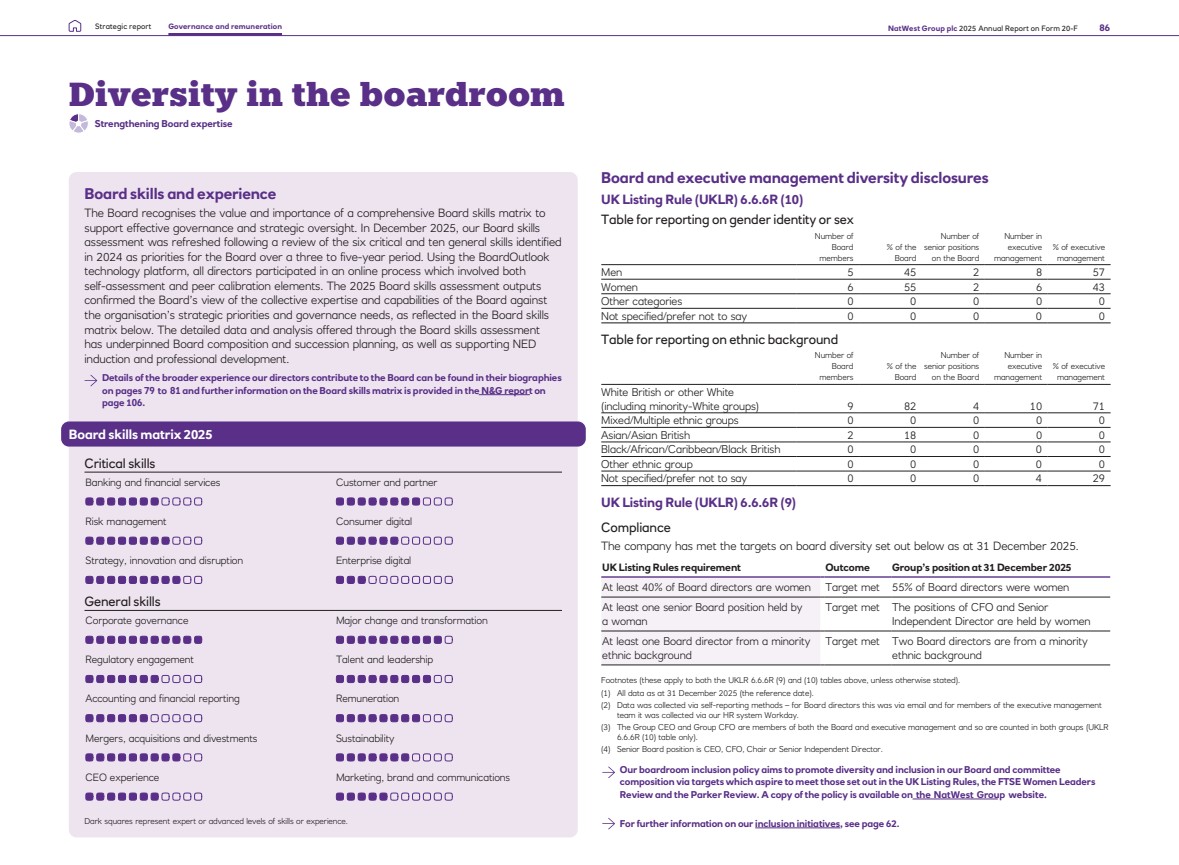
| Diversity in the boardroom Strengthening Board expertise Board skills and experience The Board recognises the value and importance of a comprehensive Board skills matrix to support effective governance and strategic oversight. In December 2025, our Board skills assessment was refreshed following a review of the six critical and ten general skills identified in 2024 as priorities for the Board over a three to five-year period. Using the BoardOutlook technology platform, all directors participated in an online process which involved both self-assessment and peer calibration elements. The 2025 Board skills assessment outputs confirmed the Board’s view of the collective expertise and capabilities of the Board against the organisation’s strategic priorities and governance needs, as reflected in the Board skills matrix below. The detailed data and analysis offered through the Board skills assessment has underpinned Board composition and succession planning, as well as supporting NED induction and professional development. Details of the broader experience our directors contribute to the Board can be found in their biographies on pages 96 to 98 and further information on the Board skills matrix is provided in the N&G report on page 122. Board and executive management diversity disclosures UK Listing Rule (UKLR) 6.6.6R (10) Table for reporting on gender identity or sex Number of Board members % of the Board Number of senior positions on the Board Number in executive management % of executive management Men 5 45 2 8 57 Women 6 55 2 6 43 Other categories 0 0 0 0 0 Not specified/prefer not to say 0 0 0 0 0 Table for reporting on ethnic background Number of Board members % of the Board Number of senior positions on the Board Number in executive management % of executive management White British or other White (including minority-White groups) 9 82 4 10 71 Mixed/Multiple ethnic groups 0 0 0 0 0 Asian/Asian British 2 18 0 0 0 Black/African/Caribbean/Black British 0 0 0 0 0 Other ethnic group 0 0 0 0 0 Not specified/prefer not to say 0 0 0 4 29 UK Listing Rule (UKLR) 6.6.6R (9) Compliance The company has met the targets on board diversity set out below as at 31 December 2025. UK Listing Rules requirement Outcome Group’s position at 31 December 2025 At least 40% of Board directors are women Target met 55% of Board directors were women At least one senior Board position held by a woman Target met The positions of CFO and Senior Independent Director are held by women At least one Board director from a minority ethnic background Target met Two Board directors are from a minority ethnic background Footnotes (these apply to both the UKLR 6.6.6R (9) and (10) tables above, unless otherwise stated). (1) All data as at 31 December 2025 (the reference date). (2) Data was collected via self-reporting methods – for Board directors this was via email and for members of the executive management team it was collected via our HR system Workday. (3) The Group CEO and Group CFO are members of both the Board and executive management and so are counted in both groups (UKLR 6.6.6R (10) table only). (4) Senior Board position is CEO, CFO, Chair or Senior Independent Director. Our boardroom inclusion policy aims to promote diversity and inclusion in our Board and committee composition via targets which aspire to meet those set out in the UK Listing Rules, the FTSE Women Leaders Review and the Parker Review. A copy of the policy is available at natwestgroup.com. For further information on our inclusion initiatives, see page 62. Critical skills Banking and financial services Customer and partner Risk management Consumer digital Strategy, innovation and disruption Enterprise digital General skills Corporate governance Major change and transformation Regulatory engagement Talent and leadership Accounting and financial reporting Remuneration Mergers, acquisitions and divestments Sustainability CEO experience Marketing, brand and communications Dark squares represent expert or advanced levels of skills or experience. Board skills matrix 2025 Strategic report Financial review Risk and capital management Financial statements Additional information Governance and remuneration NatWest Group plc 2025 Annual Report and Accounts 103 UK Corporate Governance Code 2024 All directors are committed to observing high standards of corporate governance, business integrity and professionalism. Throughout 2025, NatWest Group plc applied the Principles and complied with the Provisions of the 2024 UK Corporate Governance Code (the Code or UKGC Code) with the exception of Provision 29, which is effective from 1 January 2026. The company continued to comply with Provision 29 of the 2018 UK Corporate Governance Code during 2025. There was one short-term exception to the company’s compliance with Provision 32 that ‘the board should establish a remuneration committee of independent non-executive directors with a minimum membership of three.’ For a period of c.7 weeks in 2025, the Group Performance and Remuneration Committee (RemCo) had two independent non-executive directors as members, after Frank Dangeard stepped down from the Board on 23 April at short notice. Patrick Flynn joined RemCo on 10 June 2025 and Josh Critchley subsequently joined on 11 December 2025. Mr Flynn will step down as a member of RemCo on 31 March 2026. Applying the Code Principles The UK Listing Rules require companies to make a statement of how they have applied the Code’s Principles, in a manner that would enable shareholders to evaluate how the Principles have been applied. The boxes opposite are aligned to the five sections of the Code and include cross-references to relevant parts of this report where additional information can be found on our approach. Section 1 – Board leadership and company purpose • Our strategy (page 15) • Our business model (page 12) • Principal areas of Board focus in 2025 Section 2 – Division of responsibilities Section 3 – Composition, succession and evaluation Section 5 – Remuneration Section 4 – Audit, risk and internal control The following sections are of particular relevance: The Board regularly assesses the company’s emerging and principal risks in a variety of ways including through review of the Group Risk Report and dedicated training Strategic report Financial review Risk and capital management Financial statements Additional information Strategic report Governance and remuneration Governance and remuneration NatWest Group plc NatWest Group plc 2025 Annual Report and Accounts 2025 Annual Report on Form 20-F 10487 Information on how the company has applied the Principles and complied with the Provisions set out in this section of the Code can be found throughout the Annual Report on Form 20-F. (pages 92 to 95) • Board oversight of purpose, strategy and culture (page 99) • How the Board engaged with stakeholders (including our Colleague Advisory Panel) (pages 100 to 101) • Our governance framework (role and responsibilities of the Board and Board committees) (page 88) • Division of responsibilities (page 90) • Subsidiary governance and ring-fencing (page 97) • Board and committee membership and attendance (page 91 and relevant Board committee reports) • Board policies and processes, including external appointments and time commitment (page 98) • Directors’ biographies and committee memberships (pages 78 to 81) • Board composition overview as at 31 December 2025 (sex, ethnicity, age range, independence, tenure) (page 86) • Board and Board committee changes in 2025 and 2026 (page 82) • Board skills and experience, including the Board skills matrix (page 86) • Group Nominations and Governance Committee report (Board appointments, Board composition and succession planning, executive succession) (page 105) • 2025 Board effectiveness review (pages 102 to 104) • Board and executive management diversity disclosures and our Boardroom inclusion policy (page 86) • Group Audit Committee report (page 108) • Compliance report (page 152) • Group Board Risk Committee report (page 116) • Directors’ remuneration report (page 123) (Group Performance and Remuneration Committee activity and decisions during 2025; remuneration policy for executive directors; wider workforce remuneration) For further information on our approach towards Principle O of the Code, and preparations for Provision 29 of the 2024 Code becoming effective, see page 113. The information referred to on this page supports our statement of compliance on page 152. Details of the company’s principal risks, procedures in place to identify top and emerging risks, and how these are managed or mitigated, can be found on pages 72 to 77 (Risk overview) of and Capital Management) of the Annual Report on Form 20-F. this exhibit and pages 29 to 145 (Risk |
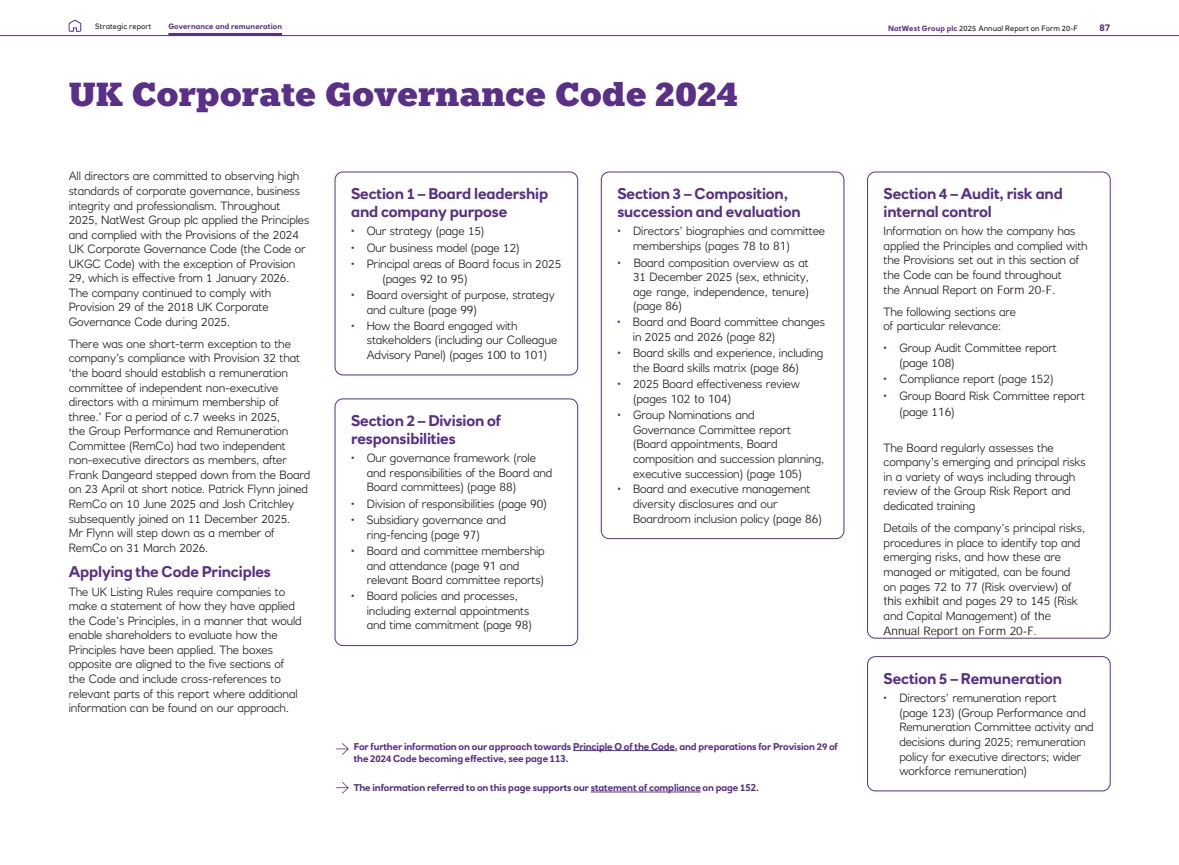
| • Is collectively responsible for promoting the long-term success of the company, driving shareholder value and NatWest Group’s contribution to wider society. • Establishes NatWest Group’s strategy and leads the development of its culture. • Provides leadership of the company within a framework of prudent and effective controls, which enables risk to be assessed and managed. • Sets the strategic aims of the company and its subsidiaries, ensures that the necessary resources are in place for NatWest Group to meet its objectives. • Is responsible for the allocation and raising of capital, and reviews business and financial performance. • Ensures that the company’s obligations to its shareholders and other key stakeholders are understood and met. Our governance framework Group Audit Committee (GAC) Assists the Board in discharging its responsibilities in relation to the disclosure of NatWest Group’s financial and non-financial reporting. Reviews accounting and financial reporting and regulatory compliance and NatWest Group’s system of internal controls. Monitors the processes for internal audit, risk management, external audit and whistleblowing. Group Board Risk Committee (BRC) Provides oversight and advice to the Board on current and potential future risk exposures of NatWest Group; future risk profile; and the approval and effectiveness of the enterprise-wide risk management framework. Reviews NatWest Group’s performance relative to risk appetite; the effectiveness of internal controls required to manage risk; and all material risk exposures. Group Nominations and Governance Committee (N&G) Assists the Board in the appointment of directors and with Board committee composition. Reviews the structure, size and composition of the Board and approves appointments to the boards of principal and material regulated subsidiaries. Monitors NatWest Group’s governance arrangements. Considers succession planning for the Board and senior management. Group Performance and Remuneration Committee (RemCo) Responsible for the overview of NatWest Group’s remuneration policy and the directors’ remuneration policy, ensuring that arrangements are designed to promote the long-term success of NatWest Group. Approves pay and performance outcomes for executive directors and senior members of management. Approves the annual Group-wide bonus pool. Group Technology, Innovation and Simplification Committee (TISC) Responsible for supporting the Board in overseeing NatWest Group’s use of technology, data and innovation to support delivery of its strategic ambitions. Oversees NatWest Group’s progress on technological enablers of simplification initiatives to ensure delivery and increase competitive advantage. To assist in providing effective oversight and leadership, the Board has established the following committees: NatWest Group plc Board Executive governance The Group Executive Committee (ExCo) supports the CEO in discharging his responsibilities in managing NatWest Group’s business day to day. Board committee connectivity Having non-executive directors on multiple Board committees supports effective governance by strengthening coordination and alignment on shared areas of focus, particularly in relation to audit, risk and remuneration matters. Board committee members also work together to enhance their knowledge and understanding of the business through business visits and teach-ins. In 2025 these included joint GAC and BRC visits to the Risk, Internal Audit and Finance functions. Further information • The Board terms of reference include a formal schedule of matters specifically reserved for the Board’s decision. • Internal reviews confirmed the Board and its committees had fulfilled their remits as set out in their terms of reference during 2025. Strategic report Financial review Risk and capital management Financial statements Additional information Strategic report Governance and remuneration Governance and remuneration NatWest Group plc NatWest Group plc 2025 Annual Report and Accounts 2025 Annual Report on Form 20-F 10588 • Board and Board committee terms of reference are available on the NatWest Group website and are reviewed at least annually. For further information on individual roles and responsibilities, see page 83. For further information on the evolution of the Group Sustainable Banking Committee (SBC) into the Group Technology, Innovation and Simplification Committee in 2025, see page Committee report 120. on page 105. Committee report on page 107. Committee report on page 114. Committee report on page 120. Committee report on page 123. |
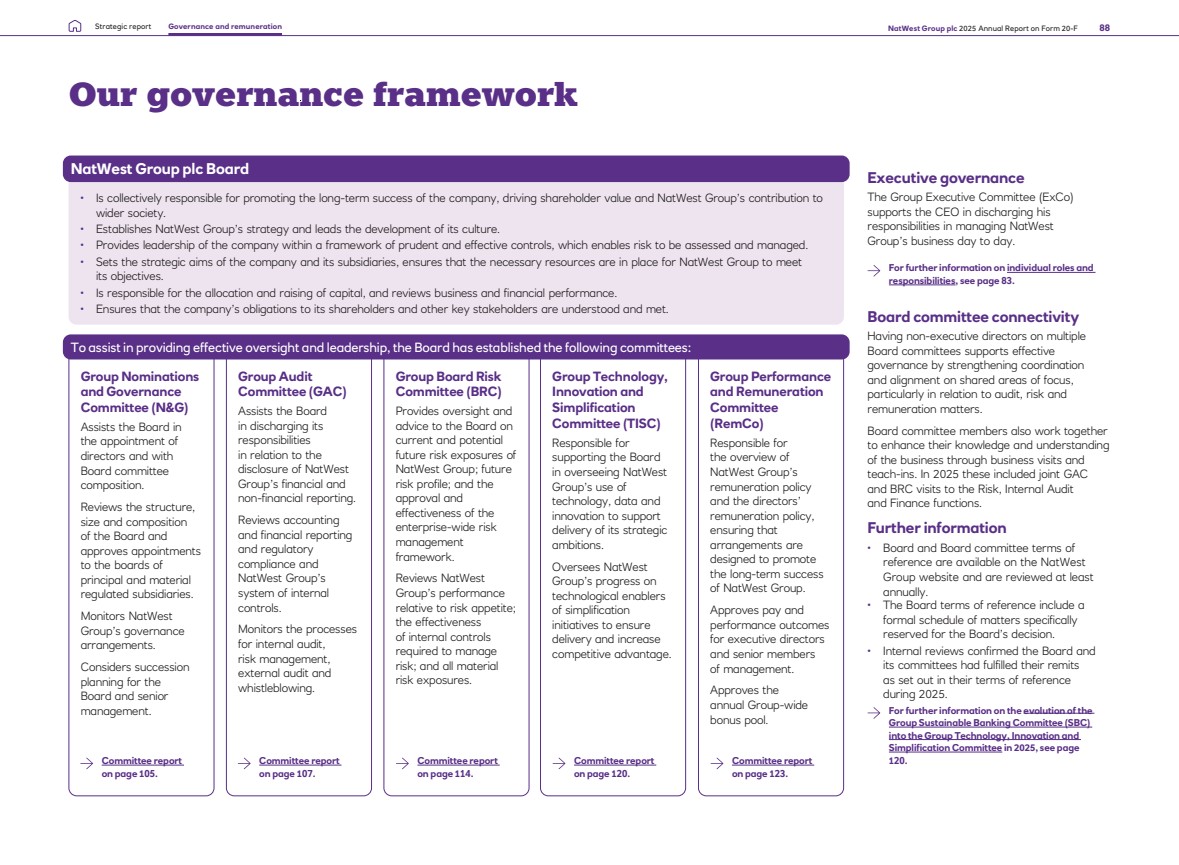
| • Is collectively responsible for promoting the long-term success of the company, driving shareholder value and NatWest Group’s contribution to wider society. • Establishes NatWest Group’s strategy and leads the development of its culture. • Provides leadership of the company within a framework of prudent and effective controls, which enables risk to be assessed and managed. • Sets the strategic aims of the company and its subsidiaries, ensures that the necessary resources are in place for NatWest Group to meet its objectives. • Is responsible for the allocation and raising of capital, and reviews business and financial performance. • Ensures that the company’s obligations to its shareholders and other key stakeholders are understood and met. Our governance framework Group Audit Committee (GAC) Assists the Board in discharging its responsibilities in relation to the disclosure of NatWest Group’s financial and non-financial reporting. Reviews accounting and financial reporting and regulatory compliance and NatWest Group’s system of internal controls. Monitors the processes for internal audit, risk management, external audit and whistleblowing. Group Board Risk Committee (BRC) Provides oversight and advice to the Board on current and potential future risk exposures of NatWest Group; future risk profile; and the approval and effectiveness of the enterprise-wide risk management framework. Reviews NatWest Group’s performance relative to risk appetite; the effectiveness of internal controls required to manage risk; and all material risk exposures. Group Nominations and Governance Committee (N&G) Assists the Board in the appointment of directors and with Board committee composition. Reviews the structure, size and composition of the Board and approves appointments to the boards of principal and material regulated subsidiaries. Monitors NatWest Group’s governance arrangements. Considers succession planning for the Board and senior management. Group Performance and Remuneration Committee (RemCo) Responsible for the overview of NatWest Group’s remuneration policy and the directors’ remuneration policy, ensuring that arrangements are designed to promote the long-term success of NatWest Group. Approves pay and performance outcomes for executive directors and senior members of management. Approves the annual Group-wide bonus pool. Group Technology, Innovation and Simplification Committee (TISC) Responsible for supporting the Board in overseeing NatWest Group’s use of technology, data and innovation to support delivery of its strategic ambitions. Oversees NatWest Group’s progress on technological enablers of simplification initiatives to ensure delivery and increase competitive advantage. To assist in providing effective oversight and leadership, the Board has established the following committees: NatWest Group plc Board Executive governance The Group Executive Committee (ExCo) supports the CEO in discharging his responsibilities in managing NatWest Group’s business day to day. For further information on individual roles and responsibilities, see page 107. Board committee connectivity Having non-executive directors on multiple Board committees supports effective governance by strengthening coordination and alignment on shared areas of focus, particularly in relation to audit, risk and remuneration matters. Board committee members also work together to enhance their knowledge and understanding of the business through business visits and teach-ins. In 2025 these included joint GAC and BRC visits to the Risk, Internal Audit and Finance functions. Further information • Board and Board committee terms of reference are available at natwestgroup.com and are reviewed at least annually. • The Board terms of reference include a formal schedule of matters specifically reserved for the Board’s decision. • Internal reviews confirmed the Board and its committees had fulfilled their remits as set out in their terms of reference during 2025. For further information on the evolution of the Group Sustainable Banking Committee (SBC) into the Group Technology, Innovation and Simplification Committee in 2025, see page 137. Committee report on page 124. Committee report on page 131. Committee report on page 122. Committee report on page 140. Committee report on page 137. Strategic report Financial review Risk and capital management Financial statements Additional information Governance and remuneration NatWest Group plc 2025 Annual Report and Accounts 105 Climate governance Sharpening ESG focus The governance structure for climate-related activities is embedded across the organisation. We continue to monitor the effectiveness of these arrangements to ensure that the risks and opportunities for the bank and our stakeholders are considered. The NatWest Group plc Board, Board committees, executive fora, cross-bank working groups and day-to-day decision-making all have a role to play in the delivery of this integrated governance approach. A complete list of climate-related topics considered by the Group Board and committees is shown in the timeline. Executive governance The Group CEO holds Joint Senior Manager Function accountability for identifying and managing financial risks from climate change, together with the Group Chief Risk Officer (Group CRO). The Executive team has delegated responsibility from the Group CEO for identifying and managing financial risks and opportunities from climate change and the execution of the transition plan. This is primarily delegated to the Chief Financial Officer (Group CFO), Group Chief Information Officer (Group CIO), Chief Customer & Operations Officer, Group Director, Strategic, Economics & Corporate Development and the business CEOs. The Group Executive Committee supports the Group CEO in managing NatWest Group’s businesses and operates under individual accountability. ExCo has primary oversight responsibility at Group level for implementation of the climate transition plan and climate-related ambitions, targets and commitments. Additional Executive level committees operate under individual accountability to support relevant Executive Management Team members in discharging their individual accountabilities. These committees provide a forum for debate and challenge of the key issues set out in their Terms of Reference. These include the Group Executive Risk Committee which reviews and challenges all material risk exposures including operational, reputation and climate risk; the Group Executive Disclosure Committee which reviews all material financial and non-financial disclosures, including climate disclosures; the Group Reputational Risk Committee which considers the reputational impact of climate change actions and the Environmental & Social Risk Framework; and segment and function leadership teams which manage delivery against allocated carbon budgets and associated targets. Board and Board committee responsibilities Group Board (For further information on the Board’s oversight of climate matters, refer to the s.172 statement on pages 36-37) Responsible for promoting the long-term sustainable success of NatWest Group, sets strategic aims, monitors and oversees the risks and opportunities presented by the transition including strategic climate targets. It also oversees actions being taken and progress against our climate ambition and climate transition plan. From June 2025, the Board was also responsible for overseeing actions being taken to run the bank as a sustainable business. GAC Considers financial and non-financial disclosures and receives assurance regarding the robustness of controls supporting these disclosures. BRC Considers current and potential future climate risk exposures. RemCo Oversees the link between climate strategy and remuneration. SBC Up to June 2025, SBC oversaw actions being taken to run the bank as a sustainable business and progress against our climate ambition, when this activity transitioned to the Board. Management information presented to every Board Risk Committee meeting (climate & nature risk) and to Board (climate opportunities and progress) as part of scheduled updates Areas of Board and committee focus Board Audit Committee Board Risk Committee Performance & Remuneration Committee Nominations & Governance Committee Risk Opportunities Progress against transition plan Disclosures Education Skills February Budget approved including carbon budget allocations and resources. Board June ESG – external environment and Group position. Board October Approval of Climate ambitions. Board Climate spotlight. Board Climate Ambitions and Targets Update. Board February 2026 March Spotlight on Climate & Environmental Progress. SBC Understanding, predicting and responding to the changing ESG Landscape. Board July Spotlight on climate and nature risk. BRC December Approval of risk appetite in respect of climate and nature risk. Approval of climate and nature risk strategy and risk policy. Board approval of sector-level climate targets BRC & Board Skills Matrix review, including consideration of necessary Climate and nature skills and experience. N&G & Board Agreement of executive director climate target for the 2026 Performance Share Plan. RemCo Strategic report Financial review Risk and capital management Financial statements Additional information Strategic report Governance and remuneration Governance and remuneration NatWest Group plc NatWest Group plc 2025 Annual Report and Accounts 2025 Annual Report on Form 20-F 10689 Discussion and approval of the Annual Report & Accounts. GAC & Board |
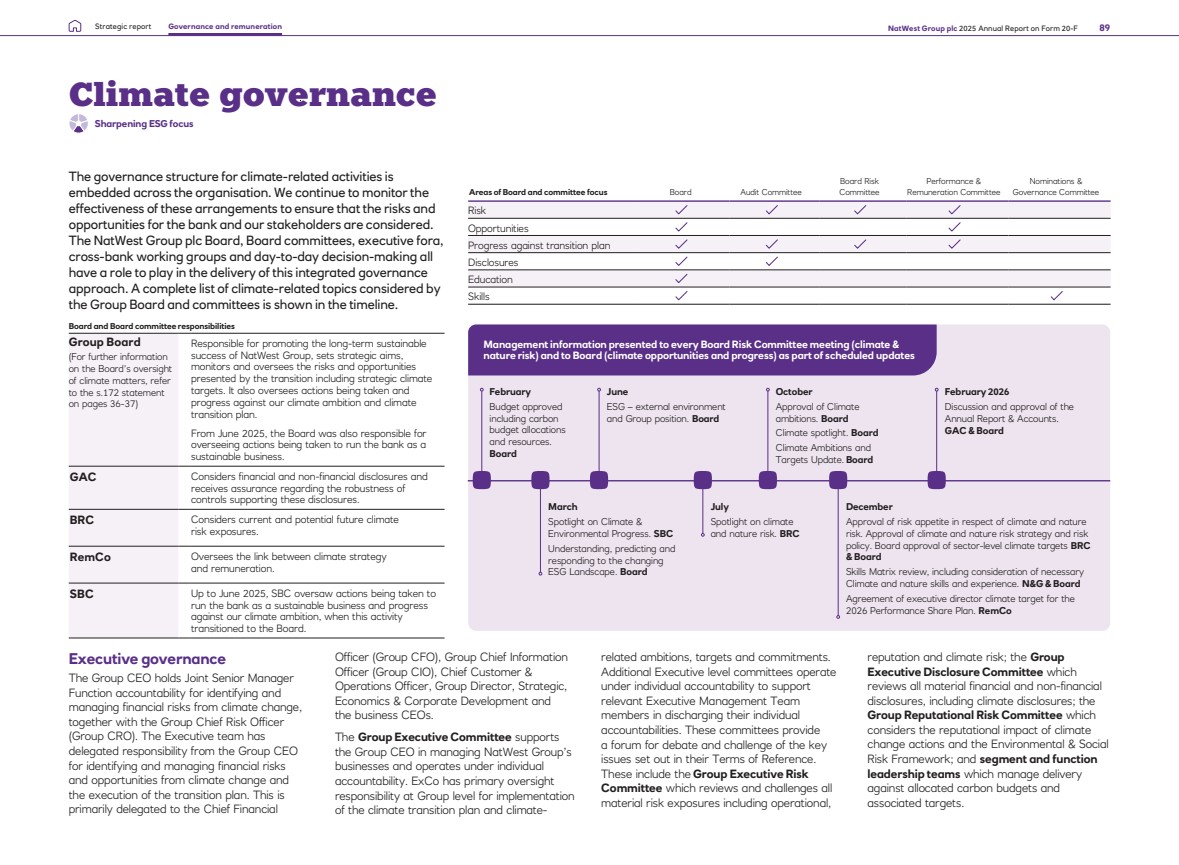
| Division of responsibilities Chair and CEO The role of Chair is distinct and separate from that of the CEO and there is a clear division of responsibilities, with the Chair leading the Board and the CEO managing the business day to day. Senior Independent Director (SID) During 2025, Mark Seligman held the role of SID until 31 March 2025 and from 1 April 2025 Lena Wilson assumed the role. Mark and Lena acted as a sounding board for the Chair, and as an intermediary for other directors when necessary. They were available to shareholders to discuss any concerns that could not be resolved through standard communication with the Chair, CEO or other members of executive management. Ms Wilson also led the non-executive directors’ year-end review of the Chair’s performance, together with Francesca Barnes the Senior Independent Director of the ring-fenced bank. Chief Governance Officer and Company Secretary Jan Cargill held the role of Chief Governance Officer and Company Secretary until 14 February 2025, when Gary Moore assumed the role. The Chief Governance Officer and Company Secretary works closely with the Chair to ensure effective and efficient functioning of the Board and appropriate alignment and information flows between the Board, its committees and management. The Chief Governance Officer and Company Secretary is responsible for advising the Board and individual directors on all governance matters, and also facilitates Board induction and directors’ professional development. Non-executive directors Along with the Chair and executive directors, the non-executive directors are responsible for ensuring the Board fulfils its responsibilities under its terms of reference. The non-executive directors combine broad business and commercial experience with independent and objective judgement. They provide constructive challenge, strategic guidance, and specialist advice to the executive directors and the executive management team and hold management to account. The balance between non-executive and executive directors enables the Board to provide clear and effective leadership across NatWest Group’s business activities and ensures no one individual or small group of individuals dominates the Board’s decision-making. Executive management The executive management team supports the Group Chief Executive Officer (CEO) in managing NatWest Group’s businesses. Decisions at all executive level committees including the Group Executive Committee are made under individual accountability where decision-making authority lies with an individual (who usually chairs committee meetings) and committee members support the relevant individual in discharging their accountabilities. These committees provide a forum for debate and challenge of the key issues set out in their terms of reference. The role of members is to provide input, support and/ or challenge to the decision-maker, including on whether to recommend matters to Board committees and the Board. The Group Executive Committee considers the delivery of strategy, financials, risk, and customer, colleague and operational issues affecting NatWest Group, as well as monitoring the implementation of cultural change. The executive management team also holds regular executive succession planning, talent and team effectiveness sessions. Members of the executive management team also have individual accountabilities for their respective areas of responsibility and have committees to support them in discharging these accountabilities. Strategic report Financial review Risk and capital management Financial statements Additional information Strategic report Governance and remuneration Governance and remuneration NatWest Group plc NatWest Group plc 2025 Annual Report and Accounts 2025 Annual Report on Form 20-F 10790 Details of the key responsibilities of the Chair, CEO, Senior Independent Director and non-executive directors are available on the NatWest Group website As at the date of publication of this report the Board has 11 directors, comprising the Chair, two executive directors and eight independent non-executive directors, one of whom is the Senior Independent Director. Director biographies and details of the Board committees of which they are members can be found on pages 79 to 91. The performance of the non-executive directors is evaluated annually as part of the Board effectiveness review and further details of the 2025 process and outcomes can be found on pages 102 to 104. The executive management team is detailed on page 83 and biographies are available on the NatWest Group website |
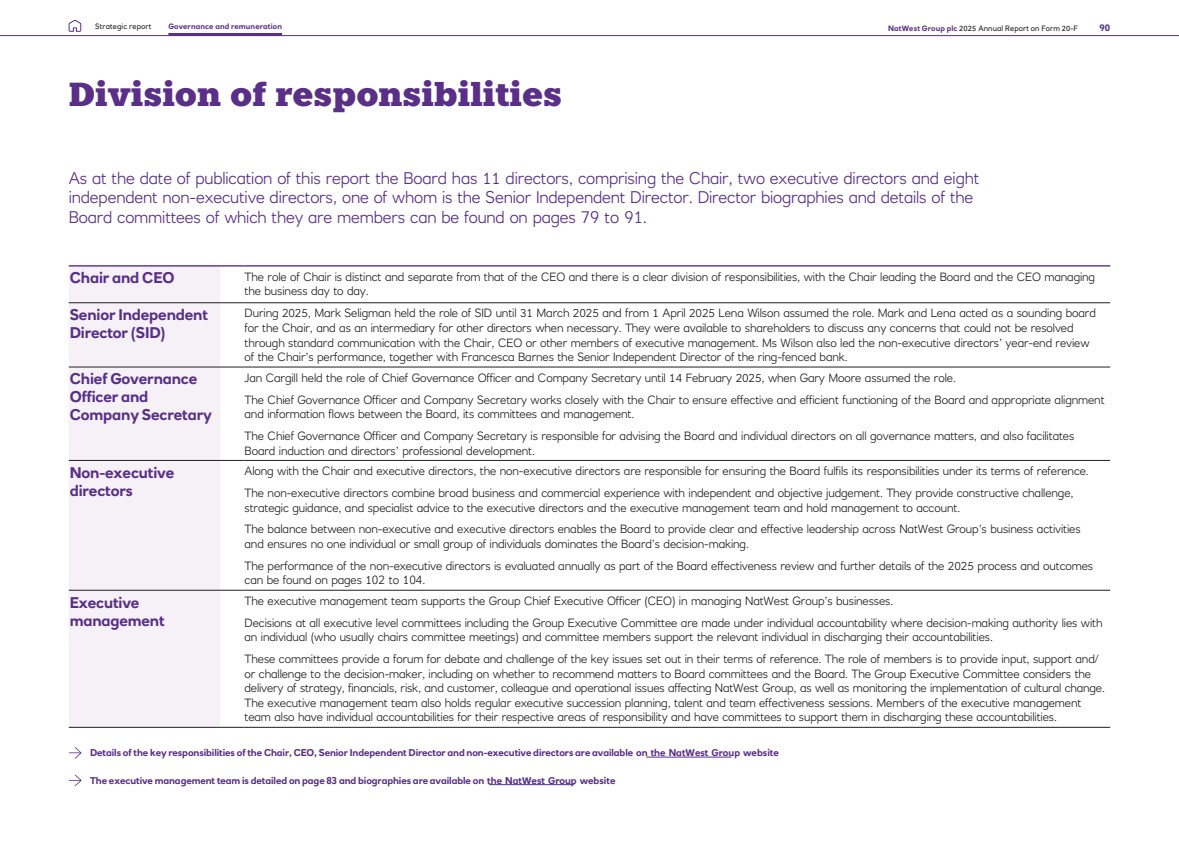
| Division of responsibilities As at the date of publication of this report the Board has 11 directors, comprising the Chair, two executive directors and eight independent non-executive directors, one of whom is the Senior Independent Director. Director biographies and details of the Board committees of which they are members can be found on pages 96 to 98. Chair and CEO The role of Chair is distinct and separate from that of the CEO and there is a clear division of responsibilities, with the Chair leading the Board and the CEO managing the business day to day. Senior Independent Director (SID) During 2025, Mark Seligman held the role of SID until 31 March 2025 and from 1 April 2025 Lena Wilson assumed the role. Mark and Lena acted as a sounding board for the Chair, and as an intermediary for other directors when necessary. They were available to shareholders to discuss any concerns that could not be resolved through standard communication with the Chair, CEO or other members of executive management. Ms Wilson also led the non-executive directors’ year-end review of the Chair’s performance, together with Francesca Barnes the Senior Independent Director of the ring-fenced bank. Chief Governance Officer and Company Secretary Jan Cargill held the role of Chief Governance Officer and Company Secretary until 14 February 2025, when Gary Moore assumed the role. The Chief Governance Officer and Company Secretary works closely with the Chair to ensure effective and efficient functioning of the Board and appropriate alignment and information flows between the Board, its committees and management. The Chief Governance Officer and Company Secretary is responsible for advising the Board and individual directors on all governance matters, and also facilitates Board induction and directors’ professional development. Non-executive directors Along with the Chair and executive directors, the non-executive directors are responsible for ensuring the Board fulfils its responsibilities under its terms of reference. The non-executive directors combine broad business and commercial experience with independent and objective judgement. They provide constructive challenge, strategic guidance, and specialist advice to the executive directors and the executive management team and hold management to account. The balance between non-executive and executive directors enables the Board to provide clear and effective leadership across NatWest Group’s business activities and ensures no one individual or small group of individuals dominates the Board’s decision-making. The performance of the non-executive directors is evaluated annually as part of the Board effectiveness review and further details of the 2025 process and outcomes can be found on pages 119 to 121. Executive management The executive management team supports the Group Chief Executive Officer (CEO) in managing NatWest Group’s businesses. Decisions at all executive level committees including the Group Executive Committee are made under individual accountability where decision-making authority lies with an individual (who usually chairs committee meetings) and committee members support the relevant individual in discharging their accountabilities. These committees provide a forum for debate and challenge of the key issues set out in their terms of reference. The role of members is to provide input, support and/ or challenge to the decision-maker, including on whether to recommend matters to Board committees and the Board. The Group Executive Committee considers the delivery of strategy, financials, risk, and customer, colleague and operational issues affecting NatWest Group, as well as monitoring the implementation of cultural change. The executive management team also holds regular executive succession planning, talent and team effectiveness sessions. Members of the executive management team also have individual accountabilities for their respective areas of responsibility and have committees to support them in discharging these accountabilities. Details of the key responsibilities of the Chair, CEO, Senior Independent Director and non-executive directors are available at natwestgroup.com. The executive management team is detailed on page 100 and biographies are available at natwestgroup.com. Strategic report Financial review Risk and capital management Financial statements Additional information Governance and remuneration NatWest Group plc 2025 Annual Report and Accounts 107 How the Board operated in 2025 Enhancing strategic engagement; Improving Board dynamics;. Sharpening ESG focus; Leveraging data and analytics Board and committee meetings There were eight scheduled meetings of the Board during 2025. Additional ad hoc meetings of the Board and some of its committees were held throughout the year to receive updates and deal with time-critical matters. There was one additional Board meeting held in 2025, compared to five in 2024. There were also two strategy sessions with executive management in 2025. Details of ad hoc Board committee meetings in 2025 are contained in the relevant committee reports. The Chair and non-executive directors met without the executive directors present at the end of each Board meeting. Led by the Senior Independent Director, the non-executive directors met in December without the Chair present to review the Chair’s performance. When directors are unable to attend meetings convened at short notice, for example owing to existing commitments, they receive the papers and have the opportunity to provide any feedback in advance. At each scheduled Board meeting the directors received reports from the Chair, Board committee Chairs, Group CEO, Group CFO, Group Chief Risk Officer and other members of the executive management team, as appropriate. The CEOs of our Retail Banking, Private Banking & Wealth Management and Commercial & Institutional businesses provided updates on progress against strategy. In addition to our business CEOs, a number of other senior executives attended Board meetings throughout the year to present reports to the Board. This provided the Board with an opportunity to engage directly with management on key issues and supported succession planning. The Board also welcomed external presenters and advisers to Board meetings, which provided useful insights and perspectives. Board evolution action plan – refreshing our governance operating model • A comprehensive review of Board and committee oversight responsibilities, led by the Board and which resulted in a re-balancing of those oversight responsibilities to support the Board’s Board members and attendance in 2025 Director Scheduled Board meetings attended Rick Haythornthwaite 8 of 8 Paul Thwaite 8 of 8 Katie Murray 8 of 8 Lena Wilson 8 of 8 Frank Dangeard(1) 0 of 2 Josh Critchley(2) 1 of 1 Roisin Donnelly 8 of 8 Patrick Flynn 8 of 8 Geeta Gopalan 8 of 8 Yasmin Jetha 8 of 8 Stuart Lewis 8 of 8 Gill Whitehead 8 of 8 (1) Mr Dangeard was unable to attend two scheduled meetings owing to illness, and stepped down from the Board with effect from 23 April 2025. (2) Mr Critchley joined the Board on 3 November 2025. In addition to the eight scheduled meetings held, there was one ad-hoc meeting. All directors eligible to attend this meeting were present, except for Ms Donnelly who was unable to attend due to a prior commitment. strategic focus. This review identified opportunities to redirect oversight of operational, compliance, and regulatory matters to relevant Board committees, ensuring a greater degree of rigour in these areas. The changes were designed to create time and capacity at Board level to strengthen focus on strategic priorities, including ESG, Consumer Duty, and organisational development and culture. • A governance simplification review undertaken at Board committee level which resulted in additional steps being taken to rationalise Board committee oversight responsibilities where appropriate. • A detailed analysis of Board and Board committee time allocation during 2024, which provided additional data and insights into how Board and Board committee agenda and discussion time had previously been spent and which informed 2025 actions and forward planning. • Continuing to bring a range of external perspectives into the boardroom aligned to the Board’s areas of strategic focus, through dedicated guest dinner sessions and strategic agenda items at Board meetings. • Supporting a culture of collaboration and collegiality through the introduction of NED only breakfast meetings, regular Chair and NED 1:1s and Board dinners, which offered an opportunity for more informal conversations. In addition, the March Board dinner discussion focused on the ‘tone from the top’ culture and behaviours the Board wished to demonstrate to management and the wider organisation. • Sharpening the Board’s strategic focus on performance management oversight through the use of a performance dashboard, which includes Key Performance Indicators (KPIs) and Key Results (KRs). • Refreshing our approach to forward agenda planning to reflect and embed the Board evolution themes, including a detailed three-month look ahead planner (prepared on a rolling basis) and a longer term eighteen-month high level agenda planner. As part of the 2025 Board effectiveness review, directors were invited to share their feedback on the Board evolution actions taken during 2025. Directors observed that the Board had made meaningful progress in strengthening governance and strategic focus with reference to the re-balancing of Board and Board committee agendas, streamlining meetings and establishing the new Group Technology, Innovation and Simplification Committee in particular. Opportunities were noted to continue supporting team cohesion and structured Board learning. Board committee and attendance information can be found in the relevant Board committee reports. During 2025, the Group Chair attended all Group Nominations and Governance Committee meetings as Chair, and all other Board committee meetings as an observer. Strategic report Financial review Risk and capital management Financial statements Additional information Strategic report Governance and remuneration Governance and remuneration NatWest Group plc NatWest Group plc 2025 Annual Report and Accounts 2025 Annual Report on Form 20-F 10891 Our Board evolution action plan, as described on page 91, led to a range of enhancements to the way our Board and Board committees operated in 2025. These included: For further information on the 2025 Board effectiveness review, see pages 102 to 104. |
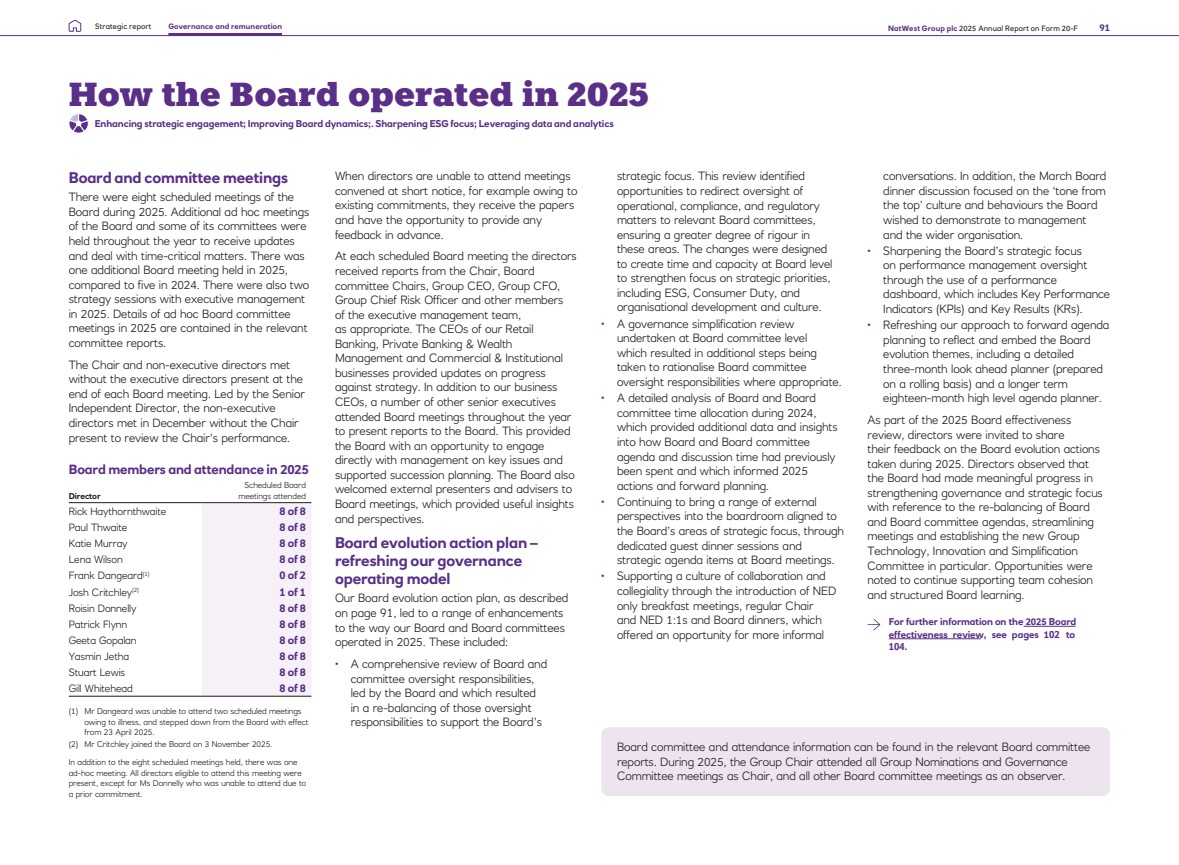
| Theme Principal areas of focus Outcomes Purpose and strategy Having approved the refreshed strategy and purpose in 2024, the Board’s focus in 2025 was on oversight of management’s execution of the strategy and embedding the purpose across NatWest Group. Sentiment towards NatWest Group’s purpose was measured via our 2025 colleague survey, Our View, the results of which were considered by the Board in June and December. Throughout 2025, the Board held a series of dedicated sessions to consider key elements of the strategy, revisiting important topics such as the evolving ESG landscape, sustainability and our climate ambition and targets, and developments in digital assets. The Board also undertook further work on Private Banking & Wealth Management strategy, the regional strategy in India, regulatory priorities and inorganic growth opportunities. The Board confirmed its support for the proposed Private Banking & Wealth Management strategy, noting alignment with the previously agreed wider NatWest Group strategy. Culture To support the new performance culture, a core behaviours framework was proposed by management and considered by the Board in February 2025. The Board considered the evolution of the performance culture and operating system, drawing on extensive colleague consultations and leadership workshops. The Board approved a framework focused on empowering colleagues with clear accountability around customer-centred outcomes and shared team objectives, with an operating model emphasising collaboration, capability building and effective prioritisation, whilst fostering behaviours that support adaptability, continuous improvement and enhanced customer focus. The Board approved the new core behaviours framework. Stakeholder engagement The Board confirmed its key stakeholders for the year in February 2025, and undertook engagement with them throughout the year. The agreed stakeholders were: investors, customers, colleagues, communities, regulators and suppliers, and engagement ranged from roundtable discussions to visits and participation in events. The Board participated in a dedicated strategic partner session with two of NatWest Group’s principal technology and transformation partners, receiving external insight on industry trends and leading practice in data, digital and AI enabled banking. The Board held investor roundtable discussions with major institutional shareholders. Directors discussed NatWest Group’s financial performance, strategic priorities, capital distribution and ESG matters, gaining valuable feedback on market expectations and perspectives to inform Board decision-making. Principal areas of Board focus in 2025 Strengthening Board expertise; Enhancing strategic engagement; Improving Board dynamics; Sharpening ESG focus; Leveraging data and analytics Enhancing strategic engagement Leveraging data and analytics Improving Board dynamics Strengthening Board expertise Sharpening ESG focus Link to Board evolution actions Strategic report Financial review Risk and capital management Financial statements Additional information Strategic report Governance and remuneration Governance and remuneration NatWest Group plc NatWest Group plc 2025 Annual Report and Accounts 2025 Annual Report on Form 20-F 10992 Further information on Board oversight of purpose and strategy can be found on page 99. Further information on Board oversight of culture can be found on page 99. Further details on the Board’s engagement with stakeholders are available on pages 100 to 101, and the section 172(1) statement on pages 36 to 37 describes how stakeholders were considered in relation to principal decisions. The Board’s visit to Birmingham in September 2025 provided a range of opportunities to meet with stakeholders and understand their views. For further information, see page 95. |
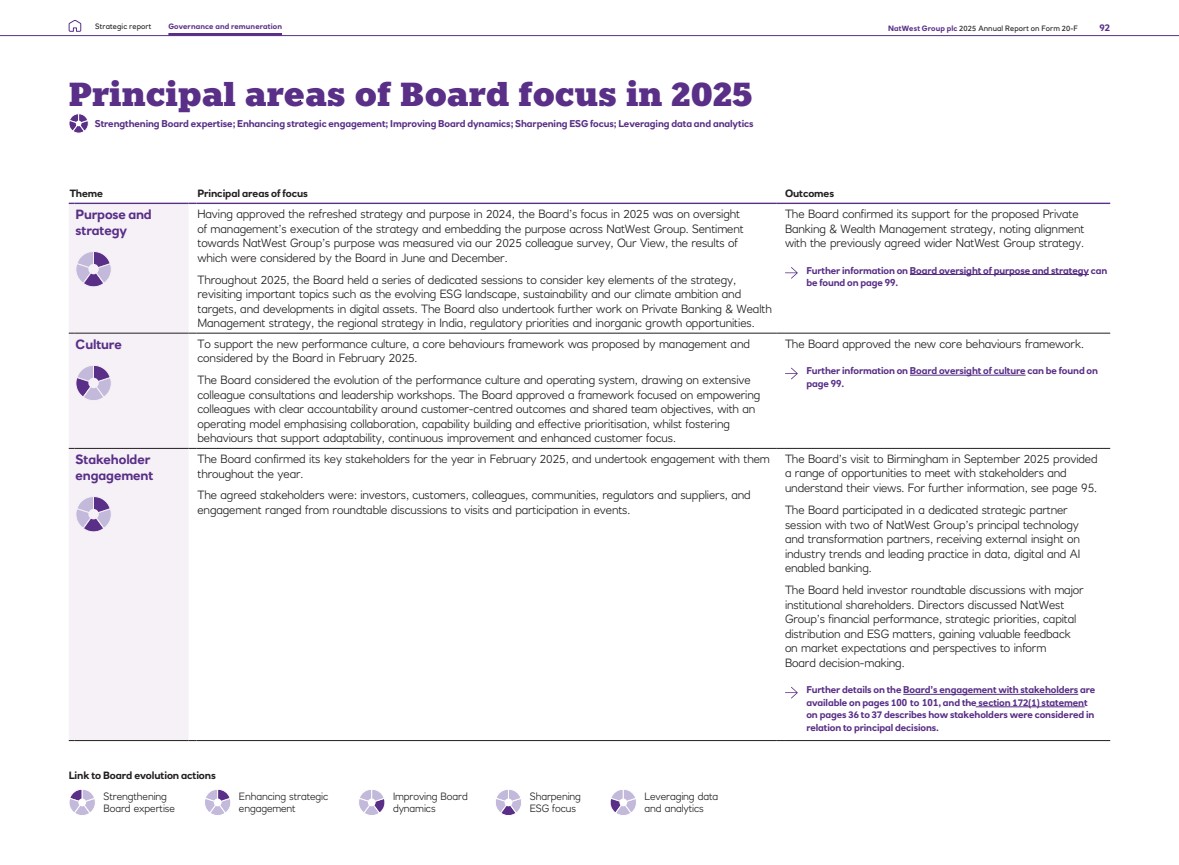
| Theme Principal areas of focus Outcomes Purpose and strategy Having approved the refreshed strategy and purpose in 2024, the Board’s focus in 2025 was on oversight of management’s execution of the strategy and embedding the purpose across NatWest Group. Sentiment towards NatWest Group’s purpose was measured via our 2025 colleague survey, Our View, the results of which were considered by the Board in June and December. Throughout 2025, the Board held a series of dedicated sessions to consider key elements of the strategy, revisiting important topics such as the evolving ESG landscape, sustainability and our climate ambition and targets, and developments in digital assets. The Board also undertook further work on Private Banking & Wealth Management strategy, the regional strategy in India, regulatory priorities and inorganic growth opportunities. The Board confirmed its support for the proposed Private Banking & Wealth Management strategy, noting alignment with the previously agreed wider NatWest Group strategy. Further information on Board oversight of purpose and strategy can be found on page 116. Culture To support the new performance culture, a core behaviours framework was proposed by management and considered by the Board in February 2025. The Board considered the evolution of the performance culture and operating system, drawing on extensive colleague consultations and leadership workshops. The Board approved a framework focused on empowering colleagues with clear accountability around customer-centred outcomes and shared team objectives, with an operating model emphasising collaboration, capability building and effective prioritisation, whilst fostering behaviours that support adaptability, continuous improvement and enhanced customer focus. The Board approved the new core behaviours framework. Further information on Board oversight of culture can be found on page 116. Stakeholder engagement The Board confirmed its key stakeholders for the year in February 2025, and undertook engagement with them throughout the year. The agreed stakeholders were: investors, customers, colleagues, communities, regulators and suppliers, and engagement ranged from roundtable discussions to visits and participation in events. The Board’s visit to Birmingham in September 2025 provided a range of opportunities to meet with stakeholders and understand their views. For further information, see page 112. The Board participated in a dedicated strategic partner session with two of NatWest Group’s principal technology and transformation partners, receiving external insight on industry trends and leading practice in data, digital and AI enabled banking. The Board held investor roundtable discussions with major institutional shareholders. Directors discussed NatWest Group’s financial performance, strategic priorities, capital distribution and ESG matters, gaining valuable feedback on market expectations and perspectives to inform Board decision-making. Further details on the Board’s engagement with stakeholders are available on pages 117 to 118, and the section 172(1) statement on pages 36 to 37 describes how stakeholders were considered in relation to principal decisions. Principal areas of Board focus in 2025 Strengthening Board expertise; Enhancing strategic engagement; Improving Board dynamics; Sharpening ESG focus; Leveraging data and analytics Enhancing strategic engagement Leveraging data and analytics Improving Board dynamics Strengthening Board expertise Sharpening ESG focus Link to Board evolution actions Strategic report Financial review Risk and capital management Financial statements Additional information Governance and remuneration NatWest Group plc 2025 Annual Report and Accounts 109 Enhancing strategic engagement Leveraging data and analytics Improving Board dynamics Strengthening Board expertise Sharpening ESG focus Link to Board evolution actions Theme Principal areas of focus Outcomes Customers The Board maintained a strong emphasis on delivering good outcomes for customers while ensuring robust oversight of performance management. Regular performance management spotlights covered a wide range of topics, including customer experience, the onboarding process, mortgage markets and cross-franchise deposits. These were complemented by business updates, including Private Banking & Wealth Management and Corporate & Institutional Banking, which provided deeper insight into business performance and customer propositions in those areas. In December, the Board received a detailed update on the migration of Sainsbury’s Bank customers to NatWest Group, which represented a significant milestone for the Retail Banking business. The Board reviewed customer experience metrics from the migration and discussed lessons learned to inform future integration activity and ongoing customer engagement. The Board also had an opportunity to meet customers during the regional visit to Birmingham and directors heard first hand how colleagues support customers via call listening exercises. The focus on performance management spotlights and business-led strategic reviews throughout the year ensured customer outcomes remained central to Board deliberations and deepened its understanding of customer priorities and behaviours. The Board approved the Consumer Duty ‘point in time submission’ prior to regulatory submission. Risk and controls The Group Risk Report was presented at each Board meeting. The Board undertook a fire drill exercise in relation to Operational Resilience, Recovery and Resolution in March 2025. This was an opportunity to deepen understanding of the processes that would be followed and implemented during an operational resilience scenario that could progress to recovery and subsequently resolution. The Board considered the external geopolitical environment in June 2025, seeking to understand how changes in the macro-economy might impact the bank and its customers in both the short and longer term. Following widely publicised cyberattacks impacting other companies during 2025, the Board received a management update on root cause analysis and the robust internal mitigations and ongoing scenario testing in place to manage the potential impact of such attacks on NatWest Group’s infrastructure. The Board gained first-hand experience of the key areas of consideration it would be required to undertake in a live recovery and resolution scenario. During a wash up discussion, learnings were identified to ensure management and directors were best placed to tackle future fire drills or live situations. The Board approved the Operational Resilience Self-Assessment. The Board approved the enterprise-wide risk management framework and approved the annual refresh of risk appetite. The Board received appropriate assurances as to the bank’s cybersecurity framework and that of its strategic partners. Financial Reports from the Group Chief Financial Officer were presented at each Board meeting. In October, the Board undertook a focused review of NatWest Group’s CET1 capital target, considering regulatory changes, peer benchmarks, and stakeholder feedback. Directors discussed the rationale for revising the target, ensuring robust capital buffers and supporting shareholder value, with further engagement planned ahead of finalising external guidance. The Board approved the 2026 Budget, interim and full year dividends, and quarterly and full year results disclosures and associated documents. Principal areas of Board focus in 2025 continued Strategic report Financial review Risk and capital management Financial statements Additional information Strategic report Governance and remuneration Governance and remuneration NatWest Group plc NatWest Group plc 2025 Annual Report and Accounts 2025 Annual Report on Form 20-F 11093 Further information on Board engagement with customers can be found on page 100. In addition to quarterly financial results, the Board reviewed the NatWest Group plc 2024 Annual Report on Form 20-F and associated documents. Business performance metrics, including Risk Weight Assets management, were regularly considered, and the 2026 Budget was reviewed following scenario analysis. |
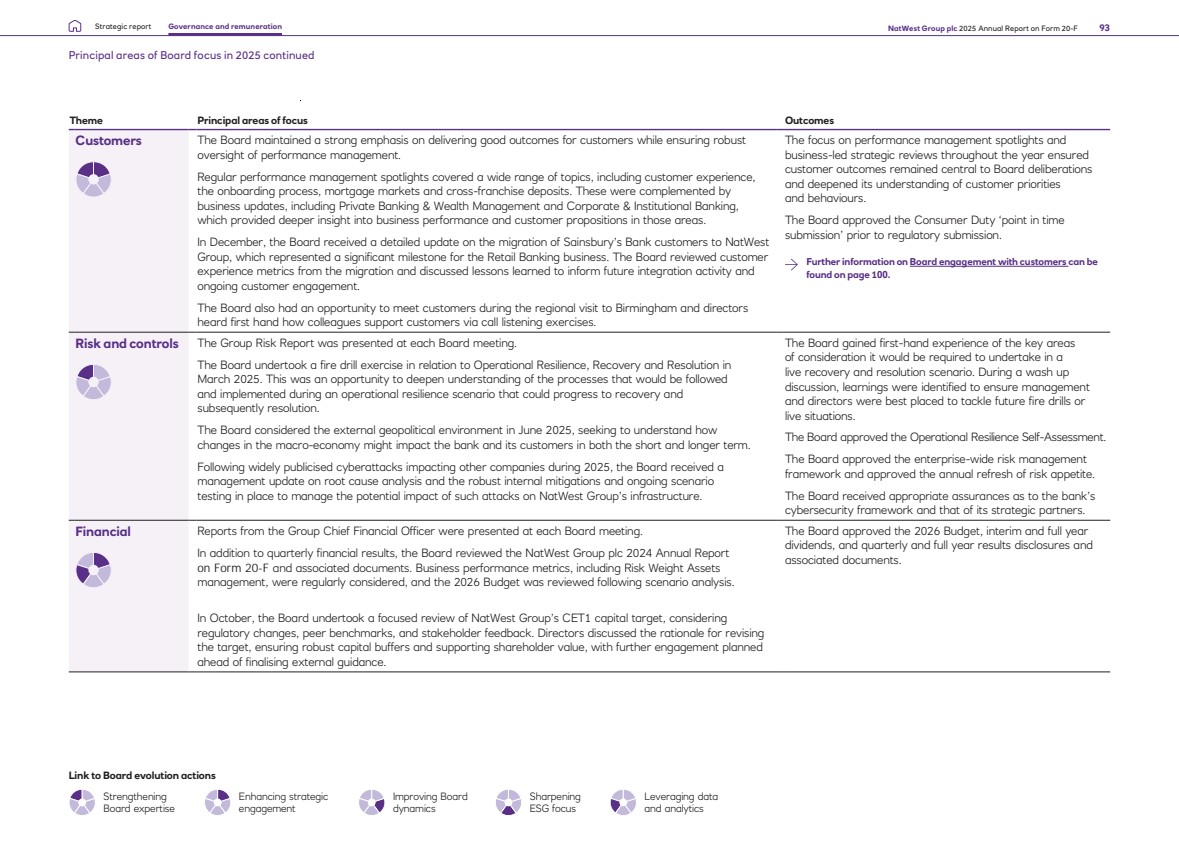
| Principal areas of Board focus in 2025 continued Theme Principal areas of focus Outcomes Legal, regulatory and governance The Board considered a range of legal, regulatory and governance matters in 2025, which were both routine and ad hoc in nature. The Board considered Board composition and succession plans, the 2025 Board skills matrix and new director appointments, following recommendations from the Group Nominations and Governance Committee. Under the Board evolution action plan, the Board considered opportunities to refresh the Board and committee governance operating model to ensure the appropriate allocation of responsibilities and create time for the Board to focus on strategic items. The Board also reviewed and approved key governance documents relating to non-executive directors’ independence, NatWest Group’s corporate governance policy and updated guidance associated with directors’ gifts and hospitality, travel and accommodation. Consideration was given to directors’ external appointments and proposed changes to the structure and membership of the executive management team during the year. The outputs of the FCA’s firmwide evaluation (FEL) and the PRA’s periodic summary meeting (PSM) were presented to the Board in April and July respectively. The Board considered and approved the evolution of the Group Sustainable Banking Committee (SBC) into the Group Technology, Innovation & Simplification Committee (TISC), strengthening Board oversight and challenge on NatWest Group’s use of technology, data and innovation to support strategic ambitions, market agility and customer engagement. As part of this transition, responsibilities for sustainability and ESG matters were reallocated to the Board to ensure continued focus on these priorities. The Board also reviewed the NatWest Group plc 2024 Statement of Modern Slavery and Human Trafficking, reaffirming NatWest Group’s commitment to ethical business practices and transparency in the supply chain. The statement sets out the actions taken during the relevant year to identify, mitigate and address modern slavery and human trafficking, and demonstrates NatWest Group’s ongoing efforts to uphold the highest standards of responsibility across its operations. The Board approved the 2025 Board skills matrix and the appointment of Josh Critchley as an independent non-executive director. The Board approved certain delegations and updates to its terms of reference and those of its committees, to ensure appropriate governance parameters were in place following implementation of changes to the governance operating model. The Board approved external appointments for Ms Gopalan, Mr Haythornthwaite and Ms Whitehead during the year. The points raised in the regulatory letters were noted and progressed by management and tracked by the Board and its committees. The Board approved the Group Technology, Innovation & Simplification Committee Terms of Reference. The Board approved the NatWest Group plc 2024 Statement of Modern Slavery and Human Trafficking. Regular reports (provided to every scheduled meeting unless otherwise stated) • Reports by the Group Chair and CEO • Board committee Chair updates • Strategic business spotlights • Performance management updates • Group Risk Report • Consumer Duty Board Champion updates (bi-annual) • Colleague Advisory Panel reports (bi-annual) Enhancing strategic engagement Leveraging data and analytics Improving Board dynamics Strengthening Board expertise Sharpening ESG focus Link to Board evolution actions Strategic report Financial review Risk and capital management Financial statements Additional information Strategic report Governance and remuneration Governance and remuneration NatWest Group plc NatWest Group plc 2025 Annual Report and Accounts 2025 Annual Report on Form 20-F 11194 Further details of changes made to the governance operating model can be found on page 91. |
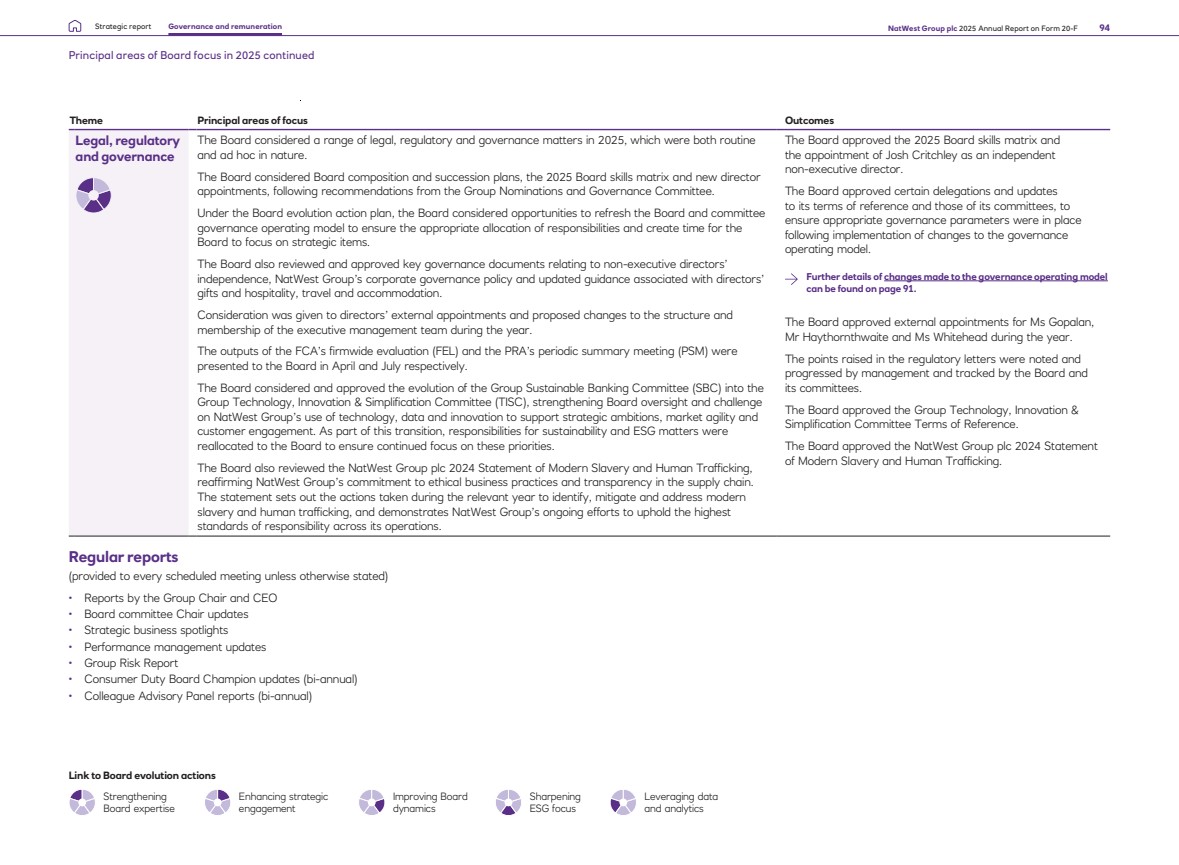
| Principal areas of Board focus in 2025 continued Theme Principal areas of focus Outcomes Legal, regulatory and governance The Board considered a range of legal, regulatory and governance matters in 2025, which were both routine and ad hoc in nature. The Board considered Board composition and succession plans, the 2025 Board skills matrix and new director appointments, following recommendations from the Group Nominations and Governance Committee. Under the Board evolution action plan, the Board considered opportunities to refresh the Board and committee governance operating model to ensure the appropriate allocation of responsibilities and create time for the Board to focus on strategic items. The Board also reviewed and approved key governance documents relating to non-executive directors’ independence, NatWest Group’s corporate governance policy and updated guidance associated with directors’ gifts and hospitality, travel and accommodation. Consideration was given to directors’ external appointments and proposed changes to the structure and membership of the executive management team during the year. The outputs of the FCA’s firmwide evaluation (FEL) and the PRA’s periodic summary meeting (PSM) were presented to the Board in April and July respectively. The Board considered and approved the evolution of the Group Sustainable Banking Committee (SBC) into the Group Technology, Innovation & Simplification Committee (TISC), strengthening Board oversight and challenge on NatWest Group’s use of technology, data and innovation to support strategic ambitions, market agility and customer engagement. As part of this transition, responsibilities for sustainability and ESG matters were reallocated to the Board to ensure continued focus on these priorities. The Board also reviewed the NatWest Group plc 2024 Statement of Modern Slavery and Human Trafficking, reaffirming NatWest Group’s commitment to ethical business practices and transparency in the supply chain. The statement sets out the actions taken during the relevant year to identify, mitigate and address modern slavery and human trafficking, and demonstrates NatWest Group’s ongoing efforts to uphold the highest standards of responsibility across its operations. The Board approved the 2025 Board skills matrix and the appointment of Josh Critchley as an independent non-executive director. The Board approved certain delegations and updates to its terms of reference and those of its committees, to ensure appropriate governance parameters were in place following implementation of changes to the governance operating model. Further details of changes made to the governance operating model can be found on page 108. The Board approved external appointments for Ms Gopalan, Mr Haythornthwaite and Ms Whitehead during the year. The points raised in the regulatory letters were noted and progressed by management and tracked by the Board and its committees. The Board approved the Group Technology, Innovation & Simplification Committee Terms of Reference. The Board approved the NatWest Group plc 2024 Statement of Modern Slavery and Human Trafficking. Regular reports (provided to every scheduled meeting unless otherwise stated) • Reports by the Group Chair and CEO • Board committee Chair updates • Strategic business spotlights • Performance management updates • Group Risk Report • Consumer Duty Board Champion updates (bi-annual) • Colleague Advisory Panel reports (bi-annual) Enhancing strategic engagement Leveraging data and analytics Improving Board dynamics Strengthening Board expertise Sharpening ESG focus Link to Board evolution actions Strategic report Financial review Governance and remuneration Risk and capital management Financial statements Additional information NatWest Group plc 2025 Annual Report and Accounts 111 Principal areas of Board focus in 2025 continued Spotlight Board visit to Birmingham Enhancing strategic engagement. Sharpening ESG focus. An important element of the Board’s ongoing development is the regional visits undertaken each year. In September, directors visited Birmingham and the West Midlands, where they met clients, colleagues and local stakeholders. Through direct conversations with commercial customers, the Board gained valuable insights into their banking relationships, the challenges and opportunities presented by the macroeconomic environment, and how the bank can best support them in future. These perspectives inform broader strategic discussions and help ensure the Board maintains a strong customer focus. The visit included a tour of a local branch to observe how retail customers are served and to hear from colleagues about their experiences. The Board met a diverse group of colleagues during the visit, including graduates, apprentices, and teams from Retail Banking, C&I, and Digital X. These conversations provided valuable two-way dialogue, enabling the Board to deepen its understanding of the issues that matter most to colleagues. A reverse pitch at one of our accelerator hubs, and a lunch with a selection of local stakeholders, highlighted NatWest’s impact on the community, including support for new and established businesses and engagement with civic groups promoting regional growth. The Board also explored digital innovations across the bank, recognising the importance of leveraging new technologies, including AI, to enhance service for both colleagues and customers. Strategic report Strategic report Governance and remuneration Financial review Governance and remuneration Risk and capital management Financial statements Additional information NatWest Group plc NatWest Group plc 2025 Annual Report and Accounts 2025 Annual Report on Form 20-F 11295 |

| Enhancing directors’ skills and knowledge Strengthening Board expertise Spotlight New NED induction Each new non-executive director receives a formal induction on joining the Board, which is coordinated by the Chief Governance Officer and Company Secretary and tailored to suit the requirements of the individual concerned. This includes meetings with directors and senior management, and visits to NatWest Group’s major business and functions. Meetings with external auditors, legal counsel and other stakeholders are also arranged as appropriate. New NEDs also receive a copy of our non-executive director handbook which contains information on our corporate structure, governance framework and Board policies and processes. The enhanced approach to Board skills assessment we adopted in 2024 has enabled us to identify targeted focus areas for new NEDs’ induction programmes following preparation of a ‘heat map’ drawing upon the individual’s self assessment of their skills, aligned to our pre-agreed skills criteria. The Chief Governance Officer and Company Secretary supports director training and professional development by curating an annual schedule of training sessions and deep dives into areas of interest and relevance. As envisaged by the 2025 Board evolution action plan, this annual schedule was supplemented by a suite of online learning resources and optional reading materials made available through a dedicated Teams channel for directors, which was refreshed periodically throughout the year. During 2025 directors had the opportunity to enhance their skills and knowledge on a range of relevant topics, as set out below: Topic Considerations Operational Resilience, Recovery and Resolution The Board took part in a comprehensive operational resilience ‘fire drill’ exercise, simulating a severe disruption scenario. Directors worked through the escalation from operational incident to recovery and resolution, considering regulatory expectations, impact tolerances, and the practical challenges of crisis management. The session enhanced the Board’s understanding of its role in resilience and informed future crisis preparedness. Digital assets During the year, the Board received a series of updates and education sessions on digital assets, including a teach-in from an external expert. Directors explored the evolving landscape of stablecoins, tokenised deposits, and central bank digital currencies, as well as the differing regulatory approaches internationally. The Board also considered opportunities and risks for NatWest Group, the importance of industry collaboration and partnerships, and the need to build foundational capabilities to respond to future developments in digital assets. Climate The Board’s annual climate training spotlight featured external perspectives on UK energy policy and clean power initiatives. Directors discussed the evolving policy landscape, challenges and opportunities in supporting the UK’s transition to net zero. Directors also considered how NatWest Group can enable customer decarbonisation through financing and advisory support and the importance of embedding sustainability at the core of NatWest Group’s strategy and operations. Financial crime The Board participated in tailored training on the dynamic financial crime landscape and shifting regulatory expectations, including the introduction of the ‘Failure to Prevent Fraud’ offence. The training explored NatWest Group’s risk appetite, control frameworks, and recent enforcement trends, while underscoring the Board’s critical role in setting the tone from the top, maintaining robust oversight, and championing a culture of integrity. Directors were also encouraged to advocate for cross-sector collaboration and public-private partnerships to strengthen our defences against financial crime. Client Assets (CASS) Directors reviewed online training materials aimed at supporting a positive bank-wide CASS culture. The training, which was also offered to colleagues across NatWest Group, aimed to support a culture focused on protecting client assets and managing the risks associated with handling client assets. As well as supporting compliance with regulatory obligations, the training also sought to enable effective identification and management of CASS issues and risks by increasing knowledge and awareness of CASS at all levels of the organisation. Models The Board received training on regulatory expectations for model risk management under PRA SS1/23. The session covered NatWest Group’s approach to governance, risk appetite, and oversight of material models, including credit and operational risk models, reinforcing directors’ responsibilities in relation to challenge and informed decision-making. Strategic report Financial review Risk and capital management Financial statements Additional information Strategic report Governance and remuneration Governance and remuneration NatWest Group plc NatWest Group plc 2025 Annual Report and Accounts 2025 Annual Report on Form 20-F 11396 Further information on our Board skills assessment process can be found on page 86. |

| Enhancing directors’ skills and knowledge Strengthening Board expertise Spotlight New NED induction Each new non-executive director receives a formal induction on joining the Board, which is coordinated by the Chief Governance Officer and Company Secretary and tailored to suit the requirements of the individual concerned. This includes meetings with directors and senior management, and visits to NatWest Group’s major business and functions. Meetings with external auditors, legal counsel and other stakeholders are also arranged as appropriate. New NEDs also receive a copy of our non-executive director handbook which contains information on our corporate structure, governance framework and Board policies and processes. The enhanced approach to Board skills assessment we adopted in 2024 has enabled us to identify targeted focus areas for new NEDs’ induction programmes following preparation of a ‘heat map’ drawing upon the individual’s self assessment of their skills, aligned to our pre-agreed skills criteria. Further information on our Board skills assessment process can be found on page 103. The Chief Governance Officer and Company Secretary supports director training and professional development by curating an annual schedule of training sessions and deep dives into areas of interest and relevance. As envisaged by the 2025 Board evolution action plan, this annual schedule was supplemented by a suite of online learning resources and optional reading materials made available through a dedicated Teams channel for directors, which was refreshed periodically throughout the year. During 2025 directors had the opportunity to enhance their skills and knowledge on a range of relevant topics, as set out below: Topic Considerations Operational Resilience, Recovery and Resolution The Board took part in a comprehensive operational resilience ‘fire drill’ exercise, simulating a severe disruption scenario. Directors worked through the escalation from operational incident to recovery and resolution, considering regulatory expectations, impact tolerances, and the practical challenges of crisis management. The session enhanced the Board’s understanding of its role in resilience and informed future crisis preparedness. Digital assets During the year, the Board received a series of updates and education sessions on digital assets, including a teach-in from an external expert. Directors explored the evolving landscape of stablecoins, tokenised deposits, and central bank digital currencies, as well as the differing regulatory approaches internationally. The Board also considered opportunities and risks for NatWest Group, the importance of industry collaboration and partnerships, and the need to build foundational capabilities to respond to future developments in digital assets. Climate The Board’s annual climate training spotlight featured external perspectives on UK energy policy and clean power initiatives. Directors discussed the evolving policy landscape, challenges and opportunities in supporting the UK’s transition to net zero. Directors also considered how NatWest Group can enable customer decarbonisation through financing and advisory support and the importance of embedding sustainability at the core of NatWest Group’s strategy and operations. Financial crime The Board participated in tailored training on the dynamic financial crime landscape and shifting regulatory expectations, including the introduction of the ‘Failure to Prevent Fraud’ offence. The training explored NatWest Group’s risk appetite, control frameworks, and recent enforcement trends, while underscoring the Board’s critical role in setting the tone from the top, maintaining robust oversight, and championing a culture of integrity. Directors were also encouraged to advocate for cross-sector collaboration and public-private partnerships to strengthen our defences against financial crime. Client Assets (CASS) Directors reviewed online training materials aimed at supporting a positive bank-wide CASS culture. The training, which was also offered to colleagues across NatWest Group, aimed to support a culture focused on protecting client assets and managing the risks associated with handling client assets. As well as supporting compliance with regulatory obligations, the training also sought to enable effective identification and management of CASS issues and risks by increasing knowledge and awareness of CASS at all levels of the organisation. Models The Board received training on regulatory expectations for model risk management under PRA SS1/23. The session covered NatWest Group’s approach to governance, risk appetite, and oversight of material models, including credit and operational risk models, reinforcing directors’ responsibilities in relation to challenge and informed decision-making. Strategic report Financial review Risk and capital management Financial statements Additional information Governance and remuneration NatWest Group plc 2025 Annual Report and Accounts 113 Subsidiary governance and ring-fencing Subsidiary governance and ring-fencing NatWest Group plc is a listed company with equity listed on the London and New York stock exchanges. NatWest Holdings Limited (NWH Ltd) is the holding company for our ring-fenced operations, which include our Retail Banking and Private Banking & Wealth Management segments and certain aspects of our Commercial & Institutional business. A common board structure is operated such that the directors of NWH Ltd are also directors of The Royal Bank of Scotland plc (RBS plc) and National Westminster Bank Plc (NWB Plc). Known collectively as the NWH Sub Group, the boards of these three entities meet concurrently. An integral part of NatWest Group’s governance arrangements is the appointment of three double independent non-executive directors (DINEDs) to the Boards, and Board committees, of the NWH Sub Group. They are Francesca Barnes, Karin Cook and Mark Rennison. Francesca Barnes assumed the role of Senior Independent Director of the NWH Sub Group Boards on 1 March 2025, succeeding Ian Cormack, who subsequently stepped down from the NWH Sub Group Boards on 4 May 2025. Karin Cook joined the NWH Sub Group Boards as an independent non-executive director on 5 May 2025. The DINEDs are independent in two respects: (i) independent of management as non-executives; and (ii) independent of the rest of NatWest Group by virtue of their NWH Sub Group-only directorships. They attend NatWest Group plc Board and relevant Board committee meetings as observers. Our DINEDs play a critical role in NatWest Group’s ring-fencing governance structure and are responsible for exercising appropriate oversight of the independence and effectiveness of the NWH Sub Group’s governance arrangements, including the ability of each Board to take decisions independently. The DINEDs also have an enhanced role in managing any material conflicts which may arise between the interests of the NWH Sub Group and other members of NatWest Group. Principal subsidiaries of NatWest Group include Coutts & Co, NatWest Markets Plc and The Royal Bank of Scotland International Limited. Matters from the subsidiaries are principally escalated through the management reporting line and regular engagement between directors of NatWest Group plc and the subsidiaries. Francesca Barnes (NWH Sub Group) Senior Independent Director and Double independent non-executive director Date of appointment: 1 May 2018 Francesca has a wealth of banking and private equity experience gained through an extensive executive career which included roles with Chase Manhattan Bank and UBS Investment Bank. She also previously served on the Board of Coutts & Co. Francesca is currently a non-executive director of HarbourVest Private Equity Limited and of Capvis Private Equity and a member of the Advisory Board of Abundance Investment Limited. Mark Rennison (NWH Sub Group) Double independent non-executive director Karin Cook (NWH Sub Group) Double independent non-executive director Date of appointment: 1 September 2023 Mark has extensive retail banking and financial services expertise, alongside broad experience at board and committee level. As a Chartered Accountant and with 12 years’ experience on the Board of Nationwide as CFO, Mark brings a blend of technical knowledge and a deep understanding of the financial services sector. From 2020 to 2023, he was an independent non-executive director of TSB and Chair of the Audit Committee from 2021 to 2023. Mark was appointed as an independent non-executive director of Coutts & Co on 27 October 2025. He is also Senior Independent Director, and Risk and Capital Committee Chair, of The Royal London Mutual Insurance Society Limited. Date of appointment: 5 May 2025 Karin has a broad mix of financial services experience, including retail, commercial and investment banking as well as financial advice, wealth management and insurance. With 35 years’ experience in banking and wealth management, Karin was Chief Operating Officer of Quilter plc, an integrated wealth management company from 2019 until 2024. Previously, she was Director of Operations for Lloyds Banking Group, and spent her earlier career in various operational roles at HSBC, Morgan Stanley and Goldman Sachs. Karin is currently a non-executive director of Phoenix Group Holdings plc and Chair of its subsidiary, SunLife Limited. Strategic report Financial review Risk and capital management Financial statements Additional information Strategic report Governance and remuneration Governance and remuneration NatWest Group plc NatWest Group plc 2025 Annual Report and Accounts 2025 Annual Report on Form 20-F 11497 Further information on subsidiary governance can be found in the N&G report on pages 105 to 106. |
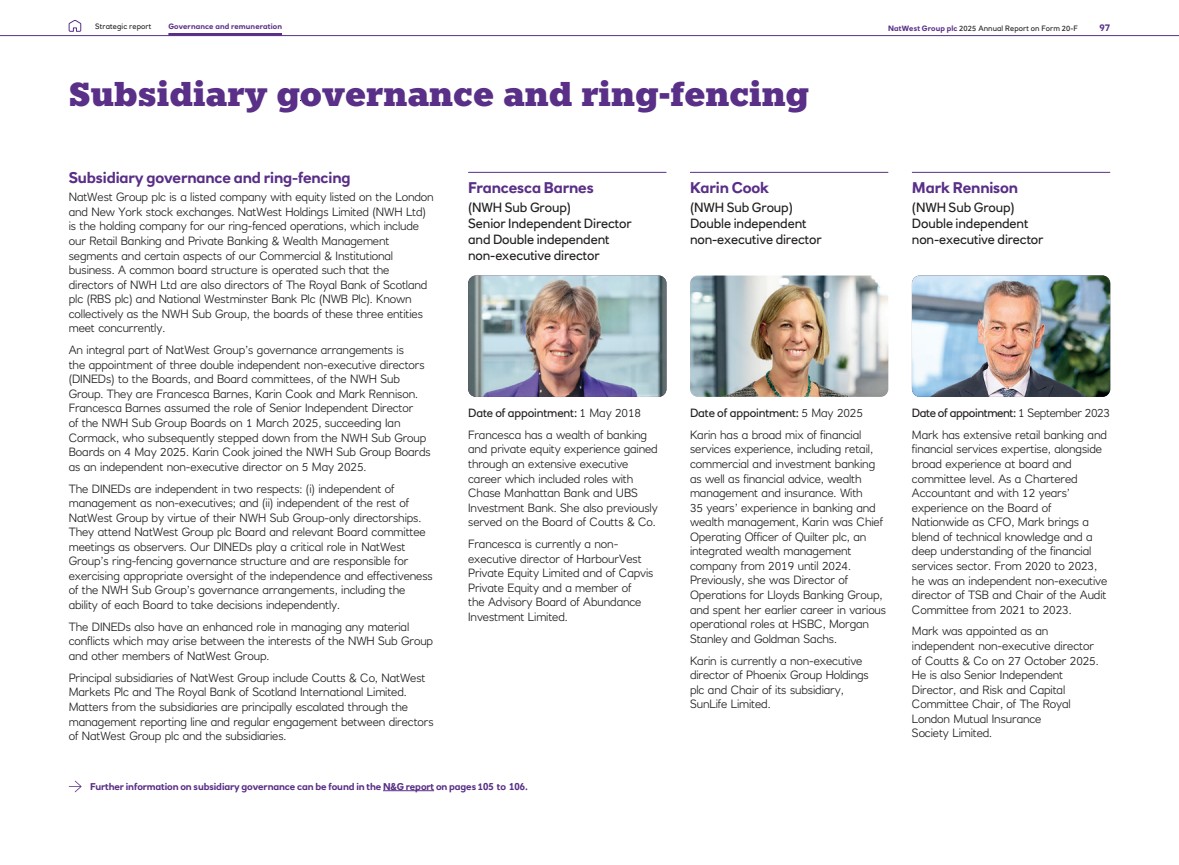
| Key Board policies and processes External appointments and time commitment In accordance with the Code, non-executive directors are expected to allocate sufficient time to the company to discharge their responsibilities effectively and to devote such time as is necessary to fulfil their role. Our executive directors do not hold more than one non-executive directorship in a FTSE 100 company or other significant appointment. The Code emphasises the importance of ensuring directors have sufficient time to meet their board responsibilities. Before any appointment, significant commitments are disclosed with an indication of the time involved. After appointment to the Board, any new external appointments require prior approval. Time commitment is also considered during non-executive directors’ year-end review meetings with the Chair, in the context of directors’ performance and contribution to the Board. Board papers relating to new director appointments or proposed additional external appointments for existing directors include details of the individual’s full portfolio and anticipated time commitment for the external role(s) under consideration. They also include a reminder of applicable limits on the number of directorships which may be held, and relevant proxy adviser and investor guidance. The Board also considers whether it is appropriate for executive directors to retain any remuneration from any new external roles, depending on the appointment. Details of all directors’ conflicts of interest are recorded in a register which is maintained by the Chief Governance Officer and Company Secretary and reviewed annually by the Board. Independence Non-executive director independence and individual directors’ continuing contribution to the company are considered by the Board, with support from the Group Nominations and Governance Committee at least annually, and when new non-executive directors are appointed. The Board considers that the Chair, Rick Haythornthwaite, was independent on appointment and that all current non-executive directors are independent, for the purposes of the Code. Information All directors receive accurate, timely and clear information on all relevant matters and have access to the advice and services of the Chief Governance Officer and Company Secretary. External advice is provided to the Board as required. In addition, all directors are able, if necessary, to obtain independent professional advice at the company’s expense. During 2025, the Board approved the appointment of Mr Critchley to the Board and additional appointments taken on by Ms Gopalan, Mr Haythornthwaite and Ms Whitehead were also approved. In each case, the Board noted there would be no material impact on the time commitment required for their respective NatWest Group roles and authorised any situational conflicts of interest which had been notified, under the process described below. Conflicts of interest Our directors’ conflicts of interest policy ensures that directors understand their fiduciary duties in respect of conflicts of interest and sets out the procedures for the effective identification, management and disclosure of actual or potential conflicts of interest. It also sets out the process for authorising certain conflicts. Directors are required to notify the Board of any situational or transactional conflict of interest and to update the Board with any changes to the facts and circumstances surrounding such conflicts. Situational conflicts can be authorised by the Board in accordance with the Companies Act 2006 and the company’s Articles of Association. The Board considers each request for authorisation on a case-by-case basis and has the power to impose conditions or limitations on any authorisation granted as part of the process. Strategic report Financial review Risk and capital management Financial statements Additional information Strategic report Governance and remuneration Governance and remuneration NatWest Group plc NatWest Group plc 2025 Annual Report and Accounts 2025 Annual Report on Form 20-F 11598 Details of current external appointments can be found on pages 79 to 81 and on the NatWest Group website As part of the 2025 Board effectiveness review, directors provided feedback and suggested ways to improve Board and committee papers further. Further details on the review findings and proposed actions to be taken on this topic can be found on pages 102 to 104. |
| Key Board policies and processes External appointments and time commitment In accordance with the Code, non-executive directors are expected to allocate sufficient time to the company to discharge their responsibilities effectively and to devote such time as is necessary to fulfil their role. Our executive directors do not hold more than one non-executive directorship in a FTSE 100 company or other significant appointment. The Code emphasises the importance of ensuring directors have sufficient time to meet their board responsibilities. Before any appointment, significant commitments are disclosed with an indication of the time involved. After appointment to the Board, any new external appointments require prior approval. Time commitment is also considered during non-executive directors’ year-end review meetings with the Chair, in the context of directors’ performance and contribution to the Board. Board papers relating to new director appointments or proposed additional external appointments for existing directors include details of the individual’s full portfolio and anticipated time commitment for the external role(s) under consideration. They also include a reminder of applicable limits on the number of directorships which may be held, and relevant proxy adviser and investor guidance. The Board also considers whether it is appropriate for executive directors to retain any remuneration from any new external roles, depending on the appointment. Details of all directors’ conflicts of interest are recorded in a register which is maintained by the Chief Governance Officer and Company Secretary and reviewed annually by the Board. Independence Non-executive director independence and individual directors’ continuing contribution to the company are considered by the Board, with support from the Group Nominations and Governance Committee at least annually, and when new non-executive directors are appointed. The Board considers that the Chair, Rick Haythornthwaite, was independent on appointment and that all current non-executive directors are independent, for the purposes of the Code. Information All directors receive accurate, timely and clear information on all relevant matters and have access to the advice and services of the Chief Governance Officer and Company Secretary. As part of the 2025 Board effectiveness review, directors provided feedback and suggested ways to improve Board and committee papers further. Further details on the review findings and proposed actions to be taken on this topic can be found on pages 119 to 121. External advice is provided to the Board as required. In addition, all directors are able, if necessary, to obtain independent professional advice at the company’s expense. During 2025, the Board approved the appointment of Mr Critchley to the Board and additional appointments taken on by Ms Gopalan, Mr Haythornthwaite and Ms Whitehead were also approved. In each case, the Board noted there would be no material impact on the time commitment required for their respective NatWest Group roles and authorised any situational conflicts of interest which had been notified, under the process described below. Details of current external appointments can be found on pages 96 to 98 and at natwestgroup.com. Conflicts of interest Our directors’ conflicts of interest policy ensures that directors understand their fiduciary duties in respect of conflicts of interest and sets out the procedures for the effective identification, management and disclosure of actual or potential conflicts of interest. It also sets out the process for authorising certain conflicts. Directors are required to notify the Board of any situational or transactional conflict of interest and to update the Board with any changes to the facts and circumstances surrounding such conflicts. Situational conflicts can be authorised by the Board in accordance with the Companies Act 2006 and the company’s Articles of Association. The Board considers each request for authorisation on a case-by-case basis and has the power to impose conditions or limitations on any authorisation granted as part of the process. Strategic report Financial review Governance and remuneration Risk and capital management Financial statements Additional information NatWest Group plc 2025 Annual Report and Accounts 115 Board oversight of purpose, strategy and culture Enhancing strategic engagement; Leveraging data and analytics The Board is responsible for establishing NatWest Group’s purpose. In September 2024 the Board approved NatWest Group’s purpose statement – ‘The bank that turns possibilities into progress’. The Board also sets NatWest Group’s strategic direction and oversees the execution of its strategy. Following a series of dedicated strategy sessions in 2024, the Board formally approved the strategy in February 2025, including the three strategic priorities of disciplined growth, bank-wide simplification and active balance sheet and risk management. In March 2025, the Board confirmed its support for a bank-wide performance management framework to underpin delivery of our purpose and strategy, including the adoption of Key Performance Indicators (KPIs) and Key Results (KRs) to help measure strategic progress. Changes made to re-balance Board and Board committee agendas helped to ensure sufficient time on the Board agenda for broader considerations, with dedicated sessions on Private Banking & Wealth Management and NatWest India strategy. The Board considered the Private Banking & Wealth Management strategy twice in 2025. In April, the Board considered evolving issues within the UK wealth landscape and discussed potential participation choices in terms of segments and propositions. A dedicated strategy session in June focused on three topics for deeper discussion, with a strong focus on customers and clients, as well as external perspectives. Non-executive directors confirmed their support for the proposed Private Banking & Wealth Management strategy, noting its alignment with broader NatWest Group strategy. In July, the Board discussed NatWest’s strategy in India, noting its strong operational and technology presence within NatWest Group. Directors considered potential opportunities to enhance efficiency using automation and artificial intelligence (AI), and how cultural shifts would further support enhanced customer centricity. Directors noted the value of continuing to attract top engineering talent, and ensuring that India’s role remained integrated with NatWest Group’s future strategic plans. The Board also welcomed the changes made by the CEO in October to reshape the Group Executive Committee and accelerate the shift towards becoming a more customer-focused organisation, with enabling functions aligned more closely to our businesses and customer needs. The Board recognises these changes present the opportunity to increase customer centricity, empowerment and decision velocity, and to accelerate the delivery of value through technology, data and AI, supporting our ambition to build a simpler, more agile bank. Further information on NatWest Group‘s strategy and progress made against our 2025 strategic priorities can be found in the Strategic report. The Board leads the development of NatWest Group’s culture, behaviours and standards and is responsible for assessing and monitoring culture and how culture is being embedded. These responsibilities have been fulfilled in several ways in 2025 (as detailed in the table opposite), supported by the implementation of NatWest Group’s new core behavioural framework which is aligned with and supports our purpose, strategy, ambition and customer-focused performance culture. Board reporting on culture in 2025 What did the Board receive? Areas of focus and outcomes New core behavioural framework In February, the Board approved the new core behavioural framework. Following the refresh of our purpose, strategy, ambition and performance culture, the new framework consolidated previous colleague frameworks into a single set of action-oriented behaviours under the ‘Winning Together’ banner. Directors welcomed the fact that the new simplified approach ’started with customers’ and was relatable to all colleagues across the bank. ‘Tone from the top’ At the March Board dinner, as part of a broader conversation on strategic priorities, the directors discussed the ‘tone from the top’ culture and behaviours they wished to demonstrate as a Board and in their interactions with executive management. The outputs from the discussion were reflected in the 2025 Board evolution action plan. Colleague Advisory Panel reports Feedback on discussions from Colleague Advisory Panel (CAP) meetings held in March and September were provided to the Board by the CAP Chair. Topics included executive remuneration and the wider workforce, the new core behavioural framework, financial crime strategy and the launch of the new global recognition platform ‘Recognise’. Performance management framework In March, the Board reviewed how the performance management framework supports the delivery of NatWest Group’s purpose, strategy, and financial plan. This included the introduction of Key Results for franchises and functions to align with agreed KPIs, enabling the tracking of strategic implementation and fostering the desired cultural change. Performance culture and operating systems In June, directors received an update on initial work underway to explore how the bank’s customer-focused performance culture could be enhanced by being more customer-focused, empowering those closest to the customer, speeding up decision making and putting decisions closer to those serving customers; alongside accelerating the journey to have a simpler operating system, powered by technology, AI and data; all in service of our customers. Consumer Duty assessment In July, the Board approved the Consumer Duty assessment, noting the role culture played in further embedding. Offering products such as the family-backed mortgage proposition and focus on the bereavement journey demonstrated the bank’s dedication to prioritising good customer outcomes. Colleague survey results In June and December, the Board considered the results of our 2025 colleague survey, Our View (which had been conducted in April and September). Colleagues had responded to questions across the whole colleague experience including purposeful leadership, performance culture, building a simpler bank, wellbeing and ways of working, and risk, conduct and ethics. Culture assessment report In July, the Board received a Culture assessment report on progress across metrics linked to performance culture, ethics, conduct, and compliance. In December, it was noted that from 2026, an enterprise-wide culture plan focused on customer performance would be reflected in the future approach for assessing culture. Strategic report Strategic report Governance and remuneration Financial review Governance and remuneration Risk and capital management Financial statements Additional information NatWest Group plc NatWest Group plc 2025 Annual Report and Accounts 2025 Annual Report on Form 20-F 11699 |
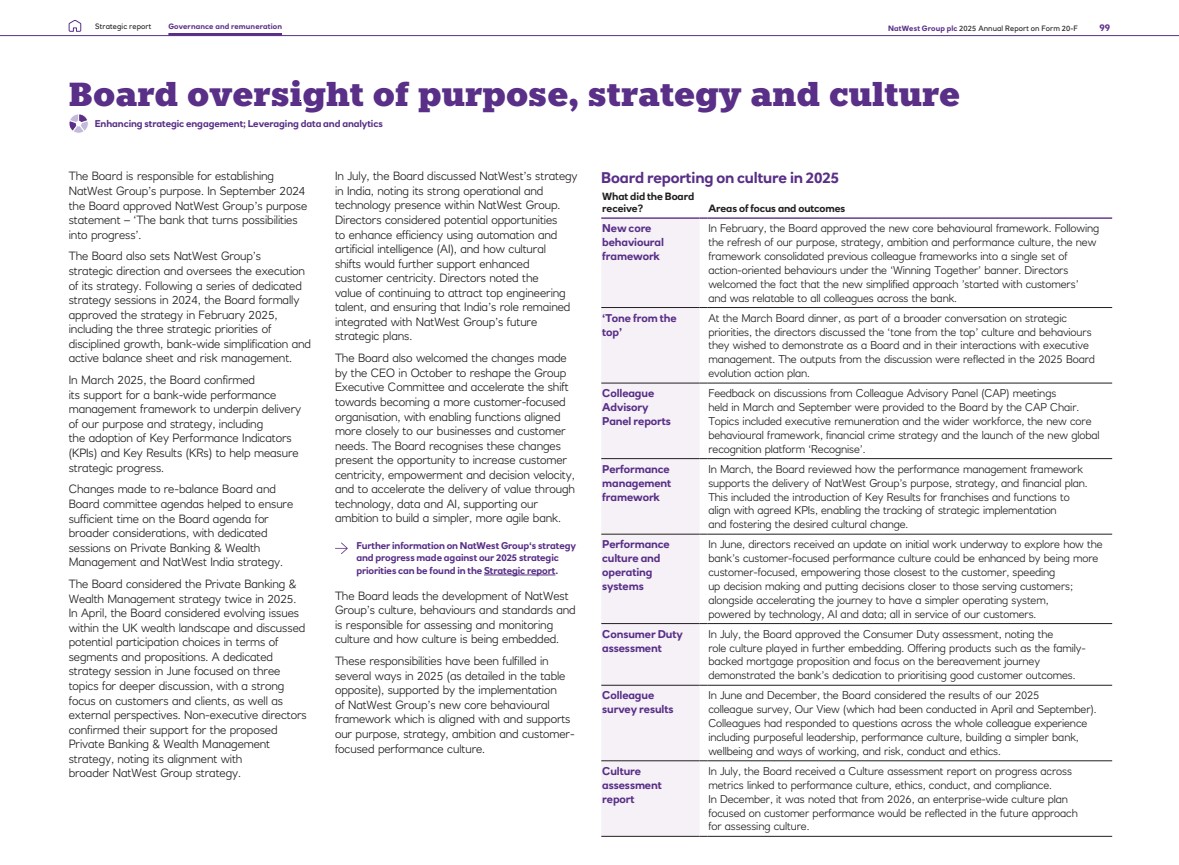
| How the Board engaged with stakeholders Enhancing strategic engagement Investors Customers How the Board engaged The Board engaged with a range of investors throughout the year. In addition to receiving regular updates on investor activity and share price performance, directors had the opportunity to engage with private shareholders at a virtual shareholder event and in person at the Annual General Meeting. In December, the Board held dedicated roundtable discussions with representatives of some of its largest institutional shareholders. These sessions enabled valuable dialogue, with investors sharing their investment strategies, perspectives on NatWest’s performance relative to peers, and feedback on NatWest Group’s strategic direction. Directors asked questions and gained direct insight into investor priorities and expectations. Major shareholders are also offered an annual update to cover governance and Board related matters with the NatWest Group Chair. During the time that UKGI managed HMT’s stake in NatWest, UKGI representatives also had the opportunity to meet Board committee Chairs bilaterally to support it in discharging its stewardship responsibilities. The Chair of the Group Performance and Remuneration Committee wrote to a number of NatWest Group’s largest institutional shareholders, proxy advisers and the UK regulators in late 2025 to discuss our approach to remuneration for the year and updated the Board on those discussions. Shareholder feedback was positive and supported the finalisation of the 2026 Performance Share Plan scorecard. Outcome of engagement Direct and indirect engagement with both private and institutional shareholders offers directors an opportunity to understand key areas of interest. Feedback from these sessions informed the Board’s external messaging, strategic priorities, and approach to future engagement. In particular, input on remuneration matters was valuable in shaping NatWest Group’s approach in this area. How the Board engaged The Board met with a range of retail and commercial customers during the year. At onsite meetings with commercial clients during the Board’s visit to Birmingham, discussions centred on the opportunities their banking relationship offered, as well as the broader macroeconomic environment and external threats such as cyberattacks. Participation in customer call listening exercises during a visit to a local branch allowed directors to gain insights into retail customers’ experiences and how colleagues supported their needs. The Board also received management updates on customer engagement activity and sentiment, including Competition and Markets Authority survey results and Net Promoter Scores. In December, the Board received a summary of customer complaints, noting a modest increase in volumes compared to 2024. Key drivers included social media influence, claims management company activity, and industry-wide trends such as fraud and scams. The Board reviewed management’s actions to address these issues, including the use of new technology and a focus on removing pain points from customer journeys. These insights informed the Board’s oversight of customer experience and operational improvements. During discussions with the Regional Board Chairs, the directors discussed customer priorities and how the growth agenda could be supported in the regions. Outcome of engagement The information gathered through these engagements and management updates informed broader strategic discussions at Board level. The Board’s oversight of complaints data and management’s response has helped shape NatWest Group’s ongoing focus on customer experience, operational excellence and the use of technology to deliver better outcomes for customers. The Board reviews and confirms its key stakeholder groups for the purposes of section 172 annually. For 2025, the key stakeholder groups remained investors, customers, colleagues, communities, regulators and suppliers. The Board’s agenda and engagement plans were structured to enhance its understanding of stakeholders’ views and interests. This in turn has informed Board discussions and decision-making. The Chair also provided regular updates to the Board on meetings with regulators, key stakeholders and other relevant bodies including clients, financial institutions, advisers, and government representatives. Our section 172(1) statement on pages 36 to 37 describes how stakeholder interests have been considered in Board discussions and decision-making, including principal decisions. In addition to the examples highlighted in the Strategic report, the Board engaged with the views and interests of stakeholders in a variety of other ways, as described in further detail in this section. Strategic report Strategic report Governance and remuneration Financial review Governance and remuneration Risk and capital management Financial statements Additional information NatWest Group plc NatWest Group plc 2025 Annual Report and Accounts 2025 Annual Report on Form 20-F 117 100 |
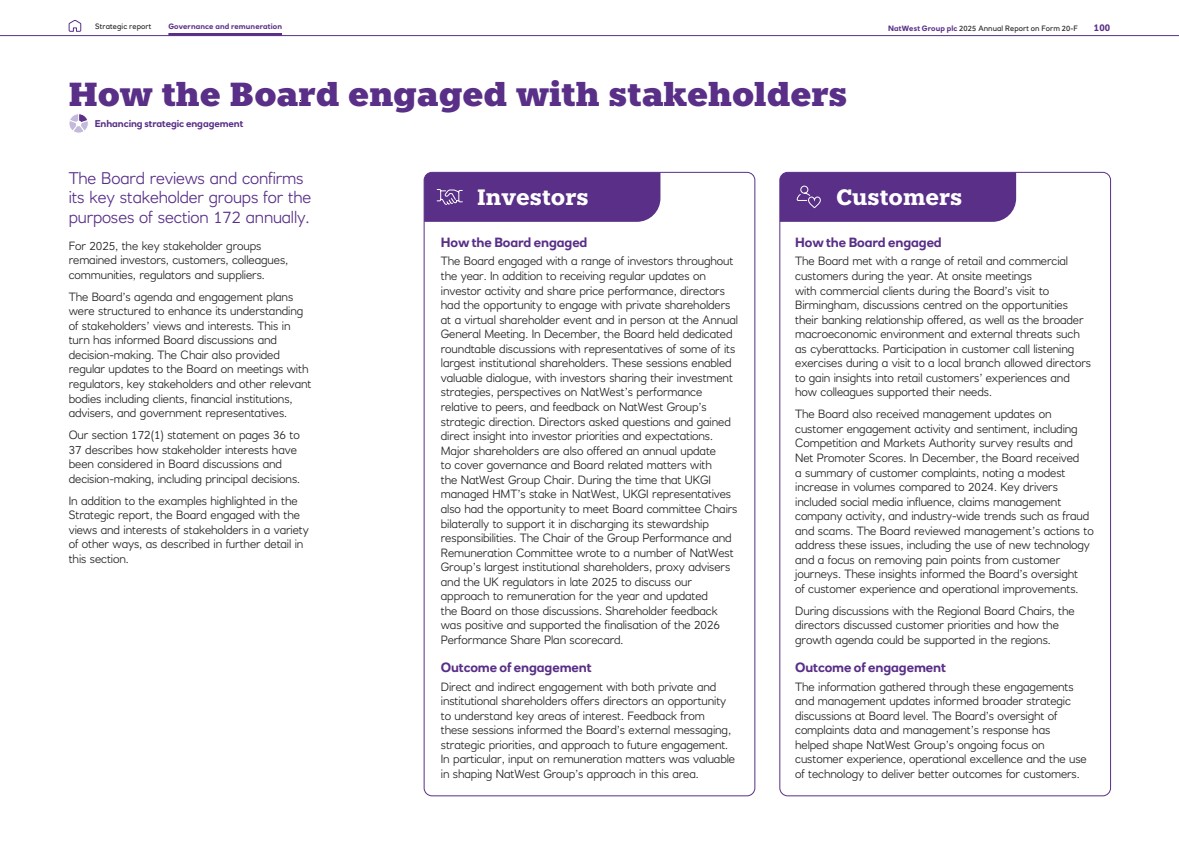
| How the Board engaged with stakeholders Enhancing strategic engagement Investors Customers How the Board engaged The Board engaged with a range of investors throughout the year. In addition to receiving regular updates on investor activity and share price performance, directors had the opportunity to engage with private shareholders at a virtual shareholder event and in person at the Annual General Meeting. In December, the Board held dedicated roundtable discussions with representatives of some of its largest institutional shareholders. These sessions enabled valuable dialogue, with investors sharing their investment strategies, perspectives on NatWest’s performance relative to peers, and feedback on NatWest Group’s strategic direction. Directors asked questions and gained direct insight into investor priorities and expectations. Major shareholders are also offered an annual update to cover governance and Board related matters with the NatWest Group Chair. During the time that UKGI managed HMT’s stake in NatWest, UKGI representatives also had the opportunity to meet Board committee Chairs bilaterally to support it in discharging its stewardship responsibilities. The Chair of the Group Performance and Remuneration Committee wrote to a number of NatWest Group’s largest institutional shareholders, proxy advisers and the UK regulators in late 2025 to discuss our approach to remuneration for the year and updated the Board on those discussions. Shareholder feedback was positive and supported the finalisation of the 2026 Performance Share Plan scorecard. Outcome of engagement Direct and indirect engagement with both private and institutional shareholders offers directors an opportunity to understand key areas of interest. Feedback from these sessions informed the Board’s external messaging, strategic priorities, and approach to future engagement. In particular, input on remuneration matters was valuable in shaping NatWest Group’s approach in this area. How the Board engaged The Board met with a range of retail and commercial customers during the year. At onsite meetings with commercial clients during the Board’s visit to Birmingham, discussions centred on the opportunities their banking relationship offered, as well as the broader macroeconomic environment and external threats such as cyberattacks. Participation in customer call listening exercises during a visit to a local branch allowed directors to gain insights into retail customers’ experiences and how colleagues supported their needs. The Board also received management updates on customer engagement activity and sentiment, including Competition and Markets Authority survey results and Net Promoter Scores. In December, the Board received a summary of customer complaints, noting a modest increase in volumes compared to 2024. Key drivers included social media influence, claims management company activity, and industry-wide trends such as fraud and scams. The Board reviewed management’s actions to address these issues, including the use of new technology and a focus on removing pain points from customer journeys. These insights informed the Board’s oversight of customer experience and operational improvements. During discussions with the Regional Board Chairs, the directors discussed customer priorities and how the growth agenda could be supported in the regions. Outcome of engagement The information gathered through these engagements and management updates informed broader strategic discussions at Board level. The Board’s oversight of complaints data and management’s response has helped shape NatWest Group’s ongoing focus on customer experience, operational excellence and the use of technology to deliver better outcomes for customers. The Board reviews and confirms its key stakeholder groups for the purposes of section 172 annually. For 2025, the key stakeholder groups remained investors, customers, colleagues, communities, regulators and suppliers. The Board’s agenda and engagement plans were structured to enhance its understanding of stakeholders’ views and interests. This in turn has informed Board discussions and decision-making. The Chair also provided regular updates to the Board on meetings with regulators, key stakeholders and other relevant bodies including clients, financial institutions, advisers, and government representatives. Our section 172(1) statement on pages 36 to 37 describes how stakeholder interests have been considered in Board discussions and decision-making, including principal decisions. In addition to the examples highlighted in the Strategic report, the Board engaged with the views and interests of stakeholders in a variety of other ways, as described in further detail in this section. Strategic report Financial review Risk and capital management Financial statements Additional information Governance and remuneration NatWest Group plc 2025 Annual Report and Accounts 117 Communities Regulators Suppliers How the board engaged with stakeholders continued Colleagues How the Board engaged The Board undertook a variety of direct and indirect engagement activities with colleagues in 2025. Directors met with a range of colleagues, including graduates, apprentices, digital champions, branch colleagues and relationship managers. Discussions during talent sessions were focused on the impact of AI and the opportunities it presents. Throughout 2025, the Board received regular updates on colleague matters, including specifically on the subject of the bank’s operating system as a vital driver of improvements in customer-focused performance. The results of our 2025 colleague survey, Our View, were also shared with the Board. Our Colleague Advisory Panel Under Provision 5 of the Code, we have adopted a formal workforce advisory panel as our chosen method of engagement with the workforce. NatWest Group’s Colleague Advisory Panel (CAP) was set up in 2018 and is currently chaired by Roisin Donnelly, one of our non-executive directors. Each CAP meeting is attended by at least two other directors, and afterwards Ms Donnelly reports to the Board on CAP discussions and colleague sentiment. The CAP met twice in 2025 and topics of discussion included executive remuneration and the wider workforce, the new core behavioural framework, financial crime strategy and an update on recognition, including the new global Recognise platform. Outcome of engagement The CAP promotes colleague voice in the boardroom, providing a forum for colleagues to engage directly with the Board on topics which are important to them and supporting effective two-way dialogue between colleagues and Board members. CAP updates to the Board provided an overview of CAP discussions on the topics referred to above, together with a summary of Q&As arising from the CAP meeting, How the Board engaged Engagement with regulators in 2025 occurred via bilateral and collective meetings on a range of topics. Directors engaged regularly through core assurance and proactive engagement meetings with the supervisory teams at the PRA and FCA respectively. Directors also participated bilaterally in regulatory review activity when requested. Representatives of the FCA attended the Board meeting in April to discuss the content of its Firmwide Evaluation Letter (FEL). In addition, representatives of the PRA joined the Board meeting in July to present the findings from the annual Periodic Summary Meeting (PSM). During the year the Board also considered key regulatory submissions such as the Operational Resilience Self Assessment, as well as associated feedback from the PRA and FCA. Outcome of engagement The bilateral and collective engagement with the regulators offered opportunities to strengthen the relationship and further build understanding of each party’s priorities. Following review of the FEL and PSM findings, the Board agreed how to address the action points raised and the respective responses. How the Board engaged The Board engaged with a number of strategic suppliers in 2025, supporting its oversight of major transformation programmes and the effective delivery of the long-term strategy and customer outcomes. The Board and its committees also considered third party risk management and the potential impacts of suppliers’ operational resilience being compromised. At a dedicated strategic partner session with two of NatWest Group’s technology partners on the bank-wide data transformation, the Board received external insight on industry trends and leading practices in data, digital and AI enabled banking. This session also provided constructive challenge on organisational decision-making pace and the cultural and capability enablers required to deploy data-driven tools and AI safely, responsibly and at scale. Outcome of engagement The Board noted positive evidence of accelerated data transformation emerging from the strategic partnership model announced in July 2025. The insights gained enhanced the Board’s understanding of the digital, data and AI strategy and informed its oversight of investment decisions, transformation priorities, operational resilience, and development of customer driven innovations. How the Board engaged Throughout the year the Board considered ESG matters and the impact of the bank on the communities in which it operates. During the regional visit to Birmingham, directors met with community leaders and representatives from local organisations to discuss the bank’s role in supporting economic growth, financial inclusion, and social mobility in the region. The Board also held a Regional Board Chairs dinner in June, which provided a valuable forum for discussing the needs and priorities of customers across different communities. The conversation centred on how the bank could better support local customers and promote the UK Government’s growth agenda in the regions, with Regional Board Chairs sharing insights from their own communities. Outcome of engagement Through the various engagement opportunities the Board deepened its knowledge of local challenges and opportunities in the communities in which the bank operates. Strategic report Financial review Risk and capital management Financial statements Additional information Strategic report Governance and remuneration Governance and remuneration NatWest Group plc NatWest Group plc 2025 Annual Report and Accounts 2025 Annual Report on Form 20-F 118 101 Further information on the CAP, including its membership composition and engagement activity on remuneration matters during 2025, can be found in the Directors’ remuneration report on page 130. |
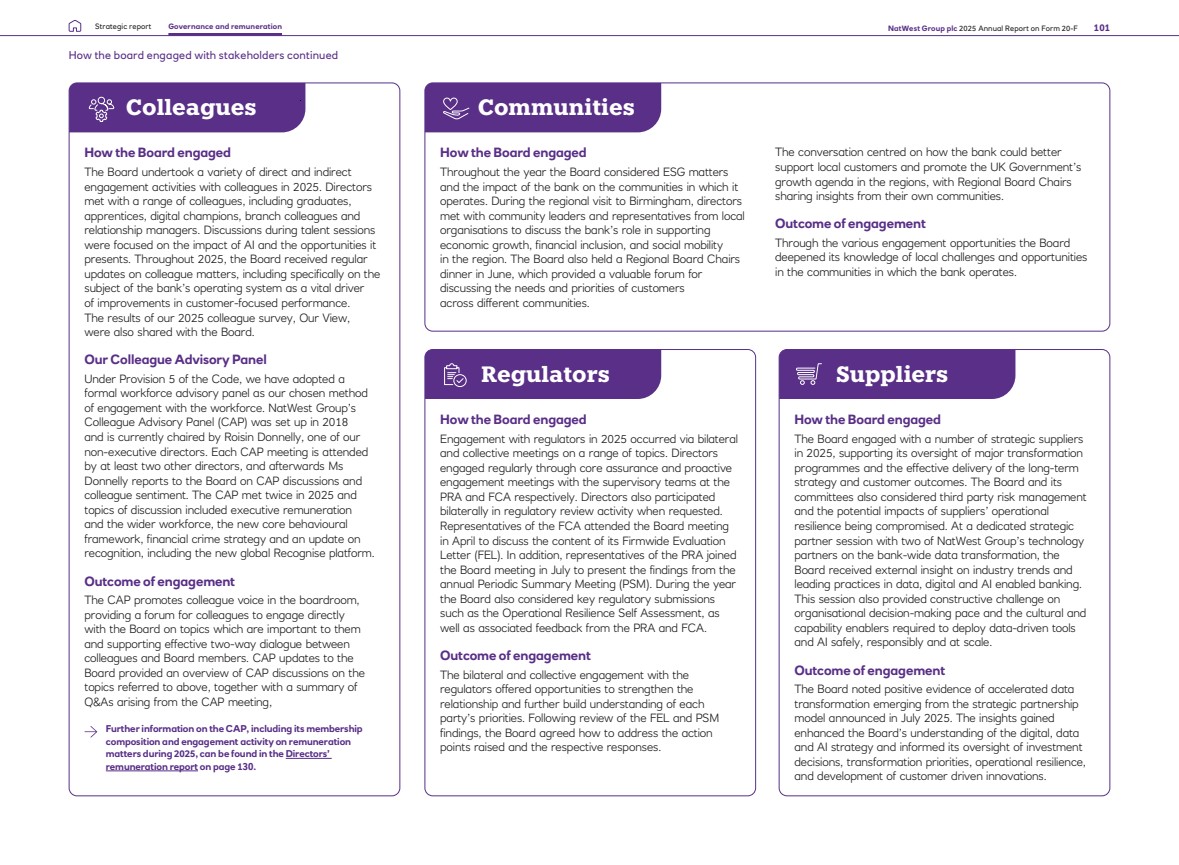
| Board effectiveness review Improving board dynamics; Leveraging data and analytics In accordance with the Code, an annual review of the performance of the Board, its committees, the Chair and individual directors usually takes place annually. The review is externally facilitated every three years, with internal evaluations in the intervening years. Our 2025 Board effectiveness review (the 2025 review) concluded that the Board and its committees are operating effectively and reaffirmed the Board’s commitment to maintaining the highest standards of governance and its ambition to be recognised as a high-performing board. The 2025 review, which was conducted internally using the BoardOutlook technology platform, provided a comprehensive assessment of Board and committee performance, strategic alignment, and opportunities for further enhancement. The process was designed to ensure the Board remains well-positioned to steer NatWest Group through a dynamic and evolving environment, with a clear focus on long-term value creation. 2025 Board effectiveness review process Objectives and scope The 2025 review was designed to provide an objective assessment of the Board’s performance and governance practices, ensuring alignment with NatWest Group’s strategic ambitions. The primary objectives were to: • Evaluate the effectiveness of the Board and its committees in supporting long-term value creation and transformation. • Assess the quality of Board dynamics, culture, and relationships, including the interface between the Board, management, and key stakeholders. • Identify areas of strength and opportunities for further optimisation, with a particular focus on strategic ambition, succession planning, risk oversight, and digital transformation. • Ensure the Board’s composition, skills, and processes remain fit for purpose. The scope covered the full Board and its committees and included senior management perspectives, as well as a review of the Board’s skills and committee structures. Survey The review process was facilitated using the BoardOutlook platform, which combined quantitative survey data with qualitative insights. All directors and ExCo members and attendees were invited to complete a detailed survey covering all aspects of Board and committee effectiveness, strategic alignment, risk management, and culture. Responses were analysed to identify areas of consensus and divergence, benchmarked against best practice, and distilled into key findings and actionable insights. Presentation and review The results were collated into a comprehensive summary report, which was shared with the Board and discussed in detail at the December Board meeting. Following presentation of the findings, the Board held an in-depth discussion of the review’s conclusions, focusing on both areas of strong performance and those requiring further attention. 1 2 3 Strategic report Financial review Risk and capital management Financial statements Additional information Strategic report Governance and remuneration Governance and remuneration NatWest Group plc NatWest Group plc 2025 Annual Report and Accounts 2025 Annual Report on Form 20-F 119 102 These are described in further detail on page 103. |
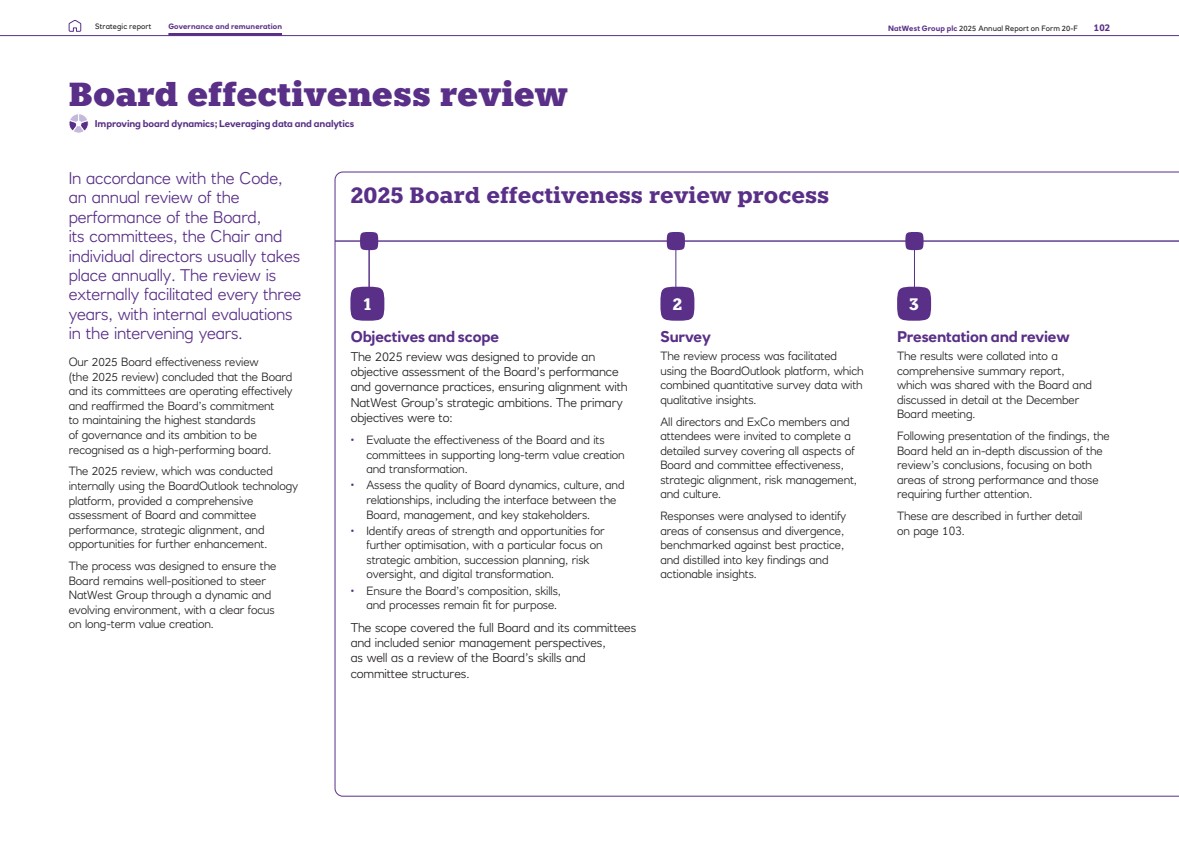
| Board effectiveness review Improving board dynamics; Leveraging data and analytics In accordance with the Code, an annual review of the performance of the Board, its committees, the Chair and individual directors usually takes place annually. The review is externally facilitated every three years, with internal evaluations in the intervening years. Our 2025 Board effectiveness review (the 2025 review) concluded that the Board and its committees are operating effectively and reaffirmed the Board’s commitment to maintaining the highest standards of governance and its ambition to be recognised as a high-performing board. The 2025 review, which was conducted internally using the BoardOutlook technology platform, provided a comprehensive assessment of Board and committee performance, strategic alignment, and opportunities for further enhancement. The process was designed to ensure the Board remains well-positioned to steer NatWest Group through a dynamic and evolving environment, with a clear focus on long-term value creation. 2025 Board effectiveness review process Objectives and scope The 2025 review was designed to provide an objective assessment of the Board’s performance and governance practices, ensuring alignment with NatWest Group’s strategic ambitions. The primary objectives were to: • Evaluate the effectiveness of the Board and its committees in supporting long-term value creation and transformation. • Assess the quality of Board dynamics, culture, and relationships, including the interface between the Board, management, and key stakeholders. • Identify areas of strength and opportunities for further optimisation, with a particular focus on strategic ambition, succession planning, risk oversight, and digital transformation. • Ensure the Board’s composition, skills, and processes remain fit for purpose. The scope covered the full Board and its committees and included senior management perspectives, as well as a review of the Board’s skills and committee structures. Survey The review process was facilitated using the BoardOutlook platform, which combined quantitative survey data with qualitative insights. All directors and ExCo members and attendees were invited to complete a detailed survey covering all aspects of Board and committee effectiveness, strategic alignment, risk management, and culture. Responses were analysed to identify areas of consensus and divergence, benchmarked against best practice, and distilled into key findings and actionable insights. Presentation and review The results were collated into a comprehensive summary report, which was shared with the Board and discussed in detail at the December Board meeting. Following presentation of the findings, the Board held an in-depth discussion of the review’s conclusions, focusing on both areas of strong performance and those requiring further attention. These are described in further detail on page 120. 1 2 3 Strategic report Financial review Risk and capital management Financial statements Additional information Governance and remuneration NatWest Group plc 2025 Annual Report and Accounts 119 2025 Board effectiveness review findings Areas of strength • Strategic partner: The Board is seen as an active partner in shaping and supporting strategy, with major proposals brought early for input. There is strong alignment between the Board and management on strategic priorities. The strategy is clearly articulated and well understood. • Governance and culture: The Board’s culture is described as positive, energetic, and well-prepared, with directors bringing diverse perspectives and engaging in constructive challenge. The Chair’s leadership is regarded as highly effective, ensuring purposeful meetings and a strong working relationship with the CEO. • Risk management: The risk framework is mature and robust, with systematic identification and oversight of material risks. Both Board and management are confident that dissent on significant risk issues would be surfaced through established channels. • Stakeholder engagement: Engagement with regulators, investors, and colleagues is strong, with s172 considerations embedded in Board discussions. The Board’s approach to mergers and acquisitions is disciplined, and oversight of performance and ESG matters is effective. Areas of focus • Strategic ambition: The Board recognises the need for clearer articulation of strategic alternatives, scenarios, and trade-offs, particularly in the context of a rapidly changing environment. • Board papers: While generally well-structured, there is scope to improve the timeliness and conciseness of Board and committee papers, allowing directors more time for reflection and focus on core issues. • Management exposure: There is value in increasing systematic exposure to leaders below ExCo level, to deepen understanding of culture, capability, and succession planning. • Customer engagement: The Board would benefit from more regular and structured direct engagement with customers, building on positive experiences from recent visits. • External perspectives: There is a desire for more external input, systematic lessons learned, and unstructured time in agendas to explore emerging topics. • Executive succession: While processes are in place, there is scope for greater Board visibility of the talent pipeline. • Transformation and digital ambition: The Board is future-facing and digitally literate but seeks greater clarity and ambition around transformation objectives, options, and measures of success, especially as digital and AI initiatives scale. 2024 action output Challenges identified during the 2024 Board effectiveness review, which was externally facilitated, (the 2024 review) included ensuring a unified Board culture, future Board composition, the fast-changing landscape (including cyber), the impact of culture change on the organisation, acting on ‘lessons learned’ and leadership development and succession planning. In relation to Board committees, the 2024 review highlighted opportunities to consider the balance of Board and committee agendas and the membership of the Group Audit Committee and the then Group Sustainable Banking Committee (now the Group Technology, Innovation and Simplification Committee), noting the single sex dynamic in both cases. The 2025 review survey included a dedicated section on the 2025 Board evolution action plan, which received positive feedback with a small number of areas for continued focus reflected in the 2025 Board effectiveness review report. An updated view of GAC and TISC membership can be found in the relevant committee reports. Board effectiveness review continued 4 5 6 Strategic report Financial review Risk and capital management Financial statements Additional information Strategic report Governance and remuneration Governance and remuneration NatWest Group plc NatWest Group plc 2025 Annual Report and Accounts 2025 Annual Report on Form 20-F 120 103 The challenges identified during the 2024 review themes were acknowledged and addressed through the development and implementation of the 2025 Board evolution action plan, the outcomes of which are signposted from page 85 and referenced throughout this Corporate governance report. |
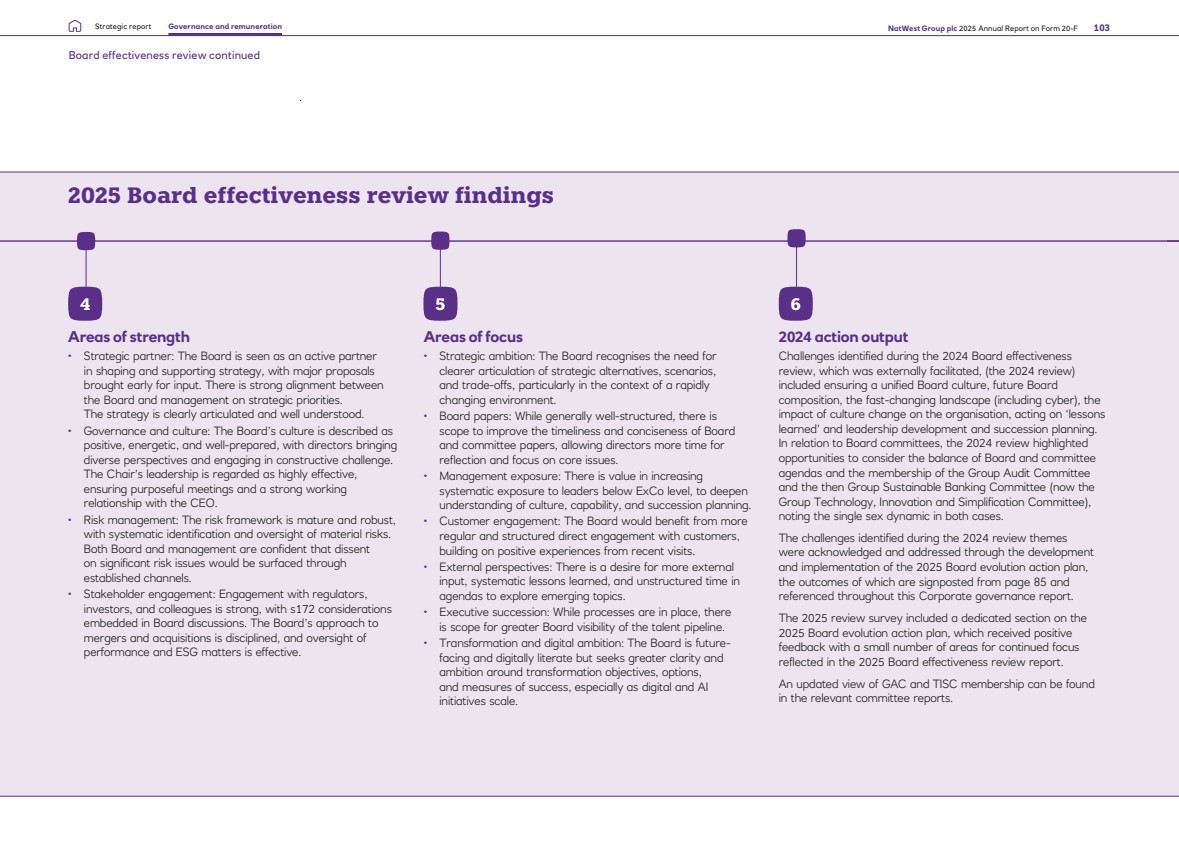
| Board effectiveness review continued 2025 agreed actions In response to the 2025 review, an action plan was agreed to address a number of immediate opportunities which had been identified. This includes: • A comprehensive review of Board and committee papers, to focus on timeliness, conciseness, and use of AI to enhance quality and consistency. • Enhanced Board exposure to executive talent below ExCo level, through expanded attendance at Board meetings. • Increased direct engagement with customers and stakeholders, including structured visits. • Agenda time for external perspectives, lessons learned, and innovation and learning. Progress against these actions will be monitored by the Group Nominations and Governance Committee in 2026. Board committee findings and actions The 2025 review confirmed that the Board’s committee structure is appropriate and operating effectively, with strong leadership and clear agendas across each of the committees. The Board committees are seen as stable and well-structured, with opportunities identified to further enhance effectiveness through increased use of external advisers, deep dives into emerging topics, and broader sharing of insights across the Board. Individual effectiveness reviews The Chair met each non-executive director individually to discuss their performance, continuing professional development and contribution to NatWest Group’s long-term sustainable success. Separately, the Senior Independent Director, together with the Senior Independent Director of the NWH Sub Group, sought feedback on the Chair’s performance from the non-executive directors, executive directors and other key internal and external stakeholders, and discussed it with the Chair. These discussions were supported by a structured agenda and with reference to the outputs of the 2025 Board skills assessment and a separate D360 exercise, which were also completed using the BoardOutlook technology platform. These individual reviews concluded that each non-executive and the Chair continue to contribute positively to the long-term sustainable success of the company. 2025 Board effectiveness review findings continued 7 8 9 Strategic report Strategic report Governance and remuneration Financial review Governance and remuneration Risk and capital management Financial statements Additional information NatWest Group plc NatWest Group plc 2025 Annual Report and Accounts 2025 Annual Report on Form 20-F 121 104 |
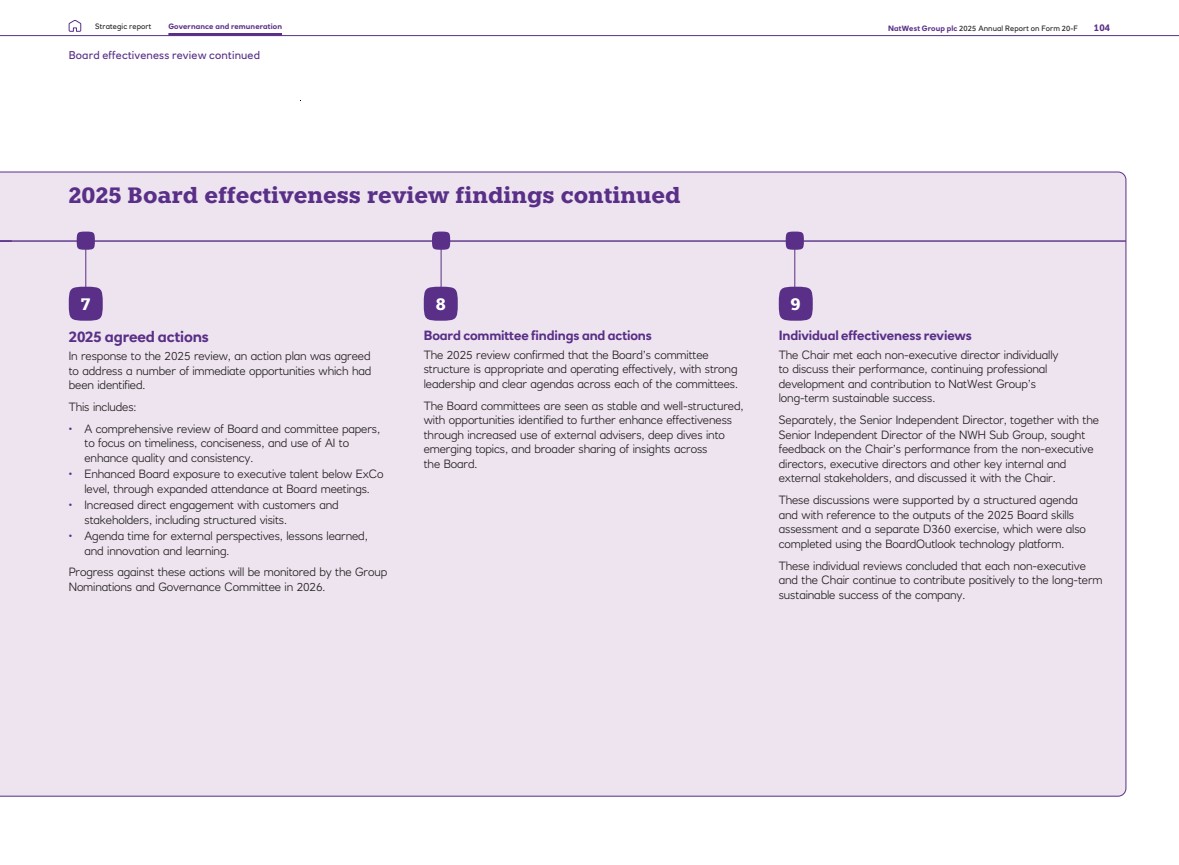
| Board effectiveness review continued 2025 agreed actions In response to the 2025 review, an action plan was agreed to address a number of immediate opportunities which had been identified. This includes: • A comprehensive review of Board and committee papers, to focus on timeliness, conciseness, and use of AI to enhance quality and consistency. • Enhanced Board exposure to executive talent below ExCo level, through expanded attendance at Board meetings. • Increased direct engagement with customers and stakeholders, including structured visits. • Agenda time for external perspectives, lessons learned, and innovation and learning. Progress against these actions will be monitored by the Group Nominations and Governance Committee in 2026. Board committee findings and actions The 2025 review confirmed that the Board’s committee structure is appropriate and operating effectively, with strong leadership and clear agendas across each of the committees. The Board committees are seen as stable and well-structured, with opportunities identified to further enhance effectiveness through increased use of external advisers, deep dives into emerging topics, and broader sharing of insights across the Board. Individual effectiveness reviews The Chair met each non-executive director individually to discuss their performance, continuing professional development and contribution to NatWest Group’s long-term sustainable success. Separately, the Senior Independent Director, together with the Senior Independent Director of the NWH Sub Group, sought feedback on the Chair’s performance from the non-executive directors, executive directors and other key internal and external stakeholders, and discussed it with the Chair. These discussions were supported by a structured agenda and with reference to the outputs of the 2025 Board skills assessment and a separate D360 exercise, which were also completed using the BoardOutlook technology platform. These individual reviews concluded that each non-executive and the Chair continue to contribute positively to the long-term sustainable success of the company. 2025 Board effectiveness review findings continued 7 8 9 Strategic report Financial review Risk and capital management Financial statements Additional information Governance and remuneration NatWest Group plc 2025 Annual Report and Accounts 121 Report of the Group Nominations and Governance Committee The committee continues to oversee further recruitment activity in respect of the Board and the board of NWH Ltd. Corporate governance framework During 2025, the committee completed a review of corporate governance framework collateral, resulting in the launch of a revised Corporate Governance Policy with a more focused set of principles and rules to guide all colleagues and subsidiary directors making decisions. Refreshed materials were also approved to support subsidiary boards and non-executive directors, by outlining their roles and responsibilities and ways of working that support delivery of the NatWest Group strategy. Finally, the Committee approved revised terms of reference for the Boards of the principal subsidiaries, updated to reflect the new corporate governance collateral while ensuring ongoing compliance with all legal and regulatory requirements. Effectiveness review In accordance with the Code, an evaluation of the performance of the Board and its committees, including N&G, was conducted internally in 2025. Subsidiary governance The committee continued to oversee the subsidiary governance framework and received regular updates from the principal subsidiaries on their recruitment and succession plans. Several of NatWest Group’s principal subsidiaries made appointments to their boards during 2025, which the committee has approved in accordance with its terms of reference, including the appointment of Dame Anne Richards as Chair of Coutts & Co. Korn Ferry, Heidrick & Struggles, MWM, Odgers and Spencer Stuart were engaged during the year to support NatWest Group’s Board search activity. The firms are members of the retained executive search panel of suppliers (managed by NatWest Executive Search). Spencer Stuart and Korn Ferry also provide leadership advisory services to NatWest Group. To enhance the data led review of composition and succession planning, the BoardOutlook skills assessment tool was extended to the principal subsidiaries. After the digital assessments were completed, the committee reviewed the skills matrices for Coutts & Co, RBSI and NWM, noting each board’s critical and general skills to support its oversight of composition and succession planning. I would like to thank all the committee members and attendees for their commitment and contributions in 2025 including Ian Cormack who observed committee meetings in his capacity as Senior Independent Director of NWH Ltd. On 1 March 2025 Ian was succeeded as Senior Independent Director of NWH Ltd by Francesca Barnes who observed committee meetings since then. Ian continued to observe committee meetings until he stepped down from the board of NWH Ltd in May 2025. Rick Haythornthwaite Chair of the Group Nominations and Governance Committee 12 February 2026 Members and attendance in 2025 Directors Scheduled meetings attended Rick Haythornthwaite (Chair) 4 of 4 Stuart Lewis 4 of 4 Lena Wilson 4 of 4 Patrick Flynn 4 of 4 Mark Seligman 1 of 1 In addition to the four scheduled meetings there were four ad hoc meetings. All directors eligible to attend ad hoc meetings were present at those meetings. Mr Seligman retired from the Board on the 31 March 2025. Principal areas of focus • Board recruitment • Corporate governance framework • Subsidiary governance • Board and committee composition • Succession planning • Diversity and inclusion Dear Shareholder, As Chair of the Board and Chair of the Group Nominations and Governance Committee, I am pleased to present this report on the committee’s activity during 2025. The committee is responsible for reviewing the Board’s structure, size and composition, as well as the membership and chairs of Board committees, recommending appointments to the Board and overseeing executive succession. It also monitors NatWest Group’s governance arrangements to uphold best corporate governance practices and considers developments in banking reform and analogous issues affecting NatWest Group, making recommendations to the Board for any consequential changes to NatWest Group’s operating model. Board recruitment Board recruitment continued to be a principal area of focus during 2025 with the committee supporting comprehensive candidate searches with diversity and inclusion considerations factored into all search criteria. A data led approach was adopted for the assessment and mapping of skills to enhance the search processes and to support the monitoring of Board skills and experience. During the search processes, the committee held several discussions on potential candidates, assessing the credentials of each candidate against the results of a Board skills assessment undertaken and the qualities and capabilities set out in the role specifications agreed by the committee. After detailed searches, the committee recommended Josh Critchley and Albert Hitchcock for appointment to the Board as non-executive directors. Albert will join on the 23 February 2026. Separately, the committee also recommended Karin Cook for appointment to the NWH Ltd board as a double-independent non-executive director. Strategic report Financial review Risk and capital management Financial statements Additional information Strategic report Governance and remuneration Governance and remuneration NatWest Group plc NatWest Group plc 2025 Annual Report and Accounts 2025 Annual Report on Form 20-F 122 105 Further information on the review can be found on pages 102 to 104. |
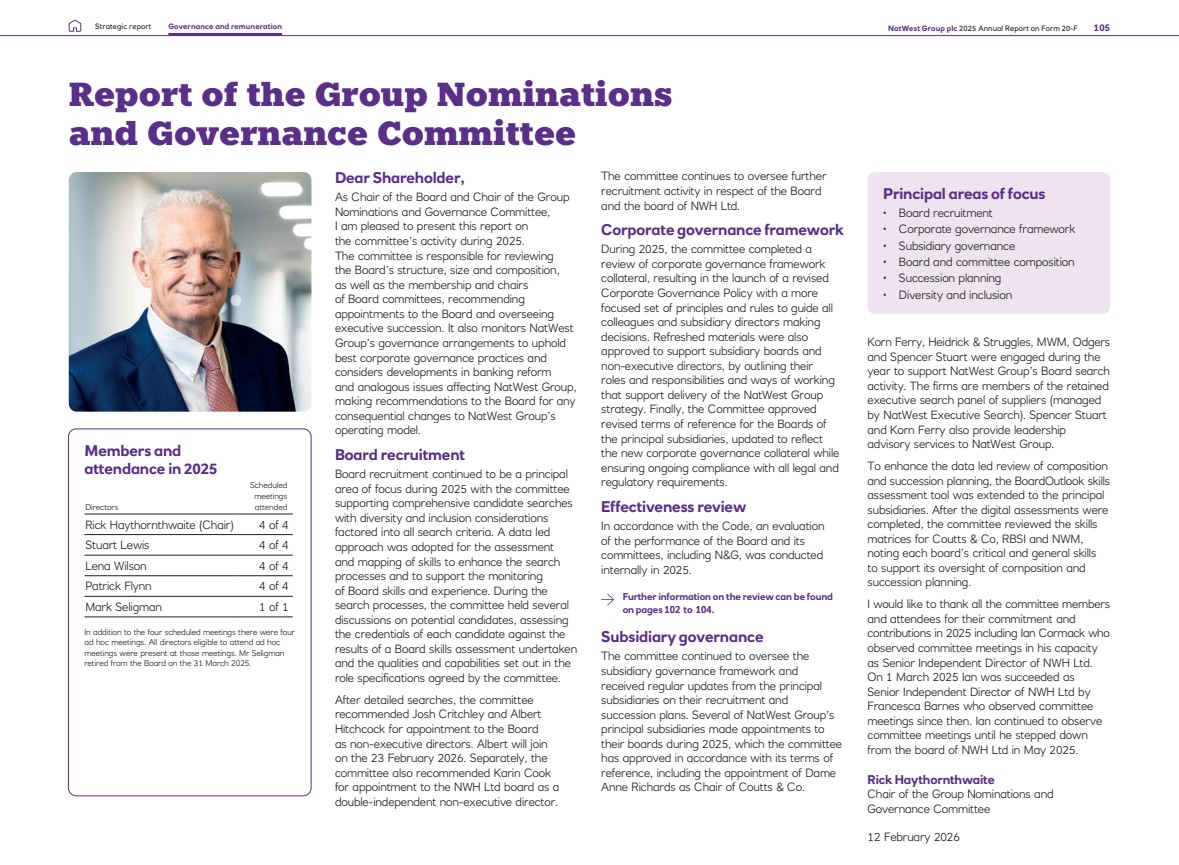
| Report of the Group Nominations and Governance Committee continued Principal areas of Group Nominations & Governance Committee focus in 2025 Theme Principal area of committee focus Outcomes Board & committee composition The committee supported the Chair in keeping the composition of the Board and its committees under regular review. The committee supported the Chair’s ongoing evolution of Board composition, and the recruitment activity outlined reflects the changes which the committee recommended. Composition is reviewed with reference to the skills and experience of individual directors, ensuring the Board’s collective skill set remains appropriately balanced and aligned to current and future strategic priorities. The use of the Board Skills matrix, which was completed by all of the Board, provides the committee with valuable insights for assessment of the current Board composition and enhancing the view of future skills gaps to be addressed. Under the Board appointment policy, non-executive directors are appointed for an initial term of three years, subject to annual re-election by shareholders. The committee completed a term review of Roisin Donnelly’s tenure, per the Board appointment policy, in December 2025 and it was recommended that Roisin serve a further three years on the Board. Succession planning Alongside composition, the committee reviews succession plans periodically to ensure there are contingency plans in place for successors to the Board executive directors, Board and Board committee chairs and the Senior Independent Director. The Board and committee succession plans were reviewed and given specific focus by the committee in June 2025, with the plans monitored on a frequent basis. The committee holds responsibility for the oversight of executive succession within NatWest Group. The committee continues to review executive succession planning for CEO-1 roles and received periodic updates on developments. In June 2025, the committee was briefed on an evolved approach to executive succession, including enhancements to NatWest Group’s talent ecosystem designed to strengthen leadership pipelines. Diversity & inclusion The Board operates a boardroom inclusion policy which reflects NatWest Group’s inclusion guidelines and is aligned to NatWest Group’s behaviours and relevant legal or voluntary code requirements. The boardroom inclusion policy ensures that the Board and the committee follow an inclusive process when making nomination decisions. That includes ensuring that the nomination process is based on the principles of fairness, respect, and inclusion; that all nominations and appointments are made based on individual competence, skills and expertise measured against identified objective criteria without bias, prejudice, or discrimination, and that searches for Board candidates are conducted with due regard to the benefits of diversity and inclusion. Diversity and inclusion have been considered in all of the recruitment overseen by the committee and in its review of executive succession planning in 2025 and, accordingly, as of 31 December 2025, the company met: • the FTSE Women Leaders Review voluntary target of 40% women’s representation on boards by the end of 2025, with 55% of the Board being women; • the FTSE Women Leaders Review recommendation (at least one woman in the Chair or Senior Independent Director roles on the Board and/or one woman in the Chief Executive Officer or Finance Director role by the end of 2025) by having a woman Senior Independent Director and a woman CFO; and • the recommendation of the Parker Review to have at least one member of the Board being from an ethnic minority background with two such directors meeting this criterion. Pages 59 to 63 contain more information on how NatWest Group is creating an inclusive workplace, including (in relation to Provision 23 of the Code) the gender balance of senior management and their direct reports. Strategic report Financial review Risk and capital management Financial statements Additional information Strategic report Governance and remuneration Governance and remuneration NatWest Group plc NatWest Group plc 2025 Annual Report and Accounts 2025 Annual Report on Form 20-F 123 106 A copy of the boardroom inclusion policy is available on the NatWest Group website The changes to the Board and Board committees in 2025 and early 2026 are summarised on page 79. • the targets set out in UK Listing Rule 6.6.6R (9) (Board and executive management diversity) and disclosures under UK Listing Rule 6.6.6R (9) and (10) can be found on page 86; |
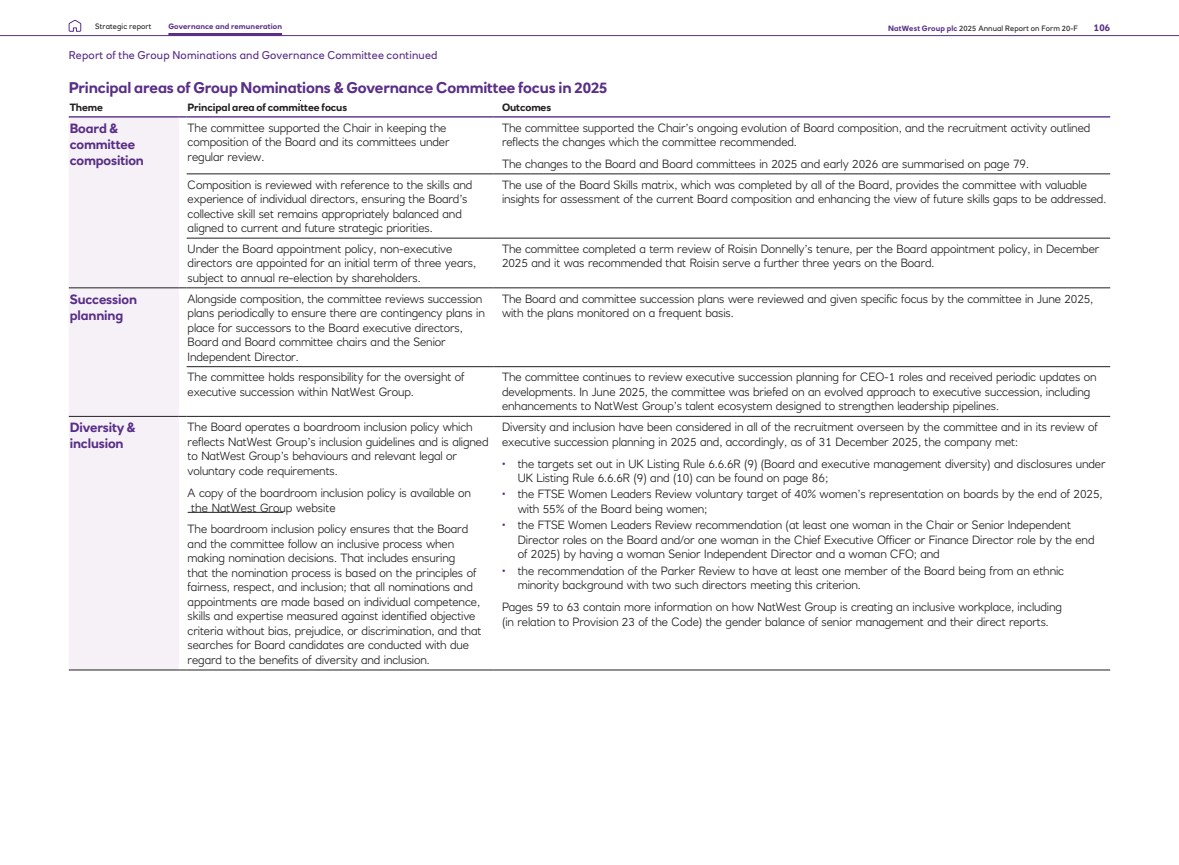
| Report of the Group Nominations and Governance Committee continued Principal areas of Group Nominations & Governance Committee focus in 2025 Theme Principal area of committee focus Outcomes Board & committee composition The committee supported the Chair in keeping the composition of the Board and its committees under regular review. The committee supported the Chair’s ongoing evolution of Board composition, and the recruitment activity outlined reflects the changes which the committee recommended. The changes to the Board and Board committees in 2025 and early 2026 are summarised on page 96. Composition is reviewed with reference to the skills and experience of individual directors, ensuring the Board’s collective skill set remains appropriately balanced and aligned to current and future strategic priorities. The use of the Board Skills matrix, which was completed by all of the Board, provides the committee with valuable insights for assessment of the current Board composition and enhancing the view of future skills gaps to be addressed. Under the Board appointment policy, non-executive directors are appointed for an initial term of three years, subject to annual re-election by shareholders. The committee completed a term review of Roisin Donnelly’s tenure, per the Board appointment policy, in December 2025 and it was recommended that Roisin serve a further three years on the Board. Succession planning Alongside composition, the committee reviews succession plans periodically to ensure there are contingency plans in place for successors to the Board executive directors, Board and Board committee chairs and the Senior Independent Director. The Board and committee succession plans were reviewed and given specific focus by the committee in June 2025, with the plans monitored on a frequent basis. The committee holds responsibility for the oversight of executive succession within NatWest Group. The committee continues to review executive succession planning for CEO-1 roles and received periodic updates on developments. In June 2025, the committee was briefed on an evolved approach to executive succession, including enhancements to NatWest Group’s talent ecosystem designed to strengthen leadership pipelines. Diversity & inclusion The Board operates a boardroom inclusion policy which reflects NatWest Group’s inclusion guidelines and is aligned to NatWest Group’s behaviours and relevant legal or voluntary code requirements. A copy of the boardroom inclusion policy is available at natwestgroup.com. The boardroom inclusion policy ensures that the Board and the committee follow an inclusive process when making nomination decisions. That includes ensuring that the nomination process is based on the principles of fairness, respect, and inclusion; that all nominations and appointments are made based on individual competence, skills and expertise measured against identified objective criteria without bias, prejudice, or discrimination, and that searches for Board candidates are conducted with due regard to the benefits of diversity and inclusion. Diversity and inclusion have been considered in all of the recruitment overseen by the committee and in its review of executive succession planning in 2025 and, accordingly, as of 31 December 2025, the company met: • the targets set out in UK Listing Rule 6.6.6R (9) (Board and executive management diversity) and disclosures under UK Listing Rule 6.6.6R (9) and (10) can be found on page 103; • the FTSE Women Leaders Review voluntary target of 40% women’s representation on boards by the end of 2025, with 55% of the Board being women; • the FTSE Women Leaders Review recommendation (at least one woman in the Chair or Senior Independent Director roles on the Board and/or one woman in the Chief Executive Officer or Finance Director role by the end of 2025) by having a woman Senior Independent Director and a woman CFO; and • the recommendation of the Parker Review to have at least one member of the Board being from an ethnic minority background with two such directors meeting this criterion. Pages 59 to 63 contain more information on how NatWest Group is creating an inclusive workplace, including (in relation to Provision 23 of the Code) the gender balance of senior management and their direct reports. Strategic report Financial review Risk and capital management Financial statements Additional information Governance and remuneration NatWest Group plc 2025 Annual Report and Accounts 123 Report of the Group Audit Committee Whistleblowing In my role as whistleblowers’ champion for NatWest Group, I receive regular updates on the effectiveness of the whistleblowing framework, prevalent themes in reports submitted by colleagues through the systems, and the tracking of outcomes from the most significant cases. The committee is responsible for supervising the independence, autonomy, and effectiveness of NatWest Group’s whistleblowing policies and procedures. There is a suitable dissemination of information to the principal subsidiaries to ensure a cohesive approach across NatWest Group. Internal and External Audit Oversight Throughout 2025, the committee maintained oversight of the external auditor and the Internal Audit function. Formal evaluations were conducted at year-end through an internal process, and the committee reviewed synopses of the feedback provided by relevant stakeholders. Additional details regarding the oversight provided can be located in the tables on the following pages. Effectiveness review Patrick Flynn Chair of the Group Audit Committee 12 February 2026 Members and attendance in 2025 Directors Scheduled meetings attended Patrick Flynn (Chair)* 5 of 5 Geeta Gopalan* 5 of 5 Stuart Lewis 5 of 5 There were no ad-hoc meetings. * ‘Financial experts’ as defined in the SEC rules under the US Securities Exchange Act of 1934 (the ‘Exchange Act’) and the requirements of the New York Stock Exchange, and that they have competence in accounting and/or auditing as required under the Disclosure Guidance and Transparency Rules. The Board is satisfied that all GAC members have recent and relevant financial experience and are independent as defined in the SEC rules under the Exchange Act and related guidance. Principal areas of focus • Systems of Internal Control (financial management, reporting, and accounting issues) • Financial and non-financial reporting, including significant judgements and estimates • Oversight of internal and external audit Dear Shareholder, I am delighted to provide an overview of the Group Audit Committee’s (the committee or GAC) activities and responsibilities throughout 2025. Firstly, I extend my gratitude to my colleagues, Stuart Lewis and Geeta Gopalan, for their contributions to the committee. Additionally, I would like to express appreciation for the insights provided by Karin Cook and Mark Rennison, non-executive directors and members of NatWest Holdings (NWH) Audit Committee, who attend GAC meetings in an observational capacity. Additional thanks should be given to Mark Seligman, who retired from the Board and his role on GAC on 31 March 2025, and Ian Cormack who stepped down as a NWH Audit Committee member in May 2025. The committee’s fundamental role is to supervise and challenge management’s approach to the preparation of financial results, as well as the disclosure of relevant financial and non-financial information. This oversight encompasses the evaluation of the application of accounting policies, the scrutiny of internal control standards related to financial reporting and accounting, and their effectiveness, and the review of quarterly disclosures prior to release. During 2025, the committee’s most significant areas of focus included the adequacy of provision in respect of expected credit loss (ECL), the robustness of the control environment (including preparation for enhanced Code requirements applicable from 1 January 2026), and enhanced oversight of non-financial reporting. Further details can be found in the tables on the following pages. Strategic report Financial review Risk and capital management Financial statements Additional information Strategic report Governance and remuneration Governance and remuneration NatWest Group plc NatWest Group plc 2025 Annual Report and Accounts 2025 Annual Report on Form 20-F 107 124 In accordance with the Code, an evaluation of the performance of the Board and its committees, including the GAC, was conducted internally in 2025. Further information on the review can be found on pages 102 to 104. |
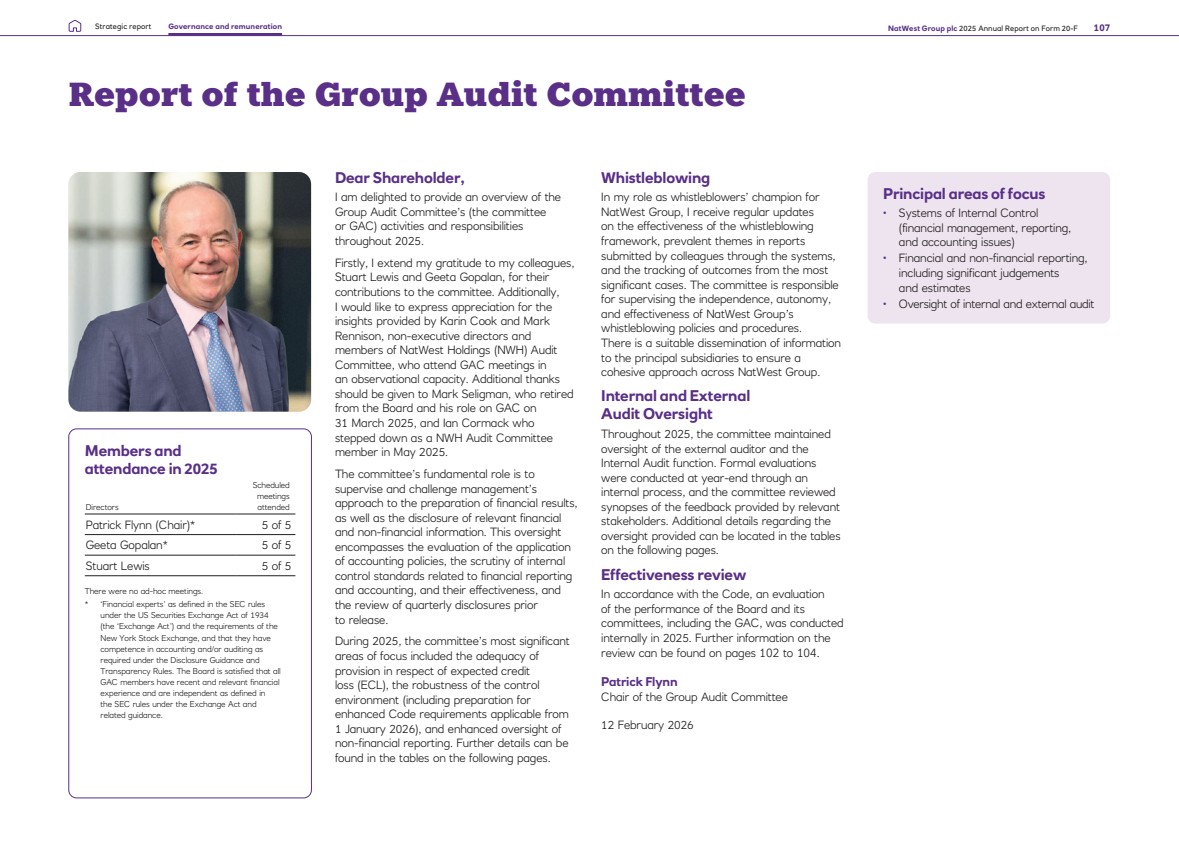
| Systems of internal control The committee placed significant emphasis on the internal control systems concerning financial management, reporting, and accounting issues. Throughout 2025, it received regular reports on this and assessed the effectiveness and efficiency of NatWest Group’s internal control systems, encompassing any notable deficiencies or shortcomings. Matter Role of committee and context of discussion How the committee addressed the matter Sarbanes-Oxley Act of 2002 To consider compliance with section 404 of the Sarbanes-Oxley Act of 2002. The committee received periodic updates on the bank’s internal controls over financial reporting throughout 2025, provided. The approach to the assessment of the controls in respect of the business acquired from Sainsbury’s Bank was overseen, including temporary controls implemented during the migration process. The committee was pleased that full customer migration was achieved prior to the end of the financial year. Regulatory and financial returns To assess the controls and procedures implemented by management for adherence to regulatory and financial reporting standards. As part of management’s ongoing work to strengthen the financial reporting control environment, the committee continued to oversee delivery against the findings of the industry-wide skilled person’s review of regulatory returns. Significant progress was made during 2025, with remediation of a substantial number of issues, and the committee continue to monitor completion of the remaining actions. Control environment To evaluate the control environment ratings of the businesses, functions, and significant subsidiaries, and to assess management’s efforts in preserving or enhancing the control environment in respect of financial management, reporting and accounting. The committee noted that the overall control environment retained its ’met’ rating during 2025, driven by further improvements in the control environment. The committee noted progress achieved to reduce the percentage of controls which failed validation testing by Internal Audit following a focus on improving business control ownership. In addition, the committee also noted a greater than 50% reduction in the level of unremediated significant audit findings. Quarterly reports were received from the chairs of audit committees of material regulated subsidiaries, providing oversight of material risk and control matters and a channel for escalation of issues. Throughout the year, the GAC Chair held quarterly meetings with the Chairs of the subsidiary audit committee meetings to facilitate consistency and to share key themes discussed. Other standards of control In addition, the committee receives regular updates on matters pertinent to NatWest Group’s standards of internal control. The committee received an update on the bank’s tax position and discussed matters including tax provisioning levels, significant provided and unprovided tax risks and deferred tax assets. For deferred tax, this considered sustainable profitability, the period of assessment, and changes against previous estimates. Report of the Group Audit Committee continued Strategic report Financial review Risk and capital management Financial statements Additional information Strategic report Governance and remuneration Governance and remuneration NatWest Group plc NatWest Group plc 2025 Annual Report and Accounts 2025 Annual Report on Form 20-F 125 108 The GAC reviewed the disclosure on internal control matters in conjunction with the related guidance from the Financial Reporting Council. For preparations for the new Code requirements which are effective from 1 January 2026 please see page 107. enabling ongoing monitoring of progress and providing support for management’s year-end conclusions. The committee maintained oversight of the plans and transition toward more automated preventative key controls. Furthermore, regular updates from EY regarding their assessment of the Sarbanes-Oxley Act compliance and the status and rating of control matters were also |
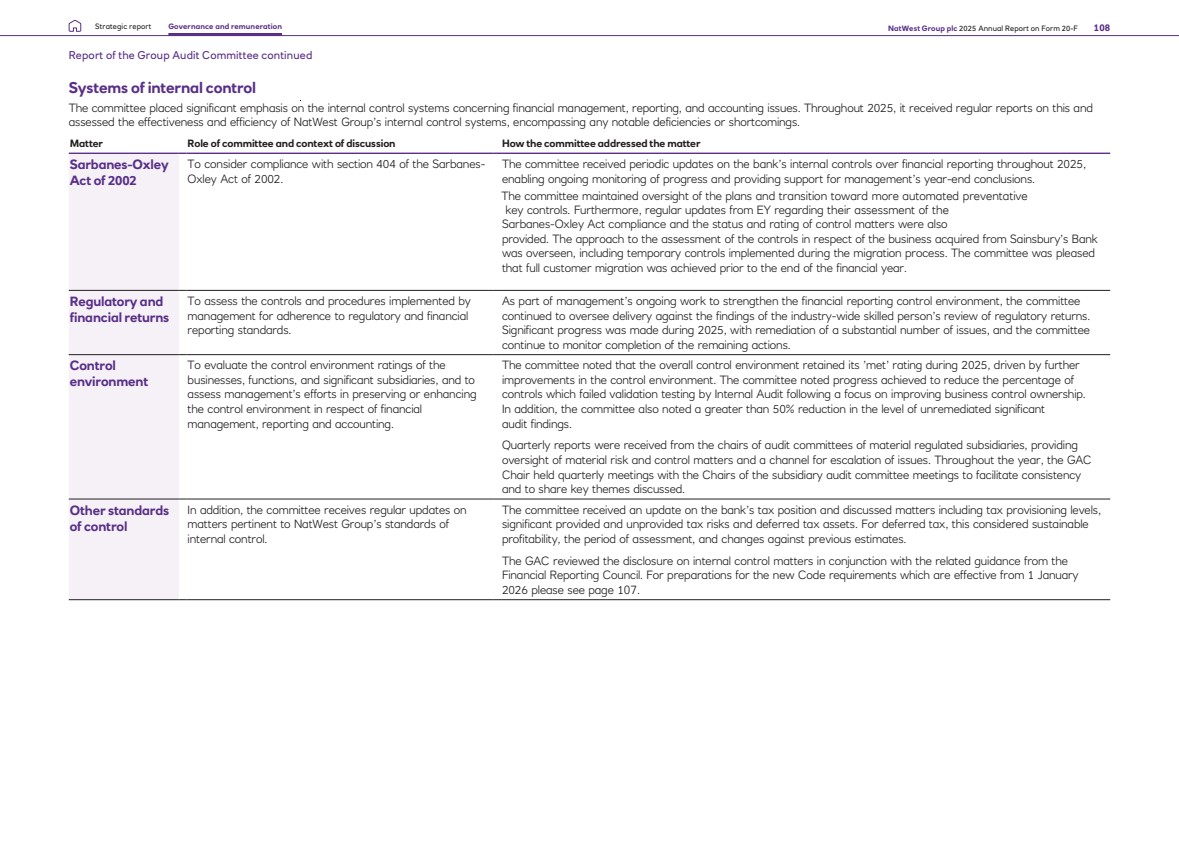
| Systems of internal control The committee placed significant emphasis on the internal control systems concerning financial management, reporting, and accounting issues. Throughout 2025, it received regular reports on this and assessed the effectiveness and efficiency of NatWest Group’s internal control systems, encompassing any notable deficiencies or shortcomings. Matter Role of committee and context of discussion How the committee addressed the matter Sarbanes-Oxley Act of 2002 To consider compliance with section 404 of the Sarbanes-Oxley Act of 2002. The committee received periodic updates on the bank’s internal controls over financial reporting throughout 2025, enabling ongoing monitoring of progress and providing support for management’s year-end conclusions. This included updates from management regarding control deficiencies that emerged during the year, and confirmation that there were no significant deficiencies or material weaknesses identified. The committee maintained oversight of the plans and transition toward more automated preventive key controls. Furthermore, regular updates from EY regarding their assessment of the Sarbanes-Oxley Act compliance and the status and rating of control matters were also provided. The approach to the assessment of the controls in respect of the business acquired from Sainsbury’s Bank was overseen, including temporary controls implemented during the migration process. The committee was pleased that full customer migration was achieved prior to the end of the financial year. Regulatory and financial returns To assess the controls and procedures implemented by management for adherence to regulatory and financial reporting standards. As part of management’s ongoing work to strengthen the financial reporting control environment, the committee continued to oversee delivery against the findings of the industry-wide skilled person’s review of regulatory returns. Significant progress was made during 2025, with remediation of a substantial number of issues, and the committee continue to monitor completion of the remaining actions. Control environment To evaluate the control environment ratings of the businesses, functions, and significant subsidiaries, and to assess management’s efforts in preserving or enhancing the control environment in respect of financial management, reporting and accounting. The committee noted that the overall control environment retained its ’met’ rating during 2025, driven by further improvements in the control environment. The committee noted progress achieved to reduce the percentage of controls which failed validation testing by Internal Audit following a focus on improving business control ownership. In addition, the committee also noted a greater than 50% reduction in the level of unremediated significant audit findings. Quarterly reports were received from the chairs of audit committees of material regulated subsidiaries, providing oversight of material risk and control matters and a channel for escalation of issues. Throughout the year, the GAC Chair held quarterly meetings with the Chairs of the subsidiary audit committee meetings to facilitate consistency and to share key themes discussed. Other standards of control In addition, the committee receives regular updates on matters pertinent to NatWest Group’s standards of internal control. The committee received an update on the bank’s tax position and discussed matters including tax provisioning levels, significant provided and unprovided tax risks and deferred tax assets. For deferred tax, this considered sustainable profitability, the period of assessment, and changes against previous estimates. The GAC reviewed the disclosure on internal control matters in conjunction with the related guidance from the Financial Reporting Council. For preparations for the new Code requirements which are effective from 1 January 2026 please see page 124. Report of the Group Audit Committee continued Strategic report Financial review Risk and capital management Financial statements Additional information Governance and remuneration NatWest Group plc 2025 Annual Report and Accounts 125 Financial and non-financial reporting Matter Role of committee and context of discussion How the committee addressed the matter Expected credit losses To scrutinise and question management’s assessments regarding credit impairments and the fundamental assumptions, methodologies, and models utilised, as well as any necessary post-model adjustments (PMAs). The influence of macroeconomic risks on the credit landscape was also discussed. The GAC discussed management assumptions, methodologies, and PMAs used for provisions under IFRS 9. There was macroeconomic volatility with sector-specific risks, which were reflected in PMAs and scenario weights. The PMAs underwent quarterly review to ensure their appropriateness and accurate reflection of judgements, models, and data. The committee plans to maintain its scrutiny of PMAs in 2026. Overall, the committee determined that while models are a fundamental component of IFRS 9, they are unable to encompass all potential scenarios, particularly those not observed in the recent past. The GAC emphasised the continued importance of exercising judgement in establishing these provisions, with PMAs serving as a critical tool in facilitating this process. Provisions and disclosures To consider the level of provisions for regulatory, litigation and conduct issues throughout the year. The committee reviewed the levels of provisions during the year for regulatory, litigation and conduct matters, and was satisfied these were appropriate. Viability statement and the going concern basis of accounting To review NatWest Group’s going concern and viability statements. The GAC examined evidence of NatWest Group’s capital, liquidity, and funding position, and assessed the framework supporting the evaluation of principal risks. The committee evaluated NatWest Group’s outlook in this context, the identified principal and emerging threats (including climate risk), and the ongoing macroeconomic developments, such as the impact of tariffs and international developments. FRC guidance was integrated into the formulation of the viability statement for NatWest Group. The committee endorsed both the going concern assessment and viability statement for submission to the Board. Fair, balanced and understandable Non-financial reporting Report of the Group Audit Committee continued Strategic report Financial review Risk and capital management Financial statements Additional information Strategic report Governance and remuneration Governance and remuneration NatWest Group plc NatWest Group plc 2025 Annual Report and Accounts 2025 Annual Report on Form 20-F 126 109 The GAC evaluated various accounting judgements and reporting matters during the development of NatWest Group’s financial reporting in 2025. The committee examined the quarterly, interim, and annual results announcements, the annual reporting suite, and other key financial and non-financial publications for submission to Board for approval. This encompassed climate and sustainability-related disclosures incorporated into the annual results, with attention given to the controls governing the formulation of these publications. To review the principal non-financial disclosures made by NatWest Group and to ensure appropriate controls are in place to support the preparation of the information. These disclosures include the sustainability review chapter of the annual results. To oversee the review process which supports the committee and Board in concluding that the disclosures in the Annual Report on Form 20-F and other elements of the year-end reporting suite of documents, taken as a whole, are fair, balanced and understandable and provide the information necessary for shareholders to assess the company’s position and performance, business model and strategy. The committee oversaw the ongoing enhancement of the sustainability reporting control framework, which underpins non-financial disclosures. The GAC deliberated on and provided input regarding the sustainability review chapter in the Annual Report on Form 20-F. There were developments in preparation for compliance with new standards for sustainability disclosures in both the UK and EU, albeit there remained significant uncertainty regarding the implementation date for such standards. US developments continued to be monitored. The committee supervised the review procedure for the year-end disclosures, encompassing central oversight and coordination of the Annual Report on Form 20-F and other disclosures managed by the Finance function. The documents were reviewed by the Executive Disclosure Committee before being considered by the GAC and underwent a management certification process for the year-end reporting suite. The committee assessed whether the annual, interim, and quarterly disclosures adhered to the requirements of the UK Corporate Governance Code, ensuring they were deemed to be ‘fair, balanced, and understandable’. It consistently determined that the releases met the necessary criteria. The external auditor also examined the statement as part of the year-end processes and endorsed NatWest Group’s position. The committee received quarterly reports in respect of the application of accounting policies, the most significant accounting judgements and estimates and received a summary from management which outlines why the reporting suite taken as a whole is considered to be fair, balanced and understandable. |
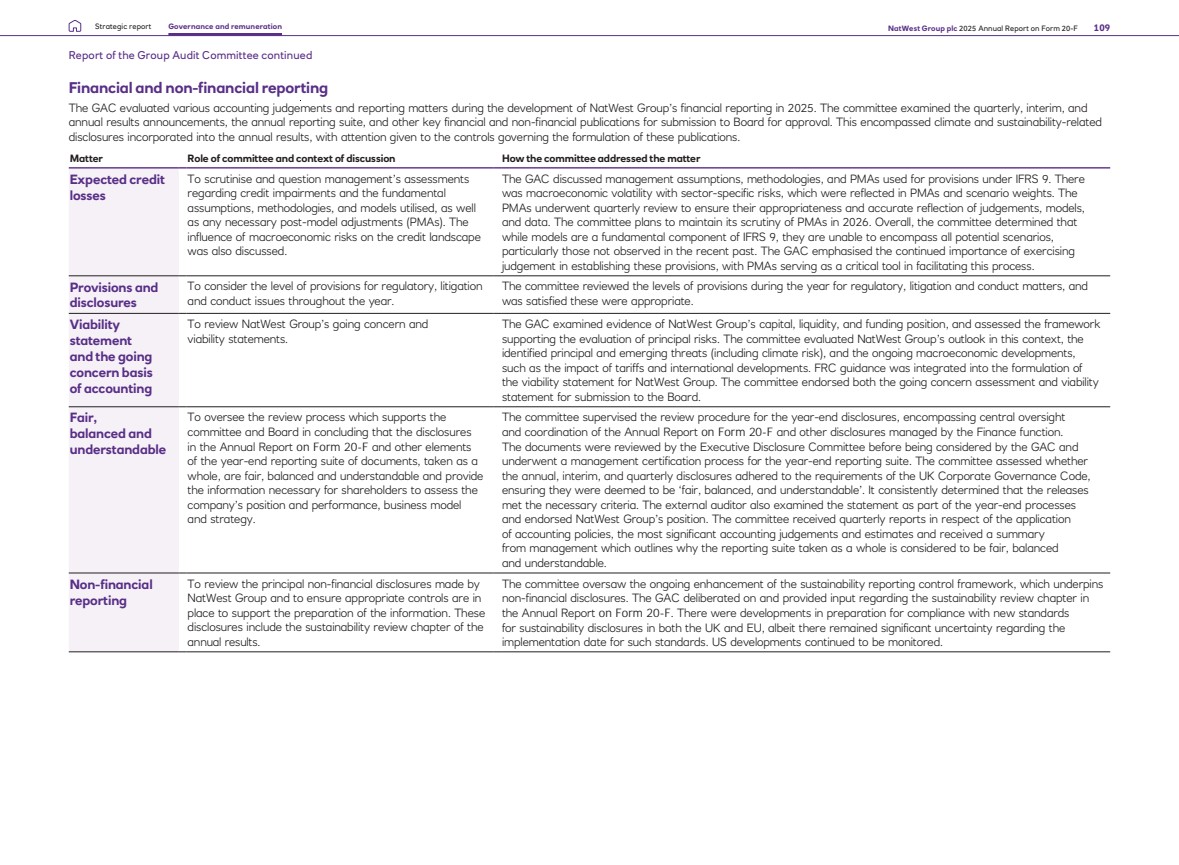
| Internal Audit The GAC is responsible for overseeing the Internal Audit function, monitoring its effectiveness and independence. Matter Role of committee and context of discussion How the committee addressed the matter Quarterly opinions To review quarterly opinions regarding the performance of the governance, risk management, and internal control framework, existing challenges, and the sufficiency of corrective actions. Throughout the year, the committee received quarterly opinions from Internal Audit. Internal Audit also highlighted any material or emerging concerns identified during their audit activities. During 2025, the reporting cadence was amended to provide detailed reporting on a bi-annual basis with abridged reports provided in Q1 and Q3. This was in recognition of the improved control environment within NatWest Group. The committee also considered Internal Audit’s updates on ongoing challenges, including operational resilience, automation, and key change programmes, noting improvements in control validation rates, progress on simplification objectives and risk self-assessments, and the sharing of audit-driven capabilities across the business. The committee thoroughly deliberated on Internal Audit’s assessment of the robustness of the control environment which was assessed as of an acceptable standard or ‘met’. Annual plan and budget To agree Internal Audit’s annual plan and budget before the commencement of each year, as well as any significant adjustments necessary during the year. In December 2024, the committee approved the focus of the Internal Audit plan on the bank’s most high-risk areas. This had changed from a remediation focus to those risks to the successful delivery of the NatWest Group’s strategy, following the closure of significant legacy issues and the achievement of a ‘met’ control standard. The 2025 budget remained consistent with the prior year, reflecting efficiencies secured within the function. Subsequently, in December 2025, the committee approved Internal Audit’s plan and budget for 2026. Internal Audit Charter and independence To approve the Internal Audit Charter each year and reviews the independence of the Chief Audit Executive (CAE) and function as a whole. The GAC reviewed and approved the Internal Audit Charter which was consistent with prior years. The committee also noted the Independence Statement and confirmed the independence of Internal Audit in December 2025. Performance evaluation To monitor and review, at least annually, the effectiveness of Internal Audit. In 2025, the CAE continued to report to the GAC Chair with a secondary reporting line for administrative purposes to the Group CEO. The GAC assessed the annual performance (including risk performance) of the function and CAE. The 2025 evaluation of the Internal Audit function was carried out internally. Stakeholders across the bank, including the GAC members, attendees and the external auditors, were invited to provide feedback, identifying areas of particular strength and those for enhancement. The overall findings were positive, and the Internal Audit function was found to be operating effectively with some opportunities to improve in respect of adopting a more holistic end to end approach to reviews undertaken. Progress on recommendations made from the evaluation will be overseen by the GAC in 2026. Visit To undertake an annual deep dive session with members of the Internal Audit leadership team. Together with the Group BRC, the GAC participated in a successful deep dive session with Internal Audit’s management team. A Variety of issues impacting the function were discussed, including succession planning for the CAE, emerging thinking on the three lines of defence model, and approach to building the skills required for the function of the future. Discussions also included the function’s increased usage of behavioural risk data science techniques, data testing, adoption of Generative AI and continuous audit techniques. The committee agreed to continued visibility at the committee for the potential internal CAE successors via presentation of the IA opinions. Report of the Group Audit Committee continued Strategic report Strategic report Governance and remuneration Financial review Governance and remuneration Risk and capital management Financial statements Additional information NatWest Group plc NatWest Group plc 2025 Annual Report and Accounts 2025 Annual Report on Form 20-F 127 110 |
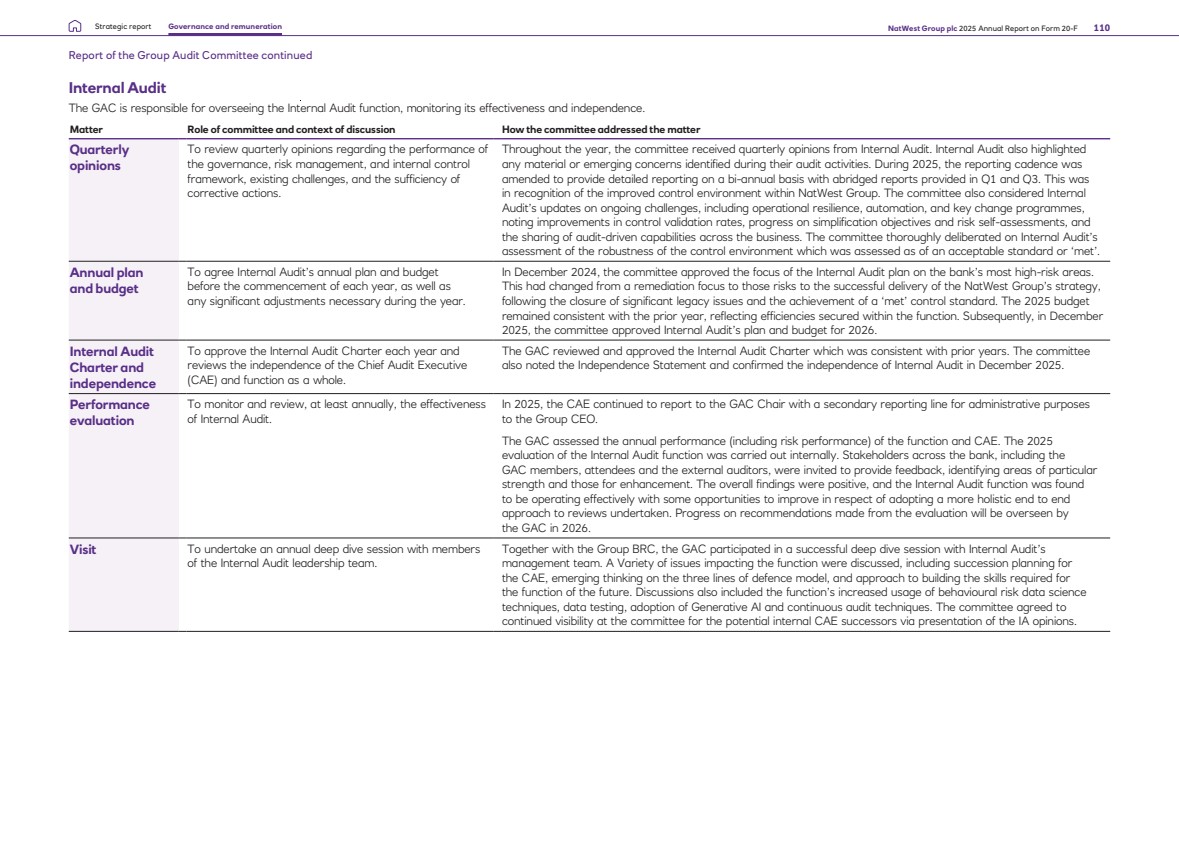
| Internal Audit The GAC is responsible for overseeing the Internal Audit function, monitoring its effectiveness and independence. Matter Role of committee and context of discussion How the committee addressed the matter Quarterly opinions To review quarterly opinions regarding the performance of the governance, risk management, and internal control framework, existing challenges, and the sufficiency of corrective actions. Throughout the year, the committee received quarterly opinions from Internal Audit. Internal Audit also highlighted any material or emerging concerns identified during their audit activities. During 2025, the reporting cadence was amended to provide detailed reporting on a bi-annual basis with abridged reports provided in Q1 and Q3. This was in recognition of the improved control environment within NatWest Group. The committee also considered Internal Audit’s updates on ongoing challenges, including operational resilience, automation, and key change programmes, noting improvements in control validation rates, progress on simplification objectives and risk self-assessments, and the sharing of audit-driven capabilities across the business. The committee thoroughly deliberated on Internal Audit’s assessment of the robustness of the control environment which was assessed as of an acceptable standard or ‘met’. Annual plan and budget To agree Internal Audit’s annual plan and budget before the commencement of each year, as well as any significant adjustments necessary during the year. In December 2024, the committee approved the focus of the Internal Audit plan on the bank’s most high-risk areas. This had changed from a remediation focus to those risks to the successful delivery of the NatWest Group’s strategy, following the closure of significant legacy issues and the achievement of a ‘met’ control standard. The 2025 budget remained consistent with the prior year, reflecting efficiencies secured within the function. Subsequently, in December 2025, the committee approved Internal Audit’s plan and budget for 2026. Internal Audit Charter and independence To approve the Internal Audit Charter each year and reviews the independence of the Chief Audit Executive (CAE) and function as a whole. The GAC reviewed and approved the Internal Audit Charter which was consistent with prior years. The committee also noted the Independence Statement and confirmed the independence of Internal Audit in December 2025. Performance evaluation To monitor and review, at least annually, the effectiveness of Internal Audit. In 2025, the CAE continued to report to the GAC Chair with a secondary reporting line for administrative purposes to the Group CEO. The GAC assessed the annual performance (including risk performance) of the function and CAE. The 2025 evaluation of the Internal Audit function was carried out internally. Stakeholders across the bank, including the GAC members, attendees and the external auditors, were invited to provide feedback, identifying areas of particular strength and those for enhancement. The overall findings were positive, and the Internal Audit function was found to be operating effectively with some opportunities to improve in respect of adopting a more holistic end to end approach to reviews undertaken. Progress on recommendations made from the evaluation will be overseen by the GAC in 2026. Visit To undertake an annual deep dive session with members of the Internal Audit leadership team. Together with the Group BRC, the GAC participated in a successful deep dive session with Internal Audit’s management team. A Variety of issues impacting the function were discussed, including succession planning for the CAE, emerging thinking on the three lines of defence model, and approach to building the skills required for the function of the future. Discussions also included the function’s increased usage of behavioural risk data science techniques, data testing, adoption of Generative AI and continuous audit techniques. The committee agreed to continued visibility at the committee for the potential internal CAE successors via presentation of the IA opinions. Report of the Group Audit Committee continued Strategic report Financial review Risk and capital management Financial statements Additional information Governance and remuneration NatWest Group plc 2025 Annual Report and Accounts 127 External Audit The GAC has responsibility for monitoring the independence and objectivity of the external auditor, the effectiveness of the audit process, for reviewing the bank’s financial relationship with the external auditor, and fixing its remuneration. Ernst & Young has been NatWest Group’s auditor for 10 years following their appointment in 2016. Following a tender undertaken in 2022, the committee has overseen the process to move to NatWest Group’s new auditor, PwC, ahead of their appointment from 2026. The GAC complied with the requirements of the FRC’s Audit Committees and the External Audit: Minimum Standard (the Minimum Standard) and the Statutory Audit Services for Large Companies Market Investigation Order 2014 for the year ended 31 December 2025. In respect of the Minimum Standard the committee noted requirements requiring full Board engagement on future audit tenders, and also considered whether shareholder engagement was warranted on the scope of the external audit. It was concluded that such engagement was not warranted on the basis of existing shareholder dialogue. Matter Role of committee and context of discussion How the committee addressed the matter External Audit reports To review reports prepared by the external auditor in relation to NatWest Group’s financial results and control environment. The committee received quarterly reports on the review-related work and conclusions of the external auditor. The reports included EY’s view of the judgements made by management, compliance with international financial reporting standards, and the external auditor’s observations and assessment of effectiveness of internal controls over financial reporting. Audit plan and fees To consider the scope and planning of the external auditor in relation to the audit of NatWest Group. It is authorised by the shareholders to fix the remuneration of the external auditor. The GAC reviewed EY’s 2025 plan. It welcomed the external auditor’s focus on ECL, the valuation of financial instruments with higher risk characteristics, the pension valuation and the net pension balance and IT access management. In line with the authority granted to the committee by shareholders at the 2025 Annual General Meeting to fix the remuneration of the external auditor, the GAC approved the audit fees for the year including the fee for the 2025 interim results. The committee received confirmation from the external auditor that the fees were appropriate to enable delivery of the required procedures to a high quality. Annual evaluation To review and monitor the external auditor’s independence and objectivity and the effectiveness of the audit process, taking into consideration all relevant professional and regulatory requirements. The evaluation of the external auditor’s performance in 2025 was undertaken to assess the independence and objectivity of the external auditor and the effectiveness of the audit process. The GAC members, attendees, finance directors of businesses and functions, and key members of the Finance Team were consulted as part of the evaluation. Stakeholders were invited to assess the external auditor’s independence, engagement, provision of robust challenge, bench strength and reporting. The evaluation concluded that the external auditor was operating effectively and with objectivity. Key strengths included the quality of the audit approach, the challenge presented to management, and the bench strength and knowledge of the audit team. The evaluation also included consideration of the audit quality reviews conducted by the FRC and the Public Company Accounting Oversight Board (PCAOB) during the year and as part of the annual evaluation. Audit partner To oversee the lead audit partner and resolution of any points of disagreement with management. Javier Faiz has been EY’s lead audit partner since H1 2024. The EY Lead Partner attended all meetings of the committee in 2025 and met in private session with the committee members throughout the year. This provided the external auditor an opportunity to raise any points of disagreement with management. No such points were raised by the external auditor in 2025. Additional reports prepared by the external auditor To review reports prepared by the external auditor in relation to NatWest Group. Auditor transition To oversee transition of the external auditor to PwC in 2026. The committee received bi-annual updates on progress with the transition of external audit services from Ernst & Young to PwC for the 2026 year-end external audit. Confirmation was received that PwC achieved independence from NatWest Group on 4 July 2025. Engagement continued to support PwC partners to develop an understanding of the business of the NatWest Group, and in respect of securing access to the relevant data. PwC shadowed the 2025 year-end audit, which was completed by Ernst & Young, and have attended GAC meetings from July 2025. Report of the Group Audit Committee continued Strategic report Financial review Risk and capital management Financial statements Additional information Strategic report Governance and remuneration Governance and remuneration NatWest Group plc NatWest Group plc 2025 Annual Report and Accounts 2025 Annual Report on Form 20-F 128 111 During 2025, the committee considered the results of the external auditor’s assurance procedures on compliance with the FCA’s Client Asset Rules for NatWest Group’s regulated legal entities for the year ended 31 December 2025. |
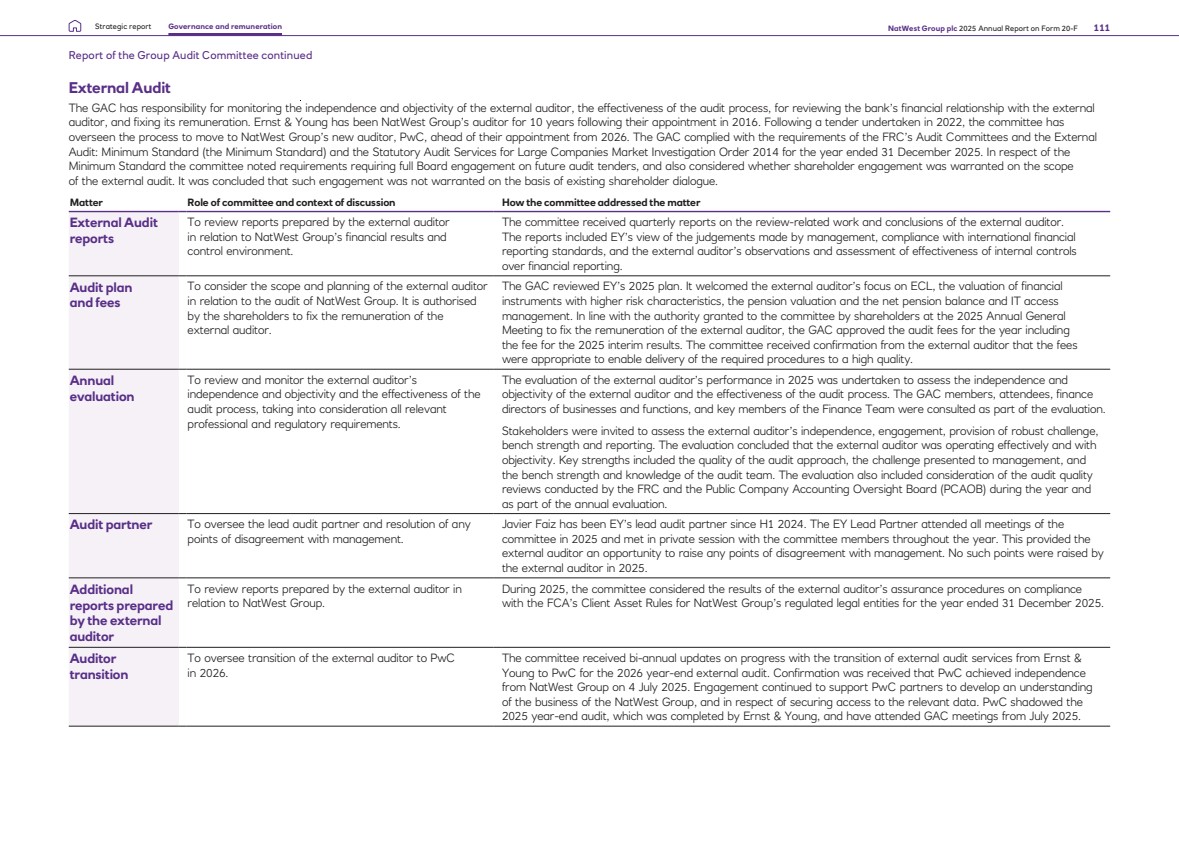
| External Audit continued Matter Role of committee and context of discussion How the committee addressed the matter Non-audit services To review and approve, at least annually, NatWest Group’s policy in relation to the engagement of the external auditors to perform audit and non-audit services (the policy). All audit and non-audit services are approved by, or on behalf of, the committee to safeguard the external auditor’s independence and objectivity. The GAC reviewed and approved NatWest Group’s non-audit services policy in 2025. Under the policy, all audit-related services and permitted non-audit service engagements are approved by the GAC, with updates presented to each scheduled meeting. Information on fees paid in respect of audit and non-audit services carried out by the external auditor can be found in Note 6 to the consolidated financial statements. Report of the Group Audit Committee continued Strategic report Financial review Risk and capital management Financial statements Additional information Strategic report Governance and remuneration Governance and remuneration NatWest Group plc NatWest Group plc 2025 Annual Report and Accounts 2025 Annual Report on Form 20-F 129 112 Where the fee for a non-audit service engagement is expected to exceed £100,000, a competitive tender process must be held and interim approval is delegated to management, but this is subject to ratification at the next scheduled GAC meeting. Where the fee is anticipated to be £250,000 or more, approval of all GAC members is required. For fees between £100,000 and £250,000, work can be approved on an interim basis by the GAC Chair, subject to subsequent ratification at the next scheduled GAC meeting. The policy permits the external auditor to undertake engagements which are required by law or regulation, or relates to the provision of comfort letters in respect of debt issuance by NatWest Group, provided prior approvals are in place in accordance with the policy. The policy also allows NatWest Group to receive services from EY/PwC which result from a customer’s banking relationship, provided prior approvals are in place in accordance with the policy. All such approvals are subsequently reported to the GAC. The policy now applies to PwC during their shadowing period. Further details of the non-audit services policy can be found on the NatWest Group website. |
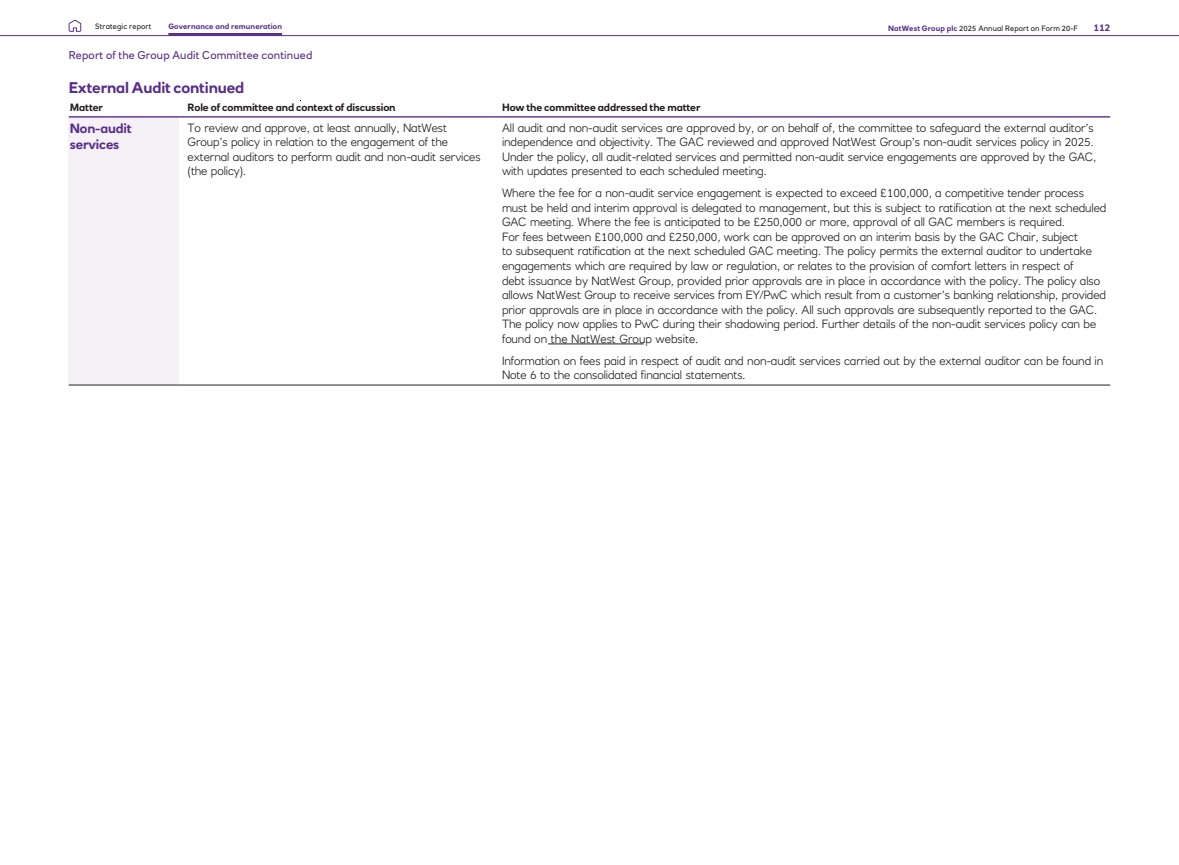
| External Audit continued Matter Role of committee and context of discussion How the committee addressed the matter Non-audit services To review and approve, at least annually, NatWest Group’s policy in relation to the engagement of the external auditors to perform audit and non-audit services (the policy). All audit and non-audit services are approved by, or on behalf of, the committee to safeguard the external auditor’s independence and objectivity. The GAC reviewed and approved NatWest Group’s non-audit services policy in 2025. Under the policy, all audit-related services and permitted non-audit service engagements are approved by the GAC, with updates presented to each scheduled meeting. Where the fee for a non-audit service engagement is expected to exceed £100,000, a competitive tender process must be held and interim approval is delegated to management, but this is subject to ratification at the next scheduled GAC meeting. Where the fee is anticipated to be £250,000 or more, approval of all GAC members is required. For fees between £100,000 and £250,000, work can be approved on an interim basis by the GAC Chair, subject to subsequent ratification at the next scheduled GAC meeting. The policy permits the external auditor to undertake engagements which are required by law or regulation, or relates to the provision of comfort letters in respect of debt issuance by NatWest Group, provided prior approvals are in place in accordance with the policy. The policy also allows NatWest Group to receive services from EY/PwC which result from a customer’s banking relationship, provided prior approvals are in place in accordance with the policy. All such approvals are subsequently reported to the GAC. The policy now applies to PwC during their shadowing period. Further details of the non-audit services policy can be found at natwestgroup.com. Information on fees paid in respect of audit and non-audit services carried out by the external auditor can be found in Note 6 to the consolidated financial statements. Report of the Group Audit Committee continued Strategic report Financial review Risk and capital management Financial statements Additional information Governance and remuneration NatWest Group plc 2025 Annual Report and Accounts 129 Spotlight UKCG Code Principle O Changes The Board is accountable for establishing and maintaining an effective risk and internal control framework across NatWest Group and for determining the nature and extent of principal risks NatWest Group is willing to take to achieve its long-term objectives. The effectiveness of the EWRMF, NatWest’s primary risk governance document, is assessed through RCPA outcomes. In 2025, the EWRMF was maintained through regular updates to the BRC on RCPA performance and reports at each BRC and Board meeting on performance against risk appetite and on top and emerging risks. The Board approved the EWRMF, supported by Risk’s and Internal Audit’s conclusion that it is effective, and by NatWest Group’s positive RCPA outcome of ‘met’. Spotlight Cybersecurity focus During 2025, information and cybersecurity was a key area of focus in response to high-profile external attacks and escalating nation-state activity. Intelligence highlights that nation-state-directed cyberattacks are growing in reach and targeting a wider range of sectors, reflecting the uncertainty of the geopolitical landscape. In October, the UK Government urged CEOs and Chairs of all FTSE 350 firms to make cybersecurity a board-level responsibility. It listed three actions to strengthen cyber resilience which NatWest Group had already embedded, reinforcing their importance. Spotlight UKCG Code Provision 29 preparations The GAC and Group BRC reviewed progress towards meeting the new internal control declaration requirements under the UK Corporate Governance Code which will be applicable for 2026 reporting. The approach seeks to utilise the output of existing internal risk and control assessment processes such as testing carried out as part of the Sarbanes-Oxley management assessment, risk and control performance assessments, and existing assurance processes. A definition of material control was agreed for the purposes of meeting the Code’s requirements, and a dry run of the assessment and reporting process was undertaken to ensure readiness ahead of implementation in 2026. The committees will oversee the completion of a number of actions to enhance the approach throughout 2026. Governance in action Strategic report Financial review Risk and capital management Financial statements Additional information Strategic report Governance and remuneration Governance and remuneration NatWest Group plc NatWest Group plc 2025 Annual Report and Accounts 2025 Annual Report on Form 20-F 130 113 Further detail on the BRC’s review of the EWRMF is on page 115. For further detail on how information and cyber security was considered by the Board and the BRC, please see pages 93 and 116. |
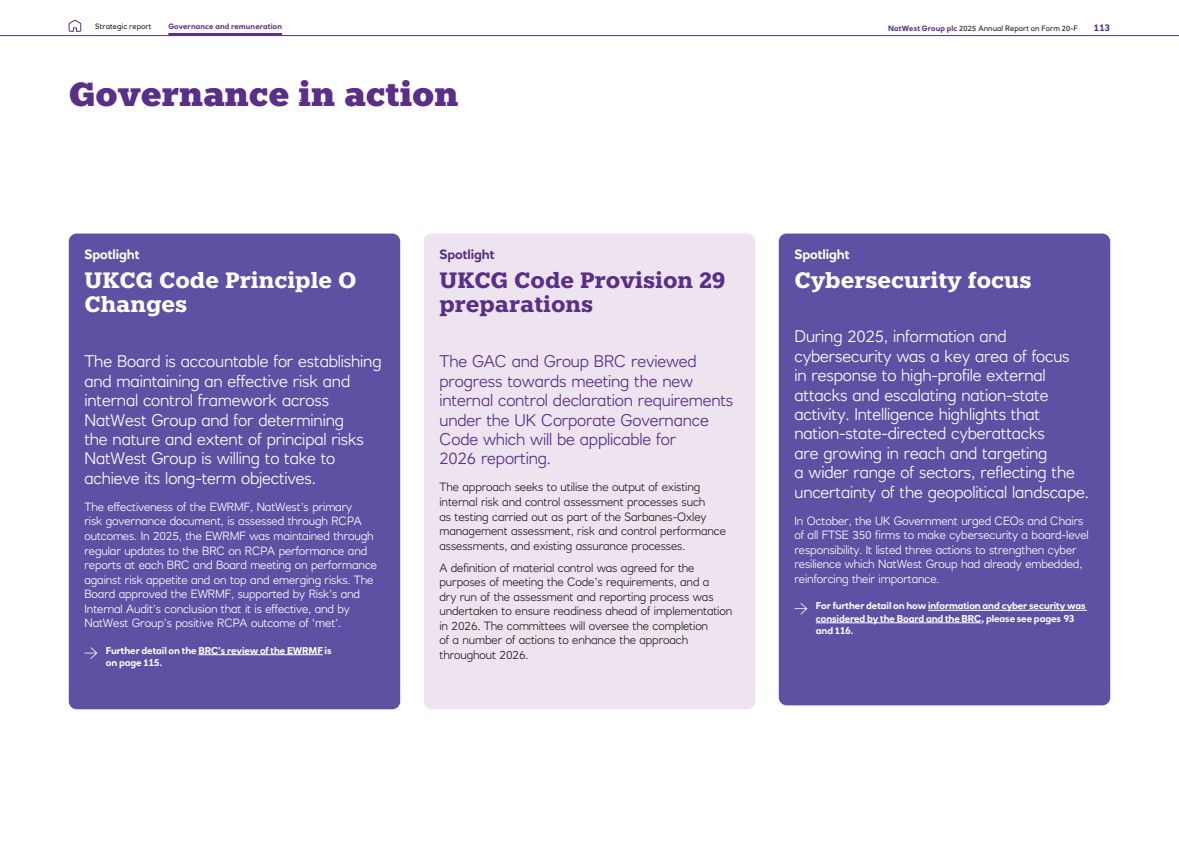
| Report of the Group Board Risk Committee the NatWest Group’s response to operational resilience incidents; and improvements to third-party recovery capabilities. Against the backdrop of various high-profile external cyberattacks, information and cybersecurity was also a key focus for BRC, ensuring robust controls and NatWest Group’s ability to recover from potential attacks prioritised. BRC maintained its rigorous oversight of principal financial and strategic risks throughout the year, critical to its focus on emerging risks from the external environment. This included detailed business portfolio reviews as well as dedicated sessions on the NatWest Group’s Private Markets business and approach to balance sheet management, with the committee encouraging ongoing focus on reporting of aggregate exposures and return on capital, as well as further development of dynamic stress testing, encompassing contagion and correlation risk. Close committee oversight of model risk remained a key priority for BRC, including continued progress to enhance the Model Risk Management Framework and delivery of internal ratings-based models to comply with regulatory expectations. During 2025, BRC also devoted time to discussing AI deployment within the NatWest Group, with particular focus on enhancement of risk management controls as well as the development and governance of AI models. In addition to the above principal areas of focus, the committee continued its oversight of NatWest Group’s other key financial and non-financial risks, risk frameworks and material change programmes. This included progress with embedding Consumer Duty, focusing on good customer outcomes across priority products and services. Thank you to everyone for their valuable contributions to the committee during 2025, especially my fellow directors, Patrick Flynn and Lena Wilson, as well as Geeta Gopalan and Gill Whitehead, both of whom joined the committee in January 2025. Additionally, I would like to thank Ian Cormack, Francesca Barnes and Mark Rennison, for their insights as non-executive directors and members of NatWest Holdings BRC, attending BRC meetings in an observational capacity. Mark joined the NatWest Holdings BRC in January 2025 and Ian stepped down in May 2025. Further information on areas of focus and challenge by the committee during the year is provided on the following pages. Effectiveness review Stuart Lewis Chair of the Group Board Risk Committee 12 February 2026 Principal areas of focus • Risk profile, risk appetite, and emerging risks • Operational risk, including operational resilience and cybersecurity • Financial and strategic risks • Model risk Members and attendance in 2025 Directors Scheduled meetings attended Stuart Lewis 8 of 8 Patrick Flynn 8 of 8 Geeta Gopalan 8 of 8 Gill Whitehead* 6 of 8 Lena Wilson 8 of 8 There were no ad hoc meetings. * Gill Whitehead was unable to attend two meetings due to external commitments arranged prior to her appointment to the committee. Dear Shareholder, I am pleased to present my third report as Chair of the Group Board Risk Committee (the committee or BRC). This report describes how the BRC has fulfilled its role in overseeing and advising the Board in relation to current and potential future risk exposures and risk profile; and in overseeing the effectiveness of risk frameworks and internal controls required to manage risk. This year the committee assumed further responsibilities from the Board, thereby allowing the Board to devote additional time to strategic discussions. In carrying out its important role, the committee helps to ensure NatWest Group supports its customers by managing risk well and responding to the evolving external environment. Principal areas of focus in 2025 2025 has been defined by the turbulent macroeconomic and geopolitical external environment. BRC has therefore focused on resultant emerging risks, considering the potential impacts on NatWest Group’s risk profile, its customers and supply chain, with ongoing oversight of any mitigating actions. BRC has also focused on ensuring that NatWest Group’s risk appetite remains appropriately calibrated against the backdrop of the emerging risk landscape. Operational risk remained a principal area of focus, with BRC welcoming an improved operational risk profile while continuing to oversee the work to drive robust operational risk management across NatWest Group. This included detailed oversight of operational resilience, encompassing the operational resilience framework and required enhancements; improvements in continuity planning and resilience in key jurisdictions; Outside of formal meetings, the BRC Chair met regularly with the Group Chief Risk Officer and other members of senior management to discuss key risk priorities and issues. Strategic report Financial review Risk and capital management Financial statements Additional information Strategic report Governance and remuneration Governance and remuneration NatWest Group plc NatWest Group plc 2025 Annual Report and Accounts 2025 Annual Report on Form 20-F 131 114 In accordance with the UK Corporate Governance Code, an evaluation of the performance of the Board and its committees, including the BRC, was conducted internally in 2025. Further information on the review can be found on pages 102 to 104. |
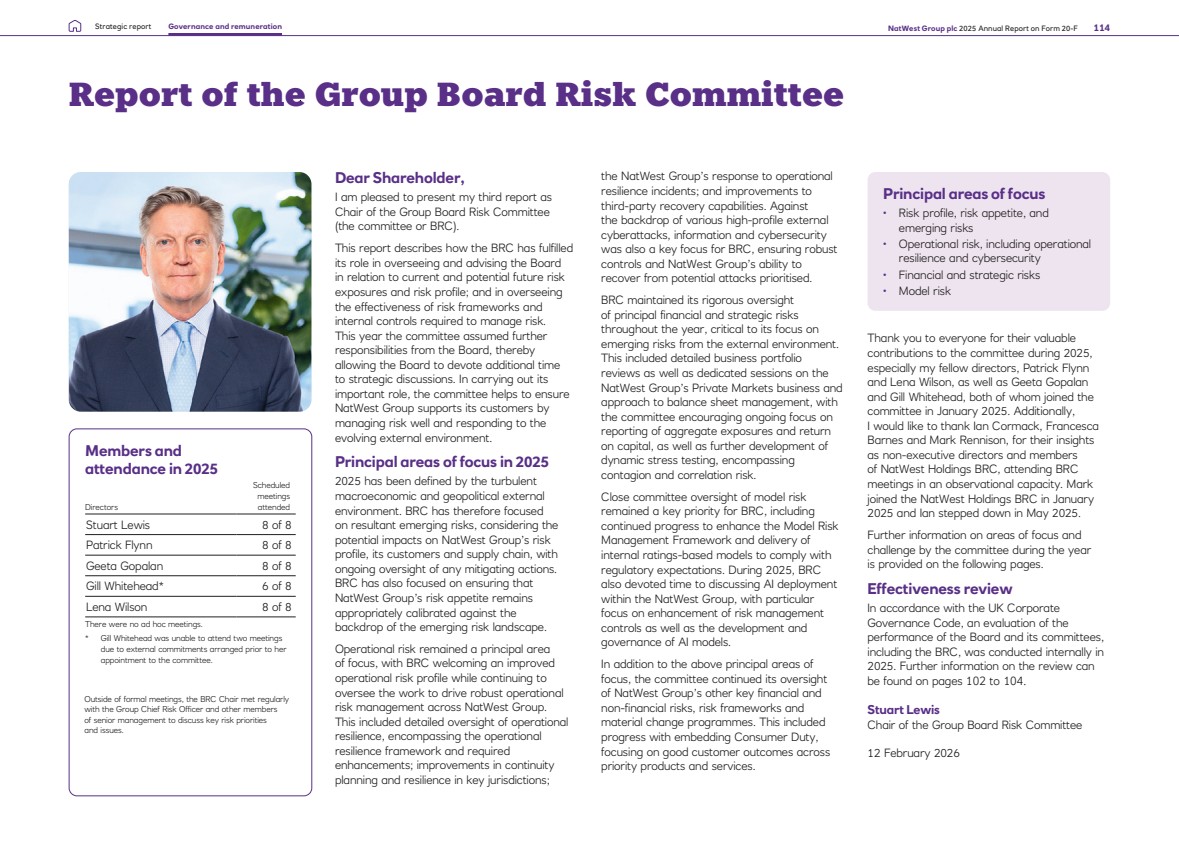
| Report of the Group Board Risk Committee the NatWest Group’s response to operational resilience incidents; and improvements to third-party recovery capabilities. Against the backdrop of various high-profile external cyberattacks, information and cybersecurity was also a key focus for BRC, ensuring robust controls and NatWest Group’s ability to recover from potential attacks prioritised. BRC maintained its rigorous oversight of principal financial and strategic risks throughout the year, critical to its focus on emerging risks from the external environment. This included detailed business portfolio reviews as well as dedicated sessions on the NatWest Group’s Private Markets business and approach to balance sheet management, with the committee encouraging ongoing focus on reporting of aggregate exposures and return on capital, as well as further development of dynamic stress testing, encompassing contagion and correlation risk. Close committee oversight of model risk remained a key priority for BRC, including continued progress to enhance the Model Risk Management Framework and delivery of internal ratings-based models to comply with regulatory expectations. During 2025, BRC also devoted time to discussing AI deployment within the NatWest Group, with particular focus on enhancement of risk management controls as well as the development and governance of AI models. In addition to the above principal areas of focus, the committee continued its oversight of NatWest Group’s other key financial and non-financial risks, risk frameworks and material change programmes. This included progress with embedding Consumer Duty, focusing on good customer outcomes across priority products and services. Thank you to everyone for their valuable contributions to the committee during 2025, especially my fellow directors, Patrick Flynn and Lena Wilson, as well as Geeta Gopalan and Gill Whitehead, both of whom joined the committee in January 2025. Additionally, I would like to thank Ian Cormack, Francesca Barnes and Mark Rennison, for their insights as non-executive directors and members of NatWest Holdings BRC, attending BRC meetings in an observational capacity. Mark joined the NatWest Holdings BRC in January 2025 and Ian stepped down in May 2025. Further information on areas of focus and challenge by the committee during the year is provided on the following pages. Effectiveness review In accordance with the UK Corporate Governance Code, an evaluation of the performance of the Board and its committees, including the BRC, was conducted internally in 2025. Further information on the review can be found on pages 119-121. Stuart Lewis Chair of the Group Board Risk Committee 12 February 2026 Principal areas of focus • Risk profile, risk appetite, and emerging risks • Operational risk, including operational resilience and cybersecurity • Financial and strategic risks • Model risk Members and attendance in 2025 Directors Scheduled meetings attended Stuart Lewis 8 of 8 Patrick Flynn 8 of 8 Geeta Gopalan 8 of 8 Gill Whitehead* 6 of 8 Lena Wilson 8 of 8 There were no ad hoc meetings. * Gill Whitehead was unable to attend two meetings due to external commitments arranged prior to her appointment to the committee. Dear Shareholder, I am pleased to present my third report as Chair of the Group Board Risk Committee (the committee or BRC). This report describes how the BRC has fulfilled its role in overseeing and advising the Board in relation to current and potential future risk exposures and risk profile; and in overseeing the effectiveness of risk frameworks and internal controls required to manage risk. This year the committee assumed further responsibilities from the Board, thereby allowing the Board to devote additional time to strategic discussions. In carrying out its important role, the committee helps to ensure NatWest Group supports its customers by managing risk well and responding to the evolving external environment. Principal areas of focus in 2025 2025 has been defined by the turbulent macroeconomic and geopolitical external environment. BRC has therefore focused on resultant emerging risks, considering the potential impacts on NatWest Group’s risk profile, its customers and supply chain, with ongoing oversight of any mitigating actions. BRC has also focused on ensuring that NatWest Group’s risk appetite remains appropriately calibrated against the backdrop of the emerging risk landscape. Operational risk remained a principal area of focus, with BRC welcoming an improved operational risk profile while continuing to oversee the work to drive robust operational risk management across NatWest Group. This included detailed oversight of operational resilience, encompassing the operational resilience framework and required enhancements; improvements in continuity planning and resilience in key jurisdictions; Outside of formal meetings, the BRC Chair met regularly with the Group Chief Risk Officer and other members of senior management to discuss key risk priorities and issues. Strategic report Financial review Risk and capital management Financial statements Additional information Governance and remuneration NatWest Group plc 2025 Annual Report and Accounts 131 Principal areas of Group Board Risk Committee focus in 2025 Theme Principal areas of committee focus Outcomes For each principal risk, BRC considered a spotlight at least annually and received updates on performance against risk appetite at every meeting. Risk profile and reporting BRC’s consideration of NatWest Group’s current and future risk profile in 2025 included a particular focus on operational risk, model risk, credit risk and emerging risks. Group Risk Reports discussed at every meeting were supplemented by strategic risk spotlights and updates from principal subsidiary board risk committee chairs, providing a holistic view of all risks and an escalation route for any issues. The BRC Chair also attended the board risk committee meetings of principal subsidiaries on a rotational basis. The committee received updates on progress with embedding NatWest Group’s approach to risk culture, known as intelligent risk taking. The committee supported the continued evolution of the Group Risk Report, and enhancements to the presentation of key metrics including credit exposures. It welcomed the progress made on automating reporting, whilst encouraging further automation and data quality improvements to support more timely and insightful reporting. The committee challenged management on NatWest Group’s preparedness in response to macroeconomic and geopolitical developments, including potential 2nd, 3rd and 4th order impacts. It requested further analysis to support strategic Board discussions. BRC also challenged management on emerging risks, including cyberattacks and disruptive AI. It sought and received assurance from management that NatWest Group’s risk appetite remained appropriately calibrated in light of developments in emerging risks and the macroeconomic environment. The committee also welcomed management’s commitment to improving continuity planning and resilience in key jurisdictions. Risk frameworks (including risk appetite), risk management strategy and Risk function oversight BRC welcomed Risk’s and Internal Audit’s conclusion that the EWRMF was a comprehensive and effective framework and recommended it to the Board for approval. As part of its consideration of the framework, and in conjunction with the Group Audit Committee, BRC reviewed management’s proposed approach to ensure NatWest Group’s compliance with the requirements of the 2024 UK Corporate Governance Code. For further information on this work, see page 130. The committee maintained close oversight of NatWest Group’s risk appetite framework, including the annual refresh of risk appetite, which was recommended to the Board for approval. Under delegated authority from the Board, the committee approved the enterprise-wide risk management strategy (EWRMS), which defines the strategy for risk management at NatWest Group. BRC maintained oversight of the execution of the EWRMS through regular reporting and spotlights on all priority EWRMS programmes. The committee continued its oversight of Risk30, the strategic programme of transformation activity within the Risk function and received assurance that the function was adequately resourced to deliver its mandate. The committee was satisfied that the EWRMF continued to support NatWest Group’s ability to identify, assess, and manage risk in a manner consistent with its strategic objectives and regulatory obligations. BRC welcomed Internal Audit’s recognition of the progress made during 2025 to enhance the framework. The committee sought and received management’s commitment to further enhancements to be delivered in 2026. BRC continued to oversee NatWest Group’s risk appetite framework, challenging management to simplify the framework in line with strategic and regulatory priorities. As part of the annual risk appetite refresh, key committee discussions focused on model risk and Private Markets, reflecting wider industry focus. BRC also reviewed the key risk policies(1) and approved them under the authority delegated to it by the Board. In approving the EWRMS, BRC encouraged management to ensure that it remained dynamic and reflective of NatWest Group’s strategic ambitions and evolving risk profile, in light of the wider macroeconomic uncertainty and the increased use of AI. BRC requested management provide a forward-looking view of the capabilities being developed through Risk30 to ensure an appropriate response to the evolving risk landscape. The committee held a dedicated discussion on risk capabilities and management committed to provide a Risk function capabilities profile to the committee on a regular basis. (1) Risk policies are in place for each principal risk and define, at a high level, the cascade of qualitative expectation, guidance and standards that stipulate the nature and extent of permissible risk taking. They are consistently applied across NatWest Group and subsidiary legal entities and form part of the qualitative expression of risk appetite for each principal risk. Report of the Group Board Risk Committee continued Strategic report Financial review Risk and capital management Financial statements Additional information Strategic report Governance and remuneration Governance and remuneration NatWest Group plc NatWest Group plc 2025 Annual Report and Accounts 2025 Annual Report on Form 20-F 132 115 BRC considered regular reports on legal and regulatory risks and developments and held a dedicated session focusing on emerging risks and the macroeconomic and geopolitical environment, considering the potential impacts on NatWest Group. This included perspectives from external and internal subject matter experts and complemented the updates on top and emerging risks received at every meeting. Further information on how NatWest Group identifies and manages emerging risks can be found in the Strategic Report on page 72. In 2025 BRC continued to provide robust oversight of NatWest Group’s risk frameworks (including risk appetite). The enterprise-wide risk management framework (EWRMF) sets out NatWest Group’s overall approach to managing risk. Its effectiveness is assessed through the Risk and Control Performance Assessment (RCPA) outcomes. Further information can be found in the control environment update on page 116. |
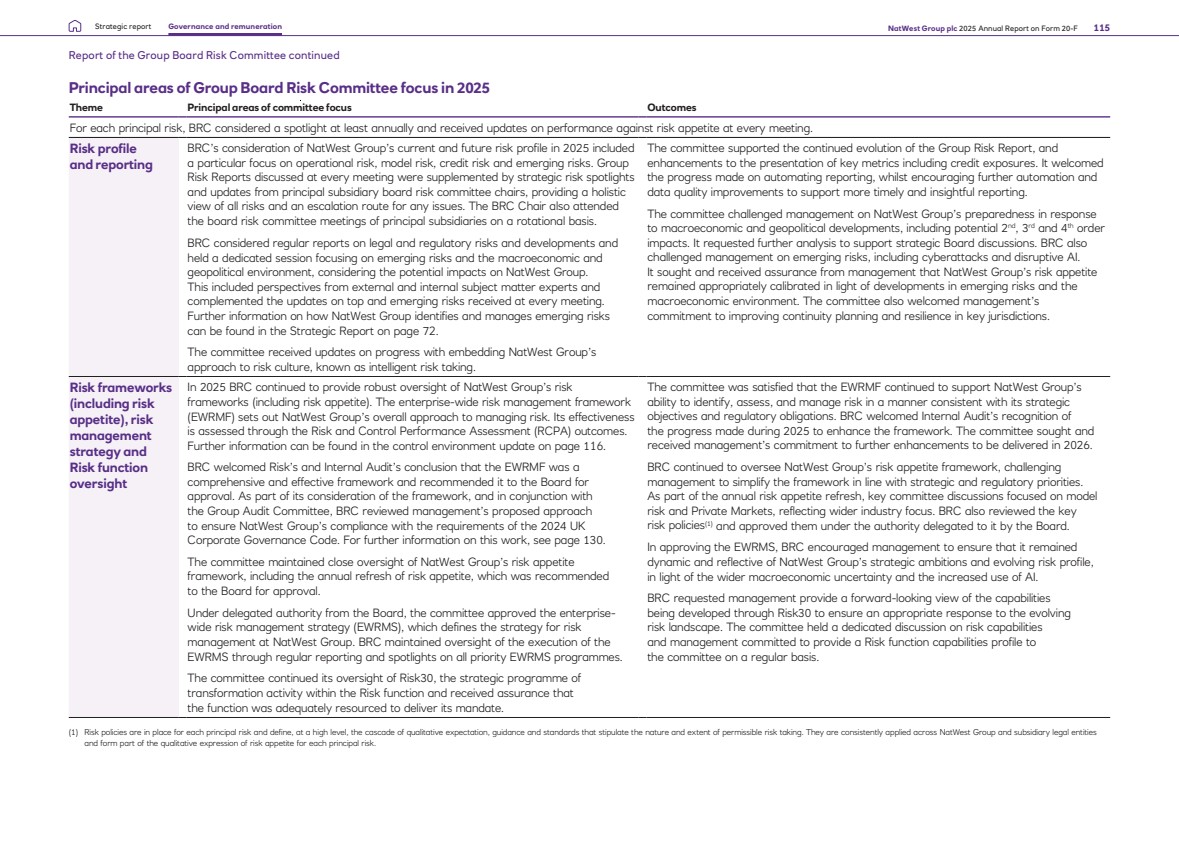
| Principal areas of Group Board Risk Committee focus in 2025 continued Theme Principal areas of committee focus Outcomes Operational risk, operational resilience, and information and cybersecurity The committee performed oversight across a range of operational risks including technology end of life remediation, payments technology, AI risk management and operational resilience. BRC reviewed the operational resilience self-assessment prior to its approval by the Board and maintained oversight over recommended enhancements. Information and cybersecurity remained a key area of focus, with updates on the overarching geopolitical threat landscape, privileged access management, industry-wide insider threat risks and learnings from read-across activity on external cyberattacks. BRC welcomed confirmation by management and Internal Audit of improvements to NatWest Group’s operational risk profile during 2025, driven by the elimination of very high risks through the risk and control self-assessment process and effective prioritisation of key programmes. Management were challenged to ensure focus on technology end of life remediation was maintained. The committee was updated on AI deployment within NatWest Group and actions to enhance risk management controls. It was agreed that in 2026 AI risks would be reported in a consolidated AI dashboard to support committee oversight. In supporting the Board in its oversight of operational resilience, BRC challenged management to ensure that enhancements were appropriately prioritised and resourced. The importance of NatWest Group’s holistic approach to the management of operational resilience was also noted. The committee provided oversight of management’s response to operational resilience incidents, supporting improvements to third-party recovery capabilities and the development of supplier-level playbooks to mitigate business impacts in the event of prolonged outages. BRC challenged management on actions to mitigate increased information and cybersecurity risks resulting from the evolving geopolitical landscape and requested further consideration of any increased resources or investment required. The committee encouraged management to prioritise recoverability and also considered the implications of increased insider threats across the global financial sector, receiving assurance on measures taken. The committee noted NatWest’s Group compliance with HM Government’s Cyber Governance Code of Practice. Control environment BRC continued to monitor the effectiveness of internal controls for managing risk during 2025. Regular updates were received on performance against the RCPA criteria and BRC also considered the outcomes of the end of year RCPA assessment. The committee welcomed confirmation from management that NatWest Group’s overall control environment remained stable, with a RCPA ‘met’ rating. The committee reviewed and supported management’s report on the internal controls required to manage risk. Outsourcing and third-party risk management BRC provided oversight of NatWest Group’s outsourcing and third-party risk management arrangements, including oversight of critical service providers. Focus areas included the alignment of third-party risk management with operational resilience, particularly in relation to supplier recovery capabilities and scenario testing. Following Board delegation, the committee approved the NatWest Group’s outsourcing policy standards. The committee was pleased to note that NatWest Group’s outsourcing framework remained effective and that, overall, risks had been reduced. It supported the continued integration of third-party risk into NatWest Group’s operational resilience self-assessment, including through supplier-proven recovery plans, and encouraged further alignment of frameworks to ensure consistency and efficiency. In light of the industry-wide heightened risk of cyberattacks, BRC challenged the cyber resiliency of NatWest’s supply chain and received assurances from management on the protections in place. BRC also discussed internal group outsourcing arrangements and requested further management action to confirm appropriate service levels. Report of the Group Board Risk Committee continued Strategic report Strategic report Governance and remuneration Financial review Governance and remuneration Risk and capital management Financial statements Additional information NatWest Group plc NatWest Group plc 2025 Annual Report and Accounts 2025 Annual Report on Form 20-F 133 116 |
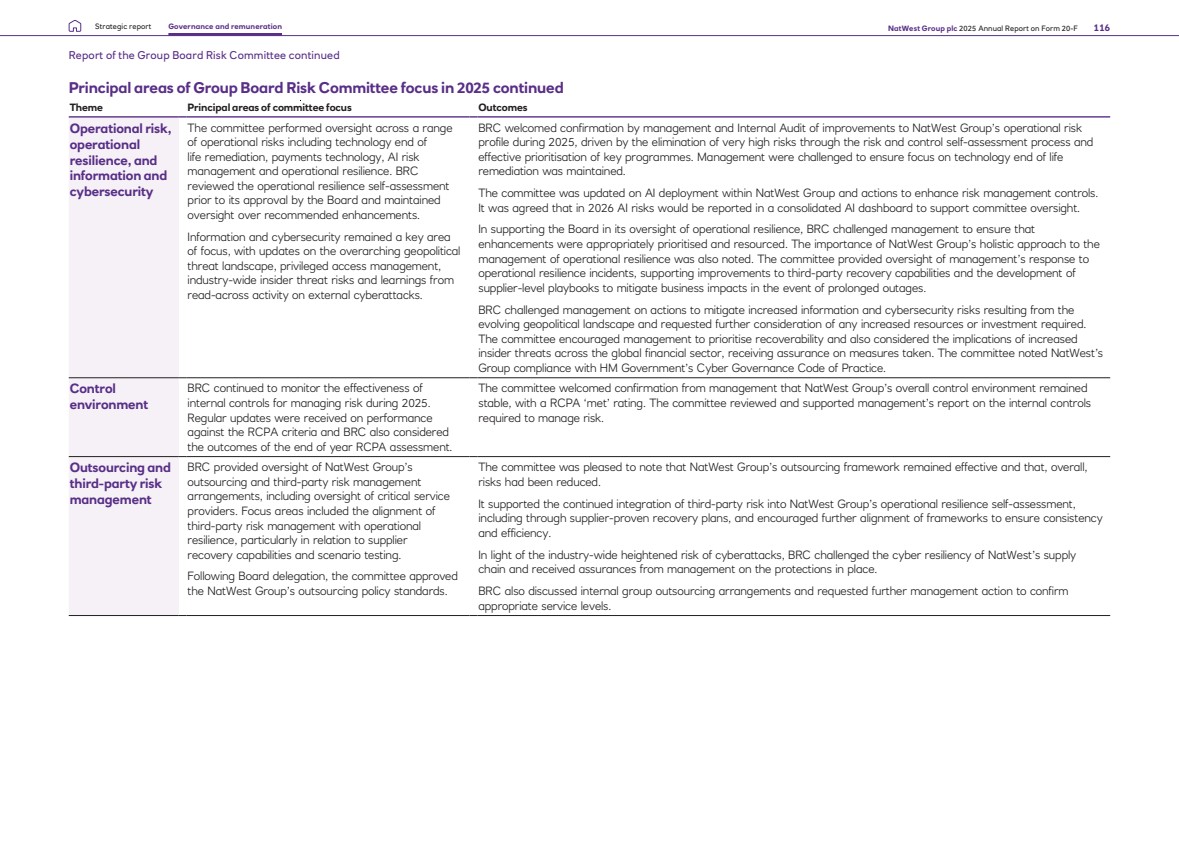
| Principal areas of Group Board Risk Committee focus in 2025 continued Theme Principal areas of committee focus Outcomes Operational risk, operational resilience, and information and cybersecurity The committee performed oversight across a range of operational risks including technology end of life remediation, payments technology, AI risk management and operational resilience. BRC reviewed the operational resilience self-assessment prior to its approval by the Board and maintained oversight over recommended enhancements. Information and cybersecurity remained a key area of focus, with updates on the overarching geopolitical threat landscape, privileged access management, industry-wide insider threat risks and learnings from read-across activity on external cyberattacks. BRC welcomed confirmation by management and Internal Audit of improvements to NatWest Group’s operational risk profile during 2025, driven by the elimination of very high risks through the risk and control self-assessment process and effective prioritisation of key programmes. Management were challenged to ensure focus on technology end of life remediation was maintained. The committee was updated on AI deployment within NatWest Group and actions to enhance risk management controls. It was agreed that in 2026 AI risks would be reported in a consolidated AI dashboard to support committee oversight. In supporting the Board in its oversight of operational resilience, BRC challenged management to ensure that enhancements were appropriately prioritised and resourced. The importance of NatWest Group’s holistic approach to the management of operational resilience was also noted. The committee provided oversight of management’s response to operational resilience incidents, supporting improvements to third-party recovery capabilities and the development of supplier-level playbooks to mitigate business impacts in the event of prolonged outages. BRC challenged management on actions to mitigate increased information and cybersecurity risks resulting from the evolving geopolitical landscape and requested further consideration of any increased resources or investment required. The committee encouraged management to prioritise recoverability and also considered the implications of increased insider threats across the global financial sector, receiving assurance on measures taken. The committee noted NatWest’s Group compliance with HM Government’s Cyber Governance Code of Practice. Control environment BRC continued to monitor the effectiveness of internal controls for managing risk during 2025. Regular updates were received on performance against the RCPA criteria and BRC also considered the outcomes of the end of year RCPA assessment. The committee welcomed confirmation from management that NatWest Group’s overall control environment remained stable, with a RCPA ‘met’ rating. The committee reviewed and supported management’s report on the internal controls required to manage risk. Outsourcing and third-party risk management BRC provided oversight of NatWest Group’s outsourcing and third-party risk management arrangements, including oversight of critical service providers. Focus areas included the alignment of third-party risk management with operational resilience, particularly in relation to supplier recovery capabilities and scenario testing. Following Board delegation, the committee approved the NatWest Group’s outsourcing policy standards. The committee was pleased to note that NatWest Group’s outsourcing framework remained effective and that, overall, risks had been reduced. It supported the continued integration of third-party risk into NatWest Group’s operational resilience self-assessment, including through supplier-proven recovery plans, and encouraged further alignment of frameworks to ensure consistency and efficiency. In light of the industry-wide heightened risk of cyberattacks, BRC challenged the cyber resiliency of NatWest’s supply chain and received assurances from management on the protections in place. BRC also discussed internal group outsourcing arrangements and requested further management action to confirm appropriate service levels. Report of the Group Board Risk Committee continued Strategic report Financial review Risk and capital management Financial statements Additional information Governance and remuneration NatWest Group plc 2025 Annual Report and Accounts 133 Principal areas of Group Board Risk Committee focus in 2025 continued Theme Principal areas of committee focus Outcomes Financial and strategic risks BRC maintained rigorous oversight of NatWest Group’s principal financial and strategic risks throughout the year. Regular reporting in the Group Risk Report was supplemented by focused reviews including the retail and wholesale credit risk portfolios, capital and credit risk mitigation, traded and non-traded market risk and balance sheet management. These in-depth reviews were further enhanced by business specific strategic risk presentations, ensuring the committee had a comprehensive understanding of the overall risk landscape. At the committee’s request, management delivered dedicated sessions to review NatWest Group’s Private Markets business, as well as wholesale credit stewardship, providing further risk insight and analysis. Capital, liquidity and funding requirements were subject to ongoing BRC review, providing recommendations to the Board as required. Following Board delegation, BRC reviewed and approved the NatWest Group’s ICAAP and ILAAP submissions. Additionally, the committee considered risks to NatWest Group’s strategic and financial plan, pension risk, and climate and nature risk. BRC welcomed confirmation that the retail and wholesale credit risk portfolios remained stable and within appetite. The committee received assurance regarding the range of techniques used to support vulnerable customers and reinforced the importance of continuous improvement to ensure good customer outcomes. Regarding the wholesale portfolio, a detailed review of Private Markets, securitisation activity, leveraged funds and NatWest Group’s balance sheet management programme resulted in committee challenges including capital efficiency and return on capital, risk mitigation, securitisation funding, stress testing approach and concentration risk management. In response, management outlined ongoing enhancements to limit setting, the reporting of aggregate exposures, data quality and dynamic stress testing, encompassing contagion risk and layered correlations. BRC reviewed traded and non-traded market risk exposures and challenged management on limit structures and adequacy of controls. The committee also discussed the implications of macroeconomic volatility necessitating the need for enhanced oversight and received regular updates on actions taken. In its consideration and approval of the ICAAP and ILAAP, BRC challenged management on the assumptions used in leverage planning floors and stressed outflow coverage. It sought assurance that the risk of digitisation on deposit outflows had been sufficiently considered and supported continued monitoring of deposit trends. The committee discussed the execution risks involved in the delivery of the strategic and financial plan, receiving confirmation from management that they were being appropriately managed. During the annual pension risk spotlight, BRC discussed the continuation of the buy-in transactions with third-party insurers entered into by the Trustee of the NatWest Group Pension Fund, welcoming confirmation of the overall reduction in risk profile. In its consideration of climate and nature risk, BRC challenged management to review whether climate and nature risk appetite continued to reflect NatWest Group’s evolving climate strategy and received assurance from management that risk appetite remained appropriate. BRC considered the embedding of climate considerations into strategic decision-making and also discussed the importance of robust data as a key enabler of a mature climate and nature risk framework. Model risk On behalf of the Board, the committee maintained close oversight of model risk throughout 2025. This included regular progress updates on the model risk management programme established to deliver a robust model risk framework and ensure compliance with the Prudential Regulation Authority’s (PRA) Supervisory Statement SS1/23. BRC activity also included oversight of the annual SS1/23 self-assessment outcomes. BRC focus remained on the status of the internal ratings based (IRB) transformation programme established to deliver new models to meet regulatory expectations. Updates on trading book risk models to achieve regulatory compliance were also received. The committee noted the substantive progress in implementing the model risk framework enhancements required under SS1/23. It supported management’s proposed actions to address regulatory feedback, whilst providing challenge to ensure that all regulatory expectations were met. BRC also considered the robustness of the validation process and requested enhanced reporting in the Group Risk Report to improve committee oversight. The development and governance of AI models was specifically considered by BRC, including the need to ensure appropriate resource and skillsets throughout the model lifecycle. Through its oversight of the IRB transformation programme, BRC received regular updates on the status of NatWest Group’s IRB models, including regulatory feedback received and associated impacts on temporary model adjustments. Report of the Group Board Risk Committee continued Strategic report Financial review Risk and capital management Financial statements Additional information Strategic report Governance and remuneration Governance and remuneration NatWest Group plc NatWest Group plc 2025 Annual Report and Accounts 2025 Annual Report on Form 20-F 134 117 Additionally, at BRC’s request, Board training was arranged on NatWest Group’s most material models, further supporting Board-level oversight of the model risk framework. More information can be found in the Board report on page 96. |
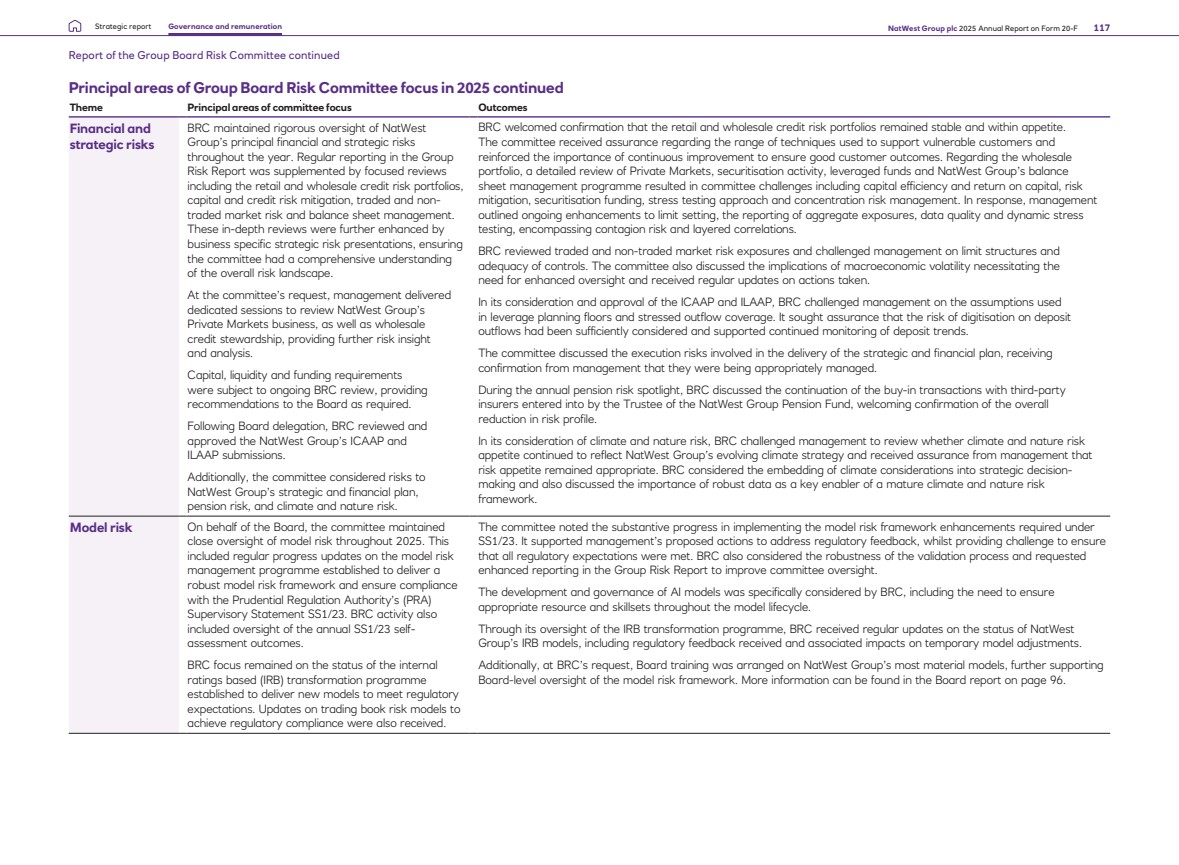
| Principal areas of Group Board Risk Committee focus in 2025 continued Theme Principal areas of committee focus Outcomes Stress testing, recovery and resolvability BRC reviewed the outputs of the Bank of England’s (BoE) Final Report of the System Wide Exploratory Scenario exercise carried out over the prior two-year period and approved under Board delegated authority the macroeconomic scenario and expansion used in the 2025 Bank Capital Stress Test (BCST), together with the BCST results ahead of their submission to the BoE. BRC approved under Board delegated authority the stress scenarios used for monitoring the NatWest Group’s risk profile relative to risk appetite. In considering the BCST results, the committee sought confirmation of the adequacy of model overlays used and noted that NatWest Group had passed the stress test, significantly ahead of the stress minimum requirement, with no strategic management actions required. In approving the stress scenarios to be used for monitoring a moderate, severe and extreme stress, BRC discussed the robustness of the underlying growth assumptions and noted the economic modelling used. Conduct and regulatory compliance risk The committee received regular updates throughout the year on conduct and regulatory compliance matters. This included updates on embedding Consumer Duty as well as Group and business specific conduct and regulatory compliance updates. The committee welcomed confirmation that NatWest Group’s conduct and regulatory compliance risk profile remained within appetite, with continued progress made in strengthening controls and improving customer outcomes. It also welcomed confirmation of the positive progress made on the programme established to respond to the review carried out by the Department of Justice Compliance Monitor. BRC challenged management to ensure good customer outcomes across priority products and services and received regular updates on improvements underway. Data risk management and BCBS239 BRC received updates on NatWest Group’s data strategy programme of work, including progress against management’s return to appetite plan. On behalf of the Board the committee also reviewed and approved NatWest Group’s data aggregation and risk reporting framework (BCBS239) and considered its assessment of BCBS239 compliance prior to regulatory submission. Management’s progress against the data strategy return to appetite plans was welcomed by BRC. The committee sought and received assurance regarding the embedding of centralised data standards and controls across businesses. Regarding BCBS239, the committee welcomed confirmation that the enhancements made to the assessment methodology had improved the robustness of the annual assessment process, aligning NatWest Group with industry best practice. BRC encouraged continued enhancement of data capabilities to support timely reporting and effective risk oversight. Financial crime and Fraud In addition to dedicated financial crime spotlights and regular updates, BRC received the Money Laundering Reporting Officer’s (MLRO) report. The committee also received updates on NatWest Group’s fraud prevention strategy, including the use of AI to detect and prevent fraud. Broader industry developments were considered as part of BRC’s oversight of fraud related risks, including an update on complex investment scams. The committee welcomed confirmation that NatWest Group’s financial crime risk profile remained stable and of RBSI’s return to appetite on schedule. It continued to encourage management to focus on evolution and investment to meet challenges and regulatory expectations. BRC considered NatWest Group’s fraud risk performance, noting its positive trajectory. It supported the ongoing engagement with government and industry stakeholders and encouraged continued investment in preventative controls and customer education. Report of the Group Board Risk Committee continued Strategic report Financial review Risk and capital management Financial statements Additional information Strategic report Governance and remuneration Governance and remuneration NatWest Group plc NatWest Group plc 2025 Annual Report and Accounts 2025 Annual Report on Form 20-F 135 118 Following prior committee challenge, the Board undertook an operational resilience, recovery and resolution fire drill exercise and wash up. Further information can be found in the Board update on page 93. |
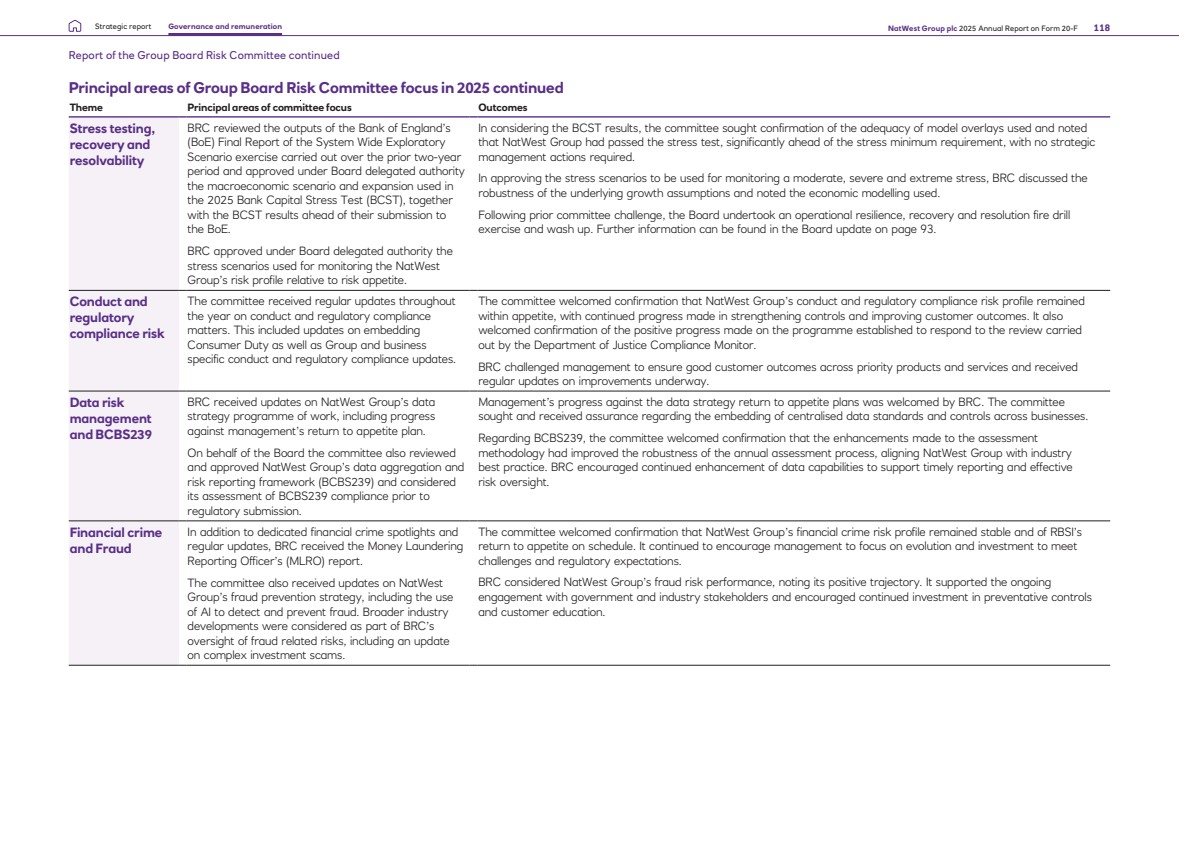
| Principal areas of Group Board Risk Committee focus in 2025 continued Theme Principal areas of committee focus Outcomes Stress testing, recovery and resolvability BRC reviewed the outputs of the Bank of England’s (BoE) Final Report of the System Wide Exploratory Scenario exercise carried out over the prior two-year period and approved under Board delegated authority the macroeconomic scenario and expansion used in the 2025 Bank Capital Stress Test (BCST), together with the BCST results ahead of their submission to the BoE. BRC approved under Board delegated authority the stress scenarios used for monitoring the NatWest Group’s risk profile relative to risk appetite. In considering the BCST results, the committee sought confirmation of the adequacy of model overlays used and noted that NatWest Group had passed the stress test, significantly ahead of the stress minimum requirement, with no strategic management actions required. In approving the stress scenarios to be used for monitoring a moderate, severe and extreme stress, BRC discussed the robustness of the underlying growth assumptions and noted the economic modelling used. Following prior committee challenge, the Board undertook an operational resilience, recovery and resolution fire drill exercise and wash up. Further information can be found in the Board update on page 110. Conduct and regulatory compliance risk The committee received regular updates throughout the year on conduct and regulatory compliance matters. This included updates on embedding Consumer Duty as well as Group and business specific conduct and regulatory compliance updates. The committee welcomed confirmation that NatWest Group’s conduct and regulatory compliance risk profile remained within appetite, with continued progress made in strengthening controls and improving customer outcomes. It also welcomed confirmation of the positive progress made on the programme established to respond to the review carried out by the Department of Justice Compliance Monitor. BRC challenged management to ensure good customer outcomes across priority products and services and received regular updates on improvements underway. Data risk management and BCBS239 BRC received updates on NatWest Group’s data strategy programme of work, including progress against management’s return to appetite plan. On behalf of the Board the committee also reviewed and approved NatWest Group’s data aggregation and risk reporting framework (BCBS239) and considered its assessment of BCBS239 compliance prior to regulatory submission. Management’s progress against the data strategy return to appetite plans was welcomed by BRC. The committee sought and received assurance regarding the embedding of centralised data standards and controls across businesses. Regarding BCBS239, the committee welcomed confirmation that the enhancements made to the assessment methodology had improved the robustness of the annual assessment process, aligning NatWest Group with industry best practice. BRC encouraged continued enhancement of data capabilities to support timely reporting and effective risk oversight. Financial crime and Fraud In addition to dedicated financial crime spotlights and regular updates, BRC received the Money Laundering Reporting Officer’s (MLRO) report. The committee also received updates on NatWest Group’s fraud prevention strategy, including the use of AI to detect and prevent fraud. Broader industry developments were considered as part of BRC’s oversight of fraud related risks, including an update on complex investment scams. The committee welcomed confirmation that NatWest Group’s financial crime risk profile remained stable and of RBSI’s return to appetite on schedule. It continued to encourage management to focus on evolution and investment to meet challenges and regulatory expectations. BRC considered NatWest Group’s fraud risk performance, noting its positive trajectory. It supported the ongoing engagement with government and industry stakeholders and encouraged continued investment in preventative controls and customer education. Report of the Group Board Risk Committee continued Strategic report Financial review Risk and capital management Financial statements Additional information Governance and remuneration NatWest Group plc 2025 Annual Report and Accounts 135 Principal areas of Group Board Risk Committee focus in 2025 continued Theme Principal areas of committee focus Outcomes Transformation/ major change programmes The committee continued to oversee the delivery of NatWest Group’s transformation and major change programmes and their performance against risk appetite. Regular updates were included in the Group Risk Report and BRC also received biannual spotlights. The committee reviewed the progress of NatWest Group’s most material change initiatives and oversaw the material execution risks inherent in material change programmes. In response to prior committee feedback, it was noted management had further broadened the scope of the major change programmes reported. Following a challenge from BRC, management provided further explanation of the approach to managing programme interdependencies and the process for escalating risks and issues across the portfolio. The committee also challenged whether delivery dates were ambitious enough. Reputational risk The committee maintained oversight of NatWest Group’s reputational risk profile throughout the year. During the annual spotlight, BRC received updates on the operation of the Reputational Risk Framework and enhancements that were underway. BRC discussed key reputational risks across the industry and sought assurance from management on the processes in place to horizon scan for reputational risks. The committee requested that the Group Risk Report be further augmented with increased information on emerging reputational risks to enhance its oversight. BRC was pleased to receive confirmation from management that the reputational risk profile was stable and that the reputational risk framework was operating effectively following changes previously introduced to strengthen it. Remuneration The committee continued to provide oversight of NatWest Group’s accountability and remuneration arrangements, working closely with RemCo. Following prior BRC challenge and completion of a peer benchmarking exercise, the committee supported proposals to streamline its involvement in remuneration and accountability considerations, reflecting the NatWest Group’s improved risk performance and culture, whilst still aligning with regulatory expectations and market practice. BRC reviewed and recommended to RemCo the outcomes of the 2025 remuneration risk performance assessments for the purposes of calculating variable pay, in addition to proposed Risk & Control goals of the NatWest Group Executive Committee members and attendees (ExCo) and individual performance goals for the Group Chief Risk Officer. The committee carried out its annual review of the Material Risk Taker framework and policy. Report of the Group Board Risk Committee continued Strategic report Financial review Risk and capital management Financial statements Additional information Strategic report Governance and remuneration Governance and remuneration NatWest Group plc NatWest Group plc 2025 Annual Report and Accounts 2025 Annual Report on Form 20-F 136 119 Further detail on how risk is considered in remuneration decisions can be found in the Directors’ remuneration report on pages 123 to 151. |
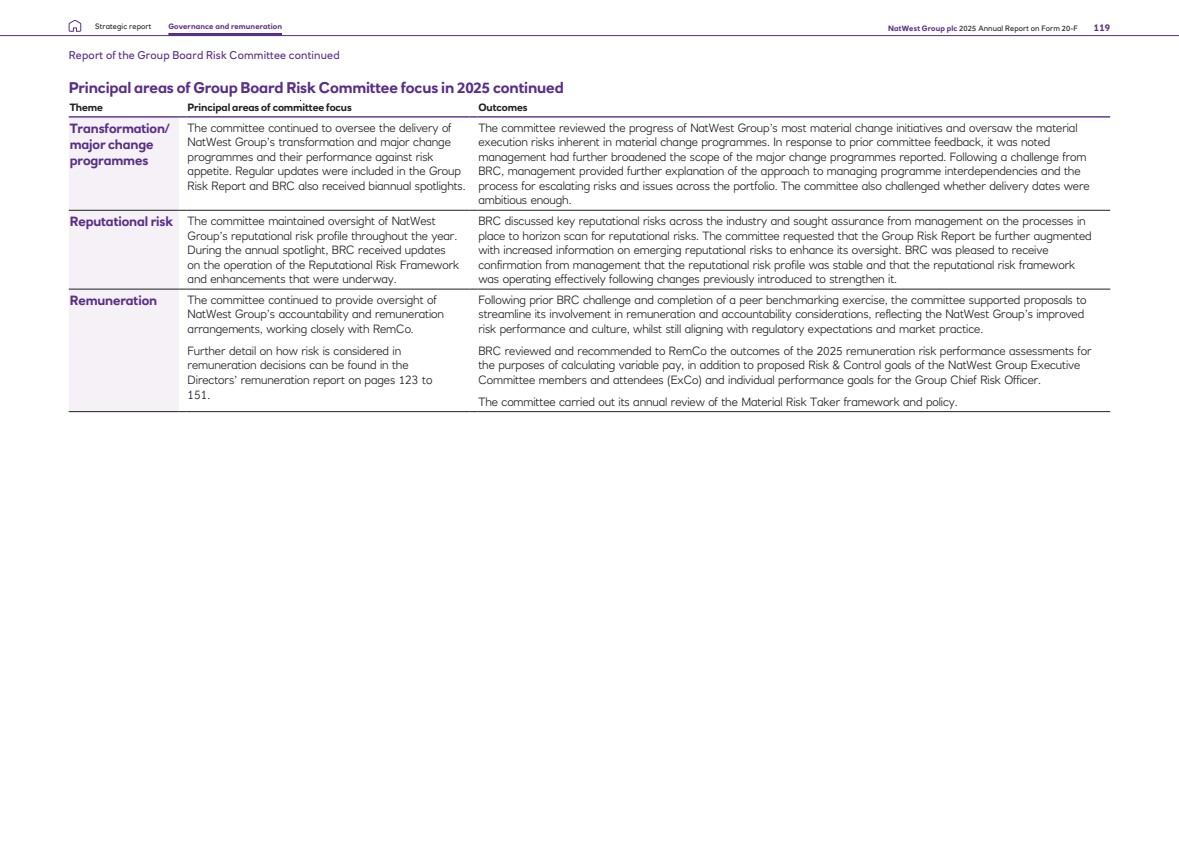
| Report of the Group Technology, Innovation and Simplification Committee The committee held spotlight sessions including deep dives on unlocking the power of data, the advancement of device capabilities, and AI research and strategy. With the rapid evolution of technology and AI, TISC ensures the Group’s work remains on track while challenging the level of ambition on customer centricity with a customer future back approach. Each TISC meeting features interlinked agenda items, connected by a common strategic thread. We maintain close alignment with the Board Risk Committee and the Performance and Remuneration Committee, ensuring no duplication or overlap. External perspective on selected items is presented providing insight into potential threats and implications for the Group. Effectiveness review Conclusion I would like to thank my fellow directors, executive management and those who presented updates to the committee during 2025. My special thanks to Francesca Barnes, SID of NatWest Holdings for her invaluable contribution. I am also thankful for the support provided by the NatWest Digital X team who have helped shape the topics covered by TISC. Yasmin Jetha Chair of the Group Technology, Innovation and Simplification Committee 12 February 2026 Principal areas of focus • Business initiatives to digitise customer engagement • Simplification initiatives • Modernised technology platforms and design choices • External perspectives on Innovation/ Disruption threats and implications for the bank At its final meeting in March 2025, SBC considered the housing sector; the defence sector; ethical, social and environmental policy; the implementation of a new performance management approach; and the activation and embedding plan for the winning together strategy and related behaviours. Members and attendance in 2025 Directors Scheduled meetings attended Yasmin Jetha (Chair) 3 of 3 Roisin Donnelly 3 of 3 Geeta Gopalan 3 of 3 Gillian Whitehead 3 of 3 Lena Wilson 3 of 3 There were no ad hoc meetings of the committee. Dear Shareholder, I am delighted to present my report as Chair of the Group Technology, Innovation and Simplification Committee (the committee or TISC). Following the 2024 Board effectiveness review, it was decided to evolve the SBC into the TISC, a new Board-level committee with effect from 1 June 2025. The new committee is responsible for providing strategic oversight and advice on NatWest Group’s use of technology, data, and innovation to support delivery of its strategic ambitions, leaving former SBC topics regarding ESG and workforce related matters as Group Board’s areas of focus in recognition of their strategic importance. A summary of the final SBC meeting is included in the box below. TISC’s areas of focus are underpinned by strong engagement with executive management. The TISC is committed to ensuring that management proposals relating to the use of technology and innovation: • are aligned with the Group’s purpose and strategy and that the technological enablers support the simplification initiatives across the Group; • can demonstrate they increase market agility, operating leverage, enhance customer experience and engagement, and use automation; • highlight NatWest’s position versus competitors, and what is best in class that we could learn from; and • detail the current baseline position with a future-state outlook focused on outcomes, with interim milestones on the path to that state. Strategic report Financial review Risk and capital management Financial statements Additional information Strategic report Governance and remuneration Governance and remuneration NatWest Group plc NatWest Group plc 2025 Annual Report and Accounts 2025 Annual Report on Form 20-F 137 120 In accordance with the Code, an evaluation of the performance of the Board and its committees, including TISC, was conducted internally in 2025. Further information on the findings, outcomes and actions arising from this review can be found on pages 102 to 104. |
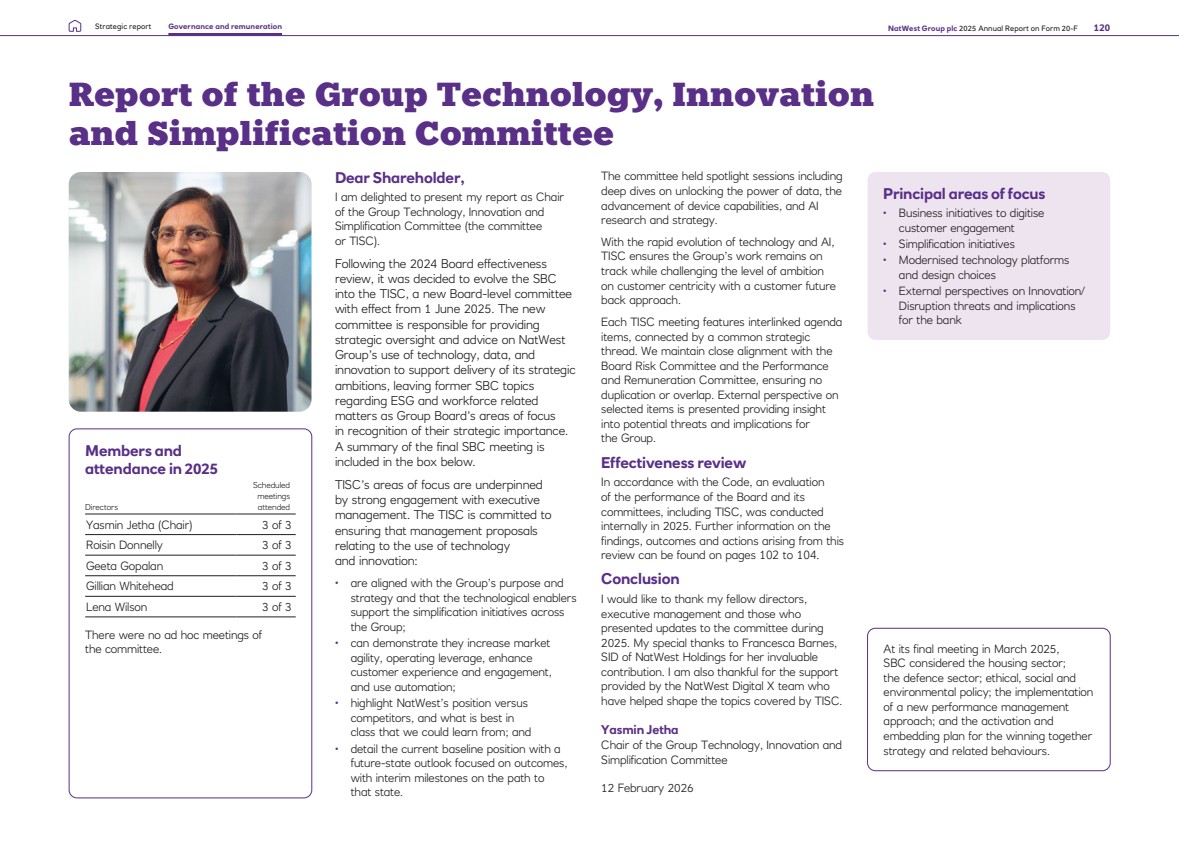
| Report of the Group Technology, Innovation and Simplification Committee The committee held spotlight sessions including deep dives on unlocking the power of data, the advancement of device capabilities, and AI research and strategy. With the rapid evolution of technology and AI, TISC ensures the Group’s work remains on track while challenging the level of ambition on customer centricity with a customer future back approach. Each TISC meeting features interlinked agenda items, connected by a common strategic thread. We maintain close alignment with the Board Risk Committee and the Performance and Remuneration Committee, ensuring no duplication or overlap. External perspective on selected items is presented providing insight into potential threats and implications for the Group. Effectiveness review In accordance with the Code, an evaluation of the performance of the Board and its committees, including TISC, was conducted internally in 2025. Further information on the findings, outcomes and actions arising from this review can be found on pages 119 to 121. Conclusion I would like to thank my fellow directors, executive management and those who presented updates to the committee during 2025. My special thanks to Francesca Barnes, SID of NatWest Holdings for her invaluable contribution. I am also thankful for the support provided by the NatWest Digital X team who have helped shape the topics covered by TISC. Yasmin Jetha Chair of the Group Technology, Innovation and Simplification Committee 12 February 2026 Principal areas of focus • Business initiatives to digitise customer engagement • Simplification initiatives • Modernised technology platforms and design choices • External perspectives on Innovation/ Disruption threats and implications for the bank At its final meeting in March 2025, SBC considered the housing sector; the defence sector; ethical, social and environmental policy; the implementation of a new performance management approach; and the activation and embedding plan for the winning together strategy and related behaviours. Members and attendance in 2025 Directors Scheduled meetings attended Yasmin Jetha (Chair) 3 of 3 Roisin Donnelly 3 of 3 Geeta Gopalan 3 of 3 Gillian Whitehead 3 of 3 Lena Wilson 3 of 3 There were no ad hoc meetings of the committee. Dear Shareholder, I am delighted to present my report as Chair of the Group Technology, Innovation and Simplification Committee (the committee or TISC). Following the 2024 Board effectiveness review, it was decided to evolve the SBC into the TISC, a new Board-level committee with effect from 1 June 2025. The new committee is responsible for providing strategic oversight and advice on NatWest Group’s use of technology, data, and innovation to support delivery of its strategic ambitions, leaving former SBC topics regarding ESG and workforce related matters as Group Board’s areas of focus in recognition of their strategic importance. A summary of the final SBC meeting is included in the box below. TISC’s areas of focus are underpinned by strong engagement with executive management. The TISC is committed to ensuring that management proposals relating to the use of technology and innovation: • are aligned with the Group’s purpose and strategy and that the technological enablers support the simplification initiatives across the Group; • can demonstrate they increase market agility, operating leverage, enhance customer experience and engagement, and use automation; • highlight NatWest’s position versus competitors, and what is best in class that we could learn from; and • detail the current baseline position with a future-state outlook focused on outcomes, with interim milestones on the path to that state. Strategic report Financial review Governance and remuneration Risk and capital management Financial statements Additional information NatWest Group plc 2025 Annual Report and Accounts 137 Theme Principal areas of committee focus Outcomes Business initiatives to digitise customer engagement • Retail Customer Contact Transformation: The committee covered the use of technology (notably AWS Connect) to streamline customer experience across channels, with a focus on maintaining human contact at critical moments (e.g., bereavement). This included simplifying technology architecture so customer information and context followed the customer across channels, and reduced colleague cognitive load through AI augmentation. • Personalised Messaging and Data-Driven Engagement: The committee reviewed how investment in AI was enabling event and trigger-based personalised messaging, aiming for faster, higher-quality, and lower-cost content delivery. The ambition was to speed up campaign launch times. New content creation capabilities were demonstrated and the committee reinforced the importance of tone, consistency, and regulatory compliance in messaging. • Customer Data Mastering: The committee considered plans to master customer data logically in one place, improving resilience and enabling sharing across platforms. TISC recommended that scenario analysis and management actions to mitigate revenue disruption be presented to a future Board meeting. TISC also recommended consideration be given as to how M&A targets are assessed for their support of agile, AI-driven customer data approaches. Additional recommendations included establishing an early-adopter customer group to test new features and developing colleague and investor narratives to outline key deliverables in the journey towards a single customer view. Engagement with customers was reviewed including the frequency of refresh of marketing permissions and the importance of ensuring appropriate use of customer data reinforced. The committee also reviewed the implications of third-party data use, social proofing, and the challenges of delivering dynamic content within regulatory constraints and encouraged management to engage the Information Commissioners Office on notification disclaimers. The use of third-party data (e.g., rewards) and the challenges of integration were discussed, as well as the importance of cognitive behavioural science in understanding customer conversations. Simplification initiatives • Simplification Key Results: Progress of the Group against Key Results targets for simplification within NatWest Digital X was monitored. • Digital X Simplification Strategy: The June meeting highlighted three fundamental outcomes: customer engagement, agility, and cost/FTE reduction. The strategy was to position the Group as a platform bank at the convergence of finance and technology, with rapid evolution in technology and data/AI, and a strong focus on removing complex orchestration layers to speed up delivery. It was also noted that an Architectural Council has been established to govern simplification activity, ensuring alignment with strategic targets and oversight of transformation prioritisation. The appropriateness and the level of ambition within Key Results targets for simplification was challenged resulting in a reset of a number of Key Results through a customer lens. The level of ambition within the plans, and the need to consider the use of AI from a trust standpoint was challenged; and the need for clarification regarding what was remediation activity rather than simplification work was discussed. The importance of the underlying architecture to further increase agility was reinforced. Report of the Group Technology, Innovation and Simplification Committee continued Strategic report Strategic report Governance and remuneration Financial review Governance and remuneration Risk and capital management Financial statements Additional information NatWest Group plc NatWest Group plc 2025 Annual Report and Accounts 2025 Annual Report on Form 20-F 138 121 |
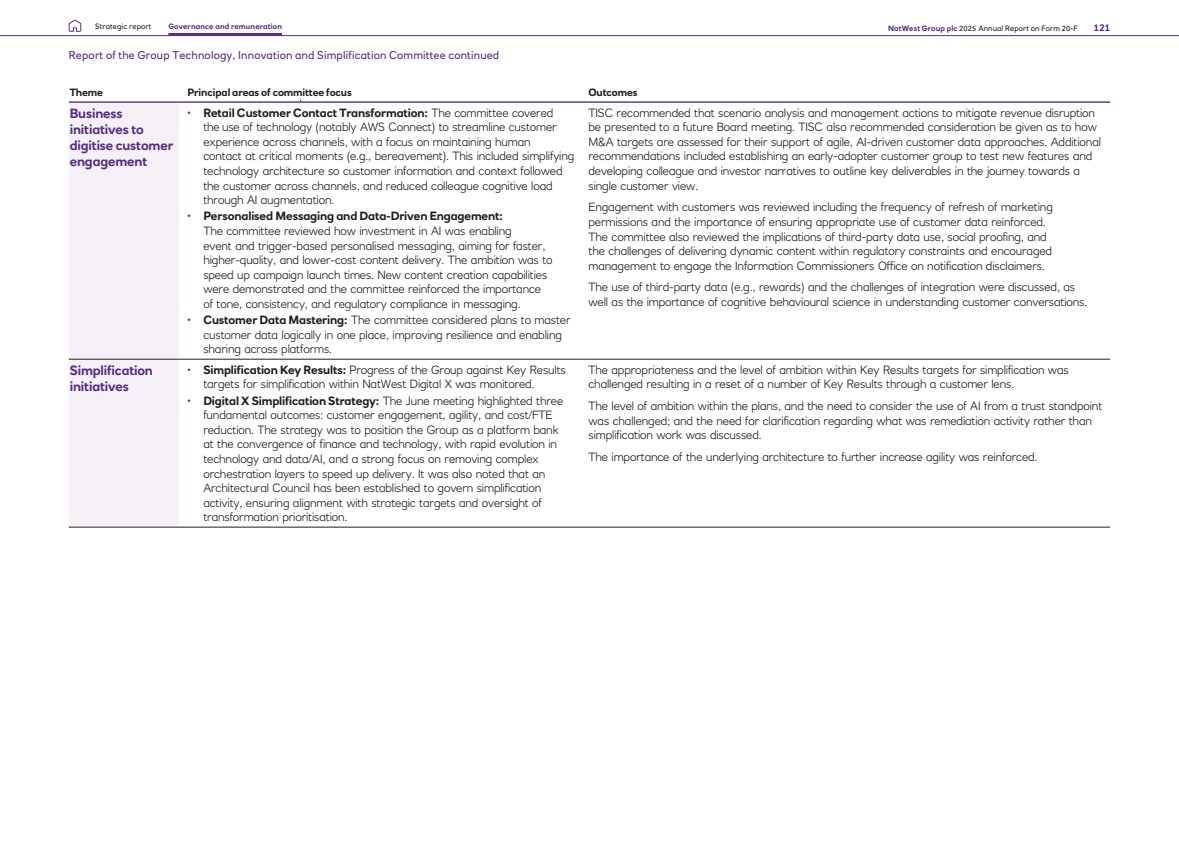
| Theme Principal areas of committee focus Outcomes Modernised technology platforms and design choices • Bankline Transformation: The transformation of the Bankline platform is central to the Commercial & Institutional (C&I) business, addressing outdated systems and service gaps. The programme aims to re-engineer the platform to be cloud-ready, improve customer experience, and reduce vulnerabilities to cyberattack and fraud. The pace of delivery has increased, with the Group benchmarked as the number one for release delivery in 2025 (source: Source: Curinos, H2 Commercial Digital Tracker). • Digital Spine and Data Marketplace: The Digital Spine is being developed as a set of shared capabilities for reuse across the Group, supporting improved customer journeys and agility. The data marketplace is intended to combine siloed data sets, reduce point-to-point sourcing, and drive operational efficiency. The adoption of Agentic AI-based architecture requires centralised data and Application Programming Interfaces (APIs), with several applications in development. • AI Feature Teams and Adoption: The establishment of an AI feature team, with deliverables expected by the end of 2025. AI adoption is progressing, with tools like CoPilot Chat and Aiden (an internally developed generative AI tool) rolled out to employees, with an initial focus on building avatars capable of developing an empathetic response; and deepfake detection capabilities. • Industry and bank-specific AI adoption: External guests from NVIDIA and the Group’s Chief AI Research Officer provided an opinion on the evolution of AI, emerging use cases, and the sustainability of current market valuations. This included the strategic importance of data, monetisation via proprietary models, industry adoption, and the impact on customer relationships and staff roles. This evolution of large language models, Agentic AI, and the Group’s ambition for operating leverage through AI was covered. Demonstrations of financial crime and fraud use cases, and retail banking applications were provided alongside plans to enhance the colleague experience. TISC challenged whether it was possible to complete the transformation more quickly whilst acknowledging the extent of upgrade required. The committee also reviewed how customer needs were identified and prioritised via customer journey activity. The extent to which customer experience was used to drive the targeting of training was also covered. The committee challenged whether it was necessary to move to real-time processing to deliver the required customer benefits or whether near real-time processing would suffice. In addition, TISC raised concerns that it was hard to gauge the level of ambition within plans presented and that this view would be helpful in all future updates. The importance of ensuring the right culture for the new team was noted. At the December 2025 meeting, the Committee acknowledged the strategic direction and recognised the need for internal model development where economically justified. Options to de-risk adoption, including consideration of technology from multiple geographies were also reviewed. Regarding colleague adoption, ethical considerations in AI rollout, reward system changes, and future skills development were covered. It was agreed to provide a spotlight on engineering workforce plans and future skills during 2026. External perspectives on Innovation/ Disruption threats and implications for bank • Device Disruption: The committee reviewed the rapid adoption of emerging devices (wearables, headsets, brain-computer interfaces, robotics with embedded AI) and the potential to disrupt customer engagement and end mobile phone dominance. • Agentic AI and Banking Disruption: The June meeting included a deep dive into Agentic AI, with external perspectives from the Technology Advisory Board. The committee considered how rapid shifts in Agentic AI adoption by customers could impact the Group, including the risk of disintermediation and the need for strategic advantage through ownership of complex prompts and trust relationships. Engagement with regulators and industry bodies is ongoing. • Competitive Positioning: The Group’s position versus peers was reviewed including opportunities and challenges such as security concerns potentially slowing generative AI adoption across the industry which presented opportunities for the Group. TISC highlighted the need for clarity on which platforms the Group will engage with and considered the importance of trust and regulatory perspectives, and microservice-level operations to reduce competitive threats. Disintermediation in the market was discussed and it was noted that new entrants from China were already using AI agents to offer to move customers money and were not bound by domestic regulation. The Directors challenged the Group’s ambition including what steps would be taken to ensure the Group was winning for customers. It was agreed that a future update would be provided in respect of the Group’s position on Agentic AI adoption by our customers. The committee reinforced the importance of benchmarking and learning from other industries and best-in-class competitors. Report of the Group Technology, Innovation and Simplification Committee continued Strategic report Strategic report Governance and remuneration Financial review Governance and remuneration Risk and capital management Financial statements Additional information NatWest Group plc NatWest Group plc 2025 Annual Report and Accounts 2025 Annual Report on Form 20-F 139 122 |
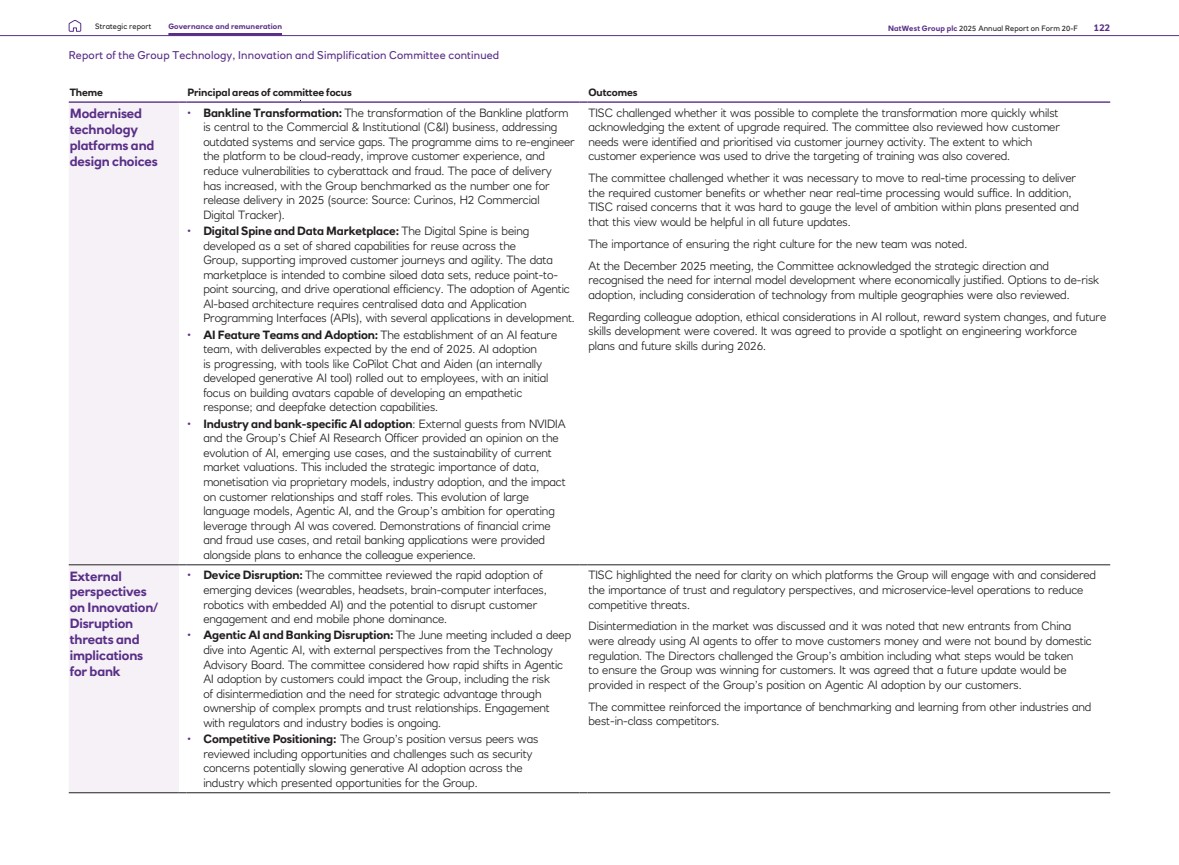
| Theme Principal areas of committee focus Outcomes Modernised technology platforms and design choices • Bankline Transformation: The transformation of the Bankline platform is central to the Commercial & Institutional (C&I) business, addressing outdated systems and service gaps. The programme aims to re-engineer the platform to be cloud-ready, improve customer experience, and reduce vulnerabilities to cyberattack and fraud. The pace of delivery has increased, with the Group benchmarked as the number one for release delivery in 2025 (source: Source: Curinos, H2 Commercial Digital Tracker). • Digital Spine and Data Marketplace: The Digital Spine is being developed as a set of shared capabilities for reuse across the Group, supporting improved customer journeys and agility. The data marketplace is intended to combine siloed data sets, reduce point-to-point sourcing, and drive operational efficiency. The adoption of Agentic AI-based architecture requires centralised data and Application Programming Interfaces (APIs), with several applications in development. • AI Feature Teams and Adoption: The establishment of an AI feature team, with deliverables expected by the end of 2025. AI adoption is progressing, with tools like CoPilot Chat and Aiden (an internally developed generative AI tool) rolled out to employees, with an initial focus on building avatars capable of developing an empathetic response; and deepfake detection capabilities. • Industry and bank-specific AI adoption: External guests from NVIDIA and the Group’s Chief AI Research Officer provided an opinion on the evolution of AI, emerging use cases, and the sustainability of current market valuations. This included the strategic importance of data, monetisation via proprietary models, industry adoption, and the impact on customer relationships and staff roles. This evolution of large language models, Agentic AI, and the Group’s ambition for operating leverage through AI was covered. Demonstrations of financial crime and fraud use cases, and retail banking applications were provided alongside plans to enhance the colleague experience. TISC challenged whether it was possible to complete the transformation more quickly whilst acknowledging the extent of upgrade required. The committee also reviewed how customer needs were identified and prioritised via customer journey activity. The extent to which customer experience was used to drive the targeting of training was also covered. The committee challenged whether it was necessary to move to real-time processing to deliver the required customer benefits or whether near real-time processing would suffice. In addition, TISC raised concerns that it was hard to gauge the level of ambition within plans presented and that this view would be helpful in all future updates. The importance of ensuring the right culture for the new team was noted. At the December 2025 meeting, the Committee acknowledged the strategic direction and recognised the need for internal model development where economically justified. Options to de-risk adoption, including consideration of technology from multiple geographies were also reviewed. Regarding colleague adoption, ethical considerations in AI rollout, reward system changes, and future skills development were covered. It was agreed to provide a spotlight on engineering workforce plans and future skills during 2026. External perspectives on Innovation/ Disruption threats and implications for bank • Device Disruption: The committee reviewed the rapid adoption of emerging devices (wearables, headsets, brain-computer interfaces, robotics with embedded AI) and the potential to disrupt customer engagement and end mobile phone dominance. • Agentic AI and Banking Disruption: The June meeting included a deep dive into Agentic AI, with external perspectives from the Technology Advisory Board. The committee considered how rapid shifts in Agentic AI adoption by customers could impact the Group, including the risk of disintermediation and the need for strategic advantage through ownership of complex prompts and trust relationships. Engagement with regulators and industry bodies is ongoing. • Competitive Positioning: The Group’s position versus peers was reviewed including opportunities and challenges such as security concerns potentially slowing generative AI adoption across the industry which presented opportunities for the Group. TISC highlighted the need for clarity on which platforms the Group will engage with and considered the importance of trust and regulatory perspectives, and microservice-level operations to reduce competitive threats. Disintermediation in the market was discussed and it was noted that new entrants from China were already using AI agents to offer to move customers money and were not bound by domestic regulation. The Directors challenged the Group’s ambition including what steps would be taken to ensure the Group was winning for customers. It was agreed that a future update would be provided in respect of the Group’s position on Agentic AI adoption by our customers. The committee reinforced the importance of benchmarking and learning from other industries and best-in-class competitors. Report of the Group Technology, Innovation and Simplification Committee continued Strategic report Financial review Governance and remuneration Risk and capital management Financial statements Additional information NatWest Group plc 2025 Annual Report and Accounts 139 Directors’ remuneration report Dear Shareholder, On behalf of the Board, I present the remuneration report for 2025. I want to start by acknowledging the sad news that Frank Dangeard, who stepped down from his role as non-executive director on 23 April 2025, passed away in August 2025. Frank was a highly valued and respected member of the team, and he and his counsel will be greatly missed. On behalf of the Group Performance and Remuneration Committee, I would like to extend my condolences to Frank’s family and all who knew him. I would like to thank Mark Seligman, who retired on 31 March 2025 for his services to the Group Performance and Remuneration Committee (the committee). Mark made significant contributions during his tenure, and his insight and support have been invaluable. In 2025, the committee welcomed Patrick Flynn and Josh Critchley as members, effective from 11 June 2025 and 11 December 2025 respectively. I appreciate the substantial expertise they bring and thank them for their valuable contributions so far. Additionally, I would like to thank Ian Cormack, Mark Rennison and Karin Cook, non-executive directors and members of the NatWest Holdings Performance and Remuneration Committee, for the insights they provided in attending meetings of the committee in an observational capacity in 2025. Ian stepped down from the Board in May 2025. Wider workforce highlights April 2025 • Nearly 84% of our junior UK colleagues, covered by our negotiated pay approach, received a salary increase of at least 2%, with almost two-thirds receiving 2.5% or more. May 2025 • The second award under our Sharing in Success scheme delivered shares with a grant value of £1,275 for all eligible employees (adjusted for local salary levels). October 2025 • Building on our performance management philosophy Beyond and our new behaviours introduced in 2025, we launched Recognise, our new approach to recognition, which enables colleagues to be acknowledged ‘in the moment’ for their contributions. From April 2026 onwards • In May 2026, all eligible employees will receive a Sharing in Success award of shares worth £1,440 (adjusted for local salary levels), subject to shareholder approval of the recommended dividend. Members and attendance in 2025 Directors Scheduled meetings attended Lena Wilson (Chair) 5 of 5 Roisin Donnelly 5 of 5 Mark Seligman 2 of 2 Frank Dangeard 1 of 2 Patrick Flynn (Member since 11 June 2025) 2 of 2 Mark Seligman retired on 31 March 2025 and Frank Dangeard stepped down on 23 April 2025. Josh Critchley did not formally become a member of the committee until 11 December 2025; however, he was present at the meeting held on 10 December 2025. In addition to the five scheduled meetings held, there were two ad hoc meetings. All directors eligible to attend ad hoc meetings were present at those meetings. Contents 140 Chair’s introduction 144 Remuneration at a glance 146 The directors’ remuneration policy and wider workforce remuneration 151 Annual remuneration report Performance highlights for 2025 2025 was another really strong year for NatWest Group, rooted in the support we provide to people, families and businesses in every nation and region of the UK. Our performance is a consequence of deliberate actions and clear priorities. Attributable profit of £5,479 million and a Return on Tangible Equity (RoTE) of 19.2%, are both significantly up on the year before, and ahead of guidance. We were pleased with our performance, confident in our priorities and ambitious for our business. With positive momentum across the bank, we see significant opportunities to grow and succeed with our customers and the UK in the future. As demonstrated by returning £4.1 billion of capital to shareholders in 2025, and our proposed final dividend of £1.8 billion, our ability to deliver leading returns to our shareholders has remained strong. Wider workforce and customer focus We continued to focus on rewarding colleagues in a fair and transparent way in 2025. Our UK starting salary increased to £24,525 per annum in April 2025, and nearly 84% of our junior UK colleagues (A and B grades), who are covered by our negotiated pay approach, received a salary increase of at least 2%, with almost two-thirds receiving 2.5% or more. Throughout 2025, we further embedded Beyond, our performance management philosophy which was launched in 2024, with a focus on goals, feedback, and fostering a performance culture. Encouraging developments were evident, including a stronger emphasis on frequent coaching and feedback, alongside a rise in recorded feedback. Additionally, more colleagues tailored Strategic report Strategic report Governance and remuneration Financial review Governance and remuneration Risk and capital management Financial statements Additional information NatWest Group plc NatWest Group plc 2025 Annual Report and Accounts 2025 Annual Report on Form 20-F 140 123 |
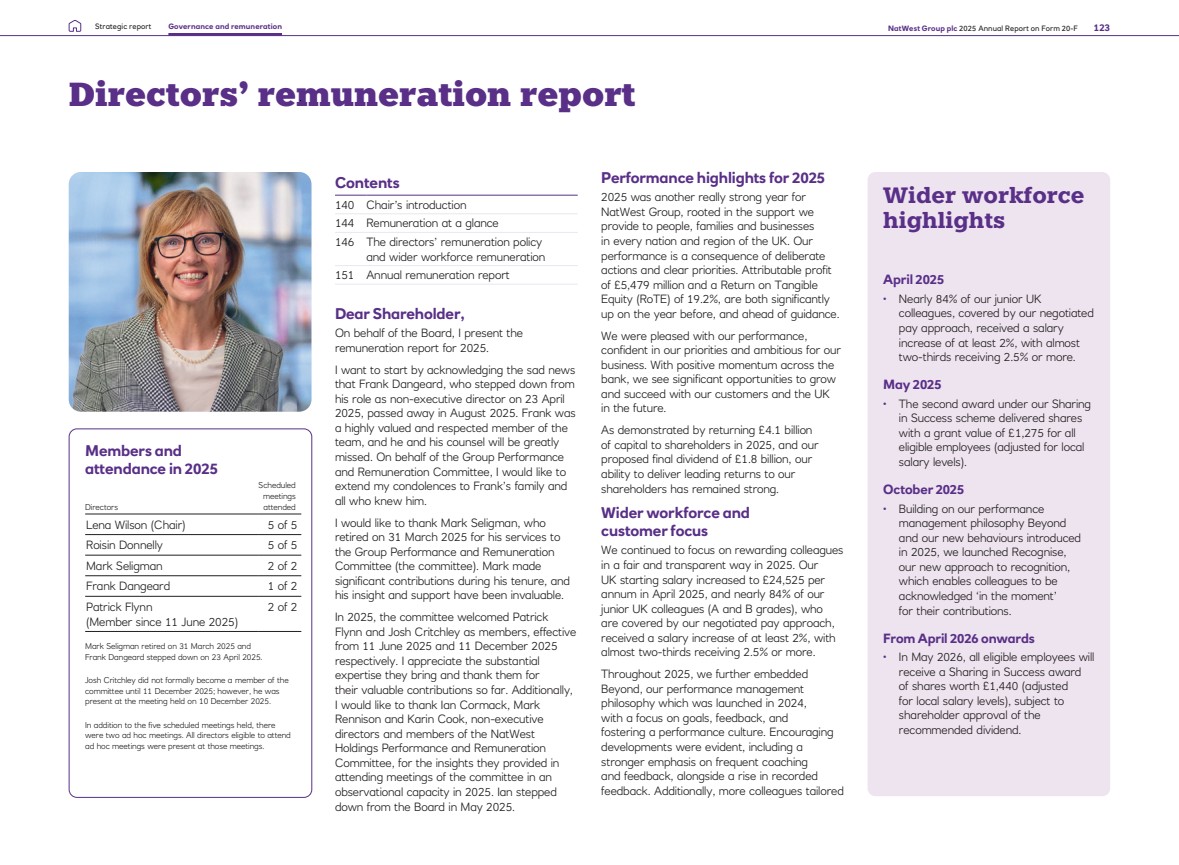
| their goals throughout the year, and colleague sentiment towards performance and pay remained favourable. Further details on these aspects are provided later in the report. Looking ahead to 2026, we will continue to build on these improvements to ensure our compensation framework stays aligned with our business strategy and motivates colleagues to raise the bar. The second award under our Sharing in Success scheme was delivered in shares in May 2025, based on performance in 2024. The scheme is intended to further align colleagues with our strategic direction and drive improvements in customer performance, only paying out when NatWest Group has demonstrated satisfactory financial performance and an intelligent approach to risk. For 2025, we measured success based on succeeding with customers, underpinned by financial performance, our approach to risk and delivering value for shareholders. The third award under the scheme will be granted in May 2026, with a share award worth £1,440 for all eligible UK employees (adjusted for local salary levels to £530 for our other major hub in India), subject to shareholder approval of the recommended dividend at the 2026 NatWest Group plc Annual General Meeting (AGM). This reflects the good progress we made on our customer goals in 2025. Over 35,000 colleagues contribute to our Sharesave scheme each month, with participants across the UK and India eligible to participate in new Sharesave offers. At the end of 2025, 65% of our colleagues were shareholders. Financial wellbeing remains important to us both for our colleagues and our customers and communities. Colleagues are supported with access to pension and protection products as well as a range of financial health initiatives. Bonus pool for the wider workforce The bonus pool for 2025 is based on a proportion of attributable profit adjusted for performance against a balanced scorecard of strategically important measures: financial performance; customer outcomes; people, culture and diversity; risk management; risk events; and progress against our strategic ambitions. The committee agreed a 2025 bonus pool of £495.0 million, 10.8% higher than the 2024 bonus pool of £446.6 million. The uplift in the bonus pool for 2025 reflects the increase in profit since 2024 and the strong performance across the scorecard, particularly in relation to financial and customer targets, as well as changes in the underlying eligible population. Remuneration for executive directors A new directors’ remuneration policy (the Policy) was approved at the 2025 NatWest Group plc AGM. The Board was delighted with the strong level of support from shareholders, with 97.86% of votes in favour. The Policy operated as intended during 2025. The final award under the RSP was made in March 2025 in relation to performance year 2024, and the first award under the new PSP will be made in March 2026. Further details are set out on the next page. Performance highlights Income growth excluding notable items 12.0% 2024: 2.2% Attributable profit £5,479 million 2024: £4,519 million RoTE 19.2% 2024: 17.5% Climate and sustainable funding and financing(1) £16.9 billion 2024: £31.5 billion Shareholder returns through dividends and buybacks £4.1 billion 2024: £4.0 billion Directors’ remuneration report continued Participation highlights % of colleagues who are shareholders (as at 31 December 2025) 65% Number of colleagues participating in the Sharesave scheme 35,500 (1) Climate and sustainable funding and financing represents only a relatively small proportion of our overall funding and financing activities. Strategic report Financial review Risk and capital management Financial statements Additional information Strategic report Governance and remuneration Governance and remuneration NatWest Group plc NatWest Group plc 2025 Annual Report and Accounts 2025 Annual Report on Form 20-F 141 124 Under the new Policy, there were two key changes. Firstly, the Restricted Share Plan (RSP) was replaced by a new Performance Share Plan (PSP), with awards capped at 300% of earned salary. Secondly, the annual bonus opportunity was increased to 150% of earned salary. The changes reflect our progress on aligning reward more closely with performance, responding to the evolving market and regulatory expectations, and ensuring our long-term incentive structure remains competitive and strategically focused. Full details on the changes made can be found in the NatWest Group plc 2024 Annual Report on Form 20-F. |
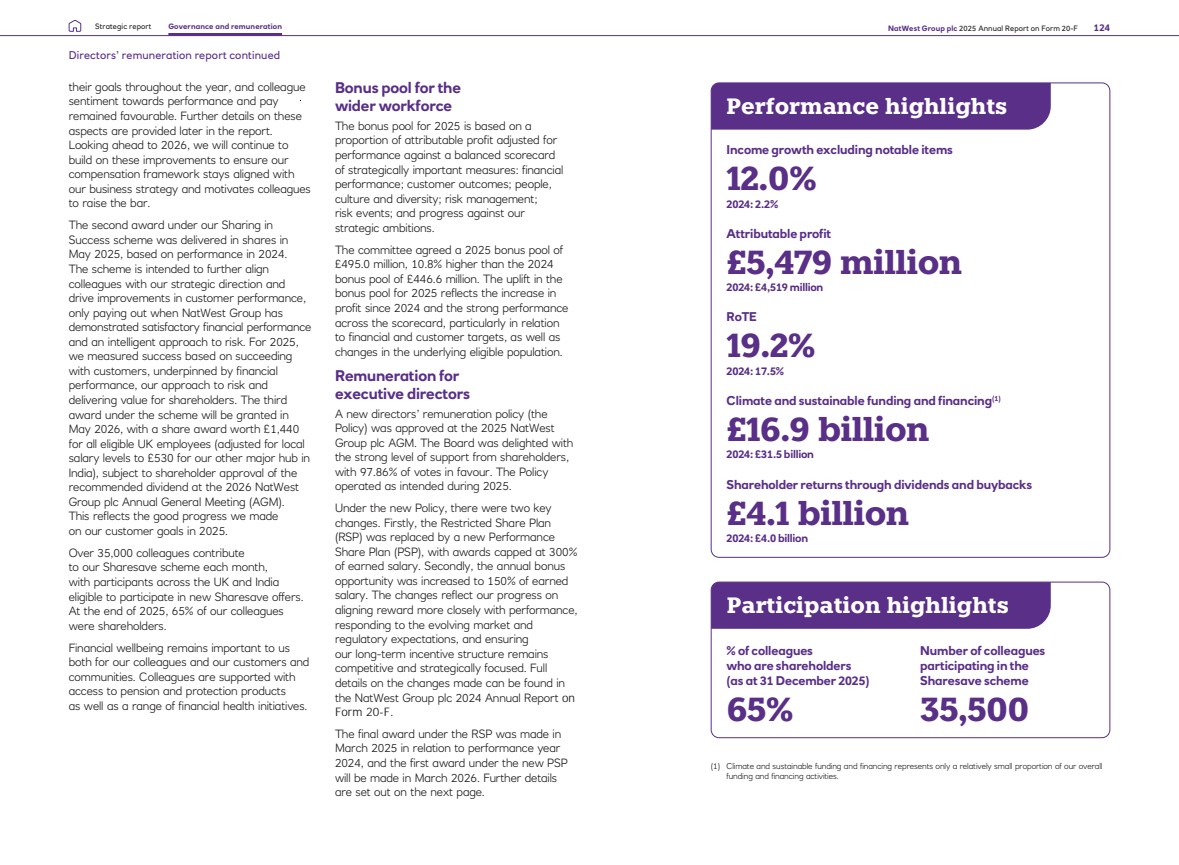
| their goals throughout the year, and colleague sentiment towards performance and pay remained favourable. Further details on these aspects are provided later in the report. Looking ahead to 2026, we will continue to build on these improvements to ensure our compensation framework stays aligned with our business strategy and motivates colleagues to raise the bar. The second award under our Sharing in Success scheme was delivered in shares in May 2025, based on performance in 2024. The scheme is intended to further align colleagues with our strategic direction and drive improvements in customer performance, only paying out when NatWest Group has demonstrated satisfactory financial performance and an intelligent approach to risk. For 2025, we measured success based on succeeding with customers, underpinned by financial performance, our approach to risk and delivering value for shareholders. The third award under the scheme will be granted in May 2026, with a share award worth £1,440 for all eligible UK employees (adjusted for local salary levels to £530 for our other major hub in India), subject to shareholder approval of the recommended dividend at the 2026 NatWest Group plc Annual General Meeting (AGM). This reflects the good progress we made on our customer goals in 2025. Over 35,000 colleagues contribute to our Sharesave scheme each month, with participants across the UK and India eligible to participate in new Sharesave offers. At the end of 2025, 65% of our colleagues were shareholders. Financial wellbeing remains important to us both for our colleagues and our customers and communities. Colleagues are supported with access to pension and protection products as well as a range of financial health initiatives. Bonus pool for the wider workforce The bonus pool for 2025 is based on a proportion of attributable profit adjusted for performance against a balanced scorecard of strategically important measures: financial performance; customer outcomes; people, culture and diversity; risk management; risk events; and progress against our strategic ambitions. The committee agreed a 2025 bonus pool of £495.0 million, 10.8% higher than the 2024 bonus pool of £446.6 million. The uplift in the bonus pool for 2025 reflects the increase in profit since 2024 and the strong performance across the scorecard, particularly in relation to financial and customer targets, as well as changes in the underlying eligible population. Remuneration for executive directors A new directors’ remuneration policy (the Policy) was approved at the 2025 NatWest Group plc AGM. The Board was delighted with the strong level of support from shareholders, with 97.86% of votes in favour. The Policy operated as intended during 2025. Under the new Policy, there were two key changes. Firstly, the Restricted Share Plan (RSP) was replaced by a new Performance Share Plan (PSP), with awards capped at 300% of earned salary. Secondly, the annual bonus opportunity was increased to 150% of earned salary. The changes reflect our progress on aligning reward more closely with performance, responding to the evolving market and regulatory expectations, and ensuring our long-term incentive structure remains competitive and strategically focused. Full details on the changes made can be found in the NatWest Group plc 2024 Annual Report and Accounts. The final award under the RSP was made in March 2025 in relation to performance year 2024, and the first award under the new PSP will be made in March 2026. Further details are set out on the next page. Performance highlights Income growth excluding notable items 12.0% 2024: 2.2% Attributable profit £5,479 million 2024: £4,519 million RoTE 19.2% 2024: 17.5% Climate and sustainable funding and financing(1) £16.9 billion 2024: £31.5 billion Shareholder returns through dividends and buybacks £4.1 billion 2024: £4.0 billion Directors’ remuneration report continued Participation highlights % of colleagues who are shareholders (as at 31 December 2025) 65% Number of colleagues participating in the Sharesave scheme 35,500 (1) Climate and sustainable funding and financing represents only a relatively small proportion of our overall funding and financing activities. Strategic report Financial review Risk and capital management Financial statements Additional information Governance and remuneration NatWest Group plc 2025 Annual Report and Accounts 141 Directors’ remuneration report continued Regulatory remuneration requirements In November 2024, the Prudential Regulation Authority (PRA) and Financial Conduct Authority (FCA) published a joint consultation paper on changes to regulatory remuneration requirements in the UK, which we engaged with. In October 2025, the final regulatory position was published, detailing changes to the UK regulatory remuneration requirements. Most of the rules are effective from performance year 2026 but discretion is available to companies to apply certain changes to performance year pay-outs in respect of 2025, as well as to unvested awards from previous years. When drafting the new Policy which was approved at the 2025 NatWest Group plc AGM, the committee ensured there was appropriate flexibility built in to allow us to respond to these anticipated changes. Our approach for the structure of pay for executive directors in light of the updated remuneration regulations is as follows: • No change to the delivery mechanism for the annual bonus for performance year (PY) 2025 and PY 2026. This will continue to be delivered upfront, with 50% in cash and 50% in shares (which will remain subject to a 12-month retention period). • 2026 PSP awards will vest across a four-year period, with 75% vesting after year three, and 25% vesting after year four. There will be a two-year holding period on the 75% of the PSP that vests after year three, and a one-year holding period on the 25% of the PSP that vests after year four, bringing the total vesting and holding period for all PSP awards to five years. • The previous discount methodology for prohibition of dividends on unvested shares will be replaced with dividend equivalents. This will apply to the first PSP awards to be awarded in March 2026, and thereafter. • Any unvested awards held in respect of roles prior to becoming an executive director will be eligible for accelerated vesting in line with the treatment for other colleagues. The committee welcomes the simplification of the UK regulatory framework, and notes the importance of ensuring compliance with differing governance standards and shareholder expectations where applicable, as well as the expectations set out under the UK Corporate Governance Code. Further consideration will be given to the longer-term application of the updated regulations during the next Policy review. Vesting of RSP awards granted in 2023 RSP awards were granted to the Group Chief Executive Officer (Group CEO), Paul Thwaite, and the Group Chief Financial Officer (Group CFO), Katie Murray, in March 2023 in respect of performance year 2022. Given Mr Thwaite was not an executive director in 2022, his vesting schedule for this award is eligible for acceleration due to the recent regulatory changes and will vest in March 2026 and March 2027. No amendments will be made to the vesting schedule for Ms Murray’s outstanding awards given all her unvested awards are in relation to her time as an executive director, and these will progress based on the original vesting schedule. Annual bonus for 2025 Performance measures Weighted outcome Financial (60%) 53.65% out of 60% Group RoTE (25%) 19.93% Attributable profit (25%) 23.72% Group operating expenses, excluding litigation and conduct costs (10%) 10.00% Non-financial (40%) 31.53% out of 40% Customer (20%) 18.01% Colleague (10%) 6.06% Simplification (10%) 7.46% Final outcome approved by the committee Group CEO 85.18% Group CFO 85.18% Grant of 2026 PSP awards Following a pre-grant test which confirmed that satisfactory performance was achieved in 2025, the committee has approved the grant of PSP awards at maximum level (300% of earned salary) for Mr Thwaite and Ms Murray in March 2026. Financial metrics Weighting Non-financial metrics Weighting Group RoTE 30% Strategic measures 25% Relative Total Shareholder Return (TSR) 30% Sustainability 15% Total 60% Total 40% Strategic report Financial review Risk and capital management Financial statements Additional information Strategic report Governance and remuneration Governance and remuneration NatWest Group plc NatWest Group plc 2025 Annual Report and Accounts 2025 Annual Report on Form 20-F 142 125 The assessment of performance against annual bonus scorecards resulted in an outcome of 85.18% for both Mr Thwaite and Ms Murray. The committee agreed the final outcome was representative of performance and there were no unforeseen external impacts that made it necessary to adjust the resulting award levels. The annual bonus performance measures and targets for 2025 were set out in the 2024 Directors’ remuneration report. Full details of the performance achieved against the measures and targets can be found on pages 134 and 135. Ahead of the awards vesting, the committee carried out a pre-vest underpin check, assessing if anything had come to light since the awards were granted which would change its original view of performance. The committee concluded no pre-vest adjustments were necessary, so the award will begin vesting in March 2026. Full details of the RSP awards can be found on page 137. The awards will be subject to a three-year performance period running from 1 January 2026 until 31 December 2028, and will be assessed against a challenging pre-determined scorecard of measures pre-vesting. The table below summarises the performance measures that will apply to the 2026 PSP awards. Full details of the PSP scorecard measures for 2026 to 2028 are detailed on pages 142 and 143. |
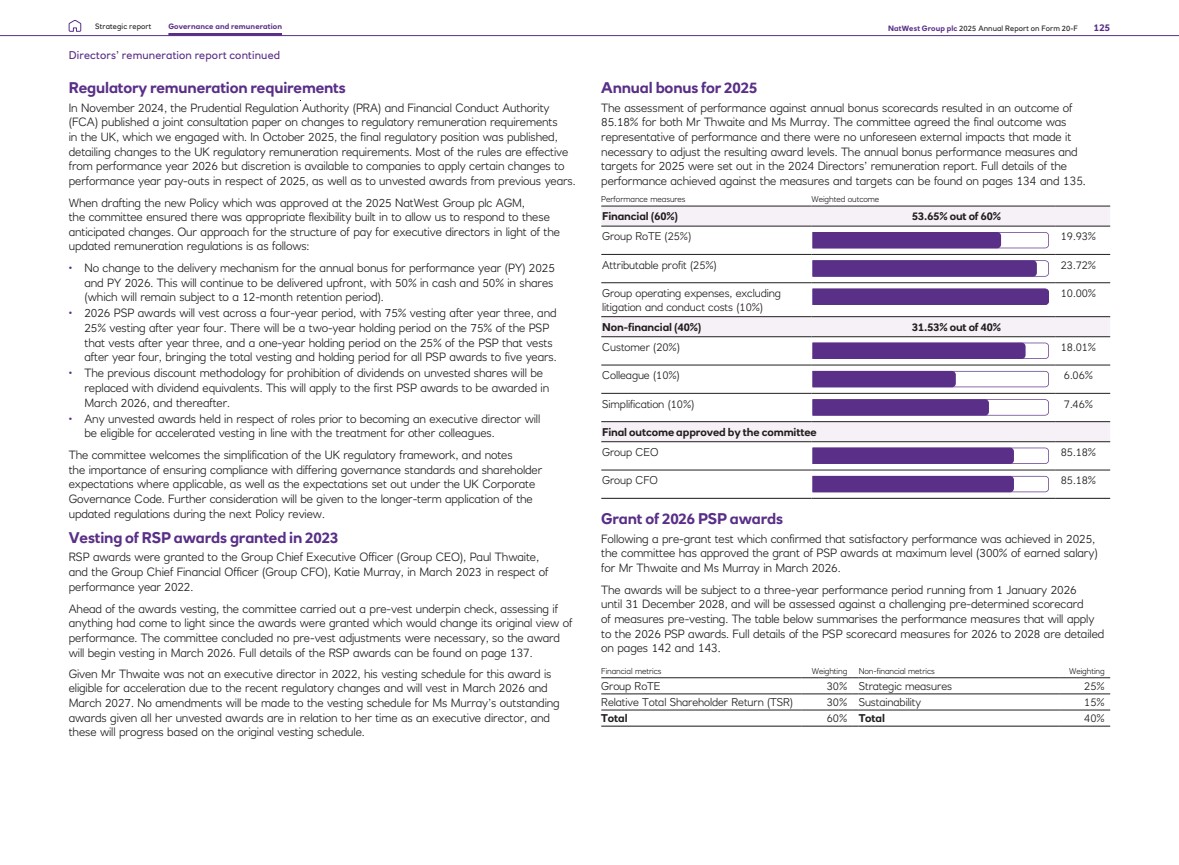
| Directors’ remuneration report continued Looking ahead – implementation of the Policy for 2026 In 2025, the committee reviewed its approach to benchmarking for executive directors. The committee believes remuneration benchmarking should not be the driving factor behind the positioning of remuneration, but that robust benchmarking should be undertaken to inform and support the committee in its decision-making. The benchmarking peer group since 2018 has comprised a group of similar sized banks and other financial services organisations listed in the UK, Europe, Canada and Australia. Following a detailed review, it was concluded that going forward remuneration should primarily be considered against our fellow FTSE 30 banks (taking into account factors such as the size and complexity of the individual peers when making a judgement on relative positioning). The committee will also consider data for the broader FTSE 30, as well as FTSE 50 Financial Services companies. This updated approach more accurately reflects the market NatWest Group operates in for executive talent. It also recognises that pay models for UK banks are materially different to those in international banks, and are now more closely aligned to the broader UK market, particularly in light of regulatory simplification. Should any material change to our pay structures be made in the future, detailed benchmarking analysis will be presented within our remuneration report at the appropriate time. In December 2025, the committee approved salary increases of 3.25% for the Group CEO and the Group CFO, effective from 1 April 2026. Negotiations with Unite, one of our recognised employee representatives, regarding pay and conditions for the wider workforce for 2026 were ongoing at the time this report was prepared. The committee acknowledges that shareholders generally expect any increases in executive director base salary to align with those awarded to the relevant wider workforce in the same locality. As negotiations had not concluded by the publication date, the final outcomes relating to wider workforce UK salary increases will be disclosed in the 2026 Directors’ remuneration report. Each year we ensure appropriate engagement with our major shareholders and other stakeholders on pay. In 2025, we wrote to our 10 largest shareholders who together represent c.40% of our investor base, alongside our proxy advisers and the UK regulators, sharing our approach for the implementation of the Policy in 2026. All interactions were positive, with no concerns raised. Looking ahead, we are committed to ensuring we can continue to attract and retain senior executives of the calibre required for NatWest Group and our market context. With this in mind, the committee will continue to monitor remuneration developments in the market. The committee has observed the significant changes to leverage and fixed pay in 2025 at the other UK listed Level 1 banks and will monitor closely the operation of policies within the sector resulting from the recent changes to the remuneration regulations. In light of these factors, we hold open the possibility of returning to shareholders for a revised policy at the 2027 NatWest Group plc AGM, a year earlier than the normal triennial policy cycle, to ensure our high-performing management team continues to be appropriately compensated. I would like to thank our shareholders for their ongoing support, my fellow committee members for their valuable contributions and our colleagues for their focus on our customers and communities. Lena Wilson, CBE Chair of the Group Performance and Remuneration Committee 12 February 2026 Strategic report Strategic report Governance and remuneration Financial review Governance and remuneration Risk and capital management Financial statements Additional information NatWest Group plc NatWest Group plc 2025 Annual Report and Accounts 2025 Annual Report on Form 20-F 143 126 |
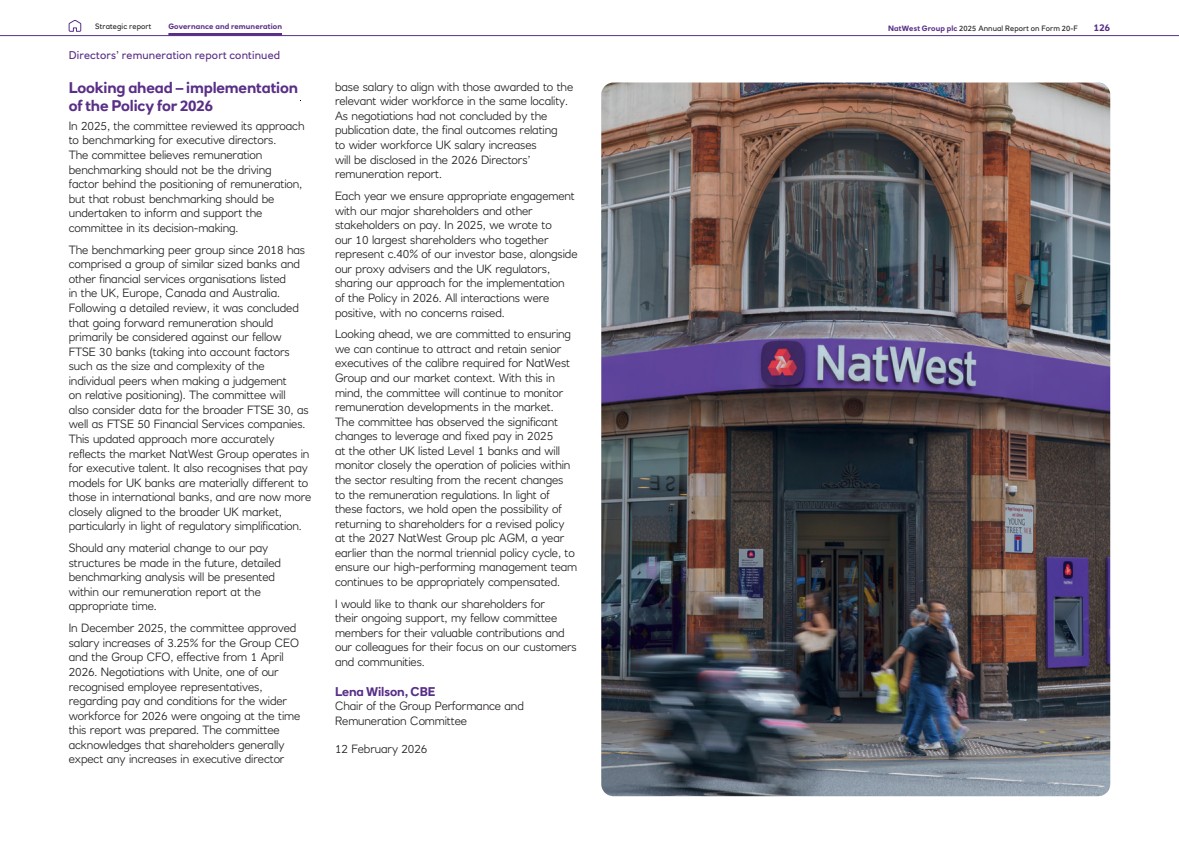
| Directors’ remuneration report continued Looking ahead – implementation of the Policy for 2026 In 2025, the committee reviewed its approach to benchmarking for executive directors. The committee believes remuneration benchmarking should not be the driving factor behind the positioning of remuneration, but that robust benchmarking should be undertaken to inform and support the committee in its decision-making. The benchmarking peer group since 2018 has comprised a group of similar sized banks and other financial services organisations listed in the UK, Europe, Canada and Australia. Following a detailed review, it was concluded that going forward remuneration should primarily be considered against our fellow FTSE 30 banks (taking into account factors such as the size and complexity of the individual peers when making a judgement on relative positioning). The committee will also consider data for the broader FTSE 30, as well as FTSE 50 Financial Services companies. This updated approach more accurately reflects the market NatWest Group operates in for executive talent. It also recognises that pay models for UK banks are materially different to those in international banks, and are now more closely aligned to the broader UK market, particularly in light of regulatory simplification. Should any material change to our pay structures be made in the future, detailed benchmarking analysis will be presented within our remuneration report at the appropriate time. In December 2025, the committee approved salary increases of 3.25% for the Group CEO and the Group CFO, effective from 1 April 2026. Negotiations with Unite, one of our recognised employee representatives, regarding pay and conditions for the wider workforce for 2026 were ongoing at the time this report was prepared. The committee acknowledges that shareholders generally expect any increases in executive director base salary to align with those awarded to the relevant wider workforce in the same locality. As negotiations had not concluded by the publication date, the final outcomes relating to wider workforce UK salary increases will be disclosed in the 2026 Directors’ remuneration report. Each year we ensure appropriate engagement with our major shareholders and other stakeholders on pay. In 2025, we wrote to our 10 largest shareholders who together represent c.40% of our investor base, alongside our proxy advisers and the UK regulators, sharing our approach for the implementation of the Policy in 2026. All interactions were positive, with no concerns raised. Looking ahead, we are committed to ensuring we can continue to attract and retain senior executives of the calibre required for NatWest Group and our market context. With this in mind, the committee will continue to monitor remuneration developments in the market. The committee has observed the significant changes to leverage and fixed pay in 2025 at the other UK listed Level 1 banks and will monitor closely the operation of policies within the sector resulting from the recent changes to the remuneration regulations. In light of these factors, we hold open the possibility of returning to shareholders for a revised policy at the 2027 NatWest Group plc AGM, a year earlier than the normal triennial policy cycle, to ensure our high-performing management team continues to be appropriately compensated. I would like to thank our shareholders for their ongoing support, my fellow committee members for their valuable contributions and our colleagues for their focus on our customers and communities. Lena Wilson, CBE Chair of the Group Performance and Remuneration Committee 12 February 2026 Strategic report Financial review Risk and capital management Financial statements Additional information Governance and remuneration NatWest Group plc 2025 Annual Report and Accounts 143 Fixed pay (£000’s) 2025 Annual bonus 2023 RSP vesting 2026 PSP pre-grant Paul Thwaite 2,538 Maximum Scorecard assessment 60% 40% 53.65% 31.53% (85.18% of max) Financial Non-financial (89% of max) (79% of max) 100% of award (maximum) vesting in March 2026, underpin tests met in full. 300% of earned salary to be granted in March 2026. Katie Murray 1,713 Maximum Scorecard assessment 60% 40% 53.65% 31.53% (85.18% of max) Financial Non-financial (89% of max) (79% of max) 100% of award (maximum) vesting in March 2026, underpin tests met in full. 300% of earned salary to be granted in March 2026. Executive director remuneration outcomes (£000’s) Paul Thwaite Katie Murray Fixed pay Bonus RSP Sharing in Success Total Fixed pay Bonus RSP Sharing in Success Total Pay outcomes Single figure 2025 2,538 1,499 2,533 1 6,571 1,713 1,022 2,571 1 5,307 Fixed pay Annual bonus RSP award Sharing in Success Remuneration at a glance Strategic report Financial review Risk and capital management Financial statements Additional information Strategic report Governance and remuneration Governance and remuneration NatWest Group plc NatWest Group plc 2025 Annual Report and Accounts 2025 Annual Report on Form 20-F 144 127 See pages 134 and 135 for more details. See page 137 for more details. See pages 142 and 143 for more details. |
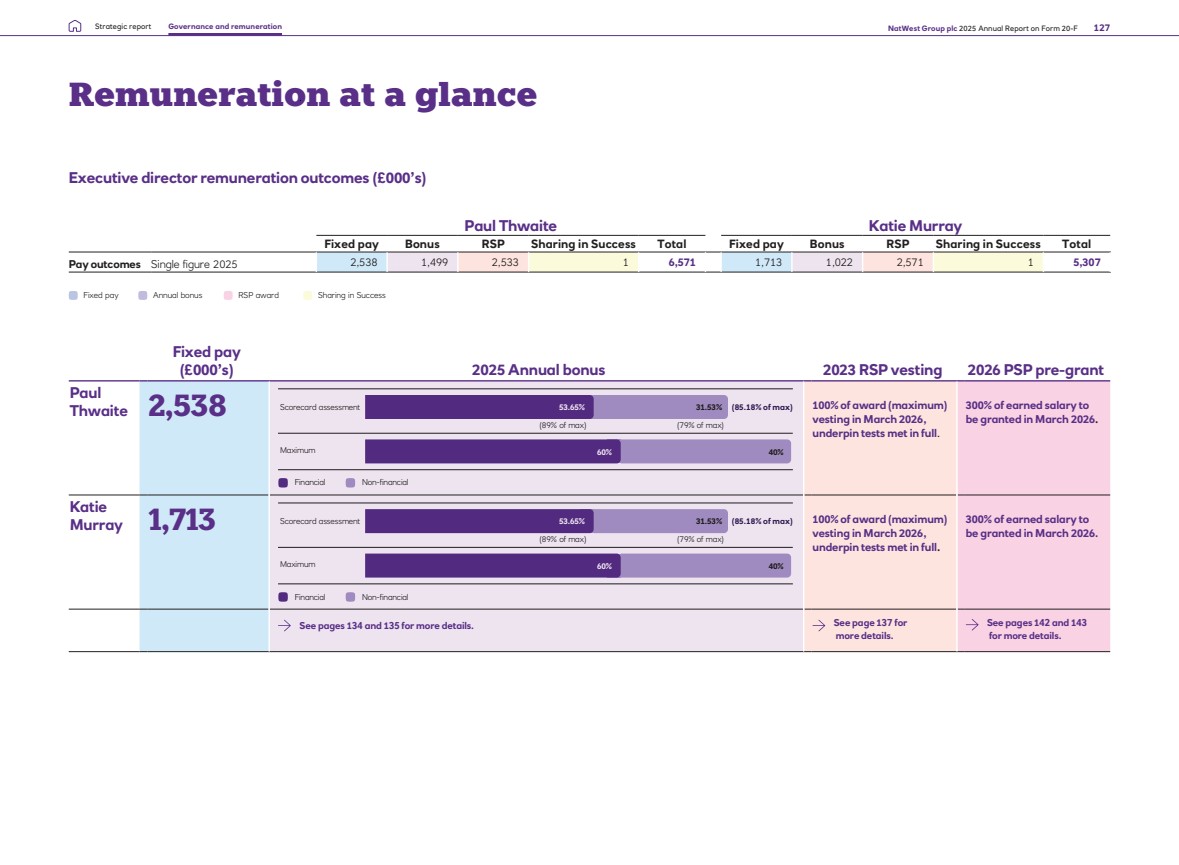
| Summary of the directors’ remuneration policy (the Policy) and implementation in 2026 Key elements Performance year Variable pay grant year Years Summary of Policy +1 +2 +3 +4 +5 +6 +7 +8 +9 +10 Base salary Any increases will take in-role performance into account. Increases will normally not be greater than the average rate of salary increase for NatWest Group employees over the period of the Policy, other than in exceptional circumstances such as material change in the executive director’s role. Paid over performance year Pension The pension allowance rates for executive directors are aligned with the rate applicable to the majority of the wider workforce (currently at 10% of base salary). Paid over performance year Benefits Standard level of benefit funding, currently set at £26,250. Other benefits can be paid within the terms of the Policy. Paid over performance year Fixed Share Allowance 20% 20% 20% 20% 20% An award of shares with an annual value of up to 100% of base salary at the time of award. Shares released over five years. Payable broadly in arrears over the performance year, currently in four instalments per year. Paid over performance year Released in equal tranches over a five-year period Sharing in Success 100% shares Maximum award: £1,500 per colleague. Paid upfront Operation: Subject to Group performance criteria being met, awards will be delivered in shares. Bonus 50% cash Maximum award: 150% of earned salary. Performance year 50% shares 50% 12 months’ retention period Financial metrics Weighting Non-financial metrics Weighting Group RoTE 25% Customer 20% Attributable profit 25% Colleague 10% Group operating expenses, excluding litigation and conduct costs 10% Strategy 10% Total 60% Total 40% Performance Share Plan (PSP) 75% 75% Maximum award: 300% of earned salary. Granted provided satisfactory performance over year After three years, performance assessed against a challenging scorecard of metrics 25% 25% Operation: Delivered in shares. Subject to satisfactory performance pre-grant, and after three years’ performance is 75% vests after year three, assessed against a challenging pre-determined scorecard of metrics pre-vesting. and is subject to a two-year holding period. The remaining 25% vests after year four, and is subject to a one-year holding period Financial metrics Weighting Non-financial metrics Weighting Group RoTE 30% Strategic measures 25% Relative Total Shareholder Return (TSR) 30% Sustainability 15% Total 60% Total 40% Share ownership Group CEO: 500% of salary. Group CFO: 300% of salary. Ongoing On leaving, requirement to hold shares of a value equal to the lower of the shareholding requirement immediately prior to departure or the actual shareholding on departure, for a period of two years. Malus and clawback Subject to clawback provisions for seven years from grant Clawback extended to 10 years in certain circumstances Remuneration at a glance continued Strategic report Financial review Risk and capital management Financial statements Additional information Strategic report Governance and remuneration Governance and remuneration NatWest Group plc NatWest Group plc 2025 Annual Report and Accounts 2025 Annual Report on Form 20-F 145 128 Operation: Awarded upfront with a 50/50 split of cash and shares. Based on a weighted scorecard of measures, as set out Paid upfront Share element subject to below. A downwards risk modifier also applies. See pages 140 and 141 for more detail on the measures for 2026. Metrics: Includes a mix of financial (minimum of 50%) and non-financial measures, as set out below. A risk and conduct underpin also applies. See pages 142 to 143 for more detail on the measures for 2026-2028. Any variable pay awarded is subject to malus provisions prior to vesting, and clawback provisions – currently seven Subject to malus provisions prior to vesting. (and potentially up to 10) years from the date of award. See page 133 for further details. |
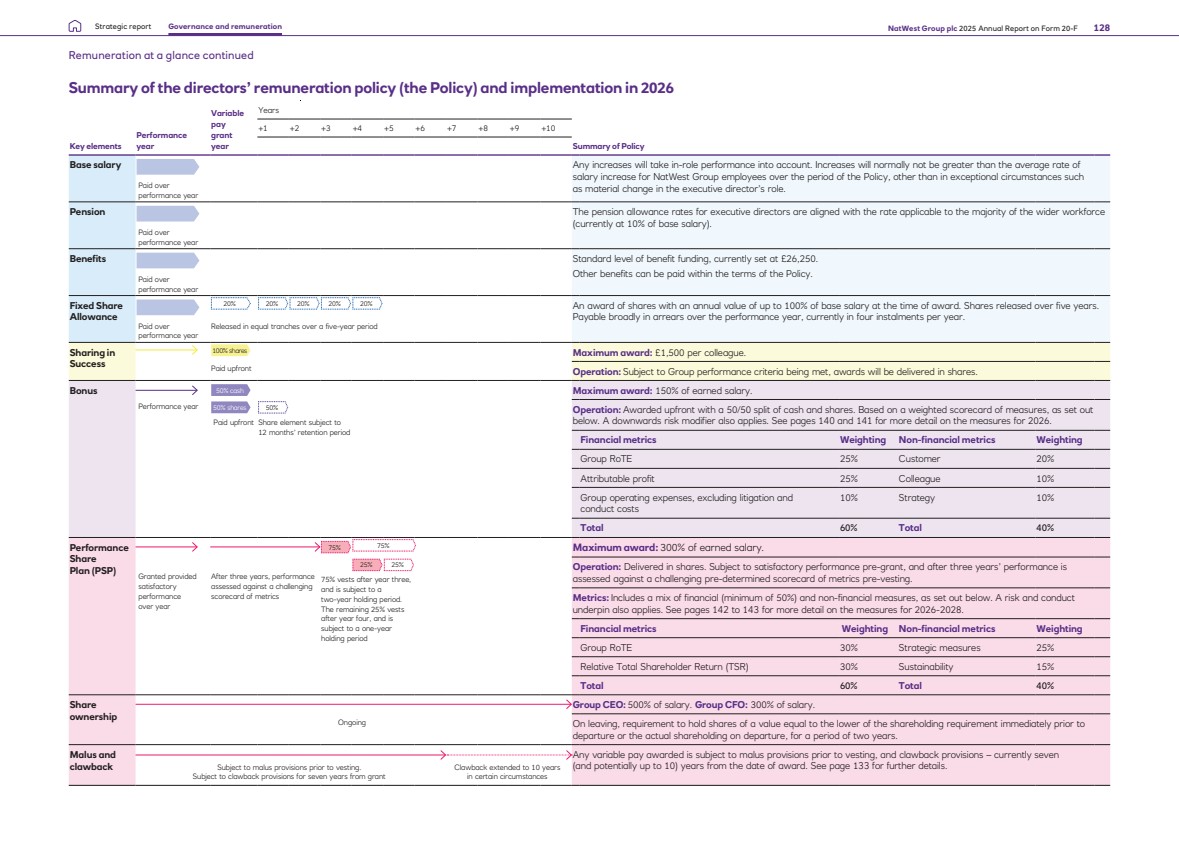
| Summary of the directors’ remuneration policy (the Policy) and implementation in 2026 Key elements Performance year Variable pay grant year Years Summary of Policy +1 +2 +3 +4 +5 +6 +7 +8 +9 +10 Base salary Any increases will take in-role performance into account. Increases will normally not be greater than the average rate of salary increase for NatWest Group employees over the period of the Policy, other than in exceptional circumstances such as material change in the executive director’s role. Paid over performance year Pension The pension allowance rates for executive directors are aligned with the rate applicable to the majority of the wider workforce (currently at 10% of base salary). Paid over performance year Benefits Standard level of benefit funding, currently set at £26,250. Other benefits can be paid within the terms of the Policy. Paid over performance year Fixed Share Allowance 20% 20% 20% 20% 20% An award of shares with an annual value of up to 100% of base salary at the time of award. Shares released over five years. Payable broadly in arrears over the performance year, currently in four instalments per year. Paid over performance year Released in equal tranches over a five-year period Sharing in Success 100% shares Maximum award: £1,500 per colleague. Paid upfront Operation: Subject to Group performance criteria being met, awards will be delivered in shares. Bonus 50% cash Maximum award: 150% of earned salary. Performance year 50% shares 50% Operation: Awarded upfront with a 50/50 split of cash and shares. Based on a weighted scorecard of measures, as set out Paid upfront Share element subject to below. A downwards risk modifier also applies. See pages 157 and 158 for more detail on the measures for 2026. 12 months’ retention period Financial metrics Weighting Non-financial metrics Weighting Group RoTE 25% Customer 20% Attributable profit 25% Colleague 10% Group operating expenses, excluding litigation and conduct costs 10% Strategy 10% Total 60% Total 40% Performance Share Plan (PSP) 75% 75% Maximum award: 300% of earned salary. Granted provided satisfactory performance over year After three years, performance assessed against a challenging scorecard of metrics 25% 25% Operation: Delivered in shares. Subject to satisfactory performance pre-grant, and after three years’ performance is 75% vests after year three, assessed against a challenging pre-determined scorecard of metrics pre-vesting. and is subject to a two-year holding period. The remaining 25% vests after year four, and is subject to a one-year holding period Metrics: Includes a mix of financial (minimum of 50%) and non-financial measures, as set out below. A risk and conduct underpin also applies. See pages 159 to 160 for more detail on the measures for 2026-2028. Financial metrics Weighting Non-financial metrics Weighting Group RoTE 30% Strategic measures 25% Relative Total Shareholder Return (TSR) 30% Sustainability 15% Total 60% Total 40% Share ownership Group CEO: 500% of salary. Group CFO: 300% of salary. Ongoing On leaving, requirement to hold shares of a value equal to the lower of the shareholding requirement immediately prior to departure or the actual shareholding on departure, for a period of two years. Malus and clawback Any variable pay awarded is subject to malus provisions prior to vesting, and clawback provisions – currently seven Subject to malus provisions prior to vesting. (and potentially up to 10) years from the date of award. See page 150 for further details. Subject to clawback provisions for seven years from grant Clawback extended to 10 years in certain circumstances Remuneration at a glance continued Strategic report Financial review Risk and capital management Financial statements Additional information Governance and remuneration NatWest Group plc 2025 Annual Report and Accounts 145 The directors’ remuneration policy and wider workforce remuneration Pay linked to strategy and sustainability priorities Ambition Succeeding with customers Purpose The bank that turns possibilities into progress Strategy Stakeholders • Linking performance with pay encourages everyone to recognise customer outcomes across the bank. • Pay is delivered in a way that aligns with the long-term interests of our stakeholders. For those who receive higher amounts of remuneration, a larger proportion is delivered in shares. • Our balanced scorecard of measures and targets helps incentivise strong financial and risk performance as well as outcomes aligned to our strategy. • Colleague measures in our annual bonus scorecard include purpose and culture targets, and our PSP scorecard includes measures on increasing diversity in our senior populations. Sustainability metrics, which include climate measures, are also part of our PSP scorecard. • The performance goals and measures agreed for executive directors flow through to the executive management team and wider workforce, adjusted as appropriate to reflect individual areas of responsibility. • For our wider workforce, the annual bonus pool is based on performance against a balanced scorecard of strategically important measures that broadly align with the position for the executive directors and the executive management team. • The Sharing in Success scheme provides a further way for sustainable performance to be reflected in pay decisions throughout the organisation. Alignment with our strategy and sustainability priorities Total remuneration Salary and pension funding Provided to all colleagues. A competitive cash salary, reviewed annually. Pension funding is 10% of base salary for UK employees. Benefit funding Applies to certain jobs. Some colleagues receive funding to support benefit costs, such as private medical cover, or take the relevant amount as cash. Role-based allowances Applies to some Material Risk Takers (MRTs) only. Delivered in cash and/or shares, dependent on allowance level and seniority. Annual bonus Applies to mainly manager grade and above including executive directors. Subject to performance. Awards delivered in cash and/or shares. Fixed pay Sharing in Success Provided to all colleagues. Subject to performance. Awards delivered in shares. Long-term incentive Applies to executive directors and members of senior executive committees. Subject to performance. Awards delivered in shares. Variable pay We ensure that our compensation framework aligns to our business strategy and sustainability priorities. Pay for executive directors is aligned with the wider workforce, but distinguished through the use of long-term incentive awards and a requirement for executive directors to maintain a holding of shares in NatWest Group both during and after their employment. These deliberate differences recognise that it is in the best interests of our stakeholders for executive directors to have a proportion of their remuneration paid in shares and to be subject to long-term shareholding requirements. Annual bonus PSP awards Sharing in Success Performance measures • Financial measures including Group RoTE and Relative TSR. • Non-financial measures including sustainability and strategic measures. • Risk and conduct underpin. • Succeeding with customers. • Underpinned by financial performance, our approach to risk and delivering value for shareholders. • Financial measures including Group RoTE, attributable profit and Group operating expenses. • Non-financial measures including customer, colleague and strategy measures. • Downwards risk modifier. Disciplined growth Leveraging simplification Active balance sheet and risk management Investors Customers Colleagues Communities Regulators Strategic report Financial review Risk and capital management Financial statements Additional information Strategic report Governance and remuneration Governance and remuneration NatWest Group plc NatWest Group plc 2025 Annual Report and Accounts 2025 Annual Report on Form 20-F 129 146 Details of performance against the 2025 targets for executive directors can be found later in this report. Refer to pages 39 to 70 for our sustainability review. |
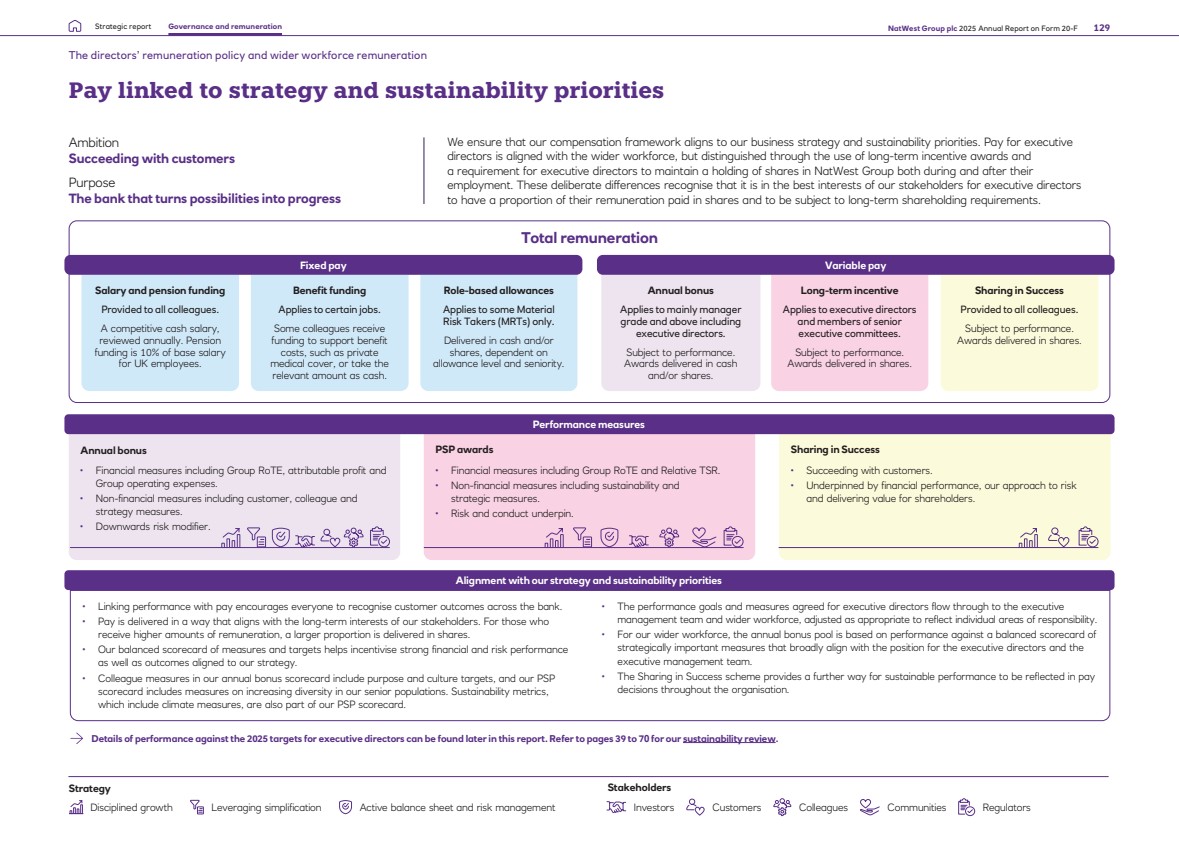
| • We help colleagues to have an awareness of financial and economic factors affecting our performance through quarterly Results Explained communications and events with our Group CEO and Group CFO. • We consult with our employee representative bodies on remuneration at relevant points during the year. • Regular question and answer sessions take place between colleagues and senior executives throughout the year. • Our committee Chair regularly engages with shareholders to seek feedback to guide our decision-making. Engaging with our colleagues and wider stakeholders We listen to our colleagues and shareholders regularly and use their feedback to inform our approach to remuneration. • We consult with the relevant regulators, following any updates and aligning with best practice as appropriate. • The committee also receives updates on pay gaps and monitors the actions being taken to close them. • Our colleague survey, Our View, enables us to track metrics and key performance indicators, which we can benchmark with sector and high-performing comparisons. Colleague listening Our colleague survey, Our View, enables colleagues to share their experiences of working at NatWest Group. In September 2025, 83% of colleagues took part in the survey. The results showed continued strong performance, particularly when compared to the Global Financial Services and Global High Performance norms. Marginal gains were achieved across most categories, demonstrating systemic improvements. Specifically, eight out of 14 categories improved, two remained static, and four declined compared with September 2024. The Colleague Advisory Panel The Colleague Advisory Panel (CAP) remains a vital part of NatWest Group’s governance and listening strategy, ensuring that the voice of colleagues is heard and considered at Board level. Chaired by non-executive director Roisin Donnelly, the CAP met twice in 2025 – March and September – with strong cross-functional representation and active engagement from Board members. CAP membership is refreshed regularly and currently comprises 31 self-nominated colleagues, representing a cross-section of the bank by grade, business area, location and working pattern. The March meeting focused on executive remuneration and the introduction of NatWest Group’s new core behavioural framework. Lena Wilson presented the directors’ remuneration policy ahead of the 2025 NatWest Group plc AGM vote, inviting CAP members to reflect on how pay structures influence performance culture. The discussion explored performance targets, the transparency of bonus mechanisms and the alignment between executive and wider workforce pay. The March meeting also covered NatWest Group’s new behavioural framework, which was designed to simplify and embed desired behaviours across the organisation. CAP members welcomed the clarity of the framework and emphasised the need for well-paced communication and a desire for practical examples to help colleagues understand how the new behaviours would be experienced in their day-to-day roles. The second CAP meeting in September included a session on Recognise, NatWest Group’s new global recognition approach, which launched in October 2025. CAP members explored how recognition contributes to motivation and performance. Members emphasised the need for manager support to embed recognition into everyday practice and ensure it is experienced equitably across the organisation. Across both meetings in 2025, CAP members posed thoughtful and challenging questions to the non-executive directors present. Updates on the CAP are made available to all colleagues internally on the dedicated CAP intranet page. For more information on our new behaviours and global recognition approach, see our Skilled, engaged and inclusive workforce section on pages 59 to 63. The directors’ remuneration policy and wider workforce remuneration continued Key stakeholders to executive director and wider workforce remuneration Colleagues Society Investors Employee Representative Bodies Regulators and Government Strategic report Strategic report Governance and remuneration Financial review Governance and remuneration Risk and capital management Financial statements Additional information NatWest Group plc NatWest Group plc 2025 Annual Report and Accounts 2025 Annual Report on Form 20-F 147 130 |
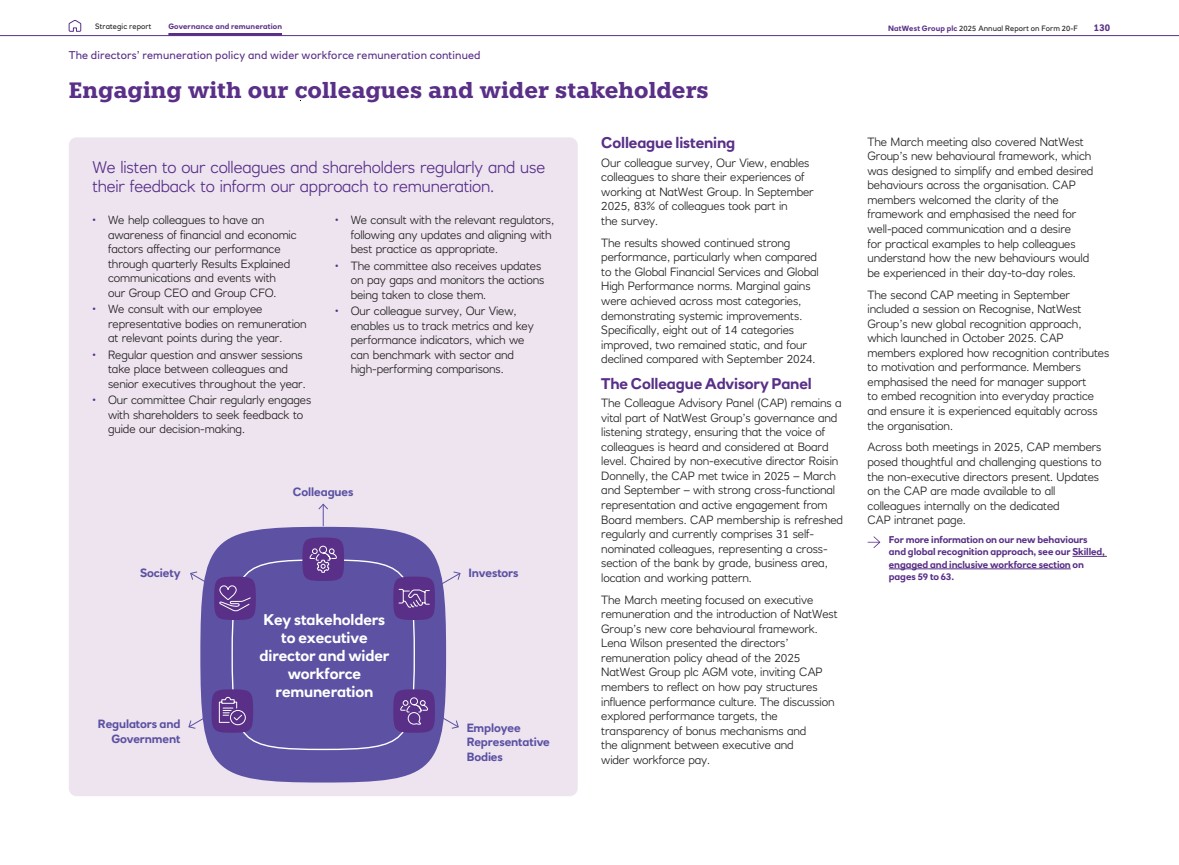
| • We help colleagues to have an awareness of financial and economic factors affecting our performance through quarterly Results Explained communications and events with our Group CEO and Group CFO. • We consult with our employee representative bodies on remuneration at relevant points during the year. • Regular question and answer sessions take place between colleagues and senior executives throughout the year. • Our committee Chair regularly engages with shareholders to seek feedback to guide our decision-making. Engaging with our colleagues and wider stakeholders We listen to our colleagues and shareholders regularly and use their feedback to inform our approach to remuneration. • We consult with the relevant regulators, following any updates and aligning with best practice as appropriate. • The committee also receives updates on pay gaps and monitors the actions being taken to close them. • Our colleague survey, Our View, enables us to track metrics and key performance indicators, which we can benchmark with sector and high-performing comparisons. Colleague listening Our colleague survey, Our View, enables colleagues to share their experiences of working at NatWest Group. In September 2025, 83% of colleagues took part in the survey. The results showed continued strong performance, particularly when compared to the Global Financial Services and Global High Performance norms. Marginal gains were achieved across most categories, demonstrating systemic improvements. Specifically, eight out of 14 categories improved, two remained static, and four declined compared with September 2024. The Colleague Advisory Panel The Colleague Advisory Panel (CAP) remains a vital part of NatWest Group’s governance and listening strategy, ensuring that the voice of colleagues is heard and considered at Board level. Chaired by non-executive director Roisin Donnelly, the CAP met twice in 2025 – March and September – with strong cross-functional representation and active engagement from Board members. CAP membership is refreshed regularly and currently comprises 31 self-nominated colleagues, representing a cross-section of the bank by grade, business area, location and working pattern. The March meeting focused on executive remuneration and the introduction of NatWest Group’s new core behavioural framework. Lena Wilson presented the directors’ remuneration policy ahead of the 2025 NatWest Group plc AGM vote, inviting CAP members to reflect on how pay structures influence performance culture. The discussion explored performance targets, the transparency of bonus mechanisms and the alignment between executive and wider workforce pay. The March meeting also covered NatWest Group’s new behavioural framework, which was designed to simplify and embed desired behaviours across the organisation. CAP members welcomed the clarity of the framework and emphasised the need for well-paced communication and a desire for practical examples to help colleagues understand how the new behaviours would be experienced in their day-to-day roles. The second CAP meeting in September included a session on Recognise, NatWest Group’s new global recognition approach, which launched in October 2025. CAP members explored how recognition contributes to motivation and performance. Members emphasised the need for manager support to embed recognition into everyday practice and ensure it is experienced equitably across the organisation. Across both meetings in 2025, CAP members posed thoughtful and challenging questions to the non-executive directors present. Updates on the CAP are made available to all colleagues internally on the dedicated CAP intranet page. For more information on our new behaviours and global recognition approach, see our Skilled, engaged and inclusive workforce section on pages 59 to 63. The directors’ remuneration policy and wider workforce remuneration continued Key stakeholders to executive director and wider workforce remuneration Colleagues Society Investors Employee Representative Bodies Regulators and Government Strategic report Financial review Risk and capital management Financial statements Additional information Governance and remuneration NatWest Group plc 2025 Annual Report and Accounts 147 Embedding Beyond: Strengthening performance and recognition at NatWest Group In 2025, we continued to embed Beyond – our performance management philosophy launched in 2024 – across the bank. Beyond is designed to support our performance culture through ambitious and meaningful colleague goals, regular developmental feedback, and frequent supportive check-in conversations. This year, we saw more colleagues actively reviewing and updating their goals and saw a 28% rise in feedback shared. These improvements reflect our ambition to build a culture where everyone can thrive. Pay awards for performance year 2024, the first year of working within the Beyond philosophy, reflected strong discretionary decision-making, with a broader range of increases compared to pay awards for performance year 2023. Notably, we received fewer pay appeals, suggesting that colleagues have a clearer understanding of pay and bonus decisions following extensive manager training in late 2024. To further strengthen our performance culture, we reflected our new behaviours into how we manage performance in 2025 and enhanced the experience with AI-powered goal setting, feedback and check-in preparation prompts. We also launched Recognise, our new approach to recognition, which enables colleagues to be acknowledged ‘in the moment’ for their contributions. This means that recognition can be given quickly and easily, helping to reinforce positive behaviours and celebrate success as it happens. Recognising that managing under-performance is a critical part of supporting all colleagues, we reviewed our process and identified over 100 areas where it could be improved. In response, we have aligned support processes with Beyond tools and updated our policy to offer colleagues structured support. In determining performance outcomes, we consider both the achievements made and how they have been delivered. Our Code of Conduct sets out clear expectations of our behavioural standards. If a colleague’s behaviour falls below these expectations, this will be reflected in their performance conversations, fixed pay progression and variable pay decisions (where their role is eligible). We are making good progress in building an inclusive workplace. Performance measures to support progress in this area affect the pay of executive directors. Pay equality is a core feature of our approach to support fair pay across NatWest Group. Details on how we support our colleagues and create an inclusive workplace are in the Skilled, engaged and inclusive workforce section on pages 59 to 63. For more on our new behaviours, see our ‘Winning Together’ spotlight on page 61. The directors’ remuneration policy and wider workforce remuneration continued Fair pay and pay gap reporting At NatWest Group, our goal is to succeed with customers. Having a diverse team enables us to understand our customers better and build a better business that represents the communities we serve. As part of our progress towards this, the committee has sight of a comprehensive view of our pay gap reporting on an annual basis. NatWest Group has been reporting on gender pay gaps since 2017, and ethnicity pay gaps since 2018. Pay gap reporting is a critical part of our Fair Pay Charter. We are proud to be an accredited Living Wage Employer, demonstrating our commitment to setting pay levels above the real living wage rates. In 2025, we furthered our commitment to fair pay by achieving re-certification as a Global Living Wage Employer, recognising that our rates of pay for colleagues outside the UK are at or above the living wage threshold as defined by the Fair Wage Network. 2014 NatWest Group accredited as a Living Wage Employer 2018 NatWest Group releases its first annual ethnicity pay gap report 2025 NatWest Group re-certified as a Global Living Wage Employer 2017 NatWest Group releases its first annual gender pay gap report 2023 NatWest Group certified as a Global Living Wage Employer Strategic report Financial review Risk and capital management Financial statements Additional information Strategic report Governance and remuneration Governance and remuneration NatWest Group plc NatWest Group plc 2025 Annual Report and Accounts 2025 Annual Report on Form 20-F 148 131 Full details of our pay gap reporting and Fair Pay Charter can be found on the NatWest Group website Our Code of Conduct can be found on the NatWest Group website |
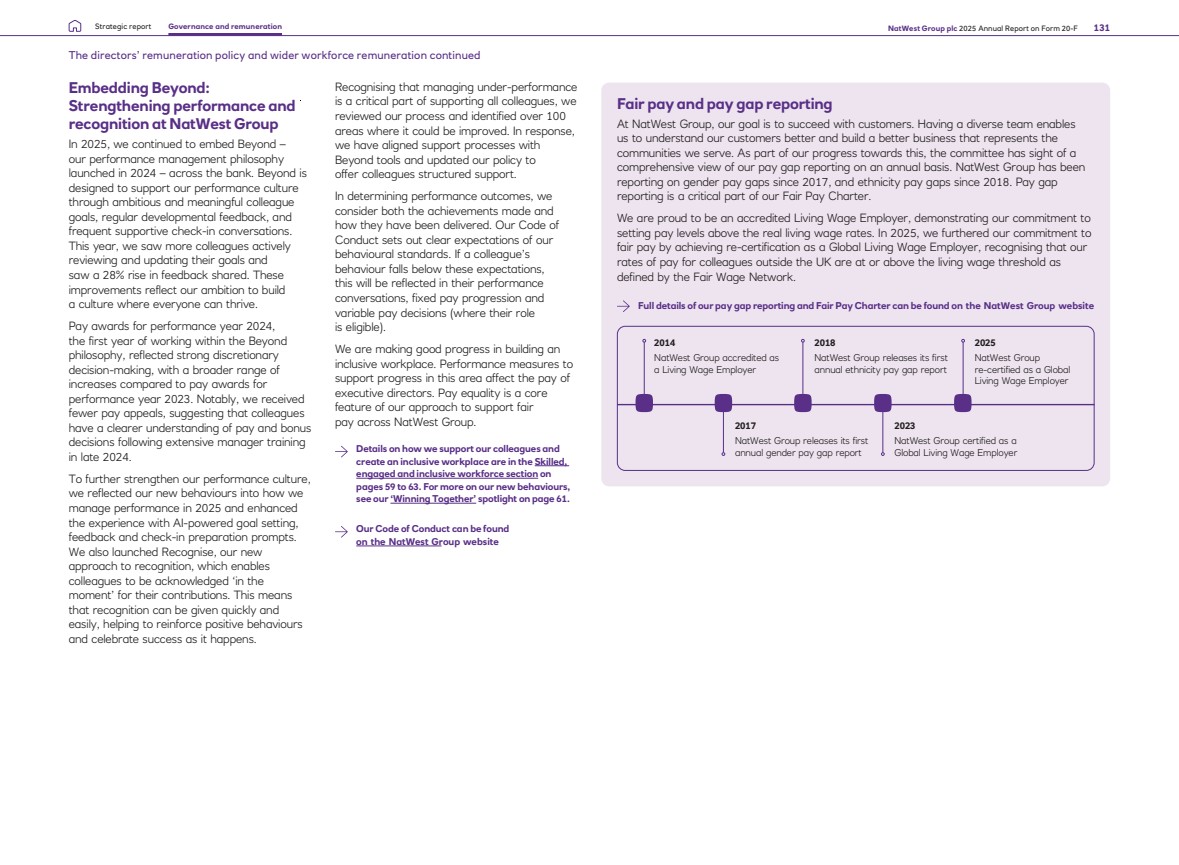
| The directors’ remuneration policy and wider workforce remuneration continued Summary of the directors’ remuneration policy (the Policy) Purpose and link to strategy Operation Maximum potential value Fixed pay for executive directors Base salary – Providing fair levels of base salary that support the recruitment and retention of high-calibre executives to deliver strategic priorities. Paid monthly in cash and reviewed annually based on role, skills and experience and benchmarked against market. Any future salary increases will take in-role performance into account and will be considered against peer companies. Fixed share allowance – Additional fixed pay that reflects the skills and experience required for the role and supports a balanced remuneration policy. Fixed allowance paid in shares, in quarterly instalments. A retention period applies such that shares are released 20% annually, in five equal tranches, on a pro-rata basis over one to five years from the date of award. An award of shares with an annual value of up to 100% of base salary at the time of award. Benefits – A range of flexible and market-competitive benefits. Includes a range of standard benefit options including company car, private medical cover, life assurance and travel assistance. A set level of funding for standard benefits. Pension – Encourages planning for retirement and long-term savings. Monthly pension allowance paid in cash based on a percentage of salary. Aligned with the wider workforce, currently 10% of base salary. Variable pay for executive directors Annual bonus – Supports a culture where individuals are rewarded for superior performance, aligned with strategic objectives and purpose. Assessed against a balanced scorecard of measures, paid in a mix of cash and shares taking into account regulatory requirements. A risk modifier also applies. A post-vesting 12-month retention period will apply to the amount delivered in shares. Set at 150% of earned salary. Subject to malus and clawback provisions. PSP awards – Supports the execution of the strategy and delivers strong performance over a multi-year period. Awards are granted provided satisfactory performance has been achieved in the prior year (‘pre-grant test’). After three years, performance is assessed against a range of pre-determined performance criteria pre-vesting. A risk and conduct underpin also applies. For PY 2025 onwards, 75% of the PSP award vests after year three and is subject to a two-year holding period, and 25% vests after year four and is subject to a one-year holding period. Set at 300% of earned salary. Subject to malus and clawback provisions. Other elements of the Policy for executive directors Shareholding requirements – Executive directors must build and hold a shareholding both during and after employment, helping align their interests with returns to shareholders over the long-term. Shares held outright qualify towards the requirement, and unvested share awards count on a net-of-tax basis once performance conditions have been assessed. On leaving, executive directors are required to hold shares of a value equal to the lower of their shareholding requirement immediately prior to departure and the actual shareholding on departure, for two years. Minimum target requirement: Group CEO – 500% of salary Group CFO – 300% of salary Employee share plans and other all-employee arrangements – Provides an opportunity to acquire shares in the company on a consistent basis to the schemes offered to UK employees. Executive directors can participate in all-employee share plans on the same terms as other employees, including Sharesave and Buy as You Earn, which do not have performance conditions. They also receive Sharing in Success awards at the same level as other employees. For voluntary all-employee share plans, the maximum potential value is determined in line with the statutory limits imposed by HMRC in the UK or the limits under the relevant share plan rules. The maximum level of Sharing in Success award is currently £1,500 per annum. Legacy arrangements – Ensures NatWest Group can continue to honour previous arrangements. This Policy gives authority to honour any previous commitments or arrangements entered into with current or former executive directors. In line with existing commitments and arrangements. Strategic report Financial review Risk and capital management Financial statements Additional information Strategic report Governance and remuneration Governance and remuneration NatWest Group plc NatWest Group plc 2025 Annual Report and Accounts 2025 Annual Report on Form 20-F 149 132 The Policy was last approved by shareholders at the NatWest Group plc AGM on 23 April 2025 and will apply until the 2028 AGM, unless a revised Policy is approved by shareholders before then. As set out in the Chair’s introduction, we have updated our remuneration approach for executive directors for PY 2025 and PY 2026 in light of the updated regulatory remuneration requirements. The changes we have made apply for PSP awards from PY 2025 onwards and are as follows: an amendment to the vesting schedule so awards vest across a four-year period, with 75% of the PSP award vesting after year three and subject to a two-year holding period, and 25% of the PSP award vesting after year four and subject to a one-year holding period; and replacing the previous discount methodology for prohibition of dividends on unvested shares with dividend equivalents. No changes are proposed to the delivery mechanism for the annual bonus for PY 2025 and PY 2026. The table below and over the page summarises the key elements of the Policy. The full Policy is available under the Governance section on the NatWest Group website. |
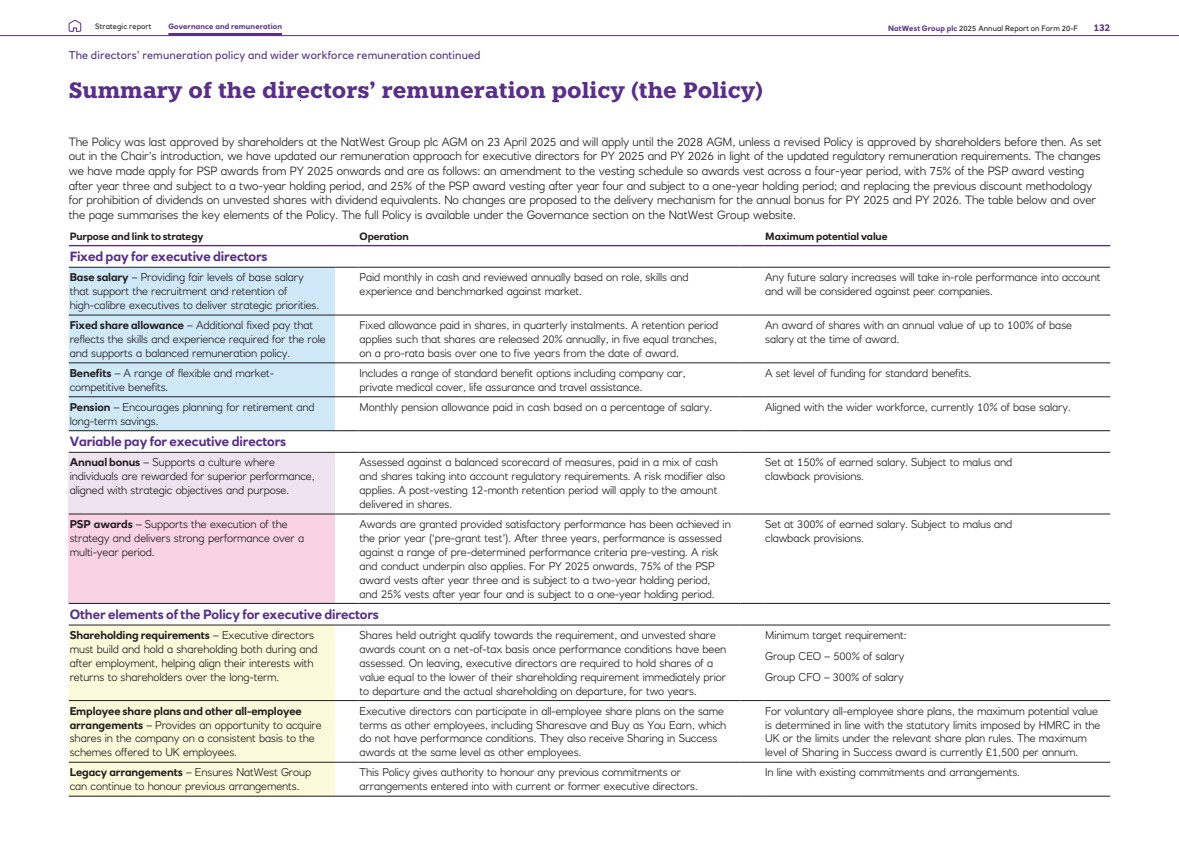
| The directors’ remuneration policy and wider workforce remuneration continued Summary of the directors’ remuneration policy (the Policy) The Policy was last approved by shareholders at the NatWest Group plc AGM on 23 April 2025 and will apply until the 2028 AGM, unless a revised Policy is approved by shareholders before then. As set out in the Chair’s introduction, we have updated our remuneration approach for executive directors for PY 2025 and PY 2026 in light of the updated regulatory remuneration requirements. The changes we have made apply for PSP awards from PY 2025 onwards and are as follows: an amendment to the vesting schedule so awards vest across a four-year period, with 75% of the PSP award vesting after year three and subject to a two-year holding period, and 25% of the PSP award vesting after year four and subject to a one-year holding period; and replacing the previous discount methodology for prohibition of dividends on unvested shares with dividend equivalents. No changes are proposed to the delivery mechanism for the annual bonus for PY 2025 and PY 2026. The table below and over the page summarises the key elements of the Policy. The full Policy is available under the Governance section of natwestgroup.com. Purpose and link to strategy Operation Maximum potential value Fixed pay for executive directors Base salary – Providing fair levels of base salary that support the recruitment and retention of high-calibre executives to deliver strategic priorities. Paid monthly in cash and reviewed annually based on role, skills and experience and benchmarked against market. Any future salary increases will take in-role performance into account and will be considered against peer companies. Fixed share allowance – Additional fixed pay that reflects the skills and experience required for the role and supports a balanced remuneration policy. Fixed allowance paid in shares, in quarterly instalments. A retention period applies such that shares are released 20% annually, in five equal tranches, on a pro-rata basis over one to five years from the date of award. An award of shares with an annual value of up to 100% of base salary at the time of award. Benefits – A range of flexible and market-competitive benefits. Includes a range of standard benefit options including company car, private medical cover, life assurance and travel assistance. A set level of funding for standard benefits. Pension – Encourages planning for retirement and long-term savings. Monthly pension allowance paid in cash based on a percentage of salary. Aligned with the wider workforce, currently 10% of base salary. Variable pay for executive directors Annual bonus – Supports a culture where individuals are rewarded for superior performance, aligned with strategic objectives and purpose. Assessed against a balanced scorecard of measures, paid in a mix of cash and shares taking into account regulatory requirements. A risk modifier also applies. A post-vesting 12-month retention period will apply to the amount delivered in shares. Set at 150% of earned salary. Subject to malus and clawback provisions. PSP awards – Supports the execution of the strategy and delivers strong performance over a multi-year period. Awards are granted provided satisfactory performance has been achieved in the prior year (‘pre-grant test’). After three years, performance is assessed against a range of pre-determined performance criteria pre-vesting. A risk and conduct underpin also applies. For PY 2025 onwards, 75% of the PSP award vests after year three and is subject to a two-year holding period, and 25% vests after year four and is subject to a one-year holding period. Set at 300% of earned salary. Subject to malus and clawback provisions. Other elements of the Policy for executive directors Shareholding requirements – Executive directors must build and hold a shareholding both during and after employment, helping align their interests with returns to shareholders over the long-term. Shares held outright qualify towards the requirement, and unvested share awards count on a net-of-tax basis once performance conditions have been assessed. On leaving, executive directors are required to hold shares of a value equal to the lower of their shareholding requirement immediately prior to departure and the actual shareholding on departure, for two years. Minimum target requirement: Group CEO – 500% of salary Group CFO – 300% of salary Employee share plans and other all-employee arrangements – Provides an opportunity to acquire shares in the company on a consistent basis to the schemes offered to UK employees. Executive directors can participate in all-employee share plans on the same terms as other employees, including Sharesave and Buy as You Earn, which do not have performance conditions. They also receive Sharing in Success awards at the same level as other employees. For voluntary all-employee share plans, the maximum potential value is determined in line with the statutory limits imposed by HMRC in the UK or the limits under the relevant share plan rules. The maximum level of Sharing in Success award is currently £1,500 per annum. Legacy arrangements – Ensures NatWest Group can continue to honour previous arrangements. This Policy gives authority to honour any previous commitments or arrangements entered into with current or former executive directors. In line with existing commitments and arrangements. Strategic report Financial review Risk and capital management Financial statements Additional information Governance and remuneration NatWest Group plc 2025 Annual Report and Accounts 149 The directors’ remuneration policy and wider workforce remuneration continued Remuneration for the Group Chair and non-executive directors Purpose and link to strategy Operation Maximum potential value Fees – Competitive fixed remuneration that reflects the skills, experience and time commitment required to attract individuals to oversee the Board’s strategy. Fees are normally paid monthly in cash, with a portion of the net monthly fee being retained by the Company and used to purchase shares every quarter, in line with our shareholding policy. Any increase to fees will not normally be greater than the average inflation rate or rate of salary increases for the wider workforce over the period of the Policy. The Group Chair is required to build towards a shareholding equivalent to four times the basic Board fee, and for non-executive directors the target is one times the basic annual Board fee. Benefits – A level of benefits provided in line with market practice. Benefits include travel assistance connected with Company business, including the use of a car and driver, where deemed appropriate. NatWest Group will cover related tax liabilities where appropriate and reimburse reasonable business expenses. The Group Chair is also entitled to private medical cover and life insurance. The value of the private medical and life insurance cover provided to the Group Chair as well as other benefits provided under the Policy will be in line with market rates. Other Policy elements for directors Provisions Operation Notice and termination provisions Executive directors Executive directors typically have permanent contracts with no fixed term and require 12 months’ notice from either party to terminate employment, as per their service agreements. No pre-set provisions for compensation on termination exists. NatWest Group have discretion to pay in lieu of notice (based on salary only) in monthly instalments, which are reduced as appropriate if the director gains alternative work. Upon termination of an executive director’s employment, the treatment of each of the elements of remuneration will be determined in accordance with the full Policy and plan rules as relevant. See link below to the full Policy. Group Chair and non-executive directors Adjusting remuneration in light of new information An accountability review process allows NatWest Group to respond where new information would change our variable pay decisions made in previous years and/or the decisions to be made in the current year. The process is used to apply commensurate ex-post risk adjustments to variable pay, where material failure of risk management, material error or employee misbehaviour are identified. Malus provisions allow us to reduce the amount of any unvested variable pay awards, potentially to zero, prior to payment. Clawback can be used to recover variable pay awards that have already vested and we can also apply in-year bonus reductions to adjust variable pay that would otherwise have been awarded for the current year. The circumstances in which we may make adjustments include: • Conduct which results in significant financial losses for NatWest Group; • An individual failing to meet appropriate standards of fitness and propriety; • An individual’s misbehaviour or material error; • NatWest Group or the individual’s business unit suffering a material failure of risk management; and • For malus and in-year bonus reduction only, circumstances where there has been a material downturn in performance of the relevant business unit. This list is not exhaustive and further circumstances may be considered where appropriate. Malus can be applied to any unvested awards. For all MRTs, clawback can be applied for at least seven years after an award is granted, and this period can be extended to 10 years post grant in certain circumstances for our most senior colleagues. These periods take account of the fact that new information may take several years to come to light after an event. Adjustments in 2025 Since the last Directors’ remuneration report, no new matters have been raised in relation to the executive directors. We will advise of any changes in future disclosures. Strategic report Financial review Risk and capital management Financial statements Additional information Strategic report Governance and remuneration Governance and remuneration NatWest Group plc NatWest Group plc 2025 Annual Report and Accounts 2025 Annual Report on Form 20-F 150 133 The full Policy is available under the Governance section on the NatWest Group website, along with the full terms of reference of the Group Performance and Remuneration Committee. The Chair and non-executive directors have letters of appointment instead of contracts. There are no notice periods or termination compensation beyond payment for time served. Non-executive directors are appointed for an initial three-year term, subject to annual shareholder re-election, and may serve a further three-year term. Typically, tenure is limited to nine years, with any extensions beyond this explained in the NatWest Group plc Annual Report on Form 20-F. The Chair is exempt from the Board appointment policy, but follows the UK Corporate Governance Code’s maximum nine-year tenure rule. All directors stand for annual (re-)election at the NatWest Group plc AGM. All director appointment dates are in the Corporate governance report. |
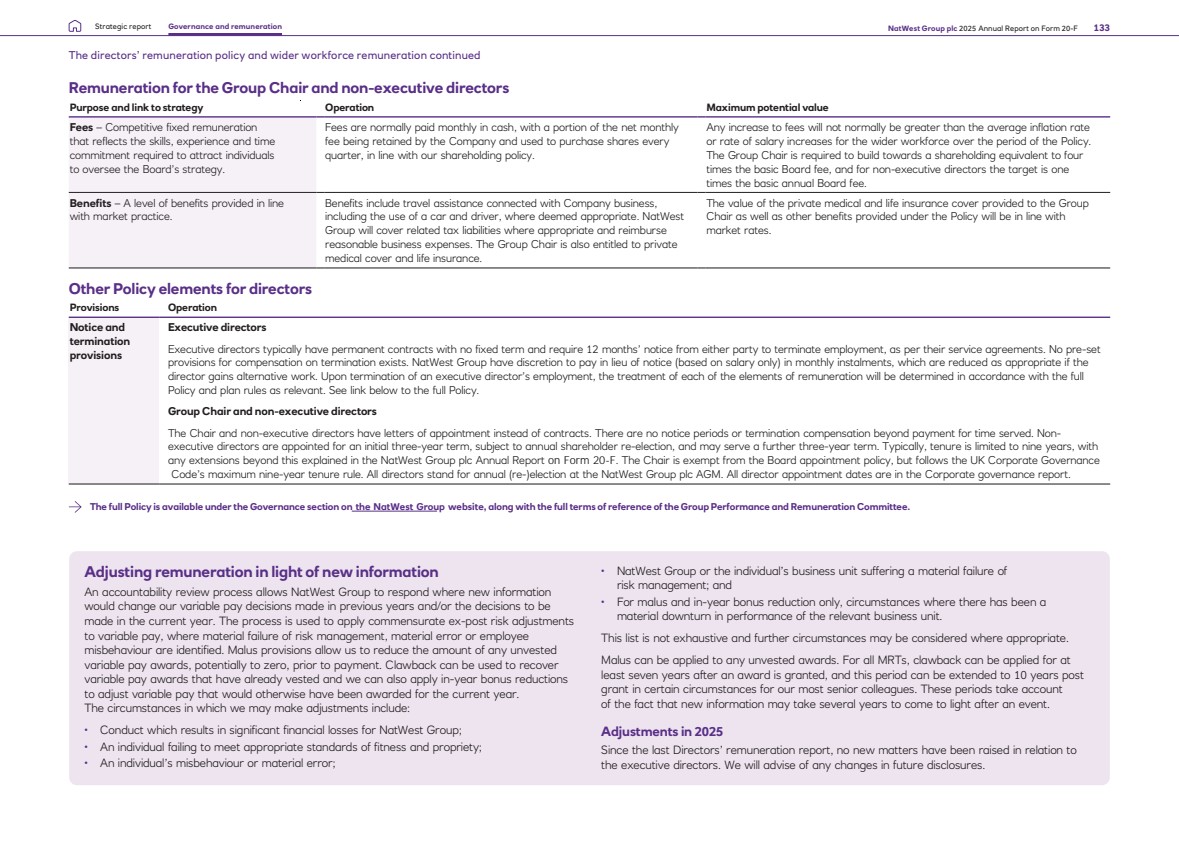
| Annual remuneration report Single total figure of remuneration for executive directors for 2025 (audited) Paul Thwaite Katie Murray 2025 £’000 2024 £’000 2025 £’000 2024 £’000 Base salary 1,173 1,142 800 788 Fixed share allowance(1) 1,173 1,142 800 788 Benefits(2) 75 92 33 42 Pension(3) 117 97 80 79 Total fixed remuneration 2,538 2,474 1,713 1,697 Annual bonus(4) 1,499 890 1,022 599 Long-term incentive(5) 2,533 1,572 2,571 2,224 Sharing in Success(6) 1 1 1 1 Total variable remuneration 4,033 2,463 3,594 2,824 Total remuneration 6,571 4,936 5,307 4,520 (1) Fixed share allowance: The fixed share allowance is based on 100% of salary and, as part of fixed remuneration, is not subject to any performance conditions. (2) Benefits: Includes standard benefit funding at £26,250 per annum. For both executive directors, this includes travel assistance in connection with company business (Mr Thwaite: £45,258; Ms Murray: £3,623) and assistance with home security (Mr Thwaite: £3,380; Ms Murray: £3,380). in the 2024 Directors’ remuneration report. Annual bonus performance assessment for 2025 The maximum bonus award was set at 150% of base salary for 2025, with bonus awards of 50% of maximum available for the achievement of target performance. The committee considered performance against financial and non-financial measures (set to reflect our strategy as well as risk performance by the executive directors). The outcome of this assessment is set out in full on the next page. The committee noted that in 2025 Mr Thwaite had overseen the delivery of strong results and share price growth. Feedback from the Group Chair and other stakeholders reflected that Mr Thwaite had adopted a thoughtful approach to enterprise risk management and had demonstrated strong strategic and operational leadership. In respect of Ms Murray, the committee noted that there had been good financial performance throughout 2025, with a focused effort on capital and balance sheet management, costs and efficiency, supporting delivery against the bank’s strategic and financial targets. A consistent programme of investor engagement throughout 2025 was recognised, further improving investor sentiment and supporting shareholder diversification. Throughout the year, Ms Murray also maintained effective risk management discipline and demonstrated strong strategic, operational, and cultural leadership. The committee agreed the final outcome was representative of performance and there were no unforeseen external impacts that made it necessary to adjust the resulting award levels. The final bonus amounts are set out below. Awards will be made in early 2026, split equally between cash and shares (with the shares subject to a 12-month retention period). Malus and clawback provisions apply to the awards. Maximum award Final bonus award Award level % Paul Thwaite £1,759,492 £1,498,736 85.18% Katie Murray £1,199,654 £1,021,865 85.18% Strategic report Financial review Risk and capital management Financial statements Additional information Strategic report Governance and remuneration Governance and remuneration NatWest Group plc NatWest Group plc 2025 Annual Report and Accounts 2025 Annual Report on Form 20-F 151 134 (3) Pension: Executive directors receive a monthly pension allowance of 10% of base salary and can choose to participate in the company’s pension arrangements. (4) Annual bonus: In determining bonus awards for 2025, the committee assessed performance against financial and non-financial measures as set out below and on the next page. (5) Long-term incentive: The 2025 value relates to RSP awards granted in 2023 in respect of performance year 2022. Full details are set out on page 137. The 2024 value relates to LTI awards granted in 2022 in respect of performance year 2021. Full details are set out (6) Sharing in Success: The values relate to Sharing in Success awards delivered in NatWest Group shares to all eligible colleagues (including executive directors). Shares with a grant value of £1,275 per colleague were made in respect of 2024 performance (adjusted for local salary levels). See page 124 for details of the performance conditions. |
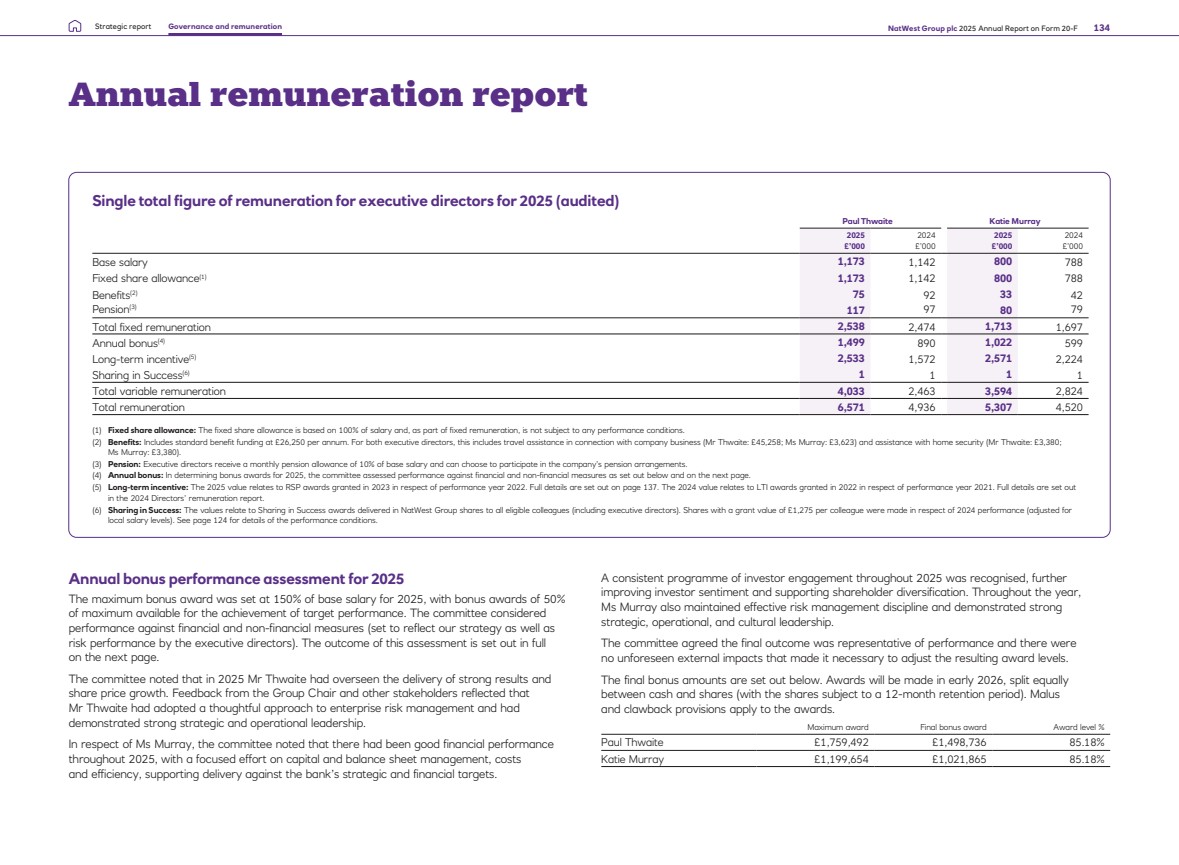
| Annual remuneration report Single total figure of remuneration for executive directors for 2025 (audited) Paul Thwaite Katie Murray 2025 £’000 2024 £’000 2025 £’000 2024 £’000 Base salary 1,173 1,142 800 788 Fixed share allowance(1) 1,173 1,142 800 788 Benefits(2) 75 92 33 42 Pension(3) 117 97 80 79 Total fixed remuneration 2,538 2,474 1,713 1,697 Annual bonus(4) 1,499 890 1,022 599 Long-term incentive(5) 2,533 1,572 2,571 2,224 Sharing in Success(6) 1 1 1 1 Total variable remuneration 4,033 2,463 3,594 2,824 Total remuneration 6,571 4,936 5,307 4,520 (1) Fixed share allowance: The fixed share allowance is based on 100% of salary and, as part of fixed remuneration, is not subject to any performance conditions. (2) Benefits: Includes standard benefit funding at £26,250 per annum. For both executive directors, this includes travel assistance in connection with company business (Mr Thwaite: £45,258; Ms Murray: £3,623) and assistance with home security (Mr Thwaite: £3,380; Ms Murray: £3,380). (3) Pension: Executive directors receive a monthly pension allowance of 10% of base salary and can choose to participate in the company’s pension arrangements. (4) Annual bonus: In determining bonus awards for 2025, the committee assessed performance against financial and non-financial measures as set out below and on the next page. (5) Long-term incentive: The 2025 value relates to RSP awards granted in 2023 in respect of performance year 2022. Full details are set out on page 154. The 2024 value relates to LTI awards granted in 2022 in respect of performance year 2021. Full details are set out in the 2024 Directors’ remuneration report. (6) Sharing in Success: The values relate to Sharing in Success awards delivered in NatWest Group shares to all eligible colleagues (including executive directors). Shares with a grant value of £1,275 per colleague were made in respect of 2024 performance (adjusted for local salary levels). See page 141 for details of the performance conditions. Annual bonus performance assessment for 2025 The maximum bonus award was set at 150% of base salary for 2025, with bonus awards of 50% of maximum available for the achievement of target performance. The committee considered performance against financial and non-financial measures (set to reflect our strategy as well as risk performance by the executive directors). The outcome of this assessment is set out in full on the next page. The committee noted that in 2025 Mr Thwaite had overseen the delivery of strong results and share price growth. Feedback from the Group Chair and other stakeholders reflected that Mr Thwaite had adopted a thoughtful approach to enterprise risk management and had demonstrated strong strategic and operational leadership. In respect of Ms Murray, the committee noted that there had been good financial performance throughout 2025, with a focused effort on capital and balance sheet management, costs and efficiency, supporting delivery against the bank’s strategic and financial targets. A consistent programme of investor engagement throughout 2025 was recognised, further improving investor sentiment and supporting shareholder diversification. Throughout the year, Ms Murray also maintained effective risk management discipline and demonstrated strong strategic, operational, and cultural leadership. The committee agreed the final outcome was representative of performance and there were no unforeseen external impacts that made it necessary to adjust the resulting award levels. The final bonus amounts are set out below. Awards will be made in early 2026, split equally between cash and shares (with the shares subject to a 12-month retention period). Malus and clawback provisions apply to the awards. Maximum award Final bonus award Award level % Paul Thwaite £1,759,492 £1,498,736 85.18% Katie Murray £1,199,654 £1,021,865 85.18% Strategic report Financial review Governance and remuneration Risk and capital management Financial statements Additional information NatWest Group plc 2025 Annual Report and Accounts 151 Annual bonus performance assessment for 2025 Performance achieved in 2025 Annual bonus measures Minimum (10% payable) On target (50% payable) Maximum (100% payable) Weighting Weighted outcome Financial (60%) Group RoTE.(1) 15.0% 16.4% 18.3% 25% 19.93% Attributable profit.(1) £4.1 billion £4.5 billion £5.1 billion 25% 23.72% Group operating expenses, excluding litigation & conduct.(2) £8.2 billion £8.1 billion £8.0 billion 10% 10.00% Non-financial (40%) Customer Group measure using Net Promoter Score (NPS) methodology across the customer franchises, reflecting the contribution of each franchise to Group income. Where NPS is not available for NatWest Markets, an internal Customer Touchpoint Rating (CTR) and independent deal league tables is applied to assess NatWest Markets’ customer performance.(3) Meet target on average 20% 18.01% Colleague Progress against purposeful leadership targets. 77 85 87 3.33% 2.50% Progress against performance culture targets. 73 83 85 3.33% 2.50% Increasing diversity in our senior roles.(4) 16.8% 17.9% 18.5% 3.33% 1.06% Simplification % of Retail customers banking entirely Digital.(5) 79% 80% 82% 3.33% 3.20% % of Commercial and Institutional (C&I) customers banking Digital first.(6) 83% 85% 87% 3.33% 1.43% Average deployment frequency for features and digital services. 11 days 7 days 5 days 3.33% 2.83% Downward risk modifier (0-100%) No downward risk modifier was applied for the Group CEO or Group CFO. Final outcome 85.18% (CEO) 85.18% (CFO) The reconciliation to the report figures and footnotes for the table above is set out on the next page. Annual remuneration report continued Target exceeded on average Achieved 17.5% Achieved £5.0bn Achieved £8.0bn Achieved 86 Achieved 84 Achieved 81.8% Achieved 17.4% Achieved 84.5% Achieved 5.6 days Strategic report Strategic report Governance and remuneration Financial review Governance and remuneration Risk and capital management Financial statements Additional information NatWest Group plc NatWest Group plc 2025 Annual Report and Accounts 2025 Annual Report on Form 20-F 152 135 |
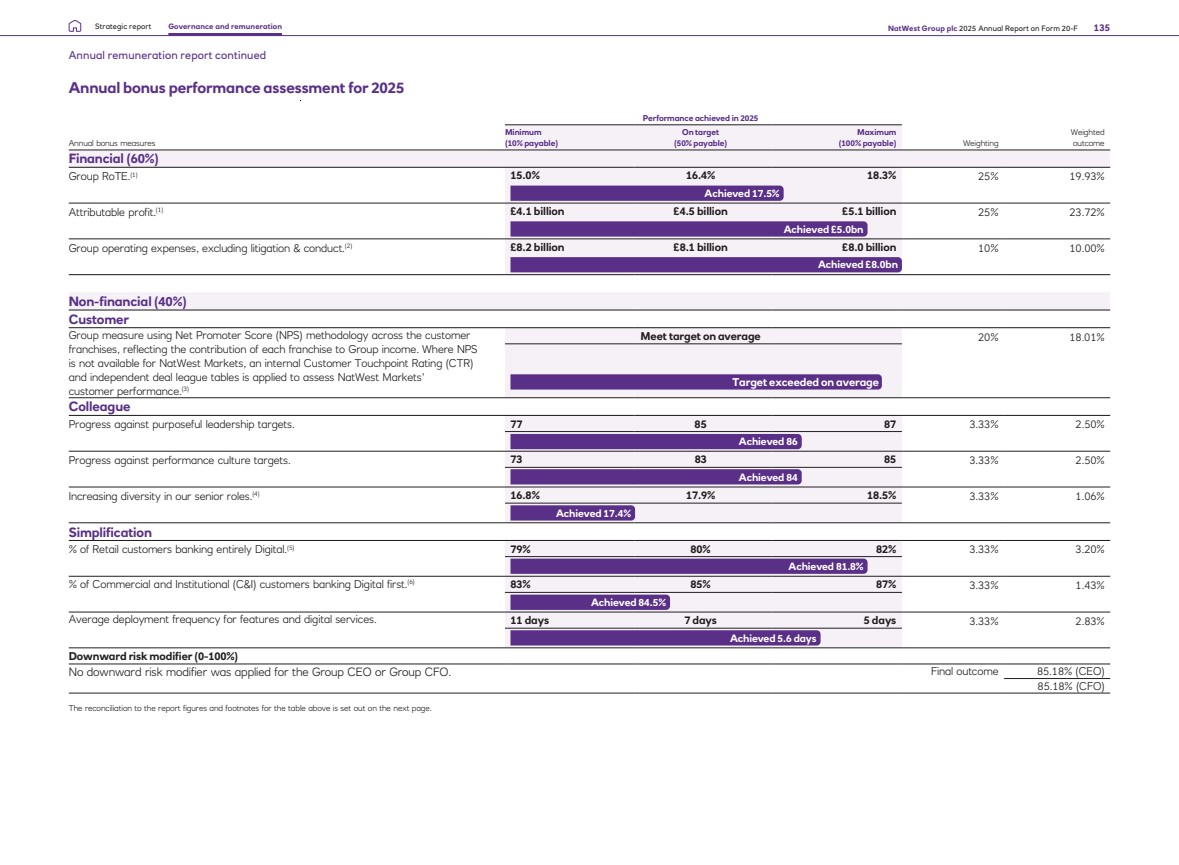
| Reconciliation to reported figures and footnotes Amount (£bn)(7) Group RoTE Group attributable profit excluding notable items (£bn) Group operating costs, excluding litigation and conduct costs (£bn) Reported figure 19.2% 5.5 (8.1) Base rate adjustment 0.1 (0.2%) (0.0) Gains from interest and FX risk management derivatives not in accounting hedge relationships, own credit adjustments and other income not driven by management actions 0.2 (0.5%) (0.1) Incremental capacity created, utilised in strategic investments and de-risking 2026 (0.1) 0.3% 0.1 0.1 Timing of FX and conduct losses and tax rate alignment 0.2 (0.8%) (0.2) Deferred Tax Asset write-back 0.1 (0.4%) (0.1) Figures used in bonus scorecard 17.5% 5.0 (8.0) (1) For the purpose of assessment under the bonus scorecard, adjustments are made to the published RoTE and attributable profit to exclude material factors outside of management’s control. For RoTE, items will only be adjusted if this results in an impact of at least 0.25%. For performance year 2025, these include: a. Material changes in base rate from that assumed at the beginning of the year; b. Gains from interest and FX risk management derivatives not in accounting hedge relationships, own credit adjustments, and the timing of FX losses; c. Deferred tax asset and effective tax rate changes; d. Other income not driven by management actions; and e. Impact of incremental capacity created, utilised in strategic investments and de-risking 2026. (2) For operating expenses, adjusting for the impact of incremental capacity created, utilised in strategic investments and de-risking 2026. (3) Targets: Retail Banking: Improve NatWest Retail Main Bank NPS to +23 and improve NatWest Premier NPS to +23. Private Banking & Wealth Management: Improve Coutts NPS to +46 and improve Coutts £1m+ NPS to +54. Commercial & Institutional: Improve NatWest £0-750k NPS to -8, maintain NatWest £750k-£250m NPS at +5, improve NatWest £2m-£250m to +22, maintain >£250m NPS at +27, decline in RBSI NPS to +43, improve RBSI International & Affluent NPS to +45, NatWest Markets maintain average Customer Touchpoint Rating (CTR) of 78% and ranking in 4 independent Deal League Tables (Top 3 in GBP issuance for Investment Grade corporates, Sovereign Supranationals and Agencies GBP, Financial Institutions GBP and 1st for Private Placements for UK issuers). We met or exceeded 11 out of the 12 customer goals set for 2025. The weighted average rating across these 12 targets means that the Customer outcome is 18.01%. (4) NatWest Group’s management structures were revised during 2025. For the purpose of remuneration reporting, the representation targets were set based on the management structures in place at the start of 2025 with performance assessed at 31 December 2025. For full details on our inclusion targets, see our Creating an inclusive workforce section on pages 62 and 63. (5) Retail franchise customers with active current accounts that have accessed a digital platform (online or mobile) and not used a branch or telephony for 90-days in the reporting period ending 31 December 2025. Inactive customers and customers with no channel usage excluded. Mortgages and savings accounts, and interactions via the Post Office are excluded from the scope of measurement. (6) C&I franchise (ring-fenced bank) customers with active non-personal account/s that access their account 95% or higher through digital channels for three rolling months in the reporting period. Access to an account through a digital channel may not result in a transaction. (7) Amounts quoted are pre-tax whereas RoTE and attributable profit impacts are post tax. Figures may not cast due to rounding. Annual remuneration report continued Strategic report Strategic report Governance and remuneration Financial review Governance and remuneration Risk and capital management Financial statements Additional information NatWest Group plc NatWest Group plc 2025 Annual Report and Accounts 2025 Annual Report on Form 20-F 153 136 |
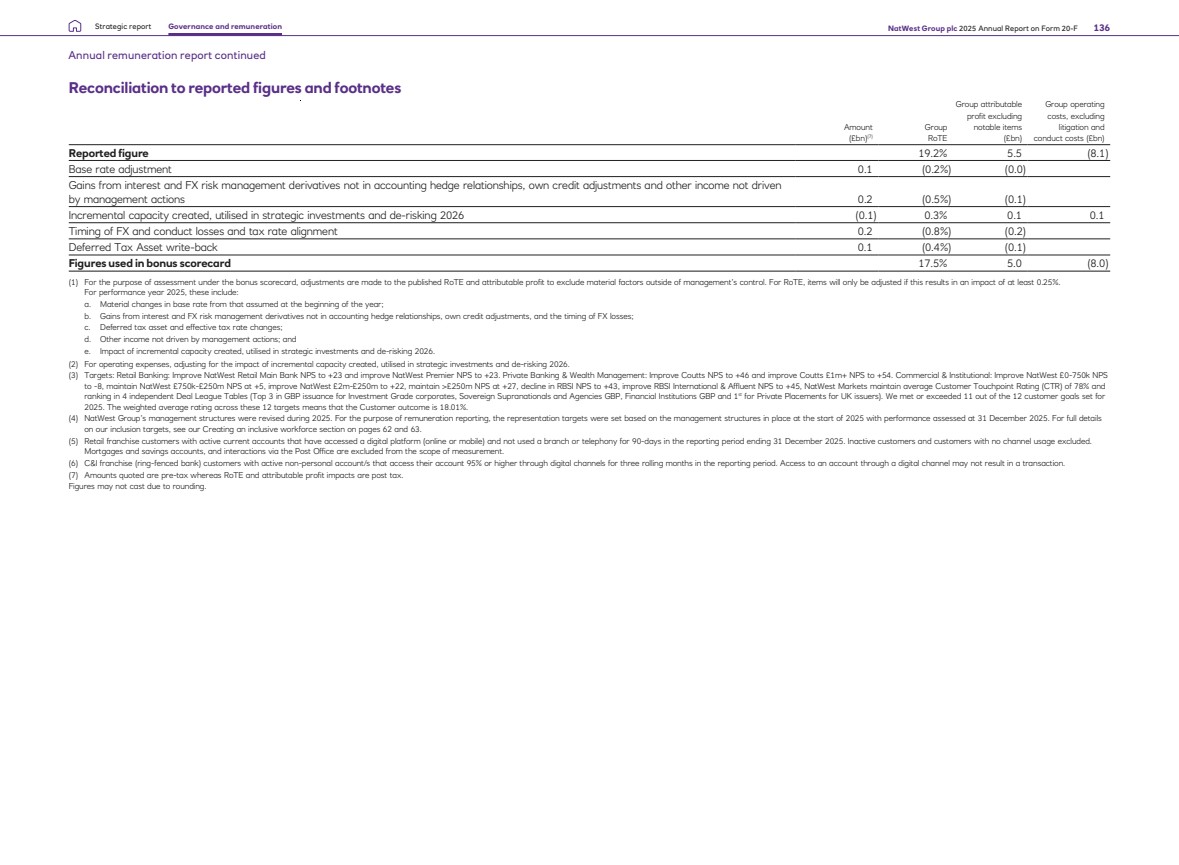
| Reconciliation to reported figures and footnotes Amount (£bn)(7) Group RoTE Group attributable profit excluding notable items (£bn) Group operating costs, excluding litigation and conduct costs (£bn) Reported figure 19.2% 5.5 (8.1) Base rate adjustment 0.1 (0.2%) (0.0) Gains from interest and FX risk management derivatives not in accounting hedge relationships, own credit adjustments and other income not driven by management actions 0.2 (0.5%) (0.1) Incremental capacity created, utilised in strategic investments and de-risking 2026 (0.1) 0.3% 0.1 0.1 Timing of FX and conduct losses and tax rate alignment 0.2 (0.8%) (0.2) Deferred Tax Asset write-back 0.1 (0.4%) (0.1) Figures used in bonus scorecard 17.5% 5.0 (8.0) (1) For the purpose of assessment under the bonus scorecard, adjustments are made to the published RoTE and attributable profit to exclude material factors outside of management’s control. For RoTE, items will only be adjusted if this results in an impact of at least 0.25%. For performance year 2025, these include: a. Material changes in base rate from that assumed at the beginning of the year; b. Gains from interest and FX risk management derivatives not in accounting hedge relationships, own credit adjustments, and the timing of FX losses; c. Deferred tax asset and effective tax rate changes; d. Other income not driven by management actions; and e. Impact of incremental capacity created, utilised in strategic investments and de-risking 2026. (2) For operating expenses, adjusting for the impact of incremental capacity created, utilised in strategic investments and de-risking 2026. (3) Targets: Retail Banking: Improve NatWest Retail Main Bank NPS to +23 and improve NatWest Premier NPS to +23. Private Banking & Wealth Management: Improve Coutts NPS to +46 and improve Coutts £1m+ NPS to +54. Commercial & Institutional: Improve NatWest £0-750k NPS to -8, maintain NatWest £750k-£250m NPS at +5, improve NatWest £2m-£250m to +22, maintain >£250m NPS at +27, decline in RBSI NPS to +43, improve RBSI International & Affluent NPS to +45, NatWest Markets maintain average Customer Touchpoint Rating (CTR) of 78% and ranking in 4 independent Deal League Tables (Top 3 in GBP issuance for Investment Grade corporates, Sovereign Supranationals and Agencies GBP, Financial Institutions GBP and 1st for Private Placements for UK issuers). We met or exceeded 11 out of the 12 customer goals set for 2025. The weighted average rating across these 12 targets means that the Customer outcome is 18.01%. (4) NatWest Group’s management structures were revised during 2025. For the purpose of remuneration reporting, the representation targets were set based on the management structures in place at the start of 2025 with performance assessed at 31 December 2025. For full details on our inclusion targets, see our Creating an inclusive workforce section on pages 62 and 63. (5) Retail franchise customers with active current accounts that have accessed a digital platform (online or mobile) and not used a branch or telephony for 90-days in the reporting period ending 31 December 2025. Inactive customers and customers with no channel usage excluded. Mortgages and savings accounts, and interactions via the Post Office are excluded from the scope of measurement. (6) C&I franchise (ring-fenced bank) customers with active non-personal account/s that access their account 95% or higher through digital channels for three rolling months in the reporting period. Access to an account through a digital channel may not result in a transaction. (7) Amounts quoted are pre-tax whereas RoTE and attributable profit impacts are post tax. Figures may not cast due to rounding. Annual remuneration report continued Strategic report Financial review Risk and capital management Financial statements Additional information Governance and remuneration NatWest Group plc 2025 Annual Report and Accounts 153 Vesting of 2023 RSP awards (audited) RSP awards were granted to Mr Thwaite and Ms Murray in March 2023 in respect of performance year 2022. At the end of 2025, a RSP pre-vest underpin assessment took place to review whether anything had come to light which might call into question the original award. The committee made an assessment at the end of the three-year performance period (covering financial years 2023 to 2025) to determine whether sustainable performance has been achieved. The outcome was reviewed using the pre-vest underpin criteria detailed in the summary table opposite. The underpin assessment found that the level of capital held relative to minimum capital requirements and total distributions paid relative to our distribution policy were satisfactory, and there had been no material deterioration in the risk or regulatory compliance profile since grant. The committee also considered any potential windfall gains, particularly looking at any significant fall in the share price prior to the date of the grant in March 2023, as well as the change to the NatWest Group share price over the pre-vest period versus our market peers. Considering all these factors, the committee concluded there was no need to make any adjustment, and that the final outcome and value in light of the shareholder experience over the same period was fair. As set out in the Chair’s introduction, due to the recent regulatory changes, the shares will vest in March 2026 and March 2027 for Mr Thwaite as a result of accelerated vesting, given he was not an executive director at the time of grant. Paul Thwaite Katie Murray 2023 RSP award Shares Value Shares Value Number of shares at grant 425,074 £937,500 431,451 £951,563 Reduction for pre-vest underpin assessment – – – – Number of shares vesting 425,074 – 431,451 – Increase in value due to share price – £1,595,346 – £1,619,281 Estimated vesting value – £2,532,846 – £2,570,844 Pre-vest test criteria A sustainable level of performance over the period with reference to: Actual Outcome The level of capital held relative to minimum capital requirement. The level of capital held throughout the period between grant and vest (2023-2025) exceeded all minimum ratios under the UK adoption of the Capital Requirements Regulation. Met Total distributions paid relative to our distribution policy. Ordinary dividend distributions across 2023-2025 were in line with external guidance of approximately 40% of attributable profit from 2023-2024 and approximately 50% of attributable profit projected in 2025. Met No material deterioration in the risk or regulatory compliance profile or control environment of the bank, or serious conduct or reputational event. Our underpin assessment indicated no material deterioration in risk performance at NatWest Group level since grant. Any material events identified in the intervening period were, where necessary, dealt with in the applicable performance year. Met Award (% maximum) vesting 100% Annual remuneration report continued For Ms Murray, who was an executive director at the time of grant, the shares will vest in equal amounts between 2026 and 2030, with each vested tranche subject to a 12-month retention period. Malus and clawback provisions continue to apply to all awards. Strategic report Financial review Risk and capital management Financial statements Additional information Strategic report Governance and remuneration Governance and remuneration NatWest Group plc NatWest Group plc 2025 Annual Report and Accounts 2025 Annual Report on Form 20-F 154 137 (1) The estimated vesting value is based on share price of £5.9586, the average over the three-month period from October to December 2025. The actual vesting value, based on the share price on the vesting date, will be restated in the 2026 NatWest Group plc Annual Report on Form 20-F. A summary of the number of shares vesting is set out in the table at the top of this page, along with the estimated vesting values for the 2023 RSP award, as set out in the single total figure of remuneration table on page 134. |
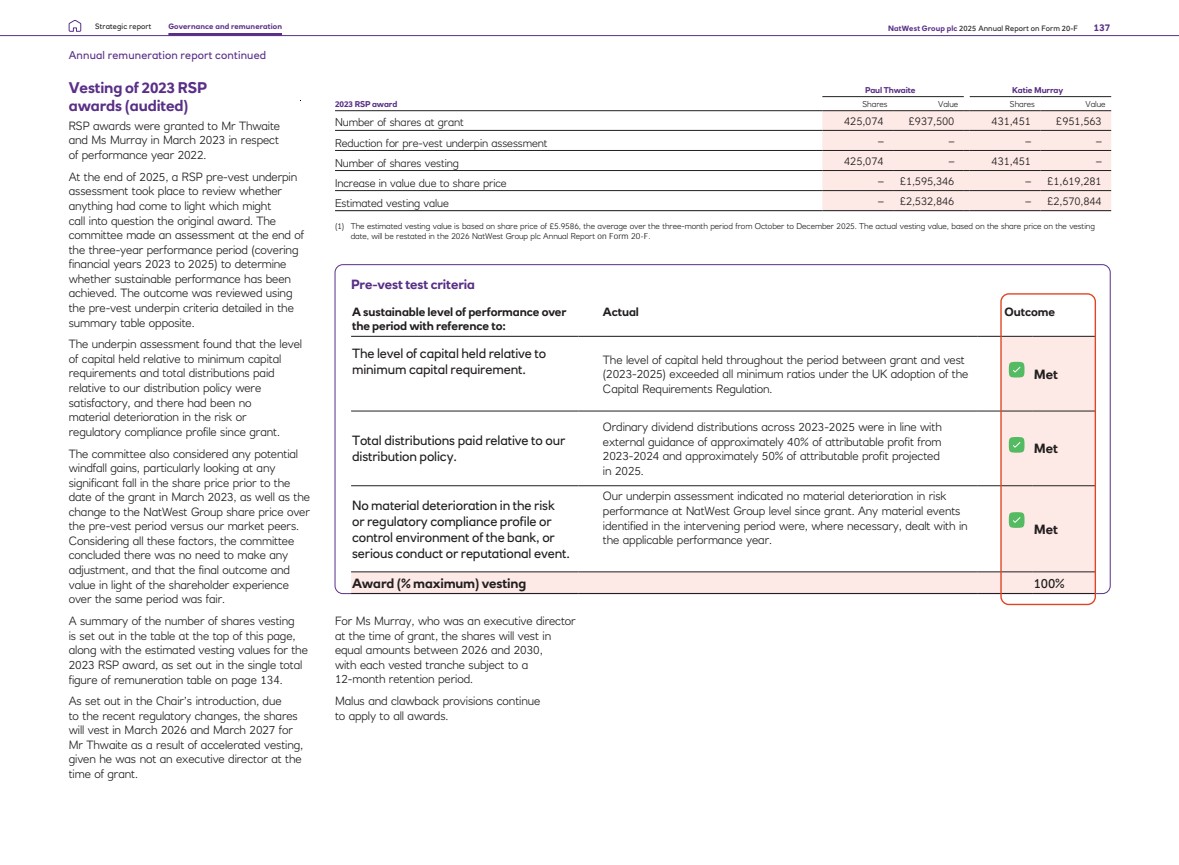
| Annual remuneration report continued Scheme interest – RSP awards granted during 2025 (audited) Grant date Face value Award price(1) Shares awarded(2) Vesting levels Performance requirement Paul Thwaite 07-Mar-25 £1,713,365 £3.7933 451,682 Between 0% – 100% with no set minimum vesting The award was subject to a pre-grant assessment of performance over 2024. The committee will make a further assessment at the end of the three-year performance period (covering financial years 2025 to 2027) to determine whether sustainable performance has been achieved. Before vesting, the outcome will be reviewed by the committee using the underpin criteria - 1. The level of capital held relative to the maximum distribution amount. 2. Total distributions paid relative to our distribution policy. 3. Any material deterioration in the risk or regulatory compliance profile or control environment of NatWest Group, or a serious conduct or reputational event. The committee will also use their broader discretion to verify that the vesting out-turn aligned to shareholder experience over the period. Full details are also disclosed in the 2024 Directors’ remuneration report. Katie Murray 07-Mar-25 £1,181,928 £3.7933 311,583 (1) The award price shown is calculated as the average share price over the five days prior to the grant date, discounted to reflect the absence of the right to receive dividends or dividend equivalents during the vesting period. For reference, the full market price of NatWest Group shares at the time of grant for the 2025 RSP awards was £4.7284. (2) The conditional share awards equated to 150% of earned salary. Subject to the pre-vest assessment, these awards will vest in equal amounts between years 2028 and 2032. Service conditions and malus provisions apply up until vest, and clawback provisions apply for a period of at least seven years from the date of grant. PSP awards to be granted for 2025 (audited) Following a pre-grant test which confirmed that satisfactory performance was achieved in 2025, the committee has approved the grant of PSP awards at maximum level (300% of earned salary) for Mr Thwaite and Ms Murray in March 2026. The awards will be subject to a three-year performance period starting on 1 January 2026 and ending on 31 December 2028, and will be assessed against a challenging pre-determined scorecard of measures pre-vesting. Under each component of the performance scorecard, 25% of maximum will normally vest for threshold performance and 100% of maximum will normally vest for maximum performance, with vesting on a straight-line basis between these two points. Payments for loss of office and payments to past directors (audited) Former Group CEO Alison Rose’s employment ended on 26 July 2024 following the completion of her contractual notice period. As part of the settlement agreement, Ms Rose retained access to security services for 12 months following the end of her employment. This provision ended on 26 July 2025. The total cost associated with this service from August 2023 to July 2025 was £14,730. Full details of Ms Rose’s notice period arrangements are disclosed in the 2023 Directors’ remuneration report. There are no other payments to past directors to disclose for 2025. Strategic report Financial review Risk and capital management Financial statements Additional information Strategic report Governance and remuneration Governance and remuneration NatWest Group plc NatWest Group plc 2025 Annual Report and Accounts 2025 Annual Report on Form 20-F 155 138 Full details of the PSP scorecard measures for 2026 to 2028 are detailed on pages 142 and 143. |
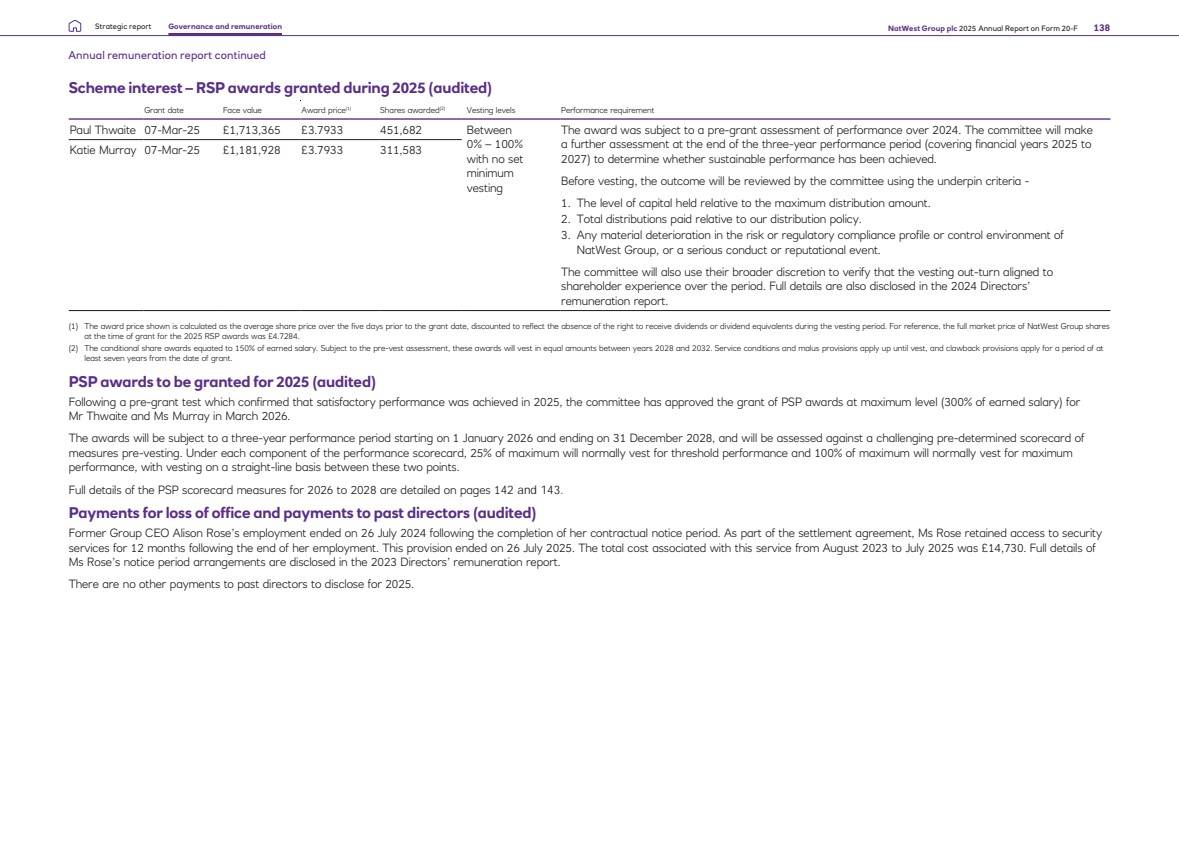
| Annual remuneration report continued Scheme interest – RSP awards granted during 2025 (audited) Grant date Face value Award price(1) Shares awarded(2) Vesting levels Performance requirement Paul Thwaite 07-Mar-25 £1,713,365 £3.7933 451,682 Between 0% – 100% with no set minimum vesting The award was subject to a pre-grant assessment of performance over 2024. The committee will make a further assessment at the end of the three-year performance period (covering financial years 2025 to 2027) to determine whether sustainable performance has been achieved. Before vesting, the outcome will be reviewed by the committee using the underpin criteria - 1. The level of capital held relative to the maximum distribution amount. 2. Total distributions paid relative to our distribution policy. 3. Any material deterioration in the risk or regulatory compliance profile or control environment of NatWest Group, or a serious conduct or reputational event. The committee will also use their broader discretion to verify that the vesting out-turn aligned to shareholder experience over the period. Full details are also disclosed in the 2024 Directors’ remuneration report. Katie Murray 07-Mar-25 £1,181,928 £3.7933 311,583 (1) The award price shown is calculated as the average share price over the five days prior to the grant date, discounted to reflect the absence of the right to receive dividends or dividend equivalents during the vesting period. For reference, the full market price of NatWest Group shares at the time of grant for the 2025 RSP awards was £4.7284. (2) The conditional share awards equated to 150% of earned salary. Subject to the pre-vest assessment, these awards will vest in equal amounts between years 2028 and 2032. Service conditions and malus provisions apply up until vest, and clawback provisions apply for a period of at least seven years from the date of grant. PSP awards to be granted for 2025 (audited) Following a pre-grant test which confirmed that satisfactory performance was achieved in 2025, the committee has approved the grant of PSP awards at maximum level (300% of earned salary) for Mr Thwaite and Ms Murray in March 2026. The awards will be subject to a three-year performance period starting on 1 January 2026 and ending on 31 December 2028, and will be assessed against a challenging pre-determined scorecard of measures pre-vesting. Under each component of the performance scorecard, 25% of maximum will normally vest for threshold performance and 100% of maximum will normally vest for maximum performance, with vesting on a straight-line basis between these two points. Full details of the PSP scorecard measures for 2026 to 2028 are detailed on pages 159 and 160. Payments for loss of office and payments to past directors (audited) Former Group CEO Alison Rose’s employment ended on 26 July 2024 following the completion of her contractual notice period. As part of the settlement agreement, Ms Rose retained access to security services for 12 months following the end of her employment. This provision ended on 26 July 2025. The total cost associated with this service from August 2023 to July 2025 was £14,730. Full details of Ms Rose’s notice period arrangements are disclosed in the 2023 Directors’ remuneration report. There are no other payments to past directors to disclose for 2025. Strategic report Financial review Governance and remuneration Risk and capital management Financial statements Additional information NatWest Group plc 2025 Annual Report and Accounts 155 Remuneration for the Group Chair and non-executive directors in 2025 With effect from 1 May 2025, the Group Chair’s composite fee was increased from £800,000 to £826,000 per annum and the basic Board fee was increased from £88,000 to £92,000 per annum. The basic Board fee increase reflected the continued time commitment, responsibilities and expectations of our directors as they further develop as a high-performing Board, whilst ensuring ongoing competitiveness with comparable major UK companies. All other Board and committee fees were increased in line with, but not exceeding, the 2024 global workforce % increase (3.3%), as detailed in the table below. The Colleague Advisory Panel (CAP) Chair fee, which had not been increased since the CAP was established in 2018, was increased from £15,000 to £15,500 from 1 May 2025. All changes were within the scope of the Policy approved by shareholders and no directors were involved in decisions involving their own remuneration. 2025 fees £ 2024 fees £ Increase % Group Chair – composite fee 826,000 800,000 3.25 Basic Board fee 92,000 88,000 4.55 Senior Independent Director (SID) 38,000 37,000 2.70 Chair – GAC, BRC and RemCo(1) 80,000 77,500 3.23 Chair – TISC(2) 69,500 67,500 2.96 Member – GAC, BRC and RemCo(1) 37,000 36,000 2.78 Member – N&G(1) 17,000 16,500 3.03 Member – TISC(2) 34,000 33,000 3.03 (1) GAC (Group Audit Committee), BRC (Group Board Risk Committee), RemCo (Group Performance and Remuneration Committee), N&G (Group Nominations and Governance Committee). (2) TISC (Group Technology, Innovation and Simplification Committee) first met in June 2025 and as its areas of focus were an evolution of the former Group Sustainable Banking Committee (SBC), it was agreed that the SBC Chair and member fees should be applied to the TISC Chair and members respectively. For NatWest Group plc Board directors who also serve on the boards and committees of NatWest Holdings Limited, National Westminster Bank Plc and The Royal Bank of Scotland plc, the fees above reflect membership of all four boards and their respective Board committees. Non-executive directors may also receive fees for membership of other subsidiary company boards and committees, the value of which would be included below. No variable pay is provided to the Group Chair and non-executive directors. Further details of Board and committee members and their attendance at meetings can be found in the Board report and relevant committee reports. Total remuneration for the Group Chair and non-executive directors in 2025 (audited) Fees Benefits(1) Total 2025 £’000 2024 £’000 2025 £’000 2024 £’000 2025 £’000 2024 £’000 Group Chair (composite fee) Rick Haythornthwaite 817 596 124 68 941 664 Non-executive directors Josh Critchley(2) 15 – 1 – 16 – Frank Dangeard(3) 91 287 0 3 91 290 Roisin Donnelly 176 147 6 6 182 153 Patrick Flynn 244 216 11 9 255 225 Geeta Gopalan 198 44 5 3 202 47 Yasmin Jetha 160 153 3 4 163 157 Stuart Lewis 223 216 5 6 228 222 Mark Seligman(4) 53 211 1 9 54 220 Gill Whitehead(5) 158 – 8 – 166 – Lena Wilson 285 248 17 23 303 271 (1) The benefits column for the Group Chair includes travel assistance in connection with company business, as well as private medical cover, life cover and expenses in connection with travel and attendance at Board meetings. Non-executive directors are reimbursed expenses incurred in connection with travel and attendance at Board meetings. (2) Mr Critchley was appointed to the Board with effect from 3 November 2025. (3) Mr Dangeard stepped down on 23 April 2025, he received the Chair of NatWest Markets Plc fee until that date. This annual fee was detailed in the 2024 Directors’ remuneration report as £290,000 per annum. (4) Mr Seligman retired on 31 March 2025. (5) Ms Whitehead was appointed to the Board with effect from 8 January 2025. Annual remuneration report continued Strategic report Strategic report Governance and remuneration Financial review Governance and remuneration Risk and capital management Financial statements Additional information NatWest Group plc NatWest Group plc 2025 Annual Report and Accounts 2025 Annual Report on Form 20-F 156 139 |
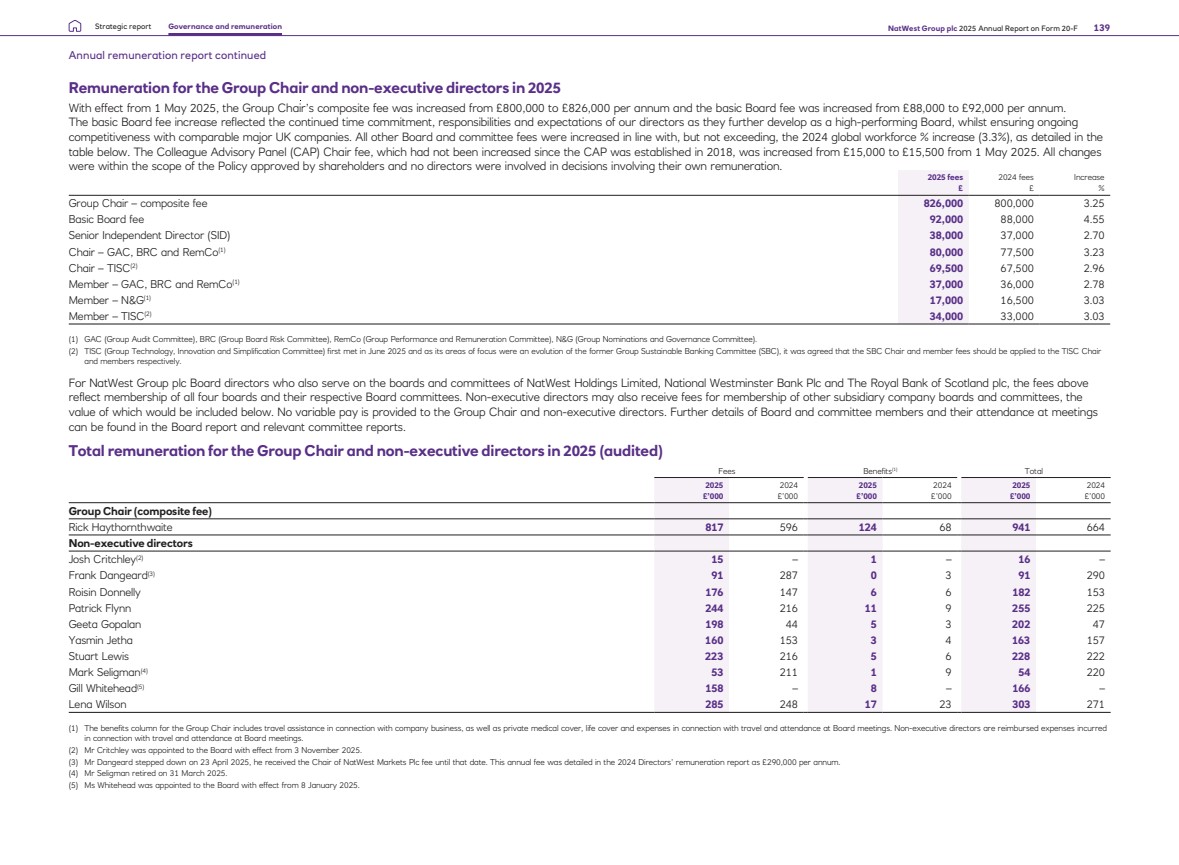
| Implementation of remuneration policy in 2026 Pay arrangements Salary (1 Jan 2026) Salary (1 Apr 2026) Standard benefits(1) Pension Fixed share allowance(2) Maximum bonus award for 2026(3) Maximum PSP award for 2026(4) Paul Thwaite £1,178,773 £1,217,083 £26,250 10% of salary 100% of salary £1,811,258 £3,622,517 Katie Murray £803,709 £829,830 £26,250 10% of salary 100% of salary £1,234,950 £2,469,899 (1) Amounts shown relate to standard benefit funding. Executive directors are also entitled to benefits such as travel assistance and security arrangements in line with the Policy and are eligible to participate in all-employee share plan arrangements on the same basis as colleagues. (2) Fixed share allowance is payable broadly in arrears, currently in four instalments per year. The shares will be released in equal amounts over a five-year period. (3) The maximum bonus award under the Policy is set at 150% of base salary and is calculated on salary earned over the year. The award is expected to vest at 50% where on-target performance is achieved across the scorecard. (4) The maximum PSP award under the Policy is set at 300% of base salary and is calculated on salary earned over the year. The maximum value of the PSP award receivable by the Group CEO and Group CFO for 2026 would increase to £5,433,775 and £3,704,849 respectively in the event there was a 50% increase in the NatWest Group plc share price over the PSP three-year period from grant to vest. Annual bonus and PSP for 2026 The committee intends to implement the Policy as follows: Annual bonus performance assessment for 2026 The annual bonus scorecard will be based on weighted performance measures and appropriately stretching targets across financial and non-financial areas that align with our strategy. For 2026, financial performance will represent 60% of the scorecard, with target ranges set in line with the budget. Non-financial measures will be focused across customer, colleague and strategy measures and will represent an aggregate of 40% of the scorecard in line with the UK regulators’ expectations. A downward risk modifier will also apply, enabling risk performance to be assessed and awards reduced, potentially to zero, if considered appropriate. Details of the targets for 2026 are on the next page. Some of the threshold and maximum targets are considered commercially sensitive and so, will be disclosed retrospectively at the end of the performance period in the 2026 Directors’ remuneration report, alongside the actual level of performance achieved and associated narrative. The maximum value of annual bonus awards is set at 150% of base salary for executive directors. The level of the award to be paid will normally increase on a straight-line basis between 10% of maximum for threshold performance, 50% of maximum for target performance and 100% of maximum opportunity for each scorecard measure. No award will be made if threshold performance, as determined by the committee, is not achieved. All assessments of performance are subject to the committee’s judgement to determine the appropriate outcome. Discretion will only be used by the committee when the application of the formulaic performance outcome drives an outcome which is considered unrepresentative of performance or when it is necessary to take into account strategic, economic or societal impacts that were not, or could not have been, accounted for at the point of agreeing the bonus scorecard. Annual remuneration report continued Sharing in Success For 2026, we will measure success based on succeeding with customers, underpinned by financial performance, our approach to risk and delivering value for shareholders. Subject to performance criteria being met, awards will be delivered to all eligible colleagues, including executive directors, in NatWest Group shares. Awards have a maximum value of £1,500 per colleague (adjusted for local salary levels). Strategic report Financial review Risk and capital management Financial statements Additional information Strategic report Governance and remuneration Governance and remuneration NatWest Group plc NatWest Group plc 2025 Annual Report and Accounts 2025 Annual Report on Form 20-F 157 140 In December 2025, the committee approved salary increases of 3.25% for the Group CEO and the Group CFO, effective from 1 April 2026. Pay arrangements for the 2026 performance year are set out below. Both executive directors will receive annual bonus and PSP awards in March 2026 in respect of the 2025 performance year. Full details of these awards can be found on pages 134 and 138. |
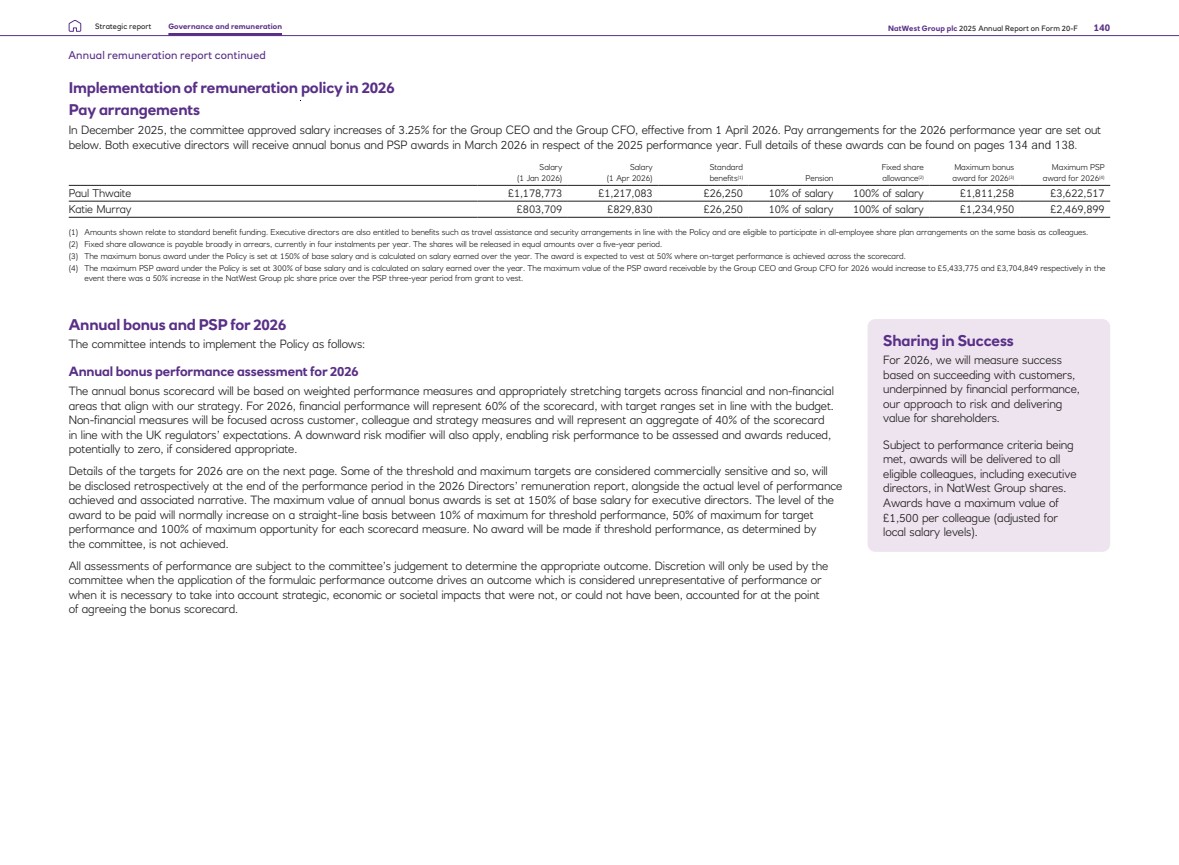
| Implementation of remuneration policy in 2026 Pay arrangements In December 2025, the committee approved salary increases of 3.25% for the Group CEO and the Group CFO, effective from 1 April 2026. Pay arrangements for the 2026 performance year are set out below. Both executive directors will receive annual bonus and PSP awards in March 2026 in respect of the 2025 performance year. Full details of these awards can be found on pages 151 and 155. Salary (1 Jan 2026) Salary (1 Apr 2026) Standard benefits(1) Pension Fixed share allowance(2) Maximum bonus award for 2026(3) Maximum PSP award for 2026(4) Paul Thwaite £1,178,773 £1,217,083 £26,250 10% of salary 100% of salary £1,811,258 £3,622,517 Katie Murray £803,709 £829,830 £26,250 10% of salary 100% of salary £1,234,950 £2,469,899 (1) Amounts shown relate to standard benefit funding. Executive directors are also entitled to benefits such as travel assistance and security arrangements in line with the Policy and are eligible to participate in all-employee share plan arrangements on the same basis as colleagues. (2) Fixed share allowance is payable broadly in arrears, currently in four instalments per year. The shares will be released in equal amounts over a five-year period. (3) The maximum bonus award under the Policy is set at 150% of base salary and is calculated on salary earned over the year. The award is expected to vest at 50% where on-target performance is achieved across the scorecard. (4) The maximum PSP award under the Policy is set at 300% of base salary and is calculated on salary earned over the year. The maximum value of the PSP award receivable by the Group CEO and Group CFO for 2026 would increase to £5,433,775 and £3,704,849 respectively in the event there was a 50% increase in the NatWest Group plc share price over the PSP three-year period from grant to vest. Annual bonus and PSP for 2026 The committee intends to implement the Policy as follows: Annual bonus performance assessment for 2026 The annual bonus scorecard will be based on weighted performance measures and appropriately stretching targets across financial and non-financial areas that align with our strategy. For 2026, financial performance will represent 60% of the scorecard, with target ranges set in line with the budget. Non-financial measures will be focused across customer, colleague and strategy measures and will represent an aggregate of 40% of the scorecard in line with the UK regulators’ expectations. A downward risk modifier will also apply, enabling risk performance to be assessed and awards reduced, potentially to zero, if considered appropriate. Details of the targets for 2026 are on the next page. Some of the threshold and maximum targets are considered commercially sensitive and so, will be disclosed retrospectively at the end of the performance period in the 2026 Directors’ remuneration report, alongside the actual level of performance achieved and associated narrative. The maximum value of annual bonus awards is set at 150% of base salary for executive directors. The level of the award to be paid will normally increase on a straight-line basis between 10% of maximum for threshold performance, 50% of maximum for target performance and 100% of maximum opportunity for each scorecard measure. No award will be made if threshold performance, as determined by the committee, is not achieved. All assessments of performance are subject to the committee’s judgement to determine the appropriate outcome. Discretion will only be used by the committee when the application of the formulaic performance outcome drives an outcome which is considered unrepresentative of performance or when it is necessary to take into account strategic, economic or societal impacts that were not, or could not have been, accounted for at the point of agreeing the bonus scorecard. Annual remuneration report continued Sharing in Success For 2026, we will measure success based on succeeding with customers, underpinned by financial performance, our approach to risk and delivering value for shareholders. Subject to performance criteria being met, awards will be delivered to all eligible colleagues, including executive directors, in NatWest Group shares. Awards have a maximum value of £1,500 per colleague (adjusted for local salary levels). Strategic report Financial review Governance and remuneration Risk and capital management Financial statements Additional information NatWest Group plc 2025 Annual Report and Accounts 157 Annual bonus performance measures and targets for 2026 Any targets not disclosed on the below scorecard will be disclosed retrospectively at the end of the performance period in the 2026 Directors’ remuneration report, as the committee considers them to be commercially sensitive at this point in time. The targets will be disclosed alongside the actual level of performance achieved and associated narrative. Category Performance measures Target Weighting Financial 60% Group RoTE (with CET1 underpin). Target will be set with appropriate reference to external guidance. 25% Attributable profit. Target will be set with appropriate reference to external guidance. 25% Group operating expenses, excluding litigation and conduct costs. Target will be set with appropriate reference to external guidance. 10% Non-financial 40% Customer Group measure using Net Promoter Score methodology across the customer segments, reflecting the contribution of each segment to Group income. Where NPS is not applicable for Commercial and Institutional Banking (CIB) and NatWest Markets performance will be assessed using two independent deal league tables, and the Institutions Greenwich Quality Index (GQI) for Rates and FX. On average, to meet our targets (within a rounding). Targets are set to maintain or improve. 20% Colleague Progress against purposeful leadership targets. Progress against performance culture targets. Purposeful leadership target from Our View = 86. Performance culture target from Our View = 84. 10% Strategy % Retail customers with active current accounts banking exclusively digitally.(1) % of active Commercial and Institutional (C&I) customers banking digitally.(3) Average time to deploy new features and services (days).(5) 82.5%(2) 85%(4) Three days. 10% Risk (0 – 100%) Risk performance assessment based on Group, NatWest Holdings, Functional (CFO only) and individual risk performance. Discretionary downwards modifier. 0-100% (1) Retail Banking customers with active current accounts that have accessed a digital platform (online or mobile) and not used a branch or telephony for 90 days in the reporting period. (2) Inactive customers and customers with no channel usage excluded. Mortgages and savings accounts, and interactions via the Post Office are excluded from the scope of measurement. (3) Proportion of C&I (ring-fenced bank) customers with active non-personal accounts that conducted 95% or more of their account access digitally for the final three months in the reporting period. (4) Access to account through a digital channel may not result in a transaction. (5) Average time (rolling quarterly) to deploy new features and services to end users where the application is active and has had four or more changes in the last 12 months. Annual remuneration report continued Strategic report Strategic report Governance and remuneration Financial review Governance and remuneration Risk and capital management Financial statements Additional information NatWest Group plc NatWest Group plc 2025 Annual Report and Accounts 2025 Annual Report on Form 20-F 158 141 |
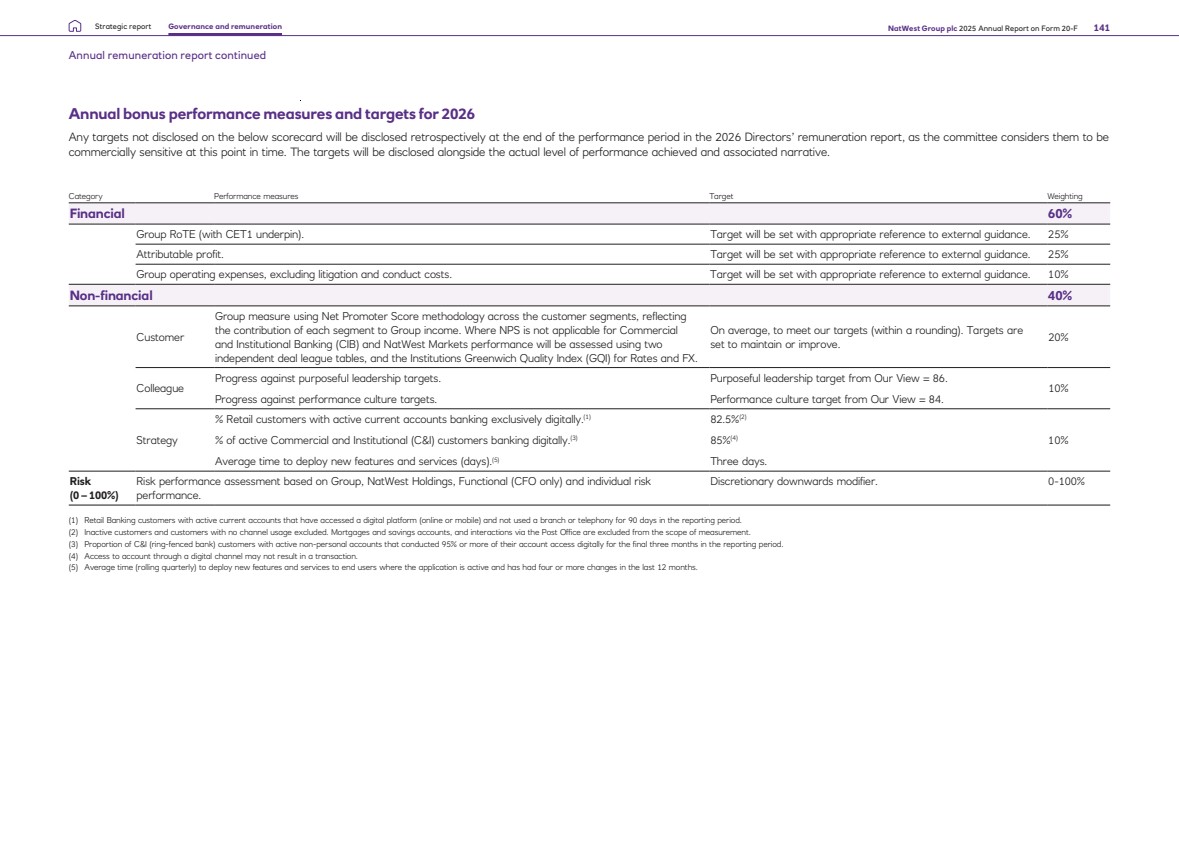
| PSP awards to be granted in 2026 Following a pre-grant test which confirmed that satisfactory performance was achieved in 2025, the committee approved the grant of PSP awards at maximum level (300% of earned salary) for Mr Thwaite and Ms Murray in March 2026. The awards will be subject to a three-year performance period starting on 1 January 2026. The PSP scorecard is based on weighted performance measures and appropriately stretching targets across financial and non-financial areas that align with our strategy and regulatory expectations. For the PSP awards to be granted in 2026, financial performance represents 60% of the scorecard, split evenly between Group RoTE and Relative Total Shareholder Return (TSR). Whilst Group RoTE is also used as an annual bonus measure, the committee is comfortable with its inclusion in the PSP scorecard on the basis that the delivery of a strong return on tangible equity is of the utmost importance to NatWest Group, acting as a key measure of the sustainable long-term returns we wish to deliver to our shareholders. The inclusion of this measure within both the annual bonus and the PSP is also in line with the approach taken by other major UK-listed banks. Relative TSR acts as a key measure of shareholder returns compared to our UK and European banking peers. In 2025, ahead of the PSP awards being made, the committee confirmed that the peer group for the Relative TSR measure (30% weighting) will consist of 18 banks listed in the UK and Europe which are considered to be of comparable size and complexity to NatWest Group. Further details on the peer group chosen for this metric are outlined on the next page. The remaining 40% of the scorecard is based on non-financial measures. 15% is based on sustainability, namely a climate and transition finance(3) measure which drives delivery of our £200 billion target between 1 July 2025 and the end of 2030. This is a key sustainability target within NatWest Group, and its inclusion aligns with market practice at our peers. The last 25% of the scorecard is based on strategic measures which incentivise management to further progress our strategic priorities of: (i) Disciplined growth, by building stable income streams; (ii) Leveraging simplification, to improve productivity and efficiency; and (iii) Active balance sheet and risk management, to drive capital generation and distribution capacity. This element of the scorecard also includes inclusion metrics. The committee considered it appropriate to move these metrics from the annual bonus scorecard to the PSP scorecard going forward, as it is believed that making material and sustainable change in these areas is more meaningfully measured over the medium to long-term time horizon associated with the PSP. The targets proposed for these metrics are designed to drive strong progress towards the delivery of our previously announced targets by the end of 2030, namely: • 50% female representation globally(4) in our senior leadership population;(5) • 19% of UK colleagues from ethnic minority groups in our senior leadership population;(5) and • 5% of UK Black(6) colleagues in our senior leadership population.(5) At the time of vesting, a risk and conduct underpin will also apply to determine if there has been any material deterioration in risk and control performance or a serious conduct/reputational event that may warrant a downward adjustment (up to 100% of vesting if considered appropriate). The PSP scorecard with performance measures and targets for 2026-2028 are detailed on the next page along with footnotes. Annual remuneration report continued Strategic report Strategic report Governance and remuneration Financial review Governance and remuneration Risk and capital management Financial statements Additional information NatWest Group plc NatWest Group plc 2025 Annual Report and Accounts 2025 Annual Report on Form 20-F 159 142 |
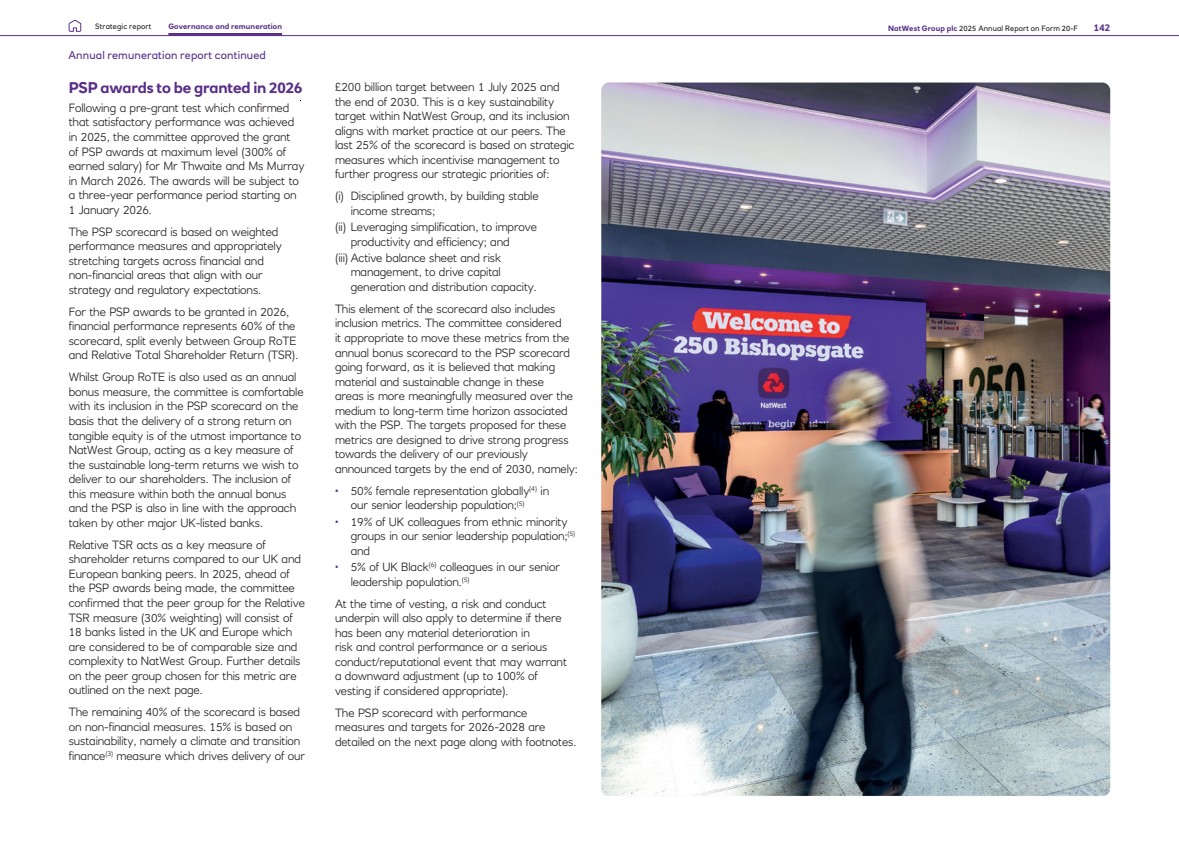
| PSP awards to be granted in 2026 Following a pre-grant test which confirmed that satisfactory performance was achieved in 2025, the committee approved the grant of PSP awards at maximum level (300% of earned salary) for Mr Thwaite and Ms Murray in March 2026. The awards will be subject to a three-year performance period starting on 1 January 2026. The PSP scorecard is based on weighted performance measures and appropriately stretching targets across financial and non-financial areas that align with our strategy and regulatory expectations. For the PSP awards to be granted in 2026, financial performance represents 60% of the scorecard, split evenly between Group RoTE and Relative Total Shareholder Return (TSR). Whilst Group RoTE is also used as an annual bonus measure, the committee is comfortable with its inclusion in the PSP scorecard on the basis that the delivery of a strong return on tangible equity is of the utmost importance to NatWest Group, acting as a key measure of the sustainable long-term returns we wish to deliver to our shareholders. The inclusion of this measure within both the annual bonus and the PSP is also in line with the approach taken by other major UK-listed banks. Relative TSR acts as a key measure of shareholder returns compared to our UK and European banking peers. In 2025, ahead of the PSP awards being made, the committee confirmed that the peer group for the Relative TSR measure (30% weighting) will consist of 18 banks listed in the UK and Europe which are considered to be of comparable size and complexity to NatWest Group. Further details on the peer group chosen for this metric are outlined on the next page. The remaining 40% of the scorecard is based on non-financial measures. 15% is based on sustainability, namely a climate and transition finance(3) measure which drives delivery of our £200 billion target between 1 July 2025 and the end of 2030. This is a key sustainability target within NatWest Group, and its inclusion aligns with market practice at our peers. The last 25% of the scorecard is based on strategic measures which incentivise management to further progress our strategic priorities of: (i) Disciplined growth, by building stable income streams; (ii) Leveraging simplification, to improve productivity and efficiency; and (iii) Active balance sheet and risk management, to drive capital generation and distribution capacity. This element of the scorecard also includes inclusion metrics. The committee considered it appropriate to move these metrics from the annual bonus scorecard to the PSP scorecard going forward, as it is believed that making material and sustainable change in these areas is more meaningfully measured over the medium to long-term time horizon associated with the PSP. The targets proposed for these metrics are designed to drive strong progress towards the delivery of our previously announced targets by the end of 2030, namely: • 50% female representation globally(4) in our senior leadership population;(5) • 19% of UK colleagues from ethnic minority groups in our senior leadership population;(5) and • 5% of UK Black(6) colleagues in our senior leadership population.(5) At the time of vesting, a risk and conduct underpin will also apply to determine if there has been any material deterioration in risk and control performance or a serious conduct/reputational event that may warrant a downward adjustment (up to 100% of vesting if considered appropriate). The PSP scorecard with performance measures and targets for 2026-2028 are detailed on the next page along with footnotes. Annual remuneration report continued Strategic report Financial review Governance and remuneration Risk and capital management Financial statements Additional information NatWest Group plc 2025 Annual Report and Accounts 159 Annual remuneration report continued PSP performance measures and targets for 2026-2028 Any targets not disclosed on the below scorecard will be disclosed retrospectively at the time of vesting, as the committee considers them to be commercially sensitive at this point in time. This will be disclosed alongside the actual level of performance achieved and associated narrative. Category Performance measures Weighting Threshold (25% payout) Maximum (100% payout) Financial (60% weighting) Group RoTE(1) 30% 17.0% 19.0% Relative Total Shareholder Return compared to a peer group consisting of 18 UK and European banks.(2) 30% Median Upper quartile Non-financial (40% weighting) Sustainability Climate and transition finance(3) 15% Climate and transition finance is intended to support our net-zero ambition by providing financing and facilitation options that may help our customers to achieve their climate and/or transition ambitions. £100bn £125bn Strategic Disciplined growth 10% Targets will be disclosed retrospectively at the time of vesting. Customer balance growth across gross lending, deposits and assets under management and administration. Leveraging simplification 5% Cost:income ratio. Active balance sheet and risk management 5% Capital generation measuring the ability to grow our capital base. Inclusion 5% % of female representation globally(4) in our senior leadership population(5) by 31 December 2028. 45.4% 47.4% % of UK colleagues from ethnic minority groups in our senior leadership population(5) by 31 December 2028. 14.0% 16.0% % of UK Black(6) colleagues in our senior leadership population(5) by 31 December 2028. 1.5% 3.3% Risk and conduct underpin (1) Group RoTE will be measured as the average RoTE over the three financial years of the performance period. Adjustments will be limited to notable items as reported in the external accounts and any impact of material changes in base rate from that assumed in the plan. (2) The peer group for the 2026-2028 PSP consists of 18 Banks in the UK and Europe which are considered to be of comparable size and complexity to NatWest, namely ABN Amro, AIB, Bank of Ireland, Barclays, BNP Paribas, CaixaBank, Commerzbank, Crédit Agricole, Danske Bank, DNB Bank, Handelsbanken, HSBC, ING Group, Intesa Sanpaolo, Lloyds, Nordea, Santander, and Société Generale. (3) Climate finance and transition finance as defined in the climate and transition finance framework. Climate and transition finance represents only a relatively small proportion of our overall financing and facilitation activities. (4) Global targets remain subject to local laws and regulations. (5) The senior leadership population is CEO-2+. (6) Black mixed ethnicity categories are included in our Black diversity target calculations. Strategic report Strategic report Governance and remuneration Financial review Governance and remuneration Risk and capital management Financial statements Additional information NatWest Group plc NatWest Group plc 2025 Annual Report and Accounts 2025 Annual Report on Form 20-F 160 143 |
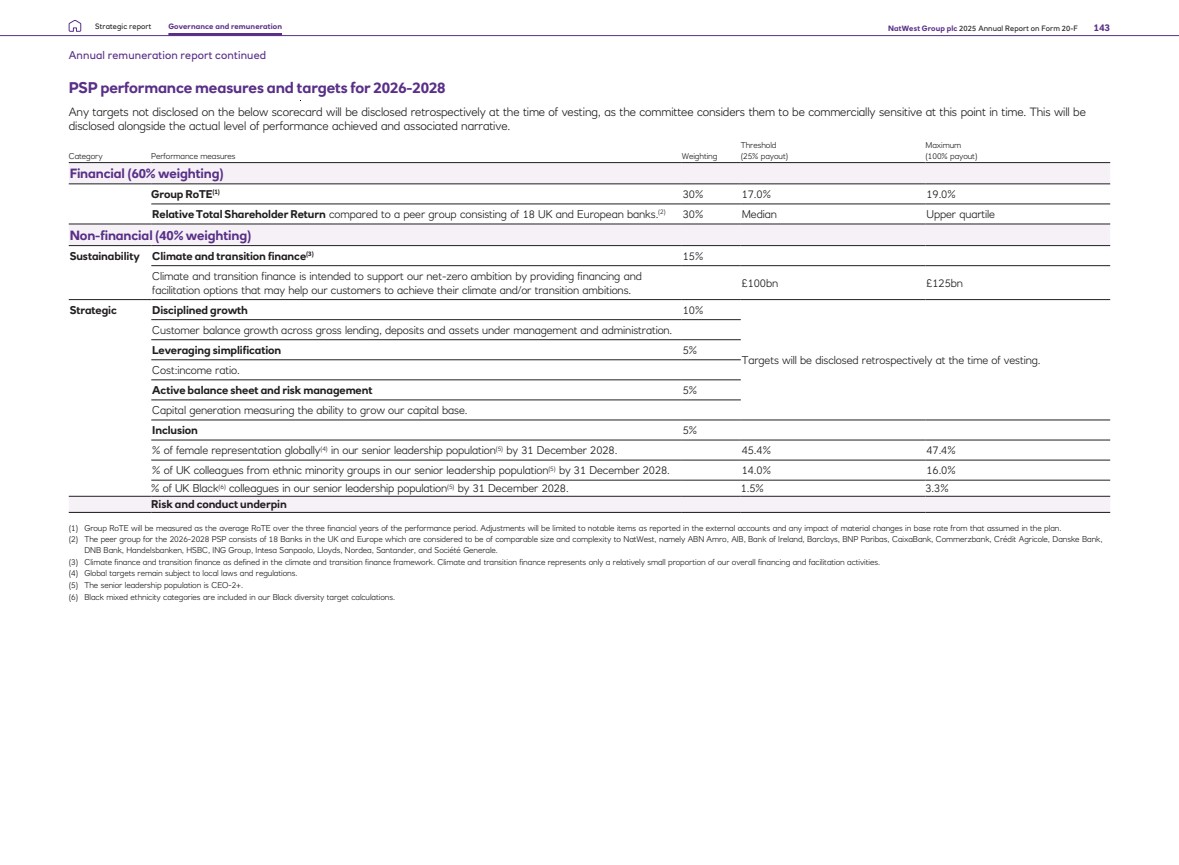
| Annual remuneration report continued Fees for NatWest Group plc Board(1) Rates with effect from 1 May 2025 Group Chair (composite fee) £826,000 Non-executive director basic fee £92,000 Senior Independent Director £38,000 Fees for NatWest Group plc Board committees(1) Member Chair Group Board Risk Committee £37,000 £80,000 Group Audit Committee £37,000 £80,000 Group Performance and Remuneration Committee £37,000 £80,000 Group Technology, Innovation and Simplification Committee £34,000 £69,500 Group Nominations and Governance Committee £17,000 – Other fees for NatWest Group plc Board directors Rates with effect from 1 May 2025 Chair of the Colleague Advisory Panel £15,500 (1) No additional fees are payable where the director is also a member of the boards and respective Board committees of NatWest Holdings Limited, National Westminster Bank Plc and The Royal Bank of Scotland plc. Where appropriate, directors receive additional fees for membership of other subsidiary company boards and committees, including NatWest Markets Plc. If applicable, we will disclose the value of fees received in this report each year. Group Chair and non-executive shareholding policy and annual fees for 2026 Under the shareholding policy for the Group Chair and non-executive directors, NatWest Group retains a portion of the net monthly basic fees (10% for the Group Chair and 25% for non-executive directors) which is used to purchase shares every quarter. The Group Chair is required to build towards a shareholding equivalent to four times the basic annual Board fee (currently £368,000) and for non-executive directors the target is one times the basic annual Board fee (currently £92,000). Once the target is achieved, monthly deductions and quarterly purchases will continue at a reduced percentage of net monthly fees (5% for the Group Chair and 10% for non-executive directors). The shares purchased under the shareholding policy are held in a nominee account with dividends reinvested and shares retained until the director steps down from the Board. The annual fees applicable are set out in the table opposite, with the fees delivered in a combination of cash and shares, in line with the shareholding policy above. In line with our usual approach, the fees will be reviewed in 2026 with any changes effective from 1 May 2026. Other external directorships Any new external appointments to be undertaken by directors require prior Board approval. Steps are in place to make sure that directors comply with regulatory limits on the number of directorships held. The Board also considers whether it is appropriate for executive directors to retain any remuneration from any new external roles, depending on the appointment. Details of current external appointments can be found in the biographies section of the Corporate governance report. Strategic report Strategic report Governance and remuneration Financial review Governance and remuneration Risk and capital management Financial statements Additional information NatWest Group plc NatWest Group plc 2025 Annual Report and Accounts 2025 Annual Report on Form 20-F 161 144 |
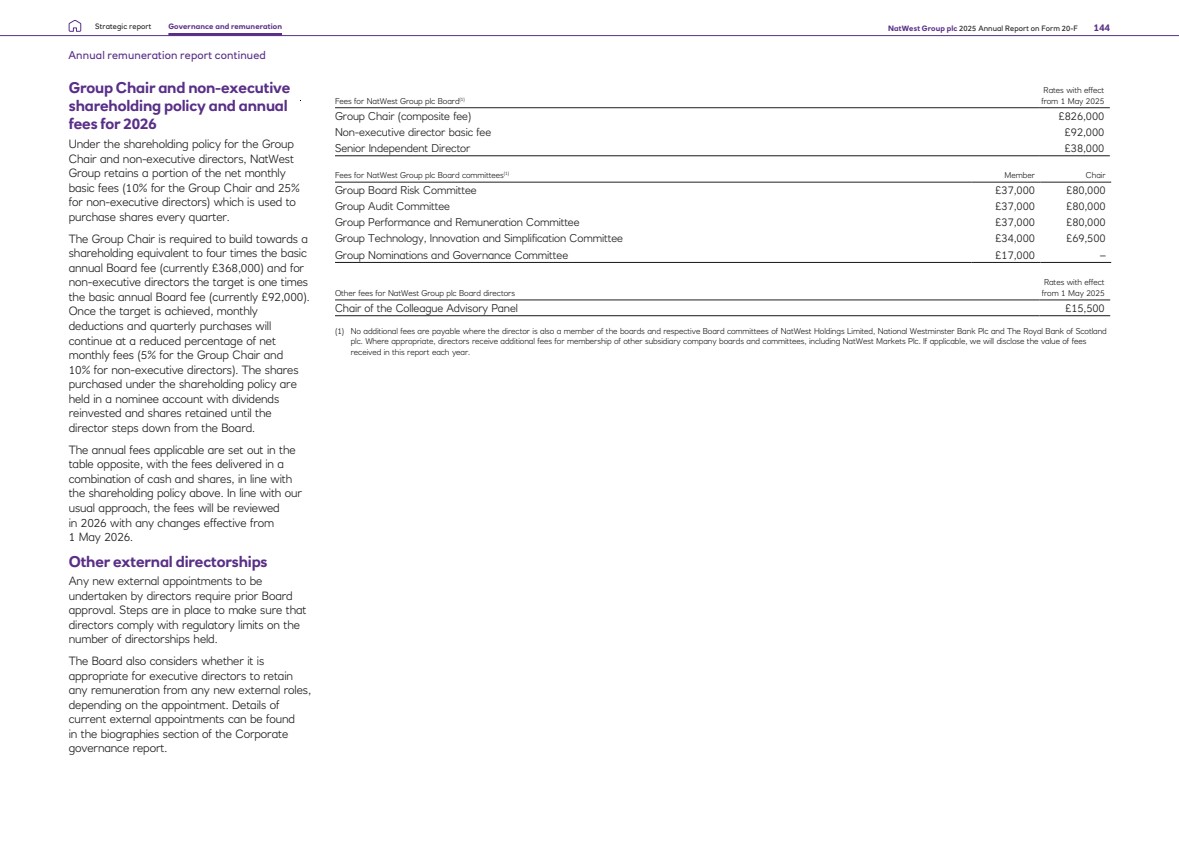
| Annual remuneration report continued Fees for NatWest Group plc Board(1) Rates with effect from 1 May 2025 Group Chair (composite fee) £826,000 Non-executive director basic fee £92,000 Senior Independent Director £38,000 Fees for NatWest Group plc Board committees(1) Member Chair Group Board Risk Committee £37,000 £80,000 Group Audit Committee £37,000 £80,000 Group Performance and Remuneration Committee £37,000 £80,000 Group Technology, Innovation and Simplification Committee £34,000 £69,500 Group Nominations and Governance Committee £17,000 – Other fees for NatWest Group plc Board directors Rates with effect from 1 May 2025 Chair of the Colleague Advisory Panel £15,500 (1) No additional fees are payable where the director is also a member of the boards and respective Board committees of NatWest Holdings Limited, National Westminster Bank Plc and The Royal Bank of Scotland plc. Where appropriate, directors receive additional fees for membership of other subsidiary company boards and committees, including NatWest Markets Plc. If applicable, we will disclose the value of fees received in this report each year. Group Chair and non-executive shareholding policy and annual fees for 2026 Under the shareholding policy for the Group Chair and non-executive directors, NatWest Group retains a portion of the net monthly basic fees (10% for the Group Chair and 25% for non-executive directors) which is used to purchase shares every quarter. The Group Chair is required to build towards a shareholding equivalent to four times the basic annual Board fee (currently £368,000) and for non-executive directors the target is one times the basic annual Board fee (currently £92,000). Once the target is achieved, monthly deductions and quarterly purchases will continue at a reduced percentage of net monthly fees (5% for the Group Chair and 10% for non-executive directors). The shares purchased under the shareholding policy are held in a nominee account with dividends reinvested and shares retained until the director steps down from the Board. The annual fees applicable are set out in the table opposite, with the fees delivered in a combination of cash and shares, in line with the shareholding policy above. In line with our usual approach, the fees will be reviewed in 2026 with any changes effective from 1 May 2026. Other external directorships Any new external appointments to be undertaken by directors require prior Board approval. Steps are in place to make sure that directors comply with regulatory limits on the number of directorships held. The Board also considers whether it is appropriate for executive directors to retain any remuneration from any new external roles, depending on the appointment. Details of current external appointments can be found in the biographies section of the Corporate governance report. Strategic report Financial review Governance and remuneration Risk and capital management Financial statements Additional information NatWest Group plc 2025 Annual Report and Accounts 161 Annual change in directors’ pay compared to average change in employee pay Executive directors receive fixed share allowances and, from the 2022 performance year onwards, annual bonus awards. The Group Chair and non-executive directors receive fees rather than salary and do not receive annual bonus awards. We regularly review membership of Board committees and changes in membership will impact the level of fees paid to non-executive directors from one year to the next. The benefits figures for non-executive directors can also change significantly year on year depending on the amount of travel undertaken in connection with Board meetings. Data for employees is based on average salary, benefits and variable pay (i.e., annual bonus and Sharing in Success awards). 2024 to 2025 2023 to 2024 2022 to 2023 2021 to 2022 2020 to 2021 Annual percentage change Salary Benefits(1) Annual Bonus Salary Benefits(1) Annual Bonus Salary Benefits(1) Annual Bonus Salary Benefits(1) Annual Bonus Salary Benefits(1) Annual Bonus UK employees(2) 4.45% 8.48% 15.78% 4.34% 6.87% 30.03% 8.11% 9.65% 7.13% 5.20% 6.34% 42.48% 2.02% 4.68% 35.24% Executive directors Paul Thwaite(3) 3% 0% 68% 41% 0% 98% – – – – – n/a – – n/a Katie Murray 1.5% 0% 71% 1% 0% 46% 3% 0% -2% 1.50% 0% n/a 0% 0% n/a Group Chair and non-executive directors Fees Benefits Annual Bonus Fees Benefits Annual Bonus Fees Benefits Annual Bonus Fees Benefits Annual Bonus Fees Benefits Annual Bonus Rick Haythornthwaite(4) 37% 82% n/a – – n/a – – n/a – – n/a – – n/a Josh Critchley(5) – – n/a – – n/a – – n/a – – n/a – – n/a Frank Dangeard(6) -68% -100% n/a 4% 17% n/a 3% -33% n/a 2% 200% n/a 1% 0% n/a Roisin Donnelly(5) 20% -9% n/a 25% 13% n/a 462% 0% n/a – – n/a – – n/a Patrick Flynn 13% 14% n/a -1% 192% n/a -6% -40% n/a 2% 400% n/a 0% -67% n/a Geeta Gopalan(5) 349% 68% n/a – – n/a – – n/a – – n/a – – n/a Yasmin Jetha 4% -6% n/a -3% -26% n/a -8% 25% n/a 1% 300% n/a 33% 100% n/a Stuart Lewis(5) 4% -19% n/a 55% 27% n/a – – n/a – – n/a – – n/a Mark Seligman(7) -75% -91% n/a 3% 81% n/a 3% 0% n/a 4% 400% n/a 1% 0% n/a Gill Whitehead(5) – – n/a – – n/a – – n/a – – n/a – – n/a Lena Wilson 15% -25% n/a -11% 108% n/a 36% -35% n/a 5% 240% n/a 8% 25% n/a (1) Standard benefit funding for executive directors has remained unchanged. The figures above exclude any other benefits to executive directors such as travel assistance in connection with company business, the value of which is disclosed each year in the single total figure table. (2) NatWest Group plc is a holding company and is not an employing entity. The disclosure above compares the change in directors’ pay with all employees based in the UK. The data is based on the average full-time equivalent salary and benefit costs of UK-based employees of NatWest Group, excluding the Group CEO and the Group CFO. This is considered to be the most representative comparator group, as it covers the majority of employees and the Group CEO and Group CFO are based in the UK. The average percentage change relates to salaries and benefits awarded in the respective financial years for UK employees and therefore may differ from figures quoted elsewhere in the report, for example, the proposed salary increases to be awarded from April 2026. (3) Mr Thwaite was appointed as Group CEO on 25 July 2023, so there are no prior year comparisons. For 2023, the change in his remuneration is based on actual amounts he earned over the whole of 2023, not just in his capacity as Group CEO, given he was an employee of NatWest Group before becoming Group CEO. (4) Mr Haythornthwaite joined the Board of NatWest Group plc as an independent non-executive director on 8 January 2024 and following a handover period took over as Group Chair on 15 April 2024. Therefore, there are no prior year comparisons. (5) Mr Critchley joined the Board on 3 November 2025, Ms Whitehead joined the Board on 8 January 2025, Ms Gopalan joined the Board on 1 July 2024, Mr Lewis joined the Board on 1 April 2023, and Ms Donnelly joined the Board on 1 October 2022, so there are no prior year comparisons before their respective joining date. (6) Mr Dangeard stepped down on 23 April 2025. (7) Mr Seligman retired on 31 March 2025. Annual remuneration report continued Strategic report Strategic report Governance and remuneration Financial review Governance and remuneration Risk and capital management Financial statements Additional information NatWest Group plc NatWest Group plc 2025 Annual Report and Accounts 2025 Annual Report on Form 20-F 162 145 |
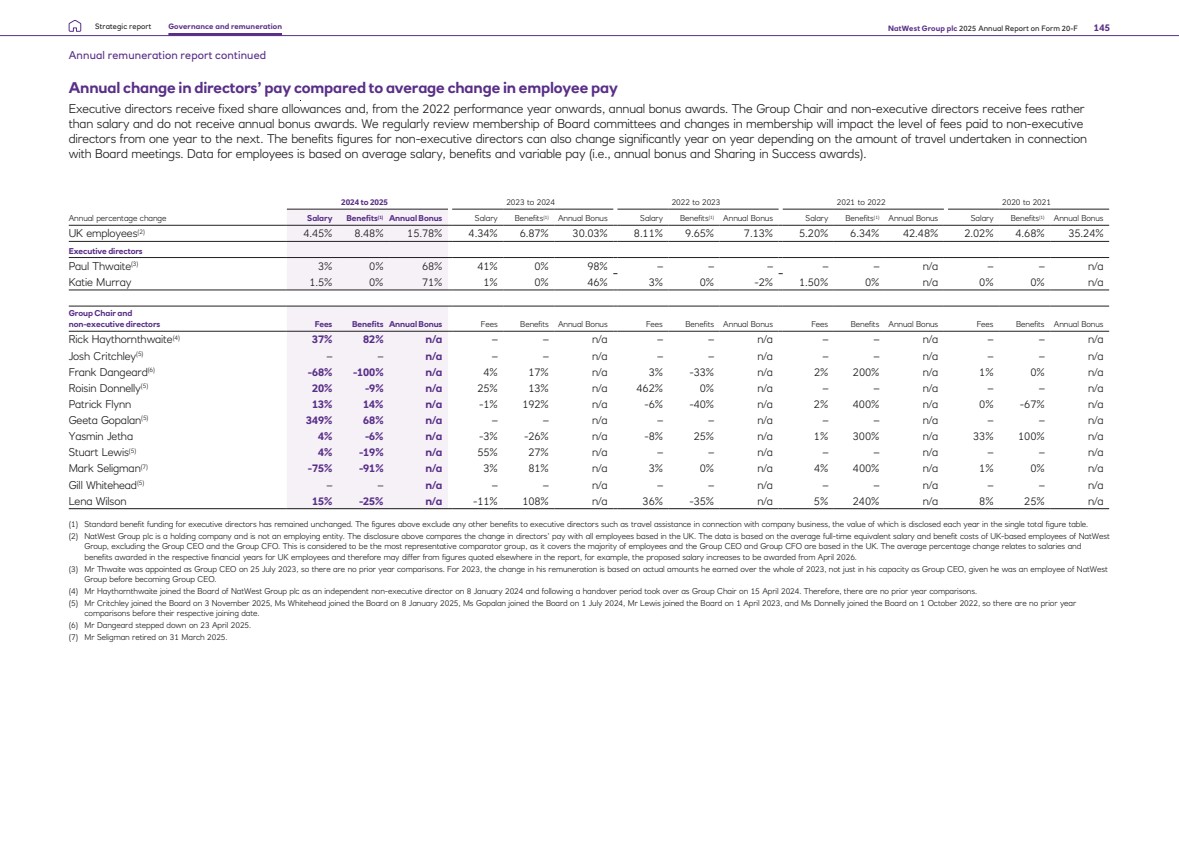
| CEO to employee pay ratios The ratios below compare the total pay of the Group CEO, as set out in the single figure of remuneration table in this report, against the pay of three employees whose earnings represent the lower, median and upper quartiles of the UK employee population. A significant proportion of the Group CEO’s total remuneration is delivered through long-term incentive arrangements, linked to performance and share price movements, which means the ratio can fluctuate significantly from one year to the next. None of the three employees identified this year received equivalent long-term incentive arrangements. Information based on salary only is included as a further comparison. The change in the total remuneration median pay ratio since 2018 is largely driven by the more variable nature of performance-related pay for the Group CEO. The trend in the salary only pay ratio shows as stable and slightly decreasing due to lower than workforce increases for the Group CEO and progression in salaries for the wider workforce. In 2023, the single figure table detailed the pro-rated amount of Mr Thwaite’s annual bonus award as he took on the Group CEO role part way through the year. Also, as Ms Rose voluntarily declined a LTI award in 2021, in relation to events relating to COVID-19, there was no vesting amount to include. This contributed to the pay ratio falling in 2023 before rising in 2024, and again in 2025. The rise is primarily due to higher vesting values for long-term incentive awards as a result of strong share price performance and an increased annual bonus opportunity from 2025. The total remuneration and salary for employees at the lower, median and upper quartiles has either remained stable or increased year on year. Pay ratios Remuneration values (£000) Year Methodology P25 (LQ) P50 (Median) P75 (UQ) Calculation Group CEO Y25 (LQ) Y50 (Median) Y75 (UQ) 2018 A Total remuneration 143:1 97:1 56:1 Total remuneration 3,578 25 37 64 Salary only 44:1 30:1 19:1 Salary only 1,000 23 33 51 2019 A Total remuneration 175:1 118:1 69:1 Total remuneration 4,517 26 38 66 Salary only 44:1 30:1 19:1 Salary only 1,017 23 34 52 2020 A Total remuneration 99:1 66:1 39:1 Total remuneration 2,615 26 40 66 Salary only 46:1 31:1 20:1 Salary only 1,100 24 36 54 2021 A Total remuneration 130:1 87:1 51:1 Total remuneration 3,588 28 41 70 Salary only 44:1 29:1 20:1 Salary only 1,100 25 37 55 2022 A Total remuneration 177:1 119:1 71:1 Total remuneration 5,249 30 44 74 Salary only 42:1 28:1 19:1 Salary only 1,117 27 40 58 2023 A Total remuneration 95:1 64:1 39:1 Total remuneration 3,158 33 50 81 Salary only 38:1 25:1 17:1 Salary only 1,106 29 44 63 2024 A Total remuneration 139:1 93:1 56:1 Total remuneration 4,936 36 53 87 Salary only 37:1 25:1 17:1 Salary only 1,142 31 46 66 2025 A Total remuneration 175:1 117:1 71:1 Total remuneration 6,571 37 56 92 Salary only 36:1 24:1 17:1 Salary only 1,173 33 48 70 Supplementary information on the pay ratio table: (1) The data for 2025 is based on remuneration earned by Mr Thwaite, as set out in the single total figure of remuneration table in the remuneration report. (2) The employees at the 25th, 50th and 75th percentiles (lower, median and upper quartiles) were determined as at 31 December of the relevant year, based on full-time equivalent remuneration for all UK employees. This includes fixed pay (salary, pension funding and where relevant benefit funding and other allowances) and any variable pay (based on the amount to be paid). For employees who work part time, fixed pay is grossed up to the full-time equivalent. (3) ‘Option A’ methodology was selected as this is considered the most statistically accurate method. (4) UK employees receive a pension funding allowance set as a percentage of salary. Some employees continue to participate in the defined benefit pension scheme. For simplicity and consistency with prior years, we have included the pension funding allowance value in the calculation for all employees. (5) The data for the three employees identified has been considered and fairly reflects pay at the relevant quartiles among the UK employee population. All three individuals were full-time employees during the year and none received an exceptional award that would otherwise inflate their pay figure. Annual remuneration report continued Strategic report Financial review Risk and capital management Financial statements Additional information Strategic report Governance and remuneration Governance and remuneration NatWest Group plc NatWest Group plc 2025 Annual Report and Accounts 2025 Annual Report on Form 20-F 163 146 The pay ratios reflect the diverse range of roles and pay levels across NatWest Group. The median pay ratio is consistent with the pay and reward policies for UK employees as a whole. We pay each individual a fair rate for the role performed, using consistent reward policies. We set out further information on our fair pay approach on the NatWest Group website. |
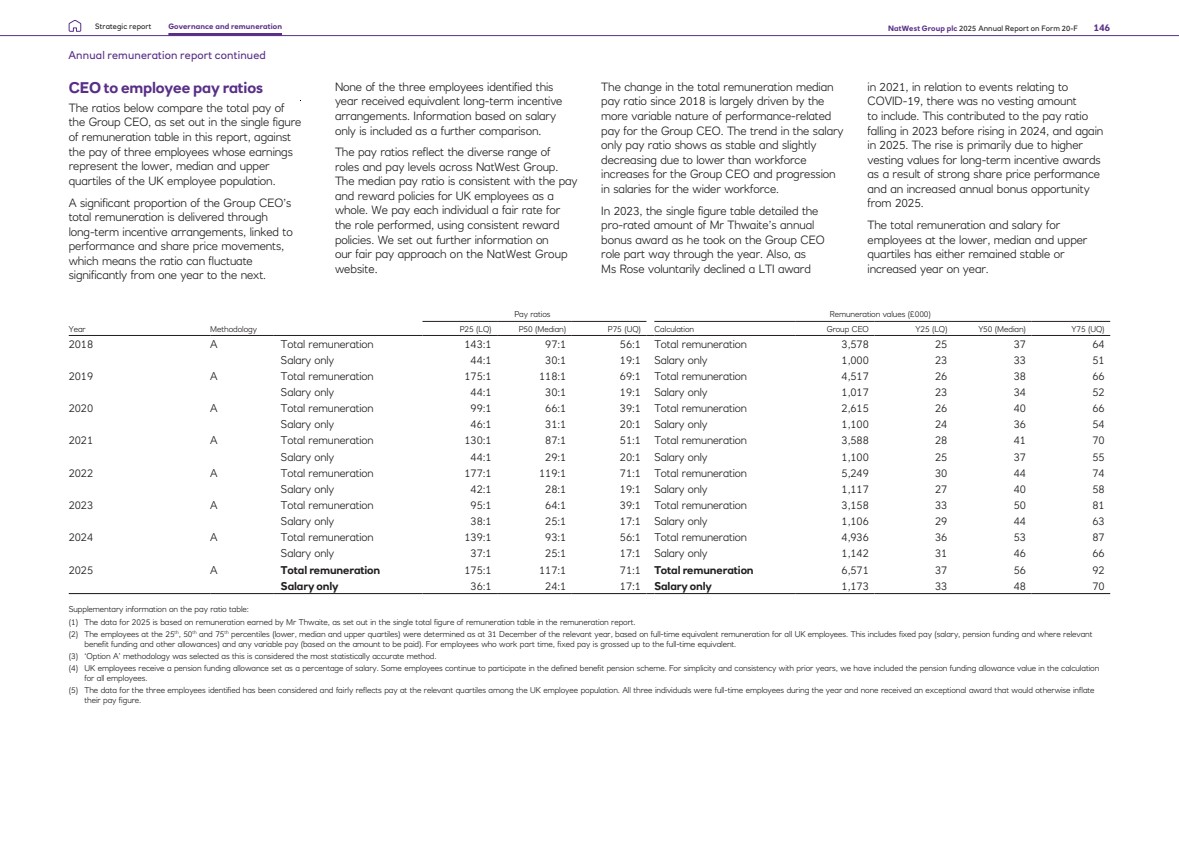
| CEO to employee pay ratios The ratios below compare the total pay of the Group CEO, as set out in the single figure of remuneration table in this report, against the pay of three employees whose earnings represent the lower, median and upper quartiles of the UK employee population. A significant proportion of the Group CEO’s total remuneration is delivered through long-term incentive arrangements, linked to performance and share price movements, which means the ratio can fluctuate significantly from one year to the next. None of the three employees identified this year received equivalent long-term incentive arrangements. Information based on salary only is included as a further comparison. The pay ratios reflect the diverse range of roles and pay levels across NatWest Group. The median pay ratio is consistent with the pay and reward policies for UK employees as a whole. We pay each individual a fair rate for the role performed, using consistent reward policies. We set out further information on our fair pay approach at natwestgroup.com. The change in the total remuneration median pay ratio since 2018 is largely driven by the more variable nature of performance-related pay for the Group CEO. The trend in the salary only pay ratio shows as stable and slightly decreasing due to lower than workforce increases for the Group CEO and progression in salaries for the wider workforce. In 2023, the single figure table detailed the pro-rated amount of Mr Thwaite’s annual bonus award as he took on the Group CEO role part way through the year. Also, as Ms Rose voluntarily declined a LTI award in 2021, in relation to events relating to COVID-19, there was no vesting amount to include. This contributed to the pay ratio falling in 2023 before rising in 2024, and again in 2025. The rise is primarily due to higher vesting values for long-term incentive awards as a result of strong share price performance and an increased annual bonus opportunity from 2025. The total remuneration and salary for employees at the lower, median and upper quartiles has either remained stable or increased year on year. Pay ratios Remuneration values (£000) Year Methodology P25 (LQ) P50 (Median) P75 (UQ) Calculation Group CEO Y25 (LQ) Y50 (Median) Y75 (UQ) 2018 A Total remuneration 143:1 97:1 56:1 Total remuneration 3,578 25 37 64 Salary only 44:1 30:1 19:1 Salary only 1,000 23 33 51 2019 A Total remuneration 175:1 118:1 69:1 Total remuneration 4,517 26 38 66 Salary only 44:1 30:1 19:1 Salary only 1,017 23 34 52 2020 A Total remuneration 99:1 66:1 39:1 Total remuneration 2,615 26 40 66 Salary only 46:1 31:1 20:1 Salary only 1,100 24 36 54 2021 A Total remuneration 130:1 87:1 51:1 Total remuneration 3,588 28 41 70 Salary only 44:1 29:1 20:1 Salary only 1,100 25 37 55 2022 A Total remuneration 177:1 119:1 71:1 Total remuneration 5,249 30 44 74 Salary only 42:1 28:1 19:1 Salary only 1,117 27 40 58 2023 A Total remuneration 95:1 64:1 39:1 Total remuneration 3,158 33 50 81 Salary only 38:1 25:1 17:1 Salary only 1,106 29 44 63 2024 A Total remuneration 139:1 93:1 56:1 Total remuneration 4,936 36 53 87 Salary only 37:1 25:1 17:1 Salary only 1,142 31 46 66 2025 A Total remuneration 175:1 117:1 71:1 Total remuneration 6,571 37 56 92 Salary only 36:1 24:1 17:1 Salary only 1,173 33 48 70 Supplementary information on the pay ratio table: (1) The data for 2025 is based on remuneration earned by Mr Thwaite, as set out in the single total figure of remuneration table in the remuneration report. (2) The employees at the 25th, 50th and 75th percentiles (lower, median and upper quartiles) were determined as at 31 December of the relevant year, based on full-time equivalent remuneration for all UK employees. This includes fixed pay (salary, pension funding and where relevant benefit funding and other allowances) and any variable pay (based on the amount to be paid). For employees who work part time, fixed pay is grossed up to the full-time equivalent. (3) ‘Option A’ methodology was selected as this is considered the most statistically accurate method. (4) UK employees receive a pension funding allowance set as a percentage of salary. Some employees continue to participate in the defined benefit pension scheme. For simplicity and consistency with prior years, we have included the pension funding allowance value in the calculation for all employees. (5) The data for the three employees identified has been considered and fairly reflects pay at the relevant quartiles among the UK employee population. All three individuals were full-time employees during the year and none received an exceptional award that would otherwise inflate their pay figure. Annual remuneration report continued Strategic report Financial review Risk and capital management Financial statements Additional information Governance and remuneration NatWest Group plc 2025 Annual Report and Accounts 163 Summary of remuneration levels for employees in 2025 Remuneration of Material Risk Takers in 2025 The tables below summarise the total pay for colleagues identified as MRTs for one or more entities across NatWest Group along with the number of individuals earning more than €1 million for the year. Note that the number of MRTs excludes colleagues who left NatWest Group prior to 31 December 2025 in line with regulatory requirements. Number of >€1m earners(1) Number of MRTs 590 €1.0 million to below €1.5 million 55 Remuneration (£millions) €1.5 million to below €2.0 million 20 Total fixed pay £185.1 €2.0 million to below €2.5 million 3 Total variable pay £129.1 €2.5 million to below €3.0 million 4 Total remuneration £314.2 €3.0 million to below €3.5 million 4 €3.5 million to below €4.0 million 2 €4.0 million to below €4.5 million - €4.5 million to below €5.0 million 1 Total 89 (1) This information is disclosed in euros in line with the requirements of the regulations. The disclosure of remuneration levels for employees includes anyone employed by NatWest Group during the year. Annual remuneration report continued 42,548 employees earned total remuneration up to £50,000 14,931 employees earned total remuneration between £50,000 and £100,000 7,890 employees earned total remuneration between £100,000 and £250,000 1,180 employees earned total remuneration over £250,000 63.93% 22.44% 11.86% 1.77% Strategic report Financial review Risk and capital management Financial statements Additional information Strategic report Governance and remuneration Governance and remuneration NatWest Group plc NatWest Group plc 2025 Annual Report and Accounts 2025 Annual Report on Form 20-F 164 147 Each year, we disclose the remuneration paid to individuals whose activities have a material influence over NatWest Group’s performance or risk profile, known as Material Risk Takers (MRTs). The disclosures are made in line with regulatory requirements and full details can be found in our Pillar 3 reports on the NatWest Group website. |

| Share interests for the Group Chair and non-executive directors Directors’ interests in NatWest Group plc shares (audited) The Group CEO and Group CFO have entered into irrevocable trading plans in respect of 25% of their vested shares free from retention requirements at the point they entered into the trading plans in order to engage in structured, regular share dealing activity and to assist with portfolio management. Paul Thwaite Katie Murray Shares held – beneficially owned(1) 973,643 786,477 Shares held – performance assessed unvested shares(2) 250,573 535,016 Total shares held counting towards requirements(3) 1,224,216 1,321,493 Shareholding requirement 500% of salary 300% of salary Position against requirement(4) 676% of salary 1,071% of salary (1) Shares owned beneficially as at 31 December 2025. Includes shares held by persons closely associated with the directors. (2) Share awards are also included for the purposes of the shareholding requirement once any performance assessment has been completed. All share awards are included net of taxes due to be paid on vesting. (3) As at 13 February 2026, there were no changes to the shares held as shown above for Mr Thwaite and Ms Murray. (4) The position against the requirement was calculated as at 31 December 2025 based on the closing price of £6.5180 on 31 December 2025. Rick Haythornthwaite Josh Critchley(3) Frank Dangeard(4) Roisin Donnelly Patrick Flynn Geeta Gopalan Yasmin Jetha Stuart Lewis Mark Seligman(5) Gill Whitehead(3) Lena Wilson Shares held(1),(2) 42,938 16,000 13,899 18,606 28,624 3,825 37,248 10,780 61,177 2,295 36,726 Shareholding requirement 4x basic annual Board fee 1x basic annual Board fee Position against requirement 76% of target 113% of target 98% of target 131% of target 202% of target 27% of target 263% of target 76% of target 433% of target 16% of target 260% of target (1) Shares owned beneficially as at 31 December 2025 or at the date of stepping down from the Board if earlier. Includes shares held by persons closely associated. As at 13 February 2026, there were no changes to the shares held as shown above. (2) For the Group Chair and the non-executive directors, a final share purchase under the shareholding policy for 2025 was made on 2 January 2026 and has been included in the table above as it related to deductions from 2025 fees. (3) Mr Critchley was appointed to the Board with effect from 3 November 2025. Ms Whitehead was appointed to the Board with effect from 8 January 2025. (4) Mr Dangeard stepped down on 23 April 2025. (5) 36,585 shares are held in the name of M Seligman & Co Limited, of which Mark Seligman and Louise Seligman are shareholders. Mr Seligman retired on 31 March 2025. Annual remuneration report continued Strategic report Financial review Risk and capital management Financial statements Additional information Strategic report Governance and remuneration Governance and remuneration NatWest Group plc NatWest Group plc 2025 Annual Report and Accounts 2025 Annual Report on Form 20-F 165 148 Under the shareholding requirements, the Group CEO and Group CFO need to build up and maintain shares to the value of 500% of salary and 300% of salary, respectively. The requirements apply both during employment and for two years after leaving, in line with best practice. Procedures are in place to ensure the shareholding requirement is enforced, including the submission of pre-approval requests prior to the execution of any trades, or the application of trade restrictions for leavers. Further details of our shareholding requirements as part of our Policy can be found on page 130. As set out on page 132, the Group Chair and non-executive directors are subject to a separate shareholding policy. The shareholding requirement is expressed as a number of shares, which is calculated at the beginning of each year. The progress being made towards the shareholding requirement is in line with expectations. A number of the directors held shares prior to the policy’s introduction which has accelerated their progress. |
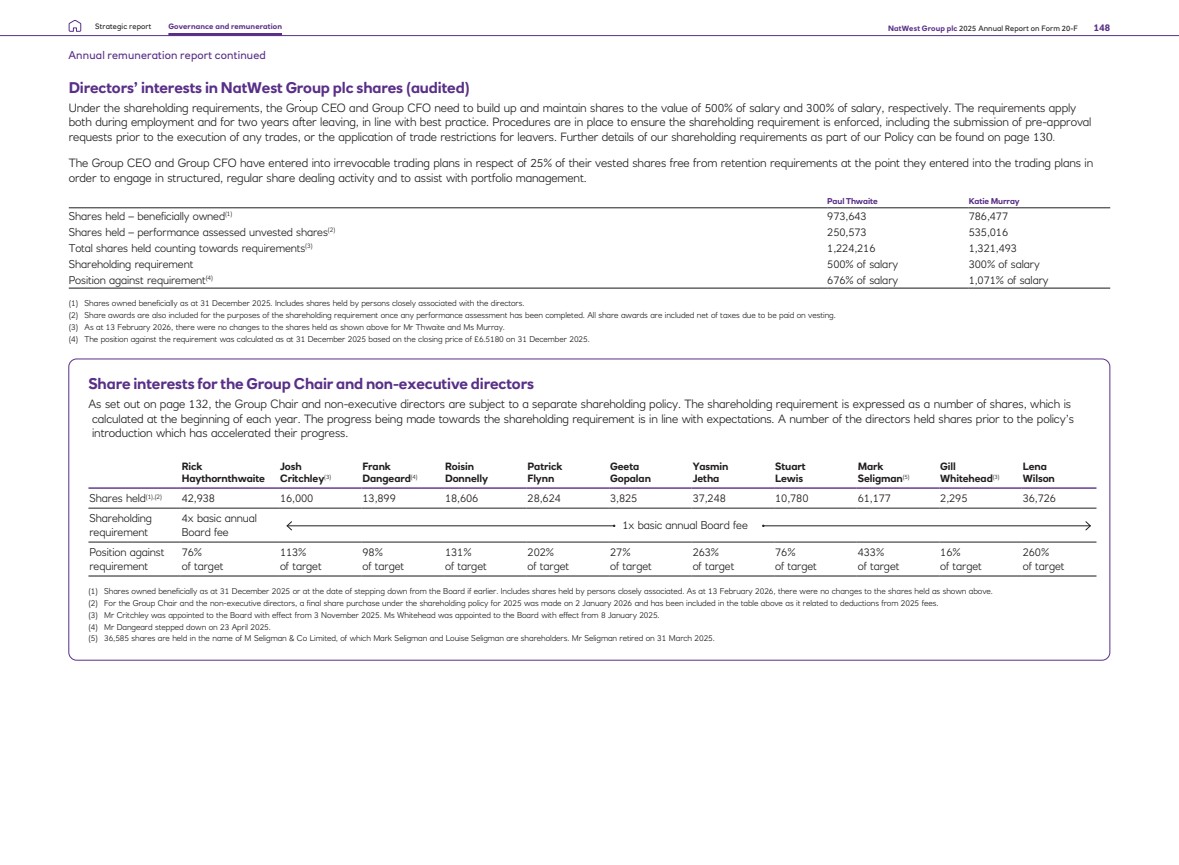
| Share interests for the Group Chair and non-executive directors As set out on page 149, the Group Chair and non-executive directors are subject to a separate shareholding policy. The shareholding requirement is expressed as a number of shares, which is calculated at the beginning of each year. The progress being made towards the shareholding requirement is in line with expectations. A number of the directors held shares prior to the policy’s introduction which has accelerated their progress. Directors’ interests in NatWest Group plc shares (audited) Under the shareholding requirements, the Group CEO and Group CFO need to build up and maintain shares to the value of 500% of salary and 300% of salary, respectively. The requirements apply both during employment and for two years after leaving, in line with best practice. Procedures are in place to ensure the shareholding requirement is enforced, including the submission of pre-approval requests prior to the execution of any trades, or the application of trade restrictions for leavers. Further details of our shareholding requirements as part of our Policy can be found on page 147. The Group CEO and Group CFO have entered into irrevocable trading plans in respect of 25% of their vested shares free from retention requirements at the point they entered into the trading plans in order to engage in structured, regular share dealing activity and to assist with portfolio management. Paul Thwaite Katie Murray Shares held – beneficially owned(1) 973,643 786,477 Shares held – performance assessed unvested shares(2) 250,573 535,016 Total shares held counting towards requirements(3) 1,224,216 1,321,493 Shareholding requirement 500% of salary 300% of salary Position against requirement(4) 676% of salary 1,071% of salary (1) Shares owned beneficially as at 31 December 2025. Includes shares held by persons closely associated with the directors. (2) Share awards are also included for the purposes of the shareholding requirement once any performance assessment has been completed. All share awards are included net of taxes due to be paid on vesting. (3) As at 13 February 2026, there were no changes to the shares held as shown above for Mr Thwaite and Ms Murray. (4) The position against the requirement was calculated as at 31 December 2025 based on the closing price of £6.5180 on 31 December 2025. Rick Haythornthwaite Josh Critchley(3) Frank Dangeard(4) Roisin Donnelly Patrick Flynn Geeta Gopalan Yasmin Jetha Stuart Lewis Mark Seligman(5) Gill Whitehead(3) Lena Wilson Shares held(1),(2) 42,938 16,000 13,899 18,606 28,624 3,825 37,248 10,780 61,177 2,295 36,726 Shareholding requirement 4x basic annual Board fee 1x basic annual Board fee Position against requirement 76% of target 113% of target 98% of target 131% of target 202% of target 27% of target 263% of target 76% of target 433% of target 16% of target 260% of target (1) Shares owned beneficially as at 31 December 2025 or at the date of stepping down from the Board if earlier. Includes shares held by persons closely associated. As at 13 February 2026, there were no changes to the shares held as shown above. (2) For the Group Chair and the non-executive directors, a final share purchase under the shareholding policy for 2025 was made on 2 January 2026 and has been included in the table above as it related to deductions from 2025 fees. (3) Mr Critchley was appointed to the Board with effect from 3 November 2025. Ms Whitehead was appointed to the Board with effect from 8 January 2025. (4) Mr Dangeard stepped down on 23 April 2025. (5) 36,585 shares are held in the name of M Seligman & Co Limited, of which Mark Seligman and Louise Seligman are shareholders. Mr Seligman retired on 31 March 2025. Annual remuneration report continued Strategic report Financial review Governance and remuneration Risk and capital management Financial statements Additional information NatWest Group plc 2025 Annual Report and Accounts 165 Share awards under share plans Year Awards held 1 Jan 2025 Awards granted Award price £(5) Full market value at grant £ Awards vested Awards lapsed Awards held 31-Dec-25 Expected vesting dates Paul Thwaite Deferred award(3) 2020 30,123 1.70 30,123 – LTI award 2021 192,524 1.67 1.87 48,131 144,393(1) 07.03.26(7) LTI award 2022 410,492 1.82 2.23 82,099 328,393(1) 07.03.26(7) RSP award 2023 425,074 2.21 2.92 425,074(2) 07.03.26 – 07.03.27(7) RSP award 2024 677,576 1.79 2.44 677,576(2) 07.03.27 – 07.03.31 RSP award 2025 451,682 3.79 4.73 451,682(2) 07.03.28 – 07.03.32 Annual bonus/Deferred award(4) 2025 97,215 4.58 4.73 97,215 – Sharing in Success award(6) 2025 264 4.83 264 – 1,735,789 549,161 257,832 2,027,118 Total LTI and RSP awards subject to service 472,786(1) Total LTI and RSP awards subject to performance and service 1,554,332(2) Year Awards held 1 Jan 2025 Awards granted Award price £(5) Full market value at grant £ Awards vested Awards lapsed Awards held 31-Dec-25 Expected vesting dates Katie Murray Deferred award(3) 2019 83,575 2.64 41,790 41,785(1) 07.03.26 LTI award 2020 387,939 1.70 129,313 258,626(1) 07.03.26 – 07.03.27 LTI award 2021 325,809 1.67 1.87 81,453 244,356(1) 07.03.26 – 07.03.28 LTI award 2022 580,885 1.82 2.23 116,177 464,708(1) 07.03.26 – 07.03.29 RSP award 2023 431,451 2.21 2.92 431,451(2) 07.03.26 – 07.03.30 RSP award 2024 653,915 1.79 2.44 653,915(2) 07.03.27 – 07.03.31 RSP award 2025 311,583 3.79 4.73 311,583(2) 07.03.28 – 07.03.32 Annual bonus/Deferred award(4) 2025 65,375 4.58 4.73 65,375 – Sharing in Success award(6) 2025 264 4.83 264 – 2,463,574 377,222 434,372 2,406,424 Total LTI and RSP awards subject to service 1,009,475(1) Total LTI and RSP awards subject to performance and service 1,396,949(2) (1) Performance assessments for these awards have taken place and awards remain subject to deferral and employment conditions before vesting. These awards count on a net-of-tax basis towards meeting the shareholding requirement. (2) Awards are subject to a pre-vest performance assessment along with deferral and employment conditions before vesting. (3) For Mr Thwaite, deferred awards for 2020 relate to annual bonus awards granted for performance prior to becoming an executive director, with payments deferred in line with regulatory requirements. Similarly, for Ms Murray the deferred award from 2019 relates to annual bonus awards granted for performance prior to becoming an executive director. (4) For annual bonus, shares were granted as an element of the up-front bonus; these were awarded and vested in 2025, in line with the Policy. (5) The award price shown from 2021 to 2025 is discounted to reflect the absence of the right to receive dividends or dividend equivalents during the vesting period, in line with agreed methodology for LTI and RSP awards at that time. For reference, the full market price of NatWest Group shares at the time of grant is also shown. (6) The Sharing in Success award was delivered in shares in May 2025 to all colleagues, including executive directors. Awards of shares worth £1,275 were made in respect of 2024 performance (adjusted for local salary levels). (7) The expected vesting dates for Mr Thwaite have been accelerated for awards relating to his roles prior to becoming an executive director in line with the UK regulatory remuneration requirements published in October 2025. Annual remuneration report continued Strategic report Strategic report Governance and remuneration Financial review Governance and remuneration Risk and capital management Financial statements Additional information NatWest Group plc NatWest Group plc 2025 Annual Report and Accounts 2025 Annual Report on Form 20-F 166 149 |
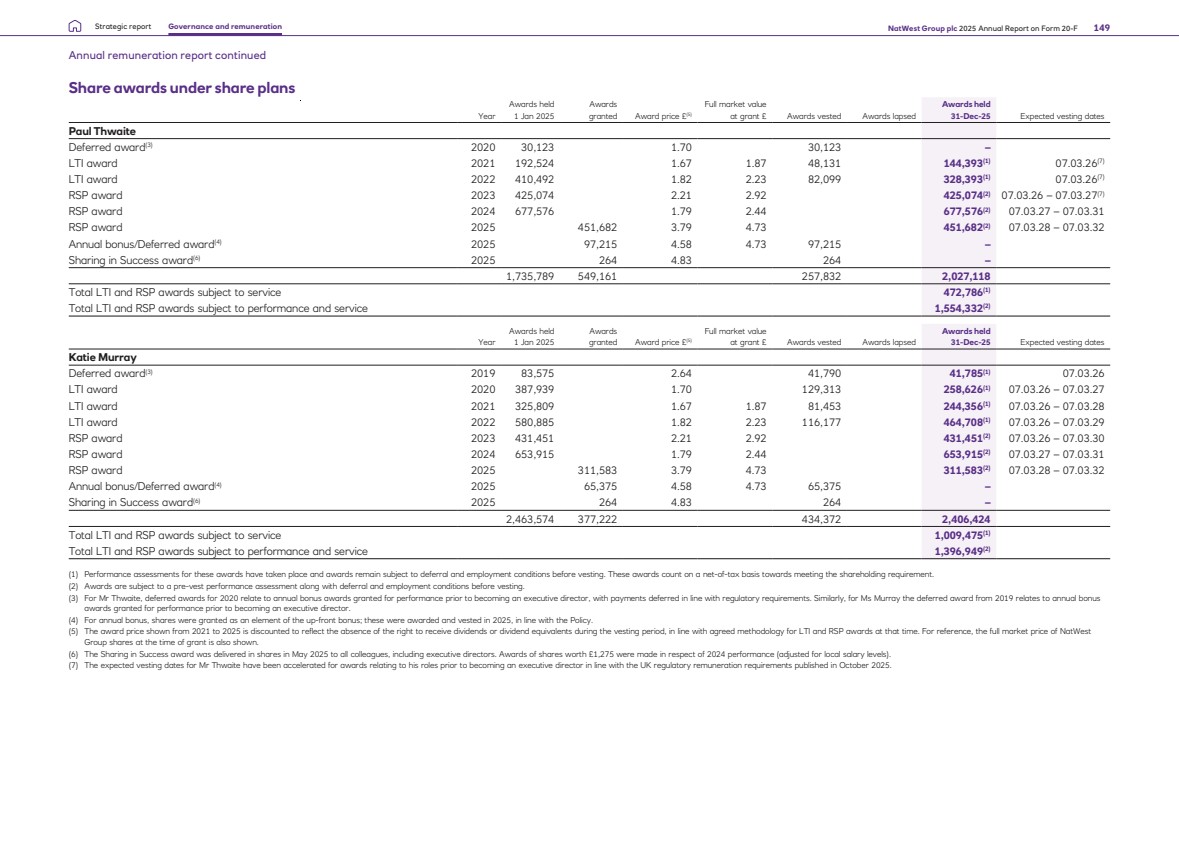
| Relative importance of spend on pay £m (% change on 2024) (1) Remuneration paid to all employees represents total staff expenses as per Note 3 to the consolidated financial statements, exclusive of social security and other staff costs. (2) Reflects distributions to shareholders through dividend payments during the financial year. The Board has confirmed its intention to pay a dividend of 23.0 pence per ordinary share in respect of financial year 2025, which will be paid in 2026 subject to approval by shareholders at the forthcoming NatWest Group plc AGM. (3) Reflects the purchase of ordinary shares under the share buyback programme. In 2025, 104 million ordinary shares purchased for a total consideration of £574 million (2024 – 175 million for a consideration of £454 million). Shareholder dilution and share sourcing NatWest Group can use new issue, market-purchase or treasury shares to deliver shares that are required for employee share plans. Best practice dilution limits are monitored and govern the number of shares that may be issued to satisfy share plan awards. Total Shareholder Return (TSR) performance The graph compares the TSR performance of NatWest Group with companies comprising the FTSE 100 Index over the last 10 years. We have selected this index because NatWest Group is a member of the FTSE 100 and it represents a cross-section of leading UK companies. CEO pay over the same period 2016 2017 2018 2019 2020 2021 2022 2023 2024 2025 Total remuneration (£000s)(1) PT 1,706 4,936 6,571 AR 1,401 2,615 3,588 5,249 1,452 RM 3,702 3,487 3,578 4,066 Annual bonus against maximum opportunity PT 54% 78% 85% AR 68% Long-term incentive vesting rates against maximum opportunity PT 45% 71% 100% AR 60% 82% 83% 78% RM 56% 89% 41% 78% (1) CEOs are Paul Thwaite (PT), Alison Rose (AR) and Ross McEwan (RM) with figures based on the single figure of remuneration for the relevant year. Statement of shareholder voting The resolutions to approve the Policy and the Annual remuneration report at the 2025 NatWest Group plc AGM received strong levels of support, as set out below. The resolution to authorise the NatWest Group plc 2024 employee share plan rules was approved at the 2024 NatWest Group plc AGM, and also received strong support, as detailed below. NatWest Group FTSE 100 0 50 100 150 200 250 300 350 2015 2016 2017 2018 2019 2020 2021 2022 2023 2024 2025 Directors’ remuneration policy Vote Number of shares Percentage For 24,668,869,124 97.86% Against 538,673,576 2.14% Withheld 9,701,904 – Annual remuneration report Vote Number of shares Percentage For 24,455,534,356 97.02% Against 752,180,000 2.98% Withheld 9,523,476 – Employee share plan rules Vote Number of shares Percentage For 28,966,778,080 98.99% Against 296,392,288 1.01% Withheld 3,877,800 – Annual remuneration report continued Distributions to shareholders by way of share buyback(3) 2025 Remuneration paid to all employees(1) 3,361 Distributions to holders of ordinary shares(2) 1,505 Distributions to holders of paid-in equity 454 283 Distributions to shareholders by way of share buyback(3) Remuneration paid to all employees(1) 3,435 (+2.20%) Distributions to holders of ordinary shares(2) 2,018 (+34.09%) Distributions to holders of paid-in equity 352 (+24.38%) 574 (+26.43%) 2024 Strategic report Strategic report Governance and remuneration Financial review Governance and remuneration Risk and capital management Financial statements Additional information NatWest Group plc NatWest Group plc 2025 Annual Report and Accounts 2025 Annual Report on Form 20-F 167 150 |
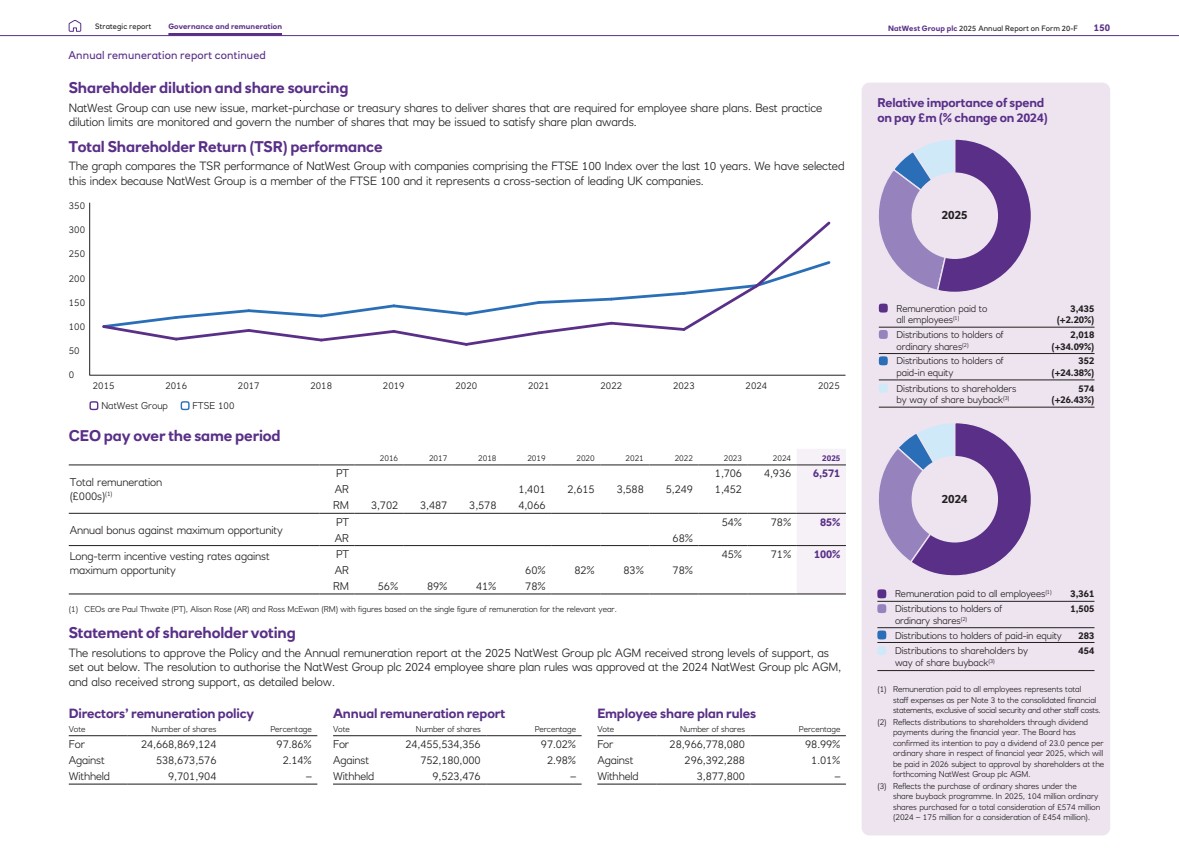
| Relative importance of spend on pay £m (% change on 2024) (1) Remuneration paid to all employees represents total staff expenses as per Note 3 to the consolidated financial statements, exclusive of social security and other staff costs. (2) Reflects distributions to shareholders through dividend payments during the financial year. The Board has confirmed its intention to pay a dividend of 23.0 pence per ordinary share in respect of financial year 2025, which will be paid in 2026 subject to approval by shareholders at the forthcoming NatWest Group plc AGM. (3) Reflects the purchase of ordinary shares under the share buyback programme. In 2025, 104 million ordinary shares purchased for a total consideration of £574 million (2024 – 175 million for a consideration of £454 million). Shareholder dilution and share sourcing NatWest Group can use new issue, market-purchase or treasury shares to deliver shares that are required for employee share plans. Best practice dilution limits are monitored and govern the number of shares that may be issued to satisfy share plan awards. Total Shareholder Return (TSR) performance The graph compares the TSR performance of NatWest Group with companies comprising the FTSE 100 Index over the last 10 years. We have selected this index because NatWest Group is a member of the FTSE 100 and it represents a cross-section of leading UK companies. CEO pay over the same period 2016 2017 2018 2019 2020 2021 2022 2023 2024 2025 Total remuneration (£000s)(1) PT 1,706 4,936 6,571 AR 1,401 2,615 3,588 5,249 1,452 RM 3,702 3,487 3,578 4,066 Annual bonus against maximum opportunity PT 54% 78% 85% AR 68% Long-term incentive vesting rates against maximum opportunity PT 45% 71% 100% AR 60% 82% 83% 78% RM 56% 89% 41% 78% (1) CEOs are Paul Thwaite (PT), Alison Rose (AR) and Ross McEwan (RM) with figures based on the single figure of remuneration for the relevant year. Statement of shareholder voting The resolutions to approve the Policy and the Annual remuneration report at the 2025 NatWest Group plc AGM received strong levels of support, as set out below. The resolution to authorise the NatWest Group plc 2024 employee share plan rules was approved at the 2024 NatWest Group plc AGM, and also received strong support, as detailed below. NatWest Group FTSE 100 0 50 100 150 200 250 300 350 20252024202320222021202020192018201720162015 Directors’ remuneration policy Vote Number of shares Percentage For 24,668,869,124 97.86% Against 538,673,576 2.14% Withheld 9,701,904 – Annual remuneration report Vote Number of shares Percentage For 24,455,534,356 97.02% Against 752,180,000 2.98% Withheld 9,523,476 – Employee share plan rules Vote Number of shares Percentage For 28,966,778,080 98.99% Against 296,392,288 1.01% Withheld 3,877,800 – Annual remuneration report continued Distributions to shareholders by way of share buyback(3) 2025 Remuneration paid to all employees(1) 3,361 Distributions to holders of ordinary shares(2) 1,505 Distributions to holders of paid-in equity 454 283 Distributions to shareholders by way of share buyback(3) Remuneration paid to all employees(1) 3,435 (+2.20%) Distributions to holders of ordinary shares(2) 2,018 (+34.09%) Distributions to holders of paid-in equity 352 (+24.38%) 574 (+26.43%) 2024 Strategic report Financial review Risk and capital management Financial statements Additional information Governance and remuneration NatWest Group plc 2025 Annual Report and Accounts 167 The Group Performance and Remuneration Committee overview Principal areas of focus of 2025 Jan Feb April Sept Dec Wider workforce Approving and overseeing the NatWest Group-wide remuneration policy. Considering how pay has been allocated across the workforce, including analysis by colleague level, geography and diversity. Reviewing fixed pay proposals. Approving Sharesave offers to colleagues. Reviewing Group-wide bonus pool methodology and assessments. Reviewing gender and ethnicity pay gap reporting. Approving the Sharing in Success outcome and measures and targets. Reviewing of the planned implementation of the regulatory remuneration reforms for PY 2025 and historical awards. Executive remuneration Reviewing performance assessments and remuneration arrangements for the committee’s ‘in-scope’ population. Setting performance objectives for senior executives. Approving remuneration for senior hires and arrangements for any leavers.(1) Reviewing stakeholder engagement approach, outreach and considerations. Reviewing and approving the Directors’ remuneration report. Reviewing benchmarking data on executive pay and peer practice. Reviewing and approving the directors’ remuneration policy. Governance and regulatory Approving the annual agenda planner and updates to the terms of reference. Considering matters escalated by other Board committees and subsidiary Performance and Remuneration Committees. Overseeing the MRT identification process. Receiving accountability review updates and approving accountability decisions for the population within its governance. The committee Chair also approves submissions made throughout the year to the UK regulators outside the formal meetings, as required. (1) Additional proposals related to the remuneration and exit arrangements of senior hires and leavers are reviewed by the committee throughout the year outside of the main meeting cycle. Annual remuneration report continued Conflicts of interest To mitigate potential conflicts of interest, no individuals are involved in decisions regarding their own remuneration. The Group Chief People Officer, who is responsible for the People function and executive compensation, may be present to support the committee when discussions take place on senior executive pay, but she is never present for discussions on her own remuneration. It is the committee, rather than management, that appoints the remuneration advisers. Committee advisers Korn Ferry (KF) were appointed by the committee as its remuneration adviser in March 2024 following a period of transition from our previous adviser. KF are signatories to the voluntary code of conduct in relation to remuneration consulting in the UK. KF provide executive/ professional search services alongside HR advisory services including assessment and organisational strategy services to NatWest Group subsidiaries. The committee is satisfied the advice received is independent and objective. There are no connections between KF and individual directors to be disclosed. Fees paid to KF for advising the committee are based primarily on a fixed fee structure with any additional items charged on a time/cost basis. Fees for 2025 in relation to directors’ remuneration amounted to £192,000 (2024 – £290,000) excluding VAT. Over the course of 2025, the committee also took account of the views of the Group Chair, Group CEO, Group CFO, Group Chief People Officer, Group Chief Operating Officer, Director of Reward & Employment, Group Chief Risk Officer, Group Chief Audit Executive and other support and control functions where appropriate and relevant. The committee also received input from the BRC, the GAC and the Performance and Remuneration Committees for the principal subsidiary legal entities across NatWest Group. Strategic report Financial review Risk and capital management Financial statements Additional information Strategic report Governance and remuneration Governance and remuneration NatWest Group plc NatWest Group plc 2025 Annual Report and Accounts 2025 Annual Report on Form 20-F 151 168 Membership Details of members and attendance is on page 123. Effectiveness review In accordance with the Code, an evaluation of the performance of the Board and its committees, including the Group Performance and Remuneration Committee, was conducted internally in 2025. Further information on the review can be found on pages 102 to 104. |
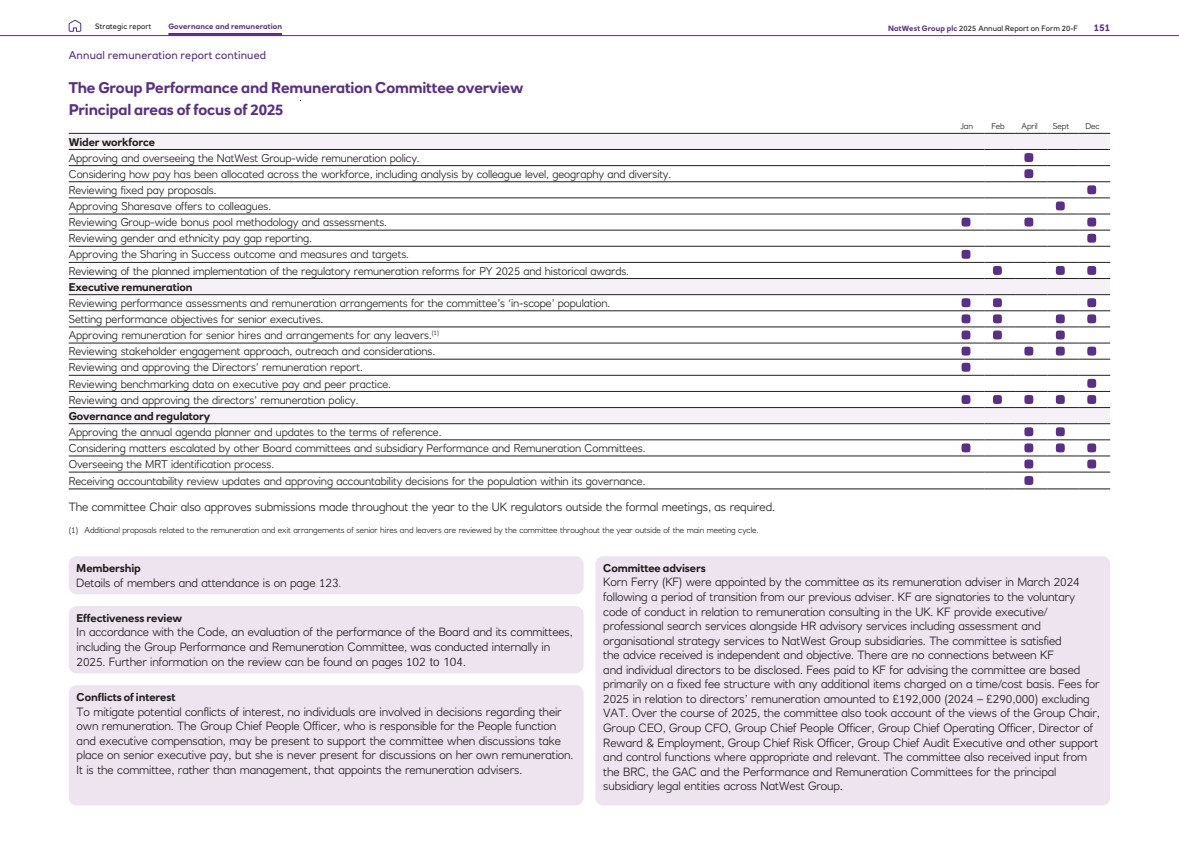
| Compliance report Statement of compliance NatWest Group plc is committed to high standards of corporate governance, business integrity and professionalism in all its activities. The Group Audit Committee complied with the requirements of the FRC’s Audit Committees and the External Audit: Minimum Standard and the Statutory Audit Services for Large Companies Market Investigation (Mandatory Use of Competitive Tender Processes and Audit Committee Responsibilities) Order 2014 for the year ended 31 December 2025. Under the US Sarbanes-Oxley Act of 2002, specific standards of corporate governance and business and financial disclosures and controls apply to companies with securities registered in the US. NatWest Group plc complies with all applicable sections of the US Sarbanes-Oxley Act of 2002, subject to a number of exceptions available to foreign private issuers. Internal control The Board of directors is accountable for the system of internal controls that is designed to maintain effective and efficient operations, compliant with applicable laws and regulations. • The strength of the control environment to manage risk exposure within appetite. • Adequacy and effectiveness of the day-to-day management of risks and controls. • Adherence with applicable components of the Enterprise-Wide Risk Management Framework (EWRMF). • A culture of Intelligent Risk Taking. The RCPA enables the Group to meet its legal and regulatory obligations with regards to the monitoring, assessment and reporting of its internal risk and control environment NatWest Group operates a three lines of defence model for the ownership, oversight and assurance of its risks and internal control environment. Management across the organisation are the first line of defence and, therefore, are the primary owners of the risk and are responsible for the design, implementation and maintenance of effective processes, procedures, and controls to manage the risks within risk appetite. The Risk function is the second line of defence which exercises oversight and challenge of the risk management activities undertaken by the first line of defence. The Internal Audit function, which is the third line of defence, undertakes independent and objective assurance activities on the governance, risk management and internal controls to manage risks to enable achievement of NatWest Group’s objectives and reports on the adequacy and effectiveness thereof to the Board and executive management. The effectiveness of NatWest Group’s risk management and internal control framework is reviewed regularly throughout the year by the Board, the Group Audit Committee, and the Group Board Risk Committee. The Group Board Risk Committee receives regular risk management reports ensuring ongoing oversight with the Chair of the Board Risk Committee providing a summary after every meeting to the Group Board of Directors of any matters requiring escalation. Internal and External Audit present reports to the Group Audit Committee that include details of any significant internal control deficiencies they may have identified as part of their audits. Progress in 2025 NatWest Group’s control environment remains robust, with notable enhancements delivered across financial crime, conduct, payments, technology, conduct, risk management framework and processes and remediation of known control issues. These enhancements have resulted in an improved control environment and enhanced operational resilience in 2025. In addition, NatWest Group has maintained its focus on cyber risk, data management, third-party risk management, operational resilience and technology (incl end-of-life systems) given increasing inherent risk impact of these themes on the overall operational risk profile. NatWest Group continuously seeks to enhance its controls through prioritised mitigating actions in response to the rapidly evolving risk landscape to sustain an effective control environment. Strategic report Financial review Risk and capital management Financial statements Additional information Strategic report Governance and remuneration Governance and remuneration NatWest Group plc NatWest Group plc 2025 Annual Report and Accounts 2025 Annual Report on Form 20-F 169 152 Executive management committees at NatWest Group level and each of its businesses also receive regular reports on risks facing their business and the effectiveness of internal controls in managing these risks. Details of NatWest Group’s approach to risk management are provided in the Risk and capital management section of the Annual Report on Form 20-F. The system of internal controls is designed to manage risk to an acceptable residual level rather than to eliminate it entirely. Systems of internal control provide reasonable and not absolute assurance against material misstatement, fraud, or any other loss arising from unforeseen events, human error, or deliberate misconduct. Ongoing robust processes are in place for the identification, evaluation and management of the principal risks faced by NatWest Group that operated throughout the period from 1 January 2025 to 12 February 2026, the date the directors approved the Annual Report on Form 20-F, These included the Risk and Control Performance Assessment (RCPA) through which the effectiveness of the risk and control environment is evaluated. This assessment is conducted annually by each business area within NatWest Group using a standardised set of indicators and providing qualitative context to determine an RCPA outcome of “met,” “partially met,” or “not met.” The indicators are used to inform an understanding of: Detailed information on how NatWest Group plc applied the Principles, and complied with the Provisions of the UK Corporate Governance Code (‘the Code’) can be found in the Corporate governance section of this report, including on page 87, which includes cross-references to relevant sections of the Strategic report and other related disclosures. A copy of the 2024 and 2018 versions of the Code can be found at frc.org.uk. |
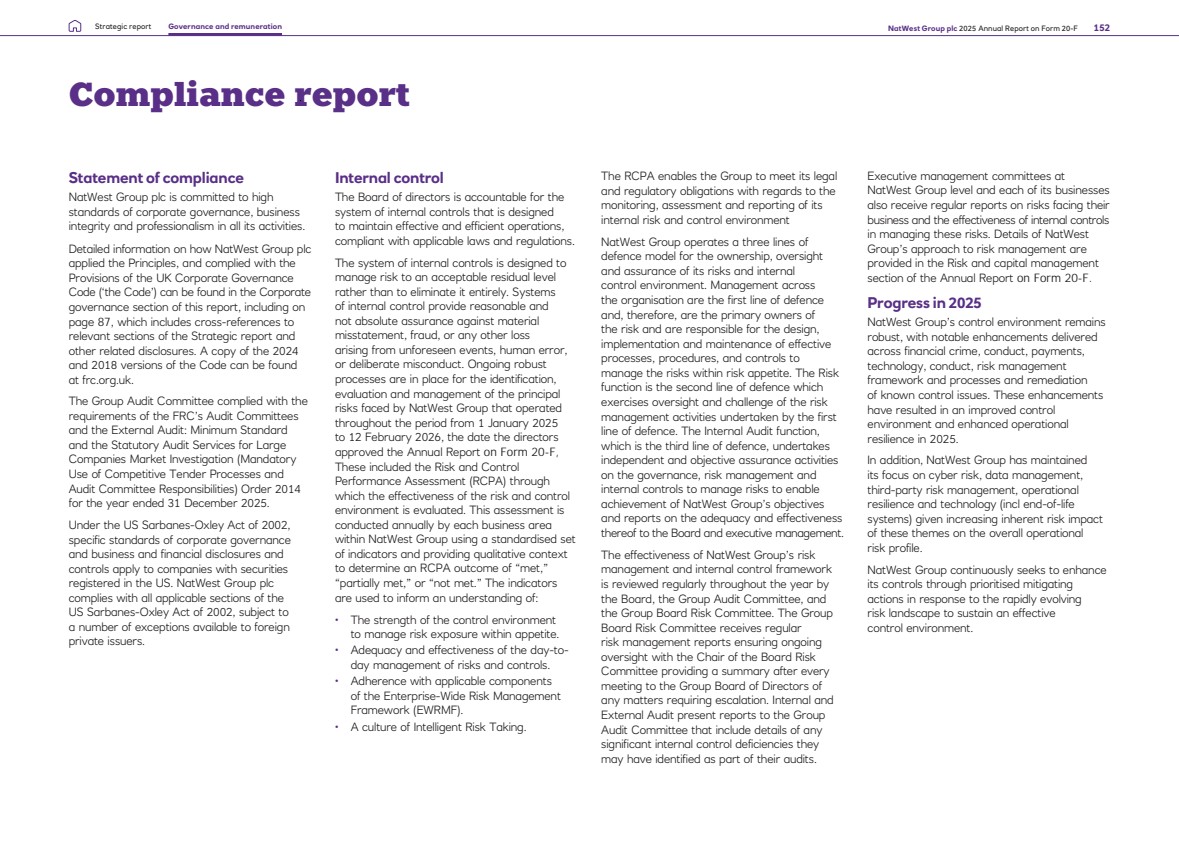
| Compliance report Statement of compliance NatWest Group plc is committed to high standards of corporate governance, business integrity and professionalism in all its activities. Detailed information on how NatWest Group plc applied the Principles, and complied with the Provisions of the UK Corporate Governance Code (‘the Code’) can be found in the Corporate governance section of this report, including on page 104, which includes cross-references to relevant sections of the Strategic report and other related disclosures. A copy of the 2024 and 2018 versions of the Code can be found at frc.org.uk. The Group Audit Committee complied with the requirements of the FRC’s Audit Committees and the External Audit: Minimum Standard and the Statutory Audit Services for Large Companies Market Investigation (Mandatory Use of Competitive Tender Processes and Audit Committee Responsibilities) Order 2014 for the year ended 31 December 2025. Under the US Sarbanes-Oxley Act of 2002, specific standards of corporate governance and business and financial disclosures and controls apply to companies with securities registered in the US. NatWest Group plc complies with all applicable sections of the US Sarbanes-Oxley Act of 2002, subject to a number of exceptions available to foreign private issuers. Internal control The Board of directors is accountable for the system of internal controls that is designed to maintain effective and efficient operations, compliant with applicable laws and regulations. The system of internal controls is designed to manage risk to an acceptable residual level rather than to eliminate it entirely. Systems of internal control provide reasonable and not absolute assurance against material misstatement, fraud, or any other loss arising from unforeseen events, human error, or deliberate misconduct. Ongoing robust processes are in place for the identification, evaluation and management of the principal risks faced by NatWest Group that operated throughout the period from 1 January 2025 to 12 February 2026, the date the directors approved the Annual Report and Accounts. These included the Risk and Control Performance Assessment (RCPA) through which the effectiveness of the risk and control environment is evaluated. This assessment is conducted annually by each business area within NatWest Group using a standardised set of indicators and providing qualitative context to determine an RCPA outcome of “met,” “partially met,” or “not met.” The indicators are used to inform an understanding of: • The strength of the control environment to manage risk exposure within appetite. • Adequacy and effectiveness of the day-to-day management of risks and controls. • Adherence with applicable components of the Enterprise-Wide Risk Management Framework (EWRMF). • A culture of Intelligent Risk Taking. The RCPA enables the Group to meet its legal and regulatory obligations with regards to the monitoring, assessment and reporting of its internal risk and control environment NatWest Group operates a three lines of defence model for the ownership, oversight and assurance of its risks and internal control environment. Management across the organisation are the first line of defence and, therefore, are the primary owners of the risk and are responsible for the design, implementation and maintenance of effective processes, procedures, and controls to manage the risks within risk appetite. The Risk function is the second line of defence which exercises oversight and challenge of the risk management activities undertaken by the first line of defence. The Internal Audit function, which is the third line of defence, undertakes independent and objective assurance activities on the governance, risk management and internal controls to manage risks to enable achievement of NatWest Group’s objectives and reports on the adequacy and effectiveness thereof to the Board and executive management. The effectiveness of NatWest Group’s risk management and internal control framework is reviewed regularly throughout the year by the Board, the Group Audit Committee, and the Group Board Risk Committee. The Group Board Risk Committee receives regular risk management reports ensuring ongoing oversight with the Chair of the Board Risk Committee providing a summary after every meeting to the Group Board of Directors of any matters requiring escalation. Internal and External Audit present reports to the Group Audit Committee that include details of any significant internal control deficiencies they may have identified as part of their audits. Executive management committees at NatWest Group level and each of its businesses also receive regular reports on risks facing their business and the effectiveness of internal controls in managing these risks. Details of NatWest Group’s approach to risk management are provided in the Risk and capital management section of the Annual Report and Accounts. Progress in 2025 NatWest Group’s control environment remains robust, with notable enhancements delivered across financial crime, conduct, payments, technology, conduct, risk management framework and processes and remediation of known control issues. These enhancements have resulted in an improved control environment and enhanced operational resilience in 2025. In addition, NatWest Group has maintained its focus on cyber risk, data management, third-party risk management, operational resilience and technology (incl end-of-life systems) given increasing inherent risk impact of these themes on the overall operational risk profile. NatWest Group continuously seeks to enhance its controls through prioritised mitigating actions in response to the rapidly evolving risk landscape to sustain an effective control environment. Strategic report Financial review Risk and capital management Financial statements Additional information Governance and remuneration NatWest Group plc 2025 Annual Report and Accounts 169 NatWest Group, as part of its robust risk culture, continued to make enhancements to its risk management processes to maintain an effective control environment. This has included refinements to the enhanced risk and control self assessments supported by an industry aligned risk directory, greater automation of risk processes, a focused suite of risk standards, operational guidance and risk toolkits, which provide a consistent approach to risk management and control requirements for each non- financial risk. The outcomes of the risk and control self- assessments provide insight into the adequacy and effectiveness of the control environment and the impact thereof on the residual risk exposures. They further support the initiation of actions to address control gaps and weaknesses and identify control rationalisation and automation opportunities. The outcomes of the risk and control self-assessments are used as input into risk profile reporting to the Board and senior management and assists in prioritisation of risk mitigation activities considering risk appetite. Key controls are regularly assessed for adequacy and tested for effectiveness. The results are monitored and, where a material change is identified, the associated risk is reassessed. To support management of the operational risk profile, the Operational Risk Executive Steering Group meets quarterly and this forum ensures all material operational risks are monitored and actions are in place to manage the risks within risk appetite. The remediation of known control issues through defined action plans continued to be an important focus for both the Group Audit Committee and the Board Risk Committee during 2025. For further information on their oversight of remediation of the most material issues, refer to the Report of the Group Audit Committee and the Report of the Group Board Risk Committee. The Group Audit Committee and the Group Board Risk Committee will continue to focus on such remediation activity, particularly in view of the business strategy and risk appetite. The independent auditors present reports to the Group Audit Committee that include details of any significant internal control deficiencies they have identified as part of their review of the financial reporting. In addition, quarterly review meetings are held between the senior executive and the independent auditors to help support oversight. Further, the system of internal controls is also subject to regulatory oversight in the UK and overseas. Additional details of regulatory oversight are given in the Risk and capital management section. Disclosure controls and procedures Changes in internal control There was no change in NatWest Group’s internal control over financial reporting that occurred during the period covered by this report that has materially affected, or is reasonably likely to materially affect, NatWest Group’s internal control over financial reporting. The New York Stock Exchange As a foreign private issuer with American Depositary Shares representing ordinary shares, preference shares and debt securities listed on the New York Stock Exchange (the NYSE), NatWest Group plc is not required to comply with all of the NYSE corporate governance standards applicable to US domestic companies (the NYSE Standards) provided that it follows home country practice in lieu of the NYSE Standards and discloses any significant ways in which its corporate governance practices differ from the NYSE Standards. NatWest Group plc is also required to provide an Annual Written Affirmation to the NYSE of its compliance with the mandatory applicable NYSE Standards. In February 2025 NatWest Group plc submitted its most recent Annual Written Affirmation to the NYSE which confirmed NatWest Group plc’s full compliance with the applicable provisions. Compliance report continued Strategic report Financial review Risk and capital management Financial statements Additional information Strategic report Governance and remuneration Governance and remuneration NatWest Group plc NatWest Group plc 2025 Annual Report and Accounts 2025 Annual Report on Form 20-F 170 153 Management's report on internal control over financial reporting Management is responsible for establishing and maintaining adequate internal control over financial reporting for NatWest Group. NatWest Group’s internal control over financial reporting is a component of an overall system of internal control and is designed to provide reasonable assurance regarding the preparation, reliability and fair presentation of financial statements in accordance with International Financial Reporting Standards (IFRS) and includes: a) Policies and procedures that relate to the maintenance of records that, in reasonable detail, fairly and accurately reflect the transactions and disposition of assets; b) Controls providing reasonable assurance that transactions are recorded as necessary to permit the preparation of financial statements in accordance with IFRS, and that receipts and expenditures are being made only as authorised by Management; and c) Controls providing reasonable assurance regarding the prevention or timely detection of unauthorised acquisition, use or disposition of assets that could have a material effect on the financial statements. Internal control over financial reporting may not prevent or detect misstatements due to it inherent limitations. In addition, projections of any evaluation of effectiveness to future periods are subject to the risk that controls may become inadequate because of changes in conditions or because the degree of compliance with policies or procedures may deteriorate. Management has assessed the effectiveness of its internal control over financial reporting as at 31 December 2025 based on the criteria set forth by the Committee of Sponsoring Organizations of the Treadway Commission in the 2013 publication of “Internal Control – Integrated Framework”. Based on its assessment, Management has concluded that, as at 31 December 2025, NatWest Group’s internal control over financial reporting is effective. The effectiveness of NatWest Group’s internal control over financial reporting as at 31 December 2025 has been audited by EY, NatWest Group’s independent registered public accounting firm. The report of the independent registered public accounting firm to the directors of NatWest Group expresses an unqualified opinion on NatWest Group’s internal control over financial reporting as at 31 December 2025. As required by Exchange Act rules, management (including the Group CEO and Group CFO) have conducted an evaluation of the effectiveness and design of NatWest Group’s disclosure controls and procedures (as defined in the Exchange Act rules) as of 31 December 2025. Based on this evaluation, management (including the Group CEO and Group CFO) concluded that NatWest Group plc’s disclosure controls and procedures were effective as of the end of the period covered by this Annual Report on Form 20-F The Group Audit Committee fully complies with the mandatory provisions of the NYSE Standards (including by reference to the rules of the Exchange Act) that relate to the composition, responsibilities and operation of audit committees. More detailed information about the Group Audit Committee and its work during 2025 is set out in the Group Audit Committee report on pages 107 to 112. |
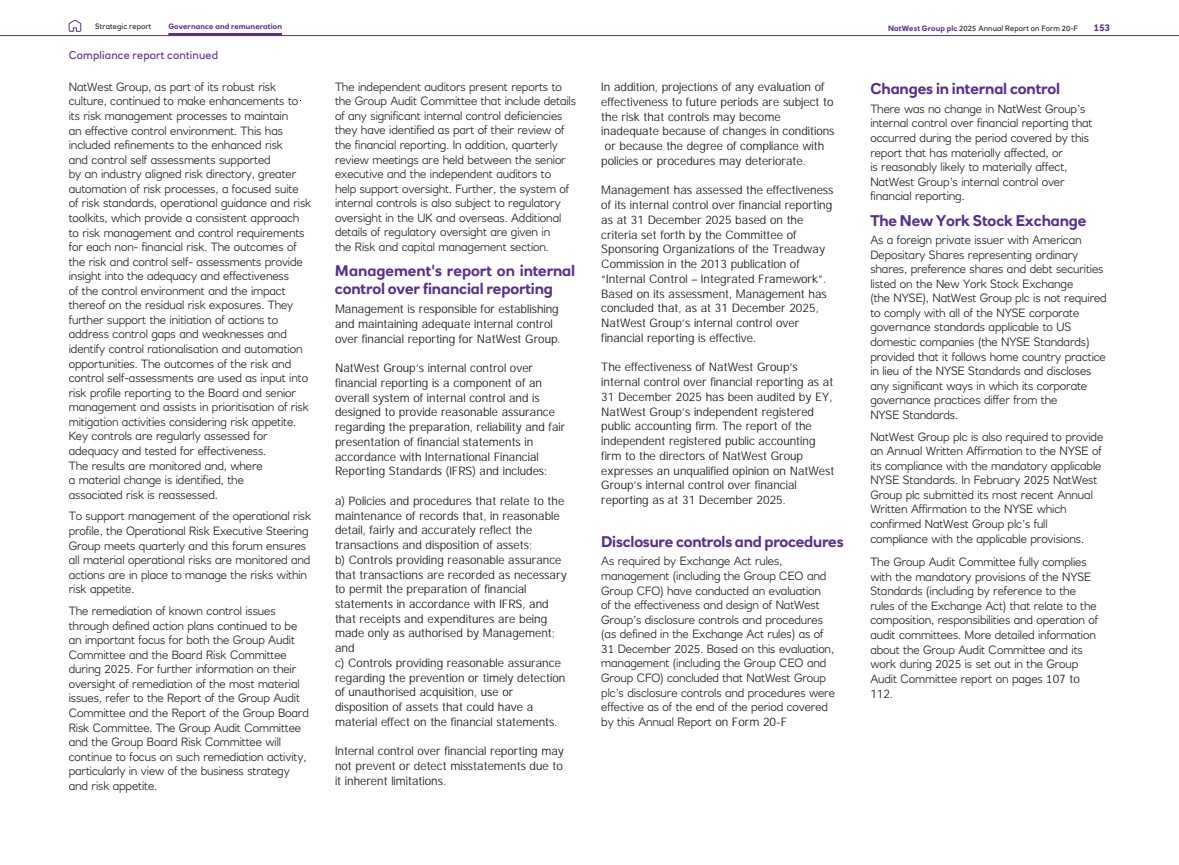
| iii. The NYSE Standards require that the nominating/corporate governance committee of a listed company be composed entirely of independent directors. The Chair of the Board is also the Chair of the Group Nominations and Governance Committee, which is permitted under the Code (which requires that a majority of members of the committee should be independent non-executive directors and that the chair of the board should not chair the committee when it is dealing with the appointment of their successor). The terms of reference of the Group Nominations and Governance Committee differ in certain limited respects from the requirements set out in the NYSE Standards, including because the Group Nominations and Governance Committee does not have responsibility for overseeing the evaluation of management. iv. The NYSE standards require that the compensation committee of a listed company be composed entirely of independent directors. Although the members of the Group Performance and Remuneration Committee (Group RemCo) are deemed independent in compliance with the provisions of the Code, the Board has not assessed the independence of the members of the Group RemCo and Group RemCo has not assessed the independence of any compensation consultant, legal counsel or other adviser, in each case, in accordance with the independence tests prescribed by the NYSE Standards. The NYSE Standards require that the compensation committee must have direct responsibility to review and approve the CEO’s remuneration. As stated at the start of this Compliance report, in the case of NatWest Group plc, the Board rather than the Group RemCo reserves the authority to make the final determination of the remuneration of the CEO. v. The NYSE Standards require listed companies to adopt and disclose corporate governance guidelines. Throughout the year ended 31 December 2025, NatWest Group plc has complied with all of the provisions of the Code (subject to the exceptions described above) and the Code does not require NatWest Group plc to disclose the full range of corporate governance guidelines with which it complies. This Compliance report forms part of the Corporate governance report and the Report of the directors. Compliance report continued Strategic report Financial review Risk and capital management Financial statements Additional information Strategic report Governance and remuneration Governance and remuneration NatWest Group plc NatWest Group plc 2025 Annual Report and Accounts 2025 Annual Report on Form 20-F 171 154 The Board has reviewed its corporate governance arrangements and is satisfied that these are consistent with the NYSE Standards, subject to the following departures: i. NYSE Standards require the majority of the Board to be independent. The NYSE Standards contain different tests from the Code for determining whether a director is independent. NatWest Group plc follows the Code’s requirements in determining the independence of its directors and currently has eight independent non-executive directors, one of whom is the Senior Independent Director. ii. The NYSE Standards require non management directors to hold regular sessions without management present, and that independent directors meet at least once a year. The Code requires the Chair to hold meetings with non- executive directors without the executives present and non-executive directors are to meet without the Chair present at least once a year to appraise the Chair’s performance and NatWest Group plc complies with the requirements of the Code. vi. The NYSE Standards require listed companies to adopt and disclose a code of business conduct and ethics for directors, officers and employees, and promptly disclose any waivers of the code for directors or executive officers. NatWest Group has adopted a code of conduct which is supplemented by a number of key policies and guidance dealing with matters including, among others, anti-bribery and corruption, anti-money laundering, sanctions, confidentiality, inside information, health, safety and environment, conflicts of interest, market conduct and management records. This code of conduct applies to all officers and employees and is fully aligned to the PRA and FCA Conduct Rules which apply to all directors. The Code of Conduct is available to view on NatWest Group’s website. |
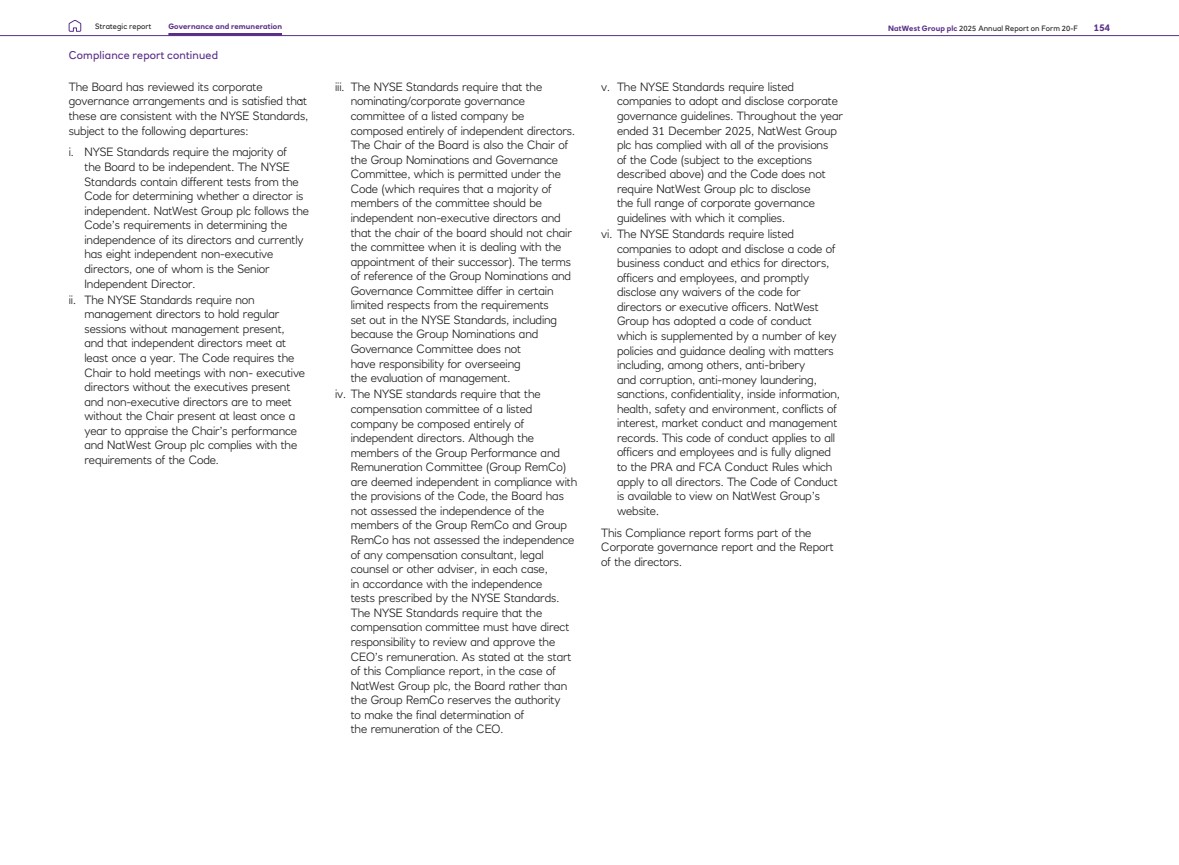
| iii. The NYSE Standards require that the nominating/corporate governance committee of a listed company be composed entirely of independent directors. The Chair of the Board is also the Chair of the Group Nominations and Governance Committee, which is permitted under the Code (which requires that a majority of members of the committee should be independent non-executive directors and that the chair of the board should not chair the committee when it is dealing with the appointment of their successor). The terms of reference of the Group Nominations and Governance Committee differ in certain limited respects from the requirements set out in the NYSE Standards, including because the Group Nominations and Governance Committee does not have responsibility for overseeing the evaluation of management. iv. The NYSE standards require that the compensation committee of a listed company be composed entirely of independent directors. Although the members of the Group Performance and Remuneration Committee (Group RemCo) are deemed independent in compliance with the provisions of the Code, the Board has not assessed the independence of the members of the Group RemCo and Group RemCo has not assessed the independence of any compensation consultant, legal counsel or other adviser, in each case, in accordance with the independence tests prescribed by the NYSE Standards. The NYSE Standards require that the compensation committee must have direct responsibility to review and approve the CEO’s remuneration. As stated at the start of this Compliance report, in the case of NatWest Group plc, the Board rather than the Group RemCo reserves the authority to make the final determination of the remuneration of the CEO. v. The NYSE Standards require listed companies to adopt and disclose corporate governance guidelines. Throughout the year ended 31 December 2025, NatWest Group plc has complied with all of the provisions of the Code (subject to the exceptions described above) and the Code does not require NatWest Group plc to disclose the full range of corporate governance guidelines with which it complies. vi. The NYSE Standards require listed companies to adopt and disclose a code of business conduct and ethics for directors, officers and employees, and promptly disclose any waivers of the code for directors or executive officers. NatWest Group has adopted a code of conduct which is supplemented by a number of key policies and guidance dealing with matters including, among others, anti-bribery and corruption, anti-money laundering, sanctions, confidentiality, inside information, health, safety and environment, conflicts of interest, market conduct and management records. This code of conduct applies to all officers and employees and is fully aligned to the PRA and FCA Conduct Rules which apply to all directors. The Code of Conduct is available to view on NatWest Group’s website at natwestgroup.com. This Compliance report forms part of the Corporate governance report and the Report of the directors. Compliance report continued Strategic report Financial review Risk and capital management Financial statements Additional information Governance and remuneration NatWest Group plc 2025 Annual Report and Accounts 171 Report of the directors The directors present their report together with the audited accounts for the year ended 31 December 2025. For the purposes of DTR 4.1.5 R, the Strategic report and the Report of the directors comprise the management report. Other information incorporated into this report by reference can be found at: Note/page Disclosures required pursuant to Large and Medium-sized Companies and Groups (Accounts and Reports) Regulations 2008 (as amended) (‘2008 Regs’) (Sch 7) and DTR 4.1.11 R can be found at: Note/page Likely future developments (2008 Regs, Sch 7 para 7 (1)(b) and DTR 4.1.11 R(2)) 15 Climate-related financial disclosures (2008 Regs, Sch 7 para 15-19) 69 Financial instruments (2008 Regs, Sch 7 para 6 and DTR 4.1.11 R(6)(a) and (b) Hedge accounting policy (2008 Regs, Sch 7 para 6 and DTR 4.1.11 R (6)(a) and (b) Post balance sheet events (2008 Regs, Sch 7 para 7 (1)(a) and DTR 4.1.11 R(1) Employee engagement (2008 Regs, Sch 7 para 11 and 11A): Section 172(1) statement and stakeholder engagement 36 Corporate governance report and workforce engagement Engagement with suppliers, customers and others (2008 Regs, Sch 7, para 11B): Section 172(1) statement and stakeholder engagement 37 Corporate governance report and stakeholder engagement Pursuant to paragraph 13(2)(k) of Schedule 7 to the 2008 Regs, there are no agreements between NatWest Group’s directors or employees providing compensation for loss of office or employment that occur because of a takeover bid. Activities Group structure NatWest Group plc is the parent of NatWest Group and its subsidiary undertakings are structured in compliance with ring-fencing requirements. There are three main subsidiaries: • NatWest Holdings Limited (the parent of the ring-fenced bank which includes National Westminster Bank Plc, The Royal Bank of Scotland plc and Ulydien Designated Activity Company). • NatWest Markets Plc (the non-ring-fenced Bank and the parent of NatWest Markets N.V.). • The Royal Bank of Scotland International (Holdings) Limited (the parent of The Royal Bank of Scotland International Limited). Strategic report Financial review Risk and capital management Financial statements Additional information Governance and remuneration NatWest Group plc 2025 Annual Report and Accounts 172 Strategic report Governance and remuneration NatWest Group plc 2025 Annual Report on Form 20-F 155 Section 172(1) statement 36 Corporate governance report 78 Board of directors and secretary 79 Remuneration policy, including 129 directors’ remuneration policy Our colleagues 130 Consolidated financial statements Capital, liquidity and funding and notes Risk factors Material contracts Indication of branches (2008 Regs, Sch 7 para 7(1)(d) and DTR 4.1.11 R(5)) 101 Colleagues 130 100 95 of the Annual Report on Form 20-F 150 of the Annual Report on Form 20-F 298 of the Annual Report on Form 20-F NatWest Group is a UK-focused banking organisation, serving over 20 million customers, with business operations reaching across retail, commercial and private banking markets. Details of the organisational structure and a business overview of NatWest Group are contained in the Business review. This includes details of the products and services provided by each of our operating areas and the markets where they operate. Details of the strategy for delivering the company’s objectives can be found in the Strategic report. 272 of the Annual Report on Form 20-F 198 of the Annual Report on Form 20-F 252 of the Annual Report on Form 20-F 300 of the Annual Report on Form 20-F 171 of the Annual Report on Form 20-F |
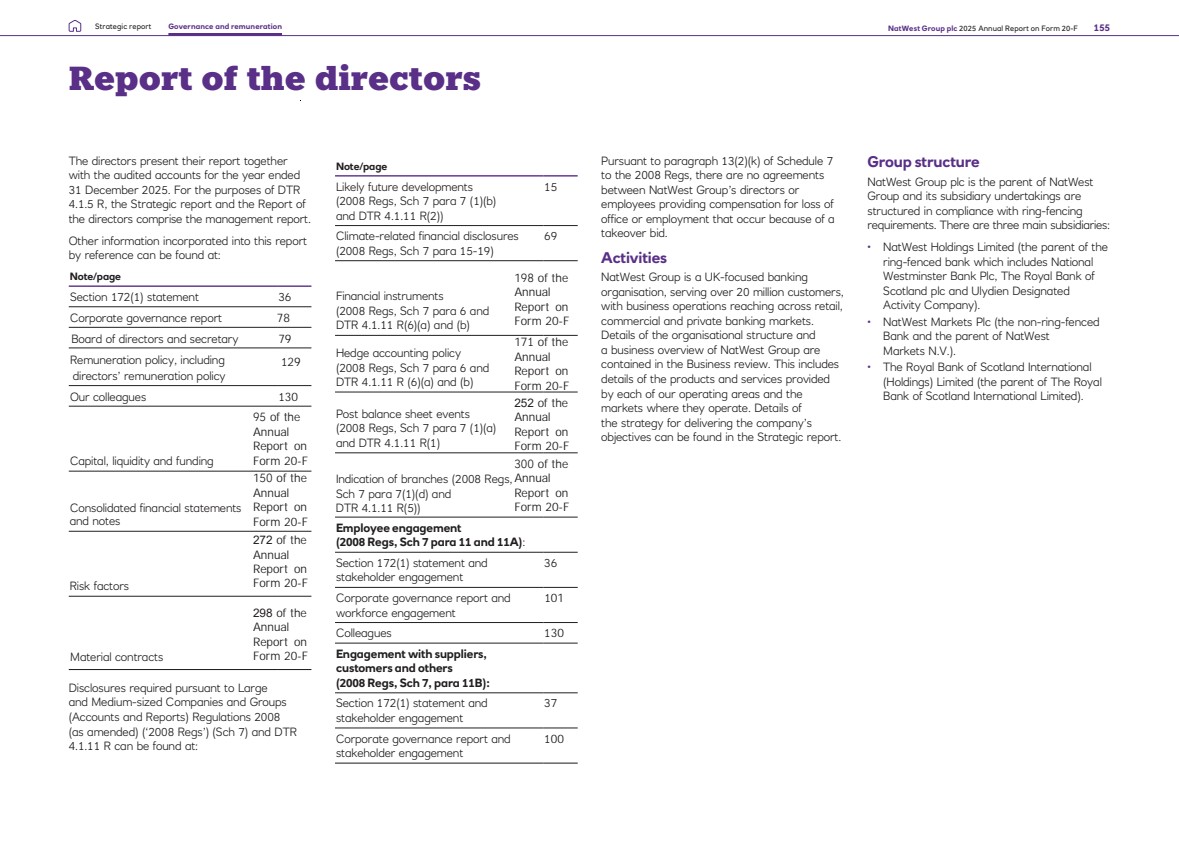
| Results and dividends UK company law states that dividends can only be paid if a company has sufficient distributable profits available to cover the dividend. A company’s distributable profits are classed as its accumulated, realised profits (not previously distributed or capitalised), less its accumulated, realised losses (not previously written off in a reduction or re-organisation of capital). In 2025 NatWest Group paid an interim dividend of £768 million, or 9.5 pence per ordinary share (2024 – £498 million, or 6 pence per ordinary share). The company has announced that the directors have recommended a final dividend of £1.8 billion, or 23.0 pence per ordinary share (2024 – £1.2 billion, or 15.5 pence per ordinary share). The final dividend recommended by directors is subject to shareholders’ approval at the Annual General Meeting (AGM) on 28 April 2026. If approved, payment will be made on 5 May 2026 to shareholders on the register at the close of business on 20 March 2026. The ex-dividend date will be 19 March 2026. Subject to the condition mentioned above, the payment of interim dividends on ordinary shares is at the discretion of the Board. Dividend waivers The employee share trusts, which hold shares NatWest Group in respect of the awards and options granted to colleagues, have lodged standing instructions to waive dividends on shares held by them. A waiver instruction is also in place in respect of dividends on own shares held in treasury. The total amount of dividends waived during 2025 was £64 million. Colleagues As at 31 December 2025, NatWest Group employed 59,000 people (excluding temporary staff). Details of all related costs are included in Note 3 to the consolidated accounts. Employment of disabled colleagues and colleagues with long-term conditions NatWest Group makes workplace adjustments to support colleagues with disabilities and long-term conditions to succeed. If a colleague develops a disability or long-term condition, NatWest Group will, wherever possible, make adjustments to support them in their existing job or re-deploy them to a more suitable alternative job. The NatWest Group Careers site gives comprehensive insights into NatWest Group jobs, culture, locations and application processes. It also hosts a variety of blog content to portray stories of what it is like to work at NatWest Group. The company also makes sure that candidates can easily request reasonable adjustments to support at any stage of the recruitment process. Going concern The directors have prepared the financial statements on a going concern basis after assessing the principal risks, forecasts, projections and other relevant evidence over the twelve months from the date the financial statements are approved. Report of the directors continued HM Treasury (HMT) shareholding Following placing and open offers in December 2008 and in April 2009, HMT owned approximately 70.3% of the enlarged ordinary share capital of the company. In December 2009, the company issued a further £25.5 billion of new capital to HMT in the form of B shares. The table below summarises the changes in HMT’s shareholding in the company from 2015 to 2025: Date Transaction August 2015 HMT sold 630 million ordinary shares in the company October 2015 HMT converted its holding of 51 billion B shares into 5.1 billion new ordinary shares in the company June 2018 HMT sold 925 million ordinary shares in the company March 2021 NatWest Group carried out an off-market purchase of 591 million of its ordinary shares from HMT May 2021 HMT sold 580 million ordinary shares in the company through an accelerated book building process to institutional investors July 2021 HMT announced its intention to sell part of its shareholding in NatWest Group over a 12-month period via a trading plan March 2022 NatWest Group carried out an off-market purchase of 550 million of its ordinary shares from HMT June 2022 HMT announced an extension to its trading plan for a further 12-month term to August 2023 April 2023 HMT announced an extension to its trading plan to terminate no later than 11 August 2025 May 2023 NatWest Group carried out an off-market purchase of 469 million of its ordinary shares from HMT May 2024 NatWest Group carried out an off-market purchase of 392 million of its ordinary shares from HMT November 2024 NatWest Group carried out an off-market purchase of 263 million of its ordinary shares from HMT January – May 2025 HMT’s shareholding in the company reduced from 9.99% at 31 December 2024 to 0% at 30 May 2025 as a result of sales of ordinary shares in the company under its trading plan Strategic report Financial review Risk and capital management Financial statements Additional information Governance and remuneration NatWest Group plc 2025 Annual Report and Accounts 173 Strategic report Governance and remuneration NatWest Group plc 2025 Annual Report on Form 20-F 156 This section also describes NatWest Group’s funding and liquidity profile, including changes in key metrics and the build up of liquidity reserves. NatWest Group’s business activities and financial position, the factors likely to affect its future development and performance and its objectives and policies in managing the financial risks to which it is exposed and its capital are discussed in the Business review. The risk factors which could materially affect NatWest Group’s future results are set out on Form 20-F. NatWest Group’s regulatory capital resources and significant developments in 2025 and anticipated future developments are detailed in The profit attributable to the ordinary shareholders of NatWest Group plc for the year ended 31 December 2025 was £5,479 million compared with a profit of £4,519 million for the year the Annual Report on Form 20-F. pages 269 to 289 of the Annual Report on the Capital, liquidity and funding section on 92 to 116 of the Annual Report on Form 20-F. ended 31 December 2024, as set out in the consolidated income statement on page 152 of |
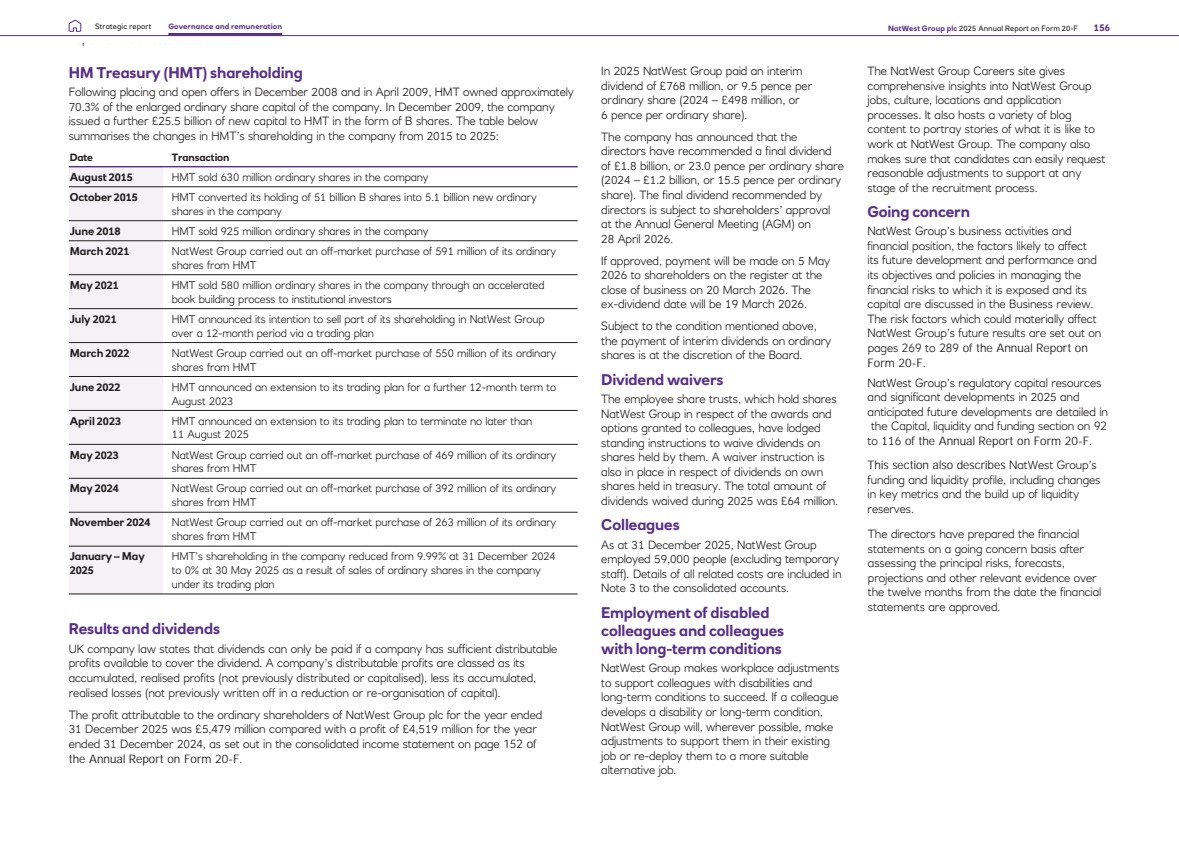
| Results and dividends UK company law states that dividends can only be paid if a company has sufficient distributable profits available to cover the dividend. A company’s distributable profits are classed as its accumulated, realised profits (not previously distributed or capitalised), less its accumulated, realised losses (not previously written off in a reduction or re-organisation of capital). The profit attributable to the ordinary shareholders of NatWest Group plc for the year ended 31 December 2025 was £5,479 million compared with a profit of £4,519 million for the year ended 31 December 2024, as set out in the consolidated income statement on page 289. In 2025 NatWest Group paid an interim dividend of £768 million, or 9.5 pence per ordinary share (2024 – £498 million, or 6 pence per ordinary share). The company has announced that the directors have recommended a final dividend of £1.8 billion, or 23.0 pence per ordinary share (2024 – £1.2 billion, or 15.5 pence per ordinary share). The final dividend recommended by directors is subject to shareholders’ approval at the Annual General Meeting (AGM) on 28 April 2026. If approved, payment will be made on 5 May 2026 to shareholders on the register at the close of business on 20 March 2026. The ex-dividend date will be 19 March 2026. Subject to the condition mentioned above, the payment of interim dividends on ordinary shares is at the discretion of the Board. Dividend waivers The employee share trusts, which hold shares NatWest Group in respect of the awards and options granted to colleagues, have lodged standing instructions to waive dividends on shares held by them. A waiver instruction is also in place in respect of dividends on own shares held in treasury. The total amount of dividends waived during 2025 was £64 million. Colleagues As at 31 December 2025, NatWest Group employed 59,000 people (excluding temporary staff). Details of all related costs are included in Note 3 to the consolidated accounts. Employment of disabled colleagues and colleagues with long-term conditions NatWest Group makes workplace adjustments to support colleagues with disabilities and long-term conditions to succeed. If a colleague develops a disability or long-term condition, NatWest Group will, wherever possible, make adjustments to support them in their existing job or re-deploy them to a more suitable alternative job. The NatWest Group Careers site gives comprehensive insights into NatWest Group jobs, culture, locations and application processes. It also hosts a variety of blog content to portray stories of what it is like to work at NatWest Group. The company also makes sure that candidates can easily request reasonable adjustments to support at any stage of the recruitment process. Going concern NatWest Group’s business activities and financial position, the factors likely to affect its future development and performance and its objectives and policies in managing the financial risks to which it is exposed and its capital are discussed in the Business review. The risk factors which could materially affect NatWest Group’s future results are set out on pages 402 to 421. NatWest Group’s regulatory capital resources and significant developments in 2025 and anticipated future developments are detailed in the Capital, liquidity and funding section on pages 234 to 253. This section also describes NatWest Group’s funding and liquidity profile, including changes in key metrics and the build up of liquidity reserves. The directors have prepared the financial statements on a going concern basis after assessing the principal risks, forecasts, projections and other relevant evidence over the twelve months from the date the financial statements are approved. Report of the directors continued HM Treasury (HMT) shareholding Following placing and open offers in December 2008 and in April 2009, HMT owned approximately 70.3% of the enlarged ordinary share capital of the company. In December 2009, the company issued a further £25.5 billion of new capital to HMT in the form of B shares. The table below summarises the changes in HMT’s shareholding in the company from 2015 to 2025: Date Transaction August 2015 HMT sold 630 million ordinary shares in the company October 2015 HMT converted its holding of 51 billion B shares into 5.1 billion new ordinary shares in the company June 2018 HMT sold 925 million ordinary shares in the company March 2021 NatWest Group carried out an off-market purchase of 591 million of its ordinary shares from HMT May 2021 HMT sold 580 million ordinary shares in the company through an accelerated book building process to institutional investors July 2021 HMT announced its intention to sell part of its shareholding in NatWest Group over a 12-month period via a trading plan March 2022 NatWest Group carried out an off-market purchase of 550 million of its ordinary shares from HMT June 2022 HMT announced an extension to its trading plan for a further 12-month term to August 2023 April 2023 HMT announced an extension to its trading plan to terminate no later than 11 August 2025 May 2023 NatWest Group carried out an off-market purchase of 469 million of its ordinary shares from HMT May 2024 NatWest Group carried out an off-market purchase of 392 million of its ordinary shares from HMT November 2024 NatWest Group carried out an off-market purchase of 263 million of its ordinary shares from HMT January – May 2025 HMT’s shareholding in the company reduced from 9.99% at 31 December 2024 to 0% at 30 May 2025 as a result of sales of ordinary shares in the company under its trading plan Strategic report Financial review Risk and capital management Financial statements Additional information Governance and remuneration NatWest Group plc 2025 Annual Report and Accounts 173 UK Code for Financial Reporting Disclosure NatWest Group plc’s 2025 financial statements have been prepared in compliance with the principles set out in the Code for Financial Reporting Disclosure published by UK Finance. The Code sets out five disclosure principles together with supporting guidance. The principles are that NatWest Group and other major UK banks will provide high quality, meaningful and decision-useful disclosures; review and enhance their financial instrument disclosures for key areas of interest to market participants; assess the applicability and relevance of good practice recommendations to their disclosures, acknowledging the importance of such guidance; seek to enhance the comparability of financial statement disclosures across the UK banking sector; and clearly differentiate in their annual reports between information that is audited and information that is unaudited. Enhanced Disclosure Task Force (EDTF) and Disclosures on Expected Credit Losses (DECL) Taskforce recommendations The EDTF, established by the Financial Stability Board, published its report ‘Enhancing the Risk Disclosures of Banks’ in October 2012, with an update in November 2015 covering IFRS 9 expected credit losses (ECL). The DECL Taskforce, jointly established by the Financial Conduct Authority, Financial Reporting Council and the Prudential Regulation Authority, published its phase 2 report recommendations in December 2019. Authority to repurchase shares On-market purchases At the AGM in 2025, shareholders renewed the authority (2025 Authority) for the company to make on-market purchases of up to 807,750,182 ordinary shares. The directors used the 2025 Authority to carry out a share buyback programme (the 2025 Programme) of up to £750 million, as announced to the market on 28 July 2025. The 2025 Programme started on 28 July 2025 and will end no later than 13 February 2026, provided that the term of the 2025 Programme may be extended to end no later than 13 March 2026 to account for any days where usual trading has not been possible because of market events during the term of the 2025 Programme. As at 31 December 2025, 104,103,117 ordinary shares (nominal value £112,111,049) have been purchased by the company under the 2025 Programme at a volume weighted average price of 551.8173 pence per ordinary share for a total consideration of £574,458,965. All of the purchased ordinary shares were cancelled, representing 1.27% of the company’s issued ordinary share capital. Shareholders will be asked to renew the authority for the company to make on-market purchases or ordinary shares at the AGM in 2026. Off-market purchases A Directed Buyback Contract between the Company and HMT was approved by the shareholders of the Company at a General Meeting on 6 February 2019. Amendments to the Directed Buyback Contract were approved by the shareholders at a General Meeting on 25 August 2022 and at the 2024 AGM. The authority from shareholders to make off-market purchases of ordinary shares from HMT (or its nominee) under the terms of the Directed Buyback Contract was renewed at the 2025 AGM. The company did not make any off-market purchases under this authority in 2025. Preference shares At the AGM in 2025, shareholders renewed the authority for the company to make an off-market purchase of its preference shares. Shareholders will be asked to renew the authority at the AGM in 2026. Additional information Where not provided elsewhere in the Report of the directors, the following additional information is required to be disclosed by Part 6 of Schedule 7 to the Large and Medium-sized Companies and Groups (Accounts and Reports) Regulations 2008. Share Capital The rules governing the powers of directors and their appointment, including in relation to issuing or buying back shares, are set out in our Articles of Association. It will be proposed at the 2026 AGM that the directors’ authorities to allot shares under the Companies Act 2006 (the Companies Act) be renewed. Details of the movements in ordinary shares during the year can be found at Note 21 to the consolidated financial statements. At the 2024 AGM, shareholders gave authority to directors to offer a scrip dividend alternative on any dividend paid up to the conclusion of the AGM in 2027. The Articles of Association may only be amended by a special resolution at a General Meeting of shareholders. Voting The cumulative preference shares represent 0.006% of the total voting rights of the company, the remainder being represented by the ordinary shares. In a show of hands at a General Meeting of the company, every holder of ordinary shares and cumulative preference shares who is present in person or by proxy and entitled to vote, shall have one vote. On a poll, every holder of ordinary shares who is present in person or by proxy and entitled to vote shall have four votes for every share held. Every holder of cumulative preference shares shall have one vote for each 25p nominal amount held. The notices of Annual General Meetings and General Meetings specify the deadlines for exercising voting rights and appointing a proxy or proxies to vote in relation to resolutions to be passed at the meeting. Transfers There are no restrictions on the transfer of ordinary shares in the company other than certain restrictions which may from time to time be imposed by laws and regulations (for example, insider trading laws). The company is not aware of any agreements between shareholders that may result in restrictions on the transfer of securities and/or voting rights. Pursuant to the UK Listing Rules, certain employees of the company require the approval of the company to deal in the company’s shares. Special rights There are no persons holding securities carrying special rights with regard to control of the company. Employee Share Plans A number of the company’s employee share plans include restrictions on transfers of shares while shares are subject to the plans. Note 3 to the consolidated financial statements sets out a summary of the plans. Report of the directors continued Strategic report Financial review Risk and capital management Financial statements Additional information Governance and remuneration NatWest Group plc 2025 Annual Report and Accounts 174 Strategic report Governance and remuneration NatWest Group plc 2025 Annual Report on Form 20-F 157 The company has ordinary shares and preference shares in issue. The rights and obligations attached to the company’s ordinary shares and preference shares are set out in our Articles of Association. Copies can be obtained from Companies House in the UK or can be found on the NatWest Group website. NatWest Group plc’s 2025 Annual Report on Form 20-F reflect EDTF and have regard to DECL Taskforce recommendations. |
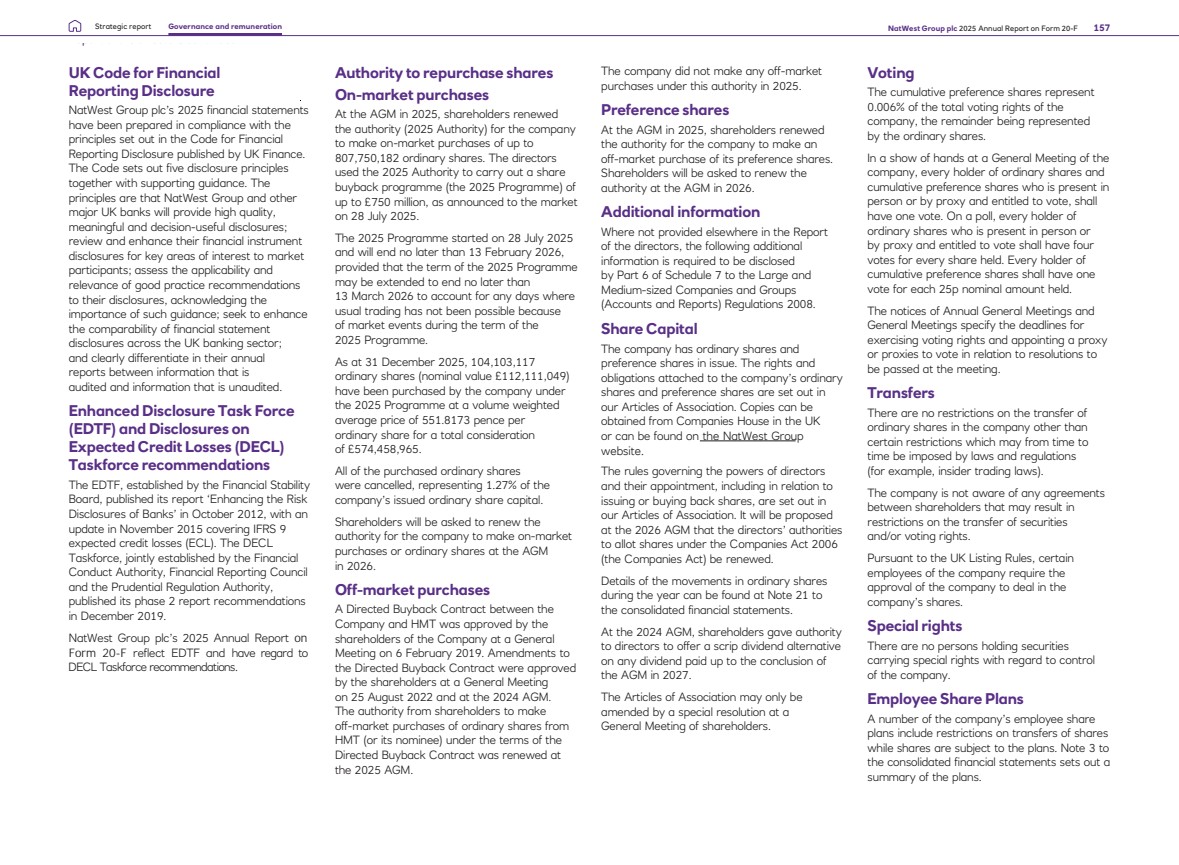
| Report of the directors continued Under the rules of certain employee share plans, voting rights are exercised by the Trustees of the plan on receipt of participants’ instructions. If a participant does not submit an instruction to the Trustee no vote is registered. For shares held in the company’s other employee share trusts, in accordance with investor protection guidelines, the Trustees abstain from voting. The Trustees would take independent advice before accepting any offer in respect of their shareholdings for the company in a takeover bid situation. The Trustees have chosen to waive their entitlement to the dividend on shares held by the Trusts. A change of control of the company following a takeover bid may cause a number of agreements to which the company is party to take effect, alter or terminate. All of the company’s employee share plans contain provisions relating to a change of control. In the context of the company as a whole, these agreements are not considered to be significant. Directors Roisin Donnelly, Patrick Flynn, Geeta Gopalan, Rick Haythornthwaite, Yasmin Jetha, Stuart Lewis, Katie Murray, Paul Thwaite and Lena Wilson all served throughout 2025 and to the date of signing of the financial statements. The following changes took place during 2025: Director Date of change Gill Whitehead Appointed 8 January 2025 Mark Seligman Retired 31 March 2025 Frank Dangeard Resigned 23 April 2025 Josh Critchley Appointed 3 November 2025 Albert Hitchcock has been appointed to the Board with effect from 23 February 2026. Yasmin Jetha has confirmed her intention to retire from the Board on 31 March 2026. All directors of the company are required to stand for election or re-election annually by shareholders at the AGM. Directors’ interests Directors’ indemnities In terms of section 236 of the Companies Act, Qualifying Third Party Indemnity Provisions have been issued by the company to its directors, members of the NatWest Group and NWH Executive Committees, individuals authorised by the PRA/FCA, certain directors and/or officers of NatWest Group subsidiaries and all trustees of NatWest Group pension schemes. The indemnities referenced above were in force throughout the financial year, including for individuals who resigned during the year, and remain in force as at the date of this report. NatWest Group also maintains Directors’ and Officers’ Liability Insurance to provide appropriate protection to directors and/or officers from liabilities that may arise against them in connection with their role. Shareholdings The following table shows the shareholders that have notified NatWest Group that they hold more than 3% of the total voting rights of the company at 31 December 2025. Ordinary shares (millions) % of issued share capital with voting rights held(1) Blackrock, Inc. 461 5.26 The Capital Group Companies, Inc. 403 5.01 Massachusetts Financial Services Company 396 4.94 Norges Bank(2) 248 3.06 (1) Percentages provided were correct at the date of notifications on 31 May 2024, 19 November 2024, 11 December 2025 and 28 July 2025, respectively. (2) On 23 January 2026, a notification under Rule 5 the Disclosure and Transparency Rules (‘DTR’) was received from Norges Bank notifying that its holding had reduced to below 3%. (3) As at 12 February 2026, no further notifications under Rule 5 of the DTR have been received. UK Listing rule 6.6.1 R Political donations At the AGM in 2025, shareholders gave authority, under Part 14 of the Companies Act 2006, for a period of one year, for the company (and its subsidiaries) to make political donations and incur political expenditure up to a maximum aggregate sum of £100,000. This authorisation was taken as a precaution only as the company has a longstanding policy of not making political donations or incurring political expenditure within the ordinary meaning of those words. During 2025, NatWest Group made no political donations, nor incurred any political expenditure in the UK or EU and it is not proposed that its longstanding policy of not making contributions to any political party be changed. Shareholders will be asked to renew this authorisation at the AGM in 2026. Directors’ disclosure to auditors Each of the directors at the date of approval of this report confirms that: a. so far as the director is aware, there is no relevant audit information of which the company’s auditors are unaware; and b. the director has taken all the steps that he/she ought to have taken as a director to make himself/herself aware of any relevant audit information and to establish that the company’s auditors are aware of that information. This confirmation is given and should be interpreted in accordance with the provisions of section 418 of the Companies Act. Auditors Ernst & Young LLP (EY) are the current auditors of the company. Following a tender undertaken in 2022, overseen by the Group Audit Committee, the company announced its intention to appoint PricewaterhouseCoopers LLP (PwC) as auditors for the financial period ending 31 December 2026. This will be the last period of audit by EY as they will not be proposed for re-appointment as auditors by the company. A resolution to appoint PwC as the company’s auditors will be proposed at the forthcoming AGM. By order of the Board Gary Moore Chief Governance Officer and Company Secretary 12 February 2026 NatWest Group plc is registered in Scotland No. SC45551 Strategic report Financial review Risk and capital management Financial statements Additional information Governance and remuneration NatWest Group plc 2025 Annual Report and Accounts 175 Strategic report Governance and remuneration NatWest Group plc 2025 Annual Report on Form 20-F 158 The names and brief biographical details of the current directors are shown on pages 79 to 81. The interests of the directors in the shares of the company at 31 December 2025 are shown on page 148. None of the directors held an interest in the loan capital of the company or in the shares or loan capital of any of the subsidiary undertakings of the company during the period from 1 January 2025 to 12 February 2026. The information to be disclosed in the Annual Report on Form 20-F under UK Listing Rule 6.6.1 R is set out or cross- referenced in this Directors’ report with the exception of details of contracts of significance given in Material Report on Form 20-F. contracts on page 294 to 295 of the Annual |
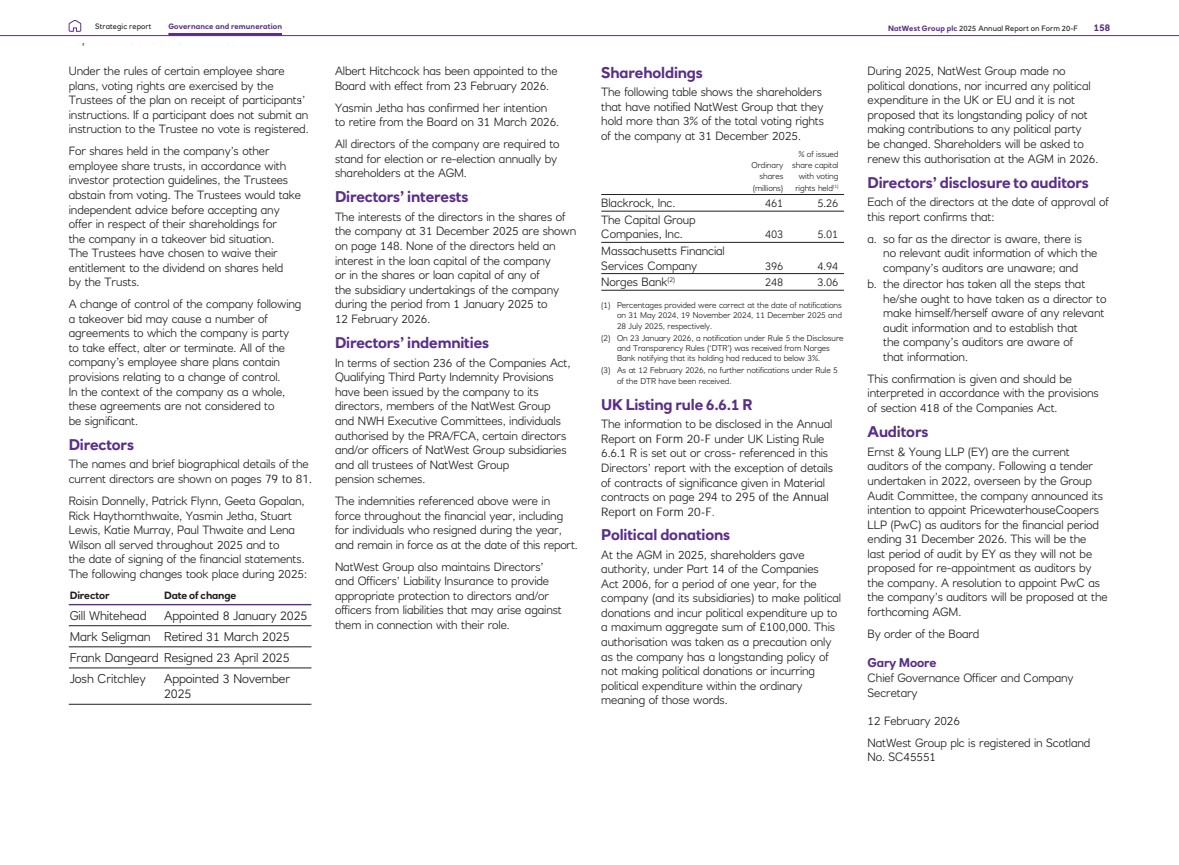
| Report of the directors continued Under the rules of certain employee share plans, voting rights are exercised by the Trustees of the plan on receipt of participants’ instructions. If a participant does not submit an instruction to the Trustee no vote is registered. For shares held in the company’s other employee share trusts, in accordance with investor protection guidelines, the Trustees abstain from voting. The Trustees would take independent advice before accepting any offer in respect of their shareholdings for the company in a takeover bid situation. The Trustees have chosen to waive their entitlement to the dividend on shares held by the Trusts. A change of control of the company following a takeover bid may cause a number of agreements to which the company is party to take effect, alter or terminate. All of the company’s employee share plans contain provisions relating to a change of control. In the context of the company as a whole, these agreements are not considered to be significant. Directors The names and brief biographical details of the current directors are shown on pages 96 to 98. Roisin Donnelly, Patrick Flynn, Geeta Gopalan, Rick Haythornthwaite, Yasmin Jetha, Stuart Lewis, Katie Murray, Paul Thwaite and Lena Wilson all served throughout 2025 and to the date of signing of the financial statements. The following changes took place during 2025: Director Date of change Gill Whitehead Appointed 8 January 2025 Mark Seligman Retired 31 March 2025 Frank Dangeard Resigned 23 April 2025 Josh Critchley Appointed 3 November 2025 Albert Hitchcock has been appointed to the Board with effect from 23 February 2026. Yasmin Jetha has confirmed her intention to retire from the Board on 31 March 2026. All directors of the company are required to stand for election or re-election annually by shareholders at the AGM. Directors’ interests The interests of the directors in the shares of the company at 31 December 2025 are shown on page 165. None of the directors held an interest in the loan capital of the company or in the shares or loan capital of any of the subsidiary undertakings of the company during the period from 1 January 2025 to 12 February 2026. Directors’ indemnities In terms of section 236 of the Companies Act, Qualifying Third Party Indemnity Provisions have been issued by the company to its directors, members of the NatWest Group and NWH Executive Committees, individuals authorised by the PRA/FCA, certain directors and/or officers of NatWest Group subsidiaries and all trustees of NatWest Group pension schemes. The indemnities referenced above were in force throughout the financial year, including for individuals who resigned during the year, and remain in force as at the date of this report. NatWest Group also maintains Directors’ and Officers’ Liability Insurance to provide appropriate protection to directors and/or officers from liabilities that may arise against them in connection with their role. Shareholdings The following table shows the shareholders that have notified NatWest Group that they hold more than 3% of the total voting rights of the company at 31 December 2025. Ordinary shares (millions) % of issued share capital with voting rights held(1) Blackrock, Inc. 461 5.26 The Capital Group Companies, Inc. 403 5.01 Massachusetts Financial Services Company 396 4.94 Norges Bank(2) 248 3.06 (1) Percentages provided were correct at the date of notifications on 31 May 2024, 19 November 2024, 11 December 2025 and 28 July 2025, respectively. (2) On 23 January 2026, a notification under Rule 5 the Disclosure and Transparency Rules (‘DTR’) was received from Norges Bank notifying that its holding had reduced to below 3%. (3) As at 12 February 2026, no further notifications under Rule 5 of the DTR have been received. UK Listing rule 6.6.1 R The information to be disclosed in the Annual Report and Accounts under UK Listing Rule 6.6.1 R is set out or cross- referenced in this Directors’ report with the exception of details of contracts of significance given in Material contracts on page 423. Political donations At the AGM in 2025, shareholders gave authority, under Part 14 of the Companies Act 2006, for a period of one year, for the company (and its subsidiaries) to make political donations and incur political expenditure up to a maximum aggregate sum of £100,000. This authorisation was taken as a precaution only as the company has a longstanding policy of not making political donations or incurring political expenditure within the ordinary meaning of those words. During 2025, NatWest Group made no political donations, nor incurred any political expenditure in the UK or EU and it is not proposed that its longstanding policy of not making contributions to any political party be changed. Shareholders will be asked to renew this authorisation at the AGM in 2026. Directors’ disclosure to auditors Each of the directors at the date of approval of this report confirms that: a. so far as the director is aware, there is no relevant audit information of which the company’s auditors are unaware; and b. the director has taken all the steps that he/she ought to have taken as a director to make himself/herself aware of any relevant audit information and to establish that the company’s auditors are aware of that information. This confirmation is given and should be interpreted in accordance with the provisions of section 418 of the Companies Act. Auditors Ernst & Young LLP (EY) are the current auditors of the company. Following a tender undertaken in 2022, overseen by the Group Audit Committee, the company announced its intention to appoint PricewaterhouseCoopers LLP (PwC) as auditors for the financial period ending 31 December 2026. This will be the last period of audit by EY as they will not be proposed for re-appointment as auditors by the company. A resolution to appoint PwC as the company’s auditors will be proposed at the forthcoming AGM. By order of the Board Gary Moore Chief Governance Officer and Company Secretary 12 February 2026 NatWest Group plc is registered in Scotland No. SC45551 Strategic report Financial review Risk and capital management Financial statements Additional information Governance and remuneration NatWest Group plc 2025 Annual Report and Accounts 175 Statement of directors’ responsibilities In preparing those financial statements, the directors are required to: • select suitable accounting policies and then apply them consistently. • make judgements and estimates that are reasonable, relevant and reliable. • state whether applicable accounting standards have been followed, subject to any material departures disclosed and explained in the financial statements. • prepare the financial statements on a going concern basis unless it is inappropriate to presume that the company and Group will continue in business. Under applicable law and regulations, the directors are also responsible for preparing a Strategic report, Directors’ report, Directors’ remuneration report and Corporate governance statement that comply with that law and those regulations. The directors are responsible for the maintenance and integrity of the corporate and financial information included on the company’s website. The directors confirm that to the best of their knowledge: • the financial statements, prepared in accordance with UK adopted International Accounting Standards and International Financial Reporting Standards as issued by the International Accounting Standards Board, give a true and fair view of the assets, liabilities, financial position and profit or loss of the company and the undertakings included in the consolidation taken as a whole; and • The Strategic report and Directors’ report (incorporating the Financial review) include a fair review of the development and performance of the business and the position of the company and the undertakings included in the consolidation taken as a whole, together with a description of the principal risks and uncertainties that they face. By order of the Board Richard Haythornthwaite Chair 12 February 2026 John-Paul Thwaite Group Chief Executive Officer Katie Murray Group Chief Financial Officer Board of directors Chair Richard Haythornthwaite Executive directors John-Paul Thwaite Katie Murray Non-executive directors Joshua Critchley Roisin Donnelly Patrick Flynn Geeta Gopalan Yasmin Jetha Stuart Lewis Gillian Whitehead Lena Wilson Strategic report Financial review Risk and capital management Financial statements Additional information Governance and remuneration NatWest Group plc 2025 Annual Report and Accounts 176 Strategic report Governance and remuneration NatWest Group plc 2025 Annual Report on Form 20-F 159 The directors are responsible for keeping proper accounting records which disclose with reasonable accuracy at any time the financial position of NatWest Group and to enable them to ensure that the Annual Report on Form 20-F complies with the Companies Act 2006. They are also responsible for safeguarding the assets of NatWest Group and hence for taking reasonable steps for the prevention and detection of fraud and other irregularities. In addition, the directors are of the opinion that the Annual Report on Form 20-F, taken as a whole, are fair, balanced and understandable and provide the information necessary for shareholders to assess the company’s position and performance, business model and strategy. The directors are responsible for the preparation of the Annual Report on Form 20-F. The directors are required to prepare Group financial statements, and as permitted by the Companies Act 2006 have elected to prepare company financial statements, for each financial year in accordance with UK adopted International Accounting Standards and International Financial Reporting Standards as issued by the International Accounting Standards Board. They are responsible for preparing financial statements that present fairly the financial position, financial performance and cash flows of NatWest Group. This statement should be read in conjunction with the responsibilities of the auditor set out Annual Report on Form 20-F. in their report on pages 147 to 151 of the |