Please wait
.2
|
|
|
|
|
| Announcement |
|
|

|
|
|
|
| Tuesday, 24 February 2026 |
|
|
Woodside Energy Group Ltd.
ACN 004 898 962
Mia Yellagonga 11 Mount Street
Perth WA 6000 Australia
T +61 8 9348 4000
www.woodside.com
ASX: WDS NYSE: WDS |
|
WOODSIDE RELEASES FULL-YEAR 2025 RESULTS
Woodside today reported record production of 198.8 million barrels of oil equivalent (MMboe), or 545 Mboe/day, for the full year 2025. The result was
underpinned by outstanding production performance at Sangomar, producing at nameplate capacity for most of the year, and world-class reliability at our operated Pluto LNG and NWS Project assets.
Record production offset lower realised prices resulting in net profit after tax (NPAT) of $2,718 million (24% lower from 2024) and underlying NPAT of
$2,649 million (8% lower from 2024).1
The Directors have determined a final dividend of US 59
cents per share (cps), which brings the full-year fully franked dividend to US 112 cps and maintains payout ratio at the top of the range at 80%. The value of the full-year dividend is $2.1 billion.
Woodside Acting CEO Liz Westcott said the record annual production in 2025 exceeded the guidance range and unit production cost decreased 4% from 2024 to $7.8
per barrel of oil equivalent, demonstrating cost discipline.
“The outstanding full-year results reflected the disciplined execution of
Woodside’s strategy, while maintaining safe, reliable and sustainable operations. Our strong underlying NPAT of $2.6 billion and free cashflow1 of $1.9 billion is a testament to the performance of the base business during a period of
increased capital expenditure and softening prices.
“The strength of our base business has delivered returns for shareholders, with Woodside having
returned approximately $11 billion in dividends since merger completion in 2022. At the same time, we are re-investing in the business and actively refining the portfolio, while maintaining a strong
balance sheet and gearing within the targeted range.
“Keeping our people safe is always Woodside’s priority and in a year of increased
activity, no high-consequence injuries were recorded. We marked significant safety milestones across our global portfolio, with Sangomar recording no injuries in its first 18 months of operations, and the Scarborough floating production unit marking
three years of work without a single lost-time incident.
“We are delivering on our commitments by leveraging our proven operational excellence,
demonstrated project execution and delivery and continued financial discipline to reward shareholders today, while positioning Woodside for future value and growth.
“Sangomar produced at nameplate capacity of 100,000 barrels per day for most of 2025 at almost 99% reliability. This translated into $2.6 billion
of EBITDA (Woodside share) generated since start-up, demonstrating the asset’s value.1,2
| 1 |
Non-IFRS financial measure. Refer to the glossary section of the
attached presentation for the definition. |
| 2 |
Consists of Sangomar FY2024 EBITDA of $849 million and FY2025 EBITDA of $1,702 million.
|
Page 1 of 4
“A high point of 2025 was the final investment decision taken in April on the $17.5 billion
three-train, 16.5 million tonne per annum foundation Louisiana LNG project, which was 22% complete at year-end and on target for first LNG in 2029.
“Louisiana LNG’s value proposition was reinforced during the year by the entry of two high-quality partners, with Stonepeak taking a 40% stake in
Louisiana LNG Infrastructure LLC and Williams acquiring 10% of Louisiana LNG LLC and 80% of Driftwood Pipeline LLC. These transactions together reduced Woodside’s share of capital expenditure for Louisiana LNG to $9.9 billion, with
Stonepeak contributing 75% of capital expenditure in 2025 and 2026. Discussions are ongoing for the potential sale of up to a further 20% of Louisiana LNG LLC.
“During the year, Woodside’s other major cash-generative growth projects progressed to budget and schedule, highlighted by the progress at the
Scarborough Energy Project. Scarborough was 94% complete at year-end with the floating production unit arriving on location in Australia in January 2026. Scarborough is on track for first LNG cargo in the
fourth quarter of 2026.
“Once operational, Scarborough gas and output from Louisiana LNG will help meet long-term energy demand, as evidenced by
the six sales agreements for portfolio supply that Woodside signed in 2025 with buyers in Asia and Europe. These agreements demonstrate the ongoing role of LNG in balancing our customers’ energy security and decarbonisation needs.
“Trion remains on target for first oil in 2028, with the project 50% complete at year end. In 2025 we advanced construction of both the floating
production unit and floating storage and offloading unit, with major subsea work set to start this year.
“In December 2025 we achieved first
production at Beaumont New Ammonia, and we have secured offtake agreements at prevailing market prices for traditional ammonia. We expect full handover of the project by OCI in the first half of 2026, with production of lower-carbon ammonia targeted
for the second half of this year.3
As detailed in the Annual Report released today, we have achieved
our 2025 net equity Scope 1 and 2 greenhouse gas emissions reduction target of 15% below the starting base. This was achieved through a combination of underlying emissions performance at our facilities and the use of carbon credits. Importantly, our
gross equity Scope 1 and 2 greenhouse gas emissions were fewer than 2024, despite higher oil and gas production.
“Woodside’s objectives for
2026 are clear: ramp up Beaumont; deliver first LNG cargo from Scarborough; and continue progressing Louisiana LNG and Trion to schedule and budget. We will remain focused on creating long-term value through disciplined capital allocation,
maintaining strong liquidity and actively managing the portfolio.”
| 3 |
Production of lower-carbon ammonia is conditional on supply of carbon abated hydrogen and ExxonMobil’s
CCS facility becoming operational. |
Page 2 of 4
Financial headlines
|
|
|
|
|
|
|
|
|
|
|
|
|
|
|
| Metric |
|
Units |
|
FY25 |
|
|
FY24 |
|
|
Change |
|
| Operating revenue |
|
$million |
|
|
12,984 |
|
|
|
13,179 |
|
|
|
(1 |
%) |
| EBITDA4 |
|
$million |
|
|
9,277 |
|
|
|
9,276 |
|
|
|
— |
|
| NPAT |
|
$million |
|
|
2,718 |
|
|
|
3,573 |
|
|
|
(24 |
%) |
| Underlying NPAT4 |
|
$million |
|
|
2,649 |
|
|
|
2,880 |
|
|
|
(8 |
%) |
| Operating cashflow |
|
$million |
|
|
7,192 |
|
|
|
5,847 |
|
|
|
23 |
% |
| Free cash flow4,5 |
|
$million |
|
|
1,889 |
|
|
|
(293 |
) |
|
|
745 |
% |
| Sales volume7 |
|
MMboe |
|
|
212.2 |
|
|
|
204.0 |
|
|
|
4 |
% |
|
|
Mboe/d |
|
|
581 |
|
|
|
557 |
|
|
|
4 |
% |
| Averaged realised price7 |
|
$/boe |
|
|
60.2 |
|
|
|
63.4 |
|
|
|
(5 |
%) |
| Fully franked final dividend |
|
US cps |
|
|
59 |
|
|
|
53 |
|
|
|
11 |
% |
| Full-year fully franked dividends |
|
US cps |
|
|
112 |
|
|
|
122 |
|
|
|
(8 |
%) |
Business highlights
Strategic achievements
| |
• |
|
Took a positive FID on Louisiana LNG with a lump-sum turn-key Bechtel EPC contract |
| |
• |
|
Added Stonepeak and Williams as strategic partners for Louisiana LNG, with Woodside’s expected total
capital expenditure now $9.9 billion (< 60% of total capital expenditure)8 |
| |
• |
|
Refined our portfolio through the Greater Angostura divestment and progressing Chevron asset swap9 |
| |
• |
|
Commenced first production at Beaumont New Ammonia |
| |
• |
|
Continued strong interest from debt capital markets with $3.5 billion US bond issuance oversubscribed
|
Operations and projects
| |
• |
|
Record production of 198.8 MMboe, reflecting a high-quality asset base6 |
| |
• |
|
Achieved world-class reliability of 98.4% at KGP, 96.3% at Pluto LNG and 98.7% at Sangomar, supporting consistent
revenue delivery and cost efficiency |
| |
• |
|
Reduced unit production costs to $7.8/boe reflecting cost discipline |
| |
• |
|
Improved safety outcomes with zero high consequence injuries recorded across our global operations
|
| |
• |
|
Delivered extended plateau production at Sangomar and $1.9 billion of revenue for Woodside in 2025
|
| |
• |
|
Completed successful tiebacks to existing NWS, Bass Strait, Pluto and Mad Dog facilities, capturing incremental
volumes at lower capital intensity |
| |
• |
|
Continued project execution of Scarborough and Trion, which were 94% and 50% complete respectively by the end of
2025, supporting future production and long-term revenue generation |
| |
• |
|
Achieved our 2025 target of a 15% reduction in net equity Scope 1 and 2 greenhouse gas emissions below the
starting base, and are on track to meet our equivalent 2030 target10,11,12 |
| 4 |
Non-IFRS financial measure. Refer to the glossary section of the
attached presentation for the definition. |
| 5 |
The calculation has been updated to adjust for contributions from/(to) NCI and lease repayments. The 2024
comparative has been restated to be presented on the same basis. |
| 6 |
Includes 1.2 MMboe primarily from feed gas purchased from Pluto
non-operating participants processed through the Pluto-KGP Interconnector. |
| 7 |
Excludes the impact of periodic adjustments reflecting the arrangements governing Wheatstone LNG sales. The
2024 comparative has been restated to be presented on the same basis. |
| 8 |
Woodside’s total capital expenditure for the Louisiana LNG Project is expected to be $9.9 billion
against total project cost announced at FID of $17.5 billion. |
| 9 |
Completion of the transaction is subject to customary conditions precedent and remains targeted for completion
in H2 2026. |
| 10 |
This means net equity Scope 1 and 2 emissions for the 12-month period
ending 31 December 2025 are targeted to be 15% lower than the starting base and that net equity Scope 1 and 2 emissions for the 12-month period ending 31 December 2030 are targeted to be 30% lower
than the starting base. |
| 11 |
Net equity Scope 1 and 2 greenhouse gas (GHG) emissions reduction targets and aspiration are relative to a
starting base of 6.27 Mt CO2-e which is representative of the gross annual average equity Scope 1 and 2 GHG emissions over 2016-2020 and which may be adjusted (up or down) for potential equity
changes in producing or sanctioned assets with a final investment decision prior to 2021. Net equity emissions include the utilisation of carbon credits as offsets, inclusive of those required to meet regulatory obligations. |
| 12 |
In relation to our 2025 equity Scope 1 and 2 GHG emissions, 1,283 kt CO2-e carbon credits were retired in order to meet our target of 5,334 kt CO2-e net equity Scope 1 and 2 GHG emissions. This includes retirement
of carbon credits subsequent to the period, after full year 2025 gross equity Scope 1 and 2 GHG emissions were calculated and externally assured. |
Page 3 of 4
Full-year results teleconference
A teleconference providing an overview of the full year 2025 results and a question and answer session will be hosted by Woodside Acting CEO, Liz Westcott, and
Chief Financial Officer, Graham Tiver, on Tuesday, 24 February 2026 at 10:00 AEDT / 07:00 AWST / 17:00 CST (Monday, 23 February 2026).
We
recommend participants pre-register 5 to 10 minutes prior to the event with one of the following links:
| |
• |
|
https://webcast.openbriefing.com/wds-fyr-2025/ to view
the presentation and listen to a live stream of the Q&A session |
| |
• |
|
https://s1.c-conf.com/diamondpass/10052032-hy76t5.html to
participate in the Q&A session. Following pre-registration, participants will receive the teleconference details and a unique access passcode. |
The full-year results presentation follows this announcement and will be referred to during the teleconference. The presentation, Annual Report 2025, 2025
Climate and Sustainability Summary and teleconference transcript will also be available on the Woodside website (www.woodside.com).
Filings
Woodside is filing its annual report on Form 20-F for the year ended 31 December 2025 (2025 Form 20-F), which included Woodside’s audited financial statements for the year ended 31 December 2025, with the US Securities and Exchange Commission (the SEC) on 24 February 2026. The 2025 Form 20-F can be downloaded through accessing Woodside’s website at www.woodside.com or from the SEC’s website at www.sec.gov. Shareholders may also request a hard copy of the 2025
Form 20-F free of charge at www.woodside.com.
Annual General Meeting
Woodside’s Annual General Meeting will be held at 10:00am (AWST) on Thursday, 23 April 2026 in Perth, Western Australia and online.
|
|
|
| INVESTORS |
|
MEDIA |
|
|
| Vanessa Martin |
|
Christine Abbott |
| M: +61 477 397 961 |
|
M: +61 484 112 469 |
| E: investor@woodside.com |
|
E: christine.forster@woodside.com |
This announcement was approved and authorised for release by Woodside’s Disclosure Committee.
Page 4 of 4
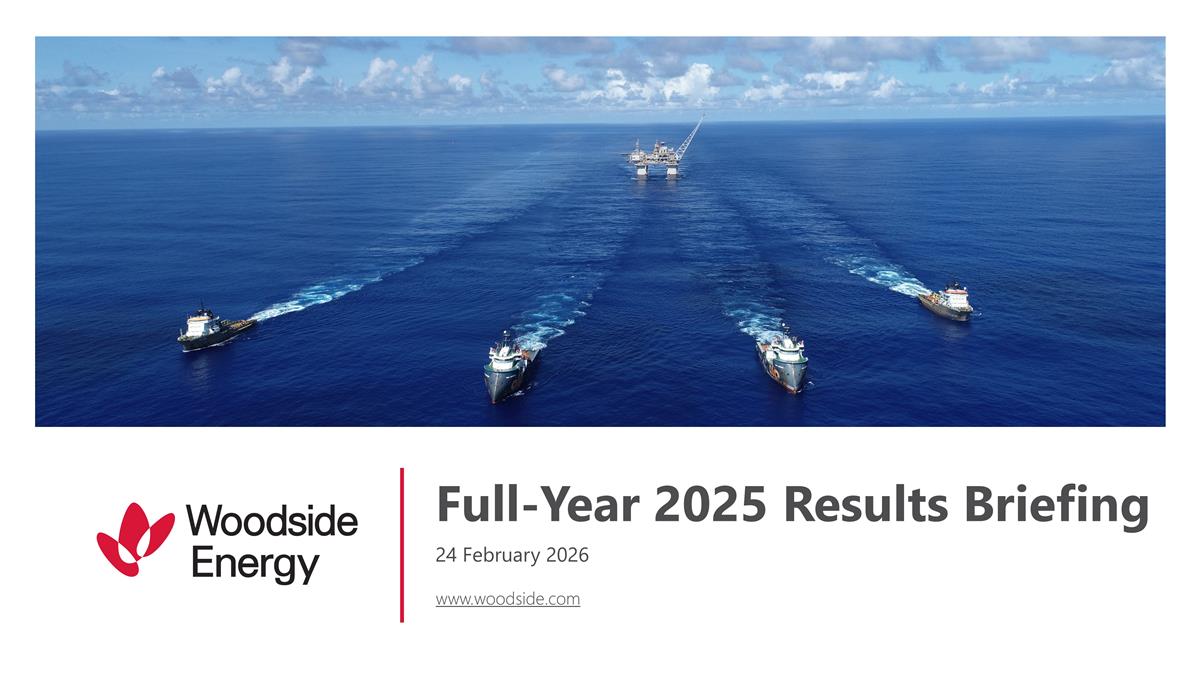
Full-Year 2025 Results Briefing 24
February 2026 www.woodside.com
Disclaimer, important notes and
assumptions Information This presentation has been prepared by Woodside Energy Group Ltd (“Woodside”). All information included in this presentation, including any forward-looking statements, reflects Woodside’s views held as at
the date of this presentation and, except as required by applicable law, neither Woodside, its related bodies corporate, nor any of their respective officers, directors, employees, advisers or representatives (“Beneficiaries”) intends
to, undertakes to, or assumes any obligation to, provide any additional information or update or revise any information or forward-looking statements in this presentation after the date of this presentation, either to make them conform to actual
results or as a result of new information, future events, changes in Woodside’s expectations or otherwise. Past performance (including historical financial and operational information) is not necessarily a reliable indicator of future
performance. This presentation may contain industry, market and competitive position data that is based on industry publications and studies conducted by third parties as well as Woodside’s internal estimates and research. While Woodside
believes that each of these publications and third-party studies is reliable and has been prepared by a reputable source, Woodside has not independently verified the market and industry data obtained from these third-party sources and cannot
guarantee the accuracy or completeness of such data. Accordingly, undue reliance should not be placed on any of the industry, market and competitive position data contained in this presentation. To the maximum extent permitted by law, neither
Woodside, its related bodies corporate, nor any of their respective Beneficiaries, assume any liability (including liability for equitable, statutory or other damages) in connection with, any responsibility for, or make any representation or
warranty (express or implied) as to, the fairness, currency, accuracy, adequacy, reliability or completeness of the information or any opinions expressed in this presentation or the reasonableness of any underlying assumptions. No offer or advice
This presentation is not intended to and does not constitute, form part of, or contain an offer or invitation to sell to Woodside shareholders (or any other person), or a solicitation of an offer from Woodside shareholders (or any other person) or a
solicitation of any vote or approval from Woodside shareholders (or any other person) in any jurisdiction. This presentation has been prepared without reference to the investment objectives, financial and taxation situation or particular needs of
any Woodside shareholder or any other person. The information contained in this presentation does not constitute, and should not be taken as, financial product or investment advice. Woodside encourages you to seek independent legal, financial,
taxation and other professional advice before making any investment decision. Forward-looking statements This presentation contains forward-looking statements. These statements may relate to Woodside’s business, goals, targets, aspirations,
plans, expectations, market conditions, results of operations and financial condition, including, for example, but not limited to, outcomes of transactions, statements regarding long-term demand for Woodside’s products and services,
development, completion and execution of Woodside’s projects, expectations regarding future capital expenditures and cash flow, the payment of future dividends and the amount thereof, future results of projects, operating activities and new
energy products, expectations and plans for new energy products and lower-carbon services and investments in, and development of, new energy products and lower-carbon services, expectations and guidance with respect to production, capital and
exploration expenditure and gas hub exposure, and expectations regarding the achievement of Woodside’s Scope 1 and 2 greenhouse gas emissions reduction and Scope 3 investment and emissions abatement targets (in each case on a net equity or
gross equity basis as specified) and other and sustainability goals. All statements, other than statements of historical or present facts, are forward-looking statements and generally may be identified by the use of forward-looking words such as
‘aim’, ‘anticipate’, ‘aspire’, ‘believe’, ‘estimate’, ‘expect’, ‘forecast’, ‘foresee’, ‘guidance’, ‘intend’,
‘likely’, ‘may’, ‘objective’, ‘outlook’, ‘pathway’, ‘plan’, ‘potential’, ‘project’, ‘schedule’, ‘seek’, ‘should’,
‘strategy’, ‘strive’, ‘target’, ‘will’’ and other similar words or expressions. Forward-looking statements in this presentation are not guidance, forecasts, guarantees or predictions of future
events or performance, but are in the nature of future expectations that are based on management’s current expectations and contingencies. Those statements and any assumptions on which they are based are subject to change without notice and
are subject to inherent known and unknown risks, uncertainties, assumptions and other factors, many of which are beyond the control of Woodside, its related bodies corporate and their respective officers, directors, employees, advisers or
representatives. Important factors that could cause actual results to differ materially from those in the forward-looking statements and assumptions on which they are based include, but are not limited to, fluctuations in commodity prices, actual
demand for Woodside’s products, currency fluctuations, geotechnical factors, drilling and production results, gas commercialisation, development progress, operating results, engineering estimates, reserve and resource estimates, loss of
market, industry competition, sustainability and environmental risks, related transition and physical risks, changes in accounting standards, political risks, the actions of third parties, project delay or advancement, regulatory approvals, the
impact of armed conflict and political instability (such as the ongoing conflicts in Ukraine and in the Middle East) on economic activity and oil and gas supply and demand, cost estimates, legislative, fiscal and regulatory developments, including
but not limited to those related to the imposition of tariffs and other trade restrictions, the effect of future regulatory or legislative actions on Woodside or the industries in which it operates, including potential changes to tax laws, the
impact of general economic and financial market conditions, inflationary conditions, prevailing exchange rates and interest rates and conditions in financial markets, and risks associated with acquisitions, mergers and joint ventures, including
difficulties integrating or separating businesses, uncertainty associated with financial projections, restructuring, increased costs and adverse tax consequences, and uncertainties and liabilities associated with acquired and divested properties and
businesses. A detailed summary of the key risks relating to Woodside and its business can be found in the “Risk” section of Woodside’s most recent Annual Report released to the Australian Securities Exchange and in Woodside’s
most recent Annual Report on Form 20-F filed with the United States Securities and Exchange Commission and available on the Woodside website at https://www.woodside.com/investors/reports-investor-briefings. You should review and have regard to these
risks when considering the information contained in this presentation. If any of the assumptions on which a forward-looking statement is based were to change or be found to be incorrect, this would likely cause outcomes to differ from the statements
made in this presentation. Investors are strongly cautioned not to place undue reliance on any forward-looking statements. Actual results or performance may vary materially from those expressed in, or implied by, any forward-looking statements. All
forward-looking statements contained in this presentation reflect Woodside’s views held as at the date of this presentation and, except as required by applicable law, Woodside does not intend to, undertake to, or assume any obligation to,
provide any additional information or update or revise any of these statements after the date of this presentation, either to make them conform to actual results or as a result of new information, future events, changes in Woodside’s
expectations or otherwise.
Disclaimer, important notes and
assumptions (continued) Disclosure of reserve information and cautionary note to US investors Woodside is an Australian company with securities listed on the Australian Securities Exchange and the New York Stock Exchange. Woodside reports its Proved
(1P) Reserves in accordance with SEC regulations, which are also compliant with SPE-PRMS guidelines, and prepares and reports its Proved plus Probable (2P) Reserves and Best Estimate (2C) Contingent Resources in accordance with SPE-PRMS guidelines.
Woodside reports all of its petroleum resource estimates using definitions consistent with SPE-PRMS. The SEC prohibits oil and gas companies, in their filings with the SEC, from disclosing estimates of oil or gas resources other than
‘reserves’ (as that term is defined by the SEC). In this presentation, Woodside includes estimates of quantities of oil and gas using certain terms, such as ‘proved plus probable (2P) reserves’, ‘best estimate (2C)
contingent resources’, ‘reserves and contingent resources’, ‘proved plus probable’, ‘developed and undeveloped’, ‘probable developed’, ‘probable undeveloped’, ‘contingent
resources’ or other descriptions of volumes of reserves, which include quantities of oil and gas that may not meet the SEC’s definitions of proved, probable and possible reserves, and which the SEC’s guidelines strictly prohibit
Woodside from including in filings with the SEC. These estimates are by their nature more speculative than estimates of proved reserves and would require substantial capital spending over a significant number of years to implement recovery, and
accordingly are subject to substantially greater risk of not being recovered by Woodside. In addition, actual locations drilled and quantities that may be ultimately recovered from Woodside’s properties may differ substantially. Woodside has
made no commitment to drill, and likely will not drill, all drilling locations that have been attributable to these quantities. US investors are urged to consider closely the disclosures in Woodside’s filings with the SEC which are available
at www.sec.gov. Assumptions Unless otherwise indicated, the targets set out in this presentation have been estimated on the basis of a variety of economic assumptions including: (1) US$70/bbl Brent long-term oil price, US$10/MMBtu long term JKM
price, US$9/MMBtu long-term TTF price, US$3.50 long-term Henry Hub price (2024 real terms) and a long-term inflation rate of 2.0%; (2) currently sanctioned projects being delivered in accordance with their current project schedules; and (3)
applicable growth opportunities being sanctioned and delivered in accordance with the target schedules provided in this presentation. These growth opportunities are subject to relevant project participant approvals, commercial arrangements with
third parties and regulatory approvals being obtained in the timeframe contemplated or at all. Woodside expresses no view as to whether project participants will agree with and support Woodside’s current position in relation to these
opportunities, or such commercial arrangements and regulatory approvals will be obtained. Additional assumptions relevant to particular targets or other statements in this presentation may be set out in the relevant slides. Any such additional
assumptions are in addition to the assumptions and qualifications applicable to the presentation as a whole. Climate strategy and emissions data All greenhouse gas emissions data in this presentation are estimates, due to the inherent uncertainty
and limitations in measuring or quantifying greenhouse gas emissions. Methodologies for measuring or quantifying greenhouse gas emissions may evolve as best practices continue to develop and data quality and quantity continue to improve. Woodside
“greenhouse gas” or “emissions” information reported are Scope 1 greenhouse gas emissions, Scope 2 greenhouse gas emissions, and/or Scope 3 greenhouse gas emissions, each on a net equity basis, unless otherwise stated. For
more information on Woodside's strategy and performance, including further details regarding Woodside’s targets, aspirations and goals and the underlying methodology, judgements, assumptions and contingencies, refer to Woodside’s 2025
Climate and Sustainability Summary, available on the Woodside website at https://www.woodside.com/sustainability and section 3.6 of Woodside’s 2025 Annual Report. The glossary and footnotes to this presentation provide clarification regarding
the use of terms such as "lower-carbon“ under Woodside's strategy. A full glossary of terms used in connection with Woodside's strategy is contained in Woodside’s 2025 Annual Report. Non-IFRS Financial Measures Throughout this
presentation, a range of financial and non-financial measures are used to assess Woodside’s performance, including a number of financial measures that are not defined in, and have not been prepared in accordance with, International Financial
Reporting Standards (IFRS) and are not recognised measures of financial performance or liquidity under IFRS (Non-IFRS Financial Measures). These measures include EBIT, EBITDA, EBITDA excluding impairment, EBITDA margin, Gearing, Underlying NPAT,
Average realised price, Unit production cost, Net debt, Liquidity, Free cash flow, Capital expenditure, Exploration expenditure, Return on Equity, Cash margin, Production cost margin, and Other cash cost margin. These Non-IFRS Financial Measures are
defined in the glossary section of this presentation. A quantitative reconciliation of these measures to the most directly comparable financial measure calculated and presented in accordance with IFRS can be found in the Alternative Performance
Measures section of Woodside’s 2025 Annual Report. Woodside’s management uses these measures to monitor Woodside’s financial performance alongside IFRS measures to improve the comparability of information between reporting periods
and business units and Woodside believes that the Non-IFRS Financial Measures it presents provide a useful means through which to examine the underlying performance of its business. Undue reliance should not be placed on the Non-IFRS Financial
Measures contained in this presentation and these Non-IFRS Financial Measures should be considered in addition to, and not as a substitute for, or as superior to, measures of financial performance, financial position or cash flows reported in
accordance with IFRS. Non-IFRS Financial Measures are not uniformly defined by all companies, including those in Woodside’s industry. Accordingly, they may not be comparable with similarly titled measures and disclosures by other companies.
Other important information All references to dollars, cents or $ in this presentation are to US currency, unless otherwise stated. References to “Woodside” may be references to Woodside Energy Group Ltd and/or its applicable
subsidiaries (as the context requires). References and links to Woodside’s or third-party websites are provided for convenience only and are not incorporated by reference into this presentation. This presentation does not include any express
or implied prices at which Woodside will buy or sell financial products. A securities rating is not a recommendation to buy, sell or hold securities and may be subject to revision or withdrawal at any time.
Notes to petroleum reserves and
resources Unless otherwise stated, all petroleum resource estimates are quoted as at the effective date of 31 December 2025, net Woodside share. For details of Woodside’s year end 2025 reserves position, see the Reserves and Resources
Statement included in the 2025 Annual Report. US Investors should refer to “Additional information for US investors concerning reserves and resources estimates” above. All numbers are internal estimates produced by Woodside. Estimates of
reserves and contingent resources should be regarded only as estimates that may change over time as additional information becomes available. For offshore oil projects, the reference point is defined as the outlet of the floating production storage
and offloading facility (FPSO) or platform, while for the onshore gas projects the reference point is defined as the outlet of the downstream (onshore) gas processing facility. ‘Reserves’ are estimated quantities of petroleum that have
been demonstrated to be producible from known accumulations in which the company has a material interest from a given date forward, at commercial rates, under presently anticipated production methods, operating conditions, prices, and costs.
Woodside reports reserves inclusive of all fuel consumed in operations. Proved reserves are estimated and reported in accordance with SEC regulations which are also compliant with the SPE-PRMS guidelines. SEC-compliant proved reserves estimates use
a more restrictive, rules-based approach and are generally lower than estimates prepared solely in accordance with SPE-PRMS guidelines due to, among other things, the requirement to use commodity prices based on the average of first of month prices
during the 12-month period in the reporting company’s fiscal year. Proved plus probable reserves are estimated and reported in accordance with SPE-PRMS guidelines which are not compliant with SEC regulations. Assessment of the economic value
in support of an SPE-PRMS reserves and resources classification, uses Woodside Portfolio Economic Assumptions (Woodside PEAs). The Woodside PEAs are reviewed on an annual basis, or more often if required. The review is based on historical data and
forecast estimates for economic variables such as product prices and exchange rates. The Woodside PEAs are approved by the Woodside Board. Specific contractual arrangements for individual projects are also taken into account. Woodside is not aware
of any new information or data that materially affects the information included in the Reserves and Resources Update. All the material assumptions and technical parameters underpinning the estimates in the Reserves and Resources Update continue to
apply and have not materially changed. Woodside uses both deterministic and probabilistic methods for the estimation of reserves and contingent resources at the field and project levels. All proved reserves estimates have been estimated using
deterministic methods and reported on a net interest basis in accordance with the SEC regulations and have been determined in accordance with SEC Rule 4-10(a) of Regulation S-X. Unless otherwise stated, all petroleum estimates reported at the
company or region level are aggregated by arithmetic summation by category. The aggregated proved reserves may be a conservative estimate due to the portfolio effects of arithmetic summation. ‘MMboe’ means millions (106) of barrels of
oil equivalent. Natural gas volumes are converted to oil equivalent volumes via a constant conversion factor, which for Woodside is 5.7 Bcf of dry gas per 1 MMboe. All volumes are reported at standard oilfield conditions of 14.696 psi (101.325 kPa)
and 60 degrees Fahrenheit (15.56 degrees Celsius). ‘Proved reserves’ are those quantities of crude oil, condensate, natural gas and NGLs that, by analysis of geoscience and engineering data, can be estimated with reasonable certainty to
be economically producible from a given date forward from known reservoirs and under existing economic conditions, operating methods, operating contracts, and government regulations. Proved reserves are estimated and reported on a net interest basis
in accordance with the SEC regulations and have been determined in accordance with SEC Rule 4-10(a) of Regulation S-X. ‘Undeveloped reserves’ are those reserves for which wells and facilities have not been installed or executed but are
expected to be recovered through future significant investments. ‘Probable reserves’ are those reserves which analysis of geological and engineering data suggests are more likely than not to be recoverable. Proved plus probable reserves
represent the best estimate of recoverable quantities. Where probabilistic methods are used, there is at least a 50% probability that the actual quantities recovered will equal or exceed the sum of estimated proved plus probable reserves. Proved
plus probable reserves are estimated and reported in accordance with SPE-PRMS guidelines and are not compliant with SEC regulations. The estimates of petroleum reserves and contingent resources are based on and fairly represent information and
supporting documentation prepared by, or under the supervision of, Mr Benjamin Ziker, Woodside’s Vice President Reserves and Subsurface, who is a full-time employee of the company and a member of the Society of Petroleum Engineers. The
reserves and resources estimates included in this announcement are issued with the prior written consent of Mr Ziker. Mr Ziker’s qualifications include a Bachelor of Science (Chemical Engineering) from Rice University (Houston, Texas, USA) and
27 years of relevant experience.
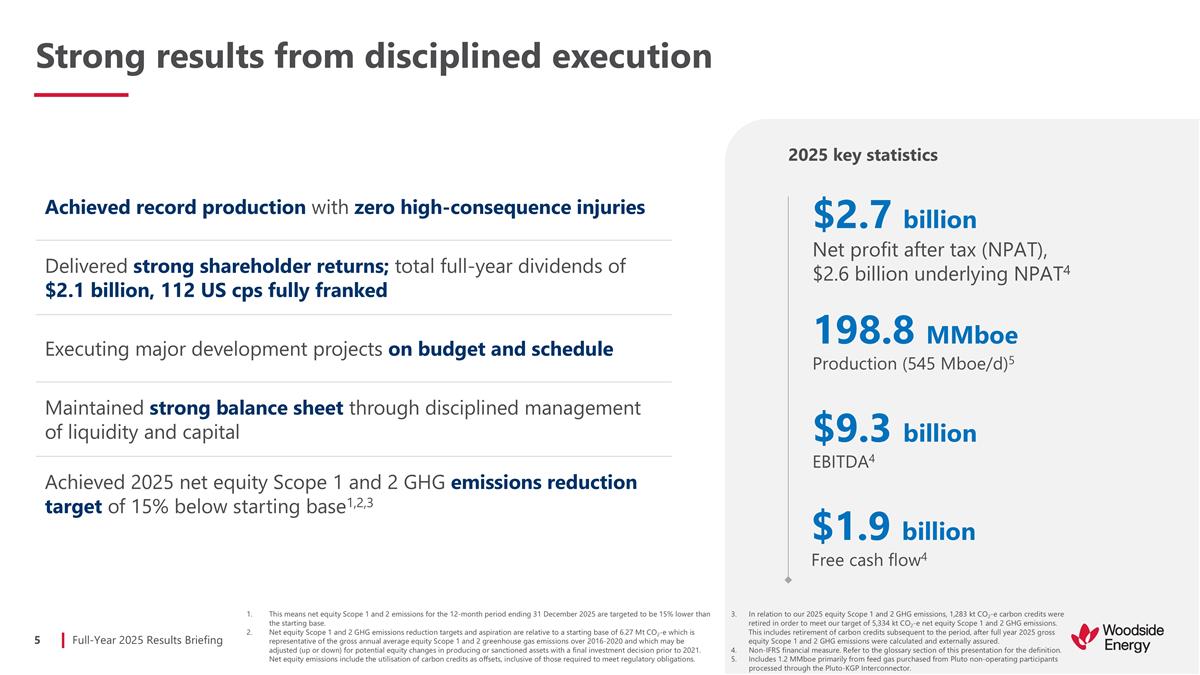
Strong results from disciplined
execution $2.7 billion Net profit after tax (NPAT), $2.6 billion underlying NPAT4 $9.3 billion EBITDA4 $1.9 billion Free cash flow4 2025 key statistics Achieved record production with zero high-consequence injuries Delivered strong shareholder
returns; total full-year dividends of $2.1 billion, 112 US cps fully franked Executing major development projects on budget and schedule Maintained strong balance sheet through disciplined management of liquidity and capital Achieved 2025 net equity
Scope 1 and 2 GHG emissions reduction target of 15% below starting base1,2,3 This means net equity Scope 1 and 2 emissions for the 12-month period ending 31 December 2025 are targeted to be 15% lower than the starting base. Net equity Scope 1 and 2
GHG emissions reduction targets and aspiration are relative to a starting base of 6.27 Mt CO2-e which is representative of the gross annual average equity Scope 1 and 2 greenhouse gas emissions over 2016-2020 and which may be adjusted (up or down)
for potential equity changes in producing or sanctioned assets with a final investment decision prior to 2021. Net equity emissions include the utilisation of carbon credits as offsets, inclusive of those required to meet regulatory obligations.
198.8 MMboe Production (545 Mboe/d)5 3. In relation to our 2025 equity Scope 1 and 2 GHG emissions, 1,283 kt CO2‑e carbon credits were retired in order to meet our target of 5,334 kt CO2‑e net equity Scope 1 and 2 GHG emissions. This
includes retirement of carbon credits subsequent to the period, after full year 2025 gross equity Scope 1 and 2 GHG emissions were calculated and externally assured. Non-IFRS financial measure. Refer to the glossary section of this presentation for
the definition. Includes 1.2 MMboe primarily from feed gas purchased from Pluto non-operating participants processed through the Pluto-KGP Interconnector.
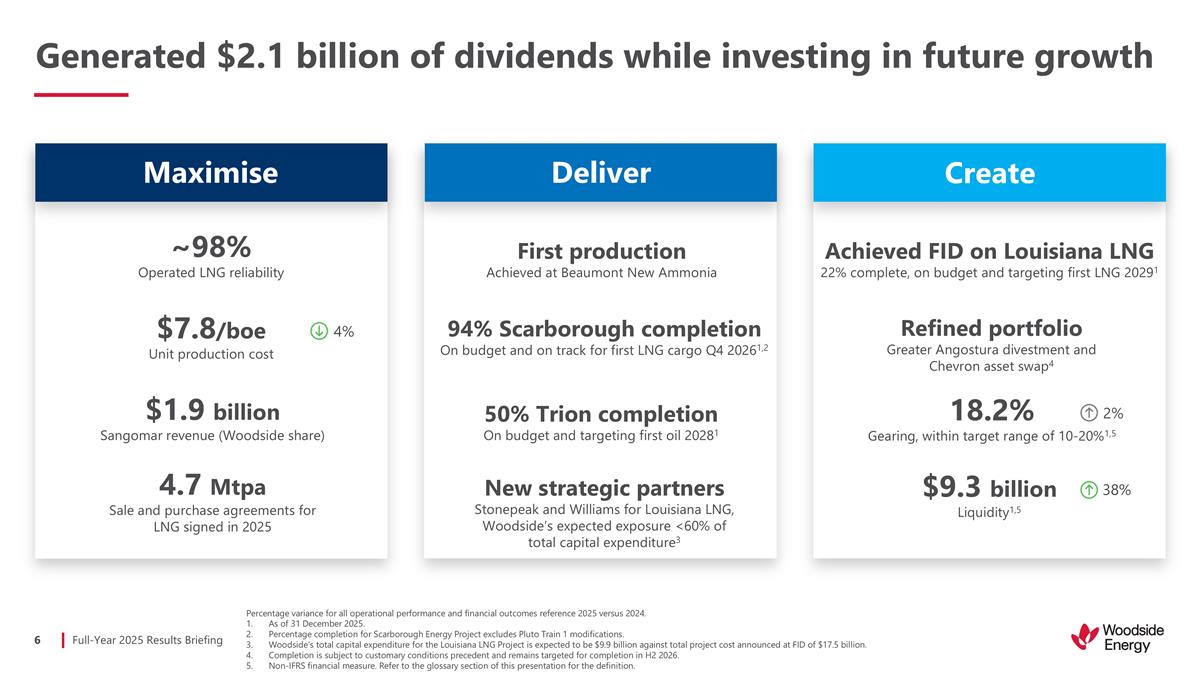
Generated $2.1 billion of dividends
while investing in future growth Maximise Deliver Create ~98% Operated LNG reliability $7.8/boe Unit production cost First production Achieved at Beaumont New Ammonia 94% Scarborough completion On budget and on track for first LNG cargo Q4 20261,2
50% Trion completion On budget and targeting first oil 20281 18.2% Gearing, within target range of 10-20%1,5 $9.3 billion Liquidity1,5 4% 2% 38% New strategic partners Stonepeak and Williams for Louisiana LNG, Woodside’s expected exposure
<60% of total capital expenditure3 $1.9 billion Sangomar revenue (Woodside share) 4.7 Mtpa Sale and purchase agreements for LNG signed in 2025 Refined portfolio Greater Angostura divestment and Chevron asset swap4 Achieved FID on Louisiana LNG
22% complete, on budget and targeting first LNG 20291 Percentage variance for all operational performance and financial outcomes reference 2025 versus 2024. As of 31 December 2025. Percentage completion for Scarborough Energy Project excludes Pluto
Train 1 modifications. Woodside’s total capital expenditure for the Louisiana LNG Project is expected to be $9.9 billion against total project cost announced at FID of $17.5 billion. Completion is subject to customary conditions precedent and
remains targeted for completion in H2 2026. Non-IFRS financial measure. Refer to the glossary section of this presentation for the definition.
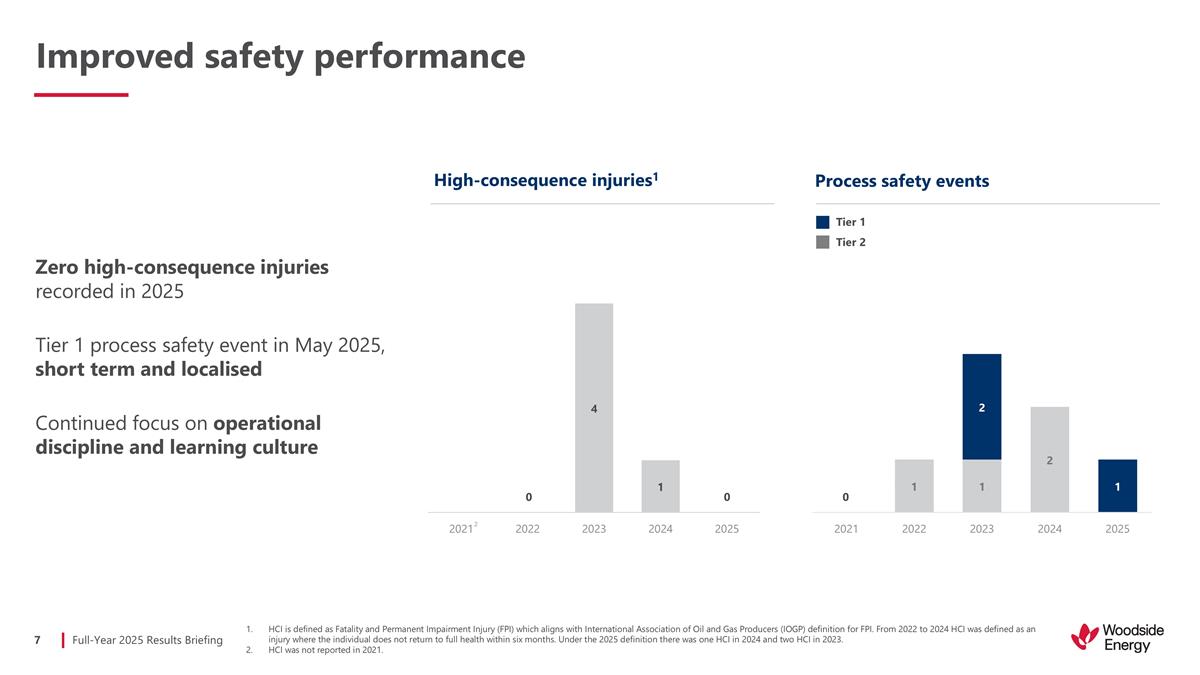
Improved safety performance HCI is
defined as Fatality and Permanent Impairment Injury (FPI) which aligns with International Association of Oil and Gas Producers (IOGP) definition for FPI. From 2022 to 2024 HCI was defined as an injury where the individual does not return to full
health within six months. Under the 2025 definition there was one HCI in 2024 and two HCI in 2023. HCI was not reported in 2021. High-consequence injuries1 Process safety events Zero high-consequence injuries recorded in 2025 Tier 1 process safety
event in May 2025, short term and localised Continued focus on operational discipline and learning culture Tier 1 Tier 2 0 2
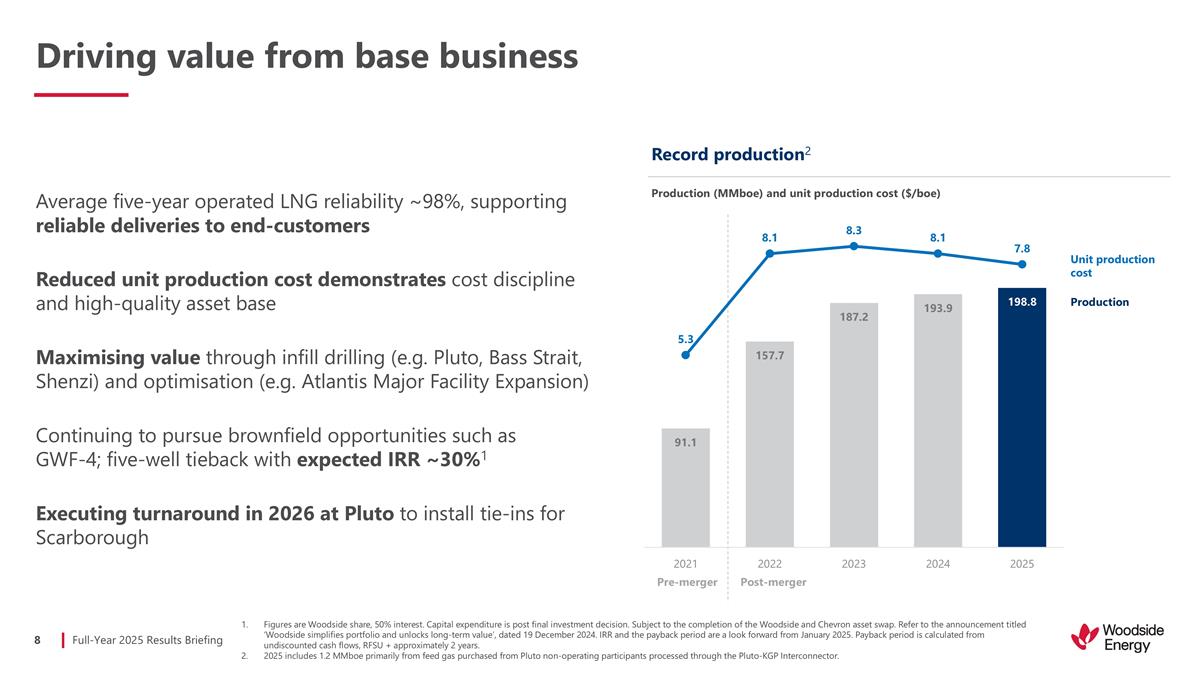
Driving value from base business
Average five-year operated LNG reliability ~98%, supporting reliable deliveries to end-customers Reduced unit production cost demonstrates cost discipline and high-quality asset base Maximising value through infill drilling (e.g. Pluto, Bass Strait,
Shenzi) and optimisation (e.g. Atlantis Major Facility Expansion) Continuing to pursue brownfield opportunities such as GWF-4; five-well tieback with expected IRR ~30%1 Executing turnaround in 2026 at Pluto to install tie-ins for Scarborough Record
production2 Production (MMboe) and unit production cost ($/boe) Unit production cost Production Figures are Woodside share, 50% interest. Capital expenditure is post final investment decision. Subject to the completion of the Woodside and Chevron
asset swap. Refer to the announcement titled ‘Woodside simplifies portfolio and unlocks long-term value’, dated 19 December 2024. IRR and the payback period are a look forward from January 2025. Payback period is calculated from
undiscounted cash flows, RFSU + approximately 2 years. 2025 includes 1.2 MMboe primarily from feed gas purchased from Pluto non-operating participants processed through the Pluto-KGP Interconnector. Pre-merger Post-merger
Sangomar: continued to deliver
exceptional performance Non-IFRS financial measure. Refer to the glossary section of this presentation for the definition. Consists of Sangomar FY2024 EBITDA of $849 million and FY 2025 EBITDA of $1,702 million. Includes -3.1 MMboe change to proved
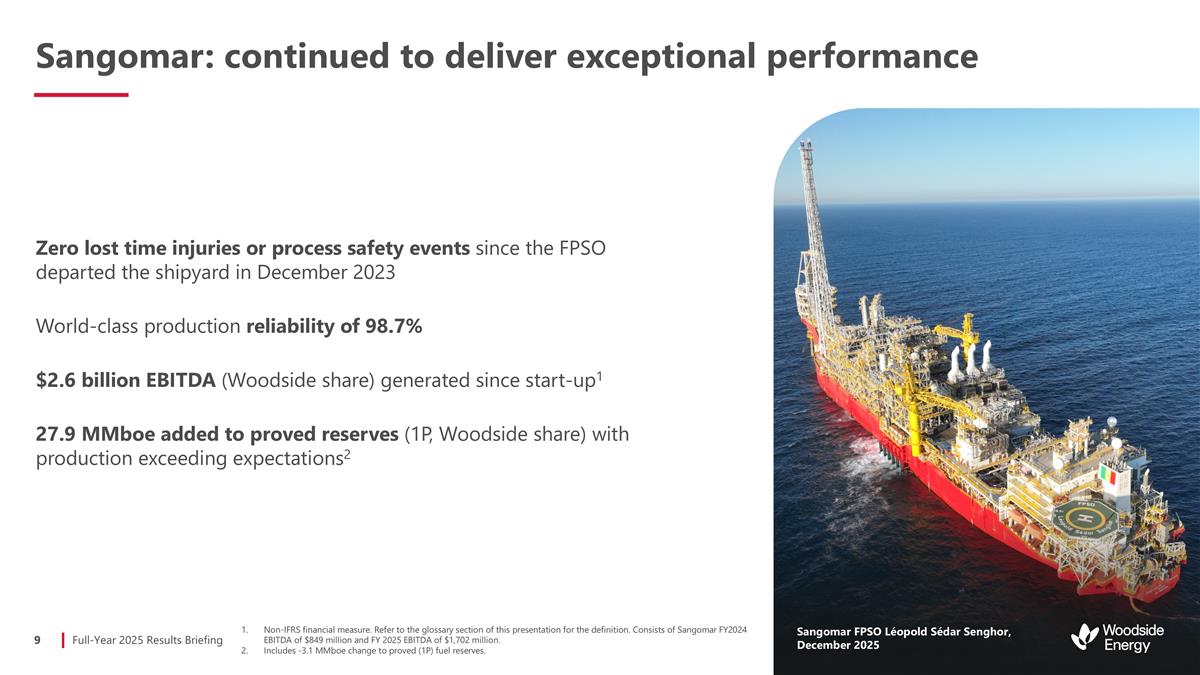
(1P) fuel reserves. Zero lost time injuries or process safety events since the FPSO departed the shipyard in December 2023 World-class production reliability of 98.7% $2.6 billion EBITDA (Woodside share) generated since start-up1 27.9 MMboe added to
proved reserves (1P, Woodside share) with production exceeding expectations2 Sangomar FPSO Léopold Sédar Senghor, December 2025
Beaumont New Ammonia: achieved
first ammonia December 2025 Production of lower-carbon ammonia is conditional on supply of carbon abated hydrogen and ExxonMobil’s CCS facility becoming operational. Cost of production range is the average cost for Phase 1 over 2028 to 2030
during assumed steady state lower-carbon ammonia production excluding planned turnarounds. Assumes fixed/variable split of 70/30%, a range of Henry Hub pricing, and inclusion of 45Q tax credit. Project and commissioning activities will continue
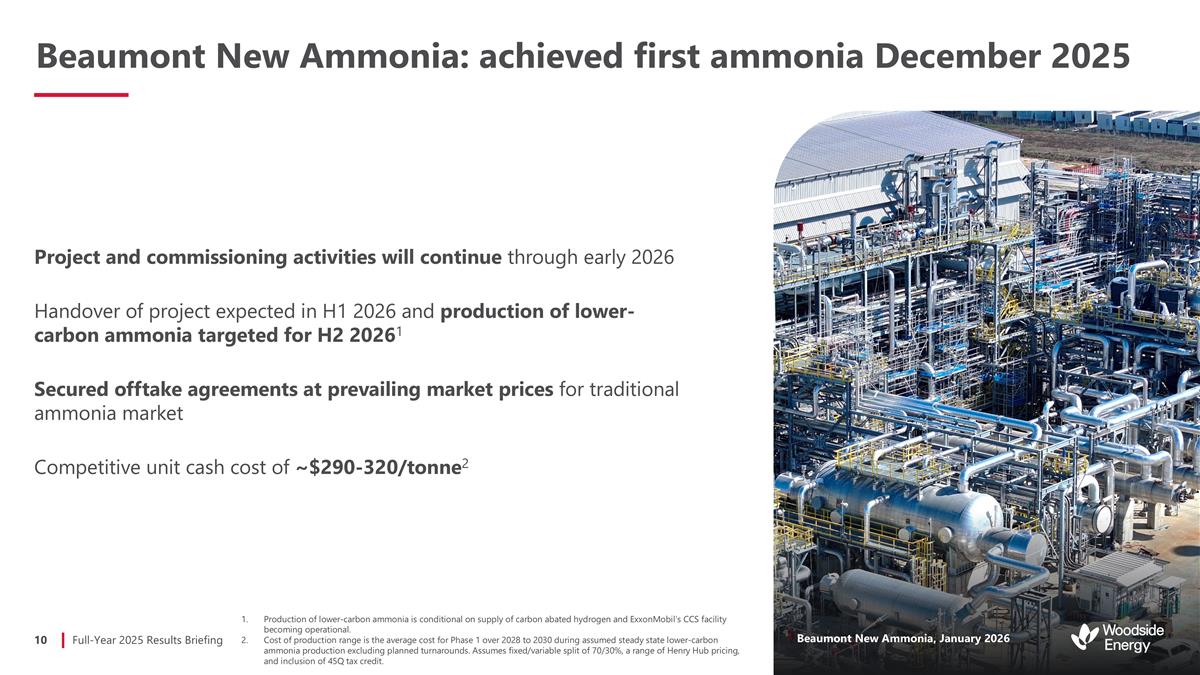
through early 2026 Handover of project expected in H1 2026 and production of lower-carbon ammonia targeted for H2 20261 Secured offtake agreements at prevailing market prices for traditional ammonia market Competitive unit cash cost of
~$290-320/tonne2 Beaumont New Ammonia, January 2026
Scarborough: 94% complete, on
budget and on track1 As at 31 December 2025. Excludes Pluto Train 1 modifications. Completed drilling campaign for all eight development wells with reservoir quality in line with pre-drill expectations Floating production unit (FPU) arrived at
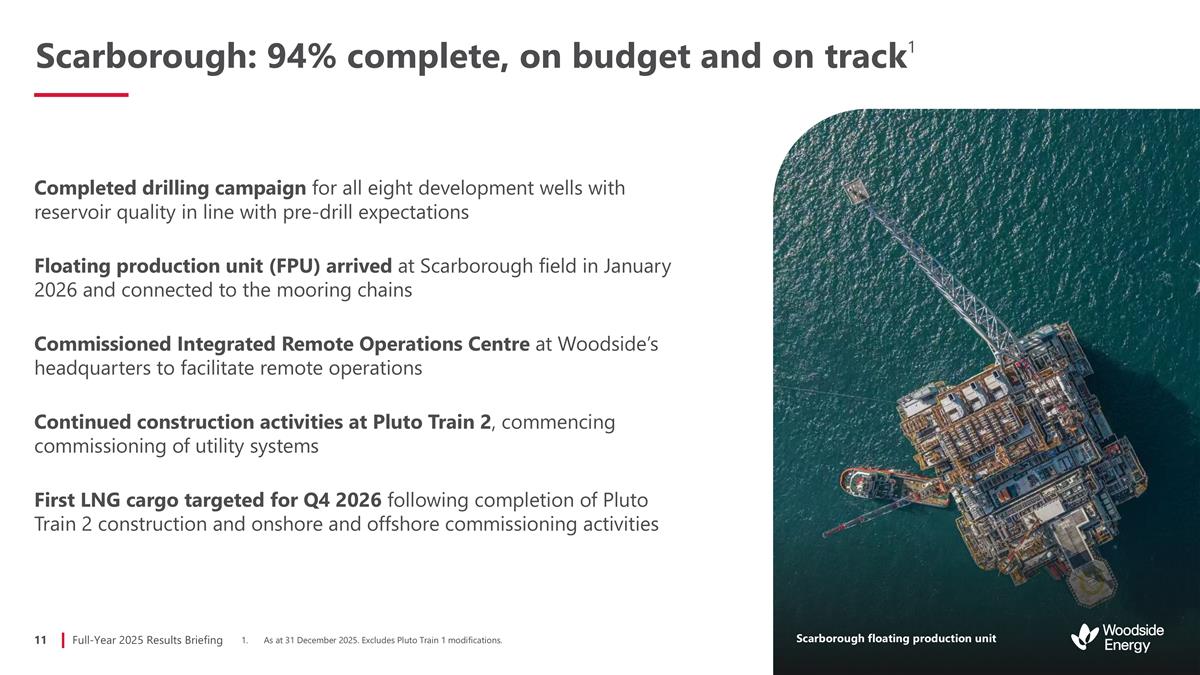
Scarborough field in January 2026 and connected to the mooring chains Commissioned Integrated Remote Operations Centre at Woodside’s headquarters to facilitate remote operations Continued construction activities at Pluto Train 2, commencing
commissioning of utility systems First LNG cargo targeted for Q4 2026 following completion of Pluto Train 2 construction and onshore and offshore commissioning activities Scarborough floating production unit
Trion: 50% complete, on budget and
targeting first oil in 20281 As at 31 December 2025. Advanced FPU and floating storage and offloading facility (FSO) construction with the FPU hull nearing completion and first steel cut for FSO Granted regulatory approval of HSE management system,
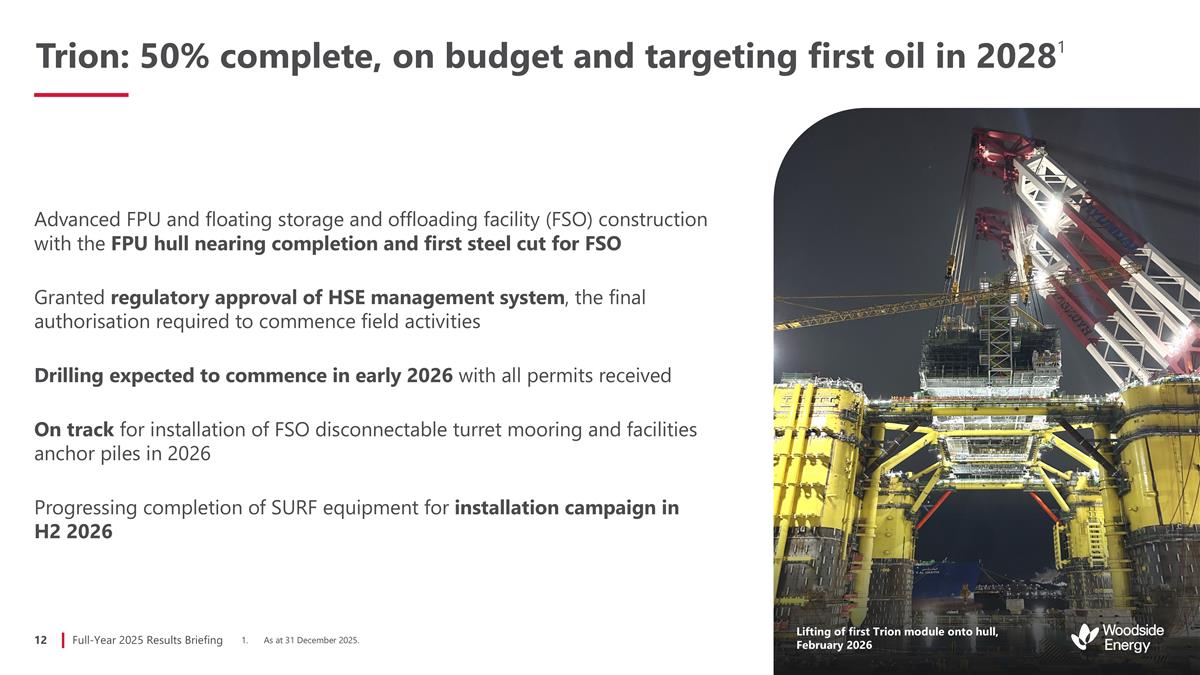
the final authorisation required to commence field activities Drilling expected to commence in early 2026 with all permits received On track for installation of FSO disconnectable turret mooring and facilities anchor piles in 2026 Progressing
completion of SURF equipment for installation campaign in H2 2026 Lifting of first Trion module onto hull, February 2026
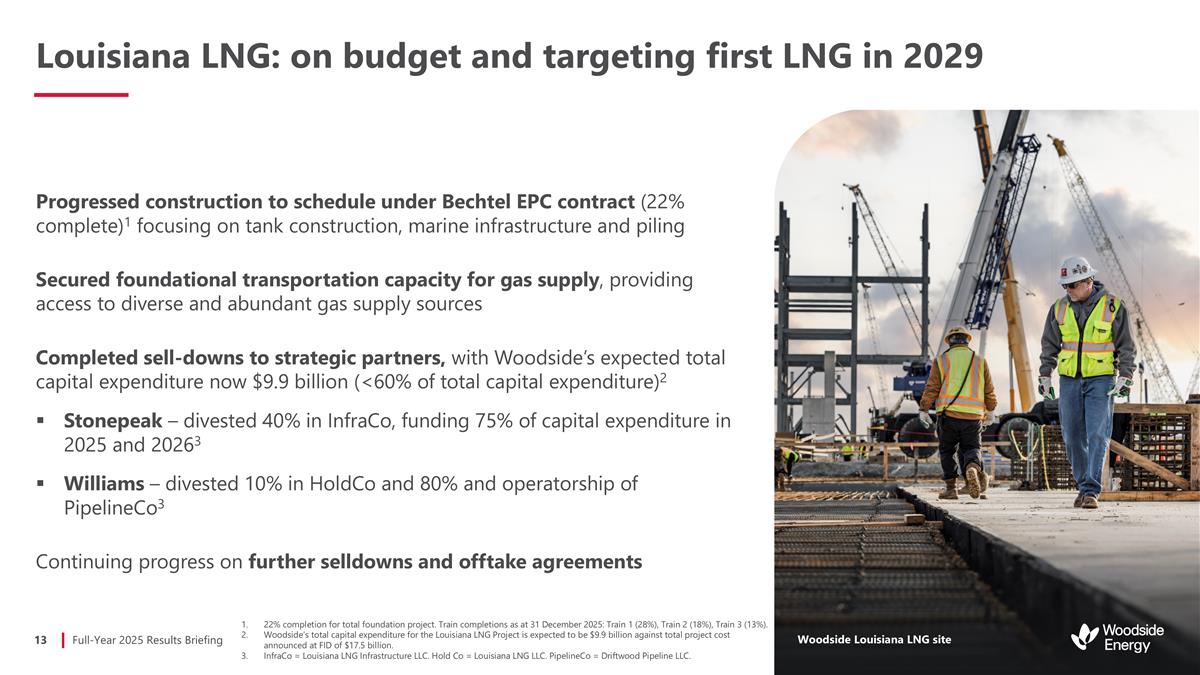
Woodside Louisiana LNG site
Louisiana LNG: on budget and targeting first LNG in 2029 22% completion for total foundation project. Train completions as at 31 December 2025: Train 1 (28%), Train 2 (18%), Train 3 (13%). Woodside’s total capital expenditure for the Louisiana
LNG Project is expected to be $9.9 billion against total project cost announced at FID of $17.5 billion. InfraCo = Louisiana LNG Infrastructure LLC. Hold Co = Louisiana LNG LLC. PipelineCo = Driftwood Pipeline LLC. Progressed construction to
schedule under Bechtel EPC contract (22% complete)1 focusing on tank construction, marine infrastructure and piling Secured foundational transportation capacity for gas supply, providing access to diverse and abundant gas supply sources Completed
sell-downs to strategic partners, with Woodside’s expected total capital expenditure now $9.9 billion (<60% of total capital expenditure)2 Stonepeak – divested 40% in InfraCo, funding 75% of capital expenditure in 2025 and 20263
Williams – divested 10% in HoldCo and 80% and operatorship of PipelineCo3 Continuing progress on further selldowns and offtake agreements
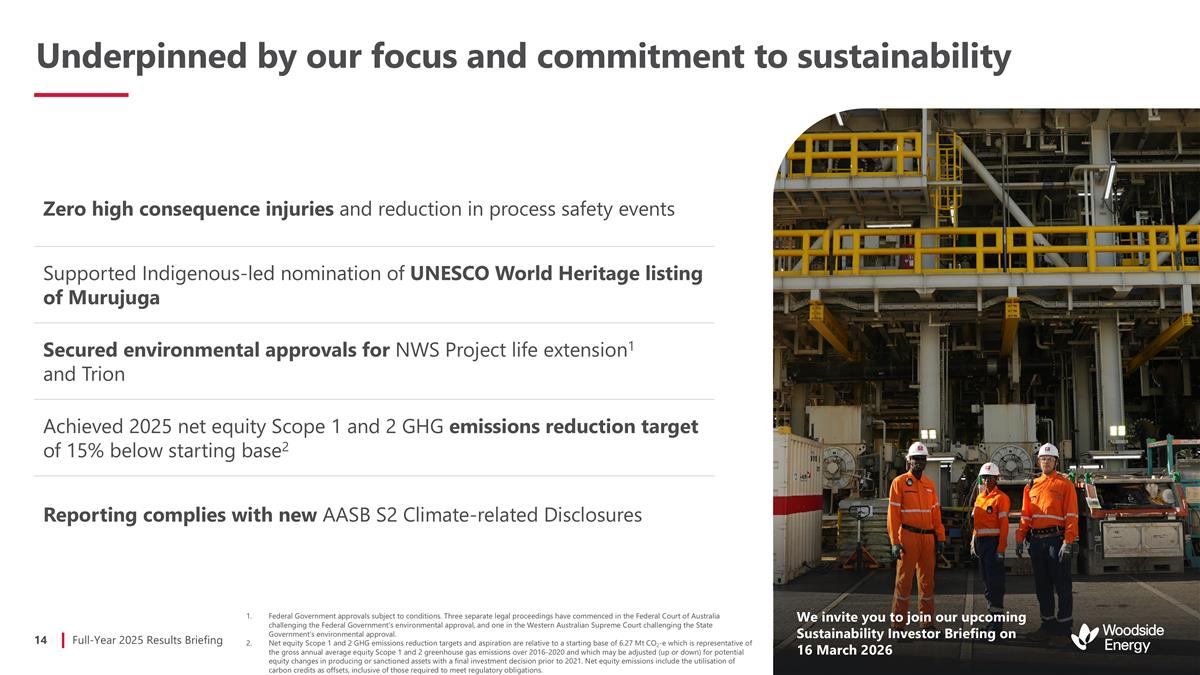
Underpinned by our focus and
commitment to sustainability Net equity Scope 1 and 2 emissions, MtCO2-e Achieved 2025 net equity Scope 1 and 2 GHG emissions reduction target of 15% below starting base1 Zero high consequence injuries and reduction in process safety events
Supported Indigenous-led nomination of UNESCO World Heritage listing of Murujuga Secured environmental approvals for NWS Project life extension1 and Trion Achieved 2025 net equity Scope 1 and 2 GHG emissions reduction target of 15% below starting
base2 Reporting complies with new AASB S2 Climate-related Disclosures We invite you to join our upcoming Sustainability Investor Briefing on 16 March 2026 Federal Government approvals subject to conditions. Three separate legal proceedings have
commenced in the Federal Court of Australia challenging the Federal Government's environmental approval, and one in the Western Australian Supreme Court challenging the State Government's environmental approval. Net equity Scope 1 and 2 GHG
emissions reduction targets and aspiration are relative to a starting base of 6.27 Mt CO2-e which is representative of the gross annual average equity Scope 1 and 2 greenhouse gas emissions over 2016-2020 and which may be adjusted (up or down) for
potential equity changes in producing or sanctioned assets with a final investment decision prior to 2021. Net equity emissions include the utilisation of carbon credits as offsets, inclusive of those required to meet regulatory obligations.
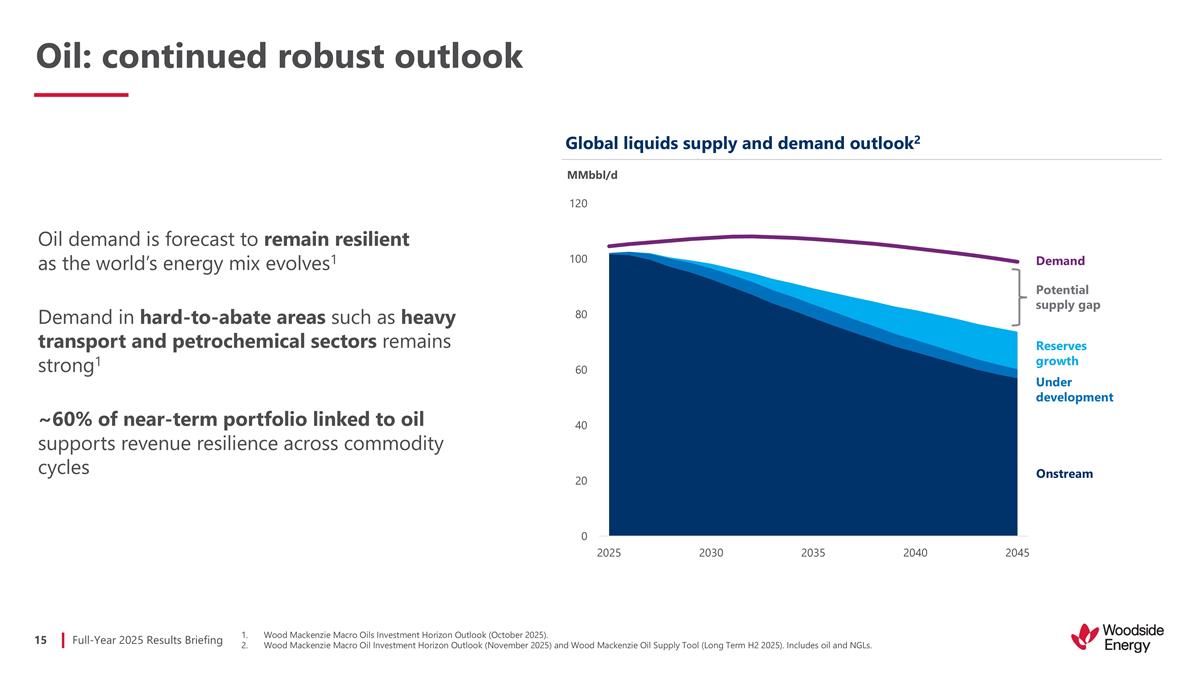
Oil: continued robust outlook Wood
Mackenzie Macro Oils Investment Horizon Outlook (October 2025). Wood Mackenzie Macro Oil Investment Horizon Outlook (November 2025) and Wood Mackenzie Oil Supply Tool (Long Term H2 2025). Includes oil and NGLs. Oil demand is forecast to remain
resilient as the world’s energy mix evolves1 Demand in hard-to-abate areas such as heavy transport and petrochemical sectors remains strong1 ~60% of near-term portfolio linked to oil supports revenue resilience across commodity cycles Global
liquids supply and demand outlook2 MMbbl/d Onstream Under development Reserves growth Potential supply gap Demand
LNG: robust outlook and ongoing
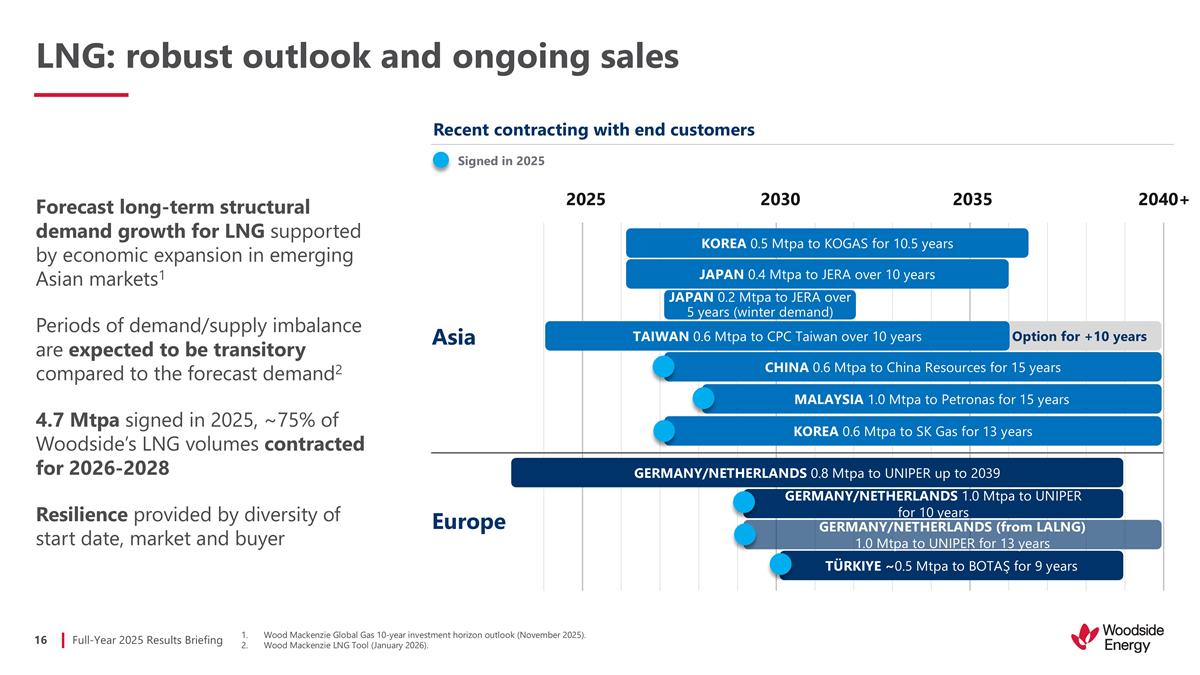
sales 2025 2030 2035 2040+ JAPAN 0.4 Mtpa to JERA over 10 years KOREA 0.5 Mtpa to KOGAS for 10.5 years GERMANY/NETHERLANDS 0.8 Mtpa to UNIPER up to 2039 CHINA 0.6 Mtpa to China Resources for 15 years MALAYSIA 1.0 Mtpa to Petronas for 15 years
TÜRKIYE ~0.5 Mtpa to BOTAŞ for 9 years GERMANY/NETHERLANDS (from LALNG) 1.0 Mtpa to UNIPER for 13 years Option for +10 years TAIWAN 0.6 Mtpa to CPC Taiwan over 10 years JAPAN 0.2 Mtpa to JERA over 5 years (winter demand)
GERMANY/NETHERLANDS 1.0 Mtpa to UNIPER for 10 years KOREA 0.6 Mtpa to SK Gas for 13 years Recent contracting with end customers Signed in 2025 Forecast long-term structural demand growth for LNG supported by economic expansion in emerging Asian
markets1 Periods of demand/supply imbalance are expected to be transitory compared to the forecast demand2 4.7 Mtpa signed in 2025, ~75% of Woodside’s LNG volumes contracted for 2026-2028 Resilience provided by diversity of start date, market
and buyer Wood Mackenzie Global Gas 10-year investment horizon outlook (November 2025). Wood Mackenzie LNG Tool (January 2026). Asia Europe
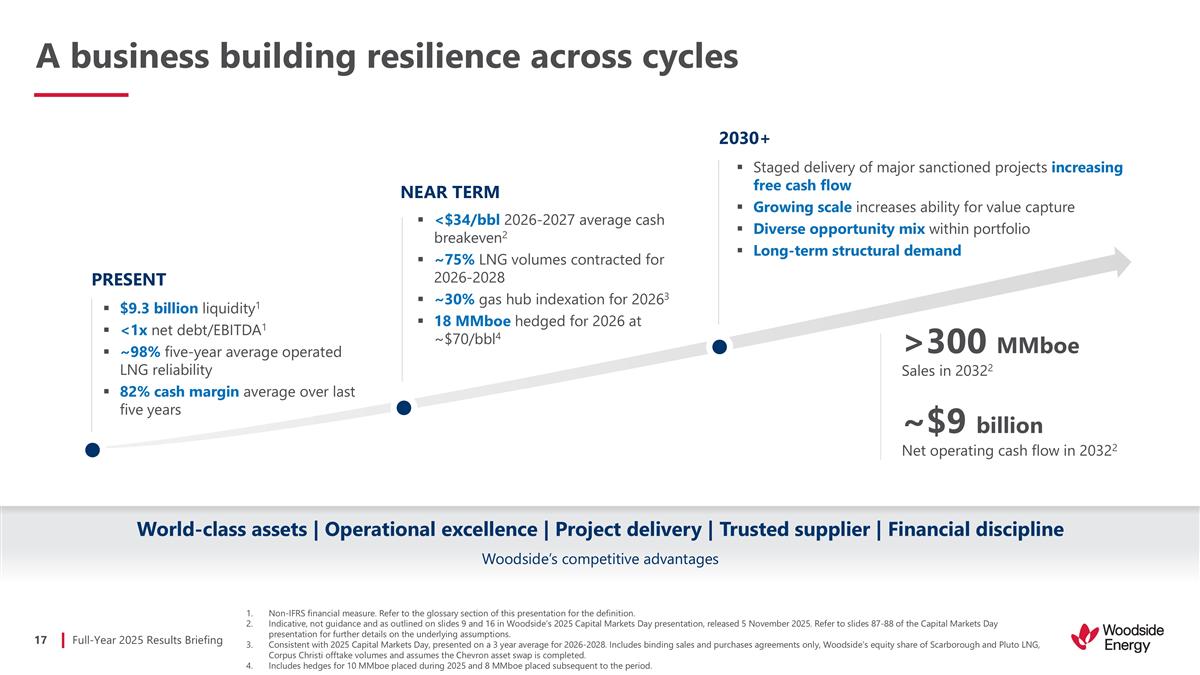
World-class assets | Operational
excellence | Project delivery | Trusted supplier | Financial discipline A business building resilience across cycles Non-IFRS financial measure. Refer to the glossary section of this presentation for the definition. Indicative, not guidance and as
outlined on slides 9 and 16 in Woodside’s 2025 Capital Markets Day presentation, released 5 November 2025. Refer to slides 87-88 of the Capital Markets Day presentation for further details on the underlying assumptions. Consistent with 2025
Capital Markets Day, presented on a 3 year average for 2026-2028. Includes binding sales and purchases agreements only, Woodside’s equity share of Scarborough and Pluto LNG, Corpus Christi offtake volumes and assumes the Chevron asset swap is
completed. Includes hedges for 10 MMboe placed during 2025 and 8 MMboe placed subsequent to the period. PRESENT $9.3 billion liquidity1 <1x net debt/EBITDA1 ~98% five-year average operated LNG reliability 82% cash margin average over last five
years NEAR TERM <$34/bbl 2026-2027 average cash breakeven2 ~75% LNG volumes contracted for 2026-2028 ~30% gas hub indexation for 20263 18 MMboe hedged for 2026 at ~$70/bbl4 Staged delivery of major sanctioned projects increasing free cash flow
Growing scale increases ability for value capture Diverse opportunity mix within portfolio Long-term structural demand 2030+ ~$9 billion Net operating cash flow in 20322 >300 MMboe Sales in 20322 Woodside’s competitive advantages
Graham Tiver EVP and Chief
Financial Officer Capital management Maintaining disciplined capital allocation and strong balance sheet
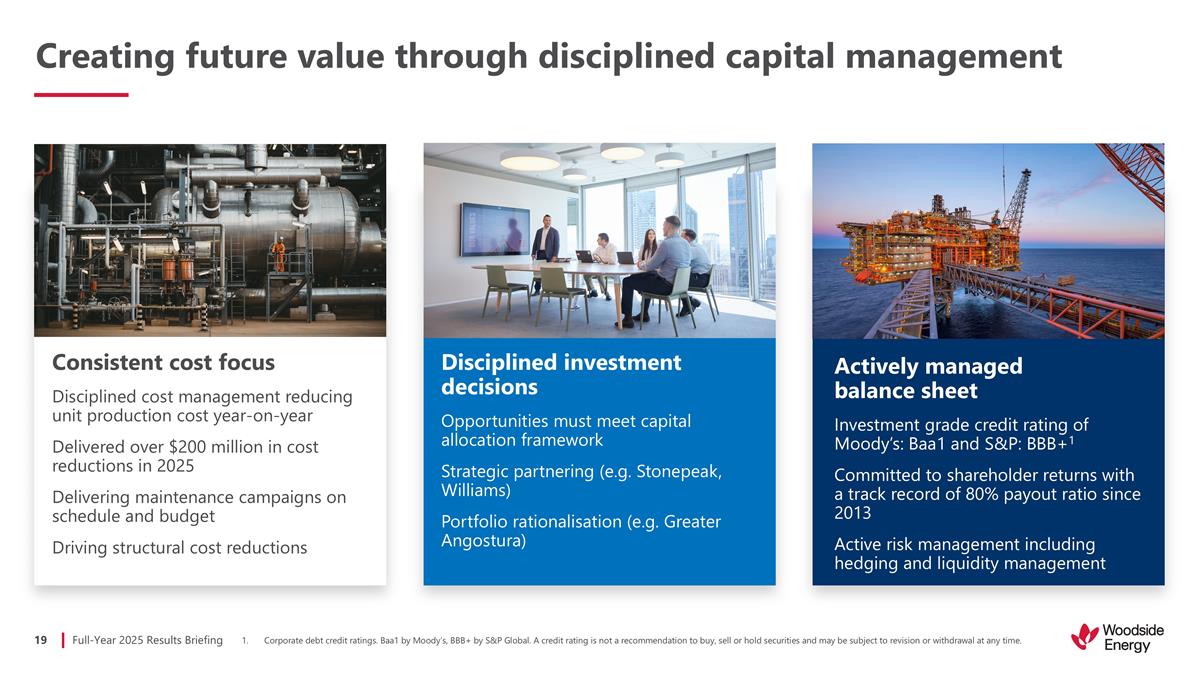
Creating future value through
disciplined capital management Consistent cost focus Disciplined cost management reducing unit production cost year-on-year Delivered over $200 million in cost reductions in 2025 Delivering maintenance campaigns on schedule and budget Driving
structural cost reductions Disciplined investment decisions Opportunities must meet capital allocation framework Strategic partnering (e.g. Stonepeak, Williams) Portfolio rationalisation (e.g. Greater Angostura) Actively managed balance sheet
Investment grade credit rating of Moody’s: Baa1 and S&P: BBB+1 Committed to shareholder returns with a track record of 80% payout ratio since 2013 Active risk management including hedging and liquidity management Corporate debt credit
ratings. Baa1 by Moody’s, BBB+ by S&P Global. A credit rating is not a recommendation to buy, sell or hold securities and may be subject to revision or withdrawal at any time.
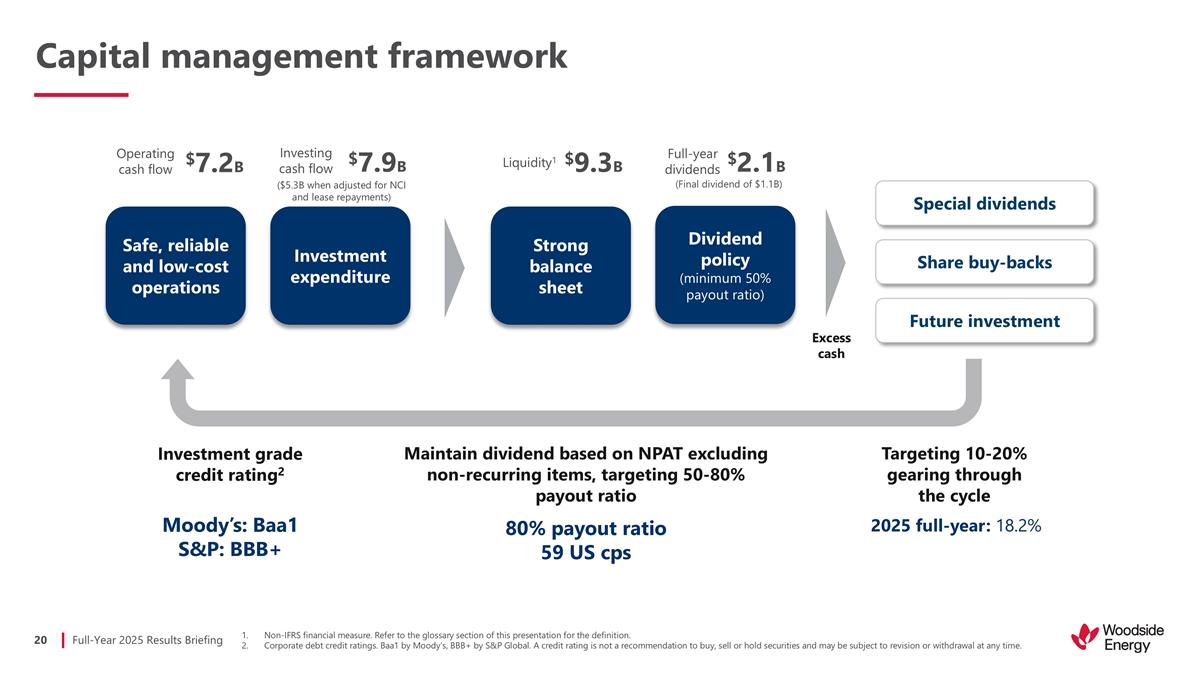
Capital management framework Excess
cash Safe, reliable and low-cost operations Investment expenditure Strong balance sheet Dividend policy (minimum 50% payout ratio) Special dividends Share buy-backs Investment grade credit rating2 Maintain dividend based on NPAT excluding
non-recurring items, targeting 50-80% payout ratio Targeting 10-20% gearing through the cycle Future investment Moody’s: Baa1 S&P: BBB+ 80% payout ratio 59 US cps 2025 full-year: 18.2% Operating cash flow Investing cash flow Full-year
dividends Liquidity1 $7.2B $7.9B $9.3B $2.1B Non-IFRS financial measure. Refer to the glossary section of this presentation for the definition. Corporate debt credit ratings. Baa1 by Moody’s, BBB+ by S&P Global. A credit rating is not a
recommendation to buy, sell or hold securities and may be subject to revision or withdrawal at any time. (Final dividend of $1.1B) ($5.3B when adjusted for NCI and lease repayments)
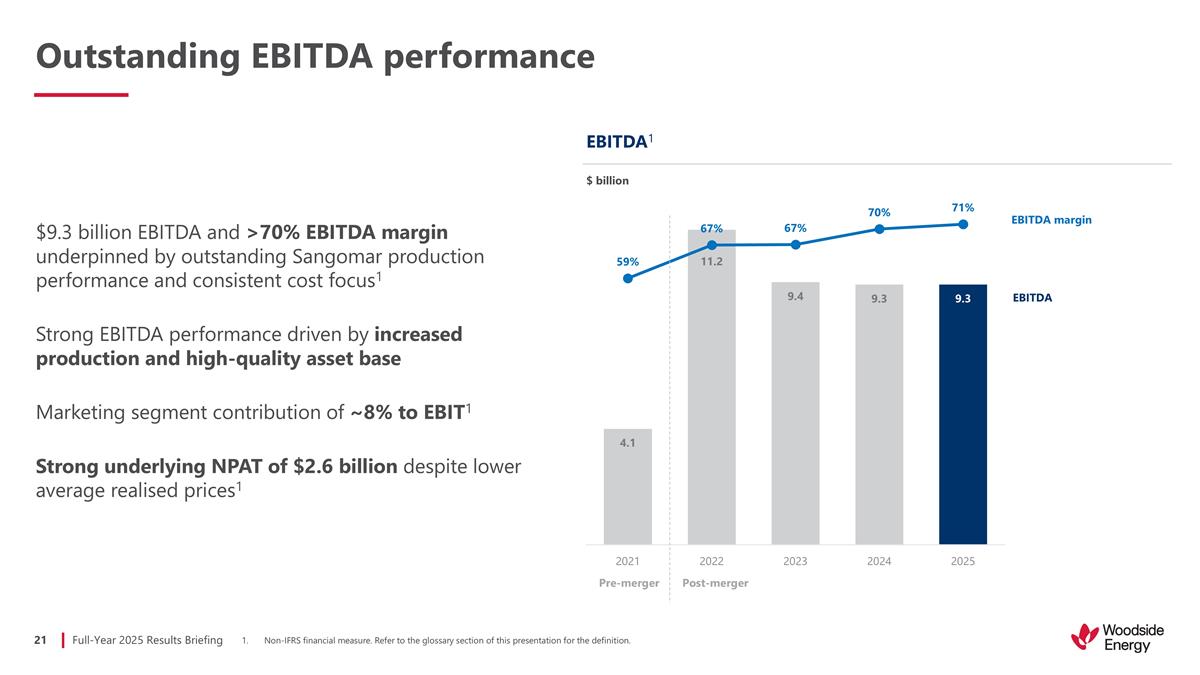
Outstanding EBITDA performance $9.3
billion EBITDA and >70% EBITDA margin underpinned by outstanding Sangomar production performance and consistent cost focus1 Strong EBITDA performance driven by increased production and high-quality asset base Marketing segment contribution of ~8%
to EBIT1 Strong underlying NPAT of $2.6 billion despite lower average realised prices1 Non-IFRS financial measure. Refer to the glossary section of this presentation for the definition. EBITDA1 $ billion EBITDA margin EBITDA Pre-merger
Post-merger
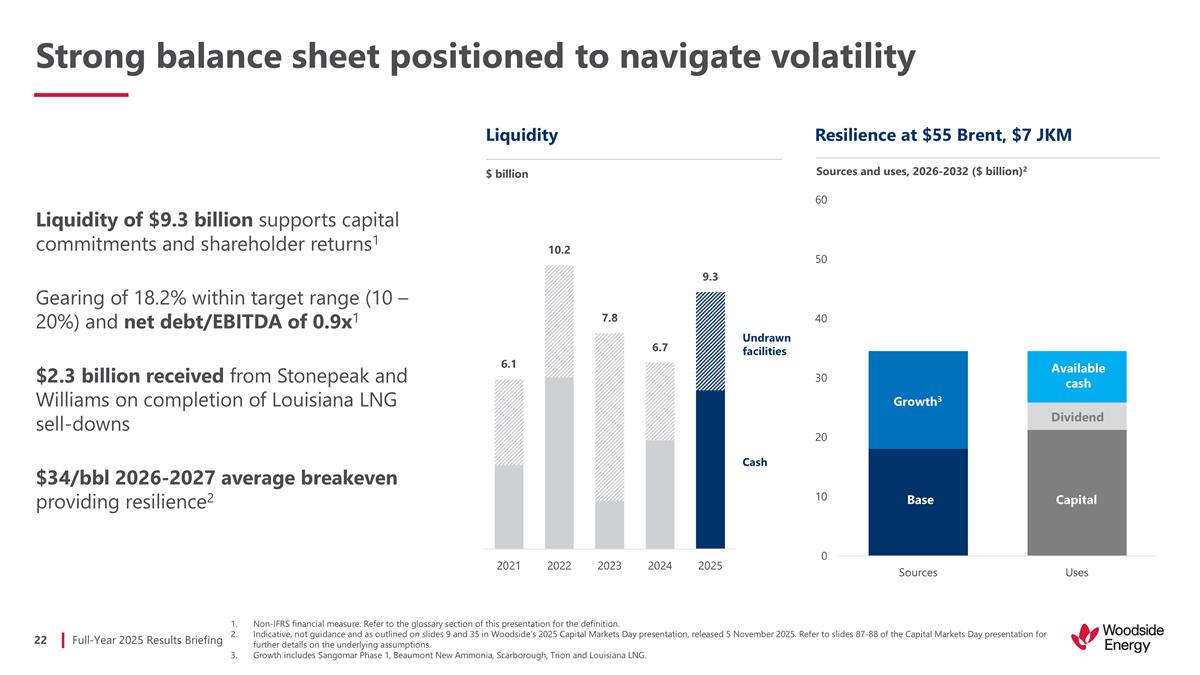
Strong balance sheet positioned to
navigate volatility Liquidity of $9.3 billion supports capital commitments and shareholder returns1 Gearing of 18.2% within target range (10 – 20%) and net debt/EBITDA of 0.9x1 $2.3 billion received from Stonepeak and Williams on completion of
Louisiana LNG sell-downs $34/bbl 2026-2027 average breakeven providing resilience2 Non-IFRS financial measure. Refer to the glossary section of this presentation for the definition. Indicative, not guidance and as outlined on slides 9 and 35 in
Woodside’s 2025 Capital Markets Day presentation, released 5 November 2025. Refer to slides 87-88 of the Capital Markets Day presentation for further details on the underlying assumptions. Growth includes Sangomar Phase 1, Beaumont New
Ammonia, Scarborough, Trion and Louisiana LNG. Liquidity $ billion Undrawn facilities Cash Base Capital Dividend Available cash Sources and uses, 2026-2032 ($ billion)2 Resilience at $55 Brent, $7 JKM Growth3
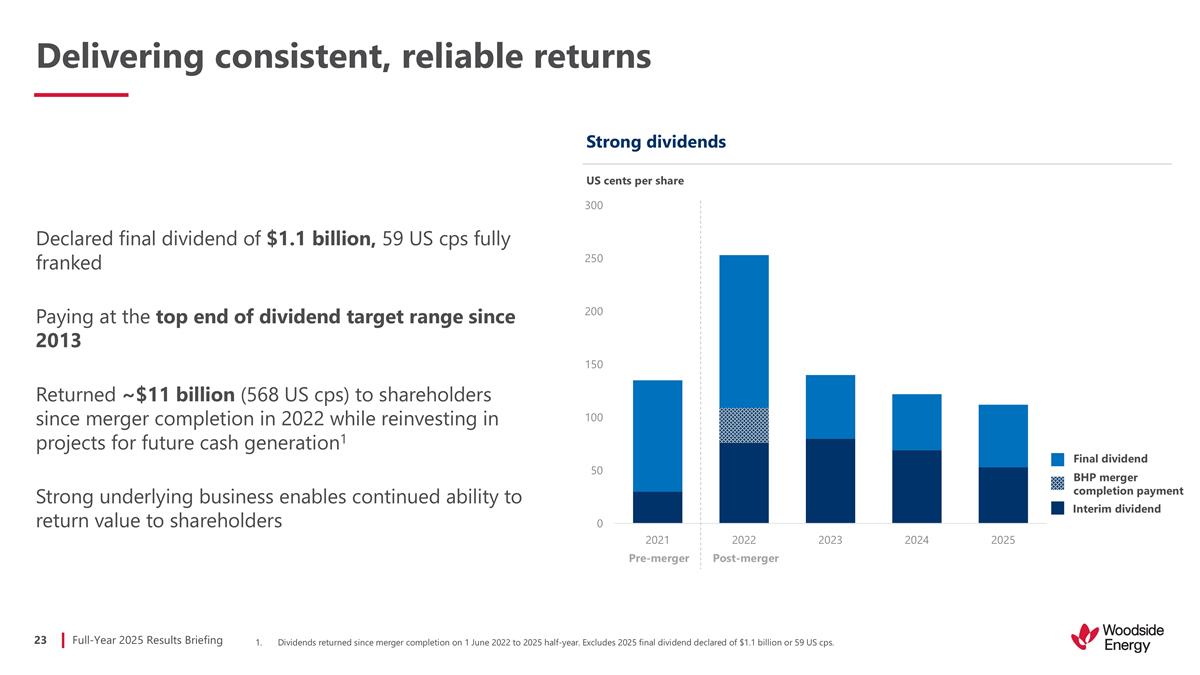
Delivering consistent, reliable
returns Declared final dividend of $1.1 billion, 59 US cps fully franked Paying at the top end of dividend target range since 2013 Returned ~$11 billion (568 US cps) to shareholders since merger completion in 2022 while reinvesting in projects for
future cash generation1 Strong underlying business enables continued ability to return value to shareholders Dividends returned since merger completion on 1 June 2022 to 2025 half-year. Excludes 2025 final dividend declared of $1.1 billion or 59 US
cps. Strong dividends US cents per share Pre-merger Post-merger Interim dividend Final dividend BHP merger completion payment

Liz Westcott Acting Chief Executive
Officer Close 2026: Continuing to execute strategy
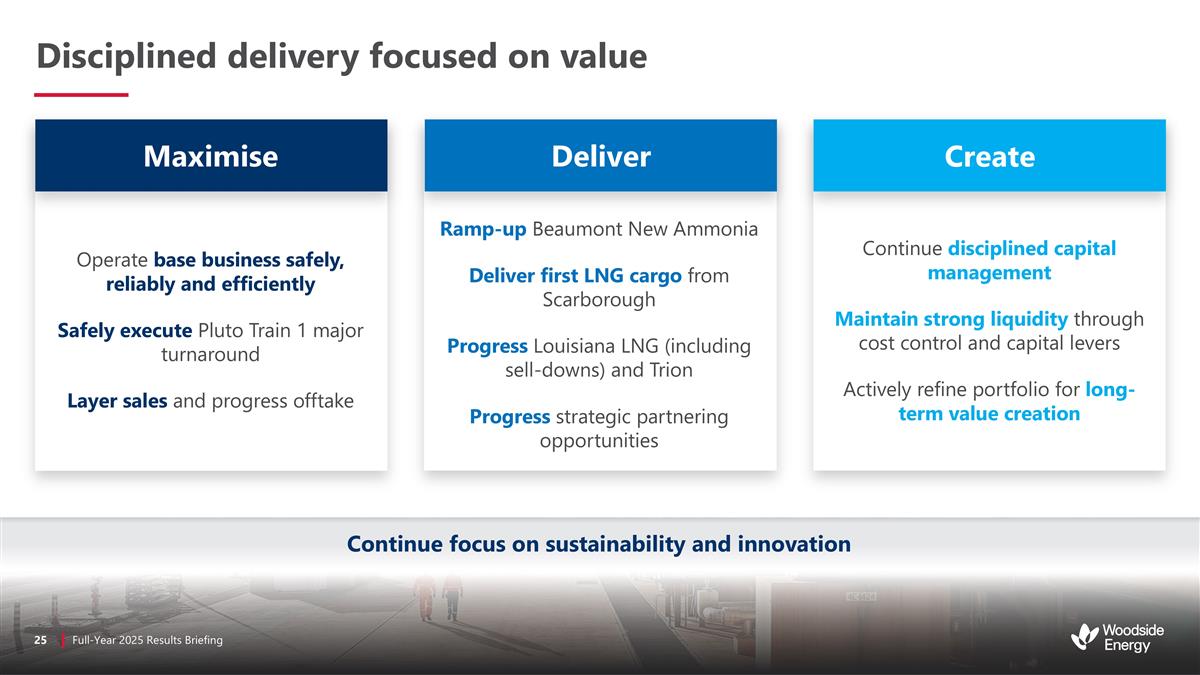
Disciplined delivery focused on
value Operate base business safely, reliably and efficiently Safely execute Pluto Train 1 major turnaround Layer sales and progress offtake Ramp-up Beaumont New Ammonia Deliver first LNG cargo from Scarborough Progress Louisiana LNG (including
sell-downs) and Trion Progress strategic partnering opportunities Continue disciplined capital management Maintain strong liquidity through cost control and capital levers Actively refine portfolio for long-term value creation Maximise Deliver
Create Full-Year 2025 Results Briefing Continue focus on sustainability and innovation

Q&A

Annexure
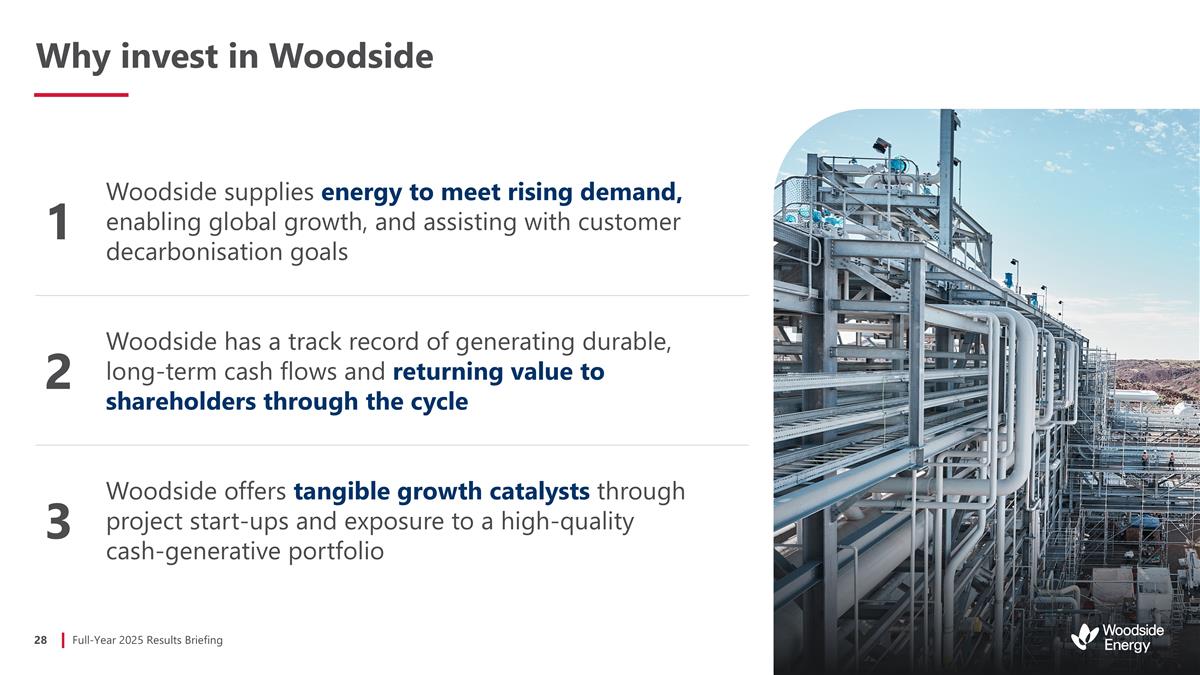
Why invest in Woodside 1 Woodside
supplies energy to meet rising demand, enabling global growth, and assisting with customer decarbonisation goals 2 Woodside has a track record of generating durable, long-term cash flows and returning value to shareholders through the cycle 3
Woodside offers tangible growth catalysts through project start-ups and exposure to a high-quality cash-generative portfolio
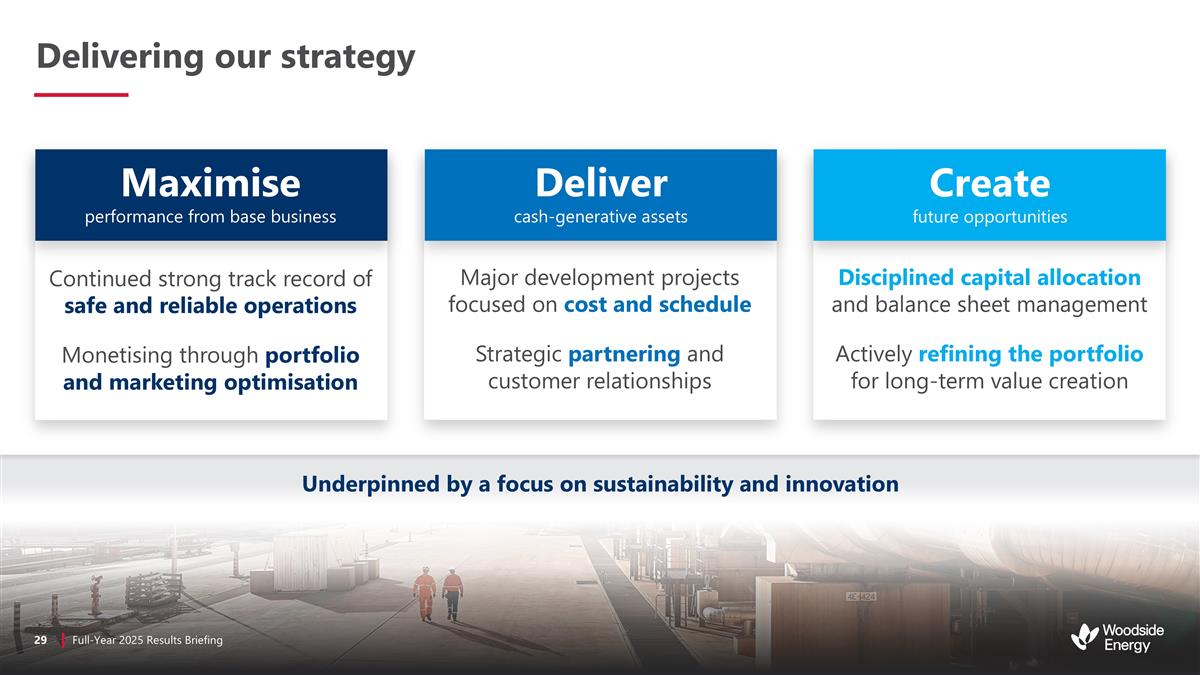
Continued strong track record of
safe and reliable operations Monetising through portfolio and marketing optimisation Major development projects focused on cost and schedule Strategic partnering and customer relationships Disciplined capital allocation and balance sheet management
Actively refining the portfolio for long-term value creation Delivering our strategy Maximise performance from base business Deliver cash-generative assets Create future opportunities Full-Year 2025 Results Briefing Underpinned by a focus on
sustainability and innovation
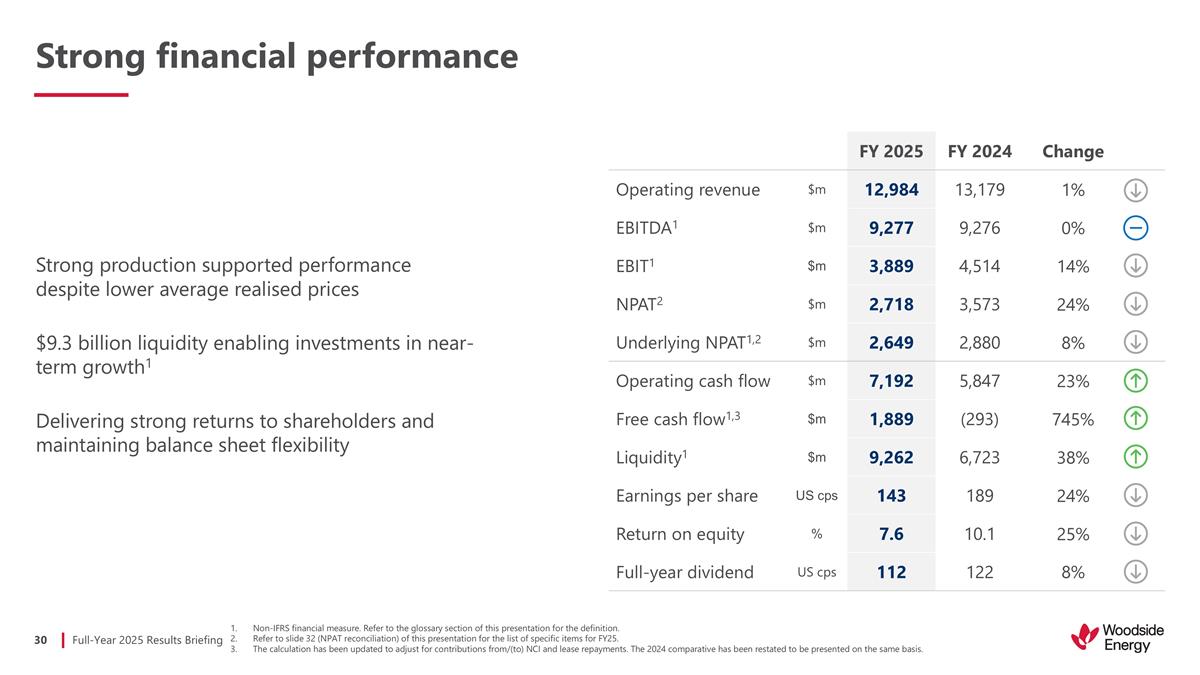
Non-IFRS financial measure. Refer
to the glossary section of this presentation for the definition. Refer to slide 32 (NPAT reconciliation) of this presentation for the list of specific items for FY25. The calculation has been updated to adjust for contributions from/(to) NCI and
lease repayments. The 2024 comparative has been restated to be presented on the same basis. Strong financial performance FY 2025 FY 2024 Change Operating revenue $m 12,984 13,179 1% EBITDA1 $m 9,277 9,276 0% EBIT1 $m 3,889 4,514 14% NPAT2 $m 2,718
3,573 24% Underlying NPAT1,2 $m 2,649 2,880 8% Operating cash flow $m 7,192 5,847 23% Free cash flow1,3 $m 1,889 (293) 745% Liquidity1 $m 9,262 6,723 38% Earnings per share US cps 143 189 24% Return on equity % 7.6 10.1 25% Full-year dividend US cps
112 122 8% Strong production supported performance despite lower average realised prices $9.3 billion liquidity enabling investments in near-term growth1 Delivering strong returns to shareholders and maintaining balance sheet flexibility
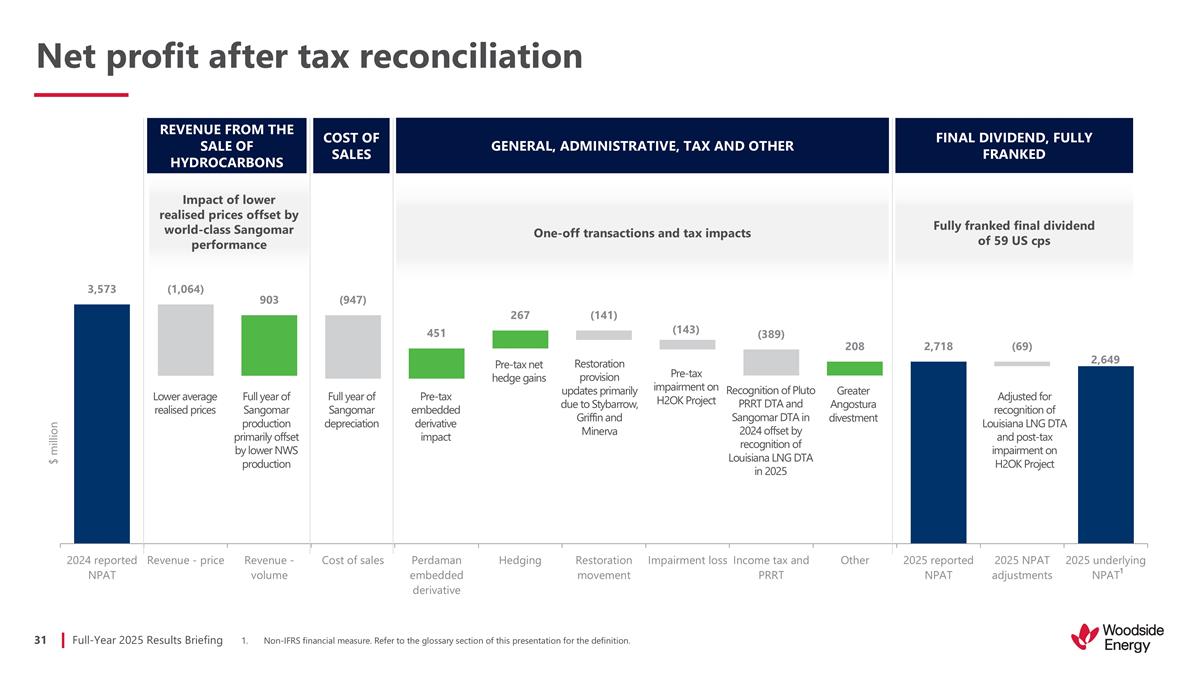
Net profit after tax reconciliation
Non-IFRS financial measure. Refer to the glossary section of this presentation for the definition. Impact of lower realised prices offset by world-class Sangomar performance Pre-tax net hedge gains Pre-tax embedded derivative impact Pre-tax
impairment on H2OK Project Adjusted for recognition of Louisiana LNG DTA and post-tax impairment on H2OK Project 1 REVENUE FROM THE SALE OF HYDROCARBONS COST OF SALES GENERAL, ADMINISTRATIVE, TAX AND OTHER FINAL DIVIDEND, FULLY FRANKED Fully franked
final dividend of 59 US cps One-off transactions and tax impacts Full year of Sangomar depreciation Restoration provision updates primarily due to Stybarrow, Griffin and Minerva Recognition of Pluto PRRT DTA and Sangomar DTA in 2024 offset by
recognition of Louisiana LNG DTA in 2025 Full year of Sangomar production primarily offset by lower NWS production Lower average realised prices Greater Angostura divestment
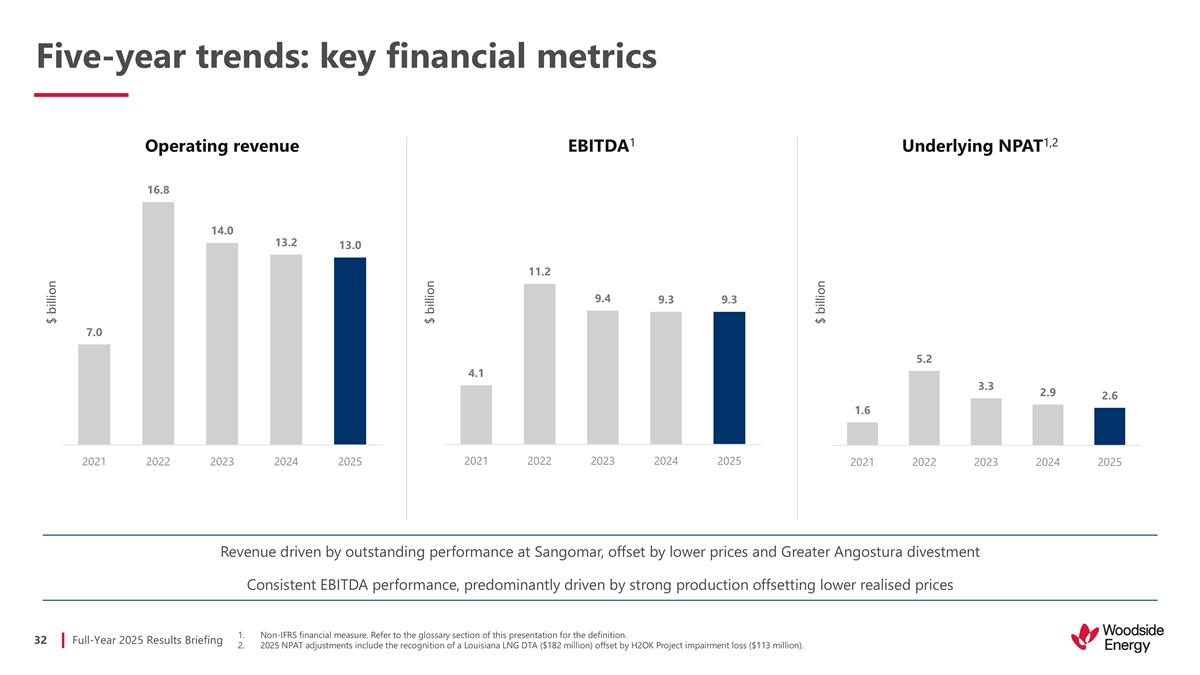
$ billion $ billion Five-year
trends: key financial metrics Non-IFRS financial measure. Refer to the glossary section of this presentation for the definition. 2025 NPAT adjustments include the recognition of a Louisiana LNG DTA ($182 million) offset by H2OK Project impairment
loss ($113 million). Revenue driven by outstanding performance at Sangomar, offset by lower prices and Greater Angostura divestment Consistent EBITDA performance, predominantly driven by strong production offsetting lower realised prices EBITDA1
Operating revenue Underlying NPAT1,2 $ billion
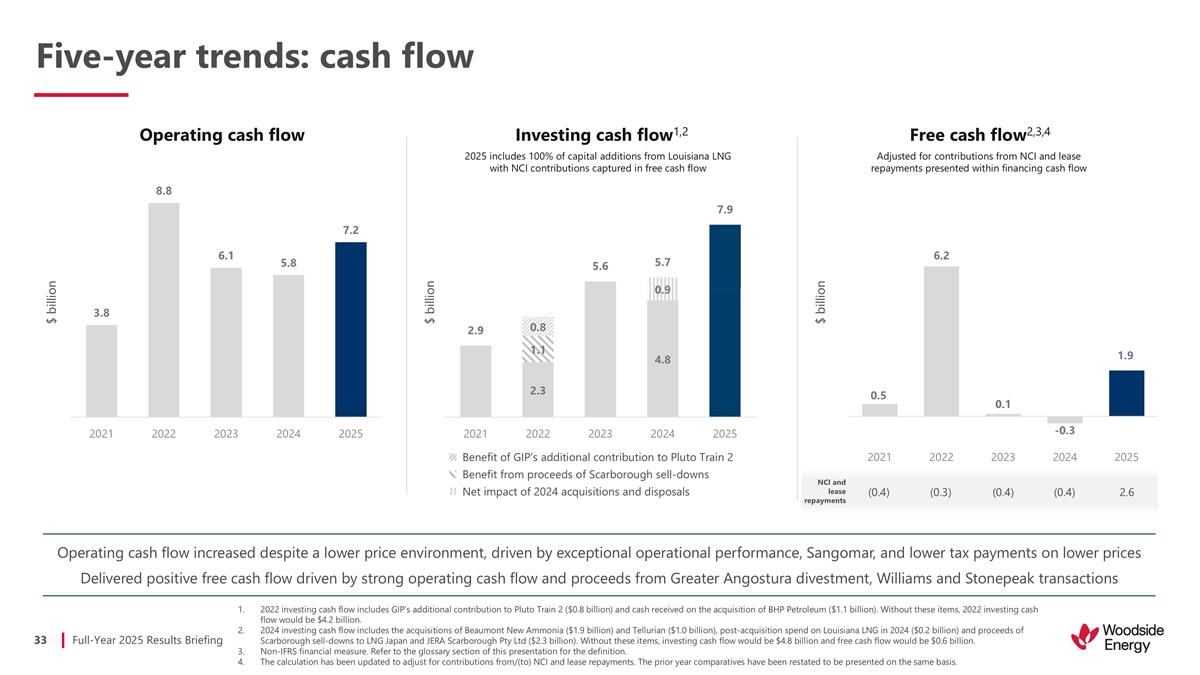
$ billion $ billion Five-year
trends: cash flow 2022 investing cash flow includes GIP’s additional contribution to Pluto Train 2 ($0.8 billion) and cash received on the acquisition of BHP Petroleum ($1.1 billion). Without these items, 2022 investing cash flow would be $4.2
billion. 2024 investing cash flow includes the acquisitions of Beaumont New Ammonia ($1.9 billion) and Tellurian ($1.0 billion), post-acquisition spend on Louisiana LNG in 2024 ($0.2 billion) and proceeds of Scarborough sell-downs to LNG Japan and
JERA Scarborough Pty Ltd ($2.3 billion). Without these items, investing cash flow would be $4.8 billion and free cash flow would be $0.6 billion. Non-IFRS financial measure. Refer to the glossary section of this presentation for the definition. The
calculation has been updated to adjust for contributions from/(to) NCI and lease repayments. The prior year comparatives have been restated to be presented on the same basis. Investing cash flow1,2 Operating cash flow Free cash flow2,3,4 Benefit of
GIP’s additional contribution to Pluto Train 2 Benefit from proceeds of Scarborough sell-downs Net impact of 2024 acquisitions and disposals $ billion Operating cash flow increased despite a lower price environment, driven by exceptional
operational performance, Sangomar, and lower tax payments on lower prices Delivered positive free cash flow driven by strong operating cash flow and proceeds from Greater Angostura divestment, Williams and Stonepeak transactions Adjusted for
contributions from NCI and lease repayments presented within financing cash flow NCI and lease repayments 2025 includes 100% of capital additions from Louisiana LNG with NCI contributions captured in free cash flow 2.6 (0.4) (0.4) (0.3)
(0.4)
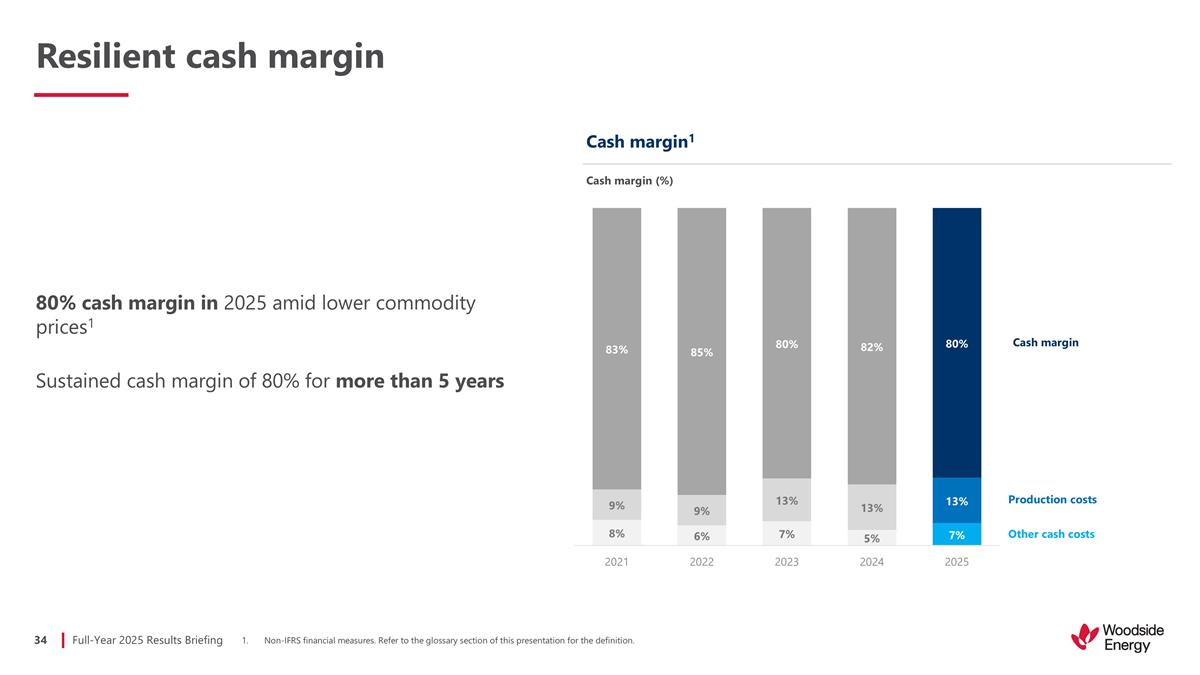
Resilient cash margin 80% cash
margin in 2025 amid lower commodity prices1 Sustained cash margin of 80% for more than 5 years Non-IFRS financial measures. Refer to the glossary section of this presentation for the definition. Cash margin1 Cash margin (%) Cash margin Production
costs Other cash costs
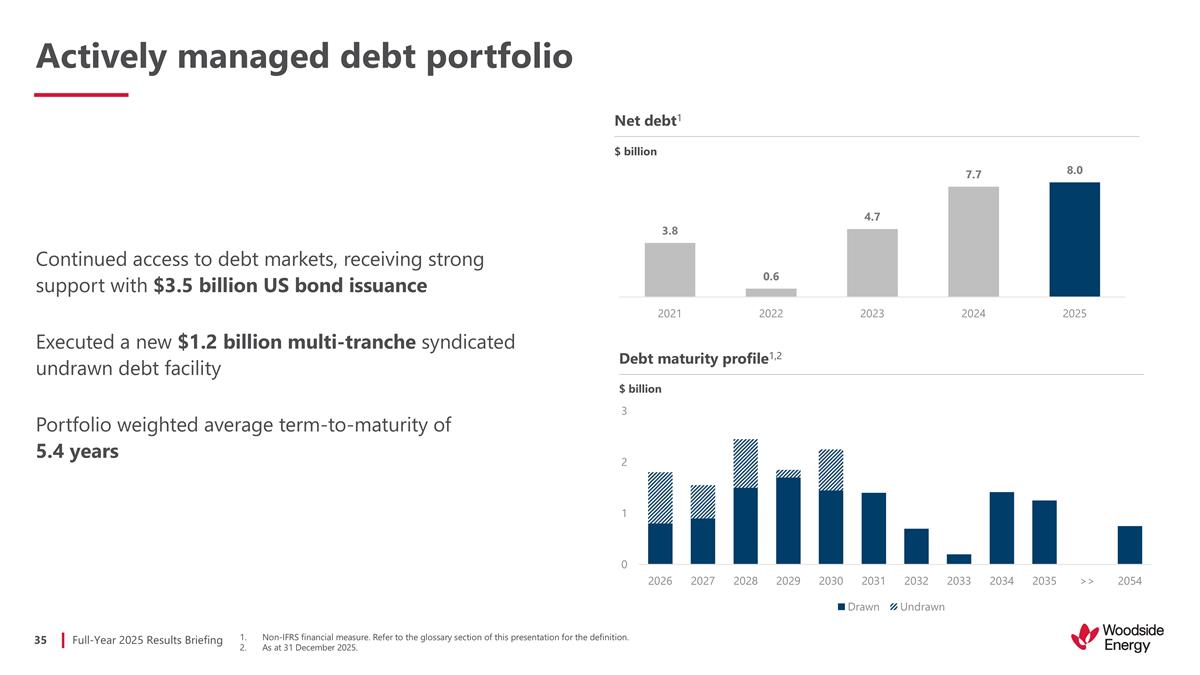
Actively managed debt portfolio
Non-IFRS financial measure. Refer to the glossary section of this presentation for the definition. As at 31 December 2025. Continued access to debt markets, receiving strong support with $3.5 billion US bond issuance Executed a new $1.2 billion
multi-tranche syndicated undrawn debt facility Portfolio weighted average term-to-maturity of 5.4 years Net debt1 Debt maturity profile1,2 $ billion $ billion
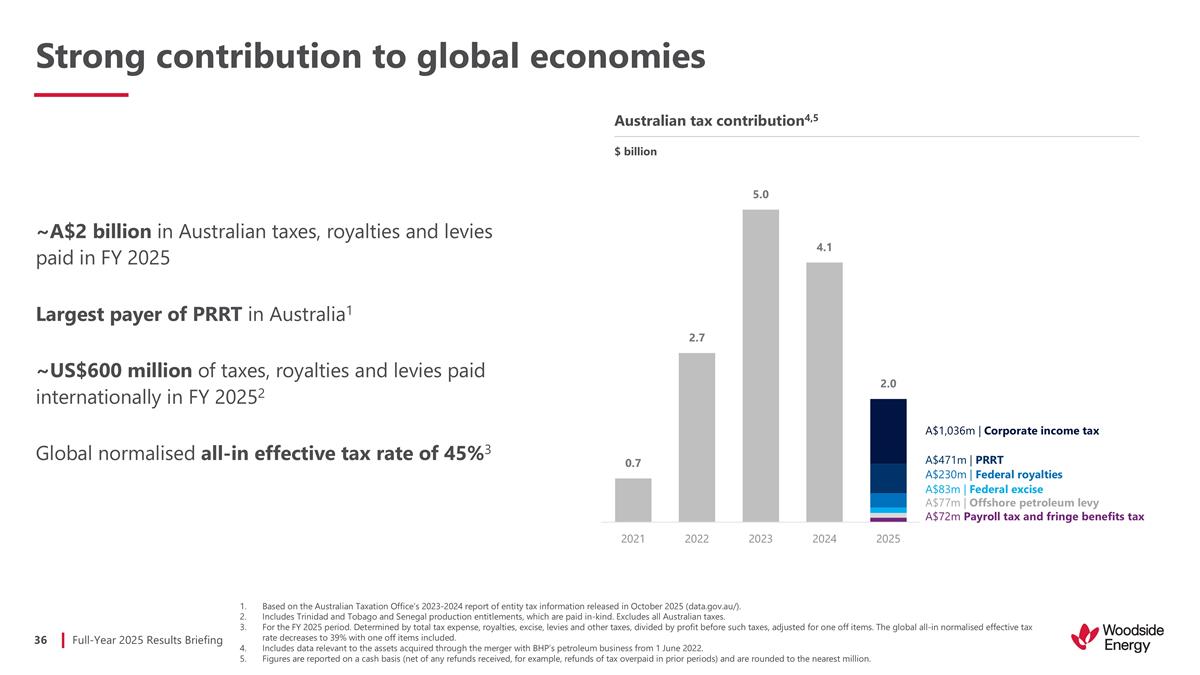
Strong contribution to global
economies Based on the Australian Taxation Office’s 2023-2024 report of entity tax information released in October 2025 (data.gov.au/). Includes Trinidad and Tobago and Senegal production entitlements, which are paid in-kind. Excludes
all Australian taxes. For the FY 2025 period. Determined by total tax expense, royalties, excise, levies and other taxes, divided by profit before such taxes, adjusted for one off items. The global all-in normalised effective
tax rate decreases to 39% with one off items included. Includes data relevant to the assets acquired through the merger with BHP’s petroleum business from 1 June 2022. Figures are reported on a cash
basis (net of any refunds received, for example, refunds of tax overpaid in prior periods) and are rounded to the nearest million. ~A$2 billion in Australian taxes, royalties and levies paid in FY 2025 Largest payer of PRRT in Australia1
~US$600 million of taxes, royalties and levies paid internationally in FY 20252 Global normalised all-in effective tax rate of 45%3 Australian tax contribution4,5 A$1,036m | Corporate income tax A$471m | PRRT A$230m | Federal royalties A$83m |
Federal excise A$77m | Offshore petroleum levy A$72m Payroll tax and fringe benefits tax $ billion
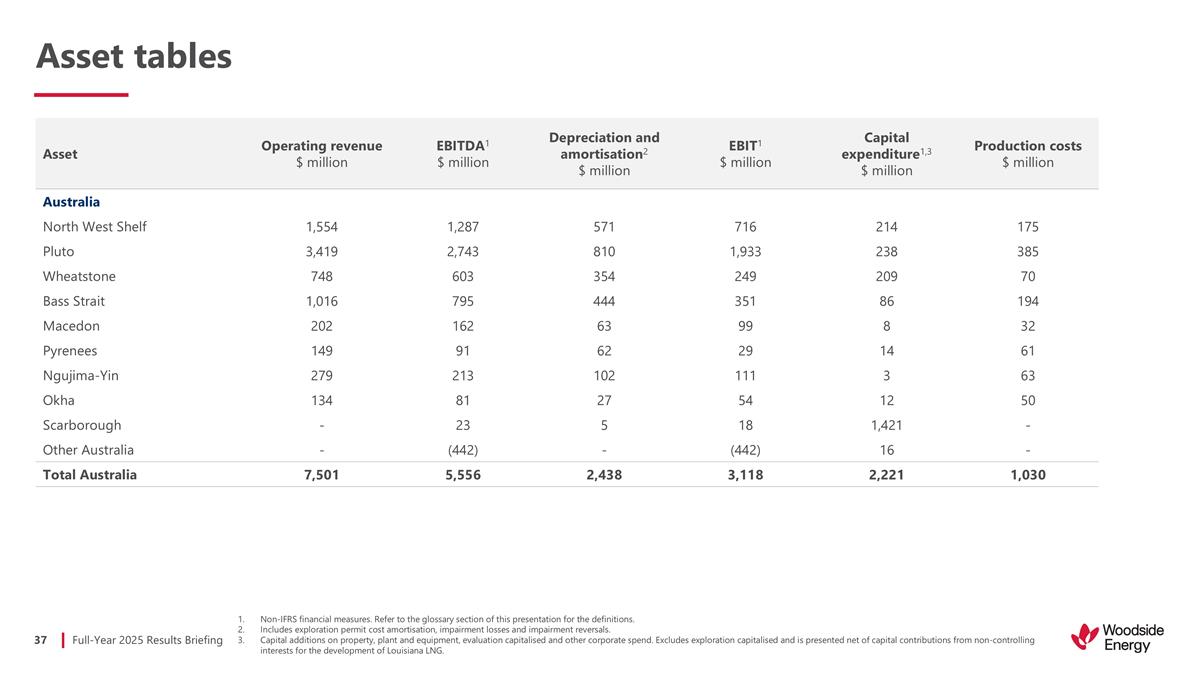
Asset tables Asset Operating
revenue $ million EBITDA1 $ million Depreciation and amortisation2 $ million EBIT1 $ million Capital expenditure1,3 $ million Production costs $ million Australia North West Shelf 1,554 1,287 571 716 214 175 Pluto 3,419 2,743 810 1,933 238 385
Wheatstone 748 603 354 249 209 70 Bass Strait 1,016 795 444 351 86 194 Macedon 202 162 63 99 8 32 Pyrenees 149 91 62 29 14 61 Ngujima-Yin 279 213 102 111 3 63 Okha 134 81 27 54 12 50 Scarborough - 23 5 18 1,421 - Other Australia - (442) - (442) 16 -
Total Australia 7,501 5,556 2,438 3,118 2,221 1,030 Non-IFRS financial measures. Refer to the glossary section of this presentation for the definitions. Includes exploration permit cost amortisation, impairment losses and impairment reversals.
Capital additions on property, plant and equipment, evaluation capitalised and other corporate spend. Excludes exploration capitalised and is presented net of capital contributions from non-controlling interests for the development of Louisiana
LNG.
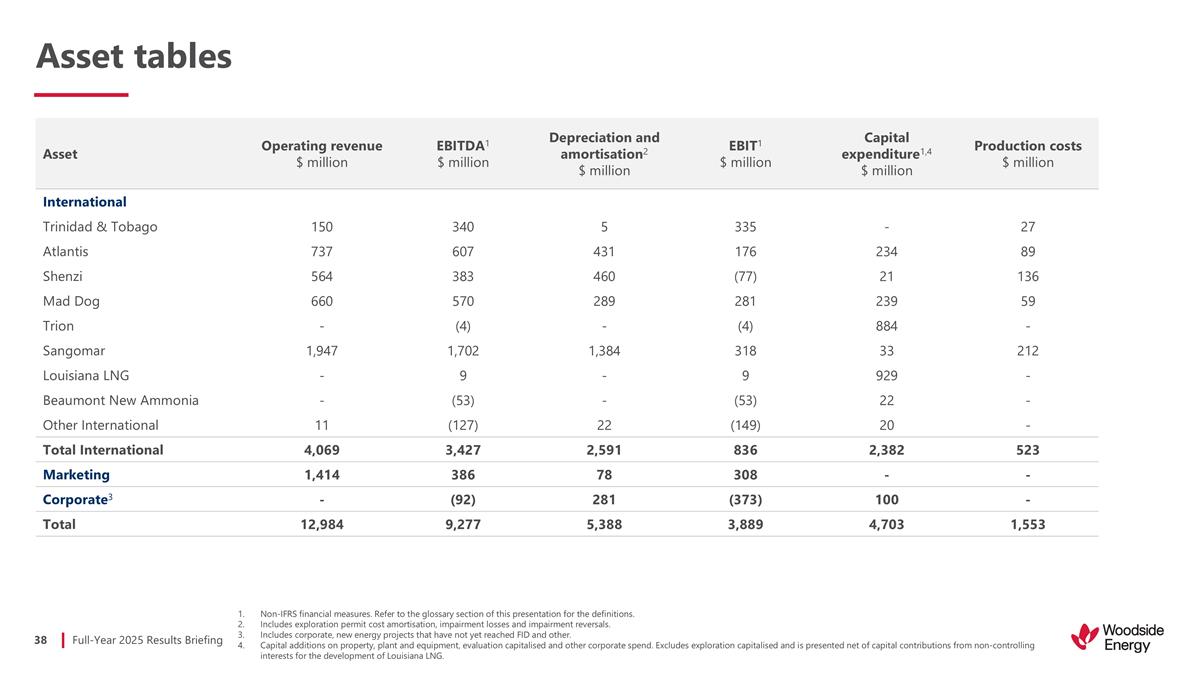
Asset tables Non-IFRS financial
measures. Refer to the glossary section of this presentation for the definitions. Includes exploration permit cost amortisation, impairment losses and impairment reversals. Includes corporate, new energy projects that have not yet reached FID and
other. Capital additions on property, plant and equipment, evaluation capitalised and other corporate spend. Excludes exploration capitalised and is presented net of capital contributions from non-controlling interests for the development of
Louisiana LNG. Asset Operating revenue $ million EBITDA1 $ million Depreciation and amortisation2 $ million EBIT1 $ million Capital expenditure1,4 $ million Production costs $ million International Trinidad & Tobago 150 340 5 335 - 27 Atlantis
737 607 431 176 234 89 Shenzi 564 383 460 (77) 21 136 Mad Dog 660 570 289 281 239 59 Trion - (4) - (4) 884 - Sangomar 1,947 1,702 1,384 318 33 212 Louisiana LNG - 9 - 9 929 - Beaumont New Ammonia - (53) - (53) 22 - Other International 11 (127) 22
(149) 20 - Total International 4,069 3,427 2,591 836 2,382 523 Marketing 1,414 386 78 308 - - Corporate3 - (92) 281 (373) 100 - Total 12,984 9,277 5,388 3,889 4,703 1,553
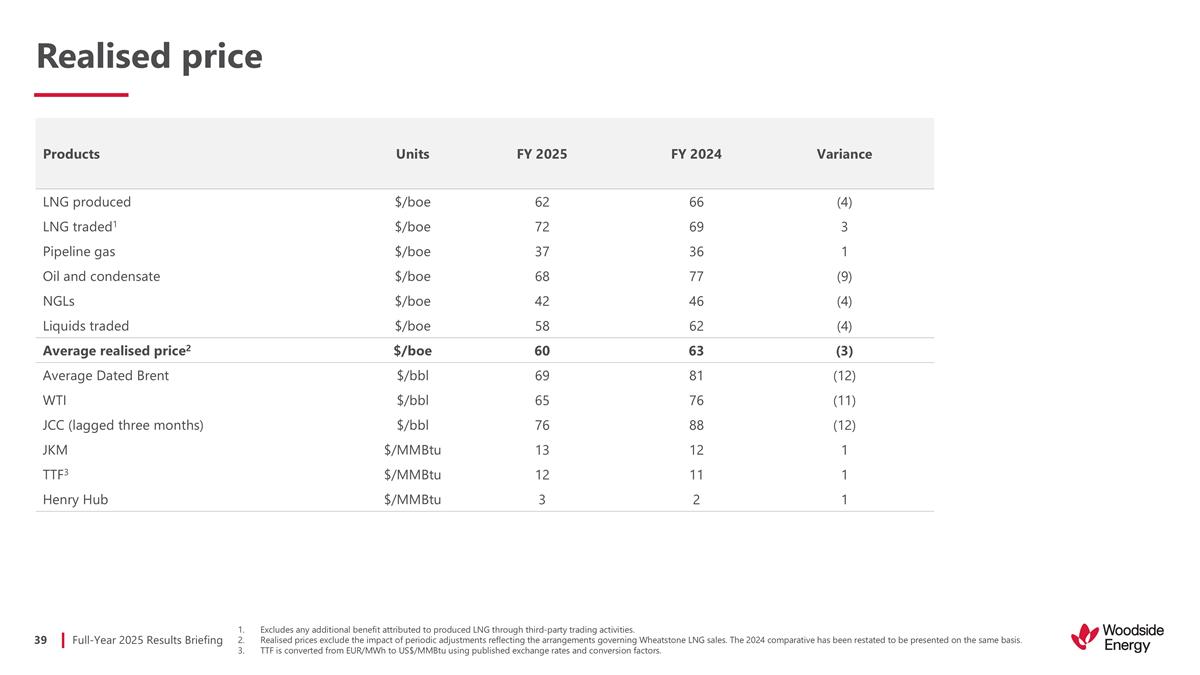
Realised price Excludes any
additional benefit attributed to produced LNG through third-party trading activities. Realised prices exclude the impact of periodic adjustments reflecting the arrangements governing Wheatstone LNG sales. The 2024 comparative has been restated to be
presented on the same basis. TTF is converted from EUR/MWh to US$/MMBtu using published exchange rates and conversion factors. Products Units FY 2025 FY 2024 Variance LNG produced $/boe 62 66 (4) LNG traded1 $/boe 72 69 3 Pipeline gas $/boe 37 36 1
Oil and condensate $/boe 68 77 (9) NGLs $/boe 42 46 (4) Liquids traded $/boe 58 62 (4) Average realised price2 $/boe 60 63 (3) Average Dated Brent $/bbl 69 81 (12) WTI $/bbl 65 76 (11) JCC (lagged three months) $/bbl 76 88 (12) JKM $/MMBtu 13 12 1
TTF3 $/MMBtu 12 11 1 Henry Hub $/MMBtu 3 2 1
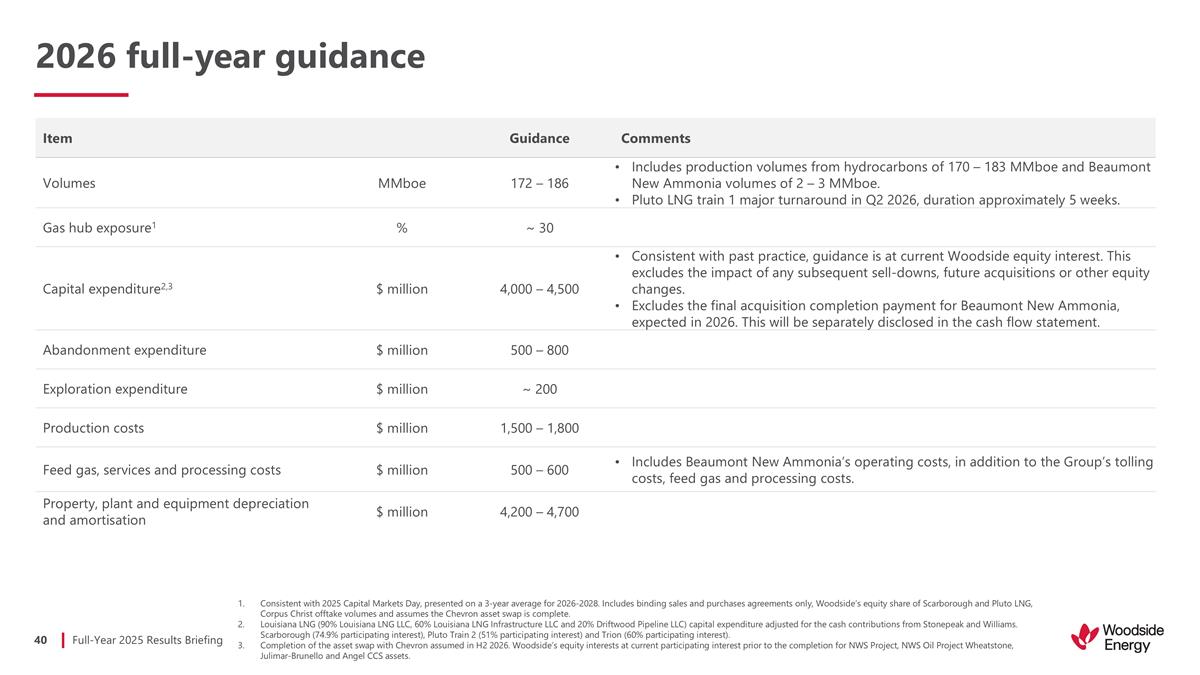
2026 full-year guidance Item
Guidance Comments Volumes MMboe 172 – 186 Includes production volumes from hydrocarbons of 170 – 183 MMboe and Beaumont New Ammonia volumes of 2 – 3 MMboe. Pluto LNG train 1 major turnaround in Q2 2026, duration approximately 5
weeks. Gas hub exposure1 % ~ 30 Capital expenditure2,3 $ million 4,000 – 4,500 Consistent with past practice, guidance is at current Woodside equity interest. This excludes the impact of any subsequent sell-downs, future acquisitions or other
equity changes. Excludes the final acquisition completion payment for Beaumont New Ammonia, expected in 2026. This will be separately disclosed in the cash flow statement. Abandonment expenditure $ million 500 – 800 Exploration expenditure $
million ~ 200 Production costs $ million 1,500 – 1,800 Feed gas, services and processing costs $ million 500 – 600 Includes Beaumont New Ammonia’s operating costs, in addition to the Group’s tolling costs, feed gas and
processing costs. Property, plant and equipment depreciation and amortisation $ million 4,200 – 4,700 Consistent with 2025 Capital Markets Day, presented on a 3-year average for 2026-2028. Includes binding sales and purchases agreements only,
Woodside’s equity share of Scarborough and Pluto LNG, Corpus Christ offtake volumes and assumes the Chevron asset swap is complete. Louisiana LNG (90% Louisiana LNG LLC, 60% Louisiana LNG Infrastructure LLC and 20% Driftwood Pipeline LLC)
capital expenditure adjusted for the cash contributions from Stonepeak and WiIliams. Scarborough (74.9% participating interest), Pluto Train 2 (51% participating interest) and Trion (60% participating interest). Completion of the asset swap with
Chevron assumed in H2 2026. Woodside’s equity interests at current participating interest prior to the completion for NWS Project, NWS Oil Project Wheatstone, Julimar-Brunello and Angel CCS assets.
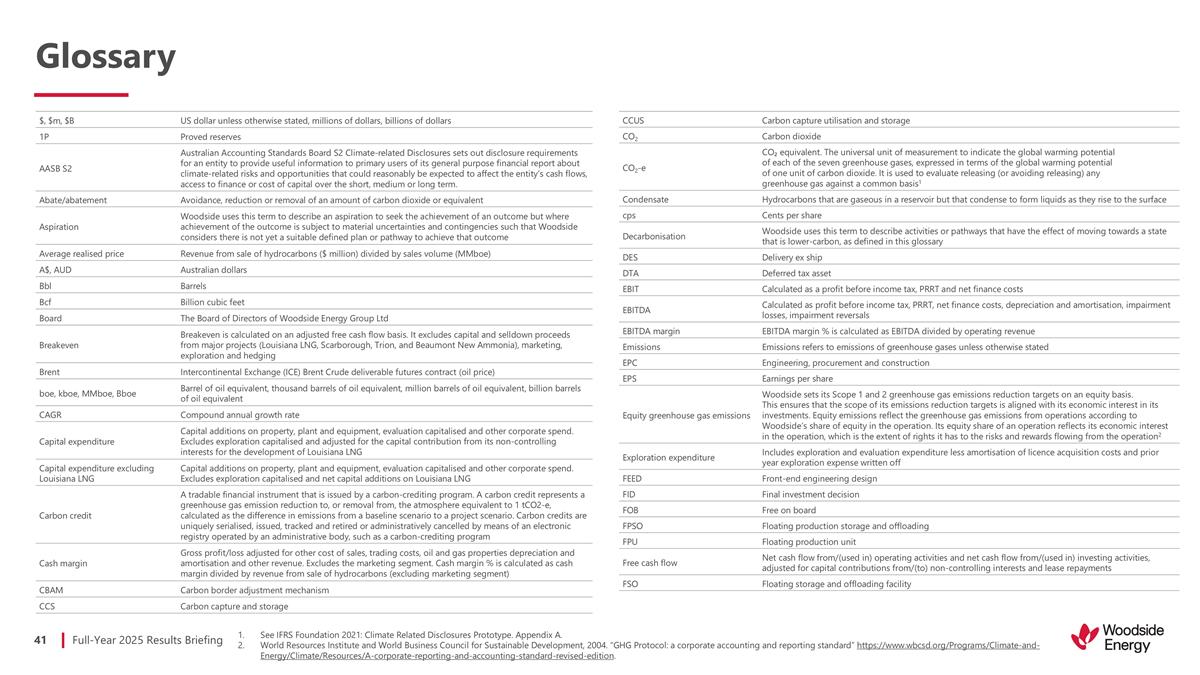
Glossary $, $m, $B US dollar unless
otherwise stated, millions of dollars, billions of dollars 1P Proved reserves AASB S2 Australian Accounting Standards Board S2 Climate-related Disclosures sets out disclosure requirements for an entity to provide useful information to primary users
of its general purpose financial report about climate-related risks and opportunities that could reasonably be expected to affect the entity’s cash flows, access to finance or cost of capital over the short, medium or long term.
Abate/abatement Avoidance, reduction or removal of an amount of carbon dioxide or equivalent Aspiration Woodside uses this term to describe an aspiration to seek the achievement of an outcome but where achievement of the outcome is subject to
material uncertainties and contingencies such that Woodside considers there is not yet a suitable defined plan or pathway to achieve that outcome Average realised price Revenue from sale of hydrocarbons ($ million) divided by sales volume (MMboe)
A$, AUD Australian dollars Bbl Barrels Bcf Billion cubic feet Board The Board of Directors of Woodside Energy Group Ltd Breakeven Breakeven is calculated on an adjusted free cash flow basis. It excludes capital and selldown proceeds from major
projects (Louisiana LNG, Scarborough, Trion, and Beaumont New Ammonia), marketing, exploration and hedging Brent Intercontinental Exchange (ICE) Brent Crude deliverable futures contract (oil price) boe, kboe, MMboe, Bboe Barrel of oil equivalent,
thousand barrels of oil equivalent, million barrels of oil equivalent, billion barrels of oil equivalent CAGR Compound annual growth rate Capital expenditure Capital additions on property, plant and equipment, evaluation capitalised and other
corporate spend. Excludes exploration capitalised and adjusted for the capital contribution from its non‑controlling interests for the development of Louisiana LNG Capital expenditure excluding Louisiana LNG Capital additions on
property, plant and equipment, evaluation capitalised and other corporate spend. Excludes exploration capitalised and net capital additions on Louisiana LNG Carbon credit A tradable financial instrument that is issued by a carbon-crediting
program. A carbon credit represents a greenhouse gas emission reduction to, or removal from, the atmosphere equivalent to 1 tCO2-e, calculated as the difference in emissions from a baseline scenario to a project scenario. Carbon credits are uniquely
serialised, issued, tracked and retired or administratively cancelled by means of an electronic registry operated by an administrative body, such as a carbon-crediting program Cash margin Gross profit/loss adjusted for other cost of sales, trading
costs, oil and gas properties depreciation and amortisation and other revenue. Excludes the marketing segment. Cash margin % is calculated as cash margin divided by revenue from sale of hydrocarbons (excluding marketing segment) CBAM Carbon border
adjustment mechanism CCS Carbon capture and storage CCUS Carbon capture utilisation and storage CO2 Carbon dioxide CO2-e CO₂ equivalent. The universal unit of measurement to indicate the global warming potential of each of the seven greenhouse
gases, expressed in terms of the global warming potential of one unit of carbon dioxide. It is used to evaluate releasing (or avoiding releasing) any greenhouse gas against a common basis1 Condensate Hydrocarbons that are gaseous in a reservoir but
that condense to form liquids as they rise to the surface cps Cents per share Decarbonisation Woodside uses this term to describe activities or pathways that have the effect of moving towards a state that is lower-carbon, as defined in this
glossary DES Delivery ex ship DTA Deferred tax asset EBIT Calculated as a profit before income tax, PRRT and net finance costs EBITDA Calculated as profit before income tax, PRRT, net finance costs, depreciation and amortisation, impairment losses,
impairment reversals EBITDA margin EBITDA margin % is calculated as EBITDA divided by operating revenue Emissions Emissions refers to emissions of greenhouse gases unless otherwise stated EPC Engineering, procurement and construction EPS Earnings
per share Equity greenhouse gas emissions Woodside sets its Scope 1 and 2 greenhouse gas emissions reduction targets on an equity basis. This ensures that the scope of its emissions reduction targets is aligned with its economic interest in its
investments. Equity emissions reflect the greenhouse gas emissions from operations according to Woodside’s share of equity in the operation. Its equity share of an operation reflects its economic interest in the operation, which is the
extent of rights it has to the risks and rewards flowing from the operation2 Exploration expenditure Includes exploration and evaluation expenditure less amortisation of licence acquisition costs and prior year exploration expense written off FEED
Front-end engineering design FID Final investment decision FOB Free on board FPSO Floating production storage and offloading FPU Floating production unit Free cash flow Net cash flow from/(used in) operating activities and net cash flow from/(used
in) investing activities, adjusted for capital contributions from/(to) non-controlling interests and lease repayments FSO Floating storage and offloading facility See IFRS Foundation 2021: Climate Related Disclosures Prototype. Appendix A. World
Resources Institute and World Business Council for Sustainable Development, 2004. “GHG Protocol: a corporate accounting and reporting standard”
https://www.wbcsd.org/Programs/Climate-and-Energy/Climate/Resources/A-corporate-reporting-and-accounting-standard-revised-edition.
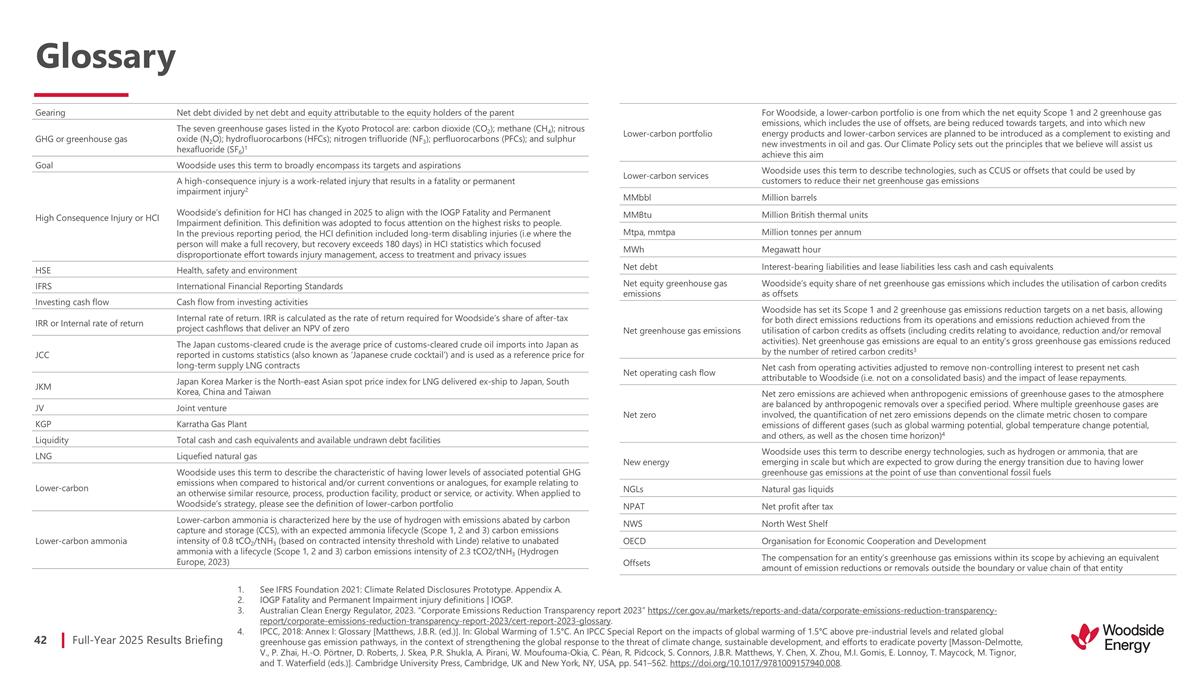
Glossary See IFRS Foundation 2021:
Climate Related Disclosures Prototype. Appendix A. IOGP Fatality and Permanent Impairment injury definitions | IOGP. Australian Clean Energy Regulator, 2023. “Corporate Emissions Reduction Transparency report 2023”
https://cer.gov.au/markets/reports-and-data/corporate-emissions-reduction-transparency-report/corporate-emissions-reduction-transparency-report-2023/cert-report-2023-glossary. IPCC, 2018: Annex I: Glossary [Matthews, J.B.R. (ed.)]. In: Global
Warming of 1.5°C. An IPCC Special Report on the impacts of global warming of 1.5°C above pre-industrial levels and related global greenhouse gas emission pathways, in the context of strengthening the global response to the threat of
climate change, sustainable development, and efforts to eradicate poverty [Masson-Delmotte, V., P. Zhai, H.-O. Pörtner, D. Roberts, J. Skea, P.R. Shukla, A. Pirani, W. Moufouma-Okia, C. Péan, R. Pidcock, S. Connors, J.B.R.
Matthews, Y. Chen, X. Zhou, M.I. Gomis, E. Lonnoy, T. Maycock, M. Tignor, and T. Waterfield (eds.)]. Cambridge University Press, Cambridge, UK and New York, NY, USA, pp. 541–562. https://doi.org/10.1017/9781009157940.008. Gearing Net
debt divided by net debt and equity attributable to the equity holders of the parent GHG or greenhouse gas The seven greenhouse gases listed in the Kyoto Protocol are: carbon dioxide (CO2); methane (CH4); nitrous oxide (N2O); hydrofluorocarbons
(HFCs); nitrogen trifluoride (NF3); perfluorocarbons (PFCs); and sulphur hexafluoride (SF6)1 Goal Woodside uses this term to broadly encompass its targets and aspirations High Consequence Injury or HCI A high-consequence injury is a work-related
injury that results in a fatality or permanent impairment injury2 Woodside’s definition for HCI has changed in 2025 to align with the IOGP Fatality and Permanent Impairment definition. This definition was adopted to focus
attention on the highest risks to people. In the previous reporting period, the HCI definition included long-term disabling injuries (i.e where the person will make a full recovery, but recovery exceeds 180 days) in HCI statistics which focused
disproportionate effort towards injury management, access to treatment and privacy issues HSE Health, safety and environment IFRS International Financial Reporting Standards Investing cash flow Cash flow from investing activities IRR or Internal
rate of return Internal rate of return. IRR is calculated as the rate of return required for Woodside’s share of after-tax project cashflows that deliver an NPV of zero JCC The Japan customs-cleared crude is the average price of
customs-cleared crude oil imports into Japan as reported in customs statistics (also known as ‘Japanese crude cocktail’) and is used as a reference price for long-term supply LNG contracts JKM Japan Korea Marker is the North-east Asian
spot price index for LNG delivered ex-ship to Japan, South Korea, China and Taiwan JV Joint venture KGP Karratha Gas Plant Liquidity Total cash and cash equivalents and available undrawn debt facilities LNG Liquefied natural gas Lower-carbon
Woodside uses this term to describe the characteristic of having lower levels of associated potential GHG emissions when compared to historical and/or current conventions or analogues, for example relating to an otherwise similar resource, process,
production facility, product or service, or activity. When applied to Woodside’s strategy, please see the definition of lower-carbon portfolio Lower-carbon ammonia Lower-carbon ammonia is characterized here by the use of hydrogen with
emissions abated by carbon capture and storage (CCS), with an expected ammonia lifecycle (Scope 1, 2 and 3) carbon emissions intensity of 0.8 tCO2/tNH3 (based on contracted intensity threshold with Linde) relative to unabated ammonia with a
lifecycle (Scope 1, 2 and 3) carbon emissions intensity of 2.3 tCO2/tNH3 (Hydrogen Europe, 2023) Lower-carbon portfolio For Woodside, a lower-carbon portfolio is one from which the net equity Scope 1 and 2 greenhouse gas emissions, which includes
the use of offsets, are being reduced towards targets, and into which new energy products and lower-carbon services are planned to be introduced as a complement to existing and new investments in oil and gas. Our Climate Policy sets out the
principles that we believe will assist us achieve this aim Lower-carbon services Woodside uses this term to describe technologies, such as CCUS or offsets that could be used by customers to reduce their net greenhouse gas emissions MMbbl Million
barrels MMBtu Million British thermal units Mtpa, mmtpa Million tonnes per annum MWh Megawatt hour Net debt Interest-bearing liabilities and lease liabilities less cash and cash equivalents Net equity greenhouse gas emissions Woodside’s equity
share of net greenhouse gas emissions which includes the utilisation of carbon credits as offsets Net greenhouse gas emissions Woodside has set its Scope 1 and 2 greenhouse gas emissions reduction targets on a net basis, allowing for both direct
emissions reductions from its operations and emissions reduction achieved from the utilisation of carbon credits as offsets (including credits relating to avoidance, reduction and/or removal activities). Net greenhouse gas emissions are equal to an
entity’s gross greenhouse gas emissions reduced by the number of retired carbon credits3 Net operating cash flow Net cash from operating activities adjusted to remove non-controlling interest to present net cash attributable to Woodside
(i.e. not on a consolidated basis) and the impact of lease repayments. Net zero Net zero emissions are achieved when anthropogenic emissions of greenhouse gases to the atmosphere are balanced by anthropogenic removals over a specified period. Where
multiple greenhouse gases are involved, the quantification of net zero emissions depends on the climate metric chosen to compare emissions of different gases (such as global warming potential, global temperature change potential, and others, as
well as the chosen time horizon)4 New energy Woodside uses this term to describe energy technologies, such as hydrogen or ammonia, that are emerging in scale but which are expected to grow during the energy transition due to having lower greenhouse
gas emissions at the point of use than conventional fossil fuels NGLs Natural gas liquids NPAT Net profit after tax NWS North West Shelf OECD Organisation for Economic Cooperation and Development Offsets The compensation for an entity’s
greenhouse gas emissions within its scope by achieving an equivalent amount of emission reductions or removals outside the boundary or value chain of that entity
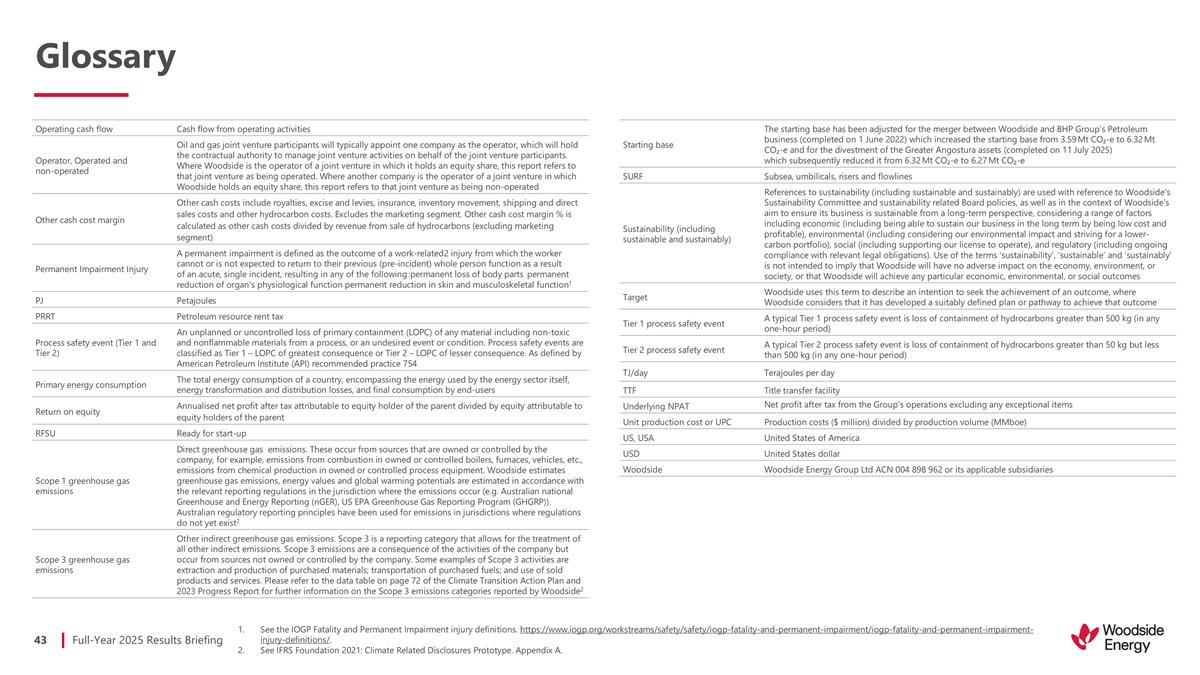
Glossary See the IOGP Fatality and
Permanent Impairment injury definitions. https://www.iogp.org/workstreams/safety/safety/iogp-fatality-and-permanent-impairment/iogp-fatality-and-permanent-impairment-injury-definitions/. See IFRS Foundation 2021: Climate Related Disclosures
Prototype. Appendix A. Operating cash flow Cash flow from operating activities Operator, Operated and non-operated Oil and gas joint venture participants will typically appoint one company as the operator, which will hold the contractual authority
to manage joint venture activities on behalf of the joint venture participants. Where Woodside is the operator of a joint venture in which it holds an equity share, this report refers to that joint venture as being operated. Where another company is
the operator of a joint venture in which Woodside holds an equity share, this report refers to that joint venture as being non-operated Other cash cost margin Other cash costs include royalties, excise and levies, insurance, inventory movement,
shipping and direct sales costs and other hydrocarbon costs. Excludes the marketing segment. Other cash cost margin % is calculated as other cash costs divided by revenue from sale of hydrocarbons (excluding marketing segment) Permanent Impairment
Injury A permanent impairment is defined as the outcome of a work-related2 injury from which the worker cannot or is not expected to return to their previous (pre-incident) whole person function as a result of an acute, single incident,
resulting in any of the following :permanent loss of body parts permanent reduction of organ's physiological function permanent reduction in skin and musculoskeletal function1 PJ Petajoules PRRT Petroleum resource rent
tax Process safety event (Tier 1 and Tier 2) An unplanned or uncontrolled loss of primary containment (LOPC) of any material including non-toxic and nonflammable materials from a process, or an undesired event or condition. Process safety events are
classified as Tier 1 – LOPC of greatest consequence or Tier 2 – LOPC of lesser consequence. As defined by American Petroleum Institute (API) recommended practice 754 Primary energy consumption The total energy consumption of a country,
encompassing the energy used by the energy sector itself, energy transformation and distribution losses, and final consumption by end-users Return on equity Annualised net profit after tax attributable to equity holder of the parent divided by
equity attributable to equity holders of the parent RFSU Ready for start-up Scope 1 greenhouse gas emissions Direct greenhouse gas emissions. These occur from sources that are owned or controlled by the company, for example, emissions from
combustion in owned or controlled boilers, furnaces, vehicles, etc., emissions from chemical production in owned or controlled process equipment. Woodside estimates greenhouse gas emissions, energy values and global warming potentials are estimated
in accordance with the relevant reporting regulations in the jurisdiction where the emissions occur (e.g. Australian national Greenhouse and Energy Reporting (nGER), US EPA Greenhouse Gas Reporting Program (GHGRP)). Australian regulatory reporting
principles have been used for emissions in jurisdictions where regulations do not yet exist2 Scope 3 greenhouse gas emissions Other indirect greenhouse gas emissions. Scope 3 is a reporting category that allows for the treatment of all other
indirect emissions. Scope 3 emissions are a consequence of the activities of the company but occur from sources not owned or controlled by the company. Some examples of Scope 3 activities are extraction and production of purchased materials;
transportation of purchased fuels; and use of sold products and services. Please refer to the data table on page 72 of the Climate Transition Action Plan and 2023 Progress Report for further information on the Scope 3 emissions categories reported
by Woodside2 Starting base The starting base has been adjusted for the merger between Woodside and BHP Group’s Petroleum business (completed on 1 June 2022) which increased the starting base from 3.59 Mt CO₂‑e to
6.32 Mt CO₂‑e and for the divestment of the Greater Angostura assets (completed on 11 July 2025) which subsequently reduced it from 6.32 Mt CO₂‑e to 6.27 Mt CO₂‑e SURF Subsea,
umbilicals, risers and flowlines Sustainability (including sustainable and sustainably) References to sustainability (including sustainable and sustainably) are used with reference to Woodside’s Sustainability Committee and sustainability
related Board policies, as well as in the context of Woodside’s aim to ensure its business is sustainable from a long-term perspective, considering a range of factors including economic (including being able to sustain our business in the long
term by being low cost and profitable), environmental (including considering our environmental impact and striving for a lower-carbon portfolio), social (including supporting our license to operate), and regulatory (including ongoing compliance with
relevant legal obligations). Use of the terms ‘sustainability’, ‘sustainable’ and ‘sustainably’ is not intended to imply that Woodside will have no adverse impact on the economy, environment, or society, or that
Woodside will achieve any particular economic, environmental, or social outcomes Target Woodside uses this term to describe an intention to seek the achievement of an outcome, where Woodside considers that it has developed a suitably defined plan or
pathway to achieve that outcome Tier 1 process safety event A typical Tier 1 process safety event is loss of containment of hydrocarbons greater than 500 kg (in any one-hour period) Tier 2 process safety event A typical Tier 2 process safety event
is loss of containment of hydrocarbons greater than 50 kg but less than 500 kg (in any one-hour period) TJ/day Terajoules per day TTF Title transfer facility Underlying NPAT Net profit after tax from the Group’s operations excluding any
exceptional items Unit production cost or UPC Production costs ($ million) divided by production volume (MMboe) US, USA United States of America USD United States dollar Woodside Woodside Energy Group Ltd ACN 004 898 962 or its applicable
subsidiaries

Full-Year 2025 Results Briefing