
2025 Annual Report Incorporating Appendix 4E
Annual Report 2025 This Annual Report 2025 is a summary of Woodside’s operations and activities for the 12-month period ended 31 December 2025 and financial position as of 31 December 2025. Woodside Energy Group Ltd (ABN 55 004 898 962) is the ultimate holding company of the Woodside group of companies. In this report, unless otherwise stated, references to “Woodside”, the “Group”, the “company”, “we”, “us” and “our” refer to Woodside Energy Group Ltd and/or its controlled entities as a whole. Important Cautionary Information – Forward-Looking Statements This report contains forward-looking statements. These statements may relate to Woodside’s business, goals, targets, aspirations, plans, expectations, market conditions, results of operations and financial condition. Forward-looking statements in this report are not guidance, forecasts, predictions, or guarantees or predictions of future events or performance, and are based on management’s current expectations. Actual performance against Woodside’s targets and aspirations (including Woodside’s net equity Scope 1 and 2 greenhouse gas (“GHG”) emissions target and Scope 3 abatement and investment targets) may be affected by risks associated with Woodside’s business and the evolution of the global energy transition, many of which are beyond Woodside’s control. Investors are strongly cautioned not to rely on forward-looking statements. Important factors that could cause actual results to differ from those in the forward‑looking statements (and assumptions that underpin those statements) are set out in Section 6.8 – Information about this report. Important Cautionary Information – Climate strategy and emissions data All GHG emissions data in this report are estimates, due to the inherent uncertainty in measuring or quantifying GHG emissions. Methodologies for measuring or quantifying GHG emissions may evolve as market practices continue to develop. Woodside “greenhouse gas” or “emissions” information reported are Scope 1 GHG emissions, Scope 2 GHG emissions and/or Scope 3 GHG emissions, each on a net equity or gross equity basis as specified. This report also includes scenario analysis which has inherent limitations. Scenarios do not constitute definitive outcomes and are based on assumptions which may prove to be incorrect and which may not reflect Woodside’s own expectations. Important Cautionary Information – Industry and market data This report contains industry, market and competitive position data based on industry publications, third party studies, and Woodside’s internal estimates. While Woodside believes that the publications and third-party studies are reliable and have been prepared by a reputable source, Woodside has not independently verified the underlying information and cannot guarantee its accuracy or completeness. Non-International Financial Reporting Standards Measures Certain parts of this report contain financial measures that have not been prepared in accordance with IFRS and are also “non-GAAP financial measures” (as defined in Item 10(e) of Regulation S-K under the US Securities Act of 1933, as amended). See Section 6.6 – Alternative performance measures for further details and a reconciliation of these measures to corresponding IFRS measures. Additional Information Investors should carefully read Section 6.7 – Glossary, units of measure and conversion factors and 6.8 – Information about this report, which contain further information relevant to the matters noted above, as well as information on the basis of preparation for this report. Acknowledging Country Woodside acknowledges Indigenous Peoples as the Traditional Custodians of the lands and waters across the world. We recognise their enduring cultures, knowledge, and connection to Country. We pay our respects to Elders past and present.
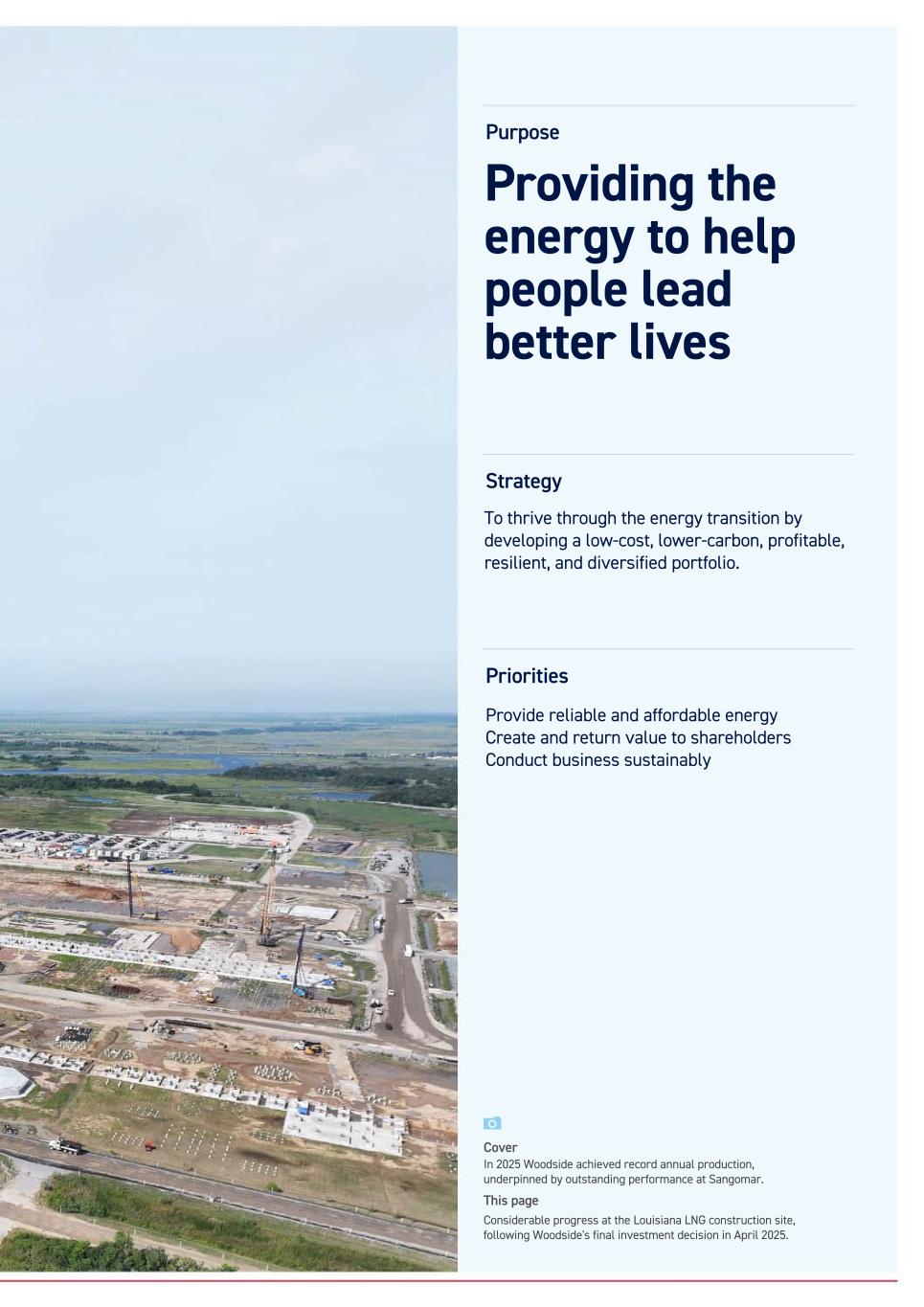
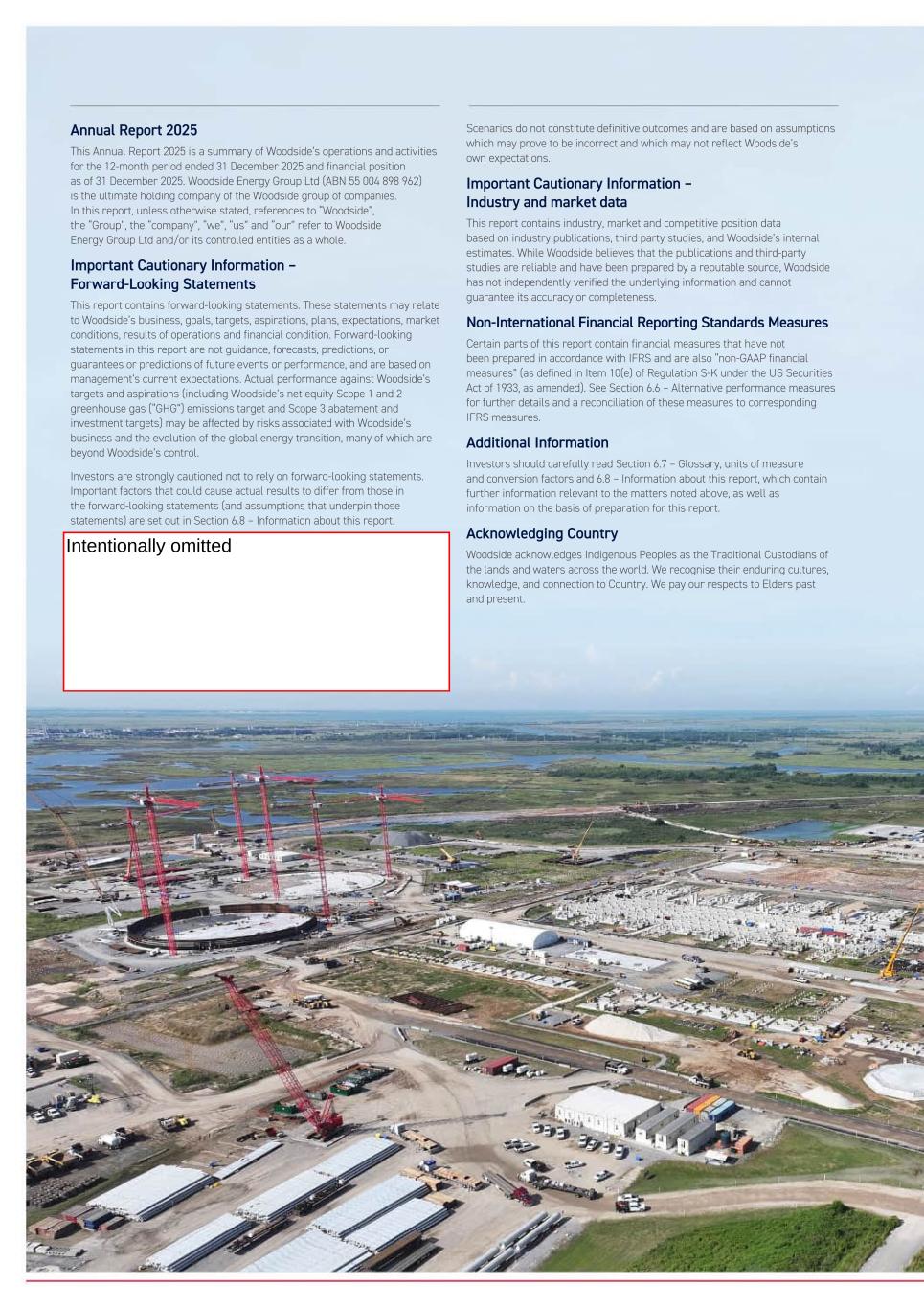
Providing the energy to help people lead better lives Purpose Strategy Priorities To thrive through the energy transition by developing a low‑cost, lower-carbon, profitable, resilient, and diversified portfolio. Provide reliable and affordable energy Create and return value to shareholders Conduct business sustainably Cover In 2025 Woodside achieved record annual production, underpinned by outstanding performance at Sangomar. This page Considerable progress at the Louisiana LNG construction site, following Woodside's final investment decision in April 2025.
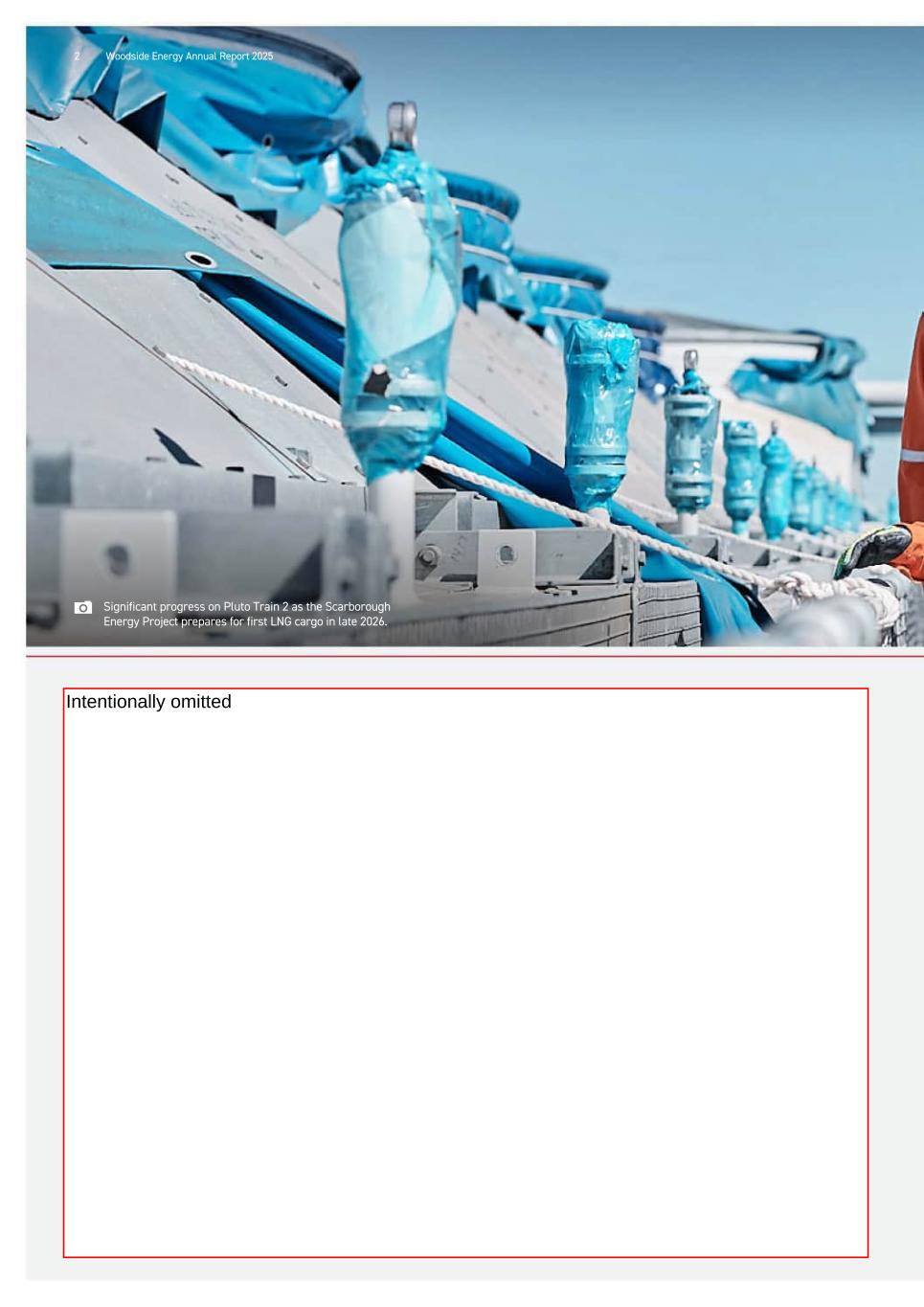
Appendix 4E 2025 2024 Results for announcement to the market Revenue from ordinary activities decreased 1% to US$12,984 million US$13,179 million Profit from ordinary activities after tax attributable to members decreased 24% to US$2,718 million US$3,573 million Net profit for the period attributable to members decreased 24% to US$2,718 million US$3,573 million Dividends Amount Franked amount per security Final dividend (US cents per share) Ordinary 59c Ordinary 59c Interim dividend (US cents per share) Ordinary 53c Ordinary 53c None of the dividends are foreign sourced Previous corresponding period: Final dividend (US cents per share) Ordinary 53c Ordinary 53c Interim dividend (US cents per share) Ordinary 69c Ordinary 69c Ex-dividend date 5 March 2026 Record date for determining entitlements to the final dividend 6 March 2026 Payment date for the final dividend 27 March 2026 31 December 2025 31 December 2024 Net tangible asset per ordinary security1,2 $16.34 $16.10 2 Woodside Energy Annual Report 2025 Significant progress on Pluto Train 2 as the Scarborough Energy Project prepares for first LNG cargo in late 2026. 1. Includes lease assets of $1,428 million and lease liabilities of $1,759 million (2024: $1,291 million and $1,623 million) as a result of AASB 16 Leases. 2. Net tangible assets per ordinary security is a non-IFRS measure. Refer to Section 6.6 – Alternative performance measures for a reconciliation of these measures to Woodside’s financial statements
Contents OVERVIEW STRATEGY AND FINANCIAL PERFORMANCE OUR BUSINESS GOVERNANCE FINANCIAL STATEMENTS ADDITIONAL INFORMATION 3 1. Overview 4 1.1 About Woodside 4 1.2 2025 summary 5 1.3 Chair’s report 8 1.4 Acting Chief Executive Officer’s report 9 1.5 Global portfolio 10 2. Strategy and Financial Performance 12 2.1 Woodside’s strategy 13 2.2 Capital management 14 2.3 Financial overview 17 2.4 Energy markets 19 2.5 Business model and value chain 22 3. Our Business 24 3.1 Australia 25 3.2 International 30 3.3 Marketing and business development 34 3.4 Decommissioning 36 3.5 Developments and exploration 37 3.6 Sustainability Report 40 3.7 Risk factors 98 3.8 Reserves and Resources Statement 110 4. Governance 116 4.1 Corporate Governance Statement 117 Corporate governance at Woodside 118 Board of Directors 119 Board Committees 128 Executive Leadership Team 130 Promoting responsible and ethical behaviour 132 Risk management and internal control 134 Culture and inclusion 136 Other governance disclosures 139 Shareholders 141 4.2 Directors’ report 142 4.3 Remuneration Report 146 5. Financial Statements 176 5.1 Financial Statements 176 6. Additional Information 246 6.1 Supplementary information on oil and gas properties – unaudited 246 6.2 Three-year financial analysis 252 6.3 Additional disclosures 257 6.4 Shareholder statistics 272 6.5 Asset facts 281 6.6 Alternative performance measures 284 6.7 Glossary, units of measure and conversion factors 290 6.8 Information about this report 297 6.9 Ten-year comparative data summary 299
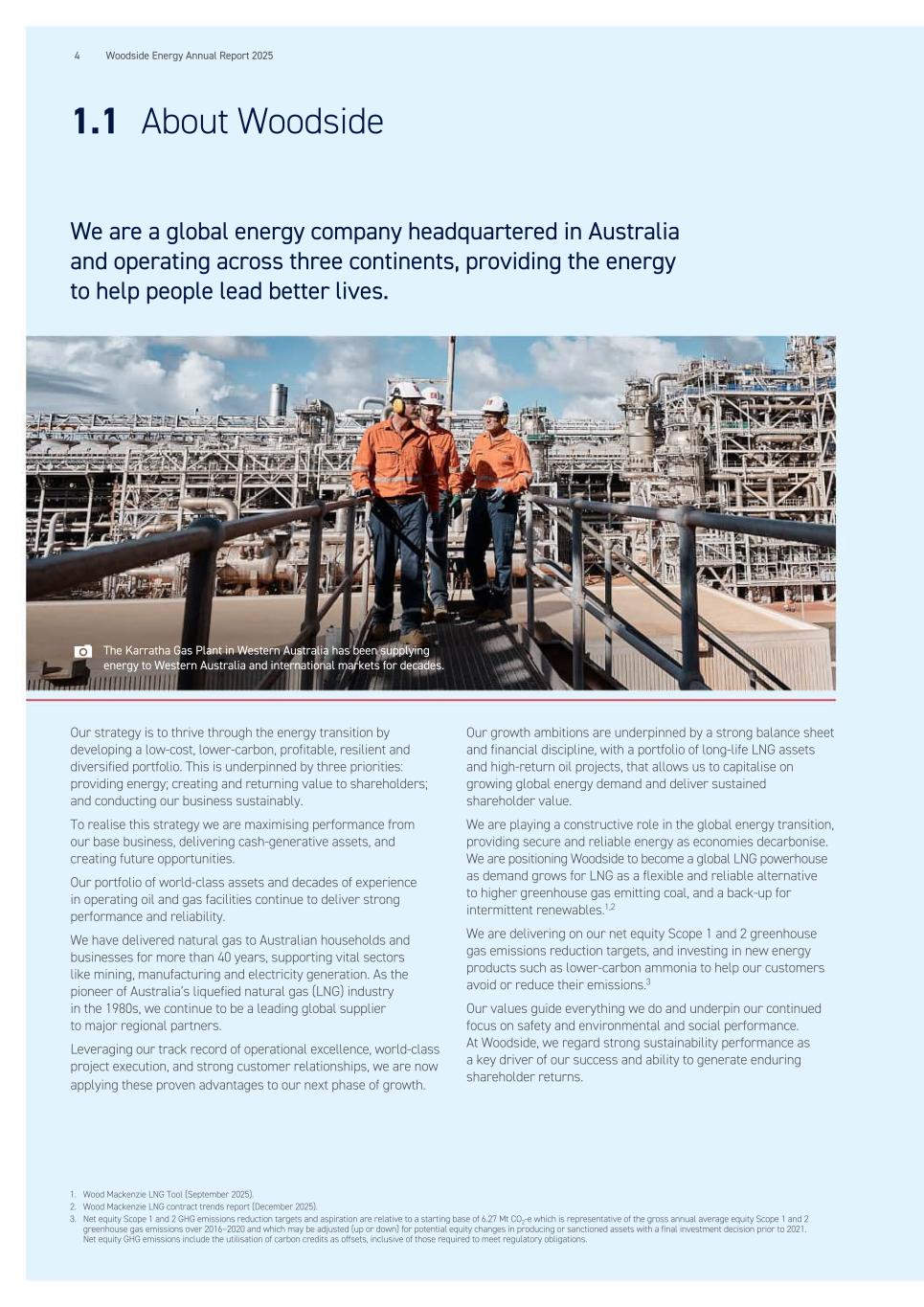
Our strategy is to thrive through the energy transition by developing a low‑cost, lower-carbon, profitable, resilient and diversified portfolio. This is underpinned by three priorities: providing energy; creating and returning value to shareholders; and conducting our business sustainably. To realise this strategy we are maximising performance from our base business, delivering cash-generative assets, and creating future opportunities. Our portfolio of world-class assets and decades of experience in operating oil and gas facilities continue to deliver strong performance and reliability. We have delivered natural gas to Australian households and businesses for more than 40 years, supporting vital sectors like mining, manufacturing and electricity generation. As the pioneer of Australia’s liquefied natural gas (LNG) industry in the 1980s, we continue to be a leading global supplier to major regional partners. Leveraging our track record of operational excellence, world‑class project execution, and strong customer relationships, we are now applying these proven advantages to our next phase of growth. Our growth ambitions are underpinned by a strong balance sheet and financial discipline, with a portfolio of long-life LNG assets and high-return oil projects, that allows us to capitalise on growing global energy demand and deliver sustained shareholder value. We are playing a constructive role in the global energy transition, providing secure and reliable energy as economies decarbonise. We are positioning Woodside to become a global LNG powerhouse as demand grows for LNG as a flexible and reliable alternative to higher greenhouse gas emitting coal, and a back-up for intermittent renewables.1,2 We are delivering on our net equity Scope 1 and 2 greenhouse gas emissions reduction targets, and investing in new energy products such as lower-carbon ammonia to help our customers avoid or reduce their emissions.3 Our values guide everything we do and underpin our continued focus on safety and environmental and social performance. At Woodside, we regard strong sustainability performance as a key driver of our success and ability to generate enduring shareholder returns. 4 Woodside Energy Annual Report 2025 1.1 About Woodside We are a global energy company headquartered in Australia and operating across three continents, providing the energy to help people lead better lives. 1. Wood Mackenzie LNG Tool (September 2025). 2. Wood Mackenzie LNG contract trends report (December 2025). 3. Net equity Scope 1 and 2 GHG emissions reduction targets and aspiration are relative to a starting base of 6.27 Mt CO2‑e which is representative of the gross annual average equity Scope 1 and 2 greenhouse gas emissions over 2016–2020 and which may be adjusted (up or down) for potential equity changes in producing or sanctioned assets with a final investment decision prior to 2021. Net equity GHG emissions include the utilisation of carbon credits as offsets, inclusive of those required to meet regulatory obligations. The Karratha Gas Plant in Western Australia has been supplying energy to Western Australia and international markets for decades.
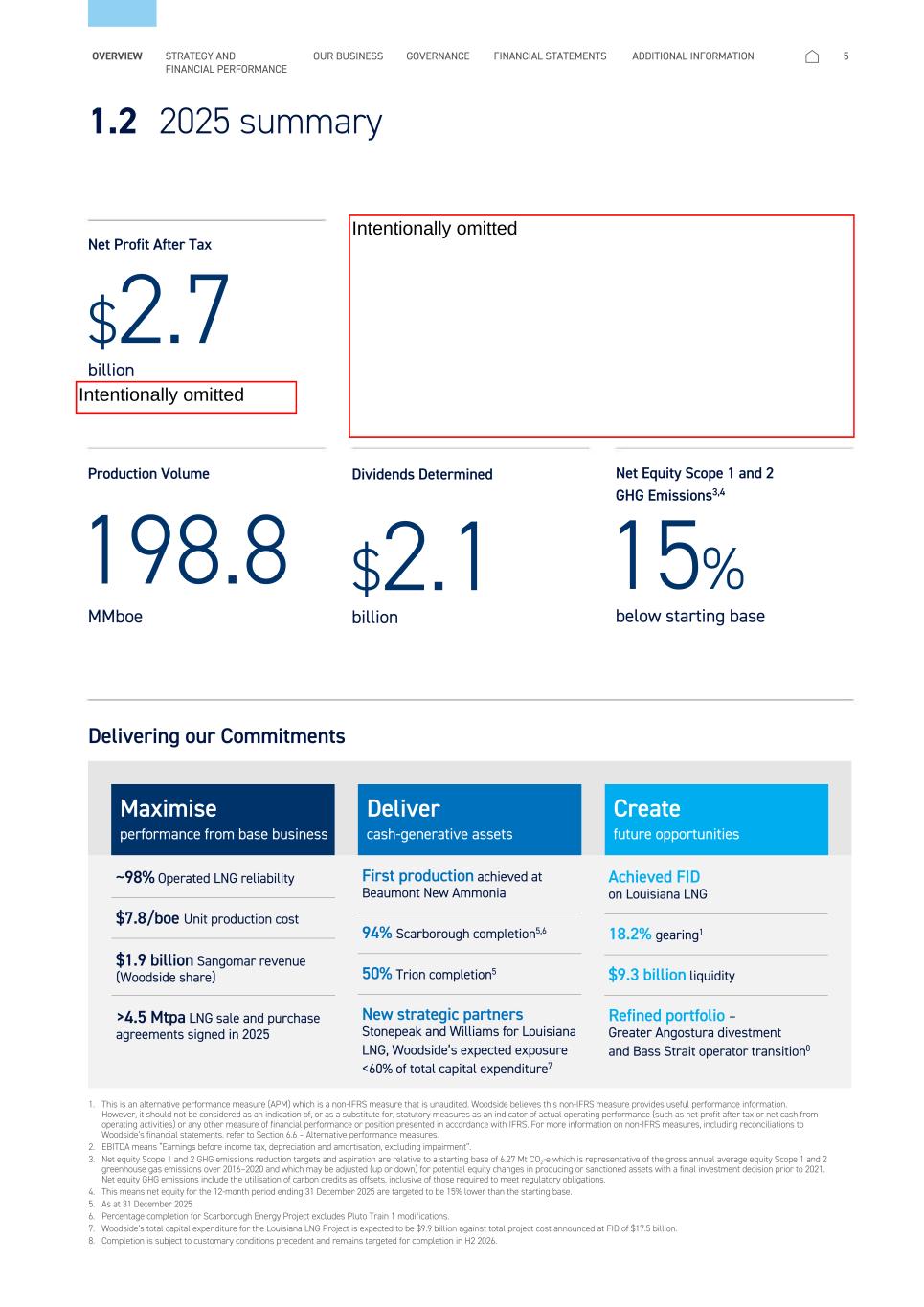
1. This is an alternative performance measure (APM) which is a non-IFRS measure that is unaudited. Woodside believes this non-IFRS measure provides useful performance information. However, it should not be considered as an indication of, or as a substitute for, statutory measures as an indicator of actual operating performance (such as net profit after tax or net cash from operating activities) or any other measure of financial performance or position presented in accordance with IFRS. For more information on non-IFRS measures, including reconciliations to Woodside’s financial statements, refer to Section 6.6 – Alternative performance measures. 2. EBITDA means “Earnings before income tax, depreciation and amortisation, excluding impairment”. 3. Net equity Scope 1 and 2 GHG emissions reduction targets and aspiration are relative to a starting base of 6.27 Mt CO2‑e which is representative of the gross annual average equity Scope 1 and 2 greenhouse gas emissions over 2016–2020 and which may be adjusted (up or down) for potential equity changes in producing or sanctioned assets with a final investment decision prior to 2021. Net equity GHG emissions include the utilisation of carbon credits as offsets, inclusive of those required to meet regulatory obligations. 4. This means net equity for the 12-month period ending 31 December 2025 are targeted to be 15% lower than the starting base. 5. As at 31 December 2025 6. Percentage completion for Scarborough Energy Project excludes Pluto Train 1 modifications. 7. Woodside’s total capital expenditure for the Louisiana LNG Project is expected to be $9.9 billion against total project cost announced at FID of $17.5 billion. 8. Completion is subject to customary conditions precedent and remains targeted for completion in H2 2026. Delivering our Commitments Maximise performance from base business Deliver cash-generative assets Create future opportunities OVERVIEW STRATEGY AND FINANCIAL PERFORMANCE OUR BUSINESS GOVERNANCE FINANCIAL STATEMENTS ADDITIONAL INFORMATION 5 1.2 2025 summary Net Profit After Tax $2.7 billion Underlying NPAT $2.6 billion1 Production Volume 198.8 MMboe EBITDA1,2 $9.3 billion Dividends Determined $2.1 billion Free Cash Flow1 $1.9 billion Net Equity Scope 1 and 2 GHG Emissions3,4 15% below starting base Achieved FID on Louisiana LNG 18.2% gearing1 $9.3 billion liquidity Refined portfolio – Greater Angostura divestment and Bass Strait operator transition8 First production achieved at Beaumont New Ammonia 94% Scarborough completion5,6 50% Trion completion5 New strategic partners Stonepeak and Williams for Louisiana LNG, Woodside’s expected exposure <60% of total capital expenditure7 ~98% Operated LNG reliability $7.8/boe Unit production cost $1.9 billion Sangomar revenue (Woodside share) >4.5 Mtpa LNG sale and purchase agreements signed in 2025
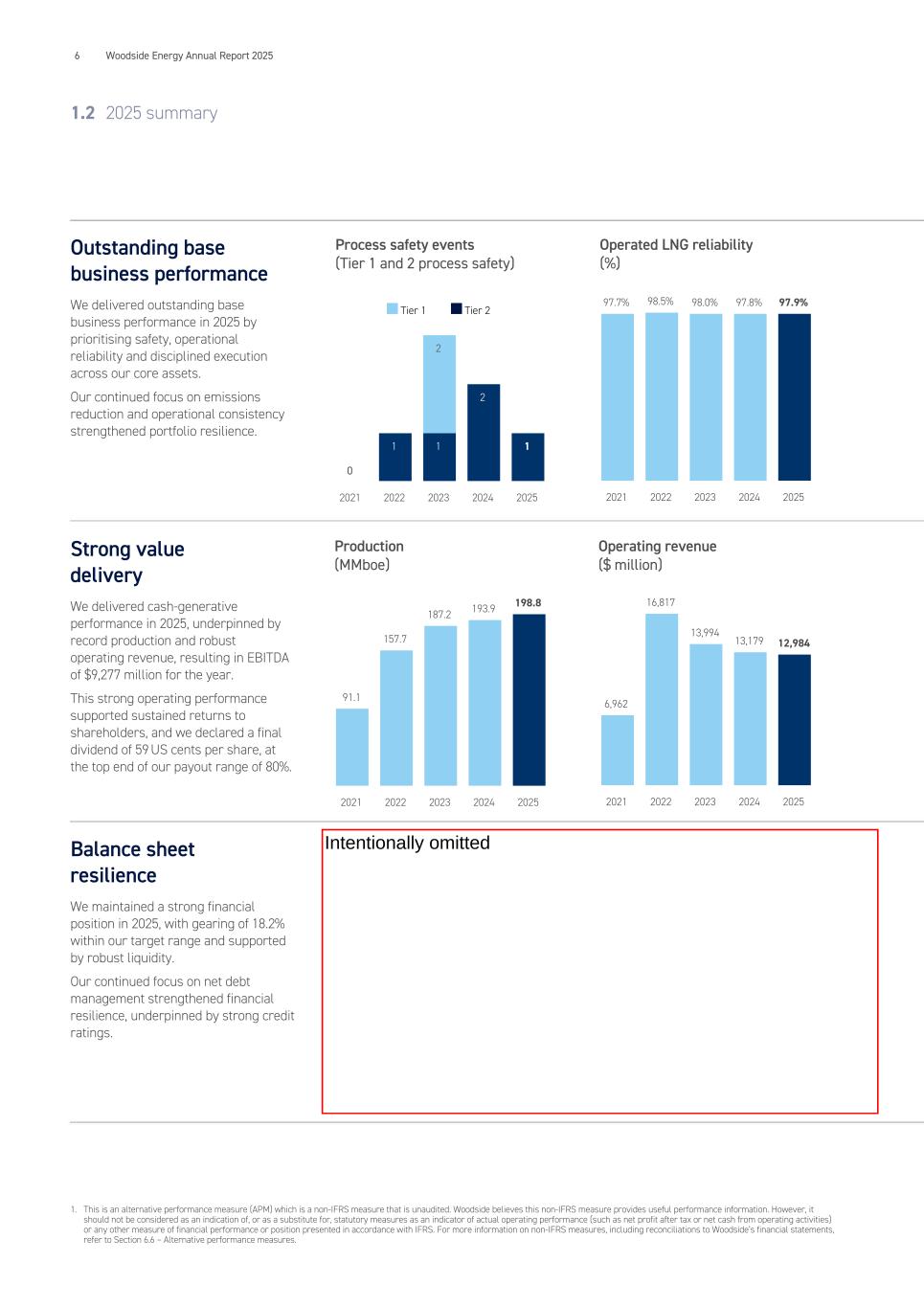
6 Woodside Energy Annual Report 2025 1.2 2025 summary Strong value delivery We delivered cash‑generative performance in 2025, underpinned by record production and robust operating revenue, resulting in EBITDA of $9,277 million for the year. This strong operating performance supported sustained returns to shareholders, and we declared a final dividend of 59 US cents per share, at the top end of our payout range of 80%. Outstanding base business performance We delivered outstanding base business performance in 2025 by prioritising safety, operational reliability and disciplined execution across our core assets. Our continued focus on emissions reduction and operational consistency strengthened portfolio resilience. Production (MMboe) Operating revenue ($ million) Gearing1 (%) Liquidity1 ($ million) Operated LNG reliability (%) Process safety events (Tier 1 and 2 process safety) 6,962 16,817 13,994 13,179 12,984 2021 2022 2023 2024 2025 21.9% 1.6% 12.1% 17.9% 18.2% 2021 2022 2023 2024 2025 6,125 10,239 7,790 6723 9,262 2021 2022 2023 2024 2025 97.7% 98.5% 98.0% 97.8% 97.9% 2021 2022 2023 2024 2025 0 1 1 2 1 2 2021 2022 2023 2024 2025 Tier 1 Tier 2 Balance sheet resilience We maintained a strong financial position in 2025, with gearing of 18.2% within our target range and supported by robust liquidity. Our continued focus on net debt management strengthened financial resilience, underpinned by strong credit ratings. 91.1 157.7 187.2 193.9 198.8 2021 2022 2023 2024 2025 1. This is an alternative performance measure (APM) which is a non-IFRS measure that is unaudited. Woodside believes this non-IFRS measure provides useful performance information. However, it should not be considered as an indication of, or as a substitute for, statutory measures as an indicator of actual operating performance (such as net profit after tax or net cash from operating activities) or any other measure of financial performance or position presented in accordance with IFRS. For more information on non-IFRS measures, including reconciliations to Woodside’s financial statements, refer to Section 6.6 – Alternative performance measures.
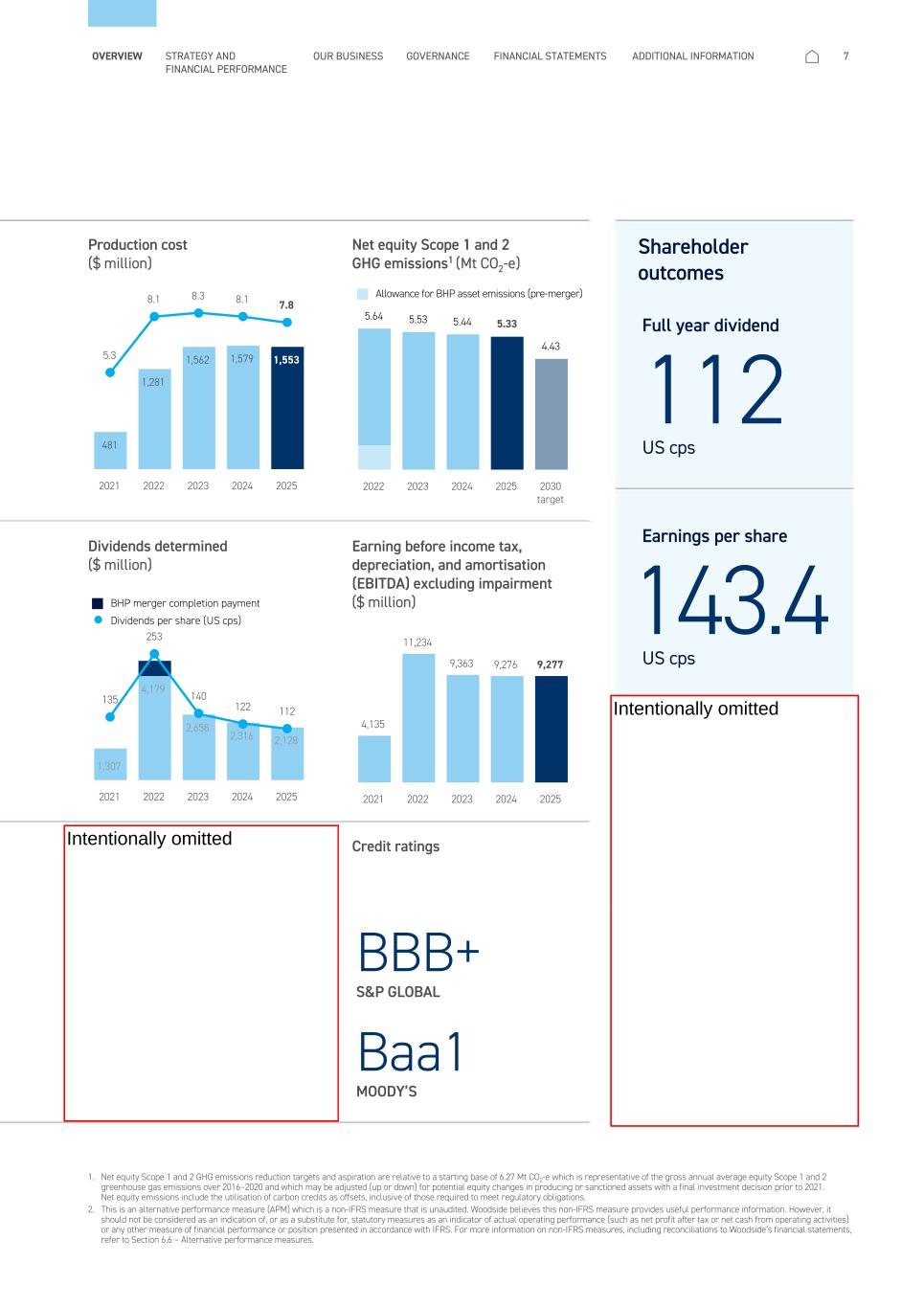
OVERVIEW STRATEGY AND FINANCIAL PERFORMANCE OUR BUSINESS GOVERNANCE FINANCIAL STATEMENTS ADDITIONAL INFORMATION 7 Earning before income tax, depreciation, and amortisation (EBITDA) excluding impairment ($ million) Credit ratings Net equity Scope 1 and 2 GHG emissions1 (Mt CO2-e) Net debt2 ($ million) Production cost ($ million) 4,135 11,234 9,363 9,276 9,277 2021 2022 2023 2024 2025 3,772 583 4,749 7,697 8,010 2021 2022 2023 2024 2025 5.64 5.53 5.44 5.33 4.43 2022 2023 2024 2025 2030 target 481 1,281 1,562 1,579 1,5535.3 8.1 8.3 8.1 7.8 2021 2022 2023 2024 2025 Earnings per share 143.4 US cps Return on equity2 7.6% Return on average capital employed2 6.7% Full year dividend 112 US cps Shareholder outcomes BBB+ S&P GLOBAL Baa1 MOODY’S All footnotes related to this page are displayed on the previous page. Allowance for BHP asset emissions (pre-merger) 1. Net equity Scope 1 and 2 GHG emissions reduction targets and aspiration are relative to a starting base of 6.27 Mt CO2‑e which is representative of the gross annual average equity Scope 1 and 2 greenhouse gas emissions over 2016–2020 and which may be adjusted (up or down) for potential equity changes in producing or sanctioned assets with a final investment decision prior to 2021. Net equity emissions include the utilisation of carbon credits as offsets, inclusive of those required to meet regulatory obligations. 2. This is an alternative performance measure (APM) which is a non-IFRS measure that is unaudited. Woodside believes this non-IFRS measure provides useful performance information. However, it should not be considered as an indication of, or as a substitute for, statutory measures as an indicator of actual operating performance (such as net profit after tax or net cash from operating activities) or any other measure of financial performance or position presented in accordance with IFRS. For more information on non-IFRS measures, including reconciliations to Woodside’s financial statements, refer to Section 6.6 – Alternative performance measures. Dividends determined ($ million) 1,307 4,179 2,658 2,316 2,128 135 253 140 122 112 2021 2022 2023 2024 2025 BHP merger completion payment • Dividends per share (US cps)
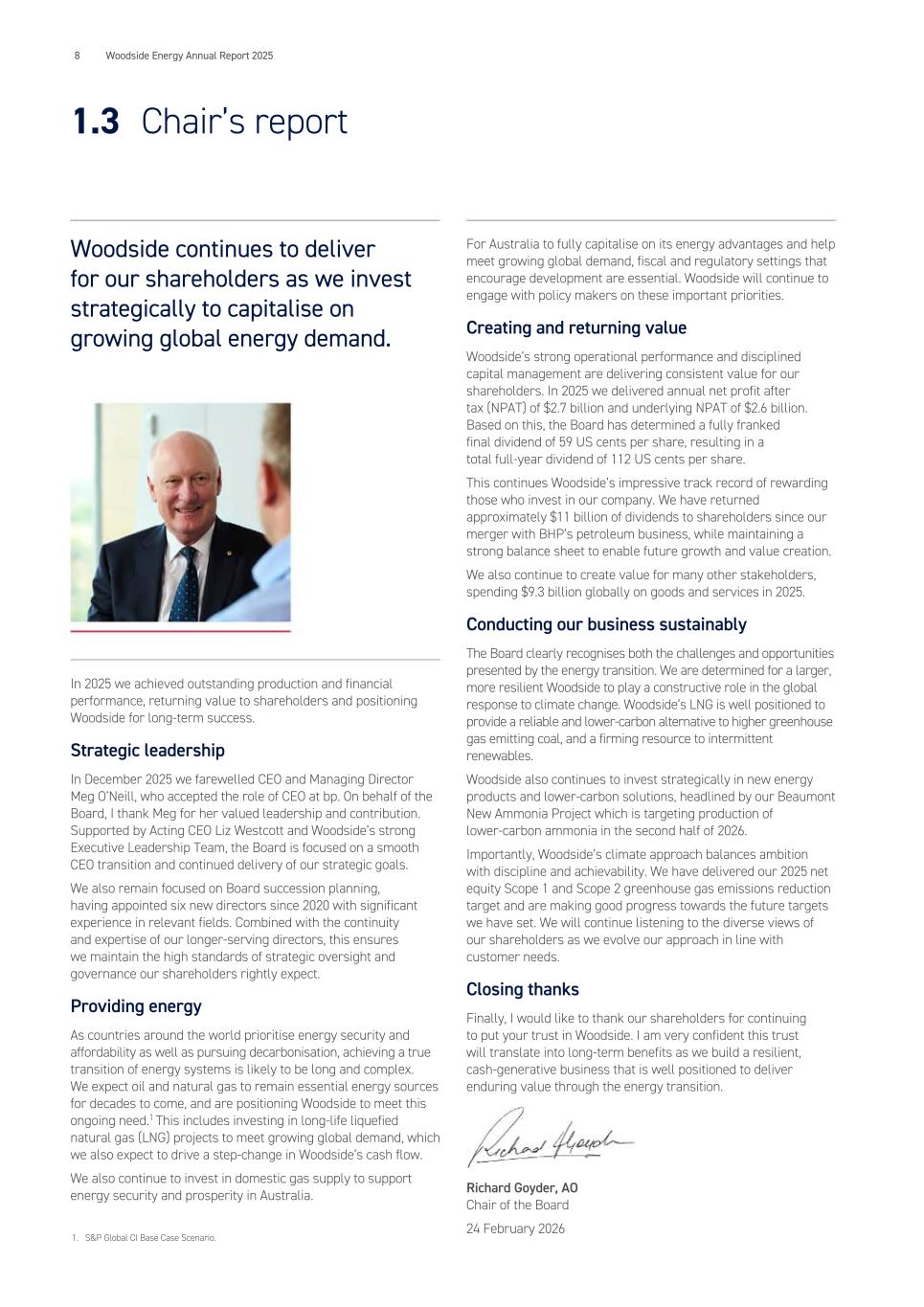
Woodside continues to deliver for our shareholders as we invest strategically to capitalise on growing global energy demand. In 2025 we achieved outstanding production and financial performance, returning value to shareholders and positioning Woodside for long-term success. Strategic leadership In December 2025 we farewelled CEO and Managing Director Meg O’Neill, who accepted the role of CEO at bp. On behalf of the Board, I thank Meg for her valued leadership and contribution. Supported by Acting CEO Liz Westcott and Woodside’s strong Executive Leadership Team, the Board is focused on a smooth CEO transition and continued delivery of our strategic goals. We also remain focused on Board succession planning, having appointed six new directors since 2020 with significant experience in relevant fields. Combined with the continuity and expertise of our longer-serving directors, this ensures we maintain the high standards of strategic oversight and governance our shareholders rightly expect. Providing energy As countries around the world prioritise energy security and affordability as well as pursuing decarbonisation, achieving a true transition of energy systems is likely to be long and complex. We expect oil and natural gas to remain essential energy sources for decades to come, and are positioning Woodside to meet this ongoing need.1 This includes investing in long-life liquefied natural gas (LNG) projects to meet growing global demand, which we also expect to drive a step-change in Woodside’s cash flow. We also continue to invest in domestic gas supply to support energy security and prosperity in Australia. For Australia to fully capitalise on its energy advantages and help meet growing global demand, fiscal and regulatory settings that encourage development are essential. Woodside will continue to engage with policy makers on these important priorities. Creating and returning value Woodside’s strong operational performance and disciplined capital management are delivering consistent value for our shareholders. In 2025 we delivered annual net profit after tax (NPAT) of $2.7 billion and underlying NPAT of $2.6 billion. Based on this, the Board has determined a fully franked final dividend of 59 US cents per share, resulting in a total full‑year dividend of 112 US cents per share. This continues Woodside’s impressive track record of rewarding those who invest in our company. We have returned approximately $11 billion of dividends to shareholders since our merger with BHP’s petroleum business, while maintaining a strong balance sheet to enable future growth and value creation. We also continue to create value for many other stakeholders, spending $9.3 billion globally on goods and services in 2025. Conducting our business sustainably The Board clearly recognises both the challenges and opportunities presented by the energy transition. We are determined for a larger, more resilient Woodside to play a constructive role in the global response to climate change. Woodside’s LNG is well positioned to provide a reliable and lower-carbon alternative to higher greenhouse gas emitting coal, and a firming resource to intermittent renewables. Woodside also continues to invest strategically in new energy products and lower-carbon solutions, headlined by our Beaumont New Ammonia Project which is targeting production of lower‑carbon ammonia in the second half of 2026. Importantly, Woodside’s climate approach balances ambition with discipline and achievability. We have delivered our 2025 net equity Scope 1 and Scope 2 greenhouse gas emissions reduction target and are making good progress towards the future targets we have set. We will continue listening to the diverse views of our shareholders as we evolve our approach in line with customer needs. Closing thanks Finally, I would like to thank our shareholders for continuing to put your trust in Woodside. I am very confident this trust will translate into long-term benefits as we build a resilient, cash‑generative business that is well positioned to deliver enduring value through the energy transition. Richard Goyder, AO Chair of the Board 24 February 2026 8 Woodside Energy Annual Report 2025 1.3 Chair’s report 1. S&P Global CI Base Case Scenario.
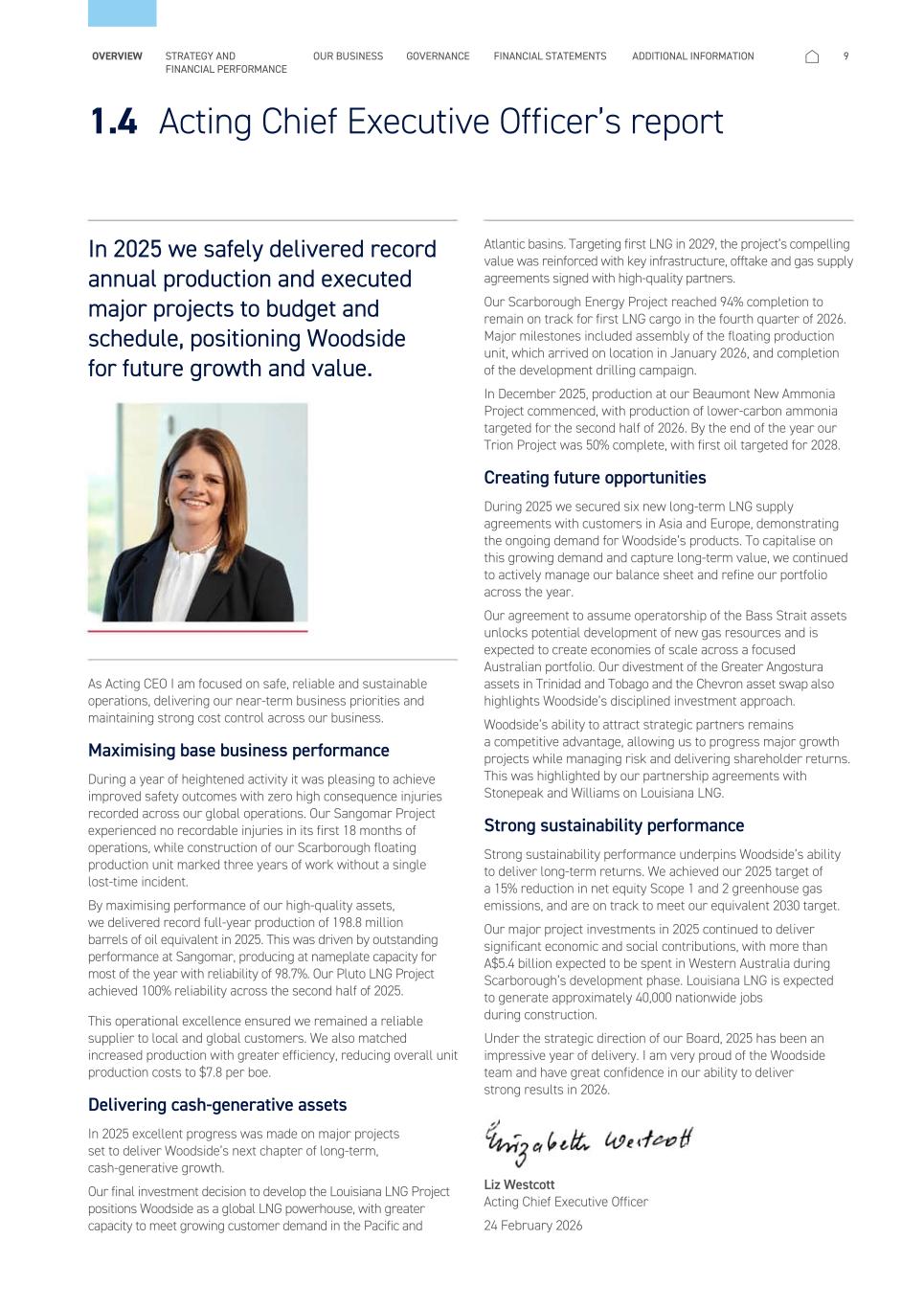
In 2025 we safely delivered record annual production and executed major projects to budget and schedule, positioning Woodside for future growth and value. As Acting CEO I am focused on safe, reliable and sustainable operations, delivering our near-term business priorities and maintaining strong cost control across our business. Maximising base business performance During a year of heightened activity it was pleasing to achieve improved safety outcomes with zero high consequence injuries recorded across our global operations. Our Sangomar Project experienced no recordable injuries in its first 18 months of operations, while construction of our Scarborough floating production unit marked three years of work without a single lost‑time incident. By maximising performance of our high-quality assets, we delivered record full-year production of 198.8 million barrels of oil equivalent in 2025. This was driven by outstanding performance at Sangomar, producing at nameplate capacity for most of the year with reliability of 98.7%. Our Pluto LNG Project achieved 100% reliability across the second half of 2025. This operational excellence ensured we remained a reliable supplier to local and global customers. We also matched increased production with greater efficiency, reducing overall unit production costs to $7.8 per boe. Delivering cash-generative assets In 2025 excellent progress was made on major projects set to deliver Woodside’s next chapter of long-term, cash‑generative growth. Our final investment decision to develop the Louisiana LNG Project positions Woodside as a global LNG powerhouse, with greater capacity to meet growing customer demand in the Pacific and Atlantic basins. Targeting first LNG in 2029, the project’s compelling value was reinforced with key infrastructure, offtake and gas supply agreements signed with high-quality partners. Our Scarborough Energy Project reached 94% completion to remain on track for first LNG cargo in the fourth quarter of 2026. Major milestones included assembly of the floating production unit, which arrived on location in January 2026, and completion of the development drilling campaign. In December 2025, production at our Beaumont New Ammonia Project commenced, with production of lower-carbon ammonia targeted for the second half of 2026. By the end of the year our Trion Project was 50% complete, with first oil targeted for 2028. Creating future opportunities During 2025 we secured six new long-term LNG supply agreements with customers in Asia and Europe, demonstrating the ongoing demand for Woodside’s products. To capitalise on this growing demand and capture long-term value, we continued to actively manage our balance sheet and refine our portfolio across the year. Our agreement to assume operatorship of the Bass Strait assets unlocks potential development of new gas resources and is expected to create economies of scale across a focused Australian portfolio. Our divestment of the Greater Angostura assets in Trinidad and Tobago and the Chevron asset swap also highlights Woodside’s disciplined investment approach. Woodside’s ability to attract strategic partners remains a competitive advantage, allowing us to progress major growth projects while managing risk and delivering shareholder returns. This was highlighted by our partnership agreements with Stonepeak and Williams on Louisiana LNG. Strong sustainability performance Strong sustainability performance underpins Woodside’s ability to deliver long-term returns. We achieved our 2025 target of a 15% reduction in net equity Scope 1 and 2 greenhouse gas emissions, and are on track to meet our equivalent 2030 target. Our major project investments in 2025 continued to deliver significant economic and social contributions, with more than A$5.4 billion expected to be spent in Western Australia during Scarborough’s development phase. Louisiana LNG is expected to generate approximately 40,000 nationwide jobs during construction. Under the strategic direction of our Board, 2025 has been an impressive year of delivery. I am very proud of the Woodside team and have great confidence in our ability to deliver strong results in 2026. Liz Westcott Acting Chief Executive Officer 24 February 2026 OVERVIEW STRATEGY AND FINANCIAL PERFORMANCE OUR BUSINESS GOVERNANCE FINANCIAL STATEMENTS ADDITIONAL INFORMATION 9 1.4 Acting Chief Executive Officer’s report
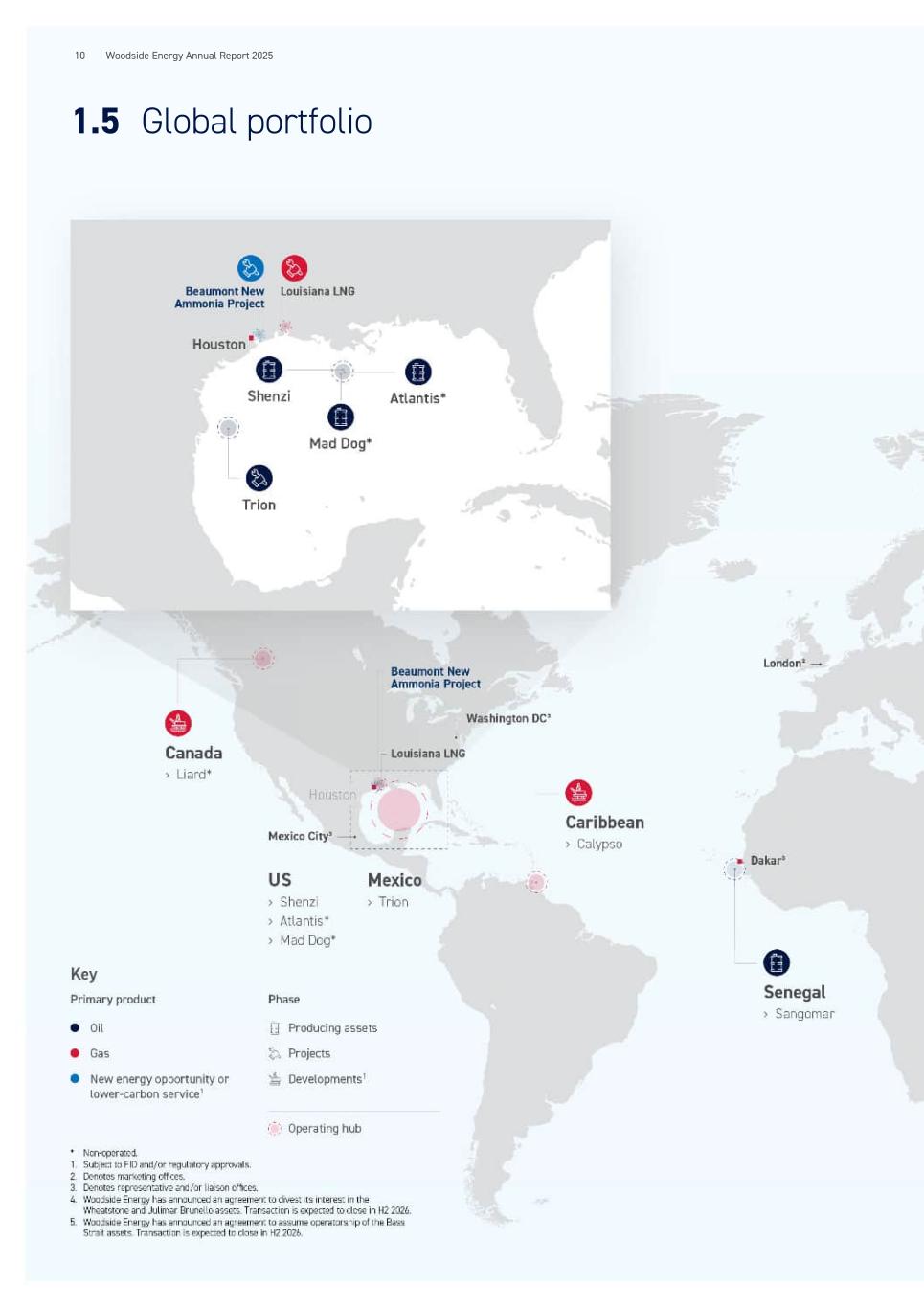
10 Woodside Energy Annual Report 2025 1.5 Global portfolio
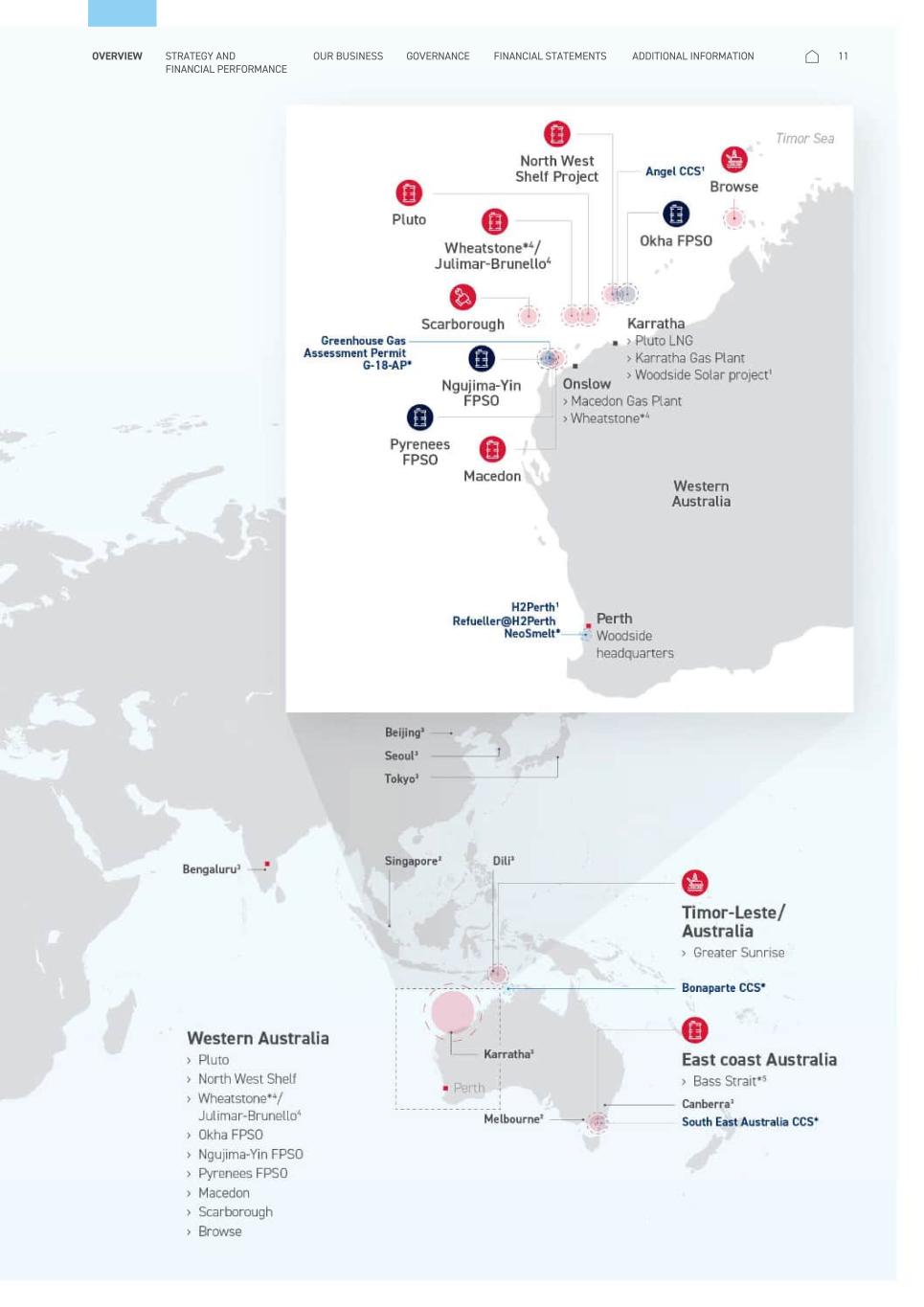
OVERVIEW STRATEGY AND FINANCIAL PERFORMANCE OUR BUSINESS GOVERNANCE FINANCIAL STATEMENTS ADDITIONAL INFORMATION 11

The disciplined execution of our strategy drove strong shareholder returns while strengthening our position as a trusted partner in the evolving energy landscape. 12 Woodside Energy Annual Report 2025 2 Strategy and Financial Performance
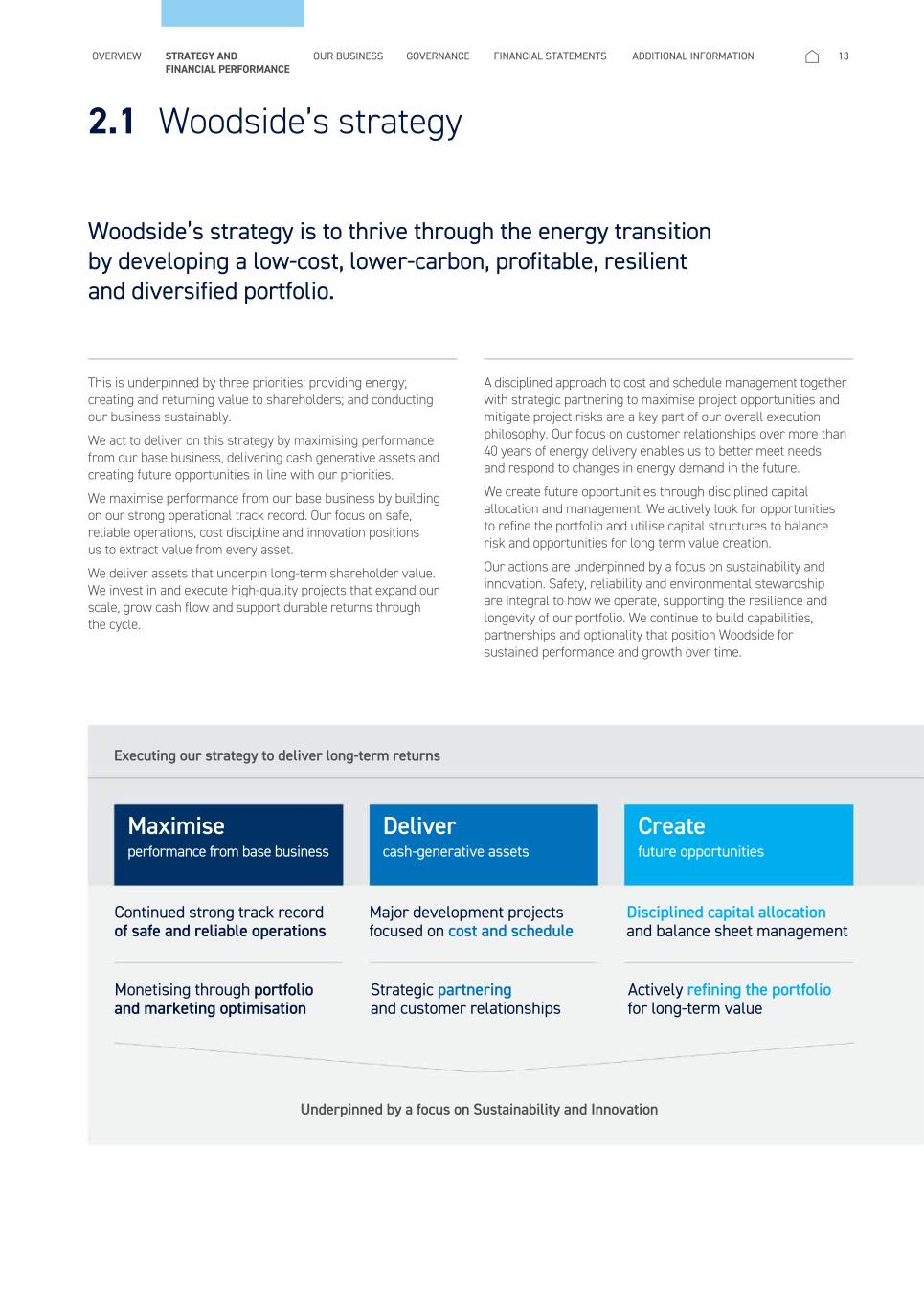
This is underpinned by three priorities: providing energy; creating and returning value to shareholders; and conducting our business sustainably. We act to deliver on this strategy by maximising performance from our base business, delivering cash generative assets and creating future opportunities in line with our priorities. We maximise performance from our base business by building on our strong operational track record. Our focus on safe, reliable operations, cost discipline and innovation positions us to extract value from every asset. We deliver assets that underpin long-term shareholder value. We invest in and execute high-quality projects that expand our scale, grow cash flow and support durable returns through the cycle. A disciplined approach to cost and schedule management together with strategic partnering to maximise project opportunities and mitigate project risks are a key part of our overall execution philosophy. Our focus on customer relationships over more than 40 years of energy delivery enables us to better meet needs and respond to changes in energy demand in the future. We create future opportunities through disciplined capital allocation and management. We actively look for opportunities to refine the portfolio and utilise capital structures to balance risk and opportunities for long term value creation. Our actions are underpinned by a focus on sustainability and innovation. Safety, reliability and environmental stewardship are integral to how we operate, supporting the resilience and longevity of our portfolio. We continue to build capabilities, partnerships and optionality that position Woodside for sustained performance and growth over time. OVERVIEW STRATEGY AND FINANCIAL PERFORMANCE OUR BUSINESS GOVERNANCE FINANCIAL STATEMENTS ADDITIONAL INFORMATION 13 2.1 Woodside’s strategy Underpinned by a focus on Sustainability and Innovation Executing our strategy to deliver long-term returns Maximise performance from base business Deliver cash-generative assets Create future opportunities Continued strong track record of safe and reliable operations Major development projects focused on cost and schedule Disciplined capital allocation and balance sheet management Monetising through portfolio and marketing optimisation Strategic partnering and customer relationships Actively refining the portfolio for long-term value Woodside’s strategy is to thrive through the energy transition by developing a low-cost, lower-carbon, profitable, resilient and diversified portfolio.
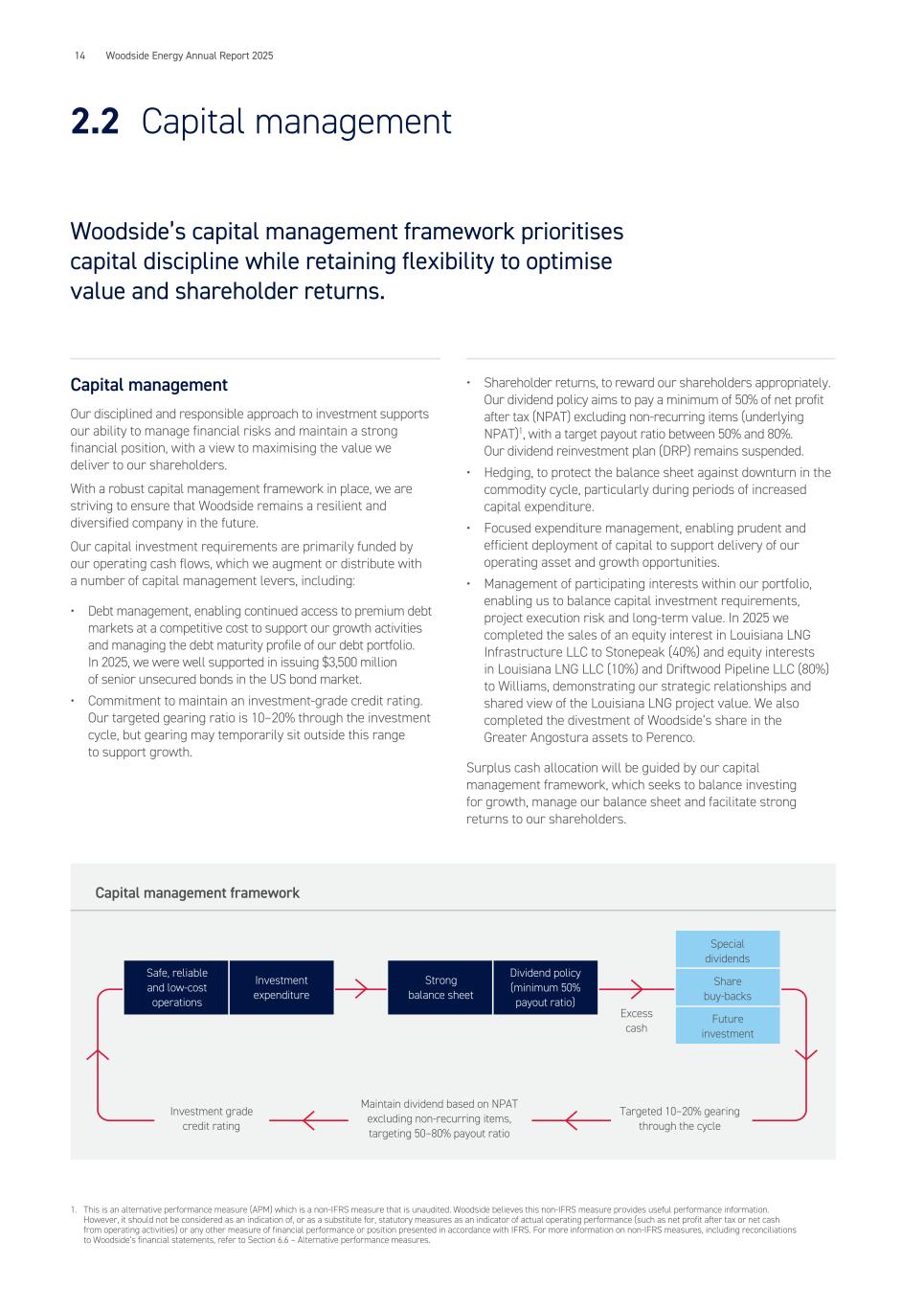
Capital management Our disciplined and responsible approach to investment supports our ability to manage financial risks and maintain a strong financial position, with a view to maximising the value we deliver to our shareholders. With a robust capital management framework in place, we are striving to ensure that Woodside remains a resilient and diversified company in the future. Our capital investment requirements are primarily funded by our operating cash flows, which we augment or distribute with a number of capital management levers, including: • Debt management, enabling continued access to premium debt markets at a competitive cost to support our growth activities and managing the debt maturity profile of our debt portfolio. In 2025, we were well supported in issuing $3,500 million of senior unsecured bonds in the US bond market. • Commitment to maintain an investment-grade credit rating. Our targeted gearing ratio is 10–20% through the investment cycle, but gearing may temporarily sit outside this range to support growth. • Shareholder returns, to reward our shareholders appropriately. Our dividend policy aims to pay a minimum of 50% of net profit after tax (NPAT) excluding non-recurring items (underlying NPAT)1, with a target payout ratio between 50% and 80%. Our dividend reinvestment plan (DRP) remains suspended. • Hedging, to protect the balance sheet against downturn in the commodity cycle, particularly during periods of increased capital expenditure. • Focused expenditure management, enabling prudent and efficient deployment of capital to support delivery of our operating asset and growth opportunities. • Management of participating interests within our portfolio, enabling us to balance capital investment requirements, project execution risk and long-term value. In 2025 we completed the sales of an equity interest in Louisiana LNG Infrastructure LLC to Stonepeak (40%) and equity interests in Louisiana LNG LLC (10%) and Driftwood Pipeline LLC (80%) to Williams, demonstrating our strategic relationships and shared view of the Louisiana LNG project value. We also completed the divestment of Woodside’s share in the Greater Angostura assets to Perenco. Surplus cash allocation will be guided by our capital management framework, which seeks to balance investing for growth, manage our balance sheet and facilitate strong returns to our shareholders. 14 Woodside Energy Annual Report 2025 2.2 Capital management Capital management framework Investment expenditure Investment grade credit rating Maintain dividend based on NPAT excluding non-recurring items, targeting 50–80% payout ratio Targeted 10–20% gearing through the cycle Excess cash Special dividends Share buy-backs Future investment Safe, reliable and low-cost operations Dividend policy (minimum 50% payout ratio) Strong balance sheet Woodside’s capital management framework prioritises capital discipline while retaining flexibility to optimise value and shareholder returns. 1. This is an alternative performance measure (APM) which is a non-IFRS measure that is unaudited. Woodside believes this non-IFRS measure provides useful performance information. However, it should not be considered as an indication of, or as a substitute for, statutory measures as an indicator of actual operating performance (such as net profit after tax or net cash from operating activities) or any other measure of financial performance or position presented in accordance with IFRS. For more information on non-IFRS measures, including reconciliations to Woodside’s financial statements, refer to Section 6.6 – Alternative performance measures.
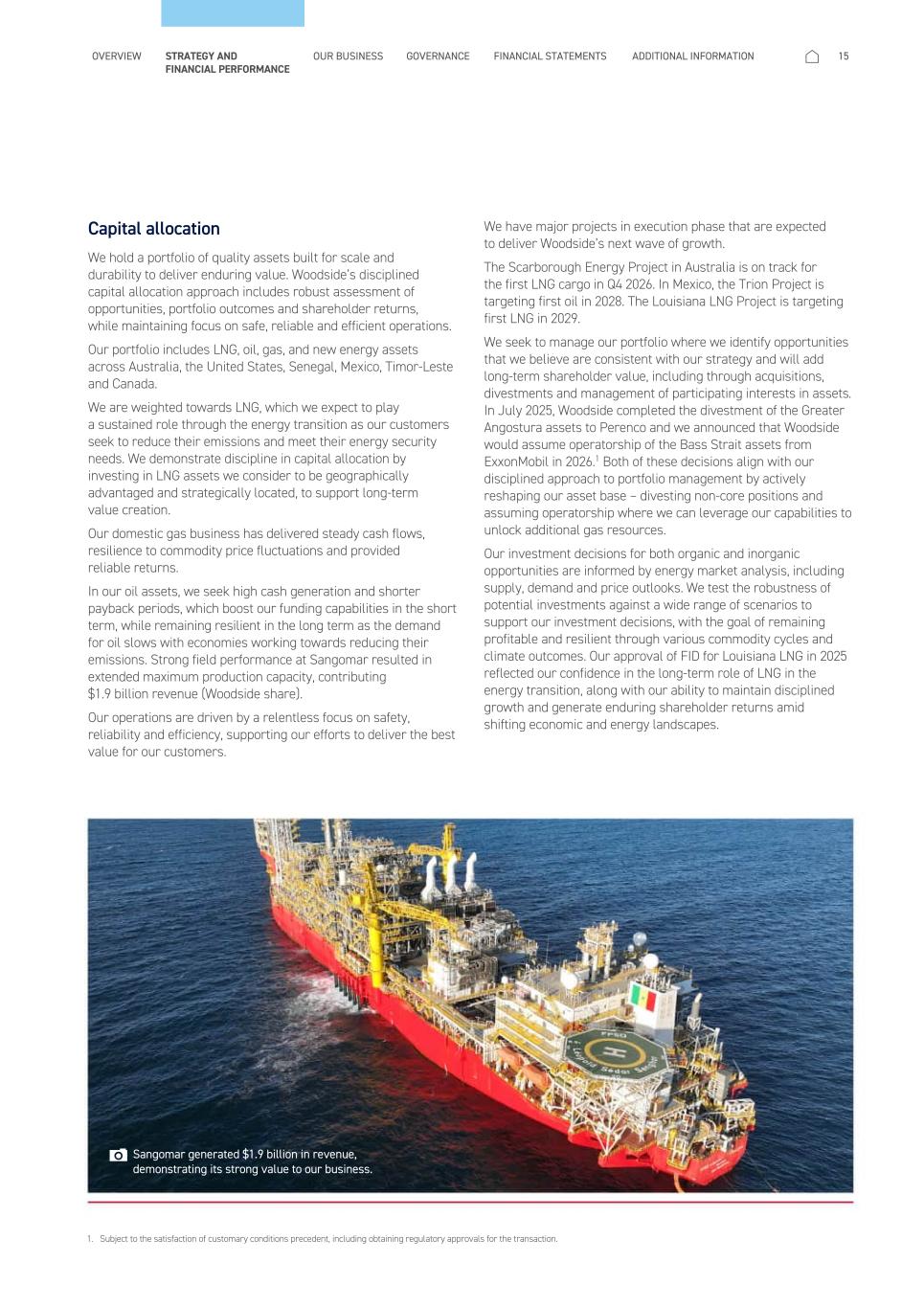
Capital allocation We hold a portfolio of quality assets built for scale and durability to deliver enduring value. Woodside’s disciplined capital allocation approach includes robust assessment of opportunities, portfolio outcomes and shareholder returns, while maintaining focus on safe, reliable and efficient operations. Our portfolio includes LNG, oil, gas, and new energy assets across Australia, the United States, Senegal, Mexico, Timor-Leste and Canada. We are weighted towards LNG, which we expect to play a sustained role through the energy transition as our customers seek to reduce their emissions and meet their energy security needs. We demonstrate discipline in capital allocation by investing in LNG assets we consider to be geographically advantaged and strategically located, to support long-term value creation. Our domestic gas business has delivered steady cash flows, resilience to commodity price fluctuations and provided reliable returns. In our oil assets, we seek high cash generation and shorter payback periods, which boost our funding capabilities in the short term, while remaining resilient in the long term as the demand for oil slows with economies working towards reducing their emissions. Strong field performance at Sangomar resulted in extended maximum production capacity, contributing $1.9 billion revenue (Woodside share). Our operations are driven by a relentless focus on safety, reliability and efficiency, supporting our efforts to deliver the best value for our customers. We have major projects in execution phase that are expected to deliver Woodside’s next wave of growth. The Scarborough Energy Project in Australia is on track for the first LNG cargo in Q4 2026. In Mexico, the Trion Project is targeting first oil in 2028. The Louisiana LNG Project is targeting first LNG in 2029. We seek to manage our portfolio where we identify opportunities that we believe are consistent with our strategy and will add long-term shareholder value, including through acquisitions, divestments and management of participating interests in assets. In July 2025, Woodside completed the divestment of the Greater Angostura assets to Perenco and we announced that Woodside would assume operatorship of the Bass Strait assets from ExxonMobil in 2026.1 Both of these decisions align with our disciplined approach to portfolio management by actively reshaping our asset base – divesting non-core positions and assuming operatorship where we can leverage our capabilities to unlock additional gas resources. Our investment decisions for both organic and inorganic opportunities are informed by energy market analysis, including supply, demand and price outlooks. We test the robustness of potential investments against a wide range of scenarios to support our investment decisions, with the goal of remaining profitable and resilient through various commodity cycles and climate outcomes. Our approval of FID for Louisiana LNG in 2025 reflected our confidence in the long-term role of LNG in the energy transition, along with our ability to maintain disciplined growth and generate enduring shareholder returns amid shifting economic and energy landscapes. OVERVIEW STRATEGY AND FINANCIAL PERFORMANCE OUR BUSINESS GOVERNANCE FINANCIAL STATEMENTS ADDITIONAL INFORMATION 15 Sangomar generated $1.9 billion in revenue, demonstrating its strong value to our business. 1. Subject to the satisfaction of customary conditions precedent, including obtaining regulatory approvals for the transaction.
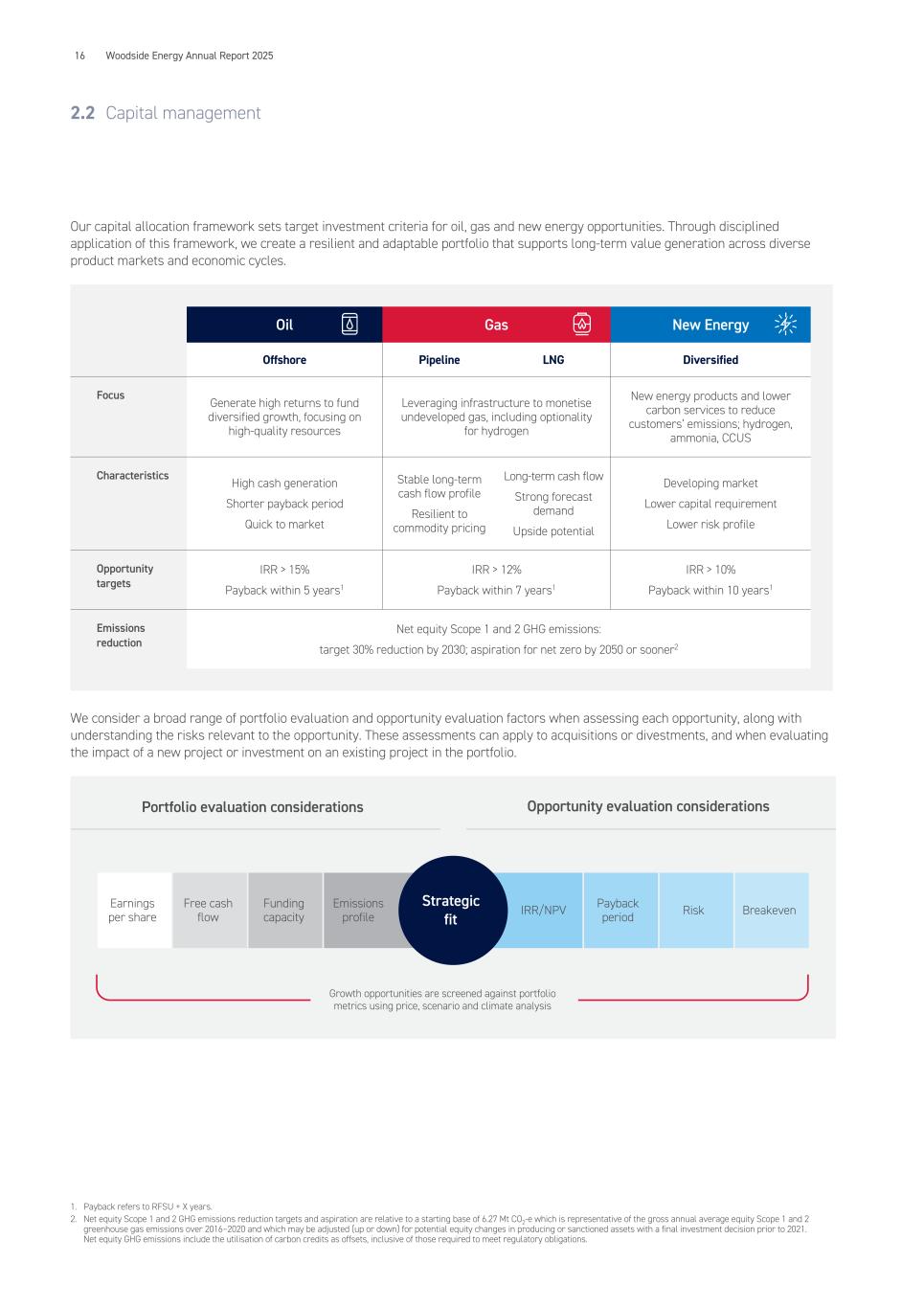
Our capital allocation framework sets target investment criteria for oil, gas and new energy opportunities. Through disciplined application of this framework, we create a resilient and adaptable portfolio that supports long-term value generation across diverse product markets and economic cycles. Oil Gas New Energy Offshore Pipeline LNG Diversified Focus Generate high returns to fund diversified growth, focusing on high‑quality resources Leveraging infrastructure to monetise undeveloped gas, including optionality for hydrogen New energy products and lower carbon services to reduce customers’ emissions; hydrogen, ammonia, CCUS Characteristics High cash generation Shorter payback period Quick to market Stable long-term cash flow profile Resilient to commodity pricing Long-term cash flow Strong forecast demand Upside potential Developing market Lower capital requirement Lower risk profile Opportunity targets IRR > 15% Payback within 5 years1 IRR > 12% Payback within 7 years1 IRR > 10% Payback within 10 years1 Emissions reduction Net equity Scope 1 and 2 GHG emissions: target 30% reduction by 2030; aspiration for net zero by 2050 or sooner2 We consider a broad range of portfolio evaluation and opportunity evaluation factors when assessing each opportunity, along with understanding the risks relevant to the opportunity. These assessments can apply to acquisitions or divestments, and when evaluating the impact of a new project or investment on an existing project in the portfolio. 16 Woodside Energy Annual Report 2025 2.2 Capital management 1. Payback refers to RFSU + X years. 2. Net equity Scope 1 and 2 GHG emissions reduction targets and aspiration are relative to a starting base of 6.27 Mt CO2‑e which is representative of the gross annual average equity Scope 1 and 2 greenhouse gas emissions over 2016–2020 and which may be adjusted (up or down) for potential equity changes in producing or sanctioned assets with a final investment decision prior to 2021. Net equity GHG emissions include the utilisation of carbon credits as offsets, inclusive of those required to meet regulatory obligations. Earnings per share Free cash flow Funding capacity Emissions profile Strategic fit IRR/NPV Payback period Risk Breakeven Growth opportunities are screened against portfolio metrics using price, scenario and climate analysis Portfolio evaluation considerations Opportunity evaluation considerations
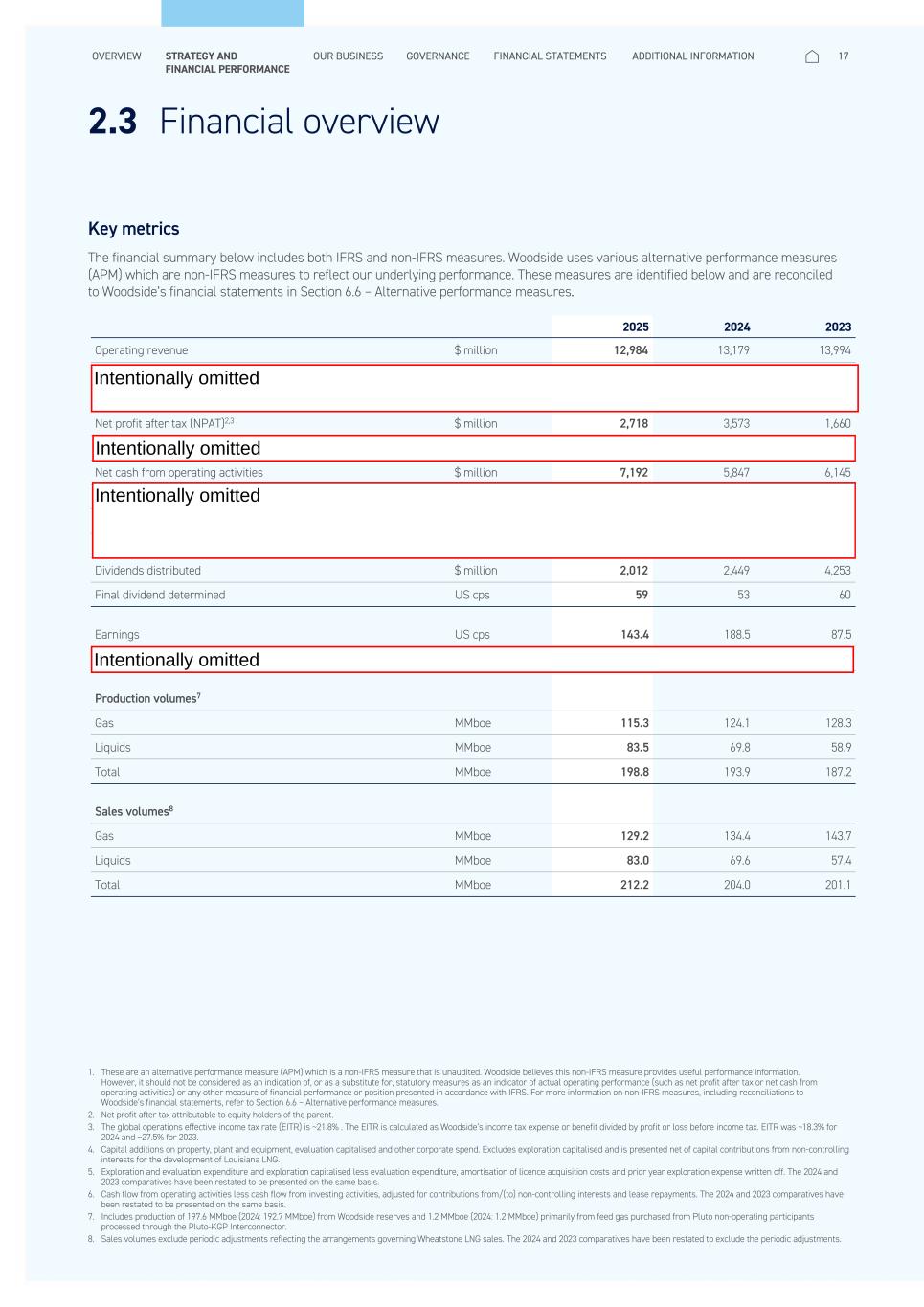
Key metrics The financial summary below includes both IFRS and non-IFRS measures. Woodside uses various alternative performance measures (APM) which are non-IFRS measures to reflect our underlying performance. These measures are identified below and are reconciled to Woodside’s financial statements in Section 6.6 – Alternative performance measures. 2025 2024 2023 Operating revenue $ million 12,984 13,179 13,994 EBITDA excluding impairment1 $ million 9,277 9,276 9,363 Earnings before interest and tax (EBIT)1 $ million 3,889 4,514 3,307 Net profit after tax (NPAT)2,3 $ million 2,718 3,573 1,660 Underlying NPAT1 $ million 2,649 2,880 3,320 Net cash from operating activities $ million 7,192 5,847 6,145 Capital expenditure1,4 $ million 4,703 5,306 5,736 Exploration expenditure1,5 $ million 202 327 337 Free cash flow1,6 $ million 1,889 (293) 101 Dividends distributed $ million 2,012 2,449 4,253 Final dividend determined US cps 59 53 60 Earnings US cps 143.4 188.5 87.5 Gearing1 % 18.2 17.9 12.1 Production volumes7 Gas MMboe 115.3 124.1 128.3 Liquids MMboe 83.5 69.8 58.9 Total MMboe 198.8 193.9 187.2 Sales volumes8 Gas MMboe 129.2 134.4 143.7 Liquids MMboe 83.0 69.6 57.4 Total MMboe 212.2 204.0 201.1 OVERVIEW STRATEGY AND FINANCIAL PERFORMANCE OUR BUSINESS GOVERNANCE FINANCIAL STATEMENTS ADDITIONAL INFORMATION 17 2.3 Financial overview 1. These are an alternative performance measure (APM) which is a non-IFRS measure that is unaudited. Woodside believes this non-IFRS measure provides useful performance information. However, it should not be considered as an indication of, or as a substitute for, statutory measures as an indicator of actual operating performance (such as net profit after tax or net cash from operating activities) or any other measure of financial performance or position presented in accordance with IFRS. For more information on non-IFRS measures, including reconciliations to Woodside’s financial statements, refer to Section 6.6 – Alternative performance measures. 2. Net profit after tax attributable to equity holders of the parent. 3. The global operations effective income tax rate (EITR) is ~21.8% . The EITR is calculated as Woodside’s income tax expense or benefit divided by profit or loss before income tax. EITR was ~18.3% for 2024 and ~27.5% for 2023. 4. Capital additions on property, plant and equipment, evaluation capitalised and other corporate spend. Excludes exploration capitalised and is presented net of capital contributions from non-controlling interests for the development of Louisiana LNG. 5. Exploration and evaluation expenditure and exploration capitalised less evaluation expenditure, amortisation of licence acquisition costs and prior year exploration expense written off. The 2024 and 2023 comparatives have been restated to be presented on the same basis. 6. Cash flow from operating activities less cash flow from investing activities, adjusted for contributions from/(to) non-controlling interests and lease repayments. The 2024 and 2023 comparatives have been restated to be presented on the same basis. 7. Includes production of 197.6 MMboe (2024: 192.7 MMboe) from Woodside reserves and 1.2 MMboe (2024: 1.2 MMboe) primarily from feed gas purchased from Pluto non-operating participants processed through the Pluto-KGP Interconnector. 8. Sales volumes exclude periodic adjustments reflecting the arrangements governing Wheatstone LNG sales. The 2024 and 2023 comparatives have been restated to exclude the periodic adjustments.
Capital discipline and financial strength Final dividend A 2025 final dividend of 59 US cents per share (cps) has been determined, representing a full-year dividend yield of 7.1%.1 The total amount of the final dividend payment comes to $1,122 million which represents approximately 80% of underlying NPAT for the second half of 2025, and will be fully franked for Australian tax purposes.2 The dividend reinvestment plan remains suspended. Liquidity and debt service Woodside’s primary sources of liquidity are cash and cash equivalents, net cash from operating activities, unused borrowing capacity under its bilateral facilities and syndicated facilities, issuances of debt or equity securities and other potential sources of liquidity, such as sales of assets or equity interests in assets. During the year, Woodside generated $7,192 million net cash from operating activities and used $7,911 million of net cash on investing activities. After adjusting for the receipt of $2,841 million from non-controlling interests and outflow of $233 million in lease repayments Woodside delivered positive free cash flow of $1,889 million in 2025.2 Woodside also, through a wholly owned subsidiary, issued $3,500 million of senior unsecured bonds in the United States, comprising: • $500 million three-year bonds due 2028, • $1,250 million five-year bonds due 2030, • $500 million seven-year bonds due 2032, and • $1,250 million ten-year bonds due 2035. Woodside entered into a new $1,200 million multi-tranche (three‑ and five-years) syndicated undrawn debt facility from Asian, Middle Eastern, Australian and European commercial banks in 2025. Woodside received strong support from commercial banks and investors on these transactions. At the end of the period, Woodside had cash and cash equivalents of $5,712 million, drawn debt of $12,050 million including $800 million in debt payable in 2026, and liquidity of $9,262 million.3 Additional details of Woodside’s credit facilities, including total commitments, maturity and interest and amount outstanding as of 31 December 2025, can be found in Note C.2 to the audited Financial Statements. Woodside’s principal ongoing uses of cash are to provide returns to shareholders, meet working capital requirements, fund debt obligations and finance Woodside’s capital expenditure and acquisitions. Working capital is sufficient for present requirements. Woodside’s capital expenditure for 2026 is expected to be between $4,000 million and $4,500 million primarily due to Scarborough, Trion, Louisiana LNG. This excludes the final acquisition completion payment for Beaumont New Ammonia.4 Woodside’s capital expenditure estimates reflect Woodside's equity interests as at 31 December 2025 and exclude the impact of any subsequent asset selldowns, future acquisitions or other changes in equity. First LNG cargo is on track for Q4 2026 for Scarborough, and we are targeting first oil in 2028 for Trion and first LNG cargo in 2029 for Louisiana LNG. Total project estimated cost for Scarborough is $12.5 billion ($8.2 billion Woodside share), $7.2 billion for Trion ($4.8 billion Woodside share including capital carry of PEMEX of approximately US$460 million) and $17.5 billion for Louisiana LNG ($9.9 billion Woodside share). Woodside has no off-balance sheet arrangements that have, or are reasonably likely to have, a current or future material effect on Woodside’s financial condition, revenues or expenses, results of operations, liquidity, capital expenditures or capital resources. Balance sheet Woodside remains committed to maintaining an investment‑grade credit rating, which supports our aims of providing sustainable returns to shareholders and investing in future growth opportunities, in accordance with our capital allocation framework. Any downgrade in credit ratings could affect Woodside’s ability to access capital markets and increase the cost of capital of the existing debt portfolio. In 2025, Woodside’s credit ratings of Baa1 and BBB+ by Moody’s and S&P Global respectively were both maintained.5 S&P amended Woodside’s outlook from Stable to Negative at Louisiana LNG FID, citing increased capital expenditure and portfolio risk and noting that it may lower Woodside's rating if, among other factors, Woodside is unable to undertake a material sell-down of its interest in Louisiana LNG LLC, in the near term. Woodside’s gearing at the end of 2025 was 18.2%, within our target range of 10–20%. Woodside’s gearing may at times fall outside the target range of 10–20% as the balance sheet is managed through the investment cycle, including increasing above the range to support growth.6 Commodity price risk management Woodside hedges to protect the balance sheet against downside commodity price risk, particularly during periods of high capital expenditure. Woodside hedged approximately 30 MMboe of 2025 volumes. The realised value of these oil price hedges was a pre-tax gain of $221 million. Woodside has placed oil price hedges for approximately 18 MMboe of 2026 production at an average price of approximately $70.1 per barrel.7 Woodside has also placed hedges for Corpus Christi LNG volumes to protect against downside pricing risk. These hedges are Henry Hub and Title Transfer Facility commodity swaps. As at 31 December 2025, an average of 89% of 2026 volumes have reduced pricing risk as a result of hedging activities. 18 Woodside Energy Annual Report 2025 2.3 Financial overview 1. Calculated based on Woodside’s closing share price on 31 December 2025 of A$23.59 ($15.59) and a US$:A$ exchange rate of 0.6693. 2. Free cash flow and underlying NPAT are a non-IFRS measures. Refer to Section 6.6 – Alternative performance measures for a reconciliation of these measures to Woodside’s financial statements. 3. Liquidity is a non-IFRS measure. Refer to Section 6.6 – Alternative performance measures for a reconciliation of these measures to Woodside’s financial statements. 4. Louisiana LNG (90% Louisiana LNG LLC, 60% Louisiana LNG Infrastructure LLC and 20% Driftwood Pipeline LLC) capital expenditure adjusted for the cash contributions from Stonepeak and Williams. 5. Credit ratings are forward-looking opinions on credit risk. S&P Global’s and Moody’s credit ratings express the opinion of each agency on the ability and willingness of Woodside to meet its financial obligations in full and on time. A credit rating is not a recommendation to buy, sell or hold securities and may be subject to suspension, reduction or withdrawal at any time by an assigning rating agency. Any rating should be evaluated independently of any other information. 6. Gearing are non-IFRS measures. Refer to Section 6.6 – Alternative performance measures for a reconciliation of these measures to Woodside’s financial statements. 7. Includes hedges for 10 MMboe placed during 2025 and 8 MMboe placed subsequent to the period.
Overall, energy supply and demand remained broadly balanced, resulting in lower volatility compared with recent years. Demand for both oil and gas specifically remained resilient and ongoing investment in reliable supply to support our customers in achieving energy security is required. Macroeconomic factors Inflation largely returned to target ranges for advanced economies in 2025, prompting central banks to continue monetary easing. The December 2025 Economic Outlook from the Organisation for Economic Co-operation and Development (OECD) projects global GDP growth of 2.9% in 2026, down from 3.2% in 2025.1 Global economic development ambitions and population growth are forecast to continue to drive energy demand, despite expected improvements in energy efficiency. Electricity demand is expected to increase, including from use by data centres. Oil Volatility in the oil price eased over 2025, with increased supply from Organisation of the Petroleum Exporting Countries Plus (OPEC+) partially offset by Chinese stockpiling throughout the year and global geopolitical risks. Dated Brent averaged US$69.1 per barrel in 2025, 14.4% below average 2024 prices and 14.6% below the five-year average.2 Liquefied natural gas Global gas markets remained balanced in 2025. LNG imports into Asia were lower due to Chinese demand. Although global LNG supply increased, Europe absorbed an even larger volume through higher imports, and is expected to keep relying on LNG to meet gas demand. Wood Mackenzie forecasts in its base case scenario that global LNG demand will increase by 60% (250 Mtpa) to 2035.3 Operational and under construction (post-FID) supply is expected to increase by 216 Mtpa over the same period. Demand is likely to be incentivised in Asia, where domestic supplies are limited and economic growth is expected to be robust. North East Asian LNG prices averaged US$12.2 per million British Thermal Units (MMBtu), 2.1% above average 2024 prices and 33% below the five-year average.2 Australian domestic gas markets A generally mild winter in Victoria resulted in stable east coast gas prices during 2025, with gas demand largely consistent year‑on‑year. Gas demand in Western Australia was also largely unchanged, with reductions in gas demand for power generation offset by demand from mining and minerals sectors. Investment in supply on both the west and east coasts is required to avoid shortfalls by 2030.4 Ammonia The European Union’s Carbon Border Adjustment Mechanism (CBAM) moved into its definitive regime on 1 January 2026, with the purchase and surrender of certificates deferred until 2027.5,6 Implications of the CBAM on lower-carbon ammonia trade remain uncertain.7 The International Maritime Organisation’s one‑year deferral of its Net-Zero Framework is likely to delay marine demand signals for alternative fuels such as low‑carbon ammonia.8 New energy markets Demand-side development for lower carbon products and services continues to evolve, but at a slower pace. Customer adoption at scale has progressed slower than anticipated, reflecting the current cost of supply, the need for enabling infrastructure, and the absence of enduring and bankable regulatory frameworks in key jurisdictions. Prospective customers are prioritising affordability and reliability, while assessing the durability of low-carbon end use pathways. Consistent with Woodside's disciplined approach to capital allocation, these demand-side dynamics influence the timing, scale and sequencing of new energy investments, reinforcing a focus on lower-carbon products and services where near-term market demand and commercial viability are more readily established. OVERVIEW STRATEGY AND FINANCIAL PERFORMANCE OUR BUSINESS GOVERNANCE FINANCIAL STATEMENTS ADDITIONAL INFORMATION 19 2.4 Energy markets 1. OECD Economic Outlook, 2 December 2025. 2. S&P Global Platts. 3. Wood Mackenzie, Global gas 10-year investment horizon outlook. 4. East coast: AEMO – Gas Statement of Opportunities March 2025. West Coast: AEMO – WA Gas Statement of Opportunities (December 2025). 5. Carbon Border Adjustment Mechanism – Taxation and Customs Union. 6. Carbon Border Adjustment Mechanism – European Commission Taxation and Customs Union 7. S&P Global (Fertecon) – Ammonia Outlook November 2025. 8. S&P Global (Fertecon) – Low-carbon ammonia monthly December 2025. Global energy markets stabilised in 2025 amid moderate economic growth.

Energy transition Energy demand is increasing with population growth and rising living standards. Countries and customers are seeking to meet this additional energy demand while also seeking to reduce the emissions from its production and use. These changes are sometimes referred to as an energy transition, and they build on the long-term evolution of the energy system over time. Sustained natural gas demand Woodside expects sustained LNG demand through this energy transition, as countries and customers pursue energy security as well as emissions goals. In 2025 alone, Woodside signed long term LNG sales agreements with Asian and European customers committing 4.7 million tonnes per annum. Importantly, these contracts include durations that stretch beyond the targeted payback periods for our new LNG investments such as Scarborough and Louisiana LNG. In addition, the sale of equity in both the Scarborough and Louisiana LNG projects is further evidence of the confidence in the demand for our products. This supports our assessment of the value of our current portfolio of producing assets and our sanctioned projects. This is consistent with industry trends, which has seen over 100 Mtpa of long-term sale and purchase agreements and heads of agreements signed in 2025, up from approximately 81 Mtpa in 2024.1 Natural gas in the energy transition We believe demand for natural gas will continue to be a part of the energy transition, because of its ability to be used by countries and customers as they work towards energy security, affordability and emissions reductions goals. For example, China, Japan, South Korea and countries in the ASEAN (South East Asia) region are signatories to the Paris Agreement and have established Nationally Determined Contribution plans to reduce emissions, with many of them confirming updates during 2025. Collectively, these countries represent some of the world’s largest economies and more than 25% of the world’s population, with significant energy demand today and potential for further growth. Natural gas is expected to play a significant role in energy plans. For example, Japan’s Seventh Strategic Energy Plan was issued in early 2025 and states that “in order to utilize LNG-fired power as a practical means of transition, it is necessary that public and private sectors work together to secure long-term contracts for the necessary LNG.”2,3,4,5 20 Woodside Energy Annual Report 2025 2.4 Energy markets 1. Wood MacKenzie LNG contract trends report (December 2025). 2. Ministry of Economy Trade and Industry of Japan, 2024. “Japan 7th Draft Basic Energy Plan”, https://www.enecho.meti.go.jp/committee/council/basic_policy_subcommittee/2024/067/067_005.pdf. 3. People’s Republic of China, 2024. “China Energy Outlook 2060 (2024 version)” by Sinopec. 4. ASEAN, 2024. “ASEAN 8th Energy Outlook” https://aseanenergy.org/publications/the-8th-asean-energy-outlook. 5. The Republic of Korea, 2024. “Working draft of the Korean 11th Basic Plan for Supply and Demand of Power” https://www.shinkim.com/eng/media/newsletter/2480.
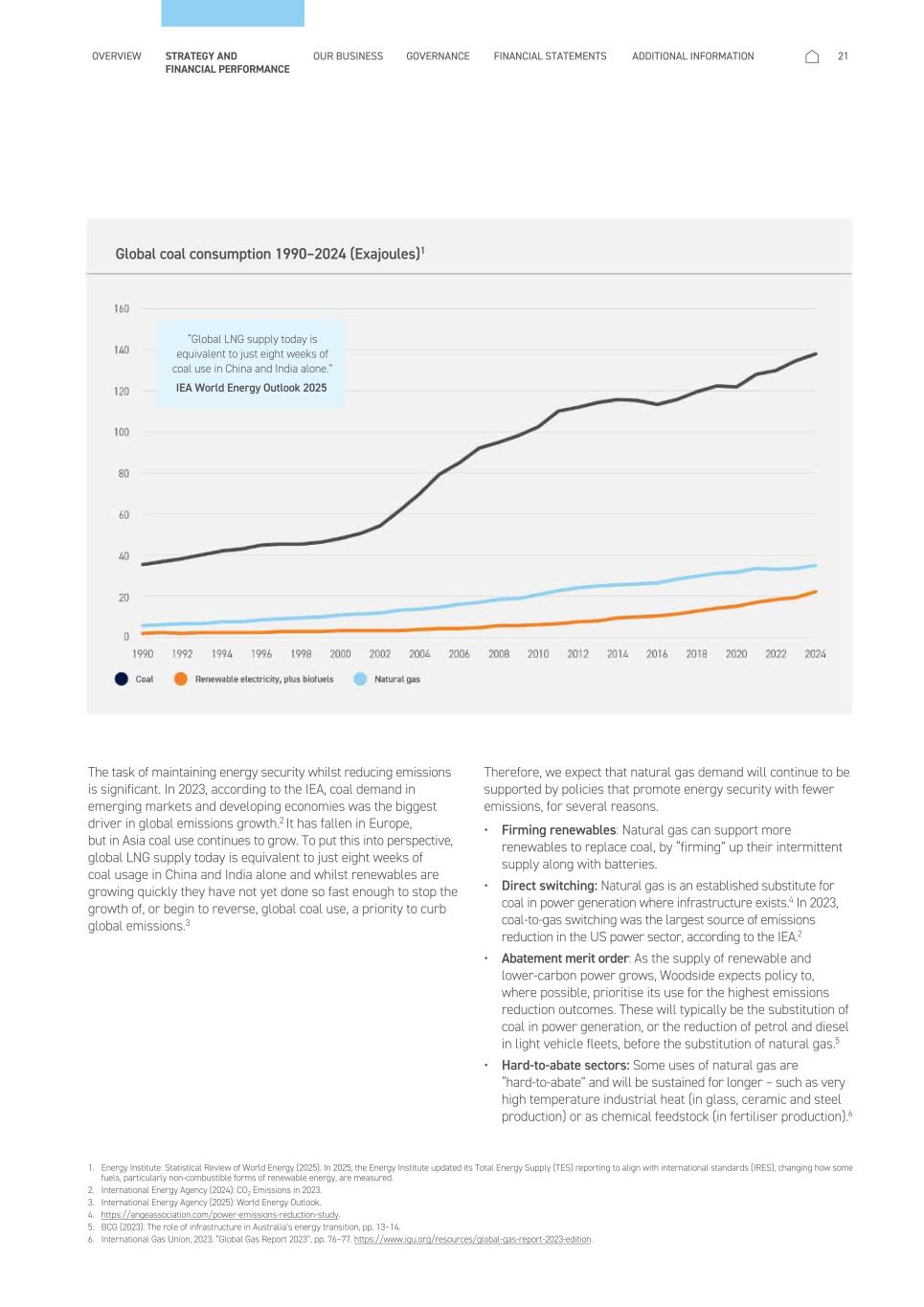
The task of maintaining energy security whilst reducing emissions is significant. In 2023, according to the IEA, coal demand in emerging markets and developing economies was the biggest driver in global emissions growth.2 It has fallen in Europe, but in Asia coal use continues to grow. To put this into perspective, global LNG supply today is equivalent to just eight weeks of coal usage in China and India alone and whilst renewables are growing quickly they have not yet done so fast enough to stop the growth of, or begin to reverse, global coal use, a priority to curb global emissions.3 Therefore, we expect that natural gas demand will continue to be supported by policies that promote energy security with fewer emissions, for several reasons. • Firming renewables: Natural gas can support more renewables to replace coal, by “firming” up their intermittent supply along with batteries. • Direct switching: Natural gas is an established substitute for coal in power generation where infrastructure exists.4 In 2023, coal-to-gas switching was the largest source of emissions reduction in the US power sector, according to the IEA.2 • Abatement merit order: As the supply of renewable and lower‑carbon power grows, Woodside expects policy to, where possible, prioritise its use for the highest emissions reduction outcomes. These will typically be the substitution of coal in power generation, or the reduction of petrol and diesel in light vehicle fleets, before the substitution of natural gas.5 • Hard-to-abate sectors: Some uses of natural gas are “hard‑to‑abate” and will be sustained for longer – such as very high temperature industrial heat (in glass, ceramic and steel production) or as chemical feedstock (in fertiliser production).6 OVERVIEW STRATEGY AND FINANCIAL PERFORMANCE OUR BUSINESS GOVERNANCE FINANCIAL STATEMENTS ADDITIONAL INFORMATION 21 “Global LNG supply today is equivalent to just eight weeks of coal use in China and India alone.” IEA World Energy Outlook 2025 Global coal consumption 1990–2024 (Exajoules)1 1. Energy Institute: Statistical Review of World Energy (2025). In 2025, the Energy Institute updated its Total Energy Supply (TES) reporting to align with international standards (IRES), changing how some fuels, particularly non-combustible forms of renewable energy, are measured. 2. International Energy Agency (2024): CO2 Emissions in 2023. 3. International Energy Agency (2025): World Energy Outlook. 4. https://angeassociation.com/power-emissions-reduction-study. 5. BCG (2023): The role of infrastructure in Australia’s energy transition, pp. 13–14. 6. International Gas Union, 2023. “Global Gas Report 2023”, pp. 76–77. https://www.igu.org/resources/global-gas-report-2023-edition.
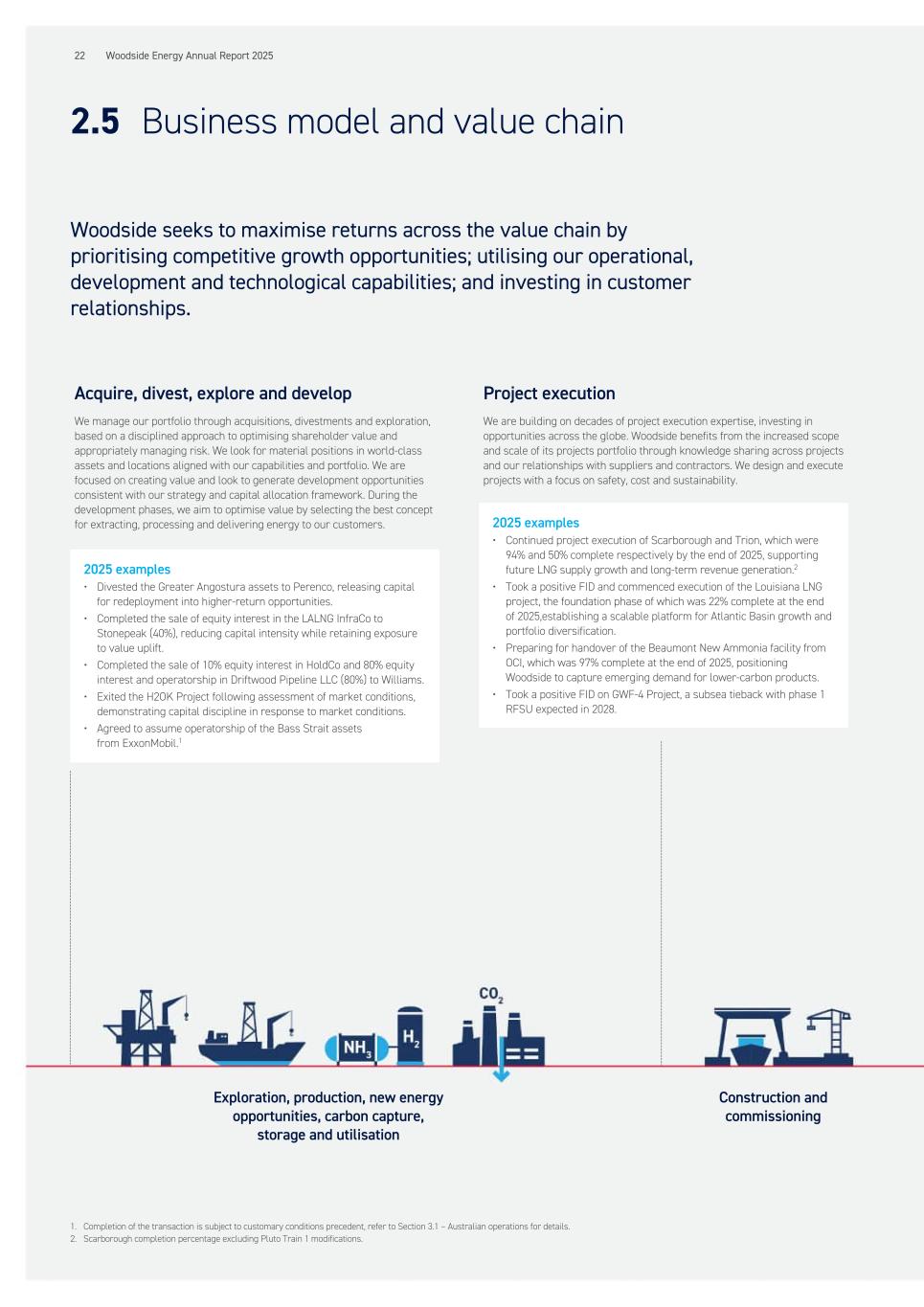
22 Woodside Energy Annual Report 2025 2.5 Business model and value chain Woodside seeks to maximise returns across the value chain by prioritising competitive growth opportunities; utilising our operational, development and technological capabilities; and investing in customer relationships. Exploration, production, new energy opportunities, carbon capture, storage and utilisation Project execution We are building on decades of project execution expertise, investing in opportunities across the globe. Woodside benefits from the increased scope and scale of its projects portfolio through knowledge sharing across projects and our relationships with suppliers and contractors. We design and execute projects with a focus on safety, cost and sustainability. 2025 examples • Continued project execution of Scarborough and Trion, which were 94% and 50% complete respectively by the end of 2025, supporting future LNG supply growth and long‑term revenue generation.2 • Took a positive FID and commenced execution of the Louisiana LNG project, the foundation phase of which was 22% complete at the end of 2025,establishing a scalable platform for Atlantic Basin growth and portfolio diversification. • Preparing for handover of the Beaumont New Ammonia facility from OCI, which was 97% complete at the end of 2025, positioning Woodside to capture emerging demand for lower‑carbon products. • Took a positive FID on GWF-4 Project, a subsea tieback with phase 1 RFSU expected in 2028. 1. Completion of the transaction is subject to customary conditions precedent, refer to Section 3.1 – Australian operations for details. 2. Scarborough completion percentage excluding Pluto Train 1 modifications. Construction and commissioning Acquire, divest, explore and develop We manage our portfolio through acquisitions, divestments and exploration, based on a disciplined approach to optimising shareholder value and appropriately managing risk. We look for material positions in world-class assets and locations aligned with our capabilities and portfolio. We are focused on creating value and look to generate development opportunities consistent with our strategy and capital allocation framework. During the development phases, we aim to optimise value by selecting the best concept for extracting, processing and delivering energy to our customers. 2025 examples • Divested the Greater Angostura assets to Perenco, releasing capital for redeployment into higher‑return opportunities. • Completed the sale of equity interest in the LALNG InfraCo to Stonepeak (40%), reducing capital intensity while retaining exposure to value uplift. • Completed the sale of 10% equity interest in HoldCo and 80% equity interest and operatorship in Driftwood Pipeline LLC (80%) to Williams. • Exited the H2OK Project following assessment of market conditions, demonstrating capital discipline in response to market conditions. • Agreed to assume operatorship of the Bass Strait assets from ExxonMobil.1
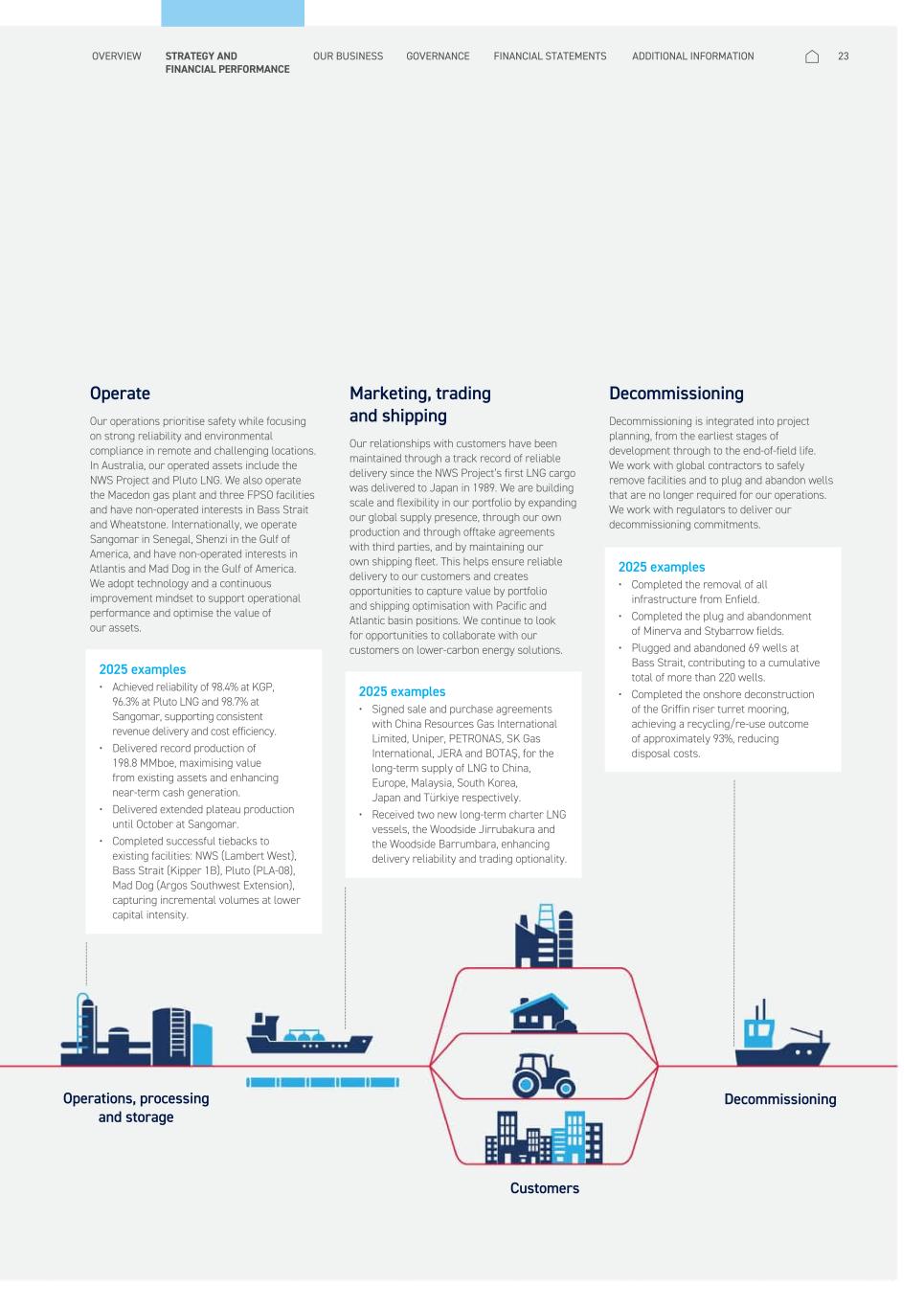
OVERVIEW STRATEGY AND FINANCIAL PERFORMANCE OUR BUSINESS GOVERNANCE FINANCIAL STATEMENTS ADDITIONAL INFORMATION 23 Operations, processing and storage Customers Decommissioning Decommissioning Decommissioning is integrated into project planning, from the earliest stages of development through to the end-of-field life. We work with global contractors to safely remove facilities and to plug and abandon wells that are no longer required for our operations. We work with regulators to deliver our decommissioning commitments. 2025 examples • Completed the removal of all infrastructure from Enfield. • Completed the plug and abandonment of Minerva and Stybarrow fields. • Plugged and abandoned 69 wells at Bass Strait, contributing to a cumulative total of more than 220 wells. • Completed the onshore deconstruction of the Griffin riser turret mooring, achieving a recycling/re-use outcome of approximately 93%, reducing disposal costs. Operate Our operations prioritise safety while focusing on strong reliability and environmental compliance in remote and challenging locations. In Australia, our operated assets include the NWS Project and Pluto LNG. We also operate the Macedon gas plant and three FPSO facilities and have non-operated interests in Bass Strait and Wheatstone. Internationally, we operate Sangomar in Senegal, Shenzi in the Gulf of America, and have non-operated interests in Atlantis and Mad Dog in the Gulf of America. We adopt technology and a continuous improvement mindset to support operational performance and optimise the value of our assets. 2025 examples • Achieved reliability of 98.4% at KGP, 96.3% at Pluto LNG and 98.7% at Sangomar, supporting consistent revenue delivery and cost efficiency. • Delivered record production of 198.8 MMboe, maximising value from existing assets and enhancing near‑term cash generation. • Delivered extended plateau production until October at Sangomar. • Completed successful tiebacks to existing facilities: NWS (Lambert West), Bass Strait (Kipper 1B), Pluto (PLA-08), Mad Dog (Argos Southwest Extension), capturing incremental volumes at lower capital intensity. Marketing, trading and shipping Our relationships with customers have been maintained through a track record of reliable delivery since the NWS Project’s first LNG cargo was delivered to Japan in 1989. We are building scale and flexibility in our portfolio by expanding our global supply presence, through our own production and through offtake agreements with third parties, and by maintaining our own shipping fleet. This helps ensure reliable delivery to our customers and creates opportunities to capture value by portfolio and shipping optimisation with Pacific and Atlantic basin positions. We continue to look for opportunities to collaborate with our customers on lower-carbon energy solutions. 2025 examples • Signed sale and purchase agreements with China Resources Gas International Limited, Uniper, PETRONAS, SK Gas International, JERA and BOTAŞ, for the long-term supply of LNG to China, Europe, Malaysia, South Korea, Japan and Türkiye respectively. • Received two new long-term charter LNG vessels, the Woodside Jirrubakura and the Woodside Barrumbara, enhancing delivery reliability and trading optionality.
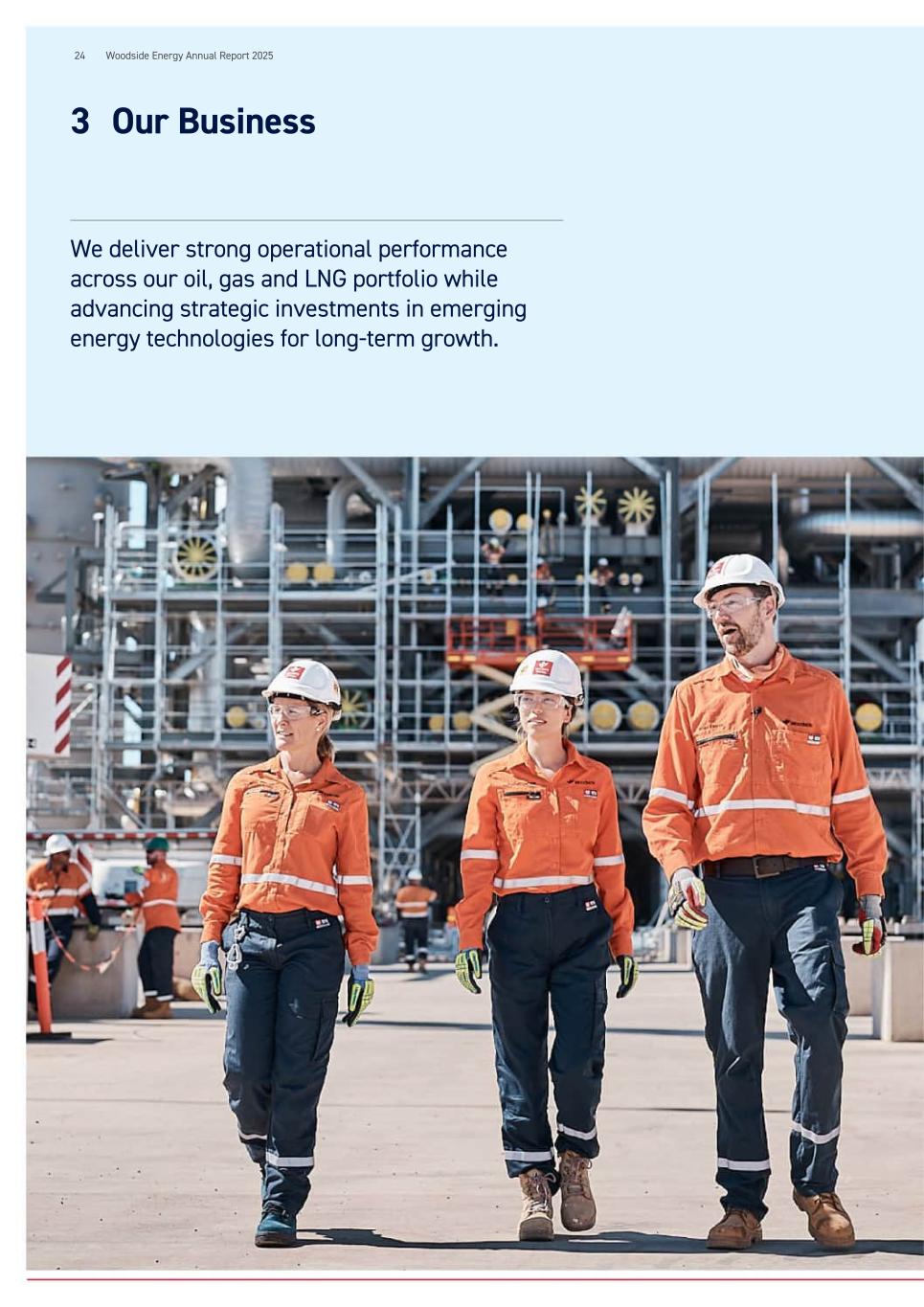
We deliver strong operational performance across our oil, gas and LNG portfolio while advancing strategic investments in emerging energy technologies for long-term growth. 24 Woodside Energy Annual Report 2025 3 Our Business
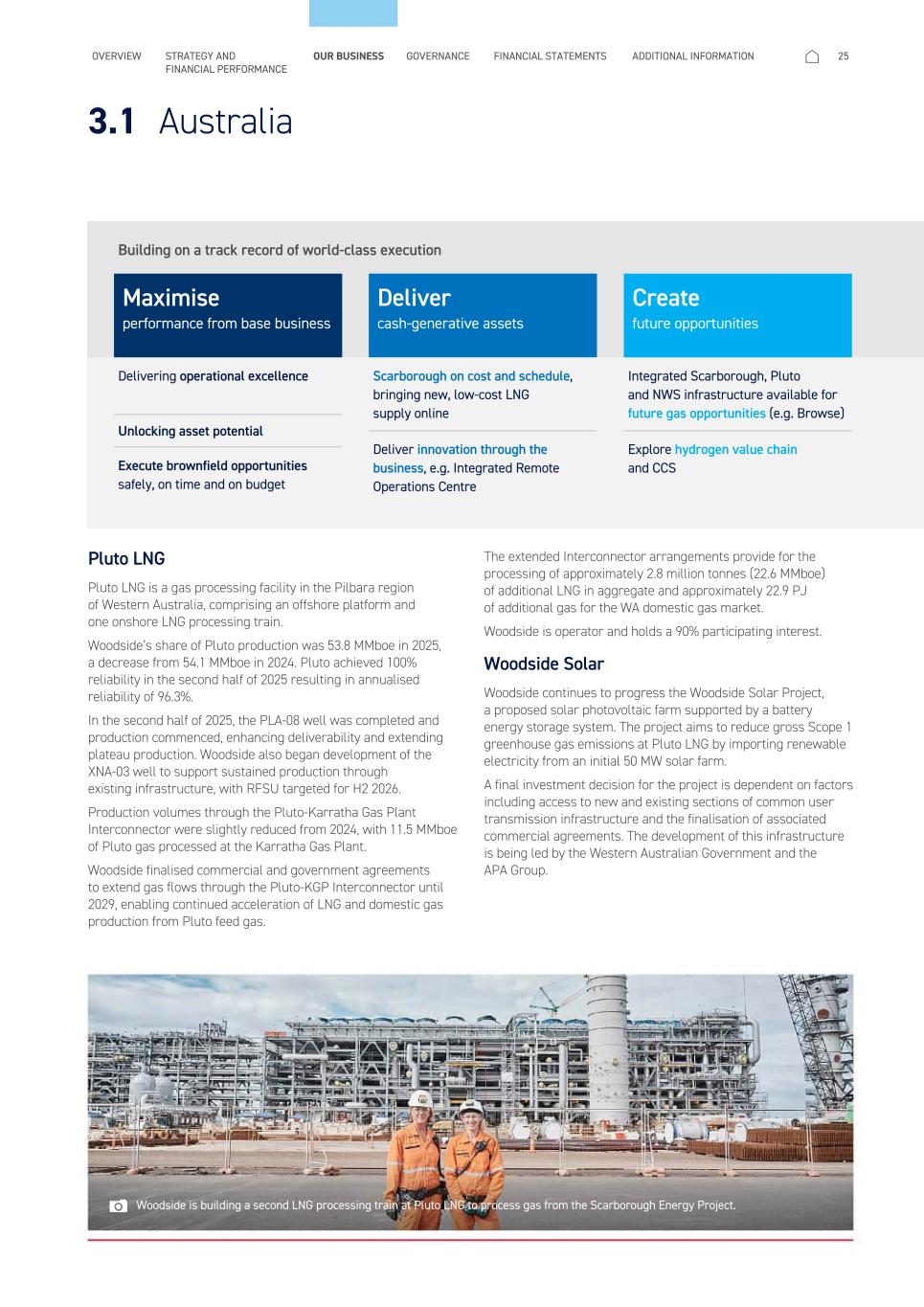
Pluto LNG Pluto LNG is a gas processing facility in the Pilbara region of Western Australia, comprising an offshore platform and one onshore LNG processing train. Woodside’s share of Pluto production was 53.8 MMboe in 2025, a decrease from 54.1 MMboe in 2024. Pluto achieved 100% reliability in the second half of 2025 resulting in annualised reliability of 96.3%. In the second half of 2025, the PLA-08 well was completed and production commenced, enhancing deliverability and extending plateau production. Woodside also began development of the XNA-03 well to support sustained production through existing infrastructure, with RFSU targeted for H2 2026. Production volumes through the Pluto-Karratha Gas Plant Interconnector were slightly reduced from 2024, with 11.5 MMboe of Pluto gas processed at the Karratha Gas Plant. Woodside finalised commercial and government agreements to extend gas flows through the Pluto-KGP Interconnector until 2029, enabling continued acceleration of LNG and domestic gas production from Pluto feed gas. The extended Interconnector arrangements provide for the processing of approximately 2.8 million tonnes (22.6 MMboe) of additional LNG in aggregate and approximately 22.9 PJ of additional gas for the WA domestic gas market. Woodside is operator and holds a 90% participating interest. Woodside Solar Woodside continues to progress the Woodside Solar Project, a proposed solar photovoltaic farm supported by a battery energy storage system. The project aims to reduce gross Scope 1 greenhouse gas emissions at Pluto LNG by importing renewable electricity from an initial 50 MW solar farm. A final investment decision for the project is dependent on factors including access to new and existing sections of common user transmission infrastructure and the finalisation of associated commercial agreements. The development of this infrastructure is being led by the Western Australian Government and the APA Group. OVERVIEW STRATEGY AND FINANCIAL PERFORMANCE OUR BUSINESS GOVERNANCE FINANCIAL STATEMENTS ADDITIONAL INFORMATION 25 3.1 Australia Woodside is building a second LNG processing train at Pluto LNG to process gas from the Scarborough Energy Project. Building on a track record of world-class execution Maximise performance from base business Deliver cash-generative assets Create future opportunities Delivering operational excellence Scarborough on cost and schedule, bringing new, low-cost LNG supply online Integrated Scarborough, Pluto and NWS infrastructure available for future gas opportunities (e.g. Browse) Unlocking asset potential Deliver innovation through the business, e.g. Integrated Remote Operations Centre Explore hydrogen value chain and CCSExecute brownfield opportunities safely, on time and on budget
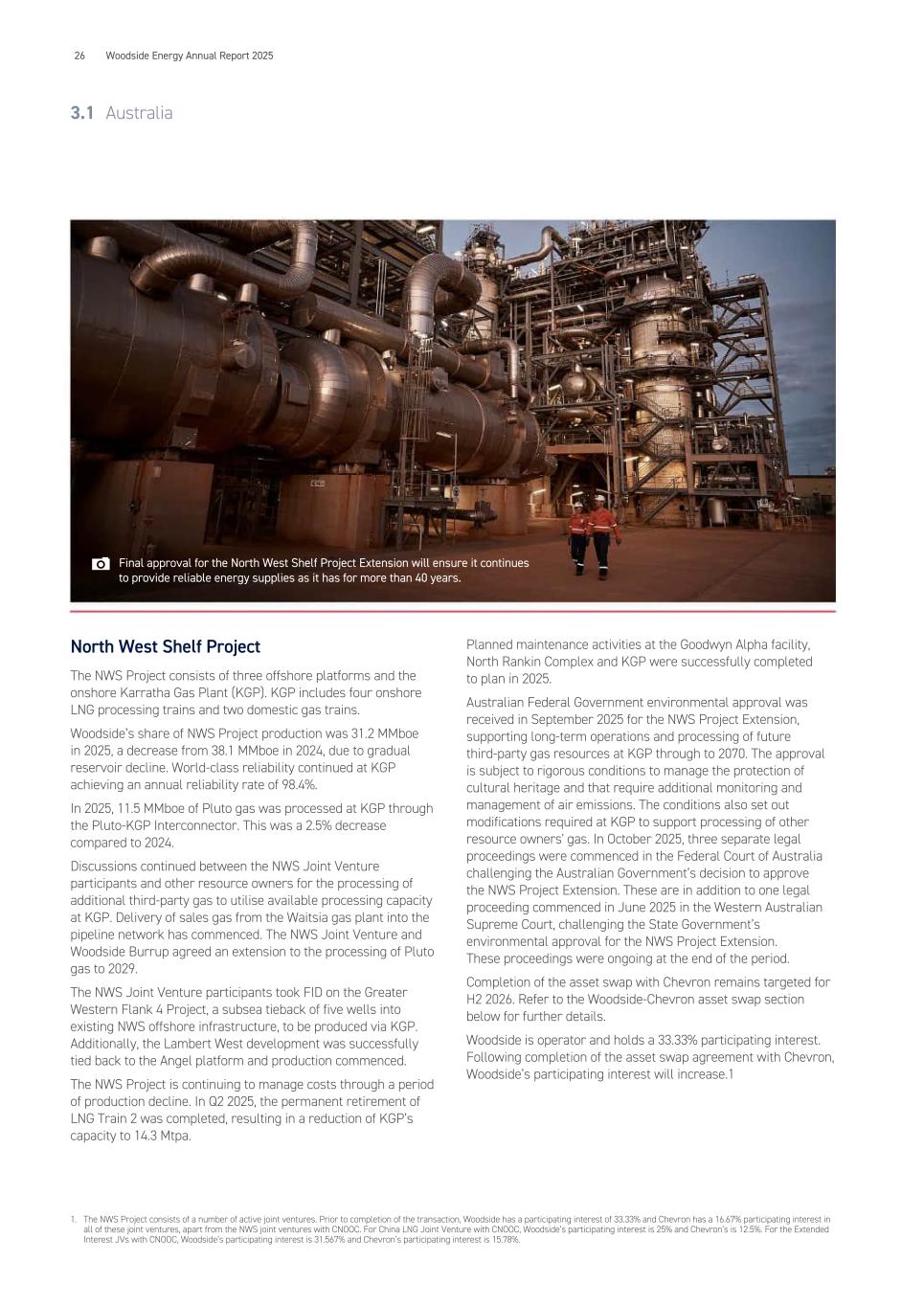
North West Shelf Project The NWS Project consists of three offshore platforms and the onshore Karratha Gas Plant (KGP). KGP includes four onshore LNG processing trains and two domestic gas trains. Woodside’s share of NWS Project production was 31.2 MMboe in 2025, a decrease from 38.1 MMboe in 2024, due to gradual reservoir decline. World-class reliability continued at KGP achieving an annual reliability rate of 98.4%. In 2025, 11.5 MMboe of Pluto gas was processed at KGP through the Pluto-KGP Interconnector. This was a 2.5% decrease compared to 2024. Discussions continued between the NWS Joint Venture participants and other resource owners for the processing of additional third-party gas to utilise available processing capacity at KGP. Delivery of sales gas from the Waitsia gas plant into the pipeline network has commenced. The NWS Joint Venture and Woodside Burrup agreed an extension to the processing of Pluto gas to 2029. The NWS Joint Venture participants took FID on the Greater Western Flank 4 Project, a subsea tieback of five wells into existing NWS offshore infrastructure, to be produced via KGP. Additionally, the Lambert West development was successfully tied back to the Angel platform and production commenced. The NWS Project is continuing to manage costs through a period of production decline. In Q2 2025, the permanent retirement of LNG Train 2 was completed, resulting in a reduction of KGP’s capacity to 14.3 Mtpa. Planned maintenance activities at the Goodwyn Alpha facility, North Rankin Complex and KGP were successfully completed to plan in 2025. Australian Federal Government environmental approval was received in September 2025 for the NWS Project Extension, supporting long-term operations and processing of future third‑party gas resources at KGP through to 2070. The approval is subject to rigorous conditions to manage the protection of cultural heritage and that require additional monitoring and management of air emissions. The conditions also set out modifications required at KGP to support processing of other resource owners' gas. In October 2025, three separate legal proceedings were commenced in the Federal Court of Australia challenging the Australian Government’s decision to approve the NWS Project Extension. These are in addition to one legal proceeding commenced in June 2025 in the Western Australian Supreme Court, challenging the State Government’s environmental approval for the NWS Project Extension. These proceedings were ongoing at the end of the period. Completion of the asset swap with Chevron remains targeted for H2 2026. Refer to the Woodside-Chevron asset swap section below for further details. Woodside is operator and holds a 33.33% participating interest. Following completion of the asset swap agreement with Chevron, Woodside’s participating interest will increase.1 26 Woodside Energy Annual Report 2025 3.1 Australia 1. The NWS Project consists of a number of active joint ventures. Prior to completion of the transaction, Woodside has a participating interest of 33.33% and Chevron has a 16.67% participating interest in all of these joint ventures, apart from the NWS joint ventures with CNOOC. For China LNG Joint Venture with CNOOC, Woodside’s participating interest is 25% and Chevron’s is 12.5%. For the Extended Interest JVs with CNOOC, Woodside’s participating interest is 31.567% and Chevron’s participating interest is 15.78%. Final approval for the North West Shelf Project Extension will ensure it continues to provide reliable energy supplies as it has for more than 40 years.
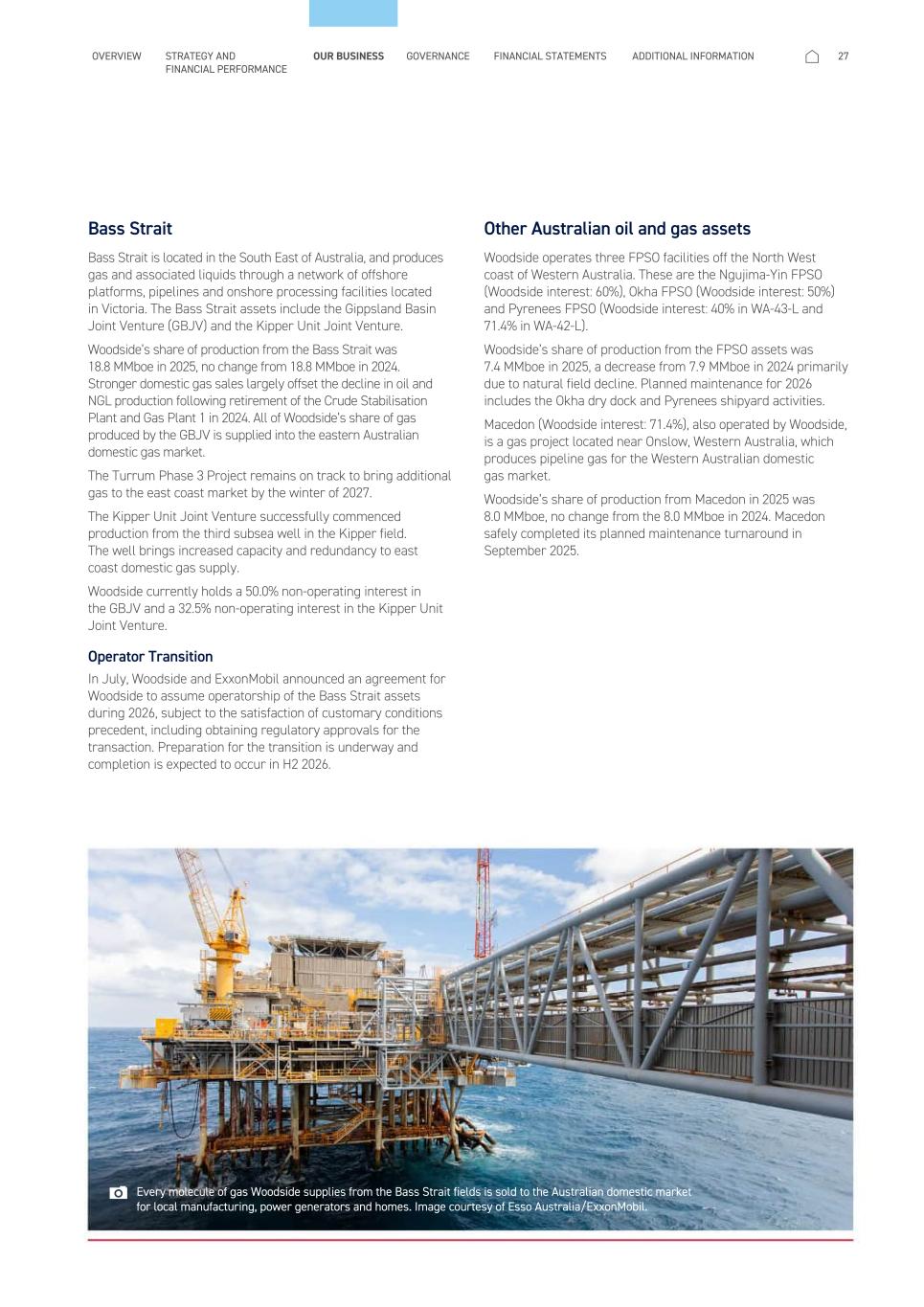
Bass Strait Bass Strait is located in the South East of Australia, and produces gas and associated liquids through a network of offshore platforms, pipelines and onshore processing facilities located in Victoria. The Bass Strait assets include the Gippsland Basin Joint Venture (GBJV) and the Kipper Unit Joint Venture. Woodside’s share of production from the Bass Strait was 18.8 MMboe in 2025, no change from 18.8 MMboe in 2024. Stronger domestic gas sales largely offset the decline in oil and NGL production following retirement of the Crude Stabilisation Plant and Gas Plant 1 in 2024. All of Woodside’s share of gas produced by the GBJV is supplied into the eastern Australian domestic gas market. The Turrum Phase 3 Project remains on track to bring additional gas to the east coast market by the winter of 2027. The Kipper Unit Joint Venture successfully commenced production from the third subsea well in the Kipper field. The well brings increased capacity and redundancy to east coast domestic gas supply. Woodside currently holds a 50.0% non-operating interest in the GBJV and a 32.5% non-operating interest in the Kipper Unit Joint Venture. Operator Transition In July, Woodside and ExxonMobil announced an agreement for Woodside to assume operatorship of the Bass Strait assets during 2026, subject to the satisfaction of customary conditions precedent, including obtaining regulatory approvals for the transaction. Preparation for the transition is underway and completion is expected to occur in H2 2026. Other Australian oil and gas assets Woodside operates three FPSO facilities off the North West coast of Western Australia. These are the Ngujima-Yin FPSO (Woodside interest: 60%), Okha FPSO (Woodside interest: 50%) and Pyrenees FPSO (Woodside interest: 40% in WA-43-L and 71.4% in WA-42-L). Woodside’s share of production from the FPSO assets was 7.4 MMboe in 2025, a decrease from 7.9 MMboe in 2024 primarily due to natural field decline. Planned maintenance for 2026 includes the Okha dry dock and Pyrenees shipyard activities. Macedon (Woodside interest: 71.4%), also operated by Woodside, is a gas project located near Onslow, Western Australia, which produces pipeline gas for the Western Australian domestic gas market. Woodside’s share of production from Macedon in 2025 was 8.0 MMboe, no change from the 8.0 MMboe in 2024. Macedon safely completed its planned maintenance turnaround in September 2025. OVERVIEW STRATEGY AND FINANCIAL PERFORMANCE OUR BUSINESS GOVERNANCE FINANCIAL STATEMENTS ADDITIONAL INFORMATION 27 Every molecule of gas Woodside supplies from the Bass Strait fields is sold to the Australian domestic market for local manufacturing, power generators and homes. Image courtesy of Esso Australia/ExxonMobil.
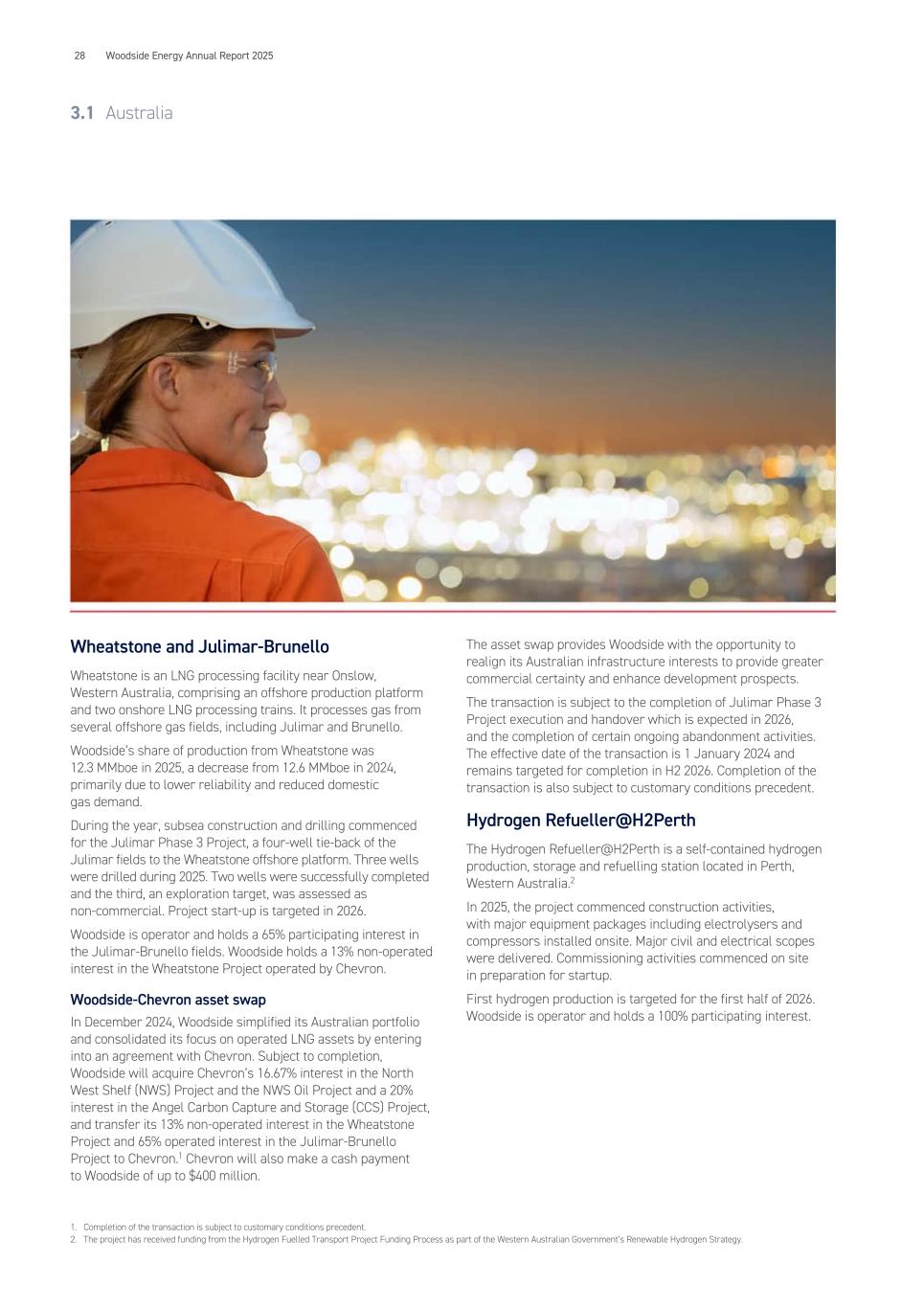
Wheatstone and Julimar-Brunello Wheatstone is an LNG processing facility near Onslow, Western Australia, comprising an offshore production platform and two onshore LNG processing trains. It processes gas from several offshore gas fields, including Julimar and Brunello. Woodside’s share of production from Wheatstone was 12.3 MMboe in 2025, a decrease from 12.6 MMboe in 2024, primarily due to lower reliability and reduced domestic gas demand. During the year, subsea construction and drilling commenced for the Julimar Phase 3 Project, a four-well tie-back of the Julimar fields to the Wheatstone offshore platform. Three wells were drilled during 2025. Two wells were successfully completed and the third, an exploration target, was assessed as non‑commercial. Project start-up is targeted in 2026. Woodside is operator and holds a 65% participating interest in the Julimar-Brunello fields. Woodside holds a 13% non-operated interest in the Wheatstone Project operated by Chevron. Woodside-Chevron asset swap In December 2024, Woodside simplified its Australian portfolio and consolidated its focus on operated LNG assets by entering into an agreement with Chevron. Subject to completion, Woodside will acquire Chevron’s 16.67% interest in the North West Shelf (NWS) Project and the NWS Oil Project and a 20% interest in the Angel Carbon Capture and Storage (CCS) Project, and transfer its 13% non-operated interest in the Wheatstone Project and 65% operated interest in the Julimar-Brunello Project to Chevron.1 Chevron will also make a cash payment to Woodside of up to $400 million. The asset swap provides Woodside with the opportunity to realign its Australian infrastructure interests to provide greater commercial certainty and enhance development prospects. The transaction is subject to the completion of Julimar Phase 3 Project execution and handover which is expected in 2026, and the completion of certain ongoing abandonment activities. The effective date of the transaction is 1 January 2024 and remains targeted for completion in H2 2026. Completion of the transaction is also subject to customary conditions precedent. Hydrogen Refueller@H2Perth The Hydrogen Refueller@H2Perth is a self-contained hydrogen production, storage and refuelling station located in Perth, Western Australia.2 In 2025, the project commenced construction activities, with major equipment packages including electrolysers and compressors installed onsite. Major civil and electrical scopes were delivered. Commissioning activities commenced on site in preparation for startup. First hydrogen production is targeted for the first half of 2026. Woodside is operator and holds a 100% participating interest. 28 Woodside Energy Annual Report 2025 3.1 Australia 1. Completion of the transaction is subject to customary conditions precedent. 2. The project has received funding from the Hydrogen Fuelled Transport Project Funding Process as part of the Western Australian Government’s Renewable Hydrogen Strategy.
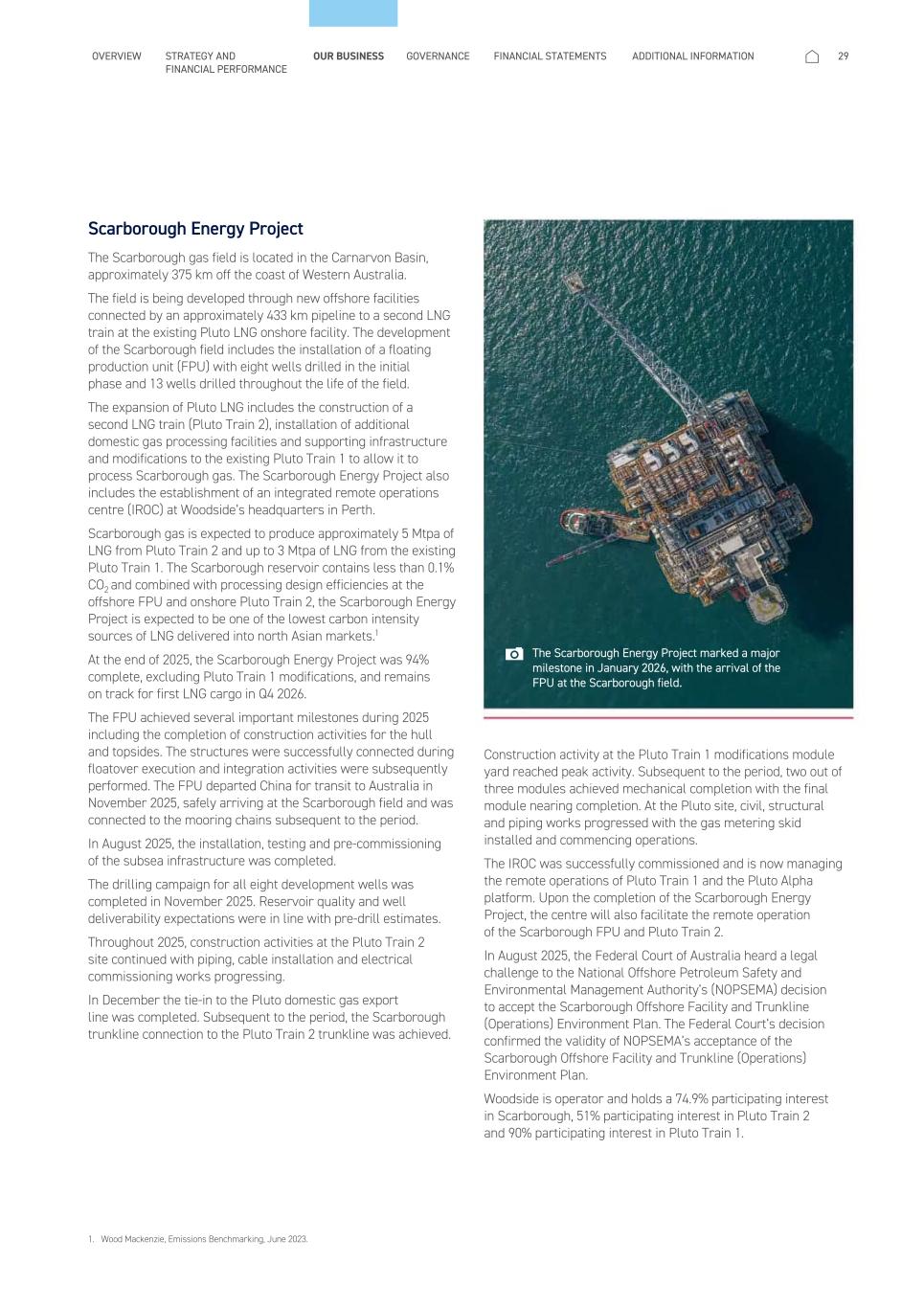
Scarborough Energy Project The Scarborough gas field is located in the Carnarvon Basin, approximately 375 km off the coast of Western Australia. The field is being developed through new offshore facilities connected by an approximately 433 km pipeline to a second LNG train at the existing Pluto LNG onshore facility. The development of the Scarborough field includes the installation of a floating production unit (FPU) with eight wells drilled in the initial phase and 13 wells drilled throughout the life of the field. The expansion of Pluto LNG includes the construction of a second LNG train (Pluto Train 2), installation of additional domestic gas processing facilities and supporting infrastructure and modifications to the existing Pluto Train 1 to allow it to process Scarborough gas. The Scarborough Energy Project also includes the establishment of an integrated remote operations centre (IROC) at Woodside’s headquarters in Perth. Scarborough gas is expected to produce approximately 5 Mtpa of LNG from Pluto Train 2 and up to 3 Mtpa of LNG from the existing Pluto Train 1. The Scarborough reservoir contains less than 0.1% CO2 and combined with processing design efficiencies at the offshore FPU and onshore Pluto Train 2, the Scarborough Energy Project is expected to be one of the lowest carbon intensity sources of LNG delivered into north Asian markets.1 At the end of 2025, the Scarborough Energy Project was 94% complete, excluding Pluto Train 1 modifications, and remains on track for first LNG cargo in Q4 2026. The FPU achieved several important milestones during 2025 including the completion of construction activities for the hull and topsides. The structures were successfully connected during floatover execution and integration activities were subsequently performed. The FPU departed China for transit to Australia in November 2025, safely arriving at the Scarborough field and was connected to the mooring chains subsequent to the period. In August 2025, the installation, testing and pre-commissioning of the subsea infrastructure was completed. The drilling campaign for all eight development wells was completed in November 2025. Reservoir quality and well deliverability expectations were in line with pre-drill estimates. Throughout 2025, construction activities at the Pluto Train 2 site continued with piping, cable installation and electrical commissioning works progressing. In December the tie-in to the Pluto domestic gas export line was completed. Subsequent to the period, the Scarborough trunkline connection to the Pluto Train 2 trunkline was achieved. OVERVIEW STRATEGY AND FINANCIAL PERFORMANCE OUR BUSINESS GOVERNANCE FINANCIAL STATEMENTS ADDITIONAL INFORMATION 29 Construction activity at the Pluto Train 1 modifications module yard reached peak activity. Subsequent to the period, two out of three modules achieved mechanical completion with the final module nearing completion. At the Pluto site, civil, structural and piping works progressed with the gas metering skid installed and commencing operations. The IROC was successfully commissioned and is now managing the remote operations of Pluto Train 1 and the Pluto Alpha platform. Upon the completion of the Scarborough Energy Project, the centre will also facilitate the remote operation of the Scarborough FPU and Pluto Train 2. In August 2025, the Federal Court of Australia heard a legal challenge to the National Offshore Petroleum Safety and Environmental Management Authority’s (NOPSEMA) decision to accept the Scarborough Offshore Facility and Trunkline (Operations) Environment Plan. The Federal Court’s decision confirmed the validity of NOPSEMA’s acceptance of the Scarborough Offshore Facility and Trunkline (Operations) Environment Plan. Woodside is operator and holds a 74.9% participating interest in Scarborough, 51% participating interest in Pluto Train 2 and 90% participating interest in Pluto Train 1. The Scarborough Energy Project marked a major milestone in January 2026, with the arrival of the FPU at the Scarborough field. 1. Wood Mackenzie, Emissions Benchmarking, June 2023.
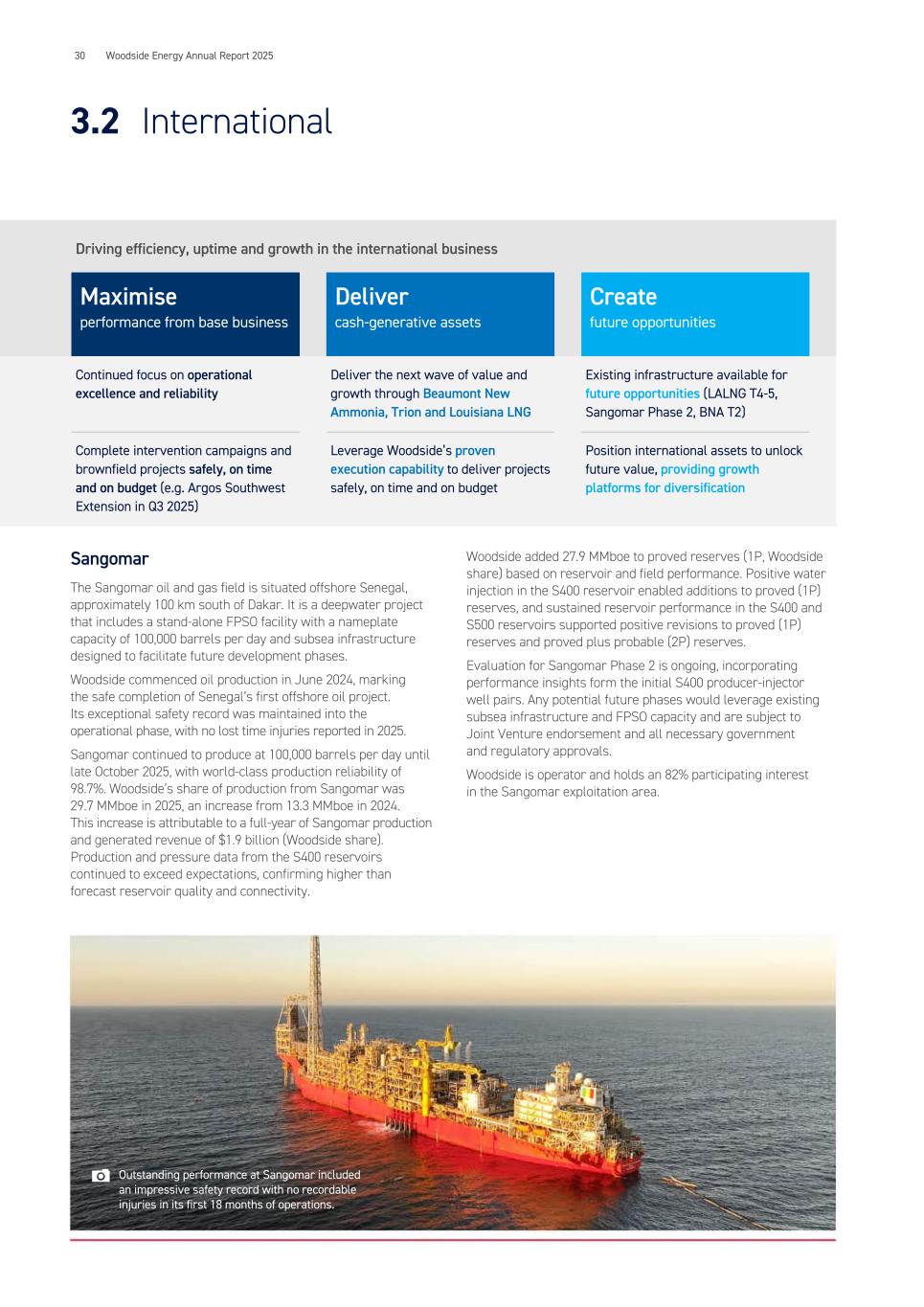
Sangomar The Sangomar oil and gas field is situated offshore Senegal, approximately 100 km south of Dakar. It is a deepwater project that includes a stand-alone FPSO facility with a nameplate capacity of 100,000 barrels per day and subsea infrastructure designed to facilitate future development phases. Woodside commenced oil production in June 2024, marking the safe completion of Senegal’s first offshore oil project. Its exceptional safety record was maintained into the operational phase, with no lost time injuries reported in 2025. Sangomar continued to produce at 100,000 barrels per day until late October 2025, with world-class production reliability of 98.7%. Woodside’s share of production from Sangomar was 29.7 MMboe in 2025, an increase from 13.3 MMboe in 2024. This increase is attributable to a full-year of Sangomar production and generated revenue of $1.9 billion (Woodside share). Production and pressure data from the S400 reservoirs continued to exceed expectations, confirming higher than forecast reservoir quality and connectivity. Woodside added 27.9 MMboe to proved reserves (1P, Woodside share) based on reservoir and field performance. Positive water injection in the S400 reservoir enabled additions to proved (1P) reserves, and sustained reservoir performance in the S400 and S500 reservoirs supported positive revisions to proved (1P) reserves and proved plus probable (2P) reserves. Evaluation for Sangomar Phase 2 is ongoing, incorporating performance insights form the initial S400 producer-injector well pairs. Any potential future phases would leverage existing subsea infrastructure and FPSO capacity and are subject to Joint Venture endorsement and all necessary government and regulatory approvals. Woodside is operator and holds an 82% participating interest in the Sangomar exploitation area. 30 Woodside Energy Annual Report 2025 3.2 International Driving efficiency, uptime and growth in the international business Maximise performance from base business Deliver cash-generative assets Create future opportunities Continued focus on operational excellence and reliability Deliver the next wave of value and growth through Beaumont New Ammonia, Trion and Louisiana LNG Existing infrastructure available for future opportunities (LALNG T4-5, Sangomar Phase 2, BNA T2) Complete intervention campaigns and brownfield projects safely, on time and on budget (e.g. Argos Southwest Extension in Q3 2025) Leverage Woodside’s proven execution capability to deliver projects safely, on time and on budget Position international assets to unlock future value, providing growth platforms for diversification Outstanding performance at Sangomar included an impressive safety record with no recordable injuries in its first 18 months of operations.
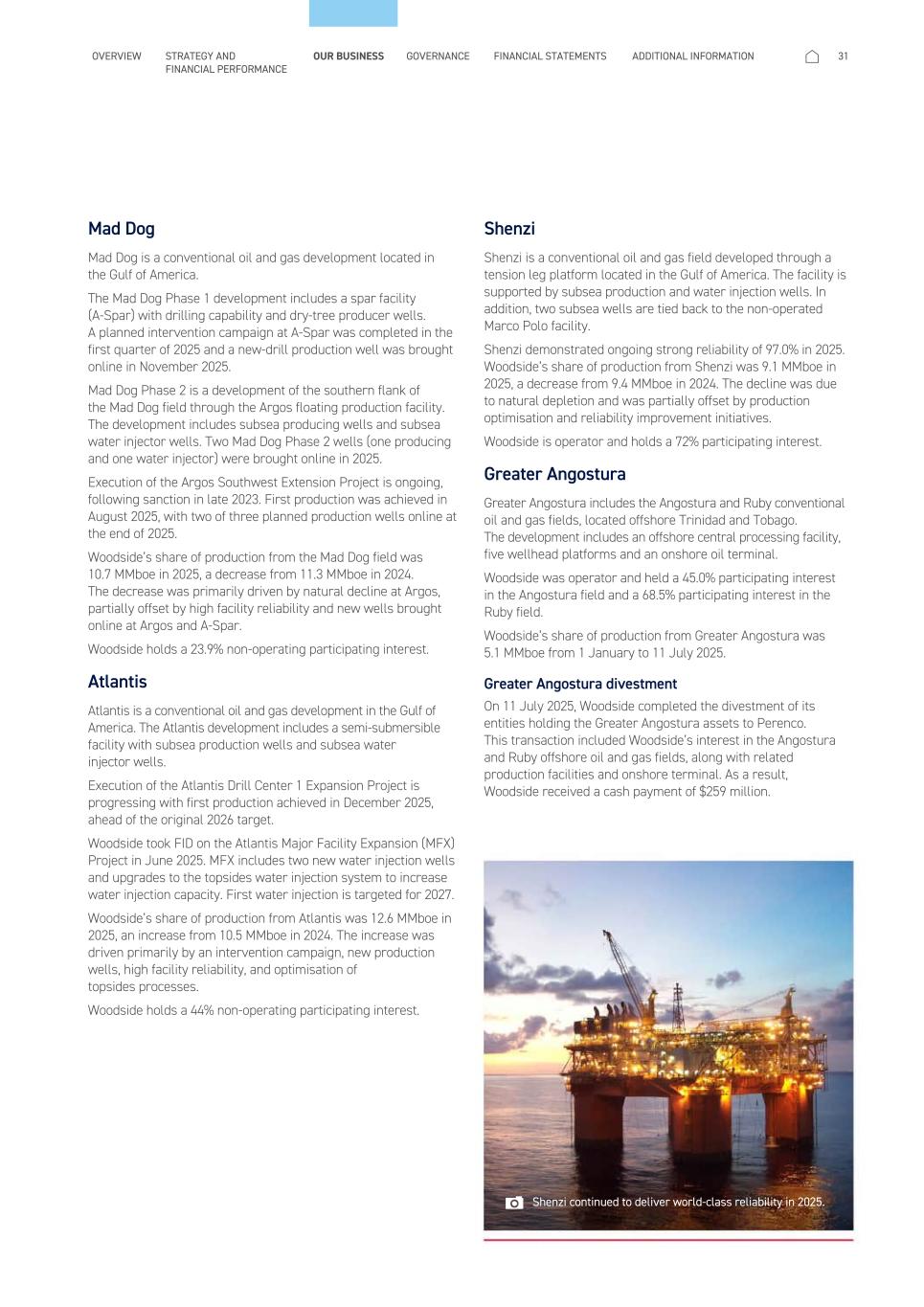
Mad Dog Mad Dog is a conventional oil and gas development located in the Gulf of America. The Mad Dog Phase 1 development includes a spar facility (A‑Spar) with drilling capability and dry-tree producer wells. A planned intervention campaign at A-Spar was completed in the first quarter of 2025 and a new-drill production well was brought online in November 2025. Mad Dog Phase 2 is a development of the southern flank of the Mad Dog field through the Argos floating production facility. The development includes subsea producing wells and subsea water injector wells. Two Mad Dog Phase 2 wells (one producing and one water injector) were brought online in 2025. Execution of the Argos Southwest Extension Project is ongoing, following sanction in late 2023. First production was achieved in August 2025, with two of three planned production wells online at the end of 2025. Woodside’s share of production from the Mad Dog field was 10.7 MMboe in 2025, a decrease from 11.3 MMboe in 2024. The decrease was primarily driven by natural decline at Argos, partially offset by high facility reliability and new wells brought online at Argos and A-Spar. Woodside holds a 23.9% non-operating participating interest. Atlantis Atlantis is a conventional oil and gas development in the Gulf of America. The Atlantis development includes a semi-submersible facility with subsea production wells and subsea water injector wells. Execution of the Atlantis Drill Center 1 Expansion Project is progressing with first production achieved in December 2025, ahead of the original 2026 target. Woodside took FID on the Atlantis Major Facility Expansion (MFX) Project in June 2025. MFX includes two new water injection wells and upgrades to the topsides water injection system to increase water injection capacity. First water injection is targeted for 2027. Woodside’s share of production from Atlantis was 12.6 MMboe in 2025, an increase from 10.5 MMboe in 2024. The increase was driven primarily by an intervention campaign, new production wells, high facility reliability, and optimisation of topsides processes. Woodside holds a 44% non-operating participating interest. Shenzi Shenzi is a conventional oil and gas field developed through a tension leg platform located in the Gulf of America. The facility is supported by subsea production and water injection wells. In addition, two subsea wells are tied back to the non-operated Marco Polo facility. Shenzi demonstrated ongoing strong reliability of 97.0% in 2025. Woodside’s share of production from Shenzi was 9.1 MMboe in 2025, a decrease from 9.4 MMboe in 2024. The decline was due to natural depletion and was partially offset by production optimisation and reliability improvement initiatives. Woodside is operator and holds a 72% participating interest. Greater Angostura Greater Angostura includes the Angostura and Ruby conventional oil and gas fields, located offshore Trinidad and Tobago. The development includes an offshore central processing facility, five wellhead platforms and an onshore oil terminal. Woodside was operator and held a 45.0% participating interest in the Angostura field and a 68.5% participating interest in the Ruby field. Woodside’s share of production from Greater Angostura was 5.1 MMboe from 1 January to 11 July 2025. Greater Angostura divestment On 11 July 2025, Woodside completed the divestment of its entities holding the Greater Angostura assets to Perenco. This transaction included Woodside’s interest in the Angostura and Ruby offshore oil and gas fields, along with related production facilities and onshore terminal. As a result, Woodside received a cash payment of $259 million. OVERVIEW STRATEGY AND FINANCIAL PERFORMANCE OUR BUSINESS GOVERNANCE FINANCIAL STATEMENTS ADDITIONAL INFORMATION 31 Shenzi continued to deliver world-class reliability in 2025.
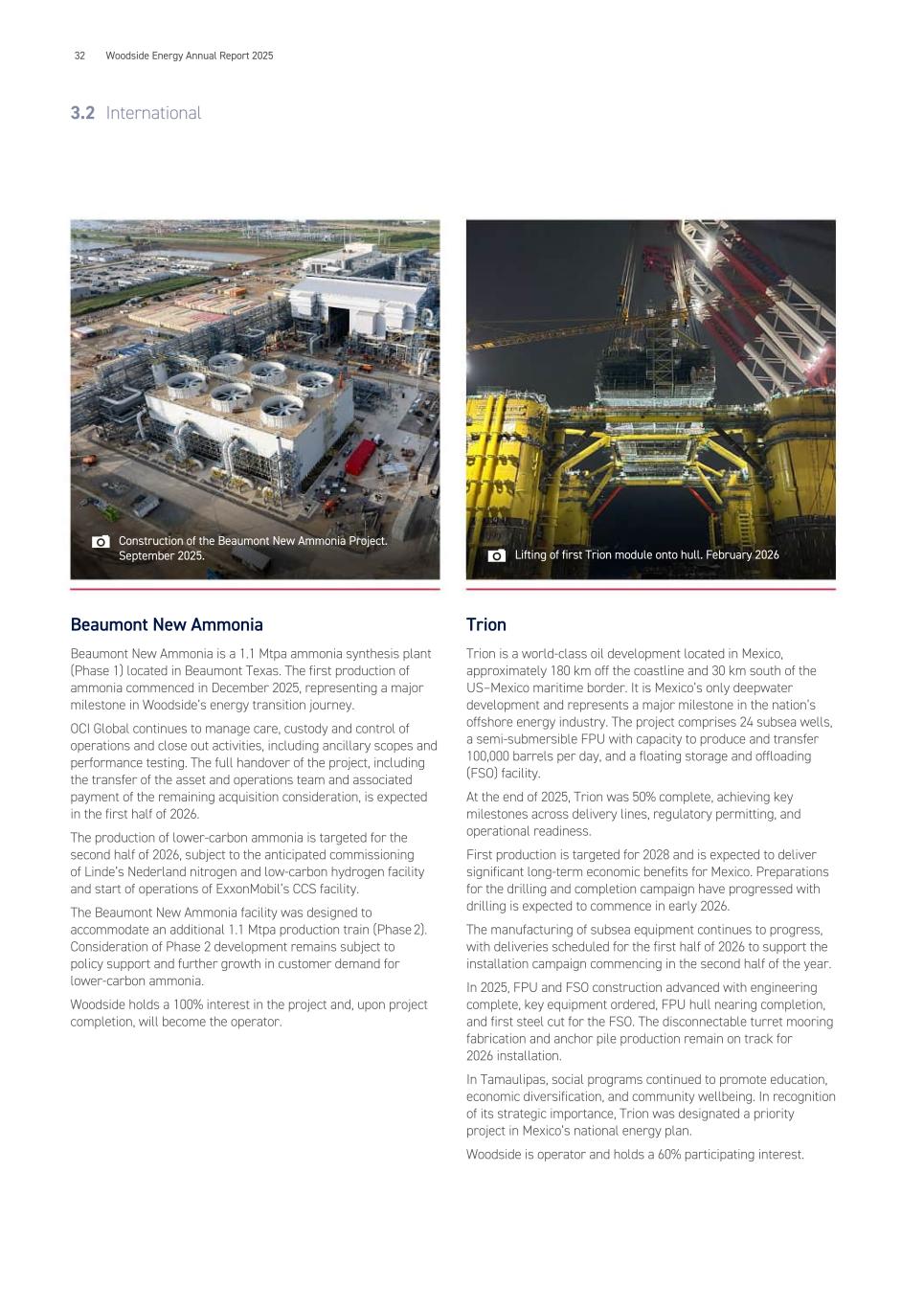
Beaumont New Ammonia Beaumont New Ammonia is a 1.1 Mtpa ammonia synthesis plant (Phase 1) located in Beaumont Texas. The first production of ammonia commenced in December 2025, representing a major milestone in Woodside’s energy transition journey. OCI Global continues to manage care, custody and control of operations and close out activities, including ancillary scopes and performance testing. The full handover of the project, including the transfer of the asset and operations team and associated payment of the remaining acquisition consideration, is expected in the first half of 2026. The production of lower-carbon ammonia is targeted for the second half of 2026, subject to the anticipated commissioning of Linde’s Nederland nitrogen and low-carbon hydrogen facility and start of operations of ExxonMobil’s CCS facility. The Beaumont New Ammonia facility was designed to accommodate an additional 1.1 Mtpa production train (Phase 2). Consideration of Phase 2 development remains subject to policy support and further growth in customer demand for lower‑carbon ammonia. Woodside holds a 100% interest in the project and, upon project completion, will become the operator. Trion Trion is a world-class oil development located in Mexico, approximately 180 km off the coastline and 30 km south of the US–Mexico maritime border. It is Mexico’s only deepwater development and represents a major milestone in the nation’s offshore energy industry. The project comprises 24 subsea wells, a semi-submersible FPU with capacity to produce and transfer 100,000 barrels per day, and a floating storage and offloading (FSO) facility. At the end of 2025, Trion was 50% complete, achieving key milestones across delivery lines, regulatory permitting, and operational readiness. First production is targeted for 2028 and is expected to deliver significant long-term economic benefits for Mexico. Preparations for the drilling and completion campaign have progressed with drilling is expected to commence in early 2026. The manufacturing of subsea equipment continues to progress, with deliveries scheduled for the first half of 2026 to support the installation campaign commencing in the second half of the year. In 2025, FPU and FSO construction advanced with engineering complete, key equipment ordered, FPU hull nearing completion, and first steel cut for the FSO. The disconnectable turret mooring fabrication and anchor pile production remain on track for 2026 installation. In Tamaulipas, social programs continued to promote education, economic diversification, and community wellbeing. In recognition of its strategic importance, Trion was designated a priority project in Mexico’s national energy plan. Woodside is operator and holds a 60% participating interest. 32 Woodside Energy Annual Report 2025 3.2 International Lifting of first Trion module onto hull. February 2026 Construction of the Beaumont New Ammonia Project. September 2025.
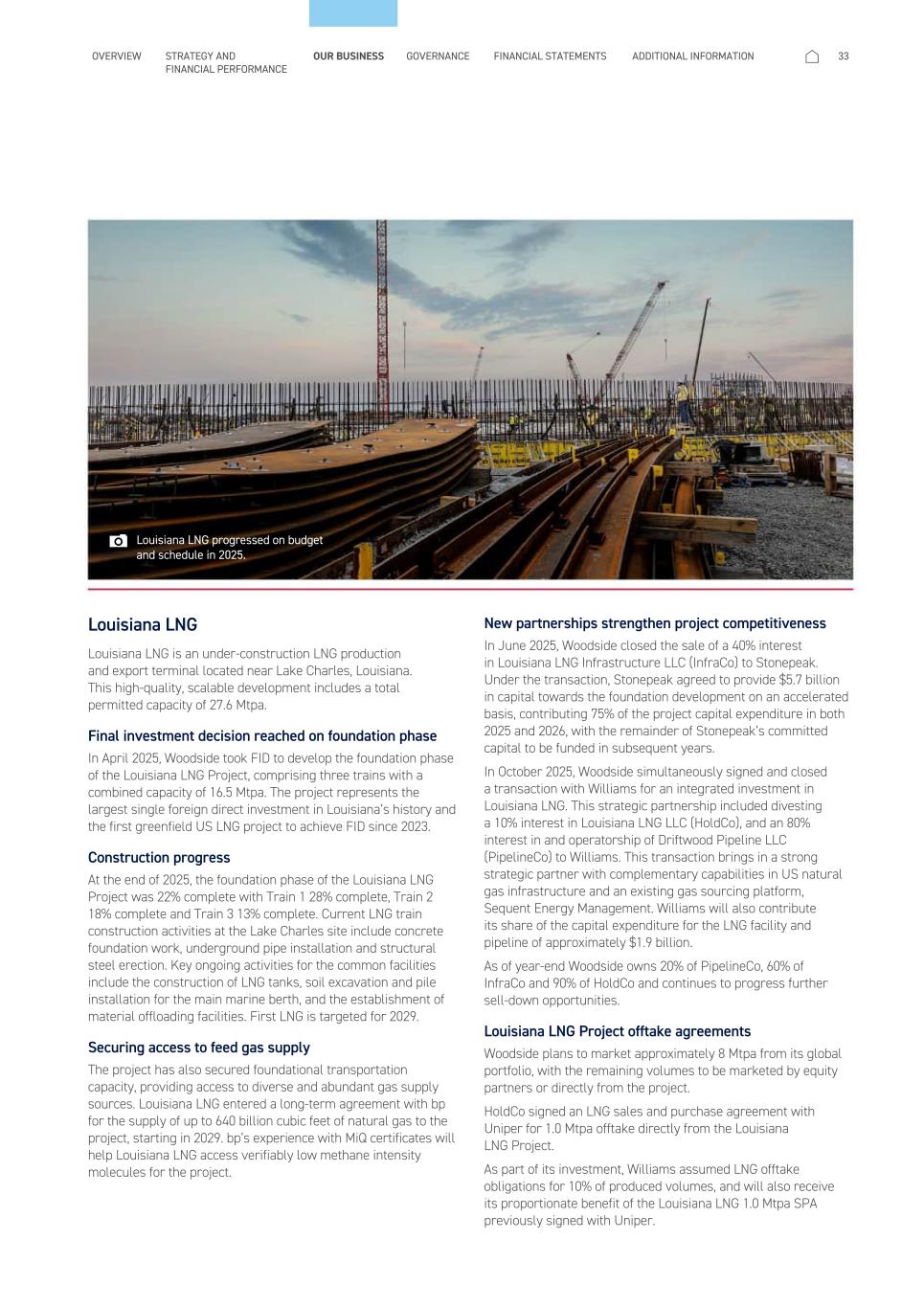
Louisiana LNG Louisiana LNG is an under-construction LNG production and export terminal located near Lake Charles, Louisiana. This high-quality, scalable development includes a total permitted capacity of 27.6 Mtpa. Final investment decision reached on foundation phase In April 2025, Woodside took FID to develop the foundation phase of the Louisiana LNG Project, comprising three trains with a combined capacity of 16.5 Mtpa. The project represents the largest single foreign direct investment in Louisiana’s history and the first greenfield US LNG project to achieve FID since 2023. Construction progress At the end of 2025, the foundation phase of the Louisiana LNG Project was 22% complete with Train 1 28% complete, Train 2 18% complete and Train 3 13% complete. Current LNG train construction activities at the Lake Charles site include concrete foundation work, underground pipe installation and structural steel erection. Key ongoing activities for the common facilities include the construction of LNG tanks, soil excavation and pile installation for the main marine berth, and the establishment of material offloading facilities. First LNG is targeted for 2029. Securing access to feed gas supply The project has also secured foundational transportation capacity, providing access to diverse and abundant gas supply sources. Louisiana LNG entered a long-term agreement with bp for the supply of up to 640 billion cubic feet of natural gas to the project, starting in 2029. bp’s experience with MiQ certificates will help Louisiana LNG access verifiably low methane intensity molecules for the project. New partnerships strengthen project competitiveness In June 2025, Woodside closed the sale of a 40% interest in Louisiana LNG Infrastructure LLC (InfraCo) to Stonepeak. Under the transaction, Stonepeak agreed to provide $5.7 billion in capital towards the foundation development on an accelerated basis, contributing 75% of the project capital expenditure in both 2025 and 2026, with the remainder of Stonepeak’s committed capital to be funded in subsequent years. In October 2025, Woodside simultaneously signed and closed a transaction with Williams for an integrated investment in Louisiana LNG. This strategic partnership included divesting a 10% interest in Louisiana LNG LLC (HoldCo), and an 80% interest in and operatorship of Driftwood Pipeline LLC (PipelineCo) to Williams. This transaction brings in a strong strategic partner with complementary capabilities in US natural gas infrastructure and an existing gas sourcing platform, Sequent Energy Management. Williams will also contribute its share of the capital expenditure for the LNG facility and pipeline of approximately $1.9 billion. As of year-end Woodside owns 20% of PipelineCo, 60% of InfraCo and 90% of HoldCo and continues to progress further sell-down opportunities. Louisiana LNG Project offtake agreements Woodside plans to market approximately 8 Mtpa from its global portfolio, with the remaining volumes to be marketed by equity partners or directly from the project. HoldCo signed an LNG sales and purchase agreement with Uniper for 1.0 Mtpa offtake directly from the Louisiana LNG Project. As part of its investment, Williams assumed LNG offtake obligations for 10% of produced volumes, and will also receive its proportionate benefit of the Louisiana LNG 1.0 Mtpa SPA previously signed with Uniper. OVERVIEW STRATEGY AND FINANCIAL PERFORMANCE OUR BUSINESS GOVERNANCE FINANCIAL STATEMENTS ADDITIONAL INFORMATION 33 Louisiana LNG progressed on budget and schedule in 2025.
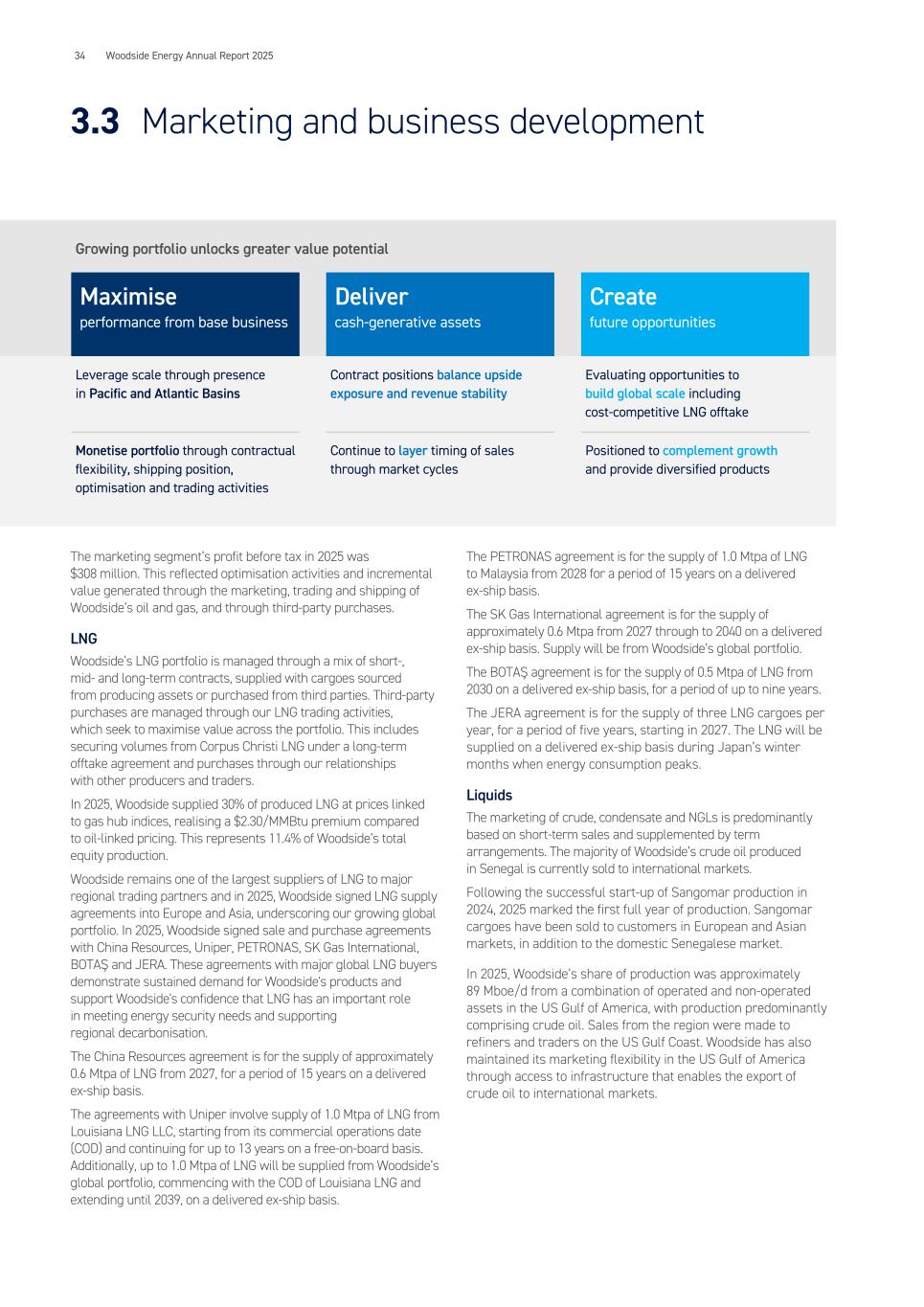
The marketing segment’s profit before tax in 2025 was $308 million. This reflected optimisation activities and incremental value generated through the marketing, trading and shipping of Woodside’s oil and gas, and through third-party purchases. LNG Woodside’s LNG portfolio is managed through a mix of short-, mid‑ and long-term contracts, supplied with cargoes sourced from producing assets or purchased from third parties. Third-party purchases are managed through our LNG trading activities, which seek to maximise value across the portfolio. This includes securing volumes from Corpus Christi LNG under a long-term offtake agreement and purchases through our relationships with other producers and traders. In 2025, Woodside supplied 30% of produced LNG at prices linked to gas hub indices, realising a $2.30/MMBtu premium compared to oil‑linked pricing. This represents 11.4% of Woodside’s total equity production. Woodside remains one of the largest suppliers of LNG to major regional trading partners and in 2025, Woodside signed LNG supply agreements into Europe and Asia, underscoring our growing global portfolio. In 2025, Woodside signed sale and purchase agreements with China Resources, Uniper, PETRONAS, SK Gas International, BOTAŞ and JERA. These agreements with major global LNG buyers demonstrate sustained demand for Woodside's products and support Woodside's confidence that LNG has an important role in meeting energy security needs and supporting regional decarbonisation. The China Resources agreement is for the supply of approximately 0.6 Mtpa of LNG from 2027, for a period of 15 years on a delivered ex-ship basis. The agreements with Uniper involve supply of 1.0 Mtpa of LNG from Louisiana LNG LLC, starting from its commercial operations date (COD) and continuing for up to 13 years on a free-on-board basis. Additionally, up to 1.0 Mtpa of LNG will be supplied from Woodside’s global portfolio, commencing with the COD of Louisiana LNG and extending until 2039, on a delivered ex-ship basis. The PETRONAS agreement is for the supply of 1.0 Mtpa of LNG to Malaysia from 2028 for a period of 15 years on a delivered ex‑ship basis. The SK Gas International agreement is for the supply of approximately 0.6 Mtpa from 2027 through to 2040 on a delivered ex-ship basis. Supply will be from Woodside’s global portfolio. The BOTAŞ agreement is for the supply of 0.5 Mtpa of LNG from 2030 on a delivered ex-ship basis, for a period of up to nine years. The JERA agreement is for the supply of three LNG cargoes per year, for a period of five years, starting in 2027. The LNG will be supplied on a delivered ex-ship basis during Japan’s winter months when energy consumption peaks. Liquids The marketing of crude, condensate and NGLs is predominantly based on short-term sales and supplemented by term arrangements. The majority of Woodside’s crude oil produced in Senegal is currently sold to international markets. Following the successful start-up of Sangomar production in 2024, 2025 marked the first full year of production. Sangomar cargoes have been sold to customers in European and Asian markets, in addition to the domestic Senegalese market. In 2025, Woodside’s share of production was approximately 89 Mboe/d from a combination of operated and non-operated assets in the US Gulf of America, with production predominantly comprising crude oil. Sales from the region were made to refiners and traders on the US Gulf Coast. Woodside has also maintained its marketing flexibility in the US Gulf of America through access to infrastructure that enables the export of crude oil to international markets. 34 Woodside Energy Annual Report 2025 3.3 Marketing and business development Growing portfolio unlocks greater value potential Maximise performance from base business Deliver cash-generative assets Create future opportunities Leverage scale through presence in Pacific and Atlantic Basins Contract positions balance upside exposure and revenue stability Evaluating opportunities to build global scale including cost-competitive LNG offtake Monetise portfolio through contractual flexibility, shipping position, optimisation and trading activities Continue to layer timing of sales through market cycles Positioned to complement growth and provide diversified products
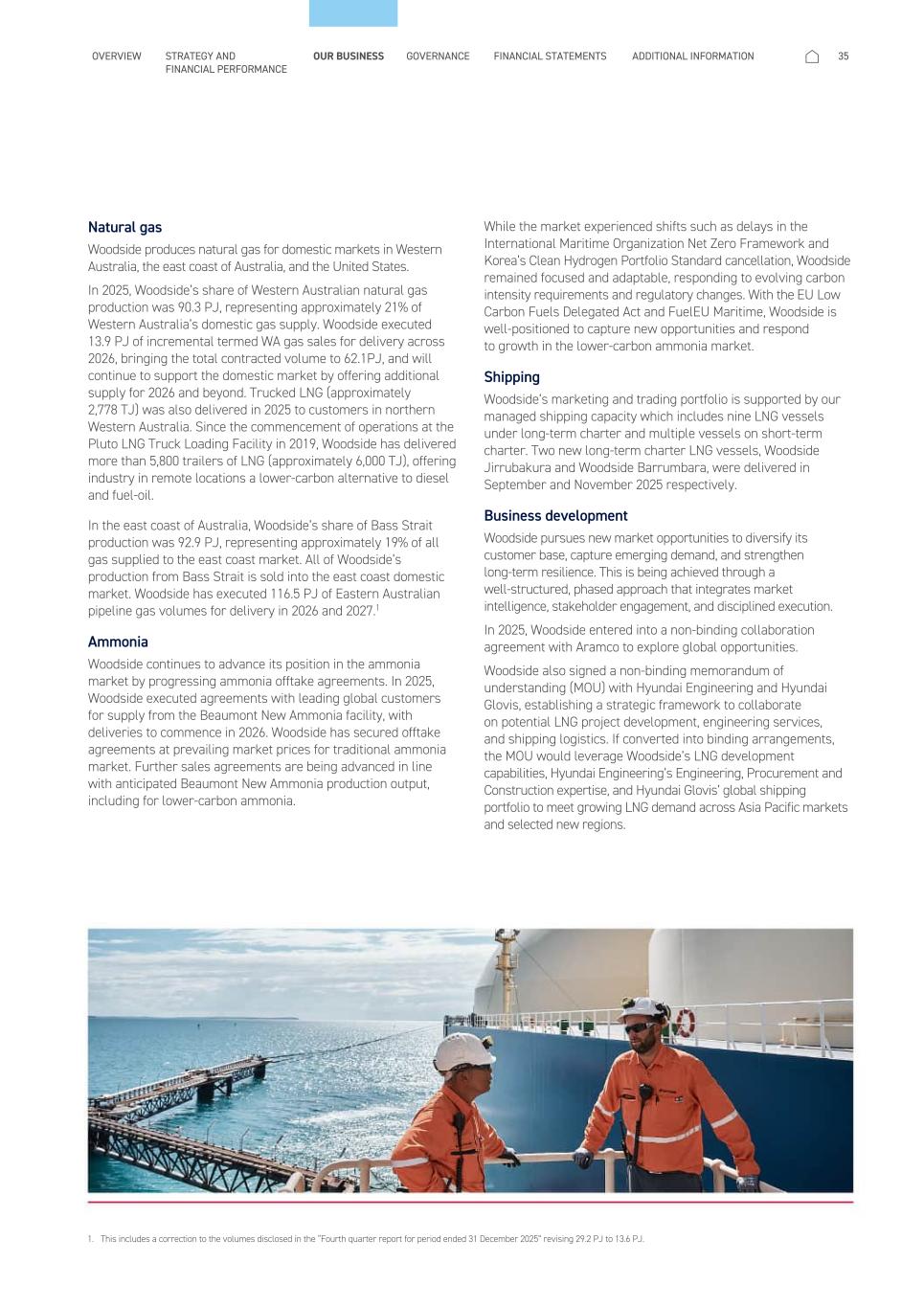
Natural gas Woodside produces natural gas for domestic markets in Western Australia, the east coast of Australia, and the United States. In 2025, Woodside’s share of Western Australian natural gas production was 90.3 PJ, representing approximately 21% of Western Australia’s domestic gas supply. Woodside executed 13.9 PJ of incremental termed WA gas sales for delivery across 2026, bringing the total contracted volume to 62.1PJ, and will continue to support the domestic market by offering additional supply for 2026 and beyond. Trucked LNG (approximately 2,778 TJ) was also delivered in 2025 to customers in northern Western Australia. Since the commencement of operations at the Pluto LNG Truck Loading Facility in 2019, Woodside has delivered more than 5,800 trailers of LNG (approximately 6,000 TJ), offering industry in remote locations a lower-carbon alternative to diesel and fuel-oil. In the east coast of Australia, Woodside’s share of Bass Strait production was 92.9 PJ, representing approximately 19% of all gas supplied to the east coast market. All of Woodside’s production from Bass Strait is sold into the east coast domestic market. Woodside has executed 116.5 PJ of Eastern Australian pipeline gas volumes for delivery in 2026 and 2027.1 Ammonia Woodside continues to advance its position in the ammonia market by progressing ammonia offtake agreements. In 2025, Woodside executed agreements with leading global customers for supply from the Beaumont New Ammonia facility, with deliveries to commence in 2026. Woodside has secured offtake agreements at prevailing market prices for traditional ammonia market. Further sales agreements are being advanced in line with anticipated Beaumont New Ammonia production output, including for lower‑carbon ammonia. While the market experienced shifts such as delays in the International Maritime Organization Net Zero Framework and Korea’s Clean Hydrogen Portfolio Standard cancellation, Woodside remained focused and adaptable, responding to evolving carbon intensity requirements and regulatory changes. With the EU Low Carbon Fuels Delegated Act and FuelEU Maritime, Woodside is well-positioned to capture new opportunities and respond to growth in the lower-carbon ammonia market. Shipping Woodside’s marketing and trading portfolio is supported by our managed shipping capacity which includes nine LNG vessels under long-term charter and multiple vessels on short-term charter. Two new long-term charter LNG vessels, Woodside Jirrubakura and Woodside Barrumbara, were delivered in September and November 2025 respectively. Business development Woodside pursues new market opportunities to diversify its customer base, capture emerging demand, and strengthen long‑term resilience. This is being achieved through a well‑structured, phased approach that integrates market intelligence, stakeholder engagement, and disciplined execution. In 2025, Woodside entered into a non-binding collaboration agreement with Aramco to explore global opportunities. Woodside also signed a non-binding memorandum of understanding (MOU) with Hyundai Engineering and Hyundai Glovis, establishing a strategic framework to collaborate on potential LNG project development, engineering services, and shipping logistics. If converted into binding arrangements, the MOU would leverage Woodside’s LNG development capabilities, Hyundai Engineering’s Engineering, Procurement and Construction expertise, and Hyundai Glovis’ global shipping portfolio to meet growing LNG demand across Asia Pacific markets and selected new regions. OVERVIEW STRATEGY AND FINANCIAL PERFORMANCE OUR BUSINESS GOVERNANCE FINANCIAL STATEMENTS ADDITIONAL INFORMATION 35 1. For the purposes of Woodside’s 2025 sustainability disclosures we determine which topics are material. For these purposes, ‘material topic’ means a 2025 sustainability topic described in this report, determined as part of the 2024 materiality assessment process undertaken by Woodside. .Classification of any topic as material through our materiality assessment process should not be read as a determination of whether that topic rises to the level of materiality of disclosure required by law, including the laws of Australia, and the United States. However, where applicable laws require the disclosure of risks that meet certain thresholds, Woodside has disclosed those risks. 1. This includes a correction to the volumes disclosed in the “Fourth quarter report for period ended 31 December 2025” revising 29.2 PJ to 13.6 PJ.
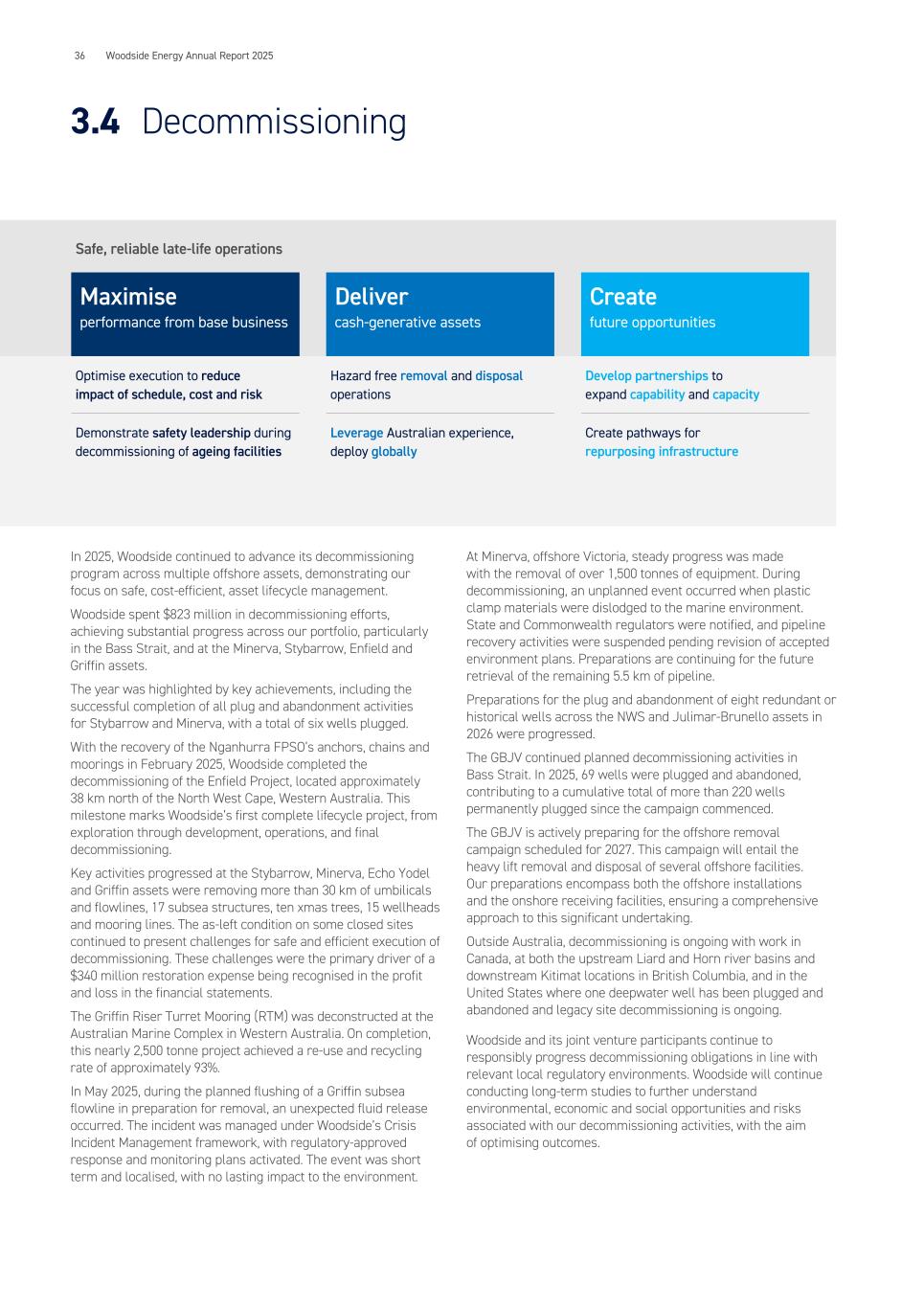
In 2025, Woodside continued to advance its decommissioning program across multiple offshore assets, demonstrating our focus on safe, cost-efficient, asset lifecycle management. Woodside spent $823 million in decommissioning efforts, achieving substantial progress across our portfolio, particularly in the Bass Strait, and at the Minerva, Stybarrow, Enfield and Griffin assets. The year was highlighted by key achievements, including the successful completion of all plug and abandonment activities for Stybarrow and Minerva, with a total of six wells plugged. With the recovery of the Nganhurra FPSO’s anchors, chains and moorings in February 2025, Woodside completed the decommissioning of the Enfield Project, located approximately 38 km north of the North West Cape, Western Australia. This milestone marks Woodside’s first complete lifecycle project, from exploration through development, operations, and final decommissioning. Key activities progressed at the Stybarrow, Minerva, Echo Yodel and Griffin assets were removing more than 30 km of umbilicals and flowlines, 17 subsea structures, ten xmas trees, 15 wellheads and mooring lines. The as-left condition on some closed sites continued to present challenges for safe and efficient execution of decommissioning. These challenges were the primary driver of a $340 million restoration expense being recognised in the profit and loss in the financial statements. The Griffin Riser Turret Mooring (RTM) was deconstructed at the Australian Marine Complex in Western Australia. On completion, this nearly 2,500 tonne project achieved a re-use and recycling rate of approximately 93%. In May 2025, during the planned flushing of a Griffin subsea flowline in preparation for removal, an unexpected fluid release occurred. The incident was managed under Woodside’s Crisis Incident Management framework, with regulatory-approved response and monitoring plans activated. The event was short term and localised, with no lasting impact to the environment. At Minerva, offshore Victoria, steady progress was made with the removal of over 1,500 tonnes of equipment. During decommissioning, an unplanned event occurred when plastic clamp materials were dislodged to the marine environment. State and Commonwealth regulators were notified, and pipeline recovery activities were suspended pending revision of accepted environment plans. Preparations are continuing for the future retrieval of the remaining 5.5 km of pipeline. Preparations for the plug and abandonment of eight redundant or historical wells across the NWS and Julimar-Brunello assets in 2026 were progressed. The GBJV continued planned decommissioning activities in Bass Strait. In 2025, 69 wells were plugged and abandoned, contributing to a cumulative total of more than 220 wells permanently plugged since the campaign commenced. The GBJV is actively preparing for the offshore removal campaign scheduled for 2027. This campaign will entail the heavy lift removal and disposal of several offshore facilities. Our preparations encompass both the offshore installations and the onshore receiving facilities, ensuring a comprehensive approach to this significant undertaking. Outside Australia, decommissioning is ongoing with work in Canada, at both the upstream Liard and Horn river basins and downstream Kitimat locations in British Columbia, and in the United States where one deepwater well has been plugged and abandoned and legacy site decommissioning is ongoing. Woodside and its joint venture participants continue to responsibly progress decommissioning obligations in line with relevant local regulatory environments. Woodside will continue conducting long-term studies to further understand environmental, economic and social opportunities and risks associated with our decommissioning activities, with the aim of optimising outcomes. 36 Woodside Energy Annual Report 2025 3.4 Decommissioning Safe, reliable late-life operations Maximise performance from base business Deliver cash-generative assets Create future opportunities Optimise execution to reduce impact of schedule, cost and risk Hazard free removal and disposal operations Develop partnerships to expand capability and capacity Demonstrate safety leadership during decommissioning of ageing facilities Leverage Australian experience, deploy globally Create pathways for repurposing infrastructure
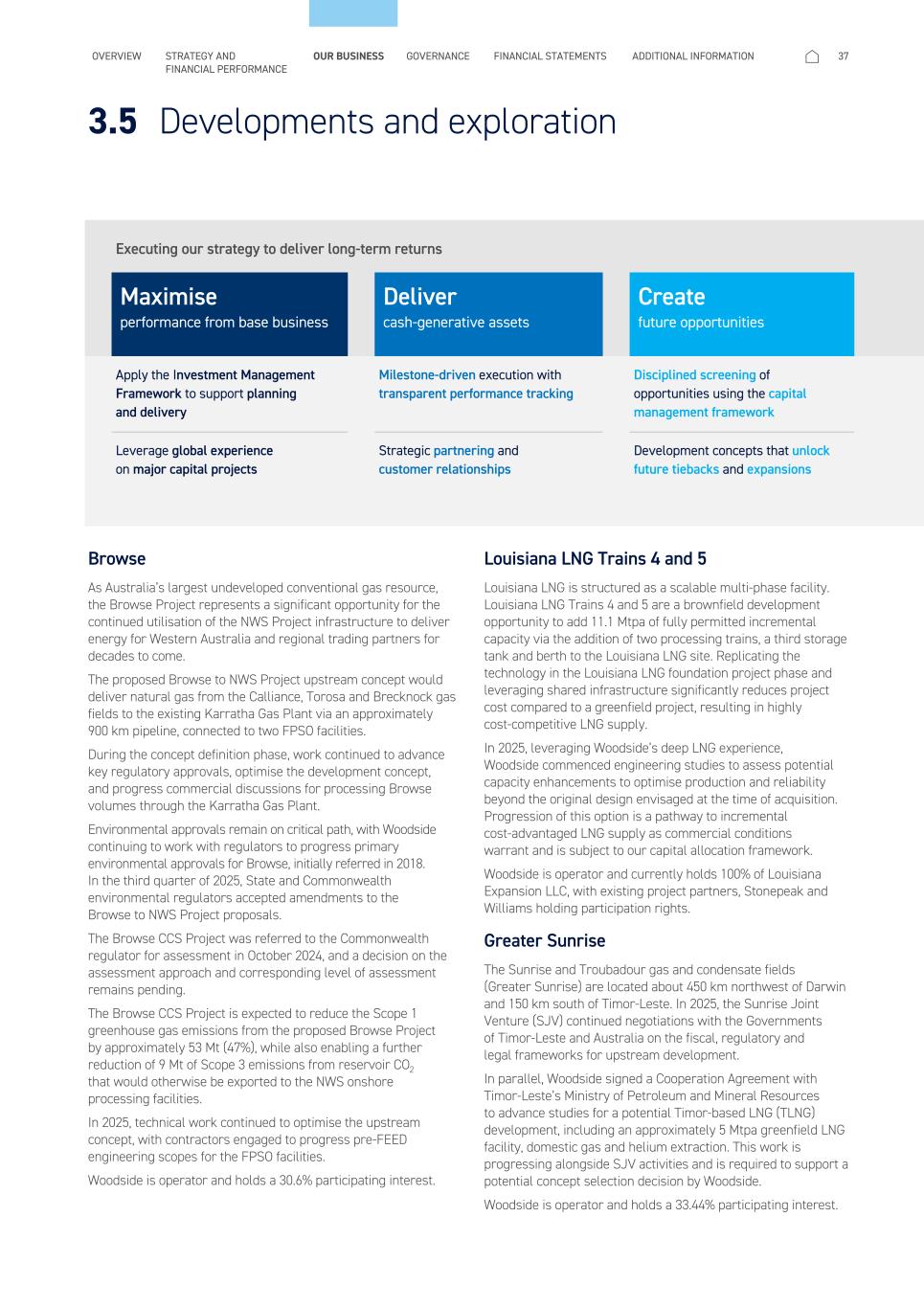
Browse As Australia’s largest undeveloped conventional gas resource, the Browse Project represents a significant opportunity for the continued utilisation of the NWS Project infrastructure to deliver energy for Western Australia and regional trading partners for decades to come. The proposed Browse to NWS Project upstream concept would deliver natural gas from the Calliance, Torosa and Brecknock gas fields to the existing Karratha Gas Plant via an approximately 900 km pipeline, connected to two FPSO facilities. During the concept definition phase, work continued to advance key regulatory approvals, optimise the development concept, and progress commercial discussions for processing Browse volumes through the Karratha Gas Plant. Environmental approvals remain on critical path, with Woodside continuing to work with regulators to progress primary environmental approvals for Browse, initially referred in 2018. In the third quarter of 2025, State and Commonwealth environmental regulators accepted amendments to the Browse to NWS Project proposals. The Browse CCS Project was referred to the Commonwealth regulator for assessment in October 2024, and a decision on the assessment approach and corresponding level of assessment remains pending. The Browse CCS Project is expected to reduce the Scope 1 greenhouse gas emissions from the proposed Browse Project by approximately 53 Mt (47%), while also enabling a further reduction of 9 Mt of Scope 3 emissions from reservoir CO2 that would otherwise be exported to the NWS onshore processing facilities. In 2025, technical work continued to optimise the upstream concept, with contractors engaged to progress pre-FEED engineering scopes for the FPSO facilities. Woodside is operator and holds a 30.6% participating interest. Louisiana LNG Trains 4 and 5 Louisiana LNG is structured as a scalable multi-phase facility. Louisiana LNG Trains 4 and 5 are a brownfield development opportunity to add 11.1 Mtpa of fully permitted incremental capacity via the addition of two processing trains, a third storage tank and berth to the Louisiana LNG site. Replicating the technology in the Louisiana LNG foundation project phase and leveraging shared infrastructure significantly reduces project cost compared to a greenfield project, resulting in highly cost‑competitive LNG supply. In 2025, leveraging Woodside’s deep LNG experience, Woodside commenced engineering studies to assess potential capacity enhancements to optimise production and reliability beyond the original design envisaged at the time of acquisition. Progression of this option is a pathway to incremental cost‑advantaged LNG supply as commercial conditions warrant and is subject to our capital allocation framework. Woodside is operator and currently holds 100% of Louisiana Expansion LLC, with existing project partners, Stonepeak and Williams holding participation rights. Greater Sunrise The Sunrise and Troubadour gas and condensate fields (Greater Sunrise) are located about 450 km northwest of Darwin and 150 km south of Timor-Leste. In 2025, the Sunrise Joint Venture (SJV) continued negotiations with the Governments of Timor‑Leste and Australia on the fiscal, regulatory and legal frameworks for upstream development. In parallel, Woodside signed a Cooperation Agreement with Timor-Leste’s Ministry of Petroleum and Mineral Resources to advance studies for a potential Timor-based LNG (TLNG) development, including an approximately 5 Mtpa greenfield LNG facility, domestic gas and helium extraction. This work is progressing alongside SJV activities and is required to support a potential concept selection decision by Woodside. Woodside is operator and holds a 33.44% participating interest. OVERVIEW STRATEGY AND FINANCIAL PERFORMANCE OUR BUSINESS GOVERNANCE FINANCIAL STATEMENTS ADDITIONAL INFORMATION 37 3.5 Developments and exploration Executing our strategy to deliver long-term returns Maximise performance from base business Deliver cash-generative assets Create future opportunities Apply the Investment Management Framework to support planning and delivery Milestone-driven execution with transparent performance tracking Disciplined screening of opportunities using the capital management framework Leverage global experience on major capital projects Strategic partnering and customer relationships Development concepts that unlock future tiebacks and expansions
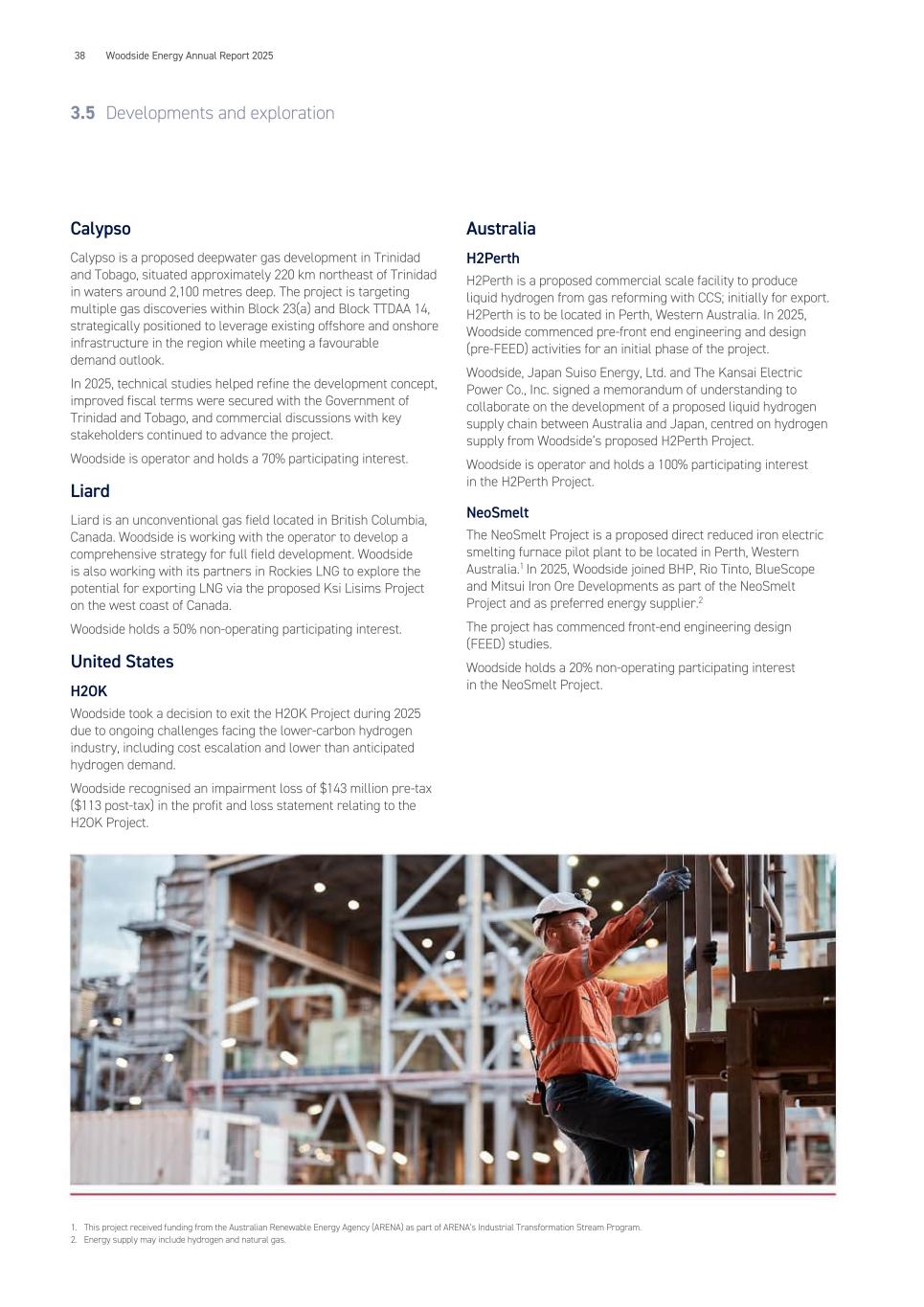
Calypso Calypso is a proposed deepwater gas development in Trinidad and Tobago, situated approximately 220 km northeast of Trinidad in waters around 2,100 metres deep. The project is targeting multiple gas discoveries within Block 23(a) and Block TTDAA 14, strategically positioned to leverage existing offshore and onshore infrastructure in the region while meeting a favourable demand outlook. In 2025, technical studies helped refine the development concept, improved fiscal terms were secured with the Government of Trinidad and Tobago, and commercial discussions with key stakeholders continued to advance the project. Woodside is operator and holds a 70% participating interest. Liard Liard is an unconventional gas field located in British Columbia, Canada. Woodside is working with the operator to develop a comprehensive strategy for full field development. Woodside is also working with its partners in Rockies LNG to explore the potential for exporting LNG via the proposed Ksi Lisims Project on the west coast of Canada. Woodside holds a 50% non-operating participating interest. United States H2OK Woodside took a decision to exit the H2OK Project during 2025 due to ongoing challenges facing the lower-carbon hydrogen industry, including cost escalation and lower than anticipated hydrogen demand. Woodside recognised an impairment loss of $143 million pre-tax ($113 post-tax) in the profit and loss statement relating to the H2OK Project. Australia H2Perth H2Perth is a proposed commercial scale facility to produce liquid hydrogen from gas reforming with CCS; initially for export. H2Perth is to be located in Perth, Western Australia. In 2025, Woodside commenced pre-front end engineering and design (pre-FEED) activities for an initial phase of the project. Woodside, Japan Suiso Energy, Ltd. and The Kansai Electric Power Co., Inc. signed a memorandum of understanding to collaborate on the development of a proposed liquid hydrogen supply chain between Australia and Japan, centred on hydrogen supply from Woodside’s proposed H2Perth Project. Woodside is operator and holds a 100% participating interest in the H2Perth Project. NeoSmelt The NeoSmelt Project is a proposed direct reduced iron electric smelting furnace pilot plant to be located in Perth, Western Australia.1 In 2025, Woodside joined BHP, Rio Tinto, BlueScope and Mitsui Iron Ore Developments as part of the NeoSmelt Project and as preferred energy supplier.2 The project has commenced front-end engineering design (FEED) studies. Woodside holds a 20% non-operating participating interest in the NeoSmelt Project. 38 Woodside Energy Annual Report 2025 3.5 Developments and exploration 1. This project received funding from the Australian Renewable Energy Agency (ARENA) as part of ARENA’s Industrial Transformation Stream Program. 2. Energy supply may include hydrogen and natural gas.
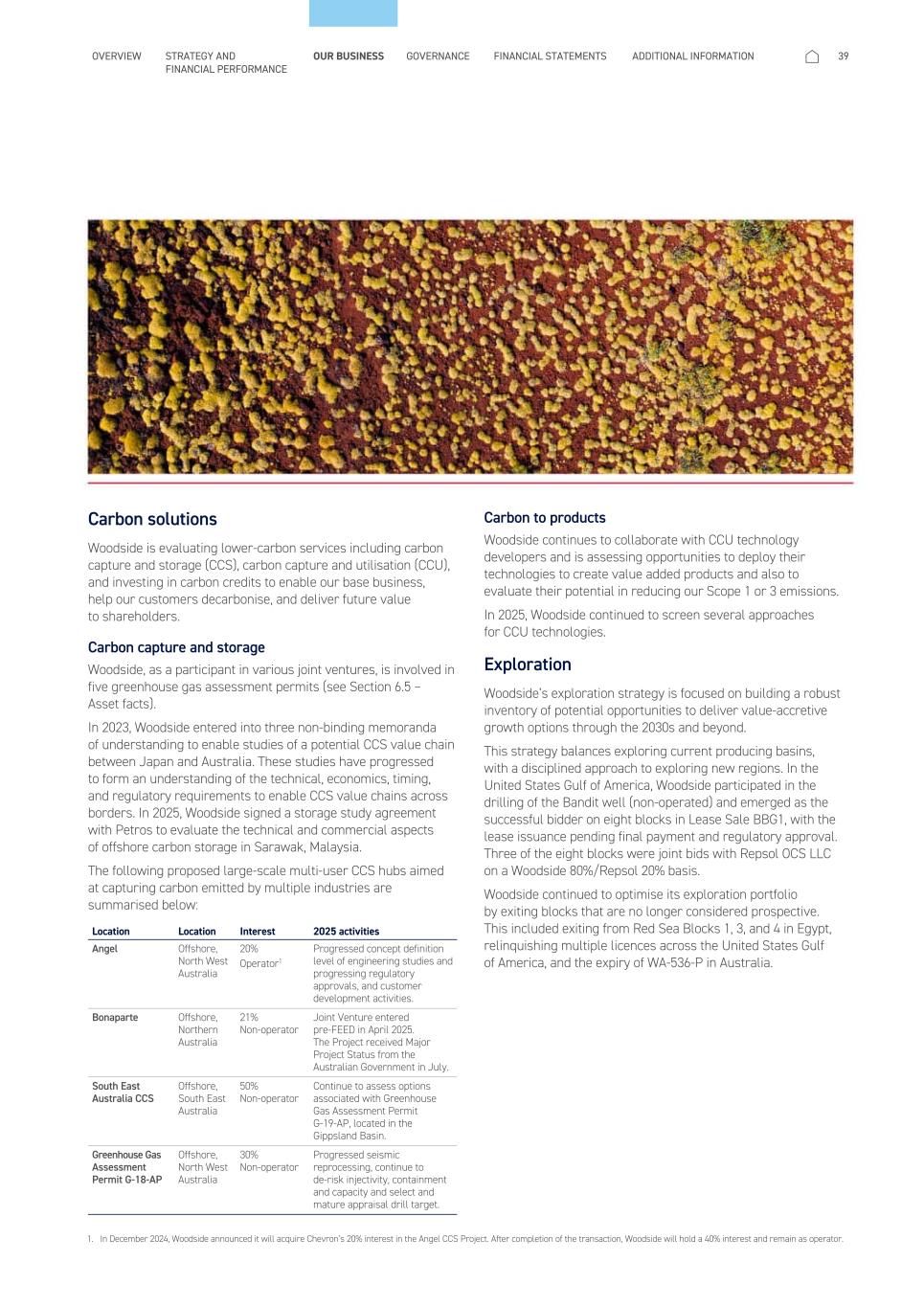
Carbon solutions Woodside is evaluating lower-carbon services including carbon capture and storage (CCS), carbon capture and utilisation (CCU), and investing in carbon credits to enable our base business, help our customers decarbonise, and deliver future value to shareholders. Carbon capture and storage Woodside, as a participant in various joint ventures, is involved in five greenhouse gas assessment permits (see Section 6.5 – Asset facts). In 2023, Woodside entered into three non-binding memoranda of understanding to enable studies of a potential CCS value chain between Japan and Australia. These studies have progressed to form an understanding of the technical, economics, timing, and regulatory requirements to enable CCS value chains across borders. In 2025, Woodside signed a storage study agreement with Petros to evaluate the technical and commercial aspects of offshore carbon storage in Sarawak, Malaysia. The following proposed large-scale multi-user CCS hubs aimed at capturing carbon emitted by multiple industries are summarised below: Location Location Interest 2025 activities Angel Offshore, North West Australia 20% Operator1 Progressed concept definition level of engineering studies and progressing regulatory approvals, and customer development activities. Bonaparte Offshore, Northern Australia 21% Non-operator Joint Venture entered pre‑FEED in April 2025. The Project received Major Project Status from the Australian Government in July. South East Australia CCS Offshore, South East Australia 50% Non-operator Continue to assess options associated with Greenhouse Gas Assessment Permit G‑19‑AP, located in the Gippsland Basin. Greenhouse Gas Assessment Permit G-18-AP Offshore, North West Australia 30% Non-operator Progressed seismic reprocessing, continue to de‑risk injectivity, containment and capacity and select and mature appraisal drill target. Carbon to products Woodside continues to collaborate with CCU technology developers and is assessing opportunities to deploy their technologies to create value added products and also to evaluate their potential in reducing our Scope 1 or 3 emissions. In 2025, Woodside continued to screen several approaches for CCU technologies. Exploration Woodside’s exploration strategy is focused on building a robust inventory of potential opportunities to deliver value-accretive growth options through the 2030s and beyond. This strategy balances exploring current producing basins, with a disciplined approach to exploring new regions. In the United States Gulf of America, Woodside participated in the drilling of the Bandit well (non-operated) and emerged as the successful bidder on eight blocks in Lease Sale BBG1, with the lease issuance pending final payment and regulatory approval. Three of the eight blocks were joint bids with Repsol OCS LLC on a Woodside 80%/Repsol 20% basis. Woodside continued to optimise its exploration portfolio by exiting blocks that are no longer considered prospective. This included exiting from Red Sea Blocks 1, 3, and 4 in Egypt, relinquishing multiple licences across the United States Gulf of America, and the expiry of WA-536-P in Australia. OVERVIEW STRATEGY AND FINANCIAL PERFORMANCE OUR BUSINESS GOVERNANCE FINANCIAL STATEMENTS ADDITIONAL INFORMATION 39 1. In December 2024, Woodside announced it will acquire Chevron’s 20% interest in the Angel CCS Project. After completion of the transaction, Woodside will hold a 40% interest and remain as operator.

Conducting our business sustainably underpins our strategy to thrive through the energy transition. 40 Woodside Energy Annual Report 2025 3.6 Sustainability Report Karratha Gas Plant, Western Australia.

Sustainability is integral to our success. In a rapidly changing world, Woodside’s approach to sustainability provides a strong foundation for our success and guides our path to responsible and profitable growth. As Chair of Woodside’s Sustainability Committee, I oversee an approach to sustainability that is an integral part of our company strategy. At its core is a fundamental intent: to supply products that the world needs; and to produce them responsibly. Energy is critical for the world’s social and economic progress. During 2025, the Sustainability Committee continued to observe increased focus in public debate on the complexity of the energy transition. It has become more widely recognised that making progress on global climate goals must be in partnership with, and not at the expense of, access to secure and affordable energy supplies. This recognition is translating into policy settings in many jurisdictions that recognise the role of energy in underpinning economic growth, and the critical role that energy sources such as natural gas play in meeting energy and decarbonisation policy goals. For Woodside, this does not signal a change of direction. Instead, it reinforces our commitment to investing in the existing and emerging energy products – like LNG and ammonia – that we expect to be in demand for decades to come, in which we hold competitive advantages, and which we can produce responsibly and profitably. In 2025, this commitment was exemplified by significant achievements: record production from our existing assets; a final investment decision for Louisiana LNG; and first production from Beaumont New Ammonia. Sustainability performance included improved safety outcomes with zero high consequence injuries (HCI) recorded across our global operations.1 We also delivered our 2025 net equity Scope 1 and 2 GHG emissions reduction target, welcomed the inscription of Murujuga on the World Heritage List, and received confirmation from the UN Environment Programme that our methane emissions plan meets the requirements of an Oil and Gas Methane Partnership 2.0 (OGMP 2.0) “Gold standard pathway”.2,3 These achievements are the outcome of years of planning and preparation. One of the most important functions of the Sustainability Committee is to ensure Woodside focuses on the right sustainability topics, appropriately manages key risks, opportunities and impacts, sets plans and targets that add value to our business, and that we deliver what we say we will do. In this Sustainability Report we provide updates on our performance and plans for the four material sustainability topics: Health, safety and wellbeing; Indigenous Peoples cultural heritage and engagement; Environment and biodiversity; and Climate. We also provide information on our governance and risk management processes, which enabled us to identify these priorities and oversee our progress in addressing them. This year, the Sustainability Report addresses the requirements of Australia’s new mandatory climate disclosure requirements. These requirements are based on the recommendations of the former Taskforce on Climate related Financial Disclosures (TCFD), so the structure of the report will be familiar to readers of previous versions. I expect that sustainability reporting practices amongst companies will continue to evolve for some years in response to the emergence of mandatory requirements. The Sustainability Committee will continue to monitor developments, and I expect that Woodside will continue to contribute constructively to the evolution of mandatory requirements and industry practice. As ever, I and my colleagues have benefitted from the input of our investors, received through many different engagements throughout the year. These will continue, and I welcome your feedback on our sustainability plans, performance and disclosures. Ann Pickard Chair of the Sustainability Committee 24 February 2026 OVERVIEW STRATEGY AND FINANCIAL PERFORMANCE OUR BUSINESS GOVERNANCE FINANCIAL STATEMENTS ADDITIONAL INFORMATION 41 Committee Chair’s letter 1. A HCI injury is a work-related injury that results in a fatality or permanent impairment injury. Please see Glossary for further information. 2. Net equity Scope 1 and 2 GHG emissions reduction targets and aspiration are relative to a starting base of 6.27 Mt CO2‑e which is representative of the gross annual average equity Scope 1 and 2 GHG emissions over 2016–2020 and which may be adjusted (up or down) for potential equity changes in producing or sanctioned assets with a final investment decision prior to 2021. Net equity GHG emissions include the utilisation of carbon credits as offsets, inclusive of those required to meet regulatory obligations. 3. Where we refer to natural or cultural sites on the UNESCO World Heritage list, this refers to properties inscribed on the UNESCO World Heritage List as classified by UNESCO. For UNESCO definition of natural and cultural sites as well as a list of all sites, see: https://whc.unesco.org/en/faq/319 and https://whc.unesco.org/en/list/. Please see the Glossary for more information.

This strategy is underpinned by three priorities: providing energy; creating and returning value to shareholders; and conducting our business sustainably. Conducting our business sustainably means identifying, managing and reporting upon the potential impact of our business upon society and the environment, as well as the potential risks and opportunities to our operational and financial performance. Our Sustainability Plan is overseen and regularly reviewed by the Board, its Sustainability Committee and responsible executives. It includes the following: • A systematic process to identify sustainability topics and prioritise the most material ones. This is called our materiality assessment process. • A company-wide plan to address our most material sustainability topics, which are described in the table below. • Transparent reporting on our progress, structured to meet regulatory requirements and relevant voluntary guidelines to support consistent and comparable reporting. This report provides information about the governance of the Sustainability Plan, our sustainability risk management process and our performance against our material topics in 2025. 42 Woodside Energy Annual Report 2025 3.6.1 Woodside's Sustainability Plan 1. For Woodside, a lower-carbon portfolio is one from which the net equity Scope 1 and 2 GHG emissions, which includes the use of offsets, are being reduced towards targets, and into which new energy products and lower-carbon services are planned to be introduced as a complement to existing and new investments in oil and gas. Our Climate Policy sets out the principles that we believe will assist us to achieve this aim. Woodside uses the term ‘lower-carbon’ to describe the characteristic of having lower levels of associated potential GHG emissions when compared to historical and/or current conventions or analogues, for example relating to an otherwise similar resource, process, production, facility, product or service, or activity. Woodside’s Board approved policies are available on our website at woodside.com. 2. Following internal and external stakeholder feedback, Woodside updated its reference from First Nations to Indigenous Peoples because First Nations is not a globally accepted or widely used term beyond Australia. Indigenous Peoples aligns with the United Nations Declaration of the Rights of Indigenous Peoples (UNDRIP) language and is the recognised collective term in international law. Our company strategy is to thrive through the energy transition by developing a low-cost, lower-carbon, profitable, resilient and diversified portfolio.1 Additional information is available on our website at woodside.com. Woodside’s Sustainability Plan: 2025 objectives and focus areas Material topics Health, safety and wellbeing Indigenous Peoples cultural heritage and engagement2 Environment and biodiversity Climate Objectives Operating safely and protecting the health of our workforce Create positive economic, social and cultural outcomes that leave a lasting legacy with Indigenous Peoples communities Embed environmental and biodiversity management and opportunities in our approach and decision making Our aspiration is to thrive through the energy transition with a low-cost, lower-carbon, profitable, resilient and diversified portfolio1 Focus Areas • Improve personal safety and wellbeing outcomes • Improve process safety outcomes. • Review our Reconciliation Strategy • Indigenous Peoples and cultural heritage requirements where we are active. • Develop waste and water frameworks • Develop Biodiversity Management Plans • Pursue positive biodiversity outcomes where we undertake our activities. • Reduce our net equity Scope 1 and 2 GHG emissions • Invest in products and services for the energy transition. See more on page 48 See more on page 54 See more on page 60 See more on page 66

Board oversight The Board oversees and considers recommendations from the Sustainability Committee on the company’s policies, performance and reporting in relation to sustainability-related matters including health and safety, process safety, the environment, climate change, human rights, Indigenous Peoples cultural heritage and engagement, security and emergency management and community relations. The Board approves relevant sustainability-related targets, monitoring performance against them, and approving recommendations from the Human Resources & Compensation Committee about the inclusion of sustainability-related metrics in executive remuneration. Board composition, skills and knowledge The Non-Executive Directors bring diverse operational and international experience, industry understanding, knowledge of financial markets and decarbonisation technologies and strategies, and insight into health, safety, environmental, community and other sustainability-related matters that are important to Woodside. The Board supplements its sustainability knowledge by seeking the input of executives, external advisers and specialists to further inform its decisions. The competencies and skills of the Directors are set out in the competencies matrix included in Section 4.1 - Corporate Governance Statement. The Director competencies matrix includes energy transition and climate-related components to reflect the importance of these issues to Woodside’s operations. The Board uses this competencies matrix to assess the skills and experience of each Director and the combined capabilities of the Board, to identify potential areas of focus for Director recruitment and to identify any professional development opportunities that may benefit Directors. Changes to the membership of Woodside’s Board of Directors are part of the continuous review of Board skills and composition. Changes are intended to enhance Woodside’s Board and Committees so that they are best placed to support Woodside’s global operations and strategic growth opportunities through the energy transition. Board committees The Board has four standing committees to assist in the discharge of its responsibilities, including on sustainability‑related matters.1 The Sustainability Committee’s responsibilities include reviewing, and making recommendations to the Board on the company’s policies, performance and reporting in relation to sustainability‑related matters. The role of the Sustainability Committee also includes: overseeing (in conjunction with the Audit and Risk Committee, as appropriate) the administration of the processes for identifying, assessing, prioritising, monitoring and managing the company’s material sustainability-related risks and opportunities; reviewing and monitoring compliance with applicable sustainability-related laws and regulations; and reviewing and recommending to the Board for approval material public sustainability-related targets and monitoring progress against those targets. The Sustainability Committee meets at least four times a year. The Audit & Risk Committee assists the Board to meet its oversight responsibilities in relation to the company’s corporate reporting, compliance with legal and regulatory requirements, accounting and sustainability standards, tax matters, internal control structure, risk management procedures, cybersecurity matters and the internal and external audit functions. Given the importance of material sustainability-related risks and opportunities to Woodside, and potential implications relating to financial reporting, the Audit & Risk Committee reviews the Company’s risk management framework, with input from management, other committees and external experts as appropriate, to ensure that it adequately deals with contemporary and emerging risks, including material sustainability-related risks (including climate-related risks and opportunities). The Audit & Risk Committee also considers the inclusion of sustainability-related risks within Woodside’s internal audit program and the appropriateness of disclosures on climate-related risk within the consolidated financial statements. More details on the management of material climate-related risks and opportunities under Woodside risk management framework, are provided in Section 3.7 – Risk Factors. The Nominations & Governance Committee assists the Board with reviewing Board composition, performance and succession planning. This includes identifying, evaluating and recommending candidates for the Board, taking into account the factors set out in the Director competencies matrix set out in Section 4.1 - Corporate Governance Statement. OVERVIEW STRATEGY AND FINANCIAL PERFORMANCE OUR BUSINESS GOVERNANCE FINANCIAL STATEMENTS ADDITIONAL INFORMATION 43 3.6.2 Governance This section of the Sustainability Report provides information about Woodside’s governance of sustainability-related risks and opportunities. This includes the Board’s oversight of them and management’s role in assessing and managing them. 1. Woodside’s Committee Charters are available on Woodside’s website at https://www.woodside.com/who-we-are/corporate-governance-and-policies

The Human Resources & Compensation Committee assists the Board with establishing and implementing human resources and compensation strategies, policies and practices. Performance based remuneration for the CEO, senior leadership team and all other permanent employees include metrics related to climate and health and safety. Further details are provided in Section 4.3 - Remuneration Report. Sustainability-related Board discussions A structured calendar provides the Board and its relevant Committees with regular scheduled updates on the four material topics outlined in Section 3.6.1 – Woodside’s Sustainability Plan and other sustainability topics as appropriate. Outcomes from committee meetings are communicated to the Board. Information is presented by management as well as external advisers and specialists. Climate change and safety are both separately discussed at every meeting of the Sustainability Committee, or at a Board Meeting during meetings at which the Sustainability Committee does not convene. Examples of topics considered by the Board and its relevant Committees in 2025 include: • energy markets and the energy transition, including developments in international policy, particularly in the US, European Union and Australia • investor feedback on climate and sustainability topics • the identification of material sustainability topics for 2026 • health and safety matters, including process safety, field leadership and psychosocial factors • performance against net equity Scope 1 and 2 GHG emissions targets and the progress of emissions reduction initiatives • performance against the targets in Woodside’s Reconciliation Action Plan (RAP) • the company’s obligations under the Australian Sustainability Reporting Standard Climate-related Disclosures Standard S2 (AASB S2), including amongst other matters, the material climate-related risks and opportunities. • updates from the Murujuga Rock Art Monitoring Program and other regulatory and international heritage matters • biodiversity outcomes associated with 2025 plantings at Woodside’s Western Australian carbon farms • sustainability ratings agencies assessments of Woodside’s sustainability performance • human rights matters, including evolving regulatory regimes and due diligence expectations • information on the cost and feasibility of potential emissions abatement options • developments in the European Carbon Border Adjustment Mechanism and the methane regulation • Woodside’s Oil and Gas Methane Partnership 2.0 (OGMP 2.0) Implementation Plan • Woodside’s performance against the World Bank’s Zero Routine Flaring by 2030 initiative • update on the 30th Conference of the Parties to the United Nations Framework Convention on Climate Change and International Maritime Organization’s Net Zero Framework Investor engagement Listening to our investors helps Woodside to understand their priorities and perspectives on our strategy, sustainability direction, performance and disclosures. In 2025 our Board and Management held over 200 meetings with investors in which climate and sustainability-related matters were discussed. These supplemented direct correspondence, and the opportunity to exchange views with shareholders at our Annual General Meeting. In addition, Woodside has introduced new ways to enhance the breadth and quality of our engagement, including a CEO briefing and Q&A, a site tour, and a dedicated sustainability focus session led by subject matter experts on a specific topic. The Board and Executive Leadership Team regularly discuss the feedback that they receive during this structured calendar of engagement. The feedback and perspectives that we receive from investors during our sustainability engagement is diverse, especially on key aspects of our approach to managing climate change and the energy transition. There is no uniform view on Woodside’s climate initiatives or the pace of progress, with financial institutions and individual investors often holding opposing views. It is the role of the Board to listen, consider and balance divergent stakeholder perspectives along with its relevant industry experience, technical knowledge, and access to expertise, ultimately adopting a direction that is in the long-term interests of its shareholders. We transparently disclose how we have addressed the main perspectives raised, further information is available on our website. CEO and Executive remuneration Executive remuneration is an important tool to reward management performance in line with company priorities, including sustainability. In 2025, safety and climate metrics were each a distinct component of the Company Scorecard impacting Variable Annual Reward. Safety metrics make up 15% of the total scorecard to ensure a focus on our aim to prevent all injuries and the critical importance of effective process safety management and leadership to avoid major accident and environmental events. Climate metrics make up 15% of the total scorecard, and are based on gross Scope 1 and 2 GHG emissions performance and on new energy project progress.1,2 Outcomes of these elements of the 2025 scorecard are included in Section 4.3 - Remuneration Report. Individual key performance indicators (KPIs) may also be added to Executive performance agreements in accordance with their roles and responsibilities. 44 Woodside Energy Annual Report 2025 3.6.2 Governance Perth office, Woodside Energy 1. Gross equity emissions are calculated prior to retirement of carbon credits as offsets, focusing the organisational priorities on avoiding and reducing emissions. 2. New energy project progress (which includes new energy products and lower-carbon services) is subject to commercial arrangements, commercial feasibility, regulatory and joint venture approvals, and third party activities (which may or may not proceed). Individual investment decisions are subject to Woodside’s investment targets. Not guidance. Potentially includes both organic and inorganic investment.

Management accountabilities The CEO is responsible for the management of Woodside's business activities, including implementation of the Sustainability Plan, and reports directly to the Board and Chair. The CEO is supported by the Executive Leadership Team. The position of Executive Vice President Sustainability, Policy and External Affairs reports directly to the CEO and is a member of the Executive Leadership Team. The Executive Leadership Team is informed about and monitors progress on sustainability-related matters by senior leaders through channels such as presentations and papers to the Executive Leadership Team, and by distribution of Board papers and other periodic updates. The strategic nature of sustainability-related topics means that many different groups (including amongst others Climate and Sustainability, Finance, Governance and Risk and Compliance and Operations) have a role to play in the delivery of sustainability-related performance. Activities include: • incorporating sustainability-related considerations, in particular climate and the energy transition, into development of company strategy • setting budgets, a capital allocation framework and investment decision-making processes that include the consideration of sustainability-related factors • preparing a sustainability plan and recommending actions, targets and metrics • consideration of identified material climate-related risks and opportunities (and integration within the risk management process) • monitoring and updating the Board and Executive Leadership Team on the Sustainability Plan and related internal and external developments • designing company-wide processes to assist business delivery, such as integrated emissions accounting and forecasting, technical company minimum standards, and asset decarbonisation plans • building a portfolio of carbon credits which is subject to integrity due diligence • liaising with debt and equity investors, including on sustainability‑related matters. Accessing global knowledge Woodside management supplements its knowledge and expertise by joining and engaging with external organisations. This helps to ensure that management is aware of emerging trends and developments, including in jurisdictions where we do not have a direct operational footprint, and can learn from the experience of others. In 2025, Woodside engaged with organisations including Ipieca, the global oil and gas association dedicated to advancing environmental and social performance across the energy transition. Woodside’s Vice President Climate, Sustainability and Energy Policy is a member of Ipieca’s global executive committee and is responsible for championing the organisation’s work on climate change. Other Woodside employees attend committees and working groups, including its Climate Change, Social, and Environment committees. Woodside is also a member of the International Association of Oil & Gas Producers (IOGP). Staff members participate in IOGP’s standing committees and expert working groups meetings. Woodside utilises IOGP’s industry accepted metrics and standards where possible, particularly in the areas of health and safety, which enables sharing of best practice and benchmarking. We are also members of a number of other industry associations and organisations. Further information about these is available on our website. Mandatory sustainability reporting requirements Woodside complies with regulatory requirements in jurisdictions that apply to our activities. We also monitor the development of global sustainability reporting standards, relevant to our activities around the world. As a calendar year reporter, Woodside is required under the Corporations Act 2001 (Cth) and AASB S2 to include specific climate-related disclosures in this Sustainability Report. OVERVIEW STRATEGY AND FINANCIAL PERFORMANCE OUR BUSINESS GOVERNANCE FINANCIAL STATEMENTS ADDITIONAL INFORMATION 45 Houston office, Woodside Energy

Voluntary sustainability reporting frameworks and benchmarks Our 2025 sustainability disclosures are also guided by a number of voluntary frameworks including amongst others: • The recommendations of the former TCFD, which have now been migrated to IFRS for monitoring of the progress of companies’ climate-related disclosures • The Global Reporting Initiative (GRI), which is a network-based organisation that promotes sustainability reporting worldwide. The GRI reporting framework sets out principles and indicators that organisations can use to measure and report their environmental, social and governance performance • Ipieca reporting guidance, which is specific to the oil and gas sector. Woodside also participates and engages with selected sustainability rating indices and benchmarking organisations, including MSCI, S&P Global, Sustainalytics, Climate Action 100+ and the Transition Pathways Initiative. Participation provides comparative insights into stakeholders’ areas of interest, emerging trends and good business practice with regards to sustainability performance. More information is available on our website. 46 Woodside Energy Annual Report 2025 3.6.2 Governance Perth office, Woodside Energy.

Risk management process Woodside’s risk management process is described in Section 3.7 – Risk Factors. Sustainability risks are incorporated into this process. Information about the process for identifying material climate-related risks and opportunities is included in Section 3.6.8.1 – Basis of Preparation. As a business, Woodside categorises its risks in three ways: • strategic (those within our sphere of influence that could significantly affect our ability to achieve our medium- to long‑term strategic objectives) • emerging (those capturing external threats or factors that have a high degree of uncertainty and are not readily controlled by Woodside) • current (those that could affect our ability to deliver our objectives). Woodside’s strategic risks align with several of its material sustainability topics. Risks categorised as “strategic” are reviewed by the Board, its Audit & Risk Committee and the Executive Leadership Team at least twice a year, and the Board confirms its risk appetite in relation to each strategic risk. Management actions that need to be taken in order to address the risks are incorporated into Woodside’s internal risk management system. Materiality assessment process for sustainability topics Woodside undertakes a materiality assessment process which builds upon our risk management process with a specific focus on the further identification of sustainability topics. It is intended to inform our understanding of which sustainability-related topics are most relevant to our business performance, activities and stakeholders. It considers potential risks, opportunities and impacts of sustainability topics on our business, the economy, the environment and upon people, including impacts on human rights. In undertaking the materiality assessment, management draws upon internal and external inputs, including from our risk management process, and the monitoring of developments, trends and stakeholder views throughout the year, as well as the experience and expertise of Board Directors and senior management. In addition, some specific engagements with stakeholders (such as investors, customers, communities, and governments) can help us to verify our analysis. When topics have been identified, they are prioritised. The highest priority topics are determined to be material.1 Following endorsement by the Executive Leadership Team and the Sustainability Committee, actions to address the material topics are included in Woodside’s Sustainability Plan which is monitored by the Executive Leadership Team and the Sustainability Committee. Updates on the material topics are included in this report. The materiality assessment process undertaken in 2025 identified an additional material topic which will be included in the 2026 Sustainability Plan and reported on within the 2026 Sustainability Report. This new material topic is “Social and economic impact”. Board oversight of climate-related risks and opportunities Woodside assesses and discloses the current and anticipated material climate-related risks and opportunities that could impact its business and value chain. These include physical risks, transition risks, and transition opportunities. The Board and its Sustainability and Audit and Risk Committees contributed to the design of this process and reviewed its outcomes. Risks and opportunities were assessed against factors including the potential effects on cash flows, access to finance and the cost of capital over the short, medium and long term. Where sufficient information is available, an assessment of the potential financial impact of these risks and opportunities has been undertaken. The results of the assessment undertaken in 2025 are presented in Section 3.6.8 - Climate with additional relevant information in Section 3.6.8.1 – Basis of Preparation. Further information on risk management is included Section 3.7 – Risk factors. OVERVIEW STRATEGY AND FINANCIAL PERFORMANCE OUR BUSINESS GOVERNANCE FINANCIAL STATEMENTS ADDITIONAL INFORMATION 47 3.6.3 Risk management 1. For the purposes of Woodside’s 2025 sustainability disclosures we determine which topics are material. For these purposes, “material topic” means a 2025 sustainability topic described in this report, determined as part of the 2024 materiality assessment process undertaken by Woodside. Classification of any topic as material through our materiality assessment process should not be read as a determination of whether that topic rises to the level of materiality of disclosure required by law, including the laws of Australia, and the US. However where applicable laws require the disclosure of risks that meet certain thresholds, Woodside has disclosed those risks.

48 Woodside Energy Annual Report 2025 3.6.4 Material Topic – Health, safety and wellbeing North Rankin Complex, Western Australia.

Health, safety and wellbeing Everyone deserves a safe and supportive workplace that seeks to protect both physical safety and mental wellbeing. Good health and safety performance goes hand in hand with productivity and our business performance. 2025 performance overview • There was one Tier 1 process safety event (PSE) and zero Tier 2 loss of primary containments (LOPCs) PSEs in 2025. The Tier 1 PSE occurred in May 2025 during planned flushing of a Griffin subsea flowline in preparation for removal, when an unexpected fluid release occurred. The incident was managed under Woodside’s Crisis Incident Management Framework, with regulatory-approved response and monitoring plans activated. The event was short term and localised, with no lasting impact to the environment. • In 2025, we had zero high-consequence injuries (HCIs). There were 38 recordable injuries, the main types being lacerations, fractures and soft tissue injuries.1 • Our Total Recordable Occupational Illness Frequency (TROIF) in 2025 was 0.99. There were a total of 23 recordable occupational illnesses, primarily musculoskeletal disorders. • In 2025, we conducted a psychosocial hazard assessment that included a survey across the business. • In 2025, we achieved 98% senior Process Safety Critical Roles (PSCR) conformance (above target of 95%). Governance Our processes for governing health, safety and wellbeing as a material sustainability topic are explained in Section 3.6.2 – Governance. Strategy Woodside’s activities present process safety, personal safety and health and wellbeing risks that must be managed. Our strategy provides focus areas for our efforts to achieve our vision for Health, Safety and Environment (HSE), so that we protect what matters most – our people, environment and communities. Our current approach groups these into four key areas: OVERVIEW STRATEGY AND FINANCIAL PERFORMANCE OUR BUSINESS GOVERNANCE FINANCIAL STATEMENTS ADDITIONAL INFORMATION 49 Systems Simple systems and tools Lead and lag indicators Risk management Habits Leadership Learning Aspiration Innovation Good practice and collaboration Data and AI Technology Practices Capability and capacity HSE focus across asset lifecycles Verification Woodside employees on the Léopold Sédar Senghor FPSO, Senegal. 1. An HCI injury is a work-related injury that results in a fatality or permanent impairment injury. Please see Glossary for further information.

Systems The expectations that apply to Woodside assets and employees across all of our business locations are defined in Our Code of Conduct, our Health and Safety Policy and our Working Respectfully Policy. All employees, contractors and joint venture participants engaged in activities under Woodside’s operational control are responsible for the application of this approach. The new Woodside Management System (WMS) establishes the minimum expectations and requirements for working safely across our business. It outlines the processes and systems used to identify, assess, and control risks, applying the hierarchy of controls to manage hazards effectively. Implementation of the new WMS began in March 2025 and included comprehensive stakeholder engagement. Working with contractors Woodside engages a wide range of contractors across both Woodside-operated sites and contractor-operated locations. Clear definition of HSE responsibilities is essential to ensure both parties understand the interfaces and know which organisation is accountable for each element of the HSE management system. Woodside applies three contract modes to communicate this approach. Mode 1 Woodside led Mode 2 Contractor led with Woodside oversight Mode 3 Contractor controlled – Woodside guided • Woodside leads and directs the work. • Woodside’s HSE management system applies. This typically covers minor modification, maintenance, and turnaround activities on Woodside sites. • HSE data is included in Woodside’s reporting. • The contractor provides the equipment or facilities used to perform the work on Woodside, contractor or third party sites – for example, work in a fenced- off area of a shared site or on a contractor- provided drilling rig. • The contractor’s management system generally applies, with defined interfaces to Woodside’s system. Woodside assures the overall effectiveness of contractor controls, including subcontractor management. • HSE data is included in Woodside’s reporting. • Mode 3 typically applies at contractor or third‑party sites, such as fabrication yards or locations controlled by another operator until handover (e.g. Beaumont New Ammonia). • The contractor is responsible for HSE management. Woodside may continue to influence through inspections or by providing standards and quality specifications. • The contractor is not required to report events to Woodside. HSE data is not included in Woodside’s reporting. These contracting modes align with IOGP Report 423 – HSE Management Guidelines for Working Together in a Contract Environment, and are based on the risks associated with the work and the party best positioned to manage those risks. Habits Human and Organisational Performance (HOP) is an approach to improving work and safety that focuses on understanding the context and conditions of work, recognising the complex interactions between people and systems. The HOP approach aims to identify and amplify the good work that is already being undertaken in our business. It focuses on understanding and engaging those employees most familiar with tasks to optimise system conditions and, where possible, reduce constraints. Ultimately, the focus is on creating the conditions for success, not just avoiding failure or unwanted safety events. Woodside requires its leaders to create a culture in which everyone is encouraged to speak up and intervene on safety issues, including an obligation to stop unsafe work. We engage with our workforce regularly to communicate safety information and to understand current and emerging safety issues. Regular communications channels include site-based pre-start meetings, safety event bulletins, and safety learning discussions. Across the business, each October we embrace Stand Together for Safety, encouraging regional teams to have vital conversations about why safety matters to us.1 The Woodside Field Leadership Framework creates a structured approach to developing leadership skills at all levels of the business, equipping leaders with four types of conversation that are designed to engage with workers in the location where they perform their role. In 2025, the Framework was extended to non‑operational business groups and office-based teams. Woodside applies a risk‑based assurance approach to proactively assess the effectiveness of health and safety controls. Insights gained from the assurance and review of high‑potential incidents provide valuable insights. We report and investigate health and safety events to understand risks and causes, and to implement actions to mitigate impacts and to improve the efficiency of our controls. This supports improvement of our systems to help prevent recurrence. 50 Woodside Energy Annual Report 2025 3.6.4 Material Topic – Health, safety and wellbeing 1. Stand Together for Safety is Woodside’s annual, company‑wide safety initiative designed to refocus attention on what safety means in day‑to‑day work. The program brings employees and contractors together across assets, offices and regions to reflect on key safety themes, share learnings, and strengthen a culture of care.

Innovation Woodside has participated for many years in industry organisations such as IOGP and Safer Together, benchmarking performance and sharing best practice in achieving positive safety outcomes. Technical experts actively monitor external technological advancements to identify opportunities that can enhance health and safety outcomes, for example separating individuals from hazards. Examples of this approach include the High Energy Remote Operator (HERO) and subsea inspection case studies. The HERO solution was designed by our operations, technology and engineering teams in collaboration with NASA and transforms a hazardous manual task into a remote operation which reduces operator exposure to arc-flash risks. Woodside and Wood PLC delivered remote subsea inspections at Shenzi, streaming live data to onshore engineers instead of sending teams offshore. This solution aims to reduce risk and accelerate decision making. In 2025, we began developing an AI-powered Field Leadership tool to serve as a virtual Field Leadership Coach and support data analysis. This tool is now being used to generate insights for reports, enhancing our ability to track progress and identify opportunities for improvement. Practices Our competency frameworks define the requirements for certain roles in our organisation, and are backed by training systems. Competencies include risk management, process safety, emergency response, human factors, and occupational health management, including support for mental health and wellbeing. Process Safety Management (PSM) is of critical importance to avoid loss of control of hazardous substances which could result in a major accident or environmental event. Woodside aligns and assesses compliance of the management system and practices with the Energy Institute PSM Framework, which includes 20 elements across four focus areas: • Process Safety Leadership • Risk Identification and Assessment • Risk Management • Review and Improvement. These elements remind us that safety focused processes are essential in engineering design, projects, maintenance, and operations where individuals, leaders and systems all play a role. In 2025, we trained and assessed 29 employees to an “advanced” level of competency in PSCRs.1 Wellbeing During the year, our Global Wellbeing Framework was refined. The framework provides a foundation for individuals and leaders to cultivate a work environment where everyone can thrive. Importantly, the “protect from harm” element includes the treatment of psychosocial hazards within the same framework as physical hazards. To promote employee wellbeing we facilitated access to non-occupational medical and healthcare services through benefits such as gym membership subsidies, wellness reimbursements and health plans. Our fully subsidised Employee Assistance Program (EAP) provides voluntary access to professional, confidential coaching and support for employees and eligible family members. During 2025, all Woodside employees were asked to participate in a psychosocial risk assessment. More than 3,000 employees and contractors responded to the risk assessment. OVERVIEW STRATEGY AND FINANCIAL PERFORMANCE OUR BUSINESS GOVERNANCE FINANCIAL STATEMENTS ADDITIONAL INFORMATION 51 Woodside employee at end of trip facilities, Mia Yellagonga, Perth. 1. The “advanced” level of competencies in PSCR was previously referred to as “skilled”.

Risk Management Woodside’s risk management process is described in Section 3.6.3 – Risk Management and Section 3.7 – Risk factors of this report. Potential risks and opportunities For Woodside the potential key risks and opportunities regarding health, safety and wellbeing are as follows: Risks • Significant loss of primary containment resulting from a PSE, such as a flammable substance leak which subsequently results in a fire • Failure to effectively plan and execute high-risk activities, such as working at height, resulting in a fall to ground and serious injury • Failure to identify or mitigate health and safety risks, such as work plans changes and not being able to access appropriate tools for the job, leading to a serious injury. Opportunities • Continue to mature learnings from events across the globe • Build our relationships with contractors to support our common safety performance goals • Improve tracking and visibility of leading indicators of health and safety (including Field Leadership records) to target areas for improvement prior to the occurrence of incidents. 52 Woodside Energy Annual Report 2025 3.6.4 Material Topic – Health, safety and wellbeing CASE STUDY Process safety management In 2015, Woodside implemented a PSM framework. This approach focuses on leadership accountabilities and behaviours, building upon Woodside's strong technical approach to PSM. PSM is about protecting people and the environment from the major hazards in oil, gas and chemical industries. Woodside's adoption of a PSM framework demanded an investment of time and capability building to enhance the way Woodside managed process safety. To accomplish this, Woodside formed a project team that included representatives from Woodside, joint venture participants, and specialist consultants, with support from Woodside’s Executive Leadership Team. Competency of personnel in PSCRs remains a cornerstone of the approach. The outcome is a PSM framework that has a focus on early detection of weaknesses in process safety controls using the WMS and internal expertise to support ongoing effectiveness of these controls. At the end of 2025, more than 270 current senior leadership and advanced technical PSCR personnel have completed an independent competency assessment, a process that may take several weeks or months. During the 10 years from 2015 to 2025 more than 3,200 employees have participated across various levels of the Woodside PSM competency program. After a decade, the commitment to the program remains strong. Woodside continues to integrate PSM into daily routines, track progress and remain vigilant to process safety risks. Woodside employees learning about process safety risks at a Perth training centre.

Metrics and targets This section explains a number of safety-related metrics that are relevant to Woodside’s assessment, management and performance against potential key risks and opportunities. For some of these metrics, targets have been adopted. The following metrics have been selected as they focus on the highest impact to people and the business. The metrics are also informed by recommended disclosures within current voluntary sustainability frameworks and guidance, with consideration of industry practice. Process Safety Events – Tier 1 and 2 Process Safety Events Target 2025 Performance This is a measure of an unplanned or uncontrolled release of energy or LOPC of any material including non-toxic and non-flammable materials from a process with the potential to cause harm. Less than or equal to 2 1 Senior Process Safety Critical Role Conformance Target 2025 Performance This is a measure of assessed competency for PSCR. This is a leading indicator and measures the leadership and competency of the individuals in roles that can affect process safety outcomes. Equal to or greater than 95% 98% High-Consequence Injuries (HCIs) Target 2025 Performance This measure was selected as a scorecard metric to focus attention on the highest risks to people. The definition for HCI is a work-related injury that results in a fatality or permanent impairment injury.1 Less than or equal to 2 0 Total Recordable Occupational Illness Frequency Target 2025 Performance This is a measure of the occurrence of occupational illnesses within our business and applies to both physical and psychological illnesses. N/A 0.99 frequency rate In addition to the key metrics outlined above, please also see the Health and Safety data table available on our website at woodside.com for other metrics. OVERVIEW STRATEGY AND FINANCIAL PERFORMANCE OUR BUSINESS GOVERNANCE FINANCIAL STATEMENTS ADDITIONAL INFORMATION 53 1. A permanent impairment is defined as the outcome of a work-related injury from which the worker cannot or is not expected to return to their previous (pre-incident) whole person function as a result of an acute, single incident, resulting in any of the following: • permanent loss of body parts • permanent reduction of organ’s physiological function • permanent reduction in skin and musculoskeletal function • permanent reduction in psychological, social, or cognitive function

54 Woodside Energy Annual Report 2025 3.6.5 Material Topic – Indigenous Peoples cultural heritage and engagement Murujuga Rangers undertaking maintenance work at Nganjarli in Murujuga National Park, Western Australia

Indigenous Peoples cultural heritage and engagement We acknowledge the unique connection that Indigenous communities have to land, waters and the environment. We believe Indigenous Peoples, cultural heritage and industry can successfully coexist and that Traditional Owners and Custodians can help us to understand, manage and protect cultural values.1,2 2025 performance overview • In 2025, the Murujuga Cultural Landscape was successfully inscribed on the UNESCO World Heritage List. Woodside proudly supported the Indigenous-led World Heritage nomination and assessment process with the Western Australian and Australian Governments.3,4 Support included: – funding for resources to Murujuga Aboriginal Corporation (MAC) to assist with drafting of the World Heritage nomination documents – provision of technical and operational information to support the nomination – funding support to MAC to attend and participate at the International Council of Monuments and Sites (ICOMOS) General Assembly – hosting an ICOMOS inspector’s visit to Pluto LNG Park – support for heritage management initiatives, including the Murujuga Rock Art Monitoring Program, to inform and demonstrate the coexistence of industry and heritage. • Woodside will continue to collaborate with MAC and Traditional Custodians to support coexistence of Woodside’s operations with the World Heritage Property’s Outstanding Universal Values.5 • In Australia, Woodside consulted with more than 45 Indigenous stakeholder groups as well as individuals to support the preparation of Environment Plans, with resources provided where necessary to enable participation. • In 2025, two Indigenous Advisory Group Roundtable discussions were held. These roundtables are an opportunity for senior Woodside executives to gain insights through Indigenous perspectives. The roundtables share knowledge, context and concerns with Woodside, identify positive features of our work, recommend areas for improvement, help inform decision-making processes and strengthen relationships with communities. • In 2025, Woodside continued to engage with Indigenous Peoples in areas where it is active. These engagements strengthened our relationships and increased our employee cultural awareness, understanding, and respect. These included: – In British Columbia, we participated in the Fort Nelson First Nation cultural celebration, which marked 115 years since the signing of Treaty No. 8 and honoured the traditions, community spirit and cultural strength of the Dene and Cree peoples. – In Ngumpan, outside of Fitzroy Crossing, we attended the Kimberley Aboriginal Land and Culture Centre (KALACC) Festival’s 40th anniversary, which drew people from across the Kimberley to celebrate culture and community through dance, song and story. A defining moment was the announcement of the Kimberley Aboriginal Regional Body, comprising elected representatives to advocate on key issues affecting the region and its people. • In 2025, grants were awarded to two Indigenous organisations to purchase equipment and undertake training to enable these groups to participate in carbon farming activities such as tree planting and land maintenance. These grants form part of Woodside’s Indigenous Capacity Fund that supports Indigenous enterprises to build foundational capacities and skills to enable participation in the carbon industry. Governance Our processes for governing Indigenous Peoples cultural heritage and engagement as a material sustainability topic are explained in Section 3.6.2 – Governance. OVERVIEW STRATEGY AND FINANCIAL PERFORMANCE OUR BUSINESS GOVERNANCE FINANCIAL STATEMENTS ADDITIONAL INFORMATION 55 1. There is diversity within the Indigenous communities in the areas where we are active. When communicating with a wide audience, Woodside uses the term “Indigenous Peoples” to refer to Traditional Owners and Custodians. At a local level, Woodside will be guided by the community about the appropriate terms to use. Following internal and external stakeholder feedback, Woodside has updated our reference from First Nations to Indigenous because First Nations is not a globally accepted or widely used term beyond Australia. Indigenous Peoples aligns with the United Nations Declaration on the Rights of Indigenous Peoples (UNDRIP) language and is the recognised collective term in international law. 2. Cultural Heritage – Tangible and intangible aspects of Indigenous culture, including sites, stories, objects, knowledge and traditions that hold ongoing significance. 3. Where we refer to natural or cultural sites on the UNESCO World Heritage list, this refers to properties inscribed on the UNESCO World Heritage List as classified by UNESCO. For UNESCO definition of natural and cultural sites as well as a list of all sites, see: https://whc.unesco.org/en/faq/319 and https://whc.unesco.org/en/list/. Please see the Glossary for more information. 4. Further information can be found in the case study: Support for the Murujuga Cultural Landscape World Heritage inscription. 5. The Outstanding Universal Values of the Murujuga Cultural Landscape are set out in the UNESCO World Heritage Committee’s Decision 47 COM 8B.13 which inscribed the Murujuga Cultural Landscape on the World Heritage List.

Strategy In 2025, Woodside commenced the development of a Global Indigenous Peoples Strategy, with approval and implementation planned for 2026. Subsequent to the reporting period, in 2026, Woodside plans to release its Indigenous Peoples Strategy 2026–2030. Four key pillars underpin the strategy: 1. Culture and cultural heritage: protecting heritage with Indigenous-led processes 2. Thriving and resilient communities: supporting community priorities that strengthen wellbeing beyond our presence 3. Economic participation: creating pathways for Indigenous employment, training and business development 4. Self-determination: ensuring Indigenous voices shape decisions and outcomes. The Strategy is global in principle and local in practice. Regions will tailor their plans and commitments according to local contexts. Our Indigenous Communities Policy defines our approach to engaging with Indigenous communities and is regularly reviewed and updated. Woodside employees, contractors and joint venture participants engaged in activities under Woodside’s operational control are responsible for the application of the Policy, and are provided with appropriate training. This Policy also notes that Woodside is guided by the United Nations Declaration on the Rights of Indigenous Peoples (UNDRIP).1 Consultation and engagement We understand the importance of identifying and working with those who have longstanding cultural and spiritual connections to the land and waters where we have a presence. By consulting effectively, we can be guided by Indigenous Peoples in our efforts to avoid or minimise the potential impact of our operations – this improves cultural heritage management, and can reduce the risk of unanticipated disruption to business activities. As a global company, we engage with a range of community stakeholders around the world. In Australia, we maintain relationships with Indigenous communities in a number of areas of Australia, including the Pilbara, Kimberley, South West of Western Australia (WA) including Perth, and in coastal Victoria. Internationally, we maintain relationships with Indigenous communities in New Zealand and the US. Woodside is guided by UNDRIP and we also seek to engage with affected communities of Indigenous Peoples in ways that are consistent with the principles of seeking Free, Prior and Informed Consent (FPIC).1 FPIC establishes an obligation on States to “consult and cooperate in good faith with the indigenous peoples concerned through their own representative institutions in order to obtain their free and informed consent prior to the approval of any project affecting their lands or territories and other resources”. Although this obligation is expressly assigned to States, Woodside is guided by these principles through: • Engaging through representative institutions with cultural authority to represent Indigenous communities. • Being guided by Indigenous communities on their preferred methods of consultation, including the format, attendees, cultural protocols, location and timing. • Providing relevant information through accessible communications including fact sheets and face-to-face engagements. • Supporting representative institutions so that they are resourced to access credible, independent expert advice where required. • Listening to the voices, views and aspirations of Indigenous communities and leaders so that they are heard and considered within Woodside, and incorporated into decision‑making processes. • Adhering to our Anti-Bribery and Corruption Policy, which recognises that Indigenous Elders or representatives authorised to act on behalf of an Indigenous group or community may be considered government officials. Cultural Heritage Management Woodside’s Cultural Heritage Standard sets out how we give effect to the intent of our Indigenous Communities Policy in respect of cultural heritage. The Standard supports our approach to thorough, transparent and collaborative management of tangible and intangible cultural heritage, with the intent to avoid impacts, or, where avoidance is not possible, to minimise and manage those impacts. This is not only the right thing to do, it also reduces operational uncertainty and risk to Woodside. In 2025, there were two significant developments within the Murujuga Cultural Landscape in WA. The first was UNESCO’s inscription of the Murujuga Cultural Landscape on the World Heritage List in July 2025. The second was the Australian Federal Environment Minister’s declaration in September 2025 for the protection of specified areas of Murujuga under the Aboriginal and Torres Strait Islander Heritage Protection Act 1984 (Cth). Woodside continues to monitor and adapt our approach to cultural heritage management as societal expectations and external policy landscapes evolve. Woodside was a supporter of the successful inscription of the Murujuga Cultural Landscape on the World Heritage List. We aim to keep Traditional Owners and Custodians central to heritage management so that their cultural values are understood and remain protected. For example, we prepare Cultural Heritage Management Plans for our projects, and conduct heritage audits and surveys, with input from Traditional Owners and Custodians as well as from independent heritage experts. Woodside is also committed to the ongoing management of any identified cultural heritage and that this process is transparent, thorough and continues to benefit from the input and engagement of Indigenous communities. 56 Woodside Energy Annual Report 2025 3.6.5 Material Topic – Indigenous Peoples cultural heritage and engagement 1. United Nations General Assembly, 2007. “United Nations Declaration on the Rights of Indigenous Peoples”, Article 32 https://www.un.org/development/desa/indigenouspeoples/wp-content/uploads/ sites/19/2018/11/UNDRIP_E_web.pdf.

This approach is illustrated in our consultations for Environment Plans for offshore and nearshore oil and gas activities, and heritage monitoring for onshore ground-disturbing activities. Building on previous innovative research in the waters off Murujuga, we have sought to understand the existing and potential tangible and intangible cultural heritage values of the submerged cultural landscape relevant to our activities. This includes seabed mapping and specialist desktop underwater cultural heritage assessments. These efforts inform project implementation so that underwater cultural heritage is identified, protected and managed. Reconciliation We believe we can partner with Indigenous communities to create positive outcomes that leave a lasting legacy, improving both our business and the communities in which we operate. Indigenous Peoples make up a significant proportion of the population in the areas where we operate, with the potential to contribute to our business as employees, contractors and suppliers. Woodside has participated in Reconciliation Australia's RAP program since 2009, when we became the first energy company to join the program. RAPs require participants to publicly nominate and report on practical actions they are taking to advance reconciliation. We are recognised as a leader in reconciliation with our fourth plan, the 2021–2025 RAP, and in 2025 achieved the fourth reporting milestone by releasing the 2024 RAP Report. We monitor long-term impact outcomes and report annually on progress against commitments aligned with the four pillars of Woodside’s current RAP: • Respect for culture and heritage • Capability and capacity • Economic participation • Stronger communities. Australian Indigenous employment is a key focus for Woodside and its workforce and is identified as an indicator under Pillar 3 “Economic participation” of Woodside’s RAP in Australia with a target of 6.6% Indigenous workforce in 2025. Workforce Cultural Competency is also recognised as an important measure and an indicator under Pillar 1 “Respect for culture and heritage” of Woodside’s RAP in Australia. Employees are encouraged to complete cultural learning annually, with a target of 90% completion in 2025. In 2026, Woodside will implement its Indigenous Peoples Strategy, which is Woodside’s global equivalent of a RAP. The Strategy’s intent is to build meaningful partnerships with Indigenous Peoples everywhere we operate. By working together, we safeguard cultural heritage, strengthen communities, and create economic opportunities guided by self‑determination that ensures a positive legacy for future generations. Risk Management Woodside’s risk management process is described in Section 3.6.3 – Risk Management and Section 3.7 – Risk factors of this report. Potential risks and opportunities For Woodside the potential key risks and opportunities regarding Indigenous Peoples cultural heritage and engagement are as follows: Risks: • Woodside contributes to negative impacts to Indigenous Peoples cultural heritage • Woodside does not meet agreed local content outcomes for Indigenous communities • Woodside does not meet expectations of Indigenous communities in the areas where we are active. Opportunities: • Pursue initiatives in addition to existing RAP targets • Further develop relationships with Indigenous communities in the areas where we are active • Encourage and formalise partnerships with Indigenous organisations in the areas where we are active • Contribute to broader discussion on relevant Indigenous Peoples issues in jurisdictions where Woodside has a presence. OVERVIEW STRATEGY AND FINANCIAL PERFORMANCE OUR BUSINESS GOVERNANCE FINANCIAL STATEMENTS ADDITIONAL INFORMATION 57

58 Woodside Energy Annual Report 2025 3.6.5 Material Topic – Indigenous Peoples cultural heritage and engagement CASE STUDY Woodside proudly supported the Indigenous led World Heritage nomination and assessment process. On 11 July 2025, the Murujuga Cultural Landscape was successfully inscribed on the World Heritage List. Woodside will continue to collaborate with MAC and Traditional Custodians to enable coexistence of operations with the area’s Outstanding Universal Values.1 The listing provides a greater level of certainty about the heritage values at Murujuga and will inform our approach to sustainability practices, community consultations, and existing and new regulatory approvals. We acknowledge this was the first Western Australian Indigenous-led nomination accepted and inscribed on UNESCO’s World Heritage List. Woodside is pleased to have contributed to this achievement. Murujuga World Heritage Inscription Woodside has operated on Murujuga in the Pilbara region of WA for more than 40 years. Murujuga is a landscape that is culturally and spiritually significant to the Ngarda-Ngarli Traditional Custodians, and is famous for its rock art that attests to tens of thousands of years of continuous law and culture. This rock art underpinned Murujuga’s inclusion on Australia’s National Heritage List in 2007. We have adapted our approach to heritage management considerably over our time operating within this landscape and are proud of the relationships we have built with Traditional Custodians on and around Murujuga. In August 2018, MAC and the Western Australian Government agreed to seek World Heritage listing for the Murujuga Cultural Landscape, and in August 2020 the area was added to Australia's World Heritage Tentative List, a necessary precursor to World Heritage listing. Murujuga, Pilbara, Western Australia 1. Outstanding Universal Values: The Outstanding Universal Values of the Murujuga Cultural Landscape are set out in the UNESCO World Heritage Committee’s Decision 47 COM 8B.13 which inscribed the Murujuga Cultural Landscape on the World Heritage List.

Metrics and targets This section explains a number of metrics that are relevant to Woodside’s assessment, management and performance against potential key risks and opportunities. For some of these metrics, targets have been adopted. The following metrics have been selected as they focus on the highest impact to Indigenous Peoples and cultural heritage. Indigenous employment Target 2025 Performance This metric applies to our Australian Indigenous workforce. This measure is important to Woodside and its employees and is an indicator under Pillar 3 of Woodside’s RAP in Australia, namely “Economic Participation”. Woodside increased its Indigenous workforce by 0.2% in 2025. The Pilbara- based Indigenous representation increased by 0.4%. 6.6% 6%1 Cultural heritage Target 2025 Performance This measure is important to Woodside, because effective cultural heritage management allows cultural values to be understood and remain protected. Impacts to cultural heritage carry possible significant reputational and financial impacts to the business, highlighting the importance of the effective management of this measure. Support two cultural heritage management initiatives proposed by Australian Indigenous Traditional Custodians through engagement and consultation. In 2025, Woodside supported 10 cultural heritage management initiatives proposed by Australian Indigenous Traditional Custodians. In addition, independent cultural heritage audits of Pluto and the North West Shelf facilities were completed, in collaboration with Australian Indigenous Traditional Custodians. Conduct two Indigenous Advisory Group Roundtables. In 2025, two Indigenous Advisory Group Roundtables were held. Workforce cultural competency Target 2025 Performance This measure is important to Woodside as it is an indicator under Pillar 1 of Woodside’s RAP in Australia, namely “Respect for Culture and Heritage”. 90% of employees complete cultural learning annually 92% training completion rate for 2025 Additional Indigenous Peoples cultural heritage and engagement content is available on the Indigenous Peoples cultural heritage and engagement page of the Sustainability section of the Woodside website at woodside.com. OVERVIEW STRATEGY AND FINANCIAL PERFORMANCE OUR BUSINESS GOVERNANCE FINANCIAL STATEMENTS ADDITIONAL INFORMATION 59 1. Indigenous Australian employment continues to be part of our RAP commitments and our Inclusion and Diversity Strategy 2021–2025.

60 Woodside Energy Annual Report 2025 3.6.6 Material Topic – Environment and biodiversity Ningaloo from the air – Credit: Nick Thake, Nick Thake Photo Video.

Environment and biodiversity Through credible science, strong relationships and responsible operations, we work to systematically manage risks and environmental impacts, continuously improve our performance and deliver positive biodiversity outcomes in regions and areas in which we undertake our activities.1,2 2025 performance overview • In September, the Australian Federal Government granted final environmental approval for the North West Shelf Project Extension enabling the project to continue to deliver energy.3 • In October, the Trion project successfully obtained environmental approvals enabling the project to proceed to field execution as Mexico’s first deepwater development. • We recorded zero hydrocarbon or hazardous non‑hydrocarbon spills that resulted in a “Moderate” environmental impact, meeting our target of zero for the year.4 • In 2025, there were two environmental events related to the release of hydrocarbon substances greater than 1 barrel (bbl) to the environment. The first was an unexpected fluid release, during planned flushing of a Griffin subsea flowline in preparation for removal. The incident was managed under Woodside’s Crisis Incident Management framework, with regulatory-approved response and monitoring plans activated. The second was a release of hydraulic oil to ocean from the platform wellhead hydraulic system from Goodwyn Alpha. The potential impact from both events were short term, localised, with no lasting impact to the environment. • In addition, in 2025, during decommissioning activities at the Minerva field, an unplanned event occurred when plastic clamp materials were dislodged to the marine environment. State and Commonwealth regulators were notified, and pipeline recovery activities were suspended pending revision of accepted environment plans. This was a non-hydrocarbon related release. • Throughout the year our biodiversity efforts focused upon the recovery of species, habitats and ecological processes. In the Western Australian Wheatbelt region this included the commencement of Woodside’s Watheroo Biodiversity Project. In the USA we determined the scope and location for Woodside’s US based biodiversity project which will be located in Louisiana. Governance Our processes for governing Environment and biodiversity as a material sustainability topic are explained in Section 3.6.2 – Governance. Strategy At Woodside we take a risk-based approach underpinned by credible science for managing potential environmental risks and impacts. Guided by our Environment and Biodiversity Policy and Environment Management Standard, we apply the mitigation hierarchy to avoid, minimise, remediate, or offset environmental risks and impacts across all our operations. Our operations and our growth strategy depend on obtaining and maintaining our regulatory licence to operate, a significant component of which arises from our environmental performance and approvals requirements. Given this, and the growing global pressure on our natural environment, our strategy for addressing environment and biodiversity related impacts, risks and opportunities has five key focus areas: • Operational performance and compliance • Regulatory approvals • Hydrocarbon spill preparedness • Strategic investment in scientific research • Planning for positive biodiversity outcomes. OVERVIEW STRATEGY AND FINANCIAL PERFORMANCE OUR BUSINESS GOVERNANCE FINANCIAL STATEMENTS ADDITIONAL INFORMATION 61 1. Woodside uses the term “credible science'' as evidence-based knowledge that is reproducible, peer-reviewed and supported by broader scientific evidence. 2. Woodside uses the term “positive biodiversity outcomes” as measurable biodiversity outcomes to support at least one of the following: 1) threatened or keystone species; or 2) restoration or regeneration of natural habitat; or 3) removal of threatening processes or enhancement of ecological function. 3. Approvals subject to conditions. Three separate legal proceedings have commenced in the Federal Court of Australia challenging the Federal Government's environmental approval, and one in the Western Australian Supreme Court challenging the State Government's environmental approval. 4. This metric is determined utilising Woodside’s risk matrix. For Woodside’s definition of “Moderate” please see the Glossary.

Operational performance and compliance Environmental and biodiversity considerations are integrated across our value chain, from acquire, divest, explore and develop to project execution through to operations, marketing, trading and shipping and decommissioning. We adapt our approach to reflect local environmental sensitivities and focus the greatest effort where risks are highest. We comply with environmental laws and apply responsible standards wherever we operate. This includes avoiding new activities in natural sites on the UNESCO World Heritage List.1,2 This also includes no new activities within International Union for Conservation of Nature (IUCN) Protected Areas unless they are compatible with IUCN management objectives.1,3 We are also committed to net zero deforestation for new activities and to prepare Biodiversity Management Plans for our major projects.1,4 In 2025, Woodside delivered strong environmental performance across our operated activities, meeting all key targets guided by our Environment and Biodiversity Policy. We recorded zero hydrocarbon or hazardous non-hydrocarbon spills that resulted in a “Moderate” (or higher) environmental impact, meeting our target of zero for the year.5 Strong operational controls, ongoing spill-prevention work and improved monitoring continued to support this performance. However, there were two environmental events related to the release of hydrocarbon substances greater than 1 barrel (bbl) to the environment. One event was during planned flushing of a Griffin subsea flowline in preparation for removal. The second was a release of hydraulic oil to ocean from the platform wellhead hydraulic system from Goodwyn Alpha. The potential impact from both events were short term, localised, with no lasting impact to the environment.6 In 2025, we strengthened our approach to water stewardship by assessing catchment water risks across our onshore assets in construction and operations, our largest freshwater users. While none of Woodside’s onshore operating assets are located in areas classified as water-stressed under the World Resources Institute Aqueduct Water Risk Atlas, we recognise that climate change, increasing demand of a shared resource and evolving regulatory expectations are creating greater uncertainty around freshwater availability and quality. Our assessments identified no immediate high freshwater risks across our onshore portfolio; however, we continue to actively monitor emerging risks to support long‑term water resilience and responsible resource use. We also managed compliance with environmental regulations, with no fines, sanctions or cases relating to environmental non‑compliance. This reflects our focus on disciplined operations and meeting regulatory requirements across all regions where we operate. Collectively, these results support Woodside’s ongoing commitment to responsible environmental management and strong regulatory compliance cross our global operations. Regulatory approvals Woodside operates a global portfolio of projects and operating assets, each requiring rigorous environmental approvals to proceed and continue operating. This requires significant capability and capacity in the Woodside team in order to understand the approvals requirements and processes in different jurisdictions, undertake environmental research, impact assessment and public consultation activities, and ultimately propose environmental management plans that are capable of being accepted by regulators and can be monitored and complied with. In 2025, we secured significant environmental approvals that support long-term operational certainty and enable future development across key regions. • In September 2025, the North West Shelf Project Extension received final Federal Government environmental approval. Combined with the State Government approval granted in December 2024, this provides confidence for the continued operation of the North West Shelf Project and the KGP beyond 2030.7 • In October 2025, the Trion project received its environmental approvals, allowing the project to move into field execution as Mexico’s first approved deepwater development. This approval meets a major regulatory requirement set by Agencia de Seguridad Energia y Ambiente (ASEA), Mexico’s regulator for Safety, Energy and the Environment, and remains valid for 26 years. • Throughout 2025, Louisiana LNG submitted numerous required filings and several key permit renewals to relevant government agencies to support continued progress and ongoing compliance with applicable regulations. Through the required regulatory approvals process, we work constructively with governments, regulators, communities and other stakeholders to address environmental considerations, demonstrate compliance, and align project plans with applicable regulatory conditions and management requirements. 62 Woodside Energy Annual Report 2025 3.6.6 Material Topic – Environment and biodiversity 1. When used in relation to environment and biodiversity, new activity means any Woodside activity that is not authorised under an existing regulatory approval. 2. Where we refer to natural or cultural sites on the UNESCO World Heritage List, this refers to sites as classified by UNESCO. New natural sites on the UNESCO World Heritage List that overlap existing activities will be assessed at the time of listing. See glossary for UNESCO definitions of natural and cultural sites. 3. New IUCN Protected Areas that overlap existing activities will be assessed at the time of listing. 4. Woodside uses this term ‘net zero deforestation’ to mean no net loss of forest area attributable to new activities. Definition of Forest: “native trees higher than 5 metres and a canopy cover of more than 10% on the land to be cleared”. 5. This metric is determined utilising Woodside’s risk matrix. For Woodside’s definition of “Moderate” please see the Glossary. 6. Further information regarding these environmental events is available in our Environment data table available on our website. Regarding the release from Goodwyn Alpha, the product was a synthetic base oil with additives and considered a low hazardous chemical in the local regulatory context. 7. Three separate legal proceedings have commenced in the Federal Court of Australia challenging the Federal Government's environmental approval, and one in the Western Australian Supreme Court challenging the State Government's environmental approval.

Hydrocarbon spill preparedness In 2025, we continued to focus on company preparedness in the event of a hydrocarbon spill which is a material environmental risk. We updated our integrated spill preparedness and response framework across our global operations, enabling us to assess and manage potential spill risks to the marine environment in line with our environmental principles. During the year, we conducted 68 hydrocarbon spill exercises globally to test our response systems, build capability and drive continuous improvement in our readiness. Strategic investment in scientific research Our approach is supported by credible science, research, and monitoring, which we promote through relationships with communities, governments, industry, and research organisations. These collaborations help us improve our environmental understanding, strengthen our management practices, and seek to deliver continuous improvement in environmental performance. Our science programs in 2025 included long-term monitoring of remote reef systems and submerged reefs off WA, extending datasets to 30 years and over 10 years respectively. In addition, we conducted research in collaboration with multiple organisations to improve understanding of underwater noise and artificial light at night and their effects on marine life. Through this, we provided support for innovative technology and training programs to enhance marine fauna detection. In 2025, there were 12 scientific articles in international journals highlighting findings of research supported by Woodside. We continue to contribute to joint industry collaborations, such as Australia’s National Decommissioning Research Initiative, which studies the environmental impacts, risks, and benefits of offshore decommissioning options and two IOGP Joint Industry Programmes, Sound and Marine Life and Environmental Genomics, which advance global understanding of these issues. Planning for positive biodiversity outcomes Woodside is committed, through our Environment and Biodiversity Policy, to supporting positive biodiversity outcomes in regions and areas in which Woodside undertakes activities. This commitment is a voluntary corporate contribution to help support the halting and reversing of biodiversity loss. Biodiversity projects are intended to result in a measurable outcome to a local species, habitat or ecological process. In 2025 we focused our biodiversity efforts in Australia, within an area of WA's Wheatbelt region. WA is a key region where Woodside undertakes its resource-related activities and is a significant area for land acquisition for the purpose of generating Australian Carbon Credit Units (ACCUs) through native reforestation. Woodside has collaborated with external stakeholders to establish the Watheroo Biodiversity Project. Further information is outlined in the case study on the next page. In 2025, no action was required for our projects and activities to comply with our net zero deforestation commitment.1 Risk management Woodside’s risk management process is described in Section 3.6.3 – Risk Management and Section 3.7 – Risk factors of this report. Potential risks and opportunities For Woodside the potential key risks and opportunities regarding environment and biodiversity are as follows: Risks • Failure of controls that results in environmental event such as major hydrocarbon spill or biosecurity impact • Extended timeframes and complexity of environmental approvals for major projects • Limited waste management infrastructure to meet decommissioning regulatory requirements and time frames. Opportunities • Recognition of our biodiversity projects through a globally accepted certification standard • Develop and implement biodiversity management plans for our major developments • Develop Waste and Water frameworks to identify, manage, monitor and mitigate related risk exposure. OVERVIEW STRATEGY AND FINANCIAL PERFORMANCE OUR BUSINESS GOVERNANCE FINANCIAL STATEMENTS ADDITIONAL INFORMATION 63 1. Woodside uses this term to mean no net loss of forest area attributable to new activities. Definition of Forest: “native trees higher than 5 metres and a canopy cover of more than 10% on the land to be cleared”.

64 Woodside Energy Annual Report 2025 3.6.6 Material Topic – Environment and biodiversity Aerial view of a Woodside property with rainbow on the horizon – Credit: Nick Thake Photo Video. CASE STUDY One highlight of the Watheroo Biodiversity Project is the support for threatened Carnaby’s black cockatoos. These large birds are under threat primarily from habitat loss due to historic land clearing. Together with not‑for‑profit conservation charity group Carnaby’s Crusaders, numerous artificial hollows were installed in 2024 and 2025 to address a shortage of natural nesting sites, because hollows large enough for the species to nest within typically only form in trees well over 100 years of age. Additional programs within the project include a large‑scale Light Detection and Ranging (LiDAR) survey to provide insight into the current status of the vulnerable malleefowl population in the region, motion detection camera fauna monitoring, annual bird surveys to track change within the land under reforestation, vegetation surveys to understand current condition of and stressors on remnant vegetation, and management of invasive species. Watheroo Biodiversity Project Woodside’s Watheroo Biodiversity Project is a collaborative effort to restore landscapes and support biodiversity in WA’s northern Wheatbelt.1 The project focuses on having positive biodiversity outcomes for habitats, threatened species and ecological function, through working with government agencies, NGOs, and local Indigenous and community groups. As of December 2025, Woodside has planted approximately 5.5 million seedlings across 8,500 hectares in the Watheroo area. The land under reforestation in Watheroo is adjacent to a large area of conservation estate, the Watheroo National Park and connected reserves, as well as a significant area of remnant vegetation currently designated as unallocated Crown land. Together the combined area is over 130,000 hectares. In addition to generating ACCUs (for more information see Section 3.6.7 Carbon credits), the plantings will provide additional habitat for fauna and create connectivity between these areas of remnant vegetation and conservation estate.2 Given the significant area of conservation estate in the area, a key relationship for the Watheroo Biodiversity Project is with the Department of Biodiversity, Conservation and Attractions (DBCA) which manage this land. In 2025, Woodside collaborated with DBCA’s Turquoise Coast District on a program to better understand biodiversity within the Watheroo National Park, which covers over 44,000 hectares of land. The program included targeted and passive monitoring of key native species including malleefowl (a threatened, ground- dwelling bird), as well as invasive species such as cats, foxes and goats. Outcomes of the program can be used to inform regional conservation priorities and programs to protect threatened species or for invasive species management. 1. The name is Indigenous Australian in origin and was the name of a nearby spring. https://www.australiaforeveryone.com.au/files/wa/moora.html accessed 24 November 2025. 2. All planting has been completed under the Carbon Credits (Carbon Farming Initiative) (Reforestation by Environmental or Mallee Plantings – FullCAM) Methodology Determination 2024, which is authorised by the Carbon Credits (Carbon Farming Initiative) Act 2011.

Metrics and targets This section explains a number of environment and biodiversity metrics that are relevant to Woodside’s assessment, management and performance against potential key risks and opportunities. For some of these metrics, targets have been adopted. These metrics have been selected as they aligned with our objectives and focus areas outlined in our Environment and Biodiversity Policy and guided by our sustainability reporting frameworks. No hydrocarbon and hazardous non-hydrocarbon spills that cause a “Moderate” impact to the environment1 Target 2025 Performance This metric measures any moderate impact to the environment from Woodside’s operations from a hydrocarbon or hazardous non‑hydrocarbon spill. 0 0 Environmental penalties Target 2025 Performance This metric measures whether there were fines and non-monetary sanctions for non-compliance with environmental laws and/or regulations in terms of: • total number of fines with monetary value greater than US$10,000; • total number of non-monetary sanctions; and or • cases brought through dispute resolution mechanisms in relation to environmental impact. 0 0 Compliance with Environment and Biodiversity Policy principles – net zero deforestation for new activities2,3 Target 2025 Performance Deforestation can lead to significant biodiversity loss. Woodside has committed to have net zero deforestation loss from operated global activities and operations for new activities. Compliance Compliance achieved – no activity Compliance with IUCN Protected Areas management plans4 Target 2025 Performance To support the protection of the key environmental values of IUCN Protected Areas, Woodside complies with all relevant IUCN management plans. Compliance Compliance achieved No new activities within natural sites on the UNESCO World Heritage List2,5 Target 2025 Performance This metric is to avoid any new activities within the boundaries of natural sites on the UNESCO World Heritage List to protect its outstanding universal values. Compliance Compliance achieved Further Environment and biodiversity information is available on the Environment and Biodiversity page of the Sustainability section of the Woodside website at woodside.com. OVERVIEW STRATEGY AND FINANCIAL PERFORMANCE OUR BUSINESS GOVERNANCE FINANCIAL STATEMENTS ADDITIONAL INFORMATION 65 1. This metric is determined utilising Woodside’s risk matrix. For Woodside’s definition of “Moderate” please see the Glossary. 2. When used in relation to environment and biodiversity, new activity means any Woodside activity that is not authorised under an existing regulatory approval. 3. Woodside uses this term ‘net zero deforestation’ to mean no net loss of forest area attributable to new activities. Definition of Forest: “native trees higher than 5 metres and a canopy cover of more than 10% on the land to be cleared”. 4. New IUCN Protected Areas that overlap existing activities will be assessed at the time of listing. 5. Where we refer to natural or cultural sites on the UNESCO World Heritage List, this refers to sites as classified by UNESCO. New natural sites on the UNESCO World Heritage List that overlap existing activities will be assessed at the time of listing. See glossary for UNESCO definitions of natural and cultural sites.

66 Woodside Energy Annual Report 2025 3.6.7 Material Topic – Climate Shibuya, Tokyo at night, Japan

Climate Climate change and the energy transition are a strategic risk and opportunity for Woodside. Energy markets and regulations will continue to evolve. We expect sustained demand for our core product, natural gas, as customers seek to maintain energy security and affordability alongside GHG emissions goals. 2025 performance overview • Woodside delivered its 2025 net equity Scope 1 and 2 GHG emissions reduction target. Achievement of the target reflected a combination of underlying emissions performance at our facilities and the use of carbon credits. These net equity GHG emissions were 15% below the starting base for the 12‑month period ending 31 December 2025.1,2 • Gross equity Scope 1 and 2 GHG emissions were 6,616 kt CO2‑e, 2.5% fewer than in 2024 despite higher production. Gross equity Scope 1 and 2 emissions do not include the use of carbon credits as offsets. • Woodside’s gross equity Scope 1 and 2 GHG emissions intensity, which measures our GHG emissions performance per unit of production and without the use of carbon credits as offsets improved year on year following start up of Sangomar in 2024, and remains better than a comparable benchmark.3 This reflects the quality of our resources and assets and our focus on GHG emissions management, as well as the achievement of stable operations at Sangomar. • As a result of this strong underlying GHG emissions performance, our use of carbon credits to offset GHG emissions was 5% lower in 2025 than in 2024 – a 65 kt CO2‑e carbon credit reduction. This reduction comes after an increase in 2024 which had been necessary to offset one-off GHG emissions increases associated with the start up of the Sangomar facility. This shows why the use of carbon credits is an important tool to manage GHG emissions performance through year on year operational variations. • Highlights of our Scope 1 and 2 GHG emissions management work in 2025 included the award of “Gold Standard Pathway” status by the United Nations Environment Programme (UNEP) for our OGMP2.0 plan. This plan includes a target of maintaining methane emissions intensity below 0.2% at operated assets, which is consistent with our existing “near zero” methane commitments. • Cumulative expenditure against our Scope 3 investment target reached $2.6 billion at the end of 2025, up from $2.46 billion at the end of 2024.4,5 This is due to expenditure on Neosmelt, Beaumont New Ammonia Phase 2 assessment, and select CCS opportunities in Asia Pacific. The completion payment for Beaumont New Ammonia of approximately 20% of total value has not yet been included, as it was not made within the calendar year, but when made will increase Woodside’s progress against the target to over $3 billion. A note on evolution of historical Woodside equity Scope 1 and 2 GHG emissions Year Scope 1 and 2 gross equity GHG emissions (kt CO2‑e) Scope 1 and 2 gross equity GHG emissions intensity (kg CO2‑e/boe) Notes 2021 3,547 38.9 2022 5,370 34.1 The increase in gross equity GHG emissions and the decrease in GHG emissions intensity from 2021–2022 and 2022–2023 was primarily driven by the merger with BHP’s petroleum business on 1 June 2022. The combined portfolio contributed seven months of production in 2022 and a full year in 2023, increasing reported gross equity Scope 1 and 2 GHG emissions as the two portfolios were brought together. 2023 6,190 33.1 2024 6,784 35.1 The increase in gross equity GHG emissions and GHG emissions intensity from 2023 reflects the commencement of production at Sangomar, including expected one‑off startup GHG emissions. 2025 6,616 33.3 The decrease in gross equity Scope 1 and Scope 2 GHG emissions and GHG emissions intensity from 2024–2025 includes the transition of Sangomar from startup to stable operations. OVERVIEW STRATEGY AND FINANCIAL PERFORMANCE OUR BUSINESS GOVERNANCE FINANCIAL STATEMENTS ADDITIONAL INFORMATION 67 1. Net equity Scope 1 and 2 GHG emissions reduction targets and aspiration are relative to a starting base of 6.27 Mt CO2‑e which is representative of the gross annual average equity Scope 1 and 2 GHG emissions over 2016–2020 and which may be adjusted (up or down) for potential equity changes in producing or sanctioned assets with a final investment decision prior to 2021. Net equity GHG emissions include the utilisation of carbon credits as offsets, inclusive of those required to meet regulatory obligations. 2. In relation to our 2025 equity Scope 1 and 2 GHG emissions, 1283 kt CO2‑e carbon credits were retired in order to meet our target of 5334 kt CO2‑e net equity Scope 1 and 2 GHG emissions. This includes retirement of carbon credits subsequent to the period, after full year 2025 gross equity Scope 1 and 2 GHG emissions were calculated and externally assured. 3. Woodside analysis, based on Woodside Scope 1 and 2 GHG emissions data for 2025 relative to a comparable portfolio of upstream oil, upstream natural gas and LNG liquefaction assets, based on the average emissions intensity of these project categories reported in Table 3.1 of IEA’s “The Oil and Gas Industry in Net Zero Transitions” (November 2023). 4. Scope 3 investment target is to invest $5 billion in new energy products and lower-carbon services by 2030. Scope 3 targets are subject to commercial arrangements, commercial feasibility, regulatory and Joint Venture approvals, and third party activities (which may or may not proceed). Individual investment decisions are subject to Woodside’s investment targets. Not guidance. Potentially includes both organic and inorganic investment. 5. Scope 3 investment target includes pre-RFSU spend on new energy products and lower-carbon services that can help our customers decarbonise by using these products and services. It is not used to fund reductions of Woodside’s net equity Scope 1 and 2 GHG emissions which are managed separately through asset decarbonisation plans.

Governance Our processes for governing climate as a material sustainability topic including material climate-related risks and opportunities are explained in Section 3.6.2 – Governance. Strategy Woodside’s climate strategy is integrated throughout our company strategy: our aspiration to thrive through the energy transition by developing a low-cost, lower-carbon, profitable, resilient and diversified portfolio.1 Our climate strategy contains two key elements: • reducing our net equity Scope 1 and 2 GHG emissions; and • investing in products and services for the energy transition. Reducing our net equity Scope 1 and 2 GHG emissions is supported by three levers: avoiding emissions in design; reducing emissions in operations; and offsetting the remainder with carbon credits. Investing in products and services for the energy transition is also supported by three levers: assessing investments for their resilience to the energy transition; diversifying our products and services; and supporting our customers and suppliers to reduce their emissions. These levers are further supported by our work to promote global measurement and reporting – including our own publication of transparent disclosures. Woodside published a Climate Transition Action Plan and 2023 progress report in February 2024. Progress against this plan relevant to 1 January to 31 December 2025 is outlined in this report. Woodside is a signatory to global decarbonisation initiatives, including the World Bank’s Zero Routine Flaring Initiative, UNEP’s OGMP 2.0, and the Oil and Gas Decarbonisation Charter (OGDC). In 2025 the IEA said that “joining the OGDC is one of the simplest ways for companies to align with industry-standard targets and to accelerate peer-to-peer learning”.2 Reducing net equity Scope 1 and 2 GHG emissions GHG emissions reduction at facilities can be achieved through the way they are designed (‘design out emissions’) or by changes to the way they are operated after construction (‘operate out emissions’). Efficient operations The emissions efficiency of Woodside’s current operations, measured as Scope 1 and 2 GHG emissions per unit of production (kg CO2‑e/boe) compares well to the global average efficiency data provided by the IEA.3 Woodside utilises the IEA data for oil production, natural gas production and natural gas liquefaction, weighted to match Woodside’s production of oil, gas and LNG, to provide a benchmark comparator. Woodside's 2025 actual performance was 27% better (or, 12.4 kg CO2‑e/boe) than the benchmark comparator. The efficiency of Woodside’s operations arises from the intrinsic characteristics of our oil and gas resources, the design of our facilities and our operational approach. Woodside is pursuing further improvement in this performance, including through its approach to asset decarbonisation planning. 68 Woodside Energy Annual Report 2025 3.6.7 Material Topic – Climate Okha FPSO, offshore, Western Australia 1. For Woodside, a lower-carbon portfolio is one from which the net equity Scope 1 and 2 GHG emissions, which includes the use of offsets, are being reduced towards targets, and into which new energy products and lower-carbon services are planned to be introduced as a complement to existing and new investments in oil and gas. Our Climate Policy sets out the principles that we believe will assist us achieve this aim. 2. IEA Pledges to Progress 2025. An assessment of transparency of the oil and gas industry’s emissions reduction efforts, p.4. https://iea.blob.core.windows.net/assets/ceedd563-3157-4cfb- ad2d-578aecc800ef/PledgestoProgress2025.pdf. 3. Woodside analysis, based on Woodside Scope 1 and 2 GHG data for 2025 relative to a comparable portfolio of upstream oil, upstream natural gas and LNG liquefaction assets, based on the average emissions intensity of these project categories reported in Table 3.1 of IEA’s “The Oil and Gas Industry in Net Zero Transitions” (November 2023).

Asset decarbonisation plans Our operated production assets identify opportunities to reduce GHG emissions via asset decarbonisation plans. The main opportunities include energy efficiency and process optimisation measures, flaring and fugitive methane reduction, and electrification such as the use of renewables and batteries. As these opportunities are studied and matured, and if they are safe, technically viable and have an abatement cost of <US$80/t CO2-e they are considered for inclusion into business plans, so that they can be scheduled for implementation alongside other initiatives to enhance safe, reliable and cost competitive operations.1 At the end of 2025, projects which are expected to deliver approximately 50% of the GHG emissions reduction benefits of currently identified opportunities over the remaining facility life have commenced.2 A case study demonstrating our approach to flaring reduction at the KGP is provided below. Focus on methane Methane has a higher global warming potential than carbon dioxide, so it is important in efforts to limit global warming, especially in the near term. Management of methane emissions receives particular focus within our asset decarbonisation plans. For example, when we assess methane emissions reduction opportunities, we multiply our internal cost of carbon of US$80/t CO2-e (real terms 2024) by 84 representing the higher global warming potential of methane in the near-term. This results in an effective price for methane of US$6,720/t emitted. Our focus on methane has also been long standing because leaks, if they occur at sufficient volume, would be a loss to our production and a potential safety hazard. In 2024, Woodside joined the OGMP 2.0 which is the flagship oil and gas reporting and mitigation programme of the UNEP. The UNEP states that it is the only comprehensive, measurement-based international reporting framework for the sector. During 2025, Woodside submitted its implementation plan to UNEP which has confirmed it meets the requirements as a “Gold Standard Pathway”.3 This methane emissions management plan includes improving our ability to measure methane emissions, taking action to reduce them where identified, transparent reporting of data, and supporting the adoption of best practice across industry and regulation. As part of the plan, we have also set a five year (to 2029) intensity target to maintain methane emissions intensity below 0.2% of production by volume at operated assets, based on a measurement-based reporting framework. Woodside’s reported methane emissions are currently around 0.1%. Our improving ability to directly monitor and measure methane at our facilities is substantiating our confidence in this calculated outcome. Examples of our monitoring and measurement activities in 2025 include a drone-conveyed methane detection survey at the Léopold Sédar Senghor FPSO in Senegal, and a helicopter borne laser detection survey over the KGP. Surveys of this nature allow oil and gas operators to observe methane emissions, compare them with anticipated emissions, and act on unexpected emissions sources. For example the KGP survey identified some unexpected sources which were addressed within 24 hours, and confirmed our confidence in the safe deployment of the technology to measure and validate LNG facility emissions. Woodside is also a supporter of initiatives aiming to promote knowledge sharing and technical collaboration across the natural gas value chain. These include the Methane Guiding Principles, whose members decided in 2025 would now be retired as a standalone initiative, having achieved its objectives. Key activities have been transferred to other organisations such as the IOGP of which Woodside is a member. Woodside also supported the Oil and Gas Climate Initiative (OGCI) Aiming for Zero Methane Emissions Initiative, the Association of Southeast Asian Nations (ASEAN) Methane Leadership Programme, as well as an Australian Climate Leaders Coalition project which published a “starter playbook” to provide advice to Australian businesses on how to get started on methane abatement. OVERVIEW STRATEGY AND FINANCIAL PERFORMANCE OUR BUSINESS GOVERNANCE FINANCIAL STATEMENTS ADDITIONAL INFORMATION 69 1. Woodside’s assumption on carbon cost pricing include a long-term carbon price of US$80/t CO2-e of emissions (real terms 2024). Woodside continues to monitor the uncertainty around climate change risks and will revise carbon pricing assumptions accordingly. 2. Indicative only, not guidance. Potential impact of opportunities identified in asset decarbonisation plans assuming all opportunities identified progress to execution, which is not certain and remains subject to further maturity of cost and engineering definition. GHG quantities are estimated using engineering judgement by Woodside engineers. Please refer to Section 6.8 – Information about this report for important cautionary information relating to forward-looking statements. 3. 2025 OGMP 2.0 Company Factsheets. https://wedocs.unep.org/bitstream/handle/20.500.11822/48662/2025-Oil-&Gas-Methane-Partnership.pdf?sequence=3. CASE STUDY Reducing flaring at KGP In 2025, Woodside achieved record low flaring performance at KGP with flared quantities less than 10% of their peak in 2013. This performance reduced GHG emissions by 62 kt CO2‑e compared to the originally budgeted plan. The outcome was achieved by engineering changes that more than halved our use of assist gas, which is the gas added to the flaring system in order to support complete combustion, together with a package of operational practice changes to reduce small leaks from the Main Cryogenic Heat Exchanger tubing and achieve more efficient restarts of LNG plants after operational interruptions, both of which reduced flaring rates from the facility. Drone being used for flare destruction efficiency measurements at Karratha

Large scale abatement Electrification, hydrogen fuelling and CCUS are all methods for reducing GHG emissions from our electrical and mechanical turbines, which for a typical LNG facility account for a range of 75–85% of facility GHG emissions. These opportunities are expensive to retrofit onto existing plant and equipment, with estimates in the range of US$200‑US$500/t CO2‑e. This requires continuing engineering assessment in order to reduce costs. During 2025, engineering work on the leading opportunity at the Pluto facility was completed. Hydrogen fuelling of turbines had emerged as the leading opportunity, with hydrogen generated from natural gas auto thermal reforming with CCS. Engineering studies confirmed that unit abatement costs remain several times higher than Woodside’s US$80/t CO2-e carbon price (real terms 2024). While there is no further technical work to progress at this time, Woodside is continuing to pursue policy advocacy, technology development and market engagement to identify whether the economic gap can feasibly be bridged in the near to mid‑term future. Carbon credits Woodside uses carbon credits to offset gross equity Scope 1 and 2 GHG emissions that are above our net GHG emissions reduction target trajectory and to meet regulatory requirements in a given year. We prioritise abatement at facilities before we use carbon credits as offsets. For example our US$80/t CO2-e (real terms 2024) carbon price is above the last quarterly reported daily volume weighted average spot price for generic ACCUs of A$36.60 (approximately US$23.60).1 In addition, climate related emissions targets within the company scorecard do not include the use of offsets, which helps to focus Woodside’s Executive Leadership Team on continued reduction of gross emissions at our operations. After these actions to prioritise abatement at facilities, carbon credits offer flexibility to achieve net emissions goals and overcome technical and operational challenges or short-term fluctuations in gross GHG emissions, such as those originating from the start-up of the Sangomar facility in 2024. As at 31 December 2025, Woodside continues to manage a portfolio of more than 20 million carbon credits sourced from projects registered under established carbon crediting schemes, including the ACCU Scheme, Verra, Gold Standard and the Climate Action Reserve.2,3 In addition to using carbon credits registered under these established carbon crediting schemes, Woodside undertakes further due diligence based on available project, scheme and method information to inform its purchases, investments and retirements. This due diligence generally considers GHG integrity factors such as additionality and permanence; and environmental, social and governance factors such as human rights, social and local environmental impact and vintage (with vintage being only one of the factors in Woodside’s integrity assessment of carbon credits acceptable for retirement). Woodside currently uses a mix of avoidance (e.g. landfill gas capture or renewable energy) and removal type carbon credits (e.g. biosequestration such as reforestation), with the current approach seeking to increase the proportion of land-based, removal carbon credits over time. In Australia, during 2025, Woodside entered into ACCU purchase agreements with third parties and continued to implement its multi-phase Native Reforestation Project which first started in 2020. Under the Native Reforestation Project, Woodside is developing ACCU Scheme projects on properties it owns in WA and New South Wales. In 2025, Woodside undertook its first year of planting in New South Wales of approximately 1,021 hectares of land and planted a further approximately 3,300 hectares of land in WA. As at 31 December 2025, the total area planted under the Native Reforestation Project in WA is around 16,500 hectares.4 Woodside has also entered into further transactions in the voluntary carbon market. In Mexico, Woodside contracted to purchase up to two million carbon credits over a ten-year period commencing 2025 from a community-led tropical restoration and improved forest-management project. In Indonesia, Woodside is funding a community-based, phased mangrove restoration initiative project. Woodside is expected to receive up to 4.6 million credits over a 40 year period from this arrangement commencing in 2027. In relation to our 2025 equity Scope 1 and 2 GHG emissions, 1,283 kt CO2‑e carbon credits were retired in order to meet our target of 5,334 kt CO2‑e net equity Scope 1 and 2 GHG emissions.5 We have published the project details in relation to the carbon credits retired for the 2025 emissions year on our website. 70 Woodside Energy Annual Report 2025 3.6.7 Material Topic – Climate 1. Quarterly Carbon Market Report – December quarter 2025 (data release) published 21 January 2026. 2. Portfolio volume excludes (1) carbon credits (held and expected to be received) from Woodside Pluto Carbon Offset Project Stages 1–4 held by Woodside Burrup Pty Ltd (2) retired credits and (3) carbon credits identified for sale or under review. 3. The carbon portfolio is dynamic. Portfolio volume includes ACCUs and voluntary carbon market credits held, and expected to be delivered or generated up to 2060 under or in relation to: (i) third‑party contracts entered into prior to 31 December 2025; or (ii) Woodside originated projects for which land has been purchased prior to 31 December 2025. Volumes reported on an unrisked basis. Unrisked volumes do not include an adjustment to such volumes to reflect any risk of non-delivery. Woodside does not make any claims in relation to the mitigation impact of carbon credits within the portfolio unless, and until, a credit is retired or surrendered (taken out of circulation and can no longer be sold). 4. Hectares and carbon credit volume figures used in this section are approximate. 5. The number of retired carbon credits includes those required to meet regulatory obligations. This includes retirement of carbon credits subsequent to the period, after full year 2025 gross equity Scope 1 and 2 GHG emissions were calculated and externally assured.

Investing in products and services for the energy transition Woodside expects sustained demand for natural gas through the energy transition in the decades ahead, as countries invest in meeting increased energy demand while pursuing GHG emissions reduction goals. We also expect growing demand for new energy products (such as hydrogen and hydrogen derivatives like ammonia) and lower-carbon services (like CCS). The pace at which this demand will emerge is influenced by the impact and intent of policy frameworks. In some jurisdictions and for some products this policy intent appeared to moderate in 2025, but this has not been uniform. We take a thoughtful and analytical approach, taking into account demand, climate and other factors. Each new investment is tested against the hurdle rates in our Capital Allocation Framework. Analysis includes explicit consideration of the resilience of an investment to the energy transition – including scenario analysis, risks and opportunities, and Scope 1, 2 and 3 GHG emissions. We further inform this analysis through direct engagements with customers. We have representative offices in Japan, China, Korea, Singapore and the United Kingdom. The engagement led by these offices includes discussions with our climate and sustainability counterparts, and monitoring government policies. In 2025, the themes we heard from our customers included the following: • Decarbonisation remains an important priority and has to be delivered alongside energy security and affordability. • LNG and natural gas are a key linkage between energy security and decarbonisation goals. • Markets for new energy products and lower-carbon services are taking longer to develop than originally anticipated. • Each region has its own set of unique opportunities and challenges through the energy transition. • Energy policy and market settings need to contribute to the reliability and long term security of LNG supply. Our analysis of this expected demand is a driver for our recent LNG investments including the Scarborough Energy Project and Louisiana LNG, as well as our Beaumont New Ammonia project, which started production in 2025 and is planning to commence the use of CCS in 2026.1 Beaumont New Ammonia is expected to account for $2.35 billion (inclusive of final completion payment) of our $5 billion Scope 3 investment target, and 1.6 Mtpa of our 5 Mtpa Scope 3 emissions abatement target.2 These targets measure our work to bring new lower carbon energy products and services to the market, and their potential impact upon our Scope 3 emissions intensity.3,4 OVERVIEW STRATEGY AND FINANCIAL PERFORMANCE OUR BUSINESS GOVERNANCE FINANCIAL STATEMENTS ADDITIONAL INFORMATION 71 Louisiana LNG site, Louisiana, United States 1. Subject to Exxon's CCS facility becoming operational. 2. The Scope 3 investment target is to invest US$5 billion in new energy products and lower-carbon services by 2030. The Scope 3 emissions abatement target is to take FID in new energy products and lower-carbon services by year end 2030 with total abatement capacity of 5 Mtpa CO2e. 3. Scope 3 targets are subject to commercial arrangements, commercial feasibility, regulatory and Joint Venture approvals, and third party activities (which may or may not proceed). Individual investment decisions are subject to Woodside’s investment targets. Not guidance. Potentially includes both organic and inorganic investment. 4. Scope 3 investment target includes pre-RFSU spend on new energy products and lower carbon services that can help our customers decarbonise by using these products and services. It is not used to fund reductions of Woodside’s net equity Scope 1 and 2 emissions which are managed separately through asset decarbonisation plans.

1. Woodside designs its assets to withstand extreme weather events that occur in the range of 1 in 1,000 years to 1 in 10,000 years. This is also specified in each BOD. Acquired assets are not designed by Woodside and the historic asset owner may have specified different extreme weather events in the BOD. 2. Australia’s National Climate Risk Assessment, Australian Climate Service, 2025 Risk Management Woodside’s risk management process is described in Section 3.6.3 – Risk Management and Section 3.7 – Risk factors of this report. Climate-related material risks and opportunities (CRROs) The material CRROs outlined in the table below should be read in conjunction with Section 2.5 – Business model and value chain and Section 3.7 – Risk factors. The table below provides information on the types of material CRROs that Woodside expects both currently and anticipated in the reasonable and foreseeable future based on its 2025 assessment. Information on the boundaries applied to this assessment include the following: • Materiality for the purposes of disclosing CRROs in this Report have been identified by reference to financial materiality, consistent with the financial statements. In addition, the Report includes information relating to CRROs that, while not meeting the financial materiality threshold, could reasonably be expected to influence decisions that primary users of general purpose financial reports make on the basis of those reports. • Time horizons are defined as: Short = Third quarter 2025 to the end of 2026 (current); Medium = 2027–2036 (anticipated); Long = 2037 and later (anticipated). The short-term may impact current producing assets and sanctioned projects (projects that have already been subject to a final investment decision); the medium-term may impact current producing assets and sanctioned projects as well as opportunities under active evaluation but not yet subject to a final investment decision. The long-term could impact on both of the above short and medium term categories as well as opportunities beyond current consideration. These time horizons broadly align with those used for strategic decision making. • Quantification is defined as Low = US$0–US$195 million; Moderate = US$195 million-US$1 billion; High = More than US$1 billion. Woodside identified and subsequently quantified several CRROs within the High category, at or over US$1 billion. An upper limit on the High range is not provided because the level of measurement uncertainty involved in estimating such a limit is so high that the information would not be useful, especially those relevant to the Medium and Long term timeframes. • These material CRROs are relevant to our current value chain. • The CRROs identified may impact various elements of the financial statements. The quantification has been undertaken by assessing the impact upon the most relevant element of the financial statement (financial position, performance or cash flows). The selected component for each CRRO is outlined in the table below. • The quantification is presented on a mitigated basis. • Quantification is an aggregate amount with the potential to occur across the time horizon identified, i.e. not an annually reoccurring amount. • Further information is in Section 3.6.8.1 – Basis of Preparation. Physical risk Timeframe Quantification Extreme weather intensification Short Q3 2025 to end of 2026 Medium 2027–2036 Long 2037 & later Low US$0– US$195m Moderate US$195m– US$1b High More than US$1b Description Mitigation approach Quantification basis Climate change is expected to lead to an increase in the frequency and severity of extreme weather events. This could include metocean events such cyclones, hurricanes, or storm surges. It could also include land-based changes such as increases in extreme heat days. Design of facilities Metocean and cyclonic event resilience is incorporated in facility design to withstand extreme weather events in the range of 1 in 1,000 years to 1 in 10,000 years, which is consistent with temperature increases well in excess of 2°C.1 Operational response Woodside actively monitors and prepares for location-specific weather events, with well understood processes to withstand extreme weather events, including extreme heat days. Insurance Woodside holds policies including coverage by third-party providers as well as its in-house captive insurance entity which may be utilised in the longer term. The risk was considered across the global portfolio and value chain. The mitigations from design of facilities and operational response to location-specific weather events was assessed as adequately reducing risk. Therefore the quantification of this risk has been assessed by reference to impact on financial performance of an increase in extreme heat days upon Australian operations in the Pilbara region of WA. These extreme heat days could affect labour force productivity and potentially cause supply chain disruptions. An increase in warming of 1.5°C to 3°C is expected to increase extreme heat days by 2 to 14 days respectively, according to Australia’s National Climate Risk Assessment Report 2025.2 The potential financial impact attributed to an increase in extreme heat days was determined to be in the “Moderate” category, over the long‑term. Current and anticipated impact areas In the long term, more frequent or severe metocean events could lead to higher operating or maintenance costs, increased downtime, and/or additional costs of insurance. An increase in extreme heat days could affect labour force productivity and cause supply chain disruptions, both with potential to increase operating costs. Complete shutdown of plant is not anticipated. This risk has the potential to primarily impact the Project execution, Operate and Marketing, trading and shipping components of our value chain. Financial statement areas impacted Financial Performance • Operating revenue • Cost of sales • Impairment losses Financial Position • Cash • Exploration and evaluation assets • Property, plant and equipment • Other liabilities Cash Flows • Cash from operating activities 72 Woodside Energy Annual Report 2025 3.6.7 Material Topic – Climate

Transition risk Timeframe Quantification Reputation Short Q3 2025 to end of 2026 Medium 2027–2036 Long 2037 & later N/A Description Mitigation approach Quantification basis Some of Woodside’s stakeholders hold differing opinions about how to address climate change and the energy transition. This can impact Woodside’s reputation, for example with investors, governments or communities. Financial discipline Woodside targets maintenance of an investment grade credit rating, and this financial discipline mitigates the risk of higher financing costs. Woodside continues to monitor the capital market for indicators relevant to our industry. Climate strategy Woodside’s Climate Strategy includes the reduction of our net equity GHG emissions including pursuit of abatement at facilities up to a cost of US$80/t CO2-e. Woodside also tests its new investments for their resilience to the energy transition. These approaches are expected to mitigate reputation risk by meeting or exceeding reasonable expectations for industry practice. Stakeholder engagement Woodside’s management and Board engages and considers feedback from stakeholders including investors, governments and communities. Transparent reporting Woodside monitors and transparently reports on the performance and progress of its Climate Strategy in its annual corporate reporting, other climate disclosures and website. The level of measurement uncertainty involved in estimating effects of this risk was sufficiently high such that the resulting quantitative information would not be useful. Therefore no quantification has been able to be calculated. Current and anticipated impact areas Relationships with important stakeholders could be impacted making it more difficult to secure regulatory consents, financing, or human resources. Operating expenses could be higher than expected if unplanned actions are required to maintain necessary support. This risk has the potential to impact the Acquire, Divest, Explore and Develop, Operate and Project execution components of our value chain. Financial statement areas impacted Financial Performance • Cost of sales • Other expenses • Finance costs Financial Position • Cash • Inventory (ACCUs) Cash Flows • Cash from or used in operating activities • Cash from or used in financing activities OVERVIEW STRATEGY AND FINANCIAL PERFORMANCE OUR BUSINESS GOVERNANCE FINANCIAL STATEMENTS ADDITIONAL INFORMATION 73

Transition risk Timeframe Quantification Climate litigation Short Q3 2025 to end of 2026 Medium 2027–2036 Long 2037 & later Low US$0– US$195m Moderate US$195m– US$1b High More than US$1b Description Mitigation approach Quantification basis There are groups and individuals who are opposed to Woodside’s activities. These groups or individuals may initiate proceedings or file challenges against Woodside. To date these have not succeeded in preventing Woodside from executing its business plan and Woodside intends to continue to defend its position. The types of climate litigation observed in the oil and gas sector potentially include: • misleading or deceptive conduct claims; • challenges to regulatory approvals which may result in project delays; and • claims seeking compensation for harm caused by extreme weather events or natural disasters, seeking to establish a sufficient connection between the damage, climate change, and the company’s contribution to climate change. Regulatory compliance Woodside monitors evolving regulatory requirements, and engages with regulators to understand compliance expectations. Transparent reporting Woodside monitors and transparently reports on the performance and progress of its climate strategy in its annual corporate reporting, other climate disclosures and website. Stakeholder engagement Woodside’s management and Board engages and considers feedback from stakeholders including investors, governments and communities. Reasonable basis for disclosures Woodside undertakes a robust verification process on its climate- related disclosures to confirm that its disclosures are accurate and that there is a reasonable basis for the disclosure of forward looking statements. The various types of legal challenge could affect the business in different ways: • The possibility of misleading or deceptive conduct claims in the short and medium term were quantified in the “low” range. Woodside selected a method to quantify the risk based on an estimate of external legal costs of defending one to two proceedings in any given year during the short and medium term. The long term range could not usefully be quantified given the level of uncertainty. • For challenges to regulatory approvals which may result in project delays, Woodside selected a method to quantify the risk based on a hypothetical project delay of up to 12 months.1 This contemplated an impact on financial position (net asset carrying values) from a delay of a single major project. The potential financial impact of such delay is assessed as being in the “high” category in the medium and long‑term. • Due to the lack of precedent and uncertainty relating to climate attribution cases in the long-term, no quantification has been provided. Further to this basis of quantification, we note that at any given time that there may be multiple forms of litigation underway. Current and anticipated impact areas Misleading or deceptive conduct claims can arise in relation to any Woodside disclosures and has the potential to impact various components of Woodside’s value chain. Challenges to regulatory approvals which may result in project delays could impact Woodside’s projects impacting the Project execution and Operate components of Woodside’s value chain including operating expenses. It could also impact the timing of revenue, for example by delaying the start up of revenue generating assets. Based on the limited precedent available, climate attribution cases ordinarily arise with respect to oil and gas projects, and has the potential to impact various components of our value chain. Financial statement areas impacted Financial Performance • Operating revenue • Other expenses • Finance costs Financial Position • Cash • Property, plant and equipment • Exploration and evaluation assets • Provisions Cash Flows • Cash from or used in operating activities • Cash from or used in financing activities 74 Woodside Energy Annual Report 2025 3.6.7 Material Topic – Climate 1. Meaning a delay to RFSU of a development project that occurs after FID.

Transition risk Timeframe Quantification Higher than expected cost to reduce emissions at operations Short Q3 2025 to end of 2026 Medium 2027–2036 Long 2037 & later Low US$0– US$195m Moderate US$195m– US$1b High More than US$1b Description Mitigation approach Quantification basis Woodside’s producing facilities are subject to environmental regulatory limits including for Scope 1 and 2 GHG emissions. These vary across regions and have the potential to become more stringent beyond the trajectory contemplated under Woodside’s net equity Scope 1 and Scope 2 GHG emissions reduction targets and its net zero by 2050 aspiration.1 Efficient operations Woodside monitors and discloses its Scope 1 and 2 GHG per unit of production, and assesses that its performance compares favourably with oil and gas sector comparators. This performance positions Woodside to be able to meet regulatory requirements with lower cost or unanticipated disruption compared to having less efficient operations. Carbon credits Woodside holds an inventory of carbon credits that may be used to offset GHG emissions to meet regulatory requirements and corporate targets. Further information on the use of carbon credits as offsets is provided on page 70 of this report and in Section D.3 of the Financial Statements. Investment discipline Woodside incorporates a cost of carbon (US$80/t CO2-e real terms 2024) into its investment decisions which is reviewed annually. This builds resilience to future change as it significantly exceeds the current implied regulatory price of carbon, such as the Australian Safeguard Mechanism “cost containment measure”. This risk has been quantified by applying a 50% premium to Woodside’s current carbon cost assumptions for emissions currently covered by the Australian SGM, with impact to the financial position in the “high” category in the long-term. Current and anticipated impact areas This risk has the potential to increase operating or capital costs by requiring emissions to be reduced faster or by different methods. This could impact cashflows and balance sheet valuations, particularly if it leads to faster than expected closure of late life facilities. This risk has the potential to primarily impact the Project execution and Operate components of our value chain. Financial statement areas impacted Financial Performance • Operating revenue • Cost of sales • Other expenses • Impairment losses Financial Position • Cash • Inventory (ACCUs) • Property, plant and equipment Cash Flows • Cash from or used in operating activities • Cash from or used in investing activities OVERVIEW STRATEGY AND FINANCIAL PERFORMANCE OUR BUSINESS GOVERNANCE FINANCIAL STATEMENTS ADDITIONAL INFORMATION 75 1. Net equity Scope 1 and 2 GHG emissions reduction targets and aspiration are relative to a starting base of 6.27 Mt CO2‑e which is representative of the gross annual average equity Scope 1 and 2 GHG emissions over 2016–2020 and which may be adjusted (up or down) for potential equity changes in producing or sanctioned assets with a final investment decision prior to 2021. Net equity GHG emissions include the utilisation of carbon credits as offsets, inclusive of those required to meet regulatory obligations.

Transition risk Timeframe Quantification Lower than expected product demand Short Q3 2025 to end of 2026 Medium 2027–2036 Long 2037 & later Low US$0– US$195m Moderate US$195m– US$1b High More than US$1b Description Mitigation approach Quantification basis While Woodside's strategy is to build a portfolio which has the flexibility to adapt to changes in product demand as the energy transition unfolds, there are a wide range of possible scenarios and accordingly, there remains a risk that countries may pursue policies that lead to lower levels of product demand over time compared to the external scenarios that inform Woodside’s analysis. For example, a decreased focus on GHG emissions reduction relative to energy pricing may lead to a shift towards increased coal use at the expense of gas and renewables; or conversely the pursuit of GHG emissions reduction without a neutral technology focus could advantage other technologies relative to Woodside’s products. Diverse portfolio Woodside’s portfolio is diversified across regions and product types with the potential to be adjusted by management actions in response to change in expectations of demand. Competitiveness Woodside’s Australian projects enjoy competitive advantages relative to competitor projects outside of Australia, such as relatively shorter shipping distance from Australia to North Asia, such that production volumes are less exposed to the risk than these competitors. Investment discipline Woodside tests its investments against a range of future price assumptions that cover the anticipated range of outcomes over the relevant life of the investment. Customer engagement and marketing Woodside currently sells the majority of its production under multi-year contracts into established markets. Woodside’s investments and assumptions about future energy needs are further de-risked by equity participation in our projects by some customers through joint venture arrangements. Woodside also conducts engagements with customers on their approach to climate change. Market and policy monitoring Woodside actively monitors and assesses potential changes to policy frameworks governing existing and proposed operations. Woodside also advocates for a balanced approach to energy security, affordability and GHG emissions reduction, and for policy and regulatory settings that encourage investment in new energy supply. This risk has been quantified by assessing the impact to financial position (net asset carrying values) using Woodside’s lowest long-term price assumption on a risk‑weighted basis. The potential financial impact in the long term was assessed to be in the “high” category. Current and anticipated impact areas The impact of lower levels of demand than expected could lead to reduced revenues due to either volume or price decreases (or both), and if, at a high level this could lead to earlier than expected closure of assets. These could impact both cashflows and balance sheet valuations. This risk has the potential to have impacts across the Operate, Marketing, trading and shipping components of Woodside’s value chain. Financial statement areas impacted Financial Performance • Operating revenue • Impairment losses Financial Position • Cash • Property, plant and equipment • Exploration and evaluation assets Cash Flows • Cash from or used in operating activities 76 Woodside Energy Annual Report 2025 3.6.7 Material Topic – Climate

Transition opportunity Timeframe Quantification Increased demand for LNG Short Q3 2025 to end of 2026 Medium 2027–2036 Long 2037 & later Low US$0– US$195m Moderate US$195m– US$1b High More than US$1b Description Opportunity capture approach Quantification basis While there are scenarios in which countries pursuing the energy transition in an uneven way could present risks for Woodside, there are also scenarios in which countries may pursue policies that lead to higher levels of gas demand over time than Woodside expects. For example an increased focus on GHG emissions reduction in addition to energy security could lead to a faster transition away from coal at rates exceeding renewable deployment creating a supply gap that may be met by LNG. Diverse portfolio Woodside’s portfolio is diversified across regions and product types with the potential to be adjusted by management actions in response to change in expectations of demand, including increases in demand. Investment discipline Woodside tests its investments against a range of future price assumptions that cover the anticipated range of outcomes in the relevant life of the investment, and this includes upside opportunities. Customer engagement and marketing Woodside informs its analysis of potential demand including through engagements with customers on their approach to climate change. Market and policy monitoring Woodside actively monitors and assesses potential changes to policy frameworks on existing and proposed operations. Woodside also advocates for a balanced approach to energy security, technology, affordability and GHG emissions reduction, and for policy and regulatory settings that encourage investment in new energy supply. There are a range of factors which could contribute to increased demand for LNG, not all of which are climate‑related. In quantifying this opportunity, Woodside has not differentiated between these factors. This opportunity was quantified by assessing the potential increase to financial performance (revenue), should Woodside maintain its current market share of a larger total addressable market for LNG emerging in the period from 2035 to 2050. This opportunity was assessed as being in the “moderate” to “high” category in the medium to long-term. Current and anticipated impact areas This opportunity has the potential to impact cash flows and asset valuations, including the potential to increase cash flows via higher pricing and/or sales volumes from additional investment in production. However additional capital expenditure and/or operational expenditure may be required for project expansion or acquisition of new projects in order for Woodside to meet increased demand for LNG. This opportunity has the potential to impact the Acquire, Divest, Explore and Develop, Project execution, Operate and Marketing, trading and shipping components of Woodside’s value chain. Financial statement areas impacted Financial Performance • Operating revenue • Cost of sales Financial Position • Cash • Property, plant and equipment Cash Flows • Cash from or used in operating activities • Cash from or used in investing activities OVERVIEW STRATEGY AND FINANCIAL PERFORMANCE OUR BUSINESS GOVERNANCE FINANCIAL STATEMENTS ADDITIONAL INFORMATION 77

Transition opportunity Timeframe Quantification Increased demand for new energy products and lower- carbon services Short Q3 2025 to end of 2026 Medium 2027–2036 Long 2037 & later Low US$0– US$195m Moderate US$195m– US$1b High More than US$1b Description Opportunity capture approach Quantification basis Woodside is developing a number of opportunities that could lead to the profitable delivery of new energy products (such as ammonia) and lower-carbon services (such as CCS) to customers. These opportunities utilise existing technologies but require further development of customer demand. There is an opportunity for this demand to accelerate; for example, in response to government policy support or as customers seek Woodside’s products and lower-carbon services to support their decarbonisation goals. Disciplined investment Woodside applies a capital allocation framework to its investments including targeted internal rate of return and payback periods for new energy projects. Opportunity development Woodside continues to progress new energy products and CCS opportunities and develop industry relationships to help international decarbonisation efforts. Market and policy monitoring Woodside actively monitors and assesses potential changes to policy frameworks on existing and proposed operations. Woodside also advocates for a balanced approach to energy security, technology, affordability and GHG emissions reduction, and for policy and regulatory settings that encourage investment in new energy supply. This opportunity has been quantified through the potential impact to financial position (net present value of our current equity in Australian CCS projects), and also the potential for additional projects to be added to the portfolio in response to policy conditions driving increased scale of the CCS market. The opportunity is quantified as being in the “moderate” category in the long-term. Current and anticipated impact areas Potential for increased revenues leading to higher cash flows and balance sheet valuation due to additional sales. This opportunity has the potential to impact the Acquire, Divest, Explore and Develop, Project execution, Operate and Marketing, trading and shipping components (new energy and lower-carbon services) of Woodside’s value chain. Financial statement areas impacted Financial Performance • Operating revenue • Cost of sales Financial Position • Cash • Property, plant and equipment Cash Flows • Cash from or used in operating activities • Cash from or used in investing activities Transition opportunity Timeframe Quantification Lower than expected decarbonisation costs Short Q3 2025 to end of 2026 Medium 2027–2036 Long 2037 & later Low US$0– US$195m Moderate US$195m– US$1b High More than US$1b Description Opportunity capture approach Quantification basis Policy settings may evolve leading to a lower cost of asset decarbonisation than Woodside expects. For example, this may arise by the application of increased levels of public policy support for decarbonisation initiatives, particularly due to increased commitment to maintaining supply security whilst reducing emissions. Market and policy monitoring Woodside actively monitors and assesses potential changes to policy frameworks on existing and proposed operations. Woodside also advocates for a balanced approach to energy security, technology, affordability and GHG emissions reduction, and for policy and regulatory settings that encourage least cost abatement. This opportunity has been quantified by applying a 50% discount to Woodside’s current carbon cost assumptions for emissions currently covered by the Australian SGM, with impact to the financial position potentially rising into the “high” category in the long-term. Current and anticipated impact areas This opportunity could lead to lower capital and operating expenses, with corresponding increases to cash flows and asset valuations and has the potential to impact the Project execution and Operate components of Woodside’s value chain. Financial statement areas impacted Financial Performance • Operating revenue • Cost of sales • Other expenses • Impairment reversals Financial Position • Cash • Inventory • Property, plant and equipment Cash Flows • Cash from or used in operating activities • Cash from or used in investing activities 78 Woodside Energy Annual Report 2025 3.6.7 Material Topic – Climate

Resilience testing Woodside uses climate-related scenario analysis to inform its assumptions about future energy demand and pricing as well as its engineering design parameters. Scenario analyses are not forecasts, but they can provide a view of different potential futures – if used in the right application with an awareness of their underlying approach, assumptions, limitations and inputs. As required by the AASB S2, Woodside has assessed the resilience of its strategy and business model to two different sets of climate scenarios: • Energy market scenarios that are associated with different global temperature outcomes, including 1.5° C outcome scenarios which test resilience to rapid decarbonisation in the near term. • Physical impact scenarios, including those which consider temperature outcomes of more than 2.5° C of warming, to test resilience to the impacts of climate change in the medium term. Woodside routinely reviews scenarios and other market data. For the specific purposes of the resilience testing section of this report, the analysis was concluded in January 2026. Rapid decarbonisation in the near term Cautionary note The attention of users of this report is drawn to the following important information. The approach to resilience testing in this report has been developed to meet the requirements of AASB S2. It is one part of informing Woodside about CRROS. It is not a complete method for doing so and the results of the resilience testing do not represent Woodside’s best estimate of how energy markets may develop. Unlike the approach necessarily used for the resilience testing in this report, Woodside does not use a single scenario when considering investment decisions or other aspects of its business planning. Rather, we assess a number of scenarios from external providers such as the IEA, S&P Global, Wood Mackenzie and Rystad. We also consider factors beyond climate change, such as macroeconomics, demographics and geopolitics. Scenario analysis has limitations and is based on a wide range of assumptions. Further, scenario analysis is informative but it is not a substitute for direct market engagement and contracted sales when considering an investment decision. Woodside selected the scenarios used in this analysis because they are available upon subscription, recently updated, and contain the necessary data points to undertake the scenario analysis. However, this does not mean that Woodside ascribes a likelihood to energy markets developing in the manner modelled in these scenarios. In particular, Woodside does not see evidence of policy, market or technology developments progressing in ways that are consistent with the two 1.5° C aligned scenarios used in this analysis. Neither the IEA Net Zero Emissions (NZE) nor S&P Global’s 1.5° C scenario are expected by Woodside to arise in the foreseeable future. This is because of their current and foreseeable lack of adoption by policy makers, misalignment with national energy security and decarbonisation pathways, and their requirements for deep declines in demand, which are counter to the strong demand Woodside has experienced for its LNG from Asian and European customers over the past two years. This does not mean that other pathways to limit warming to 1.5° C, including by stabilising temperatures by the end of the century after a period of some overshoot, have been analysed by Woodside or determined to be infeasible. Woodside continues to monitor scenarios as well as market, technology and policy developments. OVERVIEW STRATEGY AND FINANCIAL PERFORMANCE OUR BUSINESS GOVERNANCE FINANCIAL STATEMENTS ADDITIONAL INFORMATION 79 Goodwyn A in Western Australia

Woodside anticipates that any changes in the likelihood of particular scenarios eventuating would be signposted over time, for example by changes in customer behaviour or regulatory and policy frameworks. Were this to occur, Woodside expects that it would take management actions to mitigate the impacts implied by the scenario analysis from arising, which may include acquisitions, divestments, production curtailment or cost reduction. These management actions have not been included in this scenario analysis and cannot reasonably be included without rendering the analysis so uncertain as to not be useful. This analysis must not be interpreted as Woodside investment guidance. These are scenarios not forecasts and no likelihood is assigned to any of these scenarios eventuating. Methodology Woodside utilised pricing assumptions derived from three scenarios in the IEA’s World Energy Outlook 2025, and one scenario from S&P Global.1 The selected scenarios are: • Current Policies Scenario (CPS) – this considers a snapshot of policies and regulations that are already in place and offers a cautious perspective on the speed at which new energy technologies are deployed and integrated into the energy system. The trajectory in CPS points towards a temperature increase of almost 3° C in 2100. • Stated Policies Scenario (STEPS) – this considers the application of a broader range of policies, including those that have been formally put forward but not yet adopted, as well as other official strategy documents that indicate the direction of travel. The trajectory in STEPS points towards a temperature increase of 2.5° C in 2100. • NZE by 2050 Scenario – this takes a different approach, describing a pathway to reduce global energy-related CO2 emissions to net zero by 2050, while recognising that each country will have its own route. In the NZE scenario, peak warming exceeds 1.5 °C for several decades, returning below 1.5 ° C by 2100 thanks to a very rapid transformation of the energy sector and to widespread deployment of CO2 removal technologies that are currently unproven at large scale. • S&P Global’s Net Zero 2050 Scenario (S&P 1.5) – this illustrates a speculative and challenging path to global net‑zero GHG emissions by 2050. In this scenario, global warming is limited to 1.5° C by 2100. The pricing data from these scenarios has been used to calculate a hypothetical Woodside average annual adjusted free cashflow (FCF) for its portfolio of producing assets and sanctioned projects in five-year increments from 2026 to 2040.2,3,4 Results The results reflected in the table below are a consequence of both changes in price assumptions over the analysed period, and changes in Woodside production including due to production decline at existing assets. They indicate that Woodside’s FCF is modelled as positive when using CPS and STEPS data through to 2040, particularly once the Scarborough, Trion and Louisiana projects commence production in 2026, 2028 and 2029 respectively. If the 1.5° C scenarios used in this analysis were to eventuate, management action would be required to maintain positive cashflow. This is the case from the 2031–2035 period (for NZE) and from the 2036–2040 period for S&P 1.5. These management actions may include acquisitions, divestments, production curtailment or cost reduction. It is not possible to model such actions in sufficient detail to present reliable quantitative data. 2026–2030 2031–2035 2036–2040 IEA NZE Positive Management action Management action S&P 1.5 Positive Positive Management action IEA STEPS Positive Positive Positive IEA CPS Positive Positive Positive 80 Woodside Energy Annual Report 2025 3.6.7 Material Topic – Climate 1. IEA World Energy Outlook 2024 and World Energy Outlook 2025 and S&P Global, 2025: Energy and Climate Scenarios Signpost Report. Each scenario makes assumptions about a number of factors including macro economic trends, policies population growth, energy usage and developments in technology. 2. Woodside used latest available published data and used data interpolation for the years where data was not published by the IEA. For gas pricing assumptions all non-contracted LNG volumes were assessed at IEA’s Japan import price, as a proxy for North Asian LNG spot price. Woodside used a starting point of US$80/t CO2-e consistent with internal carbon pricing, given the IEA’s published carbon prices start from 2035 onwards. Additionally, if the individual scenarios assumed a carbon price lower than Woodside’s internal carbon price, Woodside has applied it’s internal carbon price. 3. Adjusted FCF is defined as Net cash from operating activities and net cash from investing activities, adjusted to remove non-controlling interest to present net cash attributable to Woodside (i.e not on a consolidated basis) and the impact of lease repayments. 4. Modelled impact of climate scenarios on potential average annual adjusted FCF from current producing and sanctioned assets (not guidance). The FCF analysis includes cashflow assumptions for Louisiana LNG but excludes future potential cashflows from Louisiana LNG Expansion because a final investment decision has not been taken. The FCF analysis assumes cashflow implications from the Woodside and Chevron asset swap which is yet to be completed (explained in announcement titled “Woodside Simplifies Portfolio and Unlocks Long-Term Value”. The FCF analysis includes cashflows from sanctioned projects including Scarborough (74.9%), Pluto Train 2 (51%), Trion (60%), Beaumont New Ammonia Phase 1 (100%) and equity interests across Louisiana LNG: 90% Louisiana LNG LLC, 60% Louisiana LNG Infrastructure LLC, and 20% Driftwood Pipeline LLC.

Physical impacts of climate change Cautionary note The attention of users of this report is drawn to the limitations of scenario analysis described in connection with the testing of rapid decarbonisation in the near term, which also apply to analysis of the potential physical impacts of climate change. Methodology In 2025, Woodside conducted a physical climate risk scenario analysis. This incorporated assessment of 99 locations along Woodside's value chain in 16 countries, including both operated and non-operated assets, both existing or planned, and both offshore and onshore. The analysis also included the assessment of 14 downstream locations, such as loading and discharge ports, and five locations of upstream suppliers. The analysis was conducted using Shared Socio-economic Pathways (SSP) from the IPCC’s Sixth Assessment Report which cover a range of temperature outcomes appropriate for resilience testing.1 The IPCC is the United Nations body for assessing the science related to climate change. It provides regular assessments of the scientific basis of climate change, its impacts and future risks, and options for adaptation and mitigation. Through its assessments, the IPCC identifies the strength of scientific agreement in different areas and indicates where further research is needed. The IPCC does not conduct its own research. The following table outlines the key inputs and parameters used in the physical climate risk scenario analysis. Scenarios RCP 2.6/SSP1-2.6 Global warming is limited to an increase of 1.8o C, with a P5-95 range of 1.3 to 2.8o C above pre-industrial levels, requiring aggressive mitigation strategies and a transition to sustainable energy sources. RCP 4.5/SSP2-4.5 Stabilisation scenario where emissions peak around 2040 and then decline, leading to a temperature increase of 2.7o C, with a P5-95 range of 2.1 to 4o C. It reflects moderate mitigation efforts and a mix of energy sources. RCP 8.5/SSP5-8.5 GHG emissions continue to rise throughout the 21st century, leading to a temperature increase of 4.4o C with a P5-95 range of 3.6 to 6.5o C. It assumes a reliance on fossil fuels and limited climate policies. Scope of analysis Time horizons Climate indicators (Woodside equity share) • Assets – Current operations • Developments – Planned or in project execution • Carbon origination projects • Upstream locations • Downstream Discharge Ports • Short (2026) • Medium (2027–2036) • Long (2037 and later) Heat stress, temperature extremes, severe weather, flooding, drought, and metocean conditions Temperature change estimates are global averages for the 2081–2100 period drawn from Section 3.1.1 of the Synthesis Report of the IPCC's Sixth Assessment. Woodside has also considered SSP1‑1.9 as a 1.5°C pathway. However, the limited availability of downscaled data for SSP1‑1.9 constrains assessment. Accordingly, Woodside has adopted SSP1‑2.6 as our lower‑warming scenario for assessing physical risk noting that SSP1‑1.9 reflects a more favourable emissions trajectory and would not be expected to produce greater physical climate risk impacts than those modelled under SSP1‑2.6. OVERVIEW STRATEGY AND FINANCIAL PERFORMANCE OUR BUSINESS GOVERNANCE FINANCIAL STATEMENTS ADDITIONAL INFORMATION 81 1. IPCC, 2023. “Climate Change 2023: Synthesis Report. Contribution of Working Groups I, II and III to the Sixth Assessment Report of the Intergovernmental Panel on Climate Change”, [Core Writing Team, H. Lee and J. Romero (eds.)]. IPCC, Geneva, Switzerland.

Results The analysis identified regions and assets with the highest potential exposure, informing risk management as well as mitigation and adaptation strategies over time. It identified a high exposure of Woodside’s workers to heat stress, with exposure increasing over the time horizons (under all scenarios), given key operations occur in remote, high‑temperature regions where prolonged outdoor work is required. The Léopold Sédar Senghor FPSO in Senegal was particularly identified as already exposed to high temperatures. By contrast, office-based workers are inherently less exposed. The analysis also identified existing high exposure to severe metocean conditions including cyclones, hurricanes and other storms. This exposure is relevant for Woodside’s workers, assets, and downstream ports and shipping routes. However, while sites across Australia, US and Mexico are currently highly exposed, exposure to this hazard is not increasing materially over the short-, medium- or long-term time horizons for any of the scenarios assessed. Existing mitigation controls include extreme heat management guidelines, production planning, and design standards intended to withstand extreme weather events that occur in the range of one in 1,000 years to one in 10,000, with design sensitivities performed for selected assets against SSP5-8.5, a 4° C scenario.1 These measures reduce current vulnerability, but their effectiveness under future scenarios will require ongoing review. 82 Woodside Energy Annual Report 2025 3.6.7 Material Topic – Climate 1. Woodside designs its assets to withstand extreme weather events that occur in the range of one in 1,000 years to one in 10,000 years. This is also specified in each BOD. Acquired assets are not designed by Woodside and the historic asset owner may have specified different extreme weather events in the BOD. 2. https://sustainability-coalition.org/wp-content/uploads/2025/11/R4P-Port-Decision-Makers-Guide_FINAL.pdf. CASE STUDY Heavy rainfall and flooding risks are also projected to intensify at discharge ports in Indonesia, China, and Japan, potentially affecting productivity and asset integrity. Woodside’s resilience in delivering cargoes is underpinned by diversity and flexibility across our operations. Our broad customer base and their varied delivery locations mean cargoes may be redirected upon customer request if a delivery location becomes impaired. We also maintain diversity of supply across our portfolio providing continuity even under changing conditions. Our shipping capabilities creates flexibility to adapt routes and schedules, supporting reliable delivery despite potential climate or operational disruptions. While Woodside cannot control third-party port resilience, global initiatives such as the International Coalition for Sustainable Infrastructure – Port Decision Makers’ Guide to Climate Risk Assessment (CRA) are observed by Woodside to be an essential first step in helping ports understand, anticipate, and respond to the impacts of climate change.2 Physical risks in the midstream and downstream supply chain Delivering reliable energy requires managing evolving physical climate risks across loading operations, shipping routes, and third-party discharge ports. These risks can result in operational interruptions, and potential loss of market access due to transportation network failures and prolonged recovery periods. The physical risk scenario analysis identified that more than one third of loading and third-party discharge ports currently have higher exposure to the risk of cyclones, hurricanes and revolving storms, with a concentration in Japan, and exposure identified in US and Taiwan. By 2050, sites in these locations could face more frequent and severe storm events, leading to potential disruptions to discharge operations and damage to infrastructure. Fremantle Port Western Australia

Assessment of resilience Woodside's business and corporate strategy has been assessed by Woodside as resilient in the short-, medium- and long-term to the identified material climate-related risks and opportunities. For the year ended 31 December 2025, there were no material quantifiable financial impacts to the financial performance, position and cash flow arising from these climate-related risks and opportunities. In addition, Woodside did not identify any material adjustments and there were no requirements to adjust resourcing. The cost of responding to these material climate-related risks and opportunities are inherently built into our current business processes and systems, resourcing and work plans and budgets. Further information is included in the Notes to the Financial Statements of the 2025 Annual Report. OVERVIEW STRATEGY AND FINANCIAL PERFORMANCE OUR BUSINESS GOVERNANCE FINANCIAL STATEMENTS ADDITIONAL INFORMATION 83 Macedon, Onslow, Western Australia

Metrics and targets Metrics Climate-related metrics help Woodside’s board, management and stakeholders understand how we are performing relative to the potential impacts of climate-related risks and opportunities over time. For Woodside, relevant metrics and the reason they are relevant are provided in the following table, along with 2025 performance data. Not all metrics have a target attached to them, although external benchmarks provide an indication of relative performance. Additional data including prior year information is also provided in a sustainability data book section of our website at woodside.com. Targets Woodside has set the following targets: • To reduce our net equity Scope 1 and 2 GHG emissions by 15% (in 2025) and 30% (in 2030) below the starting base, which is representative of our gross annual average Scope 1 and 2 emissions over the 2016–2020 period The 2025 target has now been successfully met.1,2 • We have set two Scope 3 targets. The first is to invest US$5 billion in new energy products and lower-carbon services by year end 2030 (investment target). The second is to take FID on new energy products and lower-carbon services by year end 2030, with total abatement capacity of 5 Mtpa CO2-e (GHG emissions abatement target). The investment target tracks our work to develop these projects and bring them to market. The GHG emissions abatement target will track their potential to have an impact on customer GHG emissions.3,4,5 The Board and Sustainability Committee regularly review our progress towards these targets. We also consider the need to adjust these targets in response to our progress, our prospects of successfully meeting them, or in response to external developments. Woodside’s Australian facilities have obligations under the SGM which requires us to manage GHG emissions in excess of production‑linked baselines. This can include the of use of ACCUs, SGM Credit Units (SMCs) or other compliance options available under the scheme. There were 609 thousand ACCUs surrendered against Woodside’s 2025 equity Scope 1 GHG emissions to meet SGM obligations. When offsets are surrendered against Woodside’s equity Scope 1 GHG emissions to comply with regulatory obligations, those offsets also contribute to progress toward our net equity Scope 1 and 2 emissions reduction targets. Potential future targets Woodside routinely discusses its approach and performance in relation to targets with stakeholders, including investors. There is no single view of whether or how Woodside should update its approach, and on some topics different investors hold opposing views. It is the role of the Board to consider these perspectives along with its own experience, knowledge and access to expertise, and to adopt a direction that is in the interests of the company and its shareholders as a whole. Some investors have asked Woodside if and when it will consider introducing a further target for Scope 1 and 2 GHG emissions, for example in the period to 2035. During late 2025 many national governments including Australia updated their Nationally Determined Contributions (NDCs) to the Paris Agreement, to include targets for 2035 or later. These updated NDCs and associated policy implementation measures such as the Australian SGM are being reviewed by Woodside for their potential impact on our own climate plans, including whether any additional targets in excess of regulatory requirements are suitable, and if so what form they might take. This review is expected to continue into 2026. Some investors have asked Woodside to consider whether its “aspiration” to net zero Scope 1 and 2 equity GHG emissions by 2050 or sooner could be expressed more strongly as a “target”, “aim” or “goal”. Woodside’s use of the phrase “aspiration” should not be taken as an equivocation as to the desirability of achieving net zero GHG emissions. Rather, it is intended to communicate that the company recognises that both it, and the world as a whole, face significant challenges in achieving net zero by 2050. Woodside’s view is that this should be reflected, particularly in forward looking statements, to avoid misleading investors and other stakeholders as to the nature of the challenge and the current definition of plans to address it over the period to 2050. Some investors have asked Woodside to adopt a target to address Scope 3 GHG emissions. Woodside has a strategic intent to develop new energy products and lower carbon services, in addition to LNG, that can allow customers to use energy with fewer GHG emissions (Woodside Scope 3). The pace at which demand for these products and lower-carbon services will emerge remains uncertain. Investors also provide feedback about the need to balance the pursuit of these investments with the achievement of financial returns. Therefore Woodside has set targets that reflect its current contribution to developing them within its capital allocation framework, in respect of the level of capital investment it is targeting and the potential impact of such investments upon enabling customers to avoid or reduce their GHG emissions. 84 Woodside Energy Annual Report 2025 3.6.7 Material Topic – Climate 1. Net equity Scope 1 and 2 GHG emissions reduction targets and aspiration are relative to a starting base of 6.27 Mt CO2‑e which is representative of the gross annual average equity Scope 1 and 2 greenhouse gas emissions over 2016–2020 and which may be adjusted (up or down) for potential equity changes in producing or sanctioned assets with a final investment decision prior to 2021. Net equity GHG emissions include the utilisation of carbon credits as offsets, inclusive of those required to meet regulatory obligations. 2. This includes retirement of carbon credits subsequent to the period against Woodside's 2025 equity Scope 1 GHG emissions. 3. Scope 3 targets are subject to commercial arrangements, commercial feasibility, regulatory and Joint Venture approvals, and third party activities (which may or may not proceed). Individual investment decisions are subject to Woodside’s investment targets. Not guidance. Potentially includes both organic and inorganic investment. 4. Scope 3 investment target includes pre-RFSU spend on new energy products and lower-carbon services that can help our customers decarbonise by using these products and services. It is not used to fund reductions of Woodside’s net equity Scope 1 and 2 GHG emissions which are managed separately through asset decarbonisation plans. 5. For information on the Scope 3 methodology utilised to prepare our Scope 3 targets, please see our 2023 Climate Transition Action Plan available on our website.

2025 Performance against metrics and targets This section explains a number of climate-related metrics that are relevant to Woodside’s assessment, management and performance against potential key risks and opportunities. For some of these metrics, targets have been adopted; for others a comparison to relevant industry performance benchmarks can provide a guide to Woodside’s performance. Net equity Scope 1 and 2 GHG emissions Target 2025 Performance This is a measure of our total net equity Scope 1 and 2 GHG emissions, i.e. those that arise as a consequence of operating our facilities, adjusted for the use of carbon credits as offsets. It is our primary measure of the GHG emissions impact of our operations. This measure is an absolute volume and does not adjust for production volumes. Reduce by 15% (year to 31 Dec 2025) and 30% (year to 31 Dec 2030) below 2016–2020 gross annual average1 15% below 2016–2020 gross annual average1 Gross equity Scope 1 and 2 GHG emissions (AASB S2 metric) Target 2025 Performance Gross equity Scope 1 GHG emissions N/A 6,602 kt CO2-e Gross equity Scope 2 GHG emissions N/A 14 kt CO2-e Gross equity Scope 1 and 2 GHG emissions intensity 2025 comparator 2025 Performance This is a measure of the efficiency of our production. It does not include the use of carbon credits, but it does adjust for production. It enables comparison with other oil and gas producers, and also enables calculation of an implied GHG emissions avoided by comparison with global averages. This is an important measure because it can demonstrate that Woodside is managing GHG emissions appropriately at facilities, rather than exclusively relying on the use of carbon credits as offsets. 45.6 kg CO2-e/boe2 33.3 kg CO2-e/boe Methane emissions intensity Target 2025 Performance Methane emissions from our operations receive particular attention because methane is a potent GHG over the near term. Methane emissions can also represent a loss of our saleable volumes of natural gas, and at high concentrations could present a safety hazard at our facilities. 0.2%3 0.11% Sm3/Sm3 marketed gas Scope 1, 2 and 3 GHG emissions (life cycle) intensity 2025 comparator 2025 Performance This is a measure of the life cycle impact of our business, including the use of our products. It is a proxy for our whole of business exposure to the energy transition and enables comparison with other oil and gas producers. 71.7 g CO2-e/MJ4 66.5 g CO2-e/MJ Portfolio diversification Targets5,6 2025 Performance This is a measure of the efforts Woodside is making to diversify its portfolio in order to be able to respond to anticipated changes in demand due to the energy transition, i.e. growth in demand for new energy products and lower-carbon services. We measure this in two ways – the amount of investment we are making, and the potential impact on our customers’ GHG emissions (Woodside Scope 3). US$5 billion investment in new energy products and lower- carbon services by 2030 $2.6 billion cumulative7 Take FID on new energy products and lower-carbon services by 2030, with total abatement capacity of 5 Mtpa CO2-e Potential for 1.6 Mtpa CO2-e abatement capacity from Beaumont New Ammonia Project Phase 18 OVERVIEW STRATEGY AND FINANCIAL PERFORMANCE OUR BUSINESS GOVERNANCE FINANCIAL STATEMENTS ADDITIONAL INFORMATION 85 1. Net equity Scope 1 and 2 GHG emissions reduction targets and aspiration are relative to a starting base of 6.27 Mt CO2‑e which is representative of the gross annual average equity Scope 1 and 2 greenhouse gas emissions over 2016–2020 and which may be adjusted (up or down) for potential equity changes in producing or sanctioned assets with a final investment decision prior to 2021. Net equity GHG emissions include the utilisation of carbon credits as offsets, inclusive of those required to meet regulatory obligations. 2. Woodside analysis, based on Woodside Scope 1 and 2 GHG emissions data for 2025 relative to a comparable portfolio of upstream oil, upstream natural gas and LNG liquefaction assets, based on the average emissions intensity of these project categories reported in Table 3.1 of IEA’s “The Oil and Gas Industry in Net Zero Transitions” (November 2023). 3. Woodside has set a target across our operated assets to maintain methane emissions intensity below 0.2% of production by volume by 2029, estimated in line with the measurement, verification and reporting framework established under OGMP2.0 4. Woodside analysis, based on Woodside Scope 1, 2 and 3 emissions data for 2024 relative to the Transition Pathway Initiative oil and gas sector mean reported in their assessment of Woodside on 23 June 2025. https://www.transitionpathwayinitiative.org/companies/woodside-petroleum. 5. Scope 3 targets are subject to commercial arrangements, commercial feasibility, regulatory and Joint Venture approvals, and third party activities (which may or may not proceed). Individual investment decisions are subject to Woodside’s investment targets. Not guidance. Potentially includes both organic and inorganic investment. 6. Scope 3 investment target includes pre-RFSU spend on new energy products and lower carbon services that can help our customers decarbonise by using these products and services. It is not used to fund reductions of Woodside’s net equity Scope 1 and 2 emissions which are managed separately through asset decarbonisation plans. 7. Cumulative spend against the investment target at the end of 2025 includes 80% of the total US$2,350 million for the Beaumont New Ammonia project acquisition. The remaining 20% will be paid at Project completion. 8. Further information about the underpinning assumptions, uncertainties and context for Beaumont New Ammonia is included in the announcement “Woodside to acquire OCI’s Clean Ammonia Project”, released 5 August 2024. Refer to the announcement for the full explanation of the underpinning assumptions, uncertainties, and context relevant to Beaumont New Ammonia. https://www.woodside.com/docs/default-source/asx-announcements/2024/woodside-to-acquire-oci%27s-clean-ammonia-project.pdf?sfvrsn=cf35e9ed_1.

3.6.8.1 Basis of Preparation The Sustainability Report provides information about Woodside’s governance, performance and plans in relation to material sustainability topics. Compliance with Australian Sustainability Reporting Standard AASB S2 and the Corporations Act 2001 The Sustainability Report of the Group and its subsidiaries has been prepared in accordance with Australian Sustainability Reporting Standard S2 Climate-related Disclosures as issued by the Australian Accounting Standards Board (AASB) and the Corporations Act 2001 (Cth). A table which cross-references the information required by AASB S2 is provided in Section 3.6.8.2 – AASB S2 Index. This information identified as relating to the requirements of AASB S2 is intended to provide useful information to primary users of Woodside’s 2025 Annual Report (general purpose Financial Report) about the climate‑related risks and opportunities that could reasonably be expected to affect Woodside’s cash flows, access to finance or cost of capital over the short, medium or long term, including information about Woodside’s governance, strategy, risk management, and metrics and targets. This also includes scenario analysis and Scope 1 and Scope 2 GHG information. First-time adoption of AASB Climate Reporting Standard and transition relief Woodside is reporting under AASB S2, for the first time in the annual reporting period ended 31 December 2025 and has exercised the relief available with respect to the provision of comparative information and the disclosure of Scope 3 GHG emissions. Woodside voluntarily discloses its 2025 Scope 3 emissions under its existing Greenhouse Gas Protocol (GHG Protocol) aligned methodology in the data table on our website. Woodside has early adopted the Amendments to AASB S2 Climate- related Disclosures, issued by the Australian Accounting Standards Board in December 2025, for the reporting period ended 31 December 2025. The amendments are effective for annual reporting periods beginning on or after 1 January 2027, with early adoption permitted. Material judgements Given the inherent uncertainty about material climate-related risks and opportunities that may eventuate in the future, Woodside has made the following material judgements in preparing its climate- related disclosures: • To determine materiality for the purpose of this analysis, Woodside considered our financial materiality thresholds, our internal risk materiality and other information helpful for users of general purpose financial statements. • Whether the impacts are expected to eventuate in the short, medium or long term • Which climate scenarios were selected • How climate impacts could be translated into financial impacts • Financial impact ranges, with the conclusion that the upper limit on the financial impact is subject to such measurement uncertainty that a definition would not be useful. Connectivity with financial statements The Sustainability Report has been prepared to document Woodside’s climate disclosures and should be read in conjunction with Woodside’s consolidated financial statements prepared in accordance with AASB Accounting Standards. It covers a 12‑month period for the year ended 31 December 2025 which is aligned with the reporting period of the related consolidated financial statements. The presentation currency of climate-related financial disclosures is Woodside’s functional currency US$, which aligns to the presentation currency used in the consolidated financial statements. Amounts disclosed are rounded to the nearest thousand dollars unless otherwise stated. Process for identifying and assessing material climate-related risks and opportunities (CRRO) Woodside routinely reviews its risks as described in Section 3.7 – Risk factors of this report. Material CRROs are identified, assessed and monitored through established governance processes. Accountabilities for managing current and emerging risks are clearly defined, supported by regular oversight and at least annual review. In 2025, subject matter experts from across Woodside’s business attended a series of workshops which considered physical risks transition risks and transition opportunities across Woodside’s value chain, utilising a methodology aligned to AASB S2 requirements. CRROs were identified in relation to their potential effects on factors such as Woodside's operations, cash flows, access to finance and cost of capital. In determining the financial impact of each individual CROO, financial information that is not publicly available and is considered by Woodside to be commercially sensitive, such that disclosure of the information would prejudice the economic benefits from the CRRO, was excluded from the quantification. Additional mapping of the CRROs identified whether the causes were under Woodside's control or arose from market, legal, regulatory or other external sources. Where possible an assessment to quantify financial impacts was undertaken. Risks and opportunities were also categorised for where in the Woodside value chain, and over which time horizon they applied. The quantification of these CRROs was based on the expected financial impact arising from assumptions that differ from those underpinning Woodside’s best estimate. To determine materiality for the purpose of this analysis, Woodside considered our financial materiality thresholds, our internal risk materiality and other information helpful for users of general purpose financial statements. Whilst some disclosed climate-related risks and opportunities may not be financially material they have been included as they potentially have the ability to inform investment decisions. The CRROs assessment utilised external scenarios and internal analysis that Woodside considered could reasonably be anticipated to occur in the stated timeframes. This differs from the approach used for the resilience testing in Section – 3.6.7 Climate which in order to meet the relevant requirements of AASB S2 also includes scenarios that Woodside does not currently or foreseeably observe evidence of eventuating. 86 Woodside Energy Annual Report 2025 3.6.8 Notes to the Sustainability Report including the Climate Statements

The assessment produced an initial list of possible CRROs across Woodside’s value chain over the short, medium and long term. These risks and opportunities were then further analysed and refined by internal subject matter experts, senior management and external advisers. CRROs including those identified in 2025 are considered by Woodside in our business decision making. For example, risk mitigations such as Woodside’s capital allocation framework and transition case methodology are applied to new investment decisions. Woodside performs ongoing assessment of investments to ensure potential trade-offs can be navigated relevant to available resources. An example of this is provided in the Notes to Financial Statements B.4, which describes how Woodside made a decision to exit the H2OK Project. Price assumptions and scenarios Woodside’s long-term price assumptions reflect Woodside’s current view about a range of factors, including global government policy in relation to decarbonisation, energy security and economic development. These price assumptions consider current legislation in the locations where Woodside operates and place some weight on scenarios in which the transition to a lower-carbon energy system is sufficiently rapid to meet global climate goals as well as scenarios in which the transition is not, or may not be, sufficiently rapid. Woodside’s long-term price assumptions are also underpinned by a range of other important macroeconomic assumptions which can drive prices (e.g. GDP or inflation) which are not related to global climate goals. The identification of material climate-related risks and opportunities was not tied to any one particular climate scenario, regard was given to a range of scenarios. In assessing the resilience of its strategy and business model, Woodside has presented scenario data from two credible third‑party sources: S&P Global and International Energy Agency. Each scenario utilised is based on assumptions made by the relevant provider. These assumptions have not been reproduced in this report. The descriptions of the scenarios in Section 3.6.7 Material Topic - Climate are publicly available. The underpinning assumptions for the S&P Global's scenario are the proprietary information of S&P Global, therefore, they are not disclosed in this report. Some further information about the underpinning assumptions for the IEA scenarios are in the IEA's World Energy Outlook 2025, which is available on the IEA website. Time horizons Woodside defines the time horizons in which material climate‑related risks and opportunities could reasonably be expected to occur. In the context of the material climate‑related risks and opportunities, the time horizons are: • short-term (Q3 2025 to the end of 2026); • medium-term (2027–2036); and • long-term (2037 and later). Value chain Woodside’s global portfolio includes oil, gas and new energy assets across Australia, the US, Trinidad and Tobago, Senegal, Mexico, Timor-Leste and Canada. Woodside has also considered the impact of climate and the energy transition and assessed the financial impact of its material climate-related risks and opportunities across Woodside’s value chain (upstream and downstream). More information is included in Section 2.5 – Business model and value chain of this report. Measurement of greenhouse gas emissions Woodside measures and discloses its GHG emissions in accordance with the GHG Protocol and AASB S2. Woodside uses the equity share approach to define its organisational boundary. Under this method, GHG emissions are accounted for in line with Woodside’s economic interest. Woodside believes this approach also allows closer alignment of GHG with production, reserves and financial metrics. Woodside’s equity GHG emissions include GHG emissions from non-operated ventures where Woodside has an economic interest. Where GHG emissions information has been provided by the operators of these facilities it has been used directly. Where data is not available estimates have been used based on extrapolation of historic data or from the performance of analogue facilities where historical data is also not available. Consistent with AASB S2 (29(a)(iv)) Woodside has considered disclosing relevant information on its Scope 1 and 2 GHG emissions disaggregated between the consolidated accounting group and other investees. Entities within the consolidated accounting group include those with ownership of all of Woodside producing assets, projects and developments, such that they represent all of Woodside’s Scope 1 and Scope 2 GHG emissions. There are no material Scope 1 or Scope 2 GHG emissions associated with other investees excluded from the consolidated accounting group. OVERVIEW STRATEGY AND FINANCIAL PERFORMANCE OUR BUSINESS GOVERNANCE FINANCIAL STATEMENTS ADDITIONAL INFORMATION 87

Methodology, input and assumptions for Scope 1 GHG emissions Woodside estimates Scope 1 GHG emissions using the emissions factors and methodologies that best represent our activities in accordance with the relevant reporting regulations in the jurisdiction where the GHG emissions occur. This includes use of the NGER Measurement Determination in Australia and the EPA Greenhouse Gas Reporting Program (GHGRP) in the US. NGER Measurement Determination emissions factors and methodologies have been used to measure GHG emissions for operations in jurisdictions where regulations do not yet exist. GHG emissions from fuel combustion are calculated based on the quantity of fuel consumed, determined using field metering, production allocation calculations, and invoice information, and applying the relevant GHG emissions factor from the applicable jurisdictional reporting framework for the source and fuel type. Emissions factors may be the default Method 1 factors, or where higher‑order methods apply, emissions factors derived from fuel sampling and analysis results are used. GHG emissions associated with flaring and venting are calculated based on the quantity of flared or vented gas, determined from field metering, production allocation calculations and engineering calculations. The relevant GHG emissions factors are then applied in accordance with jurisdictional reporting requirements. Fugitive GHG emissions, excluding GHG emissions that are flared or vented, are calculated based on activity data such as hydrocarbon throughput, produced formation water or equipment-based activity metrics. The relevant GHG emissions factors are then applied in accordance with jurisdictional reporting requirements. Woodside aggregates GHG emissions into CO2 equivalent values using global warming potentials (GWP) based on a 100-year time horizon for the IPCC Assessment Report 5 as used within the NGER and GHGRP schemes. No material changes were made to Woodside’s Scope 1 GHG emissions measurement approach, inputs and assumptions during the reporting period. Methodology, input and assumptions for Scope 2 GHG emissions Woodside estimates Scope 2 GHG emissions using the location‑based approach and utilising data on electrical consumption documented in utility bills and representative grid emissions factors including those specified within the NGER Measurement Determination for Australian electricity use. If electricity consumption information is not available from third party sources or vendors, estimates have been used based on extrapolation of historic data. Woodside reports Scope 2 GHG emissions on an equity share basis from our facilities and office locations including Australian offices and our Houston corporate office. No material changes were made to Woodside’s Scope 2 GHG emissions measurement approach, inputs and assumptions during the reporting period. Use of carbon credits Woodside utilises certified carbon credits to offset equity Scope 1 and 2 GHG emissions that are above our targets in a given year, after design out and operate out measures have been taken. Woodside’s portfolio of carbon credits enables our base business to manage the price risk associated with regulations and our corporate net equity Scope 1 and 2 GHG emissions targets.1 This includes retirement of carbon credits subsequent to the period against Woodside's 2025 equity Scope 1 GHG emissions. Woodside has available carbon credits that can be used in the short and medium term for GHG emissions which are otherwise not technically or economically viable to avoid or reduce. One carbon credit is intended to represent a tonne of GHG emissions avoided, reduced or removed outside of our facilities. The Group manages a portfolio of more than 20 million carbon credits from the ACCU scheme, Gold Standard, Climate Action Reserve and Verra as at 31 December 2025. 88 Woodside Energy Annual Report 2025 3.6.8 Notes to the Sustainability Report including the Climate Statements 1. Net equity Scope 1 and 2 GHG emissions targets and aspiration are relative to a starting base of 6.27 Mt CO2 e which is representative of the gross annual average equity Scope 1 and 2 greenhouse gas emissions over 2016–2020 and which may be adjusted (up or down) for potential equity changes in producing or sanctioned assets with a final investment decision prior to 2021. Net equity emissions include the utilisation of carbon credits as offsets, inclusive of those required to meet regulatory obligations.

Climate-related targets Woodside has stated targets to reduce Scope 1 and Scope 2 net equity GHG emissions by 15% by 2025 and by 30% by 2030 relative to a starting base of 6.27 Mt CO2‑e which is representative of the portfolio gross annual average equity Scope 1 and 2 GHG emissions over 2016–2020. The starting base has been adjusted for the merger between Woodside and BHP Group’s Petroleum business (completed on 1 June 2022) which increased the starting base from 3.59 Mt CO₂‑e to 6.32 Mt CO₂‑e and for the divestment of the Greater Angostura assets (completed on 11 July 2025) which subsequently reduced it from 6.32 Mt CO₂‑e to 6.27 Mt CO₂‑e. Woodside prioritises reducing GHG emissions through design and operations and subsequently utilises its portfolio of certified carbon credits to meet these regulatory obligations and voluntary targets having regard to its internal carbon price of US$80/t CO2‑e. The SGM is the Australian Government’s policy for reducing GHG emissions at Australia’s largest industrial facilities, aiming to help achieve Australia’s GHG emission reduction targets of 43% below 2005 levels by 2030 and 62–70% by 2035 as set out in Australia’s latest NDC submitted under the Paris Agreement. Woodside’s Australian facilities have obligations under the SGM which requires us to manage GHG emissions in excess of their production‑linked baselines. This can include the of use of ACCUs, SMCs or other compliance options available. ACCUs were surrendered against Woodside’s 2025 equity Scope 1 GHG emissions to meet SGM obligations. Some onshore facilities in Western Australia, such as Pluto and Wheatstone, also have additional conditions requiring the management of GHG in 2025. When offsets are surrendered against Woodside’s equity Scope 1 GHG emissions to comply with these obligations, those offsets also contribute to progress toward our net equity GHG emissions targets. Woodside’s net equity Scope 1 and Scope 2 GHG emissions targets are not accompanied by an associated gross equity GHG emissions target however Woodside routinely establishes an annual gross equity Scope 1 and Scope 2 GHG emissions target for internal management purposes, including to inform executive and employee remuneration. Targets were not derived using the sector-specific absolute reduction method (also known as "sectoral decarbonisation approach"). Targets have not been validated by a third party. OVERVIEW STRATEGY AND FINANCIAL PERFORMANCE OUR BUSINESS GOVERNANCE FINANCIAL STATEMENTS ADDITIONAL INFORMATION 89

3.6.8.2 AASB S2 Index NOTE: Primary users of Woodside’s Annual Report (general purpose financial report) should read this index in conjunction with the complete Sustainability Report including the Climate Statements contained within this report. ** Standards description refers to the following: introductory text; objectives of the standard; guidance on preparation of disclosures; options for disclosures; or information that may be omitted if not applicable. 1 Standards description** 2 Standards description** 3 Standards description** 3(a) Standards description** 3(a)(i) Standards description** 3(a)(ii) Standards description** 3(b) Standards description** 4 Standards description** 5 Standards description** 6 6(a)* 3.6.2 Governance 6(a)(i)* 3.6.2 Governance 6(a)(ii)* 3.6.2 Governance: Board composition, skills and knowledge 6(a)(iii)* 3.6.2 Governance: Board Committees; Sustainability-related Board discussions; 3.6.3 Risk Management 6(a)(iv)* 3.6.2 Governance: Management accountabilities; 3.6.3 Risk Management: Risk management process; Board oversight of climate-related risks and opportunities 6(a)(v)* 3.6.2 Governance: Board oversight; CEO and Executive remuneration; 3.6.7 Material Topic – Climate: Metrics and targets 6(b)* 6(b)(i)* 3.6.2 Governance: Management accountabilities 6(b)(ii)* 3.6.2 Governance: Management accountabilities; Board committees; 3.6.8.1 Basis of Preparation 7 Standards description** Aus7.1 Standards description** 8 Standards description** 9 9(a)* 3.6.7 Material Topic – Climate: Risk Management 9(b) 3.6.3 Risk Management: Board oversight of climate-related risks and opportunities 3.6.7 Material Topic – Climate: Risk Management 9(c) 2.4 Energy Markets: Energy Transition; 3.6.2 Governance: Management accountabilities; 3.6.7 Material Topic – Climate: Strategy; Resilience Testing; 9(d) Notes to the financial statements: Climate Change and Energy Transition; 3.6.7 Material Topic – Climate: Risk Management; Resilience Testing; 3.6.8.1 Basis of Preparation 9(e) 3.6.7 Material Topic – Climate: Risk Management; 3.6.8.1 Basis of Preparation Paragraph*1 Annual Report location of information 10 10(a)* 3.6.7 Material Topic – Climate: Risk Management 10(b)* 3.6.7 Material Topic – Climate: Risk Management 10(c) 3.6.7 Material Topic – Climate: Risk Management 10(d) 3.6.7 Material Topic – Climate: Risk Management 11 Standards description** 12 [Deleted by the AASB] 13 13(a) 3.6.3 Risk Management: Board oversight of climate-related risks and opportunities; 3.6.7 Material Topic – Climate: Risk Management 13(b) 3.6.7 Material Topic – Climate: Risk Management 14 14(a) 3.6.2 Governance: Management accountabilities; 3.6.2 Governance: Board committees; 3.6.7 Material Topic – Climate: Metrics and targets; 3.6.8.1 Basis of Preparation 14(a)(i) 2.6 Business model and value chain 3.6.8.1 Basis of Preparation 3.6.7 Material Topic – Climate: Risk Management 14(a)(ii) 3.6.7 Material Topic – Climate: Reducing net equity Scope 1 and 2 GHG emissions; Risk Management; Physical impacts of climate change; Case study 3.6.8.1 Basis of Preparation 14(a)(iii) 3.6.7 Material Topic – Climate: Focus on methane; Metrics and targets 14(a)(iv) 3.6.7 Material Topic – Climate: Reducing net equity Scope 1 and 2 GHG emissions; Resilience Testing; Metrics and targets 14(a)(v) 3.6.7 Material Topic – Climate: Reducing net equity Scope 1 and 2 GHG emissions; Metrics and targets 14(b) 3.6.2 Governance: Management accountabilities 3.6.8.1 Basis of Preparation 14(c) 3.6.7 Material Topic – Climate: Reducing net equity Scope 1 and 2 GHG emissions; Metrics and targets; 3.6.8.1 Basis of Preparation 15 15(a) 3.6.8.1 Basis of Preparation; Notes to the financial statements: Climate Change and Energy Transition 15(b) 3.6.7 Material Topic – Climate: Risk Management; Resilience Testing; Notes to the financial statements: Climate Change and Energy Transition Paragraph*1 Annual Report location of information 90 Woodside Energy Annual Report 2025 3.6.8 Notes to the Sustainability Report including the Climate Statements 1. * Denotes disclosures subject to Year 1 assurance.

16 16(a) 3.6.8.1 Basis of Preparation; Notes to the financial statements: Climate Change and Energy Transition 16(b) 3.6.8.1 Basis of Preparation; Notes to the financial statements: Climate Change and Energy Transition – Impairment of exploration and evaluation, property, plant and equipment and goodwill 16(c) 3.6.8.1 Basis of Preparation; Notes to the financial statements: Climate Change and Energy Transition 16(c)(i) Notes to the financial statements: B.7 Significant Production and Growth Asset Acquisitions; B.8 Disposal and Sell-down of Assets; B.9 Transactions with equity holders of the Group 16(c)(ii) 2.2 Capital management 16(d) 3.6.7 Material Topic – Climate: Investing in products and services for the energy transition 3.6.8.1 Basis of Preparation 17 Standards description** 18 Standards description** 18(a) Standards description** 18(b) Standards description** 19 Standards description** 19(a) Standards description** 19(b) Standards description** 20 Standards description** 21 Standards description** 21(a) Standards description** 21(b) Standards description** 21(c) Standards description** 22 22(a) 22(a)(i) 3.6.7 Material Topic – Climate: Resilience Testing 22(a)(ii) 3.6.7 Material Topic – Climate: Resilience Testing; 3.6.8.1 Basis of Preparation 22(a)(iii) 2.2 Capital management; 3.6.7 Material Topic – Climate: Resilience Testing; Notes to the financial statements: Climate Change and Energy Transition – Financial Planning and Assumptions; C. Debt and capital 22(a)(iii)(1) 2.2 Capital management; 3.6.2 Governance: Management accountabilities 3.6.7 Material Topic – Climate: Resilience Testing; Notes to the financial statements: C Debt and capital 22(a)(iii)(2) 3.4 Decommissioning; Notes to the financial statements: Other Assets and Liabilities – D.5 Provisions – Key Estimates and Judgements – Restoration Obligations 22(a)(iii)(3) 3.6.7 Material Topic – Climate: Performance overview; Case Study – Reducing flaring at the KGP Paragraph*1 Annual Report location of information 22(b) 3.6.7 Material Topic – Climate: Resilience Testing 22(b)(i) 3.6.7 Material Topic – Climate: Resilience Testing; Physical impacts of climate change 22(b)(i)(1) 3.6.7 Material Topic – Climate: Resilience Testing 22(b)(i)(2) 3.6.7 Material Topic – Climate: Resilience Testing 22(b)(i)(3) 3.6.7 Material Topic – Climate: Resilience Testing 22(b)(i)(4) 3.6.7 Material Topic – Climate: Resilience Testing 22(b)(i)(5) 3.6.7 Material Topic – Climate: Resilience Testing; Physical impacts of climate change 22(b)(i)(6) 3.6.7 Material Topic – Climate: Resilience Testing; Physical impacts of climate change 22(b)(i)(7) 3.6.7 Material Topic – Climate: Resilience Testing; Physical impacts of climate change 22(b)(ii) 3.6.7 Material Topic – Climate: Resilience Testing; Physical impacts of climate change 22(b)(ii)(1) 3.6.7 Material Topic – Climate: Resilience Testing; 3.6.8.1 Basis of Preparation 22(b)(ii)(2) 3.6.7 Material Topic – Climate: Resilience Testing; 3.6.8.1 Basis of Preparation 22(b)(ii)(3) 3.6.7 Material Topic – Climate: Resilience Testing; 3.6.8.1 Basis of Preparation 22(b)(ii)(4) 3.6.7 Material Topic – Climate: Resilience Testing; 3.6.8.1 Basis of Preparation 22(b)(ii)(5) 3.6.7 Material Topic – Climate: Resilience Testing; 3.6.8.1 Basis of Preparation 22(b)(iii) 3.6.7 Material Topic – Climate: Resilience Testing; Physical impacts of climate change 23 [Deleted by AASB] Aus23.1 Standards description** 24 Standards description** 25 25(a) 3.6.8.1 Basis of Preparation 25(a)(i) 3.6.8.1 Basis of Preparation 25(a)(ii) 3.6.8.1 Basis of Preparation 25(a)(iii) 3.6.7 Material Topic – Climate: Risk Management 25(a)(iv) 3.6.2 Governance: Board committees; 3.7 Risk Factors 25(a)(v) 3.6.2 Governance: Board committees; 3.6.3 Risk Management: Risk management process 25(a)(vi) 3.6.8.1 Basis of Preparation 25(b) 3.6.8.1 Basis of Preparation 25(c) 3.6.3 Risk Management 26 Standards description** Aus26.1 Standards description** 27 Standards description** 28 Standards description** 28(a) Standards description** 28(b) [Deleted by AASB] 28(c) 3.6.7 Material Topic – Climate: Metrics and targets Paragraph*1 Annual Report location of information OVERVIEW STRATEGY AND FINANCIAL PERFORMANCE OUR BUSINESS GOVERNANCE FINANCIAL STATEMENTS ADDITIONAL INFORMATION 91 1. * denotes disclosures subject to Year 1 assurance.

29 29(a) 29(a)(i) 3.6.7 Material Topic – Climate: Metrics and targets 29(a)(i)(1)* 3.6.7 Material Topic – Climate: Metrics and targets 29(a)(i)(2)* 3.6.7 Material Topic – Climate: Metrics and targets 29(a)(i)(3) 3.6.8.1 Basis of Preparation 29(a)(ii)* 3.6.8.1 Basis of Preparation 29(a)(iii) 29(a)(iii)(1)* 3.6.8.1 Basis of Preparation 29(a)(iii)(2)* 3.6.8.1 Basis of Preparation 29(a)(iii)(3)* 3.6.8.1 Basis of Preparation 29(a)(iv) 29(a)(iv)(1)* 3.6.8.1 Basis of Preparation 29(a)(iv)(2)* 3.6.8.1 Basis of Preparation 29(a)(v)* 3.6.8.1 Basis of Preparation 29(a)(vi) 29(a)(vi)(1) 3.6.8.1 Basis of Preparation 29(a)(vi)(2) 3.6.8.1 Basis of Preparation 29(b) 3.6.7 Material Topic – Climate: Risk Management 29(c) 3.6.7 Material Topic – Climate: Risk Management 29(d) 3.6.7 Material Topic – Climate: Risk Management 29(e) 3.6.7 Material Topic – Climate: Metrics and targets; Notes to the financial statements: Climate Change and Energy Transition and C. Debt and capital; 2.2 Capital Management 29(f) 29(f)(i) 3.6.7 Material Topic – Climate: Reducing net equity Scope 1 and 2 GHG emissions; Risk Management 29(f)(ii) 3.6.7 Material Topic – Climate: Reducing net equity Scope 1 and 2 GHG emissions 29(g) 29(g)(i) 3.6.2 Governance: CEO and Executive remuneration 29(g)(ii) 3.6.2 Governance: CEO and Executive remuneration 30 Standards description** 31 Standards description** 32 [Deleted by AASB] Paragraph*1 Annual Report location of information 33 33(a) 3.6.7 Material Topic – Climate: Metrics and targets 33(b) 3.6.7 Material Topic – Climate: Metrics and targets 33(c) 3.6.7 Material Topic – Climate: Metrics and targets 33(d) 3.6.7 Material Topic – Climate: Metrics and targets 33(e) 3.6.7 Material Topic – Climate: Metrics and targets 33(f) 3.6.7 Material Topic – Climate: Metrics and targets 33(g) 3.6.7 Material Topic – Climate: Metrics and targets 33(h) 3.6.2 Governance: Board committees; 3.6.7 Material Topic – Climate: Metrics and targets 34 34(a) 3.6.8.1 Basis of Preparation 34(b) 3.6.2 Governance: Board committees; 3.6.7 Material Topic – Climate: Metrics and targets 34(c) 3.6.7 Material Topic – Climate: Metrics and targets 34(d) 3.6.8.1 Basis of Preparation 35 3.6.7 Material Topic – Climate: 2025 Performance overview; Metrics and targets 36 36(a) 3.6.8.1 Basis of Preparation 36(b) 3.6.7 Material Topic – Climate: Metrics and targets 36(c) 3.6.7 Material Topic – Climate: Metrics and targets; 3.6.8.1 Basis of Preparation 36(d) 3.6.8.1 Basis of Preparation 36(e) 36(e)(i) 3.6.7 Material Topic – Climate: 2025 Performance overview; Reducing net equity Scope 1 and 2 GHG emissions; 3.6.8.1 Basis of Preparation 36(e)(ii) 3.6.7 Material Topic – Climate: Reducing net equity Scope 1 and 2 GHG emissions 36(e)(iii) 3.6.8.1 Basis of Preparation 36(e)(iv) 3.6.8.1 Basis of Preparation 37 [Deleted by AASB] Aus37.1 Standards description** Aus37.2 Standards description** Paragraph*1 Annual Report location of information 92 Woodside Energy Annual Report 2025 3.6.8 Notes to the Sustainability Report including the Climate Statements 1. * denotes disclosures subject to Year 1 assurance.

3.6.8.3 Directors’ declaration Directors’ Declaration on the Sustainability Report In accordance with a resolution of directors of Woodside Energy Group Ltd, we state that in the opinion of the directors the Group has taken reasonable steps to ensure that the substantive provisions of the Group’s Sustainability Report for the financial year ended 31 December 2025 are in accordance with the Corporations Act 2001 including: (a) the requirements contained in Section 296C (compliance with sustainability standards etc.) and Section 296D (climate statement disclosures); and (b) complying with Australian Accounting Standard AASB S2 Climate-related Disclosures. For and on behalf of the Board R J Goyder, AO Chair of the Board Melbourne, Victoria 24 February 2026 OVERVIEW STRATEGY AND FINANCIAL PERFORMANCE OUR BUSINESS GOVERNANCE FINANCIAL STATEMENTS ADDITIONAL INFORMATION 93

3.6.8.4 Independent Auditors’ Report 94 Woodside Energy Annual Report 2025 3.6.8 Notes to the Sustainability Report including the Climate Statements

OVERVIEW STRATEGY AND FINANCIAL PERFORMANCE OUR BUSINESS GOVERNANCE FINANCIAL STATEMENTS ADDITIONAL INFORMATION 95

96 Woodside Energy Annual Report 2025 3.6.8 Notes to the Sustainability Report including the Climate Statements

OVERVIEW STRATEGY AND FINANCIAL PERFORMANCE OUR BUSINESS GOVERNANCE FINANCIAL STATEMENTS ADDITIONAL INFORMATION 97

Woodside recognises that taking risk is necessary for our business and that effective risk management is vital to meeting our objectives. We are committed to managing risks in an informed and effective manner that is appropriate to Woodside’s business. 98 Woodside Energy Annual Report 2025 3.7 Risk factors

Our approach is intended to support risk-informed decision making and enable us to pursue the right opportunities while taking into account potential adverse impacts. The objective of our risk management framework is to foster a positive, risk‑aware culture by integrating risk management and governance activities into our ways of working. Our risk process delivers a consolidated view of risks across the company to understand our full risk exposure and prioritise risk management and governance. Woodside’s Risk Appetite Statement is a key element of our risk framework. It sets out the Board’s appetite to take risk in pursuit of our strategic objectives. It provides guidance to the executive and senior management on the type and amount of risk that is acceptable when making decisions, consistent with other company policies. Woodside’s risk management process is designed to identify, assess and control risks across the organisation. Company-wide risk management activities occur throughout the year and are reported to the Audit & Risk Committee and Executive Leadership Team twice annually, in addition to deep dives on particular risk areas that occur throughout the year. We categorise risks in three different ways: 1. Strategic risks These are risks that could materially affect our ability to achieve our mid- and long-term strategic objectives. Woodside’s disciplined approach to risk management is designed to support the delivery of our strategy. Management and the Board consider a range of risks and opportunities that have the potential to deliver or erode value for our organisation over medium- and longer-term horizons. Our governance process is designed to factor these risks into our strategic decision-making. We regularly review our portfolio and adapt to changing conditions and emerging risks to seek to maintain our resilience and competitiveness. Examples of strategic risks include acquisitions and divestments, and the competitiveness of our portfolio mix under a range of scenarios. 2. Emerging risks These risks capture external threats or factors that have a high degree of uncertainty, are not readily controlled by Woodside and may be unpredictable or rapidly changing. They have the potential to materially affect the achievement of our strategic objectives. We monitor the external environment to seek to identify emerging risks. Our risk management framework has been designed to allow us to respond to new evolving threats. Examples of emerging risks include a shifting geopolitical landscape or rapid technological change. 3. Current risks These quantifiable risks could affect Woodside’s ability to deliver our objectives and require appropriate control and management. If these risks were to materialise, they could have potential impacts across health and safety, environment, community and culture, reputation and brand, legal and compliance, and financial performance. These impacts may lead to a decline in shareholder value, loss of market share and reductions in asset values. They could also lead to operational delays or stoppages, loss of revenue, increased costs, constraints on our ability to execute and complete transactions or reduced capacity to fund capital projects. Furthermore, impacts may cause delayed or suspended regulatory approvals, expose the company to legal liabilities and adversely affect Woodside’s reputation, social licence to operate and delivery of our strategy. Examples of current risks include operational integrity risks such as loss of process containment, structural integrity failure or loss of license to operate. Woodside maintains a comprehensive risk register, designed to enable management of risks and prioritisation of mitigation actions. Regular reporting to the executive leadership and the Audit & Risk Committee supports effective governance. Woodside’s risk management process Our risk management process, informed by the International Standard ISO31000, is designed to provide a consistent and integrated approach to identifying, assessing, managing, and reporting risks that have the potential to affect the achievement of Woodside’s objectives. The Audit & Risk Committee plays a crucial role in enabling the Board to meet its oversight responsibility in relation to Woodside’s risk management. The Sustainability Committee also focuses on sustainability-related risk management. Refer to Section 4.1.3 – Board committees for more information on the Audit & Risk Committee, Financial Risk Management Committee and the Sustainability Committee. For more information on Woodside’s risk management process, refer to our Risk Management Policy, available on our website at woodside.com. OVERVIEW STRATEGY AND FINANCIAL PERFORMANCE OUR BUSINESS GOVERNANCE FINANCIAL STATEMENTS ADDITIONAL INFORMATION 99

Overview of our Risk factors Health and safety Our business is subject to risks related to safety or major hazard events associated with our activities or facilities. These may include unanticipated or unforeseeable adverse events that affect our ability to respond, manage and recover from such events. How is this factor relevant to Woodside? At Woodside, we believe that our ability to operate safely is critical to our competitiveness. Failure to continue to do so could result in potential impacts on our people and operations, as well as reputational damage with customers, employees, commercial partners and other stakeholders, and sustained production interruptions leading to an inability to meet production forecasts. Examples of how this factor may impact Woodside • A loss of containment event or other operational incident on or related to our property or operations could occur, which could have significant impacts including to human health and safety, from personal health, safety and wellbeing through to fatalities. This could result in financial, legal and reputational impacts. • Natural disasters and severe weather events, such as cyclones, floods, freezes and heatwaves, droughts, earthquakes or other acts of nature, social unrest, pandemic diseases, and criminal actions by external parties could result in injuries, loss of life, disruption of our operations or the loss or suspension of permits or other approvals. Coastal operations may be particularly susceptible to severe weather event impacts. • Woodside’s operations are subject to numerous laws and regulations relating to public and occupational health and safety. The requirements of these laws and regulations are becoming increasingly complex, stringent and expensive to implement and comply with. Other risks and opportunities are outlined in Section 3.6 – Sustainability Report; Health, safety and wellbeing material sustainability topic. How is Woodside managing these risks? The safety of our people and operations is paramount. We implement a systematic approach to health and well being, personal safety, and process safety risk management that is designed to minimise adverse health and safety risk related impacts. We continue to strengthen systems and practices, embedding safety habits and a learning culture. Our Code of Conduct, our Health and Safety Policy and our Working Respectfully Policy set the expectations that apply to all employees, contractors and joint venture participants engaged in activities under Woodside’s operational control. Leaders aim to create a culture in which everyone is encouraged to speak up and intervene on safety issues. Our competency framework includes risk management, process safety, emergency response procedures, human factors, and management of occupational health. We identify, assess and control risk by applying a consistent hierarchy of controls. Refer to Section 3.6 – Sustainability Report; Health, safety and wellbeing material sustainability topic and the Sustainability section of our website at woodside.com for further information. 100 Woodside Energy Annual Report 2025 3.7 Risk factors

Environment Risks associated with major environmental incidents in connection with our activities or facilities including potential incidents that could result in significant loss of hydrocarbon. We are also subject to risks associated with biodiversity and failure to deliver emission reductions in a timely manner, consistent with regulatory and stakeholder expectations. How is this factor relevant to Woodside? Woodside’s operations are subject to environmental impacts or risks that can arise as a result of the nature of our activities. These risks can result in environmental impacts and may lead to regulatory, financial, operational and reputational consequences if not effectively managed. Examples of how this factor may impact Woodside • An incident may result in a significant loss of hydrocarbon to the environment including when caused by factors that are beyond Woodside’s direct control. These factors include natural disasters, severe weather events, such as cyclones, floods, freezes and heatwaves, droughts, earthquakes or other acts of nature, pandemics, loss of well control, fires, explosions, pipeline ruptures, chemical releases, hydrocarbon releases including maritime releases, releases into navigable waters and groundwater contamination, material or mechanical failure, power outages, industrial accidents, physical or cyber attacks, abnormally pressured or structured formations and other events that cause operations to cease or be curtailed. This may negatively affect Woodside’s businesses and the communities in which we operate. • Woodside’s operations are subject to numerous laws and regulations relating to environmental protection. The requirements of these laws and regulations are becoming increasingly complex, stringent and expensive to implement. Costs of compliance with these laws and regulations are significant and can be unpredictable. • Applicable laws and regulations may obligate Woodside to adjust our various operational practices, plans or strategies, which in turn could cause uncertainty and delay, materially adversely affect our business, financial condition or results of operations. We may also be required to maintain financial assurance through bonds or insurance. • Third-party insurance may not provide adequate coverage or Woodside may be self-insured with respect to the related losses. Other risks and opportunities are outlined in Section 3.6 – Sustainability Report; Environment and biodiversity material sustainability topic. How is Woodside managing these risks? We implement a robust and systematic approach to environmental management that is designed to minimise adverse impacts in the areas we operate. We do this by integrating environmental management into our activities, including the design, construction, operation and decommissioning of our facilities. Our Environment and Biodiversity Policy sets the expectation to implement a systematic approach to the management of environmental impacts and risks. Our hydrocarbon spill preparedness and response framework is underpinned by a comprehensive process informed by international best practice conventions. Our risk-based approach is supported through strong external partnerships with government and non-government organisations to collect and analyse environmental scientific knowledge. Refer to Section 3.8 – Sustainability Report; Environment and biodiversity material sustainability topic and the Sustainability section of our website for further information. OVERVIEW STRATEGY AND FINANCIAL PERFORMANCE OUR BUSINESS GOVERNANCE FINANCIAL STATEMENTS ADDITIONAL INFORMATION 101 Woodside continues to build strong relationships in the communities where we live and work, including the careful management of cultural heritage.

Climate and energy transition The global response to climate change is changing the way the world produces and consumes energy. Responses to climate change may create a systemic risk to the global economy and present multiple risks to Woodside, including, a decline in the demand or pricing of our products, or commercial risk from our lower carbon products and services. Legislative and regulatory programs to reduce emissions have been introduced, or are pending, in response to political, social and industry attention on climate change. Climate change may also create physical risks, such as increased frequency and severity of storms, wildfires, floods and other climatic events, as well as chronic shifts in temperature and precipitation patterns. How is this factor relevant to Woodside? Woodside’s risks associated with climate change and the transition to a lower-carbon economy include possible impacts to demand (and pricing) for oil, gas and their substitutes, as well as to reputation. Differing global responses to climate change, driven by divergent regulatory and political positions create uncertainty and make long- term planning and investment decisions increasingly challenging for the energy industry. Legislative and regulatory programs to reduce emissions present strategic and financial threats to Woodside including increased compliance costs within our operations, potential approval delays, asset impairment of high-emission assets, and reputational risk through investor and shareholder activism. An increase in nature, frequency and magnitude of physical risks may result in production interruptions leading to an inability to meet production forecasts. Examples of how this factor may impact Woodside • Climate change is expected to lead to an increase in the frequency and severity of extreme weather events with the potential to impact assets, suppliers, customers or communities. • Some of Woodside’s stakeholders hold differing opinions about how to address climate change and the energy transition. This may impact Woodside’s reputation. • Groups and individuals who are opposed to Woodside’s activities may initiate proceedings or file challenges against Woodside. • Countries may pursue policies that lead to lower levels of gas demand over time compared to the external scenarios that inform Woodside’s analysis. • Woodside’s producing facilities are subject to environmental regulatory limits including for Scope 1 & 2 greenhouse gas emissions, which vary across regions and have the potential to become more stringent. How is Woodside managing these risks? Woodside’s climate strategy is integrated into our business model. We have delivered our 2025 net equity Scope 1 and 2 GHG emissions reduction target, and we invest in products and services for the energy transition in accordance with our capital allocation framework.1 We engage and advocate with key industry and governance stakeholders to understand and consult on key policies and legislation and to inform our strategic decision-making. An index of our various 2025 climate-related disclosures is provided in the Sustainability section of our website at woodside.com. Refer to Section 3.6 – Sustainability Report; Climate material sustainability topic and the Sustainability Section of our website for further information. 102 Woodside Energy Annual Report 2025 3.7 Risk factors 1. Net equity Scope 1 and 2 GHG emissions reduction targets and aspiration are relative to a starting base of 6.27 Mt CO2‑e which is representative of the gross annual average equity Scope 1 and 2 greenhouse gas emissions over 2016–2020 and which may be adjusted (up or down) for potential equity changes in producing or sanctioned assets with a final investment decision prior to 2021. Net equity GHG emissions include the utilisation of carbon credits as offsets, inclusive of those required to meet regulatory obligations.

Production and operations We manage a range of risks within our operations, including commercial risks relating to third-party relationships such as joint venture participants, contract counterparties and our supply chain. Woodside is subject to extensive governmental oversight and regulation in the jurisdictions in which we operate, and such regulations may change in ways that adversely affect our business, results of operations and financial condition. In addition, we are required to comply with securities regulations in Australia and the United States. We manage the estimation of proved oil and gas reserves by using judgement and the application of complex rules. How is this factor relevant to Woodside? Our operating assets are subject to a range of risks associated with process safety incidents, breaches of cybersecurity, extreme weather events and supply chain disruptions, potentially impacting our production, operations, financial performance and reputation. Joint ventures may limit our control over, and our ability to effectively manage risks associated with our major projects. For projects where we are not the operator, we may be unable to directly control the behaviour, performance and cost of operations. Our operations are subject to operating and capital expenditures to comply with various national and local laws, regulations and approvals. More stringent standards for greenhouse gas emissions could lead to operational restrictions, increased compliance costs and changes in product pricing and demand. Woodside faces closure and decommissioning risks that require proactive management to safeguard financial stability and reputation. Key challenges include escalating abandonment costs, regulatory compliance obligations, health, safety and environmental hazards, and potential reputational impacts if closure activities are poorly executed. These risks are compounded by operational complexities and supply chain constraints, which have the potential to result in schedule delays and cost overruns. Examples of how this factor may impact Woodside • A loss of containment event or other operational incident on or related to our property or operations could occur, which could have significant impacts including to human health and safety, from personal health, safety and wellbeing through to fatalities. This could result in financial, legal and reputational impacts. • Our JVP may have the ability to exercise veto rights to block certain key decisions or actions that we believe are in our or the joint venture’s best interests or approve those matters without our support. • Our JVP and contractual counterparties may not be able to meet their financial or other obligations and their actions could result in legal liability and financial loss for Woodside. • Government policy objectives in the countries in which we do business, now or in the future, could take the form of increased governmental regulations relating to environment, biodiversity, climate, taxation, lease retention, contracts and other commercial matters. • Supply chain disruptions such as extended lead times for critical spares or imposition of trade sanctions or export controls on key suppliers, may cause outages at our operations, increased costs or delays on our projects. • A failure to comply with applicable laws, regulations and approvals may result in action, including fines and sanctions being taken against Woodside that could result in cost increases, schedule delays or stoppages or production and operation impacts. Actual or alleged violations of the securities laws that we are subject to could result in private or governmental litigation, civil penalties, regulatory action and shareholder class actions. • The geographical locations for our operations may present challenges and risks. For example, certain activities undertaken in deep waters are more difficult and costly than in shallower waters and require significant time between the discovery and the time that Woodside can market its production. • JVP or contractual counterparties may be primarily responsible for the adequacy of the human or technical competencies and capabilities that they bring to bear on the joint project, which may not be adequate. • Actual or alleged violations of the securities laws that we are subject to could result in private or governmental litigation, civil penalties, regulatory action and shareholder class actions. • The suspension, revocation, failure to renew or alteration of, or challenges to, the terms of the licences, permits, government contracts or approvals required for our operations. How is Woodside managing these risks? Safe and sustainable operations are embedded in our business through a framework of controls that are designed to deliver strong operational performance across our base activities. The framework includes production, drilling and completions and well‑integrity management processes, inspection and maintenance procedures and performance standards. The framework is validated and inspected on an ongoing basis by our regulators. We focus on unit production costs as a key driver of competitiveness and value creation. Through cost management and operational efficiencies, we actively seek to mitigate inflationary pressures across our supply chain and project delivery, to preserve margins and sustain profitability in a variable cost environment. We invest in real-time operational technologies and analytics that are intended to maintain world-class operating performance. We are deliberate in our approach to AI, which seeks to ensure a coordinated integration in a manner designed to optimise our business. Estimating oil and natural gas reserves is a complex process that requires professional judgment and relies on assumptions based on available well, reservoir, and other data. Actual production, revenues, expenditures, prices of hydrocarbons and taxes with respect to Woodside’s reserves may vary from estimates and the variance may be material. Woodside may record impairments resulting from declines in oil and gas prices or other factors. Downward adjustments of our reported reserves estimates could indicate lower future production volumes or the impairment of assets. Decommissioning is integrated into project planning from the earliest stages of development through to the end-of-life phase. Robust controls are in place that are designed to support safe, compliant, and cost‑effective decommissioning and maintain stakeholder confidence. We seek to work with our industry partners and technical experts to identify sustainable post‑closure options that aim to mitigate financial, social and environmental impacts, and work with global contractors to safely remove facilities and to plug and abandon wells that are no longer required for our operations. We work with regulators to deliver our decommissioning commitments. Our adaptable execution and contractor management strategies are designed to mitigate the impacts of supply chain risks and support continuous improvement in our operating performance. This includes targeting reliability, cost discipline, emissions reductions and maintaining strong safety and environmental performance across our existing business and future growth opportunities. OVERVIEW STRATEGY AND FINANCIAL PERFORMANCE OUR BUSINESS GOVERNANCE FINANCIAL STATEMENTS ADDITIONAL INFORMATION 103

Growth Growth risks associated with delivery of both major and complex multi-year execution project activities and transactions (including acquisitions and divestments) across multiple locations around the world, including a reliance on third parties for materials, products and services. How is this factor relevant to Woodside? Oil and gas Woodside’s strategy is to continue to identify growth opportunities, organic and inorganic, and commercialise them. Woodside competes with a wide range of companies as we seek to continue to expand Woodside’s current operations and deliver shareholder value. Woodside manages relationships with industry partners, including when we enter joint ventures with organisations that may also be competing oil and gas suppliers. The development of our current and planned capital projects involves numerous challenges and uncertainties that have the potential to impact profitability or, in extreme cases, result in a total loss of investment. Key risks include uncertain geology, drilling at significant depths, the existence and availability of necessary technology and engineering resources. Additional challenges encompass supply chain constraints; availability of skilled labour, transport infrastructure limitations; licence expirations, project delays – including delays in securing permits – potential cost overruns, and exposure to technical, fiscal, regulatory, political and other conditions. The development of Louisiana LNG depends on several key factors, including market conditions for natural gas and LNG, transportation logistics, availability of equipment and skilled personnel, project costs, environmental and legal considerations, and regulatory requirements. While our Foreign-Trade Zone status provides benefits that mitigate tariff impacts, changes in trade policies continue to evolve and may impact costs. The project's performance is subject to market uncertainties, particularly regarding the ability to supply LNG competitively from North America to overseas markets, especially Europe and Asia. Fluctuations in supply, demand, and pricing could affect the financial outcomes for Louisiana LNG and our business. Our future oil and gas production depends on continued access to new reserves through exploration, negotiations with governments and other owners of proven reserves, acquisitions, and the development and application of new technologies. New energy We have set targets for our new energy products and lower-carbon services.1,2,3 There is uncertainty around the pace of required technological innovation and the reliability of technologies that will be needed to transition to a lower-carbon economy. New energy products and lower carbon services, such as hydrogen or ammonia, face uncertain demand forecasts, may be more difficult to commercialise than expected or may not be able to be commercialised safely or as efficiently as expected at scale. Woodside may also face unforeseen obstacles in the commercialisation of a future carbon capture business and in the implementation of other lower-carbon services and emission reduction efforts. Examples of how this factor may impact Woodside • An unbalanced portfolio of oil and gas and new energy, that may not meet the market’s needs. • Limited or reduced market share resulting in a loss of shareholder value and a failure to deliver expected returns. • Project schedule delays or cost increases due to labour or material shortages, geopolitical conflicts, regulatory approvals or other unanticipated events. • Failure to identify, execute or implement strategic transactions, including acquisitions and divestments, or to achieve the full benefits of those transactions. • The scale and complexity of projects such as Louisiana LNG will require substantial capital and operating investment. Higher capital demands, prolonged weakness in oil and gas prices, or reduced cash flow could negatively impact our financial position and growth prospects. In such cases, we may need additional debt financing, which could be costly or unavailable, face potential credit rating downgrades, divest assets, or miss strategic opportunities. • The development of acquired assets may lead to significant capital and operating expenses being incurred. This may result in a requirement to incur additional debt, and we may not be able to obtain financing in the future on acceptable terms. • Woodside relies on third-party suppliers and partners for materials, products, and services. This dependency introduces risks beyond Woodside’s direct control. For example, the successful production of lower-carbon ammonia at Beaumont New Ammonia is contingent on ExxonMobil’s CCS facility becoming operational. Similarly, the supply for the Louisiana LNG project will be sourced from external providers. Any failure by these third parties to deliver on time, at required quality standards, or at competitive prices – or any inability to secure alternative sources – could materially impact project timelines, costs, and overall success. • Credit rating agencies could downgrade our credit ratings below currently expected levels, particularly if Woodside is unable to undertake a material sell-down of its interest in LALNG HoldCo in the near term. • Woodside may be unable to compete with other larger companies in the industry with greater resources at their disposal. • Louisiana LNG has not yet secured purchase agreements for most of its expected production volumes. Failure to finalise contracts or sell an adequate portion of the ultimate expected volumes, could significantly impact the project’s prospects and financial performance. How is Woodside managing these risks? We are committed to pursuing a portfolio of commercially attractive and sustainable opportunities that complement our existing assets, enhance diversity, and strengthen our market position. Our approach is disciplined and prudent, with the aims of investing in growth opportunities designed to create long-term value, while maintaining a strong balance sheet to support our investment-grade credit rating and deliver consistent returns to shareholders. Investment decisions are made in accordance with the capital allocation framework. We actively manage risk through contracting strategies and strategic partnerships, balancing risk and reward through opportunity management. Our investment management framework is designed to enable us to identify, assess, and advance opportunities that deliver portfolio diversity and long-term value creation, while aiming to mitigate the risk of suboptimal outcomes for our organisation, shareholders and communities. 104 Woodside Energy Annual Report 2025 3.7 Risk factors 1. Woodside’s Scope 3 investment target is to invest US$5 billion in new energy products and lower-carbon services by 2030. Woodside’s Scope 3 emissions abatement target is to take FID on new energy products and lower-carbon services by 2030, with a total abatement of capacity of 5 Mtpa CO2-e. The acquisition of the Beaumont New Ammonia Project has delivered material progress towards our Scope 3 investment and abatement targets. 2. Scope 3 targets are subject to commercial arrangements, commercial feasibility, regulatory and joint venture approvals, and third-party activities (which may or may not proceed). Individual investment decisions are subject to Woodside’s investment targets; not guidance. This potentially includes both organic and inorganic investment. 3. Scope 3 investment target includes pre-RFSU spend on new energy products and lower carbon services that can help our customers decarbonise by using these products and services. It is not used to fund reductions of Woodside’s net equity Scope 1 and 2 emissions which are managed separately through asset decarbonisation plans.

Social licence Social licence risks are associated with actual or perceived deviation from social or business expectations of ethical behaviour (including breaches of laws or regulations) and social responsibility (including community contribution and impacts on the environment, climate, biodiversity, human rights or cultural heritage), particularly as these expectations evolve and as Woodside expands its operations around the world. How is this factor relevant to Woodside? Communities, Indigenous Peoples including Traditional Owners and Custodians, government authorities, investors and other groups form significant relationships with our organisation on the basis that Woodside will meet our stakeholders’ expectations. Woodside operates across multiple jurisdictions with varying levels of political, legal, and fiscal stability. Certain regions present heightened operational and business risks that could materially impact our reputation, activities and financial performance. Examples of how this factor may impact Woodside • Lost or limited stakeholder support for our current business and future opportunities, resulting in refusal or delay in approvals, permits or authorisations and potential cost overruns. • New or amended laws and regulations, or new or different applications or interpretations of existing laws and regulations. • Risks from the violation or perceived violation of certain laws and regulations, which may result in class action lawsuits, litigation and activism, allegations of legal compliance failures and greenwashing. • Reductions in the availability of, or less favourable terms for, financing and other forms of capital. • We process personal data throughout our operations, and any failure to protect it or use it lawfully and ethically could result in significant harm to individuals and expose the company to reputational and regulatory risk. • Third-party risks that are outside of our control could negatively affect our reputation and licence to operate, including reputational damage to the oil and gas industry at large. Other risks and opportunities are outlined in Section 3.6 – Sustainability Report; Indigenous Peoples cultural heritage and engagement material sustainability topic. How is Woodside managing these risks? Woodside proactively maintains and builds our social licence to operate through the application of our values, stakeholder engagement strategies, our regulatory compliance framework and our anti-fraud and corruption program. Our business conduct is informed by the UN Guiding Principles on Business and Human Rights, which sets a global standard of conduct for all businesses wherever they operate. These principles apply in addition to compliance with national laws and regulations protecting human rights. We manage compliance risks – including antitrust, competition, anti‑bribery, tax evasion, anti-money laundering, and trade compliance – through risk-based programs supported by clear governance, reporting lines, and mandatory due diligence. Our framework includes counterparty screening, regular risk assessments, and comprehensive policies reinforced by mandatory employee training. We maintain internal guidance to address evolving regulatory trends and promote ethical engagement with external parties. We implement a privacy program in line with applicable privacy regulations to support lawful, fair and transparent data handling and management, safeguarding personal information across all systems and processes. Refer to Section 3.6 – Sustainability Report; Indigenous Peoples cultural heritage and engagement material sustainability topic and the Sustainability Section of our website for further information. OVERVIEW STRATEGY AND FINANCIAL PERFORMANCE OUR BUSINESS GOVERNANCE FINANCIAL STATEMENTS ADDITIONAL INFORMATION 105

People and culture These risks are associated with the ability to attract, retain, develop and motivate employees to succeed and safeguard both current and future performance and growth. How is this factor relevant to Woodside? People are key to the success of Woodside. We must build and maintain a capable workforce if we are to achieve our objectives. An effective operating model with a balanced organisational structure is important to allow us to conduct our operations and pursue new opportunities. For Woodside to remain an employer of choice, our culture must support our current employees and attract the best new candidates. The conduct of Woodside, our employees and our third-party partners could result in actual or alleged breaches of laws, regulations and approvals, including fraud, corruption, anti-competitive behaviour, money laundering, breaching trade or financial sanctions, market manipulation, privacy breaches, ethical misconduct and wider organisational cultural failings. Examples of how this factor may impact Woodside • During periods of high demand for skilled resources, Woodside may be unable to fill critical roles at acceptable costs or at all, leading to operational impacts. • A limited ability to operate due to our people leaving critical roles. • An inability to pursue innovation opportunities due to a skills shortage. • Loss of key personnel or expert knowledge. • Actual or alleged misconduct, including fraud and corruption. • An inability to reach timely agreements with employees including where representation by third parties may result in industrial action. How is Woodside managing these risks? To sustain strong performance and execute our strategy, we must continue to evolve our culture, develop new skills, adapt processes and technology, and build resilience to anticipate and respond to significant changes in the external environment. Our Woodside Management System is designed to safeguard our organisation by clearly defining what we must do to operate our business responsibly and deliver value. This is further supported by our Board endorsed Risk Appetite Statement and Manual of Authority, providing a clarity on decision making across our organisation. Woodside has a set of resourcing frameworks designed to attract, retain and develop our workforce to support both existing business and growth opportunities. We recognise and value the benefits of creating an inclusive and diverse working environment. We set the expectation for ethical behaviour through the application of Our Values, Code of Conduct and other relevant policies. This is supported by a framework of monitoring, governance and training. We employ a direct engagement model to seek to maintain effective employee and industrial relations. We engage with employees and their representatives where required and strive to maintain positive relationships. We proactively engage our major contractors and suppliers to strengthen alignment with expectations, securing capability and pricing to meet future business needs. Further information on this topic can be found in the People and culture section of our website. 106 Woodside Energy Annual Report 2025 3.7 Risk factors

Financial management Woodside is exposed to treasury risks, including liquidity, interest rate, foreign exchange, and credit risk. Our financial position is influenced by global macroeconomic conditions and market and commodity volatility, which also affect the valuation of assets and liabilities. How is this factor relevant to Woodside? Woodside must be financially well positioned in order to pursue our strategic objectives and remain resilient during times of economic challenge. Several factors can affect our position. Capital management For Woodside to operate sustainably we must make risk informed decisions related to allocation of capital. We seek to apply a disciplined and balanced approach to capital management through the commodity price cycle. Section 2.2 – Capital management contains further information. From time to time, Woodside has relied on access to capital markets for funding. Our ability to obtain additional financing or refinancing will be subject to a number of factors, including general economic and market conditions such as rising interest rates, inflation or unstable or illiquid market conditions. Commodity price risk Commodity price fluctuations can materially influence Woodside’s revenue, cash flow, and asset valuations, requiring disciplined capital allocation and proactive risk management to maintain financial resilience through the price cycle. Foreign exchange risk Woodside is exposed to foreign currency risk from future commitments, financial assets and financial liabilities that are not denominated in US dollars. Section A in the Notes to the Financial Statements also provides further information. Interest rate risk This is the risk that Woodside’s financial position will fluctuate due to changes in market interest rates. Woodside’s risk relates primarily to financial instruments with floating interest rates including long-term debt obligations, cash and short-term deposits. Section C in the Notes to the Financial Statements contain further information. Credit risk Woodside is exposed to credit risk, where counterparties may fail to meet payment or performance obligations under contractual arrangements. Such defaults, while infrequent, could result in financial losses and impact our operations. If any of these risks materialise, they could significantly impact Woodside’s earnings, cash flows, and overall financial position. Examples of how this factor may impact Woodside • Reduced ability to fund our strategy, including our projects, may limit growth and execution. • Operating across multiple jurisdictions exposes us to varying economic and political conditions, creating global market volatility risks. • Restriction of debt market access or reliance on bonds and commercial paper for funding could impact our liquidity and operations. • Interest rate fluctuations or any deterioration in credit rating could increase borrowing costs. • Some financial institutions are limiting exposure to fossil fuel projects, potentially affecting funding availability. • Sustained price declines or heightened volatility could constrain funding capacity and covenant headroom, reinforcing the need for robust liquidity management, stress testing and prudent decision making. • We are exposed to foreign exchange risk from currency fluctuations and exchange controls associated with our international operations. While we apply hedging strategies, these measures do not fully eliminate the risk or perform as expected. • Counterparty defaults on payment or performance obligations could result in financial losses. • Impairments of assets, goodwill or other intangible assets, or a significant increase in capital and operational expenditure as a result of acquisitions or investing in projects, could have a significant negative effect on our reported net income and our ability to pay dividends in one or more accounting periods if the level of impairment were to exceed profits available for distribution. How is Woodside managing these risks? We aim to maintain a strong balance sheet to support our investment grade credit rating and continuing strong distributions to shareholders. We also maintain portfolio flexibility and diversity of price indexation as levers to mitigate adverse impacts from particular risks. A flexible approach to capital management is designed to enable the overall level of investment in the different areas of our business to be adjusted with consideration of the external environment. Our capital management strategy focuses on capital allocation, capital discipline and efficiency, and active balance sheet management including commodity and foreign exchange hedging. Woodside hedges to protect the balance sheet against downside commodity price risk, particularly during periods of high capital expenditure. The US dollar reflects the majority of Woodside’s underlying cash flows and is used in our financial reporting, reducing our exposure to currency fluctuations. We maintain adequate insurance in line with industry practice to cover normal operational risks. Woodside is not insured against all potential risks because not all risks can be insured and there are constraints on the availability of commercial insurance in global markets. Insurance coverage is determined by the availability of commercial options and cost-benefit analysis, taking into account Woodside’s risk management program. Losses that are not insured could affect Woodside’s financial performance. For example, Woodside does not purchase insurance for the loss of revenue arising from an operational interruption across all of its operations. Our framework of financial controls, including monitoring of counterparties, enables the management of these risks. OVERVIEW STRATEGY AND FINANCIAL PERFORMANCE OUR BUSINESS GOVERNANCE FINANCIAL STATEMENTS ADDITIONAL INFORMATION 107

Commercial and market Woodside is exposed to commercial and market risks primarily driven by the global energy transition, fluid market dynamics, commodity price volatility, geopolitical tensions and trade tariffs and restrictions increasing supply chain costs and complexity. Commercial and market risks are associated with the ability to capture value whether markets are stable or volatile. Generally, Woodside does not have control over the factors that affect market development and prices. How is this factor relevant to Woodside? Woodside’s revenues are primarily derived from the sale of oil and gas. The prices Woodside receives for these products are variable and are affected by global economic factors beyond Woodside’s control. Uncertainty in macroeconomic conditions, tariffs, the energy transition, and geopolitical tensions can create strategic and financial challenges for Woodside. Volatile commodity prices and inflationary pressures can erode margins and disrupt capital planning, while tariffs and trade restrictions increase supply chain costs and complexity. The pace and direction of the energy transition introduces regulatory and market uncertainty, potentially impacting demand for hydrocarbons and accelerating the need for portfolio diversification. Collectively, these factors can materially affect Woodside’s earnings, cash flows, and investment decisions, requiring robust scenario planning, disciplined capital allocation, and proactive risk management designed to safeguard long-term shareholder value. We seek to forecast changes in the economic factors to enable us to maintain a strong market position during challenging economic times. Refer to Section 6.3 – Additional disclosures and section A in the Notes to the Financial Statements provides further information. Examples of how this factor may impact Woodside • Sustained decline or significant volatility in energy prices, such as the volatility experienced in recent years, may decrease the viability or attractiveness of projects or may increase the challenges associated with future revenue and delivery of our strategy. • An imbalance in supply and demand, a slowdown in global GDP growth or economic activity in the markets in which we or our customers operate can affect commodity price cycles. Our ability to forecast market conditions determines whether we are affected positively or negatively. For instance, a significant increase in supply to the LNG market in the near to medium term could result in prolonged depressed prices. • Geopolitical tensions, including conflicts and sanctions, may disrupt trade flows resulting in the introduction or increase in trade tariffs. This has the potential to complicate supply chains for critical equipment, escalate operational and project costs and reduce competitiveness. • Woodside may become a less attractive JVP, reducing our ability to execute projects with partners or increasing the cost to do so. • Shareholder returns are reduced due to lower commodity prices. • Woodside’s acquisition activities carry the risk that anticipated benefits may not be fully realised due to factors such as less-than- expected reserves, reduced production or changed circumstances, such as price decline or an inability to capture market optimisation opportunities; bear unexpected integration costs or experience other integration difficulties; experience share price declines based on the market’s evaluation of the activity; or be subject to liabilities that are greater than anticipated. Similar risks may apply to Woodside’s development activities and potential divestments. • If we inaccurately forecast the global demand for our LNG products, we may face difficulties obtaining longer-term sales contracts with desirable commercial terms. • If counterparties to our derivative instruments are unable to fulfil their obligations, a larger percentage of our future oil and gas production could be subject to price changes. How is Woodside managing these risks? We adopt a flexible approach to capital management to allow the overall level of investment in the different areas of our business. Uncertainty associated with product demand is mitigated by selling our products in a portfolio manner and under long-term take or pay sale agreements, in addition to the spot market. Our contract positions seek to balance upside exposure and revenue stability as we continue to layer timing of sales through market cycles. Our low cost of production and prudent approach to balance sheet risk management further mitigates this exposure. We seek to capture value and maintain resilience to market volatility through a competitively advantaged global marketing and trading platform. We provide flexibility by adopting a portfolio approach and leveraging shipping capabilities designed to optimise outcomes, serve growing global energy demand and meet customer needs. We continue to look for opportunities and collaborate with our customers on lower‑carbon energy solutions. Refer to Section 6.3 – Additional disclosures and section A in the Notes to the Financial Statements for further information. 108 Woodside Energy Annual Report 2025 3.7 Risk factors

Digital, innovation and cybersecurity These risks are associated with adopting and implementing new technologies, while safeguarding our digital information and landscape (including from cyber threats) across our value chain. How is this factor relevant to Woodside? Woodside relies significantly on information and operational technology systems for its core operations. As a result, we are heavily reliant on secure, affordable and resilient IT services provided both in-house and by third parties. Woodside must protect the confidentiality, integrity and availability of digital information and operational technologies. Woodside’s technology systems, including artificial intelligence and machine learning, may be targeted by an internal or external malicious act or our systems may be disrupted unintentionally. Additionally, the cost of implementing and maintaining effective technology systems may be higher than anticipated. While our technology controls are designed to protect against all causes of disruption, we cannot be certain that they will protect our systems in all cases. Examples of how this factor may impact Woodside • Cybersecurity risks are increasing due to more sophisticated attacks, rapid technology changes, geopolitical tensions, and evolving regulations across the markets in which we operate. Woodside has faced, and expects to continue facing, cybersecurity threats such as ransomware, denial-of-service, hacktivism, and nation-state attacks targeting critical energy infrastructure. In addition, non-malicious IT incidents have occurred and may happen again, potentially impacting operations and data security. In the event of a cyber attack, Woodside’s confidential or sensitive information may be made public or held for ransom. • Our operations may be disrupted if unauthorised access to our process control systems, or the systems of vendors on which we rely, occurs. • Rapid advancements in digital technologies, including AI and quantum computing, are ongoing. If we do not effectively harness these technologies, our business operations may become less efficient, and our product offerings could lose their competitive edge, ultimately hindering our ability to execute our strategy. • Misuse of AI (e.g., biased algorithms misreporting) could damage Woodside’s credibility with investors, regulators, communities and other stakeholders. • As AI adoption grows, Woodside faces compliance with evolving rules around data governance, reporting, and safety standards. Misalignment could delay projects or attract non- compliance penalties. • Litigation and governmental investigations may arise from the occurrence of a cyber attack. • There may be potential adverse impacts on our reputation, the safety and privacy of our employees and the communities in which we operate. How is Woodside managing these risks? We are committed to the protection of our people, assets, reputation and brand through securely enabled digital technologies. Digital risks are identified, assessed and managed based on the business criticality of our people, data and systems, and may be required to be segregated and isolated. This process also applies to digital risks relating to third parties, including suppliers and service providers, within our supply chain. Our operating model aims to continuously assess and determine access permissions to critical information or data, while consolidating, simplifying and automating security controls. Our exposure to cyber risk is managed by a control framework to identify, contain and recover from cyber events in a timely manner, and embeds a cyber-safe culture across the company, with our joint venture partners and in our supply chain. But, due to the rapid evolution of cyber threats, there can be no certainty that such controls will be sufficient to prevent all security breaches. We are seeking to embed responsible AI across our operations, strengthening governance, assuring model performance, building trusted data foundations, safeguarding automation with human oversight, and advancing AI literacy – so that innovation drives sustainable growth, resilience, and enduring shareholder value. Refer to Section 4.1.6 – Risk management and internal control and Section 6.3 – Additional disclosures and the Cybersecurity section of our website for further information on cybersecurity. OVERVIEW STRATEGY AND FINANCIAL PERFORMANCE OUR BUSINESS GOVERNANCE FINANCIAL STATEMENTS ADDITIONAL INFORMATION 109

Woodside produced a total of 211.4 MMboe in 2025, including 197.7 MMboe produced for sale and 13.7 MMboe of production consumed as fuel in operations.1 At 31 December 2025, Woodside’s remaining proved (1P) reserves were 1,882.1 MMboe, remaining proved plus probable (2P) reserves were 2,999.5 MMboe, and remaining 2C contingent resources were 5,795.7 MMboe (Table 1). As a result of the divestment of the Greater Angostura assets in Trinidad and Tobago,2 Woodside’s proved developed reserves decreased by 16.3 MMboe, proved plus probable developed reserves decreased by 22.3 MMboe, and 2C contingent resources decreased by 19.6 MMboe (shown as acquisitions and divestments in Tables 2, 3 and 7). In 2025, excluding divestments and production, Woodside’s proved reserves increased by 134.1 MMboe, proved plus probable reserves increased by 141.0 MMboe, and 2C contingent resources decreased by 54.4 MMboe (shown as revisions of previous estimates, improved recovery, transfer to/from reserves, and extensions and discoveries in Tables 2 and 3). Key drivers for these changes included: • production driven technical updates at Greater Pluto in Australia contributed to proved and proved plus probable reserves increases of 25.6 MMboe and 31.7 MMboe, respectively (included as revisions of previous estimates in Table 2) • field performance, technical updates and the final investment decision on Greater Western Flank 4 (GWF4) at North West Shelf in Australia contributed to proved and proved plus probable reserves increases of 34.6 MMboe and 32.1 MMboe, respectively.3 Of these changes, the final investment decision on GWF4 resulted in proved and proved plus probable reserves increases of 16.4 MMboe and 31.1 MMboe, respectively (included as extensions and discoveries, and transfer to/from reserves in Table 2) • field performance, technical updates and the final investment decision on Turrum Phase 3 at Bass Strait in Australia resulted in proved and proved plus probable reserves increases of 17.4 MMboe and 16.7 MMboe, respectively (included as revisions of previous estimates, extensions and discoveries, and transfer to/from reserves in Table 2) • field performance and technical updates at several Exmouth fields in Australia contributed to proved and proved plus probable reserves increases of 12.2 MMboe and 13.0 MMboe, respectively • field performance and technical updates at Sangomar in Senegal contributed to proved and proved plus probable reserves increases of 27.9 MMboe and 21.6 MMboe, respectively. Of these changes, reservoir performance supported the booking of water injection volumes in the S400 reservoirs at Sangomar, resulting in proved reserves increases of 7.7 MMboe and proved plus probable reserves increases of 17.1 MMboe (included as improved recovery in Table 2) • final investment decision on a water injection expansion project at Atlantis in the United States resulted in proved and proved plus probable reserves increases of 7.6 MMboe and 12.1 MMboe, respectively (included as improved recovery in Table 2). In addition, field performance and technical updates across several Gulf of America fields in the United States contributed to additional proved and proved plus probable reserves increases of 9.1 MMboe and 14.6 MMboe, respectively • 69.5 MMboe of 2C contingent resources were transferred to proved plus probable reserves primarily due to the final investment decision on development opportunities in the United States and Australia, and booking of Sangomar S400 water injection volumes. In addition, technical updates and development plan changes in the United States, Australia and Senegal resulted in a 2C contingent resources increase of 15.1 MMboe. Unless stated otherwise, the following apply to this Reserves and Resources Statement:4 The effective date for reserves and resources estimates is 31 December 2025. Proved reserves are calculated using SEC-compliant economic assumptions and pricing. Production is reported for the period from 1 January 2025 to 31 December 2025. Reserves, resources and production stated are Woodside’s net share and inclusive of fuel consumed in operations. On 19 December 2024 Woodside issued an announcement entitled “Woodside Simplifies Portfolio and Unlocks Long-Term Value”, describing an asset swap with Chevron. This Reserves and Resources Statement has not been adjusted to account for the impact of the asset swap with Chevron, as the transaction has not yet closed and remains subject to conditions precedent.3 The transaction would, if completed, result in changes to Woodside’s interests in the North West Shelf Project Area and Julimar-Brunello disclosed in this statement. All numbers are internal estimates produced by Woodside. Estimates of reserves and contingent resources should be regarded only as estimates that may change over time as additional information and production history becomes available. 110 Woodside Energy Annual Report 2025 3.8 Reserves and Resources Statement

Table 1: Woodside’s reserves5,6,7,8 and contingent resources9 overview (net Woodside share, as at 31 December 2025) Natural gas10 NGLs11 Oil & condensate Total12 Fuel included in total Bcf13 MMbbl14 MMbbl MMboe15 MMboe Proved16 developed17 and undeveloped18 7,637.1 18.0 524.3 1,882.1 170.3 Proved developed 1,740.7 15.3 322.9 643.6 52.3 Proved undeveloped 5,896.4 2.7 201.4 1,238.5 118.0 Proved plus probable19 developed and undeveloped 12,147.7 34.4 833.9 2,999.5 267.9 Proved plus probable developed 2,864.2 27.8 506.8 1,037.1 83.0 Proved plus probable undeveloped 9,283.5 6.6 327.1 1,962.4 184.9 Contingent resources20 27,539.5 73.4 890.8 5,795.7 359.8 Small differences are due to rounding Methodology Reserves and contingent resources estimates have not been adjusted for risk. Proved reserves are estimated and reported on a net interest basis, excluding royalties owned by others, in accordance with the United States Securities and Exchange Commission (SEC) regulations, and have been determined in accordance with SEC Rule 4-10(a) of Regulation S-X. As defined by the SEC, proved reserves are those quantities of crude oil, condensate, natural gas, and natural gas liquids that, by analysis of geoscience and engineering data, can be estimated with reasonable certainty to be economically producible from a given date forward from known reservoirs and under existing economic conditions, operating methods, operating contracts, and government regulations. Unless evidence indicates that renewal of existing operating contracts is reasonably certain, estimates of economically producible reserves reflect only the period before the contracts expire. The project to extract the hydrocarbons must have commenced or the operator must be reasonably certain that it will commence within a reasonable time. Proved reserves are estimated by reference to available well and reservoir information, including but not limited to well logs, well test data, core data, production and pressure data, geologic data, seismic data and, in some cases, similar data from analogous, producing reservoirs. A wide range of engineering and geoscience methods, including performance analysis, numerical simulation, well analogues and geologic studies, have been used to develop high confidence in estimated quantities. Proved plus probable reserves and 2C contingent resources are estimated in accordance with the 2018 Society of Petroleum Engineers Petroleum Resources Management System (SPE‑PRMS) guidelines. SPE-PRMS guidelines allow (amongst other things) escalations to prices and costs and, as such, volume estimates in accordance with those guidelines would be on a different basis than volumes estimated as prescribed by the SEC. Proved plus probable reserves and 2C contingent resources estimates are inherently more uncertain than proved reserves estimates. Governance and assurance Woodside has several processes designed to provide assurance for reserves and contingent resources reporting, including its Reserves and Resources Policy and Standards, reserves and resources estimation guidance, annual staff training, and minimum experience levels. The Woodside Reserves and Resources Policy requires external assessments of all projects or fields with material reserves at least once every four years. In addition, Woodside has a dedicated and independent Corporate Reserves Team (CRT) that provides oversight and assurance of the reserves and resources assessments and reporting processes. Reserves and resources are estimated by staff in teams directly responsible for development and production activities. These individuals are trained in the fundamentals of reserves reporting and are approved by the CRT on an annual basis. Reserves estimates are reviewed annually by the CRT to ensure technical quality, adherence to Woodside’s Reserves and Resources Policy and Standards and compliance with SEC and SPE-PRMS reporting requirements (as applicable). All reserves and resources are reviewed and approved by Woodside’s Qualified Petroleum Reserves and Resources Evaluator and approved by senior management and Woodside’s Board prior to public reporting. Qualified petroleum reserves and resources evaluator statement The estimates of petroleum reserves and contingent resources are based on and fairly represent information and supporting documentation prepared by, or under the supervision of Mr Benjamin Ziker, Woodside’s Vice President Reserves and Subsurface, who is a full-time employee of the company and a member of the Society of Petroleum Engineers. The Reserves and Resources Statement as a whole has been approved by Mr Ziker. Mr Ziker’s qualifications include a Bachelor of Science (Chemical Engineering) from Rice University (Houston, Texas, USA), and 27 years of relevant experience. OVERVIEW STRATEGY AND FINANCIAL PERFORMANCE OUR BUSINESS GOVERNANCE FINANCIAL STATEMENTS ADDITIONAL INFORMATION 111

Table 2: Proved and proved plus probable developed and undeveloped reserves reconciliation (net Woodside share, as at 31 December 2025) Natural gas NGLs Oil & condensate Total Bcf MMbbl MMbbl MMboe Pr ov ed Pr ov ed p lu s pr ob ab le Pr ov ed Pr ov ed p lu s pr ob ab le Pr ov ed Pr ov ed p lu s pr ob ab le Pr ov ed Pr ov ed p lu s pr ob ab le Reserves as at 31 December 2024 8,049.9 12,589.4 18.9 33.9 544.6 849.7 1,975.7 3,092.2 Acquisitions and divestments21 -91.9 -122.3 0.0 0.0 -0.2 -0.9 -16.3 -22.3 Revisions of previous estimates22 315.1 243.9 2.6 1.9 39.5 26.8 97.3 71.5 Improved recovery23 3.7 5.9 0.5 0.8 14.3 27.4 15.4 29.2 Transfer to/from reserves24 13.4 31.0 0.7 1.1 0.7 2.7 3.8 9.2 Extensions and discoveries25 75.6 128.4 1.1 2.5 3.4 6.1 17.7 31.1 Production1 -728.6 -728.6 -5.7 -5.7 -77.8 -77.8 -211.4 -211.4 Reserves as at 31 December 202526 7,637.1 12,147.7 18.0 34.4 524.3 833.9 1,882.1 2,999.5 Fuel included in reserves as at 31 December 2025 966.0 1,521.2 0.8 1.1 0.0 0.0 170.3 267.9 Small differences are due to rounding Table 3: 2C contingent resources reconciliation (net Woodside share, as at 31 December 2025) Natural gas NGLs Oil & condensate Total Bcf MMbbl MMbbl MMboe Contingent resources as at 31 December 2024 27,688.8 80.6 931.4 5,869.7 Acquisitions and divestments -91.5 0.0 -3.6 -19.6 Revisions of previous estimates 107.4 -2.8 -0.9 15.1 Transfer to/from reserves -165.3 -4.4 -36.1 -69.5 Extensions and discoveries 0.0 0.0 0.0 0.0 Contingent resources as at 31 December 202520 27,539.5 73.4 890.8 5,795.7 Small differences are due to rounding 112 Woodside Energy Annual Report 2025 3.8 Reserves and Resources Statement

Table 4: Proved developed and undeveloped reserves (net Woodside share, as at 31 December 2025) Country Assets Natural gas NGLs Oil & condensate Total Bcf MMbbl MMbbl MMboe De ve lo pe d U nd ev el op ed To ta l De ve lo pe d U nd ev el op ed To ta l De ve lo pe d U nd ev el op ed To ta l De ve lo pe d U nd ev el op ed To ta l Australia Greater Pluto27 411.2 65.8 477.0 0.0 0.0 0.0 4.8 0.7 5.6 77.0 12.3 89.3 Bass Strait 274.0 22.1 296.2 8.5 0.7 9.3 5.9 0.7 6.6 62.5 5.3 67.8 North West Shelf28 567.5 80.4 647.9 2.7 0.9 3.5 21.0 3.9 24.9 123.2 18.9 142.1 Exmouth29 388.9 45.5 434.4 0.0 0.0 0.0 19.2 0.9 20.1 87.5 8.8 96.3 Scarborough30 0.0 5,494.7 5,494.7 0.0 0.0 0.0 0.0 0.0 0.0 0.0 964.0 964.0 USA Shenzi, Mad Dog and Atlantis fields 72.7 11.3 84.0 4.1 1.1 5.1 181.6 31.4 213.0 198.4 34.4 232.9 Other International31 26.4 176.5 202.9 0.0 0.0 0.0 90.4 163.8 254.2 95.0 194.8 289.8 Total Reserves 1,740.7 5,896.4 7,637.1 15.3 2.7 18.0 322.9 201.4 524.3 643.6 1,238.5 1,882.1 Fuel included in reserves as at 31 December 2025 293.8 672.1 966.0 0.8 0.0 0.8 0.0 0.0 0.0 52.3 118.0 170.3 Small differences are due to rounding Table 5: Proved plus probable developed and undeveloped reserves (net Woodside share, as at 31 December 2025) Country Assets Natural gas NGLs Oil & condensate Total Bcf MMbbl MMbbl MMboe De ve lo pe d U nd ev el op ed To ta l De ve lo pe d U nd ev el op ed To ta l De ve lo pe d U nd ev el op ed To ta l De ve lo pe d U nd ev el op ed To ta l Australia Greater Pluto 965.3 168.6 1,133.9 0.4 0.2 0.6 11.1 1.9 12.9 180.8 31.7 212.4 Bass Strait 377.4 46.4 423.9 15.9 2.1 18.0 8.0 1.5 9.5 90.1 11.8 101.8 North West Shelf 811.4 138.8 950.1 4.0 2.0 6.0 26.8 8.7 35.5 173.1 35.0 208.1 Exmouth 533.0 208.5 741.5 0.0 0.0 0.0 25.9 3.6 29.5 119.4 40.2 159.6 Scarborough 0.0 8,584.6 8,584.6 0.0 0.0 0.0 0.0 0.0 0.0 0.0 1,506.1 1,506.1 USA Shenzi, Mad Dog and Atlantis fields 120.3 17.5 137.7 7.6 2.2 9.8 287.1 45.1 332.3 315.8 50.4 366.2 Other International 56.9 119.1 176.0 0.0 0.0 0.0 148.0 266.3 414.3 157.9 287.2 445.2 Total Reserves 2,864.2 9,283.5 12,147.7 27.8 6.6 34.4 506.8 327.1 833.9 1,037.1 1,962.4 2,999.5 Fuel included in reserves as at 31 December 2025 467.8 1,053.4 1,521.2 1.0 0.1 1.1 0.0 0.0 0.0 83.0 184.9 267.9 Small differences are due to rounding OVERVIEW STRATEGY AND FINANCIAL PERFORMANCE OUR BUSINESS GOVERNANCE FINANCIAL STATEMENTS ADDITIONAL INFORMATION 113

Table 6: 2C contingent resources summary by region (net Woodside share, as at 31 December 2025) Country Assets Natural gas NGLs Oil & condensate Total Bcf MMbbl MMbbl MMboe Australia Greater Pluto 1,284.0 0.0 22.8 248.0 Bass Strait 510.2 28.2 49.7 167.3 North West Shelf 455.9 4.5 29.6 114.1 Exmouth 668.7 0.0 37.0 154.3 Scarborough 1,600.1 0.0 0.0 280.7 Browse32 4,403.3 8.3 117.5 898.3 Greater Sunrise Special Regime Area Sunrise33 1,778.0 0.0 75.6 387.5 USA Shenzi, Mad Dog and Atlantis fields 220.8 32.4 276.8 348.0 Canada Liard20 14,225.7 0.0 0.0 2,495.7 Other International 2,392.9 0.0 282.0 701.8 Total Resources 27,539.5 73.4 890.8 5,795.7 Small differences are due to rounding Undeveloped reserves At 31 December 2025, Woodside’s remaining proved undeveloped reserves were 1,238.5 MMboe, representing a decrease of 30.4 MMboe from the 1,268.9 MMboe as at 31 December 2024 (Table 7). Remaining proved plus probable undeveloped reserves were 1,962.4 MMboe, a decrease of 2.3 MMboe from 1,964.7 MMboe as at 31 December 2024. In 2025, 67.2 MMboe of proved undeveloped reserves were transferred to proved developed reserves with the start-up of development wells at Greater Pluto (47.3 MMboe), Bass Strait (4.1 MMboe), North West Shelf (1.2 MMboe), and Mad Dog and Atlantis (14.6 MMboe). Likewise, 53.1 MMboe of proved plus probable undeveloped reserves were transferred to proved plus probable developed reserves with start-up of development wells at Greater Pluto (30.2 MMboe), Bass Strait (1.1 MMboe), North West Shelf (3.0 MMboe), and Mad Dog and Atlantis (18.8 MMboe). Technical updates, performance based revisions and development plan changes across the portfolio resulted in revisions of previous estimates, contributing to a 6.7 MMboe increase in proved undeveloped reserves and a 4.2 MMboe decrease in proved plus probable undeveloped reserves. The final investment decision on Greater Western Flank 4 (North West Shelf) and Turrum Phase 3 (Bass Strait) in Australia resulted in proved and proved plus probable undeveloped reserves increases of 22.5 MMboe and 42.9 MMboe, respectively (included as transfer to/from reserves, and extensions and discoveries in Tables 2 and 7). In addition, the final investment decision on a water injection expansion project in the Atlantis field resulted in improved recovery additions to proved and proved plus probable undeveloped reserves of 7.6 MMboe and 12.1 MMboe, respectively. Only undeveloped reserves in Julimar-Brunello and Greater Pluto have remained undeveloped for longer than five years from the dates they were initially reported and are expected to be developed in a phased manner to meet long-term contractual commitments. Both projects are being progressed, demonstrating an intent to proceed with development3. As of 31 December 2025, approximately 88 percent of Woodside’s proved undeveloped reserves are scheduled to be developed within five years of initial disclosure. The remaining proved undeveloped reserves (approximately 12 percent) are associated with large and complex capital investment projects, which are scheduled to be developed beyond five years from initial disclosure primarily due to facility ullage constraints and scheduled offshore drilling campaigns. Woodside is committed to these projects and continues to actively progress the development of these volumes. Table 7: Proved undeveloped reserves reconciliation (net Woodside share, as at 31 December 2025) Total MMboe Proved undeveloped reserves as at 31 December 2024 1,268.9 Acquisitions and divestments 0.0 Transfers to proved developed reserves -67.2 Revisions of previous estimates 6.7 Performance, technical studies, and other 6.7 Price 0.0 Improved recovery 7.6 Transfer to/from reserves 4.8 Extensions and discoveries 17.7 Proved undeveloped reserves as at 31 December 2025 1,238.5 Small differences are due to rounding In 2025, Woodside incurred approximately US$3.2 billion progressing the transfer of undeveloped reserves to developed reserves. These expenditures were primarily associated with field development activities at Scarborough and Trion, with additional capital associated with field developments that achieved, or are expected to achieve, development status upon completion. 114 Woodside Energy Annual Report 2025 3.8 Reserves and Resources Statement

Additional information for US investors The SEC prohibits oil and gas companies, in their filings with the SEC, from disclosing estimates of oil or gas resources other than ‘reserves’ (as that term is defined by the SEC). In this report, Woodside includes estimates of quantities of oil and gas using certain terms, such as ‘proved plus probable (2P) reserves,’ ‘best estimate (2C) contingent resources,’ ‘reserves and contingent resources,’ ‘proved plus probable,’ ‘developed and undeveloped,’ ‘probable developed,’ ‘probable undeveloped,’ ‘contingent resources’ or other descriptions of volumes of reserves, which include quantities of oil and gas that may not meet the SEC’s definitions of proved, probable and possible reserves, and which the SEC’s guidelines strictly prohibit Woodside from including in filings with the SEC. These estimates are by their nature more speculative than estimates of proved reserves and would require substantial capital spending over a significant number of years to implement recovery, and accordingly are subject to substantially greater risk of being recovered by Woodside. In addition, actual locations drilled and quantities that may be ultimately recovered from Woodside’s properties may differ substantially. Woodside has made no commitment to drill, and likely will not drill, all drilling locations that have been attributable to these quantities. U.S. investors are urged to consider closely the disclosures in Woodside’s filings with the SEC, which are available at www.sec.gov. Notes to the reserves and resources statement 1. ‘Production’ is the volume of natural gas, natural gas liquids (NGLs), condensate and oil produced during the period from 1 January 2025 to 31 December 2025 and converted to ‘MMboe’ for the specific purpose of reserves reconciliation. The production volume figures in this Reserves and Resources Statement differ from the production volume figures reported elsewhere in this report and in Woodside’s quarterly reports because the production volumes reported in this Reserves and Resources Statement include all fuel consumed in operations but exclude 1.2 MMboe of volumes from feed gas purchased from Pluto non-operating participants and processed via the Pluto-KGP Interconnector. Other small differences are due to rounding. 2. Refer to the announcement on 28 March 2025 entitled “Woodside to Divest Greater Angostura Assets to Perenco”. 3. In this Reserves and Resources Statement, Woodside’s interests, including those in the North West Shelf Project Area and Julimar-Brunello, represent interests at the end of this reporting period. On 19 December 2024 Woodside issued an announcement entitled “Woodside Simplifies Portfolio and Unlocks Long-Term Value”, describing an asset swap with Chevron. The transaction would, if completed, result in changes to Woodside’s interests in the North West Shelf Project Area and Julimar-Brunello. Completion of the transaction is subject to customary conditions precedent, including Australian Competition and Consumer Commission and Foreign Investment Review Board clearances and other applicable State and Federal and regulatory approvals, relevant third-party consents and pre-emption rights of the continuing joint venture participants. The transaction is also subject to the completion of Julimar Phase 3 Project execution and handover which is expected in 2026, and the completion of certain ongoing abandonment activities. 4. Woodside is an Australian company listed on the Australian Securities Exchange and the New York Stock Exchange. Woodside reports its proved reserves in accordance with SEC regulations, which are also compliant with SPE-PRMS guidelines, and prepares and reports its proved plus probable reserves and 2C contingent resources in accordance with SPE-PRMS guidelines. Woodside reports all petroleum resources estimates using definitions consistent with SPE-PRMS. 5. For offshore oil projects, the reference point is defined as the outlet of the floating production storage and offloading facility (FPSO) or platform, while for the onshore gas projects the reference point is defined as the outlet of the downstream (onshore) gas processing facility. 6. ‘Reserves’ are estimated quantities of petroleum that have been demonstrated to be producible from known accumulations in which the company has a material interest from a given date forward, at commercial rates, under presently anticipated production methods, operating conditions, prices, and costs. Woodside reports reserves inclusive of all fuel consumed in operations. Proved reserves are estimated and reported in accordance with SEC regulations which are also compliant with SPE-PRMS guidelines. SEC-compliant proved reserves estimates use a more restrictive, rules-based approach and are generally lower than estimates prepared solely in accordance with SPE-PRMS guidelines due to, among other things, the requirement to use commodity prices based on the average of first of month prices during the 12-month period in the reporting company’s fiscal year. Proved plus probable reserves are estimated and reported in accordance with SPE-PRMS guidelines and are not compliant with SEC regulations. 7. Assessment of the economic value in support of an SPE-PRMS reserves and resources classification, uses Woodside Portfolio Economic Assumptions (Woodside PEAs). The Woodside PEAs are reviewed on an annual basis, or more often if required. The review is based on historical data and forecast estimates for economic variables such as product prices and exchange rates. The Woodside PEAs are approved by the Woodside Board. Specific contractual arrangements for individual projects are also taken into account. 8. Woodside uses both deterministic and probabilistic methods for the estimation of reserves and contingent resources at the field and project levels. All proved reserves estimates have been estimated using deterministic methods and reported on a net interest basis in accordance with the SEC regulations and have been determined in accordance with SEC Rule 4-10(a) of Regulation S-X. Unless otherwise stated, all petroleum estimates reported at the company or region level are aggregated by arithmetic summation by category. The aggregated proved reserves may be a conservative estimate due to the portfolio effects of arithmetic summation. 9. ‘Contingent resources’ are those quantities of petroleum estimated, as of a given date, to be potentially recoverable from known accumulations, but the applied project(s) are not yet considered mature enough for commercial development due to one or more contingencies. Contingent resources are estimated and reported in accordance with SPE-PRMS guidelines and may include, for example, projects for which there are currently no viable markets, or where commercial recovery is dependent on technology under development, or where evaluation of the accumulation is insufficient to clearly assess commerciality. Woodside reports contingent resources inclusive of all fuel consumed in operations. Contingent resources are different from, and should not be construed as, reserves. Contingent resources estimates may not always mature to reserves and do not necessarily represent future reserves bookings. Contingent resources volumes are reported at the ‘Best Estimate’ (P50) confidence level. 2C contingent resources are not compliant with SEC regulations. The SEC prohibits disclosure of oil and gas resources, including contingent resources, in SEC filings. However, Australian securities regulatory authorities allow disclosure of oil and gas resources, including contingent resources. 10. ‘Natural gas’ is defined as the gas product associated with liquefied natural gas (LNG) and pipeline gas. Liquid volumes of crude oil, condensate and natural gas liquids (NGLs) are reported separately. 11. ‘Natural gas liquids’ or ‘NGLs’ is defined as the product associated with liquefied petroleum gas (LPG) and consists of propane, butane, and ethane – individually or as a mixture. 12. ‘Total’ includes fuel consumed in operations. 13. ‘Bcf’ means billions (109) of cubic feet of gas at standard oilfield conditions of 14.696 psi (101.325 kPa) and 60 degrees Fahrenheit (15.56 degrees Celsius). 14. ‘MMbbl’ means millions (106) of barrels of NGLs, oil and condensate at standard oilfield conditions of 14.696 psi (101.325 kPa) and 60 degrees Fahrenheit (15.56 degrees Celsius). 15. ‘MMboe’ means millions (106) of barrels of oil equivalent. Natural Gas volumes are converted to oil equivalent volumes via a constant conversion factor, which for Woodside is 5.7 Bcf of dry gas per 1 MMboe. Volumes of NGLs, oil and condensate are converted from MMbbl to MMboe on a 1:1 ratio. 16. ‘Proved reserves’ are those quantities of crude oil, condensate, natural gas and NGLs that, by analysis of geoscience and engineering data, can be estimated with reasonable certainty to be economically producible from a given date forward from known reservoirs and under existing economic conditions, operating methods, operating contracts, and government regulations. Proved reserves are estimated and reported on a net interest basis in accordance with the SEC regulations and have been determined in accordance with SEC Rule 4-10(a) of Regulation S-X. 17. ‘Developed reserves’ are those reserves that are producible through currently existing completions and installed facilities for treatment, compression, transportation and delivery, using existing operating methods and standards. 18. ‘Undeveloped reserves’ are those reserves for which wells and facilities have not been installed or executed but are expected to be recovered through future significant investments. 19. ‘Probable reserves’ are those reserves which analysis of geological and engineering data suggests are more likely than not to be recoverable. Proved plus probable reserves represent the best estimate of recoverable quantities. Where probabilistic methods are used, there is at least a 50% probability that the actual quantities recovered will equal or exceed the sum of estimated proved plus probable reserves. Proved plus probable reserves are estimated and reported in accordance with SPE-PRMS guidelines and are not compliant with SEC regulations. 20. ‘Liard’ comprises of all unconventional contingent resources in the Liard Basin. 21. ‘Acquisitions and divestments’ are revisions that represent changes (either upward or downward) in previous estimates of reserves or contingent resources, which result from either purchase or sale of interests and/or execution of contracts conveying entitlement. 22. ‘Revisions of previous estimates’ are changes (either upward or downward) in previous estimates of reserves or contingent resources, resulting from new information normally obtained from development drilling and production history, or resulting from a change in economic factors. 23. ‘Improved recovery’ refers to the incremental petroleum volumes obtained beyond primary recovery mechanisms, typically through methods such as water flooding, secondary, or tertiary recovery processes. 24. ‘Transfer to/from reserves’ are revisions that represent changes (either upward or downward) in previous estimates of reserves or contingent resources, which are a result of re- classification of petroleum resources estimates (i.e. from reserves to contingent resources or vice versa) associated with one or more project(s). 25. ‘Extensions and discoveries’ represent additions to reserves or contingent resources that result from increased areal extensions of previously discovered fields demonstrated to exist subsequent to the original discovery and/or discovery of reserves or contingent resources in new fields or new reservoirs in old fields. 26. Proved reserves at 31 December 2025 are estimated and reported in accordance with SEC regulations. Proved plus probable reserves and contingent resources at 31 December 2025 are estimated and reported in accordance with SPE-PRMS guidelines. 27. ‘Greater Pluto’ consists of the Pluto, Xena, Pyxis, Larsen, Martell, Martin, Noblige, and Remy fields. 28. ‘North West Shelf’ consists of all oil and gas fields within the North West Shelf Project Area. In this Reserves and Resources Statement, North West Shelf estimates include the incremental reserves as a result of the Greater Western Flank 4 project approval. 29. ‘Exmouth’ consists of the Pyrenees, Macedon, Julimar-Brunello, and Ngujima-Yin fields. 30. ‘Scarborough’ consists of Scarborough, Thebe, and Jupiter fields. Development activities are underway. In this Reserves and Resources Statement, Scarborough estimates are based on a 74.9% interest in the Scarborough Joint Venture, and 100% interest in Thebe and Jupiter. 31. ‘International’ consists of the Calypso, Trion, and Sangomar fields. 32. ‘Browse’ consists of the Brecknock, Calliance, and Torosa fields. 33. ‘Sunrise’ consists of the Sunrise and Troubadour fields. OVERVIEW STRATEGY AND FINANCIAL PERFORMANCE OUR BUSINESS GOVERNANCE FINANCIAL STATEMENTS ADDITIONAL INFORMATION 115

116 Woodside Energy Annual Report 2025 4 Governance Woodside’s commitment to high standards of corporate governance underpins our ability to create sustainable long-term value.
We believe that adopting and operating in accordance with high standards of corporate governance is essential for sustainable long-term performance and value creation. The Board has primary responsibility for the overall corporate governance of Woodside. This Corporate Governance Statement outlines the key governance processes, activities and practices that underpin the Board’s oversight and support alignment with evolving legal, regulatory and stakeholder expectations. Our approach to corporate governance is defined not only by what we do, but how we do it. Woodside’s governance practices are deeply embedded in our culture and designed to reinforce accountability, integrity and transparency across the organisation. Our Values, purpose and governance framework shape behaviour and decision making in support of the long-term interests of shareholders and other stakeholders. The Board recognises that strong leadership is fundamental to effective corporate governance. Our focus is on operating as a high-performing, collegiate and independent body. We engage constructively with management and provide robust challenge on the strategic, operational and emerging issues and risks facing the business. Through this engagement, the Board works closely with Woodside’s Executive Leadership Team to oversee the execution of Woodside’s strategy to create sustainable shareholder value. The Nominations and Governance Committee (Committee) assists the Board by overseeing matters relating to Board composition, performance and succession planning. The Committee is responsible for ensuring that the Board has the right balance of skills, competencies, experience, expertise and perspectives to lead Woodside in a complex, global and multi-jurisdictional operating environment. Succession planning and Board renewal remain key areas of focus. The Board seeks to balance continuity, corporate memory and deep sector experience with the benefits of renewal, new perspectives and evolving skill sets. This balance is particularly important given Woodside’s long-term investment horizons and its role in providing the energy to help people lead better lives. The Committee also supports the Board by reviewing and recommending Woodside’s corporate governance policies. This work is informed by governance and regulatory developments in the markets where Woodside’s securities are listed – the Australian Securities Exchange (ASX) and the New York Stock Exchange (NYSE) – as well as engagement with shareholders and other stakeholders. In doing so, the Board is able to maintain and enhance Woodside’s corporate governance framework. This helps ensure the framework remains aligned with evolving governance standards and leading market practice, while continuing to support effective oversight. We remain committed to corporate governance practices that support sustainable long-term performance and value creation. I encourage shareholders to read this Corporate Governance Statement and welcome your feedback. Richard Goyder, AO Chair of the Nominations and Governance Committee 24 February 2026 OVERVIEW STRATEGY AND FINANCIAL PERFORMANCE OUR BUSINESS GOVERNANCE FINANCIAL STATEMENTS ADDITIONAL INFORMATION 117 4.1 Corporate Governance Statement
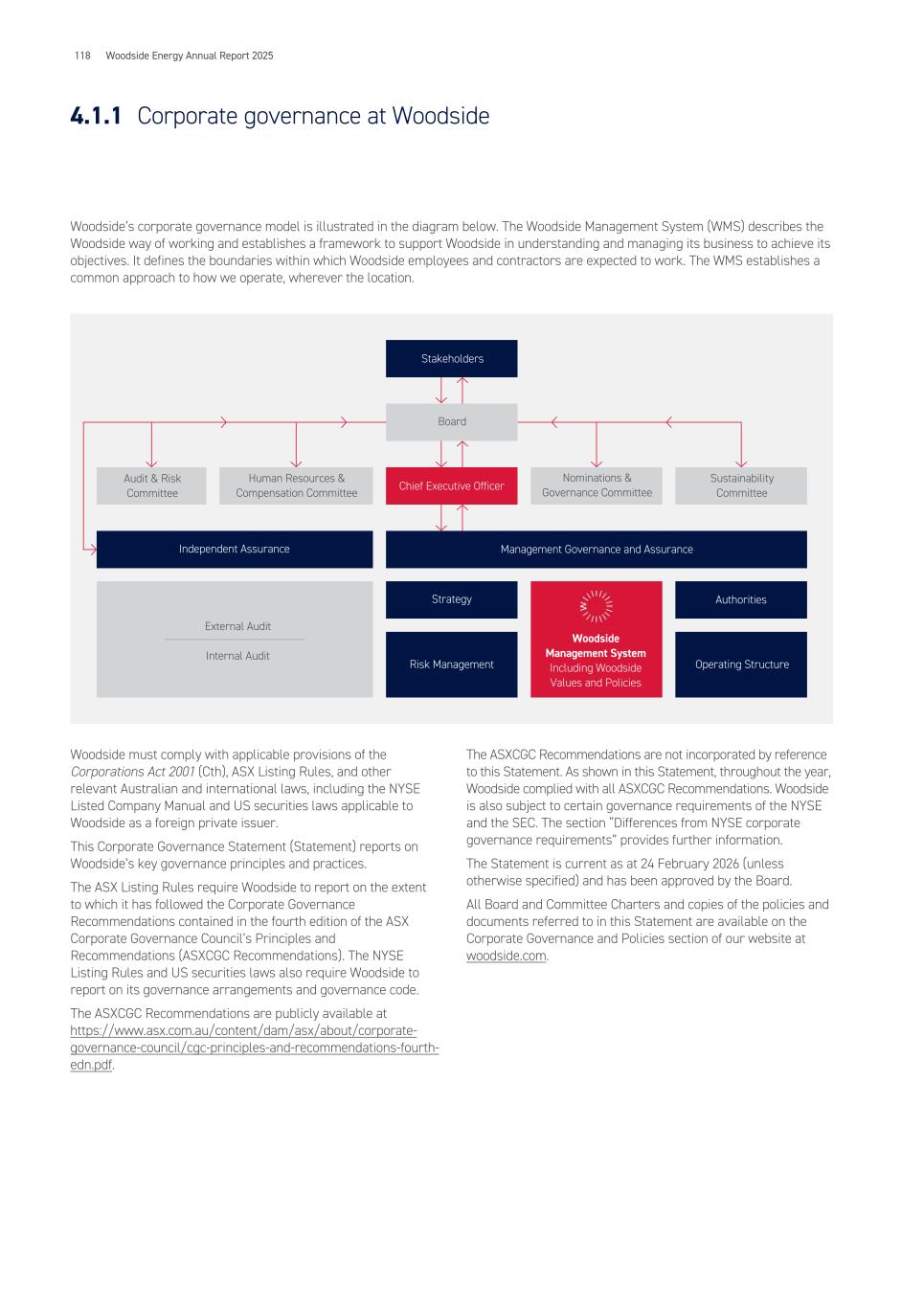
Woodside must comply with applicable provisions of the Corporations Act 2001 (Cth), ASX Listing Rules, and other relevant Australian and international laws, including the NYSE Listed Company Manual and US securities laws applicable to Woodside as a foreign private issuer. This Corporate Governance Statement (Statement) reports on Woodside’s key governance principles and practices. The ASX Listing Rules require Woodside to report on the extent to which it has followed the Corporate Governance Recommendations contained in the fourth edition of the ASX Corporate Governance Council’s Principles and Recommendations (ASXCGC Recommendations). The NYSE Listing Rules and US securities laws also require Woodside to report on its governance arrangements and governance code. The ASXCGC Recommendations are publicly available at https://www.asx.com.au/content/dam/asx/about/corporate- governance-council/cgc-principles-and-recommendations-fourth- edn.pdf. The ASXCGC Recommendations are not incorporated by reference to this Statement. As shown in this Statement, throughout the year, Woodside complied with all ASXCGC Recommendations. Woodside is also subject to certain governance requirements of the NYSE and the SEC. The section “Differences from NYSE corporate governance requirements” provides further information. The Statement is current as at 24 February 2026 (unless otherwise specified) and has been approved by the Board. All Board and Committee Charters and copies of the policies and documents referred to in this Statement are available on the Corporate Governance and Policies section of our website at woodside.com. 118 Woodside Energy Annual Report 2025 4.1.1 Corporate governance at Woodside Woodside’s corporate governance model is illustrated in the diagram below. The Woodside Management System (WMS) describes the Woodside way of working and establishes a framework to support Woodside in understanding and managing its business to achieve its objectives. It defines the boundaries within which Woodside employees and contractors are expected to work. The WMS establishes a common approach to how we operate, wherever the location. Audit & Risk Committee Human Resources & Compensation Committee Chief Executive Officer Nominations & Governance Committee Sustainability Committee Board Stakeholders Independent Assurance Management Governance and Assurance External Audit Internal Audit Strategy Risk Management Authorities Operating Structure Woodside Management System Including Woodside Values and Policies
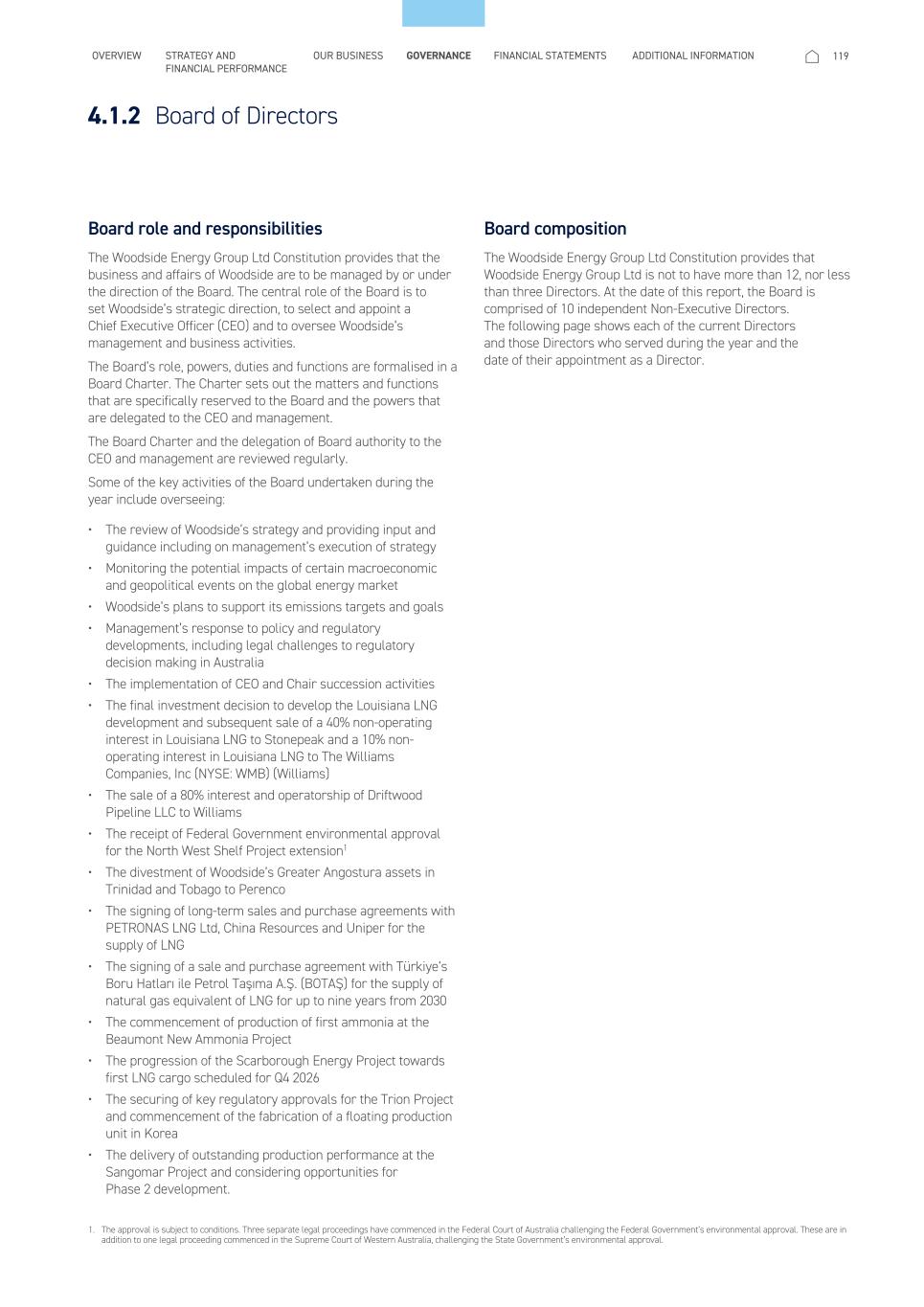
Board role and responsibilities The Woodside Energy Group Ltd Constitution provides that the business and affairs of Woodside are to be managed by or under the direction of the Board. The central role of the Board is to set Woodside’s strategic direction, to select and appoint a Chief Executive Officer (CEO) and to oversee Woodside’s management and business activities. The Board’s role, powers, duties and functions are formalised in a Board Charter. The Charter sets out the matters and functions that are specifically reserved to the Board and the powers that are delegated to the CEO and management. The Board Charter and the delegation of Board authority to the CEO and management are reviewed regularly. Some of the key activities of the Board undertaken during the year include overseeing: • The review of Woodside’s strategy and providing input and guidance including on management’s execution of strategy • Monitoring the potential impacts of certain macroeconomic and geopolitical events on the global energy market • Woodside’s plans to support its emissions targets and goals • Management’s response to policy and regulatory developments, including legal challenges to regulatory decision making in Australia • The implementation of CEO and Chair succession activities • The final investment decision to develop the Louisiana LNG development and subsequent sale of a 40% non-operating interest in Louisiana LNG to Stonepeak and a 10% non- operating interest in Louisiana LNG to The Williams Companies, Inc (NYSE: WMB) (Williams) • The sale of a 80% interest and operatorship of Driftwood Pipeline LLC to Williams • The receipt of Federal Government environmental approval for the North West Shelf Project extension1 • The divestment of Woodside’s Greater Angostura assets in Trinidad and Tobago to Perenco • The signing of long-term sales and purchase agreements with PETRONAS LNG Ltd, China Resources and Uniper for the supply of LNG • The signing of a sale and purchase agreement with Türkiye’s Boru Hatları ile Petrol Taşıma A.Ş. (BOTAŞ) for the supply of natural gas equivalent of LNG for up to nine years from 2030 • The commencement of production of first ammonia at the Beaumont New Ammonia Project • The progression of the Scarborough Energy Project towards first LNG cargo scheduled for Q4 2026 • The securing of key regulatory approvals for the Trion Project and commencement of the fabrication of a floating production unit in Korea • The delivery of outstanding production performance at the Sangomar Project and considering opportunities for Phase 2 development. Board composition The Woodside Energy Group Ltd Constitution provides that Woodside Energy Group Ltd is not to have more than 12, nor less than three Directors. At the date of this report, the Board is comprised of 10 independent Non-Executive Directors. The following page shows each of the current Directors and those Directors who served during the year and the date of their appointment as a Director. OVERVIEW STRATEGY AND FINANCIAL PERFORMANCE OUR BUSINESS GOVERNANCE FINANCIAL STATEMENTS ADDITIONAL INFORMATION 119 4.1.2 Board of Directors 1. The approval is subject to conditions. Three separate legal proceedings have commenced in the Federal Court of Australia challenging the Federal Government’s environmental approval. These are in addition to one legal proceeding commenced in the Supreme Court of Western Australia, challenging the State Government’s environmental approval.
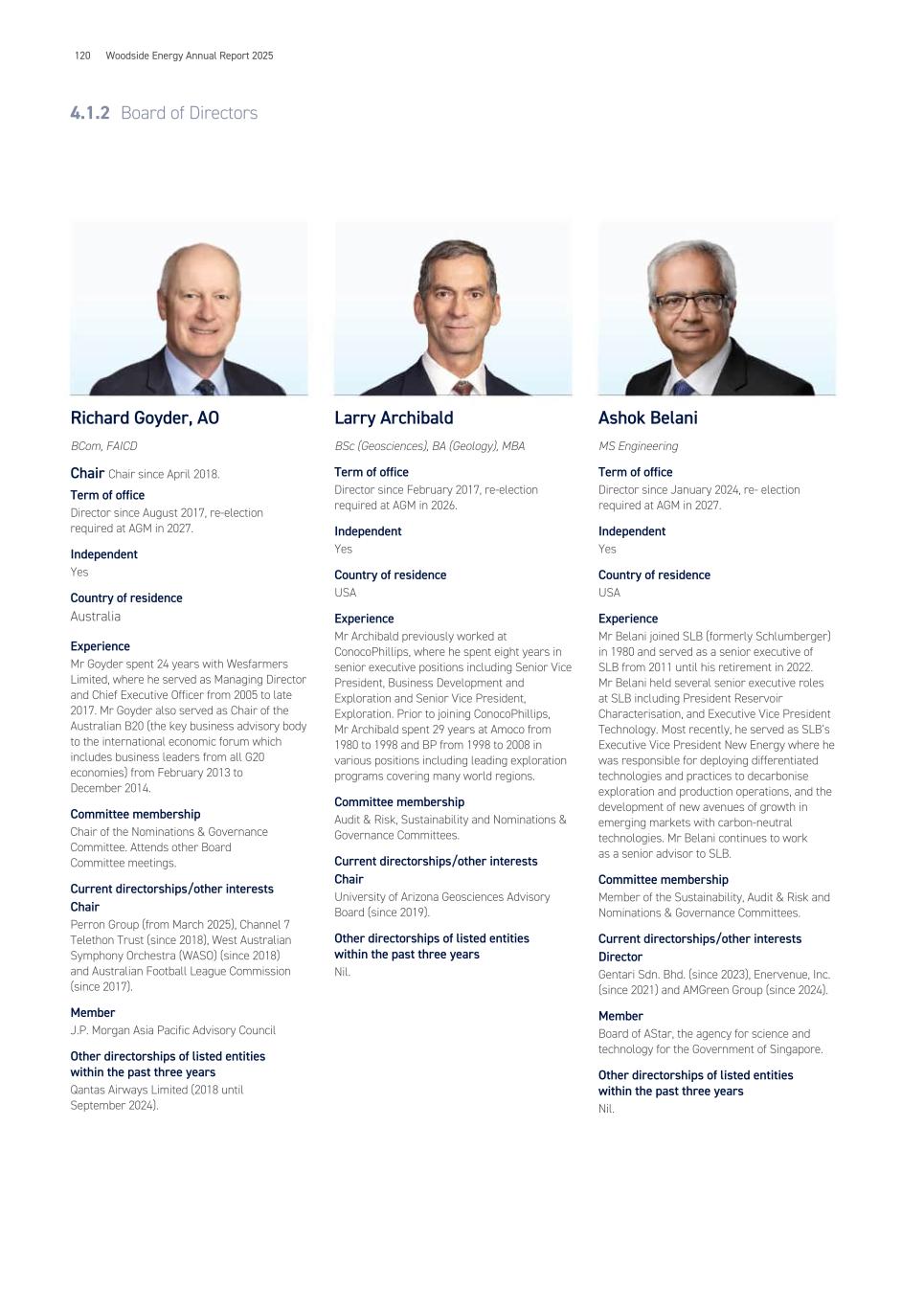
Richard Goyder, AO BCom, FAICD Chair Chair since April 2018. Term of office Director since August 2017, re-election required at AGM in 2027. Independent Yes Country of residence Australia Experience Mr Goyder spent 24 years with Wesfarmers Limited, where he served as Managing Director and Chief Executive Officer from 2005 to late 2017. Mr Goyder also served as Chair of the Australian B20 (the key business advisory body to the international economic forum which includes business leaders from all G20 economies) from February 2013 to December 2014. Committee membership Chair of the Nominations & Governance Committee. Attends other Board Committee meetings. Current directorships/other interests Chair Perron Group (from March 2025), Channel 7 Telethon Trust (since 2018), West Australian Symphony Orchestra (WASO) (since 2018) and Australian Football League Commission (since 2017). Member J.P. Morgan Asia Pacific Advisory Council Other directorships of listed entities within the past three years Qantas Airways Limited (2018 until September 2024). Larry Archibald BSc (Geosciences), BA (Geology), MBA Term of office Director since February 2017, re-election required at AGM in 2026. Independent Yes Country of residence USA Experience Mr Archibald previously worked at ConocoPhillips, where he spent eight years in senior executive positions including Senior Vice President, Business Development and Exploration and Senior Vice President, Exploration. Prior to joining ConocoPhillips, Mr Archibald spent 29 years at Amoco from 1980 to 1998 and BP from 1998 to 2008 in various positions including leading exploration programs covering many world regions. Committee membership Audit & Risk, Sustainability and Nominations & Governance Committees. Current directorships/other interests Chair University of Arizona Geosciences Advisory Board (since 2019). Other directorships of listed entities within the past three years Nil. Ashok Belani MS Engineering Term of office Director since January 2024, re- election required at AGM in 2027. Independent Yes Country of residence USA Experience Mr Belani joined SLB (formerly Schlumberger) in 1980 and served as a senior executive of SLB from 2011 until his retirement in 2022. Mr Belani held several senior executive roles at SLB including President Reservoir Characterisation, and Executive Vice President Technology. Most recently, he served as SLB’s Executive Vice President New Energy where he was responsible for deploying differentiated technologies and practices to decarbonise exploration and production operations, and the development of new avenues of growth in emerging markets with carbon-neutral technologies. Mr Belani continues to work as a senior advisor to SLB. Committee membership Member of the Sustainability, Audit & Risk and Nominations & Governance Committees. Current directorships/other interests Director Gentari Sdn. Bhd. (since 2023), Enervenue, Inc. (since 2021) and AMGreen Group (since 2024). Member Board of AStar, the agency for science and technology for the Government of Singapore. Other directorships of listed entities within the past three years Nil. 120 Woodside Energy Annual Report 2025 4.1.2 Board of Directors
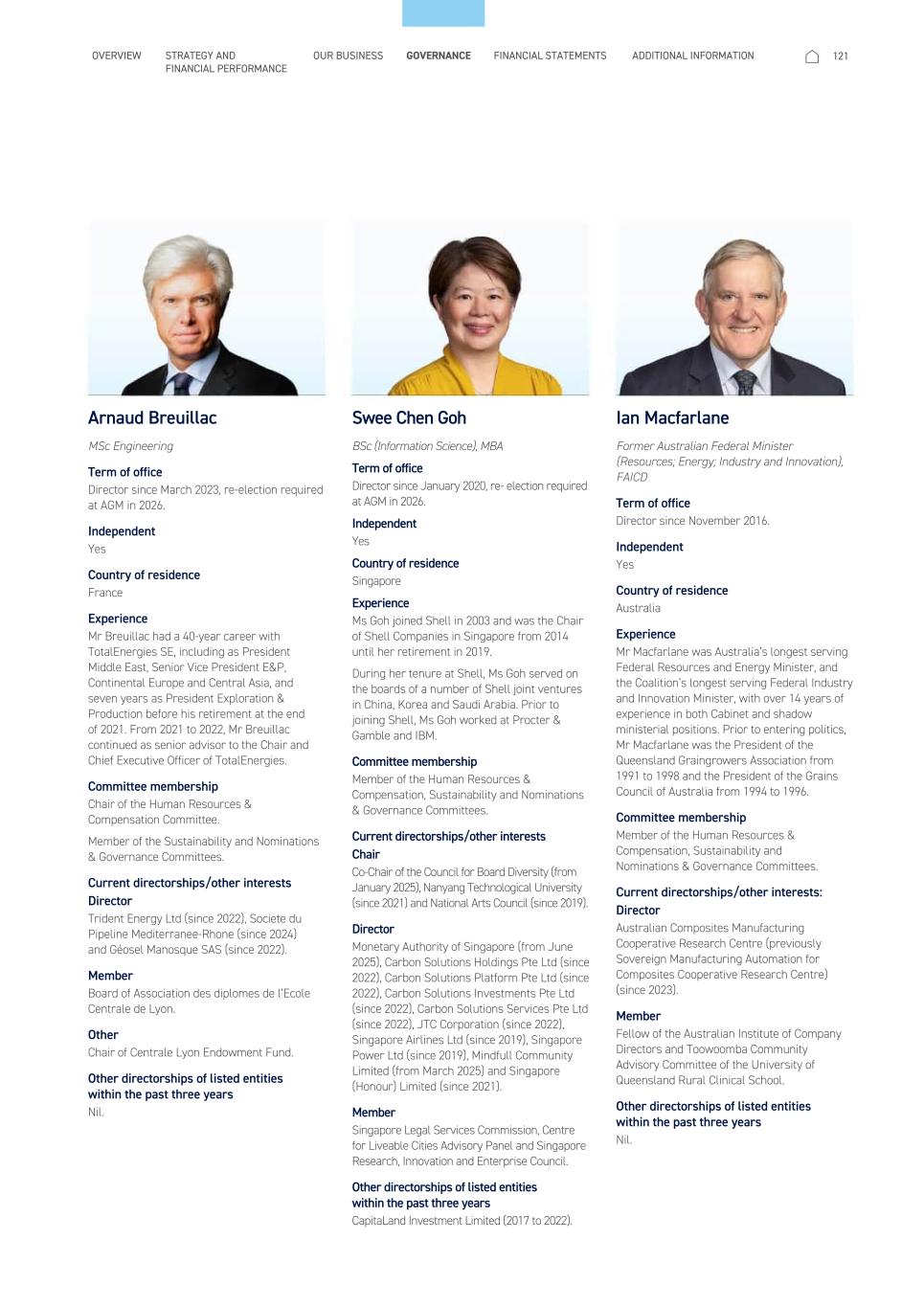
Arnaud Breuillac MSc Engineering Term of office Director since March 2023, re-election required at AGM in 2026. Independent Yes Country of residence France Experience Mr Breuillac had a 40-year career with TotalEnergies SE, including as President Middle East, Senior Vice President E&P, Continental Europe and Central Asia, and seven years as President Exploration & Production before his retirement at the end of 2021. From 2021 to 2022, Mr Breuillac continued as senior advisor to the Chair and Chief Executive Officer of TotalEnergies. Committee membership Chair of the Human Resources & Compensation Committee. Member of the Sustainability and Nominations & Governance Committees. Current directorships/other interests Director Trident Energy Ltd (since 2022), Societe du Pipeline Mediterranee-Rhone (since 2024) and Géosel Manosque SAS (since 2022). Member Board of Association des diplomes de l’Ecole Centrale de Lyon. Other Chair of Centrale Lyon Endowment Fund. Other directorships of listed entities within the past three years Nil. Swee Chen Goh BSc (Information Science), MBA Term of office Director since January 2020, re- election required at AGM in 2026. Independent Yes Country of residence Singapore Experience Ms Goh joined Shell in 2003 and was the Chair of Shell Companies in Singapore from 2014 until her retirement in 2019. During her tenure at Shell, Ms Goh served on the boards of a number of Shell joint ventures in China, Korea and Saudi Arabia. Prior to joining Shell, Ms Goh worked at Procter & Gamble and IBM. Committee membership Member of the Human Resources & Compensation, Sustainability and Nominations & Governance Committees. Current directorships/other interests Chair Co-Chair of the Council for Board Diversity (from January 2025), Nanyang Technological University (since 2021) and National Arts Council (since 2019). Director Monetary Authority of Singapore (from June 2025), Carbon Solutions Holdings Pte Ltd (since 2022), Carbon Solutions Platform Pte Ltd (since 2022), Carbon Solutions Investments Pte Ltd (since 2022), Carbon Solutions Services Pte Ltd (since 2022), JTC Corporation (since 2022), Singapore Airlines Ltd (since 2019), Singapore Power Ltd (since 2019), Mindfull Community Limited (from March 2025) and Singapore (Honour) Limited (since 2021). Member Singapore Legal Services Commission, Centre for Liveable Cities Advisory Panel and Singapore Research, Innovation and Enterprise Council. Other directorships of listed entities within the past three years CapitaLand Investment Limited (2017 to 2022). Ian Macfarlane Former Australian Federal Minister (Resources; Energy; Industry and Innovation), FAICD Term of office Director since November 2016. Independent Yes Country of residence Australia Experience Mr Macfarlane was Australia’s longest serving Federal Resources and Energy Minister, and the Coalition’s longest serving Federal Industry and Innovation Minister, with over 14 years of experience in both Cabinet and shadow ministerial positions. Prior to entering politics, Mr Macfarlane was the President of the Queensland Graingrowers Association from 1991 to 1998 and the President of the Grains Council of Australia from 1994 to 1996. Committee membership Member of the Human Resources & Compensation, Sustainability and Nominations & Governance Committees. Current directorships/other interests: Director Australian Composites Manufacturing Cooperative Research Centre (previously Sovereign Manufacturing Automation for Composites Cooperative Research Centre) (since 2023). Member Fellow of the Australian Institute of Company Directors and Toowoomba Community Advisory Committee of the University of Queensland Rural Clinical School. Other directorships of listed entities within the past three years Nil. OVERVIEW STRATEGY AND FINANCIAL PERFORMANCE OUR BUSINESS GOVERNANCE FINANCIAL STATEMENTS ADDITIONAL INFORMATION 121

Angela Minas MBA Finance and Accounting, BA Managerial Studies Term of office Director since April 2023, re- election required at AGM in 2026. Independent Yes Countries of residence Greece and USA Experience Ms Minas is an experienced financial executive with strong capital markets experience, including six years as a public company Chief Financial Officer (CFO) and Chief Accounting Officer at Constellation Energy Partners LLC and CFO at DCP Midstream LLC. Ms Minas spent the first 20 years of her career in financial advisory and management consulting, including as Arthur Andersen’s Partner leading the North American oil and gas consulting practice and at Leidos (formerly known as SAIC) as Senior VP, global consulting leader. Committee membership Member of the Audit & Risk, Sustainability and Nominations & Governance Committees. Current directorships/other interests: Director Vallourec S.A. (since 2021). Member Rice University Business School Board of Advisors, National Association of Corporate Directors and Women Corporate Directors. Other directorships of listed entities within the past three years Westlake Chemical Partners (2016 to 2023) and Crestwood Equity Partners L.P. (2022 to 2023). Tony O’Neill BAS (Mining Technology), MBA Term of office Director since June 2024, election required at AGM in 2028. Independent Yes Countries of residence Australia and United Kingdom Experience Mr O’Neill joined Anglo American in 2013 and retired in 2022 as Group Technical Director. Mr O’Neill served on the boards of a number of Anglo American subsidiaries including Anglo American Plc, Anglo American Platinum and De Beers. During the course of his career, Mr O’Neill has been involved in many technology ventures and mining industry sustainability initiatives. Committee membership Member of the Audit & Risk, Sustainability and Nominations & Governance Committees. Current directorships/other interests: Director Nil. Member Fellow of the Royal Academy of Engineering (UK) and the Institute of Materials, Minerals and Mining (UK). Other directorships of listed entities within the past three years Nil. Ann Pickard BA,MA Term of office Director since February 2016, re- election required at AGM in 2028. Independent Yes Country of residence USA Experience Ms Pickard joined Shell in 2000 and served in a number of senior executive positions including as the Director, Global Business and Strategy and as a member of the Shell Gas & Power Executive Committee. Ms Pickard retired from Shell in 2016. Prior to joining Shell, Ms Pickard spent 11 years with Mobil before its merger with Exxon in 1999. Committee membership Chair of the Sustainability Committee. Member of the Human Resources & Compensation and Nominations & Governance Committees. Current directorships/other interests: Director KBR Inc (since 2015). Member University of Wyoming Foundation Board. Other directorships of listed entities within the past three years Noble Corporation Plc. (2021 to May 2025). 122 Woodside Energy Annual Report 2025 4.1.2 Board of Directors

Ben Wyatt LLB, MSc Term of office Director since June 2021, re-election required at AGM in 2028. Independent Yes Country of residence Australia Experience Mr Wyatt served in the Western Australian Legislative Assembly for 15 years, including as the Western Australian Treasurer and Minister for Finance, Energy, Aboriginal Affairs and Lands. Additionally, Mr Wyatt held various shadow cabinet portfolios including Shadow Treasurer (2008 to 2017) and responsibility for Native Title and the Pilbara. Prior to entering Parliament, Mr Wyatt practised as a lawyer in both private practice and with the Western Australian Office of the Director of Public Prosecutions. Committee membership Chair of the Audit & Risk Committee. Member of the Human Resources & Compensation and Nominations & Governance Committees. Current directorships/other interests: Chair Crown Perth (from May 2025). Director Rio Tinto Ltd (since 2021), West Coast Eagles (since 2021), Perth International Arts Festival (since 2021) and Crown Perth (from May 2025). Member UWA Business School Advisory Board, Australian Institute of Company Directors and Australian Capital Equity Pty Ltd Advisory Committee Board. Other directorships of listed entities within the past three years APM Group (2022 to 2024). Meg O’Neill BSc (Ocean Engineering), BSc (Chemical Engineering), MSc (Ocean Systems Management) Ms O’Neill resigned effective 18 December 2025, after having served as Woodside’s CEO and Managing Director since 2021. Ms O’Neill has accepted the role of Chief Executive Officer at bp p.l.c. The Board has appointed Liz Westcott as Acting CEO, effective 18 December 2025. OVERVIEW STRATEGY AND FINANCIAL PERFORMANCE OUR BUSINESS GOVERNANCE FINANCIAL STATEMENTS ADDITIONAL INFORMATION 123
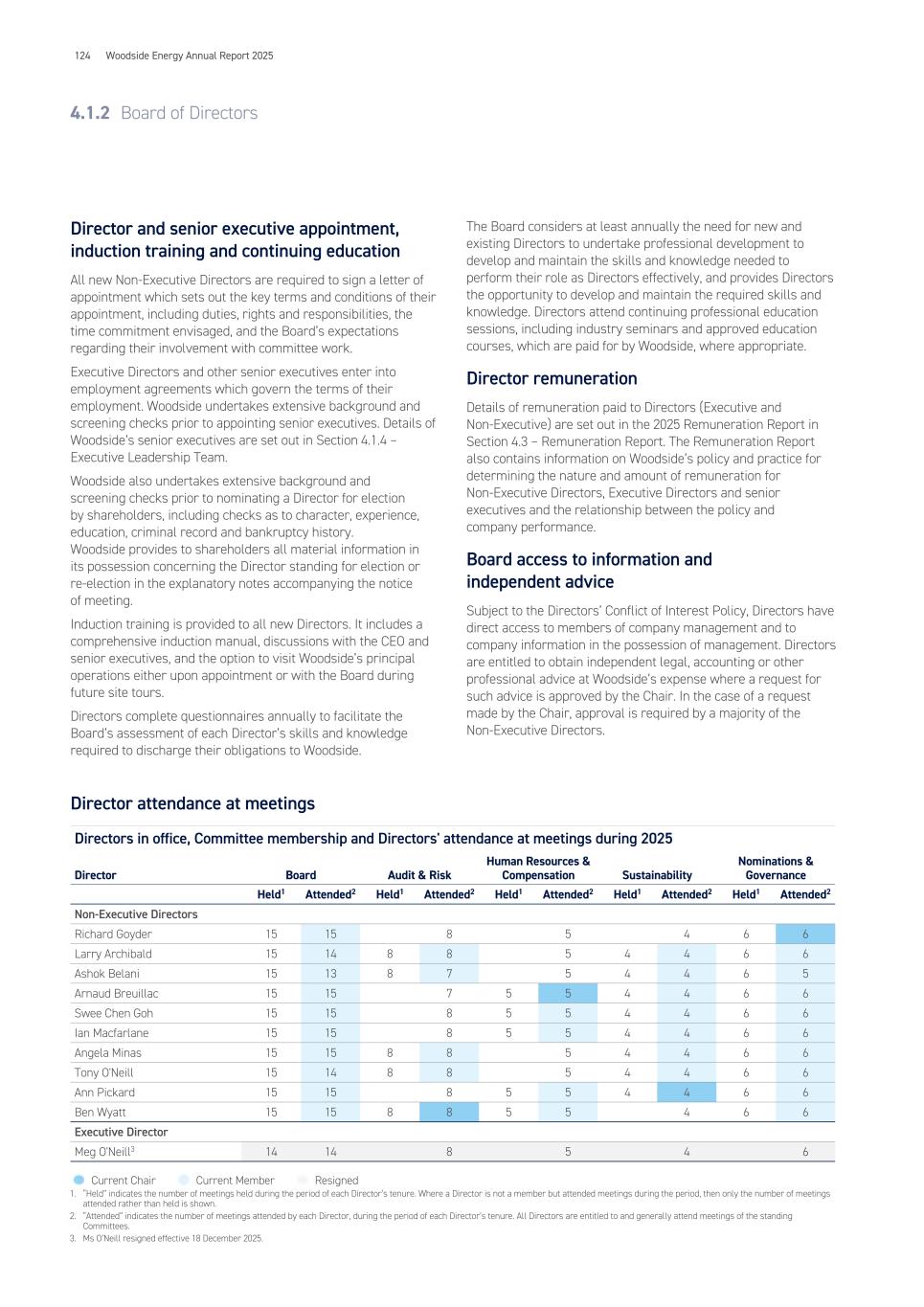
Director and senior executive appointment, induction training and continuing education All new Non-Executive Directors are required to sign a letter of appointment which sets out the key terms and conditions of their appointment, including duties, rights and responsibilities, the time commitment envisaged, and the Board’s expectations regarding their involvement with committee work. Executive Directors and other senior executives enter into employment agreements which govern the terms of their employment. Woodside undertakes extensive background and screening checks prior to appointing senior executives. Details of Woodside’s senior executives are set out in Section 4.1.4 – Executive Leadership Team. Woodside also undertakes extensive background and screening checks prior to nominating a Director for election by shareholders, including checks as to character, experience, education, criminal record and bankruptcy history. Woodside provides to shareholders all material information in its possession concerning the Director standing for election or re‑election in the explanatory notes accompanying the notice of meeting. Induction training is provided to all new Directors. It includes a comprehensive induction manual, discussions with the CEO and senior executives, and the option to visit Woodside’s principal operations either upon appointment or with the Board during future site tours. Directors complete questionnaires annually to facilitate the Board’s assessment of each Director’s skills and knowledge required to discharge their obligations to Woodside. The Board considers at least annually the need for new and existing Directors to undertake professional development to develop and maintain the skills and knowledge needed to perform their role as Directors effectively, and provides Directors the opportunity to develop and maintain the required skills and knowledge. Directors attend continuing professional education sessions, including industry seminars and approved education courses, which are paid for by Woodside, where appropriate. Director remuneration Details of remuneration paid to Directors (Executive and Non‑Executive) are set out in the 2025 Remuneration Report in Section 4.3 – Remuneration Report. The Remuneration Report also contains information on Woodside’s policy and practice for determining the nature and amount of remuneration for Non‑Executive Directors, Executive Directors and senior executives and the relationship between the policy and company performance. Board access to information and independent advice Subject to the Directors’ Conflict of Interest Policy, Directors have direct access to members of company management and to company information in the possession of management. Directors are entitled to obtain independent legal, accounting or other professional advice at Woodside’s expense where a request for such advice is approved by the Chair. In the case of a request made by the Chair, approval is required by a majority of the Non‑Executive Directors. Director attendance at meetings Director Board Audit & Risk Human Resources & Compensation Sustainability Nominations & Governance Held1 Attended2 Held1 Attended2 Held1 Attended2 Held1 Attended2 Held1 Attended2 Non-Executive Directors Richard Goyder 15 15 8 5 4 6 6 Larry Archibald 15 14 8 8 5 4 4 6 6 Ashok Belani 15 13 8 7 5 4 4 6 5 Arnaud Breuillac 15 15 7 5 5 4 4 6 6 Swee Chen Goh 15 15 8 5 5 4 4 6 6 Ian Macfarlane 15 15 8 5 5 4 4 6 6 Angela Minas 15 15 8 8 5 4 4 6 6 Tony O'Neill 15 14 8 8 5 4 4 6 6 Ann Pickard 15 15 8 5 5 4 4 6 6 Ben Wyatt 15 15 8 8 5 5 4 6 6 Executive Director Meg O'Neill3 14 14 8 5 4 6 Directors in office, Committee membership and Directors' attendance at meetings during 2025 124 Woodside Energy Annual Report 2025 4.1.2 Board of Directors 1. “Held” indicates the number of meetings held during the period of each Director’s tenure. Where a Director is not a member but attended meetings during the period, then only the number of meetings attended rather than held is shown. 2. “Attended” indicates the number of meetings attended by each Director, during the period of each Director’s tenure. All Directors are entitled to and generally attend meetings of the standing Committees. 3. Ms O’Neill resigned effective 18 December 2025. Current Chair Current Member Resigned
Board performance evaluation The Nominations & Governance Committee is responsible for determining the process for evaluating Board performance. Board performance evaluations are conducted annually. In 2025, an external consultant was engaged to conduct a Board performance evaluation. The annual evaluation process requires each Director and the members of the Executive Leadership Team to complete a number of questionnaires. The report on Board and Committee performance is provided to all Directors and discussed by the Board. The report on the Chair’s performance is provided to the Chair and two Committee Chairs for discussion. A report on each individual Director is also provided to the individual and to the Chair. The Chair meets individually with each Director to discuss the findings of their report. The Board, through the Nominations & Governance Committee, considers and discusses the final report in detail. The performance of each Director retiring at the next AGM is taken into account by the Board in determining whether or not the Board should support the re-election of the Director. The Directors seeking re-election will be asked to reconfirm that they have sufficient time to meet their responsibilities. The Human Resources & Compensation Committee reviews and makes recommendations to the Board on the criteria for the evaluation of the performance of the CEO. The Board conducts the evaluation of the performance of the CEO and considers senior executive succession planning. In 2025, performance evaluations for the Board, its Committees, Directors and senior executives took place in accordance with the process disclosed above, and in the section on “Performance evaluation of Executive Leadership Team” on page 131 and in the Remuneration Report. Directors’ retirement and re-election The Woodside Energy Group Ltd Constitution sets out the requirements for the retirement and re-election of Directors. With the exception of the CEO/Managing Director, Directors must retire at the third AGM following their election or most recent re‑election. At least one Director must stand for election at each AGM. Board support for a Director’s re-election is not automatic and is subject to satisfactory Director performance and assessment of overall Board composition and capabilities. Director independence In accordance with the Policy on Independence of Directors, the Board assesses independence with reference to whether a Director is non-executive, not a member of management and is free of any business or other relationship that could materially interfere with, or could reasonably be perceived to materially interfere with, the independent exercise of their judgement. In making this assessment, the Board considers all relevant facts and circumstances. In particular, the Board focuses on the factors relevant to assessing the independence of a Director set out in Box 2.3 of the ASXCGC Recommendations. The Board has reviewed the independence of each of the Non‑Executive Directors in office at the date of this Statement and determined that they are all independent. Conflicts of interest The Board has approved a Directors’ Conflict of Interest Policy which applies if there is, or may be, a conflict between the personal interests of a Director, or the duties a Director owes to another company, and the duties the Director owes to Woodside. Directors are required to disclose circumstances that may affect, or be perceived to affect, their ability to exercise independent judgement so that the Board can assess independence on a regular basis. Under the Woodside Energy Group Ltd Constitution, Directors must comply with the Corporations Act 2001 (Cth) in relation to disclosure and voting on matters involving material personal interests. Subject to the Corporations Act 2001 (Cth): • a Director may be counted in a quorum at a Board meeting that considers, and may vote on, any matter in which that Director has an interest. • Woodside may proceed with any transaction that relates to the interest and the Director may participate in the execution of any relevant document by or on behalf of Woodside. • the Director may retain benefits under the transaction even though the Director has an interest. • Woodside cannot avoid the transaction merely because of the existence of the interest. OVERVIEW STRATEGY AND FINANCIAL PERFORMANCE OUR BUSINESS GOVERNANCE FINANCIAL STATEMENTS ADDITIONAL INFORMATION 125
Areas of competence and skills of the Board of Directors Each year, the Board, on the recommendation of the Nomination & Governance Committee, reviews and determines the composition and size of the Board, including succession plans, such that the Non-Executive Directors collectively bring the skills, knowledge and experience necessary to direct Woodside going forward. To assist with this review, each year the Nomination & Governance Committee evaluates and adopts a Director competencies matrix that the Committee determines is appropriate for Woodside’s operations, strategy and risks. In 2025, Directors were asked to confirm their competencies against the competencies matrix, through a process coordinated by an external consultant. As part of this process, three classifications were established for each competency, being “Expert/Advanced” “General” and “Limited”, along with criteria for each of these classifications. Based on the outcome of the 2025 review, the Board considers that they collectively have a combination of skills and experience which are necessary to direct Woodside in accordance with high standards of corporate governance and oversee Woodside’s management and business activities. The Director competencies matrix and the outcome of the 2025 review are set out below. The Board also uses this competencies matrix to identify potential areas of focus for Director recruitment and to identify any professional development opportunities that may benefit Directors. The Board supplements its expertise with internal and external subject matter experts as appropriate (for example, regular attendance at Board meetings by relevant executives and other independent advisers). The Sustainability Committee received regular briefings and education on climate change from Woodside’s senior executive responsible for climate change, to inform its oversight of related matters with input from climate change science and expert advice. Chair The Chair of the Board, Richard Goyder, is an independent, Non‑Executive Director and an Australian resident and citizen. The Chair is responsible for leadership and effective performance of the Board and for the maintenance of relations between the Directors and management which are open, cordial and conducive to productive cooperation, and which facilitate robust dialogue, debate and constructive challenge in response to key issues and emerging risks. The Board has arrangements in place to ensure ongoing leadership if unforeseen circumstances mean Mr Goyder is not available. Mr Goyder’s office is located in Woodside’s headquarters in Perth, Western Australia. The Non‑Executive Directors are satisfied that Mr Goyder commits the time necessary to discharge his role effectively. The Chair’s responsibilities are set out in more detail in the Board Charter. Company Secretaries Details of the Company Secretaries are set out in Section 4.2 – Directors’ report – Company Secretaries. All Directors have direct access to the Company Secretaries who are accountable directly to the Board, through the Chair, on all matters to do with the proper functioning of the Board and its Committees. The Company Secretaries’ responsibilities are set out in more detail in the Board Charter. Board succession planning The Board manages its succession planning with the assistance of the Nominations & Governance Committee which annually reviews the size and composition of the Board. In conducting the review, the appropriate mix of skills, competencies, experience, expertise and diversity is considered, having regard to the Director competencies matrix. The Nominations & Governance Committee is also responsible for evaluating Board candidates and recommending individuals for appointment to the Board. The Committee evaluates prospective candidates against a range of criteria including the skills, experience and expertise that will best complement Board effectiveness at the time. The Board may engage an independent recruitment firm to undertake a search for suitable candidates. 126 Woodside Energy Annual Report 2025 4.1.2 Board of Directors
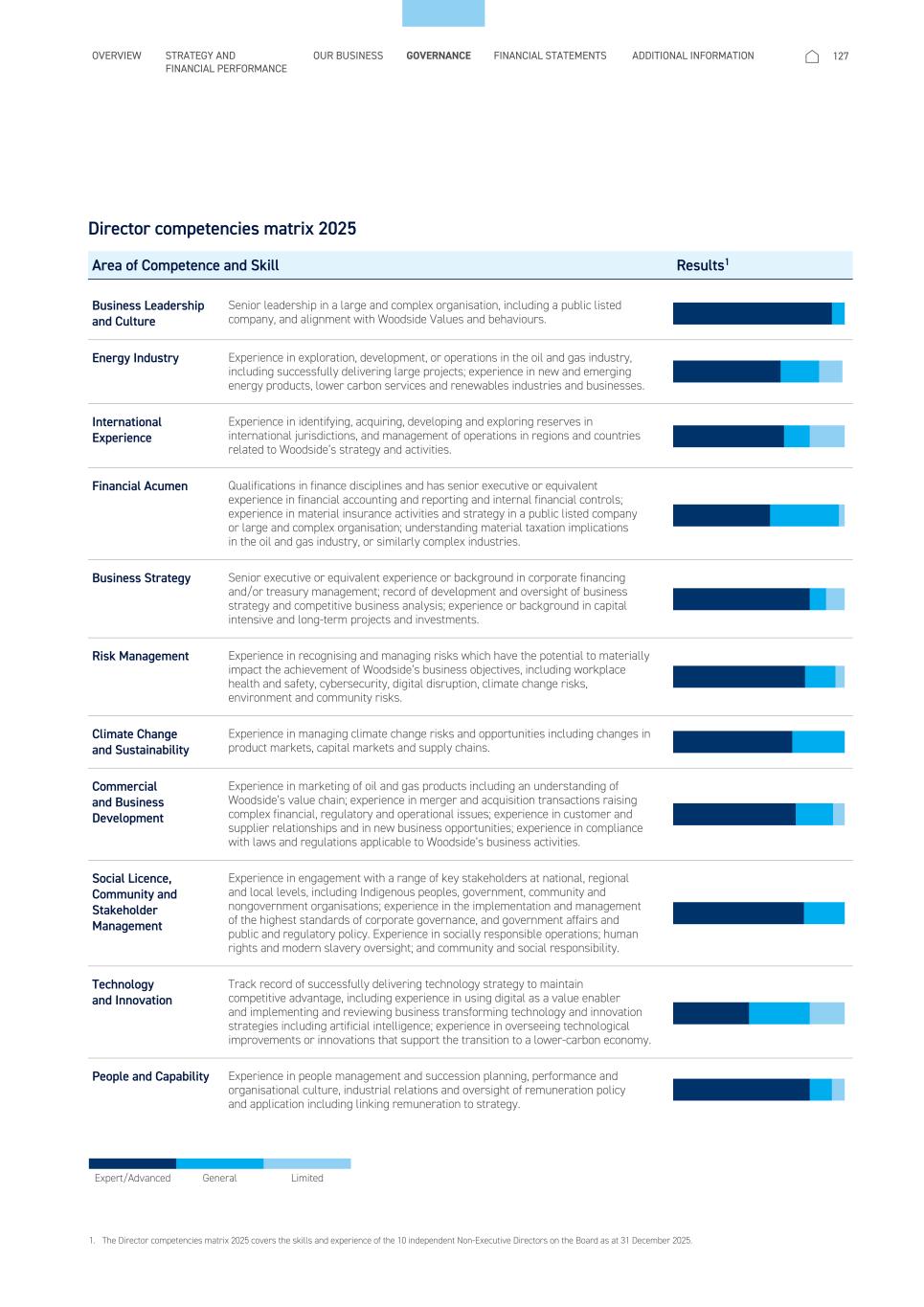
Director competencies matrix 2025 Area of Competence and Skill Results1 Business Leadership and Culture Senior leadership in a large and complex organisation, including a public listed company, and alignment with Woodside Values and behaviours. Energy Industry Experience in exploration, development, or operations in the oil and gas industry, including successfully delivering large projects; experience in new and emerging energy products, lower carbon services and renewables industries and businesses. International Experience Experience in identifying, acquiring, developing and exploring reserves in international jurisdictions, and management of operations in regions and countries related to Woodside’s strategy and activities. Financial Acumen Qualifications in finance disciplines and has senior executive or equivalent experience in financial accounting and reporting and internal financial controls; experience in material insurance activities and strategy in a public listed company or large and complex organisation; understanding material taxation implications in the oil and gas industry, or similarly complex industries. Business Strategy Senior executive or equivalent experience or background in corporate financing and/or treasury management; record of development and oversight of business strategy and competitive business analysis; experience or background in capital intensive and long-term projects and investments. Risk Management Experience in recognising and managing risks which have the potential to materially impact the achievement of Woodside’s business objectives, including workplace health and safety, cybersecurity, digital disruption, climate change risks, environment and community risks. Climate Change and Sustainability Experience in managing climate change risks and opportunities including changes in product markets, capital markets and supply chains. Commercial and Business Development Experience in marketing of oil and gas products including an understanding of Woodside’s value chain; experience in merger and acquisition transactions raising complex financial, regulatory and operational issues; experience in customer and supplier relationships and in new business opportunities; experience in compliance with laws and regulations applicable to Woodside’s business activities. Social Licence, Community and Stakeholder Management Experience in engagement with a range of key stakeholders at national, regional and local levels, including Indigenous peoples, government, community and nongovernment organisations; experience in the implementation and management of the highest standards of corporate governance, and government affairs and public and regulatory policy. Experience in socially responsible operations; human rights and modern slavery oversight; and community and social responsibility. Technology and Innovation Track record of successfully delivering technology strategy to maintain competitive advantage, including experience in using digital as a value enabler and implementing and reviewing business transforming technology and innovation strategies including artificial intelligence; experience in overseeing technological improvements or innovations that support the transition to a lower-carbon economy. People and Capability Experience in people management and succession planning, performance and organisational culture, industrial relations and oversight of remuneration policy and application including linking remuneration to strategy. OVERVIEW STRATEGY AND FINANCIAL PERFORMANCE OUR BUSINESS GOVERNANCE FINANCIAL STATEMENTS ADDITIONAL INFORMATION 127 Expert/Advanced General Limited 1. The Director competencies matrix 2025 covers the skills and experience of the 10 independent Non‑Executive Directors on the Board as at 31 December 2025.
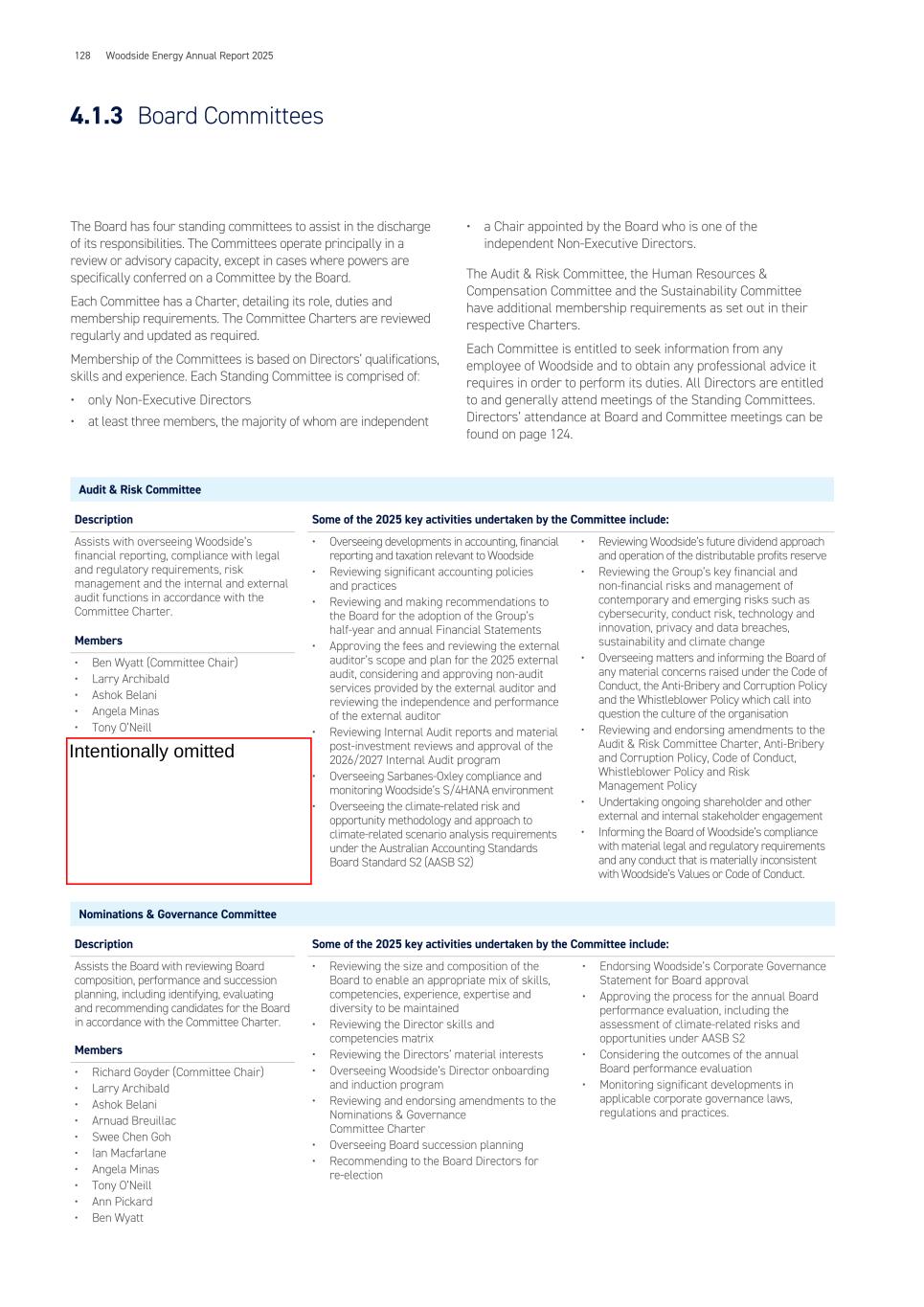
The Board has four standing committees to assist in the discharge of its responsibilities. The Committees operate principally in a review or advisory capacity, except in cases where powers are specifically conferred on a Committee by the Board. Each Committee has a Charter, detailing its role, duties and membership requirements. The Committee Charters are reviewed regularly and updated as required. Membership of the Committees is based on Directors’ qualifications, skills and experience. Each Standing Committee is comprised of: • only Non-Executive Directors • at least three members, the majority of whom are independent • a Chair appointed by the Board who is one of the independent Non-Executive Directors. The Audit & Risk Committee, the Human Resources & Compensation Committee and the Sustainability Committee have additional membership requirements as set out in their respective Charters. Each Committee is entitled to seek information from any employee of Woodside and to obtain any professional advice it requires in order to perform its duties. All Directors are entitled to and generally attend meetings of the Standing Committees. Directors’ attendance at Board and Committee meetings can be found on page 124. Audit & Risk Committee Description Some of the 2025 key activities undertaken by the Committee include: Assists with overseeing Woodside’s financial reporting, compliance with legal and regulatory requirements, risk management and the internal and external audit functions in accordance with the Committee Charter. • Overseeing developments in accounting, financial reporting and taxation relevant to Woodside • Reviewing significant accounting policies and practices • Reviewing and making recommendations to the Board for the adoption of the Group’s half‑year and annual Financial Statements • Approving the fees and reviewing the external auditor’s scope and plan for the 2025 external audit, considering and approving non-audit services provided by the external auditor and reviewing the independence and performance of the external auditor • Reviewing Internal Audit reports and material post-investment reviews and approval of the 2026/2027 Internal Audit program • Overseeing Sarbanes-Oxley compliance and monitoring Woodside’s S/4HANA environment • Overseeing the climate-related risk and opportunity methodology and approach to climate-related scenario analysis requirements under the Australian Accounting Standards Board Standard S2 (AASB S2) • Reviewing Woodside’s future dividend approach and operation of the distributable profits reserve • Reviewing the Group’s key financial and non‑financial risks and management of contemporary and emerging risks such as cybersecurity, conduct risk, technology and innovation, privacy and data breaches, sustainability and climate change • Overseeing matters and informing the Board of any material concerns raised under the Code of Conduct, the Anti-Bribery and Corruption Policy and the Whistleblower Policy which call into question the culture of the organisation • Reviewing and endorsing amendments to the Audit & Risk Committee Charter, Anti-Bribery and Corruption Policy, Code of Conduct, Whistleblower Policy and Risk Management Policy • Undertaking ongoing shareholder and other external and internal stakeholder engagement • Informing the Board of Woodside’s compliance with material legal and regulatory requirements and any conduct that is materially inconsistent with Woodside’s Values or Code of Conduct. Members • Ben Wyatt (Committee Chair) • Larry Archibald • Ashok Belani • Angela Minas • Tony O’Neill Audit committee financial expert Woodside’s Board has determined that Angela Minas, who currently serves as a member of the Audit & Risk Committee, meets the audit committee financial expert requirements under SEC Rules. The Board has also determined that she is independent under applicable NYSE Listing Rules. Nominations & Governance Committee Description Some of the 2025 key activities undertaken by the Committee include: Assists the Board with reviewing Board composition, performance and succession planning, including identifying, evaluating and recommending candidates for the Board in accordance with the Committee Charter. • Reviewing the size and composition of the Board to enable an appropriate mix of skills, competencies, experience, expertise and diversity to be maintained • Reviewing the Director skills and competencies matrix • Reviewing the Directors’ material interests • Overseeing Woodside’s Director onboarding and induction program • Reviewing and endorsing amendments to the Nominations & Governance Committee Charter • Overseeing Board succession planning • Recommending to the Board Directors for re‑election • Endorsing Woodside’s Corporate Governance Statement for Board approval • Approving the process for the annual Board performance evaluation, including the assessment of climate-related risks and opportunities under AASB S2 • Considering the outcomes of the annual Board performance evaluation • Monitoring significant developments in applicable corporate governance laws, regulations and practices. Members • Richard Goyder (Committee Chair) • Larry Archibald • Ashok Belani • Arnuad Breuillac • Swee Chen Goh • Ian Macfarlane • Angela Minas • Tony O’Neill • Ann Pickard • Ben Wyatt 128 Woodside Energy Annual Report 2025 4.1.3 Board Committees
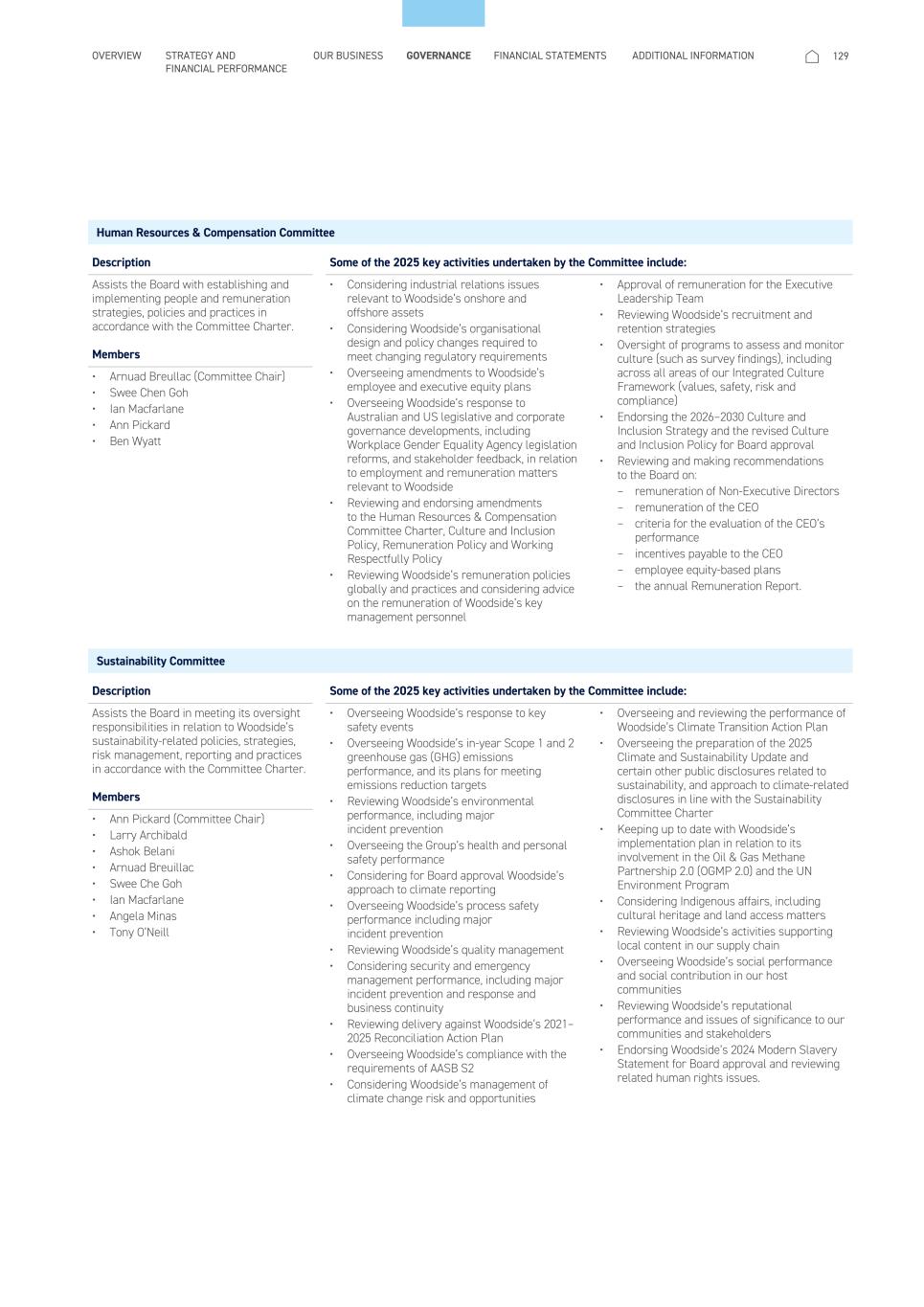
Human Resources & Compensation Committee Description Some of the 2025 key activities undertaken by the Committee include: Assists the Board with establishing and implementing people and remuneration strategies, policies and practices in accordance with the Committee Charter. • Considering industrial relations issues relevant to Woodside’s onshore and offshore assets • Considering Woodside’s organisational design and policy changes required to meet changing regulatory requirements • Overseeing amendments to Woodside’s employee and executive equity plans • Overseeing Woodside’s response to Australian and US legislative and corporate governance developments, including Workplace Gender Equality Agency legislation reforms, and stakeholder feedback, in relation to employment and remuneration matters relevant to Woodside • Reviewing and endorsing amendments to the Human Resources & Compensation Committee Charter, Culture and Inclusion Policy, Remuneration Policy and Working Respectfully Policy • Reviewing Woodside’s remuneration policies globally and practices and considering advice on the remuneration of Woodside’s key management personnel • Approval of remuneration for the Executive Leadership Team • Reviewing Woodside’s recruitment and retention strategies • Oversight of programs to assess and monitor culture (such as survey findings), including across all areas of our Integrated Culture Framework (values, safety, risk and compliance) • Endorsing the 2026–2030 Culture and Inclusion Strategy and the revised Culture and Inclusion Policy for Board approval • Reviewing and making recommendations to the Board on: – remuneration of Non-Executive Directors – remuneration of the CEO – criteria for the evaluation of the CEO’s performance – incentives payable to the CEO – employee equity-based plans – the annual Remuneration Report. Members • Arnuad Breullac (Committee Chair) • Swee Chen Goh • Ian Macfarlane • Ann Pickard • Ben Wyatt Sustainability Committee Description Some of the 2025 key activities undertaken by the Committee include: Assists the Board in meeting its oversight responsibilities in relation to Woodside’s sustainability-related policies, strategies, risk management, reporting and practices in accordance with the Committee Charter. • Overseeing Woodside’s response to key safety events • Overseeing Woodside’s in-year Scope 1 and 2 greenhouse gas (GHG) emissions performance, and its plans for meeting emissions reduction targets • Reviewing Woodside’s environmental performance, including major incident prevention • Overseeing the Group’s health and personal safety performance • Considering for Board approval Woodside’s approach to climate reporting • Overseeing Woodside’s process safety performance including major incident prevention • Reviewing Woodside’s quality management • Considering security and emergency management performance, including major incident prevention and response and business continuity • Reviewing delivery against Woodside’s 2021– 2025 Reconciliation Action Plan • Overseeing Woodside’s compliance with the requirements of AASB S2 • Considering Woodside’s management of climate change risk and opportunities • Overseeing and reviewing the performance of Woodside’s Climate Transition Action Plan • Overseeing the preparation of the 2025 Climate and Sustainability Update and certain other public disclosures related to sustainability, and approach to climate-related disclosures in line with the Sustainability Committee Charter • Keeping up to date with Woodside’s implementation plan in relation to its involvement in the Oil & Gas Methane Partnership 2.0 (OGMP 2.0) and the UN Environment Program • Considering Indigenous affairs, including cultural heritage and land access matters • Reviewing Woodside’s activities supporting local content in our supply chain • Overseeing Woodside’s social performance and social contribution in our host communities • Reviewing Woodside’s reputational performance and issues of significance to our communities and stakeholders • Endorsing Woodside’s 2024 Modern Slavery Statement for Board approval and reviewing related human rights issues. Members • Ann Pickard (Committee Chair) • Larry Archibald • Ashok Belani • Arnuad Breuillac • Swee Che Goh • Ian Macfarlane • Angela Minas • Tony O’Neill OVERVIEW STRATEGY AND FINANCIAL PERFORMANCE OUR BUSINESS GOVERNANCE FINANCIAL STATEMENTS ADDITIONAL INFORMATION 129

Liz Westcott Acting CEO BCom, BEng (Hons), GAICD Joined Woodside: 2023 Liz was appointed as Acting CEO effective 18 December 2025. Prior to her appointment, Liz led Woodside’s Australian projects and business operations as Executive Vice President and Chief Operating Officer Australia, focusing on optimising value across the portfolio and throughout an asset’s lifecycle. Liz joined Woodside in 2023 as Executive Vice President Australian Operations, with responsibility for the safe, efficient and reliable operation of Woodside’s portfolio of assets across Australia. Liz has over 30 years of industry experience and prior to joining Woodside, held senior leadership roles at Energy Australia and ExxonMobil spanning strategic planning, operations, project management, and safety, technical and commercial leadership. External directorships: Australian Energy Producers. Mark Abbotsford Executive Vice President and Chief Commercial Officer1 BEc (Hons), MPhil, MBA, AMP Joined Woodside: 2002 Mark leads Woodside’s commercial, marketing and trading teams and is responsible for developing Woodside’s growth opportunities through his leadership of mergers and acquisitions, new energy business development, exploration and new venture teams. Mark has over 20 years of industry experience and has held a number of senior leadership positions across commercial, finance and marketing in various global locations. Mark has also held roles at Treasury (Western Australia) and BHP Iron Ore. External directorships: Board member of the Chamber of Commerce and Industry (WA), GLX Digital and Asia Natural Gas and Energy Association (ANGEA). Tony Cudmore Executive Vice President Sustainability, Policy and External Affairs BA, GCIR Joined Woodside: 2022 Tony leads Sustainability, Policy & External Affairs. He joined Woodside in 2022 as Executive Vice President Strategy and Climate. Tony has over 20 years of industry experience. Prior to joining Woodside, Tony held senior leadership positions at ExxonMobil and BHP including Chief Public Affairs Officer, and Group Sustainability and Public Policy Officer. External directorships: Nil. Andy Drummond Executive Vice President Strategy BEng (Hons) (ChemEng) Joined Woodside: 2022 Andy is responsible for developing and implementing Woodside’s corporate strategy. Andy has over 25 years of industry experience. Prior to joining Woodside, Andy held senior leadership positions at BHP and Marathon Oil Corporation, including Vice President of Sustainability and Innovation for BHP’s petroleum business. External directorships: Nil. Julie Fallon Executive Vice President Technical and Energy Development BEng (Hons), (ChemEng), GAICD Joined Woodside: 1998 Julie is responsible for a range of areas including project development, reserves and subsurface, well and seismic engineering and technology, digital, IT and cybersecurity, and health, safety and environment. Julie has over 30 years of industry experience and has held a number of senior leadership roles at Woodside, including Executive Vice President Corporate Services, Senior Vice President Pluto and Senior Vice President Engineering. External directorships: Director and President of the Australian Resources and Energy Employer Association. Advisory Board member of the Chamber of Minerals and Energy of Western Australia. 130 Woodside Energy Annual Report 2025 4.1.4 Executive Leadership Team 1. Identified as key management personnel (KMP)
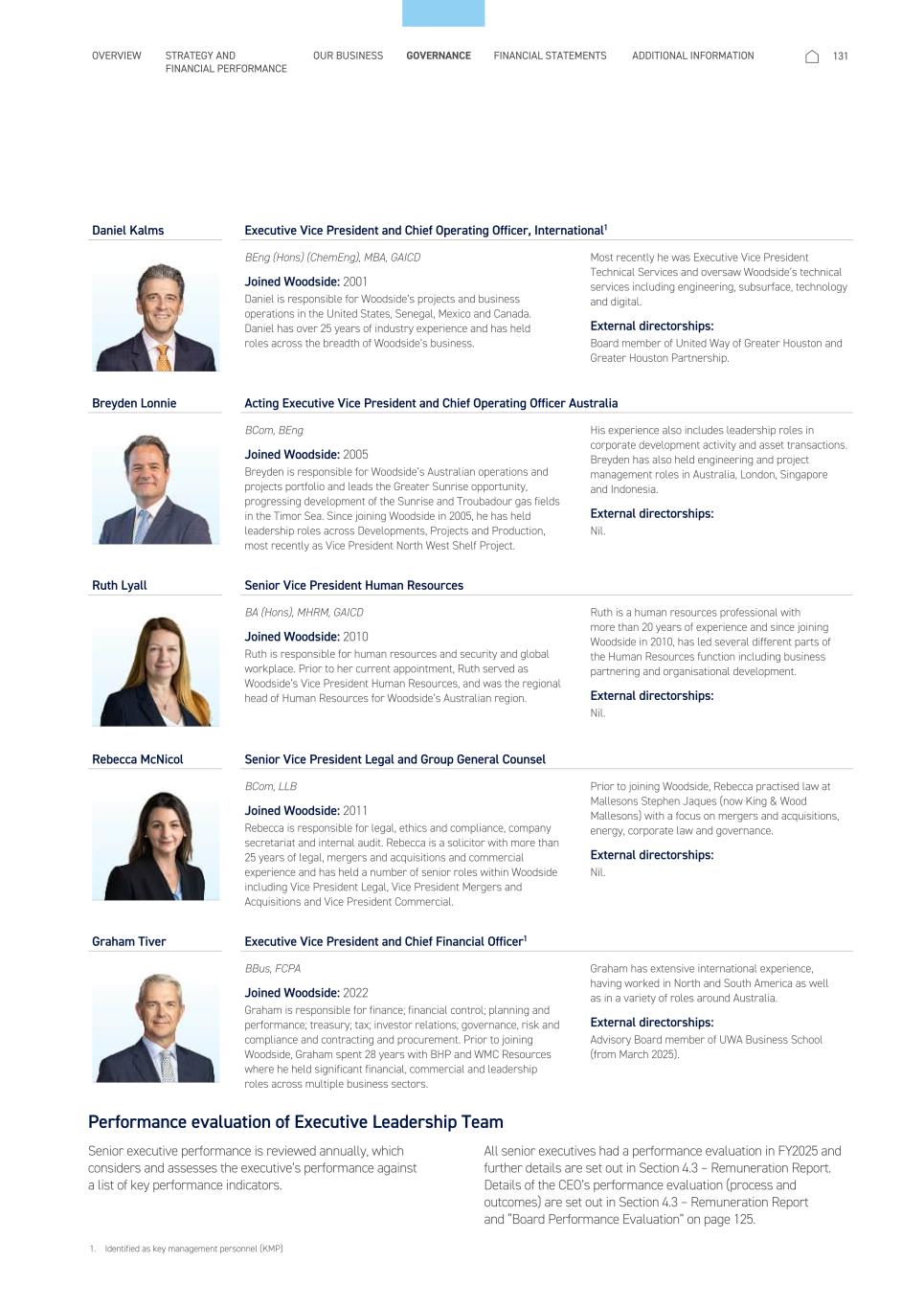
Daniel Kalms Executive Vice President and Chief Operating Officer, International1 BEng (Hons) (ChemEng), MBA, GAICD Joined Woodside: 2001 Daniel is responsible for Woodside’s projects and business operations in the United States, Senegal, Mexico and Canada. Daniel has over 25 years of industry experience and has held roles across the breadth of Woodside’s business. Most recently he was Executive Vice President Technical Services and oversaw Woodside’s technical services including engineering, subsurface, technology and digital. External directorships: Board member of United Way of Greater Houston and Greater Houston Partnership. Breyden Lonnie Acting Executive Vice President and Chief Operating Officer Australia BCom, BEng Joined Woodside: 2005 Breyden is responsible for Woodside’s Australian operations and projects portfolio and leads the Greater Sunrise opportunity, progressing development of the Sunrise and Troubadour gas fields in the Timor Sea. Since joining Woodside in 2005, he has held leadership roles across Developments, Projects and Production, most recently as Vice President North West Shelf Project. His experience also includes leadership roles in corporate development activity and asset transactions. Breyden has also held engineering and project management roles in Australia, London, Singapore and Indonesia. External directorships: Nil. Ruth Lyall Senior Vice President Human Resources BA (Hons), MHRM, GAICD Joined Woodside: 2010 Ruth is responsible for human resources and security and global workplace. Prior to her current appointment, Ruth served as Woodside’s Vice President Human Resources, and was the regional head of Human Resources for Woodside’s Australian region. Ruth is a human resources professional with more than 20 years of experience and since joining Woodside in 2010, has led several different parts of the Human Resources function including business partnering and organisational development. External directorships: Nil. Rebecca McNicol Senior Vice President Legal and Group General Counsel BCom, LLB Joined Woodside: 2011 Rebecca is responsible for legal, ethics and compliance, company secretariat and internal audit. Rebecca is a solicitor with more than 25 years of legal, mergers and acquisitions and commercial experience and has held a number of senior roles within Woodside including Vice President Legal, Vice President Mergers and Acquisitions and Vice President Commercial. Prior to joining Woodside, Rebecca practised law at Mallesons Stephen Jaques (now King & Wood Mallesons) with a focus on mergers and acquisitions, energy, corporate law and governance. External directorships: Nil. Graham Tiver Executive Vice President and Chief Financial Officer1 BBus, FCPA Joined Woodside: 2022 Graham is responsible for finance; financial control; planning and performance; treasury; tax; investor relations; governance, risk and compliance and contracting and procurement. Prior to joining Woodside, Graham spent 28 years with BHP and WMC Resources where he held significant financial, commercial and leadership roles across multiple business sectors. Graham has extensive international experience, having worked in North and South America as well as in a variety of roles around Australia. External directorships: Advisory Board member of UWA Business School (from March 2025). Performance evaluation of Executive Leadership Team Senior executive performance is reviewed annually, which considers and assesses the executive’s performance against a list of key performance indicators. All senior executives had a performance evaluation in FY2025 and further details are set out in Section 4.3 – Remuneration Report. Details of the CEO’s performance evaluation (process and outcomes) are set out in Section 4.3 – Remuneration Report and “Board Performance Evaluation” on page 125. OVERVIEW STRATEGY AND FINANCIAL PERFORMANCE OUR BUSINESS GOVERNANCE FINANCIAL STATEMENTS ADDITIONAL INFORMATION 131 1. Identified as key management personnel (KMP)
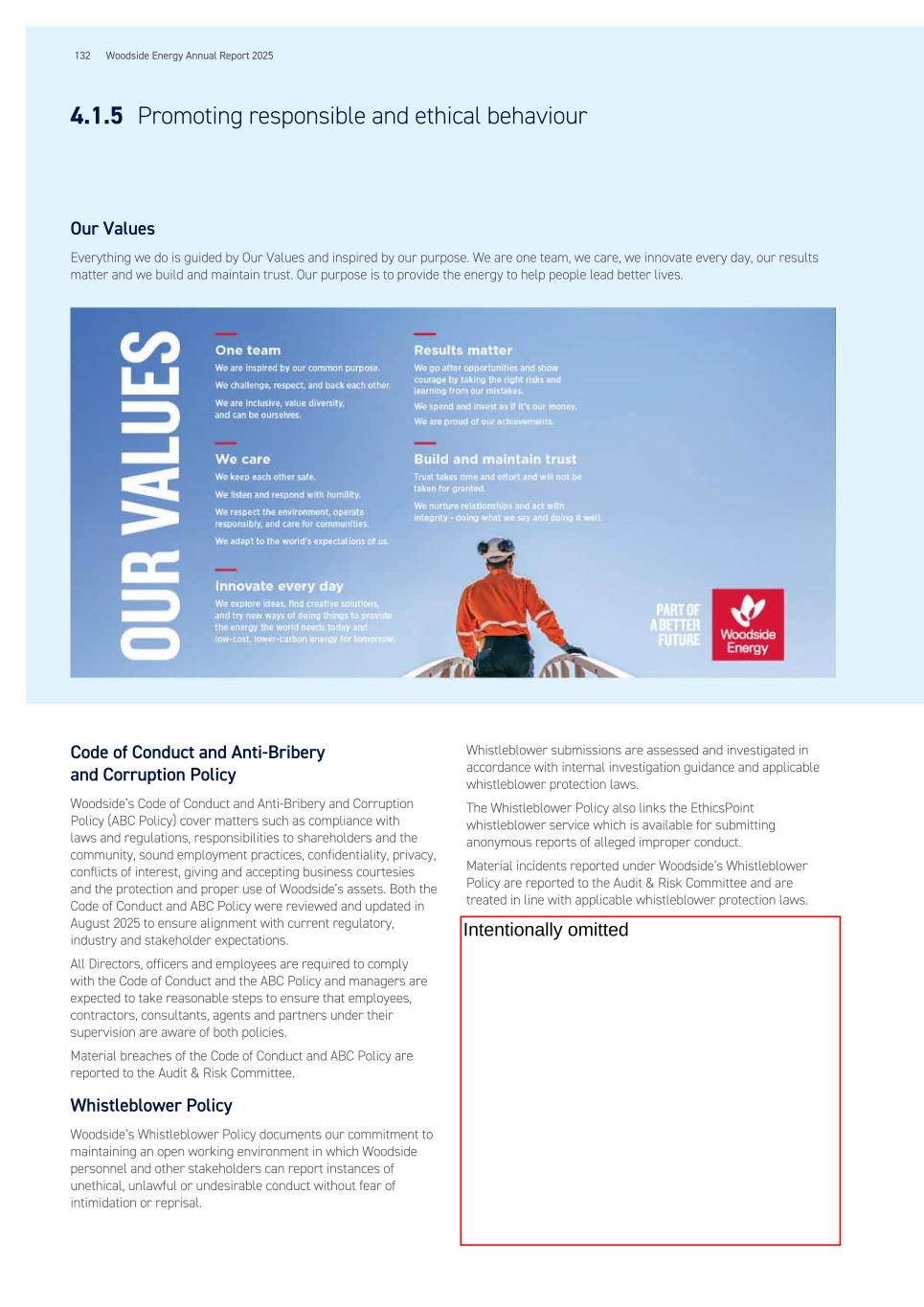
Code of Conduct and Anti-Bribery and Corruption Policy Woodside’s Code of Conduct and Anti-Bribery and Corruption Policy (ABC Policy) cover matters such as compliance with laws and regulations, responsibilities to shareholders and the community, sound employment practices, confidentiality, privacy, conflicts of interest, giving and accepting business courtesies and the protection and proper use of Woodside’s assets. Both the Code of Conduct and ABC Policy were reviewed and updated in August 2025 to ensure alignment with current regulatory, industry and stakeholder expectations. All Directors, officers and employees are required to comply with the Code of Conduct and the ABC Policy and managers are expected to take reasonable steps to ensure that employees, contractors, consultants, agents and partners under their supervision are aware of both policies. Material breaches of the Code of Conduct and ABC Policy are reported to the Audit & Risk Committee. Whistleblower Policy Woodside’s Whistleblower Policy documents our commitment to maintaining an open working environment in which Woodside personnel and other stakeholders can report instances of unethical, unlawful or undesirable conduct without fear of intimidation or reprisal. Whistleblower submissions are assessed and investigated in accordance with internal investigation guidance and applicable whistleblower protection laws. The Whistleblower Policy also links the EthicsPoint whistleblower service which is available for submitting anonymous reports of alleged improper conduct. Material incidents reported under Woodside’s Whistleblower Policy are reported to the Audit & Risk Committee and are treated in line with applicable whistleblower protection laws. Securities Dealing Policy The Woodside Board has adopted the Securities Dealing Policy, which governs the purchase, sale and other dealings of Woodside’s securities by Directors, senior management and employees, and seeks to promote compliance with applicable insider trading laws, rules and regulations. Woodside’s Securities Dealing Policy applies to all Directors, employees, contractors, consultants and advisers. It prohibits Directors and employees from dealing in Woodside’s securities when they are in possession of price-sensitive information that is not generally available to the market. It also prohibits dealings by Directors and certain restricted employees during ‘black-out’ periods, such as during the period between the end of the financial half and full-year and the day following the announcement of the results. The Securities Dealing Policy also sets out our approach to transactions which limit the economic risk of participating in equity- based remuneration schemes. 132 Woodside Energy Annual Report 2025 4.1.5 Promoting responsible and ethical behaviour Our Values Everything we do is guided by Our Values and inspired by our purpose. We are one team, we care, we innovate every day, our results matter and we build and maintain trust. Our purpose is to provide the energy to help people lead better lives.
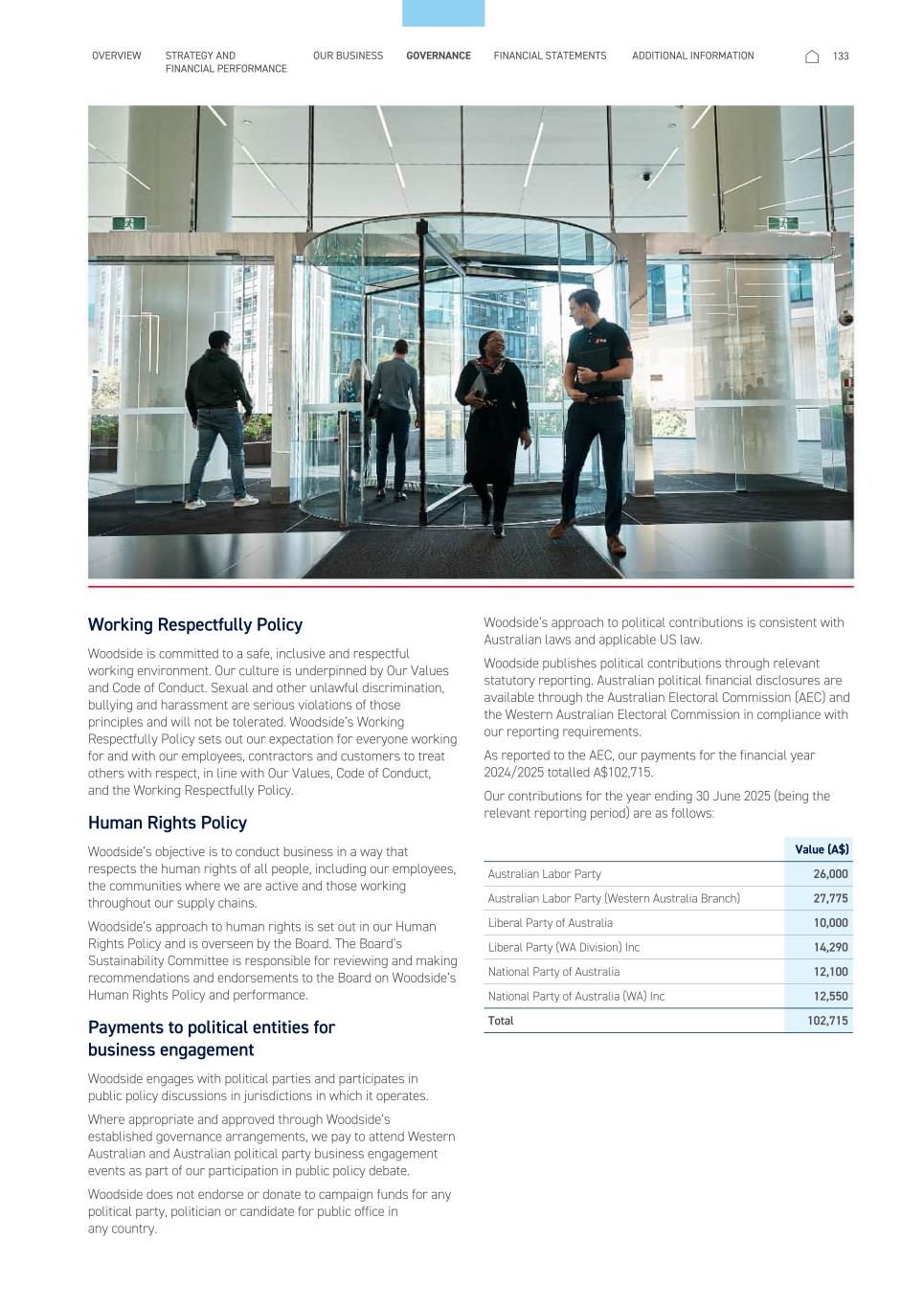
Working Respectfully Policy Woodside is committed to a safe, inclusive and respectful working environment. Our culture is underpinned by Our Values and Code of Conduct. Sexual and other unlawful discrimination, bullying and harassment are serious violations of those principles and will not be tolerated. Woodside’s Working Respectfully Policy sets out our expectation for everyone working for and with our employees, contractors and customers to treat others with respect, in line with Our Values, Code of Conduct, and the Working Respectfully Policy. Human Rights Policy Woodside’s objective is to conduct business in a way that respects the human rights of all people, including our employees, the communities where we are active and those working throughout our supply chains. Woodside’s approach to human rights is set out in our Human Rights Policy and is overseen by the Board. The Board’s Sustainability Committee is responsible for reviewing and making recommendations and endorsements to the Board on Woodside’s Human Rights Policy and performance. Payments to political entities for business engagement Woodside engages with political parties and participates in public policy discussions in jurisdictions in which it operates. Where appropriate and approved through Woodside’s established governance arrangements, we pay to attend Western Australian and Australian political party business engagement events as part of our participation in public policy debate. Woodside does not endorse or donate to campaign funds for any political party, politician or candidate for public office in any country. Woodside’s approach to political contributions is consistent with Australian laws and applicable US law. Woodside publishes political contributions through relevant statutory reporting. Australian political financial disclosures are available through the Australian Electoral Commission (AEC) and the Western Australian Electoral Commission in compliance with our reporting requirements. As reported to the AEC, our payments for the financial year 2024/2025 totalled A$102,715. Our contributions for the year ending 30 June 2025 (being the relevant reporting period) are as follows: Value (A$) Australian Labor Party 26,000 Australian Labor Party (Western Australia Branch) 27,775 Liberal Party of Australia 10,000 Liberal Party (WA Division) Inc 14,290 National Party of Australia 12,100 National Party of Australia (WA) Inc 12,550 Total 102,715 OVERVIEW STRATEGY AND FINANCIAL PERFORMANCE OUR BUSINESS GOVERNANCE FINANCIAL STATEMENTS ADDITIONAL INFORMATION 133
Risk management Approach to risk management Woodside recognises that taking risk is necessary for our business and that effective risk management is vital in meeting our objectives. We are committed to managing risks in an informed and effective manner that is appropriate to Woodside’s business. Our approach aims to support risk-informed decision-making and enable us to pursue the right opportunities while taking potential adverse impacts into account. The objective of our risk management framework is to foster a positive, risk-aware culture by integrating risk management and governance activities into our ways of working. Our risk process delivers a consolidated view of risks across the company to support the understanding of our full risk exposure and prioritise risk management and governance. Woodside’s Risk Management Policy describes the manner in which Woodside: • provides a consolidated view of risks across Woodside to understand risk exposure and prioritise risk management and governance • confers responsibility on Woodside staff at all levels to pro‑actively identify, assess and treat risks relating to the objectives they are accountable for delivering. The role of the Board and Audit & Risk Committee in risk management The Board is responsible for reviewing and approving Woodside’s risk management framework, policy and performance. The Board is also responsible for satisfying itself that management has developed and implemented an effective system of risk management and internal control. The Board has delegated oversight of the Risk Management Policy, including review (at least annually) of the effectiveness of Woodside’s internal control system and risk management framework, to the Audit & Risk Committee. The Audit & Risk Committee also regularly reviews Woodside’s Risk Appetite Statement, oversees Internal Audit’s activities and reviews Internal Audit’s performance. Management is responsible for promoting and applying the Risk Management Policy. In 2025, the Audit & Risk Committee reviewed and confirmed Woodside’s risk management framework was effective, and that Woodside was operating with due regard to the risk appetite endorsed by the Board. Internal audit function Internal Audit provides assurance that the design and operation of the Group’s risk management and internal control system is effective. A risk-based audit approach is used to ensure that higher risk activities are prioritised in the audit program. Internal Audit is independent of both business management and of the activities it reviews and has all necessary access to management and information to fulfil its role. Internal Audit is staffed by industry professionals including qualified accountants and engineers. The head of Internal Audit is jointly accountable to the Audit & Risk Committee and the Senior Vice President Legal and Group General Counsel. Governance, risk and compliance function The Governance, Risk and Compliance business group is responsible for Woodside’s risk management framework, and the development of risk management capability. It also provides risk management oversight to senior levels of management and the Audit & Risk Committee on the strategic, emerging and current risks, as well as the Group’s overall risk management performance. Material risks Our material exposure to risks (including environmental and social risks) and how they are managed are disclosed in Section 3.7 – Risk factors. External audit and reporting External auditor In accordance with Woodside’s External Auditor Policy, the Audit & Risk Committee oversees the engagement of Woodside’s external auditor, governed by the External Auditor Guidance Policy. PricewaterhouseCoopers (PwC) is the external auditor of the Group. Internal audit and external audit are separate and independent of each other. The Audit & Risk Committee evaluates the objectivity and independence of the external auditor and the quality and effectiveness of the external audit arrangements, including through: • review of all non-audit services for actual and perceived independence threats • confirmation that non-audit service fee commitment does not exceed 70% of audit fees for the year • confirmation that Woodside fees do not exceed 10% of PwC Perth aggregate revenues for the prior period • annual review of auditor performance. 134 Woodside Energy Annual Report 2025 4.1.6 Risk management and internal control
External auditor independence Woodside’s External Auditor Guidance Policy includes provisions directed at maintaining the independence of the external auditor and assessing whether the proposed provision of any non-audit services by the external auditor is appropriate. It classifies a range of non-audit services which could potentially be provided by the external auditor as acceptable within limits, requiring Audit & Risk Committee pre-approval or are not acceptable. The Audit & Risk Committee reviews the auditor independence annually. The Audit & Risk Committee did not waive the pre-approval requirement under paragraph (c)(7)(i) of Rule 2-01 of SEC Regulation S-X in 2025. PwC has been the external auditor of the Group since 2022. The remuneration of the auditors of $9.0 million (2024: $8.9 million) comprises audit fees of $7.8 million (2024: $7.4 million) representing 87% of total fees (2024: 83%), audit-related fees of $0.8 million (2024: $0.7 million) representing 9% of total fees (2024: 8%), and tax fees of $0.4 million (2024: $0.8 million) representing 4% of total fees (2024: 9%). The nature of the services comprising each category of fees is described below: • Audit – work that constitutes the agreed fees for the audit of Woodside’s consolidated financial statements, report on Woodside’s internal controls over financial reporting, and statutory audits of Woodside’s controlled entities (including interim reviews). • Audit-related – includes assurance services and agreed upon procedures. This is work that is outside the scope of the statutory audits of Woodside and its controlled entities but is consistent with the role of the external statutory auditor. The work is reasonably related to the performance of an audit or review, is of a compliance or procedural nature, and is work that the external auditors must or are best placed to undertake and is permissible within the framework of the Sarbanes-Oxley Act and other relevant independence standards. • Tax services – tax related work, including tax compliance services, that is outside the scope of the statutory audits of Woodside and its controlled entities but is permissible within the framework of the Sarbanes-Oxley Act and other relevant independence standards. • Other services – other work that is permissible within the framework of the Sarbanes-Oxley Act and other relevant independence standards. Verification of periodic corporate reports The Board has adopted a Continuous Disclosure and Market Communications Policy (Disclosure Policy) that applies to all disclosures to the market, including periodic corporate reports that are not reviewed or audited by an external auditor. Management has developed practices and guidance material that are intended to verify the integrity of and ensure that periodic corporate reports provide clear, concise and effective disclosure, in accordance with the Disclosure Policy. Authority has been delegated to the Disclosure Committee to ensure the implementation of the reporting and communications processes and controls set out in the Disclosure Policy and associated guidance material. Reports are prepared by, or under the supervision of, subject matter experts and material statements in the reports are reviewed for accuracy. Reports are also reviewed for compliance with applicable legal and regulatory requirements. This process is intended to ensure that all applicable laws, regulations and company policies have been complied with, and that appropriate approvals are obtained before a report is released to the market. CEO and CFO assurance Before approving the Financial Statements for a financial period, the Board receives from the CEO and CFO a declaration stating that: • in their opinion Woodside’s financial records have been properly maintained, comply with the appropriate accounting standards and give a true and fair view of Woodside’s financial position and performance; and • the above opinion has been formed on the basis of a sound system of risk management and internal control which is operating effectively; and • the consolidated entity disclosure statement required by Section 295(3A) of the Corporations Act 2001 (Cth) is true and correct as at 31 December 2025. OVERVIEW STRATEGY AND FINANCIAL PERFORMANCE OUR BUSINESS GOVERNANCE FINANCIAL STATEMENTS ADDITIONAL INFORMATION 135
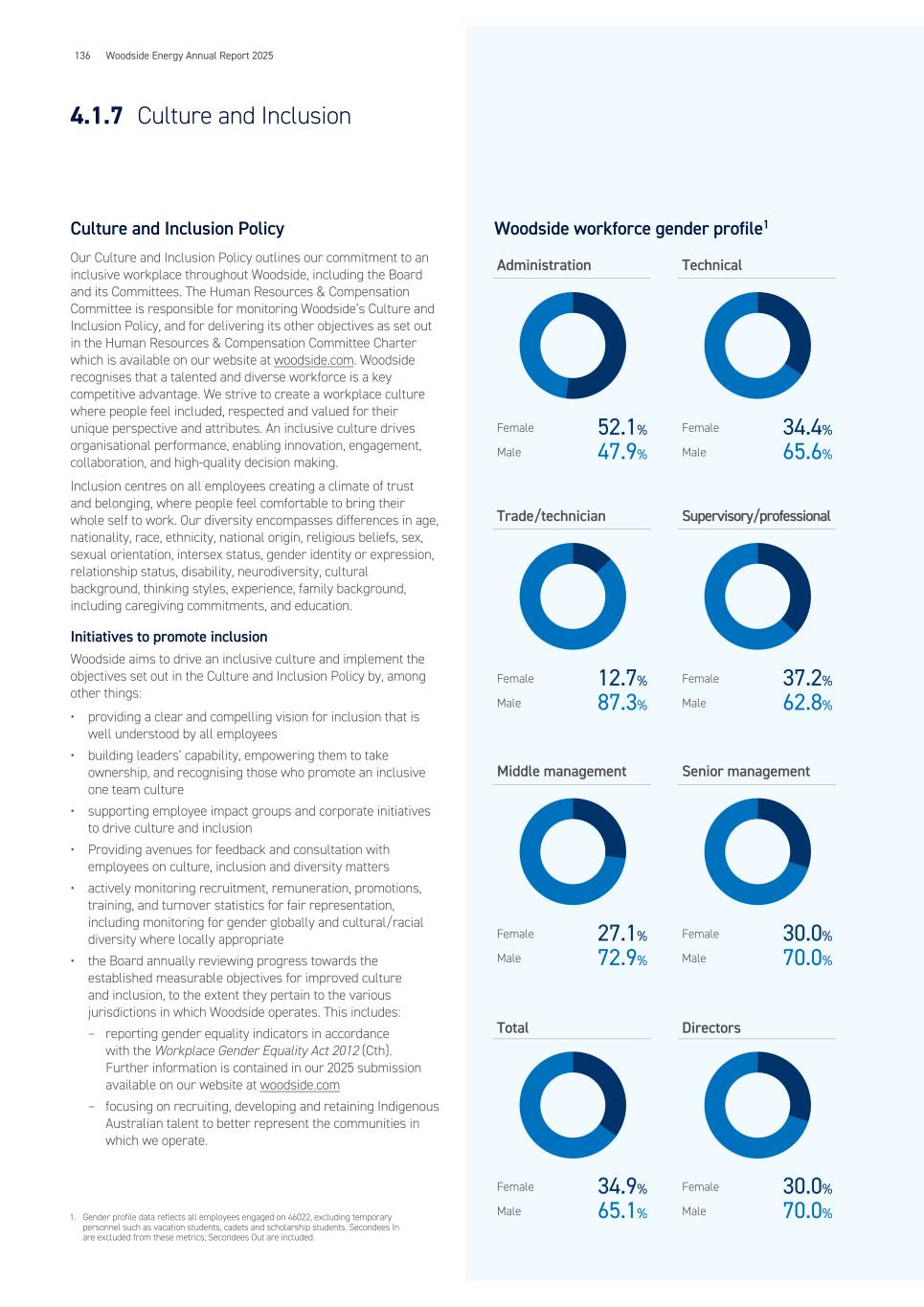
Culture and Inclusion Policy Our Culture and Inclusion Policy outlines our commitment to an inclusive workplace throughout Woodside, including the Board and its Committees. The Human Resources & Compensation Committee is responsible for monitoring Woodside’s Culture and Inclusion Policy, and for delivering its other objectives as set out in the Human Resources & Compensation Committee Charter which is available on our website at woodside.com. Woodside recognises that a talented and diverse workforce is a key competitive advantage. We strive to create a workplace culture where people feel included, respected and valued for their unique perspective and attributes. An inclusive culture drives organisational performance, enabling innovation, engagement, collaboration, and high-quality decision making. Inclusion centres on all employees creating a climate of trust and belonging, where people feel comfortable to bring their whole self to work. Our diversity encompasses differences in age, nationality, race, ethnicity, national origin, religious beliefs, sex, sexual orientation, intersex status, gender identity or expression, relationship status, disability, neurodiversity, cultural background, thinking styles, experience, family background, including caregiving commitments, and education. Initiatives to promote inclusion Woodside aims to drive an inclusive culture and implement the objectives set out in the Culture and Inclusion Policy by, among other things: • providing a clear and compelling vision for inclusion that is well understood by all employees • building leaders’ capability, empowering them to take ownership, and recognising those who promote an inclusive one team culture • supporting employee impact groups and corporate initiatives to drive culture and inclusion • Providing avenues for feedback and consultation with employees on culture, inclusion and diversity matters • actively monitoring recruitment, remuneration, promotions, training, and turnover statistics for fair representation, including monitoring for gender globally and cultural/racial diversity where locally appropriate • the Board annually reviewing progress towards the established measurable objectives for improved culture and inclusion, to the extent they pertain to the various jurisdictions in which Woodside operates. This includes: – reporting gender equality indicators in accordance with the Workplace Gender Equality Act 2012 (Cth). Further information is contained in our 2025 submission available on our website at woodside.com – focusing on recruiting, developing and retaining Indigenous Australian talent to better represent the communities in which we operate. Woodside workforce gender profile1 136 Woodside Energy Annual Report 2025 4.1.7 Culture and Inclusion Administration Technical Female 52.1% Female 34.4% Male 47.9% Male 65.6% Trade/technician Supervisory/professional Female 12.7% Female 37.2% Male 87.3% Male 62.8% Middle management Senior management Female 27.1% Female 30.0% Male 72.9% Male 70.0% Total Directors Female 34.9% Female 30.0% Male 65.1% Male 70.0%1. Gender profile data reflects all employees engaged on 46022, excluding temporary personnel such as vacation students, cadets and scholarship students. Secondees In are excluded from these metrics; Secondees Out are included.
2025 measurable objectives Our 2025 measurable objectives include objectives set out in our Culture and Inclusion Policy. Further information about Board and executive management diversity, including Board commitments to and progress on reaching Board gender equality of 40% male/40% female/20% either gender, is on page 138. Continue to track the perceived level of inclusion and use inclusion survey insights to inform initiatives to continually improve • The annual Our Voice employee survey was completed in 2025, resulting in an increased participation rate and increased scores in the majority of questions. We continue to focus on overall job satisfaction, culture and employee experience. Inclusion scores increased in 2025 and will continue to be a focus in the Culture and Inclusion strategy. Embed Respectful Behaviours at Woodside via increasing a “speak up” culture and proactive employee engagement on this topic • In 2025, 343 employees completed the 3.5 hour Working Better Together – Respectful Behaviours program across Perth, Houston and Karratha, with expansion to Mexico and Australian offshore assets scheduled for early 2026. • During 2025, 1042 employees completed leadership program immersions through the Navigator Leadership Program and 90 leaders completed the Inclusive Leadership Six Signature Traits course (comprising two half-day sessions). • We continue to proactively seek feedback on employees’ perception of safety in speaking up. In 2025, we ran multiple feedback surveys across a variety of topics: the Our Voice employee engagement survey; the Safe Space psychosocial hazards risk assessment; the Indigenous Cultural Safety Review; and the Respect at Woodside respectful behaviours survey. These results will help to inform our 2026 priorities. Ensure diversity of the Board with consideration for gender, racial and cultural diversity • As of 31 December 2025, Board diversity included: – 30% female representation – country based cultural diversity: Indigenous and non-Indigenous Australian, American, Singaporean Chinese, Indian, Greek and French – racial diversity: 20% Asian, 10% Indigenous Australian, 70% white/Caucasian. Increase the percentage of Indigenous Australian people employed in leadership roles, mid-career and senior roles and overall • The establishment of a specialised role dedicated to sourcing Indigenous talent saw mid-career representation rise from 1.3% in 2024 to 1.7% in 2025 (representing a 26.7% increase). • Overall participation (including pathway program participants) increased to 5.9% (from 5.8%). Make progress towards our aspirations to increase the percentage of females employed in leadership roles, trade and technician roles and overall • The percentage of females employed by Woodside: – in trade and technician roles increased to 12.7% (from 11.7%) – in leadership roles increased to 28.0% (from 27.8%) – increased overall to 34.9% (from 33.8%) • A culture and inclusion strategy was developed and implemented for the Trion project. Maintain gender balance and meet recruitment goals for Indigenous Australian peoples through all forms of entry to Woodside including pathway programs and experienced hires • The percentage of female recruits in 2025 was: – non-tertiary pathways: 63.2%2 – summer vacation students: 53.1% – graduates: 58.1% – experienced hires: 37.6%. • The percentage of recruits identifying as Indigenous Australian in 2025 was: – non-tertiary pathways: 52.6% – summer vacation students: 2.0% – graduates: 9.3% – experienced hires: 4.4%. Make progress towards building greater inclusion of people who are differently abled and/or neurodiverse • Progress has been made with the implementation of the three-year digital accessibility plan, including ways to embed improvements in procurement of software and hardware to meet Web Content Accessibility Guidelines. • The Workplace Adjustments Guide provides accessibility options for any employee needing them, and events have been held by the employee impact group ADAPT (Advocates for Different Abilities and Personal Traits) to raise awareness. Support LGBTIQA+ individuals to feel safe to be out at work • 433 employees completed LGBTIQA+ awareness training and a further 136 People Leaders completed targeted leader LGBTIQA+ training in 2025. • Woodside achieved gold status in the Australian Workplace Equality Index for LGBTQ workplace inclusion. Make progress towards achieving racial equity • Since its launch in 2024, 61.1% of Houston-based People Leaders have completed leader-specific training in Racial Equity. Similarly, since launching in 2022, 72.2% of Australian-based People Leaders have completed immersive Indigenous Australian leader-level training. in 2025, 93.8% of employees completed an Indigenous Australian cultural learning activity. • Woodside has launched its Roadmap Towards Australian Indigenous Cultural Safety to better understand employees’ perspectives and foster a workplace where Indigenous Australian employees feel safe, respected and valued. The Cape York Indigenous Leadership Development Program was successfully launched with 18 employees from Karratha and Perth completing the program. 2025 measurable objective Progress OVERVIEW STRATEGY AND FINANCIAL PERFORMANCE OUR BUSINESS GOVERNANCE FINANCIAL STATEMENTS ADDITIONAL INFORMATION 137 1. Gender balance in the US is defined as representative and reflective of the available talent pool. 2. Non-tertiary pathway data is based on third-party program recruitment information.
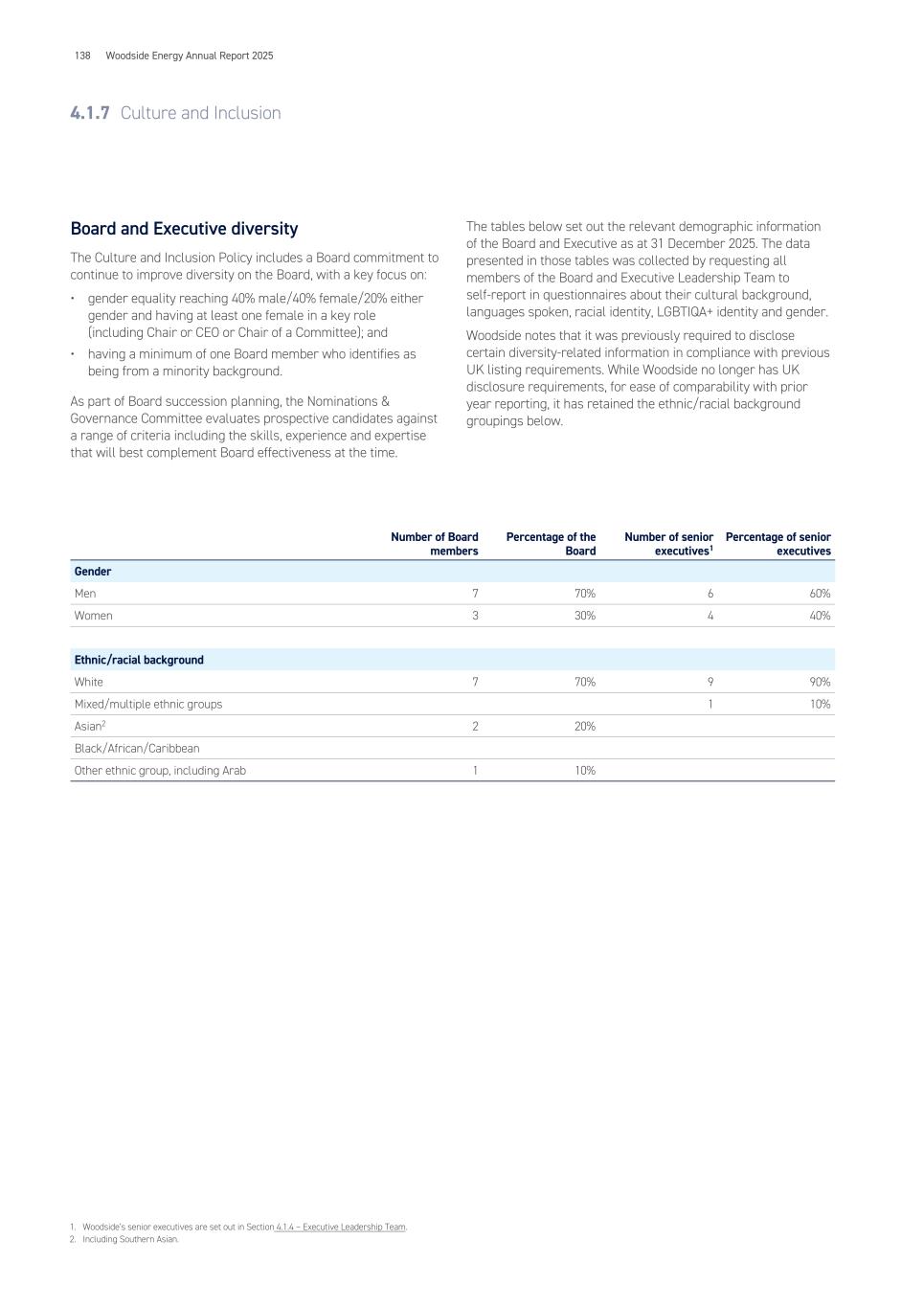
Board and Executive diversity The Culture and Inclusion Policy includes a Board commitment to continue to improve diversity on the Board, with a key focus on: • gender equality reaching 40% male/40% female/20% either gender and having at least one female in a key role (including Chair or CEO or Chair of a Committee); and • having a minimum of one Board member who identifies as being from a minority background. As part of Board succession planning, the Nominations & Governance Committee evaluates prospective candidates against a range of criteria including the skills, experience and expertise that will best complement Board effectiveness at the time. The tables below set out the relevant demographic information of the Board and Executive as at 31 December 2025. The data presented in those tables was collected by requesting all members of the Board and Executive Leadership Team to self‑report in questionnaires about their cultural background, languages spoken, racial identity, LGBTIQA+ identity and gender. Woodside notes that it was previously required to disclose certain diversity-related information in compliance with previous UK listing requirements. While Woodside no longer has UK disclosure requirements, for ease of comparability with prior year reporting, it has retained the ethnic/racial background groupings below. Number of Board members Percentage of the Board Number of senior executives1 Percentage of senior executives Gender Men 7 70% 6 60% Women 3 30% 4 40% Ethnic/racial background White 7 70% 9 90% Mixed/multiple ethnic groups 1 10% Asian2 2 20% Black/African/Caribbean Other ethnic group, including Arab 1 10% 138 Woodside Energy Annual Report 2025 4.1.7 Culture and Inclusion 1. Woodside’s senior executives are set out in Section 4.1.4 – Executive Leadership Team. 2. Including Southern Asian.
Evaluation of disclosure controls and procedures Woodside’s management, with the participation of its CEO and CFO, have evaluated, as required by Rule 13a-15(b) under the US Securities Exchange Act of 1934 (Exchange Act), the effectiveness of Woodside’s disclosure controls and procedures (as defined in Exchange Act Rule 13a-15(e)) as at 31 December 2025. Based on that evaluation, the CEO and CFO concluded that Woodside’s disclosure controls and procedures were effective, as at 31 December 2025. These controls and procedures are designed to ensure that information required to be disclosed by Woodside in the reports that it files or submits under the Exchange Act is recorded, processed, summarised and reported within the time periods specified in the SEC’s rules and forms, including that such information is accumulated and communicated to Woodside’s management, including the CEO and CFO, to allow timely decisions regarding required disclosure. Management’s annual report on internal control over financial reporting The management of Woodside is responsible for establishing and maintaining adequate internal control over financial reporting (as defined in Rule 13a-15(f) and Rule 15d-15(f) under the Exchange Act). Under the supervision and with the participation of management, including our CEO and CFO, the effectiveness of Woodside’s internal controls over financial reporting was evaluated based on the framework and criteria established in Internal Controls – Integrated Framework (2013), issued by the Committee of the Sponsoring Organizations of the Treadway Commission. Based on this evaluation, management concluded that internal control over financial reporting was effective as at 31 December 2025. Due to its inherent limitations, internal control over financial reporting may not prevent or detect misstatements and, even when determined to be effective, can only provide reasonable assurance with respect to financial statement preparation and presentation. Projections of any evaluation of effectiveness to future periods are subject to the risk that controls may become inadequate because of changes in conditions, or the degree of compliance with the policies or procedures may deteriorate. Changes in internal control over financial reporting There were no changes in our internal control over financial reporting during FY2025 that materially affected or were reasonably likely to materially affect our internal control over financial reporting. Attestation report of the registered public accounting firm The effectiveness of internal control over financial reporting as of 31 December 2025 has been audited by PricewaterhouseCoopers, an independent registered accounting firm that also audits Woodside’s Financial Statements. Their audit report on the internal control over financial reporting is included in the Form 20-F. Differences from NYSE corporate governance requirements Woodside’s American Depositary Shares are listed on the New York Stock Exchange (NYSE) and, accordingly, Woodside is subject to the listing standards of the NYSE (NYSE Listing Rules). The NYSE Listing Rules include certain accommodations in the corporate governance requirements that allow foreign private issuers, such as Woodside, to follow ‘home country’ corporate governance practices in lieu of the otherwise applicable corporate governance standards of the NYSE. Woodside has elected to comply with certain home country rules instead of the applicable NYSE requirements, as more fully described below. Woodside may in the future decide to use other foreign private issuer exemptions with respect to other NYSE Listing Rules. Following Woodside’s home country governance practices, as opposed to the requirements that would otherwise apply to a company listed on the NYSE, may provide less protection than is accorded to investors under the NYSE Listing Rules applicable to US domestic issuers. If, at any time, Woodside ceases to be a foreign private issuer, it would be subject to the SEC and NYSE Listing Rules applicable to US domestic companies. Quorum The NYSE Listing Rules generally require that a listed company’s by-laws provide for a quorum for any meeting of the holders of such company’s voting shares that is sufficiently high to ensure a representative vote. Pursuant to the NYSE Listing Rules, Woodside, as a foreign private issuer, has elected to comply with practices that are permitted under Australian securities laws in lieu of the provisions of the NYSE Listing Rules. The Woodside Energy Group Ltd Constitution provides that a quorum for a meeting of Woodside shareholders is three eligible Woodside shareholders entitled to vote. OVERVIEW STRATEGY AND FINANCIAL PERFORMANCE OUR BUSINESS GOVERNANCE FINANCIAL STATEMENTS ADDITIONAL INFORMATION 139 4.1.8 Other governance disclosures
Audit committee requirements Under Section 303A.06 of the NYSE Listing Rules and the requirements of Rule 10A-3 under the Exchange Act (Rule 10A‑3), a US listed company is required to have an audit committee of such company’s board of directors consisting entirely of independent members that comply with the requirements of Rule 10A-3. In addition, the audit committee must have a written charter which is compliant with the requirements of Section 303A.07(b) of the NYSE Listing Rules, the listed company must have an internal audit function and the listed company must fulfil all other requirements of the NYSE Listing Rules and Rule 10A-3. Foreign private issuers must comply with the audit committee standard set forth in Rule 10A-3, subject to limited exemptions, but may elect to follow ‘home country’ practices in lieu of the additional audit committee requirements in the NYSE Listing Rules. Rule 10A-3 requires NYSE-listed companies to ensure their audit committees are directly responsible for the appointment, compensation, retention and oversight of the work of the external auditor unless Woodside’s governing law or documents or other home country legal requirements require or permit shareholders to ultimately vote on or approve these matters. While Woodside’s Audit & Risk Committee is directly responsible for remuneration and oversight of the external auditor, ultimate responsibility for the appointment of the external auditor rests with Woodside shareholders, in accordance with Australian law and the Woodside Energy Group Ltd Constitution. However, in accordance with the limited exemptions set forth in Rule 10A-3, the Audit & Risk Committee is responsible for the annual auditor engagement and if there is any proposal to change auditors, the Committee does make recommendations to the Woodside Board on any change of auditor, which are then considered by Woodside shareholders at the Annual General Meeting. Further information on Audit and Risk Committee requirements under the ASX Recommendations is contained in Section 4.1.3 – Board committees – Audit & Risk Committee. Compensation committee Under Section 303A.05 of the NYSE Listing Rules, a US listed company is required to have a compensation committee consisting entirely of independent directors and adopt a written charter that, at a minimum, confers responsibility to that committee to review and approve corporate goals and objectives relevant to CEO compensation, evaluate the CEO’s performance in light of those goals and objectives and, either as a committee or together with the other independent directors (as directed by the board), determine and approve the CEO’s compensation level based on this evaluation. Under Woodside’s Human Resources & Compensation Committee (HRCC) Charter, the HRCC reviews and makes recommendations to the Board on the CEO’s remuneration arrangements and the criteria for evaluating the CEO’s performance. The Board then considers and approves the CEO’s remuneration and associated performance goals. Further information on the HRCC’s role is contained in Section 4.1.3 – Board committees – Human Resources & Compensation Committee and in the HRCC Charter. Shareholder approval requirements for issues under equity plans Under Section 303A.08 of the NYSE Listing Rules, shareholders must be given the opportunity to vote on all equity compensation plans and any material revisions to such plans, subject to certain exemptions. Under Australian law, Woodside is not required to seek shareholder approval for all equity compensation plans or revisions to such plans. Shareholder approval is required for issues of shares to Directors. The Remuneration Report, which is voted on by shareholders at the Annual General Meeting, describes the remuneration arrangements for the Board and senior executives. All incentive rewards offered to Directors and/or executives are designed to operate within Woodside’s remuneration framework. Further information is set out in in Section 4.3 – Remuneration Report. Code of Conduct The Woodside Board has adopted the Code of Conduct, which applies to the Woodside Board and Woodside’s CEO and CFO, along with all other Woodside employees. Further information on the Code of Conduct is contained in Section 4.1.5 – Promoting responsible and ethical behaviour. 140 Woodside Energy Annual Report 2025 4.1.8 Other governance disclosures
Shareholder communications Our website provides up-to-date information about Woodside, our corporate governance and policies, the Board and management, ASX announcements, SEC reports, the share price, dividend distributions and other relevant information. Shareholders are encouraged to receive electronic communications from Woodside and can elect to receive email notification when key materials are posted to our website. Shareholders can also receive an email notification of Woodside’s announcements and media releases. Shareholders can communicate directly with Woodside by submitting questions or comments on the ‘Contact’ section of our website. The ‘Investors’ section of our website also sets out the contact details for Woodside’s share registry, Computershare. Investor relations program Woodside has an investor relations program to facilitate effective two-way communication with investors. Our Continuous Disclosure and Market Communications Policy facilitates this by requiring: • the full and timely disclosure of information about Woodside’s material activities to the ASX and NYSE, and our website (where they are retained for at least three years) • that all disclosures, including notices of meetings and other shareholder communications, are drafted clearly and concisely • the conduct of briefings for investors from time to time (such as the annual and half-year results, and investor briefing days). Major investor briefings are webcast and presentation material for briefings or speeches containing new and substantive information is first disclosed to the market and other relevant exchanges and posted to our website. Shareholder meetings Woodside recognises the importance of shareholder participation in general meetings and facilitates and encourages that participation. Woodside has direct voting arrangements in place, allowing shareholders unable to attend the AGM to vote on resolutions without having to appoint someone else as a proxy. Voting on any substantial resolution at an AGM is conducted by poll. Continuous disclosure and market communications Woodside’s Continuous Disclosure and Market Communications Policy and associated guidelines reinforce Woodside’s commitment to continuous disclosure and outline management’s accountabilities and the processes to be followed for ensuring compliance. A Disclosure Committee manages compliance with market disclosure obligations and is responsible for implementing and overseeing reporting processes and controls and setting guidelines for the release of information. The Disclosure Committee is comprised of senior leaders. Employees considered to hold higher risk roles are required to participate in annual continuous disclosure training. The Board and senior executives are provided with copies of all information disclosed pursuant to all applicable stock exchange rules promptly after their disclosure. OVERVIEW STRATEGY AND FINANCIAL PERFORMANCE OUR BUSINESS GOVERNANCE FINANCIAL STATEMENTS ADDITIONAL INFORMATION 141 4.1.9 Shareholders
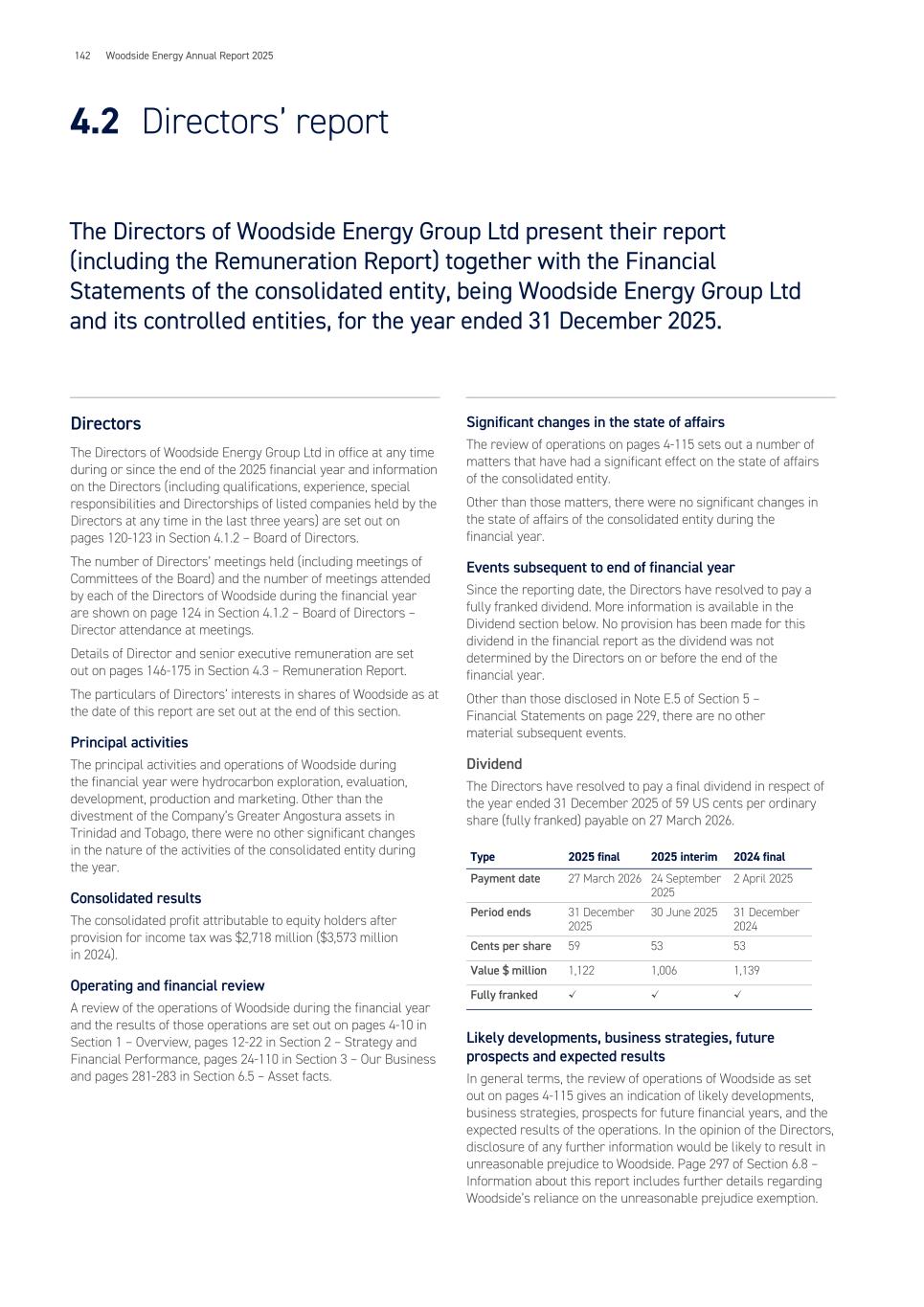
Directors The Directors of Woodside Energy Group Ltd in office at any time during or since the end of the 2025 financial year and information on the Directors (including qualifications, experience, special responsibilities and Directorships of listed companies held by the Directors at any time in the last three years) are set out on pages 120-123 in Section 4.1.2 – Board of Directors. The number of Directors’ meetings held (including meetings of Committees of the Board) and the number of meetings attended by each of the Directors of Woodside during the financial year are shown on page 124 in Section 4.1.2 – Board of Directors – Director attendance at meetings. Details of Director and senior executive remuneration are set out on pages 146-175 in Section 4.3 – Remuneration Report. The particulars of Directors’ interests in shares of Woodside as at the date of this report are set out at the end of this section. Principal activities The principal activities and operations of Woodside during the financial year were hydrocarbon exploration, evaluation, development, production and marketing. Other than the divestment of the Company’s Greater Angostura assets in Trinidad and Tobago, there were no other significant changes in the nature of the activities of the consolidated entity during the year. Consolidated results The consolidated profit attributable to equity holders after provision for income tax was $2,718 million ($3,573 million in 2024). Operating and financial review A review of the operations of Woodside during the financial year and the results of those operations are set out on pages 4-10 in Section 1 – Overview, pages 12-22 in Section 2 – Strategy and Financial Performance, pages 24-110 in Section 3 – Our Business and pages 281-283 in Section 6.5 – Asset facts. Significant changes in the state of affairs The review of operations on pages 4-115 sets out a number of matters that have had a significant effect on the state of affairs of the consolidated entity. Other than those matters, there were no significant changes in the state of affairs of the consolidated entity during the financial year. Events subsequent to end of financial year Since the reporting date, the Directors have resolved to pay a fully franked dividend. More information is available in the Dividend section below. No provision has been made for this dividend in the financial report as the dividend was not determined by the Directors on or before the end of the financial year. Other than those disclosed in Note E.5 of Section 5 – Financial Statements on page 229, there are no other material subsequent events. Dividend The Directors have resolved to pay a final dividend in respect of the year ended 31 December 2025 of 59 US cents per ordinary share (fully franked) payable on 27 March 2026. Type 2025 final 2025 interim 2024 final Payment date 27 March 2026 24 September 2025 2 April 2025 Period ends 31 December 2025 30 June 2025 31 December 2024 Cents per share 59 53 53 Value $ million 1,122 1,006 1,139 Fully franked ✓ ✓ ✓ Likely developments, business strategies, future prospects and expected results In general terms, the review of operations of Woodside as set out on pages 4-115 gives an indication of likely developments, business strategies, prospects for future financial years, and the expected results of the operations. In the opinion of the Directors, disclosure of any further information would be likely to result in unreasonable prejudice to Woodside. Page 297 of Section 6.8 – Information about this report includes further details regarding Woodside’s reliance on the unreasonable prejudice exemption. 142 Woodside Energy Annual Report 2025 4.2 Directors’ report The Directors of Woodside Energy Group Ltd present their report (including the Remuneration Report) together with the Financial Statements of the consolidated entity, being Woodside Energy Group Ltd and its controlled entities, for the year ended 31 December 2025.
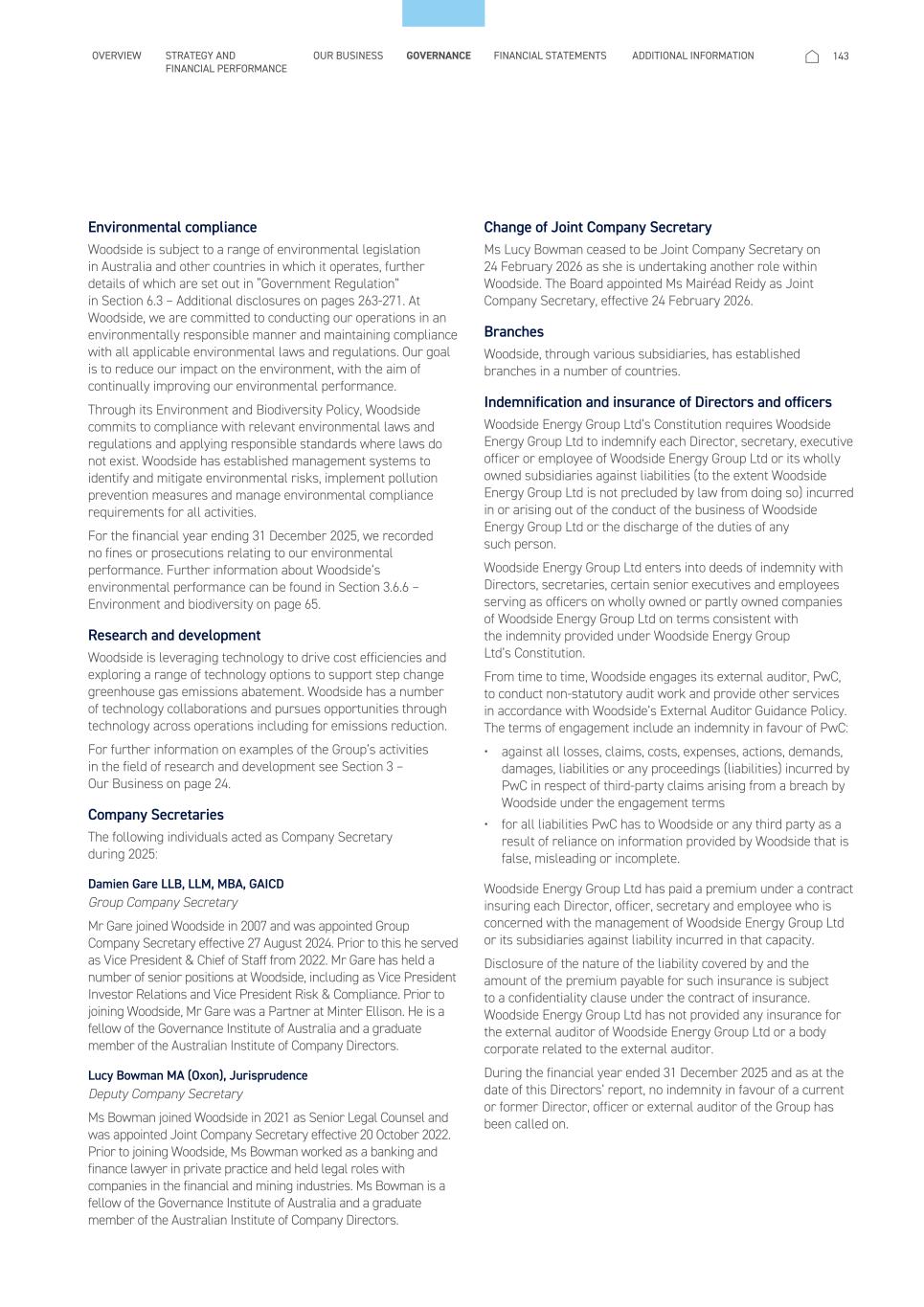
Environmental compliance Woodside is subject to a range of environmental legislation in Australia and other countries in which it operates, further details of which are set out in “Government Regulation” in Section 6.3 – Additional disclosures on pages 263-271. At Woodside, we are committed to conducting our operations in an environmentally responsible manner and maintaining compliance with all applicable environmental laws and regulations. Our goal is to reduce our impact on the environment, with the aim of continually improving our environmental performance. Through its Environment and Biodiversity Policy, Woodside commits to compliance with relevant environmental laws and regulations and applying responsible standards where laws do not exist. Woodside has established management systems to identify and mitigate environmental risks, implement pollution prevention measures and manage environmental compliance requirements for all activities. For the financial year ending 31 December 2025, we recorded no fines or prosecutions relating to our environmental performance. Further information about Woodside’s environmental performance can be found in Section 3.6.6 – Environment and biodiversity on page 65. Research and development Woodside is leveraging technology to drive cost efficiencies and exploring a range of technology options to support step change greenhouse gas emissions abatement. Woodside has a number of technology collaborations and pursues opportunities through technology across operations including for emissions reduction. For further information on examples of the Group’s activities in the field of research and development see Section 3 – Our Business on page 24. Company Secretaries The following individuals acted as Company Secretary during 2025: Damien Gare LLB, LLM, MBA, GAICD Group Company Secretary Mr Gare joined Woodside in 2007 and was appointed Group Company Secretary effective 27 August 2024. Prior to this he served as Vice President & Chief of Staff from 2022. Mr Gare has held a number of senior positions at Woodside, including as Vice President Investor Relations and Vice President Risk & Compliance. Prior to joining Woodside, Mr Gare was a Partner at Minter Ellison. He is a fellow of the Governance Institute of Australia and a graduate member of the Australian Institute of Company Directors. Lucy Bowman MA (Oxon), Jurisprudence Deputy Company Secretary Ms Bowman joined Woodside in 2021 as Senior Legal Counsel and was appointed Joint Company Secretary effective 20 October 2022. Prior to joining Woodside, Ms Bowman worked as a banking and finance lawyer in private practice and held legal roles with companies in the financial and mining industries. Ms Bowman is a fellow of the Governance Institute of Australia and a graduate member of the Australian Institute of Company Directors. Change of Joint Company Secretary Ms Lucy Bowman ceased to be Joint Company Secretary on 24 February 2026 as she is undertaking another role within Woodside. The Board appointed Ms Mairéad Reidy as Joint Company Secretary, effective 24 February 2026. Branches Woodside, through various subsidiaries, has established branches in a number of countries. Indemnification and insurance of Directors and officers Woodside Energy Group Ltd’s Constitution requires Woodside Energy Group Ltd to indemnify each Director, secretary, executive officer or employee of Woodside Energy Group Ltd or its wholly owned subsidiaries against liabilities (to the extent Woodside Energy Group Ltd is not precluded by law from doing so) incurred in or arising out of the conduct of the business of Woodside Energy Group Ltd or the discharge of the duties of any such person. Woodside Energy Group Ltd enters into deeds of indemnity with Directors, secretaries, certain senior executives and employees serving as officers on wholly owned or partly owned companies of Woodside Energy Group Ltd on terms consistent with the indemnity provided under Woodside Energy Group Ltd’s Constitution. From time to time, Woodside engages its external auditor, PwC, to conduct non-statutory audit work and provide other services in accordance with Woodside’s External Auditor Guidance Policy. The terms of engagement include an indemnity in favour of PwC: • against all losses, claims, costs, expenses, actions, demands, damages, liabilities or any proceedings (liabilities) incurred by PwC in respect of third-party claims arising from a breach by Woodside under the engagement terms • for all liabilities PwC has to Woodside or any third party as a result of reliance on information provided by Woodside that is false, misleading or incomplete. Woodside Energy Group Ltd has paid a premium under a contract insuring each Director, officer, secretary and employee who is concerned with the management of Woodside Energy Group Ltd or its subsidiaries against liability incurred in that capacity. Disclosure of the nature of the liability covered by and the amount of the premium payable for such insurance is subject to a confidentiality clause under the contract of insurance. Woodside Energy Group Ltd has not provided any insurance for the external auditor of Woodside Energy Group Ltd or a body corporate related to the external auditor. During the financial year ended 31 December 2025 and as at the date of this Directors’ report, no indemnity in favour of a current or former Director, officer or external auditor of the Group has been called on. OVERVIEW STRATEGY AND FINANCIAL PERFORMANCE OUR BUSINESS GOVERNANCE FINANCIAL STATEMENTS ADDITIONAL INFORMATION 143
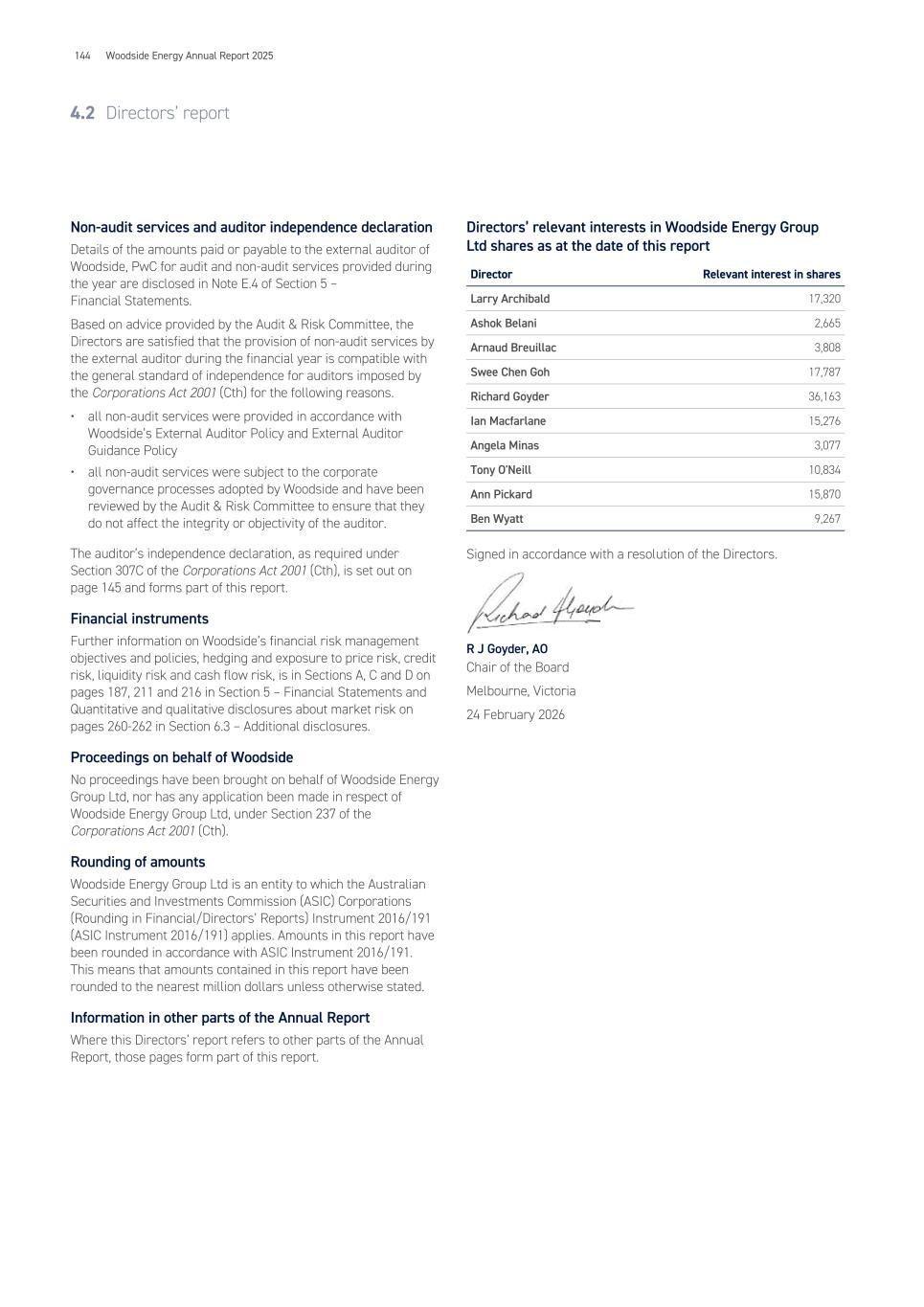
Non-audit services and auditor independence declaration Details of the amounts paid or payable to the external auditor of Woodside, PwC for audit and non-audit services provided during the year are disclosed in Note E.4 of Section 5 – Financial Statements. Based on advice provided by the Audit & Risk Committee, the Directors are satisfied that the provision of non-audit services by the external auditor during the financial year is compatible with the general standard of independence for auditors imposed by the Corporations Act 2001 (Cth) for the following reasons. • all non-audit services were provided in accordance with Woodside’s External Auditor Policy and External Auditor Guidance Policy • all non-audit services were subject to the corporate governance processes adopted by Woodside and have been reviewed by the Audit & Risk Committee to ensure that they do not affect the integrity or objectivity of the auditor. The auditor’s independence declaration, as required under Section 307C of the Corporations Act 2001 (Cth), is set out on page 145 and forms part of this report. Financial instruments Further information on Woodside’s financial risk management objectives and policies, hedging and exposure to price risk, credit risk, liquidity risk and cash flow risk, is in Sections A, C and D on pages 187, 211 and 216 in Section 5 – Financial Statements and Quantitative and qualitative disclosures about market risk on pages 260-262 in Section 6.3 – Additional disclosures. Proceedings on behalf of Woodside No proceedings have been brought on behalf of Woodside Energy Group Ltd, nor has any application been made in respect of Woodside Energy Group Ltd, under Section 237 of the Corporations Act 2001 (Cth). Rounding of amounts Woodside Energy Group Ltd is an entity to which the Australian Securities and Investments Commission (ASIC) Corporations (Rounding in Financial/Directors’ Reports) Instrument 2016/191 (ASIC Instrument 2016/191) applies. Amounts in this report have been rounded in accordance with ASIC Instrument 2016/191. This means that amounts contained in this report have been rounded to the nearest million dollars unless otherwise stated. Information in other parts of the Annual Report Where this Directors’ report refers to other parts of the Annual Report, those pages form part of this report. Directors’ relevant interests in Woodside Energy Group Ltd shares as at the date of this report Director Relevant interest in shares Larry Archibald 17,320 Ashok Belani 2,665 Arnaud Breuillac 3,808 Swee Chen Goh 17,787 Richard Goyder 36,163 Ian Macfarlane 15,276 Angela Minas 3,077 Tony O'Neill 10,834 Ann Pickard 15,870 Ben Wyatt 9,267 Signed in accordance with a resolution of the Directors. R J Goyder, AO Chair of the Board Melbourne, Victoria 24 February 2026 144 Woodside Energy Annual Report 2025 4.2 Directors’ report

Auditor independence declaration to the Directors of Woodside Energy Group Ltd OVERVIEW STRATEGY AND FINANCIAL PERFORMANCE OUR BUSINESS GOVERNANCE FINANCIAL STATEMENTS ADDITIONAL INFORMATION 145
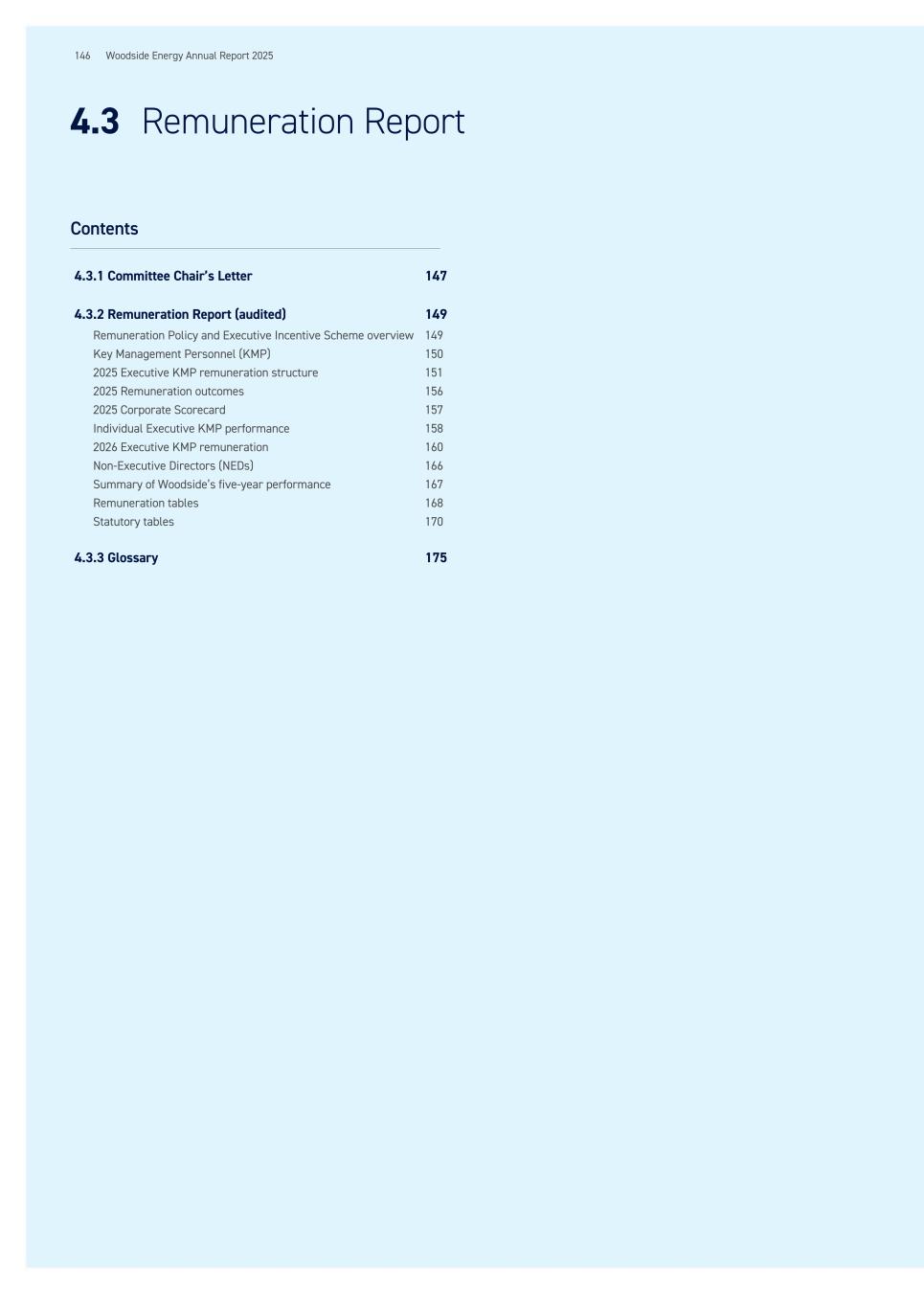
Contents 4.3.1 Committee Chair’s Letter 147 4.3.2 Remuneration Report (audited) 149 Remuneration Policy and Executive Incentive Scheme overview 149 Key Management Personnel (KMP) 150 2025 Executive KMP remuneration structure 151 2025 Remuneration outcomes 156 2025 Corporate Scorecard 157 Individual Executive KMP performance 158 2026 Executive KMP remuneration 160 Non-Executive Directors (NEDs) 166 Summary of Woodside’s five-year performance 167 Remuneration tables 168 Statutory tables 170 4.3.3 Glossary 175 146 Woodside Energy Annual Report 2025 4.3 Remuneration Report
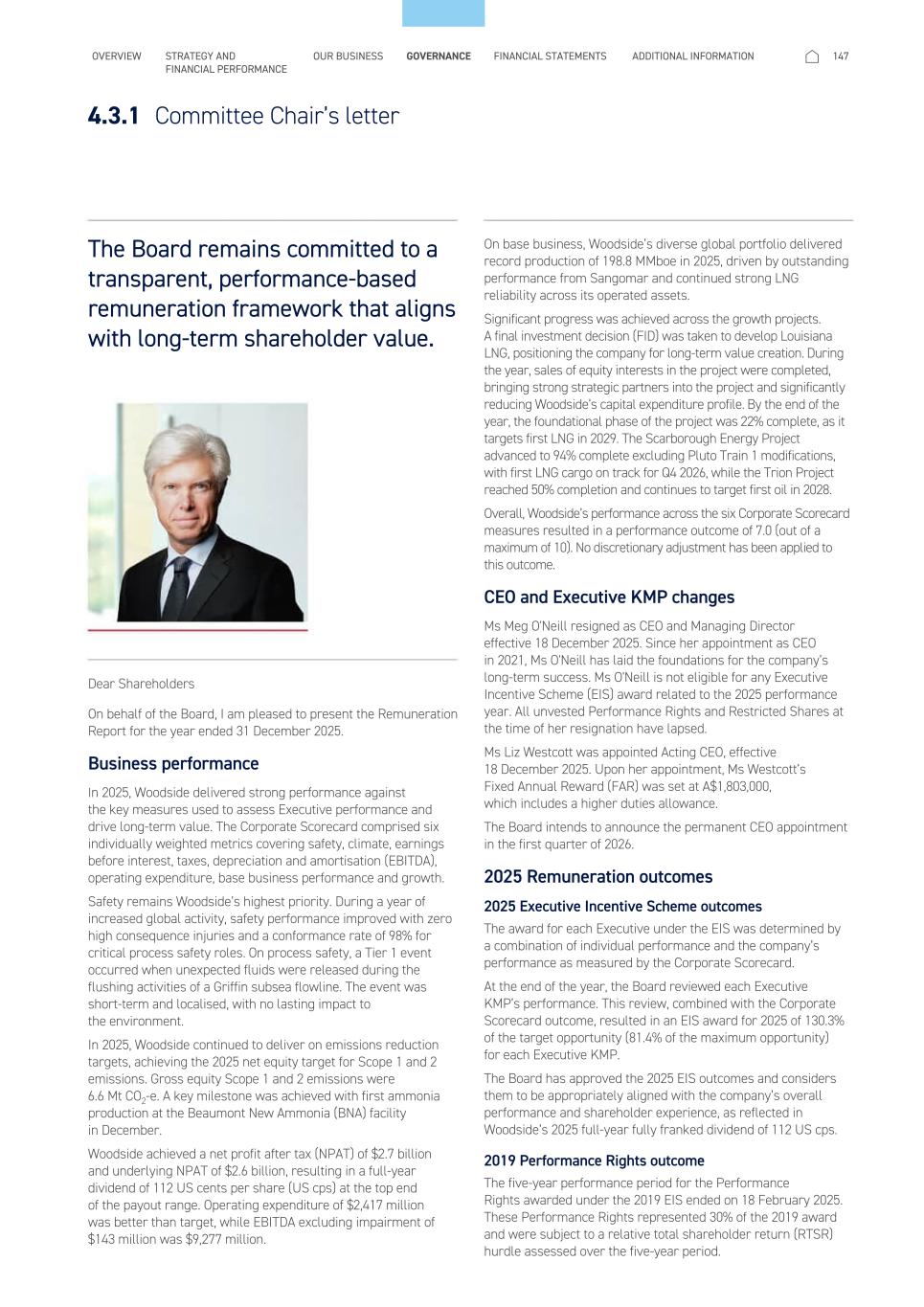
The Board remains committed to a transparent, performance-based remuneration framework that aligns with long-term shareholder value. Dear Shareholders On behalf of the Board, I am pleased to present the Remuneration Report for the year ended 31 December 2025. Business performance In 2025, Woodside delivered strong performance against the key measures used to assess Executive performance and drive long-term value. The Corporate Scorecard comprised six individually weighted metrics covering safety, climate, earnings before interest, taxes, depreciation and amortisation (EBITDA), operating expenditure, base business performance and growth. Safety remains Woodside’s highest priority. During a year of increased global activity, safety performance improved with zero high consequence injuries and a conformance rate of 98% for critical process safety roles. On process safety, a Tier 1 event occurred when unexpected fluids were released during the flushing activities of a Griffin subsea flowline. The event was short-term and localised, with no lasting impact to the environment. In 2025, Woodside continued to deliver on emissions reduction targets, achieving the 2025 net equity target for Scope 1 and 2 emissions. Gross equity Scope 1 and 2 emissions were 6.6 Mt CO2-e. A key milestone was achieved with first ammonia production at the Beaumont New Ammonia (BNA) facility in December. Woodside achieved a net profit after tax (NPAT) of $2.7 billion and underlying NPAT of $2.6 billion, resulting in a full-year dividend of 112 US cents per share (US cps) at the top end of the payout range. Operating expenditure of $2,417 million was better than target, while EBITDA excluding impairment of $143 million was $9,277 million. On base business, Woodside’s diverse global portfolio delivered record production of 198.8 MMboe in 2025, driven by outstanding performance from Sangomar and continued strong LNG reliability across its operated assets. Significant progress was achieved across the growth projects. A final investment decision (FID) was taken to develop Louisiana LNG, positioning the company for long-term value creation. During the year, sales of equity interests in the project were completed, bringing strong strategic partners into the project and significantly reducing Woodside’s capital expenditure profile. By the end of the year, the foundational phase of the project was 22% complete, as it targets first LNG in 2029. The Scarborough Energy Project advanced to 94% complete excluding Pluto Train 1 modifications, with first LNG cargo on track for Q4 2026, while the Trion Project reached 50% completion and continues to target first oil in 2028. Overall, Woodside’s performance across the six Corporate Scorecard measures resulted in a performance outcome of 7.0 (out of a maximum of 10). No discretionary adjustment has been applied to this outcome. CEO and Executive KMP changes Ms Meg O'Neill resigned as CEO and Managing Director effective 18 December 2025. Since her appointment as CEO in 2021, Ms O'Neill has laid the foundations for the company’s long-term success. Ms O'Neill is not eligible for any Executive Incentive Scheme (EIS) award related to the 2025 performance year. All unvested Performance Rights and Restricted Shares at the time of her resignation have lapsed. Ms Liz Westcott was appointed Acting CEO, effective 18 December 2025. Upon her appointment, Ms Westcott’s Fixed Annual Reward (FAR) was set at A$1,803,000, which includes a higher duties allowance. The Board intends to announce the permanent CEO appointment in the first quarter of 2026. 2025 Remuneration outcomes 2025 Executive Incentive Scheme outcomes The award for each Executive under the EIS was determined by a combination of individual performance and the company’s performance as measured by the Corporate Scorecard. At the end of the year, the Board reviewed each Executive KMP’s performance. This review, combined with the Corporate Scorecard outcome, resulted in an EIS award for 2025 of 130.3% of the target opportunity (81.4% of the maximum opportunity) for each Executive KMP. The Board has approved the 2025 EIS outcomes and considers them to be appropriately aligned with the company’s overall performance and shareholder experience, as reflected in Woodside’s 2025 full-year fully franked dividend of 112 US cps. 2019 Performance Rights outcome The five-year performance period for the Performance Rights awarded under the 2019 EIS ended on 18 February 2025. These Performance Rights represented 30% of the 2019 award and were subject to a relative total shareholder return (RTSR) hurdle assessed over the five-year period. OVERVIEW STRATEGY AND FINANCIAL PERFORMANCE OUR BUSINESS GOVERNANCE FINANCIAL STATEMENTS ADDITIONAL INFORMATION 147 4.3.1 Committee Chair’s letter
One-third of the Performance Rights were tested against the entities within the ASX50 index as of 1 December 2019, while the remaining two-thirds were assessed against an international oil and gas peer group. The performance conditions were not met and all Performance Rights awarded to the Former CEO and eligible Executive KMP lapsed. This outcome is consistent with the nil vesting of the 2018 Performance Rights in 2024. 2026 Executive KMP remuneration Following a review incorporating external benchmarking, the Board has approved increases to FAR for Mr Daniel Kalms and Mr Mark Abbotsford of 3%, for Ms Westcott of 6% and for Mr Graham Tiver of 8%, effective from 1 January 2026. The increases ensure remuneration remains competitive in both domestic and international markets. The Board considers retention of Executive KMP to be a priority, particularly following the resignation of Ms O’Neill. To maintain focus on the effective delivery of the company's strategy and provide leadership stability during the CEO transition and onboarding process, a retention award will be made to Mr Tiver, Mr Kalms and Mr Abbotsford in March 2026. The award will comprise Equity Rights to the value of A$750,000 for each Executive, awarded under the Supplementary Woodside Equity Plan, with vesting in December 2027.1 The offer will also extend to Ms Westcott, upon completion of her Acting CEO role, in the event she is not appointed into the role permanently. New incentive scheme for 2026 In 2026, the Board will introduce a new Variable Annual Reward (VAR) scheme to reflect investor feedback and provide additional opportunities to enhance alignment with Woodside’s strategy over the longer term. This new structure will include separate short-term incentive (STI) and long-term incentive (LTI) components for Executives, moving away from the current combined approach. Short-term incentive structure Executive performance under Woodside’s STI structure will be assessed annually, with 70% based on the Corporate Scorecard and 30% based on individual performance. At target, the STI will be delivered in two equal components: cash and Restricted Shares, with the Restricted Shares subject to a two-year deferral period. Any portion of the STI award above target will be delivered entirely as Restricted Shares. For 2026, the Safety and Climate measures on the Corporate Scorecard remain unchanged at 15% each, while Base Business and Growth have each reduced from 20% to 15% to accommodate an increase in the weighting of the financial measures from 30% to 40%. The EBITDA measure has been enhanced to include an underlying performance component, and Operating Expenditure has been replaced with Unit Production Cost to reflect Woodside’s focus on operational efficiency. The CEO’s target and maximum opportunity under the STI is subject to the appointment of a permanent CEO, while the target opportunity for Executive KMP is 150% of FAR, with a maximum opportunity of 225%. Long-term incentive structure Woodside’s LTI structure will be delivered through Performance Rights tested over a three-year period against two LTI hurdles, and will be subject to an additional two-year service condition after the end of the performance period. Of the Performance Rights awarded, 60% will be assessed against RTSR, with one-third evaluated against entities in the ASX50 index, and two-thirds against entities in the MSCI World Energy Index. In response to investor feedback, the Board has introduced a second hurdle, with 40% of the Performance Rights assessed against return on average capital employed (ROACE). ROACE provides a robust and complementary measure to RTSR, reinforcing disciplined capital allocation and supporting long-term value creation. The CEO’s LTI opportunity is subject to the appointment of a permanent CEO. The LTI opportunity for Executive KMP is 200% of FAR. Chair and Non-Executive Directors fees Fees for the Chair and Non-Executive Directors are reviewed annually with the support of external benchmarking. As a result of this review, the Board approved an increase of approximately 3% to annual Board and Committee fees, effective 1 January 2026. The Human Resources & Compensation Committee (HR&CC) and Sustainability Committee Chair fees increased by approximately 6% to align more closely with the median of the ASX20. The increases ensure fees remain market competitive and reflect the broad scope of responsibilities and workload as Woodside continues to deliver growth and value creation. Conclusion The Board believes that the 2025 remuneration outcomes appropriately reflect Woodside’s performance and shareholder experience. The revised incentive structure for 2026 has taken into account investor feedback and is designed to drive strong near-term performance while strengthening alignment with long‑term value creation through a higher proportion of variable reward delivered as Performance Rights. It further enhances alignment between Executive outcomes and Woodside’s strategic objectives, while supporting the company’s ability to attract, retain and motivate Executive talent in an increasingly competitive global market. Refer to pages 160-165 for further information on these changes. Thank you for your ongoing support. I look forward to our continued engagement and sharing in Woodside’s future successes. Arnaud Breuillac Chair of Human Resources & Compensation Committee 24 February 2026 148 Woodside Energy Annual Report 2025 4.3.1 Committee Chair’s Letter continued 1. Equivalent to 31,281 Equity Rights.
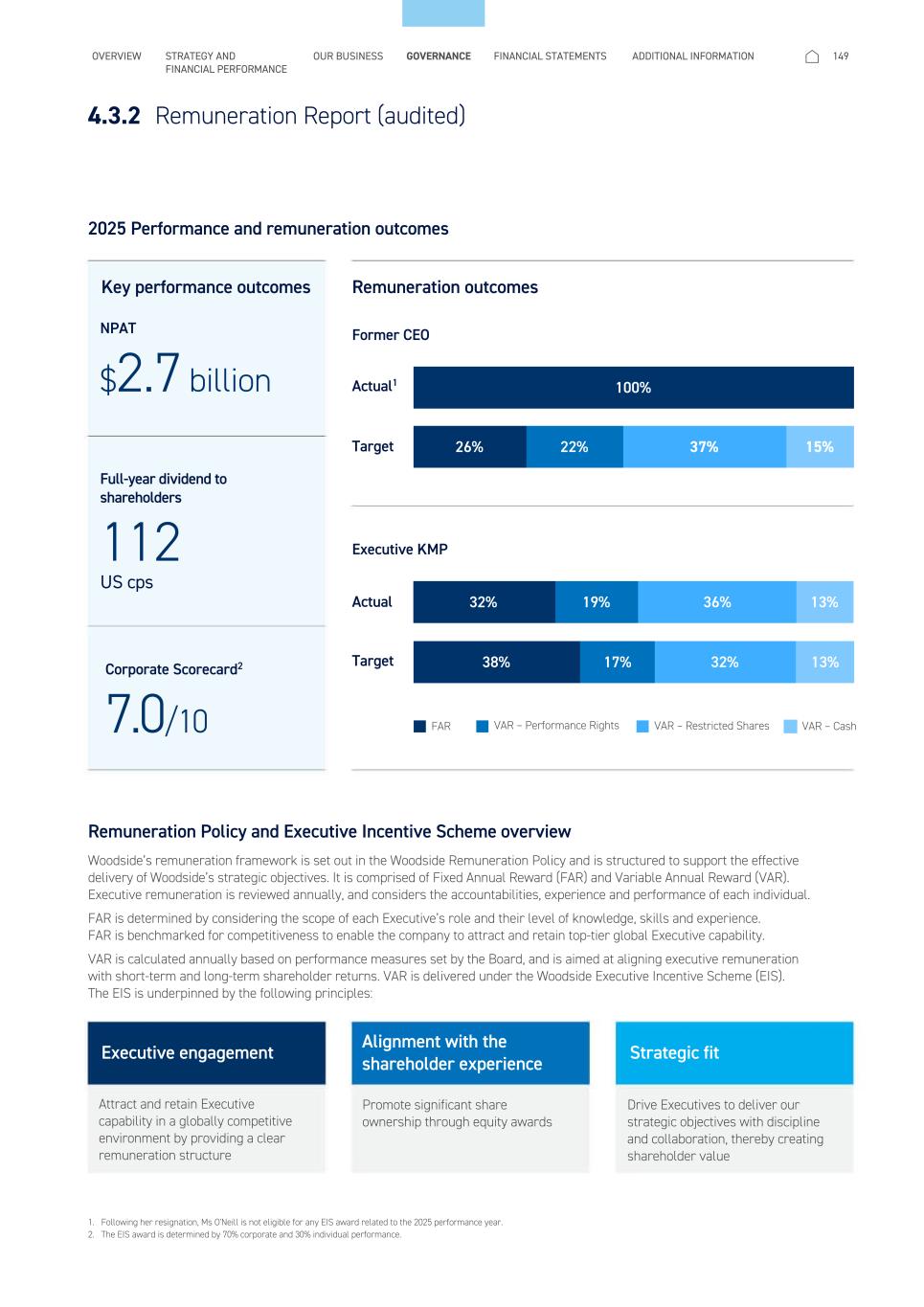
2025 Performance and remuneration outcomes OVERVIEW STRATEGY AND FINANCIAL PERFORMANCE OUR BUSINESS GOVERNANCE FINANCIAL STATEMENTS ADDITIONAL INFORMATION 149 4.3.2 Remuneration Report (audited) Key performance outcomes Remuneration outcomes Remuneration Policy and Executive Incentive Scheme overview Woodside’s remuneration framework is set out in the Woodside Remuneration Policy and is structured to support the effective delivery of Woodside’s strategic objectives. It is comprised of Fixed Annual Reward (FAR) and Variable Annual Reward (VAR). Executive remuneration is reviewed annually, and considers the accountabilities, experience and performance of each individual. FAR is determined by considering the scope of each Executive’s role and their level of knowledge, skills and experience. FAR is benchmarked for competitiveness to enable the company to attract and retain top-tier global Executive capability. VAR is calculated annually based on performance measures set by the Board, and is aimed at aligning executive remuneration with short-term and long-term shareholder returns. VAR is delivered under the Woodside Executive Incentive Scheme (EIS). The EIS is underpinned by the following principles: Executive engagement Alignment with the shareholder experience Strategic fit Attract and retain Executive capability in a globally competitive environment by providing a clear remuneration structure Promote significant share ownership through equity awards Drive Executives to deliver our strategic objectives with discipline and collaboration, thereby creating shareholder value Former CEO Executive KMP 100% Actual Target 26% 22% 37% 15% 32% 19% 36% 13% 38% 17% 32% 13% Actual1 Target 1. Following her resignation, Ms O'Neill is not eligible for any EIS award related to the 2025 performance year. 2. The EIS award is determined by 70% corporate and 30% individual performance. FAR VAR – Performance Rights VAR – Restricted Shares VAR – Cash NPAT $2.7 billion Full-year dividend to shareholders 112 US cps Corporate Scorecard2 7.0/10
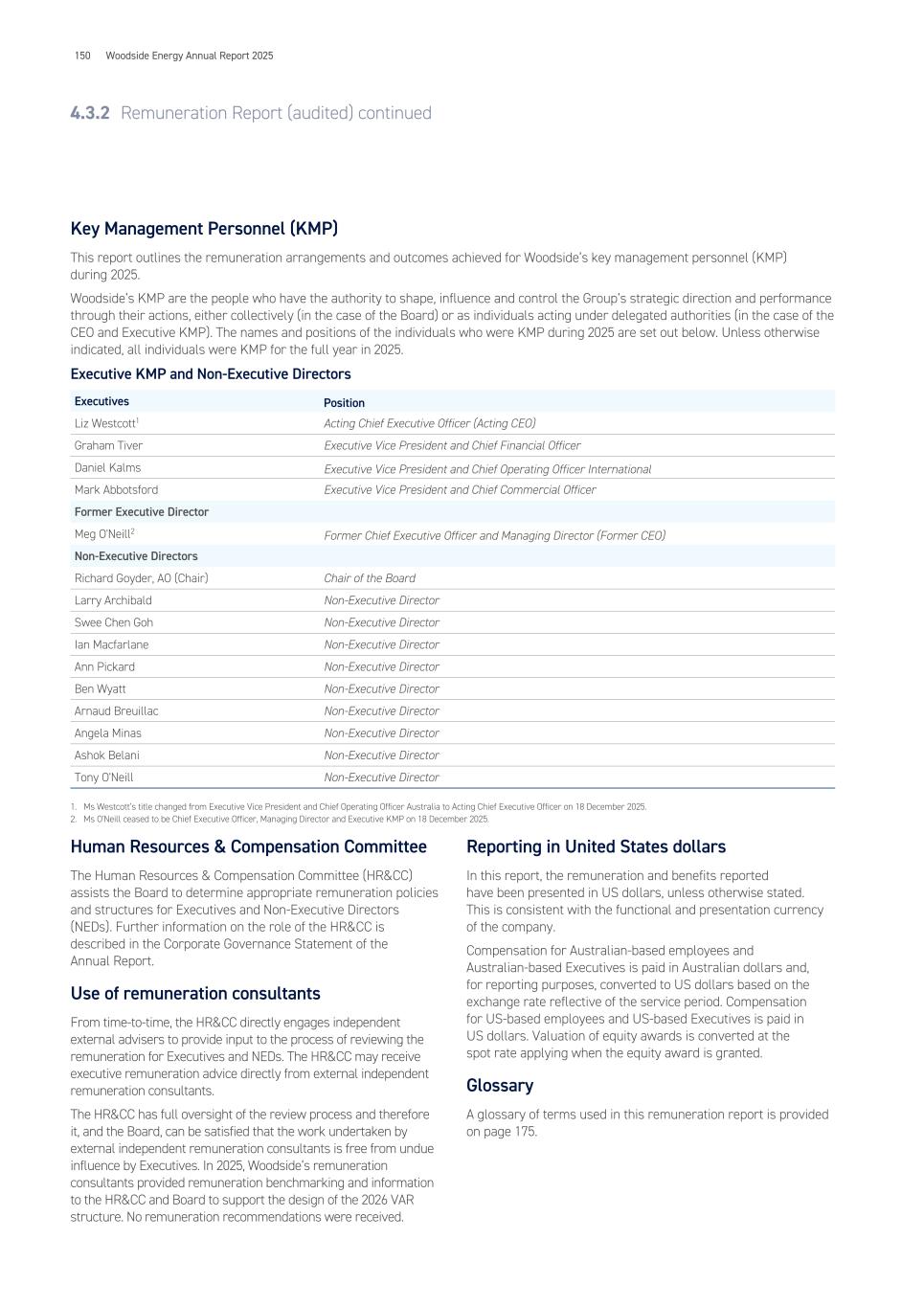
Key Management Personnel (KMP) This report outlines the remuneration arrangements and outcomes achieved for Woodside’s key management personnel (KMP) during 2025. Woodside’s KMP are the people who have the authority to shape, influence and control the Group’s strategic direction and performance through their actions, either collectively (in the case of the Board) or as individuals acting under delegated authorities (in the case of the CEO and Executive KMP). The names and positions of the individuals who were KMP during 2025 are set out below. Unless otherwise indicated, all individuals were KMP for the full year in 2025. Executive KMP and Non-Executive Directors Executives Position Liz Westcott1 Acting Chief Executive Officer (Acting CEO) Graham Tiver Executive Vice President and Chief Financial Officer Daniel Kalms Executive Vice President and Chief Operating Officer International Mark Abbotsford Executive Vice President and Chief Commercial Officer Former Executive Director Meg O'Neill2 Former Chief Executive Officer and Managing Director (Former CEO) Non-Executive Directors Richard Goyder, AO (Chair) Chair of the Board Larry Archibald Non-Executive Director Swee Chen Goh Non-Executive Director Ian Macfarlane Non-Executive Director Ann Pickard Non-Executive Director Ben Wyatt Non-Executive Director Arnaud Breuillac Non-Executive Director Angela Minas Non-Executive Director Ashok Belani Non-Executive Director Tony O'Neill Non-Executive Director 1. Ms Westcott’s title changed from Executive Vice President and Chief Operating Officer Australia to Acting Chief Executive Officer on 18 December 2025. 2. Ms O'Neill ceased to be Chief Executive Officer, Managing Director and Executive KMP on 18 December 2025. Human Resources & Compensation Committee The Human Resources & Compensation Committee (HR&CC) assists the Board to determine appropriate remuneration policies and structures for Executives and Non-Executive Directors (NEDs). Further information on the role of the HR&CC is described in the Corporate Governance Statement of the Annual Report. Use of remuneration consultants From time-to-time, the HR&CC directly engages independent external advisers to provide input to the process of reviewing the remuneration for Executives and NEDs. The HR&CC may receive executive remuneration advice directly from external independent remuneration consultants. The HR&CC has full oversight of the review process and therefore it, and the Board, can be satisfied that the work undertaken by external independent remuneration consultants is free from undue influence by Executives. In 2025, Woodside’s remuneration consultants provided remuneration benchmarking and information to the HR&CC and Board to support the design of the 2026 VAR structure. No remuneration recommendations were received. Reporting in United States dollars In this report, the remuneration and benefits reported have been presented in US dollars, unless otherwise stated. This is consistent with the functional and presentation currency of the company. Compensation for Australian-based employees and Australian‑based Executives is paid in Australian dollars and, for reporting purposes, converted to US dollars based on the exchange rate reflective of the service period. Compensation for US-based employees and US-based Executives is paid in US dollars. Valuation of equity awards is converted at the spot rate applying when the equity award is granted. Glossary A glossary of terms used in this remuneration report is provided on page 175. 150 Woodside Energy Annual Report 2025 4.3.2 Remuneration Report (audited) continued
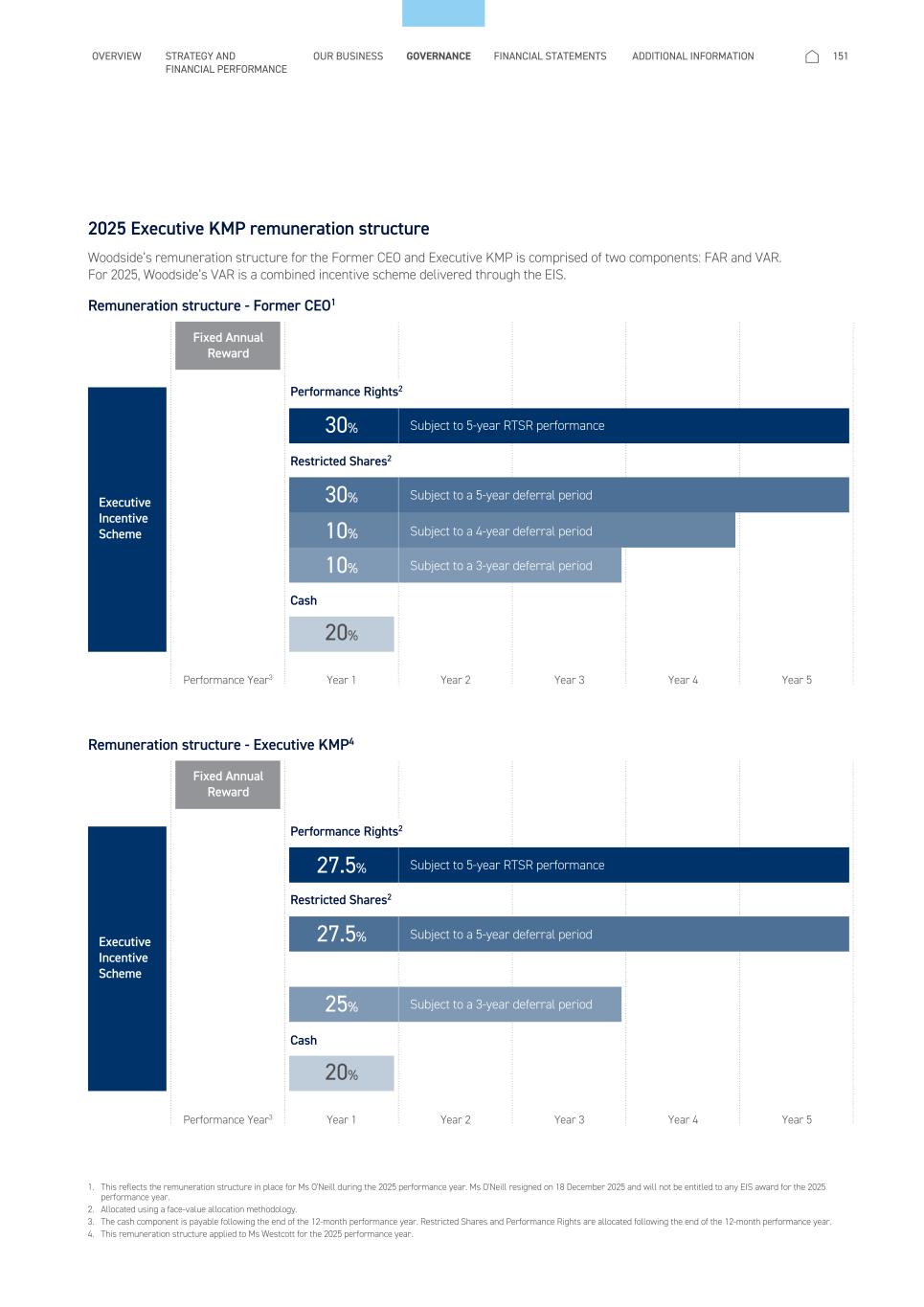
2025 Executive KMP remuneration structure Woodside’s remuneration structure for the Former CEO and Executive KMP is comprised of two components: FAR and VAR. For 2025, Woodside’s VAR is a combined incentive scheme delivered through the EIS. Remuneration structure - Former CEO1 Remuneration structure - Executive KMP4 OVERVIEW STRATEGY AND FINANCIAL PERFORMANCE OUR BUSINESS GOVERNANCE FINANCIAL STATEMENTS ADDITIONAL INFORMATION 151 1. This reflects the remuneration structure in place for Ms O'Neill during the 2025 performance year. Ms O'Neill resigned on 18 December 2025 and will not be entitled to any EIS award for the 2025 performance year. 2. Allocated using a face-value allocation methodology. 3. The cash component is payable following the end of the 12-month performance year. Restricted Shares and Performance Rights are allocated following the end of the 12-month performance year. 4. This remuneration structure applied to Ms Westcott for the 2025 performance year. Executive Incentive Scheme Fixed Annual Reward 30% Subject to a 5-year deferral period Subject to a 4-year deferral period Subject to a 3-year deferral period 20% Performance Rights2 Restricted Shares2 Cash Year 1 Year 2 Year 3 Year 4 Year 5Performance Year3 30% 10% 10% Subject to 5-year RTSR performance 27.5% Subject to a 5-year deferral period Subject to a 3-year deferral period 20% Performance Rights2 Restricted Shares2 Cash Year 1 Year 2 Year 3 Year 4 Year 5Performance Year3 27.5% 25% Subject to 5-year RTSR performance Executive Incentive Scheme Fixed Annual Reward
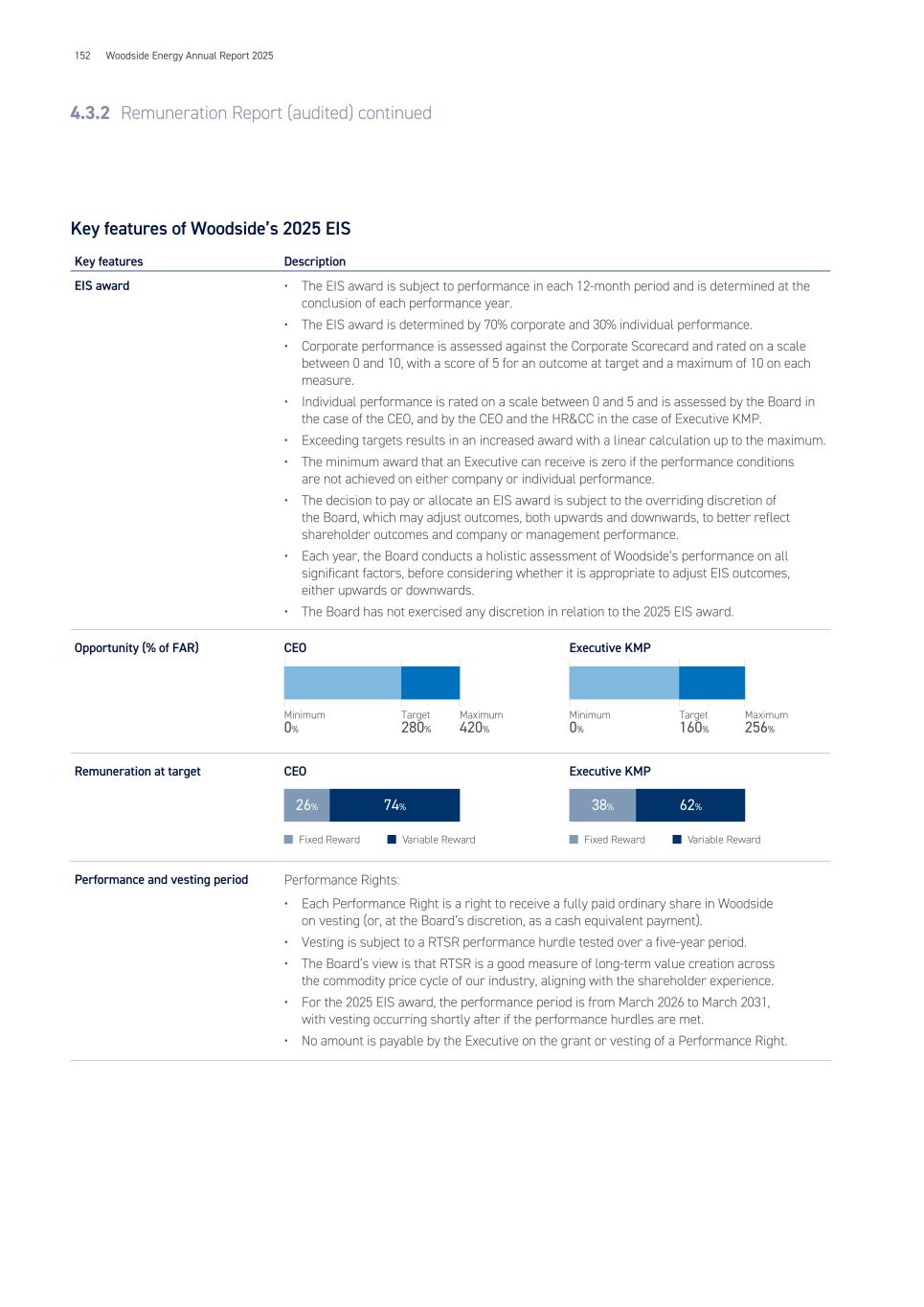
Key features of Woodside’s 2025 EIS EIS award • The EIS award is subject to performance in each 12-month period and is determined at the conclusion of each performance year. • The EIS award is determined by 70% corporate and 30% individual performance. • Corporate performance is assessed against the Corporate Scorecard and rated on a scale between 0 and 10, with a score of 5 for an outcome at target and a maximum of 10 on each measure. • Individual performance is rated on a scale between 0 and 5 and is assessed by the Board in the case of the CEO, and by the CEO and the HR&CC in the case of Executive KMP. • Exceeding targets results in an increased award with a linear calculation up to the maximum. • The minimum award that an Executive can receive is zero if the performance conditions are not achieved on either company or individual performance. • The decision to pay or allocate an EIS award is subject to the overriding discretion of the Board, which may adjust outcomes, both upwards and downwards, to better reflect shareholder outcomes and company or management performance. • Each year, the Board conducts a holistic assessment of Woodside’s performance on all significant factors, before considering whether it is appropriate to adjust EIS outcomes, either upwards or downwards. • The Board has not exercised any discretion in relation to the 2025 EIS award. Opportunity (% of FAR) CEO Executive KMP • • • • Remuneration at target CEO Executive KMP • • • • Performance and vesting period Performance Rights: • Each Performance Right is a right to receive a fully paid ordinary share in Woodside on vesting (or, at the Board’s discretion, as a cash equivalent payment). • Vesting is subject to a RTSR performance hurdle tested over a five-year period. • The Board’s view is that RTSR is a good measure of long-term value creation across the commodity price cycle of our industry, aligning with the shareholder experience. • For the 2025 EIS award, the performance period is from March 2026 to March 2031, with vesting occurring shortly after if the performance hurdles are met. • No amount is payable by the Executive on the grant or vesting of a Performance Right. Key features Description 152 Woodside Energy Annual Report 2025 4.3.2 Remuneration Report (audited) continued
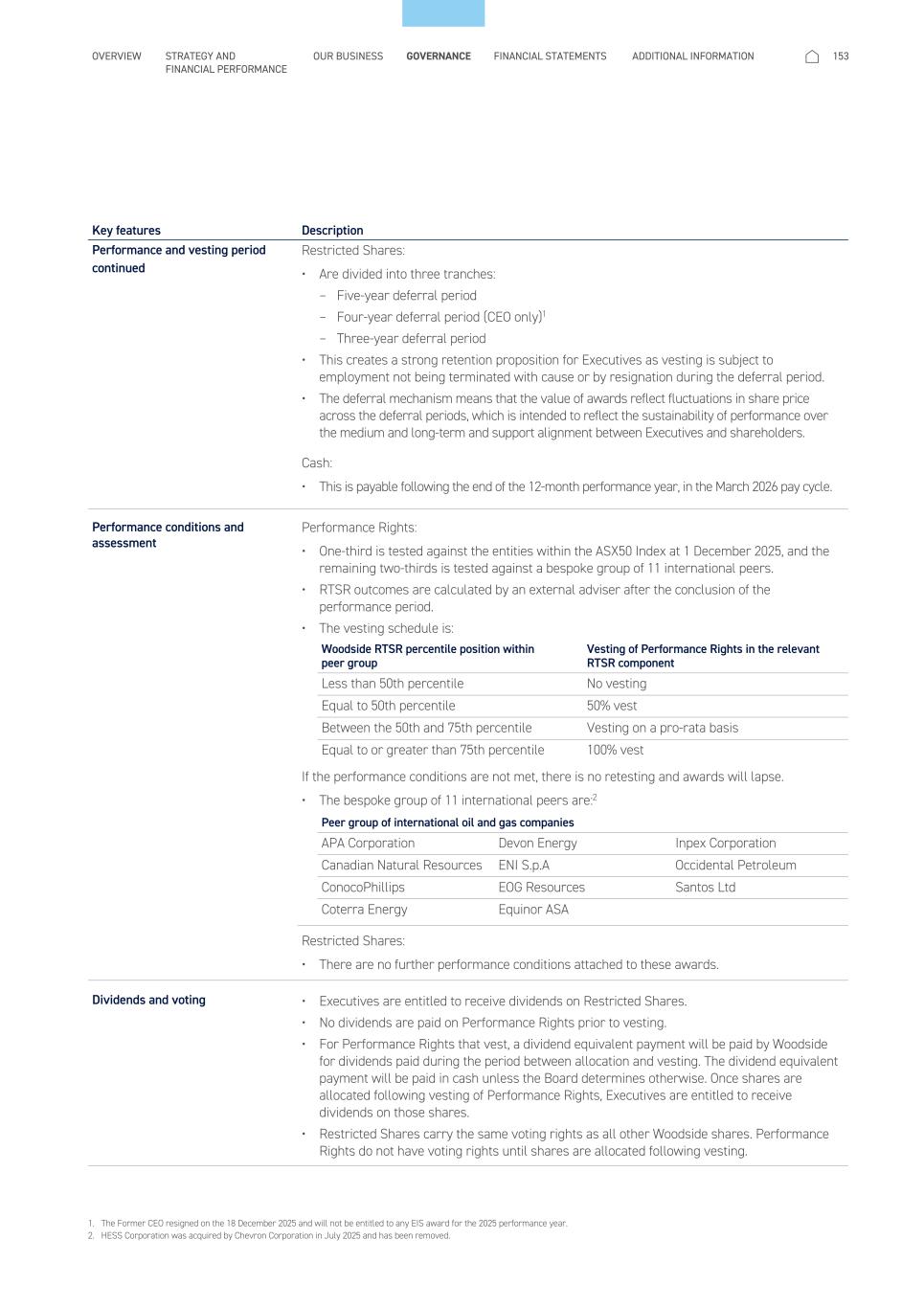
Performance and vesting period continued Restricted Shares: • Are divided into three tranches: – Five-year deferral period – Four-year deferral period (CEO only)1 – Three-year deferral period • This creates a strong retention proposition for Executives as vesting is subject to employment not being terminated with cause or by resignation during the deferral period. • The deferral mechanism means that the value of awards reflect fluctuations in share price across the deferral periods, which is intended to reflect the sustainability of performance over the medium and long-term and support alignment between Executives and shareholders. Cash: • This is payable following the end of the 12-month performance year, in the March 2026 pay cycle. Performance conditions and assessment Performance Rights: • One-third is tested against the entities within the ASX50 Index at 1 December 2025, and the remaining two-thirds is tested against a bespoke group of 11 international peers. • RTSR outcomes are calculated by an external adviser after the conclusion of the performance period. • The vesting schedule is: Woodside RTSR percentile position within peer group Vesting of Performance Rights in the relevant RTSR component Less than 50th percentile No vesting Equal to 50th percentile 50% vest Between the 50th and 75th percentile Vesting on a pro-rata basis Equal to or greater than 75th percentile 100% vest If the performance conditions are not met, there is no retesting and awards will lapse. • The bespoke group of 11 international peers are:2 Peer group of international oil and gas companies APA Corporation Devon Energy Inpex Corporation Canadian Natural Resources ENI S.p.A Occidental Petroleum ConocoPhillips EOG Resources Santos Ltd Coterra Energy Equinor ASA Restricted Shares: • There are no further performance conditions attached to these awards. Dividends and voting • Executives are entitled to receive dividends on Restricted Shares. • No dividends are paid on Performance Rights prior to vesting. • For Performance Rights that vest, a dividend equivalent payment will be paid by Woodside for dividends paid during the period between allocation and vesting. The dividend equivalent payment will be paid in cash unless the Board determines otherwise. Once shares are allocated following vesting of Performance Rights, Executives are entitled to receive dividends on those shares. • Restricted Shares carry the same voting rights as all other Woodside shares. Performance Rights do not have voting rights until shares are allocated following vesting. Key features Description OVERVIEW STRATEGY AND FINANCIAL PERFORMANCE OUR BUSINESS GOVERNANCE FINANCIAL STATEMENTS ADDITIONAL INFORMATION 153 1. The Former CEO resigned on the 18 December 2025 and will not be entitled to any EIS award for the 2025 performance year. 2. HESS Corporation was acquired by Chevron Corporation in July 2025 and has been removed.
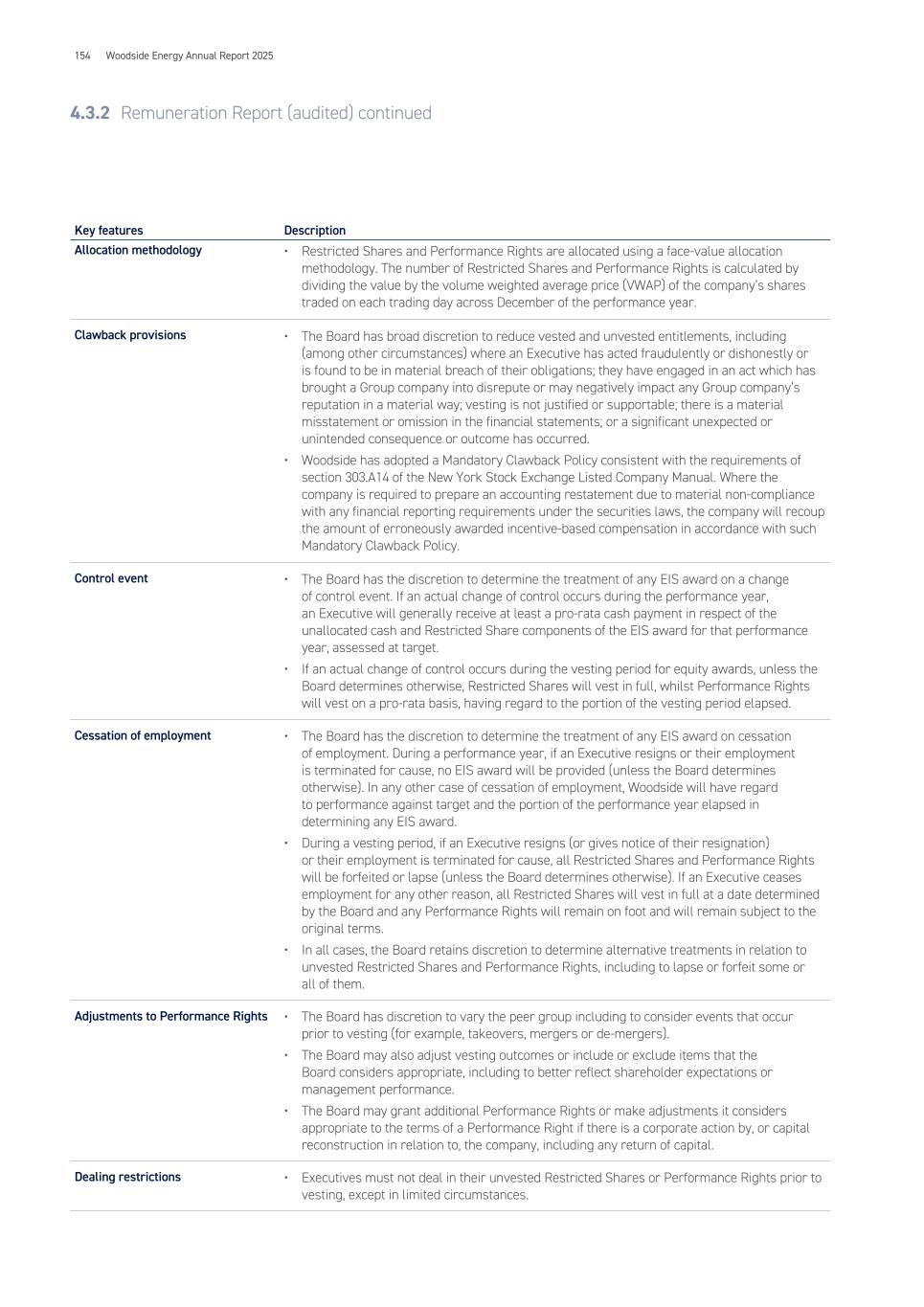
Allocation methodology • Restricted Shares and Performance Rights are allocated using a face-value allocation methodology. The number of Restricted Shares and Performance Rights is calculated by dividing the value by the volume weighted average price (VWAP) of the company’s shares traded on each trading day across December of the performance year. Clawback provisions • The Board has broad discretion to reduce vested and unvested entitlements, including (among other circumstances) where an Executive has acted fraudulently or dishonestly or is found to be in material breach of their obligations; they have engaged in an act which has brought a Group company into disrepute or may negatively impact any Group company’s reputation in a material way; vesting is not justified or supportable; there is a material misstatement or omission in the financial statements; or a significant unexpected or unintended consequence or outcome has occurred. • Woodside has adopted a Mandatory Clawback Policy consistent with the requirements of section 303.A14 of the New York Stock Exchange Listed Company Manual. Where the company is required to prepare an accounting restatement due to material non-compliance with any financial reporting requirements under the securities laws, the company will recoup the amount of erroneously awarded incentive-based compensation in accordance with such Mandatory Clawback Policy. Control event • The Board has the discretion to determine the treatment of any EIS award on a change of control event. If an actual change of control occurs during the performance year, an Executive will generally receive at least a pro-rata cash payment in respect of the unallocated cash and Restricted Share components of the EIS award for that performance year, assessed at target. • If an actual change of control occurs during the vesting period for equity awards, unless the Board determines otherwise, Restricted Shares will vest in full, whilst Performance Rights will vest on a pro-rata basis, having regard to the portion of the vesting period elapsed. Cessation of employment • The Board has the discretion to determine the treatment of any EIS award on cessation of employment. During a performance year, if an Executive resigns or their employment is terminated for cause, no EIS award will be provided (unless the Board determines otherwise). In any other case of cessation of employment, Woodside will have regard to performance against target and the portion of the performance year elapsed in determining any EIS award. • During a vesting period, if an Executive resigns (or gives notice of their resignation) or their employment is terminated for cause, all Restricted Shares and Performance Rights will be forfeited or lapse (unless the Board determines otherwise). If an Executive ceases employment for any other reason, all Restricted Shares will vest in full at a date determined by the Board and any Performance Rights will remain on foot and will remain subject to the original terms. • In all cases, the Board retains discretion to determine alternative treatments in relation to unvested Restricted Shares and Performance Rights, including to lapse or forfeit some or all of them. Adjustments to Performance Rights • The Board has discretion to vary the peer group including to consider events that occur prior to vesting (for example, takeovers, mergers or de-mergers). • The Board may also adjust vesting outcomes or include or exclude items that the Board considers appropriate, including to better reflect shareholder expectations or management performance. • The Board may grant additional Performance Rights or make adjustments it considers appropriate to the terms of a Performance Right if there is a corporate action by, or capital reconstruction in relation to, the company, including any return of capital. Dealing restrictions • Executives must not deal in their unvested Restricted Shares or Performance Rights prior to vesting, except in limited circumstances. Key features Description 154 Woodside Energy Annual Report 2025 4.3.2 Remuneration Report (audited) continued
Other equity plans Woodside has a history of providing employees with the opportunity to participate in ownership of shares in the company and using equity to support a competitive base remuneration position. Refer to Section E.2 in the Notes to the financial statements for further information. Details of prior year allocations are provided in Table 8. The terms applying to prior year grants are described in past Woodside Annual Reports. Woodside Equity Plan (WEP) The purpose of the WEP is to enable eligible employees to build up a holding of equity in Woodside as they progress through their career. The WEP is offered to permanent employees who do not participate in the EIS. The number of Equity Rights (ERs) offered to each eligible employee is determined by the Board, and based on individual performance as assessed under the performance review process. There are no further ongoing performance conditions. The linking of performance to an allocation allows Woodside to recognise and reward eligible employees for high performance. Each ER entitles the participant to receive a Woodside share on the vesting date. For offers prior to 2022, the terms of the Plan allowed for 75% vesting of the ERs three years after the effective grant date and the remaining 25% of ERs five years after the effective grant date. For subsequent awards, the Board amended the terms of the Plan to entitle the participant to receive a Woodside share on the vesting date three years after the effective grant date. Subject to overarching Board discretion, ERs under the WEP may vest prior to the vesting date on a change of control or on a pro‑rata basis if a participating employee ceases employment due to redundancy, genuine retirement, total and permanent disablement, medical illness, incapacity, death or any other reason the Board determines. Any unvested ERs held by an employee whose employment is terminated by resignation or for cause prior to the vesting date will lapse unless the Board determines otherwise. The other key terms of WEP ERs are similar to the terms of the Performance Rights granted under the EIS. Supplementary Woodside Equity Plan (SWEP) In October 2011, the Board approved the establishment of the SWEP to enable the offering of targeted retention awards of Equity Rights for key capability. The SWEP was updated in 2022 to broaden eligibility to all employees of a subsidiary of Woodside Energy Group Ltd and ensure compliance in all jurisdictions in which Woodside operates. The SWEP awards have service conditions and no performance conditions. Each Equity Right entitles the participant to receive a Woodside share on vesting. Subject to overarching Board discretion, Equity Rights under SWEP may vest prior to the vesting date on a change of control or on a pro-rata basis if a participating employee ceases employment in the following circumstances: redundancy, death, medical illness or incapacity or total and permanent disablement. Any unvested Equity Rights held by an employee whose employment is terminated by resignation or for cause prior to the vesting date will lapse unless the Board determines otherwise. There is no entitlement to dividends on Equity Rights, and they do not carry voting rights. Minimum Shareholding Requirements (MSR) Policy The Executive KMP MSR Policy reflects the long-term focus of management and aims to further strengthen alignment with shareholders. The MSR Policy requires Executive KMP to have acquired and maintained Woodside shares for a minimum total purchase price of at least 100% of their FAR after a period of five years, and in the case of the CEO a minimum of 200% of FAR after a period of five years. All the Executive KMP meet the MSR requirements.1 See Table 10 for details. OVERVIEW STRATEGY AND FINANCIAL PERFORMANCE OUR BUSINESS GOVERNANCE FINANCIAL STATEMENTS ADDITIONAL INFORMATION 155 1. Ms Westcott met the MSR based on her FAR of A$1,203,000, being her FAR prior to her appointment as Acting CEO.
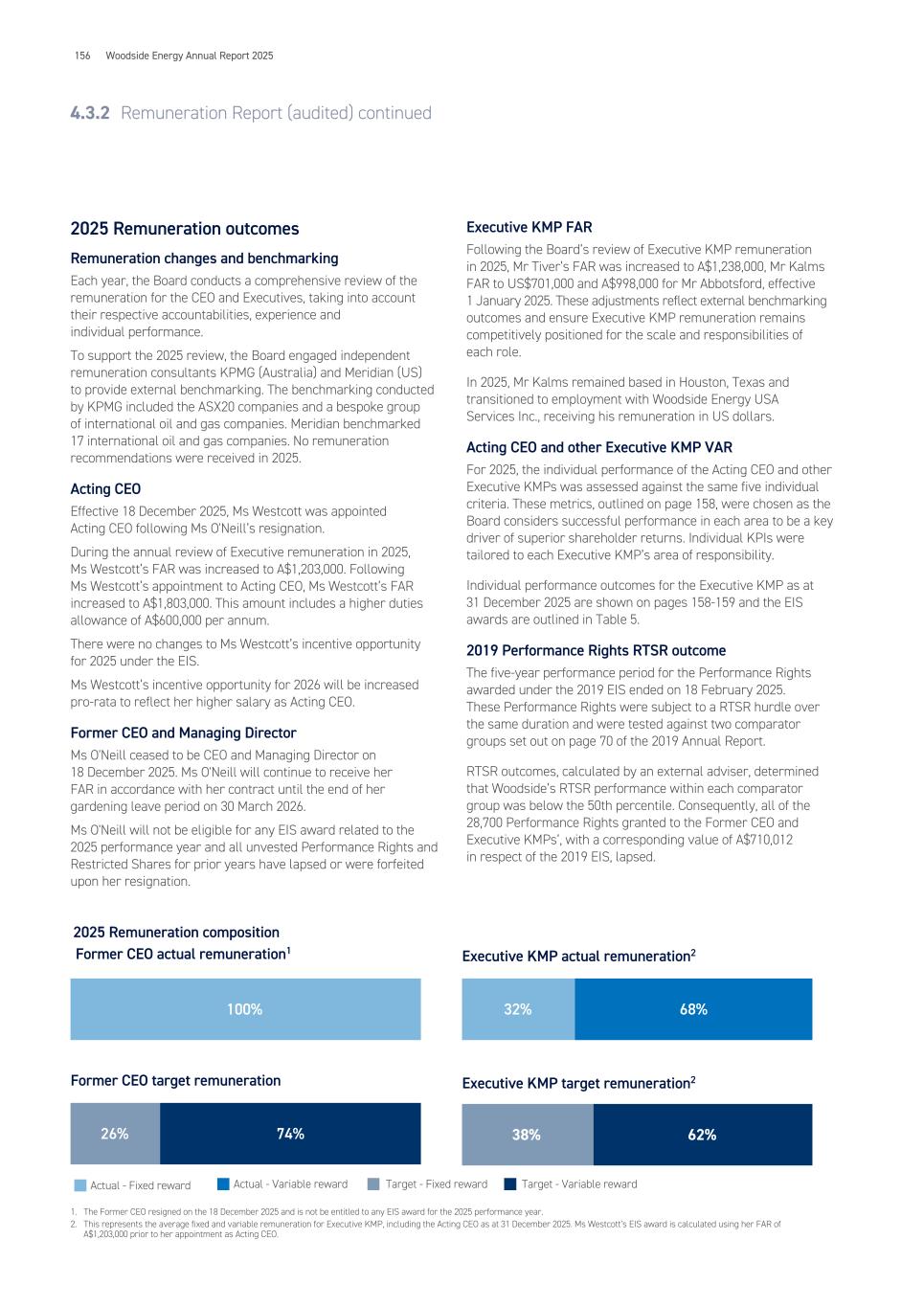
2025 Remuneration outcomes Remuneration changes and benchmarking Each year, the Board conducts a comprehensive review of the remuneration for the CEO and Executives, taking into account their respective accountabilities, experience and individual performance. To support the 2025 review, the Board engaged independent remuneration consultants KPMG (Australia) and Meridian (US) to provide external benchmarking. The benchmarking conducted by KPMG included the ASX20 companies and a bespoke group of international oil and gas companies. Meridian benchmarked 17 international oil and gas companies. No remuneration recommendations were received in 2025. Acting CEO Effective 18 December 2025, Ms Westcott was appointed Acting CEO following Ms O'Neill’s resignation. During the annual review of Executive remuneration in 2025, Ms Westcott’s FAR was increased to A$1,203,000. Following Ms Westcott’s appointment to Acting CEO, Ms Westcott’s FAR increased to A$1,803,000. This amount includes a higher duties allowance of A$600,000 per annum. There were no changes to Ms Westcott’s incentive opportunity for 2025 under the EIS. Ms Westcott’s incentive opportunity for 2026 will be increased pro-rata to reflect her higher salary as Acting CEO. Former CEO and Managing Director Ms O'Neill ceased to be CEO and Managing Director on 18 December 2025. Ms O'Neill will continue to receive her FAR in accordance with her contract until the end of her gardening leave period on 30 March 2026. Ms O'Neill will not be eligible for any EIS award related to the 2025 performance year and all unvested Performance Rights and Restricted Shares for prior years have lapsed or were forfeited upon her resignation. Executive KMP FAR Following the Board’s review of Executive KMP remuneration in 2025, Mr Tiver’s FAR was increased to A$1,238,000, Mr Kalms FAR to US$701,000 and A$998,000 for Mr Abbotsford, effective 1 January 2025. These adjustments reflect external benchmarking outcomes and ensure Executive KMP remuneration remains competitively positioned for the scale and responsibilities of each role. In 2025, Mr Kalms remained based in Houston, Texas and transitioned to employment with Woodside Energy USA Services Inc., receiving his remuneration in US dollars. Acting CEO and other Executive KMP VAR For 2025, the individual performance of the Acting CEO and other Executive KMPs was assessed against the same five individual criteria. These metrics, outlined on page 158, were chosen as the Board considers successful performance in each area to be a key driver of superior shareholder returns. Individual KPIs were tailored to each Executive KMP’s area of responsibility. Individual performance outcomes for the Executive KMP as at 31 December 2025 are shown on pages 158-159 and the EIS awards are outlined in Table 5. 2019 Performance Rights RTSR outcome The five-year performance period for the Performance Rights awarded under the 2019 EIS ended on 18 February 2025. These Performance Rights were subject to a RTSR hurdle over the same duration and were tested against two comparator groups set out on page 70 of the 2019 Annual Report. RTSR outcomes, calculated by an external adviser, determined that Woodside’s RTSR performance within each comparator group was below the 50th percentile. Consequently, all of the 28,700 Performance Rights granted to the Former CEO and Executive KMPs’, with a corresponding value of A$710,012 in respect of the 2019 EIS, lapsed. 156 Woodside Energy Annual Report 2025 4.3.2 Remuneration Report (audited) continued Former CEO actual remuneration1 Former CEO target remuneration Executive KMP actual remuneration2 Executive KMP target remuneration2 100% 32% 68% 26% 74% 38% 62% Actual - Fixed reward Actual - Variable reward Target - Fixed reward Target - Variable reward 2025 Remuneration composition 1. The Former CEO resigned on the 18 December 2025 and is not be entitled to any EIS award for the 2025 performance year. 2. This represents the average fixed and variable remuneration for Executive KMP, including the Acting CEO as at 31 December 2025. Ms Westcott’s EIS award is calculated using her FAR of A$1,203,000 prior to her appointment as Acting CEO.
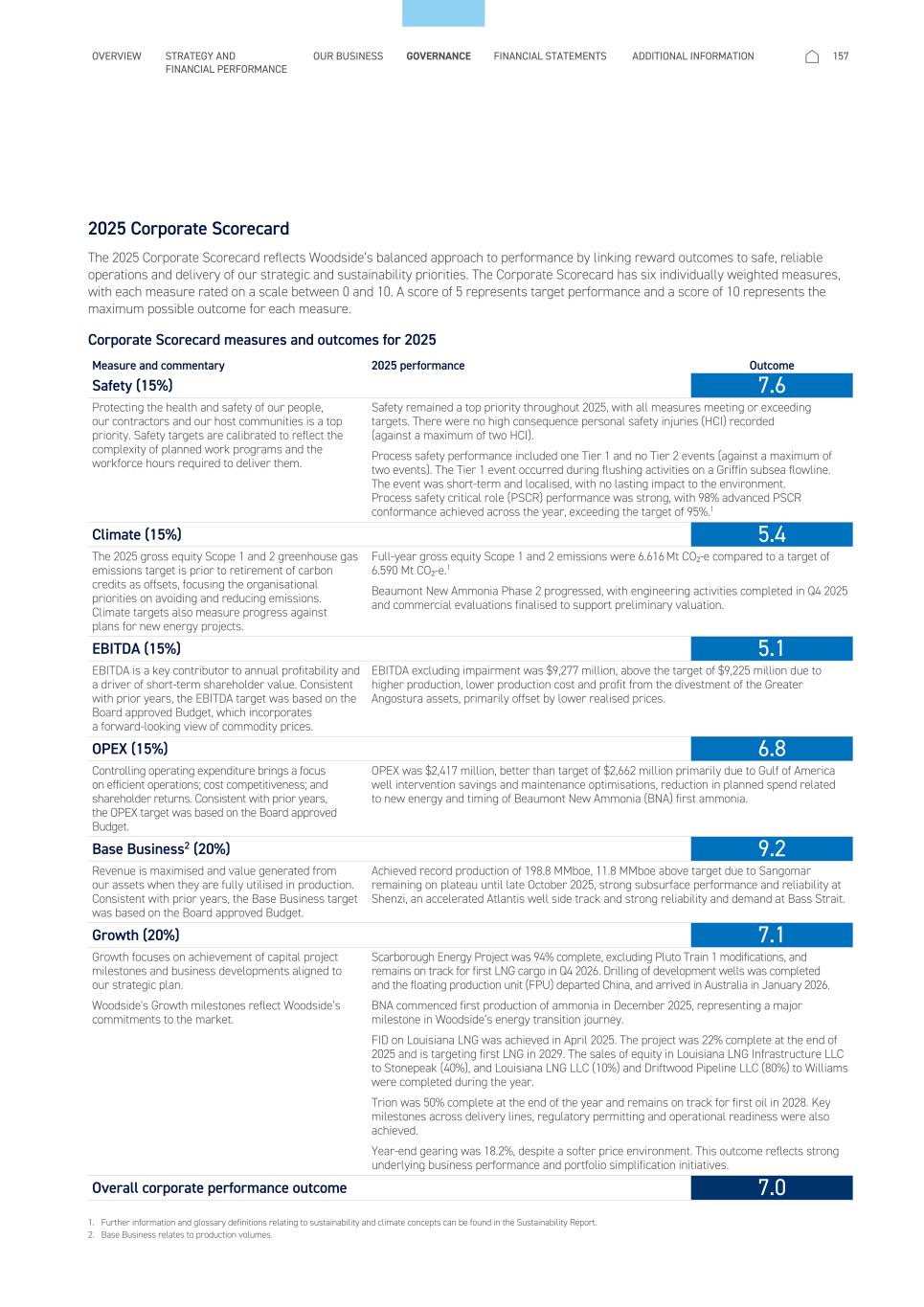
2025 Corporate Scorecard The 2025 Corporate Scorecard reflects Woodside’s balanced approach to performance by linking reward outcomes to safe, reliable operations and delivery of our strategic and sustainability priorities. The Corporate Scorecard has six individually weighted measures, with each measure rated on a scale between 0 and 10. A score of 5 represents target performance and a score of 10 represents the maximum possible outcome for each measure. Corporate Scorecard measures and outcomes for 2025 Measure and commentary 2025 performance Outcome Safety (15%) 7.6 Protecting the health and safety of our people, our contractors and our host communities is a top priority. Safety targets are calibrated to reflect the complexity of planned work programs and the workforce hours required to deliver them. Safety remained a top priority throughout 2025, with all measures meeting or exceeding targets. There were no high consequence personal safety injuries (HCI) recorded (against a maximum of two HCI). Process safety performance included one Tier 1 and no Tier 2 events (against a maximum of two events). The Tier 1 event occurred during flushing activities on a Griffin subsea flowline. The event was short-term and localised, with no lasting impact to the environment. Process safety critical role (PSCR) performance was strong, with 98% advanced PSCR conformance achieved across the year, exceeding the target of 95%.1 Climate (15%) 5.4 The 2025 gross equity Scope 1 and 2 greenhouse gas emissions target is prior to retirement of carbon credits as offsets, focusing the organisational priorities on avoiding and reducing emissions. Climate targets also measure progress against plans for new energy projects. Full-year gross equity Scope 1 and 2 emissions were 6.616 Mt CO₂-e compared to a target of 6.590 Mt CO₂-e.1 Beaumont New Ammonia Phase 2 progressed, with engineering activities completed in Q4 2025 and commercial evaluations finalised to support preliminary valuation. EBITDA (15%) 5.1 EBITDA is a key contributor to annual profitability and a driver of short-term shareholder value. Consistent with prior years, the EBITDA target was based on the Board approved Budget, which incorporates a forward-looking view of commodity prices. EBITDA excluding impairment was $9,277 million, above the target of $9,225 million due to higher production, lower production cost and profit from the divestment of the Greater Angostura assets, primarily offset by lower realised prices. OPEX (15%) 6.8 Controlling operating expenditure brings a focus on efficient operations; cost competitiveness; and shareholder returns. Consistent with prior years, the OPEX target was based on the Board approved Budget. OPEX was $2,417 million, better than target of $2,662 million primarily due to Gulf of America well intervention savings and maintenance optimisations, reduction in planned spend related to new energy and timing of Beaumont New Ammonia (BNA) first ammonia. Base Business2 (20%) 9.2 Revenue is maximised and value generated from our assets when they are fully utilised in production. Consistent with prior years, the Base Business target was based on the Board approved Budget. Achieved record production of 198.8 MMboe, 11.8 MMboe above target due to Sangomar remaining on plateau until late October 2025, strong subsurface performance and reliability at Shenzi, an accelerated Atlantis well side track and strong reliability and demand at Bass Strait. Growth (20%) 7.1 Growth focuses on achievement of capital project milestones and business developments aligned to our strategic plan. Woodside's Growth milestones reflect Woodside’s commitments to the market. Scarborough Energy Project was 94% complete, excluding Pluto Train 1 modifications, and remains on track for first LNG cargo in Q4 2026. Drilling of development wells was completed and the floating production unit (FPU) departed China, and arrived in Australia in January 2026. BNA commenced first production of ammonia in December 2025, representing a major milestone in Woodside’s energy transition journey. FID on Louisiana LNG was achieved in April 2025. The project was 22% complete at the end of 2025 and is targeting first LNG in 2029. The sales of equity in Louisiana LNG Infrastructure LLC to Stonepeak (40%), and Louisiana LNG LLC (10%) and Driftwood Pipeline LLC (80%) to Williams were completed during the year. Trion was 50% complete at the end of the year and remains on track for first oil in 2028. Key milestones across delivery lines, regulatory permitting and operational readiness were also achieved. Year-end gearing was 18.2%, despite a softer price environment. This outcome reflects strong underlying business performance and portfolio simplification initiatives. Overall corporate performance outcome 7.0 OVERVIEW STRATEGY AND FINANCIAL PERFORMANCE OUR BUSINESS GOVERNANCE FINANCIAL STATEMENTS ADDITIONAL INFORMATION 157 1. Further information and glossary definitions relating to sustainability and climate concepts can be found in the Sustainability Report. 2. Base Business relates to production volumes.
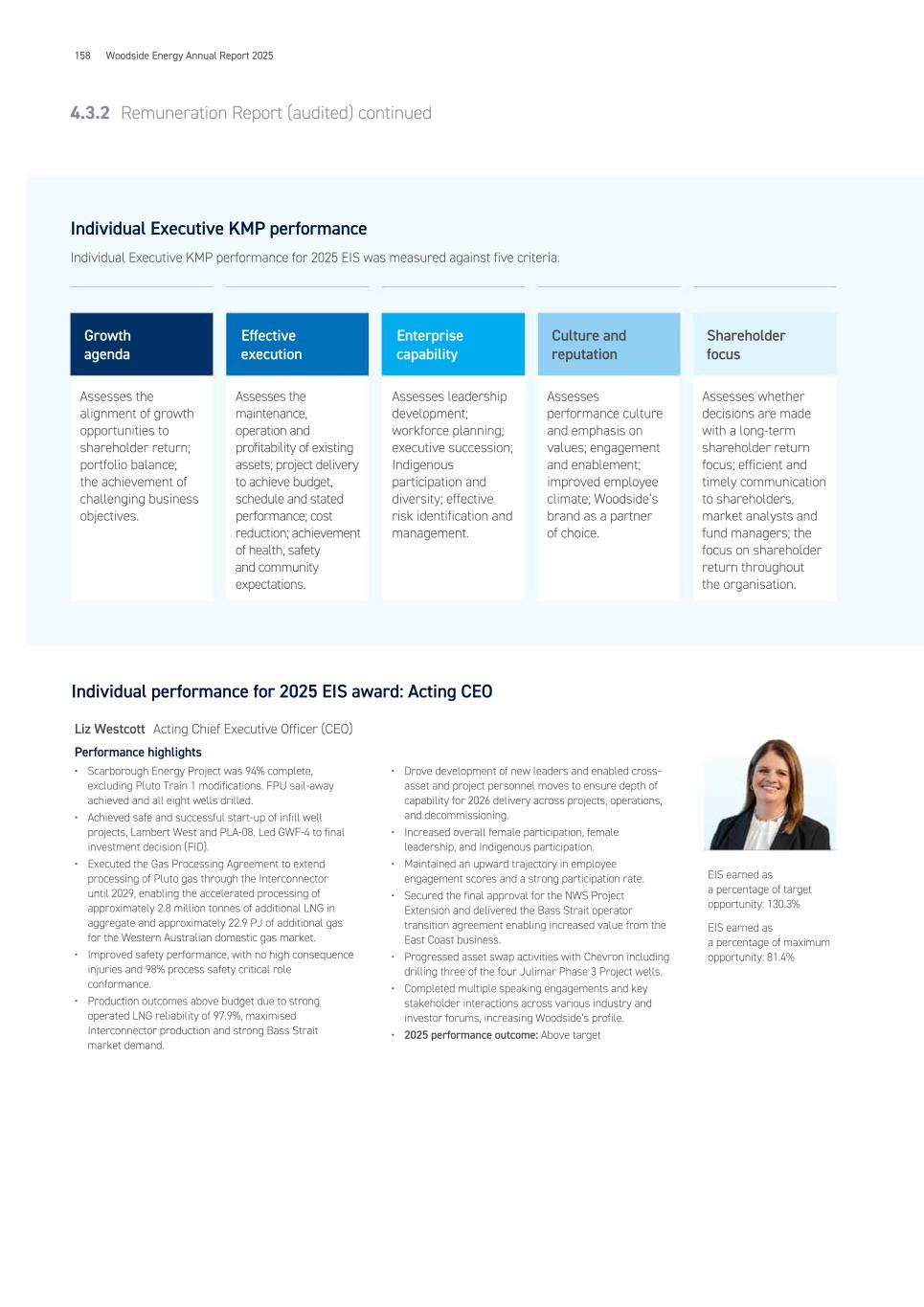
Individual Executive KMP performance Individual Executive KMP performance for 2025 EIS was measured against five criteria. 158 Woodside Energy Annual Report 2025 4.3.2 Remuneration Report (audited) continued Growth agenda Effective execution Enterprise capability Culture and reputation Shareholder focus Assesses the alignment of growth opportunities to shareholder return; portfolio balance; the achievement of challenging business objectives. Assesses the maintenance, operation and profitability of existing assets; project delivery to achieve budget, schedule and stated performance; cost reduction; achievement of health, safety and community expectations. Assesses leadership development; workforce planning; executive succession; Indigenous participation and diversity; effective risk identification and management. Assesses performance culture and emphasis on values; engagement and enablement; improved employee climate; Woodside’s brand as a partner of choice. Liz Westcott Acting Chief Executive Officer (CEO) Performance highlights • Scarborough Energy Project was 94% complete, excluding Pluto Train 1 modifications. FPU sail-away achieved and all eight wells drilled. • Achieved safe and successful start-up of infill well projects, Lambert West and PLA-08. Led GWF-4 to final investment decision (FID). • Executed the Gas Processing Agreement to extend processing of Pluto gas through the Interconnector until 2029, enabling the accelerated processing of approximately 2.8 million tonnes of additional LNG in aggregate and approximately 22.9 PJ of additional gas for the Western Australian domestic gas market. • Improved safety performance, with no high consequence injuries and 98% process safety critical role conformance. • Production outcomes above budget due to strong operated LNG reliability of 97.9%, maximised Interconnector production and strong Bass Strait market demand. • Drove development of new leaders and enabled cross- asset and project personnel moves to ensure depth of capability for 2026 delivery across projects, operations, and decommissioning. • Increased overall female participation, female leadership, and Indigenous participation. • Maintained an upward trajectory in employee engagement scores and a strong participation rate. • Secured the final approval for the NWS Project Extension and delivered the Bass Strait operator transition agreement enabling increased value from the East Coast business. • Progressed asset swap activities with Chevron including drilling three of the four Julimar Phase 3 Project wells. • Completed multiple speaking engagements and key stakeholder interactions across various industry and investor forums, increasing Woodside’s profile. • 2025 performance outcome: Above target EIS earned as a percentage of target opportunity: 130.3% EIS earned as a percentage of maximum opportunity: 81.4% Assesses whether decisions are made with a long-term shareholder return focus; efficient and timely communication to shareholders, market analysts and fund managers; the focus on shareholder return throughout the organisation. Individual performance for 2025 EIS award: Acting CEO
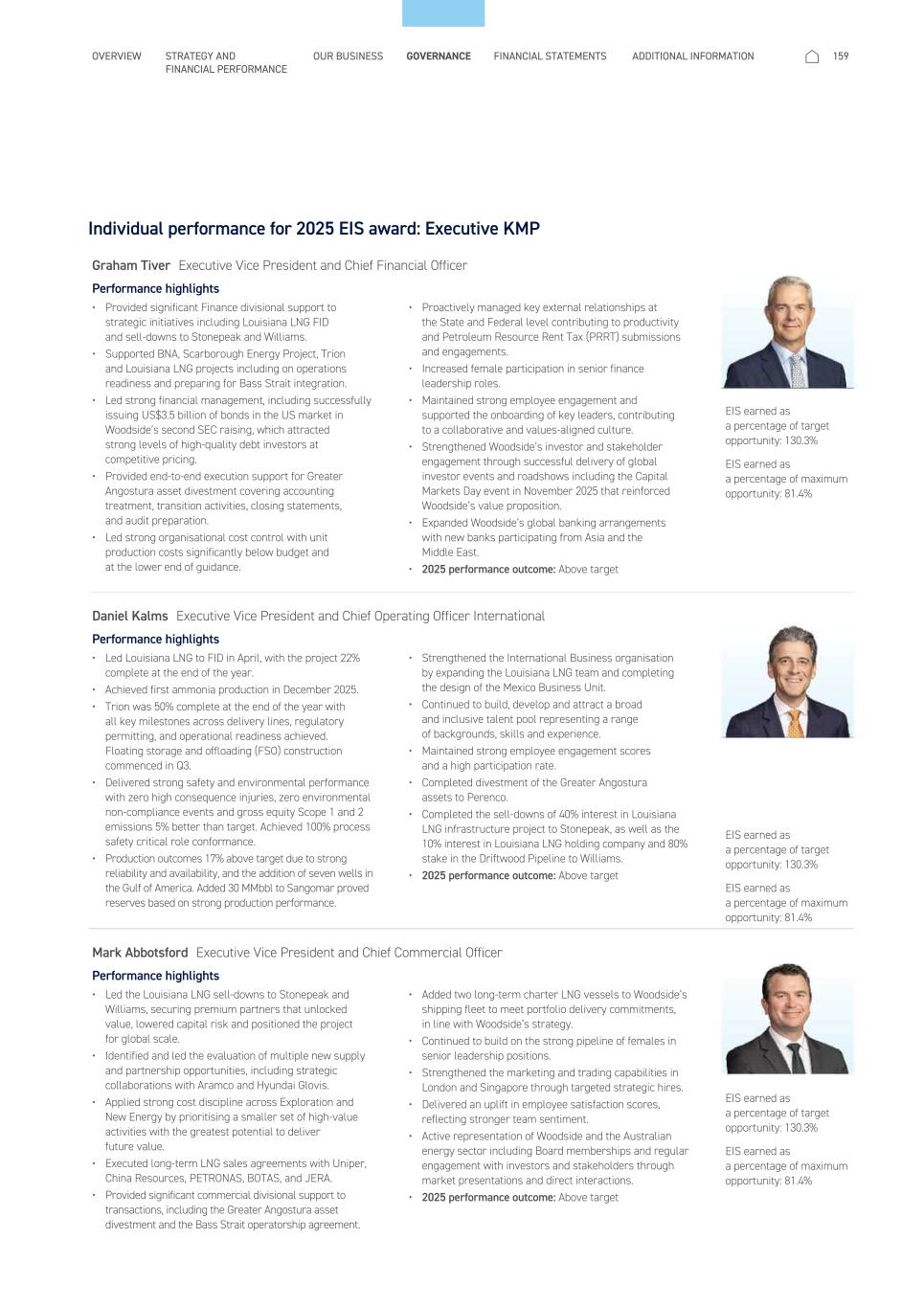
Individual performance for 2025 EIS award: Executive KMP OVERVIEW STRATEGY AND FINANCIAL PERFORMANCE OUR BUSINESS GOVERNANCE FINANCIAL STATEMENTS ADDITIONAL INFORMATION 159 Graham Tiver Executive Vice President and Chief Financial Officer Performance highlights • Provided significant Finance divisional support to strategic initiatives including Louisiana LNG FID and sell‑downs to Stonepeak and Williams. • Supported BNA, Scarborough Energy Project, Trion and Louisiana LNG projects including on operations readiness and preparing for Bass Strait integration. • Led strong financial management, including successfully issuing US$3.5 billion of bonds in the US market in Woodside’s second SEC raising, which attracted strong levels of high-quality debt investors at competitive pricing. • Provided end-to-end execution support for Greater Angostura asset divestment covering accounting treatment, transition activities, closing statements, and audit preparation. • Led strong organisational cost control with unit production costs significantly below budget and at the lower end of guidance. • Proactively managed key external relationships at the State and Federal level contributing to productivity and Petroleum Resource Rent Tax (PRRT) submissions and engagements. • Increased female participation in senior finance leadership roles. • Maintained strong employee engagement and supported the onboarding of key leaders, contributing to a collaborative and values-aligned culture. • Strengthened Woodside’s investor and stakeholder engagement through successful delivery of global investor events and roadshows including the Capital Markets Day event in November 2025 that reinforced Woodside’s value proposition. • Expanded Woodside’s global banking arrangements with new banks participating from Asia and the Middle East. • 2025 performance outcome: Above target EIS earned as a percentage of target opportunity: 130.3% EIS earned as a percentage of maximum opportunity: 81.4% Daniel Kalms Executive Vice President and Chief Operating Officer International Performance highlights • Led Louisiana LNG to FID in April, with the project 22% complete at the end of the year. • Achieved first ammonia production in December 2025. • Trion was 50% complete at the end of the year with all key milestones across delivery lines, regulatory permitting, and operational readiness achieved. Floating storage and offloading (FSO) construction commenced in Q3. • Delivered strong safety and environmental performance with zero high consequence injuries, zero environmental non-compliance events and gross equity Scope 1 and 2 emissions 5% better than target. Achieved 100% process safety critical role conformance. • Production outcomes 17% above target due to strong reliability and availability, and the addition of seven wells in the Gulf of America. Added 30 MMbbl to Sangomar proved reserves based on strong production performance. • Strengthened the International Business organisation by expanding the Louisiana LNG team and completing the design of the Mexico Business Unit. • Continued to build, develop and attract a broad and inclusive talent pool representing a range of backgrounds, skills and experience. • Maintained strong employee engagement scores and a high participation rate. • Completed divestment of the Greater Angostura assets to Perenco. • Completed the sell-downs of 40% interest in Louisiana LNG infrastructure project to Stonepeak, as well as the 10% interest in Louisiana LNG holding company and 80% stake in the Driftwood Pipeline to Williams. • 2025 performance outcome: Above target EIS earned as a percentage of target opportunity: 130.3% EIS earned as a percentage of maximum opportunity: 81.4% Mark Abbotsford Executive Vice President and Chief Commercial Officer Performance highlights • Led the Louisiana LNG sell-downs to Stonepeak and Williams, securing premium partners that unlocked value, lowered capital risk and positioned the project for global scale. • Identified and led the evaluation of multiple new supply and partnership opportunities, including strategic collaborations with Aramco and Hyundai Glovis. • Applied strong cost discipline across Exploration and New Energy by prioritising a smaller set of high-value activities with the greatest potential to deliver future value. • Executed long-term LNG sales agreements with Uniper, China Resources, PETRONAS, BOTAS, and JERA. • Provided significant commercial divisional support to transactions, including the Greater Angostura asset divestment and the Bass Strait operatorship agreement. • Added two long-term charter LNG vessels to Woodside’s shipping fleet to meet portfolio delivery commitments, in line with Woodside’s strategy. • Continued to build on the strong pipeline of females in senior leadership positions. • Strengthened the marketing and trading capabilities in London and Singapore through targeted strategic hires. • Delivered an uplift in employee satisfaction scores, reflecting stronger team sentiment. • Active representation of Woodside and the Australian energy sector including Board memberships and regular engagement with investors and stakeholders through market presentations and direct interactions. • 2025 performance outcome: Above target EIS earned as a percentage of target opportunity: 130.3% EIS earned as a percentage of maximum opportunity: 81.4%
2026 Executive KMP remuneration Following a comprehensive annual review of Executive KMP remuneration, the Board has approved adjustments to the FAR for each Executive KMP. The review incorporated external benchmarking information from independent remuneration consultants, KPMG (Australia) and Meridian (US), aiming to position FAR between the median and upper quartile of the ASX20. The Board believes this positioning is crucial for Woodside to continue to attract and retain top-tier global talent. The Board approved increases to FAR for Mr Kalms and Mr Abbotsford of 3%, for Ms Westcott of 6% and for Mr Tiver of 8%, effective from 1 January 2026. The increases consider continued strong individual performance, responsibilities of their roles and recent market adjustments, ensuring Woodside maintains a competitive position. These decisions reflect our commitment to aligning Executive remuneration with shareholder interests and long-term value creation. Following Ms O'Neill’s resignation as CEO, and to maintain focus on the effective delivery of the company's strategy and provide leadership stability during the CEO transition and onboarding process, a retention award will be made to Mr Tiver, Mr Kalms and Mr Abbotsford in March 2026. The award will comprise Equity Rights with an approximate value of A$750,000 for each Executive, awarded under the Supplementary Woodside Equity Plan, with vesting in December 2027.1 The vesting period of the award supports leadership stability and the retention of critical capabilities to ensure seamless execution of the Corporate Plan for 2026 and 2027, including maintaining momentum against our key major projects. While vesting is subject to continued service, the Board retains the discretion to determine the final vesting outcome. In the event a recipient of the retention award is appointed to the position of CEO during the vesting period, their Equity Rights under the retention award will lapse. The offer will also extend to Ms Westcott, following the completion of her Acting CEO role, in the event that she is not appointed into the role permanently. New incentive scheme for 2026 Woodside has transitioned its VAR for the Executives from a combined Executive Incentive Scheme to a distinct STI and LTI structure. This change reflects our commitment to strengthening alignment between Executive remuneration and shareholder outcomes, while ensuring our framework remains competitive and strategically focused. Woodside’s remuneration consultant provided benchmarking information to the HR&CC and Board to support the design of the new incentive scheme for 2026. There are no changes to the FAR structure. The design of the STI and LTI structure aims to respond to investor feedback by: • Strengthening our long-term focus by increasing our weighting to long-term performance tested equity. • Aligning with market practice across the ASX and against our global peers, who generally operate with separate STI and LTI plans. • Supporting greater alignment with Woodside’s strategy through refined annual scorecard measures and the introduction of a second performance measure in the LTI structure. In reviewing our VAR framework, Woodside also took the opportunity to review and refresh the key objectives underpinning the framework: • Attract and retain global talent to support strategic delivery • Market competitive across regions • External alignment with stakeholders, the shareholder experience and to drive superior shareholder returns • Simple and transparent for external stakeholders and Executives 160 Woodside Energy Annual Report 2025 4.3.2 Remuneration Report (audited) continued 1. Equivalent to 31,281 Equity Rights.
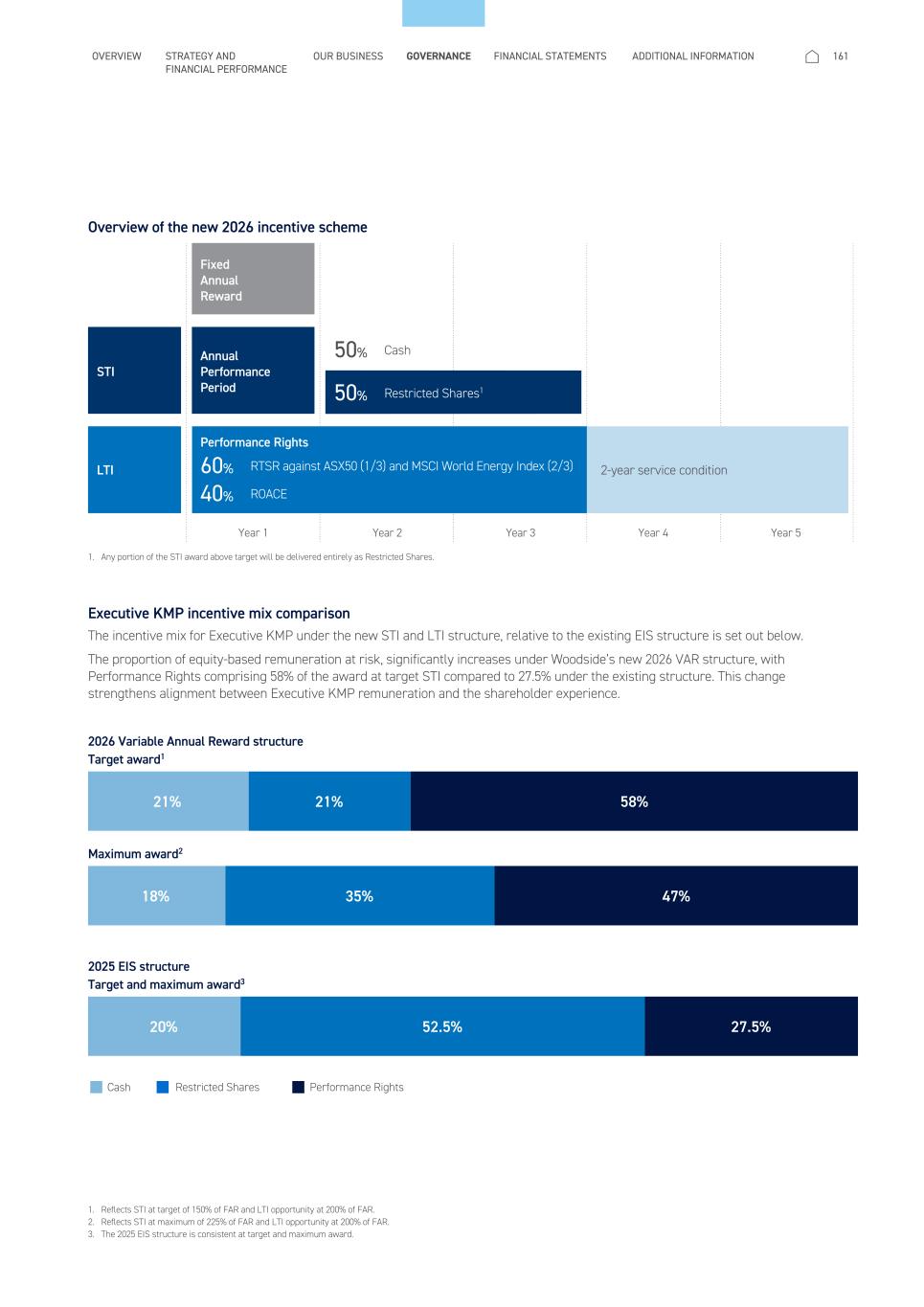
Overview of the new 2026 incentive scheme 1. Any portion of the STI award above target will be delivered entirely as Restricted Shares. Executive KMP incentive mix comparison The incentive mix for Executive KMP under the new STI and LTI structure, relative to the existing EIS structure is set out below. The proportion of equity-based remuneration at risk, significantly increases under Woodside’s new 2026 VAR structure, with Performance Rights comprising 58% of the award at target STI compared to 27.5% under the existing structure. This change strengthens alignment between Executive KMP remuneration and the shareholder experience. 2026 Variable Annual Reward structure Target award1 21% 21% 58% Maximum award2 18% 35% 47% 2025 EIS structure Target and maximum award3 20% 52.5% 27.5% OVERVIEW STRATEGY AND FINANCIAL PERFORMANCE OUR BUSINESS GOVERNANCE FINANCIAL STATEMENTS ADDITIONAL INFORMATION 161 Restricted SharesCash Performance Rights Fixed Annual Reward STI Annual Performance Period 50% Cash 50% Restricted Shares1 LTI Performance Rights 2-year service condition60% RTSR against ASX50 (1/3) and MSCI World Energy Index (2/3) 40% ROACE Year 1 Year 2 Year 3 Year 4 Year 5 1. Reflects STI at target of 150% of FAR and LTI opportunity at 200% of FAR. 2. Reflects STI at maximum of 225% of FAR and LTI opportunity at 200% of FAR. 3. The 2025 EIS structure is consistent at target and maximum award.
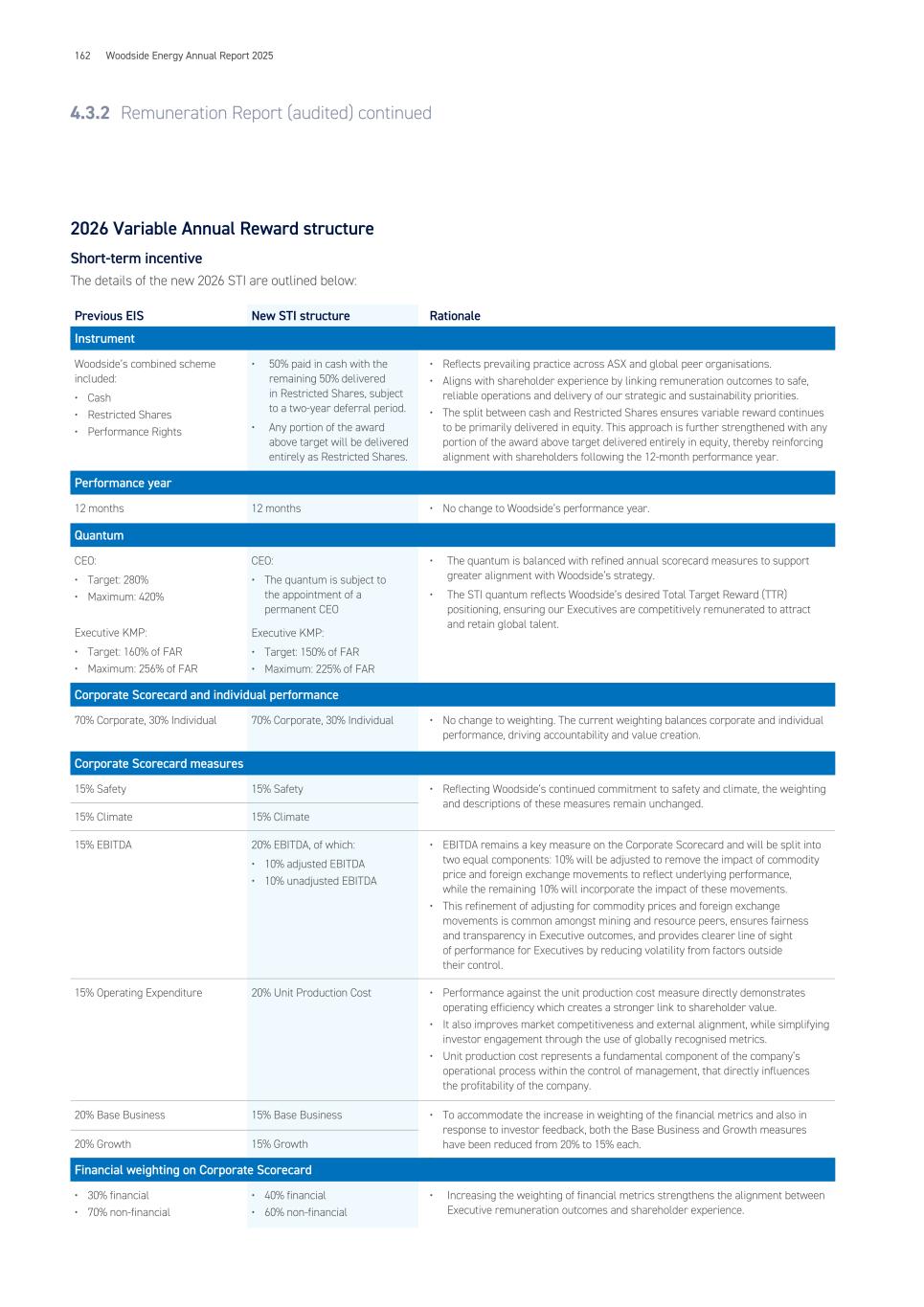
2026 Variable Annual Reward structure Short-term incentive The details of the new 2026 STI are outlined below: Previous EIS New STI structure Rationale Instrument Woodside’s combined scheme included: • Cash • Restricted Shares • Performance Rights • 50% paid in cash with the remaining 50% delivered in Restricted Shares, subject to a two-year deferral period. • Any portion of the award above target will be delivered entirely as Restricted Shares. • Reflects prevailing practice across ASX and global peer organisations. • Aligns with shareholder experience by linking remuneration outcomes to safe, reliable operations and delivery of our strategic and sustainability priorities. • The split between cash and Restricted Shares ensures variable reward continues to be primarily delivered in equity. This approach is further strengthened with any portion of the award above target delivered entirely in equity, thereby reinforcing alignment with shareholders following the 12-month performance year. Performance year 12 months 12 months • No change to Woodside’s performance year. Quantum CEO: • Target: 280% • Maximum: 420% Executive KMP: • Target: 160% of FAR • Maximum: 256% of FAR CEO: • The quantum is subject to the appointment of a permanent CEO Executive KMP: • Target: 150% of FAR • Maximum: 225% of FAR • The quantum is balanced with refined annual scorecard measures to support greater alignment with Woodside’s strategy. • The STI quantum reflects Woodside’s desired Total Target Reward (TTR) positioning, ensuring our Executives are competitively remunerated to attract and retain global talent. Corporate Scorecard and individual performance 70% Corporate, 30% Individual 70% Corporate, 30% Individual • No change to weighting. The current weighting balances corporate and individual performance, driving accountability and value creation. Corporate Scorecard measures 15% Safety 15% Safety • Reflecting Woodside’s continued commitment to safety and climate, the weighting and descriptions of these measures remain unchanged. 15% Climate 15% Climate 15% EBITDA 20% EBITDA, of which: • 10% adjusted EBITDA • 10% unadjusted EBITDA • EBITDA remains a key measure on the Corporate Scorecard and will be split into two equal components: 10% will be adjusted to remove the impact of commodity price and foreign exchange movements to reflect underlying performance, while the remaining 10% will incorporate the impact of these movements. • This refinement of adjusting for commodity prices and foreign exchange movements is common amongst mining and resource peers, ensures fairness and transparency in Executive outcomes, and provides clearer line of sight of performance for Executives by reducing volatility from factors outside their control. • 15% Operating Expenditure 20% Unit Production Cost • Performance against the unit production cost measure directly demonstrates operating efficiency which creates a stronger link to shareholder value. • It also improves market competitiveness and external alignment, while simplifying investor engagement through the use of globally recognised metrics. • Unit production cost represents a fundamental component of the company’s operational process within the control of management, that directly influences the profitability of the company. ••20% Base Business 15% Base Business • To accommodate the increase in weighting of the financial metrics and also in response to investor feedback, both the Base Business and Growth measures have been reduced from 20% to 15% each.20% Growth 15% Growth •Financial weighting on Corporate Scorecard • 30% financial • 70% non-financial • 40% financial • 60% non-financial • Increasing the weighting of financial metrics strengthens the alignment between Executive remuneration outcomes and shareholder experience. 162 Woodside Energy Annual Report 2025 4.3.2 Remuneration Report (audited) continued
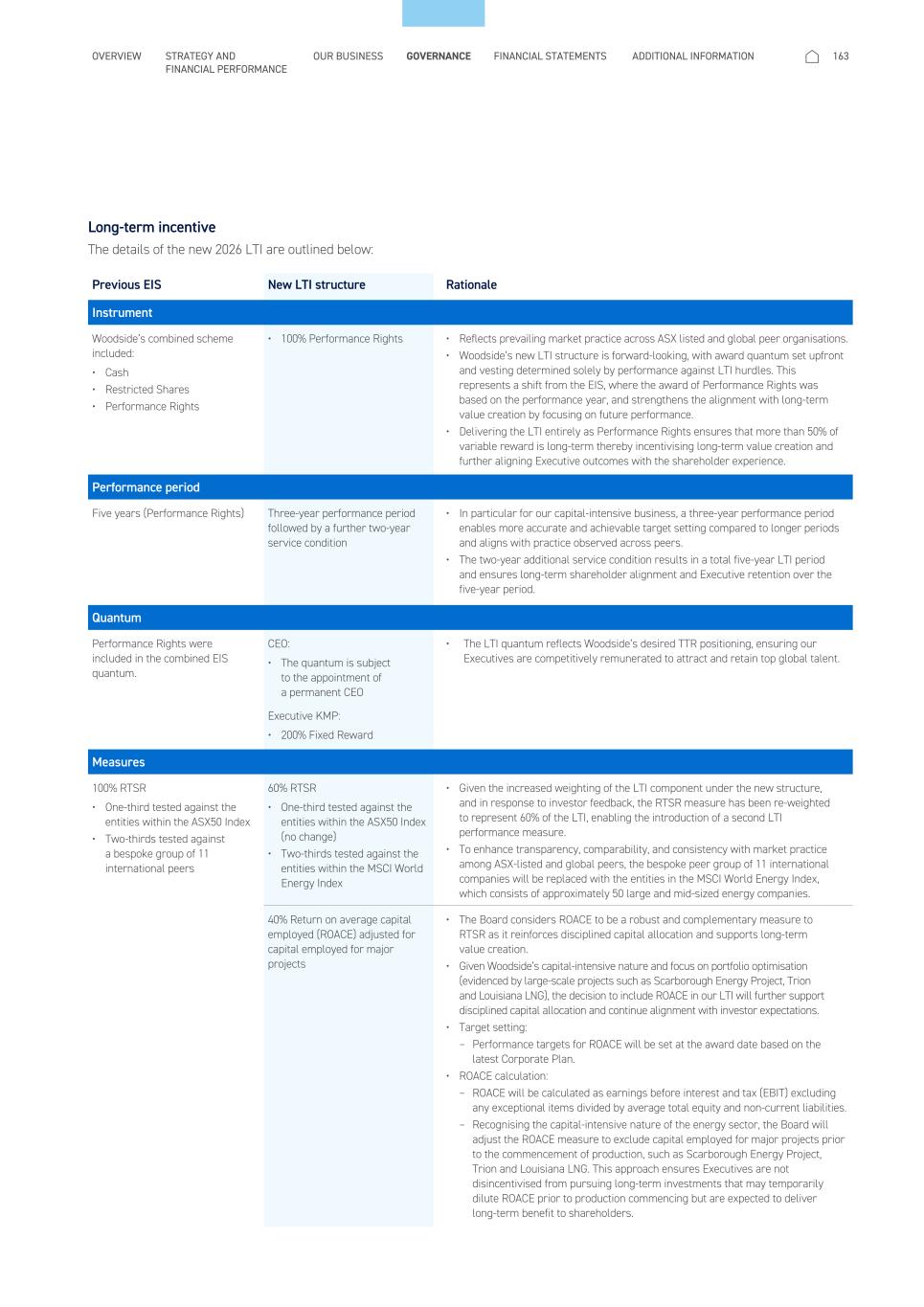
Long-term incentive The details of the new 2026 LTI are outlined below: Previous EIS New LTI structure Rationale Instrument Woodside’s combined scheme included: • Cash • Restricted Shares • Performance Rights • 100% Performance Rights • Reflects prevailing market practice across ASX listed and global peer organisations. • Woodside’s new LTI structure is forward-looking, with award quantum set upfront and vesting determined solely by performance against LTI hurdles. This represents a shift from the EIS, where the award of Performance Rights was based on the performance year, and strengthens the alignment with long-term value creation by focusing on future performance. • Delivering the LTI entirely as Performance Rights ensures that more than 50% of variable reward is long-term thereby incentivising long-term value creation and further aligning Executive outcomes with the shareholder experience. Performance period Five years (Performance Rights) Three-year performance period followed by a further two-year service condition • In particular for our capital-intensive business, a three-year performance period enables more accurate and achievable target setting compared to longer periods and aligns with practice observed across peers. • The two-year additional service condition results in a total five-year LTI period and ensures long-term shareholder alignment and Executive retention over the five‑year period. Quantum Performance Rights were included in the combined EIS quantum. CEO: • The quantum is subject to the appointment of a permanent CEO Executive KMP: • 200% Fixed Reward • The LTI quantum reflects Woodside’s desired TTR positioning, ensuring our Executives are competitively remunerated to attract and retain top global talent. Measures 100% RTSR • One-third tested against the entities within the ASX50 Index • Two-thirds tested against a bespoke group of 11 international peers 60% RTSR • One-third tested against the entities within the ASX50 Index (no change) • Two-thirds tested against the entities within the MSCI World Energy Index • Given the increased weighting of the LTI component under the new structure, and in response to investor feedback, the RTSR measure has been re-weighted to represent 60% of the LTI, enabling the introduction of a second LTI performance measure. • To enhance transparency, comparability, and consistency with market practice among ASX-listed and global peers, the bespoke peer group of 11 international companies will be replaced with the entities in the MSCI World Energy Index, which consists of approximately 50 large and mid-sized energy companies. • • • ••40% Return on average capital employed (ROACE) adjusted for capital employed for major projects • The Board considers ROACE to be a robust and complementary measure to RTSR as it reinforces disciplined capital allocation and supports long-term value creation. • Given Woodside’s capital-intensive nature and focus on portfolio optimisation (evidenced by large-scale projects such as Scarborough Energy Project, Trion and Louisiana LNG), the decision to include ROACE in our LTI will further support disciplined capital allocation and continue alignment with investor expectations. • Target setting: – Performance targets for ROACE will be set at the award date based on the latest Corporate Plan. • ROACE calculation: – ROACE will be calculated as earnings before interest and tax (EBIT) excluding any exceptional items divided by average total equity and non-current liabilities. – Recognising the capital-intensive nature of the energy sector, the Board will adjust the ROACE measure to exclude capital employed for major projects prior to the commencement of production, such as Scarborough Energy Project, Trion and Louisiana LNG. This approach ensures Executives are not disincentivised from pursuing long-term investments that may temporarily dilute ROACE prior to production commencing but are expected to deliver long‑term benefit to shareholders. OVERVIEW STRATEGY AND FINANCIAL PERFORMANCE OUR BUSINESS GOVERNANCE FINANCIAL STATEMENTS ADDITIONAL INFORMATION 163
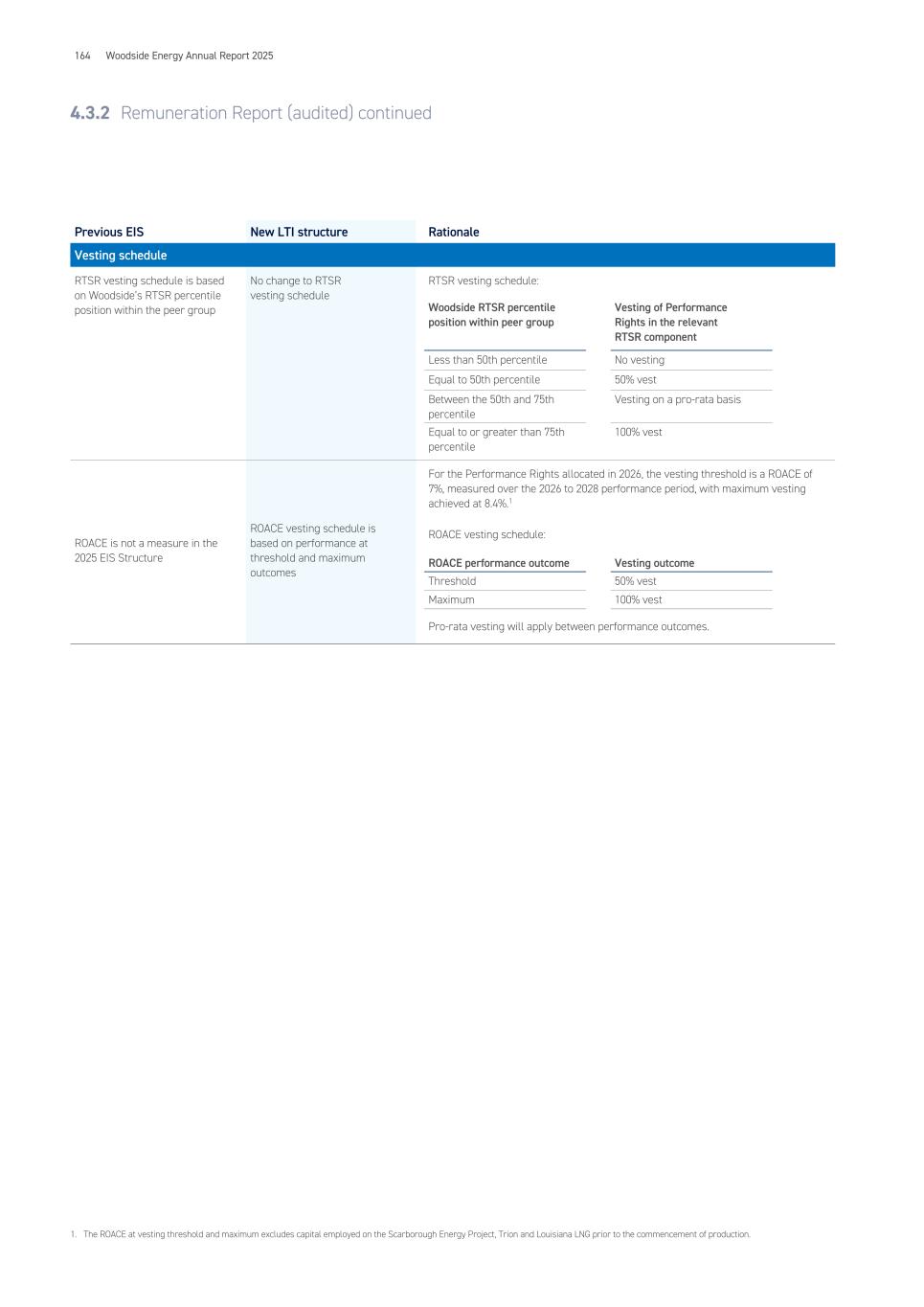
Previous EIS New LTI structure Rationale Vesting schedule RTSR vesting schedule is based on Woodside’s RTSR percentile position within the peer group No change to RTSR vesting schedule RTSR vesting schedule: Woodside RTSR percentile position within peer group Vesting of Performance Rights in the relevant RTSR component Less than 50th percentile No vesting Equal to 50th percentile 50% vest Between the 50th and 75th percentile Vesting on a pro-rata basis Equal to or greater than 75th percentile 100% vest ROACE is not a measure in the 2025 EIS Structure ROACE vesting schedule is based on performance at threshold and maximum outcomes For the Performance Rights allocated in 2026, the vesting threshold is a ROACE of 7%, measured over the 2026 to 2028 performance period, with maximum vesting achieved at 8.4%.1 ROACE vesting schedule: ROACE performance outcome Vesting outcome Threshold 50% vest Maximum 100% vest Pro-rata vesting will apply between performance outcomes. 164 Woodside Energy Annual Report 2025 4.3.2 Remuneration Report (audited) continued 1. The ROACE at vesting threshold and maximum excludes capital employed on the Scarborough Energy Project, Trion and Louisiana LNG prior to the commencement of production.
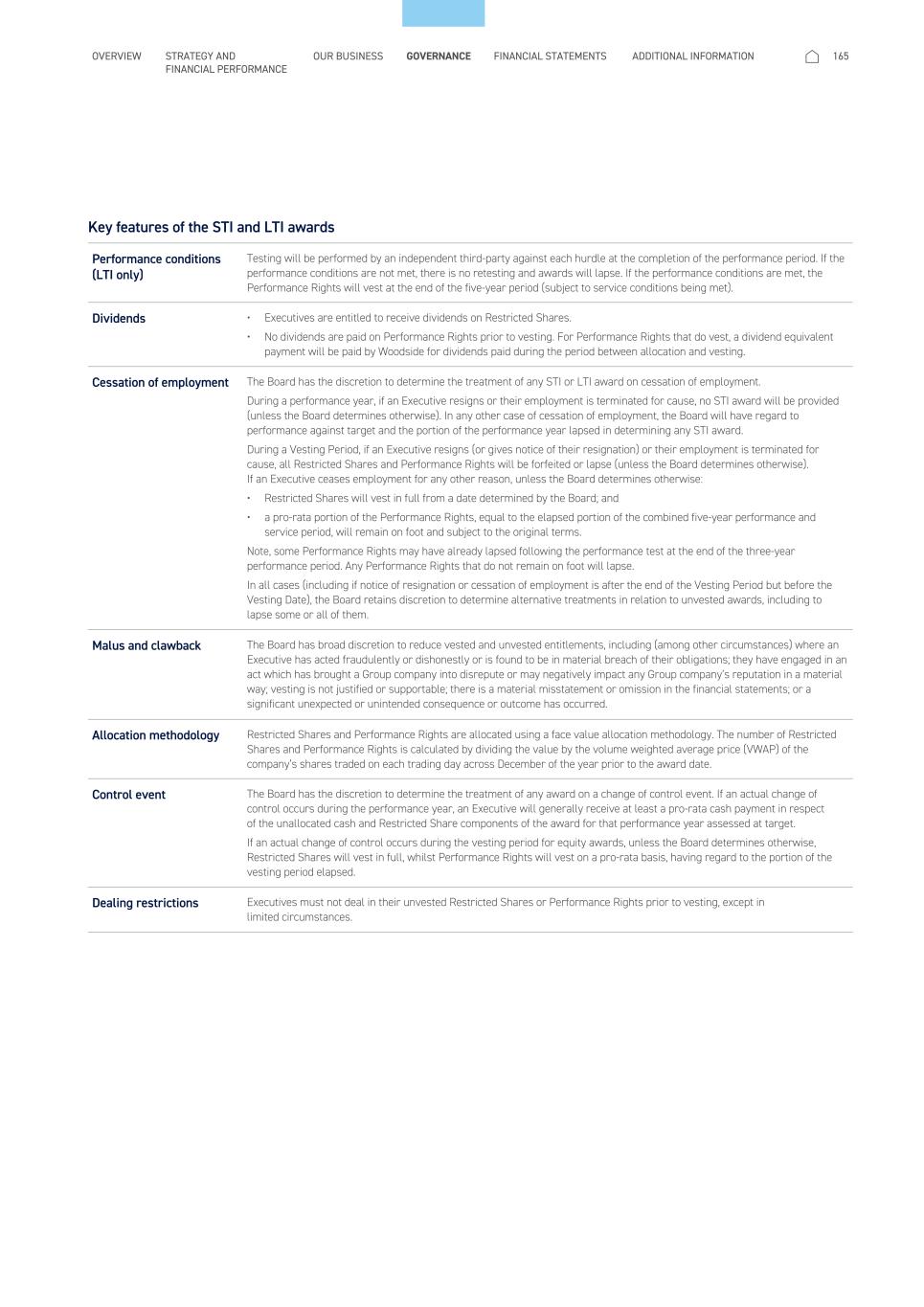
Key features of the STI and LTI awards Performance conditions (LTI only) Testing will be performed by an independent third-party against each hurdle at the completion of the performance period. If the performance conditions are not met, there is no retesting and awards will lapse. If the performance conditions are met, the Performance Rights will vest at the end of the five-year period (subject to service conditions being met). Dividends • Executives are entitled to receive dividends on Restricted Shares. • No dividends are paid on Performance Rights prior to vesting. For Performance Rights that do vest, a dividend equivalent payment will be paid by Woodside for dividends paid during the period between allocation and vesting. Cessation of employment The Board has the discretion to determine the treatment of any STI or LTI award on cessation of employment. During a performance year, if an Executive resigns or their employment is terminated for cause, no STI award will be provided (unless the Board determines otherwise). In any other case of cessation of employment, the Board will have regard to performance against target and the portion of the performance year lapsed in determining any STI award. During a Vesting Period, if an Executive resigns (or gives notice of their resignation) or their employment is terminated for cause, all Restricted Shares and Performance Rights will be forfeited or lapse (unless the Board determines otherwise). If an Executive ceases employment for any other reason, unless the Board determines otherwise: • Restricted Shares will vest in full from a date determined by the Board; and • a pro-rata portion of the Performance Rights, equal to the elapsed portion of the combined five-year performance and service period, will remain on foot and subject to the original terms. Note, some Performance Rights may have already lapsed following the performance test at the end of the three-year performance period. Any Performance Rights that do not remain on foot will lapse. In all cases (including if notice of resignation or cessation of employment is after the end of the Vesting Period but before the Vesting Date), the Board retains discretion to determine alternative treatments in relation to unvested awards, including to lapse some or all of them. Malus and clawback The Board has broad discretion to reduce vested and unvested entitlements, including (among other circumstances) where an Executive has acted fraudulently or dishonestly or is found to be in material breach of their obligations; they have engaged in an act which has brought a Group company into disrepute or may negatively impact any Group company’s reputation in a material way; vesting is not justified or supportable; there is a material misstatement or omission in the financial statements; or a significant unexpected or unintended consequence or outcome has occurred. Allocation methodology Restricted Shares and Performance Rights are allocated using a face value allocation methodology. The number of Restricted Shares and Performance Rights is calculated by dividing the value by the volume weighted average price (VWAP) of the company’s shares traded on each trading day across December of the year prior to the award date. Control event The Board has the discretion to determine the treatment of any award on a change of control event. If an actual change of control occurs during the performance year, an Executive will generally receive at least a pro-rata cash payment in respect of the unallocated cash and Restricted Share components of the award for that performance year assessed at target. If an actual change of control occurs during the vesting period for equity awards, unless the Board determines otherwise, Restricted Shares will vest in full, whilst Performance Rights will vest on a pro-rata basis, having regard to the portion of the vesting period elapsed. Dealing restrictions Executives must not deal in their unvested Restricted Shares or Performance Rights prior to vesting, except in limited circumstances. OVERVIEW STRATEGY AND FINANCIAL PERFORMANCE OUR BUSINESS GOVERNANCE FINANCIAL STATEMENTS ADDITIONAL INFORMATION 165
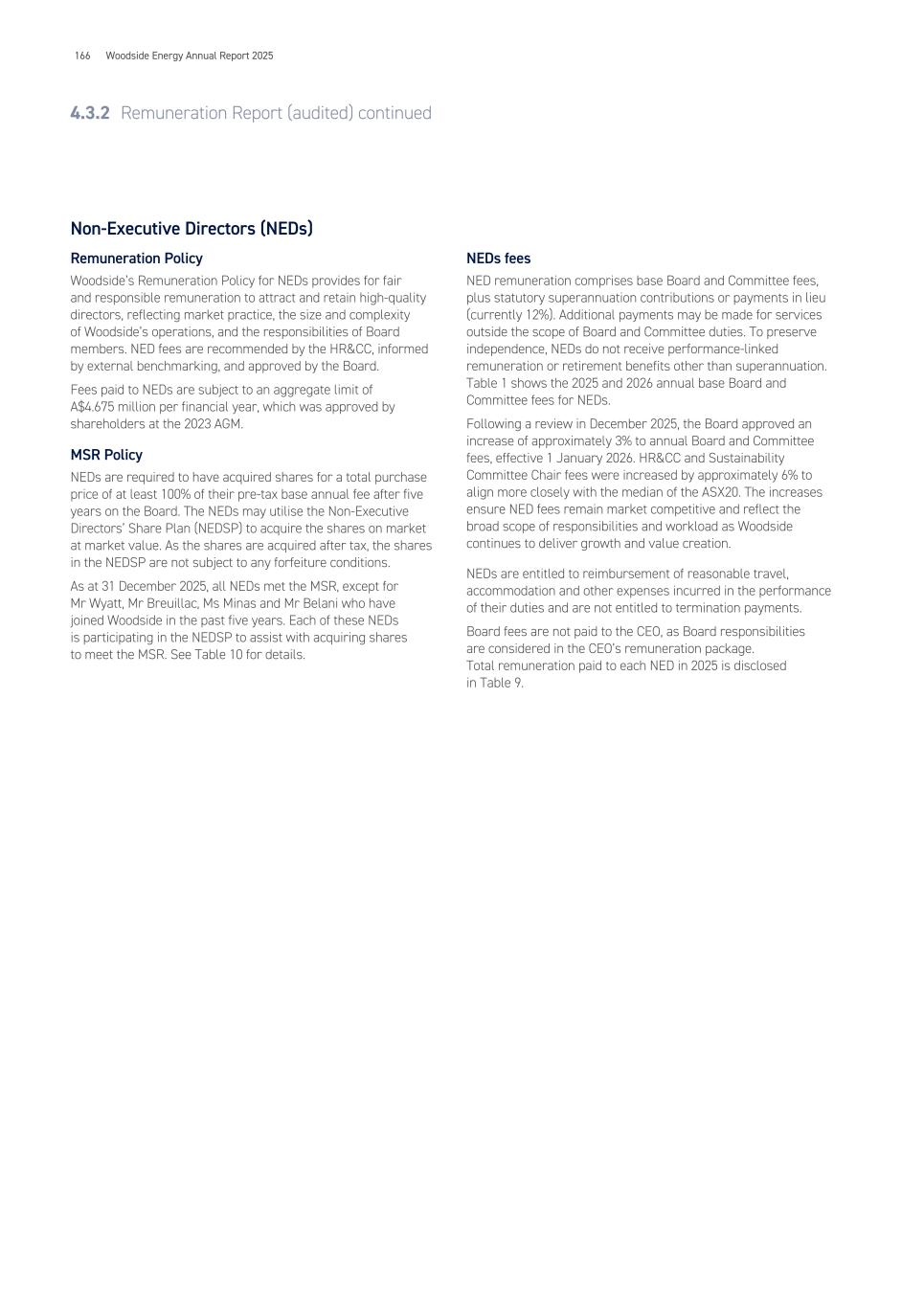
Non-Executive Directors (NEDs) Remuneration Policy Woodside’s Remuneration Policy for NEDs provides for fair and responsible remuneration to attract and retain high-quality directors, reflecting market practice, the size and complexity of Woodside’s operations, and the responsibilities of Board members. NED fees are recommended by the HR&CC, informed by external benchmarking, and approved by the Board. Fees paid to NEDs are subject to an aggregate limit of A$4.675 million per financial year, which was approved by shareholders at the 2023 AGM. MSR Policy NEDs are required to have acquired shares for a total purchase price of at least 100% of their pre-tax base annual fee after five years on the Board. The NEDs may utilise the Non-Executive Directors’ Share Plan (NEDSP) to acquire the shares on market at market value. As the shares are acquired after tax, the shares in the NEDSP are not subject to any forfeiture conditions. As at 31 December 2025, all NEDs met the MSR, except for Mr Wyatt, Mr Breuillac, Ms Minas and Mr Belani who have joined Woodside in the past five years. Each of these NEDs is participating in the NEDSP to assist with acquiring shares to meet the MSR. See Table 10 for details. NEDs fees NED remuneration comprises base Board and Committee fees, plus statutory superannuation contributions or payments in lieu (currently 12%). Additional payments may be made for services outside the scope of Board and Committee duties. To preserve independence, NEDs do not receive performance-linked remuneration or retirement benefits other than superannuation. Table 1 shows the 2025 and 2026 annual base Board and Committee fees for NEDs. Following a review in December 2025, the Board approved an increase of approximately 3% to annual Board and Committee fees, effective 1 January 2026. HR&CC and Sustainability Committee Chair fees were increased by approximately 6% to align more closely with the median of the ASX20. The increases ensure NED fees remain market competitive and reflect the broad scope of responsibilities and workload as Woodside continues to deliver growth and value creation. NEDs are entitled to reimbursement of reasonable travel, accommodation and other expenses incurred in the performance of their duties and are not entitled to termination payments. Board fees are not paid to the CEO, as Board responsibilities are considered in the CEO’s remuneration package. Total remuneration paid to each NED in 2025 is disclosed in Table 9. 166 Woodside Energy Annual Report 2025 4.3.2 Remuneration Report (audited) continued
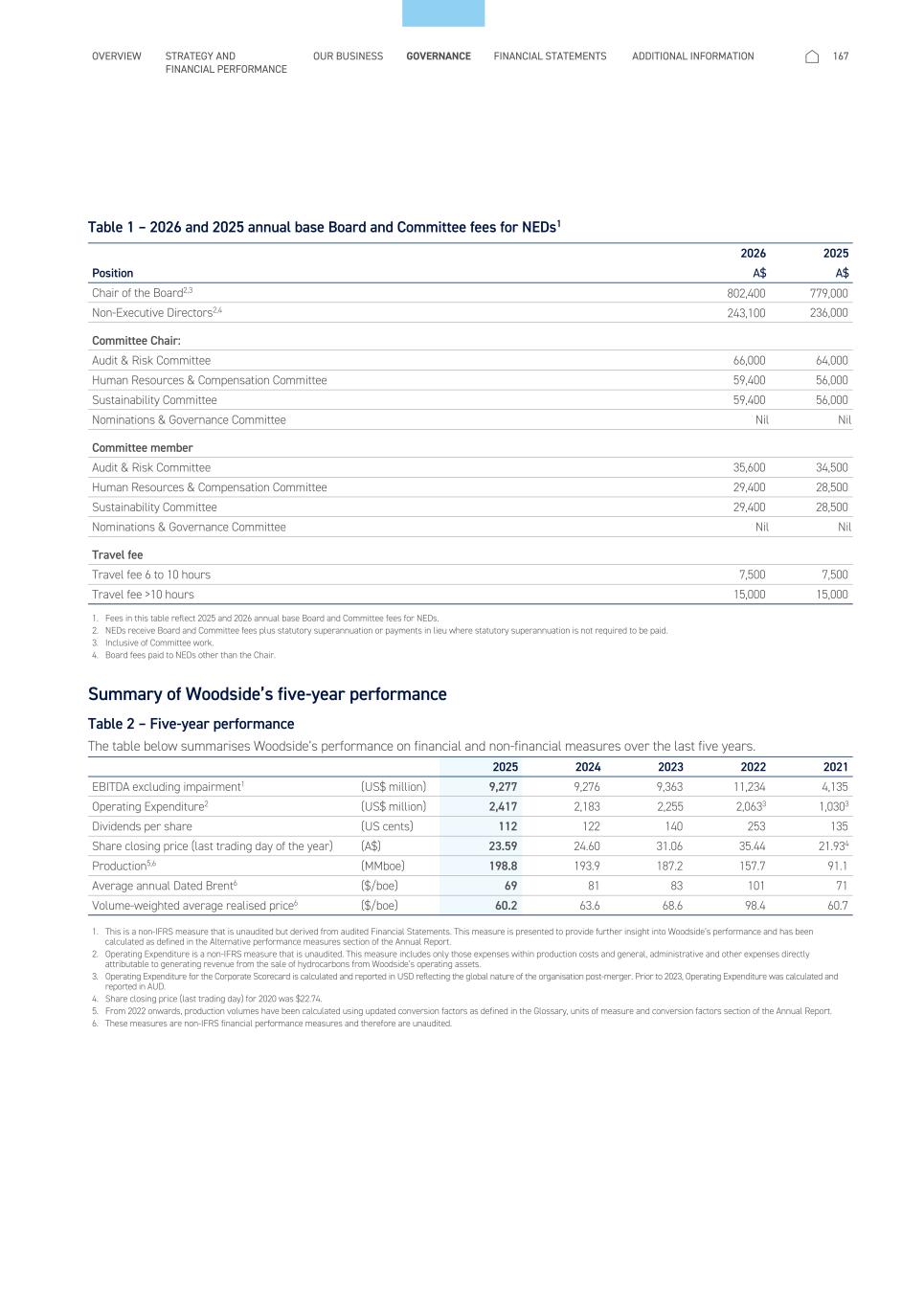
Table 1 – 2026 and 2025 annual base Board and Committee fees for NEDs1 2026 2025 Position A$ A$ Chair of the Board2,3 802,400 779,000 Non-Executive Directors2,4 243,100 236,000 Committee Chair: Audit & Risk Committee 66,000 64,000 Human Resources & Compensation Committee 59,400 56,000 Sustainability Committee 59,400 56,000 Nominations & Governance Committee Nil Nil Committee member Audit & Risk Committee 35,600 34,500 Human Resources & Compensation Committee 29,400 28,500 Sustainability Committee 29,400 28,500 Nominations & Governance Committee Nil Nil Travel fee Travel fee 6 to 10 hours 7,500 7,500 Travel fee >10 hours 15,000 15,000 1. Fees in this table reflect 2025 and 2026 annual base Board and Committee fees for NEDs. 2. NEDs receive Board and Committee fees plus statutory superannuation or payments in lieu where statutory superannuation is not required to be paid. 3. Inclusive of Committee work. 4. Board fees paid to NEDs other than the Chair. Summary of Woodside’s five-year performance Table 2 – Five-year performance The table below summarises Woodside’s performance on financial and non-financial measures over the last five years. 2025 2024 2023 2022 2021 EBITDA excluding impairment1 (US$ million) 9,277 9,276 9,363 11,234 4,135 Operating Expenditure2 (US$ million) 2,417 2,183 2,255 2,0633 1,0303 Dividends per share (US cents) 112 122 140 253 135 Share closing price (last trading day of the year) (A$) 23.59 24.60 31.06 35.44 21.934 Production5,6 (MMboe) 198.8 193.9 187.2 157.7 91.1 Average annual Dated Brent6 ($/boe) 69 81 83 101 71 Volume-weighted average realised price6 ($/boe) 60.2 63.6 68.6 98.4 60.7 1. This is a non-IFRS measure that is unaudited but derived from audited Financial Statements. This measure is presented to provide further insight into Woodside’s performance and has been calculated as defined in the Alternative performance measures section of the Annual Report. 2. Operating Expenditure is a non-IFRS measure that is unaudited. This measure includes only those expenses within production costs and general, administrative and other expenses directly attributable to generating revenue from the sale of hydrocarbons from Woodside’s operating assets. 3. Operating Expenditure for the Corporate Scorecard is calculated and reported in USD reflecting the global nature of the organisation post-merger. Prior to 2023, Operating Expenditure was calculated and reported in AUD. 4. Share closing price (last trading day) for 2020 was $22.74. 5. From 2022 onwards, production volumes have been calculated using updated conversion factors as defined in the Glossary, units of measure and conversion factors section of the Annual Report. 6. These measures are non-IFRS financial performance measures and therefore are unaudited. OVERVIEW STRATEGY AND FINANCIAL PERFORMANCE OUR BUSINESS GOVERNANCE FINANCIAL STATEMENTS ADDITIONAL INFORMATION 167
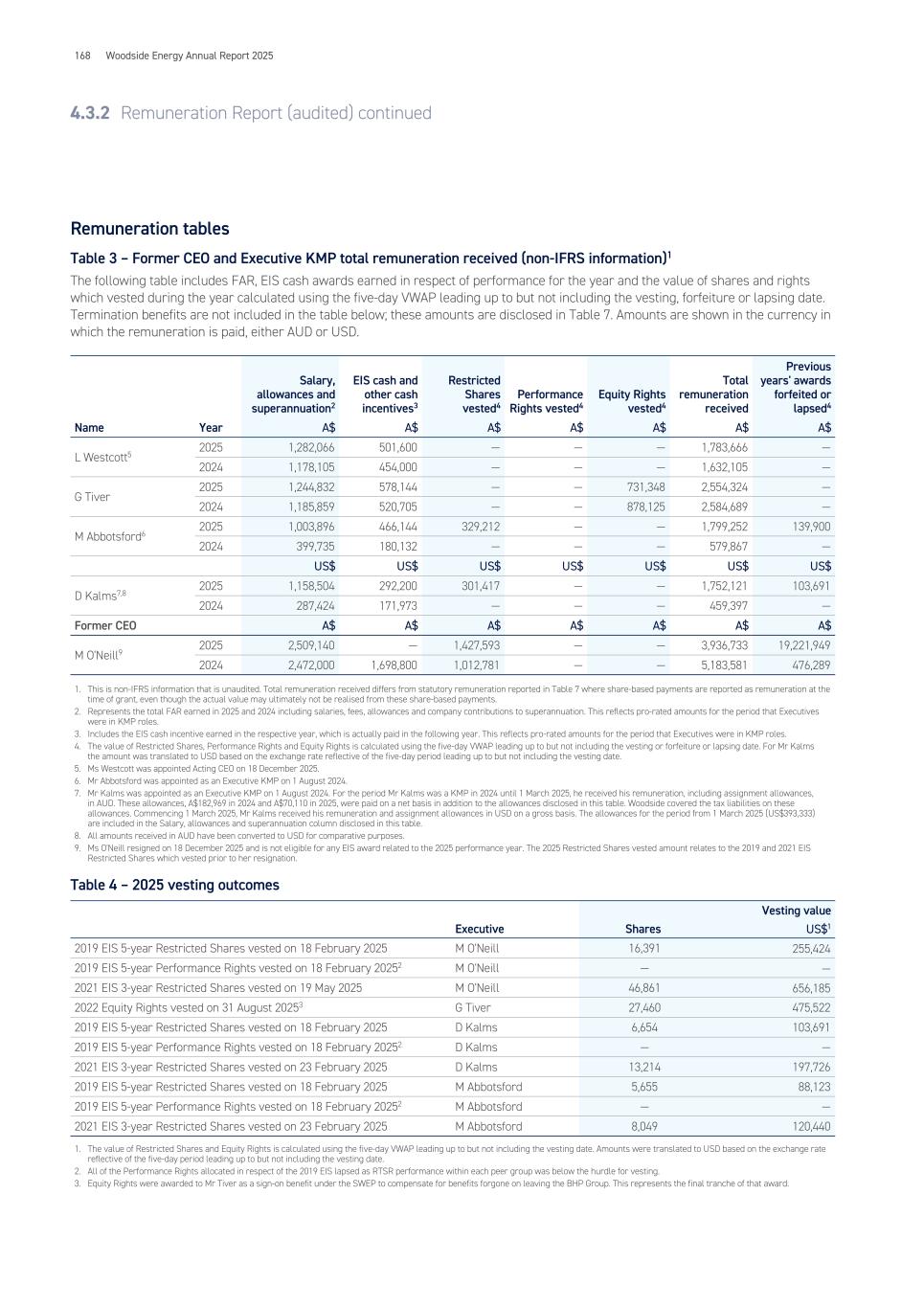
Remuneration tables Table 3 – Former CEO and Executive KMP total remuneration received (non-IFRS information)1 The following table includes FAR, EIS cash awards earned in respect of performance for the year and the value of shares and rights which vested during the year calculated using the five-day VWAP leading up to but not including the vesting, forfeiture or lapsing date. Termination benefits are not included in the table below; these amounts are disclosed in Table 7. Amounts are shown in the currency in which the remuneration is paid, either AUD or USD. Salary, allowances and superannuation2 EIS cash and other cash incentives3 Restricted Shares vested4 Performance Rights vested4 Equity Rights vested4 Total remuneration received Previous years' awards forfeited or lapsed4 Name Year A$ A$ A$ A$ A$ A$ A$ L Westcott5 2025 1,282,066 501,600 — — — 1,783,666 — 2024 1,178,105 454,000 — — — 1,632,105 — G Tiver 2025 1,244,832 578,144 — — 731,348 2,554,324 — 2024 1,185,859 520,705 — — 878,125 2,584,689 — M Abbotsford6 2025 1,003,896 466,144 329,212 — — 1,799,252 139,900 2024 399,735 180,132 — — — 579,867 — US$ US$ US$ US$ US$ US$ US$ D Kalms7,8 2025 1,158,504 292,200 301,417 — — 1,752,121 103,691 2024 287,424 171,973 — — — 459,397 — Former CEO A$ A$ A$ A$ A$ A$ A$ M O'Neill9 2025 2,509,140 — 1,427,593 — — 3,936,733 19,221,949 2024 2,472,000 1,698,800 1,012,781 — — 5,183,581 476,289 1. This is non-IFRS information that is unaudited. Total remuneration received differs from statutory remuneration reported in Table 7 where share-based payments are reported as remuneration at the time of grant, even though the actual value may ultimately not be realised from these share-based payments. 2. Represents the total FAR earned in 2025 and 2024 including salaries, fees, allowances and company contributions to superannuation. This reflects pro-rated amounts for the period that Executives were in KMP roles. 3. Includes the EIS cash incentive earned in the respective year, which is actually paid in the following year. This reflects pro-rated amounts for the period that Executives were in KMP roles. 4. The value of Restricted Shares, Performance Rights and Equity Rights is calculated using the five-day VWAP leading up to but not including the vesting or forfeiture or lapsing date. For Mr Kalms the amount was translated to USD based on the exchange rate reflective of the five-day period leading up to but not including the vesting date. 5. Ms Westcott was appointed Acting CEO on 18 December 2025. 6. Mr Abbotsford was appointed as an Executive KMP on 1 August 2024. 7. Mr Kalms was appointed as an Executive KMP on 1 August 2024. For the period Mr Kalms was a KMP in 2024 until 1 March 2025, he received his remuneration, including assignment allowances, in AUD. These allowances, A$182,969 in 2024 and A$70,110 in 2025, were paid on a net basis in addition to the allowances disclosed in this table. Woodside covered the tax liabilities on these allowances. Commencing 1 March 2025, Mr Kalms received his remuneration and assignment allowances in USD on a gross basis. The allowances for the period from 1 March 2025 (US$393,333) are included in the Salary, allowances and superannuation column disclosed in this table. 8. All amounts received in AUD have been converted to USD for comparative purposes. 9. Ms O'Neill resigned on 18 December 2025 and is not eligible for any EIS award related to the 2025 performance year. The 2025 Restricted Shares vested amount relates to the 2019 and 2021 EIS Restricted Shares which vested prior to her resignation. Table 4 – 2025 vesting outcomes Executive Shares Vesting value US$1 2019 EIS 5-year Restricted Shares vested on 18 February 2025 M O'Neill 16,391 255,424 2019 EIS 5-year Performance Rights vested on 18 February 20252 M O'Neill — — 2021 EIS 3-year Restricted Shares vested on 19 May 2025 M O'Neill 46,861 656,185 2022 Equity Rights vested on 31 August 20253 G Tiver 27,460 475,522 2019 EIS 5-year Restricted Shares vested on 18 February 2025 D Kalms 6,654 103,691 2019 EIS 5-year Performance Rights vested on 18 February 20252 D Kalms — — 2021 EIS 3-year Restricted Shares vested on 23 February 2025 D Kalms 13,214 197,726 2019 EIS 5-year Restricted Shares vested on 18 February 2025 M Abbotsford 5,655 88,123 2019 EIS 5-year Performance Rights vested on 18 February 20252 M Abbotsford — — 2021 EIS 3-year Restricted Shares vested on 23 February 2025 M Abbotsford 8,049 120,440 1. The value of Restricted Shares and Equity Rights is calculated using the five-day VWAP leading up to but not including the vesting date. Amounts were translated to USD based on the exchange rate reflective of the five-day period leading up to but not including the vesting date. 2. All of the Performance Rights allocated in respect of the 2019 EIS lapsed as RTSR performance within each peer group was below the hurdle for vesting. 3. Equity Rights were awarded to Mr Tiver as a sign-on benefit under the SWEP to compensate for benefits forgone on leaving the BHP Group. This represents the final tranche of that award. 168 Woodside Energy Annual Report 2025 4.3.2 Remuneration Report (audited) continued
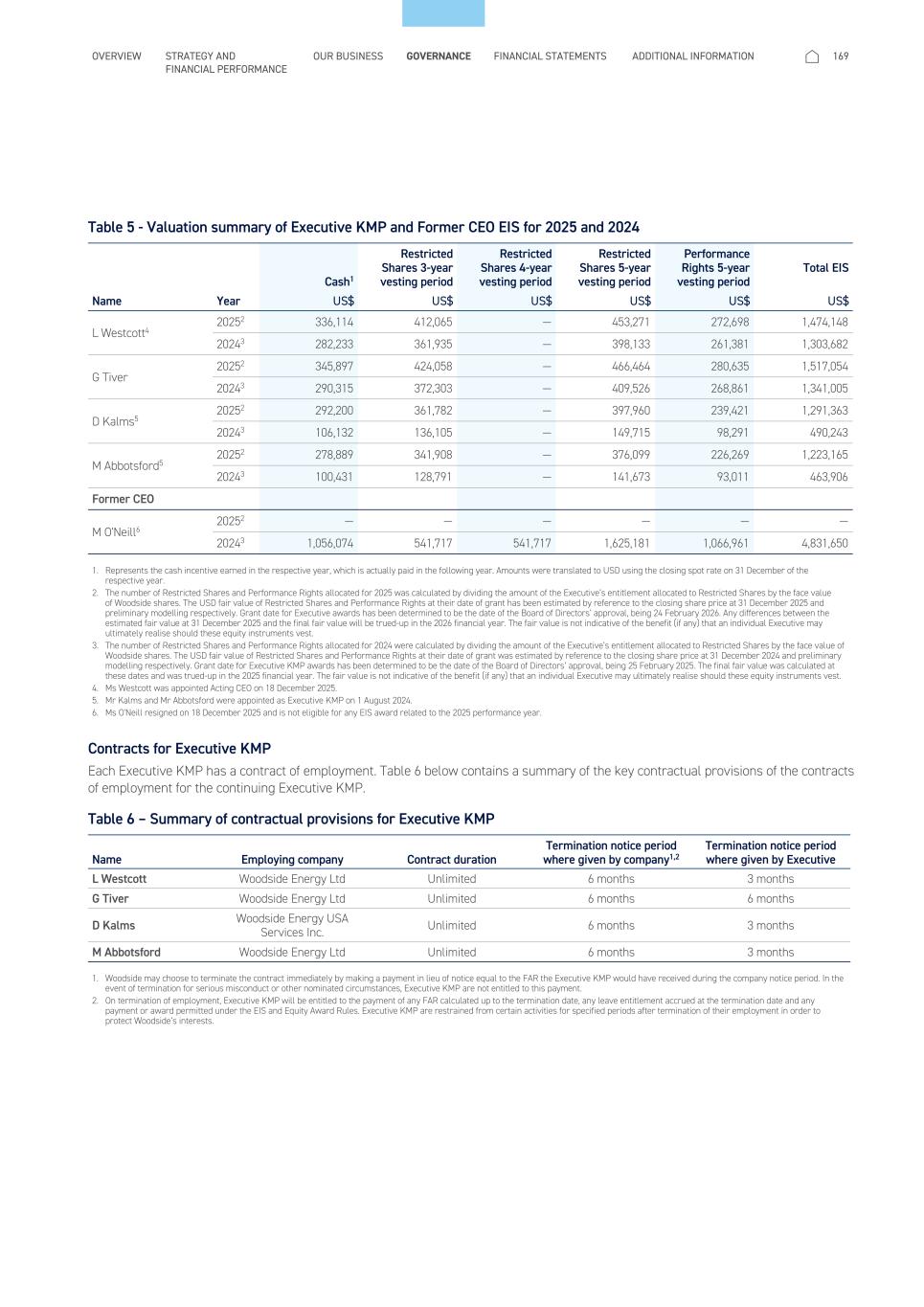
Table 5 - Valuation summary of Executive KMP and Former CEO EIS for 2025 and 2024 Cash1 Restricted Shares 3-year vesting period Restricted Shares 4-year vesting period Restricted Shares 5-year vesting period Performance Rights 5-year vesting period Total EIS Name Year US$ US$ US$ US$ US$ US$ L Westcott4 20252 336,114 412,065 — 453,271 272,698 1,474,148 20243 282,233 361,935 — 398,133 261,381 1,303,682 G Tiver 20252 345,897 424,058 — 466,464 280,635 1,517,054 20243 290,315 372,303 — 409,526 268,861 1,341,005 D Kalms5 20252 292,200 361,782 — 397,960 239,421 1,291,363 20243 106,132 136,105 — 149,715 98,291 490,243 M Abbotsford5 20252 278,889 341,908 — 376,099 226,269 1,223,165 20243 100,431 128,791 — 141,673 93,011 463,906 Former CEO M O'Neill6 20252 — — — — — — 20243 1,056,074 541,717 541,717 1,625,181 1,066,961 4,831,650 1. Represents the cash incentive earned in the respective year, which is actually paid in the following year. Amounts were translated to USD using the closing spot rate on 31 December of the respective year. 2. The number of Restricted Shares and Performance Rights allocated for 2025 was calculated by dividing the amount of the Executive’s entitlement allocated to Restricted Shares by the face value of Woodside shares. The USD fair value of Restricted Shares and Performance Rights at their date of grant has been estimated by reference to the closing share price at 31 December 2025 and preliminary modelling respectively. Grant date for Executive awards has been determined to be the date of the Board of Directors’ approval, being 24 February 2026. Any differences between the estimated fair value at 31 December 2025 and the final fair value will be trued-up in the 2026 financial year. The fair value is not indicative of the benefit (if any) that an individual Executive may ultimately realise should these equity instruments vest. 3. The number of Restricted Shares and Performance Rights allocated for 2024 were calculated by dividing the amount of the Executive’s entitlement allocated to Restricted Shares by the face value of Woodside shares. The USD fair value of Restricted Shares and Performance Rights at their date of grant was estimated by reference to the closing share price at 31 December 2024 and preliminary modelling respectively. Grant date for Executive KMP awards has been determined to be the date of the Board of Directors’ approval, being 25 February 2025. The final fair value was calculated at these dates and was trued-up in the 2025 financial year. The fair value is not indicative of the benefit (if any) that an individual Executive may ultimately realise should these equity instruments vest. 4. Ms Westcott was appointed Acting CEO on 18 December 2025. 5. Mr Kalms and Mr Abbotsford were appointed as Executive KMP on 1 August 2024. 6. Ms O'Neill resigned on 18 December 2025 and is not eligible for any EIS award related to the 2025 performance year. Contracts for Executive KMP Each Executive KMP has a contract of employment. Table 6 below contains a summary of the key contractual provisions of the contracts of employment for the continuing Executive KMP. Table 6 – Summary of contractual provisions for Executive KMP Name Employing company Contract duration Termination notice period where given by company1,2 Termination notice period where given by Executive L Westcott Woodside Energy Ltd Unlimited 6 months 3 months G Tiver Woodside Energy Ltd Unlimited 6 months 6 months D Kalms Woodside Energy USA Services Inc. Unlimited 6 months 3 months M Abbotsford Woodside Energy Ltd Unlimited 6 months 3 months 1. Woodside may choose to terminate the contract immediately by making a payment in lieu of notice equal to the FAR the Executive KMP would have received during the company notice period. In the event of termination for serious misconduct or other nominated circumstances, Executive KMP are not entitled to this payment. 2. On termination of employment, Executive KMP will be entitled to the payment of any FAR calculated up to the termination date, any leave entitlement accrued at the termination date and any payment or award permitted under the EIS and Equity Award Rules. Executive KMP are restrained from certain activities for specified periods after termination of their employment in order to protect Woodside’s interests. OVERVIEW STRATEGY AND FINANCIAL PERFORMANCE OUR BUSINESS GOVERNANCE FINANCIAL STATEMENTS ADDITIONAL INFORMATION 169
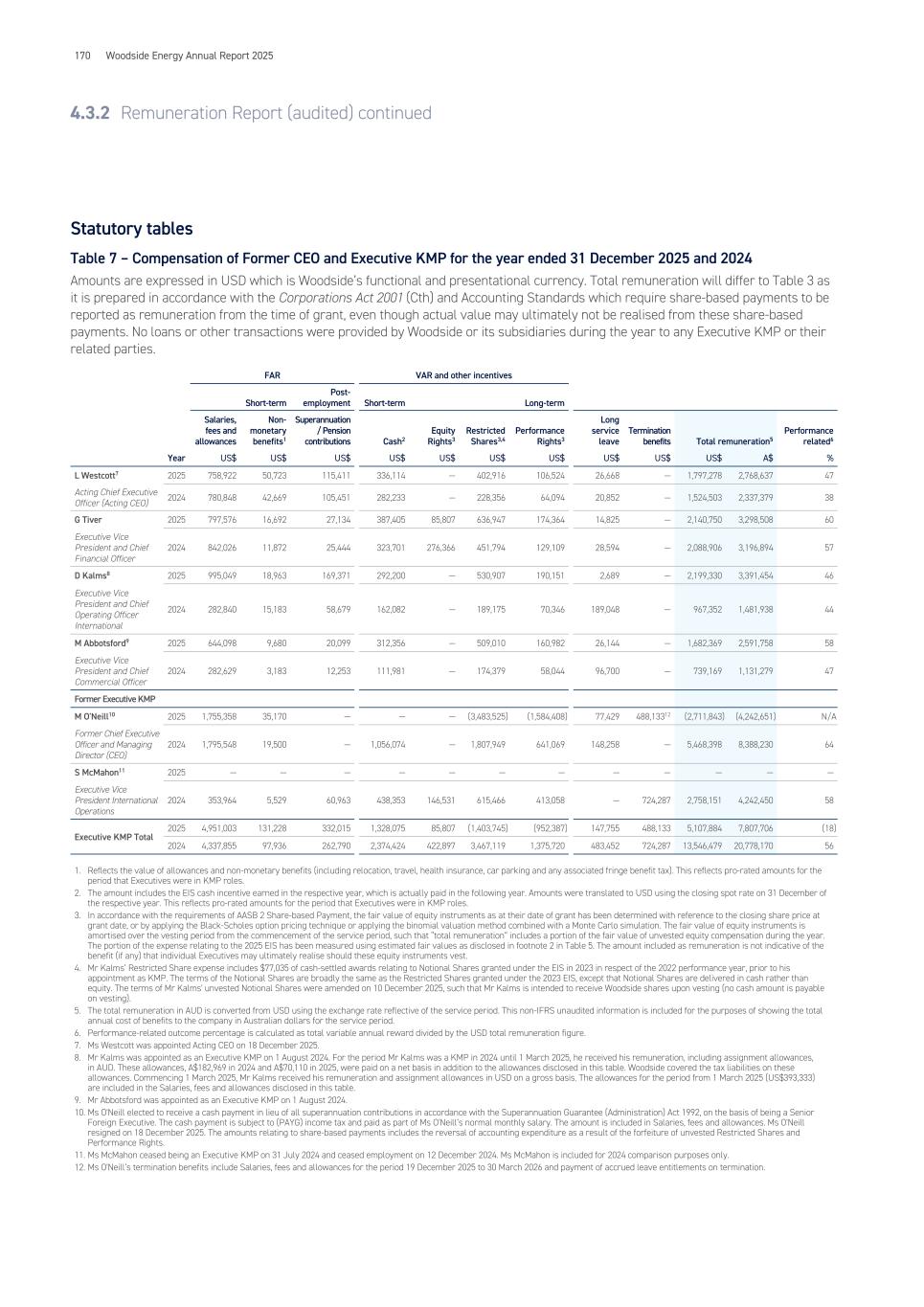
Statutory tables Table 7 – Compensation of Former CEO and Executive KMP for the year ended 31 December 2025 and 2024 Amounts are expressed in USD which is Woodside’s functional and presentational currency. Total remuneration will differ to Table 3 as it is prepared in accordance with the Corporations Act 2001 (Cth) and Accounting Standards which require share-based payments to be reported as remuneration from the time of grant, even though actual value may ultimately not be realised from these share-based payments. No loans or other transactions were provided by Woodside or its subsidiaries during the year to any Executive KMP or their related parties. FAR VAR and other incentives Short-term Post- employment Short-term Long-term Salaries, fees and allowances Non- monetary benefits1 Superannuation / Pension contributions Cash2 Equity Rights3 Restricted Shares3,4 Performance Rights3 Long service leave Termination benefits Total remuneration5 Performance related6 Year US$ US$ US$ US$ US$ US$ US$ US$ US$ US$ A$ % L Westcott7 2025 758,922 50,723 115,411 336,114 — 402,916 106,524 26,668 — 1,797,278 2,768,637 47 Acting Chief Executive Officer (Acting CEO) 2024 780,848 42,669 105,451 282,233 — 228,356 64,094 20,852 — 1,524,503 2,337,379 38 G Tiver 2025 797,576 16,692 27,134 387,405 85,807 636,947 174,364 14,825 — 2,140,750 3,298,508 60 Executive Vice President and Chief Financial Officer 2024 842,026 11,872 25,444 323,701 276,366 451,794 129,109 28,594 — 2,088,906 3,196,894 57 D Kalms8 2025 995,049 18,963 169,371 292,200 — 530,907 190,151 2,689 — 2,199,330 3,391,454 46 Executive Vice President and Chief Operating Officer International 2024 282,840 15,183 58,679 162,082 — 189,175 70,346 189,048 — 967,352 1,481,938 44 M Abbotsford9 2025 644,098 9,680 20,099 312,356 — 509,010 160,982 26,144 — 1,682,369 2,591,758 58 Executive Vice President and Chief Commercial Officer 2024 282,629 3,183 12,253 111,981 — 174,379 58,044 96,700 — 739,169 1,131,279 47 Former Executive KMP M O'Neill10 2025 1,755,358 35,170 — — — (3,483,525) (1,584,408) 77,429 488,13312 (2,711,843) (4,242,651) N/A Former Chief Executive Officer and Managing Director (CEO) 2024 1,795,548 19,500 — 1,056,074 — 1,807,949 641,069 148,258 — 5,468,398 8,388,230 64 S McMahon11 2025 — — — — — — — — — — — — Executive Vice President International Operations 2024 353,964 5,529 60,963 438,353 146,531 615,466 413,058 — 724,287 2,758,151 4,242,450 58 Executive KMP Total 2025 4,951,003 131,228 332,015 1,328,075 85,807 (1,403,745) (952,387) 147,755 488,133 5,107,884 7,807,706 (18) 2024 4,337,855 97,936 262,790 2,374,424 422,897 3,467,119 1,375,720 483,452 724,287 13,546,479 20,778,170 56 1. 1. Reflects the value of allowances and non-monetary benefits (including relocation, travel, health insurance, car parking and any associated fringe benefit tax). This reflects pro-rated amounts for the period that Executives were in KMP roles. 2. The amount includes the EIS cash incentive earned in the respective year, which is actually paid in the following year. Amounts were translated to USD using the closing spot rate on 31 December of the respective year. This reflects pro-rated amounts for the period that Executives were in KMP roles. 3. In accordance with the requirements of AASB 2 Share-based Payment, the fair value of equity instruments as at their date of grant has been determined with reference to the closing share price at grant date, or by applying the Black-Scholes option pricing technique or applying the binomial valuation method combined with a Monte Carlo simulation. The fair value of equity instruments is amortised over the vesting period from the commencement of the service period, such that “total remuneration” includes a portion of the fair value of unvested equity compensation during the year. The portion of the expense relating to the 2025 EIS has been measured using estimated fair values as disclosed in footnote 2 in Table 5. The amount included as remuneration is not indicative of the benefit (if any) that individual Executives may ultimately realise should these equity instruments vest. 4. Mr Kalms’ Restricted Share expense includes $77,035 of cash-settled awards relating to Notional Shares granted under the EIS in 2023 in respect of the 2022 performance year, prior to his appointment as KMP. The terms of the Notional Shares are broadly the same as the Restricted Shares granted under the 2023 EIS, except that Notional Shares are delivered in cash rather than equity. The terms of Mr Kalms' unvested Notional Shares were amended on 10 December 2025, such that Mr Kalms is intended to receive Woodside shares upon vesting (no cash amount is payable on vesting). 5. The total remuneration in AUD is converted from USD using the exchange rate reflective of the service period. This non-IFRS unaudited information is included for the purposes of showing the total annual cost of benefits to the company in Australian dollars for the service period. 6. Performance-related outcome percentage is calculated as total variable annual reward divided by the USD total remuneration figure. 7. Ms Westcott was appointed Acting CEO on 18 December 2025. 8. Mr Kalms was appointed as an Executive KMP on 1 August 2024. For the period Mr Kalms was a KMP in 2024 until 1 March 2025, he received his remuneration, including assignment allowances, in AUD. These allowances, A$182,969 in 2024 and A$70,110 in 2025, were paid on a net basis in addition to the allowances disclosed in this table. Woodside covered the tax liabilities on these allowances. Commencing 1 March 2025, Mr Kalms received his remuneration and assignment allowances in USD on a gross basis. The allowances for the period from 1 March 2025 (US$393,333) are included in the Salaries, fees and allowances disclosed in this table. 9. Mr Abbotsford was appointed as an Executive KMP on 1 August 2024. 10. Ms O'Neill elected to receive a cash payment in lieu of all superannuation contributions in accordance with the Superannuation Guarantee (Administration) Act 1992, on the basis of being a Senior Foreign Executive. The cash payment is subject to (PAYG) income tax and paid as part of Ms O'Neill’s normal monthly salary. The amount is included in Salaries, fees and allowances. Ms O'Neill resigned on 18 December 2025. The amounts relating to share-based payments includes the reversal of accounting expenditure as a result of the forfeiture of unvested Restricted Shares and Performance Rights. 11. Ms McMahon ceased being an Executive KMP on 31 July 2024 and ceased employment on 12 December 2024. Ms McMahon is included for 2024 comparison purposes only. 12. Ms O'Neill’s termination benefits include Salaries, fees and allowances for the period 19 December 2025 to 30 March 2026 and payment of accrued leave entitlements on termination. 170 Woodside Energy Annual Report 2025 4.3.2 Remuneration Report (audited) continued
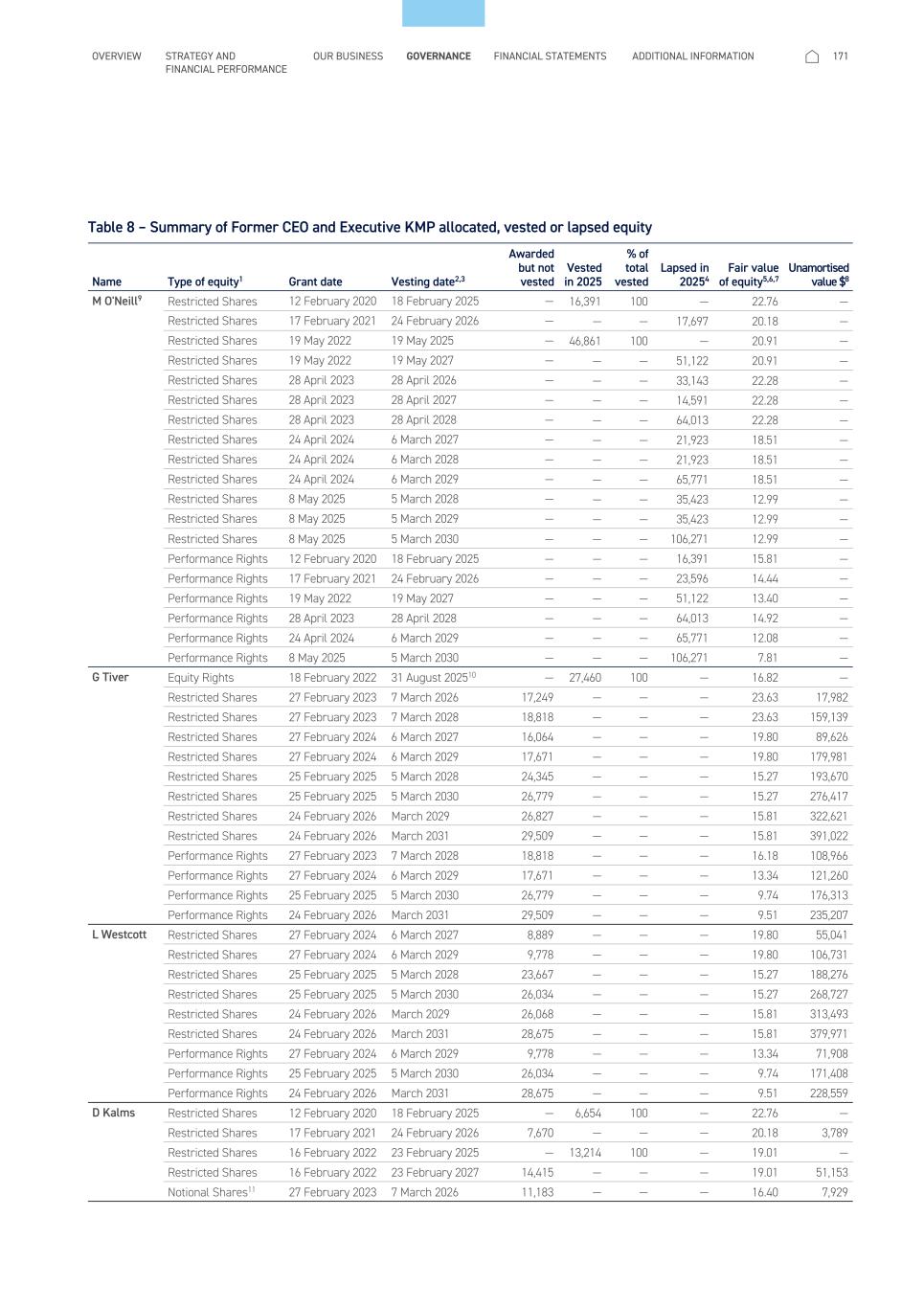
Table 8 – Summary of Former CEO and Executive KMP allocated, vested or lapsed equity M O'Neill9 Restricted Shares 12 February 2020 18 February 2025 — 16,391 100 — 22.76 — Restricted Shares 17 February 2021 24 February 2026 — — — 17,697 20.18 — Restricted Shares 19 May 2022 19 May 2025 — 46,861 100 — 20.91 — Restricted Shares 19 May 2022 19 May 2027 — — — 51,122 20.91 — Restricted Shares 28 April 2023 28 April 2026 — — — 33,143 22.28 — Restricted Shares 28 April 2023 28 April 2027 — — — 14,591 22.28 — Restricted Shares 28 April 2023 28 April 2028 — — — 64,013 22.28 — Restricted Shares 24 April 2024 6 March 2027 — — — 21,923 18.51 — Restricted Shares 24 April 2024 6 March 2028 — — — 21,923 18.51 — Restricted Shares 24 April 2024 6 March 2029 — — — 65,771 18.51 — Restricted Shares 8 May 2025 5 March 2028 — — — 35,423 12.99 — Restricted Shares 8 May 2025 5 March 2029 — — — 35,423 12.99 — Restricted Shares 8 May 2025 5 March 2030 — — — 106,271 12.99 — Performance Rights 12 February 2020 18 February 2025 — — — 16,391 15.81 — Performance Rights 17 February 2021 24 February 2026 — — — 23,596 14.44 — Performance Rights 19 May 2022 19 May 2027 — — — 51,122 13.40 — Performance Rights 28 April 2023 28 April 2028 — — — 64,013 14.92 — Performance Rights 24 April 2024 6 March 2029 — — — 65,771 12.08 — Performance Rights 8 May 2025 5 March 2030 — — — 106,271 7.81 — G Tiver Equity Rights 18 February 2022 31 August 202510 — 27,460 100 — 16.82 — Restricted Shares 27 February 2023 7 March 2026 17,249 — — — 23.63 17,982 Restricted Shares 27 February 2023 7 March 2028 18,818 — — — 23.63 159,139 Restricted Shares 27 February 2024 6 March 2027 16,064 — — — 19.80 89,626 Restricted Shares 27 February 2024 6 March 2029 17,671 — — — 19.80 179,981 Restricted Shares 25 February 2025 5 March 2028 24,345 — — — 15.27 193,670 Restricted Shares 25 February 2025 5 March 2030 26,779 — — — 15.27 276,417 Restricted Shares 24 February 2026 March 2029 26,827 — — — 15.81 322,621 Restricted Shares 24 February 2026 March 2031 29,509 — — — 15.81 391,022 Performance Rights 27 February 2023 7 March 2028 18,818 — — — 16.18 108,966 Performance Rights 27 February 2024 6 March 2029 17,671 — — — 13.34 121,260 Performance Rights 25 February 2025 5 March 2030 26,779 — — — 9.74 176,313 Performance Rights 24 February 2026 March 2031 29,509 — — — 9.51 235,207 L Westcott Restricted Shares 27 February 2024 6 March 2027 8,889 — — — 19.80 55,041 Restricted Shares 27 February 2024 6 March 2029 9,778 — — — 19.80 106,731 Restricted Shares 25 February 2025 5 March 2028 23,667 — — — 15.27 188,276 Restricted Shares 25 February 2025 5 March 2030 26,034 — — — 15.27 268,727 Restricted Shares 24 February 2026 March 2029 26,068 — — — 15.81 313,493 Restricted Shares 24 February 2026 March 2031 28,675 — — — 15.81 379,971 Performance Rights 27 February 2024 6 March 2029 9,778 — — — 13.34 71,908 Performance Rights 25 February 2025 5 March 2030 26,034 — — — 9.74 171,408 Performance Rights 24 February 2026 March 2031 28,675 — — — 9.51 228,559 D Kalms Restricted Shares 12 February 2020 18 February 2025 — 6,654 100 — 22.76 — Restricted Shares 17 February 2021 24 February 2026 7,670 — — — 20.18 3,789 Restricted Shares 16 February 2022 23 February 2025 — 13,214 100 — 19.01 — Restricted Shares 16 February 2022 23 February 2027 14,415 — — — 19.01 51,153 Notional Shares11 27 February 2023 7 March 2026 11,183 — — — 16.40 7,929 Name Type of equity1 Grant date Vesting date2,3 Awarded but not vested Vested in 2025 % of total vested Lapsed in 20254 Fair value of equity5,6,7 Unamortised value $8 OVERVIEW STRATEGY AND FINANCIAL PERFORMANCE OUR BUSINESS GOVERNANCE FINANCIAL STATEMENTS ADDITIONAL INFORMATION 171
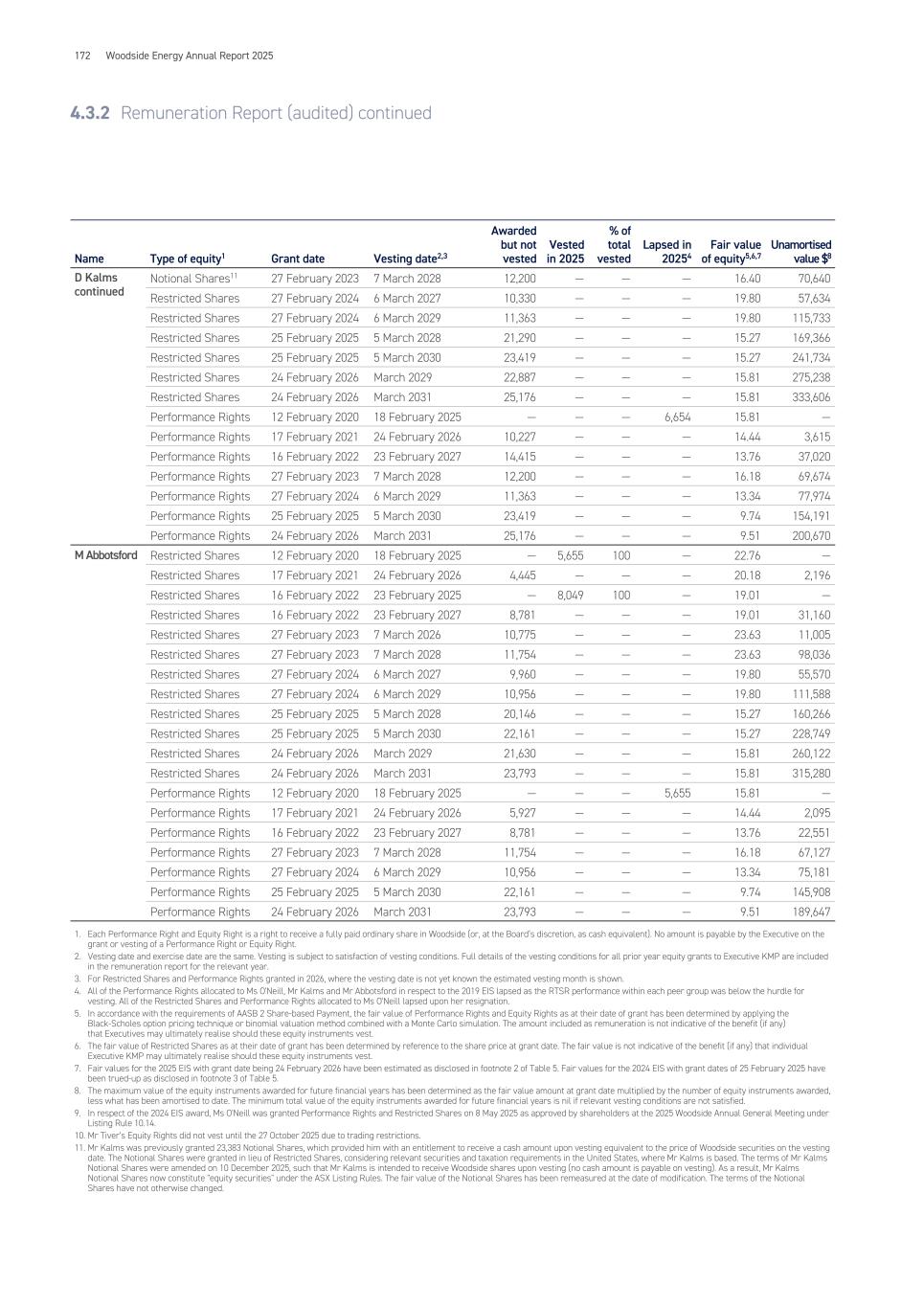
D Kalms continued Notional Shares11 27 February 2023 7 March 2028 12,200 — — — 16.40 70,640 Restricted Shares 27 February 2024 6 March 2027 10,330 — — — 19.80 57,634 Restricted Shares 27 February 2024 6 March 2029 11,363 — — — 19.80 115,733 Restricted Shares 25 February 2025 5 March 2028 21,290 — — — 15.27 169,366 Restricted Shares 25 February 2025 5 March 2030 23,419 — — — 15.27 241,734 Restricted Shares 24 February 2026 March 2029 22,887 — — — 15.81 275,238 Restricted Shares 24 February 2026 March 2031 25,176 — — — 15.81 333,606 Performance Rights 12 February 2020 18 February 2025 — — — 6,654 15.81 — Performance Rights 17 February 2021 24 February 2026 10,227 — — — 14.44 3,615 Performance Rights 16 February 2022 23 February 2027 14,415 — — — 13.76 37,020 Performance Rights 27 February 2023 7 March 2028 12,200 — — — 16.18 69,674 Performance Rights 27 February 2024 6 March 2029 11,363 — — — 13.34 77,974 Performance Rights 25 February 2025 5 March 2030 23,419 — — — 9.74 154,191 Performance Rights 24 February 2026 March 2031 25,176 — — — 9.51 200,670 M Abbotsford Restricted Shares 12 February 2020 18 February 2025 — 5,655 100 — 22.76 — Restricted Shares 17 February 2021 24 February 2026 4,445 — — — 20.18 2,196 Restricted Shares 16 February 2022 23 February 2025 — 8,049 100 — 19.01 — Restricted Shares 16 February 2022 23 February 2027 8,781 — — — 19.01 31,160 Restricted Shares 27 February 2023 7 March 2026 10,775 — — — 23.63 11,005 Restricted Shares 27 February 2023 7 March 2028 11,754 — — — 23.63 98,036 Restricted Shares 27 February 2024 6 March 2027 9,960 — — — 19.80 55,570 Restricted Shares 27 February 2024 6 March 2029 10,956 — — — 19.80 111,588 Restricted Shares 25 February 2025 5 March 2028 20,146 — — — 15.27 160,266 Restricted Shares 25 February 2025 5 March 2030 22,161 — — — 15.27 228,749 Restricted Shares 24 February 2026 March 2029 21,630 — — — 15.81 260,122 Restricted Shares 24 February 2026 March 2031 23,793 — — — 15.81 315,280 Performance Rights 12 February 2020 18 February 2025 — — — 5,655 15.81 — Performance Rights 17 February 2021 24 February 2026 5,927 — — — 14.44 2,095 Performance Rights 16 February 2022 23 February 2027 8,781 — — — 13.76 22,551 Performance Rights 27 February 2023 7 March 2028 11,754 — — — 16.18 67,127 Performance Rights 27 February 2024 6 March 2029 10,956 — — — 13.34 75,181 Performance Rights 25 February 2025 5 March 2030 22,161 — — — 9.74 145,908 Performance Rights 24 February 2026 March 2031 23,793 — — — 9.51 189,647 1. Each Performance Right and Equity Right is a right to receive a fully paid ordinary share in Woodside (or, at the Board’s discretion, as cash equivalent). No amount is payable by the Executive on the grant or vesting of a Performance Right or Equity Right. 2. Vesting date and exercise date are the same. Vesting is subject to satisfaction of vesting conditions. Full details of the vesting conditions for all prior year equity grants to Executive KMP are included in the remuneration report for the relevant year. 3. For Restricted Shares and Performance Rights granted in 2026, where the vesting date is not yet known the estimated vesting month is shown. 4. All of the Performance Rights allocated to Ms O'Neill, Mr Kalms and Mr Abbotsford in respect to the 2019 EIS lapsed as the RTSR performance within each peer group was below the hurdle for vesting. All of the Restricted Shares and Performance Rights allocated to Ms O'Neill lapsed upon her resignation. 5. In accordance with the requirements of AASB 2 Share-based Payment, the fair value of Performance Rights and Equity Rights as at their date of grant has been determined by applying the Black‑Scholes option pricing technique or binomial valuation method combined with a Monte Carlo simulation. The amount included as remuneration is not indicative of the benefit (if any) that Executives may ultimately realise should these equity instruments vest. 6. The fair value of Restricted Shares as at their date of grant has been determined by reference to the share price at grant date. The fair value is not indicative of the benefit (if any) that individual Executive KMP may ultimately realise should these equity instruments vest. 7. Fair values for the 2025 EIS with grant date being 24 February 2026 have been estimated as disclosed in footnote 2 of Table 5. Fair values for the 2024 EIS with grant dates of 25 February 2025 have been trued-up as disclosed in footnote 3 of Table 5. 8. The maximum value of the equity instruments awarded for future financial years has been determined as the fair value amount at grant date multiplied by the number of equity instruments awarded, less what has been amortised to date. The minimum total value of the equity instruments awarded for future financial years is nil if relevant vesting conditions are not satisfied. 9. In respect of the 2024 EIS award, Ms O'Neill was granted Performance Rights and Restricted Shares on 8 May 2025 as approved by shareholders at the 2025 Woodside Annual General Meeting under Listing Rule 10.14. 10. Mr Tiver’s Equity Rights did not vest until the 27 October 2025 due to trading restrictions. 11. Mr Kalms was previously granted 23,383 Notional Shares, which provided him with an entitlement to receive a cash amount upon vesting equivalent to the price of Woodside securities on the vesting date. The Notional Shares were granted in lieu of Restricted Shares, considering relevant securities and taxation requirements in the United States, where Mr Kalms is based. The terms of Mr Kalms Notional Shares were amended on 10 December 2025, such that Mr Kalms is intended to receive Woodside shares upon vesting (no cash amount is payable on vesting). As a result, Mr Kalms Notional Shares now constitute "equity securities" under the ASX Listing Rules. The fair value of the Notional Shares has been remeasured at the date of modification. The terms of the Notional Shares have not otherwise changed. Name Type of equity1 Grant date Vesting date2,3 Awarded but not vested Vested in 2025 % of total vested Lapsed in 20254 Fair value of equity5,6,7 Unamortised value $8 172 Woodside Energy Annual Report 2025 4.3.2 Remuneration Report (audited) continued
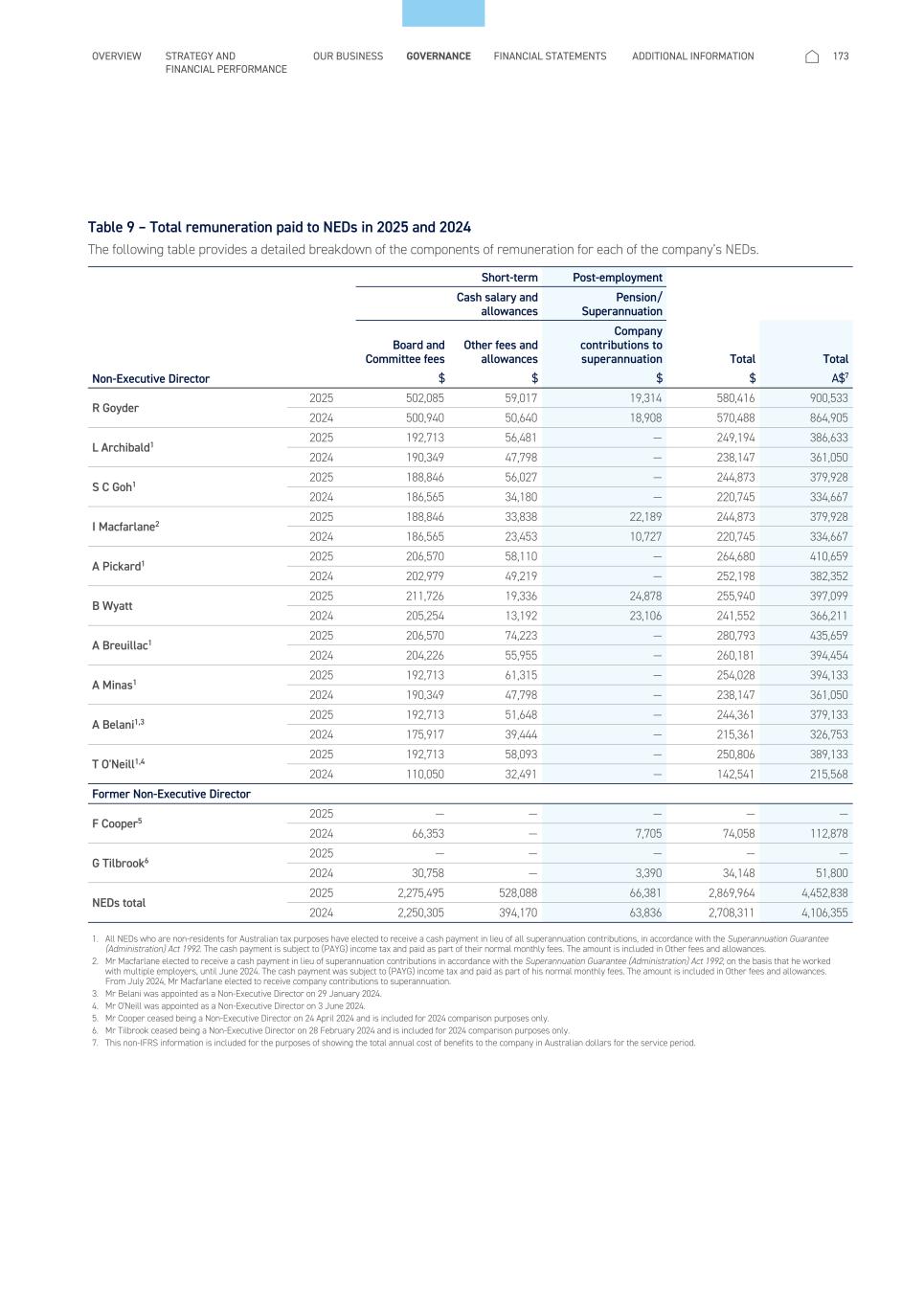
Table 9 – Total remuneration paid to NEDs in 2025 and 2024 The following table provides a detailed breakdown of the components of remuneration for each of the company’s NEDs. Short-term Post-employment Cash salary and allowances Pension/ Superannuation Non-Executive Director Board and Committee fees Other fees and allowances Company contributions to superannuation Total Total $ $ $ $ A$7 R Goyder 2025 502,085 59,017 19,314 580,416 900,533 2024 500,940 50,640 18,908 570,488 864,905 L Archibald1 2025 192,713 56,481 — 249,194 386,633 2024 190,349 47,798 — 238,147 361,050 S C Goh1 2025 188,846 56,027 — 244,873 379,928 2024 186,565 34,180 — 220,745 334,667 I Macfarlane2 2025 188,846 33,838 22,189 244,873 379,928 2024 186,565 23,453 10,727 220,745 334,667 A Pickard1 2025 206,570 58,110 — 264,680 410,659 2024 202,979 49,219 — 252,198 382,352 B Wyatt 2025 211,726 19,336 24,878 255,940 397,099 2024 205,254 13,192 23,106 241,552 366,211 A Breuillac1 2025 206,570 74,223 — 280,793 435,659 2024 204,226 55,955 — 260,181 394,454 A Minas1 2025 192,713 61,315 — 254,028 394,133 2024 190,349 47,798 — 238,147 361,050 A Belani1,3 2025 192,713 51,648 — 244,361 379,133 2024 175,917 39,444 — 215,361 326,753 T O'Neill1,4 2025 192,713 58,093 — 250,806 389,133 2024 110,050 32,491 — 142,541 215,568 Former Non-Executive Director F Cooper5 2025 — — — — — 2024 66,353 — 7,705 74,058 112,878 G Tilbrook6 2025 — — — — — 2024 30,758 — 3,390 34,148 51,800 NEDs total 2025 2,275,495 528,088 66,381 2,869,964 4,452,838 2024 2,250,305 394,170 63,836 2,708,311 4,106,355 1. All NEDs who are non-residents for Australian tax purposes have elected to receive a cash payment in lieu of all superannuation contributions, in accordance with the Superannuation Guarantee (Administration) Act 1992. The cash payment is subject to (PAYG) income tax and paid as part of their normal monthly fees. The amount is included in Other fees and allowances. 2. Mr Macfarlane elected to receive a cash payment in lieu of superannuation contributions in accordance with the Superannuation Guarantee (Administration) Act 1992, on the basis that he worked with multiple employers, until June 2024. The cash payment was subject to (PAYG) income tax and paid as part of his normal monthly fees. The amount is included in Other fees and allowances. From July 2024, Mr Macfarlane elected to receive company contributions to superannuation. 3. Mr Belani was appointed as a Non-Executive Director on 29 January 2024. 4. Mr O'Neill was appointed as a Non-Executive Director on 3 June 2024. 5. Mr Cooper ceased being a Non-Executive Director on 24 April 2024 and is included for 2024 comparison purposes only. 6. Mr Tilbrook ceased being a Non-Executive Director on 28 February 2024 and is included for 2024 comparison purposes only. 7. This non-IFRS information is included for the purposes of showing the total annual cost of benefits to the company in Australian dollars for the service period. OVERVIEW STRATEGY AND FINANCIAL PERFORMANCE OUR BUSINESS GOVERNANCE FINANCIAL STATEMENTS ADDITIONAL INFORMATION 173
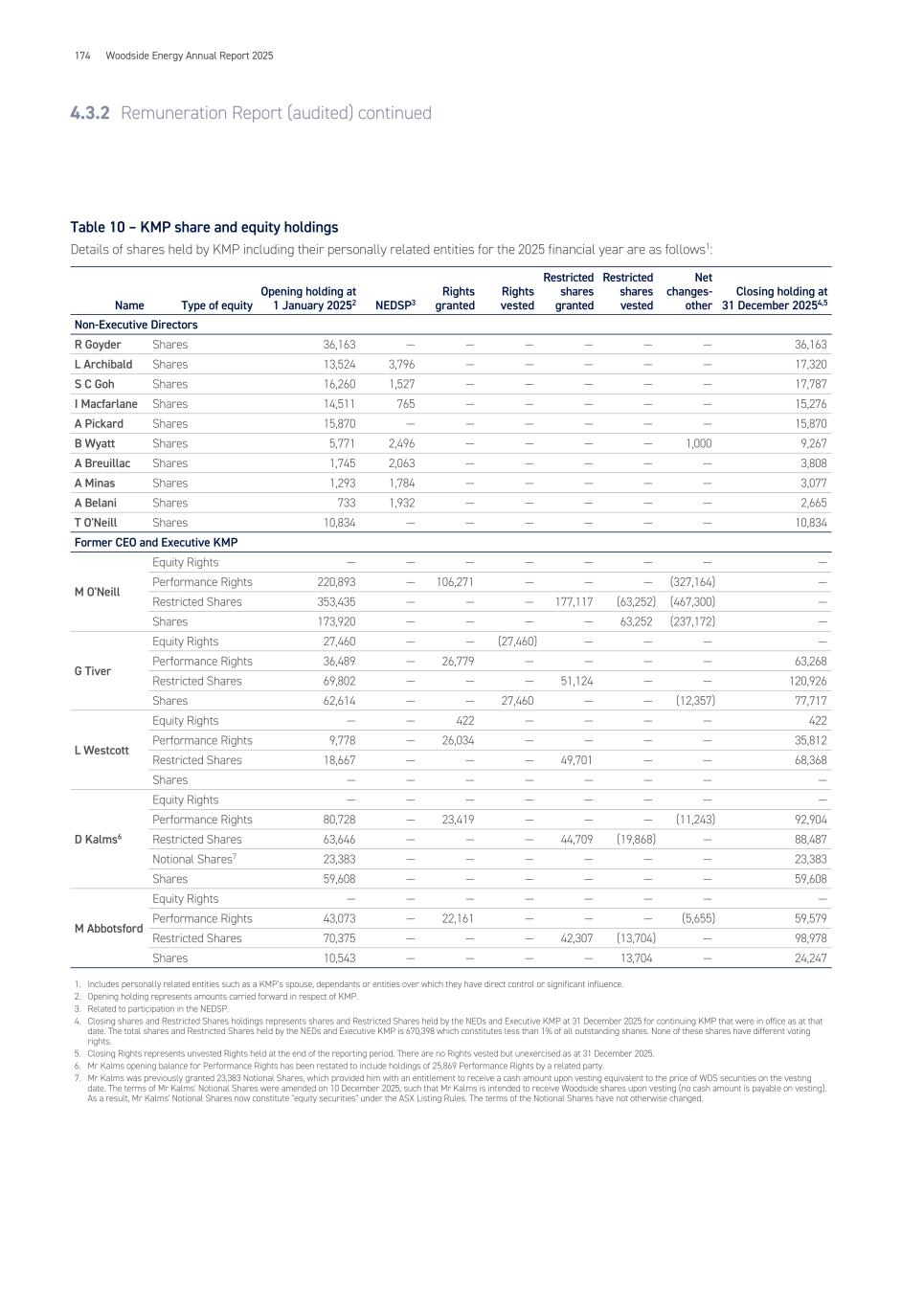
Table 10 – KMP share and equity holdings Details of shares held by KMP including their personally related entities for the 2025 financial year are as follows1: Name Type of equity Opening holding at 1 January 20252 NEDSP3 Rights granted Rights vested Restricted shares granted Restricted shares vested Net changes- other Closing holding at 31 December 20254,5 Non-Executive Directors R Goyder Shares 36,163 — — — — — — 36,163 L Archibald Shares 13,524 3,796 — — — — — 17,320 S C Goh Shares 16,260 1,527 — — — — — 17,787 I Macfarlane Shares 14,511 765 — — — — — 15,276 A Pickard Shares 15,870 — — — — — — 15,870 B Wyatt Shares 5,771 2,496 — — — — 1,000 9,267 A Breuillac Shares 1,745 2,063 — — — — — 3,808 A Minas Shares 1,293 1,784 — — — — — 3,077 A Belani Shares 733 1,932 — — — — — 2,665 T O'Neill Shares 10,834 — — — — — — 10,834 Former CEO and Executive KMP M O'Neill Equity Rights — — — — — — — — Performance Rights 220,893 — 106,271 — — — (327,164) — Restricted Shares 353,435 — — — 177,117 (63,252) (467,300) — Shares 173,920 — — — — 63,252 (237,172) — G Tiver Equity Rights 27,460 — — (27,460) — — — — Performance Rights 36,489 — 26,779 — — — — 63,268 Restricted Shares 69,802 — — — 51,124 — — 120,926 Shares 62,614 — — 27,460 — — (12,357) 77,717 L Westcott Equity Rights — — 422 — — — — 422 Performance Rights 9,778 — 26,034 — — — — 35,812 Restricted Shares 18,667 — — — 49,701 — — 68,368 Shares — — — — — — — — D Kalms6 Equity Rights — — — — — — — — Performance Rights 80,728 — 23,419 — — — (11,243) 92,904 Restricted Shares 63,646 — — — 44,709 (19,868) — 88,487 Notional Shares7 23,383 — — — — — — 23,383 Shares 59,608 — — — — — — 59,608 M Abbotsford Equity Rights — — — — — — — — Performance Rights 43,073 — 22,161 — — — (5,655) 59,579 Restricted Shares 70,375 — — — 42,307 (13,704) — 98,978 Shares 10,543 — — — — 13,704 — 24,247 1. Includes personally related entities such as a KMP’s spouse, dependants or entities over which they have direct control or significant influence. 2. Opening holding represents amounts carried forward in respect of KMP. 3. Related to participation in the NEDSP. 4. Closing shares and Restricted Shares holdings represents shares and Restricted Shares held by the NEDs and Executive KMP at 31 December 2025 for continuing KMP that were in office as at that date. The total shares and Restricted Shares held by the NEDs and Executive KMP is 670,398 which constitutes less than 1% of all outstanding shares. None of these shares have different voting rights. 5. Closing Rights represents unvested Rights held at the end of the reporting period. There are no Rights vested but unexercised as at 31 December 2025. 6. Mr Kalms opening balance for Performance Rights has been restated to include holdings of 25,869 Performance Rights by a related party. 7. Mr Kalms was previously granted 23,383 Notional Shares, which provided him with an entitlement to receive a cash amount upon vesting equivalent to the price of WDS securities on the vesting date. The terms of Mr Kalms' Notional Shares were amended on 10 December 2025, such that Mr Kalms is intended to receive Woodside shares upon vesting (no cash amount is payable on vesting). As a result, Mr Kalms' Notional Shares now constitute "equity securities" under the ASX Listing Rules. The terms of the Notional Shares have not otherwise changed. 174 Woodside Energy Annual Report 2025 4.3.2 Remuneration Report (audited) continued
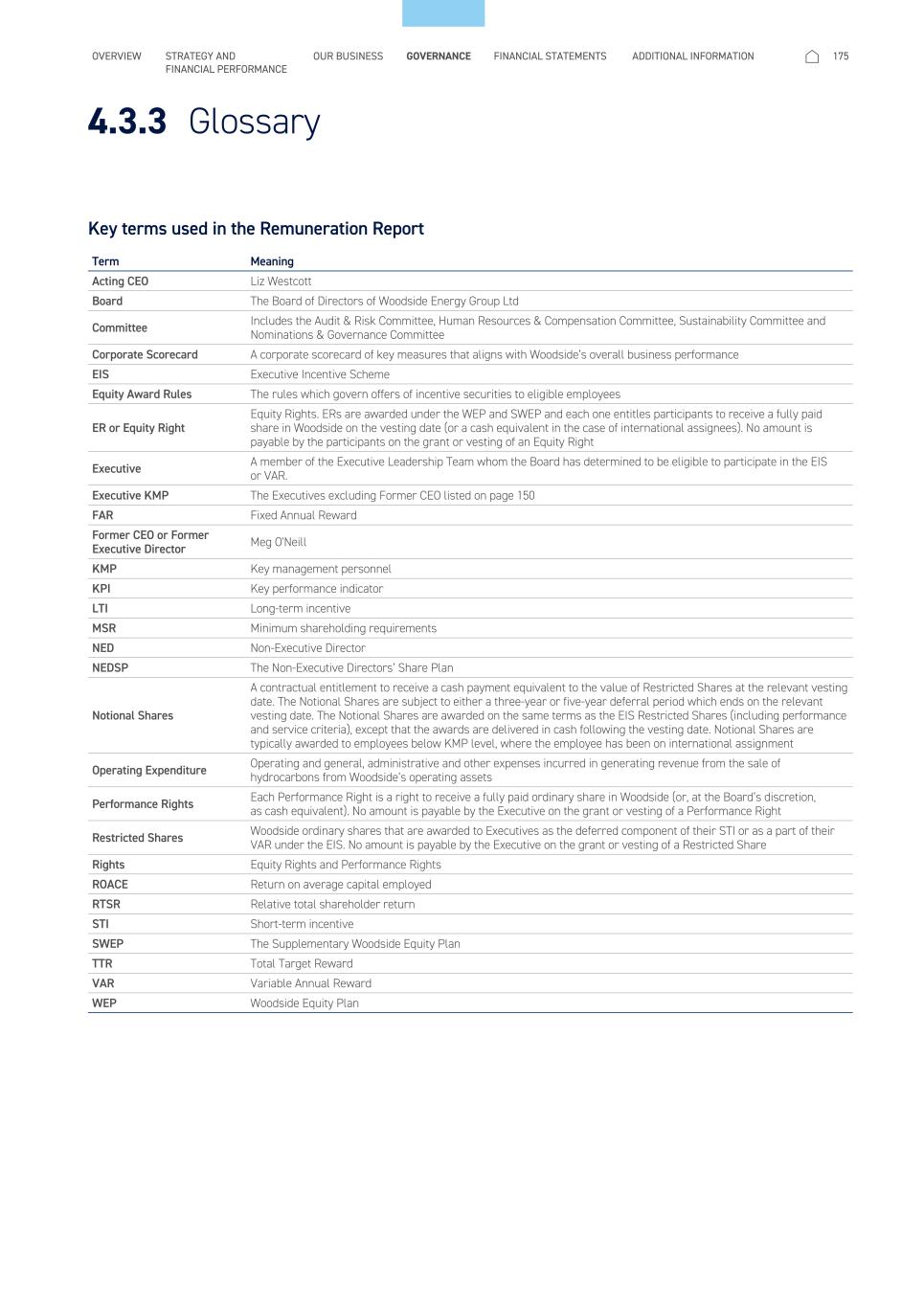
Key terms used in the Remuneration Report Term Meaning Acting CEO Liz Westcott Board The Board of Directors of Woodside Energy Group Ltd Committee Includes the Audit & Risk Committee, Human Resources & Compensation Committee, Sustainability Committee and Nominations & Governance Committee Corporate Scorecard A corporate scorecard of key measures that aligns with Woodside’s overall business performance EIS Executive Incentive Scheme Equity Award Rules The rules which govern offers of incentive securities to eligible employees ER or Equity Right Equity Rights. ERs are awarded under the WEP and SWEP and each one entitles participants to receive a fully paid share in Woodside on the vesting date (or a cash equivalent in the case of international assignees). No amount is payable by the participants on the grant or vesting of an Equity Right Executive A member of the Executive Leadership Team whom the Board has determined to be eligible to participate in the EIS or VAR. Executive KMP The Executives excluding Former CEO listed on page 150 FAR Fixed Annual Reward Former CEO or Former Executive Director Meg O'Neill KMP Key management personnel KPI Key performance indicator LTI Long-term incentive MSR Minimum shareholding requirements NED Non-Executive Director NEDSP The Non-Executive Directors’ Share Plan Notional Shares A contractual entitlement to receive a cash payment equivalent to the value of Restricted Shares at the relevant vesting date. The Notional Shares are subject to either a three-year or five-year deferral period which ends on the relevant vesting date. The Notional Shares are awarded on the same terms as the EIS Restricted Shares (including performance and service criteria), except that the awards are delivered in cash following the vesting date. Notional Shares are typically awarded to employees below KMP level, where the employee has been on international assignment Operating Expenditure Operating and general, administrative and other expenses incurred in generating revenue from the sale of hydrocarbons from Woodside’s operating assets Performance Rights Each Performance Right is a right to receive a fully paid ordinary share in Woodside (or, at the Board’s discretion, as cash equivalent). No amount is payable by the Executive on the grant or vesting of a Performance Right Restricted Shares Woodside ordinary shares that are awarded to Executives as the deferred component of their STI or as a part of their VAR under the EIS. No amount is payable by the Executive on the grant or vesting of a Restricted Share Rights Equity Rights and Performance Rights ROACE Return on average capital employed RTSR Relative total shareholder return STI Short-term incentive SWEP The Supplementary Woodside Equity Plan TTR Total Target Reward VAR Variable Annual Reward WEP Woodside Equity Plan OVERVIEW STRATEGY AND FINANCIAL PERFORMANCE OUR BUSINESS GOVERNANCE FINANCIAL STATEMENTS ADDITIONAL INFORMATION 175 4.3.3 Glossary

5.1 Financial Statements Contents Financial statements 176 Consolidated income statement 177 Consolidated statement of comprehensive income 178 Consolidated statement of financial position 179 Consolidated statement of cash flows 180 Consolidated statement of changes in equity 181 Notes to the financial statements 182 About these statements 182 Climate change and energy transition 182 A. Earnings for the period 186 A.1 Segment revenue and expenses 187 A.2 Finance costs 191 A.3 Dividends paid and proposed 191 A.4 Earnings per share 191 A.5 Taxes 192 B. Production and growth assets 195 B.1 Segment production and growth assets 196 B.2 Exploration and evaluation 198 B.3 Property, plant and equipment 199 B.4 Impairment of exploration and evaluation, property, plant and equipment and goodwill 201 B.5 Business combination 205 B.6 Intangible assets 207 B.7 Significant production and growth asset acquisitions 208 B.8 Disposal and sell-down of assets 210 B.9 Transactions with equity holders of the Group 210 C. Debt and capital 211 C.1 Cash and cash equivalents 212 C.2 Interest-bearing liabilities and financing facilities 212 C.3 Contributed equity 215 C.4 Other reserves 215 D. Other assets and liabilities 216 D.1 Segment assets and liabilities 217 D.2 Receivables 217 D.3 Inventories 218 D.4 Payables 218 D.5 Provisions 218 D.6 Other financial assets and liabilities 220 D.7 Leases 222 E. Other items 225 E.1 Contingent liabilities and assets 226 E.2 Employee benefits 226 E.3 Related party transactions 229 E.4 Auditor remuneration 229 E.5 Events after the end of the reporting period 229 E.6 Joint arrangements 229 E.7 Parent entity information 231 E.8 Subsidiaries 231 E.9 Other accounting policies 235 Consolidated entity disclosure statement 236 Directors’ declaration 239 Independent auditor’s report 240 SIGNIFICANT CHANGES IN THE CURRENT REPORTING PERIOD The financial performance and position of the Group were affected by the following events and transactions during the reporting period: • On 28 March 2025, the Group and Perenco Energies International Limited (Perenco) entered into an agreement for Perenco to acquire the Greater Angostura assets in Trinidad and Tobago. The divestment includes Woodside’s 45% interest in the Angostura field and 68.46% interest in the Ruby field. The transaction completed on 11 July 2025, with an effective date of 1 January 2025. As a result, the Group recognised a pre-tax gain on sale of $161 million (refer to Note B.8). • On 7 April 2025, the Group and Stonepeak Wallaby I Acquiror LP (Stonepeak) entered into an agreement for Stonepeak to acquire a 40% interest in Louisiana LNG Infrastructure LLC, a subsidiary within the Group. The transaction completed on 25 June 2025 with the Group continuing to retain control of Louisiana LNG Infrastructure LLC. Total proceeds of $1,876 million was received from Stonepeak on transaction completion date (refer to Note B.9). • On 29 April 2025, the Group approved a final investment decision (FID) to develop the Louisiana LNG Project. Upon FID, the Group recognised a deferred tax asset of $182 million (refer to Note A.5). • In March and April 2025, the Group repaid, renewed and drew down on various debt facilities. In May 2025, the Group issued unsecured SEC-registered bonds amounting to $3,500 million (refer to Note C.2). • As at 30 June 2025, an impairment indicator was identified on the H2OK Project following the Group’s decision to exit the Project. As a result, the Group recognised an impairment loss before tax of $143 million (refer to Note B.4). • On 23 October 2025, the Group and Williams Partners Operating LLC (Williams) completed an agreement for Williams to acquire an 80% interest in Driftwood Pipeline LLC and a 10% interest in Louisiana LNG LLC for total proceeds of $370 million (refer to Note B.9). • During the year, the Group recognised a pre-tax restoration expense of $340 million primarily due to updated closure cost estimates and economic assumptions for Minerva, Stybarrow and Griffin (refer to Note A.1). 176 Woodside Energy Annual Report 2025 5 Financial Statements

2025 2024 2023 Notes US$m US$m US$m Operating revenue A.1 12,984 13,179 13,994 Cost of sales A.1 (8,448) (7,501) (7,519) Gross profit 4,536 5,678 6,475 Other income A.1 948 624 322 Other expenses A.1 (1,452) (1,788) (1,573) Impairment losses A.1 (143) — (1,917) Profit before tax and net finance costs 3,889 4,514 3,307 Finance income 259 220 273 Finance costs A.2 (299) (365) (307) Profit before tax 3,849 4,369 3,273 Petroleum resource rent tax (PRRT) (expense)/benefit A.5 (349) 91 (898) Income tax expense A.5 (763) (814) (653) Profit after tax 2,737 3,646 1,722 Profit attributable to: Equity holders of the parent 2,718 3,573 1,660 Non-controlling interest E.8 19 73 62 Profit for the period 2,737 3,646 1,722 Basic earnings per share attributable to equity holders of the parent (US cents) A.4 143.4 188.5 87.5 Diluted earnings per share attributable to equity holders of the parent (US cents) A.4 142.0 186.9 86.9 The accompanying notes form part of the Financial Statements. OVERVIEW STRATEGY AND FINANCIAL PERFORMANCE OUR BUSINESS GOVERNANCE FINANCIAL STATEMENTS ADDITIONAL INFORMATION 177 Consolidated income statement for the year ended 31 December 2025

2025 2024 2023 US$m US$m US$m Profit for the period 2,737 3,646 1,722 Other comprehensive income/(loss) Items that may be reclassified to the income statement in subsequent periods: Gains/(losses) on cash flow hedges 385 (139) 459 (Gains)/losses on cash flow hedges reclassified to the income statement (169) 86 299 Tax recognised within other comprehensive income (29) (34) (84) Exchange fluctuations on translation of foreign operations taken to equity — — (1) Items that will not be reclassified to the income statement in subsequent periods: Remeasurement gain/(loss) on defined benefit plan 12 (11) 14 Net loss on financial instruments at fair value through other comprehensive income (34) (8) (32) Other comprehensive income/(loss) for the period, net of tax 165 (106) 655 Total comprehensive income for the period 2,902 3,540 2,377 Total comprehensive income attributable to: Equity holders of the parent 2,883 3,467 2,315 Non-controlling interest 19 73 62 Total comprehensive income for the period 2,902 3,540 2,377 The accompanying notes form part of the Financial Statements. 178 Woodside Energy Annual Report 2025 Consolidated statement of comprehensive income for the year ended 31 December 2025

2025 2024 Notes US$m US$m Current assets Cash and cash equivalents C.1 5,712 3,923 Receivables D.2 1,751 2,390 Inventories D.3 693 684 Other financial assets D.6 229 185 Tax receivable 114 288 Other assets 123 93 Total current assets 8,622 7,563 Non-current assets Receivables D.2 823 876 Inventories D.3 288 213 Other financial assets D.6 64 118 Exploration and evaluation assets B.2 790 721 Property, plant and equipment B.3 46,555 42,636 Deferred tax assets A.5 2,658 2,393 Lease assets D.7 1,428 1,291 Investments accounted for using the equity method 260 249 Intangible assets B.6 4,853 4,826 Other assets 160 378 Total non-current assets 57,879 53,701 Total assets 66,501 61,264 Current liabilities Payables D.4 1,841 2,185 Interest-bearing liabilities C.2 782 990 Other financial liabilities D.6 8 139 Provisions D.5 1,212 1,322 Tax payable 539 308 Lease liabilities D.7 159 189 Other liabilities 876 724 Total current liabilities 5,417 5,857 Non-current liabilities Interest-bearing liabilities C.2 11,181 9,007 Deferred tax liabilities A.5 1,182 1,497 Other financial liabilities D.6 212 379 Provisions D.5 6,655 6,225 Tax payable 10 28 Lease liabilities D.7 1,600 1,434 Other liabilities 401 684 Total non-current liabilities 21,241 19,254 Total liabilities 26,658 25,111 Net assets 39,843 36,153 Equity Issued and fully paid shares C.3 29,036 29,001 Shares reserved for employee share plans C.3 (82) (58) Other reserves C.4 6,382 4,108 Retained earnings 578 2,348 Equity attributable to equity holders of the parent 35,914 35,399 Non-controlling interest E.8 3,929 754 Total equity 39,843 36,153 The accompanying notes form part of the Financial Statements. OVERVIEW STRATEGY AND FINANCIAL PERFORMANCE OUR BUSINESS GOVERNANCE FINANCIAL STATEMENTS ADDITIONAL INFORMATION 179 Consolidated statement of financial position for the year ended 31 December 2025

2025 2024 2023 Notes US$m US$m US$m Cash flows from/(used in) operating activities" Profit after tax for the period 2,737 3,646 1,722 Adjustments for: Non-cash items Depreciation and amortisation 5,070 4,552 3,960 Depreciation of lease assets 175 210 179 Change in fair value of derivative financial instruments (345) 352 349 Net finance costs 40 145 34 Tax expense 1,112 723 1,551 Exploration and evaluation written off 4 9 77 Impairment loss B.4 143 — 1,917 Restoration movement 340 199 147 Gain on disposal of property, plant and equipment (187) (238) — Other (119) (135) (226) Changes in assets and liabilities Decrease/(increase) in trade and other receivables 113 (301) 107 Increase in inventories (102) (161) (31) (Decrease)/increase in provisions (46) 3 (114) Increase/(decrease) in other assets and liabilities 166 (45) (736) (Decrease)/increase in trade and other payables (141) 175 (135) Cash generated from operations 8,960 9,134 8,801 Interest received 220 183 264 Other dividends received 14 12 20 Borrowing costs relating to operating activities (9) (41) (26) Income tax and PRRT paid (1,137) (2,555) (2,916) Payments for restoration (856) (805) (447) Receipts for hedge collateral — — 506 Other — (81) (57) Net cash from operating activities 7,192 5,847 6,145 Cash flows from/(used in) investing activities Payments for capital and exploration expenditure (7,974) (4,902) (5,291) Cash paid on business combination, net of cash acquired B.5 — (1,896) — Payments for asset acquisition, net of cash acquired B.7 — (1,042) — Reimbursements received from external parties for capital expenditure 464 155 — Borrowing costs relating to investing activities (712) (369) (311) Deposits/proceeds received from disposal of non-current assets 303 2,307 19 Dividends from/(contributions to) associates 8 — (2) Net cash used in investing activities (7,911) (5,747) (5,585) Cash flows from/(used in) financing activities Proceeds from borrowings C.2 4,848 5,114 — Repayment of borrowings C.2 (2,900) (169) (284) Purchases of shares relating to employee share plans (53) — — Borrowing costs relating to financing activities — (2) (4) Repayment of the principal portion of lease liabilities (233) (278) (340) Borrowing costs relating to lease liabilities — (15) (21) Contributions from/(distributions to) non-controlling interests1 2,841 (100) (98) Dividends paid (2,012) (2,449) (4,253) Net cash from/(used in) financing activities 2,491 2,101 (5,000) Net increase/(decrease) in cash held 1,772 2,201 (4,440) Cash and cash equivalents at the beginning of the period 3,923 1,740 6,201 Effects of exchange rate changes 17 (18) (21) Cash and cash equivalents at the end of the period C.1 5,712 3,923 1,740 1. Includes capital contribution of $2,594 million from Stonepeak and $98 million from Williams for the development of Louisiana LNG. Refer to Note B.9 for details. The accompanying notes form part of the Financial Statements. 180 Woodside Energy Annual Report 2025 Consolidated statement of cash flows for the year ended 31 December 2025

Is su ed a nd fu lly p ai d sh ar es Re se rv ed s ha re s Em pl oy ee b en ef its re se rv e No n- co nt ro lli ng in te re st re se rv e Fo re ig n cu rr en cy tr an sl at io n re se rv e He dg in g re se rv e Di st rib ut ab le p ro fit s re se rv e Ot he r r es er ve Re ta in ed e ar ni ng s Eq ui ty h ol de rs o f t he p ar en t No n- co nt ro lli ng in te re st To ta l e qu ity Notes C.3 C.3 C.4 C.4 C.4 C.4 C.4 C.4 E.8 US$m US$m US$m US$m US$m US$m US$m US$m US$m US$m US$m US$m At 1 January 2025 29,001 (58) 281 — 795 1 3,069 (38) 2,348 35,399 754 36,153 Profit for the period — — — — — — — — 2,718 2,718 19 2,737 Other comprehensive income/(loss) — — — — — 187 — (34) 12 165 — 165 Total comprehensive income/(loss) for the period — — — — — 187 — (34) 2,730 2,883 19 2,902 Transfers — — — — — — 4,500 — (4,500) — — — Transactions with non-controlling interests1 — — — (373) — — — — — (373) 3,216 2,843 Shares issued 35 — — — — — — — — 35 — 35 Employee share plan purchases — (88) — — — — — — — (88) — (88) Employee share plan redemptions — 64 (64) — — — — — — — — — Share-based payments (net of tax) — — 70 — — — — — — 70 — 70 Dividends paid — — — — — — (2,012) — — (2,012) (60) (2,072) At 31 December 2025 29,036 (82) 287 (373) 795 188 5,557 (72) 578 35,914 3,929 39,843 At 1 January 2024 29,001 (49) 290 — 795 88 4,118 (30) 186 34,399 771 35,170 Profit for the period — — — — — — — — 3,573 3,573 73 3,646 Other comprehensive loss — — — — — (87) — (8) (11) (106) — (106) Total comprehensive (loss)/income for the period — — — — — (87) — (8) 3,562 3,467 73 3,540 Transfers — — — — — — 1,400 — (1,400) — — — Employee share plan purchases — (81) — — — — — — — (81) — (81) Employee share plan redemptions — 72 (72) — — — — — — — — — Share-based payments (net of tax) — — 63 — — — — — — 63 — 63 Dividends paid — — — — — — (2,449) — — (2,449) (90) (2,539) At 31 December 2024 29,001 (58) 281 — 795 1 3,069 (38) 2,348 35,399 754 36,153 At 1 January 2023 29,001 (38) 278 — 796 (586) 3,541 2 3,342 36,336 791 37,127 Profit for the period — — — — — — — — 1,660 1,660 62 1,722 Other comprehensive (loss)/income — — — — (1) 674 — (32) 14 655 — 655 Total comprehensive (loss)/income for the period — — — — (1) 674 — (32) 1,674 2,315 62 2,377 Transfers — — — — — — 4,830 — (4,830) — — — Employee share plan purchases — (57) — — — — — — — (57) — (57) Employee share plan redemptions — 46 (46) — — — — — — — — — Share-based payments (net of tax) — — 58 — — — — — — 58 — 58 Dividends paid — — — — — — (4,253) — — (4,253) (82) (4,335) At 31 December 2023 29,001 (49) 290 — 795 88 4,118 (30) 186 34,399 771 35,170 1. Represents the difference between the amount of the adjustment to non-controlling interest and any consideration received. Refer to Note B.9 for the sell-down of Louisiana LNG Infrastructure LLC to Stonepeak and the sell-down of Louisiana LNG LLC to Williams. The accompanying notes form part of the Financial Statements. OVERVIEW STRATEGY AND FINANCIAL PERFORMANCE OUR BUSINESS GOVERNANCE FINANCIAL STATEMENTS ADDITIONAL INFORMATION 181 Consolidated statement of changes in equity for the year ended 31 December 2025

ABOUT THESE STATEMENTS Woodside Energy Group Ltd and its controlled entities (Woodside or the Group) is a for-profit entity limited by shares, incorporated and domiciled in Australia. Its shares are publicly traded on the Australian Securities Exchange (ASX) and on the New York Stock Exchange (NYSE) (in the form of Woodside American Depositary Shares). The nature of the operations and the principal activities of the Group are described in the Directors’ Report and in the segment information in Note A.1. The financial statements were authorised for issue in accordance with a resolution of the Directors on 24 February 2026. Statement of compliance The financial statements are general purpose financial statements, which have been prepared in accordance with the requirements of the Corporations Act 2001, Australian Accounting Standards and other authoritative pronouncements of the Australian Accounting Standards Board (AASB). The financial statements comply with International Financial Reporting Standards (IFRS) as issued by the International Accounting Standards Board. They also include additional disclosures required for foreign registrants by the United States Securities and Exchange Commission (US SEC). The Group’s accounting policies are materially consistent with those disclosed in the Group’s 2024 Financial Statements. Adoption of new or amended standards and interpretations effective 1 January 2025 did not result in any significant changes to the Group’s accounting policies. Refer to Note E.9 for more details. Estimates have been revised, where required, to reflect current market conditions including the impact of climate change. Updated assumptions used for impairment assessments, restoration provisions and embedded commodity derivatives are disclosed in Notes B.4, D.5 and D.6 respectively; these assumptions could change in the future. New estimates and judgements relating to transactions with equity holders of the Group are disclosed in Note B.9. Currency The accounting functional and presentation currency of Woodside and all its material subsidiaries is the US dollar. Transactions in foreign currencies are initially recorded in the functional currency of the transacting entity at the exchange rates ruling at the date of transaction. Monetary assets and liabilities denominated in foreign currencies at the reporting date are translated at the rates of exchange ruling at that date. Exchange differences in the consolidated financial statements are taken to the consolidated income statement. Rounding of amounts The amounts contained in these financial statements have been rounded to the nearest million dollars under the option available to the Group under Australian Securities and Investments Commission (ASIC) Corporations (Rounding in Financial/ Directors’ Reports) Instrument 2016/191, unless otherwise stated. Basis of preparation The financial statements have been prepared on a historical cost basis, except for derivative financial instruments and certain other financial assets and financial liabilities, which have been measured at fair value or amortised cost adjusted for changes in fair value attributable to the risks that are being hedged in effective hedge relationships. Where not carried at fair value, if the carrying value of financial assets and financial liabilities does not approximate their fair value, the fair value has been included in the notes to the financial statements. Subsidiaries are fully consolidated from the date on which control is obtained by the Group and cease to be consolidated from the date at which the Group ceases to have control. The financial statements comprise the financial position and results of the Group as at and for the year ended 31 December 2025 (refer to Note E.8). The material subsidiaries of the Group apply the same reporting period and accounting policies as the parent company in their financial statements. All intercompany balances and transactions, including unrealised profits and losses arising from intra-group transactions, have been eliminated in full. Non-controlling interests are allocated their share of the net profit after tax in the consolidated income statement and their share of other comprehensive income net of tax in the consolidated statement of comprehensive income, and are presented within equity in the consolidated statement of financial position, separately from parent shareholders’ equity. The consolidated financial statements provide comparative information in respect of the previous periods. Where required, a reclassification of items in the financial statements of the previous periods has been made in accordance with the classification of items in the financial statements of the current period. CLIMATE CHANGE AND ENERGY TRANSITION Climate considerations The Group has prepared a separate sustainability report in accordance with AASB S2. Woodside has considered the impact of climate and the energy transition across its global portfolio in assessing the carrying values of its assets and liabilities. This note describes the assumptions underpinning key areas of the financial statements and the potential short-term and long-term impacts of differing climate-related scenarios on the financial performance, position and cash flow of Woodside for the year ended 31 December 2025. 182 Woodside Energy Annual Report 2025 Notes to the financial statements for the year ended 31 December 2025

CLIMATE CHANGE AND ENERGY TRANSITION (CONT.) Financial planning and assumptions Woodside considers a range of climate and macroeconomic scenarios to help benchmark our long-term price assumptions and inform our decision making to maintain a resilient financial position. These scenarios are informed by a wide range of externally published data and are part of a broad consideration of risks, opportunities, competitiveness and resilience. The assumptions applied in assessing amounts within the financial statements require significant judgement and are in each case calculated in accordance with the requirements of the applicable accounting standards. Our long-term price assumptions reflect management’s current “best estimate” scenario in which global governments pursue decarbonisation goals as well as other goals such as energy security and economic development. Price assumptions consider current legislation in the locations where Woodside operates and place some weight on scenarios in which the transition to a lower carbon energy system is sufficiently rapid to meet global climate goals, as well as scenarios in which the transition is not, or may not be, sufficiently rapid. They also place some weight on a range of other assumptions which can drive prices (e.g. inflation) and which are not related to the global climate goals. Woodside’s oil and gas facilities are subject to physical risks such as metocean conditions and are located in regions that experience tropical cyclones, hurricanes and high ambient temperatures. Woodside has significant experience designing and operating facilities located in harsh environments. The high degree of uncertainty around the nature, timing and magnitude of climate-related risks, and the uncertainty as to how the energy transition will evolve, makes it difficult to determine the potential impacts of the risks with precision. Woodside continues to monitor the uncertainty around climate change risks and expects to take into account ongoing developments into its assumptions, including assumptions concerning commodity and carbon pricing, as considered appropriate. Investment cases include a carbon price assumption which takes into consideration uncertainty around the impact of climate change. Commodity pricing assumptions are key value drivers with greater significance to assets and liabilities than carbon pricing. Impairment of exploration and evaluation, property, plant and equipment and goodwill In accordance with the Group's accounting policies and applicable accounting standards, elements of Woodside’s financial statements are based on reasonable and supportable assumptions that represent management’s current best estimate of the range of economic conditions that may exist in the foreseeable future. The estimation of recoverable amounts for impairment testing includes estimating what an independent market participant would pay to acquire the asset as at the reporting date. Market participants will be guided by their own views on future economic and technical conditions and therefore Woodside considers a range of data sources in determining a future price forecast, including industry and market benchmarks along with asset sales transaction data to support the recoverable amount. The completion of the sale of the 10% and 15.1% non-operating participating interest in the Scarborough Joint Venture to LNG Japan and JERA respectively in 2024, is a clear example of an independent market valuation fully supporting the carrying value of the multi-decade asset. Price forecasts are adjusted for premiums and discounts based on the nature and quality of the product. Commodity oil price estimates consider macroeconomic factors such as population growth and have regard to potential climate pathways along with other factors such as industry investment and cost trends. There remains significant uncertainty around how society will respond to the climate challenge. The energy transition is expected to bring volatility and there is uncertainty as to how commodity prices will develop. Woodside’s assumptions for Brent and JKM sit within the range of scenarios considered by management. Refer to Note B.4 for further details. OVERVIEW STRATEGY AND FINANCIAL PERFORMANCE OUR BUSINESS GOVERNANCE FINANCIAL STATEMENTS ADDITIONAL INFORMATION 183 Notes to the financial statements for the year ended 31 December 2025

CLIMATE CHANGE AND ENERGY TRANSITION (CONT.) Impact on remaining life of assets Oil and gas properties, included within property, plant and equipment, are depreciated using the unit of production basis over either proved or proved plus probable reserves. The energy transition may result in changes to the expected useful life of oil and gas properties and economically recoverable reserves and resources thereby accelerating depreciation charges or resulting in an impairment. New energy assets under development still require significant capital spend. The Group will review depreciation methodology and useful life of new energy assets as they are brought into use. Carbon credits Woodside utilises certified carbon credits to offset equity Scope 1 and 2 emissions that are above our targets in a given year and to meet our regulatory requirements, after design out and operate out measures have been taken. The Group’s portfolio of carbon credits enables our base business to manage the price risk associated with regulations and our corporate net equity Scope 1 and 2 emissions targets. As at 31 December 2025, the Group recognised $274 million (2024: $202 million) of carbon credits within inventory. Restoration and other provisions The energy transition may result in restoration activities occurring earlier than expected. 56% (2024: 53%) of the Group’s non-current restoration liabilities are expected to be settled more than 10 years in the future. Restoration cost estimates require judgemental assumptions regarding removal date, environmental legislation and regulations and the extent of restoration activities required. These cost estimates may change in the future, as a result of increased regulatory scrutiny and the energy transition. This includes the demand and related costs for offshore services which can be influenced by renewable energy construction. Woodside continues to monitor the uncertainty around climate change risks to assess if additional changes to restoration provisions should be recognised. Refer to Note D.5 for further details. Long-term contracts Climate risks may impact underlying assumptions used to assess the forecast cash flows of long-term contracts. These judgemental assumptions include pricing forecast and discount rate adjustments based on the nature of the product. Contractual arrangements, including the Corpus Christi contract, could be impacted by adverse market conditions arising from climate-related factors. Given the uncertainty in climate events, Woodside continues to review the forecast cash flows of long‑term contracts. Deferred tax assets The Group has determined that it is probable that sufficient future taxable income will be available to utilise the deferred tax assets relating to carry forward unused tax losses and credits recognised as at 31 December 2025. The recoverability of deferred tax assets is dependent on the Group’s future taxable income which can be impacted by the uncertainty of commodity and carbon pricing. . 184 Woodside Energy Annual Report 2025 Notes to the financial statements for the year ended 31 December 2025

Financial and capital risk management The Board of Directors has overall responsibility for the establishment and oversight of the Group’s risk management framework, including review and approval of the Group’s risk management strategy, policy and key risk parameters. The Board of Directors and the Audit and Risk Committee have oversight of the Group’s internal control system and risk management process, including oversight of the internal audit function. The Group’s management of financial and capital risks is aimed at ensuring that available capital, funding and cash flows are sufficient to: • meet the Group’s financial commitments as and when they fall due; • maintain the capacity to fund its committed project developments; • pay a reasonable dividend; and • maintain a long-term credit rating of not less than investment grade. The Group monitors and tests its forecast financial position against these criteria and, in general, will undertake hedging activity when necessary to ensure that these objectives are achieved. Other circumstances that may lead to hedging include the management of exposures relating to trading activities. Group Treasury policy does not permit speculative trading in financial derivatives. Refer to Section 3.7 – Risk factors for more information on the Group’s objectives, policies and processes for managing financial risk. The below risks arise in the normal course of the Group’s business. Risk information can be found in the following sections: Section A Commodity price risk management Page 186 Section A Foreign exchange risk management Page 186 Section C Capital risk management Page 211 Section C Liquidity risk management Page 211 Section C Interest rate risk management Page 211 Section D Credit risk management Page 216 Significant estimates and judgements In applying the Group’s accounting policies, management regularly evaluates judgements, estimates and assumptions based on experience and other factors, including expectations of future events that may have an impact on the Group. All judgements, estimates and assumptions made are believed to be reasonable based on the most current set of circumstances known to management, and actual results may differ. Significant judgements, estimates and assumptions made by management in the preparation of these financial statements are found in the following notes: Note A.1 Segment revenue and expenses Page 187 Note A.5 Taxes Page 192 Note B.2 Exploration and evaluation Page 198 Note B.3 Property, plant and equipment Page 199 Note B.4 Impairment of exploration and evaluation, property, plant and equipment and goodwill Page 201 Note B.5 Business combination Page 205 Note B.6 Intangible assets Page 207 Note B.7 Significant production and growth asset acquisitions Page 208 Note B.9 Transactions with equity holders of the Group Page 210 Note D.5 Provisions Page 218 Note D.6 Other financial assets and liabilities Page 220 Note D.7 Leases Page 222 Note E.6 Joint arrangements Page 229 OVERVIEW STRATEGY AND FINANCIAL PERFORMANCE OUR BUSINESS GOVERNANCE FINANCIAL STATEMENTS ADDITIONAL INFORMATION 185 Notes to the financial statements for the year ended 31 December 2025

IN THIS SECTION This section addresses financial performance of the Group for the reporting period including, where applicable, the accounting policies applied and the significant estimates and judgements made. This section also includes the tax position of the Group for and at the end of the reporting period. A. Earnings for the period A.1 Segment revenue and expenses Page 187 A.2 Finance costs Page 191 A.3 Dividends paid and proposed Page 191 A.4 Earnings per share Page 191 A.5 Taxes Page 192 KEY FINANCIAL AND CAPITAL RISKS IN THIS SECTION Commodity price risk management The Group’s revenue is exposed to commodity price fluctuations through the sale of hydrocarbons. Commodity price risks are measured by monitoring and stress testing the Group’s forecast financial position to sustained periods of low commodity prices. This analysis is regularly performed on the Group’s portfolio and as required for discrete projects and transactions. The Group’s management of commodity price risk includes the use of commodity derivatives to hedge its exposure (refer to Note D.6). The hedged exposure includes oil-linked revenue related to produced volumes and revenues derived from trading operations. Commodity derivatives are used to manage the Group’s price risk within its corporate and trading portfolios. As at the reporting date, the Group held commodity hedging financial instruments with a net asset carrying value of $176 million (2024: $27 million) exposed to commodity price risk. An increase in relevant commodity prices of 10% would decrease the instruments’ carrying value by $77 million, the effect of which would be recognised within reserves and/or the income statement in accordance with hedge accounting application. A 10% decrease would have the same but opposite effect. This analysis assumes that all other variables remain constant (including the price on underlying physical exposures). Foreign exchange risk management Foreign exchange risk arises from future commitments, financial assets and financial liabilities that are not denominated in US dollars. The majority of the Group’s revenue is denominated in US dollars. The Group is exposed to foreign currency risk arising from operating and capital expenditure incurred in currencies other than US dollars, particularly Australian dollars. The Group’s management of foreign exchange risk relating to capital expenditure includes the use of forward exchange contract derivatives to hedge its exposure (refer to Note D.6). The Group entered into foreign exchange forward contracts to fix the Australian dollar to US dollar exchange rate in relation to a portion of the Australian dollar denominated capital expenditure incurred or expected to be incurred under the Scarborough development (refer to Note D.6). Through the use of foreign exchange forward contracts, the Group managed its Australian dollar to US dollar exchange rate exposure in relation to the Australian dollar denominated dividend payments. As at the reporting date, the Group held hedging foreign currency financial instruments with a net asset carrying value of $19 million (2024: net liability carrying value of $45 million) exposed to foreign exchange risk. Measuring the exposure to foreign exchange risk is achieved by regularly monitoring and performing sensitivity analysis on the Group’s financial position. A reasonably possible change in the exchange rate of the US dollar to the Australian dollar (+7.0%/-7.0% (2024: +10.0%/-10.0%)), with all other variables held constant, would not have a material impact on the Group’s equity or the income statement. Refer to Notes C.1, C.2, D.2, D.4 and D.7 for details of the denominations of cash and cash equivalents, interest-bearing liabilities, receivables, payables and lease liabilities held at 31 December 2025. 186 Woodside Energy Annual Report 2025 Notes to the financial statements for the year ended 31 December 2025 A. Earnings for the period

A.1 SEGMENT REVENUE AND EXPENSES Operating segment information The Group’s operating segments have been determined based on the internal reports reviewed by the Chief Executive Officer, who is the Chief Operating Decision Maker. These reports are used to assess performance and allocate resources within the business. As the Group continues to invest in new energy and integrate these activities across its operations, changes have been made to the way financial information is presented. New energy projects that have reached a final investment decision (FID) are now reported within either the Australia or International segments, depending on their geographical location. The Group’s disclosed operating segments have been updated to reflect this change, and the comparative information for 2024 and 2023 has been restated to ensure consistency of presentation. The Group’s reportable operating segments are as follows: Australia: Exploration, evaluation, development, production and sale of liquefied natural gas (LNG), pipeline gas, crude oil, condensate and natural gas liquids, as well as the development, production and sale of new energy products from Australian assets that have achieved FID. International: Exploration, evaluation, development, production and sale of LNG, pipeline gas, crude oil, condensate and natural gas liquids, and the development, production and sale of new energy products from assets located outside Australia that have achieved FID. Marketing: Marketing, shipping and trading of the Group’s oil and gas portfolio (including purchased volumes) and optimisation activities that generate incremental value. Corporate: Comprises new energy projects that have not yet reached FID and corporate items that are not allocated to operating segments. Corporate items include revenues, expenses, assets and liabilities that are not considered part of the core operations of any segment. Customer concentration The Group has two major customers which each respectively account for 8% and 7% of the Group’s external revenue. The sales are generated by the Australia and Marketing operating segments (2024: two major customers; 7% and 6% generated by the Australia and Marketing operating segments and 2023: two major customers; 8% and 7% generated by the Australia and Marketing operating segments). Geographical information Geographical information Revenue from external customers1 2025 2024 2023 US$m US$m US$m Asia Pacific 7,335 8,445 9,823 Americas 2,241 2,462 2,564 Europe 3,122 2,272 1,607 Other 286 — — Consolidated 12,984 13,179 13,994 1. Revenue is attributable to geographic location based on the location of the customers. Recognition and measurement Revenue from contracts with customers Revenue is recognised when or as the Group transfers control of products or provides services to a customer at the amount to which the Group expects to be entitled. If the consideration includes a variable component, the Group estimates the amount of the expected consideration receivable. Variable consideration is estimated throughout the contract and is recognised to the extent that it is highly probable a significant reversal will not occur. • Revenue from sale of hydrocarbons – Revenue from the sale of hydrocarbons is recognised at a point in time when control of the product is transferred to the customer. Revenue from take or pay contracts is recorded as unearned revenue until the product has been drawn by the customer (transfer of control), at which time it is recognised in earnings. • Other operating revenue – Revenue earned from LNG processing and other services is recognised over time as the services are rendered. Expenses • Royalties, excise and levies – Royalties, excise and levies are considered to be production-based taxes and are therefore accrued on the basis of the Group’s entitlement to physical production. • Depreciation and amortisation – Refer to Note B.3. • Impairment and impairment reversals – Refer to Note B.4. • Leases – Refer to Note D.7. • Employee benefits – Refer to Note E.2. Significant estimates and judgements (a) Revenue from contracts with customers The transaction price at the date control passes for sales made subject to provisional pricing periods in oil and condensate contracts is determined with reference to quoted commodity prices. Judgement is also used to determine if it is highly probable that a significant reversal will not occur in relation to revenue recognised during open pricing periods in LNG contracts. The Group estimates variable consideration based on available information from contract negotiations and market indicators. OVERVIEW STRATEGY AND FINANCIAL PERFORMANCE OUR BUSINESS GOVERNANCE FINANCIAL STATEMENTS ADDITIONAL INFORMATION 187 Notes to the financial statements for the year ended 31 December 2025 A. Earnings for the period

A.1 SEGMENT REVENUE AND EXPENSES (CONT.) For the year ended 31 December 2025 Australia International Marketing Corporate Consolidated 2025 2025 2025 2025 2025 US$m US$m US$m US$m US$m Liquified natural gas 4,800 — 1,160 — 5,960 Pipeline gas 1,160 164 — — 1,324 Crude oil and condensate 1,313 3,872 72 — 5,257 Natural gas liquids 171 33 37 — 241 Revenue from sale of hydrocarbons 7,444 4,069 1,269 — 12,782 Intersegment revenue1 (120) — 120 — — Processing and services revenue 177 — — — 177 Shipping and other revenue — — 25 — 25 Other revenue 57 — 145 — 202 Operating revenue2 7,501 4,069 1,414 — 12,984 Production costs (1,030) (523) — — (1,553) Royalties, excise and levies (251) (50) — — (301) Insurance (37) (19) — (23) (79) Inventory movement 44 (11) — — 33 Costs of production (1,274) (603) — (23) (1,900) Property, plant and equipment depreciation (2,405) (2,570) — (68) (5,043) Shipping and direct sales costs (75) (87) (103) — (265) Trading costs3 (217) — (928) — (1,145) Other hydrocarbon costs (29) — — — (29) Other (22) (44) — — (66) Other cost of sales (343) (131) (1,031) — (1,505) Cost of sales (4,022) (3,304) (1,031) (91) (8,448) Gross profit/(loss) 3,479 765 383 (91) 4,536 Other income4 207 364 18 359 948 Exploration and evaluation expenditure5 (34) (145) — — (179) Amortisation of permit acquisitions — (5) — — (5) Write-offs — (4) — — (4) Exploration and evaluation (34) (154) — — (188) General, administration and other costs (62) (67) (3) (350) (482) Amortisation of intangible assets — — — (22) (22) Depreciation of lease assets (33) (16) (78) (48) (175) Restoration movement6 (379) 34 — 5 (340) Other7 (60) (90) (12) (83) (245) Other costs (534) (139) (93) (498) (1,264) Other expenses (568) (293) (93) (498) (1,452) Impairment losses — — — (143) (143) Profit/(loss) before tax and net finance costs 3,118 836 308 (373) 3,889 1. Intersegment revenue comprises the incremental income net of all associated expenses generated by the Marketing segment’s optimisation of the oil and gas portfolio. The value is incremental income net of incremental costs. 2. Operating revenue includes revenue from contracts with customers of $12,959 million and sub-lease income of $25 million disclosed within shipping and other revenue. 3. In 2025 traded LNG and condensate purchased from Australia operations Joint Venture Partners have been presented in the Australia segment with the corresponding trading revenue presented in the Australia segment, whereas in 2024 this was presented in the Marketing segment. 4. Includes a $137 million unrealised fair value gain on embedded derivatives, $204 million of net gains on hedging activities, fees and recoveries and other income not associated with the ongoing operations of the business. The International segment includes $161 million from the gain on the sale of the Greater Angostura assets to Perenco. 5. Includes seismic and general permit activities and other exploration costs. Exploration and evaluation expenditure includes $17 million of evaluation expenditure. 6. Includes updated closure cost estimates and economic assumptions at closed sites. 7. Includes items not associated with the ongoing operations of the business including foreign exchange losses. 188 Woodside Energy Annual Report 2025 Notes to the financial statements for the year ended 31 December 2025 A. Earnings for the period

A.1 SEGMENT REVENUE AND EXPENSES (CONT.) For the year ended 31 December 2024 Australia International Marketing Corporate Consolidated 2024 2024 2024 2024 2024 US$m US$m US$m US$m US$m Liquified natural gas 5,361 — 1,040 — 6,401 Pipeline gas 1,119 230 — — 1,349 Crude oil and condensate 1,668 3,143 76 — 4,887 Natural gas liquids 196 39 71 — 306 Revenue from sale of hydrocarbons 8,344 3,412 1,187 — 12,943 Intersegment revenue1 (23) (7) 30 — — Processing and services revenue 220 — — — 220 Shipping and other revenue — — 16 — 16 Other revenue 197 (7) 46 — 236 Operating revenue2 8,541 3,405 1,233 — 13,179 Production costs (1,051) (528) — — (1,579) Royalties, excise and levies (349) (23) — — (372) Insurance (27) (9) — 11 (25) Inventory movement 55 29 — — 84 Costs of production (1,372) (531) — 11 (1,892) Property, plant and equipment depreciation (2,621) (1,848) — (54) (4,523) Shipping and direct sales costs (89) (86) (130) — (305) Trading costs (4) — (691) — (695) Other hydrocarbon costs (51) — — — (51) Other (22) (7) — (6) (35) Other cost of sales (166) (93) (821) (6) (1,086) Cost of sales (4,159) (2,472) (821) (49) (7,501) Gross profit/(loss) 4,382 933 412 (49) 5,678 Other income3 568 50 23 (17) 624 Exploration and evaluation expenditure4 (44) (276) — — (320) Amortisation of permit acquisitions — (8) — — (8) Write-offs (3) (6) — — (9) Exploration and evaluation (47) (290) — — (337) General, administration and other costs — — — (445) (445) Amortisation of intangible assets — — — (21) (21) Depreciation of lease assets (58) (1) (101) (50) (210) Restoration movement (176) 6 — (29) (199) Other5 (55) (97) 93 (517) (576) Other costs (289) (92) (8) (1,062) (1,451) Other expenses (336) (382) (8) (1,062) (1,788) Impairment losses — — — — — Profit/(loss) before tax and net finance costs 4,614 601 427 (1,128) 4,514 1. Intersegment revenue comprises the incremental income net of all associated expenses generated by the Marketing segment’s optimisation of the oil and gas portfolio. The value is incremental income net of incremental costs. 2. Operating revenue includes revenue from contracts with customers of $13,163 million and sub-lease income of $16 million disclosed within shipping and other revenue. 3. Includes fees and recoveries and other income not associated with the ongoing operations of the business. The Australia segment includes $209 million from the gain on the sell-down of Scarborough to LNG Japan and JERA. 4. Includes seismic and general permit activities and other exploration costs. Exploration and evaluation expenditure includes $15 million of evaluation expenditure. 5. Includes gains and losses on hedging activities, a $314 million fair value loss on embedded derivatives and other expenses not associated with the ongoing operations of the business. OVERVIEW STRATEGY AND FINANCIAL PERFORMANCE OUR BUSINESS GOVERNANCE FINANCIAL STATEMENTS ADDITIONAL INFORMATION 189 Notes to the financial statements for the year ended 31 December 2025 A. Earnings for the period

A.1 SEGMENT REVENUE AND EXPENSES (CONT.) For the year ended 31 December 2023 Australia International Marketing Corporate Consolidated 2023 2023 2023 2023 2023 US$m US$m US$m US$m US$m Liquified natural gas 6,867 — 1,298 — 8,165 Pipeline gas 1,088 286 — — 1,374 Crude oil and condensate 1,611 2,246 124 — 3,981 Natural gas liquids 218 32 31 — 281 Revenue from sale of hydrocarbons 9,784 2,564 1,453 — 13,801 Intersegment revenue1 (166) (15) 181 — — Processing and services revenue 184 — — — 184 Shipping and other revenue — — 9 — 9 Other revenue 18 (15) 190 — 193 Operating revenue2 9,802 2,549 1,643 — 13,994 Production costs (1,173) (389) — — (1,562) Royalties, excise and levies (462) (41) — — (503) Insurance (41) (11) — (8) (60) Inventory movement (40) 3 — — (37) Costs of production (1,716) (438) — (8) (2,162) Property, plant and equipment depreciation (2,754) (1,168) — (34) (3,956) Shipping and direct sales costs (164) (83) (54) (18) (319) Trading costs (12) — (1,056) — (1,068) Other hydrocarbon costs (7) — — — (7) Other (7) — — — (7) Other cost of sales (190) (83) (1,110) (18) (1,401) Cost of sales (4,660) (1,689) (1,110) (60) (7,519) Gross profit/(loss) 5,142 860 533 (60) 6,475 Other income3 160 54 26 82 322 Exploration and evaluation expenditure4 (24) (253) — (2) (279) Amortisation of permit acquisitions — (4) — — (4) Write-offs (31) (46) — — (77) Exploration and evaluation (55) (303) — (2) (360) General, administration and other costs — — — (453) (453) Amortisation of intangible assets — — — (2) (2) Depreciation of lease assets (50) (14) (75) (40) (179) Restoration movement (125) (22) — — (147) Other5 (51) — (109) (272) (432) Other costs (226) (36) (184) (767) (1,213) Other expenses (281) (339) (184) (769) (1,573) Impairment losses (534) (1,383) — — (1,917) Profit/(loss) before tax and net finance costs 4,487 (808) 375 (747) 3,307 1. Intersegment revenue comprises the incremental income net of all associated expenses generated by the Marketing segment’s optimisation of the oil and gas portfolio. The value is incremental income net of incremental costs. 2. Operating revenue includes revenue from contracts with customers of $13,985 million and sub-lease income of $9 million disclosed within shipping and other revenue. 3. Includes fees and recoveries, foreign exchange gains and other income not associated with the ongoing operations of the business. 4. Includes seismic and general permit activities and other exploration costs. Exploration and evaluation expenditure includes $30 million of evaluation expenditure. 5. Includes losses on hedging activities, a $35 million fair value loss on embedded derivatives and other expenses not associated with the ongoing operations of the business. 190 Woodside Energy Annual Report 2025 Notes to the financial statements for the year ended 31 December 2025 A. Earnings for the period

A.2 FINANCE COSTS 2025 2024 2023 US$m US$m US$m Interest on interest-bearing liabilities 599 350 229 Interest on lease liabilities 106 102 102 Accretion charge 288 293 238 Other finance costs 39 30 49 Less: Finance costs capitalised against qualifying assets (733) (410) (311) Total finance costs 299 365 307 A.3 DIVIDENDS PAID AND PROPOSED Woodside Energy Group Ltd, the parent entity, paid and proposed dividends set out below: 2025 2024 2023 US$m US$m US$m (a) Dividends paid during the financial year Prior year fully franked final dividend1 1,006 1,139 2,734 Current year fully franked interim dividend2 1,006 1,310 1,519 2,012 2,449 4,253 (b) Dividend declared subsequent to the reporting period (not recorded as a liability) Final dividend3 1,122 1,006 1,139 (c) Other information Franking credits available for subsequent periods 1,656 1,589 1,813 Current year dividends per share (US cents) 112 122 140 1. 2025: US$0.53, paid on 2 April 2025. 2024: US$0.60, paid on 4 April 2024. 2023: US$1.44, paid on 5 April 2023. 2. 2025: US$0.53, paid on 24 September 2025. 2024: US$0.69, paid on 3 October 2024. 2023: US$0.80, paid on 28 September 2023. 3. 2025: US$0.59 to be paid on 27 March 2026 2024: US$0.53 paid on 2 April 2025. 2023: US$0.60 paid on 4 April 2024. The Dividend Reinvestment Plan (DRP) was approved by the shareholders at the Annual General Meeting in 2003 for activation as required to fund future growth. The DRP was reactivated in 2019 and suspended by the Board of Directors on 27 February 2023. A.4 EARNINGS PER SHARE 2025 2024 2023 Profit attributable to equity holders of the parent (US$m) 2,718 3,573 1,660 Weighted average number of shares on issue for basic earnings per share 1,895,437,383 1,895,703,924 1,896,498,169 Effect of dilution from contingently issuable shares 17,983,754 16,221,362 14,444,802 Weighted average number of shares on issue adjusted for the effect of dilution 1,913,421,137 1,911,925,286 1,910,942,971 Basic earnings per share (US cents) 143.4 188.5 87.5 Diluted earnings per share (US cents) 142.0 186.9 86.9 Earnings per share is calculated by dividing the profit for the year attributable to ordinary equity holders of the parent by the weighted average number of ordinary shares on issue during the year. The weighted average number of shares makes allowance for shares reserved for employee share plans. Diluted earnings per share is calculated by adjusting basic earnings per share by the number of ordinary shares that would be issued on conversion of all the dilutive potential ordinary shares into ordinary shares. There have been no significant transactions involving ordinary shares between the reporting date and the date of completion of these financial statements. OVERVIEW STRATEGY AND FINANCIAL PERFORMANCE OUR BUSINESS GOVERNANCE FINANCIAL STATEMENTS ADDITIONAL INFORMATION 191 Notes to the financial statements for the year ended 31 December 2025 A. Earnings for the period

A.5 TAXES (a) Tax expense comprises Petroleum resource rent tax (PRRT) Current tax expense 358 396 367 Deferred tax (benefit)/expense (9) (487) 531 PRRT expense/(benefit) 349 (91) 898 Income tax Current year Current tax expense 1,361 1,420 1,872 Deferred tax benefit (570) (484) (1,255) Adjustment to prior years Current tax (benefit)/expense (19) (177) 14 Deferred tax (benefit)/expense (9) 55 22 Income tax expense 763 814 653 Tax expense 1,112 723 1,551 (b) Reconciliation of income tax expense Profit before tax 3,849 4,369 3,273 PRRT (expense)/benefit (349) 91 (898) Profit before income tax 3,500 4,460 2,375 Income tax expense calculated at 30% 1,050 1,338 712 Effect of tax rate differentials 10 (75) 91 Effect of deferred tax assets not recognised 19 76 155 Effect of tax benefits previously unrecognised (194) (442) (332) Effect of goodwill impairment — — 109 Reduction in deferred tax liability due to held for sale basis — (94) (78) Foreign exchange impact on tax (benefit)/ expense (47) 87 (58) Adjustment to prior years (29) (122) 36 Integration and transaction costs non- deductible — — 4 Other (46) 46 14 Income tax expense1 763 814 653 (c) Reconciliation of PRRT expense Profit before tax 3,849 4,369 3,273 Non-PRRT assessable profit (2,180) (2,631) (1,780) PPRT projects profit before tax 1,669 1,738 1,493 PRRT expense calculated at 40% 668 695 598 (Recognition)/derecognition of Pluto exploration expenditure2 — (502) 611 Recognition of transferred exploration spend — — (18) Augmentation (269) (266) (292) Other (50) (18) (1) PRRT expense/(benefit) 349 (91) 898 (d) Deferred tax income statement reconciliation PRRT Production and growth assets 376 (304) 1,206 Augmentation for current year (269) (266) (292) Provisions (109) 35 (372) Other (7) 48 (11) PRRT (benefit)/expense (9) (487) 531 Income tax Property, plant and equipment (177) (660) (529) Exploration and evaluation assets 17 35 38 Lease assets and liabilities (25) 6 (20) Provisions (193) 62 (232) PRRT assets and liabilities (18) 251 (175) Unused tax losses and tax credits (190) 2 (221) Assets held for sale — (36) (86) Intangible assets 8 6 — Derivatives 35 (109) (21) Investments 33 — — Other (69) 14 13 (a) 2025 2024 2023 US$m US$m US$m Income tax deferred tax benefit (579) (429) (1,233) Deferred tax benefit (588) (916) (702) (e) Deferred tax other comprehensive income reconciliation Income tax Derivatives 31 34 77 Other 8 (8) 7 Deferred income tax expense via other comprehensive income 39 26 84 (a) 2025 2024 2023 US$m US$m US$m 1. The global operations effective income tax rate (EITR) of 21.8% (2024: 18.3%, 2023: 27.5%) is calculated as the Group’s income tax expense divided by profit before income tax. The underlying EITR is 26.8% when excluding the recognition of a $182 million deferred tax asset as a result of the Louisiana LNG FID and the $113 million post-tax H2OK impairment loss. The Australian operations EITR of 29.5% (2024: 26.9%, 2023:30.2%) is calculated with reference to all Australian companies and excluded foreign exchange on settlement and revaluation of income tax liabilities. 2. In 2025, no additional Pluto PRRT deferred tax asset was recognised. In 2024, the $502 million increase of the Pluto PRRT deferred tax asset is due to the recognition of previously unrecognised deductible expenditure that is now considered to be recoverable on the basis of future taxable profits being available to utilise the expenditure. (f) Deferred tax balance sheet reconciliation Deferred tax assets PRRT Production and growth assets 586 784 Augmentation for current year 269 264 Provisions 546 470 Other 7 (70) PRRT deferred tax assets 1,408 1,448 Income tax Property, plant and equipment (1,010) (1,291) Exploration and evaluation assets 55 51 Lease assets and liabilities 82 58 Unused tax losses and tax credits 1,823 1,684 Derivatives (149) 11 Provisions 422 412 Investments (33) — Other 60 20 Income tax deferred tax assets 1,250 945 Deferred tax assets 2,658 2,393 Deferred tax liabilities PRRT Production and growth assets 903 990 Augmentation for current year — (2) Provisions (968) (935) Other 193 121 PRRT deferred tax liabilities 128 174 Income tax Property, plant and equipment 2,433 2,386 Exploration and evaluation assets 169 153 Lease assets and liabilities (24) (24) Provisions (1,803) (1,615) PRRT assets and liabilities 351 369 Assets held for sale — — Intangible assets 4 160 Derivatives (13) (67) Other (63) (39) Income tax deferred tax liabilities 1,054 1,323 Deferred tax liabilities 1,182 1,497 2025 2024 US$m US$m 192 Woodside Energy Annual Report 2025 Notes to the financial statements for the year ended 31 December 2025 A. Earnings for the period

A.5 TAXES (CONT.) Tax transparency code Woodside participates in the Australian Board of Taxation’s voluntary Tax Transparency Code (TTC). To increase public confidence in the contributions and compliance of corporate taxpayers, the TTC recommends public disclosure of tax information. Part A of the recommended disclosures is addressed within this Taxes note and Part B disclosed within the Sustainability section on our website. Recognition and measurement Current tax assets and liabilities are measured at the amount expected to be recovered from or paid to the taxation authorities. Deferred tax assets and liabilities are measured at the tax rates that are expected to apply in the period in which the liability is settled or the asset is realised. The tax rates and laws used to determine the amount are based on those that have been enacted or substantively enacted by the end of the reporting period. Income taxes relating to items recognised directly in equity are recognised in equity. Current taxes Current tax expense is the expected tax payable on the taxable income for the current year and any adjustment to tax paid in respect of previous years. Deferred taxes Deferred tax expense represents movements in the temporary differences between the carrying amount of an asset or liability in the consolidated statement of financial position and its tax base. With the exception of those noted below, deferred tax liabilities are recognised for all taxable temporary differences. Deferred tax assets are recognised for deductible temporary differences, unused tax losses and tax credits only if it is probable that sufficient future taxable income will be available to utilise those temporary differences and losses. Deferred tax is not recognised if the temporary difference arises from goodwill or from the initial recognition (other than in a business combination) of assets and liabilities in a transaction that affects neither accounting profit nor the taxable profit. In relation to PRRT, the impact of future augmentation on expenditure is included in the determination of future taxable profits when assessing the extent to which a deferred tax asset can be recognised in the consolidated statement of financial position. Offsetting deferred tax balances Deferred tax assets and liabilities are offset only if there is a legally enforceable right to offset current tax assets and liabilities and when they relate to income taxes levied by the same taxation authority on either the same taxable entity or different taxable entities that the Group intends to settle its current tax assets and liabilities on a net basis. Refer to Notes E.8 and E.9 for detail on the tax consolidated groups. Pillar Two legislation In December 2021, the Organisation for Economic Co-operation and Development (OECD) published its Pillar Two legislation rules. The Pillar Two legislation rules aim to ensure that large multinational groups pay a minimum of 15% tax for each jurisdiction in which they operate. Pillar Two legislation has been enacted or substantively enacted in a number of jurisdictions in which the Group operates with effect from 1 January 2024. The Group applies the exception to recognising and disclosing information about deferred tax assets and liabilities related to Pillar Two income taxes. The Group has undertaken a Pillar Two analysis for the year ended 31 December 2025 and is expected to have met relevant safe harbours for all jurisdictions in which it operates except for Singapore. The amount of Singapore Pillar Two tax expense is not material. OVERVIEW STRATEGY AND FINANCIAL PERFORMANCE OUR BUSINESS GOVERNANCE FINANCIAL STATEMENTS ADDITIONAL INFORMATION 193 Notes to the financial statements for the year ended 31 December 2025 A. Earnings for the period

A.5 TAXES (CONT.) Significant estimates and judgements (a) Income tax classification Judgement is required when determining whether a particular tax is an income tax or another type of tax. PRRT is considered, for accounting purposes, to be an income tax. Accounting for deferred tax is applied to income taxes as described above, but is not applied to other types of taxes, e.g. North West Shelf royalties, excise and levies which are recognised in cost of sales in the income statement. (b) Deferred tax asset recognition Income tax losses and credits: Deferred tax assets (DTAs) relating to carry forward unused tax losses and credits arising from USA TCG 1 of $1,227 million (2024: $1,274 million), USA TCG 2 of $200 million (2024: nil) and $396 million (2024: $410 million) arising from countries other than Australia and the USA have been recognised. The Group has determined that it is probable that sufficient future taxable income will be available to utilise those losses and credits within those countries. Refer to Note E.9(a) for details of tax consolidated groups. Unrecognised DTAs relating to carry forward unused tax losses and credits of $320 million (2024: $366 million) from the USA TCG 1, $150 million (2024: $343 million) from USA TCG 2 and $663 million (2024: $715 million) from countries other than Australia and the USA. These DTAs have not been recognised as it is not currently probable that the losses and credits will be utilised based on current planned activities in those countries. On 29 April 2025, the Group approved an FID to develop the Louisiana LNG Project. Upon FID, the Group recognised a DTA of $182 million. In the prior year, subsequent to achieving first oil on the Sangomar project in June 2024, the Group recognised a net DTA of $342 million. PRRT: The recoverability of PRRT deferred tax assets is primarily assessed with regard to future oil price assumptions impacting forecast future taxable profits. During the year ended 31 December 2025, the Group did not recognise any additional Pluto PRRT DTA as a result of recoverability assessments performed. In determining the amount of DTA that is considered probable and eligible for recognition, forecast future taxable profits are risk‑adjusted where appropriate by a market premium risk rate to reflect uncertainty inherent in long-term forecasts. A long-term bond rate of 4.3% (31 December 2024: 3.2%) was used for the purposes of augmentation. Certain deferred tax assets on deductible temporary differences have not been recognised on the basis that deductions from future augmentation of the recognised deductible temporary difference will be sufficient to offset future taxable profits. $7,728 million (2024: $7,490 million) relates to the North West Shelf Project, $779 million (2024: $601 million) relates to remaining Pluto deductible balances and $776 million (2024: $795 million) relates to Wheatstone. A long-term bond rate of 4.3% (31 December 2024: 3.2%) was used for the purposes of augmentation. Had an alternative approach been used to assess recovery of the deferred tax assets, whereby future augmentation was not included in the assessment, additional deferred tax assets would be recognised, with a corresponding benefit to tax expense. It was determined that the approach adopted provides the most meaningful information on the implications of the PRRT regime, whilst ensuring compliance with AASB 112/IAS 12 Income Taxes. (c) Uncertain tax positions The Group has tax matters, litigation and other claims, for which the timing of resolution and potential economic outflows are uncertain. Where the Group assesses an outcome for any tax matter, litigation or other claim as more likely than not to be accepted by the relevant tax authority, the position is adopted in the reported tax balances. Because of the complexity of some of these positions, the ultimate outcome may differ from the current estimate of the position. These differences will be reflected as increases or decreases to tax expense in the period in which new information is available. Tax matters without a probable economic outflow and/or presently cannot be measured reliably are contingent liabilities and disclosed in Note E.1 Contingent liabilities and assets. 194 Woodside Energy Annual Report 2025 Notes to the financial statements for the year ended 31 December 2025 A. Earnings for the period

IN THIS SECTION This section addresses the strategic growth (exploration and evaluation), core producing, development and new energy (property, plant and equipment) assets position of the Group at the end of the reporting period including, where applicable, the accounting policies and significant estimates and judgements applied. This section also includes the impairment position of the Group at the end of the reporting period. B. Production and growth assets B.1 Segment production and growth assets Page 196 B.2 Exploration and evaluation Page 198 B.3 Property, plant and equipment Page 199 B.4 Impairment of exploration and evaluation, property, plant and equipment and goodwill Page 201 B.5 Business combination Page 205 B.6 Intangible assets Page 207 B.7 Significant production and growth asset acquisitions Page 208 B.8 Disposal and sell-down of assets Page 210 B.9 Transactions with equity holders of the Group Page 210 OVERVIEW STRATEGY AND FINANCIAL PERFORMANCE OUR BUSINESS GOVERNANCE FINANCIAL STATEMENTS ADDITIONAL INFORMATION 195 Notes to the financial statements for the year ended 31 December 2025 B. Production and growth assets

B.1 SEGMENT PRODUCTION AND GROWTH ASSETS As at 31 December 2025 Australia International Marketing Corporate Consolidated 2025 2025 2025 2025 2025 US$m US$m US$m US$m US$m Balance as at 31 December Asia Pacific 582 — — — 582 Americas — 207 — — 207 Africa — 1 — — 1 Total exploration and evaluation 582 208 — — 790 Balance as at 31 December Land and buildings 557 70 — 117 744 Oil and gas properties 13,398 9,693 — — 23,091 Projects in development 11,432 10,840 — 165 22,437 Other plant and equipment — — — 283 283 Total property, plant and equipment 25,387 20,603 — 565 46,555 Balance as at 31 December Goodwill 2,887 1,065 — — 3,952 Contract assets — 708 — 6 714 Software — — — 187 187 Total intangible assets 2,887 1,773 — 193 4,853 Balance as at 31 December Land and buildings 104 244 2 227 577 Oil and gas properties — 3 — — 3 Other plant and equipment 90 — 734 24 848 Total lease assets 194 247 736 251 1,428 Additions to exploration and evaluation: Exploration — 40 — — 40 Evaluation 17 27 — — 44 17 67 — — 84 Additions to property, plant and equipment: Property, plant and equipment 2,174 5,593 — 112 7,879 Capitalised borrowings costs1 390 343 — — 733 Restoration2 734 (21) — — 713 3,298 5,915 — 112 9,325 Additions to intangible assets: Adjustment to purchase price allocation3 — 116 — — 116 Software — — — 2 2 — 116 — 2 118 Additions to lease assets Land and buildings 1 6 — 14 21 Other plant and equipment — — 265 24 289 1 6 265 38 310 1. Borrowing costs capitalised were at a weighted average interest rate of 5.0%. 2. Relates to changes in restoration provision assumptions. 3. Refer to Note B.5 for details on business combination. Refer to Note A.1 for descriptions of the Group’s segments and geographical regions. 196 Woodside Energy Annual Report 2025 Notes to the financial statements for the year ended 31 December 2025 B. Production and growth assets

B.1 SEGMENT PRODUCTION AND GROWTH ASSETS (CONT.) As at 31 December 2024 Australia International Marketing Corporate Consolidated 2024 20241 2024 20241 2024 US$m US$m US$m US$m US$m Balance as at 31 December Asia Pacific 571 — — — 571 Americas — 149 — — 149 Africa — 1 — — 1 Total exploration and evaluation 571 150 — — 721 Balance as at 31 December Land and buildings 615 92 — 27 734 Oil and gas properties 14,320 11,467 — — 25,787 Projects in development 9,556 5,918 — 452 15,926 Other plant and equipment — — — 189 189 Total property, plant and equipment 24,491 17,477 — 668 42,636 Balance as at 31 December Goodwill 2,887 979 — — 3,866 Contract assets — 747 — 10 757 Software — — — 203 203 Total intangible assets 2,887 1,726 — 213 4,826 Balance as at 31 December Land and buildings 102 254 — 247 603 Oil and gas properties 16 1 — — 17 Other plant and equipment 123 — 547 1 671 Total lease assets 241 255 547 248 1,291 Additions to exploration and evaluation: Exploration — 22 — — 22 Evaluation 17 60 — — 77 17 82 — — 99 Additions to property, plant and equipment: Acquisitions through business combinations and asset acquisitions2 — 2,303 — — 2,303 Property, plant and equipment 2,794 1,996 — 213 5,003 Capitalised borrowings costs3 278 132 — — 410 Restoration4 (137) (55) — — (192) 2,935 4,376 — 213 7,524 Additions to intangible assets: Acquisitions through business combination and asset acquisitions2 — 941 — — 941 Contract assets — — — 1 1 Software — — — 39 39 — 941 — 40 981 Additions to lease assets Acquisitions through business combinations and asset acquisitions2 — 172 — — 172 Land and buildings 15 — — 22 37 Other plant and equipment — — 111 — 111 15 172 111 22 320 1. The 2024 amounts have been restated to reflect the changes in operating segments. $1,115 million of the total property, plant and equipment and $916 million of the total intangible assets have been reclassified from the corporate to international segment. $1,115 million of the additions to property, plant and equipment and $941 million of the additions to intangible assets have been reclassified from the corporate to international segment. Refer to ‘Operating segment information’ in Note A.1 for details. 2. Refer to Note B.5 for details on business combination and Note B.7 for details on asset acquisitions. 3. Borrowing costs capitalised were at a weighted average interest rate of 4.4%. 4. Relates to changes in restoration provision assumptions. OVERVIEW STRATEGY AND FINANCIAL PERFORMANCE OUR BUSINESS GOVERNANCE FINANCIAL STATEMENTS ADDITIONAL INFORMATION 197 Notes to the financial statements for the year ended 31 December 2025 B. Production and growth assets

B.2 EXPLORATION AND EVALUATION Asia Pacific Americas Africa Total US$m US$m US$m US$m Year ended 31 December 2025 Carrying amount at 1 January 2025 571 149 1 721 Additions 17 67 — 84 Amortisation of licence acquisition costs — (5) — (5) Expensed — (4) — (4) Transferred exploration and evaluation (6) — — (6) Carrying amount at 31 December 2025 582 207 1 790 Year ended 31 December 2024 Carrying amount at 1 January 2024 568 76 24 668 Additions 17 81 1 99 Amortisation of licence acquisition costs — (8) — (8) Expensed (3) — (6) (9) Transferred exploration and evaluation (11) — (18) (29) Carrying amount at 31 December 2024 571 149 1 721 Exploration commitments Year ended 31 December 2025 3 15 9 27 Year ended 31 December 2024 4 — 10 14 Recognition and measurement Expenditure on exploration and evaluation is accounted for in accordance with the area of interest method. Areas of interest (AOI) are based on a geographical area for which the rights of tenure are current. All exploration and evaluation expenditure, including general permit activity, geological and geophysical costs and new venture activity costs, is expensed as incurred except for the following: • where the expenditure relates to an exploration discovery for which the assessment of the existence or otherwise of economically recoverable hydrocarbons is not yet complete; or • where the expenditure is expected to be recouped through successful exploitation of the area of interest, or alternatively, by its sale. The costs of acquiring interests in new exploration and evaluation licences are capitalised. The costs of drilling exploration wells are initially capitalised pending the results of the well. Costs are expensed where the well does not result in the successful discovery of economically recoverable hydrocarbons and the recognition of an area of interest. Subsequent to the recognition of an area of interest, all further evaluation costs relating to that area of interest are capitalised. Upon approval for the commercial development of an area of interest, accumulated expenditure for the area of interest is transferred to projects in development within property, plant and equipment. In the consolidated statement of cash flows, those cash flows associated with capitalised exploration and evaluation expenditure, including unsuccessful wells, are classified as cash flows used in investing activities. Exploration commitments The Group has exploration expenditure obligations which are contracted for, but not provided for in the financial statements. These obligations may be varied from time to time and are expected to be fulfilled in the normal course of the Group’s operations. Impairment Refer to Note B.4 for details on impairment, including any write‑offs. Significant estimates and judgements (a) Area of interest Typically, an AOI is defined by the Group as an individual geographical area whereby the presence of hydrocarbons is considered favourable or proved to exist. The Group has established criteria to recognise and maintain an AOI. (b) Transfer to projects in development Development activities commence after project sanctioning by the appropriate level of management. Judgement is applied by management in determining when the project is technically feasible and economically viable to transfer to projects in development. 198 Woodside Energy Annual Report 2025 Notes to the financial statements for the year ended 31 December 2025 B. Production and growth assets

B.3 PROPERTY, PLANT AND EQUIPMENT Land and buildings Oil and gas properties Projects in development1 Other plant and equipment Total US$m US$m US$m US$m US$m Year ended 31 December 2025 Carrying amount at 1 January 2025 734 25,787 15,926 189 42,636 Adjustment to purchase price allocation2 (21) — (9) — (30) Additions3 — 657 8,658 10 9,325 Disposals at written down value4 (6) (44) (143) (3) (196) Impairment loss5 — — (143) — (143) Completions and transfers 98 1,609 (1,852) 151 6 Depreciation (61) (4,918) — (64) (5,043) Carrying amount at 31 December 2025 744 23,091 22,437 283 46,555 At 31 December 2025 Historical cost 1,899 58,820 22,919 720 84,358 Accumulated depreciation and impairment (1,155) (35,729) (482) (437) (37,803) Net carrying amount 744 23,091 22,437 283 46,555 Year ended 31 December 2024 Carrying amount at 1 January 2024 701 24,168 15,724 198 40,791 Acquisitions through business combinations and asset acquisitions2 92 — 2,211 — 2,303 Additions — (293) 5,514 — 5,221 Disposals at written down value (3) (4) (1,178) — (1,185) Completions and transfers6 — 6,335 (6,345) 39 29 Depreciation (56) (4,419) — (48) (4,523) Carrying amount at 31 December 2024 734 25,787 15,926 189 42,636 At 31 December 2024 Historical cost 1,830 58,303 16,300 533 76,966 Accumulated depreciation and impairment (1,096) (32,516) (374) (344) (34,330) Net carrying amount 734 25,787 15,926 189 42,636 1. Projects in development include the fair value ascribed to future phases of certain projects acquired through business combinations. 2. Refer to Note B.5 for details of business combination and Note B.7 for details of asset acquisitions. 3. Includes $7,345 million of capital additions, $733 million of capitalised borrowing costs, $534 million relating to reimbursed capital expenditure from OCI N.V. and $713 million relating to changes in restoration provision assumptions. Included within capital additions is $3,658 million relating to the Louisiana LNG project. 4. Refer to Note B.8 for details on disposal of assets and Note B.9 for details on transactions with equity holders of the Group. 5. Refer to Note B.4 for details on impairment. 6. Upon first oil in June 2024, the carrying value of the Sangomar project has been transferred from projects in development to oil and gas properties. OVERVIEW STRATEGY AND FINANCIAL PERFORMANCE OUR BUSINESS GOVERNANCE FINANCIAL STATEMENTS ADDITIONAL INFORMATION 199 Notes to the financial statements for the year ended 31 December 2025 B. Production and growth assets

B.3 PROPERTY, PLANT AND EQUIPMENT (CONT.) Recognition and measurement Property, plant and equipment are stated at cost less accumulated depreciation and impairment charges. Projects in development include the construction of oil and gas assets and new energy assets: • Projects in development for oil and gas assets include the costs to acquire, construct, install or complete production and infrastructure facilities such as pipelines and platforms, capitalised borrowing costs, transferred exploration and evaluation assets, development wells and the estimated cost of dismantling and restoration. • Projects in development for new energy assets include the costs to acquire, construct, install or complete infrastructure facilities, capitalised borrowing costs and the estimated cost of dismantling and restoration. Borrowing costs that are directly attributable to the acquisition, construction or production of a qualifying asset are capitalised as part of the cost of that project when it is probable that they will result in future economic benefits and the costs can be measured reliably. The interest rate used to determine the amount of borrowing costs to be capitalised is the weighted average interest rate applicable to the Group’s outstanding borrowings during the period. When commercial operation commences, the accumulated costs in projects in development will be transferred to oil and gas properties or new energy assets. Subsequent capital costs, including major maintenance, are included in the asset’s carrying amount only when it is probable that future economic benefits associated with the item will flow to the Group and the cost of the item can be reliably measured. Depreciation and amortisation Property, plant and equipment are depreciated to their estimated residual values at rates based on their expected useful lives. Upstream oil and conventional gas assets are depreciated using the unit of production basis over proved reserves. Upstream LNG assets are depreciated over proved plus probable reserves. Multi-product assets are assessed on a case-by-case basis and aligned to the most appropriate representation of useful life. The depreciable amount for the unit of production basis excludes future development costs necessary to bring probable reserves into production. Downstream assets (primarily onshore plant and equipment) are depreciated using a straight-line basis over the lesser of useful life and the life of proved plus probable reserves. On a straight-line basis the assets have an estimated useful life of 5-50 years. All other items of property, plant and equipment are depreciated using the straight-line method over their useful life. They are depreciated as follows: • Buildings – 24–40 years; • Other plant and equipment – 5–40 years; and • Land is not depreciated. Impairment Refer to Note B.4 for details on impairment. Capital commitments The Group has capital commitments contracted for, but not provided for in the financial statements, of $11,957 million as at 31 December 2025 (2024: $3,841 million). Capital commitments relate predominantly to the Louisiana LNG, Trion and Scarborough projects (2024: Trion, Scarborough and Louisiana LNG projects). Capital commitments, totalling $9,986 million are shared between the Group, Stonepeak and Williams based on their respective interests in Louisiana LNG. Stonepeak will pay for its share of Louisiana LNG’s capital expenditure up to a cap of $5,700 million some of which has already been utilised. Refer to Note B.9 for details of the sell-down of Louisiana LNG Infrastructure LLC to Stonepeak. In addition to the above, the Group also has capital commitments of $165 million (2024: $6 million) relating to its associates and joint ventures. Significant estimates and judgements (a) Reserves The estimation of reserves requires significant management judgement and interpretation of complex geological and geophysical models in order to make an assessment of the size, shape, depth and quality of reservoirs, and their anticipated recoveries. Estimates of oil and natural gas reserves are used to calculate depreciation and amortisation charges for the Group’s oil and gas properties. Judgement is used in determining the economic reserve base applied to each asset. Estimates are reviewed at least annually or when there are changes in the economic circumstances impacting specific assets or asset groups. These changes may impact depreciation, asset carrying values, restoration provisions and deferred tax balances. If reserves estimates are revised downwards, earnings could be affected by higher depreciation expense or an immediate write-down of the asset’s carrying value. (b) Depreciation Judgement is required to determine when assets are available for use to commence depreciation. Depreciation generally commences on first production. 200 Woodside Energy Annual Report 2025 Notes to the financial statements for the year ended 31 December 2025 B. Production and growth assets

B.4 IMPAIRMENT OF EXPLORATION AND EVALUATION, PROPERTY, PLANT AND EQUIPMENT AND GOODWILL Exploration and evaluation Impairment testing The recoverability of the carrying amount of exploration and evaluation assets is dependent on successful development and commercial exploitation, or alternatively sale of the respective AOI. Each AOI is reviewed half-yearly to determine whether economic quantities of hydrocarbons have been found, or whether further exploration and evaluation work is underway or planned to support continued carry forward of capitalised costs. Where a potential impairment is indicated for an AOI, an assessment is performed using a fair value less costs to dispose (FVLCD) method to determine its recoverable amount. Upon approval for commercial development, exploration and evaluation assets are assessed for impairment before they are transferred to property, plant and equipment. Impairment calculations If the carrying amount of an AOI exceeds its recoverable amount, the AOI is written down to its recoverable amount and an impairment loss is recognised in the consolidated income statement. Property, plant and equipment Impairment testing The carrying amounts of property, plant and equipment are assessed half-yearly to determine whether there is an indicator of impairment or impairment reversal for those assets which have previously been impaired. Indicators of impairment and impairment reversals include changes in reserves for oil and gas assets, expected future sales prices, or costs. Property, plant and equipment are assessed for impairment indicators and impairments on a cash-generating unit (CGU) basis. CGUs are determined as offshore and onshore facilities, infrastructure and associated oil and/or gas fields and new energy assets. If there is an indicator of impairment or impairment reversal for a CGU, its recoverable amount is calculated and compared with the CGU’s carrying value (refer to impairment calculations below). Goodwill For the purpose of impairment testing, goodwill acquired in a business combination is, from the acquisition date, allocated to each of the Group’s cash-generating units (CGUs) that are expected to benefit from the combination, irrespective of whether other assets or liabilities of the acquiree are assigned to those units. Goodwill is tested for impairment at least annually and more frequently if events or changes in circumstances indicate that it might be impaired. Impairment of goodwill is determined by assessing the recoverable amount of each CGU to which the goodwill relates and comparing it with its carrying value, which includes deferred taxes (refer to impairment calculations below and Note B.5). When part of an operation is disposed of, any goodwill associated with the disposed operation is included in the carrying amount of the operation in determining the gain or loss on disposal. Goodwill and property, plant and equipment impairment calculations The recoverable amount of an asset or CGU is determined as the higher of its value in use (VIU) and FVLCD. VIU is determined by estimating future cash flows after taking into account the risks specific to the asset and discounting to present value using an appropriate discount rate. FVLCD is the price that would be received to sell the asset in an orderly transaction between market participants and does not reflect the effects of factors that may be specific to the Group. In determining FVLCD, recent market transactions are considered. If no such transactions can be identified, an appropriate valuation model, such as discounted cash flow techniques, is applied on a post-tax basis using an appropriate discount rate and estimates are made about the assumptions market participants would use when pricing the asset or CGU. If the carrying amount of an asset or CGU, including any allocated goodwill, exceeds its recoverable amount, the asset or CGU is written down to its recoverable amount and an impairment loss is recognised in the consolidated income statement. Any impairment losses are first allocated to reduce the carrying amount of any goodwill allocated, with the remaining impairment losses allocated to the relevant assets. If the recoverable amount of an asset or CGU exceeds its carrying amount, and that asset or CGU has previously been impaired, the impairment is reversed. The carrying amount of the asset or CGU is increased to its recoverable amount, but only to the extent that the carrying amount does not exceed the value that would have been determined, net of depreciation, if no impairment had been recognised. Impairments of goodwill are not reversed. OVERVIEW STRATEGY AND FINANCIAL PERFORMANCE OUR BUSINESS GOVERNANCE FINANCIAL STATEMENTS ADDITIONAL INFORMATION 201 Notes to the financial statements for the year ended 31 December 2025 B. Production and growth assets

B.4 IMPAIRMENT OF EXPLORATION AND EVALUATION, PROPERTY, PLANT AND EQUIPMENT AND GOODWILL (CONT.) For the year ended 31 December 2025 Goodwill allocation The Group performed its annual goodwill impairment test as at 31 December 2025. The carrying amount of goodwill allocated to each CGU, or groups of CGUs, and excess recoverable amounts are as follows: Segment CGU Goodwill carrying amount Excess of recoverable amount over CGU carrying amount1 US$m US$m Australia Pluto-Scarborough 2,445 4,014 Australia NWS Gas 442 791 International Atlantis 522 158 International Beaumont New Ammonia 255 396 International Mad Dog 242 — International Mad Dog Phase 2 46 548 Total 3,952 1. Amounts are with reference to the total CGU value including goodwill. Impairment and impairment reversals As at 30 June 2025, an impairment indicator was identified on the H2OK Project following the Group’s decision to exit the project. Based on management’s judgement, the estimated recoverable value of the project’s inventory and property, plant and equipment are expected to be less than the carrying value. The estimated recoverable amount was based on third party valuation reports. As a result, an impairment loss before tax of $143 million was recognised in the Corporate segment of Note A.1 for the half-year ended 30 June 2025. No other impairment or impairment reversal was recognised in the current year. Recoverable amounts have been determined using the FVLCD method using discounted cash flow projections, classified as Level 3 on the fair value hierarchy. The carrying amount of each CGU includes all assets allocated to the respective CGU. Refer to significant estimates and judgements for further details. Sensitivity analysis for CGUs with goodwill Recoverable amount valuations are sensitive to changes in certain significant accounting estimates and judgements (refer to significant estimates and judgements for further details). Reasonably possible changes to these key assumptions are set out below: • Post-tax discount rate – plus or minus 1% (representing a change of 100 basis points) • Commodity pricing – plus or minus 10% The valuations of CGUs with goodwill are most sensitive to changes in forecast commodity prices and discount rates. Reasonably possible changes in these estimates which could result in the estimated recoverable amount being equal to the carrying amount, assuming all other variables are held constant, are as follows: Decrease in commodity price1 Increase in post-tax discount rate CGU % change (absolute terms) Atlantis (2.8%) 0.9% Beaumont New Ammonia (4.4%) N/A2 Mad Dog <0.0% >0.0% 1. WTI price, which applies to Atlantis and Mad Dog, has a $5 to $6/bbl differential from Brent. Ammonia prices apply to Beaumont New Ammonia. 2. Management considers there to be no reasonably possible change in the respective estimate which, in isolation, would result in the estimated recoverable amount being equal to the carrying amount. A change in any of the above assumptions would have an impact on other assumptions which when considered together may offset. This does not incorporate decisions management may take in order to mitigate the change in assumptions. Management considers there to be no reasonably possible changes in production volumes that would, in isolation, result in the estimated recoverable amount being equal to the carrying amount. Analysis of key assumptions which could result in the carrying value to equal the recoverable value provides a basis to assess the magnitude of a reasonably possible change to the carrying amounts of respective CGUs. 202 Woodside Energy Annual Report 2025 Notes to the financial statements for the year ended 31 December 2025 B. Production and growth assets

B.4 IMPAIRMENT OF EXPLORATION AND EVALUATION, PROPERTY, PLANT AND EQUIPMENT AND GOODWILL (CONT.) For the year ended 31 December 2024 Goodwill allocation The acquisition of OCI Ammonia Holding B.V. and its Beaumont New Ammonia Project was completed on 30 September 2024 and accounted for as a business combination (refer to Note B.5). The purchase consideration represents the fair value of assets and liabilities acquired and goodwill arose from the business combination totalling $169 million. The Group performed its annual goodwill impairment test as at 31 December 2024. The carrying amount of goodwill allocated to each CGU, or groups of CGUs, and excess recoverable amounts were as follows: Segment CGU Goodwill carrying amount Excess of recoverable amount over CGU carrying amount1 US$m US$m Australia Pluto-Scarborough2 2,445 4,514 Australia NWS Gas 442 1,612 International Atlantis 522 98 International Beaumont New Ammonia3 169 — International Other goodwill 288 879 Total 3,866 1. Amounts are with reference to the total CGU value including goodwill. 2. A portion of the goodwill allocated to Pluto-Scarborough was disposed of due to the sell-down to LNG Japan and JERA. 3. Represents goodwill acquired through business combination. Refer to Note B.5 for further details. Other goodwill of $288 million (2023: $283 million) has been allocated across a number of CGUs within the International segment. This represents less than 1% of net assets as at 31 December 2024. Impairment and impairment reversals No impairment or impairment reversal was recognised for the year ended 31 December 2024. Recoverable amounts have been determined using the FVLCD method using discounted cash flow projections, classified as Level 3 on the fair value hierarchy. The carrying amount of each CGU includes all assets allocated to the respective CGU. Refer to significant estimates and judgements for further details. Sensitivity analysis for CGUs with goodwill Recoverable amount valuations are sensitive to changes in certain significant accounting estimates and judgements (refer to significant estimates and judgements for further details). Reasonably possible changes to these key assumptions are set out below: • Post-tax discount rate – plus or minus 1% (representing a change of 100 basis points) • Commodity pricing – plus or minus 10% • Production volumes – plus or minus 4% The valuations of CGUs with goodwill are most sensitive to changes in forecast commodity prices and discount rates. Reasonably possible changes in these estimates which could result in the estimated recoverable amount being equal to the carrying amount, assuming all other variables are held constant, are as follows: Decrease in commodity price1 Increase in post-tax discount rateCGU % change (absolute terms) Atlantis (1.5%) 0.5% 1. Brent price applies to Pluto-Scarborough and NWS Gas. WTI price (Brent – $4/bbl) applies to Atlantis. A change in any of the above assumptions would have an impact on other assumptions which when considered together may offset. This does not incorporate decisions management may take in order to mitigate the change in assumptions. Management considers there to be no reasonably possible changes in production volumes or foreign exchange rates that would, in isolation, result in the estimated recoverable amount being equal to the carrying amount. Analysis of key assumptions which could result in the carrying value to equal the recoverable value provides a basis to assess the magnitude of a reasonably possible change to the carrying amounts of respective CGUs. OVERVIEW STRATEGY AND FINANCIAL PERFORMANCE OUR BUSINESS GOVERNANCE FINANCIAL STATEMENTS ADDITIONAL INFORMATION 203 Notes to the financial statements for the year ended 31 December 2025 B. Production and growth assets

B.4 IMPAIRMENT OF EXPLORATION AND EVALUATION, PROPERTY, PLANT AND EQUIPMENT AND GOODWILL (CONT.) Significant estimates and judgements (a) CGU determination Identification of a CGU requires management judgement. Management has determined CGUs based on the smallest group of assets that generate significant cash inflows that are independent from other assets or groups of assets. (b) Allocation of goodwill Judgement is required in the allocation of goodwill arising from business combinations to the Group’s CGUs that are expected to benefit from the synergies of the business combination. (c) Recoverable amount calculation key assumptions In determining the recoverable amount of CGUs, estimates are made regarding the present value of future cash flows when determining the FVLCD. FVLCD methodology uses assumptions reflecting market participant's current expectations of such future cash flows (to determine a value that a willing seller and a willing buyer would accept in a market transaction). These estimates require significant management judgement and are subject to risk and uncertainty, and hence changes in economic conditions can also affect the assumptions used and the rates used to discount future cash flow estimates. The basis for each estimate used to determine recoverable amounts as at 31 December 2025 and 31 December 2024 is set out below: • Resource estimates – 2P reserves and a portion of 2C resources (where applicable) for oil and gas properties. The reserves are as disclosed in the Reserves and Resources Statement in the 31 December 2025 and 31 December 2024 Annual Reports. • Inflation rate – long-term inflation rate of 2.0% (2024: 2.0%) has been applied for US based assets and 2.5% (2024: 2.3%) for Australian based assets. • Foreign exchange rates – a rate of $0.70 (2024: $0.75) US$:AU$ is based on management’s view of long-term exchange rates. • Discount rates – a post-tax discount rate of between 8.5% and 10.5% (2024: 8.5% and 9.5%) for CGUs has been applied. The discount rate reflects an assessment of the risks specific to the asset. • Carbon pricing – a long-term price of US$80/tonne (2024 real terms) of emissions (2024: US$80/tonne (2024 real terms)) is based on management’s assumptions on carbon cost pricing and incorporates an evaluation of climate risk. This is applicable to Australian emissions that exceed facility-specific baselines in accordance with Australian regulations, as well as global emissions that exceed voluntary corporate net emissions targets. Woodside continues to monitor the uncertainty around climate change risks and will revise carbon pricing assumptions accordingly. Refer to the Climate change and energy transition section within the basis of preparation for further information. • LNG price – the majority of LNG sales contracts are linked to an oil price marker and therefore dependent on oil price assumptions. LNG sold into spot markets is typically based on a gas-hub linked price (for example the Title Transfer Facility (TTF) or JKM) and therefore these pricing assumptions are also of relevance in forecasting future revenues. • Brent oil prices – derived from long-term views of global supply and demand, building upon past experience of the industry and consistent with external sources. Prices are adjusted for premiums and discounts based on the nature and quality of the product. Brent oil price estimates have considered the risk of climate policies along with other factors such as industry investment and cost trends. Woodside’s pricing assumptions reflect a ‘best estimate’ scenario in which global governments pursue decarbonisation goals as well as other goals such as energy security and economic development. Further information on climate change risk is provided in the Climate change and energy transition section within the basis of preparation. The nominal Brent oil prices (US$/bbl) used for the year ended 31 December 2025 were: 2026 2027 2028 2029 2030 2031 31 December 20251 70 71 78 84 85 87 31 December 20242 82 83 84 86 88 90 1. Long-term oil prices are based on US$75/bbl (2024 real terms) from 2028 and prices are escalated at 2.0% onwards. 2. Long-term oil prices are based on US$78/bbl (2024 real terms) from 2027 and prices are escalated at 2.0% onwards. The nominal Brent oil prices (US$/bbl) used for the year ended 31 December 2024 were: 2025 2026 2027 2028 2029 2030 31 December 20243 80 82 83 84 86 88 31 December 20234 80 76 77 79 80 82 3. Long-term oil prices are based on US$78/bbl (2024 real terms) from 2027 and prices are escalated at 2.0% onwards. 4. Long-term oil prices are based on US$70/bbl (2022 real terms) from 2026 and prices are escalated at 2.0% onwards. • Ammonia prices – derived from the long-term views of global supply and demand referenced to Woodside’s underlying global gas price assumption and expectation of lower-carbon price adjustment, building upon past experience of the industry and consistent with external sources. The long-term Ammonia prices applied range from $492/tonne escalating to a $567/tonne long‑term price from 2034. Prices are real terms 2024 and escalated at 2.0%. 204 Woodside Energy Annual Report 2025 Notes to the financial statements for the year ended 31 December 2025 B. Production and growth assets

B.5 BUSINESS COMBINATION Acquisition of OCI Clean Ammonia Holding B.V (OCI) On 5 August 2024, Woodside entered into a binding agreement to acquire 100% of OCI and its Beaumont New Ammonia Project for an all-cash consideration of $2,350 million. The project is under construction and is subject to cost, schedule and performance guarantees from OCI N.V. The transaction completed on 30 September 2024 and was accounted for as a business combination. The Group’s net profit after tax for the year ended 31 December 2024 incorporated OCI’s results from acquisition date. The all-cash consideration of $2,350 million is inclusive of capital expenditure through completion of phase 1 of the project, with 80% paid and the remaining 20% to be paid at project completion subject to cost, schedule and performance guarantees. The acquisition has positioned the Group to be an early mover in the growing lower carbon ammonia market. The initial accounting for the acquisition of OCI was provisionally disclosed at 31 December 2024. The Group had a maximum of 12 months from the date of acquisition to finalise the purchase price accounting and allocation of fair value to goodwill and other indefinite life intangible assets. Management completed this exercise within the first half of the year and the table below now reflects the final fair value of the acquired assets and liabilities and the resulting value of goodwill arising from the business combination. The finalised purchase price allocation based on updated information has resulted in goodwill of $255 million, a net increase of $86 million from the amount reported at 31 December 2024. Details of the purchase consideration and the fair value of goodwill, identifiable assets and liabilities of OCI acquired are as follows: Fair value of net identifiable assets and goodwill acquired, on acquisition date US$m Cash and cash equivalents 4 Receivables 720 Property, plant and equipment 906 Intangible assets 796 Other assets 2 Payables (43) Deferred tax liabilities (154) Provisions (116) Fair value of net identifiable assets acquired 2,115 Goodwill arising on acquisition 255 Total purchase consideration1 2,370 1. Total purchase consideration includes $20 million of working capital adjustment. Purchase consideration US$m Cash payment 1,900 Contingent consideration2 470 Total purchase consideration 2,370 2. Contingent consideration relating to the remaining 20% of the consideration to be paid to OCI N.V. at project completion. Analysis of cash flows on acquisition US$m Cash payment (1,900) Cash and cash equivalents acquired 4 Net cash flow on acquisition (1,896) Acquisition-related costs of $2 million were included as an expense in general, administration and other costs in the consolidated income statement for the year ended 31 December 2024. Revenue and contribution to the Group The acquired business contributed a loss before tax of $8 million to the Group from the acquisition date to 31 December 2024. If the acquisition had occurred on 1 January 2024, consolidated profit before tax would have been lower by $21 million. The acquired business did not recognise any operating revenue prior to or after the acquisition date. Receivables The fair value of receivables included $715 million of expected reimbursements from OCI N.V. for forecast capital expenditure. The full reimbursement was received by 31 December 2025. Intangible assets $796 million of intangible assets were recognised on acquisition as a result of identified contract assets. Refer to Note B.6 Intangible assets for details. Goodwill The goodwill of $255 million arises from the net deferred tax liability recognised on acquisition as a consequence of asset tax bases received being lower than the fair value of the assets acquired. The goodwill is not deductible for tax purposes. OVERVIEW STRATEGY AND FINANCIAL PERFORMANCE OUR BUSINESS GOVERNANCE FINANCIAL STATEMENTS ADDITIONAL INFORMATION 205 Notes to the financial statements for the year ended 31 December 2025 B. Production and growth assets

B.5 BUSINESS COMBINATION (CONT.) Business combination accounting The Group accounts for business combinations using the acquisition method when the acquired set of activities and assets meets the definition of a business and control is transferred to the Group. In determining whether a particular set of activities and assets is a business, the Group assesses whether the set of assets and activities acquired includes, at a minimum, an input and substantive process and whether the acquired set has the ability to produce outputs. The consideration transferred in the acquisition is generally measured at fair value, as are the identifiable net assets acquired. Transaction costs are expensed as incurred, except if related to the issue of debt or equity securities. Contingent consideration is measured at fair value at the date of acquisition and subsequent changes in the fair value of the contingent consideration are recognised in profit or loss. Significant estimates and judgements (a) Nature of acquisition Judgement is required to determine if the acquisition is a business combination due to the stage of completion of the project and the timing of transfer of employees. The project is under construction, with agreements in place to complete construction and transfer a fully operational asset together with a workforce to the Group. The agreements were in place at acquisition date and provide Woodside with control over the future economic benefits of the project, and the necessary inputs and processes to create outputs, meeting the definition of a business combination. (b) Fair value determination for net assets acquired Judgement is required to determine the fair value of assets acquired and liabilities assumed in a business combination, which can have a material impact on resultant goodwill. This includes the use of a cash flow model to estimate the expected future cash flows and the discount rate used. On acquisition date, the reproduction cost method was used to fair value the property, plant and equipment in its construction phase. The reproduction cost method calculates the cost to construct an equivalent asset with the same specifications. (c) Contingent consideration Judgement is required to determine the fair value of the contingent consideration which includes consideration on the construction progress, estimates to complete compared to the schedule and performance guarantees. 206 Woodside Energy Annual Report 2025 Notes to the financial statements for the year ended 31 December 2025 B. Production and growth assets

B.6 INTANGIBLE ASSETS Goodwill Contract Assets Software Total US$m US$m US$m US$m Year ended 31 December 2025 Carrying amount at 1 January 2025 3,866 757 203 4,826 Adjustment to purchase price allocation1 86 30 — 116 Additions — — 2 2 Amortisation — (73) (18) (91) Carrying amount at 31 December 2025 3,952 714 187 4,853 At 31 December 2025 Cost 4,429 814 220 5,463 Accumulated amortisation and impairment (477) (100) (33) (610) Net carrying amount 3,952 714 187 4,853 Year ended 31 December 2024 Carrying amount at 1 January 2024 3,995 15 173 4,183 Acquisitions through business combinations and asset acquisitions1 169 766 6 941 Additions — 1 39 40 Amortisation — (25) (15) (40) Goodwill disposed (298) — — (298) Carrying amount at 31 December 2024 3,866 757 203 4,826 At 31 December 2024 Cost 4,343 784 218 5,345 Accumulated amortisation and impairment (477) (27) (15) (519) Net carrying amount 3,866 757 203 4,826 1. Refer to Note B.5 for details on business combination and Note B.7 for details on asset acquisitions. Recognition and measurement Goodwill is initially measured at cost and is subsequently measured at cost less any accumulated impairment losses. For the purposes of impairment testing, goodwill acquired in a business combination is, from the acquisition date, allocated to each of the Group’s CGUs or groups of CGUs no larger than an operating segment that are expected to benefit from the combination, irrespective of whether other assets or liabilities of the acquiree are assigned to those units. Where goodwill has been allocated to a CGU and part of the operation within that unit is disposed of, the goodwill associated with the disposed operation is included in the carrying amount of the operation when determining the gain or loss on disposal. Goodwill is not amortised but will be assessed at least annually for impairment and more frequently if events or changes in circumstances indicate that it might be impaired. The contract assets were acquired as part of a business combination and represent the difference in contract pricing and market prices, adjusted for time value of money. The contracts are recognised at fair value at the acquisition date and are subsequently amortised over 30 years (2024: 6 months to 17 years). Software is recognised at historical cost less accumulated amortisation and impairment. All software costs are amortised over the useful life of 5–15 years on a straight-line basis. Significant estimates and judgements (a) Goodwill allocation Judgement is required in the allocation of goodwill to the Group’s CGUs that are expected to benefit from the synergies of the business combination. Refer to Note B.4 for the details of the goodwill allocation. (b) Contract assets In determining the fair value of the contract assets as part of a business combination, estimates are made regarding the pricing assumptions and discount rate. These estimates require management judgement and changes in economic conditions can impact the fair value assessment of the contracts. OVERVIEW STRATEGY AND FINANCIAL PERFORMANCE OUR BUSINESS GOVERNANCE FINANCIAL STATEMENTS ADDITIONAL INFORMATION 207 Notes to the financial statements for the year ended 31 December 2025 B. Production and growth assets

B.7 SIGNIFICANT PRODUCTION AND GROWTH ASSET ACQUISITIONS (a) Operatorship of Bass Strait assets On 29 July 2025, the Group agreed with ExxonMobil Australia (ExxonMobil) to assume operatorship of the Bass Strait production assets, the Longford Gas Plant, the Long Island Point gas liquids processing facility and associated pipeline infrastructure. The parties’ equity interests in the joint venture assets and existing decommissioning plans and provisions remain unchanged. The transaction is subject to customary conditions precedent, including obtaining regulatory approvals, and is expected to complete in 2026. There has been no financial impact to the 31 December 2025 results. As part of the transaction, Woodside will acquire ExxonMobil’s employing entity for the Bass Strait employees, which includes the related employee assets and liabilities for consideration of $1. The employee expenses will continue to be funded by Bass Strait joint venture partners based on their equity interests. The acquisition of the employing entity is expected to be treated as a business combination, with the financial impact to be determined at completion. (b) Sale and purchase agreements with Chevron On 19 December 2024, the Group entered into sale and purchase agreements with Chevron Australia Pty Ltd (Chevron) to acquire Chevron’s 16.7% interest in the North West Shelf (NWS) Project and the NWS Oil Project and 20.0% interest in the Angel Carbon Capture and Storage (CCS) Project, and to transfer the Group’s 13.0% non-operated interest in the Wheatstone Project and 65.0% operated interest in the Julimar-Brunello Project. Completion of the transaction is subject to the completion of Julimar Phase 3 Project execution and handover and other customary conditions precedent. As part of the transaction, Chevron will make a cash payment to Woodside of up to $400 million which comprises a cash payment of $300 million at completion, and additional contingent payments of up to $100 million in aggregate. As at 31 December 2025, the Group has received $100 million of advance payment from Chevron. The advance payment is refundable to Chevron if the transaction fails to complete. The transaction is expected to complete in 2026, with an effective date of 1 January 2024. There has been no financial impact to the 31 December 2025 results. At completion, there will be customary adjustments for net working capital and interim period cash flows. 208 Woodside Energy Annual Report 2025 Notes to the financial statements for the year ended 31 December 2025 B. Production and growth assets

B.7 SIGNIFICANT PRODUCTION AND GROWTH ASSET ACQUISITIONS (CONT.) (c) Acquisition of Tellurian Inc. On 22 July 2024, the Group entered into a definitive agreement to acquire all the issued and outstanding common stock of Tellurian Inc. (subsequently renamed Woodside Energy (LA) Holdings Inc.), including its owned and operated Louisiana LNG development opportunity for a cash payment for shares of $876 million. As part of the agreement, the Group provided a loan facility of $230 million to Tellurian Inc. to ensure site activity maintained momentum prior to the completion of the transaction. At acquisition date, $146 million had been drawn down. The transaction was completed on 8 October 2024 and accounted for as an asset acquisition. Assets acquired and liabilities assumed The assets and liabilities acquired as at the date of acquisition inclusive of transaction costs are: US$m Cash and cash equivalents 24 Receivables 32 Other financial assets 6 Property, plant and equipment 1,367 Intangible assets 6 Lease assets 172 Other assets 62 Payables (46) Other financial liabilities (56) Provisions (152) Tax payable (2) Lease liabilities (178) Interest-bearing liabilities (169) Net assets acquired 1,066 Acquisition cost US$m Cash paid for shares 876 Loan facility 146 Payments for employee awards 32 Transaction costs 12 Total purchase consideration 1,066 Analysis of cash flows on acquisition US$m Cash payment (1,066) Cash and cash equivalents acquired 24 Net cash flow on acquisition (1,042) Asset acquisition accounting Purchase consideration, including capitalised transaction cost, has been allocated against identifiable assets and liabilities acquired on the following basis: • Assets and liabilities initially measured at an amount other than cost, are measured by the Group at the amounts specified in the applicable accounting standards. Assets and liabilities in this category include financial assets and financial liabilities recognised initially at fair value, lease assets and liabilities measured in accordance with the accounting standard for leases, and employee benefit liabilities measured in accordance with the accounting standard for employee benefits. • The residual transaction price is allocated to the remaining identifiable assets and liabilities based on their relative fair values at the date of the acquisition. Significant estimates and judgements (a) Nature of acquisition Judgement is required to determine if the transaction is the acquisition of an asset or a business combination. The Louisiana LNG Project is in its preliminary phase with significant construction milestones and costs to be incurred prior to the facility being operational and the acquired assets and liabilities did not meet the criteria for a business combination due to the absence of a substantive process and organised workforce required to convert inputs to outputs. (b) Employee compensation program As part of the acquisition, the Group has assumed the obligation of Tellurian’s compensation programs to its employees. Judgement is required to determine the measurement of the employee provision on acquisition as certain conditions in the compensation programs are linked to future milestones of the Louisiana LNG Project. This includes determining the likelihood and timing of the milestones. OVERVIEW STRATEGY AND FINANCIAL PERFORMANCE OUR BUSINESS GOVERNANCE FINANCIAL STATEMENTS ADDITIONAL INFORMATION 209 Notes to the financial statements for the year ended 31 December 2025 B. Production and growth assets

B.8 DISPOSAL AND SELL-DOWN OF ASSETS (a) Disposal of Greater Angostura assets to Perenco Energies International Limited On 28 March 2025, the Group entered into an agreement with Perenco Energies International Limited (Perenco) for the sale of the Greater Angostura assets in Trinidad and Tobago for $259 million, which is made up of a base purchase price of $206 million plus completion adjustments for working capital and interest. The divestment includes Woodside’s 45% interest in the Angostura field and 68% in the Ruby field along with the associated production facilities and onshore terminal. The transaction completed on 11 July 2025. For the year ended 31 December 2025, the Group recognised a pre-tax gain on sale of $161 million in other income. The Group no longer holds any interest in the Angostura and Ruby fields. B.9 TRANSACTIONS WITH EQUITY HOLDERS OF THE GROUP (a) Disposal and sell-down of assets to Williams On 23 October 2025, the Group entered into an agreement with Williams Louisiana LNG LLC (Williams) for the sale of an 80% interest in Driftwood Pipeline LLC and a 10% interest in Louisiana LNG LLC for total proceeds of $370 million, comprising a base purchase price of $250 million and reimbursement of capital expenditure incurred by the Group since the effective date of 1 January 2025. Prior to the transaction, both entities were wholly owned subsidiaries of the Group. Driftwood Pipeline LLC develops, constructs and operates natural gas pipelines associated with the Louisiana LNG Project. Following completion, control of Driftwood Pipeline LLC transferred to Williams. The Group recognised a gain on sale of $16 million in other income and derecognised the entity’s assets and liabilities from the consolidated statement of financial position. The retained 20% interest in Driftwood Pipeline LLC is now accounted for as an equity-accounted investment. Louisiana LNG LLC will manage the sale of future LNG offtake. Following the sell-down, the Group retains control, and Williams holds a 10% non-controlling interest. On completion, $36 million was recognised in other reserves representing the surplus of proceeds received over the non-controlling interest recognised. The proceeds of $370 million received from Williams are allocated between deposits/proceeds received from disposal of non-current assets and contributions from non-controlling interests in the consolidated statement of cash flows as at 31 December 2025. (b) Sell-down of Louisiana LNG Infrastructure LLC to Stonepeak Wallaby I Acquiror LP On 7 April 2025, the Group and Stonepeak Wallaby I Acquiror LP (Stonepeak) entered into an agreement for Stonepeak to acquire a 40% interest in Louisiana LNG Infrastructure LLC, a subsidiary within the Group. The transaction completed on 25 June 2025, with an effective date of 1 January 2025. Stonepeak will provide up to $5,700 million towards the expected capital spend for the foundation development of Louisiana LNG on an accelerated basis, contributing 75% of the expected project capital expenditure in both 2025 and 2026. As at 31 December 2025, total payment of $2,594 million was received. Under the agreement, the Group still controls Louisiana LNG Infrastructure LLC, while Stonepeak now holds a non-controlling interest. Stonepeak’s non-controlling interest percentage is based on the proportion of total contributions to date and will fluctuate during the construction phase. The non-controlling interest percentage is expected to revert to 40% when the project starts generating revenue. The proceeds of $1,876 million received from Stonepeak on transaction completion are included in contributions from non‑controlling interests in the consolidated statement of cash flows as at 31 December 2025. On transaction completion date, $2,146 million has been recognised as non-controlling interest, and $278 million has been recognised in other reserves for the difference in proceeds received and the non-controlling interest recognised. Significant estimates and judgements (a) Control Under AASB/IFRS 10 Consolidated Financial Statements, consolidation is required when an investor controls an investee. If a parent loses control of a subsidiary, the parent is required to derecognise the assets and liabilities of the former subsidiary at their carrying amounts at the date when control is lost. Judgement is required to determine if the Group continues to control Louisiana LNG Infrastructure LLC after the sell-down. It has been determined that the Group continues to control and consolidate Louisiana LNG Infrastructure LLC as it has the power to direct the relevant activities and decisions requiring majority approval through its roles as operator, construction manager, and majority interest holder. (b) Classification of non-controlling interest as equity or liability Judgement is required to determine if the classification of the non‑controlling interest is either equity or liability based on the Group’s contractual obligation to deliver cash or another financial asset. Louisiana LNG Infrastructure LLC and Louisiana LNG LLC are not required to distribute dividends unless Woodside Energy Group Ltd declares dividends. As the Group can indefinitely defer payment of the Louisiana LNG Infrastructure LLC dividend and Louisiana LNG LLC dividend based on the terms in the agreement, the non‑controlling interest in Louisiana LNG Infrastructure LLC and Louisiana LNG LLC is classified as equity in the Group’s consolidated financial statements. While the terms grant the Group discretion to avoid distributing dividends from Louisiana LNG Infrastructure LLC and Louisiana LNG LLC, the exercise of this discretion may increase the non-controlling interest’s entitlement to future discretionary distributions. 210 Woodside Energy Annual Report 2025 Notes to the financial statements for the year ended 31 December 2025 B. Production and growth assets

IN THIS SECTION This section addresses cash, debt and the capital position of the Group at the end of the reporting period including, where applicable, the accounting policies applied and the significant estimates and judgements made. C. Debt and capital C.1 Cash and cash equivalents Page 212 C.2 Interest-bearing liabilities and financing facilities Page 212 C.3 Contributed equity Page 215 C.4 Other reserves Page 215 KEY FINANCIAL AND CAPITAL RISKS IN THIS SECTION Capital risk management Group Treasury is responsible for the Group's capital management including cash, debt and equity. Capital management is undertaken to ensure that a secure, cost-effective and flexible supply of funds is available to meet the Group’s operating and capital expenditure requirements. A stable capital base is maintained from which the Group can pursue its growth aspirations, whilst maintaining a flexible capital structure that allows access to a range of debt and equity markets to both draw upon and repay capital. The Dividend Reinvestment Plan (DRP) was approved by shareholders at the Annual General Meeting in 2003 for activation as required to fund future growth. The DRP was reactivated in 2019 and suspended by the Board of Directors on 27 February 2023. A range of financial metrics are monitored, including gearing and cash flow leverage, and Treasury policy breaches and exceptions. Liquidity risk management Liquidity risk arises from the financial liabilities of the Group and the Group’s subsequent ability to meet its obligations to repay financial liabilities as and when they fall due. The liquidity position of the Group is managed to ensure sufficient liquid funds are available to meet its financial commitments in a timely and cost-effective manner. The Group’s liquidity is continually reviewed, including cash flow forecasts to determine the forecast liquidity position and maintain appropriate liquidity levels. The Group’s primary sources of liquidity are cash and cash equivalents, net cash from operating activities, unused borrowing capacity under its bilateral facilities and syndicated facilities, issuances of debt or equity securities and other potential sources of liquidity, such as sales of assets or equity interests in assets. At 31 December 2025, the Group had a total of $9,262 million (2024: $6,723 million) of available undrawn facilities and cash at its disposal. The maturity profile of interest-bearing liabilities is disclosed in Note C.2, trade and other payables are disclosed in Note D.4 and lease liabilities are disclosed in Note D.7. Financing facilities available to the Group are disclosed in Note C.2. Capital commitments contracted for, but not provided for in the financial statements, are disclosed in Note B.3. Interest rate risk management Interest rate risk is the risk that the Group’s financial position will fluctuate due to changes in market interest rates. The Group’s exposure to the risk of changes in market interest rates relates primarily to financial instruments with floating interest rates including long-term debt obligations, cash and short-term deposits. The Group manages its interest rate risk by maintaining an appropriate mix of fixed and floating rate debt. To manage the ratio of fixed rate debt to floating rate debt, the Group may enter into interest rate swaps. The Group holds interest rate swaps to hedge the interest rate risk associated with the $600 million syndicated facility. Refer to Notes C.2 and D.6 for further details. At the reporting date, the Group was exposed to various benchmark interest rates that were not designated in cash flow hedges, primarily through $5,712 million (2024: $3,923 million) on cash and cash equivalents and $2,650 million (2024: $3,150 million) on interest-bearing liabilities (excluding transaction costs). A reasonably possible change in the Secured Overnight Financing Rate (SOFR) (+2.0%/-2.0% (2024: +2.0%/-2.0%)), with all variables held constant, would not have a material impact (2024: no material impact) on the Group’s equity or the income statement in the current period. OVERVIEW STRATEGY AND FINANCIAL PERFORMANCE OUR BUSINESS GOVERNANCE FINANCIAL STATEMENTS ADDITIONAL INFORMATION 211 Notes to the financial statements for the year ended 31 December 2025 C. Debt and capital

C.1 CASH AND CASH EQUIVALENTS 2025 2024 US$m US$m Cash and cash equivalents Cash at bank 1,414 1,603 Term deposits 4,298 2,320 Total cash and cash equivalents 5,712 3,923 Recognition and measurement Cash and cash equivalents in the consolidated statement of financial position comprise cash at bank and short-term deposits with an original maturity of three months or less. Cash and cash equivalents are stated at face value in the consolidated statement of financial position. There are no cash and cash equivalents (2024: nil) restricted by legal or contractual arrangements. Foreign exchange risk The following table summarises the Group’s cash and cash equivalents by currency. 2025 2024 US$m US$m US dollar 5,447 3,617 Australian dollar 137 173 Other 128 133 Total cash and cash equivalents 5,712 3,923 C.2 INTEREST-BEARING LIABILITIES AND FINANCING FACILITIES Liquidity facilities Bilateral facilities Syndicated facilities JBIC facility US bonds Medium term notes Other Total US$m US$m US$m US$m US$m US$m US$m US$m Year ended 31 December 2025 At 1 January 2025 — 495 2,233 1,000 6,069 200 — 9,997 Drawdowns1 — 1,400 — — 3,500 — — 4,900 Repayments1 — (1,900) — — (1,000) — — (2,900) Transaction costs capitalised and amortised — 1 (1) — (34) — — (34) Carrying amount at 31 December 2025 — (4) 2,232 1,000 8,535 200 — 11,963 Current — (2) (5) — 789 — — 782 Non-current — (2) 2,237 1,000 7,746 200 — 11,181 Carrying amount at 31 December 2025 — (4) 2,232 1,000 8,535 200 — 11,963 Undrawn balance at 31 December 2025 — 2,350 1,200 — — — — 3,550 Year ended 31 December 2024 At 1 January 2024 (1) (6) 594 — 4,087 200 — 4,874 Debt acquired through asset acquisitions2 — — — — — — 169 169 Drawdowns1 — 500 1,650 1,000 2,000 — — 5,150 Repayments1,2 — — — — — — (169) (169) Transaction costs capitalised and amortised 1 1 (11) — (18) — — (27) Carrying amount at 31 December 2024 — 495 2,233 1,000 6,069 200 — 9,997 Current — (2) (4) — 996 — — 990 Non-current — 497 2,237 1,000 5,073 200 — 9,007 Carrying amount at 31 December 2024 — 495 2,233 1,000 6,069 200 — 9,997 Undrawn balance at 31 December 2024 — 1,600 1,200 — — — — 2,800 1. Included in cash flows classified within financing activities in the consolidated statement of cash flows. 2. Refer to Note B.7 for details on asset acquisitions. The debt acquired through asset acquisitions was repaid during the year. 212 Woodside Energy Annual Report 2025 Notes to the financial statements for the year ended 31 December 2025 C. Debt and capital

C.2 INTEREST-BEARING LIABILITIES AND FINANCING FACILITIES (CONT.) Recognition and measurement All borrowings are initially recognised at fair value less transaction costs. Borrowings are subsequently carried at amortised cost. Any difference between the proceeds received and the redemption amount is recognised in the income statement over the period of the borrowings using the effective interest method. Borrowings designated as a hedged item are measured at amortised cost adjusted to record changes in the fair value of risks that are being hedged in fair value hedges. All bonds, notes and facilities are subject to various covenants and negative pledges restricting future secured borrowings, subject to a number of permitted lien exceptions. Neither the covenants nor the negative pledges have been breached at any time during the reporting period. 1-2 1 Fair value The carrying amount of interest-bearing liabilities approximates their fair value, with the exception of the Group’s unsecured bonds and the medium term notes. The unsecured bonds have a carrying amount of $8,535 million (2024: $6,069 million) and a fair value of $8,665 million (2024: $5,879 million). The medium term notes have a carrying amount of $200 million (2024: $200 million) and a fair value of $197 million (2024: $191 million). Fair value is calculated based on the present value of future principal and interest cash flows, discounted at the market rate of interest at the reporting date and classified as Level 1 on the fair value hierarchy. Where these cash flows are in a foreign currency, the present value is converted to US dollars at the foreign exchange spot rate prevailing at the reporting date. The Group’s repayment obligations remain unchanged. Foreign exchange risk All interest-bearing liabilities are denominated in US dollars. Maturity profile of interest-bearing liabilities The table below presents the contractual undiscounted cash flows associated with the Group’s interest-bearing liabilities, representing principal and interest. The figures will not necessarily reconcile with the amounts disclosed in the consolidated statement of financial position. 2025 2024 US$m US$m Due for payment in: 1 year or less 1,406 1,480 1-2 years 1,434 1,747 2-3 years 1,993 1,262 3-4 years 2,126 1,325 4-5 years 1,804 1,965 More than 5 years 7,511 5,815 16,274 13,594 Amounts exclude transaction costs. Liquidity facilities In March 2025, the Group entered into two 12-month liquidity facilities of $1,500 million each. Interest rates are based on daily SOFR plus margin, fixed at the commencement of the drawdown period. These facilities were cancelled upon receiving the cash from the unsecured bonds in May 2025. Bilateral facilities The Group has 15 undrawn bilateral loan facilities totalling $2,350 million (2024: 13 bilateral loan facilities totalling $2,100 million). Details of bilateral loan facilities at the reporting date are as follows: Number of facilities Term (years) Currency Extension option 1 5-6 US$ Evergreen 5 4-5 US$ Evergreen 5 3-4 US$ Evergreen 4 3 years or less US$ Evergreen Interest rates are based on SOFR plus margins are fixed at the commencement of the drawdown period. Interest is paid at the end of the drawdown period. Evergreen facilities may be extended continually by a year subject to the bank’s agreement. In March 2025, the Group executed two bilateral facilities amounting to $250 million. In March and April 2025, the Group drew down on eight bilateral facilities amounting to $1,400 million. In June 2025, the Group repaid $1,900 million of bilateral facilities, inclusive of $500 million which was drawn in January 2024. OVERVIEW STRATEGY AND FINANCIAL PERFORMANCE OUR BUSINESS GOVERNANCE FINANCIAL STATEMENTS ADDITIONAL INFORMATION 213 Notes to the financial statements for the year ended 31 December 2025 C. Debt and capital

C.2 INTEREST-BEARING LIABILITIES AND FINANCING FACILITIES (CONT.) Syndicated facility On 17 January 2020, the Group completed a $600 million syndicated facility with a term of seven years. Interest is based on SOFR plus CAS plus 1.2%. Interest is paid on a quarterly basis. The facility was fully drawn in 2020. On 20 June 2024, the Group entered into a $450 million syndicated term loan facility with a tenor of 10 years. Interest is based on daily SOFR plus CAS and margin. The facility was fully drawn in June 2024. On 19 September 2024, the Group entered into a $1,200 million syndicated term loan facility with a tenor of 7 years. Interest is based on daily SOFR and margin. The facility was fully drawn in September 2024. On 27 June 2025, Woodside refinanced existing undrawn $1,200 million syndicated facilities, $600 million expiring on 27 June 2028 and $600 million expiring on 27 June 2030. Interest rates are based on SOFR plus CAS and margins are fixed at the commencement of the drawdown period. Japan Bank for International Cooperation (JBIC) facility On 30 May 2024, the Group entered into a $1,000 million loan facility with JBIC with a term of 10 years, to support the funding of the Scarborough Energy Project. Interest is based on daily SOFR plus margin. The facility was fully drawn in July 2024. Medium term notes On 28 August 2015, the Group established a $3,000 million Global Medium Term Notes Programme listed on the Singapore Stock Exchange. One note is currently issued under this programme as set out below: Maturity date Currency Carrying amount (million) Nominal interest rate 29 January 2027 US$ 200 3.07% The unutilised program is not considered to be an unused facility. US bonds The Group has three series of unsecured bonds issued in reliance on Rule 144A of the US Securities Act of 1933 and six series of unsecured bonds issued in accordance with the registration requirements of the US Securities Act of 1933 (SEC-registered bonds) as set out below: Maturity date Carrying amount US$m Nominal interest rate Bond type 15 September 2026 800 3.70% 144A 15 March 2028 800 3.70% 144A 19 May 2028 500 4.90% SEC- registered 4 March 2029 1,500 4.50% 144A 19 May 2030 1,250 5.40% SEC- registered 19 May 2032 500 5.70% SEC- registered 12 September 2034 1,250 5.10% SEC- registered 19 May 2035 1,250 6.00% SEC- registered 12 September 2054 750 5.70% SEC- registered $1,000 million of unsecured bonds matured in March 2025. Interest on the bonds is payable semi-annually in arrears. 214 Woodside Energy Annual Report 2025 Notes to the financial statements for the year ended 31 December 2025 C. Debt and capital

C.3 CONTRIBUTED EQUITY Recognition and measurement Issued capital Ordinary shares are classified as equity and recorded at the value of consideration received. The cost of issuing shares is shown in share capital as a deduction, net of tax, from the proceeds. Reserved shares Reserved shares are the Group’s own equity instruments, which are used in employee share-based payment arrangements or the Dividend Reinvestment Plan (DRP). The DRP was suspended on 27 February 2023. These shares are deducted from equity. No gain or loss is recognised in the consolidated income statement on the purchase, sale, issue or cancellation of the Group’s own equity instruments. (a) Issued and fully paid shares Number of shares US$m Year ended 31 December 2025 Opening balance 1,898,749,771 29,001 Shares Issued 2,350,372 35 Amounts as at 31 December 2025 1,901,100,143 29,036 Year ended 31 December 2024 Opening balance 1,898,749,771 29,001 Amounts as at 31 December 2024 1,898,749,771 29,001 Year ended 31 December 2023 Opening balance 1,898,749,771 29,001 Amounts as at 31 December 2023 1,898,749,771 29,001 All shares are a single class with equal rights to dividends, capital, distributions and voting. Woodside does not have authorised capital nor par value in relation to its issued shares. (b) Reserved shares Employee share plans Number of shares US$m Year ended 31 December 2025 Opening balance 3,080,842 (58) Purchases during the year 5,700,372 (88) Vested/allocated during the year (3,497,764) 64 Amounts as at 31 December 2025 5,283,450 (82) Year ended 31 December 2024 Opening balance 2,140,927 (49) Purchases during the year 4,293,699 (81) Vested/allocated during the year (3,353,784) 72 Amounts as at 31 December 2024 3,080,842 (58) Year ended 31 December 2023 Opening balance 1,873,777 (38) Purchases during the year 2,332,121 (57) Vested/allocated during the year (2,064,971) 46 Amounts as at 31 December 2023 2,140,927 (49) C.4 OTHER RESERVES 2025 2024 2023 US$m US$m US$m Other reserves Employee benefits reserve 287 281 290 Foreign currency translation reserve 795 795 795 Hedging reserve 188 1 88 Distributable profits reserve1 5,557 3,069 4,118 Other reserves (72) (38) (30) Non-controlling interest reserve (373) — — 6,382 4,108 5,261 1. For the year ended 31 December 2025, the Group transferred $4,500 million of retained earnings to the distributable profits reserve. The increase was offset by the 2024 final and 2025 interim dividend payments of $2,012 million. Nature and purpose Employee benefits reserve Used to record share-based payments associated with the employee share plans. Foreign currency translation reserve Used to record foreign exchange differences arising from the translation of the financial statements of foreign entities from their functional currency to the Group’s presentation currency. Hedging reserve Used to record gains and losses on effective portion of hedges designated as cash flow hedges, and foreign currency basis spread arising from the designation of a financial instrument as a hedging instrument. Gains and losses accumulated in the cash flow hedge reserve for qualifying assets are capitalised against the carrying amount of that asset and recognised in the income statement as the asset is depreciated. Distributable profits reserve Used to record distributable profits generated by the parent entity, Woodside Energy Group Ltd. Other reserves Used to record gains and losses on financial instruments at fair value through other comprehensive income. Non-controlling interest contribution reserve Transactions that do not result in a loss of control are accounted for as equity transactions. When ownership interests change, the carrying amounts of both controlling and non‑controlling interests are adjusted to reflect the revised ownership proportions, with any difference between the adjustment and the consideration received recognised in the non-controlling interest contribution reserve within other reserves. OVERVIEW STRATEGY AND FINANCIAL PERFORMANCE OUR BUSINESS GOVERNANCE FINANCIAL STATEMENTS ADDITIONAL INFORMATION 215 Notes to the financial statements for the year ended 31 December 2025 C. Debt and capital

IN THIS SECTION This section addresses the other assets and liabilities position at the end of the reporting period including, where applicable, the accounting policies applied and the significant estimates and judgements made. D. Other assets and liabilities D.1 Segment assets and liabilities Page 217 D.2 Receivables Page 217 D.3 Inventories Page 218 D.4 Payables Page 218 D.5 Provisions Page 218 D.6 Other financial assets and liabilities Page 220 D.7 Leases Page 222 KEY FINANCIAL AND CAPITAL RISKS IN THIS SECTION Credit risk management Credit risk is the risk that a counterparty will not meet its payment obligation under a financial instrument or customer contract, leading to a financial loss to the Group. Credit risk arises from the financial instruments of the Group, which include trade and other receivables, loans receivables and deposits with banks and financial institutions. The Group manages its credit risk on trade receivables and financial instruments by predominantly dealing with counterparties with an investment grade credit rating. Sufficient financial security is obtained to mitigate the risk of financial loss when transacting with counterparties with below investment grade credit ratings. Customers who wish to trade on unsecured credit terms are subject to credit assessment procedures. Receivable balances are monitored on an ongoing basis. As a result, the Group’s exposure to credit loss is not significant. The Group’s maximum credit exposure is limited to the carrying amount of its financial assets. Customer credit risk is managed by the Treasury function subject to the Group’s established policy, procedures and controls relating to customer credit risk management. The credit quality of a customer is assessed based on various credit metrics, including its credit rating, and individual credit limits and requirements are defined in accordance with this assessment. Outstanding customer receivables are regularly monitored. At 31 December 2025, the Group had 20 customers (2024: 23 customers) that owed the Group more than $10 million each and accounted for approximately 90% (2024: 88%) of product-related trade receivables. Depending on the product, standard settlement terms are 7 to 30 days from the date of invoice or bill of lading. The Group considers the probability of default upon initial recognition of the asset and whether there has been a significant depreciation in credit quality on an ongoing basis. A significant decrease in credit quality is defined as a debtor being greater than 30 days past due in making a contractual payment. Credit losses for trade receivables (including lease receivables) and contract assets are determined by applying the simplified approach and are measured at an amount equal to lifetime expected loss. Under the simplified approach, determination of the loss allowance provision and expected loss rate incorporates past experience and forward-looking information, including the outlook for market demand and forward-looking interest rates. A default on other financial assets is considered to be when the counterparty fails to make contractual payments within 60 days of when they fall due. At 31 December 2025, the Group had a provision for credit losses of nil(2024: nil). Subsequent to 31 December 2025, 99%(2024: 96%) of product-related trade receivables balance of $948 million (2024: $972 million) has been received. Credit risk from balances with banks is managed by the Treasury function in accordance with the Group’s policy. The Group places funds from time to time as short-term deposits with reputable financial institutions with investment grade credit ratings. At 31 December 2025 and 31 December 2024, there were no significant concentrations of credit risk within the Group and financial instruments are spread amongst a number of financial institutions to minimise the risk of counterparty default. The maximum exposure to financial institution credit risk is represented by the sum of all cash deposits plus accrued interest, bank account balances and fair value of derivative assets. The Group’s counterparty credit policy limits this exposure to commercial and investment banks, according to approved credit limits based on the counterparty’s credit rating. 216 Woodside Energy Annual Report 2025 Notes to the financial statements for the year ended 31 December 2025 D. Other assets and liabilities

D.1 SEGMENT ASSETS AND LIABILITIES 2025 31 December 20241 US$m US$m (a) Segment assets Australia 30,541 29,678 International 24,773 22,170 Marketing 965 754 Corporate 10,222 8,662 66,501 61,264 2025 31 December 20241 US$m US$m (b) Segment liabilities Australia 7,252 6,953 International 2,531 2,688 Marketing 1,054 1,115 Corporate 15,821 14,355 26,658 25,111 1. The 2024 amounts have been restated to reflect the changes in operating segments. $2,614 million of segment assets and $72 million of segment liabilities have been reclassified from the corporate to international segment. Refer to ‘Operating segment information’ in Note A.1 for details. Refer to Note A.1 for descriptions of the Group’s segments. Corporate assets mainly comprise cash and cash equivalents, deferred tax assets, new energy assets in development and lease assets. Corporate liabilities mainly comprise interest-bearing liabilities, deferred tax liabilities and lease liabilities. Segment assets include non-current assets1 of $30,203 million (2024: $29,466 million) in Australia, $17,347 million (2024: $13,847 million) in USA, $3,854 million (2024: $5,268 million) in Senegal, $2,364 million (2024: $1,357 million) in Mexico, and $1,453 million (2024: $1,370 million) in other locations. 1. Excluding deferred tax assets of $2,658 million (2024: $2,393 million). D.2 RECEIVABLES 2025 2024 US$m US$m (a) Receivables (current) Trade receivables1 948 972 Other receivables1,2 630 1,270 Loans receivable 153 133 Lease receivables 11 9 Interest receivable 9 6 Dividends receivable — — 1,751 2,390 (b) Receivables (non-current) Other receivables 95 51 Loans receivable 663 776 Lease receivables 65 49 823 876 1. Interest-free and settlement terms are usually between 14 and 30 days. 2. $715 million of the carrying amount as at 31 December 2024 related to expected reimbursements from OCI N.V. for forecast capital spend. The full reimbursement was received by 31 December 2025. Refer to Note B.5 for details. Recognition and measurement Trade receivables are initially recognised at the transaction price determined under AASB 15/IFRS 15 Revenue from Contracts with Customers. Other receivables are initially recognised at fair value. Receivables that satisfy the contractual cash flow and business model tests are subsequently measured at amortised cost less an allowance for uncollectable amounts. Uncollectable amounts are determined using the expected loss impairment model. Collectability and impairment are assessed on a regular basis. Subsequent recoveries of amounts previously written off are credited against other expenses in the consolidated income statement. Certain receivables that do not satisfy the contractual cash flow and business model tests are subsequently measured at fair value (refer to Note D.6). The Group’s customers are required to pay in accordance with agreed payment terms. Depending on the product, settlement terms are 7 to 30 days from the date of invoice or bill of lading and customers regularly pay on time. There are no significant overdue product-related trade receivables as at the end of the reporting period (2024: nil). Fair value The carrying amount of trade and other receivables approximates their fair value. Foreign exchange risk The Group held $493 million of receivables at 31 December 2025 (2024: $479 million) in currencies other than US dollars (predominantly Australian dollars). Loans receivable On 9 January 2020, the Group entered into a secured loan agreement with Petrosen (the Senegal National Oil Company) to provide up to $450 million for the purpose of funding Sangomar project costs. The facility has a maximum term of 12 years and semi-annual repayments. The carrying amount of the loan receivable is $451 million at 31 December 2025 (2024: $464 million), which approximates its fair value. Loan repayments commenced from July 2025 and the Group continues to receive repayments in instalments. The remaining balance of loans receivable is due from non-controlling interests. OVERVIEW STRATEGY AND FINANCIAL PERFORMANCE OUR BUSINESS GOVERNANCE FINANCIAL STATEMENTS ADDITIONAL INFORMATION 217 Notes to the financial statements for the year ended 31 December 2025 D. Other assets and liabilities

D.3 INVENTORIES 2025 2024 US$m US$m (a) Inventories (current) Products Goods in transit 69 85 Finished stocks 186 135 Warehouse stores and materials 419 457 Carbon credits 19 7 693 684 (b) Inventories (non-current) Warehouse stores and materials 33 18 Carbon credits 255 195 288 213 Recognition and measurement Inventories include hydrocarbon stocks, consumable supplies, maintenance spares and carbon credits expected to be utilised to offset future emissions. Inventories are valued at the lower of cost and net realisable value. Cost is determined on a weighted average basis and includes direct costs and an appropriate portion of fixed and variable production overheads where applicable. Inventories determined to be obsolete or damaged are written down to net realisable value, being the estimated selling price less selling costs. D.4 PAYABLES 2025 2024 US$m US$m Trade and other payables1 1,727 2,075 Interest payable2 114 110 1,841 2,185 1. Interest-free and normally settled on 30 day terms. 2. Details regarding interest-bearing liabilities are contained in Note C.2. Recognition and measurement Trade and other payables are carried at amortised cost and are recognised when goods and services are received, whether or not billed to the Group, prior to the end of the reporting period. Fair value The carrying amount of payables approximates their fair value. Foreign exchange risk The Group held $208 million of payables at 31 December 2025 (2024: $140 million) in currencies other than US dollars (predominantly Australian dollars). Maturity profile of payables The Group’s payables balances at 31 December 2025 and 31 December 2024 are due for payment within 12 months. D.5 PROVISIONS Restoration1 Employee benefits Other Total US$m US$m US$m US$m Year ended 31 December 2025 At 1 January 2025 6,526 654 367 7,547 Adjustment to purchase price allocation2 — — 100 100 Change in provision 254 11 (138) 127 Unwinding of present value discount 283 5 — 288 Disposals3 (177) (1) (17) (195) Carrying amount at 31 December 2025 6,886 669 312 7,867 Current 637 449 126 1,212 Non-current 6,249 220 186 6,655 Net carrying amount 6,886 669 312 7,867 Year ended 31 December 2024 At 1 January 2024 7,154 522 281 7,957 Acquisitions through business combinations and asset acquisitions2 16 104 48 168 Change in provision (936) 28 37 (871) Unwinding of present value discount 292 — 1 293 Carrying amount at 31 December 2024 6,526 654 367 7,547 Current 753 402 167 1,322 Non-current 5,773 252 200 6,225 Net carrying amount 6,526 654 367 7,547 1. 2025 change in provision is due to changes in estimates of $898 million and changes in foreign exchange rates of $233 million offset by provisions used of $823 million and a revision of discount rates of $54 million. Changes in estimates are due to new activities, revisions to cost and removal scope assumptions and rate changes supported by most recent estimates and benchmarks. 2. Refer to Note B.5 for details of business combination. 3. Refer to Note B.8 for details of the disposal of the Greater Angostura asset. 218 Woodside Energy Annual Report 2025 Notes to the financial statements for the year ended 31 December 2025 D. Other assets and liabilities

D.5 PROVISIONS (CONT.) Recognition and measurement Provisions are recognised when the Group has a present obligation (legal or constructive) as a result of a past event, it is probable that an outflow of resources embodying economic benefits will be required to settle the obligation and a reliable estimate can be made of the amount of the obligation. Restoration The restoration provision is first recognised in the period in which the obligation arises. The nature of restoration activities includes the removal of facilities, abandonment of wells and restoration of affected areas. Restoration provisions are updated annually, with the corresponding movement recognised against the related exploration and evaluation assets or property, plant and equipment or expensed for late life projects with no corresponding asset. Over time, the liability is increased for the change in the present value based on a pre-tax discount rate appropriate to the risks inherent in the liability. The unwinding of the discount is recorded as an accretion charge within finance costs. The carrying amount capitalised in property, plant and equipment is depreciated over the useful life of the related asset (refer to Note B.3). Costs incurred that relate to an existing condition caused by past operations, and which do not have a future economic benefit, are expensed. Employee benefits Provision is made for employee benefits accumulated as a result of employees rendering services up to the end of the reporting period. These benefits include wages, salaries, annual leave and long service leave. Liabilities in respect of employees’ services rendered that are not expected to be wholly settled within one year after the end of the period in which the employees render the related services are recognised as long-term employee benefits. These liabilities are measured at the present value of the estimated future cash outflow to the employees using the projected unit credit method. Liabilities expected to be wholly settled within one year after the end of the period in which the employees render the related services are classified as short- term benefits and are measured at the amount due to be paid. Onerous contract provision Provision is made for loss-making contracts at the present value of the lower of the net cost of fulfilling and the cost arising from failure to fulfil each contract. The Group had no onerous contract provision as at 31 December 2025. Significant estimates and judgements (a) Restoration obligations The Group estimates the future decommissioning and remediation costs of offshore oil and gas platforms, offshore and onshore production facilities, wells and pipelines at different stages of the development and construction of assets or facilities including for new energy assets. In many instances, decommissioning of assets occurs many years into the future. The Group’s restoration obligations are based on compliance with the requirements of relevant regulations which vary for different jurisdictions. For example Australian regulations require full removal for offshore assets unless regulator approval is received to decommission in-situ. It is currently the Group’s assumption that in some regulatory jurisdictions and environments, certain infrastructures are decommissioned in-situ where it can be demonstrated that this will deliver equal or better environmental outcomes than full removal and that regulatory approval is obtained where arrangements are satisfactory to the regulator. The Group maintains technical expertise to ensure that industry learnings, scientific research and local and international guidelines are reviewed in assessing its restoration obligations. The restoration obligation requires judgemental assumptions regarding removal timing, applicable environmental legislation and regulations, the extent of restoration activities required, the engineering methodology and the technologies used for estimating costs. These assumptions inform the estimated future cash flows, which are then discounted using the risk-free discount rates aligned to the expected timing of the cash outflows. Expected value approach For both onshore and offshore assets, provision has been made taking into consideration a risked range of possible removal outcomes, including full removal of certain assets or project-specific risks (where applicable). Individual site provisions are an estimate of the expected value of future cash flows required to rehabilitate the relevant site using current restoration standards and techniques and taking into account risks and uncertainties. Individual site provisions are discounted to their present value using risk-free country-specific discount rates aligned to the estimated timing of cash outflows. This approach also takes into consideration the possibility that full removal of all assets may be required. Inherent uncertainties The basis of the restoration obligation provision for assets with approved decommissioning plans or general directions issued by the regulator can differ from the assumptions disclosed above. Whilst the provisions reflect the Group’s best estimate based on current knowledge and information, further studies and detailed analysis of the restoration activities for individual assets will be ongoing to ensure that the most accurate information is available when detailed decommissioning plans are required to be submitted to the relevant regulatory authorities. Actual costs and cash outflows can materially differ from the current estimate as a result of changes in regulations and their application, prices, analysis of site conditions, further studies, timing of restoration and changes in removal technology. These uncertainties may result in actual expenditure differing from amounts included in the provision recognised as at 31 December 2025. A range of pre-tax discount rates between 3.5% and 5.2% (2024: 4.0% and 4.9%) has been applied. If the discount rates were decreased by 0.5% then the provision would be $355 million higher. If the cost estimates were increased by 10% then the provision would be $689 million higher. The proportion of the non-current balance not expected to be settled within 10 years is 56% (2024: 53%). OVERVIEW STRATEGY AND FINANCIAL PERFORMANCE OUR BUSINESS GOVERNANCE FINANCIAL STATEMENTS ADDITIONAL INFORMATION 219 Notes to the financial statements for the year ended 31 December 2025 D. Other assets and liabilities

D.6 OTHER FINANCIAL ASSETS AND LIABILITIES 2025 2024 US$m US$m Other financial assets Financial instruments at fair value through profit and loss Derivative financial instruments designated as hedges 217 186 Other financial assets 14 28 Financial instruments at fair value through other comprehensive income Other financial assets 62 89 Total other financial assets 293 303 Current 229 185 Non-current 64 118 Net carrying amount 293 303 Other financial liabilities Financial instruments at fair value through profit and loss Derivative financial instruments designated as hedges 7 169 Embedded derivative 212 349 Other financial liabilities 1 — Total other financial liabilities 220 518 Current 8 139 Non-current 212 379 Net carrying amount 220 518 Recognition and measurement Derivative financial instruments Derivative financial instruments that are designated within qualifying hedge relationships are initially recognised at fair value on the date the contract is entered into. For relationships designated as fair value hedges, subsequent fair value movements of the derivative are recognised in the consolidated income statement. For relationships designated as cash flow hedges, subsequent fair value movements of the derivative for the effective portion of the hedge are recognised in other comprehensive income and accumulated in reserves in equity; fair value movements for the ineffective portion are recognised immediately in the consolidated income statement. Costs of hedging have been separated from the hedging arrangements and deferred to other comprehensive income and accumulated in reserves in equity. Amounts accumulated in equity are reclassified to the consolidated income statement in the periods when the hedged item affects profit or loss. Hedge effectiveness is determined at the inception of the hedge relationship, and through periodic prospective effectiveness assessments to ensure that an economic relationship exists between the hedged exposure and the hedging instrument. The Group assesses whether the derivative designated in each hedging relationship has been, and is expected to be, effective in offsetting changes in cash flows of the hedged exposure using the hypothetical derivative method. Ineffectiveness is recognised where the cumulative change in the designated component value of the hedging instrument on an absolute basis exceeds the change in value of the hedged exposure attributable to the hedged risk. Ineffectiveness may arise where the timing of the transaction changes from what was originally estimated such as delayed shipments or changes in timing of forecast sales. This may also arise where the commodity swap pricing terms do not perfectly match the pricing terms of the revenue contracts. Fair value Except for the other financial assets and other financial liabilities set out in this note, there are no material financial assets or financial liabilities carried at fair value. The fair value of commodity derivative financial instruments is determined based on observable quoted forward pricing and swap models and is classified as Level 2 on the fair value hierarchy. The most frequently applied valuation techniques include forward pricing and swap models that use present value calculations. The models incorporate various inputs including the credit quality of counterparties and forward rate curves of the underlying commodity. The fair value of interest rate swaps is calculated by discounting estimated future cash flows based on the terms of maturity of each contract, using market interest rates for a similar instrument at the reporting date, and is classified as Level 2 on the fair value hierarchy. The fair value of foreign exchange forward contracts is determined using quoted forward exchange rates at the reporting date and present value calculations based on high credit quality yield curves in the respective currencies and is classified as Level 2 on the fair value hierarchy. The fair values of other financial assets and other financial liabilities are predominantly determined based on observable quoted forward pricing and are predominantly classified as Level 2 on the fair value hierarchy. Embedded commodity derivatives are classified as Level 3 on the fair value hierarchy with no market observable inputs. Except for the revised valuation inputs for the embedded commodity derivative, there were no changes to the Group’s valuation processes, valuation techniques and types of inputs used in the fair value measurements during the period. Foreign exchange The derivative financial instruments include foreign exchange forward contracts that are denominated in Australian dollars. The Group had no material other financial assets and liabilities denominated in currencies other than US dollars. 220 Woodside Energy Annual Report 2025 Notes to the financial statements for the year ended 31 December 2025 D. Other assets and liabilities

D.6 OTHER FINANCIAL ASSETS AND LIABILITIES (CONT.) Hedging activities During the period, the following hedging activities were undertaken: • As at 31 December 2025, the Group hedged approximately 10 MMboe of 2026 oil priced exposure at an average price of approximately 70.1 per barrel. • The Group also has a hedging program for Corpus Christi LNG volumes designed to protect against downside pricing risk. These hedges are HH and TTF commodity swaps. Approximately 89% of 2026 volumes have been hedged. • Through foreign exchange forward contracts, the Group hedged the Australian dollar to US dollar exchange rate for a portion of the Australian dollar denominated capital expenditure expected to be incurred for the Scarborough development. 2025 2024 Brent commodity swaps (cash flow hedges) Carrying amount (US$m) 114 137 Notional amount (MMbbl)1 15 31 Maturity date 2026 2025 Hedge ratio 1:1 1:1 Weighted average hedged rate (US$/MMbbl) 72 79 HH LNG commodity swaps (cash flow hedges) Carrying amount (US$m) (4) 8 Notional amount (TBtu)1 43 79 Maturity date 2026 2025-2026 Hedge ratio 1:1 1:1 Weighted average hedged rate (US$/MMBtu) 3.8 3.6 TTF LNG commodity swaps (cash flow hedges) Carrying amount (US$m) 66 (118) Notional amount (TBtu)1 37 69 Maturity date 2026 2025-2026 Hedge ratio 1:1 1:1 Weighted average hedged rate (US$/MMBtu) 11.3 11.9 Interest rate swap (cash flow hedges) Carrying amount (US$m) 15 35 Notional amount (US$m) 600 600 Maturity date 2027 2027 Hedge ratio 1:1 1:1 Weighted average hedged rate 1.7% 1.7% FX forwards (cash flow hedges) Carrying amount (US$m) 19 (45) Notional amount (AUD$m)2 2,838 2,484 Maturity date 2026 2025 Hedge ratio 1:1 1:1 Weighted average hedged rate (AUD:USD) 0.63 0.67 1. The notional amounts relate to unrealised volumes of the hedge item included in the cash flow hedge reserve. 2. This notional amount represents total since inception of which AUD$513 million is unrealised volumes of the hedge item included in the cash flow hedge reserve. Hedge ineffectiveness gain of $21 million (2024: $5 million loss) has been recognised in the profit and loss. Embedded derivative In 2024, the Group entered into a revised long-term gas sale and purchase contract (GSPA) with Perdaman, where a component of the selling price is linked to the price of urea. The contract was assessed to contain an embedded commodity derivative that is required to be separated and recognised at fair value through profit and loss. The carrying value of the embedded derivative at 31 December 2025 amounted to a net liability of $212 million (2024: net liability of $349 million). The derivative is remeasured to fair value at each reporting date. For the year ended 31 December 2025, an unrealised gain of $137 million has been recognised through other income (2024: unrealised loss of $314 million through other expenses). Significant estimates and judgements (a) Change in embedded derivative valuation inputs The Group has reassessed the valuation inputs of the Perdaman embedded derivative factoring current market conditions and as a result revised pricing inputs that reflect the long-term nature of the contract and external market data. The change has been applied from 1 January 2025, resulting in an increase in fair value gains of $151 million for the year ended 31 December 2025. The effect of future periods is not disclosed because estimating it is impracticable. (b) Embedded derivative The fair value of the Perdaman embedded derivative has been estimated using a Monte Carlo simulation model. The assessment requires management to make certain assumptions about the model inputs, including forecast cash flows, discount rate, credit risk and volatility. These assumptions require significant judgement and are subject to risk and uncertainty. The present value of the embedded derivative was estimated using the assumptions set out below. • Inflation rate – 2.5% (2024: 2.5%) has been applied. • Discount rate – a pre-tax interest rate curve with a range of 4.69% to 7.53% (2024: range of 5.80% to 6.95%). • Domestic gas pricing – forecast sales are subject to urea pricing. Price assumptions are based on the best market information available at measurement date and derived from short- and long- term views of global supply and demand, building upon past experience of the industry and consistent with external sources. The long-term urea price is determined with reference to the prevailing gas hub (TTF) prices available in the market. The embedded derivative is most sensitive to changes in discount rates and pricing, which may result in unrealised gains or losses recognised in other income/expenses. The nominal impacts of the effects of changes to discount rate and long term price assumptions are estimated as follows. The valuation is over a contract period of 20 years and the below change in assumptions applies a linear increase or decrease in inputs over the life of the contract. A spot increase is not represented by the sensitivity below. Change in assumption1 US$m TTF sales price: increase of 10% 191 TTF sales price: decrease of 10% (190) Discount rate: increase of 1.5%2 (206) Discount rate: decrease of 1.5%2 254 1. Amounts shown represent the change of the present value of the contract keeping all other variables constant. 2. A change of 1.5% represents 150 basis points. OVERVIEW STRATEGY AND FINANCIAL PERFORMANCE OUR BUSINESS GOVERNANCE FINANCIAL STATEMENTS ADDITIONAL INFORMATION 221 Notes to the financial statements for the year ended 31 December 2025 D. Other assets and liabilities

D.7 LEASES Lease assets Year ended 31 December 2025 Carrying amount at 1 January 2025 603 17 671 1,291 Additions 21 — 289 310 Disposals at written down value (1) — — (1) Lease remeasurements 11 13 9 33 Depreciation (57) (27) (121) (205) Carrying amount at 31 December 2025 577 3 848 1,428 At 31 December 2025 Historical cost 852 534 1,533 2,919 Accumulated depreciation and impairment (275) (531) (685) (1,491) Net carrying amount 577 3 848 1,428 Lease liabilities Year ended 31 December 2025 At 1 January 2025 734 33 856 1,623 Additions 20 — 289 309 Disposals (2) — — (2) Repayments (principal and interest) (94) (39) (202) (335) Accretion of interest 33 1 72 106 Lease remeasurements 37 7 14 58 Carrying amount at 31 December 2025 728 2 1,029 1,759 Current 55 2 102 159 Non-current 673 — 927 1,600 Carrying amount at 31 December 2025 728 2 1,029 1,759 Lease assets Year ended 31 December 2024 Carrying amount at 1 January 2024 430 107 693 1,230 Acquisitions through asset acquisitions1 172 — — 172 Additions 37 — 111 148 Disposals at written down value — (1) (1) (2) Lease remeasurements 16 17 10 43 Depreciation (52) (106) (142) (300) Carrying amount at 31 December 2024 603 17 671 1,291 At 31 December 2024 Historical cost 825 518 1,235 2,578 Accumulated depreciation and impairment (222) (501) (564) (1,287) Net carrying amount 603 17 671 1,291 Lease liabilities Year ended 31 December 2024 At 1 January 2024 607 130 878 1,615 Acquisitions through asset acquisitions1 178 — — 178 Additions 37 — 111 148 Disposals — (7) (1) (8) Repayments (principal and interest) (83) (118) (210) (411) Accretion of interest 26 4 72 102 Lease remeasurements (31) 24 6 (1) Carrying amount at 31 December 2024 734 33 856 1,623 Current 55 32 102 189 Non-current 679 1 754 1,434 Carrying amount at 31 December 2024 734 33 856 1,623 Land and buildings Oil and gas properties Other plant and equipment Total US$m US$m US$m US$m 1. Refer to Note B.7 for details of asset acquisitions. 222 Woodside Energy Annual Report 2025 Notes to the financial statements for the year ended 31 December 2025 D. Other assets and liabilities

D.7 LEASES (CONT.) Recognition and measurement When a contract is entered into, the Group assesses whether the contract contains a lease. A lease arises when the Group has the right to direct the use of an identified asset which is not substitutable and to obtain substantially all economic benefits from the use of the asset throughout the period of use. The leases recognised by the Group predominantly relate to LNG vessels, property and drilling rigs. The Group separates the lease and non-lease components of the contract and accounts for these separately. The Group allocates the consideration in the contract to each component on the basis of their relative stand-alone prices. Leases as a lessee Lease assets and lease liabilities are recognised at the lease commencement date, which is when the assets are available for use. The assets are initially measured at cost, which is the present value of future lease payments adjusted for any lease payments made at or before the commencement date, plus any make-good obligations and initial direct costs incurred. Lease assets are depreciated using the straight-line method over the shorter of their useful life and the lease term. Refer to Note B.3 for the useful lives of assets. Periodic adjustments are made for any re-measurements of the lease assets and for impairment losses, assessed in accordance with the Group’s impairment policies. Lease liabilities are initially measured at the present value of future minimum lease payments, discounted using the Group’s incremental borrowing rate if the rate implicit in the lease cannot be readily determined, and are subsequently measured at amortised cost using the effective interest rate. Minimum lease payments are fixed payments or index-based variable payments incorporating the Group’s expectations of extension options and do not include non-lease components of a contract. A portfolio approach was taken when determining the implicit discount rate for LNG vessels with similar terms and conditions on transition. The lease liability is remeasured when there are changes in future lease payments arising from a change in rates, index or lease terms from exercising an extension or termination option. A corresponding adjustment is made to the carrying amount of the lease assets, with any excess recognised in the consolidated income statement. There are no restrictions placed upon the lessee by entering into these leases. Short-term leases and leases of low value assets Short-term leases (lease term of 12 months or less) and leases of low value assets are recognised as incurred as an expense in the consolidated income statement. Low value assets comprise plant and equipment. Foreign exchange risk The Group held $437 million of lease liabilities at 31 December 2025 (2024: $408 million) in currencies other than the US dollar (predominantly Australian dollars). Maturity profile of lease liabilities The table below presents the contractual undiscounted cash flows associated with the Group’s lease liabilities, representing principal and interest. The figures will not necessarily reconcile with the amounts disclosed in the consolidated statement of financial position. 2025 2024 US$m US$m Due for payment in: 1 year or less 295 286 1-2 years 264 218 2-3 years 254 198 3-4 years 254 195 4-5 years 255 195 More than 5 years 1,280 899 2,602 1,991 OVERVIEW STRATEGY AND FINANCIAL PERFORMANCE OUR BUSINESS GOVERNANCE FINANCIAL STATEMENTS ADDITIONAL INFORMATION 223 Notes to the financial statements for the year ended 31 December 2025 D. Other assets and liabilities

D.7 LEASES (CONT.) Lease commitments The table below presents the contractual undiscounted cash flows associated with the Group’s future lease commitments for non-cancellable leases not yet commenced, representing principal and interest. 2025 2024 US$m US$m Due for payment: Within one year 212 32 After one year but not more than five years 898 775 Later than five years 2,375 2,360 3,485 3,167 Payments of $296 million (2024: $292 million) for short-term leases (lease term of 12 months or less) and payments of $10 million (2024: $17 million) for leases of low value assets were expensed in the consolidated income statement. Total payments for leases in the consolidated statement of cash flows are $645 million (2024: $689 million), with $233 million (2024: $293 million) included in financing activities. The Group has short-term and/or low value lease commitments for marine vessels and carriers, property, drill rigs and plant and equipment contracted for, but not provided for in the financial statements, of $249 million (2024: $276 million). Significant estimates and judgements (a) Control Judgement is required to assess whether a contract is or contains a lease at inception by assessing whether the Group has the right to direct the use of the identified asset and obtain substantially all the economic benefits from the use of that asset. (b) Lease term Judgement is required when assessing the term of the lease and whether to include optional extension and termination periods. Option periods are only included in determining the lease term at inception when they are reasonably certain to be exercised. Lease terms are reassessed when a significant change in circumstances occurs. On this basis, possible additional lease payments amounting to $2,342 million (2024: $2,113 million) were not included in the measurement of lease liabilities. (c) Interest in joint arrangements Judgement is required to determine the Group’s rights and obligations for lease contracts within joint operations, to assess whether lease liabilities are recognised gross (100%) or in proportion to the Group’s participating interest in the joint operation. This includes an evaluation of whether the lease arrangement contains a sublease with the joint operation. (d) Discount rates Judgement is required to determine the discount rate, where the discount rate is the Group’s incremental borrowing rate if the rate implicit in the lease cannot be readily determined. The incremental borrowing rate is determined with reference to the Group’s borrowing portfolio at the inception of the arrangement or the time of the modification. 224 Woodside Energy Annual Report 2025 Notes to the financial statements for the year ended 31 December 2025 D. Other assets and liabilities

IN THIS SECTION This section addresses information on items which require disclosure to comply with Australian Accounting Standards and the Corporations Act 2001, however are not considered critical in understanding the financial performance or position of the Group. This section includes Group structure information and other disclosures. E. Other items E.1 Contingent liabilities and assets Page 226 E.2 Employee benefits Page 226 E.3 Related party transactions Page 229 E.4 Auditor remuneration Page 229 E.5 Events after the end of the reporting period Page 229 E.6 Joint arrangements Page 229 E.7 Parent entity information Page 231 E.8 Subsidiaries Page 231 E.9 Other accounting policies Page 235 OVERVIEW STRATEGY AND FINANCIAL PERFORMANCE OUR BUSINESS GOVERNANCE FINANCIAL STATEMENTS ADDITIONAL INFORMATION 225 Notes to the financial statements for the year ended 31 December 2025 E. Other items

E.1 CONTINGENT LIABILITIES AND ASSETS 2025 2024 US$m US$m Contingent liabilities at reporting date Contingent liabilities 322 281 Guarantees — 1 322 282 Contingent liabilities relate predominantly to possible obligations whose existence will only be confirmed by the occurrence or non‑occurrence of uncertain future events, and therefore the Group has not provided for such amounts in these financial statements. The Group operates in complex tax and legislative regimes. The amounts disclosed above include estimates made in relation to ongoing disputes with various tax and government authorities. Assessing a value of contingent liabilities requires a high degree of judgement. The contingent liabilities relating to tax matters are estimated based on notices received from authorities before interest and penalties. The possibility of further claims related to the same matters cannot be ruled out and the judicial processes may take extended periods to conclude. Additionally, there are a number of other claims and possible claims that have arisen in the course of business against entities in the Group, the outcome of which cannot be estimated at present and for which no amounts have been included in the table above. The Group has contingent assets of $30 million as at 31 December 2025 (2024: $30 million). E.2 EMPLOYEE BENEFITS 2025 2024 2023 US$m US$m US$m Employee benefits 580 521 494 Share-based payments 20 23 39 Defined contribution plan costs 57 51 53 Defined benefit plan expense 17 7 17 674 602 603 (a) Employee benefits Employee benefits for the reporting period: Recognition and measurement The Group’s accounting policy for employee benefits other than superannuation is set out in Note D.5. The policy relating to share-based payments is set out in Note E.2(c). All employees of the Group are entitled to benefits on retirement, disability or death. The Group operates a number of pension schemes throughout the world. Employees entitled to defined contribution schemes receive fixed contributions from Group companies and the Group’s legal or constructive obligation is limited to these contributions. Contributions to defined contribution funds are recognised as an expense as they become payable. Prepaid contributions are recognised as an asset to the extent that a cash refund or a reduction in the future payment is available. (b) Compensation of key management personnel Key management personnel (KMP) compensation for the financial year was as follows: 2025 2024 2023 US$ US$ US$ Short-term employee benefits 6,410,306 6,810,215 5,245,763 Post-employment benefits 332,015 262,790 215,856 Share-based payments1 (2,270,325) 5,265,736 3,693,072 Long-term employee benefits 147,755 483,452 213,562 Termination benefits 488,133 724,287 — 5,107,884 13,546,480 9,368,253 1. The amounts relating to share-based payments includes the reversal of accounting expenditure as a result of the forfeiture of unvested Restricted Shares and Performance Rights for Ms O’Neill. (c) Share plans The Group provides benefits to its employees (including KMP) in the form of share-based payments (equity-settled transactions). Woodside equity plan (WEP) and supplementary Woodside equity plan (SWEP) The WEP is available to all permanent employees, but since 1 January 2018 has excluded Executive Incentive Scheme (EIS) participants. The number of Equity Rights (ERs) offered to each eligible employee is determined by the Board, and based on individual performance as assessed under the performance review process. The linking of performance to an allocation allows the Group to recognise and reward eligible employees for high performance. The ERs have no further ongoing performance conditions after allocation, and do not require participants to make any payment in respect of the ERs at grant or at vesting. Each ER entitles the participant to receive a Woodside share on the vesting date three years after the grant date. For awards made in and subsequent to 2022, participants are entitled to receive a Woodside share on the vesting date, three years after the grant date. Awards made in 2021 and 2020 will vest under the terms of the plan at that time, which provided for 75% vesting of the ERs three years after the grant date and the remaining 25% of the ERs five years after the grant date. In October 2011, the Board approved the establishment of the SWEP to enable the offering of targeted retention awards of ERs for key capability. The SWEP was updated in 2022 to broaden eligibility to all employees of a subsidiary of Woodside Energy Group Ltd and ensure compliance in all jurisdictions in which Woodside operates. Each ER entitles the participant to receive a Woodside share on vesting date. Participants do not make any payment in respect of the ERs at grant or at vesting. 226 Woodside Energy Annual Report 2025 Notes to the financial statements for the year ended 31 December 2025 E. Other items

E.2 EMPLOYEE BENEFITS (CONT.) Executive Incentive Scheme (EIS) The EIS was introduced for the 2018 performance year for all Executives including Executive KMP. The EIS is delivered in the form of a cash incentive, Restricted Shares and Performance Rights. The grant date of the Restricted Shares and Performance Rights has been determined to be subsequent to the performance year, being the date of the Board of Directors’ approval. Accordingly, the 2024 Restricted Shares and Performance Rights were granted on 25 February 2025 for Executives and 8 May 2025 for the CEO and have been included in the table below. The expense estimated as at 31 December 2024 in relation to the 2024 performance year was updated to the fair value on grant date during the period. The 2025 Restricted Shares and Performance Rights have not been included in the table below as they have not been approved as at 31 December 2025. An expense related to the 2025 performance year has been estimated for the Restricted Shares and Performance Rights, using fair value estimates based on inputs at 31 December 2025. Performance Based Pay Plus (PBP Plus) PBP Plus is available to senior, permanent employees who are not Executives. Participants receive an annual award of cash and Restricted Shares based on corporate and individual performance, recognising and rewarding eligible employees for high performance. The grant date of the Restricted Shares has been determined to be subsequent to the performance year, being the date of the Board of Directors’ approval. Accordingly, the 2024 Restricted Shares were granted on 25 February 2025 and have been included in the table below. The expense estimated as at 31 December 2024 in relation to the 2024 performance year was updated to the fair value on grant date during the period. The 2025 Restricted Shares have not been included in the table below as they have not been approved as at 31 December 2025. An expense related to the 2025 performance year has been estimated for the Restricted Shares, using fair value estimates based on inputs at 31 December 2025. Recognition and measurement All compensation under WEP, SWEP, PBP Plus and EIS Restricted Shares and Performance Rights is accounted for as share-based payments to employees for services provided. The cost of equity-settled transactions with employees is measured by reference to the fair values of the equity instruments at the date at which they are granted. The fair value of share-based payments is recognised, together with the corresponding increase in equity, over the period in which the vesting conditions are fulfilled, ending on the date on which the relevant employee becomes fully entitled to the shares. At each balance sheet date, the Group reassesses the number of awards that are expected to vest based on service conditions. The expense recognised each year takes into account the most recent estimate. The fair value of the benefit provided for the WEP and SWEP is estimated using the Black-Scholes option pricing technique. The fair value of the Restricted Shares is estimated as the closing share price at grant date. The fair value of the benefit provided for the relative total shareholder return Performance Rights is calculated using the Binomial or Black-Scholes option pricing technique combined with a Monte Carlo simulation methodology, where relevant, using historical volatility to estimate the volatility of the share price in the future. OVERVIEW STRATEGY AND FINANCIAL PERFORMANCE OUR BUSINESS GOVERNANCE FINANCIAL STATEMENTS ADDITIONAL INFORMATION 227 Notes to the financial statements for the year ended 31 December 2025 E. Other items

E.2 EMPLOYEE BENEFITS (CONT.) The number of awards and movements for all share plans are summarised as follows: Number of performance awards Employee plans Executive plans WEP SWEP Short-term awards4 Long-term awards4 Year ended 31 December 2025 Opening balance 11,763,078 457,570 1,551,668 2,449,046 Granted during the year1,2,3 5,492,943 66,486 1,405,321 661,432 Vested during the year (2,941,963) (360,416) (570,338) (337,761) Forfeited during the year (482,636) (11,526) (224,927) (934,223) Awards at 31 December 2025 13,831,422 152,114 2,161,724 1,838,494 US$m US$m US$m US$m Fair value of awards granted during the year 65 1 21 8 Number of performance awards Employee plans Executive plans WEP SWEP Short-term awards4 Long-term awards4 Year ended 31 December 2024 Opening balance 9,125,440 1,556,573 1,066,237 2,696,552 Granted during the year1,2,3 5,188,220 48,179 918,543 364,378 Vested during the year (1,833,896) (1,038,583) (231,156) (250,149) Forfeited during the year (716,686) (108,599) (201,956) (361,735) Awards at 31 December 2024 11,763,078 457,570 1,551,668 2,449,046 US$m US$m US$m US$m Fair value of awards granted during the year 70 1 18 8 1. For the purpose of valuation, the share price on grant date for the 2025 WEP allocations was $11.85 (2024: $13.54). 2. For the purpose of valuation, the share price on grant date for the 2025 SWEP allocations was $12.89 (2024: $16.04). 3. For the purpose of valuation, the share price on grant date for Restricted Shares was $15.21 and $14.37 (2024: $19.74 and $19.33) and Performance Rights was $9.14 (2024: $12.89). 4. Includes awards issued under Executive Incentive Plan (EIP), EIS and PBP Plus. Short-term awards relate to awards with a vesting period of less than five years. Long-term awards relate to awards with a vesting period of five years. For more detail on these share plans and Performance Rights issued to KMPs, refer to the Remuneration Report. 228 Woodside Energy Annual Report 2025 Notes to the financial statements for the year ended 31 December 2025 E. Other items

E.3 RELATED PARTY TRANSACTIONS The Group’s related party transactions are predominantly with associates of the Group. During the period, the transactions with related parties include purchases of goods/services of $26,949 thousand (2024: $42,162 thousand), sale of goods/ services of $6,309 thousand (2024: $5,720 thousand) and dividend income of $25,572 thousand (2024: $14,776 thousand). As at 31 December 2025, the total amounts owing to related parties is nil (2024: $2,015 thousand) and amounts owing from related parties is $1,946 thousand (2024: $92 thousand). The Group is party to contractual arrangements with Driftwood Pipeline LLC that outline future obligations associated with the development and use of transportation services. Refer to Note B.9(a). These arrangements include commitments that become binding once specified milestones and conditions are met. All transactions to/from related parties are made at arm’s length (normal market rates and on normal commercial terms). There were no transactions with directors during the year, other than directors' fees. Key management personnel compensation is disclosed in Note E.2(b). E.4 AUDITOR REMUNERATION The auditor of Woodside Energy Group Ltd is PricewaterhouseCoopers Australia (PwC). 2025 2024 2023 US$000 US$000 US$000 Auditors of the Group Amounts received or due and receivable to: PricewaterhouseCoopers (Australia) Audit and review of financial reports 5,591 5,472 6,510 Assurance services 132 140 138 Assurance services required by legislation to be provided by the auditor 444 399 — Other assurance and agreed upon procedures services 184 204 332 Tax services — 10 — Other overseas member firms of PricewaterhouseCoopers (Australia) Audit of the financial reports of controlled entities 2,217 1,961 1,557 Tax services 391 760 1,081 8,959 8,946 9,618 E.5 EVENTS AFTER THE END OF THE REPORTING PERIOD Except for the matters disclosed in Note A.3, no events have occurred after the reporting date that would materially affect the amounts or disclosures in these financial statements. E.6 JOINT ARRANGEMENTS (a) Interest percentage in joint ventures Group interest % Entity Principal activity 2025 2024 North West Shelf Gas Pty Ltd Contract administration services for venturers for LNG sales to Japan. Marketing and administration services for venturers for gas processing. 33.33 33.33 North West Shelf Liaison Company Pty Ltd1 Liaison for venturers in the sale of LNG to the Japanese market. — 33.33 China Administration Company Pty Ltd Contract administration services for venturers for LNG sales to China. 33.33 33.33 North West Shelf Shipping Service Company Pty Ltd2 LNG vessel fleet advisor. — 33.33 North West Shelf Lifting Coordinator Pty Ltd Allocating, scheduling and administering the lifting of LNG and pipeline gas. 33.33 33.33 1. Entity was deregistered on 29 August 2025. 2. Entity was deregistered on 20 September 2025. OVERVIEW STRATEGY AND FINANCIAL PERFORMANCE OUR BUSINESS GOVERNANCE FINANCIAL STATEMENTS ADDITIONAL INFORMATION 229 Notes to the financial statements for the year ended 31 December 2025 E. Other items

E.6 JOINT ARRANGEMENTS (CONT.) (b) Interest percentage in joint operations Group Interest %1 2025 2024 Producing and developing assets Australia Scarborough 74.9 74.9 North West Shelf 25.0 - 66.7 25.0 - 66.7 Greater Enfield and Vincent 60.0 60.0 Pluto 90.0 90.0 Pluto Train 2 51.0 51.0 Wheatstone 13.0 - 65.0 13.0 - 65.0 Bass Strait 25.0 - 50.0 25.0 - 50.0 Macedon 71.4 71.4 Pyrenees 40.0 - 71.4 40.0 - 71.4 International Sangomar 82.0 82.0 Atlantis 44.0 44.0 Mad Dog 23.9 23.9 Shenzi 72.0 72.0 Trion 60.0 60.0 Greater Angostura2 — 45.0 - 68.5 Exploration and evaluation assets Oceania Browse Basin 30.6 30.6 Carnarvon Basin 31.6 - 70.0 31.6 - 70.0 Bonaparte Basin 26.7 - 35.0 26.7 - 35.0 Africa Congo 22.5 22.5 Senegal 90.0 90.0 Egypt3 27.0 - 40.0 25.0 - 45.0 Americas US Gulf of America4 17.5 - 75.0 23.9 - 75.0 Liard 50.0 50.0 Kitimat 50.0 50.0 Asia Myanmar 45.0 45.0 Sunrise 33.4 33.4 Caribbean Barbados 60.0 60.0 Calypso 70.0 70.0 Other Joint Operations Angel CCS 20.0 20.0 Bonaparte Basin CCS 21.0 21.0 Pluto LNG Trucking 50.0 50.0 NeoSmelt5 20.0 — 1. Certain arrangements included in the table are unincorporated contractual arrangements under which the Group has direct rights to specific assets and obligations for specific liabilities. Accordingly, the Group recognises its proportionate share of interest in those assets, liabilities, revenues, and expenses in accordance with the contractual arrangements. 2. The Group divested its interests in the Angostura and Ruby fields in 2025. 3. The Red Sea Block 1 licence in Egypt expired in 2025. 4. Various licences were assigned or relinquished/expired in 2025. 5. The Group joined the NeoSmelt project in 2025. The principal activities of the joint operations are exploration, development and production of hydrocarbons. Significant estimates and judgements (a) Accounting for interests in other entities Judgement is required in assessing the level of control obtained in a transaction to acquire an interest in another entity. Depending upon the facts and circumstances in each case, Woodside may obtain control, joint control or significant influence over the entity or arrangement. Judgement is applied when determining the relevant activities of a project and if joint control is held over it. Relevant activities include, but are not limited to, work program and budget approval, investment decision approval, voting rights in joint operating committees, amendments to permits and changes to joint arrangement participant holdings. Transactions which give Woodside control of a business are business combinations. If Woodside obtains joint control of an arrangement, judgement is also required to assess whether the arrangement is a joint operation or a joint venture. If Woodside has neither control nor joint control, it may be in a position to exercise significant influence over the entity, which is then accounted for as an associate. Recognition and measurement Joint arrangements are arrangements in which two or more parties have joint control. Joint control is the contractual agreed sharing of control of the arrangement which exists only when decisions about the relevant activities require unanimous consent of the parties sharing control. Joint arrangements are classified as either a joint operation or joint venture, based on the rights and obligations arising from the contractual obligations between the parties to the arrangement. To the extent the joint arrangement provides the Group with rights to the individual assets and obligations arising from the joint arrangement, the arrangement is classified as a joint operation, and as such the Group recognises its: • assets, including its share of any assets held jointly; • liabilities, including its share of any liabilities incurred jointly; • revenue from the sale of its share of the output arising from the joint operation; • share of revenue from the sale of the output by the joint operation; and • expenses, including its share of any expenses incurred jointly. To the extent the joint arrangement provides the Group with rights to the net assets of the arrangement, the investment is classified as a joint venture and accounted for using the equity method. Joint arrangements acquired which are deemed to be carrying on a business are accounted for applying the principles of AASB 3/IFRS 3 Business Combinations. Joint arrangements which are not deemed to be carrying on a business are treated as asset acquisitions. 230 Woodside Energy Annual Report 2025 Notes to the financial statements for the year ended 31 December 2025 E. Other items

E.7 PARENT ENTITY INFORMATION 2025 2024 US$m US$m Woodside Energy Group Ltd: Current assets — 162 Non-current assets 37,206 34,062 Current liabilities (115) — Non-current liabilities (1,162) (1,027) Net assets 35,929 33,197 Issued and fully paid shares 29,036 29,001 Reserved shares (82) (58) Employee benefits reserve 141 136 Foreign currency translation reserve 296 296 Distributable profits reserve 5,557 3,069 Retained earnings 981 753 Total shareholders equity 35,929 33,197 Profit of parent entity 4,728 1,558 Total comprehensive income of parent entity 4,728 1,558 Guarantees Woodside Energy Group Ltd, Woodside Energy Ltd, Woodside Energy Global Holdings Pty Ltd, Woodside Burrup Pty Ltd, Woodside Energy Julimar Pty Ltd, Woodside Energy Scarborough Pty Ltd, Woodside Energy Holdings Pty Ltd, Woodside Energy Global Pty Ltd, Woodside Energy (Australia) Pty Ltd, Woodside Energy (Bass Strait) Pty Ltd and Woodside Energy (North West Shelf) Pty Ltd are parties to a Deed of Cross Guarantee as disclosed in Note E.8(c). The effect of the Deed is that each company has guaranteed to pay any deficiency in the event of winding up of any of the other companies that are party to the Deed under certain provisions of the Corporations Act 2001. Woodside Energy Group Ltd has guaranteed the discharge by a subsidiary company of its financial obligations under debt facilities disclosed in Note C.2. Woodside Energy Group Ltd has guaranteed certain obligations of subsidiaries to unrelated parties on behalf of their performance in contracts. No liabilities are expected to arise from these guarantees. E.8 SUBSIDIARIES (a) Subsidiaries Ultimate Parent Entity Woodside Energy Group Ltd Australia (1,2,3) Subsidiaries Company name Woodside Energy Ltd Australia (2,3,4) Woodside Browse Pty Ltd Australia (2,4) Woodside Burrup Pty Ltd Australia (2,3,4) Burrup Facilities Company Pty Ltd Australia (5) Burrup Train 1 Pty Ltd Australia (5) Pluto LNG Pty Ltd Australia (5) Woodside Burrup Train 2 A Pty Ltd Australia (2,4) Woodside Energy (Karratha Services) Pty Ltd Australia (2,4) Woodside Energy (LNG Fuels and Power) Pty Ltd Australia (2,4) Woodside Energy (Domestic Gas) Pty Ltd Australia (2,4) Woodside Energy (Algeria) Pty Ltd Australia (2,4) Woodside Energy Australia Asia Holdings Pte Ltd Singapore (4) Woodside Energy Holdings International Pty Ltd Australia (2,4) Woodside Energy International (Canada) Limited Canada (4) Name of entity Country of incorporation Notes Woodside Energy (Canada LNG) Limited Canada (4) Woodside Energy (Canada PTP) Limited Canada (4) KM LNG Operating General Partnership Canada (11) KM LNG Operating Ltd Canada (4) Woodside Energy Holdings Pty Ltd Australia (2,3,4) Woodside Energy Holdings (USA) Inc United States (4) Woodside Energy (USA) Inc United States (4) Gryphon Exploration Company United States (4) Woodside Energy Holdings (NA) LLC United States (4) Woodside Energy (LA) Holdings Inc. United States (4) Woodside Energy (LA) Investments LLC United States (4,17) Woodside Energy (LA) Production Holdings United States (4) Woodside Energy (LA) Production LLC United States (4) Woodside Energy (LA) Production Investments LLC United States (4) Woodside Energy (LA) OpCo LLC United States (4) Woodside Energy (LA) Capital Holdings LLC United States (4) Woodside Energy (LA) Operating LLC United States (4) Louisiana LNG Expansion LLC United States (4) Louisiana LNG Expansion II LLC United States (4) Louisiana LNG LLC United States (6) Louisiana LNG Gas Management LLC United States (4) Louisiana LNG Infrastructure LLC United States (7) Louisiana LNG Common Facilities LLC United States (4) Woodside Energy (LA) Corporate Services United States (4) Woodside Energy (LA) Asset Services LLC United States (4) Woodside Energy (LA) Services LLC United States (4) Woodside Energy (LA) Management LLC United States (4) Delhi Connector LLC United States (4) Woodside Energy (LA) Trading LLC United States (4) Woodside Energy (LA) Marketing Ltd United Kingdom (4) Woodside Energy (LA) Trading UK Ltd. United Kingdom (4) Woodside Energy (LA) Singapore Pte Ltd Singapore (4) Woodside Energy (LA) UK Ltd United Kingdom (4) Woodside Energy (LA) Supply LLC United States (4) PT Woodside Energy Indonesia Indonesia (8) Woodside Energy (Cameroon) SARL Cameroon (4) Woodside Energy (Gabon) Pty Ltd Australia (2,4) Woodside Energy (Malaysia) Pty Ltd Australia (2,4) Woodside Energy (Ireland) Pty Ltd Australia (2,4) Woodside Energy (Korea) Pte Ltd Singapore (4) Woodside Energy (Korea II) Pte Ltd Singapore (4) Woodside Energy (Myanmar) Pte Ltd Singapore (4) Woodside Energy (Morocco) Pty Ltd Australia (2,4) Woodside Energy (New Zealand) Limited New Zealand (4) Woodside Energy Holdings (New Zealand) Limited New Zealand (4) Woodside Energy (Peru) Pty Ltd Australia (2,4) Woodside Energy (Tanzania) Limited Tanzania (9) Woodside Energy (Norge) Pty Ltd Australia (2,4) Woodside Energy Holdings II Pty Ltd Australia (2,4) Woodside Power Pty Ltd Australia (2,4) Woodside Power (Generation) Pty Ltd Australia (2,4) Woodside Energy Holdings (South America) Pty Ltd Australia (2,4) Woodside Energia (Brasil) Apoio Administrativo Brazil (10) Woodside Energy Holdings (UK) Pty Ltd Australia (2,4) Woodside Energy (UK) Limited United Kingdom (4) Woodside Energy Finance (UK) Limited United Kingdom (4) Woodside Energy (Congo) Limited United Kingdom (4) Woodside Energy (Bulgaria) Limited United Kingdom (4) Woodside Energy Holdings (Senegal) Limited United Kingdom (4) Woodside Energy (Senegal) B.V. Netherlands (4) Woodside Energy (France) SAS France (4) Woodside Energy Iberia S.A. Spain (4) Woodside Energy (N.A.) Limited United Kingdom (4) Woodside Energy (Namibia) Limited United Kingdom (4) Woodside Energy Services (Qingdao) Co Ltd China (4) Name of entity Country of incorporation Notes OVERVIEW STRATEGY AND FINANCIAL PERFORMANCE OUR BUSINESS GOVERNANCE FINANCIAL STATEMENTS ADDITIONAL INFORMATION 231 Notes to the financial statements for the year ended 31 December 2025 E. Other items

E.8 SUBSIDIARIES (CONT.) Woodside Energy Julimar Pty Ltd Australia (2,3,4) Woodside Energy Technologies Pty Ltd Australia (2,4,18) Woodside Technology Solutions Pty Ltd Australia (2,4) Woodside Energy Scarborough Pty Ltd Australia (2,3,4) Woodside Energy Carbon Holdings Pty Ltd Australia (2,4) Woodside Energy Carbon (Assets) Pty Ltd Australia (2,4) Woodside Energy Carbon (Services) Pty Ltd Australia (2,4) Woodside Energy (Financial Advisory Services) Pty Ltd Australia (2,4) Woodside Energy Trading Singapore Pte Ltd Singapore (4) WelCap Insurance Pte Ltd Singapore (4) Woodside Energy Shipping Singapore Pte Ltd Singapore (4) Metasource Pty Ltd Australia (2,4) LakesEntrance Private Limited India (12) Mermaid Sound Port and Marine Services Pty Ltd Australia (2,4) Woodside Finance Limited Australia (2,4) Woodside Petroleum (Timor Sea 19) Pty Ltd Australia (2,4) Woodside Petroleum (Timor Sea 20) Pty Ltd Australia (2,4) Woodside Petroleum Holdings Pty Ltd Australia (2,4,19) Woodside Energy Global Holdings Pty Ltd Australia (2,3,4) Woodside Energy Global Pty Ltd Australia (2,3,4) Perdido Mexico Pipeline Holdings, S.A. de C.V. Mexico (13) Perdido Mexico Pipeline, S. de R.L. de C.V. Mexico (13) Woodside Energy Investments Pty Ltd Australia (2,4) Woodside Energia Brasil Investimentos Ltda. Brazil (14) Woodside Energia Brasil Exploração e Produção Ltda. Brazil (14) Woodside Energy (Great Britain) Limited United Kingdom (4) Woodside Energy (North West Shelf) Pty Ltd Australia (2,3,4,19) Woodside Energy USA Operations Inc United States (15) Hamilton Brothers Petroleum Corporation United States (4) Hamilton Oil Company LLC United States (4) Woodside Energy (North America) LLC United States (4) Woodside Energy (Americas) Inc. United States (4) Woodside Energy (GOM) Inc. United States (4) Woodside Energy Hawaii Inc. United States (4,20) Woodside Energy Resources Inc. United States (4) Woodside Energy Holdings (Resources) Inc. United States (4) Woodside Energy USA Services Inc. United States (4) Woodside Energy Marketing Inc. United States (4) Woodside Energy (Deepwater) Inc. United States (4,21) Woodside Energy (USA New Energy Holdings) United States (4) Beaumont New Ammonia LLC United States (4) Woodside Energy (H2 Oklahoma) LLC United States (4) Woodside Energy (Foreign Exploration Holdings) United States (4) Woodside Energy (Trinidad Block 3) Limited United Kingdom (4) Woodside Energy (Trinidad Block 5) Limited United Kingdom (4) Woodside Energy (Trinidad Block 6) Limited United Kingdom (4) Woodside Energy (Trinidad Block 7) Limited United Kingdom (4) Woodside Energy (Trinidad Block 14) Limited United Kingdom (4) Woodside Energy (Trinidad Block 23A) Limited United Kingdom (4) Woodside Energy (Trinidad Block 23B) Limited United Kingdom (4) Woodside Energy (Trinidad Block 28) Limited United Kingdom (4) Woodside Energy (Trinidad Block 29) Limited United Kingdom (4) Woodside Energy (Bimshire) Limited United Kingdom (4) Woodside Energy (Egypt) Limited United Kingdom (4) Woodside Energy (Carlisle Bay) Limited United Kingdom (4) Woodside Energy (Mexico) Limited United Kingdom (4) Woodside Energía Servicios Administrativos, S. de R.L. de C.V. Mexico (16) Woodside Energía Servicios de México, S. de R.L. de C.V. Mexico (16) Woodside Energy (Mexico Holdings) LLC United States (4) Operaciones Conjuntas, S. de R.L. de C.V. Mexico (16) Woodside Energía Holdings de México, S. de R.L. de C.V. Mexico (16) Name of entity Country of incorporation Notes Woodside Petróleo Operaciones de México, S. de R.L. de C.V. Mexico (16) Woodside Energy (Australia) Pty Ltd Australia (2,3,4) Woodside Energy (International Exploration) Pty Ltd Australia (2,4) Woodside Energy (Bass Strait) Pty Ltd Australia (2,3,4) Woodside Energy (Victoria) Pty Ltd Australia (2,4) Woodside Energy Holdings LLC United States (2,4) Woodside Energy (Canada) Corporation Canada (4) Koolbardi Pte Ltd Singapore (2,4) Name of entity Country of incorporation Notes 1. Woodside Energy Group Ltd is the ultimate holding company and the head entity within the tax consolidated group. 2. These companies were members of the Australian tax consolidated group at 31 December 2025. 3. These companies were parties to the Deed of Cross Guarantee at 31 December 2025. 4. All subsidiaries are wholly owned except those referred to in Notes 5 to 16. 5. Kansai Electric Power Australia Pty Ltd and MidOcean Pluto Pty Ltd each hold a 5% interest in the shares of these subsidiaries. These subsidiaries are controlled. 6. Williams Louisiana LNG LLC holds a 10% interest in the shares of Louisiana LNG LLC, a subsidiary controlled by the Group. 7. Stonepeak Wallaby I Acquiror LP holds a 57% interest in the shares of Louisiana LNG Infrastructure LLC, a subsidiary controlled by the Group. Stonepeak’s non-controlling interest (NCI) percentage is based on the proportion of total contributions to date and will fluctuate during the construction phase. The NCI percentage is expected to revert to 40% when the project starts generating revenue. 8. As at 31 December 2025, Woodside Energy Holdings Pty Ltd held a 99% interest in the shares of PT Woodside Energy Indonesia. Woodside Energy Ltd held the remaining 1% interest. 9. As at 31 December 2025, Woodside Energy Holdings Pty Ltd held >99.99% interest in the shares of Woodside Energy (Tanzania) Limited and Woodside Energy Ltd held the remaining interest. 10. As at 31 December 2025, Woodside Energy Holdings (South America) Pty Ltd held 87.64% interest in the shares of Woodside Energia (Brasil) Apoio Administrativo Ltda and Woodside Energy Ltd held the remaining interest. 11. As at 31 December 2025, Woodside Energy International (Canada) Limited and Woodside Energy (Canada LNG) Limited were the general partners of the KM LNG Operating General Partnership holding a 99.99% and 0.01% partnership interest, respectively. Country of incorporation reflects the place of formation. 12. As at 31 December 2025, Woodside Energy Ltd held 99%interest in the shares of LakesEntrance Private Limited. Woodside Energy Holdings Pty Ltd held the remaining 1% interest. 13. As at 31 December 2025, Woodside Energy Global Holdings Pty Ltd held a 99.99% interest in shares of Perdido Mexico Pipeline Holdings, S.A. de C.V. Woodside Energy Investments Pty Ltd held the remaining 0.01% interest. As at 31 December 2025, Perdido Mexico Pipeline Holdings S.A. de C.V. held a 99.99% interest in shares of Perdido Mexico Pipeline S. de R.L. de C.V. Woodside Energy Investments Pty Ltd held the remaining 0.01% interest. 14. As at 31 December 2025, Woodside Energy Investments Pty Ltd held a 99.97% interest in shares of Woodside Energia Brasil Investimentos Ltda. Woodside Energy Global Holdings Pty Ltd held the remaining 0.03% interest. As at 31 December 2025, Woodside Energia Brasil Investimentos Ltda. held >99.99% interest in shares of Woodside Energia Brasil Exploração e Produção Ltda. Woodside Energy Global Holdings Pty Ltd held the remaining interest. 15. As at 31 December 2025, Woodside Energy Global Holdings Pty Ltd held 90% voting interest and 37.67% interest in shares of Woodside Energy USA Operations Inc. Woodside Energy Holdings LLC held the remaining 10% voting interest and 62.33% interest in shares. 16. As at 31 December 2025, Woodside Energy (Mexico) Limited held a 99% interest in shares of Woodside Energía Servicios Administrativos, S. de R.L. de C.V., Woodside Energía Servicios de México, S. de R.L. de C.V. and Operaciones Conjuntas, S. de R.L. de C.V. and 99.99% interest in shares of Woodside Energía Holdings de México, S. de R.L. de C.V. Woodside Energy (Mexico Holdings) LLC held the remaining 1% and 0.01% interests. As at 31 December 2025, Woodside Energía Holdings de México, S. de R.L. de C.V. held a 99% interest in shares of Woodside Petróleo Operaciones de México, S. de R.L. de C.V. Woodside Energy (Mexico Holdings) LLC held the remaining 1% interest. 17. As at 31 December 2025, Woodside Energy (LA) Investments LLC held 20.00% of the shares in Driftwood Pipeline LLC. This investment has been accounted for as an investment in associate. 18. As at 31 December 2025, Woodside Energy Technologies Pty Ltd held 16.17% of the shares in Blue Ocean Seismic Services Limited and 25.32% of the shares in Oakbio Inc which are accounted for as investments in associate. 19. As at 31 December 2025, Woodside Energy (North West Shelf) Pty Ltd and Woodside Petroleum Holdings Pty Ltd each held 16.67% of the shares in International Gas Transportation Company Limited. This investment has been accounted for as an investment in associate. 20. As at 31 December 2025, Woodside Energy Hawaii Inc held 14.96% of the shares in Iwilei District Participating Parties LLC which is accounted for as an investment in associate. 21. As at 31 December 2025, Woodside Energy (Deepwater) Inc held 25.00% of the shares in Caesar Oil Pipeline Company LLC, 22.00% of the shares in Cleopatra Gas Gathering Company LLC and 13.08% of the shares in Marine Well Containment Company LLC. These are accounted for as investments in associates. Classification Subsidiaries are all the entities over which the Group has the power over the investee such that the Group is able to direct the relevant activities; has exposure, or rights, to variable returns from its involvement with the investee; and has the ability to use its power over the investee to affect the amount of the investor’s returns. 232 Woodside Energy Annual Report 2025 Notes to the financial statements for the year ended 31 December 2025 E. Other items

E.8 SUBSIDIARIES (CONT.) (b) Subsidiaries with material non-controlling interests The Group has two Australian subsidiaries and two International subsidiaries with material non-controlling interests (NCI). Name of entity Principal place of business % held by NCI NCI parties Burrup Facilities Company Pty Ltd Australia 10.00% Kansai Electric Power Australia Pty Ltd and MidOcean Pluto Pty Ltd Burrup Train 1 Pty Ltd Australia 10.00% Kansai Electric Power Australia Pty Ltd and MidOcean Pluto Pty Ltd Louisiana LNG Infrastructure LLC1 United States 56.84% Stonepeak Louisiana LNG LLC United States 10.00% Williams 1. The non-controlling interest in Louisiana LNG Infrastructure LLC is measured at its proportionate share of the subsidiary’s net assets. The proportion of net assets each member is entitled to upon liquidation varies prior to operations commencement. Prior to this milestone, entitlements are determined in proportion to the cumulative capital contributions made by each member. The NCI percentage is expected to revert to 40% when the project commences operations. The summarised financial information (including consolidation adjustments but before intercompany eliminations) of subsidiaries with material NCI is as follows: 2025 2024 2023 US$m US$m US$m Burrup Facilities Company Pty Ltd Current assets 288 332 513 Non-current assets 4,810 5,069 5,020 Current liabilities (38) (51) (58) Non-current liabilities (544) (553) (568) Net assets 4,516 4,797 4,907 Accumulated balance of NCI 452 480 491 Revenue 386 873 839 Profit 76 450 400 Profit allocated to NCI 8 45 40 Dividends paid to NCI (36) (56) (51) Operating 241 549 570 Investing (69) (47) (58) Financing (172) (502) (512) Net increase/(decrease) in cash and cash equivalents — — — Burrup Train 1 Pty Ltd Current assets 225 291 453 Non-current assets 2,729 3,009 2,806 Current liabilities (39) (239) (121) Non-current liabilities (306) (322) (341) Net assets 2,609 2,739 2,797 Accumulated balance of NCI 261 274 280 Revenue 764 1,448 1,393 Profit 117 284 222 Profit allocated to NCI 11 28 22 Dividends paid to NCI (25) (34) (31) Operating 48 497 321 Investing (336) (242) (80) Financing 288 (255) (241) Net increase/(decrease) in cash and cash equivalents — — — 2025 2024 2023 US$m US$m US$m Louisiana LNG Infrastructure LLC Current assets 260 — — Non-current assets 5,402 — — Current liabilities (318) — — Non-current liabilities (86) — — Net assets 5,258 — — Accumulated balance of NCI 2,989 — — Revenue — — — Profit — — — Profit allocated to NCI — — — Dividends paid to NCI — — — Operating 9 — — Investing (3,631) — — Financing 3,774 — — Net increase/(decrease) in cash and cash equivalents 152 — — Louisiana LNG LLC Current assets 118 — — Non-current assets 2,331 — — Current liabilities (143) — — Non-current liabilities (37) — — Net assets 2,269 — — Accumulated balance of NCI 227 — — Revenue — — — Profit (2) — — Profit allocated to NCI — — — Dividends paid to NCI — — — Operating 1 — — Investing (1,714) — — Financing 1,780 — — Net increase/(decrease) in cash and cash equivalents 67 — — (c) Deed of Cross Guarantee and Closed Group The following entities are parties to a Deed of Cross Guarantee under which each company guarantees the debts of the other: • Woodside Energy Group Ltd • Woodside Energy Ltd • Woodside Energy Global Holdings Pty Ltd • Woodside Burrup Pty Ltd • Woodside Energy Julimar Pty Ltd • Woodside Energy Scarborough Pty Ltd • Woodside Energy Holdings Pty Ltd • Woodside Energy Global Pty Ltd • Woodside Energy (Australia) Pty Ltd • Woodside Energy (Bass Strait) Pty Ltd • Woodside Energy (North West Shelf) Pty Ltd These entities represent a Closed Group for the purposes of the ASIC Corporations (Wholly-owned Companies) Instrument 2016/785 and the Deed of Cross Guarantee. For the year ended 31 December 2025, Woodside Energy Ltd, Woodside Burrup Pty Ltd, Woodside Energy Julimar Pty Ltd, Woodside Energy (Australia) Pty Ltd, Woodside Energy (Bass Strait) Pty Ltd and Woodside Energy (North West Shelf) Pty Ltd have relied on relief from the Corporations Act 2001 requirements for the preparation, audit and publication of accounts. OVERVIEW STRATEGY AND FINANCIAL PERFORMANCE OUR BUSINESS GOVERNANCE FINANCIAL STATEMENTS ADDITIONAL INFORMATION 233 Notes to the financial statements for the year ended 31 December 2025 E. Other items

E.8 SUBSIDIARIES (CONT.) (c) Deed of Cross Guarantee and Closed Group (cont.) The consolidated income statement and consolidated statement of financial position of the members of the Closed Group are set out below: 2025 2024 US$m US$m Closed Group Consolidated Income Statement and Statement of Retained Earnings Profit before tax 1,256 3,984 Tax expense (812) (96) Profit after tax 444 3,888 Retained earnings/(losses) at the beginning of the financial year 2,360 (128) Other comprehensive income 2 — Transfer of retained earnings to distributable profits reserve (4,500) (1,400) Retained (losses)/earnings at the end of the financial year (1,694) 2,360 Closed Group Consolidated Statement of Financial Position Current assets Cash and cash equivalents 329 926 Receivables 1,732 2,086 Inventories 376 358 Other financial assets 216 167 Tax receivable 21 256 Other assets 27 25 Total current assets 2,701 3,818 Non-current assets Receivables 802 691 Inventories 15 17 Other financial assets 37,495 38,633 Exploration and evaluation assets 47 52 Property, plant and equipment 16,845 16,715 Deferred tax assets 1,564 1,402 Lease assets 383 439 Intangible assets 3,056 3,067 Other assets 31 67 Total non-current assets 60,238 61,083 Total assets 62,939 64,901 Current liabilities Payables 1,563 2,211 Other financial liabilities 34 156 Provisions 1,002 911 Tax payable 256 189 Lease liabilities 67 95 Other liabilities 855 689 Total current liabilities 3,777 4,251 Non-current liabilities Payables 18,469 18,829 Deferred tax liabilities 183 214 Other financial liabilities 212 379 Provisions 4,924 4,211 Lease liabilities 473 484 Other liabilities 401 524 Total non-current liabilities 24,662 24,641 Total liabilities 28,439 28,892 Net assets 34,500 36,009 Equity Issued and fully paid shares 29,036 29,001 Reserved shares (82) (58) Other reserves 7,240 4,706 Retained (losses)/earnings (1,694) 2,360 Total equity 34,500 36,009 234 Woodside Energy Annual Report 2025 Notes to the financial statements for the year ended 31 December 2025 E. Other items

E.9 OTHER ACCOUNTING POLICIES (a) Summary of other material accounting policies Australia tax consolidation The parent and its wholly owned Australian controlled entities have elected to enter a tax consolidation, with Woodside Energy Group Ltd as the head entity of the tax consolidated group. The members of the Australian tax consolidated group are identified in Note E.8(a). The tax expense/benefit, deferred tax liabilities and deferred tax assets arising from temporary differences of the members of the tax consolidated group are recognised in the separate financial statements of the members of the tax consolidated group, using the stand-alone approach. Entities within the tax consolidated group have entered into a tax funding arrangement and a tax sharing agreement with the head entity. Under the tax funding agreement, Woodside Energy Group Ltd and each of the entities in the tax consolidated group have agreed to pay or receive a tax equivalent payment to or from the head entity, based on the current tax liability or current tax asset of the entity. The tax sharing agreement entered into between members of the tax consolidated group provides for the determination of the allocation of income tax liabilities between the entities, should the head entity default on its tax payment obligations. No amounts have been recognised in the financial statements in respect of this agreement as payment of any amounts under the tax sharing agreement is considered remote. US tax consolidation The Group has two separate USA Tax Consolidation Groups as at 31 December 2025: • Woodside Energy USA Operations Inc. and its wholly owned USA controlled entities have elected to file a consolidated tax return, with Woodside Energy USA Operations Inc. as the parent of the tax consolidated group (USA TCG 1). • Woodside Energy Holdings (USA) Inc. and its wholly owned USA controlled entities have elected to file a consolidated tax return, with Woodside Energy Holdings (USA) Inc. as the parent of the tax consolidated group. The consolidated tax return will include the subsidiaries acquired as part of the Tellurian acquisition from acquisition date. Deferred tax assets and liabilities arising from temporary differences within this consolidated group have been recognised to the extent that they do not meet the initial recognition exemption in relation to the Tellurian acquisition (USA TCG 2). The tax expense/benefit, deferred tax liabilities and deferred tax assets arising from temporary differences of the members of the tax consolidated group are computed on a separate company basis. Entities within the tax consolidated group have entered into a tax sharing agreement. Under the tax sharing agreement, the tax liability for the consolidated group or the utilisation of tax attributes are settled periodically between the members of the group. The tax sharing agreement between members of the tax consolidated group has no overall impact on the financial statements. (b) New standards and interpretations New and amended accounting standards adopted A number of amended standards became applicable for the current reporting period. The Group did not make any significant changes to its accounting policies and did not make retrospective adjustments as a result of adopting these amended standards. These amendments did not materially impact the accounting policies or amounts disclosed in the year end financial statements of the Group. New standards and interpretations not yet adopted Certain new accounting standards, amendments to accounting standards and interpretations have been published that are not mandatory for the 31 December 2025 reporting period and have not been early adopted by the Group: • AASB 18/IFRS 18 Presentation and Disclosure in Financial Statements will replace AASB/IAS 101 Presentation of financial statements, introducing new requirements that will help to achieve comparability of the financial performance of similar entities and provide more relevant information and transparency to users. Even though AASB 18/IFRS 18 will not impact the recognition or measurement of items in the financial statements, its impacts on presentation and disclosure are expected to be pervasive, particularly those related to the consolidated income statement and providing management-defined performance measures within the financial statements. Management is currently assessing the detailed implications of applying the new standard on the Group’s financial statements. The Group will apply the new standard from its mandatory effective date of 1 January 2027. Retrospective application is required. • Amendments to AASB/IFRS 7 & AASB/IFRS 9 Classification and Measurement of Financial Instruments introducing an option to derecognise financial liabilities that are settled via electronic transfer before the settlement date. The amendments also provide additional guidance on the assessment of whether contractual cash flows of certain financial assets meet the “solely payments of principal and interest” (SPPI) criterion, including assets with terms that may alter the timing or amount of cash flows, assets with non‑recourse features, and contractually linked instruments. In addition, the amendments introduce new disclosure requirements for financial instruments with contractual terms that allow cash flows to change in response to events not directly related to basic lending risks. Management is currently assessing the detailed implications of applying the new standard on the Group’s financial statements. The Group will apply the new standard from its mandatory effective date of 1 January 2026. OVERVIEW STRATEGY AND FINANCIAL PERFORMANCE OUR BUSINESS GOVERNANCE FINANCIAL STATEMENTS ADDITIONAL INFORMATION 235 Notes to the financial statements for the year ended 31 December 2025 E. Other items

In accordance with the requirements of subsection 295(3A) of the Corporations Act 2001, the table below sets out the consolidated entity disclosure statement of Woodside Energy Group Ltd and its controlled entities as at 31 December 2025. Ultimate Parent Entity Woodside Energy Group Ltd Body corporate Australia 100% Australian N/A Subsidiaries Woodside Energy Ltd2 Body corporate Australia 100% Australian N/A Woodside Browse Pty Ltd2 Body corporate Australia 100% Australian N/A Woodside Burrup Pty Ltd2 Body corporate Australia 100% Australian N/A Burrup Facilities Company Pty Ltd Body corporate Australia 90% Australian N/A Burrup Train 1 Pty Ltd Body corporate Australia 90% Australian N/A Pluto LNG Pty Ltd Body corporate Australia 90% Australian N/A Woodside Burrup Train 2 A Pty Ltd2 Body corporate Australia 100% Australian N/A Woodside Energy (Karratha Services) Pty Ltd Body corporate Australia 100% Australian N/A Woodside Energy (LNG Fuels and Power) Pty Ltd2 Body corporate Australia 100% Australian N/A Woodside Energy (Domestic Gas) Pty Ltd Body corporate Australia 100% Australian N/A Woodside Energy (Algeria) Pty Ltd Body corporate Australia 100% Australian N/A Woodside Energy Australia Asia Holdings Pte Ltd Body corporate Singapore 100% Foreign Singapore Woodside Energy Holdings International Pty Ltd Body corporate Australia 100% Australian N/A Woodside Energy International (Canada) Limited2,3 Body corporate Canada 100% Foreign Canada Woodside Energy (Canada LNG) Limited3 Body corporate Canada 100% Foreign Canada Woodside Energy (Canada PTP) Limited Body corporate Canada 100% Foreign Canada KM LNG Operating General Partnership4 Partnership N/A N/A Foreign Canada KM LNG Operating Ltd2 Body corporate Canada 100% Foreign Canada Woodside Energy Holdings Pty Ltd Body corporate Australia 100% Australian N/A Woodside Energy Holdings (USA) Inc Body corporate United States 100% Foreign United States Woodside Energy (USA) Inc Body corporate United States 100% Foreign United States Gryphon Exploration Company Body corporate United States 100% Foreign United States Woodside Energy Holdings (NA) LLC Body corporate United States 100% Foreign United States Woodside Energy (LA) Holdings Inc. Body corporate United States 100% Foreign United States Woodside Energy (LA) Investments LLC Body corporate United States 100% Foreign United States Woodside Energy (LA) Production Holdings LLC Body corporate United States 100% Foreign United States Woodside Energy (LA) Production LLC Body corporate United States 100% Foreign United States Woodside Energy (LA) Production Investments LLC Body corporate United States 100% Foreign United States Woodside Energy (LA) OpCo LLC Body corporate United States 100% Foreign United States Woodside Energy (LA) Capital Holdings LLC Body corporate United States 100% Foreign United States Woodside Energy (LA) Operating LLC Body corporate United States 100% Foreign United States Louisiana LNG Expansion LLC Body corporate United States 100% Foreign United States Louisiana LNG Expansion II LLC Body corporate United States 100% Foreign United States Louisiana LNG LLC Body corporate United States 90% Foreign United States Louisiana LNG Gas Management LLC Body corporate United States 100% Foreign United States Louisiana LNG Infrastructure LLC Body corporate United States 43% Foreign United States Louisiana LNG Common Facilities LLC Body corporate United States 100% Foreign United States Woodside Energy (LA) Corporate Services LLC Body corporate United States 100% Foreign United States Woodside Energy (LA) Asset Services LLC Body corporate United States 100% Foreign United States Woodside Energy (LA) Services LLC Body corporate United States 100% Foreign United States Woodside Energy (LA) Management LLC Body corporate United States 100% Foreign United States Delhi Connector LLC Body corporate United States 100% Foreign United States Woodside Energy (LA) Trading LLC Body corporate United States 100% Foreign United States Woodside Energy (LA) Marketing Ltd Body corporate United Kingdom 100% Foreign United Kingdom Woodside Energy (LA) Trading UK Ltd. Body corporate United Kingdom 100% Foreign United Kingdom Woodside Energy (LA) Singapore Pte Ltd Body corporate Singapore 100% Foreign Singapore Woodside Energy (LA) UK Ltd Body corporate United Kingdom 100% Foreign United Kingdom Woodside Energy (LA) Supply LLC Body corporate United States 100% Foreign United States PT Woodside Energy Indonesia Body corporate Indonesia 100% Foreign Indonesia Woodside Energy (Cameroon) SARL Body corporate Cameroon 100% Foreign Cameroon Woodside Energy (Gabon) Pty Ltd Body corporate Australia 100% Australian N/A Woodside Energy (Malaysia) Pty Ltd Body corporate Australia 100% Australian N/A Woodside Energy (Ireland) Pty Ltd Body corporate Australia 100% Australian N/A Woodside Energy (Korea) Pte Ltd Body corporate Singapore 100% Foreign Singapore Woodside Energy (Korea II) Pte Ltd Body corporate Singapore 100% Foreign Singapore Woodside Energy (Myanmar) Pte Ltd2 Body corporate Singapore 100% Foreign Singapore Body corporates Tax residency Name of entity Type of entity Country of incorporation Percentage of share capital held Australian or foreign1 Foreign jurisdiction 236 Woodside Energy Annual Report 2025 Consolidated entity disclosure statement As at 31 December 2025

Woodside Energy (Morocco) Pty Ltd Body corporate Australia 100% Australian N/A Woodside Energy (New Zealand) Limited Body corporate New Zealand 100% Foreign New Zealand Woodside Energy Holdings (New Zealand) Limited Body corporate New Zealand 100% Foreign New Zealand Woodside Energy (Peru) Pty Ltd2 Body corporate Australia 100% Australian N/A Woodside Energy (Tanzania) Limited Body corporate Tanzania 100% Foreign Tanzania Woodside Energy (Norge) Pty Ltd Body corporate Australia 100% Australian N/A Woodside Energy Holdings II Pty Ltd Body corporate Australia 100% Australian N/A Woodside Power Pty Ltd Body corporate Australia 100% Australian N/A Woodside Power (Generation) Pty Ltd Body corporate Australia 100% Australian N/A Woodside Energy Holdings (South America) Pty Ltd Body corporate Australia 100% Australian N/A Woodside Energia (Brasil) Apoio Administrativo Ltda Body corporate Brazil 100% Foreign Brazil Woodside Energy Holdings (UK) Pty Ltd Body corporate Australia 100% Australian N/A Woodside Energy (UK) Limited Body corporate United Kingdom 100% Foreign United Kingdom Woodside Energy Finance (UK) Limited Body corporate United Kingdom 100% Foreign United Kingdom Woodside Energy (Congo) Limited2 Body corporate United Kingdom 100% Foreign United Kingdom Woodside Energy (Bulgaria) Limited Body corporate United Kingdom 100% Foreign United Kingdom Woodside Energy Holdings (Senegal) Limited Body corporate United Kingdom 100% Foreign United Kingdom Woodside Energy (Senegal) B.V.2 Body corporate Netherlands 100% Foreign Netherlands Woodside Energy (France) SAS Body corporate France 100% Foreign France Woodside Energy Iberia S.A. Body corporate Spain 100% Foreign Spain Woodside Energy (N.A.) Limited Body corporate United Kingdom 100% Foreign United Kingdom Woodside Energy (Namibia) Limited Body corporate United Kingdom 100% Foreign United Kingdom Woodside Energy Services (Qingdao) Co Ltd Body corporate China 100% Foreign China Woodside Energy Julimar Pty Ltd2 Body corporate Australia 100% Australian N/A Woodside Energy Technologies Pty Ltd Body corporate Australia 100% Australian N/A Woodside Technology Solutions Pty Ltd Body corporate Australia 100% Australian N/A Woodside Energy Scarborough Pty Ltd2 Body corporate Australia 100% Australian N/A Woodside Energy Carbon Holdings Pty Ltd Body corporate Australia 100% Australian N/A Woodside Energy Carbon (Assets) Pty Ltd Body corporate Australia 100% Australian N/A Woodside Energy Carbon (Services) Pty Ltd Body corporate Australia 100% Australian N/A Woodside Energy (Financial Advisory Services) Pty Ltd Body corporate Australia 100% Australian N/A Woodside Energy Trading Singapore Pte Ltd Body corporate Singapore 100% Foreign Singapore WelCap Insurance Pte Ltd Body corporate Singapore 100% Foreign Singapore Woodside Energy Shipping Singapore Pte Ltd Body corporate Singapore 100% Foreign Singapore Metasource Pty Ltd Body corporate Australia 100% Australian N/A LakesEntrance Private Limited Body corporate India 100% Foreign India Mermaid Sound Port and Marine Services Pty Ltd Body corporate Australia 100% Australian N/A Woodside Finance Limited Body corporate Australia 100% Australian N/A Woodside Petroleum (Timor Sea 19) Pty Ltd2 Body corporate Australia 100% Australian N/A Woodside Petroleum (Timor Sea 20) Pty Ltd2 Body corporate Australia 100% Australian N/A Woodside Petroleum Holdings Pty Ltd Body corporate Australia 100% Australian N/A Woodside Energy Global Holdings Pty Ltd Body corporate Australia 100% Australian N/A Woodside Energy Global Pty Ltd Body corporate Australia 100% Australian N/A Perdido Mexico Pipeline Holdings, S.A. de C.V. Body corporate Mexico 100% Foreign Mexico Perdido Mexico Pipeline, S. de R.L. de C.V. Body corporate Mexico 100% Foreign Mexico Woodside Energy Investments Pty Ltd Body corporate Australia 100% Australian N/A Woodside Energia Brasil Investimentos Ltda. Body corporate Brazil 100% Foreign Brazil Woodside Energia Brasil Exploração e Produção Ltda. Body corporate Brazil 100% Foreign Brazil Woodside Energy (Great Britain) Limited Body corporate United Kingdom 100% Foreign United Kingdom Woodside Energy (North West Shelf) Pty Ltd2 Body corporate Australia 100% Australian N/A Woodside Energy USA Operations Inc Body corporate United States 100% Foreign United States Hamilton Brothers Petroleum Corporation Body corporate United States 100% Foreign United States Hamilton Oil Company LLC Body corporate United States 100% Foreign United States Woodside Energy (North America) LLC Body corporate United States 100% Foreign United States Woodside Energy (Americas) Inc. Body corporate United States 100% Foreign United States Woodside Energy (GOM) Inc. Body corporate United States 100% Foreign United States Woodside Energy Hawaii Inc. Body corporate United States 100% Foreign United States Woodside Energy Resources Inc. Body corporate United States 100% Foreign United States Woodside Energy Holdings (Resources) Inc. Body corporate United States 100% Foreign United States Woodside Energy USA Services Inc. Body corporate United States 100% Foreign United States Woodside Energy Marketing Inc. Body corporate United States 100% Foreign United States Woodside Energy (Deepwater) Inc.2 Body corporate United States 100% Foreign United States Woodside Energy (USA New Energy Holdings) LLC Body corporate United States 100% Foreign United States Body corporates Tax residency Name of entity Type of entity Country of incorporation Percentage of share capital held Australian or foreign1 Foreign jurisdiction OVERVIEW STRATEGY AND FINANCIAL PERFORMANCE OUR BUSINESS GOVERNANCE FINANCIAL STATEMENTS ADDITIONAL INFORMATION 237 Consolidated entity disclosure statement As at 31 December 2025

Beaumont New Ammonia LLC Body corporate United States 100% Foreign United States Woodside Energy (H2 Oklahoma) LLC Body corporate United States 100% Foreign United States Woodside Energy (Foreign Exploration Holdings) LLC Body corporate United States 100% Foreign United States Woodside Energy (Trinidad Block 3) Limited Body corporate United Kingdom 100% Foreign United Kingdom Woodside Energy (Trinidad Block 5) Limited Body corporate United Kingdom 100% Foreign United Kingdom Woodside Energy (Trinidad Block 6) Limited2 Body corporate United Kingdom 100% Foreign United Kingdom Woodside Energy (Trinidad Block 7) Limited Body corporate United Kingdom 100% Foreign United Kingdom Woodside Energy (Trinidad Block 14) Limited2 Body corporate United Kingdom 100% Foreign United Kingdom Woodside Energy (Trinidad Block 23A) Limited2 Body corporate United Kingdom 100% Foreign United Kingdom Woodside Energy (Trinidad Block 23B) Limited Body corporate United Kingdom 100% Foreign United Kingdom Woodside Energy (Trinidad Block 28) Limited Body corporate United Kingdom 100% Foreign United Kingdom Woodside Energy (Trinidad Block 29) Limited Body corporate United Kingdom 100% Foreign United Kingdom Woodside Energy (Bimshire) Limited2 Body corporate United Kingdom 100% Foreign United Kingdom Woodside Energy (Egypt) Limited2 Body corporate United Kingdom 100% Foreign United Kingdom Woodside Energy (Carlisle Bay) Limited2 Body corporate United Kingdom 100% Foreign United Kingdom Woodside Energy (Mexico) Limited Body corporate United Kingdom 100% Foreign United Kingdom Woodside Energía Servicios Administrativos, S. de R.L. de C.V. Body corporate Mexico 100% Foreign Mexico Woodside Energía Servicios de México, S. de R.L. de C.V. Body corporate Mexico 100% Foreign Mexico Woodside Energy (Mexico Holdings) LLC Body corporate United States 100% Foreign United States Operaciones Conjuntas, S. de R.L. de C.V. Body corporate Mexico 100% Foreign Mexico Woodside Energía Holdings de México, S. de R.L. de C.V. Body corporate Mexico 100% Foreign Mexico Woodside Petróleo Operaciones de México, S. de R.L. de C. V.2 Body corporate Mexico 100% Foreign Mexico Woodside Energy (Australia) Pty Ltd2 Body corporate Australia 100% Australian N/A Woodside Energy (International Exploration) Pty Ltd Body corporate Australia 100% Australian N/A Woodside Energy (Bass Strait) Pty Ltd2 Body corporate Australia 100% Australian N/A Woodside Energy (Victoria) Pty Ltd2 Body corporate Australia 100% Australian N/A Woodside Energy Holdings LLC5 Body corporate United States 100% Australian United States Woodside Energy (Canada) Corporation Body corporate Canada 100% Foreign Canada Koolbardi Pte Ltd Body corporate Singapore 100% Australian N/A Trusts 2013 Woodside Equity Plans Trust Trust N/A 100% Australian N/A Body corporates Tax residency Name of entity Type of entity Country of incorporation Percentage of share capital held Australian or foreign1 Foreign jurisdiction 1. Residency for Australian tax purposes has been determined in accordance with the Commissioner of Taxation’s existing public guidance, including Taxation Ruling TR 2018/5 and Practical Compliance Guideline PCG 2018/9. 2. Entities or its branches are participants of joint ventures or joint operations. 3. Entity is a partner in the KM LNG Operating General Partnership. 4. The partners of this partnership are incorporated in Canada. 5. Treated as a partnership for Australian tax purposes. 238 Woodside Energy Annual Report 2025 Consolidated entity disclosure statement As at 31 December 2025

In accordance with a resolution of Directors of Woodside Energy Group Ltd, we state that: 1. In the opinion of the Directors: (a) the financial statements and notes thereto, comply with Australian Accounting Standards and the Corporations Act 2001; (b) the financial statements and notes thereto give a true and fair view of the financial position of the Group as at 31 December 2025 and of the performance of the Group for the financial year ended 31 December 2025; (c) the financial statements and notes thereto also comply with International Financial Reporting Standards as disclosed in the “About these statements” section within the notes to the 2025 Financial Statements; (d) the consolidated entity disclosure statement required by subsection 295(3A) of the Corporations Act 2001 disclosed on pages 236-238 is true and correct; (e) there are reasonable grounds to believe that Woodside Energy Group Ltd will be able to pay its debts as and when they become due and payable; and (f) there are reasonable grounds to believe that the members of the Closed Group identified in Note E.8 will be able to meet any obligations or liabilities which they are or may become subject to, by virtue of the Deed of Cross Guarantee. 2. This declaration has been made after receiving the declarations required to be made to the Directors in accordance with Section 295A of the Corporations Act 2001 for the year ended 31 December 2025. For and on behalf of the Board R J Goyder, AO Chair of the Board Melbourne, Victoria 24 February 2026 OVERVIEW STRATEGY AND FINANCIAL PERFORMANCE OUR BUSINESS GOVERNANCE FINANCIAL STATEMENTS ADDITIONAL INFORMATION 239 Directors’ declaration

240 Woodside Energy Annual Report 2025 Independent auditor’s report

OVERVIEW STRATEGY AND FINANCIAL PERFORMANCE OUR BUSINESS GOVERNANCE FINANCIAL STATEMENTS ADDITIONAL INFORMATION 241

242 Woodside Energy Annual Report 2025

OVERVIEW STRATEGY AND FINANCIAL PERFORMANCE OUR BUSINESS GOVERNANCE FINANCIAL STATEMENTS ADDITIONAL INFORMATION 243

244 Woodside Energy Annual Report 2025

OVERVIEW STRATEGY AND FINANCIAL PERFORMANCE OUR BUSINESS GOVERNANCE FINANCIAL STATEMENTS ADDITIONAL INFORMATION 245

In accordance with the requirements of the Financial Accounting Standards Board (FASB) Accounting Standard Codification “Extractive Activities – Oil and Gas” (Topic 932) and US SEC set out in Subpart 1200 of Regulation S-K, the Group is presenting certain disclosures about its oil and gas activities. These disclosures are presented below as supplementary oil and gas information, in addition to information relating to the reserves and production disclosed in Section 3.8 of this report. The information set out in this section is referred to as unaudited as it is not included in the scope of the audit opinion of the independent auditor on Woodside’s financial statements. Reserves Proved oil and gas reserves information is included in Section 3.8 – Reserves and Resources Statement. Capitalised costs relating to oil and gas production activities The following table shows the aggregate capitalised costs related to oil and gas exploration and production activities, and the related accumulated depreciation, depletion, amortisation and valuation provisions. Australia International Total US$m US$m US$m 2025 Unproved properties 1,370 1,009 2,379 Proved properties1 56,226 21,108 77,334 Total costs 57,596 22,117 79,713 Less: Accumulated depreciation, depletion, amortisation and valuation provisions (31,432) (8,153) (39,585) Net capitalised costs 26,164 13,964 40,128 2024 Unproved properties 1,358 895 2,253 Proved properties1 54,189 20,032 74,221 Total costs 55,547 20,927 76,474 Less: Accumulated depreciation, depletion, amortisation and valuation provisions (30,244) (5,936) (36,180) Net capitalised costs 25,303 14,991 40,294 2023 Unproved properties 1,193 1,109 2,302 Proved properties1 52,563 18,039 70,602 Total costs 53,756 19,148 72,904 Less: Accumulated depreciation, depletion, amortisation and valuation provisions (27,548) (3,994) (31,542) Net capitalised costs 26,208 15,154 41,362 1. Proved properties include the fair value ascribed to future phases of certain projects acquired through business combinations. 246 Woodside Energy Annual Report 2025 6.1 Supplementary information on oil and gas – unaudited

Costs incurred relating to oil and gas property acquisition, exploration and development activities The following table shows the costs incurred related to oil and gas property acquisition, exploration and development activities (expensed and capitalised). Amounts shown include interest capitalised. Australia International Total US$m US$m US$m 2025 Exploration1 51 212 263 Development2 2,562 1,475 4,037 Total costs3 2,613 1,687 4,300 2024 Exploration1 61 358 419 Development 3,072 1,714 4,786 Total costs3 3,133 2,072 5,205 2023 Exploration1 103 420 523 Development 3,315 2,124 5,439 Total costs3 3,418 2,544 5,962 1. Represents gross exploration expenditure, including capitalised exploration expenditure, geological and geophysical expenditure and development evaluation costs charged to income as incurred. 2. Total development costs includes $3,552 million of expenditure and $485 million of capitalised interest in 2025. 3. Total costs include $4,121 million (2024: $4,885 million, 2023: $5,683 million) capitalised during the year. OVERVIEW STRATEGY AND FINANCIAL PERFORMANCE OUR BUSINESS GOVERNANCE FINANCIAL STATEMENTS ADDITIONAL INFORMATION 247

Results of operations from oil and gas production activities Australia International Total US$m US$m US$m 2025 Oil and gas revenue 7,188 4,069 11,257 Production costs (1,115) (637) (1,752) Exploration expenses (34) (149) (183) Depreciation, depletion, amortisation and valuation provision1 (2,438) (2,591) (5,029) Production taxes2 (200) (24) (224) Accretion expense3 (214) (66) (280) Income taxes (1,043) (278) (1,321) Royalty-related taxes4 (358) — (358) Results of oil and gas producing activities5 1,786 324 2,110 2024 Oil and gas revenue 8,276 3,412 11,688 Production costs (1,147) (579) (1,726) Exploration expenses (47) (282) (329) Depreciation, depletion, amortisation and valuation provision1 (2,679) (1,857) (4,536) Production taxes2 (287) (29) (316) Accretion expense3 (223) (66) (289) Income taxes (1,140) (249) (1,389) Royalty-related taxes4 (91) — (91) Results of oil and gas producing activities5 2,662 350 3,012 2023 Oil and gas revenue 9,699 2,564 12,263 Production costs (1,396) (402) (1,798) Exploration expenses (55) (299) (354) Depreciation, depletion, amortisation and valuation provision1 (3,288) (2,555) (5,843) Production taxes2 (363) (29) (392) Accretion expense3 (179) (58) (237) Income taxes (1,449) — (1,449) Royalty-related taxes4 (367) — (367) Results of oil and gas producing activities5 2,602 (779) 1,823 1. Includes valuation provision recognition of nil (2024: a valuation provision recognition of nil; 2023: a valuation provision recognition of $1,917 million). 2. Includes royalties and excise duty. 3. Represents the unwinding of the discount on the closure and rehabilitation provision. 4. Includes petroleum resource rent tax and petroleum revenue tax where applicable. Excludes deferred tax (benefit)/expense of $(9) million (2024: $(487) million; 2023: $531 million). 5. This table reflects the results of our oil and gas activities as reported in note A.1 ‘Segment revenue and expenses’ in Section 5.1 – Financial Statements. Other income, other expenses, general and administrative costs and amounts relating to the marketing and corporate segments within the note are excluded. 248 Woodside Energy Annual Report 2025 6.1 Supplementary information on oil and gas – unaudited

Standardised measure of discounted future net cash flows relating to proved oil and gas reserves (standardised measure) The following tables set out the standardised measure of discounted future net cash flows, and changes therein, related to the Group’s estimated proved reserves as presented in the Reserves and Resources Statement, and should be read in conjunction with that disclosure. The analysis is prepared in compliance with FASB Oil and Gas Disclosure requirements, applying certain prescribed assumptions under Topic 932 including the use of unweighted average first-day-of-the-month prices for the previous 12-months, year-end cost factors, currently enacted tax rates and an annual discount factor of 10% to year-end quantities of net proved reserves. Certain key assumptions prescribed under Topic 932 are arbitrary in nature and may not prove to be accurate. The reserve estimates on which the standardised measure is based are subject to revision as further technical information becomes available or economic conditions change. Discounted future net cash flows like those shown below are not intended to represent estimates of fair value. An estimate of fair value would also take into account, among other things, the expected recovery of reserves in excess of proved reserves, anticipated future changes in commodity prices, exchange rates, development and production costs as well as alternative discount factors representing the time value of money and adjustments for risk inherent in producing oil and gas. Woodside standardised measure year ended 31 December Australia International Total US$m US$m US$m 2025 Future cash inflows 61,468 31,289 92,757 Future production costs (23,922) (10,048) (33,970) Future development costs1 (8,956) (5,753) (14,709) Future income taxes (9,080) (2,781) (11,861) Future net cash flows 19,510 12,707 32,217 Discount at 10% per annum (6,927) (5,026) (11,953) Standardised measure 12,583 7,681 20,264 2024 Future cash inflows 67,576 37,800 105,376 Future production costs (24,198) (11,150) (35,348) Future development costs1 (9,350) (6,766) (16,116) Future income taxes (11,631) (4,776) (16,407) Future net cash flows 22,397 15,108 37,505 Discount at 10% per annum (8,157) (6,493) (14,650) Standardised measure 14,240 8,615 22,855 2023 Future cash inflows 114,168 41,307 155,475 Future production costs (31,945) (11,344) (43,289) Future development costs1 (10,758) (8,216) (18,974) Future income taxes (27,527) (5,375) (32,902) Future net cash flows 43,938 16,372 60,310 Discount at 10% per annum (20,024) (8,133) (28,157) Standardised measure 23,914 8,239 32,153 1. Future development costs include decommissioning. OVERVIEW STRATEGY AND FINANCIAL PERFORMANCE OUR BUSINESS GOVERNANCE FINANCIAL STATEMENTS ADDITIONAL INFORMATION 249

Changes in standardised measure are presented in the following table: 2025 2024 2023 US$m US$m US$m Changes in the standardised measure Standardised measure at the beginning of the year 22,855 32,153 54,143 Revisions: Prices, net of production costs (4,995) (12,139) (41,132) Changes in future development costs (2,208) (2,695) (2,288) Revisions of reserves quantity estimates 3,502 1,848 3,156 Accretion of discount 2,876 4,496 8,039 Changes in production timing and other 347 662 (707) Sales of oil and gas, net of production costs (9,362) (9,963) (10,500) Sales of reserves-in-place (107) (3,492) — Previously estimated development costs incurred 4,368 5,061 5,276 Extensions, discoveries, and improved recoveries, net of future costs 495 160 1,174 Changes in future income taxes 2,493 6,764 14,992 Standardised measure at the end of the year 20,264 22,855 32,153 Changes in reserves quantities are shown in Section 3.8 – Reserves and Resources Statement. Accounting for suspended exploratory well costs Expenditure on exploration and evaluation is accounted for in accordance with the area of interest method. Areas of interest are based on a geographical area for which the rights of tenure are current. All exploration and evaluation expenditure, including general permit activity, geological and geophysical costs, and new venture activity costs is expensed as incurred except for the following: • where the expenditure relates to an exploration discovery for which the assessment of the existence or otherwise of economically recoverable hydrocarbons is not yet complete; or • where the expenditure is expected to be recouped through successful exploitation of the area of interest, or alternatively, by its sale. The costs of acquiring interests in new exploration and evaluation licences are capitalised. The costs of drilling exploration wells are initially capitalised pending the results of the well. Costs are expensed where the well does not result in the successful discovery of economically recoverable hydrocarbons and the recognition of an area of interest. Subsequent to the recognition of an area of interest, all further evaluation costs relating to that area of interest are capitalised. Upon approval for the commercial development of an area of interest, accumulated expenditure for the area of interest is transferred to property, plant and equipment. In the consolidated statement of cash flows, those cash flows associated with capitalised exploration and evaluation expenditure, including unsuccessful wells, are classified as cash flows used in investing activities. 250 Woodside Energy Annual Report 2025 6.1 Supplementary information on oil and gas – unaudited

The following table provides the changes to the capitalised exploratory well costs that were pending the determination of proved reserves for the three years ended 31 December 2025, 31 December 2024 and 31 December 2023. 2025 2024 2023 US$m US$m US$m Movement in capitalised exploratory well costs1 At the beginning of the year 721 668 807 Additions to the capitalised exploratory well costs pending the determination of proved reserves 80 90 169 Capitalised exploratory well costs expensed2 (5) (8) (4) Capitalised exploratory well costs reclassified to wells, equipment and facilities based on the determination of proved reserves (6) (29) (304) At the end of the year 790 721 668 1. Suspended exploratory well costs represent capitalised exploration, evaluation and permit acquisition costs. 2. Includes amortisation of licence acquisition costs. The following table provides an ageing of capitalised exploratory well costs, based on the date the drilling was completed, and the number of projects for which exploratory well costs has been capitalised for a period greater than one year since the completion of drilling. Exploration activity typically involves drilling multiple wells, over a number of years, to fully evaluate and appraise a project. The term “project” as used in this disclosure refers primarily to individual wells and associated exploratory activities. 2025 2024 2023 US$m US$m US$m Ageing of capitalised exploratory well costs Exploratory well costs capitalised for a period of one year or less 35 97 71 Exploratory well costs capitalised for a period greater than one year 755 624 597 At the end of the year 790 721 668 2025 2024 2023 Number of projects that have been capitalised for a period greater than one year 7 7 12 OVERVIEW STRATEGY AND FINANCIAL PERFORMANCE OUR BUSINESS GOVERNANCE FINANCIAL STATEMENTS ADDITIONAL INFORMATION 251

6.2 Three-year financial analysis Three-year pricing overview Woodside’s results from operations are significantly influenced by global energy market conditions. In 2023, gas prices were above historic averages, reflecting the lingering effects of years of underinvestment and the supply shock caused by Russia’s invasion of Ukraine, though they began to decline following milder weather and elevated stock levels across Europe. In 2024, despite ongoing geopolitical tensions, energy prices were range‑bound. Supported by OPEC+ market management, dated Brent averaged $80/bbl, while LNG prices eased from earlier peaks as countries prioritised energy security and maintained storage levels. In 2025, global energy markets stabilised amid moderate economic growth. Volatility in the oil price eased over 2025, with increased supply from OPEC+ partially offset by Chinese stockpiling throughout the year and global geopolitical risks. Global gas markets remained balanced in 2025, with higher imports into Europe to meet peak energy demand, especially during winter, offset by lower imports into Asia due to Chinese demand. Seasonality Woodside’s revenue is exposed to commodity price fluctuations through the sale of hydrocarbons. Commodity pricing can be affected by seasonal energy demand movements in different markets. Financial results 2025 2024 2023 US$m US$m US$m Operating revenue 12,984 13,179 13,994 Cost of sales (8,448) (7,501) (7,519) Gross profit 4,536 5,678 6,475 Other income 948 624 322 Other expenses (1,452) (1,788) (1,573) Net other expenses (504) (1,164) (1,251) Impairment losses (143) — (1,917) Impairment reversals — — — Profit before tax and net finance costs 3,889 4,514 3,307 Net finance costs (40) (145) (34) Total tax expense (1,112) (723) (1,551) Profit after tax 2,737 3,646 1,722 Attributable to equity holders of the parent 2,718 3,573 1,660 Attributable to non-controlling interests 19 73 62 Profit for the period 2,737 3,646 1,722 Woodside’s profit after tax attributable to equity holders of the parent decreased to $2,718 million in 2025 from $3,573 million in 2024 and increased compared to $1,660 million in 2023. Operating revenue decreased by $195 million, or 1%, to $12,984 million from 2024 to 2025. The decrease was primarily due to lower average Brent, WTI and JCC price markers, natural field decline at NWS and divestment of Greater Angostura assets offset by a full year of Sangomar operations and more third-party trades. Operating revenue decreased by $815 million, or 6%, from 2023 to 2024. The decrease was primarily due to lower average Brent, WTI, TTF, and JKM price markers, natural field decline at Bass Strait and NWS, Trinidad planned turnaround and reduced third-party trades offset by the start of production at Sangomar. Cost of sales increased by $947 million, or 13%, to $8,448 million from 2024 to 2025, primarily due to a full year of Sangomar operations and more third-party trades offset by lower NWS depreciation due to natural field decline and lower royalties, excise and levies driven by lower prices. Cost of sales decreased by $18 million, or nil per cent movement, from 2023 to 2024, primarily due to fewer external LNG trades and lower royalties, excise and levies driven by lower prices offset by cost of sales associated with Sangomar’s first production. Net other expenses decreased by $660 million, or 57%, to $504 million from 2024 to 2025, primarily due to a fair value gain on remeasurement of the Perdaman embedded derivative, gain on hedging activities and profit on sale of Greater Angostura assets offset by increased restoration provision estimates at closed sites. Net other expenses decreased by $87 million, or 7%, from 2023 to 2024, primarily due to a fair value reduction on remeasurement of the Perdaman embedded derivative and increased restoration provision estimates at closed sites offset by lower losses on hedging activities and profit on the sell-down of non-operating interests in Scarborough to LNG Japan and JERA. In 2025, an impairment loss totalling $143 million was recognised on the H2OK Project, compared to no impairment losses in 2024. An impairment loss totalling $1,917 million was recognised on the Shenzi, Wheatstone and Pyrenees assets in 2023. For more information on impairment refer to Note B.4 Impairment of exploration and evaluation, property, plant and equipment and goodwill in Section 5 – Financial Statements. Net finance costs decreased by $105 million, or 72%, to $40 million from 2024 to 2025, primarily due to interest capitalised on the Louisiana LNG and Scarborough projects. Net finance costs increased by $111 million, or 326%, from 2023 to 2024, primarily due to reduced average cash in term deposits and higher debt drawdown. Total tax expense comprises income tax and petroleum resource rent tax (PRRT). Income tax expense decreased by $51 million, or 6%, to $763 million from 2024 to 2025, primarily due to lower taxable profit and recognition of a deferred tax asset (DTA) on Louisiana LNG final investment decision (FID) offset by the recognition of a DTA on Sangomar first production and the tax base associated with the Scarborough sell-down to JERA in 2024. PRRT expense increased by $440 million, or 484%, to $349 million from 2024 to 2025, primarily due to the PRRT DTA recognised at Pluto in 2024. Income tax expense increased by $161 million, or 25%, from 2023 to 2024, driven by higher taxable profit. PRRT expense decreased by $989 million, or 110%, from 2023 to 2024, primarily due to the movement in a Pluto PRRT DTA which was derecognised in 2023 and reinstated in 2024 due to an increase in forecast assessable income due to higher prices. 252 Woodside Energy Annual Report 2025

Volumes, realised prices and operating revenues by product The following describes movements in Woodside’s operating revenues including a discussion of production volumes, sales volumes and realised prices for the years ended 31 December 2025, 2024 and 2023. Units 2025 2024 2023 Production volumes1 LNG Bcf 450.9 487.3 505.0 Pipeline gas Bcf 206.1 219.6 226.3 Crude oil and condensate MMbbl 77.9 63.2 51.8 NGLs MMbbl 5.7 6.6 7.1 Total production2 MMboe 198.8 193.9 187.2 Sales volumes3,4 LNG5 Bcf 533.1 550.2 592.7 Pipeline gas Bcf 203.3 215.5 225.7 Crude oil and condensate MMbbl 77.3 63.2 50.3 NGLs MMbbl 5.7 6.4 7.1 Total sales volumes2,5 MMboe 212.2 204.0 201.1 Average realised prices4 LNG5 $/Mcf 11.2 11.6 13.8 Pipeline gas $/Mcf 6.5 6.3 6.1 Crude oil and condensate $/bbl 68.0 77.2 79.0 NGLs $/bbl 42.2 48.0 39.5 Volume – weighted average5 $/boe 60.2 63.4 68.6 Operating revenue3,4 LNG $m 5,960 6,401 8,165 Pipeline gas $m 1,324 1,349 1,374 Crude oil and condensate $m 5,257 4,887 3,981 NGLs $m 241 306 281 Other revenue $m 202 236 193 Operating revenue $m 12,984 13,179 13,994 1. Production volumes for 2025, 2024 and 2023 include 1.2 MMboe, 1.2 MMboe and 1.1 MMboe, respectively, of production from feed gas purchased from Pluto non-operating participants processed through the Pluto-KGP Interconnector. 2. LNG and Pipeline gas volumes are converted to oil equivalent volumes via a constant conversion factor, which for Woodside is 5.7 billion cubic feet (bcf) of gas per 1 million barrel of oil equivalent (MMboe). Volumes of NGLs, oil and condensate are converted from MMbbl to MMboe on a 1:1 ratio. 3. Sales volumes for 2025, 2024 and 2023 include 18.3 MMboe, 12.3 MMboe and 15.6 MMboe, respectively, of purchased volumes sourced from third parties. These third-party volumes are primarily LNG cargoes purchased from Corpus Christi LNG through a long-term offtake agreement and from the spot market. Sales volumes also include feed gas purchased from Pluto non-operating participants processed through the Pluto-KGP Interconnector. 4. Sales volumes differ from production volumes primarily due to the timing of liftings and the exclusion of third-party purchased volumes. Average realised prices and operating revenue include third-party purchased volumes. 5. Sales volumes exclude periodic adjustments reflecting the arrangements governing Wheatstone LNG sales. The 2024 and 2023 comparatives for sales volume and average realised price have been restated to be presented on the same basis. LNG Revenue from the sale of LNG decreased by $441 million, or 7%, to $5,960 million from 2024 to 2025, primarily due to decreases in Brent and JCC price markers and lower volumes due to NWS natural field decline offset by more third-party trades. Revenue from the sale of LNG decreased by $1,764 million, or 22%, from 2023 to 2024, primarily due to decreases in Brent, JCC JKM and TTF price markers and lower volumes due to NWS natural field decline. Pipeline gas Revenue from the sale of pipeline gas decreased by $25 million, or 2%, to $1,324 million from 2024 to 2025, primarily due to divestment of Greater Angostura assets offset by higher Australian demand. Revenue from the sale of pipeline gas decreased by $25 million, or 2%, from 2023 to 2024, primarily due to Bass Strait natural field decline, planned turnaround and lower prices at Trinidad. Crude oil and condensate Revenue from the sale of crude oil and condensate increased by $370 million, or 8%, to $5,257 million from 2024 to 2025, primarily due to a full year of Sangomar operations offset by a decrease in Brent and WTI price markers. Revenue from the sale of crude oil and condensate increased by $906 million, or 23%, from 2023 to 2024, primarily due to Sangomar first production. NGLs Revenue from the sale of NGLs decreased by $65 million, or 21%, to $241 million from 2024 to 2025, due to lower prices and traded volumes via third party purchases. Revenue from the sale of NGLs increased by $25 million, or 9%, from 2023 to 2024, due to higher traded volumes via third party purchases. Other revenue Other revenue comprises of processing and services tariff revenue received from non-controlling interests and plant processing fees. OVERVIEW STRATEGY AND FINANCIAL PERFORMANCE OUR BUSINESS GOVERNANCE FINANCIAL STATEMENTS ADDITIONAL INFORMATION 253

Performance by segment Woodside has identified its operating segments based on the internal reports that are reviewed and used by the Chief Executive Officer to assess performance and allocate resources within the business. For more information on our reportable segments, please refer to Note A.1 Segment revenue and expenses in Section 5 – Financial Statements. As the Group continues to invest in new energy and integrate these activities across its operations, changes have been made to the way financial information is presented. New energy projects that have reached a final investment decision (FID) are now reported within either the Australia or International segments, depending on their geographical location. The Group’s disclosed operating segments have been updated to reflect this change, and the comparative information for 2024 and 2023 has been restated to ensure consistency of presentation. The performance of operating segments is evaluated based on profit before tax and net finance costs, and is measured in accordance with Woodside’s accounting policies. Financing requirements, including cash and debt balances, finance income, finance costs and taxes for Woodside and its subsidiaries are managed at a Group level. Australia Detailed below is the financial and operating information for our Australian operations comparing 2025, 2024 and 2023. Key metric Units 2025 2024 2023 Operating revenue $m 7,501 8,541 9,802 Profit before tax and net finance costs $m 3,118 4,614 4,487 Total production MMboe 131.5 139.5 145.1 Average realised prices LNG1 $/Mcf 10.6 11.0 13.5 Pipeline gas $/Mcf 6.9 7.1 6.8 Crude oil and condensate $/bbl 69.4 78.7 80.0 Natural gas liquids $/bbl 47.3 51.2 39.1 1. Sales volumes exclude periodic adjustments reflecting the arrangements governing Wheatstone LNG sales. The 2024 and 2023 comparatives for sales volume and average realised price have been restated to be presented on the same basis. Financial results Operating revenue decreased by $1,040 million, or 12%, to $7,501 million from 2024 to 2025, primarily due to lower Brent and JCC price markers and NWS natural field decline. The section entitled “Three-year pricing overview” has more information. Profit before tax and net finance costs decreased by $1,496 million, or 32%, to $3,118 million from 2024 to 2025, primarily due to lower operating revenue, profit from the sale of non- operating interests in the Scarborough Project in 2024 and restoration provision updates. Operating revenue decreased by $1,261 million, or 13%, from 2023 to 2024, primarily due to lower LNG realised prices and natural field decline of Bass Strait and NWS, partially offset by higher realised prices for pipeline gas and NGL, planned turnaround activities in 2023 and higher Wheatstone mitigation cargoes. Profit before tax and net finance costs increased by $127 million, or 3%, from 2023 to 2024, primarily due to pre-tax impairments incurred in 2023 and profit from the sale of non-operating interest in the Scarborough Project, partially offset by lower prices. Production Production volumes for the Australia segment decreased by 8.0 MMboe, or 6%, to 131.5 MMboe from 2024 to 2025, primarily due to natural field decline and impact of tropical weather at NWS. Production volumes for the Australia segment decreased by 5.6 MMboe, or 4%, from 2023 to 2024, primarily due to natural field decline at Bass Strait and NWS partially offset by absence of Pluto planned turnaround activities. International Financial and operating information for our international operations comparing 2025, 2024 and 2023 is detailed below. Key metric Units 2025 2024 2023 Operating revenue $m 4,069 3,405 2,549 Profit/(loss) before tax and net finance costs $m 836 601 (808) Total production MMboe 67.3 54.4 42.1 Average realised prices Pipeline gas $/Mcf 4.5 4.0 4.3 Crude oil and condensate $/bbl 66.9 75.3 76.8 Natural gas liquids $/bbl 21.4 24.8 21.1 Financial results Operating revenue increased by $664 million, or 20%, to $4,069 million from 2024 to 2025, primarily due to a full year of Sangomar operations offset by lower WTI prices. Profit before tax and net finance costs increased by $235 million, or 39%, to $836 million from 2024 to 2025, primarily due to a full year of Sangomar operations, gain on sale of Greater Angostura assets and exploration write offs in 2024. Operating revenue increased by $856 million, or 34%, from 2023 to 2024, primarily due to the start of production at Sangomar partially offset by planned turnaround and timing of crude lifts at Trinidad. Profit before tax and net finance costs increased by $1,409 million, or 174%, from 2023 to 2024, primarily due to the absence of pre-tax impairment of the Shenzi asset of $1,383 million. Production Production volumes for the International segment increased by 12.9 MMboe, or 24%, to 67.3 MMboe from 2024 to 2025, primarily due to a full year of Sangomar operations offset by divestment of Greater Angostura assets. Production volumes for the International segment increased by 12.3 MMboe, or 29%, from 2023 to 2024, primarily due to the start of production at Sangomar. 254 Woodside Energy Annual Report 2025 6.2 Three-year financial analysis

Marketing Financial and operating information for our marketing operations comparing 2025, 2024 and 2023 is detailed below. Key metric Units 2025 2024 2023 Operating revenue $m 1,414 1,233 1,643 Profit before tax and net finance costs $m 308 427 375 Average realised prices LNG $/Mcf 12.9 12.1 13.4 Liquids $/boe 57.9 61.5 78.9 Financial results Operating revenue increased by $181 million, or 15%, to $1,414 million from 2024 to 2025, primarily due to more third‑party trades. Profit before tax and net finance costs decreased by $119 million, or 28%, to $308 million from 2024 to 2025, primarily due to hedge losses and lower average realised price offset by more third- party trades. Operating revenue decreased by $410 million, or 25%, from 2023 to 2024, primarily due to lower average realised price and fewer third-party trades. Profit before tax and net finance costs increased by $52 million, or 14%, from 2023 to 2024, primarily due to higher volumes marketed and hedge gains partially offset by lower average realised price. Corporate items Financial information for our Corporate items comparing 2025, 2024 and 2023 is detailed below. Key metric Units 2025 2024 2023 Loss before tax and net finance costs $m (373) (1,128) (747) Loss before tax and net finance costs decreased by $755 million, or 67%, to $373 million from 2024 to 2025, primarily due to a fair value gain on remeasurement of the Perdaman embedded derivative and a gain on hedging activities. Loss before tax and net finance costs increased by $381 million, or 51%, from 2023 to 2024, primarily due to a fair value reduction on remeasurement of the Perdaman embedded derivative. Capital and exploration expenditure Woodside’s capital expenditures vary from year to year depending on the projects that it is undertaking, their stage of development and Woodside’s participating share in these projects and contractual arrangements with project participants. Woodside’s exploration expenditures vary from year to year depending on its strategic priorities and the exploration projects which it undertakes. For more information, refer to notes B.1 Segment production and growth assets, B.2 Exploration and evaluation and B.3 Property, plant and equipment in Section 5 – Financial Statements. Capital and exploration expenditure is an alternative performance measure (APM) which is a non-IFRS measure that is unaudited. Woodside believes this non-IFRS measure provides useful performance information, however it should not be considered as an indication of, or as a substitute for, statutory measures as an indicator of actual operating performance (such as net profit after tax or net cash from operating activities) or any other measure of financial performance or position presented in accordance with IFRS. For more information on non-IFRS measures, including reconciliations to Woodside’s financial statements, refer to Section 6.6 – Alternative performance measures. Capital and exploration expenditure geographical split1,2 Units 2025 2024 2023 Australia $m 2,328 3,284 3,503 International3,4 $m 2,577 2,349 2,570 Total $m 4,905 5,633 6,073 1. Includes capital additions on other corporate spend. 2. Capital and exploration expenditure definition has been updated to adjust for evaluation expenditure. The 2024 and 2023 comparatives have been restated to be presented on the same basis. 3. Net of capital contributions from non-controlling interests for the development of Louisiana LNG. 4. Capital and exploration expenditure incurred in all other locations excluding Australia. Australian capital and exploration expenditure decreased by $956 million, or 29%, to $2,328 million from 2024 to 2025, primarily due to the lower upstream equity share in 2025 and milestones achieved in 2024 for the Scarborough project, offset by drilling activity at Wheatstone JDP3. Australian capital and exploration expenditure decreased by $219 million, or 6%, from 2023 to 2024, primarily due to the sell down of non-operating interests in Scarborough partially offset by continued investment in Pluto Train 2 asset. International capital and exploration expenditure increased by $228 million, or 10%, to $2,577 million from 2024 to 2025, primarily due to investment in Louisiana LNG, net of capital contributions from non-controlling interests, as well as the continued investment in Atlantis, Trion and Argos offset by completion of the Sangomar project in 2024. International capital and exploration expenditure decreased by $221 million, or 9%, from 2023 to 2024, primarily due to completion of the Sangomar project in 2024 and Argos Phase 2 in 2023, completion of Shenzi North in 2023 and less drilling activity at Atlantis partially offset by continued investment into the Trion asset. OVERVIEW STRATEGY AND FINANCIAL PERFORMANCE OUR BUSINESS GOVERNANCE FINANCIAL STATEMENTS ADDITIONAL INFORMATION 255

Cash flow analysis The following section describes movements in Woodside’s cash flows for the years ending 31 December 2025, 2024 and 2023. Key metric 2025 2024 2023 US$m US$m US$m Net cash from operating activities 7,192 5,847 6,145 Net cash used in investing activities (7,911) (5,747) (5,585) Net cash from/(used in) financing activities 2,491 2,101 (5,000) Net increase/(decrease) in cash held 1,772 2,201 (4,440) Net cash from operating activities Net cash from operating activities increased by $1,345 million, or 23%, to $7,192 million from 2024 to 2025, primarily due to lower income tax and PRRT paid driven by lower realised prices and Australian production volumes, and timing of payments. Net cash from operating activities decreased by $298 million, or 5%, from 2023 to 2024, primarily due to higher payments for restoration ($358 million) and return of collateral on Brent hedges in 2023 ($506 million), offset by lower settled hedge payments ($311 million) and lower income tax paid largely due to a balancing income tax payment in 2023 for record 2022 profits ($361 million). Net cash used in investing activities Net cash used in investing activities increased by $2,164 million, or 38%, to $7,911 million from 2024 to 2025, primarily due to capital spend on the Louisiana LNG project ($3,658 million), Scarborough sell-downs in 2024 and additional debt draw down offset by the acquisitions of Beaumont New Ammonia and Louisiana LNG in 2024. Net cash used in investing activities increased by $162 million, or 3%, from 2023 to 2024, primarily due to the acquisition of Beaumont New Ammonia ($1,896 million) and Louisiana LNG ($1,042 million) offset in part by the Scarborough sell-downs to LNG Japan and JERA Scarborough Pty Ltd ($2,285 million). Net cash from/(used in) financing activities Net cash from financing activities increased $390 million, or 19%, to $2,491 million from 2024 to 2025, primarily due to cash contributions from Stonepeak and Williams for the Louisiana LNG sell-downs ($2,862 million), lower dividend paid to shareholders ($437 million) offset by repayment bilaterial facilities ($1,900 million) and bonds ($1,000 million). Net cash from financing activities increased by $7,101 million, or 142%, from 2023 to 2024, primarily due to lower final prior year dividend paid to shareholders ($1,804 million) due to the record 2022 net profit after tax, issue of two series of unsecured bonds ($2,000 million), drawdown of syndicated term loan facilities ($1,650 million), drawdown of JBIC Facility ($1,000 million) and drawdown of bilateral facilities ($500 million). 256 Woodside Energy Annual Report 2025 6.2 Three-year financial analysis
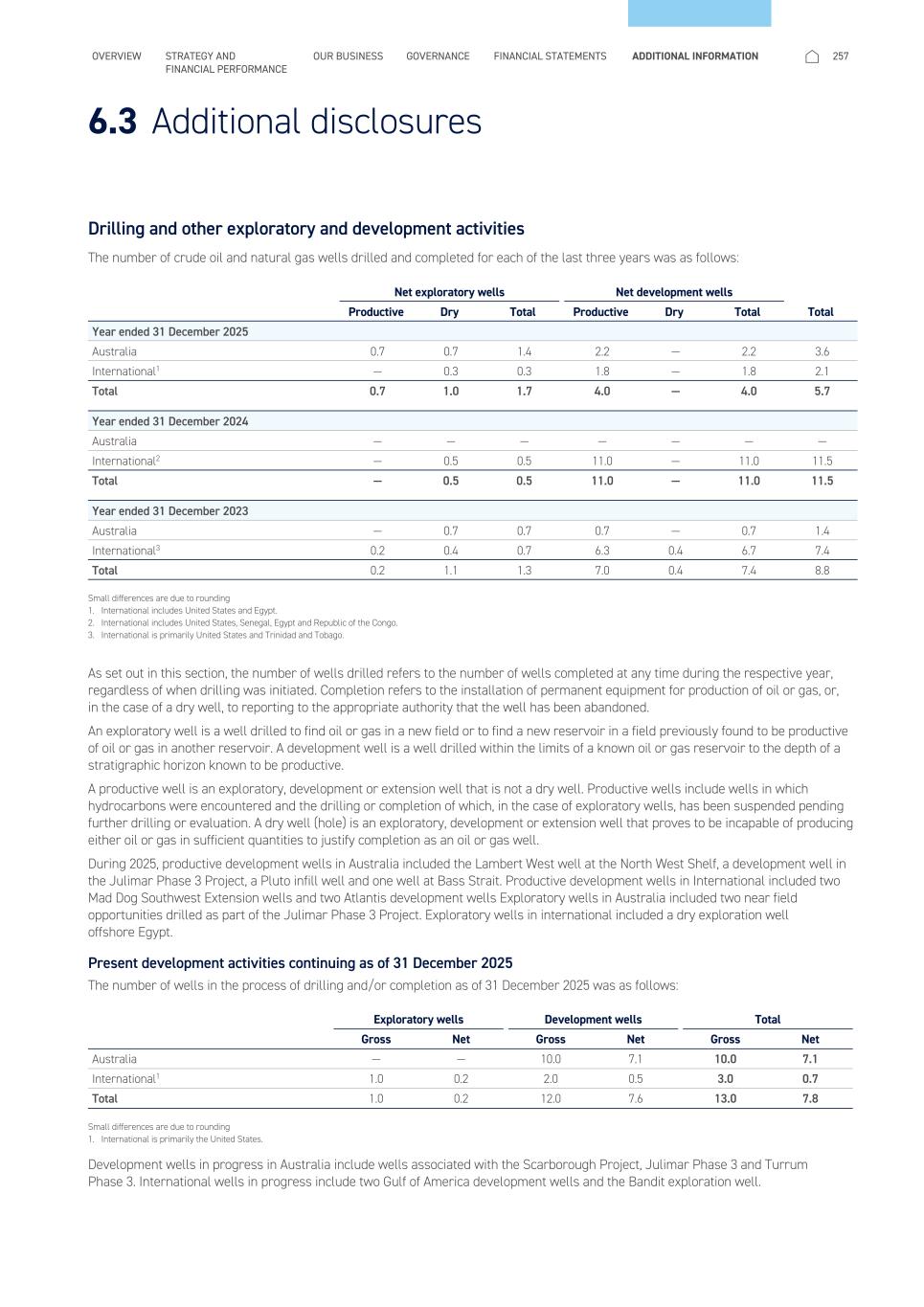
Drilling and other exploratory and development activities The number of crude oil and natural gas wells drilled and completed for each of the last three years was as follows: Net exploratory wells Net development wells Productive Dry Total Productive Dry Total Total Year ended 31 December 2025 Australia 0.7 0.7 1.4 2.2 — 2.2 3.6 International1 — 0.3 0.3 1.8 — 1.8 2.1 Total 0.7 1.0 1.7 4.0 — 4.0 5.7 Year ended 31 December 2024 Australia — — — — — — — International2 — 0.5 0.5 11.0 — 11.0 11.5 Total — 0.5 0.5 11.0 — 11.0 11.5 Year ended 31 December 2023 Australia — 0.7 0.7 0.7 — 0.7 1.4 International3 0.2 0.4 0.7 6.3 0.4 6.7 7.4 Total 0.2 1.1 1.3 7.0 0.4 7.4 8.8 Small differences are due to rounding 1. International includes United States and Egypt. 2. International includes United States, Senegal, Egypt and Republic of the Congo. 3. International is primarily United States and Trinidad and Tobago. As set out in this section, the number of wells drilled refers to the number of wells completed at any time during the respective year, regardless of when drilling was initiated. Completion refers to the installation of permanent equipment for production of oil or gas, or, in the case of a dry well, to reporting to the appropriate authority that the well has been abandoned. An exploratory well is a well drilled to find oil or gas in a new field or to find a new reservoir in a field previously found to be productive of oil or gas in another reservoir. A development well is a well drilled within the limits of a known oil or gas reservoir to the depth of a stratigraphic horizon known to be productive. A productive well is an exploratory, development or extension well that is not a dry well. Productive wells include wells in which hydrocarbons were encountered and the drilling or completion of which, in the case of exploratory wells, has been suspended pending further drilling or evaluation. A dry well (hole) is an exploratory, development or extension well that proves to be incapable of producing either oil or gas in sufficient quantities to justify completion as an oil or gas well. During 2025, productive development wells in Australia included the Lambert West well at the North West Shelf, a development well in the Julimar Phase 3 Project, a Pluto infill well and one well at Bass Strait. Productive development wells in International included two Mad Dog Southwest Extension wells and two Atlantis development wells Exploratory wells in Australia included two near field opportunities drilled as part of the Julimar Phase 3 Project. Exploratory wells in international included a dry exploration well offshore Egypt. Present development activities continuing as of 31 December 2025 The number of wells in the process of drilling and/or completion as of 31 December 2025 was as follows: Exploratory wells Development wells Total Gross Net Gross Net Gross Net Australia — — 10.0 7.1 10.0 7.1 International1 1.0 0.2 2.0 0.5 3.0 0.7 Total 1.0 0.2 12.0 7.6 13.0 7.8 Small differences are due to rounding 1. International is primarily the United States. Development wells in progress in Australia include wells associated with the Scarborough Project, Julimar Phase 3 and Turrum Phase 3. International wells in progress include two Gulf of America development wells and the Bandit exploration well. OVERVIEW STRATEGY AND FINANCIAL PERFORMANCE OUR BUSINESS I N GOVERNANCE FINANCIAL STATEMENTS ADDITIONAL INFORMATION 257 6.3 Additional disclosures
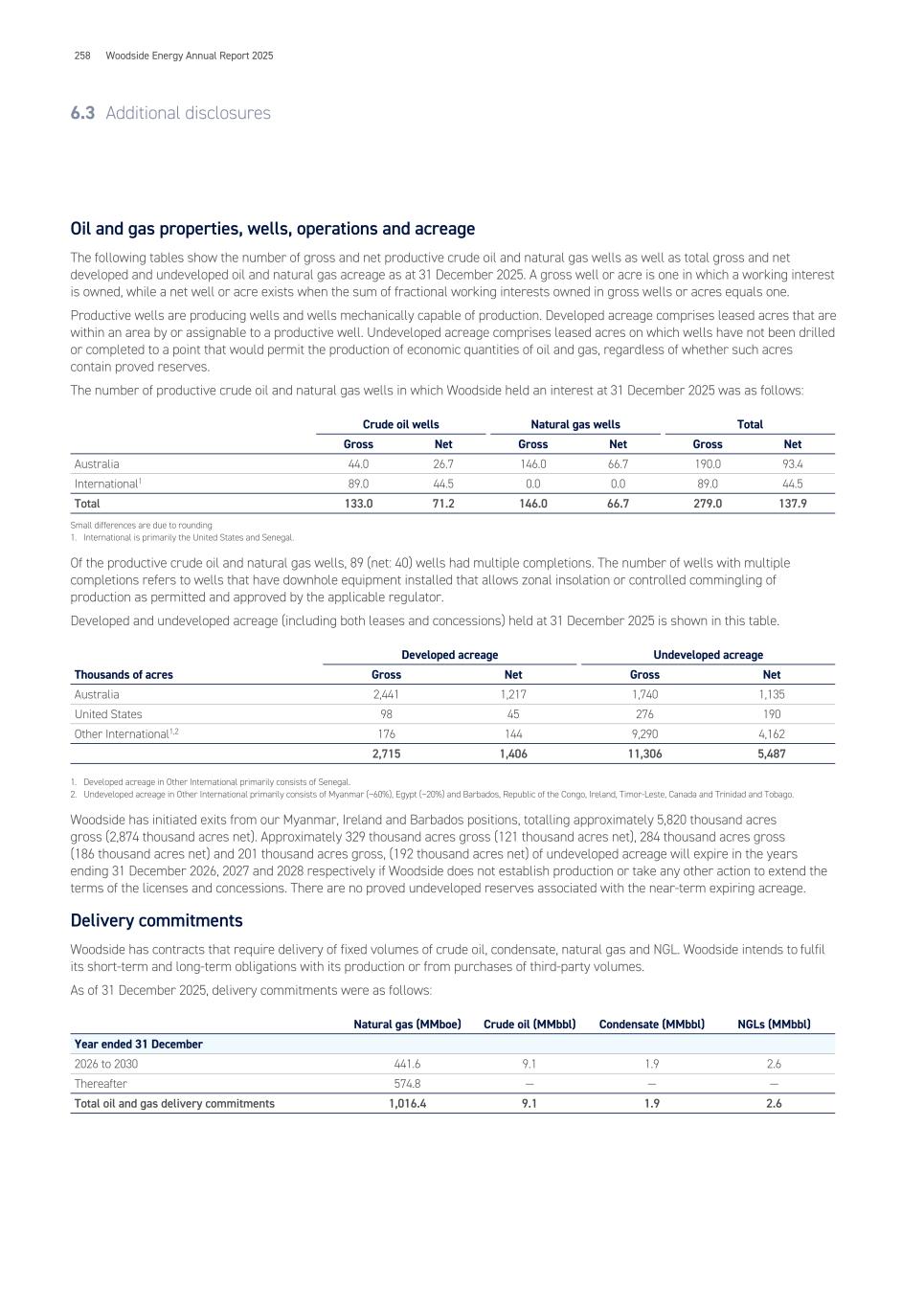
Oil and gas properties, wells, operations and acreage The following tables show the number of gross and net productive crude oil and natural gas wells as well as total gross and net developed and undeveloped oil and natural gas acreage as at 31 December 2025. A gross well or acre is one in which a working interest is owned, while a net well or acre exists when the sum of fractional working interests owned in gross wells or acres equals one. Productive wells are producing wells and wells mechanically capable of production. Developed acreage comprises leased acres that are within an area by or assignable to a productive well. Undeveloped acreage comprises leased acres on which wells have not been drilled or completed to a point that would permit the production of economic quantities of oil and gas, regardless of whether such acres contain proved reserves. The number of productive crude oil and natural gas wells in which Woodside held an interest at 31 December 2025 was as follows: Crude oil wells Natural gas wells Total Gross Net Gross Net Gross Net Australia 44.0 26.7 146.0 66.7 190.0 93.4 International1 89.0 44.5 0.0 0.0 89.0 44.5 Total 133.0 71.2 146.0 66.7 279.0 137.9 Small differences are due to rounding 1. International is primarily the United States and Senegal. Of the productive crude oil and natural gas wells, 89 (net: 40) wells had multiple completions. The number of wells with multiple completions refers to wells that have downhole equipment installed that allows zonal insolation or controlled commingling of production as permitted and approved by the applicable regulator. Developed and undeveloped acreage (including both leases and concessions) held at 31 December 2025 is shown in this table. Developed acreage Undeveloped acreage Thousands of acres Gross Net Gross Net Australia 2,441 1,217 1,740 1,135 United States 98 45 276 190 Other International1,2 176 144 9,290 4,162 2,715 1,406 11,306 5,487 1. Developed acreage in Other International primarily consists of Senegal. 2. Undeveloped acreage in Other International primarily consists of Myanmar (~60%), Egypt (~20%) and Barbados, Republic of the Congo, Ireland, Timor-Leste, Canada and Trinidad and Tobago. Woodside has initiated exits from our Myanmar, Ireland and Barbados positions, totalling approximately 5,820 thousand acres gross (2,874 thousand acres net). Approximately 329 thousand acres gross (121 thousand acres net), 284 thousand acres gross (186 thousand acres net) and 201 thousand acres gross, (192 thousand acres net) of undeveloped acreage will expire in the years ending 31 December 2026, 2027 and 2028 respectively if Woodside does not establish production or take any other action to extend the terms of the licenses and concessions. There are no proved undeveloped reserves associated with the near-term expiring acreage. Delivery commitments Woodside has contracts that require delivery of fixed volumes of crude oil, condensate, natural gas and NGL. Woodside intends to fulfil its short-term and long-term obligations with its production or from purchases of third-party volumes. As of 31 December 2025, delivery commitments were as follows: Natural gas (MMboe) Crude oil (MMbbl) Condensate (MMbbl) NGLs (MMbbl) Year ended 31 December 2026 to 2030 441.6 9.1 1.9 2.6 Thereafter 574.8 — — — Total oil and gas delivery commitments 1,016.4 9.1 1.9 2.6 258 Woodside Energy Annual Report 2025 6.3 Additional disclosures
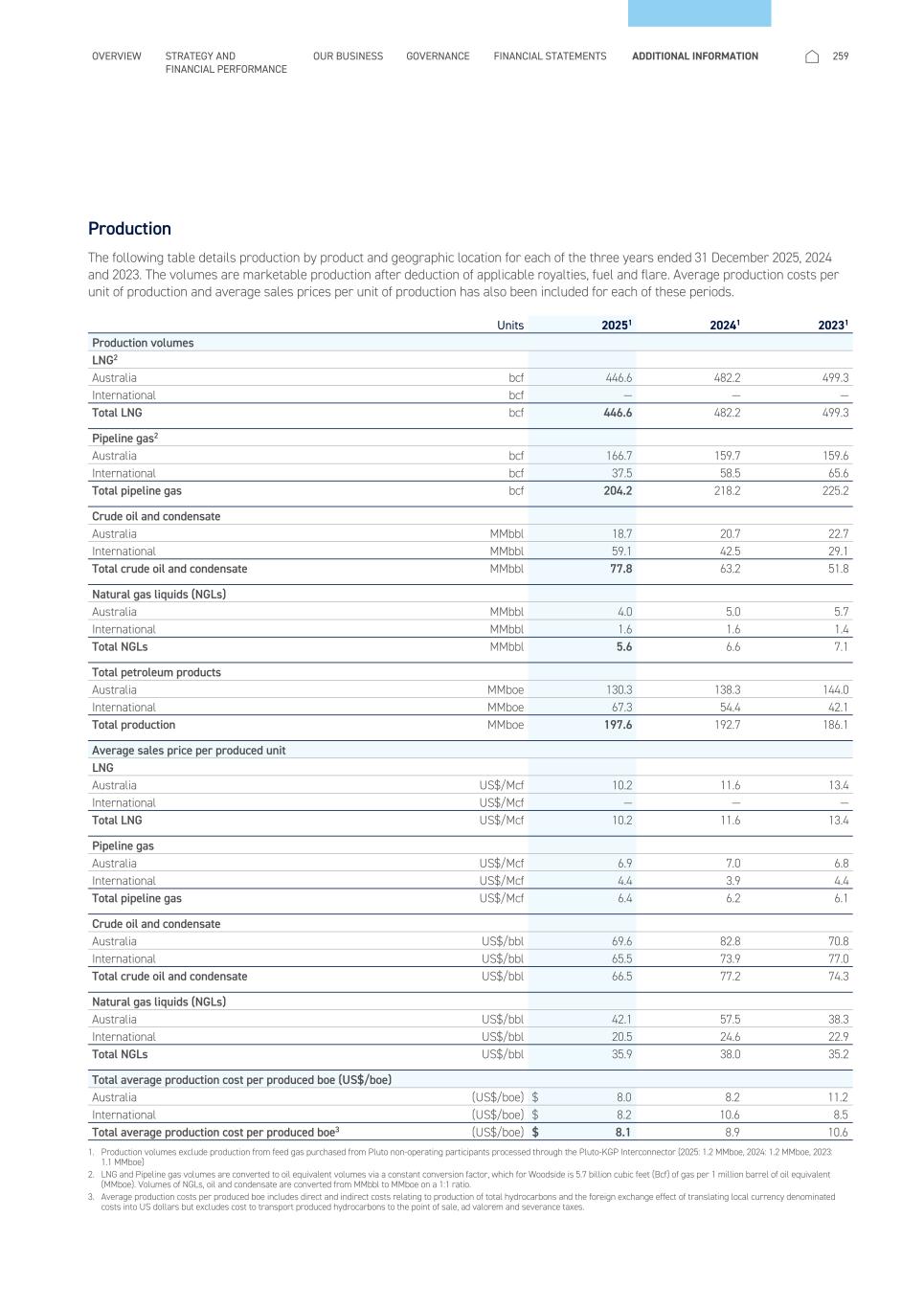
Production The following table details production by product and geographic location for each of the three years ended 31 December 2025, 2024 and 2023. The volumes are marketable production after deduction of applicable royalties, fuel and flare. Average production costs per unit of production and average sales prices per unit of production has also been included for each of these periods. Units 20251 20241 20231 Production volumes LNG2 Australia bcf 446.6 482.2 499.3 International bcf — — — Total LNG bcf 446.6 482.2 499.3 Pipeline gas2 Australia bcf 166.7 159.7 159.6 International bcf 37.5 58.5 65.6 Total pipeline gas bcf 204.2 218.2 225.2 Crude oil and condensate Australia MMbbl 18.7 20.7 22.7 International MMbbl 59.1 42.5 29.1 Total crude oil and condensate MMbbl 77.8 63.2 51.8 Natural gas liquids (NGLs) Australia MMbbl 4.0 5.0 5.7 International MMbbl 1.6 1.6 1.4 Total NGLs MMbbl 5.6 6.6 7.1 Total petroleum products Australia MMboe 130.3 138.3 144.0 International MMboe 67.3 54.4 42.1 Total production MMboe 197.6 192.7 186.1 Average sales price per produced unit LNG Australia US$/Mcf 10.2 11.6 13.4 International US$/Mcf — — — Total LNG US$/Mcf 10.2 11.6 13.4 Pipeline gas Australia US$/Mcf 6.9 7.0 6.8 International US$/Mcf 4.4 3.9 4.4 Total pipeline gas US$/Mcf 6.4 6.2 6.1 Crude oil and condensate Australia US$/bbl 69.6 82.8 70.8 International US$/bbl 65.5 73.9 77.0 Total crude oil and condensate US$/bbl 66.5 77.2 74.3 Natural gas liquids (NGLs) Australia US$/bbl 42.1 57.5 38.3 International US$/bbl 20.5 24.6 22.9 Total NGLs US$/bbl 35.9 38.0 35.2 Total average production cost per produced boe (US$/boe) Australia (US$/boe) $ 8.0 8.2 11.2 International (US$/boe) $ 8.2 10.6 8.5 Total average production cost per produced boe3 (US$/boe) $ 8.1 8.9 10.6 1. Production volumes exclude production from feed gas purchased from Pluto non-operating participants processed through the Pluto-KGP Interconnector (2025: 1.2 MMboe, 2024: 1.2 MMboe, 2023: 1.1 MMboe) 2. LNG and Pipeline gas volumes are converted to oil equivalent volumes via a constant conversion factor, which for Woodside is 5.7 billion cubic feet (Bcf) of gas per 1 million barrel of oil equivalent (MMboe). Volumes of NGLs, oil and condensate are converted from MMbbl to MMboe on a 1:1 ratio. 3. Average production costs per produced boe includes direct and indirect costs relating to production of total hydrocarbons and the foreign exchange effect of translating local currency denominated costs into US dollars but excludes cost to transport produced hydrocarbons to the point of sale, ad valorem and severance taxes. OVERVIEW STRATEGY AND FINANCIAL PERFORMANCE OUR BUSINESS GOVERNANCE FINANCIAL STATEMENTS ADDITIONAL INFORMATION 259
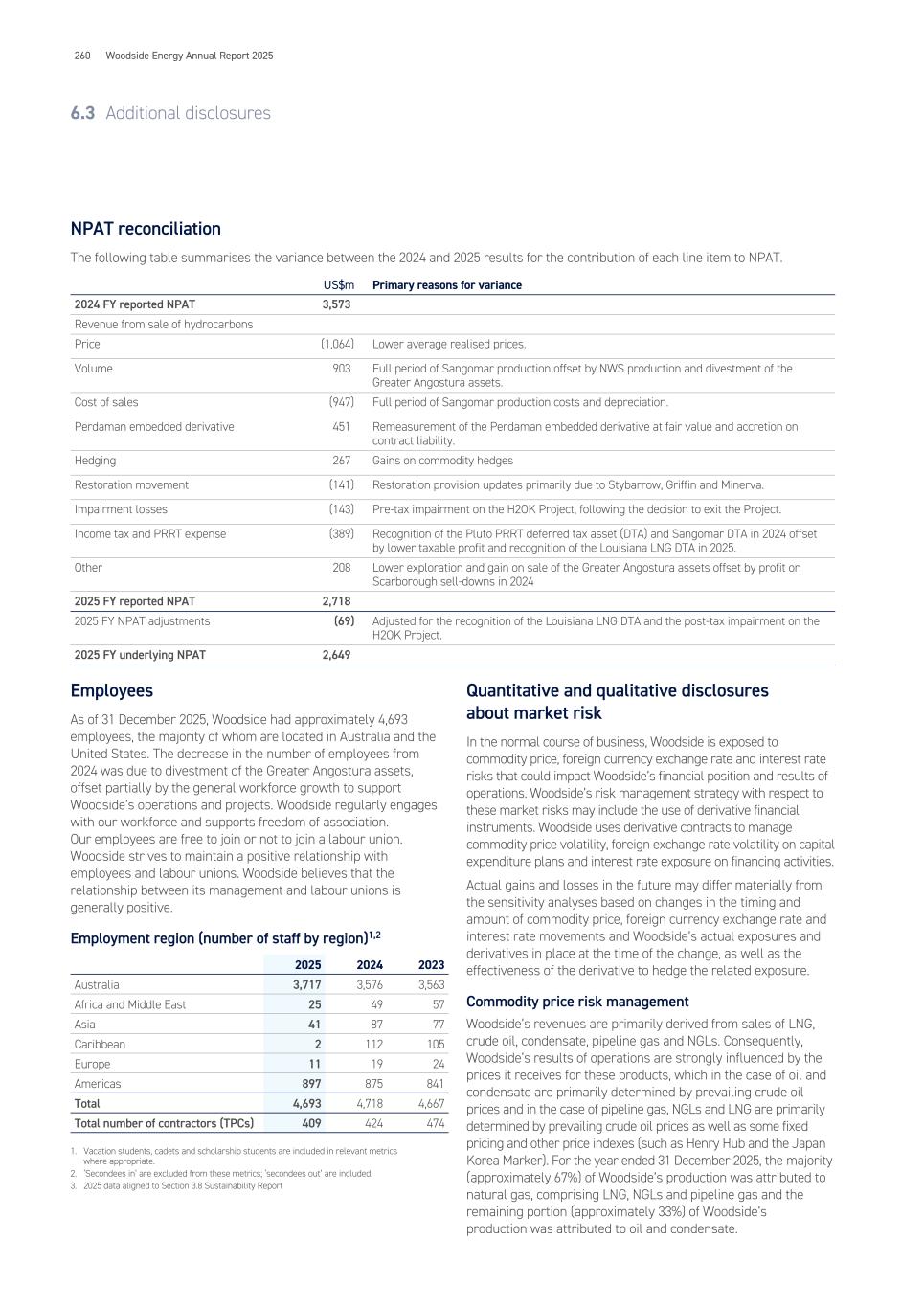
NPAT reconciliation The following table summarises the variance between the 2024 and 2025 results for the contribution of each line item to NPAT. US$m Primary reasons for variance 2024 FY reported NPAT 3,573 Revenue from sale of hydrocarbons Price (1,064) Lower average realised prices. Volume 903 Full period of Sangomar production offset by NWS production and divestment of the Greater Angostura assets. Cost of sales (947) Full period of Sangomar production costs and depreciation. Perdaman embedded derivative 451 Remeasurement of the Perdaman embedded derivative at fair value and accretion on contract liability. Hedging 267 Gains on commodity hedges Restoration movement (141) Restoration provision updates primarily due to Stybarrow, Griffin and Minerva. Impairment losses (143) Pre-tax impairment on the H2OK Project, following the decision to exit the Project. Income tax and PRRT expense (389) Recognition of the Pluto PRRT deferred tax asset (DTA) and Sangomar DTA in 2024 offset by lower taxable profit and recognition of the Louisiana LNG DTA in 2025. Other 208 Lower exploration and gain on sale of the Greater Angostura assets offset by profit on Scarborough sell-downs in 2024 2025 FY reported NPAT 2,718 2025 FY NPAT adjustments (69) Adjusted for the recognition of the Louisiana LNG DTA and the post-tax impairment on the H2OK Project. 2025 FY underlying NPAT 2,649 Employees As of 31 December 2025, Woodside had approximately 4,693 employees, the majority of whom are located in Australia and the United States. The decrease in the number of employees from 2024 was due to divestment of the Greater Angostura assets, offset partially by the general workforce growth to support Woodside’s operations and projects. Woodside regularly engages with our workforce and supports freedom of association. Our employees are free to join or not to join a labour union. Woodside strives to maintain a positive relationship with employees and labour unions. Woodside believes that the relationship between its management and labour unions is generally positive. Employment region (number of staff by region)1,2 2025 2024 2023 Australia 3,717 3,576 3,563 Africa and Middle East 25 49 57 Asia 41 87 77 Caribbean 2 112 105 Europe 11 19 24 Americas 897 875 841 Total 4,693 4,718 4,667 Total number of contractors (TPCs) 409 424 474 1. Vacation students, cadets and scholarship students are included in relevant metrics where appropriate. 2. ‘Secondees in’ are excluded from these metrics; ‘secondees out’ are included. 3. 2025 data aligned to Section 3.8 Sustainability Report Quantitative and qualitative disclosures about market risk In the normal course of business, Woodside is exposed to commodity price, foreign currency exchange rate and interest rate risks that could impact Woodside’s financial position and results of operations. Woodside’s risk management strategy with respect to these market risks may include the use of derivative financial instruments. Woodside uses derivative contracts to manage commodity price volatility, foreign exchange rate volatility on capital expenditure plans and interest rate exposure on financing activities. Actual gains and losses in the future may differ materially from the sensitivity analyses based on changes in the timing and amount of commodity price, foreign currency exchange rate and interest rate movements and Woodside’s actual exposures and derivatives in place at the time of the change, as well as the effectiveness of the derivative to hedge the related exposure. Commodity price risk management Woodside’s revenues are primarily derived from sales of LNG, crude oil, condensate, pipeline gas and NGLs. Consequently, Woodside’s results of operations are strongly influenced by the prices it receives for these products, which in the case of oil and condensate are primarily determined by prevailing crude oil prices and in the case of pipeline gas, NGLs and LNG are primarily determined by prevailing crude oil prices as well as some fixed pricing and other price indexes (such as Henry Hub and the Japan Korea Marker). For the year ended 31 December 2025, the majority (approximately 67%) of Woodside’s production was attributed to natural gas, comprising LNG, NGLs and pipeline gas and the remaining portion (approximately 33%) of Woodside’s production was attributed to oil and condensate. 260 Woodside Energy Annual Report 2025 6.3 Additional disclosures
LNG market conditions including, but not limited to, supply and demand, are unpredictable and are beyond Woodside’s control. In particular, supply and demand for and pricing of LNG remain sensitive to energy prices, external economic and political factors, weather, climate conditions, natural disasters (including pandemics), timing of FIDs for new operations, construction and startup and operating costs for new LNG supply, buyer preferences for LNG, coal or crude oil and evolving buyer preferences for different LNG price regimes, and the energy transition. Buyers and sellers of LNG are increasingly more flexible with the way they transact, and contracts may involve hybrid pricing that is linked to other indices such as the Intercontinental Exchange Brent Crude deliverable futures contract (oil price) or the Japanese Crude Cocktail, which is the average price of customs-cleared crude oil imports into Japan as reported in customs statistics. Typically, only LNG supplied from the United States was based on a component linked to movements in the US Henry Hub plus certain fixed and variable components. This type of pricing structure may become a component of the weighted average price into Asia and other markets. This is since LNG supply and trade has globalised and increasingly the lowest cost supply is setting the floor for long- term average global natural gas prices with transportation costs accounting for regional differences. This marginal supply is predominantly from the United States, indirectly pegging global gas prices and Asian spot LNG prices to the Henry Hub marker which could adversely affect the pricing of new LNG contracts and potential future price reviews of existing LNG contracts. Tenders may also be used by suppliers and buyers, typically for shorter-term contracts. In addition, long-term LNG contracts typically contain price review mechanisms that sometimes need to be resolved by expert determination or arbitration. The use of these independent resolution mechanisms is likely to be more prevalent in volatile commodity markets. Alternatives to fossil fuel-based products for the generation of electricity (for example, nuclear power and renewable energy sources) are continually under development and, if these alternatives continue to gain market share, they could also have a material impact on demand for LNG, which in turn may negatively impact Woodside’s business, results of operations and financial condition in the longer term. Oil prices can be very volatile, and periods of sustained low prices could result in changes to Woodside’s carrying value assumptions and may also reduce the reported net profit for the relevant period. The price of crude oil may be affected by factors beyond Woodside’s control. These include worldwide oil supply and demand, the level of economic activity in the markets Woodside serves, regional political developments and military conflicts (including the ongoing Russia–Ukraine conflict), weather conditions and natural disasters, conservation and environmental protection efforts, the level of crude oil inventories, the ability of OPEC and other major oil-producing or oil-consuming nation to influence global production levels and prices, sanctions on the production or export of oil, governmental regulations and actions (including the imposition of taxes), trade restrictions, market uncertainty and speculative activities by those who buy and sell oil and gas on the world markets, commodity futures trading, availability and capacity of infrastructure, supply chain disruptions, processing facilities and necessary transportation, the price and availability of new technology, the availability and cost of alternative sources of energy, and the impact of climate change considerations and actions towards energy transition on the demand for key commodities Woodside produces. While we believe demand for natural gas is part of the energy transition, transition to lower-carbon sources of energy in many parts of the world (driven by environmental, social, governance and climate change concerns) may affect demand for Woodside’s products including crude oil, natural gas and LNG. In turn, this may affect the price received (or expected to be received) for these products. Material adverse price impacts (including as a result of the energy transition) may affect the economic performance (including as to margins and cash flows) of, and longevity of production from, Woodside’s existing and future production assets, and ultimately the financial performance of Woodside. It is impossible to predict future crude oil, LNG and natural gas price movements with certainty. A low crude oil price environment or declines in the price of crude oil, LNG and natural gas prices, could adversely affect Woodside’s business, results of operations, and financial condition and liquidity. They could also negatively impact its ability to access sources of capital, including equity and debt markets. Those circumstances may also adversely impact Woodside’s ability to finance planned capital expenditures, including development projects, and may change the economics of operating certain wells, which could result in a reduction in the volume of Woodside’s reserves. Declines in crude oil, LNG and natural gas prices, especially sustained declines, may also reduce the amount of oil and gas that we can produce economically, reduce the economic viability of planned projects or assets that we plan to acquire or have acquired, and may reduce the expected value and the potential commerciality of exploration and appraisal assets. Those reductions may result in substantial downward adjustments to Woodside’s estimated proved reserves and require additional write-downs of the value of its property, plant and equipment. OVERVIEW STRATEGY AND FINANCIAL PERFORMANCE OUR BUSINESS GOVERNANCE FINANCIAL STATEMENTS ADDITIONAL INFORMATION 261
Sales contracts with the National Gas Company of Trinidad and Tobago relating to production from Woodside’s Trinidad and Tobago operations were partially linked to ammonia pricing. In addition, there is a Western Australian domestic gas sales contract linked to urea pricing. Similar to crude oil, LNG and natural gas, it is impossible to predict future ammonia and urea prices with certainty. There can be no assurance that Woodside will successfully manage its exposure to commodity prices. There is also counterparty risk associated with derivative contracts. If any counterparty to Woodside’s derivative instruments were to default or seek bankruptcy protection, it could subject a larger percentage of Woodside’s future oil and gas production to price changes and could have a negative effect on Woodside’s financial performance, including its ability to fund future projects. Whether Woodside engages in hedging and other oil and gas derivative contracts on a limited basis or otherwise, Woodside will remain exposed to fluctuations in crude oil prices. Foreign exchange and interest rate risk management Notes A and C in the Notes to the financial statements contain further information on foreign exchange and interest rate risks. Cybersecurity Our Cyber Resilience Process and risk management Woodside’s approach to managing material risks from cybersecurity threats is integrated into our overall risk management processes as disclosed in Section 4.1.6 – Risk management and internal control. Woodside’s cybersecurity resilience and risk management strategy and process are based on the National Institute of Standards and Technology Cybersecurity Framework. Woodside’s Cyber Resilience Process consists of various Group‑wide policies, procedures and guidelines concerning cybersecurity matters. These documents, published within the Woodside Management System (WMS), have these aims: 1. to design, build and maintain Woodside’s Information Technology (IT), Operational Technology (OT) and Industrial Internet of Things systems with the right cybersecurity controls to support confidentiality, integrity and availability. 2. to monitor and strengthen Woodside’s cybersecurity posture while preventing, detecting, analysing and responding to cybersecurity incidents. 3. to embed a cybersafe culture across Woodside and foster industry collaboration. 4. to enable compliance with all applicable legislation. The Cyber Resilience Process involves five key activities: identify, protect, detect, respond and recover. In addition to the Cyber Resilience Process, the Data, Information and Systems Management process documented within the WMS, includes the Woodside Information Technology Systems – Conditions of Use Procedure. This procedure sets out Woodside’s mandatory conditions applicable to the use of Woodside’s IT, OT and digital systems. Woodside manages cybersecurity risks utilising the same Woodside risk management process as described in Section 3.9 – Risk factors. Our Cyber Resilience Process assurance Woodside’s cybersecurity team engages third-party vendors as part of our Cyber Resilience Process to perform a variety of technical assessments such as penetration testing. As part of these assessments, the third parties test our internal and external defences, and help us with identifying weaknesses and vulnerabilities within our environment. These assessment findings are risk ranked and prioritised for remediation. Woodside’s internal audit team conducts audits on cybersecurity on a biennial basis. The internal audit function engages external expertise to conduct the audits. The most recent cybersecurity audit concluded in 2025. Third-party cybersecurity risk management Woodside identifies and manages risks from cybersecurity threats associated with third parties accessing, storing and processing Woodside data. This is done through upfront cybersecurity assessment processes that leverage independently verified security programs including ISO 27001 certification and SOC 2 Type II compliance, and through contractual terms and conditions. Woodside manages risk of third-party access to Woodside systems through onboarding and induction processes for personnel including mandatory training. Third-party personnel accessing Woodside systems are subject to the same cyber security controls as Woodside staff. This includes the requirement to complete annual cybersecurity training and additional role-based training if applicable. Higher risk scenarios such as direct network connectivity from third-party networks are not permitted. Material impact from cybersecurity risks, threats or previous cybersecurity incidents Cybersecurity threats have the potential to materially affect Woodside’s business strategy, results of operations and financial conditions. This risk is described in Section 3.7 – Risk factors. Woodside continuously monitors its digital information landscape and has various threat detection measures in place. Woodside is not aware of any cybersecurity incidents or threats that have materially affected or are reasonably likely to materially affect our business strategy, results of operations or financial conditions. 262 Woodside Energy Annual Report 2025 6.3 Additional disclosures
Cybersecurity governance and internal control As part of its oversight of the Risk Management Policy, the Audit & Risk Committee oversees risks from cybersecurity threats. The Audit & Risk Committee aims to hold at least five regular meetings a year at which cybersecurity risks and the Group’s management of such risks are reviewed as part of those meetings. The identification and direct management of cybersecurity risks and threats are performed by Woodside’s cybersecurity function, with subject matter expertise provided as part of our Cyber Resilience Process. The cybersecurity function is led by Woodside’s VP Digital and a group of competent and experienced cybersecurity professionals. Our VP Digital has over a decade of industry experience and as held multiple technology and business facing roles. The Cyber Resilience Process as described previously includes the monitoring, prevention, detection, mitigation and remediation of cybersecurity risks and incidents. The Woodside Board and the Audit & Risk Committee are kept informed of any material cybersecurity risks and incidents through formal risk registers, briefing papers, internal audit reports, periodic reporting in person at Audit & Risk Committee meetings or as required through Woodside’s crisis and emergency management process. Woodside’s cybersecurity resilience and risk management strategy and process are based on the National Institute of Standards and Technology Cybersecurity Framework. This process is documented within the WMS. Government regulations Woodside’s assets and exploration, development, extraction and production and decommissioning operations are subject to a wide range of laws and regulations imposed by governments and regulatory bodies. These regulations touch all aspects of our businesses, including how we extract, process and explore for oil and natural gas, and how we conduct our business, including regulations governing matters related to environmental protection, land rehabilitation, facility decommissioning, occupational health and safety, human rights, the rights and interests of Indigenous peoples, competition, foreign investment, export, marketing of our products, royalties and taxes. The ability to extract and process oil and natural gas is fundamental to our business. In most jurisdictions, where we operate or have assets, the rights to explore for and to extract petroleum deposits are owned by the government. We obtain the right to access the land and extract the product by entering into licences or leases with the government that owns the oil or natural gas deposit. Usually, the right to explore for oil and natural gas carries with it the obligation to spend a defined amount of money on petroleum exploration or to undertake particular exploration activities. We also rely on governments to grant the rights necessary to transport and treat the extracted petroleum to prepare it for sale. The terms of the right, including the time period of the right, vary depending on the laws of the relevant government or terms negotiated with the relevant government. Many of the laws and regulations to which we are subject require us to obtain permits or other authorisations from state or federal agencies (or both) before initiating exploration, certain drilling, construction, production, operation, or other activities, and to maintain these permits and compliance with their requirements for ongoing operations. These permits are generally subject to protest, appeal, or litigation, which can in certain cases delay or halt projects and cease production or operation of wells, pipelines, and other operations. In certain jurisdictions where we have assets, such as Trinidad and Tobago and Senegal, a production sharing contract governs the relationship between the government and companies (typically referred to as “contractor”) concerning, among other things, how much of the oil and gas extracted from the country each party will receive. Under production sharing contracts, the government awards exclusive rights for the execution of exploration, development and production activities to the contractor in accordance with the contract’s terms. Generally speaking, the contractor bears the financial risk of the initiative to explore, develop and ultimately produce the resource. When successful, the contractor is permitted to use a specified percentage of produced oil and gas to recover its capital and operational expenditures, often called “cost oil”. The remaining production is split between the government and the contractor at a rate determined by the government and set out in the contract. The production sharing contract may also include additional fiscal terms such as royalties, production bonuses and tax treatment, and other contractual terms addressing domestic supply obligations, local content, measurement and valuation. Production sharing contracts are bilateral contracts negotiated between the contractor and the government, and so each is necessarily on different terms. Applicable laws and regulations, and any permits that Woodside is required to obtain under these laws, may obligate Woodside to identify, avoid, mitigate and disclose environmental risks in various operational practices, including (among others), through pursuing and obtaining permits before commencing activities; restricting air and water emissions and waste discharges; limiting the type, quantity and concentration of various substances that can be utilised or released into the environment; addressing potential or actual impacts to protected flora and fauna species or cultural resources; monitoring or remediating contamination under certain circumstances; establishing and following certain inspection, testing, maintenance and decommissioning protocols; and disclosing certain operational practices. Moreover, environmental permits required for our operations may be subject to legal challenges by third parties, and such challenges can materially and adversely affect our operations to the extent they delay or prevent obtaining approvals or permits required for our operations, or otherwise require incurring increased costs in order to obtain such approvals or permits. Applicable environmental laws and regulations may also dictate amenity considerations relating to noise, odour and dust, worker health and community notification procedures. OVERVIEW STRATEGY AND FINANCIAL PERFORMANCE OUR BUSINESS GOVERNANCE FINANCIAL STATEMENTS ADDITIONAL INFORMATION 263
In addition, from time to time, certain trade sanctions are adopted by the United Nations (UN) Security Council or various governments, including in the United Kingdom, the United States, the European Union (EU), China and Australia against certain countries, entities or individuals, that may restrict our ability to sell oil or natural gas to or to purchase goods or services from these countries, entities or individuals. This summary focuses on the Australian and United States regulatory regimes, as well as certain regulations in Mexico and Senegal. It is not a full summary of the regulatory regimes in those jurisdictions nor is it a complete list of the legislation and regulation that applies to Woodside. Woodside is also subject to environmental and other regulations to varying degrees in each of the jurisdictions in which it has assets and operations. Australia In Australia, petroleum exploration and production takes place within a legal framework characterised by a division of responsibilities between the federal and the state or territory governments. Exploration and production activities conducted onshore and within three nautical miles of the territorial sea baseline of the relevant state or territory are the responsibility of the individual state or territory governments. The Australian Government has legislative responsibility for Australian offshore petroleum exploration and production beyond the three nautical mile territorial sea, which encompasses the area of most relevance to Woodside’s offshore activities. In addition, Woodside has certain onshore operations in Victoria and Western Australia that are subject to various pieces of state and federal legislation. Environmental regulation Woodside’s Australian operations are subject to federal, state and local environmental laws and regulations. For offshore petroleum activities, these laws and regulations generally require an approval before an activity commences, and require that for an activity, environmental risks are identified and controls put in place to reduce or eliminate the risks. For exploration drilling and seismic activities in the federal jurisdiction, this is outlined in an environment plan accepted by NOPSEMA, an independent statutory authority. As an operation goes into construction, commissioning and production, an offshore project proposal and new or revised environment plan may be required. Subsequent environment plans for each activity are required to be submitted after an offshore project proposal has been approved. These laws and regulations also restrict the type, quantity and concentration of various substances that can be utilised or released into the environment in connection with marine and land-based activities; limit or prohibit drilling and seismic or production activities in and near certain environmentally sensitive or protected areas; and impose criminal and civil liabilities for pollution or other unauthorised impacts to the environment resulting from oil, natural gas and petrochemical operations. The National Greenhouse and Energy Reporting Act 2007 (Cth) requires corporations that meet certain reporting thresholds to report company information about GHG emissions and energy production and consumption as part of a single, national reporting scheme. The National Greenhouse and Energy Reporting (Safeguard Mechanism) Rule 2015 establishes the Safeguard Mechanism that aims to keep certain GHG emissions at or below legislated limits, known as baselines, for Australia’s largest industrial facilities. In March 2023, the Safeguard Mechanism (Crediting) Amendment Bill 2023 was passed, which applied reforms to the Safeguard Mechanism from 1 July 2023 intended to reduce Scope 1 GHG emissions from Australia’s largest industrial facilities on a trajectory consistent with achieving Australia’s GHG emission reduction targets of 43% below 2005 levels by 2030 and net zero by 2050. There remains uncertainty regarding future changes to climate change and emissions regulation in Australia and the effect it may have on Woodside’s business. In addition, Australian environmental laws and regulations also include restrictions on air emissions and water discharges resulting from the operation of drilling equipment, processing facilities, pipelines and transport vessels. These laws also regulate the use, management and disposal of hazardous materials and general waste; prohibit the clearing of native vegetation without approval; manage biodiversity and manage and authorise impacts to Aboriginal and Torres Strait Islander heritage; and require Woodside to prepare and implement safety and environmental management plans. Woodside is required to provide bonds or maintain other forms of financial assurance for rehabilitation, cleaning-up or pollution prevention work that may be necessary as a result of the construction, operation, decommissioning or removal of a pipeline or other infrastructure and to report, monitor or remediate contamination under certain circumstances. Woodside is subject to “strict liability” for oil spills, rendering it liable without regard to potential negligence or fault and may be subject to fines and other penalties for breaches of laws, regulations, licences or other approvals. The requirements imposed by environmental laws and regulations are subject to change and have tended to become increasingly rigorous over time. Australia’s key piece of Commonwealth environmental legislation, the Environment Protection and Biodiversity Conservation Act 1999 (Cth) (EPBC Act) was subject to significant reform in 2025, which will largely take effect throughout 2026. The EPBC Act reforms are significant, and include changes to decision-making criteria and assessment pathways, bilateral agreements with states, territories and other Commonwealth regulators, bioregional planning, establishment of an independent Environmental Protection Agency, new enforcement tools and materially increased maximum penalties. The reforms will have implications for existing EPBC Act decisions, applications and future assessment processes. Standards, regulations, rulings and broader guidance material is continuing to be developed by government and will also have a bearing on the practical implications of the reforms. The modification of existing foreign or domestic laws or regulations or the adoption of new laws or regulations curtailing exploratory or development drilling for oil and gas for economic, political, social, environmental or other reasons could have a material adverse effect on Woodside’s business, financial condition or results of operations. 264 Woodside Energy Annual Report 2025 6.3 Additional disclosures
Fair Work Act and other related amendments Following several years of significant, staged reforms to the Fair Work Act 2009 (Cth) and other related laws, this year has seen the practical implementation of the reforms by industry and interpretation by courts and judicial bodies. In December 2022, the Australian Government passed the Fair Work Legislation Amendment (Secure Jobs, Better Pay) Act 2022 (Cth) (SJBP Act) which introduced a raft of amendments into the Fair Work Act with phased commencement dates over the course of 2023. All key provisions of the SJBP Act have now become effective. Key material employment changes to the Fair Work Act arising from the SJBP Act included expanded rights for employees to enforce flexible working arrangements, new restrictions on the use of fixed term (including “maximum term”) employment contracts, prohibitions against pay secrecy, expanding the list of protected attributes in the anti-discrimination provisions (namely, by introducing gender identity, intersex status and breastfeeding), broadening the ability of employees to extend and request access to unpaid parental leave, and providing additional avenues for workers to seek recourse against sexual harassment. The sexual harassment-related amendments in particular complement the commencement in December 2022 of a new positive duty to prevent sexual harassment in the Sex Discrimination Act 1984 (Cth), which the Australian Human Rights Commission has the power to enforce from 12 December 2023. Additionally, the Australian Human Rights Commission Amendment (Costs Protection) Bill 2024 (Cth) has commenced, a key purpose of which is to reduce the financial barriers for sexual harassment complainants to bring claims. The SJBP Act also introduced a series of significant industrial relations changes to enterprise bargaining, including expanding the ability of employees and unions to seek multi-employer enterprise agreements, broadening the power of the Fair Work Commission to resolve (through mediation or conciliation) bargaining disputes before industrial action is taken and to intervene and make workplace determinations where bargaining becomes “intractable”. Other changes to bargaining introduced by the SJBP Act included amendments making it easier for employee bargaining representatives to commence bargaining to renew existing single‑enterprise agreements, changes to the Fair Work Commission’s requirements for approving enterprise agreements (including consideration of whether a proposed agreement has been genuinely agreed to and passes the “better‑off-overall” test) and substantially restricting the ability of employers to terminate nominally-expired enterprise agreements. In June 2023, the Fair Work Legislation Amendment (Protecting Worker Entitlements) Act 2023 (Cth) was introduced, bringing further changes to the Fair Work Act. Key changes arising from this Act include the expansion of unpaid parental leave rights (from 1 July 2023) and enshrining superannuation payments as an enforceable National Employment Standard under the Fair Work Act (from 1 January 2024). A further package of significant reforms is contained in the Australian Government’s Fair Work Legislation Amendment (Closing Loopholes) Act 2023 (Cth) (Closing Loopholes Act). To secure the passage of the Closing Loopholes Act, the Government split the legislation into two tranches, the first passing both Houses on 7 December 2023 and the second on 12 February 2024.1 The changes under the Closing Loopholes Act took effect at different times between December 2023 and August 2025, with both tranches of reforms having now fully commenced operation. In 2025, this included the commencement of the criminalising wage theft provisions on 1 January 2025, which has made the intentional underpayment of wages or entitlements a criminal offence. Further, a change relating to model enterprise agreement flexibility, consultation and dispute terms has also now commenced on 26 February 2025, as well as the establishment of a Road Transport Advisory Group. Earlier reform matters contained in the first tranche of the Closing Loopholes Act included: regulated labour hire arrangement orders (or “same job, same pay” orders) for labour hire workers; workplace delegate rights (except those relating to regulated workers); enhanced discrimination protections; amendments regarding conciliation conferences related to industrial action; a new federal criminal offence of industrial manslaughter; and right of entry changes for union officials assisting health and safety representatives. Earlier reform matters under the second tranche included: changes to intractable bargaining powers, provisions relating to multi‑enterprise agreements, casual employment, the definition of employee, workplace delegate rights for regulated workers and the introduction of a right to disconnect. The “same job, same pay” provisions give the Fair Work Commission the ability to make orders upon application requiring certain employers that supply their employees to perform labour (but not a service) for a “regulated host” to pay their employees the same rate of pay in an enterprise agreement as employees of the host who perform work of the same kind covered by the enterprise agreement. A number of applications for regulated labour hire orders were made in the oil and gas sector this year. The new rights for workplace delegates to paid time off to attend training as well as reasonable time and access to employer facilities to communicate with eligible union members is also significant as is the new criminal wage theft offence in respect of intentional underpayments. More recently, the Fair Work Amendment (Baby Priya’s) Act 2025 (Cth) received Royal Assent on 6 November 2025, that added protections in the Fair Work Act which prohibit an employer from refusing or cancelling an employee’s entitlement to employer funded paid parental leave because their child is stillborn or dies after birth. While this year saw comparatively less reforms to the Fair Work Act, there have been notable court decisions that provide guidance on the interpretation of the Fair Work Act. On 6 August 2025, the High Court of Australia handed down its decision in Helensburgh Coal Pty Ltd v Bartley [2025] HCA 29 where it upheld the Fair Work Commission’s findings that the employer’s decision to terminate its employees was not a case of genuine redundancy (in the context of an unfair dismissal) because it would have been reasonable to redeploy the employees into the role of contractors engaged by the employer. OVERVIEW STRATEGY AND FINANCIAL PERFORMANCE OUR BUSINESS GOVERNANCE FINANCIAL STATEMENTS ADDITIONAL INFORMATION 265 1. Fair Work Legislation Amendment (Closing Loopholes No. 2) Act 2024 (Cth).
On 20 August 2025, the Full Federal Court handed down its decision in Australian Workers’ Union v UGL [2025] FCAFC 107 where it ruled that s 323 of the Fair Work Act creates a separate statutory obligation to make payment in full to an employee under contract, modern award, or enterprise agreement, resolving some pre-existing uncertainty caused by competing single judge decisions. On 5 September 2025, Justice Perram delivered the decision in Fair Work Ombudsman v Woolworths Group Limited & Coles Supermarkets Australia Pty Ltd [2025] FCA 1092 where the Federal Court made findings in relation to s 323 and set-off and record keeping obligations. Woodside continues to review and respond to these numerous new employment and industrial relations developments. Moving forward, as these reforms have now taken effect, compliance costs are anticipated to increase in 2026. Santos Barossa decision and environment plans In the course of preparing an environment plan, a titleholder is required under the Offshore Petroleum and Greenhouse Gas Storage (Environment) Regulations 2023 (OPGGS(E)R) to consult with relevant persons. In December 2022, the Full Court of the Federal Court of Australia handed down its decision in Santos NA Barossa Pty Ltd v Tipakalippa [2002] FCAFC 193 (Appeal Decision). The Appeal Decision decided certain aspects of the requirements for consultation associated with the acceptance of environment plans for offshore petroleum activities by NOPSEMA, as required under the OPGGS(E)R. Subsequently, the management authority published a guideline for industry entitled “Consultation in the course of preparing an environment plan”. As a consequence of these events, Woodside has experienced delays in obtaining environment plans for petroleum activities in Commonwealth waters. Refer to Section 3.7 – Risk factors for further information on risks related to government regulations and other legal developments. Domestic gas reservation policy Under a Western Australian State Government policy (WA Domestic Gas Policy), introduced in 2006, gas equivalent to 15% of LNG production from LNG export projects is required to be reserved for domestic use as a condition of State approvals required for LNG projects. The policy is typically implemented through domestic gas commitment agreements entered into between project proponents and the State, allowing negotiations to occur on a case-by-case basis regarding the method by which the LNG project proponents fulfil their domestic gas commitments, including from alternative sources. Woodside and (where applicable) its joint venture participants have domestic gas contractual commitments in place with the Western Australian State Government in respect to the North West Shelf (NWS), Pluto LNG, Scarborough and Wheatstone projects. In 2015, the NWS State Agreement (North West Gas Development (Woodside) Agreement 1979) was amended to include a new domestic gas commitment of 15% (or lesser approved amount) of total LNG quantity approved for use, supply or sale overseas to bring the NWS Project in line with the WA Domestic Gas Policy. In 2006, in connection with the FID taken in respect of the Pluto LNG Project, Woodside entered into an arrangement with the Western Australian State Government to market and make available for supply a quantity of domestic gas from Pluto, provided that Woodside was not required to supply domestic gas if it is not commercially viable to do so. In January 2021, Woodside signed a further agreement with the Western Australian State Government in which Woodside agreed to market and make available 45.6 PJ of additional domestic gas from its share of NWS Project gas, separate and in addition to the 2015 commitment from the NWS Joint Venture. In November 2021, Woodside signed a further domestic gas commitment agreement with the Western Australian State Government with respect to the Scarborough Project pursuant to which, consistent with the WA Domestic Gas Policy, the Scarborough Joint Venture will make gas equivalent to 15% of its LNG exports available to the domestic market. In January 2021, Woodside signed a further domestic gas commitment agreement with the Western Australian State Government with respect to the Pluto acceleration project pursuant to which, consistent with the WA Domestic Gas Policy, Woodside will make gas equivalent to 15% of its LNG exports processed at the NWS Project as part of the Pluto acceleration project available to the domestic market. Woodside also has domestic gas commitments in respect to its interest in the Wheatstone LNG Project under a 2011 agreement with the Western Australian State Government. Additional major legislation and regulations Woodside’s Australian offshore operations beyond coastal waters are primarily governed by the OPGGSA and related legislation, which establishes a joint authority whereby relevant Australian state, territory and federal governments cooperate in the administration and supervision of petroleum activities in offshore areas beyond coastal waters. The OPGGSA provides for the grant of exploration permits, retention leases, production licences, pipeline licences and facilities licences within the areas of the OPGGSA’s jurisdictional operation. Petroleum decommissioning activities are also subject to the OPGGSA. This includes the trailing liability regime, whereby NOPSEMA and the responsible Commonwealth Minister have the ability to recall any titleholders, former titleholders and their respective related bodies corporate and “related persons” to undertake decommissioning activities on a title or former title area. Trailing liability applies to titles that are currently in force as well as to titles that ceased to be in force on or after 1 January 2021. The Commonwealth government is currently considering further reform to the regulatory framework under the OPGGSA to improve decommissioning and financial assurance arrangements.1 Within the coastal waters, petroleum operations are covered by the relevant state or Northern Territory legislation that is substantively similar to the OPGGSA, including the Offshore Petroleum and Greenhouse Gas Storage Act 2010 (Vic) in Victoria and the Petroleum and Geothermal Energy Resources Act 1967 (WA) in Western Australia. 266 Woodside Energy Annual Report 2025 6.3 Additional disclosures 1. Australian Government, Department of Industry, Science and Resources, Offshore Decommissioning Directorate, Offshore decommissioning and financial assurance reforms – Consultation Paper, November 2025.
Many of Woodside’s operations rely on pipeline licences to transport oil and gas from the point of production to processing facilities and relevant markets. As mentioned above, the OPGGSA also provides for the grant of pipeline licences within the areas of the OPGGSA’s jurisdictional operation. Pipelines within the coastal waters of Western Australia are licensed under the Petroleum (Submerged Lands) Act 1982 (WA) and pipelines within the coastal waters of Victoria are licensed under the Offshore Petroleum and Greenhouse Gas Storage Act 2010 (Vic). Onshore pipelines in Western Australia are licensed under the Petroleum Pipelines Act 1969 (WA) and onshore pipelines in Victoria are licensed under the Pipelines Act 2005 (Vic). Woodside is also subject to the following laws, among others: • Various petroleum taxes are included, as well as royalties, excise taxes, temporary levies, and the PRRT. In relation to PRRT, a PRRT deductions cap applies effective from 1 July 2023. Relevant LNG projects, which includes Wheatstone and Pluto, will be subject to the deductions cap seven years after the year of first production or from 1 July 2023, whichever is later. Once the deductions cap applies, the cap limits the use of deductions to offset assessable PRRT income. • Australia’s competition laws contained in the Competition and Consumer Act 2010 (Cth), which prohibit, among other things, engaging in conduct with the purpose or effect of substantially lessening competition, price fixing, cartel conduct, market sharing, concerted practices or bid rigging. A new merger control regime commenced on 1 January 2026 following the passing of the Treasury Laws Amendment (Mergers and Acquisitions Reform) Act 2024 (Cth). The regime requires mandatory notification of transactions which meet defined thresholds for approval by the Australian Competition and Consumer Commission. • The Competition and Consumer Act is supplemented by the Competition and Consumer (Gas Market Code) Regulations 2023 (Cth) (Gas Code), which allow for the imposition of gas price controls in the eastern Australian gas market. The price cap may be updated by the Australian Competition and Consumer Commission every two years. The Gas Code also introduces a mandatory code of conduct that establishes minimum conduct and process standards for commercial negotiations for wholesale gas contracts, including good faith obligations and a “reasonable pricing” provision. On 15 January 2024, Woodside was granted a conditional Ministerial exemption pursuant to the Gas Code. The exemption relates to the price rules in Division 2 of Part 4 of the Gas Code. The Commonwealth government conducted a review of the effectiveness of the Gas Code as part of its 2025 Gas Market Review and will commence work to finalise and implement reforms arising from the 2025 Gas Market Review.1 • The Australian Domestic Gas Security Mechanism (ADGSM), established pursuant to the Customs (Prohibited Exports) Regulations 1958 (Cth) and the Customs (Prohibited Exports) (Operation of the Australian Domestic Gas Security Mechanism) Guidelines 2023 (Cth), by which the Australian Government can require LNG projects to prohibit exports or find offsetting sources of gas, to ensure that there are sufficient supplies of natural gas for domestic use. The mechanism is intended to be a measure of last resort where market-based solutions and other regulatory interventions have failed. The Commonwealth government conducted a review of the effectiveness of the ADGSM as part of the 2025 Gas Market Review and will commence work to finalise and implement reforms arising from the 2025 Gas Market Review.1 • Laws protecting the rights and interests of Aboriginal and Torres Strait Islanders and their cultural heritage. Since 1992, Australian common law has recognised that, in certain circumstances, Aboriginal and Torres Strait Islanders may have rights and interests over land and waters in accordance with their traditional laws and customs. The Native Title Act 1993 (Cth) and complementary state legislation recognise and protect the native title rights and interests of native title holders and registered native title claimants. Multiple pieces of Australian state and federal government legislation protect Aboriginal cultural heritage, rights and access to land in Australia and many of these laws are subject to review and change to promote greater involvement of Aboriginal and Torres Strait Islanders in decisions that may affect cultural heritage and other rights and interests. • The Greater Sunrise Special Regime (GSSR) established pursuant to the Maritime Boundaries Treaty which came into force on 30 August 2019. Woodside holds production sharing contracts and retention leases covering its petroleum interests within the special regime under joint Australian/Timor-Leste administrative control. • The Foreign Acquisitions and Takeovers Act 1975 (Cth), associated regulations and Australia’s Foreign Investment Policy, all of which are intended to encourage foreign investment in Australia that is not contrary to the Australian national interest. As Woodside is a reporting entity of a critical gas asset within the meaning of the Security of Critical Infrastructure Act 2018 (Cth), it is considered a “national security business” under the Foreign Acquisitions and Takeovers Act, meaning that certain investments by foreign investors (including foreign government investors) must be notified to the Australian Government and require prior approval from the Australian Treasurer in accordance with the Act. OVERVIEW STRATEGY AND FINANCIAL PERFORMANCE OUR BUSINESS GOVERNANCE FINANCIAL STATEMENTS ADDITIONAL INFORMATION 267 1. Australian Government, Department of Climate Change, Energy the Environment and Water, Department of Industry, Science and Resources, Gas Market Review Report 2025.
• There is legislation covering work health and safety in both state and federal jurisdictions, with separate onshore and offshore regulations. These laws aim to protect workers’ health and safety by imposing obligations on parties who are in a position to contribute to the management of workplace risks, including manufacturers and suppliers of equipment and substances, as well as employers and workers (including employees and contractors). Among other things, Woodside, as operator of both onshore and offshore facilities, is required to develop and comply with a comprehensive “safety case” for each facility that describes the facility and provides details on the hazards and risks associated with the facility, the risk controls and the safety management system that will be used to minimise relevant risks. • The Offshore Petroleum and Greenhouse Gas Storage Legislation Amendment (Safety and Other Measures) Act 2024 (Cth) commenced in June 2025 with measures aimed at further supporting NOPSEMA’s role in regulating the health and safety of offshore workers. • On 12 June 2025, the Offshore Petroleum and Greenhouse Gas Storage Legislation (Repeal and Consequential Amendments) Regulations 2024 (Cth) (2024 Regulations) commenced, repealing the Offshore Petroleum and Greenhouse Gas Storage (Safety) Regulations 2009 (Cth) and amending the Offshore Petroleum and Greenhouse Gas Storage Act 2006 (Cth). As outlined in its Explanatory Statement, the updated framework introduces enhanced protections for offshore workers, including: – express obligations on operators to manage psychosocial risks such as sexual harassment, bullying and harassment; – increased alignment with the Work Health and Safety Act 2011 (Cth); – streamlined administrative processes; – enhanced reporting requirements for sexual harassment, bullying and harassment; – improved and expanded diving operation coverage; – a design notification scheme for new production facilities and new greenhouse gas facilities; – disconnection notices to improve transparency when vessels move to or away from a facility; and – stronger compliance mechanisms. • Transitional provisions under new regulation 6.7 will deem safety cases previously accepted by NOPSEMA to be compliant with the new 2024 Regulations until required by the new 2024 Regulations to lodge a new safety case for approval. Safety case acceptance decisions on or after 12 June 2025 must consider the requirements of the new 2024 Regulations. NOPSEMA has been holding information sessions on the changes (most recently on 17 June 2025), and has published an FAQ Guide, to support the industry through the changes. NOPSEMA has also updated some of its critical guidance materials and forms to reflect these recent changes. It is anticipated these amendments will assist the regulator in supporting the ongoing health and safety of workers and contribute to broader benefits across the sector. • State legislation regulates matters such as long service leave and workers’ compensation, as well as anti-discrimination and equal opportunity matters. • The OPGGSA also provides the legislative framework for CCS and carbon capture utilisation and storage (CCUS) projects in offshore areas beyond coastal waters and the grant of assessment permits, holding leases and injection licences. The Western Australian petroleum legislation provides for a substantively similar CCS regulatory regime onshore and in the coastal waters of Western Australia. On 14 May 2024, the Petroleum Legislation Amendment Act 2024 (WA) was enacted to enable the transportation and geological storage of greenhouse gases in Western Australia. United States In the United States, numerous federal agencies regulate specific portions of the industry and Woodside’s US operations. The US Federal Government directly regulates the development of hydrocarbon interests on federal lands, including those in the US Gulf of America and elsewhere in the Outer Continental Shelf. Woodside is also subject to the following laws, regulations and regulatory agencies, among others. In addition to the following law and regulations, President Trump has executed several executive orders, some of which impact the oil and gas industry. The implementation of tariffs on foreign goods and services , or responses to these measures, may also impact the macroeconomic conditions facing the oil and gas industry. The Administration has indicated the potential for further changes to regulations; at this time it is uncertain to what extent such changes in regulations and tariffs will impact our business. Outer Continental Shelf regulation The Outer Continental Shelf Lands Act governs Woodside’s hydrocarbon activities on federal offshore oil and natural gas leases in the Gulf of America. The Act empowers the Department of the Interior, through its agencies the Bureau of Safety and Environmental Enforcement (BSEE), the Bureau of Ocean Energy Management (BOEM) and the Office of Natural Resources Revenue, to administer and create regulations concerning the exploration and development of minerals in the outer continental shelf. Leases, which contain relatively standardised terms, on the outer continental shelf are awarded under authority of the Act through scheduled lease sales by BOEM based on competitive bidding and require compliance with detailed BSEE and BOEM regulations and orders issued pursuant to various federal laws, including the National Environmental Policy Act (NEPA) and the Coastal Zone Management Act. In 2025, the One Big Beautiful Bill Act set new requirements for lease sales to be conducted, subject to certain conditions, twice per year for fifteen years beginning in 2025; the first such sale was held on 10 December 2025. For certain exploration and development activities, lessees are also required to obtain environmental permits from agencies such as the US Environmental Protection Agency (EPA). 268 Woodside Energy Annual Report 2025 6.3 Additional disclosures
NEPA establishes a national environmental policy and goals for the protection, maintenance and enhancement of the environment and provides a process for implementing these goals within federal agencies. A major federal agency action with the potential to significantly impact the environment requires review under NEPA. On 30 June 2025, the US Department of Energy (DOE) revised its procedures for complying with NEPA. Through a related interim final rule published in July 2025 and a new set of agency procedures, the DOE rescinded its NEPA regulations and introduced changes designed to streamline federal environmental review. In response to several recent developments, including President Trump's executive order on "Unleashing American Energy" and a recent Supreme Court decision that narrows the scope of environmental review under NEPA, the Council on Environmental Quality (CEQ) adopted a final rule withdrawing its regulations implementing NEPA, effective 8 January 2026. While the final rule reflects CEQ’s determination that, absent an executive order, CEQ may lack authority to issue NEPA implementing regulations binding on other federal agencies, federal agencies remain responsible for implementing NEPA pursuant to their own internal guidance and procedures. In addition to regulatory reform, legislation has been introduced to amend NEPA, including bills that would modify the environmental review of major federal actions under NEPA and establish requirements to digitise environmental reviews conducted under NEPA. These amendments have not been enacted and we cannot predict with certainty whether such amendments will be codified into law or what revisions may be made to the initial bills proposed. As these procedures continue to evolve and statutory reform of NEPA continues to develop, the potential impact on the timing and scope of required approvals remains uncertain, and any disruption in our ability to obtain permits could adversely impact our business. Certain activities on the outer continental shelf are also subject to regulation under US Maritime Law by the US Coast Guard. In addition, offshore pipelines, including those located in the Gulf of America, are subject to federal regulation including under the jurisdiction of the Federal Energy Regulatory Commission (FERC) and the Pipeline and Hazardous Materials Safety Administration, under the US Department of Transportation. BSEE has also adopted regulations for offshore pipelines under its jurisdiction covering similar matters. Moreover, US operations in the Gulf of America are subject to extensive requirements related to the plugging and abandonment of wells and decommissioning of offshore structures and equipment. We may be required to post substantial financial assurance, such as surety bonds, or to otherwise demonstrate financial capability to support these decommissioning obligations. Further, on 15 April 2024, BOEM announced a final rule increasing the amount of supplemental financial assurance required from lessees and grant holders conducting operations on the OCS. As a result of the final rule, BOEM will no longer consider or rely upon the financial strength of predecessors in determining whether, or how much, supplemental financial assurance will be required by current lessees and grant holders. On 2 May 2025, however, the Department of the Interior announced its intent to revise the final rule and proceed with development of a new rule that is consistent with the Trump administration’s 2020 proposed regulatory framework. The new rule remains yet to be published. On 20 November 2025, the Department of the Interior announced a Secretary’s Order titled “Unleashing American Offshore Energy,” directing the BOEM to take the necessary steps, in accordance with federal law, to terminate the 2024–2029 National Outer Continental Shelf Oil and Gas Leasing Program and replace it with a new program by October 2026. The new proposal for the 2026–2031 National Outer Continental Shelf Oil and Gas Leasing Program, implements and supplements President Trump’s executive order entitled “Unleashing American Energy,” which instructed all bureaus and offices of the Department of the Interior to accelerate responsible energy development consistent with federal law. This announcement was stated to be the first of three proposals that will be developed before final approval of the 2026–2031 program. Environmental regulation The Clean Air Act and comparable state laws and regulations govern emissions of various air pollutants through the issuance of permits and other authorisation requirements. Since 2009, the EPA has been monitoring and regulating greenhouse gas emissions, including carbon dioxide and methane, from certain sources in the oil and gas sector due to their association with climate change. On 12 February 2026, the EPA finalised its rescission of the 2009 Endangerment Finding, which had previously served as a basis for regulating emissions under the Clean Air Act. The repeal is expected to be subject to legal challenges. If upheld, the final rule will affect existing policies by eliminating certain requirements to measure, report and comply with specified GHG emissions standards. At the international level, the 2015 Paris Agreement requires member states to individually determine and submit non-binding emissions reduction targets every five years beginning in 2020. However, the United States has withdrawn from the Paris Agreement, effective on 27 January 2026. Nevertheless, state and local officials may continue efforts to uphold the commitments set forth in the international accord. OVERVIEW STRATEGY AND FINANCIAL PERFORMANCE OUR BUSINESS GOVERNANCE FINANCIAL STATEMENTS ADDITIONAL INFORMATION 269
The exploration, production, and transportation of crude oil and natural gas involves risk that hazardous liquids or flammable gases may be released into the environment and may cause substantial harm to the environment, natural resources, or human health and safety. Such incidents, as well as failure to comply with applicable environmental laws and regulations, may result in material expenditures for response actions, significant government civil or criminal fines and penalties, liability to government agencies for natural resources damages, and significant business interruption. In addition, a spill on or related to our properties and operations could expose us to joint and several and strict liability, without regard to fault. Existing and new laws and regulations could require us to evaluate and upgrade existing infrastructure and operational practices on an accelerated basis or pursue additional capital projects, any or all of which could result in increased operating costs, which in turn could have a material adverse effect on our business, financial condition or results of operations. On his first day in office, President Trump signed several executive orders rescinding many of the previous administration’s climate-related executive orders and associated initiatives. President Trump’s directives included, among others, directing the EPA to reconsider its 2009 endangerment findings relating to greenhouse gas emissions and directing the EPA to reconsider its use of Social Cost of Greenhouse Gas estimates in federal permitting decisions. The EPA has proposed a rule change to the 2009 endangerment finding and announced its intent to revisit guidance on the Social Cost of Greenhouse Gas estimates. We cannot predict with certainty the impact of, and changes in, government policies, laws and regulations, including any changes or other actions resulting from executive orders. Export of LNG The design, construction, operation, maintenance and expansion of our liquefaction facilities are highly regulated activities subject to the jurisdiction of the FERC pursuant to the Natural Gas Act of 1938. On 20 January 2025, President Trump issued the Unleashing American Energy executive order directing the Secretary of the US Department of Energy (DOE) to restart reviews of applications for approvals of LNG export projects as expeditiously as possible, consistent with applicable law. On 21 January 2025, the DOE announced that it was ending the moratorium imposed by the Biden administration on the approvals of LNG export authorisations by the DOE following direction given by President Trump in the Unleashing American Energy executive order. Existing regulations and potential changes in LNG export authorisation requirements could affect Woodside’s US LNG projects. In connection with any future LNG pipeline and export activities in Louisiana, Woodside would also be subject to a variety of other federal regulations, including safety requirements administered by the Pipeline and Hazardous Materials Safety Administration for onshore LNG facilities and associated pipelines, EPA environmental permitting, and, to the extent we engage in wholesale natural gas or LNG trading, oversight by the Commodity Futures Trading Commission. Various federal agencies, including the US Department of Treasury, the US Army Corps of Engineers, the US Department of Commerce, the National Marine Fisheries Service, the US Department of Interior, the US Fish and Wildlife Service, and the US Department of Homeland Security, may require additional permits, orders, approvals and consultations. Further, we would be subject to state-specific permitting regimes and constitutional environmental requirements that are often subject to legal challenge, and such challenges could result in delays or the suspension of project activities. In connection with Woodside’s Louisiana LNG project, Woodside is also subject to applicable Louisiana state laws and regulations by state agencies, including the Louisiana Department of Environmental Quality and the Louisiana Department of Natural Resources. Ammonia in the United States Woodside’s Beaumont New Ammonia (BNA) Project in Beaumont, Texas is subject to a number of onshore and offshore regulations from both federal and state US agencies. Both the Federal Clean Air Act and Texas Clean Air Act, and associated federal and state regulations, govern emissions of various air pollutants through the issuance of permits and other authorisation requirements. BNA is subject to the Texas Commission on Environmental Quality (TCEQ) air quality management for the state of Texas. TCEQ issues regulations under authority in the Texas Clean Air Act and BNA will require a permit issued under this framework. Further, the Clean Water Act prohibits discharges of pollutants from a point source into the waters of the United States without a permit. TCEQ manages the pollutant discharge process under authority assumed from the EPA, BNA will require a wastewater discharge permit under this framework and a construction general permit for certain stormwater discharges. In addition, the Department of the Army, acting through the US Army Corps of Engineers, has authority to permit work and the placement of structures in navigable waters of the US under the Rivers and Harbors Appropriation Act of 1899. BNA is subject to pipeline compliance requirements administered by the Texas Railroad Commission and the US Department of Transportation Pipeline and Hazardous Materials Safety Administration as the operator of hazardous materials pipelines. BNA requires two pipeline permits under this framework, one for the transportation of liquid ammonia, and one for the transportation of hydrogen gas and natural gas. Further, as a hazardous materials pipeline operator, BNA is subject to pipeline compliance requirements administered by the Railroad Commission of Texas and the US Department of Transportation Pipeline and Hazardous Materials Safety Administration as a hazardous materials pipeline operator. As at the date of this report, BNA requires two pipeline permits under this framework, one for the transportation of liquid ammonia and one for the transportation of hydrogen gas and natural gas. 270 Woodside Energy Annual Report 2025 6.3 Additional disclosures
The Jones Act governs the transportation of goods between US ports by requiring that vessels involved in such trade be US-built, US-owned, and US-crewed. The US Coast Guard and the US Maritime Administration ensure compliance with these regulations to safeguard the US maritime industry and national security. Accordingly, domestic shipments by water from BNA generally must be undertaken in accordance with these requirements. The Federal Occupational Safety and Health Administration (OSHA), established pursuant to the Occupational Safety and Health Act of 1970, establishes and enforces workplace safety standards for manufacturing facilities in Texas. OSHA regulations address areas such as hazardous materials handling, machine guarding, personal protective equipment, and emergency preparedness. As Texas does not have its own state-run OSHA plan, workplace safety enforcement is under the jurisdiction of Federal OSHA. For BNA, OSHA’s responsibilities include setting safety standards, conducting inspections, issuing citations for violations, and offering training and outreach programs. Mexico The license contract entered into by Woodside Energy with the Mexican State and Petróleos Mexicanos (PEMEX) for Woodside’s Trion project in Mexico, as well as upstream, midstream and downstream oil & gas activities in Mexico, are governed by the Hydrocarbons Sector Act. Fiscal terms of upstream activities are governed by the Hydrocarbons Revenue Act. The Trion license contract is subject to the 2014 Hydrocarbons Act, the legal regime in effect at the time the contract was became effective. The Ministry of Energy regulates Mexico’s energy sector directly or indirectly through the National Energy Commission. Woodside is also subject to and may be impacted by regulation by other agencies, such as the Ministry of Finance, Agency for Safety, Energy and Environment (ASEA) and Ministry of Economy, including, without limitation, in respect of the fiscal/financial terms, environmental and local content obligations under the Trion license, and construction and maintenance of Woodside’s facilities and infrastructure. Senegal In Senegal, Woodside’s production sharing contract and the prospecting, exploration, exploitation and transportation of hydrocarbons, as well as the tax rules for such activities, are primarily governed by Law no. 98-05, dated 8 January 1998 (Petroleum Code) and its implementing decree no. 98-810, dated 6 October 1998. The Petroleum Code determines that the Senegalese Ministry of Petroleum and Energy is the competent authority for its implementation and is responsible for authorising activities for oil and gas prospecting, exploration, exploitation and transportation. While a revised Petroleum Code was introduced in 2019, the terms of that legislation state that any production sharing contract PSC issued before the introduction of the 2019 Petroleum Code retains its legal regime, and, as such, the 1998 Petroleum Code continues to apply to Woodside’s contract. There is also other legislation and regulation that applies to Woodside’s activities in Senegal including, without limitation, in respect of the environment and local content requirements. Material limitations Woodside has certain obligations as part of its operations in Western Australia to provide natural gas into the Western Australian domestic market. Please refer to “Government regulations – domestic gas reservation policy” in this section for further information. Woodside is subject to ordinary course production sharing contract limitations in Senegal. Refer to “Government regulations – Senegal” in this section for further information. Summary of material legal proceedings Woodside is involved from time to time in legal proceedings and governmental investigations of a character normally incidental to its business, including claims and pending actions against it seeking damages, or clarification or prosecution of legal rights and regulatory inquiries regarding business practices. Insurance or other indemnification protection may offset the financial impact on Woodside of a successful claim. There are no governmental, legal or arbitral proceedings (including any such proceedings that are pending or threatened and of which Woodside is aware) that may have, or have had during the 12 months prior to the date of this report, a significant effect on Woodside’s financial position or profitability. OVERVIEW STRATEGY AND FINANCIAL PERFORMANCE OUR BUSINESS GOVERNANCE FINANCIAL STATEMENTS ADDITIONAL INFORMATION 271
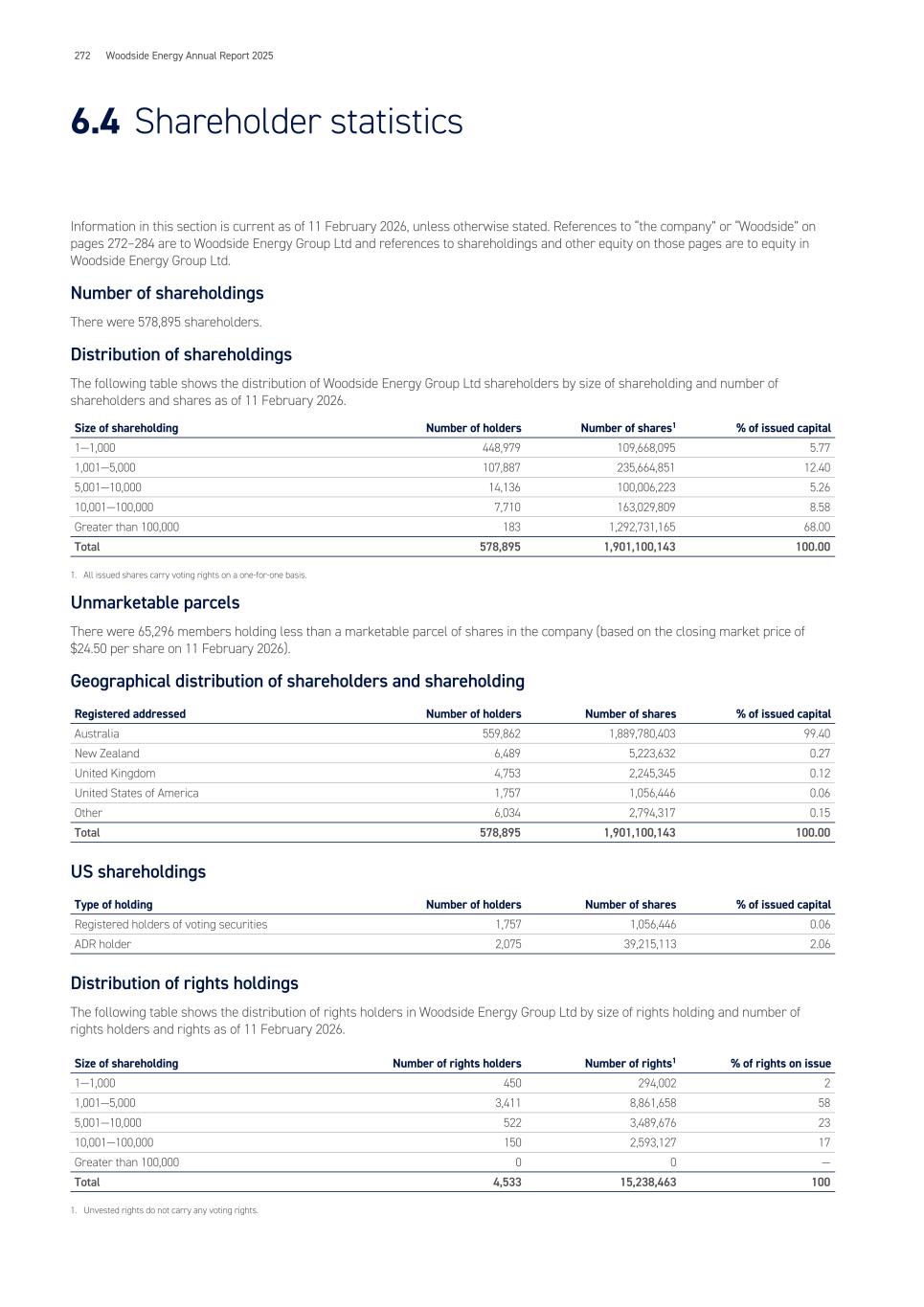
Information in this section is current as of 11 February 2026, unless otherwise stated. References to “the company” or “Woodside” on pages 272–284 are to Woodside Energy Group Ltd and references to shareholdings and other equity on those pages are to equity in Woodside Energy Group Ltd. Number of shareholdings There were 578,895 shareholders. Distribution of shareholdings The following table shows the distribution of Woodside Energy Group Ltd shareholders by size of shareholding and number of shareholders and shares as of 11 February 2026. Size of shareholding Number of holders Number of shares1 % of issued capital 1—1,000 448,979 109,668,095 5.77 1,001—5,000 107,887 235,664,851 12.40 5,001—10,000 14,136 100,006,223 5.26 10,001—100,000 7,710 163,029,809 8.58 Greater than 100,000 183 1,292,731,165 68.00 Total 578,895 1,901,100,143 100.00 1. All issued shares carry voting rights on a one-for-one basis. Unmarketable parcels There were 65,296 members holding less than a marketable parcel of shares in the company (based on the closing market price of $24.50 per share on 11 February 2026). Geographical distribution of shareholders and shareholding Registered addressed Number of holders Number of shares % of issued capital Australia 559,862 1,889,780,403 99.40 New Zealand 6,489 5,223,632 0.27 United Kingdom 4,753 2,245,345 0.12 United States of America 1,757 1,056,446 0.06 Other 6,034 2,794,317 0.15 Total 578,895 1,901,100,143 100.00 US shareholdings Type of holding Number of holders Number of shares % of issued capital Registered holders of voting securities 1,757 1,056,446 0.06 ADR holder 2,075 39,215,113 2.06 Distribution of rights holdings The following table shows the distribution of rights holders in Woodside Energy Group Ltd by size of rights holding and number of rights holders and rights as of 11 February 2026. Size of shareholding Number of rights holders Number of rights1 % of rights on issue 1—1,000 450 294,002 2 1,001—5,000 3,411 8,861,658 58 5,001—10,000 522 3,489,676 23 10,001—100,000 150 2,593,127 17 Greater than 100,000 0 0 — Total 4,533 15,238,463 100 1. Unvested rights do not carry any voting rights. 272 Woodside Energy Annual Report 2025 6.4 Shareholder statistics
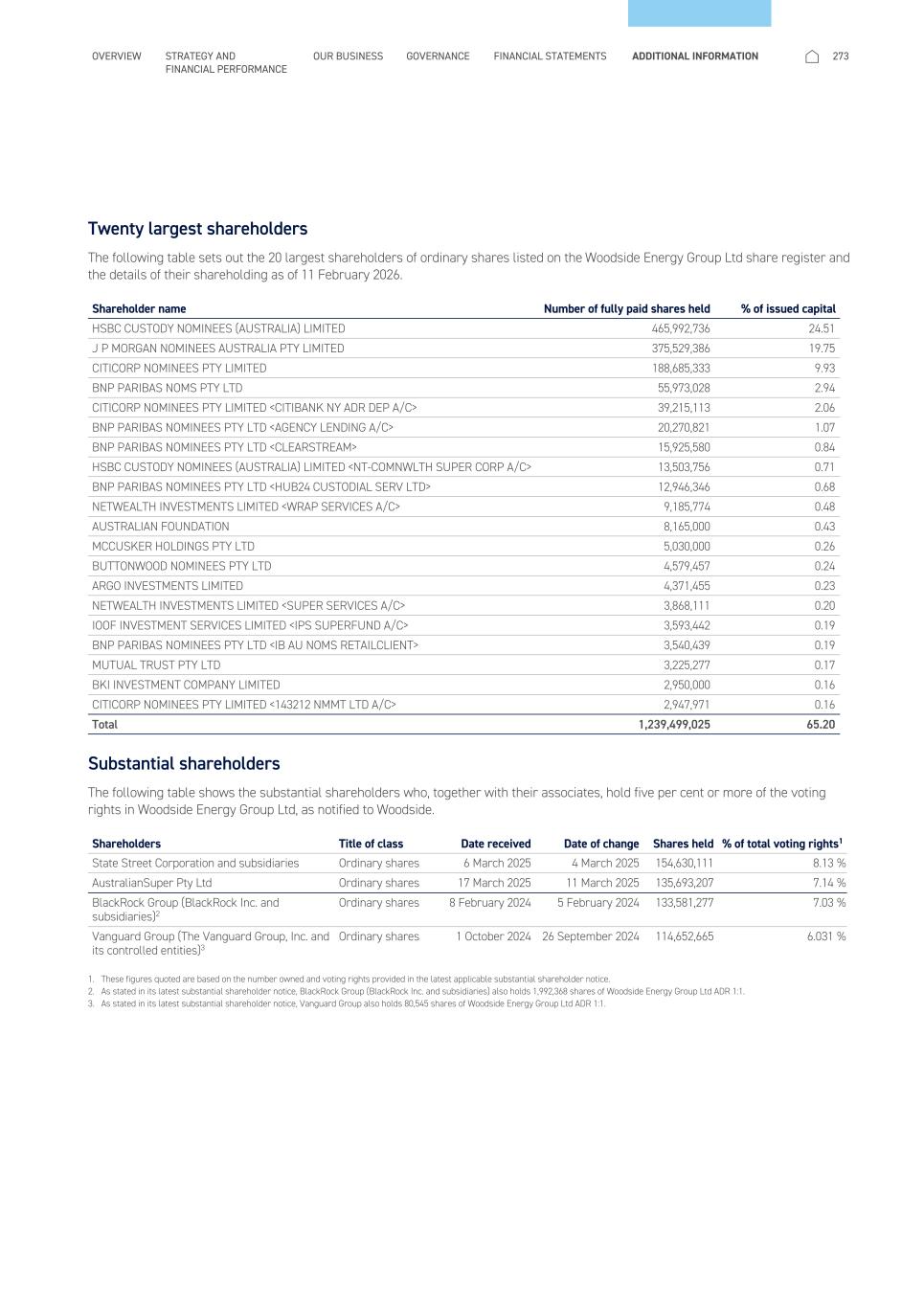
Twenty largest shareholders The following table sets out the 20 largest shareholders of ordinary shares listed on the Woodside Energy Group Ltd share register and the details of their shareholding as of 11 February 2026. Shareholder name Number of fully paid shares held % of issued capital HSBC CUSTODY NOMINEES (AUSTRALIA) LIMITED 465,992,736 24.51 J P MORGAN NOMINEES AUSTRALIA PTY LIMITED 375,529,386 19.75 CITICORP NOMINEES PTY LIMITED 188,685,333 9.93 BNP PARIBAS NOMS PTY LTD 55,973,028 2.94 CITICORP NOMINEES PTY LIMITED <CITIBANK NY ADR DEP A/C> 39,215,113 2.06 BNP PARIBAS NOMINEES PTY LTD <AGENCY LENDING A/C> 20,270,821 1.07 BNP PARIBAS NOMINEES PTY LTD <CLEARSTREAM> 15,925,580 0.84 HSBC CUSTODY NOMINEES (AUSTRALIA) LIMITED <NT-COMNWLTH SUPER CORP A/C> 13,503,756 0.71 BNP PARIBAS NOMINEES PTY LTD <HUB24 CUSTODIAL SERV LTD> 12,946,346 0.68 NETWEALTH INVESTMENTS LIMITED <WRAP SERVICES A/C> 9,185,774 0.48 AUSTRALIAN FOUNDATION 8,165,000 0.43 MCCUSKER HOLDINGS PTY LTD 5,030,000 0.26 BUTTONWOOD NOMINEES PTY LTD 4,579,457 0.24 ARGO INVESTMENTS LIMITED 4,371,455 0.23 NETWEALTH INVESTMENTS LIMITED <SUPER SERVICES A/C> 3,868,111 0.20 IOOF INVESTMENT SERVICES LIMITED <IPS SUPERFUND A/C> 3,593,442 0.19 BNP PARIBAS NOMINEES PTY LTD <IB AU NOMS RETAILCLIENT> 3,540,439 0.19 MUTUAL TRUST PTY LTD 3,225,277 0.17 BKI INVESTMENT COMPANY LIMITED 2,950,000 0.16 CITICORP NOMINEES PTY LIMITED <143212 NMMT LTD A/C> 2,947,971 0.16 Total 1,239,499,025 65.20 Substantial shareholders The following table shows the substantial shareholders who, together with their associates, hold five per cent or more of the voting rights in Woodside Energy Group Ltd, as notified to Woodside. Shareholders Title of class Date received Date of change Shares held % of total voting rights1 State Street Corporation and subsidiaries Ordinary shares 6 March 2025 4 March 2025 154,630,111 8.13 % AustralianSuper Pty Ltd Ordinary shares 17 March 2025 11 March 2025 135,693,207 7.14 % BlackRock Group (BlackRock Inc. and subsidiaries)2 Ordinary shares 8 February 2024 5 February 2024 133,581,277 7.03 % Vanguard Group (The Vanguard Group, Inc. and its controlled entities)3 Ordinary shares 1 October 2024 26 September 2024 114,652,665 6.031 % 1. These figures quoted are based on the number owned and voting rights provided in the latest applicable substantial shareholder notice. 2. As stated in its latest substantial shareholder notice, BlackRock Group (BlackRock Inc. and subsidiaries) also holds 1,992,368 shares of Woodside Energy Group Ltd ADR 1:1. 3. As stated in its latest substantial shareholder notice, Vanguard Group also holds 80,545 shares of Woodside Energy Group Ltd ADR 1:1. OVERVIEW STRATEGY AND FINANCIAL PERFORMANCE OUR BUSINESS GOVERNANCE FINANCIAL STATEMENTS ADDITIONAL INFORMATION 273
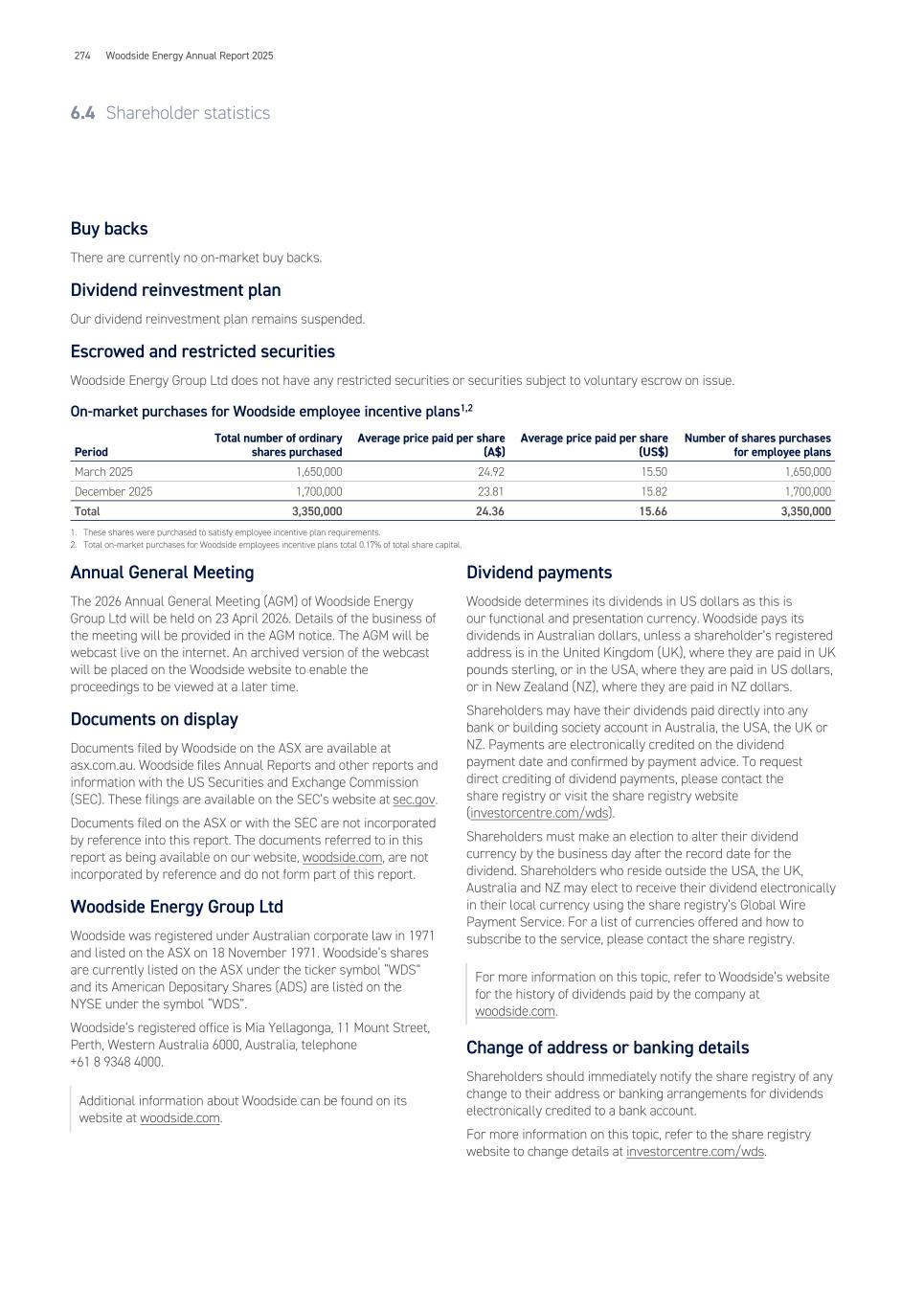
Buy backs There are currently no on-market buy backs. Dividend reinvestment plan Our dividend reinvestment plan remains suspended. Escrowed and restricted securities Woodside Energy Group Ltd does not have any restricted securities or securities subject to voluntary escrow on issue. On-market purchases for Woodside employee incentive plans1,2 Period Total number of ordinary shares purchased Average price paid per share (A$) Average price paid per share (US$) Number of shares purchases for employee plans March 2025 1,650,000 24.92 15.50 1,650,000 December 2025 1,700,000 23.81 15.82 1,700,000 Total 3,350,000 24.36 15.66 3,350,000 1. These shares were purchased to satisfy employee incentive plan requirements. 2. Total on-market purchases for Woodside employees incentive plans total 0.17% of total share capital. Annual General Meeting The 2026 Annual General Meeting (AGM) of Woodside Energy Group Ltd will be held on 23 April 2026. Details of the business of the meeting will be provided in the AGM notice. The AGM will be webcast live on the internet. An archived version of the webcast will be placed on the Woodside website to enable the proceedings to be viewed at a later time. Documents on display Documents filed by Woodside on the ASX are available at asx.com.au. Woodside files Annual Reports and other reports and information with the US Securities and Exchange Commission (SEC). These filings are available on the SEC’s website at sec.gov. Documents filed on the ASX or with the SEC are not incorporated by reference into this report. The documents referred to in this report as being available on our website, woodside.com, are not incorporated by reference and do not form part of this report. Woodside Energy Group Ltd Woodside was registered under Australian corporate law in 1971 and listed on the ASX on 18 November 1971. Woodside’s shares are currently listed on the ASX under the ticker symbol “WDS” and its American Depositary Shares (ADS) are listed on the NYSE under the symbol “WDS”. Woodside’s registered office is Mia Yellagonga, 11 Mount Street, Perth, Western Australia 6000, Australia, telephone +61 8 9348 4000. Additional information about Woodside can be found on its website at woodside.com. Dividend payments Woodside determines its dividends in US dollars as this is our functional and presentation currency. Woodside pays its dividends in Australian dollars, unless a shareholder’s registered address is in the United Kingdom (UK), where they are paid in UK pounds sterling, or in the USA, where they are paid in US dollars, or in New Zealand (NZ), where they are paid in NZ dollars. Shareholders may have their dividends paid directly into any bank or building society account in Australia, the USA, the UK or NZ. Payments are electronically credited on the dividend payment date and confirmed by payment advice. To request direct crediting of dividend payments, please contact the share registry or visit the share registry website (investorcentre.com/wds). Shareholders must make an election to alter their dividend currency by the business day after the record date for the dividend. Shareholders who reside outside the USA, the UK, Australia and NZ may elect to receive their dividend electronically in their local currency using the share registry’s Global Wire Payment Service. For a list of currencies offered and how to subscribe to the service, please contact the share registry. For more information on this topic, refer to Woodside’s website for the history of dividends paid by the company at woodside.com. Change of address or banking details Shareholders should immediately notify the share registry of any change to their address or banking arrangements for dividends electronically credited to a bank account. For more information on this topic, refer to the share registry website to change details at investorcentre.com/wds. 274 Woodside Energy Annual Report 2025 6.4 Shareholder statistics
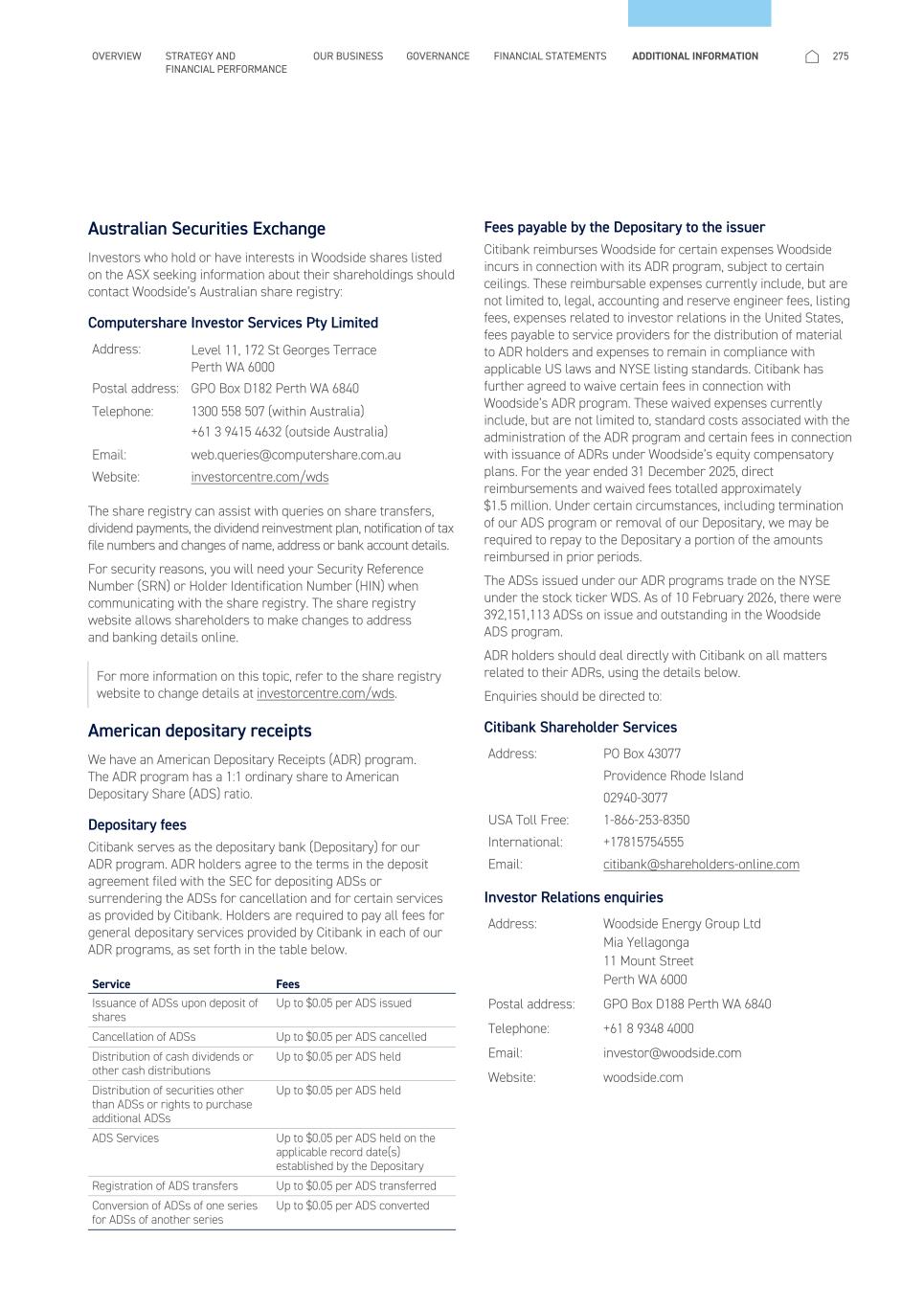
Australian Securities Exchange Investors who hold or have interests in Woodside shares listed on the ASX seeking information about their shareholdings should contact Woodside’s Australian share registry: Computershare Investor Services Pty Limited Address: Level 11, 172 St Georges Terrace Perth WA 6000 Postal address: GPO Box D182 Perth WA 6840 Telephone: 1300 558 507 (within Australia) +61 3 9415 4632 (outside Australia) Email: web.queries@computershare.com.au Website: investorcentre.com/wds The share registry can assist with queries on share transfers, dividend payments, the dividend reinvestment plan, notification of tax file numbers and changes of name, address or bank account details. For security reasons, you will need your Security Reference Number (SRN) or Holder Identification Number (HIN) when communicating with the share registry. The share registry website allows shareholders to make changes to address and banking details online. For more information on this topic, refer to the share registry website to change details at investorcentre.com/wds. American depositary receipts We have an American Depositary Receipts (ADR) program. The ADR program has a 1:1 ordinary share to American Depositary Share (ADS) ratio. Depositary fees Citibank serves as the depositary bank (Depositary) for our ADR program. ADR holders agree to the terms in the deposit agreement filed with the SEC for depositing ADSs or surrendering the ADSs for cancellation and for certain services as provided by Citibank. Holders are required to pay all fees for general depositary services provided by Citibank in each of our ADR programs, as set forth in the table below. Service Fees Issuance of ADSs upon deposit of shares Up to $0.05 per ADS issued Cancellation of ADSs Up to $0.05 per ADS cancelled Distribution of cash dividends or other cash distributions Up to $0.05 per ADS held Distribution of securities other than ADSs or rights to purchase additional ADSs Up to $0.05 per ADS held ADS Services Up to $0.05 per ADS held on the applicable record date(s) established by the Depositary Registration of ADS transfers Up to $0.05 per ADS transferred Conversion of ADSs of one series for ADSs of another series Up to $0.05 per ADS converted Fees payable by the Depositary to the issuer Citibank reimburses Woodside for certain expenses Woodside incurs in connection with its ADR program, subject to certain ceilings. These reimbursable expenses currently include, but are not limited to, legal, accounting and reserve engineer fees, listing fees, expenses related to investor relations in the United States, fees payable to service providers for the distribution of material to ADR holders and expenses to remain in compliance with applicable US laws and NYSE listing standards. Citibank has further agreed to waive certain fees in connection with Woodside’s ADR program. These waived expenses currently include, but are not limited to, standard costs associated with the administration of the ADR program and certain fees in connection with issuance of ADRs under Woodside’s equity compensatory plans. For the year ended 31 December 2025, direct reimbursements and waived fees totalled approximately $1.5 million. Under certain circumstances, including termination of our ADS program or removal of our Depositary, we may be required to repay to the Depositary a portion of the amounts reimbursed in prior periods. The ADSs issued under our ADR programs trade on the NYSE under the stock ticker WDS. As of 10 February 2026, there were 392,151,113 ADSs on issue and outstanding in the Woodside ADS program. ADR holders should deal directly with Citibank on all matters related to their ADRs, using the details below. Enquiries should be directed to: Citibank Shareholder Services Address: PO Box 43077 Providence Rhode Island 02940-3077 USA Toll Free: 1-866-253-8350 International: +17815754555 Email: citibank@shareholders-online.com Investor Relations enquiries Address: Woodside Energy Group Ltd Mia Yellagonga 11 Mount Street Perth WA 6000 Postal address: GPO Box D188 Perth WA 6840 Telephone: +61 8 9348 4000 Email: investor@woodside.com Website: woodside.com OVERVIEW STRATEGY AND FINANCIAL PERFORMANCE OUR BUSINESS GOVERNANCE FINANCIAL STATEMENTS ADDITIONAL INFORMATION 275

Exchange controls Under Australian foreign exchange controls currently in effect, transfers of capital to and from Australia are not subject to prior government approval and, except as described below, Australia does not restrict the flow of currency into or out of the country. Regulations may be made under the Anti-Money Laundering and Counter-Terrorism Financing Act 2006 (Cth) of Australia (AML/CTF Act) prohibiting the entering into of transactions involving prescribed foreign countries. As of the date of this report, no such regulations are in place. To control tax evasion and money laundering, the AML/CTF Act also requires certain transactions to be reported to the Australian Transaction Reports and Analysis Centre (AUSTRAC) and prohibits reporting entities from providing certain “designated services” to customers without having complied with certain obligations under the AML/CTF Act (for example “know your customer” checks). In addition, the AML/CTF Act imposes certain obligations on “designated service” providers to report “threshold transactions”. The Autonomous Sanctions Regulations 2011 (Cth) promulgated under the Autonomous Sanctions Act 2011 (Cth) of Australia, the Charter of the United Nations Act 1945 (Cth) of Australia and other acts and regulations in Australia restrict or prohibit payments, transactions or other dealings with assets having a proscribed connection with certain countries or named individuals or entities subject to financial sanctions or identified with terrorism. The Australian Department of Foreign Affairs and Trade (DFAT) maintains a list of all persons and entities subject to financial sanctions or having a proscribed connection with terrorism which is available to the public at DFAT’s website. There are no specific restrictions regarding the remittance of profits, dividends or capital. Taxation This section describes the material United States and Australian Federal income tax consequences to a US holder (as defined below) of owning shares or ADSs. It applies to you only if you acquire your shares or ADSs and you hold your shares or ADSs as capital assets for tax purposes. This discussion addresses only United States and Australian Federal income taxation and does not discuss all of the tax consequences that may be relevant to you in light of your individual circumstances, including foreign, state or local tax consequences, estate and gift tax consequences, and tax consequences arising under the Medicare contribution tax on net investment income or the alternative minimum tax. This section does not apply to you if you are a member of a special class of holders subject to special rules, including: • a dealer in securities, • a trader in securities that elects to use a mark-to-market method of accounting for securities holdings, • a tax-exempt organisation, • a life insurance company, • a person that actually or constructively owns 10% or more of the combined voting power of our voting stock or of the total value of our stock, • a person that holds shares or ADSs as part of a straddle or a hedging or conversion transaction, • a person that purchases or sells shares or ADSs as part of a wash sale for tax purposes, or • a person whose functional currency is not the US dollar. This section is based on the Internal Revenue Code of 1986, as amended, its legislative history, existing and proposed regulations, published rulings and court decisions, all as currently in effect, as well as on the Convention Between the United States of America and Australia (the “Treaty”). These authorities are subject to change, possibly on a retroactive basis. In addition, this section is based in part upon the representations of the Depositary and the assumption that each obligation in the deposit agreement will be performed in accordance with its terms. You are a US holder if you are a beneficial owner of shares or ADSs and you are, for United States Federal income tax purposes: • a citizen or resident of the United States, • a domestic corporation, • an estate whose income is subject to United States Federal income tax regardless of its source, or • a trust if a United States court can exercise primary supervision over the trust’s administration and one or more United States persons are authorised to control all substantial decisions of the trust. 276 Woodside Energy Annual Report 2025 6.4 Shareholder statistics

If an entity or arrangement that is treated as a partnership for United States Federal income tax purposes holds the shares or ADSs, the United States Federal income tax treatment of a partner will generally depend on the status of the partner and the tax treatment of the partnership. A partner in a partnership holding the shares or ADSs should consult its tax advisor with regard to the United States Federal income tax treatment of an investment in the shares or ADSs. You should consult your own tax advisor regarding the United States Federal, state and local and Australian Federal tax consequences of owning and disposing of shares and ADSs in your particular circumstances. In particular, you should confirm whether you qualify for the benefits of the Treaty and the consequences of failing to do so. In general, and taking into account the earlier assumptions, for United States Federal income tax purposes, if you hold ADRs evidencing ADSs, you will be treated as the owner of the shares represented by those ADRs. Exchanges of shares for ADRs, and ADRs for shares, generally will not be subject to United States Federal income tax. Material United States Federal income tax consequences The tax treatment of your shares or ADSs will depend in part on whether or not we are classified as a passive foreign investment company, or PFIC, for United States Federal income tax purposes. Except as discussed below under “PFIC Classification”, this discussion assumes that we are not classified as a PFIC for United States Federal income tax purposes. Taxation of distributions Under the United States Federal income tax laws, the gross amount of any distribution we pay out of our current or accumulated earnings and profits (as determined for United States Federal income tax purposes), other than certain pro-rata distributions of our shares, will be treated as a dividend that is subject to United States Federal income taxation. If you are a non-corporate US holder, dividends that constitute qualified dividend income will be taxable to you at the preferential rates applicable to long-term capital gains provided that you hold the shares or ADSs for more than 60 days during the 121-day period beginning 60 days before the ex-dividend date and meet other holding period requirements. Dividends we pay with respect to the shares or ADSs generally will be qualified dividend income provided that, in the year that you receive the dividend, we are eligible for the benefits of the Treaty. We believe that we are currently eligible for the benefits of the Treaty, and we therefore expect that dividends on the shares and ADS will be qualified dividend income, but there can be no assurance that we will continue to be eligible for the benefits of the Treaty. You must include any Australian tax withheld from the dividend payment in this gross amount even though you do not in fact receive it. The dividend is taxable to you when you, in the case of shares, or the Depositary, in the case of ADSs, receive the dividend, actually or constructively. The dividend will not be eligible for the dividends-received deduction generally allowed to United States corporations in respect of dividends received from other United States corporations. The amount of the dividend distribution that you must include in your income will be the US dollar value of the Australian dollar payments made, determined at the spot Australian dollar/US dollar rate on the date the dividend is distributed, regardless of whether the payment is in fact converted into US dollars. Generally, any gain or loss resulting from currency exchange fluctuations during the period from the date the dividend is distributed to the date you convert the payment into US dollars will be treated as ordinary income or loss and will not be eligible for the special tax rate applicable to qualified dividend income. The gain or loss generally will be income or loss from sources within the United States for foreign tax credit limitation purposes. Distributions in excess of current and accumulated earnings and profits, as determined for United States Federal income tax purposes, will be treated as a non‑taxable return of capital to the extent of your basis in the shares or ADSs and thereafter as capital gain. However, we do not expect to calculate earnings and profits in accordance with United States Federal income tax principles. Accordingly, you should expect to generally treat distributions we make as dividends. Subject to certain limitations, the Australian tax withheld in accordance with the Treaty and paid over to Australia will generally be creditable against your United States Federal income tax liability. To the extent a reduction or refund of the tax withheld is available to you under Australian law or under the Treaty, the amount of tax withheld that could have been reduced or that is refundable will not be eligible for credit against your United States Federal income tax liability. Dividends will generally be income from sources outside the United States and will generally be “passive” income for purposes of computing the foreign tax credit allowable to you. Taxation of capital gains If you are a US holder and you sell or otherwise dispose of your shares or ADSs, you will recognise capital gain or loss for United States Federal income tax purposes equal to the difference between the US dollar value of the amount that you realise and your tax basis, determined in US dollars, in your shares or ADSs. Your tax basis would generally equal the cost of your shares or ADSs, or if you received the shares or ADSs pursuant to a taxable distribution, the fair market value of the shares or ADSs at the time of such distribution, reduced by any distributions on the shares or ADSs that were treated as a return of capital for United States Federal income tax purposes. Capital gain of a non‑corporate US holder is generally taxed at preferential rates where the property is held for more than one year. The gain or loss will generally be income or loss from sources within the United States for foreign tax credit limitation purposes. Your ability to deduct capital losses is subject to limitations. OVERVIEW STRATEGY AND FINANCIAL PERFORMANCE OUR BUSINESS GOVERNANCE FINANCIAL STATEMENTS ADDITIONAL INFORMATION 277

PFIC classification We believe that we should not be currently classified as a PFIC for United States Federal income tax purposes and we do not expect to become a PFIC in the foreseeable future. However, this conclusion is a factual determination that is made annually and thus may be subject to change. It is therefore possible that we could become a PFIC in a future taxable year. In general, we will be a PFIC in a taxable year if: • at least 75% of our gross income for the taxable year is passive income; or • at least 50% of the value, determined on the basis of a quarterly average, of our assets in such taxable year is attributable to assets that produce or are held for the production of passive income. If we were to be treated as a PFIC and you are a US holder, gain realised on the sale or other disposition of your shares or ADSs would in general not be treated as capital gain. Instead, you would generally be treated as if you had realised such gain and certain “excess distributions” ratably over your holding period for the shares or ADSs and would be taxed at the highest tax rate in effect for each previous year to which the gain was allocated in which we were a PFIC with respect to you, together with an interest charge in respect of the tax attributable to each such year. With certain exceptions, your shares or ADSs will be treated as stock in a PFIC if we were a PFIC at any time during your holding period in your shares or ADSs. Dividends that you receive from us will not be eligible for the special tax rates applicable to qualified dividend income if we are a PFIC or are treated as a PFIC with respect to you either in the taxable year of the distribution or the preceding taxable year, but instead will be taxable at rates applicable to ordinary income. If you own shares or ADSs during any year that we are a PFIC with respect to you, you may be required to file Internal Revenue Service (‘IRS’) Form 8621. Material Australian tax considerations This section is based on the Income Tax Assessment Act 1936 (Cth) and the Income Tax Assessment Act 1997 (Cth), as amended, its legislative history, existing and proposed regulations, published rulings and court decisions, all as currently in effect, as well as on the Convention Between the United States of America and Australia (the “Treaty”). These authorities are subject to change, possibly on a retroactive basis. Dividends (including other distributions treated as dividends for Australian tax purposes) paid by Woodside to a US holder that is not an Australian resident for Australian tax purposes will generally not be subject to Australian withholding tax if they are fully franked (broadly, where a dividend is franked, tax paid by Woodside is imputed to the shareholders). Dividends paid to such US holders, which are not fully franked, will generally be subject to Australian withholding tax not exceeding 15% only to the extent (if any) that the dividend is neither: • franked; nor • declared by Woodside to be conduit foreign income. (Broadly, this means that the relevant part of the dividend is declared to have been paid out of foreign source amounts received by Woodside that are not subject to tax in Australia, such as dividends remitted to Australia by foreign subsidiaries). The Australian withholding tax outcome described above applies to US holders who are eligible for benefits under the Tax Convention between Australia and the US as to the Avoidance of Double Taxation (the Australian Tax Treaty). Otherwise, the rate of Australian withholding tax may be 30%. In contrast, dividends (including other distributions treated as dividends for Australian tax purposes) paid by Woodside to a US holder may instead be taxed by assessment in Australia if the US holder: • is an Australian resident for Australian tax purposes (although tax will generally not exceed 15% where the US holder is eligible for benefits under the Australian Tax Treaty as a treaty resident of the US and any franking credits may be creditable against their Australian income tax liability); or • carries on business in Australia through a permanent establishment as defined in the Australian Tax Treaty, or performs personal services from a fixed base in Australia, and the shareholding in respect of which the dividend is paid is effectively connected with that permanent establishment or fixed base, (however, in such a case any franking credits may be creditable against the Australian income tax liability). The treatment of dividends outlined above may be modified where the shareholding in Woodside is held through a trust, limited partnership, limited liability company, pension fund, sovereign wealth fund or other investment vehicle. Affected US holders should seek their own advice in relation to such arrangements. 278 Woodside Energy Annual Report 2025 6.4 Shareholder statistics

Material Australian tax considerations – disposals of Shares or ADSs Gains made by US holders on the sale of shares or ADSs will generally not be taxed in Australia. However, the precise Australian tax treatment of gains made by US holders on the sale of shares or ADSs generally depends on whether or not the gain is an Australian sourced gain of an income nature for Australian income tax purposes. Where the gain is of an income nature, a US holder will generally only be liable to Australian income tax on an assessment basis (whether or not they are also an Australian resident for Australian tax purposes) if: • they are not eligible for benefits under the Australian Tax Treaty and the gain is sourced in Australia for Australian tax purposes; or • they are eligible for benefits under the Australian Tax Treaty, but the gain constitutes any of the following (in which case the gain will be deemed to have an Australian source): – business profits of an enterprise attributable to a permanent establishment situated in Australia through which the enterprise carries on business in Australia; or – income or gains from the alienation of property that form part of the business property of a permanent establishment of an enterprise that the US holder has in Australia or pertain to a fixed base available to the US holder in Australia for the purpose of performing independent personal services; or – income derived from the disposition of shares in a company, the assets of which consist wholly or principally of real property (which includes rights to exploit or to explore for nature resources) situated in Australia, whether such assets are held directly or indirectly through one or more interposed entities. Where the gain is not taxed as Australian sourced income, the US holder will generally only be liable to Australian capital gains tax on an assessment basis if they acquired (or are deemed to have acquired) their shares or ADSs after 19 September 1985 and one or more of the following applies: • the US holder is an Australian resident for Australian tax purposes; or • the shares or ADSs have been used by the US holder in carrying on a business through permanent establishment in Australia; or • the shares or ADSs constitute an “indirect Australian real properly interest” for Australian CGT purposes – this will generally be the case if the US holder (either alone or together with associates) directly or indirectly owns or owned 10% or more of the issued share capital of Woodside at the time of disposal or throughout a 12-month period during the two years prior to the time of disposal and, at the time of the disposal, the sum of market values of Woodside’s assets (held directly or through interposed entities) that are not taxable Australian real property at that time (which, for these purposes includes mining, quarrying or prospecting rights in respect of minerals, petroleum or quarry materials situated in Australia); or • the US holder is an individual who is not eligible for benefits under the Australian Tax Treaty as a treaty resident of the US and elected on becoming a non-resident of Australia to continue to have the shares or ADSs subject to Australian capital gains tax. In certain circumstances, if the shares or ADSs constitute an “indirect Australian real property interest” for Australian CGT purposes, the purchaser may be required to withhold under the non-resident CGT withholding regime an amount equal to 15% of the purchase price in situations including where the acquisition is undertaken by way of an off-market transfer. The comments above on the sale of shares or ADSs do not apply: • to temporary residents of Australia who should seek advice that is specific to their circumstances; or • if the Investment Management Regime (IMR) applies to the US holder, which exempts from the Australian income tax and capital gains tax gains made on disposal by certain categories of non-resident funds – called IMR entities – of (relevantly) portfolio interests in Australian public companies (subject to a number of conditions). The IMR exemptions broadly apply to widely held IMR entities in relation to their direct investments and indirect investments made through an independent Australian fund manager. The exemptions apply to gains made by IMR entities that are treated as companies for Australian tax purposes as well as gains made by non-resident investors in IMR entities that are treated as trusts and partnerships for Australian tax purposes. THE FOREGOING DISCUSSION IS NOT TAX ADVICE OR A COMPREHENSIVE DISCUSSION OF ALL US AND AUSTRALIAN FEDERAL INCOME TAX CONSEQUENCES TO US HOLDERS OF SHARES OR AMERICAN DEPOSITORY SHARES. SUCH HOLDERS SHOULD CONSULT WITH, AND RELY SOLELY UPON, THEIR OWN TAX ADVISERS TO DETERMINE THE SPECIFIC TAX CONSEQUENCES TO THEM OF THE OWNERSHIP AND DISPOSITION OF SHARES OR AMERICAN DEPOSITORY SHARES, INCLUDING THE EFFECT OF ANY US FEDERAL, STATE, LOCAL, NON-US, OR OTHER TAX LAWS. OVERVIEW STRATEGY AND FINANCIAL PERFORMANCE OUR BUSINESS GOVERNANCE FINANCIAL STATEMENTS ADDITIONAL INFORMATION 279

Key announcements 2025 January Fourth Quarter 2024 Report February Woodside releases Reserves Statement and Sangomar update Annual Report 2024 Woodside releases Full-Year 2024 Results March Woodside to divest Greater Angostura assets to Perenco April Notice of Annual General Meeting 2025 Sustainability Briefing 2025 Woodside announces Louisiana LNG partnership with Stonepeak Woodside signs LNG supply agreements with Uniper First Quarter 2025 Report Woodside approves Louisiana LNG development Woodside signs gas supply agreement for Louisiana LNG June Woodside completes Louisiana LNG sell-down to Stonepeak July Second Quarter 2025 Report Woodside strengthens its Australian operations August Half-Year 2025 Report October Third Quarter 2025 Report Woodside announces Louisiana LNG partnership with Williams November 2025 Capital Markets Day December Sustainability Focus Session 2025 CEO Succession January 2026 Fourth Quarter 2025 Report February 2026 Woodside releases Reserves Statement Events calendar 2026 Key calendar dates for Woodside shareholders in 2026. Please note dates are subject to review. February 24 Full-year 2025 results and briefing 24 Annual Report 2025 24 US Annual Report 2025 (Form 20-F) March 5 Ex-dividend date for final dividend (ASX) 6 Ex-dividend date for final dividend (NYSE) 6 Record date for dividend entitlements 10 Online Shareholder Q&A 16 Sustainability Briefing 27 Payment of dividend April 23 Annual General Meeting 29 First quarter 2026 results June 30 Half-year end 2026 July 29 Second quarter 2026 results August 25 Half-year 2026 results October 21 Third quarter 2026 results December 31 Year-end 2026 280 Woodside Energy Annual Report 2025 6.4 Shareholder statistics
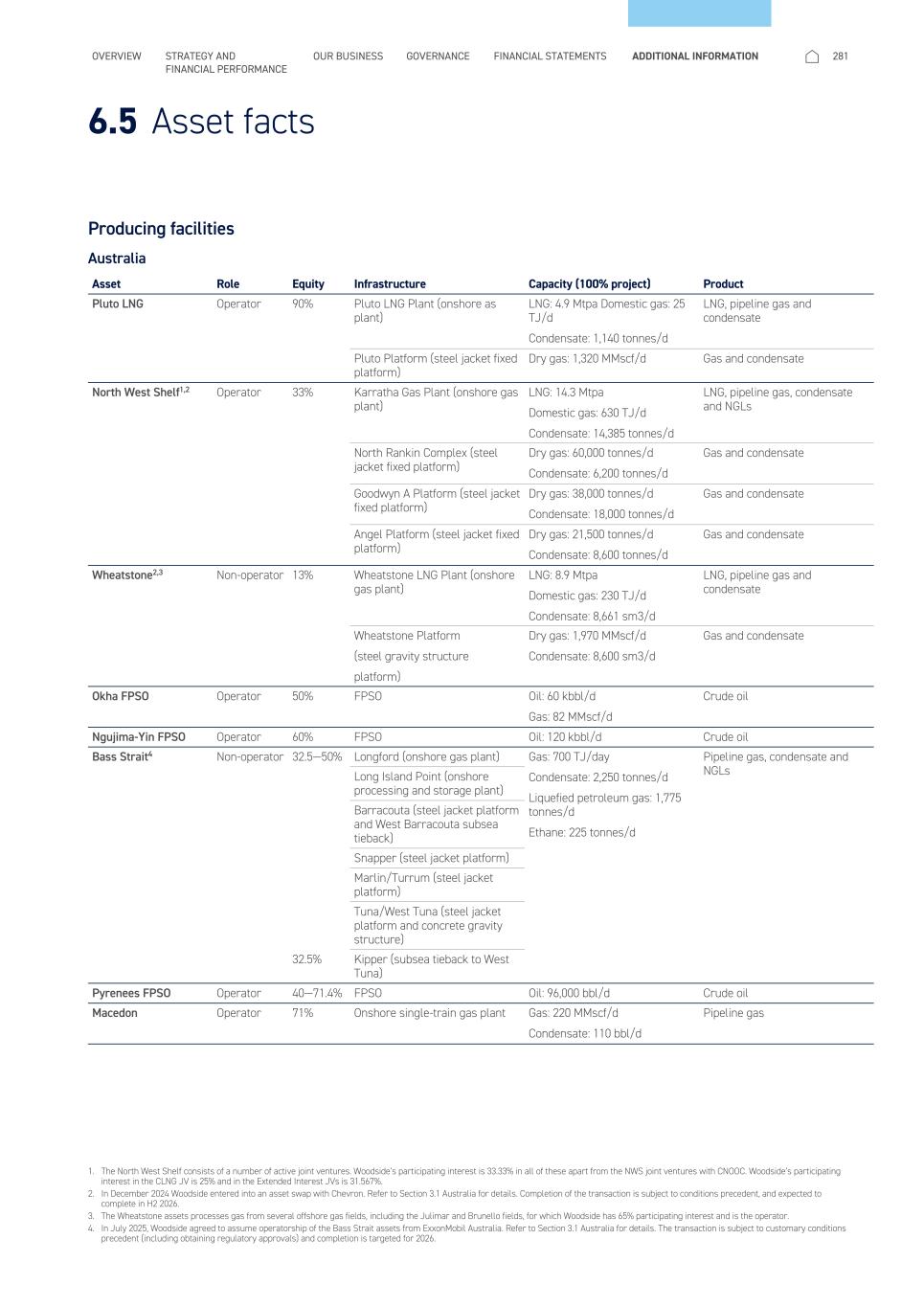
Producing facilities Australia Asset Role Equity Infrastructure Capacity (100% project) Product Pluto LNG Operator 90% Pluto LNG Plant (onshore as plant) LNG: 4.9 Mtpa Domestic gas: 25 TJ/d Condensate: 1,140 tonnes/d LNG, pipeline gas and condensate Pluto Platform (steel jacket fixed platform) Dry gas: 1,320 MMscf/d Gas and condensate North West Shelf1,2 Operator 33% Karratha Gas Plant (onshore gas plant) LNG: 14.3 Mtpa Domestic gas: 630 TJ/d Condensate: 14,385 tonnes/d LNG, pipeline gas, condensate and NGLs North Rankin Complex (steel jacket fixed platform) Dry gas: 60,000 tonnes/d Condensate: 6,200 tonnes/d Gas and condensate Goodwyn A Platform (steel jacket fixed platform) Dry gas: 38,000 tonnes/d Condensate: 18,000 tonnes/d Gas and condensate Angel Platform (steel jacket fixed platform) Dry gas: 21,500 tonnes/d Condensate: 8,600 tonnes/d Gas and condensate Wheatstone2,3 Non-operator 13% Wheatstone LNG Plant (onshore gas plant) LNG: 8.9 Mtpa Domestic gas: 230 TJ/d Condensate: 8,661 sm3/d LNG, pipeline gas and condensate Wheatstone Platform (steel gravity structure platform) Dry gas: 1,970 MMscf/d Condensate: 8,600 sm3/d Gas and condensate Okha FPSO Operator 50% FPSO Oil: 60 kbbl/d Gas: 82 MMscf/d Crude oil Ngujima-Yin FPSO Operator 60% FPSO Oil: 120 kbbl/d Crude oil Bass Strait4 Non-operator 32.5—50% Longford (onshore gas plant) Gas: 700 TJ/day Condensate: 2,250 tonnes/d Liquefied petroleum gas: 1,775 tonnes/d Ethane: 225 tonnes/d Pipeline gas, condensate and NGLsLong Island Point (onshore processing and storage plant) Barracouta (steel jacket platform and West Barracouta subsea tieback) Snapper (steel jacket platform) Marlin/Turrum (steel jacket platform) Tuna/West Tuna (steel jacket platform and concrete gravity structure) 32.5% Kipper (subsea tieback to West Tuna) Pyrenees FPSO Operator 40—71.4% FPSO Oil: 96,000 bbl/d Crude oil Macedon Operator 71% Onshore single-train gas plant Gas: 220 MMscf/d Condensate: 110 bbl/d Pipeline gas OVERVIEW STRATEGY AND FINANCIAL PERFORMANCE OUR BUSINESS GOVERNANCE FINANCIAL STATEMENTS ADDITIONAL INFORMATION 281 6.5 Asset facts 1. The North West Shelf consists of a number of active joint ventures. Woodside’s participating interest is 33.33% in all of these apart from the NWS joint ventures with CNOOC. Woodside’s participating interest in the CLNG JV is 25% and in the Extended Interest JVs is 31.567%. 2. In December 2024 Woodside entered into an asset swap with Chevron. Refer to Section 3.1 Australia for details. Completion of the transaction is subject to conditions precedent, and expected to complete in H2 2026. 3. The Wheatstone assets processes gas from several offshore gas fields, including the Julimar and Brunello fields, for which Woodside has 65% participating interest and is the operator. 4. In July 2025, Woodside agreed to assume operatorship of the Bass Strait assets from ExxonMobil Australia. Refer to Section 3.1 Australia for details. The transaction is subject to customary conditions precedent (including obtaining regulatory approvals) and completion is targeted for 2026.
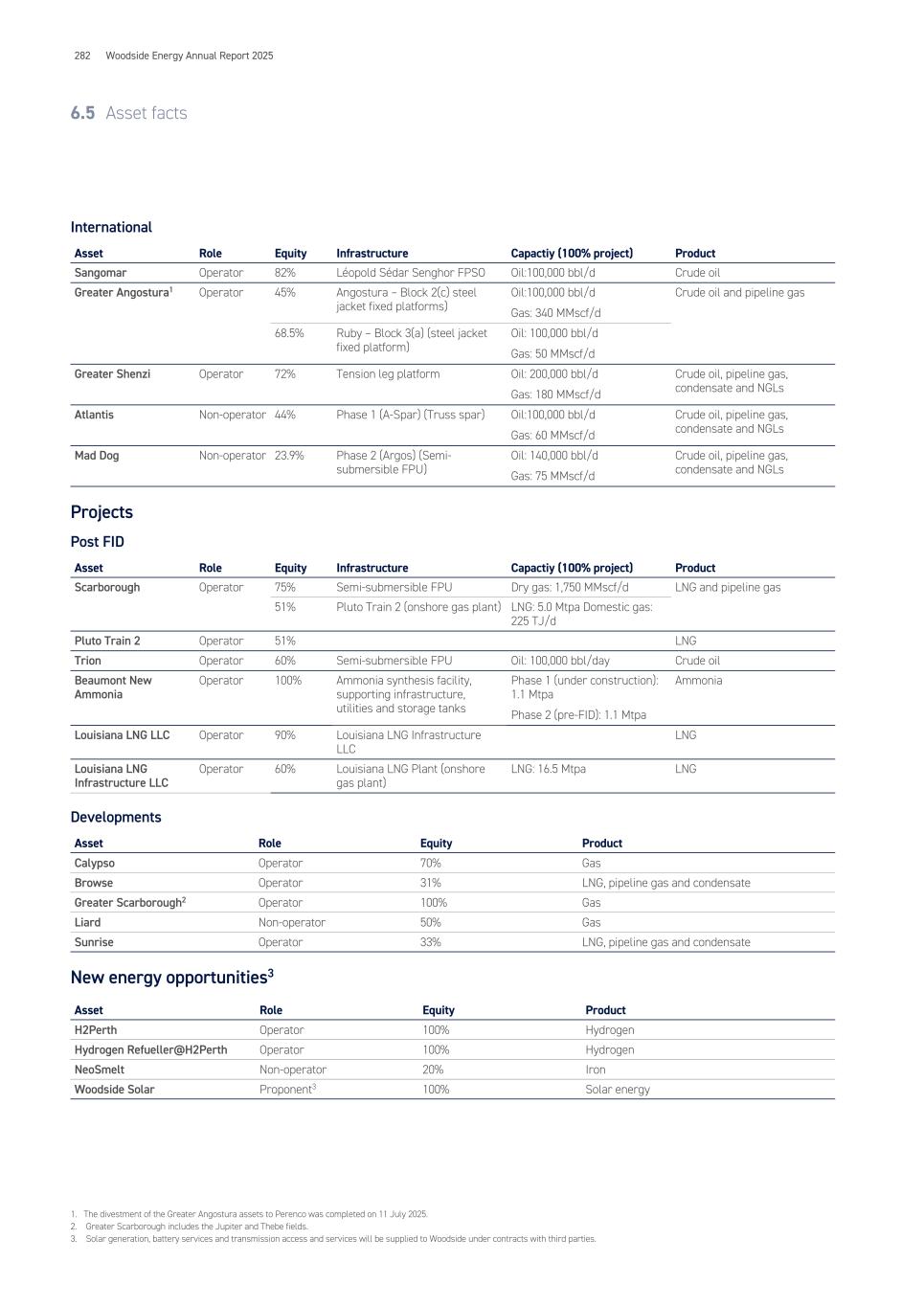
International Asset Role Equity Infrastructure Capactiy (100% project) Product Sangomar Operator 82% Léopold Sédar Senghor FPSO Oil:100,000 bbl/d Crude oil Greater Angostura1 Operator 45% Angostura – Block 2(c) steel jacket fixed platforms) Oil:100,000 bbl/d Gas: 340 MMscf/d Crude oil and pipeline gas 68.5% Ruby – Block 3(a) (steel jacket fixed platform) Oil: 100,000 bbl/d Gas: 50 MMscf/d Greater Shenzi Operator 72% Tension leg platform Oil: 200,000 bbl/d Gas: 180 MMscf/d Crude oil, pipeline gas, condensate and NGLs Atlantis Non-operator 44% Phase 1 (A-Spar) (Truss spar) Oil:100,000 bbl/d Gas: 60 MMscf/d Crude oil, pipeline gas, condensate and NGLs Mad Dog Non-operator 23.9% Phase 2 (Argos) (Semi- submersible FPU) Oil: 140,000 bbl/d Gas: 75 MMscf/d Crude oil, pipeline gas, condensate and NGLs Projects Post FID Asset Role Equity Infrastructure Capactiy (100% project) Product Scarborough Operator 75% Semi-submersible FPU Dry gas: 1,750 MMscf/d LNG and pipeline gas 51% Pluto Train 2 (onshore gas plant) LNG: 5.0 Mtpa Domestic gas: 225 TJ/d Pluto Train 2 Operator 51% LNG Trion Operator 60% Semi-submersible FPU Oil: 100,000 bbl/day Crude oil Beaumont New Ammonia Operator 100% Ammonia synthesis facility, supporting infrastructure, utilities and storage tanks Phase 1 (under construction): 1.1 Mtpa Phase 2 (pre-FID): 1.1 Mtpa Ammonia Louisiana LNG LLC Operator 90% Louisiana LNG Infrastructure LLC LNG Louisiana LNG Infrastructure LLC Operator 60% Louisiana LNG Plant (onshore gas plant) LNG: 16.5 Mtpa LNG Developments Asset Role Equity Product Calypso Operator 70% Gas Browse Operator 31% LNG, pipeline gas and condensate Greater Scarborough2 Operator 100% Gas Liard Non-operator 50% Gas Sunrise Operator 33% LNG, pipeline gas and condensate New energy opportunities3 Asset Role Equity Product H2Perth Operator 100% Hydrogen Hydrogen Refueller@H2Perth Operator 100% Hydrogen NeoSmelt Non-operator 20% Iron Woodside Solar Proponent3 100% Solar energy 282 Woodside Energy Annual Report 2025 6.5 Asset facts 1. The divestment of the Greater Angostura assets to Perenco was completed on 11 July 2025. 2. Greater Scarborough includes the Jupiter and Thebe fields. 3. Solar generation, battery services and transmission access and services will be supplied to Woodside under contracts with third parties.
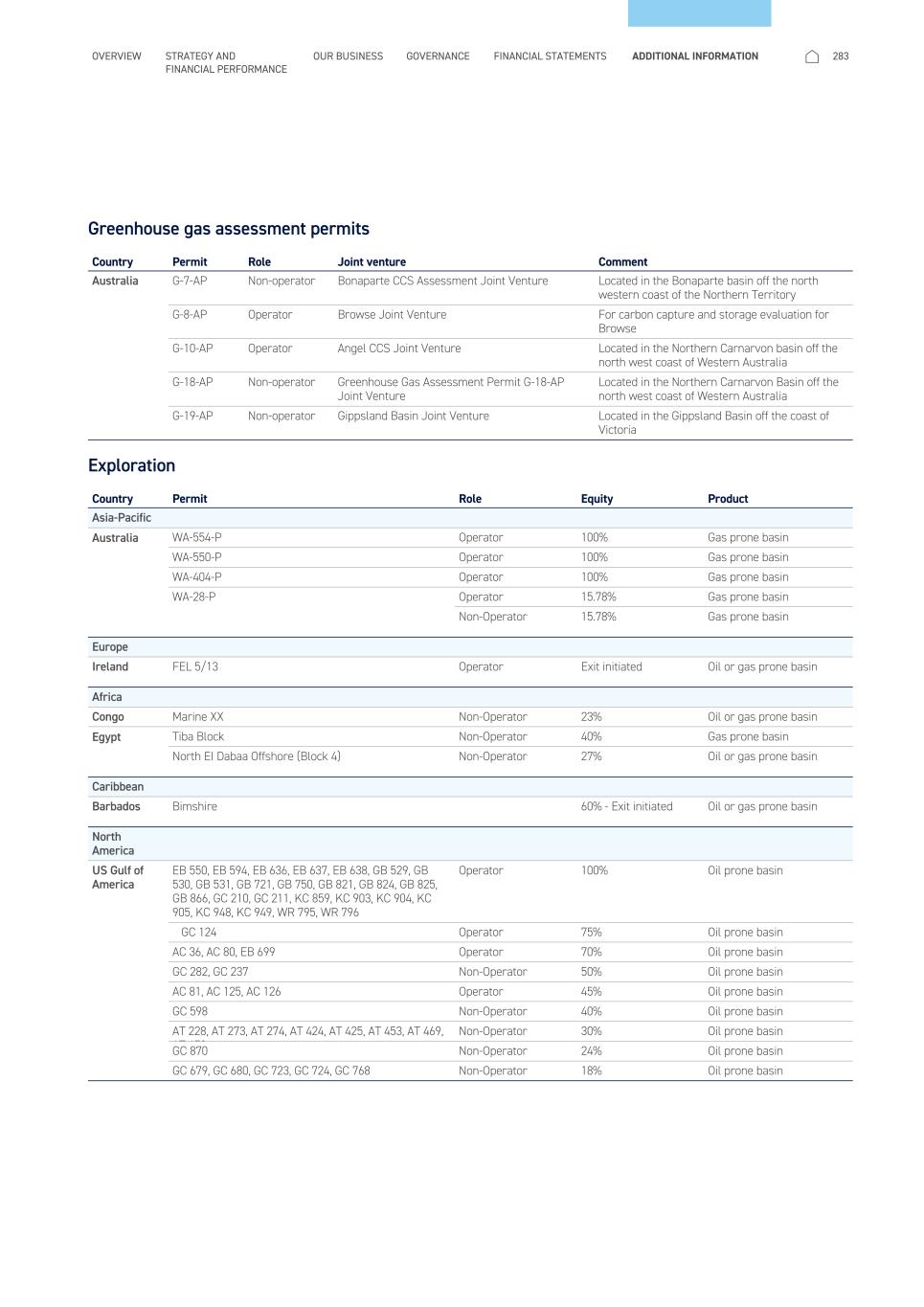
Greenhouse gas assessment permits Country Permit Role Joint venture Comment Australia G-7-AP Non-operator Bonaparte CCS Assessment Joint Venture Located in the Bonaparte basin off the north western coast of the Northern Territory G-8-AP Operator Browse Joint Venture For carbon capture and storage evaluation for Browse G-10-AP Operator Angel CCS Joint Venture Located in the Northern Carnarvon basin off the north west coast of Western Australia G-18-AP Non-operator Greenhouse Gas Assessment Permit G-18-AP Joint Venture Located in the Northern Carnarvon Basin off the north west coast of Western Australia G-19-AP Non-operator Gippsland Basin Joint Venture Located in the Gippsland Basin off the coast of Victoria Exploration Country Permit Role Equity Product Asia-Pacific Australia WA-554-P Operator 100% Gas prone basin WA-550-P Operator 100% Gas prone basin WA-404-P Operator 100% Gas prone basin WA-28-P Operator 15.78% Gas prone basin Non-Operator 15.78% Gas prone basin Europe Ireland FEL 5/13 Operator Exit initiated Oil or gas prone basin Africa Congo Marine XX Non-Operator 23% Oil or gas prone basin Egypt Tiba Block Non-Operator 40% Gas prone basin North EI Dabaa Offshore (Block 4) Non-Operator 27% Oil or gas prone basin Caribbean Barbados Bimshire 60% - Exit initiated Oil or gas prone basin North America US Gulf of America EB 550, EB 594, EB 636, EB 637, EB 638, GB 529, GB 530, GB 531, GB 721, GB 750, GB 821, GB 824, GB 825, GB 866, GC 210, GC 211, KC 859, KC 903, KC 904, KC 905, KC 948, KC 949, WR 795, WR 796 Operator 100% Oil prone basin GC 124 Operator 75% Oil prone basin AC 36, AC 80, EB 699 Operator 70% Oil prone basin GC 282, GC 237 Non-Operator 50% Oil prone basin AC 81, AC 125, AC 126 Operator 45% Oil prone basin GC 598 Non-Operator 40% Oil prone basin AT 228, AT 273, AT 274, AT 424, AT 425, AT 453, AT 469, AT 470 Non-Operator 30% Oil prone basin GC 870 Non-Operator 24% Oil prone basin GC 679, GC 680, GC 723, GC 724, GC 768 Non-Operator 18% Oil prone basin OVERVIEW STRATEGY AND FINANCIAL PERFORMANCE OUR BUSINESS GOVERNANCE FINANCIAL STATEMENTS ADDITIONAL INFORMATION 283
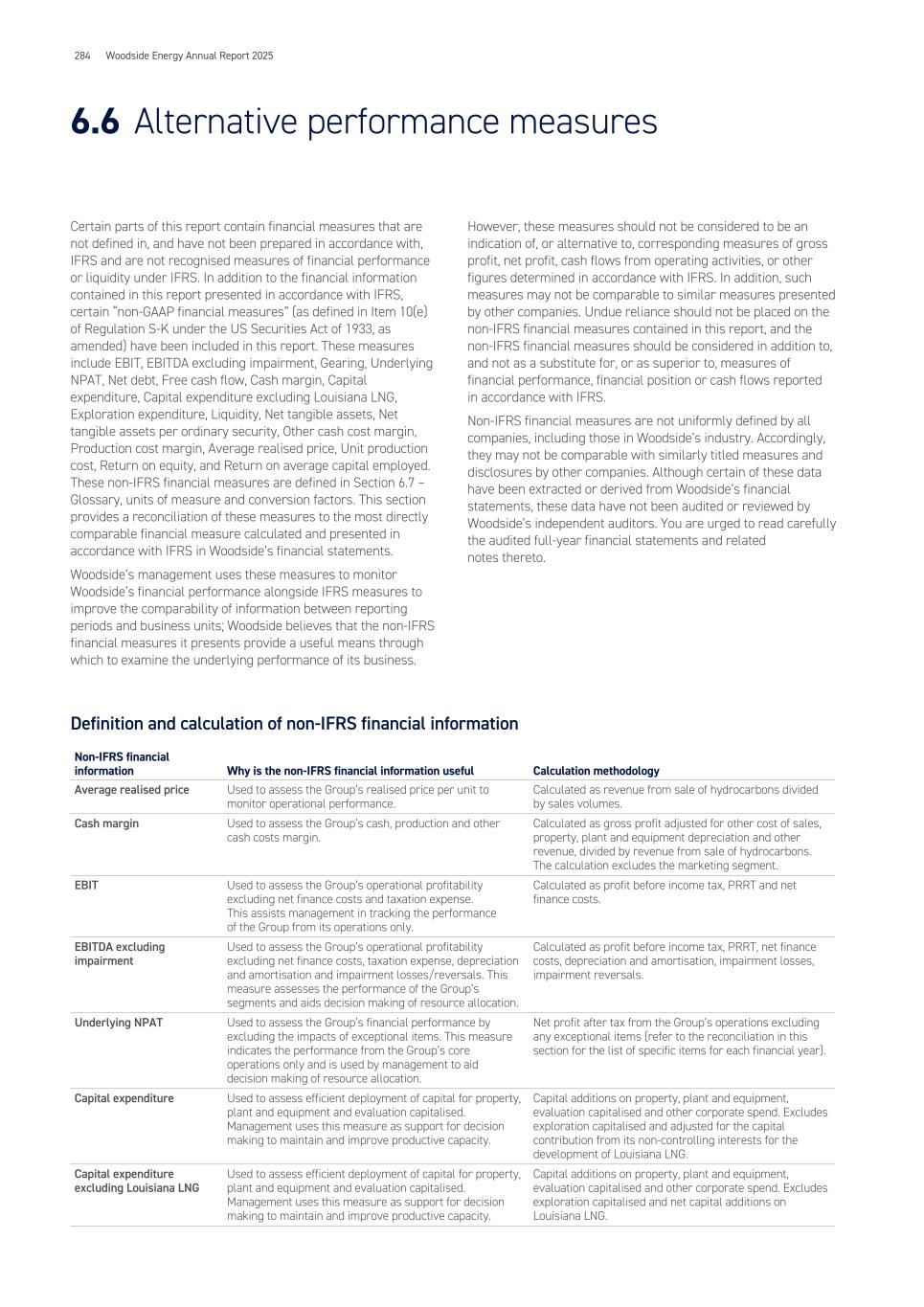
Certain parts of this report contain financial measures that are not defined in, and have not been prepared in accordance with, IFRS and are not recognised measures of financial performance or liquidity under IFRS. In addition to the financial information contained in this report presented in accordance with IFRS, certain “non-GAAP financial measures” (as defined in Item 10(e) of Regulation S-K under the US Securities Act of 1933, as amended) have been included in this report. These measures include EBIT, EBITDA excluding impairment, Gearing, Underlying NPAT, Net debt, Free cash flow, Cash margin, Capital expenditure, Capital expenditure excluding Louisiana LNG, Exploration expenditure, Liquidity, Net tangible assets, Net tangible assets per ordinary security, Other cash cost margin, Production cost margin, Average realised price, Unit production cost, Return on equity, and Return on average capital employed. These non‑IFRS financial measures are defined in Section 6.7 – Glossary, units of measure and conversion factors. This section provides a reconciliation of these measures to the most directly comparable financial measure calculated and presented in accordance with IFRS in Woodside’s financial statements. Woodside’s management uses these measures to monitor Woodside’s financial performance alongside IFRS measures to improve the comparability of information between reporting periods and business units; Woodside believes that the non-IFRS financial measures it presents provide a useful means through which to examine the underlying performance of its business. However, these measures should not be considered to be an indication of, or alternative to, corresponding measures of gross profit, net profit, cash flows from operating activities, or other figures determined in accordance with IFRS. In addition, such measures may not be comparable to similar measures presented by other companies. Undue reliance should not be placed on the non-IFRS financial measures contained in this report, and the non-IFRS financial measures should be considered in addition to, and not as a substitute for, or as superior to, measures of financial performance, financial position or cash flows reported in accordance with IFRS. Non-IFRS financial measures are not uniformly defined by all companies, including those in Woodside’s industry. Accordingly, they may not be comparable with similarly titled measures and disclosures by other companies. Although certain of these data have been extracted or derived from Woodside’s financial statements, these data have not been audited or reviewed by Woodside’s independent auditors. You are urged to read carefully the audited full-year financial statements and related notes thereto. Definition and calculation of non-IFRS financial information Average realised price Used to assess the Group’s realised price per unit to monitor operational performance. Calculated as revenue from sale of hydrocarbons divided by sales volumes. Cash margin Used to assess the Group’s cash, production and other cash costs margin. Calculated as gross profit adjusted for other cost of sales, property, plant and equipment depreciation and other revenue, divided by revenue from sale of hydrocarbons. The calculation excludes the marketing segment. EBIT Used to assess the Group’s operational profitability excluding net finance costs and taxation expense. This assists management in tracking the performance of the Group from its operations only. Calculated as profit before income tax, PRRT and net finance costs. EBITDA excluding impairment Used to assess the Group’s operational profitability excluding net finance costs, taxation expense, depreciation and amortisation and impairment losses/reversals. This measure assesses the performance of the Group’s segments and aids decision making of resource allocation. Calculated as profit before income tax, PRRT, net finance costs, depreciation and amortisation, impairment losses, impairment reversals. Underlying NPAT Used to assess the Group’s financial performance by excluding the impacts of exceptional items. This measure indicates the performance from the Group’s core operations only and is used by management to aid decision making of resource allocation. Net profit after tax from the Group’s operations excluding any exceptional items (refer to the reconciliation in this section for the list of specific items for each financial year). Capital expenditure Used to assess efficient deployment of capital for property, plant and equipment and evaluation capitalised. Management uses this measure as support for decision making to maintain and improve productive capacity. Capital additions on property, plant and equipment, evaluation capitalised and other corporate spend. Excludes exploration capitalised and adjusted for the capital contribution from its non‑controlling interests for the development of Louisiana LNG. Capital expenditure excluding Louisiana LNG Used to assess efficient deployment of capital for property, plant and equipment and evaluation capitalised. Management uses this measure as support for decision making to maintain and improve productive capacity. Capital additions on property, plant and equipment, evaluation capitalised and other corporate spend. Excludes exploration capitalised and net capital additions on Louisiana LNG. Non-IFRS financial information Why is the non-IFRS financial information useful Calculation methodology 284 Woodside Energy Annual Report 2025 6.6 Alternative performance measures
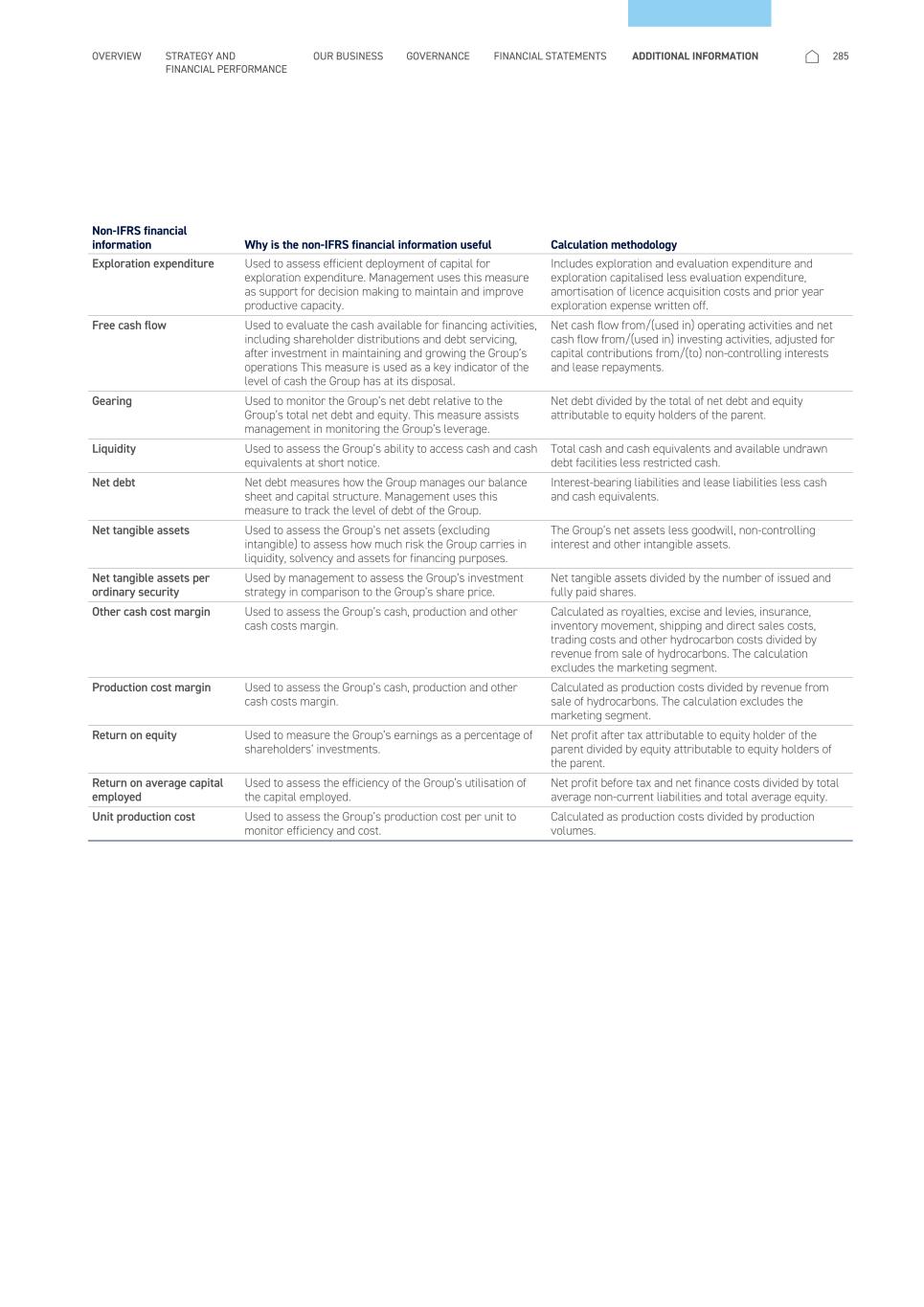
Exploration expenditure Used to assess efficient deployment of capital for exploration expenditure. Management uses this measure as support for decision making to maintain and improve productive capacity. Includes exploration and evaluation expenditure and exploration capitalised less evaluation expenditure, amortisation of licence acquisition costs and prior year exploration expense written off. Free cash flow Used to evaluate the cash available for financing activities, including shareholder distributions and debt servicing, after investment in maintaining and growing the Group’s operations This measure is used as a key indicator of the level of cash the Group has at its disposal. Net cash flow from/(used in) operating activities and net cash flow from/(used in) investing activities, adjusted for capital contributions from/(to) non-controlling interests and lease repayments. Gearing Used to monitor the Group’s net debt relative to the Group’s total net debt and equity. This measure assists management in monitoring the Group’s leverage. Net debt divided by the total of net debt and equity attributable to equity holders of the parent. Liquidity Used to assess the Group’s ability to access cash and cash equivalents at short notice. Total cash and cash equivalents and available undrawn debt facilities less restricted cash. Net debt Net debt measures how the Group manages our balance sheet and capital structure. Management uses this measure to track the level of debt of the Group. Interest-bearing liabilities and lease liabilities less cash and cash equivalents. Net tangible assets Used to assess the Group’s net assets (excluding intangible) to assess how much risk the Group carries in liquidity, solvency and assets for financing purposes. The Group’s net assets less goodwill, non-controlling interest and other intangible assets. Net tangible assets per ordinary security Used by management to assess the Group’s investment strategy in comparison to the Group’s share price. Net tangible assets divided by the number of issued and fully paid shares. Other cash cost margin Used to assess the Group’s cash, production and other cash costs margin. Calculated as royalties, excise and levies, insurance, inventory movement, shipping and direct sales costs, trading costs and other hydrocarbon costs divided by revenue from sale of hydrocarbons. The calculation excludes the marketing segment. Production cost margin Used to assess the Group’s cash, production and other cash costs margin. Calculated as production costs divided by revenue from sale of hydrocarbons. The calculation excludes the marketing segment. Return on equity Used to measure the Group’s earnings as a percentage of shareholders’ investments. Net profit after tax attributable to equity holder of the parent divided by equity attributable to equity holders of the parent. Return on average capital employed Used to assess the efficiency of the Group’s utilisation of the capital employed. Net profit before tax and net finance costs divided by total average non-current liabilities and total average equity. Unit production cost Used to assess the Group’s production cost per unit to monitor efficiency and cost. Calculated as production costs divided by production volumes. Non-IFRS financial information Why is the non-IFRS financial information useful Calculation methodology OVERVIEW STRATEGY AND FINANCIAL PERFORMANCE OUR BUSINESS GOVERNANCE FINANCIAL STATEMENTS ADDITIONAL INFORMATION 285
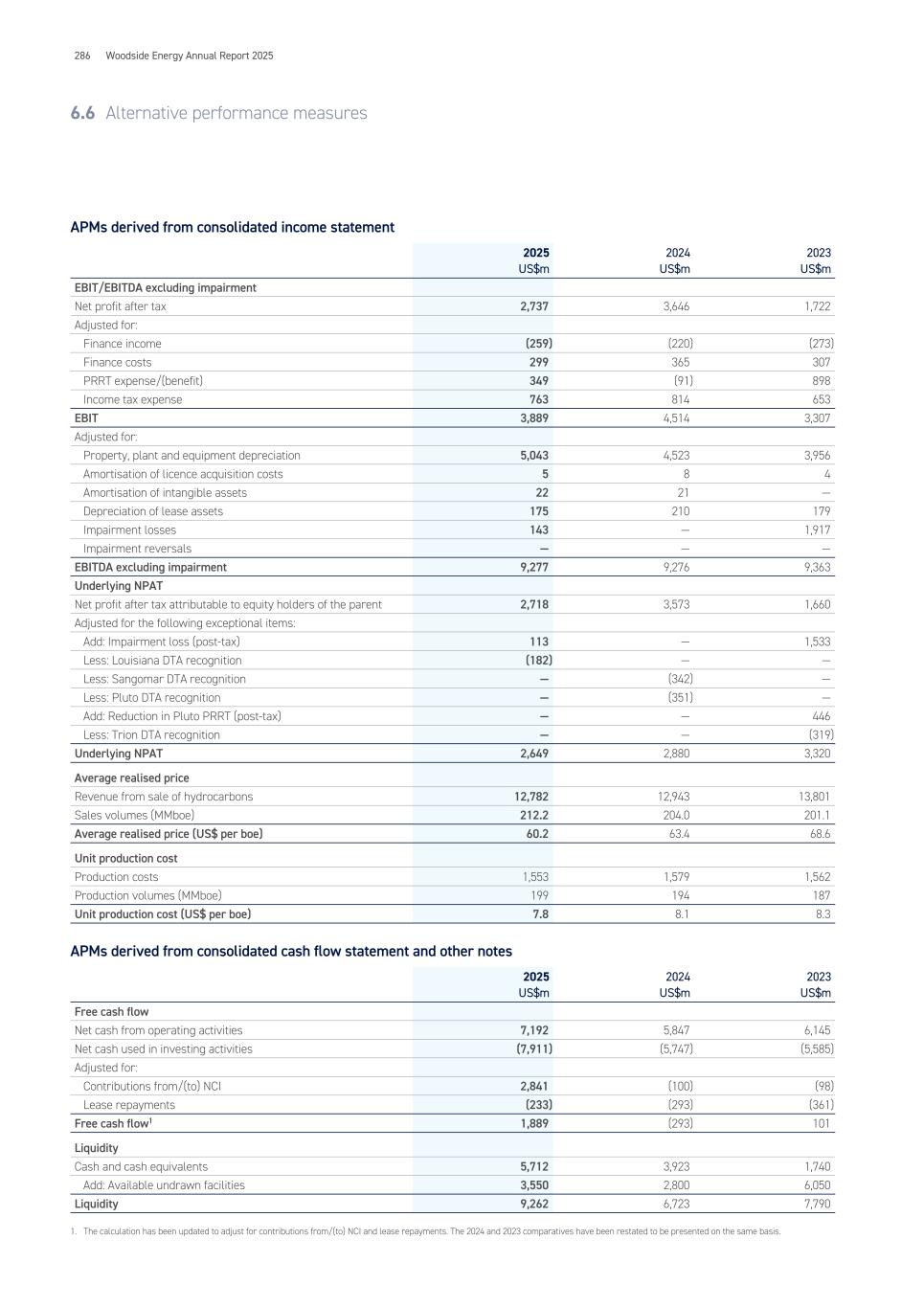
APMs derived from consolidated income statement 2025 2024 2023 US$m US$m US$m EBIT/EBITDA excluding impairment Net profit after tax 2,737 3,646 1,722 Adjusted for: Finance income (259) (220) (273) Finance costs 299 365 307 PRRT expense/(benefit) 349 (91) 898 Income tax expense 763 814 653 EBIT 3,889 4,514 3,307 Adjusted for: Property, plant and equipment depreciation 5,043 4,523 3,956 Amortisation of licence acquisition costs 5 8 4 Amortisation of intangible assets 22 21 — Depreciation of lease assets 175 210 179 Impairment losses 143 — 1,917 Impairment reversals — — — EBITDA excluding impairment 9,277 9,276 9,363 Underlying NPAT Net profit after tax attributable to equity holders of the parent 2,718 3,573 1,660 Adjusted for the following exceptional items: Add: Impairment loss (post-tax) 113 — 1,533 Less: Louisiana DTA recognition (182) — — Less: Sangomar DTA recognition — (342) — Less: Pluto DTA recognition — (351) — Add: Reduction in Pluto PRRT (post-tax) — — 446 Less: Trion DTA recognition — — (319) Underlying NPAT 2,649 2,880 3,320 Average realised price Revenue from sale of hydrocarbons 12,782 12,943 13,801 Sales volumes (MMboe) 212.2 204.0 201.1 Average realised price (US$ per boe) 60.2 63.4 68.6 Unit production cost Production costs 1,553 1,579 1,562 Production volumes (MMboe) 199 194 187 Unit production cost (US$ per boe) 7.8 8.1 8.3 APMs derived from consolidated cash flow statement and other notes 2025 2024 2023 US$m US$m US$m Free cash flow Net cash from operating activities 7,192 5,847 6,145 Net cash used in investing activities (7,911) (5,747) (5,585) Adjusted for: Contributions from/(to) NCI 2,841 (100) (98) Lease repayments (233) (293) (361) Free cash flow1 1,889 (293) 101 Liquidity Cash and cash equivalents 5,712 3,923 1,740 Add: Available undrawn facilities 3,550 2,800 6,050 Liquidity 9,262 6,723 7,790 1. The calculation has been updated to adjust for contributions from/(to) NCI and lease repayments. The 2024 and 2023 comparatives have been restated to be presented on the same basis. 286 Woodside Energy Annual Report 2025 6.6 Alternative performance measures
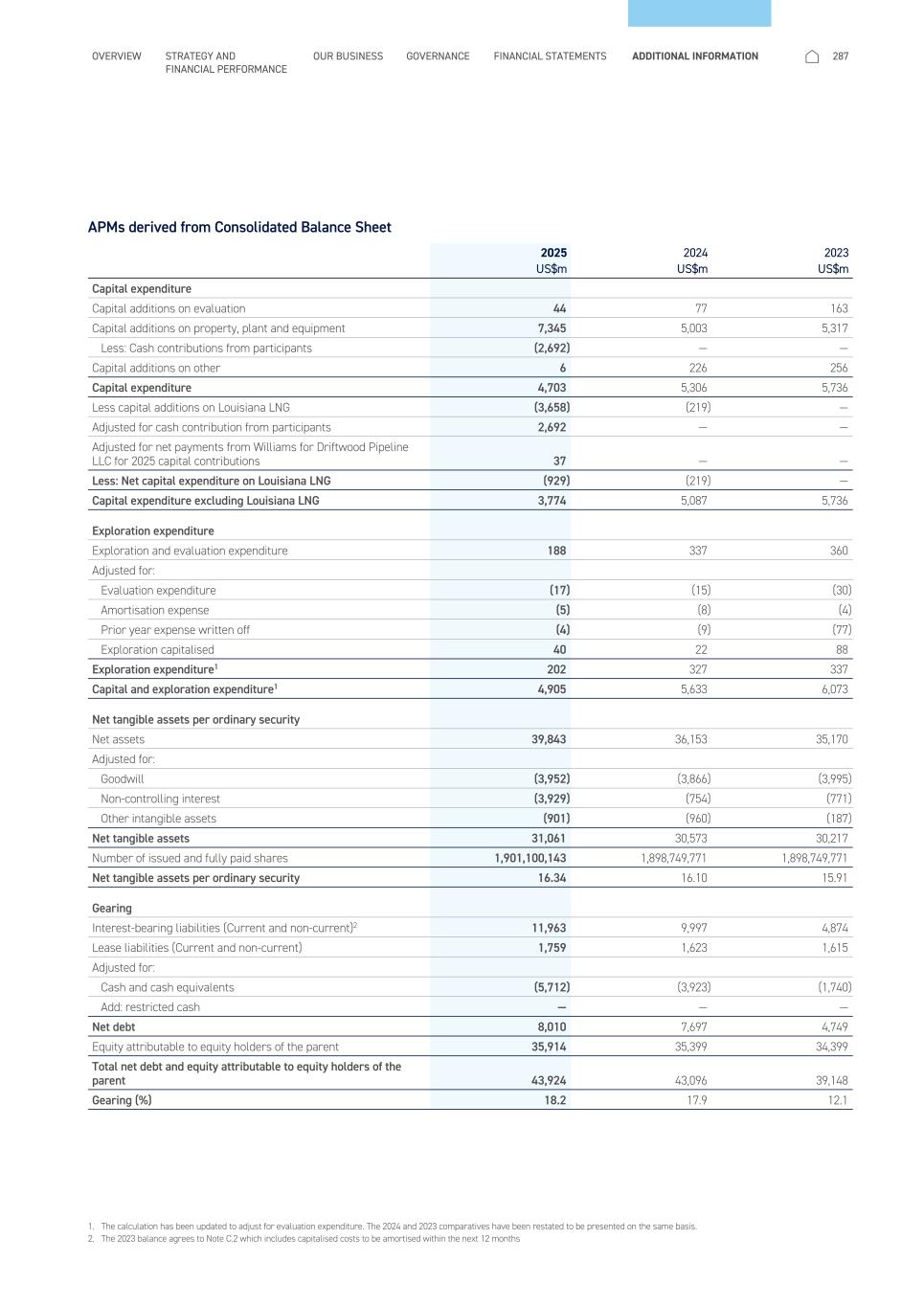
APMs derived from Consolidated Balance Sheet 2025 2024 2023 US$m US$m US$m Capital expenditure Capital additions on evaluation 44 77 163 Capital additions on property, plant and equipment 7,345 5,003 5,317 Less: Cash contributions from participants (2,692) — — Capital additions on other 6 226 256 Capital expenditure 4,703 5,306 5,736 Less capital additions on Louisiana LNG (3,658) (219) — Adjusted for cash contribution from participants 2,692 — — Adjusted for net payments from Williams for Driftwood Pipeline LLC for 2025 capital contributions 37 — — Less: Net capital expenditure on Louisiana LNG (929) (219) — Capital expenditure excluding Louisiana LNG 3,774 5,087 5,736 Exploration expenditure Exploration and evaluation expenditure 188 337 360 Adjusted for: Evaluation expenditure (17) (15) (30) Amortisation expense (5) (8) (4) Prior year expense written off (4) (9) (77) Exploration capitalised 40 22 88 Exploration expenditure1 202 327 337 Capital and exploration expenditure1 4,905 5,633 6,073 Net tangible assets per ordinary security Net assets 39,843 36,153 35,170 Adjusted for: Goodwill (3,952) (3,866) (3,995) Non-controlling interest (3,929) (754) (771) Other intangible assets (901) (960) (187) Net tangible assets 31,061 30,573 30,217 Number of issued and fully paid shares 1,901,100,143 1,898,749,771 1,898,749,771 Net tangible assets per ordinary security 16.34 16.10 15.91 Gearing Interest-bearing liabilities (Current and non-current)2 11,963 9,997 4,874 Lease liabilities (Current and non-current) 1,759 1,623 1,615 Adjusted for: Cash and cash equivalents (5,712) (3,923) (1,740) Add: restricted cash — — — Net debt 8,010 7,697 4,749 Equity attributable to equity holders of the parent 35,914 35,399 34,399 Total net debt and equity attributable to equity holders of the parent 43,924 43,096 39,148 Gearing (%) 18.2 17.9 12.1 OVERVIEW STRATEGY AND FINANCIAL PERFORMANCE OUR BUSINESS GOVERNANCE FINANCIAL STATEMENTS ADDITIONAL INFORMATION 287 1. The calculation has been updated to adjust for evaluation expenditure. The 2024 and 2023 comparatives have been restated to be presented on the same basis. 2. The 2023 balance agrees to Note C.2 which includes capitalised costs to be amortised within the next 12 months
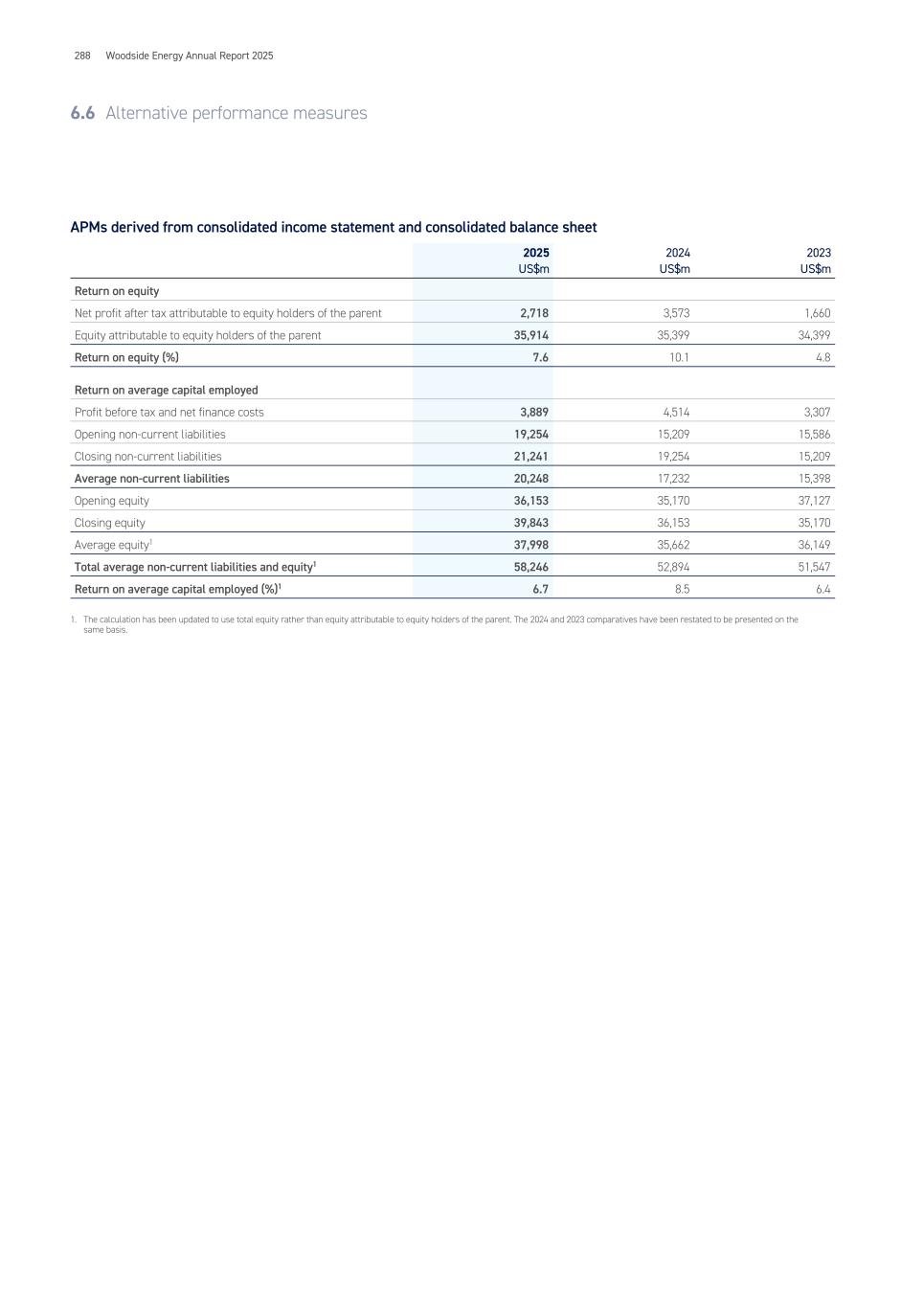
APMs derived from consolidated income statement and consolidated balance sheet 2025 2024 2023 US$m US$m US$m Return on equity Net profit after tax attributable to equity holders of the parent 2,718 3,573 1,660 Equity attributable to equity holders of the parent 35,914 35,399 34,399 Return on equity (%) 7.6 10.1 4.8 Return on average capital employed Profit before tax and net finance costs 3,889 4,514 3,307 Opening non-current liabilities 19,254 15,209 15,586 Closing non-current liabilities 21,241 19,254 15,209 Average non-current liabilities 20,248 17,232 15,398 Opening equity 36,153 35,170 37,127 Closing equity 39,843 36,153 35,170 Average equity1 37,998 35,662 36,149 Total average non-current liabilities and equity1 58,246 52,894 51,547 Return on average capital employed (%)1 6.7 8.5 6.4 1. The calculation has been updated to use total equity rather than equity attributable to equity holders of the parent. The 2024 and 2023 comparatives have been restated to be presented on the same basis. 288 Woodside Energy Annual Report 2025 6.6 Alternative performance measures
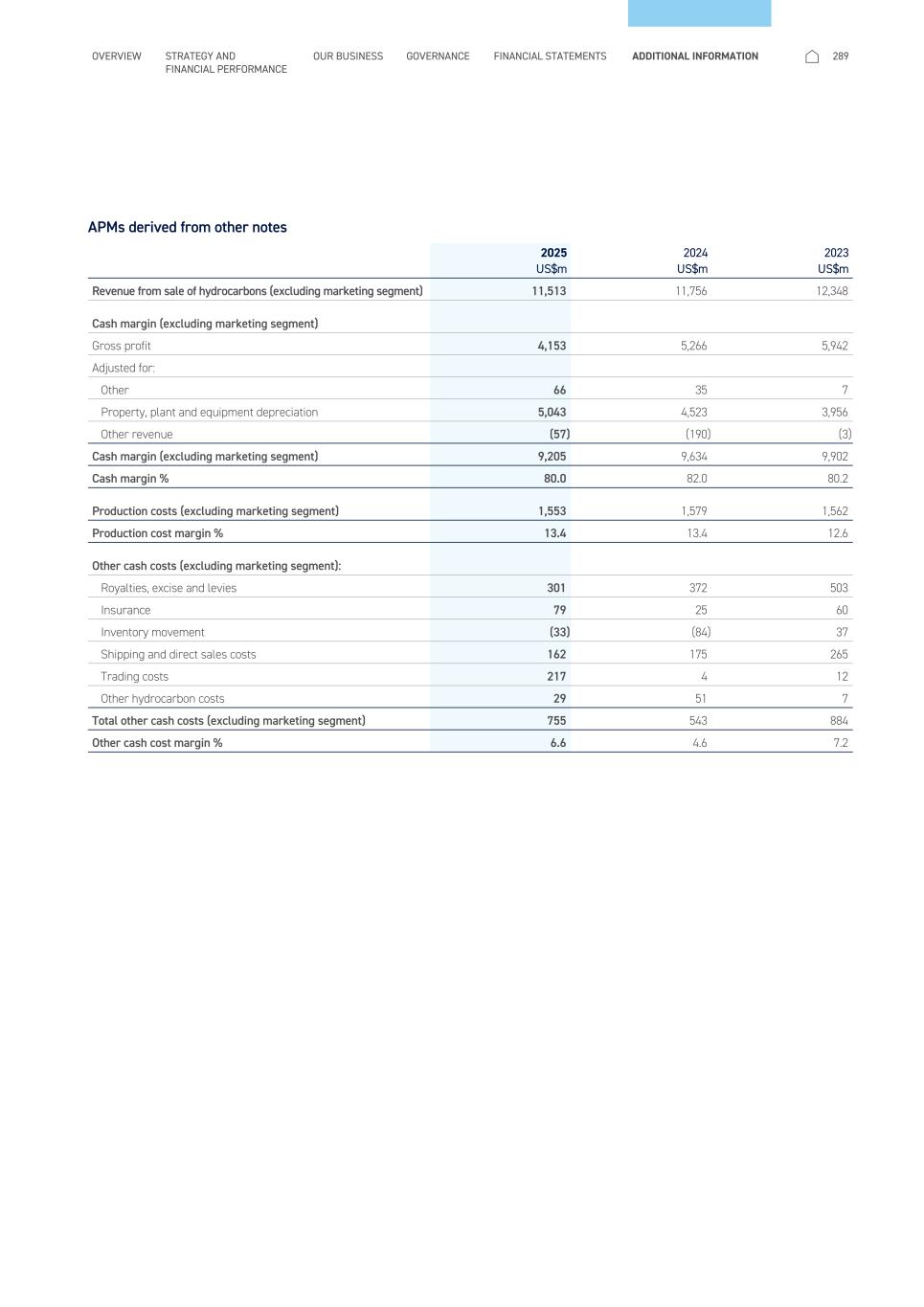
APMs derived from other notes 2025 2024 2023 US$m US$m US$m Revenue from sale of hydrocarbons (excluding marketing segment) 11,513 11,756 12,348 Cash margin (excluding marketing segment) Gross profit 4,153 5,266 5,942 Adjusted for: Other 66 35 7 Property, plant and equipment depreciation 5,043 4,523 3,956 Other revenue (57) (190) (3) Cash margin (excluding marketing segment) 9,205 9,634 9,902 Cash margin % 80.0 82.0 80.2 Production costs (excluding marketing segment) 1,553 1,579 1,562 Production cost margin % 13.4 13.4 12.6 Other cash costs (excluding marketing segment): Royalties, excise and levies 301 372 503 Insurance 79 25 60 Inventory movement (33) (84) 37 Shipping and direct sales costs 162 175 265 Trading costs 217 4 12 Other hydrocarbon costs 29 51 7 Total other cash costs (excluding marketing segment) 755 543 884 Other cash cost margin % 6.6 4.6 7.2 OVERVIEW STRATEGY AND FINANCIAL PERFORMANCE OUR BUSINESS GOVERNANCE FINANCIAL STATEMENTS ADDITIONAL INFORMATION 289
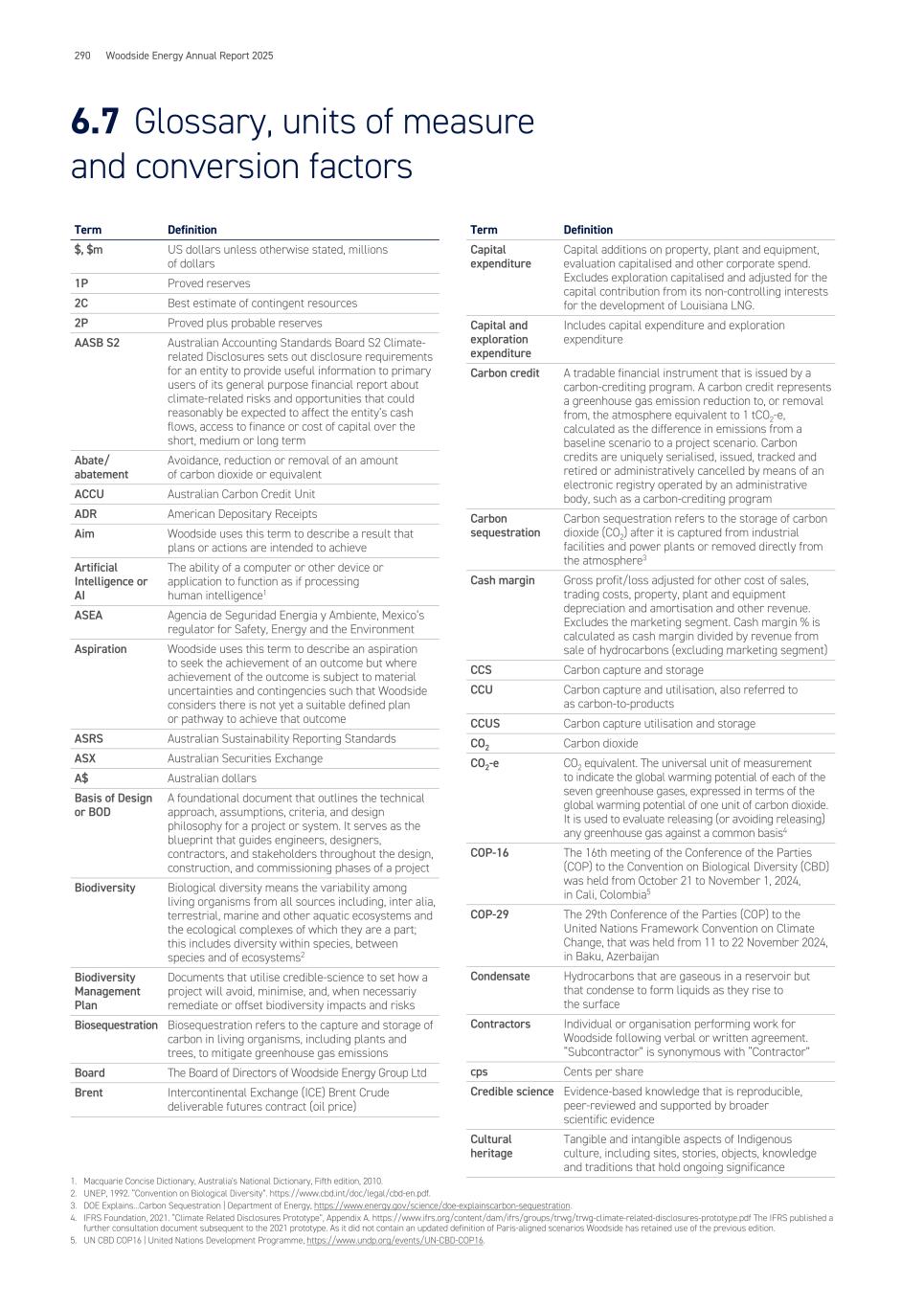
$, $m US dollars unless otherwise stated, millions of dollars 1P Proved reserves 2C Best estimate of contingent resources 2P Proved plus probable reserves AASB S2 Australian Accounting Standards Board S2 Climate- related Disclosures sets out disclosure requirements for an entity to provide useful information to primary users of its general purpose financial report about climate-related risks and opportunities that could reasonably be expected to affect the entity’s cash flows, access to finance or cost of capital over the short, medium or long term Abate/ abatement Avoidance, reduction or removal of an amount of carbon dioxide or equivalent ACCU Australian Carbon Credit Unit ADR American Depositary Receipts Aim Woodside uses this term to describe a result that plans or actions are intended to achieve Artificial Intelligence or AI The ability of a computer or other device or application to function as if processing human intelligence1 ASEA Agencia de Seguridad Energia y Ambiente, Mexico’s regulator for Safety, Energy and the Environment Aspiration Woodside uses this term to describe an aspiration to seek the achievement of an outcome but where achievement of the outcome is subject to material uncertainties and contingencies such that Woodside considers there is not yet a suitable defined plan or pathway to achieve that outcome ASRS Australian Sustainability Reporting Standards ASX Australian Securities Exchange A$ Australian dollars Basis of Design or BOD A foundational document that outlines the technical approach, assumptions, criteria, and design philosophy for a project or system. It serves as the blueprint that guides engineers, designers, contractors, and stakeholders throughout the design, construction, and commissioning phases of a project Biodiversity Biological diversity means the variability among living organisms from all sources including, inter alia, terrestrial, marine and other aquatic ecosystems and the ecological complexes of which they are a part; this includes diversity within species, between species and of ecosystems2 Biodiversity Management Plan Documents that utilise credible-science to set how a project will avoid, minimise, and, when necessariy remediate or offset biodiversity impacts and risks Biosequestration Biosequestration refers to the capture and storage of carbon in living organisms, including plants and trees, to mitigate greenhouse gas emissions Board The Board of Directors of Woodside Energy Group Ltd Brent Intercontinental Exchange (ICE) Brent Crude deliverable futures contract (oil price) Term Definition Capital expenditure Capital additions on property, plant and equipment, evaluation capitalised and other corporate spend. Excludes exploration capitalised and adjusted for the capital contribution from its non‑controlling interests for the development of Louisiana LNG. Capital and exploration expenditure Includes capital expenditure and exploration expenditure Carbon credit A tradable financial instrument that is issued by a carbon-crediting program. A carbon credit represents a greenhouse gas emission reduction to, or removal from, the atmosphere equivalent to 1 tCO2-e, calculated as the difference in emissions from a baseline scenario to a project scenario. Carbon credits are uniquely serialised, issued, tracked and retired or administratively cancelled by means of an electronic registry operated by an administrative body, such as a carbon-crediting program Carbon sequestration Carbon sequestration refers to the storage of carbon dioxide (CO2) after it is captured from industrial facilities and power plants or removed directly from the atmosphere3 Cash margin Gross profit/loss adjusted for other cost of sales, trading costs, property, plant and equipment depreciation and amortisation and other revenue. Excludes the marketing segment. Cash margin % is calculated as cash margin divided by revenue from sale of hydrocarbons (excluding marketing segment) CCS Carbon capture and storage CCU Carbon capture and utilisation, also referred to as carbon-to-products CCUS Carbon capture utilisation and storage CO2 Carbon dioxide CO2-e CO2 equivalent. The universal unit of measurement to indicate the global warming potential of each of the seven greenhouse gases, expressed in terms of the global warming potential of one unit of carbon dioxide. It is used to evaluate releasing (or avoiding releasing) any greenhouse gas against a common basis4 COP-16 The 16th meeting of the Conference of the Parties (COP) to the Convention on Biological Diversity (CBD) was held from October 21 to November 1, 2024, in Cali, Colombia5 COP-29 The 29th Conference of the Parties (COP) to the United Nations Framework Convention on Climate Change, that was held from 11 to 22 November 2024, in Baku, Azerbaijan Condensate Hydrocarbons that are gaseous in a reservoir but that condense to form liquids as they rise to the surface Contractors Individual or organisation performing work for Woodside following verbal or written agreement. “Subcontractor” is synonymous with “Contractor” cps Cents per share Credible science Evidence-based knowledge that is reproducible, peer‑reviewed and supported by broader scientific evidence Cultural heritage Tangible and intangible aspects of Indigenous culture, including sites, stories, objects, knowledge and traditions that hold ongoing significance Term Definition 290 Woodside Energy Annual Report 2025 6.7 Glossary, units of measure and conversion factors 1. Macquarie Concise Dictionary, Australia's National Dictionary, Fifth edition, 2010. 2. UNEP, 1992. “Convention on Biological Diversity”. https://www.cbd.int/doc/legal/cbd-en.pdf. 3. DOE Explains...Carbon Sequestration | Department of Energy, https://www.energy.gov/science/doe-explainscarbon-sequestration. 4. IFRS Foundation, 2021. “Climate Related Disclosures Prototype”, Appendix A. https://www.ifrs.org/content/dam/ifrs/groups/trwg/trwg-climate-related-disclosures-prototype.pdf The IFRS published a further consultation document subsequent to the 2021 prototype. As it did not contain an updated definition of Paris-aligned scenarios Woodside has retained use of the previous edition. 5. UN CBD COP16 | United Nations Development Programme, https://www.undp.org/events/UN-CBD-COP16.
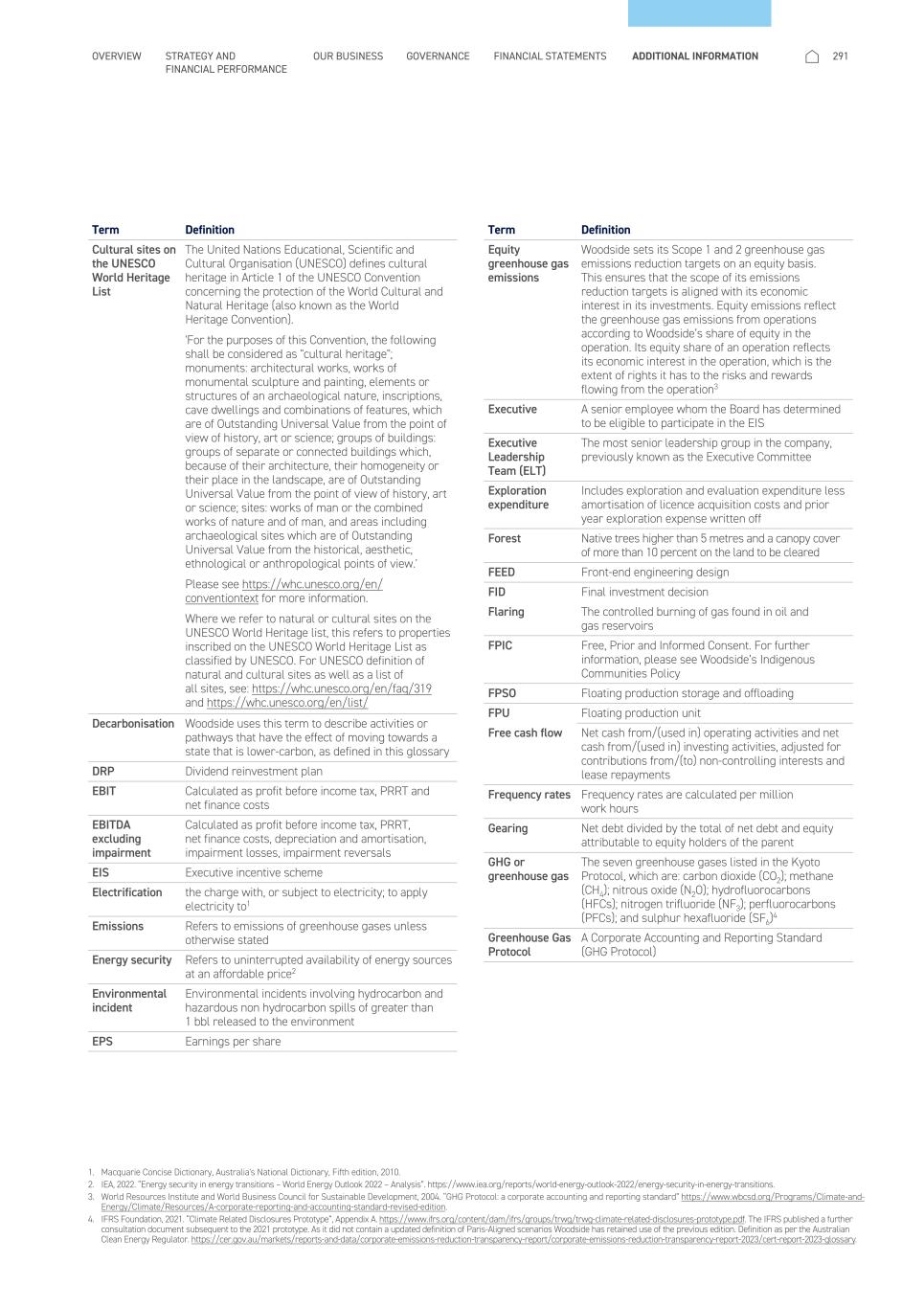
Cultural sites on the UNESCO World Heritage List The United Nations Educational, Scientific and Cultural Organisation (UNESCO) defines cultural heritage in Article 1 of the UNESCO Convention concerning the protection of the World Cultural and Natural Heritage (also known as the World Heritage Convention). 'For the purposes of this Convention, the following shall be considered as "cultural heritage"; monuments: architectural works, works of monumental sculpture and painting, elements or structures of an archaeological nature, inscriptions, cave dwellings and combinations of features, which are of Outstanding Universal Value from the point of view of history, art or science; groups of buildings: groups of separate or connected buildings which, because of their architecture, their homogeneity or their place in the landscape, are of Outstanding Universal Value from the point of view of history, art or science; sites: works of man or the combined works of nature and of man, and areas including archaeological sites which are of Outstanding Universal Value from the historical, aesthetic, ethnological or anthropological points of view.' Please see https://whc.unesco.org/en/ conventiontext for more information. Where we refer to natural or cultural sites on the UNESCO World Heritage list, this refers to properties inscribed on the UNESCO World Heritage List as classified by UNESCO. For UNESCO definition of natural and cultural sites as well as a list of all sites, see: https://whc.unesco.org/en/faq/319 and https://whc.unesco.org/en/list/ Decarbonisation Woodside uses this term to describe activities or pathways that have the effect of moving towards a state that is lower-carbon, as defined in this glossary DRP Dividend reinvestment plan EBIT Calculated as profit before income tax, PRRT and net finance costs EBITDA excluding impairment Calculated as profit before income tax, PRRT, net finance costs, depreciation and amortisation, impairment losses, impairment reversals EIS Executive incentive scheme Electrification the charge with, or subject to electricity; to apply electricity to1 Emissions Refers to emissions of greenhouse gases unless otherwise stated Energy security Refers to uninterrupted availability of energy sources at an affordable price2 Environmental incident Environmental incidents involving hydrocarbon and hazardous non hydrocarbon spills of greater than 1 bbl released to the environment EPS Earnings per share Term Definition Equity greenhouse gas emissions Woodside sets its Scope 1 and 2 greenhouse gas emissions reduction targets on an equity basis. This ensures that the scope of its emissions reduction targets is aligned with its economic interest in its investments. Equity emissions reflect the greenhouse gas emissions from operations according to Woodside’s share of equity in the operation. Its equity share of an operation reflects its economic interest in the operation, which is the extent of rights it has to the risks and rewards flowing from the operation3 Executive A senior employee whom the Board has determined to be eligible to participate in the EIS Executive Leadership Team (ELT) The most senior leadership group in the company, previously known as the Executive Committee Exploration expenditure Includes exploration and evaluation expenditure less amortisation of licence acquisition costs and prior year exploration expense written off Forest Native trees higher than 5 metres and a canopy cover of more than 10 percent on the land to be cleared FEED Front-end engineering design FID Final investment decision Flaring The controlled burning of gas found in oil and gas reservoirs FPIC Free, Prior and Informed Consent. For further information, please see Woodside’s Indigenous Communities Policy FPSO Floating production storage and offloading FPU Floating production unit Free cash flow Net cash from/(used in) operating activities and net cash from/(used in) investing activities, adjusted for contributions from/(to) non-controlling interests and lease repayments Frequency rates Frequency rates are calculated per million work hours Gearing Net debt divided by the total of net debt and equity attributable to equity holders of the parent GHG or greenhouse gas The seven greenhouse gases listed in the Kyoto Protocol, which are: carbon dioxide (CO2); methane (CH4); nitrous oxide (N2O); hydrofluorocarbons (HFCs); nitrogen trifluoride (NF3); perfluorocarbons (PFCs); and sulphur hexafluoride (SF6)4 Greenhouse Gas Protocol A Corporate Accounting and Reporting Standard (GHG Protocol) Term Definition OVERVIEW STRATEGY AND FINANCIAL PERFORMANCE OUR BUSINESS GOVERNANCE FINANCIAL STATEMENTS ADDITIONAL INFORMATION 291 1. Macquarie Concise Dictionary, Australia's National Dictionary, Fifth edition, 2010. 2. IEA, 2022. “Energy security in energy transitions – World Energy Outlook 2022 – Analysis”. https://www.iea.org/reports/world-energy-outlook-2022/energy-security-in-energy-transitions. 3. World Resources Institute and World Business Council for Sustainable Development, 2004. “GHG Protocol: a corporate accounting and reporting standard” https://www.wbcsd.org/Programs/Climate-and- Energy/Climate/Resources/A-corporate-reporting-and-accounting-standard-revised-edition. 4. IFRS Foundation, 2021. “Climate Related Disclosures Prototype”, Appendix A. https://www.ifrs.org/content/dam/ifrs/groups/trwg/trwg-climate-related-disclosures-prototype.pdf. The IFRS published a further consultation document subsequent to the 2021 prototype. As it did not contain a updated definition of Paris-Aligned scenarios Woodside has retained use of the previous edition. Definition as per the Australian Clean Energy Regulator. https://cer.gov.au/markets/reports-and-data/corporate-emissions-reduction-transparency-report/corporate-emissions-reduction-transparency-report-2023/cert-report-2023-glossary.
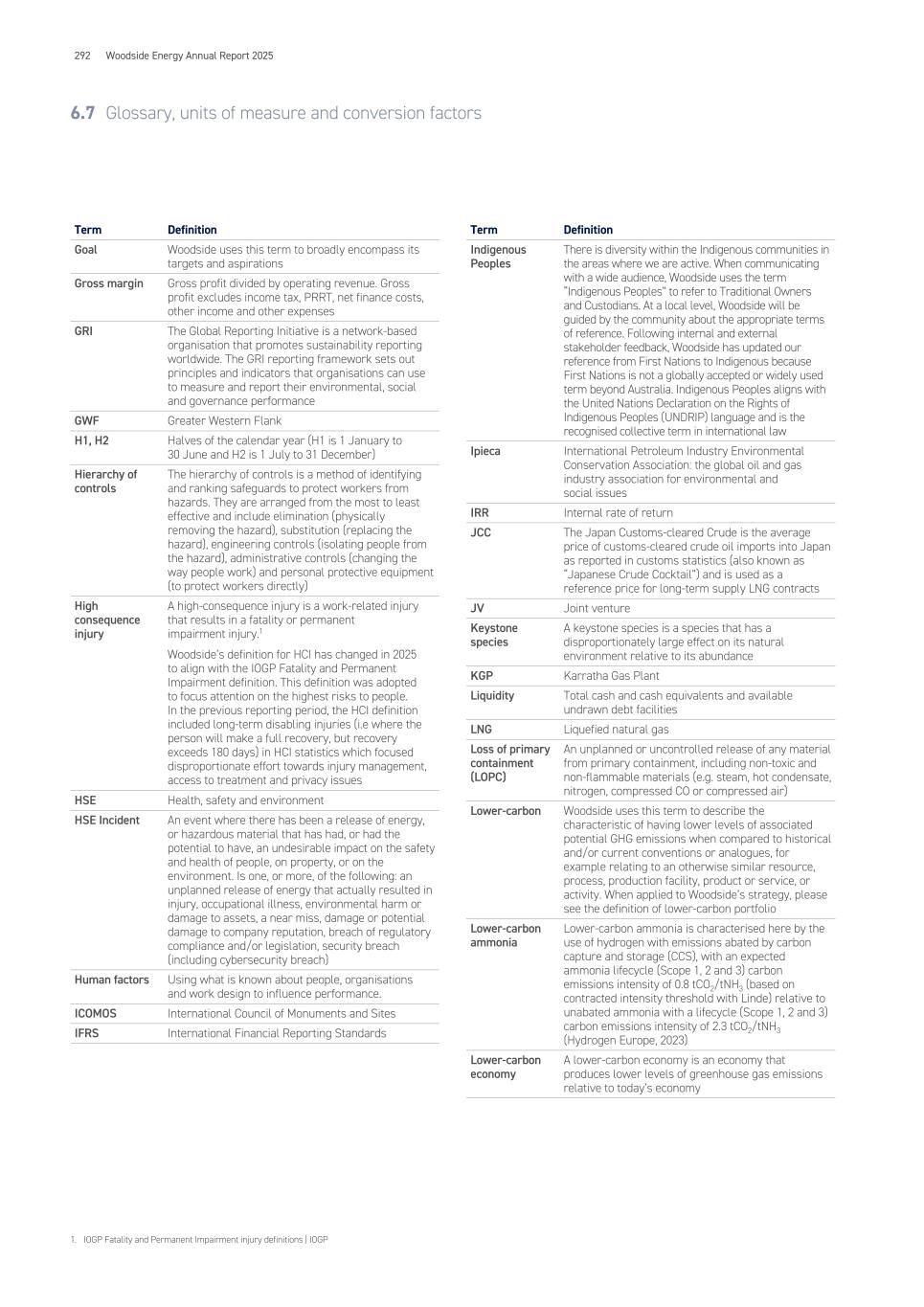
Goal Woodside uses this term to broadly encompass its targets and aspirations Gross margin Gross profit divided by operating revenue. Gross profit excludes income tax, PRRT, net finance costs, other income and other expenses GRI The Global Reporting Initiative is a network-based organisation that promotes sustainability reporting worldwide. The GRI reporting framework sets out principles and indicators that organisations can use to measure and report their environmental, social and governance performance GWF Greater Western Flank H1, H2 Halves of the calendar year (H1 is 1 January to 30 June and H2 is 1 July to 31 December) Hierarchy of controls The hierarchy of controls is a method of identifying and ranking safeguards to protect workers from hazards. They are arranged from the most to least effective and include elimination (physically removing the hazard), substitution (replacing the hazard), engineering controls (isolating people from the hazard), administrative controls (changing the way people work) and personal protective equipment (to protect workers directly) High consequence injury A high-consequence injury is a work-related injury that results in a fatality or permanent impairment injury.1 Woodside’s definition for HCI has changed in 2025 to align with the IOGP Fatality and Permanent Impairment definition. This definition was adopted to focus attention on the highest risks to people. In the previous reporting period, the HCI definition included long-term disabling injuries (i.e where the person will make a full recovery, but recovery exceeds 180 days) in HCI statistics which focused disproportionate effort towards injury management, access to treatment and privacy issues HSE Health, safety and environment HSE Incident An event where there has been a release of energy, or hazardous material that has had, or had the potential to have, an undesirable impact on the safety and health of people, on property, or on the environment. Is one, or more, of the following: an unplanned release of energy that actually resulted in injury, occupational illness, environmental harm or damage to assets, a near miss, damage or potential damage to company reputation, breach of regulatory compliance and/or legislation, security breach (including cybersecurity breach) Human factors Using what is known about people, organisations and work design to influence performance. ICOMOS International Council of Monuments and Sites IFRS International Financial Reporting Standards Term Definition Indigenous Peoples There is diversity within the Indigenous communities in the areas where we are active. When communicating with a wide audience, Woodside uses the term “Indigenous Peoples” to refer to Traditional Owners and Custodians. At a local level, Woodside will be guided by the community about the appropriate terms of reference. Following internal and external stakeholder feedback, Woodside has updated our reference from First Nations to Indigenous because First Nations is not a globally accepted or widely used term beyond Australia. Indigenous Peoples aligns with the United Nations Declaration on the Rights of Indigenous Peoples (UNDRIP) language and is the recognised collective term in international law Ipieca International Petroleum Industry Environmental Conservation Association: the global oil and gas industry association for environmental and social issues IRR Internal rate of return JCC The Japan Customs-cleared Crude is the average price of customs-cleared crude oil imports into Japan as reported in customs statistics (also known as “Japanese Crude Cocktail”) and is used as a reference price for long-term supply LNG contracts JV Joint venture Keystone species A keystone species is a species that has a disproportionately large effect on its natural environment relative to its abundance KGP Karratha Gas Plant Liquidity Total cash and cash equivalents and available undrawn debt facilities LNG Liquefied natural gas Loss of primary containment (LOPC) An unplanned or uncontrolled release of any material from primary containment, including non-toxic and non-flammable materials (e.g. steam, hot condensate, nitrogen, compressed CO or compressed air) Lower-carbon Woodside uses this term to describe the characteristic of having lower levels of associated potential GHG emissions when compared to historical and/or current conventions or analogues, for example relating to an otherwise similar resource, process, production facility, product or service, or activity. When applied to Woodside’s strategy, please see the definition of lower-carbon portfolio Lower-carbon ammonia Lower-carbon ammonia is characterised here by the use of hydrogen with emissions abated by carbon capture and storage (CCS), with an expected ammonia lifecycle (Scope 1, 2 and 3) carbon emissions intensity of 0.8 tCO2/tNH3 (based on contracted intensity threshold with Linde) relative to unabated ammonia with a lifecycle (Scope 1, 2 and 3) carbon emissions intensity of 2.3 tCO2/tNH3 (Hydrogen Europe, 2023) Lower-carbon economy A lower-carbon economy is an economy that produces lower levels of greenhouse gas emissions relative to today’s economy Term Definition 292 Woodside Energy Annual Report 2025 6.7 Glossary, units of measure and conversion factors 1. IOGP Fatality and Permanent Impairment injury definitions | IOGP
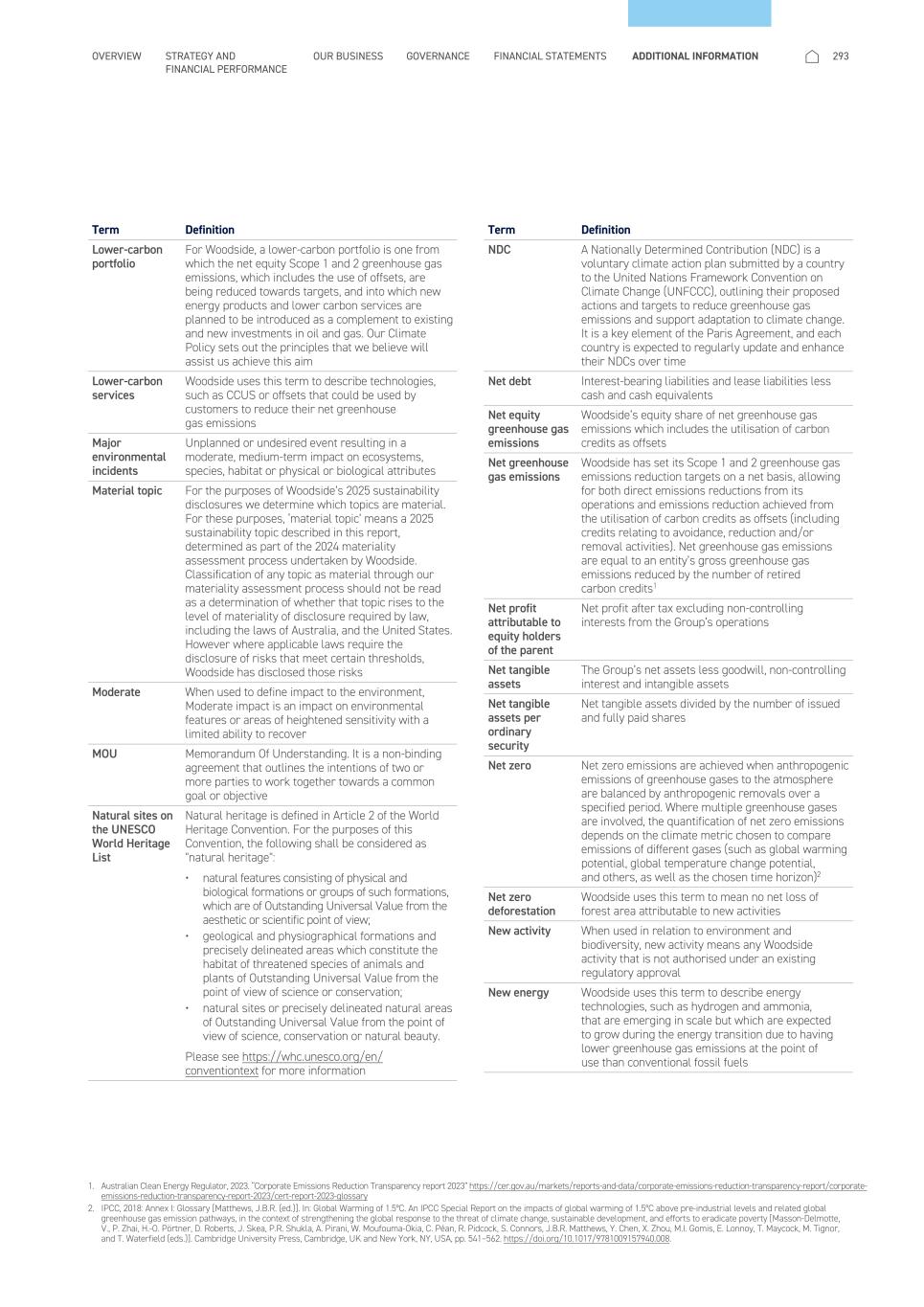
Lower-carbon portfolio For Woodside, a lower-carbon portfolio is one from which the net equity Scope 1 and 2 greenhouse gas emissions, which includes the use of offsets, are being reduced towards targets, and into which new energy products and lower carbon services are planned to be introduced as a complement to existing and new investments in oil and gas. Our Climate Policy sets out the principles that we believe will assist us achieve this aim Lower-carbon services Woodside uses this term to describe technologies, such as CCUS or offsets that could be used by customers to reduce their net greenhouse gas emissions Major environmental incidents Unplanned or undesired event resulting in a moderate, medium-term impact on ecosystems, species, habitat or physical or biological attributes Material topic For the purposes of Woodside’s 2025 sustainability disclosures we determine which topics are material. For these purposes, ‘material topic’ means a 2025 sustainability topic described in this report, determined as part of the 2024 materiality assessment process undertaken by Woodside. Classification of any topic as material through our materiality assessment process should not be read as a determination of whether that topic rises to the level of materiality of disclosure required by law, including the laws of Australia, and the United States. However where applicable laws require the disclosure of risks that meet certain thresholds, Woodside has disclosed those risks Moderate When used to define impact to the environment, Moderate impact is an impact on environmental features or areas of heightened sensitivity with a limited ability to recover MOU Memorandum Of Understanding. It is a non-binding agreement that outlines the intentions of two or more parties to work together towards a common goal or objective Natural sites on the UNESCO World Heritage List Natural heritage is defined in Article 2 of the World Heritage Convention. For the purposes of this Convention, the following shall be considered as "natural heritage": • natural features consisting of physical and biological formations or groups of such formations, which are of Outstanding Universal Value from the aesthetic or scientific point of view; • geological and physiographical formations and precisely delineated areas which constitute the habitat of threatened species of animals and plants of Outstanding Universal Value from the point of view of science or conservation; • natural sites or precisely delineated natural areas of Outstanding Universal Value from the point of view of science, conservation or natural beauty. Please see https://whc.unesco.org/en/ conventiontext for more information Term Definition NDC A Nationally Determined Contribution (NDC) is a voluntary climate action plan submitted by a country to the United Nations Framework Convention on Climate Change (UNFCCC), outlining their proposed actions and targets to reduce greenhouse gas emissions and support adaptation to climate change. It is a key element of the Paris Agreement, and each country is expected to regularly update and enhance their NDCs over time Net debt Interest-bearing liabilities and lease liabilities less cash and cash equivalents Net equity greenhouse gas emissions Woodside’s equity share of net greenhouse gas emissions which includes the utilisation of carbon credits as offsets Net greenhouse gas emissions Woodside has set its Scope 1 and 2 greenhouse gas emissions reduction targets on a net basis, allowing for both direct emissions reductions from its operations and emissions reduction achieved from the utilisation of carbon credits as offsets (including credits relating to avoidance, reduction and/or removal activities). Net greenhouse gas emissions are equal to an entity’s gross greenhouse gas emissions reduced by the number of retired carbon credits1 Net profit attributable to equity holders of the parent Net profit after tax excluding non-controlling interests from the Group’s operations Net tangible assets The Group’s net assets less goodwill, non-controlling interest and intangible assets Net tangible assets per ordinary security Net tangible assets divided by the number of issued and fully paid shares Net zero Net zero emissions are achieved when anthropogenic emissions of greenhouse gases to the atmosphere are balanced by anthropogenic removals over a specified period. Where multiple greenhouse gases are involved, the quantification of net zero emissions depends on the climate metric chosen to compare emissions of different gases (such as global warming potential, global temperature change potential, and others, as well as the chosen time horizon)2 Net zero deforestation Woodside uses this term to mean no net loss of forest area attributable to new activities New activity When used in relation to environment and biodiversity, new activity means any Woodside activity that is not authorised under an existing regulatory approval New energy Woodside uses this term to describe energy technologies, such as hydrogen and ammonia, that are emerging in scale but which are expected to grow during the energy transition due to having lower greenhouse gas emissions at the point of use than conventional fossil fuels Term Definition OVERVIEW STRATEGY AND FINANCIAL PERFORMANCE OUR BUSINESS GOVERNANCE FINANCIAL STATEMENTS ADDITIONAL INFORMATION 293 1. Australian Clean Energy Regulator, 2023. “Corporate Emissions Reduction Transparency report 2023” https://cer.gov.au/markets/reports-and-data/corporate-emissions-reduction-transparency-report/corporate- emissions-reduction-transparency-report-2023/cert-report-2023-glossary 2. IPCC, 2018: Annex I: Glossary [Matthews, J.B.R. (ed.)]. In: Global Warming of 1.5°C. An IPCC Special Report on the impacts of global warming of 1.5°C above pre-industrial levels and related global greenhouse gas emission pathways, in the context of strengthening the global response to the threat of climate change, sustainable development, and efforts to eradicate poverty [Masson-Delmotte, V., P. Zhai, H.-O. Pörtner, D. Roberts, J. Skea, P.R. Shukla, A. Pirani, W. Moufouma-Okia, C. Péan, R. Pidcock, S. Connors, J.B.R. Matthews, Y. Chen, X. Zhou, M.I. Gomis, E. Lonnoy, T. Maycock, M. Tignor, and T. Waterfield (eds.)]. Cambridge University Press, Cambridge, UK and New York, NY, USA, pp. 541–562. https://doi.org/10.1017/9781009157940.008.
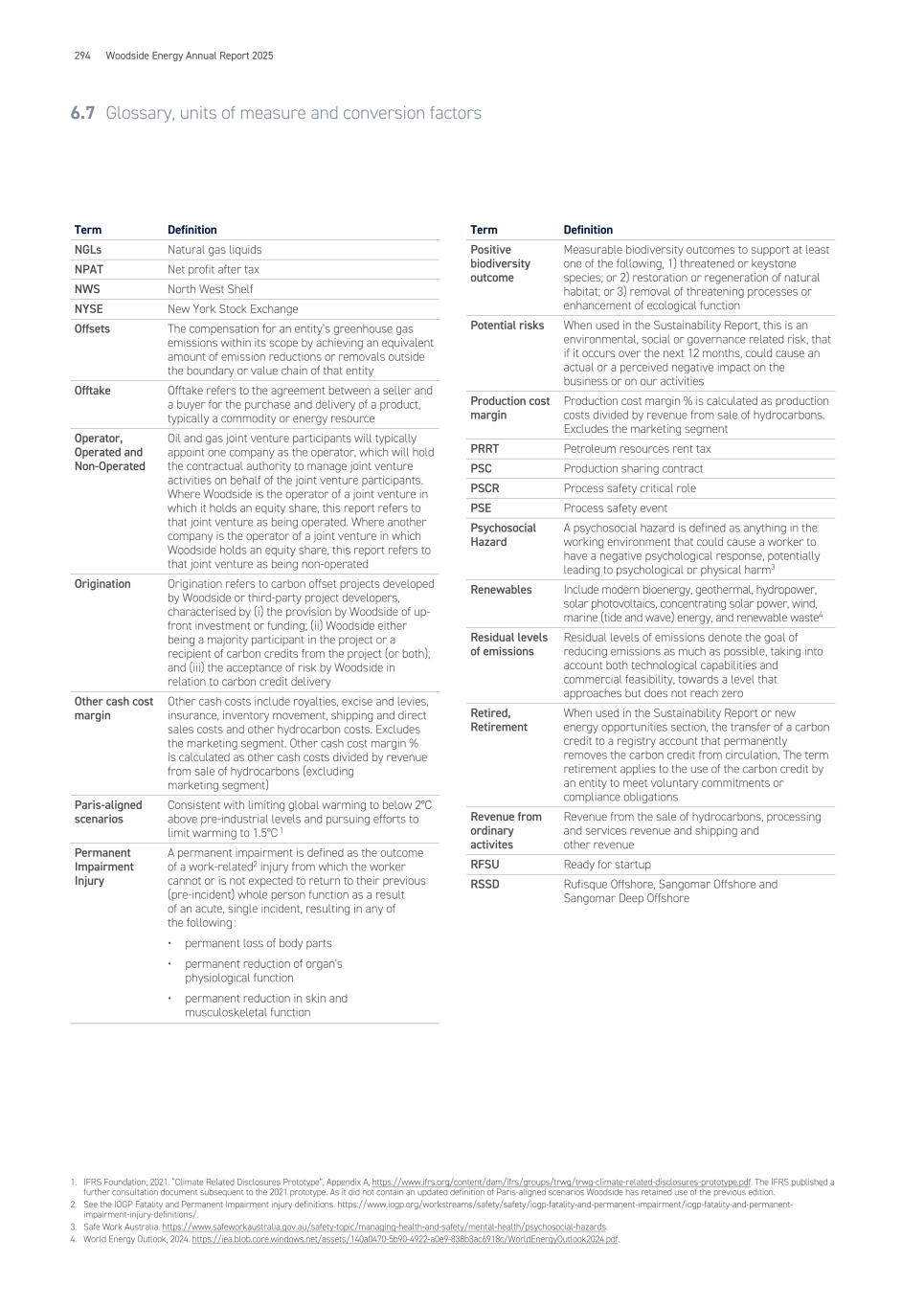
NGLs Natural gas liquids NPAT Net profit after tax NWS North West Shelf NYSE New York Stock Exchange Offsets The compensation for an entity’s greenhouse gas emissions within its scope by achieving an equivalent amount of emission reductions or removals outside the boundary or value chain of that entity Offtake Offtake refers to the agreement between a seller and a buyer for the purchase and delivery of a product, typically a commodity or energy resource Operator, Operated and Non-Operated Oil and gas joint venture participants will typically appoint one company as the operator, which will hold the contractual authority to manage joint venture activities on behalf of the joint venture participants. Where Woodside is the operator of a joint venture in which it holds an equity share, this report refers to that joint venture as being operated. Where another company is the operator of a joint venture in which Woodside holds an equity share, this report refers to that joint venture as being non-operated Origination Origination refers to carbon offset projects developed by Woodside or third-party project developers, characterised by (i) the provision by Woodside of up- front investment or funding; (ii) Woodside either being a majority participant in the project or a recipient of carbon credits from the project (or both); and (iii) the acceptance of risk by Woodside in relation to carbon credit delivery Other cash cost margin Other cash costs include royalties, excise and levies, insurance, inventory movement, shipping and direct sales costs and other hydrocarbon costs. Excludes the marketing segment. Other cash cost margin % is calculated as other cash costs divided by revenue from sale of hydrocarbons (excluding marketing segment) Paris-aligned scenarios Consistent with limiting global warming to below 2°C above pre-industrial levels and pursuing efforts to limit warming to 1.5°C 1 Permanent Impairment Injury A permanent impairment is defined as the outcome of a work-related2 injury from which the worker cannot or is not expected to return to their previous (pre-incident) whole person function as a result of an acute, single incident, resulting in any of the following : • permanent loss of body parts • permanent reduction of organ's physiological function • permanent reduction in skin and musculoskeletal function Term Definition Positive biodiversity outcome Measurable biodiversity outcomes to support at least one of the following, 1) threatened or keystone species; or 2) restoration or regeneration of natural habitat; or 3) removal of threatening processes or enhancement of ecological function Potential risks When used in the Sustainability Report, this is an environmental, social or governance related risk, that if it occurs over the next 12 months, could cause an actual or a perceived negative impact on the business or on our activities Production cost margin Production cost margin % is calculated as production costs divided by revenue from sale of hydrocarbons. Excludes the marketing segment PRRT Petroleum resources rent tax PSC Production sharing contract PSCR Process safety critical role PSE Process safety event Psychosocial Hazard A psychosocial hazard is defined as anything in the working environment that could cause a worker to have a negative psychological response, potentially leading to psychological or physical harm3 Renewables Include modern bioenergy, geothermal, hydropower, solar photovoltaics, concentrating solar power, wind, marine (tide and wave) energy, and renewable waste4 Residual levels of emissions Residual levels of emissions denote the goal of reducing emissions as much as possible, taking into account both technological capabilities and commercial feasibility, towards a level that approaches but does not reach zero Retired, Retirement When used in the Sustainability Report or new energy opportunities section, the transfer of a carbon credit to a registry account that permanently removes the carbon credit from circulation. The term retirement applies to the use of the carbon credit by an entity to meet voluntary commitments or compliance obligations Revenue from ordinary activites Revenue from the sale of hydrocarbons, processing and services revenue and shipping and other revenue RFSU Ready for startup RSSD Rufisque Offshore, Sangomar Offshore and Sangomar Deep Offshore Term Definition 294 Woodside Energy Annual Report 2025 6.7 Glossary, units of measure and conversion factors 1. IFRS Foundation, 2021. “Climate Related Disclosures Prototype”, Appendix A, https://www.ifrs.org/content/dam/ifrs/groups/trwg/trwg-climate-related-disclosures-prototype.pdf. The IFRS published a further consultation document subsequent to the 2021 prototype. As it did not contain an updated definition of Paris-aligned scenarios Woodside has retained use of the previous edition. 2. See the IOGP Fatality and Permanent Impairment injury definitions. https://www.iogp.org/workstreams/safety/safety/iogp-fatality-and-permanent-impairment/iogp-fatality-and-permanent- impairment-injury-definitions/. 3. Safe Work Australia. https://www.safeworkaustralia.gov.au/safety-topic/managing-health-and-safety/mental-health/psychosocial-hazards. 4. World Energy Outlook, 2024. https://iea.blob.core.windows.net/assets/140a0470-5b90-4922-a0e9-838b3ac6918c/WorldEnergyOutlook2024.pdf.
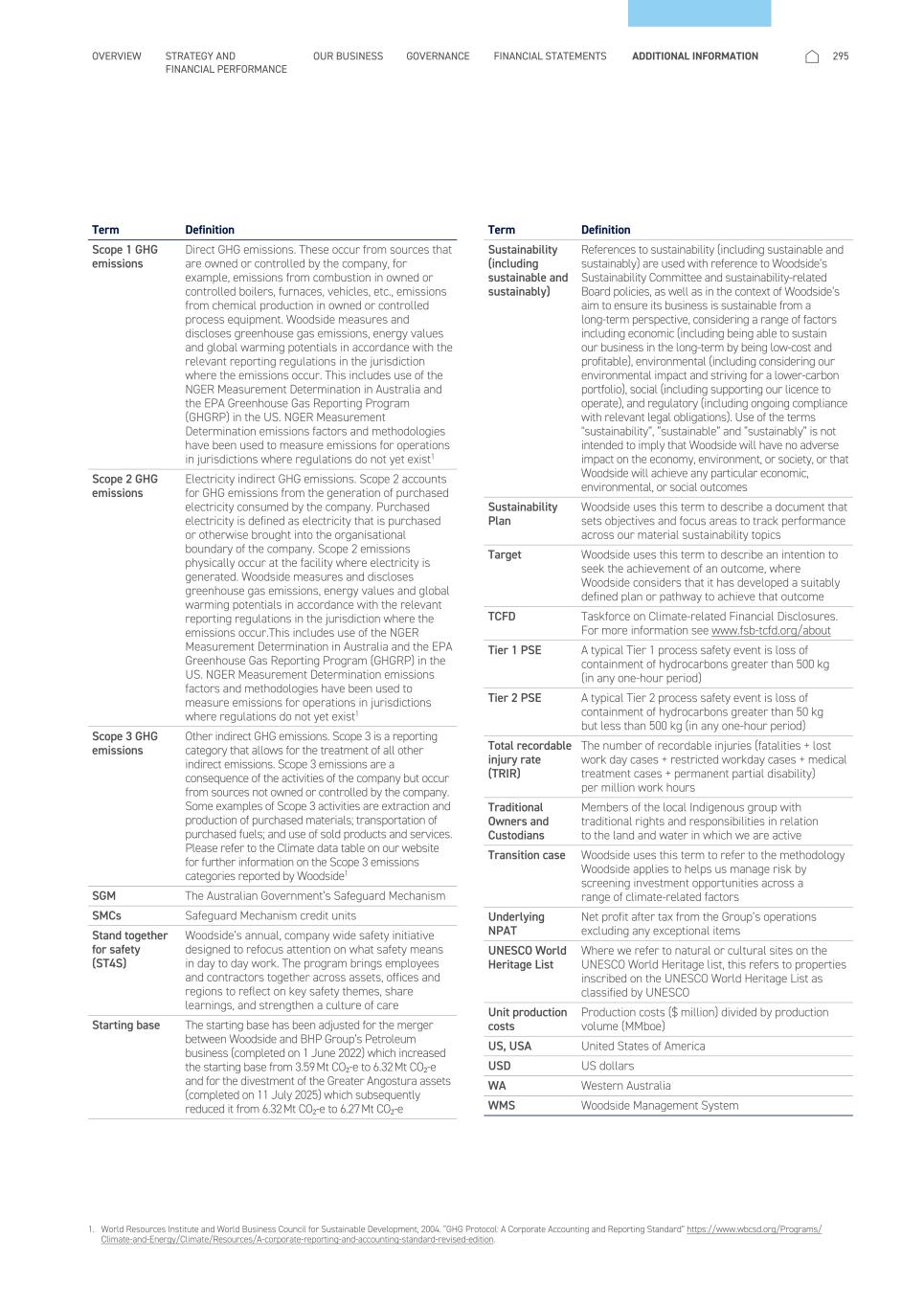
Scope 1 GHG emissions Direct GHG emissions. These occur from sources that are owned or controlled by the company, for example, emissions from combustion in owned or controlled boilers, furnaces, vehicles, etc., emissions from chemical production in owned or controlled process equipment. Woodside measures and discloses greenhouse gas emissions, energy values and global warming potentials in accordance with the relevant reporting regulations in the jurisdiction where the emissions occur. This includes use of the NGER Measurement Determination in Australia and the EPA Greenhouse Gas Reporting Program (GHGRP) in the US. NGER Measurement Determination emissions factors and methodologies have been used to measure emissions for operations in jurisdictions where regulations do not yet exist1 Scope 2 GHG emissions Electricity indirect GHG emissions. Scope 2 accounts for GHG emissions from the generation of purchased electricity consumed by the company. Purchased electricity is defined as electricity that is purchased or otherwise brought into the organisational boundary of the company. Scope 2 emissions physically occur at the facility where electricity is generated. Woodside measures and discloses greenhouse gas emissions, energy values and global warming potentials in accordance with the relevant reporting regulations in the jurisdiction where the emissions occur.This includes use of the NGER Measurement Determination in Australia and the EPA Greenhouse Gas Reporting Program (GHGRP) in the US. NGER Measurement Determination emissions factors and methodologies have been used to measure emissions for operations in jurisdictions where regulations do not yet exist1 Scope 3 GHG emissions Other indirect GHG emissions. Scope 3 is a reporting category that allows for the treatment of all other indirect emissions. Scope 3 emissions are a consequence of the activities of the company but occur from sources not owned or controlled by the company. Some examples of Scope 3 activities are extraction and production of purchased materials; transportation of purchased fuels; and use of sold products and services. Please refer to the Climate data table on our website for further information on the Scope 3 emissions categories reported by Woodside1 SGM The Australian Government’s Safeguard Mechanism SMCs Safeguard Mechanism credit units Stand together for safety (ST4S) Woodside’s annual, company wide safety initiative designed to refocus attention on what safety means in day to day work. The program brings employees and contractors together across assets, offices and regions to reflect on key safety themes, share learnings, and strengthen a culture of care Starting base The starting base has been adjusted for the merger between Woodside and BHP Group’s Petroleum business (completed on 1 June 2022) which increased the starting base from 3.59 Mt CO₂‑e to 6.32 Mt CO₂‑e and for the divestment of the Greater Angostura assets (completed on 11 July 2025) which subsequently reduced it from 6.32 Mt CO₂‑e to 6.27 Mt CO₂‑e Term Definition Sustainability (including sustainable and sustainably) References to sustainability (including sustainable and sustainably) are used with reference to Woodside’s Sustainability Committee and sustainability-related Board policies, as well as in the context of Woodside’s aim to ensure its business is sustainable from a long‑term perspective, considering a range of factors including economic (including being able to sustain our business in the long-term by being low-cost and profitable), environmental (including considering our environmental impact and striving for a lower-carbon portfolio), social (including supporting our licence to operate), and regulatory (including ongoing compliance with relevant legal obligations). Use of the terms "sustainability”, ”sustainable” and ”sustainably” is not intended to imply that Woodside will have no adverse impact on the economy, environment, or society, or that Woodside will achieve any particular economic, environmental, or social outcomes Sustainability Plan Woodside uses this term to describe a document that sets objectives and focus areas to track performance across our material sustainability topics Target Woodside uses this term to describe an intention to seek the achievement of an outcome, where Woodside considers that it has developed a suitably defined plan or pathway to achieve that outcome TCFD Taskforce on Climate-related Financial Disclosures. For more information see www.fsb-tcfd.org/about Tier 1 PSE A typical Tier 1 process safety event is loss of containment of hydrocarbons greater than 500 kg (in any one-hour period) Tier 2 PSE A typical Tier 2 process safety event is loss of containment of hydrocarbons greater than 50 kg but less than 500 kg (in any one-hour period) Total recordable injury rate (TRIR) The number of recordable injuries (fatalities + lost work day cases + restricted workday cases + medical treatment cases + permanent partial disability) per million work hours Traditional Owners and Custodians Members of the local Indigenous group with traditional rights and responsibilities in relation to the land and water in which we are active Transition case Woodside uses this term to refer to the methodology Woodside applies to helps us manage risk by screening investment opportunities across a range of climate-related factors Underlying NPAT Net profit after tax from the Group’s operations excluding any exceptional items UNESCO World Heritage List Where we refer to natural or cultural sites on the UNESCO World Heritage list, this refers to properties inscribed on the UNESCO World Heritage List as classified by UNESCO Unit production costs Production costs ($ million) divided by production volume (MMboe) US, USA United States of America USD US dollars WA Western Australia WMS Woodside Management System Term Definition OVERVIEW STRATEGY AND FINANCIAL PERFORMANCE OUR BUSINESS GOVERNANCE FINANCIAL STATEMENTS ADDITIONAL INFORMATION 295 1. World Resources Institute and World Business Council for Sustainable Development, 2004. “GHG Protocol: A Corporate Accounting and Reporting Standard” https://www.wbcsd.org/Programs/ Climate-and-Energy/Climate/Resources/A-corporate-reporting-and-accounting-standard-revised-edition.
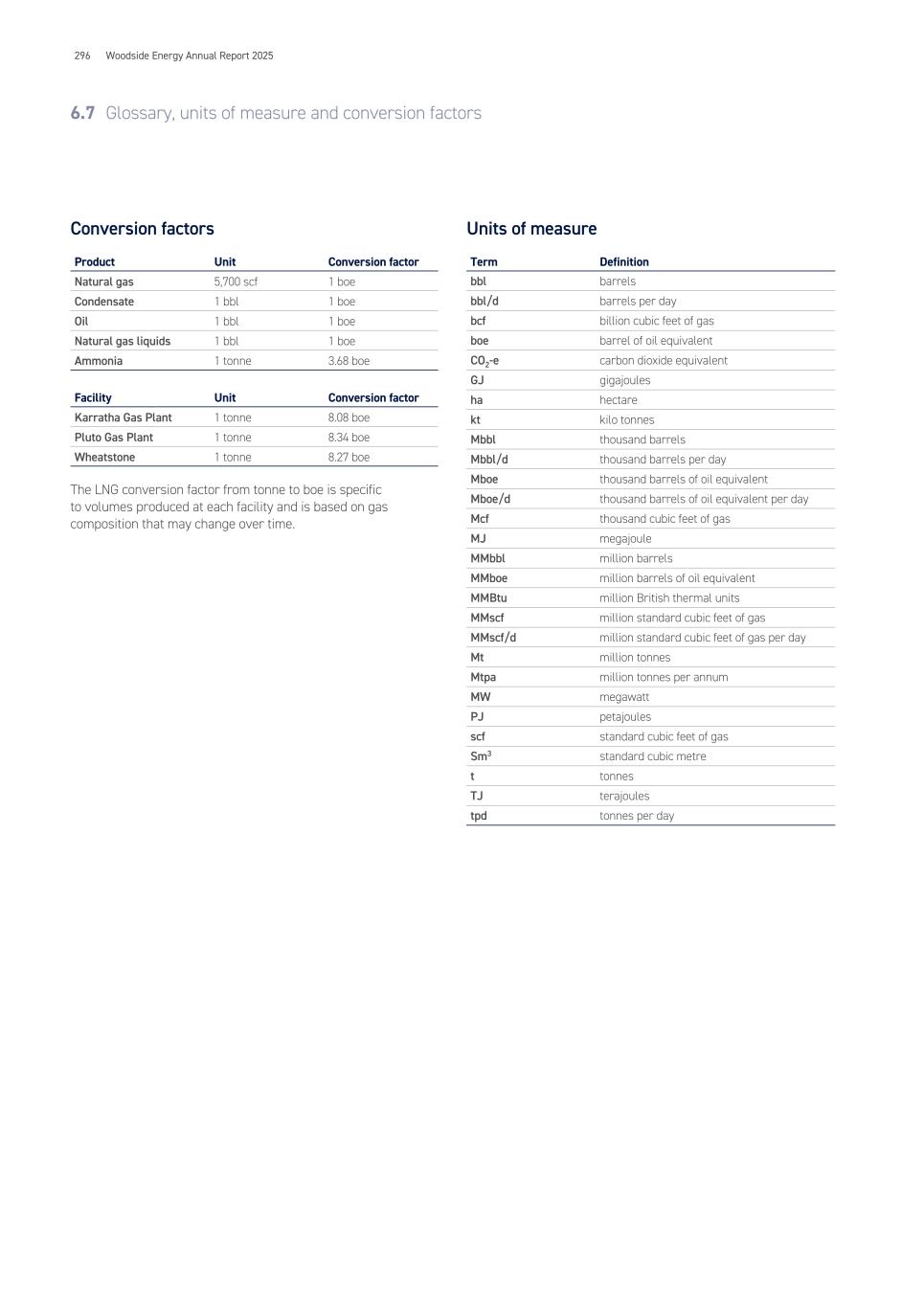
Conversion factors Product Unit Conversion factor Natural gas 5,700 scf 1 boe Condensate 1 bbl 1 boe Oil 1 bbl 1 boe Natural gas liquids 1 bbl 1 boe Ammonia 1 tonne 3.68 boe Facility Unit Conversion factor Karratha Gas Plant 1 tonne 8.08 boe Pluto Gas Plant 1 tonne 8.34 boe Wheatstone 1 tonne 8.27 boe The LNG conversion factor from tonne to boe is specific to volumes produced at each facility and is based on gas composition that may change over time. Units of measure Term Definition bbl barrels bbl/d barrels per day bcf billion cubic feet of gas boe barrel of oil equivalent CO2-e carbon dioxide equivalent GJ gigajoules ha hectare kt kilo tonnes Mbbl thousand barrels Mbbl/d thousand barrels per day Mboe thousand barrels of oil equivalent Mboe/d thousand barrels of oil equivalent per day Mcf thousand cubic feet of gas MJ megajoule MMbbl million barrels MMboe million barrels of oil equivalent MMBtu million British thermal units MMscf million standard cubic feet of gas MMscf/d million standard cubic feet of gas per day Mt million tonnes Mtpa million tonnes per annum MW megawatt PJ petajoules scf standard cubic feet of gas Sm3 standard cubic metre t tonnes TJ terajoules tpd tonnes per day 296 Woodside Energy Annual Report 2025 6.7 Glossary, units of measure and conversion factors
Unreasonable prejudice As permitted by Sections 299(3) and 299A(3) of the Corporations Act 2001, we have omitted certain information from our operating and financial review and Directors’ report in relation to our business strategy, future prospects and likely developments in our operations and the expected results of those operations in future financial years. We have done this on the basis that such information, if disclosed, would be likely to result in unreasonable prejudice to Woodside (for example, because the information is premature, commercially sensitive, confidential or could give a third party a commercial advantage). The omitted information relates to our internal budgets, forecasts and estimates, details of our business strategy, and LNG contractual pricing. Forward looking statements This report contains forward-looking statements. These statements may relate to Woodside’s business, goals, targets, aspirations, plans, expectations, market conditions, results of operations and financial condition, including, but not limited to, statements regarding the timing, completion and outcomes of transactions, construction costs and capital expenditures, supply and demand for Woodside’s products, development, completion and execution of Woodside’s projects, the expected benefits, cash flows and rates of return or other future results of investments, strategies and transactions, the payment of future dividends and the amount thereof, future results of projects, operating activities and new energy products, expectations and plans for renewables production capacity and investments in, and development of, renewables projects, expectations and guidance with respect to production, production costs and other costs, capital expenditure, abandonment expenditure, exploration expenditure and gas hub exposure, trends in commodity prices and currency exchange rates, adoption and implementation of new technologies and expectations regarding the achievement of Woodside’s Scope 1 and 2 greenhouse gas emissions targets and Scope 3 investment and emissions abatement targets (in each case on a net equity or gross equity basis as specified) and other climate and sustainability goals. All statements, other than statements of historical or present facts, are forward-looking statements and generally may be identified by the use of forward-looking words such as “aim”, “anticipate”, “aspire”, “believe”, “enable”, “estimate”, “expect”, “forecast”, “foresee”, “guidance”, “intend”, “likely”, “may”, “objective”, “outlook”, “pathway”, “plan”, “position”, “potential”, “project”, , “schedule”, “seek” “should”, “strategy”, “strive”, “target”, “will” and other similar words or expressions. Forward-looking statements in this report are not guidance, forecasts, guarantees or predictions of future events or performance, but are in the nature of future expectations that are based on management’s current expectations. Those statements and any assumptions on which they are based are subject to change without notice and are subject to inherent known and unknown risks, uncertainties, contingencies and other factors, many of which are beyond the control of Woodside, its related bodies corporate and their respective officers, directors, employees, advisers or representatives. Important factors that could cause actual results to differ materially from those in the forward-looking statements and the assumptions on which they are based include, but are not limited to, fluctuations in commodity prices, actual demand for Woodside products, currency fluctuations, geotechnical factors, drilling and production results, gas commercialisation, development progress, operating results, engineering estimates, reserve and resource estimates, loss of market, industry competition, pace of technology developments, sustainability and environmental risks, climate related transition and physical risks, safety and personnel risks, changes in accounting standards, economic and financial markets conditions in various countries and regions the actions of third parties, project delay or advancement, regulatory approvals, political risks and the impact of armed conflict and political instability (such as the ongoing conflicts in Ukraine and in the Middle East) on economic activity and oil and gas supply and demand, cost estimates, legislative, fiscal and regulatory developments, including those related to the imposition of tariffs and other trade restrictions, and the effect of future regulatory or legislative actions on Woodside or the industries in which it operates, including potential changes to tax laws, the impact of general economic conditions, inflationary conditions, prevailing exchange rates and interest rates and conditions in financial markets, and risks associated with acquisitions, mergers and joint ventures, including difficulties integrating or separating businesses, uncertainty associated with financial projections, restructuring, increased costs and adverse tax consequences, and uncertainties and liabilities associated with acquired and divested properties and businesses. A more detailed summary of the key risks relating to Woodside and its business can be found in Section 3.7 – Risk factors. You should review and have regard to these risks when considering the information contained in this report. If any of the assumptions on which a forward-looking statement is based were to change or be found to be incorrect, this would likely cause outcomes to differ from the statements made in this report. Investors are strongly cautioned not to place undue reliance on any forward-looking statements. Actual results or performance may vary materially from those expressed in, or implied by, any forward-looking statements. None of Woodside nor any of its related bodies corporate, nor any of their respective officers, directors, employees, advisers or representatives, nor any person named in this report or involved in the preparation of the information in this report, makes any representation, assurance, guarantee or warranty (either express or implied) as to the accuracy or likelihood of fulfilment of any forward-looking statement, or any outcomes, events or results expressed or implied in any forward‑looking statement in this report. All forward-looking statements contained in this report reflect Woodside’s views held as at the date of this report and, except as required by applicable law, neither Woodside, its related bodies corporate, nor any of their respective officers, directors, employees, advisers or representatives nor any person named in this report or involved in the preparation of the information in this report intends to, undertakes to, or assumes any obligation to, provide any additional information or update or revise any of these statements after the date of this report, either to make them conform to actual results or as a result of new information, future events or results, changes in Woodside’s expectations or otherwise. Past performance (including historical financial and operational information) is given for illustrative purposes only. It is not necessarily, a reliable indicator of future performance, including future security prices. OVERVIEW STRATEGY AND FINANCIAL PERFORMANCE OUR BUSINESS GOVERNANCE FINANCIAL STATEMENTS ADDITIONAL INFORMATION 297 6.8 Information about this report
Climate strategy and emissions data All greenhouse gas emissions data in this report are estimates, due to the inherent uncertainty and limitations in measuring or quantifying greenhouse gas emissions. Methodologies for measuring or quantifying greenhouse gas emissions may evolve as market practices continue to develop and data quality and quantity continue to improve. Woodside “greenhouse gas” or “emissions” information reported are Scope 1 GHG emissions, Scope 2 GHG emissions, and/or Scope 3 GHG emissions, each on a net equity or gross equity basis as specified. Actual performance against Woodside’s targets (including items that are described as a target) and aspirations or goals may be affected by various risks associated with Woodside’s business, the uncertainty as to how the global energy transition to a lower carbon economy will evolve, and physical risks associated with climate change, many of which are beyond Woodside’s control. The glossary and footnotes to this report provide further clarification of “lower-carbon” where applicable. Woodside uses the term “lower-carbon services” to describe technologies, such as CCUS or offsets, that may be capable of reducing the net greenhouse gas emissions of our customers. Additionally, the developments of environmental and climate change-related issues discussed in this report are based on various frameworks and the interests of various stakeholders that are subject to evolve independently of our will. Moreover, our disclosures on such issues, including climate-related disclosures, may include information that is not necessarily “material” under US securities laws for SEC reporting purposes or under applicable securities law. Scope 3 targets are subject to commercial arrangements, commercial feasibility, regulatory and joint venture approvals, and third party activities (which may or may not proceed). Individual investment decisions are subject to Woodside’s investment targets. Such targets are not guidance. Scope 3 targets potentially include both organic and inorganic investment. Limitations of scenario analysis This report also includes scenario analysis. Climate scenarios are potential future climate states based on sets of assumptions around changes in global behaviours. They are not forecasts and may not be reflective of Woodside’s own expectations. It is difficult to predict which, if any, of the scenarios discussed in this report might eventuate. The assumptions underpinning a scenario may or may not be, or prove to be, correct. Actual outcomes may be impacted by factors beyond the assumptions disclosed. Industry and market data This report contains industry, market and competitive position data that are based on industry publications, third-party studies, and Woodside’s internal estimates and research. These industry publications and third-party studies generally state that the information they contain has been obtained from sources believed to be reliable, although they do not guarantee the accuracy or completeness of such information. While Woodside believes that each of these publications and third-party studies is credible and has been prepared by a reputable source, Woodside has not independently verified the market and industry data obtained from these third-party sources and cannot guarantee the accuracy or completeness of such data. There may be differences in the way third parties calculate or report greenhouse gas emissions compared to Woodside, which means third party data may not be comparable to Woodside’s data. Accordingly, undue reliance should not be placed on any of the industry, market and competitive position data contained in this report. Woodside accepts no responsibility for any loss, damage, cost or expense (whether direct or indirect) incurred by you as a result of any error, omission or misrepresentation in information in this report. Forecasts and other forward-looking information obtained from these sources are subject to the same qualifications and uncertainties as the other forward-looking statements contained in this report and may differ among third-party sources. These forecasts and forward-looking information are subject to uncertainty and risk due to a variety of factors, including those described in Section 3.7 – Risk factors and in this section. These and other factors could cause results to differ materially from those expressed in Woodside’s forecasts or estimates or those of independent third parties. While Woodside believes its internal research is credible and its selection of industry publications and third-party studies and the description of its market and industry are appropriate, neither such research nor these descriptions have been verified by any independent source. Basis of presentation Woodside’s financial statements are prepared in accordance with the Australian Accounting Standards and other authoritative pronouncements of the Australian Accounting Standards Board (AASB) and comply with the International Financial Reporting Standards (IFRS) as issued by the International Accounting Standards Board (IASB). This report also includes Woodside’s mandatory climate-related disclosures under AASB S2, which are contained in Section 3. – Sustainability Report. Other important information In this report, references to a year are to the calendar and financial year ended 31 December 2025 unless otherwise stated. All references to dollars, cents of $ in this report are references to US currency and are stated in Woodside share, unless otherwise stated. Unless otherwise stated, all Woodside results set out in this Annual Report 2025 include the performance of the interests acquired as part of the merger with BHP’s petroleum business from 1 June 2022. For more information on Woodside’s climate strategy, including references to “lower-carbon” as part of that strategy, and emissions data, refer to the Sustainability section at woodside.com. 298 Woodside Energy Annual Report 2025 6.8 Information about this report

Profit and loss (USDm)1,2 Operating revenues LNG 5,960 6,401 8,165 11,289 5,359 2,519 3,664 3,761 2,674 2,751 Pipeline gas 1,324 1,349 1,374 1,362 43 73 85 89 153 303 Natural gas liquids (NGLs) 241 306 281 206 60 16 44 25 43 34 Crude oil and condensate 5,257 4,887 3,981 3,758 1,316 843 946 952 813 715 Processing and services revenue 177 220 184 175 143 142 119 202 192 202 Trading revenue — — — — — — — 210 53 70 Other hydrocarbon revenue — — — — — — — 1 47 — Shipping and other revenue 25 16 9 27 41 7 15 — — — Total 12,984 13,179 13,994 16,817 6,962 3,600 4,873 5,240 3,975 4,075 EBITDAX excluding impairment 9,460 9,605 9,719 11,694 4,454 1,991 3,680 4,041 3,095 3,004 EBITDA excluding impairment 9,277 9,276 9,363 11,234 4,135 1,922 3,531 3,814 2,918 2,734 EBIT 3,889 4,514 3,307 9,186 3,493 (5,171) 1,091 2,278 1,714 1,388 Exploration and evaluation (excluding amortisation of permit acquisition) 183 329 356 460 319 69 149 227 177 270 Depreciation and amortisation 5,240 4,754 4,135 2,938 1,687 1,812 1,688 1,451 1,188 1,320 Amortisation of license acquisition costs 5 8 4 10 3 12 15 46 16 26 Impairment/impairment reversal 143 — 1,917 (900) (1,048) 5,269 737 39 — — Net finance costs 40 145 34 12 203 269 229 183 84 48 Tax expense 1,112 723 1,551 2,599 1,254 (1,465) 480 628 465 367 Non-controlling interest 19 73 62 77 53 53 39 103 96 105 Reported NPAT (excluding NCI) 2,718 3,573 1,660 6,498 1,983 (4,028) 343 1,364 1,069 868 Reported EPS (cents)3 143 189 88 430 206 (424) 37 148 123 104 DPS (cents) 112 122 140 253 135 38 91 144 98 83 Balance sheet (USDm)2 Total assets 66,501 61,264 55,361 59,321 26,474 24,623 29,353 27,088 25,399 24,753 Debt 13,722 11,620 6,498 6,772 6,797 7,492 6,849 4,071 5,065 4,973 Net debt 8,010 7,697 4,749 583 3,772 3,888 2,791 2,397 4,747 4,688 Shareholder equity (net of non- controlling interest) 35,914 35,399 34,399 36,336 13,443 12,075 16,617 17,489 15,081 14,839 Cash flow (USDm) and capital expenditure (USDm) Cash flow from Operations 7,192 5,847 6,145 8,811 3,792 1,849 3,305 3,296 2,400 2,587 Investing (7,911) (5,747) (5,585) (2,265) (2,941) (2,112) (1,238) (1,772) (1,568) (2,473) Financing 2,491 2,101 (5,000) (3,364) (1,424) (203) 317 (159) (805) 51 Capital expenditure4 4,703 5,306 5,736 4,115 2,638 1,946 1,192 1,721 1,367 2,179 ROACE5 6.7% 8.5% 6.4% 24.5% 15.6% (21.0%) 4.1% 9.3% 7.4% 6.2% Return on equity 7.6% 10.1% 4.8% 17.9% 14.8% (33.4%) 2.1% 7.8% 7.1% 5.8% Gearing 18.2% 17.9% 12.1% 1.6% 21.9% 24.4% 14.4% 12.1% 23.9% 24.0% 2025 2024 2023 2022 2021 2020 20192 2018 20171 2016 OVERVIEW STRATEGY AND FINANCIAL PERFORMANCE OUR BUSINESS GOVERNANCE FINANCIAL STATEMENTS ADDITIONAL INFORMATION 299 6.9 Ten-year comparative data summary

Volumes1 Sales (million boe) LNG11 93.6 96.6 104.1 96.6 91.2 81.2 75.3 69.6 61.2 63.6 Pipeline gas 35.6 37.8 39.6 28.4 2.5 5.3 6.2 5.8 7.6 14.5 NGLs 5.8 5.4 7.1 4.6 0.7 0.4 0.7 0.4 0.7 0.7 Crude oil and condensate 77.2 64.2 50.3 39.3 17.2 19.9 15.2 13.4 14.6 16.2 Total 212.2 204.0 201.1 168.9 111.6 106.8 97.4 89.2 84.1 95.0 Production (million boe)6 LNG 79.1 85.5 88.6 85.1 70.8 75.0 67.7 71.9 61.7 63.7 Pipeline gas 36.2 38.6 39.7 28.6 2.5 5.3 6.1 5.8 7.3 14.5 NGLs 5.7 6.6 7.1 5.3 0.5 0.5 0.5 0.6 0.6 0.7 Crude oil and condensate 77.8 63.2 51.8 38.7 17.3 19.5 15.3 13.1 14.8 16.0 Total (million boe) 198.8 193.9 187.2 157.7 91.1 100.3 89.6 91.4 84.4 94.9 Other data Reserves (Proved plus Probable) Natural gas (Tcf)7 12.10 12.59 16.02 16.43 11.67 4.50 5.65 6.05 6.54 7.09 Reserves (Proved plus Probable) Crude oil and condensate (MMbbl)7 833.9 849.7 908.7 710.6 244.4 250.7 222.4 175.9 186.9 198.6 Reserves (Proved plus Probable) NGLs (MMbbl)7 34.4 33.9 37.1 48.0 — — — — — — Other Employees8 4,693 4,718 4,667 4,376 3,684 3,670 3,834 3,662 3,597 3,511 Shares High (A$) 27.30 32.46 39.00 39.16 27.40 36.14 37.40 39.00 33.97 31.88 Low (A$) 18.61 23.10 29.53 21.93 19.20 15.27 30.49 28.45 28.16 23.94 Close (A$) 23.59 24.60 31.06 35.44 21.93 22.74 34.38 31.32 33.08 31.16 Number (000's) 1,901,100 1,898,750 1,898,750 1,898,750 969,632 962,226 942,287 936,152 842,445 842,445 Number of shareholders9 578,895 607,388 620,891 649,871 261,019 276,431 220,065 209,753 209,383 214,350 Market capitalisation (USD equivalent at reporting date) 29,638 28,960 40,168 45,759 15,948 16,817 22,666 20,681 21,762 18,922 Market capitalisation (AUD equivalent at reporting date) 44,847 46,709 58,975 67,292 21,264 21,881 32,396 29,320 27,868 26,251 Finding costs ($/boe) (3-year average)10 6.28 11.30 10.19 9.78 14.65 30.44 21.71 29.90 26.21 39.06 Reported effective income tax rate (%) 21.8% 18.3% 27.5% 30.7% 32.0% 20.5% 57.2% 31.7% 34.0% 35.9% Net debt/total market capitalisation (%) 27.0% 26.6% 11.8% 1.3% 23.7% 23.1% 12.3% 11.6% 21.8% 24.8% 2025 2024 2023 2022 2021 2020 20192 2018 20171 2016 1. 2017 has been restated for the impact of AASB 15 Revenue from contracts with customers. Comparative financial information prior to 2016 has not been restated for AASB 15. 2. 2019 includes the adoption of AASB 16 Leases. 3. Earnings per share has been calculated using the following weighted average number of shares (2025: 1,895,437,383, 2024: 1,895,703,924; 2023: 1,896,498,169; 2022: 1,511,257,404; 2021: 962,604,811; 2020: 951,113,086; 2019: 935,833,092; 2018: 921,165,018; 2017: 866,201,877; 2016: 835,011,896) 4. Includes other corporate spend. The 2022 capital expenditure has been restated to reflect this. Information prior to 2022 is not available. 5. The calculation has been updated to use total equity rather than equity attributable to equity holders of the parent. Comparative information prior to 2023 has been restated to be presented on the same basis. 6. Includes production of 197.6 MMboe (2024: 192.7 MMboe) from Woodside reserves and 1.2 MMboe (2024: 1.2 MMboe) primarily from feed gas purchased from Pluto non-operating participants processed through the Pluto-KGP Interconnector. 7. Reporting of reserves by product changed in 2022 to include natural gas; crude oil and condensate; NGLs. For years prior to 2022, NGLs were included in natural gas and crude oil and condensate were reported separately. Years prior to 2022 have otherwise not been restated for any other changes in reporting methodology. 8. Includes vacation, cadets and scholarship students. Comparative information prior to 2023 has not been restated. 9. As per the date specified in the relevant Annual Report. 10. Finding cost methodology is in accordance with SEC industry standard. The 2020 outcome excludes the impact of Greater Pluto (WA-404-P) Proved (1P) Undeveloped Reserves of 91 MMboe to Best Estimate (2C) being reclassified to Contingent Resources, resulting from impairment of Pluto (WA-404-P). 11. LNG sales volumes exclude periodic adjustments reflecting the arrangements governing Wheatstone LNG sales. Comparative information prior to 2023 has been restated to be presented on the same basis. 300 Woodside Energy Annual Report 2025 6.9 Ten-year comparative data summary


Head Office Woodside Energy Group Ltd Mia Yellagonga 11 Mount Street Perth WA 6000 Postal Address GPO Box D188 Perth WA 6840 Australia T +61 8 9348 4000 E companyinfo@woodside.com Woodside Energy Group Ltd ABN 55 004 898 962 woodside.com