| Life Unlimited Annual Report 2025 |

| 1 These non-IFRS financial measures are explained and reconciled to the most directly comparable financial measure prepared in accordance with IFRS on pages 285–292. The images used throughout the report represent the ways that Smith+Nephew is taking the limits off living and helping patients live Life Unlimited. Images used are not photographs of our patients unless expressly indicated. Performance Group revenue Operating profit Trading profit1 Earnings per share (EPS) Adjusted Return on Invested Capital (ROIC)1 $6,164m $794m $1,211m 72.1¢ 8.3% +6.1% Reported +5.3% Underlying1 +20.7% +15.5% +52.8% +90bps Cash generated from operations Operating profit margin Trading profit margin1 Adjusted earnings per share1 (EPSA) Dividend per share $1,549m 12.9% 19.7% 102.0¢ 39.1¢ +24.4% +160bps +160bps +21.0% +4.3% Contents Strategic Report Our performance 0 At a glance 2 Chair’s statement 4 Chief Executive Officer’s review 6 Our marketplace 12 Our business model 14 Key Performance Indicators 16 Financial review 18 Together we are… …Innovators Research & Development 27 Manufacturing, Quality & Regulatory Affairs 33 …Serving our customers Our strong sales force 37 Orthopaedics 39 Sports Medicine & ENT 44 Advanced Wound Management 49 …Living without limits Our patient case studies 54 …Building our Way to Win Our cultural framework 59 …Working responsibly ESG excellence 65 TCFD reporting 69 Risk report 78 Governance Governance at a glance 98 Board leadership and Company purpose 102 S172 statement 114 Our purpose and stakeholders 117 Nomination & Governance Committee Report 127 Compliance & Culture Committee Report 136 Audit Committee Report 141 Remuneration Committee Report 147 Directors’ Report 194 Accounts Statement of Directors’ responsibilities 198 Independent auditor’s UK report 199 Group financial statements 211 Notes to the Group accounts 215 Company financial statements 266 Notes to the Company accounts 268 Other information Group information 274 Cybersecurity risk management and governance 274 Risk factors 275 Non-IFRS financial information 285 Shareholder information 293 Cross-reference to Form 20-F 299 SASB reporting 302 Glossary 304 Index 305 References from business unit sections 306 Financial calendar 312 Smith+Nephew Annual Report 2025 28268_S+N_AR25_Flat_Cover_AW_16.5mm_Spine_Bookproof_060326_Final.indd 2 06/03/2026 21:51 |

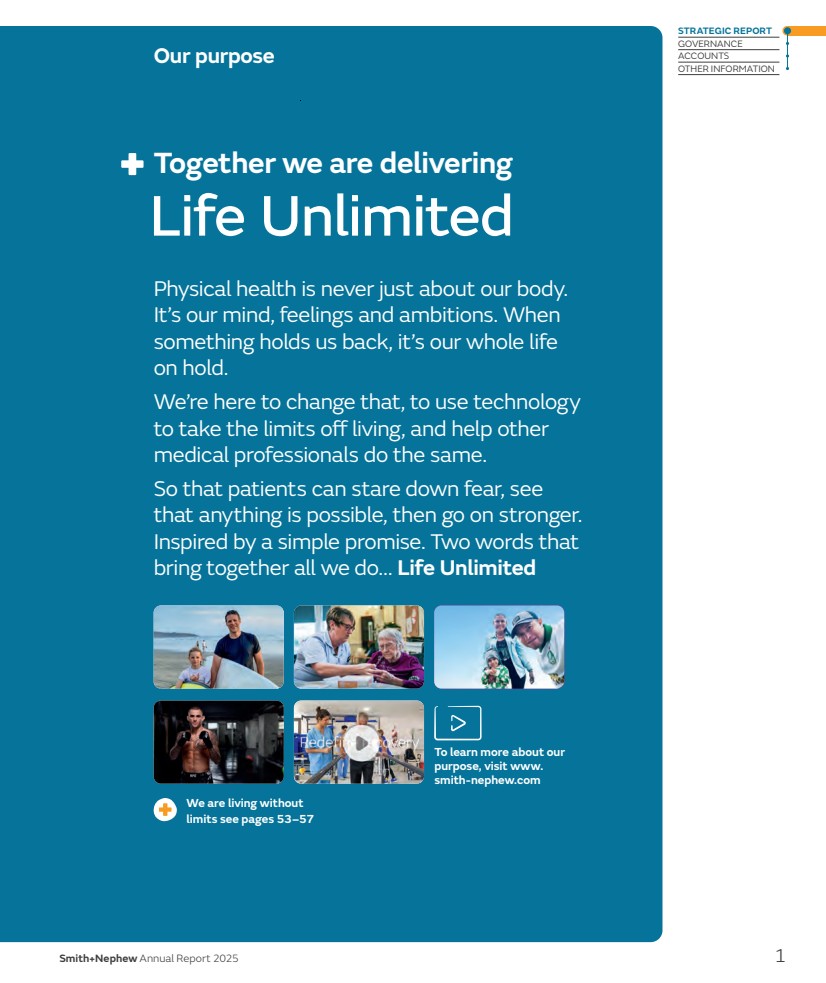
| Our purpose Together we are delivering Life Unlimited Physical health is never just about our body. It’s our mind, feelings and ambitions. When something holds us back, it’s our whole life on hold. We’re here to change that, to use technology to take the limits off living, and help other medical professionals do the same. So that patients can stare down fear, see that anything is possible, then go on stronger. Inspired by a simple promise. Two words that bring together all we do… Life Unlimited To learn more about our purpose, visit www. smith-nephew.com We are living without limits see pages 53–57 Smith+Nephew Annual Report 2025 1 STRATEGIC REPORT GOVERNANCE ACCOUNTS OTHER INFORMATION 01_SN_AR25_v100.indd 1 05/03/2026 17:13 |
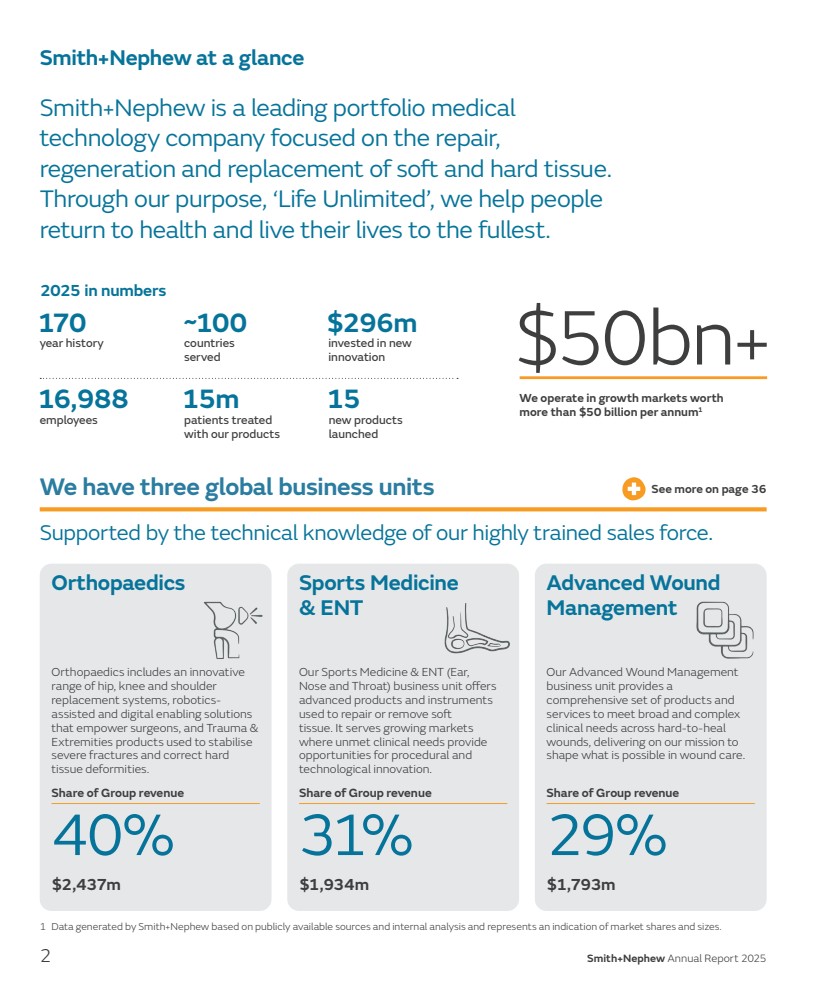
| Sports Medicine & ENT Our Sports Medicine & ENT (Ear, Nose and Throat) business unit offers advanced products and instruments used to repair or remove soft tissue. It serves growing markets where unmet clinical needs provide opportunities for procedural and technological innovation. Orthopaedics Orthopaedics includes an innovative range of hip, knee and shoulder replacement systems, robotics-assisted and digital enabling solutions that empower surgeons, and Trauma & Extremities products used to stabilise severe fractures and correct hard tissue deformities. Advanced Wound Management Our Advanced Wound Management business unit provides a comprehensive set of products and services to meet broad and complex clinical needs across hard-to-heal wounds, delivering on our mission to shape what is possible in wound care. We have three global business units Supported by the technical knowledge of our highly trained sales force. Smith+Nephew is a leading portfolio medical technology company focused on the repair, regeneration and replacement of soft and hard tissue. Through our purpose, ‘Life Unlimited’, we help people return to health and live their lives to the fullest. 2025 in numbers 170 year history ~100 countries served $296m invested in new innovation 16,988 employees 15m patients treated with our products 15 new products launched $50bn+ We operate in growth markets worth more than $50 billion per annum1 See more on page 36 Share of Group revenue 29% $1,793m Share of Group revenue 31% $1,934m Share of Group revenue 40% $2,437m 1 Data generated by Smith+Nephew based on publicly available sources and internal analysis and represents an indication of market shares and sizes. 2 Smith+Nephew Annual Report 2025 Smith+Nephew at a glance 02_SN_AR25_Chair_CEO_Rev_v211.indd 2 05/03/2026 17:18 |
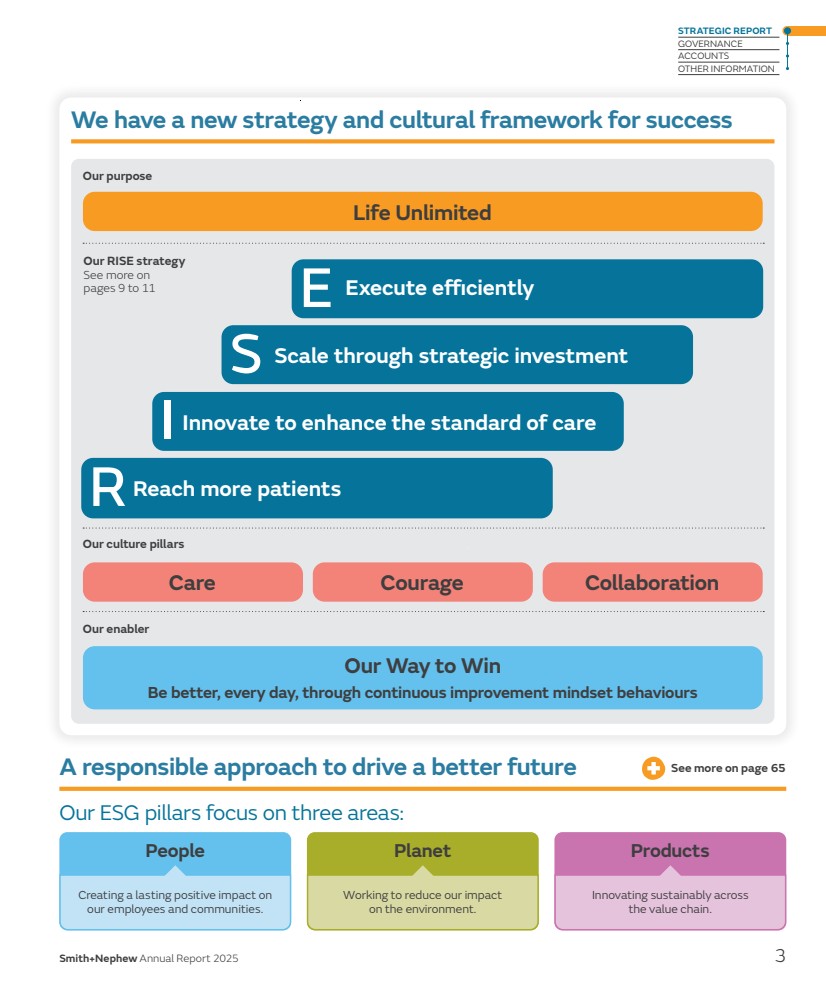
| People Creating a lasting positive impact on our employees and communities. Planet Working to reduce our impact on the environment. Products Innovating sustainably across the value chain. A responsible approach to drive a better future Our ESG pillars focus on three areas: See more on page 65 We have a new strategy and cultural framework for success Our purpose Our enabler Our culture pillars Our RISE strategy See more on pages 9 to 11 Care Life Unlimited Courage Collaboration I Innovate to enhance the standard of care S Scale through strategic investment E Execute efficiently R Reach more patients Our Way to Win Be better, every day, through continuous improvement mindset behaviours Smith+Nephew Annual Report 2025 3 STRATEGIC REPORT GOVERNANCE ACCOUNTS OTHER INFORMATION 02_SN_AR25_Chair_CEO_Rev_v211.indd 3 05/03/2026 17:18 |
| and Advanced Wound Management businesses; and to embed sustainable improvements in operations and performance to improve productivity and support margin expansion. I am pleased to say that these objectives have been largely achieved by Deepak and his team. Over the last three years, Smith+Nephew has transformed from being a low growth business to one which can deliver mid single-digit revenue growth; trading margin has significantly expanded despite external headwinds; adjusted ROIC1 has improved by 170bps, and free cash flow1 has improved from $56 million in 2022 to $840 million in 2025. These metrics are evidence of a business which has been materially improved by a process of transformation. At our Capital Markets Days in December, management set out our strategy for the next three years, which is called, appropriately, “RISE”. It focuses on Reach (expanding our product portfolio and market penetration to reach more patients); Innovation (accelerating growth through innovation in products and services); Scale through strategic investment (shifting capital allocation to higher growth areas and investing in market access and development); and Executing efficiently (driving Group-wide productivity improvements and further operational savings). Alongside these operational objectives, management has set out ambitious but achievable financial targets. Over the next three years, the team believes it can deliver organic revenue1 compound annual growth rate (CAGR) of 6-7%, trading profit1 CAGR of 9-10%, and, in 2028, free cash flow1 of over $1 billion and adjusted ROIC1 of 12-13%. Achieving these targets will deliver significant value to shareholders. Deepak covers RISE and the three-year financial targets in greater detail in the following pages. An effective, energised Board Over the last two and a half years, the Board has seen much change in its membership: a new Chair (me), a new Executive Director (John Rogers, Chief Financial Officer) and six new Non-Executive Directors, amongst whom are a new senior independent director (Thérèse Esperdy, who will succeed Angie Risley at the AGM in May 2026); a new Chair of the Audit Committee (Jez Maiden); and a new chair of the Remuneration Committee (Sybella Stanley). Dear Fellow Shareholder After three years of delivery, we are now ready to RISE. 2025 performance As in the two previous financial years under Deepak’s leadership, the targets we set at the beginning of the year were met or exceeded, with revenue up 6.1% on a reported basis which equates to 5.3% on an underlying basis1 and trading profit margin and operating profit margin1 both up 160bps. Free cash flow1 was up by $289 million, with cash generated from operations up $304 million and adjusted return on invested capital (ROIC)1 up 90bps including a -160bps headwind from portfolio rationalisation. Adjusted earnings per share1 increased by 17.7¢ per share (earnings per share up 24.9¢), and the Board is recommending a final dividend of 24.1¢ per share. This is in addition to the $500 million share buyback announced and executed in the second half of 2025. Together with the interim dividend of 15.0¢ per share, this will give a total distribution of 39.1¢ per share. Full details of our financial performance are set out in the report, but the final year of our 12-Point Plan clearly underlines the extent of the operational and financial transformation that the Smith+Nephew management team has delivered, and the 28% increase in the share price during the year was pleasing evidence that investors are beginning to appreciate the progress we have made. Strategy Our 12-Point Plan, which was presented to investors in 2022, set our priorities for the three years to 2025. Its objectives were: to improve the performance of the Orthopaedics business; to accelerate growth in our leading Sports Medicine In managing this level of change on the Board, we have been keen to balance the skills and experience needed for a complex, highly regulated business where growth is driven by innovation in advanced technologies; where product portfolio management is a key contributor to value; which has complex supply chains and significant in-house manufacturing. And it is also a business which faces many of the same challenges as other listed companies of similar scale, such as AI, IT transformation and cyber defence, skills and succession, turbulent geopolitics, M&A, investor relations and capital markets. Recent additions to our Board reflect these diverse requirements. Both David King and Garheng Kong are US-based and bring deep knowledge of the MedTech sector. David has been both CEO and Chair of significant US MedTech companies, and Garheng is by training a physician, engineer and a scientist and a highly successful investor in high-growth MedTech companies. Thérèse Esperdy is based in the US and has a long and distinguished track record as the Chair of one FTSE-50 company and as Senior Independent Director of another, as well as senior executive experience in investment banking in Asia and the US. Sybella Stanley has been Chair of the Remuneration Committee at two other UK-listed businesses and has wide experience of M&A. I think that this combination of skills and experience will serve the Board well in the years ahead. During 2025, Bob White stepped down from our Board to serve as the CEO of Olympus Corporation, and Angie Risley, currently Senior Independent Director and formerly Chair of the Remuneration Committee, will step down at the May AGM after nine years of service on our Board. I am profoundly grateful for the service of both of them, as they have brought wisdom, judgement and common sense to our proceedings. Marc Owen completes his ninth year of service in September 2026, but at the request of the Board has agreed to stay on into 2027. His knowledge of both MedTech and Smith+Nephew is deep and his contribution to the Board is immense, and I am grateful that he has agreed to continue to serve on the Board a little longer to support continuity. 4 Smith+Nephew Annual Report 2025 Chair’s statement 02_SN_AR25_Chair_CEO_Rev_v211.indd 4 05/03/2026 17:18 |
| I am pleased to say that by the end of December 2025 we are close to the 40% ambition of women on the Board and through Board rotation and retirements we will make further progress. Angie Risley will be succeeded by Thérèse Esperdy as Senior Independent Director, ensuring continued gender diversity amongst the most senior Board positions. The Board also places strong emphasis on supporting our communities and reducing our impact on the planet and its resources. During the year, we reviewed progress across our sustainability strategy aligned to the objectives and interests of our key stakeholders. More information on our progress against our sustainability targets, including our roadmap to net zero, can be found on pages 64 to 77 and in our Sustainability Report. The Board continues to welcome open dialogue with our shareholders on topics of interest and will continue to listen and embed feedback to shape our approach. The remuneration journey continues We cannot deliver our future strategy and plans to create value for stakeholders unless the Board has the ability to attract and retain management who have the skills, knowledge and experience to lead Smith+Nephew to achieve its full potential. The centre of gravity for the MedTech industry is the US, and this is reflected in the fact that we have an American citizen, resident in the US, as our CEO, and 10 out of 12 of the Group’s Executive Committee are based in the US. Over 50% of our revenues and 35% of our employees are based in the US, compared to 4% and 7%, respectively, in the UK. To retain and recruit MedTech executives of the capability expected by our stakeholders to drive value creation, the Board requires the flexibility to offer compensation structures which are competitive in the market in which executive talent live and work, which in Smith+Nephew’s case is likely to be the US. Trying to persuade successful US-based executives that they should leave their current employment and accept substantially less money simply because Smith+Nephew is UK listed is not likely to be successful. In 2023, we carried out a thorough review of our Executive Directors’ pay, and, as a consequence, we came to shareholders in 2024 for approval out of cycle for a Remuneration Policy for US-based Executive Directors which was more closely aligned to the norms of employees living and working in the US, the home of MedTech. We wish to thank shareholders for their support of the 2024 policy at a time when our ambitions did not fit squarely within the four corners of established UK Corporate Governance norms on remuneration. We also said at the time that our request was the first step in a journey to align our pay practices with the markets from which we source our executives. In 2025, and to coincide with the launch of our RISE strategy, we reviewed Executive Directors’ pay, and concluded that we had to look again at this thorny issue for two reasons. First, when we carried out the first review in 2023, Deepak Nath was only 18 months into his first listed-company CEO role; his pay was set at a level that was at the time between Median and Lower Quartile of a benchmark peer group, which the Board felt was appropriate at the time. By the time of this year’s AGM, Deepak will have been in role for more than four years and has shown himself to be one of the most effective CEOs in the MedTech industry. Under his leadership, the financial and operational performance of the business has been transformed, and the Total Shareholder Return over the last three years has far outperformed its MedTech peer group (+22% vs -6% for peer group), and the Board believes he should be paid in line with peers in the industry. The Board also need to have a Policy which allows us to recruit someone else of the same calibre to take Smith+Nephew forward, should we need to do so. Secondly, over the last two years Executive Director pay amongst our MedTech benchmark peer group has increased very markedly, resulting in current compensation being well below Lower Quartile and around half that of the Median in the peer group. We do not believe this is a sustainable position for us to be in, and in our Remuneration Report we set out the changes we propose to rectify the situation. The decision to recommend a new policy was taken after our Chair of Remuneration, Sybella Stanley, and I had consulted with investors holding approximately 70% of our issued share capital over the last few months, and the Board strongly believes that making these changes is in the best interests of all stakeholders. Outlook: ambitious and achievable Since Smith+Nephew’s founding as a pharmacy in 1856, we have delivered innovation that has transformed patient care. From our roots in Advanced Wound Management we launched the first mass-produced elastic adhesive bandage, Elastoplast, in 1928 which combined compression, fixation and protection in a single product. In Sports Medicine we were an innovator in arthroscopic surgery and bio-inductive regeneration. In Orthopaedics we have pioneered advanced knee systems, cementless hips and robotic surgery. Over the last three years, Smith+Nephew has continued that tradition of innovation, and has been transformed into a strong, agile, higher-growth company. The Board is greatly encouraged by the progress the Group has made, and is excited to see the Company’s new strategy and the ambitious financial and operational targets which management is confident it can deliver. On behalf of the Board, I would like to recognise and express our appreciation to all our Smith+Nephew colleagues, who remain focused on our purpose of Life Unlimited, helping people to take the limits off living and restore and promote health and wellbeing. The Board is extremely grateful for their hard work and is proud to be part of the same team. We look forward to welcoming shareholders to our Annual General Meeting in person in May and to updating you further on our strategy and performance. Yours sincerely, Rupert Soames, OBE 1 These non-IFRS financial measures are explained and reconciled to the most directly Chair comparable financial measure prepared in accordance with IFRS on pages 285–292. Smith+Nephew Annual Report 2025 5 STRATEGIC REPORT GOVERNANCE ACCOUNTS OTHER INFORMATION 02_SN_AR25_Chair_CEO_Rev_v211.indd 5 05/03/2026 17:18 |
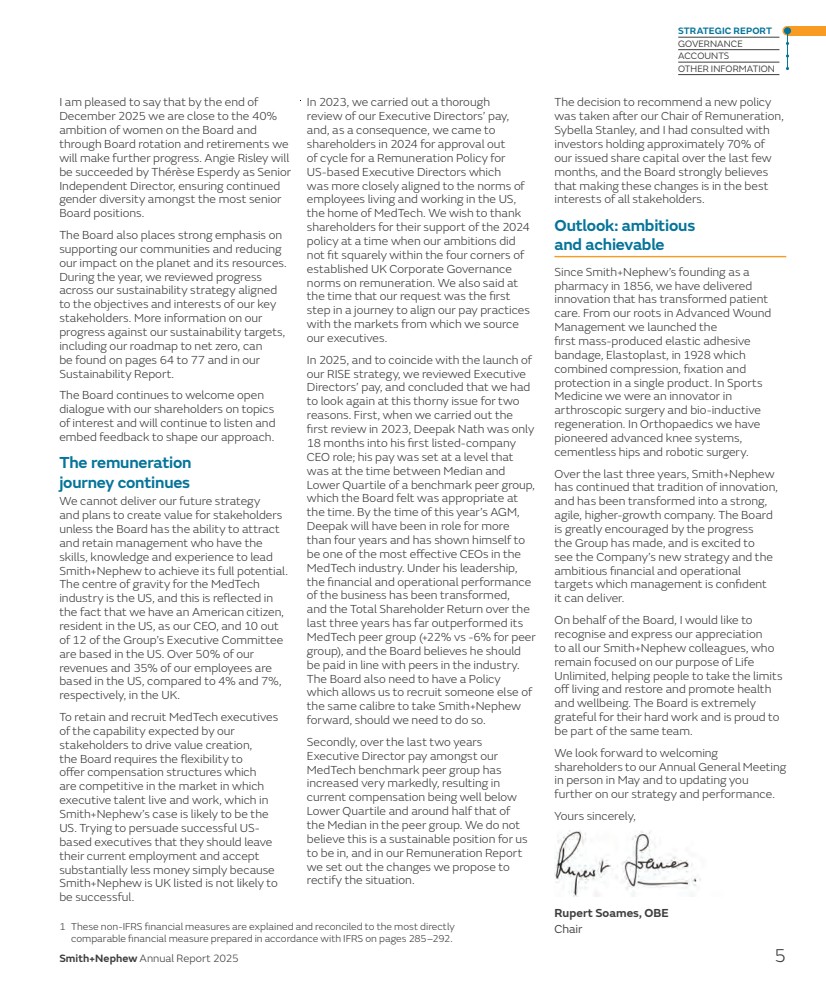
| 6-7% Organic revenue1 CAGR >$1bn 2028 free cash flow1 12-13% adjusted ROIC1 in 2028 9-10% Trading profit1 CAGR 2025 was a pivotal year for Smith+Nephew Dear Fellow Shareholder We delivered a strong set of full year results, including good revenue growth and significant improvements in profitability, cash generation and return on invested capital. All three business units contributed, as we offset meaningful headwinds through disciplined execution and cost control. We also maintained a strong cadence of new product launches and increased investment in R&D to support an exciting pipeline of future innovation. We have now completed our three-year 12-Point Plan transformation, creating a fundamentally stronger business and a springboard for future growth. We have significantly improved Smith+Nephew’s financial performance, meeting our commitments each year, and delivering a step-change in revenue growth and meaningful trading profit margin expansion despite significant and unexpected macro pressure. Building on this progress, we launched our new RISE strategy in December, marking an ambitious but achievable next phase for Smith+Nephew. RISE is our roadmap to reach more patients, unlock new categories of innovation, scale through strategic investment, and execute efficiently. Together, it will allow us to step-up performance towards new 2028 financial targets. These include delivering a 6-7% organic revenue1 compound annual growth rate (CAGR) and 9-10% trading profit1 CAGR. We expect continued strong cash generation and to reach over $1 billion free cash flow1 by 2028, with 12-13% adjusted Return on Invested Capital1 (ROIC), significantly above our cost of capital. Over the next three years, we expect every business unit to contribute uniquely to our value creation. Sports Medicine, Advanced Wound Management and ENT are expected to drive above-market growth through innovation and disciplined execution, while Orthopaedics, operating in a more mature segment, is expected to return to delivering market-level growth, supporting margin expansion, and enhanced returns. We expect to grow free cash flow, enabling ongoing investment in innovation and open new strategic opportunities, and we intend to empower our highly engaged workforce with world-class tools and processes. 2026 is the first step in that journey and we are confident in delivering an acceleration in growth and returns. With our strengthened foundations and new strategy we are well set to expand our leadership in healthcare innovation and deliver sustainable value for shareholders, customers, employees and communities into the future. Our 2028 ambition to accelerate growth and improve returns 6 Smith+Nephew Annual Report 2025 Chief Executive Officer’s review 02_SN_AR25_Chair_CEO_Rev_v211.indd 6 05/03/2026 17:19 |
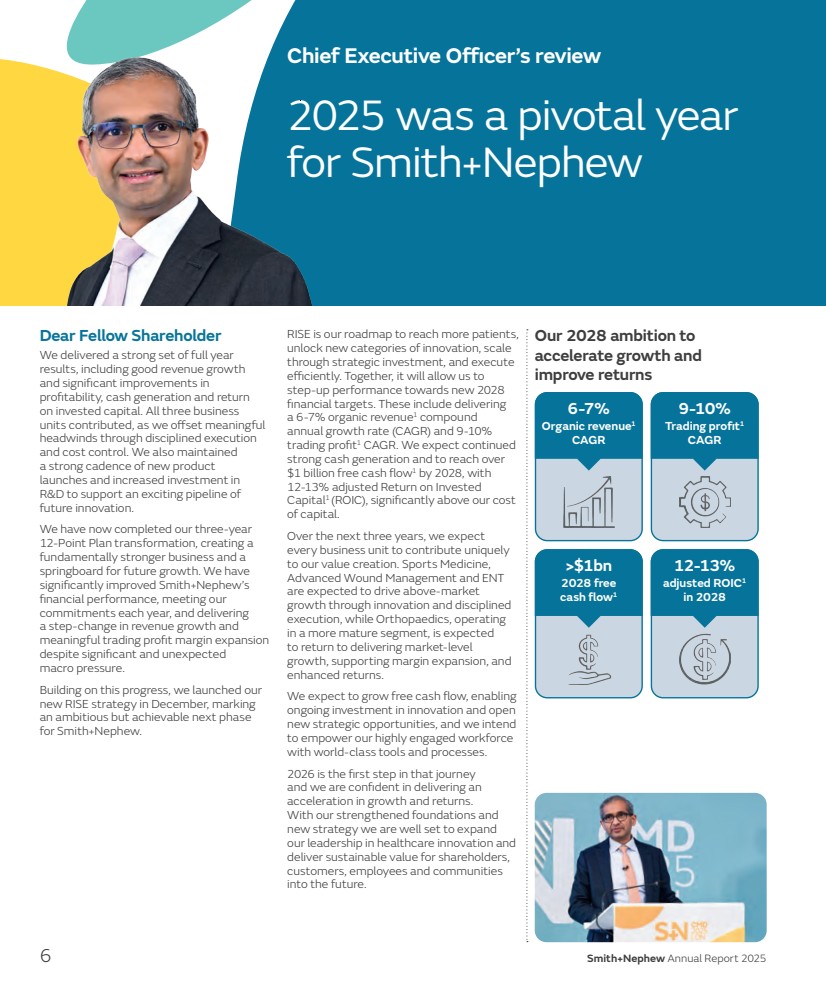
| Fixing Orthopaedics Accelerating Sports Medicine & AWM Improving productivity 2025 performance Group revenue for 2025 was $6,164 million (2024: $5,810 million), reflecting underlying revenue growth of 5.3%, ahead of our 2025 guided target of around 5%. Reported growth of 6.1% was after incurring an 80bps tailwind from foreign exchange, primarily due to the strength of the Euro. Each of our three global business units delivered underlying revenue growth above 5%. Trading profit1 for 2025 was up 15.5% to $1,211 million (2024: $1,049 million). The trading profit margin1 was 19.7% (2024: 18.1%), a 160bps improvement on the prior year. Operating profitincreased 20.7% to $794 million (2024: $657 million). Cash generated from operations was up 24.4% to $1,549 million (2024: $1,245 million) and trading cash flow, at $1,236 million (2024: $999 million), was up 23.7%, with 102% trading cash conversion (2024: 95%). Free cash flow1 increased by 52.5% to $840 million (2024: $551 million), including the benefit of a one-off $26 million property transaction, well ahead of our initial 2025 guidance of more than $600 million. We also improved adjusted ROIC1, which was up 90bps to 8.3% including a -160bps headwind from the portfolio rationalisation programme announced in December 2025. The improvement in adjusted ROIC1 reflected our continued progress under the 12 Point Plan and the stronger operational discipline now embedded across the organisation. Given our strong cash generation, and in line with our capital allocation policy, we completed a share buyback in the second half of 2025, returning $500 million to shareholders while maintaining our leverage ratio, and without compromising our growth plans. Our 2025 financial results demonstrate clear operational progress and a sustained step up in performance across each of our three global business units. It is the third consecutive year of improved performance and delivery against our commitments. 12-Point Plan transformation Since I became CEO in 2022, my priority has been executing the 12-Point Plan to transform Smith+Nephew. This plan had three pillars, designed to fix our underperforming Orthopaedics business, improve overall productivity, and accelerate our leading Sports Medicine and Wound businesses. We have made demonstrable progress across these pillars, delivering the step-change in financial performance described above. Within Orthopaedics, we have addressed supply issues and right-sized capacity, returned Trauma and Hip Implants growth to market levels or higher, and accelerated the underlying revenue growth of our Orthopaedics business unit from 1.9% in 2022 to 5.1% in 2025 (reported growth was -2.0% in 2022 and 5.7% in 2025). We continue to prioritise improving performance in US Knee Implants, which represents less than 9% of Group revenue. We expect the launch of our new LANDMARK◊ Knee System in the second half of the year. LANDMARK will bring the proven clinical benefits of our knee portfolio into a single platform that combines advanced kinematics with personalisation, robotic enablement, and ease of implantation, while unlocking capital efficiency by leveraging on existing instrumentation. With it, we will be able to address key surgeon preferences and participate in all key segments across all sites of care. It will also feature best in class tray efficiency, making it particularly suitable for Ambulatory Surgery Centers. We also continued to deliver strong results from our faster growth, higher margin Sports Medicine and Wound businesses throughout the period. Smith+Nephew’s innovation pipeline has been a significant contributor to our transformation. In 2025, more than 60% of underlying revenue growth came from products launched in the last five years, and we improved our portfolio with 15 new platforms and product enhancements across all global business units. Delivered on the 12-Point Plan Fixing Orthopaedics – Product availability issues addressed – Capacity right-sized and Memphis facility significantly improved – Operations re-wired – Commercial engine revamped – Accelerated hip, trauma and robotics pipeline Improving productivity – Productivity delivered – more than offset additional headwinds Accelerating Sports Medicine & AWM – Step-up in growth delivered 1 These non-IFRS financial measures are explained and reconciled to the most directly comparable financial measure prepared in accordance with IFRS on pages 285–292. Smith+Nephew Annual Report 2025 7 STRATEGIC REPORT GOVERNANCE ACCOUNTS OTHER INFORMATION 02_SN_AR25_Chair_CEO_Rev_P07.indd 7 06/03/2026 21:01 |
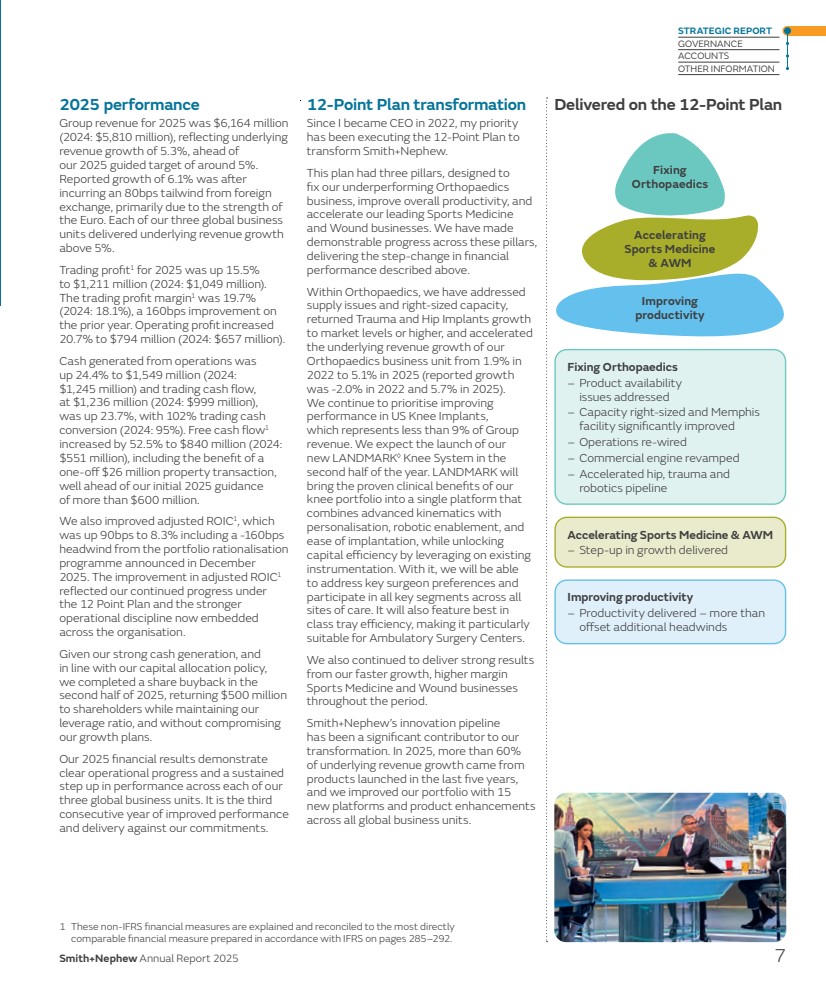
| Significantly strengthened the business The 12-Point Plan was designed not only to deliver on specific actions in the short term, but also to embed fundamental, lasting changes in our behaviours, operations and performance, and raise the standard on how we deliver for our patients, customers and shareholders. I’m pleased to confirm that we have successfully embedded these changes, thanks to the collective effort of every Smith+Nephew employee. We have put in place new processes to transform how we work, bringing greater focus, rigour and consistency to everything we do. In 2023, we moved our commercial operations from a complex matrix-based model across franchises and regions to a simpler global business unit structure, with vertical teams for each of Orthopaedics, Sports Medicine & ENT and Advanced Wound Management. This is driving greater accountability, faster decision making and execution, and has allowed us to increase customer focus across the portfolio. Importantly, we have sharpened our focus on cash and capital returns through a number of initiatives, and aggressively tackled the cost base. The move to allocate central costs attributable to each business unit is driving greater accountability and efficiency, with each business unit having full profit and loss and capital accountability. We are on track to deliver the $325 to $375 million of gross cost savings we targeted, with the largest savings coming from manufacturing and procurement. We also introduced much greater rigour and discipline in capital allocation, improving inventory set turn rates by deploying sets to more productive accounts. The resultant increase in free cash flow1 allowed us to step up our focus on innovation and deliver a high cadence of new products. Stronger financial performance Through the 12-Point Plan, we have moved Smith+Nephew from an historically low single-digit revenue growth company to one consistently delivering mid single-digit growth, with a reported CAGR of 5.7% over the last three years. We have expanded trading profit margin1 by 240bps, from 17.3% in 2022 to 19.7% this year, whilst also overcoming some 1,000bps of macro challenges from Volume Based Procurement in China and higher inflation. Our increased focus on cash and capital returns has yielded an impressive fifteen-fold increase in free cash flow1 from $56 million in 2022 to $840 million in 2025. Finally, adjusted ROIC1 has increased 170bps from 6.6% to 8.3% including the -160bps headwind from portfolio rationalisation. I am proud of these achievements. We have proven that we are capable of executing on multiple high priority imperatives at the same time. We have emerged a stronger organisation as a result. But this transformation is just the beginning, not the limit of our ambition. A simpler more focused business Moved to a business unit-led structure – Simpler global structure – Greater accountability – Increased customer focus New ways of working – Performance culture – Continuous improvement – Aligned performance measures Increased focus on cash and capital returns – Cost savings across the business – Zero-based budgeting – Disciplined capital allocation 1 These non-IFRS financial measures are explained and reconciled to the most directly comparable financial measure prepared in accordance with IFRS on pages 285–292. Low single-digit to mid single-digit revenue growth 240bps Increase in trading profit margin1 170bps Increase in adjusted ROIC1 Successfully improved our financial performance 2022-25 15x Increase in Free Cash Flow1 8 Smith+Nephew Annual Report 2025 Chief Executive Officer’s review continued 02_SN_AR25_Chair_CEO_Rev_v211.indd 8 05/03/2026 17:20 |
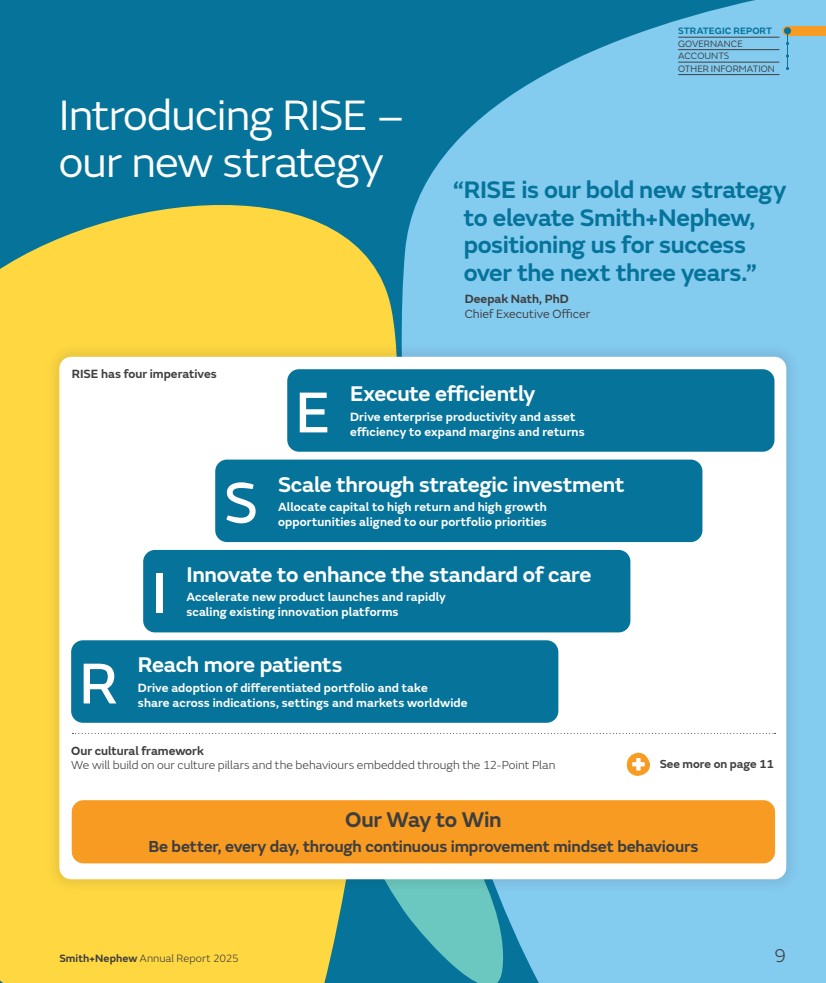
| Introducing RISE – our new strategy “RISE is our bold new strategy to elevate Smith+Nephew, positioning us for success over the next three years.” Deepak Nath, PhD Chief Executive Officer Our cultural framework We will build on our culture pillars and the behaviours embedded through the 12-Point Plan RISE has four imperatives Our Way to Win Be better, every day, through continuous improvement mindset behaviours See more on page 11 Execute efficiently Drive enterprise productivity and asset E efficiency to expand margins and returns Reach more patients Drive adoption of differentiated portfolio and take R share across indications, settings and markets worldwide Innovate to enhance the standard of care Accelerate new product launches and rapidly I scaling existing innovation platforms Scale through strategic investment Allocate capital to high return and high growth S opportunities aligned to our portfolio priorities Smith+Nephew Annual Report 2025 9 STRATEGIC REPORT GOVERNANCE ACCOUNTS OTHER INFORMATION 02_SN_AR25_Chair_CEO_Rev_v211.indd 9 05/03/2026 17:20 |
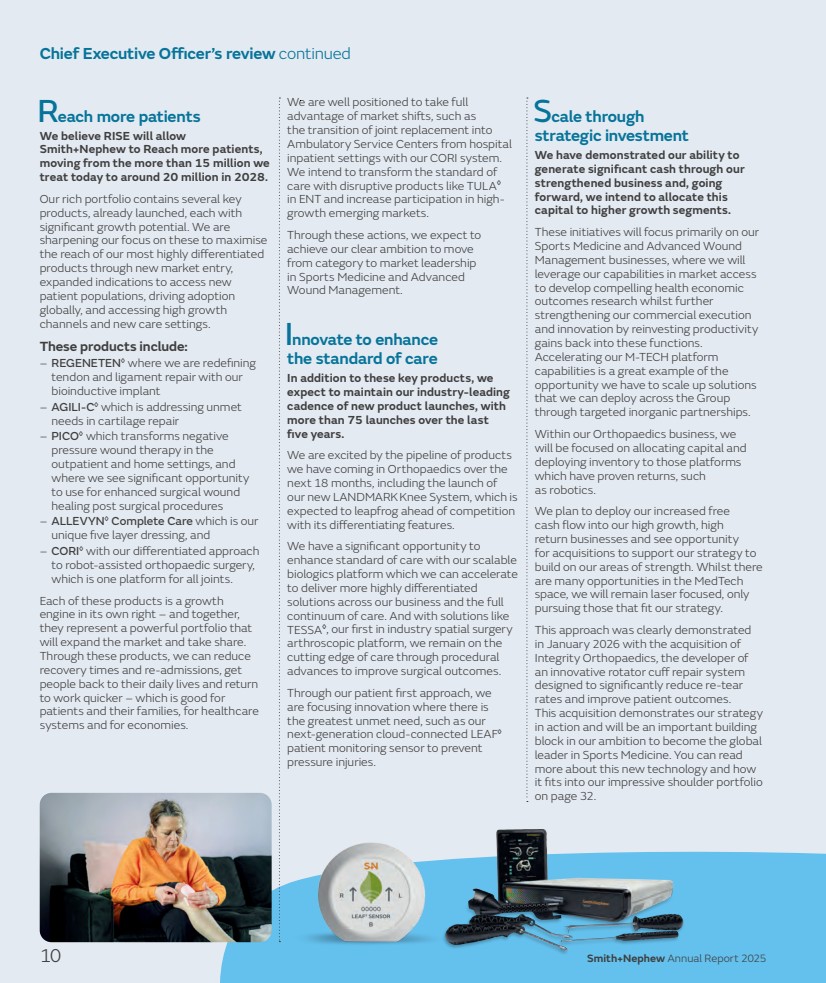
| Reach more patients We believe RISE will allow Smith+Nephew to Reach more patients, moving from the more than 15 million we treat today to around 20 million in 2028. Our rich portfolio contains several key products, already launched, each with significant growth potential. We are sharpening our focus on these to maximise the reach of our most highly differentiated products through new market entry, expanded indications to access new patient populations, driving adoption globally, and accessing high growth channels and new care settings. These products include: – REGENETEN◊ where we are redefining tendon and ligament repair with our bioinductive implant – AGILI-C◊ which is addressing unmet needs in cartilage repair – PICO◊ which transforms negative pressure wound therapy in the outpatient and home settings, and where we see significant opportunity to use for enhanced surgical wound healing post surgical procedures – ALLEVYN◊ Complete Care which is our unique five layer dressing, and – CORI◊ with our differentiated approach to robot-assisted orthopaedic surgery, which is one platform for all joints. Each of these products is a growth engine in its own right – and together, they represent a powerful portfolio that will expand the market and take share. Through these products, we can reduce recovery times and re-admissions, get people back to their daily lives and return to work quicker – which is good for patients and their families, for healthcare systems and for economies. Scale through strategic investment We have demonstrated our ability to generate significant cash through our strengthened business and, going forward, we intend to allocate this capital to higher growth segments. These initiatives will focus primarily on our Sports Medicine and Advanced Wound Management businesses, where we will leverage our capabilities in market access to develop compelling health economic outcomes research whilst further strengthening our commercial execution and innovation by reinvesting productivity gains back into these functions. Accelerating our M-TECH platform capabilities is a great example of the opportunity we have to scale up solutions that we can deploy across the Group through targeted inorganic partnerships. Within our Orthopaedics business, we will be focused on allocating capital and deploying inventory to those platforms which have proven returns, such as robotics. We plan to deploy our increased free cash flow into our high growth, high return businesses and see opportunity for acquisitions to support our strategy to build on our areas of strength. Whilst there are many opportunities in the MedTech space, we will remain laser focused, only pursuing those that fit our strategy. This approach was clearly demonstrated in January 2026 with the acquisition of Integrity Orthopaedics, the developer of an innovative rotator cuff repair system designed to significantly reduce re-tear rates and improve patient outcomes. This acquisition demonstrates our strategy in action and will be an important building block in our ambition to become the global leader in Sports Medicine. You can read more about this new technology and how it fits into our impressive shoulder portfolio on page 32. We are well positioned to take full advantage of market shifts, such as the transition of joint replacement into Ambulatory Service Centers from hospital inpatient settings with our CORI system. We intend to transform the standard of care with disruptive products like TULA◊ in ENT and increase participation in high-growth emerging markets. Through these actions, we expect to achieve our clear ambition to move from category to market leadership in Sports Medicine and Advanced Wound Management. Innovate to enhance the standard of care In addition to these key products, we expect to maintain our industry-leading cadence of new product launches, with more than 75 launches over the last five years. We are excited by the pipeline of products we have coming in Orthopaedics over the next 18 months, including the launch of our new LANDMARKKnee System, which is expected to leapfrog ahead of competition with its differentiating features. We have a significant opportunity to enhance standard of care with our scalable biologics platform which we can accelerate to deliver more highly differentiated solutions across our business and the full continuum of care. And with solutions like TESSA◊, our first in industry spatial surgery arthroscopic platform, we remain on the cutting edge of care through procedural advances to improve surgical outcomes. Through our patient first approach, we are focusing innovation where there is the greatest unmet need, such as our next-generation cloud-connected LEAF◊ patient monitoring sensor to prevent pressure injuries. 10 Smith+Nephew Annual Report 2025 Chief Executive Officer’s review continued 02_SN_AR25_Chair_CEO_Rev_v211.indd 10 05/03/2026 17:20 |
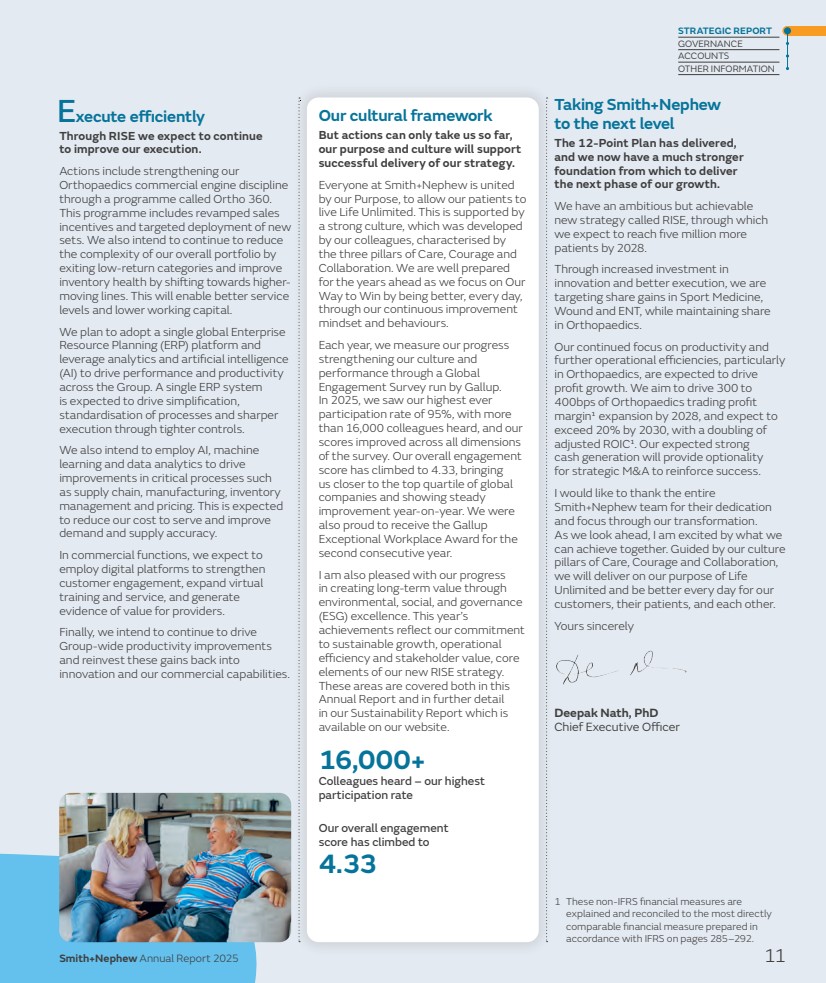
| Execute efficiently Through RISE we expect to continue to improve our execution. Actions include strengthening our Orthopaedics commercial engine discipline through a programme called Ortho 360. This programme includes revamped sales incentives and targeted deployment of new sets. We also intend to continue to reduce the complexity of our overall portfolio by exiting low-return categories and improve inventory health by shifting towards higher-moving lines. This will enable better service levels and lower working capital. We plan to adopt a single global Enterprise Resource Planning (ERP) platform and leverage analytics and artificial intelligence (AI) to drive performance and productivity across the Group. A single ERP system is expected to drive simplification, standardisation of processes and sharper execution through tighter controls. We also intend to employ AI, machine learning and data analytics to drive improvements in critical processes such as supply chain, manufacturing, inventory management and pricing. This is expected to reduce our cost to serve and improve demand and supply accuracy. In commercial functions, we expect to employ digital platforms to strengthen customer engagement, expand virtual training and service, and generate evidence of value for providers. Finally, we intend to continue to drive Group-wide productivity improvements and reinvest these gains back into innovation and our commercial capabilities. Taking Smith+Nephew to the next level The 12-Point Plan has delivered, and we now have a much stronger foundation from which to deliver the next phase of our growth. We have an ambitious but achievable new strategy called RISE, through which we expect to reach five million more patients by 2028. Through increased investment in innovation and better execution, we are targeting share gains in Sport Medicine, Wound and ENT, while maintaining share in Orthopaedics. Our continued focus on productivity and further operational efficiencies, particularly in Orthopaedics, are expected to drive profit growth. We aim to drive 300 to 400bps of Orthopaedics trading profit margin¹ expansion by 2028, and expect to exceed 20% by 2030, with a doubling of adjusted ROIC¹. Our expected strong cash generation will provide optionality for strategic M&A to reinforce success. I would like to thank the entire Smith+Nephew team for their dedication and focus through our transformation. As we look ahead, I am excited by what we can achieve together. Guided by our culture pillars of Care, Courage and Collaboration, we will deliver on our purpose of Life Unlimited and be better every day for our customers, their patients, and each other. Yours sincerely Deepak Nath, PhD Chief Executive Officer Our cultural framework But actions can only take us so far, our purpose and culture will support successful delivery of our strategy. Everyone at Smith+Nephew is united by our Purpose, to allow our patients to live Life Unlimited. This is supported by a strong culture, which was developed by our colleagues, characterised by the three pillars of Care, Courage and Collaboration. We are well prepared for the years ahead as we focus on Our Way to Win by being better, every day, through our continuous improvement mindset and behaviours. Each year, we measure our progress strengthening our culture and performance through a Global Engagement Survey run by Gallup. In 2025, we saw our highest ever participation rate of 95%, with more than 16,000 colleagues heard, and our scores improved across all dimensions of the survey. Our overall engagement score has climbed to 4.33, bringing us closer to the top quartile of global companies and showing steady improvement year-on-year. We were also proud to receive the Gallup Exceptional Workplace Award for the second consecutive year. I am also pleased with our progress in creating long-term value through environmental, social, and governance (ESG) excellence. This year’s achievements reflect our commitment to sustainable growth, operational efficiency and stakeholder value, core elements of our new RISE strategy. These areas are covered both in this Annual Report and in further detail in our Sustainability Report which is available on our website. 16,000+ Colleagues heard – our highest participation rate Our overall engagement score has climbed to 4.33 1 These non-IFRS financial measures are explained and reconciled to the most directly comparable financial measure prepared in accordance with IFRS on pages 285–292. Smith+Nephew Annual Report 2025 11 STRATEGIC REPORT GOVERNANCE ACCOUNTS OTHER INFORMATION 02_SN_AR25_Chair_CEO_Rev_v211.indd 11 05/03/2026 17:20 |
| Smith+Nephew operates in global markets valued at more than $50 billion1 annually. Long-term growth drivers Shaping the development of innovative treatments and the transformation of healthcare delivery. The medical technology sector is supported by strong long-term growth drivers that make it an attractive market. Demographic shifts, such as an ageing population and increased physical activity among older adults, continue to boost demand for healthcare services and medical technology products. As the global population ages, there is a corresponding rise in chronic and age-related conditions that require consistent medical attention. Additionally, the growing incidence of lifestyle-related health issues, like diabetes and obesity, further drives this demand. Technological advancements serve as crucial catalysts for long-term growth in healthcare. Innovations in areas such as AI and biotechnology are yielding more effective and personalised healthcare solutions, which not only improve patient outcomes but also create new business opportunities for companies like Smith+Nephew. Emerging markets Growing healthcare demand presenting both opportunities and challenges for providers. In emerging markets, economic development is enhancing long-term growth factors, particularly through the emergence of a prosperous middle class seeking improved healthcare services and products. As living standards rise, there is an increasing demand for high-quality healthcare, including advanced treatments and medical technology. Emerging markets are experiencing a surge in digital health technologies, including surgical robotics, telemedicine, electronic health records, mobile health apps, and wearable devices. Artificial intelligence offers further opportunities to help overcome resource constraints in low and middle-income countries. These innovations are bridging gaps in healthcare access. Emerging markets are attractive to medical technology companies like Smith+Nephew as they are often more open to adopting new and cost-effective healthcare approaches and technologies. Decentralised care Facilitating accessible care outside traditional hospital environments. Evolving customer and market dynamics are creating new high-growth opportunities for medical technology companies. Many countries are shifting towards more decentralised care, with an increasing number of procedures being performed in outpatient settings such as Ambulatory Surgery Centers (ASCs) in the US. This trend has been particularly prominent in Sports Medicine, and a growing number of orthopaedic joint replacement procedures are now also being carried out in these settings, resulting in cost and time efficiencies for healthcare providers. The ASC care setting is very different from hospitals. ASC operating rooms are smaller with limited capacity for sterile reprocessing and storage. They usually operate with leaner staffing models while opting for higher efficiency and throughput. Ongoing reimbursement changes are expected to continue to drive even higher procedural uptake, and ASCs present a significant opportunity for innovative businesses like Smith+Nephew who have developed technologies and services specifically targeted at this growing segment (see page 38 for more information). 1 Data generated by Smith+Nephew based on publicly available sources and internal analysis and represents an indication of market shares and sizes. 12 Smith+Nephew Annual Report 2025 Leading positions in attractive markets 03_SN_AR25_MktPlace_BusModel_KPIs_v102.indd 12 05/03/2026 17:23 |

| Cost of healthcare A global priority requiring comprehensive strategies for sustainable healthcare delivery. Governments are focused on lowering healthcare costs and are increasingly price sensitive. In response, medical technology companies are innovating and providing evidence of both the clinical and economic benefits associated with their products. Worldwide, countries are aiming to boost domestic production in critical sectors, including advanced technologies and life sciences, through localisation policies and export restrictions that can disrupt global supply chains. At the same time, many emerging markets are implementing measures to reduce healthcare costs and improve accessibility, including price control policies in government procurement. In China, this has been seen in the introduction of Volume Based Procurement (VBP) across various segments. This has included Orthopaedics and Sports Medicine, and a VBP process is expected in ENT in 2026. More details on risk can be found in the Risk Report on pages 78–96 High regulation Medical devices regulation is essential for ensuring product safety, efficacy and quality. The medical device sector is among the most heavily regulated globally, creating significant barriers to entry for new market participants. National regulatory authorities oversee the design, development, approval, manufacturing, labelling, marketing and sale of healthcare products, as well as reviewing supporting data to seek to ensure safety and performance. Most countries require prior authorisation and/or registration of products before market entry, which must be maintained thereafter. Regulations and industry codes also dictate how the industry interacts with healthcare professionals and government officials worldwide, including the AdvaMed Code of Ethics and the MedTech Europe Code of Ethical Business Practice. Companies implement global compliance programmes to assist employees and third-party partners in adhering to laws, regulations and industry standards, often accompanied by their own codes of conduct. For more information on our approach to compliance, see page 35 Seasonality Seasonality requires agile business operations to meet demand fluctuations during the year. There is typically a higher volume of orthopaedic and sports medicine procedures during winter months, when accidents and sports-related injuries are more common. Additionally, elective procedures generally decline in the summer due to vacations. Advanced Wound Management is less affected by seasonality due to the nature of its procedures and products. At Smith+Nephew, most of our operations are in the northern hemisphere, with approximately 50% of revenue generated in the US and 20% in Europe. In the US, out-of-pocket costs for health insurance plans are tied to medical expenses within a calendar year. Consequently, households that reach their annual deductible or out-of-pocket cap before year end find it more cost-effective to schedule necessary procedures later in the year rather than postponing them until the following year. Smith+Nephew Annual Report 2025 13 STRATEGIC REPORT GOVERNANCE ACCOUNTS OTHER INFORMATION 03_SN_AR25_MktPlace_BusModel_KPIs_v102.indd 13 05/03/2026 17:23 |

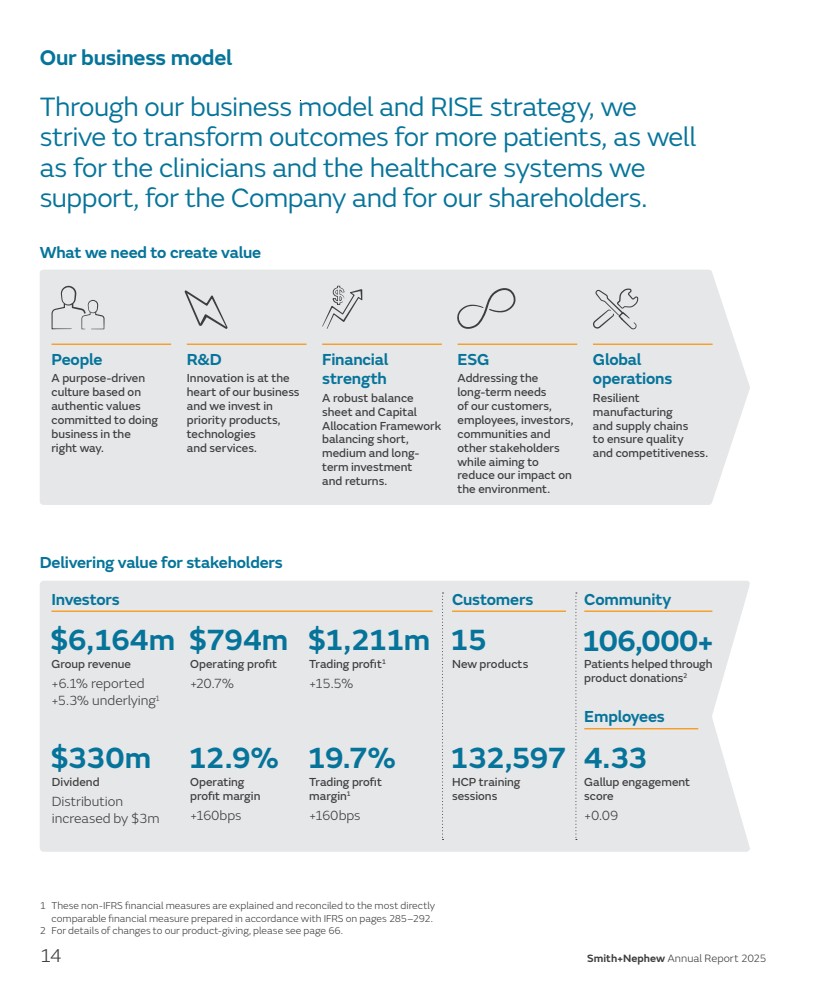
| 1 These non-IFRS financial measures are explained and reconciled to the most directly comparable financial measure prepared in accordance with IFRS on pages 285–292. 2 For details of changes to our product-giving, please see page 66. Through our business model and RISE strategy, we strive to transform outcomes for more patients, as well as for the clinicians and the healthcare systems we support, for the Company and for our shareholders. What we need to create value Delivering value for stakeholders 19.7% Trading profit margin1 +160bps 12.9% Operating profit margin +160bps $330m Dividend Distribution increased by $3m $1,211m Trading profit1 +15.5% $794m Operating profit +20.7% $6,164m Group revenue +6.1% reported +5.3% underlying1 Investors Community 106,000+ Patients helped through product donations2 4.33 Gallup engagement score +0.09 15 New products 132,597 HCP training sessions Employees Customers People A purpose-driven culture based on authentic values committed to doing business in the right way. R&D Innovation is at the heart of our business and we invest in priority products, technologies and services. Financial strength A robust balance sheet and Capital Allocation Framework balancing short, medium and long-term investment and returns. ESG Addressing the long-term needs of our customers, employees, investors, communities and other stakeholders while aiming to reduce our impact on the environment. Global operations Resilient manufacturing and supply chains to ensure quality and competitiveness. 14 Smith+Nephew Annual Report 2025 Our business model 03_SN_AR25_MktPlace_BusModel_KPIs_v102.indd 14 05/03/2026 17:23 |
| How we create value Innovative technology We offer a broad portfolio of differentiated products and services that meet often-complex clinical needs, including digital and robotic technologies, driving procedural innovation. Go to market Three global business units set product strategy and deliver global marketing to drive demand in our markets, supported by clinical evidence to demonstrate efficacy. 2 Customer feedback Building close relationships with customers to ensure a deep understanding of unmet clinical needs and changing financial and sustainability priorities within healthcare systems. 5 Expertise and support Our sales force supports customers and works with healthcare systems to address complex business and reimbursement requirements. 3 Medical education Through the Smith+Nephew Academy, a network of centres and online resources, we provide medical education programmes to support the safe and effective use of our products, skills development and procedural innovation. 4 1 Product development and acquisition R&D model that provides for customer and business unit-focused innovation and acquiring technologies needing further development and commercialisation. 6 Serving customers Smith+Nephew Annual Report 2025 15 STRATEGIC REPORT GOVERNANCE ACCOUNTS OTHER INFORMATION 03_SN_AR25_MktPlace_BusModel_KPIs_v102.indd 15 05/03/2026 17:23 |

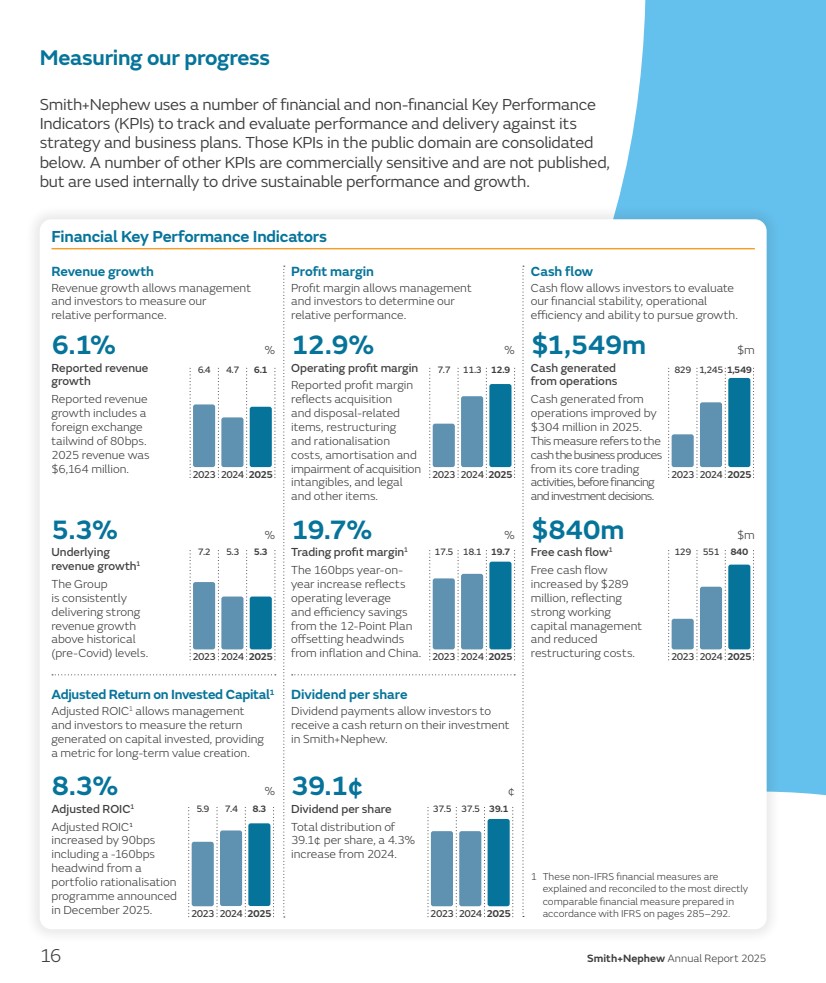
| Smith+Nephew uses a number of financial and non-financial Key Performance Indicators (KPIs) to track and evaluate performance and delivery against its strategy and business plans. Those KPIs in the public domain are consolidated below. A number of other KPIs are commercially sensitive and are not published, but are used internally to drive sustainable performance and growth. Revenue growth Revenue growth allows management and investors to measure our relative performance. 6.1% % Reported revenue growth Reported revenue growth includes a foreign exchange tailwind of 80bps. 2025 revenue was $6,164 million. 5.3% % Underlying revenue growth1 The Group is consistently delivering strong revenue growth above historical (pre-Covid) levels. Profit margin Profit margin allows management and investors to determine our relative performance. 12.9% % Operating profit margin Reported profit margin reflects acquisition and disposal-related items, restructuring and rationalisation costs, amortisation and impairment of acquisition intangibles, and legal and other items. 19.7% % Trading profit margin1 The 160bps year-on-year increase reflects operating leverage and efficiency savings from the 12-Point Plan offsetting headwinds from inflation and China. Cash flow Cash flow allows investors to evaluate our financial stability, operational efficiency and ability to pursue growth. $1,549m $m Cash generated from operations Cash generated from operations improved by $304 million in 2025. This measure refers to the cash the business produces from its core trading activities, before financing and investment decisions. $840m $m Free cash flow1 Free cash flow increased by $289 million, reflecting strong working capital management and reduced restructuring costs. Financial Key Performance Indicators Adjusted Return on Invested Capital1 Adjusted ROIC1 allows management and investors to measure the return generated on capital invested, providing a metric for long-term value creation. 8.3% % Adjusted ROIC1 Adjusted ROIC¹ increased by 90bps including a -160bps headwind from a portfolio rationalisation programme announced in December 2025. Dividend per share Dividend payments allow investors to receive a cash return on their investment in Smith+Nephew. 39.1¢ ¢ Dividend per share Total distribution of 39.1¢ per share, a 4.3% increase from 2024. 1 These non-IFRS financial measures are explained and reconciled to the most directly comparable financial measure prepared in 2023 accordance with IFRS on pages 285–292. 5.9 2025 8.3 2024 7.4 2023 6.4 2025 6.1 2024 4.7 2023 7.2 2025 5.3 2024 5.3 2023 7.7 2025 12.9 2024 11.3 2023 829 2025 1,549 2024 1,245 2023 129 2025 840 2024 551 2023 17.5 2025 19.7 2024 18.1 2023 37.5 2025 39.1 2024 37.5 16 Smith+Nephew Annual Report 2025 Measuring our progress 03_SN_AR25_MktPlace_BusModel_KPIs_v102.indd 16 05/03/2026 17:23 |
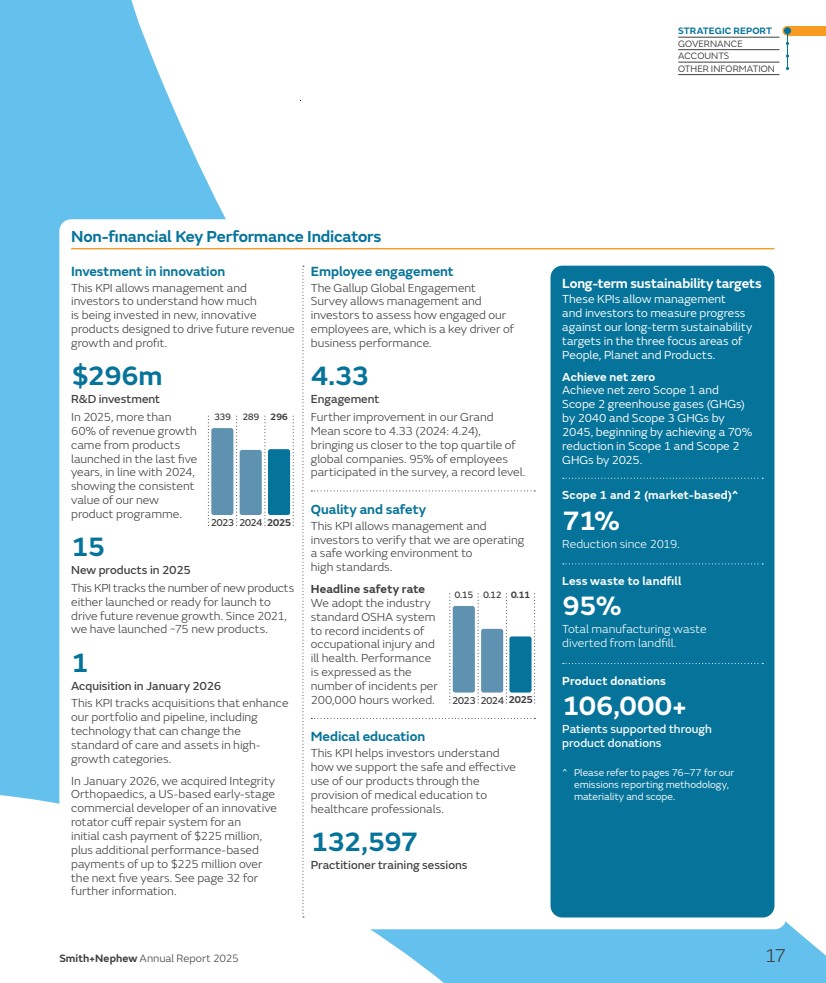
| Long-term sustainability targets These KPIs allow management and investors to measure progress against our long-term sustainability targets in the three focus areas of People, Planet and Products. Achieve net zero Achieve net zero Scope 1 and Scope 2 greenhouse gases (GHGs) by 2040 and Scope 3 GHGs by 2045, beginning by achieving a 70% reduction in Scope 1 and Scope 2 GHGs by 2025. Scope 1 and 2 (market-based) 71% Reduction since 2019. Less waste to landfill 95% Total manufacturing waste diverted from landfill. Product donations 106,000+ Patients supported through product donations Please refer to pages 76–77 for our emissions reporting methodology, materiality and scope. Investment in innovation This KPI allows management and investors to understand how much is being invested in new, innovative products designed to drive future revenue growth and profit. $296m R&D investment In 2025, more than 60% of revenue growth came from products launched in the last five years, in line with 2024, showing the consistent value of our new product programme. 15 New products in 2025 This KPI tracks the number of new products either launched or ready for launch to drive future revenue growth. Since 2021, we have launched ~75 new products. 1 Acquisition in January 2026 This KPI tracks acquisitions that enhance our portfolio and pipeline, including technology that can change the standard of care and assets in high-growth categories. In January 2026, we acquired Integrity Orthopaedics, a US-based early-stage commercial developer of an innovative rotator cuff repair system for an initial cash payment of $225 million, plus additional performance-based payments of up to $225 million over the next five years. See page 32 for further information. Employee engagement The Gallup Global Engagement Survey allows management and investors to assess how engaged our employees are, which is a key driver of business performance. 4.33 Engagement Further improvement in our Grand Mean score to 4.33 (2024: 4.24), bringing us closer to the top quartile of global companies. 95% of employees participated in the survey, a record level. Quality and safety This KPI allows management and investors to verify that we are operating a safe working environment to high standards. Headline safety rate We adopt the industry standard OSHA system to record incidents of occupational injury and ill health. Performance is expressed as the number of incidents per 200,000 hours worked. Medical education This KPI helps investors understand how we support the safe and effective use of our products through the provision of medical education to healthcare professionals. 132,597 Practitioner training sessions Non-financial Key Performance Indicators 2023 339 2025 296 2024 289 2023 0.15 2025 0.11 2024 0.12 Smith+Nephew Annual Report 2025 17 STRATEGIC REPORT GOVERNANCE ACCOUNTS OTHER INFORMATION 03_SN_AR25_MktPlace_BusModel_KPIs_v102.indd 17 05/03/2026 17:23 |
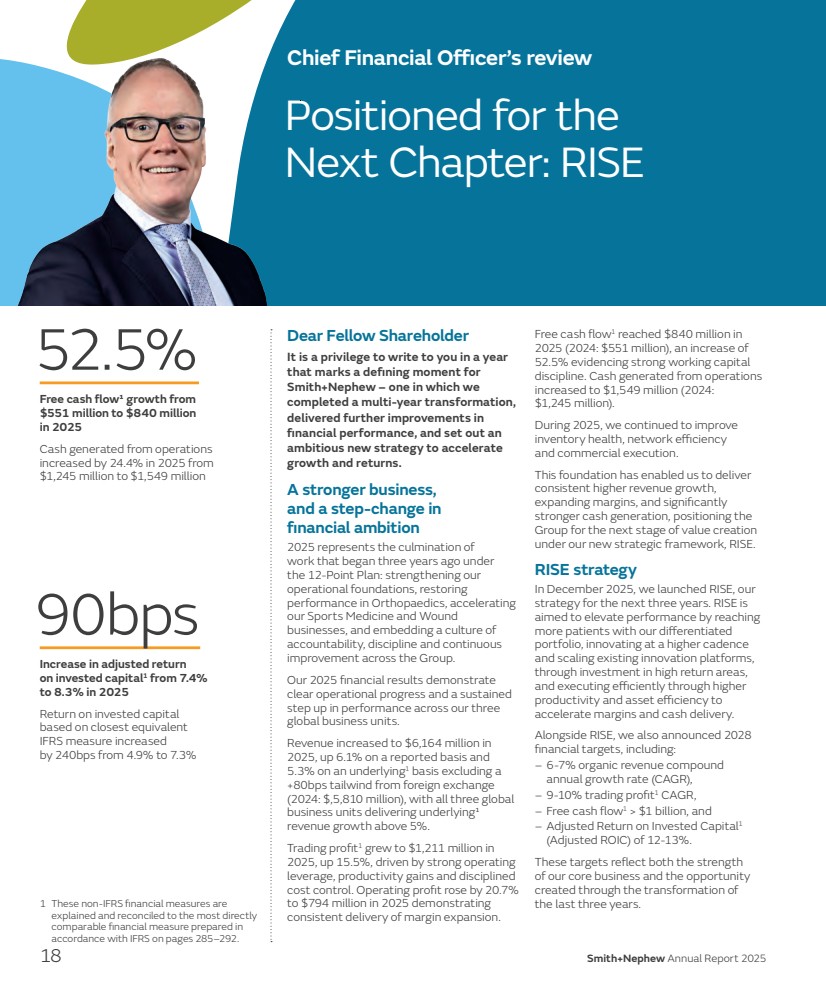
| Dear Fellow Shareholder It is a privilege to write to you in a year that marks a defining moment for Smith+Nephew – one in which we completed a multi-year transformation, delivered further improvements in financial performance, and set out an ambitious new strategy to accelerate growth and returns. A stronger business, and a step-change in financial ambition 2025 represents the culmination of work that began three years ago under the 12-Point Plan: strengthening our operational foundations, restoring performance in Orthopaedics, accelerating our Sports Medicine and Wound businesses, and embedding a culture of accountability, discipline and continuous improvement across the Group. Our 2025 financial results demonstrate clear operational progress and a sustained step up in performance across our three global business units. Revenue increased to $6,164 million in 2025, up 6.1% on a reported basis and 5.3% on an underlying1 basis excluding a +80bps tailwind from foreign exchange (2024: $,5,810 million), with all three global business units delivering underlying¹ revenue growth above 5%. Trading profit1 grew to $1,211 million in 2025, up 15.5%, driven by strong operating leverage, productivity gains and disciplined cost control. Operating profit rose by 20.7% to $794 million in 2025 demonstrating consistent delivery of margin expansion. Free cash flow1 reached $840 million in 2025 (2024: $551 million), an increase of 52.5% evidencing strong working capital discipline. Cash generated from operations increased to $1,549 million (2024: $1,245 million). During 2025, we continued to improve inventory health, network efficiency and commercial execution. This foundation has enabled us to deliver consistent higher revenue growth, expanding margins, and significantly stronger cash generation, positioning the Group for the next stage of value creation under our new strategic framework, RISE. RISE strategy In December 2025, we launched RISE, our strategy for the next three years. RISE is aimed to elevate performance by reaching more patients with our differentiated portfolio, innovating at a higher cadence and scaling existing innovation platforms, through investment in high return areas, and executing efficiently through higher productivity and asset efficiency to accelerate margins and cash delivery. Alongside RISE, we also announced 2028 financial targets, including: – 6-7% organic revenue compound annual growth rate (CAGR), – 9-10% trading profit1 CAGR, – Free cash flow1 > $1 billion, and – Adjusted Return on Invested Capital1 (Adjusted ROIC) of 12-13%. These targets reflect both the strength of our core business and the opportunity created through the transformation of the last three years. 52.5% Free cash flow¹ growth from $551 million to $840 million in 2025 Cash generated from operations increased by 24.4% in 2025 from $1,245 million to $1,549 million 90bps Increase in adjusted return on invested capital1 from 7.4% to 8.3% in 2025 Return on invested capital based on closest equivalent IFRS measure increased by 240bps from 4.9% to 7.3% 1 These non-IFRS financial measures are explained and reconciled to the most directly comparable financial measure prepared in accordance with IFRS on pages 285–292. Positioned for the Next Chapter: RISE 18 Smith+Nephew Annual Report 2025 Chief Financial Officer’s review 04_SN_AR25_Financial_Review_v163.indd 18 05/03/2026 17:26 |
| STRATEGIC REPORT GOVERNANCE ACCOUNTS OTHER INFORMATION Strong cash flow Cash generation improved significantly in 2025, driven by strong working capital discipline and lower restructuring costs. As a result, cash generated from operations improved by 24.4% to $1,549 million in 2025 (2024: $1,245 million). This translated into a significant improvement in free cash flow1 which was up 52.5% to $840 million in 2025 (2024: $551 million), well ahead of the $600 million guidance issued at the beginning of the year. In 2025, free cash flow also includes the benefit of a one-off $26 million property transaction. Stronger cash generation also supported a further reduction in gearing, resulting in a leverage position ahead of target and reinforcing the Group’s financial resilience as we execute against our strategic priorities. It also supported the repurchase of $500 million of shares, returning additional value to shareholders. Improving capital efficiency through portfolio simplification In 2025, we announced a Group-wide inventory portfolio rationalisation programme, as part of the RISE strategy, aimed at structurally reducing inventory levels and improving capital efficiency. We expect that this rationalisation programme will result in a material reduction in gross inventory, and release $500 million of capital employed over time. This action will free up cash for reinvestment into strategic growth platforms and to support progress towards the delivery of the RISE 2028 adjusted ROIC1 target of 12–13%. As a result of this programme, the Group recognised a $159 million non-cash excess and obsolescence provision in 2025. Improving accountability and returns ROIC improved significantly in 2025, reflecting continued progress under the 12-Point Plan and the stronger operational discipline now embedded across the organisation. The allocation of directly attributable central costs to business units, introduced in 2024 to reinforce ownership of performance, has enhanced accountability and sharpened focus on returns. Combined with higher trading margins1, lower non-trading costs1 and improved capital efficiency, these actions delivered a clear step-up in ROIC for the year. Looking ahead with confidence We enter 2026 with strong momentum and a clear roadmap. Despite extraordinary headwinds relating to inventory revaluation, tariffs, skin substitute reimbursement changes and ENT VBP in China, we expect continued revenue acceleration and trading profit1 growth. Our ambition is clear: to deliver sustainable, compounding value creation for our shareholders while advancing our commitment to helping patients live Life Unlimited. Outlook In terms of outlook, for revenue, we expect to deliver underlying1 revenue growth to accelerate to around 6%, which equates to reported growth of around 7.8% based on exchange rates prevailing on 24 February 2026. Trading profit1 growth is expected to be around 8%. See my Financial Commentary below for important disclosures on the details of our 2026 outlook including tax guidance. Yours sincerely, John Rogers, Chief Financial Officer Strengthening operational discipline During 2025, we continued to strengthen the operational discipline established over the past three years. Our focus remained on driving sustainable improvements in productivity, cost efficiency and asset utilisation across the Group. This work builds on the progress delivered through the 12-Point Plan and reflects our ambition under the RISE strategy to operate with greater consistency, accountability and efficiency. Through the year, we further embedded the zero-based budgeting approach adopted in 2024, enabling us to identify additional, durable savings. More than 40 initiatives across five workstreams remained in active execution, with the largest contributions driven by manufacturing and procurement, supported by efficiencies across commercial and enabling functions. These actions strengthened trading margin1 and operating leverage. The foundations created through prior network and organisational restructuring also continued to underpin performance in 2025. Driving innovation to support growth Innovation remained a core driver of performance in 2025, with more than 60% of revenue growth coming from products launched in the last five years. This momentum is fully aligned with our RISE strategy, which places Innovation at the centre of elevating clinical outcomes and accelerating financial performance. As part of this strategy, we continue to advance new product development and scale existing innovation platforms, supported by the adoption of technologies such as AI to enhance productivity and operational efficiency. As CFO, I believe that this disciplined focus on innovation will enable us to deliver sustained growth in the years ahead. You can read more about our strong innovation track record and our AI agenda on pages 27–32. 1 These non-IFRS financial measures are explained and reconciled to the most directly comparable financial measure prepared in accordance with IFRS on pages 285–292. Smith+Nephew Annual Report 2025 19 04_SN_AR25_Financial_Review_v163.indd 19 05/03/2026 17:26 |
| 2025 performance Revenue grew by 6.1% to $6,164 million in 2025 (2024: $5,810 million) on a reported basis and 5.3% on an underlying1 basis excluding a 80bps tailwind from foreign exchange, with all business units contributing to the year-on-year growth. All three business units delivered underlying1 growth above 5%, contributing to the overall year-on-year revenue growth. We continued to make progress in improving the commercial execution in Orthopaedics resulting in the business unit delivering acceleration in revenue growth. Orthopaedics revenue grew by 5.7% on a reported basis in 2025 (2024: 4.1%) and 5.1% on an underlying1 basis (2024: 4.6%) driven by strong performance in the US and Other Established Markets2, partially offset by headwinds in China resulting in lower growth in emerging markets. We maintained our leadership position in Sports Medicine & ENT, delivering reported revenue growth of 6.0% (5.2% underlying1 ), supported by strong performance across most markets outside China. The impact of China’s Volume Based Procurement (VBP) programme, introduced in May 2024, has also begun to moderate. Advanced Wound Management delivered reported revenue growth of 6.7% (5.6% underlying1 ), reflecting an acceleration from the prior year supported by sustained positive momentum throughout 2025. 2024 performance In 2024, revenue grew by 4.7% to $5,810 million (2023: $5,549 million) on a reported basis and 5.3% on an underlying1 basis excluding a -60bps headwind from foreign exchange, exceeding our revenue guidance of around 4.5% due to an acceleration in growth towards the end of the year. Group performance 2025 2024 2023 Change 2025 Change 2024 $m $m $m $m $m Revenue 6,164 5,810 5,549 354 261 Gross Profit 4,192 4,046 3,819 146 227 Operating profit 794 657 425 137 232 Trading profit1 1,211 1,049 970 162 79 Profit before tax 779 498 290 281 208 Attributable profit 625 412 263 213 149 EPS 72.1¢ 47.2¢ 30.2¢ 24.9¢ 17.0¢ EPSA1 102.0¢ 84.3¢ 82.8¢ 17.7¢ 1.5¢ Non-IFRS measures The underlying1 increase in revenue by market reconciles to reported growth, the most directly comparable financial measure calculated in accordance with International Financial Reporting Standards (IFRS), as follows: Reconciling items 2025 2024 Reported growth Underlying growth Acquisition/ Disposals Currency impact $m $m % % %% US 3,306 3,123 5.9 5.9 – – Other Established Markets2 1,855 1,707 8.6 5.9 – 2.7 Total Established Markets 5,161 4,830 6.8 5.9 – 0.9 Emerging Markets 1,003 980 2.4 2.5 – (0.1) Total 6,164 5,810 6.1 5.3 – 0.8 Reconciling items 2024 2023 Reported growth Underlying growth Acquisition/ Disposals Currency impact $m $m % % %% US 3,123 2,979 4.8 4.8 – – Other Established Markets2 1,707 1,611 6.0 6.7 – (0.7) Total Established Markets 4,830 4,590 5.2 5.5 – (0.3) Emerging Markets 980 959 2.2 4.3 – (2.1) Total 5,810 5,549 4.7 5.3 – (0.6) Trading profit1 reconciles to operating profit, the most directly comparable financial measure calculated in accordance with IFRS, as follows: 2025 2025 2024 2024 2023 2023 $m % $m % $m % Operating profit 794 12.9 657 11.3 425 7.7 Acquisition and disposal related items 32 0.5 94 1.6 60 1.1 Restructuring and rationalisation costs 47 0.8 123 2.1 220 4.0 Amortisation and impairment of acquisition intangibles 176 2.9 187 3.2 207 3.7 Legal and other 162 2.6 (12) (0.2) 58 1.0 Trading profit1 1,211 19.7 1,049 18.1 970 17.5 1 These non-IFRS financial measures are explained and reconciled to the most directly comparable financial measure prepared in accordance with IFRS on pages 285–292. 2 Other Established Markets are Europe, Japan, Australia, Canada and New Zealand. 20 Smith+Nephew Annual Report 2025 Financial Review 04_SN_AR25_Financial_Review_v163.indd 20 05/03/2026 17:26 |
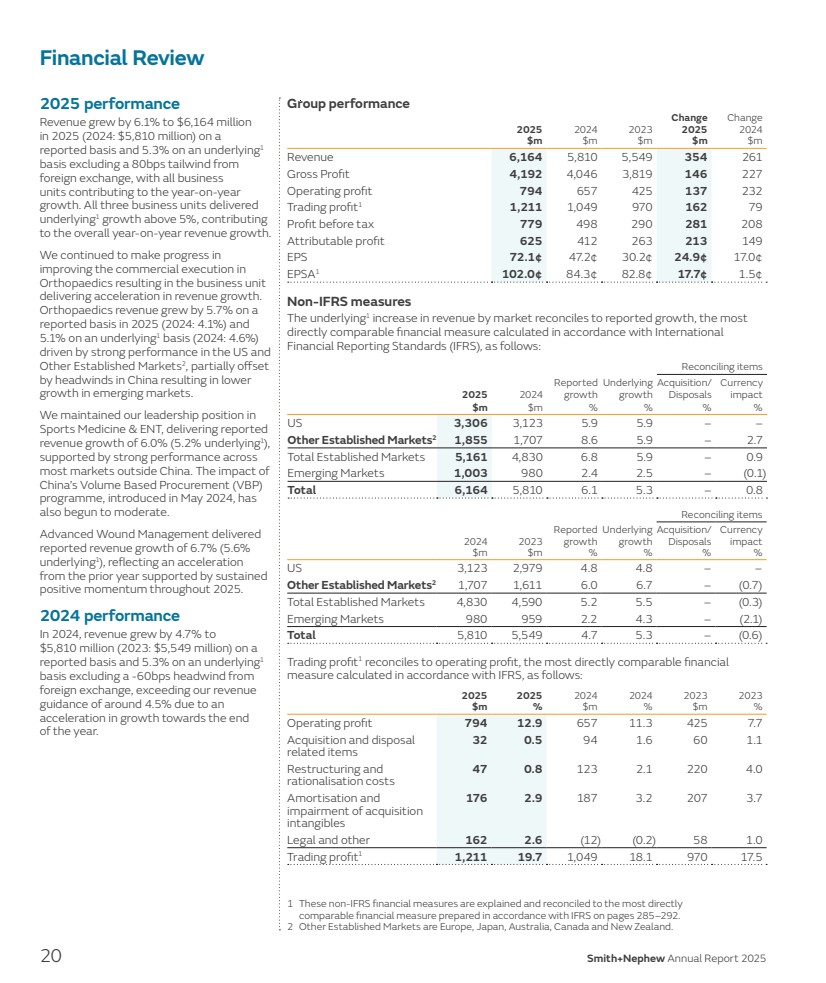
| STRATEGIC REPORT GOVERNANCE ACCOUNTS OTHER INFORMATION In 2024, revenue growth was driven by most segments and markets. We made good progress in improving the commercial execution in Orthopaedics resulting in an acceleration in revenue growth towards the end of 2024. Orthopaedics revenue grew by 4.1% on a reported basis (and 4.6% on an underlying1 basis) driven by strong performance in Other Established Markets2 as well as significant improvement in the US as the year progressed, partially offset by headwinds in China due to lower end customer demand. We continued to hold a leadership position in Sports Medicine & ENT and delivered reported revenue growth of 5.5% (6.2% underlying1 ), despite the China VBP headwinds, due to strong performance across all categories. Advanced Wound Management delivered reported revenue growth of 4.7% (5.1% underlying1 ) and maintained positive momentum in 2024 with growth accelerating towards the end of the year. We exited 2024 in a strong position with all three global business units contributing with accelerating revenue growth in the fourth quarter over the first nine months. Improved profitability The gross profit was $4,192 million in 2025 (2024: $4,046 million, 2023: $3,819 million) with gross profit margin of 68.0% (2024: 69.6%, 2023: 68.8%). We maintained strong gross profit margins while delivering revenue growth, supported by improvements in commercial execution despite ongoing inflationary pressures and $159 million excess and obsolescence provision in relation to the inventory portfolio rationalisation programme. The reported operating profit for 2025 was $794 million, a 20.7% increase from the previous year primarily due to operating leverage and productivity savings across the Group. Administrative expenses decreased by $84 million mainly due to lower non-trading costs1. Costs associated with restructuring and rationalisation and acquisition related costs decreased by $71 million and $51 million respectively with the majority of the strategic actions under the 12-Point Plan were implemented in 2024 and no acquisitions were made in 2025. These decreases were partially offset by a $86 million, or 3.8% increase, in marketing, selling and distribution expenses as a result of revenue growth. Research and development expenses increased by $7 million, or 2.4%, reflecting a sustained innovation cadence. The reported operating profit for 2024 was $657 million, a 55% increase from the previous year primarily due to operating leverage and productivity savings across the Group. In addition, research and development expenses decreased by $50 million mainly due to a $20 million reduction in legal and other items and $18 million reduction in restructuring and rationalisation incurred in 2023, partially offset by a $58 million, or 2.6% increase, in marketing, selling and distribution expenses as a result of revenue growth. The increase in reported operating profit was also driven by lower non-trading costs1. Costs associated with restructuring and rationalisation and legal and other costs decreased by $97 million and $70 million respectively as a larger proportion of strategic actions under the 12-Point Plan were implemented in 2023. 1 These non-IFRS financial measures are explained and reconciled to the most directly comparable financial measure prepared in accordance with IFRS on pages 285–292. 2 Other Established Markets are Europe, Japan, Australia, Canada and New Zealand. Profit margin expansion In 2025, trading profit1 was $1,211 million (2024: $1,049 million, 2023: $970 million), with trading profit margin1 of 19.7% (2024: 18.1%, 2023: 17.5%). We continue to deliver year-on-year expansion in our trading profit margin1 reflecting operating leverage, continued benefits from the 12-Point Plan and productivity savings across the Group. In 2025, the reported profit before tax was $779 million (2024: $498 million, 2023: $290 million). In 2025 and 2024, the reported profit before tax grew mainly due to improvement in operating profit. In 2025, reported profit before tax also grew because of a $109 million reversal of an impairment charge relating to Bioventus. Taxation The reported taxation charge in 2025 was $154 million (2024: $86 million, 2023: $27 million). The increase in the reported tax charge can principally be attributed to the increases in profit before tax since 2023 and the jurisdictional profit mix. Earnings per share In 2025, Basic earnings per share (EPS) were up 53% to 72.1¢ and adjusted earnings per share1 (EPSA) were up 21% to 102¢, reflecting improved trading performance. In 2024, Basic EPS were up 56.3% to 47.2¢ and EPSA1 were up 1.7% to 84.3¢, reflecting improved trading performance. Smith+Nephew Annual Report 2025 21 04_SN_AR25_Financial_Review_v163.indd 21 05/03/2026 17:26 |

| Taxation The Group is subject to various taxes in the many countries in which it operates. Paying tax is an integral part of our commitment to the societies in which we operate and a critical element of our commitment to grow in a sustainable, responsible and transparent way. The Group makes a significant economic contribution to the countries where it operates through taxation, either borne or collected on behalf of and paid to the relevant tax authorities, and through employment of personnel, developing workforce skills, purchasing goods and services from local suppliers and making capital investments. We aim to submit accurate tax returns to the relevant tax authorities on a timely basis, and seek to pay the right amount of tax in accordance with the tax laws in all the territories in which we operate. We manage tax risks and tax costs in a manner consistent with regulatory requirements and shareholders’ best long-term interests, after taking into account reputational and economic factors as well as the interests of our other stakeholders, including governments, our people, customers and suppliers. We are committed to transparent relationships with all relevant tax authorities. Our tax footprint extends beyond corporate income tax, including significant payments of employer social security contributions. The Group also collects taxes on behalf of governments (including employee income taxes and social security contributions, VAT and other sales taxes). During 2025, we made global tax payments of $964 million (2024: $888 million, 2023: $833 million). This comprises $387 million of taxes borne by Smith+Nephew and $577 million of payroll and indirect taxes collected. Balance sheet Overall goodwill and intangible assets decreased by $68 million or 1.7% in 2025. Intangible assets decreased by $150 million mainly because of amortisation and impairment of $249 million being partially offset by additions of $76 million and foreign exchange movements of $22 million. Goodwill increased by $82 million as a result of foreign exchange movements. Other non-current assets increased by $489 million mainly due to an increase of $216 million in property, plant and equipment as a result of a transfer of instruments not deployed of $137 million from inventory to property, plant and equipment to reflect their expected deployment and a $85 million increase in assets in course of construction mainly on account of ongoing development of a new manufacturing facility in Hull, UK. Investment in associates increased by $114 million mainly due to a $109 million reversal of impairment of investment in Bioventus. In addition, investments relating to deferred compensation arrangements amounted to $109 million, reflecting the Group’s control of the underlying assets. Current assets decreased by $318 million mainly due to a $270 million decrease in inventory as a result of $137 million transfer of instruments not deployed to property, plant and equipment as noted above and $159 million excess and obsolescence provision in relation to the inventory portfolio rationalisation programme. Inventory remains a key focus area for us and we expect to significantly reduce inventory over time as a result of the inventory portfolio rationalisation programme and offer a simpler and more efficient offer to our customers. Cash and cash equivalents decreased by $62 million (refer to cash flow section for details). The decreases were partially offset by a $32 million increase in trade and other receivables. The increase in trade and other receivables is primarily due to an increase in trade receivables of $97 million mainly due to revenue growth and foreign exchange movements of $47 million, excluding the impact of foreign exchange movements, trade receivables increased by less than the revenue growth, reflecting sustained momentum from the Order to Cash initiatives implemented under the 12-Point Plan. These increases were offset by a decrease in other receivables due to a $28 million decrease in derivative assets and $27 million decrease in prepayments. Non-current liabilities increased by $15 million, primarily due to higher other payables related to the Group’s deferred compensation obligations. This was partially offset by the reclassification of $75 million of private placement notes to current liabilities due to their repayment in 2026. Current liabilities increased by $64 million primarily due to the reclassification of $75 million of private placement notes described above, partially offset by a decrease in provisions by $34 million. 1 These non-IFRS financial measures are explained and reconciled to the most directly comparable financial measure prepared in accordance with IFRS on pages 285–292. 22 Smith+Nephew Annual Report 2025 Financial Review continued 04_SN_AR25_Financial_Review_v163.indd 22 05/03/2026 17:26 |

| STRATEGIC REPORT GOVERNANCE ACCOUNTS OTHER INFORMATION In 2024, cash generated from operations was $1,245 million after paying out $151 million of restructuring and rationalisation expenses, $36 million for legal and other items and $3 million of acquisition and disposal related items. Trading cash flow1 increased by $364 million driven by a significant improvement in working capital compared to 2023. In 2024, restructuring and rationalisation cash outflows totalled $123 million, including costs relating to efficiency and productivity initiatives under the 12-Point Plan. This was a significant reduction from 2023 when restructuring and rationalisation cash outflows were $220 million. We expect restructuring and rationalisation cash outflows to significantly decrease from 2025 onwards. This was a driver behind the step-up in free cash flow1 to $551 million in 2024 (2023: $129 million). Cash flow In 2025, cash generated from operations was $1,549 million after paying out $83 million of restructuring and rationalisation expenses, $30 million of acquisition and disposal related items and $19 million for legal and other items. Trading cash flow1 increased by $237 million driven by operating leverage and improvement in working capital compared to 2024. Restructuring and rationalisation cash outflows decreased by $68 million and legal and other cash outflows decreased by $17 million. These decreases were partially offset by a $27 million increase in acquisition and disposal related items. In 2025, net cash used in investing activities was $406 million, primarily due to capital expenditure of $433 million. Net cash used in financing activities was $955 million, as a result of share buyback of $502 million, dividends paid of $330 million, repurchase of corporate bond for $90 million and payment of capital element of lease liabilities of $50 million. Liquidity and capital resources At 31 December 2025, the Group had access to $553 million (2024: $617 million) in cash net of bank overdrafts. The Group’s debt facilities comprise: – USD $900 million corporate bond; – USD $650 million corporate bond; – EUR €500 million corporate bond; – USD $350 million corporate bond; – $1,000 million RCF; and – $625 million private placement debt. The Group had committed available facilities of $4,112 million at 31 December 2025 of which $3,112 million was drawn. The Group’s net debt2, including lease liabilities, increased from $2,709 million at the beginning of 2025 to $2,759 million at the end of 2025, representing an overall increase of $50 million mainly as a result of share buyback of $502 million and $90 million repurchase of corporate bond partially offset by $304 million increase in cash generated from operations and $177 million decrease in cash out flows relating to acquisitions. In 2025, the Group repurchased $100 million of its $1.0 billion 2.032% USD corporate bond for a consideration of $90 million. Adjusted leverage ratio1 for 2025 was 1.7x, better than our revised target adjusted leverage ratio of 2x and the 1.9x for 2024, mainly driven by improved profitability. The leverage ratio using the closest equivalent IFRS measures for 2025 was 5.3x (2024: 8.1x). The leverage ratio using closest equivalent IFRS measures is not based on measures used in the calculation of debt covenants and is not used by management internally. On 9 February 2026, the Group amended its $1000 million revolving credit facility, increasing total commitments to $1,125 million. The facility remains undrawn and its maturity is unchanged. 2025 2024 2023 Change 2025 Change 2024 $m $m $m $m $m Cash generated from operations 1,549 1,245 829 304 416 Trading cash flow1 1,236 999 635 237 364 Free cash flow1 840 551 129 289 422 2025 2024 Change $m $m $m Goodwill and intangible assets 3,990 4,058 (68) Other non-current assets 2,364 1,875 489 Current assets 4,103 4,421 (318) Total assets 10,457 10,354 103 Total equity 5,289 5,265 24 Non-current liabilities 3,573 3,558 15 Current liabilities 1,595 1,531 64 Total liabilities 5,168 5,089 79 Total equity and liabilities 10,457 10,354 103 Net debt2 2,759 2,709 50 1 These non-IFRS financial measures are explained and reconciled to the most directly comparable financial measure prepared in accordance with IFRS on pages 285–292. 2 Net debt including lease liabilities is reconciled in Note 15 to the Group accounts. Smith+Nephew Annual Report 2025 23 04_SN_AR25_Financial_Review_v163.indd 23 05/03/2026 17:26 |
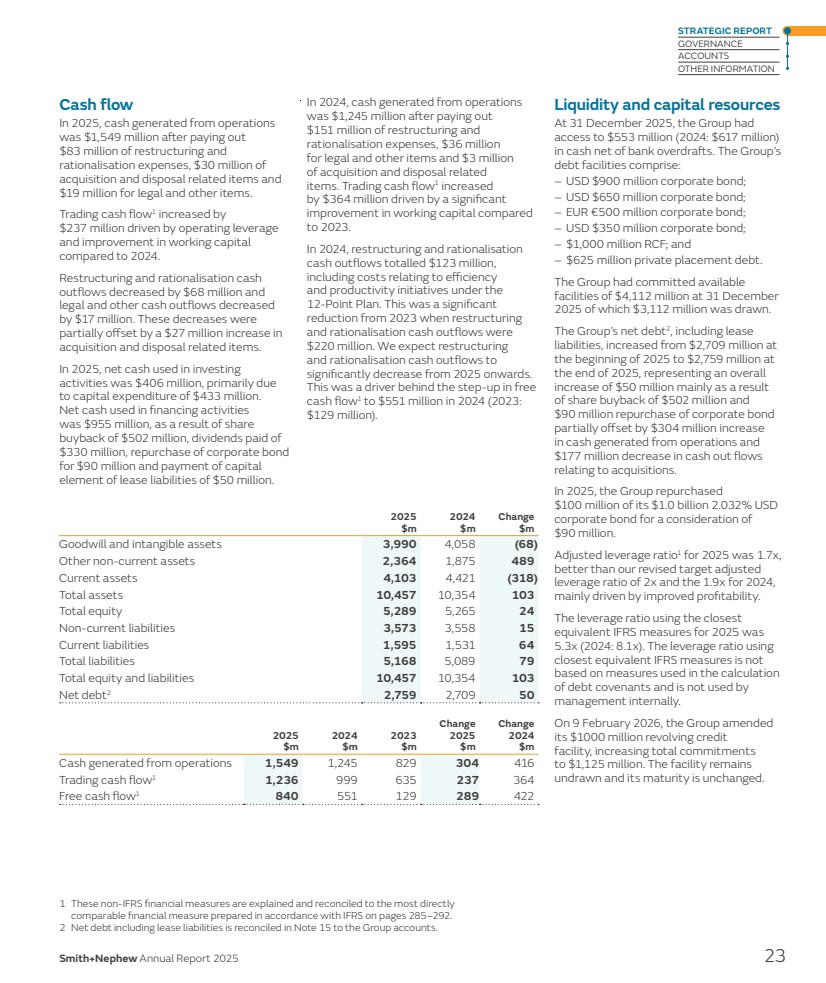
| Return on Invested Capital Return on Invested Capital (ROIC) is a measure of the return generated on capital invested by the Group. It encourages compounding reinvestment within the business and discipline around acquisitions. Adjusted ROIC1 increased from 7.4% in 2024 to 8.3% in 2025, despite a -160bps headwind from the inventory portfolio rationalisation programme, reflecting the improvements delivered by the 12-Point Plan. ROIC based on the closest equivalent IFRS measures was 7.3% for 2025 (2024: 4.9%). Going concern The Directors have considered various scenarios in assessing the future financial performance and cash flows. Throughout these scenarios, which include a severe but plausible outcome, the Group continues to have headroom on its borrowing facilities and financial covenants. The Directors have a reasonable expectation that the Company and the Group are well placed to manage their business risks and to continue in operational existence for a period of at least 12 months from the date of approval of the financial statements. Accordingly, the Directors continue to adopt the going concern basis in preparing the consolidated financial statements. Capital allocation framework The appropriate use of capital on behalf of shareholders is important to Smith+Nephew. Our capital allocation framework prioritises the use of cash and informs our investment decisions as follows: – Invest in the business to drive organic growth and meet our sustainability targets. – Invest in acquisitions, targeting new technologies in high growth segments with a strong strategic fit that meets our financial criteria. – Maintain an optimal balance sheet and appropriate dividend. Here we will continue to target investment grade credit ratings with a target leverage ratio of around 2x net debt to adjusted EBITDA. We have a progressive dividend policy and from 2025 onwards we expect a payout of around 35% to 40% of EPSA. – Return surplus capital to shareholders, subject to the above balance sheet metrics. Our first priority remains investing in the business to drive organic growth and meet our sustainability targets. We have increased visibility and focus on improving our Return on Invested Capital (ROIC) at the business unit level through allocation of central costs and our drive to improve working capital. We will continue to prioritise capital investment in those areas where we expect to see the highest incremental returns. 1 These non-IFRS financial measures are explained and reconciled to the most directly comparable financial measure prepared in accordance with IFRS on pages 285–292. 2 Net debt including lease liabilities is reconciled in Note 15 to the Group accounts. Available debt facilities by maturity date ($m) E EUR Bond U USD Bond R RCF Undrawn P Private placements Total 2027 490 140 2028 60 60 2029 600 100 2030 1,995 1,000 95 2032 155 500 2034 650 155 900 650 Maturity by date P P P P U U U E R 75 2026 75 350 P P 24 Smith+Nephew Annual Report 2025 Financial Review continued 04_SN_AR25_Financial_Review_v163.indd 24 05/03/2026 17:26 |
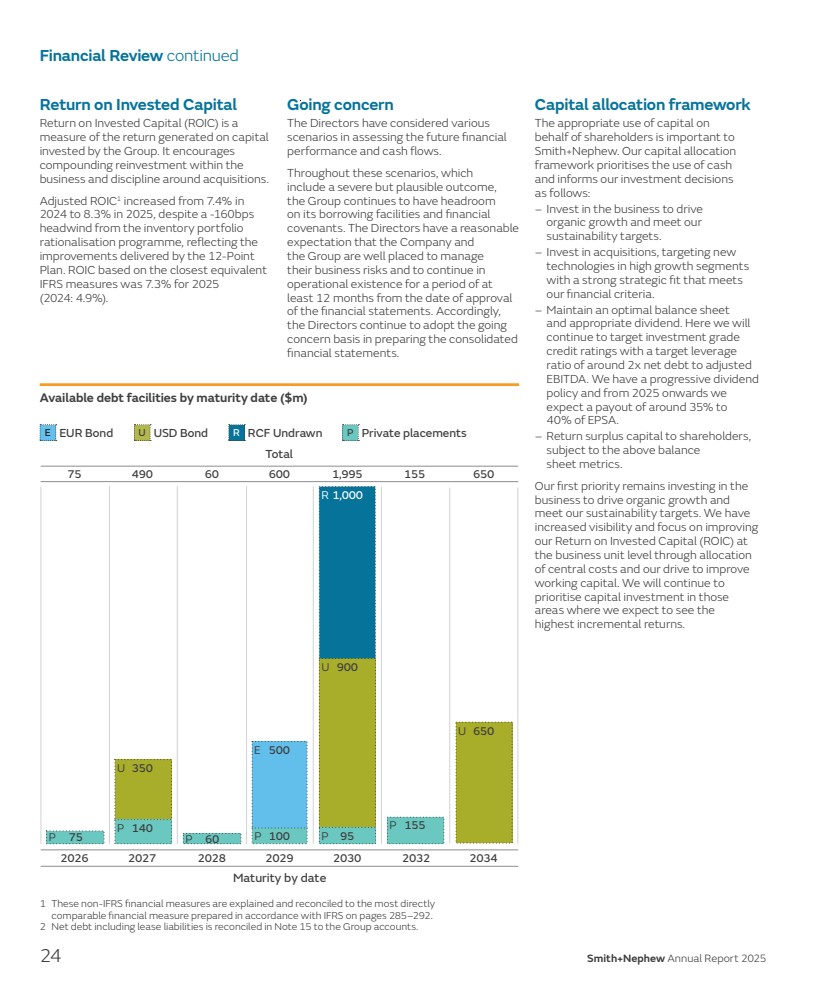
| STRATEGIC REPORT GOVERNANCE ACCOUNTS OTHER INFORMATION The second priority is also unchanged, and is to invest in acquisitions, targeting new technologies in high growth segments with a strong strategic fit that meet our financial criteria. On 21 January 2026, we completed the acquisition of Integrity Orthopaedics, Inc, a US-based early stage commercial developer of Tendon Seam™, an innovative rotator cuff repair (RCR) system designed to significantly reduce re-tear rates and improve patient outcomes. The acquisition represents a meaningful step in delivering Smith+Nephew’s RISE strategy to accelerate growth through strategic investment and portfolio leadership, and will be an important building block in our ambition to become the global leader in Sports Medicine. The acquisition consideration comprised of $225 million paid on completion, with up to a further $225 million contingent on future performance. The third priority is to maintain an optimal balance sheet and appropriate dividend. Here we will continue to target investment grade credit ratings. The adjusted leverage ratio1 is calculated using metrics similar to those used in the debt covenant calculation. The 2024 final dividend of 23.1¢ (2023: 23.1¢) per ordinary share, totalling $202 million (2023: $202 million), was paid on 28 May 2025 (2023: 22 May 2024). The 2025 interim dividend of 15.0¢ (2024: 14.4¢) per ordinary share, totalling $128 million (2024: $125 million), was paid on 7 November 2025 (2024: 4 November 2024). Our final priority remains to return any surplus capital to shareholders, via a share buyback subject to the above balance sheet metrics. During the second half of 2025, we completed the share buyback of $500 million which was announced in Q3 2025. 1 These non-IFRS financial measures are explained and reconciled to the most directly comparable financial measure prepared in accordance with IFRS on pages 285–292. For 2026 we are targeting further progress in revenue growth, trading profit¹ and adjusted ROIC1, and sustained strong cash generation, as outlined in our provisional guidance at our Capital Markets Day in December 2025. We continue to expect underlying1 revenue growth to accelerate to around 6% for the full year. This is expected to include continued good growth in Orthopaedics, Sports Medicine (excluding Arthroscopic Enabling Technologies and ENT in China) and Advanced Wound Management, particularly in Advanced Wound Care and Advanced Wound Devices. Whilst we expect headwinds in our skin substitutes business, we still expect Advanced Wound Bioactives to grow, supported by the ongoing strength of SANTYL and growth in skin substitutes outside of the physician office and mobile channel. The guidance equates to reported revenue growth of around 7.8% based on exchange rates prevailing on 24 February 2026. We continue to expect trading profit1 growth on an organic basis of around 8%. As outlined in December, we face a number of extraordinary profit headwinds in 2026 including from inventory revaluation, tariffs, the impact of changes to reimbursement in our US Advanced Wound Management business and ENT VBP in China. There are no changes to any of our assumptions regarding these profit headwinds. We still expect revenue leverage and operational savings to more than offset these headwinds to drive trading profit1 growth ahead of revenue growth. The acquisition of Integrity Orthopaedics, which was completed after we provided our provisional guidance, is expected to be $20 to $25 million dilutive to trading profit1 in 2026, broadly neutral in 2027 and $20 to 25 million accretive in 2028. Including this dilution, we expect 2026 trading profit1 to be $1.3 billion based on current forecast exchange rates. We expect around $800 million in free cash flow and greater than 10% ROIC, excluding the impact of Integrity Orthopaedics. We expect a stronger second half to the year compared to the first half for both profit and sales growth, in keeping with normal phasing. The tax rate on trading1 results for 2026 is forecast to be in the range of 19.0% to 20.0%, subject to any material changes to tax law or other one-off items. 2026 Outlook Smith+Nephew Annual Report 2025 25 04_SN_AR25_Financial_Review_v163.indd 25 05/03/2026 17:26 |
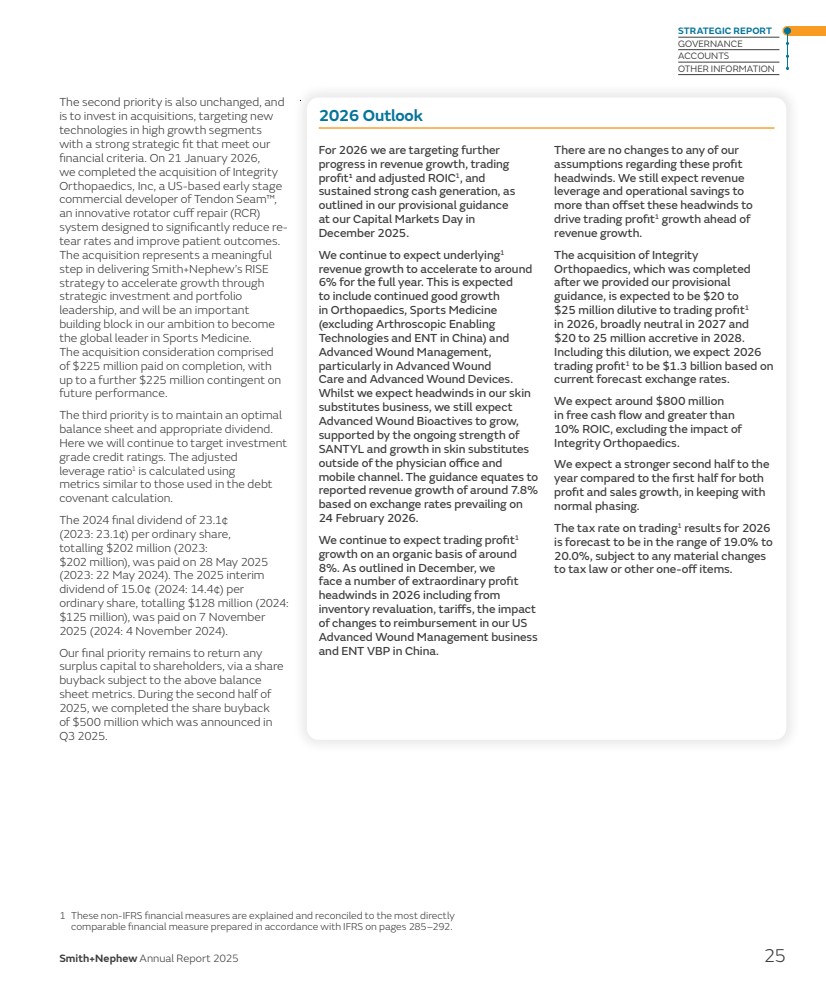
| Working to improve the quality of healthcare through our investment in new technologies and services, clinical evidence and efficient and resilient manufacturing and distribution. Life Unlimited 01Innovators Together we are 26 Smith+Nephew Annual Report 2025 05_SN_AR25_Innovating_v172.indd 26 05/03/2026 17:33 |
| Smith+Nephew’s R&D programme has played an essential role in transforming our revenue growth profile. In recent years, we have delivered a steady cadence of new products that have built out our existing portfolio and often transformed the standard of care. In 2025, we launched 15 new products, bringing our total to more than 75 products launched in the last five years. As a result, more than 60% of our 2025 revenue growth came from new products launched within the last five years. Encouragingly, many of these new growth platforms are driving growth today and have multi-year runways still ahead of them as we expand indication and applications and launch in new markets. That level of innovation comes with a history of consistent investment. We maintained our investment in R&D through the 12-Point Plan, and invested $296 million in 2025. We will be increasing investment further in 2026, maintaining a healthy average of over 5% of revenue. Driving growth through innovation New platforms in M-TECH and Biologics At the heart of our new RISE strategy are our two key innovation platforms that are expected to deliver new products which can be scaled across our business units. The first we refer to as M-TECH, a term we have created to define our innovation across Musculoskeletal Technologies to Enhance Care and Healing. Within M-TECH we currently have our unique robotics-assisted CORI◊ Surgical System for Orthopaedics, our new Spatial Surgery system TESSA◊ in Sports Medicine, which is pending FDA De Novo, and our patient monitoring system LEAF◊ in Advanced Wound Management. The second platform is Biologics, where we anticipate taking products like REGENTEN◊ , CARTIHEAL◊ AGILI-C◊ , SANTYL◊ and our skin substitutes into new areas and indications, whilst adding new technologies that have wide-ranging applications. “We have a rich history of delivering innovations that truly matter, shaping clinical practice and improving outcomes. We will continue to deliver both incremental and transformative innovation, including across our scalable enterprise-wide innovation platforms of M-TECH and Biologics, and maintain a strong cadence of product launches across all business units.” Vasant Padmanabhan President Research & Development, ENT and Emerging Markets Innovation that matters Our engineers and scientists work in partnership with our customers to identify solutions to unmet needs and to turn them into products. Compelling evidence of value We create compelling evidence of both clinical and economic value to enable market access and drive market adoption. Seamless New Product Development (NPD) execution We follow a disciplined prioritisation process and work with development partners across the world to drive new products to market. Our innovation engine Our approach to delivering innovation is built upon three key pillars: Strong track record of R&D investment and productivity $1.6bn Total R&D investment 2021-25 5.8% Average R&D spend as proportion of sales 2021-25 75+ New products launched 2021-25 >60% Revenue growth in 2025 from products launched in last five years Smith+Nephew Annual Report 2025 27 STRATEGIC REPORT GOVERNANCE ACCOUNTS OTHER INFORMATION Research & Development 05_SN_AR25_Innovating_v172.indd 27 05/03/2026 17:33 |

| From evolution to revolution: new products powering our next phase of growth Orthopaedic implants AETOS◊ Total Shoulder System – Meta Stem & Stemless CATALYSTEM◊ Primary Hip System and Impactor TRIGEN◊ MAX Tibial Nailing System LEGION◊ Medical Stabilised Inserts CORI Surgical System – Robotic-assisted revision knee arthroplasty Surgical planning powered by AI CORIOGRAPH◊ Pre-Op planning CORI Adjustable Tibia Cut Guide EVOS◊ Patella Plates Recent product launches have been balanced across incremental and transformative innovations, with some of our major launches from 2023 to 2025 shown on these pages. We have a broad portfolio, with product launches spanning the breadth of every business unit. Orthopaedic Enabling Technology CORI Digital Tensioner 28 Smith+Nephew Annual Report 2025 Innovators continued Research & Development continued 05_SN_AR25_Innovating_v172.indd 28 05/03/2026 17:33 |
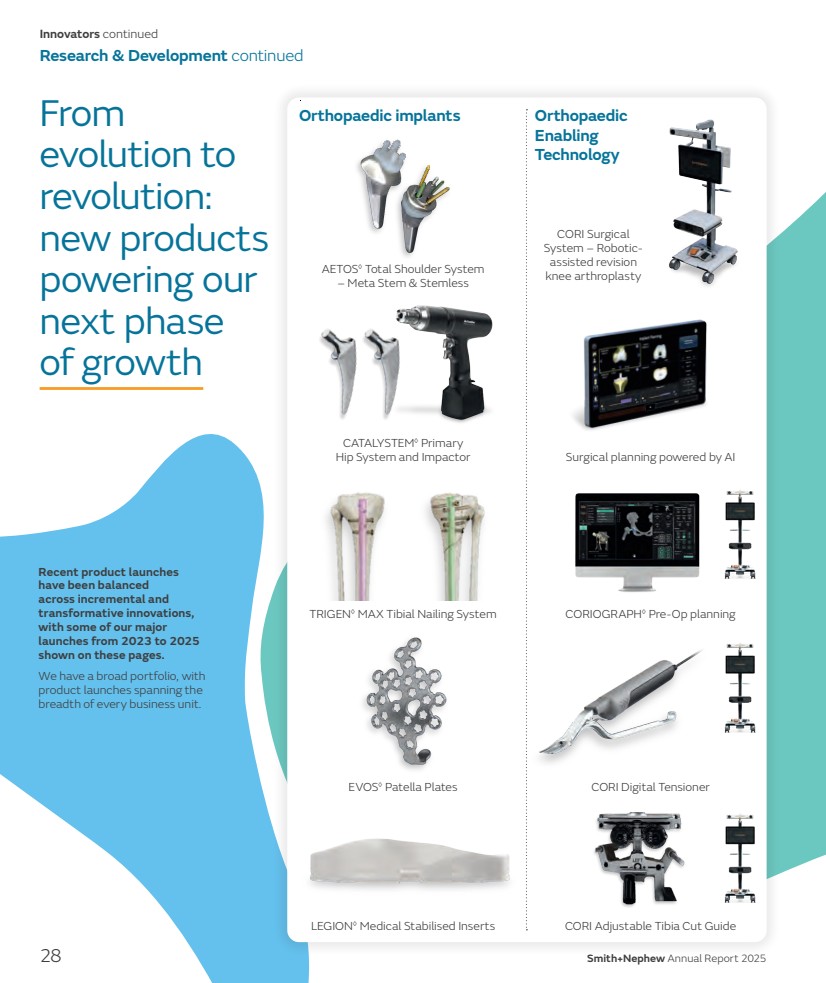
| Advanced Wound Management ALLEVYN◊ AG+ and ALLEVYN COMPLETE CARE Next Gen RENASYS◊ GRAFIX PLUS◊ and BIOBRANE◊ US INTELLIO◊ 4K ULTRABRIDGE◊ and ULTRABRACE◊ Kits REGENETEN Implant expansion Q-FIX◊ KNOTLESS All-Suture Anchors INTELLIO Shift CARTIHEAL AGILI-C Implant ENT: TULA® Building leadership in M-TECH The CORI Surgical System, with its associated procedural applications, is the key to unlock increased procedural growth across reconstruction, and we are excited by the possibilities of the third generation product, CORI XT, which received FDA 510(k) clearance in December 2025. TESSA Spatial Surgery (FDA De Novo pending) is the first-of-a kind arthroscopic video-based navigation that utilises patient-specific, image-based planning powered by AI algorithms with seamless workflow integration, fast set-up and a short learning curve, which we expect to represent the next technological leap for arthroscopy. M-TECH also incorporates sensors to enhance patient care, such as the LEAF◊ Patient Monitoring System, acquired in 2019, which is designed to monitor and prevent pressure injuries. The next generation LEAF Patient Monitoring System, currently in development, will be cloud-based to drive more efficient installation and updates. Sports Medicine & ENT Smith+Nephew Annual Report 2025 29 STRATEGIC REPORT GOVERNANCE ACCOUNTS OTHER INFORMATION |

| 15 new products in 2025 In 2025, we expanded our portfolio with 15 major new platforms and product enhancements across all global business units that address unmet clinical needs. Orthopaedics In Orthopaedics, new products included LEGION Medial Stabilised inserts, addressing a fast-growing category of inserts now used in more than 40% of US knee replacements, and the TRIGEN MAX Tibia Nailing System for stable and unstable fractures of the tibia, which builds on more than two decades of proven performance and industry-leading design from our TRIGEN Nails portfolio. On our CORISurgical System, we launched CORIOGRAPH Pre-Operative Planning and Modelling Services in total shoulder replacement, expanding the offering to now cover all major joint replacement procedures – knee, hip and shoulder. Offering both image-free and image-based registration, CORIOGRAPH is another element in our approach of supporting a range of procedures and surgeon preferences on CORI. Sports Medicine In Sports Medicine, we continue to expand the indication range for our REGENETEN Bioinductive Implant to include extra-articular ligament injuries in the US, creating opportunities to reach more patients with soft tissue injuries around the body. The initial focus is hip capsule repair, with future expansion planned in other extra-articular ligament repairs. We also launched the Q-FIX KNOTLESS All-Suture Anchor for soft tissue-to-bone fixation indications across multiple joint spaces, including shoulder, hip, and foot & ankle. This new option builds on the long-standing success and performance of the best-in-class anchor fixation strength of the Q-FIX Family. Advanced Wound Management In Advanced Wound Management, we launched ALLEVYN Ag+ SURGICAL in the US. This is a new antimicrobial silver dressing which adds to the established ALLEVYN family of foam dressings. ALLEVYN Ag+ SURGICAL dressing features new ComfortSTAY◊ Technology for gentle silicone adhesion and HighFLEX◊ Technology to provide flexibility and comfort during patient movement. ALLEVYN COMPLETE CARE The future of foam dressings Launched in the US in late 2025, ALLEVYN COMPLETE CARE is our next-generation five-layer foam dressing. In November, we saw the first scientific data published demonstrating its pressure injury prevention mechanism of action and its ability to absorb and dissipate friction and shear forces. In developing ALLEVYN COMPLETE CARE Dressing we worked closely with customers to understand the challenges they faced, and it is these insights that drove our product development. ALLEVYN COMPLETE CARE Dressing embodies our purposeful intention to focus on the unmet need of customers and patients alike. Actively providing such care helps us strengthen our connection, make meaningful impact, and create the change that counts, because supporting better outcomes drives everything we do. Exciting pipeline These new products across our business units are expected to have multi-year growth runways ahead, and we have an exciting pipeline of further launches and line extensions planned in 2026 and beyond. This includes the launch of our new LANDMARK◊ Total Knee System, which is expected to leapfrog the competition with its differentiating features. LANDMARK brings proven features and functions of our knee portfolio into a single platform that combines advanced kinematics with the next level of personalisation, enhanced robotic workflows, and ease of implantation, alongside existing instrumentation. 30 Smith+Nephew Annual Report 2025 Innovators continued Research & Development continued 05_SN_AR25_Innovating_v172.indd 30 05/03/2026 17:33 |
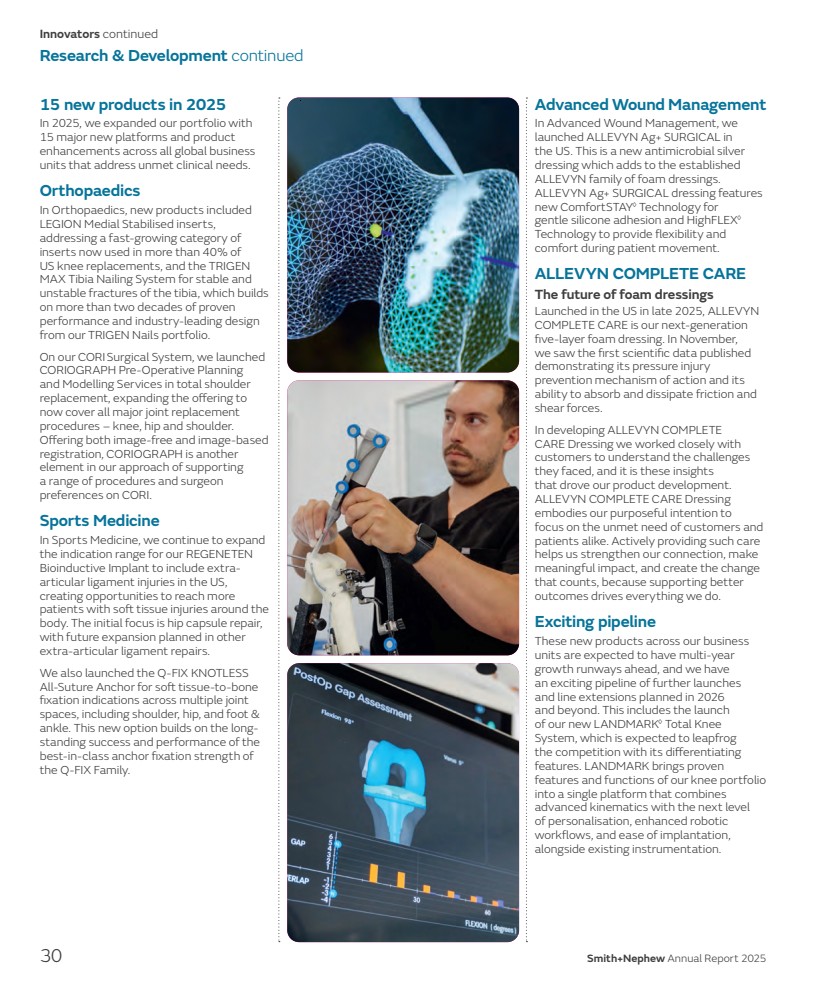
| Supporting adoption through clinical evidence Clinical, scientific, and real-world evidence continues to play a critical role in our go-to-market strategy, with compelling and differentiating data supporting key product families in 2025. In Orthopaedics, evidence shows that JOURNEY◊II Total Knee Arthroplasty (TKA), when paired with Smith+Nephew’s handheld robotic system, resulted in sustained improvements in clinical outcomes and patient satisfaction at two years compared to conventional TKA.1 Additionally, data confirms that our OXINIUM◊ Technology on highly cross-linked polyethylene has the highest survivorship rate among all bearing combinations over a 20-year period for total hip arthroplasty.2 In Sports Medicine, we expanded the evidence base for REGENETEN Bioinductive Implant, showing that patients have a three times lower re-tear rate than with repair alone.3 New five-year results for CARTIHEAL AGILI-C Cartilage Repair Implant showed how this recently acquired product maintained superior knee function compared to the standard of care and reduced the long-term risk of total knee arthroplasty or osteotomy.4 In ENT, Coblation Intracapsular Tonsillectomy (CIT) was shown to be more cost-effective than extracapsular techniques in paediatric tonsillectomy, with lower complication rates and reduced resource use.5 In Advanced Wound Management, a real-world study involving over 10,000 Caesarean section patients showed that the PICO◊ single-use Negative Pressure Wound Therapy (sNPWT) system led to significantly fewer surgical site infections and complications, and resulted in cost savings compared to an alternative sNPWT system.6 And the first scientific data demonstrating the effectiveness of our new ALLEVYN COMPLETE CARE 5-Layer Foam Dressing for pressure injury prevention was published.7 Our AI strategy AI is increasingly important to Smith+Nephew’s strategy, supporting our growth ambitions through our innovation programmes and our drive to improve productivity. Strategic direction is set by our Executive Committee, and our AI needs are prioritised and enabled by Enterprise AI Centres of Excellence (COE). AI Champions across the business identify opportunities both within their areas and for potential application enterprise-wide, and drive implementation and adoption, supported by IT and Information Security teams. Our AI Working Group, comprising a cross-functional team, including members from Commercial, R&D, Audit, Information Security, Privacy and Legal, oversees governance to ensure that reviews are undertaken to establish appropriate controls across the Group, both for AI projects and for AI use by employees in their day-to-day work. For customer-facing delivery of products and services, we are strategically positioning AI to enhance personalisation, automation and overall care quality for patients, developing solutions to address unmet clinical needs and support operational efficiencies. We have two AI Centres of Excellence that work together in close coordination. The Enterprise AI COE is responsible for enabling our employees with AI skills and knowledge, initiating high value AI solutions across the enterprise, governing ethical and appropriate use of AI, and ensuring that we track and register how AI is adopted across our Company. Our R&D AI Centre of Excellence evaluates opportunities for generative AI (GenAI) and machine learning to meet different needs related to our products. Our AI strategy addresses opportunities in three areas: Products, Enterprise and People. 1 Products: AI brings advanced capabilities that improve surgical planning, procedures, and customer outcomes. Our CORI Surgical System incorporates Personalised Planning powered by AI and RI.INSIGHTS◊ Data Visualization Platform, two solutions that transform data into contextual intelligence by enabling surgeons to see how pre-operative surgical plans and intra-operative decision making link to post-operative outcomes. 2 Enterprise: We leverage agentic and generative AI to automate and improve workflows, improve forecasting, and strengthen commercial interactions. For 2026, we are exploring expanding our AI-enabled solutions that augment our customer service, improve employee self-service, and optimise inventory across our distribution and stocking network. 3 People: We bring the power of AI to our employees to drive productivity and quality. Generative AI tools, including Microsoft Copilot Chat, are deployed and supported by training, communications, and skills-building courses. ALLEVYN COMPLETE CARE For a full list of references see page 306–311 Smith+Nephew Annual Report 2025 31 STRATEGIC REPORT GOVERNANCE ACCOUNTS OTHER INFORMATION 05_SN_AR25_Innovating_v172.indd 31 05/03/2026 17:33 |
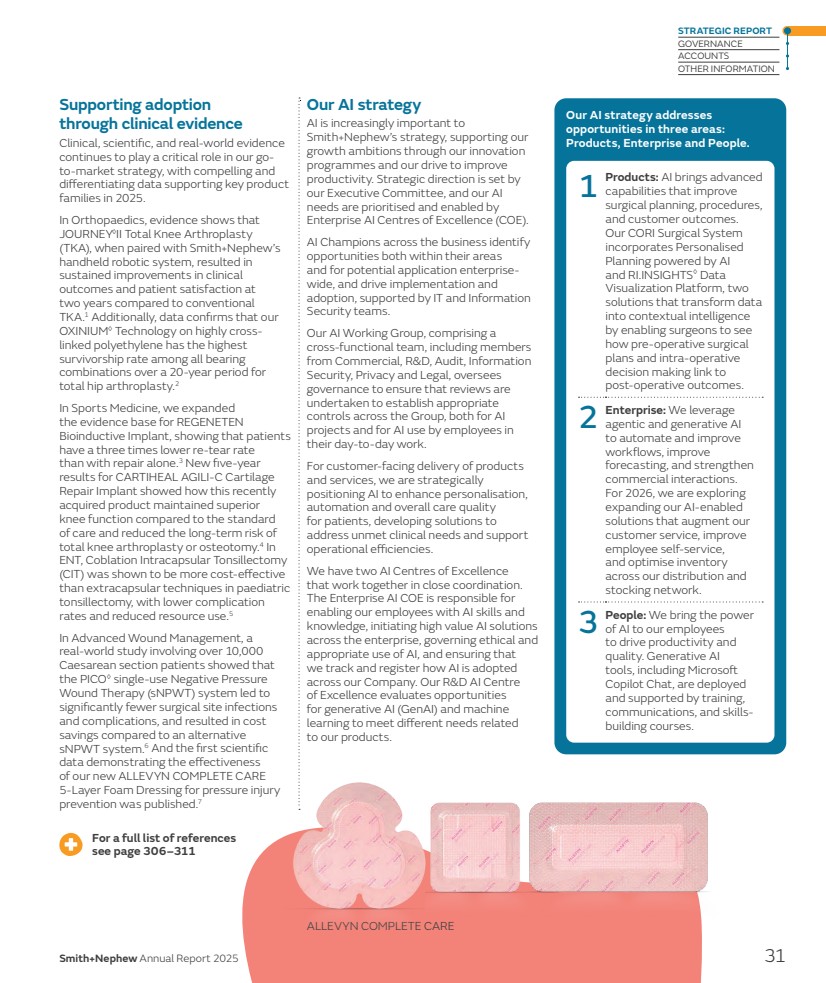
| Integrity Orthopaedics – scaling through strategic investment Strengthening our shoulder repair portfolio In January 2026, we were pleased to acquire sports medicine business Integrity Orthopaedics and its novel TENDON SEAM™ rotator cuff repair technology. Integrity Orthopaedics is a US-based early-stage commercial developer of TENDON SEAM, an innovative rotator cuff repair (RCR) system designed to significantly reduce re-tear rates and improve patient outcomes. The acquisition represents a meaningful step in delivering Smith+Nephew’s RISE strategy to accelerate growth through strategic investment and portfolio leadership, and will be an important building block in our ambition to become the global leader in Sports Medicine. Rotator cuff repair is a substantial and growing treatment area, with approximately 500,000 procedures performed annually in the US and an estimated market value of $875 million.8 Yet traditional surgical techniques have historically suffered from high structural failure rates, averaging 20–40%.9 TENDON SEAM directly addresses this unmet clinical need. Its patented micro-anchors, continuous suture, individually locked stitches, and integrated implantation instrument are designed to deliver stronger repairs, accelerated patient recovery, lower re-tear rates, and a simplified surgical technique. Early clinical experience indicates low re-tear rates, reduced sling times and shorter procedures compared with standard methods.10 The system received 510(k) clearance in 2023 and is indicated for reattachment of soft tissue to bone, including tendons, ligaments, and joint capsules. Smith+Nephew acquired Integrity Orthopaedics for an initial cash payment of $225 million, plus additional performance-based payments of up to $225 million over the next five years. The transaction is expected to be accretive to Group trading profit margin by 2028. Smith+Nephew’s portfolio for shoulder TENDON SEAM enhances Smith+Nephew’s extensive shoulder repair offering, which spans technologies for both replacement and repair. This includes: – REGENETEN Bioinductive Implant used in 200,000+ rotator cuff procedures in the last decade, and shown to support new tissue growth and improved healing.11,12 – Q-FIX All-Suture Anchor delivering market-leading fixation strength with a decade of clinical performance.13-19 – AETOS Shoulder System launched in 2024, designed for both anatomic and reverse total shoulder arthroplasty, supporting a fast-growing US shoulder replacement segment estimated at 250,000 procedures in 2025.20 Together, these technologies provide surgeons with one of the broadest and most advanced portfolios for managing shoulder pathology, spanning biological enhancement, mechanical repair, and replacement. “Smith+Nephew now has an unrivalled portfolio for shoulder, including a powerful next-generation rotator cuff repair platform to complement market-leading biological augmentation, the newest shoulder arthroplasty system, and proven solutions across shoulder instability. We welcome the Integrity team, including those involved with our prior successful acquisition of Rotation Medical, and look forward to working together again to offer customers and their patients this exciting technology.” Scott Schaffner President Sports Medicine TENDON SEAM For a full list of references see pages 306–311 32 Smith+Nephew Annual Report 2025 Innovators continued Research & Development continued 05_SN_AR25_Innovating_v172.indd 32 05/03/2026 17:33 |

| Over the past several years, the organisation has undertaken a transformative journey to optimise its manufacturing network and operational efficiency. This began with the launch of the 12-Point Plan in 2022, which set ambitious targets for cost savings and productivity improvements. The initial $200 million savings programme was expanded in 2024 through a zero-based budgeting approach, identifying further opportunities and setting a new target of $325–375 million in gross cost savings, with manufacturing and procurement delivering the largest share. Network optimisation and footprint transformation A major lever for change has been the consolidation of manufacturing sites, particularly in Orthopaedics. The network was streamlined from eight core sites to three, creating scale, simplifying operations, and reducing variability. Closing smaller manufacturing sites has significantly lowered the fixed production cost base and rebalanced production to better align with demand. Optimising our network and driving operational efficiency We are on track to deliver our new Advanced Wound Management manufacturing site at Melton, near to Hull in the UK. Building on our long local heritage, Melton will focus on manufacturing intermediates, the key components of wound care products. This major investment will start operations in 2027 and will significantly contribute to our sustainability goals. Our new S+N Operating System has established standard systems, processes and programmes to deliver improved manufacturing and quality throughout our global network. The application of LEAN principles has improved the capability of our equipment and processes, while providing greater agility and responsiveness to meet demand requirements. Operational productivity has been improved through several initiatives that have lowered costs, increasing efficiency, and right-sized capacity. In addition to closing facilities, we have also reduced headcount and aligned supply and demand more closely, supporting the Group’s margin expansion. $325– 375m Target for gross cost savings, with manufacturing and procurement delivering the largest share. Smith+Nephew Annual Report 2025 33 STRATEGIC REPORT GOVERNANCE ACCOUNTS Manufacturing OTHER INFORMATION 05_SN_AR25_Innovating_v172.indd 33 05/03/2026 17:33 |
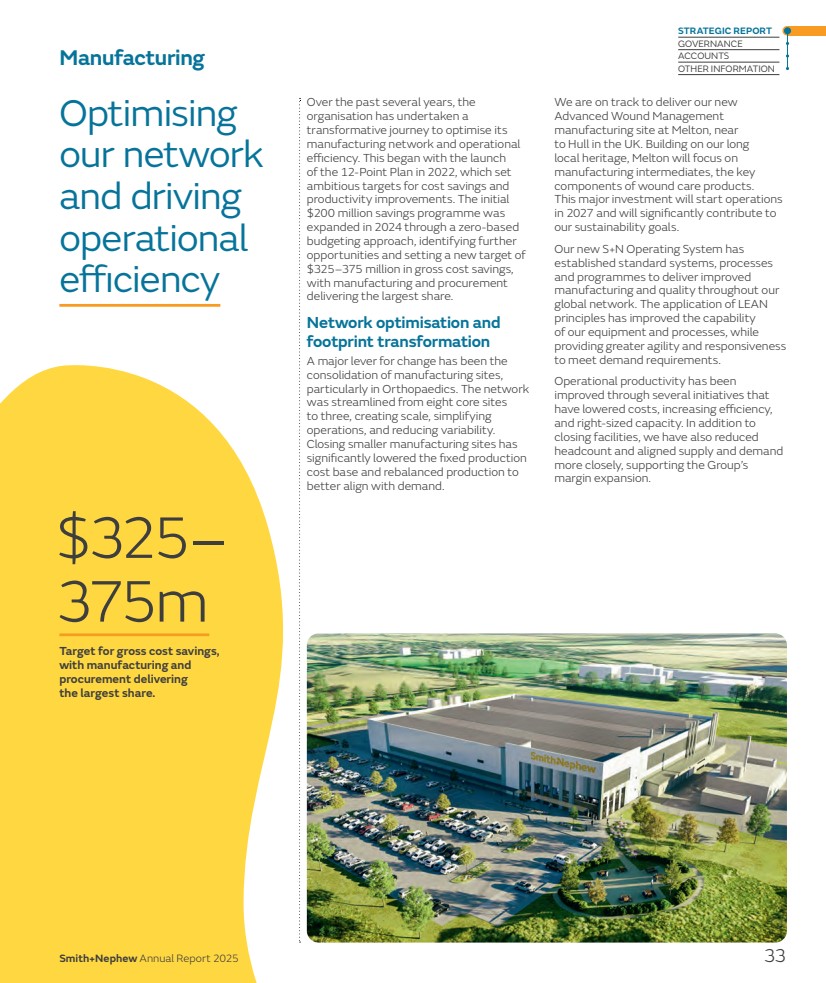
| Inventory management and margin impact In 2025 we continued to make progress addressing our high inventory, reducing Day Sales of Inventory (DSI) by 21 days year-on-year, with DSI down across all business units. As a result of the further Group-wide inventory portfolio rationalisation programme announced in December 2025, DSI decreased by 51 days year-on-year. As stated above, we expect that this programme will result in a material reduction in gross inventory, and expect a $500 million reduction in capital employed over time. This action is designed to free up cash for reinvestment into strategic growth platforms and to support the delivery of the 2028 adjusted ROIC target of 12-13%. The biggest reduction in DSI came from Orthopaedics, reflecting continued efforts to reduce the number of units in inventory. Here, prior to the 12-Point Plan, we had 128 major product families. We initially identified 19 families to phase out in a gradual process to protect revenue. The majority of these families were in knees and hips. In December 2025 we announced a second wave identifying a further 50 families to phase out, predominantly in trauma. We expect to complete this process over the next three to five years, by which time we will have just 59 product families, a reduction of more than 50% since the beginning of the 12-Point Plan. Technology and process improvements The adoption of AI, machine learning, and data analytics is also helping to drive improvements in supply chain, manufacturing, inventory management, and pricing. These technologies are reducing the cost to serve and enhancing capital efficiency. Modernisation efforts include upgrading equipment, digitising workflows, and rationalising the supplier base. We are also upgrading our Enterprise Resource Planning (ERP) software system, which will standardise our business process and enhance our end-to-end connectivity. Source materials Smith+Nephew has successfully reduced its direct material supplier base to below 1,000 active suppliers across the globe. This reduction will allow for a more dedicated focus and attention while not impacting the resilience offered by having supplier choice. These suppliers provide products, raw materials and services needed to drive production of our end products. The performance of these suppliers directly impacts our manufacturing schedule, with further implications for our commercial colleagues, customers and patients. In 2025, we continued to improve the identification, selection, and management of our suppliers. We continued to evolve our criteria to be a supplier to Smith+Nephew to better select the most appropriate suppliers for our requirements. Our ability to measure performance and engage with our suppliers has continued to improve. We continue to secure long-term supply via updated agreements and expectations where necessary. Foundations for future gains The progress made has established a credible Global Operations platform for future improvements. With deep operational leadership, strengthened Sales, Inventory & Operations Planning (SIOP) discipline, and the maturing of the S+N operating system, further operational savings are expected. We also expect to further reduce our inventory, with a 2028 target of having best-in-class DSI in key business units and a 30%+ reduction in DSI versus 2022. “Global Operations has delivered significant structural efficiencies through footprint actions, standard cost reductions, and working capital improvements. These foundations make the next set of improvements repeatable and scalable as we deliver the new strategy.” Paul Connolly President, Global Operations 34 Smith+Nephew Annual Report 2025 Innovators continued Manufacturing continued 05_SN_AR25_Innovating_v172.indd 34 05/03/2026 17:33 |
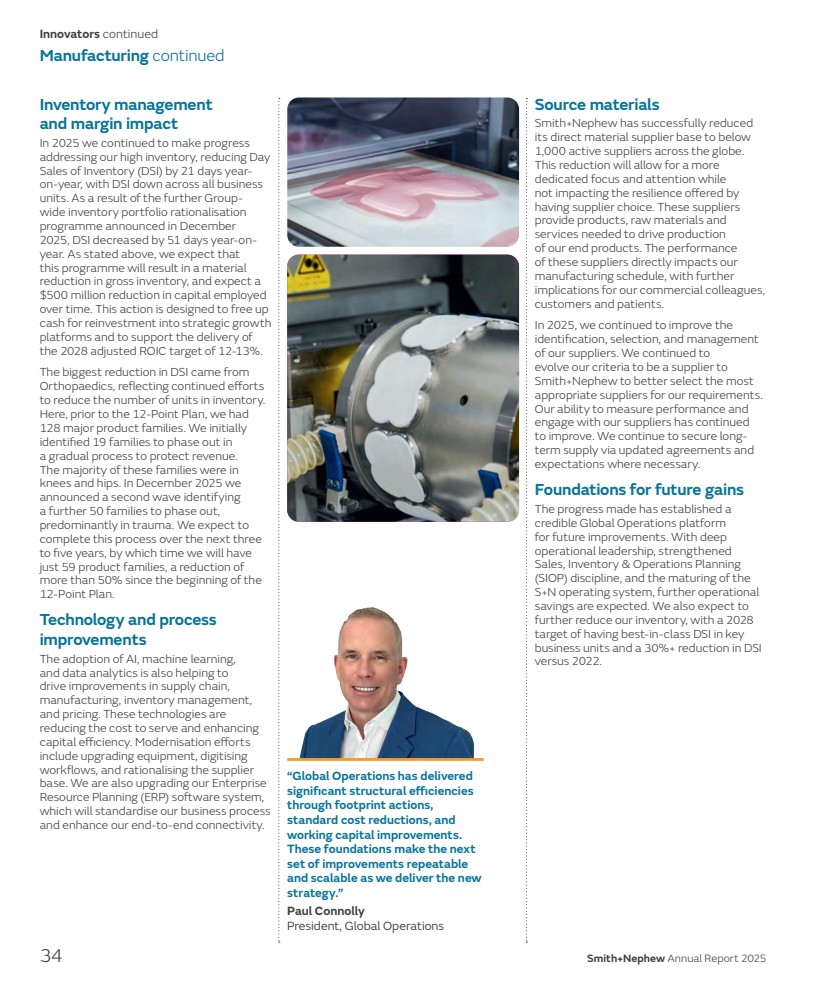
| “We remain focused on improving efficiency across the organisation, and the strategic move of certain functions to offshore teams has strengthened our cost base without compromising our exemplary compliance record.” Mizanu Kebede Chief Quality and Regulatory Officer We have made good progress with our respective submissions and have officially closed our internal project with all files submitted to the notified bodies, and 98% of respective product lines have received EU MDR certification. The Regulation allows devices certified under previous legislation (Medical Device Directive) to continue to be placed on the market in Europe until 31 December 2027 or 31 December 2028, dependent on risk classification. We closely monitor proposed changes in the regulatory landscape, including, in the EU, the world’s first comprehensive AI law, with compliance for certain AI devices (software or integrated software) required by August 2027. Other significant regulatory landscape changes include changes in UK medical device legislation and UKCA (UK Conformity Assessed) marking. These changes allow CE-marked devices to be placed on the market in Great Britain until June 2030. Additionally, we are closely monitoring international regulatory trends that include an increased focus on cybersecurity in medical technology. Smith+Nephew participates in industry-wide partnerships that address supply chain risk evaluation and mitigation, including MedTech Europe, AdvaMed and regional industry trade associations in geographies where we have a market presence. We follow responsible codes of conduct for sales interactions, including the AdvaMed Code of Ethics on Interactions with Healthcare Professionals in the US and the MedTech Europe Code of Ethical Business Practice. Quality & Regulatory Affairs Our Quality & Regulatory Affairs function supports full product life cycle management of our global product portfolio, from design and development through manufacturing and post-market surveillance. It establishes appropriate processes and procedures to facilitate compliance with complex global regulations and laws that govern the design, development, approval, manufacture, labelling, marketing and sale of healthcare products. Throughout the year, our sites hosted 58 Health Authority audits and inspections, resulting in no significant inspection findings or regulatory actions. The Quality & Regulatory Affairs teams directly support expansion of our global portfolio through the registration of new products and existing products in new markets. The European Union Medical Device Regulation (EU MDR) is a significant regulatory change whereby medical devices carrying a CE mark, confirming conformity with relevant requirements, now face greater scrutiny than ever before to ensure they are effective and safe. Smith+Nephew Annual Report 2025 35 STRATEGIC REPORT GOVERNANCE ACCOUNTS OTHER INFORMATION 05_SN_AR25_Innovating_v172.indd 35 05/03/2026 17:33 |

| Our customers are healthcare professionals. They range from orthopaedic surgeons to wound care nurses, general practitioners and other clinicians, but increasingly also economic stakeholders, such as purchasing professionals in hospitals, and healthcare insurers. Life Unlimited 02Serving our customers Together we are 36 Smith+Nephew Annual Report 2025 06_SN_AR25_Orthopaedics_v133.indd 36 05/03/2026 17:42 |
| 3,850+ S+N Academy programmes run by Smith+Nephew in 2025 132,597 HCP training sessions in 2025 We serve our customers through three global business units: Orthopaedics, Sports Medicine & ENT, and Advanced Wound Management. Through this model we ensure that we have subject and market experts leading specialist teams dedicated to serving the specific requirements of our customers. Our business units are responsible for their commercial strategy, determining which products we take to market. They work closely with R&D to ensure that we are developing products that address unmet needs, and with Global Operations to ensure we have appropriate product availability to meet customer needs. Our sales force Our sales representatives play a vital role in supporting healthcare professionals by leveraging their deep technical expertise. In surgical specialties, they possess comprehensive knowledge of both the products and the instruments required for implantation, and are well-versed in the diverse surgical techniques employed by clinicians. After completing rigorous training and certification, our representatives dedicate most of their time to working alongside customers – ensuring the safe and effective use of our advanced medical technologies, and proactively engaging with new customers. Within Advanced Wound Management, our sales team continually expands their understanding of clinical approaches to wound prevention and treatment, while also building their understanding of the economic advantages our products offer within established care protocols. We are committed to delivering exceptional service and invest significantly in the development of our sales and marketing teams. Through our Global Commercial Training and Education programme, we provide a standardised curriculum and specialised commercial training tailored to key markets, ensuring our teams are equipped to meet the evolving needs of our customers. A portfolio business Like many leading medical device companies, Smith+Nephew operates as a global portfolio business, which offers several advantages in serving our customers. This structure provides significant scale, helping to manage costs efficiently and enabling engagement with customers across multiple business areas. The portfolio approach also brings stability, as diversification helps balance the natural product cycles found throughout the MedTech sector. Additionally, our portfolio model supports strategic capital allocation, allowing us to invest in targeted categories that might be more challenging for standalone businesses. At the same time, our global business unit structure ensures each area benefits from focused leadership, clear accountability, and the agility to respond quickly to market needs. We are dedicated to serving the specific requirements of our customers Smith+Nephew Annual Report 2025 37 STRATEGIC REPORT GOVERNANCE ACCOUNTS OTHER INFORMATION 06_SN_AR25_Orthopaedics_v133.indd 37 05/03/2026 17:42 |

| Medical education We strive to be a world leader in medical education, helping to improve patient outcomes through interactive learning to support appropriate clinical decision making, and to build trust in the safe and effective use of Smith+Nephew technologies. Every year, we provide tens of thousands of surgeons and nurses with opportunities to evaluate the latest clinical evidence, learn innovative surgical techniques and advance the effective use of our products through medical education programmes run by our business units. Our medical education programmes deliver globally consistent curriculums, using interactive learning and on-site teaching at our seven Academy centres in the US, Singapore, Germany and the UK, as well as through regional and local events in an effort to remove barriers and provide education where it is needed most. Our programmes blend hands-on experience with digital education through our AI-enabled Academy Online, surgical simulations, interactive eLearning, live surgery transmission, virtual reality (VR) and podcasts. We provide personalised curriculum and programming specifically designed to meet the needs of the accomplished physician, resident, fellow and allied health professional. We are proud recipients of the Royal College of Surgeons of England (RCSEng) Centre Accreditation, awarded to Smith+Nephew Academy. In 2025, we received approval to have our VR simulations accredited through RCSEng. Portfolio strength and procedural leadership for ASC growth A major trend in our market is the migration of musculoskeletal (MSK) procedures from hospitals to Ambulatory Surgery Centers (ASCs). There are close to 4,000 ASCs in the US that perform MSK-focused procedures, with double-digit growth expected as more procedures move to outpatient settings. Out of these 4,000, over 60% perform both sports medicine and orthopaedic procedures. ASCs differ from hospitals in their smaller operating rooms, limited sterile processing and storage, lean staffing, and a strong focus on efficiency and throughput. Regulatory changes, such as new mandates for patient outcome reporting, add complexity to their operations. Unique solutions to elevate outcomes Smith+Nephew is well positioned in the ASC segment, with many years of experience in serving sports medicine customers in this setting. We are also growing our Orthopaedic business, with 35% of US CORI◊ robotic systems placed in ASCs in 2025. This success is attributed to several factors: Robotic form factor: CORI’s compact, mobile design suits ASC environments, offering quick set up and lower ownership costs compared to larger systems. It supports a wide range of procedures providing flexibility for musculoskeletal-focused ASCs. Tray efficiency: Smith+Nephews’s surgical tray configurations for knees, hips and shoulders reduce the number of trays needed by 50–70% compared to industry averages, addressing space and staffing constraints without compromising surgical options. Portfolio strength: Our combined Orthopaedic and Sports Medicine offerings allow ASCs to access differentiated technologies across both arthroplasty and soft tissue repair procedures. Optimising ASC performance To help ASCs meet new US Centers for Medicare & Medicaid Services (CMS) reporting requirements, Smith+Nephew has formed exclusive partnerships that facilitate patient outcome tracking, improve engagement, and provide actionable analytics. These partnerships enable real-time performance metrics, connectivity across reporting systems, and the generation of clinical and economic data to personalise care pathways. Smith+Nephew has also restructured its commercial approach, creating a dedicated ASC sales team and flexible financing models to deliver turnkey solutions. Our focus on ASC stakeholders, combined with its technology and partnerships, positions Smith+Nephew as a leader in this fast-growing segment. >4,000 US MSK ASCs >10% CAGR in ASC hip and knee arthroplasty procedures projected over three years 38 Smith+Nephew Annual Report 2025 Serving our customers continued 06_SN_AR25_Orthopaedics_v133.indd 38 05/03/2026 17:42 |
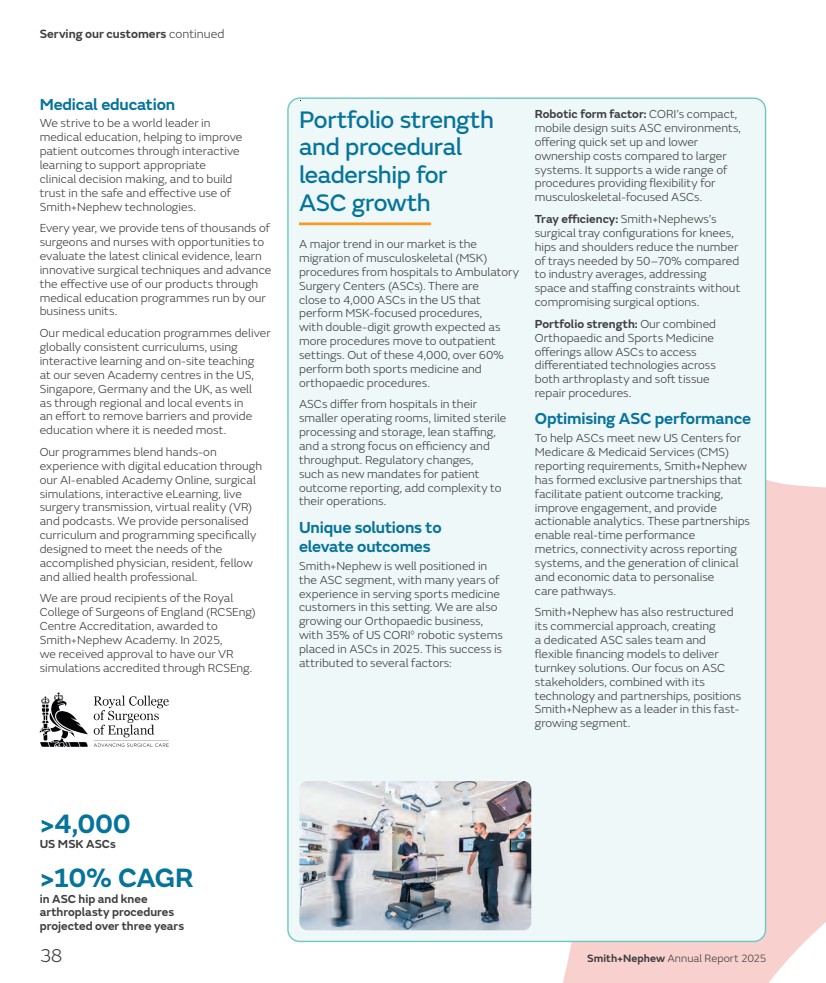
| “I am proud of the progress we’ve made as a business over the last three years. As a result, we are in a much stronger position today, with a strong platform and a springboard for future growth.” Craig Gaffin, President Orthopaedics Driving procedural innovation Our Orthopaedics business unit offers a leading portfolio of Hip and Knee Implants, robotics and digital-enabling technologies, driving procedural innovation and a strengthened Trauma & Extremities portfolio. Smith+Nephew’s Orthopaedics vision is to deliver innovative personalised solutions to customers that enhance clinical and economic outcomes in every care setting. Our innovative implants are designed to mimic natural movement and are manufactured using materials with a track record of longevity and performance. The addition of our CORI Surgical System robotics platform delivers accuracy, performance and efficiency to the surgical procedure. We are well positioned as the orthopaedic partner of choice for surgeons across the globe. Orthopaedics includes an innovative range of hip, knee and shoulder implants used to replace diseased, damaged or worn joints, robotics-assisted enabling technologies that improve accuracy and facilitate precision during the surgical procedure, and trauma products used to stabilise fractures and correct bone deformities. In Orthopaedic Joint Reconstruction, which includes our Hip and Knee Implants and Other Reconstruction segments, we have a broad, clinically proven and differentiated portfolio that allows us to compete effectively across a market worth around $17.6 billion annually. This portfolio includes our proprietary OXINIUM◊ Technology and our CORI Surgical System, which is strongly positioned to take advantage of the trends towards robotics-assisted surgery and outpatient joint replacement seen across the segment. The Trauma & Extremities market is worth over $15.7 billion annually, and we are well positioned to compete effectively in this segment. The simplicity and efficiency of our complete EVOS◊ Plating System gives us an advantage in the largest segment in Trauma, and our TRIGEN◊ INTERTAN◊ Intertrochanteric Nail is backed by the clinical and economic data to position it as the standard of care for hip fracture,1,2 the second-largest segment. In Extremities, our portfolio features our next-generation shoulder implant, the AETOS◊ Shoulder System. Orthopaedics global market sharea In our Orthopaedics business unit, we are one of four leading players, competing against US-based companies Stryker, Zimmer Biomet and DePuy Synthes. Hip and Knee Implants $17.6bn +5% 2024: $16.8bn +5% E D C B A A Smith+Nephew 9% B Zimmer Biomet 31% C Stryker 26% D DePuy Synthesb 18% E Others 16% Trauma & Extremities $15.7bn +7% 2024: $14.6bn +7% E D C B A A Smith+Nephew 4% B Stryker 25% C DePuy Synthesb 23% D Zimmer Biomet 12% E Others 36% For a full list of references, see pages 306–311 9% Hip and Knee Implants global market sharea In our Orthopaedics business unit, we are one of four leading players a Data used in 2024 and 2025 estimates generated by Smith+Nephew are based on publicly available sources and internal analysis and represent an indication of market shares and sizes. b A division of Johnson & Johnson. Smith+Nephew Annual Report 2025 39 STRATEGIC REPORT GOVERNANCE ACCOUNTS Orthopaedics OTHER INFORMATION 06_SN_AR25_Orthopaedics_v133.indd 39 05/03/2026 17:42 |
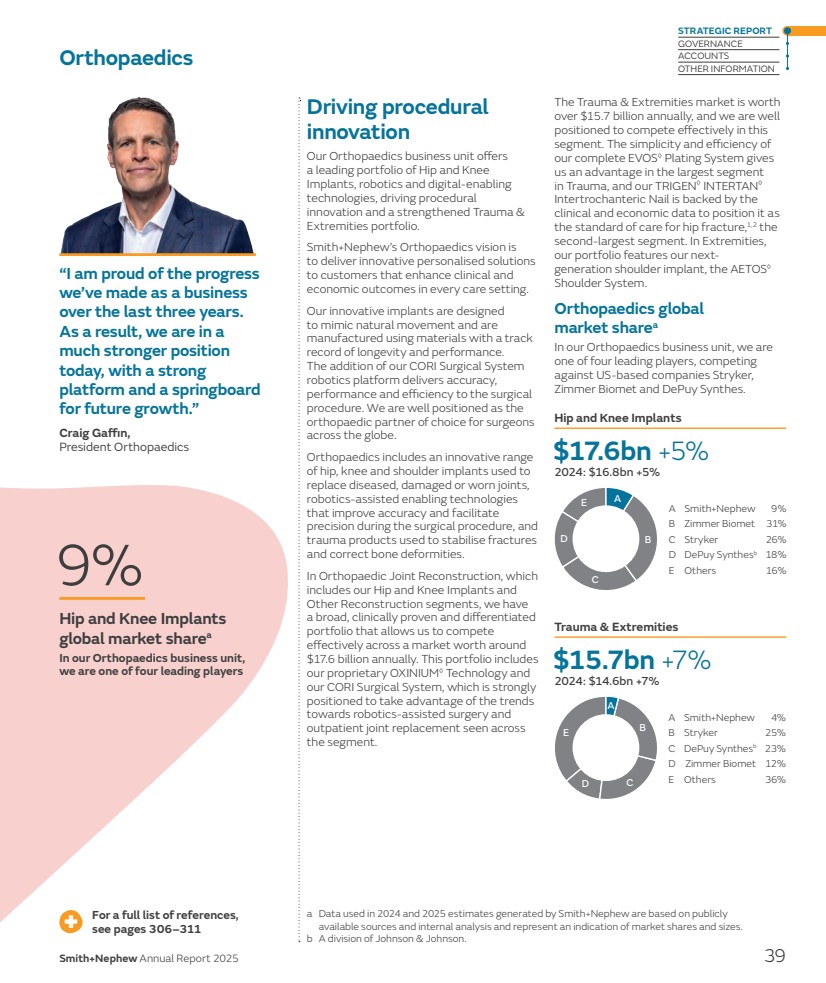
| RISE strategy Our Orthopaedics business unit has an innovative portfolio that allows us to compete in joint reconstruction, robotics-enabled procedures and across Trauma & Extremities markets. Our areas of focus include advancing innovative surgical solutions and optimising the use of working capital. Our initiatives are designed to drive growth across the Orthopaedics business unit, and support delivery of our RISE strategy. We will Reach more patients through strengthened commercial execution that will fuel growth by capitalising on our differentiated technologies through targeted global expansion. We will continue to Innovate across our portfolio with specific call-out on building out our products in Knees, with the introduction of a new knee system in 2026. We will continue to develop CORI, our unique, procedurally-scaled platform offering even greater value to our customers. We will Scale through disciplined capital allocation, precise inventory placement, and deliberate market-by-market strategies that we will execute with intent. With the continued shift of procedures to Ambulatory Surgical Centers, we are well positioned to drive growth in this channel. Finally, Orthopaedics will Execute efficiently as we drive Ortho 360, our enhanced operational model, which is now firmly embedded into our business. This model will drive clear choices in portfolio mix and go-to-market strategies, leading to continued improvement in inventory and portfolio optimisation. 2025 performance Orthopaedics full year 2025 revenue growth was 5.7% on a reported basis, including an FX tailwind of +60bps. On an underlying1 basis, revenue growth was 5.1%. The business unit finished the year strongly as we continued to make progress delivering against the 12-Point Plan priority to fix Orthopaedics. Knee Implants growth was strongest outside the US led by our JOURNEY◊ II Total Knee System and ANTHEM◊ Total Knee System. In the US, growth was held back by our ongoing actions to rationalise our portfolio performance and a widening product gap as US market trends changed. Performance 2025 Revenue 2024 Revenue2 2023 Revenue 2025 Reported growth 2024 Reported growth2 2023 Reported growth 2025 Underlying growth1 2024 Underlying growth1,2 2023 Underlying growth1 Orthopaedics $2,437m $2,305m $2,214m 5.7% 4.1% 4.8% 5.1% 4.7% 5.7% Knee Implants $1,011m $977m $940m 3.5% 3.9% 4.7% 2.9% 4.7% 5.5% Hip Implants $641m $619m $599m 3.5% 3.3% 2.5% 2.9% 3.8% 3.8% Other Reconstruction $136m $101m $111m 35.4% -9.4% 27.8% 33.8% -8.4% 28.0% Trauma & Extremities $649m $608m $564m 6.7% 7.9% 3.7% 6.3% 8.1% 4.4% 2025 2024 2023 2025 Reported growth 2024 Reported growth Segment trading profit $363m $265m $251m 36.9% 5.5% 1 These non-IFRS financial measures are explained and reconciled to the most directly comparable financial measure prepared in accordance with IFRS on pages 285–292. 2 Robotics consumables revenue has been reclassified from Other Reconstruction to Knee and Hip implants. We are accelerating development to close that gap with a strong pipeline of new product introductions over the next 18 months. Hip Implant performance was driven by the US launch of the CATALYSTEM◊ Primary Hip System and strong growth from the OR30 Dual Mobility System. Other Reconstruction performance was driven by sales of our robotics-assisted CORI Surgical System and consumables. By the end of 2025 we had more than 1,100 CORIs installed worldwide. Trauma & Extremities continued to be a significant growth driver following its turnaround in 2023. Growth was driven by the EVOSPlating System, our patient-positioning portfolio and the successful launch of the AETOS Shoulder System. Orthopaedics trading profit1 was up 36.9% in 2025, with a 340bps increase in trading profit margin1 to 14.9%. This increase reflected 12-Point Plan transformation initiatives, including inventory reduction, improved capital efficiency, portfolio rationalisation and our focus on higher volume accounts. With sustained improvement in execution, a pipeline of new innovation and strong cost control we expect to make further progress on trading profit margin1 between 2025 and 2028. For a full list of references, see pages 306–311 40 Smith+Nephew Annual Report 2025 Orthopaedics continued Serving our customers continued 06_SN_AR25_Orthopaedics_v133.indd 40 05/03/2026 17:42 |
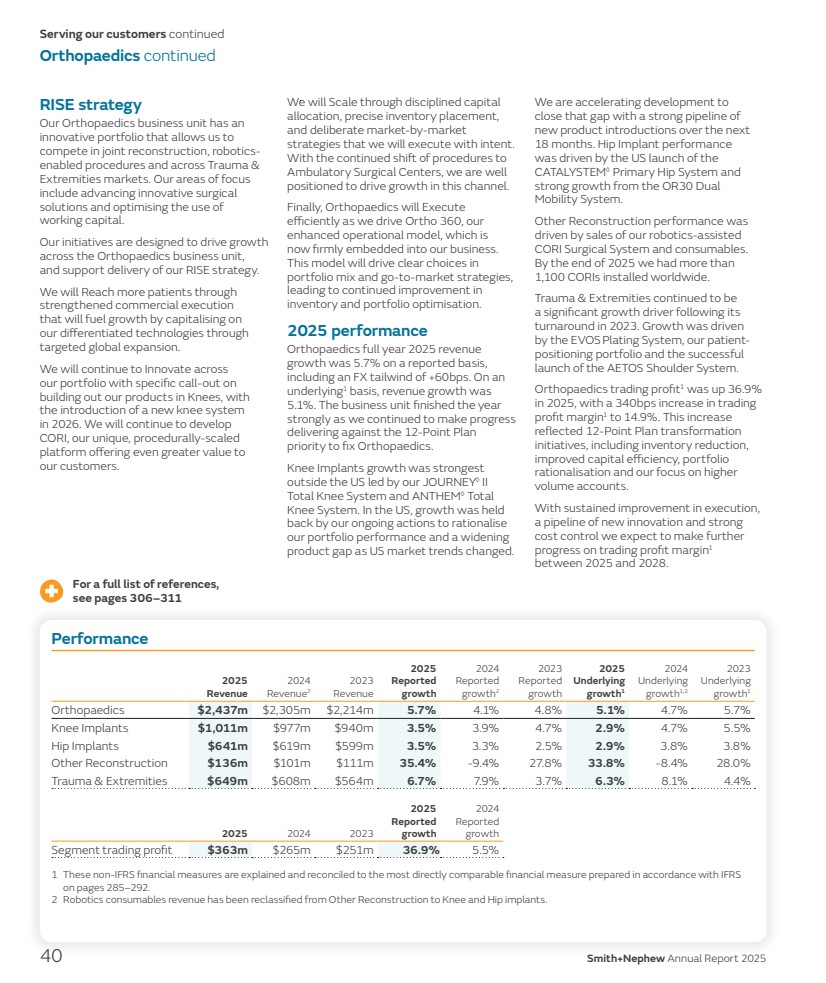
| OXINIUM Technology The best performing bearing surface at 20 years for total hip arthroplasty In 2025, the annual report from the Australian Orthopaedic Association National Joint Replacement Registry (AOANJRR) highlighted the exceptional performance of Smith+Nephew’s proprietary OXINIUM on highly cross-linked polyethylene. The data indicates that this combination has the highest survivorship rate (94.1%) among all bearing combinations over a 20-year period for total hip arthroplasty (THA).8 The report on 20-year outcomes corroborates similar findings and peer-reviewed publications from the National Joint Registry for England, Wales, Northern Ireland and the Isle of Man (NJR).42 Four registries in total – including the Italian Registry (RIPO; Register of Orthopaedic Prosthetic Implants) and the Dutch Arthroplasty Register (LROI) – have now demonstrated that OXINIUM/ XLPE had a 35% lower risk of revision at 10 years versus other modular acetabular implants.8,42–45 Through a unique manufacturing process, the OXINIUM alloy becomes a ceramicised metal – a true material transformation – rather than an applied coating.46 It is this material transformation that provides OXINIUM with its ground-breaking performance benefits which include: Unrivalled material science: The durability of metal, the wear resistance of ceramic and corrosion resistance better than both metal and ceramic.46–57 Differentiated composition: Virtually no nickel, cobalt and chromium,57 with a 30x reduction in pro-inflammatory markers for OXINIUM.55,57 As such, OXINIUM implants do not require declaration of the presence of CMR (carcinogenic, mutagenic, reprotoxic) substances on the labelling. Key products by segment Reconstruction & Robotics – Knee Implants In Knee Implants, Smith+Nephew’s specialised systems include leading products for total primary replacement and revision, as well as partial and patellofemoral joint resurfacing procedures, offering surgeons and patients the benefits of many proprietary technologies. These include a unique kinematic knee, the JOURNEY II Total Knee Arthroplasty System, which features our proprietary OXINIUM Technology and has been shown to replicate normal knee shape, position and motion.*3–7 In 2025, the Australian Orthopaedic Association National Joint Replacement Registry (AOANJRR) highlighted the exceptional performance of OXINIUM on highly cross-linked polyethylene. The data indicates that this combination has the highest survivorship rate (94.1%) among all bearing combinations over a 20-year period for total hip arthroplasty (THA).8 Our LEGION◊ CONCELOC◊ Cementless Total Knee System uses innovative 3D-printed cementless technology to achieve biological fixation, bringing efficiency and versatility to the operating room (OR).9,10 In 2025, we introduced a new medial stabilised insert for our LEGION Total Knee System which is designed to improve kinematics, stability and procedural versatility. Medial stabilised inserts are seeing a steep rise in popularity, growing from 4% of Total Knee Arthroplasty procedures in 2018 to 32% in 2023.11 2024 performance Orthopaedics revenue increased 4.1% on a reported basis in 2024, including a -60bps headwind from foreign exchange. Underlying revenue growth1 was 4.7%. Knee and Hip Implants growth was driven by Other Established Markets and a significant improvement in the US in 2024. Other Reconstruction grew double digit in 2024, principally reflecting sales of our robotics-assisted CORI Surgical System and consumables. Orthopaedics trading profit1 was up 5.5% in 2024, with a 20bps increase in trading profit margin1 to 11.5%. Smith+Nephew Annual Report 2025 41 STRATEGIC REPORT GOVERNANCE ACCOUNTS OTHER INFORMATION 06_SN_AR25_Orthopaedics_v133.indd 41 05/03/2026 17:42 |
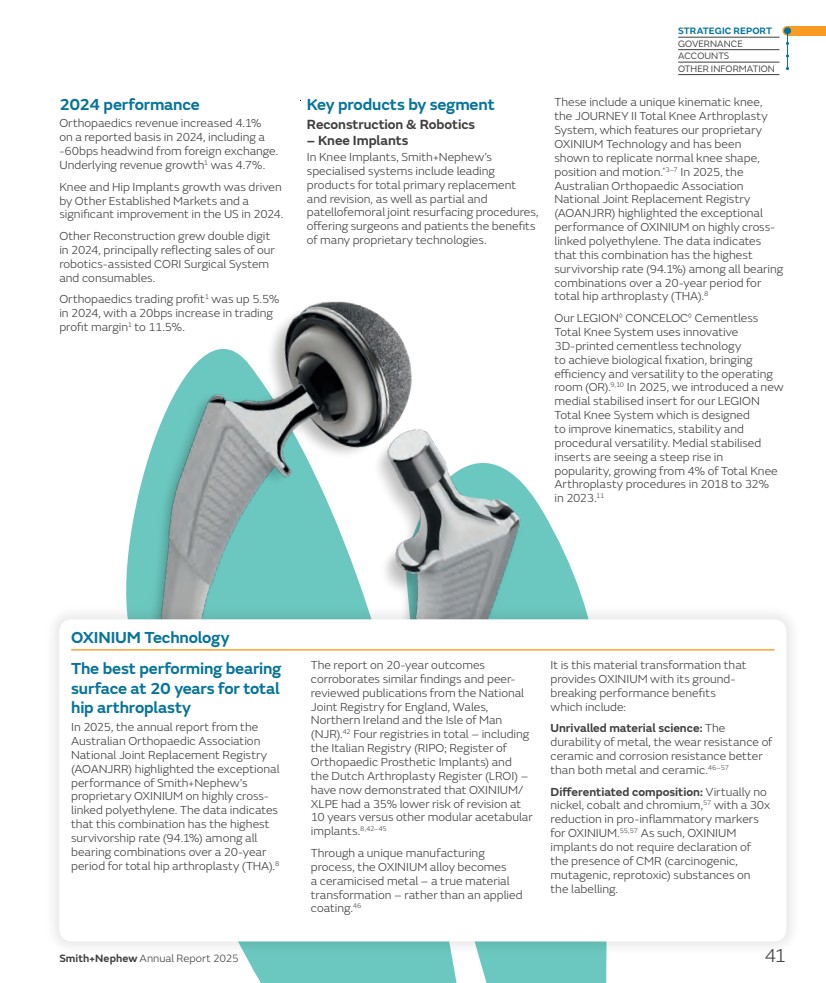
| Reconstruction & Robotics – Hip Implants The Hip Implants portfolio includes our CATALYSTEM◊ Primary Hip System. Building on the clinical success of our POLARSTEM◊ Hip System,12 the CATALYSTEM System is designed to address the changing demands of primary hip surgery. The CATALYSTEM Primary Hip System optimises performance with patent-pending ACCUBROACH◊ Technology for reproducible13 implant seating in just one modular tray. It is the only cementless stem of its kind to feature OXINIUM Technology bearing material. Our POLAR3◊ Total Hip Solution has among the lowest revision rates in total hip arthroplasty.*14–18 OR3O◊ Dual Mobility System is the first system to use the latest OXINIUM DH Advanced Bearing Technology. Dual mobility hip implants are used in primary as well as revision procedures. In addition, we offer a full breadth of stems to address surgical needs, including the ANTHOLOGY◊ Hip System. For revisions, the REDAPT◊ Revision Hip System features CONCELOCTechnology. Other Reconstruction Our Other Reconstruction business includes the CORI Surgical System, one of the most advanced and efficient***19 handheld robotics solutions. CORI is a smaller,****20 portable solution capable of performing robotics-assisted knee and computer-guided hip surgery on a single platform. In robotics-assisted knee procedures, CORI utilises handheld precision milling which allows surgeons to execute Total Knee Arthroplasty and Unicondylar Knee Arthroplasty procedures with reproducible accuracy.*****21–25 The proprietary smart mapping feature creates a 3D image of the patient’s anatomy in surgery, eliminating the time, costs and radiation exposure25 associated with pre-operative CT scans. The CORIOGRAPH◊ pre-operative planning and modelling service delivers the unique surgical planning solution desired by some surgeons. The proprietary software of CORI 3.0 allows CORI to utilise our proven image-free surface mapping and image-based planning solutions for the right indications. In 2025, we launched the CORIOGRAPH Pre-Op Planning and Modeling Services for total shoulder arthroplasty, now available in the US. This innovative software offers image-based planning capabilities that enable surgeons to create a patient-specific plan for shoulder replacement procedures by using enhanced clinical decision making through advanced biomechanical simulation that accounts for scapulothoracic motion.26–31 For a full list of references, see pages 306–311 A pre-operative planning solution for each individual knee arthroplasty patient Optimising personalised surgery with CORIOGRAPH pre-op planning With our CORIOGRAPH Pre-Op Planning and Modeling Services and the CORI Surgical System’s image-agnostic solution, we offer a pre-operative planning solution for each individual knee arthroplasty patient. Using our advanced simulation technologies in hip arthroplasty allows a new dimension of personalised planning and ultimately supports the intra-operative surgical workflow. With the addition of shoulder arthroplasty, surgeons can now combine advanced planning tools with their own preferences to achieve a truly patient-specific approach. 42 Smith+Nephew Annual Report 2025 Orthopaedics continued Serving our customers continued 06_SN_AR25_Orthopaedics_v133.indd 42 05/03/2026 17:42 |
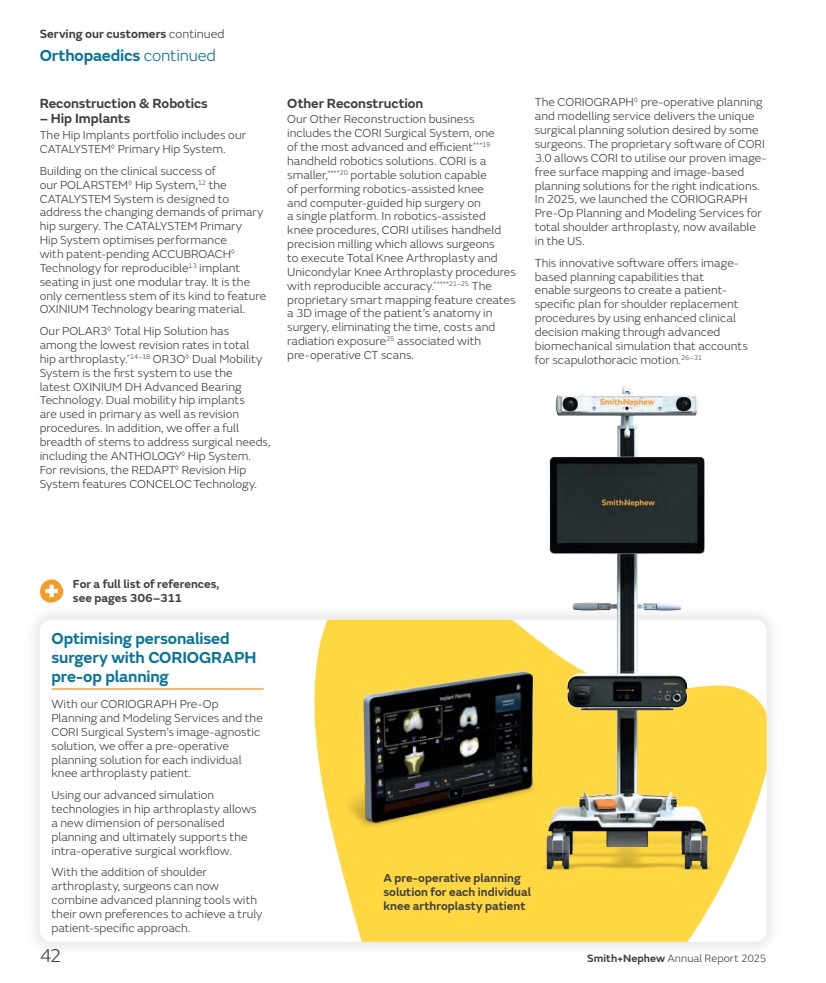
| Next level nailing with TRIGEN MAX Tibia Regardless of fracture complexity, the TRIGEN MAX System’s side-specific nails and anatomic screw trajectories, combined with a variable angle locking mechanism and low profile screws, are designed to maximise fixation, optimise fragment fixation, minimise soft tissue irritation and streamline the surgeon experience.33,34 The TRIGEN MAX Tibia Nailing System aims to streamline operative procedures and provide efficiency through surgeon-centred design of components and instrumentation, including: – Two-piece modular drop system to help when using ancillary instruments and aid visualisation. – 12.5mm channel reamer for the tibia, which is designed to preserve the integrity of the entry point and provide soft tissue protection. – 5.0mm Lag Screws that compress the fracture in one screw insertion step, creating a streamlined workflow.58 Trauma & Extremities Smith+Nephew’s portfolio includes differentiated technology across the major categories of Plates and Screws, Intramedullary Nails, Hip Fracture, Limb Restoration, Extremities, and Shoulder Replacement. Leading products include the EVOS Plating System, which includes a wide range of clinical indications from mini and small to large fragment, periprosthetic, pelvic and patella. Designed to offer surgeons an all-inclusive, expansive plating portfolio, EVOS provides the simplicity of logically organised instrumentation with advanced implant solutions that meet the demands and expectations of trauma surgeons. The portfolio also includes the TRIGEN INTERTAN Hip Fracture System, which is backed by many years of strong clinical evidence.2 In 2025, we launched our new TRIGEN MAX Tibia Nailing System for stable and unstable fractures of the tibia, including the shaft. It is the only system to now offer trauma surgeons the choice of side-specific (right and left) nails for anatomic screw trajectories, which help to optimise fragment fixation and minimise soft tissue irritation with headless and low-profile screw options.33,34 The TAYLOR SPATIAL FRAME◊ External Fixator is an advanced and versatile35,36 circular fixator, designed to be minimally invasive and allow stable fixation in small fragments.37 Its capabilities are increased through the use of the SMART TSF◊ Circular Fixator. In our Upper Extremities portfolio, the AETOS Shoulder System, indicated for both anatomic and reverse total shoulder arthroplasty, is designed to restore patients’ range of motion38–41 and help minimise arthritic shoulder pain. It complements our market-leading sports medicine shoulder repair and biologics solutions. Our Lower Extremities portfolio features TOTAL ANKLE Patient-Matched Guides, the LEOS◊ Plating System and LEOS Cannulated Screw System. RI.HIP◊ NAVIGATION further expands indications on the CORI Surgical System. When combined with Smith+Nephew Hip Implants, like the CATALYSTEM Primary Hip System, POLAR3 Total Hip Solution and OR3O Dual Mobility System, as well as complementary tools to assess spinopelvic mobility (RI.HIP MODELER), RI.HIP on CORI delivers a comprehensive solution for navigated total hip arthroplasty. RI.HIP NAVIGATION and RI.HIP MODELER are designed to help maximise accuracy and reproducibility by delivering patient-specific component alignment.32 The CORI Surgical System is currently the only solution indicated for robotics-enabled knee procedures across the full continuum of care – partial, total and revision knee arthroplasty. In addition, Personalised Planning guided by RI.INSIGHTS◊ enables surgeons to set the initial implant placement within the total knee arthroplasty procedure based on AI-guided reference values and the surgeon’s planning preferences for specific implants and patient-specific deformities. Smith+Nephew Annual Report 2025 43 STRATEGIC REPORT GOVERNANCE ACCOUNTS OTHER INFORMATION 06_SN_AR25_Orthopaedics_v133.indd 43 05/03/2026 17:42 |

| Changing the game with innovative procedural solutions Smith+Nephew’s Sports Medicine & ENT business unit leads with innovative procedural solutions designed to elevate the standard of care. With comprehensive and differentiated technologies backed by clinical evidence, we help healthcare professionals get their patients back to living their Life Unlimited. Sports Medicine & ENT operates in growing markets where unmet clinical needs provide opportunities for procedural and technological innovation. Smith+Nephew holds a leadership position in the $7.0 billion global sports medicine market, which spans a broad patient population of active adults from professional athletes to recreational walkers – and everyone in between. People are more active than ever before, and when they seek treatment for an injury or a degenerative condition, they expect a fast recovery and rapid return to activity. The surgeons who serve these patients want to treat them as efficiently and as minimally invasive as possible while ensuring the best possible outcomes. Smith+Nephew has a rich history of product development in Sports Medicine, and our technologies, instruments and implants enable surgeons to perform minimally invasive surgery, treating soft tissue injuries and degenerative conditions of the shoulder, knee, hip and small joints. Our growing ENT business unit is driven by emerging therapies and changes in the point of care, mainly to the office setting, and increasing global access for these procedures. We offer a portfolio of technologies focused on the unmet needs for both common and advanced procedures that general and paediatric ENT surgeons perform today. These include tonsillectomies, epistaxis (severe nose bleeds) and tympanostomies (insertion of ear tubes). Sports Medicine global market sharea,b In Sports Medicine, Smith+Nephew holds a leading position behind Arthrex, and also competes against Stryker and DePuy Synthes. $7.0bn +6% 2024: $6.6bn +6% E D C B A A Smith+Nephew 25% B Arthrex 35% C Stryker 13% D DePuy Synthesc 9% E Others 18% RISE strategy We have a strong Sports Medicine & ENT business and are well positioned for long-term leadership and success by delivering our vision of advancing standards of care. As we embark on our new RISE strategy as a Group, we expect our positive momentum to continue, and we are confident we can accelerate growth further. Our customers and the patients we serve will remain the centre of our attention. We will Reach more of them by growing our product portfolio across core segments and expanding indications, driving wider adoption globally. Innovation will remain at the heart of what we do. We will launch our first-in-class TESSA◊ Spatial Surgery platform, which, combined with extended indications for the REGENETEN◊ Bioinductive implant and CARTIHEAL◊ AGILI-C◊ Cartilage Repair Implant, will help us achieve our ambition to be the number one Sports Medicine company in the world. In ENT we will introduce our next generation COBLATION◊ Technology platform. “2025 saw us deliver very strong growth in Sports Medicine across our Established Markets. We look forward to continuing this momentum into 2026.” Scott Schaffner, President Global Sports Medicine 25% Global market sharea,b Smith+Nephew holds a leading position in Sports Medicine For a full list of references, see pages 306–311 a Data used in 2024 and 2025 estimates generated by Smith+Nephew are based on publicly available sources and internal analysis and represent an indication of market shares and sizes. b For 2025, the addressable market has been updated to include foot, ankle and cartilage repair. Excluding these segments, Smith+Nephew’s market share was 28%, in line with 2024. c A division of Johnson & Johnson. 44 Smith+Nephew Annual Report 2025 Sports Medicine & ENT Serving our customers continued 07_SN_AR25_SportsMed_AWM_v131.indd 44 05/03/2026 17:44 |
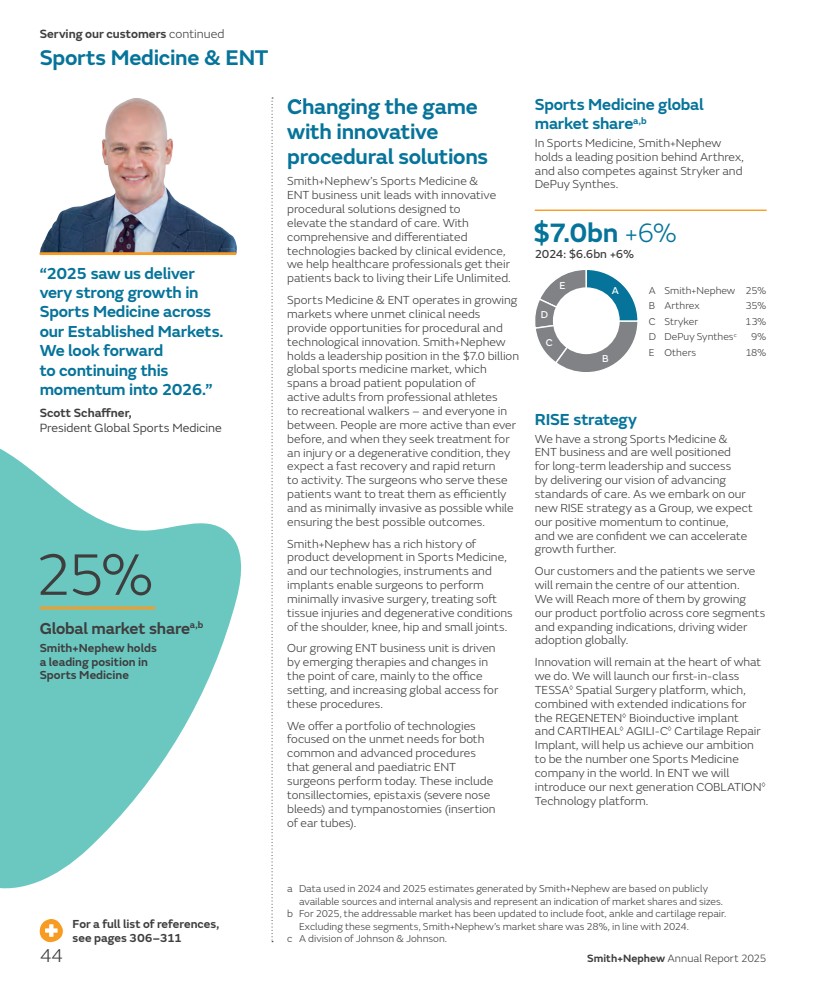
| We will Scale our platform by investing in market development efforts, including medical education, value-generating clinical evidence, digital marketing and market access to expand market penetration and continue to monitor and act on inorganic opportunities that support our strategy. We will ensure our teams across all functions are well equipped with the proper tools and capabilities to Execute consistently and efficiently. We will strive to be better every day through our continuous improvement mindset, and we will reinvest productivity gains to fuel future growth. 2025 performance Sports Medicine & ENT full year 2025 revenue growth was 6.0% on a reported basis, including an FX tailwind of +80bps. On an underlying1 basis, revenue growth was 5.2%. Excluding China, Sports Medicine & ENT grew 10.0% on a reported basis, including FX tailwind of +80bps, and 9.2% on an underlying1 basis. Here the implementation of VBP was a headwind in Sports Medicine Joint Repair. VBPs in Arthroscopic Enabling Technologies and ENT are expected in 2026, but we expect the headwinds to be much smaller given the relative size of the businesses. We have taken actions to manage our inventory ahead of implementation. Outside of China, Sports Medicine Joint Repair had another strong year driven by our shoulder repair portfolio and the REGENETEN Bioinductive Implant. Excluding China, Sports Medicine Joint Repair growth was 13.4% on a reported basis and 12.6% on an underlyinga basis. Arthroscopic Enabling Technologies performance included good growth from our WEREWOLF◊ FASTSEAL 6.0 Hemostasis Wand and patient-positioning and patient-positioning product lines. Growth was impacted in the second half of the year as the sector prepared for VBP. ENT’s performance was led by our nose business offset by some softness in the US tonsils and adenoids market. Growth in ENT was also impacted in the second half of the year as the sector prepared for VBP. Sports Medicine & ENT trading profit1 was up 5.6% in 2025, with a -20bps decline in trading profit margin1 to 23.8%, reflecting the China VBP headwind. 2024 performance Sports Medicine & ENT delivered 2024 revenue growth on a reported basis of 5.5%, including a -70bps headwind from foreign exchange. Underlying growth1 was 6.2%. Excluding China, Sports Medicine & ENT grew 9.3% on a reported basis, including FX headwind of -70bps, and 10.0% on an underlying1 basis. In 2024, the sector faced a headwind from the VBP programme, which commenced in May 2024. Sports Medicine Joint Repair full year growth reflected the VBP headwind from China. Outside of China, Sports Medicine Joint Repair had strong year driven by our knee repair portfolio and REGENETEN Bioinductive Implant. Excluding China, Sports Medicine Joint Repair growth was 10.6% on a reported basis and 11.3% on an underlyinga basis. Sports Medicine & ENT trading profit1 was up 11.0% in 2024, with a 120bps increase in trading profit margin1 to 24.0%, driven by operating leverage and productivity improvements. Performance 2025 Revenue 2024 Revenue 2023 Revenue 2025 Reported growth 2024 Reported growth 2023 Reported growth 2025 Underlying growth1 2024 Underlying growth1 2023 Underlying growth1 Sports Medicine & ENT $1,934m $1,824m $1,729m 6.0% 5.5% 8.8% 5.2% 6.2% 10.0% Sports Medicine Joint Repair $1,067m $982m $945m 8.6% 4.0% 8.7% 7.8% 4.8% 9.9% Arthroscopic Enabling Technologies $647m $632m $588m 2.4% 7.4% 3.7% 1.6% 8.2% 4.7% ENT $220m $210m $196m 4.8% 6.9% 28.1% 4.4% 7.3% 29.8% 2025 2024 2023 2025 Reported growth 2024 Reported growth Segment trading profit $461m $437m $394m 5.6% 11.0% 1 These non-IFRS financial measures are explained and reconciled to the most directly comparable financial measure prepared in accordance with IFRS on pages 285-292. Smith+Nephew Annual Report 2025 45 STRATEGIC REPORT GOVERNANCE ACCOUNTS OTHER INFORMATION 07_SN_AR25_SportsMed_AWM_v131.indd 45 05/03/2026 17:44 |
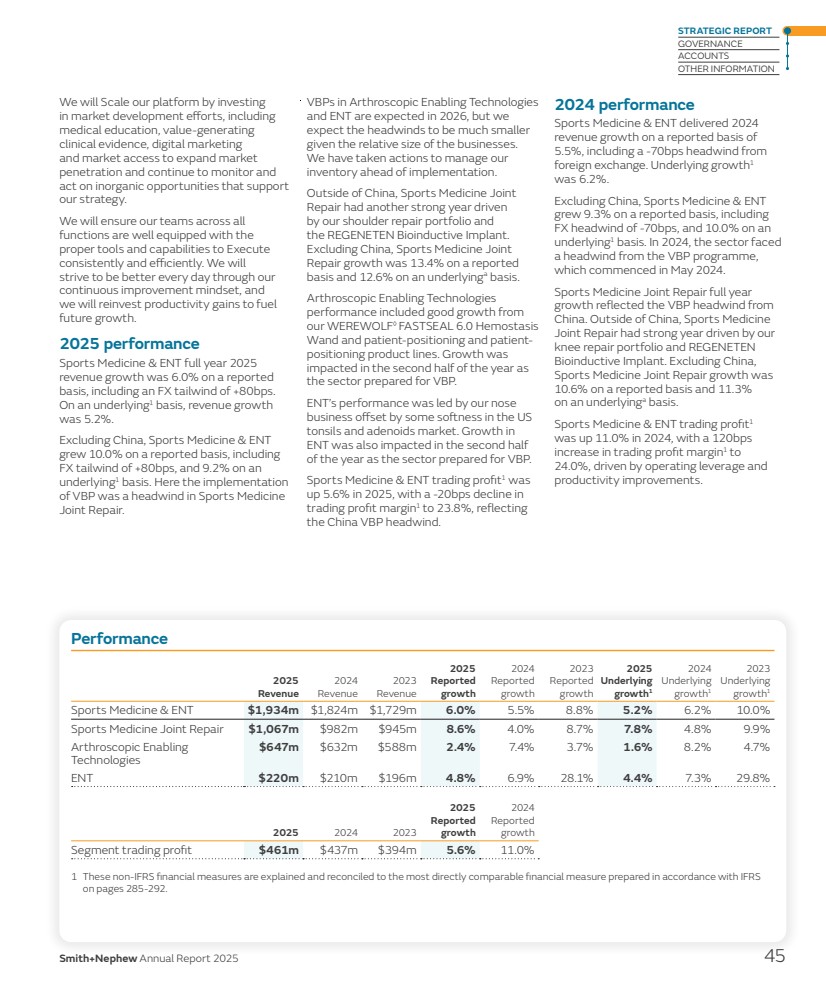
| Key products by segment Sports Medicine Joint Repair Our Sports Medicine Joint Repair business offers advanced procedural solutions for repairing soft tissue injuries, including systems of specialised implants and instruments to facilitate arthroscopic procedures across sports medicine for knees, shoulders, hips and small joints. For shoulder repair, we develop products for rotator cuff repair (RCR) and instability repair to help address pain and restore function. Advanced Healing Solutions for RCR include the innovative REGENETEN Bioinductive Implant. With at least 31 published clinical studies, including more than 1,200 patients,1–13 as well as 70 publications1–13 the REGENETEN Implant has been shown to change the course of tear progression in studies,14–17 aid return to normal activity12,18–20 and reduce re-tears versus conventional surgery when used as an augment in full thickness tears.12 In 2025, new Clinical Practice Guidelines from the American Academy of Orthopaedic Surgeons (AAOS) issued a strong, evidence-based recommendation that supports the use of bioinductive implants in rotator cuff repair (RCR). Based on randomised controlled trial data for the REGENETEN Bioinductive Implant, the guidance supports the notion that bioinductive implants can reduce the risk of re-tears21 and offer better patient outcomes.21 The HEALICOIL◊ family of shoulder anchors features an open architecture designed to facilitate healing and is available in our REGENESORB◊ material, which can be shown to be absorbed and replaced by bone within 24 months.*22–24 Further expanding our shoulder portfolio, we continued to build on the best-in-class anchor fixation strength** of our Q-FIX◊ All-Suture Anchor with the introduction of the Q-FIX KNOTLESS Suture Anchor. 25–29 Designed for multiple procedures, including shoulder instability where anatomic space is limited, the Q-FIX All-Suture Anchor provides the benefits of a small, soft anchor with the fixation characteristics of traditional anchor designs.25,26,30,31 This radially expanding anchor offers compact size, high fixation strength,***25,26,30,31 low displacement***25,26,32–35 and consistent deployment.29,36,37 Additionally, the Q-FIX KNOTLESS All-Suture Anchor is designed for controlled tensioning post deployment.31 Its suture lock feature allows for best-in-class soft tissue security****31 and it offers streamlined suture shuttling.31 The Q-FIX KNOTLESS All-Sutures Anchor offers a versatile range of suture options that include both single-loaded MINITAPE◊ Suture Tape – which has a low profile and coreless design to offer a lower, more evenly distributed level of pressure*****38–39 or ULTRABRAID◊ #2 Suture that is 20% stronger than its nearest competitor.‡,40 In knee repair, arthroscopic techniques have become more prevalent and widely recognised for the treatment of meniscal tears in recent years. Our All Tears, All Repairs Meniscal Repair portfolio provides surgeons with unsurpassed options and possibilities for meniscal repair. Our FAST-FIX◊ FLEX Meniscal Repair System’s unique ability to bend the needle and shaft allows surgeons the flexibility to access all zones across the meniscus using a standard anterior portal.41 The CARTIHEAL AGILI-C Cartilage Repair Implant is a novel Sports Medicine technology for knee cartilage and osteochondral defects. It is a porous, biocompatible and resorbable42–44 scaffold which supports regeneration of the articular cartilage and restoration of its underlying subchondral bone.42,43,45 In 2024, a multicentre randomised controlled trial treating knee cartilage defects showed that patients treated with the CARTIHEAL AGILI-C Implant have an 87% lower relative risk of Total Knee Arthroplasty or Osteotomy at four years.††46 In 2025, the American Medical Association (AMA) CPT Editorial Panel established a Category I Current Procedural Terminology (CPT) code for procedures involving the CARTIHEAL AGILI-C Implant, effective January 1, 2027. CARTIHEAL AGILI-C Cartilage Implant INTELLIO 4K Solution For a full list of references, see pages 306–311 46 Smith+Nephew Annual Report 2025 Serving our customers continued Sports Medicine & ENT continued 07_SN_AR25_SportsMed_AWM_v131.indd 46 05/03/2026 17:45 |

| We also offer a comprehensive portfolio of advanced solutions to address the full spectrum of ligament pathologies and concomitant injuries. Building upon our trusted legacy of data-driven solutions, we continue to innovate in this space, and since 2025 are able to market the REGENETEN Bioinductive Implant for extra-articular ligament injuries in the US.47 This new indication expansion offers opportunities to reach more patients with soft tissue injuries throughout the body. It will initially focus on hip capsule repair with abundant opportunities for future expansions in other extra-articular ligament repairs. Our hip preservation portfolio delivers a comprehensive set of technologies and techniques that position Smith+Nephew as a leader and innovator in hip repair. The CAP-FIX◊ family, and newly launched CAP-LIFT◊ Cannula, address the full continuum of capsular management – from initial access through secure capsular closure. Building on this foundation, CAP-LIFT Cannula enhances capsular elevation, improves procedural efficiency, and further expands our ability to support surgeons from access to closure in hip arthroscopy. NEW: Partnership highlight First-of-its-kind medical education course for treatment of injuries in combat sport athletes As the Preferred Sports Medicine Technology Partner of UFC, together we hosted the inaugural Smith+Nephew UFC Combat Sports Medicine Course in February 2025. The course was chaired by Dr Michael Banffy from the Cedars-Sinai Kerlan-Jobe Institute in Los Angeles, California and featured a roster of world-renowned medical experts who discussed current trends and techniques for treating combat sports injuries. Through panel discussions and lectures, attendees were able to enhance their understanding of sports medicine principles and practices specific to the management and rehabilitation of injuries in combat sports athletes. The popularity of combat sports continues to flourish globally, with hundreds of millions of individuals practising diverse disciplines, including Mixed Martial Arts, Wrestling, Boxing, Judo, Karate, and Tai-Chi among others. The second Smith+Nephew UFC Combat Sports Medicine Course took place in Nevada in February 2026. We are also committed to redefining healing potential in gluteus medius repair and capsular augmentation through the use of the REGENETEN Bioinductive Implant.††† In line with our shoulder repair offering, we have expanded hip labral repair solutions with the launch of the Q-FIX KNOTLESS Suture Anchor. Our Foot and Ankle portfolio for soft tissue repair includes comprehensive solutions, such as the ULTRABRACE◊ and ULTRABRIDGE◊ Procedural Kits for ankle instability and Achilles reconstruction, respectively. Q-FIX with Needles enables soft tissue repair with integrated needles for open procedures while leveraging proven Q-FIX performance. The ULTRABRACE Adjustable Ankle Instability Technique incorporates core Q-FIX technology, enabling consistent deployment and proven strength†††48–50 while allowing patient-specific adjustable tension after anchor placement. Additionally, the REGENETEN Implant provides an innovative bioinductive option for augmentation of both insertional and midsubstance Achilles repairs.††† Arthroscopic Enabling Technologies In Arthroscopic Enabling Technologies, our products facilitate minimally invasive surgical procedures, providing a strong foundation of platforms and associated consumables, including visualisation, fluid management, COBLATION Technology, and mechanical resection. The INTELLIO◊ Connected Tower Solution unites high-definition imaging solutions, energy-based and mechanical resection platforms, fluid management, and access technologies. The INTELLIO Tablet is a durable medical-grade tablet incorporating our proprietary software,51–54 for use in conjunction with the INTELLIO Connected Tower. From one centralised location, operating room staff have the ability to remotely control and adjust the INTELLIO 4K Surgical Imaging System, the DYONICS◊ POWER II Control System, the WEREWOLF COBLATION System and the DOUBLEFLO◊ Inflow/Outflow Pump. The INTELLIO 4K Surgical Imaging System uses 4K ultra high definition (UHD) image quality and network connectivity in a three-in-one console for multi-specialty environments. Smith+Nephew Annual Report 2025 47 STRATEGIC REPORT GOVERNANCE ACCOUNTS OTHER INFORMATION 07_SN_AR25_SportsMed_AWM_v131.indd 47 05/03/2026 17:45 |
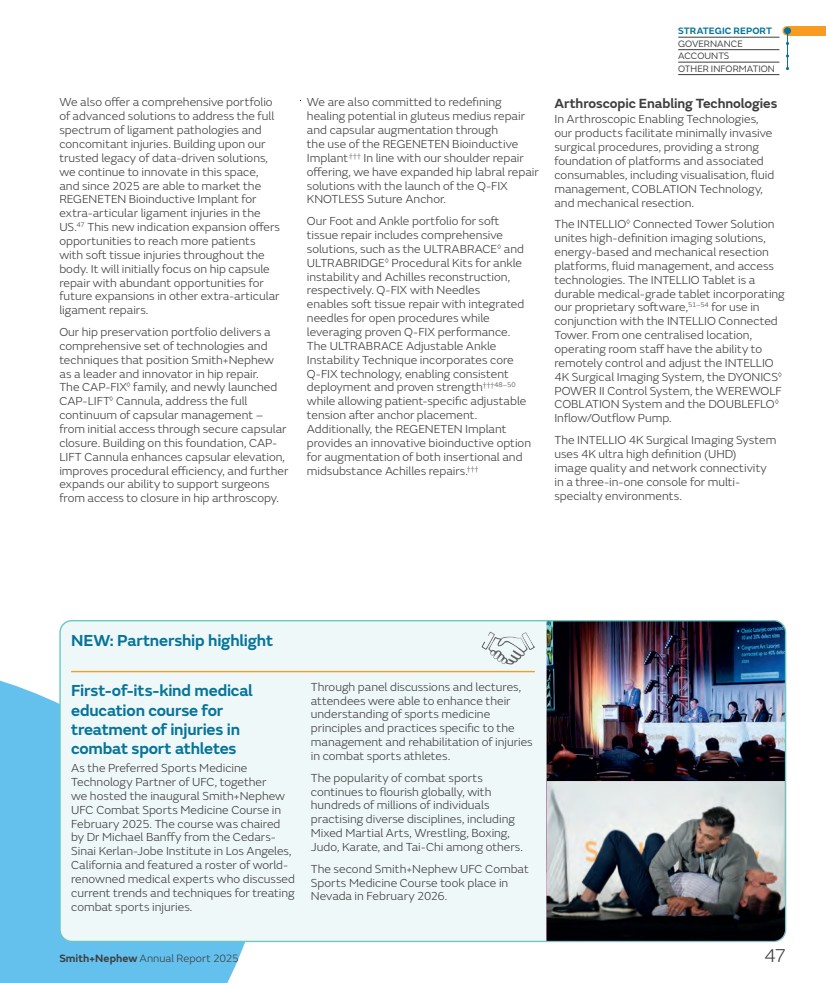
| Our WEREWOLF Controller enables surgeons to remove soft tissue precisely‡‡‡‡54,55 in a variety of arthroscopic procedures. Using COBLATION Technology for chondroplasty of the knee, patients experienced significantly less pain post-treatment and faster recovery.†††††56 In mechanical resection, the DYONICS PLATINUM Handpiece is designed ergonomically with surgeon comfort in mind; accommodating a range of grip styles. Facilitating the removal of dense bone and tissue in large joints, it features improved torque between the working range of 4,000-10,000 RPM, when compared to the DYONICS POWERMAX◊ ELITE Handpiece.57 Ear, Nose and Throat (ENT) In ENT, our COBLATION Plasma Technology, which has been used to remove tonsils and adenoids for over 20 years,58,59 has an ability to remove tissue at low temperatures with minimal damage to surrounding tissue.60–65 Evidence shows that with COBLATION Intracapsular Tonsillectomy (CIT) procedures, patients experience less pain, quicker recovery and a decreased risk of post-operative bleeding with similar outcomes to total tonsillectomies.66 Smith+Nephew offers a full portfolio of COBLATION Wands for CIT procedures. The ARIS◊ COBLATION Turbinate Reduction Wand utilises COBLATION Technology to provide a minimally invasive way to reduce hypertrophic turbinates. It provides targeted hemostasis with a built-in bipolar coagulation function.67 Our TULA® Tympanostomy System provides an in-office alternative to traditional ear tube insertion procedures using a local anaesthesia system and an automated, one-click tube delivery device.68,69 As part of our comprehensive portfolio of epistaxis (nosebleed) solutions, RAPID RHINO◊ Epistaxis Products are inflatable tamponades which are easy to insert and remove,70–72 with an ultra-low profile and self-lubricating hydrocolloid fabric. In addition, we market a range of dissolvable and removable post-operative nasal dressings. NEW: Partnership highlight Sponsoring select players competing at Wimbledon, highlighting advanced solutions for joint repair In 2025, we once again supported select players during high profile matches at The Championships, Wimbledon. The world’s oldest and most prestigious tennis tournament serves as a perfect backdrop to showcase Smith+Nephew’s purpose of ‘Life Unlimited’ making a difference in patients’ lives through the excellence of a diverse Sports Medicine product portfolio and the application of new technologies. Smith+Nephew’s ENT COBLATION Wands are designed for both tonsil and adenoid procedures 48 Smith+Nephew Annual Report 2025 Serving our customers continued Sports Medicine & ENT continued 07_SN_AR25_SportsMed_AWM_v131.indd 48 05/03/2026 17:45 |

| Shaping what’s possible in wound care Smith+Nephew’s Advanced Wound Management vision remains consistent, to ‘Shape What’s Possible in Wound Care.’ Through our broad portfolio, designed to meet broad and complex clinical needs, we help healthcare professionals solve the challenges of preventing and healing wounds. The global wound care market is worth around $13 billion per annum. Long-term growth continues to be driven by the needs of an ageing population and the current prevalence of obesity, diabetes and vascular disease. These conditions are key drivers of wound prevalence and contribute to the pressure on healthcare spending. Healthcare systems need to do more with less, such as enabling patients to be treated faster, with fewer resources, or moving them from acute to homecare settings. The prevention of wounds is also an important focus, with healthcare systems increasingly working proactively to avoid wounds, such as pressure injuries and surgical site complications. In Advanced Wound Management, we seek to help healthcare systems through innovation in products and services, to prevent wounds or deliver accelerated healing. We do this across our three segments of Advanced Wound Care, Advanced Wound Bioactives and Advanced Wound Devices. Advanced Wound Management global market sharea,b We operate in all three categories in wound care, and have the second largest business globally in terms of revenue. In the Advanced Wound Care segment we compete in dressings with Mölnlycke (Sweden), Coloplast (Denmark) and ConvaTec (UK). In Advanced Wound Bioactives, we have leadership positions in a number of our respective categories and we have the only US Food and Drug Administration (FDA) approved enzymatic debrider. In Advanced Wound Devices, we are the primary challenger to Negative Pressure Wound Therapy incumbent Solventum. $13.1bn +4% 2024: $12.5bn +6% E D C B A A Smith+Nephew 14% B Solventum 14% C Mölnlycke 10% D ConvaTec 6% E Others 56% RISE strategy Through our vision of Shaping What’s Possible in Wound Care and a strong and broad portfolio, we believe we are now well positioned to deliver our new RISE strategy and accelerate growth to become the global leader in Advanced Wound Management. We will Reach more patients by taking our portfolio into high growth segments, offering solutions across the full continuum of care from prevention to treatment and expanding our global reach in emerging markets. “We have one of the broadest portfolios of differentiated products, a robust pipeline of future innovation, and, following the 12-Point Plan, an invigorated business ready to capture share and expand the market.” Rohit Kashyap, President Advanced Wound Management & Global Commercial Operations For a full list of references, see pages 306–311 14% Global market sharea,b We operate in all three categories in wound care, and have the second largest business globally in terms of revenue. a Data used in 2024, and 2025 estimates generated by Smith+Nephew are based on publicly available sources and internal analysis and represent an indication of market shares and sizes. b Market data excludes the estimated $10 billion Cellular and Tissue Products (CTP) market which includes segments that are expected to undergo a significant reset following changes to reimbursement that came into effect on 1 January 2026. Smith+Nephew Annual Report 2025 49 STRATEGIC REPORT GOVERNANCE ACCOUNTS Advanced Wound Management OTHER INFORMATION 07_SN_AR25_SportsMed_AWM_v131.indd 49 05/03/2026 17:45 |

| We will step up our investment in innovation to focus on areas like pressure injury prevention, chronic wounds and surgical site complications. We will support innovation by increasing investment in compelling clinical evidence to shift adoption of these advanced therapies by demonstrating lower cost of care and better patient outcomes. We will Scale by expanding our reach and deploying capital into high-growth segments where we can lead by adding new channels and products. We will Execute efficiently as we improve further our commercial engine to deliver sustainable growth above market. We will leverage digital tools to improve our productivity and effectiveness and strengthen capabilities in pricing and national accounts. We will build on our foundational pillars of continuous improvement and customer focus. 2025 performance Advanced Wound Management full year 2025 revenue growth was 6.7% on a reported basis, including an FX tailwind of 101bps. On an underlying1 basis, revenue growth was 5.6%. Advanced Wound Care performance included good growth in foam dressings and films which offset a weaker performance in infection management. Advanced Wound Bioactives performance was led by good growth from SANTYL◊ and a strong first half for our skins substitutes portfolio. The full year growth rate was impacted by a soft fourth quarter due to a strong comparator period from the launch on GRAFIX PLUS◊ in Q4 2024 and softness in skin substitutes ahead of the implementation of reimbursement changes in 2026. Advanced Wound Devices performance was driven by both our single-use PICO◊ Negative Pressure Wound Therapy System and traditional RENASYS◊ Negative Pressure Wound Therapy System, as well as our LEAF◊ Patient Monitoring System as we continued to expand the market in pressure injury prevention. Advanced Wound Management trading profit1 was up 12.0% in 2025, with a 120bps increase in trading profit margin1 to 24.9%, driven by leverage from the revenue growth. Performance 2025 Revenue 2024 Revenue 2023 Revenue 2025 Reported growth 2024 Reported growth 2023 Reported growth 2025 Underlying growth1 2024 Underlying growth1 2023 Underlying growth1 Advanced Wound Management $1,793m $1,681m $1,606m 6.7% 4.7% 6.2% 5.6% 5.1% 6.4% Advanced Wound Care $766m $735m $725m 4.3% 1.4% 1.8% 2.6% 2.0% 2.1% Advanced Wound Bioactives $621m $581m $553m 6.9% 5.1% 6.3% 6.8% 5.1% 6.2% Advanced Wound Devices $406m $365m $328m 11.1% 11.5% 17.0% 9.8% 12.2% 17.6% 2025 2024 2023 2025 Reported growth 2024 Reported growth Segment trading profit $447m $399m $372m 12.0% 7.3% 1 These non-IFRS financial measures are explained and reconciled to the most directly comparable financial measure prepared in accordance with IFRS on pages 285–292. 2024 performance In 2024, Advanced Wound Management delivered revenue growth on a reported basis of 4.7%, including a -40bps headwind from foreign exchange. Underlying growth1 was 5.1%. In 2024, Advanced Wound Care growth was driven by good performances in foam dressings and infection management categories. In Advanced Wound Bioactives, SANTYL ointment delivered growth for the full year, although we continued to see quarter-to-quarter variability, a long-term feature of this product. We delivered double-digit growth from our skin substitutes business following the launch of GRAFIX PLUS membranes. In 2024, Advanced Wound Devices delivered strong revenue growth across the year. This was driven by both our traditional RENASYS Negative Pressure Wound Therapy System and our single-use PICO Negative Pressure Wound Therapy System, as well as from our LEAF Patient Monitoring System. Advanced Wound Management trading profit1 was up 7.3% in 2024, with a 120bps increase in trading profit margin1 to 24.9%, driven by operating leverage and productivity improvements. For a full list of references, see pages 306–311 50 Smith+Nephew Annual Report 2025 Advanced Wound Management continued Serving our customers continued 07_SN_AR25_SportsMed_AWM_v131.indd 50 05/03/2026 17:45 |
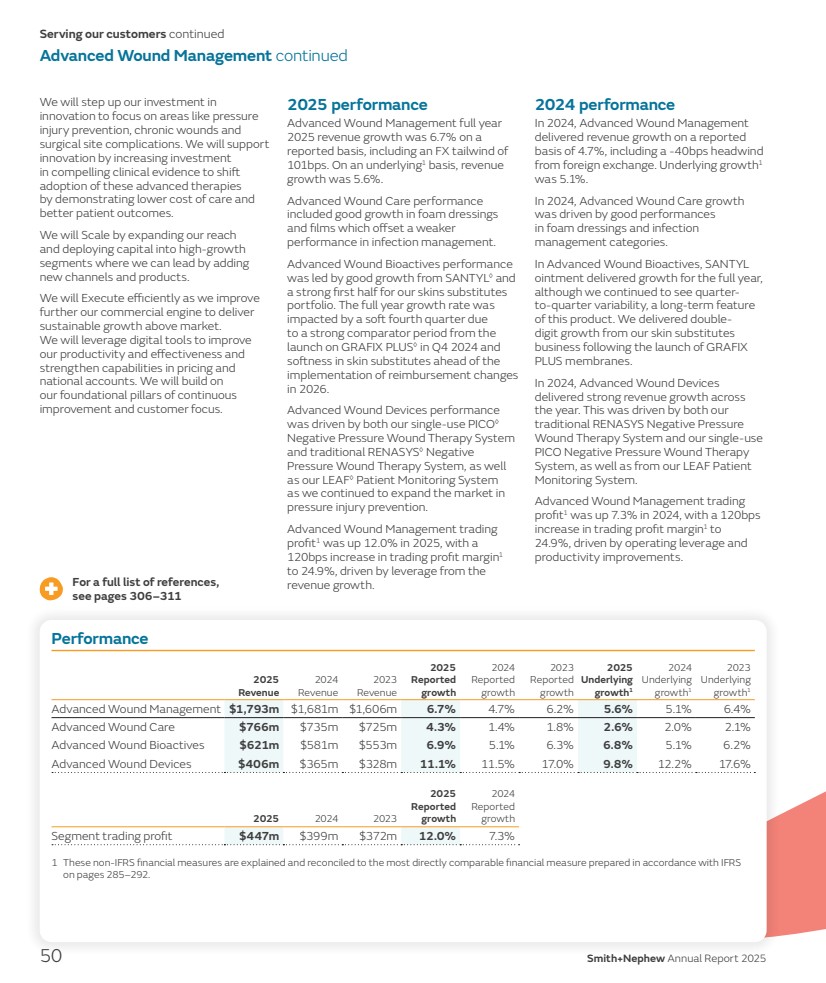
| Key products by segment Advanced Wound Care Smith+Nephew started as a wound care company, and through our Advanced Wound Care business we have grown to be a leader in the segment. Today our portfolio includes products that are designed to manage exudate and infection, protect the skin and help prevent pressure injuries. ALLEVYN◊ Wound Dressings are a trusted leader when it comes to providing an optimal environment for healing. Our foam dressings provide proven performance to absorb, protect, and be gentle on the skin, as well as much more.3–7 The ‘much more’ comes with ALLEVYN’s extensive range of shapes and sizes, as well as its unique technologies. ALLEVYN LIFE Foam Dressing, for example, has ExuLOCK◊ and ExuMASK◊ technologies. ExuLOCK hyper-absorbent lock-away technology absorbs exudate and spreads it laterally across the dressing to utilise the entire dressing area while locking it in to help prevent leakage and to help control malodour.8–9 ExuMASK change indicator technology minimises the visual impact of absorbed exudate and works as an indicator to know when to change the dressing, which helps minimise clinically unnecessary changes.10–14 The effectiveness of the ALLEVYN Dressing range has been demonstrated across over 138 publications in 19 countries on over 12,000 patients and volunteers.15 We also offer DURAMAX◊ S and DURAMAX N Superabsorbent Dressings. Superabsorbers are one of the fastest-growing categories of dressings in Europe.16 Our antimicrobial dressing range includes ACTICOAT◊ Antimicrobial Barrier Dressings, DURAFIBER◊ Ag Pro Absorbent Gelling Silver Fibrous Dressings, ALLEVYN Ag Antimicrobial Foam Dressings, and our range of IODOSORB◊ Cadexomer Iodine products.17–27 Smith+Nephew advocates usage to support the principles of antimicrobial stewardship, helping to reduce the spread of antimicrobial resistance and protecting future patients. Our new ALLEVYN Ag+ and Ag+ SURGICAL antimicrobial foam dressings were recently launched in the US, completing our foam portfolio and supporting growth in expanding market segments. The future of pressure injury prevention ALLEVYN COMPLETE CARE and LEAF Hospital-acquired pressure injuries remain one of the most significant healthcare challenges globally65 and cost an estimated 60,000 lives and $26.8 billion in the US each year.66–67 Smith+Nephew’s ALLEVYN COMPLETE CARE Dressings, LEAF Patient Monitoring System and SECURA◊ skincare products are aimed at improving healthcare practices and outcomes in pressure injury prevention. In November 2025, Smith+Nephew introduced ALLEVYN COMPLETE CARE Foam Dressing into the US advanced wound care market, supported by new data published in the International Wound Journal from Professor Amit Gefen and his research group, which showed a significant reduction in the odds of pressure injury development by 66% when adding ALLEVYN five-layer dressings to a pressure injury prevention protocol compared to standard care alone.68 ALLEVYN COMPLETE CARE Dressing demonstrates a distinct mechanism of action through layer-to-layer frictional sliding to absorb and dissipate friction and shear forces.65 This mechanism of action can help significantly reduce the harmful stress concentrations that cause pressure injuries. The LEAF Patient Monitoring System uses a wearable sensor to monitor patient mobility and provides real-time turn status updates, which have been shown to reduce pressure injury risk up to 94%.69 Visual alerts in the patient room and at the nurses’ station make it easy to see who needs to be turned and when.70,71 LEAF System’s Integrated Positioning Index™ is the first tool that measures the quality and effectiveness of patient turning, including patient turn frequency and turn angle. 1-3 million Number of people in the US affected by pressure injuries annually.66 95% Approximately 95% of pressure injuries are considered preventable.72 Smith+Nephew Annual Report 2025 51 STRATEGIC REPORT GOVERNANCE ACCOUNTS OTHER INFORMATION 07_SN_AR25_SportsMed_AWM_v131.indd 51 05/03/2026 17:45 |
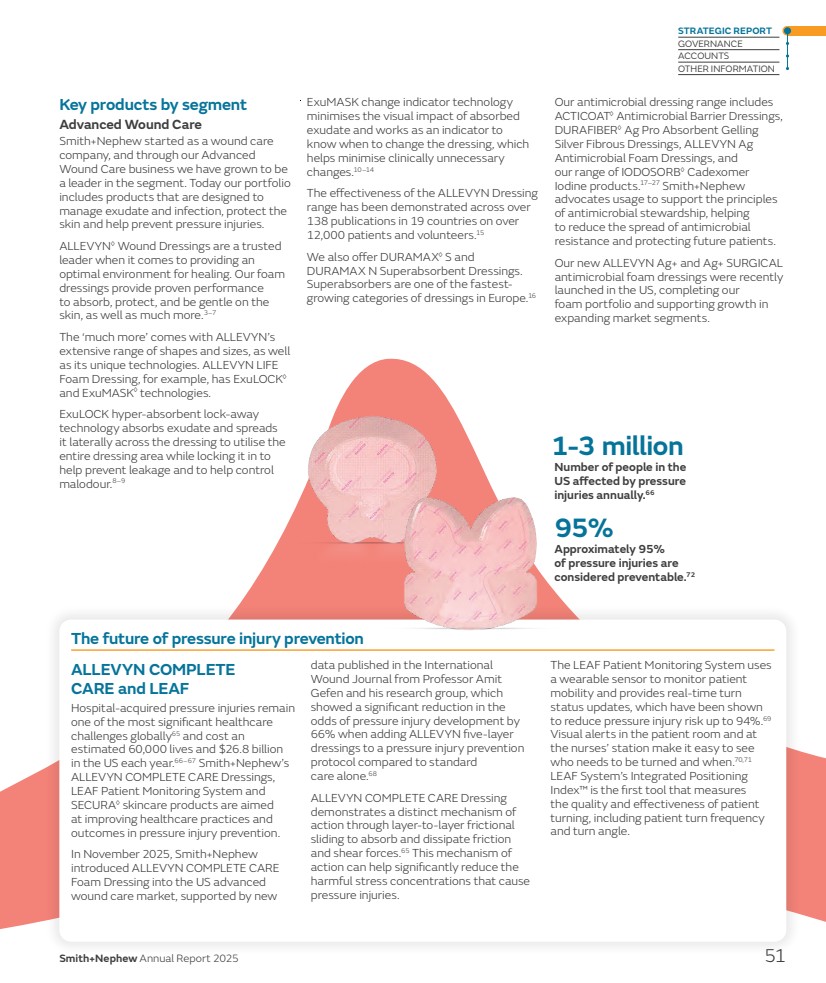
| Advanced Wound Bioactives Our Advanced Wound Bioactives portfolio provides a unique approach to debridement, dermal repair and tissue substitutes, with considerable evidence supporting their clinical application. Collagenase SANTYL Ointment (250 units/ gram) is the only FDA-approved enzymatic debridement agent indicated for debriding both chronic dermal ulcers and severely burned areas. It is available in the US, with a unique mechanism of action that facilitates removal of necrotic tissue and contributes to the formation of granulation tissue and subsequent epithelialisation of chronic wounds and severely burned areas.28–31 In our skin substitute product range, GRAFIX◊ Placental Membranes and STRAVIX◊ Umbilical Tissues retain the extracellular matrix and native placental components to support wound closure.32,33 They are intended for application directly to acute and chronic wounds and as a surgical cover, wrap or barrier. In addition, we offer OASIS®***** Matrix and OASIS MICRO products, which are naturally derived scaffolds of extracellular matrix, composed of porcine small intestinal submucosa and indicated for the management of a wide range of acute and chronic wounds, burns and surgical interventions.34 Advanced Wound Devices In Advanced Wound Devices, our portfolio helps improve healing outcomes in chronic wounds, reduce surgical site complications and facilitate preventative care for pressure injuries. Within the Negative Pressure Wound Therapy (NPWT) category, we offer single-use and traditional (cannister-based) solutions, offering customers a one-stop shop with great flexibility. PICO Single Use Negative Pressure Wound Therapy System (sNPWT), with its unique 360° dressing technology,35–41 provides a ‘proactive therapy’, that has been demonstrated to kick-start the healing process in stalled wounds**42, and in the reduction of surgical site complications in closed incisions,***43 in a highly portable form that allows patients to continue with their daily activities.44–47 Our traditional RENASYS NPWT Systems are easy-to-use platforms, with a range of accessories to treat a wide variety of wounds and patients across all care settings.48,49 The RENASYS portfolio’s newest innovation, the RENASYS EDGE pump, brings dignity back to NPWT. Quiet, discreet and compact, the system helps patients focus on living while they recover, and has been shown to deliver higher efficiency and utility for clinicians.50–53 The VERSAJET◊ Hydrosurgery System provides controlled debridement and facilitates precise excision of necrosis and other unwanted material from the wound surface, preserving viable tissues.****54–64 The LEAF System monitors patient movement and positions in bed, upright or walking to help adherence to turning schedules, supporting pressure injury prevention. Cost-effective and improved outcomes with PICO PICO Single Use Negative Pressure Wound Therapy System (sNPWT) was shown to be cost-effective1 and to improve outcomes compared with standard care to help prevent surgical site complications in patients with surgically closed incisions. A systematic literature review and meta-analysis of 19 studies involving 4,530 patients showed a 63% reduction in the odds of developing surgical site infections with the prophylactic use of PICO sNPWT compared with standard care.2 RENASYS EDGE (top) and PICO (above) Negative Pressure Wound Therapy Systems For a full list of references, see pages 306–311 52 Smith+Nephew Annual Report 2025 Advanced Wound Management continued Serving our customers continued 07_SN_AR25_SportsMed_AWM_v131.indd 52 05/03/2026 17:45 |
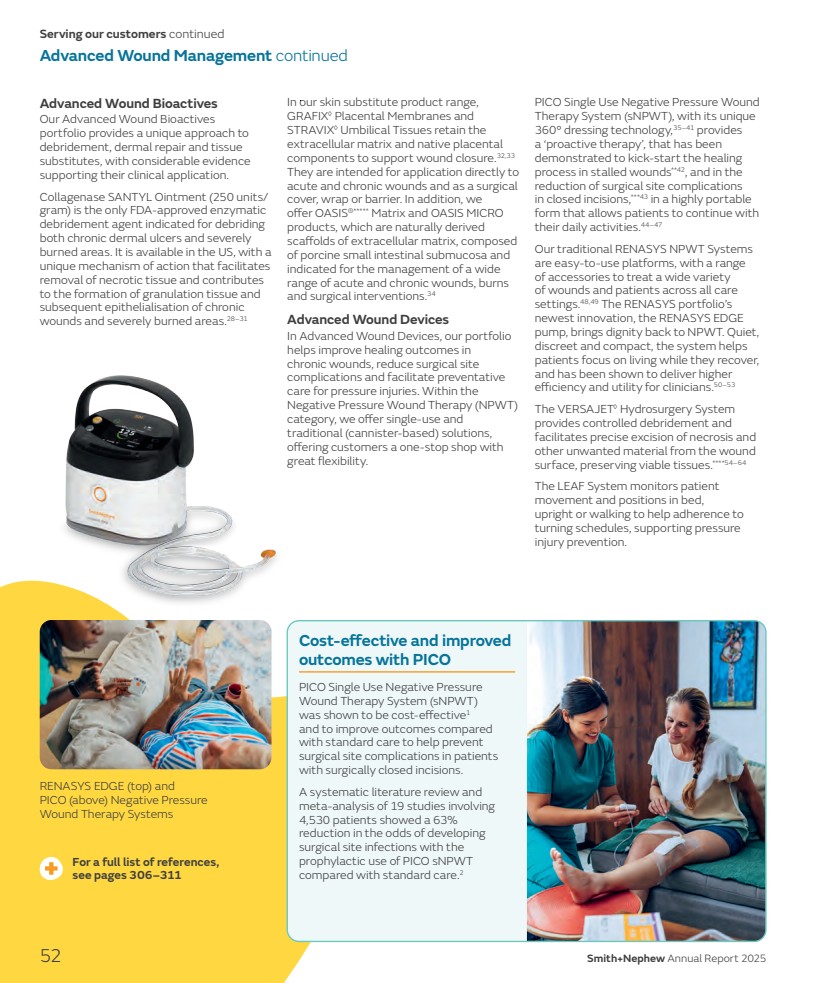
| 03 We support healthcare professionals to return their patients to health and mobility, helping them to perform at their fullest potential. Life Unlimited Living without limits Together we are STRATEGIC REPORT GOVERNANCE ACCOUNTS OTHER INFORMATION Smith+Nephew Annual Report 2025 53 08_SN_AR25_Living_LU_Case_Studies_v54.indd 53 05/03/2026 18:03 |

| Neiser and Evelyn work at our Coyol site in Costa Rica, supporting the manufacturing and development of our ENT portfolio. Evelyn is part of Production, while Neiser works in Advanced Manufacturing Engineering as part of the New Product Development team. Together, they have supported the development and production of our ENT technologies for a combined total of 31 years. Last year, they experienced the positive impact of our technologies in the most personal way – through their own son. Five-year-old Gael had been suffering from sleep apnea and inflamed sinuses for over two years. Regular infections, visits to the doctor, difficulty breathing, and poor sleep quality were leading to ongoing medication and slowed development. After finding an ENT specialist, it became clear that the most effective solution for his symptoms would be surgery. One of the recommended procedures was turbinate reduction. For this, the Smith+Nephew Turbinate Reduction Wand was used; a product that Neiser had previously worked on while it was still in development. “Every day that I do my job, I feel a lot of responsibility. In the end, everything we do helps to improve the quality of life for someone. In this case, it’s so amazing for me to think that a product that I worked on has helped my son to regain a normal life”, said Neiser. Following successful procedures, Gael has been able to focus more on playing and less on breathing. His sleep quality has improved dramatically. For Gael’s parents, seeing their son regain his childhood means everything. A family journey: bringing Life Unlimited home. For Gael’s parents, seeing their son regain his childhood means everything. Ear, Nose and Throat Sports Medicine 54 Smith+Nephew Annual Report 2025 Living without limits continued 08_SN_AR25_Living_LU_Case_Studies_v54.indd 54 05/03/2026 18:03 |
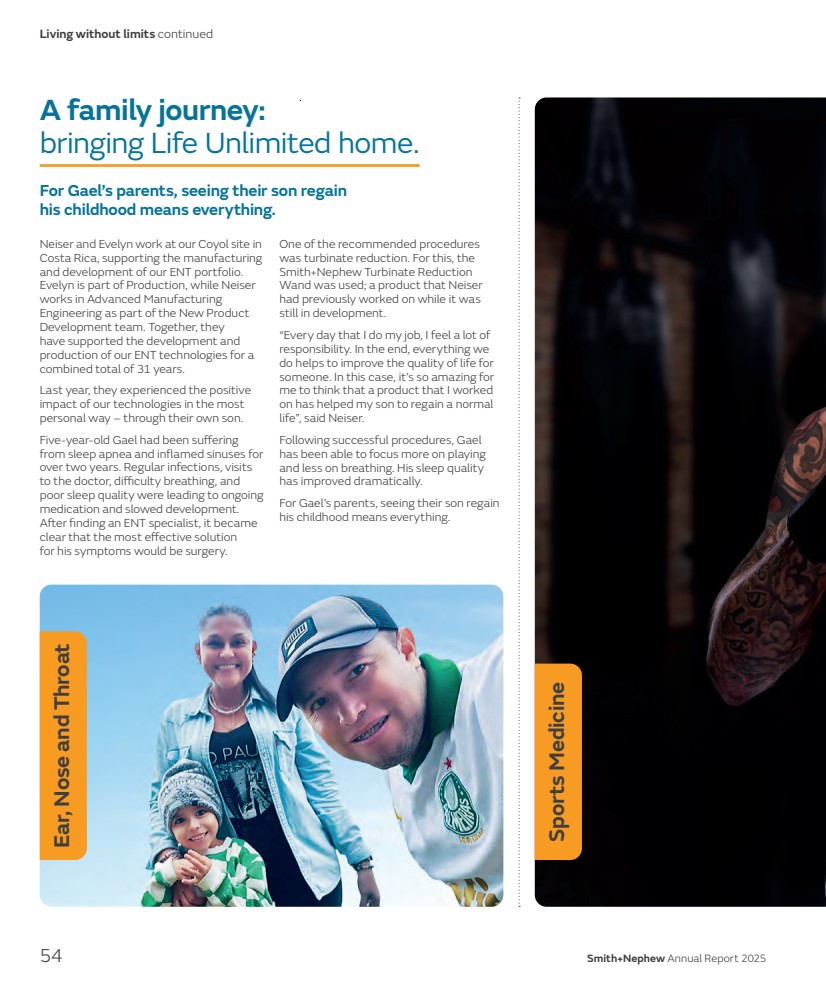
| Considered one of the greatest lightweight mixed martial arts athletes of all time, Dustin Poirier has enjoyed a long and storied career as a UFC athlete and champion. Hip pain was simply a part of his life for as long as he could remember. He just dealt with it – until he no longer could. “When you’re a young fighter and you get injured, you want to just walk it off… don’t show anybody that you’re hurt,” said Dustin. “My hip had been bothering me for a decade, and it kept getting worse over the years. Even in my day-to-day life, I was in pain. I knew I had to do something.” “It got to the point where the hip was impeding his progress,” said Dr Judson Penton, Orthopedic Surgeon. He referred Dustin to Dr Marc Philippon, a renowned sports medicine surgeon specialising in hip arthroscopy. Dr. Philippon helped reassure Dustin and presented options for his hip repair, using Smith+Nephew technology. A successful surgery and dedicated rehabilitation resulted in a full recovery, and eventually Dustin’s return to the Octagon – competing and winning at the highest level. Dustin retired from the UFC in July 2025 after his last fight. He said, “When I lay down the gloves and go on to the next chapter in my life, I’m going to do it with a lot less pain. And I’m very thankful for that. I feel great. If I had to do this [surgery] again, I would 100% do it again.” Redefining possibility: strength to rise, heal, and compete again. Dustin Poirier’s story – athletic recovery and return to potential. Smith+Nephew Annual Report 2025 55 STRATEGIC REPORT GOVERNANCE ACCOUNTS OTHER INFORMATION 08_SN_AR25_Living_LU_Case_Studies_v54.indd 55 05/03/2026 18:03 |
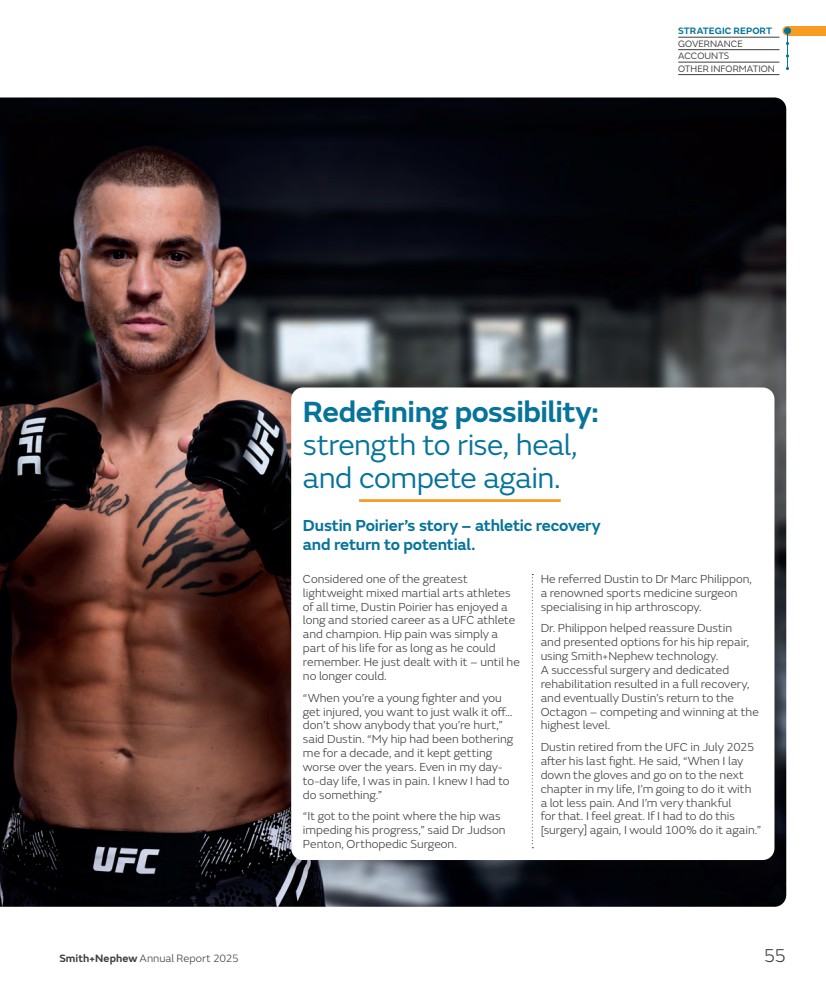
| Orthopaedics Craig Gaffin, President of Global Orthopaedics at Smith+Nephew, knows first-hand the life-changing impact of MedTech innovation – not just as a leader with many years in the industry, but now also as a patient. As a former college athlete, years of escalating arthritic hip pain began to negatively impact his active lifestyle. “I was in pain and kept making excuses for putting off the surgery, but I was no longer able to enjoy spending time outdoors with my family which is my favourite thing to do,” he explains. When everyday activities, like walking through airport terminals during frequent business trips, finally became too unbearable, Craig knew it was time to get the surgery. In November 2024, Craig became the first patient in the world to undergo a dual hip replacement, using Smith+Nephew’s CORIOGRAPH◊ Pre-Operative Planning Technology and the CATALYSTEM◊ Hip System with an OXINIUM◊ head using the direct anterior surgical approach. His second surgery was in March 2025 and Craig’s recovery from both procedures was swift and transformative. Dr George Haidukewych, MD, Chief of Joint Replacement Surgery at Orlando Health, performed both surgeries and explained that Craig was the ideal candidate for this type of procedure. “Craig is an active, healthy, young patient who needed to bounce back quickly… and he did!” Craig returned to the active life he loved, with a renewed appreciation for the technologies that made it possible. “Just six months after the second hip replacement, I’m back to doing everything I love – playing sports, hiking, surfing, skiing and travelling. I feel stronger than ever and I’ve got my game back,” he says. “Experiencing the patient journey from diagnosis to rehabilitation gave me a new perspective and appreciation for Smith+Nephew’s purpose of Life Unlimited.” Reclaiming movement: when innovation empowers the innovator. Craig Gaffin’s story – innovation meets lived experience You can learn more about Craig’s patient journey on the Smith+Nephew website: www.smith-nephew.com 56 Smith+Nephew Annual Report 2025 Living without limits continued 08_SN_AR25_Living_LU_Case_Studies_v54.indd 56 05/03/2026 18:03 |
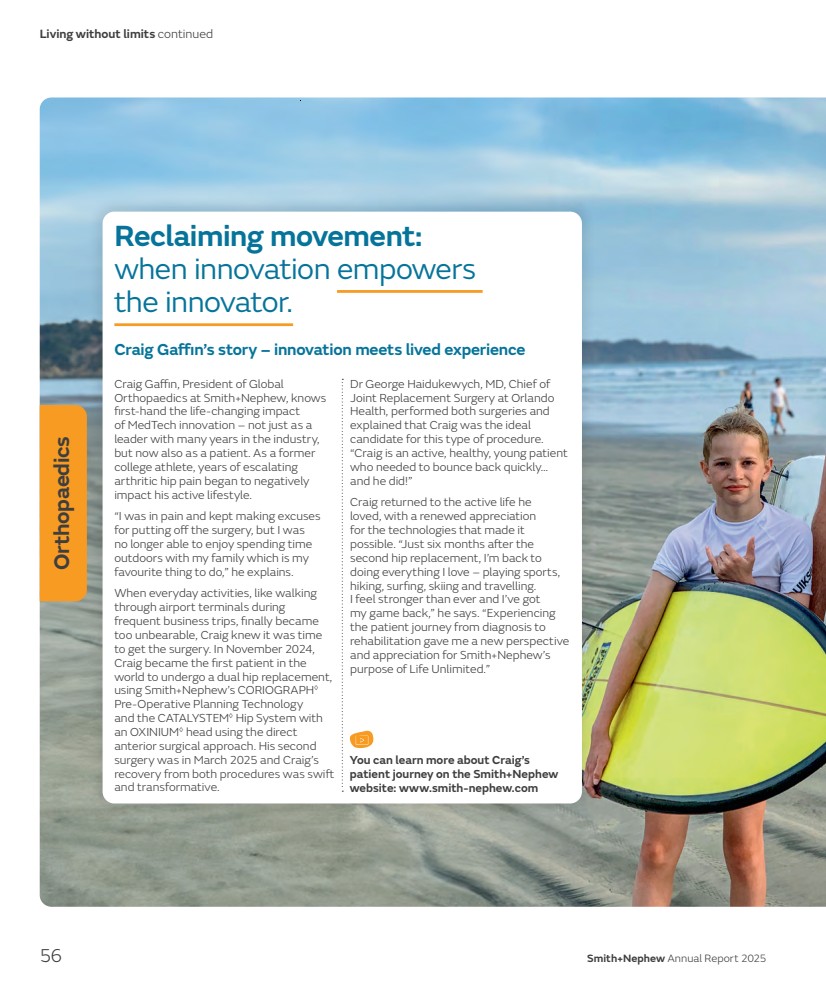
| Across the ALLEVYN◊ product portfolio, wound dressings of many types serve the many varied needs of different patients, clinicians, care settings, wounds, and skin types. One example of the many ways ALLEVYN long-wear advanced foam dressings can be used is to treat skin tears. ALLEVYN GENTLE BORDER Foam Dressings – gentle and versatile, suitable for fragile skin – provided a solution when Evelyn, a 100-year-old resident at St. Thomas Complex residential care home in South Shields, England, suffered a skin tear when she was getting out of bed. Senior Care Staff at Evelyn’s residential home, Nicola, praised the dressing’s suitability for use with fragile, elderly skin. “After the fall, we reassured Evelyn, we cleaned the wound and aligned the skin back up to reduce scarring and then dressed it. We use ALLEVYN GENTLE BORDER because it’s really soft on the skin. And for elderly skin, that’s really important because it doesn’t tear the skin and is not going to cause any more damage.” Evelyn agreed. Nicola had taken part in a trial programme, the Dressing Remedies Scheme, which included additional training that empowered her care-home colleagues and her to manage skin tears, enabling prompt care at the time of injury and reducing the demand for district nursing services. Restoring confidence: gentle care that extends quality of life. Evelyn’s story – fragile-skin care that brings dignity, comfort and independence Advanced Wound Management Smith+Nephew Annual Report 2025 57 STRATEGIC REPORT GOVERNANCE ACCOUNTS OTHER INFORMATION 08_SN_AR25_Living_LU_Case_Studies_v54.indd 57 05/03/2026 18:03 |
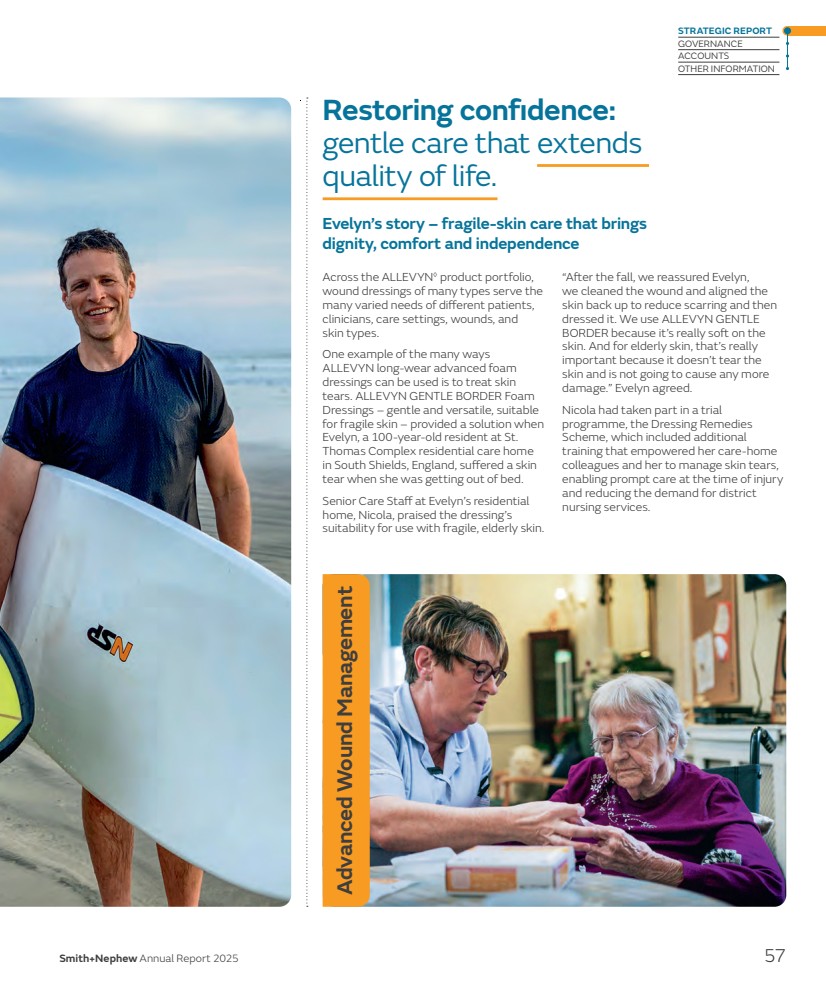
| At Smith+Nephew, our three pillars of Care, Collaboration and Courage are the foundations on which we build our unique culture and Way to Win. Life Unlimited 04Building our Way to Win Together we are 58 Smith+Nephew Annual Report 2025 09_SN_AR25_CultureToSuceed_v84.indd 58 05/03/2026 17:46 |

| In 2025, we made significant strides in employee wellbeing, learning and development, strategic workforce planning, operational effectiveness, and inclusion initiatives. Our purpose – Life Unlimited – resonates deeply with our employees and guides everything we do – our strategy, culture, engagement, and performance. It aligns our employees with shared objectives, informs decision making processes, and supports long-term success by imparting purpose to our work. This approach establishes a direct and significant link between our actions and the value we deliver. Our cultural framework for success Over three years, the 12-Point Plan has significantly strengthened both discipline and accountability. We have strengthened these behaviours by moving to a business unit verticalised structure, where there are clear points of accountability, and ensuring that every people leader has objectives and KPIs that are aligned to our strategy. Fostering a healthy, inclusive, and high-performing culture KPI delivery is non-negotiable, as what gets measured gets done. Objectives and expected behaviours are cascaded from the Executive Committee to every employee, ensuring alignment and connection which, in turn, results in higher engagement and performance. Clear objectives, cascaded to the organisation with KPIs, have built rigour and discipline and are instilling a continuous improvement mindset which we will further strengthen and operationalise with our Way to Win as an enabler of our RISE strategy. Evolving our culture in alignment with our business priorities and desired customer outcomes and experiences is an ongoing focus for Smith+Nephew. We are passionate about creating the optimum conditions for colleagues to feel appreciated, empowered and engaged at work, with a clear sense of direction and understanding of organisational priorities. Learning and development, wellbeing, building people leader capability, talent acquisition and strategic workforce planning have been key areas of focus. “As our business evolves, so does our culture. And the next evolution of this is our ‘Way to Win.’ Our Purpose and Culture pillars will remain unchanged, but through our Way to Win, we will build and strengthen the behaviours we’ve developed over the 12-Point Plan aligned with our culture pillars. Our Way to Win is a programmatic continuous improvement framework, including the tools, behaviour and mindset that allows us to ‘be better’ every day for our customers, their patients and each other.” Elga Lohler Chief HR Officer Life Unlimited Care Courage Collaboration I Innovate S Scale E Execute R Reach Our Way to Win Be better, every day, through continuous improvement mindset behaviours We have a new strategy… and a culture framework for success Smith+Nephew Annual Report 2025 59 STRATEGIC REPORT GOVERNANCE ACCOUNTS OTHER INFORMATION 09_SN_AR25_CultureToSuceed_v84.indd 59 05/03/2026 17:46 |
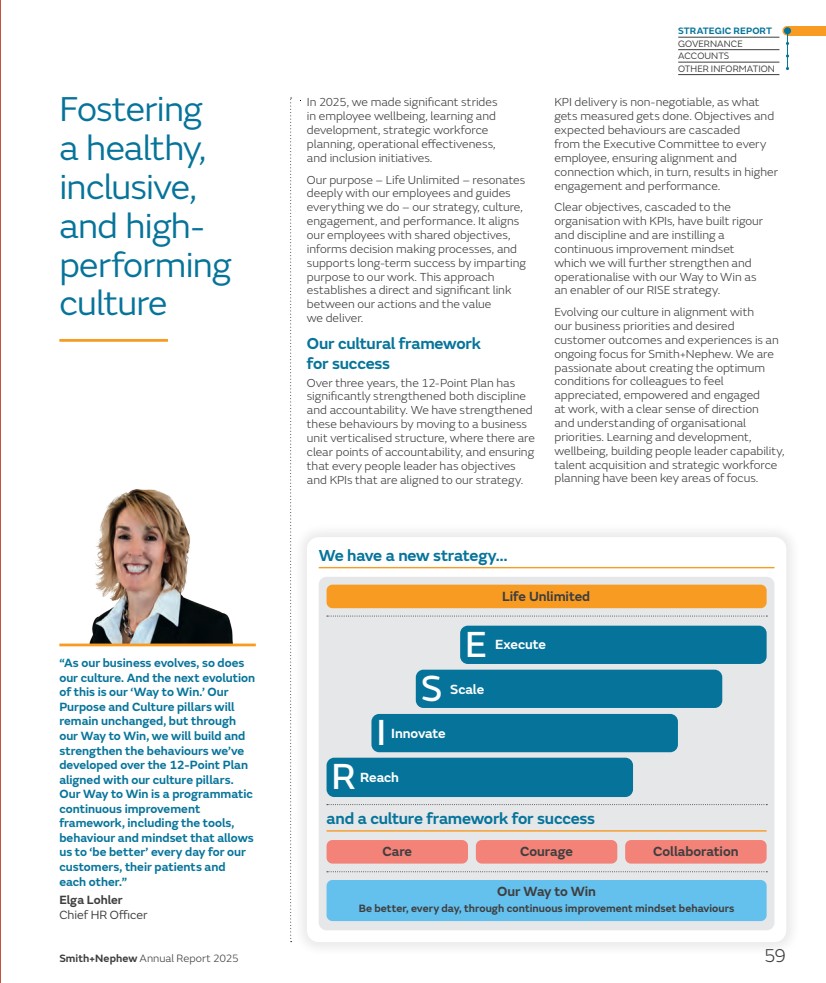
| A healthy culture In 2025, we introduced new programmes and initiatives designed to enhance engagement and support employee wellbeing. We introduced three new wellbeing dimensions: Body, Mind & Life, designed to focus on helping colleagues to feel good, think great and live better – in and out of work. This was underpinned by a new digital wellbeing portal, making it easier for colleagues to access tools, resources and support available, including our global wellbeing assistance, benefits and recognition programmes. In addition, we launched Boost – our global activity challenges designed to help colleagues improve overall physical health and, Reach Your Peak – exclusive keynote speaker webinars to inform and inspire. Eyes on the future In 2025, we made a conscious decision to deepen our understanding of the skills and capabilities we need to win – both now and in the future. Central to this effort is the elevated focus on strategic workforce planning, supported by the onboarding of a Strategic Workforce Planning Leader to define and embed our global skills strategy, framework, and approach. We defined our five-year skills strategy and soft-launched our new Skills Framework and Career Hub (Talent Marketplace) platform, connecting colleagues to mentors and flexible projects through skills data. The full roll-out, planned for early 2026, will introduce Career Path Builder, enabling employees to explore potential career pathways powered by skills insights. We believe that learning is about building on what you already know and finding ways to grow in the direction you want. Our approach to development is open to all colleagues and tailored to their individual needs and preferences. We have introduced assessments to help identify skill gaps, which allow for a personalised learning journey, and we then connect colleagues with targeted resources and expert-led sessions that focus on the skills that matter most to them. Our offering covers leadership, interpersonal, technical, and professional skills. Our newly launched People Leader Academy ensures that whether people leaders are stepping into their first leadership role or advancing to senior levels, they will be encouraged to take part in leadership development grounded in core leadership skills. Life Unlimited does not stand on its own. It is activated through our culture – a culture which was co-created with our employees to promote global ownership, ensure sustained alignment on the ‘What’ and the ‘How’ throughout all strategic decisions and daily activities and foster a productive and engaged workplace. We strive to create and nurture a healthy, high performing, connected, and inclusive culture for employees across the organisation. We believe the customer benefits when our employees feel able to thrive at work and feel appreciated for what they uniquely contribute. Our culture pillars of Courage, Care and Collaboration shine a light on the behaviours and ways of working that are most important to us in achieving the best outcomes for our organisation, our customers, and patients, and ultimately are how we can all play our part in delivering on our purpose, Life Unlimited. – Care: A culture of empathy and understanding for each other, customers and patients – Collaboration: A culture based on mutual trust, respect and belonging – Courage: A culture of continuous learning, innovation and accountability. “Our commitment to continuous improvement and our Way to Win enables the Legal team to deliver meaningful value for the organisation. By applying LEAN principles, we eliminate pain points and reduce unnecessary process steps; simplifying, streamlining and automating workflows to optimise risk, cost and resource management. In addition to organisational impact, our initiatives received external recognition in the FT Innovative Lawyers Awards in 2025.” Helen Barraclough, Group General Counsel and Company Secretary 60 Smith+Nephew Annual Report 2025 Building our Way to Win continued 09_SN_AR25_CultureToSuceed_v84.indd 60 05/03/2026 17:46 |
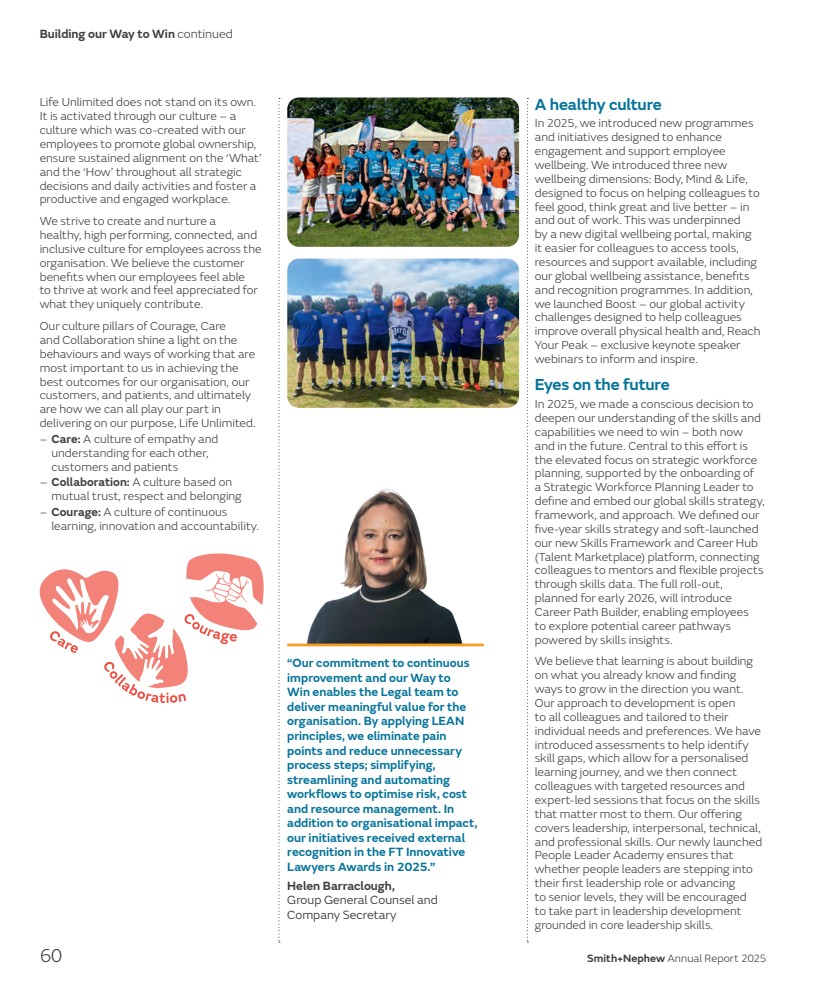
| Our offering combines self-paced learning, collaborative workshops, and practical experiences led by internal and external experts to equip current and future leaders with the skills to thrive and make a meaningful impact at Smith+Nephew. This year also saw us focus on evolving our Talent Acquisition strategy and model to ensure we are optimally placed to source, attract, evaluate, and hire the best candidates to meet our organisation’s current and future workforce needs, from early careers through executive-level hires. Our regional recruitment centres, coupled with local talent acquisition expertise in key markets, are structured to enable agility in meeting the organisation’s existing requirements while our sourcing teams build proactive talent pipelines for high volume and critical roles. In 2025, we restructured our regional recruitment teams into recruitment centres with key hubs in Costa Rica, Poland and India. We highlight our unique culture and employer branding to attract and nurture our candidate pipelines and cultivate our talent community through communications presenting important events and patient stories, and featuring our purpose of Life Unlimited. We leverage our award-winning tech stack to ensure efficiency and scale with our in-house recruitment team, as well as enabling a positive hiring manager and candidate experience. Data and analytics are at the forefront of how we assess and enhance our performance of key indicators, such as our time to fill, stakeholder engagement, candidate experience, and other critical measures. A key component of our talent acquisition strategy is continuous improvement to ensure we continue to be aligned to the goals of the organisation and competitive in attracting the best candidates to Smith+Nephew. Delighted to win a 2025 Gallup Exceptional Workplace Award for the second year running Just as we measure and continuously improve our business performance, the same is true for culture and engagement. We prioritise measurement of our employee engagement and culture as part of our operational heartbeat. Since 2019, we have used the Gallup Q12 tool to measure employee engagement through our annual Global Engagement Survey. This year, 95% of colleagues generously shared their feedback with us through the annual survey, the highest participation we have ever experienced. We were delighted to see an increase in our engagement mean to 4.33 (2024: 4.24) and to receive a Gallup Exceptional Workplace award in recognition of the progress we have made. These awards shine a light on companies that demonstrate commitment to employee engagement by listening and responding to colleague voices and taking action on what is heard. We believe our people leaders are accountable for engagement within their teams, and we work hard to support them in stepping into this space confidently and effectively and nurturing environments where Courage, Care and Collaboration are felt in the every day experiences of all. Engagement mean change (average from baseline) Gallup Exceptional Workplace Award recipient Note: Comparisons are based on Gallup’s (2022) Q12 Company-Level Change Analysis 2000–2021. Gallup Clients Average is defined as 50th percentile change, and Top 25% Gallup Clients is defined as 75th percentile change. +0.06 2022 88% +0.10 2023 89% 2021 88% 2024 92% +0.05 2025 95% Participation A Smith+Nephew B Top 25% Gallup clients C Gallup clients average A B C +0.08 +0.06 +0.05 +0.06 +0.10 +0.04 +0.08 +0.04 +0.09 4.08 4.33 Smith+Nephew Annual Report 2025 61 STRATEGIC REPORT GOVERNANCE ACCOUNTS OTHER INFORMATION 09_SN_AR25_CultureToSuceed_v84.indd 61 05/03/2026 17:46 |
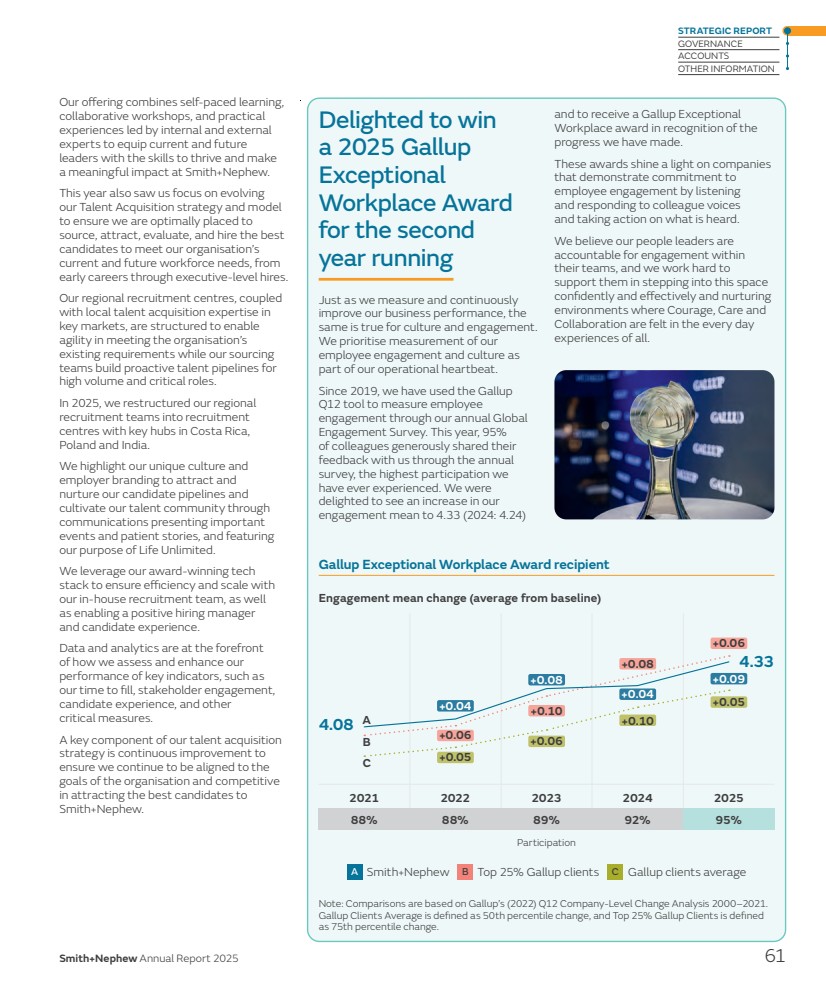
| A Culture of Inclusion At Smith+Nephew, we believe that inclusion and belonging are essential to creating a workplace where everyone feels valued, supported, and able to succeed. In 2025, we introduced a refreshed and ambitious five-year global Inclusion & Belonging strategy to further embed belonging into every part of our culture. The strategy focuses on building inclusive leadership, strengthening policies and practices, improving data and feedback, aligning with evolving regulations, and driving innovation through collaboration and representation. With clear goals and measurable outcomes, we are creating lasting change – making inclusion and belonging part of how we lead, connect, and deliver together. As part of our ongoing commitment to listening to our employees and taking action on what we hear, we have held regular Board Listening sessions with employees and Board members throughout 2025. These have ranged in topics from our business strategy and sustainability through to performance and recognition. Both Board members and employees have found these sessions to be both helpful and insightful. Employee Inclusion Groups (EIGs) and Life Councils Our EIGs and Life Councils play a vital role in ensuring a continuous dialogue with employees and providing valuable insight and feedback, they help us build a workplace where everyone feels seen, supported, and connected. They bring colleagues together around shared goals and experiences, creating opportunities for collaboration, education, and community-building. These communities are central to how we embed inclusion and belonging into everyday life at Smith+Nephew. This year, our EIGs and Life Councils delivered around 400 events worldwide, bringing colleagues together for around 1,000 hours of connection, learning, and celebration. In total, these events reached more than 22,000 attendees, reflecting the strength and reach of our global inclusion and belonging community. EIGs EIGs are colleague-led communities formed around shared experiences, identities, or life circumstances. Through awareness building, networking events, and educational initiatives, EIGs help to foster understanding, encourage allyship, and amplify the voices of underrepresented groups, driving meaningful cultural change throughout Smith+Nephew. Life Councils (LCs) Life Councils are site or region-based groups made up of volunteers who work together to strengthen community and connection at a local level. With a focus on social responsibility, volunteering, networking, and engagement, Life Councils bring our culture to life through inclusive events and initiatives that reflect the spirit and character of each location. Mental Health and Wellbeing Disability, Chronic Illness, Neurodiversity LGBTQ+ Community Young Professionals Military Veterans Women in the Workplace Mental Health and Wellbeing Disability, Chronic Illness, Neurodiversity LGBTQ+ Community Young Professionals Military Veterans Women in the Workplace Mental Health and Wellbeing Disability, Chronic Illness, Neurodiversity LGBTQ+ Community Young Professionals Military Veterans Women in the Workplace Mental Health and Wellbeing Disability, Chronic Illness, Neurodiversity LGBTQ+ Community Young Professionals Military Veterans Women in the Workplace Mental Health and Wellbeing Disability, Chronic Illness, Neurodiversity LGBTQ+ Community Young Professionals Military Veterans Women in the Workplace Mental Health and Wellbeing Disability, Chronic Illness, Neurodiversity LGBTQ+ Community Young Professionals Military Veterans Women in the Workplace Mental Health and Wellbeing Disability, Chronic Illness, Neurodiversity LGBTQ+ Community Young Professionals Military Veterans Women in the Workplace Our EIGs: 62 Smith+Nephew Annual Report 2025 Building our Way to Win continued 09_SN_AR25_CultureToSuceed_v84.indd 62 05/03/2026 17:46 |
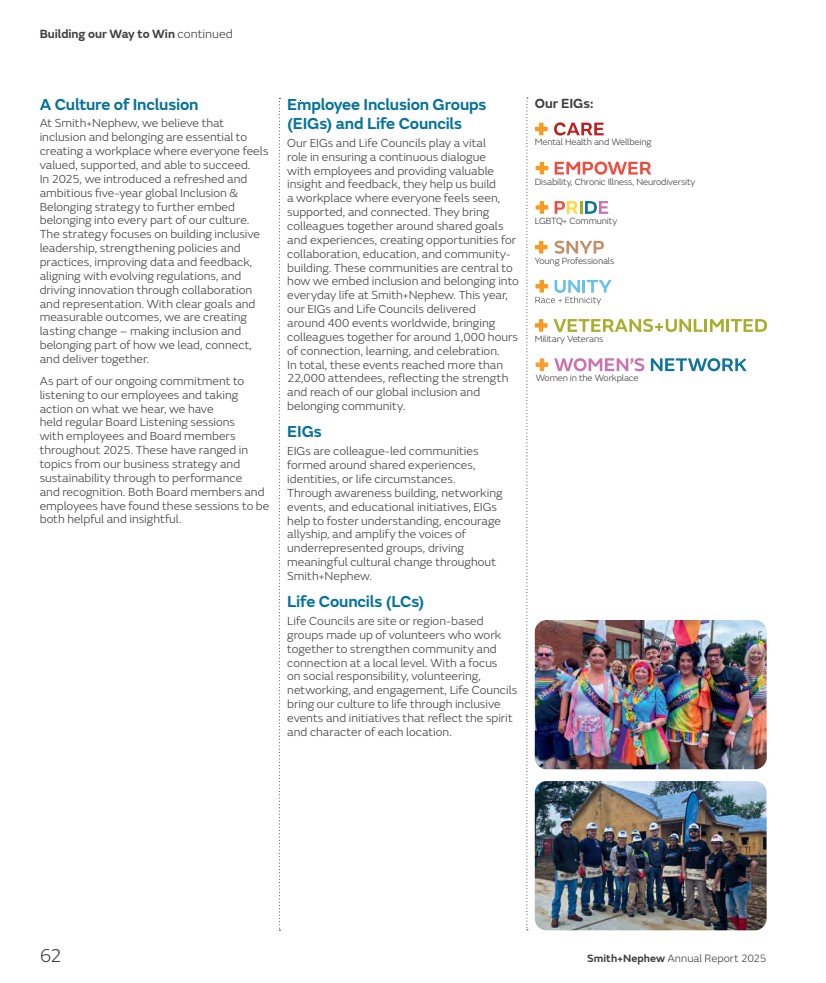
| An ethical employer Our commitment to ethics and integrity is embedded in our culture pillars of Care, Collaboration and Courage. We strive to recruit, employ and promote employees on the sole basis of the qualifications and abilities needed for the work to be performed. We do not tolerate discrimination on any grounds and provide equal opportunity for all employees. Creating an environment where colleagues feel safe and that fosters innovation means building trust by operating ethically and compliantly. We have a continuous improvement mindset and ensure that our programme evolves in parallel with business changes and emerging risks in the sector, and we have a focus on business ownership and accountability for compliance. In 2025, we reviewed and refreshed our fraud risk management and control framework with enhanced policies, training and third-party assessments. We also continued to enhance our data privacy programme – strengthening our privacy by designing a framework and improving alignment between our privacy and security frameworks. We have multiple levels of ethics and compliance oversight, including a Board Compliance & Culture Committee, to ensure that managers, employees and business partners act with integrity. “Our commitment to ethics and integrity is embedded in our culture pillars of Care, Collaboration and Courage. We have a continuous improvement mindset and ensure that our programme evolves in parallel with business changes and emerging risks in the sector.” Alison Parkes Chief Compliance Officer We ensure appropriate oversight of significant interactions with healthcare professionals or government officials, and we comply with all national and state transparency reporting laws which require reporting of physician compensation. All employees have a responsibility to report violations of our Code. This may be done via their manager, directly to Compliance, HR or Legal functions, or through an externally managed reporting channel where anonymous reports may be made. Smith+Nephew gives individuals with disabilities fair consideration for all vacancies against the requirements of the role. Where possible, for any employee who has a disability or who becomes disabled while working for us, we make reasonable adjustments and provide appropriate training to ensure that they are supported in their career. We are committed to providing equal opportunities in recruitment, promotion and career development for all employees, including those with disabilities. We do not use any form of forced, compulsory or child labour. Smith+Nephew supports the Universal Declaration of Human Rights of the United Nations, respecting the human rights, dignity and privacy of individuals and their right to freedom of association, freedom of expression and the right to be heard. As a global medical technology business, we recognise our responsibility to take a robust approach to preventing slavery and human trafficking. Smith+Nephew is committed to preventing such activities in all of its corporate operations and in its supply chains. We comply with applicable laws and regulations globally in terms of our interactions with labour unions. Smith+Nephew Annual Report 2025 63 STRATEGIC REPORT GOVERNANCE ACCOUNTS OTHER INFORMATION 09_SN_AR25_CultureToSuceed_v84.indd 63 05/03/2026 17:46 |
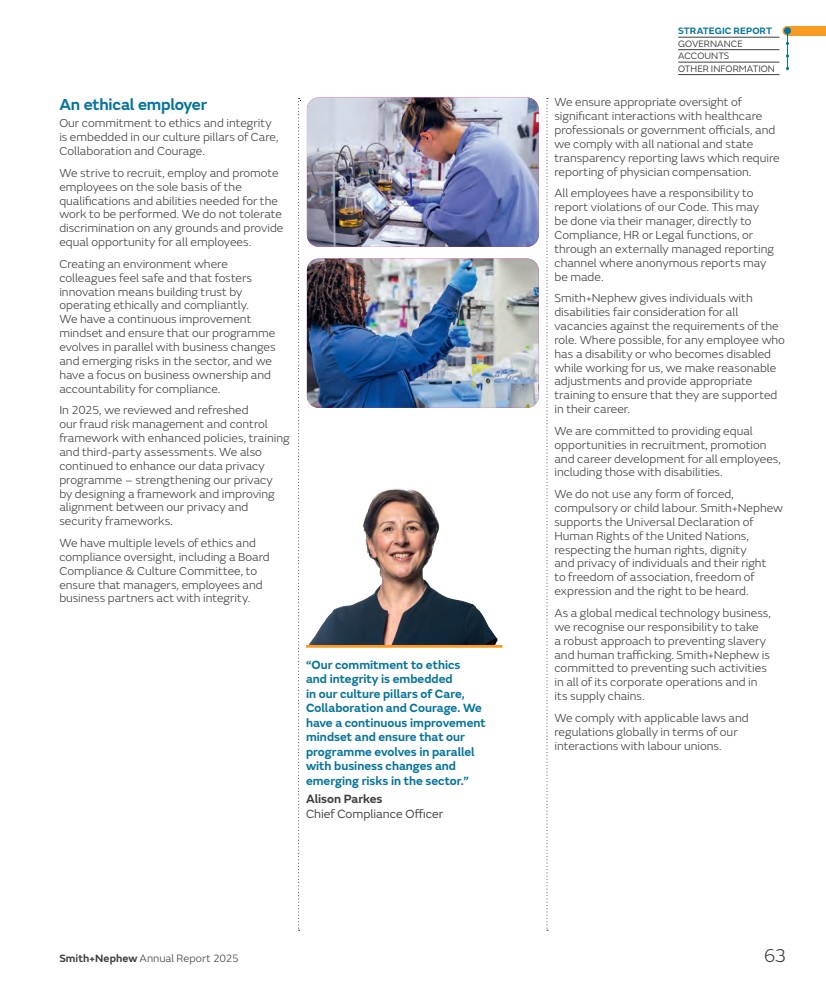
| 05 Addressing the long-term needs of our customers, employees, investors, communities and other stakeholders while working to reduce our impact on the environment. Life Unlimited Working responsibly Together we are 64 Smith+Nephew Annual Report 2025 10_SN_AR25_ProtectingTheFuture_v159.indd 64 05/03/2026 17:47 |

| Environmental, Social and Governance (ESG) Our ESG programme supports our new RISE business strategy and is built on our purpose – Life Unlimited – and our culture of Care, Courage and Collaboration. ESG at Smith+Nephew is an embodiment of our corporate values: – We demonstrate Care by respecting our global resources and striving to protect the safety and wellbeing of our employees. – We demonstrate Courage by setting ambitious goals to increase our positive impact. – We demonstrate Collaboration by working together with our partners who share our commitment, and contributing to our communities. Our ESG programme is fundamental to the successful execution of Smith+Nephew’s RISE strategy and to the long-term value we create as a medical technology company. By integrating environmental stewardship, social impact, and strong governance into our business model, we are strengthening operational resilience, improving efficiency, and managing risk across our global footprint. Our continued focus on decarbonisation, responsible sourcing, and an inclusive, high-performing culture supports the disciplined growth and margin expansion at the heart of RISE, while reinforcing trust with patients, customers, employees, and investors. Just as importantly, our ESG commitments help guide innovation – ensuring that the products and technologies we bring to market address unmet clinical needs responsibly and sustainably. Through RISE, we are building a stronger Smith+Nephew by delivering growth that is not only profitable, but also purposeful and enduring. Driving change across our three ESG pillars People ESG pillar: Creating a lasting positive impact on our employees and communities We believe that a healthy, inclusive and engaged workforce is essential to long-term success. Our employee programmes foster pride and purpose while strengthening relationships in the communities where we operate. This enhances employee engagement and builds trust in markets that are critical to our growth. Planet ESG pillar: Working to reduce our impact on the environment We drive resilient, efficient business operations and reduced costs through energy efficiency on our journey towards net zero emissions, zero-waste manufacturing and water conservation. Our efforts reduce environmental impact in the regions we serve. Product ESG pillar: Innovating sustainably across the value chain Our focus on sustainable product and packaging design is calibrated to customer ESG priorities. Our supplier ESG risk mitigation programme helps ensure ethical sourcing and compliance across our supply chain. Our objectives and progress against our ESG pillars are summarised on pages 66–68 Our ESG pillar alignment to the UN Sustainable Development Goals Our ESG pillars align with the United Nations 2030 Agenda for Sustainable Development, which sets out 17 Sustainable Development Goals (SDGs) that aim to end poverty, protect the planet and ensure prosperity for all. More detail on our ESG programme’s alignment with specific UN SDGs and metrics is included in the 2025 Sustainability Report. “We drive ESG progress through our strategic pillars – People, Planet and Products – ensuring every initiative supports our purpose of advancing Life Unlimited.” Katya Hantel Vice President, ESG For more information download our 2025 Sustainability Report from our website Smith+Nephew Annual Report 2025 65 STRATEGIC REPORT GOVERNANCE ACCOUNTS OTHER INFORMATION 10_SN_AR25_ProtectingTheFuture_v159.indd 65 05/03/2026 17:47 |

| People Creating a lasting positive impact on our employees and communities People are at the heart of our purpose – Life Unlimited. Putting people first will help us to achieve our vision of a world where healthcare professionals are able to help restore health to patients, wherever they are. Our objectives Our progress in 2025 Inclusion and belonging Empower and promote the inclusion of all. 3,000+ total group members across our seven Global Employee Inclusion Groups and sub-groups. 390+ impactful employee engagements supporting inclusion and belonging. Volunteering We are committed to living our culture in our communities by providing eight hours of paid volunteer time to all employees and enabling at least 50 impactful volunteer events across our sites each year. 60 volunteering events across our sites. Giving Improve patients’ lives through product donations to underserved communities. 106,000+ patients supported through product donations.1 Health, safety and wellbeing Support health, safety and wellbeing by maintaining an annual Total Incident Rate (TIR2) of less than 0.5 and Lost Time Injury Frequency Rate (LTIFR3) of less than 0.1. TIR 0.11 LTIFR 0.08 1 Patients supported estimate is based primarily on volume of Smith+Nephew products shipped to International Health Partners (IHP) between February and August 2025 for donation and distribution. Due to the reporting period noted above, the 2025 patients supported number is not directly comparable to the prior year. 2 TIR = Total Incident Rate, calculated per industry standards as the number of OSHA recordable incidents per hours worked, multiplied by 200,000. 3 LTIFR = Lost Time Injury Frequency Rate, calculated per industry standards as the number of lost time injuries per hours worked, multiplied by 200,000. Enabling access to vital healthcare Operation Walk provides free surgical treatment for people with disabling arthritis or debilitating bone and joint conditions in developing countries. Smith+Nephew donates orthopaedic products to bring mobility to people with limited access to advanced surgical solutions. Smith+Nephew and Operation Walk International carried out their fifth annual medical mission to Medellín, Colombia. In a country where access to life-changing orthopaedic surgery is extremely limited, the Operation Walk International team has committed to restoring quality of life for patients from disadvantaged groups. For this mission, Smith+Nephew donated a total of 30 hip and knee implants that allowed the 17-member team of surgeons, anaesthesiologists, nurses and other health professionals to deliver life-changing hip and knee replacement surgery to 25 patients. More information on People in our 2025 Sustainability Report 66 Smith+Nephew Annual Report 2025 ESG continued Working responsibly continued 10_SN_AR25_ProtectingTheFuture_v159.indd 66 05/03/2026 17:47 |
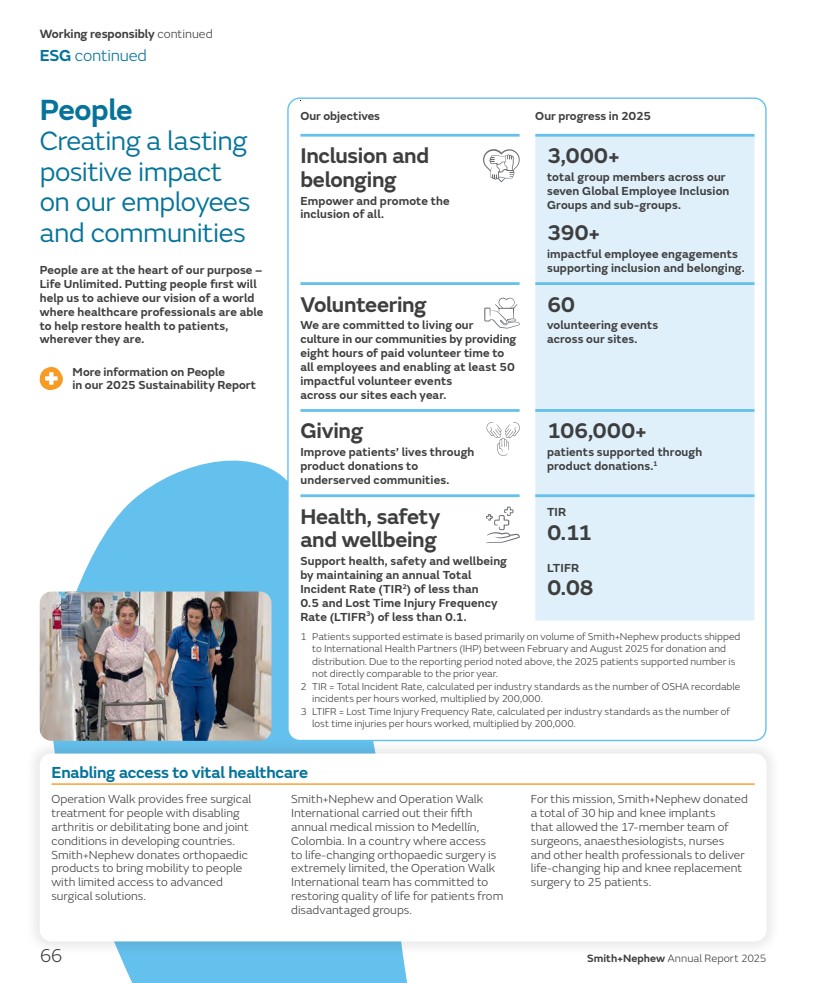
| Planet Working to reduce our impact on the environment We recognise the need to protect our planet. We manage energy, waste and water, reduce our greenhouse gas (GHG) emissions, where possible, and are mindful of the impact our decisions have on the environment. Our ESG strategy extends upstream to our suppliers and downstream to our customers. We are also working to deliver products and services that have less impact on the environment, and are taking steps to better understand the extended footprints of our products. Our objectives Our progress in 2025 Climate change Achieve net zero Scope 1 and Scope 2 GHG emissions by 2040 and Scope 3 GHG emissions by 2045. Achieve 70% reduction in Scope 1 and Scope 2 GHG emissions by 2025. Achieve 80% reduction in Scope 1 and Scope 2 GHG emissions by 2030. Scopes 1 and 2 (total) CO2e emitted (market-based): 71% reduction from 2019 baseline,1 exceeding 2025 greenhouse gas emissions reduction milestone for Scope 1 and 2. Scope 3 CO2e emitted: 60% reduction from 2021 baseline. Waste Maintain zero waste to landfill2 for our total manufacturing waste annually. 95% of total manufacturing waste diverted from landfill.1 6 zero waste to landfill manufacturing locations, based on monthly diversion rate throughout 2025. Water Conserve water throughout our business processes. 6% reduction in annual water use. 1 Data independently assured by ERM CVS, more details and the full assurance report are available in the 2025 Sustainability Report on pages 56–57. 2 We define zero waste to landfill as a landfill diversion rate of 90% or greater. World-class energy management in Costa Rica In 2025, our Costa Rica facility formally received the ISO 50001:2018 certification for energy management. ISO 50001 aims to help organisations improve energy performance, increase energy efficiency and reduce environmental impact. It provides a framework for establishing an energy management system (EMS) that allows our site to track, analyse, and improve its energy performance. Beyond the environmental benefits, ISO 50001 also helps improve operational efficiency by identifying and eliminating energy waste. This can lead to smoother operations and help us make informed decisions regarding energy use and potential investments in energy-saving technologies. More information on Planet in our 2025 Sustainability Report Smith+Nephew Annual Report 2025 67 STRATEGIC REPORT GOVERNANCE ACCOUNTS OTHER INFORMATION 10_SN_AR25_ProtectingTheFuture_v159.indd 67 05/03/2026 17:47 |
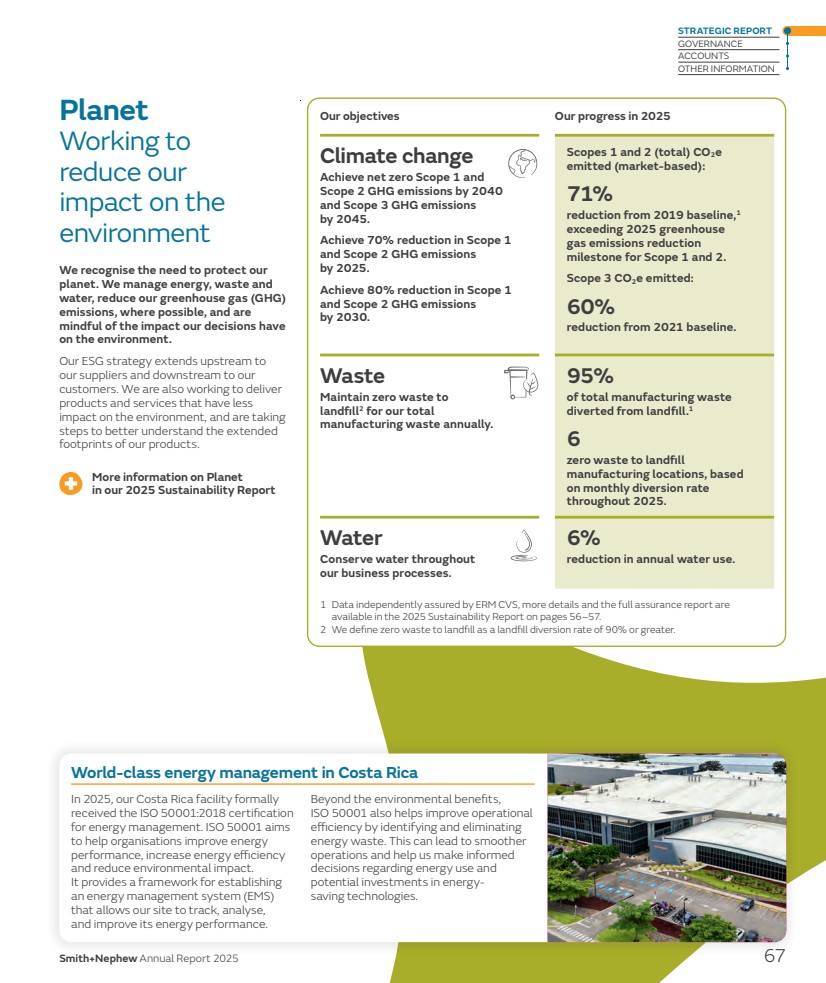
| Products Innovating sustainably across the value chain Manufacturing and supplying safe and effective products is at the heart of our business. Our people, processes and technology, and supplier engagement are structured to support progress towards the objective of innovating sustainably. Our objectives Our progress in 2025 Product design Include a sustainability review in New Product Development (NPD) for all new products and product acquisitions. 100% of sustainability reviews complete for New Product Development projects. Sustainable packaging We are committed to reducing our packaging, and designing with reusable, recyclable and/or renewable resources that are sustainably sourced. 92% of our in-scope packaging systems incorporate at least one recyclable component. Supplier engagement Complete a focused Corporate Social Responsibility (CSR) risk-based due diligence of our Tier 1 suppliers annually, including risk-based analysis of sub-tier suppliers, to assure compliance with our sustainability requirements. 100% of supplier due diligence and assessments completed according to our risk-based procedure. Smarter packaging for a smaller footprint As part of our ongoing commitment to sustainable product innovation, Smith+Nephew has undertaken a comprehensive redesign of the sterile screw packaging system used in EVOS◊ Plating System sterile screws and other orthopaedic and sports product lines. The highlight of this initiative reduced the 80mm sterile screw packaging size by approximately 50% and eliminated packaging shrink wrap, while maintaining ‘double barrier’ sterility improvements that support operating room safety. The packaging redesign supports healthcare facilities’ needs for space-efficient medical device storage and delivers a meaningful reduction in material use and waste. The removal of the outer shrink wrap further cut the amount of single-use plastic in the system. More information on Products in our 2025 Sustainability Report 68 Smith+Nephew Annual Report 2025 ESG continued Working responsibly continued 10_SN_AR25_ProtectingTheFuture_v159.indd 68 05/03/2026 17:47 |
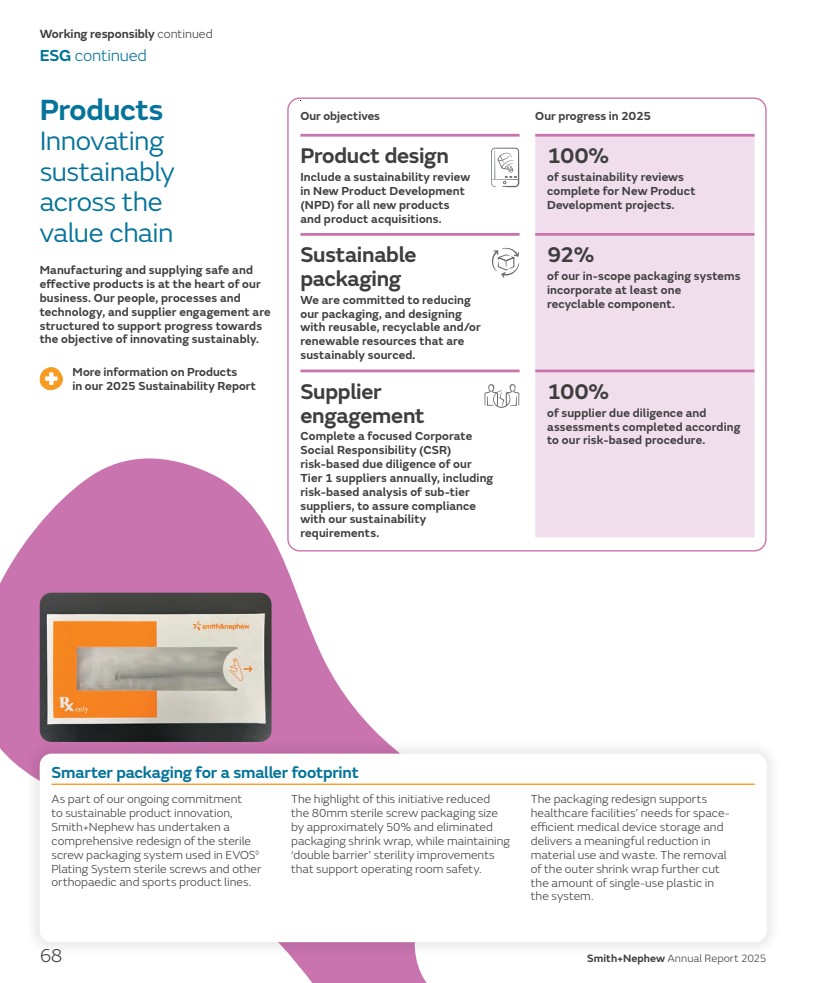
| Task Force on Climate-related Financial Disclosures (TCFD) framework Smith+Nephew’s disclosures, which are consistent with the recommendations of the TCFD framework, are set out on pages 69–73. By this we mean the four TCFD recommendations and the 11 recommended disclosures set out in Figure 6 of Section B of the report entitled ‘Implementing the Recommendations of the Task Force on Climate-related Financial Disclosures’ published in October 2021 by the TCFD. Smith+Nephew has complied with the requirements of UKLR 6.6.6(8)R by including climate-related financial disclosures consistent with the TCFD recommendations and recommended disclosures. The climate-related financial disclosures made by Smith+Nephew comply with the requirements of the Companies Act 2006 as amended by the Companies (Strategic Report) (Climate-related Financial Disclosure) Regulations 2022. Governance The way in which we evaluate, manage and embed sustainability within our business and culture is directly linked to our Strategy for Growth through a focus on People, Planet and Products. Oversight of our ESG strategy is one of the Matters Reserved to the Board. The Board reviews the ESG strategy, key risks and opportunities, progress on a regular basis, approves the Sustainability Report annually, and reviews and approves the ESG, TCFD and SASB reporting in the Annual Report. Three Board Committees are also closely involved in reviewing the elements of sustainability that impact the key areas of our business. All Committees receive regular updates on ESG strategy, implementation, objectives and targets, and climate-related financial risks and opportunities. The Committee Chairs report to the Board at each Board meeting. TCFD reporting Board: Audit Committee: – Oversight of ESG strategy and risk management programme. – Oversight of the risk management process and reviewing its operating effectiveness. – Receives regular updates on ESG and climate-related financial risks and opportunities. – Assesses whether climate change has a material impact on our financial statements. – Ensures the Company reports in line with the recommendations of the TCFD framework. Compliance & Culture Committee: Remuneration Committee: – Oversight of ESG policy and performance versus targets, with reviews undertaken at each committee meeting. – Receives regular updates on ESG and climate-related risks and opportunities, people and culture objectives including IDE and ethics, compliance, quality and regulatory matters. – Oversight and review of ESG metrics within Remuneration Policy, and compensation and incentive plans generally. – Approval of ESG percentage and measures within short-term and long-term incentive plans. For 2025, the Committee approved that 5% of the Annual Bonus Plan and 10% of the Performance Share Plan for Executive Directors and Executive Officers are dependent on the achievement of ESG objectives. Executive Committee: ESG Steering Committee: – Driven by the Chief Executive Officer, determination and management of ESG strategy, with the President Global Operations and Vice President ESG accountable for leading on implementation. – Ensures that ESG risks and opportunities are included in decision making as part of each project, initiative and the 12-Point Plan. – Supports the Executive Committee in the execution and delivery of the ESG strategy. – Membership includes Global Operations, ESG, Global Manufacturing, Research & Development, Global Procurement, Public Policy & Government Affairs, Finance and Human Resources. Smith+Nephew Annual Report 2025 69 STRATEGIC REPORT GOVERNANCE ACCOUNTS OTHER INFORMATION 10_SN_AR25_ProtectingTheFuture_v159.indd 69 05/03/2026 17:47 |

| – The Compliance & Culture Committee, chaired by Marc Owen, assesses how we implement our ESG strategy in the core areas of People, Planet and Products, encompassing the Group’s impact on employees, the environment, the local communities in which it operates, customers, suppliers and other key stakeholders. The Compliance & Culture Committee also tracks progress of the delivery on ESG objectives and metrics, including a regular review of our net zero emissions progress at each Committee meeting. – The Audit Committee, chaired by Jez Maiden, is responsible for ensuring oversight of the process by which risks and opportunities relating to the Group and its operations are identified, managed and reported. The Audit Committee assesses the extent to which climate change and other ESG risks are likely to have a material impact upon our financial statements by reviewing the possible impact of different scenarios related to climate change. The Audit Committee also has oversight of the TCFD reporting in the Annual Report. – The Remuneration Committee, chaired by Sybella Stanley, is responsible for ensuring that the Remuneration Policy and related incentive schemes incorporate ESG targets and metrics, where appropriate to do so. Our Chief Executive Officer sets strategy together with the Executive Committee, and the President Global Operations and the Vice President ESG are responsible for the implementation and report at least quarterly on our progress to the Board, its Committees and our Executive Committee. Matters discussed at these quarterly updates include: our ESG scorecard with progress on public ESG objectives, including net zero targets; methods to reduce our GHG emissions; and stakeholders’ expectations related to Smith+Nephew’s climate change programme. The ESG Steering Committee implements and executes our ESG strategy across all business areas, reporting directly to the Executive Committee which will continue to drive our ESG strategy with oversight from the Board and its Committees. Smith+Nephew leaders consider ESG risks and opportunities in their decision making. For example, when evaluating options for our new manufacturing site in Melton, UK, an analysis of ESG requirements and risks is being undertaken as part of the project and decision making. Where appropriate, papers submitted to the Board by management for review include an analysis of ESG issues and opportunities to enable the Board to consider these factors in decision making and to ensure effective Board oversight on ESG strategy, risks and opportunities. Information on our ESG risks can be found within our principal risks on pages 83–94. Strategy Our ESG strategy is built on our purpose, Life Unlimited, and our culture of Care, Courage and Collaboration. Our five-year ESG strategy was refreshed in 2025 and approved by the Board. More detail on the ESG strategy is available in our Sustainability Report. The annual identification process for both climate change risks and opportunities is split between those affecting individual site locations or Business Units and those with the potential to impact the Group as a whole. From an individual asset (or location) viewpoint, we consider direct factors at a local level, these could include (but are not restricted to) those associated with climate change such as abnormal weather (including floods, earthquakes and tornadoes), changes in our customer base and the regulatory pathways governing the sales of our products. From a company-wide or Group level, this process can drive reputational risk and opportunities that could impact our ability to deliver products and services to customers. These risks and opportunities are assessed both at a Group level by the ESG Steering Committee and incorporated into a series of business continuity plans and objectives. The risks are also assessed at a local (asset) level using knowledge of the local environment and conditions. This is performed by careful consideration of the potential impact and likelihood. At local (asset) level, the risks are reviewed within wider Business Continuity and Disaster Recovery Plans based on site-specific risks. A dedicated team of Health, Safety and Environment, Facilities and Business Continuity Practitioners meet quarterly to review all risks and opportunities associated with climate change and share best practice. The criteria used to determine priorities include the nature and level of the anticipated risk and its associated impact on the business. We also prioritise improvement initiatives based on the likely period of return on investment and following best practice based on initial benchmarking against peers. Our principal risks capture our physical and transitional climate-related risks in our Enterprise Risk Management (ERM) process. We address climate-related risk primarily through business strategies in our global operations functions including facilities, health and safety, business continuity and global supply chain management. Severe weather patterns as a result of climate change may cause damage to manufacturing or distribution facilities, potentially impacting our ability to meet customer demand over the long term. Our mitigated severity is a qualitative assessment based on our business continuity plans and wider ESG efforts. Refer to the risk management section on page 79 and the Risk report on page 78 for more details on our risk management process. Climate-related opportunities: Climate-related opportunities are identified and addressed through our ESG strategy and programmes and monitored via our ESG scorecard. Through this process, we have identified a number of climate-related opportunities relating to energy sourcing, energy efficiency, on-site renewable energy generation, supplier engagement and packaging reduction initiatives. Eight of our US locations source electricity from renewable energy via the procurement of renewable energy certificates (RECs). In addition to sourcing renewable energy via RECs, our Penang (Malaysia) and Suzhou (China) facilities feature photovoltaic (PV) panels generating renewable energy on-site. All UK sites source a green tariff for the supply of electricity from renewable sources. 70 Smith+Nephew Annual Report 2025 TCFD reporting continued Working responsibly continued 10_SN_AR25_ProtectingTheFuture_v159.indd 70 05/03/2026 17:47 |

| Transition risks Potential impact Timeframe Actions taken by management Commercial execution Inability to satisfy customers’ sustainability requirements and expectations. Decline in customer demand. Lower prices to remain competitive. Medium (3–7 years) and long term (>7 years) Monitoring regulatory changes and interpreting potential business impacts of legislation. Continued progress of ESG programme and ongoing customer engagement to monitor sustainability needs. Legal and compliance Failure to identify existing or new legal or regulatory requirements, including sanctions programmes and ESG matters that result in non-compliance with applicable laws and regulations, including carbon taxes and climate-related regulations. Fines and sanctions. Short (<3 years), medium (3–7 years) and long term (>7 years) The ESG Steering Committee and our Health, Safety and Environmental Compliance function assess new and enhanced regulations and reporting requirements that may be climate-related risks and work cross-functionally to ensure compliance. Failure to meet stakeholder expectations with regard to increasing sustainability regulations and reporting requirements. Increased costs associated with sustainability improvements. Medium (3–7 years) and long term (>7 years) Proactive sustainability improvements across business and portfolio in anticipation of regulations. Data and IT system improvements to improve availability of ESG data. Pricing and reimbursement Limited ability to pass on the cost of sustainability improvements, including supplier compliance with sustainability regulations, including carbon taxes and climate-related regulations. Higher input costs. Medium (3–7 years) and long term (>7 years) Operational and business efficiency efforts. Optimise portfolio mix and promote differentiated products. In 2021, we aligned with the recommendations of the Intergovernmental Panel on Climate Change and published our commitment to achieve net zero Scope 1 and Scope 2 GHG emissions by 2040 and Scope 3 GHG emissions by 2045, beginning by achieving a 70% reduction in Scope 1 and Scope 2 GHG emissions by 2025. We understand how important it is to balance environmental initiatives with business activities and strive to reduce emissions through new technology. We have conducted a review of our current state and captured related business risks in our risk register. Two of our largest manufacturing sites – Penang, Malaysia and Coyol, Costa Rica – are certified to ISO 50001 energy management systems, including annual performance and compliance audits around best practices in energy use. In 2025, we conducted internal audits on energy data and efficiency project opportunities at four additional facilities in the US, UK and Asia. The new UK site at Melton, on the outskirts of Hull, will be designed to have a significant focus on energy and resource efficiency. The site aims to generate on-site renewable energy. Scenario analysis: The annual Group scenario analysis in 2025 was supported by a third party and included approximately 30 locations. Modelling focused on the material impacts on our business and was based on our current business activities and assumed no mitigation. As outlined on pages 71–72, our physical and transition risks are captured in our ERM process. Refer to our Risk report on page 78 for further details. Based on the modelling undertaken, the highest potential impact (without mitigation) is in relation to global temperature rise. The potential impact of sea-level rise has decreased from the prior year modelling with the announced plans to build a new Advanced Wound Management facility at Melton, on the outskirts of Hull, which sits at a higher elevation and is further inland than the current facility. The Group closely monitors climate-related physical risks and is taking mitigating measures such that the net impact to the business with these measures in place is not expected to be material. Smith+Nephew Annual Report 2025 71 STRATEGIC REPORT GOVERNANCE ACCOUNTS OTHER INFORMATION 10_SN_AR25_ProtectingTheFuture_v159.indd 71 05/03/2026 17:47 |

| Physical risks Scenario modelling Based on the Intergovernmental Panel on Climate Change’s (IPCC’s) sixth assessment report, we modelled the following scenarios out to 2030 and 2050: Implication and mitigation Potential severity without mitigation with mitigation Global temperature rise – Low: Limit warming to 2°C (IPCC scenario SSP1-2.6) – Medium: Limit warming to 3°C (IPCC scenario SSP2-4.5) – High: Limit warming to 4°C (IPCC scenario SSP3-7.0). Extreme heat increases the demand for cooling and can overwhelm power grid infrastructures. Existing defences and business continuity plans are expected to mitigate any near-term impacts and the longer-term impact is being closely monitored by the ESG and operations teams. High Medium Sea-level rise – Sea-level rise up to 5 metres – Distance from nearest coastline. Rising sea levels impact manufacturing sites at coastal locations. Existing flood defences and business continuity plans are expected to mitigate any near-term impacts and the longer-term impact on the Group’s manufacturing footprint is an area of focus being considered in our manufacturing strategy. For example, the announced relocation of our Advanced Wound Management facility mitigates against the impact of sea-level rise and accordingly reduces the potential impact. Medium Low Extreme weather – Precipitation – Wind – Drought. Heavy precipitation events will make flooding more probable, strong winds can damage roofs and compromise the building envelope, and more intense or prolonged droughts can lead to diminishing water resources and potentially more severe wildfires. Existing weather defences and business continuity plans are expected to mitigate any near-term impacts and the longer-term impacts are considered in our manufacturing strategy. Medium Low 72 Smith+Nephew Annual Report 2025 TCFD reporting continued Working responsibly continued 10_SN_AR25_ProtectingTheFuture_P72.indd 72 06/03/2026 21:03 |
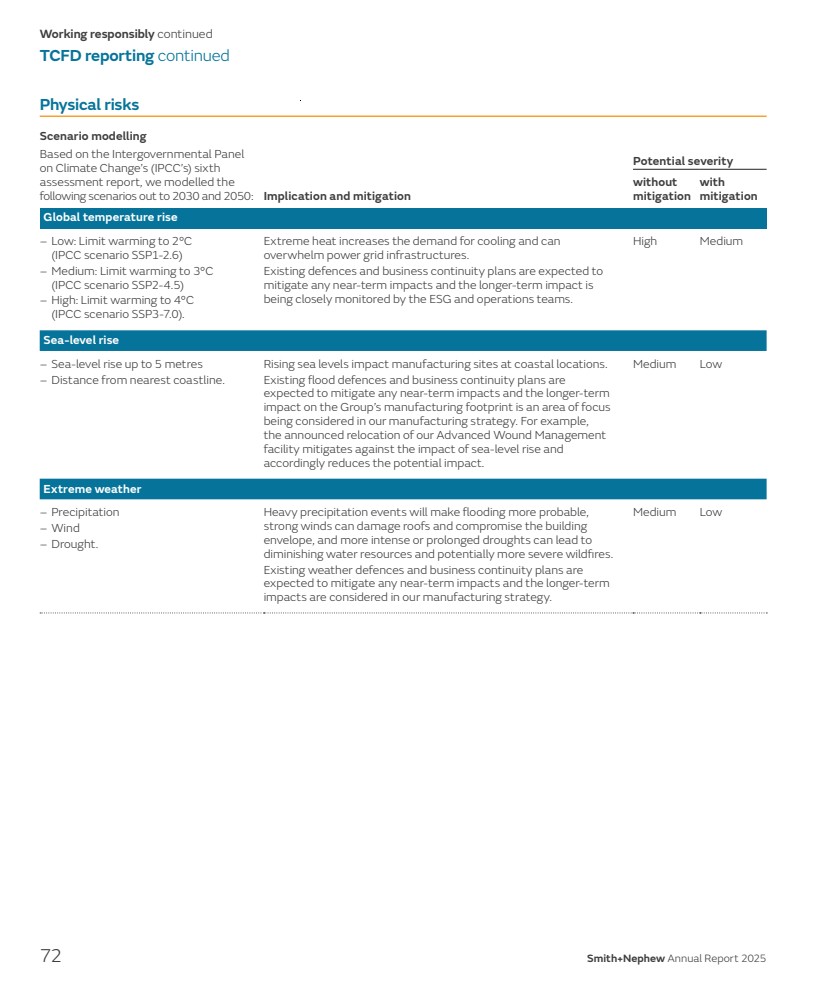
| Risk management Climate-related risks are managed through our comprehensive ERM process risk governance framework. At the top of our structure, the Board sets our risk appetite and monitors the application of our risk framework, including strategy, execution and outputs of risk reviews by the business and the Group Risk team. The Board cascades our risk appetite throughout our organisation through the Executive Committee, the risk owner community and our management group. A formal ‘bottom-up’ exercise ensures that risks are escalated back through the process to our Board and are reflected in our principal risks, as appropriate. As part of this exercise, we maintain a Sustainability Risk Register that captures climate risks and how they link to the Group’s principal risks. Each sustainability risk has a control and mitigation strategy to reduce the impact of the risk. The Sustainability Risk Register is reviewed by the ESG Steering Committee regularly. ESG risks are raised to the Executive Committee on a quarterly basis as part of the ESG dashboard. Refer to page 70 for more detail on climate-related risks. Climate-related risks: We identify climate-related risks based on short, medium and long-term horizons. We consider short term to be within one to three years (in line with our annual budget and three-year plan cycles), medium term to be within three to seven years (in line with scenario modelling to 2030 and typical product life cycles) and long term to be greater than seven years. Short-term risks are captured in our financial planning process; medium and long-term risks are captured within our global footprint planning process. Our annual and five-year financial planning, and our capital expenditure planning processes require climate-related risk information and specific ESG considerations. Metrics and targets We have published an annual Sustainability Report since 2001 detailing progress against our global objectives. We have objectives in each of our priority areas: People, Planet and Products. Our key climate-related metrics are GHG emissions and waste to landfill. Our key objectives in relation to these metrics are net zero GHG emissions by 2045 and zero waste to landfill at our strategic manufacturing facilities by 2030. Detailed information about our objectives and progress made against those objectives can be found on pages 66–68 of the Annual Report and in our Sustainability Report. For 2025, the Remuneration Committee approved that 5% of the Annual Bonus Plan and 10% of the Performance Share Plan for Executive Directors and Executive Officers are dependent on the achievement of ESG objectives. We have mapped our Scope 1 and 2 GHG emissions, and improved mapping of our Scope 3 GHG emissions in order to meet our objective of reducing total life cycle GHG emissions to net zero by 2045. We established and met our interim carbon reduction objectives for 2025 to reduce our Scope 1 and 2 GHG emissions by 70%, and now aim to reduce Scope 1 and 2 GHG emissions by 80% by 2030 vs. our 2019 baseline. See our 2025 Sustainability Report for details on our Scope 1 and Scope 2 net zero roadmap. In 2022, we published our 2021 baseline Scope 3 GHG emissions, including data from eight of the 15 categories. In 2025, we have reported data from all 15 categories. We have carbon reduction roadmaps for our Scope 1, 2 and 3 GHG emissions to show our pathway to meet our objectives. Our Scope 1, 2 and 3 GHG emissions reduction data are provided on page 77 of the Annual Report, with more detailed information also available in our Sustainability Report. The following aligns to the non-financial reporting requirements contained in sections 414CA and 414CB of the Companies Act 2006. Description of the business model – Our business model 14 Environmental matters – Environment – Climate-related financial disclosures (TCFD) 67 69 Our employees – Our culture – Employee wellbeing – Inclusion and belonging – Board diversity – UK gender pay gap 59 60 62 99 187 Social matters – Access to healthcare – Health and safety 66 66 Human rights – Human rights – Working with third parties 63 118 Ethical business practices – Anti-bribery and corruption – Code of Conduct and Business Principles – Reporting a concern 84 140 140 Policy, due diligence and outcomes – Risk management – Principal risks – Audit Committee Report 78 83 141 Key performance indicators (including non-financial) – Our 2025 performance 2 ESG Policies/Statements – Modern Slavery – Conflict Minerals – Health, Safety and Environment Policy Non-financial and sustainability information statement Our policies are available online at www.smith-nephew.com Smith+Nephew Annual Report 2025 73 STRATEGIC REPORT GOVERNANCE ACCOUNTS OTHER INFORMATION 10_SN_AR25_ProtectingTheFuture_v159.indd 73 05/03/2026 17:47 |
| Reducing operational carbon emissions In line with our net zero ambition, we set a target to reduce our Scope 1 and 2 carbon emissions by 70% by the end of 2025 compared to our 2019 baseline. We achieved this target on time. In accordance with the California Voluntary Carbon Market Disclosures Act (AB1305), detailed information is available on pages 28–32 of the 2025 Sustainability Report. In 2025, the total market-based Scope 1 and Scope 2 GHG emissions footprint was 19,372 tonnes of CO2e. This represents a reduction of 71% against our 2019 baseline, marking the successful achievement of our objective to reach a 70% reduction by the end of 2025. This reduction was primarily a result of energy efficiency projects, increases in the renewable energy we source and on-site energy generation. This target has now been superseded by a new interim objective to achieve a 80% reduction in Scope 1 and Scope 2 GHG emissions by 2030 against our 2019 baseline. Smith+Nephew’s Scope 1 and 2 carbon reduction journey is supported by eco-conscious building design principles such as Leadership in Energy and Environmental Design (LEED), one of the world’s most widely-used green building rating systems. LEED-certified sites include several manufacturing sites and corporate offices certified to the silver or gold level. We extended our sourcing of renewable energy to include our manufacturing sites and larger commercial offices in the US. We also continued to source hydroelectric energy for our manufacturing locations in Malaysia and China. They were achieved through the purchase of renewable energy certificates (RECs). From October 2023, all our UK sites began sourcing 100% renewable electricity from its supplier. We have installed solar PV panels at our Suzhou and Penang sites. Both systems began operating in early 2023 and, combined, the two solar-powered systems continued to reduce our Scope 2 GHG emissions by over 2,200 tonnes of CO2e in 2025. Sourcing renewable energy reduces our market-based GHG emissions – that is, the emissions from the electricity we purchase. Net zero Scope 1 and 2 carbon emissions by 2040 Our strategy to achieve net zero Scope 1 and 2 carbon emissions by 2040 includes: During 2025, we procured energy from wind, solar and hydropower sources via green energy utility contracts and renewable energy certificates. Renewable energy sourcing During 2025, our manufacturing sites in Suzhou, China, and Penang, Malaysia, generated over 3.6GWh of renewable solar energy. On-site renewable energy projects During 2025, energy efficiency measures tied to manufacturing site ISO 50001 energy management certification drove an 11% energy efficiency improvement relative to production output in Costa Rica. Energy efficiency Our approach to cutting emissions is three-fold: tackling energy efficiency, generating our own renewable energy on site and sourcing lower-carbon energy through green tariffs and procuring renewable energy certificates. 74 Smith+Nephew Annual Report 2025 Reducing our energy use and GHG emissions Working responsibly continued 10_SN_AR25_ProtectingTheFuture_v159.indd 74 05/03/2026 17:47 |
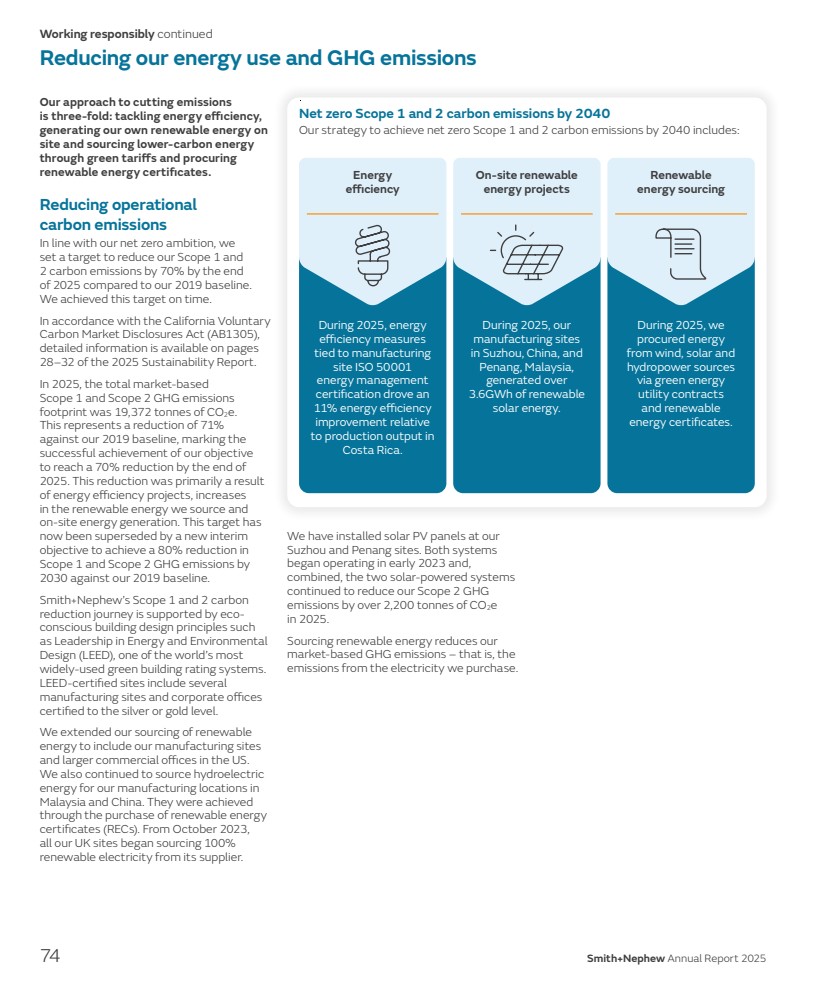
| Reducing value chain greenhouse gas emissions (Scope 3) During 2025, we calculated our Scope 3 GHG emissions from all 15 categories. Net zero Scope 3 carbon emissions by 2045 Our strategy to achieve net zero Scope 3 carbon emissions by 2045 includes: Engaging with our key suppliers via the Smith+Nephew Environmental Disclosure programme to monitor our suppliers’ net zero plans, and identify mitigation actions and collaboration opportunities. Supplier engagement Our new sustainable product design and development programme incorporates considerations for the carbon impacts of a product and its packaging. Lower-carbon product design Encouraging fewer transport miles and using lower-carbon modes of transport across the value chain – from incoming materials to site and warehouse transportation of goods. Optimising upstream and downstream transportation Our 2030 manufacturing zero waste to landfill objective helps drive progress on our Scope 3 GHG emissions reductions by reducing the carbon impacts of waste. Reducing greenhouse gas emissions from waste Encouraging fewer employee travel miles and lower-carbon modes of transport, such as cycling, public transport, providing on-site electric vehicle charging for employees and visitors, and issuing a company travel policy that encourages more efficient transport planning. Sustainable employee and business travel practices More details can be found in the 2025 Sustainability Report on pages 28–32 www.smith-nephew.com Smith+Nephew Annual Report 2025 75 STRATEGIC REPORT GOVERNANCE ACCOUNTS OTHER INFORMATION 10_SN_AR25_ProtectingTheFuture_v159.indd 75 05/03/2026 17:47 |
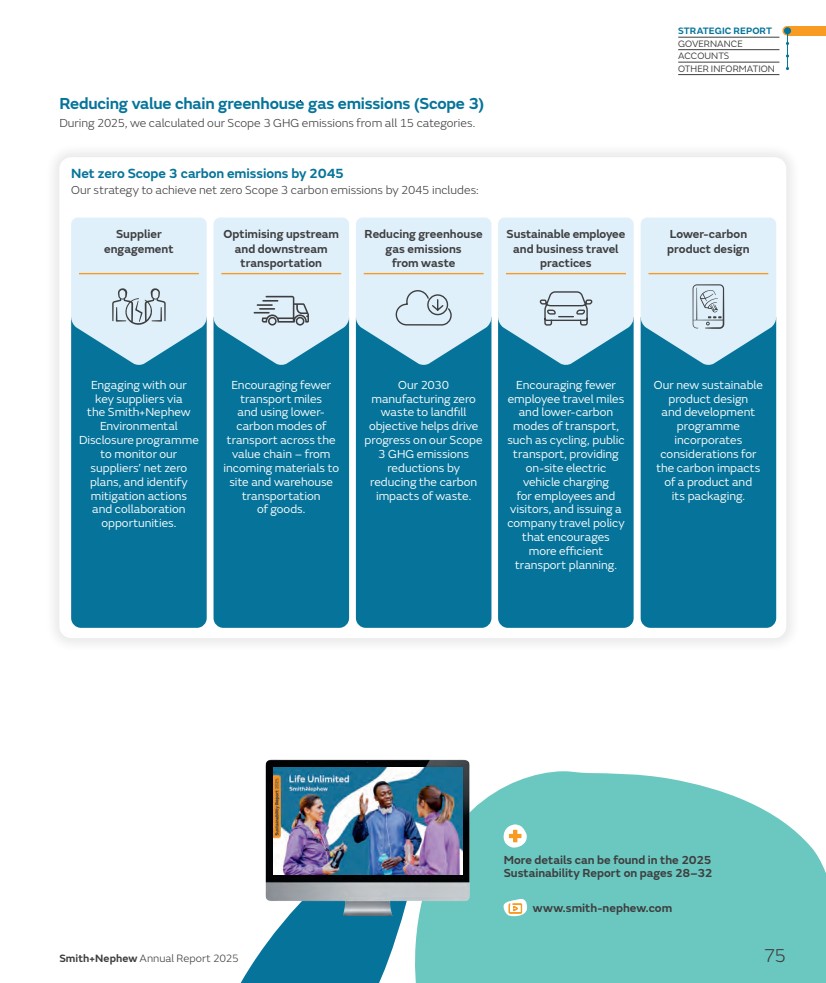
| We report the carbon footprint of our Scope 1, Scope 2 and Scope 3 GHG emissions in tonnes of CO2 equivalent from our business operations for the year ended 31 December 2025. We are including UK-specific energy and emissions data to satisfy the Streamlined Energy and Carbon Reporting (SECR) requirements. Our focus is on the areas of largest environmental impact, including manufacturing sites, warehouses, R&D sites and offices. Smaller locations representing fewer than 2% of our overall emissions are not included. Acquisitions completed before 2025 are included in the data, with those completed during 2025, or more recently, excluded. This is in line with our established policy for the integration of acquired assets. Our GHG emissions reporting represents our core business operations and facilities that fall within the scope of our consolidated financial statements. Primary data from energy suppliers has been used wherever possible. We report our emissions in three scopes: – Scope 1: Direct sources of emissions which mainly comprise the fuels we use on-site, such as gas and heating oil, and fugitive emissions arising mainly from the losses of refrigerant gases. We have included UK vehicle emissions from leased cars since 2020. Since 2023, we included 14 European countries in our leased vehicle reporting. – Scope 2: Indirect sources of emissions such as purchased electricity and steam, that we use at our sites. – Scope 3: Indirect emissions that occur throughout the value chain as a result of activities or processes not owned or directly controlled by Smith+Nephew. These can be divided into upstream and downstream emissions across 15 defined categories. In 2025, we are reporting data from all 15 categories. Energy efficiency and carbon emissions reduction In 2024, the principal energy efficiency measures included targeting the use of online real-time data to monitor energy usage to make savings. We carried out a programme to replace older, inefficient equipment with highly efficient equipment, such as compressors, chillers, pumps, fans and motors. During 2025, we continued our detailed analysis of our energy usage data and undertaking energy efficiency projects. We also extended our internal audit programme covering our ESG energy metrics. In 2025, our Costa Rica manufacturing facility received the ISO 50001:2018 certification for energy management. Energy efficiency measures tied to ISO 50001 energy management certification in Costa Rica drove an 11% reduction in energy use relative to production output. This year, we also continued to convert our company car fleet in Europe to electric vehicles, where appropriate. In 2025, we extended our sourcing of renewable energy to include our manufacturing sites and larger commercial offices in the US. We also continued to source hydroelectric energy for our manufacturing locations in Malaysia and China. These were achieved through the purchase of renewable energy certificates (RECs). Purchasing RECs gives buyers the right to renewable energy and also makes it possible to track ownership of it. We have installed solar PV panels at our Suzhou and Penang sites. Both systems began operating in early 2023 and combined the two solar-powered systems continued to reduce our Scope 2 GHG emissions. Throughout 2025, all our UK sites continued to source renewable power. Location-based emissions are calculated in compliance with the WRI/WBCSD GHG Protocol Corporate Accounting and Reporting Standard and have been calculated using carbon conversion factors published by the UK Government Department for Energy Security & Net Zero (DESNZ) for 2025. We have applied the emission factors most relevant to the source data, including DESNZ 2025 (for UK locations), IEA 2023 (for overseas locations with some preliminary 2024 emissions factors applied where available), and for the US we have used the most recently available US EPA ‘Emissions & Generation Resource Integrated Database’ (eGRID) for the regions in which we operate. All other emission factors for gas, oil, steam, other fuels and fugitive emissions are taken from DESNZ 2025. In line with dual reporting, we also report market-based emissions. These are contractual or supplier-specific emission factors that can be applied when procuring low-carbon energy or siting facilities in areas with lower emissions, but also recognising that this might be higher than the grid average in some cases. Where market-based factors were not available, we have used Residual Mix data for the EU locations and IEA data for all other countries, except for the remaining US locations where the eGRID factors were applied. During 2025, we worked with a sustainability partner to measure our Scope 3 GHG emissions, and in order to improve data source transparency, we applied emission factors from databases including: IEA, DESNZ, IPCC, ADEME, ecoinvent and US EPA EEIO. For the 2025 Scope 3 GHG emissions assessment, input data used were derived from financial-based sources as well as activity data. 76 Smith+Nephew Annual Report 2025 Carbon emissions (CO2e) strategy, reporting methodology, materiality and scope Working responsibly continued 10_SN_AR25_ProtectingTheFuture_v159.indd 76 05/03/2026 17:47 |
| 2025 2024 2019 (baseline year) UK Global (excluding UK) Total UK Global (excluding UK) Total UK Global (excluding UK) Total CO2e emissions (tonnes) from: Direct emissions (Scope 1)1 5,939 7,667 13,6062 5,038 7,756 12,7943 4,747 5,141 9,8884 Indirect emissions (Scope 2) (location-based) 2,991 54,473 57,4642 3,497 55,604 59,1013 4,911 62,413 67,3244 Total (location-based) 8,930 62,140 71,0702 8,535 63,360 71,8953 9,658 67,554 77,2124 Indirect emissions (Scope 2) (market-based) 0 5,766 5,7662 0 11,868 11,8683 5,072 52,080 57,1524 Total (market-based) 5,939 13,433 19,3722 5,038 19,624 24,6623 9,819 57,221 67,0404 Energy consumption to calculate Scope 1 and 2 emissions (GWh)1 49 183 232 43 186 229 45 168 213 Intensity ratio (market-based): CO2e (t) per $m sales revenue 3.1 4.3 13.1 CO2e (t) per full-time employee 1.1 1.4 3.7 2025 2024 2021 (baseline year) Other indirect emissions (Total Scope 3)5,6 647,5322 667,620 1,614,573 1 A total of 14 European countries were included in 2023, 2024 and 2025 Scope 1 vehicle data. 2 Data independently assured by ERM CVS; more details and the full assurance report are available in the 2025 Sustainability Report on pages 56–57. 3 Data independently assured by ERM CVS; more details and the full assurance report are available in the 2024 Sustainability Report on pages 46–47. 4 Data independently assured by ERM CVS;more details and the full assurance report are available in the 2022 Sustainability Report on pages 60–61. 5 Measurement of 2024 and 2025 Scope 3 GHG emissions from 14 categories in 2024 and 15 categories in 2025. Refer to ‘Reporting our Scope 3 emissions’ above for more details. 6 Total Scope 3 emissions reductions shown result from both business efficiency efforts and as a product of improvements to data quality, methodologies applied and analyses undertaken by Smith+Nephew or third parties. See ‘Data disclosure in this report’ in the 2025 Sustainability Report on page 58 for additional notes. 2025 data includes recent acquisitions completed and new site openings during 2024. Revenue: 2025: $6.2bn; 2024: $5.8bn; 2019: $5.1bn. Average full-time employee data: 2025: 17,530; 2024: 18,060; 2019: 18,030. Reporting our Scope 3 emissions During 2025, we have worked with an external consultant to measure our Scope 3 GHG emissions using recognised protocols. Our calculation of our 2025 Scope 3 GHG emissions was 647,532 tonnes of carbon dioxide equivalent from the 15 categories that we measured. Our data quality has improved, through improved analysis and reporting within each emissions category for Scope 3, and by extending the number of categories that we have reported. We also conducted our third global commuting survey. Our Scope 3 GHG emissions assessment was made using the best available 2025 data. As expected, in line with our peer group, purchased goods and services contributes the most significant proportion of our Scope 3 GHG emissions, at over 66%. Further details of the methodology are available in the 2025 Sustainability Report on page 54. Independent assurance In 2025, selected Scope 1 and Scope 2 GHG emissions data were independently assured by ERM CVS. In accordance with ISAE 3000, a limited assurance engagement was performed. Previously the 2024, 2023, 2022 and 2019 baseline data were assured. In 2025, our total Scope 3 GHG emissions value was assured for the first time. More details and the full limited assurance report can be found in the 2025 Sustainability Report on pages 56–57 www.smith-nephew. com/sustainability Smith+Nephew Annual Report 2025 77 STRATEGIC REPORT GOVERNANCE ACCOUNTS OTHER INFORMATION 10_SN_AR25_ProtectingTheFuture_v159.indd 77 05/03/2026 17:47 |

| Group Risk Team Internal Audit Board of Directors and Board Committees Executive Committee Business Area and Function Like all businesses, we face risks and uncertainties. Smith+Nephew has developed an Enterprise Risk Management (ERM) framework, together with supporting policies and procedures, to support risk management and value creation. Successful identification and management of existing and emerging risks is critical to the achievement of strategic objectives and to the long-term success of any business. Risk management is therefore an integral component of our corporate governance. Our risk governance framework Our Board has responsibility for oversight of risk management, setting risk appetite and monitoring the application of our risk framework including strategy, execution, and outputs of risk reviews by the business and Group Risk team. The Board cascades its approved risk appetite throughout our organisation through the Executive Committee, risk owner community and our Group management teams. The Board assesses the effectiveness of risk management and internal control over financial reporting through the Audit Committee who conduct regular reviews of reporting on principal risks, the risk management framework and internal control processes. Further details of the Audit Committee’s work in this area are set out below on pages 80 to 82. Our Risk Management Policy, endorsed by our Chief Executive Officer, is supported by an ERM Manual and the Group Risk team providing training to Risk Champions appointed for each of our global business units and relevant functions. Risks continue to be managed through a ‘top-down’ and ‘bottom-up’ process, with regular oversight from the Executive Committee, quarterly reports to the Audit Committee and regular reports to the Board on any specific areas of focus. Our risk management life cycle Board of Directors and Board Committees – The Board is responsible for oversight of risk management, for our annual strategic risk review and for determining the risk appetite the organisation is willing to take in achieving its strategic objectives. – The Board monitors risks through Board processes (Strategy Review, Disclosures, M&A, Investments, Disposals) and Committees (Audit and Compliance & Culture). – The Audit Committee is responsible for ensuring oversight of the process by which risks relating to the Company and its operations are managed and for reviewing the operating effectiveness of the Group’s ERM process. Executive Committee – Identifies and ensures the management of risks that would prevent the Company from achieving our strategic objectives. – Appoints Risk Owners and Business Area Risk Champions who are accountable for applying the ERM Policy and Framework to evaluate, assess, monitor and mitigate risks in their respective areas of responsibility. – Engages in discussions and reviews external/internal environment for emerging risks. – Reviews risk register updates from Risk Owners, facilitated by information provided by Business Area Risk Champions. – Evaluates significant risks identified through the ERM process and assesses effectiveness of mitigating actions. 78 Smith+Nephew Annual Report 2025 Risk Report 11_SN_AR25_Risk_v64.indd 78 05/03/2026 17:48 |
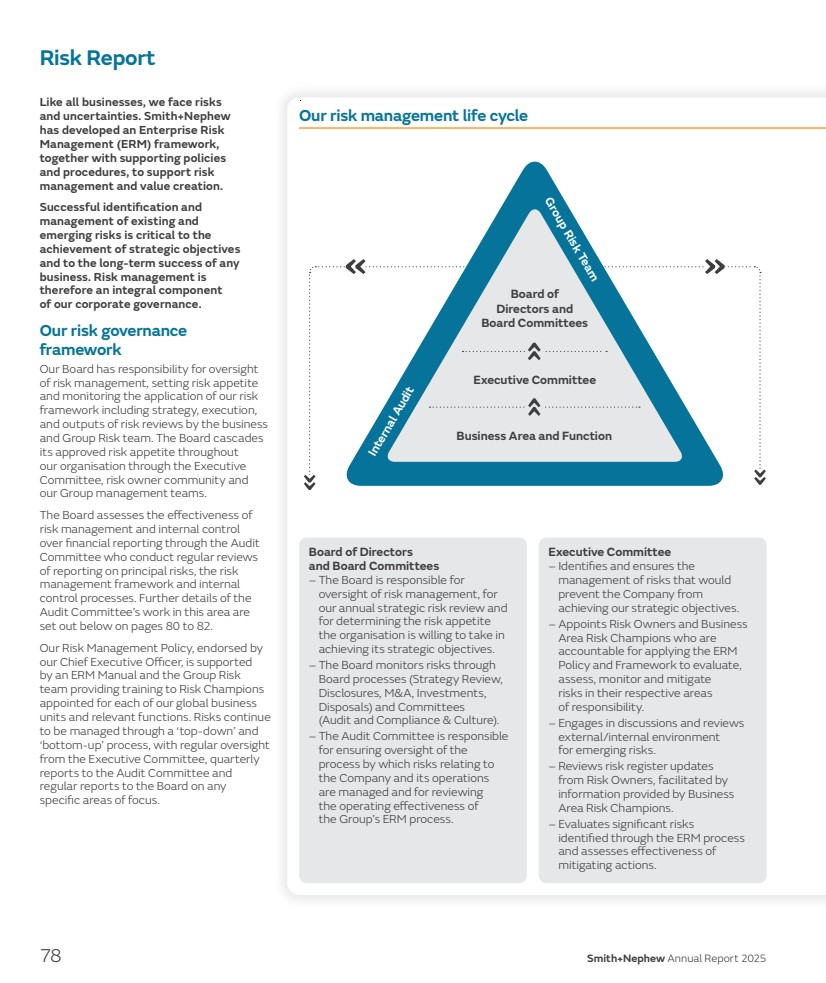
| Our risk management process Our ERM framework continues to be based on a holistic approach to risk management. Our belief is that the strategic and operational benefits of proactively managing risk are achieved when ERM is aligned with the strategic and operational goals of the organisation. What we review and actions we take when assessing our principal risks through the ‘bottom up’ process: 1. Risk identification Gain full understanding of any area of uncertainty the Group or business unit/ function faces which might create, prevent, accelerate or delay the achievement of our strategy and/or business objectives. Articulate the risk in the relevant risk register including the risk consequence and risk causes. 2. Gross (inherent) risk assessment Measure the risk according to the Group’s impact and likelihood scoring methodology, assuming there are no effective controls in place to manage the risk. 3. Current control identification Identify what is currently being done or proposed to be done to reduce the likelihood and/or impact should the risk occur. 4. Net (residual) risk assessment Measure the risk according to the Group’s impact and likelihood scoring methodology, taking account of the current controls in place and the assessment of how effective they are, and proposed mitigation plans to the extent they are not yet implemented. 5. Risk response planning Assign an individual risk owner and determine whether additional mitigation is required, taking into account the risk appetite for that risk. If further mitigation is required, identify actions and action owners to achieve the additional identified mitigation. Assign risk response, deadline, status and review dates. 6. Risk reporting Risk Champions ensure that risk registers are completed and maintained. These risk registers are reported to the Group Risk team on a quarterly basis. The Group Risk team prepares a consolidated risk register and principal risk heatmap which is reported to the Audit Committee on a quarterly basis. 7. Monitoring and review Risk and response plans do not remain static and are managed on a rolling basis. Risk management is an agenda item at regular management meetings and there is a defined escalation process for out-of-cycle risk identification and/or material change in risk management status. Risk Champions are also charged with discussing the status of mitigation plans regularly with business owners. Business area and function Risk Champions – Carry out day-to-day risk management activities. – Identify and assess risk. – Implement strategy and mitigating actions to treat risk within Business Area. – Lead regular risk register updates. Group Risk team – Manages all aspects of the Group’s approach to ERM, including design and implementation of processes, tools, and systems to identify, assess, measure, manage, monitor, and report risks. In 2026, the Group Risk team will also seek to ensure that the ethos of Continuous Improvement as outlined in our Way to Win as part of the RISE Strategy is implemented within the ERM framework. – Facilitates implementation and coordination through Risk Owners and Business Area Risk Champions. – Provides resources and training to support ERM process and framework, including review sessions with Business Area Risk Champions on principal risks and emerging risks for the enterprise. – Reports regularly on risk to the Executive Committee. – Prepares Board and Group Risk Committee reports. Internal Audit – Provides independent assurance to the Board and Audit Committee on the effectiveness of the Group’s Risk Management process. – Provides annual assessment of effectiveness of ERM. Our risk management life cycle Smith+Nephew Annual Report 2025 79 STRATEGIC REPORT GOVERNANCE ACCOUNTS OTHER INFORMATION 11_SN_AR25_Risk_v64.indd 79 05/03/2026 17:48 |

| How we assess our principal risks through the ‘top down’ process: The Executive Committee review monthly trends in operational risk in respect of each of the principal risks. They also conduct a formal ‘top down’ evaluation of risk, including discussion and assessment of both external and internal changes in risk profile and the potential impact on the enterprise, ‘grey swan’ scenarios and a round-table discussion of significant and emerging risks. The output of these sessions is used to ensure that the bottom-up risk registers align to the top-down assessment of risks faced by the Group, identify any required update to gross and net risk scores, mitigation plans and any required overarching changes to the principal and emerging risks. Emerging risks We define emerging risks as risks that are perceived to be potentially significant but have not yet been fully understood and/ or assessed. As part of the bottom-up risk management process defined above, the emerging risk identification process requires fresh thinking on what new and emerging risks may be relevant, using a variety of techniques including review of external thought leadership and geopolitical and macroeconomic risk indicators and events, risk identification interviews with key stakeholders, including through ongoing Executive Committee risk engagement, and risk identification questionnaires on identified topics relating to emerging risks. Executive Committee risk owners also scan the horizon for new and emerging risks as part of the ‘top down’ risk management process explained above and bring those insights and discussions to the ExCo table. Emerging risks identified through these processes are reported up to the Executive Committee via the Group Risk team and ultimately to the Board as part of its annual review of principal and emerging risks. The following emerging risks were assessed as relevant emerging risks in 2025: – Advances in Artificial Intelligence (AI), machine learning, robotics, and other emerging technologies create opportunities for the Group when supported by an appropriate governance framework. These technologies can help us to innovate to meet unmet patient needs and earn and retain market share through improved productivity and customer service. The governance framework around the use and implementation of AI technologies is designed to provide clear guidance on usage and risk management in order to mitigate the risk of employees or third parties inadvertently disclosing proprietary information or confidential or sensitive data. As many AI tools are limited by the information within the data sets that they are trained on, human oversight is required in order to manage risk and avoid outputs that are inherently biased or untrue. The Group has an internal AI business use policy that defines the governance and controls required to ensure the use of AI is appropriate, transparent, and properly implemented and monitored and training on this policy was delivered to all employees in early 2026. In addition, the AI Governance Working Group has developed and reviewed appropriate governance frameworks around the use of AI within the organisation in order to create value, mitigate risk and ensure compliance within an increasingly complex regulatory landscape, including the EU AI Act. – Increased geopolitical uncertainty and volatility: Ongoing shifts in global trade dynamics and trade policy coupled with regional tensions and conflicts including in Ukraine and the Middle East continue to add complexity for businesses navigating the geopolitical landscape. Our Executive Committee and our Board continue to review and consult as appropriate both internally and externally on relevant developments in order to ensure that scenario planning and business continuity measures are in place. This approach enables us to continue to evaluate potential impacts and align our strategic objectives with an evolving global environment. – Our customers, investors and other internal and external stakeholders continue to focus on our approach to Environmental, Social and Governance (ESG) matters relevant to our business and how we ensure that we align our ESG strategy to the focus of our stakeholders and consider ESG considerations aligned to stakeholder needs in all relevant areas of our business. We have a formal ESG governance structure (please see page 69), which flows through to the Board and its Committees to ensure that relevant ESG considerations are taken into account in decision-making processes and are reflected within each of our principal risks as appropriate. Internal Controls Management is responsible for establishing and maintaining adequate internal control over financial reporting as defined in Rule 13a–15(f) and 15d–15(f) under the US Securities Exchange Act of 1934. There is an established system of internal control throughout the Group and our global and regional business units. The main elements of the internal control framework include: – Clearly defined lines of accountability and delegations of authority in relation to the establishment and monitoring of internal controls. – Responsibility for internal controls is held by relevant individuals in the Group and local country management who are accountable for establishing and maintaining internal controls in their respective business and functional areas. – The Group’s IT organisation is responsible for the establishment of effective IT controls within the core financial systems and supporting IT infrastructure. – The Assurance, Controls & Compliance Group has responsibility for the review of the effectiveness of internal controls over financial reporting including financial, operational, and IT controls. They fulfil this responsibility by either: performing testing directly, reviewing testing performed in-country, or utilising a qualified third party to perform this management testing on its behalf. 80 Smith+Nephew Annual Report 2025 Risk Report continued 11_SN_AR25_Risk_v64.indd 80 05/03/2026 17:48 |
| – The Group Finance Manual sets out financial and accounting policies and is updated regularly. The Group’s Minimum Acceptable Practices (MAPs) internal control framework is updated annually to adjust to changing business processes or to leverage leading practices. Identified control owners are required to self-assess their level of compliance with the MAPs on a regular basis and remediate any gaps. – MAPs compliance is validated through spot-checks conducted by the Assurance, Controls & Compliance Group and Internal Audit, as well as during wider Internal Audit reviews performed throughout the year. We continue to leverage a technology solution to facilitate the real time monitoring of the operation and testing of controls and have established KPIs for control performance. – The Internal Audit function executes a risk-based annual work plan, as approved by the Audit Committee. The Audit Committee reviews reports from Internal Audit on their findings on internal financial controls, including compliance with MAPs and from the SVP Group Finance and the heads of the Assurance, Controls & Compliance, Taxation and Treasury functions. – The Audit Committee reviews regular reports from the Assurance, Controls & Compliance Group with regard to compliance with the SOX (Sarbanes Oxley) Act. – Additional complementary elements of our control environment include the following: – Business continuity planning, including preventative and contingency measures, back-up capabilities and the purchase of insurance. – Risk management policies and procedures including segregation of duties, transaction authorisation, monitoring, financial and managerial review and comprehensive reporting and analysis against approved standards and budgets. – A treasury operating framework and Group Treasury team, accountable for treasury activities, which establishes policies and manages liquidity and financial risks, including foreign exchange, interest rate and counterparty exposures. Treasury policies, risk limits and monitoring procedures are reviewed regularly by the Audit Committee or the Finance & Banking Committee, on behalf of the Board. – Our published Group tax strategy which details our approach to tax risk management and governance, tax compliance, tax planning, the level of tax risk we are prepared to accept and how we deal with tax authorities, which is reviewed by the Audit Committee on behalf of the Board. – The Audit Committee reviews the Group whistle-blower procedures to ensure they are effective. – We have established a material controls assurance programme to maintain the Group’s material controls for each principal risk aligned to our current ERM framework to meet the new requirements of Provision 29 of the UK Corporate Governance Code 2024. In 2025, this programme consisted of defining a risk and control matrix to identify the material financial, operational, reporting, compliance and other risks and controls across the Group’s functional areas. These controls were then evaluated to determine whether they were placed in operation and operating effectively in anticipation of the formal review of effectiveness required from 1 January 2026. The Audit Committee will incorporate regular reviews of this material controls assurance programme into its regular cadence in 2026. This system of internal control has been designed to manage rather than eliminate material risks to the achievement of our strategic and business objectives and can provide only reasonable, and not absolute, assurance against material misstatement or loss. Because of inherent limitation, our internal controls over financial reporting may not prevent or detect all misstatements. In addition, our projections of any evaluation of effectiveness in future periods are subject to the risk that controls may become inadequate because of changes in conditions, or that the degree of compliance with the policies or procedures may deteriorate. Entities where the Company does not hold a controlling interest have their own processes of internal controls. Effectiveness of risk management and internal control The Board is responsible overall for reviewing and approving the adequacy and effectiveness of the risk management framework and the system financial, operational (including quality management and ethical compliance), reporting and compliance controls operated by the Group. The Board has delegated responsibility for this review to the Audit Committee. Risk management The Board is responsible for ensuring oversight of strategic risks relating to the Group, determining an appropriate level of risk appetite, and monitoring risks through a range of Board and Board Committee processes. The Audit Committee is responsible for ensuring oversight of the processes by which operational risks, relating to the Company and its operations are managed and for reviewing financial risks and the operating effectiveness of the Group’s risk management process. During the year, the Audit Committee reviewed the risk management processes and progress was discussed at its meetings in February, April, July, and December. The Audit Committee approved the risk management programme for 2025 and monitored performance against that programme, reviewing the work undertaken by the Risk Champions across the Group, identifying the risks which could impact their areas of our business. Smith+Nephew Annual Report 2025 81 STRATEGIC REPORT GOVERNANCE ACCOUNTS OTHER INFORMATION 11_SN_AR25_Risk_v64.indd 81 05/03/2026 17:48 |
| Having received the report from management, the Audit Committee reports to the Board on the effectiveness of controls. Deloitte, an independent registered public accounting firm, audited the financial statements included in the 2025 Annual Report, containing the disclosure required by this item. Having evaluated the effectiveness of the Company’s internal controls, the Audit Committee has satisfied itself that the Group is meeting the required standards and that the Group’s internal control are effective both for the year ended 31 December 2025 and up to the date of approval of this Annual Report. This process complies with the FRC’s ‘Guidance on Risk Management, Internal Control and Related Financial and Business Reporting’ under the Code and additionally contributes to our compliance with the obligations under the SOX Act and other internal assurance activities. There has been no change during the period covered by this Annual Report that has materially affected, or is reasonably likely to materially affect, the Group’s internal control over financial reporting. 2025 Risk management development and 2026 risk management plan In 2025, we reviewed our risk champion structure and made minor changes to the functional division of responsibilities to align with Executive Committee reporting lines. We conducted quarterly risk champion workshops focused on topics including artificial intelligence, geopolitical risks, business continuity, and training on the role of risk management with respect to UK corporate governance reform. A benchmarking exercise was conducted among a subset of Risk Champions with complementary areas of risk oversight to ensure consistency of application of our risk methodology. We continue to benchmark our risk disclosures against peers as one of many inputs into our assessment of principal and emerging risk. The output of these collective efforts with the Risk Champions was reflected in the bottom-up risk registers through quarterly submissions. Executive Committee risk owners continued to report and discuss principal risk monthly trends from an operational perspective in Executive Committee meetings which was valuable to evaluate specific occurrences and trends within operational risk profiles aligned to our principal risks. For example, the monthly review would evaluate the impact on the principal risk on pricing and reimbursement of any public announcements from CMS and other regulators. Our work will continue to evolve in 2026 with a particular focus on continuous improvement efforts, including ongoing reviews of near misses, lessons learned and iterative enhancements. We will also continue to monitor the following areas: – AI risks and opportunities aligned to enterprise strategy; – Geopolitical risks and the potential impacts on achievement of our strategic objectives; – Cybersecurity and Cyber incident risk mitigation; and – Business continuity and resilience management. This will include deep-dive sessions facilitated by internal management team leads and external consultants, where appropriate, into specific risks with cross-functional teams and our Risk Champions. In 2026 the aforementioned material controls assurance programme will expand to include continued design reviews to confirm the completeness of the material controls defined in 2025 and periodic surveillance of results from various internal assurance providers. The Group Risk team will also continue to influence decision making through effective challenge to risk owners and Risk Champions in the quarterly review process. Throughout the year, the Audit Committee maintained oversight of our risk management programme, and reviewed the principal risks identified and the heat maps prepared by management showing how these risks were being managed. The Audit Committee discussed the reasons and justifications behind any change in gross or net risk profile and sought to determine the level of comfort of the management team in respect of the effectiveness of the mitigation plans in place. Since the year end, the Audit Committee has reviewed a report from Internal Audit into the effectiveness of the risk management programme throughout the year, considered the principal risks and the actions taken by management to review those risks as well as the Board risk appetite in respect of each risk. The Audit Committee concluded that there was an effective risk management process in place throughout 2025. Internal control The Audit Committee, reviewing the work undertaken by the Internal Audit function, reviews the adequacy and effectiveness of internal control procedures and identifies any significant weaknesses and ensures these are remediated within agreed timelines. The latest review covered the financial year to 31 December 2025 and included the period up to the approval of this Annual Report. The main elements of this review are as follows: – The Chief Executive Officer and the Chief Financial Officer evaluated the effectiveness of the design and operation of the Group’s disclosure controls and procedures as at 31 December 2025. Based upon the evaluation, the Chief Executive Officer and Chief Financial Officer concluded on 27 February 2026 that the disclosure controls and procedures were effective as at 31 December 2025. – Management is responsible for establishing and maintaining an adequate internal control framework. Based on their assessment, management concluded and reported that, as at 31 December 2025, the Group’s internal control including financial, operational and compliance controls and risk management processes were effective based on those criteria. 82 Smith+Nephew Annual Report 2025 Risk Report continued 11_SN_AR25_Risk_v64.indd 82 05/03/2026 17:48 |
| Our Strategy for Growth 1Strengthen the foundation to serve customers sustainably and simply 2 Accelerate profitable growth through prioritisation and customer focus 3 Transform our business through innovation and acquisition A Audit Committee N Nomination & Governance Committee R Remuneration Committee C Compliance & Culture Committee B Board Increased risk Reduced risk No change Risk Grouping Risk oversight Risk change from 2024 Risk key Impact framework We assess our principal risks in terms of their potential impact on our ability to deliver our business strategy. We have grouped our principal risks into five categories: Compliance and reputation, External, Financial, Operational and People. The principal risks are presented in alphabetical order according to their grouping below. 3 2 1 See pages 9 to 11 for information on our new RISE strategy. We have retained the mapping of principal risks to our former Strategy for Growth to provide linkage to the strategy in place for the majority of 2025; this will be mapped to the RISE strategy in 2026 Operational – Cybersecurity – Global supply chain – Mergers and acquisitions – New product innovation, design & development including intellectual property – Strategy and commercial execution Compliance and reputation – Legal and compliance – Quality and regulatory External – Political and economic Financial – Financial markets – Pricing and reimbursement People – Talent management Smith+Nephew Annual Report 2025 83 STRATEGIC REPORT GOVERNANCE ACCOUNTS OTHER INFORMATION 2025 Principal Risks 11_SN_AR25_Risk_v64.indd 83 05/03/2026 17:48 |
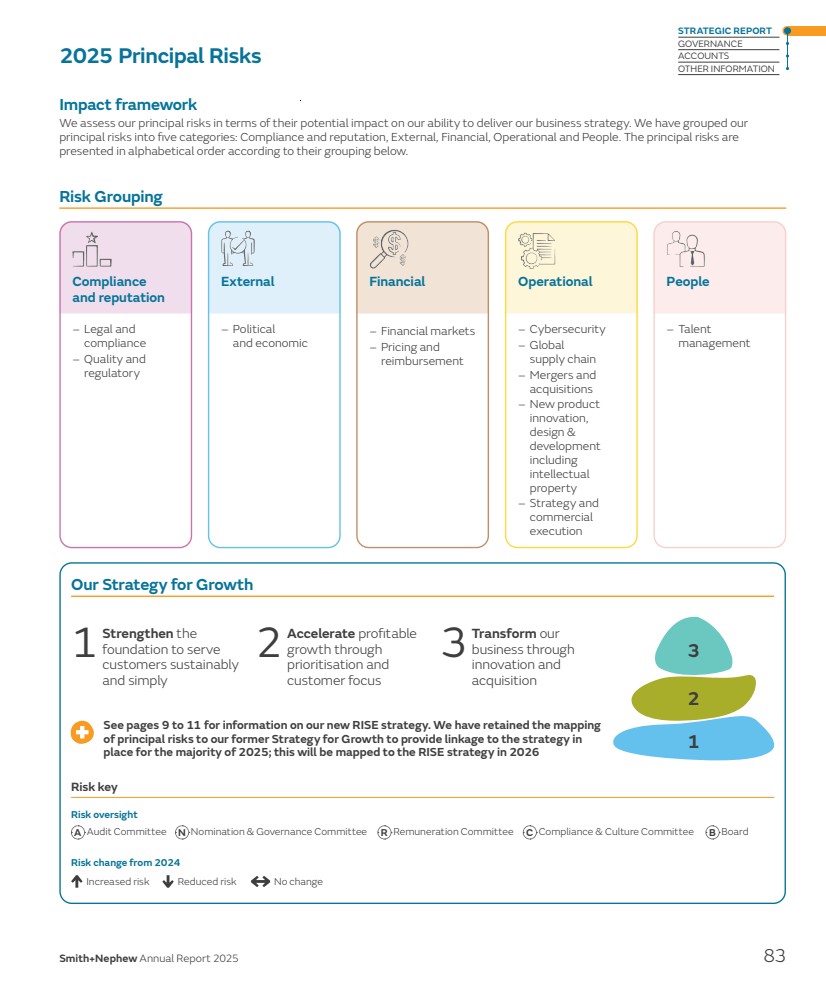
| Examples of risks – Failure to act in an ethical manner consistent with our Code of Conduct and Business Principles. – Violation of anti-corruption or healthcare laws; breaches by employee or third-party representatives. – Misuse or loss of personal information of patients, employees, research subjects, consumers or customers resulting in violations of data privacy laws and regulations in jurisdictions in which we operate globally. – The development, manufacture and sale of medical devices entails risk of product liability claims or recalls. – Failure to identify new or changes in legal or regulatory and reporting requirements including trade compliance, fraud and abuse, information security, privacy and AI which result in non-compliance with applicable laws and regulations. – Failure to meet needs of stakeholders relating to increased focus on and regulation of complex reporting requirements applicable to our business. – Involvement in legal proceedings, including mass tort litigation, that could lead to significant financial and reputational exposure. Actions taken by management – Board Compliance & Culture Committee oversees ethical and compliance practices and programmes. – Global compliance programme, policies and procedures in place and regularly updated to reflect changes in global or market-related laws, regulations and industry codes. – All employees required to undertake training and certify compliance with our Code of Conduct and Business Principles annually. – Group Compliance monitoring and auditing programmes in place with reporting to Executive Committee and Board/Committees. – Established confidential independent reporting channels for employees and third parties to report concerns. – Global trade compliance programme, policies and procedures and training programme. Global trade compliance function partners with business units in order to diligence commercial models, new/developing regulations and implementation of trade compliance policies and procedures. – The Information Security team develops and implements policies and procedures and training programmes to mitigate risk and monitors new and amended regulatory frameworks. – The AI Working Group evaluates governance frameworks for AI enterprise strategic projects and regulatory developments. – The ESG Steering Committee assesses new and enhanced regulations and reporting requirements and works cross-functionally to ensure compliance. – Monitoring new regulatory and enforcement trends. Legal and compliance We are committed to doing business with integrity and believe that ‘doing the right thing’ is part of our mandate to operate. We operate in multiple countries, and regulatory authorities in each jurisdiction enforce an increasingly complex framework of laws and regulations that govern the design, development, approval, manufacture, labelling, marketing, sale and operation of both traditional and digital (including connected and AI-enabled) healthcare products and services. Operating within this complex and dynamic legal and compliance environment, which includes regulations on fraud, bribery and corruption, privacy, sustainability and trade compliance, increases the risk of fines, penalties, and reputational damage. We mitigate this through policies, procedures, training and practices designed to prevent and detect violations of law, regulations and industry codes. We implement a risk-based oversight framework and programmes to monitor compliance with our Code of Conduct and associated policies. Compliance and reputation risks Oversight C Change from 2024 Link to Strategy 1. Strengthen 2. Accelerate 3. Transform 1 2 3 84 Smith+Nephew Annual Report 2025 Risk Report continued 2025 Principal Risks continued 11_SN_AR25_Risk_v64.indd 84 05/03/2026 17:48 |
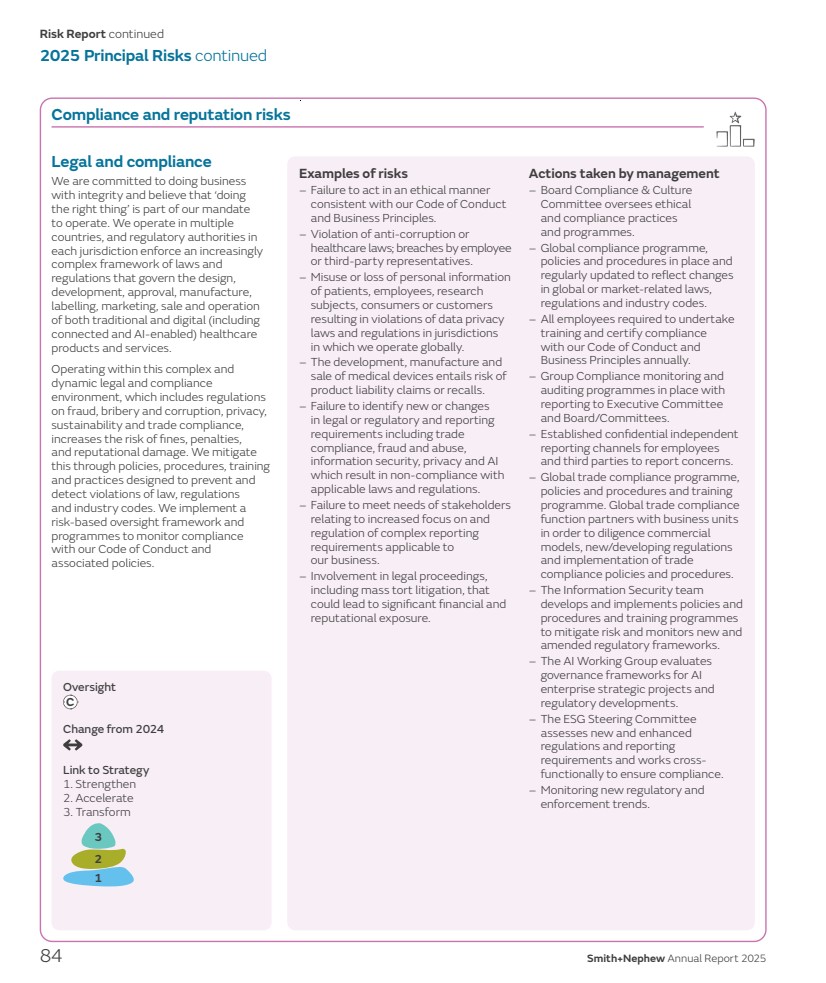
| Examples of risks – Time required by Notified Bodies to review product submissions and site quality systems’ certification time for new products impacts ability to meet customer demand. – Defects in design or manufacturing of products supplied to, and sold by, the Group could lead to product recalls or product removal or result in loss of life or major injury. – Significant non-compliance with policy, regulations or standards governing products and operations regarding registration, design, manufacturing, distribution, sales or marketing. – Failure to obtain proper approvals for products or processes. – Stringent local requirements for clinical data across various markets globally. – Failure to meet stakeholder expectations with regard to increasing sustainability regulations and reporting requirements. Actions taken by management – The Quality departments within each Business Unit regularly monitor activities to comply with new and amended requirements. – Regular and proactive engagement with Notified Bodies, MHRA and regulatory representatives to monitor regulatory changes and understand interpretation of legislation. – Comprehensive and documented product quality processes and controls from design to customer distribution in place, with the addition of cybersecurity to new product development projects for relevant products. – Standardised monitoring and compliance with quality management practices through our Global Quality and Regulatory Affairs organisation. – Incident management teams in place to provide a timely response in the event of an incident relating to patient safety. – Governance framework in place for reporting, investigating and responding to instances of product safety and complaints. – Local clinical evidence requirements are included in global new product development projects. Quality and regulatory Global regulatory bodies continue to increase their expectations of manufacturers and distributors of medical devices not only in respect of quality and regulation of products but also in respect of sustainability requirements. Our products are used in the human body and therefore patient safety is of paramount importance. The European Medical Device Regulation (EU MDR), and multiple other global regulations and changes in standards have increased the focus on clinical and technical evidence, supplier controls and product performance transparency. Our customers and other stakeholders also require us to explain our approach to and demonstrate compliance with increasing sustainability regulations and reporting requirements. Compliance and reputation risks continued Oversight C Change from 2024 Link to Strategy 1. Strengthen 2. Accelerate 1 2 Smith+Nephew Annual Report 2025 85 STRATEGIC REPORT GOVERNANCE ACCOUNTS OTHER INFORMATION 11_SN_AR25_Risk_v64.indd 85 05/03/2026 17:48 |
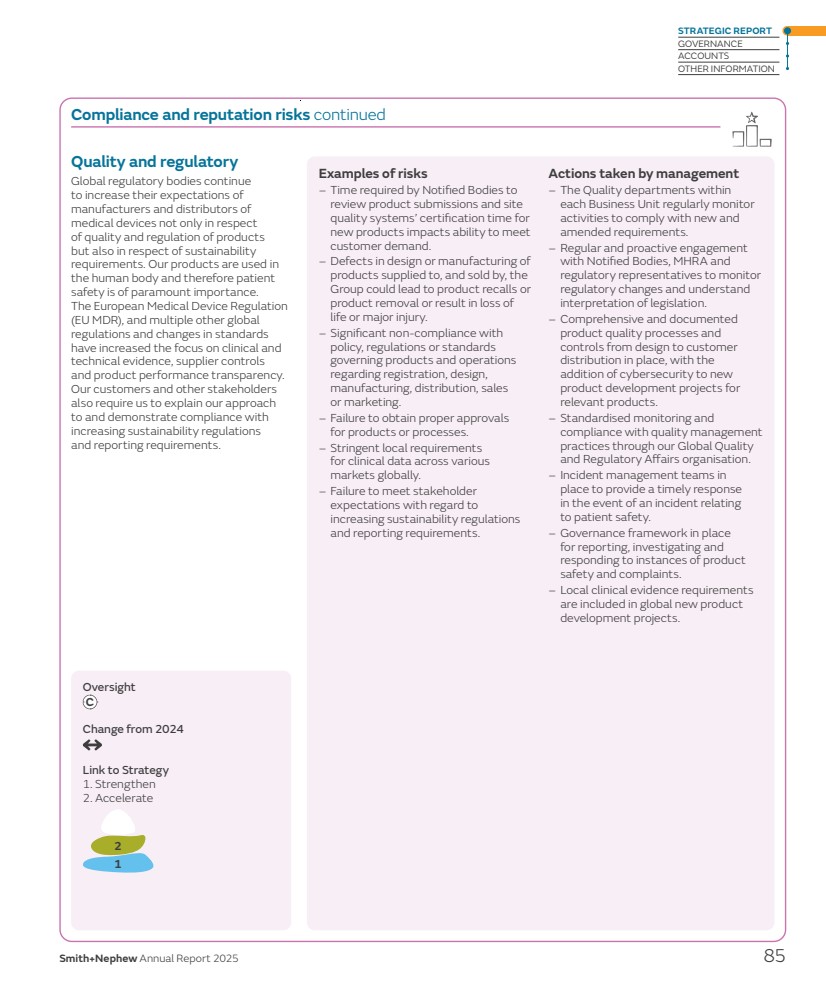
| Examples of risks – Changing global regulatory and health care financing policies that increase compliance costs or reduce reimbursement for our products. – Failure to pivot on business strategy in light of changes in trade policy, conflicts and sanction programmes globally. – Changes in localisation policies which negatively impact multinational participants, for example the volume based procurement policies in China and EU response. – Failure to implement changes to operating model at pace to address public policy shifts in the US and other key markets. – Global political and economic uncertainty and conflict, including in Ukraine and the Middle East. – Increases in tariffs and restrictions on global trade. – Global or regional recession and increasing macroeconomic controls’ impact on customer financial strength. – Increases in import and labour costs. – Inflationary pressures impacting raw materials, freight, salaries and wages. – Failure to meet sustainability targets and stakeholder expectations aligned to strategy. – Potential for significant tax rate changes and/or base broadening measures in key jurisdictions where we operate, including OECD proposals and the potential for further US tax legislation. – Impact of shifts in geopolicy becomes reflected in the workplace, making global operation and collaboration more challenging. Actions taken by management – Actively horizon scan, monitor and evaluate potential changes in public policy and develop plans to mitigate potential risk to operating models in each market. The Group tax team continually monitors developments in tax policy and obtain external advice where relevant. – Active participation in and engagement with trade associations to enhance education and advocacy efforts with policymakers. Ongoing monitoring and engagement with policymakers on localisation initiatives. – Continued engagement with governments, administrations and regulatory bodies to enhance education and advocacy efforts with policymakers. – Global trade compliance programme, policies and procedures and training programme. Global trade compliance function partners with business units in order to diligence commercial models, new/developing regulations and implementation of trade compliance policies and procedures. – Business continuity plans in place with alternative source options identified for critical suppliers and increased safety inventory levels for critical products affected by the conflict in Ukraine and disruptions of travel caused by geopolitical and environmental events. – Implement sustainability strategy through our ESG Operating Committee (including data, metrics and monitoring of performance) aligned to our purpose, business strategy and culture pillars, and track and benchmark targets within the industry. Political and economic We operate a global business and are exposed to the effects of political and economic risks, changes in the regulatory and competitive landscape, trade policies and trade compliance requirements, war, political upheaval, changes in government policy regarding healthcare priorities and sustainability expectations, increasing inflationary pressure, preference for local suppliers, import quotas, economic sanctions and terrorist activities. External risks Oversight B Change from 2024 Link to Strategy 1. Strengthen 2. Accelerate 1 2 86 Smith+Nephew Annual Report 2025 Risk Report continued 2025 Principal Risks continued 11_SN_AR25_Risk_v64.indd 86 05/03/2026 17:48 |
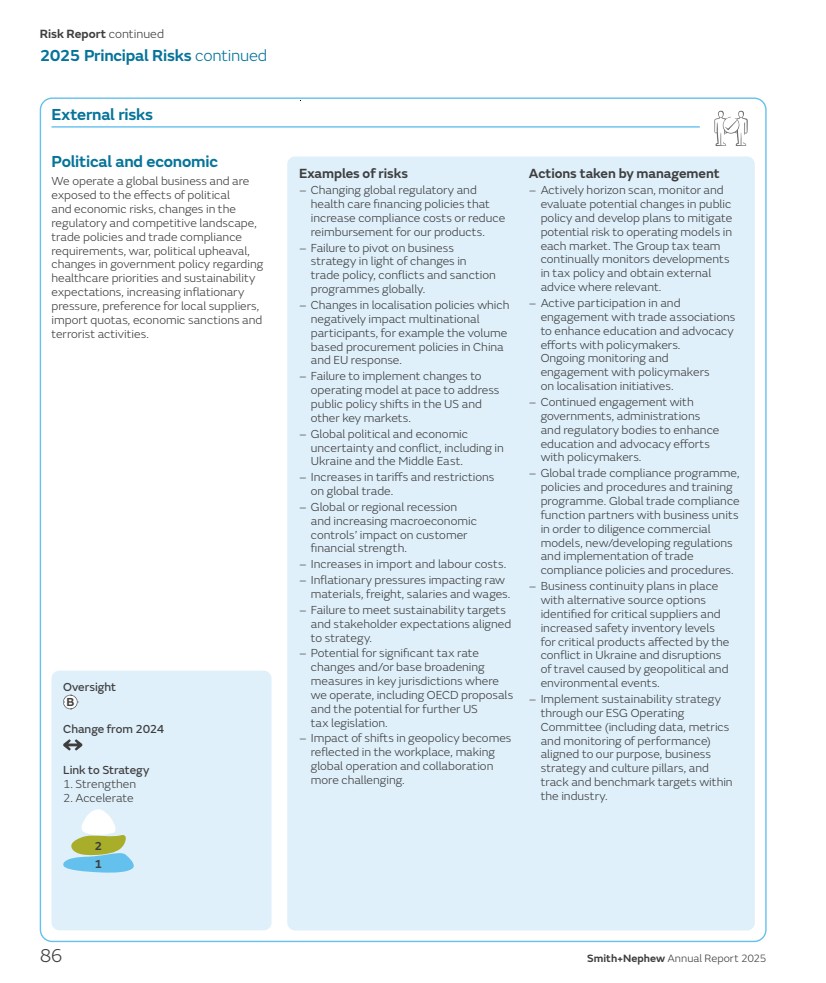
| Examples of risks – Risk of adverse movement to trading profit due to fluctuating foreign currency exchange rates between our main manufacturing operations (the US, UK, Costa Rica, Malaysia and China) and where our products are sold. – The Group’s credit rating could be downgraded if business underperforms or increases the leverage from capital allocation decisions such as M&A investments, in turn reducing access to debt funding. – Potential for restriction to access to the investment grade funding market from time to time during periods of global/financial crisis. – The cash and short-term investments could reduce in value in the event of an insolvency of a financial counterparty. – The rate of interest paid on the Group’s borrowings could increase as a result of increased central bank rates and also increased credit charges required by investors. Actions taken by management – A foreign exchange hedging programme is operated and is overseen centrally by the Group Treasury team. – The Finance and Banking Committee monitors movements in financial markets and treasury management. – Liquidity risk is evaluated through the Going Concern and Viability Statement assessments. – Group funding comprises a variety of public bonds, private placements, and bank facilities with a balanced maturity profile over the next 10 years. The Group works closely with its relationship banks in the revolving credit facility and maintains relationships with public and private debt markets and investors. – Maintaining significant undrawn debt facilities, including for example the revolving credit facility and cash to manage liquidity risks. – Retaining an investment grade credit rating and considering the implications of capital allocation decisions on the ratings. – Investing surplus funds in bank deposit and money market fund instruments with strong credit rated institutions to manage counterparty credit risk exposure while preserving the value of the investments. – Actively balancing exposure to interest rate movements through the use of fixed rate borrowing and derivatives. Financial Markets We operate a global business and are therefore exposed to a variety of external financial risks in relation to exchange rate, interest rate and access to funding markets. Volatility in rates can impact our results and it may not be possible to fully mitigate against them. Financial risks Oversight A Change from 2024 Link to Strategy 1. Strengthen 1 Smith+Nephew Annual Report 2025 87 STRATEGIC REPORT GOVERNANCE ACCOUNTS OTHER INFORMATION 11_SN_AR25_Risk_v64.indd 87 05/03/2026 17:48 |
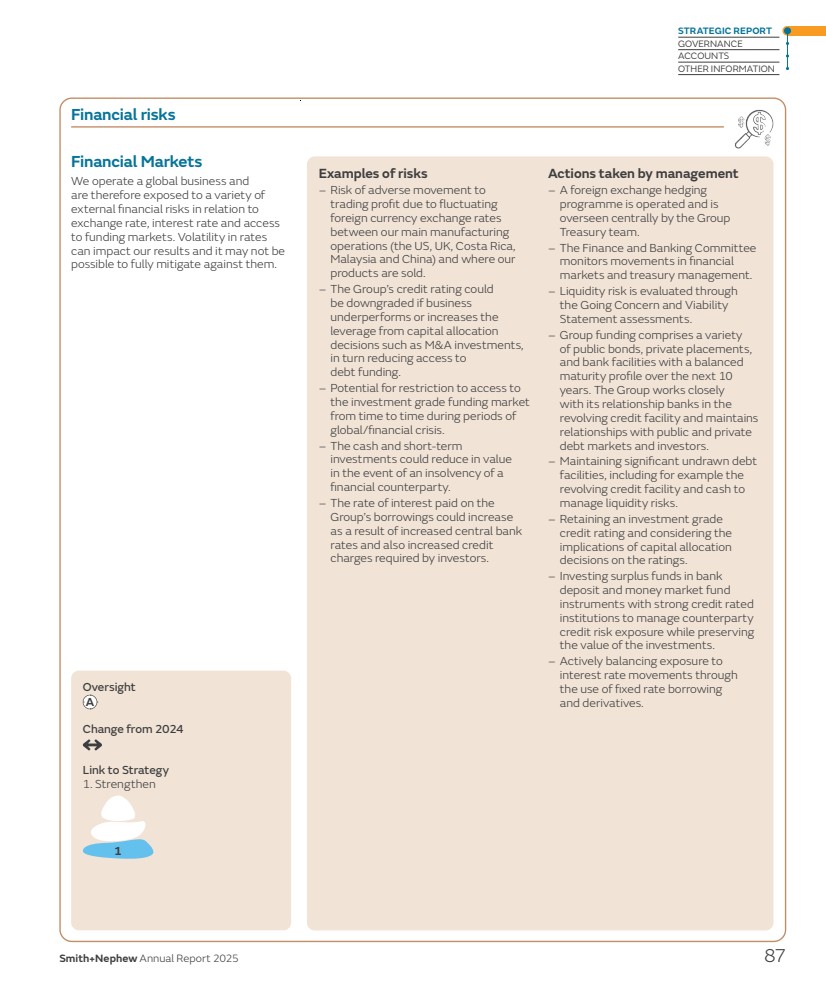
| Examples of risks – Limited ability to pass on increased costs such as raw materials, freight, sustainability improvements and the cost of compliance with regulations to our customers. – Reduced reimbursement levels and increasing pricing pressures. – Localisation policies and volume-based procurement in China and other markets. – Impact of global trade policy changes and implementation of tariffs on standard cost and margin on pricing. – Lack of adequate health economics data to support reimbursement requests. – Systemic challenge on number of elective procedures. – Unilateral price controls/reductions imposed on medical devices. – Price-driven tendering/ procurement processes. – Limited access to non-clinical decision makers. Actions taken by management – Optimisation of market and portfolio prioritisation and portfolio mix and promotion of differentiated products. – Ongoing development of innovative economic product and service solutions based on unmet needs and market requirements. – Ongoing focus on pricing strategy and execution resulted in pricing improvement in 2025. Continued efforts to mitigate inflationary impact embedded in business-as-usual practices. – Incorporated health economic components into the design and development of new products. – Investing in clinical and health education evidence to drive value-based payment and access. – Sales execution and training to improve capability to communicate the clinical and economic value proposition to non-clinical decision makers. – Implementation of innovative contracting models designed to support adoption and coverage for healthcare providers and payers. – Ongoing engagement with payer bodies to influence reimbursement mechanisms to reward innovation. Pricing and reimbursement Our success depends on our ability to sell our products profitably, despite increasing inflation and costs associated with improving the sustainability of our products, pricing pressures from customers and the availability of and access to adequate government funding and reimbursement to meet increasing demands for our products arising from patient demographic trends. The prices we charge are therefore impacted by budgetary constraints and our ability to persuade customers and governments of the economic value of our products, based on clinical data, cost, patient outcomes and comparative effectiveness. Market developments and localisation policies such as China volume-based procurement, consolidation of customers into buying groups, inflation, increasing professionalisation of procurement departments and the commoditisation of entire product groups continue to challenge prices. We aim to mitigate the impact of these market developments by proving the value and clinical outcomes of our products, which may then allow us to seek value-based pricing increases; by ensuring a broad portfolio mix; and by promoting differentiated products. We may also seek price increases to counteract the impact of inflation where possible. Financial risks Oversight B Change from 2024 Link to Strategy 1. Strengthen 2. Accelerate 1 2 88 Smith+Nephew Annual Report 2025 Risk Report continued 2025 Principal Risks continued 11_SN_AR25_Risk_v64.indd 88 05/03/2026 17:48 |
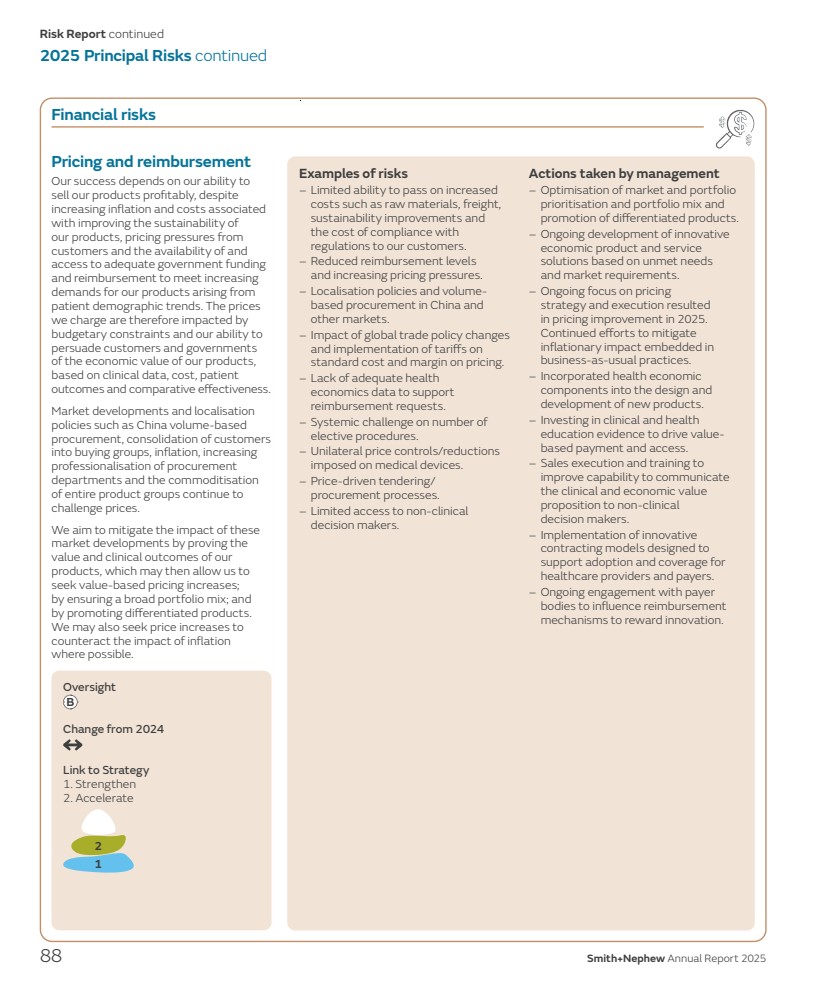
| Examples of risks – Loss or misuse of confidential or sensitive information, intellectual property and/or data privacy breach resulting in both financial and reputational harm. – Inadequate consideration of cybersecurity in the design of new products, systems and/or processes increasing potential for vulnerabilities. – Disruption to business operations and resultant financial and reputational negative impact due to a significant cybersecurity incident. – Enhanced changes in regulatory environment and increased enforcement and reporting obligations. – Increase in sophistication of bad actors/threat profile due to geopolitical instability. – Increasing demand for cybersecurity expertise could impact our ability to attract and retain cybersecurity talent. – Disruption to the business due to critical system infrastructure and applications being unavailable. Actions taken by management – Executive Committee desktop exercises and Board awareness sessions on cybersecurity incidents/ ransomware attacks providing updates on evolution of threat actors, organisational maturity and key improvement initiatives. – Third party advisory and consultancy support for cyber incident response with desktop and discussion sessions for response teams. – The Chief Information Security Officer (CISO) is also a member of several industry groups, including the Threat Intelligence and Information sharing, Manufacturing, NHS Supply Chain and Life Sciences trust groups which have been built and delivered by the UK National Cyber Security Centre (NCSC), alongside the global industry-focused Health Information Sharing and Analysis Centre (H-ISAC), participation in these environments allows for networking and sharing of cyber-related risks and issues to raise cyber resilience across the sector. – Cybersecurity maturity programme monitored by the Audit Committee; development and implementation of enhanced reporting framework on cyber incidents. – Enhanced global security training and awareness activities for all employees including email communications, intranet posts, visuals, videos and email phishing training activities. – Privileged Access Management tools to control and govern administrative access to critical IT systems. – Security information and event management (SIEM) in place to provide real-time analysis of security alerts generated by applications and network hardware. – Threat Intelligence monitoring and management tools to provide proactive threat mitigation, including sign-up to the NCSC early warning service, alongside several industry threat feeds, improved security posture, faster incident response, and more efficient resource allocation. – Email Security tooling to reduce the likelihood of cyber threats, including business email compromise, phishing, malware, and malicious internet links, to ensure the confidentiality of business and sensitive data. – Regular penetration testing and frequent vulnerability scanning undertaken. – Secure-by-design framework for all product security aspects, to cover pre and post market, ensuring alignment and adherence to regulatory requirements across the globe. Cybersecurity We depend on a wide variety of information systems, programmes and technology to run our business effectively. We also develop and sell certain digitally enabled products that connect to proprietary and third-party networks and/or the internet and increasingly may incorporate certain elements of AI functionality. Our systems and the systems of third parties and the entities we acquire may be vulnerable to a cyber-attack, theft of intellectual property, malicious intrusion, data privacy breaches or other significant disruption. We have a layered security approach in place to prevent, detect and respond, to minimise the risk and disruption of any intrusions and to monitor our systems on an ongoing basis for current or potential threats. Operational risks Oversight A Change from 2024 Link to Strategy 1. Strengthen 3. Transform 1 3 Smith+Nephew Annual Report 2025 89 STRATEGIC REPORT GOVERNANCE ACCOUNTS OTHER INFORMATION 11_SN_AR25_Risk_v64.indd 89 05/03/2026 17:48 |
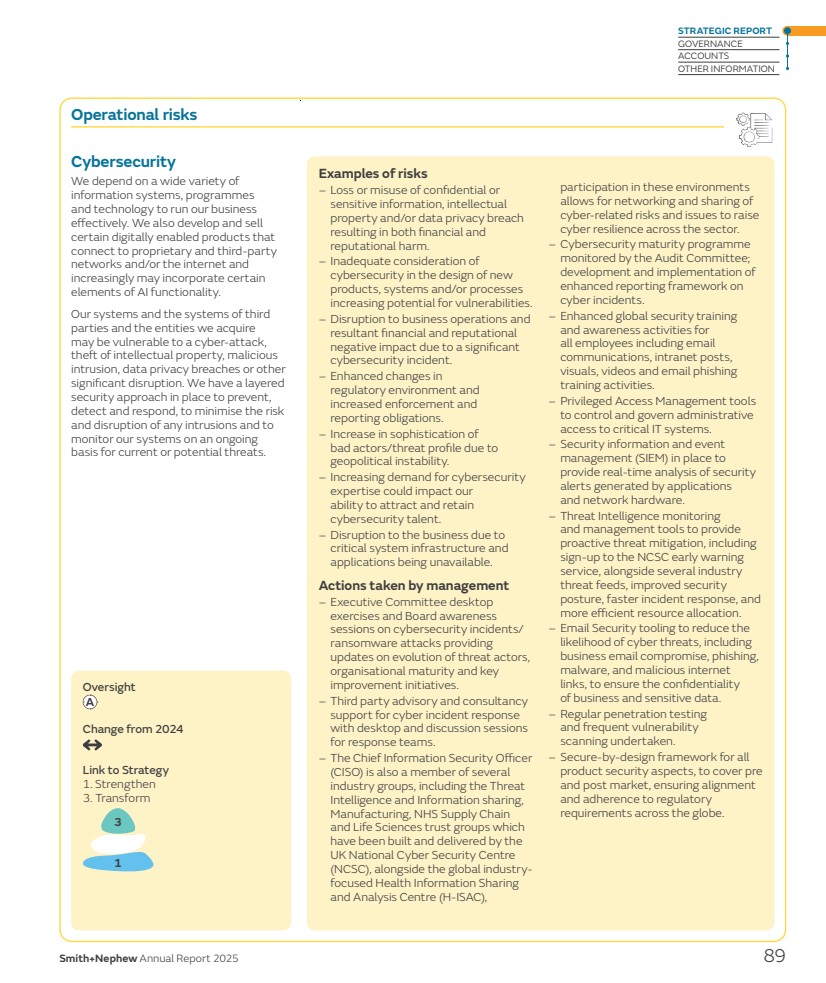
| Examples of risks – Potential disruption resulting from changes in global trade policies or trade compliance which increase cost and/or ability to ship products to meet customer demand. – Disruption to manufacturing at a single source facility (lack of manufacturing redundancy), including from natural disaster. – Manufacturing and supply chain capacity not adequately balanced to support growth and Group profitability. – Supplier failure impacts ability to meet customer demand (single source supplier). – Inadequate sales and operational planning impacts ability to meet customer demand for product. – Excess inventory due to incorrect demand forecasts, inaccurate demand signals and unexpected changes in demand. – Failure of suppliers and distribution partners to achieve and maintain regulatory compliance. – Increasing costs of raw materials, freight, and salary/wages for manufacturing and distribution employees and contractors. – Severe weather patterns, global temperature rise and sea-level rise caused by climate change or natural disaster causes damage to manufacturing or distribution facilities, impacting ability to meet customer demand. – Disruption to the business due to critical system infrastructure and applications being unavailable. – Critical material shortages leading to supply challenges. – Increased freight cycle times due to geopolitical events, natural disasters, weather events or conflicts, resulting in disruptions of operations. – Failure to transform to achieve our sustainability targets. Actions taken by management – Strategic review and scenario planning and analysis on implementation of tariff frameworks and potential global impact to the organisation. – Successful implementation of Global SI&OP, Procurement, Manufacturing & Supply Planning processes to improve product availability and inventory, enhance procurement and management of transportation costs and optimisation of our manufacturing network. – Adoption of S+N Operating System and enhanced focus on lean manufacturing and quality as part of business-as-usual activities and drive for continuous improvement in a high performance culture. – Addressing capacity in the network through site planning (e.g. CARTIHEAL manufacturing duplication in Mansfield MA., Penang manufacturing ramp up, Melton UK new manufacturing facility, Memphis campus consolidation). – Ongoing implementation of Global Operations transformation programme to optimise manufacturing and distribution centres and reduce single source limitations. – Ongoing risk-based review programmes undertaken for critical suppliers. – Implementation of global, regional and local business continuity and disaster recovery planning programme to support crisis and incident management at major facilities and for key products and key suppliers. – Comprehensive product quality processes in place from design to customer supply. – Supplier contract agreements to achieve and manage regulatory compliance. – ESG Steering Committee implements and operationalises ESG strategy and provides data and metrics to monitor implementation. Global supply chain Our ability to make, distribute and sell medical products to customers in around 100 countries involves complex manufacturing and supply chain processes. Geopolitical and trade policy shifts increase complexity and the need for agility to pivot at pace within a global business. Increased outsourcing, capacity constraints, sophisticated materials, and the speed of technological change in an already complex manufacturing process leads to greater potential for disruption in our supply chain. Lack of availability of raw materials and components compound supply and business disruption. The regulatory environment, including the increased focus on global regulation of sustainability, increases our exposure to supply chain disturbance. Increasingly frequent climate events increase the likelihood and impact of disruptions to our supply chain. Our business depends on our ability to plan for both global network optimisation and resilience over the longer term and day-to-day resilience in the face of events that threaten one or more of our key locations. Operational risks continued Oversight B Change from 2024 Link to Strategy 1. Strengthen 2. Accelerate 1 2 90 Smith+Nephew Annual Report 2025 Risk Report continued 2025 Principal Risks continued 11_SN_AR25_Risk_v64.indd 90 05/03/2026 17:48 |
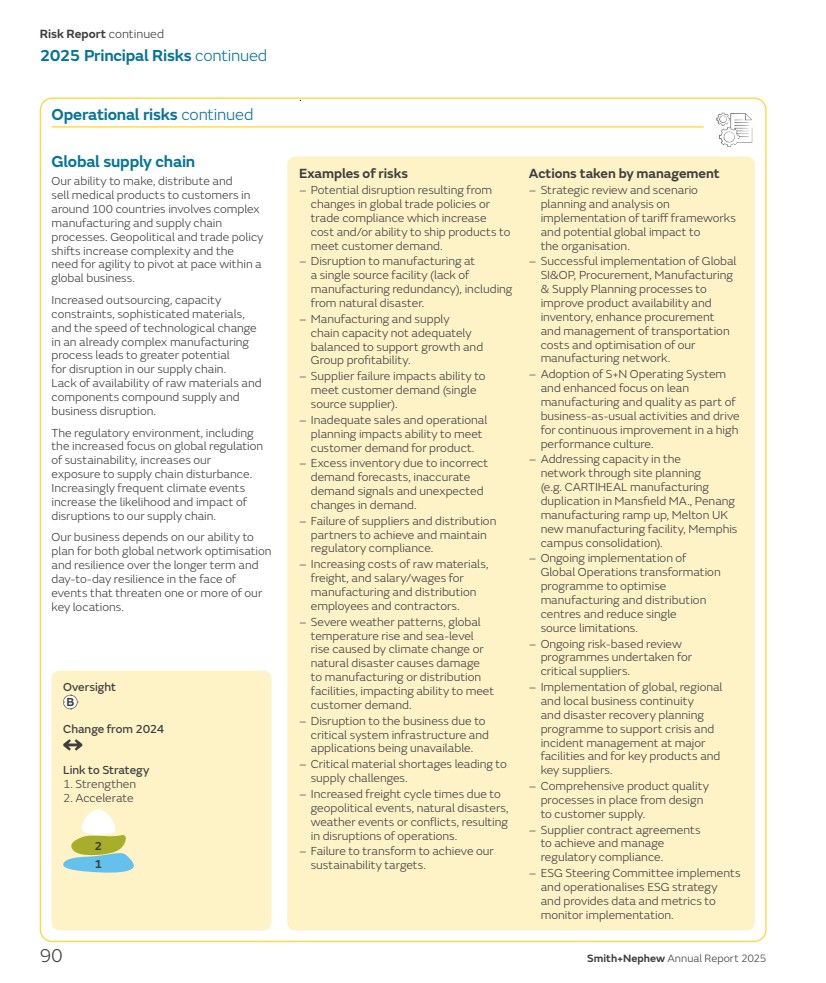
| Examples of risks – Failure to identify appropriate acquisitions. – Failure to conduct effective acquisition due diligence. – Failure to integrate newly acquired businesses effectively, including integration with Group standards, policies and financial controls. – Failure to deliver on plans to achieve the acquisition business case. Actions taken by management – Acquisition activity aligned with corporate strategy and prioritised towards products, business units and markets identified to have the greatest long-term potential. – Clearly defined investment appraisal process based on range of valuation metrics, including return on invested capital, in accordance with Capital Allocation Framework and comprehensive post-acquisition review programme. – Detailed and comprehensive cross-functional due diligence undertaken prior to acquisitions by experienced internal and external experts (including the integration management office). – Compliance and other risks included as part of due diligence reviews, integration plans and reporting for acquisitions. – Integration committee review, approval of integration plans and monitoring of ongoing process. – Board undertakes post-deal review sessions and specific deep dives on acquisitions as appropriate. Mergers and acquisitions As the Group grows to meet the needs of our customers and patients, we recognise that we are not able to develop all the products and services required using internal resources and therefore need to undertake mergers and acquisitions in order to expand our offering and to complement our existing business. In other areas, we may divest businesses or products which are no longer core to our activities. It is crucial for our long-term success that we make the right choices around acquisitions and divestments in order to become a winner in MedTech. Failure to identify appropriate acquisition targets, to conduct adequate due diligence or to integrate them successfully or to deliver on the acquisition business case would have an adverse impact on our competitive position and profitability, investor credibility and reputation. Operational risks continued Oversight B Change from 2024 Link to Strategy 3. Transform 3 Smith+Nephew Annual Report 2025 91 STRATEGIC REPORT GOVERNANCE ACCOUNTS OTHER INFORMATION 11_SN_AR25_Risk_v64.indd 91 05/03/2026 17:48 |
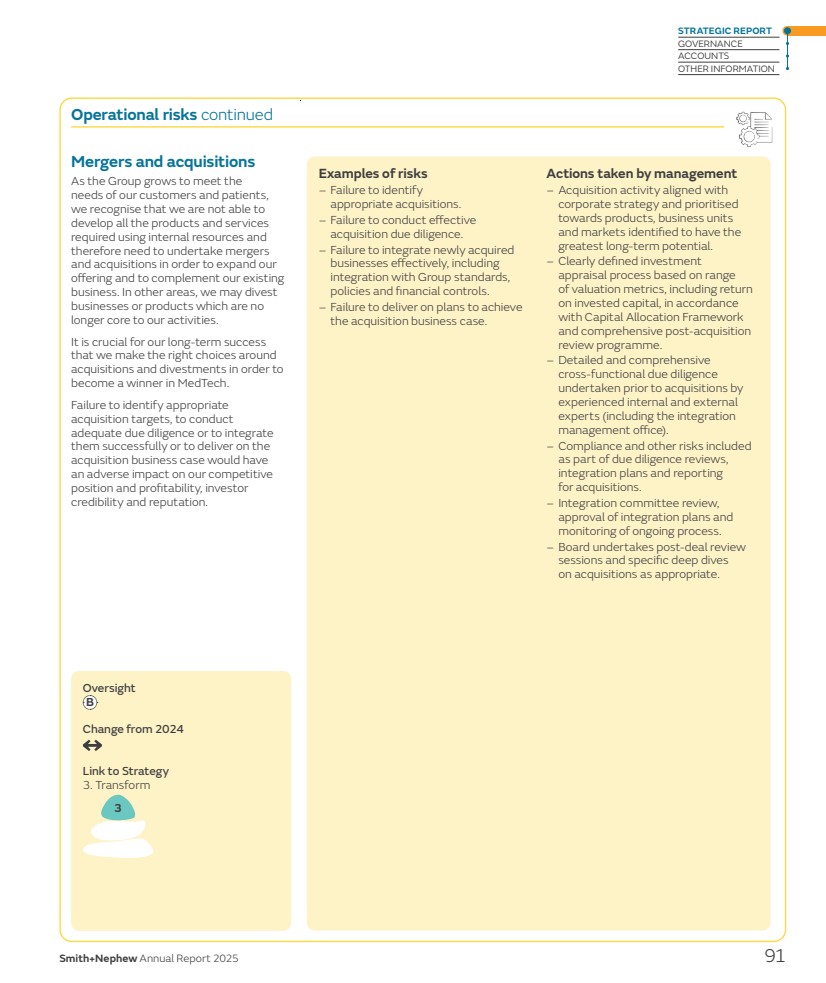
| Examples of risks – Failure to develop, partner or acquire a competitively differentiated innovation at pace with competition in the market. – Insufficient long-term planning to respond to competitor and disruptive entries into the marketplace. – Inadequate innovation due to low Research & Development (R&D) investment, R&D skills gap or ineffective product development execution. – Loss of market share due to critical gaps in product portfolio not filled. – Loss of proprietary data due to natural disasters or failure of Product Lifecycle Management (PLM) systems. – Competitors may assert patents or other intellectual property rights against the Group or fail to respect the Group’s intellectual property rights. – Failure to ensure sustainability in new products. Actions taken by management – Ongoing delivery of 12-Point Plan initiatives to reposition our knee and hip portfolio at pace. – Continued product and technology acquisitions and product launches and effective implementation of new product launches. – Global R&D organisation and governance framework providing strategic direction for allocation of R&D investment across all businesses. Clear stage-gate process to continually evaluate R&D investment decisions and development of new products. – Cross-functional new product design and R&D processes focused on identifying new products and potentially disruptive technologies and solutions. – Replacing global PLM systems. – Monitored external market trends and collated customer insights to develop product strategies. – Ongoing monitoring of competitor patent portfolios post product launch and enforcement and monetisation of Group rights. – Ongoing intellectual property training for business counterparts. – Sustainability criteria built into new product development processes. New product innovation, design & development including intellectual property Our product innovation pipeline is becoming broader in scope and increasingly complex, as we focus our efforts on procedure innovation using digital technologies such as connectivity, machine learning, and artificial intelligence. Our focus on high growth and profitable markets requires us to better understand unmet customer needs, drivers of surgical efficiency and patient outcomes, and new country/regional regulations, including requirements related to cybersecurity and sustainability. Our innovation pipeline needs to be sufficiently differentiated from our competition in order for us to deliver our commercial ambition. If Smith+Nephew fails to protect and enforce its intellectual property rights successfully, its competitive position could suffer, which could impact profitable, sustainable growth. Operational risks continued Oversight B Change from 2024 Link to Strategy 3. Transform 3 92 Smith+Nephew Annual Report 2025 Risk Report continued 2025 Principal Risks continued 11_SN_AR25_Risk_v64.indd 92 05/03/2026 17:48 |
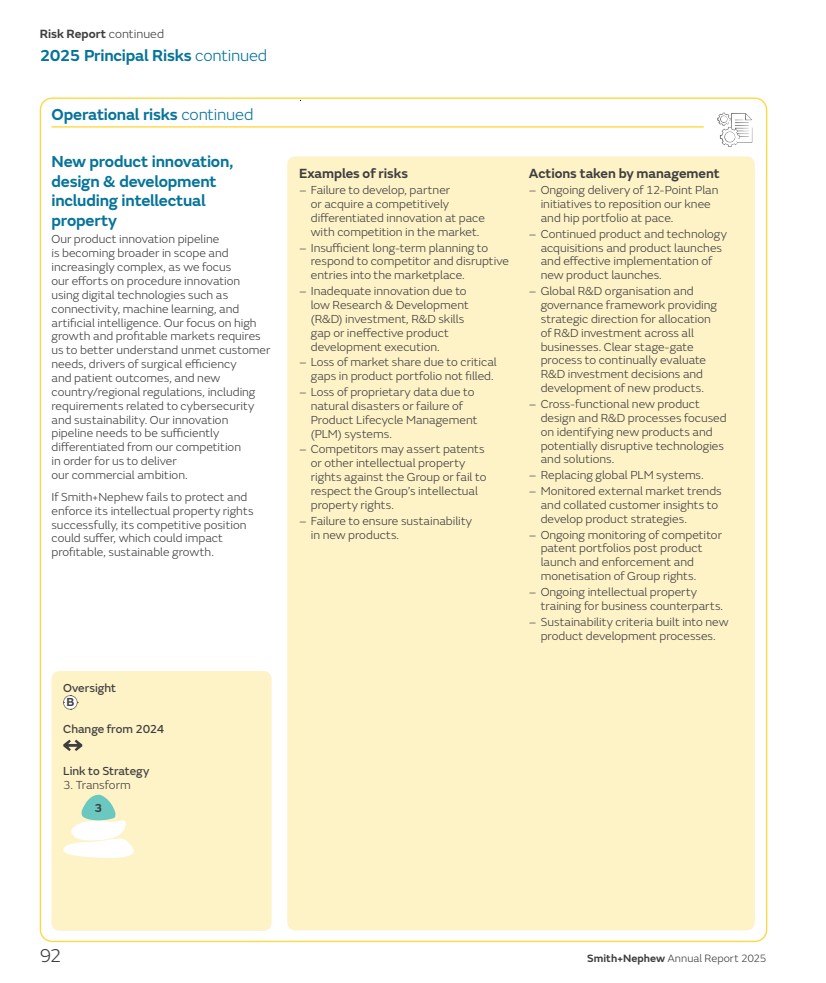
| Examples of risks – Failure to transition from and embed our 12-Point Plan framework, KPIs and metrics in business-as-usual objectives could slow progress in achieving our strategic objectives. – Failure to execute our strategy adequately from high-level ambition to specific actions to make the ambition a reality. – Inability to keep pace with significant product innovation and technical advances to develop commercially viable products. – Failure to engage effectively with our key stakeholders to meet their evolving needs leading to loss of customers. – Failure to manage distributors effectively, leading to stocking and compliance issues. – Inability to satisfy customers’ sustainability requirements and expectations. – Limits on healthcare professional access to medical education. – Failure to achieve potential from acquisitions due to integration challenges. – Failure to maintain credibility with our investors due to failures to implement a strategy aligned to their objective of value creation. – Failure to effectively implement core elements of business change prevents our projects and programmes achieving the intended benefits and disrupts existing business activities. Actions taken by management – Continued enhancement of our global business unit commercial operating model to leverage strengths in each vertical and focus on flawless execution. – Enhanced implementation of Sales Inventory and Operations (SIOP) process to improve demand and supply planning across all business units. – Continued executive oversight of changes to our commercial operating model and focus on commercial execution as part of business-as-usual activities following delivery of the 12-Point Plan. – Strategic planning process clearly linked to business, operations and Group risk. – Continued new product launches and monitoring of innovation pipeline. – Enhanced accessible digital sales information and training modules for sales staff. – Enhanced virtual medical education platforms and enhancement of the education offerings of the Smith+Nephew Academy. – Continued focus on product and technology acquisitions and product launches and effective implementation of new product launches. – Enhanced project management governance, toolkits and project steering committee oversight to support successful execution of programme and projects. Strategy and commercial execution The long-term success of our business depends on developing our vision and strategy and setting the right strategic priorities in our RISE strategy following the successful conclusion of the 12-Point Plan in 2025. Effective implementation of strategy requires effective communication and engagement both internally on a cross-functional basis within our global business unit organisational structure and with our customers, suppliers and other stakeholders. We must also successfully embed the right governance structures, accountability and capabilities across the Group and ensure we adjust and refine strategic priorities and business models when necessary. The pace and scope of our business change initiatives, taken together with geopolitical shifts and trends, may increase execution risk for the change programmes as well as for our business-as-usual activities. Failure to execute on priorities will impact our ability to continue to grow our business profitably and sustainably and to serve our customers. Operational risks continued Oversight B Change from 2024 Link to Strategy 1. Strengthen 2. Accelerate 3. Transform 1 2 3 Smith+Nephew Annual Report 2025 93 STRATEGIC REPORT GOVERNANCE ACCOUNTS OTHER INFORMATION 11_SN_AR25_Risk_v64.indd 93 05/03/2026 17:48 |
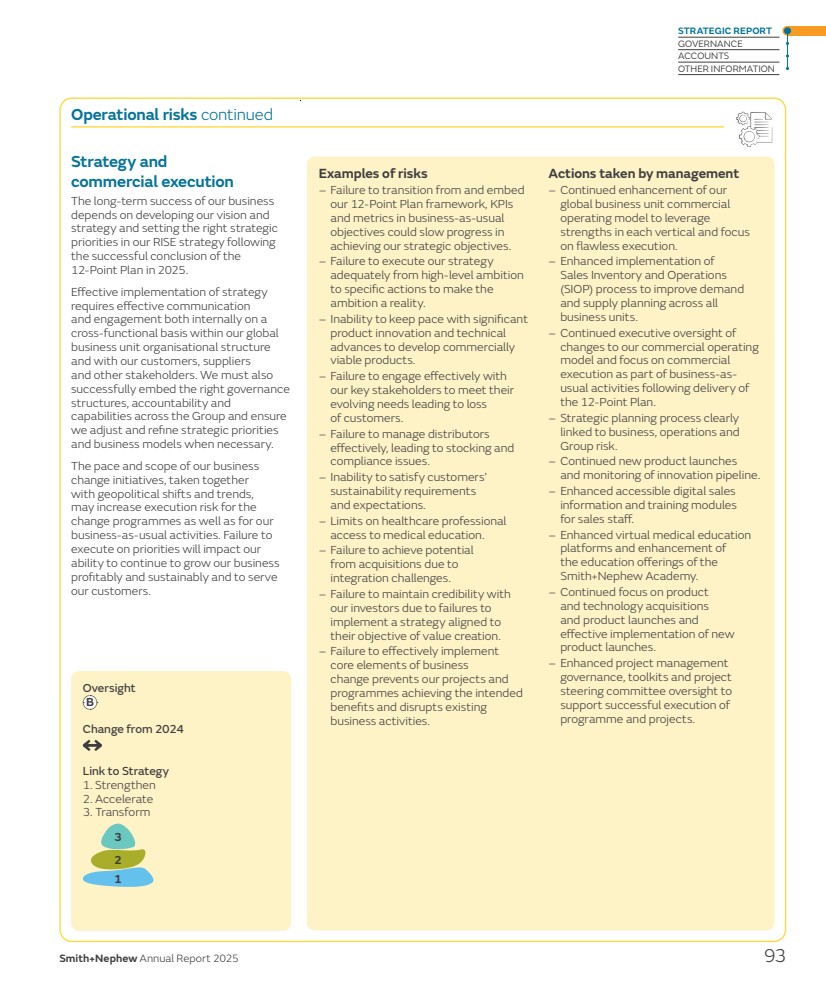
| Examples of risks – Loss of key talent, high attrition and lack of appropriate succession planning in context of required skillsets for future business needs. – Lack of alignment of Company reward strategies, including quantum and structure to market needs may lead to an inability to attract and retain talent of the requisite calibre for a high-performance organisation leading to management instability and impacting the ability to drive value creation and deliver on strategic objectives. – Loss of intellectual capital due to poor retention of talent. – Lack of capability and skills in exploring and adopting newly available advanced technology offerings within the organisation. – Failure to attract talented and capable candidates. – Increased talent movement globally due to shifting personal work-life balance priorities. – Failure to align to market salary expectations. Actions taken by management – Talent planning and people development processes are well established across the Group. – Talent strategy, management and succession planning is discussed twice yearly by the Board and regularly by the Executive Committee. – Utilising ‘Success Profiles’ that have been created for our high value roles to benchmark talent against requirements needed for success in critical roles. – Focusing on enhancing people leader capabilities with development programmes targeting future leaders. – Identification of high-value roles and ensuring that these roles are filled with our high-performance individuals with strong succession plans in place. – Embedded changes to our short and long-term incentive plan arrangements and updated pay ranges for employees, with further revisions scheduled to ensure we remain market competitive to attract and retain talent. – Provided employees with access to tools and resources to manage their emotional, physical, and mental wellbeing, under three key pillars of body, mind, life. – Continued focus on inclusion to foster a culture of belonging within the organisation and promote engagement, attraction and retention of top talent. – Enhanced functional expertise in Reward, Wellbeing and Culture to facilitate design and EVPs to attract, retain and motivate employees. Talent management Recruitment and retention of top talent and minimising attrition requires a strong engagement process. We recognise that people leadership, effective succession planning and the ability to engage, retain and attract talent is a key lever of success for our business, along with seizing opportunities to identify, implement, and utilise new technology that will serve to enhance our operations and improve employee experiences. Failure to do so may impact our ability to execute the Group strategy and to be effective in the chosen market/discipline. People Oversight C Change from 2024 Link to Strategy 1. Strengthen 2. Accelerate 1 2 94 Smith+Nephew Annual Report 2025 Risk Report continued 2025 Principal Risks continued 11_SN_AR25_Risk_v64.indd 94 05/03/2026 17:48 |
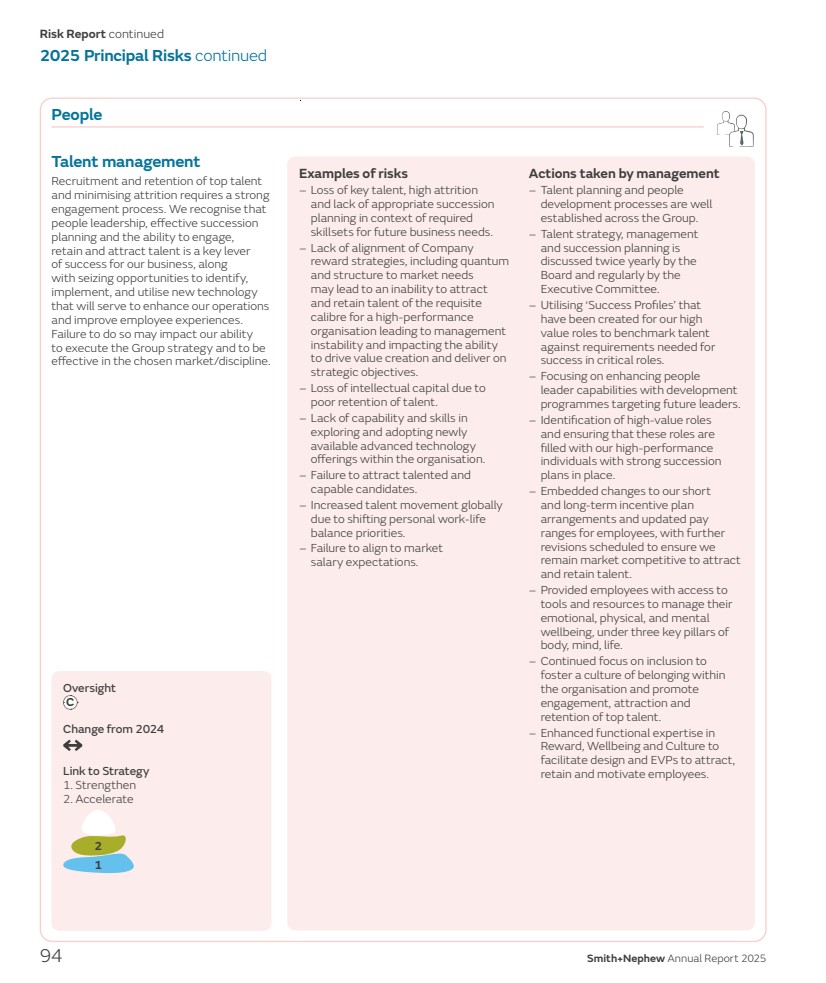
| How we assess our prospects During the year, the Board has carried out a robust assessment of the principal risks affecting the Company, particularly those which could threaten the business model. These risks, and the actions being taken to manage or mitigate them, are explained in detail on pages 78–94 of this Annual Report. In reaching our Viability Statement conclusion, we have undertaken the following process: – The Audit Committee reviewed the Risk Management process at their meetings in February, April, July and December, receiving presentations from the Group Risk team, explaining the processes followed by management in identifying and managing risk throughout the business. – The Executive Committee have reviewed the 2025 principal risks (the top-down risk review process). The Executive Committee was asked to consider the significant risks which they believed could seriously impact the profitability and prospects of the Group and the principal risks that would threaten its business model, future performance, solvency or liquidity. – All Executive Committee members nominated the Risk Champions and have worked with them to prepare and maintain risk registers. The Risk Champions nominated by the Executive Committee are senior employees and sufficiently tenured with the organisation to adequately identify and manage risk. – Using the outputs from the Business Area ‘bottom-up’ risk identification completed quarterly throughout the year and following ‘top-down’ discussions with the Executive Committee, the most significant risks affecting our organisation were presented to the Executive Committee for approval in November as the draft 2025 principal risks facing the Company and again in January 2026 as final disclosures. – In assessing our TCFD risks we concluded that climate-related risks are not significant in our viability horizon of three years. Nonetheless, the impact of extreme weather events have been considered in our operational risk scenarios. – All relevant executives have attested alignment to the Group’s Enterprise Risk Management process as part of the annual certification on governance, risk, and compliance. – The Board debated and agreed the risk appetite for each of the principal risks in February 2026. – Final principal risks were presented to the Audit Committee and the Board in February 2026 for their consideration and approval. – Throughout the year, a number of reviews into different risks were conducted by the Board, the Audit Committee and the Compliance & Culture Committee looking into the nature of the risks and how they were mitigated. Assessment period The MedTech sector is inherently competitive, and being a global business, the Group is subject to geopolitical uncertainty and volatility. Accordingly, a wide variety of time horizons are relevant in managing the business, between 1 to 5 years. The Board have determined that the three-year period to December 2028 is an appropriate period over which to provide its Viability Statement as they believe such period strikes a balance between the different time horizons which are used to manage the business and is a reasonable period for a shareholder to expect a MedTech business of the Group’s scale to be assessed over. Scenario testing To test the viability of the Company, we have undertaken a robust scenario assessment of the principal risks, which could threaten the viability or existence of the Group. These have been modelled as follows: – In carrying out scenario modelling of the principal risks on the following page we have also evaluated the impact of a severe but plausible combination of these risks occurring over the three-year period. We have considered and discussed a report setting out the terms of our current financing arrangements in the event of one of the scenarios modelled occurring. – We are satisfied that we have robust mitigating actions in place as detailed on pages 78-94 of this Annual Report. We recognise, however, that the long-term viability of the Group could also be impacted by other, as yet unforeseen, risks or that the mitigating actions we have put in place could turn out to be less effective than intended. Viability Statement Having assessed the Principal and Emerging Risks, the Board has determined that we have a reasonable expectation that the Group will be able to continue in operation and meet its liabilities as they fall due over a period of three years from 1 January 2026. In our long-term planning we consider horizons of between five and 10 years. However, as most of our efforts are focused on the coming three years, we have chosen this period when considering our viability. Our conclusion is based on the Strategic Plan reviewed and approved by the Board in December 2025. We will continue to evaluate any additional risks which might impact the business model. By order of the Board, on 27 February 2026. Helen Barraclough Company Secretary Smith+Nephew Annual Report 2025 95 STRATEGIC REPORT GOVERNANCE ACCOUNTS Our Viability Statement OTHER INFORMATION 12_SN_AR25_Viability_Statement_v45.indd 95 05/03/2026 17:50 |
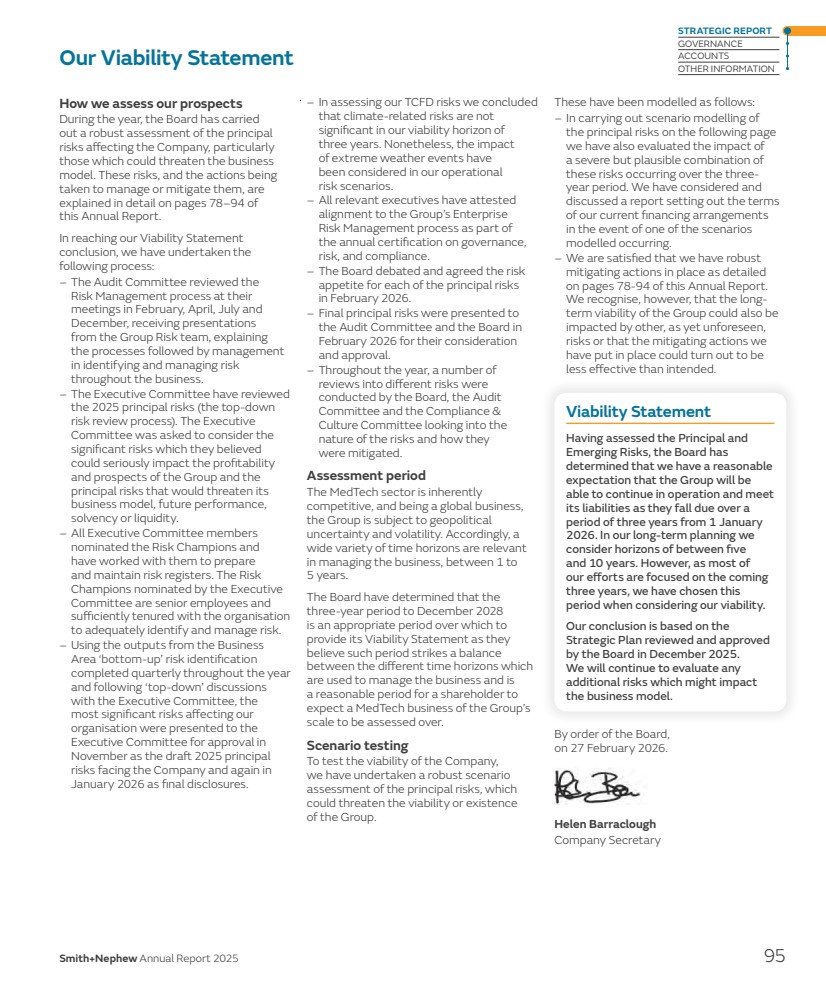
| 2025 Scenarios modelled Scenario 1: Global economic downturn, operational risk and financial markets Significant global economic recession, leading to sustained lower healthcare spending across both public and private systems. Action taken: We have modelled 10% lower revenue throughout 2026 and 5% lower revenue throughout 2027. Reduced reimbursement levels and increasing pricing pressures. Action taken: We have modelled annual price erosion of 1% impacting all product lines, along with a full drop through impact on profit in each of the periods 2026–2028. Inability to keep pace with significant product, innovation, and technical advances to develop commercially viable products, losing significant market share to the competition. Action taken: We have modelled 1% lower growth than planned for a key product range in the US, along with a full drop through impact on profit in each of the periods 2026–2028. Key supplier disruption – resulting in our inability to manufacture and supply a few key products for a full year. Action taken: We have modelled an interruption to receiving goods from a key supplier for a period of one year spanning across 2026-2027. Increases in raw materials, freight and labour costs. Action taken: We have modelled an increase in our input costs by an additional 5% in each of the periods 2026–2028, due to continued inflationary pressures. Risk of adverse trading margins due to fluctuating foreign currency exchange rates across our markets. Action taken: We have modelled a reduction in profitability in 2027 and 2028 due to a weakening in other currencies relative to the US Dollar. Link to strategy – Strengthen the foundation to serve customers sustainably and simply. – Transform our business through innovation and acquisition. – Accelerate profitable growth through prioritisation and customer focus. Link to principal risks – Strategy and commercial execution. – New product innovation, design & development including. intellectual property. – Global supply chain. – Legal and compliance. – Political and economic. – Talent management. – Pricing and reimbursement. – Financial markets. Scenario 2: Financial Markets, global supply chain, legal, regulatory and compliance risks and cybersecurity Data privacy failure – giving rise to a significant fine or loss. Action taken: We have modelled a one-off significant fine from regulator of 2% of revenue or loss resulting from a data privacy issue in 2027. Failure to obtain proper regulatory approvals for products or quality issue is discovered which impacts our ability to sell products. Action taken: We have modelled the complete loss of revenue from a key product due to a quality issue effective in mid-2026 for two years, and returning to lower volumes in mid-2028. Disruption to a Global Distribution Centre (GDC) preventing our ability to supply our customers with all products from the applicable GDC for one quarter. Action taken: We have modelled an inability to supply products from one of our GDCs for one quarter of 2027. Product liability claim. Action taken: We have modelled a group of product liability claims resulting in a settlement agreement requiring cash payment in each of the periods 2026–2028, without any insurance coverage. Disruption to business operations due to a significant cybersecurity incident. Action taken: We have modelled one of our key regions being unable to invoice also affecting shipping and tracking of deliveries for three months due to a disruption to our IT infrastructure in 2026. Link to strategy – Strengthen the foundation to serve customers sustainably and simply. Link to principal risks – Legal and compliance. – Quality and regulatory. – Global supply chain. – Cybersecurity. In accordance with Companies Act 2006, the S172 Statement included on pages 114 to 116 is incorporated into this Strategic Report by reference. The Strategic Report set out on pages IFC–96 was approved by the Board on 27 February 2026. Deepak Nath, PhD Chief Executive Officer 96 Smith+Nephew Annual Report 2025 Risk Report continued 12_SN_AR25_Viability_Statement_v45.indd 96 05/03/2026 17:50 |
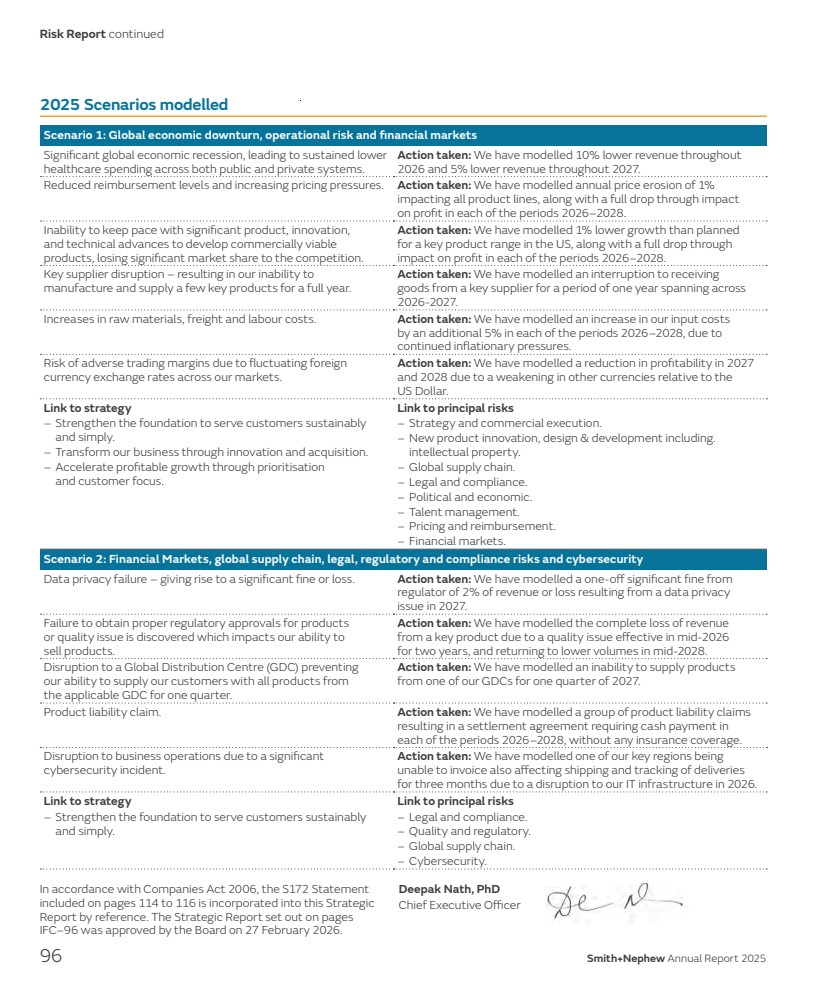
| Corporate governance Governance at a glance 98 Compliance and culture Board leadership and Company purpose Compliance & Culture Committee Report 136 Board of Directors 102 Our culture 140 Executive Committee 108 Audit, risk and internal control Division of responsibilities Audit Committee Report 141 Board activities and priorities 111 Remuneration S172 statement 114 Remuneration Committee Report 147 Corporate governance framework 124 Remuneration Policy Report 153 How we are governed 125 Remuneration at a glance 172 Composition, succession and evaluation Annual Remuneration Report 174 Nomination & Governance Committee Report 127 Directors’ Report 194 97 STRATEGIC REPORT GOVERNANCE ACCOUNTS OTHER INFORMATION Smith+Nephew Annual Report 2025 13_SN_AR25_GovGlance_ChLtr_BoD_BoardLead_v136.indd 97 05/03/2026 18:05 |
| This report sets out the Company’s corporate governance structure, our policies and practices, and explains how the Board and its Committees ensure effective leadership and high standards of corporate governance. Board priorities Strategy and operational excellence Purpose and culture Capital allocation and cost management Innovation and portfolio Risk management and oversight See more on pages 112 and 113 Our shareholders Customers and suppliers Environment and communities Governments and regulators Our new strategy Key stakeholders The Board seeks to engage with and to build a relationship of trust with our stakeholders. Our new RISE strategy will elevate Smith+Nephew’s performance, focused on generating significant value for all of our stakeholders by reaching more patients through leading innovation, scaling through strategic investment and executing efficiently. E Execute R Reach I Innovate S Scale Our people 98 Smith+Nephew Annual Report 2025 Governance at a glance 13_SN_AR25_GovGlance_ChLtr_BoD_BoardLead_v136.indd 98 05/03/2026 18:05 |
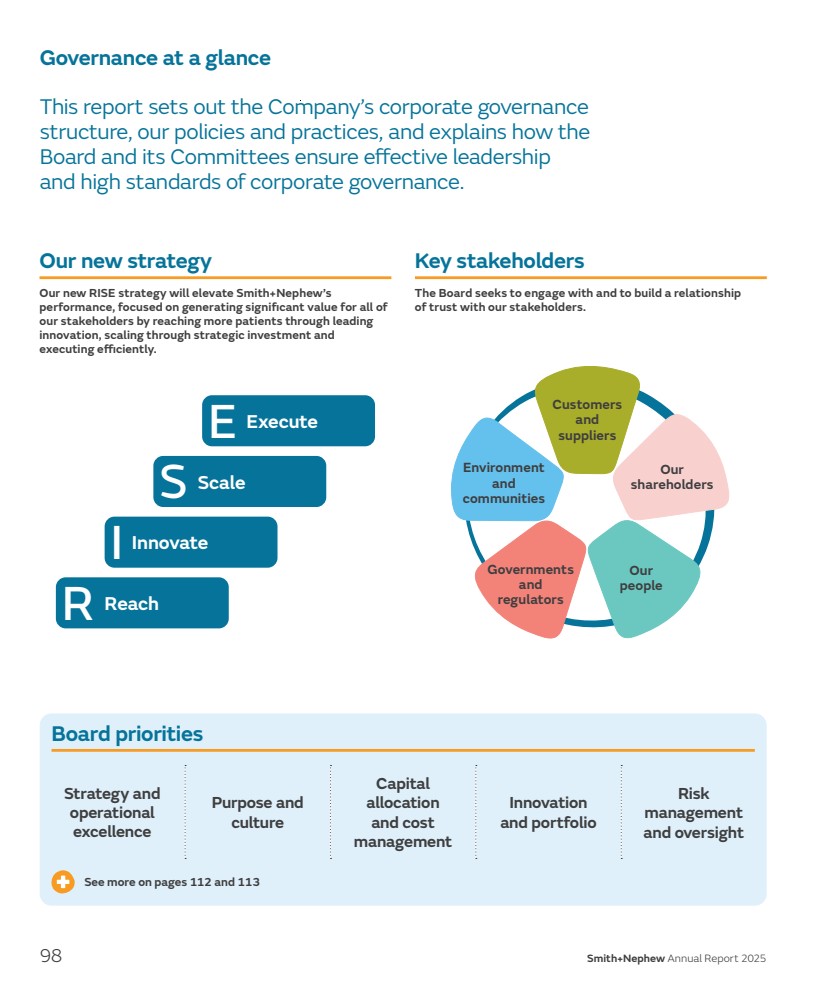
| Board diversity and tenure* Board experience* Board nationality A British 7 B American 5 C British/American 1 D Polish/German 1 Board tenure A 0-3 years 8 B 3-6 years 4 C 6+ years 2 Board gender diversity %** A Female 36 B Male 64 Board ethnicity** A White British or White (including minority white groups) 11 B Asian/Asian British 3 D C B A C B A B A B A * As at 31 December 2025. ** Disclosed in accordance with the UK Listing Rules requirements. See page 131 for more details. Board meeting attendance Board Audit Nomination & Governance Compliance & Culture Remuneration 99% 100% 100% 100% 98% Employee engagement 11 See more on page 130 See more on page 110 CEO 8 Financial 9 International 14 Healthcare/ medical devices 6 Emerging markets 11 Cyber/ technology 9 ESG 10 UK governance 8 Remuneration 9 * As at 31 December 2025. Smith+Nephew Annual Report 2025 99 STRATEGIC REPORT GOVERNANCE ACCOUNTS OTHER INFORMATION 13_SN_AR25_GovGlance_ChLtr_BoD_BoardLead_v136.indd 99 05/03/2026 18:05 |
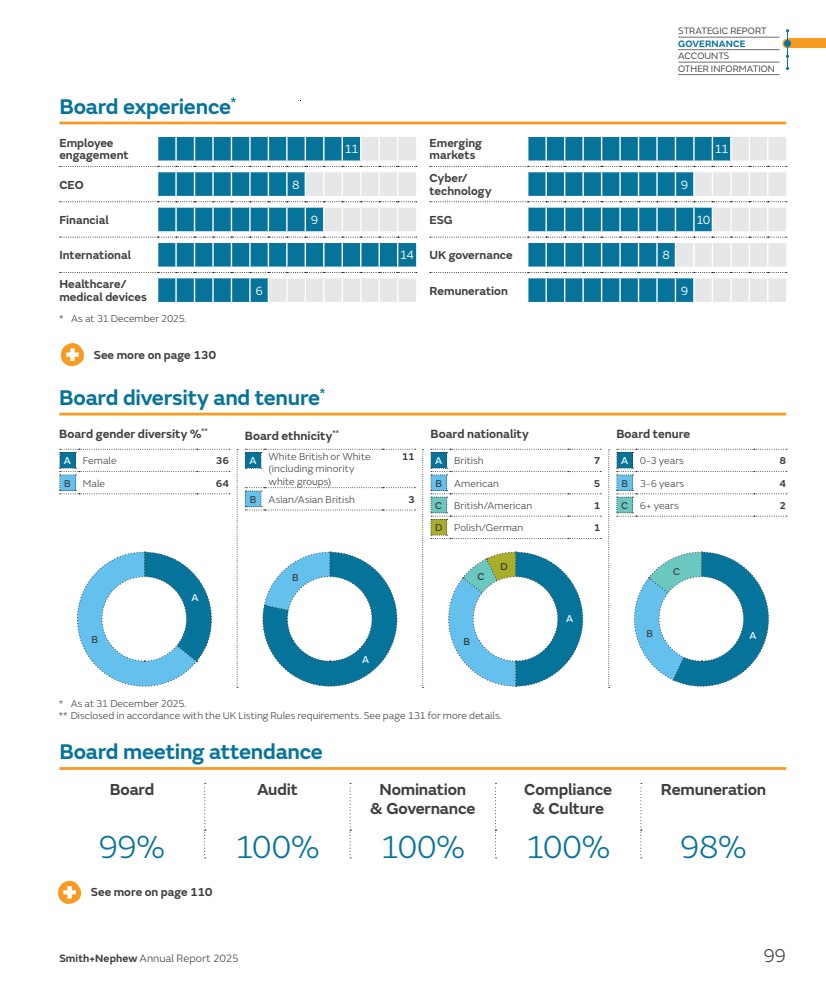
| UK Corporate Governance Code 2024 (the Code): 2025 Statement of Compliance The FRC published the Code on 22 January 2024, which has been applicable to the Company throughout the year ended 31 December 2025, except for provision 29, which is applicable from 1 January 2026. The Company complied with all the provisions of the Code throughout the year ended 31 December 2025 and the Disclosure Guidance and Transparency Rules requirements to provide a Corporate Governance Statement. Board leadership and Company purpose Board focus on the long-term sustainable success of the Company. It leads by example, ensuring effective engagement with, and considering the interests of, stakeholders. Key changes to principles and provisions How we comply / Our response to key changes Principle C: Governance reporting to focus on Board decisions and their outcomes in the context of the Company’s strategy and objectives. We provide narrative and examples of key decisions made by the Board during 2025 and how they link to our strategic priorities in Board priorities, stakeholders and outcomes on pages 112 and 113. Provision 2: The board should assess and monitor Company culture and how the desired culture has been embedded. We provide details of how the Board monitors and embeds our culture in the Compliance & Culture Committee Report on pages 136 to 139 and Our culture on page 140. Division of responsibilities Effective leadership, with the correct balance of Executive and Non-Executive Directors with clear definition of the respective responsibilities of the Board and the executive leadership. Key changes to principles and provisions How we comply / Our response to key changes No change. Composition, success and evaluation Ensures an appropriate balance of skills, experience and knowledge. An effective evaluation of Board performance and succession planning is crucial to this. Key changes to principles and provisions How we comply / Our response to key changes Principle J: Appointments to the Board should be subject to a formal, rigorous and transparent procedure, and an effective succession plan for the Board and senior management should be maintained. Both appointments and succession plans should be based on merit and objective criteria. They should promote diversity, inclusion and equal opportunity. We provide details in the Nomination & Governance Committee Report on pages 127 to 135 of how the Board considers diversity in its broadest sense as an integral part of the Board composition review and appointments process. Provision 23: To describe the policy and any initiatives in place on diversity and inclusion. We provide details regarding inclusion and belonging initiatives in Building our Way to Win on pages 59 to 63 and in the Nomination & Governance Committee Report on pages 129 to 131. How we have complied with the Code The table below outlines how the Company has complied with the Code and responded to the key changes made to the Code’s principles and provisions. 100 Smith+Nephew Annual Report 2025 UK Corporate Governance Code 13_SN_AR25_GovGlance_ChLtr_BoD_BoardLead_v136.indd 100 05/03/2026 18:05 |
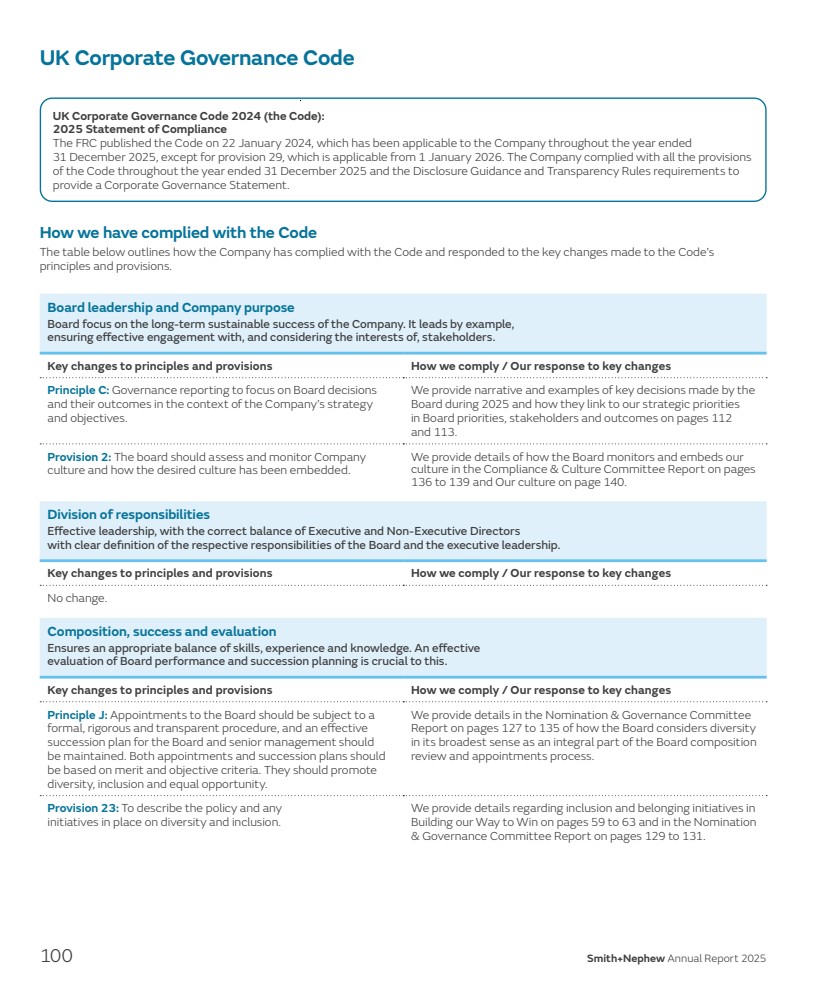
| US corporate governance rules compliance The Company’s American Depositary Shares and bonds are listed on the New York Stock Exchange (NYSE), and, as a foreign private issuer, we are therefore subject to the rules of the NYSE, as well as to US securities laws and the rules of the Securities and Exchange Commission (SEC) applicable to foreign private issuers. We comply with the requirements of the NYSE and SEC and have no significant differences to report between the US and UK corporate governance standards. Audit, risk and internal control With the oversight of the Board, the Audit Committee oversees the independence and effectiveness of internal and external audit functions, satisfies itself on the integrity of financial and narrative statements, and reviews the effectiveness of processes to manage risk and internal control. Key changes to principles and provisions How we comply / Our response to key changes Principle O: The Board to be responsible for maintaining the effectiveness of risk management and the internal control framework. We provide details in the Risk report on pages 78 to 96 of how the Board maintains the effectiveness of the risk management and internal control framework. Provision 29: To describe how the Board has monitored and reviewed the effectiveness of the framework. A declaration of effectiveness of the material controls as at the balance sheet date. To describe any material controls that have not operated effectively as at the balance sheet date. In preparation for the requirements of Provision 29 becoming effective as at 31 December 2026, we provide details of the progress made to identify and define the Group’s material controls. See the Audit Committee Report on pages 141 to 146 for more information. Remuneration Aims to ensure that the executive team is appropriately and fairly incentivised, and aligned with long-term, sustainable strategic execution. We also monitor wider colleague remuneration across the business. Key changes to principles and provisions How we comply / Our response to key changes Provision 37 and 38: Director remuneration contracts/ agreements should include malus and clawback provisions. Describe the malus and clawback provisions, including the circumstances in which they could be used and whether they have been used in the last reporting period. We provide details of malus and clawback provisions in the Directors’ Remuneration Report on page 165. Smith+Nephew Annual Report 2025 101 STRATEGIC REPORT GOVERNANCE ACCOUNTS OTHER INFORMATION 13_SN_AR25_GovGlance_ChLtr_BoD_BoardLead_v136.indd 101 05/03/2026 18:05 |
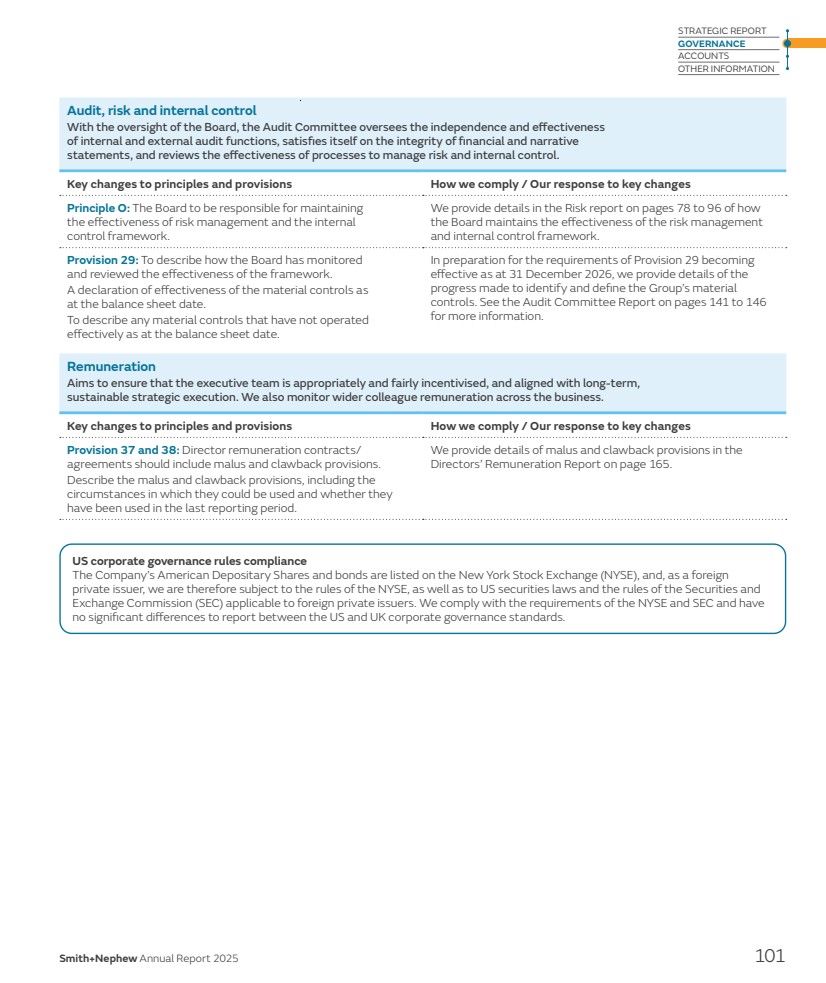
| Rupert Soames OBE Rupert Soames OBE Chair Appointed as an Independent Non-Executive Director in April 2023 and as Chair in September 2023. Key skills and competencies: Rupert has extensive global leadership experience, a proven track record of delivering shareholder value and a deep understanding of UK corporate governance. Current external appointments: Non-Executive Director of the Confederation of British Industry. Trustee of the Ditchley Foundation. Previous experience: Rupert stepped down in December 2022, after nine years as Group Chief Executive, from Serco Group plc, the specialist services business in Health, Defence, Transport and Immigration. Previously, he was Chief Executive Officer of Aggreko plc for 11 years, and prior to that Chief Executive of Misys plc’s Banking and Securities Division. Rupert completed his two-year term as Chair of the Confederation of British industry in December 2025. He was also Senior Independent Director and a member of the Audit, Remuneration and Nomination Committees for both DS Smith and Electrocomponents plc (now RS Group) from 2007 to 2016. Nationality: British N R Deepak Nath Chief Executive Officer Appointed Chief Executive Officer in April 2022. Key skills and competencies: Deepak brings global leadership and risk management expertise, and has a track record of driving growth at major healthcare companies through delivering a significant improvement in execution and building a strong results-focused culture. Current external appointments: Director of AdvaMed and Director of MDIC. Previous experience: Deepak began his career as a scientist in computational physics at Lawrence Livermore National Laboratory and holds a BSc and MSc in Mechanical Engineering and a PhD in Theoretical Mechanics from the University of California, Berkeley. Prior to joining Siemens Healthineers, he held roles at both Amgen and McKinsey and spent 10 years at Abbott Laboratories, Inc. culminating in his appointment as President of Abbott Vascular. At Siemens Healthineers (2018–2022), he was President of the Diagnostics business responsible for $6 billion of revenue and 15,000 employees. Nationality: American Deepak Nath Board and Committee Key A Member of the Audit Committee R Member of the Remuneration Committee N Member of the Nomination & Governance Committee C Member of the Compliance & Culture Committee Committee Chair 102 Smith+Nephew Annual Report 2025 Board of Directors Board leadership and company purpose 13_SN_AR25_GovGlance_ChLtr_BoD_BoardLead_v136.indd 102 05/03/2026 18:05 |
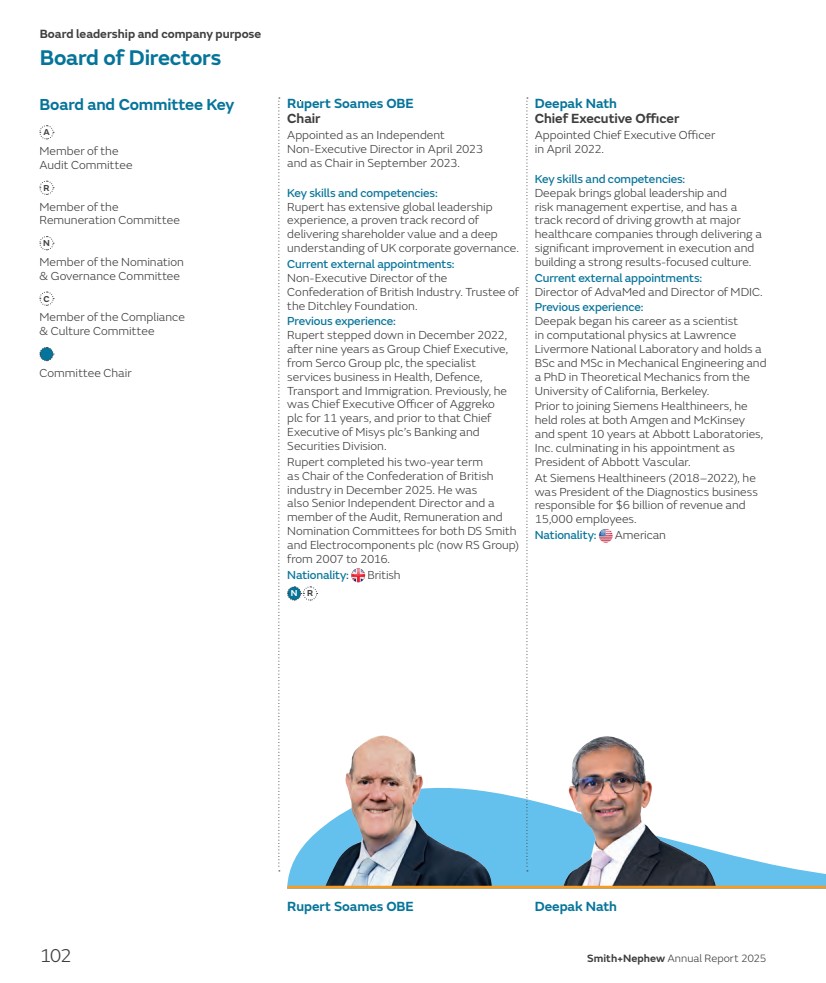
| Angie Risley Senior Independent Director Appointed Independent Non-Executive Director in September 2017, and Senior Independent Director in October 2024. Key skills and competencies: Angie has held both executive and non-executive roles in a wide range of sectors, including a regulated environment, ensuring she is well placed to fulfil her obligations as Senior Independent Director. This diversity of experience is welcomed by the Board and the Remuneration Committee. Angie is also an additional resource and sounding board for Smith+Nephew’s own internal Human Resources function. Current external appointments: Non-Executive Director, Chair of the Remuneration Committee and member of the Responsible Business and Nominations Committees at InterContinental Hotels Group plc. Previous experience: From 2007 to 2013, Angie was the Group HR Director for Lloyds Banking Group and was Group HR Director of J Sainsbury plc, and a member of their Operating Board from January 2013 to May 2023. Over the years, Angie has been a member of the Low Pay Commission and has held a number of Non-Executive Directorships with Biffa plc, Arriva and Serco Group plc. At Serco Group plc, she was the Chair of the Remuneration Committee. Previously, she attended the Remuneration Committees of Whitbread plc and Lloyds Bank. Nationality: British N R Angie Risley John Rogers Chief Financial Officer Appointed Chief Financial Officer in April 2024. Key skills and competencies: John has extensive financial and commercial leadership experience across a range of sectors and on a global basis, as well as a track record of delivering complex international transformation programmes. Current external appointments: Non-Executive Director of Grab Holdings Limited. Previous experience: John has served as the Chief Financial Officer at WPP plc, where he successfully led the implementation of their global transformation programme. Prior to this, he served as Chief Executive Officer of Argos, Habitat and Sainsbury’s clothing and general merchandise businesses, and as Chief Financial Officer at J Sainsbury plc. John also acted as Chair of the Audit Committee for Travis Perkins. Nationality: British John Rogers Thérèse Esperdy Independent Non-Executive Director Appointed Independent Non-Executive Director and Senior Independent Director designate from December 2025. Key skills and competencies: Thérèse has significant experience across financial services with deep knowledge of banking and business. She is an experienced board member of international corporates, with valuable experience in highly regulated industries. Current external appointments: Non-executive Chair of Imperial Brands plc and Non-Executive Director of Moody’s Corporation. Previous experience: Thérèse was previously senior independent director of National Grid plc. In her executive career at JP Morgan, Thérèse was global chair of their Financial Institutions Group, co-head of Asia-Pacific Corporate & Investment Banking and global head of Debt Capital Markets. She began her career at Lehman Brothers and joined Chase Securities in 1997 prior to the firm’s merger with JP Morgan in 2000. Nationality: American N R Thérèse Esperdy Smith+Nephew Annual Report 2025 103 STRATEGIC REPORT GOVERNANCE ACCOUNTS OTHER INFORMATION 13_SN_AR25_GovGlance_ChLtr_BoD_BoardLead_v136.indd 103 05/03/2026 18:05 |

| Jo Hallas Independent Non-Executive Director Appointed Independent Non-Executive Director in February 2022. Key skills and competencies: Jo has extensive international experience focused on business transformation through both organic and acquisitive growth in global industrial and consumer sectors. She brings valuable expertise, which will help Smith+Nephew build upon and achieve our strategic ambitions. Current external appointments: None. Previous experience: Jo commenced her career at Procter & Gamble based in Germany, the US, Thailand and the Netherlands. She then joined Bosch, where she held a business unit leadership role in their Power Tools division, followed by Invensys in 2009, where she ran their global heating controls business unit, including launching its first smart home offer. She then moved to Spectris plc, where she had responsibility for a portfolio of global industrial technology businesses, as well as for the Group’s digital strategy. From April 2019 to April 2023, Jo served as Chief Executive Officer for Tyman plc, where she made sustainability a core foundation of the group’s strategy. Jo was also previously Chair of the Remuneration Committee for Norcros plc. Nationality: British A C Garheng Kong Independent Non-Executive Director Appointed Independent Non-Executive Director in September 2025. Key skills and competencies: Garheng has significant experience in the healthcare and biopharma sectors and has extensive investment, clinical and technical experience, having served in both executive and non-executive roles helping to create and build high-growth and innovation-based healthcare businesses. Garheng is also a medical doctor with a PhD. Current external appointments: Managing partner and co-founder of HealthQuest Capital, a healthcare venture growth fund. Lead independent Director of Laboratory Corporation of America (LabCorp) and Non-Executive Director of Xeris Biopharma Holdings Inc, Lunit Inc and IKS Health. Previous experience: Garheng was previously managing general partner of Sofinnova Investments, Inc and general partner at Intersouth Partners. He served as a Non-Executive Director of Venus Concept, Inc, Alimera Sciences and Avedro, Inc and as chair of Histogenics Corporation. Garheng’s early career included positions at GlaxoSmithKline, McKinsey and TherOx before he started his investing career. Nationality: American A Garheng Kong David King Independent Non-Executive Director Appointed Independent Non-Executive Director in July 2025. Key skills and competencies: David has extensive experience in the healthcare and life sciences sectors in executive and non-executive roles, helping to transform and grow businesses in the US and globally. Current external appointments: Executive Chair of Fortis Life Sciences. He also serves as a Chair or Non-Executive Director on the boards of several healthcare companies, including Privia Health, LGC and AmSurg Corporation. David is Non-Executive Chair at PathGroup. Previous experience: David recently served as a Chair or Non-Executive Director on the boards of ZimVie (2022–2025) and VaxCare (2021–2025). Prior to that he served as Executive Chair and CEO for Laboratory Corporation of America (LabCorp) from 2007 to 2019, where he helped transform LabCorp from a pure-play US testing laboratory into a leading global life sciences company and tripled its size through a combination of organic growth and strategic acquisitions. Before joining LabCorp, David was a partner at Hogan & Hartson LLP (now Hogan Lovells) where he was a key leader in the firm’s healthcare fraud and abuse practice, representing national healthcare companies in investigations and litigation. David was previously the Chair of Health Channels and CEO of Fortis Life Sciences. Nationality: American C R Jo Hallas David King 104 Smith+Nephew Annual Report 2025 Board of Directors continued Board leadership and company purpose continued 13_SN_AR25_GovGlance_ChLtr_BoD_BoardLead_v136.indd 104 05/03/2026 18:05 |

| John Ma Independent Non-Executive Director Appointed Independent Non-Executive Director in February 2021. Key skills and competencies: John has an impressive track record in medical device businesses and his contribution provides value as Smith+Nephew continues to develop innovative ways to grow and serve our markets with a focus towards Asia Pacific regions. He is an established healthcare leader and has strong experience of driving market entry and growth within Emerging Markets. Current external appointments: Founder, Chair and Chief Executive of Ronovo Surgical. Previous experience: In 2000, John joined GE Healthcare and became Vice President and General Manager of their Global Product Company in China. John has also held a number of senior positions as President of Asia Pacific regions at Pentair Inc., Vice President of Express Scripts Inc., and Global Partner of Fosun Group. He initially joined Fosun Pharma to lead their medical device business and in 2014 became President of Fosun Healthcare Holdings. He served as a key member of their healthcare investment committee which went on to establish a global presence across the US, Europe, Israel and China. In 2017, John joined Intuitive Surgical as their Senior Vice President of Strategic Growth Initiatives. He has previously served as a Non-Executive Director for both Haier Electronics Group and Clinical Innovations LLC. Nationality: American C John Ma Simon Lowth Independent Non-Executive Director Appointed as Independent Non-Executive Director in January 2024. Key skills and competencies: Simon has extensive experience in finance, accounting, risk, corporate strategy, as well as mergers and acquisitions, and brings a wealth of expertise across a wide range of sectors, including within regulated industries. Having served as the CFO in four FTSE 100 companies, he has deep experience of capital markets, implementing strategic change, cost transformation and performance improvement programmes as well as understanding how technology can be used to transform a business. Current external appointments: Group Chief Financial Officer of BT Group. Previous experience: Simon was previously Group Chief Financial Officer at BG Group, AstraZeneca and Scottish Power. Before joining Scottish Power, he led the Industrial Practice of McKinsey in the UK. He previously served as a Non-Executive Director on the Board of Standard Chartered. Nationality: British A N Simon Lowth Jez Maiden Independent Non-Executive Director Appointed Independent Non-Executive Director and as a member of the Audit and Remuneration Committees in September 2023. Appointed Chair of the Audit Committee in March 2024. Key skills and competencies: Jez has extensive financial experience across a diverse range of industries and sectors. Jez brings more than 25 years of global experience both as a FTSE Chief Financial Officer and as a Non-Executive Director on boards of companies, addressing strategic and operational challenges across a number of different industries, including life sciences and healthcare. He has had oversight of large operations in the US, Europe and Asia in highly regulated industries. Current external appointments: Senior Independent Director and Interim Chair of the Remuneration Committee at Travis Perkins plc. Non-Executive Director and member of the Audit Committee at Intertek Group plc. Previous experience: Jez retired in 2023 as Group Finance Director at Croda International plc, the FTSE 100 global speciality chemicals company, and previously held similar roles at National Express Group plc and Northern Foods plc. He has served as the Senior Independent Director at Synthomer PLC, and at both PZ Cussons plc and Synthomer PLC he chaired the Audit Committee and served on the Remuneration Committee. He is a fellow of the Chartered Institute of Management Accountants. Nationality: British A R Jez Maiden Smith+Nephew Annual Report 2025 105 STRATEGIC REPORT GOVERNANCE ACCOUNTS OTHER INFORMATION 13_SN_AR25_GovGlance_ChLtr_BoD_BoardLead_v136.indd 105 05/03/2026 18:05 |

| Katarzyna Mazur-Hofsaess Independent Non-Executive Director Appointed Independent Non-Executive Director in November 2020. Key skills and competencies: Katarzyna demonstrates a true passion for customer focus and maintains an impressive track record in senior leadership within the MedTech industry. She is a qualified medical doctor (PhD) and has a wealth of experience in the medical devices and orthopaedic sectors. Her experience as Chief Executive Officer of a global company and valuable industry knowledge will help drive innovation and ensure the continued development of Smith+Nephew. Current external appointments: Trustee at Global Clubfoot Initiative, a UK- based charity. Previous experience: Katarzyna commenced her corporate career at Roche in Poland, was later recruited by Abbott Laboratories to manage their diabetes care division in Poland and became Country General Manager. Her career progressed to General Manager of Molecular Diagnostics Division for EMEA and eventually to Divisional Vice President Abbott Diagnostics for Europe. In 2010, she became President EMEA region at Zimmer, following the Biomet acquisition, and led the integration in the region and served as President EMEA for Zimmer Biomet, leading the orthopaedic company. In 2018, she joined Fresenius Medical Care, the renal company, as CEO EMEA and Member of the Management Board. Katarzyna Mazur-Hofsaess Marc Owen Independent Non-Executive Director Appointed Independent Non-Executive Director in October 2017 and held the role of Senior Independent Director from September 2022 to September 2024. Key skills and competencies: Marc is a proven leader with an astute strategic vision, capable of building significant international healthcare businesses. He has strong commercial healthcare expertise. Marc is responsible for ESG through his role as Chair of the Compliance & Culture Committee (CCC). Current external appointments: None. Previous experience: Marc commenced his healthcare and technology career at McKinsey & Company, where he progressed to senior partner and eventually became a founding partner of McKinsey’s Business Technology Office. In 2001, Marc joined McKesson Corporation and served as Executive Vice President and member of their Executive Committee. He delivered strategic objectives and led over 40 acquisitions and divestments over a 10-year period. In late 2011, he headed McKesson Specialty Health, which operates over 130 cancer centres across the US and provides market intelligence, supply chain services, patient access to therapy, provider and patient engagement and clinical trial support. In 2014, he was appointed Chair of the European Management Board at Celesio AG. He retired in March 2017, once he had improved operations, set the strategy and recruited his successor. Nationality: British/American A C N R Marc Owen Effective January 2022, Katarzyna took over responsibility for the globally operating Care Enablement segment in which Fresenius Medical Care AG has consolidated its €5.5 billion healthcare products business into one MedTech organisation. Her responsibility includes research and development, quality and regulatory, manufacturing, supply chain and commercial operations. From 31 December 2025, Katarzyna stepped down from her role as Chief Executive Officer, Care Enablement (MedTech segment), at Fresenius Medical Care AG and a member of the Management Board. Nationality: German/Polish C 106 Smith+Nephew Annual Report 2025 Board leadership and company purpose continued Board of Directors continued 13_SN_AR25_GovGlance_ChLtr_BoD_BoardLead_v136.indd 106 05/03/2026 18:05 |
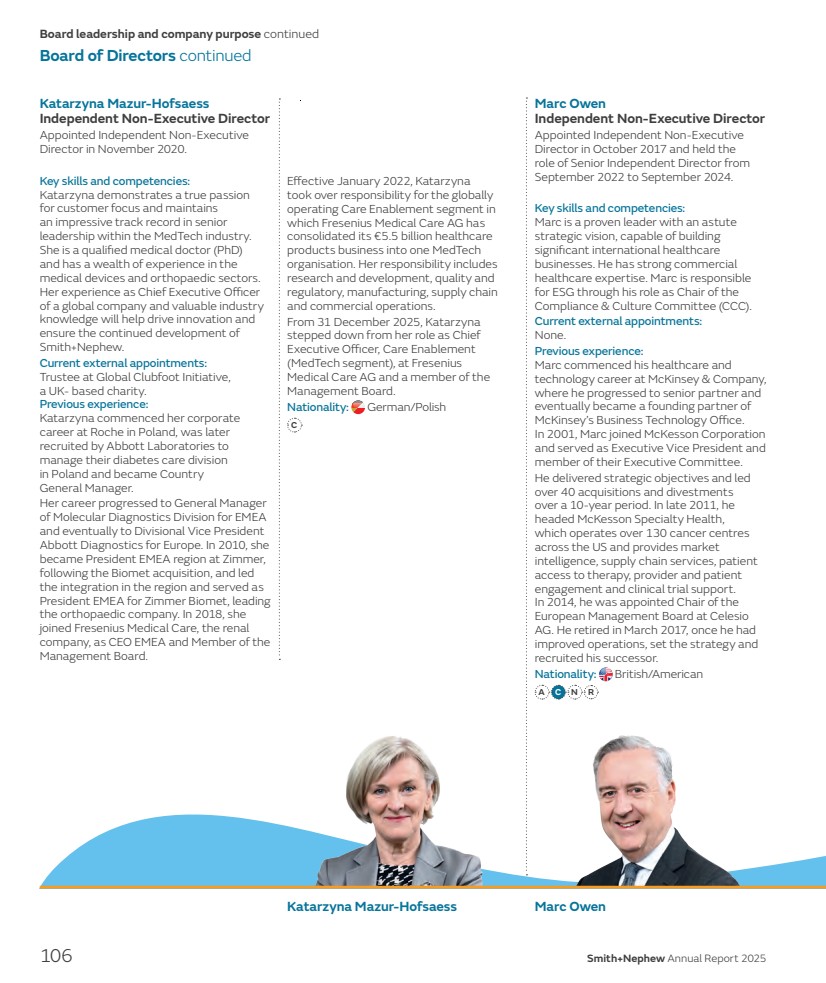
| Sybella Stanley Independent Non-Executive Director Appointed Independent Non-Executive Director in February 2025. Chair of the Remuneration Committee from 30 June 2025. Key skills and competencies: Sybella brings broad international executive and non-executive experience of culturally diverse multinational organisations and interactions with the London Investment Community. Current external appointments: Director of Corporate Finance at RELX Group, the global provider of information and analytics, and Co-Chair of the Development Board of Somerville College, Oxford. Previous experience: Sybella retired in December 2024 from the Board of Tate & Lyle plc, where she served for nine years as an Independent Non-Executive Director and was Chair of the Remuneration Committee. She served for nine years as an Independent Non-Executive Director of Merchants Trust PLC and as Senior Independent Director and Chair of the Remuneration Committee until her retirement in March 2024. She was a member of the Industrial Development Advisory Board of the Department for Business, Energy & Industrial Strategy for eight years. Sybella qualified as a barrister and, before joining RELX Group, she was a member of the M&A advisory teams at Baring Brothers and Citigroup. Nationality: British R Sybella Stanley Helen Barraclough Group General Counsel and Company Secretary Appointed Company Secretary in April 2022. Key skills and competencies: Helen is a qualified Solicitor admitted in England & Wales and a Chartered Governance Professional. She also serves as the Chief Risk Officer for Smith+Nephew. Previous experience: Helen started her career with Allen & Overy LLP and, prior to joining Smith+Nephew, held senior legal roles at WPP plc and Nomura International plc. Nationality: British Helen Barraclough Board members whose tenure ceased during the year Bob White stepped down from the Board on 30 April 2025 prior to taking an executive role at Olympus Corporation. Smith+Nephew Annual Report 2025 107 STRATEGIC REPORT GOVERNANCE ACCOUNTS OTHER INFORMATION 13_SN_AR25_GovGlance_ChLtr_BoD_BoardLead_v136.indd 107 05/03/2026 18:05 |
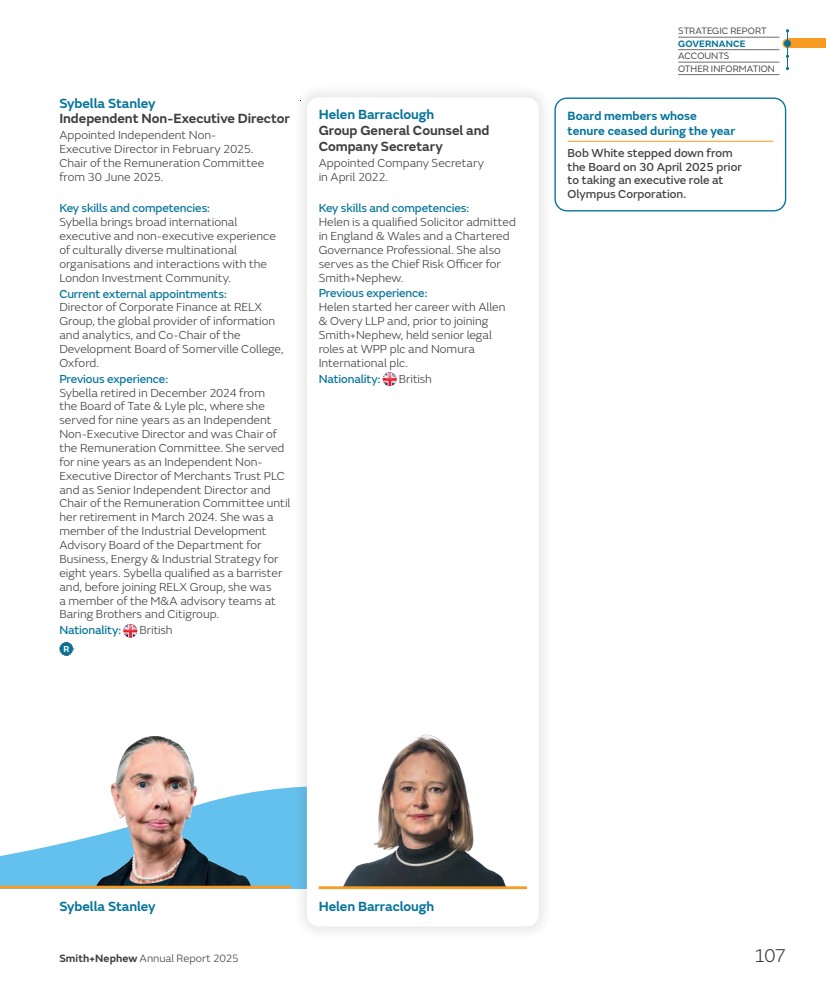
| Rohit Kashyap Scott Schaffner Craig Gaffin President Orthopaedics Craig has held numerous commercial leadership roles over the past 25 years with leading Medical Device and Biotechnology companies, such as Stryker and Amgen. Craig has led through progressive complexity, challenge and scale across sales and marketing in both start-up and established organisations. Craig is a graduate of the University of Vermont and the Olin School of Business at Washington University in St. Louis. Nationality: American Location: Memphis, US Rohit Kashyap President Advanced Wound Management and Global Commercial Operations Rohit brings more than 20 years’ experience across wound care, surgical management, business development and global commercial leadership. Prior to joining Smith+Nephew, Rohit worked at Acelity, a global advanced wound care company, most recently as President, Global Commercial and at MIMEDX as President of the Wound and Surgical business and as Chief Commercial Officer. Nationality: American Location: Fort Worth, US Vasant Padmanabhan President Research & Development, ENT and Emerging Markets Vasant has over 25 years of global MedTech leadership experience. Prior to Smith+Nephew, Vasant held senior roles at Thoratec Corporation and Medtronic plc as Vice President of Connected Care R&D and Operations and Vice President of Product Development for the Implantable Defibrillator business. Nationality: American Location: Andover, US Scott Schaffner President Sports Medicine Scott has more than 30 years’ experience across the medical device industry, including cardiac rhythm management, neuromodulation, spine and sports medicine. Prior to moving into his current role, Scott served as Executive Vice President, Global Marketing and US Commercial, Sports Medicine, Senior Vice President, Global Marketing, Sports Medicine and Vice President, Sports Medicine. Nationality: American Location: Austin, US The CEO, with support from the CFO, leads the Executive Committee of Smith+Nephew, which is responsible for the day-to-day operational management of the Group and executing its strategy. Craig Gaffin Vasant Padmanabhan 108 Smith+Nephew Annual Report 2025 Board leadership and company purpose continued Executive Committee 13_SN_AR25_GovGlance_ChLtr_BoD_BoardLead_v136.indd 108 05/03/2026 18:05 |
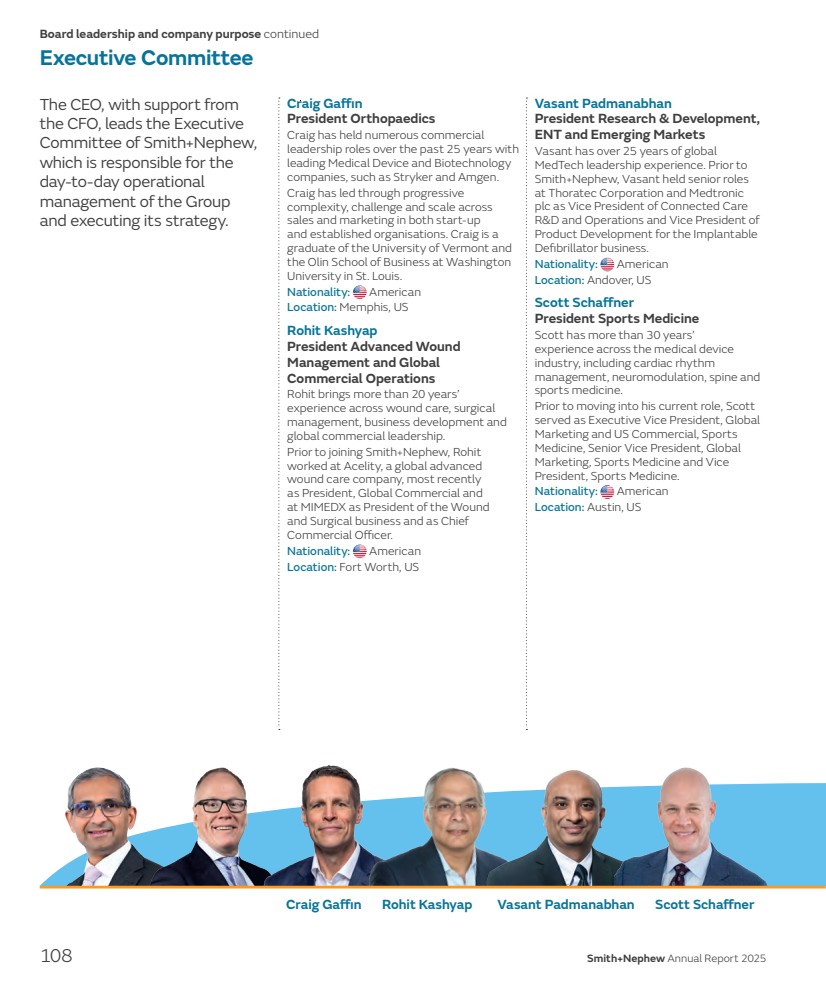
| Helen Barraclough Paul Connolly Mizanu Kebede Alison Parkes Helen Barraclough Group General Counsel and Company Secretary Prior to joining Smith+Nephew, Helen started her career at Allen & Overy LLP, and held senior roles at WPP plc and Nomura International plc. She is a qualified solicitor admitted in England & Wales and a Chartered Governance Professional. She also serves as the Chief Risk Officer for Smith+Nephew. Nationality: British Location: Watford, UK Paul Connolly President Global Operations Paul brings more than 30 years of global manufacturing and supply chain experience at multinational companies, with a strong track record in delivering operational excellence and transformation programmes. Prior to joining Smith+Nephew, Paul held senior roles at Goodyear, DePuy, Inc., and other Johnson & Johnson family companies. Nationality: American/Irish Location: Andover, US Ajay Dhankhar Chief Strategy & Corporate Development Officer, with additional responsibility for Corporate Branding and External Communications Ajay has been a highly trusted strategic adviser and investment banker to CEOs and Boards at some of the world’s leading healthcare companies over the past ~30 years and has global experience in helping companies deliver industry-leading shareholder value. Prior to joining Smith+Nephew, Ajay was Senior Partner at McKinsey for 25 years and held various leadership roles, including Global Head of Strategy across all industries. More recently, he served as Managing Director and Global Head of Medical Technology, Diagnostics and Tools at Lazard, where he led multiple high-impact transactions. Ajay was also founder and Managing Director of Bluish Capital, a novel private equity and M&A advisory firm. Ajay holds both a master’s degree and a doctorate in Molecular Biophysics and Biochemistry from Yale University. Nationality: American Location: Fort Worth, US Mizanu Kebede Chief Quality & Regulatory Affairs Officer Mizanu brings more than 25 years of leadership experience in Quality and Regulatory Affairs. Prior to Smith+Nephew, Mizanu held senior roles at Avanos Medical, Life Technologies SETRIS Corporation and Johnson & Johnson family companies. Nationality: American Location: Georgia, US Ajay Dhankhar Elga Lohler Elga Lohler Chief HR Officer Prior to joining Smith+Nephew, Elga held Human Resources roles at Transnet SOC Ltd, Sensormatic (now Tyco International plc) and Advanced Tissue Sciences, Inc. (acquired by Smith+Nephew in 2002). Nationality: American/South African Location: Fort Worth, US Alison Parkes Chief Compliance Officer Prior to moving into her current role, Alison served in multiple roles across the Company, including as the Compliance Officer for the Global Advanced Wound Management business, as the Compliance Leader for APAC and Emerging Markets, and establishing and leading the Global Compliance Programme Effectiveness & Improvement Team. Nationality: British Location: Hull, UK Members who stepped down from the Executive Committee during the year Phil Cowdy retired on 31 May 2025. Smith+Nephew Annual Report 2025 109 STRATEGIC REPORT GOVERNANCE ACCOUNTS OTHER INFORMATION 13_SN_AR25_GovGlance_ChLtr_BoD_BoardLead_v136.indd 109 05/03/2026 18:05 |
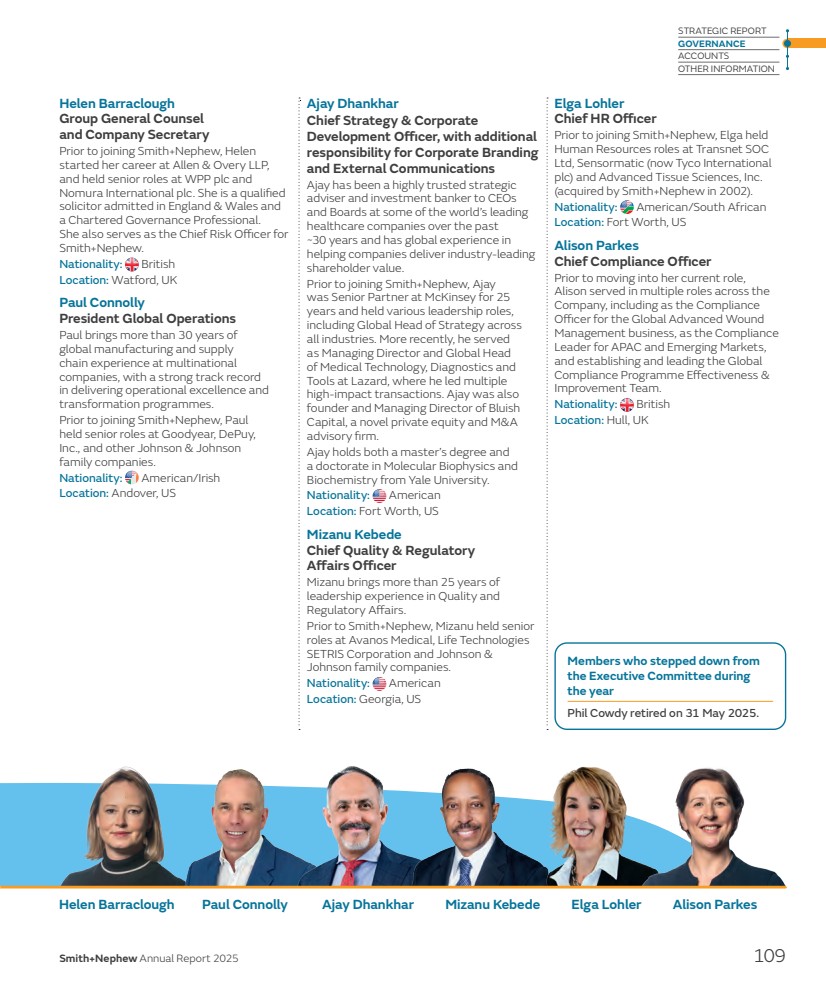
| Board and Committee attendance During 2025 there were seven scheduled Board meetings Total meetings Board Nomination & Governance Compliance & Culture Audit Remuneration Attendees Appointed Committee membership 7 5 4 7 9 Rupert Soames April 2023 N R 7/7 5/5 N/A N/A 9/9 Deepak Nath April 2022 7/7 N/A N/A N/A N/A John Rogers April 2024 7/7 N/A N/A N/A N/A Angie Risley1 September 2017 N R 6/7 5/5 N/A N/A 9/9 Jo Hallas February 2022 A C 7/7 N/A 4/4 7/7 N/A David King2 July 2025 C R 4/4 N/A 2/2 N/A 3/3 Garheng Kong3 September 2025 A 3/3 N/A N/A 3/3 N/A Simon Lowth January 2024 A N 7/7 5/5 N/A 7/7 N/A John Ma February 2021 C 7/7 N/A 4/4 N/A N/A Jez Maiden September 2023 A R 7/7 N/A N/A 7/7 9/9 Katarzyna Mazur-Hofsaess November 2020 C 7/7 N/A 4/4 N/A N/A Marc Owen October 2017 A C N R 7/7 5/5 4/4 7/7 3/3 Sybella Stanley4 February 2025 R 7/7 N/A N/A N/A 9/9 Thérèse Esperdy5 December 2025 N R 1/1 1/1 N/A N/A 1/1 Bob White6 May 2020 C R 2/2 N/A 2/2 N/A 2/3 1 Angie Risley stepped down as Chair of the Remuneration Committee on 30 June 2025 and did not attend the November Board meeting due to a prior professional commitment. She provided her comments to the Chair prior to the meeting. 2 David King was appointed to the Board and became a member of the Compliance & Culture and the Remuneration Committees on 1 July 2025. 3 Garheng Kong was appointed to the Board and became a member of the Audit Committee on 1 September 2025. 4 Sybella Stanley was appointed to the Board and became a member of the Remuneration Committee on 1 February 2025 and became Chair of the Remuneration Committee on 30 June 2025. 5 Thérèse Esperdy was appointed to the Board and became a member of the Nomination and Governance Committee and Remuneration Committee on 1 December 2025. 6 Bob White stepped down from the Board on 30 April 2025 and did not attend the March Remuneration Committee meeting due to a prior professional commitment. He provided his comments to the Committee Chair in advance of the meeting. Committee key A R N C Member of the Audit Committee Member of the Remuneration Committee Member of the Nomination & Governance Committee Member of the Compliance & Culture Committee Committee Chair 99% Committee attendance 110 Smith+Nephew Annual Report 2025 Board and Committee attendance Board leadership and company purpose continued 14_SN_AR25_DivResp_Board_v88.indd 110 05/03/2026 17:53 |
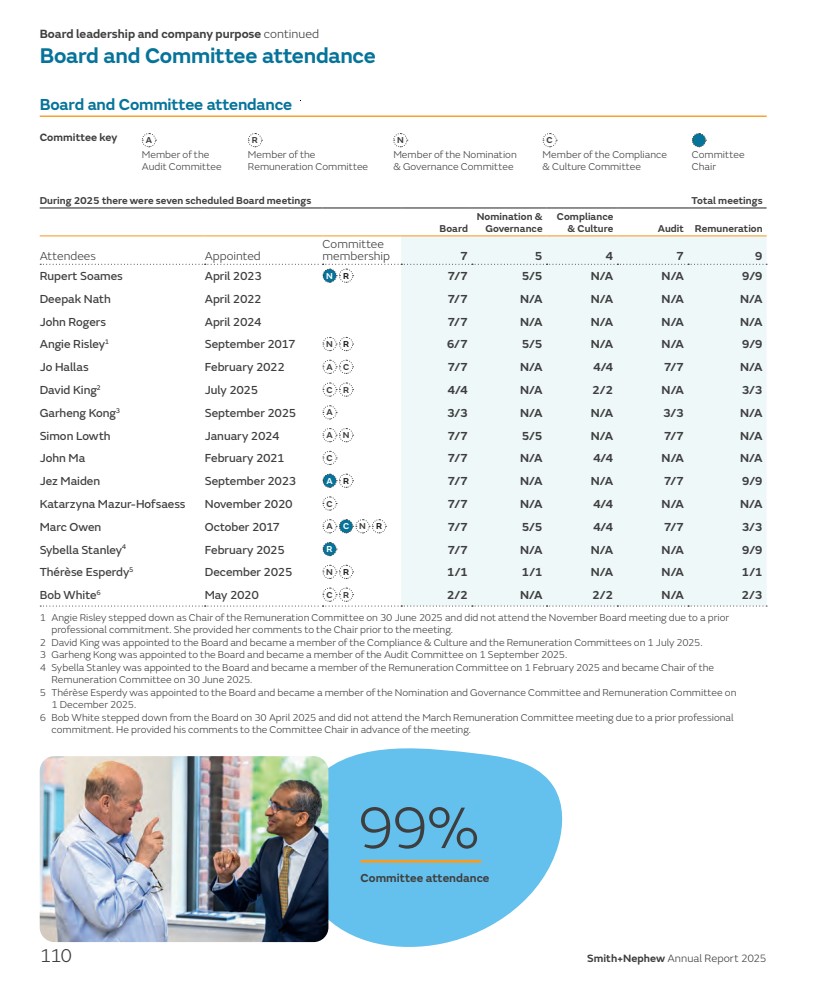
| The following pages provide an overview of the key topics reviewed, monitored, considered and debated by the Board in the year to 31 December 2025. Board and Committee members also have informal touchpoints, updates and calls throughout the year, as needed. Every full Board session includes: – A report from the CEO – Group finance report and outlook – A customised strategic and operational presentation from a business unit and/ or function(s) aligned to key topics of interest to the Board eg Global Operations, Tariffs, Cybersecurity, AI etc. – Updates from Committee Chairs on the most recent Committee meetings and areas of interest – A report from Legal and Governance – A report on investor relations – Feedback from Board members on any site visits they have attended – A closed session for the full Board followed by a Non-Executive Director closed-session discussion. Where Board meetings take place at the Croxley offices, a lunch in the office canteen is scheduled for Board members alongside Croxley employees. January Board Strategy Sub-Committee meeting, Chair meetings with investors February Board Strategy Sub-Committee meeting, Geopolitical Risk and Mapping Update (including Tariffs and horizon scanning), review of MedTech landscape with case studies, approval of Annual Report and Accounts and Sustainability Report; Annual Risk Review including approval of risk appetite, approval of full year results and dividend, Orthopaedics business review, including Ortho360 strategic presentation March Board Strategy Sub-Committee meeting, Site visit to India and Singapore by Chair April Board discussion on strategy and Business Continuity deep-dives, MedTech landscape case studies, ROIC and market rationalisation discussion, Annual General Meeting and investor touchpoints, funding and liquidity update, Q1 trading statement approval June Site visits to Costa Rica and Fort Worth with product demonstrations, Advanced Wound Management strategic overview and business update, review of innovation pipeline and talent, MedTech industry review, customer presentation on Ambulatory Surgical Centers (ASC), discussion on strategic direction of travel prior to September Strategy discussions July Sports Medicine and ENT deep-dive, Greater China strategic discussion, M&A review with new Chief Strategy and Corporate Development Officer, Digital Transformation, Cyber and AI updates, review of Global Business Shared Services, H1 trading statement approval, approval of interim dividend and share buy-back programme September Senior Independent Director presents internal Board Evaluation (questionnaire and interviews conducted July – September); Strategy and Five-Year Plan review, talent management strategy review, approval of Sustainability strategy November Q3 trading statement approval, further discussion on presentation of Strategy and Capital Markets Day Final approval of 2026 budget and final presentation of new RISE Strategy and Capital Markets Day presentations, investor sentiment discussion, closed session for Succession planning and people discussion, Emerging Markets business review, IT transformation and Cybersecurity update December Smith+Nephew Annual Report 2025 111 STRATEGIC REPORT GOVERNANCE ACCOUNTS OTHER INFORMATION Board activities 14_SN_AR25_DivResp_Board_v88.indd 111 05/03/2026 17:53 |
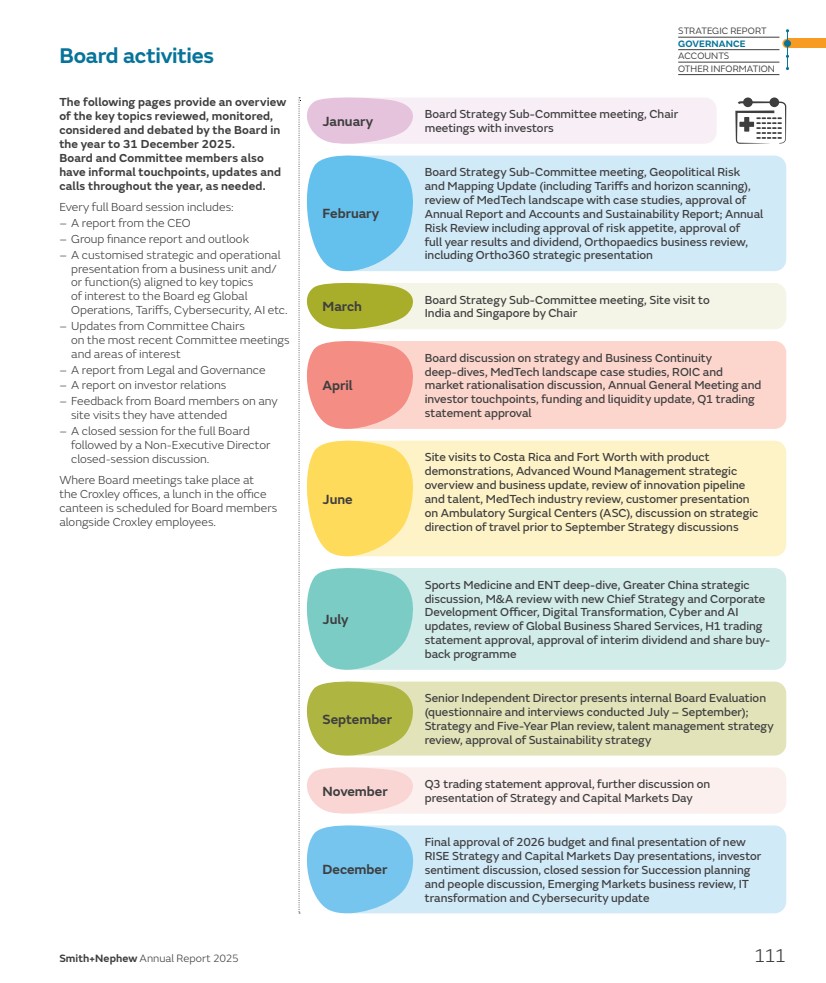
| Strategy and operational excellence Closure of 12 Point Plan and approval of RISE Strategy, embedding the ethos of continuous improvement and a high performance culture through flawless execution across all areas of the business 2025 activities and outcomes – Reviewing closure of 12-Point Plan and progress and performance against KPIs, strategy, budgets and business plans – Monitoring of Orthopaedics execution and metrics aligned to the 12-Point Plan and broader market developments, including portfolio preferences and shifts in site of care – Approving half-year, full-year and trading updates – Deep-dive sessions on Orthopaedics, Sports Medicine, Advanced Wound Management and ENT business units and Greater China and Emerging Markets regions, aligned to long-term strategic initiatives – Review of ROIC, portfolio and market optimisation aligned to strategy and performance objectives – Monitoring Global Operations updates and response to external and internal shifts in policy, regulation and social purpose in line with key metrics and deliverables. Areas of focus for 2026 – Review of implementation of RISE strategy to ensure alignment with Purpose, Culture and strategic objectives – Monitoring of implementation of Digital Transformation and AI strategy and roadmap – Continued monitoring of regulatory shifts within the industry and globally to understand impact on strategic objectives and the global organisation – Continued monitoring of Cybersecurity and other principal risks to the organisation. Purpose and culture Reviewing decision making in alignment with the purpose of Life Unlimited and culture pillars of Care, Courage and Collaboration 2025 activities and outcomes – Review and approval of RISE five-year strategy to ensure alignment to Life Unlimited and culture pillars – Approval of the Code of Conduct and Business Principles – Approval of sustainability strategy and review of climate-related disclosures and key performance metrics – Board listening sessions with wider workforce – Review of initiatives to support Culture, Workforce Planning and Performance and Rewards – Review of Gallup results, employee engagement and initiatives for the wider workforce in terms of Performance Culture, Rewards, Talent, Succession and Development – Review of initiatives to strengthen and embed a culture of inclusion and belonging throughout the Group, including receiving reports on engagement with employee interest groups at Board listening sessions – Overseeing succession planning at Board and senior management level and talent management strategy within the organisation. Areas of focus for 2026 – Monitoring implementation of RISE and critical enablers, together with culture of continuous improvement and the Way to Win – Continued monitoring of implementation of performance-based culture aligned with Life Unlimited, culture pillars and Code of Conduct – Continued focus on talent management strategy and succession planning. 1 2 3 4 5 1 2 3 4 5 Link to our strategic priorities Link to stakeholder groups People Investors Customers/Suppliers Governments/Regulators Environment/Communities 1 2 3 5 4 In 2025, the Board continued to focus on its stated priorities: 3 2 1 Our investor presentations are available to download on our website www.smith-nephew.com 1. Strengthen 2. Accelerate 3. Transform 112 Smith+Nephew Annual Report 2025 Board priorities, stakeholders and outcomes Board leadership and company purpose continued 14_SN_AR25_DivResp_Board_v88.indd 112 05/03/2026 17:53 |

| Capital allocation and cost management Ensuring efficient and effective use of Company resources and scrutiny of implementation of capital allocation 2025 activities and outcomes – Setting priorities for capital investment across the Group – Continuing to review structure and cost management activities against strategic plans including 12-Point Plan and zero-based budgeting (ZBB) initiatives in support of Group Strategy – Monitoring ROIC, cash and EPS key metrics to drive shareholder value creation. Approving annual budget, financial plan, three-year strategic plan – Approving major borrowings and finance and banking arrangements – Approving the $1 billion general corporate purposes bond issue which was used to repay private placements and drawn amounts under the RCF – Determining the dividend policy. Areas of focus for 2026 – Implementation of RISE strategy to deliver on capital allocation objectives outlined by management – Continued scrutiny of inventory levels, revaluation and impact of tariffs and other headwinds on delivery of strategic objectives. Innovation and portfolio Understanding the industry, competitor landscape and innovation pipeline and portfolio to drive value creation 2025 activities and outcomes – Review of portfolio aligned to strategy and performance of the business units – Review of innovation pipeline aligned to RISE strategy – Review of landscape and innovation within MedTech industry to provide insights into strategy – Receiving reports on progress in pipeline and commercial launches in 2025. Areas of focus for 2026 – Continued review of performance and return on investment of acquisitions and integration planning, with attention to opportunities that strengthen our differentiated platforms – Review of global innovation pipeline and product portfolio, with a focus on differentiation and delivery particularly in MedTech and Biologics, which are essential to advancing the Innovate and Reach pillars of the RISE strategy – Emphasis on scaling digital surgery, and biologic/regenerative solutions that enhance standard of care, drive customer value, and position the business for above market growth in priority segments. Risk management and oversight Evaluating strategy and decision making within risk appetite and ongoing review of the controls environment 2025 activities and outcomes – Overseeing the Group’s risk management programme and related processes – Review and approval of principal risks of the Group and adapting Board agenda to reflect these accordingly – Review of the risk registers, risk mapping exercises and annual review of the Board appetite for risk – Ongoing consideration of key risks within all Board discussions including AI and IT strategy and investment, cybersecurity and incident response, business continuity and disaster recovery and geopolitical events – Enhanced focus on geopolitical risk mapping and crisis management through updates on regulatory changes and BRCM planning – Discussion at Board and Committee meetings on key topics including regulatory and reimbursement changes, the impact of tariffs and supply chain disruption, global talent outlook and, MedTech landscape and trends – Review of investor perspectives and sentiment throughout the year – Review of Board and executive succession planning and changes to the composition of the Board and its Committees. Areas of focus for 2026 – Continued focus on regulatory, reimbursement and trade and other policy changes which may impact the achievement of strategic objectives – Continued focus on cyber resilience and risks and opportunities within digital transformation and AI strategy through embedding the culture of continuous improvement – First year of reporting on new Code reporting requirements and enhanced material controls framework. 1 2 3 4 5 1 2 3 4 5 1 2 3 4 5 Smith+Nephew Annual Report 2025 113 STRATEGIC REPORT GOVERNANCE ACCOUNTS OTHER INFORMATION 14_SN_AR25_DivResp_Board_v88.indd 113 05/03/2026 17:53 |
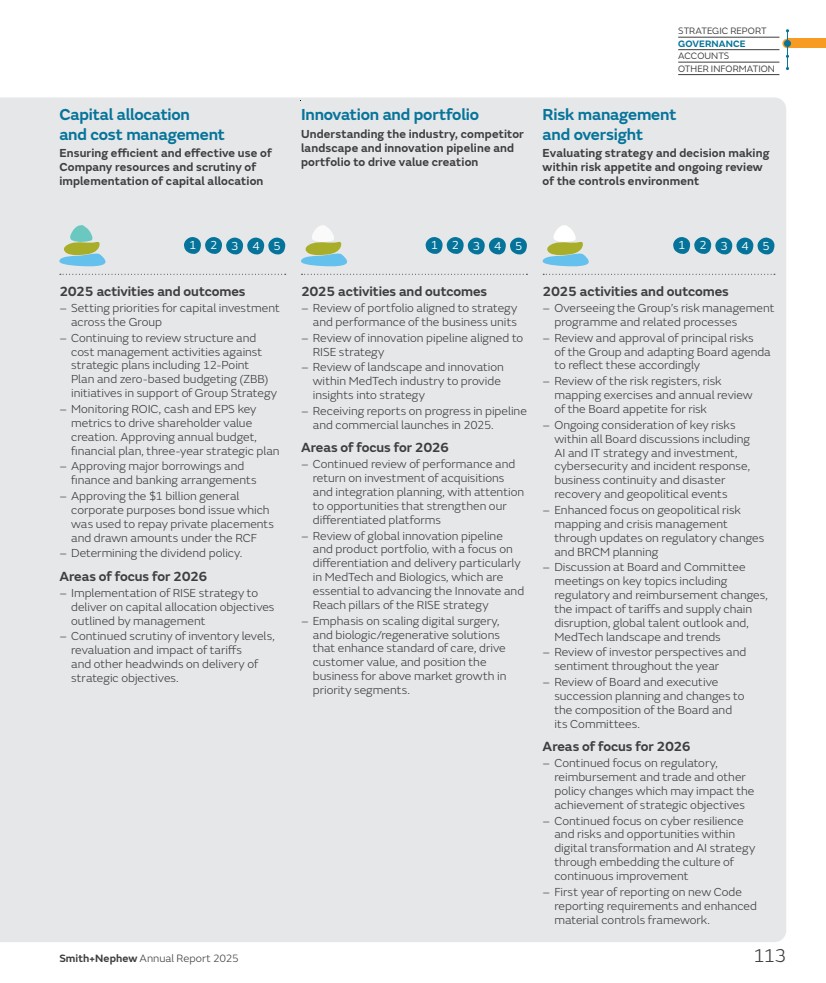
| Board members are required to promote the success of the Company for the benefit of our stakeholders, including customers, investors, employees, suppliers, regulators and our wider communities. Details of our engagement with our main stakeholder groups is set out on pages 117 to 123. This statement summarises how our Directors addressed the matters set out in section 172(1) (a) to (f) of the Companies Act 2006. The likely consequence of any decision in the long term Directors appreciate that assessing the consequences of their long-term decisions, particularly in the current political and geopolitical environment, is complex and often requires careful balancing of competing stakeholder interests. To support their decision making, Directors are provided with information that describes the long-term proposal under consideration and how it aligns with, or otherwise impacts, the Group’s strategy, budget and three-year plan as well as our purpose of Life Unlimited. Proposals for significant Board decisions include a potential stakeholder impact assessment covering employees, suppliers, customers, government, regulators, local communities, environment and investors. Matters considered by the Board include: – Achievement of strategic objectives aligned to Strategy and Purpose, which for 2025 aligned to the 12-Point Plan and which will be aligned to our RISE Strategy in 2026 – Global business unit reviews (Advanced Wound Management, Sports Medicine and ENT) aligned to 12-Point Plan in 2025, which will be aligned to our RISE Strategy in 2026 – Innovation pipeline and portfolio review, aligned to RISE in 2026 – Capital allocation priorities and dividend policy, aligned to RISE in 2026 – Sustainability strategy aligned to stakeholder interests and objectives – Succession planning and talent management to support organisational health – Consideration of these factors within our ERM framework and principal risks. For more details see our Business Model on pages 14 and 15 Interests of our people We are committed to cultivating a high-performing, inclusive workplace where everyone is valued and respected, and feels a true sense of belonging. We prioritise creating a psychologically safe environment that drives innovation, fuels business success, and enhances engagement and personal fulfilment. Our three pillars of Care, Courage and Collaboration are the foundations on which we build a robust, respectful and accountable culture. Papers relevant to the Directors’ assessment of how effectively this is being achieved are normally provided by the Chief HR Officer or Head of Reward to enable the Directors to monitor progress against priorities and provide input and challenge on proposed initiatives and actions being taken to assess the potential impacts on employees. Matters considered by our Board and its Committees include: – Alignment of Group strategy to our Purpose of Life Unlimited and cultural pillars of Care, Courage and Collaboration – Efficacy of the Code of Conduct and Business Principles and the impact on organisational culture – Board listening sessions with the wider workforce to hear the employee voice – The continued progress made on Gallup results and employee engagement – Initiatives to support talent attraction, retention and development and succession planning – Performance against health and safety metrics. For more information, see our Building our Way to Win section on pages 59 to 63 The impact of the Group’s operations on the community and our environment We recognise the need to reduce our impact on our planet. We implement initiatives to manage energy, waste and water efficiently and reduce our GHG where possible, and are mindful of the impact our decision have on the environment. Papers relevant to the Directors’ assessment of how effectively we are managing our impact on the community and environment are provided for input and challenge and decision or awareness by Directors. Matters considered by our Board and its Committees include: – Our people and culture strategy – Sustainability strategy – Consideration of sustainability within our ERM framework and principal risks – Evaluation and measurement of ESG performance against goals and metrics – ESG-related measures for executive remuneration plans – Emerging legislation which may have impact in these areas. For more information, see the ESG Report on pages 65 to 77 114 Smith+Nephew Annual Report 2025 S172 Statement Board leadership and company purpose continued 14_SN_AR25_DivResp_Board_v88.indd 114 05/03/2026 17:53 |
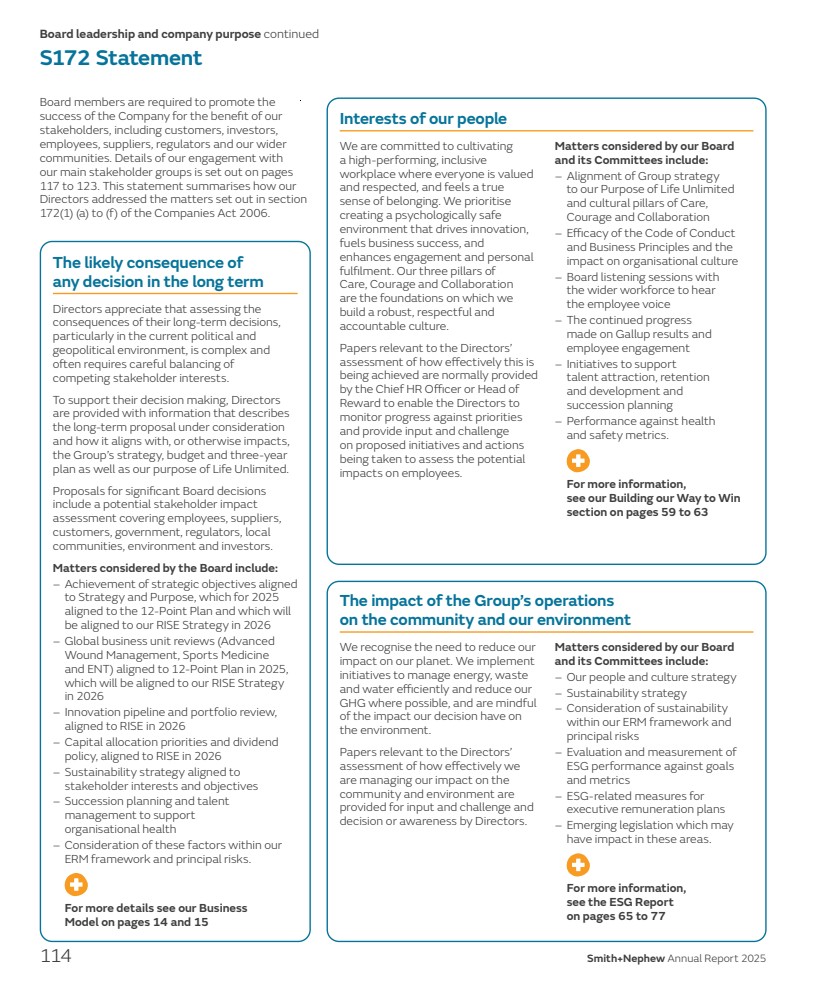
| The importance of developing the Group’s business relationships with suppliers, customers and others A key priority for Directors as custodians of a responsible business is to ensure the Company develops and maintains relationships with customers, suppliers and other stakeholders who support the Group’s purpose of Life Unlimited and the successful creation of value through achievement of its strategic objectives. Our suppliers are expected to adhere to our Third Party Code and do business in accordance with our Code of Conduct and Business Principles, and maintain corporate standards and behaviours consistent with our own. Papers relevant to the Directors’ assessment of how effectively these relationships are being managed are provided for input and challenge and decision or awareness. Matters considered by our Board and its Committees include: – Sustainability strategy – Quality audits and product governance – Third party guide to working with Smith+Nephew – Supply chain and procurement resilience and compliance – Modern Slavery Statements – Smith+Nephew Academy and medical education initiatives to support the safe and effective use of our products – Consideration of these factors within our ERM framework and principal risks. Our desire to maintain our reputation for high standards of business conduct Our strong culture pillars of Care, Courage and Collaboration promote good governance across our business and are crucial to fostering an environment of doing business the right way. Directors have a commitment to doing business ethically, with integrity, honesty and professionalism. Papers relevant to the Directors’ assessment of how effectively we are maintaining our high standards of business conduct are provided for input and challenge, and decision or awareness. Matters considered by our Board and its Committees include: – Code of Conduct and Business Principles – Ethics and compliance programmes – Global data privacy compliance – Corporate governance framework – ERM framework and risk management, controls and compliance – Whistleblower policies, investigations and effectiveness review – Anti-bribery and corruption policy. For more information, see ‘How we are governed’ on pages 125 and 126 our Risk Report on pages 78 to 94 and the Compliance & Culture Committee Report on pages 136 to 139 Our aim to act fairly between members of the Group Directors seek to act fairly in the interests of all shareholders. It is acknowledged that shareholders often have differing views and opinions and Directors seek to weigh up the range of opinions to arrive at decisions that promote the long-term success of the Group. There is an extensive investor engagement programme throughout the year, including our Capital Markets Day events in London and New York in December 2025. Retail shareholders have access to Directors at the AGMs, as well as through our InvestorRelations.Global@ smith-nephew. com email. Papers relevant to this duty are provided for input and challenge, and decision or awareness. Matters considered by our Board and its Committees include: – Annual General Meeting – Capital Markets Day and other events – Group and individual shareholder meetings – Board discussions on investor sentiment and feedback – Investor relations reports and planning. For more information, see Our shareholders on page 119 Smith+Nephew Annual Report 2025 115 STRATEGIC REPORT GOVERNANCE ACCOUNTS OTHER INFORMATION 14_SN_AR25_DivResp_Board_v88.indd 115 05/03/2026 17:53 |
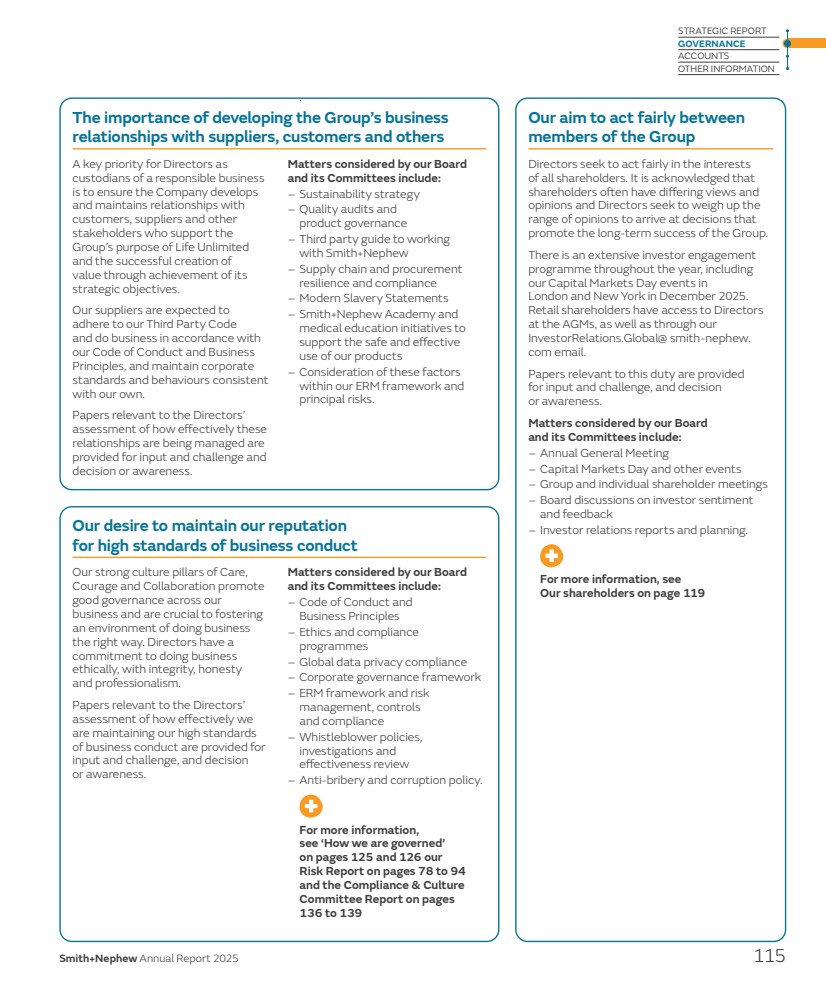
| When making decisions, the Board supports the Company’s objective of working to improve the quality of healthcare through investment in new technologies and services, industry-leading medical education and evidence programmes, and efficient and resilient manufacturing and distribution, while balancing the interests of all of our stakeholders. Examples of how stakeholder interests are taken into account in Board decision making include: Decision How stakeholder interests were taken into account Stakeholder groups Development of our RISE Strategy A number of discussions on direction of travel in development of the new strategy were discussed in detail at full Board and also with individual Board members in the creation of RISE; the key strategic elements of reaching more patients, innovating to meet unmet needs, scaling investment in high impact areas and continued focus on execution were ones that resonated with key stakeholders groups to form part of the RISE Strategy, which was announced in December 2025. Investors, patients, customers, employees, communities Investment in innovation Directors review the product development pipeline and approve annual investment in R&D through budget allocation review. New product development is driven by observation and engagement with customers to identify unmet clinical needs. Our product development follows a vigorous phase-gate process to ensure that the product meets the needs of customers, will contribute to Smith+Nephew’s continued ambition to be a higher-growth business, and integrates sustainability principles into design and packaging. Patients, customers, investors Digital Transformation and AI Our Board and its Committees continue to review and support the enhancement of our digital transformation strategy and implementation in order to ensure that the Company is both creating value through transformation and efficiency and effectively managing risk through monitoring of AI governance. These discussions are critical to strike the right balance to deliver value to customers through connected products and to employees and investors through enhanced efficiencies while ensuring appropriate safeguards are in place for customers, employees, investors and regulators to support data and information security and manage AI risks. Patients, customers, suppliers, employees, regulators, investors Cybersecurity Our Board and its Committees continue to review and support the enhancement of the cybersecurity and information security strategy and implementation/risk reports in order to ensure that the Company is effectively managing risk, both in terms of the opportunities to enhance our governance and deliver value to our patients and customers through connected products and the risk management framework that the Company adopts and implements in order to develop a robust framework to protect the data and interests of our stakeholders. Patients, customers, suppliers, regulators, investors 116 Smith+Nephew Annual Report 2025 S172 Statement continued Board leadership and company purpose continued 15_SN_AR25_Stakeholders_v96.indd 116 05/03/2026 18:12 |
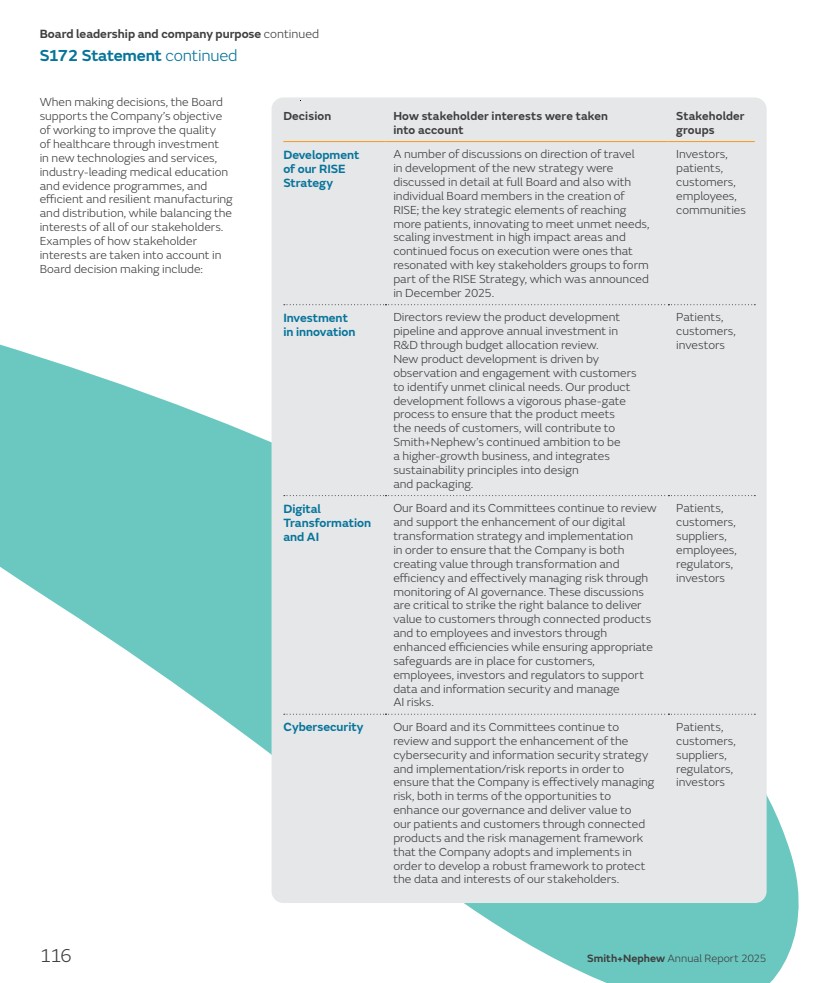
| Our stakeholders The Board considers the potential impact on the Company’s key stakeholders and takes their views and interests into account when making decisions, as outlined in our S172 statement. The Board seeks to engage with and build positive relationships with all stakeholders and understands the importance of ensuring that the views and interests of all stakeholders are considered in the delivery and oversight of the Company’s strategy and culture. The pages referenced in each of the following sections provide examples of our approach to stakeholder engagement and how the Board considers their views and the impact of decisions on key stakeholder groups. Our purpose is Life Unlimited – we exist to restore people’s bodies and their self-belief. We live our purpose through our culture pillars of Care, Courage and Collaboration to use technology to take the limits off living, and help other medical professionals do the same. Understanding stakeholder views is critical to our Purpose. Our ambition is to transform into a structurally higher growth company through our RISE Strategy: Reach more patients: Expand our impact to 20 million patients by 2028. Innovate to enhance the standard of care: Launch new products, address unmet needs, and lead in high-growth areas. Scale through strategic investment: Focus resources on high-return opportunities, invest in market access, and pursue strategic partnerships. Execute efficiently: Drive productivity, invest in technology and AI, and optimise our portfolio for sustainable growth. The Board recognises that aligning the interests of our stakeholders with our Purpose, Strategy and Culture Pillars is fundamental to sustainable growth. The Board is committed to taking a long-term view in order to deliver sustainable value creation for shareholders and other stakeholders. Although members of the Board engage directly with stakeholders as part of site visits, listening sessions and informal employee engagement touchpoints, engagement with stakeholders mostly takes place at an operational level and the Board forms its views through reports and information presented to it by management. Management is asked to outline and present the potential impacts on stakeholders to the Board, where appropriate, during discussions and the decision making process. See pages 54 to 57 for more on Life Unlimited See page 140 for more on our culture Read more in the Chief Executive Officer’s Review pages 6 to 11, and the Governance report on the Board activities on page 111 Read more about the Board’s s172 duties on pages 114 to 116 Our People Our Shareholders Governments and regulators Environment and communities Customers and suppliers Smith+Nephew Annual Report 2025 117 STRATEGIC REPORT GOVERNANCE ACCOUNTS Our purpose and stakeholders OTHER INFORMATION 15_SN_AR25_Stakeholders_P117.indd 117 06/03/2026 21:05 |
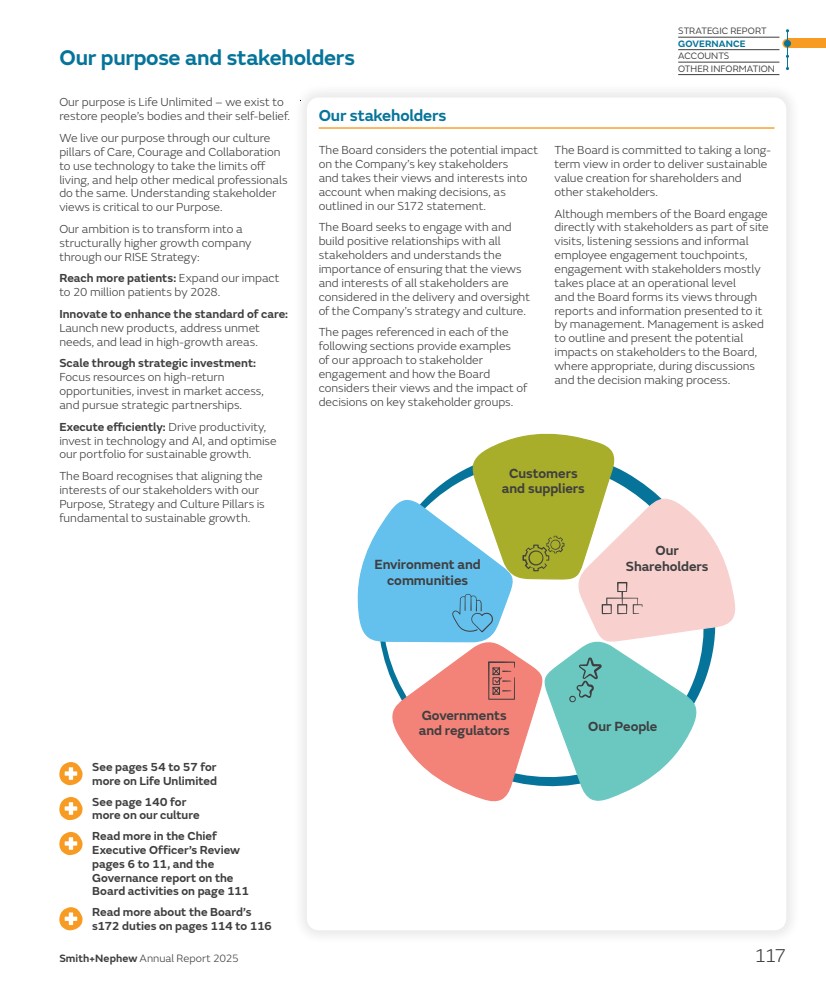
| Our customers and suppliers Healthcare professionals and patients are central to all that we do. Effective engagement with our suppliers ensures we have the right resources to support our growth and that those who partner with us are committed to doing business in a way which is consistent with our Code of Conduct and our values. Significant areas of interest – Innovation and improved outcomes – Ensuring product quality, compliance with regulations and doing business the right way – Partnering with suppliers to ensure business is done the right way – ESG How we engage – The Board reviews the portfolio strategy throughout the year, together with acquisition pipeline for key assets to accelerate innovation and respond to customer and patient unmet needs. – The Board and CCC are provided with updates on product quality, regulatory matters, complaints, legal, compliance and ethical matters. – Our customers continue to focus on ensuring that ESG and sustainability are taken into account in our decision making aligned with their own policies and procedures. – We work with third parties, who adhere to our Code of Conduct, Business Principles and health, safety, social and environmental standards consistent with our own. Our Third Party Guide to working with Smith+Nephew sets out our requirements for third parties based on the laws, regulations and industry codes that apply to Smith+Nephew. The Board receives analyst reports, reviews the share register and receives reports on investor meetings at every Board meeting, as well as investor perceptions of the Company from external advisers. 2025 outcome/impact – The Board and CCC received regular reports on quality audits as part of ongoing monitoring. – The CCC monitors the Company’s response to new regulations impacting our products, quality and regulatory matters and FDA and other regulatory engagement and reports to the Board at each Board meeting. – Monitoring of supply chain and procurement matters is reviewed regularly by the Board, with a focus on outcomes of the 12-Point Plan initiatives and metrics. – The Board approved the Modern Slavery Statement, available on our website. – Board review of our Sustainability Strategy ensures a clear link to stakeholders and issues of importance to customers. – The Board and CCC receive reports at each meeting on sustainability matters which take into account the views and requirements of our customers and in turn impacts how we engage with our suppliers to reflect customer approach. – See also Sustainability Report for further details on how we plan to continue to consider areas of importance to our customers. See pages 27 to 32 on innovation highlighting initiatives designed to support unmet customer needs See pages 65 to 77 of our ESG Report, which highlight our customer and supplier focus Our Third Party Guide to working with Smith+Nephew is available on our website The Board approved the Modern Slavery Statement available on our website 118 Smith+Nephew Annual Report 2025 Our purpose and stakeholders continued Board leadership and company purpose continued 15_SN_AR25_Stakeholders_v96.indd 118 05/03/2026 18:13 |

| Our shareholders Our shareholders are the owners of our business. The Board seeks to engage with them regularly throughout the year to understand their perspectives on performance, value, risk and governance. See www.smith-nephew.com for our Investor presentations. Significant areas of interest – Strategy, business model and performance – Capital allocation and dividend – Cost management and restructuring programmes. – Remuneration – Leadership and succession planning – Sustainability – Inclusion and belonging How we engage – Face-to-face engagement at our in-person AGM at the Company’s Croxley offices enables investors to have the opportunity to engage with Board members and management. – Our Remuneration Committee Chair together with our Chair engaged and communicated with investors, comprising approximately 70% of our issued share capital as part of the consultation process on our 2026 Remuneration Policy. – Our Chair, CEO and CFO regularly engage with investors during the year on topics, such as strategy, financial performance, operational excellence, remuneration, talent management and succession planning, sustainability and diversity. – Our Chair and Senior Independent Director engage with investors and governance teams on topics of investor interest including Board composition, diversity and sustainability. – Our CEO and our CFO engage regularly with investors as part of an ongoing dialogue throughout the year as well as through the post results roadshows and Q&A sessions. – The Board receives analyst reports, reviews the share register and receives reports on investor meetings at every Board meeting, as well as investor perceptions of the Company from external advisers. 2025 outcome/impact – The Chair, CEO and CFO engaged in more than 145 investor meetings during the year. – We hosted a two-day capital markets event across London and New York in December to launch our new RISE strategy and three-year targets. The event was also available as a webcast for those investors unable to attend in person. – A share buyback programme was implemented on 5 August 2025 and concluded on 7 October 2025 in order to reduce the Company’s issued share capital by returning surplus capital to our shareholders. – Further to the extensive shareholder consultation exercise conducted regarding the 2026 Remuneration Policy, the Board resolved to submit a new Policy to shareholders for approval at the 2026 AGM. – Recommended a final dividend for the FY2025 of 24.1c per ordinary share (48.2c per ADS) to shareholders for approval at the 2026 AGM; and declared an interim dividend for HY2025 of 15.0c per ordinary share. – The Board and management regularly discuss investor sentiment, perspectives and expectations on performance improvement, value creation and cost management. See pages 293 to 298 for Shareholder information www.smith-nephew.com/en/ who-we-are/investors Smith+Nephew Annual Report 2025 119 STRATEGIC REPORT GOVERNANCE ACCOUNTS OTHER INFORMATION 15_SN_AR25_Stakeholders_v96.indd 119 05/03/2026 18:13 |
| Our people Our employees are crucial to the success of our business. Creating a culture of belonging and an environment that fosters innovation delivers business success and strengthens engagement. Significant areas of interest – Purpose, strategy and culture – Leadership and succession planning – Talent, retention and opportunities for development and progression – Employee wellbeing and cost of living – Inclusion and belonging – A healthy and safe working environment How we engage – Direct engagement led by a number of Non-Executive Directors through Board/ employee listening sessions has been an insightful way to understand more about the Company culture, employee engagement and inclusion and belonging. – Site visits and Board meetings at our offices enable the Board to meet with our employees for further engagement. – The ‘Direct to Deepak’ section of our intranet and townhall sessions addresses employee questions, comments and feedback. – Review of the Gallup employee engagement survey responses and our Culture session at the CCC provide insight into employee views and sentiment. – Board inductions enable the Board to hear directly from employees on purpose, strategy and culture. – Engagement with our Employee Inclusion Groups (EIGs) on site visits enables the Board to engage with a wider cross section of the employee community. – The Remuneration Committee and the CCC receive updates at each meeting on the activities of our EIGs, and enable an ongoing review of programmes to support the wider workforce. – The Board and its Committees are provided with updates on leadership, talent development and succession planning for senior executives. – The Chair engaged with employees during site visits in India and Singapore. – Marc Owen is our Non-Executive Director who has responsibility for ensuring Board engagement with the wider workforce in his role as Chair of the CCC. 2025 outcome/impact – In 2025, the Company received the Gallup Exceptional Workplace Award for a second year in a row. In the seventh year of running the Gallup Engagement Survey, the Board noted a 95% participant survey completion rate and improved scores on most questions, supporting the view that employee engagement continues on a positive trajectory. – The Board received valuable feedback from the 2025 listening sessions, focusing on several key topics, including Sports Medicine and Orthopaedics Performance and Strategic Direction, AWM Global Vision and Performance, Sustainability and Performance and Recognition. – The site visits to Singapore, Costa Rica, Fort Worth in the US and China provided an opportunity for informal employee touchpoints, as well as more formal presentations which enable the Board to measure and monitor the culture of the organisation. – Feedback from new Non-Executive Directors has been positive on the breadth and depth of the induction programme. 2026 Focus – 2026 listening sessions will focus on our new RISE Strategy, Leadership and Advanced Wound Management Performance and Strategic Direction. See pages 59 to 63 for Building our Way to Win and pages 136 to 139 for the Compliance & Culture Committee report 120 Smith+Nephew Annual Report 2025 Board leadership and company purpose continued Our purpose and stakeholders continued 15_SN_AR25_Stakeholders_v96.indd 120 05/03/2026 18:13 |

| “Having recently joined the Board, it was insightful to talk to our Sports Medicine team members during the listening session. Their passion about delivering for and delighting our customers brought to life the organisational culture that I had learned about during my orientation sessions. They also offered positive comments on the change to a global business unit model, particularly its impact on creating an environment which further drives commercial and operational performance and closer collaboration. These sessions are extremely useful for members of the Board to hear directly from the team how the Company’s strategy is implemented and how the culture pillars of Care, Courage and Collaboration are embedded within the organisation.” David King Independent Non-Executive Director “The Board listening session with the Orthopaedics business during the third year of transformation was an excellent opportunity to see the progress made and the positive momentum and dynamism within the team. In particular, how the operations excellence that was implemented by the Global Orthopaedics team has yielded positive improvements, reinforced our strengths and provided more opportunities. It provided valuable insight into how our people are driving operational excellence through active engagement and collaboration. These sessions enable the Board to receive direct feedback from our employees, which supports effective governance, building trust and alignment to our strategic objectives as we continue to drive performance together.” Marc Owen Independent Non-Executive Director Board listening sessions Smith+Nephew Annual Report 2025 121 STRATEGIC REPORT GOVERNANCE ACCOUNTS OTHER INFORMATION 15_SN_AR25_Stakeholders_v96.indd 121 05/03/2026 18:13 |
| See page 35 for Quality & Regulatory Affairs Governments and regulators We focus on product safety, compliance and doing business the right way in order to achieve the full potential of our portfolio. The Company reports regularly to the Board on its engagement with industry bodies and similar organisations on key issues impacting the organisation and the MedTech industry more broadly. Significant areas of interest – Product safety – Compliance with applicable legal and regulatory requirements – Promotion of fair competition – Social and economic concerns How we engage – The CEO and other senior leaders engage through industry bodies such as AdvaMed, MedTech Europe and similar organisations in order to advocate for and provide perspectives on core issues which are of critical importance to the MedTech industry. – Updates are provided on our Global Compliance programme with applicable metrics and monitoring at each CCC meeting. – The Board and CCC receive updates on product quality and regulatory matters and compliance with applicable laws and regulations. – The CEO and senior management meet with governments and regulators, as applicable. 2025 outcome/impact – The CEO, Global Business Unit Presidents, Chief Quality and Regulatory Officer, Group General Counsel, Chief Compliance Officer, and other senior leaders participated in a number of industry meetings and interest groups in order to drive issues of critical importance to both the organisation and the MedTech industry. – The CCC received reports on product and regulatory audits which provide comfort and confidence that product quality and safety is being managed and maintained effectively. – The CCC and Board also receive updates from the Group General Counsel, relating to any material legal matters of which the Board should be aware. – The Board and its Committees are provided with updates on new or amended laws, regulations and reporting requirements, such as the revised UK Corporate Governance Code, European Crime and Corporate Transparency Act and the likely impact of new regulations on the organisation. 122 Smith+Nephew Annual Report 2025 Board leadership and company purpose continued Our purpose and stakeholders continued 15_SN_AR25_Stakeholders_v96.indd 122 05/03/2026 18:13 |
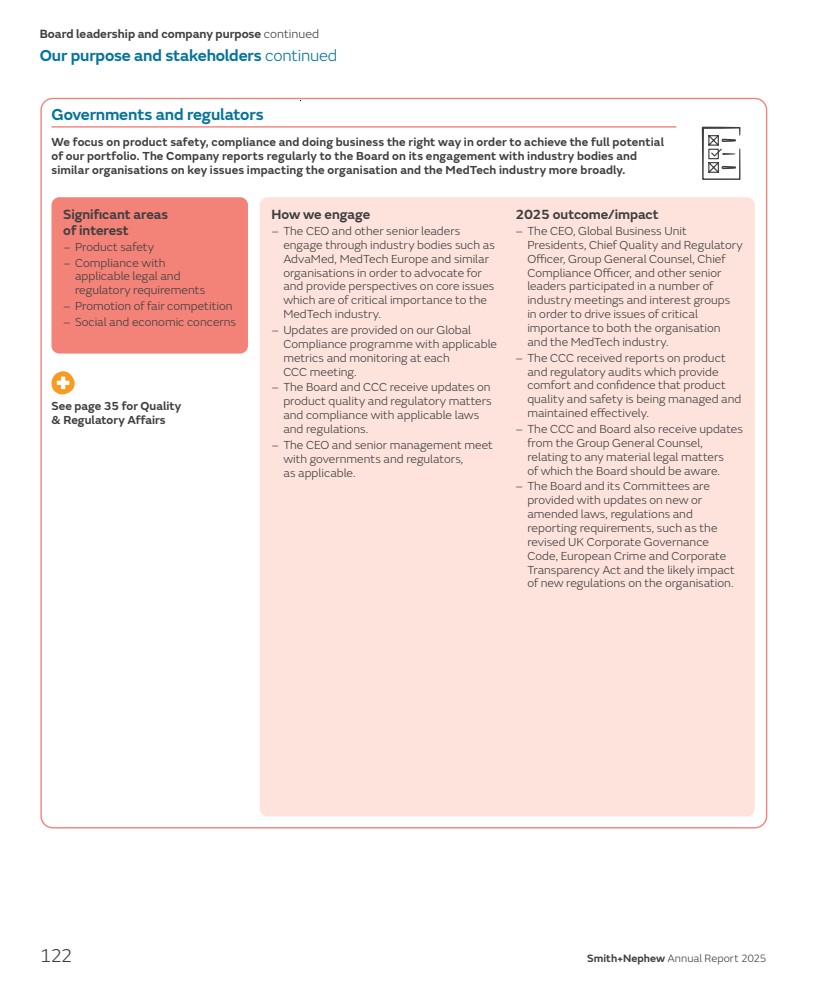
| Further information about our relationship with other stakeholders, including the local communities in which we operate and the impact of climate change on our business, can be found in the Sustainability Report on pages 14 and 28 Our environment and communities People, Planet and Products are at the heart of our ESG strategy aiming to create a positive impact on our communities, reduce the impact on our environment and enable us to innovate sustainably Significant areas of interest – Understanding how the Company’s business impacts local communities and the environment – Company actions to further sustainable healthcare and address climate change via its net zero journey – Managing compliance with sustainability regulations How we engage – The Board approves the ESG Strategy annually and receives updates on ESG initiatives and stakeholder feedback at each meeting, as appropriate. – Updates on performance and progress on key environmental and social metrics are provided at each CCC meeting. – Updates on reporting and disclosures are included at each Audit Committee meeting. – Remuneration Committee determines ESG metrics for remuneration purposes liaising closely with the CCC to ensure that metrics are quantifiable and measurable. – The Chair, CEO and Company Secretary, as well as other members of senior management attend industry round tables and panel discussions on ESG matters which impact the Company. – ESG Steering Committee members monitor and report stakeholder feedback on ESG topics at each ESG Steering Committee quarterly meeting. – ESG staff hold memberships in healthcare-specific and cross-industry ESG organisations to stay abreast of stakeholder trends and best practices. 2025 outcome/impact – As part of strategic planning and investment choices, the presentations received by the Board for consideration include analysis on the potential impact of key projects on all stakeholder groups, including the environment and communities. – Remuneration Policy 2025 includes ESG metrics for long-term incentive plans. – We provide grants and donations in accordance with our policies and procedures to charitable or not-for-profit organisations, medical institutions, accredited educational programme vendors, medical foundations and professional societies. – We progressed metrics in our ESG Pillars of People, Planet and Products. Number of patients supported through product donations 106,000+ Reduction in our Scope 1 and Scope 2 greenhouse gas emissions since 2019 71% Manufacturing waste kept out of landfills 95% In-scope packaging systems incorporating at least one recyclable component 92% See pages 65 to 77 for our ESG report Smith+Nephew Annual Report 2025 123 STRATEGIC REPORT GOVERNANCE ACCOUNTS OTHER INFORMATION 15_SN_AR25_Stakeholders_v96.indd 123 05/03/2026 18:13 |
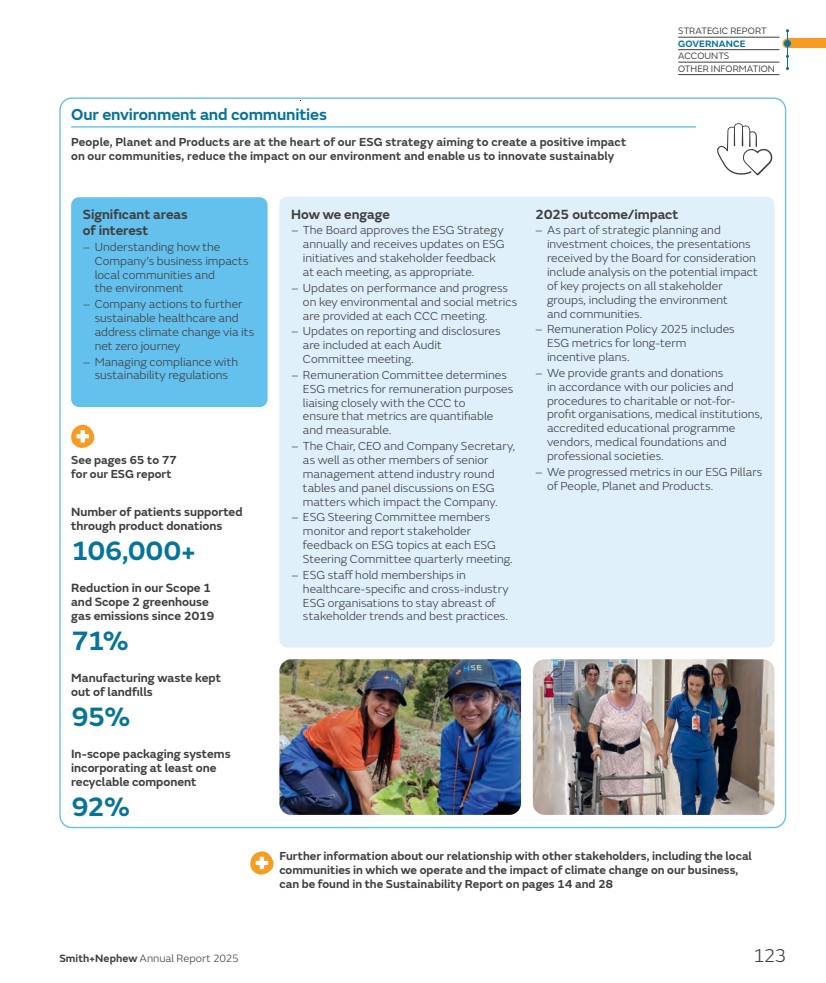
| 124 Smith+Nephew Annual Report 2025 Finance & Banking Committee A Committee comprising senior executives that approves banking and treasury matters, guarantees and Group structure changes relating to mergers, acquisitions and disposals. Disclosures Committee A Committee comprising senior executives that oversees and approves public announcements and communications to investors and Stock Exchanges. Reviews communications and reporting requirements in respect of market sensitive information. Audit Committee Ensures the integrity of the Company’s financial reporting, systems and controls. Oversight of risk management process. Reviews and monitors climate change disclosures and related ESG financial reporting obligations. Monitors the Group’s cyber resilience. Ensures effectiveness of internal and external audit functions. See more on pages 141 to 146 Nomination & Governance Committee Reviews size, skills, experience, knowledge and composition of the Board, succession planning, diversity and governance matters. See more on pages 127 to 135 Remuneration Committee Determines Remuneration Policy and packages for Executive Directors and senior management, having regard to pay across our workforce. Ensures that the reward strategy aligns with our purpose, values and long-term strategy. See more on pages 147 to 193 Our Board The Board is accountable to shareholders for the performance and long-term sustainable success of the Company. It approves the strategy of the Group, evaluates and monitors the management of risk, and oversees the implementation of strategy in order to achieve sustainable growth. The Board delegates certain matters to the Audit, Remuneration, Nomination & Governance and Compliance & Culture Committees, which support the Board in carrying out its responsibilities. From time to time and where considered appropriate to do so, the Board convenes Board subcommittees that discuss and consider specific matters. The subcommittees report back to the full Board in order to ensure efficient and effective oversight on these specific matters. Full details of the Matters Reserved to the Board can be found on the Company’s website. Executive Committee The Board delegates the day-to-day operational management and implementation of Group strategy to the CEO and Executive Committee. The Executive Committee recommends and, following Board approval, implements the strategy, budget and five-year strategic plan within the Group. It ensures cross-functional alignment in order to deliver on strategy and reviews major investments, divestments and capital expenditure proposals. The Executive Committee also focuses on people and organisational culture, reviewing recruitment, attrition and development initiatives within the Company and developing talent pipeline below Board level. The Executive Committee meets at least 10 times per year to review commercial and operating results against budget, key initiatives, KPIs and performance metrics aligned to delivering Group strategy. The Executive Committee forms subcommittees, including those listed below: – Group Ethics & Compliance Committee – Business Resilience and Continuity Management Steering Committee – Global Investment Board – New Product Development Review Committee – Security & Privacy Steering Committee – ESG Steering Committee – AI Steering Committee www.smith-nephew.com See more on pages 108 to 109 * The 12 Point Plan Steering Committee was formally retired in 2025 following closure of the majority of workstreams under the 12-Point Plan. * The Global Investment Board was implemented in 2025 to approve significant investments within the global business including mergers and acquisitions, led by the CEO with CFO, Group General Counsel, President of Global Operations, Chief Strategy Officer and Global President R&D as members. * The Business Resilience and Continuity Management (BRCM) Steering Committee has oversight of the programmatic implementation and development of BRCM globally and in partnership with IT, Legal and other functions supports Cyber Incident Response, IT Disaster Recovery and Global Crisis Management. Compliance & Culture Committee Reviews, monitors and has oversight of ethics and compliance, quality and regulatory, culture, sustainability matters and metrics, stakeholder relationships and related legal matters across the Group. See more on pages 136 to 139 Division of responsibilities Corporate governance framework 16_SN_AR25_NOM_QA_BoardDel_Visit_Eff_v149.indd 124 05/03/2026 18:16 |
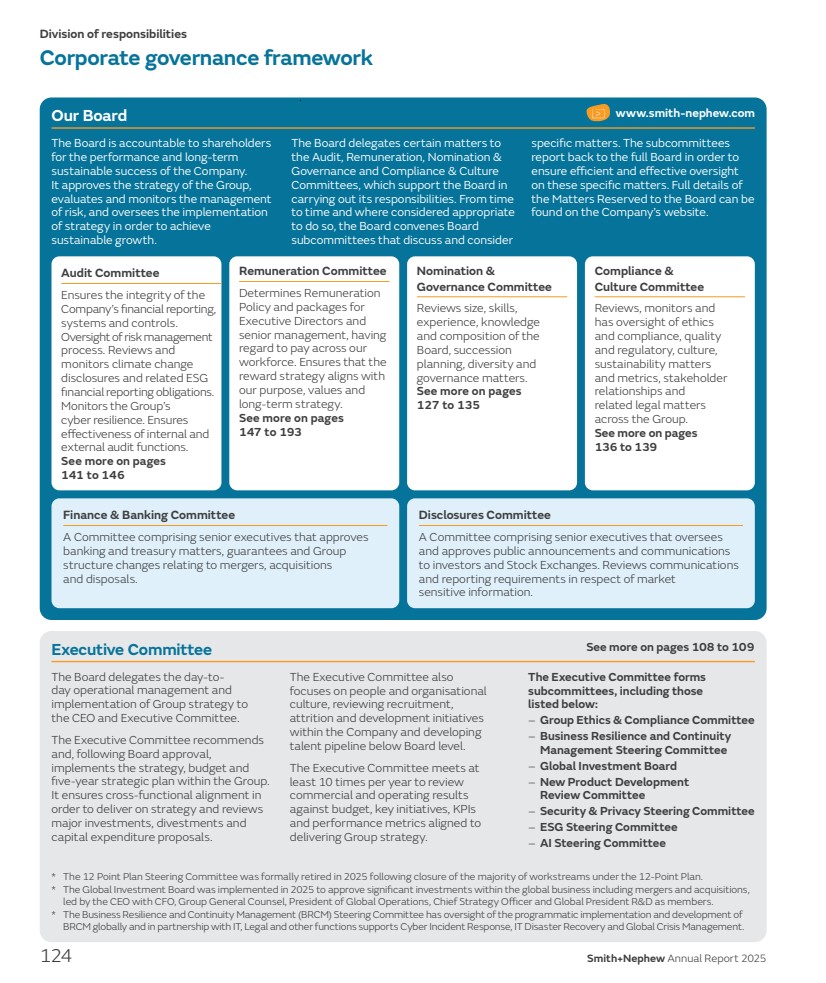
| Senior Independent Director Angie Risley – Acts as a sounding board for the Chair and as an intermediary for other Directors and stakeholders, as necessary. – As a member of the Nomination & Governance Committee, leads the Board evaluation process and searches for Chair and Independent Non-Executive Directors to ensure effective succession. – Acts as an alternative contact for stakeholders to raise concerns (in addition to the Chair and senior management). Chair Rupert Soames – Responsible for the effective leadership and operation of the Board and for facilitating the review of its composition, effectiveness and development. – Promotes effective Board relationships, encouraging constructive challenge and facilitating effective communication between Board members and supporting a culture of openness, challenge and debate. – Ensures effective communication and dialogue with the Company’s stakeholders, while maintaining an appropriate balance between stakeholders’ interests. – Leads relations with shareholders in order to understand their views on governance and performance against strategy. – Responsible for promoting high standards of governance by the Board and its Committees. – Regularly reviews the Board composition and succession planning. Chief Executive Officer Deepak Nath – Responsible for delivering and implementing Group strategy and management of the organisation as a whole. Provides information and participates in Board discussions regarding Group management and operational matters. – Leads the Executive Committee and ensures its effectiveness in managing the overall operations and resources of the Group. – Sets the tone at the top with regard to culture, compliance and sustainability matters. – Ensures the Chair and Board are updated regularly regarding key matters and maintains relationships with shareholders, advising the Board accordingly. Independent Non-Executive Directors Thérèse Esperdy, Jo Hallas, David King, Garheng Kong, Simon Lowth, John Ma, Jez Maiden, Katarzyna Mazur-Hofsaess, Marc Owen and Sybella Stanley – Comprise more than half of Board membership in order to meet the independence criteria set out in the Code. Ensure that no individual/ small group can dominate the Board’s decision making. – Provide constructive challenge, give strategic guidance, offer specialist advice and hold executive management to account. Chief Financial Officer John Rogers – Supports the CEO in developing and implementing Group strategy. – Responsible for ensuring effective financial reporting, investor relations, tax, treasury and financial controls are in place within the Group. – Provides information and participates in Board discussions regarding financial matters. – Leads the Global Finance function, developing key finance talent and succession planning. Company Secretary Helen Barraclough – Supports the Chair and ensures Board members have access to the information required to perform their duties. – Advises the Board on legal and corporate governance matters and supports the Board in applying the Code and complying with UK listing obligations, and other statutory and regulatory requirements. – Provides a channel for Board and Committee communications and a link between the Board and management. 125 STRATEGIC REPORT GOVERNANCE ACCOUNTS OTHER INFORMATION Smith+Nephew Annual Report 2025 How we are governed 16_SN_AR25_NOM_QA_BoardDel_Visit_Eff_v149.indd 125 05/03/2026 18:16 |

| At the close of each Board meeting, the full Board meets for a short closed-session discussion; this is followed by a closed session for the Chair and Non-Executive Directors in the absence of the Executive Directors. The Chair also holds one-to-one discussions with each Board member throughout the year. Independence of Directors We require our Non-Executive Directors to remain independent from management, so that they are able to exercise independent oversight and effectively challenge management. The Board has determined that all our Non-Executive Directors are independent in accordance with both UK and US requirements. None of our Non-Executive Directors or their immediate families has ever had a material relationship with the Group. None of them receive additional remuneration from the Group apart from Directors’ fees, nor do they participate in the Group’s share plans or pension schemes. None of them serve as directors of any companies or affiliates in which any other Director is a director. The Board considers all external directorships prior to and during appointment, reviewing any potential conflict of interests and time commitment for both Executive Directors and Non-Executive Directors. Management of conflicts of interest None of our Directors, or their connected persons, has any family relationship with any other Director or Officer, or has a material interest in any contract to which the Company or any of its subsidiaries are, or were, a party during the year or up to 27 February 2026. Each Director has a duty under the Companies Act 2006 to avoid a situation in which they have or may have a direct or indirect interest that conflicts or might conflict with the interests of the Company. This duty is in addition to the existing duty owed to the Company to disclose to the Board any interest in a transaction or arrangement under consideration by the Company. If any Director becomes aware of any situation that might give rise to a conflict of interest, they must, and do, inform the rest of the Board immediately and the Board is then permitted under the Company’s Articles of Association to authorise such conflict. This information is then recorded in the Company’s Register of Conflicts, together with the date on which authorisation was given. In addition, each Director certifies on an annual basis that the information contained in the Register of Conflicts is correct. When the Board decides whether to authorise a conflict, only the Directors who have no interest in the matter are permitted to participate in the discussion, and a conflict is only authorised if the Board believes that it would not have an impact on the Board’s ability to promote the success of the Company in the long term. Additionally, the Board may determine that certain limits or conditions must be imposed when giving authorisation. No actual conflicts have been identified during the year, which have required approval by the Board. However, the situations that could potentially give rise to a conflict of interest have been identified and duly authorised by the Board and are reviewed at least on an annual basis. Outside directorships We encourage our Executive Directors to serve as Non-Executive Directors of external companies. We believe that the work they do as Non-Executive Directors of other companies has benefits for their executive roles with the Company, giving them a fresh insight into the role of a Non-Executive Director. Deepak Nath is a Board member of AdvaMed and MDIC, and John Rogers is a Non-Executive Director of Grab Holdings Limited. Re-appointment of Directors In accordance with the Code, all Directors offer themselves to shareholders for re-election annually, except those who are retiring immediately after the AGM. Each Director may be removed at any time by the Board or the shareholders. Board support Together with the Executive Directors and the Company Secretary, the Chair ensures that the Board is kept properly informed. Each Director has access to the Company Secretary, who helps to ensure that Board procedures and good corporate governance practices are followed. Directors are permitted to take independent professional advice at the Company’s expense, if required, in order to enable them to fulfil their duties. Each Director is covered by appropriate directors’ and officers’ liability insurance and there are also Deeds of Indemnity in place between the Company and each Director. These Deeds of Indemnity mean that the Company indemnifies Directors in respect of any proceedings brought by third parties against them personally in their capacity as Directors of the Company. The Company would also fund ongoing costs in defending a legal action as they are incurred rather than after judgement has been given. In the event of an unsuccessful defence in an action against them, individual Directors would be liable to repay the Company for any damages and to repay defence costs to the extent funded by the Company. 126 Smith+Nephew Annual Report 2025 Division of responsibilities continued How we are governed continued 16_SN_AR25_NOM_QA_BoardDel_Visit_Eff_v149.indd 126 05/03/2026 18:16 |
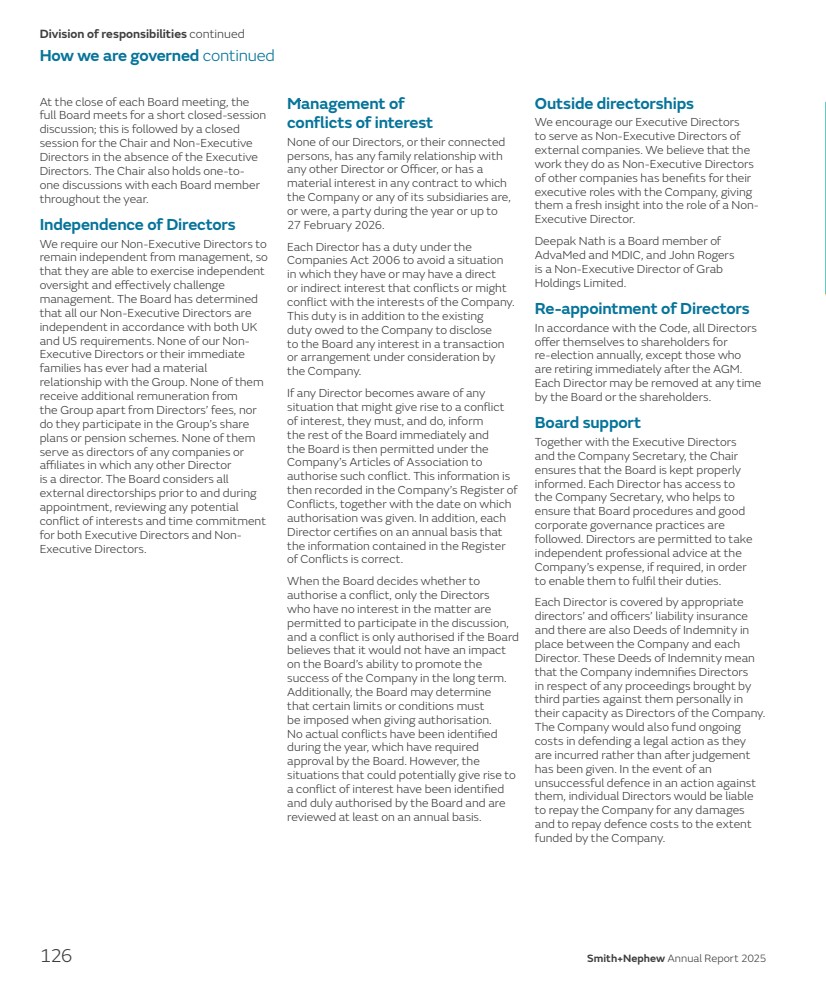
| Board changes in 2025 Over the past two years, Board changes have included a new Chair, six new Non-Executive Directors, one new Executive Director, a new Senior Independent Director (SID) and new chairs of the Audit and Remuneration Committees. Sybella Stanley joined as an independent Non-Executive Director on 1 February 2025, and succeeded Angie Risley as Chair of the Remuneration Committee following a successful transition on 30 June 2025. The Board wishes to thank Angie for the huge contribution that she made during her time as Chair of the Remuneration Committee. Bob White stepped down from the Board at the 2025 AGM due to his appointment as Chief Executive Officer of Olympus Corporation. The Board thanks Bob for his support and valuable contributions during his tenure, especially with regards to his perspectives on the customer and US MedTech environment. Following Bob’s departure, we welcomed David King on 1 July 2025 as a Non-Executive Director and member of the Compliance & Culture and Remuneration Committees. David brings extensive experience in the healthcare and life sciences sectors, having helped transform and grow MedTech businesses both in the US and globally. His experience of the US reimbursement landscape, market access, quality and regulatory affairs and healthcare compliance add further global expertise and US experience to the Board. On 1 September 2025, Garheng Kong was appointed as a Non-Executive Director and member of the Audit Committee. Garheng brings investment and advisory experience in the US and global MedTech and biopharma sectors and has significant clinical, technical and investment expertise having served as an executive, non-executive and as an investor, supporting innovation and growth across a number of successful businesses. In addition, Thérèse Esperdy was appointed as Senior Independent Director designate effective 1 December 2025, and will succeed Angie Risley as SID following our 2026 AGM when Angie completes her nine years with the Board. “The work of the Committee in driving and facilitating changes to the Board over the past two years reflects our commitment to succession planning and bringing together the right talent, expertise, skills and experience, and ensuring the effective transition of responsibilities.” Rupert Soames Chair of the Nomination & Governance Committee Committee roles and responsibilities – Reviewing the structure, size and composition of the Board and recommending candidates to the Board for appointment as Directors or Company Secretary. – Monitoring the composition and range of skills, knowledge, experience, independence and diversity of the Board. – Overseeing the annual Board evaluation process, led either externally or internally by the Senior Independent Director. – Overseeing Board succession plans, including engaging external search consultancies and making recommendations on appointments to the Board. – Overseeing the induction process for new Directors and the Board development programme to support the ongoing development of all Board members. – Considering the continued independence of the Non-Executive Directors and any conflict of interest. – Approving external directorships to be held by the Board and reviewing any conflicts of interest. Our focus for 2026 – Embedding feedback received from Board members through the Board Evaluation process and Board meetings into Board agendas, practice and governance in order to support continuous improvement and robust corporate governance. – Ongoing review of Board size and composition aligned to our new RISE strategy, with a view to continuing to ensure that the Board can demonstrate a strong balance of skills, experience, knowledge and diversity in its broadest sense and to continue to evaluate potential opportunities to increase diversity within the Board and the timeline for doing so. The Terms of Reference for the Nomination & Governance Committee describe the role and responsibilities of this Committee more fully and can be found on our website. www.smith-nephew.com/en/ who-we-are/corporate-governance#terms-of-reference Smith+Nephew Annual Report 2025 127 STRATEGIC REPORT GOVERNANCE ACCOUNTS OTHER INFORMATION Nomination & Governance Committee Report Composition, succession and evaluation 16_SN_AR25_NOM_QA_BoardDel_Visit_Eff_v149.indd 127 05/03/2026 18:16 |
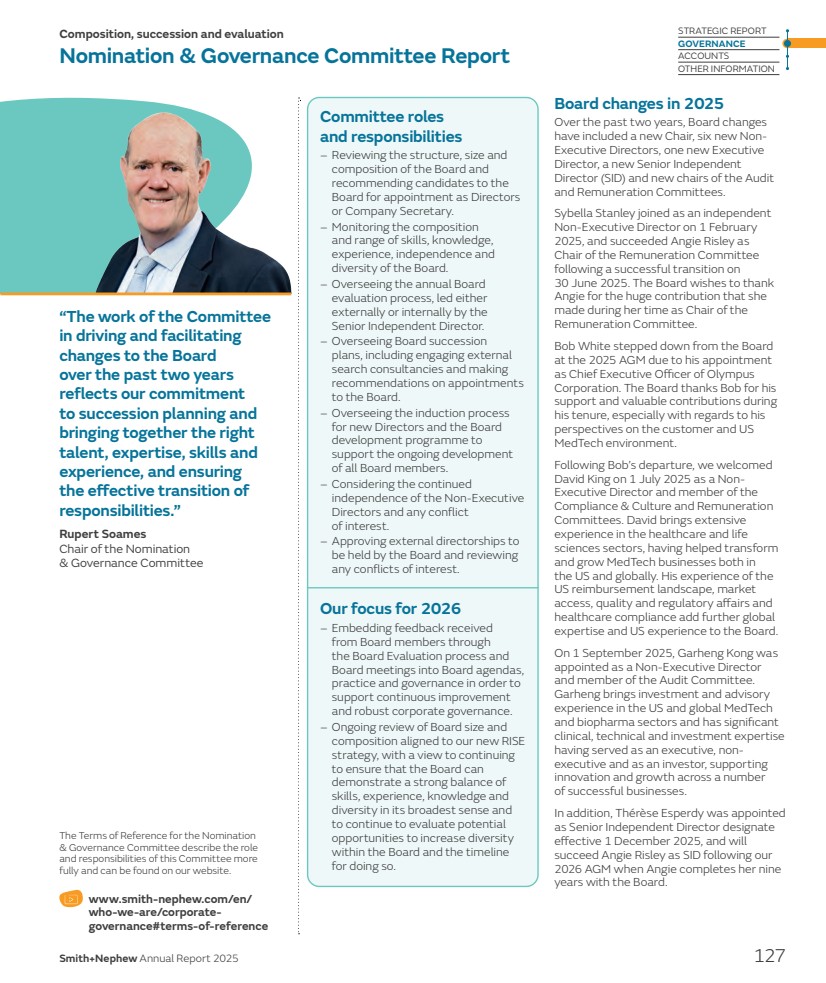
| 1 Before any appointment is made, the Committee evaluates the balance of skills, knowledge, experience, independence and diversity on the Board. 4 The Committee evaluates the shortlist of candidates on merit and against objective criteria, taking care to ensure that appointees have sufficient time to devote to the position in light of their other commitments. The Committee also assesses any actual or potential conflicts of interest as part of the process. 2 In light of this evaluation, the Committee prepares a description of the role and capabilities required for a particular appointment and works with external advisers, as appropriate, to compile a shortlist of candidates based on the role description. 5 Members of the Committee interview key candidates from the shortlist. Other Board members are also involved in the interview process, as appropriate. For example, where a candidate is required to have a requisite level of financial expertise, the Audit Committee Chair and CFO would be involved in the interview process. 3 The Committee (together with external advisors*) then compiles a shortlist including a broad slate of candidates from a wide range of backgrounds. 6 The Committee reviews and considers the feedback provided based on the interview process, reference checks and due diligence in arriving at a decision on a candidate to recommend to the Board. * Russell Reynolds was appointed as the search firm in respect of the appointment of Garheng Kong and David King in the US. Egon Zehnder was engaged for the appointment of Sybella Stanley and Thérèse Esperdy in the UK. These firms have no other connection with the Company or individual Directors. Sybella, David, Garheng and Thérèse bring capabilities, skills and experience which enhance the effectiveness of the Board as a whole and we have been encouraged by their engagement and intellectual curiosity as they get up to speed rapidly on the business. With these changes, we continue our commitment to fostering diversity in its broadest sense and to ensuring that our Board membership draws from a wide range of backgrounds and cultures. The Committee also approved and recommended to the Board certain other measures to support succession planning while newer Non-Executive Directors gain further experience of the organisation. Marc Owen was appointed a member of the Remuneration Committee on 23 September 2025 in order to support the evaluation of the Remuneration Policy, which we will submit to shareholders for approval at our AGM (for more details, please see pages 152 to 171). At the request of the Board, Marc has also agreed to submit himself for re-election at the AGM in May for an additional 12 months to support the transition to newer Board members. Whilst we appreciate that Marc’s ongoing appointment leads to his appointment for longer than the recommended nine-year tenure, we feel it is important to ensure stability and continuity for an additional short period as we move to our RISE strategy in 2026. Board appointment process For our new Board appointments in 2025, the Committee followed the process outlined below and considered the shortlist of candidates for each position, taking into account: – the Company’s strategic priorities moving forward and the purpose, values and culture of the business; – the core skills and experience required on the Board and its Committees in order to effectively provide both support and scrutiny for management, strategy and operational excellence; and – the importance of diversity in its broadest sense, taking into account the need for specific skillsets to complement Board composition. In respect of the candidate longlists and shortlists for all of our new appointments, we took diversity in its broadest sense into account. In our appointments, we will always ensure that we select the most qualified candidate for the role in the best interests of the organisation as a whole. New Director appointments and process 128 Smith+Nephew Annual Report 2025 Composition, succession and evaluation continued Nomination & Governance Committee Report continued 16_SN_AR25_NOM_QA_BoardDel_Visit_Eff_v149.indd 128 05/03/2026 18:16 |
| Board Diversity The Committee believes that a Board and management team which has a range of diverse skills, backgrounds and experience is best equipped to take the decisions that will deliver sustainable value to shareholders and other stakeholders. Our Board and Committee Diversity Policy is designed to support these principles. As part of fulfilling the objective of this policy, the Board seeks membership and candidates from diverse professional backgrounds, outlooks and experiences through structured skills-gap analysis. The Committee has activated a transparent, meritocratic succession framework designed to drive progress over the coming years and ensure we continue to have a Board which embraces diversity in its broadest sense. The Committee will continue to appoint Board members on merit, valuing the unique contribution that they will bring to the Board, regardless of gender, ethnicity or other specific diversity measure. Our diversity statement is located on our website: www.smith-nephew.com/ en/who-we-are/corporate-governance/ diversity-statements. The Committee believes the Board’s composition currently gives us the necessary balance of diversity, skills, experience, independence and knowledge to ensure continued effectiveness in running the business and delivery of sustainable growth. Rupert Soames, OBE Chair of the Nomination & Governance Committee Board and Executive succession planning Succession planning is a key focus for the Board from both a leadership and governance perspective. The Committee regularly discuss and review Board and Committee composition and skillsets, and succession planning in respect of those elements, to ensure alignment with the Company’s strategic objectives and culture pillars and to drive value creation for stakeholders. As will have been noted with recent appointments, the Committee starts Board recruitment ahead of retirements, understanding the competitiveness of the market for high calibre candidates and the reputational risks of overboarding. Priorities for recruitment and succession planning include the ability to respond to the evolving strategic and operational demands of the organisation, adding and enhancing Board skills including in the areas of healthcare and customer perspectives, digital/cyber experience and experience in respect of AI as the organisation moves forward. The Board discusses succession plans with management for senior executives, with two dedicated closed sessions for the Non-Executive Directors with the Chief Human Resources Officer on the talent management strategy and also on succession planning, the internal talent pipeline and the development programmes which support those initiatives. Pages 108 and 109 give details of the members of the Executive Committee, 25% of whom are female and 42% of whom are ethnically diverse. Highlights in 2025 – Appointment of Sybella Stanley as a Non-Executive Director effective 1 February 2025 and Chair of the Remuneration Committee with effect from 30 June 2025, transitioning the Chair role from Angie Risley. – Appointments of David King, effective 1 July 2025 as Independent Non-Executive Director and a member of the Compliance & Culture and Remuneration Committees and Garheng Kong as Independent Non-Executive Director and member of the Audit Committee on 1 September 2025, bringing additional breadth and depth in terms of US healthcare and global MedTech expertise to the Board. – Reviewing areas of focus for 2025 and areas of strength and for development in 2026 through the Board internal evaluation between July and September 2025 (see pages 132 and 133). – In-depth Non-Executive discussions to close out each Board meeting on topics such as strategic opportunities for value creation, portfolio and returns, culture and performance, talent management strategy and succession planning. – Continued implementation of comprehensive induction plans and ongoing development programmes for Board members (see page 134). Smith+Nephew Annual Report 2025 129 STRATEGIC REPORT GOVERNANCE ACCOUNTS OTHER INFORMATION 16_SN_AR25_NOM_QA_BoardDel_Visit_Eff_v149.indd 129 05/03/2026 18:16 |
| Skills and experience matrix Tenure1 Employee engagement CEO Financial International Healthcare/ Medical Devices Emerging Markets Cyber/ technology ESG UK Governance Remuneration Executive Directors Deepak Nath 3y 9m John Rogers 1y 9m Non-Executive Directors Rupert Soames 2y 8m Angie Risley 8y 3m Thérèse Esperdy2 0y 1m Jo Hallas 3y 11m David King 0y 6m Garheng Kong 0y 4m Simon Lowth 2y 0m John Ma 4y 10m Jez Maiden 2y 3m Katarzyna Mazur-Hofsaess 5y 2m Marc Owen 8y 3m Sybella Stanley3 0y 11m Bob White4 5y 0m 1 Tenure based on data as at 31 December 2025. 2 Thérèse Esperdy will be appointed as Senior Independent Director at the 2026 Annual General Meeting, subject to shareholder approval of her appointment to the Board. 3 Sybella Stanley became Chair of the Remuneration Committee on 30 June 2025. 4 Bob White stepped down from the Board on 30 April 2025. Diversity reporting Gender diversity In 2025, the female representation in senior management roles held steady at around one-third of the total. We continue to encourage and develop leaders across all levels of management through personalised development, bespoke training and mentoring. The percentage of female Board members increased year on year and we are approaching the 40% women on Boards ambition following the appointments of Sybella Stanley and Thérèse Esperdy as Non-Executive Directors. Angie Risley will step down from the Board at the Annual General Meeting on 6 May 2026. Ethnic diversity In the UK, the proportion of ethnically diverse managers, at 11%, is in line with the overall employee group. 1 Senior managers and above includes all employees classed as Directors, Senior Directors, Senior Vice Presidents and Executive Officers and includes all statutory directors and Directors of our subsidiary companies at 31 December 2025. 2 As at 31 December 2025. Senior managers and above1 1,113 Female 34% Male 66% UK management2 261 White 89% Ethnically diverse 11% 130 Smith+Nephew Annual Report 2025 Composition, succession and evaluation continued Nomination & Governance Committee Report continued 16_SN_AR25_NOM_QA_BoardDel_Visit_Eff_v149.indd 130 05/03/2026 18:16 |

| Prepared in accordance with UK Listing Rule 6.6.6(10) as at 31 December 2025 Board members Senior positions on the Board* Executive management1 Number % Number % Gender representation: Board and executive management Men 9 64 3 9 75 Women 5 36 1 3 25 Other categories 00 00 0 Not specified/prefer not to say 00 000 Ethnic background: Board and executive management White British or other White (including minority White groups) 11 79 3 7 58 Mixed/multiple ethnic groups 00 000 Asian/Asian British 3 21 1 4 34 Black/African/Caribbean/Black British 00 018 Other ethnic group, including Arab 00 000 Not specified/prefer not to say 00 000 1 Executive management is the Executive Committee (most senior executive body below the Board). * Senior positions on the Board (CEO, CFO, SID and Chair). Board and executive management diversity Our reported ambition of 25% ethnic diversity within global senior management by 2027 and our reported current percentage of 27% are calculated based on the ethnicity definitions applicable to senior management in the markets where they live and work. For senior management based in the UK, we use the Office for National Statistics’ definition of ethnicity in order to calculate the proportion of ethnic diversity of senior management in the UK. Based on the composition of our business and the fact that the majority of our senior management, operations and revenue are based outside the UK, we feel it is appropriate to continue to report against a global measure in order to show our global progress. We currently provide information to the Parker Review annually and meet the recommendation to have at least one director from an ethnic minority background with Garheng Kong, John Ma and Deepak Nath. Additionally, in accordance with the Parker Review, we track a UK senior leadership ethnic diversity ambition of 10% by 2027. Where there are opportunities to bring senior managers into the UK organisation, we will continue to consider a broad merit slate of candidates in accordance with our hiring policies and procedures. We will continue to review and, where appropriate, revise our UK and global commitments on an annual basis. We have numerous training courses in Learning Unlimited, our internal learning platform, for all employees on the topics of allyship, inclusion, and belonging. Employees are encouraged to disclose missing gender, race/ethnicity, veterans and disability data, and we have made progress to ensure we have data sets that are as complete as possible. We respect the privacy rights of individuals and comply with applicable data privacy laws and regulations. Explanation against LR 6.6.6(9) The table above provides our Board and executive management diversity data as at 31 December 2025, our chosen reference date, which has been prepared in accordance with UK Listing Rule 6.6.6. One of the four senior positions on the Board (Chair, CFO, CEO or SID) was held by a woman, our Board composition included two Directors from ethnic minority backgrounds and we are approaching the 40% women on Board ambition. The Board is pleased that two of the targets have been met but recognises that it has not yet met the target of 40% women on the Board. The overriding priority across all Board appointments remains identification of the strongest candidate for the role, based on clear search criteria. Further detail of the focus by the Nomination & Governance Committee on the continued development of a diverse merit based talent pipeline, and the work to oversee external benchmarking to ensure Smith+Nephew has the capabilities needed for future growth, is set out on page 129. Source of data Data concerning gender and ethnicity representation on the Board and Executive Committee is set out above. This data was collected directly from all the individual Board and Executive Committee members. Smith+Nephew Annual Report 2025 131 STRATEGIC REPORT GOVERNANCE ACCOUNTS OTHER INFORMATION 16_SN_AR25_NOM_QA_BoardDel_Visit_Eff_v149.indd 131 05/03/2026 18:16 |
| Board internal evaluation The 2025 Board evaluation, which sought to review key aspects of Board effectiveness was conducted internally by Angie Risley, the Senior Independent Director, supported by the Company Secretary. The next external Board evaluation will be in 2027. Overall, the Smith+Nephew Board believes it is operating effectively as assessed both holistically and against the areas of focus for 2025: – The Board agenda in 2025 has been shaped around the core areas of innovation and portfolio, strategy and operational excellence, cost management and capital allocation, and oversight of risk management and controls to identify further opportunities to drive longer-term strategic value creation. – The Board has regularly evaluated risks, opportunities and progress on commercial and operational transformation, including through business unit strategic updates, a deep-dive session on Greater China, the transition from the 12-Point Plan to business-as-usual activities, reorganisation to a global business unit structure and the zero-based budgeting project. – The Board has had further discussions on the macro challenges, regulations and trends globally within healthcare and MedTech. External experts have provided further insights to enhance understanding of the industry and the frameworks which the Company operates in. – The Board held additional talent management strategy and succession planning sessions on talent pipeline and gap analysis at Board level, together with a review of long-term people strategy with an emphasis on developing strong pipelines of senior leaders. The Board and its Committees have monitored employee engagement scores, the internal talent pipeline and the development framework, in particular for high-value roles within the Company. – Closed sessions with the full Board and also NEDs at each Board meeting have facilitated transparent and detailed discussion. Members of the ExCo and their direct reports have spent time over the year with Board members during inductions, site visits and strategic presentations fostering constructive discussion. Areas of focus for 2025 Outcomes/outputs Industry landscape and portfolio Ongoing review of strategy and organisation, incorporating insights around market and competitors. Landscape sessions run by internal teams and external advisers at Board meetings in 2025 to highlight winning MedTech strategies deployed within the industry and areas of focus for S+N. Ongoing focus on embedding and supporting performance culture Celebration of examples of high performance and flawless execution; ongoing evaluation of learnings to strengthen culture, iteratively incorporating feedback from internal and external sources, acknowledging areas for improvement and making changes in direction if necessary. Recognition of presenting teams at each Board session with feedback provided to CEO and CHRO on performance. Participation of CHRO in Board sessions in order to support evaluation and coaching/development for presenters and their teams. Review of lessons learned in key areas of focus by Board and Committees (eg IT/cyber, operations and business resilience and continuity) with support from internal teams and external advisors as appropriate. Board feedback provided at relevant sessions recognising evolution and progress and identifying areas for further improvement. Crisis management, response and recovery Continued enhancement of the Board programme to include ongoing threat analysis (incorporating market insights from external advisers as appropriate), scenario planning and the role of the Board. Internal and external review and benchmarking of S+N’s cyber posture and response to external threat actors. External presentation incorporating role of the Board and scenario planning. Talent development and tracking success Ongoing succession planning and talent strategy discussions to further refine key competencies aligned with strategy, leadership and diversity and mitigation on risks. Two dedicated, closed Board sessions each year with CHRO and CEO on talent management strategy and succession planning. – The Board engaged in an AI strategic priorities session and also participated in a Cyber resilience session. The AI session focused on driving adoption of AI solutions to accelerate innovation, increase productivity and create value within an appropriate risk and governance framework. The Cyber session delivered by the CISO provided an opportunity for the Board to address Q&A and evaluate opportunities and areas of continued focus for the Board in 2026. 132 Smith+Nephew Annual Report 2025 Board effectiveness Composition, succession and evaluation continued 16_SN_AR25_NOM_QA_BoardDel_Visit_Eff_v149.indd 132 05/03/2026 18:16 |
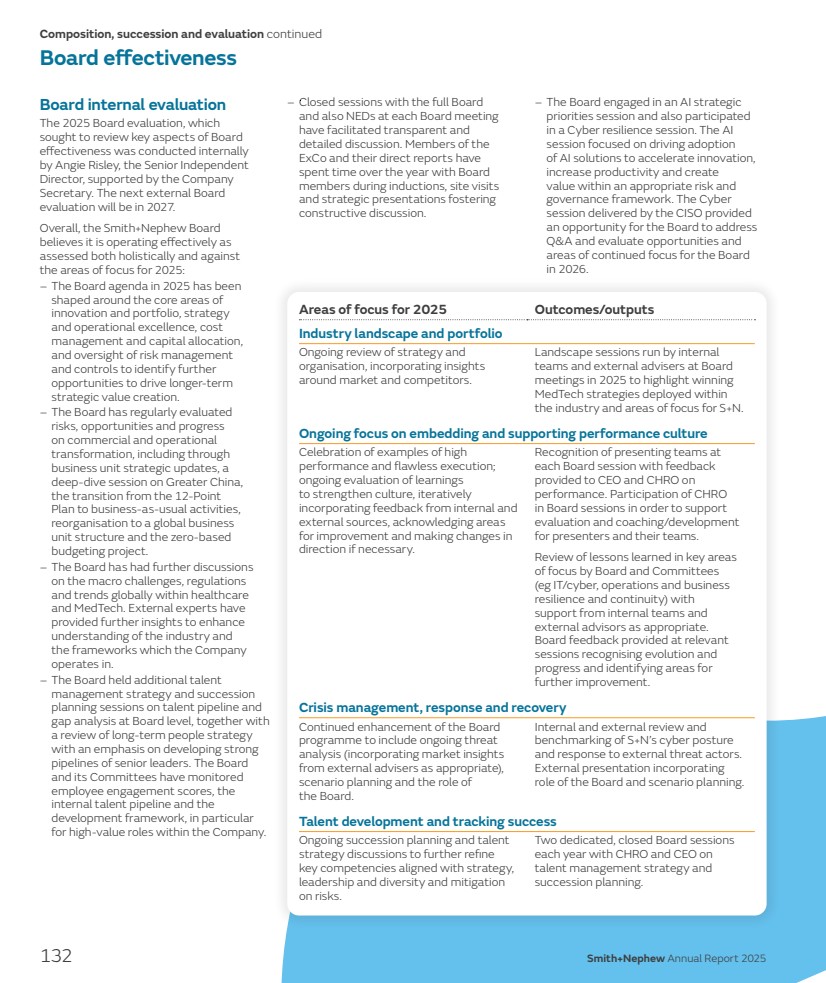
| Areas of focus for 2026 Outcomes/outputs Continued focus on operational excellence Continued focus on evaluating and monitoring operational excellence, customer centricity and flawless execution following completion of the 12-Point Plan to demonstrate continued improvement and credibility to stakeholders. Board agenda to be shaped to continue to focus on evaluating and supporting the transition to the RISE strategy. Board agenda deep dives in key areas of focus; reports to be provided to Committees and reported to full Board (as appropriate) in order to manage Board time in a focused and effective way. Focus in business reviews aligned to delivery on RISE objectives/KPIs with business unit teams; operational review sessions to be extended to 1.5 hours. Evaluate and support bold ambitions for the business to drive and create shareholder value Continue to support and challenge pathway to being a MedTech winner aligned to the ambitions outlined in RISE. Continue to evaluate optionality of bold choices and actions for the business; Board subcommittee structure to be evaluated for use on key topics where priority/urgency is required in order to enable the Board to be positioned to move at pace and respond quickly. Talent development and capabilities required to deliver on strategy Ongoing discussions on succession planning and talent strategy to understand key competencies required to deliver on RISE. At least two dedicated sessions with CHRO and CEO on talent management strategy, organisational capability mapping to deliver on RISE and succession planning. Board touchpoints with Executive Committee members and their teams as part of site visits and business reviews. Cyber/AI Continued focus on cybersecurity resilience including cyber incident risk mitigation and focus on AI risks and opportunities to support the delivery of RISE. Seek opportunities to continue to enhance and support Board awareness to take advantage of efficiencies through greater simplification and automation of our systems and processes. Outputs, outcomes and feedback from the internal Board evaluation 2025 Board effectiveness: The Board operates effectively, with strong relationships and a constructive environment. Leadership: Recognition provided for the Chair, CEO and CFO, of their openness and ability to foster productive discussions. Strategic focus: Continued in-depth Board review of strategy, market insights and operational excellence. Performance culture: Ongoing focus on high performance and flawless execution was noted, with feedback loops on culture through Board listening sessions and site visits. Board composition and succession planning: Continued emphasis on Industry and People/HR experiences as priorities for future Board appointments. Organisational succession planning: Need for deeper understanding of high-potential talent and organisational capability. Smith+Nephew Annual Report 2025 133 STRATEGIC REPORT GOVERNANCE ACCOUNTS OTHER INFORMATION 16_SN_AR25_NOM_QA_BoardDel_Visit_Eff_v149.indd 133 05/03/2026 18:16 |
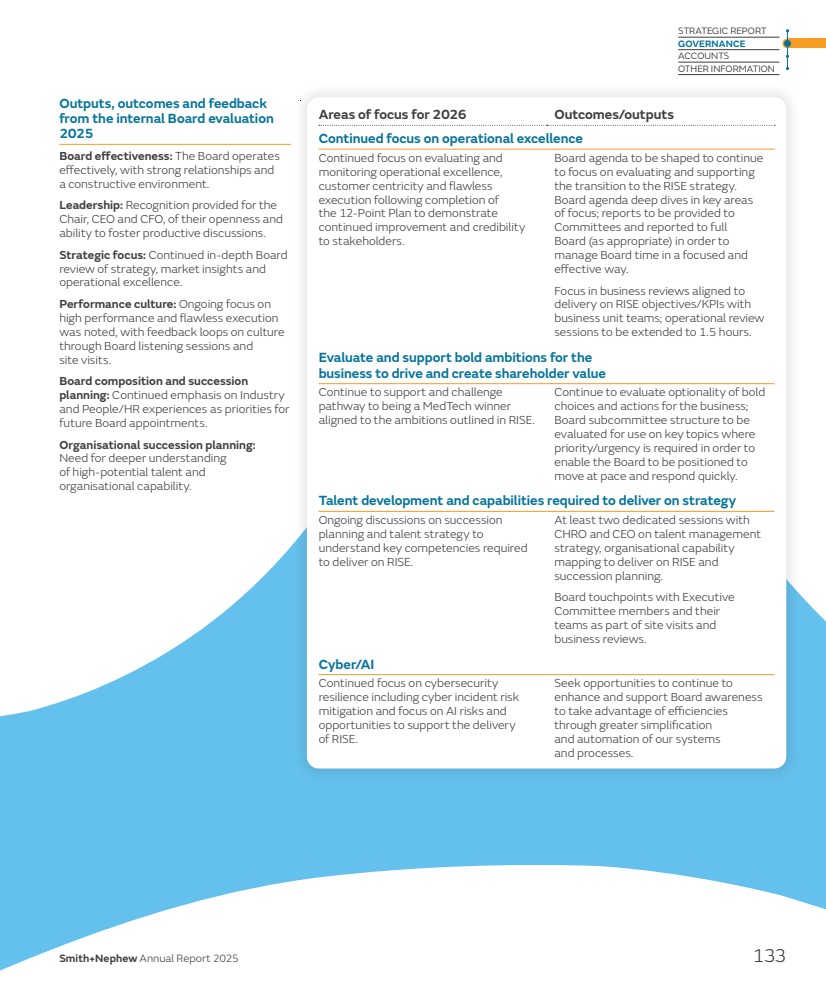
| Board induction and development programme During 2025, structured and customised induction programmes were provided for Sybella Stanley, David King, Garheng Kong and we commenced the induction programme for Thérèse Esperdy who was appointed to the Board on 1 December 2025. Our Board induction and development programmes are customised to address the specific needs and interests of each of our Directors. We focus the induction and development sessions on facilitating a greater awareness and understanding of our business, our stakeholders and the regulatory frameworks in which we operate. Areas of strength and focus for 2026 On an ongoing basis, we provide our Directors with both virtual and in-person opportunities to understand more about our business and the healthcare industry and support engagement with our teams and internal/external resources as appropriate; for example: – A number of Board members have enjoyed holding employee listening sessions throughout the year, both physically and virtually, where they have talked with employees and heard their views on what it means to work for Smith+Nephew. These sessions are discussed in more detail on page 140. – In December 2025, Board members were invited to Capital Markets Day sessions in both London and New York in person and were able to attend sessions virtually, which provided further insight into the global product innovation strategy across each of our business units and our differentiated product pipeline, together with the opportunity to meet our investors. – All Board members have access to a library of Board induction and development internal materials within our Board resource portal, as well as recommendations on thought leadership articles, materials, webinars and other resources. – We have arranged sessions on external perspectives on the healthcare industry and macro trends/insights on topics of interest/relevant to the Board. The Chair regularly reviews the development needs of individual Directors and the Board as a whole as a part of closed wrap-up sessions for Non-Executive Directors. Induction programmes Induction programmes are tailored to each Board member’s individual skills and experiences and their roles on the Board and its Committees and include: – Written materials and in-person presentations from our business teams on the medical devices industry, including high level information on reimbursement, market access, products and regulation. – One-to-one meetings with senior executives to understand the organisation, the roles and responsibilities of our senior employees and specifically how we do things at Smith+Nephew. – Meetings with our external advisers including brokers, external counsel, remuneration consultants, auditors and external counsel (as appropriate), to explain the legal and regulatory background to their role on our Board and how these matters are approached at Smith+Nephew. – Strategic presentations and site visits tailored to Executive and Non-Executive needs respectively in order to provide a strong foundation to learn about the organisation, its history, current and future opportunities, and challenges, and to give Board members an opportunity to ask questions and interact with our wider workforce. In 2025, the Non-Executive induction programmes included: – A strategic overview and introduction to MedTech and medical devices coupled with an immersive introduction to our purpose, culture pillars and people. – One-to-one sessions with each member of the Executive Committee, Investor Relations and Finance Global Leadership Teams. – Subject matter expert sessions on medical device regulation, healthcare compliance, ERM and inventory/ asset utilisation. – Site visits to Ft Worth, Costa Rica and Croxley together with any additional site visits as may be requested. – Informal office touchpoints with employees at the UK Group Head Office (Croxley). – Introductory sessions with external advisers, auditors, brokers and consultants. – Additional internal and external sessions upon request based on interest. 134 Smith+Nephew Annual Report 2025 Composition, succession and evaluation continued Board development 16_SN_AR25_NOM_QA_BoardDel_Visit_Eff_v149.indd 134 05/03/2026 18:16 |
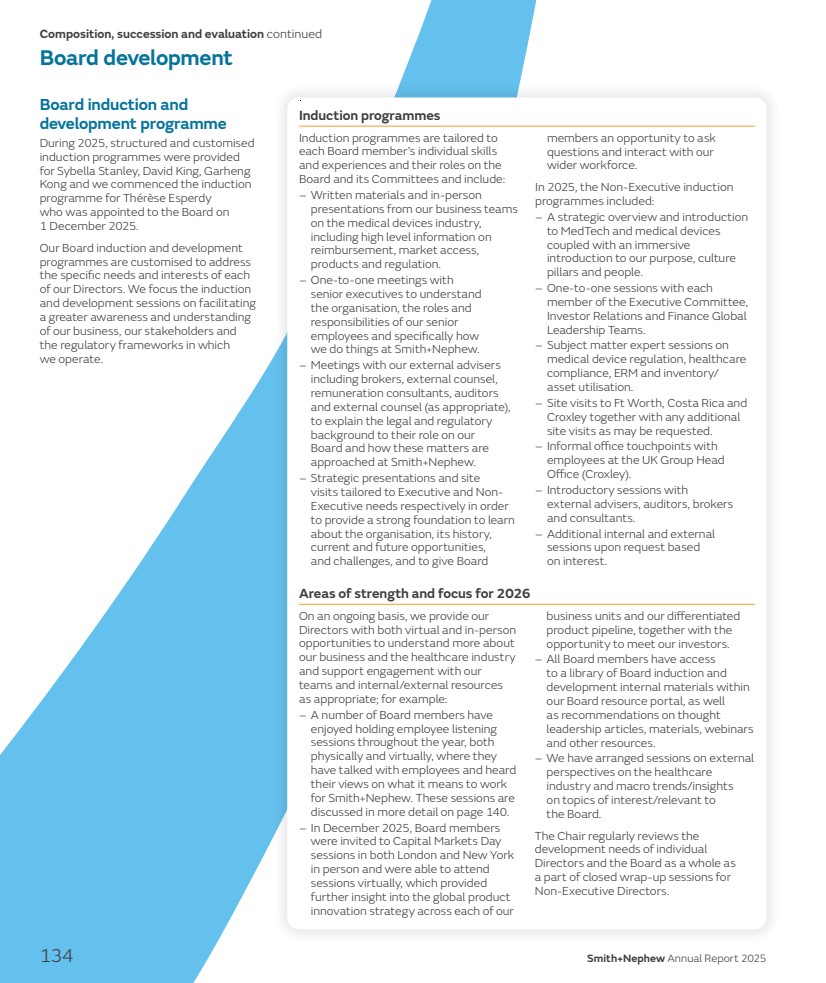
| 2 4 7 6 1 8 Site visits and Board Directors who visited 4. Andover (US) Rupert Soames 5. Pune (India) Rupert Soames 6. Singapore Rupert Soames 7. Austin (US) Rupert Soames 8. Costa Rica Rupert Soames, Jez Maiden, Simon Lowth 9. Shanghai and Suzhou (China) Rupert Soames and Jez Maiden 3. Suzhou (China) The visit included a tour of the manufacturing facilities, offices and laboratories and engagement with AWM employees at a Town Hall meeting. Board Directors who visited Jez Maiden 2. Croxley (UK) Board members toured the Academy and surgeon centre and had a hands-on experience and product demonstrations. Board Directors who visited David King, Garheng Kong, Thérèse Esperdy 1. Fort Worth (US) The Board visited S+N’s Clearfork offices in Ft Worth for a full day site visit which included a presentation from the AWM Global Leadership team on the AWM Vision for 2030 and the drive for market leadership through addressable market opportunities. The Board had a detailed presentation on product portfolio, value proposition and US and global acceleration through product differentiation, market access, business development and digital innovation. The Board engaged in a broad discussion on sustainability of market growth given new market entrants, products and go-to-market models, together with the reimbursement environment and pricing pressure on payors and the competitive landscape. The Board enjoyed lunch in a small group setting with a number of our Life Council, EIG leads and employees to hear the voice of the employee and product demonstrations including PICO, RENASYS, ALLEVYN, LEAF, SANTYL and VERSAJET and joined sales representatives to understand more about their role and experiences at Smith+Nephew, industry trends and the view of the organisation from a rep perspective. The Board also had a tour of the Vickery site and heard about the improvements made by the Wound Operations and Quality teams in accordance with their KPIs and the implementation of the Smith+Nephew Operating System (SNOS), contract manufacturing and operational resilience in accordance with the network strategy and footprint. Board Directors who visited Rupert Soames, Deepak Nath, John Rogers, Simon Lowth, Jez Maiden, Jo Hallas, John Ma, Katarzyna Mazur-Hofsaess, Marc Owen, Angie Risley, Sybella Stanley 3 9 5 2025 site visits were aligned to key strategic and operational priorities for the Board, with a focus on Smith+Nephew’s Advanced Wound Management business in Fort Worth, and continued improvements in Costa Rica, Croxley and our other sites. In addition to the formal site visits, our Non-Executive Directors also visited various sites throughout the year (see map) with customised programmes providing on-the-ground insights into Smith+Nephew’s global business unit organisation, strategy, operations, innovation, risk, people and culture, regulators, government, investors, local communities and the environment. Board site visits Smith+Nephew Annual Report 2025 135 STRATEGIC REPORT GOVERNANCE ACCOUNTS OTHER INFORMATION 16_SN_AR25_NOM_QA_BoardDel_Visit_Eff_v149.indd 135 05/03/2026 18:16 |
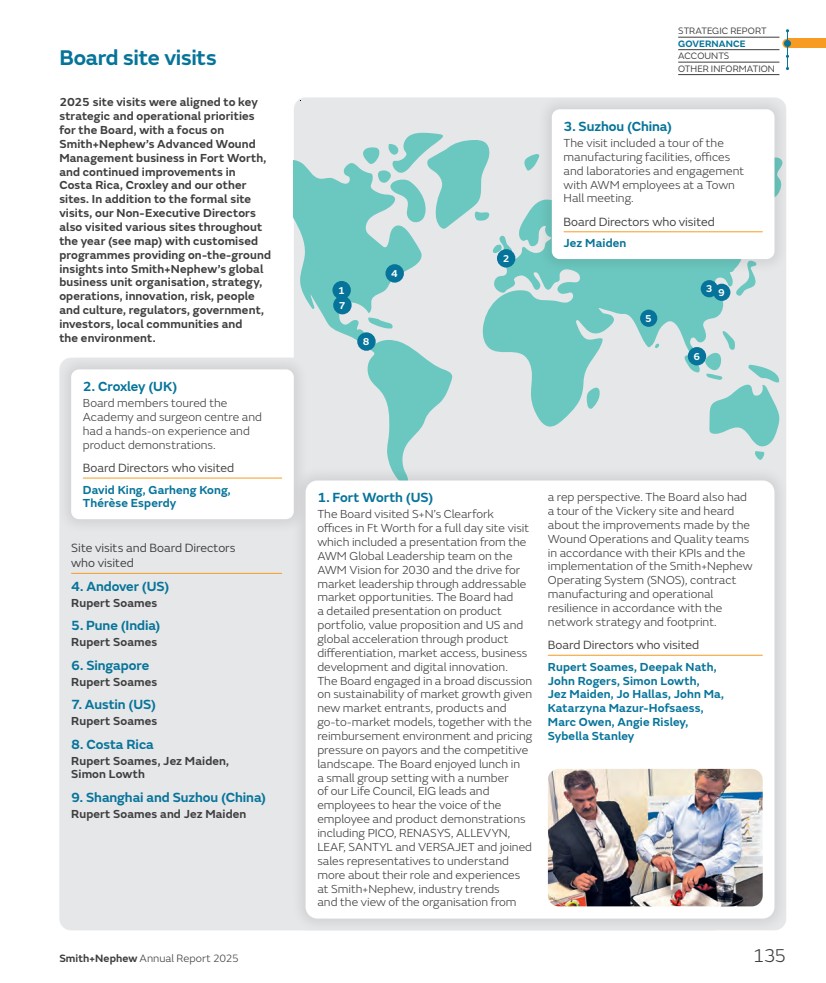
| “Smith+Nephew continues to strengthen employee engagement, focus on maintaining and improving quality and safety standards and enhancing its compliance programmes in line with its ethos of continuous improvement, its purpose of Life Unlimited and culture pillars of Care, Courage and Collaboration.” Marc Owen Chair of the Compliance & Culture Committee Committee roles and responsibilities Ethics and compliance – Overseeing the effectiveness of ethics and compliance programmes, strategies and plans. – Monitoring ethics and compliance process improvements and enhancements. – Reviewing whistle-blower policies and overseeing investigation reports. – Assessing compliance performance based on monitoring, auditing, and internal and external investigations data. – Discussion of significant potential compliance issues under privilege. – Receiving reports from the Chief Compliance Officer on ethics and compliance matters. – Reviewing implementation of the global data privacy compliance framework and other regulatory developments which impact our business. Sustainability – Overseeing our ESG strategy and its alignment to the priorities of our stakeholders and reviewing its performance against targets and metrics through the use of our ESG dashboard. – Reviewing sustainability initiatives which are designed to support the delivery of our business strategy and purpose and assessing their alignment with stakeholder’s requirements. – Receiving reports from the ESG Steering Committee and updates on stakeholder engagement to monitor the progress of the ESG strategy. Culture – Assessing organisational effectiveness and reviewing and providing oversight of how the Company’s culture is embedded throughout the business and aligned with our business strategy and purpose. – Overseeing arrangements for Board listening sessions with employees which aim to proactively support and reinforce our strategy and shared purpose of Life Unlimited, and our culture of Care, Courage and Collaboration. These sessions provide the Board with an opportunity to engage directly with employees to understand employee perspectives on certain topics. The Committee monitors and assesses the outcomes to identify areas for future enhancement and further embedding of the Company’s culture. – Receiving and assessing performance against purpose and culture and engagement. Quality and Regulatory Affairs (QARA) – Reviewing and providing oversight of the processes through which regulatory and quality risks are managed. – Monitoring trends and activities relating to regulatory and quality risks and events to ensure they are aligned with our business strategy and purpose. – Receiving and assessing regular functional reports and presentations from the Chief QARA Officer on QARA strategy and operations. The Terms of Reference for the Compliance & Culture Committee describe the role and responsibilities of this Committee more fully and can be found on our website. www.smith-nephew.com/en/ who-we-are/corporate-governance#terms-of-reference 136 Smith+Nephew Annual Report 2025 Compliance & Culture Committee Report Compliance & Culture 17_SN_AR25_Compl_Culture_Audit_v120.indd 136 05/03/2026 18:14 |
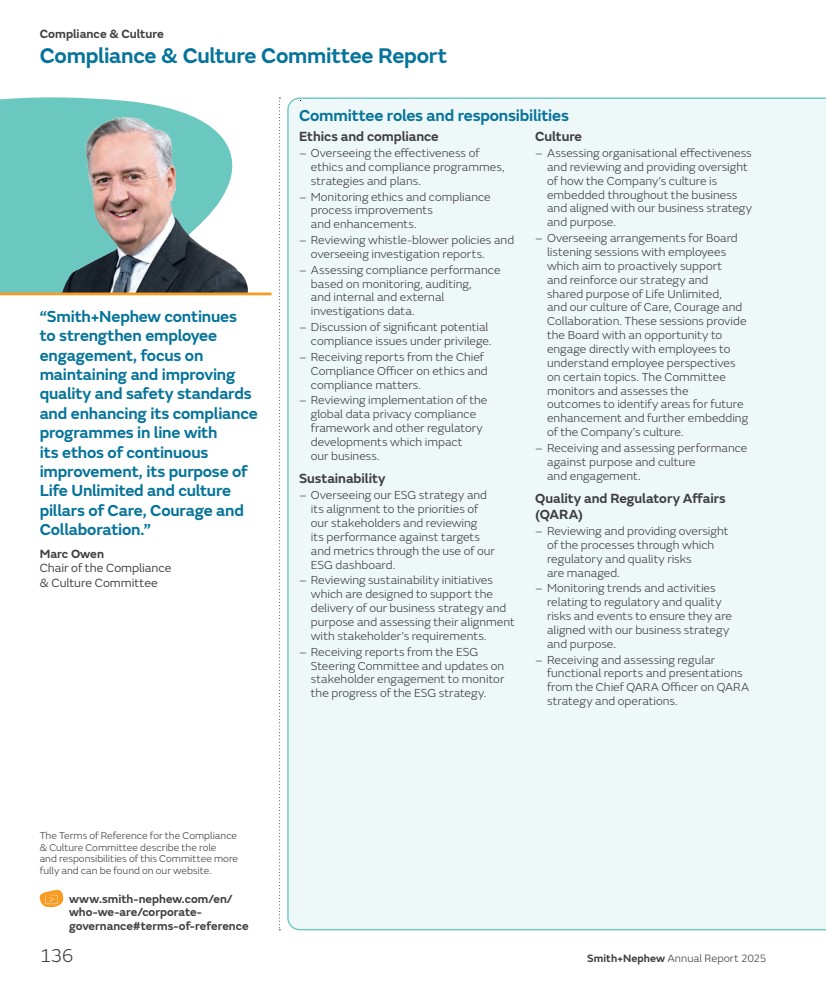
| Our focus for 2026 – Continued evaluation of the impact of ethics and compliance, regulatory, quality and cultural activities, and trends to support the Group’s business strategy and purpose. – Monitoring the Company’s progress against our ESG strategy to ensure it remains aligned with the Group’s business strategy and purpose, including measuring the impact of actions taken against the strategy’s objectives, such as the Company’s commitment to its net zero roadmap by 2045. – Continued oversight of stakeholder engagement and interests aligned with the Group’s ESG strategy. – Assessing the impact of Committee and Board decision making on our people, communities and the environment. – Continue Board listening sessions (with a key focus on the business strategy and enhancing leadership skills) to supplement the annual employee engagement survey, which is the primary mechanism by which the Board gains insight and understanding into the health of the organisation and employee perspectives on the Company. – Monitoring the actions taken by management following the Board employee listening sessions. – Review and approval of key annual disclosures such as the Sustainability Report and Modern Slavery Statement. – Monitoring the continued effectiveness of the Ethics & Compliance Program. – Reviewing the evolution of the Ethics & Compliance framework in line with organisational and external changes. Committee meetings In 2025, the Committee held four meetings. The Chair, CEO, CFO, Group General Counsel and Company Secretary, Chief Compliance Officer, Chief QARA Officer, Chief HR Officer, President of Global Operations and VP ESG also attended all or part of the meetings by invitation. Ethics and compliance As stated in the Code of Conduct, the sustainability of our business depends on doing business the right way and ensuring that we work with third parties who adhere to business principles consistent with our own. The Chief Compliance Officer provides regular reports to enable the Committee to evaluate the effectiveness of the Global Compliance programme and understand the audit, monitoring and continuous improvement activities undertaken to ensure that our ethics and compliance programme continues to evolve aligned to our business strategy and purpose. The Committee is provided with updates on potentially significant issues which are raised through the Company’s hotline or to our Compliance team and the Company’s response to such matters. It also receives an annual whistle-blower effectiveness review as well as details of investigations, actions taken to address substantiated matters and developing trends. The Committee receives updates on potentially significant findings from compliance audits and oversight actions, including details of the mitigating actions taken. On an annual basis the Committee receives a trend analysis of audit findings and root cause analysis with details of any programme changes required to address evolving trends. The Committee continues to receive a report on the self-assessment of the compliance programme against the US Department of Justice Evaluation of Corporate Compliance Programs guidance. Reports to the Committee demonstrate that the organisation has established mature processes and controls over compliance and ethics reporting and investigations. The Company enhances its framework and programmes to manage risk within the evolving internal and external environment in which it operates and to take account of insights from across the industry which may impact our ethics and compliance programme. Throughout the year the Committee receives updates on topical compliance developments affecting the Group. In 2025, the Committee explored focus topics including data privacy, changes in the US landscape and the evolution of the compliance framework governing engagements with healthcare professionals. The Committee also received updates on internal process enhancements, including changes designed to improve accessibility to resources and tools, and the launch of new policies applicable to ethics risk factors. Sustainability/ESG The Committee received updates throughout the year from the President Global Operations and Vice President ESG on our performance against People, Planet and Products initiatives. Utilising dashboards and strategy reporting developed by the ESG Steering Committee, the Committee monitors management actions taken and tracks progress against the organisation’s ESG objectives through KPIs, metrics and leading stakeholder indicators. The Committee reviewed progress against the ESG strategy throughout the year to assess its alignment with the ESG priorities of the Company’s stakeholders and its continued focus on driving business value. Based on stakeholder and industry best practice assessments, the Committee confirmed the Company’s ESG objectives. Smith+Nephew Annual Report 2025 137 STRATEGIC REPORT GOVERNANCE ACCOUNTS OTHER INFORMATION 17_SN_AR25_Compl_Culture_Audit_v120.indd 137 05/03/2026 18:14 |
| At each of its meetings the Committee was provided with updates on Scope 1 and 2 Greenhouse Gas Emissions reductions and renewable energy investments including green certificates (Renewable Energy Credits) to support emissions reductions. In February 2025, the Committee approved the 2024 Sustainability Report and reviewed the approach for the 2025 Sustainability Plan. The Committee also considered and approved the Modern Slavery Statement which can be found on the Smith & Nephew plc website. During April 2025, the Committee was updated about activities undertaken to support customers with their own ESG goals, including how customers’ feedback regarding product sustainability was incorporated into the sustainability review process for new products. In particular, the Committee noted that the feedback would be used to identify areas of most importance to customers and to track performance against packaging reduction and cost saving KPIs. The Committee also monitored the changes proposed to the timing and implementation and scope of the EU’s CSRD sustainability reporting framework. In July 2025, the Committee received the five-year ESG Strategic Plan which had been developed to support the Company’s 2030 vision and focussed on key elements related to customers, employees, community and investors. The Committee noted that the plan included enhanced emphasis on achieving ‘net-zero’ carbon emissions targets, improving product and packaging sustainability, coordinating ESG regulatory reporting and communicating our ESG credentials to customers. The Committee also reviewed our external ESG ratings and a roadmap to meet the Company’s 2040 and 2045 net zero carbon emissions objectives and the actions being taken to achieve them. The Committee reviewed the Group’s global health, safety and environment (HSE) programme and monitored the practices and processes used to ensure the safety of our employees using industry performance metrics including OSHA Recordables and Lost Time Injuries. The Committee reviewed management reports and was satisfied with actions taken to mitigate risk and the continued development of new initiatives to enhance our HSE programme. In December 2025, the Committee reviewed progress made against KPIs to achieve reductions in materials used for product packaging, including how packaging was being redesigned to respond to customers’ requirements for better storage, to achieve cost savings and improve environmental benefits through reductions in single use plastics. The Committee Chair continues to engage with investors, governance teams and other stakeholders on sustainability and ESG topics. QARA Product safety and effectiveness are fundamental to our business. Regulatory authorities worldwide maintain an increasingly complex and evolving framework of laws and regulations governing the design, development, approval, manufacture, labelling, marketing, and sale of healthcare products. At each meeting, the Committee receives summary reports and reviews the Company’s performance against both internal and external KPIs and metrics to ensure that quality and regulatory activities remain aligned with the Company’s strategy and purpose. The Committee receives regular briefings from the Chief QARA Officer on key quality and regulatory matters. This includes reviews of outcomes from external regulatory inspections and audits conducted by the FDA and other regulatory authorities, as well as updates on continuous improvement programmes and related activities. In addition, the Committee reviews the results of internal quality audits and monitors key performance indicators associated with critical quality and regulatory compliance processes. The Committee also receives updates on the Company’s preparedness for emerging and evolving regulatory requirements applicable to the business, including changes to the EU Medical Device Regulation, MHRA post-market surveillance requirements, and the EU AI Regulation. The Committee oversees the Group’s post-market surveillance processes and escalation pathways to ensure issues are investigated and resolved promptly through standardised procedures. Trends are identified and assessed for changes in risk profile. At each meeting, the Committee receives detailed reports on complaints data, including analysis of complaint types, volumes, risk levels, and regulatory reporting timeliness. For more information download our 2025 Sustainability Report 138 Smith+Nephew Annual Report 2025 Compliance & Culture Committee Report continued Compliance & Culture continued 17_SN_AR25_Compl_Culture_Audit_v120.indd 138 05/03/2026 18:14 |
| Culture The Company’s core purpose of Life Unlimited and the supporting culture pillars of Care, Courage and Collaboration continue to drive performance and accountability throughout the organisation globally. Our strategic objectives and culture pillars provide alignment across our business and stronger understanding by employees of their role in supporting our collective success. At each meeting, the Committee received briefings and updates on culture from the Chief HR Officer demonstrating progress in key areas of focus which centred around initiatives to enhance and further embed our culture including employee experience; enhancing people leader capabilities, organisational effectiveness and embedding change. As part of the focus on employee experience the Committee reviewed the Group’s approach to total reward and employee wellbeing and discussed how it had evolved to achieve its key objectives to attract, motivate and retain employees. The reward programme focused on enhancing employee engagement, encouraging the right behaviours and rewarding high performance. The Gallup Global Engagement Survey is used to track progress on employee engagement and associated internal and external KPIs and metrics are used to ensure the organisation is achieving its objectives. The 2025 survey results were shared with the Committee, which allow Smith+Nephew to benchmark against similar companies in our industry. In 2025 the employee participation rate increased to 95% and engagement scores improved across each area of the survey, demonstrating how we are building and embedding a culture where Care, Courage, Collaboration, and continuous improvement drive our success. The Committee was pleased to celebrate the Company receiving the Gallup Exceptional Workplace Award for the second year in a row in 2025 and noted that the Company had displayed an improvement trajectory above the majority of other Gallup participants. The Committee was made aware of the positive impact of the 2025 wellbeing events, including mental health awareness/ resilience, Pride events, a wide range of events around International Women’s Day, in-person volunteering events and cultural networking events. Board members met employees at the Fort Worth site visit to help gain a deeper understanding of our culture. Smith+Nephew Annual Report 2025 139 STRATEGIC REPORT GOVERNANCE ACCOUNTS OTHER INFORMATION 17_SN_AR25_Compl_Culture_Audit_v120.indd 139 05/03/2026 18:14 |
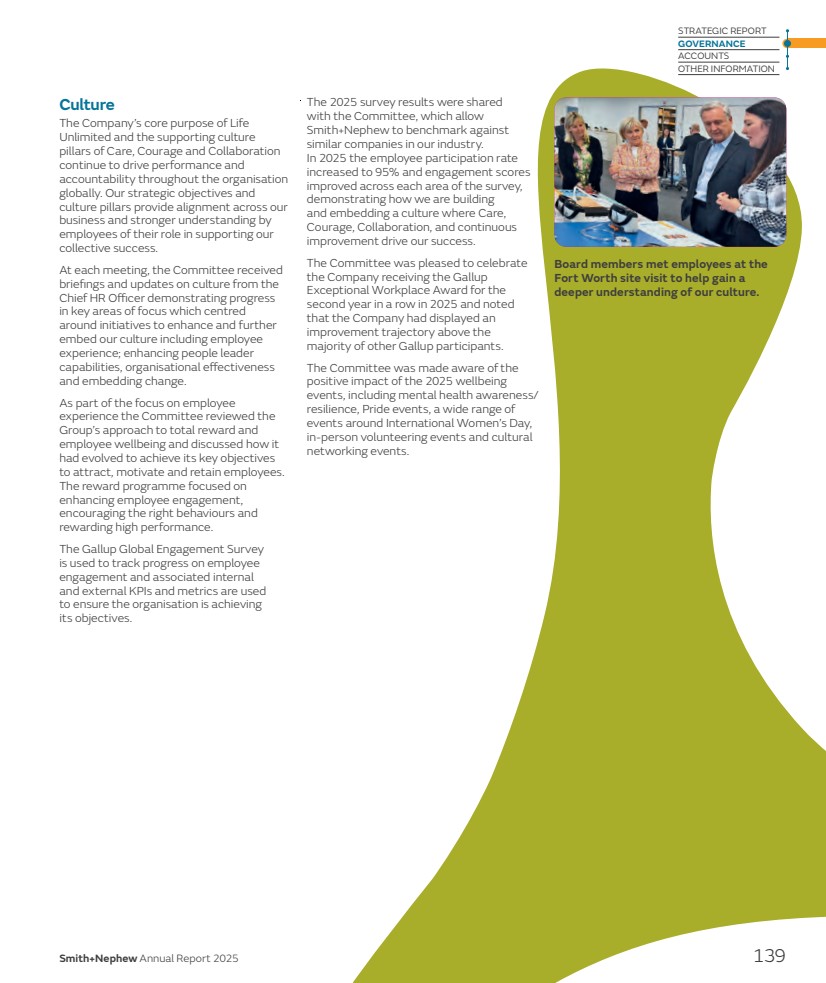
| The Board is committed to the purpose of Life Unlimited and supporting and embedding a strong culture within the organisation. Our strong cultural pillars of Care, Courage and Collaboration promote good governance across our business and are crucial to fostering an environment of ethical performance. A key forum where culture is at the top of the agenda is the Compliance & Culture Committee, which monitors and measures the ways in which culture is embedded in the organisation. Code of Conduct The Code of Conduct is reviewed by the Board annually and approves any amendments. Our Code of Conduct sets out the expected behaviours and as such is a clear foundation of our corporate culture. Each Board member is required to certify compliance with the Code of Conduct annually. Our Code of Conduct is available to view at www.smith-nephew.com/ en/compliance Board, Committee, Strategy meetings Routine reporting at Board, Committee and strategy meetings together with senior employees’ attendance and presentations provide valuable insight into culture across the Group. The Board effectively engages with employees at site visits and meetings held at the Company’s offices. Employee Inclusion Groups The Board recognises that a culture of inclusivity is key to enable individuals to thrive. Our EIGs are driven by our employees and their passion to foster an ethos of belonging and create a community to discuss relevant topics, knowing that their voice and contributions matter. Whistle-blowing The Board has ensured that there is a clear and accessible platform for employees to confidentially raise any concerns through the whistle-blowing hotline. A report on whistle-blowing matters including trends and monitoring is presented to the Committee. This information is a key alert to any cultural issues and workforce concerns. Board listening sessions In 2025, Board members in addition to Committee members engaged in listening sessions and other touchpoints with employees during their visits to the Company’s facilities, enabling them to experience the employee voice in different ways. Directors engaged with employees across the globe during five Board listening sessions in 2025. A wide variety of matters were discussed, including how to build a high performance culture, align strategic priorities, improve customer experience and enhance future technology, including AI. These sessions are a key opportunity for the Board to monitor the cultural climate of the Group and develop initiatives to further embed and enhance our culture. Employee annual engagement survey A positive and collaborative culture for employees is key to enabling delivery of organisational success. The annual Global Engagement Survey is reviewed by the Board and considered to be a helpful indicator of culture across the Group and provides insights at each level of the business. 16,000+ 95% of colleagues’ shared their feedback Outcomes of embedding our culture – Improved employee participation at 95%, overall evidence of higher engagement and winner of the Gallup Exceptional Workplace Award. – Developing and retaining talent. – Opportunities for employees to bring their whole selves to work. Five Board listening sessions were held during 2025. 140 Smith+Nephew Annual Report 2025 Our culture Compliance & Culture continued 17_SN_AR25_Compl_Culture_Audit_v120.indd 140 05/03/2026 18:14 |
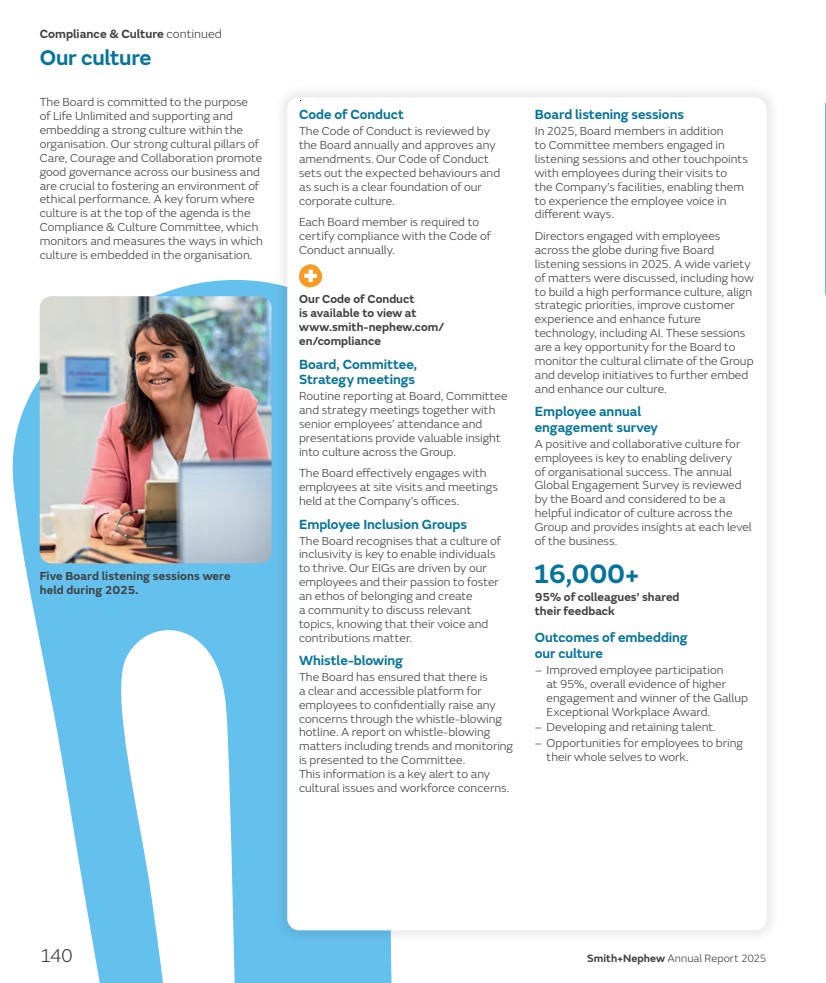
| The Terms of Reference for the Audit Committee describe the role and responsibilities of this Committee more fully and can be found on our website. www.smith-nephew.com/en/ who-we-are/corporate-governance#terms-of-reference Committee roles and responsibilities – Ensuring the integrity of the Company’s financial reporting to shareholders and any announcements relating to the Group’s financial performance. – Ensuring financial statements comply with UK and US statutory requirements. – Reviewing the content of the Annual Report and advising the Board on whether, taken as a whole, it is fair, balanced and understandable, and providing the information necessary for shareholders to assess the Company’s performance, business model and strategy. – On behalf of the Board, reviewing management’s assessment of and reporting on the effectiveness of internal controls, and compliance with the 2024 UK Corporate Governance Code (Code) and the Sarbanes-Oxley Act 2002. – Ensuring the effectiveness and independence of the Internal Audit function, agreeing audit plans and considering outcomes of internal audits. – Reviewing the operation and ensuring the effectiveness of the Group’s risk management and internal control framework. – On behalf of the Board, carrying out a robust assessment of the principal and emerging risks facing the Group. – Ensuring the effectiveness and independence of the external auditor, agreeing the scope of audits (including materiality thresholds and areas of risk for focus), and the auditor’s fees and terms of engagement. – Monitoring enhancements to fraud assessment and considering any reported frauds and any concerns raised by the Company’s whistle-blowing process. – Overseeing other matters, including cybersecurity, IT governance, tax and treasury. Our focus for 2026 In delivering its responsibilities in 2026, the Committee will prioritise key areas, including: Financial reporting and external audit – Continued monitoring of a project to report against the EU’s CSRD and the UK’s sustainability reporting standards and the wider impact on the Group’s sustainability reporting. – Monitoring the Group’s readiness for IFRS 18 Presentation and Disclosure in Financial Statements which will be effective from 1 January 2027. Internal controls – Reviewing transformation and automation control initiatives to decrease manual controls reliance. – Monitoring the design and effectiveness of IT controls to ensure financial reporting systems continue to operate effectively. – Overseeing the implementation of a material controls assurance programme to meet the new requirements of Provision 29 of the Code from 1 January 2026. Risk management – Assessing the impact of a changing global environment on the Group’s principal risks, together with monitoring of cyber resilience, as part of the Group’s ongoing investment and maturity programme. Finance organisation – Overseeing the implementation of changes to the way the finance function delivers its services to the Group, including the implementation of a new single ERP system and assessing the benefits realised. – Expanding the Committee’s exposure to finance resource across the Group, supporting talent development. “The Audit Committee has maintained its focus on supporting management to deliver high quality financial reporting, robust controls, effective risk management and a dynamic finance organisation.” Jez Maiden Chair of the Audit Committee Smith+Nephew Annual Report 2025 141 STRATEGIC REPORT GOVERNANCE ACCOUNTS OTHER INFORMATION Audit Committee Report Audit, Risk and Internal Control 17_SN_AR25_Compl_Culture_Audit_v120.indd 141 05/03/2026 18:14 |
| Committee meetings The Committee met seven times during the year, with meetings timed to coincide with the financial and reporting cycles of the Company. In addition, the Committee met with both the Company’s external auditor and Group Head of Internal Audit (GHIA) without management present. The Committee Chair held individual meetings with the external auditor, CFO, GHIA, Group Financial Controller and the Group Head of Financial Controls and Compliance throughout the year. All members of the Committee are deemed to be Independent Directors and I am the designated financial expert under the SEC Regulations and, along with Simon Lowth, we are the Committee members with recent and relevant financial experience in accordance with the Code. 2025 key activities and highlights As part of its responsibilities, set out above, the Committee’s particular areas of focus in 2025 included: Financial reporting and external audit – Assessing and challenging the adequacy of the inventory excess and obsolescence provision including the incremental provision in relation to the strategic review of the product portfolio. – Considering significant and other financial matters which could impact the financial statements, as set out on pages 143 and 144. – Reviewing the appropriateness of the disclosures made in the half year financial report and the annual financial statements and related announcements. – Supporting Deloitte during their second audit in 2025 and reviewing actions taken to improve the efficiency of the audit through increased collaboration with management and the enhanced use of technology and data analytics. – Monitoring changes to the timing of the implementation and scope of the EU’s CSRD sustainability reporting framework and the implications for the Group and its EU subsidiaries and receiving regular updates on management’s development of reporting changes. – Supporting the Remuneration Committee in its assessment of, selection of and performance against financial metrics in short-term and long-term incentive schemes. In September 2025, the Financial Reporting Council (FRC) issued a comment letter to the Group in relation to its Annual Report and Accounts for the year ended 31 December 2024. The Committee reviewed the proposed responses and agreed a change to the future accounting treatment of Orthopaedic instruments provided to customers on consignment. The FRC closed its review in January 2026. Internal controls – Reviewing and challenging management on the effectiveness of the system of internal control, including considering and responding to findings from external audit, internal audit and management’s own testing. – Reviewing the operation of financial controls across the Group, including delivery of continued improvement in the financial control environment. This includes initiatives to implement continuous monitoring in certain control areas and adapt other areas to evolving risks. – Continued focus on monitoring improvements in the scope and maturity of IT controls, including faster identification and remediation of deficiencies using improved data analysis, and the addition of four IT systems for review. – Reflecting the new requirement under Provision 29 of the Code, for the Board to confirm the effectiveness of material controls, the Committee reviewed the Group’s material controls using a risk-based approach reflecting the 11 principal risks. The Committee reviewed testing of controls effectiveness and agreed proposed assurance reviews using existing internal resources. Internal audit and risk management – Confirming the continued operation of a satisfactory control environment across the Group, through monitoring of the planning and delivery of an efficient, high-quality internal audit programme, focused on compliance, process and risk-driven audits as set out under Internal Audit on pages 145 and 146. – On behalf of the Board, monitoring the Group’s ERM framework, including the control and mitigation of principal risks against agreed risk appetites. – Regular ‘deep dives’ into the Group’s information and cyber security resilience, including updates on incidents, threat monitoring and controls, education and awareness campaigns and maturity posture. The Committee has engaged in work to confirm the effectiveness of all material controls from 2026. 142 Smith+Nephew Annual Report 2025 Audit Committee Report continued Audit, Risk and Internal Control continued 17_SN_AR25_Compl_Culture_Audit_v120.indd 142 05/03/2026 18:14 |
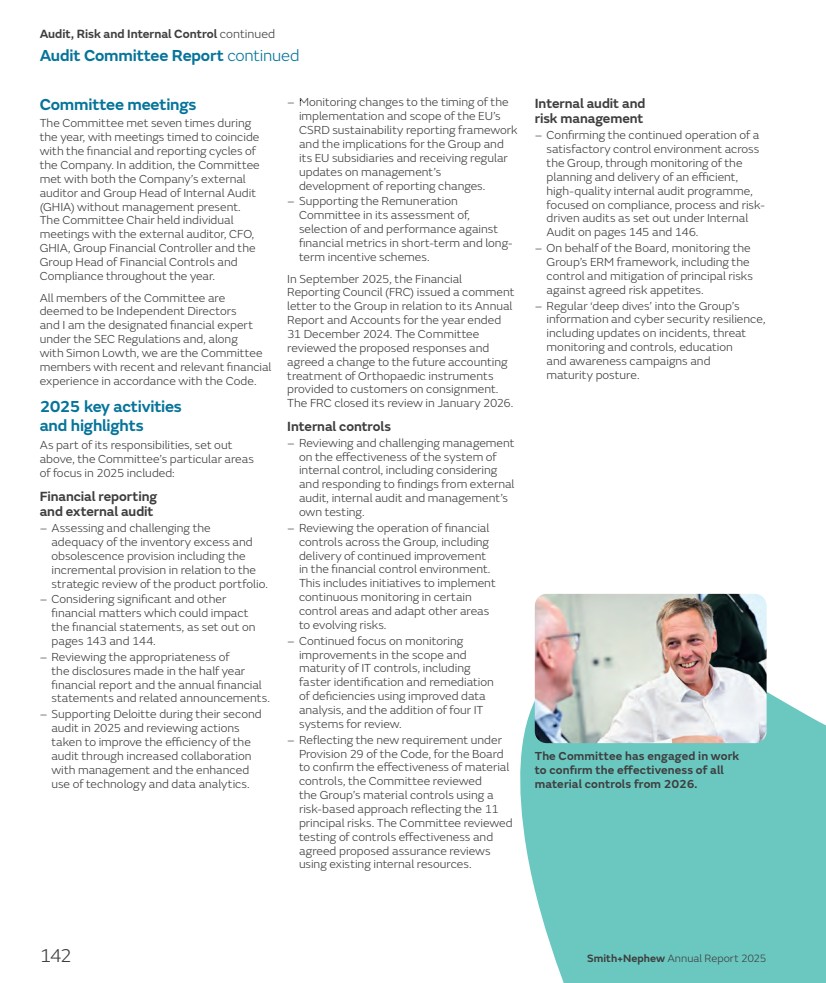
| Valuation of inventories A feature of the Orthopaedics business unit (which accounts for approximately 68% of the Group’s total inventory and approximately 79% of the total provision for excess and obsolete inventory) is the high level of product inventory required, some of which is located at customer premises and is available for customers’ immediate use. Complete sets of products, including large and small sizes, have to be made available in this way. These sizes are used less frequently than standard sizes and, towards the end of the product life cycle, are inevitably in excess of requirements. Adjustments to carrying value are therefore required to be made to orthopaedic inventory to anticipate this situation. These adjustments are calculated in accordance with a formula based on levels of inventory compared with historical usage. This formula is applied on an individual product line basis and typically is first applied when a product group has been on the market for two years. This method of calculation is considered appropriate based on experience, but it does involve management estimation of customer demand, effectiveness of inventory deployment, length of product lives and phasing out of old products. As noted above, the Group also undertook a strategic review of its product portfolio in 2025 and identified a number of SKUs to be rationalised. Management estimated the demand and timing of phase-outs for these SKUs and charged an incremental provision for excess and obsolete inventory. Our action At each quarter end, we received reports from, and discussed with, management the level of inventory provisioning and material areas at risk. The provisioning level was 26% at 31 December 2025 (2024: 20%). We challenged the basis of the provisions and concluded that the proposed levels were appropriate and have been consistently estimated. We further challenged the assumptions used in the incremental provision for products that are being rationalised to ensure the assumptions used were appropriate. IT systems The Group’s IT systems form a key component of the Group’s financial reporting activities. The Group operates key IT controls to monitor and mitigate privileged access to key systems, and prevent inappropriate changes being made in relation to application integrity and transactional processing. Given the reliance placed on these systems, IT controls testing is fundamental to Deloitte’s audit approach. Our action We reviewed management’s reports on the testing of IT general controls, including the remediation of deficiencies. The Committee noted significant improvements in the number and speed of resolution of IT control deficiencies. Finance organisation – Received regular updates on plans for the implementation in 2026 of initiatives to transform the delivery of the finance functions services including a new integrated reporting system to enhance the strategic insight that the finance function provides to the business. – Reviewing treasury and tax operations, including developments in relation to US tax reforms and interaction with the global tax system (‘Pillar 2’). – Monitoring and supporting management changes in key finance roles, including a new Group Financial Controller. Significant matters related to the financial statements We considered the following key areas of judgement in relation to the 2025 financial statements and at each half year and quarterly trading report, which we discussed in all cases with management and the external auditor: Smith+Nephew Annual Report 2025 143 STRATEGIC REPORT GOVERNANCE ACCOUNTS OTHER INFORMATION 17_SN_AR25_Compl_Culture_Audit_v120.indd 143 05/03/2026 18:14 |
| Other matters related to the financial statements As well as the identified significant matters, other matters that the Committee considered during 2025 were: Impairment In carrying out impairment reviews of goodwill and acquisition intangible assets, a number of significant assumptions have to be made when preparing cash flow projections. These include the future rate of market growth, discount rates, the market demand for the products acquired, the future profitability of acquired businesses or products, levels of reimbursement and success in obtaining regulatory approvals. We reviewed and challenged management’s key assumptions and their sensitivity analysis and concluded that no material impairments were required. The Committee also reviewed and supported the removal of impairment of Orthopaedic goodwill assets as a significant matter, following good progress in improving the performance of the business. Going concern The impact of a global economic downturn has been considered as part of the adoption of the going concern basis in these financial statements. We reviewed three-year projections as part of the Group’s Strategic Plan, and also more detailed cash flow scenarios for a period of at least 12 months from the date of approval of the financial statements, for going concern purposes and concurred with management that the continued adoption of the going concern basis is appropriate, as set out on page 146. Taxation The Group operates in numerous tax jurisdictions around the world and is subject to factors that may affect future tax charges. We annually review policies and approve the principles for management of tax risks. We review regular reports from management evaluating the existing tax profile, tax risks and tax provisions. Based on a thorough report from management of tax liabilities and our challenge of the basis of any tax provisions recorded, we concluded that the levels of provisions and disclosures were appropriate. Post-retirement benefits The Group has post-retirement defined benefit pension schemes, which require estimation in setting the assumptions. We received a report from management setting out their proposed assumptions for schemes in the UK, Switzerland and Germany and concurred with management that these assumptions were appropriate. Non-IFRS financial information The Group reports a number of non-IFRS metrics to assess its performance. The Committee annually reviews the non-trading items policy and approves specific items within the policy. Liability provisioning The Group has provisions for legal disputes which require estimation. We received regular updates from the Group General Counsel & Company Secretary. These updates form the basis for the level of provisioning. We received detailed reports from management, including the actuarial model used to estimate the provision for metal-on-metal hip claims, and challenged the key assumptions. We noted the continued reduction in outstanding claims and concurred with management that the proposed levels of provisioning at year end of $107 million included within ‘provisions’ in Note 17.1 in 2025 (2024: $123 million) were appropriate in the circumstances. Climate change The impact of climate change has been considered as part of our review of the impairment testing of goodwill and acquired intangible assets, and the going concern assessment. We have also considered the disclosures on climate change and considered them appropriate. Since the year end We have reviewed the results for the full year 2025 and the Annual Report 2025, and have concluded that they are fair, balanced and understandable. In coming to this conclusion, we have considered the description of the Group’s strategy and key risks, the key elements of the business model, which is set out on pages 14 and 15, and the KPIs and their link to the strategy. External auditor Independence of external auditor Deloitte LLP (Deloitte) was appointed auditor of the Company with effect from 1 January 2024, as approved by shareholders at the AGM in May 2024. We are satisfied that Deloitte is fully independent from the Company’s management and free from conflicts of interest. Our Auditor Independence Policy, which ensures that this independence is maintained, forms part of the Committee’s terms of reference and is available on the Company’s website. We believe that the implementation of this policy helps ensure that auditor objectivity and independence is safeguarded. The policy also governs our approach when we require our external auditor to carry out non-audit services, and all such services are strictly governed by this policy. The Auditor Independence Policy also governs the policy regarding audit partner rotation, with the expectation that the audit partner will rotate at least every five years. Andrew Bond was appointed as our senior lead audit partner on 1 May 2024. The Committee confirms it has complied with the provision of the Competition and Markets Authority (CMA) Order 2014 and the FRC’s Minimum Standard for Audit Committees. Effectiveness of external auditor We conducted a review into the effectiveness of the external audit in 2025, in line with previous years. We sought the views of the Committee and key members of the finance management team, considered the feedback from this process and shared it with management. During the year, we also considered the inspection reports from the Audit Oversight Board in the UK and determined that we were satisfied with the audit quality provided by Deloitte. 144 Smith+Nephew Annual Report 2025 Audit Committee Report continued Audit, Risk and Internal Control continued 17_SN_AR25_Compl_Culture_Audit_v120.indd 144 05/03/2026 18:14 |

| The Committee receives feedback from Deloitte at each meeting where management present their summary of critical accounting estimates as at each quarter end and during the Committee’s private sessions with the auditors which are held throughout the year. The Committee noted that the greater centralisation of the audit, increased use of analytics to test 100% of transactions and leveraging of existing control frameworks had supported greater audit efficiency. Overall, we concluded that Deloitte had carried out their audit for 2025 effectively. Appointment of external auditor at AGM Resolutions will be put to the AGM to be held on 6 May 2026 for the re-appointment of Deloitte LLP as the Company’s auditor and authorising the Board to determine their remuneration, on the recommendation of the Committee in accordance with the CMA Order 2014. Disclosure of information to the auditor In accordance with section 418 of the Companies Act 2006, the Directors serving at the time of approving the Directors’ Report confirm that, to the best of their knowledge and belief, there is no relevant audit information of which the auditor, Deloitte, is unaware, and the Directors also confirm that they have taken reasonable steps to be aware of any relevant audit information and, accordingly, to establish that the auditor is aware of such information. Non-audit fees paid to the auditor Non-audit fees are subject to approval in line with the Auditor Independence Policy, which is reviewed annually and forms part of the terms of reference of the Committee. The Committee recognises the importance of the independence of the external auditor and ensures that the auditor’s independence should not be breached. The Committee ensures that the auditor does not receive a fee from the Company or its subsidiaries that would be deemed large enough to impact its independence or be deemed a contingent fee. The total fees for permitted non-audit services shall be no more than 70% of the average of the fees paid in the last three consecutive financial years for the statutory audits of the Company and its subsidiaries. Any pre-approved aggregate or individual amounts up to $25,000 may be authorised by the SVP Group Finance and amounts up to $50,000 by the CFO. Any individual amount over $50,000 must be pre-approved by the Committee Chair and if necessary, and to the extent determined by the Committee Chair, the work will be referred to the Committee. If unforeseen additional permitted services are required, or any which exceed the amounts approved, again pre-approval by the Chair of the Committee is required. The following reflects the non-audit fees incurred with Deloitte in 2025 and 2024, which were approved in accordance with the Auditor Independence Policy. 2025 $ million 2024 $ million Audit-related services 0.6 0.4 Assurance-related services – – Audit-related fees in 2025 primarily consisted of routine services and were deemed by the Committee not to infringe upon auditor objectivity or independence. Following a competitive tender process, the Committee approved the selection of Deloitte as the Company’s Corporate Sustainability Reporting Directive (CSRD) assurance provider, should this be required for future reporting periods. Deloitte has confirmed that assurance of CSRD will be standalone from the financial audit and the Committee concluded that the appointment would not infringe upon auditor objectivity or independence. The ratio of non-audit fees to audit fees for the year ended 31 December 2025 is 0.06. The ratio of non-audit fees to audit fees for the year ended 31 December 2024 was 0.04. Full details are shown in Note 3.2 to the Notes to the Group accounts. Audit fees paid to the auditor Fees for professional services provided by Deloitte, the Group’s independent auditors and other local statutory auditors in each of the last two fiscal years, in each of the following categories were: 2025 $ million 2024 $ million Audit fees 9.4 9.1 Audit-related fees 0.6 0.4 Total 10.0 9.5 Internal audit The Internal Audit team, which reports functionally to the Committee, provides independent and objective assurance and consulting services, designed to add value and to improve the Group’s operations. It carries out risk-based reviews across the Group that examine the management of risks and controls over financial, operational, commercial, IT and transformation programme activities. The Internal Audit team, led by the GHIA, consists of appropriately qualified and experienced employees. Third parties may be engaged to support audit work as appropriate. The GHIA has direct access to, and has regular meetings with, the Committee Chair and prepares formal reports for Committee meetings on the activities and key findings of the function, together with the status of management’s implementation of recommendations. The Committee has unrestricted access to all internal audit reports, should it wish to review them. Smith+Nephew Annual Report 2025 145 STRATEGIC REPORT GOVERNANCE ACCOUNTS OTHER INFORMATION 17_SN_AR25_Compl_Culture_Audit_v120.indd 145 05/03/2026 18:14 |
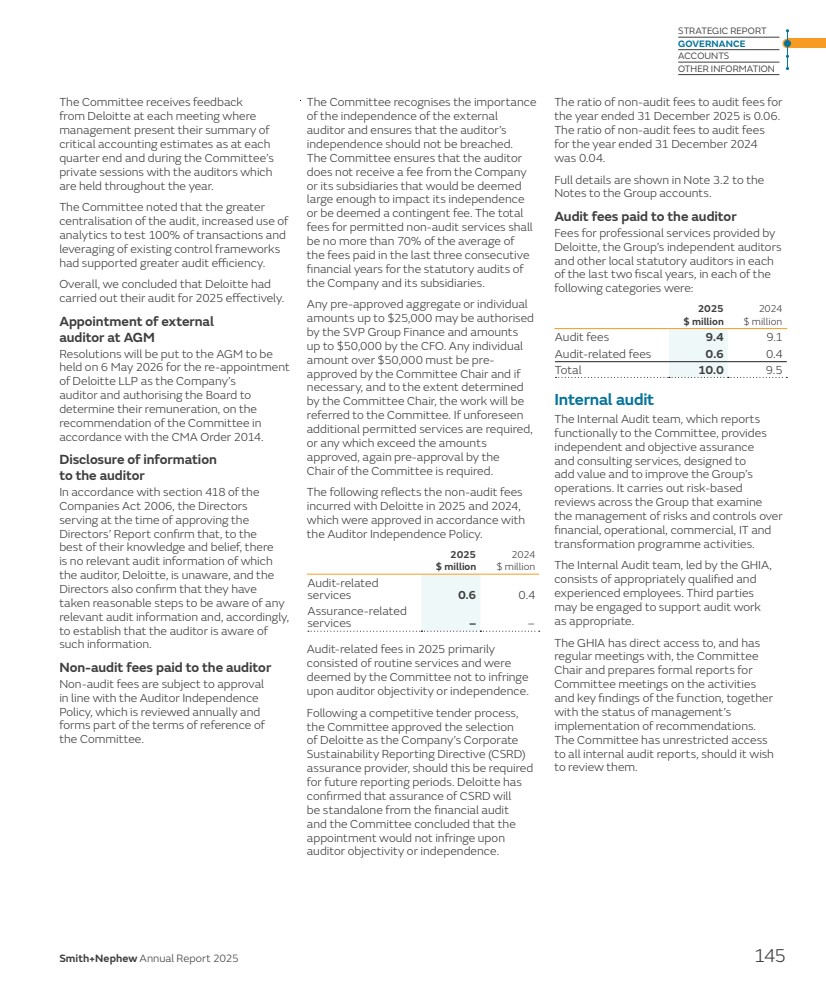
| During the year, the team completed 33 audits and reviews across the Group. These covered significant aspects of all 11 principal risks and included: financial controls effectiveness and market reviews across the Group; IT and programme assurance reviews, including data security, Artificial Intelligence, and cyber maturity. Group-level reviews included ERM effectiveness, data privacy, supplier master data, sales inventory and operational process effectiveness, travel and expenses and purchase cards controls, and contingent worker management. Reviews of US processes included field inventory controls, rebates processes, sales incentives controls, commercial execution and accounts payable processes. The team also performed reviews of the China channel and distributor management processes, and the integration of CartiHeal. Management has taken swift action to implement Internal Audit’s recommendations. The team continues to leverage data analytics combined with on-site and remote audit work as appropriate. The team carries out its work in accordance with the Institute of Internal Auditors’ International Professional Practices Framework. Its performance is annually assessed using a structured questionnaire, allowing non-executive, executive and senior management, plus the external auditor, to comment on key aspects of the function’s performance. The Committee, which re-approved the function’s charter in December 2025, has satisfied itself that adequate, objective internal audit standards and procedures exist within the Group and that the Internal Audit function is effective. Risk management programme The work the Committee has carried out in respect of risk management and internal controls is explained in the Risk Report on pages 78 to 94. Viability Statement The Committee reviewed management’s work in conducting a robust assessment of those risks which would threaten the business model and the future performance or liquidity of the Company, including its resilience to the threats of viability posed by those risks in severe but plausible scenarios. Based on this analysis, the Committee recommended to the Board that it could approve and make the Viability Statement on page 95. Going concern The Group’s business activities, together with the factors likely to affect its future development, performance and position, are set out in the Financial Review on pages 18 to 25 and the principal risks on pages 83 to 94. The financial position of the Group, its cash flows, liquidity position and borrowing facilities are described on pages 18 to 25. In addition, the Notes to the Group accounts include: the Group’s objectives, policies and processes for managing its capital; its financial risk management objectives; details of its financial instruments and hedging activities; and its exposure to credit risk and liquidity risk. The Group has considerable financial resources, and its customers and suppliers are diversified across different geographic areas. As a consequence, the Directors believe that the Group is well placed to manage its business risk successfully despite the ongoing uncertain economic outlook. The Group has considered several scenarios (refer to Viability Statement on page 95) including the continued uncertainty as to the future impact on the financial performance and cash flows of the Group as a result of a global economic downturn as part of the adoption of the going concern basis in these financial statements. The Directors have a reasonable expectation that the Group has adequate resources to continue in operational existence for the foreseeable future. Thus they continue to adopt the going concern basis for accounting in preparing the annual financial statements. Management also believes that the Group has sufficient working capital for its present requirements. Code of Ethics for Senior Financial Officers We have adopted a Code of Ethics for Senior Financial Officers, which applies to the CEO, the CFO, the Group Financial Controller, and the Group’s senior financial officers. There have been no waivers to any of the Code’s provisions, nor have there been any substantive amendments to the Code during 2025 or up until 27 February 2026. A copy of the Code of Ethics for Senior Financial Officers can be found on our website. In addition, every individual in the finance function certifies to the CFO that they have complied with the Finance Code of Conduct. Jez Maiden Chair of the Audit Committee The Committee continues to support John Rogers, the CFO, in his Next Generation Finance initiative, improving the way finance support is delivered to the business. 146 Smith+Nephew Annual Report 2025 Audit Committee Report continued Audit, Risk and Internal Control continued 17_SN_AR25_Compl_Culture_Audit_v120.indd 146 05/03/2026 18:14 |

| “Our remuneration arrangements are designed to be closely aligned with the delivery of our strategic priorities, which include sustainable value creation and long-term growth.” Sybella Stanley Chair of the Remuneration Committee Activities during 2025 – Developed proposals to amend the Remuneration Policy and conducted extensive shareholder consultation to share insights and obtain feedback from key investors. – Ensured that remuneration arrangements for Executive Directors and Executive Committee members aligned with, and incentivised, the successful delivery of the business strategy. – Reviewed competitiveness of reward for Executive Directors, to understand our ability to retain key talent and attract successors when required. – Considered the remuneration arrangements for the CFO as he relocated from the UK to the US. – Set performance measures and targets for both short-term and long-term incentive plans. – Monitored and evaluated performance against incentive plan targets. – Reviewed and updated incentive plan arrangements for employees below Board level. – Reviewed employee access to share purchase plans. – Monitored pay and benefits across the wider workforce. – Considered regulatory, market, and best practice developments. – Reviewed and approved the Committee’s Terms of Reference. The Terms of Reference for the Remuneration Committee describe the role and responsibilities of this Committee more fully and can be found on our website. www.smith-nephew.com/en/ who-we-are/corporate-governance#terms-of-reference Committee roles and responsibilities The Committee’s role is to ensure that our Remuneration Policy and practices are aligned to the business strategy and promote long-term sustainable success. We confirm the remuneration of Executive Directors and the leadership team is aligned to the Company’s purpose and values, is clearly linked to the successful delivery of business performance and drives value creation. We engage with shareholders as appropriate to ensure that the Committee hears and understands their views. The Committee finds this engagement very valuable in shaping its approach to remuneration. Our focus areas for 2026 – Oversee effective implementation of our Remuneration Policy. – Monitor performance against our short and long-term incentive plan targets. – Oversee our approach to pay for the wider workforce, including pay gap reporting. – Set incentive plan performance targets for the year ahead. – Continue to actively engage key shareholders on remuneration matters, as appropriate. Chair’s letter Dear fellow shareholder I am pleased to present the Directors’ Remuneration Report for the year ended 31 December 2025. This is my first report since assuming the role of Chair of the Remuneration Committee in June last year, and I would like to thank my predecessor, Angie Risley, for her leadership of the Committee. This year, the Company has delivered strong financial results across its key performance measures, reflecting the leadership of our CEO, Deepak Nath, and CFO, John Rogers, and the entire executive team. The results also reflect the collective contribution of Smith+Nephew employees in delivering value for shareholders and improving outcomes for patients who rely on our products. This year has also been the final year of our 12-Point Plan, which was launched by Deepak following his appointment in 2022, which has transformed Smith+Nephew into a stronger, more agile, profitable, and higher-growth company. We also announced our new RISE strategy at our Capital Markets Day in December. This new strategy builds on the success of the 12-Point Plan and will support stronger returns for shareholders by elevating financial and operational performance and will deliver better outcomes for more patients with our continued focus on innovation. Smith+Nephew Annual Report 2025 147 STRATEGIC REPORT GOVERNANCE ACCOUNTS OTHER INFORMATION Remuneration Committee Report Directors’ Remuneration Report 18_SN_AR25_REM_Policy_P147.indd 147 06/03/2026 21:06 |
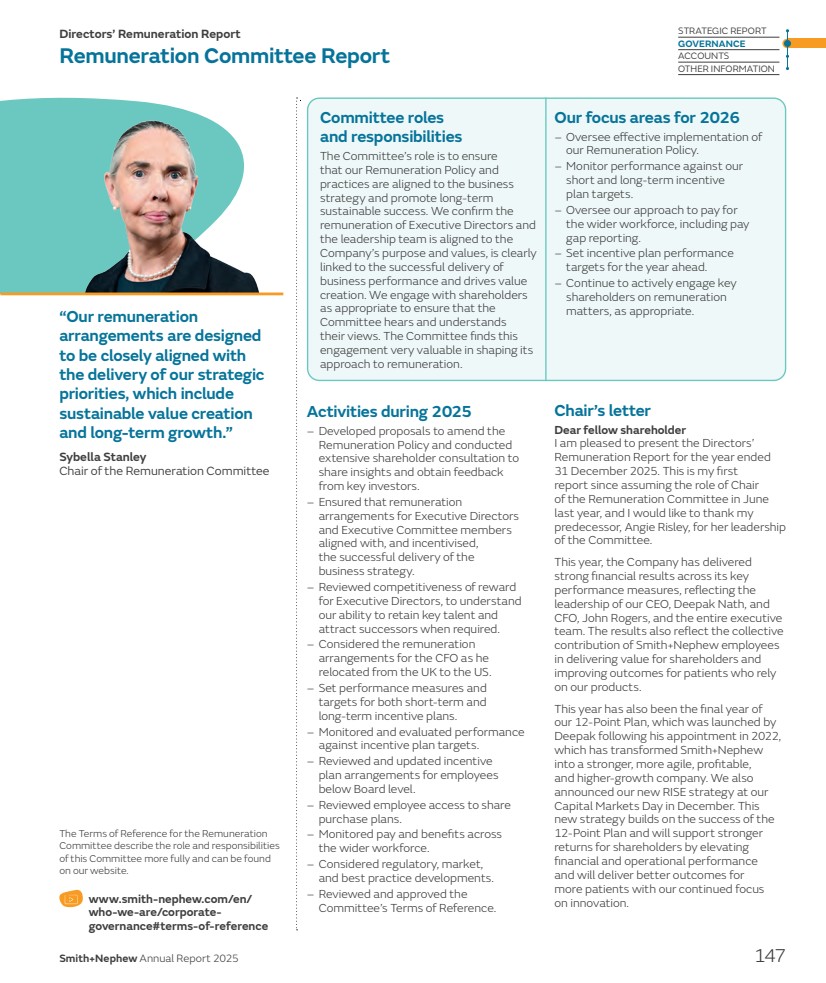
| At the heart of the Company’s transformation over the past three years has been our executive team, led by Deepak. As we look forward to our ambitious RISE strategy, a key priority for the Committee is to ensure the remuneration arrangements are aligned to our new business strategy and the Company can attract and retain the critical talent it needs to drive the business forward and build on the momentum now established. As a result, during 2025, we assessed the extent to which the current Remuneration Policy (‘Policy’) supports this objective and concluded that changes are necessary to maintain competitiveness at a key time for the organisation. Accordingly, we decided to consult shareholders one year earlier than the usual cycle with a revised Policy. Remuneration Policy review As part of our last Policy review undertaken in 2023, we began to address the gap between Smith+Nephew’s historical executive remuneration approach and US market norms to reflect the fact that the centre of gravity of the global MedTech industry is in the US. Furthermore, ten out of twelve of the Executive Committee, including the CEO and CFO, are based in the US, which is demonstrably the core of our talent market. From a business perspective, over 50% of our revenues arise in the US, and only 4% in the UK. In light of these facts, the principle of closer alignment with US pay practice was widely accepted by shareholders. The changes made to our Policy two years ago positioned our CEO’s pay between lower quartile and median of our benchmark pay peer group. At the time, the Committee felt this pay positioning was appropriate for a CEO who was relatively new in post and new to being a CEO. However, we also signalled to shareholders at the time that these changes represented a first step towards stronger pay positioning and improved US market competitiveness. – Improved trading profit margin1 with an increase of over 240 bps since 2022 despite over 1,000bps of headwinds from China and inflation; – Higher adjusted return on invested capital1 with an increase of 170bps over the past three years; – A 15-fold increase in free cash flow1 from $56 million in 2022 to $840 million in 2025; – Resilient dividends and a share buyback of $500 million; – In addition, the Orthopaedics business has returned to growth; there has been improved inventory management; and successful R&D with 60% of growth coming from new products launched in the last five years. We employ a successful, seasoned and proven CEO, who is a US citizen, resident in the US, and who has delivered a significant turnaround and increased shareholder value. Competition for his services is entirely in the US and the Committee believes it is not in shareholders’ interests that we continue to take the risk of paying him 15% below the lower quartile (or 56% of the median) of his peers, particularly when Smith+Nephew’s size is at or above median relative to the same pay peer group. Smith+Nephew has experience of a US CEO departure due to remuneration considerations. Deepak is our fourth CEO since 2018, with prior leadership changes contributing to executive turnover and organisational instability. 1 Non-GAAP measure For our CFO, John Rogers, who relocated to the US in September 2025 to be closer to executive team colleagues and customers, the gap between his current pay level and an appropriate market level is not large. However, since the last Policy was introduced, the pay levels for MedTech CEOs among our peer benchmark group have increased substantially with the median increasing by 40%, partly as a result of numerous changes in leadership across the sector. This has resulted in our CEO pay once again being meaningfully below the lower quartile of the peer group, and at around half the median level, which creates a risk around retaining and attracting key talent. In addition, as Deepak is now established as a successful CEO with nearly four years’ experience running a global MedTech and FTSE-50 company, such a disparity is not considered appropriate by the Board or the Committee. The Board recognises that Deepak is one of a limited number of proven CEOs in the MedTech sector and that he has delivered significant operational improvement and increased shareholder value. This performance is evidenced by: – Upper quartile total shareholder return over the past three years of +22% relative to the peer group median return of -6%; – Consistent underlying revenue growth1: +7.2% in 2023, +5.3% in 2024, +5.3% in 2025; – Higher operating profit: $450 million in 2022, increasing to $794 million in 2025 (an increase of 76%); Relative TSR performance over the last three years2 LQ Lower quartile M Median UQ Upper quartile Smith & Nephew Peer group company 2 Performance relative to the 2023-25 PSP peer group. See page 181 for further details. -60% -40% -20% 0% 20% 40% 60% 80% 100% +115% LQ M UQ 148 Smith+Nephew Annual Report 2025 Remuneration Committee Report continued Directors’ Remuneration Report continued Smith+Nephew Annual Report 2025 18_SN_AR25_REM_Policy_v148.indd 148 05/03/2026 18:17 |

| Since Deepak’s appointment in 2022, leadership stability has enabled consistent operational improvement and value creation. Competitive remuneration is, therefore, essential not only for retention, but for safeguarding strategic continuity. Given all of this context, the Committee decided that a review of Executive Director remuneration was again necessary. The objective of the review was to ensure our arrangements are fully aligned with shareholder interests by appropriately rewarding delivery of sustained performance, while incentivising delivery of our new RISE strategy, and being appropriate to retain and/or attract executive talent essential for long-term value creation. As part of the review, we consulted extensively with nearly 50 shareholders, representing approximately 70% of Smith+Nephew’s voting rights. Initially we consulted with our top 10 shareholders, and following input from these shareholders we made changes to our initial proposals. We then consulted on this revised proposal with a broader group of shareholders, which resulted in further changes to our proposal (see page 153 for further details). We also consulted with proxy advisers, who were most representative of our shareholder base, being IA/IVIS, Glass Lewis, and ISS. I would like to thank everyone with whom we engaged for their valuable input during this process, as the views and comments shared helped us ensure that we were considering all the issues and ultimately enabled us to shape the final proposal. Overall, the majority of shareholders recognised the context that had shaped our decisions, including the transformation and performance of the business, and the need for us to retain talent and compete in a global talent market. The full detail of our proposal, including additional market context and benchmark peer group data, is set out on pages 153–165, but at a high level the proposed changes to our Policy include: An increase in the Total Target Direct Compensation (TTDC) of the CEO from $8.3 million to $12.8 million. This increase will be delivered solely through an increase in the annual and long-term incentive plan opportunities as the base salary will be frozen for the duration of the Policy. The Annual Incentive Plan (AIP) opportunity will increase from 215% to 300% of base salary, the annual Restricted Share Plan (RSP) awards will increase from 125% to 150% of base salary, and the annual Performance Share Plan (PSP) awards will increase from 300% to 650% of base salary. These changes will re-position the CEO’s pay from below lower quartile to between lower quartile and median relative to our pay benchmark peer group (see page 154). +50% Annual Incentive Plan vesting +100% Restricted Share Plan Award vesting +60% Performance Share Plan Award vesting Total Target Direct Compensation is defined as Base Salary From January 2027, if certain share price performance conditions are met during the Policy period a multiplier of between 1.0x and 1.4x will apply to the 2027 and 2028 PSP awards at the time of grant. If the maximum multiplier of 1.4x is applied this would have the effect of enhancing the CEO’s TTDC opportunity from $12.8 million to $15.3 million for that year. This would position the CEO around the middle of our pay peer group, which, given the experience and track record of our CEO as well as the size and scale of the organisation relative to peers, the Committee believe would be appropriate positioning. It is important to highlight that the earliest year in which the CEO may have realised value from all elements of the new policy arrangements will be 2031 when the 2026-28 PSP is released from its post-vesting holding period. This is of course subject to the award meeting the stretching performance conditions set by the Committee over the three-year performance period. Further, it will not be until 2032 that the CEO may potentially realise any value from the PSP multiplier. There are no changes to the AIP, PSP and RSP award levels of the CFO. However, the same PSP multiplier as applies to the CEO will apply to the CFO, which has the potential to increase the CFO’s TTDC opportunity from $4.5 million to $5.1 million in 2027 if certain share price performance conditions are met over 2026. The earliest year in which the CFO may potentially realise any value from the PSP multiplier will be 2032 when the 2027- 29 PSP is released from its post-vesting holding period. The shareholding requirement for the CEO will increase from 500% to 900% of base salary and for the CFO will increase from 200% to 300% of base salary. The CEO shareholding requirement materially exceeds that of our peer group but is aligned to the peer group for the CFO (see page 163). Once the CEO achieves a shareholding of 600%, or the CFO achieves a shareholding of 300%, which we expect to take around five years, the bonus deferral will reduce from 50% to 20%. The Committee believes that the combination of a high shareholding, unvested RSPs, together with the two-year post-vesting holding period on the PSP, is sufficient to enable malus and clawback if necessary and provides good shareholder alignment making a 50% bonus deferral no longer necessary. In addition, the CEO is expected to continue to build his shareholding towards 900% over the longer term. Smith+Nephew Annual Report 2025 149 STRATEGIC REPORT GOVERNANCE ACCOUNTS OTHER INFORMATION 18_SN_AR25_REM_Policy_v148.indd 149 05/03/2026 18:17 |

| We also acknowledge that the multiplier on PSP awards from January 2027 is an unusual approach, but the Committee needed to find a way to step-up our Executive Directors’ TTDC to a market competitive level that is more representative of our size and performance relative to our peer group within the next three years. The Committee believe that linking the step-up in TTDC opportunity to share price appreciation, from which all shareholders will benefit, is a practical way of doing so. The alternatives would be to either leave compensation unchanged and run the risk that we lose our existing CEO and are unable to offer attractive levels of pay to his replacement, or we immediately go to a higher TTDC of around $15m which would be more reflective of the CEO pay at peer companies of a similar size. The Committee does not consider either of these options are in shareholders’ interests. The Committee believes that the revised Policy strikes an appropriate balance between market competitiveness, performance linkage, shareholder alignment and governance. Indeed, the revised Policy will strengthen the link between pay, performance, and value creation for shareholders through the increases to long-term performance-based pay, combined with an increase to the shareholding requirements. 2025 incentive plan outcomes The Company delivered strong financial results across its key performance metrics. Revenue1 grew by 6.1% on a reported basis (5.3% on an underlying¹ basis) and the Company continued to deliver year-on-year expansion in its trading profit margin1 which increased from 18.1% to 19.7%. Working capital and cash flow generation also significantly improved, with free cash flow1 increasing from $551 million to $840 million, and an improvement in adjusted return on invested capital1 (from 7.4% to 8.3%) compared to 2024. These results reflect the benefits from the 12-Point Plan being realised. In addition, the Committee strives to maintain a clear link between pay and performance, focusing on setting stretching performance targets and evaluating both company-wide and individual achievements. In that context, we believe that the payments outlined in this report fairly reflect the performance achieved and that the Remuneration Policy operated as intended during the year. Annual incentive For Executive Directors, 85% of their AIP bonus opportunity is tied to financial performance, with the remaining 15% tied to individual strategic objectives. Based on our financial performance and the achievement of individual objectives over the year, the total bonus payable to Deepak Nath is 82.2% of maximum (or 176.8% of base salary) and to John Rogers is 81.0% of maximum (or 174.1% of base salary). In line with the current Policy, 50% of this bonus will be deferred in shares for three years if the shareholding requirement has not been met, otherwise 30% of the bonus will be deferred in shares for three years. More detail on the performance against the annual targets is set out on pages 177 to 178. While we do not currently have any Executive Directors based outside the US, and expect our leadership to continue to be based in the US for the foreseeable future, we have defined as part of our revised Policy the annual and long-term incentive opportunities, as well as shareholding requirements, that would apply if we needed to hire Executive Directors living outside the US in the future. The opportunity levels are set below US levels to reflect market differences and are described further on page 163. Finally, the Committee recognise that the talent market is increasingly competitive and a recruitment in the future may require compelling packages to attract individuals with the level of skill and experience needed. The Committee believes that the revised Policy will help with this, but also wants to have the flexibility to provide limited sign-on incentives (beyond buy-outs) that are capped at a maximum of 200% of base salary. Any such awards would be structured with robust performance conditions, deferral, and clawback provisions, ensuring the Committee has the flexibility to respond pragmatically to talent market conditions while maintaining strong governance. We acknowledge that executive pay is a topic that attracts strong and often differing opinions among investors, and the Committee fully understands that financial performance and the creation of long-term shareholder value are a focus for investors. The Committee firmly believes that the provisions of the revised Policy are in the long-term interests of the Company and will support the commitment to deliver on financial performance and value for shareholders. 1 Non-GAAP measure 150 Smith+Nephew Annual Report 2025 Remuneration Committee Report continued Directors’ Remuneration Report continued 18_SN_AR25_REM_Policy_v148.indd 150 05/03/2026 18:17 |
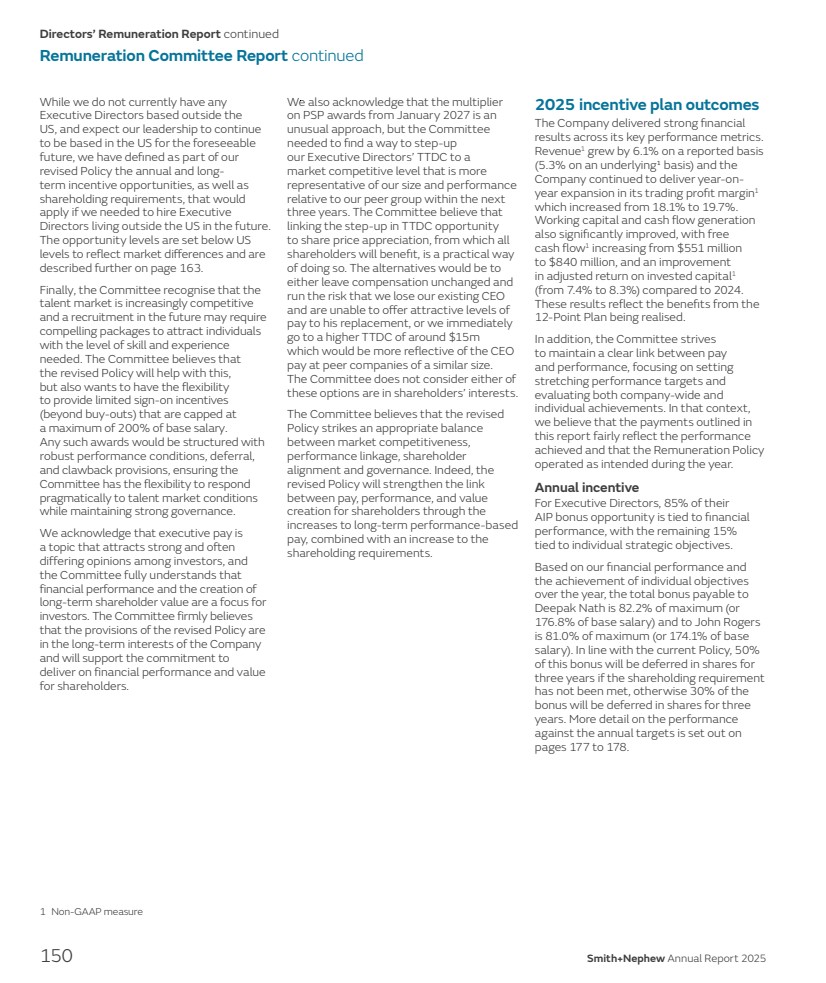
| As a result of these changes, the performance measures for 2026 will focus on revenue growth (35% weighting), trading profit (35% weighting), free cash flow (15% weighting) and individual strategic objectives (15% weighting). In 2025, the Committee decided to reduce the payout at Threshold from 15% of maximum to zero and this will remain the case for 2026. Further details are set out on page 192. The AIP awards for 2026 will be awarded in line with our revised Policy, subject to shareholder approval. Under the Policy, 50% of any 2026 bonus payment to Executive Directors would be paid in March 2027 unless the Executive Director has met the shareholding requirement, in which case, 20% of the bonus would be deferred. Long-term incentive plans Long-term PSP awards will be granted in 2026 in line with our revised Policy and under the Smith+Nephew Performance Share Plan, in each case subject to shareholder approval. Similarly, Restricted Share Plan awards will be granted in 2026 in line with our revised Policy, subject to shareholder approval, and under the existing shareholder approved Smith+Nephew Restricted Share Plan. The performance measures for the 2026- 28 PSP award will include a combination of earnings per share (30% weighting), return on invested capital (30% weighting), relative total shareholder return (30% weighting) and ESG objectives (10% weighting). Further details on the intended awards, including the performance measures and associated targets, are set out on pages 192 to 193. Long-term incentive The Committee reviewed the performance of PSP awards granted in 2023 against the award performance conditions and determined that, based on actual performance over the three-year performance period ended 31 December 2025, these 2023-2025 PSP awards will vest at 36.2% of maximum opportunity (72.5% of target) (see page 181 for further details). John joined the Company in December 2023, and so was not granted a 2023-2025 PSP award. In addition, the Committee assessed the reasonable judgement underpin that applies to RSP awards granted in 2024 and 2025 that have a tranche vesting in 2025 and determined that it was appropriate for these tranches to vest in full. Discretion in relation to incentive outcomes The incentive outcomes above are reflective of overall Company financial and strategic performance, and the Committee determined that no discretion should be exercised to adjust the formulaic outcomes. The Committee also reviewed Smith+Nephew’s share price performance in determining the extent to which the 2023-25 PSP award should vest and concluded that no windfall gains had occurred. Applying the Remuneration Policy in 2026 Base salary The CEO’s salary will not increase in 2026. However, if the revised Policy is not approved by shareholders and the current Policy remains in force, the CEO’s salary will increase in line with the wider US workforce such that his salary will be increased by 3.2% with effect from 1 April 2026. The CFO’s salary will increase in line with the wider US workforce, and so will increase by 3.2% with effect from 1 April 2026. Annual Incentive Plan The Committee reviewed the choice of performance measures and decided to replace trading profit margin percentage with absolute trading profit in dollars to ensure incentives are aligned with the Company’s current strategic phase. Following the restoration of operational discipline and the reversal of historic margin erosion, the business has now moved from a stabilisation phase to a growth phase, and the Committee wants management to be incentivised to deliver absolute value creation. We are not stepping back from margin discipline, nor are we suggesting that margin improvement is completed. Trading profit margin performance remains a core management focus and key performance measure for the Board. In addition, the Committee decided to remove the 5% allocation to ESG objectives within the AIP. This change removes duplication as previously both the AIP and long-term PSP had ESG objectives, and this change also better reflects the fact that the Committee anticipates ESG outcomes to be delivered over a longer period. It also enabled an increase in the bonus allocation to individual strategic objectives (from 10% to 15%), which will focus on our new RISE strategy, without the need to reduce the allocation to financial performance metrics. We remain fully committed to long-term sustainable business, as well as our ESG goals and plan to continue to have ESG performance measures included within our PSP. Smith+Nephew Annual Report 2025 151 STRATEGIC REPORT GOVERNANCE ACCOUNTS OTHER INFORMATION 18_SN_AR25_REM_Policy_v148.indd 151 05/03/2026 18:17 |

| This is a critical time for Smith+Nephew. Through the delivery of the 12-Point Plan, the business has demonstrated the decisive actions taken to position itself for future success. As we transition to the next stage of our journey and the implementation of our RISE Strategy, it is vital that we have stability and strength in leadership. The business is well positioned to deliver sustainable and profitable growth, supported by a very strong innovation pipeline, continued productivity and simplification initiatives, and improving margins. We are confident that the revised Policy is necessary and appropriately aligns the interests of executives and shareholders. On behalf of the Committee, I would like to extend my thanks to shareholders and proxy advisers, who have given their time and valuable insights over the past year, which have helped shape our approach to executive remuneration. I hope that you will support our proposals at the forthcoming AGM. Sybella Stanley Chair of the Remuneration Committee While the performance measures are the same as used in respect of the 2025 grant, following shareholder feedback, the Committee has decided to make a change to the total shareholder return (TSR) measure. Historically the TSR performance measure has been based on the relative performance of two peer groups, a global MedTech peer group and a subset of the FTSE 100. For the 2026-28 PSP award, relative TSR will be measured against the global MedTech peer group only. This change will not only simplify the measure, it will improve the relevance of the relative performance measure as it will now only consider global MedTech companies against which we compete and are assessed. Share plan rules and approvals During the year, the Company undertook a review of the role of share plans within its reward framework and the extent to which employees can participate in, and benefit from, the Company’s success as it delivers on its RISE Strategy. As a result of this review, the Company decided to introduce new all-employee share plans designed to broaden access and strengthen employee alignment with the business strategy and shareholders. We believe that by enabling employees at all levels to share in the outcomes of the Company’s success, these plans will support the business strategy of attracting, motivating and retaining talent, fostering engagement, and reinforcing a culture focused on long-term growth and performance. The plan rules for the all-employee Smith+Nephew Global Employee Share Purchase Plan and Smith+Nephew UK Share Incentive Plan will be submitted for shareholder approval at our forthcoming AGM alongside a new Smith+Nephew Performance Share Plan that will replace the existing Smith+Nephew Global Share Plan as the vehicle for granting PSP awards. Chair and Non-Executive Director fees The fees payable to the Chair of the Board and Non-Executive Directors are reviewed annually. In line with the increase in base salaries for Executive Directors, the Chair fee and Non-Executive Director base fee will be increased by 3.2% for both US-based and UK-based Non-Executive Directors from 1 April 2026. The additional fees for acting as a Chair of a Committee were also reviewed (see page 164 for further details). 2026 AGM I hope that this year’s report provides a clear and transparent account of the Committee’s considerations and decisions, including an explanation of the 2025 remuneration outcomes and why we feel it is important to now evolve our Policy for the future. Compliance statement We have prepared this Directors’ remuneration report (the Report) in accordance with The Enterprise and Regulatory Reform Act 2012–2013 (clauses 81–84), sections 420–422 of the Companies Act 2006 and The Large and Medium-Sized Companies and Groups (Accounts and Reports) (Amendment) Regulations 2013 (the Regulations), The Companies (Directors’ Remuneration Policy and Directors’ remuneration report) Regulations 2019 and The Companies (Miscellaneous Reporting) Regulations 2018. The Report also meets the relevant requirements of the Financial Conduct Authority (FCA) Listing Rules. Pages 172 to 193 is the Annual report on remuneration (the Implementation Report). The Directors’ Remuneration Policy, as set out on pages 153 to 171 will be put to shareholders for approval at the Annual General Meeting on 6 May 2026, while the Implementation Report will be put to shareholders for approval as an advisory vote at the same meeting. The Implementation Report explains how the current Remuneration Policy was implemented during 2025. The following sections have been audited by Deloitte: The Single Figure Tables on Remuneration including related notes (pages 175 to 182); details of awards made under the Performance Share Plan and Restricted Share Plan (page 182); Summary of Scheme Interests during the year (page 183 to 184); Payments to former Directors (page 184); Directors’ interests in ordinary shares (pages 184 and 186) and Senior Management Remuneration (page 191). All payments we make in relation to Directors of the Company will be in accordance with the relevant shareholder approved Remuneration Policy. Trading Profit Margin, Trading Cash Flow Conversion, Free Cash Flow and ROIC are non-IFRS financial measures used in the Directors’ Remuneration Report from page 177 to 193. They are explained and reconciled to the most directly comparable financial measure prepared in accordance with IFRS on pages 285 to 292. 152 Smith+Nephew Annual Report 2025 Directors’ Remuneration Report continued Remuneration Committee Report continued 18_SN_AR25_REM_Policy_v148.indd 152 05/03/2026 18:17 |
| Policy Review Context for review As outlined in the Chair’s statement, in 2023, we began to address the gap between Smith+Nephew’s historical executive remuneration approach and US market norms with closer alignment in both structure and quantum with a benchmark group of MedTech peers that was heavily US weighted. The 2024 Policy positioned our CEO at around 14% above the lower quartile and 20% below the median of our pay peer group, which the Committee felt was appropriate for a CEO, who was relatively new in post and new to being a CEO. However, the Committee signalled at the time that these changes were a first step in the journey toward better pay positioning and improved US market competitiveness. As a matter of practicality and policy, the Company aligns compensation of all employees, including Executive Committee members, to local market practices and employs them on local contracts. We aim to pay at a competitive level somewhere between lower and upper quartile of a suitable benchmark group. We believe that given the experience and track record of both our CEO and CFO as well as the size and scale of the organisation they are leading relative to our peer group (where 60% of peers are smaller as measured by revenue), a pay position toward the middle of the range would be appropriate. Since the last Policy review, the median CEO pay level within the MedTech pay peer group has increased by 40%, driven by competitive pressures for leadership talent - eight peer group companies have appointed new CEOs in the past two years. This competitive landscape means that our CEO is once again paid below the lower quartile. The situation is different for our CFO, whose pay sits closer to the median level of our peer group. The need to provide market competitive pay to retain and attract talent means the current CEO pay positioning needs to be addressed. In addition, given Deepak’s now proven track record as a CEO, and the fact that he is now established as a successful CEO with nearly four years’ experience running a FTSE-50 Company, such a pay disparity relative to peers is not appropriate, and creates a retention risk. If we were to lose him, the current Policy creates a material risk as we would face significant difficulty in recruiting a successor with the requisite and comparable experience from within the MedTech industry. As a result, the objective of the current Policy review is to ensure that our Policy is fully aligned with shareholder interests by continuing to reward delivery of sustained performance, while incentivising delivery of our new RISE business strategy, and being appropriate to retain and/or attract executive talent essential for long-term value creation. Engagement with shareholders The Committee recognises the importance of an open dialogue with investors on executive remuneration and consulted on the proposed policy extensively with our top 50 shareholders, representing approximately 70% of Smith+Nephew’s voting rights. We also consulted with proxy advisers, who were most representative of our shareholder base, being IA/IVIS, Glass Lewis, and ISS. Initially we consulted with our top 10 shareholders, and following input from these shareholders we made changes to our initial proposals. These changes included removing the award multiplier from the RSP and retaining it on the PSP only, and increasing the AIP and PSP opportunity levels for the CEO. We then consulted with a broader group of shareholders, which resulted in further changes including reducing the initial proposed RSP award level, increasing the PSP award level, introducing a share price underpin to the PSP multiplier, reinstating a bonus deferral of 20%, and increasing the CEO shareholding requirement. Wider workforce remuneration When considering changes to Executive Director remuneration, the Committee considers a range of factors including those relating to wider workforce remuneration to ensure fairness, alignment, compliance with governance expectations, and sustainable remuneration practices. This includes reviewing overall pay structures, the gap between executive pay and average employee pay, and how rewards across the organisation compare with leadership roles. We also look at pay trends, cost-of-living pressures, and how pay decisions affect morale, retention, and culture. Over the past year, we have provided pay increases for the wider workforce that are at least in line with the market and made adjustments to keep key roles competitively paid. We have also updated our annual and long-term incentive plans by increasing bonus opportunities for some groups and extending eligibility for PSP and RSP awards. In 2026, we plan to introduce new global all-employee share plans to give more employees the opportunity to participate and to strengthen alignment with our strategy and shareholders. We also conduct Board listening sessions with employees to understand their perspectives, including on remuneration. Through these sessions, employees have shared that stable leadership matters to them because it builds trust, provides clear direction, and gives confidence in the future. Employees also understand the importance of paying key roles at competitive market levels so the organisation can attract and keep the top talent needed to achieve its strategy and purpose. MedTech peer group When determining the pay peer group for the last and current Policy review, the Committee started with companies in the S&P Healthcare Equipment Select Industry (XHE) Index with revenues over $2bn and then included a number of non-US companies within our industry to reflect our geographic footprint. A filter was then applied to exclude very large revenue companies, and a further filter was applied following a talent flows analysis. The only difference in the pay peer group between the last and current Policy review is the addition of Solventum and Convatec. Solventum is a wound care company and key competitor that spun off from 3M in 2024, and Convatec is the only other UK-based MedTech company of scale. Adding these companies did not materially change the analysis, but the Committee felt that given they are close peers they should be included. Of the 23 companies in the pay peer group, 15 are listed in the US, six in Europe, one in the UK, and one in Canada. It is worth noting that the peer group used by the Committee for pay benchmarking is different to that used for TSR performance purposes. The peer groups are similar, but the pay peer group specifically excludes very large companies within our industry such as Medtronic and Stryker. Smith+Nephew Annual Report 2025 153 STRATEGIC REPORT GOVERNANCE ACCOUNTS Remuneration Policy Report OTHER INFORMATION 18_SN_AR25_REM_Policy_v148.indd 153 05/03/2026 18:17 |
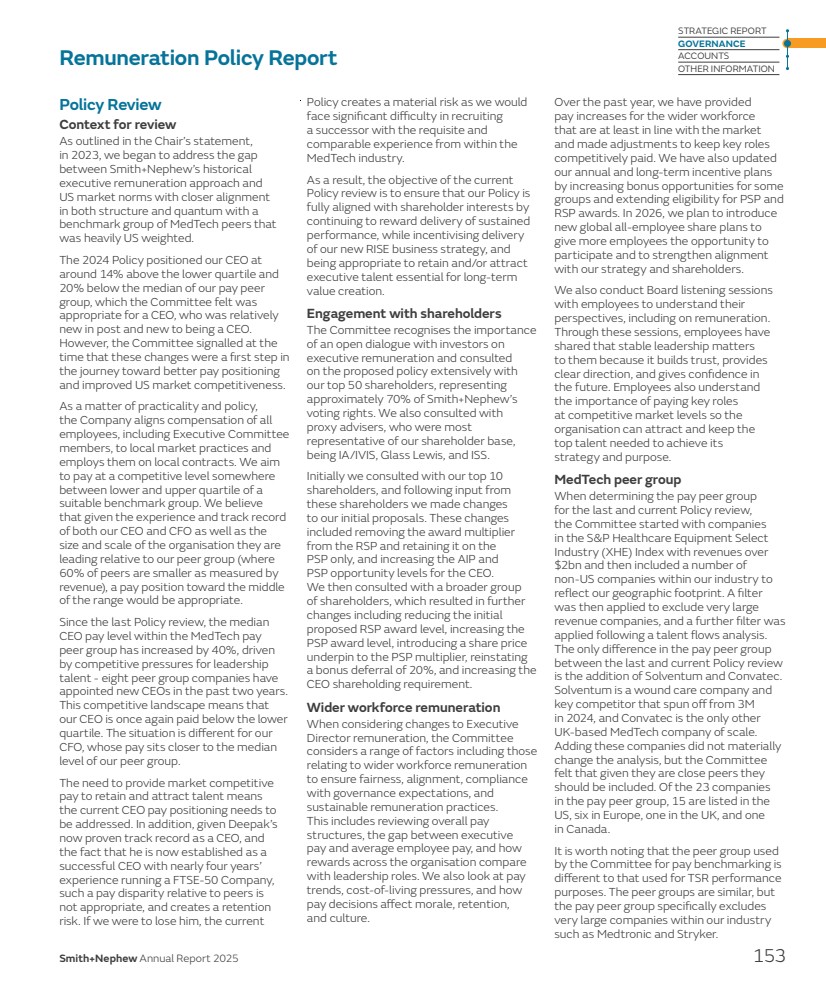
| 2025 Pay Peer Group – Alcon Inc. – Bausch + Lomb Corporation – Baxter International Inc. – Becton, Dickinson & Co – Coloplast A/S – Convatec Group Plc* – Dentsply Sirona Inc. – Edwards Lifesciences Corporation – GE Healthcare Technologies Inc. – Intuitive Surgical, Inc. – Koninklijke Philips NV – ResMed Inc. – Solventum* – Sonova Holding AG – Steris Plc – The Cooper Companies, Inc. – Zimmer Biomet Holdings, Inc. – Align Technology, Inc. – bioMérieux S.A. – Boston Scientific Corporation – Hologic, Inc. – IDEXX Laboratories, Inc. – QuidelOrtho Corporation * Addition relative to pay peer group used for last policy review. Remuneration in the context of peer relativity and our performance Pay However, our Executive Director Total Target Direct Compensation2 is below median and in particular our CEO is below lower quartile, which is not reflective of our relative size or performance Performance Our relative TSR performance between 1 January 2023 and 31 December 2025 is above the upper quartile1 1 2023-25 PSP peer group data used to determine performance. 2 Total Target Direct Compensation (TTDC) is determined as Base Salary plus Target AIP, plus Restricted Share Plan award, plus the expected value of the Performance Share Plan Award. Company size Our revenue and global employee headcount place us at or above median in the pay peer group LQ Lower quartile M Median UQ Upper quartile Smith+Nephew Pay peer group company CEO TSR performance Revenue Global employee headcount $0bn $5bn $10bn $15bn $20bn LQ M UQ 0 10,000 20,000 30,000 40,000 50,000 60,000 70,000 80,000 LQ M UQ $0m $5m $10m $15m $20m $27m LQ M UQ -60% -40% -20% 0% 20% 40% 60% 80% 100% +115% LQ M UQ 154 Smith+Nephew Annual Report 2025 Directors’ Remuneration Report continued Remuneration Policy Report continued 18_SN_AR25_REM_Policy_v148.indd 154 05/03/2026 18:17 |
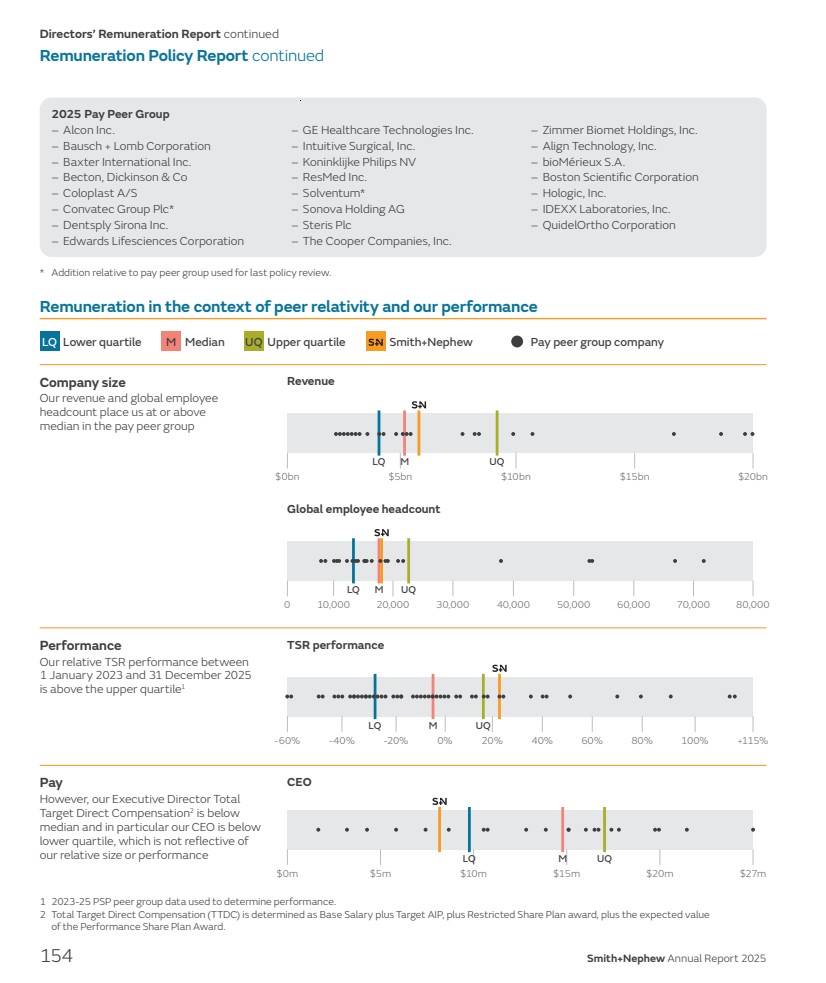
| Proposal to re-align pay with company size and performance Given the talent market and changes in pay within the MedTech sector, as well as our relative size and performance compared to peers, and the performance and experience of our CEO and CFO, the Committee feel that it is appropriate, and necessary, to adjust the pay level of our Executive Directors, particularly that of the CEO. The changes proposed will be to the opportunity levels of our short and long-term incentive plans, and as such will be highly dependent upon performance delivery. The base salary of the CEO will remain unchanged for the duration of the Policy. The changes proposed will result in the TTDC for both the CEO and CFO being initially positioned between lower quartile and median (the ‘Baseline’ level). However, from January 2027 there will be an opportunity for the TTDC of both the CEO and CFO to be enhanced if certain share price performance conditions are met over the financial year prior to each annual PSP award. If certain share price performance conditions are met, the subsequent PSP award granted to the CEO and CFO may be multiplied by a factor of between 1.0x and 1.4x. Baseline (no performance multiplier on the PSP) Changes to the Policy would see the “Baseline” short and long-term incentives increase for the CEO only, reflecting that the CFO is already paid broadly in line with median compared to the pay peer group. This would increase the CEO TTDC from $8.3 million to $12.8 million in 2026, re-positioning the CEO’s pay from below lower quartile to between lower quartile and median. The TTDC of the CFO would be unchanged from its current level of $4.5 million. Enhanced (maximum performance multiplier on PSP awards) From 2027 onward, if certain share price performance conditions are met over the preceding financial year, a multiplier may apply to the baseline PSP award (for US based Executive Directors only) which could increase the CEO’s TTDC up to a maximum of $15.3 million and the CFO’s TTDC up to a maximum of $5.1 million. This positions both the CEO and CFO target pay opportunity around median, but only to the extent superior performance is delivered year on year. Further details on the PSP multiplier can be found in the Policy table and accompanying notes on pages 159 and 162. Once granted, all PSP awards are subject to stretching performance conditions relating to EPS, ROIC, TSR and ESG performance over a three-year period, and if they vest will be subject to a two-year holding period. CEO $0m $5m $10m LQ M UQ Baseline CEO $0m $5m $10m LQ M UQ Enhanced CFO $0m $5m $10m $15m $20m $27m LQ M UQ Baseline $0m $5m $10m $15m $20m $27m LQ M UQ Enhanced CFO Smith+Nephew Annual Report 2025 155 STRATEGIC REPORT GOVERNANCE ACCOUNTS OTHER INFORMATION 18_SN_AR25_REM_Policy_v148.indd 155 05/03/2026 18:17 |
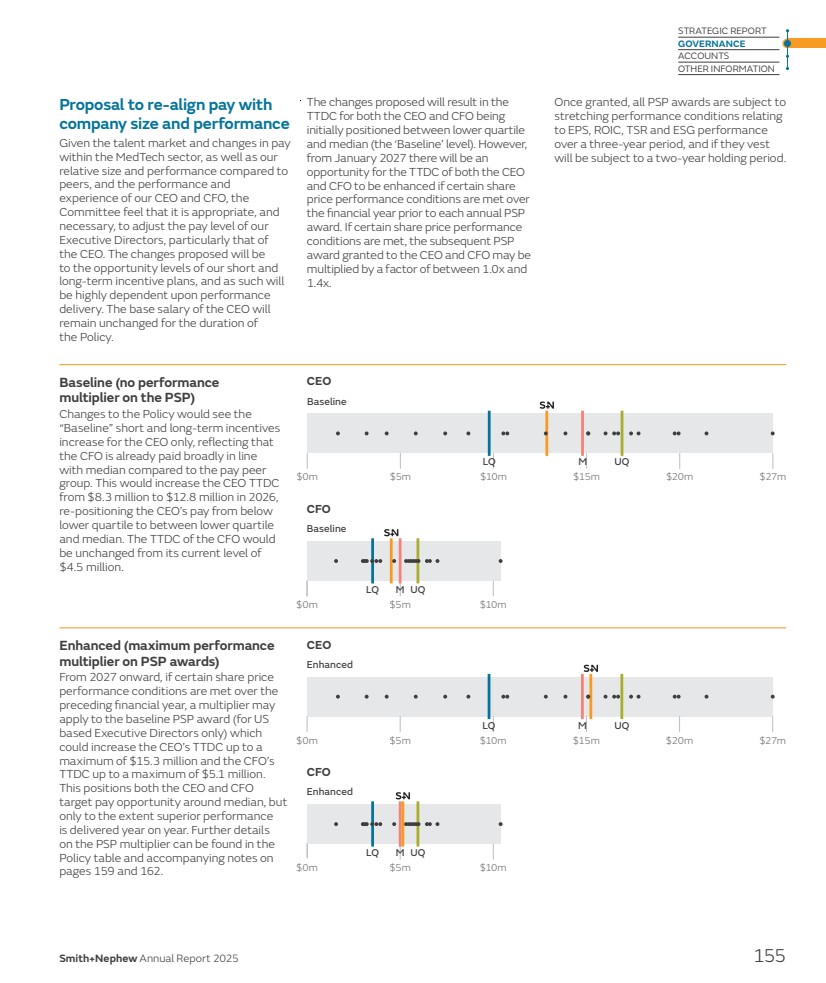
| Policy table for Executive Directors Base salary Changes: No changes proposed Purpose Core element of remuneration, paid for doing the expected day-to-day job. Its purpose is to provide a fair and competitive level of base pay to recruit and retain Executive Directors of the calibre required to deliver the Company’s strategy. Operation Salaries are normally reviewed annually, with any increase usually applying from 1 April. Salary levels and increases take into account: – scope and responsibility of position; – skill/experience and performance of the individual Executive Director; – general economic conditions in the relevant geographical market; – average increases awarded across the Company, with particular regard to increases in the market in which the Executive Director is based; and – market movements seen among relevant peer companies. Maximum opportunity Increases will generally not exceed the average increase for the wider employee population within the Executive Director’s home country. A higher increase may be made if there is an increase in scope or responsibility of the individual’s role; or to recognise development of the individual in role. A full explanation will be provided in the Implementation Report should higher increases be approved in exceptional cases. In addition, where an Executive Director has been appointed to the Board at a lower than typical salary, larger increases may be awarded to move them closer to market practice as their experience develops. For the duration of this Policy, it is not expected that Deepak Nath will receive a salary increase. Performance measures Business and individual performance in the prior year is one of the factors taken into account and poor performance is likely to lead to a zero salary increase. Pension Changes: No changes proposed Purpose Provide a market competitive package to recruit and retain Executive Directors of the calibre required to deliver the Company’s strategy. Operation All Executive Directors will be eligible to participate in a Company pension plan and/or be paid a cash supplement in lieu of membership in a pension plan. Base salary is the only component of remuneration that is pensionable. Maximum opportunity Executive Directors will be eligible to participate in a Company pension to the same extent as the wider workforce in their home country. If provided, the maximum cash allowance in lieu of participation will be no more than the percentage the Company pays towards pension in respect of the wider workforce in the Executive Director’s home country. The current pension contribution or cash allowance for a US-based Executive Director is 7.5%, which is in line with that of the wider US workforce. Performance measures No performance conditions apply. 156 Smith+Nephew Annual Report 2025 Directors’ Remuneration Report continued Remuneration Policy Report continued 18_SN_AR25_REM_Policy_v148.indd 156 05/03/2026 18:17 |
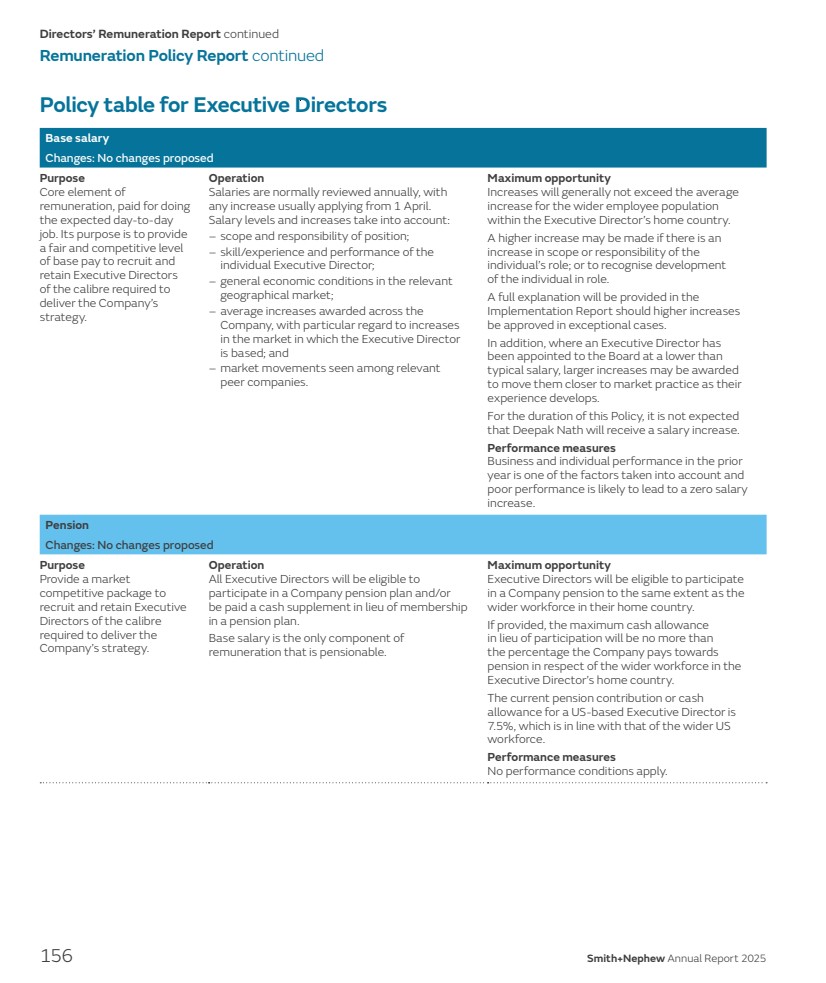
| Benefits Changes: No changes proposed Purpose Provide a market competitive benefits package to recruit and retain Executive Directors of the calibre required to deliver the Company’s strategy. Operation A wide range of benefits may be provided, depending on the benefits provided for comparable roles in the Executive Director’s home country. These benefits will include, as a minimum: – healthcare cover; – life assurance; – long-term disability; – annual medical examinations; – all employee share plan; and – company car or car allowance. The Committee retains the discretion to provide additional benefits, where necessary or relevant in the context of the Executive Director’s location, or, in connection with an Executive Director’s recruitment, the country from which the Executive Director is recruited. Where applicable, relocation costs may be provided in line with the Company’s relocation policy for senior executives, which may include, among other items: – removal costs; – assistance with accommodation; – living expenses for self and family; and – financial, tax and/or legal consultancy advice. In some cases, such payments may be grossed up. Maximum opportunity While no maximum level of benefits is prescribed, they are set at an appropriate market competitive level, considering a number of factors, which include: – the level of benefits provided for other employees within the Executive Director’s home country; and – market practice for comparable roles within appropriate pay comparators. The actual amount payable will depend on the cost of providing such benefits to an employee in the location the Executive Director is based. The Committee regularly reviews the benefit policy and benefit levels. Performance measures No performance conditions apply. Smith+Nephew Annual Report 2025 157 STRATEGIC REPORT GOVERNANCE ACCOUNTS OTHER INFORMATION 18_SN_AR25_REM_Policy_v148.indd 157 05/03/2026 18:17 |

| Annual Incentive Plan Changes: Increase in maximum opportunity for CEO, plus the reduction in the bonus deferral after shareholding requirement met Purpose Incentivises delivery of the business plan on an annual basis. Rewards performance against key financial and non-financial performance indicators that are critical to the delivery of our business strategy. Operation The Committee sets the performance measures and targets for each financial year. At the end of the year, the Committee determines the extent to which they have been achieved. Discretion and adjustments The Committee retains discretion to adjust the performance targets if there is a significant and/ or material event that causes the Committee to believe the original targets are no longer appropriate (e.g. to reflect material acquisitions or disposals). The Committee also retains discretion to amend the level of annual bonuses determined by the performance condition where the amount that an Executive Director would/could receive under an award would result in them receiving an amount which the Committee considers cannot be justified or which the Committee considers to unfairly disadvantage or advantage an Executive Director. In exercising this discretion, the Committee may consider all circumstances, including (but not limited to): – the financial performance of the Company; – any changes in the Company’s share price; and – the performance, conduct and contribution of the Executive Director. Deferral While an Executive Director is building their shareholding requirement, 50% of any bonus will be paid in cash and the remaining balance will be deferred into shares for a three year period. No further performance conditions apply to awards under the Deferred Bonus Plan. Dividends that accrue on the deferred shares during the vesting period will be paid in either cash and/or shares at the time of vesting. Once a US-based CEO has achieved a shareholding of 600%, or once other Executive Directors have met their minimum shareholding requirement, 20% of any bonus will be deferred into shares for a period of three years and the remainder paid in cash. Malus and clawback See details of our Malus and Clawback Policy on page 165. Maximum opportunity The maximum opportunity for Executive Directors is set out below. CEO CFO US-based 300% 215% Non-US based 260% 215% Performance measures At least 80% of the bonus will be based on financial performance measures. The remainder will be based on business objectives linked to key areas of strategic focus. Bonuses are based on the achievement of demanding financial and non-financial targets. The Committee may use different performance measures and/or weightings for each performance cycle as appropriate to reflect the strategic needs of the business. For 2026, the following performance measures and weightings are proposed. Revenue growth (%) 35% Trading profit ($) 35% Free cash flow ($) 15% Strategic objectives 15% Threshold performance will result in no more than 15% of maximum payout, target performance will result in 50% of maximum payout and maximum performance will result in 100% of maximum payout of the relevant performance measure. Payouts will be on a straight-line basis between threshold and target and between target and maximum. 158 Smith+Nephew Annual Report 2025 Directors’ Remuneration Report continued Remuneration Policy Report continued 18_SN_AR25_REM_Policy_v148.indd 158 05/03/2026 18:17 |
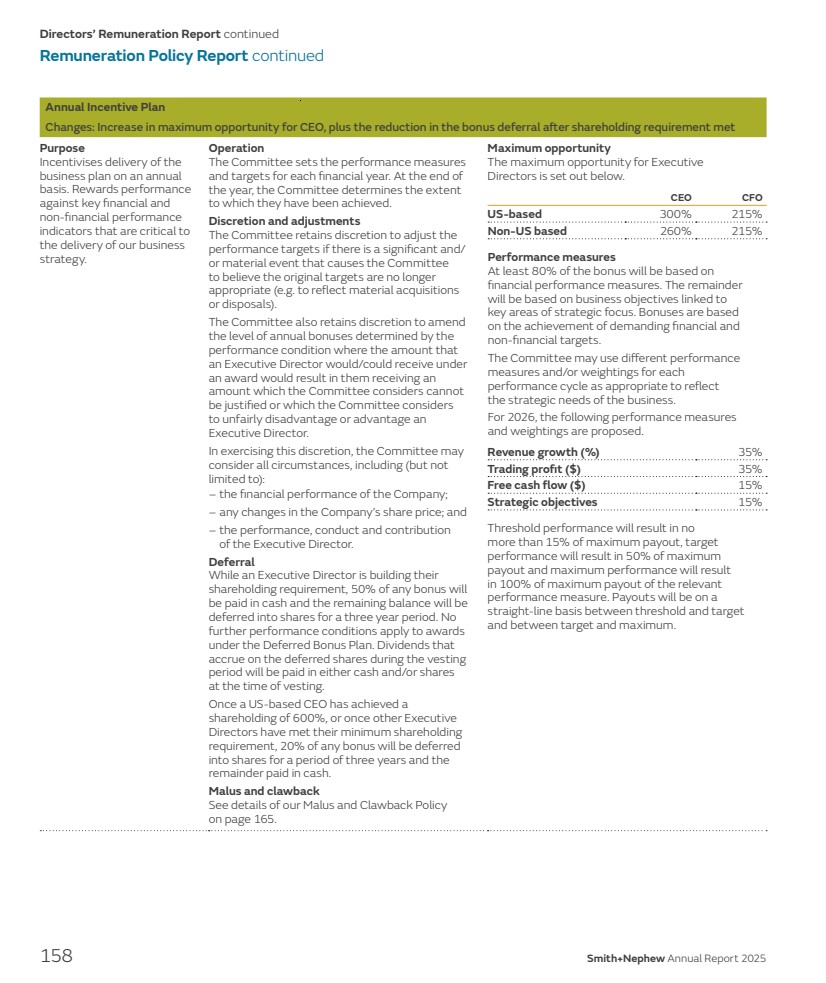
| Long-term Incentives Changes: Increase in PSP and RSP opportunity for the CEO, plus the introduction of a PSP multiplier on awards granted after 1 January 2027; and different opportunity levels for non-US Executive Directors Performance Share Plan Awards Purpose Long-term incentives are designed to ensure that executives take decisions in the interest of the longer-term success of the Company and are aligned with shareholder interests. They also ensure the Company can recruit and retain Executive Directors of the calibre required to deliver the Company’s strategy and long-term success. Operation Awards are normally made in the form of conditional share awards, but may be awarded in other forms if appropriate. PSP awards usually vest after three years, subject to the achievement of stretching performance targets linked to the Company’s strategy. The performance period for performance conditions linked to PSP awards is three years. Vested shares are subject to a further two-year holding period. Dividends accrue on PSP awards during the performance period and will be paid in either cash and/or shares at the time of vesting. Dividends also accrue on vested shares in the holding period. Discretion and adjustments The Committee has the power to adjust the annual award level (subject to the maximum levels set out in the policy), and to adjust the PSP performance multiplier, for example in the event of a material fall in share price, as well as the power to adjust the vesting level of an award based on the underlying performance of the Company. The committee may adjust the performance measure to reflect material changes (e.g. significant acquisitions or disposals, share consolidation, share buybacks or special dividends). Any such change would be fully explained to shareholders. Further details are set out in the notes to this table. Malus and Clawback See details of our malus and clawback policy on page 165. Maximum opportunity CEO CFO Baseline Enhanced Baseline Enhanced US-based 650% 910% 300% 420% Non-US based 400% n/a 200% n/a Each year, the Committee will determine whether a performance multiplier applies to the grant of the PSP award, such that the Baseline award could be increased up to the maximum Enhanced award level based on the increase in the Company share price over the preceding financial year. The maximum enhanced award shown in the table is the Baseline award multiplied by 1.4. See Notes to the table for details of the conditions for an enhanced award. Performance measures The Committee determines performance measures and targets each year to ensure that measures reflect business strategy and targets are stretching and support value creation for shareholders, while remaining motivational for management. Threshold performance will result in 25% vesting and maximum performance will result in 100% vesting of the relevant performance measure. Vesting between threshold and maximum will be on a straight-line basis. The following performance conditions are proposed for the 2026 PSP award. Adjusted Earnings per Share (EPSA) 30% Relative Total Shareholder Return1 30% Adjusted Return on Invested Capital (ROIC) 30% Environmental, Social and Governance (ESG) Objectives 10% 1 See Notes to table for TSR peer group Smith+Nephew Annual Report 2025 159 STRATEGIC REPORT GOVERNANCE ACCOUNTS OTHER INFORMATION 18_SN_AR25_REM_Policy_v148.indd 159 05/03/2026 18:17 |

| Long-Term Incentives Restricted Share Plan Awards Purpose Long-term incentives are designed to ensure that executives take decisions in the interest of the longer-term success of the Company and are aligned with shareholder interests. They also ensure the Company can recruit and retain Executive Directors of the calibre required to deliver the Company’s strategy and long-term success. Operation Awards are normally made in the form of conditional share awards, but may be awarded in other forms, if appropriate. In line with US practice, RSP awards usually vest in equal annual tranches over a three year vesting period, subject to a reasonable judgement underpin. Dividends accrue on RSP awards during the vesting period and will be paid in either cash and/ or shares at the time of vesting. Discretion and adjustments The Committee retains full discretion following the grant of an award to make adjustments to the vesting outcome if full vesting is not considered to be appropriate. In determining whether the reasonable judgement underpin has been met, the Committee will consider multiple factors relating to the vesting period, including market movements, shareholder experience, the impact of the regulatory environment and reputational factors. Malus and clawback See details of our Malus and Clawback Policy on page 165. Maximum opportunity CEO CFO US-based 150% 125% Non-US based 125% 75% Performance measures Awards under the RSP are not subject to financial performance conditions and will vest to the extent the Committee determines, in its discretion, that the reasonable judgement underpin has been met. 160 Smith+Nephew Annual Report 2025 Directors’ Remuneration Report continued Remuneration Policy Report continued 18_SN_AR25_REM_Policy_v148.indd 160 05/03/2026 18:17 |
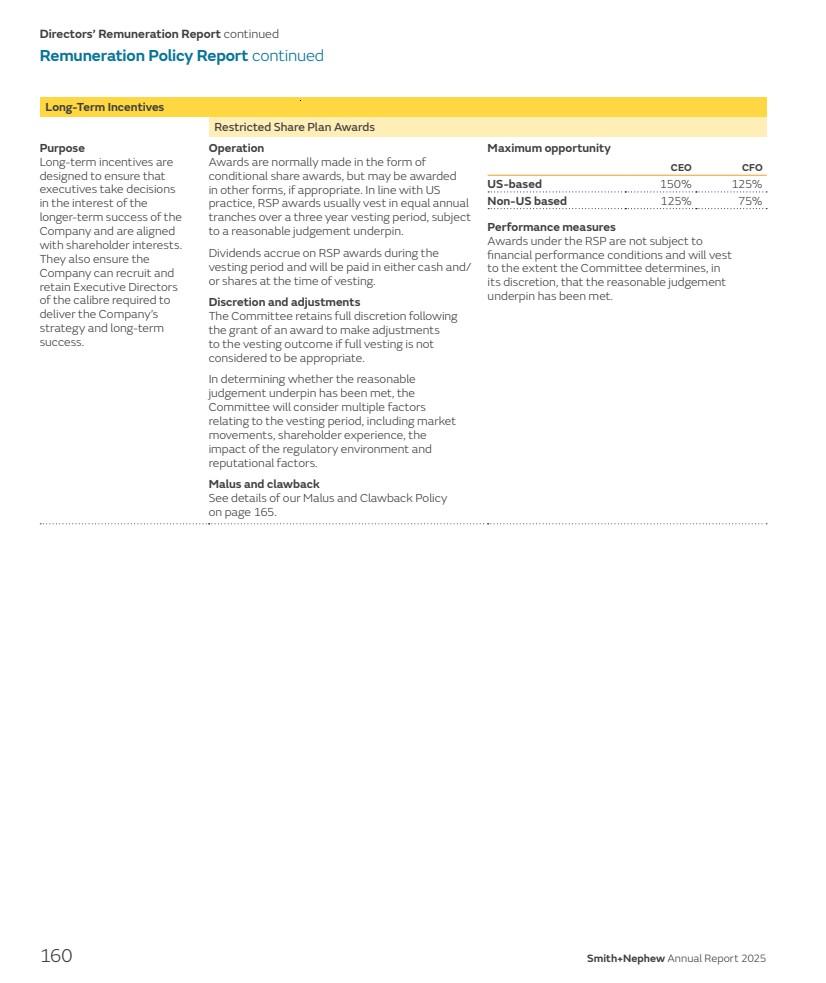
| Notes to the policy table for Executive Directors Performance measure selection and target setting Annual Incentive Plan The performance measures used for our annual bonus have been chosen to support the Group’s strategy and the Committee continues to believe it is appropriate to use a balance between financial targets and strategic objectives. Performance targets are set by the Committee to be both stretching and achievable, taking into account the Group’s strategic priorities. Financial performance targets under the AIP are set with reference to the prior year and to the budgets and business plans for the coming year, ensuring the levels to achieve threshold, target or maximum payout are appropriately stretching. Commercial sensitivity precludes the advance publication of the actual targets, but these will be retrospectively published in the Annual Report on Remuneration for 2026. Performance Share Plan The Committee considers that the current measures used for Performance Share Plan awards, namely, CAGR in EPSA, relative TSR, ROIC and ESG objectives, continue to be the most appropriate measures of long-term performance for the Company. The Committee reviews the measures, weightings and targets for long-term incentive awards on an annual basis, to ensure their continued suitability and to ensure they are sufficiently stretching. Shareholding requirement Changes: Increases proposed to shareholding requirement level Purpose To encourage Executive Directors to build a shareholding in the Company and ensure the interests of management are aligned with those of shareholders. Operation A US-based CEO is expected to build up a shareholding of 600% over a reasonable period of time (typically five years), and the remainder (300%) over a longer period as determined by the Chair of the Board (which is currently expected to be ten years from the date of appointment). Once the CEO’s shareholding is in excess of 600%, the CEO may with the permission of the Chair of the Board, choose to sell a proportion of vested and otherwise unrestricted shares provided that, in the reasonable opinion of the Chair, the CEO is still likely to be able to achieve the 900% shareholding requirement within the 10-year period. All other Executive Directors are expected to build up their shareholding requirements over a reasonable period (typically five years). Ordinary shares or ADRs that count towards achieving these requirements include: – Beneficially owned shares held by an Executive Director, or a person connected to them (as recognised by the Remuneration Committee); – Unvested Deferred Bonus awards (on a net of tax basis); and – PSP awards that have vested, and so are no longer subject to performance conditions, but are within a holding period. Executive Directors are expected to hold 100% of their minimum shareholding requirement for two years post-departure. In cases where the individual has not had sufficient time to build up share ownership to meet the minimum shareholding requirement, the post-employment shareholding requirement will be based on their actual level of shareholding on departure. Shareholding requirements Executive Directors are expected to build up share ownership. The minimum shareholding requirements applicable are below. % of base salary CEO CFO US-based 900% 300% Non-US based 450% 225% Smith+Nephew Annual Report 2025 161 STRATEGIC REPORT GOVERNANCE ACCOUNTS OTHER INFORMATION 18_SN_AR25_REM_Policy_v148.indd 161 05/03/2026 18:17 |
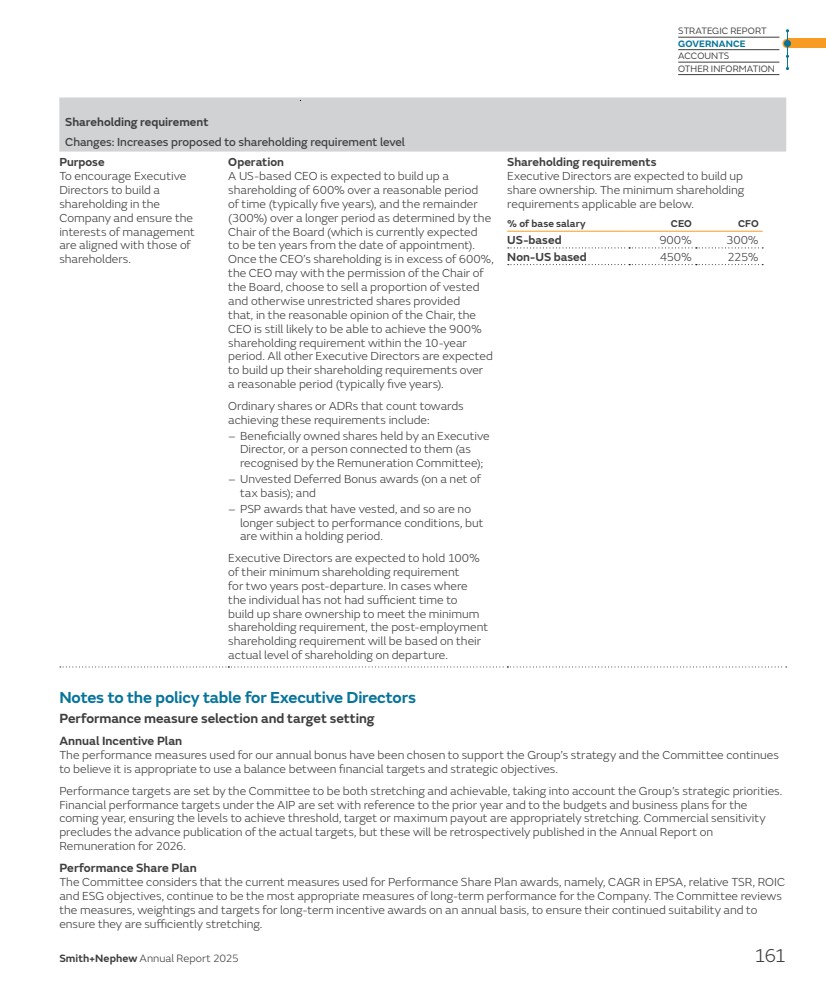
| PSP performance multiplier Recognising that an increase of the TTDC to a level toward the middle of the peer group would imply a very significant increase in pay, we propose a mechanism by which the higher levels of opportunity only become available to Executive Directors if shareholders benefit directly as well. To achieve this, we propose that for PSP grants made in 2027 and 2028, the baseline value of the PSP awarded be increased by a factor of between 1.0 and 1.4 (the multiplier) which can increase the value of the PSP opportunity. The multiplier applied will be related to the increase in the share price in the previous year; if the share price increases by 5%, the value of the multiplier will be 1.0 and if the share price increases by 15% it will be 1.4, with the multiplier being determined on a straight-line basis between the two. The share price increase would be calculated by dividing the average closing share price in December prior to the PSP award date by the average closing share price in the preceding December. For example, for PSP awards granted in 2027, we would compare the average closing share price from December 2026 against the average closing share price in December 2025 to determine whether a multiplier should apply to the 2027-29 PSP award. An underpin will always apply to the denominator such that the preceding December share price can never be less than the average closing share price in December 2025. This test would be repeated each year, such that year over year share price increases must be delivered to maintain an enhanced PSP award. As all PSP awards are subject to performance conditions, once granted the executive must continue to deliver performance over the three year PSP award performance period to ultimately realise any value from the award, which would then be subject to a two year holding period. The purpose of this mechanism is two-fold: to enable Executive Directors to achieve pay more aligned with peers, but to align this with the measurable delivery of shareholder value as reflected in share price growth. Set out below are examples of how this multiplier may work for the CEO. Award year 2027 2028 2029 Baseline average share price £12.32 (Dec-25) £13.24 (Dec-26) £13.84 (Dec-27) Average share price in December prior to PSP award1 £13.24 (Dec-26) £13.84 (Dec-27) £15.92 (Dec-28) Share price increase (Dec - Dec) 7.50% 4.50% 15% PSP award multiplier 1.1 1 1.4 Award level (% of base salary) 715% 650% 910% Award value (USD) 11,580,111 10,527,374 14,738,324 Performance vesting outcome (for illustrative purposes) 0% 100% 50% Vesting value2 (USD) – 10,527,374 7,369,162 Vesting year 2030 2031 2032 End of post-vesting holding period 2032 2033 2034 1 An underpin will apply such that the baseline share price in all future years can be no less than £12.32, which is the average share price during the month of December 2025. 2 Assuming constant share price. As illustrated above, in a year where 5% share price increase is not delivered, the PSP award would return to the baseline level and where an enhanced award has been granted, if the attached performance conditions have not been achieved then no value would be delivered to the executive. To determine the performance conditions for the multiplier, the Committee considered various factors, including what might be an appropriate level to motivate the executives, and the share price change data across the PSP peer group over the three years to December 2025. As shown below, a 5% change in average December share price has been at least median over the past three years and 15% has been around or above upper quartile. 2023 2024 2025 Lower quartile (14.5%) (11.7%) (31.7%) Median 2.3% 0.8% (10.2%) Upper quartile 18.0% 16.5% 5.1% Percentile rank of 5% change 57.2% 55.2% 74.5% Percentile rank of 15% change 72.6% 73.8% 90.2% 162 Smith+Nephew Annual Report 2025 Directors’ Remuneration Report continued Remuneration Policy Report continued 18_SN_AR25_REM_Policy_v148.indd 162 05/03/2026 18:17 |
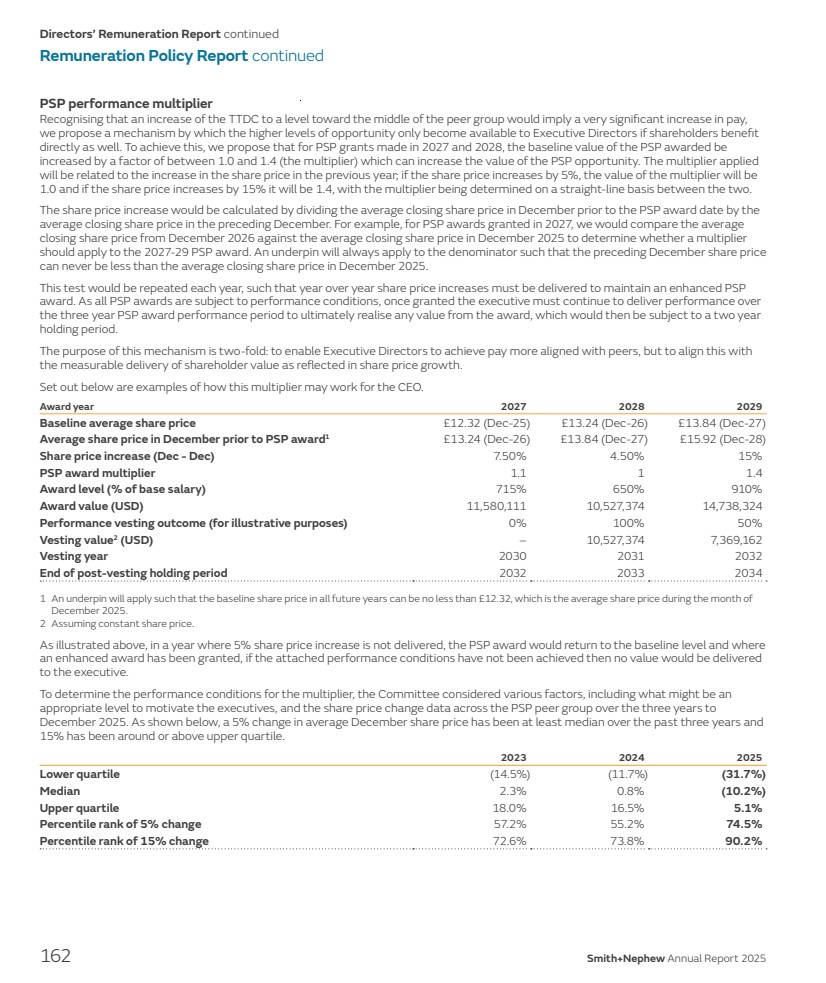
| Relative TSR comparator group Under the current policy, TSR is measured against two peer groups, one based on the MedTech industry, and one based on a subset of the FTSE100. We are proposing to simplify this in the new Policy and have only a peer group based on the MedTech industry. The companies included in this peer group are: – Alcon Inc. – Bausch + Lomb Corporation – Baxter International Inc. – Becton, Dickinson & Co – bioMérieux S.A. – Coloplast A/S – Convatec Group Plc – Dentsply Sirona Inc. – Edwards Lifesciences Corporation – GE Healthcare Technologies Inc. – Intuitive Surgical, Inc. – Koninklijke Philips NV – ResMed Inc. – Solventum – Sonova Holding AG – Steris Plc – Teleflex Incorporated – Zimmer Biomet Holdings, Inc. – Carl Zeiss Meditec Ag – Demant A/S – DiaSorin SpA – Elekta AB – Enovis Corporation – Envista Holdings Corporation – Globus Medical, Inc. – Insulet Corporation – Integer Holdings Corporation – Integra Lifesciences Holdings Corporation – Medtronic Public Limited Company – Straumann Holding Ltd – Stryker Corporation – The Cooper Companies, Inc. The Committee may, in its absolute discretion, add or remove a company from the MedTech peer group where it determines that it is appropriate to maintain the relevance of the peer group. Any changes to the peer group would be fully explained to shareholders. Shareholding requirements The new policy increases the standard shareholding requirements for the CEO and CFO to 900% and 300%, respectively. The CEO shareholding requirement exceeds that of our peer group where 14 out of 21 CEOs have a 600% shareholding requirement, but is aligned with our peer group for the CFO where 15 out of 21 CFOs have a 300% shareholding requirement. Shareholding requirement US-based CEO (% of base salary) US-based CFO (% of base salary) 2025 Pay Peer Group median 600% 300% Current S+N shareholding requirement 500% 200% Proposed S+N shareholding requirement 900% 300% Non-US based executives The Committee recognises that executive pay tends to be very much lower outside the US, and to ensure that the policy does not imply paying US-style compensation to non-US Board executives, we are proposing different variable pay opportunities outside the US. Although, we do not expect to have Executive Directors outside the US in the immediate future. The Committee considered a FTSE peer group (20 FTSE 100 companies above and below Smith+Nephew’s market capitalisation, excluding financial services), alongside other factors, including the positioning of other MedTech companies within the FTSE and Europe, the complexities of leading a global business, internal equity where the majority of leadership will be based in the US, and the ability to attract and retain high calibre talent that can lead a MedTech company. Given the factors noted above, the Committee believes it is necessary to position the variable pay opportunities in the top quartile to be market competitive. % of base salary CEO CFO Annual Incentive Plan (at target) Lower quartile 96% 75% Median 100% 90% Upper quartile 113% 100% Proposed 130% 107.5% Long-term incentive plan (at expected value1) Lower quartile 150% 120% Median 180% 150% Upper quartile 240% 180% Proposed 365% 195% 1 Expected value is calculated as 60% of maximum PSP vesting, plus 100% of RSP award level. Smith+Nephew Annual Report 2025 163 STRATEGIC REPORT GOVERNANCE ACCOUNTS OTHER INFORMATION 18_SN_AR25_REM_Policy_v148.indd 163 05/03/2026 18:17 |

| Remuneration Policy for Non-Executive Directors The policy for Non-Executive Directors remuneration is set out below. Basic fee Changes: Base fees will be paid fully in cash Operation Base fees are reviewed annually. Base fees will be paid fully in cash. Maximum opportunity Increases will generally not exceed the average increase for the wider employee population within the Non-Executive Director’s home country. A higher increase may be made if there is an increase in activity or time commitment. The total maximum aggregate fee to Non-Executive Directors will not exceed the limit set out in the Company’s Articles of Association. Performance measures No performance conditions apply. Additional fee Changes: No changes proposed Operation A fixed fee paid to reflect additional responsibilities, such as a Committee Chair or Senior Independent Director (SID). The fee is reviewed annually and will be paid fully in cash. Maximum opportunity The total maximum aggregate fee to Non-Executive Directors will not exceed the limit set out in the Company’s Articles of Association. Performance measures No performance conditions apply. Intercontinental travel Changes: No changes proposed Operation A fee to compensate for the time spent travelling to attend meetings in another continent. The fee is reviewed annually and paid fully in cash. Maximum opportunity The total maximum aggregate fee to Non-Executive Directors will not exceed the limit set out in the Company’s Articles of Association. Performance measures No performance conditions apply. Shareholding requirement Changes: No changes proposed Operation Non-Executive Directors are expected to build up share ownership over a period of two to three years from appointment. The expected shareholding requirement is 25% of the Non-Executive Director’s annual fee. Maximum opportunity Not applicable. Performance measures No performance conditions apply. The proposed application of the Remuneration Policy for the Chair of the Board and Non-Executive Directors in 2026 is as follows. 2025 2026 Chair of the Board £467,500 ($606,348) £482,460 ($625,751) Basic fee UK: £74,779 ($96,988) US: $139,050 UK: £77,170 ($100,089) US: $143,500 Senior Independent Director fee UK: £21,500 ($27,886) US: $37,500 UK: £25,000 ($32,425) US: $43,500 Committee Chair fee UK: £21,500 ($27,886) US: $37,500 UK: £25,000 ($32,425) US: $43,500 1 Fees set in GBP have been converted to USD using a 1 GBP:1.297 USD exchange rate. 164 Smith+Nephew Annual Report 2025 Directors’ Remuneration Report continued Remuneration Policy Report continued 18_SN_AR25_REM_Policy_v148.indd 164 05/03/2026 18:17 |
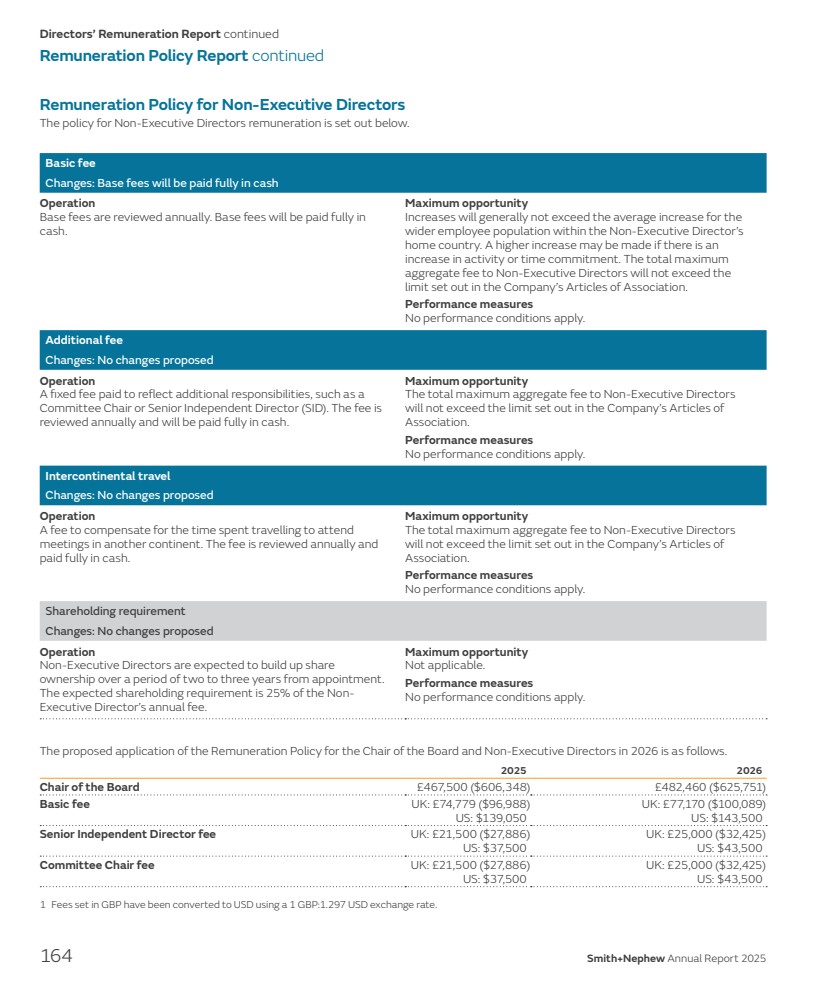
| Note that all payments made to the Chair of the Board are determined by the Committee, while payments made to the Non-Executive Directors are determined by those Directors, who are not themselves Non-Executive Directors, currently the Chair of the Board, Chief Executive Officer, and Chief Financial Officer. Discretion and judgement The Committee retains the flexibility to apply discretion and judgement to ensure fair outcomes, as no remuneration policy or framework, however well-designed, can anticipate every situation. The Committee can exercise discretion in several areas when administering the Company’s incentive plans, in accordance with the relevant plan rules. These include, but are not limited to: – Selection of participants. – The size of awards each year (subject to the limits outlined in the Remuneration Policy). – The performance measures and targets to be applied to each incentive award. – The level of payments, or vesting, based on achievement of the relevant performance conditions. – Determining individuals as good or ordinary leavers and the treatment of outstanding awards (in line with plan rules and Remuneration Policy). – Managing outstanding awards and evaluating performance in the event of a change of control. Additionally, if circumstances arise that lead the Committee to believe that a performance condition is no longer appropriate, they may substitute, adjust, or waive the condition to ensure a fairer evaluation of performance. Malus and clawback The Board has a clawback policy which provides for the recovery of certain incentive-based remuneration from current and former Executive Directors and Executive Officers of the Company in the event the Company is required to restate its financial statements filed with the SEC in order to correct an error that is material to its financial statements. This policy is in addition to the rights granted to the SEC under applicable legislation and the malus and clawback provisions set forth in the Company’s incentive plan rules. Under the Company’s incentive plan rules, malus and clawback may be applied to AIP, deferred bonuses, PSP and RSP awards in certain circumstances including: – Cases of fraud, negligence or gross misconduct by the Executive Director; – Material financial misstatement in the audited financial results; – Error in calculation; or – Other exceptional circumstances at the Committee’s discretion. Cash bonuses will be subject to clawback, with deferred shares being subject to malus, over the deferral period. PSP and RSP awards will be subject to malus over the vesting period and clawback from the vesting date to the third anniversary of the relevant vesting date. These periods were chosen as it is practicable to enact clawback over these periods. No malus or clawback was operated in 2025 in relation to Executive Directors. Remuneration scenarios for 2026 Below is an illustration of the potential future remuneration that could be received by each Executive Director during 2026, both in absolute terms and as a proportion of the total reward under different performance scenarios. In developing the scenarios, the following assumptions have been made: Below threshold Fixed elements of remuneration (base salary, pension and benefits) plus 100% of RSP award Threshold Fixed remuneration plus 25% of PSP maximum opportunity plus 100% of RSP award Target Fixed elements of remuneration plus 50% of maximum bonus plus 60% of PSP maximum opportunity plus 100% of RSP award Maximum Fixed elements of remuneration plus 100% of maximum bonus plus 100% of PSP maximum opportunity plus 100% of RSP award Maximum plus 50% share price growth Maximum plus a 50% share price growth on the PSP award and 100% of RSP award Smith+Nephew Annual Report 2025 165 STRATEGIC REPORT GOVERNANCE ACCOUNTS OTHER INFORMATION 18_SN_AR25_REM_Policy_v148.indd 165 05/03/2026 18:17 |
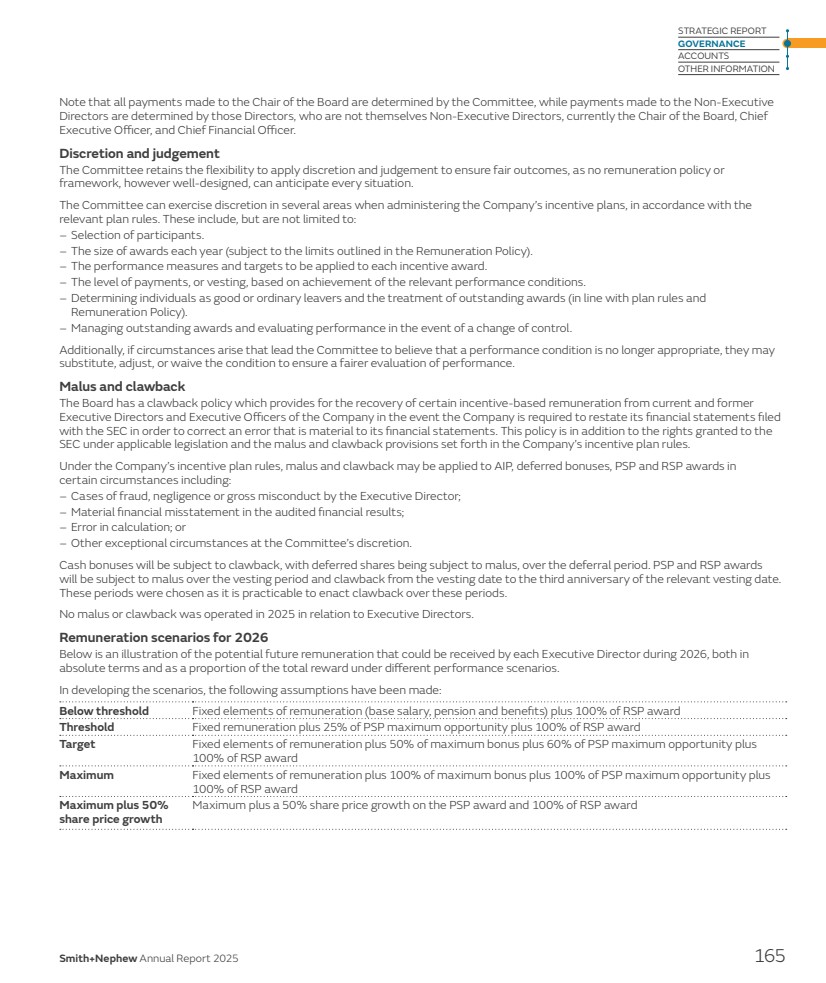
| Composition of package (%) 0 10 20 30 40 50 60 70 80 90 100 Below threshold Threshold Target Maximum Maximum (incl 50% share price growth) A B B C C C C D D C D F E E E E F F F F G H A A A A John Rogers, CFO Value of package ($m) CB Below threshold Threshold Target Maximum Maximum (incl 50% share price growth) 02468 10 12 14 16 18 20 22 24 26 A A A A A F F F F FG H E D D D E E E Deepak Nath, CEO A Base salary B Benefits C Pension D AIP E PSP F RSP G PSP (share price growth) H RSP (share price growth) Composition of package (%) 0 10 20 30 40 50 60 70 80 90 100 A B C BC D E F H Below threshold Threshold Target Maximum Maximum (incl 50% share price growth) B C C DB B C D E E E F F F A A A A F G Below threshold Threshold Target Maximum Maximum (incl 50% share price growth) Value of package ($m) CB A E D D D E E E F F F F G H A A A A 02468 10 12 14 16 18 20 22 24 26 F 166 Smith+Nephew Annual Report 2025 Directors’ Remuneration Report continued Remuneration Policy Report continued 18_SN_AR25_REM_Policy_v148.indd 166 05/03/2026 18:17 |

| Reward strategy and application Our reward approach is designed to be competitive across the diverse markets in which we operate, allowing us to attract and retain top talent globally. In this context, the Remuneration Committee is responsible for setting the remuneration arrangements for Executive Directors, ensuring alignment with the Company’s values and long-term business strategy. In doing so, the Committee also considers the remuneration arrangements of the broader workforce, related policies, and the alignment of incentives and reward with culture. The table below outlines the strategic rationale for each component of remuneration and how our remuneration structure applies to different employee groups within Smith+Nephew. Reward element and strategic rationale Executive Directors Executive Committee Senior Executives Senior Managers Managers Wider Workforce Base salary Fair and competitive pay to attract and retain employees. Base salary is set with reference to the relevant local market and takes account of the employee’s knowledge, experience, and contribution to the role. Base salaries are usually reviewed annually and take into account local salary norms, local wage inflation and business conditions. Increases in base salary for Executive Directors will take into account the level of salary increases granted to all employees within the Group in the Executive Director’s home country. Base salary is either subject to negotiation with local trade unions or follows the market pay approach outlined for managers. Pensions and benefits Support employees in the performance of their role and to ensure the package is market competitive. Employment and post-retirement benefits are offered in line with relevant home market. Short-term Incentives Nearly all employees are eligible to participate in an annual incentive plan. The bonus opportunity varies by role level. The performance objectives within the plans cascade from the objectives set for Executive Directors at the start of the year to ensure the performance of all employees is linked to the Company’s strategy. Annual incentive based on 85% financial metrics, plus 15% strategic objectives. Compulsory deferral into shares for three years. Annual incentive based on 80% financial metrics, plus 20% strategic objectives. Annual incentive based on 70% financial metrics, plus 30% strategic objectives. Certain employees within commercial or sales roles participate in a sales incentive plan instead of the annual incentive plan. Annual incentive is either subject to negotiation with local trade unions; follows the standard annual incentive framework for managers with 60% financial metrics and 40% strategic objectives; is a sales incentive plan; or an operational effectiveness incentive plan. Long-term Incentives Longer term reward, predominantly in shares, to recognise and reward performance delivery and create alignment with shareholder interests. PSP awards are subject to a three-year performance period and a two-year holding period. PSP awards are subject to a three-year performance period. RSP awards vest in three equal annual instalments and are subject to continued employment and a reasonable judgement underpin. RSP awards are awarded and vest in three equal annual instalments subject to continued employment and good standing. The level of award granted to employees is dependent on the role level, personal performance, and Company performance conditions in the year prior to the award. RSP awards may be granted as special recognition or to motivate and retain key talent. Awards typically vest in three equal annual instalments subject to continued employment and good standing. Eligible employees in the US can participate in a section 423 plan. Employees outside the US will be able to participate in the new Smith+Nephew Global Employee Share Purchase Plan, launching in 2026. Smith+Nephew Annual Report 2025 167 STRATEGIC REPORT GOVERNANCE ACCOUNTS OTHER INFORMATION 18_SN_AR25_REM_Policy_v148.indd 167 05/03/2026 18:17 |

| Link to business strategy The strategy for growth was executed through a disciplined 12-Point Plan focused on productivity gains, enhanced commercial execution, and organisational transformation. This delivery strengthened operational performance and created a solid platform for the next phase of growth, based on the RISE strategy, which will focus on generating significant value for shareholders, customers and communities by reaching more patients through leading innovation, raising the standard of care and delivering stronger financial performance. The alignment of each proposed measure to the RISE strategy is set out below. AIP measures Reach Innovate Scale Execute Revenue Growth ✔✔✔ Trading Profit ✔✔✔✔ Free Cash Flow ✔ ✔ Strategic objectives ✔✔✔✔ PSP measures Reach Innovate Scale Execute Adjusted Earnings per Share ✔ ✔ Return on Invested Capital ✔ ✔ Relative TSR (Total Shareholder Return) ✔✔✔✔ ESG objectives ✔ 168 Smith+Nephew Annual Report 2025 Directors’ Remuneration Report continued Remuneration Policy Report continued 18_SN_AR25_REM_Policy_v148.indd 168 05/03/2026 18:17 |
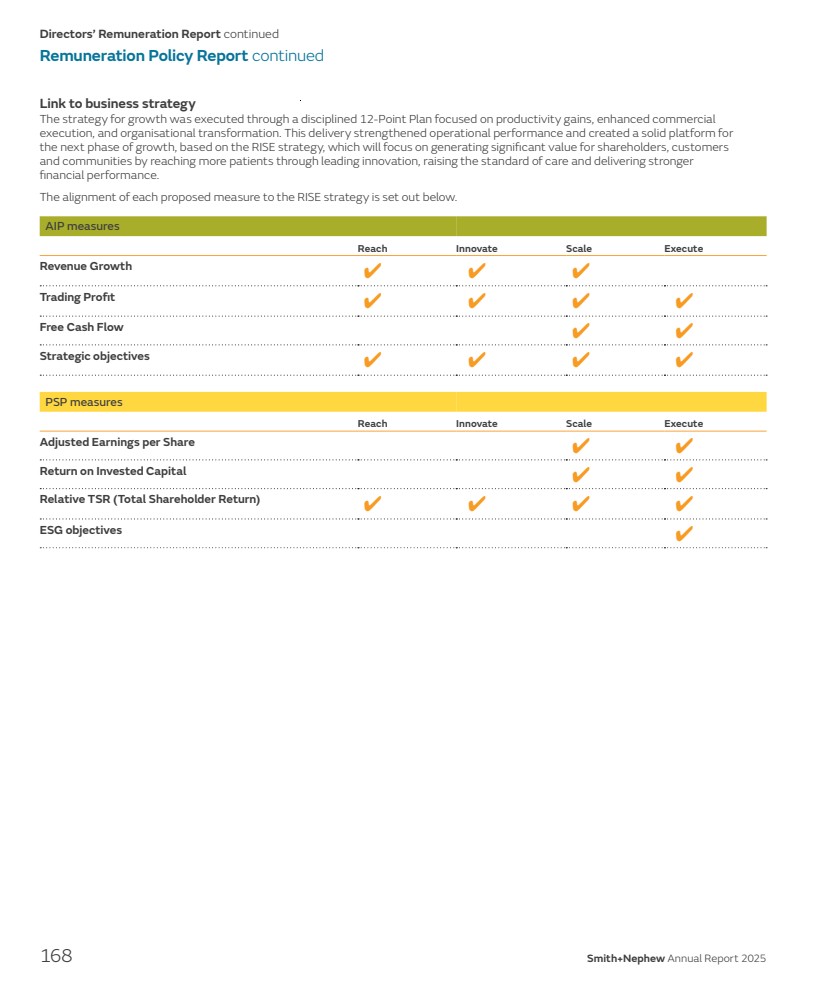
| Approach to recruitment The Recruitment Policy provides a suitable framework for attracting individuals with the necessary expertise to lead a company of our size, scale, and complexity. The table below outlines the policy, for both internal and external recruitment, and the different elements that may be included within a remuneration package for an Executive Director, along with the approach the Remuneration Committee would take for each element. Element Policy and operation Overall The policy of the Board is to recruit the best candidate possible for any Board position and to structure pay and benefits in line with the Remuneration Policy. The ongoing structure of a new recruit’s package would be the same as for existing Directors, with the possible exception of an identifiable buy-out provision, as set out below. Base salary Base salary is positioned at a fair and appropriate level allowing for a range of factors, including the executive’s current remuneration and experience, internal relativities, an assessment against relevant comparator groups and cost. If a new Executive Director is initially appointed at a lower rate, the Committee retains the ability to award larger increases in subsequent years to realign the salary over time as the individual develops in the role. Pensions and benefits An Executive Director will be eligible for benefits and pension arrangements in line with the arrangements offered to comparable roles in the country in which the Executive Director is based. Annual incentive The maximum level of opportunity is as set out in the Remuneration Policy. The Committee retains discretion to set different performance targets for a new externally appointed Executive Director, or to adjust performance targets and/or measures in the case of an internal promotion, to be assessed over the remainder of the financial year. In this case, any bonus payment would be made at the same time as for existing Directors, such award to be prorated for the time served in the performance period. Long-term incentive The maximum level of opportunity is as set out in the Remuneration Policy. To achieve rapid alignment with Smith+Nephew and shareholder interests, the Committee retains discretion to grant an award to a new externally appointed Executive Director on, or soon after, appointment if they join outside of the normal grant period. Replacement or buy-out awards The Committee retains discretion to grant replacement buy-out awards (in cash or shares) to a new externally-appointed Executive Director to reflect the loss of awards granted by a previous employer. Where this is the case, the Committee will seek to structure the replacement award such that overall it is on an equivalent basis to broadly replicate that foregone, using appropriate performance terms. If the Executive Director’s prior employer pays any portion of the remuneration that was anticipated to be forfeited, the replacement awards shall be reduced by an equivalent amount. Sign-on incentives The Committee retains discretion to grant a sign-on award (in cash or shares) to a new externally appointed Executive Director to ensure a compelling remuneration package can be offered in a highly competitive recruitment market. These awards would be capped at 200% of base salary and be subject to robust performance conditions, deferral, and clawback. The Committee will explain the circumstances and rationale for such awards to shareholders if they are used. Other If the Committee concludes that it is necessary and appropriate to secure an appointment, relocation-related support and international mobility benefits may be provided, depending on the circumstances and in line with the Group’s broader approach. In addition, where a new Executive Director requires legal or other professional advice related to the appointment to understand the obligations, duties and legal and regulatory requirements of the new role, the associated fees may be paid (or reimbursed) by the Company. Smith+Nephew Annual Report 2025 169 STRATEGIC REPORT GOVERNANCE ACCOUNTS OTHER INFORMATION 18_SN_AR25_REM_Policy_v148.indd 169 05/03/2026 18:17 |

| Service contracts and policy on payment for loss of office Executive Directors The following table sets out the principal provisions of the service contracts of Executive Directors and the treatment of payments on termination of employment. The Executive Director service contracts (as well as the terms and conditions of appointment of the Non-Executive Directors) are available for inspection at the Company’s registered office (Building 5, Croxley Park, Hatters Lane, Watford, WD18 8YE, United Kingdom). In exceptional circumstances, the Committee may authorise, where it considers it to be in the best interests of the Company and shareholders, entering into contractual arrangements with a departing Executive Director, for example, a settlement, confidentiality, restrictive covenant or other arrangement, pursuant to which sums not set out in the following table may become payable. Full disclosure of the payments will be made in accordance with the remuneration reporting requirements. Deepak Nath John Rogers Date of service agreement 1 April 2022 22 July 2025 (current US Agreement) 1 December 2023 (prior UK Agreement) Date of appointment as director 1 April 2022 1 April 2024 Employing company Smith+Nephew Inc Smith+Nephew Inc Contract duration No fixed term Notice period No more than 12 months’ notice Post-termination restrictions The contracts of employment contain the following restrictions on the Director for 12 months from the date of termination of employment: – Non-compete clause for employment – Non-dealing and non-solicitation of client/customers – Non-solicitation of suppliers and non-interference with supply chain – Non-solicitation of employees. Summary termination – payment in lieu of notice The Company may, at its absolute discretion, terminate the employment of the Director with immediate effect by giving written notice together with payment of a sum equivalent to the Director’s base salary and the value of his contractual benefits as at the date such notice is given, in respect of the Director’s notice period, less any period of notice worked. The Company may elect to make this payment monthly or as a lump sum. Termination payment – change of control The Company shall pay 12 months’ base salary, together with a sum equivalent to the value of the Director’s contractual benefits, as at the date of termination within one year of change of control. Reasonable outplacement costs will also be covered. Termination – treatment of annual incentive awards Annual bonus awards are subject to performance conditions and made at the discretion of the Remuneration Committee. Executive Directors will receive a bonus, pro rata to service for the current performance year, unless the reason for leaving is resignation or misconduct, in which case the awards will lapse on cessation of employment. Any prorated awards will ordinarily be paid on their normal payment date and following the end of the relevant award performance period, unless the Committee determines that awards should be paid following cessation of employment. Performance will be tested at the end of the performance period unless the Committee determines to test performance otherwise. Deferred bonus awards will vest on their normal vest date in accordance with the plan rules. Termination – treatment of long-term incentive awards PSP and RSP awards are made at the discretion of the Remuneration Committee. Executive Directors will be eligible for PSP awards, pro rata to service for the performance period, unless the reason for leaving is resignation or misconduct, in which case the awards will lapse on cessation of employment. Similarly, Executive Directors eligible for RSP awards will receive outstanding awards pro rata for service over the award vesting period. PSP awards will be tested for performance at the end of the performance period, unless the Committee determines to test performance otherwise. The reasonable judgement underpin on RSP awards will be tested at the end of the vesting period. Redundancy arrangements 12 months’ base salary and contractual benefits. Reasonable outplacement costs. Holiday Upon termination for any reason entitled to payment in lieu of accrued, but untaken holiday entitlement (subject to overriding local law and regulation). 170 Smith+Nephew Annual Report 2025 Directors’ Remuneration Report continued Remuneration Policy Report continued 18_SN_AR25_REM_Policy_v148.indd 170 05/03/2026 18:17 |
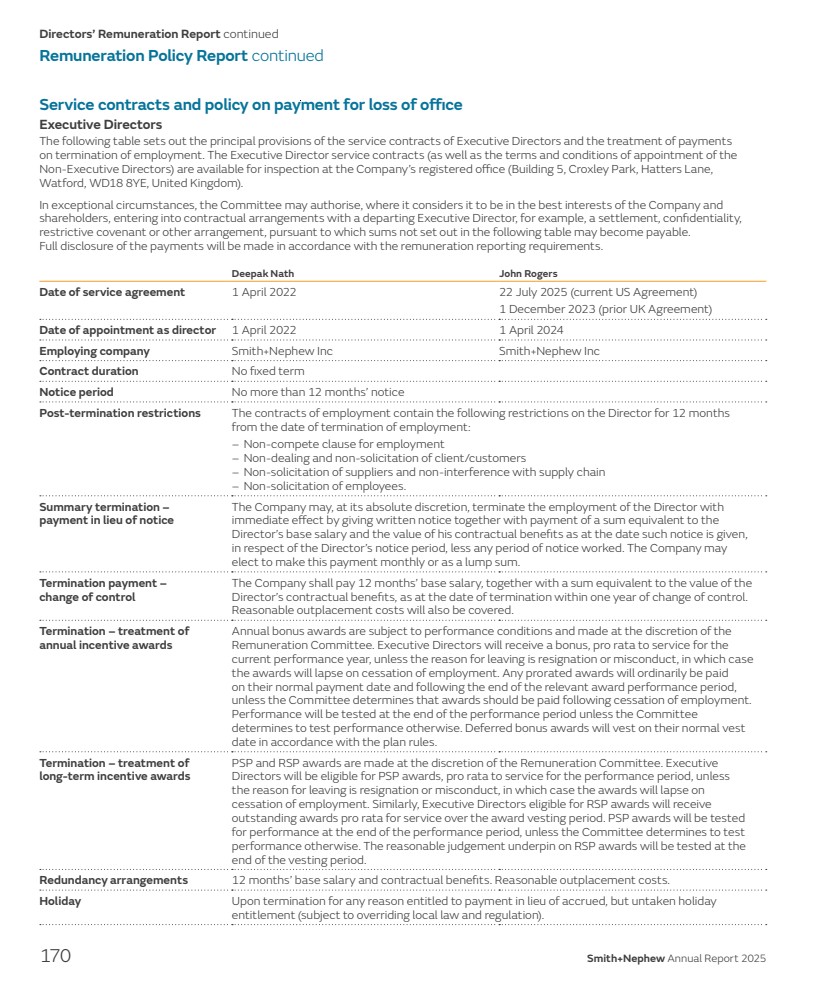
| Chair and Non-Executive Directors The Chair of the Board and each of the Non-Executive Directors have letters of appointment. The letters of appointment do not contain any contractual entitlement to a termination payment and the Non-Executive Directors can be removed in accordance with the Company’s Articles of Association. Directors are required to retire at each AGM and seek re-election by shareholders. The details of the service contracts in relation to the Non-Executive Directors, who served during the year are set out in the table below. Neither the Chair of the Board nor the Non-Executive Directors have provisions in their letter of appointment that relate to a change of control of the Company. Committee appointments Date of appointment Expiry of current term Chair Initial term of appointment is for 36 months subject to election/re-election at each AGM. Thereafter, continuation of the appointment is subject to re-election at each subsequent AGM. Rupert Soames N R 24 April 2023 Non-Executive Directors Angie Risley N R 18 September 2017 Thérèse Esperdy N R 1 December 2025 Jo Hallas A C 1 February 2022 David King C R 1 July 2025 Garheng Kong A 1 September 2025 Simon Lowth A N 1 January 2024 John Ma C 17 February 2021 Jez Maiden A R 14 September 2023 Katarzyna Mazur-Hofsaess C 1 November 2020 Marc Owen A C N R 1 October 2017 Sybella Stanley R 1 February 2025 Bob White¹ C R 1 May 2020 30 April 2025 Committee key A R N C Member of the Audit Committee Member of the Remuneration Committee Member of the Nomination & Governance Committee Member of the Compliance & Culture Committee Committee Chair 1 Bob White stepped down from the Board on 30 April 2025. Smith+Nephew Annual Report 2025 171 STRATEGIC REPORT GOVERNANCE ACCOUNTS OTHER INFORMATION 18_SN_AR25_REM_Policy_v148.indd 171 05/03/2026 18:17 |

| Delivery of our purpose and strategy drives our 2025 incentive outcomes Our remuneration arrangements are designed to incentivise and reward the delivery of sustainable value creation and long term-growth that enables us to achieve our purpose of delivering a Life Unlimited for our patients. We aim to: Be competitive Attract, retain and motivate top talent by offering a competitive remuneration structure for the MedTech industry Pay for performance Create a direct link between pay and performance, recognising both Company and individual performance Align interests Align executive interests with the long-term interests of our shareholders Be agile Remain flexible enough to adapt to changing business needs Be reasonable Ensure remuneration is reasonable, affordable and appropriate in the context of the MedTech industry Life Unlimited: We exist to restore people’s bodies and their self-belief Transform Through innovation and acquisition Accelerate Profitable growth through prioritisation and customer focus Strengthen The foundation to serve customers sustainably and simply Revenue Trading profit margin Free cash flow Return on invested capital Earnings per share Relative total shareholder return Strategic objectives (including ESG metrics) Remuneration outcomes in line with performance Purpose Strategy Incentive measures Pay for performance 172 Smith+Nephew Annual Report 2025 Remuneration at a glance Directors’ Remuneration Report continued 19_SN_AR25_REM_Impl_v160.indd 172 05/03/2026 18:19 |
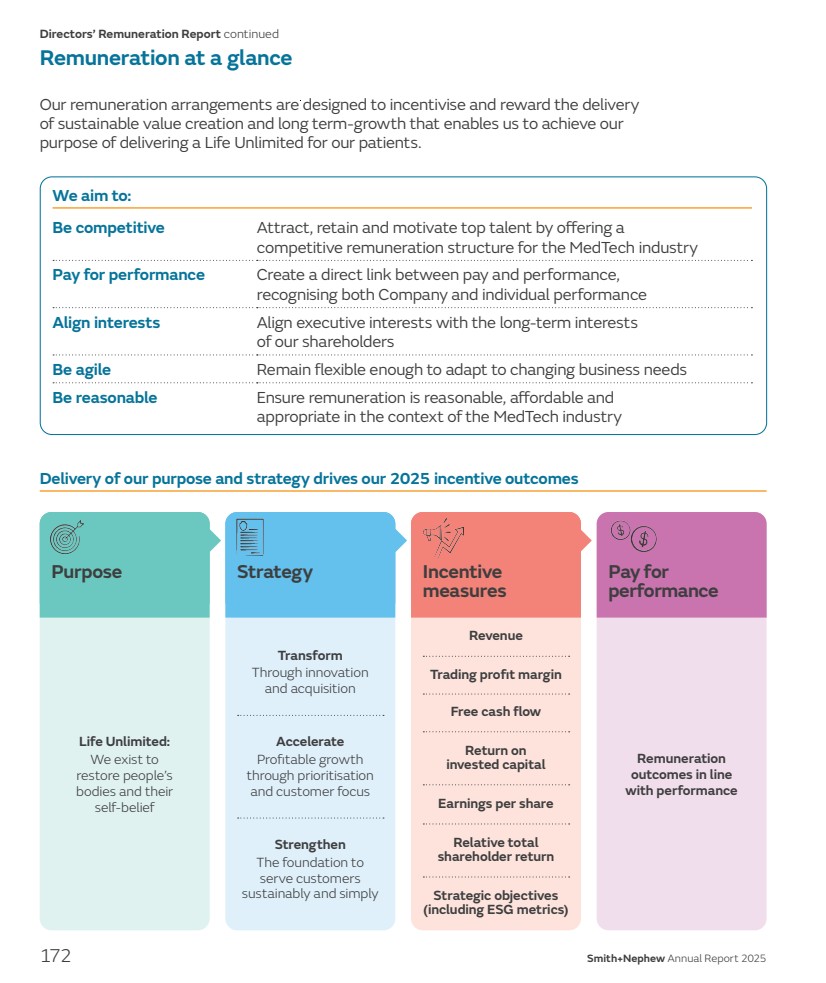
| Annual Incentive Plan Single figure Executive Director 2025 Remuneration Outcomes John Rogers Chief Finance Officer (CFO) $2,815m (2024: $2,000m) Performance Share Plan 2023-2025 How we performed in 2025 $7,219m (2024: $5,962m) Deepak Nath Chief Executive Officer (CEO) Weighting A Revenue 35.0% B Trading profit margin 35.0% C Free cash flow 15.0% D Strategic objectives (including ESG) 15.0% D C B A Weighting A Cumulative group revenue 25.0% B Cumulative free cash flow 25.0% C Return on invested capital 25.0% D Relative Total Shareholder Return (FTSE100) 12.5% E Relative Total Shareholder Return (S&P 1200 Global Healthcare Medical Devices subset) 12.5% E D C B A Revenue Actual: $6,117m Threshold: $6,019m Target: $6,080m Maximum: $6,140m Trading profit margin Actual: 19.7% Threshold: 18.9% Target: 19.4% Maximum: 19.9% Free cash flow Actual: $836m Threshold: $531m Target: $625m Maximum: $719m Strategic objectives (Including ESG) – Deepak Nath Actual: 135% Threshold: 0% Target: 100% Maximum: 200% Strategic objectives (Including ESG) – John Rogers Actual: 118% Threshold: 0% Target: 100% Maximum: 200% Remuneration summary Target Actual Target Actual A Base salary and benefits B Annual Incentive Plan C Performance Share Plan D Restricted Share Plan (incl. buy-out) Cumulative group revenue Actual: $17,625m Threshold: $16,354m Target: $17,776m Maximum: $19,198m Cumulative free cash flow Actual: $1,511m Threshold: $1,233m Target: $1,541m Maximum: $1,695m Return on invested capital Actual: 7.2% Threshold: 8.5% Target: 9.5% Maximum: 10.5% Relative Total Shareholder Return (FTSE100) Actual: 21.9% Threshold: Index return (28.1%) Maximum: Index return +8% (61.4%) Relative Total Shareholder Return (S&P 1200 Global Healthcare Medical Devices subset) Actual: 21.9% Threshold: Index return (-5.8%) Maximum: Index return +8% (18.7%) A 1,179 B 1,011 A 1,179 B 1,636 A 1,771 B 1,728 C 2,442 D 836 A 1,771 B 2,842 C 1,770 D 836 Smith+Nephew Annual Report 2025 173 STRATEGIC REPORT GOVERNANCE ACCOUNTS OTHER INFORMATION 19_SN_AR25_REM_Impl_P173.indd 173 06/03/2026 21:07 |

| This section provides details on how the Directors’ Remuneration Policy was implemented during 2025 (the Implementation Report) and how we intend to apply it in 2026. About the Remuneration Committee The members of the Remuneration Committee include Sybella Stanley (Chair), Angie Risley, Rupert Soames, Jez Maiden, David King, Marc Owen and Thérèse Esperdy. Details of attendance at Committee meetings during the year are shown on page 110. The Committee’s role is to ensure that our Remuneration Policy and practices are aligned with the business strategy and promote long-term sustainable success. The Committee’s Terms of Reference can be found on our website. These terms include the determination of fair remuneration for Director and the Chair of the Board (no individual participates in discussions about their own remuneration). In addition, the Committee receives recommendations from the Chief Executive Officer on the remuneration of those reporting to him, as well as advice from the Head of Reward and Chief HR Officer. Advisers to the Committee During the year under review, the Committee received material assistance and advice on remuneration policy from the Head of Reward and Chief HR Officer. The Chief Executive Officer also provided advice that was of material assistance to the Committee. The Committee appoints independent remuneration consultants who attend Committee meetings and provide independent advice and information on corporate governance developments and market trends on pay and incentive arrangements. The Committee appointed Willis Towers Watson as adviser to the Committee in 2023 following a competitive tender process. The total fees paid to Willis Towers Watson in respect of its services to the Committee during the year were £109,980. The fees paid are based on the standard market rates for remuneration committee advisory services. Willis Towers Watson is a signatory to the Remuneration Consultants Group Code of Conduct. Willis Towers Watson also provides consultancy services to the Company in relation to certain employee and benefit matters applying to those below the Board. The Committee is satisfied that the advice provided by Willis Tower Watson was independent and objective and that the provision of additional services did not compromise that independence. The Committee is also satisfied that the team who provided advice do not have any connection to Smith+Nephew that may impair their independence and objectivity. The work carried out by the Committee during the year is set out on page 147. Statement of shareholder voting We carefully monitor shareholder voting on our Remuneration Policy and its implementation. We recognise the importance of our shareholders’ continued support for our remuneration arrangements. The table below shows the results of the polls taken on the resolution to approve the Remuneration Policy at our AGM in 2024 and the Directors’ Remuneration Implementation Report, at our AGM in May 2025. Resolution Number of votes cast For Against Votes withheld Remuneration Policy 677,164,841 384,484,538 292,680,303 1,744,476 (56.78%) (43.22%) Directors’ Remuneration Report (excluding Policy) 715,001,994 662,105,430 52,896,564 9,339,790 (92.6%) (7.4%) 174 Smith+Nephew Annual Report 2025 Annual report on remuneration Directors’ Remuneration Report continued 19_SN_AR25_REM_Impl_v160.indd 174 05/03/2026 18:19 |
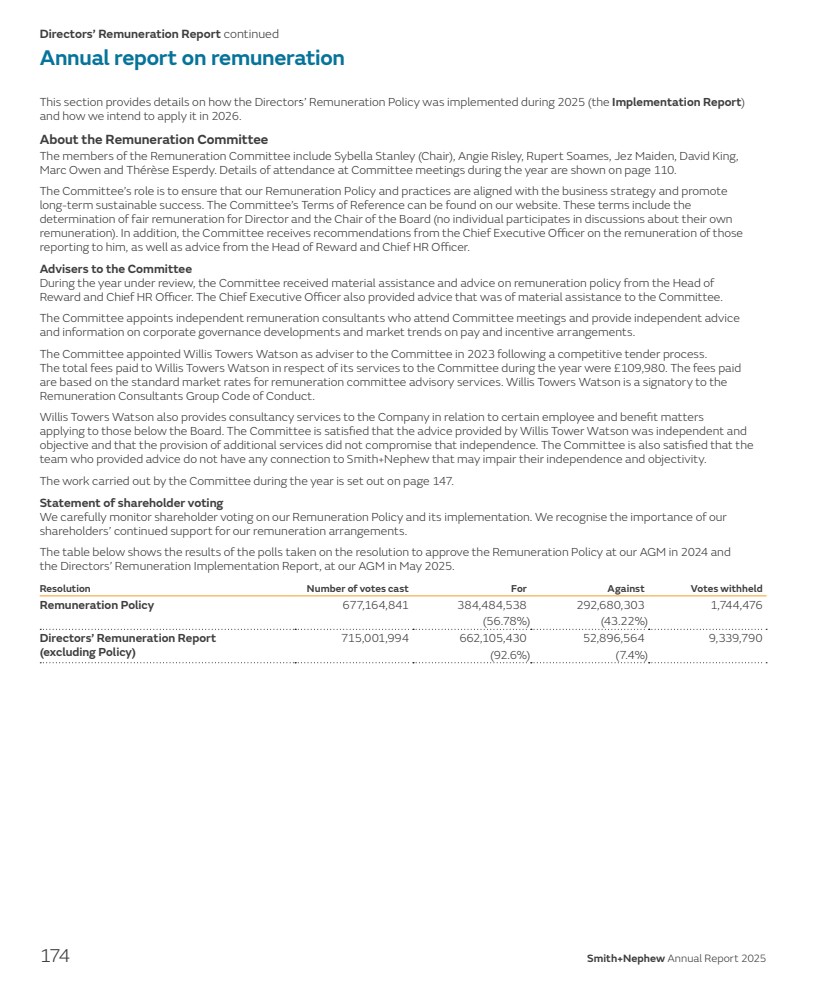
| Remuneration for the year ended 31 December 2025 Our Remuneration Policy operated as intended over the year, and the table below sets out the single total figure of remuneration for each Executive Director received in respect of qualifying service over 2025 together with comparatives for 2024. An explanation of how the figures are calculated follows the table. Executive Directors’ remuneration – Single figure of remuneration (audited) Executive Directors Deepak Nath (appointed 1 April 2022) John Rogers (from 1 April 2024) 000s USD 20251 20242 20251 20242 Fixed pay Base salary 1,607 1,560 9273 695 Pension 121 117 99 83 Benefits 43 42 153 12 Total fixed pay 1,771 1,719 1,179 790 Annual variable pay Annual Incentive Plan (AIP) Cash 1,421 1,017 818 605 Deferred shares 1,421 1,017 818 605 Total AIP 2,842 2,034 1,636 1,210 Long Term Incentive Plans (LTIPs) Performance Share Plan 1,7704 1,1675 – – Restricted Share Plan 7876 –7 – – Forfeited incentives 498 1,042 – – Total LTIPs 2,606 2,209 – n/a Total variable pay 5,448 4,243 1,636 1,210 Total single figure 7,219 5,962 2,815 2,000 1 All 2025 British Pounds amounts have been converted to US Dollars (our reporting currency) using a 12-month average exchange rate (£1 to $1.297). 2 All 2024 British Pounds amounts have been converted to US Dollars (our reporting currency) using a 12-month average exchange rate (£1 to $1.278). 3 Includes £2,165 ($2,808) for the payout of accrued and unused annual leave on relocation to the US and transition from a UK employment contract to a US employment contract. 4 A total of 110,163 shares (102,830 performance shares plus an estimated 7,333 dividend shares) due to vest in March 2026 under the 2023-25 PSP award. Dividend equivalent shares have been estimated based on an estimated total dividend per share over the vesting period of £0.8833 and a share price of £12.385. The value is calculated using an estimated vest price of £12.385 ($16.06). Actual dividend shares will be calculated at vesting and the actual vesting value will be reported in next year’s annual report. 5 A total of 83,938 shares (76,983 performance shares plus 6,955 dividend shares) vested on 20 May 2025. The value is calculated using the vest price of £10.88 ($13.90). 6 A total of 44,921 shares (43,839 RSP shares plus 1,082 dividend shares) vested in August 2025 under the first tranche of the 2024 RSP award. The value is calculated using the vest price of £13.51 ($17.52). 7 The full value at grant was reported in 2024. However, as these awards are subject to forfeiture on leaving and a reasonable judgement underpin they should be reported at vest so this has been restated from $1,966,000 to $0. 8 A total of 3,016 shares vested in November 2025 under the final tranche of the buy-out awards granted to Deepak Nath in respect of outstanding incentives he forfeited on leaving his former company, Siemens Healthineers. Full details of the buy-out awards can be found in our 2021 Annual Report. The value is calculated using the vest price of £12.57 ($16.31). Smith+Nephew Annual Report 2025 175 STRATEGIC REPORT GOVERNANCE ACCOUNTS OTHER INFORMATION 19_SN_AR25_REM_Impl_v160.indd 175 05/03/2026 18:19 |
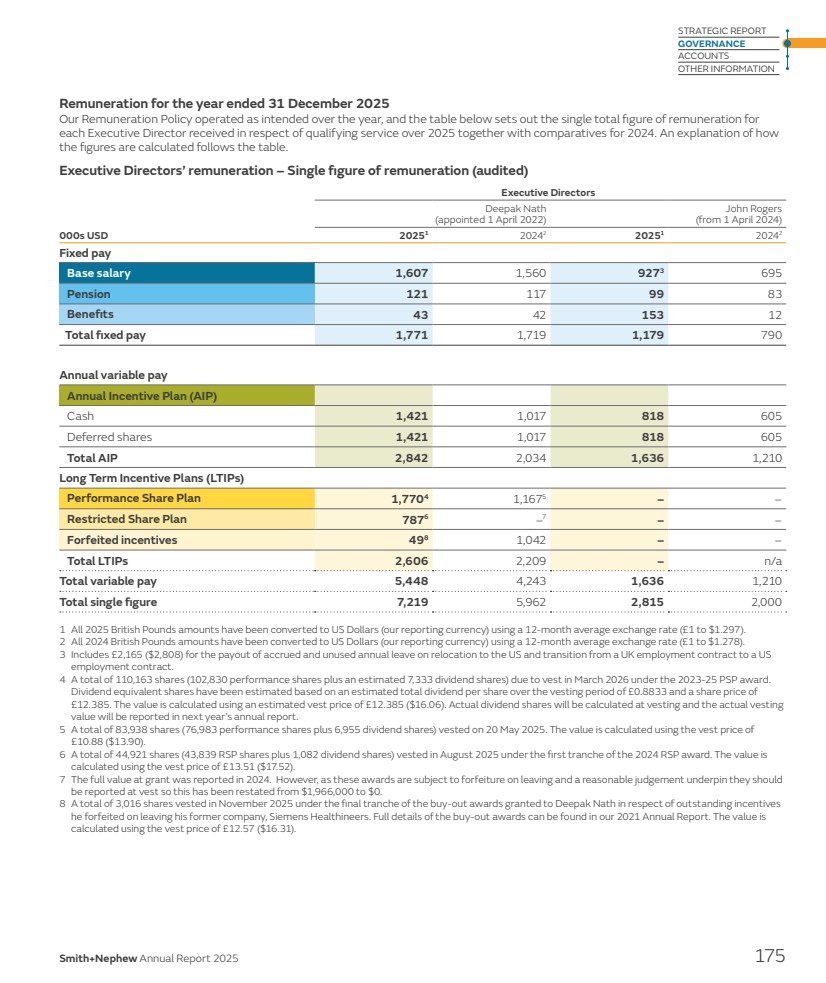
| Base salary Base salaries of Executive Directors are reviewed annually and allow for scope of role and the individual’s experience and time in role, as well as their performance. The increases awarded were in line with the wider workforce within the country in which the Executive Director is based. 000s Annual base salary 1 April 2025 Annual base salary 1 April 2024 % change Executive Directors Deepak Nath $1,620 $1,572 3.0% John Rogers1,2 $973 (£750) $940 (£725) 3.5% 1 John Rogers was based in the UK and paid in British Pounds until 29 September 2025, when he permanently relocated to the US. The figure in parenthesis represents the value in local currency. On permanently relocating to the US, his salary was set at $875,000 (an 10% reduction from his UK salary). 2 All 2025 British Pounds amounts have been converted to US Dollars (our reporting currency) using a 12-month average exchange rate (£1 to $1.297). Pensions Executive Directors either participate in a defined contribution pension plan at a rate equivalent to that of the wider workforce in the country in which they are based, or receive a cash allowance in lieu of membership of a pension plan. Amount ’000s Benefit (% of base salary) Executive Directors Deepak Nath1 $121 7.5% John Rogers UK2,3 $87 (£67) 12% US4 $12 7.5% John Rogers total $99 1 The contribution paid is in line with the contribution paid to the wider workforce in the Executive Director’s home country. 2 Paid for his period of UK employment (1 January 2025 – 28 September 2025). 3 The figure in parenthesis represents the value in local currency. All British Pounds amounts have been converted to US Dollars (our reporting currency) using a 12-month average exchange rate (£1 to $1.297). 4 Paid for his period of US employment (29 September – 31 December 2025). Benefits Executive Directors are provided with benefits that are competitive in their home country. This includes medical, life insurance, transportation benefits, plus tax advice services. Medical Transportation (car and fuel allowance) Tax support services Relocation services 000s 2025 2024 2025 2024 2025 2024 2025 2024 Executive Directors Deepak Nath $13 $13 $13 $13 $17 $16 – – John Rogers UK1 $22 (£17) $1 (£1) $11 (£9) $11 (£9) – – – – US $1 – $3 – – – $116 – John Rogers total $23 $1 $14 $11 – – $116 – 1 John Rogers was based in the UK and paid in British Pounds until 29 September 2025, when he permanently relocated to the US. The figure in parenthesis represents the value in local currency. All British Pounds amounts have been converted to US Dollars (our reporting currency) using a 12-month average exchange rate (£1 to $1.297). 176 Smith+Nephew Annual Report 2025 Directors’ Remuneration Report continued Annual report on remuneration continued 19_SN_AR25_REM_Impl_v160.indd 176 05/03/2026 18:19 |
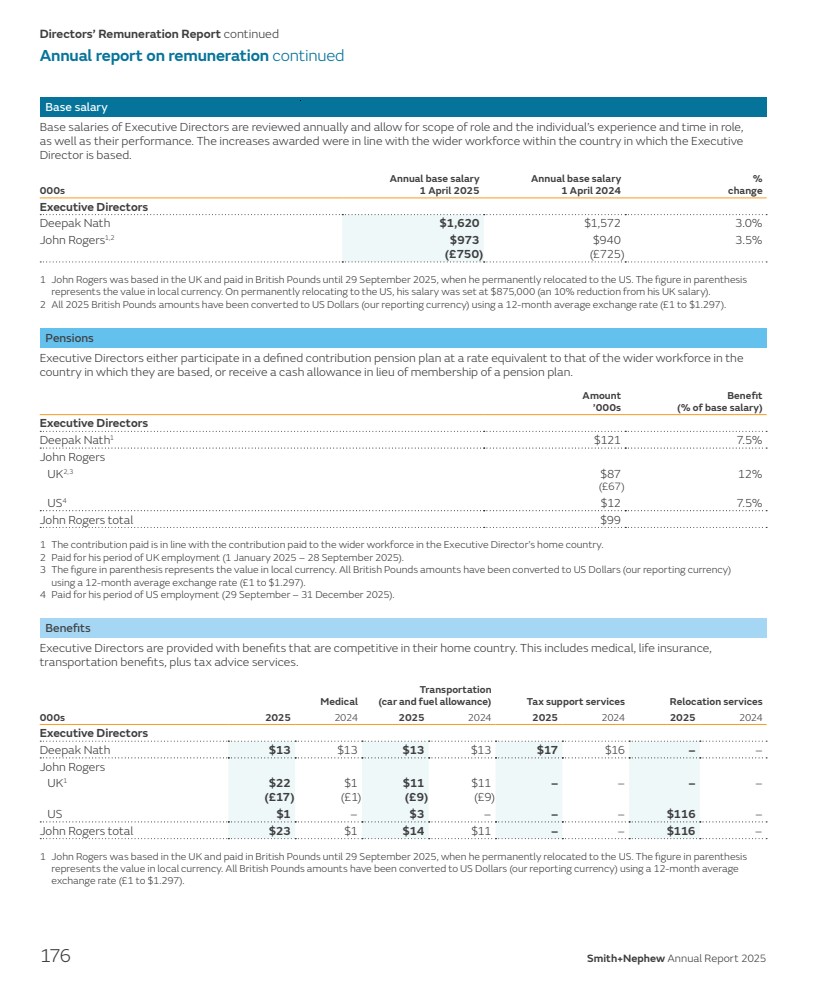
| Annual Incentive Plan (AIP) The 2025 AIP is based on performance for the year ended 31 December 2025. The maximum bonus opportunity for Executive Directors is 215% of Base Salary with 85% of the bonus opportunity tied to financial performance and the remaining 15% tied to strategic objectives (including ESG objectives). To the extent a bonus is payable, one-half is deferred into shares for three years without any matching. If the Executive Director has met the minimum shareholding requirement at the award date, 30% rather than 50% of the bonus is deferred. The figures in the table below represent the total annual bonus amount to be paid, including the amount deferred in shares. The performance measures and weightings that applied to the 2025 Annual Incentive Plan were as follows: 2025 performance range and outcome1 Weighted vested outcome (%) Performance measure Threshold (0%) Target (100%) Maximum (200%) % of target Weighting Deepak Nath John Rogers Financial Revenue $6,019m $6,080m $6,140m Actual $6,117m 161.2% x 35% = 56.4% 56.4% Trading profit margin 18.9% 19.4% 19.9% Actual 19.7% 165.0% x 35% = 57.8% 57.8% Free cash flow $531m $625m $719m Actual $836m 200.0% x 15% = 30.0% 30.0% Strategic objectives (see page 178) Deepak Nath 135.0% x 15% = 20.3% – John Rogers 118.3% x 15% = – 17.7% Total (% of target) 100% 164.4% 161.9% x x Target bonus opportunity (% of base salary) 107.5% 107.5% x x 2025 base salary2 $1,607,836 $940,010³ = = 2025 annual bonus (of which 50% is deferred in shares for three years) $2,842,171 $1,636,370 % of maximum bonus opportunity 82.2% 81.0% % of base salary 176.8% 174.1% 1 For the purpose of incentive calculations, we are using constant currency rates. 2 Base salary for bonus purposes is determined based on the average base salary over the 12-month period ended 31 December 2025. 3 Base salary related to John Rogers UK employment has been converted from British Pounds to US Dollars using a 12-month average exchange rate (£1 to $1.297). Smith+Nephew Annual Report 2025 177 STRATEGIC REPORT GOVERNANCE ACCOUNTS OTHER INFORMATION 19_SN_AR25_REM_Impl_v160.indd 177 05/03/2026 18:19 |
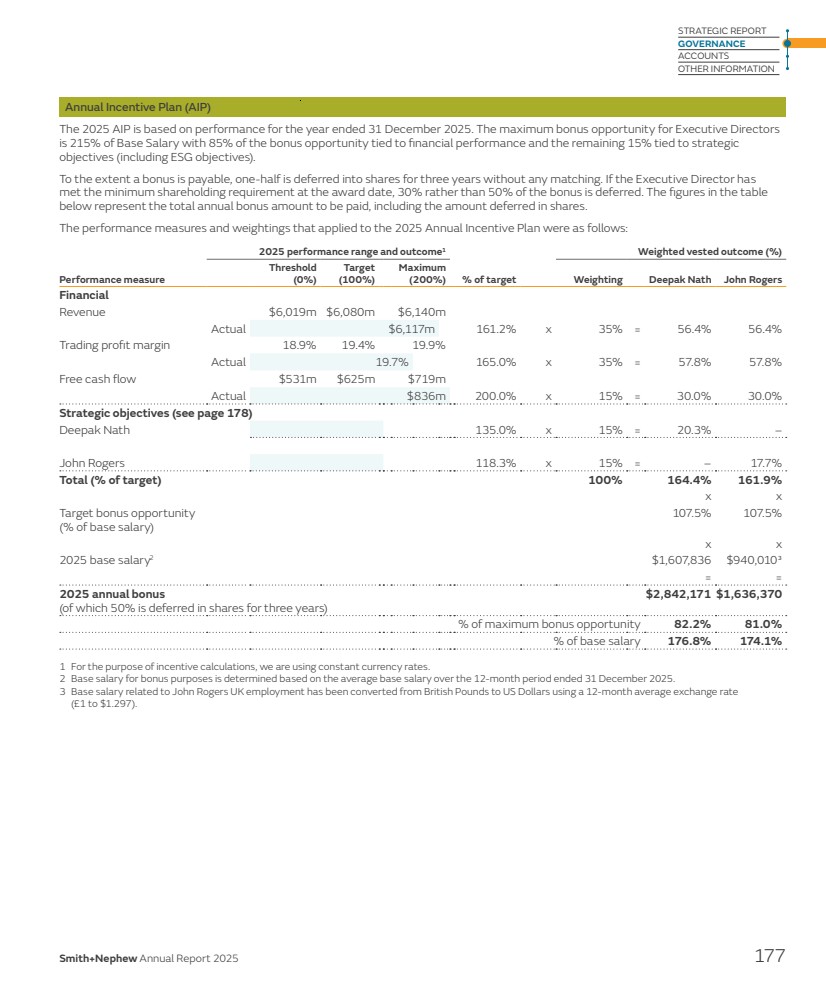
| Annual Incentive Plan (AIP) continued Strategic Objectives Key strategic objectives represent 15% of the annual bonus opportunity. For 2025, these objectives focused on the delivery of the Group’s strategy, our people and processes, customers and advancing our sustainability agenda. Objective Assessment Weighting Outcome (% of target) Deepak Nath – Create and embed a focused and high performing culture – Continue to build a robust talent pipeline for the Executive Committee and High Value roles – Define S+N operating system scope and develop plan for implementation Continued to drive high levels of performance across the Executive Committee and broader organisation with over achievement of all financial targets for 2025. Good progress has been made against our integrated talent strategy, talent risks, and succession strength for our Executive Committee and High Value roles. The S+N operating system, designed to support continuous improvement, was completed with implementation across the organisation on track. 5% 135.0% – Set out enterprise vision and strategy for 2026 to 2030 – Continue to build and strengthen innovation pipelines in line with strategic plans New three-year RISE strategy developed and presented at Capital Markets Day. This strategy sets out a clear, ambitious and achievable strategy for organic and inorganic growth. Thirteen new products developed ready for launch on time and within budget, with good progress made on our new product development and early innovation projects. 5% – Reduction in Scope 1 & Scope 2 greenhouse gas emissions (relative to 2019 baseline) – Employee engagement score A reduction of 71.1% in our Scope 1 and Scope 2 GHG emissions (relative to our 2019 baseline) was achieved which was slightly above our 2025 target (71%). Our employee engagement (as measured by Gallup) increased from 4.24 to 4.33 which puts us in the 68th percentile (increased from 61st percentile in 2024). 5% John Rogers – Build a high-performing team – Drive continued operational efficiency – Improve capital performance, and internal financial systems and processes Implemented new operating models for IT and GBS and strengthened team capabilities to enable functional transformation and operational improvements. Good progress also made on the talent strategy, talent risks, and succession strength within finance, IT and GBS. Delivered cumulative zero-based budget savings of c. $280 million by the end of 2025; $50 million of procurement savings in 2025. Working capital levels improved and inventory levels reduced. Free cash flow significantly ahead of 2025 targets, and improved return on invested capital. Improved forecast accuracy and financial headwind management. 10% 118.3% – Reduction in Scope 1 & Scope 2 greenhouse gas emissions (relative to 2019 baseline) – Employee engagement score A reduction of 71.1% in our Scope 1 and Scope 2 GHG emissions (relative to our 2019 baseline) was achieved which was slightly above our 2025 target (71%). Our employee engagement (as measured by Gallup) increased from 4.24 to 4.33 which puts us in the 68th percentile (increased from 61st percentile in 2024). 5% 178 Smith+Nephew Annual Report 2025 Directors’ Remuneration Report continued Annual report on remuneration continued 19_SN_AR25_REM_Impl_v160.indd 178 05/03/2026 18:19 |

| Decision on 2025 AIP outcomes The Committee strives to maintain a clear link between pay and performance, focusing on setting challenging performance targets and evaluating both company-wide and individual achievements. The performance has been assessed according to the extent to which the Executive Directors have met the expectations of the Board, and how they have performed in respect of our culture pillars of Care, Collaboration and Courage. The Committee believes that the payments outlined in this report fairly reflect the performance achieved, and leadership behaviours exhibited, and as such there was no need to apply discretion. The Committee believes that the Remuneration Policy operated as intended during the year. Performance Share Plan (PSP) US Executive Directors are awarded annual PSP awards equal to 300% of base salary. PSP awards are subject to a three-year performance condition, and vest on a straight-line basis between threshold and maximum. To the extent the performance conditions are met, once sufficient shares have been sold to cover the tax liability, the remaining shares are subject to a two-year holding period. For existing awards granted up to and including 31 December 2025, the following performance measures and weightings apply. 2023-25 PSP award 2024-26 PSP award 2025-27 PSP award Performance measures Performance period 1 Jan 2023 to 31 Dec 2025 1 Jan 2024 to 31 Dec 2026 1 Jan 2025 to 31 Dec 2027 Revenue 25% 30% Free cash flow 25% Return on invested capital 25% 30% 30% Total Shareholder Return 25% 30% 30% CAGR earnings per share 30% ESG objectives 10% 10% The description of the performance conditions and targets for the 2023-2025 PSP (that vests in March 2026) and each outstanding PSP award is shown below. Metric Description Performance conditions 2023-25 PSP award 2024-26 PSP award 2025-27 PSP award Revenue The cumulative global revenue over the three-year performance period on constant foreign exchange rates and adjusted for any Board-approved M&A. Threshold $16,354m - n/a Target $17,776m Commercially Sensitive n/a Maximum $19,198m - n/a Free cash flow The cumulative free cash flow over the three-year performance period on constant foreign exchange rates and adjusted for any Board-approved M&A. Threshold $1,233m n/a n/a Target $1,541m n/a n/a Maximum $1,695m n/a n/a Return on invested capital The return earned on the total capital invested defined as: Operating profit1 less adjusted taxes2 (Opening net operating assets + closing net operating assets)3 ÷ closing net operating assets)3 ÷ 2 1 Operating Profit is as disclosed in the Group income statement in the Annual Report less amortisation of acquired intangible assets. 2 Adjusted taxes represents our taxation charge per the Group income statement adjusted for the impact of tax on items not included in Adjusted Operating Profit, notably amortisation of acquired intangible assets, interest income and expense, other finance costs and share of results of associates. 3 Net Operating Assets comprises net assets from the Group balance sheet (total assets less total liabilities) excluding the following items: accumulated amortisation of acquired intangible assets, investments, investments in associates, retirement benefit assets and liabilities, long-term borrowings, bank overdrafts, borrowings and loans, IFRS 16 lease liabilities and right-of-use assets, cash and cash equivalents. Threshold 8.5% 8.5% 9.0% Target 9.5% 9.5% 10.0% Maximum 10.5% 10.5% 11.0% Smith+Nephew Annual Report 2025 179 STRATEGIC REPORT GOVERNANCE ACCOUNTS OTHER INFORMATION 19_SN_AR25_REM_Impl_v160.indd 179 05/03/2026 18:19 |
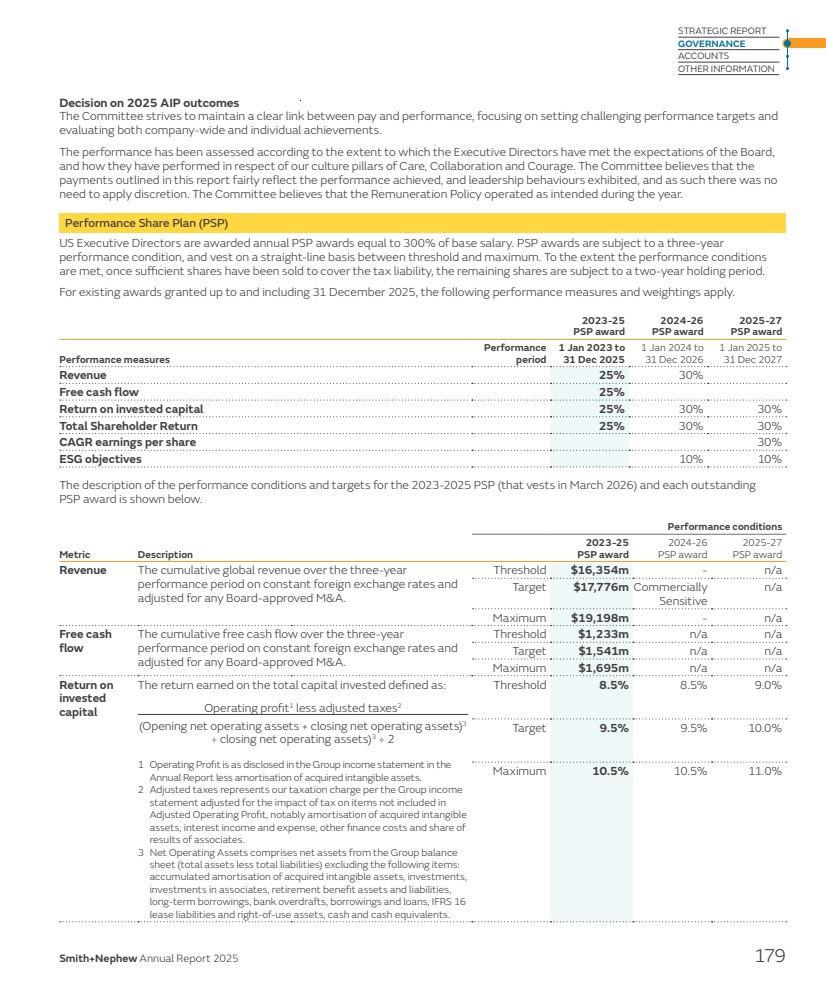
| Metric Description Performance conditions 2023-25 PSP award 2024-26 PSP award 2025-27 PSP award Total Shareholder Return Total Shareholder Return relative to two equally weighted comparator groups. 1 FTSE 100 companies, excluding financial services, commodities (basic materials and oil and gas). From the 2024- 26 PSP, food retail and utility companies were also excluded. 2 A sector peer group based on the S&P Global 1200 Healthcare subset, comprising medical devices, equipment and supplies companies1. From the 2024-26 PSP, the S&P 1200 comparator group was replaced with a specific MedTech industry peer group consisting of the following companies: Threshold Index return Index return Index return Alcon Inc. Bausch + Lomb Corp. Baxter International Inc. Becton Dickinson & Co bioMerieux SA Carl Zeiss Meditec AG Corp. Coloplast A/S ConvaTec Group Plc Demand A/S Dentsply Sirona Inc DiaSorin SpA Edwards Lifesciences Corp Elekta AB Enovis Corp. Envista Holdings Corp. GE HealthCare Tech Inc. Globus Medical Inc. Hologic Inc. Insulet Corp. Integer Holdings Corp. Integra Lifesciences Hold. Intuitive Surgical Inc. Koninklijke Philips NV Resmed Inc. Sonova Holding AG Steris Plc Straumann Holding AG Stryker Corp. The Cooper Companies Inc. Zimmer Biomet Holdings Inc. Maximum Index return +8% Index return +8% Index return +8% CAGR earnings per share The compound annual growth rate in adjusted earnings per share over the three-year performance period on constant foreign exchange rates and adjusted for any Board-approved M&A. Threshold n/a n/a 8.0% Target n/a n/a 10.5% Maximum n/a n/a 13.0% ESG objectives Consists of two equally weighted measures linked to our sustainability agenda in relation to our transition to net zero, and an increase in female people leader representation for the 2024-26 award and a single measure in relation to our transition to net zero for the 2025-27 award. Reduction in Scope 1 and Scope 2 GHG emissions (relative to a 2019 baseline) Threshold n/a 70% 72% Target n/a 72% 74% Maximum n/a 75% 76% Female people leader representation Threshold n/a 35% n/a Target n/a 35.5% n/a Maximum n/a 36% n/a 1 Official industry classification of ‘Health Care Equipment and Supplies, Life Sciences Tools & Services and Health Care Technology’. 180 Smith+Nephew Annual Report 2025 Directors’ Remuneration Report continued Annual report on remuneration continued Performance Share Plan (PSP) continued 19_SN_AR25_REM_Impl_v160.indd 180 05/03/2026 18:19 |
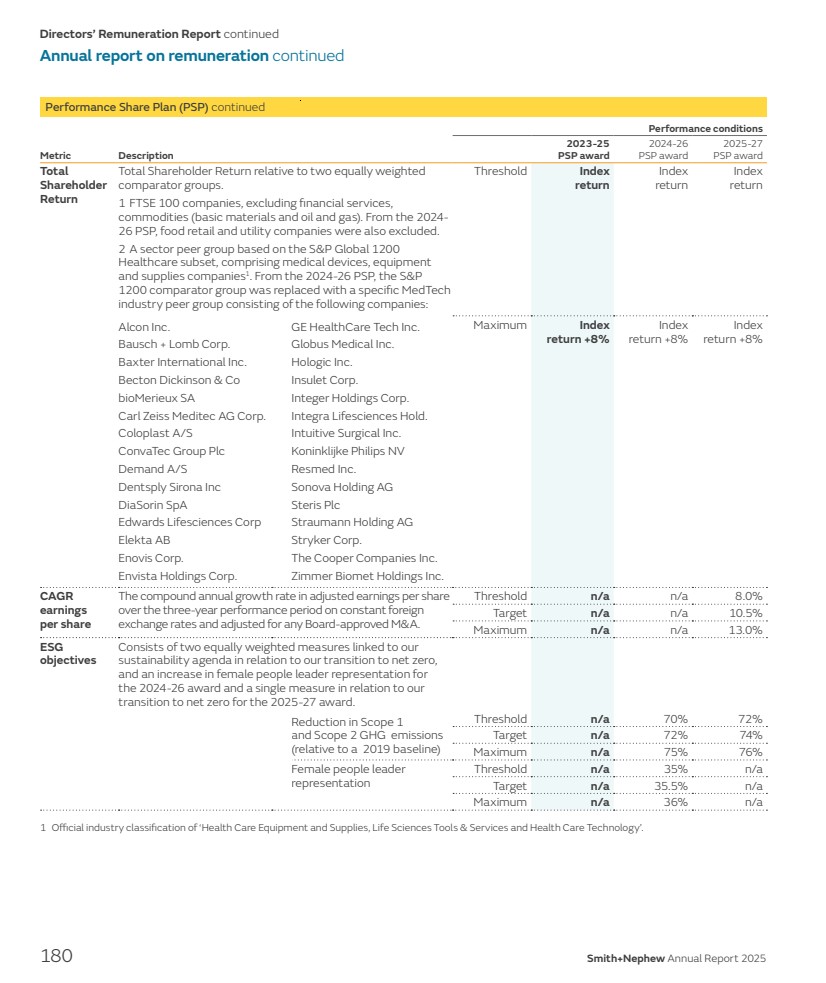
| 2023-25 PSP Award The three year performance period of the 2023-2025 PSP award ended on 31 December 2025. The performance measures, targets, weightings and achievement against the performance conditions are shown below. Performance range against targets1 Weighted vested Performance measure outcome (%) Threshold (25% vesting) Target (50% vesting) Maximum (100% vesting) % of target vesting Weighting Cumulative revenue Target $16,354m $17,776m $19,198m Actual $17,625m 94.7% x 25% = 23.7% Cumulative free cash flow Target $1,233m $1,541m $1,695m Actual $1,511m 95.1% x 25% = 23.8% Return on invested capital Target 8.5% 9.5% 10.5% Actual 7.2% 0% x 25% = 0.0% Total Shareholder Return Index Return Index Return +8% FTSE 100 comparator group2 Target 28.1% 61.4% Actual 21.9% 0% x 12.5% = 0.0% S&P 1200 comparator group3 Target -5.8% 18.7% Actual 21.9% 200% x 12.5% = 25.0% Total (% of target vesting) 72.5% Total (% of maximum vesting) 36.2% 1 All numbers have been rounded to the nearest decimal. For the purpose of incentive calculations, we are using constant currency rates. 2 FTSE 100 companies, excluding financial services, commodities (basic materials and oil and gas). 3 S&P Global 1200 Healthcare subset, comprising medical devices, equipment and supplies companies (official industry classifications of ‘Health Care Equipment and Supplies, Life Sciences Tools & Services and Health Care Technology’). Decision on 2023-2025 PSP award outcome Smith & Nephew delivered strong financial results in terms of revenue and free cash flow over the three-year period ended 31 December 2025. The 2025 growth in revenue of 6.1% on a reported basis (5.3% on an underlying basis) contributed towards delivering strong cumulative revenue growth over the three-year performance period of the 2023-2025 PSP award. In addition, over the three-year period, the adjusted return on invested capital increased by 170 basis point and free cash flow increased from $56 million to $840 million, both reflecting the progress made under the 12-Point Plan. As well as considering the monetary outcome of the formulaic calculation of these awards, the Committee considered whether discretion should be applied to override these formulaic outcomes and concluded that the monetary outcomes were aligned with the financial performance of the Company during the performance period and the intention of the Remuneration Policy. As a result, the Committee believes that the level of vesting for the 2023-2025 PSP award at 36.2% of maximum (72.5% of target) is appropriate. 2023-25 PSP awards Shares awarded Shares vesting Shares forfeit Dividend shares1 Total shares vesting Value of vesting shares at award price2 ($000s) Share price appreciation3 ($000s) Total value vesting ($000s) (1) (2)=(1)x72.48% (3)=(1)-(2) (4) (5)=(2)+(4) (6) (7) (8)=(6)+(7) Executive Directors Deepak Nath 141,874 102,830 39,044 7,333 110,163 1,728 42 1,770 John Rogers4 – – – – – – – – Former Executive Directors Anne-Françoise Nesmes 70,053 50,774 19,279 3,621 54,395 853 21 874 1 As the 2023-25 PSP award vests in March 2026, we have estimated the final dividend equivalent shares based on an estimated total dividend per share over the vesting period of £0.8833 and a share price of £12.385. 2 The 2023-25 PSP award share price was £12.09 ($15.68, using an exchange rate of £1 to $1.297). 3 This represents the estimated impact of the share price change between the award date and the vesting date. The vest price for the 2023-25 PSP award has been estimated using the closing share price on 31 December 2025 of £12.39 ($16.06). No discretion has been applied to the award outcome as a result of the share price movement since award. 4 John Rogers joined in December 2023 and was appointed as CFO and an Executive Director on 1 April 2024 so does not have a 2023-25 PSP award. Smith+Nephew Annual Report 2025 181 STRATEGIC REPORT GOVERNANCE ACCOUNTS OTHER INFORMATION 19_SN_AR25_REM_Impl_v160.indd 181 05/03/2026 18:19 |

| Restricted Share Plan (RSP) The first tranche of the 2024 RSP award made to Deepak Nath vested on 16 August 2025. This award was subject to a reasonable judgement underpin. In assessing this underpin, the Committee considered Smith+Nephew’s overall financial performance, any material ESG, safety or compliance issues and whether there has been any material damage to Smith+Nephew’s reputation. The Committee determined that the underpin had been met and the award vested without alteration. Details of the vest are below. Shares awarded Dividend shares Total shares vesting Value of vesting shares at award price ($000’s) Share price appreciation ($000’s) Total value vesting ($000’s) Executive Directors Deepak Nath 43,839 1,082¹ 44,921 645 142 787 John Rogers –––––– ¹ Due to an administrative error, dividend equivalent shares were not added to the vested award. We have reported them as they should have been received in 2025. The dividend shares will be released to Deepak Nath with the second tranche vesting of the 2024 award in August 2026. Details of share awards granted to Executive Directors during 2025 Performance Share Plan¹ Restricted Share Plan Deferred Bonus Plan Shares awarded Value at award price ’000s Shares awarded Value at award price ’000s Shares awarded Value at award price ’000s Executive Directors Deepak Nath 318,730 $4,7852 264,321 $3,9682 68,730 $1,0322 John Rogers3 172,246 $2,5862 41,360 $7233 40,900 $6142 1 Awards are granted at maximum. Threshold performance will result in 25% of the award vesting, target performance will result in 50% of the award vesting and maximum performance will result in 100% of the award vesting. 2 The 2025-27 PSP award, the 2025 RSP award for Deepak Nath and the 2025 DBP award share price was £11.575 ($15.013) and was based on the average share price over the 10 working days following the 2024 results announcement. 3 The 2025 RSP award for John Rogers award share price was £13.48 ($17.48) and was based on the average share price over the 10 working days following the half-year results announcement. This RSP was granted upon relocation and employment in the US and explained further in the RNS published on 30 September 2025. 182 Smith+Nephew Annual Report 2025 Directors’ Remuneration Report continued Annual report on remuneration continued 19_SN_AR25_REM_Impl_v160.indd 182 05/03/2026 18:19 |
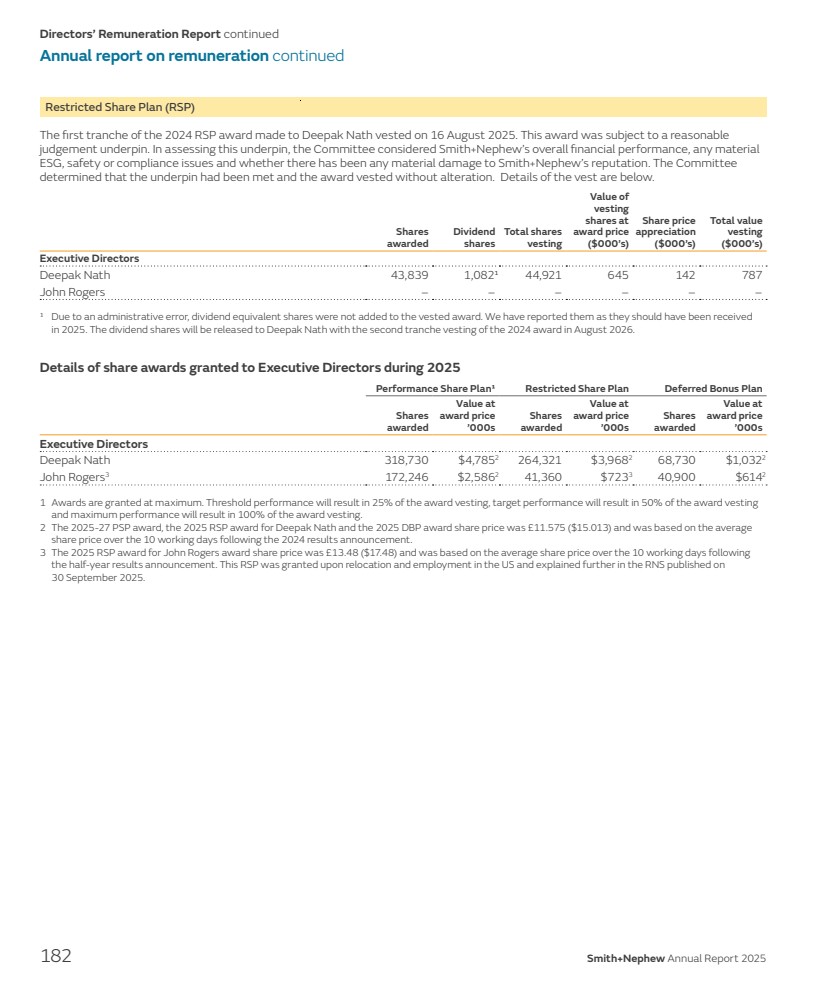
| Details of outstanding share awards granted to Executive Directors The conditional share awards granted to Executive Directors that continue to be subject to performance or vesting conditions are shown below. Award type Date of award Number of shares Date of vesting Executive Directors Deepak Nath PSP 26 March 2025 318,730³ 26 March 2028 16 August 2024 27,520³ 8 March 2027 8 March 2024 151,365⁴ 8 March 2027 9 March 2023 141,874⁴ 9 March 2026 Total 639,489 RSP1 26 March 2025 44,268 26 March 2026 26 March 2025 44,268 26 March 2027 26 March 2025 44,268 26 March 2028 16 August 2024 43,839 16 August 2026 16 August 2024 43,839 16 August 2027 Total 220,482 DBP 26 March 2025 68,730 26 March 2028 8 March 2024 72,005 8 March 2027 9 March 2023 26,014 9 March 2026 Total 166,749 John Rogers PSP 26 March 2025 172,246³ 26 March 2028 8 March 2024 91,666⁴ 8 March 2027 Total 263,912 RSP 29 September 2025 13,786 26 March 2026 29 September 2025 13,786 26 March 2027 29 September 2025 13,788 26 March 2028 Total 41,360 DBP 26 March 2025 40,900 26 March 2028 Former Executive Directors Anne-Françoise Nesmes2 PSP 9 March 2023 70,053⁴ 9 March 2026 DBP 8 March 2024 37,368 8 March 2027 9 March 2023 16,877 9 March 2026 Total 54,245 1 Following a majority shareholder vote in favour of changes to our Remuneration Policy at our AGM in May 2024, US Executive Directors are eligible to receive an annual RSP award equal to 125% of base salary that will vest, subject to a reasonable judgement underpin, on the first, second and third anniversaries of the award. This rateable vesting schedule is in line with US market practice for RSP awards. 2 Anne-Françoise Nesmes was CFO and an Executive Director up until 31 March 2024, when she stepped down from the Board and left the Company on 1 May 2024. Upon leaving, her outstanding PSP awards were prorated to reflect her service over the performance period. As a result, the number of outstanding shares shown takes this prorating into account. 3 Granted at maximum. 4 Granted at target. Restated from 2024, where it was disclosed at maximum. Smith+Nephew Annual Report 2025 183 STRATEGIC REPORT GOVERNANCE ACCOUNTS OTHER INFORMATION 19_SN_AR25_REM_Impl_v160.indd 183 05/03/2026 18:19 |
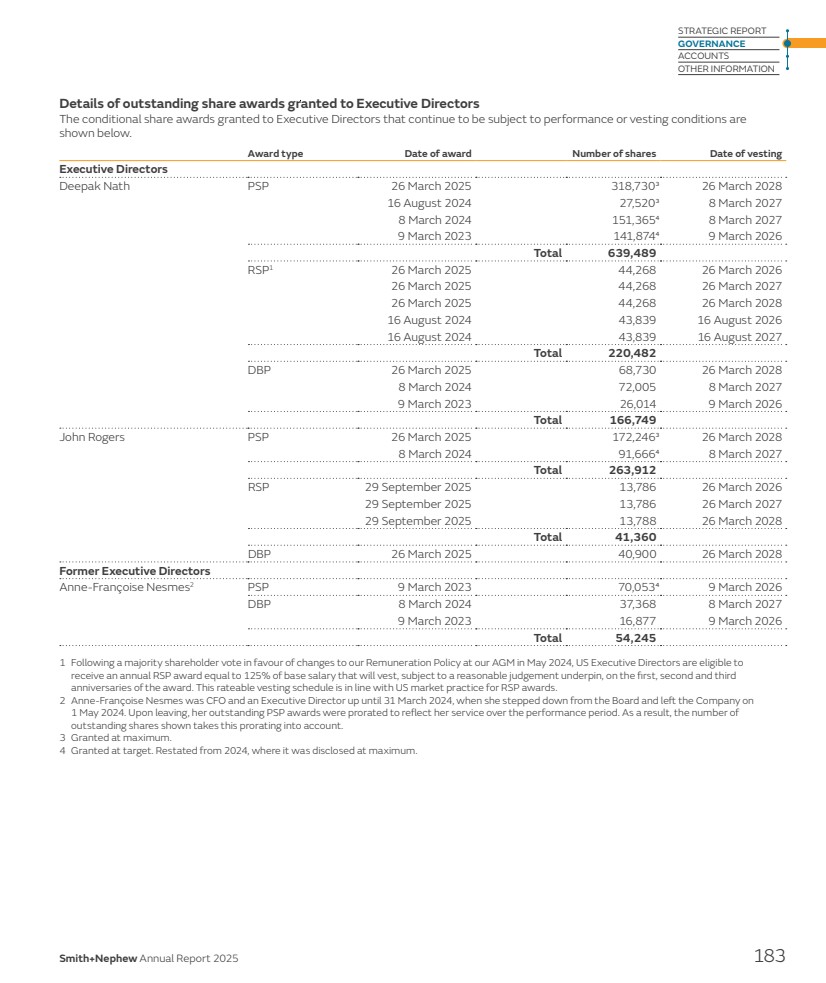
| Executive Directors’ interests in ordinary shares The table below shows the Executive Directors’ interests in the shares of the Company, together with unvested scheme interests, effective 31 December 2025. Ordinary shares1 Share awards with performance conditions Share awards without performance conditions Performance Share Plan awards2 Deferred Bonus Plan awards Restricted Share Plan awards³ Executive Directors Deepak Nath 300,818 639,489 166,749 220,482 John Rogers 71,920 263,912 40,900 41,360 Former Executive Directors Anne-Françoise Nesmes 43,978 70,053 54,245 - 1 Ordinary shares for Deepak Nath include 2,923 American Depository Shares (equivalent to 5,846 ordinary shares). 2 The PSP awards are subject to further performance conditions before they vest. 3 The RSP awards are subject to a reasonable judgement underpin before they vest. The interests of each Executive Director shown in the table include any shares held by any connected person. The beneficial interest of each Executive Director is less than 1% of the ordinary share capital of the Company. Directors’ interests as at 27 February 2026 were unchanged from those listed above other than another 410 American Depository Shares (equivalent to 820 ordinary shares) were purchased for Deepak Nath under the US section 423 plan. Shareholding requirement Executive Directors are required to establish and maintain a minimum shareholding over a reasonable period of time (expected to be around five years) recognising that incentive plan vesting and differing international tax regimes may affect the pace at which the shareholding may be met. The adoption of the changes to our Remuneration Policy at our AGM in May 2024 resulted in the minimum shareholding requirement for a US-based CEO increasing from 300% to 500% of base salary. The minimum shareholding requirement for the CFO is equal to at least 200% of base salary. Where an Executive Director leaves employment for any reason, a post-cessation shareholding requirement will apply. The post-cessation minimum shareholding requirement is equal to the requirement during employment and will apply for a period of two years after cessation of employment. Minimum Shareholding requirement (% of base salary) Actual shareholding (% of base salary) Executive Directors Deepak Nath1 500% 392% John Rogers2 200% 176% Former Executive Directors Anne-Françoise Nesmes3 200% 138% 1 Deepak Nath joined on 1 April 2022 and is gradually building his shareholding. 2 John Rogers joined on 1 December 2023 and is gradually building his shareholding. He purchased 71,920 shares on 19 December 2024. 3 Anne-Françoise Nesmes left the Company on 1 May 2024 and had not achieved her minimum shareholding requirement of 200% of base salary at that time. The minimum shareholding requirement above represents Anne-Françoise’s actual holding upon leaving and so reflects her post-cessation shareholding requirement. Fees retained for external Non-Executive Directorships Executive Directors may hold an external Non-Executive Director appointment and retain the fees paid for such a role. Deepak Nath served as a Director of MDIC and AdvaMed. John Rogers served as a Non-Executive Director of Grab Holdings Ltd (Singapore). Payments to former Directors (audited) There were no payments made to, or in respect of, any former Director that have not previously been disclosed in an annual report. Payments for loss of office (audited) There were no payments made to, or in respect of, any former Director for loss of office in 2025. 184 Smith+Nephew Annual Report 2025 Directors’ Remuneration Report continued Annual report on remuneration continued 19_SN_AR25_REM_Impl_v160.indd 184 05/03/2026 18:19 |
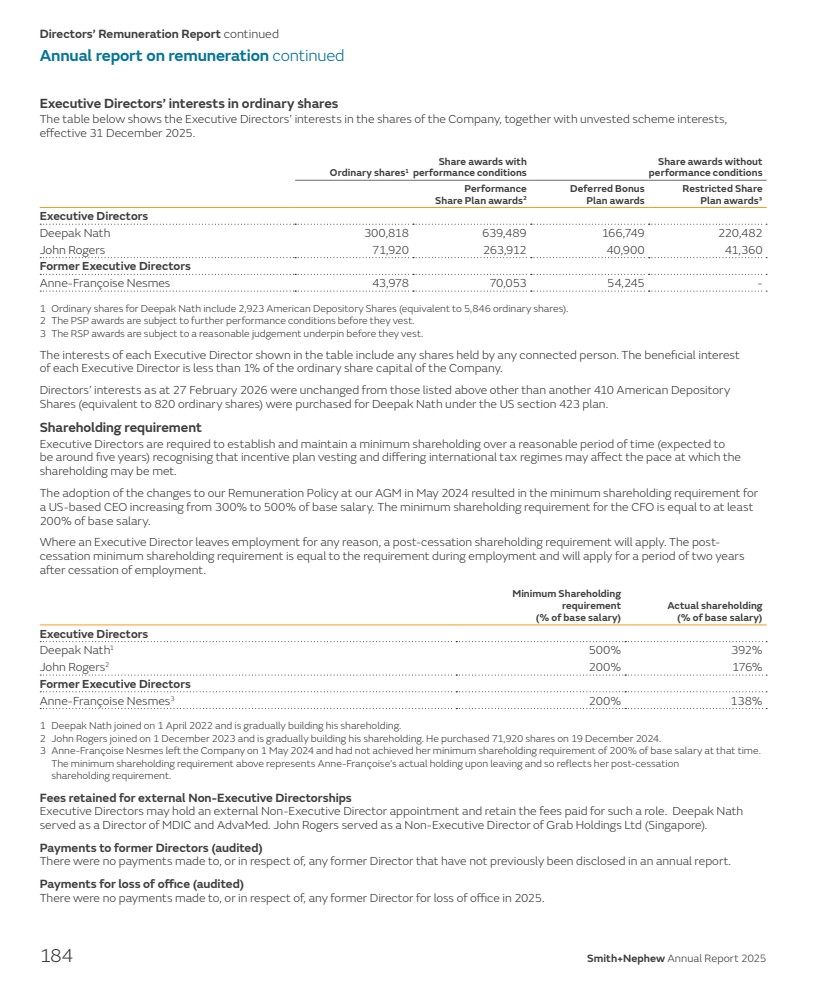
| Chair and Non-Executive Directors – Single figure of remuneration (audited) 000s Committee Membership Non-Executive Director Fees Intercontinental Travel Total 2025 2024 2025 2024 2025 2024 Chair Rupert Soames N R $599 (£462) $575 (£450) $5 (£4) $4 (£3) $604 (£466) $579 (£453) Non-Executive Directors Angie Risley N R $138 (£107) $125 (£98) $5 (£4) $4 (£3) $143 (£111) $129 (£101) Thérèse Esperdy1 N R $10 – $7 – $17 – Jo Hallas A C $97 (£75) $92 (£72) $5 (£4) $4 (£3) $102 (£79) $96 (£75) David King2 C R $77 – $21 – $98 – Garheng Kong3 A $42 – $7 – $49 – Simon Lowth A N $97 (£75) $92 (£72) $5 (£4) – $102 (£79) $92 (£72) John Ma C $139 $134 $42 $42 $181 $176 Jez Maiden A R $125 (£96) $112 (£88) $5 (£4) $4 (£3) $130 (£100) $116 (£91) Katarzyna Mazer-Hofsaess C $97 (£75) $92 (£72) $5 (£4) $4 (£3) $102 (£79) $96 (£75) Marc Owen A C N R $176 $170 $35 $28 $211 $198 Sybella Stanley4 R $104 (£80) – $5 (£4) – $109 (£84) – Former Non-Executive Directors Bob White5 C R $42 $134 $14 $35 $56 $169 1 Thérèse Esperdy was appointed to the Board on 1 December 2025. 2 David King was appointed to the Board on 1 July 2025. 3 Garheng Kong was appointed to the Board on 1 September 2025. 4 Sybella Stanley was appointed to the Board on 1 February 2025. 5 Bob White stepped down from the Board on 30 April 2025. Committee key A R N C Member of the Audit Committee Member of the Remuneration Committee Member of the Nomination & Governance Committee Member of the Compliance & Culture Committee Committee Chair Chair Fees During December 2024, the Chair’s fee was reviewed by the Committee and the decision taken to apply an increase of 3.5% from 1 April 2025. This increase did not exceed the average increase applied to the broader UK workforce. While the Chair is a member of the Remuneration Committee, he did not attend the meeting while his fee was being reviewed and discussed by the Committee. The Chair is required each year to purchase shares worth at least 25% of his post-tax annual fee. Smith+Nephew Annual Report 2025 185 STRATEGIC REPORT GOVERNANCE ACCOUNTS OTHER INFORMATION 19_SN_AR25_REM_Impl_v160.indd 185 05/03/2026 18:19 |

| Non-Executive Director fees The fee for Non-Executive Directors is periodically reviewed by the Chair of the Board and the Executive Directors. Following a review in December 2024, it was decided to increase the base fee by 3.0% for Non-Executive Directors based in the US and by 3.5% for those based in the UK. These increases did not exceed the average increase applicable to the broader workforce in these countries. A proportion of the fee payable to Non-Executive Directors was paid in shares. UK1 US 2025 2024 2025 2024 Base fee Cash $84,944 (£65,493) $83,700 (£65,493) $124,827 $124,827 Shares $12,044 (£9,285) $8,635 (£6,757) $14,223 $10,173 Total $96,988 (£74,778) $92,336 (£72,250) $139,050 $135,000 Senior Independent Director supplement $27,886 (£21,500) $26,582 (£20,800) $37,500 $36,400 Committee Chair supplement $27,886 (£21,500) $26,582 (£20,800) $37,500 $36,400 Intercontinental travel2 $4,540 (£3,500) $4,473 (£3,500) $7,000 $7,000 1 Non-Executive Directors based in the UK are paid in British Pounds. For the purposes of comparison, the fees have been converted into our reporting currency (US Dollars) at an exchange rate of £1 to $1.297. 2 A fixed fee is only payable when a Non-Executive Director is required to travel to attend meetings in another continent. Non-Executive Director interests in ordinary shares The interests of the Chair of the Board and Non-Executive Directors, who served during the year, in terms of shares of the Company held as at 31 December 2025 or at date of separation as applicable, are as follows: Number of shares Chair Rupert Soames 19,754 Non-Executive Directors Angie Risley 6,301 Thérèse Esperdy1 210 Jo Hallas 6,579 David King2 5,600 Garheng Kong3 6,000 Simon Lowth 655 John Ma 2,744 Jez Maiden 3,501 Katarzyna Mazer-Hofsaess 2,371 Marc Owen 17,610 Sybella Stanley4 5,330 Bob White5 8,376 1 Thérèse Esperdy was appointed to the Board on 1 December 2025. 2 David King was appointed to the Board on 1 July 2025. 3 Garheng Kong was appointed to the Board on 1 September 2025. 4 Sybella Stanley was appointed to the Board on 1 February 2025. 5 Bob White stepped down from the Board on 30 April 2025. The interests of the Chair of the Board and Non-Executive Directors shown in the table include any shares held by any connected person. The beneficial interest of the Chair of the Board and each Non-Executive Director is less than 1% of the ordinary share capital of the Company. There have been no other changes in the interests of the Chair or Non-Executive Directors in the shares of the Company between 31 December 2025 and 27 February 2026 (the latest practicable date for inclusion in this report). 186 Smith+Nephew Annual Report 2025 Directors’ Remuneration Report continued Annual report on remuneration continued 19_SN_AR25_REM_Impl_v160.indd 186 05/03/2026 18:19 |
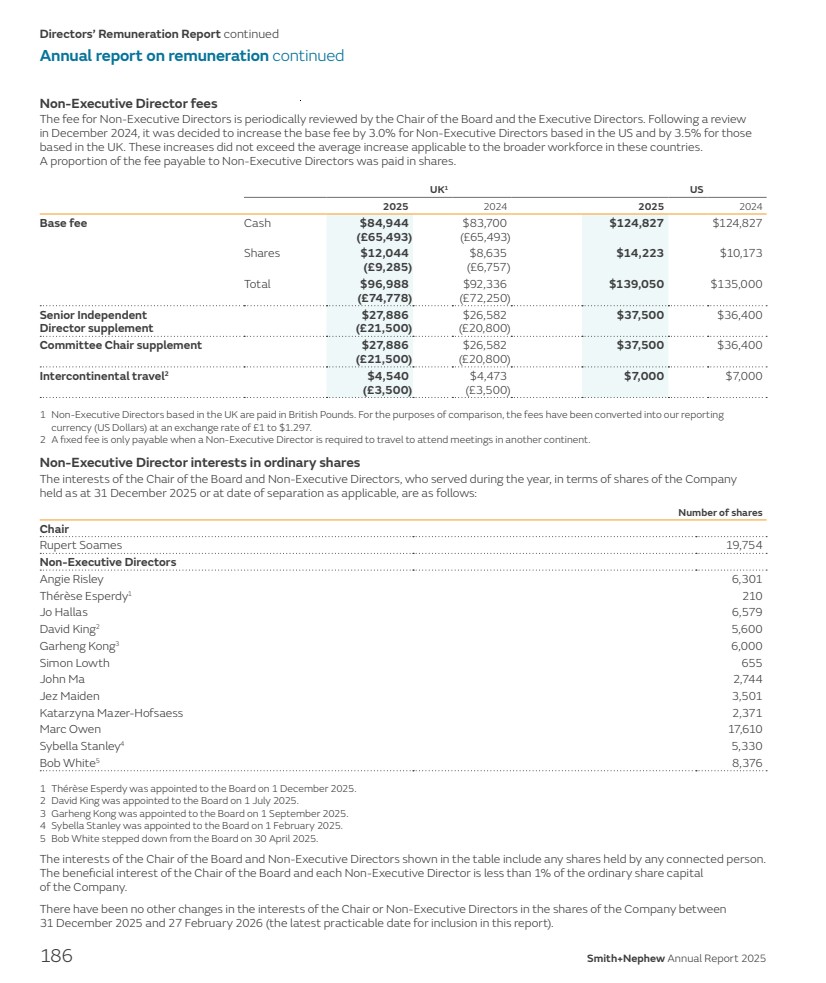
| Pay comparisons Annual percentage change in Directors’ remuneration The table below shows how the actual remuneration received by Executive Directors, the Chair of the Board and Non-Executives has changed over the year ended 31 December 2025 and prior years compared to the average salary of other employees. The average salary in 2025 of UK employees increased by 3.5%, and that of US employees increased by 3.0%. % change 2025-2024 % change 2024-2023 % change 2023-2022 % change 2022-2021 % change 2021-2020 Salary /Fees Benefits Annual Bonus Salary /Fees Benefits Annual Bonus Salary /Fees Benefits Annual Bonus Salary /Fees Benefits Annual Bonus Salary /Fees Benefits Annual Bonus Executive Directors Deepak Nath 3 3 39.7 3.1 144 1.9 39.6 55.8 168.5 – –55.5 44.9 – –– John Rogers1 32.9 160.6 35.2 100 100 100 – ––– ––– –– Chair Rupert Soames2 2.6 – – 219.7 – – 100 ––– ––– –– Current Non-Executive Directors Angie Risley 9.5 – – 8.5 ––– –– 3.9 ––– –– Thérèse Esperdy3 – –– – ––– ––– ––– –– Jo Hallas⁴ 4.4 – – 2.9 – – 7.8 – – 272.8 ––– –– David King5 – –– – ––– ––– ––– –– Garheng Kong6 – –– – ––– ––– ––– –– Simon Lowth4,7 4.4 – – ––– ––– ––– –– John Ma⁴ 3.9 – – 2.3 – – 13.9 – – 32.9 ––– –– Jez Maiden4,8 10.5 – – 339.5 ––– ––– ––– –– Katarzyna Mazer-Hofsaess⁴ 4.4 – – 2.9 ––– –– 5.0 – – 561.9 – – Marc Owen⁴ 3.8 – – -4.3 – – 11.3 – – 8.2 ––– –– Sybella Stanley9 – –– – ––– ––– ––– –– Former Executive Directors Anne-Françoise Nesmes10 – –– -74.8 -74.7 -100 4.2 3.6 129.6 4.62 3.97 –29.5 – –– Former Chair Roberto Quarta – –– – –– -22.5 – – 0.8 – – 0.4 – – Former Non-Executive Directors Erik Engstrom11 – –– – ––– ––– ––– –– Rick Medlock12 – –– -72 ––– –– 3.9 – – 51.6 – – Bob White13 -68.7 2.4 – – 20.5 – – 5.4 – – 44.6 – – 1 John Rogers was appointed Executive Director on 1 April 2024. The increase reflects the impact of comparing 9 months of salary from 2024 with 12 months in 2025, in addition to the annual salary increase of 3.5%. 2 Rupert Soames joined the Board on 26 April 2023 and was paid part year. 3 Thérèse Esperdy was appointed to the Board on 1 December 2025. 4 The increase shown is greater than the reported fee increase due to the timing of the award of shares related to the fee increase. 5 David King was appointed to the Board on 1 July 2025. 6 Garheng Kong was appointed to the Board on 1 September 2025. 7 Simon Lowth was appointed on 1 January 2024. 8 Jez Maiden was appointed on 14 September 2023. 9 Sybella Stanley was appointed to the Board on 1 February 2025. 10 Anne-Françoise Nesmes stepped down from the Board on 31 March 2024. 11 Erik Engstrom stepped down from the Board on 31 December 2023. 12 Rick Medlock stepped down from the Board on 30 April 2024. 13Bob White stepped down from the Board on 30 April 2025. Smith+Nephew Annual Report 2025 187 STRATEGIC REPORT GOVERNANCE ACCOUNTS OTHER INFORMATION 19_SN_AR25_REM_Impl_v160.indd 187 05/03/2026 18:19 |
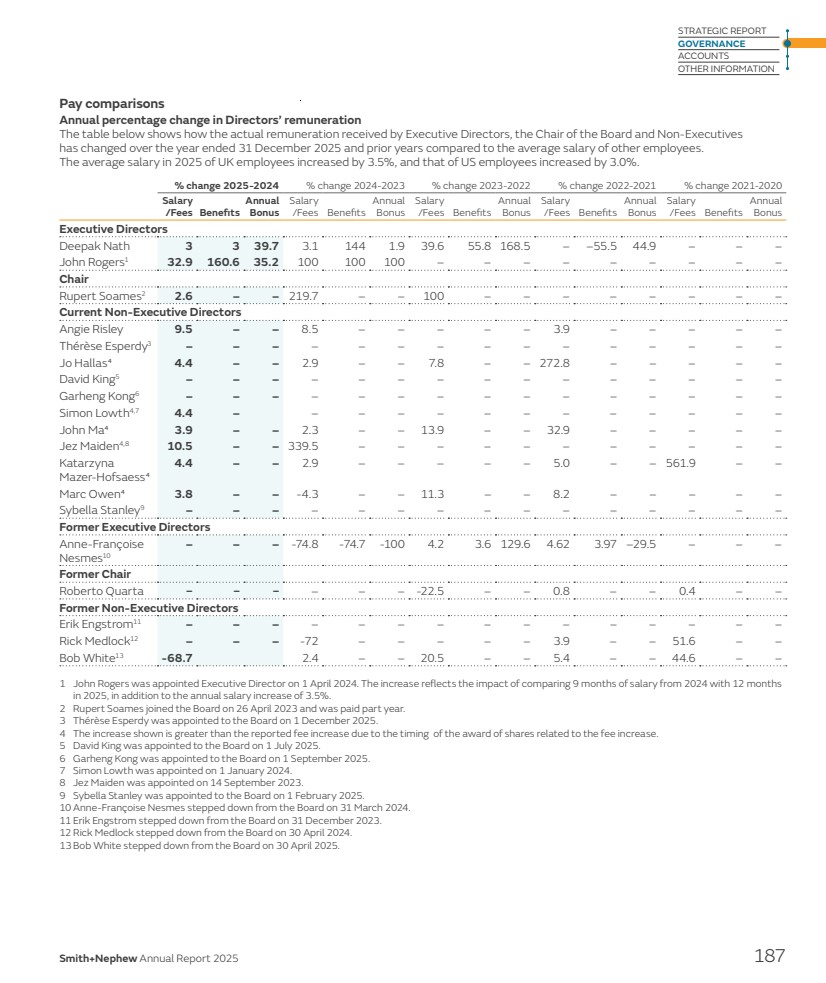
| Chief Executive Officer pay ratio The Committee is mindful of the relationship between the remuneration of the Chief Executive Officer and that of other employees more generally. The table below compares the single total figure of remuneration for the Chief Executive Officer to the total pay and benefits of full-time equivalent UK employees, who are ranked at the lower quartile, median and upper quartile across all UK employees. The reporting regulations permit three different calculation methodologies for determining the pay ratio. The ratios shown in the table below have been calculated using Option A, which calculates pay for employees on the same basis as the single figure for remuneration calculated for Executive Directors. The period for which actual employee pay has been calculated is from 1 January 2025 to 31 December 2025. The single figure for remuneration for each full-time employee as at 31 December 2025 includes earned salary, annual incentive bonus payments, allowances, pension and benefits. Part-time employees have been excluded for the purpose of the calculations. 2025 20241,2 20231 2022 2021 2020 2019 Upper quartile (75th percentile) 58:1 56:1 46:1 70:1 32:1 19:1 51:1 Median (50th percentile) 87:1 84:1 72:1 107:1 49:1 29:1 81:1 Lower quartile (25th percentile) 127:1 119:1 102:1 160:1 71:1 42:1 116:1 1 In 2024 and 2023, the ratio was impacted by the vesting of the performance award under the 2022 buy-out award agreement made to Deepak Nath. Excluding this one-off arrangement, the median ratio would have been 69:1 for 2024 and 55:1 for 2023. 2 The ratios have been updated to reflect the re-statement of 2024 RSP awards from $1,966,000 to $0 in the single figure table. The total remuneration of our Chief Executive includes a substantial proportion of variable pay, and therefore, the single total figure will vary considerably, depending on the level of performance against the measures driving the Annual Incentive Plan, Performance Share Plan and Restricted Share Plan. In contrast, employees in the calculation receive a higher proportion of their remuneration in the form of fixed pay. The ratios are consistent with our market-based approach to reward, with the ratio increasing as the Chief Executive’s remuneration is compared with that of more junior employees. The overall picture presented by the ratios is also consistent with our policies on pay, reward and career progression. The table below provides information on the salary and total pay and benefits paid to employees ranked at the lower quartile, median and upper quartile. 2025 2024 Salary total pay and benefits Salary total pay and benefits Chief Executive Officer $1,606,896 $7,218,445 $1,560,093 $5,962,0001 Upper quartile2 (75th percentile) $95,835 (£73,890) $124,969 (£96,352) $70,371 (£55,064) $107,146 (£83,839) Median2 (50th percentile) $66,941 (£51,612) $82,841 (£63,872) $66,258 (£51,845) $71,001 (£55,556) Lower quartile2 (25th percentile) $48,737 (£37,577) $56,677 (£43,698) $50,382 (£39,422) $50,123 (£39,220) 1 The 2024 single total figure for Deepak Nath has been updated to reflect the re-statement of 2024 RSP awards from $1,966,000 to $0 in the single figure table. 2 For the purposes of comparison the pay and benefits of UK employees have been converted into our reporting currency (US Dollars) at an exchange rate of £1 to $1.297. Gender pay ratio The 2025 median gender pay gap for our UK organisation is 11.6% and our mean gender pay gap is 14.0%. This places Smith+Nephew slightly below the ONS median gender pay gap of 12.8% for 2025. We continue our efforts to review and close the gaps through consistent and unbiased global pay and incentive plans. Our internal pay practices and incentive plan designs are gender neutral and our performance management reviews are undertaken based on objective criteria. 188 Smith+Nephew Annual Report 2025 Directors’ Remuneration Report continued Annual report on remuneration continued 19_SN_AR25_REM_Impl_v160.indd 188 05/03/2026 18:19 |
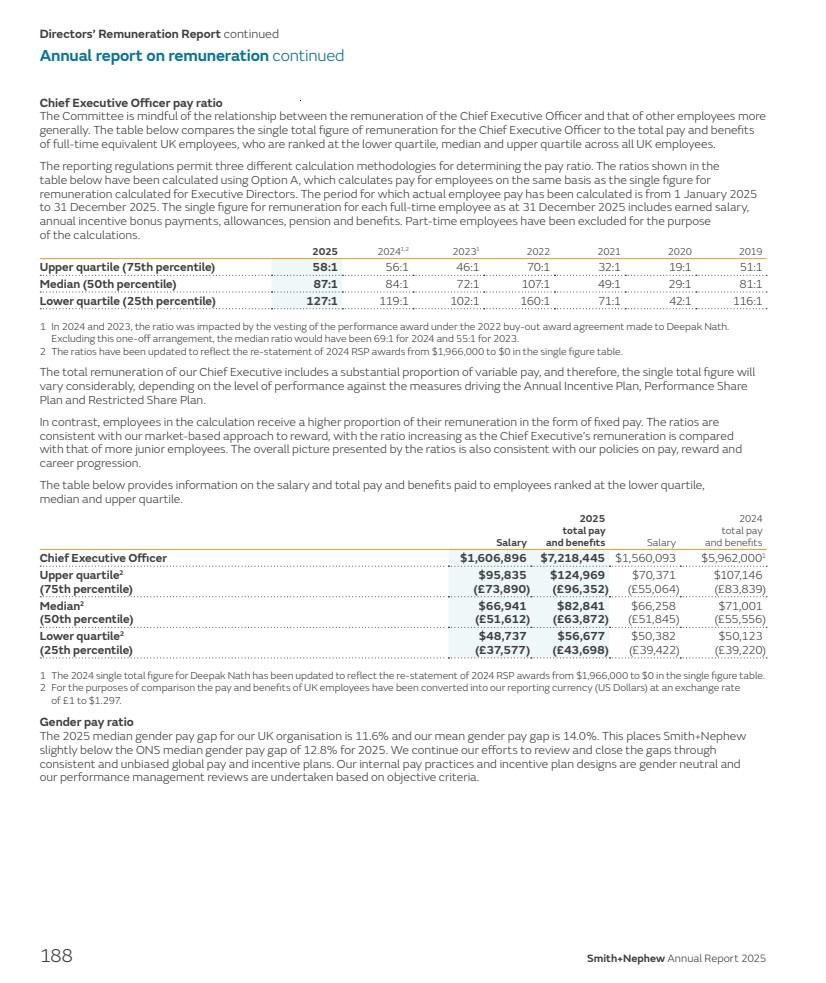
| Total Shareholder Return (TSR) performance and Chief Executive Pay The chart below shows the value as at 31 December 2025 of £100 invested in Smith+Nephew shares on 31 December 2015, compared to £100 invested in the S&P 1200 Healthcare Medical Devices subset index on the same date. This index was chosen as it consists of our most relevant performance peers so gives the best insight into our performance. In addition to showing performance over 10 years, we have shown the same information but over the 3-year period ended 31 December 2025. Source: S&P Capital IQ Medical Devices comparators that are still trading for awards made since 2012 Smith+Nephew S&P Medical Devices Ten-year Total Shareholder Return (measured in US Dollars, based on monthly spot values) Dec 2015 Dec 2016 Dec 2017 Dec 2018 Dec 2019 Dec 2020 Dec 2021 Dec 2022 Dec 2023 Dec 2024 Dec 2025 0 100 200 300 400 500 Source: S&P Capital IQ Medical Devices comparators that are still trading for awards made since 2012 Smith+Nephew S&P Medical Devices Three-year Total Shareholder Return (measured in US Dollars, based on monthly spot values) Dec 2022 Dec 2023 Dec 2024 Dec 2025 120 100 80 60 20 0 40 140 160 Source: S&P Capital IQ Medical Devices comparators that are still trading for awards made since 2012 Smith+Nephew S&P Medical Devices Three-year Total Shareholder Return (measured in US Dollars, based on monthly spot values) Dec 2022 Dec 2023 Dec 2024 Dec 2025 120 100 80 60 20 0 40 140 160 Smith+Nephew Annual Report 2025 189 STRATEGIC REPORT GOVERNANCE ACCOUNTS OTHER INFORMATION 19_SN_AR25_REM_Impl_v160.indd 189 05/03/2026 18:19 |
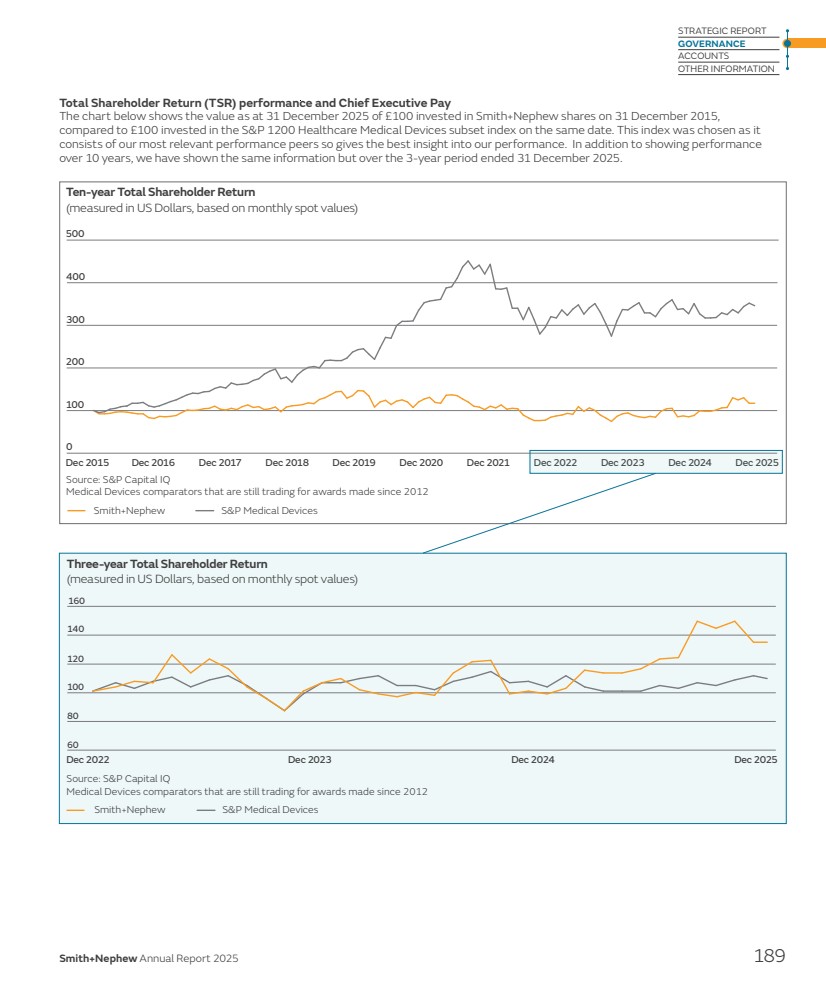
| The table below details the CEO’s single total figure of remuneration and incentive outcomes over the period 1 January 2016 to 31 December 2025. $000s 2016 2017 2018 2019 2020 2021 2022 2023 2024 2025 Chief Executive’s single total figure Deepak Nath1 5,955 4,658 5,9627 7,219 Roland Diggelmann2 266 1,698 3,102 603 Namal Nawana3 2,883 4,489 Olivier Bohuon4 3,333 5,117 2,384 3,333 5,117 5,267 4,755 1,698 3,102 6,558 4,658 5,9627 7,219 Annual incentive (% of maximum) Deepak Nath1 32% 61% 61% 82% Roland Diggelmann2 0%5 24% Namal Nawana3 69% 71%6 Olivier Bohuon4 30% 61% 63% 30% 61% – 71% 0% 24% 32% 61% 61% 82% Long-term incentives (% of maximum) Deepak Nath1 – – 29.7% 36% Roland Diggelmann2 – – Namal Nawana3 – Olivier Bohuon4 8% 54% 46.5% 8% 54% 46.5% ––––– 29.7% 36% 1 Appointed Chief Executive Officer on 1 April 2022. 2 Appointed Chief Executive Officer on 1 November 2019 and stepped down on 31 March 2022. 3 Appointed Chief Executive Officer on 7 May 2018 and resigned on 31 October 2019. 4 Retired as Chief Executive Officer on 7 May 2018. 5 Due to the impact of Covid upon the Chief Executive Officer’s financial targets, a cash award of 0% was achieved. 6 Calculated as 106.7% for Namal Nawana (disclosed on page 108 of the Company’s Annual Report for the year ended 31 December 2019), divided by the maximum potential payout of 150%. 7 The 2024 single total figure for Deepak Nath has been updated to reflect the re-statement of 2024 RSP awards from $1,966,000 to $0 in the single figure table. Relative importance of spend on pay When considering remuneration arrangements for our Executive Directors and employees as a whole, the Committee also take into account the overall profitability of the Company and the amounts spent elsewhere, particularly in returning profits to shareholders in the form of dividends and share buybacks. The chart below shows the relative importance of spend on pay compared to returns to shareholders and trading profit. Total employee costs ($m) 0 200 400 600 800 1000 1200 1400 1600 1800 1,663 2025 1,671 2024 Return to shareholders ($m) 0 200 400 600 800 1000 1200 1400 1600 1800 327 2025 330 2024 * Returns to shareholders comprise of dividends to ordinary shareholders only as there have been no share buybacks over the period Attributable profit ($m) 0 200 400 600 800 1000 1200 1400 1600 1800 412 2025 625 2024 190 Smith+Nephew Annual Report 2025 Directors’ Remuneration Report continued Annual report on remuneration continued 19_SN_AR25_REM_Impl_v160.indd 190 05/03/2026 18:19 |
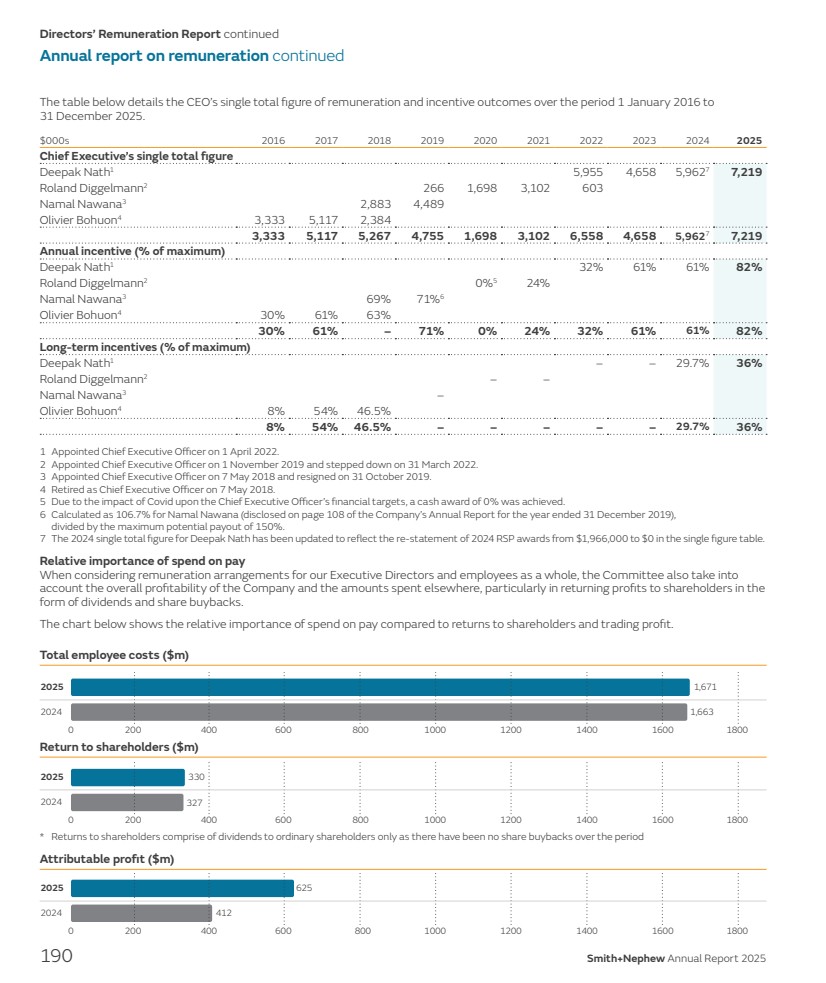
| Senior management remuneration The Group’s administrative, supervisory and management body (senior management) comprises, for US reporting purposes, Executive Directors, Non-Executive Directors, and Executive Officers. Details of the current Executive Directors, Non-Executive Directors and Executive Officers are given on pages 102 to 109. Remuneration paid to senior management in respect of 2022, 2023, 2024 and 2025, was as follows: 2025 2024 2023 2022 Total remuneration $22,631,464 $20,526,132 $18,890,117 $17,211,000 Total remuneration for loss of office – $1,491,790 $1,659,101 – Aggregate amounts provided to supplementary pension plans $1,752,073 $1,552,480 $1,332,506 $1,626,000 The interests of senior management, who served during the year in terms of shares of the Company held as at 31 December 2025 are shown in the table below. For this purpose, senior management is defined as the Executive Directors, members of the Executive Committee, including the Company Secretary, and their connected persons (or closely associated persons). Ordinary shares American Depositary Shares Share capital of Company Total for all senior management 1,083,290 31,055 0.1% Senior management interests as at 27 February 2026 were unchanged from those listed above other than another 410 American Depository Shares were purchased for Deepak Nath and 207 American Depository Shares were purchased for Craig Gaffin under the US section 423 plan. Details of share awards granted during the year to members of senior management and held as at 31 December 2025 are shown in the table below. Awards Share awards granted during 2025 Total share awards held as at 31 December 2025 Deferred Share Plan 241,327 423,593 Restricted Share Plan 494,724 582,402 Performance Share Plan 1,349,672 2,675,989 Conditional awards – 62,153 Sign-on awards 82,572 82,572 There have been no new awards or changes to awards held by senior management between 31 December 2025 and 27 February 2026 (the latest practicable date for inclusion in this report). Smith+Nephew Annual Report 2025 191 STRATEGIC REPORT GOVERNANCE ACCOUNTS OTHER INFORMATION 19_SN_AR25_REM_Impl_v160.indd 191 05/03/2026 18:19 |
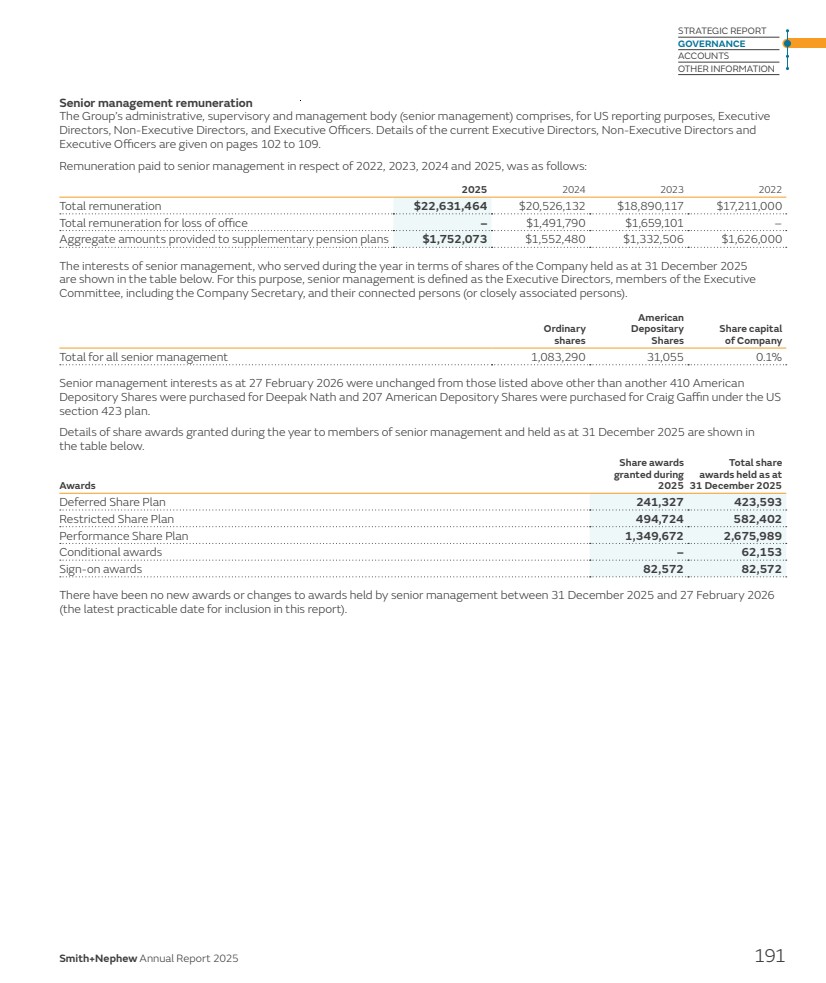
| Implementing the Remuneration Policy for 2026 Selection of performance targets Performance targets are set to be relevant, stretching and aligned to our business strategy. We also consider how performance is delivered when determining incentive plan outcomes, with appropriate consideration given to any environmental, social and governance risks to ensure that the performance delivered is sustainable and fully aligned with our Company values and culture. Malus and clawback applies to all forms of variable pay. Annual Incentive Plan (AIP) Financial performance targets under the AIP are set by the Remuneration Committee with reference to the budgets and business plan for the year ahead, as well as anticipated market conditions, ensuring that the levels to achieve threshold, target or maximum payout are appropriately challenging. The performance targets for 2026 are predominantly based on financial measures (85% of maximum opportunity). They include revenue (35%), trading profit (35%), free cash flow (15%) and strategic objectives (15%). Commercial sensitivity precludes the advance publication of the actual targets for our financial measures, but they will be retrospectively published in our annual report on remuneration for 2026. The Committee considers the range of financial targets set for 2026 to be similarly challenging to those set in prior years. The strategic objectives are based on key deliverables that support our near and long-term strategy. The strategic objectives and their outcome will be disclosed in our 2026 Annual Report. Performance Share Plan (PSP) The performance targets under the PSP are set to reflect the Company’s longer-term growth objectives at a level where the maximum represents genuine outperformance. Market consensus is also considered when setting the performance range. The performance measures for the 2026 award are adjusted earnings per share (EPSA), return on invested capital (ROIC), relative total shareholder return (TSR), and strategic objectives linked to our ESG agenda. Measure 2026 performance targets Earnings per share (30% weighting) Adjusted EPS (EPSA) is considered a simple and clear measure of absolute growth in line with our business strategy. The EPSA targets that the Committee intends to set for the 2026-28 PSP award are higher than those set in 2025 and are: Threshold Target Maximum EPSA 9.0% 11.0% 13.0% Vesting 25% 50% 100% Note: Vesting will be on a straight-line basis between threshold and target and between target and maximum. Return on invested capital (30% weighting) Return on invested capital aligns with our focus to ensure we return value on investments for our shareholders. The targets that the Committee intends to set for the 2026-2028 PSP award are higher than those set in 2025 and are: Threshold Target Maximum ROIC 9.5% 10.5% 11.5% Vesting 25% 50% 100% Note: Vesting will be on a straight-line basis between threshold and target and between target and maximum. 192 Smith+Nephew Annual Report 2025 Directors’ Remuneration Report continued Annual report on remuneration continued 19_SN_AR25_REM_Impl_v160.indd 192 05/03/2026 18:19 |
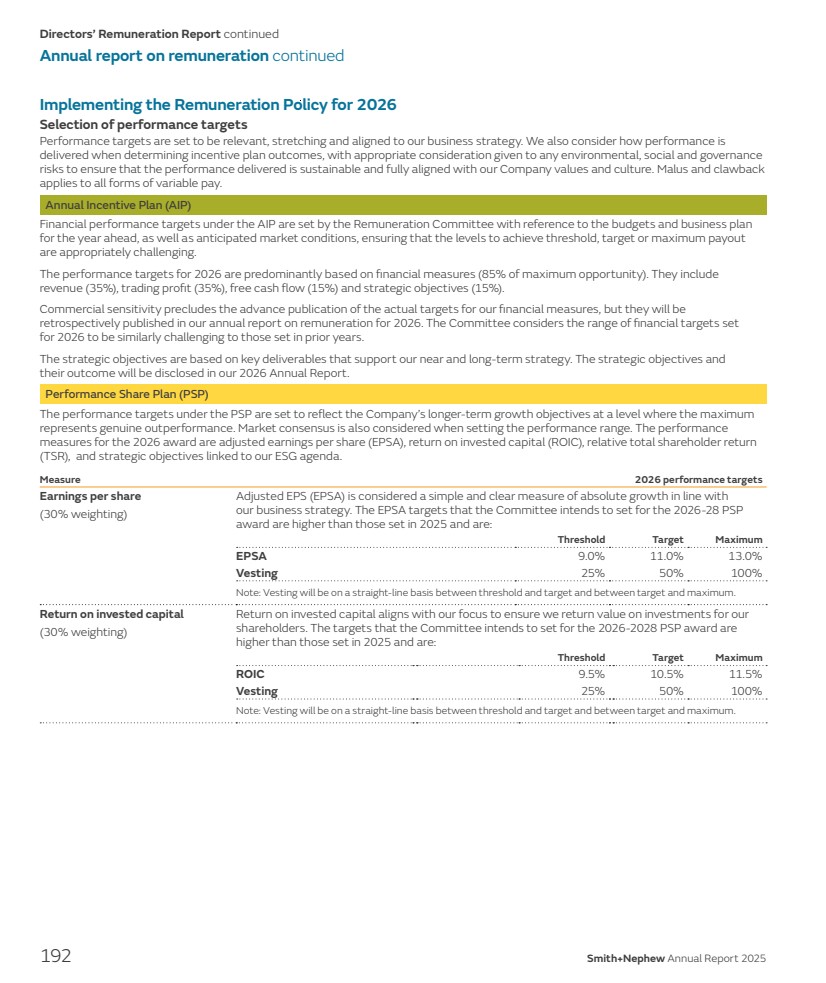
| Measure 2026 performance targets Relative Total Shareholder Return (30% weighting) Relative TSR is considered a simple and clear performance measure relative to a comparator group. The Committee intends to measure TSR performance for the 2026-2028 PSP award, relative to a MedTech industry peer group consisting of the companies below. – Alcon Inc. – Bausch + Lomb Corporation – Baxter International Inc. – Becton Dickinson and Co – bioMérieux S.A. – Carl Zeiss Meditec AG – Coloplast A/S – ConvaTec Group PLC – Demant A/S – Dentsply Sirona Inc. – DiaSorin SpA – Edwards Lifesciences Corp. – Elekta AB – Enovis Corporation – Envista Holdings Corporation – GE HealthCare Technologies Inc. – Globus Medical, Inc. – Insulet Corporation – Integer Holdings Corporation – Solventum – Medtronic – Integra LifeSciences Hold. Corp. – Intuitive Surgical Inc. – Koninklijke Philips NV – Resmed Inc. – Sonova Holding AG – STERIS plc – Straumann Holding AG – Stryker Corp. – Teleflex Inc. – The Cooper Companies, Inc. – Zimmer Biomet Holdings Inc. Performance Share Plan (PSP) continued In addition, the Committee have changed the performance condition such that it is now based on quartile positioning relative to the peer group. Threshold Maximum TSR Median Upper quartile Vesting 25% 100% Note: Vesting will be on a straight-line basis between threshold and maximum. Strategic objectives (10% weighting) The strategic objectives consist of metrics related to our ESG and sustainability framework, namely a reduction in our environmental impact (Scope 1 and Scope 2 greenhouse gas emissions relative to a 2019 baseline). The targets that the Committee intends to set for the 2026-2028 PSP award are higher than those set in 2025 and are: Threshold Target Maximum Scope 1 and Scope 2 GHG 74% 76% 78% Vesting 25% 50% 100% Note: Vesting will be on a straight-line basis between threshold and target and between target and maximum. Restricted Share Plan (RSP) The conditions attached to RSP awards relate to continued employment and good standing. In addition, for US Executive Directors, the award vesting is subject to a reasonable judgement underpin. If the Remuneration Committee is not satisfied that the underpin has been met, the Committee may scale back the vesting (including to zero). In assessing the underpin, the Committee will consider the following: – A review of overall financial performance over the vesting period; – Whether there have been any sanctions or fines issued by a regulatory authority; – Whether there have been any material environmental, social or governance issues; – Whether a major safety incident has occurred; and – Whether there has been material damage to the reputation of the Company This Remuneration Report was approved by the Board of Directors on 27 February 2026 and signed on its behalf by: Sybella Stanley Remuneration Committee Chair Smith+Nephew Annual Report 2025 193 STRATEGIC REPORT GOVERNANCE ACCOUNTS OTHER INFORMATION 19_SN_AR25_REM_Impl_v160.indd 193 05/03/2026 18:19 |
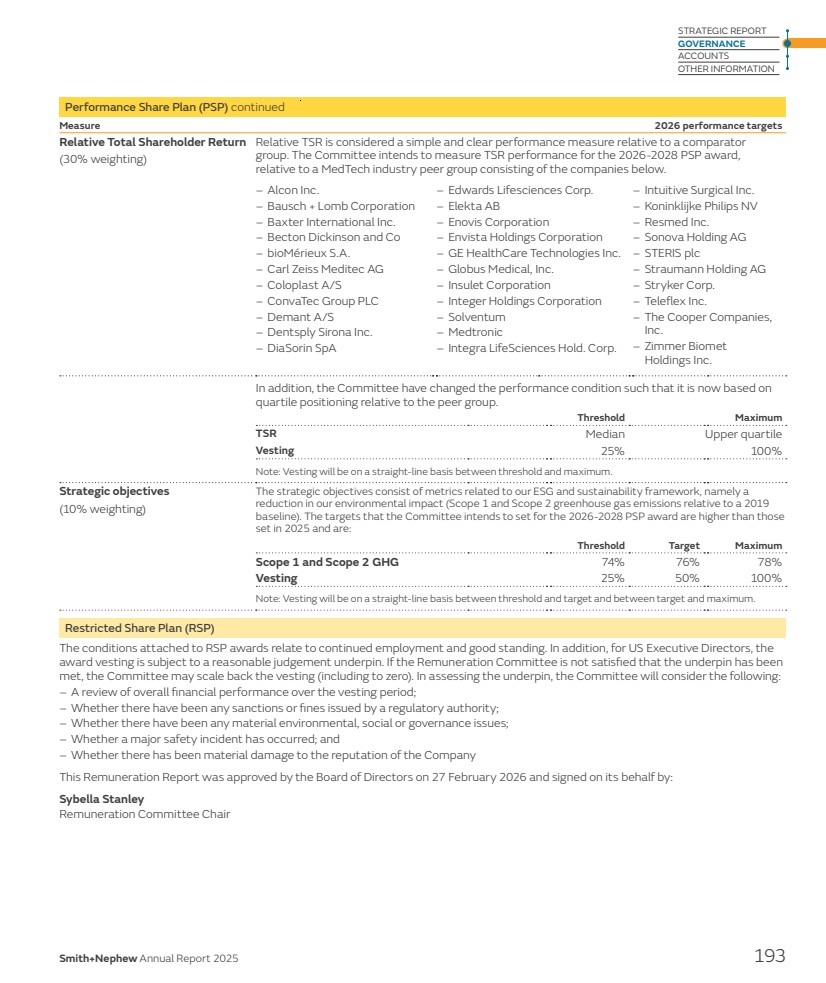
| Index to principal Directors’ Report disclosures The Directors present their report alongside the audited accounts for the year ended 31 December 2025. Certain matters as set out in the table below are incorporated into this Directors’ Report by reference, including information required in accordance with the Companies Act 2006 and UK Listing Rule 6.6.1: Disclosure Section in Annual Report Page Directors in office during the year Board of Directors 102–107 Dividends/dividend policy Chair’s Statement 4 Disclosure of information to auditor Audit Committee Report 145 Qualifying third-party indemnity provisions for Directors How we are governed 126 Charitable and political donations Directors’ Report 196 Financial instruments – risk management objectives and policies Risk Report Audit Committee Report Notes to the Accounts 78–82 141–146 242 Post balance sheet events Notes to the Accounts 265 Likely future developments Chair’s statement Chief Financial Officer review 4–5 18–25 Research and development Research and Development 27–32 Policies governing employment and opportunities for disabled persons Building our Way to Win 63 Employee communication and engagement Our purpose and stakeholders 117–123 How Directors have performed under section 172 Section 172 statement 114–116 How the Directors have had regard to the need to foster the Company’s business relationships and effect on principal decisions Section 172 statement 114–116 List of subsidiaries and branches outside of the UK Notes to the Accounts 270–273 Structure of share capital including restrictions on the transfer of securities, voting rights and interests in voting rights Directors’ Report Notes to the Accounts 195 259 Significant holdings of the Company’s securities Directors’ Report 195–196 Rights attaching to shares under employee share schemes Directors’ Report 195 Rules governing the appointment and replacement of Directors Directors’ Report 196 Rules governing changes to the Company’s Articles of Association Directors’ Report 195 Powers of the Directors Directors’ Report 196 Significant agreements Directors’ Report 196 Agreements relating to compensation for loss of office or employment relating to a takeover Directors’ Remuneration Policy 170 Greenhouse gas emissions Carbon emissions (CO2 e) strategy, reporting methodology, materiality and scope 76–77 Corporate Governance Statement & Compliance with the Corporate Governance Code Governance at a glance Directors’ Report 100 196 Internal control and risk management Risk Report 78–82 Diversity policy Nomination & Governance Committee Report 129 Payment policy Directors’ Report 196 Board, Executive & senior management diversity reporting Governance at a glance Nomination & Governance Committee Report 99 130–131 Composition and operation of the Company’s administrative, management and supervisory bodies and their committees Corporate Governance Framework 124 Board’s activities to assess and monitor culture Compliance & Culture Committee Report Building our Way to Win 139–140 58–63 Purchase of own shares Directors’ Report 196 194 Smith+Nephew Annual Report 2025 Directors’ Report Directors’ Report disclosures 20_SN_AR25_DirectorsRep_v82.indd 194 05/03/2026 18:20 |
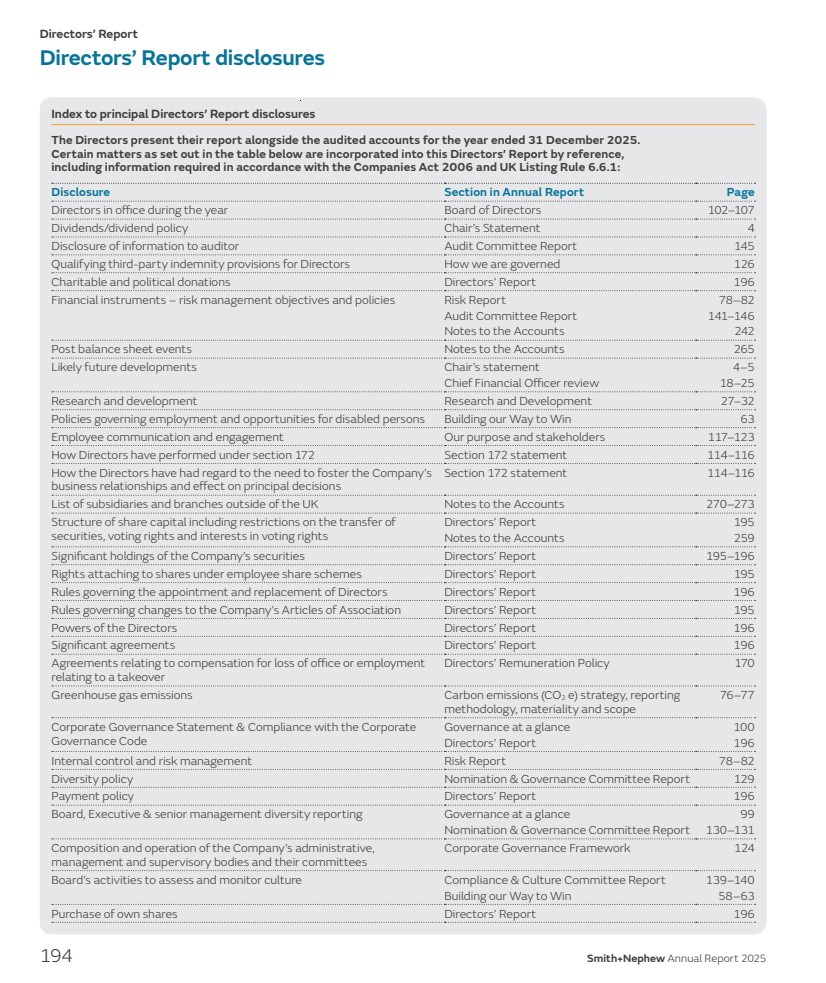
| The Company’s Articles of Association (Articles), adopted at the 2021 AGM and governed by English law, set out the rights of ordinary shareholders. This summary is subject to the Companies Act 2006 (Act) and the Articles. Share capital The Company’s share capital consists of ordinary shares and deferred shares. As at 31 December 2025, the Company’s issued share capital consisted of 877,724,845 ordinary shares of $0.2 each of which 849,761,705 carried voting rights and 27,963,140 ordinary shares were held in treasury. Each share carries the right to one vote at general meetings of the Company. Rights attaching to ordinary shares Dividends may only be paid from distributable profits. Final dividends require shareholder approval and cannot exceed the Directors’ recommendation; interim dividends may be declared by the Board. Dividends may be paid in cash or assets if authorised by ordinary resolution. Unclaimed dividends after 12 years revert to the Company, and shares may be sold after reasonable tracing efforts. No material changes to shareholder rights occurred in 2025. Voting rights At any General Meeting, on a show of hands, each shareholder who is present in person has one vote and every proxy present who has been duly appointed by a shareholder entitled to vote on a resolution has one vote. On a poll, every shareholder who is present in person or by proxy shall have one vote for every share of which they are the holder. Polls may be demanded by the Chair, five shareholders, holders of 10% of voting rights, or holders of 10% of paid-up capital. The Company typically votes by poll at its Annual General Meetings. Rights in a winding-up Except as the Company’s shareholders have agreed or may otherwise agree, upon the Company’s winding-up, the balance of assets available for distribution: – After the payment of all creditors including certain preferential creditors, whether statutorily preferred creditors or normal creditors; – Subject to any special rights attaching to any other class of shares; and – Is to be distributed among the holders of ordinary shares according to the amounts paid up on the shares held by them. This distribution is generally to be made in US Dollars. A liquidator may, however, upon the adoption of any extraordinary resolution of the shareholders and any other sanction required by law, divide among the shareholders the whole or any part of the Company’s assets in kind. Variation of rights If, at any time, the Company’s share capital is divided into different classes of shares, the rights attached to any class may be varied, subject to the provisions of the Companies Act, with the consent in writing of holders of three-quarters in nominal value of the issued shares of that class or upon the adoption of a special resolution passed at a separate meeting of the holders of the shares of that class. At every such separate meeting, all the provisions of the Articles of Association relating to proceedings at a General Meeting apply, except that the quorum is to be the number of persons (which must be two or more) who hold or represent by proxy not less than one-third in nominal value of the issued shares of the class, and at any such meeting a poll may be demanded in writing by any person or their proxy who hold shares of that class. Where a person is present by proxy or proxies, he or she is treated as holding only the shares in respect of which the proxies are authorised to exercise voting rights. Limitations on voting and shareholding There are no restrictions under English law or the Company’s Articles on non-residents or foreign persons holding or voting ordinary shares or ADSs, other than those applying to all shareholders. Transfers of shares The Board may refuse to register transfers of certificated shares that are unpaid, not properly stamped or certified, lodged without required documents, cover more than one class, or name more than four transferees. This discretion cannot be used to prevent proper market dealings. Deferred shares Following the 2006 re-denomination of share capital, a new class of £1 deferred shares was created to comply with the Companies Act. Fifty thousand deferred shares were issued and are now held by the Company Secretary. These shares carry no voting or dividend rights and, on winding-up, only receive nominal value after ordinary shareholders have received their nominal value plus $1,000 each. Rights attaching to shares under employee share schemes The Company has established an Employee Trust with shares that have no special rights and carry the same rights as any other ordinary share. The trustee has waived its right to vote and its right to all dividends. Amendments to the Company’s Articles of Association The Company does not have any special rules about amendments to its Articles of Association beyond those imposed by law. General Meetings Annual General Meetings must be convened upon advance written notice of 21 days. Other General Meetings must be convened upon advance written notice of at least 14 clear days. Meetings are convened by the Board. Members with 5% of the ordinary share capital of the Company may requisition the Board to convene a meeting. Any two members may call a General Meeting in order to appoint one or more additional Directors in the event that there are insufficient Directors to be able to call a General Meeting, or where they are unwilling to do so. Smith+Nephew Annual Report 2025 195 STRATEGIC REPORT GOVERNANCE ACCOUNTS OTHER INFORMATION 20_SN_AR25_DirectorsRep_v82.indd 195 05/03/2026 18:20 |
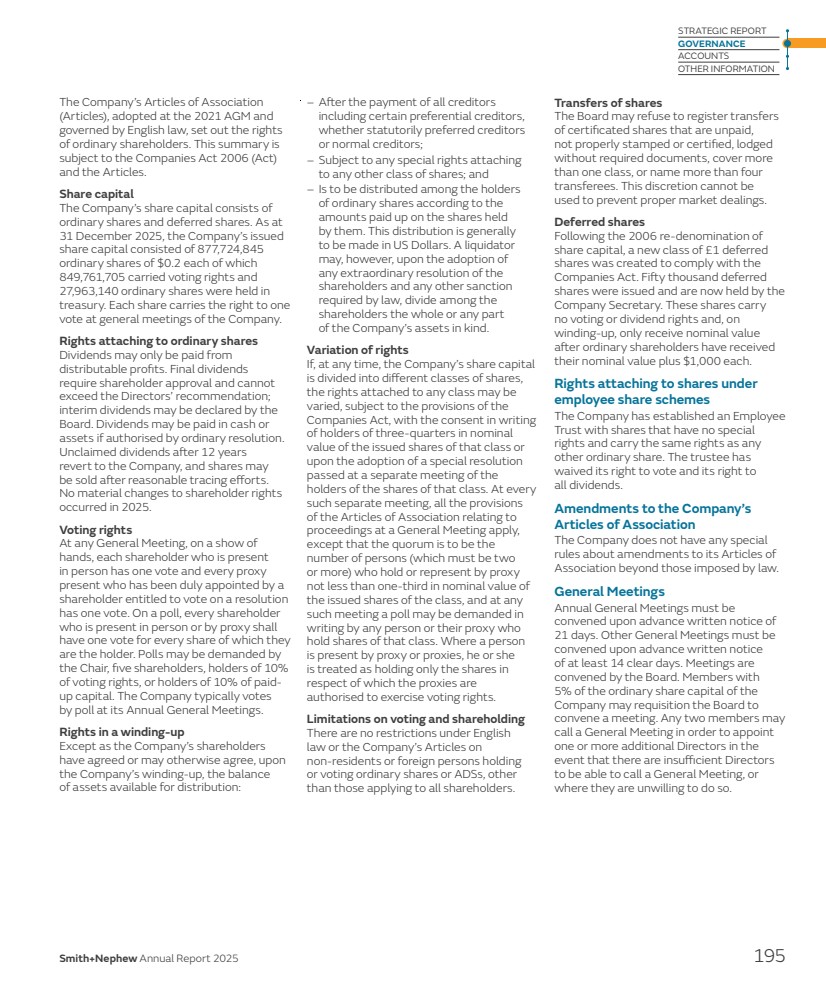
| Major shareholders As at 17 February 2026, the Company is not aware of any person who has a significant direct or indirect holding of securities in the Company, as defined in the Disclosure and Transparency Rules (DTRs) of the Financial Conduct Authority (FCA), other than as shown below, and is not aware of any persons holding securities which may control the Company. There are no securities in issue which have special rights as to the control of the Company. As at 31 December 2025 and the date of this report, the Company had received notifications in accordance with the FCA’s Disclosure and Transparency Rule 5.1.2 of the following interests in the voting rights of the Company. Shareholder As at 31 December 2025 As at 17 February 2026 % of voting rights over ordinary shares of US20¢ each % of voting rights over ordinary shares of US20¢ each BlackRock, Inc. 7.17 7.17 Cevian Capital II GP Limited 5.02 5.02 Authority to purchase own shares At the 2025 AGM, the Directors were granted authority under section 701 of the Companies Act 2006 to repurchase shares on the market. This authority will remain in effect until the conclusion of the upcoming AGM, when the Company will be seeking a renewal of its current permission to purchase up to 10% of its own shares. Share Buyback During the year, 27,411,845 ordinary shares were purchased on the London Stock Exchange in aggregate at a volume weighted average price of $18.43 per ordinary share for a total consideration of $499.9 million. This represented approximately 3.2% of the Company’s issued share capital (excluding treasury shares) as at 31 December 2025. The Company held all shares purchased in treasury. The buyback concluded on 7 October 2025. Suppliers’ payment policy Terms of payment are agreed with individual suppliers prior to supply. The Group aims to pay its creditors promptly, in accordance with terms agreed for payment. Further information can be obtained from the government payment practice reporting portal. Charitable and political donations The Group made no political donations during the year (2024: $nil). Details of charitable donations can be found on page 123. Directors Details of the Directors’ shareholdings are provided on pages 162 and 186. Under the Company’s Articles, Directors are prohibited from voting on any matter in which they or a connected person have a material interest, except in certain cases such as indemnities for obligations incurred on behalf of the Company or for third-party obligations assumed under a guarantee, offers of securities where the Director acts as an underwriter, interests in another company where the Director holds less than 1% of any share class, employee benefits shared equally with other employees, and insurance purchased for Directors in respect of actions undertaken as officers of the Company. Directors who are not entitled to vote cannot be counted in the quorum for that resolution. The Board has authority to borrow funds up to a total of $8.5 billion after deducting cash and current asset investments. Appointment and retirement of Directors Any Director appointed since the last Annual General Meeting holds office until the next AGM and may stand for re-election, and all Directors are subject to annual re-election under the UK Corporate Governance Code. A retiring Director remains in office until a replacement is appointed or until the Annual General Meeting concludes. Significant contracts The only significant contracts to which the Company is a party that take effect, alter or terminate upon a change of control are the $625m of outstanding private placement notes due between January 2026 and March 2034, the Revolving Credit Facility dated 20 October 2023, the $1.9bn of outstanding USD bonds due between March 2027 and March 2034 and the €500m of outstanding EUR bond due October 2029, which contain customary prepayment, cancellation and default provisions including repayment of principal and interest on a change of control. Corporate Governance Statement A statement confirming compliance with the UK Corporate Governance Code is set out on page 100. The 2024 Code can be found at www.frc.org.uk/library/standards-codes-policy/corporate-governance/uk-corporate-governance-code/. Cautionary statement The review of the business and its future development in the Annual Report has been prepared solely to provide additional information to shareholders to assess the Group’s strategies and the potential for these strategies to succeed. It should not be relied on by any other party for any other purpose. The review contains forward-looking statements which are made by the Directors in good faith based on information available to them at the time of the approval of these reports and should be treated with caution due to the inherent uncertainties associated with such statements. The Directors, in preparing the Strategic Report, have complied with s417 of the Companies Act 2006. Helen Barraclough Company Secretary 196 Smith+Nephew Annual Report 2025 Directors’ Report Directors’ Report disclosures continued 20_SN_AR25_DirectorsRep_v82.indd 196 05/03/2026 18:20 |

| Accounts Statement of Directors’ responsibilities 198 Independent auditor’s UK report 199 Group income statement 211 Group statement of comprehensive income 211 Group balance sheet 212 Group cash flow statement 213 Group statement of changes in equity 214 Notes to the Group accounts 215 Company financial statements 266 Notes to the Company accounts 268 Smith+Nephew Annual Report 2025 197 STRATEGIC REPORT GOVERNANCE ACCOUNTS OTHER INFORMATION Smith+Nephew Annual Report 2025 197 20_SN_AR25_DirectorsRep_v82.indd 197 05/03/2026 18:20 |

| – For the Parent Company financial statements, state whether applicable UK Accounting Standards have been followed, subject to any material departures disclosed and explained in the Parent Company financial statements; – Assess the Group and Parent Company’s ability to continue as a going concern, disclosing, as applicable, matters related to going concern; and – Use the going concern basis of accounting unless they either intend to liquidate the Group or the Parent Company or to cease operations, or have no realistic alternative but to do so. The Directors are responsible for keeping adequate accounting records that are sufficient to show and explain the Parent Company’s transactions and disclose with reasonable accuracy at any time the financial position of the Parent Company and enable them to ensure that its financial statements comply with the Companies Act 2006. They are responsible for such internal control as they determine is necessary to enable the preparation of financial statements that are free from material misstatement, whether due to fraud or error, and have general responsibility for taking such steps as are reasonably open to them to safeguard the assets of the Group and to prevent and detect fraud and other irregularities. Under applicable law and regulations, the Directors are also responsible for preparing a Strategic Report, Directors’ Report, Directors’ Remuneration Report and Corporate Governance Statement that comply with that law and those regulations. The Directors are responsible for the maintenance and integrity of the corporate and financial information included on the Company’s website. Legislation in the UK governing the preparation and dissemination of financial statements may differ from legislation in other jurisdictions. In accordance with Disclosure Guidance and Transparency Rule (“DTR”) 4.1.16R, the financial statements will form part of the annual financial report prepared under DTR 4.1.17R and 4.1.18R. The auditor’s report on these financial statements provides no assurance over whether the annual financial report has been prepared in accordance with those requirements. Responsibility statement of the Directors in respect of the Annual Report We confirm that to the best of our knowledge: – The financial statements, prepared in accordance with the applicable set of accounting standards, give a true and fair view of the assets, liabilities, financial position and profit or loss of the Company and the undertakings included in the consolidation taken as a whole; and – The Strategic Report and Directors’ Report include a fair review of the development and performance of the business and the position of the issuer and the undertakings included in the consolidation taken as a whole, together with a description of the principal risks and uncertainties that they face. The Strategic Report, which has been prepared in accordance with the requirements of the Companies Act 2006, comprises pages IFC–96. The Directors’ Report, prepared in accordance with the requirements of the Companies Act 2006 and the UK Listing Authority’s Listing Rules, and Disclosure Guidance and Transparency Rules, was approved by the Board and signed on its behalf. We consider, the Annual Report and financial statements, taken as a whole, are fair, balanced and understandable and provide the information necessary for shareholders to assess the Group’s position and performance, business model and strategy. By order of the Board, on 27 February 2026. Helen Barraclough Company Secretary The Directors are responsible for preparing the Annual Report and Form 20-F and the Group and Parent Company financial statements in accordance with applicable law and regulations. Company law requires the Directors to prepare Group and Parent Company financial statements for each financial year. Under that law they are required to prepare the Group financial statements in accordance with UK-adopted international accounting standards and applicable law and have elected to prepare the Parent Company financial statements in accordance with UK accounting standards and applicable law, including FRS 101 Reduced Disclosure Framework. In addition, the Directors have also chosen to prepare the Group financial statements in accordance with IFRS Accounting Standards as issued by the International Accounting Standards Board (IASB). Under company law, the Directors must not approve the financial statements unless they are satisfied that they give a true and fair view of the state of affairs of the Group and Parent Company and of their profit or loss for that period. In preparing each of the Group and Parent Company financial statements, the Directors are required to: – Select suitable accounting policies and then apply them consistently; – Make judgements and estimates that are reasonable, relevant, reliable and prudent; – For the Group financial statements, state whether they have been prepared in accordance with UK-adopted international accounting standards and IFRS Accounting Standards as issued by the IASB; – For the Group financial statements, present information, including accounting policies, in a manner that provides relevant, reliable, comparable and understandable information and provide additional disclosures when compliance with the specific requirements in IFRS Accounting Standards are insufficient to enable users to understand the impact of particular transactions, other events and conditions on the entity’s financial position and financial performance; 198 Smith+Nephew Annual Report 2025 Statement of Directors’ responsibilities in respect of the Annual Report and Financial Statements 20_SN_AR25_DirectorsRep_v82.indd 198 05/03/2026 18:20 |
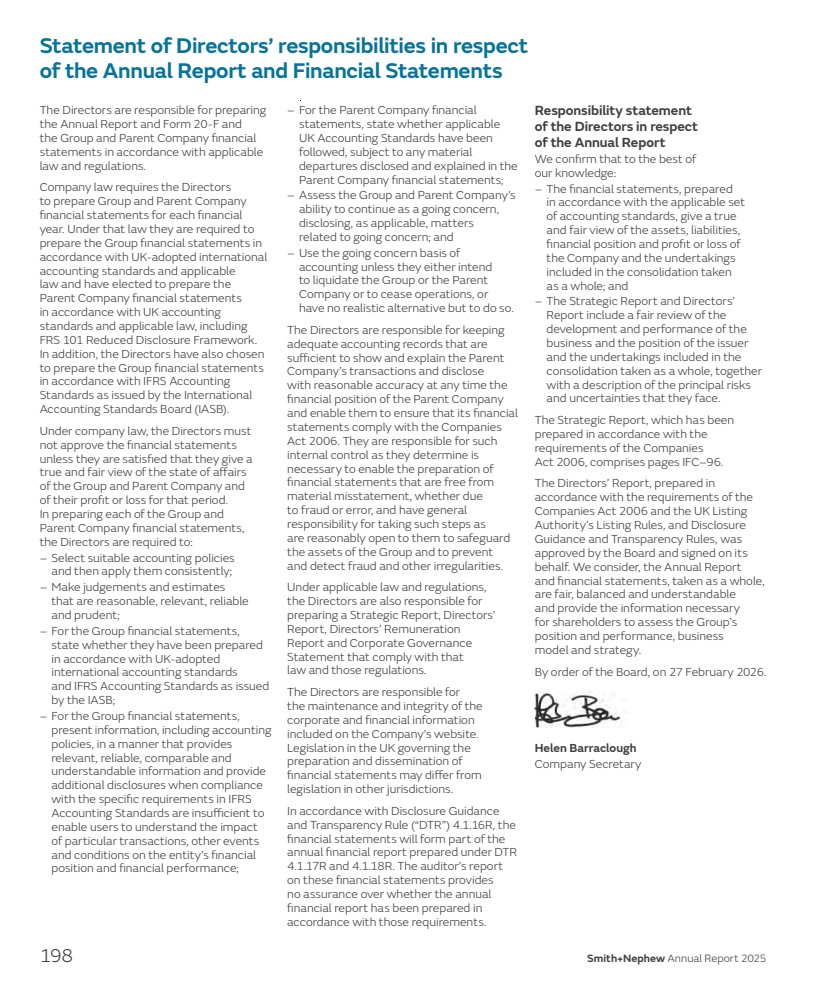
| 1. Opinion In our opinion: – the financial statements of Smith & Nephew plc (the ‘parent company’) and its subsidiaries (the ‘group’) give a true and fair view of the state of the group’s and of the parent company’s affairs as at 31 December 2025 and of the group’s profit for the year then ended; – the group financial statements have been properly prepared in accordance with United Kingdom adopted international accounting standards and IFRS Accounting Standards as issued by the International Accounting Standards Board (IASB); – the parent company financial statements have been properly prepared in accordance with United Kingdom Generally Accepted Accounting Practice, including Financial Reporting Standard 101 “Reduced Disclosure Framework”; and – the financial statements have been prepared in accordance with the requirements of the Companies Act 2006. We have audited the financial statements which comprise the: Group Parent company – Group balance sheet as at 31 December 2025; – Group income statement for the year then ended; – Group statement of comprehensive income for the year then ended; – Group statement of changes in equity for the year then ended; – Group cash flow statement for the year then ended; and – Notes 1 to 23 to the group financial statements, which includes the material accounting policy information. – Company balance sheet as at 31 December 2025; – Company statement of changes in equity for the year then ended; and – Notes 1 to 9 to the company accounts, which includes the material accounting policy information. The financial reporting framework that has been applied in the preparation of the group financial statements is applicable law, United Kingdom adopted international accounting standards and IFRS Accounting Standards as issued by the IASB. The financial reporting framework that has been applied in the preparation of the parent company financial statements is applicable law and United Kingdom Accounting Standards, including FRS 101 “Reduced Disclosure Framework” (United Kingdom Generally Accepted Accounting Practice). 2. Basis for opinion We conducted our audit in accordance with International Standards on Auditing (UK) (ISAs (UK)) and applicable law. Our responsibilities under those standards are further described in the auditor’s responsibilities for the audit of the financial statements section of our report. We are independent of the group and the parent company in accordance with the ethical requirements that are relevant to our audit of the financial statements in the UK, including the Financial Reporting Council’s (the ‘FRC’s’) Ethical Standard as applied to listed public interest entities, and we have fulfilled our other ethical responsibilities in accordance with these requirements. The non audit services provided to the group and parent company for the year are disclosed within the Audit Committee Report within the Corporate Governance section of the Annual Report and the related fee in Note 3.2 of the financial statements. We confirm that we have not provided any non-audit services prohibited by the FRC’s Ethical Standard to the group or the parent company. We believe that the audit evidence we have obtained is sufficient and appropriate to provide a basis for our opinion. Smith+Nephew Annual Report 2025 199 STRATEGIC REPORT GOVERNANCE ACCOUNTS OTHER INFORMATION Independent auditor’s report to the members of Smith & Nephew Plc 21_SN_AR25_DRes_Audit_v39.indd 199 05/03/2026 18:20 |
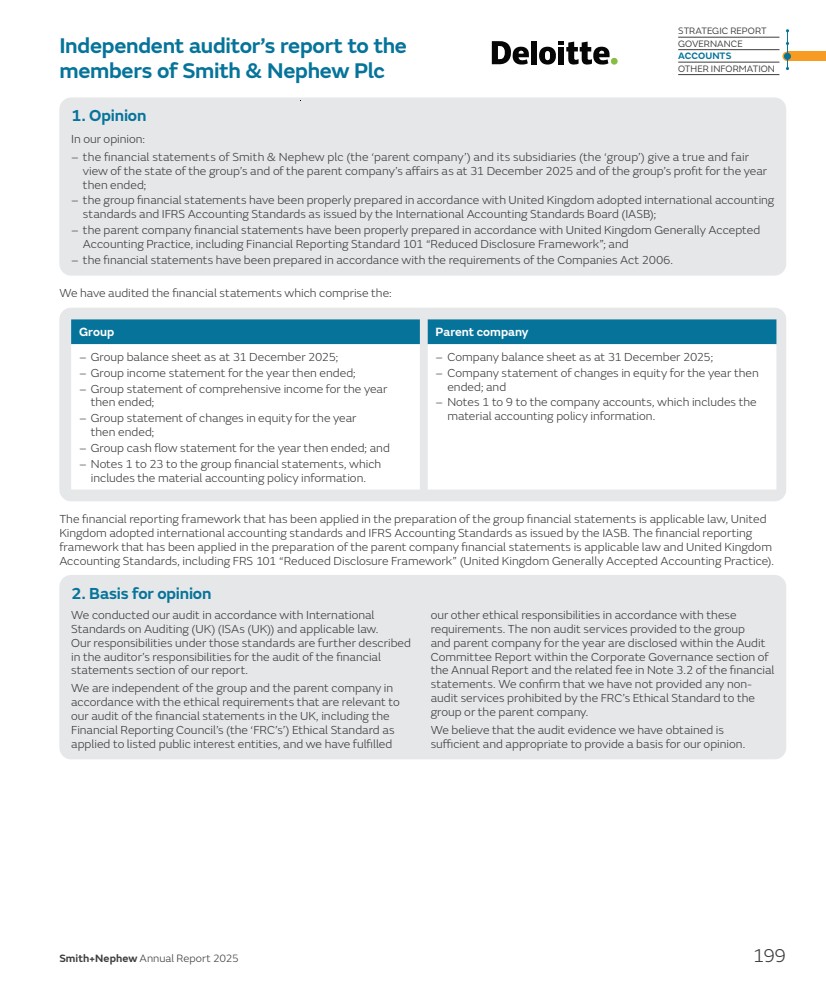
| 3. Summary of our audit approach Key audit matters The key audit matters that we identified in the current year were: – Valuation of excess and obsolescence (E&O) provision for US orthopaedics inventory; and – IT systems which impact financial reporting. Materiality The materiality that we used for the group financial statements was $40 million (2024: $35 million). We considered a number of metrics when determining group materiality, including: revenue; trading profit; and profit before taxation. Our selected materiality, using revenue as the primary benchmark, represents 0.65% (2024: 0.60%) of revenue, 3.30% (2024: 3.34%) of trading profit and 5.24% (2024: 7.03%) of profit before taxation. Scoping We performed a significant proportion of our audit procedures centrally in the UK, in addition to four global shared service centres and 13 reporting units. Our audit scope addressed 72% (2024: 73%) of the group’s revenue, 73% (2024: 68%) of the group’s profit before tax and 70% (2024: 82%) of the group’s total assets. Significant changes in our approach The valuation of the orthopaedics cash generating unit (CGU) goodwill is no longer considered to be a key audit matter in the current year. This is a result of improved trading profit margin and improved trading margin forecasts leading to increased headroom and reduced estimation uncertainty and audit risk. 4. Conclusions relating to going concern In auditing the financial statements, we have concluded that the directors’ use of the going concern basis of accounting in the preparation of the financial statements is appropriate. Our evaluation of the directors’ assessment of the group’s and parent company’s ability to continue to adopt the going concern basis of accounting included: – Testing controls over management’s going concern model, including the review of the inputs and assumptions used in the model; – Evaluating the key assumptions, including those relating to the current macroeconomic uncertainty, and evaluating the appropriateness of these assumptions and their consistency with management’s presentations to the Board and Audit Committee; – Comparing the forecasts within the going concern model to recent historical financial information to assess historic forecasting accuracy; – Testing the mechanical accuracy of the going concern model; – Testing the current and forecast covenant compliance calculations and headroom thereof at the balance sheet date, both under the group’s forecasts and in severe downside scenarios; – Evaluating whether the EBITDA and Net Debt covenant compliance calculations align with the definitions provided in the private placement note agreements; – Confirming the existence and availability of financing facilities; – Evaluating the appropriateness of management’s sensitivity analysis modelled under their most severe scenario, including an evaluation of the mitigating actions available to management; and – Evaluating the appropriateness of disclosures on going concern in the financial statements. Based on the work we have performed, we have not identified any material uncertainties relating to events or conditions that, individually or collectively, may cast significant doubt on the group’s and parent company’s ability to continue as a going concern for a period of at least twelve months from when the financial statements are authorised for issue. In relation to the reporting on how the group has applied the UK Corporate Governance Code, we have nothing material to add or draw attention to in relation to the directors’ statement in the financial statements about whether the directors considered it appropriate to adopt the going concern basis of accounting. Our responsibilities and the responsibilities of the directors with respect to going concern are described in the relevant sections of this report. 200 Smith+Nephew Annual Report 2025 Independent auditor’s UK report continued 21_SN_AR25_DRes_Audit_v39.indd 200 05/03/2026 18:20 |
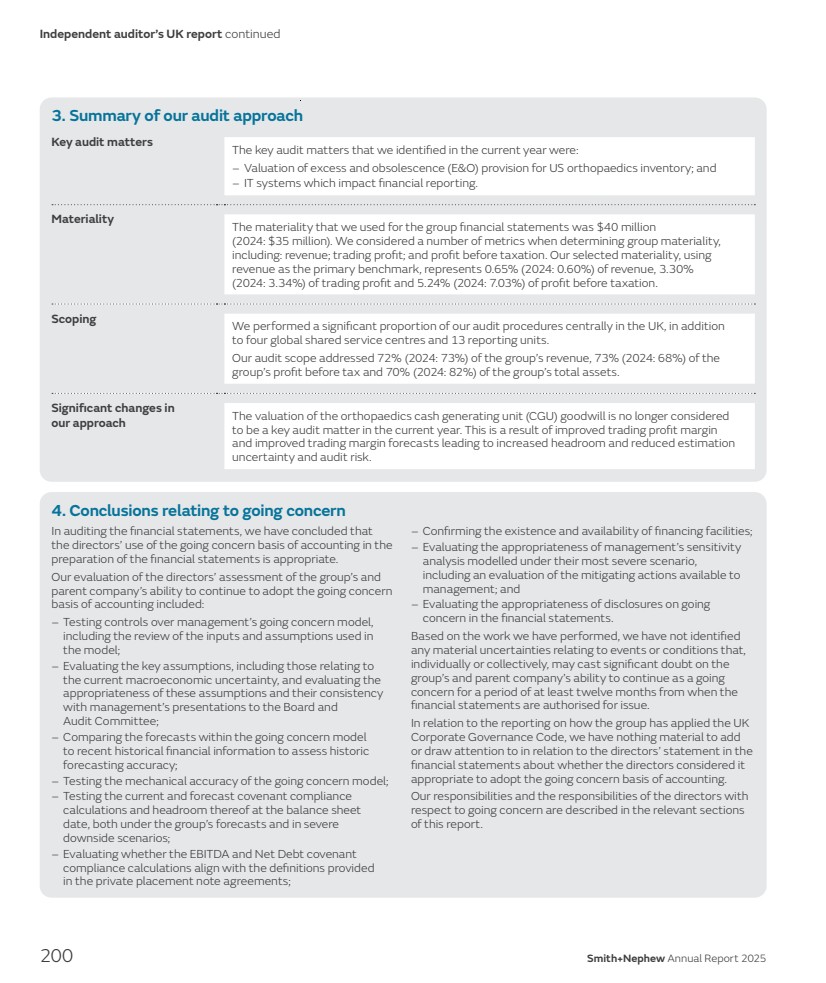
| 5. Key audit matters Key audit matters are those matters that, in our professional judgement, were of most significance in our audit of the financial statements of the current period and include the most significant assessed risks of material misstatement (whether or not due to fraud) that we identified. These matters included those which had the greatest effect on: the overall audit strategy; the allocation of resources in the audit; and directing the efforts of the engagement team. These matters were addressed in the context of our audit of the financial statements as a whole, and in forming our opinion thereon, and we do not provide a separate opinion on these matters. 5.1. Valuation of excess and obsolescence (E&O) provision for US orthopaedics inventory Key audit matter description The group holds an E&O provision to reduce the carrying value of inventories on the balance sheet to net realisable value to comply with the requirements of IAS 2: Inventories. Within the provision for orthopaedics inventory, an amount relates specifically to US orthopaedics finished goods. The estimation of this provision is judgmental as it involves a number of key estimates, in particular as it pertains to product groups where longer forecasting periods of future product demand are applied. We identified the valuation of the E&O provision for US orthopaedics inventory as a key audit matter due to the significant judgments made by the group to identify and assess excess or obsolete inventory. This required a high degree of auditor judgment and an increased extent of effort to evaluate the reasonableness of the group’s estimate related to forecasting future product demand for US orthopaedics inventory. The group’s total E&O provision is disclosed as an accounting estimate in note 1 of the group financial statements with further disclosures provided in note 12. The matter is also discussed in the Audit Committee report within the Corporate Governance section of the Annual Report. How the scope of our audit responded to the key audit matter We performed the following audit procedures relating to the forecasting of future product demand for product groups within US orthopaedic finished goods where longer forecasting periods are applied: – Tested the effectiveness of controls related to management’s determination over product demand forecasting. – Evaluated the appropriateness of the allocation of product groups where longer forecasting periods are applied for the purposes of the provision calculation by: a)Assessing whether all product groups have been considered as to whether the longer demand forecast should be applied in the calculation of the provision. b)Evaluating any changes compared with the prior year to the allocation of product groups where the longer demand forecast is used. c) Assessing the historical demand which management uses in its estimate of future demand. d)Evaluating the results of this assessment to determine the reasonableness of management’s product group allocation. e) Obtaining management’s expected future product demand and challenging that expectation against: i) Recent demand for that product group; ii) Evidence of any product discontinuation, including issues around product quality or litigation; and iii)Any other transactions or events that may impact the potential future demand. – Performed inquiries with individuals outside of finance to challenge demand forecasts submitted, obsolete products/product groups identified, marketing strategy of the product group or any expected or active litigative actions. – Recalculated the US orthopaedic finished goods provision based on the forecasting of future product demand methodology applied, assessing whether it is applied accurately. Key observations We are satisfied that the valuation of the US orthopaedics E&O provision, including estimates of product groups where longer forecasting periods of future product demand are applied, is acceptable. Smith+Nephew Annual Report 2025 201 STRATEGIC REPORT GOVERNANCE ACCOUNTS OTHER INFORMATION 21_SN_AR25_DRes_Audit_v39.indd 201 05/03/2026 18:20 |
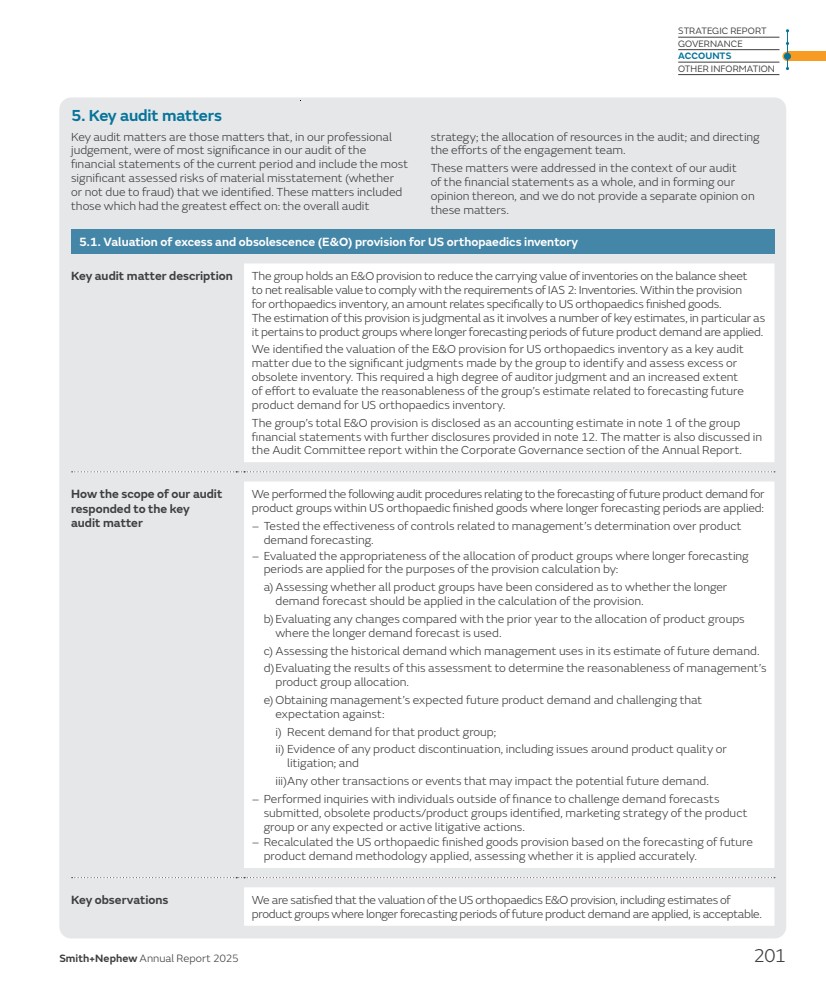
| 5.2. IT systems which impact financial reporting Key audit matter description The IT systems within the group form a key component of the group’s financial reporting activities and impact all account balances. We have identified IT systems which impact financial reporting as a key audit matter, given the level of reliance placed on these systems by the group. Due to the planned significant level of reliance on the IT systems underpinning our audit approach, a significant extent of auditor effort was required to evaluate the large number of relevant IT systems, including key system generated reports and automated business process application controls. Key IT controls, in the context of our scope for the financial audit, primarily relate to: – Access security – Controls relating to the security configuration of the systems and the restriction and administration of user access. – Change management – Controls relating to requesting, developing, testing and approving changes to systems. The purpose of such controls is to prevent inappropriate changes being made to IT systems in relation to application functionality, transactional processing and direct changes to underlying data. The matter is also discussed in the Audit Committee Report within the Corporate Governance section of the Annual Report. How the scope of our audit responded to the key audit matter We performed the following risk assessment and audit procedures to test IT controls over the IT systems determined to be relevant for financial reporting purposes: – Obtained an understanding of the IT environment, including IT systems; – Identified the IT risks for each IT system based on our understanding of the flows of transactions and the IT environment; – Determined whether each general IT control, individually or in combination with other controls, is appropriately designed to address the associated IT risk; and – Tested the effectiveness of the relevant general IT controls. Where IT control deficiencies were identified, we responded to these deficiencies through testing Group management’s remediation activities, testing alternative controls or through performing alternative procedures. Key observations We are satisfied that IT controls impacting the Group’s financial reporting activities are designed and operating effectively and control risks identified were remediated by year end or mitigated by alternative procedures or controls. 202 Smith+Nephew Annual Report 2025 Independent auditor’s UK report continued 21_SN_AR25_DRes_Audit_v39.indd 202 05/03/2026 18:20 |
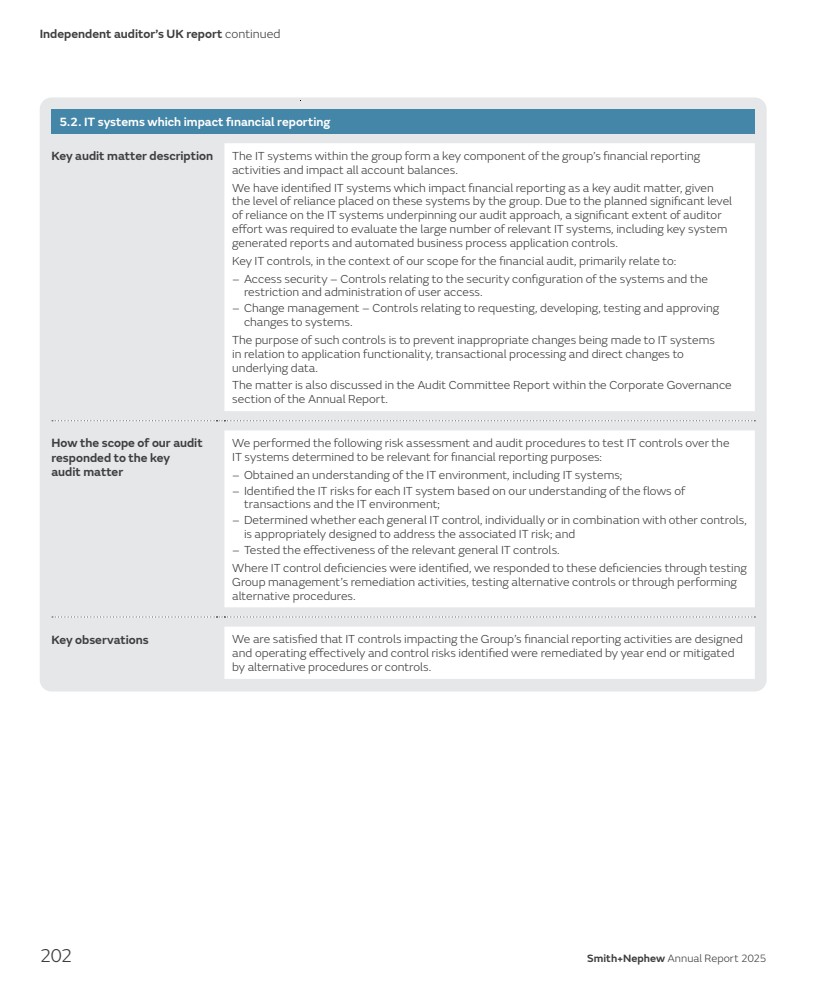
| 6. Our application of materiality 6.1. Materiality We define materiality as the magnitude of misstatement in the financial statements that makes it probable that the economic decisions of a reasonably knowledgeable person would be changed or influenced. We use materiality both in planning the scope of our audit work and in evaluating the results of our work. Based on our professional judgement, we determined materiality for the financial statements as a whole as follows: Group financial statements Parent Company financial statements Materiality $40.0 million (2024: $35.0 million) $36.0 million (2024: $31.5 million) Basis for determining materiality We considered a number of metrics when determining group materiality, including: revenue (primary benchmark); trading profit (supporting benchmark); and profit before taxation (supporting benchmark). The definition of trading profit is explained in the Non-IFRS financial information section within Other Information in the Annual Report. Our selected materiality represents 0.65% (2024: 0.60%) of revenue, 3.36% (2024: 3.34%) of trading profit and 4.99% (2024: 7.03%) of profit before taxation. The basis for materiality is total assets. The materiality used represents 0.87% (2024: 0.87%) of total assets and is capped at 90% (2024: 90%) of group materiality. Rationale for the benchmark applied We have determined that the primary benchmark for the group was revenue because we consider this measure to be the primary focus of users of the financial statements and the Group’s profit before tax continues to be volatile and below historic levels. We also considered trading profit and profit before taxation as relevant metrics to the users of the financial statements. Due to the nature of the company as a parent entity holding company, we consider total assets to be the most appropriate basis for materiality. Smith+Nephew Annual Report 2025 203 STRATEGIC REPORT GOVERNANCE ACCOUNTS OTHER INFORMATION 21_SN_AR25_DRes_Audit_v39.indd 203 05/03/2026 18:20 |

| 6.2. Performance materiality We set performance materiality at a level lower than materiality to reduce the probability that, in aggregate, uncorrected and undetected misstatements exceed the materiality for the financial statements as a whole. Group financial statements Parent Company financial statements Performance materiality 70% of group materiality (2024: 70%) 70% of parent company materiality (2024: 70%) Basis and rationale for determining performance materiality In determining performance materiality, we considered the following factors: – our understanding of the entity and its environment; and – our risk assessment, including our assessment of the group’s overall control environment. 6.3. Error reporting threshold We agreed with the Audit Committee that we would report to the Committee all audit differences in excess of $2.0 million (2024: $1.75 million), as well as differences below that threshold that, in our view, warranted reporting on qualitative grounds. We also report to the Audit Committee on disclosure matters that we identified when assessing the overall presentation of the financial statements. 204 Smith+Nephew Annual Report 2025 Independent auditor’s UK report continued 21_SN_AR25_DRes_Audit_v39.indd 204 05/03/2026 18:20 |

| 7. Audit scope and execution 7.1. Identification and scoping of components The group is headquartered in the UK, with operations in more than 100 countries across five continents, the largest being the USA (Americas). The group has four shared service centres to support both financial reporting and controllership functions across a number of global key business processes. The concentration of activity and controllership in the group, including the centralisation of the finance function in the group’s head office and shared service centres, enabled us to structure the audit more centrally. The identification of significant accounts, including the identification and classification of risks of material misstatement was performed by the group audit team, including scoping of relevant IT systems and controls relevant to the audit. For certain business processes where activities included potential variation due to local-market factors, we involved our component auditors in further localised risk-assessment procedures to refine the scope of our audit. Audit procedures undertaken at a group level and on the parent company We performed audit work on certain functions, predominantly head office, at the group level. Further, we performed audit work at the group level and on the parent company financial statements, including but not limited to the consolidation of the group’s results, the preparation of the financial statements, certain disclosures within the directors’ remuneration report, litigation provisions and exposures in addition to management’s entity level and oversight controls relevant to financial reporting. Audit procedures undertaken at a group level were performed to group materiality, or, where tested at a component level, to component performance materiality. The range of component performance materialities used was $4.2 million – $11.2 million, excluding the parent company. Audit work performed at global shared service centres and local reporting units A significant amount of the group’s operational processes which cover financial reporting are undertaken at the group’s shared service centres. The group audit team exercised direction, supervision and review over the audit work at the shared service centres in scope for the group audit, so that we developed an understanding of the end-to-end view of the key processes that supported significant account balances, classes of transactions, disclosures and controls. Audit work was performed in all four shared service centres located in India, Malaysia, Poland and Costa Rica. The work for all shared service centres was conducted by the group audit team, with support from component audit teams in India, Japan and China. For local-market activities where we identified risks of material misstatement to the group financial statements, we identified 14 reporting units located in the USA, Costa Rica, UK, Netherlands, Germany, Malaysia, China, Japan and Australia as in-scope components. The work relating to these reporting units was split between the group team and the component audit teams, applying component performance materiality. Coverage and consideration of residual Based on our group risk assessment, we determined whether the audit procedures were sufficient to support the group audit opinion through determining that the audit evidence gained was reflective of the level of risk within each financial statement line item. On a stand-back basis, we assessed the audit evidence achieved over three metrics (being revenue, profit before tax and gross assets). At the group level we also carried out analytical procedures to obtain further assurance that there were no significant risks of material misstatement of the aggregated financial information of the remaining account balances, transactions and disclosures not subject to audit or specified audit procedures. Revenue A Specified audit procedures 72% B Review at group level 28% B A Profit before tax A Specified audit procedures 73% B Review at group level 27% B A Total assets A Specified audit procedures 70% B Review at group level 30% B A Smith+Nephew Annual Report 2025 205 STRATEGIC REPORT GOVERNANCE ACCOUNTS OTHER INFORMATION 21_SN_AR25_DRes_Audit_v39.indd 205 05/03/2026 18:20 |
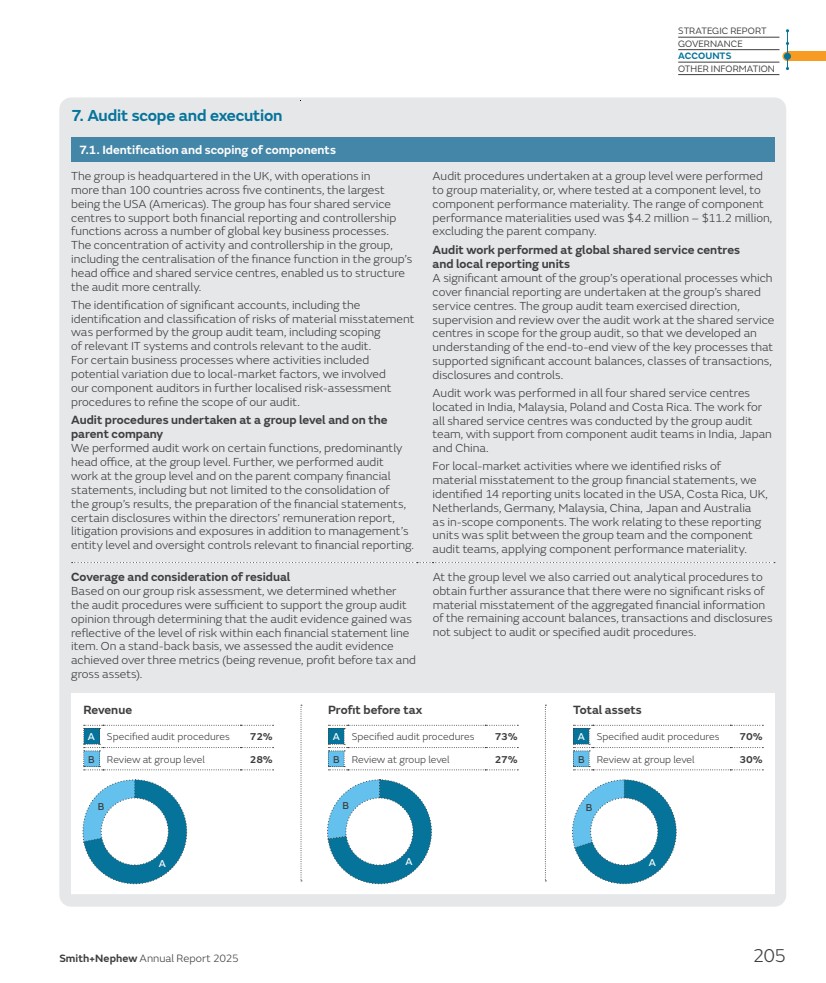
| 7.2. Use of technology The Group has a complex IT environment, characterised by multiple systems which form a key part of the Group’s financial reporting activities. Our testing, using technology, is integrated into our risk assessment so that we only test relevant controls and exceptions identified. Through these procedures we obtained reliable information used as audit evidence across our substantive procedures, including but not limited to the key audit matters identified above. We embed technology throughout our audit to improve quality and effectiveness, including in the areas of planning and scoping, project management, risks and controls assessment, substantive testing and reporting insights to management and the Audit & Risk Committee. To support our iterative risk assessment process, we have used web scanning technology which assists with identifying additional information regarding industry matters in the jurisdictions in with the Group operates. We have factored the impact of this information into our risk assessment and design of substantive procedures within the relevant account balances and other aspects of the audit, including going concern and post balance sheet events. Our data analytical tools allow us to scrutinise large transactional data sets for unusual trends, characteristics, outliers or transaction flows to support our identification of audit risks. We have continued to leverage process analytics to perform substantive procedures on revenue at a Group level by automatically matching key revenue data points across sales orders, invoicing, shipping documents and cash receipts generated during the revenue process. 7.3. Our consideration of the control environment Based on our understanding of the control environment gathered during our inquiries with control operators, inspecting documents used in or the output of controls and inquiries of those responsible for oversight of control, our audit approach was to place reliance on management’s controls over all business cycles affecting significant account balances, transactions and disclosures, where possible. We have outlined in our key audit matters above the work performed to assess the operating effectiveness of general IT controls and IT controls related to material and significant account balances to the group audit, including the conclusions relating to our reliance on IT controls and mitigating procedures performed relating to any deficiencies identified in those controls. 7.4. Our consideration of climate-related risks In planning our audit, we have considered the potential impact of climate change on the group’s business and its financial statements. The Group has assessed the risk and opportunities relevant to climate change and the group’s Principal Risks capture physical and transitional climate-related risks as determined in the Enterprise Risk Management Process. The risks have also been considered and embedded into the businesses as explained in the Strategic Report. As part of our audit procedures, we have obtained management’s climate-related risk assessment and held discussions with those charged with governance to understand the process of identifying climate-related risks, the determination of mitigating actions and the impact on the group’s financial statements. While management has acknowledged the risks posed by climate change, they have assessed that climate change does not create any further key sources of estimation uncertainty in the financial statements as at 31 December 2025 as explained in note 1.3 to the accounts. We performed our own qualitative risk assessment of the potential impact of climate change on the group’s account balances and classes of transactions, with particular focus on areas of judgement such as goodwill, and did not identify any additional risks of material misstatement. We have also evaluated management’s climate change risk assessment and supporting scenario analyses. Our procedures include reading disclosures included in the Annual Report to consider whether they are materially consistent with the financial statements and our knowledge obtained in the audit and assessing compliance with TCFD recommendations. 206 Smith+Nephew Annual Report 2025 Independent auditor’s UK report continued 21_SN_AR25_DRes_Audit_v39.indd 206 05/03/2026 18:20 |

| 7.5 Working with other auditors The group audit team are responsible for the scope and direction of the audit process. To enable appropriate direction, supervision and review activities over the shared service centre and in-market component auditors, the group team: – Held global planning sessions with component teams covering strategy and delivery; – Had a dedicated component oversight team, who engaged in regular communication with component auditors, enabling timely comparisons and challenge of outcomes across the group and component audits; – Provided detailed referral instructions that were tailored for each component auditor, and through regular engagement refined those instructions during the audit as required; – Actively participated in all component team planning and close meetings for each phase of work; – Performed virtual and in-person file reviews over the key risk areas throughout the year; and – Varied the extent of our oversight of the component auditors based on the risk-profiles of each reporting unit in scope. 8. Other information The other information comprises the information included in the annual report, other than the financial statements and our auditor’s report thereon. The directors are responsible for the other information contained within the annual report. Our opinion on the financial statements does not cover the other information and, except to the extent otherwise explicitly stated in our report, we do not express any form of assurance conclusion thereon. Our responsibility is to read the other information and, in doing so, consider whether the other information is materially inconsistent with the financial statements or our knowledge obtained in the course of the audit, or otherwise appears to be materially misstated. If we identify such material inconsistencies or apparent material misstatements, we are required to determine whether this gives rise to a material misstatement in the financial statements themselves. If, based on the work we have performed, we conclude that there is a material misstatement of this other information, we are required to report that fact. We have nothing to report in this regard. 9. Responsibilities of Directors As explained more fully in the directors’ responsibilities statement, the directors are responsible for the preparation of the financial statements and for being satisfied that they give a true and fair view, and for such internal control as the directors determine is necessary to enable the preparation of financial statements that are free from material misstatement, whether due to fraud or error. In preparing the financial statements, the directors are responsible for assessing the group’s and the parent company’s ability to continue as a going concern, disclosing as applicable, matters related to going concern and using the going concern basis of accounting unless the directors either intend to liquidate the group or the parent company or to cease operations, or have no realistic alternative but to do so. 10. Auditor’s responsibilities for the audit of the financial statements Our objectives are to obtain reasonable assurance about whether the financial statements as a whole are free from material misstatement, whether due to fraud or error, and to issue an auditor’s report that includes our opinion. Reasonable assurance is a high level of assurance, but is not a guarantee that an audit conducted in accordance with ISAs (UK) will always detect a material misstatement when it exists. Misstatements can arise from fraud or error and are considered material if, individually or in the aggregate, they could reasonably be expected to influence the economic decisions of users taken on the basis of these financial statements. A further description of our responsibilities for the audit of the financial statements is located on the FRC’s website at: www.frc.org.uk/auditorsresponsibilities. This description forms part of our auditor’s report. Smith+Nephew Annual Report 2025 207 STRATEGIC REPORT GOVERNANCE ACCOUNTS OTHER INFORMATION 21_SN_AR25_DRes_Audit_v39.indd 207 05/03/2026 18:20 |
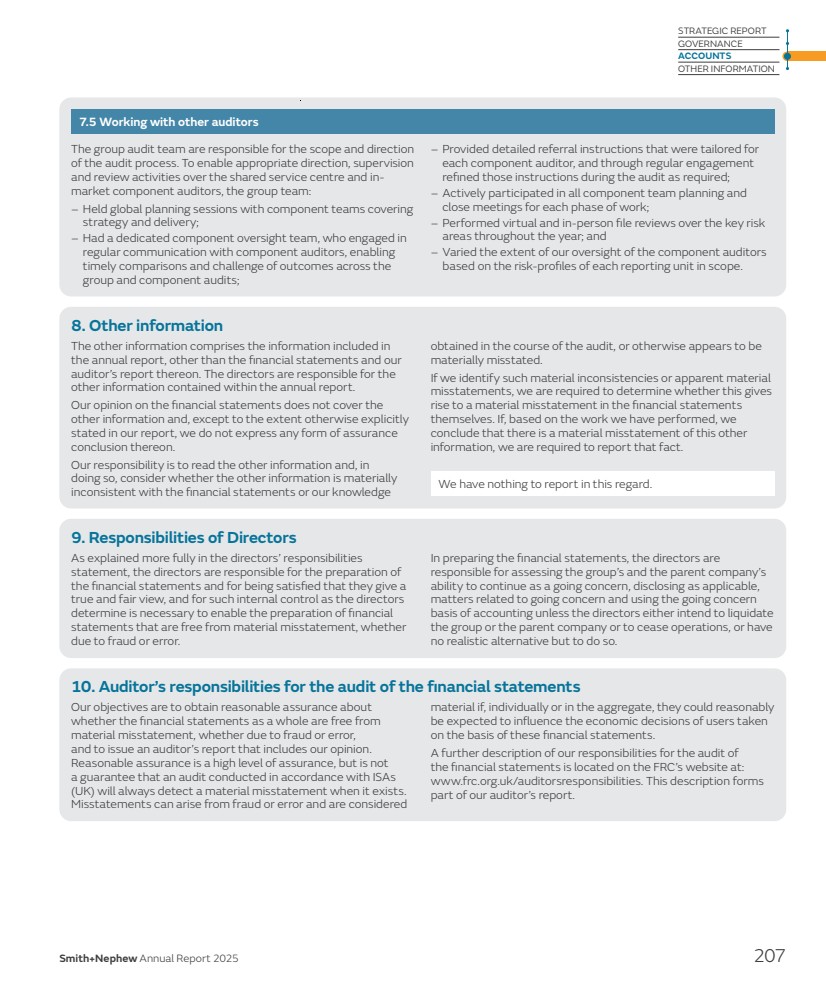
| 11. Extent to which the audit was considered capable of detecting irregularities, including fraud Irregularities, including fraud, are instances of non-compliance with laws and regulations. We design procedures in line with our responsibilities, outlined above, to detect material misstatements in respect of irregularities, including fraud. The extent to which our procedures are capable of detecting irregularities, including fraud is detailed below. 11.1. Identifying and assessing potential risks related to irregularities In identifying and assessing risks of material misstatement in respect of irregularities, including fraud and non-compliance with laws and regulations, we considered the following: – the nature of the industry and sector, control environment and business performance including the design of the group’s remuneration policies, key drivers for directors’ remuneration, bonus levels and performance targets; – the group’s own assessment of the risks that irregularities may occur either as a result of fraud or error that was approved by the Board on 5 February 2026; – results of our enquiries of management, internal audit, the directors and the Audit Committee about their own identification and assessment of the risks of irregularities, including those that are specific to the group’s sector; – any matters we identified having obtained and reviewed the group’s documentation of their policies and procedures relating to: – identifying, evaluating and complying with laws and regulations and whether they were aware of any instances of non-compliance; – detecting and responding to the risks of fraud and whether they have knowledge of any actual, suspected or alleged fraud; – the internal controls established to mitigate risks of fraud or non-compliance with laws and regulations; – the matters discussed among the audit engagement team including component audit teams and relevant internal specialists, including analytics, tax, valuations, impairment, pensions, IT, sustainability, legal actuarial and fraud specialists regarding how and where fraud might occur in the financial statements and any potential indicators of fraud. As a result of these procedures, we considered the opportunities and incentives that may exist within the organisation for fraud and identified the greatest potential for fraud in unusual adjustments to revenue arising outside of the normal course of business. In common with all audits under ISAs (UK), we are also required to perform specific procedures to respond to the risk of management override. We also obtained an understanding of the legal and regulatory frameworks that the group operates in, focusing on provisions of those laws and regulations that had a direct effect on the determination of material amounts and disclosures in the financial statements. The key laws and regulations we considered in this context included the Securities and Exchange Commission rules, Securities Law in the UK and US, the UK Listing Rules, the UK Companies Act, pensions legislation, and tax legislation in the group’s various jurisdictions. In addition, we considered provisions of other laws and regulations that do not have a direct effect on the financial statements but compliance with which may be fundamental to the group’s ability to operate or to avoid a material penalty. These included General Data Protection Requirements, US Foreign Corrupt Practices Act, US Food and Drug Administration Regulation, EU Medical Device Regulation, and the UK Bribery Act. 208 Smith+Nephew Annual Report 2025 Independent auditor’s UK report continued 21_SN_AR25_DRes_Audit_v39.indd 208 05/03/2026 18:20 |
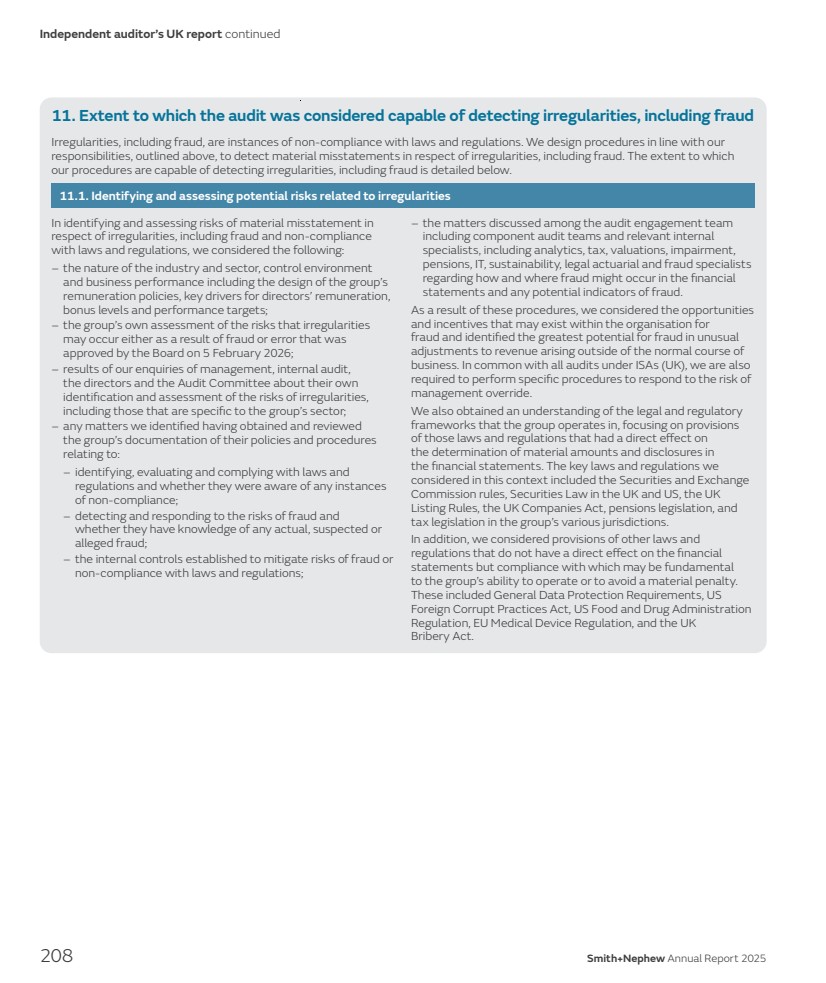
| 11.2. Audit response to risks identified As a result of performing the above, we did not identify any key audit matters related to the potential risk of fraud or non-compliance with laws and regulations. Our procedures to respond to risks identified included the following: – reviewing the financial statement disclosures and testing to supporting documentation to assess compliance with provisions of relevant laws and regulations described as having a direct effect on the financial statements; – enquiring of management, the Audit Committee and in-house and external legal counsel concerning actual and potential litigation and claims; – performing analytical procedures to identify any unusual or unexpected relationships that may indicate risks of material misstatement due to fraud; – reading minutes of meetings of those charged with governance, reviewing internal audit reports and correspondence with regulators; – in addressing the potential risk of fraud in unusual adjustments to revenue arising outside of the normal course of business, we used our data analytics tool to identify whether there were any journal entries both at the entity level and consolidation level that we deemed unusual and for which further testing needed to be performed; and – in addressing the risk of fraud through management override of controls, testing the appropriateness of journal entries and other adjustments; assessing whether the judgements made in making accounting estimates are indicative of a potential bias; and evaluating the business rationale of any significant transactions that are unusual or outside the normal course of business. We also communicated relevant identified laws and regulations and potential fraud risks to all engagement team members including internal specialists and component audit teams, and remained alert to any indications of fraud or non-compliance with laws and regulations throughout the audit. Report on other legal and regulatory requirements 12. Opinions on other matters prescribed by the Companies Act 2006 In our opinion the part of the directors’ remuneration report to be audited has been properly prepared in accordance with the Companies Act 2006. In our opinion, based on the work undertaken in the course of the audit: – the information given in the strategic report and the directors’ report for the financial year for which the financial statements are prepared is consistent with the financial statements; and – the strategic report and the directors’ report have been prepared in accordance with applicable legal requirements. In the light of the knowledge and understanding of the group and the parent company and their environment obtained in the course of the audit, we have not identified any material misstatements in the strategic report or the directors’ report. 13. Corporate Governance Statement The Listing Rules require us to review the directors’ statement in relation to going concern, longer-term viability and that part of the Corporate Governance Statement relating to the group’s compliance with the provisions of the UK Corporate Governance Code specified for our review. Based on the work undertaken as part of our audit, we have concluded that each of the following elements of the Corporate Governance Statement is materially consistent with the financial statements and our knowledge obtained during the audit: – the directors’ statement with regards to the appropriateness of adopting the going concern basis of accounting and any material uncertainties identified set out on page 198; – the directors’ explanation as to its assessment of the group’s prospects, the period this assessment covers and why the period is appropriate set out on page 95; – the directors’ statement on fair, balanced and understandable set out on page 198; – the board’s confirmation that it has carried out a robust assessment of the emerging and principal risks set out on page 95; – the section of the annual report that describes the review of effectiveness of risk management and internal control systems set out on page 81; and – the section describing the work of the Audit Committee set out on page 141. Smith+Nephew Annual Report 2025 209 STRATEGIC REPORT GOVERNANCE ACCOUNTS OTHER INFORMATION 21_SN_AR25_DRes_Audit_v39.indd 209 05/03/2026 18:20 |
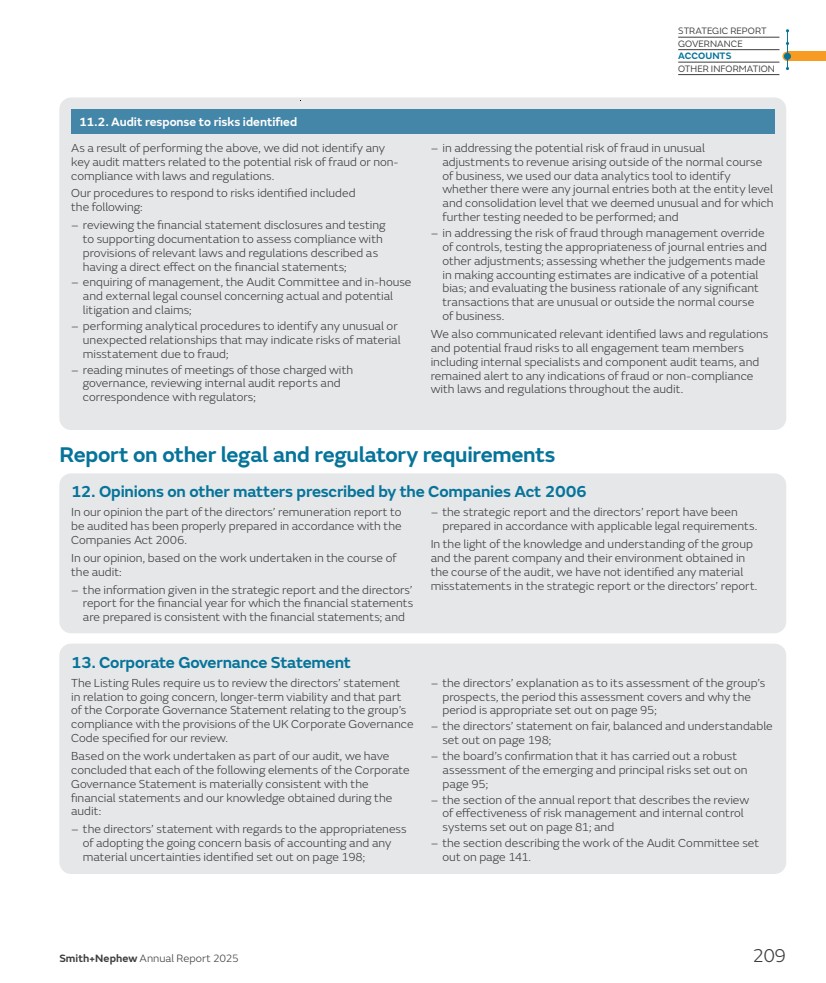
| 14. Matters on which we are required to report by exception 14.1 Adequacy of explanations received and accounting records Under the Companies Act 2006 we are required to report to you if, in our opinion: – we have not received all the information and explanations we require for our audit; or – adequate accounting records have not been kept by the parent company, or returns adequate for our audit have not been received from branches not visited by us; or – the parent company financial statements are not in agreement with the accounting records and returns. We have nothing to report in respect of these matters. 14.2. Directors’ remuneration Under the Companies Act 2006 we are also required to report if in our opinion certain disclosures of directors’ remuneration have not been made or the part of the directors’ remuneration report to be audited is not in agreement with the accounting records and returns. We have nothing to report in respect of these matters. 15. Other matters which we are required to address 15.1. Auditor tenure Following the recommendation of the Audit Committee, we were appointed by the shareholders at the Annual General Meeting on 1 May 2025 to audit the financial statements for the year ending 31 December 2025 and subsequent financial periods. The period of total uninterrupted engagement including reappointments of the firm is 2 years, covering the years ending 31 December 2024 and 31 December 2025. 15.2. Consistency of the audit report with the additional report to the audit committee Our audit opinion is consistent with the additional report to the Audit Committee we are required to provide in accordance with ISAs (UK). 16. Use of our report This report is made solely to the company’s members, as a body, in accordance with Chapter 3 of Part 16 of the Companies Act 2006. Our audit work has been undertaken so that we might state to the company’s members those matters we are required to state to them in an auditor’s report and for no other purpose. To the fullest extent permitted by law, we do not accept or assume responsibility to anyone other than the company and the company’s members as a body, for our audit work, for this report, or for the opinions we have formed. As required by the Financial Conduct Authority (FCA) Disclosure Guidance and Transparency Rule (DTR) 4.1.15R – DTR 4.1.18R, these financial statements will form part of the Electronic Format Annual Financial Report filed on the National Storage Mechanism of the FCA in accordance with DTR 4.1.15R – DTR 4.1.18R. This auditor’s report provides no assurance over whether the Electronic Format Annual Financial Report has been prepared in compliance with DTR 4.1.15R – DTR 4.1.18R. Andrew Bond, FCA (Senior statutory auditor) For and on behalf of Deloitte LLP Statutory Auditor London, United Kingdom 27 February 2026 210 Smith+Nephew Annual Report 2025 Independent auditor’s UK report continued 21_SN_AR25_DRes_Audit_v39.indd 210 05/03/2026 18:20 |
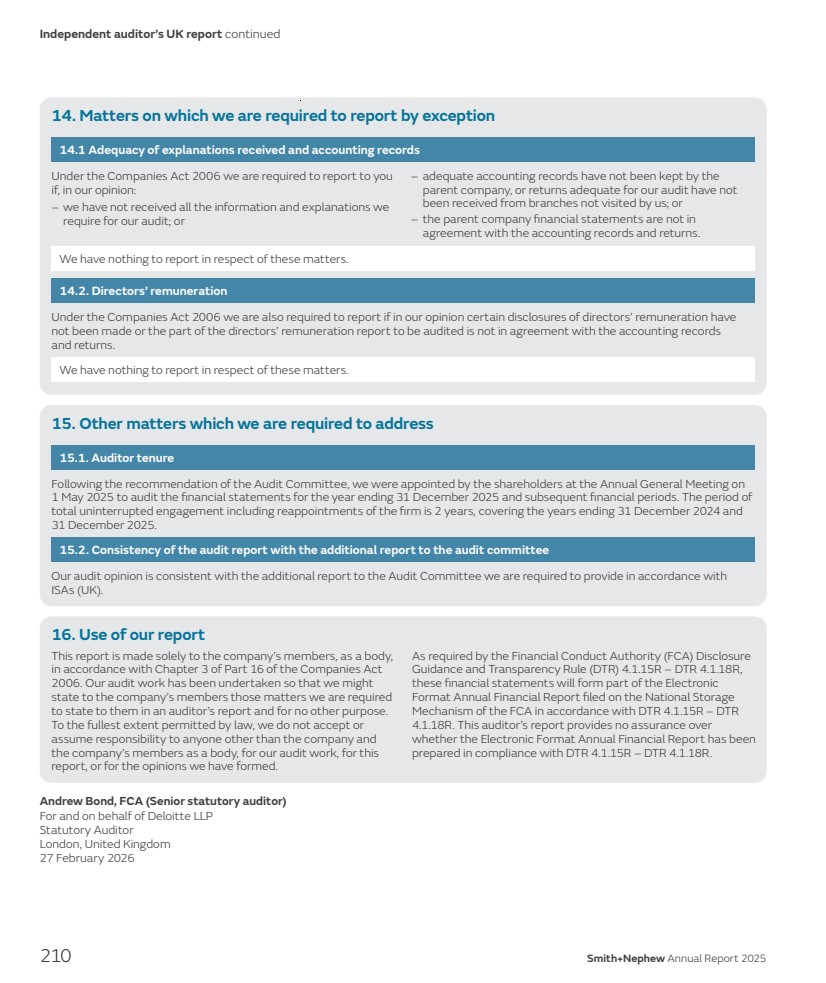
| Group income statement Year ended Year ended Year ended 31 December 31 December 31 December 2025 2024 2023 Notes $ million $ million $ million Attributable profit for the year1 625 412 263 Other comprehensive income: Items that will not be reclassified to income statement Remeasurement of net retirement benefit obligations 18 5 16 (89) Taxation on other comprehensive income 5 (1) (1) 18 Total items that will not be reclassified to income statement 4 15 (71) Items that may be reclassified subsequently to income statement Cash flow hedges – forward foreign exchange contracts Gains arising in the year 13 38 23 Gains recycled to income statement in the year (29) (1) (25) Exchange differences on translation of foreign operations 179 (124) 56 Taxation on other comprehensive income 5 5 (5) – Total items that may be reclassified subsequently to income statement 168 (92) 54 Other comprehensive income/(loss) for the year, net of taxation 172 (77) (17) Total comprehensive income for the year1 797 335 246 1 Attributable to equity holders of the Company and wholly derived from continuing operations. Group statement of comprehensive income The Notes on pages 215–265 are an integral part of these accounts. Year ended Year ended Year ended 31 December 31 December 31 December 2025 2024 2023 Notes $ million $ million $ million Revenue 2 6,164 5,810 5,549 Cost of goods sold (1,972) (1,764) (1,730) Gross profit 4,192 4,046 3,819 Selling, general and administrative expenses 3 (3,102) (3,100) (3,055) Research and development expenses 3 (296) (289) (339) Operating profit 2 & 3 794 657 425 Interest income 4 28 24 34 Interest expense 4 (140) (145) (132) Other finance costs 4 (16) (28) (7) Reversal of impairment charge and Share of results of associates 11 113 (10) (30) Profit before taxation 779 498 290 Taxation 5 (154) (86) (27) Attributable profit for the year1 625 412 263 Earnings per ordinary share1 6 Basic 72.1¢ 47.2¢ 30.2¢ Diluted 71.6¢ 47.0¢ 30.1¢ Smith+Nephew Annual Report 2025 211 STRATEGIC REPORT GOVERNANCE ACCOUNTS Group financial statements OTHER INFORMATION 22_SN_AR25_Fin_Stmts_v81.indd 211 05/03/2026 18:22 |
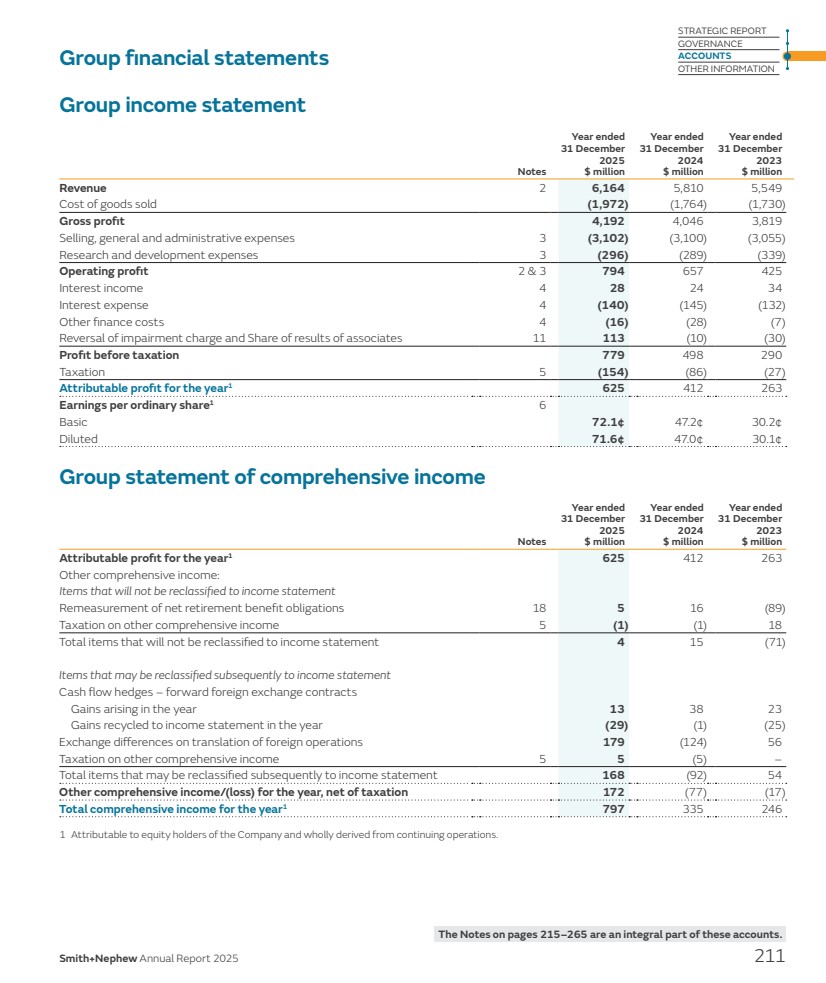
| Group balance sheet At At 31 December 31 December 2025 2024 Notes $ million $ million Assets Non-current assets Property, plant and equipment 7 1,638 1,422 Goodwill 8 3,108 3,026 Intangible assets 9 882 1,032 Investments 10 30 9 Investments in associates 11 121 7 Other non-current assets 13 164 24 Retirement benefit assets 18 64 63 Deferred tax assets 5 347 350 6,354 5,933 Current assets Inventories 12 2,117 2,387 Trade and other receivables 13 1,413 1,381 Current tax receivable 16 34 Cash and cash equivalents 15 557 619 4,103 4,421 Total assets 10,457 10,354 Equity and liabilities Equity attributable to owners of the Company Share capital 19 175 175 Share premium 615 615 Capital redemption reserve 20 20 Treasury shares 19 (515) (66) Other reserves (329) (497) Retained earnings 5,323 5,018 Total equity 5,289 5,265 Non-current liabilities Long-term borrowings and lease liabilities 15 3,177 3,258 Retirement benefit obligations 18 84 79 Other payables 14 190 95 Provisions 17 82 95 Deferred tax liabilities 5 40 31 3,573 3,558 Current liabilities Bank overdrafts, borrowings, loans and lease liabilities 15 150 63 Trade and other payables 14 1,177 1,128 Provisions 17 74 108 Current tax payable 194 232 1,595 1,531 Total liabilities 5,168 5,089 Total equity and liabilities 10,457 10,354 The accounts were approved by the Board and authorised for issue on 27 February 2026 and are signed on its behalf by: Rupert Soames, OBE Deepak Nath, PhD John Rogers Chair Chief Executive Officer Chief Financial Officer The Notes on pages 215–265 are an integral part of these accounts. 212 Smith+Nephew Annual Report 2025 Group financial statements continued 22_SN_AR25_Fin_Stmts_v81.indd 212 05/03/2026 18:22 |

| Group cash flow statement The Notes on pages 215–265 are an integral part of these accounts. Year ended Year ended Year ended 31 December 31 December 31 December 2025 2024 2023 Notes $ million $ million $ million Cash flows from operating activities Profit before taxation 779 498 290 Net interest expense 4 112 121 98 Depreciation, amortisation and impairment 573 645 683 Loss on disposal of property, plant and equipment and intangible assets 23 22 18 Share-based payments expense (equity-settled) 22 43 40 39 Share of results of associates 11 (113) 10 30 Pension costs less cash paid 5 16 3 Decrease/(increase) in inventories 208 (42) (178) Increase in trade and other receivables (175) (81) (49) Increase/(decrease) in trade and other payables and provisions 94 16 (105) Cash generated from operations 1,549 1,245 829 Interest received 25 22 8 Interest paid (142) (140) (104) Income taxes paid (147) (140) (125) Net cash inflow from operating activities 1,285 987 608 Cash flows from investing activities Acquisitions, net of cash acquired 21 (9) (186) (21) Capital expenditure (433) (381) (427) Purchase of investments (2) (1) – Proceeds from disposal of property, plant and equipment 38 – – Investment in associate 11 – (1) – Net cash used in investing activities (406) (569) (448) Cash flows from financing activities Purchase of own shares 20 (502) – – Proceeds from own shares 20 12 1 – Payment of capital element of lease liabilities 20 (50) (55) (52) Proceeds from borrowings due within one year 20 43 – 326 Settlement of borrowings due within one year 20 (39) (705) (151) Proceeds from borrowings due after one year 20 – 1,000 – Settlement of borrowings due after one year 20 (90) – – Settlement of currency swaps 20 1 – 4 Equity dividends paid 19 (330) (327) (327) Net cash used in financing activities (955) (86) (200) Net (decrease)/increase in cash and cash equivalents (76) 332 (40) Cash and cash equivalents at beginning of year 20 617 300 344 Exchange adjustments 20 12 (15) (4) Cash and cash equivalents at end of year1 553 617 300 1 Cash and cash equivalents is net of bank overdrafts of $4m (2024: $2m, 2023: $2m). Smith+Nephew Annual Report 2025 213 STRATEGIC REPORT GOVERNANCE ACCOUNTS OTHER INFORMATION 22_SN_AR25_Fin_Stmts_v81.indd 213 05/03/2026 18:22 |
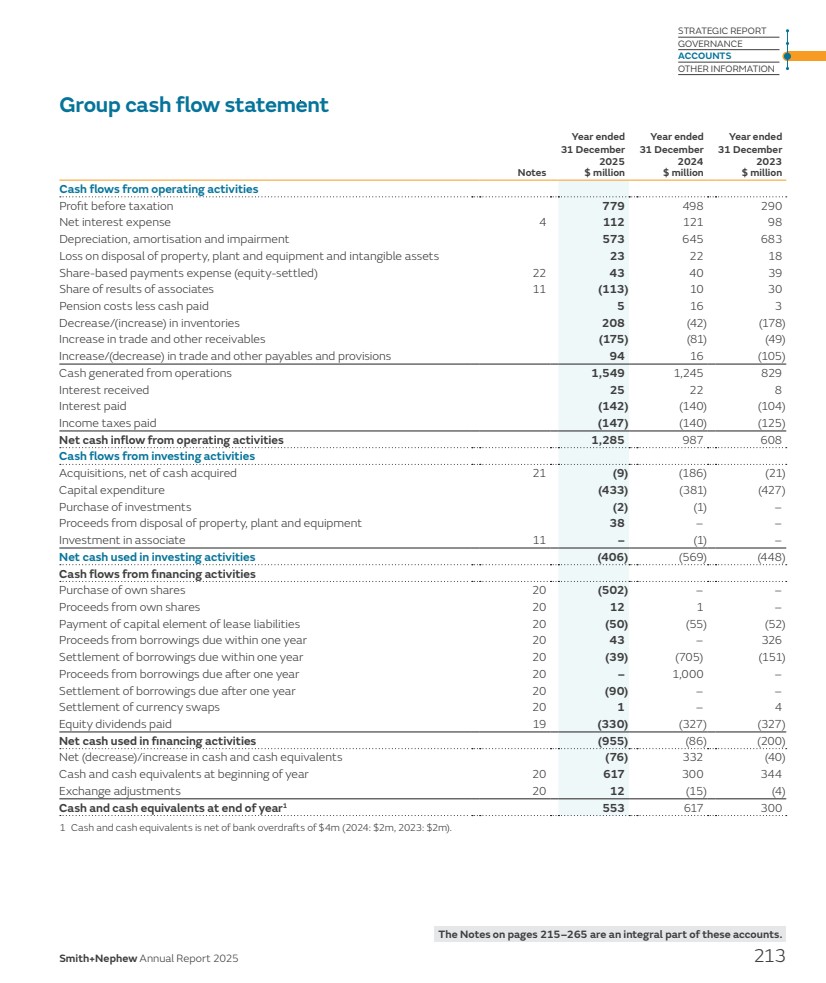
| Group statement of changes in equity The Notes on pages 215–265 are an integral part of these accounts. Capital Share Share redemption Treasury Other Retained Total capital premium reserve shares2 reserves3 earnings4 equity $ million $ million $ million $ million $ million $ million $ million At 31 December 2022 175 615 20 (118) (459) 5,026 5,259 Attributable profit for the year1 – – – – – 263 263 Other comprehensive income – – – – 54 (71) (17) Total comprehensive income – – – – 54 192 246 Equity dividends declared and paid – – – – – (327) (327) Share-based payments recognised – – – – – 39 39 Cost of shares transferred to beneficiaries – – – 24 – (24) – At 31 December 2023 175 615 20 (94) (405) 4,906 5,217 Attributable profit for the year1 – – – – – 412 412 Other comprehensive income – – – – (92) 15 (77) Total comprehensive income – – – – (92) 427 335 Equity dividends declared and paid – – – – – (327) (327) Share-based payments recognised – – – – – 40 40 Taxation on share-based payments – – – – – (1) (1) Cost of shares transferred to beneficiaries – – – 28 – (27) 1 At 31 December 2024 175 615 20 (66) (497) 5,018 5,265 Attributable profit for the year1 – – – – – 625 625 Other comprehensive income – – – – 168 4 172 Total comprehensive income – – – – 168 629 797 Equity dividends declared and paid – – – – – (330) (330) Share-based payments recognised – – – – – 43 43 Taxation on share-based payments – – – – – 4 4 Purchase of own shares – – – (502) – – (502) Cost of shares transferred to beneficiaries – – – 53 – (41) 12 At 31 December 2025 175 615 20 (515) (329) 5,323 5,289 1 Attributable to equity holders of the Company and wholly derived from continuing operations. 2 Refer to Note 19.2 for further information. 3 Other reserves comprises gains and losses on cash flow hedges, foreign exchange differences on translation of foreign operations and net changes on fair value of trade investments. The cumulative translation loss within other reserves at 31 December 2025 was $341m (2024: $520m, 2023: $396m). 4 Within retained earnings is a non-distributable capital reserve of $2,266m (2024: $2,266m, 2023: $2,266m) that arose as a result of the Group’s reorganisation in 2008. 5 Issue of ordinary share capital in connection with the Group’s share incentive plans. 214 Smith+Nephew Annual Report 2025 Group financial statements continued 22_SN_AR25_Fin_Stmts_v81.indd 214 05/03/2026 18:22 |

| 1 Basis of preparation Smith & Nephew plc (the “Company”) is a public limited company incorporated in England and Wales. In these accounts, the ‘Group’ means the Company and all its subsidiaries. The principal activities of the Group are to develop, manufacture, market and sell medical devices and services. The Group has prepared its accounts in accordance with UK-adopted International Accounting Standards. The Group has also prepared its accounts in accordance with IFRS Accounting Standards as issued by the International Accounting Standards Board (IASB) effective as at 31 December 2025. IFRS as adopted in the UK differs in certain respects from IFRS Accounting Standards as issued by the IASB. However, the differences have no impact for the periods presented. The preparation of accounts in conformity with IFRS requires management to use estimates and assumptions that affect the reported amounts of assets and liabilities and disclosure of contingent assets and liabilities at the date of the accounts and the reported amounts of revenues and expenses during the year. Material accounting policies, including those requiring management to use estimates and assumptions, are disclosed in Notes 1-23 of the Notes to the Group accounts. Although these estimates are based on management’s best knowledge of current events and actions, actual results ultimately may differ from those estimates. Estimates and underlying assumptions are reviewed on an ongoing basis. Revisions to estimates are recognised prospectively. The uncertainties as to the future impact on the financial performance and cash flows of the Group as a result of the current economic environment have been considered as part of the Group’s adoption of the going concern basis in these financial statements, in which context, the Directors reviewed cash flow forecasts prepared for a period of at least 12 months from the date of approval of these financial statements. Having carefully reviewed those forecasts, the Directors concluded that it was appropriate to adopt the going concern basis of accounting in preparing these financial statements for the reasons set out below. The Group had access to $553m of cash and cash equivalents (net of bank overdrafts) at 31 December 2025. The Group’s net debt, excluding lease liabilities, at 31 December 2025 was $2,543m with access to committed facilities of $4.1bn with an average maturity of 4.7 years. At the date of approving these financial statements the funding position of the Group has remained materially unchanged following the upfront payment of $225m for the acquisition of Integrity Orthopaedics, the repayment of $75m of maturing private placement debt, and an increase of the Revolving Credit Facility by $125m to $1.125bn. $625m of private placement debt is subject to financial covenants. The principal covenant on the private placement debt is a leverage ratio of <3.5, which is measured on a rolling 12-month basis at half year and year end. There are no financial covenants in any of the Group’s other facilities. The Directors have considered various scenarios in assessing the impact of the economic environment on future financial performance and cash flows, including the impact of a significant global economic downturn, leading to lower healthcare spending across both public and private systems. Throughout these scenarios, which include a severe, but plausible outcome, the Group continues to have headroom on its borrowing facilities and financial covenants. The Directors have a reasonable expectation that the Company and the Group are well placed to manage their business risks, have sufficient funds to continue to meet their liabilities as they fall due and to continue in operational existence for a period of at least 12 months from the date of the approval of these financial statements. The financial statements have therefore been prepared on a going concern basis. Accordingly, the Directors continue to adopt the going concern basis (in accordance with the guidance ‘Guidance on the Going Concern Basis of Accounting and Related Reporting (including Solvency and Liquidity Risks) ’ issued by the FRC) in preparing these financial statements. New accounting standards effective 2025 A number of new amendments to standards are effective from 1 January 2025, but they do not have a material effect on the Group’s financial statements. Accounting standards issued, but not yet effective A number of new standards and amendments to standards are effective for annual periods beginning on or after 1 January 2026 and earlier application is permitted; however, the Group has not adopted them early in preparing these financial statements. IFRS 18 Presentation and Disclosure in Financial Statements was issued by the IASB in April 2024. The standard is effective for annual reporting periods beginning on or after 1 January 2027, and also applies to comparative information. IFRS 18 will replace IAS 1 Presentation of Financial Statements and will have a pervasive impact on several aspects of financial statements presentation and disclosure, particularly in the Group income statement and disclosure requirements for management-defined performance measures (MPMs) within the financial statements. Smith+Nephew Annual Report 2025 215 STRATEGIC REPORT GOVERNANCE ACCOUNTS Notes to the Group accounts OTHER INFORMATION 23_SN_AR25_Note_1_14_v217.indd 215 05/03/2026 18:23 |
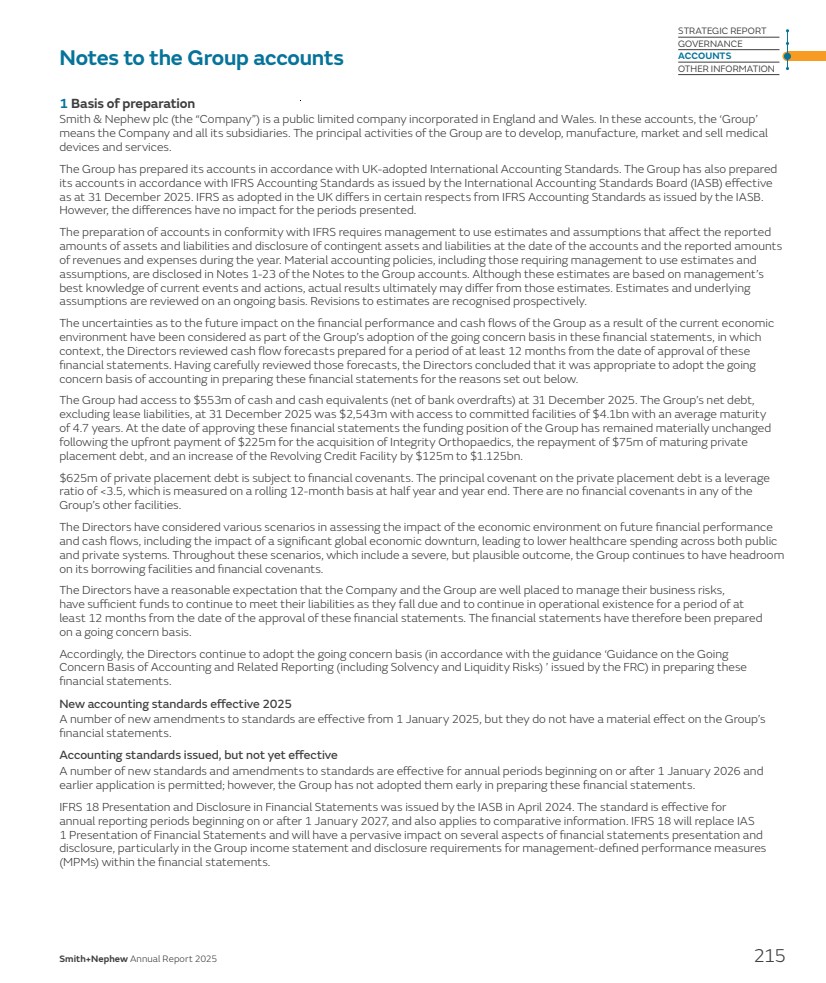
| 1 Basis of preparation continued The Group has commenced an assessment of the standard’s full impact. Based on the preliminary analysis, the Group anticipates that the standard will have the following potential impacts: – The classification of items of income and expense into categories defined in IFRS 18 will impact the presentation of the Group income statement. Whilst the standard does not impact recognition or measurement, changes in classification will impact the reported amounts for line items in the income statement. A new subtotal ‘Profit before financing and income tax’ will be included to separately present the impact of investing and financing activities. Share of results of associates will be classified in the investing category, interest income and expense in the financing category and other finance costs will be classified in the operating, investing or financing category depending on the nature of the income or expense. – The Group is reassessing its aggregation and disaggregation principles to ensure they comply with the enhanced guidance in IFRS 18, which aims to provide more detailed and useful information to users of the financial statements. – Mandatory new disclosures in relation to MPMs will be required within the financial statements. – Consequential presentational changes to statement of cash flows will be required and operating profit will be the new starting point for reconciling cash flows from operating activities. The Group will apply IFRS 18 from its mandatory effective date of 1 January 2027. Comparative information for the financial years ending 31 December 2026 and 31 December 2025 will be restated in accordance with IFRS 18. 1.1 Consolidation The Group accounts include the accounts of Smith & Nephew plc and its subsidiaries for the periods during which they were members of the Group. Subsidiaries are entities controlled by the Group. The Group controls an entity when it is exposed to, or has rights to, variable returns from its involvement with the entity and has the ability to affect those returns through its power over the entity. Subsidiaries are consolidated in the Group accounts from the date that the Group obtains control and continue to be consolidated until the date that such control ceases. Intra-group balances and transactions, and any unrealised income and expenses arising from intra-group transactions, are eliminated on consolidation. All subsidiaries have year ends that are coterminous with the Group’s, with the exception of jurisdictions whereby a different year end is required by local legislation. When the Group loses control over a subsidiary, it derecognises the assets and liabilities of the subsidiary and any related components of equity. Any resulting gain or loss is recognised in profit or loss. Any retained interest in the former subsidiary is measured at fair value. 1.2 Critical judgements and estimates The Group prepares its consolidated financial statements in accordance with IFRS Accounting Standards as issued by the IASB and IFRS adopted in the UK, the application of which often requires judgements and estimates to be made by management when formulating the Group’s financial position and results. Under IFRS, the Directors are required to adopt those accounting policies most appropriate to the Group’s circumstances for the purpose of presenting fairly the Group’s financial position, financial performance and cash flows. Management regularly reviews, and revises as necessary, the accounting judgements that significantly impact the amounts recognised in the financial statements and the estimates that are considered to be critical estimates due to their potential to give rise to material adjustments in the Group’s financial statements in the next financial year. The Group has determined that there are no critical accounting judgements and no key sources of estimation uncertainty that have a significant risk of resulting in a material adjustment to the carrying amounts of assets and liabilities within the next financial year. The Group’s accounting policies are set out in Notes 1–23 of the Notes to the Group accounts. Management has considered the impact of the uncertainties around the current economic environment below. 1.3 Climate change considerations The impact of climate change has been considered as part of the assessment of estimates and judgements in preparing the Group accounts, particularly in the context of the risks identified in the TCFD disclosures on pages 69 to 72. The climate change scenario analyses undertaken this year in line with TCFD recommendations did not identify any material financial impact. The following considerations were made in respect of the financial statements: – The impact of climate change on the going concern assessment and the viability of the Group over the next three years. – The impact of climate change on the cash flow forecasts used in the impairment assessments of non-current assets, including goodwill. – The impact of climate change on the carrying value and useful economic lives of property, plant and equipment. While there is currently no material medium-term impact expected, the Group closely monitors climate-related risks given the changing nature of these risks and management consider the impact of climate change as part of the decision making process and continue to assess the impact on judgements and estimates, and on preparation of the consolidated financial statements. 216 Smith+Nephew Annual Report 2025 Notes to the Group accounts continued Group financial statements continued 23_SN_AR25_Note_1_14_v217.indd 216 05/03/2026 18:23 |
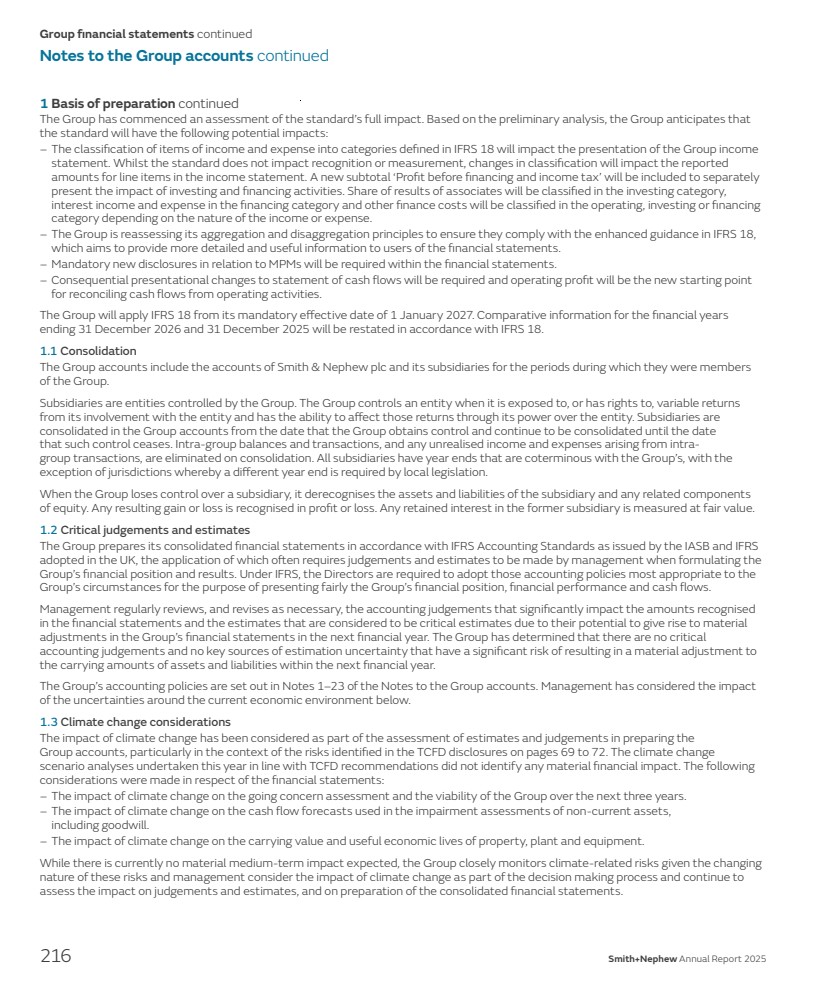
| 1.4 Foreign currencies Functional and presentation currency The Group accounts are presented in US Dollars. The Company’s functional currency is US Dollars. Foreign currency transactions Transactions in foreign currencies are translated to the respective functional currencies of Group companies at exchange rates at the dates of the transactions. Monetary assets and liabilities denominated in foreign currencies are retranslated to the functional currency at the exchange rate as at the reporting date. Non-monetary items are not retranslated. Foreign operations Balance sheet items of foreign operations, including goodwill and fair value adjustments arising on acquisition, are translated into US Dollars on consolidation at the exchange rates at the reporting date. Income statement items and the cash flows of foreign operations are translated at average rates as an approximation to actual transaction rates, with actual transaction rates used for large one-off transactions. Foreign currency differences are recognised in ‘Other comprehensive income’ and accumulated in ‘Other reserves’ within equity. These include: exchange differences on the translation at closing rates of exchange of non-US Dollar opening net assets; the differences arising between the translation of profits into US Dollars at actual (or average, as an approximation) and closing exchange rates; to the extent that the hedging relationship is effective, the difference on translation of foreign currency borrowings or swaps that are used to finance or hedge the Group’s net investments in foreign operations; and the movement in the fair value of forward foreign exchange contracts used to hedge forecast foreign exchange cash flows. The exchange rates used for the translation of currencies into US Dollars that have the most significant impact on the Group results were: 2025 2024 2023 Average rates Sterling 1.32 1.28 1.24 Euro 1.13 1.08 1.08 Swiss Franc 1.20 1.14 1.11 Japanese Yen 0.0067 0.0066 0.0071 Year end rates Sterling 1.35 1.25 1.27 Euro 1.17 1.04 1.10 Swiss Franc 1.26 1.10 1.19 Japanese Yen 0.0064 0.0064 0.0071 2 Business segment information The Group’s operating structure is organised around four global business units (Orthopaedics, Sports Medicine, ENT and Advanced Wound Management) and the chief operating decision maker monitors performance, makes operating decisions and allocates resources on a global business unit basis. Business unit presidents have responsibility for upstream marketing, driving product portfolio and technology acquisition decisions, full commercial responsibility and for the implementation of their business unit strategy globally. Accordingly, the Group consists of four operating segments. The Group has concluded that Sports Medicine and ENT meet the aggregation criteria and therefore, these operating segments have been aggregated into a single operating segment. In applying the aggregation criteria prescribed by IFRS 8 Operating Segments, management made certain judgements pertaining to the economic indicators relating to these operating segments, including those relating to the similarities in the expected long-term market growth rates, the geographic and operational risks and the competitive landscape that these segments operate in. Therefore, in accordance with IFRS 8, the Group has three operating segments which are also reportable segments. The Executive Committee (‘ExCo’) comprises the Chief Financial Officer (‘CFO’), the business unit presidents and certain heads of function, and is chaired by the Chief Executive Officer (‘CEO’). ExCo is the body through which the CEO uses the authority delegated to him by the Board of Directors to manage the operations and performance of the Group. All significant operating decisions regarding the allocation and prioritisation of the Group’s resources and assessment of the Group’s performance are made by ExCo, and while the members have individual responsibility for the implementation of decisions within their respective areas, it is at the ExCo level that these decisions are made. Accordingly, ExCo is considered to be the Group’s chief operating decision maker as defined by IFRS 8 Operating Segments. Smith+Nephew Annual Report 2025 217 STRATEGIC REPORT GOVERNANCE ACCOUNTS OTHER INFORMATION 23_SN_AR25_Note_1_14_v217.indd 217 05/03/2026 18:23 |

| 2 Business segment information continued In making decisions about the prioritisation and allocation of the Group’s resources, ExCo reviews financial information for the business units and determines the best allocation of resources to the business units. This information is prepared substantially on the same basis as the Group’s IFRS financial statements aside from the adjustments described in Note 2.2. In 2024, the Group changed the segment trading profit measure presented to the ExCo by allocating directly attributable corporate costs to business units. Financial information for corporate costs relating to centralised infrastructure costs, such as compliance and group functions, is presented on a Group-wide basis. The ExCo is not provided with total assets and liabilities by segment, and therefore these measures are not included in the disclosures below. The results of the segments are shown below. 2.1 Revenue by business segment and geography Accounting policy Revenue is recognised as the performance obligations to deliver products or services are satisfied and is recorded based on the amount of consideration expected to be received in exchange for satisfying the performance obligations. Revenue is recognised primarily when control is transferred to the customer, which is generally when the goods are shipped or delivered in accordance with the contract terms, with some transfer of services taking place over time. Substantially all performance obligations are fulfilled within one year. There is no significant revenue associated with the provision of services. Payment terms to our customers are based on commercially reasonable terms for the respective markets while also considering a customer’s credit rating. Appropriate provisions for returns, trade discounts and rebates are deducted from revenue. Sales returns are estimated based on historical sales and returns information. These estimates are reviewed regularly and adjusted as necessary. The Group maintains an estimated refund liability based upon the expected value method that is recorded as a reduction in revenue. Rebates primarily comprise chargebacks and other discounts granted to certain customers. Chargebacks are discounts that occur when a third-party purchases products from a wholesaler at its agreed price plus a mark-up. The wholesaler in turn charges the Group for the difference between the price initially paid by the wholesaler and the agreed price. The provision for chargebacks is based on expected sell-through levels by the Group’s wholesalers to such customers, as well as estimated wholesaler inventory levels. The Group is applying the practical expedient in IFRS15.121 not to disclose the aggregate amount of the transaction price allocated to performance obligations that are unsatisfied at the end of the reporting period as substantially all performance obligations are fulfilled within one year. Orthopaedics and Sports Medicine & ENT (Ear, Nose & Throat) Orthopaedics and Sports Medicine & ENT consists of the following businesses: Knee Implants, Hip Implants, Other Reconstruction, Trauma & Extremities, Sports Medicine Joint Repair, Arthroscopic Enabling Technologies and ENT. Sales of inventory located at customer premises and available for customers’ immediate use are recognised when notification is received that the product has been implanted or used. Substantially all other revenue is recognised when control is transferred to the customer, which is generally when the goods are shipped or delivered in accordance with the contract terms. Revenue is recognised for the amount of consideration expected to be received in exchange for transferring the products or services. In general, our business in Established Markets is direct to hospitals and Ambulatory Surgery Centers, whereas in the Emerging Markets we generally sell through distributors. Advanced Wound Management Advanced Wound Management consists of the following businesses: Advanced Wound Care, Advanced Wound Bioactives and Advanced Wound Devices. Substantially all revenue is recognised when control is transferred to the customer, which is generally when the goods are shipped or delivered in accordance with the contract terms. Revenue is recognised for the amount of consideration expected to be received in exchange for transferring the products or services. Appropriate provisions for returns, trade discounts and rebates are deducted from revenue, as explained above. The majority of our Advanced Wound Management business, and in particular products used in community and homecare facilities, is through wholesalers and distributors. When control is transferred to a wholesaler or distributor, revenue is recognised accordingly. The proportion of sales direct to hospitals is higher in our Advanced Wound Devices business in Established Markets. Segment revenue reconciles to statutory revenues from continuing operations as follows: 2025 2024 2023 $ million $ million $ million Reportable segment revenue Orthopaedics 2,437 2,305 2,214 Sports Medicine & ENT 1,934 1,824 1,729 Advanced Wound Management 1,793 1,681 1,606 Revenue from external customers 6,164 5,810 5,549 218 Smith+Nephew Annual Report 2025 Notes to the Group accounts continued Group financial statements continued 23_SN_AR25_Note_1_14_v217.indd 218 05/03/2026 18:23 |

| Disaggregation of revenue: The following table shows the disaggregation of Group revenue by product by and business unit: 2025 20241 2023 $ million $ million $ million Revenue by product from continuing operations Knee Implants 1,011 977 940 Hip Implants 641 619 599 Other Reconstruction 136 101 111 Trauma & Extremities 649 608 564 Orthopaedics 2,437 2,305 2,214 Sports Medicine Joint Repair 1,067 982 945 Arthroscopic Enabling Technologies 647 632 588 ENT (Ear, Nose and Throat) 220 210 196 Sports Medicine & ENT 1,934 1,824 1,729 Advanced Wound Care 766 735 725 Advanced Wound Bioactives 621 581 553 Advanced Wound Devices 406 365 328 Advanced Wound Management 1,793 1,681 1,606 Consolidated revenue from continuing operations 6,164 5,810 5,549 1 Robotics consumables revenue has been reclassified from Other Reconstruction to Knee and Hip implants. The following table shows the disaggregation of Group revenue by geographic market and product category. The disaggregation of revenue into the two product categories below reflects that in general the products in the Advanced Wound Management business unit are sold to wholesalers and intermediaries, while products in the other business units are sold directly to hospitals, Ambulatory Surgery Centers and distributors. The further disaggregation of revenue by Established Markets and Emerging Markets reflects that in general our products are sold through distributors and intermediaries in the Emerging Markets while in the Established Markets, with the exception of the Advanced Wound Care and Bioactives products, which are in general sold direct to hospitals and Ambulatory Surgery Centers. The disaggregation by Established Markets and Emerging Markets also reflects their differing economic factors, including volatility in growth and outlook. 2025 2024 2023 Established Markets1 Emerging Markets Total Established Markets1 Emerging Markets Total Established Markets1 Emerging Markets Total $ million $ million $ million $ million $ million $ million $ million $ million $ million Orthopaedics, Sports Medicine & ENT 3,606 764 4,370 3,366 763 4,129 3,184 759 3,943 Advanced Wound Management 1,555 239 1,794 1,464 217 1,681 1,406 200 1,606 Total 5,161 1,003 6,164 4,830 980 5,810 4,590 959 5,549 1 Established Markets comprises the US, Australia, Canada, Europe, Japan and New Zealand. Sales are attributed to the country of destination. US revenue for 2025 was $3,306m (2024: $3,123m, 2023: $2,979m), UK revenue for 2025 was $246m (2024: $226m, 2023: $201m) and China revenue for 2025 was $128m (2024: $210m, 2023: $275m). Contract assets and liabilities The nature of our products and services do not generally give rise to contract assets as we do not typically incur costs to fulfil a contract before a product or service is provided to the customer. The Group generally satisfies performance obligations within one year from the contract inception date. There was no material revenue recognised in the current reporting period that related to carried-forward contract liabilities (deferred income) or performance obligations satisfied in the previous year. There is no material revenue that is likely to arise in future periods from unsatisfied performance obligations at the balance sheet date. Therefore, there are no associated significant accrued income and deferred income balances at 31 December 2025. The Group does not have any material contract assets and contract liabilities comprise rebates. The accrual for rebates at 31 December 2025 was $114m (2024: $106m) with $405m being recognised in revenue in 2025 (2024: $412m). Major customers No single customer generates revenue greater than 10% of the consolidated revenue. Smith+Nephew Annual Report 2025 219 STRATEGIC REPORT GOVERNANCE ACCOUNTS OTHER INFORMATION 23_SN_AR25_Note_1_14_v217.indd 219 05/03/2026 18:23 |
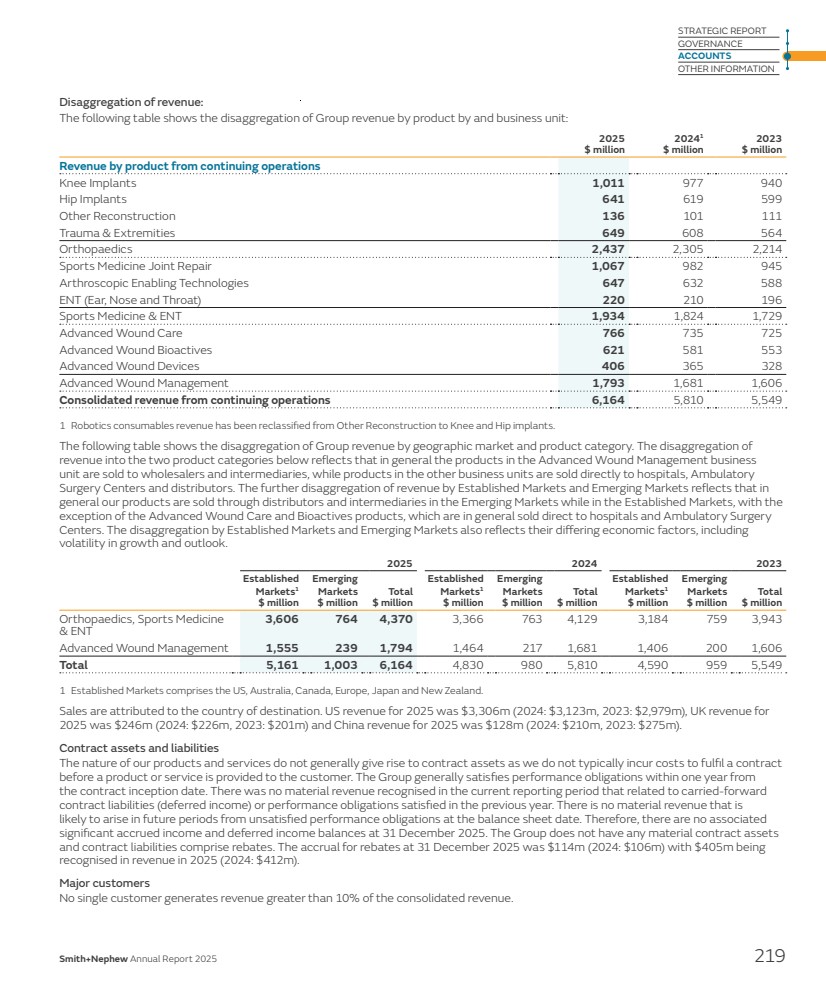
| 2 Business segment information continued 2.2 Trading profit by business segment The segment profit measure presented to the ExCo is the segment trading profit. The Group has identified the following items, where material, as those to be excluded from operating profit when arriving at segment trading profit: corporate costs; acquisition and disposal-related items; significant restructuring programmes; amortisation and impairment of acquisition intangibles; gains and losses arising from legal disputes; and other significant items. Further detail is provided below and in Notes 2.3, 2.4, 2.5 and 2.6. In 2024, the Group changed the segment trading profit measure presented to the ExCo by allocating directly attributable corporate costs to business units except for corporate costs relating to centralised infrastructure costs, such as compliance and group functions. Accordingly, 2023 operating segment results have been restated for comparative purposes. Segment trading profit is reconciled to the statutory measure below: 2025 2024 2023 $ million $ million $ million Segment profit Orthopaedics 363 265 251 Sports Medicine & ENT 461 437 394 Advanced Wound Management 447 399 372 Segment trading profit 1,271 1,101 1,017 Corporate costs1 (60) (52) (47) Acquisition and disposal-related items2 (32) (94) (60) Restructuring and rationalisation expenses (47) (123) (220) Amortisation and impairment of acquisition intangibles2 (176) (187) (207) Legal and other2 (162) 12 (58) Operating profit 794 657 425 Interest income 28 24 34 Interest expense (140) (145) (132) Other finance costs (16) (28) (7) Share of results of associates 113 (10) (30) Profit before taxation 779 498 290 1 Corporate costs include centralised infrastructure costs, such as compliance and group functions. 2 During 2025, the Group undertook a strategic review of its inventory portfolio and determined that certain product ranges would be phased out and simplified. As a result, the Group recognised an excess and obsolescence charge of $159m within legal and other items. During 2024, the Group announced its intention to close the Warwick manufacturing site that manufactures Birmingham Hip Resurfacing (BHR) products. As a result, a total of $68m of BHR assets and liabilities were written off, which mainly includes goodwill of $63m (included in acquisition and disposal-related items). During 2023, management evaluated the commercial viability of Engage products and concluded that they should be discontinued. A total of $109m of Engage’s assets and liabilities were written off as a result of this action, which includes goodwill of $84m (included in acquisition and disposal-related items), intangible assets of $37m (included in amortisation and impairment of acquisition intangibles), inventory of $21m (included in legal and other), partially offset by remeasurement of contingent consideration of $33m (included in acquisition and disposal-related items). Depreciation and amortisation included in the segment profit is presented below: 2025 2024 2023 $ million $ million $ million Depreciation and amortisation Orthopaedics 227 213 194 Sports Medicine & ENT 105 98 97 Advanced Wound Management 69 62 56 2.3 Acquisition and disposal-related items For the year ended 31 December 2025, costs primarily relate to charge relating to integration costs for prior year acquisitions and disposal of certain products. For the year ended 31 December 2024, costs primarily relate to impairment of BHR goodwill, disposal of certain products and integration costs relating to CartiHeal. For the year ended 31 December 2023, costs primarily relate to the acquisition of CartiHeal and impairment of Engage goodwill, partially offset by credits relating to remeasurement of deferred and contingent consideration for prior year acquisitions. 220 Smith+Nephew Annual Report 2025 Notes to the Group accounts continued Group financial statements continued 23_SN_AR25_Note_1_14_v217.indd 220 05/03/2026 18:23 |

| 2.4 Restructuring and rationalisation costs For the year ended 31 December 2025, 2024 and 2023, these costs include efficiency and productivity elements of the 12-Point Plan and the Operations and Commercial Excellence programme. These costs primarily consist of severance, business advisory services, asset write-offs, contractual terminations and integration and dual running costs. 2.5 Amortisation and impairment of acquisition intangibles For the years ended 31 December 2025, 2024 and 2023, these costs relate to the amortisation and impairment of intangible assets acquired in material business combinations. 2.6 Legal and other For the year ended 31 December 2025, the charge mainly relates to a $159m increase in the excess and obsolescence provision arising from the Group’s portfolio simplification initiatives introduced under the 12-Point Plan and further developed in 2025 through the Ortho360 operating model and new RISE strategy. These actions include the planned discontinuation and simplification of certain product ranges which will reduce the need for inventory and capital employed in the business, provide a simpler and more efficient offer to our customers, and will also allow us to focus on migrating them to our latest technology products. Legal and other also includes $9m reduction in the provision for ongoing metal-on-metal hip claims as a result of a decrease in the present value of the estimated costs to resolve all known and anticipated metal-on-metal hip claims, fully offset by legal expenses of $10m for ongoing metal-on-metal hip claims. For the year ended 31 December 2024, the credit mainly relates to a $28m reduction in the provision for ongoing metal-on-metal hip claims as a result of a decrease in the present value of the estimated costs to resolve all known and anticipated metal-on-metal hip claims, partially offset by legal expenses for ongoing metal-on-metal hip claims. For the year ended 31 December 2023, charges primarily relate to legal expenses for ongoing metal-on-metal hip claims partially offset by a decrease of $8m in the provision that reflects the decrease in the present value of the estimated costs to resolve all other known and anticipated metal-on-metal hip claims and by the release of a provision for an intellectual property dispute. The years ended 31 December 2024 and 2023 also include costs for implementing the requirements of the EU Medical Device Regulation which came into effect in May 2021 with a transition period to May 2024. 2.7 Non-current assets by geography The following table presents the non-current assets of the Group based on their location: 2025 2024 2023 $ million $ million $ million United Kingdom 608 465 525 United States of America 3,426 3,517 3,692 Other 1,909 1,538 1,397 Total non-current assets of the consolidated Group1 5,943 5,520 5,614 1 Non-current assets exclude retirement benefit assets and deferred tax assets. 3 Operating profit Accounting policy Research and development Research expenditure is expensed as incurred. Internal development expenditure is only capitalised if the recognition criteria in IAS 38 Intangible Assets have been satisfied. The Group considers that the regulatory, technical and market uncertainties inherent in the development of new products mean that in most cases development costs should not be capitalised as intangible assets until products receive approval from the appropriate regulatory body. Payments to third parties for research and development projects are accounted for based on the substance of the arrangement. If the arrangement represents outsourced research and development activities the payments are generally expensed except in limited circumstances where the respective development expenditure would be capitalised under the principles established in IAS 38. By contrast, the payments are capitalised if the arrangement represents consideration for the acquisition of intellectual property developed at the risk of the third party. Capitalised development expenditures are amortised on a straight-line basis over their useful economic lives from product launch. Advertising costs Advertising costs are expensed as incurred. Smith+Nephew Annual Report 2025 221 STRATEGIC REPORT GOVERNANCE ACCOUNTS OTHER INFORMATION 23_SN_AR25_Note_1_14_v217.indd 221 05/03/2026 18:23 |
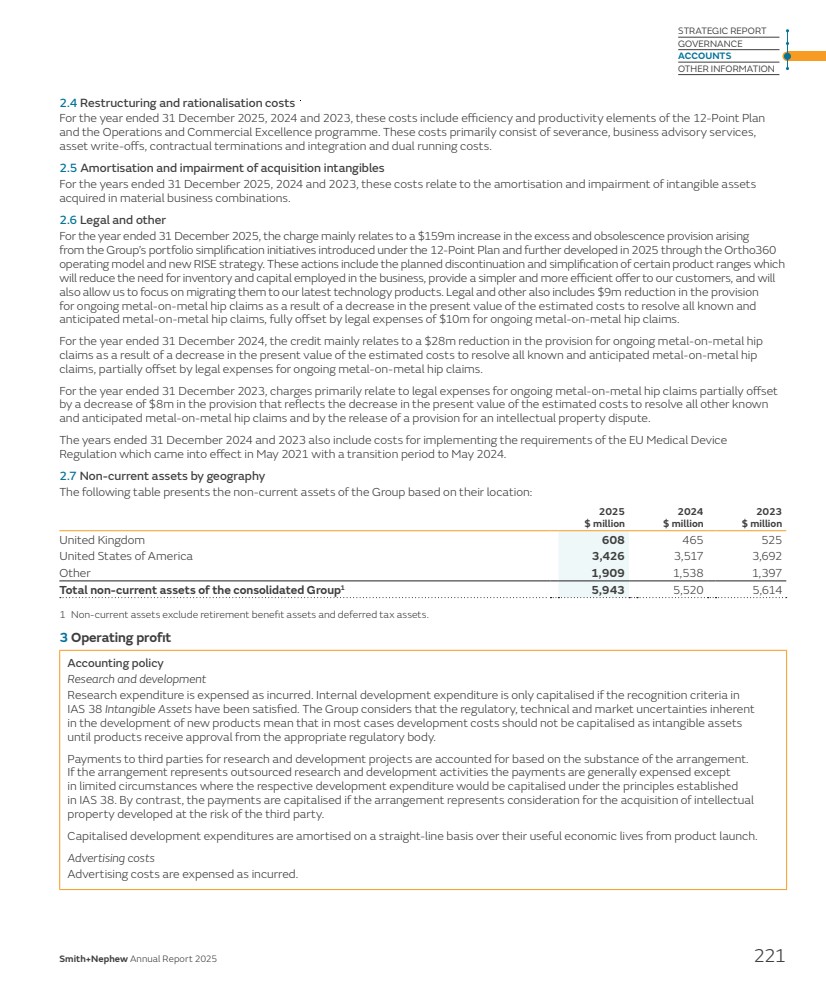
| 3 Operating profit continued 2025 2024 2023 $ million $ million $ million Revenue 6,164 5,810 5,549 Cost of goods sold1 (1,972) (1,764) (1,730) Gross profit 4,192 4,046 3,819 Research and development expenses2 (296) (289) (339) Selling, general and administrative expenses:3,4,5,6 Marketing, selling and distribution expenses (2,362) (2,276) (2,218) Administrative expenses (740) (824) (837) (3,102) (3,100) (3,055) Operating profit 794 657 425 1 2025 includes $161m charge relating to legal and other items, $13m charge relating to restructuring and rationalisation expenses and $2m charge relating to acquisition and disposal-related items (2024 includes $6m charge relating to legal and other items, $20m charge relating to restructuring and rationalisation expenses and $13m charge relating to acquisition and disposal-related items, 2023 includes $27m charge relating to legal and other items, $73m charge relating to restructuring and rationalisation expenses and $3m charge relating to acquisition and disposal-related items). 2 2025 includes $2m charge relating to restructuring and rationalisation expenses (2024: nil, 2023: $18m), $nil relating to legal and other items (2024: $1m, 2023: $21m) and $nil charge relating to acquisition and disposal-related items (2024: $nil, 2023: $1m). 3 2025 includes $73m of amortisation and impairment of software and other intangible assets (2024: $58m, 2023: $51m). 4 2025 includes $176m of amortisation and impairment of acquisition intangibles and $32m of restructuring and rationalisation expenses (2024 : $187m of amortisation and impairment of acquisition intangibles and $103m of restructuring and rationalisation expenses, 2023 : $207m of amortisation and impairment of acquisition intangibles and $129m of restructuring and rationalisation expenses). 5 2025 includes $1m charge relating to legal and other items (2024: $19m credit, 2023: $10m charge). 6 2025 includes $30m charge relating to acquisition and disposal-related items (2024: $81m charge, 2023: $56m charge). Note that items detailed in 1, 2, 4, 5 and 6 are excluded from the calculation of trading profit, the segments’ profit measure. Operating profit is stated after charging the following items: 2025 2024 2023 $ million $ million $ million Amortisation of intangible assets 239 230 221 Impairment of intangible assets 10 16 37 Impairment of goodwill1 – 65 84 Impairment of property, plant and equipment (reversal)/ charge (11) 9 31 Fair value remeasurement of trade investments 1 – 4 Restructuring and rationalisation costs 47 123 220 Depreciation of property, plant and equipment2 335 325 306 Loss on disposal of property, plant and equipment and intangible assets 23 22 18 Advertising costs 91 84 88 1 The 2024 impairment of goodwill includes BHR’s goodwill of $63m and 2023 includes impairment of Engage’s goodwill of $84m. 2 The 2025 depreciation charge includes $49m (2024: $54m, 2023: $54m ) related to right-of-use assets. 222 Smith+Nephew Annual Report 2025 Notes to the Group accounts continued Group financial statements continued 23_SN_AR25_Note_1_14_v217.indd 222 05/03/2026 18:23 |
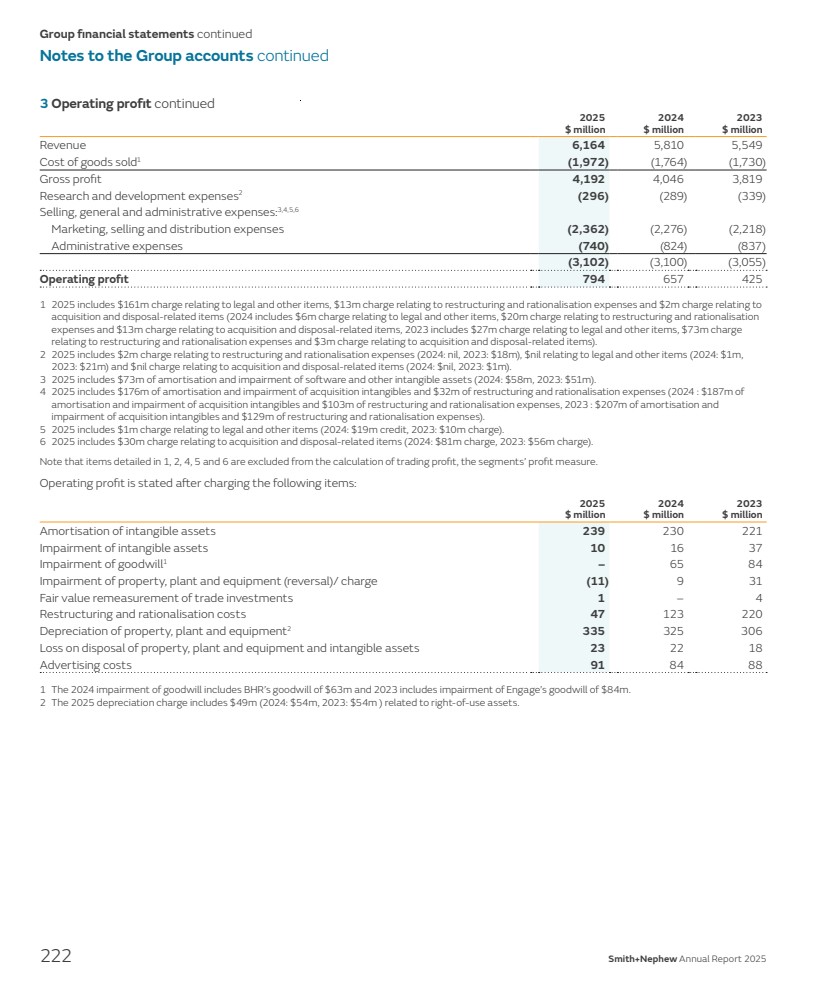
| 3.1 Staff costs and employee numbers Staff costs during the year amounted to: 2025 2024 2023 Notes $ million $ million $ million Wages and salaries 1,671 1,663 1,683 Social security costs 255 244 242 Pension costs (including retirement healthcare) 18 94 95 95 Share-based payments 22 43 40 39 2,063 2,042 2,059 During the year ended 31 December 2025, the average number of employees was 17,530 (2024: 18,060, 2023: 19,081). 3.2 Audit Fees – information about the nature and cost of services provided by the auditors 2025 2024 2023 $ million $ million $ million Audit services: Group accounts 7.3 7.1 7.9 Local statutory audit pursuant to legislation 2.1 2.0 2.1 Other services: Audit-related services 0.6 0.4 0.3 Total auditor’s remuneration 10.0 9.5 10.3 Arising: In the UK 7.4 7.0 6.0 Outside the UK 2.6 2.5 4.3 10.0 9.5 10.3 4 Interest and other finance costs 4.1 Interest income/(expense) 2025 2024 2023 $ million $ million $ million Interest income 28 24 34 Interest expense: Bank borrowings (5) (8) (10) Private placement notes (19) (29) (38) Corporate bond (104) (89) (46) Lease liabilities (8) (8) (8) Other (4) (11) (30) (140) (145) (132) Net interest expense (112) (121) (98) 4.2 Other finance costs 2025 2024 2023 Notes $ million $ million $ million Retirement benefit net interest expense 18 (6) (4) (1) Unwinding of discount1 (33) (19) (6) Investment income relating to deferred compensation arrangements 14 – – Gain on repurchase of bonds 15 10 – – Other (1) (5) – Other finance costs (16) (28) (7) 1 Includes discount unwind on provision for metal-on-metal hip claims and acquisition related liabilities. Smith+Nephew Annual Report 2025 223 STRATEGIC REPORT GOVERNANCE ACCOUNTS OTHER INFORMATION 23_SN_AR25_Note_1_14_v217.indd 223 05/03/2026 18:23 |

| 5 Taxation Accounting policy The charge for current taxation is based on the results for the year as adjusted for items which are non-assessable or non-deductible. It is calculated using tax rates that have been enacted or substantively enacted as at the balance sheet date. The Group operates in numerous tax jurisdictions around the world. At any given time, the Group typically is involved in tax audits and other disputes and will have other tax returns potentially subject to audit. Significant issues may take several years to resolve. In estimating the probability and amount of any tax charge, management takes into account the views of internal and external advisers and updates the amount of tax provision where considered appropriate. The ultimate tax liability may differ from the amount provided depending on factors including interpretations of tax law and settlement negotiations. Deferred tax is recognised in respect of temporary differences between the carrying amounts of assets and liabilities for financial reporting purposes and the amounts used for taxation purposes. Deferred tax is not recognised: for temporary differences related to investments in subsidiaries and associates where the Group is able to control the timing of the reversal of the temporary difference and it is probable that this will not reverse in the foreseeable future; on the initial recognition of non-deductible goodwill; and on the initial recognition of an asset or liability in a transaction that is not a business combination and that, at the time of the transaction, does not affect the accounting or taxable profit. Deferred tax assets are recognised to the extent that it is probable that future taxable profits will be available against which they can be used. Deferred tax assets are reviewed at each reporting date taking into account the recoverability of the deferred tax assets, future profitability and any restrictions on use. The Group considers available evidence to assess future profitability over a reasonably foreseeable time period, depending on the circumstances and typically a minimum of five years. Any material unrecognised deferred tax assets are disclosed in Note 5.2. Deferred tax is measured on an undiscounted basis, and at the tax rates that have been enacted or substantively enacted as at the balance sheet date that are expected to apply in the periods in which the asset or liability is settled. It is recognised in the income statement except when it relates to items credited or charged directly to other comprehensive income or equity, in which case the deferred tax is also recognised within other comprehensive income or equity respectively. Deferred tax assets and liabilities are offset when they relate to income taxes levied by the same taxation authority, the Group intends to settle its current tax assets and liabilities on a net basis, offset is permissible according to the relevant jurisdiction’s tax laws and that authority permits the Group to make a single net payment. 5.1 Taxation charge attributable to the Group 2025 2024 2023 $ million $ million $ million Current taxation: UK corporation tax at 25.0% (2024: 25.0%; 2023: 23.5%) 23 13 15 Overseas tax 147 182 165 Current income tax charge 170 195 180 Adjustments in respect of prior periods (41) (37) (45) Total current taxation 129 158 135 Deferred taxation: Origination and reversal of temporary differences 10 (79) (116) Changes in tax rates (1) – (2) Adjustments to estimated amounts arising in prior periods 16 7 10 Total deferred taxation 25 (72) (108) Total taxation as per the income statement 154 86 27 Taxation in other comprehensive income (4) 6 (18) Taxation in equity (4) 1 – Taxation charge attributable to the Group 146 93 9 224 Smith+Nephew Annual Report 2025 Notes to the Group accounts continued Group financial statements continued 23_SN_AR25_Note_1_14_v217.indd 224 05/03/2026 18:23 |
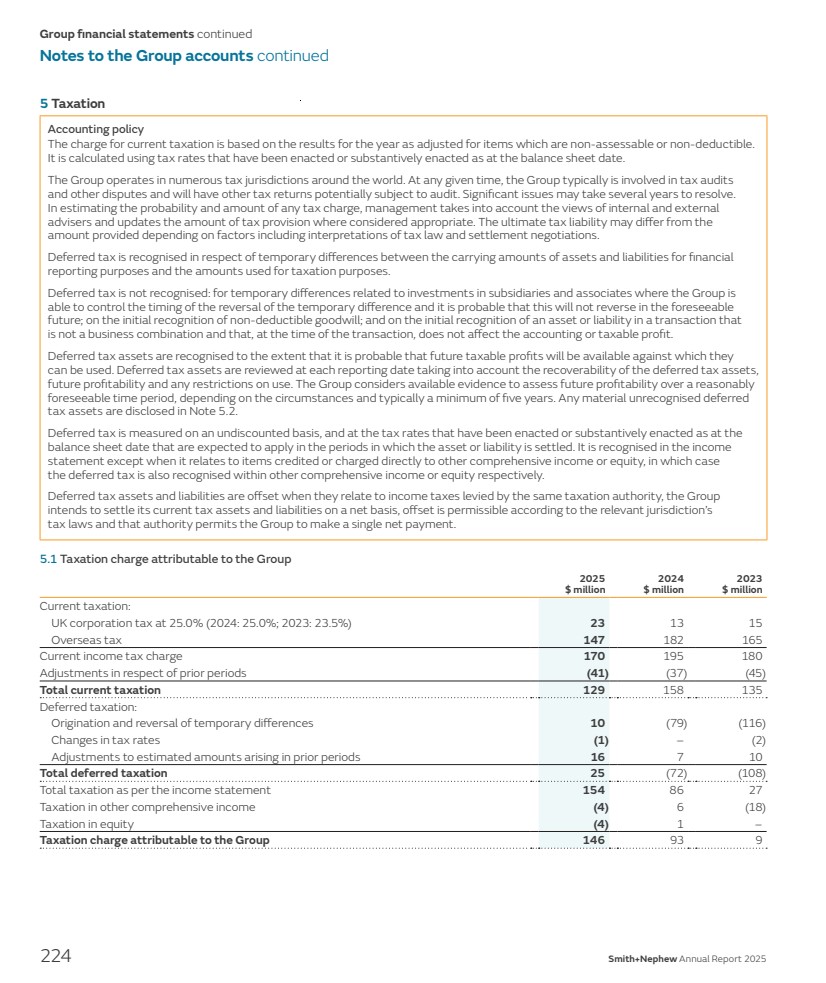
| The 2025, 2024 and 2023 net prior period adjustments of $25m, $30m and $35m respectively relate principally to provision releases following the resolution of tax audits and other uncertain tax matters, and other one-off items. The total taxation charge of $154m as per the income statement includes a $58m net credit (2024: $87m net credit, 2023: $113m net credit) as a consequence of restructuring and rationalisation-related costs, acquisition and disposal-related items, amortisation and impairment of acquisition intangibles and legal and other items. Factors affecting future tax charges The Group operates in numerous tax jurisdictions around the world and is subject to factors that may affect future tax charges, including transfer pricing, tax rate changes, tax legislation changes, tax authority interpretation, expiry of statute of limitations, tax litigation, and resolution of tax audits and disputes. At any given time, the Group has unagreed years outstanding in various countries and is involved in tax audits and disputes, some of which may take several years to resolve. Provisions are based on best estimates and management’s judgements concerning the likely ultimate outcome of any audit or dispute. Management considers the specific circumstances of each tax position and takes external advice, where appropriate, to assess the range of potential outcomes and estimate additional tax that may be due. Total tax liabilities include $71m (2024: $95m) in relation to uncertain tax positions which relate to multiple issues across the jurisdictions in which the Group operates. Other payables include $17m (2024: $14m) of interest on these provisions. There are $16m (2024: $34m) of tax receivables. The Group believes that it has made adequate provision in respect of additional tax liabilities that may arise from unagreed years, tax audits and disputes, the majority of which relate to transfer pricing matters, as would be expected for a Group operating internationally. However, the actual liability for any particular issue may be higher or lower than the amount provided, resulting in a negative or positive effect on the tax charge in any given year. A reduction in the tax charge may also arise for other reasons such as an expiry of the relevant statute of limitations. Depending on the final outcome of tax audits which are currently in progress, statute of limitations expiry, and other factors, an impact on the tax charge could arise. While such an impact can vary from year to year, these releases depend on factors which are uncertain, both as to outcome and timing. However, at the current time, we believe the possibility of a material impact on the tax charge for 2026 is unlikely. Pillar Two The OECD Pillar Two GloBE Rules (Pillar Two) introduced a global minimum corporation tax rate of 15% applicable to multinational enterprise groups with global revenue over €750m. The Pillar Two rules first applied to the Group for its accounting period commencing 1 January 2024. On 23 May 2023, the International Accounting Standards Board (IASB) amended IAS 12 to introduce a mandatory temporary exception to the accounting for deferred taxes arising from the jurisdictional implementation of the Pillar Two model rules. On 19 July 2023 the UK Endorsement Board adopted the IASB amendments to IAS 12. The Group has performed an assessment of its exposure to Pillar Two income taxes and the Pillar Two current tax charge for the period ended 31 December 2025 is approximately $8m (2024:$8m). The Group is adopting the mandatory temporary exception from the recognition and disclosure of deferred taxes arising the Pillar Two model rules. The Group does not meet the threshold for application of the Pillar One transfer pricing rules. Smith+Nephew Annual Report 2025 225 STRATEGIC REPORT GOVERNANCE ACCOUNTS OTHER INFORMATION 23_SN_AR25_Note_1_14_v217.indd 225 05/03/2026 18:23 |
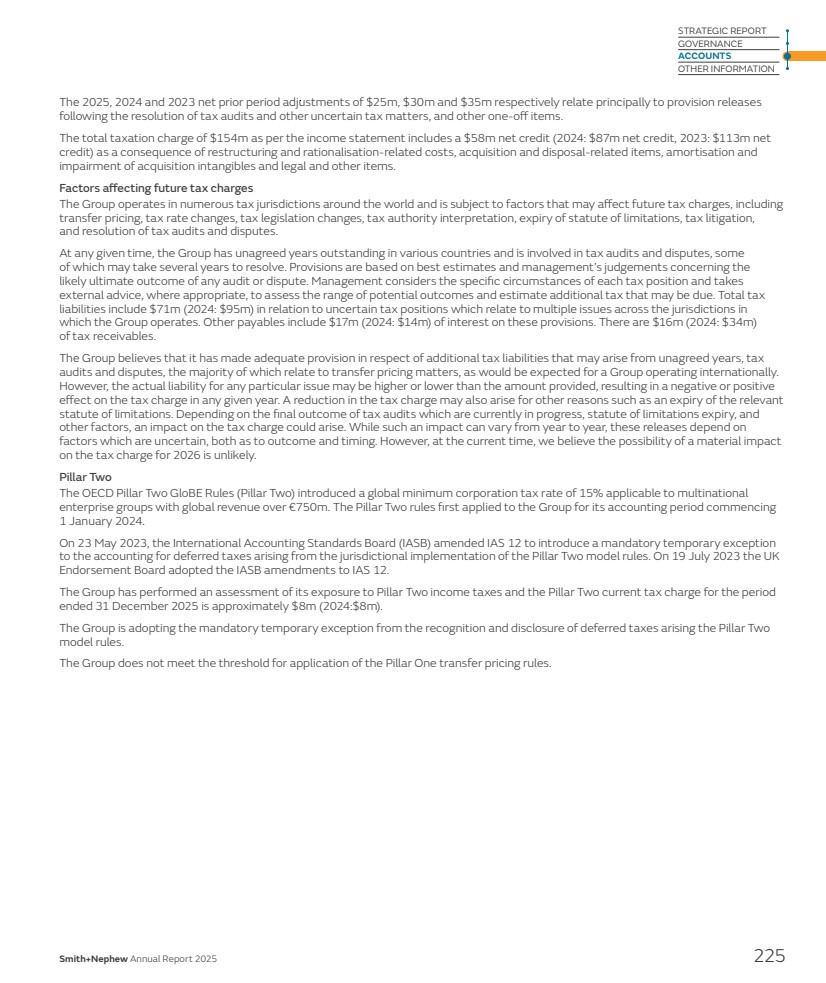
| 5 Taxation continued The UK standard rate of corporation tax for 2025 is 25.0% (2024: 25.0%, 2023: 23.5%). Overseas taxation is calculated at the rates prevailing in the respective jurisdictions. The table below reconciles the expected tax charge at the UK statutory rate with the actual tax charge. 2025 2024 2023 $ million $ million $ million Profit before taxation 779 498 290 Expected taxation at UK statutory rate of 25.0% (2024: 25.0%, 2023: 23.5%) 195 125 68 Differences in overseas taxation rates1 (30) (33) (24) Innovation reliefs2 (9) (10) (7) Recognition of previously unrecognised temporary differences3 (10) (8) (14) Expenses not deductible for tax purposes4 24 32 38 Pillar Two top up taxes5 8 8 – Change in tax rates (2) – (2) Withholding tax 3 2 3 Adjustments in respect of prior years6 (25) (30) (35) Total taxation charge as per the income statement 154 86 27 1 Difference between profits taxed at UK tax rate and countries with a lower tax rate, partially offset by profits taxed in countries with a higher tax rate than the UK. 2 Innovation incentives relating to R&D expenditure and income arising from UK patents. 3 Deferred tax credit arising from reassessment of deferred tax asset recoverability using latest forecasts. 4 In 2025, this includes a $13m impact relating to non-tax deductible acquisition related costs, and other permanent differences where items are deductible for accounting but not tax purposes (2024: $16m impact of non-tax deductible impairment on UK owned investments, 2023: $7m impact of non-tax deductible impairment on UK owned investments). 5 Additional taxes arising from the implementation of Pillar Two legislation (see above) which was effective from 1 January 2024. 6 The adjustments in respect of prior years are explained on page 224. 5.2 Deferred taxation Movements in the main components of deferred tax assets and liabilities were as follows: Inventory, Accelerated Retirement Losses provisions tax benefit and other and other depreciation Intangibles obligations tax credits differences Total $ million $ million $ million $ million $ million $ million At 31 December 2023 (91) (138) (6) 198 302 265 Exchange adjustment – – – (1) (7) (8) Movement in income statement – current year 7 22 4 32 14 79 Movement in income statement – prior years (11) – – – 4 (7) Movement in other comprehensive income – – (1) – (5) (6) Movement in equity – – – – (1) (1) Acquisitions – (19) – 16 – (3) At 31 December 2024 (95) (135) (3) 245 307 319 Exchange adjustment (2) – (1) 5 3 5 Movement in income statement – current year (18) 18 (1) (4) (5) (10) Movement in income statement – prior years (16) 17 – (7) (10) (16) Movement in other comprehensive income – – – – 4 4 Changes in tax rate – – (1) – 2 1 Movement in equity – – – – 4 4 At 31 December 2025 (131) (100) (6) 239 305 307 Represented by: 2025 2024 $ million $ million Deferred tax assets 347 350 Deferred tax liabilities (40) (31) Net position at 31 December 307 319 226 Smith+Nephew Annual Report 2025 Notes to the Group accounts continued Group financial statements continued 23_SN_AR25_Note_1_14_v217.indd 226 05/03/2026 18:23 |
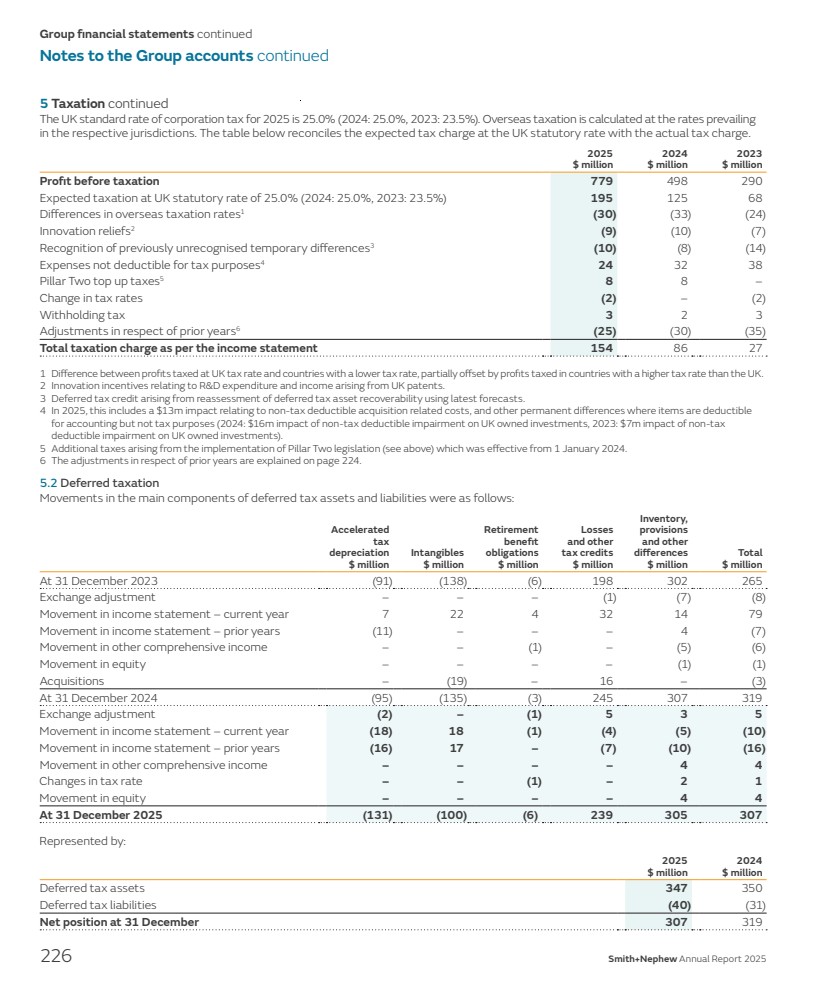
| The deferred tax asset of $305m (2024: $307m) relating to inventory, provisions and other differences comprises deferred tax relating to inventory of $127m (2024: $92m), provisions and other short-term temporary differences of $169m (2024: $206m) and bad debt provisions of $9m (2024: $9m). The Group has gross unused tax losses and other credits of $1,368m (2024: $1,342m), gross unused research and development tax credits of $24m (2024: $28m) and gross unused capital losses of $153m (2024: $142m), available for offset against future profits. $313m of losses will expire within 3-7 years from the balance sheet date if not utilised. A deferred tax asset of $239m (2024: $245m) has been recognised in respect of $1,112m (2024: $1,094m) of tax losses and other tax credits and $12m (2024: $16m) of research and development tax credits. No deferred tax asset has been recognised on the remaining unused tax losses as it is not probable that future taxable profits will be available against which they can be utilised. Management will reassess the recoverability of deferred tax assets at each balance sheet date by taking into account all relevant and available information. The Group assesses the likelihood of these being recovered within a reasonably foreseeable timeframe, being typically a minimum of five years, taking into account the future expected profit profile and business model of each relevant company or country, and any potential legislative restrictions on use. Short-term timing differences are generally recognised ahead of losses and other tax attributes as being likely to reverse more quickly. 6 Earnings per ordinary share Accounting policy Earnings per share Basic earnings per share is calculated by dividing the profit attributable to equity holders by the weighted average number of ordinary shares in issue during the year, excluding shares held by the Company in the Employees’ Share Trust or as treasury shares. Diluted earnings per share Diluted earnings per share is calculated by adjusting the basic earnings per share for the effect of conversion to ordinary shares associated with dilutive potential ordinary shares, which comprise share options and awards granted to employees. The calculations of the basic and diluted earnings per ordinary share are based on the following attributable profit and numbers of shares: 2025 2024 2023 $ million $ million $ million Earnings Attributable profit for the year 625 412 263 The numerators used for basic and diluted earnings per ordinary share are the same. The denominators used for all categories of earnings per ordinary share are as follows: 2025 2024 2023 Number of shares (millions) Basic weighted number of shares 867 873 871 Dilutive impact of share incentive schemes outstanding 6 3 2 Diluted weighted average number of shares 873 876 873 Earnings per ordinary share Basic 72.1¢ 47.2¢ 30.2¢ Diluted 71.6¢ 47.0¢ 30.1¢ Smith+Nephew Annual Report 2025 227 STRATEGIC REPORT GOVERNANCE ACCOUNTS OTHER INFORMATION 23_SN_AR25_Note_1_14_v217.indd 227 05/03/2026 18:23 |
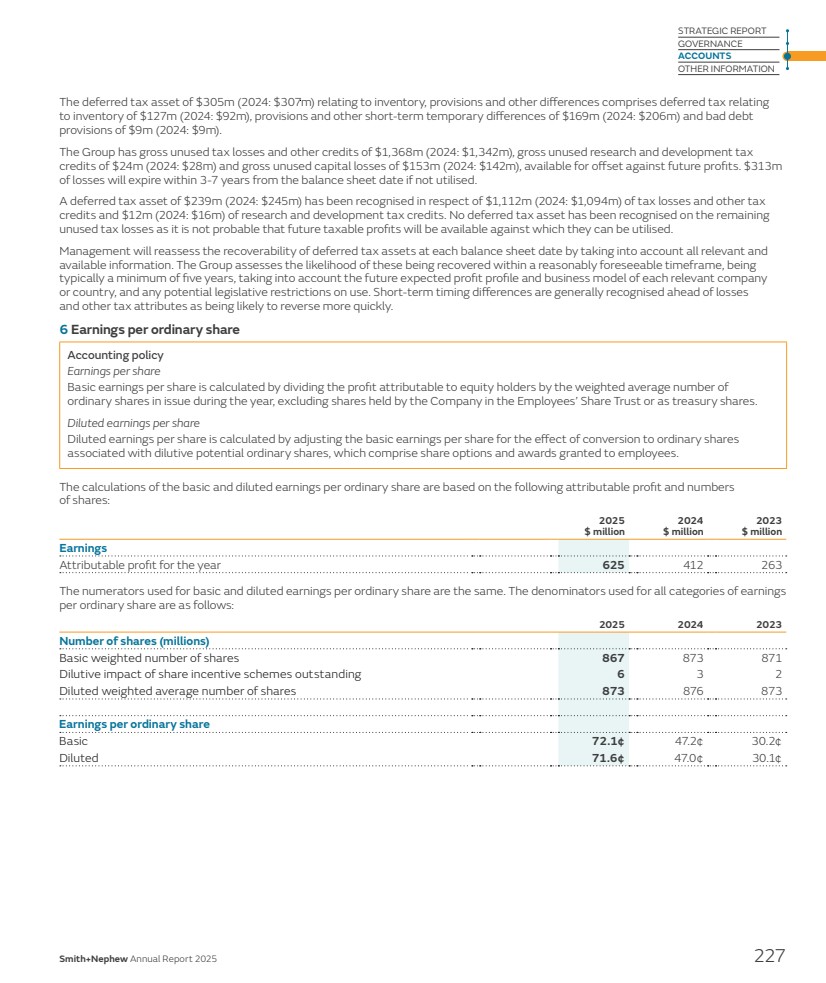
| 7 Property, plant and equipment Accounting policy Property, plant and equipment Owned assets Items of property, plant and equipment are stated at cost less accumulated depreciation and any accumulated impairment losses. The Group manufactures orthopaedic instruments that are either deployed for use by customers under contractual arrangements or sold outright to customers. The majority of these instruments are not sold but provided to customers for use in surgery. At the time of manufacture, instruments are classified either as Property, Plant and Equipment or Inventory based on management’s best estimate of expected deployment versus direct sales volumes. Instruments expected to be deployed for use by customers over their useful economic lives of between three and seven years, are recognised initially as Property, Plant and Equipment. Instruments expected to be sold outright to customers in the ordinary course of business are recognised as inventory. This estimate is based on historical deployment and sales patterns, and future expectations, and is reassessed periodically. Instruments are depreciated over their useful economic lives of between three and seven years once they are deployed. Depreciation is calculated to write off the cost of items of property, plant and equipment less their estimated residual values using the straight-line method over their estimated useful lives, and is ultimately recognised in profit or loss. Leased assets are depreciated over the shorter of the lease term and their useful lives unless it is reasonably certain that the Group will obtain ownership by the end of the lease term. Freehold land is not depreciated. The estimated useful lives of items of property, plant and equipment is 3–20 years and for buildings is 20–50 years. Assets in course of construction are not depreciated until they are available for use. Depreciation methods, useful lives and residual values are reviewed at each reporting date and adjusted if appropriate. Finance costs relating to the purchase or construction of property, plant and equipment and intangible assets that take longer than one year to complete are capitalised based on the Group weighted average borrowing costs. All other finance costs are expensed as incurred. Leased assets The assessment of whether a contract is or contains a lease takes place at the inception of the contract. The assessment involves whether the Group obtains substantially all the economic benefits from the use of that asset and whether the Group has the right to direct the use of the asset. The Group allocates the consideration in the contract to each lease and non-lease component. The non-lease component, where it is separately identifiable, is not included in the right-of-use asset. The Group leases many assets including properties, motor vehicles and office equipment. The Group availed itself of the exemptions for short-term leases and leases of low-value items for leases other than those for properties and motor vehicles. The use of these exemptions does not have a material impact. The Group recognises a right-of-use asset and a lease liability at the commencement of the lease. The right-of-use asset is initially measured based on the present value of lease payments that are not paid at the commencement date plus initial direct costs less any incentives received. The lease payments are discounted using an incremental borrowing rate which is country-specific and reflective of the lease term. The right-of-use asset is depreciated over the shorter of the lease term or the useful life of the underlying asset. Cash flows arising on lease interest payments are included in operating cash flows whereas cash flows arising on the capital repayments of the lease liability are included in financing cash flows. Impairment of assets The carrying values of property, plant and equipment are reviewed for impairment when events or changes in circumstances indicate the carrying value may be impaired. If any such indication exists, the recoverable amount of the asset is estimated in order to determine the extent of impairment loss. Where it is not possible to estimate the recoverable amount of an individual asset, the Group estimates the recoverable amount of the cash-generating unit to which it belongs. An asset’s recoverable amount is the higher of an asset’s or cash-generating unit’s fair value less costs to sell and its value-in-use. In assessing value-in-use, its estimated future cash flow is discounted to its present value using a pre-tax discount rate that reflects the current market assessment of the time value of money and the risks specific to the asset. 228 Smith+Nephew Annual Report 2025 Notes to the Group accounts continued Group financial statements continued 23_SN_AR25_Note_1_14_v217.indd 228 05/03/2026 18:23 |

| Assets in Land and course of Plant and equipment buildings Instruments1 Other construction Total Notes $ million $ million $ million $ million $ million Cost At 1 January 2024 795 1,844 1,433 170 4,242 Exchange adjustment (15) (61) (18) – (94) Additions 28 225 35 53 341 Disposals (25) (84) (69) (7) (185) Impairment – – – (12) (12) Transfers 6 – 68 (82) (8) At 31 December 2024 789 1,924 1,449 122 4,284 Exchange adjustment 28 84 42 6 160 Additions 44 211 29 131 415 Disposals (91) (96) (93) (5) (285) Impairment – – (12) 2 (10) Transfers 8 166 39 (49) 164 At 31 December 2025 778 2,289 1,454 207 4,728 Depreciation and impairment At 1 January 2024 342 1,452 978 – 2,772 Exchange adjustment (8) (51) (12) – (71) Charge for the year 66 163 96 – 325 Impairment (5) – 2 – (3) Disposals (24) (73) (64) – (161) At 31 December 2024 371 1,491 1,000 – 2,862 Exchange adjustment 14 69 32 – 115 Charge for the year 59 177 99 – 335 Impairment (12) – (9) – (21) Disposals (52) (85) (93) – (230) Transfers – 29 – – 29 At 31 December 2025 380 1,681 1,029 – 3,090 Net book amounts At 31 December 2025 398 608 425 207 1,638 At 31 December 2024 418 433 449 122 1,422 1 Instruments include $156m of assets not yet deployed, for which depreciation has not yet commenced. Land and buildings includes land with a cost of $32m (2024: $37m) that is not subject to depreciation. Transfers from assets in course of construction includes $2m (2024: $8m) of software (refer to Note 9). Assets under construction in 2025 reflect that the Group’s development of a new manufacturing facility in Hull, UK. Group capital expenditure relating to property, plant and equipment contracted but not provided for amounted to $62m (2024: $15m). The amount of borrowing costs capitalised in 2025 and 2024 was immaterial. Information about the Group’s right-of-use assets is outlined below: 2025 2024 Land and buildings Plant and equipment Land and buildings Plant and equipment $ million $ million $ million $ million Opening Balance 137 36 157 28 Exchange Adjustment 8 2 (5) (1) Additions 43 15 25 22 Depreciation charge in the year (35) (14) (41) (13) Impairment – – 1 – Net book value at 31 December 153 39 137 36 Smith+Nephew Annual Report 2025 229 STRATEGIC REPORT GOVERNANCE ACCOUNTS OTHER INFORMATION 23_SN_AR25_Note_1_14_v217.indd 229 05/03/2026 18:23 |

| 8 Goodwill Accounting policy Goodwill is not amortised but is reviewed for impairment annually. Goodwill is allocated to the cash-generating unit (CGU) that is expected to benefit from the acquisition. The goodwill is tested annually for impairment by comparing the recoverable amount to the carrying value of the CGUs. The CGUs identified by management are at the aggregated product operating levels of Orthopaedics, Sports Medicine, ENT and Advanced Wound Management, in the way the core assets are used to generate cash flows. If the recoverable amount of the CGU is less than its carrying amount then an impairment loss is determined to have occurred. Any impairment losses that arise are recognised immediately in the income statement and are allocated first to reduce the carrying amount of goodwill and then to the carrying amounts of the other assets of the CGU. When an acquired business included within a CGU ceases to operate permanently, then the acquired business no longer forms part of the CGU and is therefore tested for impairment on a standalone basis. The portion of goodwill allocated to this acquired business is measured based on its relative value within the CGU, unless another method is considered more appropriate. In carrying out impairment reviews of goodwill, a number of significant assumptions have to be made when preparing cash flow projections. These include the future rate of market growth, discount rates, the market demand for the products acquired, the future profitability of acquired businesses or products, levels of reimbursement and success in obtaining regulatory approvals. If actual results should differ, or changes in expectations arise, impairment charges may be required which would adversely impact operating results. When the composition of CGUs changed, goodwill would be allocated using a relative value approach at the date of the reorganisation similar to that used when an operation within a CGU is disposed of or a method that could provide a better allocation of goodwill to the reorganised units. 2025 2024 Notes $ million $ million Cost and net book value At 1 January 3,026 2,992 Exchange adjustment 82 (47) Impairment – (65) Acquisitions 21 – 146 At 31 December 3,108 3,026 Management has identified five CGUs in applying the provisions of IAS 36 Impairment of Assets: Orthopaedics, Sports Medicine, ENT, Advanced Wound Care & Devices and Bioactives. For the purpose of goodwill impairment testing, the Advanced Wound Care & Devices and Bioactives CGUs have been aggregated (Advanced Wound Management), as this is the level at which goodwill is monitored and level at which the economic benefits relating to the goodwill within these CGUs is realised. During 2025, no impairment losses were recognised and no acquisitions were completed. During 2024,the Group announced its intention to close the Warwick manufacturing site that manufactures Birmingham Hip Resurfacing (BHR) products. As a result, goodwill of $63m relating to BHR was written-off. In addition, a $2m goodwill impairment charge was recorded as a result of disposal of certain products. Goodwill is allocated to the Group’s CGUs as follows: 2025 2024 $ million $ million Orthopaedics 877 807 Sports Medicine 1,305 1,302 ENT 287 287 Advanced Wound Management 639 630 3,108 3,026 Impairment reviews were performed as of September 2025 and September 2024 by comparing the recoverable amount of each CGU with its carrying amount, including goodwill. These were reviewed during December, taking into account any significant events that occurred between September and December. 230 Smith+Nephew Annual Report 2025 Notes to the Group accounts continued Group financial statements continued 23_SN_AR25_Note_1_14_v217.indd 230 05/03/2026 18:23 |

| The current challenging economic environment, including inflation, was considered in the goodwill impairment reviews. Additionally, severe downside sensitivity analyses have been undertaken on the base case scenario. For each CGU, the recoverable amounts are based on value-in-use which is calculated from pre-tax cash flow projections for five years using data from the Group’s budget and strategic planning process, the results of which are reviewed and approved by the Board. The terminal growth rate is based on long term GDP growth. The initial five-year period (2024: three-year period) is in line with the Group’s strategic planning process. In determining the growth rates used in the calculations of the value-in-use, management considered annual revenue growth. Projections are based on anticipated volume and value growth in the markets served by the Group and assumptions as to market share movements. Each year the projections for the previous year are compared to actual results and variances are factored into the assumptions used in the current year. The discount rates used in the value-in-use calculations reflect management’s assessment of risks specific to the assets of each CGU. Our determination of the discount rates is based on weighted average cost of capital (WACC) which includes a risk-free rate, based on market participant’s cost of equity, an equity risk premium specifically adjusted to the medical technology industry and after-tax cost of debt and reflects the risks inherent in the cash flows adjusted for CGU specific risk. The pre-tax rate is then calculated using WACC as a starting point. 8.1 Orthopaedics CGU The cash flows used in the value-in-use calculation for the Orthopaedics CGU, which includes the Reconstruction and Trauma businesses, reflects management’s distinctive orthopaedic reconstruction strategy, which combines cutting-edge innovation, disruptive business models and a strong Emerging Markets platform to drive our performance. The weighted average growth rate used to extrapolate the cash flows beyond the five-year period (2024: five-year period) in calculating the terminal value is 2.0% (2024: 2.0%). The pre-tax discount rate used in the Orthopaedics CGU value-in-use calculation reflects the geographical mix of the revenues and is 11.4% (2024: 11.4%). 8.2 Sports Medicine CGU The cash flows used in the value-in-use calculation for the Sports Medicine CGU reflects growth rates and cash flows consistent with management’s strategy to maintain growth in Sports Medicine. The weighted average growth rate used to extrapolate the cash flows beyond the five-year period (2024: five-year period) in calculating the terminal value is 2.0% (2024: 2.0%). The pre-tax discount rate used in the Sports Medicine CGU value-in-use calculation reflects the geographical mix of the revenues and is 11.3% (2024: 11.6%). 8.3 ENT CGU The cash flow used in the value-in-use calculation for the ENT CGU reflects growth rates and cash flows consistent with management’s strategy. The weighted average growth rate used to extrapolate the cash flows beyond the five-year period (2024: five-year period) in calculating the terminal value is 2.0% (2024: 2.0%). The pre-tax discount rate used in the ENT CGU value-in-use calculation reflects the geographical mix of the revenues and is 11.3% (2024: 11.0%). 8.4 Advanced Wound Management CGU The aggregated Advanced Wound Management CGU comprises the Advanced Wound Care & Devices and Bioactives CGUs. In performing the value-in-use calculation for this combined CGU, management considered the Group’s focus across the wound product, focusing on widening access to the customer, the higher added value sectors of healing chronic wounds and tissue repair using bioactives, and by continuing to improve efficiency. The weighted average growth rate used to extrapolate the cash flows beyond the five-year period (2024: five-year period) in calculating the terminal value is 2.0% (2024: 2.0%). The pre tax discount rate used in the Advanced Wound Management CGU value-in-use calculation reflects the geographical mix and industry sector and is 11.0% (2024: 11.3%). The value in use for all CGUs indicated sufficient headroom such that a reasonably possible change to key assumptions is unlikely to result in an impairment of the related goodwill. Smith+Nephew Annual Report 2025 231 STRATEGIC REPORT GOVERNANCE ACCOUNTS OTHER INFORMATION 23_SN_AR25_Note_1_14_v217.indd 231 05/03/2026 18:23 |
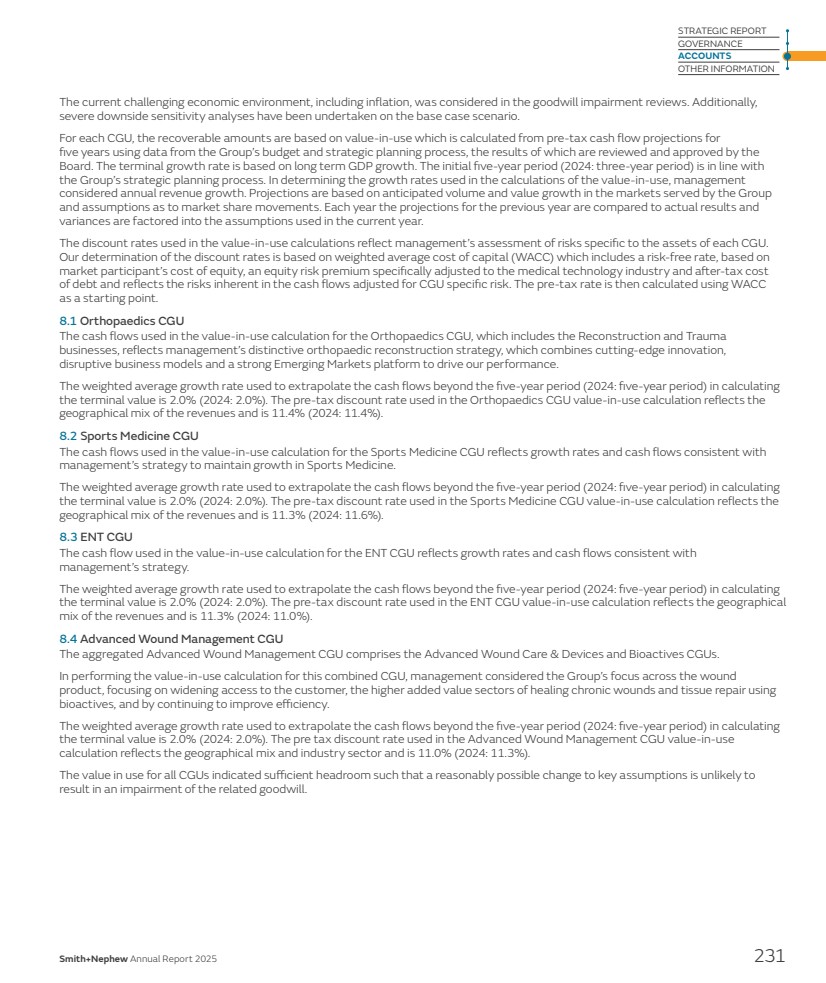
| 9 Intangible assets Accounting policy Intangible assets Intangible assets acquired separately from a business combination (including purchased patents, know-how, trademarks, licences and distribution rights) are initially measured at cost. The cost of intangible assets acquired in a material business combination (referred to as acquisition intangibles) is the fair value as at the date of acquisition. Following initial recognition, intangible assets are carried at cost less any accumulated amortisation and any accumulated impairment losses. All intangible assets are amortised on a straight-line basis over their estimated useful economic lives. The estimated useful economic life of software ranges between three and seven years. The estimated useful economic life of technology assets ranges between 6–20 years, product-related assets ranges between 2–20 years, and customer and distribution assets ranges between 2–14 years. Internally-generated intangible assets are expensed in the income statement as incurred. Expenditure on purchased software and qualifying IT projects is recognised as an intangible asset when it provides long-term benefits to the Group. Development costs for internally used applications are capitalised only when the software forms a key component of the Group’s IT systems and is controlled by the Group. Certain implementation costs for cloud-based solutions are capitalised when the Group has control over the underlying software. Software that is integral to computer hardware is capitalised as plant and equipment. Impairment of intangible assets The carrying values of intangible assets are reviewed for impairment when events or changes in circumstances indicate the carrying value may be impaired. If any such indication exists, the recoverable amount of the asset is estimated in order to determine the extent of impairment loss. Where it is not possible to estimate the recoverable amount of an individual asset, the Group estimates the recoverable amount of the CGU to which it belongs. An asset’s recoverable amount is the higher of an asset’s or CGU’s fair value less costs to sell and its value-in-use. In assessing value-in-use, its estimated future cash flow is discounted to its present value using a pre-tax discount rate that reflects the current market assessments of the time value of money and the risks specific to the asset. In carrying out impairment reviews of intangible assets, a number of significant assumptions have to be made when preparing cash flow projections. These include the future rate of market growth, discount rates, the market demand for the products acquired, the future profitability of acquired businesses or products, levels of reimbursement and success in obtaining regulatory approvals. If actual results should differ, or changes in expectations should arise, impairment charges may be required which would adversely impact operating results. Intangible assets which are not yet available for use are tested for impairment annually. Any provision for impairment is charged to the income statement. 232 Smith+Nephew Annual Report 2025 Notes to the Group accounts continued Group financial statements continued 23_SN_AR25_Note_1_14_v217.indd 232 05/03/2026 18:23 |

| Customer and Assets Product- distribution- in course of Technology related related Software construction Total Notes $ million $ million $ million $ million $ million $ million Cost At 1 January 2024 582 2,273 236 547 178 3,816 Exchange adjustment (7) (35) (6) (10) (1) (59) Acquisitions 21 81 3 – – – 84 Additions – 1 4 30 52 87 Disposals – – – (9) (1) (10) Transfers 1 (3) – 143 (133) 8 At 31 December 2024 657 2,239 234 701 95 3,926 Exchange adjustment 15 62 6 21 4 108 Additions – 2 – 5 69 76 Disposals – – – (8) (1) (9) Transfers – (2) – 67 (63) 2 At 31 December 2025 672 2,301 240 786 104 4,103 Amortisation and impairment At 1 January 2024 276 1,801 176 453 – 2,706 Exchange adjustment (3) (33) (5) (9) – (50) Charge for the year 54 109 15 52 – 230 Impairment 15 – – 1 – 16 Disposals – – – (8) – (8) At 31 December 2024 342 1,877 186 489 – 2,894 Exchange adjustment 9 59 5 13 – 86 Charge for the year 50 110 14 65 – 239 Impairment 10 – – – – 10 Disposals – – – (8) – (8) At 31 December 2025 411 2,046 205 559 – 3,221 Net book amounts At 31 December 2025 261 255 35 227 104 882 At 31 December 2024 315 362 48 212 95 1,032 Transfers into software and assets in course of construction includes $2m (2024: $8m) of software transferred from property, plant and equipment (refer to Note 7). Group capital expenditure relating to software contracted but not provided for amounted to $4m (2024: $4m). Amortisation and impairment of acquisition intangibles is set out below: 2025 2024 $ million $ million Technology 61 69 Product-related 105 108 Customer and distribution-related 10 10 Total 176 187 Smith+Nephew Annual Report 2025 233 STRATEGIC REPORT GOVERNANCE ACCOUNTS OTHER INFORMATION 23_SN_AR25_Note_1_14_v217.indd 233 05/03/2026 18:23 |
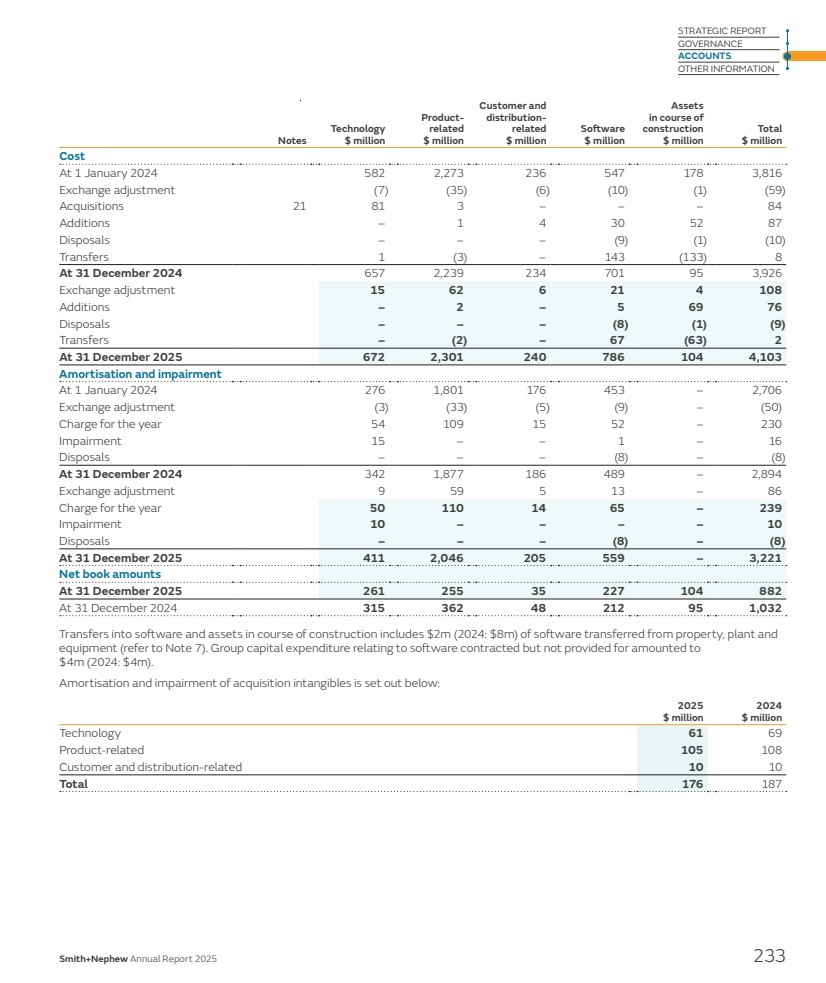
| 9 Intangible assets continued In 2025, the Group recognised an impairment charge of $10m in relation to immaterial technology assets in acquisition intangibles. In 2024, the Group recognised an impairment charge of $15m in relation to immaterial technology assets in acquisition intangibles. In 2023, the Group impaired $37m of Engage intangible assets as a result of the voluntary product discontinuation. Management has assessed the acquisition intangible assets held by the Group to identify any indicators of impairment as of September 2025. These were updated during December to take into account any significant events that occurred between September and December. Where an impairment indicator has arisen, impairment reviews have been undertaken by comparing the expected recoverable value of assets to the carrying value of assets. The table below provides further detail on the largest intangible assets and their remaining amortisation period: Customer and Product- distribution- Total Remaining Technology related related Carrying value amortisation $ million $ million $ million $ million period Intangibles acquired as part of the CartiHeal acquisition 66 3 – 69 8-9 years Intangibles acquired as part of the ArthroCare acquisition 97 68 – 165 8-9 years Intangibles acquired as part of the Osiris acquisition – 80 26 106 2-3 years Intangibles acquired as part of the Healthpoint acquisition 32 72 3 107 2 years 10 Investments Accounting policy Investments, other than those related to associates, are initially recorded at fair value on the trade date. Transaction costs relating to investments are expensed as incurred. The Group has investments in unquoted entities and an entity that holds mainly unquoted equity securities, which by their nature have no fixed maturity date or coupon rate. These investments are classed as fair value through profit or loss. The fair value of these investments is based on the underlying fair value of the equity securities: marketable securities are valued by reference to closing prices in the market; non-marketable securities are estimated considering factors including the purchase price; prices of recent significant private placements of securities of the same issuer; and estimates of liquidation value. Changes in fair value based on externally observable valuation events are recognised in profit or loss. 2025 2024 $ million $ million At 1 January 9 8 Additions 2 1 Transferred from receivables 18 – Fair value remeasurement 1 – At 31 December 30 9 11 Investments in associates Accounting policy Investments in associates, being those entities over which the Group has a significant influence and which is neither a subsidiary nor a joint venture, are accounted for using the equity method, with the Group recording its share of the associates’ profit and loss and other comprehensive income. The Group’s share of associates’ profit or loss is included in one separate income statement line and is calculated after deduction of their respective taxes. At each reporting date we assess, in accordance with IAS 28 and IAS 36, whether there is any indication that an equity-accounted investment may be impaired or that a previously recognised impairment may have decreased. Where indicators exist, impairment is taken to reflect the recoverable amount accordingly. An impairment loss is recognised when the carrying amount exceeds the recoverable amount. Any subsequent reversal is recognised only when supported by indicators and is limited, in accordance with IAS 36, so that the carrying amount after reversal does not exceed the amount that would have been determined had no impairment been recognised (after equity-method movements). The investment is assessed as a single asset for impairment purposes. 234 Smith+Nephew Annual Report 2025 Notes to the Group accounts continued Group financial statements continued 23_SN_AR25_Note_1_14_v217.indd 234 05/03/2026 18:23 |
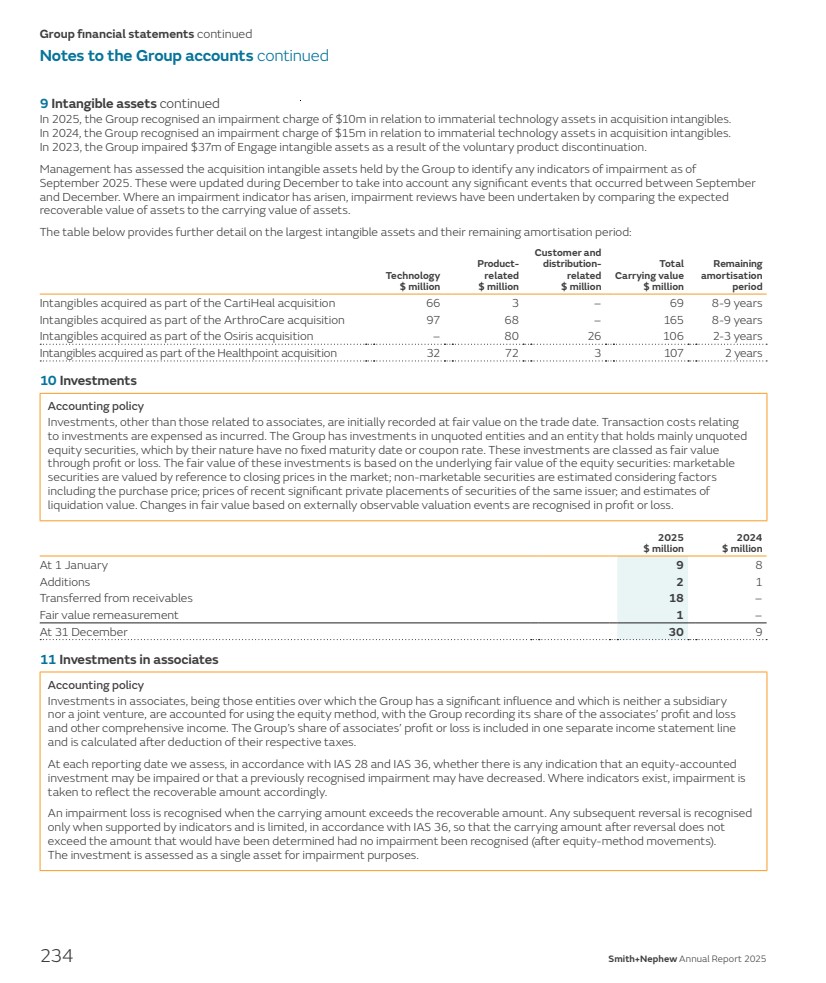
| At 31 December 2025, the Group holds 26.60% (2024: 27.13%) of Bioventus Inc. (Bioventus) which is the holding company of Bioventus LLC. The decrease in the Group’s holding between 2025 and 2024 was because of the exercise of Bioventus employee share options. The Company’s headquarters is located in Durham, North Carolina, US, and its medical product development is focused around active healing therapies and the surgical performance of orthobiologics. The active healing therapies product line supports accelerated and more complete healing of bone fractures, and treats the chronic pain associated with osteoarthritis. The gain after taxation recognised in the income statement relating to Bioventus was $113m, includes reversal of impairment of $109m (2024: $10m loss, 2023: $30m loss). The balance sheet carrying value relating to Bioventus is $119m (2024: $6m). The Group’s ability to recover the value of its investment is dependent upon the ongoing clinical and commercial success of these products. In 2022, the Group recognised an impairment charge of $109m on its investment in Bioventus due to a significant decline in share price and the company has disclosed a substantial doubt about their ability to continue as a going concern. Since then, Bioventus returned to profitability, resolved its liquidity constraints and materially improved operating performance through 2025, supported by restructuring and divestment initiatives. These improvements were reflected in a sustained recovery and stabilisation of the share price, with market indicators no longer suggesting distress. Based on these developments, management performed an impairment review by comparing the fair value of Bioventus using its market share price of $7.44 as at 31 December 2025 less carrying amount and concluded that the prior impairment loss of $109m should be reversed (2024: $nil, 2023: $nil). The amounts recognised in the balance sheet and income statement for associates are as follows: 2025 2024 2023 $ million $ million $ million Balance sheet 121 7 16 Income statement gain/(loss) 4 (10) (30) Reversal of impairment of interest in associate 109 – – Summarised financial information for significant associates Set out below is the summarised financial information for Bioventus, adjusted for differences with Group accounting policies. 2025 2024 2023 $ million $ million $ million Summarised statement of comprehensive income Revenue 410 420 377 Attributable profit / (loss) for the year 8 (34) (152) Group adjustments1 9 (2) 46 Total comprehensive profit / (loss) 17 (36) (106) Group share of gain / (loss) for the year at 26.60% (2024: 27.13%, 2023: 27.96%) 5 (10) (30) 2025 2024 $ million $ million Summarised balance sheet Non-current assets 421 471 Current assets 281 299 Non-current liabilities (333) (371) Current liabilities (162) (211) Net assets 207 188 Net equity attributable to owners 207 188 Group’s share of net assets at 26.60% (2024: 27.13%) 55 51 Group adjustments1 64 (45) Group’s carrying amount of investment at 26.60% (2024: 27.13%) 119 6 1 Group adjustments include adjustments to align with Group policy. The investment in Bioventus had a fair value less costs of disposal of $133m as at 31 December 2025 (2024: $186m). During the year, the Group received a $nil (2024: $nil) cash distribution from its associates. At 31 December 2025, the Group held equity investments in two other associates (2024: two) with a carrying value of $2m (2024: $1m). Smith+Nephew Annual Report 2025 235 STRATEGIC REPORT GOVERNANCE ACCOUNTS OTHER INFORMATION 23_SN_AR25_Note_1_14_v217.indd 235 05/03/2026 18:23 |
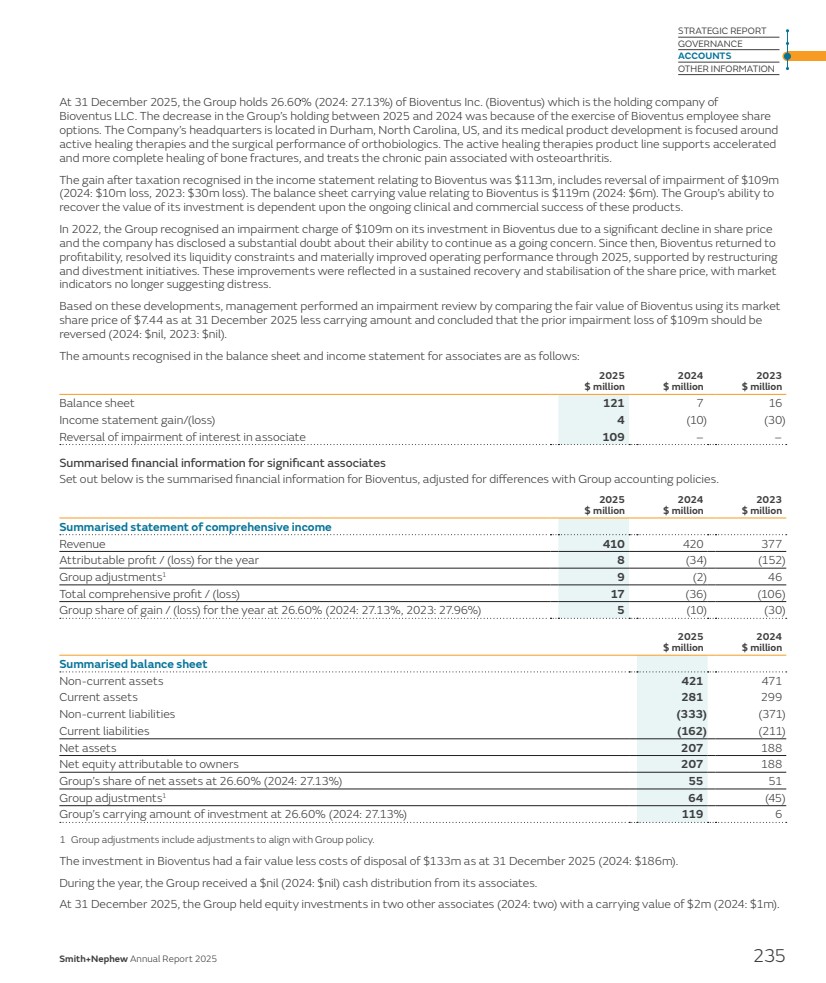
| 12 Inventories Accounting policy Finished goods and work-in-progress are valued at factory cost, including appropriate overheads, on a first-in first-out basis. Raw materials and bought-in finished goods are valued at purchase price. All inventories are reduced to net realisable value where lower than cost. Inventory acquired as part of a business acquisition is valued at selling price less costs to sell and a profit allowance for selling efforts. Instruments expected to be sold outright to customers and distributors in the ordinary course of business are initially recognised as inventory. Instruments not expected to be sold are recognised in property, plant and equipment (refer to note 7). Risks and rewards of ownership of consignment inventory are transferred to the customer when the product is used in surgery. A feature of the orthopaedic business is the high level of product inventory required, some of which is located at customer premises and is available for customers’ immediate use (referred to as consignment inventory). Complete sets of product, including large and small sizes, have to be made available in this way. These outer sizes are used less frequently than standard sizes and towards the end of the product life cycle are inevitably in excess of requirements. Adjustments to carrying value are therefore required to be made to orthopaedic inventory to anticipate this situation. These adjustments are calculated in accordance with a formula based on levels of inventory compared with historical or forecast usage. This formula is applied on an individual product line basis and is first applied when a product group has been on the market for two years. This method of calculation is considered appropriate based on experience but it involves management judgements on effectiveness of inventory deployment, length of product lives, phase-out of old products and efficiency of manufacturing planning systems. 2025 2024 $ million $ million Raw materials and consumables 412 469 Work-in-progress 54 45 Finished goods and goods for resale 1,651 1,873 2,117 2,387 The determination of the estimate of excess and obsolete inventory includes assumptions on the future usage of all different items of finished goods. The provision has a high degree of estimation uncertainty given the range of products and sizes, with a potential range of reasonable outcomes that could be material over the longer term (i.e, more than 12 months). In 2025, the Group advanced its portfolio simplification initiatives introduced under the 12-point plan and further developed through the Ortho 360 operating model and new RISE strategy. These actions include the planned discontinuation and simplification of certain product ranges which will reduce the need for inventory and capital employed in the business, provide a simpler and more efficient offer to our customers, and will also allow us to focus on migrating them to our latest technology products. As a result, the Group recognised an excess and obsolescence charge of $159m (2024: $nil, 2023: $nil) within Cost of goods sold. The determination of the provision involves assumptions regarding timing of product discontinuation and future sales patterns. Management has not changed their policy for calculating the excess and obsolete provision since 31 December 2024, in relation to inventory that is not subject to the inventory portfolio rationalisation programme described above. The provision has increased from $511m at 31 December 2024 to $644m at 31 December 2025 and includes a charge to the provision of $159m in relation to the inventory rationalisation programme (2024: $nil) as noted above. Foreign exchange movements of $15m contributed to the increase in provision. $231m was recognised as an expense within cost of goods sold resulting from inventory write-offs and provision movements (2024: $120m, 2023: $106m) which included $159m arising from the inventory portfolio rationalisation programme (2024: $nil, 2023: $nil). The cost of inventories recognised as an expense and included in cost of goods sold amounted to $1,625m (2024: $1,583m, 2023: $1,459m). In 2025, no inventory write-offs were recognised (2024: $17m) relating to the disposal of certain products and voluntary product discontinuation. Notwithstanding inventory acquired within acquisitions, no inventory is carried at fair value less costs to sell in any year. 236 Smith+Nephew Annual Report 2025 Notes to the Group accounts continued Group financial statements continued 23_SN_AR25_Note_1_14_v217.indd 236 05/03/2026 18:23 |
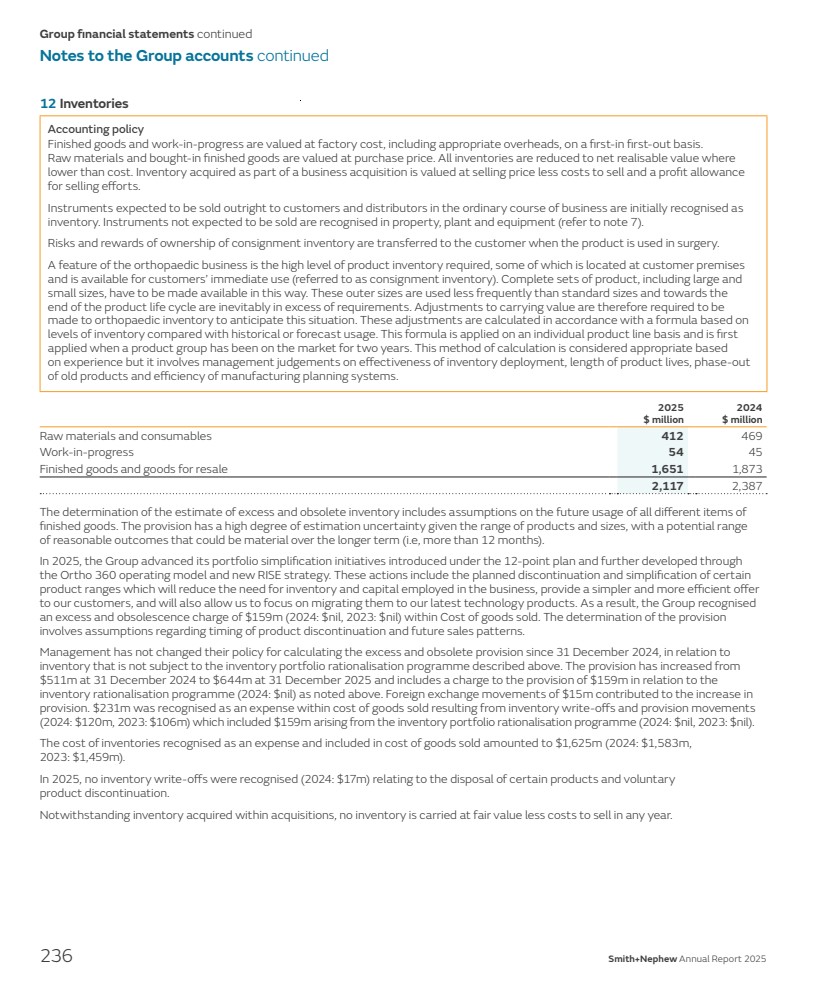
| 13 Trade and other receivables Accounting policy Trade and other receivables are carried at amortised cost, less any allowances for uncollectable amounts. They are included in current assets, except for maturities greater than 12 months after the balance sheet date when they are classified as non-current assets. The Group manages credit risk through credit limits which require authorisation commensurate with the size of the limit and which are regularly reviewed. Credit limit decisions are made based on available financial information and the business case. Significant receivables are regularly reviewed and monitored at Group level. The Group has no significant concentration of credit risk, with exposure spread over a large number of customers and geographies. Furthermore, the Group’s principal customers are backed by government and public or private medical insurance funding, which historically represent a lower risk of default. The maximum exposure to credit risk at the reporting date is the carrying value of each class of receivable. The Group does not hold any collateral as security. The Group applies the simplified approach and allowance losses are calculated by reviewing lifetime expected credit losses using historic and forward-looking data on credit risk. The Group performed the calculation of expected credit loss rates separately for customer groups which were segmented based on common risk characteristics such as credit risk grade and type of customer (such as government and non-government). 2025 2024 $ million $ million Current Trade receivables 1,200 1,100 Less: loss allowance (44) (41) Trade receivables – net 1,156 1,059 Derivatives1 20 47 Other receivables2 138 148 Prepayments 99 127 1,413 1,381 Non-current Derivatives1 26 11 Investments relating to deferred compensation arrangements 109 – Other non- current assets 29 13 164 24 1 Refer to note 16.6 for details of derivatives. 2 Other receivables include deposits, rebates, finance lease receivables and other items of a similar nature. The Group holds investments in financial assets in connection with deferred compensation and employee benefit arrangements (refer to note 16.6). Refer to note 14 for details of deferred compensation obligations. Other non-current assets primarily relate to long-term prepayments and finance lease receivables. Refer to note 16.2 for details of interest rate contracts. Management considers that the carrying amount of trade and other receivables approximates the fair value. Allowance losses are calculated by reviewing lifetime expected credit losses using historic and forward-looking data on credit risk. The loss allowance relating to other receivables is de minimis. The loss allowance expense for the year was $12m (2024: $1m, 2023: $3m). The following table provides information about the ageing of and expected credit losses for trade receivables: 2025 Weighted average loss rate 2025 Loss allowance 2025 Gross carrying amount 2024 Weighted average loss rate 2024 Loss allowance 2024 Gross carrying amount % $ million $ million % $ million $ million Not past due -0.8% (8) 949 -0.8% (7) 860 Past due not more than 3 months -0.6% (1) 169 -0.6% (1) 154 Past due more than 3 months -9.7% (3) 31 -7.7% (2) 26 Past due more than 6 months -62.7% (32) 51 -51.7% (31) 60 (44) 1,200 (41) 1,100 Loss allowance (44) (41) Trade receivables – net 1,156 1,059 Smith+Nephew Annual Report 2025 237 STRATEGIC REPORT GOVERNANCE ACCOUNTS OTHER INFORMATION 23_SN_AR25_Note_1_14_v217.indd 237 05/03/2026 18:23 |
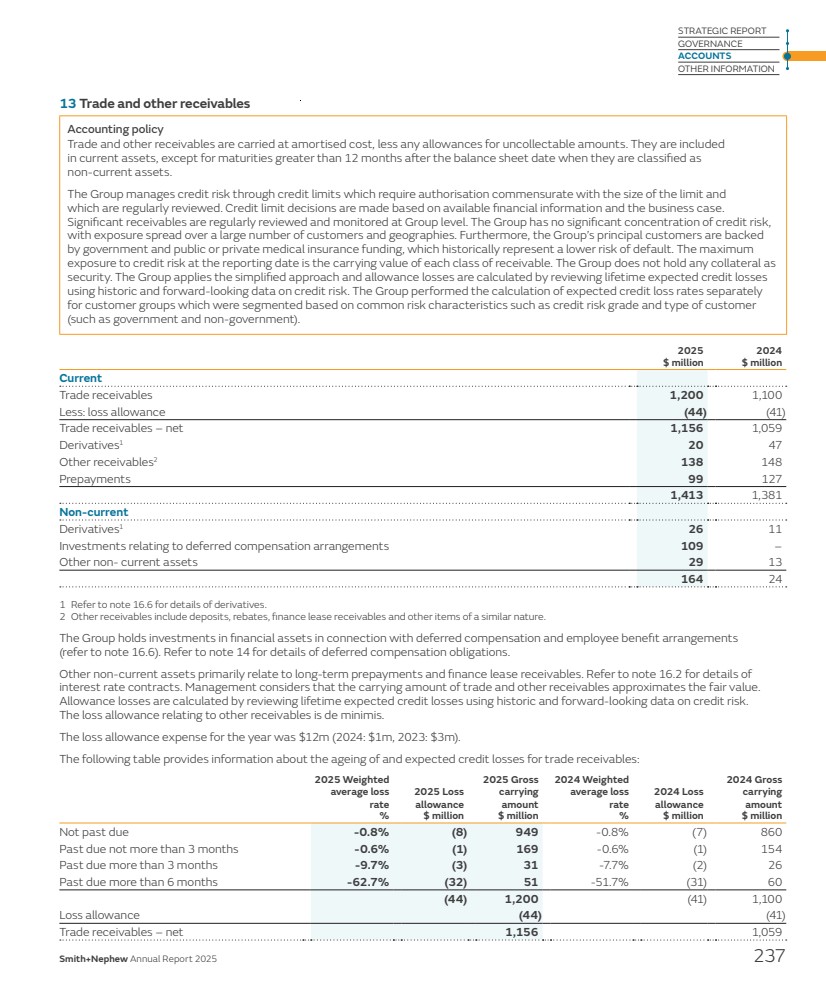
| 13 Trade and other receivables continued The Group’s expected credit loss accounting policy includes guidance on how the expected credit loss percentages should be determined; it does not include present limits as the customer groups and risk profiles are not consistent across all of our markets. Each market determines their own percentages based on historic experience and future expectations, and in line with the general guidance in the Group’s policy. Movements in the loss allowance were as follows: 2025 2024 2023 $ million $ million $ million At 1 January 41 45 49 Exchange adjustment 2 (2) 1 Net receivables provided during the year 12 1 3 Utilisation of provision (11) (3) (8) At 31 December 44 41 45 Trade receivables include amounts denominated in the following major currencies: 2025 2024 $ million $ million US Dollar 502 518 Sterling 38 36 Euro 253 207 Other 363 298 Trade receivables – net 1,156 1,059 14 Trade and other payables 2025 2024 $ million $ million Current Trade and other payables 1,160 1,082 Derivatives1 11 18 Acquisition consideration 6 28 1,177 1,128 Non-current Acquisition consideration 101 77 Derivatives1 6 16 Other payables 83 2 190 95 1 Refer to note 16.6 for details of derivatives. Other payables primarily comprises deferred compensation obligations. These relate to employee compensation earned but payable in future periods. The acquisition consideration includes $107m (2024: $84m) contingent upon future events. The acquisition consideration due after more than one year is expected to be payable as follows: ($13m in 2029 and $88m in 2030 (2024: $5m in 2026, $13m in 2028, $59m in 2029). 238 Smith+Nephew Annual Report 2025 Notes to the Group accounts continued Group financial statements continued 23_SN_AR25_Note_1_14_v217.indd 238 05/03/2026 18:23 |

| 15 Cash and borrowings 15.1 Net debt Net debt comprises borrowings and credit balances on currency swaps less cash and cash equivalents. 2025 2024 $ million $ million Bank overdrafts, borrowings and loans - current 83 2 Corporate bond 2,478 2,498 Private placement notes 550 625 Borrowings 3,111 3,125 Cash and cash equivalents1 (557) (619) Currency swaps – 1 (Asset)/liability balance on derivatives – interest rate swaps (11) 6 Net debt excluding lease liabilities 2,543 2,513 Non-current lease liabilities 149 135 Current lease liabilities 67 61 Net debt 2,759 2,709 1 In 2025, cash and cash equivalents include cash at bank of $457m (2024: $419m) and cash equivalents of $100m (2024: $200m). Borrowings are repayable as follows: Within Between Between Between Between one year or one and two and three and four and After on demand two years three years four years five years five years Total $ million $ million $ million $ million $ million $ million $ million At 31 December 2025 Bank overdrafts and loans 8 – – – – – 8 Corporate bond – 349 – 591 897 641 2,478 Private placement notes 75 140 60 100 95 155 625 Lease liabilities1 67 53 38 27 17 24 226 150 542 98 718 1,009 820 3,337 At 31 December 2024 Bank overdrafts 2 – – – – – 2 Corporate bond – – 348 – 527 1,623 2,498 Private placement notes – 75 140 60 100 250 625 Lease liabilities1 61 46 36 23 17 24 207 63 121 524 83 644 1,897 3,332 1 The lease liabilities presented above of $226m (2024: $207m) are on an undiscounted basis. The lease liabilities on a discounted basis are $216m (2024: $196m). Smith+Nephew Annual Report 2025 239 STRATEGIC REPORT GOVERNANCE ACCOUNTS OTHER INFORMATION 24_SN_AR25_Note_15_23_v227.indd 239 05/03/2026 18:25 |
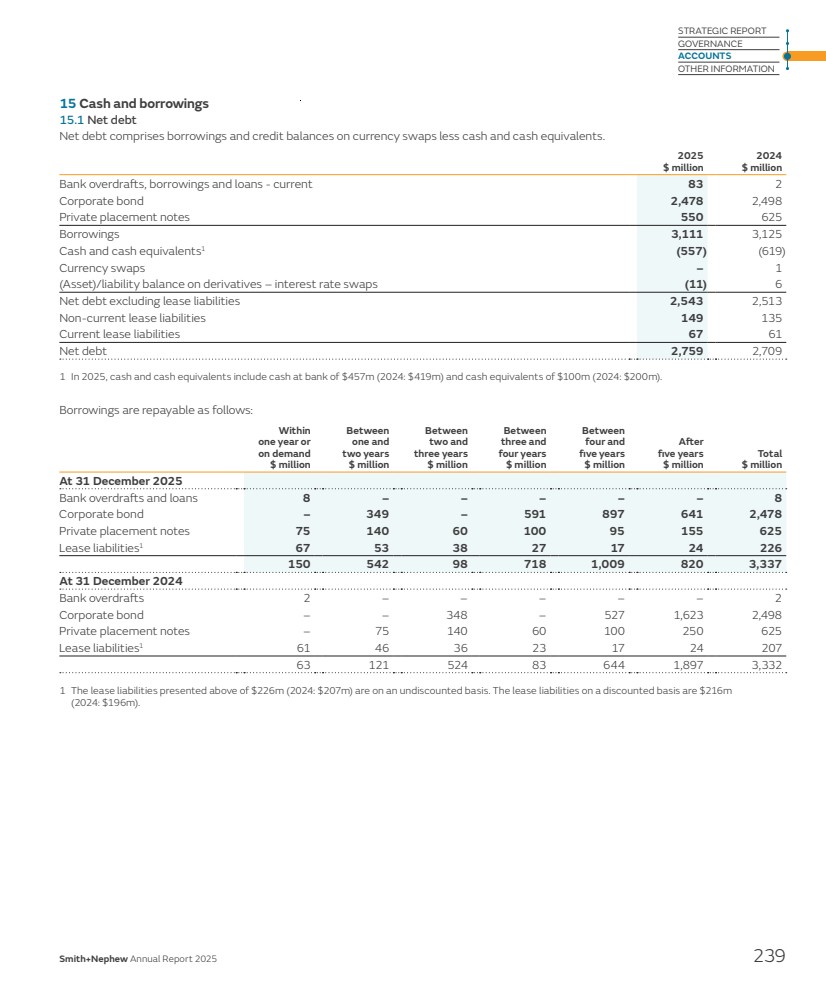
| 15 Cash and borrowings continued 15.2 Liquidity risk exposures The Group has established a set of policies to manage funding and currency risks. The Group only uses derivative financial instruments to manage the financial risks associated with underlying business activities and their financing. Liquidity risk is the risk that the Group is not able to meet its obligations. The Group’s policy is to ensure that there are sufficient facilities in place to meet funding requirements. The Group manages and monitors liquidity risk through preparation and review of short and medium-term cash forecasts, having regard to the maturities of investments and borrowing facilities. The Group has available committed facilities of $4.1bn (2024: $4.1bn). In 2025, the Group repurchased $100 million of its $1.0 billion 2.032% USD corporate bond to manage the maturity profile of the Group’s borrowings. The repurchase consideration amounted to $90m and resulted in a gain of $10m in Other finance costs. During 2024, the Group issued two corporate bonds of $350m and $650m (before expenses and underwriting discounts) of notes bearing an interest rate of 5.15% and 5.40% repayable in 2027 and 2034. In 2024, the Group repaid $405m of private placement debt. The interest payable on borrowings under committed facilities is either at fixed or floating rates. Euro floating rates are typically based on EURIBOR and US Dollar rates are typically based on the Term Secured Overnight Financing Rate (Term SOFR). The Company is subject to financial covenants under its private placement agreements. The principal covenant on the private placement debt is a leverage ratio of <3.5 which is measured on a rolling 12-month basis at half year and year end using net debt excluding lease liabilities as set out in note 15.1. The financial covenants are tested at the end of each half year for the 12 months ending on the last day of the testing period. As of 31 December 2025, the Company was in compliance with these covenants. The facilities are also subject to customary events of default, none of which are currently anticipated to occur. As the measure included in the financial covenants represents net debt excluding lease liabilities, the Group also presents the net debt position to provide a complete and comprehensive view of its financial position. The Group’s $1.0 billion Revolving Credit Facility (“RCF”) maturity date was extended to 2030 during the year. The Group’s committed facilities at 31 December 2025 and at 31 December 2024 are: Facility 2025 Date due $75 million 3.99% Senior Notes January 2026 $350 million 5.15% US Corporate Bond March 2027 $140 million 2.83% Senior Notes June 2027 $60 million 2.90% Senior Notes June 2028 $1.0 billion syndicated revolving credit facility October 2030 $100 million 2.97% Senior Notes June 2029 €500 million 4.565% EUR Corporate Bond October 2029 $95 million 2.99% Senior Notes June 2030 $900 million 2.032% USD Corporate Bond October 2030 $155 million 3.09% Senior Notes June 2032 $650 million 5.40% USD Corporate Bond March 2034 Facility 2024 Date due $75 million 3.99% Senior Notes January 2026 $350 million 5.15% US Corporate Bond March 2027 $140 million 2.83% Senior Notes June 2027 $60 million 2.90% Senior Notes June 2028 $1.0 billion syndicated revolving credit facility October 2029 $100 million 2.97% Senior Notes June 2029 €500 million 4.565% EUR Corporate Bond October 2029 $95 million 2.99% Senior Notes June 2030 $1.0 billion 2.032% USD Corporate Bond October 2030 $155 million 3.09% Senior Notes June 2032 $650 million 5.40% USD Corporate Bond March 2034 240 Smith+Nephew Annual Report 2025 Notes to the Group accounts continued Group financial statements continued 24_SN_AR25_Note_15_23_v227.indd 240 05/03/2026 18:25 |
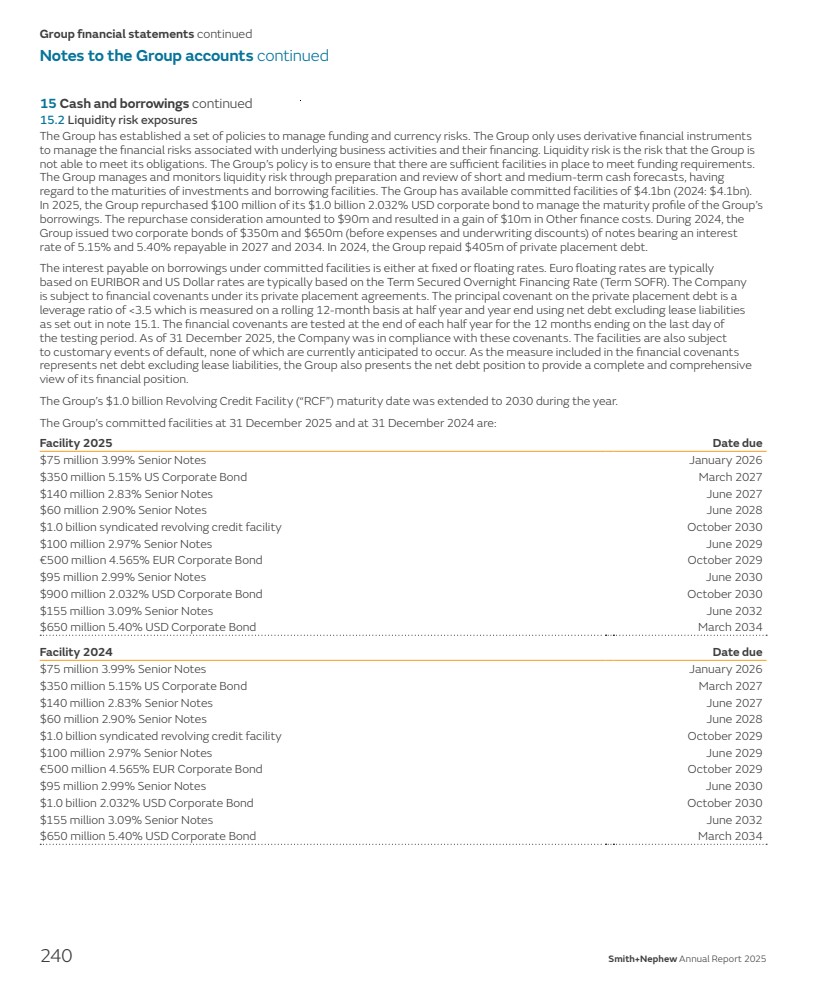
| 15.3 Year end financial liabilities by contractual maturity The table below analyses the Group’s year end financial liabilities by contractual maturity date, including contractual interest payments and excluding the impact of netting arrangements: Within one Between Between year or on one and two and After demand two years five years five years Total $ million $ million $ million $ million $ million At 31 December 2025 Non-derivative financial liabilities: Bank overdrafts and loans 8 – – – 8 Corporate bond 90 426 1,682 773 2,971 Trade and other payables 1,253 – 2 – 1,255 Private placement notes 92 154 282 162 690 Acquisition consideration 7 – 165 – 172 Derivative financial liabilities: Currency swaps – outflow 419 – – – 419 Currency swaps – inflow (417) – – – (417) Forward foreign exchange contracts – outflow1 401 279 91 – 771 Forward foreign exchange contracts – inflow1 (394) (278) (92) – (764) 1,459 581 2,130 935 5,105 At 31 December 2024 Non-derivative financial liabilities: Bank overdrafts and loans 2 – – – 2 Corporate bond 98 95 1,109 1,825 3,127 Trade and other payables 1,082 – – – 1,082 Private placement notes 19 92 335 263 709 Acquisition consideration 28 5 165 – 198 Derivative financial instruments: Currency swaps – outflow 455 – – – 455 Currency swaps – inflow (454) – – – (454) Forward foreign exchange contracts – outflow1 2,415 – – – 2,415 Forward foreign exchange contracts – inflow1 (2,445) – – – (2,445) 1,200 192 1,609 2,088 5,089 1 Refer to note 16.1 for details of foreign exchange risk management and the currencies being hedged. The amounts in the tables above are undiscounted cash flows, which differ from the amounts included in the balance sheet where the underlying cash flows have been discounted. 15.4 Liquidity and capital resources The Group’s policy is to ensure that it has sufficient funding and facilities to meet foreseeable borrowing requirements. At 31 December 2025, the Group held $553m (2024: $617m, 2023: $300m) in cash and cash equivalents net of bank overdrafts. The Group had committed facilities available of $4.1bn (2024: $4.1bn) at 31 December 2025 of which $3.1bn (2024: $3.1bn) was drawn. The $1bn (2024: $1bn) undrawn amount relates to the RCF. The Group has sufficient liquidity to support all known or expected business requirements for 2026 such as dividend payments, acquisitions and disposals of businesses, capital expenditure, working capital fluctuations and trading activity. Smith+Nephew Annual Report 2025 241 STRATEGIC REPORT GOVERNANCE ACCOUNTS OTHER INFORMATION 24_SN_AR25_Note_15_23_v227.indd 241 05/03/2026 18:25 |

| 16 Financial instruments and risk management Accounting policy Derivative financial instruments Derivative financial instruments are initially recognised at fair value on the date a derivative contract is entered into and are subsequently remeasured at their fair value at subsequent balance sheet dates. Changes in the fair value of derivative financial instruments that are designated and effective as cash flow hedges of forecast transactions are recognised in other comprehensive income until the associated asset or liability is recognised. Amounts taken to other comprehensive income are transferred to the income statement in the period in which the hedged transaction affects profit and loss. Changes in the fair value of derivative financial instruments that are not designated as cash flow hedges are recognised directly in profit and loss. On adoption of IFRS 9 on 1 January 2018, the Group elected to continue to apply the hedge accounting guidance in IAS 39 Financial Instruments: Recognition and Measurement. Changes in the fair values of hedging instruments that are designated and effective as net investment hedges are matched in other comprehensive income against changes in value of the related net assets. Interest rate derivatives transacted to fix interest rates on floating rate borrowings are accounted for as cash flow hedges and changes in the fair values resulting from changes in market interest rates are recognised in other comprehensive income. Amounts taken to other comprehensive income are transferred to the income statement when the hedged transaction affects profit and loss. Interest rate derivatives transacted to convert fixed rate borrowings into floating rate borrowings are accounted for as fair value hedges and changes in the fair values resulting from changes in market interest rates are recognised in the income statement. Any ineffectiveness on hedging instruments and changes in the fair value of derivative financial instruments that do not qualify for hedge accounting are recognised in the income statement within other finance costs as they arise. Hedge accounting is discontinued when the hedged transaction expires or is sold, terminated or exercised, or no longer qualifies for hedge accounting. At that point in time, any cumulative gain or loss on the hedging instrument recognised in other comprehensive income is retained there until the forecast transaction occurs. If a hedged transaction is no longer expected to occur, the net cumulative gain or loss recognised in other comprehensive income is transferred to the income statement. 16.1 Foreign exchange risk management The Group operates in many countries and, as a consequence, is exposed to movements in foreign exchange, giving rise to both transaction and translation foreign exchange risk. Foreign exchange risk arises primarily from transactional foreign exchange exposures, which are managed in line with the Group’s risk management framework, while the Group is also exposed to foreign exchange translation risk on consolidation. Transaction foreign exchange risk arises where forecast sales, purchases or other trading cash flows are denominated in currencies other than the functional currency of the operating entity. The Group is exposed to transactional foreign exchange risk as the majority of its cost base is denominated in US Dollars while revenues are earned in US Dollars and other currencies. Movements in exchange rates may affect the Group’s operating profit, particularly in respect of non- US Dollar operating profits where the proportion of sales in those currencies exceeds the proportion of costs. The Group’s policy is to hedge substantially all material transaction foreign exchange exposures in order to reduce volatility in operating profit and cash flows. The Group mitigates the impact of transaction related currency movements on operating profit through the use of forward foreign exchange contracts, which are designated as cash flow hedges. These hedges are designated against forecast trading cash flows that give rise to foreign exchange risk and impact the Group’s operating profit, reflecting differences between the currencies in which revenues and costs are incurred versus the functional currencies of the respective operating entities. Such exposures are typically hedged for periods of up to three years, with hedge coverage increased as the proximity to forecast transactions increases. The principal currencies hedged using forward foreign exchanges contracts are Euro, Japanese Yen, Australian Dollar, Canadian Dollar and Korean Won. At 31 December 2025, the Group had outstanding forward foreign exchange contracts with a total notional principal amount of $1.4 billion (2024: $2.4 billion) maturing across three years (2024: one year) from the balance sheet date. As part of the Group’s ongoing risk management process, the portfolio of key foreign currency exposures designated for hedging is reviewed regularly, and specific currencies hedged may vary from year to year based on the Group’s foreign exchange risk assessment. During 2025, the Group refreshed its foreign exchange risk assessment through an updated Value at Risk analysis. As a result of this review, the foreign exchange hedging programme was refined, including a reduction in the number of currencies designated for hedging and an extension of the hedging horizon from one year to periods of up to three years. These changes are aligned with the Group’s risk management framework and reflect the evolving profile of the Group’s forecast transactional foreign exchange exposures. 242 Smith+Nephew Annual Report 2025 Notes to the Group accounts continued Group financial statements continued 24_SN_AR25_Note_15_23_v227.indd 242 05/03/2026 18:25 |
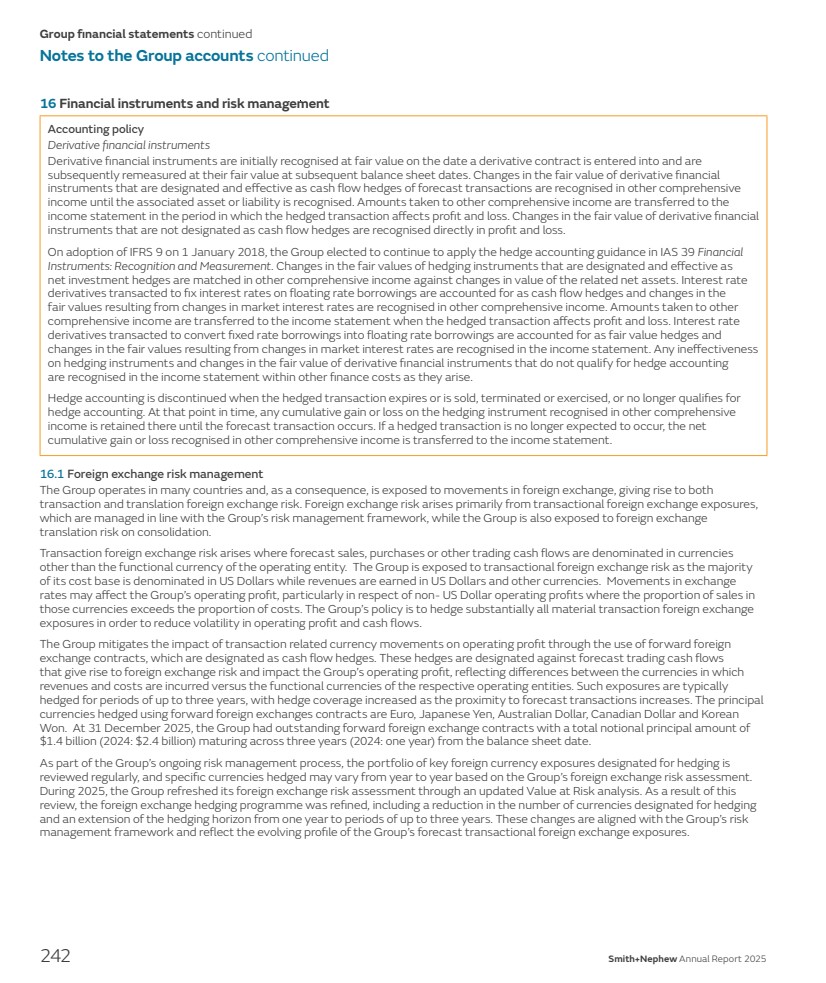
| All exchange rates are presented in accordance with standard Foreign exchange market quoting conventions. Carrying Hedge Average Nominal value assets/ ineffectiveness strike amounts (liabilities) in profit or loss As at 31 December 2025 rate $ million $ million $ million Balance Sheet classification Forward exchange contracts Sell Euros < 1 year 1.17 390 (4) – Current assets / current liabilities 1 - 3 years 1.20 390 (1) – Non-current assets / non-current liabilities Sell Australian Dollars < 1 year 0.65 110 (3) – Current assets / current liabilities 1 - 3 years 0.65 110 (1) – Non-current assets / non-current liabilities Sell Canadian Dollars < 1 year 1.36 53 – – Current assets / current liabilities 1 - 3 years 1.35 53 – – Non-current assets / non-current liabilities Sell Japanese Yen < 1 year 140 131 14 – Current assets / current liabilities 1 - 3 years 140 131 10 – Non-current assets / non-current liabilities Sell South Korean won < 1 year 1,372 31 2 – Current assets / current liabilities 1 - 3 years 1,366 29 1 – Non-current assets / non-current liabilities Total cash flow hedges of foreign currency risk on forecast transactions 1,428 18 – Carrying Hedge Average Nominal value assets/ ineffectiveness strike amounts (liabilities) in profit or loss As at 31 December 2024 rate $ million $ million $ million Balance Sheet classification Forward exchange contracts Sell Euros (net) for US Dollars 1.10 570 10 – Current assets / current liabilities Buy Pound sterling (net) for US Dollars 1.24 438 – – Current assets / current liabilities Sell Euros (net) for Pound sterling 0.85 335 2 – Current assets / current liabilities Sell Singapore Dollars (net) for US Dollars 1.32 174 4 – Current assets / current liabilities Buy Swiss Franc (net) for Euros 0.93 134 – – Current assets / current liabilities Sell Australian Dollars (net) for Singapore Dollars 0.87 122 3 – Current assets / current liabilities Sell Japanese Yen (net) for Singapore Dollars 110 101 3 – Current assets / current liabilities Other currencies 541 8 – Current assets / current liabilities Total cash flow hedges of foreign currency risk on forecast transactions 2,415 30 – Smith+Nephew Annual Report 2025 243 STRATEGIC REPORT GOVERNANCE ACCOUNTS OTHER INFORMATION 24_SN_AR25_Note_15_23_v227.indd 243 05/03/2026 18:25 |

| 16 Financial instruments and risk management continued The movement in cash flow hedge reserve is as follows: Terminated hedges Active hedges Total 2025 2024 2025 2024 2025 2024 $ million $ million $ million $ million $ million $ million Opening balance (25) – (9) 3 (34) 3 Gains recognised in OCI 3 – (16) (38) (13) (38) Amounts recycled to income statement 20 – 9 1 29 1 At 31 December (2) – (16) (34) (18) (34) The Group designates forward foreign exchange contracts as cash flow hedges against the exchange rate fluctuation risk on certain intercompany transactions associated with third-party sales and purchases. Amounts recycled to the consolidated income statement are recognised within cost of sales when the third-party sales and purchases occur. During the year, certain forward foreign exchange contracts relating to currency pairs that no longer form part of the Group’s updated foreign exchange risk management strategy were early terminated. A portion of the cumulative gains and losses previously recognised in the cash flow hedge reserve in respect of these instruments has been recycled to the consolidated income statement, in line with the timing of the underlying hedged transactions. At 31 December 2025, approximately $2m remains within the cash flow hedge reserve relating to these discontinued hedging relationships, which is expected to be recycled to the income statement within the next twelve months, in line with the timing of the underlying hedged items. Based on the Group’s net borrowings as at 31 December 2025, if the US Dollar were to weaken against all currencies by 10%, the Group’s net borrowings would increase by $45m (2024: $40m) principally due to the €500m Euro corporate bond which is designated as a hedging instrument to hedge part of Group’s net investment in its Euro subsidiaries (refer to note 16.4 for details). The corresponding impact on the income statement and other comprehensive income is illustrated in the table below. The other comprehensive income impact relates to the Euro corporate bond. 2025 2024 Increase/ Increase/ (decrease) in Increase/ (decrease) in Increase/ income (decrease) in income (decrease) in statement OCI statement OCI $ million $ million $ million $ million 10% weakening of the US Dollar 1 (46) – (40) 10% strengthening of the US Dollar (1) 46 – 40 If the US Dollar were to weaken by 10% against all other currencies, then the fair value of the forward foreign exchange contracts as at 31 December 2025 would have been $144m lower (2024: $48m lower). Movements in the fair value of forward foreign exchange contracts would be recognised in other comprehensive income or in the income statement as illustrated in the table below. 2025 2024 Increase/ Increase/ (decrease) in Increase/ (decrease) in Increase/ income (decrease) in income (decrease) in statement OCI statement OCI $ million $ million $ million $ million 10% weakening of the US Dollar (6) (138) (7) (41) 10% strengthening of the US Dollar 6 129 7 41 The Group is exposed to foreign exchange translation risk arising from the translation on consolidation of monetary assets and liabilities denominated in currencies other than the functional currencies of the Group’s operating entities. It is the Group’s policy that operating units do not hold material unhedged monetary assets or liabilities other than in their functional currencies. Movements in exchange rates may affect reported revenue, profit and net assets but do not impact the Group’s underlying cash flows. Hedge ineffectiveness is caused by actual cash flows in foreign currencies varying from forecast cash flows. 244 Smith+Nephew Annual Report 2025 Notes to the Group accounts continued Group financial statements continued 24_SN_AR25_Note_15_23_v227.indd 244 05/03/2026 18:25 |
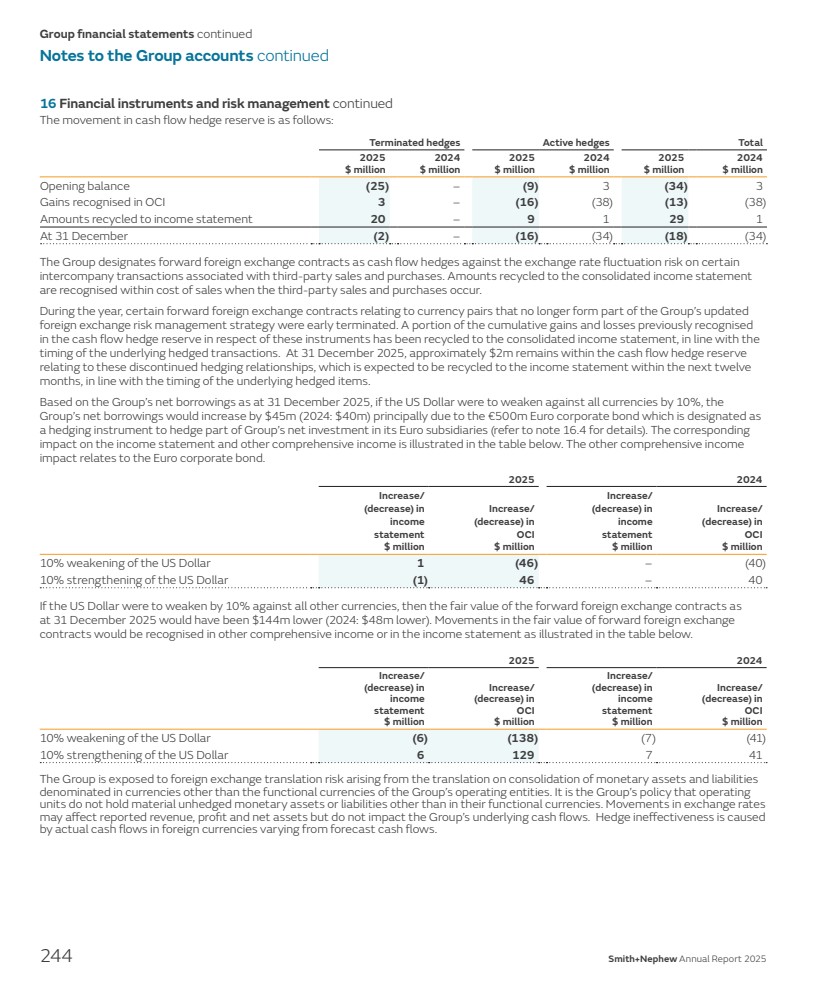
| 16.2 Interest rate risk management The Group is exposed to interest rate risk on cash, borrowings and certain currency and interest rate swaps which are at floating rates. The Group uses interest rate swaps to reduce the overall level of fixed rate debt, consistent with its policy of maintaining at least 50% of gross debt at fixed rates. When used in this way, interest rate derivatives are accounted for as fair value hedges. The fair value movement of the derivative is offset in the income statement against the fair value movement in the underlying fixed rate debt. When required the Group uses interest rate derivatives to meet its objective of protecting borrowing costs within parameters set by the Board. These interest rate derivatives are accounted for as cash flow hedges and, as such, changes in fair value resulting from changes in market interest rates are recognised in other comprehensive income and accumulated in the hedging reserve, with the fair value of the interest rate derivatives recorded in the balance sheet. Based on the Group’s gross borrowings and cash as at 31 December 2025, if floating interest rates were to increase by 100 basis points in all currencies, then the annual net interest charge would increase by $7m (2024: $5m). A decrease in interest rates by 100 basis points in all currencies would have an equal but opposite effect to the amounts shown above. The amounts relating to items designated as hedging instruments to manage the interest rate risk were as follows: Fixed rate debt Derivatives - Interest rate swaps Fair value Carrying amount Fair value Cumulative change used for change used for fair value Group recognising hedge Group recognising hedge Carrying hedge Balance ineffectiveness Balance Nominal ineffectiveness amount1 adjustments Sheet charge/(credit) assets liabilities Sheet amount charge/(credit) $ million $ million line item $ million $ million $ million line item million $ million At 31 December 2025 US Dollar bond (500) (3) Long-term borrowings 20 4 – Other non-current (500) (20) Euro bond (588) 6 and lease liabilities (3) 7 – assets (500) 3 At 31 December 2024 US Dollar bond (500) (16) Long-term borrowings (16) – (16) Other non-current (500) 16 Euro bond (520) 10 and lease liabilities 3 10 – assets/ (liabilities) (500) (3) 1 The carrying amount relates to a hedge of the €500m EUR corporate bond ($588m translated at closing USD/EUR rate (2024: $520m)) and a hedge of $500m out of the $650m corporate bond. 16.3 Credit risk management The Group limits exposure to credit risk on counterparties used for financial instruments through a system of internal credit limits. The financial exposure of a counterparty is determined as the total of cash and deposits, plus the risk on derivative instruments, assessed as the fair value of the instrument plus a risk element based on the nominal value and the historic volatility of the market value of the instrument. The Group does not anticipate non-performance of counterparties and believes it is not subject to material concentration of credit risk as the Group operates within a policy of counterparty limits designed to reduce exposure to any single counterparty. The maximum credit risk exposure on derivatives at 31 December 2025 was $46m (2024: $56m), being the total debit fair values on forward foreign exchange contracts, currency swaps and interest rate swaps. The maximum credit risk exposure on cash and cash equivalents at 31 December 2025 was $557m (2024: $619m). The Group’s exposure to credit risk on cash is mitigated as the amounts are held in a wide number of high credit quality financial institutions. Credit risk on trade receivables is detailed in Note 13. Smith+Nephew Annual Report 2025 245 STRATEGIC REPORT GOVERNANCE ACCOUNTS OTHER INFORMATION 24_SN_AR25_Note_15_23_v227.indd 245 05/03/2026 18:25 |
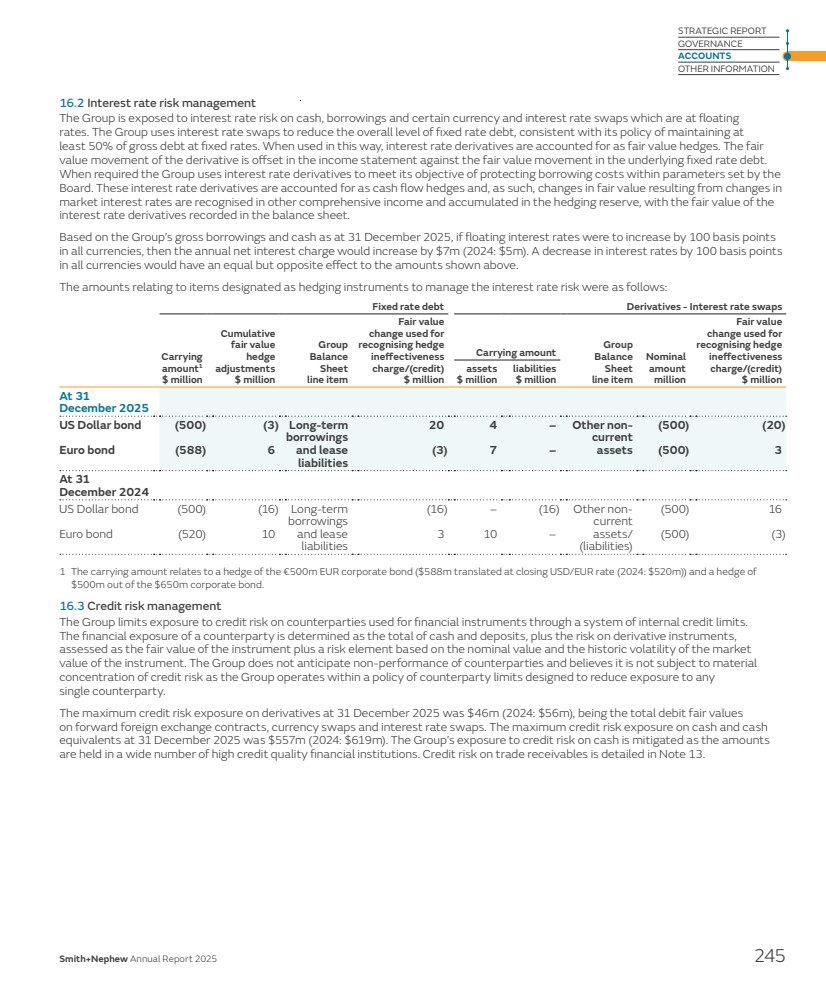
| 16 Financial instruments and risk management continued 16.4 Net investment hedge Part of the Group’s net investment in its Euro subsidiaries is hedged by €500m ($588m equivalent) of our EUR corporate bond which mitigates the foreign currency risk arising from the subsidiaries’ net assets. The Bond is designated as a hedging instrument for the changes in the value of the net investment that is attributable to changes in the EUR/USD spot rate. Balance sheet classification (Gains) / losses Carrying value of recognised in Other Amounts reclassified hedging instrument Comprehensive Income to income statement 2025 2024 2025 2024 2025 2024 $ million $ million $ million $ million $ million $ million Long-term borrowings and lease liabilities 588 520 68 (33) – – To assess hedge effectiveness, the Group determines the economic relationship between the hedging instrument and the hedged item by comparing changes in the carrying amount of the debt that is attributable to a change in the spot rate with changes in the investment in the foreign operation due to movements in the spot rate (the offset method). The Group’s policy is to hedge the net investment only to the extent of the debt principal. Hedge ineffectiveness occurs if the value of the Euro-denominated corporate bond exceeds the value of the Euro subsidiaries. Currency risk on foreign operations Hedging Balance in translation reserve Change in value used for calculating ineffectiveness instrument Continuing Discontinued Hedged Hedging Hedge notional hedges hedges item instrument ineffectiveness million $ million $ million $ million $ million $ million At 31 December 2025 500 102 16 68 68 – At 31 December 2024 500 34 16 (33) (33) – 16.5 Currency and interest rate profile of interest bearing liabilities and assets Short-term receivables and payables are excluded from the following disclosures. Currency and interest rate profile of interest bearing liabilities: Fixed rate liabilities Weighted average Interest Weighted time Gross Currency rate Total Floating Fixed rate average for which borrowings swaps swaps liabilities rate liabilities liabilities interest rate rate is fixed $ million $ million $ million $ million $ million $ million % Years At 31 December 2025 US Dollar (2,510) (2) – (2,512) (492) (2,020) 3.1 4.0 Euro (591) – – (591) (591) – Other (10) – – (10) (10) – Total interest bearing liabilities (3,111) (2) – (3,113) (1,093) (2,020) At 31 December 2024 US Dollar (2,594) (310) (16) (2,920) (324) (2,596) 3.5 4.1 Euro (527) (130) – (657) (130) (527) Other (4) (14) – (18) (18) – Total interest bearing liabilities (3,125) (454) (16) (3,595) (472) (3,123) 246 Smith+Nephew Annual Report 2025 Notes to the Group accounts continued Group financial statements continued 24_SN_AR25_Note_15_23_v227.indd 246 05/03/2026 18:25 |
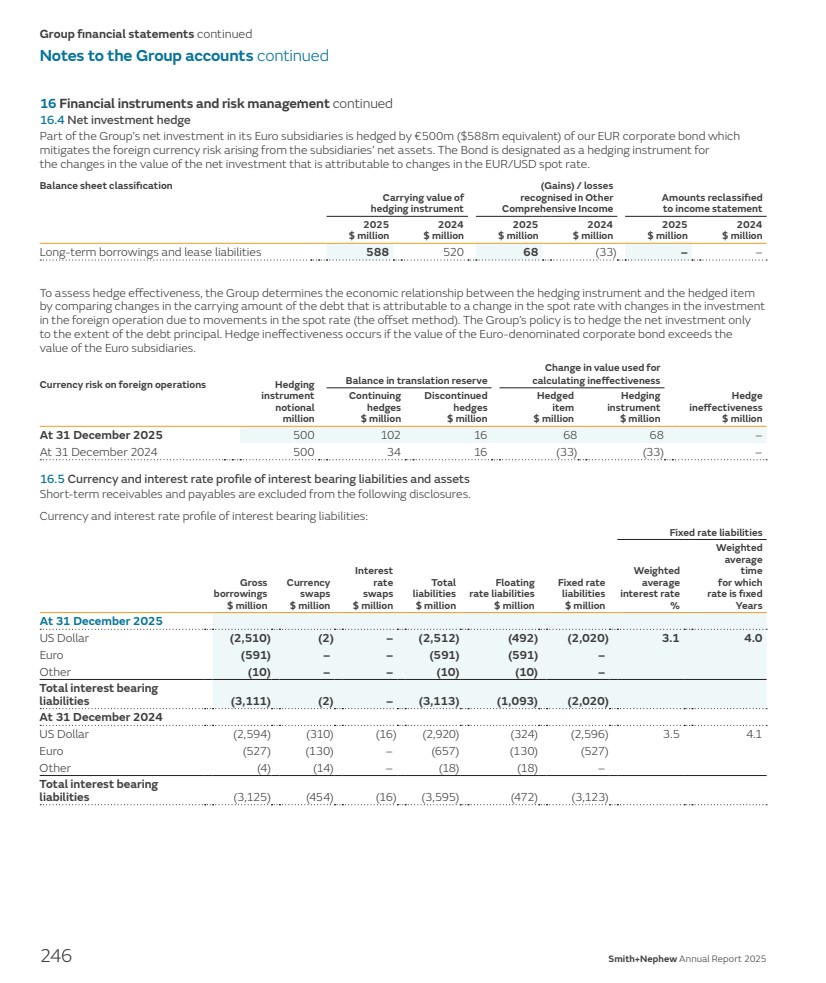
| In 2025, the Group also had liabilities due for deferred and contingent acquisition consideration (denominated in US Dollars and Euros) totalling $107m (2024: $105m) on which no interest was payable (see Note 14). There were no other significant interest bearing or non-interest bearing financial liabilities. Euro floating rates are typically based on EURIBOR and US Dollar rates are typically based on Term SOFR. The weighted average interest rate on floating rate borrowings as at 31 December 2025 was 4.6% (2024: 5.1%). The Group has entered into interest rate swap contracts to convert the interest payments on €500m and $500m debt from fixed rate to floating rate basis. Currency and interest rate profile of interest bearing assets: Cash and cash Currency Interest rate Floating Fixed equivalents swaps swaps Total assets rate assets rate assets $ million $ million $ million $ million $ million $ million At 31 December 2025 US Dollar 393 2 4 399 395 4 Euro 26 – 7 33 33 – Other 138 – – 138 138 – Total interest bearing assets 557 2 11 570 566 4 At 31 December 2024 US Dollar 482 146 – 628 628 – Euro 9 37 10 56 56 – Other 128 270 – 398 398 – Total interest bearing assets 619 453 10 1,082 1,082 – Floating rates on assets are typically based on the short-term deposit rates relevant to the currency concerned. 16.6 Fair value of financial assets and liabilities Accounting policy Measurement of fair values A number of the Group’s accounting policies and disclosures require the measurement of fair values, for both financial assets and liabilities and non-financial assets acquired in a business combination (see Note 21). When measuring the fair value of an asset or liability, the Group uses market observable data as far as possible. Fair values are categorised into different levels in the fair value hierarchy based on the inputs used in the valuation techniques as follows: Level 1: quoted prices (unadjusted) in active markets for identical assets or liabilities; Level 2: inputs other than quoted prices included in Level 1 that are observable for the asset or liability, either directly (ie as prices) or indirectly (ie derived from prices); and Level 3: inputs for the asset or liability that are not based on observable data (unobservable inputs). The Group recognises transfers between the levels of the fair value hierarchy at the end of the reporting period during which the change has occurred. There has been no change in the classification of financial assets and liabilities, the method and assumptions used in determining fair value and the categorisation of financial assets and liabilities within the fair value hierarchy from those disclosed in the Annual Report for the year ended 31 December 2024. The Group holds investments in relation to deferred compensation and employee benefit arrangements. These assets mainly comprise investments in mutual funds and similar investment vehicles with quoted prices in active markets that the Group can access at the reporting date. Fair value is therefore determined using unadjusted quoted market prices, and accordingly these investments are classified as Level 1 within the fair value hierarchy. The assets are measured at fair value through profit or loss. The Group enters into derivative financial instruments with financial institutions with investment grade credit ratings. The fair value of forward foreign exchange contracts is calculated by reference to quoted market forward exchange rates for contracts with similar maturity profiles. The fair value of interest rate swaps is determined by reference to quoted market interest rates. The fair value of currency swaps is determined by reference to quoted market spot rates. As a result, foreign forward exchange contracts, interest rate swaps and currency swaps are classified as Level 2 within the fair value hierarchy. For Level 2 instruments, the valuation method used is the discounted cash flow technique, which estimates expected future cash flows or payoffs using observable market inputs and discounts them to present value using market-derived discount factors. The changes in counterparty credit risk had no material effect on the hedge effectiveness for derivatives designated in hedge relationships and other financial instruments recognised at fair value. The fair value of investments is based upon third-party pricing models for share issues. As a result, investments are considered Level 3 in the fair value hierarchy. There were no transfers between Levels 1, 2 and 3 during 2025 and 2024. For cash and cash equivalents, short-term loans and receivables, overdrafts and other short-term liabilities which have a maturity of less than three months, the book values approximate the fair values because of their short-term nature. Smith+Nephew Annual Report 2025 247 STRATEGIC REPORT GOVERNANCE ACCOUNTS OTHER INFORMATION 24_SN_AR25_Note_15_23_v227.indd 247 05/03/2026 18:25 |
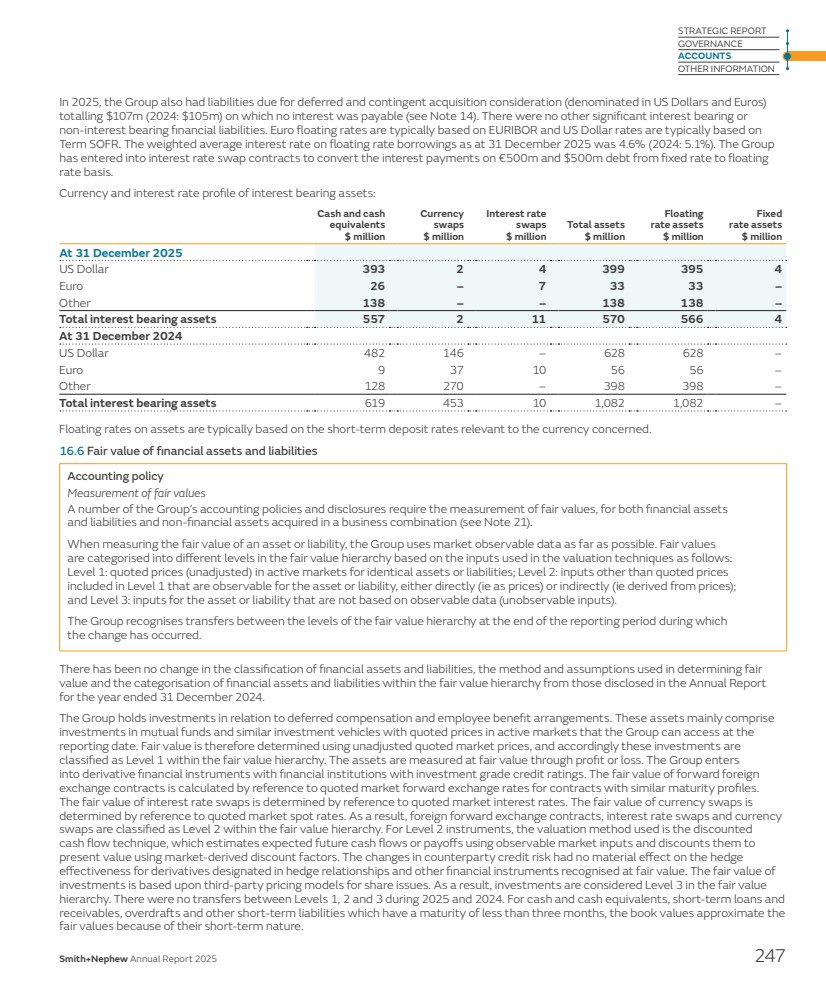
| 16 Financial instruments and risk management continued Long-term borrowings are measured in the balance sheet at amortised cost. The corporate bonds issued in October 2020, October 2022 and March 2024 are publicly listed and a market price is available. The Group’s other long-term borrowings are not quoted publicly, their fair values are estimated by discounting future contractual cash flows to net present values at the current market interest rates available to the Group for similar financial instruments as at the year end. The fair value of the private placement notes is determined using a discounted cash flow model based on prevailing market rates. There are no financial assets and liabilities that are subject to master netting or similar arrangements. The following table shows the carrying amounts and fair values of financial assets and financial liabilities, including their levels in the fair value hierarchy. It does not include fair value information for financial assets and financial liabilities not measured at fair value. Carrying amount Fair value Fair value – hedging instruments Amortised cost Fair value through OCI Fair value through profit or loss Total Level 1 Level 2 Level 3 Total At 31 December 2025 $ million $ million $ million $ million $ million $ million $ million $ million $ million Financial assets measured at fair value Forward foreign exchange contracts 33 – – – 33 – 33 – 33 Investments – – – 30 30 – – 30 30 Investments relating to deferred compensation arrangements – – – 106 106 106 – – 106 Interest rate swaps 11 – – – 11 – 11 – 11 Currency swaps – – – 2 2 – 2 – 2 44 – – 138 182 Financial liabilities measured at fair value Acquisition consideration - contingent – – – (107) (107) – – (107) (107) Forward foreign exchange contracts (15) – – – (15) – (15) – (15) Currency swaps – – – (2) (2) – (2) – (2) (15) – – (109) (124) Financial assets not measured at fair value Trade and other receivables – 1,278 – – 1,278 Cash and cash equivalents – 557 – – 557 – 1,835 – – 1,835 Financial liabilities not measured at fair value Bank overdrafts and loans – (8) – – (8) Corporate bond not in a hedge relationship – (1,394) – – (1,394) Corporate bond in a hedge relationship – (1,084) – – (1,084) Private placement debt not in a hedge relationship – (625) – – (625) Trade and other payables – (1,243) – – (1,243) – (4,354) – – (4,354) 248 Smith+Nephew Annual Report 2025 Notes to the Group accounts continued Group financial statements continued 24_SN_AR25_Note_15_23_v227.indd 248 05/03/2026 18:25 |
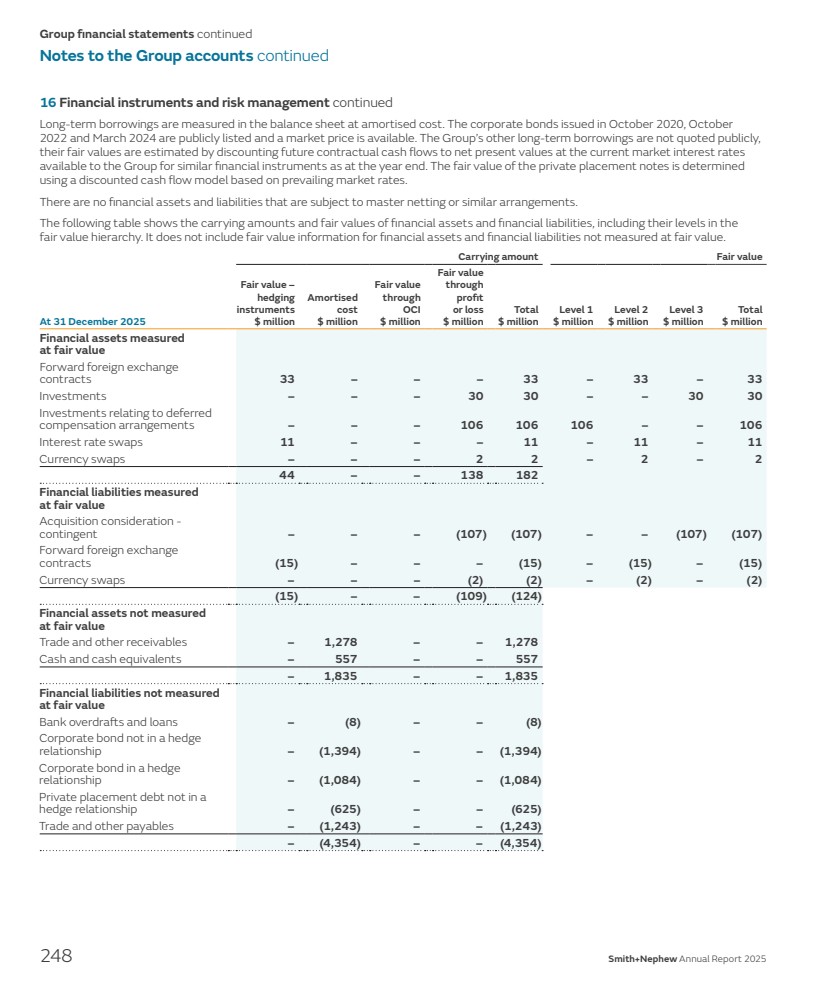
| During the year ended 31 December 2025, acquisition consideration increased by $2m due to a $17m increase in relation to the remeasurement of CartiHeal acquisition, a $12m increase due to discount unwind, partially offset by $27m of payments for CartiHeal and other acquisitions made in prior years. The fair value of contingent consideration is estimated using a discounted cash flow model. The valuation model considers the present value of expected payment, discounted using a risk-adjusted discount rate. The expected payment is determined by considering the possible scenarios, which relate to the achievement of established milestones and targets, the amount to be paid under each scenario and the probability of each scenario. As a result, contingent consideration is classified as Level 3 within the fair value hierarchy. Carrying amount Fair value Fair value – hedging instruments Amortised cost Fair value through OCI Fair value through profit or loss Total Level 2 Level 3 Total At 31 December 2024 $ million $ million $ million $ million $ million $ million $ million $ million Financial assets measured at fair value Forward foreign exchange contracts 46 – – – 46 46 – 46 Investments – – – 9 9 – 9 9 Interest rate swaps 10 – – – 10 10 – 10 Currency swaps – – – 1 1 1 – 1 56 – – 10 66 Financial liabilities measured at fair value Acquisition consideration - contingent – – – (84) (84) – (84) (84) Forward foreign exchange contracts (16) – – – (16) (16) – (16) Interest rate swaps (16) – – – (16) (16) – (16) Currency swaps – – – (2) (2) (2) – (2) (32) – – (86) (118) Financial assets not measured at fair value Trade and other receivables – 1,190 – – 1,190 Cash and cash equivalents – 619 – – 619 – 1,809 – – 1,809 Financial liabilities not measured at fair value Acquisition consideration - deferred – (21) – – (21) Bank overdrafts – (2) – – (2) Corporate bond not in a hedge relationship – (1,492) – – (1,492) Corporate bond in a hedge relationship – (1,006) – – (1,006) Private placement debt not in a hedge relationship – (625) – – (625) Trade and other payables – (1,084) – – (1,084) – (4,230) – – (4,230) Smith+Nephew Annual Report 2025 249 STRATEGIC REPORT GOVERNANCE ACCOUNTS OTHER INFORMATION 24_SN_AR25_Note_15_23_v227.indd 249 05/03/2026 18:25 |
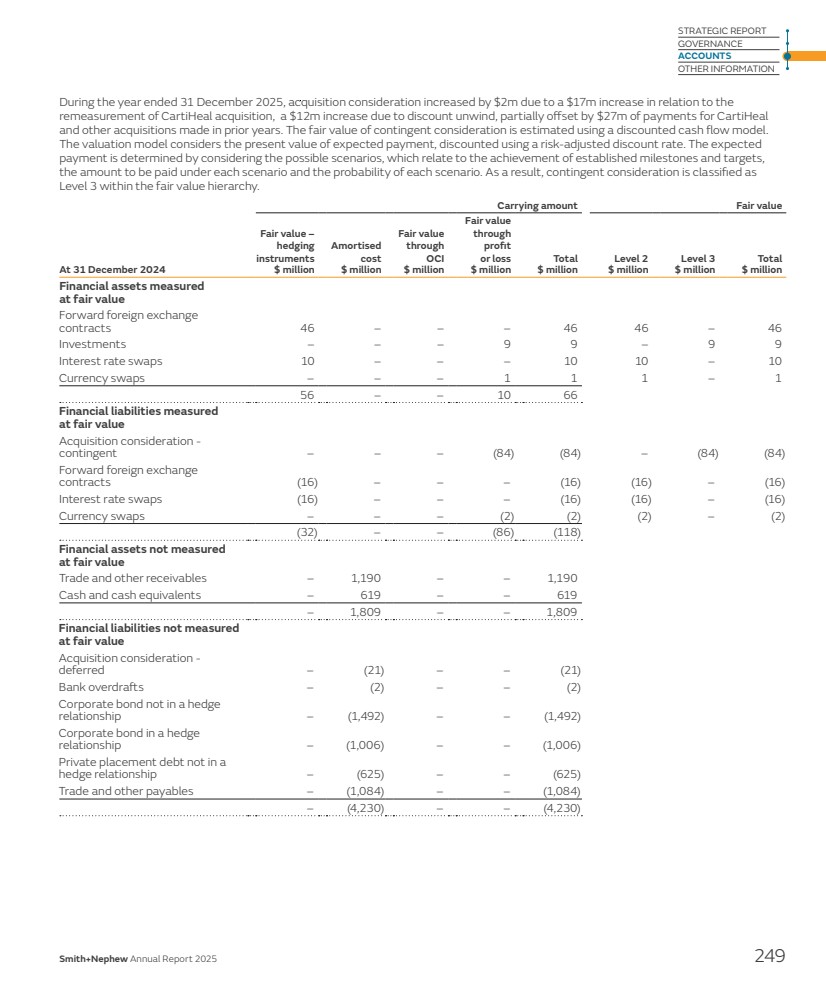
| 16 Financial instruments and risk management continued The following table shows the book value and market value of corporate bonds and private placement debt. 2025 2024 Book Market Book Market value value value value $ million $ million $ million $ million 2030 USD corporate bond 897 810 995 836 2034 USD corporate bond 641 672 628 642 2027 USD corporate bond 349 354 348 352 2029 EUR corporate bond 591 617 527 547 Private placement debt 625 594 625 573 The fair value of investments is based upon third-party pricing models for share issues. As a result, investments are considered Level 3 in the fair value hierarchy. The movements in 2025 and 2024 for financial instruments measured using Level 3 valuation methods are presented below: 2025 2024 $ million $ million Investments At 1 January 9 8 Additions 2 1 Transferred from receivables 18 – Fair value remeasurement 1 – At 31 December 30 9 Contingent consideration receivable At 1 January – 18 Transferred to receivables – (18) At 31 December – – Contingent acquisition consideration liability At 1 January (84) (32) Arising on acquisitions – (49) Payments 6 6 Remeasurements (29) (9) At 31 December (107) (84) 17 Provisions and contingencies Accounting policy In the normal course of business the Group is involved in various legal disputes. Provisions are made for loss contingencies when it is deemed probable that an adverse outcome will occur and the amount of the losses can be reasonably estimated. Where the Group is the plaintiff in pursuing claims against third parties, legal and associated expenses are charged to the income statement as incurred. The recognition of provisions for legal disputes is subject to a significant degree of estimation. In making its estimates, management takes into account the advice of internal and external legal counsel. Provisions are reviewed regularly and amounts updated where necessary to reflect developments in the disputes. The ultimate liability may differ from the amount provided depending on the outcome of court proceedings or settlement negotiations or as new facts emerge. Insurance recoveries are recognised when the inflow of benefits is virtually certain and are presented within other receivables. A provision for onerous contracts is recognised when the expected benefits to be derived by the Group from a contract are lower than the unavoidable cost of meeting its obligations under the contract. A provision for restructuring and rationalisation is recognised when the Group has approved a detailed and formal restructuring plan and the restructuring either has commenced or has been communicated to those affected. Restructuring provisions primarily include severance costs and are expected to be utilised within one year. Future operating losses and costs associated with ongoing activities are not provided for. 250 Smith+Nephew Annual Report 2025 Notes to the Group accounts continued Group financial statements continued 24_SN_AR25_Note_15_23_v227.indd 250 05/03/2026 18:25 |
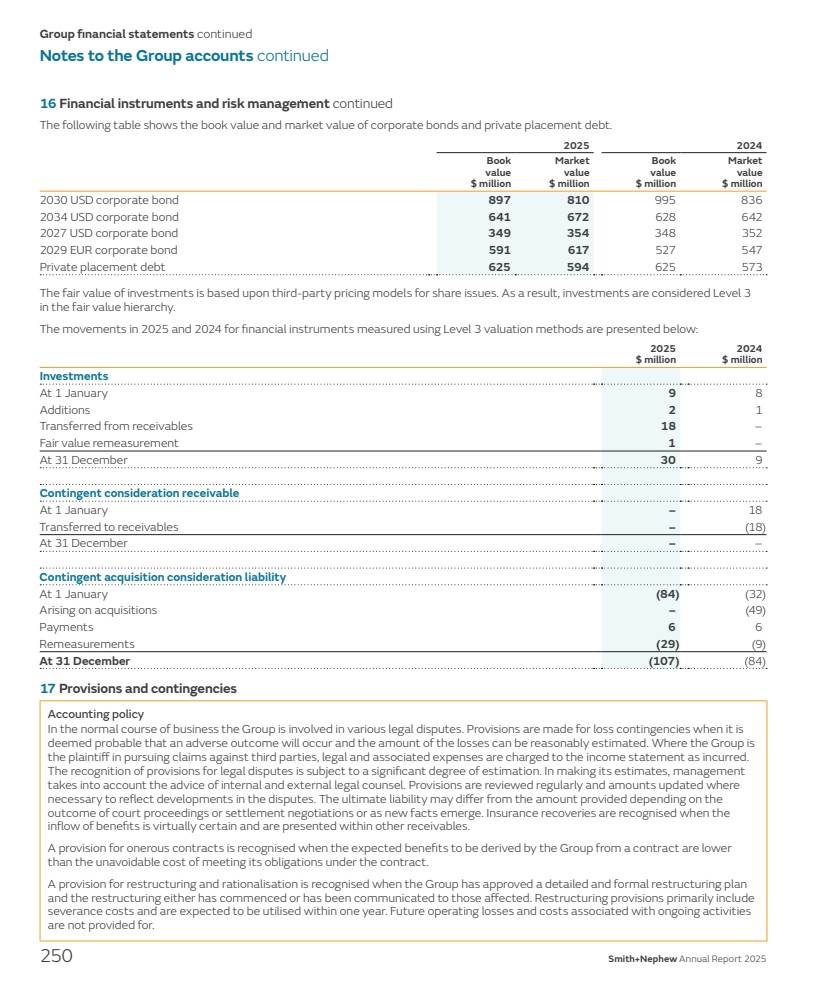
| 17.1 Provisions Restructuring and rationalisation Legal and other provisions Metal-on-metal provisions Total $ million $ million $ million $ million At 1 January 2024 91 149 41 281 Charge to income statement 123 – 12 135 Release to income statement – (28) (2) (30) Unwinding of discount – 6 – 6 Utilised (153) (14) (20) (187) Exchange adjustment (2) – – (2) At 31 December 2024 59 113 31 203 Charge to income statement 49 – 15 64 Release to income statement (2) (9) (7) (18) Unwinding of discount – 4 – 4 Utilised (86) (11) (2) (99) Exchange adjustment 2 – – 2 At 31 December 2025 22 97 37 156 Provisions – due within one year 22 25 27 74 Provisions – due after one year – 72 10 82 At 31 December 2025 22 97 37 156 Provisions – due within one year 59 28 21 108 Provisions – due after one year – 85 10 95 At 31 December 2024 59 113 31 203 The principal elements within restructuring and rationalisation provisions relate to the Operations and Commercial Excellence programme announced in February 2020 and the efficiency and productivity elements of the 12-Point Plan. For the year ended 31 December 2025 and 2024, charges primarily include severance, asset write-offs and integration and dual running costs. The Group has estimated a provision of $97m (2024: $113m) relating to the present value at 31 December 2025 of the estimated costs to resolve all other known and anticipated metal-on-metal hip claims globally. The estimated value of the provision has been determined using an actuarial model. While the provision is based on a number of assumptions, including factors such as the number, outcome and value of claims, a reasonable change in assumptions would not give rise to a material adjustment. The provision does not include any possible further insurance recoveries on these claims or legal fees associated with defending claims. The legal and other provisions mainly relate to various other product liability and intellectual property litigation matters. The Group carries considerable product liability insurance, and will continue to defend claims vigorously. All provisions are expected to be substantially utilised within five years of 31 December 2025 and none are treated as financial instruments. Smith+Nephew Annual Report 2025 251 STRATEGIC REPORT GOVERNANCE ACCOUNTS OTHER INFORMATION 24_SN_AR25_Note_15_23_v227.indd 251 05/03/2026 18:25 |
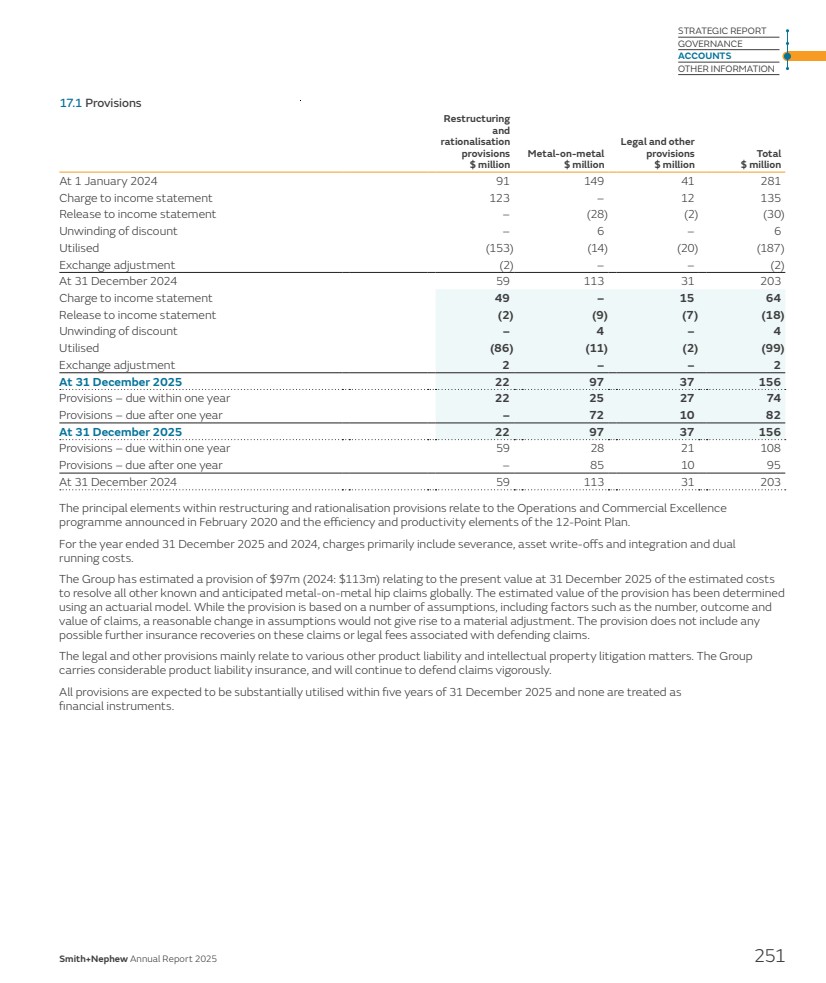
| 17 Provisions and contingencies continued 17.2 Contingencies The Company and its subsidiaries are party to various legal proceedings, some of which include claims for substantial damages. The outcome of these proceedings cannot readily be foreseen, but except as described herein management believes none of them are likely to result in a material adverse effect on the financial position of the Group. The Group provides for outcomes that are deemed to be probable and can be reliably estimated. There is no assurance that losses will not exceed provisions or will not have a significant impact on the Group’s results of operations in the period in which they are realised. 17.3 Legal proceedings Product liability claims The Group faces claims from time to time for alleged defects in its products and has on occasion recalled or withdrawn products from the market. Such claims are endemic to the medical device industry. The Group maintains product liability insurance subject to limits and deductibles that management believes are reasonable. All policies contain exclusions and limitations, however, and there can be no assurance that insurance will be available or adequate to cover all claims. This includes matters raising concerns about possible adverse effects of hip implant products with metal-on-metal (MoM) bearing surfaces for which the Group has incurred and will continue to incur expenses to defend claims in this area. As of December 2025, approximately 192 such claims were pending with the Group around the world. Most claims relate to the Group’s BHR product, including its two modular metal-on-metal components: the Birmingham Hip Modular Head (BHMH) and the optional metal liner component of the R3◊ Acetabular System (R3ML). The BHMH and R3ML are no longer on the market: the R3ML was withdrawn in 2012 and the BHMH was phased out in 2014. In 2015, the Group ceased offering smaller sizes of the BHR and restricted instructions for BHR use in female patients. These actions were taken to ensure that the BHR is used only in those patient groups where it continues to demonstrate strong performance. Through the end of 2025, entities of the Group have entered several group, as well as individual, MoM related settlements without admitting liability. The Group requested indemnity from its product liability insurers for most of these MoM hip implant settlements and insurers have indemnified the Group to the limits of their respective applicable policies. Litigation outcomes are difficult to predict and defence costs can be significant. The Group takes care to monitor the clinical evidence relating to its products, including its metal hip implant products, to help ensure that its product offerings are designed to serve patients’ interests. Intellectual property disputes The Group engages, as both plaintiff and defendant, in litigation with various competitors and others over claims of patent infringement and other intellectual property matters. These disputes are heard in courts in the US and other jurisdictions and also before agencies that examine patents. Outcomes are rarely certain and costs are often significant. The Group provides for these types of matters when and where appropriate. 17.4 Tax matters At any given time the Group has unagreed years outstanding in various countries and is involved in tax audits and disputes, some of which may take several years to resolve. Provisions are based on best estimates and management’s judgements concerning the likely ultimate outcome of any audit or dispute. Management considers the specific circumstances of each tax position and takes external advice, where appropriate, to assess the range of potential outcomes and estimate additional tax that may be due. The Group believes that it has made adequate provision in respect of additional tax liabilities that may arise. See Note 5 for further details. 252 Smith+Nephew Annual Report 2025 Notes to the Group accounts continued Group financial statements continued 24_SN_AR25_Note_15_23_v227.indd 252 05/03/2026 18:25 |

| 18 Retirement benefit obligations Accounting policy The Group sponsors defined benefit plans in a number of countries. A defined benefit pension plan defines an amount of pension benefit that an employee will receive on retirement or a minimum guaranteed return on contributions, which is dependent on various factors such as age, years of service and final salary. The Group’s obligation is calculated separately for each plan by discounting the estimated future benefit that employees have earned in return for their service in the current and prior periods. The fair value of any plan assets is deducted to arrive at the net liability. The calculation of the defined benefit obligation is performed annually by external actuaries using the projected unit credit method. Remeasurements arising from defined benefit plans comprise actuarial gains and losses and the return on the plan assets in excess of the discount rate net of the costs of managing the plan assets. The Group recognises these immediately in other comprehensive income (OCI) and all other expenses, such as service cost, net interest cost, administration costs and taxes, are recognised in the income statement. A number of key assumptions are made when calculating the fair value of the Group’s defined benefit pension plans. These assumptions impact the balance sheet asset and liabilities, operating profit, finance income/costs and other comprehensive income. The most critical assumptions are the discount rate, the rate of inflation and mortality assumptions to be applied to future pension plan liabilities. The discount rate is based on the yield at the reporting date on bonds that have a credit rating of AA, denominated in the currency in which the benefits are expected to be paid and have a maturity profile approximately the same as the Group’s obligations. In determining these assumptions management takes into account the advice of professional external actuaries and benchmarks its assumptions against external data. The Group determines the net interest expense/income on the net defined benefit liability/asset for the period by applying the discount rate used to measure the defined benefit obligation at the beginning of the annual period to the net defined benefit liability/asset. The Group also operates a number of defined contribution plans. A defined contribution plan is a pension plan under which the Group and employees pay fixed contributions to a third-party financial provider. The Group has no further payment obligations once the contributions have been paid. Contributions are recognised as an employee benefit expense when they are due. 18.1 Retirement benefit assets and obligations The Group’s retirement benefit assets/(obligations) comprise: 2025 2024 $ million $ million Funded plans: UK Plan 64 63 US Plan – – Other plans (16) (10) 48 53 Unfunded plans: Other plans (59) (60) Retirement healthcare (9) (9) (20) (16) Amount recognised on the balance sheet – liability (84) (79) Amount recognised on the balance sheet – asset 64 63 The Group sponsors defined benefit pension plans for its employees or former employees in 12 countries and these are established under the laws of the relevant country. Funded plans are funded by the payment of contributions and the assets are held by separate trust funds or insurance companies. The provision of retirement and related benefits across the Group is kept under regular review. Employees’ retirement benefits are the subject of regular management review. The Group’s defined benefit plans provide employees with an entitlement to benefits, payable typically either as a lump sum or annuity, or a mixture of the two. Most plans are now closed to future accrual. The level of entitlement is typically dependent on the salary and years of service of the employee, in line with local practices. Pension benefits are generally limited to 66.7% of final salary in key markets. Smith+Nephew Annual Report 2025 253 STRATEGIC REPORT GOVERNANCE ACCOUNTS OTHER INFORMATION 24_SN_AR25_Note_15_23_v227.indd 253 05/03/2026 18:25 |
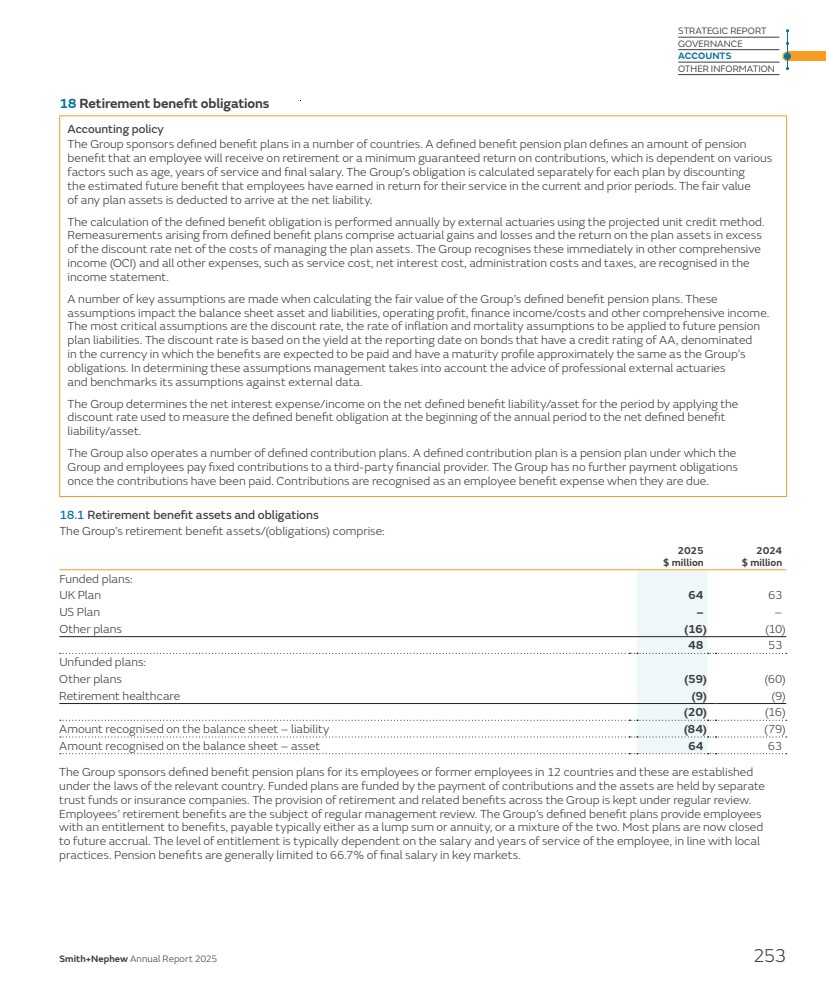
| 18 Retirement benefit obligations continued The Groups two major defined benefit pension plans were in UK and US. Both these plans were closed to new employees in 2003 and defined contribution plans are offered to new joiners. The US and UK Plans were closed to future accrual in March 2014 and December 2016 respectively. The UK Plan operates under trust law and responsibility for its governance lies with a Board of Trustees. This Board is composed of representatives of the Group, plan participants and an independent trustee, who act on behalf of members in accordance with the terms of the Trust Deed and Rules and relevant legislation. The UK Plan’s assets are held by the trust. Annual increases on benefits in payment are dependent on inflation. The 2018 and 2020 court cases in relation to Guaranteed Minimum Pensions do not impact the UK Plan as members were not contracted out of the State Earnings-Related Pension Scheme (SERPS) between 1990 and 1997. In June 2023, the Trustee with the support of the Company concluded a full buy-in of the Main Fund with Rothesay Life. The total transaction value was £260m. The transaction completed the Main Fund and Executive Scheme de-risking journey which included partial buy-in transactions in 2013, 2017, and 2022, whereby the liabilities of the scheme are now covered by a bulk annuity insurance policy, that operate as investment assets, insuring all liabilities to pay all future defined benefit pensions for the remaining members of the Fund. The bulk annuity policy matches the Trust’s cash flow benefit obligations to its members, removing longevity and other demographic risks as well as investment, interest rate and inflation risks. When the full UK Fund buy-in was concluded in June 2023 no decision on a future buy-out had been reached by the Company. While the contract between the Life Insurer (Rothesay) and the Trustee allows for a buy-out, a number of steps would need to be concluded before this could be achieved. The Trustee and the Company could not act unilaterally to move to a buy-out and the UK Fund governance structure lays out a number of steps the Company would be required to conclude for a buy-out decision. The transaction resulted in a $58m loss being recognised in OCI in 2023 with $nil cash impact. The US Plan is governed by a US Pension Committee which comprises representatives of the Group. In the US, the Pension Protection Act (2006) established both a minimum required contribution and a maximum deductible contribution. Failure to contribute at least the minimum required amount will subject the Company to significant penalties, and contributions in excess of the maximum deductible contribution have negative tax consequences. The minimum funding requirement is intended to fully fund the present value of accrued benefits over seven years. In October 2022, US Pension Plan members were notified that Smith & Nephew Inc. (SNI) would begin the termination process for the US Plan. In December 2023, Fidelity & Guaranty Life was selected to take over responsibility for the remaining US Pension Plan obligation and administration upon termination. A premium amount of $245m was paid in cash by the US Plan on 4 January 2024. Certain active employees and terminated vested participants elected to receive a lump sum in exchange for their plan benefit of $80m. This resulted in $4m settlement costs which were recognised in 2023, representing the difference between defined benefit obligation (DBO) and the lump sums paid to members in December 2023. Following the US buyout, members move to having a direct relationship with Fidelity & Guaranty Life with SNI no longer retaining any obligation for the settlement of accrued member benefits. There is no legislative minimum funding requirement in the UK. The Trust Deed of the UK Plan and the Plan Document of the US Plan provide the Group with a right to a refund of surplus assets assuming the full settlement of plan liabilities in the event of a plan wind-up. Furthermore, in the ordinary course of business the UK Board of Trustees and US Pension Committee have no rights to unilaterally wind up, or otherwise augment the benefits due to members of the Plans. Based on these rights, any net surplus in the UK and US Plans is recognised in full. 254 Smith+Nephew Annual Report 2025 Notes to the Group accounts continued Group financial statements continued 24_SN_AR25_Note_15_23_v227.indd 254 05/03/2026 18:25 |
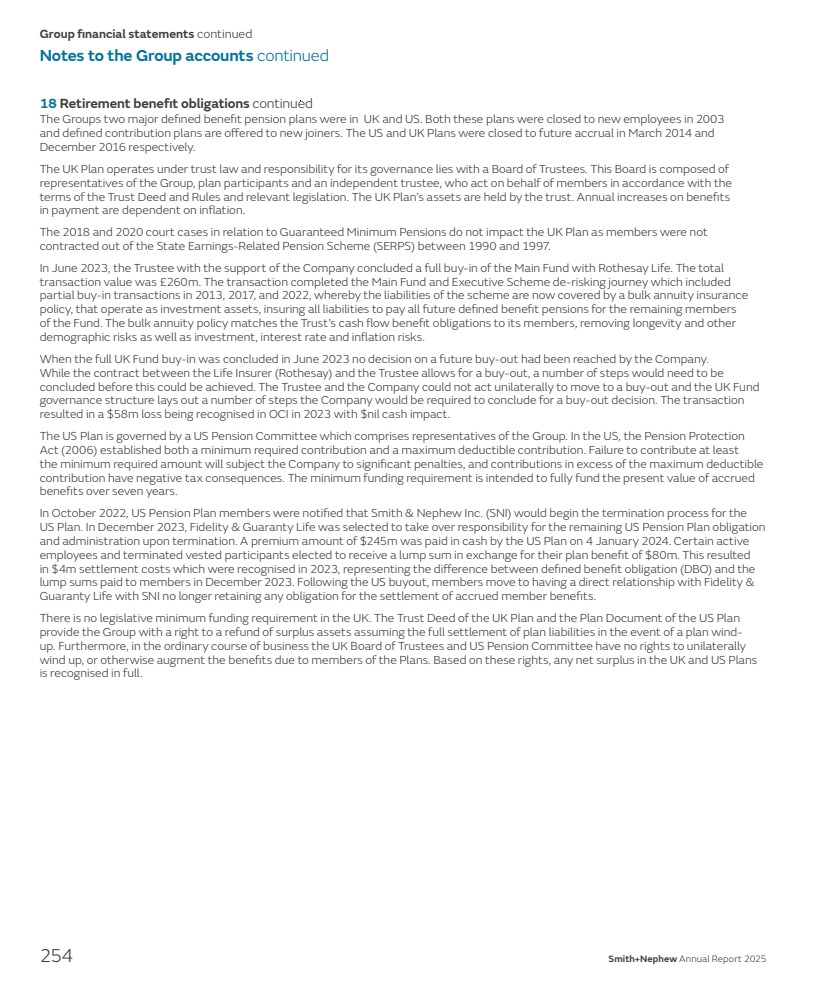
| 18.2 Reconciliation of retirement benefit obligations and pension assets The movement in the Group’s pension benefit obligation and pension assets is as follows: 2025 2024 Obligation Asset Total Obligation Asset Total $ million $ million $ million $ million $ million $ million Amounts recognised on the balance sheet at beginning of the period (625) 609 (16) (961) 942 (19) Income statement expense: Current service cost (7) – (7) (7) – (7) Settlements – – – 255 (250) 5 Interest (expense)/income (28) 29 1 (26) 26 – Administration costs and taxes (7) – (7) (4) – (4) Costs recognised in income statement (42) 29 (13) 218 (224) (6) Remeasurements: Actuarial (loss)/gain due to liability experience (8) – (8) (6) – (6) Actuarial gain due to financial assumptions change 23 – 23 62 – 62 Actuarial (loss)/gain due to demographic assumptions (2) – (2) 1 – 1 Return on plan assets (less)/greater than discount rate – (8) (8) – (41) (41) Remeasurements recognised in OCI 13 (8) 5 57 (41) 16 Cash: Employer contributions – 8 8 – (9) (9) Employee contributions (3) 3 – (3) 3 – Benefits paid directly by the Group 4 – 4 3 – 3 Benefits paid, taxes and administration costs paid from scheme assets 48 (52) (4) 41 (45) (4) Net cash 49 (41) 8 41 (51) (10) Exchange movements (55) 51 (4) 20 (17) 3 Amount recognised on the balance sheet (660) 640 (20) (625) 609 (16) Amount recognised on the balance sheet – liability (230) 146 (84) (213) 134 (79) Amount recognised on the balance sheet – asset (430) 494 64 (412) 475 63 Represented by: 2025 2024 Obligation Asset Total Obligation Asset Total $ million $ million $ million $ million $ million $ million UK Plan (414) 478 64 (396) 459 63 Other Plans (246) 162 (84) (229) 150 (79) Total (660) 640 (20) (625) 609 (16) The actuarial gain on obligation of $13m primarily relates to the increase in discount rates in 2025 compared to 2024 and the actuarial loss from the return on plan assets of $8m is mainly due to the impact of the UK Plan. All benefits are vested at the end of each reporting period. The weighted average duration of the defined benefit obligation at the end of the reporting period is 13 years for the UK Plan. Smith+Nephew Annual Report 2025 255 STRATEGIC REPORT GOVERNANCE ACCOUNTS OTHER INFORMATION 24_SN_AR25_Note_15_23_v227.indd 255 05/03/2026 18:25 |
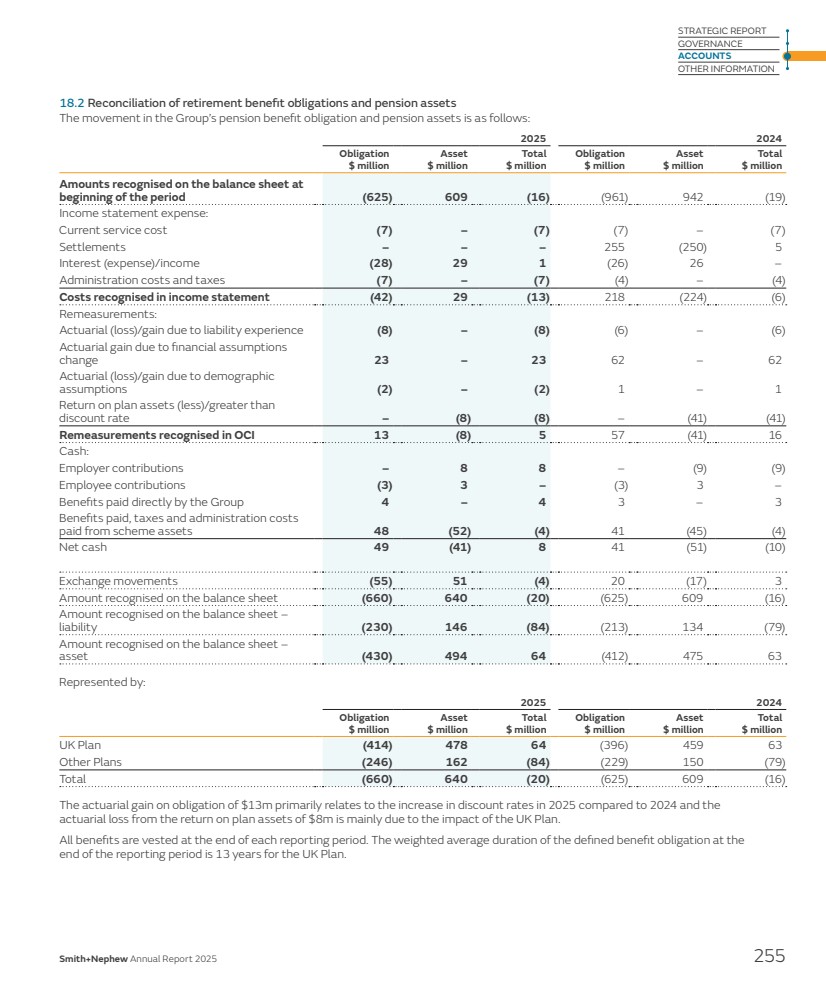
| 2025 2024 2023 $ million $ million $ million UK Plan: Assets with a quoted market price: Cash and cash equivalents 56 56 61 Other bonds 8 7 – 64 63 61 Other assets: Insurance contract 414 396 457 Market value of assets 478 459 518 US Plan: Assets with a quoted market price: Cash and cash equivalents – – 267 Market value of assets – – 267 Other Plans: Assets with a quoted market price: Cash and cash equivalents 8 2 7 Equity securities 56 56 50 Government bonds – fixed interest 6 6 5 Corporate and other bonds 13 12 10 Insurance contracts 19 18 23 Property 24 25 28 Other quoted securities 14 11 10 140 130 133 Other assets: Insurance contracts 22 20 24 Market value of assets 162 150 157 Total market value of assets 640 609 942 No plans invest directly in property occupied by the Group or in financial securities issued by the Group. The UK Plan is comprised of annuity policies purchased by the Trustee. In 2024, following the US scheme termination, the investment risks have been transferred to a US Life Insurer. 18 Retirement benefit obligations continued 18.3 Plan assets The market value of the US, UK and Other Plans assets are as follows: 256 Smith+Nephew Annual Report 2025 Notes to the Group accounts continued Group financial statements continued 24_SN_AR25_Note_15_23_v227.indd 256 05/03/2026 18:25 |
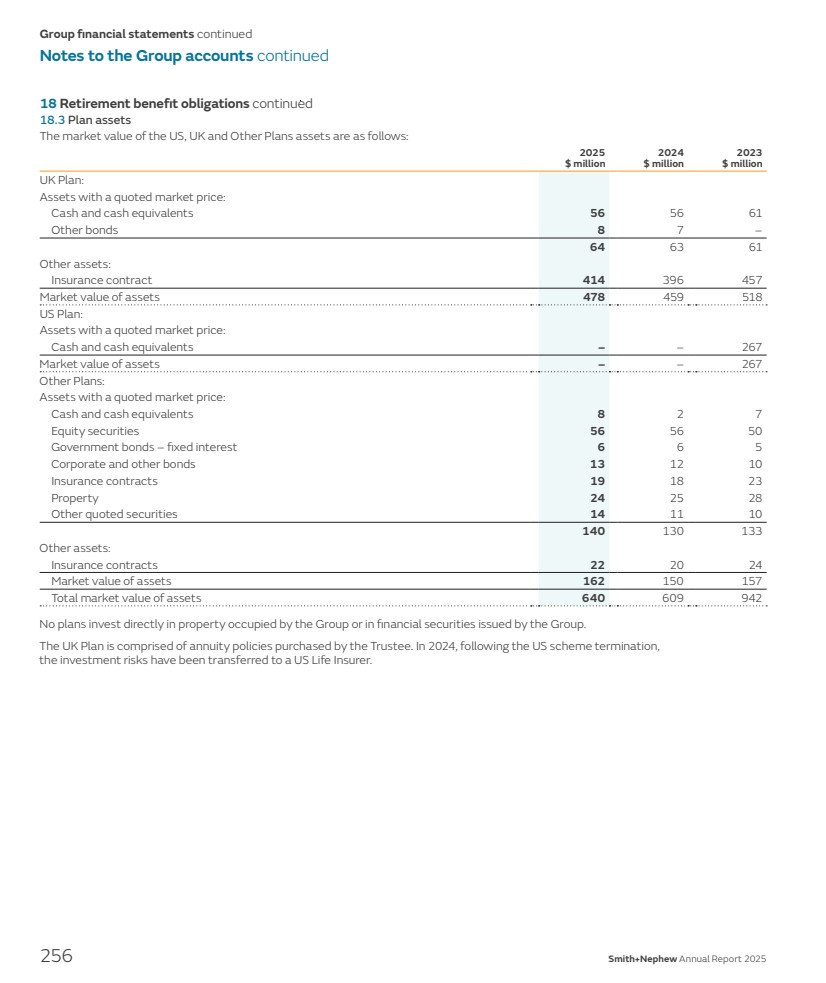
| 18.4 Expenses recognised in the income statement The total expense relating to retirement benefits recognised for the year is $94m (2024: $95m, 2023: $95m). Of this cost recognised for the year, $81m (2024: $89m, 2023: $84m) relates to defined contribution plans and $13m (2024: $6m, 2023: $11m) relates to defined benefit plans. The cost charged in respect of the Group’s defined contribution plans represents contributions payable to these plans by the Group at rates specified in the rules of the Plans. These were charged to operating profit in costs of goods sold, selling, general and administrative expenses, and research and development expenses. There were $nil outstanding payments as at 31 December 2025 due to be paid over to the Plans (2024: $nil, 2023: $nil). Defined benefit plan costs comprise service cost which is charged to operating profit in selling, general and administrative expenses and net interest cost and administration costs and taxes which are reported as other finance costs. The defined benefit pension costs charged for the UK and US Plans are $nil (2024: $nil, 2023: $nil). 18.5 Principal actuarial assumptions The following are the principal financial actuarial assumptions used at the reporting date to determine the UK and US defined benefit obligations and expense. 2025 2024 2023 % per annum % per annum % per annum UK Plan: Discount rate 5.5 5.5 4.5 Future salary increases n/a n/a n/a Future pension increases 2.8 3.0 3.0 Inflation (RPI) 2.9 3.2 3.1 Inflation (CPI) 2.4 2.7 2.5 US Plan: Discount rate n/a n/a 5.0 Future salary increases n/a n/a n/a Inflation n/a n/a n/a Actuarial assumptions regarding future mortality are based on mortality tables. The UK uses the S3NA with projections in line with the CMI 2024 table, which places partial weight on post pandemic experience. The Directors will continue to monitor any potential future impact on the mortality assumptions used. The current longevities underlying the values of the obligations in the defined benefit plans are as follows: 2025 2024 2023 years years years Life expectancy at age 60 UK Plan: Males 26.9 26.6 26.9 Females 29.6 29.5 29.7 US Plan: Males n/a n/a 25.0 Females n/a n/a 27.2 Life expectancy at age 60 in 20 years’ time UK Plan: Males 28.5 28.1 28.4 Females 31.0 30.9 31.1 US Plan: Males n/a n/a 25.0 Females n/a n/a 27.6 Smith+Nephew Annual Report 2025 257 STRATEGIC REPORT GOVERNANCE ACCOUNTS OTHER INFORMATION 24_SN_AR25_Note_15_23_v227.indd 257 05/03/2026 18:25 |
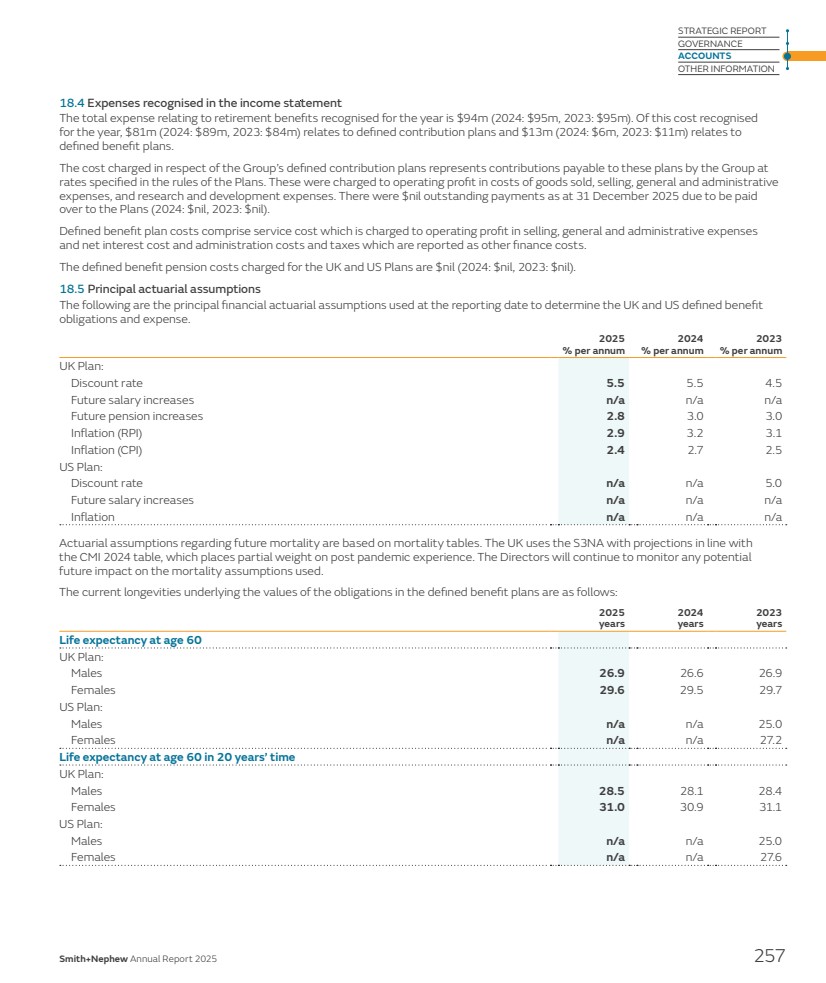
| 18 Retirement benefit obligations continued 18.6 Sensitivity analysis The calculation of the defined benefit obligation is sensitive to the assumptions used. The following table summarises the increase/ decrease on the UK defined benefit obligation and pension costs as a result of reasonably possible changes in some of the assumptions while holding all other assumptions consistent. The sensitivity to the inflation assumption change includes corresponding changes to the future pension increase assumptions. The analysis does not take into account the full distribution of cash flows expected under the Plan. Increase/(decrease) in pension obligation Increase /(decrease) in pension cost $ million +50bps/+1yr -50bps/-1yr +50bps/+1yr -50bps/-1yr UK Plan: Discount rate (25.0) 28.0 – – Inflation 21.5 (19.4) – – Mortality 18.0 (18.0) – – 18.7 Risk The pension plans expose the Group to the following risks: Interest rate risk Volatility in financial markets can change the calculations of the obligation significantly as the calculation of the obligation is linked to yields on AA rated corporate bonds. A decrease in the bond yield will increase the measure of plan liabilities, although this will be partially offset by increases in the value of matching plan assets such as bonds and insurance contracts. The UK buy-in in June 2023 removed all remaining material pension liability exposure from the balance sheet, hence, eliminating the interest rate risk for the UK Plan. Following the completion of the US buy-out on 4 January 2024, no further interest risk is linked to the valuation of liability for the US Plan as no liability remains in the Plan. Inflation risk The UK Plan is linked to inflation. A high rate of inflation will lead to a higher liability. This risk is managed by holding inflation-linked bonds and an inflation-linked insurance contract in respect of some of the obligation. In the UK, the liability matching portfolio held in conventional and index-linked gilts was transferred into liability driven investments in order to reduce inflation risk. The UK Plan is closed to future accrual which reduces the exposure to this risk. The US Plan is also closed to future accrual and has no other inflation-linkage thus eliminating the exposure to this risk. Following the full UK Pension buy-in in 2023, the residual inflation risks associated with the UK Plan have been transferred to the UK Plan’s Life Insurance Partners. Investment risk If the return on plan assets is below the discount rate, all else being equal, there will be an increase in the Plan deficit. In the UK, following the full buy-in for the UK Plan, the investment risk has been transferred to the UK Plan’s Life Insurer Partners. The US Plan has a dynamic de-risking policy to shift plan assets from return-seeking (growth) assets to liability matching assets over time. The US Pension Plan has an established glide path that is designed to stabilise funding status by reducing the Plan’s exposure to return-seeking assets. Following the completion of the US buy-out on 4 January 2024, no further investment risk is linked to the valuation of liability for the US Plan as no liability remains in the Plan. Longevity risk The present value of the Plan’s defined benefit liability is calculated by reference to the best estimate of the mortality of the Plan participants both during and after their employment. An increase in the life expectancy of plan participants above that assumed will increase the benefit obligation. Following the full buy-in, the UK Plan has entered into insurance contract which covers all of the pensioners’ obligations. Following the completion of the US buy-out on 4 January 2024, there is no further longevity risk linked to the valuation of liability for the US Plan as no liability remains in the Plan. 258 Smith+Nephew Annual Report 2025 Notes to the Group accounts continued Group financial statements continued 24_SN_AR25_Note_15_23_v227.indd 258 05/03/2026 18:25 |
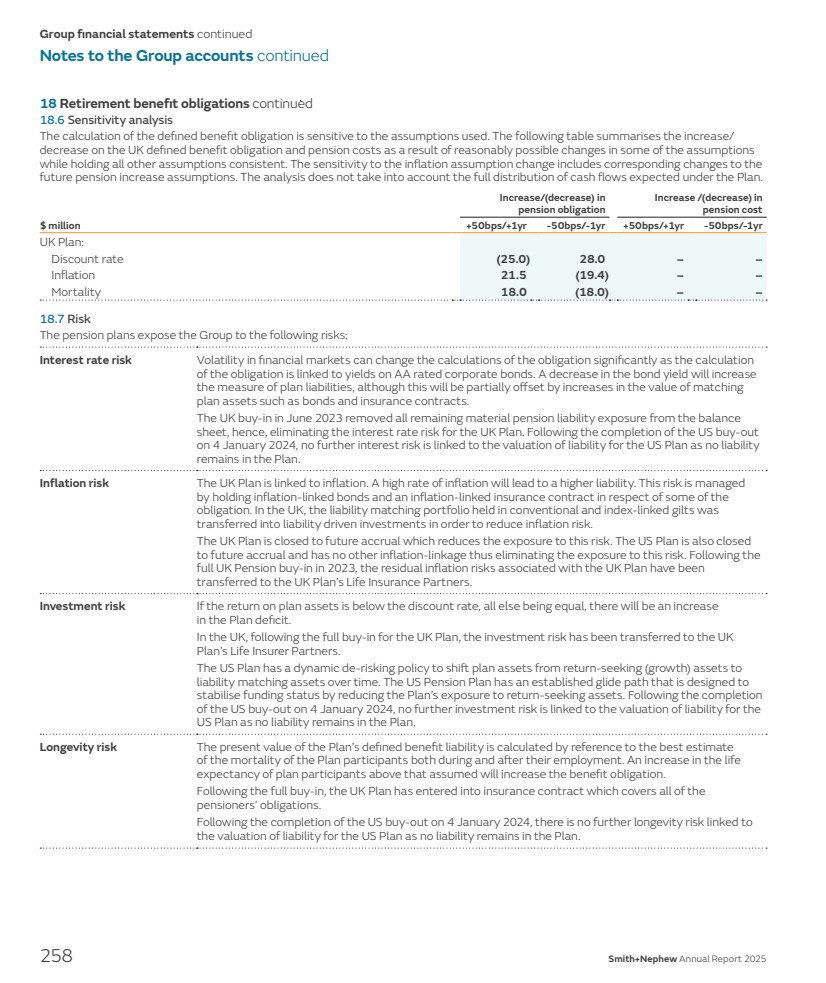
| 18.8 Funding A full valuation is performed by actuaries for the Trustees/Pension Committee of each plan to determine the level of funding required. Employer contribution rates, based on these full valuations, are agreed between the Trustees/Pension Committee of each plan and the Group. The assumptions used in the actuarial valuations used for funding purposes may differ from the accounting assumptions set out above. UK Plan The most recent full actuarial valuation of the UK Plan was undertaken as at 30 September 2023. Future accruals to the UK Plan ceased as at 31 December 2016. Contributions to the UK Plan in 2025 were $nil (2024: $nil, 2023: $nil). This included supplementary payments of $nil (2024: $nil, 2023: $nil). Following the completion of the 30 September 2023 valuation, a dynamic contribution mechanism was agreed. The Fund was expected to be in surplus at 30 September 2023, therefore no recovery plan was required. The Fund will meet administrative and other running costs from the surplus, with no expense contributions due from the Company. In 2023, the Trustees concluded a full buy-in of the UK Defined Benefit Fund. The transaction resulted in a $58m loss being recognised in OCI with $nil cash impact. Following the conclusion of the UK full buy-in, no further contributions are expected from the sponsor company. US Plan The most recent full actuarial valuation of the US Plan was undertaken as at 1 January 2022. Future accruals to the US Plan ceased as at 31 March 2014. Contributions to the US Plan were $nil (2024: $nil, 2023: $nil) which represented supplementary payments of $nil (2024: $nil, 2023: $nil). A premium amount of $245m was paid in cash by the US Plan on 4 January 2024 to settle the annuity purchase agreement with Fidelity & Guaranty Life. $4m of settlement costs were accounted for in 2023 and are linked to the lump sum payments settled in December 2023 of $80m. A $2m credit was recorded in 2024 linked to the annuity purchase contract concluded with Fidelity & Guaranty Life on 4 January 2024. 19 Equity Accounting policy Incremental costs directly attributable to the issue of ordinary shares, net of any tax effects, are recognised as a deduction from equity. When shares recognised as equity are repurchased, the amount of the consideration paid, which includes directly attributable costs, net of any tax effects, is recognised as a deduction from equity. Repurchased shares are classified as treasury shares and are presented in the treasury share reserve. When treasury shares are sold or reissued subsequently, the amount received is recognised as an increase in equity and the resulting surplus or deficit on the transaction is presented within share premium. 19.1 Share capital Ordinary shares (20¢) Deferred shares (£1.00) Total Thousand $ million Thousand $ million $ million Authorised At 31 December 2023 1,223,591 245 50 – 245 At 31 December 2024 1,223,591 245 50 – 245 At 31 December 2025 1,223,591 245 50 – 245 Allotted, issued and fully paid At 1 January 2023 877,650 175 50 – 175 Share options 23 – – – – At 31 December 2023 877,673 175 50 – 175 Share options 31 – – – – At 31 December 2024 877,704 175 50 – 175 Share options 21 – – – – At 31 December 2025 877,725 175 50 – 175 Smith+Nephew Annual Report 2025 259 STRATEGIC REPORT GOVERNANCE ACCOUNTS OTHER INFORMATION 24_SN_AR25_Note_15_23_v227.indd 259 05/03/2026 18:25 |
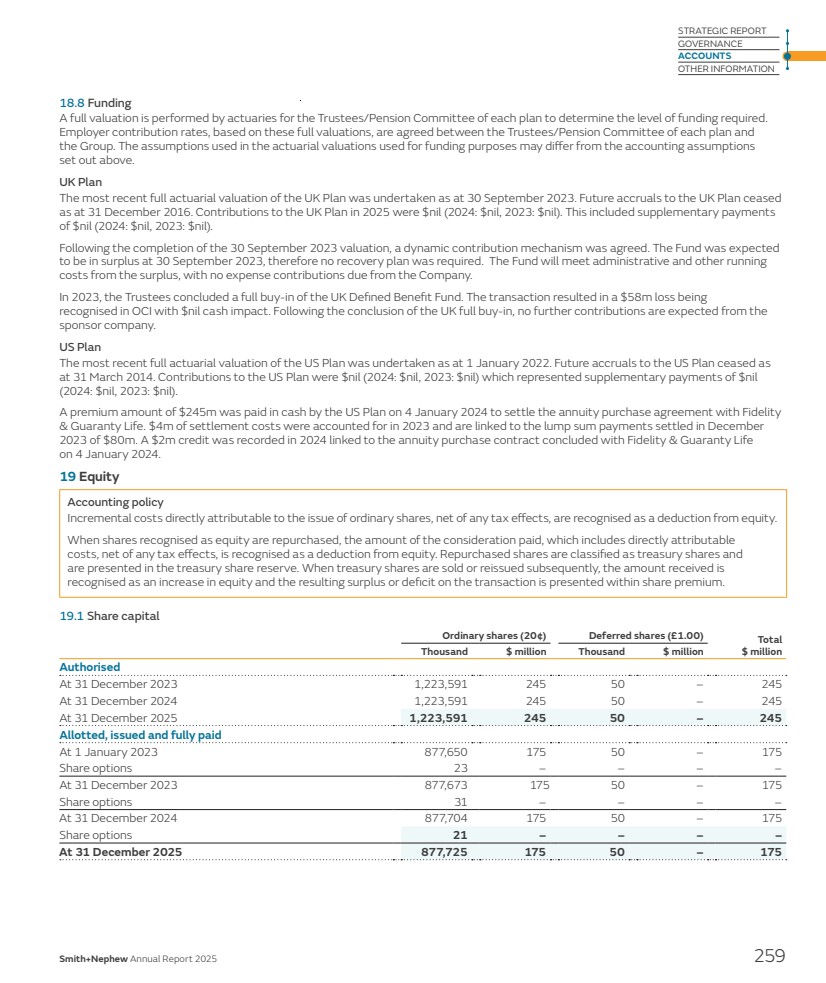
| 19 Equity continued The deferred shares were issued in 2006 in order to comply with English Company law. They are not listed on any stock exchange and have extremely limited rights and effectively have no value. These rights are summarised as follows: – The holder shall not be entitled to participate in the profits of the Company; – The holder shall not have any right to participate in any distribution of the Company’s assets on a winding-up or other distribution except that after the return of the nominal amount paid up on each share in the capital of the Company of any class other than the deferred shares and the distribution of a further $1,000 in respect of each such share there shall be distributed to a holder of a deferred share (for each deferred share held) an amount equal to the nominal value of the deferred share; – The holder shall not be entitled to receive notice, attend, speak or vote at any general meeting of the Company; and – The Company may create, allot and issue further shares or reduce or repay the whole or any part of its share capital or other capital reserves without obtaining the consent of the holders of the deferred shares. The Group’s objectives when managing capital are to ensure the Group has adequate funds to continue as a going concern and sufficient flexibility within the capital structure to fund the ongoing growth of the business and to take advantage of business development opportunities including acquisitions. The Group determines the amount of capital taking into account changes in business risks and future cash requirements. The Group reviews its capital structure on an ongoing basis and uses share buybacks, dividends and the issue of new shares to adjust the retained capital. The Group considers the capital that it manages to be as follows: 2025 2024 2023 $ million $ million $ million Share capital 175 175 175 Share premium 615 615 615 Capital redemption reserve 20 20 20 Treasury shares (515) (66) (94) Retained earnings and other reserves 4,994 4,521 4,501 5,289 5,265 5,217 19.2 Treasury shares Treasury shares represent the holding of the Company’s own shares in respect of the Smith & Nephew Employees’ Share Trust and shares bought back as part of the share buyback programme. The Smith & Nephew 2004 Employees’ Share Trust (the Trust) was established to hold shares relating to the long-term incentive plans referred to in the Directors’ Remuneration Report. The Trust is administered by an independent professional trust company resident in Jersey and is funded by a loan from the Company. The cost of the Trust is charged to the income statement as it accrues. A dividend waiver is in place in respect of those shares held under the long-term incentive plans. The Trust only accepts dividends in respect of nil-cost options and deferred bonus plan shares. The waiver represents less than 1% of the total dividends paid. 260 Smith+Nephew Annual Report 2025 Notes to the Group accounts continued Group financial statements continued 24_SN_AR25_Note_15_23_v227.indd 260 05/03/2026 18:25 |
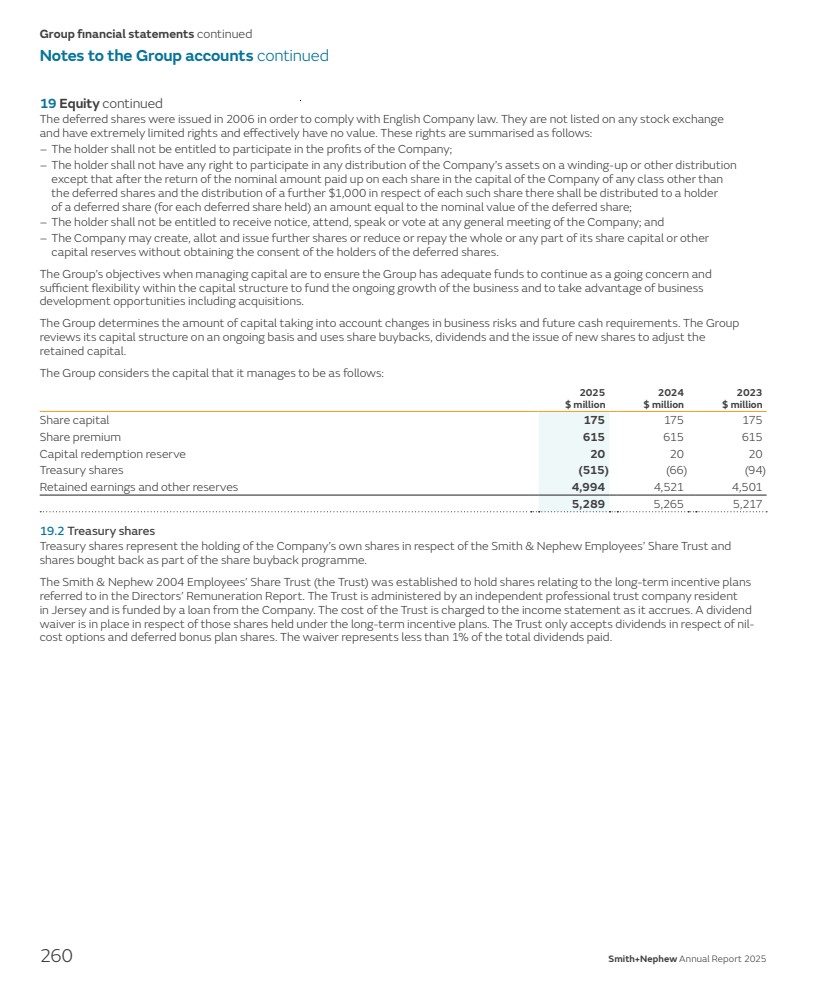
| The movements in Treasury shares and the Employees’ Share Trust are as follows: Employees’ Treasury Share Trust Total $ million $ million $ million At 1 January 2024 53 41 94 Shares transferred to Group beneficiaries (2) (26) (28) At 31 December 2024 51 15 66 Shares purchased 502 – 502 Shares transferred to Group beneficiaries (44) (9) (53) At 31 December 2025 509 6 515 Employees’ Treasury Share Trust Total Number Number Number of shares of shares of shares million million million At 1 January 2024 3.4 2.4 5.8 Shares transferred to Group beneficiaries (0.1) (1.5) (1.6) At 31 December 2024 3.3 0.9 4.2 Shares purchased 27.4 – 27.4 Shares transferred to Group beneficiaries (2.7) (0.5) (3.2) At 31 December 2025 28.0 0.4 28.4 In August 2025, the Group announced a $500m share buyback programme in order to return capital to shareholders. The Group purchased 27,411,845 shares under the programme for a total cost of $502m inclusive of transaction costs of $2m that have been deducted from equity. The programme was completed on 7 October 2025. No shares were purchased in 2024. 19.3 Dividends 2025 2024 2023 $ million $ million $ million The following dividends were declared and paid in the year: Ordinary final of 23.1¢ for 2024 (2023: 23.1¢, 2022: 23.1¢) paid 28 May 2025 202 202 201 Ordinary interim of 15.0¢ for 2025 (2024: 14.4¢, 2023: 14.4¢) paid 7 November 2025 128 125 126 330 327 327 A final dividend for 2025 of 24.1 US cents per ordinary share was proposed by the Board on 26 February 2026 and will be paid, subject to shareholder approval, on 27 May 2026 to shareholders on the Register of Members on 27 March 2026. The estimated amount of this dividend is $204m. The Group pursues a progressive dividend policy, with the aim of increasing the US Dollar value of ordinary dividends over time broadly based on the Group’s underlying growth in earnings, while taking into account capital requirements and cash flows. Future dividends will be dependent upon future earnings, the future financial condition of the Group and the Board’s dividend policy. The Board reviews the appropriate level of total annual dividend each year at the time of the full-year results. Smith & Nephew plc, the Parent Company of the Group, is a non-trading investment holding company which derives its distributable reserves from dividends paid by subsidiary companies. The distributable reserves of the Parent Company approximate to the balance on the profit and loss account reserve, less treasury shares and exchange reserves, which at 31 December 2025 amounted to $2,265m (2024: $3,119m). Smith+Nephew Annual Report 2025 261 STRATEGIC REPORT GOVERNANCE ACCOUNTS OTHER INFORMATION 24_SN_AR25_Note_15_23_v227.indd 261 05/03/2026 18:25 |
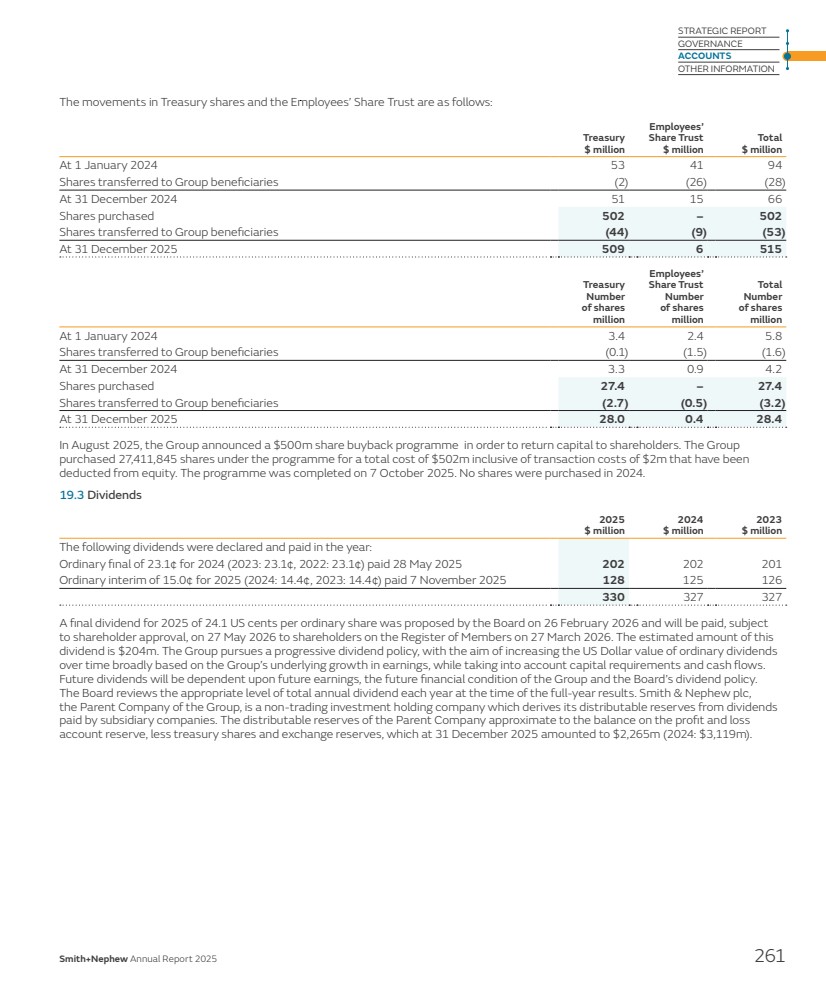
| 20 Cash flow statement Accounting policy In the Group cash flow statement, cash and cash equivalents includes cash at bank, other short-term liquid investments with original maturities of three months or less and bank overdrafts. In the Group balance sheet, cash and cash equivalents includes cash at bank, other short-term liquid investments with original maturities of three months or less and excludes bank overdrafts. Analysis of net debt including lease liabilities Borrowings Overdrafts Due within one year Due after one year Net currency swaps Net interest swaps Total liabilities - financing activities Cash and cash equivalents Net debt including lease liabilities $ million $ million $ million $ million $ million $ million $ million $ million At 1 January 2023 (6) (154) (2,712) – (13) (2,885) 350 (2,535) Net cash flow/debt movement 8 (604) 429 (4) – (171) (48) (219) Fair value changes including exchange adjustments (4) – (39) 3 20 (20) – (20) Corporate bond issuance expense – – 1 – – 1 – 1 IFRS 16 lease liabilities movement – (6) 3 – – (3) – (3) At 31 December 2023 (2) (764) (2,318) (1) 7 (3,078) 302 (2,776) Net cash flow/debt movement 1 705 (1,000) – – (294) 331 37 Fair value changes including exchange adjustments (1) – 46 – (13) 32 (14) 18 Corporate bond issuance expense – – 9 – – 9 – 9 IFRS 16 lease liabilities movement – (2) 5 – – 3 – 3 At 31 December 2024 (2) (61) (3,258) (1) (6) (3,328) 619 (2,709) Net cash flow/debt movement (2) (4) 90 (1) – 83 (74) 9 Non cash changes including exchange adjustments – (75) 8 2 17 (48) 12 (36) Corporate bond issuance expense – – (3) – – (3) – (3) IFRS 16 lease liabilities movement – (6) (14) – – (20) – (20) At 31 December 2025 (4) (146) (3,177) – 11 (3,316) 557 (2,759) In 2025, the Group repurchased $100 million of its $1.0 billion 2.032% USD corporate bond (refer to Note 15.2). 262 Smith+Nephew Annual Report 2025 Notes to the Group accounts continued Group financial statements continued 24_SN_AR25_Note_15_23_v227.indd 262 05/03/2026 18:25 |
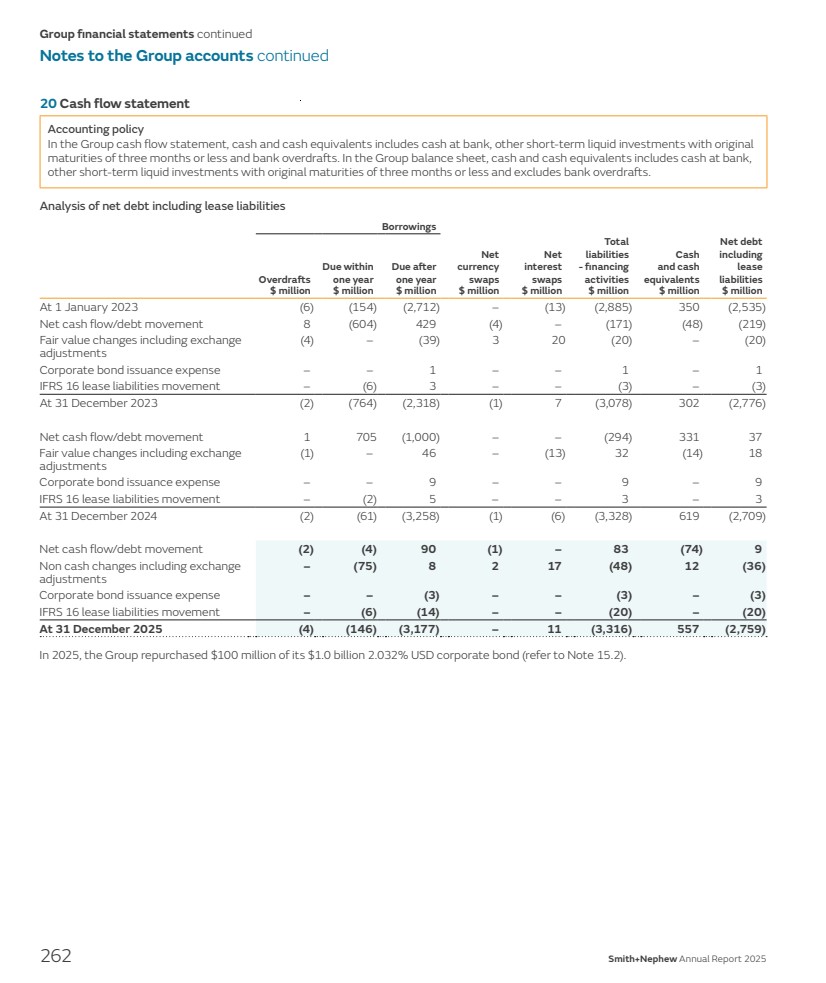
| Reconciliation of net cash flow to movement in net debt including lease liabilities 2025 2024 2023 $ million $ million $ million Net cash flow from cash net of overdrafts (76) 332 (40) Settlement of currency swaps (1) – (4) Net cash flow from borrowings 86 (295) (175) Change in net debt from net cash flow 9 37 (219) IFRS 16 lease liabilities (20) 3 (3) Other non cash movements1 (36) 18 (20) Corporate bond issuance expense (3) 9 1 Change in net debt in the year (50) 67 (241) Opening net debt (2,709) (2,776) (2,535) Closing net debt (2,759) (2,709) (2,776) 1 In 2025, this also includes gain on repurchase of bond $10m, in addition to foreign exchange movements and fair value adjustments relating to interest swaps. Cash and cash equivalents For the purposes of the Group cash flow statement, cash and cash equivalents at 31 December 2025 comprise cash at bank and other short-term liquid investments with original maturities of three months or less and bank overdrafts. 2025 2024 2023 $ million $ million $ million Cash at bank and other short-term liquid investments with original maturities of three months or less 557 619 302 Bank overdrafts (4) (2) (2) Cash and cash equivalents 553 617 300 The Group operates in over 100 countries around the world, some of which impose restrictions over cash movement. These restrictions have only a minimal impact on the management of the Group’s cash. Cash outflows/(inflows) arising from financing activities Repayment Borrowing Proceeds from Repayment Cash outflow/ Proceeds from own of bank of bank Corporate of lease (inflow) Purchase of shares/issue of loans1 loans1 Bond issue liabilities from other Dividends own shares ordinary shares Total 2025 $ million $ million $ million $ million $ million $ million $ million $ million $ million Debt 129 (43) – 50 (1) – – – 135 Equity – – – – – 330 502 (12) 820 Total 129 (43) – 50 (1) 330 502 (12) 955 2024 Debt 705 – (1,000) 55 – – – – (240) Equity – – – – – 327 – (1) 326 Total 705 – (1,000) 55 – 327 – (1) 86 2023 Debt 151 (326) – 52 (4) – – – (127) Equity – – – – – 327 – – 327 Total 151 (326) – 52 (4) 327 – – 200 1 This includes drawdown and repayment of the syndicated RCF and repayment of corporate bonds. Smith+Nephew Annual Report 2025 263 STRATEGIC REPORT GOVERNANCE ACCOUNTS OTHER INFORMATION 24_SN_AR25_Note_15_23_v227.indd 263 05/03/2026 18:25 |
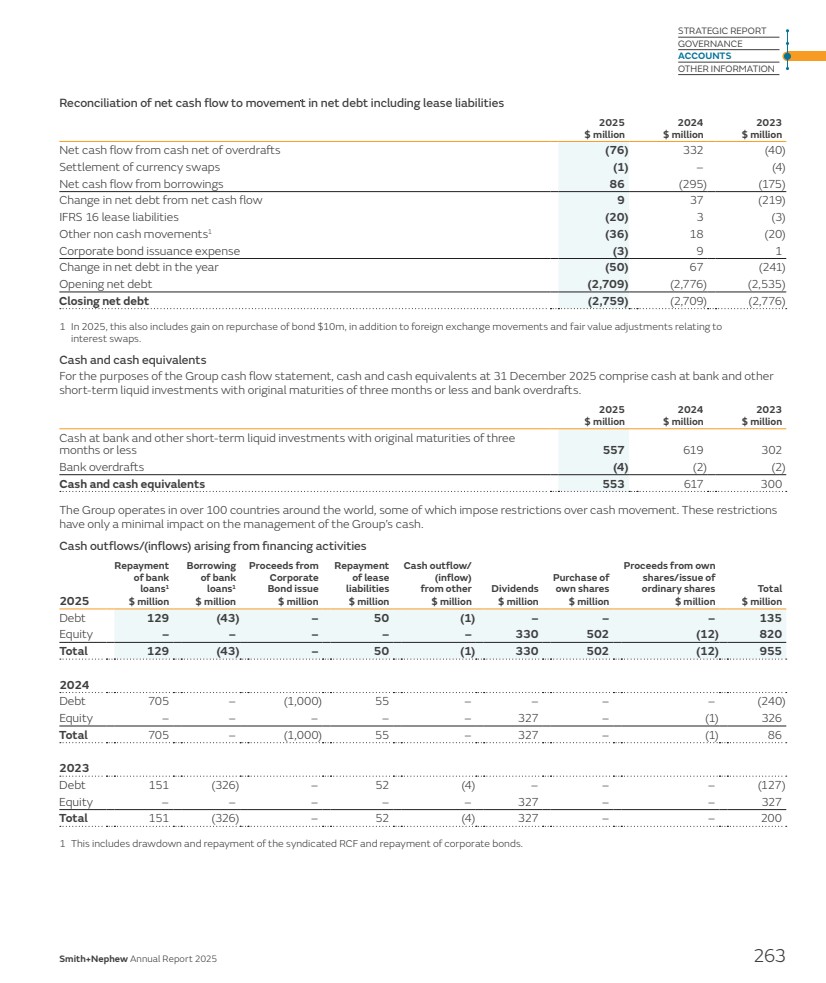
| 21 Acquisitions Accounting policy The Group accounts for business combinations using the acquisition method when control is transferred to the Group. The consideration transferred in the acquisition is measured at fair value, as are the identifiable net assets acquired. Any goodwill that arises is tested annually for impairment. Any gain on a bargain purchase is recognised in profit or loss immediately. Transaction costs are expensed as incurred, except if related to the issue of debt or equity securities. Any contingent consideration payable is measured at fair value at the acquisition date. If the contingent consideration is classified as equity, then it is not remeasured and settlement is accounted for within equity. Otherwise, subsequent changes in the fair value of the contingent consideration are recognised in profit or loss. Year ended 31 December 2025 No acquisitions were completed in 2025. Year ended 31 December 2024 On 9 January 2024, the Group completed the acquisition of 100% of the share capital of CartiHeal (2009) Ltd (CartiHeal), the developer of CARTIHEAL◊ AGILI-C◊ , a novel Sports Medicine technology for cartilage regeneration in the knee. The acquisition of this disruptive technology supports our strategy to invest behind our successful Sports Medicine & ENT business unit. The fair value of the consideration amounted to $231m. This is comprised of contingent consideration of $49m, which represents the discounted value of $150m of consideration contingent upon the achievement of a single future financial performance milestone in the next 10 years, and initial cash consideration of $180m adjusted for cash acquired and other liabilities assumed, of which $18m was transferred in to escrow to be released in equal instalments to the seller in 12 and 18 months from completion. The fair value of assets acquired and liabilities assumed is set out below: CartiHeal (2009) Ltd $ million Intangible assets – Product-related and trade name 84 Inventory 1 Cash 6 Other liabilities (2) Trade and other payables (1) Net deferred tax liability (3) Net assets 85 Goodwill 146 Consideration 231 The product-related intangible assets and trade name were valued using a relief-from-royalty methodology with the key inputs being revenue, profit and discount rate. The cash outflow from acquisitions in 2024 was $186m (2023: $21m) comprises payments of consideration of $177m net of cash acquired (2023: $nil) relating to acquisitions and payments of deferred and contingent consideration of $9m (2023: $21m) relating to acquisitions completed in prior years. The goodwill represents the control premium, acquired workforce and the synergies expected from integrating CartiHeal into the Group’s existing business. The carrying value of goodwill increased from $2,992m at 31 December 2023 to $3,026m at 31 December 2024. The acquisition in the year ended 31 December 2024 increased goodwill by $146m, this was partially offset by goodwill impairment of $65m and foreign exchange movements of $47m. For the year ended 31 December 2024, the contribution from CartiHeal to the Group’s revenue and profit was immaterial. If the business combination had occurred at the beginning of the year the contribution to revenue and profit would not have been materially different. Year ended 31 December 2023 No acquisitions were completed in 2023. During 2023, management evaluated the commercial viability of Engage products and concluded that they should be discontinued (see Note 2.2 for further details). 264 Smith+Nephew Annual Report 2025 Notes to the Group accounts continued Group financial statements continued 24_SN_AR25_Note_15_23_v227.indd 264 05/03/2026 18:25 |
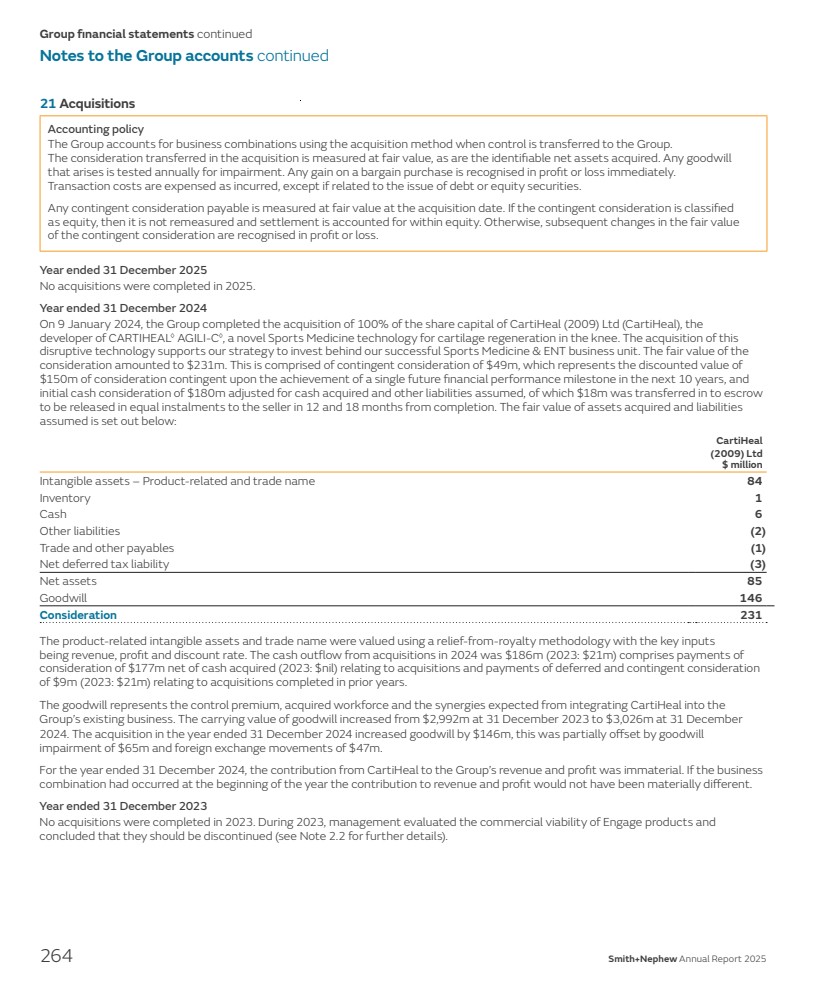
| 22 Other notes to the accounts 22.1 Share-based payments Accounting policy The Group operates a number of equity-settled executive and employee share plans. For all grants of share options and awards, the fair value at the grant date is calculated using appropriate option pricing models. The grant date fair value is recognised over the vesting period as an expense, with a corresponding increase in retained earnings. The Group operates the following equity-settled and employee shareplans: Smith & Nephew Global Share Plan 2010, Smith & Nephew Global Share Plan 2020, Smith & Nephew Share Save Plan (2012) and Smith & Nephew International Share Save Plan (2012). At 31 December 2025, 3,259,000 options (2024: 4,587,000, 2023: 5,138,000) were outstanding with a range of exercise prices from 843 to 1,235 pence. At 31 December 2025, the maximum number of shares that could be awarded under the Group’s long-term incentive plans was 7,542,000 (2024: 9,899,000, 2023: 8,452,000). These include conditional share awards granted to senior employees and equity and performance share awards granted to senior executives under the Global Share Plan 2010 and Global Share Plan 2020. The expense charged to the income statement for share-based payments for the year is $43m (2024: $40m, 2023: $39m). 22.2 Related party transactions Trading transactions In the course of normal operations, the Group traded with its associates detailed in Note 11. The aggregated transactions, which have not been disclosed elsewhere in the financial statements, are $nil (2024: $nil, 2023: $nil). Key management personnel The remuneration of Executive Officers (including Executive Directors and Non-Executive Directors) during the year is summarised below: 2025 2024 2023 $ million $ million $ million Short-term employee benefits 23 22 21 Share-based payments expense 15 10 9 Pension and post-employment benefit entitlements 2 1 1 40 33 31 Directors’ remuneration disclosures are included on pages 147–193. Retirement benefit schemes Details of the Group’s retirement benefit schemes are set out in Note 18. 23 Post balance sheet events On 21 January 2026, the Group completed the acquisition of 100% of the share capital of Integrity Orthopaedics, Inc., a US-based early-stage commercial developer of Tendon Seam™, an innovative rotator cuff repair (RCR) system designed to significantly reduce re tear rates and improve patient outcomes. The acquisition represents a meaningful step in delivering Smith+Nephew’s RISE strategy to accelerate growth through strategic investment and portfolio leadership, and will be an important building block in our ambition to become the global leader in Sports Medicine. The acquisition consideration comprised of $225m paid on completion, with up to a further $225m contingent on future performance. The acquisition will be treated as a business combination under IFRS 3. The fair value assessment of the acquisition consideration, identifiable assets acquired and liabilities assumed is ongoing. Given the proximity of the acquisition to the financial statements being authorised for issue, it is not practicable at this stage to reasonably estimate the financial effect of the acquisition on the Group’s consolidated financial statements. The Group expects to complete the purchase price allocation exercise under IFRS 3 in the first half of 2026, accordingly, provisional disclosures will be included in the Group’s 2026 interim results. On 9 February 2026, the Group amended its $1bn revolving credit facility, increasing total commitments to $1.125bn. The facility remains undrawn and its maturity is unchanged. Smith+Nephew Annual Report 2025 265 STRATEGIC REPORT GOVERNANCE ACCOUNTS OTHER INFORMATION 24_SN_AR25_Note_15_23_v227.indd 265 05/03/2026 18:25 |

| Company balance sheet At 31 December At 31 December 2025 2024 Notes $ million $ million Non-current assets Investments 2 7,092 7,092 Debtors 3 2,472 2,408 9,564 9,500 Current assets Debtors 3 369 733 Cash and cash equivalents 5 438 487 807 1,220 Total assets 10,371 10,720 Equity and liabilities Equity attributable to owners of the Company Share capital 175 175 Share premium 615 615 Capital redemption reserve 20 20 Capital reserve 2,266 2,266 Treasury shares (515) (66) Exchange reserve (52) (52) Profit and loss account 2,833 3,237 Total equity 5,342 6,195 Non-current liabilities Borrowings 5 3,027 3,124 Other creditors 4&5 21 16 3,048 3,140 Current liabilities Borrowings 5 78 2 Other creditors 4 1,903 1,383 1,981 1,385 Total liabilities 5,029 4,525 Total equity and liabilities 10,371 10,720 The attributable (loss)/profit for the year dealt with in the accounts of the Company is $(77)m (2024: $72m). The accounts were approved by the Board and authorised for issue on 27 February 2026 and signed on its behalf by: Rupert Soames, OBE Deepak Nath, PhD John Rogers Chair Chief Executive Officer Chief Financial Officer 266 Smith+Nephew Annual Report 2025 Company financial statements 25_SN_AR25_Comp_Acc_v81.indd 266 05/03/2026 18:26 |
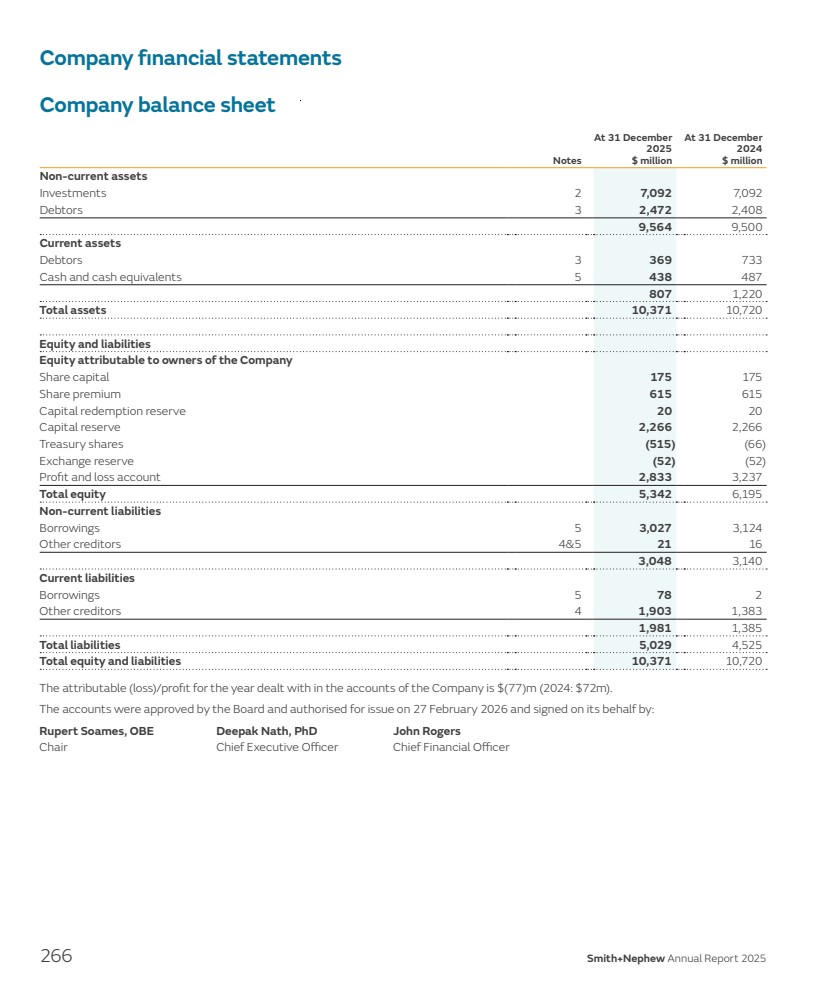
| Company statement of changes in equity Capital Total Share Share redemption Capital Treasury Exchange Profit and shareholders’ capital premium reserve reserve shares reserve loss account funds $ million $ million $ million $ million $ million $ million $ million $ million At 1 January 2024 175 615 20 2,266 (94) (52) 3,479 6,409 Attributable profit for the year – – – – – – 72 72 Equity dividends paid in the year – – – – – – (327) (327) Share-based payments recognised1 – – – – – – 40 40 Cost of shares transferred to beneficiaries – – – – 28 – (27) 1 At 31 December 2024 175 615 20 2,266 (66) (52) 3,237 6,195 Attributable loss for the year – – – – – – (77) (77) Equity dividends paid in the year – – – – – – (330) (330) Share-based payments recognised1 – – – – – – 44 44 Cost of shares transferred to beneficiaries – – – – 53 – (41) 12 Treasury shares purchased – – – – (502) – – (502) At 31 December 2025 175 615 20 2,266 (515) (52) 2,833 5,342 1 The Company operates a number of equity-settled executive and employee share plans. For all grants of share options and awards, the fair value as at the date of grant is calculated using an appropriate option pricing model and the corresponding expense is recognised over the vesting period. Subsidiary companies are recharged for the fair value of share options that relate to their employees. The disclosure relating to the Company is detailed in Note 22.1 of the Notes to the Group accounts. Further information on the share capital of the Company can be found in Note 19.1 of the Notes to the Group accounts. The total distributable reserves of the Company approximate to the balance on the profit and loss account reserve, less treasury shares and exchange reserves, which at 31 December 2025 amounted to $2,266m (2024: $3,119m). In accordance with the exemption permitted by Section 408 of the Companies Act 2006, the Company has not presented its own profit and loss account. Fees paid to Deloitte for audit and non-audit services to the Company itself are not disclosed in the individual accounts because Group financial statements are prepared which are required to disclose such fees on a consolidated basis. The fees for the consolidated Group are disclosed in Note 3.2 of the Notes to the Group accounts. Smith+Nephew Annual Report 2025 267 STRATEGIC REPORT GOVERNANCE ACCOUNTS OTHER INFORMATION 25_SN_AR25_Comp_Acc_v81.indd 267 05/03/2026 18:26 |

| 1 Basis of preparation Smith & Nephew plc (the “Company”) is a public limited company incorporated in England and Wales. The separate accounts of the Company are presented as required by the Companies Act 2006. These financial statements and accompanying notes have been prepared in accordance with the Financial Reporting Standard 101 Reduced Disclosure Framework (‘Reduced Disclosure Framework’) for all periods presented. The financial information for the Company has been prepared on the same basis as the consolidated financial statements, applying identical accounting policies as outlined throughout the Notes to the Group accounts. The Directors have determined that the preparation of the Company financial statements on a going concern basis is appropriate as the Company receives dividend cash receipts from its subsidiary undertakings which enable it to meet its liabilities as they fall due. In applying these policies, management is required to make estimates and assumptions that affect the reported amounts of assets and liabilities and disclosure of contingent assets and liabilities at the date of the accounts and the reported amounts of revenues and expenses during the reporting period. Although these estimates are based on management’s best knowledge of current events and actions, actual results ultimately may differ from those estimates. In these financial statements, the Company has applied the exemptions available under FRS 101 in respect of the following disclosures: – A cash flow statement and related notes; – Comparative period reconciliations for share capital and tangible fixed assets; – Disclosures in respect of transactions with wholly-owned subsidiaries; – Disclosures in respect of capital management; – The effects of new but not yet effective IFRSs; and – Disclosures in respect of the compensation of key management personnel. As the consolidated financial statements include the equivalent disclosures, the Company has also taken the exemptions under FRS 101 available in respect of the following disclosures: – IFRS 2 Share Based Payments in respect of Group-settled share-based payments; and – Certain disclosures required by IFRS 13 Fair Value Measurement and the disclosures required by IFRS 7 Financial Instrument Disclosures. The Company proposes to continue to adopt the Reduced Disclosure Framework of FRS 101 in its next financial statements. The Company’s accounting policies do not include any critical judgements and estimates. 2 Investments Accounting policy Investments in subsidiaries are stated at cost less provision for impairment. 2025 2024 $ million $ million At 1 January and 31 December 7,092 7,092 Investments represent holdings in subsidiary undertakings. In accordance with Section 409 of the Companies Act 2006, a listing of all entities invested in by the consolidated Group is provided in Note 8. 268 Smith+Nephew Annual Report 2025 Notes to the Company accounts Company financial statements continued 25_SN_AR25_Comp_Acc_v81.indd 268 05/03/2026 18:26 |

| 3 Debtors 2025 2024 $ million $ million Current Amounts owed by subsidiary undertakings 341 664 Prepayments and accrued income – 6 Current asset derivatives – forward foreign exchange contracts 18 46 Current asset derivatives – forward foreign exchange contracts – subsidiary undertakings 8 16 Current asset derivatives – currency swaps 2 1 369 733 Non-current Amounts owed by subsidiary undertakings 2,440 2,398 Non-current asset derivatives – forward foreign exchange contracts 15 – Non-current asset derivatives – forward foreign exchange contracts – subsidiary undertakings 6 – Non-current asset derivatives – interest rate swaps 11 10 2,472 2,408 Allowance losses on amounts owed by subsidiary undertakings are calculated by reviewing 12-month expected credit losses using historic and forward-looking data on credit risk. The loss allowance expense for the year was de minimis (2024: de minimis). 4 Other creditors 2025 2024 $ million $ million Current Amounts owed to subsidiary undertakings 1,847 1,286 Other creditors 28 33 Current liability derivatives – forward foreign exchange contracts 8 16 Current liability derivatives – forward foreign exchange contracts – subsidiary undertakings 18 46 Current liability derivatives – currency swaps 2 2 1,903 1,383 Non-current Non-current liability derivatives – forward foreign exchange contracts 6 – Non-current liability derivatives – forward foreign exchange contracts – subsidiary undertakings 15 – Non-current liability derivatives – interest rate swaps – 16 21 16 5 Cash and borrowings Accounting policy Financial instruments Currency swaps are used to match foreign currency assets with foreign currency liabilities. They are initially recorded at fair value and then for reporting purposes remeasured to fair value at exchange rates and interest rates at subsequent balance sheet dates. Changes in the fair value of derivative financial instruments are recognised in the profit and loss account as they arise. 2025 2024 $ million $ million Bank loans, borrowing and overdrafts due within one year or on demand 78 2 Borrowings due after one year 3,027 3,124 Borrowings 3,105 3,126 Cash and cash equivalents (438) (487) (Debit)/credit balance on derivatives – interest rate swaps (11) 6 Net debt 2,656 2,645 All currency swaps are stated at fair value. These currency swaps have notional values of Gross US Dollar equivalents of $570m (2024: $453m) receivable and $570m (2024: $455m) payable. Currency swaps comprise foreign exchange swaps and were used in 2025 and 2024 to hedge intra-group loans. Smith+Nephew Annual Report 2025 269 STRATEGIC REPORT GOVERNANCE ACCOUNTS OTHER INFORMATION 25_SN_AR25_Comp_Acc_v81.indd 269 05/03/2026 18:26 |
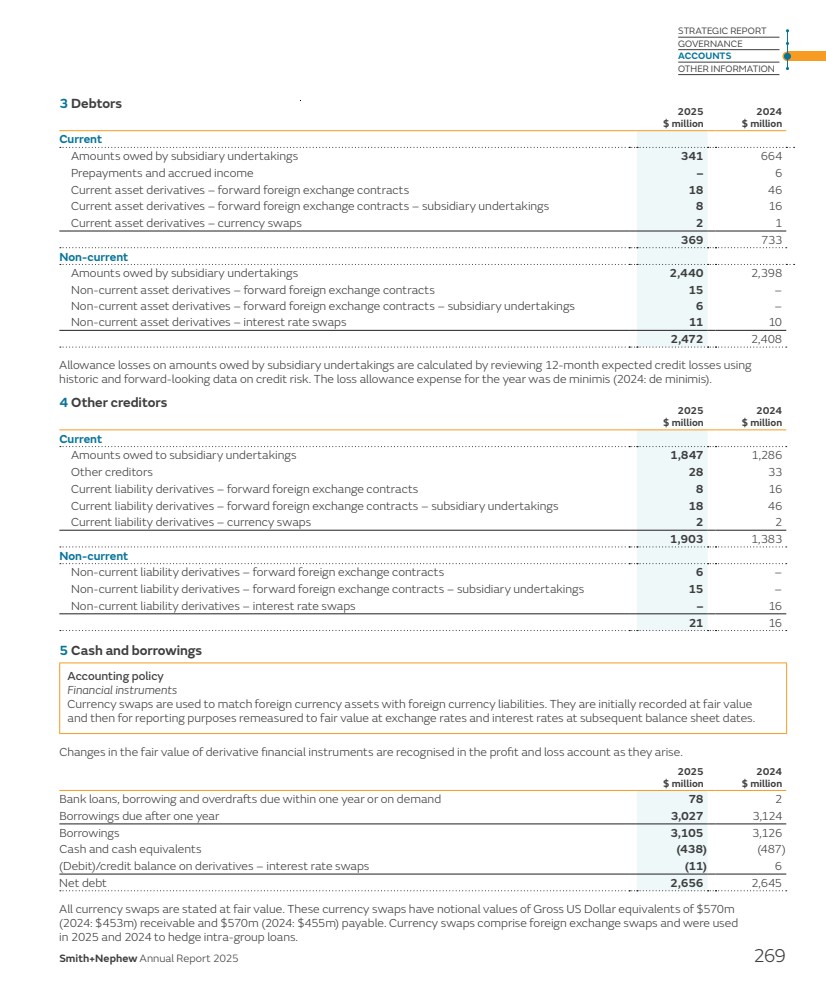
| 6 Contingencies 2025 2024 $ million $ million Guarantees in respect of subsidiary undertakings – – The Company gives guarantees to banks to support liabilities and cross guarantees to support overdrafts. The Company operated defined benefit pension plans in 2004 but at the end of 2005 its pension plan obligations were transferred to Smith & Nephew UK Limited. The Company has provided guarantees to the trustees of the pension plans to support future amounts due from participating employers (see Note 18 of the Notes to the Group accounts). 7 Deferred taxation The Company has gross unused capital losses of $129m (2024: $120m) available for offset against future chargeable gains. No deferred tax asset has been recognised on these unused losses as they are not expected to be realised in the foreseeable future. 8 Group companies In accordance with Section 409 of the Companies Act 2006, a full list of subsidiaries, associates, joint arrangements, joint ventures and partnerships are listed below as at 31 December 2025, including their country of incorporation. All companies are 100% owned, unless otherwise indicated. The share capital disclosed comprises ordinary shares which are indirectly held by Smith & Nephew plc, unless otherwise stated. Company name Country of operation and incorporation Registered Office Smith & Nephew UK Limited1,4 England & Wales Watford Smith & Nephew UK Pension Fund Trustee Limited2 England & Wales Watford Smith & Nephew USD Limited1 England & Wales Watford Smith & Nephew USD One Limited1 England & Wales Watford T.J.Smith and Nephew, Limited England & Wales Hull The Albion Soap Company Limited2 England & Wales Watford TP Limited1 Scotland Edinburgh Rest of Europe Smith & Nephew GmbH Austria Vienna Smith & Nephew S.A.-N.V Belgium Zaventem Smith & Nephew A/S Denmark Kobenhavn Smith & Nephew Oy Finland Helsinki Smith & Nephew France SAS1 France Neuilly-sur-Seine Smith & Nephew S.A.S. France Neuilly-sur-Seine Smith & Nephew Business Services GmbH & Co. KG1 Germany Hamburg Smith & Nephew Business Services Verwaltungs GmbH Germany Hamburg Smith & Nephew Deutschland (Holding) GmbH1 Germany Hamburg Smith & Nephew GmbH Germany Hamburg Smith & Nephew Orthopaedics GmbH Germany Tuttlingen Smith & Nephew Robotics GmbH Germany Munich Smith & Nephew (Ireland) Trading Limited Ireland Dublin Cartiheal (2009) Ltd1 Israel Kfar Saba Smith & Nephew S.r.l. Italy Milan Smith & Nephew International S.A.1 Luxembourg Luxembourg Company name Country of operation and incorporation Registered Office UK Additive Instruments Limited England & Wales Watford Michelson Diagnostic Limited3 (6.4%) England & Wales Nottingham Neotherix Limited3 (24.9%) England & Wales York Smith & Nephew (Overseas) Limited1,4 England & Wales Watford Smith & Nephew Beta Limited2 England & Wales Watford Smith & Nephew China Holdings UK Limited1 England & Wales Watford Smith & Nephew Employees Trustees Limited2 England & Wales Watford Smith & Nephew ESN Limited2 England & Wales Watford Smith & Nephew Extruded Films Limited2 England & Wales Hull Smith & Nephew Finance2 England & Wales Watford Smith & Nephew Finance Oratec2 England & Wales Watford Smith & Nephew Healthcare Limited2 England & Wales Hull Smith & Nephew Investment Holdings Limited1 England & Wales Watford Smith & Nephew Lilia Limited2 England & Wales Watford Smith & Nephew Medical Fabrics Limited2 England & Wales Watford Smith & Nephew Medical Limited England & Wales Hull Smith & Nephew Nominee Company Limited2 England & Wales Watford Smith & Nephew Nominee Services Limited2 England & Wales Watford Smith & Nephew Orthopaedics Limited England & Wales Watford Smith & Nephew Pharmaceuticals Limited2 England & Wales Hull Smith & Nephew Raisegrade Limited1,2 England & Wales Watford Smith & Nephew Rareletter Limited2 England & Wales Watford Smith & Nephew Trading Group Limited1 England & Wales Watford Smith & Nephew UK Executive Pension Scheme Trustee Limited2 England & Wales Watford 270 Smith+Nephew Annual Report 2025 Notes to the Company accounts continued Company financial statements continued 25_SN_AR25_Comp_Acc_v81.indd 270 05/03/2026 18:26 |

| Company name Country of operation and incorporation Registered Office Smith & Nephew (Europe) B.V.1 Netherlands Amsterdam, 2132NP Smith & Nephew B.V. Netherlands Amsterdam, 2132NP Smith & Nephew Nederland CV Netherlands Amsterdam, 2132NP Smith & Nephew Operations B.V. Netherlands Amsterdam, 2132NP Serda B.V.3 (48.66%) Netherlands Amsterdam, 1105BP Smith & Nephew AS Norway Oslo Smith & Nephew sp. z.o.o. Poland Warsaw Smith & Nephew Lda Portugal Forte da Casa S&N ORION PRIME, S.A. Portugal Coimbra DC LLC Russian Federation Puschino Smith & Nephew LLC Russian Federation Moscow Smith & Nephew S.A.U Spain Barcelona Smith & Nephew Aktiebolag Sweden Molndal Lumina Adhesives AB3 (1.59%) Sweden Gothenburg Atracsys Sàrl Switzerland Puidoux Naviswiss AG (0.17%) Switzerland Brugg Plus Orthopedics Holding AG1 Switzerland Zug Smith & Nephew Manufacturing AG Switzerland Aarau Smith & Nephew Orthopaedics AG1 Switzerland Zug Smith & Nephew Schweiz AG Switzerland Zug Smith & Nephew AG Switzerland Zug Smith & Nephew Orthopaedics AG Aarau Branch5 Switzerland Aarau US Arthrocare Corporation United States Wilmington Ascension Orthopedics, Inc. United States Wilmington Austin Miller Trauma LLC United States Wilmington Bioventus Inc.3,6 (26.60%) United States Wilmington Bioventus LLC3,7 (26.60%) United States Wilmington Blue Belt Technologies, Inc. United States Philadelphia CartiHeal Inc. United States Wilmington Ceterix Orthopaedics, Inc. United States Wilmington Engage Uni LLC United States Wilmington Integrated Shoulder Collaboration, Inc. United States Wilmington IntraFuse LLC Investment 3 (42.16%) United States Utah Leaf Healthcare Inc. United States Wilmington Miach Orthopaedics, Inc3 (8.25%) United States Dover GD Osiris Therapeutics, Inc. United States Timonium Rotation Medical, Inc. United States Wilmington Sinopsys Surgical, Inc.3 (1.44%) United States Wilmington Smith & Nephew Consolidated, Inc.1 United States Wilmington Smith & Nephew, Inc.1 United States Wilmington Trice Medical Inc.3 (0.5%) United States Wilmington 19808 Tusker Medical, Inc. United States Wilmington Company name Country of operation and incorporation Registered Office Africa, Asia, Australasia and Other Americas Smith & Nephew Pty Limited Australia Macquarie Park Smith & Nephew Surgical Holdings Pty Limited1,2 Australia Macquarie Park Smith & Nephew Surgical Pty Limited2 Australia Macquarie Park Mesoblast Ltd (0.77%) Australia Melbourne Smith & Nephew Comercio de Produtos Medicos LTDA Brazil São Paulo Smith & Nephew Comercio de Produtos Medicos LTDA, Diadema Branch5 Brazil Diadema Smith & Nephew Inc.1 Canada Ontario Smith & Nephew Finance Holdings Limited4 Cayman Islands George Town 1104 TEAMfund, LP3 (6.765%) Cayman Islands George Town 9008 Smith & Nephew Chile SpA2 Chile Chile Plus Orthopedics (Beijing) Co. Limited2 China Shunyi District, Beijing Smith & Nephew Medical (Shanghai) Limited China Shanghai Ao Na Rd Smith & Nephew Medical (Shanghai) Limited Beijing Branch5 China Dong Cheng Smith & Nephew Medical (Shanghai) Limited Chengdu Branch5 China Wu Hou Smith & Nephew Medical (Shanghai) Limited Guangzhou Branch5 China Yue Xiu Smith & Nephew Medical (Shanghai) Limited Shanghai Branch5 China Jing’an Smith & Nephew Medical (Shanghai) Limited Shanghai Second Branch5 China Shanghai Xin Jin Qiao Rd Smith & Nephew Medical (Suzhou) Limited China Suzhou City Smith & Nephew Orthopaedics (Beijing) Co., Ltd China Ronghua S&N Holdings SAS1 Colombia Bogota Smith & Nephew Colombia S.A.S Colombia Bogota ArthroCare Costa Rica Srl Costa Rica Alajuela Smith & Nephew Curaçao N.V.2 Curaçao Willemstad Smith & Nephew Beijing Holdings Limited1 Hong Kong Hong Kong Smith & Nephew Limited Hong Kong Hong Kong Smith & Nephew Suzhou Holdings Limited1 Hong Kong Hong Kong Smith & Nephew GBS Private Limited India Pune Smith & Nephew Healthcare Private Limited India Mumbai Smith & Nephew KK Japan Tokyo Smith & Nephew Chusik Hoesia Korea, Republic of Seoul Smith & Nephew Healthcare Sdn. Bhd Malaysia Kuala Lumpur Smith & Nephew Operations Sdn. Bhd Malaysia Kuala Lumpur Smith & Nephew Services Sdn. Bhd Malaysia Kuala Lumpur Smith & Nephew S.A. de C.V. Mexico Mexico City Smith & Nephew Limited1 New Zealand Auckland Smith+Nephew Annual Report 2025 271 STRATEGIC REPORT GOVERNANCE ACCOUNTS OTHER INFORMATION 25_SN_AR25_Comp_Acc_v81.indd 271 05/03/2026 18:26 |
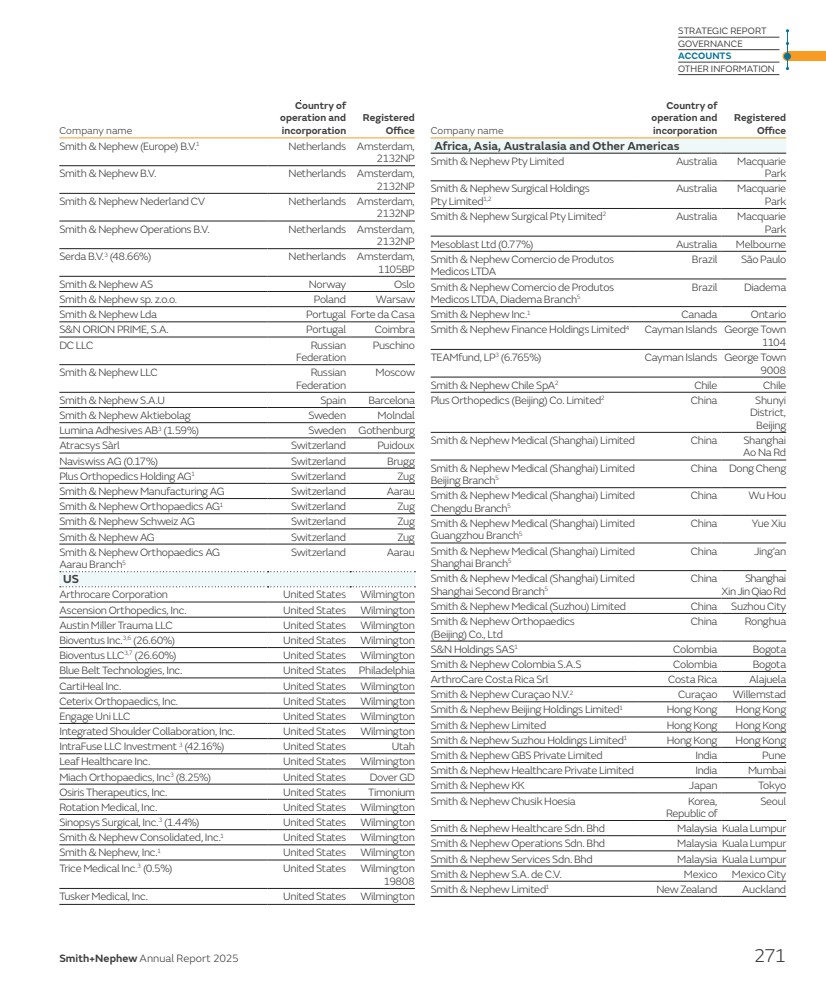
| Company name Country of operation and incorporation Registered Office Smith & Nephew Superannuation Scheme Limited New Zealand Auckland Smith & Nephew (Overseas) Limited Philippines Branch2,5 Philippines Manila Smith & Nephew Philippines, Incorporated Philippines Muntinlupa Smith & Nephew, Inc. Puerto Rico San Juan Smith & Nephew USD Limited Office for Technical & Scientific Services5 Saudi Arabia Riyadh Branch of Smith & Nephew Regional Headquarter Company5 Saudi Arabia Riyadh Smith & Nephew Asia Pacific Pte. Limited1 Singapore Singapore Smith & Nephew Pte Limited Singapore Singapore Smith & Nephew (Pty) Limited1 South Africa Westville Smith & Nephew Pharmaceuticals (Proprietary) Limited2 South Africa Westville Smith & Nephew (Overseas) Limited Taiwan Branch5 Taiwan Taipei Smith & Nephew Limited Thailand Huai Khwang District, Bangkok Smith ve Nephew Medikal Cihazlar Ticaret Limited Sirketi Turkey Istanbul Smith & Nephew FZE United Arab Emirates Jebel Ali, Dubai Smith & Nephew FZE (DHCC Branch)5 United Arab Emirates HealthCare City, Dubai The Representative Office Of Smith & Nephew Asia Pacific Pte. Limited Vietnam Ho Chi Minh City Smith & Nephew Company Limited Vietnam Hanoi City Smith & Nephew Pte Ltd. Foreign Trade Representative Office Indonesia Kartini 1 Holding company. 2 Dormant company. 3 Not 100% owned by Smith & Nephew Group. 4 Directly owned by Smith & Nephew plc. 5 Branch of a company in Smith & Nephew Group. 6 Represents 26.60% voting rights and 7.5% economic interest. 7 Represents 9.3% economic interest. Registered Office addresses UK Watford Building 5, Croxley Park, Hatters Lane, Watford, Hertfordshire, WD18 8YE Nottingham 80 Mount Street , Cumberland Court, Nottingham , NG1 6HH. York 25, Carr Lane, York, YO26 5HT Hull 101 Hessle Road, Hull, HU3 2BN Edinburgh 4th Floor, 115 George Street, Edinburgh, EH2 4JN Rest of Europe Vienna Concorde Business Park, C3, 2320, Schwechat, Austria Zaventem Ikaroslaan 45, 1930 Zaventem, Belgium Kobenhavn Kay Fiskers Plads 9, 1. 2300. Kobenhavn S, Denmark Registered Office addresses Helsinki Lentäjäntie 1, 01530 Vantaa, Finland Neuilly-sur-Seine 40-52, Boulevard du Parc, 92200 Neuilly-sur-Seine, France Hamburg Van-der-Smissen-Strabe, 22767, Hamburg, Germany Munich Rosenheimer Straße 116, Munich, 81669, Germany Tuttlingen Alemannenstrasse 14, 78532, Tuttlingen, Germany Dublin 9 Clare Street, Dublin 2, D02 HH30, Ireland Kfar Saba 17 Atir Yeda St, Kfar Saba, 4464313, Israel Milan Sesto San Giovanni (MI) Viale T. Edison 110 CAP 20099 Italy Luxembourg 1A, rue Jean Piret, L-2350, Luxembourg, Grand-Duchy of Luxembourg, Luxembourg Amsterdam 2132NP Bloemlaan 2, 2132NP, Hoofddorp, The Netherlands Amsterdam 1105BP Paasheuvelweg 25, 1105BP, Amsterdam, The Netherlands Oslo Snaroyveien 36, FORNEBU, 1364, Norway Warsaw Ul Osmanska 12, 02-823, Warsaw, Poland Forte da Casa Rua do Parque Tejo, numbers 7, 7-A and 7-B 2625-437 Forte da Casa, Povoa de Santa Iria and Forte da Casa, Vila Franca de Xira, Portugal Coimbra Rua Pedro Nunes, Instituto Pedro Nunes, Edificio IPN-D, 3030-199, Coimbra, Portugal Moscow 2nd Syromyatnichesky Lane, 9th floor, Premises 1, Room 1, Moscow, 105120, Russian Federation Puschino 8/1 Stroiteley Street, 142290, City of Puschino, Moscow Region, Russian Federation Barcelona Av. Baix Llobregat, Num 30, 3ª Planta, Campus Barcelona, 08950 Esplugues de Llobregat, Spain Molndal Krokslatts fabriker 39 431 37 Molndal, Sverige, Sweden Gothenburg Varbergsgatan 2A/412 65 Göteborg, Sweden Puidoux Route du Verney 20, 1070, Puidoux, Switzerland Brugg Stahlrain 2, 5200, Brugg, Switzerland Zug Theilerstrasse 1A, 6300, Zug, Switzerland Aarau Schachenallee 29, 5000, Aarau, Switzerland US Wilmington CT Corporation, 1209 Orange Street, Wilmington DE 19801, USA Philadelphia CT Corporation 1515 Market Street, Philadelphia, PA 19102, USA Wilmington 19808 251 Little Falls Drive, Wilmington DE 19808, USA Dover GD 160 Greentree Drive, Suite 101, Dover, DE, 19904, USA Timonium CT Corp. 2405 York Road, Suite 201, Lutherville Timoniun, MD 21093, USA Utah P.O. Box 6008, North Logan, UT 84341, USA Africa, Asia, Australasia and Other Americas Buenos Aires Maipu 1300, 13th Floor, Buenos Aires, Argentina Macquarie Park Suite 1.01, Level 1, Building B, Pinnacle Office Park, 4 Drake Avenue, Macquarie Park, NSW 2113, Australia Melbourne 55 Collins Street, Level 38 Melbourne VIC 3000, Australia São Paulo Av. das Nações Unidas, 14171- 23º andar – Torre C-Crystal, Vila Gertrudes, São Paulo, CEP 04794-000, Brazil 8 Group companies continued 272 Smith+Nephew Annual Report 2025 Notes to the Company accounts continued Company financial statements continued 25_SN_AR25_Comp_Acc_v81.indd 272 05/03/2026 18:26 |
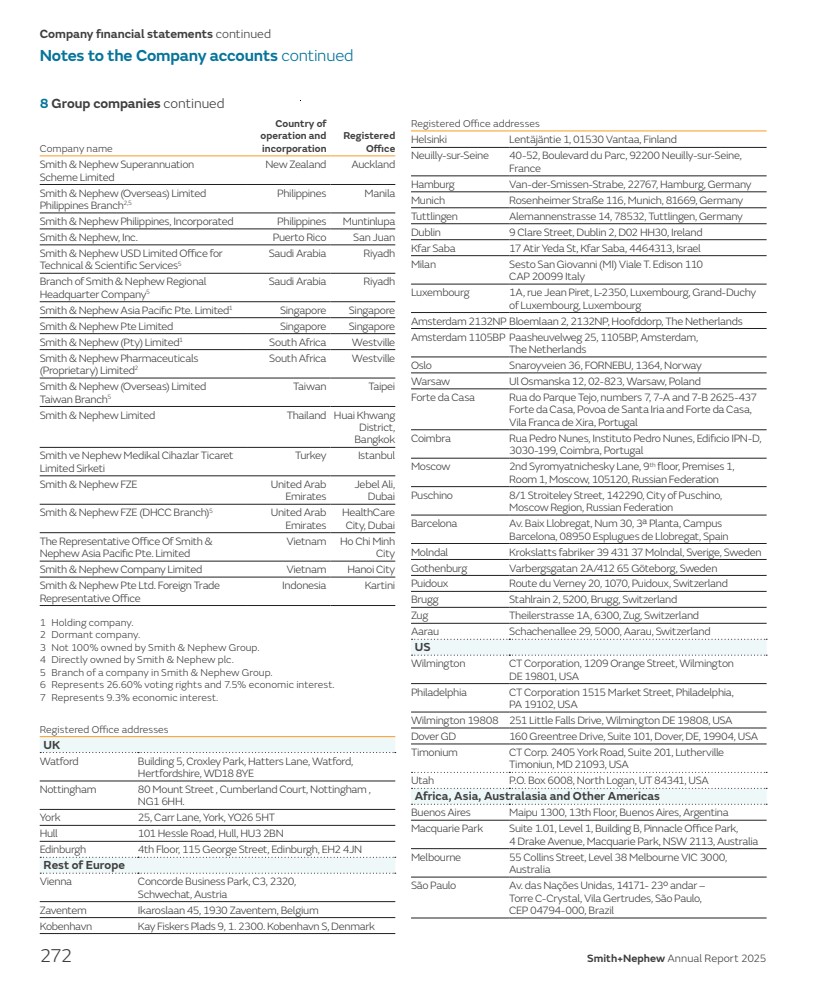
| 9 Subsidiary undertakings exempt from audit The following UK subsidiaries will take advantage of the audit exemption set out within Section 479A of the Companies Act 2006 for the year ended 31 December 2025: – Additive Instruments Limited (Registration number: 12323687) – Smith & Nephew China Holdings UK Limited (Registration number: 9152387) – Smith & Nephew Investment Holdings Limited (Registration number: 384546) – Smith & Nephew Trading Group Limited (Registration number: 681256) – Smith & Nephew USD One Limited (Registration number: 10428326) – TP Limited (Registration number: SC005366) Registered Office addresses Diadema Avenida Fagundes de Oliveira, 538, Piraporinha, Mbigucci Diadema Business Park, Module B21 and B22, City of Diadema São Paulo CEP 09950-300 Brazil Ontario 1919 Minnesota Court, Suite 403, Mississauga ON L5N 0C9 Chile Alonso de Cordova 5320 OF 1401 PS14, Las Condes, Rol 751-76, Santiago, Chile Georgetown 1104 c/o Maples Corporate Services Limited, P.O. Box 309, Ugland house, Grand Cayman, KY1-1104, Cayman Islands Georgetown 9008 Walkers Corporate Limited, Cayman Corporate Centre, 27 Hospital Road, George Town, Grand Cayman, KY1-9008, Cayman Islands Chao Yang District, Beijing Room 17-021, Internal B17 floor, B3-24th floor, No 3 Xin Yuan South Rd, Chao Yang District, Beijing, China Shunyi District, Beijing 22 Linhe Avenue, Linhe Economic Development Zone, Shunyi District, Beijing, 101300, China Shanghai Ao Na Rd Part B, 4th Floor, Tong Yong Building, No 188 Ao Na Rd, Shanghai Free Trade Test Zone, Shanghai, China Dong Cheng District Unit B1, 2/F, Tower A, East Gate Plaza No.9, Dongshong Street Dong Cheng District, Beijing, China Wu Hou District No 5. 15th Floor, Unit 1, Building, 1 Li Bao Building, No 62 North Ke Hua North Rd, Wu Hou District, Chengdu, China Yue Xiu District Unit 50A, Level 17, Tower 2, Lumina International Centre, 181 Yanjiang Xi Road, Yue Xiu District, Guangzhou 510623, P.R.China Jing’an District Unit 09, Nominal Level 12 (Actual Level 11), Central Section of Bohua Square Office Tower, No. 669 Xinzha Road, Jing’an District, Shanghai, China Shanghai Xin Jin Qiao Rd Room 102, Floor 1, Building 3 (B1), No. 1599, Xin Jin Qiao Road China (Shanghai) Pilot Free Trade Zone, Shanghai, China Suzhou City 12, Wuxiang Road, West Area of Comprehensive Bonded Zone, Suzhou Industrial Park, Suzhou City, SIP, Jiangsu Province, China Riyadh 7555- Muhammad AI Barwadi Qurtubah, Riyadh 2474- 13244, Unit Number 301, Kingdom of Saudi Arabia Ronghua Unit 1007B, 10th Floor, Tower A, Courtyard 19, Ronghua Middle Road, BDA, Beijing, China Bogota Calle 100 No. 7 – 33 to 1 P3, Bogota D.C., Colombia Alajuela Building B32, 50 meters South of Revisión Téchnica Vehicular, Province de Alajuela, Canton Alajuela, Coyol Free Zone, District San José, Costa Rica Willemstad Pietermaai 15, PO Box 4905, Curaçao Hong Kong Unit 813 – 816, 8/F, Delta House, 3 On Yiu Street, Shatin, New Territories, Hong Kong Registered Office addresses Pune Podium Floor Tower 4, World Trade Center S No1 Kharadi, Pune, Maharashtra-MH, 411014, India Mumbai 501-B – 509-B Dynasty Business Park, Andheri Kurla Road, Andheri East, Mumbai-59, Maharashtra, India Tokyo 14th Floor, World Trade Center Building South Tower, 2-4-1 Hamamatsucho, Minato-ku, Tokyo, 105-5114, Japan Seoul 13th Floor, ASEM Tower, Gangnam-gu 13th Floor, ASEM Tower, 159-1 Samsung-dong, Seoul, Korea Kuala Lumpur Level 25, Menara Hong Leong, NO. 6 Jalan Damanlela Bukit Damansara Kuala Lumpur W.P. 50490 Kuala Lumpur, Malaysia Mexico City Av. Insurgentes Sur, numero 1602, Piso No.7, Oficina 702, Colonia Credito, Constructor, Delegacion Benito Juarez, C.P. 03940, Mexico Auckland 621 Rosebank Road, Avondale, Auckland, 1026, New Zealand Manila 6/F Alfaro St, Salcedo Village, Makati City, Metro Manila, Philippines Muntinlupa 304 26th, Floor Axis Tower Filinvest Avenue Alabang , City Of Muntinlupa, Fourth District, National Capital Region (Ncr), San Juan Edificio Cesar Castillo, Calle Angel Buonomo #361, Hato Rey, 00917, Puerto Rico Singapore 29 Media Circle, #06-05, Alice@Mediapolis, Singapore, 138565, Singapore Westville 30 The Boulevard, Westway Office Park, Westville, 3629, South Africa Taipei 9F-2, No. 50, Sec. 1, Xinsheng South Road, Zhongzheng District Taipei City 10059, Taiwan Huai Khwang District, Bangkok No. 33/4 Building A, The 9th Tower Grand Rama 9, 16th Floor, Rama 9 Road, Huai Khwang, Huai Khwang, Bangkok, 10310, Thailand. Istanbul Mahmutbey Mahallesi, 2538. Sokak, Kısık Plaza Apt. No:6/Z1, Istanbul, Bağcılar, Turkey Jebel Ali, Dubai PO Box 16993 LB02016, Jebel Ali, Dubai, United Arab Emirates HealthCare City, Dubai Floor 1, Building 52, Dubai Healthcare City, Dubai, United Arab Emirates Ho Chi Minh City Room 02, 18th floor, TNR building, 180-192, Nguyen Cong Tru street, Nguyen Thai Binh Ward, District 1, Ho Chi Minh City, Vietnam Hanoi City R03 and R04, 20th floor, LPB Tower, 210 Tran Quang Khai, Hoan Kiem Ward, Hanoi City, Vietnam Kartini Private Office, 10-133, South Quarter, Tower C, 10th Floor, Jl. R.A. Kartini Kav. 8 Smith+Nephew Annual Report 2025 273 STRATEGIC REPORT GOVERNANCE ACCOUNTS OTHER INFORMATION 25_SN_AR25_Comp_Acc_v81.indd 273 05/03/2026 18:26 |
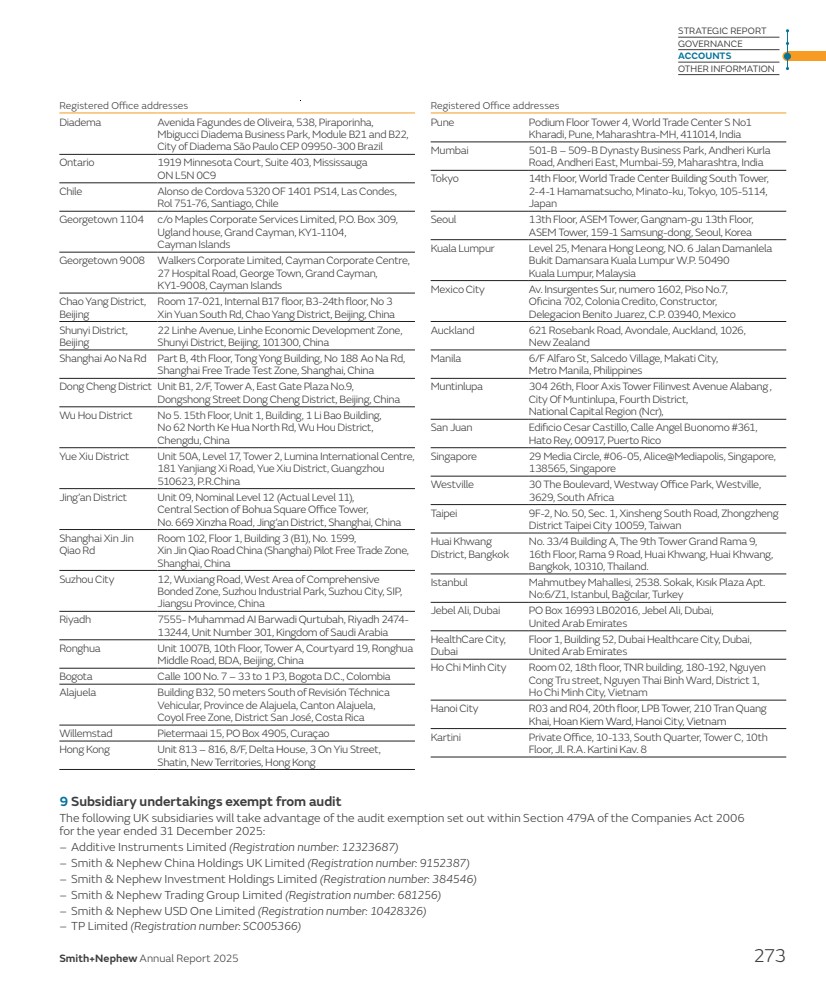
| Group information Business overview and Group history The Group has a history dating back almost 170 years to the family enterprise of Thomas James Smith who opened a small pharmacy in Hull, UK, in 1856. Following his death in 1896, his nephew Horatio Nelson Smith took over the management of the business. By the late 1990s, Smith+Nephew had expanded into being a diverse healthcare company with operations across the globe, producing various medical devices, personal care products and traditional and advanced wound care treatments. In 1998, Smith+Nephew announced a major restructuring to focus management attention and investment on three global business units – Advanced Wound Management, Endoscopy and Orthopaedics – which offered high growth and margin opportunities. In 2024, Smith+Nephew announced its current structure comprising three global business units, Advanced Wound Management, Sports Medicine and ENT and Orthopaedics. You can read more about our business units on pages 39 to 52. Smith+Nephew was incorporated and listed on the London Stock Exchange in 1937 and in 1999 the Group was also listed on the New York Stock Exchange. In 2001, Smith+Nephew became a constituent member of the FTSE 100 index in the UK. This means that Smith+Nephew is included in the top 100 companies traded on the London Stock Exchange measured in terms of market capitalisation. Today, Smith+Nephew is a public limited company incorporated and headquartered in the UK and carries out business around the world. Smith+Nephew’s operations are organised into three global business units: Orthopaedics, Sports Medicine & ENT and Advanced Wound Management. Cybersecurity risk management and governance Cyber-attacks are acknowledged to be a growing threat across all industries. There is likely to be an increased risk of information security or cybersecurity incidents, including cyber-attacks as a result of increased global tensions. The Group has adopted a holistic strategy which seeks to protect our data, people, products, and customers through a combination of people, processes, technology, and governance. As we increasingly incorporate AI functionality into our systems and products, we recognise the importance of robust governance frameworks to ensure ethical, secure and compliant AI deployment. We are investing in additional technologies and engage third-party expertise for added support. Our dedicated cybersecurity team is led by a CISSP-certified Chief Information Security Officer (CISO) with over 25 years of experience. We manage the risk of evolving threats through proactive measures and continuous updates to our defences. Our hybrid security strategy covers potential entry points, including networks, systems, applications, and devices, which aims to ensure protection for the Group and create a resilient defence against cyber threats. Cyber risk is a Board priority and the CISO actively participates in Audit Committee and Executive Committee meetings. They are also responsible for offering updates and oversight on the information and cybersecurity strategy and reporting material cybersecurity risks and mitigation strategies to the Board and its subcommittees. Additionally, the CISO chairs the Security and Privacy Steering Committee comprising business stakeholders, including, but not limited to, legal, compliance, finance, internal audit, risk management and human resources. The committee has overall approval and sign-off of security and privacy policies, which allows for focused discussions and strategy alignment for both security and privacy. The committee provides necessary updates to the Board where required. Related Party transactions Except for transactions with associates (see Note 22.2 of Notes to the Group accounts), no other related party had material transactions or loans with Smith+Nephew over the last three financial years. Properties The table below summarises the main properties which the Group uses. Manufacturing and office facilities in Memphis, Tennessee, US Wound management manufacturing, research and office facility in Hull, UK Surgical training and office facilities in Memphis, Tennessee, US Manufacturing facility in Suzhou, China Manufacturing facility in Penang, Malaysia Manufacturing facility in Alajuela, Costa Rica Manufacturing facility in Oklahoma City, Oklahoma, US Manufacturing, Office facilities and laboratory space in Fort Worth, Texas, US The Group Global Operations strategy includes ongoing assessment of the optimal facility footprint. The Orthopaedics manufacturing facilities in Memphis are largely freehold, a portion of Tuttlingen and the Advanced Wound Management facilities in Hull are freehold, while other locations are leasehold. The Group has freehold and leasehold interests in real estate in other countries throughout the world, but no other is individually significant to the Group. Where required, the appropriate governmental authorities have approved the facilities. 274 Smith+Nephew Annual Report 2025 Other information 26_SN_AR25_Risk_Factors_v45.indd 274 05/03/2026 18:27 |

| The CISO is also a member of several industry groups, including the Threat Intelligence and Information sharing, Manufacturing, NHS Supply Chain and Life Sciences trust groups which have been built and delivered by the UK National Cyber Security Centre (NCSC), alongside the global industry focused Health Information Sharing and Analysis Centre (H-ISAC). Participation in these environments allows for networking and sharing of cyber-related risks and issues to raise cyber resilience across the sector. The Group’s cybersecurity risk management processes, including identification, assessment, documentation and mitigation, have been integrated into our overall ERM system. This is achieved through both the top-down process driven by our Executive Committee which have identified Cybersecurity as one of our principal risks as well as the bottom-up IT risk register maintained by members of the cybersecurity team (refer to page 79 for additional detail on the Group’s risk management process). Further, the cybersecurity function has defined processes for handling information security and cybersecurity incidents, incorporating analysis and prioritisation mechanisms aligned with enterprise risk management. During an incident, the information security team continuously monitors and assesses the impact on the organisation. Predefined thresholds trigger the formation of a subcommittee, bringing together a cross-functional team which includes information security, information technology, legal, compliance and communications expertise. This subcommittee manages the assessment of materiality, invocation of crisis management, Executive Committee and Board engagement, and assessment of requirements for regulatory notifications. The Group’s cybersecurity risk management processes include assessment and oversight of AI systems, ensuring that risks associated with AI such as data privacy, algorithmic bias, and unintended outcomes, are identified, assessed and documented, with mitigation plans put in place in alignment with governance processes. The cybersecurity function collaborates with AI governance leads to define processes for monitoring, incident response, and regulatory compliance specific to AI technologies. In the event of a major cybersecurity incident, including those with a material impact on the Group, the CISO, supported by internal and/or external legal advisers and other third-party specialist advisers as appropriate, coordinates the engagement on the cyber incident response with the executive and crisis management teams. The CISO is also a key member of the crisis management team who supports on coordinating and communicating with the Board. Recognising cybersecurity and AI governance as a multifaceted discipline, the Group emphasises a continuous improvement approach, measured via annual security and AI governance assessments, penetration testing, vulnerability scanning and audits using a dedicated 24x7 security platform and monitoring through the internal audit function. The Group uses a wide variety of information systems, programmes, and technology to secure and manage its business. The Group also develops and sells digitally enabled products, some of which connect to networks and/or the internet. Layered security is implemented to prevent, detect, and respond to threats to minimise the risk and disruption of intrusions. Access to systems and services are protected using multi-factor authentication over virtual private networks (VPN) connected back into the Group network to safeguard remote access. Robust governance practices are in place across the information security and cyber function, including an assessment of suppliers’ and vendors’ security and compliance posture prior to the onboarding and activation of any service. Active monitoring of third-party providers is implemented on a 24x7 basis, by utilising a dedicated service via a market-leading third party, reducing the risk of supply chain attacks. The information and cybersecurity function conducts an annual mandatory information security awareness training programme for Group employees, covering topics such as physical security, email security, data privacy, ransomware guidance, phishing, AI governance, ethical AI use, responsible data handling in AI-enabled environments, and general online safety. While the Group strives for effective governance and measures, there is no assurance against future interruptions that could potentially disrupt business operations, divert staff resources and attention and materially adversely affect the organisation’s performance. Throughout 2025, there were no cybersecurity incidents identified which materially affected or are reasonably likely to materially affect the Group’s business strategy, results of operations or financial condition and no incidents have been reported to regulatory authorities during this period. It is not possible to eliminate all risks from cybersecurity threats or provide assurances that we have not experienced an undetected cybersecurity incident. For more information about these risks, please see page 280 ‘Risk Factors – Cybersecurity’ in this Annual Report. Risk factors There are known and unknown risks and uncertainties relating to Smith+Nephew’s business. The factors listed on pages 275 to 284 could cause the Group’s business, financial position and results of operations to differ materially and adversely from expected and historical levels. In addition, other factors not listed here that Smith+Nephew cannot presently identify or does not believe to be equally significant could also materially adversely affect Smith+Nephew’s business, financial position or results of operations. Global supply chain The Group’s manufacturing production is concentrated at several main facilities including Memphis, Mansfield, Columbia and Oklahoma City in the US, Hull in the UK, Aarau in Switzerland, Suzhou in China, Penang in Malaysia and Alajuela in Costa Rica. If major physical disruption or unavailability of critical system infrastructure and applications took place at any of these sites, it could adversely affect the results of operations. Disruptions to our supply chain, as a result of geopolitical events such as changes in trade policy, tariffs, conflicts such as those in Ukraine and in the Middle East, and the resulting change in access to and/or cost of supply channels, freight, raw materials and components have had and may continue to have an adverse effect on the Group’s results and operations. Smith+Nephew Annual Report 2025 275 STRATEGIC REPORT GOVERNANCE ACCOUNTS OTHER INFORMATION 26_SN_AR25_Risk_Factors_v45.indd 275 05/03/2026 18:27 |

| Physical loss and consequential loss insurance carried to cover major physical disruption to these sites is subject to limits and deductibles, generally does not cover pandemic or war-related disruptions, and may not be sufficient to cover catastrophic loss. Management, forecasting and production planning for inventory is complex and failures in operational execution could lead to excess inventory or individual product shortages. Further, as the Group continues to transform its supply chain network, warehousing and distribution functions, there is a risk that, if the transition, transformation and ongoing operations do not go as planned, the supply of products may be disrupted and impact performance. The Group is reliant on certain key suppliers of raw materials, components, finished products and packaging materials and, in some cases, on a single supplier. Disruptions in the supply chain and operations of the Group’s suppliers, increased freight costs and cycle times due to disruptions to shipping routes could result in a further increase in the Group’s costs of production and distribution. We cannot guarantee that third-party manufacturers or suppliers will be able to meet our near-term or long-term manufacturing or supply requirements of certain raw materials, including but not limited to rare earth minerals, component parts and products, which could result in lost sales and have an adverse effect on our business. Ongoing shifts in global trade dynamics coupled with regional tensions and conflicts, including in Ukraine and the Middle East, continue to reshape the geopolitical landscape and impact the Group’s cost of production and distribution. The pace of changing international relations may continue to increase the potential for further significant changes in trade policy, sanctions and countersanctions, tariffs, and import and export controls. We may be exposed to risks arising from tariffs, customs duties, trade remedies, import and export controls, and other changes in global trade policy, including retaliatory measures between governments which may negatively impact our global supply chain. Governments may impose new tariffs, duties or surcharges, or increase existing ones, on finished medical devices, sub-assemblies, raw materials, or key components that we import or export. These measures may apply broadly or may be targeted at particular countries, industries or product categories, including medical devices and related technologies. Such tariffs could increase our cost of goods sold, particularly where we rely on single-source or regionally concentrated suppliers; reduce or eliminate existing pricing advantages for certain products or geographies; require us to absorb additional costs, as our ability to pass tariff-related increases on to customers may be limited by contractual arrangements, competitive pressures, reimbursement constraints or regulatory pricing regimes; and negatively impact our gross margins, operating margins and cash flows. Even where tariffs are initially announced as temporary or subject to review, they may remain in effect longer than expected, be expanded, or be replaced with alternative trade restrictions that have a similar economic effect. We operate a complex global supply chain involving multiple tiers of suppliers, contract manufacturers and logistics providers. Tariffs or other trade restrictions may require us to reconfigure our sourcing, manufacturing or distribution footprint, including by relocating production, qualifying alternative suppliers, or redesigning products to comply with country-of-origin rules. These actions may require significant capital investment, management attention and time; lead to manufacturing inefficiencies, duplication of facilities or reduced economies of scale; result in operational disruptions, quality issues or delays while new suppliers or facilities are qualified and approved by regulators; and increase our exposure to other risks, including labour availability, geopolitical instability, currency volatility and local regulatory complexity. There can be no assurance that any mitigation strategies we pursue will be successful, timely, or cost-effective. The Group will, from time to time, including as part of ongoing continuous improvements in Operations and Commercial excellence, outsource or insource the manufacture of components and finished products to or from third parties and will periodically relocate the manufacture of product and/or processes between existing and/or new facilities. In addition, the transition or interaction of the Group’s systems with third-party supplier systems or the information held by the supplier may be subject to cybersecurity or privacy breach or attack which may negatively impact the Group’s financial performance and reputation. Failure to effectively manage these risks and execute on these programmes may negatively impact the Group’s performance, revenue and operating profit. Natural disasters, weather and climate change-related events and unavailability of critical system infrastructure and applications can also lead to manufacturing and supply delays, product shortages, excess inventory, unanticipated costs, lost revenues and damage to reputation. In addition, the pace of development and expansion of environmental and sustainability regulations globally, coupled with more active enforcement of regulations, can impact the Group’s ability to manufacture, sterilise and supply product. In addition, the Group’s physical assets and supply chains are also vulnerable to weather and climate change (e.g. sea level rise, increased frequency and severity of extreme weather events, and stress on water resources). Where such events impact a manufacturing facility, the Group may be unable to manufacture products. In this case, if there are insufficient manufacturing alternatives for the relevant products, the Group may not be able to supply those products to its customers. The Group continues to be exposed to fluctuations in salary and wage costs for its employees and contractors due to increased costs of living, market forces and the impact of inflation in the markets in which it operates. This, combined with labour attrition and longer cycle times to backfill roles, may adversely impact the Group’s performance. 276 Smith+Nephew Annual Report 2025 Risk factors continued Other information continued 26_SN_AR25_Risk_Factors_v45.indd 276 05/03/2026 18:27 |
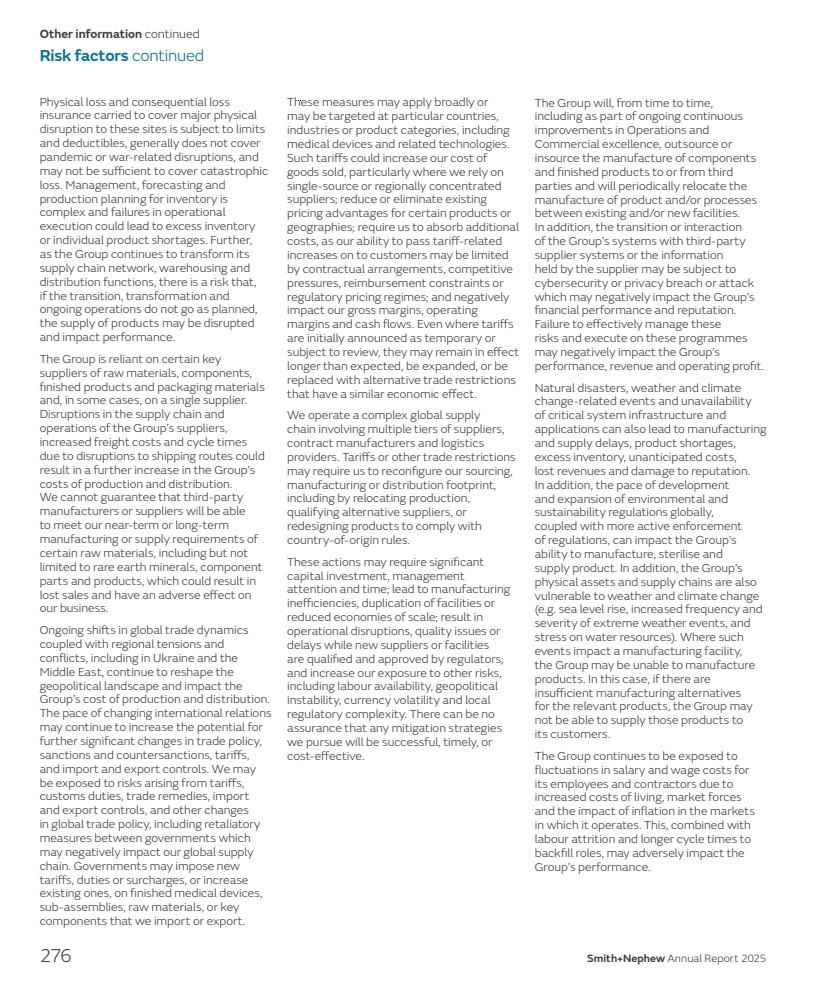
| Regulation continues to move at pace and requirements of global regulatory agencies have become more stringent in recent years and the Group expects this to continue. There continues to be significant capacity constraints in terms of the responses to be provided by regulators, notified bodies and other third parties to the Group’s Quality and Regulatory Affairs team to enable compliance with FDA and MDR, given the reduction in workforce at the FDA and the small number of notified bodies certified under MDR. This could continue to cause delays for medical device approvals for the industry more broadly and may result in delays for patients. Suppliers must provide materials and perform services in compliance with legal and regulatory requirements and in accordance with the Group’s standard quality requirements. The increase in regulation in the area of Environmental, Social and Governance (ESG) matters in many markets in which the Group operates may also require suppliers to expend additional resource in their business and incur additional costs to provide required data sets and implement additional policies and procedures which could increase the supplier’s cost of doing business and subject the supplier to fines, penalties and operational disruption for failure to comply with applicable laws, regulations and reporting requirements. A supplier’s failure to comply with legal or regulatory requirements or otherwise meet expected quality standards could create reputational harm and liability for the Group and adversely affect Group sales. The Group may be forced to pay higher prices to obtain raw materials and/or to sterilise its products and may not be able to pass on those costs to its customers in the form of increased prices for its finished products. This risk is particularly relevant in the medical devices sector due to complex supply chains, increasing regulation and enforcement and the potential for healthcare budgets globally to be reduced, or to grow at a slower rate than demand for healthcare services. As certain raw materials may become unavailable and/ or capacity for sterilisation services may become increasingly constrained beyond current capacity levels, in particular due to supply challenges and increased regulation and enforcement, there can be no assurance that the Group will be able to obtain suitable and cost-effective substitutes. Interruption of supply caused by these or other factors has had and may continue to have a negative impact on Smith+Nephew’s revenue and operating profit. The Group operates with a global remit and the speed of technological change in an already complex manufacturing process leads to greater potential for disruption. Additional risks to supply include failure to implement appropriate sales and operational planning and forecasting and inadequate supply chain or manufacturing capacity to support customer demand and growth. Failure to appropriately rightsize manufacturing capacity based on forecasting failure and inaccuracy could lead to unnecessary increases in inventory levels and resultant costs for the business, having a negative impact on Group operating profit. Widespread outbreaks of infectious diseases or pandemics and related restrictions on society and the operation of the Group’s business, could have a negative impact on the Group’s revenue, profit and outlook. These include, but are not limited to, declines in and cancellations of elective procedures at medical facilities, reduction in staffing and other support within institutions, disruptions at manufacturing facilities and disruptions in supply and other commercial activities due to travel restrictions and government restrictions on exports. The Group seeks to manage supply chain risks through a combination of network design, supplier management, operational planning and continuity arrangements; however, the complexity of the Group’s global supply chain means that such measures may not prevent or fully mitigate the impact of disruption. Strategy and commercial execution Smith+Nephew launched its RISE strategy in December 2025. Strong commercial execution requires effective cross-functional alignment, accountability, engagement and communication across the Group within embedded governance structures and frameworks. Effective engagement with customers, suppliers and other stakeholders is also a crucial factor to ensure strong commercial execution. Failure to deliver on customer requirements due to inadequate commercial execution may result in loss of market share and impact the financial performance and reputation of the Company. Failure to leverage the advantages of cross-business unit selling within the existing or new customer base and institutions, failure to effectively implement the Group’s programmes within appropriate governance frameworks, or failure to understand or take into account customer, supplier and stakeholder needs and requirements could adversely affect the Group’s performance. Failure to execute on Group strategy to the satisfaction of the Group’s investors could result in investor divestment of stock and failure to obtain new investment. Failure to deliver value creation in line with shareholder expectations may also result in additional shareholder pressure on the Board and Executive Management to make fundamental changes to the structure and strategic focus of the organisation. The Group’s business requires continuous improvement and depends on its ability to execute business change programmes at pace and to embed continuous improvement in business-as-usual activities aligned to the RISE strategy, retaining strong governance, KPIs and metrics in order to hold management and employees to account. The pace and scope of the Group’s continuous improvement initiatives may increase execution risk for the programmes as well as for the Group’s business-as-usual activities. The Group’s business depends on its ability to plan for and be resilient in the face of events that threaten one or more of its key locations. Smith+Nephew Annual Report 2025 277 STRATEGIC REPORT GOVERNANCE ACCOUNTS OTHER INFORMATION 26_SN_AR25_Risk_Factors_v45.indd 277 05/03/2026 18:27 |

| Trade policy uncertainty could adversely affect planning, forecasting and investment decisions. Ongoing uncertainty regarding trade negotiations, tariff regimes and geopolitical relationships makes it more difficult for the Group to plan, forecast and allocate capital efficiently. Sudden or unpredictable changes in trade policy could require rapid strategic and operational responses, impair long-term strategic initiatives, or render existing investments less attractive or uneconomic. In addition, changes in trade policy may mean that the Group’s strategy may need to develop to mitigate other risks, including inflationary pressures, foreign exchange fluctuations, interest rate changes and broader macroeconomic conditions, amplifying their overall impact on our business. Factors affecting results of operations Government economic, fiscal, monetary and political policies are all factors that materially affect the Group’s operation or investments of shareholders. Other factors include sales trends, currency fluctuations and innovation. Each of these factors is discussed further in the business unit reviews on pages 39 to 52, the Financial review on pages 18 to 25 and the Taxation information for shareholders on pages 295 to 297. Highly competitive markets The Group competes across a diverse range of geographic and product markets. Each market in which the Group operates contains a broad range of competitors, including specialised and international corporations. Failure to pivot in the event of any significant in-market changes in competitor activity or necessary changes to our business model, whether due to public policy, legal or regulatory requirements or other factors, could have a negative impact on the Group’s financial performance and reputation. Significant product innovations, technical advances or the intensification of price competition by competitors could adversely affect the Group’s operating results. Some competitors may have greater financial, marketing and other resources than Smith+Nephew due to the size and scale of their businesses. These competitors may be able to initiate technological advances in the field, deliver products on more attractive terms, more aggressively market their products or invest larger amounts of capital and research and development (R&D) into their businesses. Failure to differentiate the Group’s product and service offerings within each relevant market, and failure to address and manage challenges related to the size and scale of the Company could impact the financial performance and reputation of the Group. Further consolidation of competitors could adversely affect the Group’s ability to compete with larger companies due to insufficient financial resources. If any of the Group’s businesses were to lose market share or achieve lower than expected revenue growth, there could be a disproportionate adverse impact on the Group’s share price and its strategic options. Competition exists among healthcare providers to gain patients on the basis of quality, service and price. There has been some consolidation in the Group’s customer base and this trend is expected to continue. Some customers have joined group purchasing organisations or introduced other cost containment measures that could lead to downward pressure on prices or limit the number of suppliers in certain business areas, which could adversely affect Smith+Nephew‘s results of operations and hinder its growth potential. Tariffs and related trade actions may lead to retaliatory measures by affected countries, including tariffs on US, European, Chinese or other foreign-origin medical devices, procurement restrictions, localisation requirements, or informal barriers to market access. These measures could make our products less competitive on price relative to local or alternative suppliers; result in lost tenders, reduced order volumes or delayed purchasing decisions by hospitals, distributors or government customers; accelerate local-for-local sourcing initiatives by customers or governments that disadvantage multinational suppliers; and reduce overall market demand in affected regions due to broader economic disruption or healthcare budget pressures. The impact of such measures may be difficult to predict and may vary significantly by product line, geography and customer segment. Relationships with healthcare professionals We seek to maintain ethical working relationships with respected physicians and medical personnel in healthcare organisations, such as hospitals and universities, who assist in product R&D. We rely on these professionals to assist us in the development and improvement of proprietary products. If we are unable to maintain these relationships due to regulatory considerations, hospital access restrictions for non-patients or for other reasons, our ability to develop, market and sell new and improved products could be adversely affected. Customer and other stakeholder sustainability expectations The Group’s customers continue to develop more stringent sustainability requirements that they request or expect the Group to implement or adhere to in addition to the laws and regulations applicable to the Group. A failure to meet customers’ requirements or expectations may adversely impact the Group’s financial performance, or result in the loss of a prospective customer should they find our sustainability efforts insufficient. Increased investment related to customer requests in this area may impact operating profit. 278 Smith+Nephew Annual Report 2025 Risk factors continued Other information continued 26_SN_AR25_Risk_Factors_v45.indd 278 05/03/2026 18:27 |
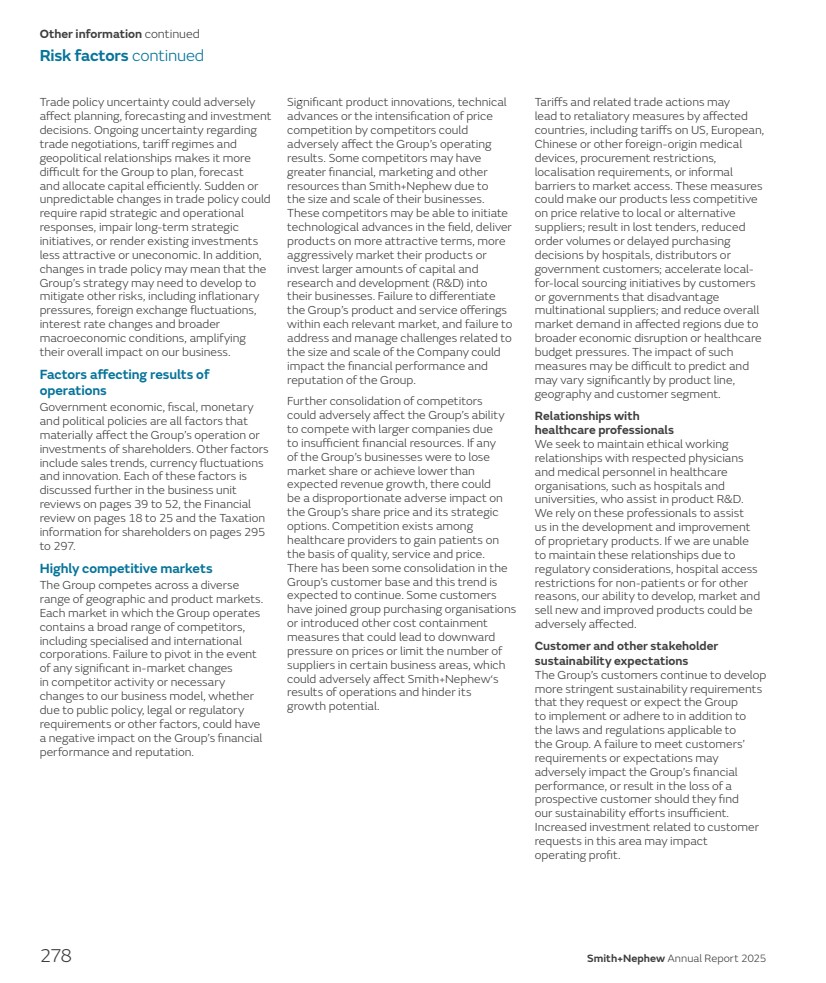
| Pricing and reimbursement Dependence on government and other funding In most global markets, expenditure on medical devices is ultimately controlled to a large extent by governments and healthcare systems. Funds may be made available or withdrawn from healthcare budgets depending on government policy. The Group is therefore dependent on future governments providing increased funds commensurate with the increased demand arising from demographic trends. Pricing of many of the Group’s products is governed in most markets by governmental reimbursement authorities. Increasing numbers of initiatives sponsored by government agencies, legislative bodies and the private sector to relieve the pressure on healthcare budgets and limit the growth of healthcare costs, including price regulation on products or entire procedures, value and volume-based procurement initiatives, excise taxes and competitive pricing are being implemented at pace in markets where the Group has operations. The Group is exposed to government policies favouring locally sourced or manufactured products in many markets in which it operates, impacting its ability to compete effectively and gain share which can negatively impact Group revenues and operating profit. The Group is increasingly exposed to changes in reimbursement policy, tax policy and pricing, in large part as a result of financial pressure on governments and hospitals caused by recession and inflation in its markets, which may have an adverse impact on revenue and operating profit. This includes, for example, the potential for changes to US rules related to local coverage determinations for the use of skin substitutes in outpatient settings. Reimbursement codes are increasingly more widely interpreted to provide for remote delivery of healthcare services indicating a continued trend to shift site of care and manage related healthcare budgets away from traditional inpatient treatment. There may also be an increased risk of adverse changes to government funding policies arising from deterioration in macroeconomic conditions from time to time in the Group’s markets. The Group must adhere to the rules laid down by government agencies that fund or regulate healthcare, including extensive and complex rules in the US. Failure to do so could result in fines, litigation, reputational damage and/or loss of customers and future funding. The rise in geopolitical uncertainty over the past 12 months, including US government announcements on tariffs on products manufactured in several jurisdictions including China, Mexico and Canada, the trade dynamics between global powers and the increased potential for significant changes in public policy and trade policy (including tariffs, import and export controls), could result in a significant negative impact on pricing and reimbursement and the financial performance of the Group. The US government may in the future pause, impose or increase tariffs, and countries subject to such tariffs may impose reciprocal tariffs or other restrictive trade measures in response, which could increase uncertainty and associated risks relating to the Group’s global operations. Procurement and supply chain verification processes Global economic and inflationary pressures and the commoditisation of entire product groups have led to an increase globally in price-driven approaches to customer procurement processes and tenders, such as the value-based procurement programme in China and further consolidation of customer buying groups. Non-clinical staff are often key decision makers in customers’ procurement processes, with access to these decision makers being limited for some customers. These factors can adversely impact the pricing that the Group achieves for its products. Due to geopolitical conflicts and events and increased regulation relating to sustainability, supplier verification and trade compliance, procurement processes are now required to evaluate and demonstrate the provenance of raw materials, components and products at many levels in the medical product supply chain. Given the high level of complexity and multiple tiers within the industry supply chain, there is a risk that the Group is unable to verify the ultimate provenance of certain materials which may result in fines, penalties, seizure of goods, reputational harm and impact to performance of the Group. New product innovation, design and development, including intellectual property Development and introduction of new products The medical devices industry has a high level of innovation and new product introduction. In order to remain competitive, the Group must continue to develop innovative products that satisfy customer needs and preferences, meet unmet needs, and/or provide cost or other advantages. Developing new products is a costly, lengthy and uncertain process. The Group may fail to innovate due to insufficient R&D investment, an R&D skills gap or poor product development. A potential product may not be brought to market or not succeed in the market for any number of reasons, including failure to work optimally, failure to receive regulatory approval, failure to be cost-competitive, infringement of patents or other intellectual property rights and changes in consumer demand. The Group’s products and technologies are also subject to marketing and pricing challenge by competitors as they develop and promote products in the various markets in which the Group operates. If the Group’s new products do not remain competitive with those of competitors, the Group’s market share and revenue could decline. The Group maintains reserves for excess and obsolete inventory resulting from the potential inability to sell its products at prices in excess of current carrying costs. Marketplace changes resulting from the introduction of new products or surgical procedures may cause some of the Group’s products to become obsolete. The Group makes estimates regarding the future recoverability of the costs of these products and records a provision for excess and obsolete inventories based on historical demand, expiration of sterilisation dates and expected future trends. If actual product life cycles, product demand or acceptance of new product introductions are less favourable than projected by management, additional inventory write-downs may be required. Smith+Nephew Annual Report 2025 279 STRATEGIC REPORT GOVERNANCE ACCOUNTS OTHER INFORMATION 26_SN_AR25_Risk_Factors_v45.indd 279 05/03/2026 18:27 |
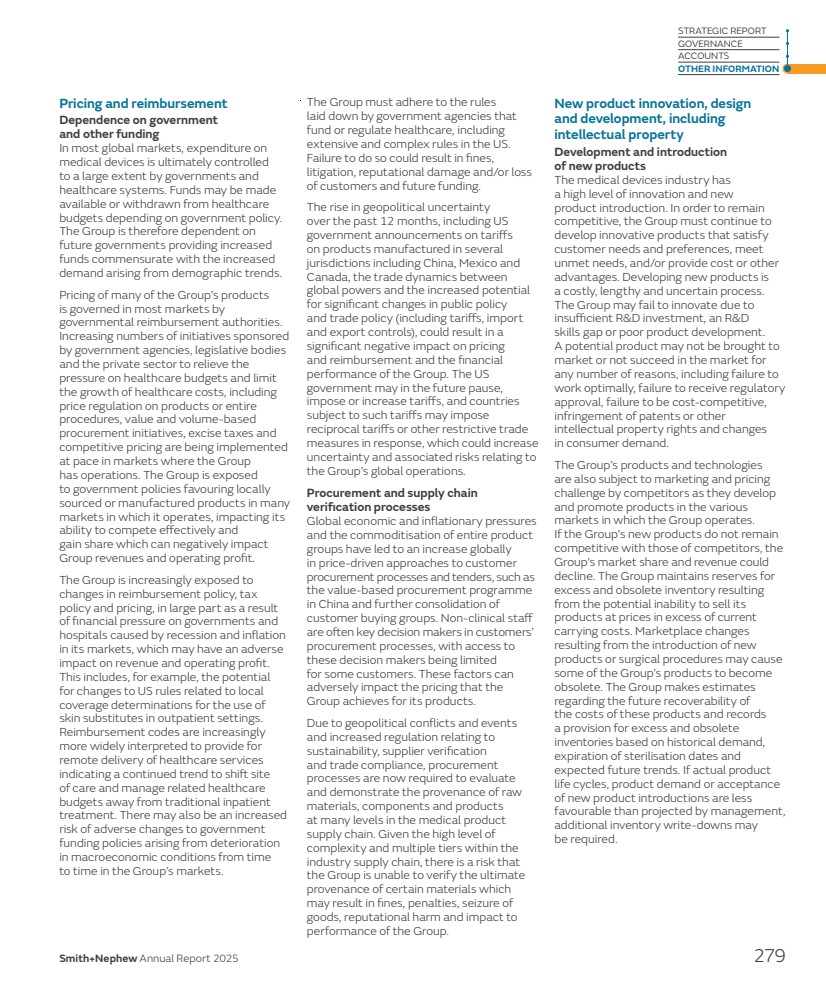
| All new products that the Group develops need to be designed and manufactured in a sustainable manner. A failure in this aspect may impact the willingness of customers to purchase the new products and adversely impact the Group’s ability to continue selling the product. Where the Group has critical gaps in its product portfolio that are not filled by new products, there is a risk that the Group will lose market share to competitors that can offer a more innovative or broader product portfolio. Innovative products in the wider healthcare industry have the potential to disrupt the medical device industry, especially as the pharmaceutical sector looks to accelerate R&D through the use of AI. Investor perception of, or the actual impact of, compounds, such as glucagon-like peptide-1 (GLP-1) receptor agonists, on the medical device industry could have a negative impact on the industry as a whole as well as a potential negative impact on the strategy and financial performance of the Group. Proprietary rights and patents Due to the technological nature of medical devices and the Group’s emphasis on serving its customers with innovative products, the Group has been subject to patent infringement claims and is subject to the potential for additional claims. Claims asserted by third parties regarding infringement of their intellectual property rights, if successful, could require the Group to expend time and significant resources to engage in dispute resolution and, if unsuccessful, pay damages, develop non-infringing products or obtain licences to the products which are the subject of such litigation, affecting the Group’s growth and profitability. Smith+Nephew protects its intellectual property and opposes third-party patents and trademarks where it deems appropriate. If Smith+Nephew fails to protect and enforce its intellectual property rights effectively, its competitive position could suffer, which could negatively impact performance. In addition, intellectual property rights may not be protectable or enforceable to the same extent in all countries in which the Group operates. Cybersecurity Reliance on information technology and cybersecurity The Group uses a wide variety of information systems, programmes and technology to manage its business. The Group also develops and sells certain products that are or will be digitally enabled including connection to networks and/or the internet. The Group’s systems and the systems of the entities it acquires are vulnerable to a cyber-attack, theft of intellectual property, malicious intrusion, loss of data privacy or other significant disruption. Geopolitical instability may lead to an increase in sophistication of bad actors/ threat profile. The Group’s systems have been and will continue to be the target of such threats, including as a result of remote working. Inadequate consideration of cybersecurity in the design of new products, systems and/or processes would increase the potential for vulnerabilities. There is increasing government focus on cybersecurity including changes in the regulatory environment which may lead to increased enforcement and reporting obligations. Increasing demand for cybersecurity expertise could impact the Group’s ability to attract and retain cybersecurity talent. Cybersecurity is a multifaceted discipline covering people, process and technology. It is also an area where more can always be done; it is a continually evolving practice. There is no assurance that the Group’s ongoing commitment to prevent, detect and respond to cyber incidents and potential threats will prove effective. As a result, the Group could lose customers, have disputes with healthcare professionals, suffer regulatory sanctions or penalties, experience increases in operating expenses or an impairment in its ability to conduct its operations, patients or employees could be exposed to financial or medical identity theft or suffer a loss of product functionality, and the reputation and performance of the Group could be materially adversely affected. Although the Company maintains insurance coverage for various business continuity risks, all costs or losses incurred would not be fully insured. Artificial intelligence technologies The Group has an enterprise strategy for the use and deployment of AI which is outlined on page 31. The regulatory landscape for AI is rapidly evolving, and various governments are exploring or implementing frameworks to govern the development, deployment, and use of AI. Our AI Governance Group monitors regulations and guidance for changes to the regulatory landscape that may be imposed on AI systems. We may need to make material changes to our technology, development or deployment strategies to align to the developing regulatory environment. Compliance with AI regulations may be costly and could significantly impact our operations, financial condition, or our ability to offer AI-driven products and services. Our AI technologies rely on large volumes of data, which must be accurate, current, and free of biases to yield reliable results. If our data is insufficient, outdated, or biased, it could lead to unreliable outputs, loss of customer trust, and potential regulatory scrutiny. We may be subject to liability if our AI tools inadvertently yield biased results or impact certain groups disparately, leading to legal and reputational risks. AI development and deployment involves handling vast amounts of data, including potentially sensitive or personal information. Cyber-attacks, data breaches, or accidental exposure of data could result in substantial harm to our customers and business, as well as regulatory penalties. Non-compliance with data protection laws, such as the General Data Protection Regulation (GDPR) and the California Consumer Privacy Act (CCPA), may expose us to significant fines and legal consequences, especially as we scale AI-related activities. As AI becomes more integral to our business, the potential for unexpected outcomes, including unintended or harmful consequences, increases. For example, erroneous predictions or recommendations made by our AI systems – if not adequately overseen by a human review – could negatively impact our clients or end-users. These risks could result in litigation, reputational harm and liability, particularly if such outcomes are deemed preventable or foreseeable. 280 Smith+Nephew Annual Report 2025 Risk factors continued Other information continued 26_SN_AR25_Risk_Factors_v45.indd 280 05/03/2026 18:27 |

| AI is an intensely competitive field with rapid innovation and technological advancements. Protecting any AI-related intellectual property will be challenging, as new developments may quickly render existing protections obsolete. Competitors may also develop similar or superior AI capabilities, impacting our market position and revenue. The effective development and deployment of AI requires skilled personnel and infrastructure investment. An inability to attract or retain qualified individuals could hinder our ability to innovate or scale our AI efforts. Additionally, failures in AI infrastructure or operational shortcomings could disrupt business functions, impair performance and damage our competitive standing, leading to both financial and reputational risk and harm. Reliance on third-party AI tools and external vendors introduces compliance and security risks, as insufficient transparency or inadequate controls in their systems could lead to regulatory breaches or data exposure. Vendor non-compliance with emerging AI regulations or contractual obligations may result in operational disruptions, financial penalties, and reputational harm for the Group. These risk factors are inherently uncertain, and the potential impacts outlined above may vary based on future technological developments, regulatory actions, and market conditions. There is no guarantee that our AI-related initiatives will be successful or that we will be able to mitigate the risks associated with AI technologies effectively. Legal and compliance risks including international regulation, product liability claims and loss of reputation Global regulation The Group operates globally and is subject to extensive complex legislation, regulation, and reporting requirements, including without limitation in respect of fraud, anti-bribery and corruption, data protection, trade compliance and corporate governance and sustainability in each country in which the Group operates. The Group’s global operations are governed by the UK Bribery Act and the US Foreign Corrupt Practices Act which prohibit the Group or its representatives from making or offering improper payments to government officials and other persons or accepting payments for the purpose of obtaining or maintaining business. The Group’s international operations which operate through distributors and agents increase our Group exposure to these risks. In this regard, the Group is investigating allegations of possible violations of anti-corruption laws, including in India, and responding to related requests for information from the United States Securities and Exchange Commission (SEC). It is not possible to predict the nature, scope (or possible involvement of other governmental authorities), or outcome of the investigations, including the extent to which, if at all, this could result in any liability to the Group. The Group undertakes investigations into allegations of possible violations of laws and regulations, supported by external counsel where appropriate. It is not possible to predict the nature, scope or outcome of investigations, including the extent to which, if at all, this could result in any liability or reputational harm to the Group. The Group is required to comply with the requirements of data privacy laws and regulations in the markets in which it operates regarding the handling of personal information. The complexity of legal, regulatory, risk and governance issues associated with the use and implementation of AI technologies being developed at pace, together with the likely increase in regulation of AI technologies poses additional legal, compliance and regulatory challenges for the Group to navigate. As privacy and AI continue to be a focus for regulators and consumers particularly in respect of health information and healthcare technologies, new and enhanced privacy and AI laws and regulations and enforcement frameworks continue to develop globally. Increase in geopolitical tensions and events, such as conflict in Ukraine and the Middle East, have led to an increase in sanctions and trade compliance programmes which the Group is required to comply, and which often require evaluation and implementation at pace. Regulatory and compliance risks may increase as trade policies become increasingly complex. An evolving and fragmented global trade environment increases the complexity of compliance with customs, export controls, sanctions and related regulations. Failure, or perceived failure, to comply with these requirements could result in fines, penalties, seizures or delays of shipments; increased scrutiny from customs and regulatory authorities; reputational harm; and diversion of management resources. Compliance costs may increase as we are required to implement additional controls, monitoring systems and personnel to address these risks. Ensuring compliance with all evolving laws, regulations, and reporting requirements on a global basis may require the Group to change or develop its current business models and practices and may increase its cost of doing business. Despite efforts to manage and mitigate legal and compliance risk across the organisation, there is a risk that the Group may be subject to fines and penalties, litigation and reputational harm in connection with its activities where breaches are found to have occurred. Failure to comply with the requirements of laws, regulations and reporting requirements could adversely affect the Group’s business, reputation, financial condition or results of operations. Operating in multiple jurisdictions also subjects the Group to local laws and regulations, including without limitation relating to tax, pricing, reimbursement, regulatory requirements, product safety, and varying levels of protection of intellectual property. This exposes the Group to additional risks and potential costs. Continued stakeholder focus from customers, suppliers, investors, regulators and governments on ESG matters means that the Group is required to evaluate and ensure compliance with laws, regulations and reporting requirements in these areas and balance any competing or conflicting interests between stakeholders in order to ensure stakeholder needs and Smith+Nephew Annual Report 2025 281 STRATEGIC REPORT GOVERNANCE ACCOUNTS OTHER INFORMATION 26_SN_AR25_Risk_Factors_v45.indd 281 05/03/2026 18:27 |
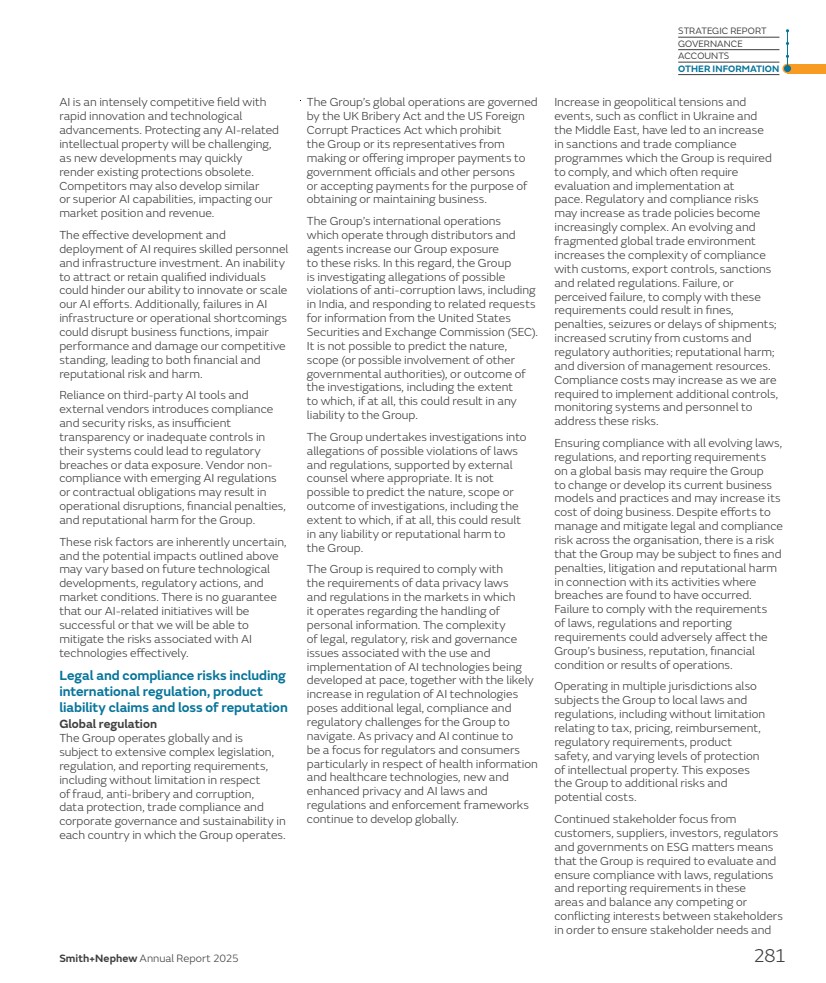
| requirements are met. Failure to do so could subject the Group to regulatory fines and penalties, including potential loss of eligibility as a US government contractor, and expose the Group to reputational risk. Product liability claims and loss of reputation The development, manufacture and sale of medical devices entails risk of product liability claims or recalls. Design and manufacturing defects with respect to products sold by the Group or by companies it has acquired could damage or impair the repair of body functions. The Group may become subject to liability, which could be substantial, because of actual or alleged defects in its products. In addition, product defects could lead to the need to recall from the market existing products, which may be costly and harmful to the Group’s reputation. There can be no assurance that customers, particularly in the US, the Group’s largest geographical market, will not bring product liability or related claims that would have a material adverse effect on the Group’s financial position or results of operations in the future, or that the Group will be able to resolve such claims within insurance limits. The Group may also be subject to legal proceedings which may involve mass tort lawsuits. The outcome of any such lawsuit is inherently uncertain but, if the claimants are successful, awards for damages may be significant. As at 31 December 2025, a provision of $97m is recognised relating to the present value of the estimated costs to resolve all unsettled known and unknown anticipated metal-on-metal hip implant claims globally. See Note 17 to the Group accounts for further details. Financial reporting, compliance and control The Group’s financial results depend on its ability to comply with financial reporting and disclosure requirements, comply with tax laws, appropriately manage treasury activities and avoid significant transactional errors and customer defaults. Failure to comply with the Group’s financial reporting requirements or relevant tax laws can lead to litigation and regulatory penalties and sanction, and ultimately to potential material loss to the Group. Potential risks include failure to report accurate financial information in compliance with accounting standards and applicable legislation, failure to comply with current tax laws, failure to manage treasury risk effectively and failure to operate adequate financial controls over business operations. Political and economic World economic conditions Demand for the Group’s products is driven by demographic trends, including the ageing population and the incidence of osteoporosis and obesity. Supply of, use of and payment for the Group‘s products are also influenced by world economic conditions which could place increased pressure on demand and pricing, adversely impacting the Group’s ability to deliver revenue and operating profit growth. The conditions could favour larger, better capitalised groups, with higher market shares and margins. As a consequence, the Group’s prosperity is linked to general economic conditions and there is a risk of deterioration of the Group’s performance and finances during adverse macroeconomic conditions. Economic slowdowns may reduce elective surgeries and delay hospital capital purchases, adversely impacting sales. The impact of geopolitical conditions such as the conflicts in Ukraine and the Middle East on global economies and financial markets may trigger a recession or slowdown in various markets in which the Group operate which would significantly reduce customer capital spending and customer financial strength. Economic conditions worldwide continue to create several challenges for the Group, including the US government’s approach to trade policy, tariffs, increased global sanctions and countersanctions in response to local or global conflicts, heightened inflation and pricing pressure (arising across the costs of raw materials, freight and employee salaries and wages), increasing tax rates, significant declines in capital equipment expenditures at hospitals and increased uncertainty over the collectability of government debt. These factors could have an increased impact on growth in the future. The Group is increasingly seeing sustainability targets and public policies being promulgated in the markets in which the Group operates as well as by its customers, suppliers and other stakeholders. A failure to meet these targets and policies could impact the Group’s sales and growth in those markets through limited access to tenders and/or reduced market share. Political uncertainties The Group operates on a worldwide basis and has distribution channels, agents and purchasing entities in over 100 countries. Political upheaval in some of those countries or in surrounding regions may impact the Group’s results of operations. Political changes in a country could prevent the Group from receiving remittances of profit from a member of the Group located in that country or from selling its products or investments in that country. Furthermore, changes in government policy regarding preference for local suppliers, tariffs, import quotas, taxation or other matters could adversely affect the Group’s revenue and operating profit. Conflicts such as those in Ukraine and the Middle East, economic sanctions, terrorist activities or other conflict could also adversely impact the Group whether in terms of increased compliance resources and cost to serve, increased freight cycle times, market exit, disruption to operations and/or reputational damage. The scope, duration and ultimate impact of tariffs and other trade measures depend on factors that are inherently uncertain and largely outside our control, including political developments, international negotiations, and actions taken by governments or supranational bodies. While we actively monitor trade developments and may take steps to mitigate adverse effects, we may not be able to fully offset the impact of tariffs or related trade restrictions on our business, results of operations or financial condition. Financial Markets The Group has financial indebtedness which could reduce business flexibility. Deterioration of business performance or global economic conditions could restrict access to adequate debt funding and/ or cause a deterioration in credit rating. This could also increase the cost of funding and reduce access to liquidity. Failure to maintain strong investment grade ratings would adversely affect the Group’s cost of funding and could adversely affect liquidity and access to capital markets. 282 Smith+Nephew Annual Report 2025 Risk factors continued Other information continued 26_SN_AR25_Risk_Factors_v45.indd 282 05/03/2026 18:27 |
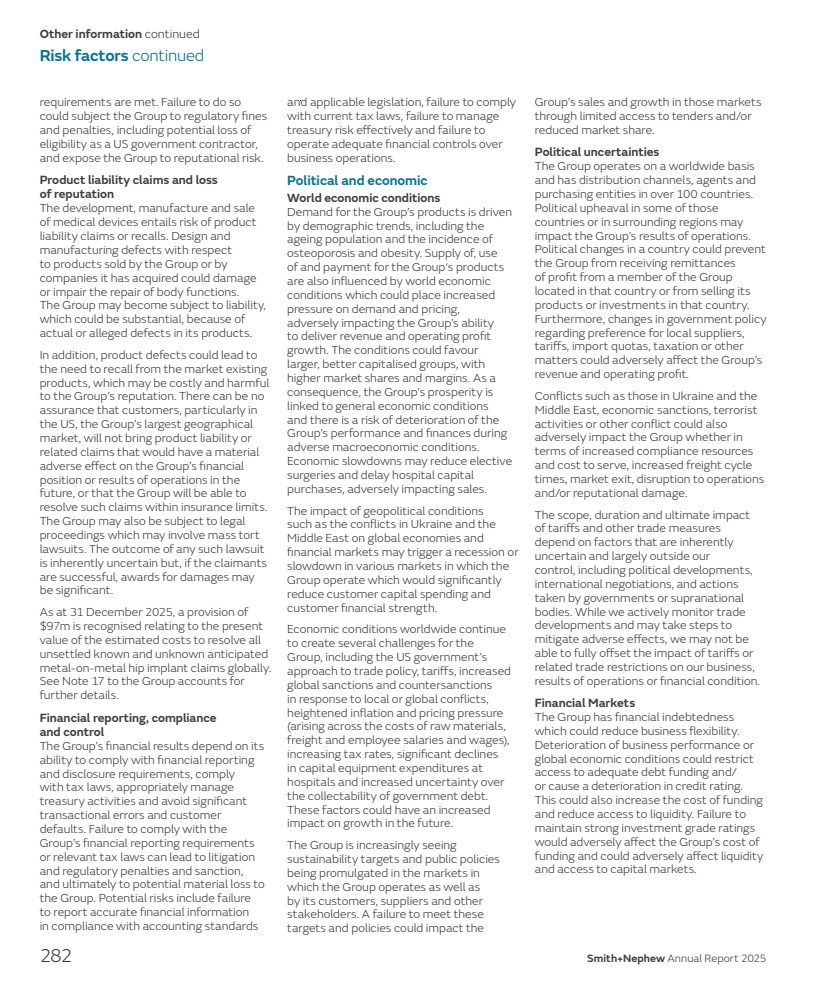
| Taxation The Group operates a global business and is therefore required to comply with tax legislation in multiple jurisdictions. There is the potential for an adverse impact on the Group’s financial performance due to significant tax rate changes, or broadening of the tax base, in key jurisdictions in which the Group operates. These include OECD Pillar Two (as outlined on page 225) and the potential for further US tax legislation. These external factors may require the Group to adjust its operating model. Quality and regulatory Regulatory standards and compliance in the healthcare industry Business practices in the healthcare industry are subject to regulation and review by various government authorities. In general, the trend in many countries in which the Group does business is towards higher expectations and increased enforcement activity by governmental authorities. While the Group is committed to doing business with integrity and welcomes the trend to higher standards in the healthcare industry, the Group and other companies in the industry have been subject to investigations and other enforcement activity that have incurred, and may continue to incur, significant expense. Under certain circumstances, if the Group were found to have violated the law, its ability to sell its products to certain customers may be restricted. Regulatory approval The international medical device industry is highly regulated. Regulatory requirements are a major factor in determining whether substances and materials can be developed into marketable products and the amount of time and expense that should be allotted to such development. National regulatory authorities administer and enforce a complex series of laws and regulations that govern the design, development, approval, manufacture, labelling, marketing and sale of healthcare products. They also review data supporting the safety and efficacy of such products. Of particular importance is the requirement in many countries that products be authorised or registered prior to manufacture, marketing or sale and that such authorisation or registration be subsequently maintained. The trend in increased regulation of AI in respect of products, data and business more broadly will require additional time, resource, skills and expertise in order to navigate successfully. The major regulatory agencies for Smith+Nephew’s products include the Food and Drug Administration (FDA) in the US, the Medicines and Healthcare products Regulatory Agency in the UK, the Ministry of Health, Labour and Welfare in Japan, the National Medical Products Administration in China and the Australian Therapeutic Goods Administration. At any time, the Group is awaiting a number of regulatory approvals which, if not received, could adversely affect results of operations. Following the entry into force in May 2017 of the EU Medical Devices Regulation (MDR), the increase in the time required by notified bodies to review product submissions and site quality systems’ certification time has had, and may continue to have, an adverse impact on the Group’s ability to meet customer demand. The trend is towards more stringent regulation and higher standards of technical appraisal, and there are increasingly stringent local requirements for clinical data across many of the markets globally in which the Group operates. Such controls have become increasingly demanding to comply with and management believes that this trend will continue. Privacy, environmental and sustainability laws and regulations have also been developed and implemented at pace globally and have become more stringent, supported by enhanced enforcement frameworks and resources. There is also an increase in regulation relating to labelling and reporting in the markets in which the Group operates, which results in increased resourcing and cost to the Group. Regulatory requirements may also entail inspections for compliance with appropriate standards, including those relating to Quality Management Systems or Good Manufacturing Practices regulations. All manufacturing and other significant facilities within the Group are subject to regular internal and external audit for compliance with national medical device regulation and Group policies. Payment for medical devices may be governed by reimbursement tariff agencies in a number of countries. Reimbursement rates and coverage decisions may be set in response to perceived economic value of the devices, based on clinical and other data relating to cost, patient outcomes and comparative effectiveness. They may also be affected by overall government budgetary considerations. The Group believes that its emphasis on innovative products and services should contribute to success in this environment. Failure to comply with these regulatory requirements could have a number of adverse consequences, including withdrawal of approval to sell a product in a country, temporary closure of a manufacturing facility, fines and potential damage to Company reputation. Mergers and acquisitions A key element of the Group’s RISE strategy for strategic investment to scale and continued growth is to make acquisitions or alliances to complement its existing business. Failure to identify appropriate acquisition targets or failure to conduct adequate due diligence or to integrate them successfully would have an adverse impact on the Group’s competitive position and profitability. This could result from the diversion of management resources from the acquisition or integration process, challenges of integrating organisations of different geographic, cultural and ethical backgrounds, as well as the prospect of taking on unexpected or unknown liabilities. In addition, the availability of global capital and increased interest rates may make financing less attainable or more expensive. The Group typically has access to the investment grade funding market, however this can become restricted from time to time, for example during periods of financial crisis. The Group’s credit rating could be downgraded if the business underperforms or increases leverage from capital allocation decisions such as M&A investments. This in turn could reduce access to debt funding. Cash and short-term investments could reduce in value in the event of an insolvency of a financial counterparty. As a result, the Group could fail in its strategic aim of growth by acquisition or alliance. Challenges in integration of new acquisitions may arise following completion of the deal, including external macro factors and geopolitical events. This may lead to the Group not achieving the planned synergies and results from the acquisition. Smith+Nephew Annual Report 2025 283 STRATEGIC REPORT GOVERNANCE ACCOUNTS OTHER INFORMATION 26_SN_AR25_Risk_Factors_v45.indd 283 05/03/2026 18:27 |
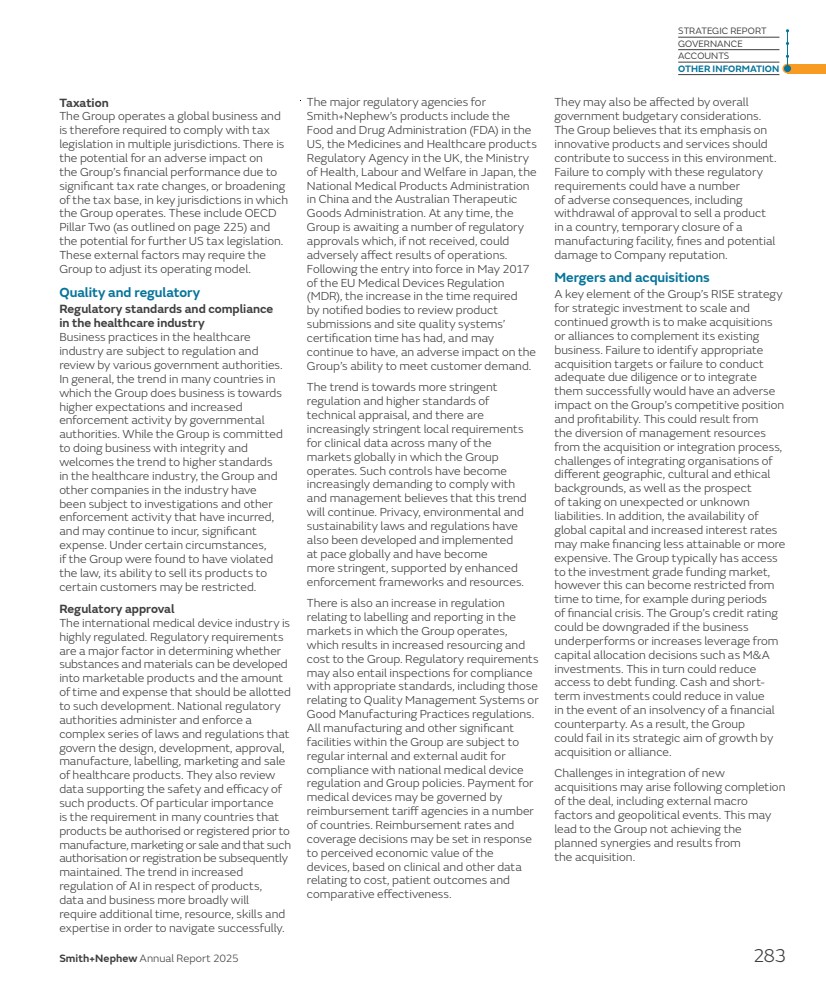
| Talent management The Group’s continued ability to deliver business objectives depends on its ability to hire, successfully engage and retain highly skilled talent with particular expertise and knowledge in each business unit and market in which it operates. This is critical, particularly in general management, new product development and in data analytics and insights. Employee priorities around work-life balance continue to evolve, resulting in increased global movement of talent and higher requirement for flexibility from both our current talent and external candidates. Attracting and retaining talent efforts continue across all disciplines and geographies to ensure that we mitigate potential impacts on revenue and operating profits. Failure to ensure effective transfer of knowledge and orderly transitions involving exiting employees could result in a negative impact on our business and the Group’s ability to execute on strategy. In the event that the Company’s remuneration strategies, quantum and structure, particularly in terms of long-term incentives for US executives, are not adequately addressed to better align to local market norms, the Company may not be able to effectively compete for, attract and retain talent, which may impact management stability, internal talent pipeline development and the ability for management to drive value creation. Additionally, if the Group’s talent management practices prove inadequate, this could adversely impact succession planning, rendering the Group unable to meet its strategic business objectives, and causing us to lose competitive advantage and intellectual capital. This includes, as an example, the lack of capability and skills in exploring and adopting newly available advanced technology offerings within the organisation (e.g. artificial intelligence). Environment and sustainability Climate change and sustainability-related risks have the potential to impact the Group’s business model and performance. The impacts of climate change on the Group’s business may arise from new regulations and requirements to obtain certain sustainability standards, international sustainability accords and agreements, and changing business practices and trends to accommodate climate change risks. Implementation of environmental goals, initiatives and regulatory and reporting compliance requires increasing levels of investment and may depend on third-party performance or data that is often difficult to obtain, or is outside the control of the organisation. Further, the Group will be exposed to the physical impacts of climate change, which may impact the manufacture of its products and the supply chain to deliver them to its markets. The Group may need to adapt its business model and processes to accommodate the changes brought about by climate-related issues and differing focus levels and regulation of sustainability requirements by governments, regulators, customers, investors and other stakeholders. If the Group does not achieve the climate change and sustainability targets and objectives set by the Group, or set by the governments and regulators in the markets where it operates, or by its customers, there may be an impact on the Group’s performance and ability to grow. Foreign exchange The Group operates a global business and is therefore exposed to exchange rate volatility in the global markets in which it operates. There is the potential for an adverse impact on the Group’s financial performance due to currency fluctuations. Smith+Nephew’s results of operations are affected by transactional exchange rate movements in that they are subject to exposures arising from revenue in a currency different from the related costs and expenses. The Group‘s manufacturing cost base is situated principally in the US, the UK, China, Costa Rica, Malaysia and Switzerland, from which finished products are exported to the Group’s selling operations worldwide. Thus, the Group is exposed to fluctuations in exchange rates between the US Dollar, Sterling and Swiss Franc and the currency of the Group’s selling operations, particularly the Euro, Chinese Yuan, Australian Dollar and Japanese Yen. If the US Dollar, Sterling or Swiss Franc should strengthen against the Euro, Australian Dollar and the Japanese Yen, the Group’s operating profit could be adversely affected. The Group manages the impact of exchange rate movements on operating profit by a policy of transacting forward foreign currency contracts when firm commitments exist for up to one year. However, the Group is still exposed to medium to long-term adverse movements in the strength of currencies compared to the US Dollar. The Group uses the US Dollar as its reporting currency. The US Dollar is the functional currency of Smith & Nephew plc. The Group’s revenues, profits and earnings are also affected by exchange rate movements on the translation of results of operations in foreign subsidiaries for financial reporting purposes. See ‘Liquidity and capital resources’ on page 241. 284 Smith+Nephew Annual Report 2025 Risk factors continued Other information continued 26_SN_AR25_Risk_Factors_v45.indd 284 05/03/2026 18:27 |
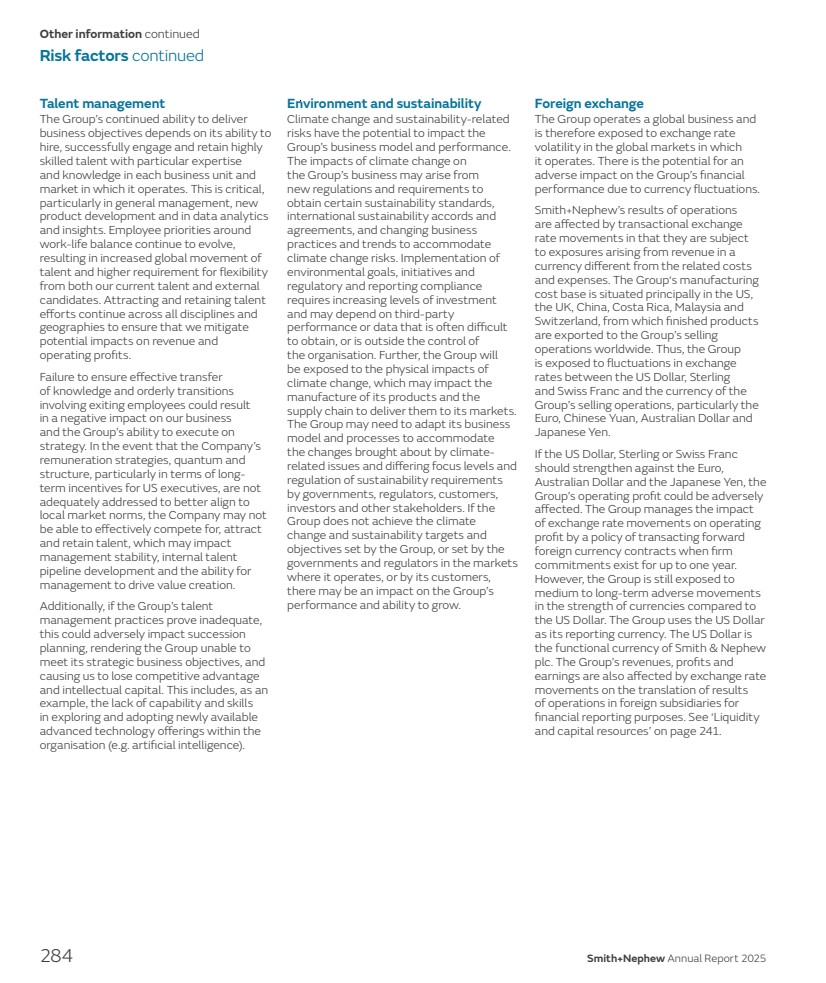
| Non-IFRS financial information – adjusted measures The annual report includes financial measures that are not prepared in accordance with International Financial Reporting Standards (IFRS). This additional information presented is not uniformly defined by all companies including those in the Group’s industry. Accordingly, it may not be comparable with similarly titled measures and disclosures by other companies. Additionally, certain information presented is derived from amounts calculated in accordance with IFRS but is not itself a measure defined under IFRS. Such measures should not be viewed in isolation or as an alternative to the equivalent GAAP measure. The non-IFRS measures discussed in this document are set out below. Performance measures Non-IFRS measure Purpose Definition Closest equivalent IFRS measure Reconciled on Underlying revenue growth Underlying revenue growth is used to compare revenue in a given year to the previous year on a like-for-like basis. This measure is used by both management and the investor community. Underlying revenue growth reconciles to reported revenue growth, the most directly comparable financial measure calculated in accordance with IFRS, by making two adjustments, the ‘constant currency exchange effect’ and the ‘acquisitions and disposals effect’. The ‘constant currency exchange effect’ is a measure of the increase/ decrease in revenue resulting from currency movements on non-US Dollar sales and is measured as the difference between: 1) the increase/decrease in the current year revenue translated into US Dollars at the current year average exchange rate and the prior year revenue translated at the prior year rate; and 2) the increase/decrease being measured by translating current and prior year revenues into US Dollars using the same exchange rate. The ‘acquisitions and disposals effect’ is the measure of the impact on revenue from newly acquired material business combinations and recent material business disposals. This is calculated by comparing the current year, constant currency actual revenue (which includes acquisitions and excludes disposals from the relevant date of completion) with prior year, constant currency actual revenue, adjusted to include the results of acquisitions and exclude disposals for the commensurate period in the prior year. These sales are separately tracked in the Group’s internal reporting systems and are readily identifiable. Revenue growth 287–288 Trading profit Trading profit is used in conjunction with operating profit to assess the performance and profitability of the Group. It is a key internal and external metric used by the investor community to assess our performance. It is our segment performance measure in accordance with IFRS 8 Operating Segments. Trading profit is operating profit excluding the impact of acquisition and disposal related items arising in connection with business combinations, including amortisation of acquisition intangible assets, impairments and integration costs; restructuring events; and gains and losses resulting from legal disputes and uninsured losses. In addition to these items, gains and losses that materially impact the Group’s profitability on a short-term or one-off basis are excluded. Operating profit 288–289 Trading profit margin This measure is used to assess the performance and profitability of the Group. It is a key external metric used by the investor community to assess our performance. Trading profit margin is trading profit divided by revenue. Operating profit margin 288–289 Trading profit before tax Trading profit before tax is used in conjunction with profit before tax to assess performance and profitability of the Group. This measure is intended to enable the users to assess the performance of the Group by excluding items that impact the short-term profitability of the Group. Trading profit before tax is profit before tax excluding impact of acquisition and disposal related items arising in connection with business combinations, including amortisation of acquisition intangible assets, impairments and integration costs; restructuring events; and gains and losses resulting from legal disputes and uninsured losses. In addition to these items, gains and losses that materially impact the Group’s profitability on a short-term or one-off basis are excluded. Profit before tax 288–289 Trading taxation Trading taxation is used in conjunction with taxation to assess taxation that corresponds to trading profit before tax. This metric is used by both management and the investor community. Trading taxation is taxation excluding the impact of acquisition and disposal related items arising in connection with business combinations, including amortisation of acquisition intangible assets, impairments and integration costs; restructuring events; and gains and losses resulting from legal disputes and uninsured losses. In addition to these items, gains and losses that materially impact the Group’s profitability on a short-term or one-off basis are excluded. Taxation 288–289 Smith+Nephew Annual Report 2025 285 STRATEGIC REPORT GOVERNANCE ACCOUNTS OTHER INFORMATION 27_SN_AR25_Non_IFRS_v132.indd 285 05/03/2026 18:29 |
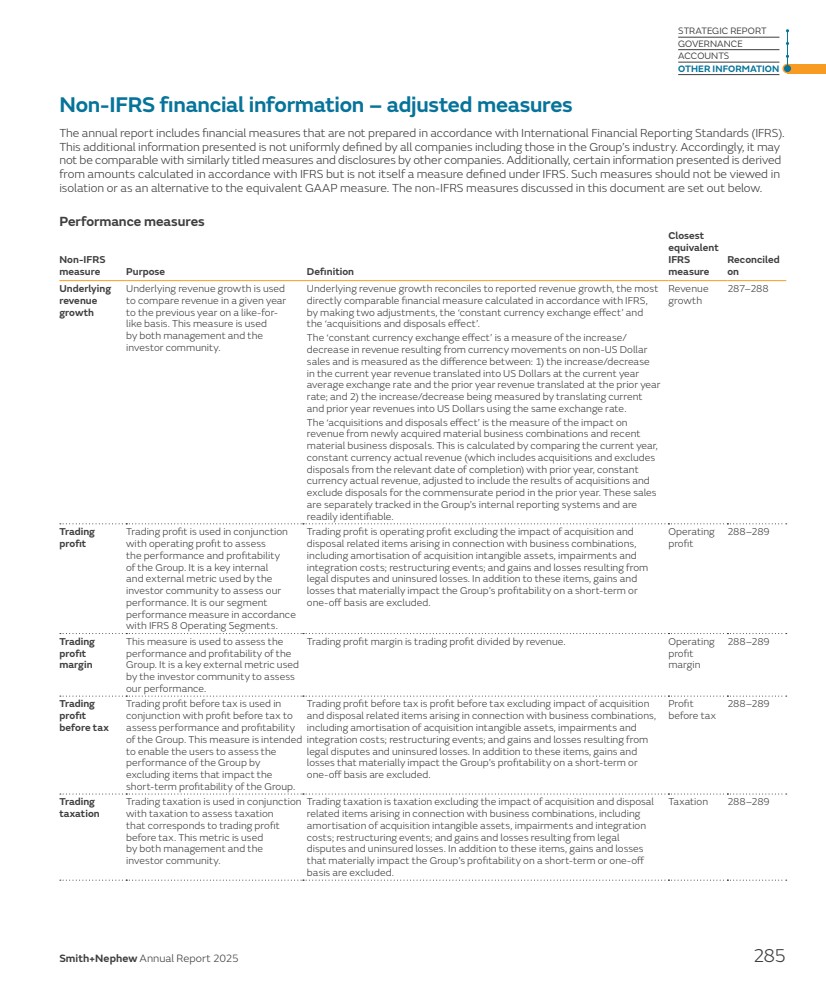
| Other measures Non-IFRS measure Purpose Definition Closest equivalent IFRS measure Reconciled on Free cash flow Free cash flow is a measure of the cash generated for the Group to use after capital expenditure according to its Capital Allocation Framework. This metric is used by both management and investor community. Free cash flow is cash generated from operations less capital expenditure, proceeds from disposal of property, plant and equipment, payment of lease liabilities and cash flows from interest and income taxes. Cash generated from operations 290 Adjusted EBITDA Adjusted EBITDA is used in the calculation of adjusted leverage ratio. Adjusted EBITDA is attributable profit excluding taxation, share of results of associates, other finance costs, interest expense, interest income, acquisition and disposal related items, restructuring and rationalisation costs, amortisation and impairment of acquisition intangibles, legal and other costs, depreciation and impairment of property, plant and equipment and amortisation and impairment of other intangible assets. Attributable Profit 290 Adjusted leverage ratio Adjusted leverage ratio is used in the calculation relating to debt covenants. We calculate adjusted leverage ratio by dividing net debt by adjusted EBITDA. Net debt is defined as total borrowings less cash and cash equivalents in the statement of financial position. Total borrowings include bank overdrafts, borrowings, loans and lease liabilities and long-term borrowings and lease liabilities. Leverage ratio (using IFRS measures) 290 Performance measures continued Non-IFRS measure Purpose Definition Closest equivalent IFRS measure Reconciled on Trading attributable profit This metric is used in the calculation of adjusted earnings per share. Trading attributable profit is attributable profit excluding the impact of acquisition and disposal related items arising in connection with business combinations, including amortisation of acquisition intangible assets, impairments and integration costs; restructuring events; and gains and losses resulting from legal disputes and uninsured losses. In addition to these items, gains and losses that materially impact the Group’s profitability on a short-term or one-off basis are excluded. Attributable profit 288–289 Adjusted earnings per share (EPSA) EPSA is a trend measure. The Group presents this measure to assist investors in their understanding of trends. Adjusted earnings per share is trading attributable profit divided by the weighted average number of shares outstanding. This is the same denominator used when calculating basic earnings per share. Basic earnings per share 288–289 Trading cash flow Trading cash flow is used in conjunction with cash generated from operations to assess the conversion of trading profit into cash. It is key external metric used by the investor community and is a key performance measure for management. Trading cash flow is cash generated from operations excluding the impact of acquisition and disposal related items arising in connection with business combinations, including integration costs; restructuring events; and gains and losses resulting from legal disputes and uninsured losses. In addition to these items, gains and losses that materially impact the Group’s cash flows on a short-term or one-off basis are excluded. Trading cash flow includes payment of capital element of lease liabilities, proceeds from disposal of property, plant and equipment and capital expenditure as presented in the Group cash flow statement. Cash generated from operations 288–289 Trading cash conversion This measure is used to assess the conversion of trading profit into cash. It is a key external metric used by the investor community and is a key performance measure for management. Trading cash conversion is trading cash flow divided by trading profit. Cash generated from operations 288–289 286 Smith+Nephew Annual Report 2025 Non-IFRS financial information – adjusted measures continued Other information continued 27_SN_AR25_Non_IFRS_v132.indd 286 05/03/2026 18:29 |
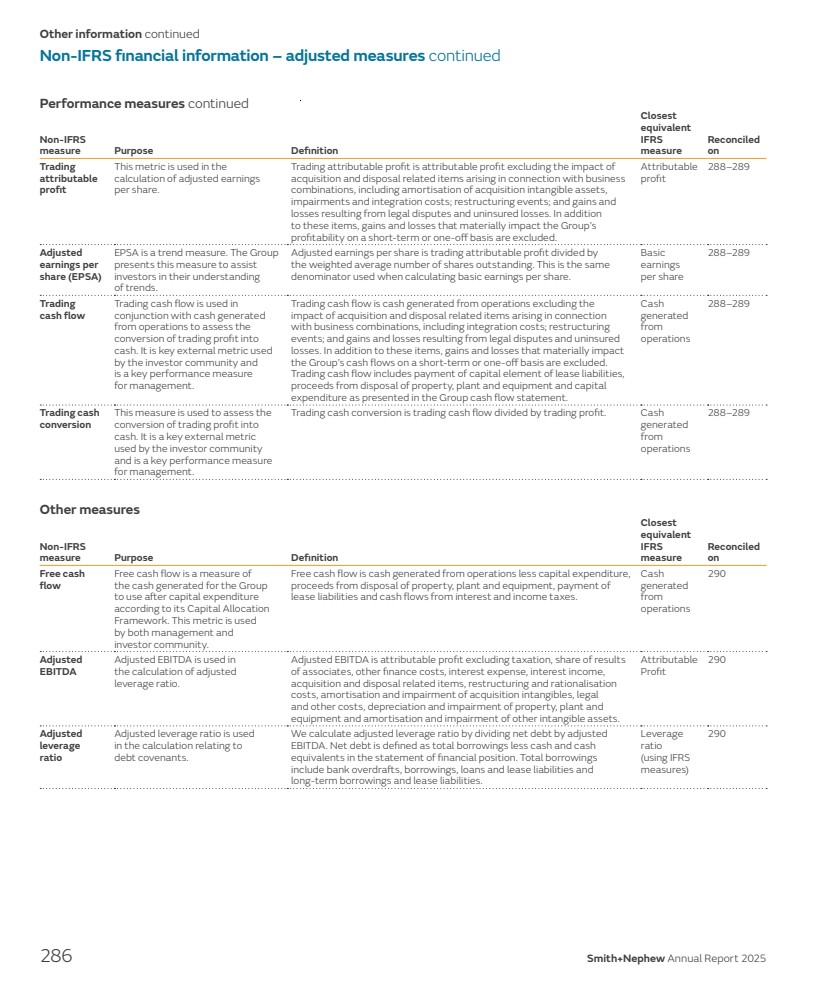
| Reported revenue growth, the most directly comparable financial measure calculated in accordance with IFRS, reconciles to underlying revenue growth as follows: Reconciling items 2025 Reported growth Underlying growth Acquisitions/ disposals Currency impact Consolidated revenue by business unit % % % % Knee Implants 3.5 2.9 – 0.6 Hip Implants 3.5 2.9 – 0.6 Other Reconstruction 35.4 33.8 – 1.6 Trauma & Extremities 6.7 6.3 – 0.4 Orthopaedics 5.7 5.1 – 0.6 Sports Medicine Joint Repair 8.6 7.8 – 0.8 Arthroscopic Enabling Technologies 2.4 1.6 – 0.8 ENT (Ear, Nose and Throat) 4.8 4.4 – 0.4 Sports Medicine & ENT 6.0 5.2 – 0.8 Advanced Wound Care 4.3 2.6 – 1.7 Advanced Wound Bioactives 6.9 6.8 – 0.1 Advanced Wound Devices 11.1 9.8 – 1.3 Advanced Wound Management 6.7 5.6 – 1.1 Total 6.1 5.3 – 0.8 Other measures continued Non-IFRS measure Purpose Definition Closest equivalent IFRS measure Reconciled on Adjusted return on invested capital (‘Adjusted ROIC’) Adjusted ROIC is a metric used by investor community and is a measure of the return generated on capital invested by the Group. It provides a metric for long-term value creation and encourages compounding reinvestment within the business and discipline around acquisitions with low returns and long payback. Adjusted ROIC is a key performance measure under the Performance Share Program. Adjusted ROIC is defined as operating profit (before amortisation and impairment of acquisition intangibles) less adjusted taxes/((opening net operating assets + closing net operating assets)/2). Return on invested capital (‘ROIC’) (using IFRS measures) 291 Smith+Nephew Annual Report 2025 287 STRATEGIC REPORT GOVERNANCE ACCOUNTS OTHER INFORMATION 27_SN_AR25_Non_IFRS_v132.indd 287 05/03/2026 18:29 |
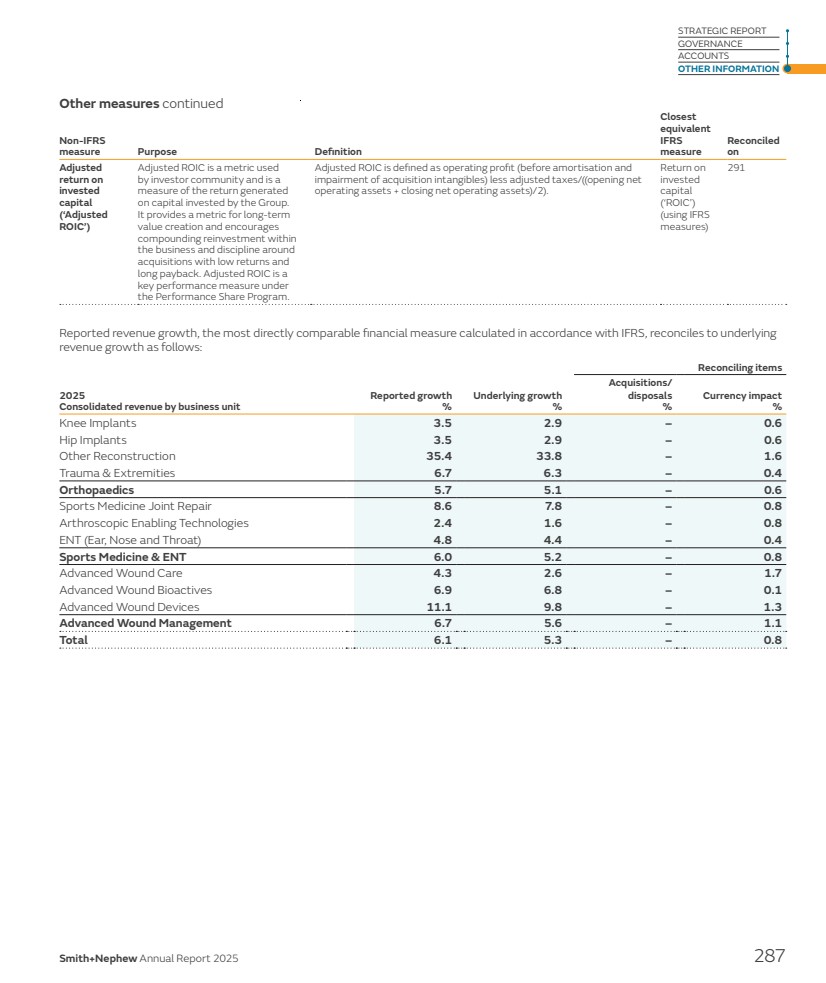
| Reconciling items 2024 Reported growth Underlying growth Acquisitions/ disposals Currency impact Consolidated revenue by business unit % % % % Knee Implants 0.7 1.3 – (0.6) Hip Implants 3.2 4.0 – (0.8) Other Reconstruction 18.2 18.5 – (0.3) Trauma & Extremities 7.9 8.1 – (0.2) Orthopaedics 4.1 4.6 – (0.5) Sports Medicine Joint Repair 4.0 4.8 – (0.8) Arthroscopic Enabling Technologies 7.4 8.2 – (0.8) ENT (Ear, Nose and Throat) 6.9 7.3 – (0.4) Sports Medicine & ENT 5.5 6.2 – (0.7) Advanced Wound Care 1.4 2.0 – (0.6) Advanced Wound Bioactives 5.1 5.1 – – Advanced Wound Devices 11.5 12.2 – (0.7) Advanced Wound Management 4.7 5.1 – (0.4) Total 4.7 5.3 – (0.6) Operating Profit before Attributable Cash generated Earnings profit1 tax2 Taxation3 profit4 from operations5 per share6 $ million $ million $ million $ million $ million ¢ 2025 Reported 794 779 (154) 625 1,549 72.1 Acquisition and disposal related items 32 (47) 15 (32) 30 (3.6) Restructuring and rationalisation costs 47 47 (13) 34 83 4.0 Amortisation and impairment of acquisition intangibles 176 176 (40) 136 – 15.6 Legal and other7 162 142 (21) 121 19 13.9 Lease liability payments – – – – (50) – Capital expenditure – – – – (433) – Proceeds from disposal from property, plant and equipment – – – – 38 – 2025 Non-IFRS* 1,211 1,097 (213) 884 1,236 102.0 * These Non-IFRS measures are defined on pages 285–287. Acquisition and disposal-related items: For the year ended 31 December 2025, costs primarily relate to disposal of certain products and integration costs relating to prior year acquisitions. Trading profit before tax additionally excludes gains of $108m related to the Group’s shareholding in Bioventus and the remeasurement and discount unwind for contingent consideration. This primarily includes an impairment reversal of $109m and the Group’s share of gain recognised by Bioventus in its financial statements. Restructuring and rationalisation costs: For the year ended 31 December 2025, these costs include efficiency and productivity elements of the 12-Point Plan to the Operations and Commercial Excellence programme. These costs primarily consist of severance, asset write-offs and integration and dual running costs. Amortisation and impairment of acquisition intangibles: For the year ended 31 December 2025, charges related to the amortisation and impairment of intangible assets acquired in material business combinations. Legal and other: For the year ended 31 December 2025, the charge mainly relates to a $159m increase in the excess and obsolescence provision arising from the Group’s portfolio simplification initiatives introduced under the 12-Point Plan and further developed in 2025 through the Ortho 360 operating model and new RISE strategy. These actions include the planned discontinuation and simplification of certain product ranges which will reduce the need for inventory and capital employed in the business, provide a simpler and more efficient offer to our customers, and will also allow us to focus on migrating them to our latest technology products. Legal and other also includes $9m reduction in the provision for ongoing metal-on-metal hip claims as a result of a decrease in the present value of the estimated costs to resolve all known and anticipated metal-on-metal hip claims, offset by legal expenses of $10m for ongoing metal-on-metal hip claims. 288 Smith+Nephew Annual Report 2025 Non-IFRS financial information – adjusted measures continued Other information continued 27_SN_AR25_Non_IFRS_v132.indd 288 05/03/2026 18:29 |
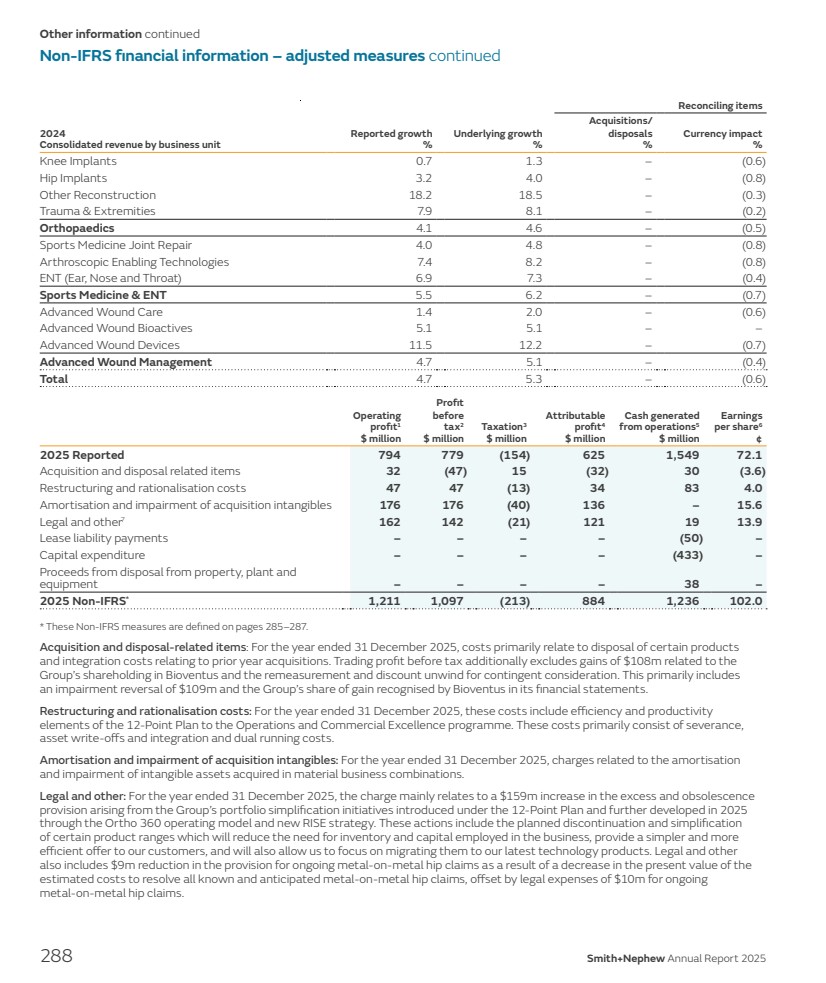
| Trading profit before tax additionally excludes $10m gain on repurchase of corporate bonds, investment income relating to deferred compensation arrangements of $14m, partially offset by $4m of finance costs for the unwind of discount relating to the provision for metal-on-metal hip claims. Lease liability payments and capital expenditure: For the year ended 31 December 2025, trading cash flow includes payment of capital element of lease liabilities and capital expenditure as presented in the Group cash flow statement. Operating Profit before Attributable Cash generated Earnings profit1 tax2 Taxation3 profit4 from operations5 per share6 $ million $ million $ million $ million $ million ¢ 2024 Reported 657 498 (86) 412 1,245 47.2 Acquisition and disposal related items8 94 106 (9) 97 3 11.2 Restructuring and rationalisation costs8 123 123 (29) 94 151 10.8 Amortisation and impairment of acquisition intangibles 187 187 (42) 145 – 16.6 Legal and other7 (12) (6) (7) (13) 36 (1.5) Lease liability payments – – – – (55) – Capital expenditure – – – – (381) – 2024 Non-IFRS* 1,049 908 (173) 735 999 84.3 * These Non-IFRS measures are defined on pages 285–287. Acquisition and disposal-related items: For the year ended 31 December 2024, costs primarily relate to impairment of BHR goodwill, disposal of certain products and integration costs relating to integration of CartiHeal. Trading profit before tax additionally excludes losses related to the Group’s shareholding in Bioventus. This primarily includes the Group’s share of loss recognised by Bioventus in its financial statements. Restructuring and rationalisation costs: For the year ended 31 December 2024, these costs include efficiency and productivity elements of the 12-Point Plan to the Operations and Commercial Excellence programme. These costs primarily consist of severance, asset write-offs and integration and dual running costs. Amortisation and impairment of acquisition intangibles: For the year ended 31 December 2024, charges related to the amortisation and impairment of intangible assets acquired in material business combinations. Legal and other: For the year ended 31 December 2024, the credit mainly relates to a $28m reduction in the provision for ongoing metal-on-metal hip claims as a result of decrease in the present value of the estimated costs to resolve all known and anticipated metal-on-metal hip claims, partially offset by legal expenses for ongoing metal-on-metal hip claims and costs of implementing the requirements of the EU Medical Device Regulation that was effective from May 2021 with a transition period to May 2024. Trading profit before tax additionally excludes $6m of finance costs for the unwind of discount relating to the provision for metal-on-metal hip claims. Lease liability payments and capital expenditure: For the year ended 31 December 2024, trading cash flow includes payment of capital element of lease liabilities and capital expenditure as presented in the Group cash flow statement. 1 Represents a reconciliation of operating profit to trading profit. 2 Represents a reconciliation of reported profit before tax to trading profit before tax. 3 Represents a reconciliation of reported tax to trading tax. 4 Represents a reconciliation of reported attributable profit to trading attributable profit. 5 Represents a reconciliation of cash generated from operations to trading cash flow. 6 Represents a reconciliation of basic earnings per ordinary share to adjusted earnings per share (EPSA). 7 The ongoing funding of defined benefit pension schemes that are closed to future accrual is not included in management’s definition of trading cash flow as there is no defined benefit service cost for these schemes. 8 During 2024, the Group announced its intention to close the Warwick manufacturing site that manufactures Birmingham Hip Resurfacing (BHR) products. As a result, a total of $68m of BHR assets and liabilities were written off, which mainly includes goodwill of $63m (included in acquisition and disposal-related items). Smith+Nephew Annual Report 2025 289 STRATEGIC REPORT GOVERNANCE ACCOUNTS OTHER INFORMATION 27_SN_AR25_Non_IFRS_v132.indd 289 05/03/2026 18:29 |
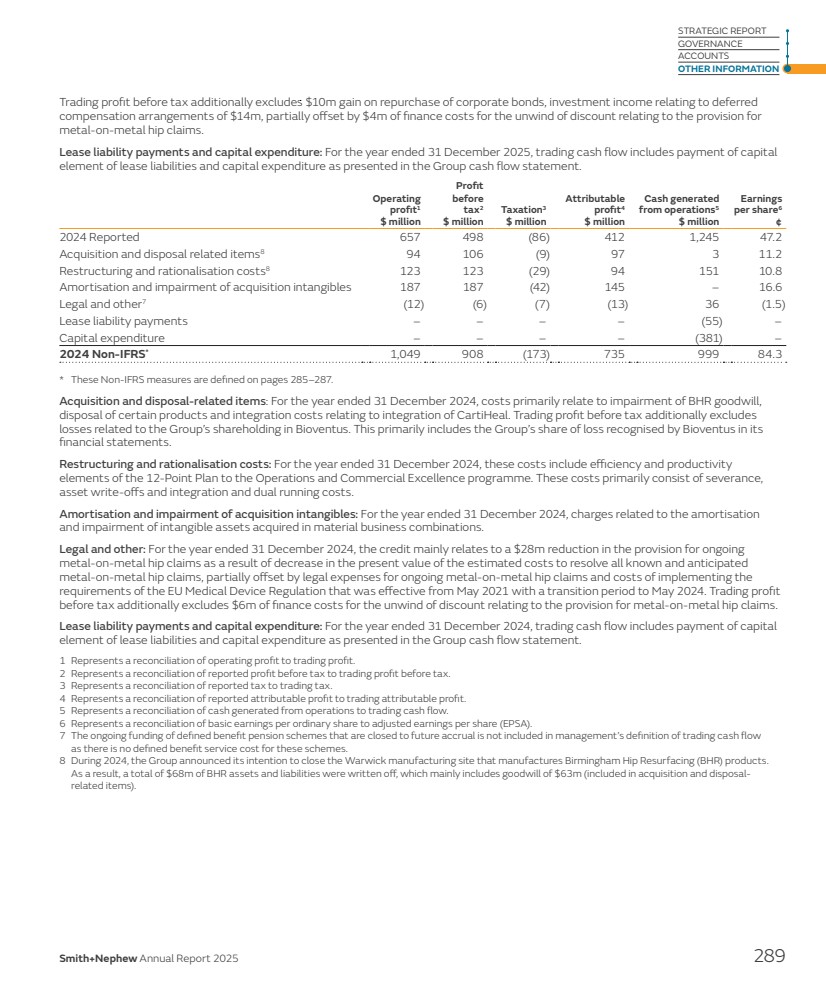
| Free cash flow A reconciliation from cash generated from operations, the most comparable IFRS measure, to free cash flow is set out below: 2025 2024 2023 $ million $ million $ million Cash generated from operations1 1,549 1,245 829 Capital expenditure (433) (381) (427) Interest received 25 22 8 Interest paid (142) (140) (104) Payment of lease liabilities (50) (55) (52) Income taxes paid (147) (140) (125) Proceeds from disposal of property, plant and equipment 38 – – Free cash flow 840 551 129 1 See Group cash flow statement on page 213. Adjusted Leverage ratio The calculation of the adjusted leverage ratio and leverage ratio is set out below. Adjusted leverage ratio is calculated using metrics similar to those used in the debt covenant calculation. 2025 2024 $ million $ million Net debt 2,759 2,709 Attributable profit 625 412 Taxation 154 86 Share of results of associates (113) 10 Other finance costs 16 28 Interest expense 140 145 Interest income (28) (24) Acquisition and disposal-related items 32 94 Restructuring and rationalisation costs 47 123 Amortisation and impairment of acquisition intangibles 176 187 Legal and other 162 (12) Depreciation of property, plant and equipment 335 325 Impairment and Amortisation of other intangible assets and Property, plant and equipment 61 67 Adjusted EBITDA 1,607 1,441 Adjusted leverage ratio 1.7 1.9 The Leverage ratio using closest equivalent IFRS measures is not based on measures used in the calculation of debt covenants and is not used by management internally. This measures is not used for the Company’s covenant in its private placement debt. 2025 2024 $ million $ million Bank overdrafts, borrowings, loans and lease liabilities 150 63 Long-term borrowings and lease liabilities 3,177 3,258 Total borrowings 3,327 3,321 Attributable profit 625 412 Leverage ratio 5.3 8.1 290 Smith+Nephew Annual Report 2025 Non-IFRS financial information – adjusted measures continued Other information continued 27_SN_AR25_Non_IFRS_v132.indd 290 05/03/2026 18:29 |
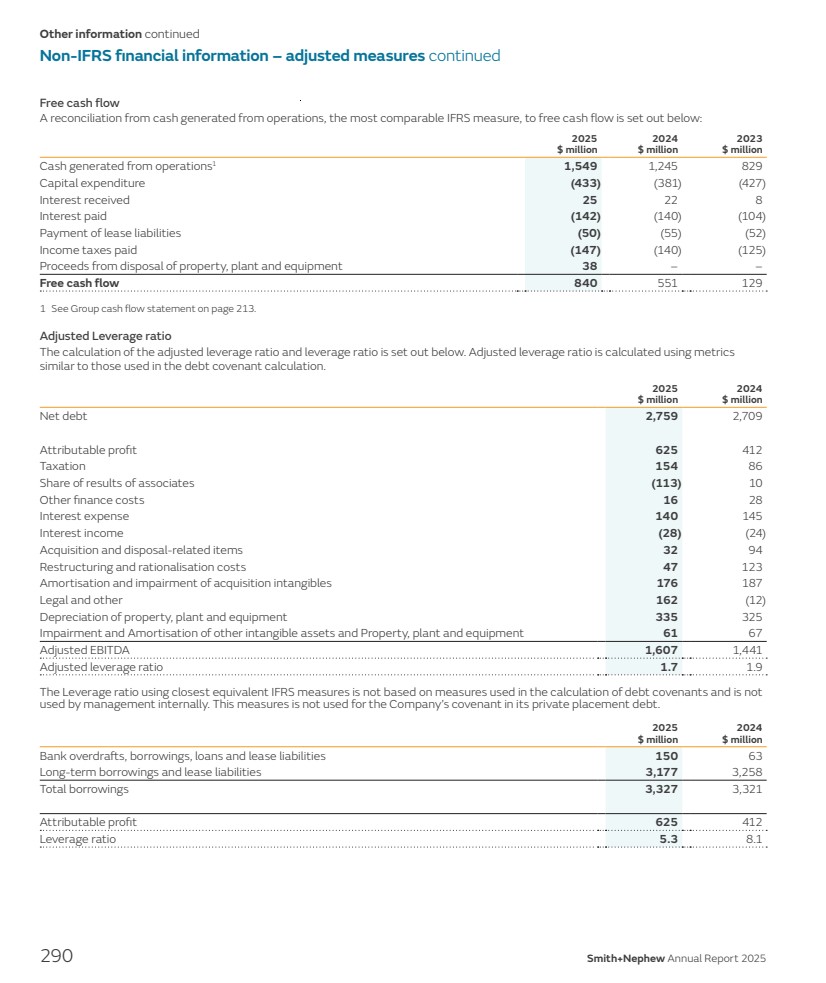
| Adjusted Return on invested capital The calculation of Adjusted return on invested capital and is set out below: 2025 2024 2023 $ million $ million $ million Attributable profit for the year 625 412 263 Share of results of associates (113) 10 30 Other finance costs 16 28 7 Interest expense 140 145 132 Interest income (28) (24) (34) Amortisation and impairment of acquisition intangibles 176 187 207 Taxation adjustment1 (44) (73) (77) Operating profit before amortisation and impairment of acquisition intangibles less adjusted taxes 772 685 528 Total equity 5,289 5,265 5,217 Accumulated amortisation and impairment of acquisition intangibles net of associated tax 1,679 1,470 1,365 Retirement benefit assets (64) (63) (69) Investments (30) (9) (8) Investments in associates (121) (7) (16) Right-of-use assets (192) (173) (185) Cash and cash equivalents (557) (619) (302) Long-term borrowings and lease liabilities 3,177 3,258 2,319 Retirement benefit obligations 84 79 88 Bank overdrafts, borrowings, loans and lease liabilities 150 63 765 Net operating assets 9,415 9,264 9,174 Average net operating assets2 9,340 9,219 8,907 Adjusted return on invested capital 8.3% 7.4% 5.9% 1 Being the taxation on amortisation and impairment of acquisition intangibles, interest income, interest expense, other finance costs and share of results of associates. 2 (Opening net operating assets + closing net operating assets)/2. Smith+Nephew Annual Report 2025 291 STRATEGIC REPORT GOVERNANCE ACCOUNTS OTHER INFORMATION 27_SN_AR25_Non_IFRS_v132.indd 291 05/03/2026 18:29 |
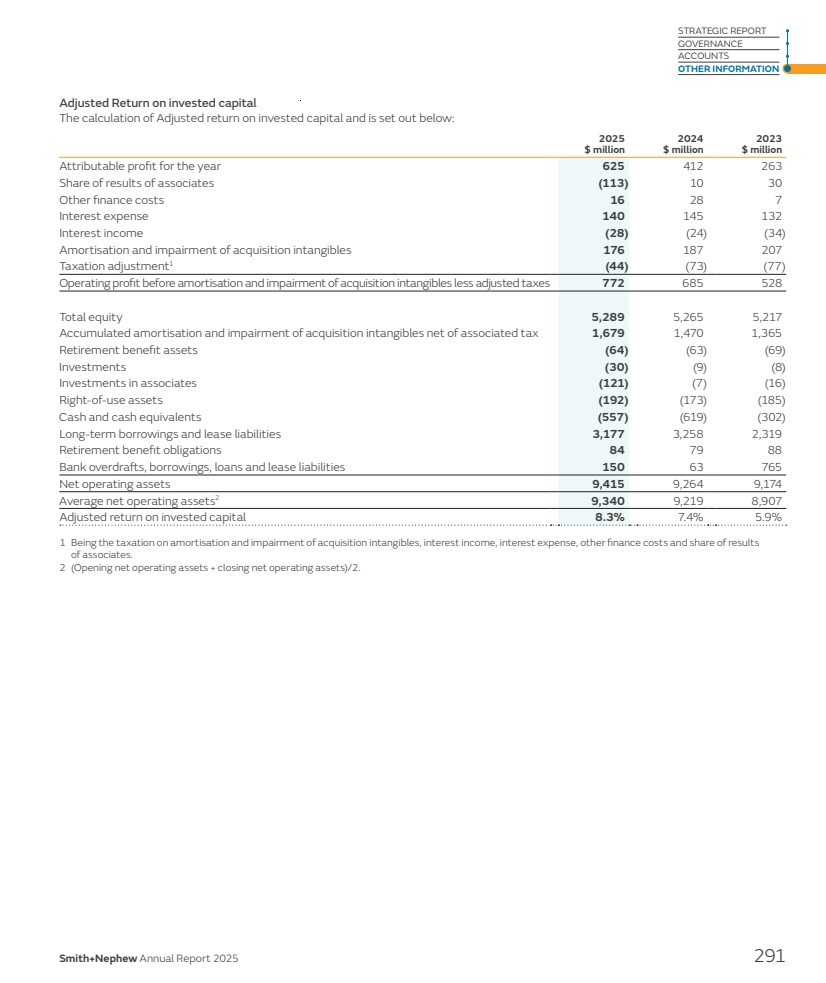
| Return on invested capital (using closest equivalent IFRS measures) The calculation of Return on invested capital using closest equivalent IFRS measures is set out below: 2025 2024 2023 $ million $ million $ million Attributable profit 625 412 263 Long term borrowings and lease liabilities 3,177 3,258 2,319 Bank overdrafts, borrowings, loans and lease liabilities 150 63 765 Investments (30) (9) (8) Investments in associates (121) (7) (16) Retirement benefit assets (64) (63) (69) Retirement benefit obligations 84 79 88 Total Equity 5,289 5,265 5,217 Invested Capital at end of the year 8,485 8,586 8,296 Average Invested Capital for the year 8,536 8,441 8,149 Return on invested capital using IFRS measures 7.3% 4.9% 3.2% 292 Smith+Nephew Annual Report 2025 Non-IFRS financial information – adjusted measures continued Other information continued 27_SN_AR25_Non_IFRS_v132.indd 292 05/03/2026 18:29 |

| Shareholder information Ordinary shareholders Registrar All general enquiries concerning shareholdings, dividends, changes to shareholders’ personal details and the Annual General Meeting (the ‘AGM’) should be addressed to: Computershare Investor Services plc, The Pavilions, Bridgwater Road, Bristol, BS99 6ZZ. Tel: 0370 703 0047 Tel: +44 (0) 117 378 5450 from outside the UK* www.investorcentre.co.uk * Lines are open from 8:30 am to 5:30 pm Monday to Friday, excluding public holidays in England and Wales. Shareholder communications We make quarterly financial announcements, which are made available through Stock Exchange announcements and on the Group’s website (www.smith-nephew.com). Copies of recent Annual Reports, press releases, institutional presentations and audio webcasts are also available on the website. We send paper copies of the Notice of Annual General Meeting and Annual Report only to those shareholders and ADS holders who have elected to receive shareholder documentation by post. Electronic copies of the Annual Report and Notice of Annual General Meeting are available on the Group’s website at www.smith-nephew.com. Both ordinary shareholders and ADS holders can request paper copies of the Annual Report, which the Company provides free of charge. The Company will continue to send to ordinary shareholders by post the Form of Proxy notifying them of the availability of the Annual Report and Notice of Annual General Meeting on the Group’s website. If you elect to receive the Annual Report and Notice of Annual General Meeting electronically you are informed by email of the documents’ availability on the Group’s website. ADS holders receive the Form of Proxy by post, but will not receive a paper copy of the Notice of Annual General Meeting. Investor communications The Company maintains regular dialogue with individual institutional shareholders, together with results presentations. To ensure that all members of the Board develop an understanding of the views of major investors, the Executive Directors review significant issues raised by investors with the Board. Non-Executive Directors are sent copies of analysts’ and brokers’ briefings. There is an opportunity for individual shareholders to put their questions to the Directors at the Annual General Meeting. The Company regularly responds to letters from shareholders on a range of issues. UK capital gains tax For the purposes of UK capital gains tax, the price of the Company’s ordinary shares on 31 March 1982 was 35.04p. Smith & Nephew plc share price The Company’s ordinary shares are quoted on the London Stock Exchange under the symbol SN. The Company’s share price is available on the Group’s website (www.smith-nephew.com) and at www.londonstockexchange.com where the live financial data is updated with a 15-minute delay. American Depositary Shares (ADSs) and American Depositary Receipts (ADRs) In the US, the Company’s ordinary shares are traded in the form of ADSs, evidenced by ADRs, on the New York Stock Exchange under the symbol SNN. Each American Depositary Share represents two ordinary shares. J.P. Morgan Chase Bank N.A. is the authorised depositary bank for the Company’s ADR programme. ADS enquiries All enquiries regarding ADS holder accounts and payment of dividends should be addressed to: EQ Shareowner Services P.O. Box 64504 St Paul, MN 55164-0504 US toll free phone: +1-800-990-1135 Online: visit www.shareowneronline.com and select ‘Contact Us’. Smith & Nephew plc ADS price The Company’s ADS price can be obtained from the official New York Stock Exchange website at www.nyse.com and the Group’s website (www.smith-nephew.com) where the live financial data is updated with a 15-minute delay, and is quoted daily in the Wall Street Journal. Persons depositing or withdrawing shares must pay For $5.00 (or less) per 100 ADSs (or portion of 100 ADSs) $0.05 (or less) per ADS Issuance of ADSs, including issuances resulting from a distribution of shares or rights or other property Cancellation of ADSs for the purpose of withdrawal, including if the deposit agreement terminates Any cash distribution to ADS registered holders, including payment of dividend $0.05 (or less) per ADS per calendar year Registration or transfer fees Depositary services Transfer and registration of shares on our share register to or from the name of the depositary or its agent when shares are deposited or withdrawn Taxes and other governmental charges the depositary or the custodian have to pay on any ADS or share underlying an ADS, for example, stock transfer taxes, stamp duty or withholding taxes As necessary Any charges incurred by the depositary or its agents for servicing the deposited securities As necessary ADS payment information Smith+Nephew Annual Report 2025 293 STRATEGIC REPORT GOVERNANCE ACCOUNTS OTHER INFORMATION Other information continued 28_SN_AR25_Info_Share_v130.indd 293 05/03/2026 17:41 |
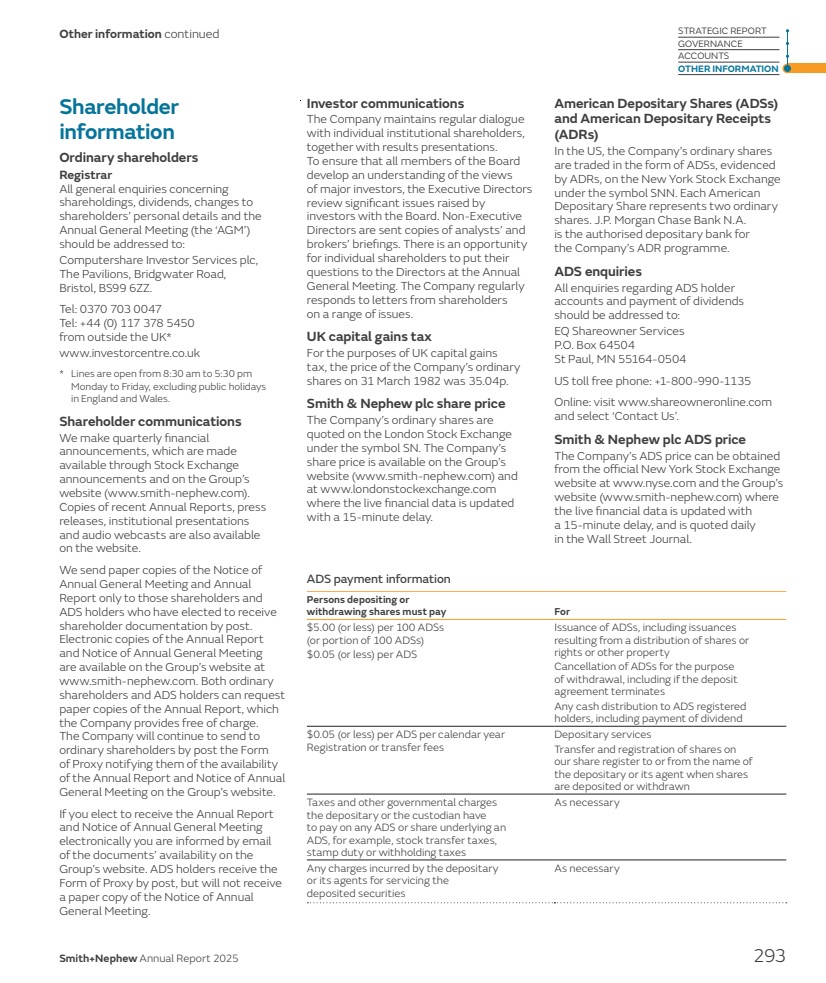
| ADS payment information The Company hereby discloses ADS payment information for the year ended 31 December 2025 in accordance with the Securities and Exchange Commission rules 12.D.3 and 12.D.4 relating to Form 20-F filings by foreign private issuers. The depositary collects its fees for delivery and surrender of ADSs directly from investors depositing shares or surrendering ADSs for the purpose of withdrawal or from intermediaries acting for them. The depositary collects fees for making distributions to investors, including payment of dividends by the Company by deducting those fees from the amounts distributed or by selling a portion of distributable property to pay the fees. The depositary may collect its annual fee for depositary services by deductions from cash distributions or by directly billing investors or by charging the book-entry system accounts of participants acting for them. The depositary may generally refuse to provide fee-attracting services until its fee for those services is paid. During 2025, a fee of 1.5 US cent per ADS was collected by J.P. Morgan Chase Bank N.A. on the 2024 final dividend paid in May 2025 and a fee of 1.5 US cent per ADS was collected on the 2025 interim dividend paid in November. In the period 1 January 2025 to 17 February 2026, the total programme payments made by J.P. Morgan Chase Bank N.A. was $928,743.68. Dividend history Smith & Nephew plc has paid dividends on its ordinary shares in every year since 1937. Following the capital restructuring and dividend reduction in 2000, the Group adopted a policy of increasing its dividend cover (the ratio of EPSA, as set out in the ‘Selected financial data’, to ordinary dividends declared for the year). This was intended to increase the financing capability of the Group for acquisitions and other investments. From 2000 to 2004, the dividend increased in line with inflation and, in 2004, dividend cover stood at 4.1 times. Having achieved this level of dividend cover the Board changed its policy, from that of increasing dividends in line with inflation, to that of increasing dividends for 2005 and after by 10%. Following the redenomination of the Company’s share capital into US Dollars, the Board reaffirmed its policy of increasing the dividend by 10% a year in US Dollar terms. On 2 August 2012, the Board announced its intention to pursue a progressive dividend policy, with the aim of increasing the US Dollar value of ordinary dividends over time broadly based on the Group’s underlying growth in earnings, while taking into account capital requirements and cash flows. At the time of the full-year results, the Board reviews the appropriate level of total annual dividend each year. The Board intends that the interim dividend will be set by a formula and will be equivalent to 40% of the total dividend for the previous year. Dividends will continue to be declared in US Dollars with an equivalent amount in Sterling payable to those shareholders whose registered address is in the UK, or who have validly elected to receive Sterling dividends. An interim dividend in respect of each fiscal year is normally declared in July or August and paid in October or November. A final dividend will be recommended by the Board of Directors and paid subject to approval by shareholders at the Company’s Annual General Meeting. Future dividends of Smith & Nephew plc will be dependent upon: future earnings; the future financial condition of the Group; the Board’s dividend policy; and the additional factors that might affect the business of the Group set out in ‘Special note regarding forward-looking statements’ and ‘Risk Factors’. Dividends per share The table below sets out the dividends per ordinary share in the last five years. Dividends below £500 per tax year are tax free for UK income tax purposes and dividends above £500 per tax year are subject to UK personal income tax for the 2024/25 tax year at the rate of 8.75% for basic rate taxpayers (increasing to 10.75% from 6 April 2026), 33.75% for higher rate taxpayers (increasing to 35.75% from 6 April 2026) and 39.35% for additional rate taxpayers. If you need to pay UK tax, how you pay depends upon the amount of dividend income you receive in a year. If your dividend income is up to £10,000 you can request HMRC to change your tax code so that the tax will be taken from your wages or pension or you can complete a self-assessment tax return. If your dividend income is over £10,000 in the tax year, you will need to complete a self-assessment tax return. This will apply to both cash and dividend reinvestment plan (‘DRiP’) dividends, although dividends paid on shares held within pensions and ISAs will be unaffected, remaining tax free. Since the second interim dividend for 2005, all dividends have been declared in US cents per ordinary share. In respect of the proposed final dividend for the year ended 31 December 2025 of 24.1 US cents per ordinary share, the record date will be 27 March 2026 and the payment date will be 27 May 2026. The Sterling equivalent per ordinary share will be set following the record date. Dividends per share Years ended 31 December 2025 2024 2023 2022 2021 Pence per share: Interim 11.26 11.10 11.89 12.91 10.50 Final 17.851 17.48 18.49 18.38 18.40 Total 29.11 28.58 30.38 31.29 28.90 US cents per share: Interim 15.00 14.40 14.40 14.40 14.40 Final 24.10 23.10 23.10 23.10 23.10 Total 39.10 37.50 37.50 37.50 37.50 1 Translated at the Bank of England rate on 17 February 2026. 294 Smith+Nephew Annual Report 2025 Shareholder information continued Other information continued 28_SN_AR25_Info_Share_v130.indd 294 05/03/2026 17:41 |
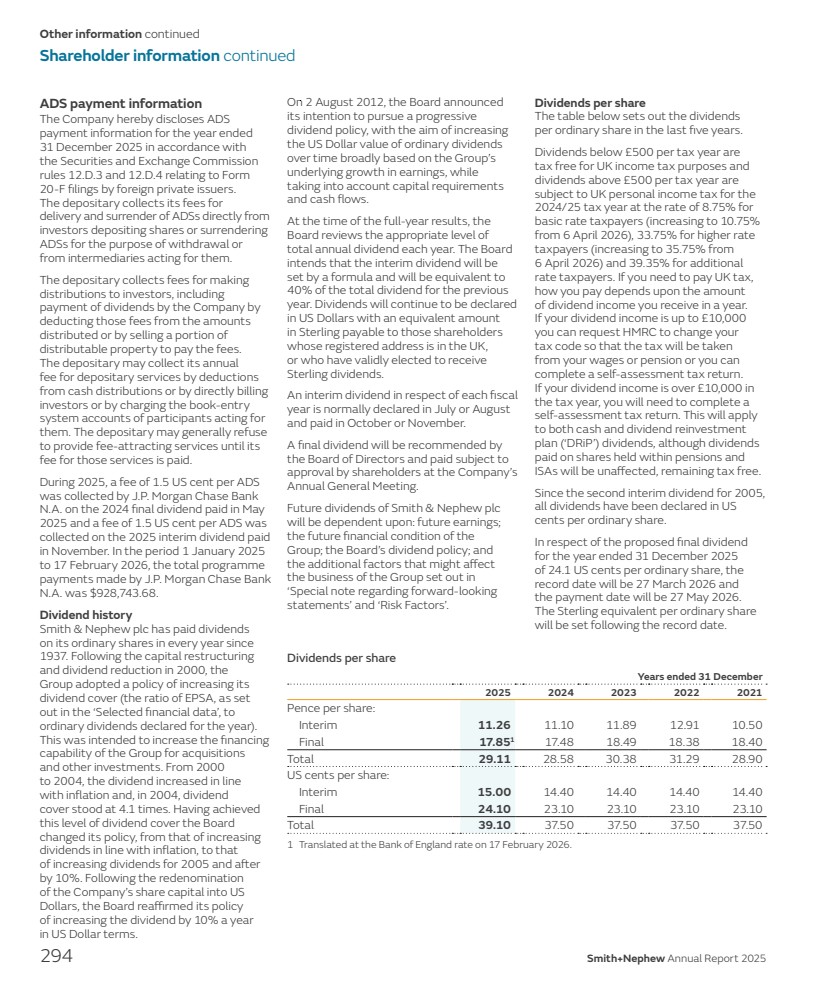
| Shareholders may elect to receive their dividend in either Sterling or US Dollars and the last day for election will be 5 May 2026. The ordinary shares will trade ex-dividend on both the London and New York Stock Exchanges from 26 March 2026. The proposed final dividend of 24.1 US cents per ordinary share, which together with the interim dividend of 15.0 US cents, makes a total for 2025 of 39.1 US cents. Shareholdings As at 17 February 2026, to the knowledge of the Group, there were 10,407 registered holders of ordinary shares, of whom 85 had registered addresses in the US and held a total of 182,743 ordinary shares (0.02% of the total issued). Because certain ordinary shares are registered in the names of nominees, the number of shareholders with registered addresses in the US is not representative of the number of beneficial owners of ordinary shares resident in the US. As at 17 February 2026, 25,480,585 ADSs equivalent to 50,961,170 ordinary shares, or approximately 6% of the total ordinary shares in issue, were outstanding and were held by 82 registered ADS holders. Exchange controls and other limitations affecting security holders There are no UK governmental laws, decrees or regulations that restrict the export or import of capital or that affect the payment of dividends, interest or other payments to non-resident holders of Smith & Nephew plc’s securities, except for certain restrictions imposed from time to time by His Majesty’s Treasury of the United Kingdom pursuant to legislation, such as the United Nations Act 1946 and the Emergency Laws Act 1964, against the Government or residents of certain countries. There are no limitations, either under the laws of the UK or under the Articles of Association of Smith & Nephew plc, restricting the right of non-UK residents to hold or to exercise voting rights in respect of ordinary shares, except that where any overseas shareholder has not provided to the Company a UK address for the service of notices, the Company is under no obligation to send any notice or other document to an overseas address. as part of a hedging, conversion or other integrated transaction or US Holders whose functional currency for US federal income tax purposes is other than the US Dollar. In addition, the comments below do not address the potential application of the provisions of the US Internal Revenue Code known as the Medicare contribution tax, any minimum tax consequences, any US federal tax other than income tax or any US state, local or non-US (other than UK) taxes. The summary deals only with US Holders who hold ADSs or ordinary shares as capital assets for tax purposes. The summary is based on current UK and US law and practice which is subject to change, possibly with retroactive effect. US Holders are recommended to consult their tax advisers as to the particular tax consequences to them of the ownership of ADSs or ordinary shares. The Company believes, and this discussion assumes, that the Company was not a passive foreign investment company for its taxable year ended 31 December 2025. This discussion assumes that each obligation under the deposit agreement and any related agreement will be performed in accordance with its terms. For purposes of US federal income tax law, US Holders of ADSs will generally be treated as owners of the ordinary shares represented by the ADSs. Taxation of distributions in the UK and the US The UK does not currently impose a withholding tax on dividends paid by a UK corporation, such as the Company. For US federal income tax purposes, distributions paid by the Company will generally be foreign source dividends to the extent paid out of the Company’s current or accumulated earnings and profits as determined for US federal income tax purposes. Because the Company does not maintain calculations of its earnings and profits under US federal income tax principles, it is expected that distributions generally will be reported to US Holders as dividends. Such dividends will not be eligible for the dividends-received deduction generally allowed to corporate US Holders. It is, however, the current practice of the Company to send every notice or other document to all shareholders regardless of the country recorded in the register of members, with the exception of details of the Company’s dividend reinvestment plan, which are not sent to shareholders with recorded addresses in the US and Canada. Taxation information for shareholders The comments below are of a general and summary nature and are based on the Group’s understanding of certain aspects of current UK and US federal income tax law and practice relevant to the ADSs and ordinary shares not in ADS form. The comments address the material US and UK tax consequences generally applicable to a person who is the beneficial owner of ADSs or ordinary shares and who, for US federal income tax purposes, is a citizen or resident of the US, a corporation (or other entity taxable as a corporation) created or organised in or under the laws of the US (or any State therein or the District of Columbia), or an estate or trust the income of which is included in gross income for US federal income tax purposes regardless of its source (each a US Holder). The comments set out below do not purport to address all tax consequences of the ownership of ADSs or ordinary shares that may be material to a particular holder and in particular do not deal with the position of US Holders who directly, indirectly or constructively own 10% or more of the Company’s issued ordinary shares. This discussion does not apply to (i) US Holders whose holding of ADSs or ordinary shares is effectively connected with or pertains to either a permanent establishment in the UK through which a US Holder carries on a business in the UK or a fixed base from which a US Holder performs independent personal services in the UK, or (ii) US Holders whose registered address is inside the UK. This discussion does not apply to certain US Holders subject to special rules, such as certain financial institutions, tax-exempt entities, insurance companies, broker-dealers and traders in securities that elect to use the mark-to-market method of tax accounting, partnerships or other entities treated as partnerships for US federal income tax purposes, US Holders holding ADSs or ordinary shares Smith+Nephew Annual Report 2025 295 STRATEGIC REPORT GOVERNANCE ACCOUNTS OTHER INFORMATION 28_SN_AR25_Info_Share_v130.indd 295 05/03/2026 17:41 |
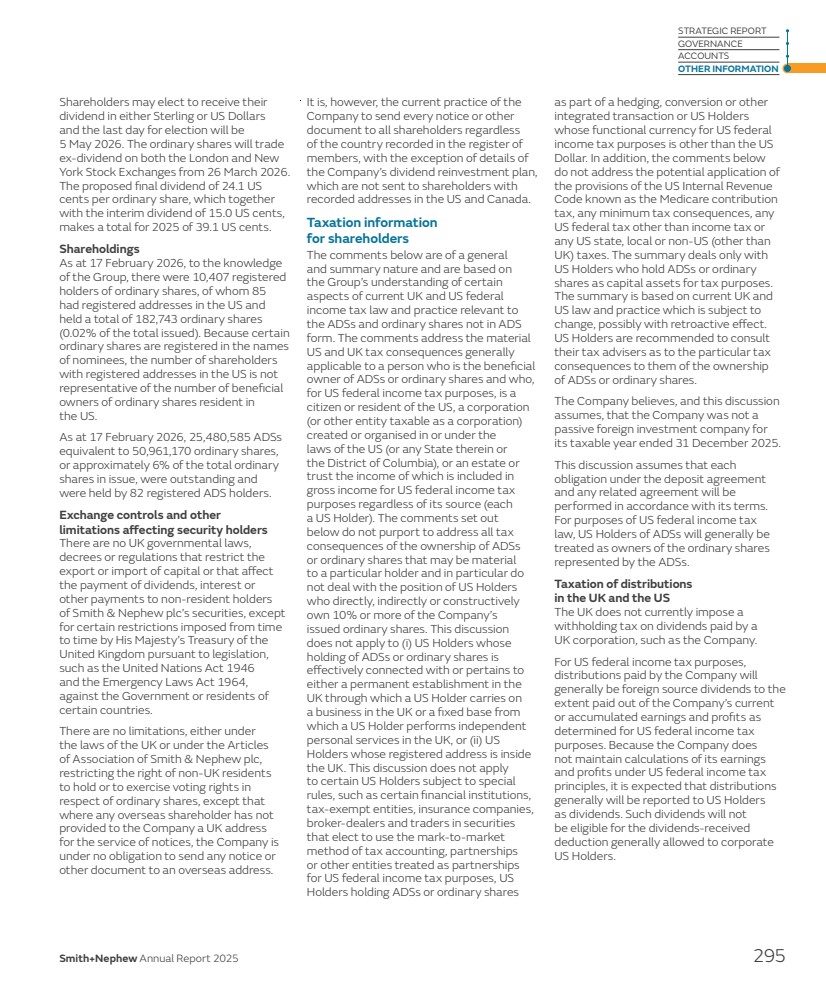
| Dividends paid to certain non-corporate US Holders of ordinary shares or ADSs may be subject to US federal income tax at lower rates than those applicable to other types of ordinary income if certain conditions are met. Non-corporate US Holders should consult their own tax advisers to determine whether they are subject to any special rules that limit their ability to be taxed at these favourable rates. Taxation of capital gains US Holders, who are not resident for tax purposes in the UK, will not generally be liable for UK capital gains tax on any capital gain realised upon the sale or other disposition of ADSs or ordinary shares unless the ADSs or ordinary shares are held in connection with a trade carried on in the UK through a permanent establishment (or in the case of individuals, through a branch or agency). Furthermore, UK resident individuals who acquire ADSs or ordinary shares before becoming temporarily non-UK residents may remain subject to UK taxation of capital gains on gains realised while non-resident. For US federal income tax purposes, gains or losses realised upon a taxable sale or other disposition of ADSs or ordinary shares by US Holders generally will be US source capital gains or losses and will be long-term capital gains or losses if the ADSs or ordinary shares were held for more than one year. The amount of a US Holder’s gain or loss will be equal to the difference between the amount realised on the sale or other disposition and such holder’s tax basis in the ADSs, or ordinary shares, each determined in US Dollars. Inheritance and estate taxes HM Revenue & Customs imposes inheritance tax on capital transfers which occur on death and in the seven years preceding death. HM Revenue & Customs considers that the US/UK Double Taxation Convention on Estate and Gift Tax (the 'Convention') applies to inheritance tax. Consequently, a US citizen who is domiciled in the US and is not a UK national or domiciled in the UK in each case for the purposes of the Convention will not be subject to UK inheritance tax in respect of ADSs and ordinary shares. A UK national who is domiciled in the US for the purposes of the Convention will be subject to UK inheritance tax (to the extent it applies) but will be entitled to a credit for any US federal estate tax charged in respect of ADSs and ordinary shares in computing the liability to UK inheritance tax. Special rules apply where ADSs and ordinary shares are business property of a permanent establishment of an enterprise situated in the UK. The above discussion reflects current UK tax law. US Holders who may be impacted by the tax laws discussed above should consult with their tax advisers as necessary. US information reporting and backup withholding Payments of dividends on, or proceeds from the sale of, ADSs or ordinary shares that are made within the US or through certain US-related financial intermediaries generally will be subject to US information reporting, and may be subject to backup withholding, unless a US Holder is an exempt recipient or, in the case of backup withholding, provides a correct US taxpayer identification number and certain other conditions are met. Any backup withholding deducted may be credited against the US Holder’s US federal income tax liability, and, where the backup withholding exceeds the actual liability, the US Holder may obtain a refund by timely filing the appropriate refund claim with the US Internal Revenue Service. US Holders who are individuals or certain specified entities may be required to report information relating to securities issued by a non-US person (or foreign accounts through which the securities are held), subject to certain exceptions (including an exception for securities held in accounts maintained by US financial institutions). US Holders should consult their tax advisers regarding their reporting obligations with respect to the ADSs or ordinary shares. UK stamp duty and stamp duty reserve tax UK stamp duty is charged on documents and in particular instruments for the transfer of registered ownership of ordinary shares. Transfers of ordinary shares in certificated form will generally be subject to UK stamp duty at the rate of ½% of the consideration given for the transfer with the duty rounded up to the nearest £5. UK stamp duty reserve tax (SDRT) arises when there is an agreement to transfer shares in UK companies ‘for consideration in money or money’s worth’, and so an agreement to transfer ordinary shares for money or other consideration may give rise to a charge to SDRT at the rate of ½% (rounded up to the nearest penny). The charge of SDRT will be cancelled, and any SDRT already paid will be refunded, if within six years of the agreement an instrument of transfer is produced to HM Revenue & Customs and the appropriate stamp duty paid. Transfers of ordinary shares into CREST (an electronic transfer system) are exempt from stamp duty so long as the transferee is a member of CREST who will hold the ordinary shares as a nominee for the transferor and the transfer is in a form that will ensure that the securities become held in uncertificated form within CREST. Paperless transfers of ordinary shares within CREST for consideration in money or money’s worth are liable to SDRT rather than stamp duty. SDRT on relevant transactions will be collected by CREST at ½%, and this will apply whether or not the transfer is effected in the UK and whether or not the parties to it are resident or situated in the UK. 296 Smith+Nephew Annual Report 2025 Shareholder information continued Other information continued 28_SN_AR25_Info_Share_v130.indd 296 05/03/2026 17:41 |
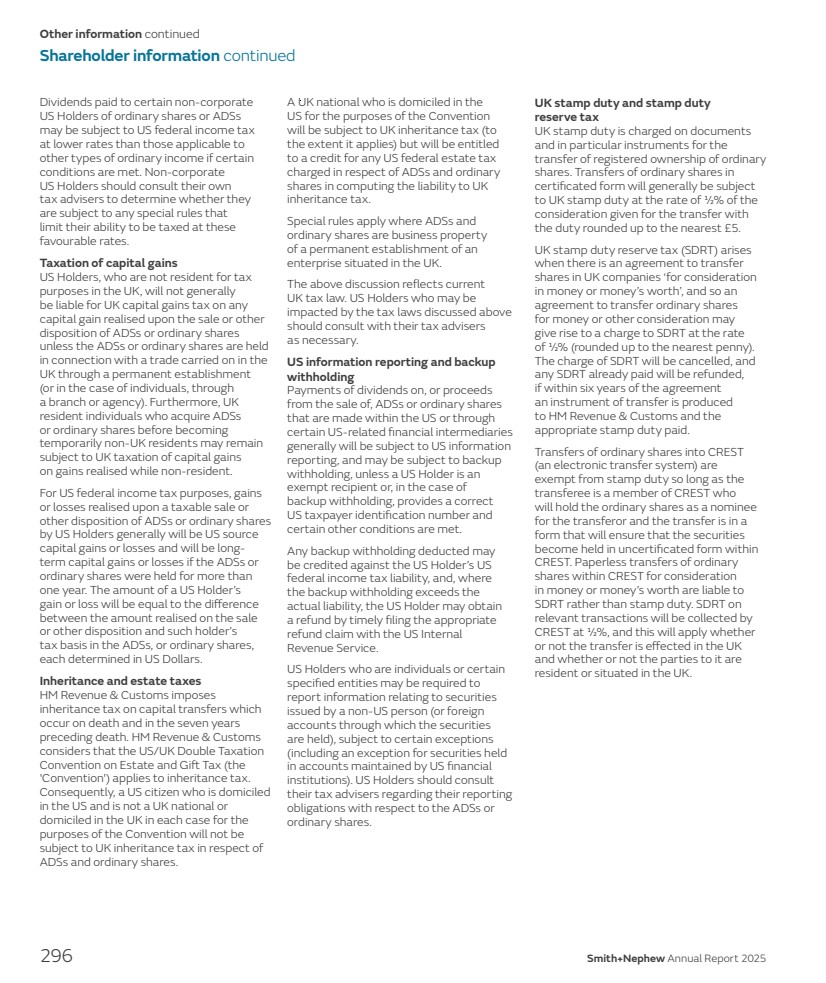
| About Smith+Nephew The Smith+Nephew Group (the Group) is a portfolio medical technology business with leadership positions in Orthopaedics, Advanced Wound Management and Sports Medicine, and revenue of approximately $6.2bn in 2025. Smith & Nephew plc (the Company) is the Parent Company of the Group. It is an English public limited company with its shares listed on the premium list of the UK Listing Authority and traded on the London Stock Exchange. Shares are also traded on the New York Stock Exchange in the form of American Depositary Shares (ADSs). This is the Annual Report of Smith & Nephew plc for the year ended 31 December 2025. It comprises, in a single document, the Annual Report and Accounts of the Company in accordance with UK requirements and the Annual Report on Form 20-F in accordance with the regulations of the United States Securities and Exchange Commission (SEC). The information in this document will be updated and supplemented at the time of filing with the SEC or later amended if necessary. Smith+Nephew operates on a worldwide basis and has distribution channels in over 100 countries. The Group is engaged in a single business activity, being the development, manufacture and sale of medical technology products and services. In 2023, Smith+Nephew’s operations were organised into three global business units (Orthopaedics, Sports Medicine & ENT, and Advanced Wound Management) within the medical technology industry. Smith+Nephew’s corporate website, www.smith-nephew.com, gives additional information on the Group, including an electronic version of this Annual Report. Information made available on this website, or other websites mentioned in this Annual Report, are not and should not be regarded as being part of, or incorporated into, this Annual Report. The terms ‘Group’ and ‘Smith+Nephew’ are used to refer to Smith & Nephew plc and its consolidated subsidiaries, unless the context requires otherwise. For the convenience of the reader, a Glossary of terms used in this document is included on page 304. The product names referred to in this document are identified by use of capital letters and the ◊ symbol (on first occurrence on a particular page) and are trademarks owned by or licensed to members of the Group. Presentation The Group’s fiscal year end is 31 December. References to a particular year in this Annual Report are to the fiscal year, unless otherwise indicated. Except as the context otherwise requires, ‘ordinary share’ or ‘share’ refer to the ordinary shares of Smith & Nephew plc of 20 US cents each. The Group Accounts of Smith & Nephew plc in this Annual Report are presented in US Dollars. Solely for the convenience of the reader, certain parts of this Annual Report contain translations of amounts in US Dollars into Sterling at specified rates. These translations should not be construed as representations that the US Dollar amounts actually represent such Sterling amounts or could be converted into Sterling at the rate indicated. Unless stated otherwise, the translation of US Dollars and cents to Sterling and pence in this Annual Report has been made at the Bank of England exchange rate on the date indicated. On 17 February 2026, the latest practicable date for this Annual Report, the Bank of England rate was US$1.3503 per GBP£1.00. The results of the Group, as reported in US Dollars, are affected by movements in exchange rates between US Dollars and other currencies. The Group applied the average exchange rates prevailing during the year to translate the results of companies with functional currency other than US Dollars. The currencies which most influenced these translations in the years covered by this report were Sterling, Swiss Franc and the Euro. The Accounts of the Group in this Annual Report are presented in millions (m) unless otherwise indicated. UK legislation provides for a charge to stamp duty or SDRT to be payable at an enhanced rate of 1.5% of the consideration (or, in some cases, the value of the shares concerned) where ordinary shares are transferred to the depositary or to certain persons providing a clearance service (or their nominees or agents) for the conversion into ADRs and will generally be payable by the depositary or person providing clearance service. In accordance with the terms of the Deposit Agreement, any tax or duty payable by the depositary on deposits of ordinary shares will be charged by the depositary to the party to whom ADRs are delivered against such deposits. However, such transfers to the depository or to certain persons providing a clearance service (or their nominees or agents) will not attract stamp duty or SDRT where they satisfy the conditions of an exemption, including exemptions which can apply to certain capital raising or qualifying listing arrangements. Specific professional advice should be sought before paying the 1.5% SDRT or stamp duty charge in any circumstances. No liability for stamp duty or SDRT will arise on any transfer of, or agreement to transfer, an ADS or beneficial ownership of an ADS, provided that the ADS and any instrument of transfer or written agreement to transfer remains at all times outside the UK, and provided further that any instrument of transfer or written agreement to transfer is not executed in the UK and the transfer does not relate to any matter or thing done or to be done in the UK (the location of the custodian as a holder of ordinary shares not being relevant in this context). In any other case, any transfer of, or agreement to transfer, an ADS or beneficial ownership of an ADS could, depending on all the circumstances of the transfer, give rise to a charge to stamp duty or SDRT. Any UK stamp duty or SDRT imposed upon transfers of ADSs or ordinary shares will not be treated as a creditable foreign tax for US federal income tax purposes. US Holders should consult their tax advisers regarding whether any such UK stamp duty or SDRT may be deductible or reduce the amount of gain (or increase the amount of loss) recognised upon a sale or other disposition of the ADSs or ordinary shares. Smith+Nephew Annual Report 2025 297 STRATEGIC REPORT GOVERNANCE ACCOUNTS OTHER INFORMATION 28_SN_AR25_Info_Share_v130.indd 297 05/03/2026 17:41 |
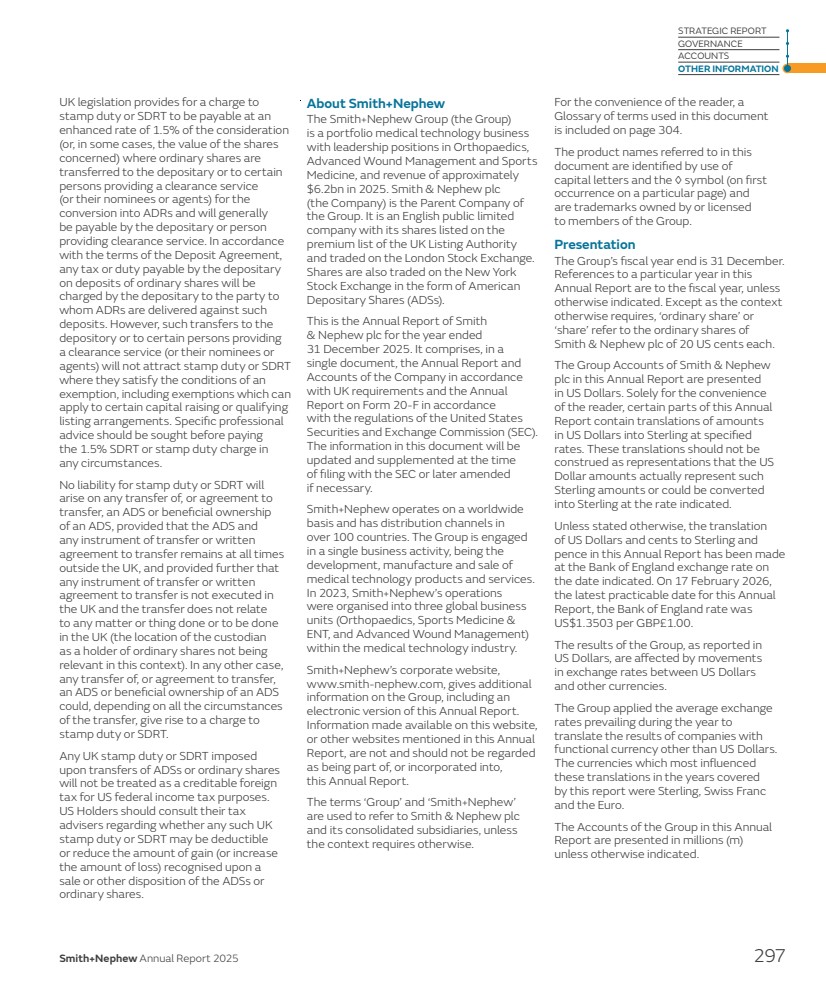
| Insider trading policies Our Board of Directors adopted insider trading policies and procedures governing the purchase, sale, and other dispositions of our securities by directors, senior management, and employees that are reasonably designed to promote compliance with applicable insider trading laws, rules, and regulations, and any listing standards applicable to the Group. Special note regarding forward-looking statements The Group’s reports filed with, or furnished to, the US Securities and Exchange Commission (SEC), including this document and written information released, or oral statements made, to the public in the future by or on behalf of the Group, contain ‘forward-looking statements’ within the meaning of the US Private Securities Litigation Reform Act of 1995, that may or may not prove accurate. For example, statements regarding expected revenue growth and trading profit margins discussed in the ‘Strategic Report’, market trends and our product pipeline are forward-looking statements. Phrases such as ‘aim’, ‘plan’, ‘intend’, ‘anticipate’, ‘well-placed’, ‘believe’, ‘estimate’, ‘expect’, ‘target’, ‘consider’ and similar expressions are generally intended to identify forward-looking statements. Forward-looking statements involve known and unknown risks, uncertainties and other important factors that could cause actual results, to differ materially from what is expressed or implied by the statements. For Smith+Nephew, these factors include: global supply chain; risks related to factors such as the conflicts in Ukraine and the Middle East; economic and financial conditions in the markets we serve, especially those affecting healthcare providers, payers and customers; price levels for established and innovative medical devices; developments in medical technology; regulatory approvals, reimbursement decisions or other government actions; product defects or recalls or other problems with quality management systems and loss of reputation or failure to comply with related regulations; litigation relating to patent or other claims; legal and financial compliance risks and related investigative, remedial or enforcement actions; disruption to our supply chain or operations or those of our suppliers; competition for qualified personnel; talent management; strategic actions, including acquisitions and dispositions, our success in performing due diligence, valuing and integrating acquired businesses; disruption that may result from transactions or other changes we make in our business plans or organisation to adapt to market developments; disruptions due to natural disasters, weather and climate change related events; changes in customer and other stakeholder sustainability expectations; changes in taxation regulations; effects of foreign exchange volatility; and numerous other matters that affect us or our markets, including those of a political, economic, business, competitive or reputational nature; relationships with healthcare professionals; reliance on information technology and cybersecurity; artificial intelligence technologies and disruptor products. Specific risks faced by the Group are described under ‘Risk factors’ on pages 275-284 of this Annual Report. Any forward-looking statement is based on information available to Smith+Nephew as of the date of the statement. All written or oral forward-looking statements attributable to Smith+Nephew are qualified by this caution. Smith+Nephew does not undertake any obligation to update or revise any forward-looking statement to reflect any change in circumstances or in Smith+Nephew’s expectations. Product data Product data and product share estimates throughout this report are derived from a variety of sources including publicly available competitors’ information, internal management information and independent market research reports. Documents on display It is possible to read and copy documents referred to in this Annual Report at the Registered Office of the Company. Documents referred to in this Annual Report that have been filed with the Securities and Exchange Commission in the US may be read and copied at the SEC’s public reference room located at 450 Fifth Street, NW, Washington DC 20549. Please call the SEC at 1-800-SEC-0330 for further information on the public reference rooms and their copy charges. The SEC also maintains a website at www.sec.gov that contains reports and other information regarding registrants that file electronically with the SEC. Annual Reports on Form 20-F and some of the other information submitted by the Group to the SEC may be accessed through the SEC website. Corporate headquarters and registered office The corporate headquarters is in the UK and the registered office address is: Smith & Nephew plc, Building 5, Croxley Park, Hatters Lane, Watford, Hertfordshire, WD18 8YE, United Kingdom. Registered in England and Wales No. 324357. Tel. +44 (0)1923 477 100 www.smith-nephew.com 298 Smith+Nephew Annual Report 2025 Shareholder information continued Other information continued 28_SN_AR25_Info_Share_v130.indd 298 05/03/2026 17:41 |

| Cross-reference to Form 20-F The information in this document that is referenced in the following table will be included in our Annual Report on Form 20-F for 2025 filed with the SEC (the ‘2025 Form 20-F’). The information in this document will be updated and supplemented at the time of filing with the SEC or later amended if necessary. No other information in this document is included in the 2025 Form 20-F or incorporated by reference into any filings by us under the Securities Act. Part 1 Form 20-F caption Location in this document Page Item 1 Identity of Directors, Senior Management and Advisers Not applicable – Item 2 Offer Statistics and Expected Timetable Not applicable – Item 3 Key Information A – (Reserved) Not applicable – B – Capitalisation and Indebtedness Not applicable – C – Reason for the Offer and Use of Proceeds Not applicable – D – Risk Factors Risk factors 275–284 Item 4 Information on the Company A – History and Development of the Company Corporate Headquaters and Regional Office 298 Note 1 ‘Basis of preparation’ 215 Group Information 274 About Smith+Nephew 297 Note 21 ‘Acquisitions’ 264 Capital allocation framework 24–25 Note 7 ‘Property, plant and equipment’ 228–229 Note 9 ‘Intangible assets 232–234 Note 15 ‘Cash and borrowings’ 239–241 Documents on display 298 B – Business Overview Smith+Nephew at a glance 2–3 Orthopaedics Segment 39–43 Sports Medicine & ENT Segment 44–48 Wound Segment 49–52 Chair’s statement 4–5 Chief Executive Officer’s review 6–11 Leading positions in attractive markets 12–13 Our business model 14–15 Innovators 26–35 Serving our customers 36–52 Disaggregation of revenue 219 Seasonality 13 Source materials 34 2025 Principal Risks 83–94 Note 12 ‘Inventories’ 236 Risk factors 275–284 Accelerating Sports Medicine and AWM 7 Our sales force 37 Note 3 ‘Operating profit’ 221–223 Note 9 ‘Intangible assets 232–234 Our purpose and stakeholders 117–123 Compliance and Culture Committee Report 136–140 C – Organisational Structure Note 8 ‘Group companies’ 270–273 Group Information 274 D – Property, Plants and Equipment Note 7 ‘Property, plant and equipment’ 228–229 Group Information 274 Item 4A Unresolved Staff Comments None – Item 5 Operating and Financial Review and Prospects A – Operating Results Chair’s statement 4–5 Chief Executive Officer’s review 6–11 Measuring our progress 16–17 Chief Financial Officer's review 18–25 Smith+Nephew Annual Report 2025 299 STRATEGIC REPORT GOVERNANCE ACCOUNTS OTHER INFORMATION 28_SN_AR25_Info_Share_v130.indd 299 05/03/2026 17:41 |
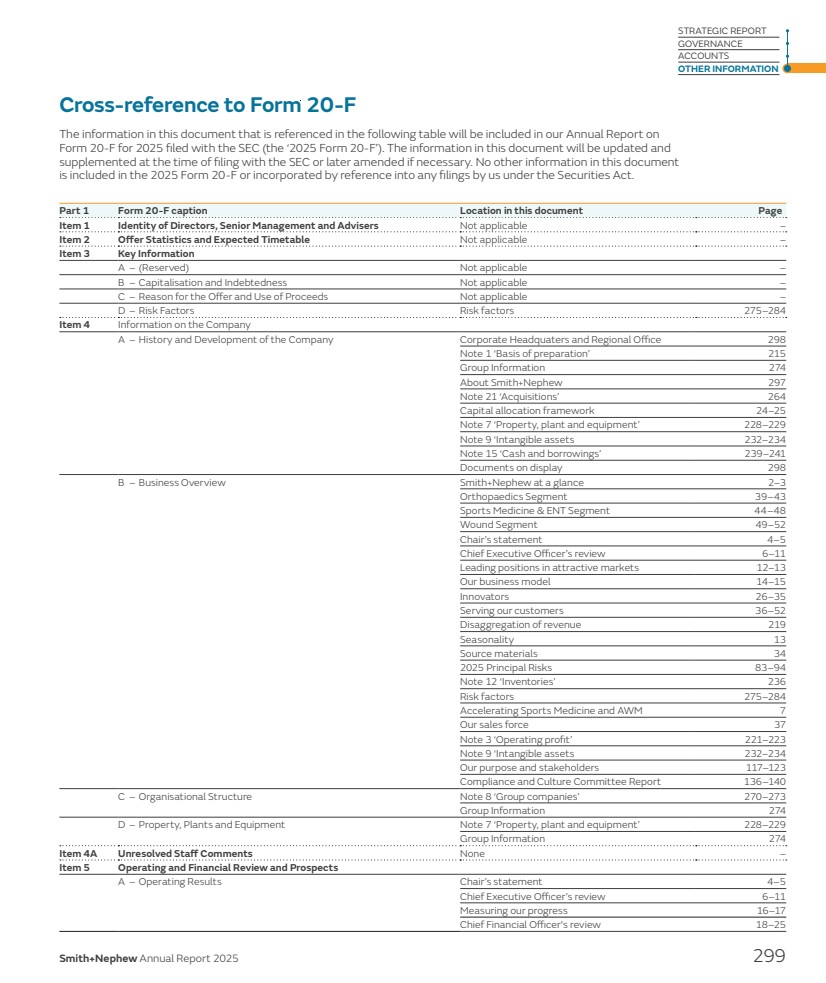
| Part 1 Form 20-F caption Location in this document Page A – Operating Results continued Research & Development 27–32 Orthopaedics Performance 40–41 Sports Medicine & ENT Performance 45 Advanced Would Management Performance 50 Group financial statements 211–265 B – Liquidity and Capital Resources Liquidity and capital resources 23 Note 15 ‘Cash and borrowings’ 239–241 Note 20 ‘Cash flow statement’ 262–263 C – Research and Development, Patents and Licences, etc. Chief Executive Officer’s review 6–11 Research & Development 27–32 Note 3 'Operating profit' 221–223 New product innovation, design and development, including intellectual property 279–280 D – Trend Information Chief Executive Officer’s review 6–11 Delivering value for stakeholders 14–15 2026 Outlook 25 Innovators 26–35 Serving our customers 36–52 Risk factors 275–284 E – Critical Accounting Estimates Note 1.2 ‘Critical judgements and estimates’ 216 Item 6 Directors, Senior Management and Employees A – Directors and Senior Management Board of Directors 102–107 Executive Committee 108–109 B – Compensation Remuneration Committee Report 147–193 Note 18 'Retirement and benefit obligations' 254–259 C – Board Practices Board of Directors 102–107 Corporate Governance 124–128, 132–193 D – Employees Our People 120 Note 3.1 ‘Staff costs and employee numbers’ 223 An ethical employer 63 E – Share Ownership Share capital 194–196 Note 6 ‘Earnings per ordinary share’ 227 Directors’ interests in ordinary shares 183–185 Note 19 ‘Equity’ 259–261 Note 22.1 ‘Share-based payments’ 265 Performances Share Plan 179–182 Shareholder information 293–298 F – Disclosure of a Registrant’s Action to Recover Erroneously Awarded Compensation Not applicable – Item 7 Major Shareholders and Related Party Transactions A – Major Shareholders Major shareholders 196 Shareholder information 293–298 B – Related Party Transactions Note 22.2 ‘Related party transactions’ 265 C – Interests of Experts and Counsel Not applicable – Item 8 Financial Information A – Consolidated Statements and Other Financial Information Statement of Directors’ responsibilities in respect of the Annual Report and Financial Statements 198 Independent auditor’s report to the members of Smith & Nephew Plc 199–210 Group financial statements 211–265 Legal Proceedings Note 17.3 ‘Legal proceedings’ 252 Dividends Shareholder information 293–298 Item 9 The Offer and Listing A – Offer and Listing Details UK Corporate Governance Code 2024 (“the Code”): 2025 Statement of Compliance 100–101 Share Capital 194–197 Business overview and Group history 274 Shareholder information 293–298 300 Smith+Nephew Annual Report 2025 Cross-reference to Form 20-F continued Other information continued 28_SN_AR25_Info_Share_v130.indd 300 05/03/2026 17:41 |
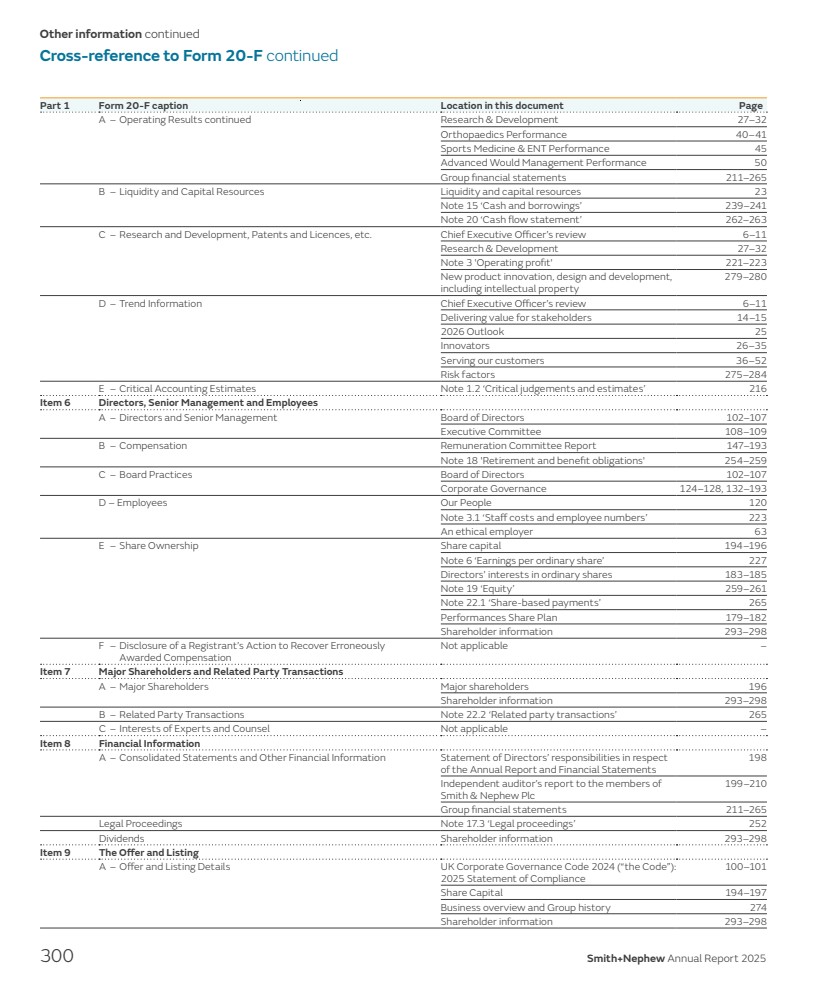
| Part 1 Form 20-F caption Location in this document Page B – Plan of Distribution Not applicable – C – Markets UK Corporate Governance Code 2024 (“the Code”): 2025 Statement of Compliance 100–101 Share capital 194–196 Business overview and Group history 274 Shareholder information 293–298 D – Selling Shareholders Not applicable – E – Dilution Not applicable – F – Expenses of the Issue Not applicable – Item 10 Additional Information A – Share Capital Not applicable – B – Memorandum and Articles of Association Articles of Association 195 C – Material Contracts Not applicable – D – Exchange Controls Exchange controls and other limitations affecting security holders 295 E – Taxation Taxation information for shareholders 295–297 F – Dividends and Paying Agents Not applicable – G – Statement by Experts Not applicable – H – Documents on Display Documents on display 298 I – Subsidiary Information Group companies 270–273 J – Annual report to security holders Annual report to security holders To be filed as exhibit to Form 6-K Item 11 Quantitative and Qualitative Disclosure about Market Risk Note 16 ‘Financial instruments and risk management’ 242–250 Item 12 Description of Securities other than Equity Securities A – Debt Securities Not applicable – B – Warrants and Rights Not applicable – C – Other Securities Not applicable – D – American Depositary Shares Shareholder information 293–298 Part 2 Form 20-F caption Location in this document Page Item 13 Defaults, Dividend Arrearages and Delinquencies Not applicable – Item 14 Material Modifications to the Rights of Security Holders and Use of Proceeds Not applicable – Item 15 Controls and Procedures Risk report 78–82 Audit Committee Report 141–146 Independent auditor’s report to the members of Smith & Nephew Plc 199–210 Item 16 (Reserved) Not applicable – A – Audit Committee Financial Expert How we assess our prospects 95–96 Committee meetings 142 B – Code of Ethics Code of Ethics for Senior Financial Officers 146 C – Principal Accountant Fees and Services Non-audit fees paid to the auditor 145 Audit fees paid to the auditor 145 Note 3.2 ‘Audit Fees – information about the nature and cost of services provided by the auditor’ 223 D – Exemptions from the Listing Standards for Audit Committees Not applicable – E – Purchases of Equity Securities by the Issuer and Affiliated Purchasers Major shareholders 196 Authority to purchase own shares on behalf of the Company 196 Share Buyback 196 F – Change in Registrant’s Certifying Accountant Not applicable – G – Corporate Governance Governance at a glance 98–101 H – Mine Safety Disclosure Not applicable – I – Disclosure Regarding Foreign Jurisdictions that Prevent Inspections Not applicable – J – Insider Trading Policies Insider trading 298 K – Cybersecurity Cybersecurity risk management and governance 274–275 Part 3 Form 20-F caption Location in this document Page Item 17 Financial Statements Not applicable – Item 18 Financial Statements Group Financial Statements 211–265 Item 19 Exhibits Smith+Nephew Annual Report 2025 301 STRATEGIC REPORT GOVERNANCE ACCOUNTS OTHER INFORMATION 28_SN_AR25_Info_Share_P301_P312.indd 301 06/03/2026 22:23 |
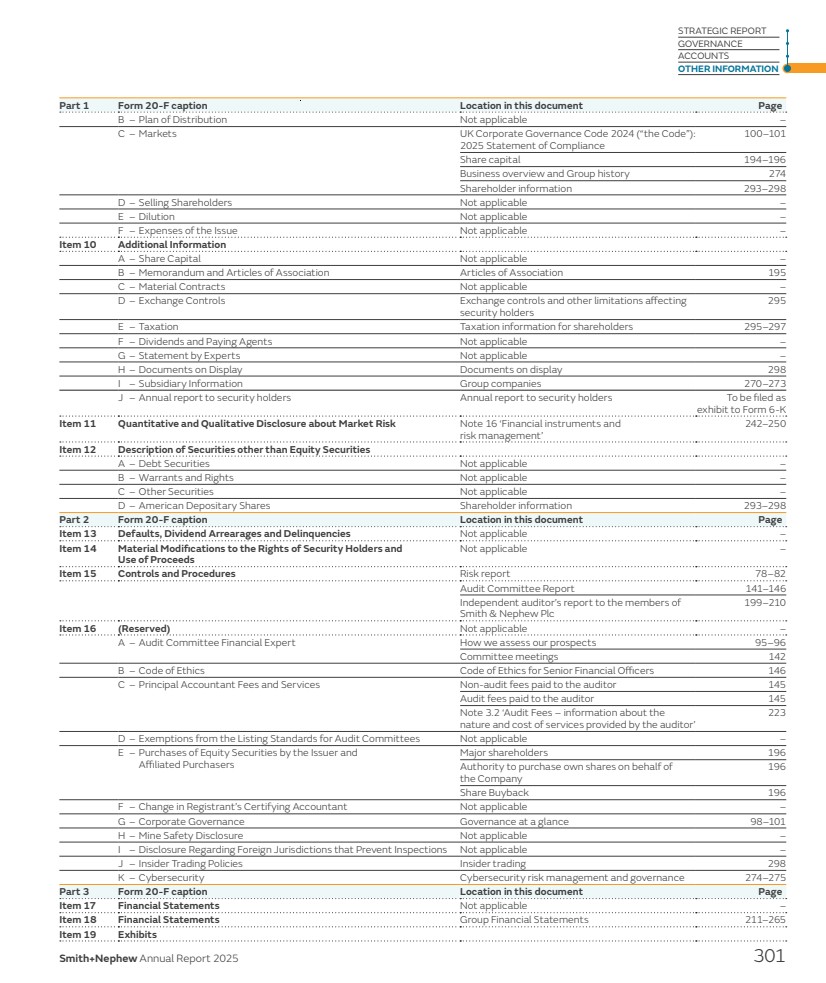
| Topic Metric 2025 Reporting Code Affordability and pricing Ratio of weighted average rate of net price increases (for all products) to the annual increase in the US Consumer Price Index. Not reported. HC-MS-240a.1 Description of how price information for each product is disclosed to customers or to their agents. Smith+Nephew uses several methods to disseminate price information to customers, including quotes, agreements, responses to requests for proposal, tender bid submissions, discount and rebate reporting and through large group purchasing organisation/ integrated delivery network customers to their members. HC-MS-240a.2 Product safety Number of recalls issued, total units recalled. In 2025, Smith+Nephew reported seven voluntary recalls globally: 0 Class I , 2 Class II and 5 Class III. A total of 1,222 units were impacted. All recalls during FY2025 were voluntary and were not the result of FDA enforcement actions or mandatory recall orders. HC-MS-250a.1 List of products listed in the FDA’s MedWatch Safety Alerts for Human Medical Products database. Smith+Nephew reports all data as required by FDA. The MedWatch database is available at https://www.fda.gov/safety/medwatch-fda-safety-information-and-adverse-event-reporting-program HC-MS-250a.2 Number of fatalities related to products as reported in the FDA Manufacturer and User Facility Device Experience (MAUDE). Smith+Nephew reports all data as required by FDA. The FDA MAUDE database is available at https://www.accessdata.fda.gov/scripts/ cdrh/cfdocs/cfmaude/search.cfm HC-MS-250a.3 Number of FDA enforcement actions taken in response to violations of current Good Manufacturing Practices (cGMP), by type. In 2025, Smith+Nephew received: – 0 Form 483 (0 observations in total). – 0 Warning letters. – 0 Seizures. – 0 Mandatory recalls. – 0 Consent decrees. HC-MS-250a.4 Ethical marketing Description of code of ethics governing promotion of off-label use of products. See the Product Promotion and Scientific Disclosures section of our Code of Conduct and Business Principles (Compliance (smith-nephew. com)) and the Business Ethics section of our Sustainability Report for additional information. HC-MS-270a.2 302 Smith+Nephew Annual Report 2025 SASB reporting Other information continued 28_SN_AR25_Info_Share_v130.indd 302 05/03/2026 17:41 |
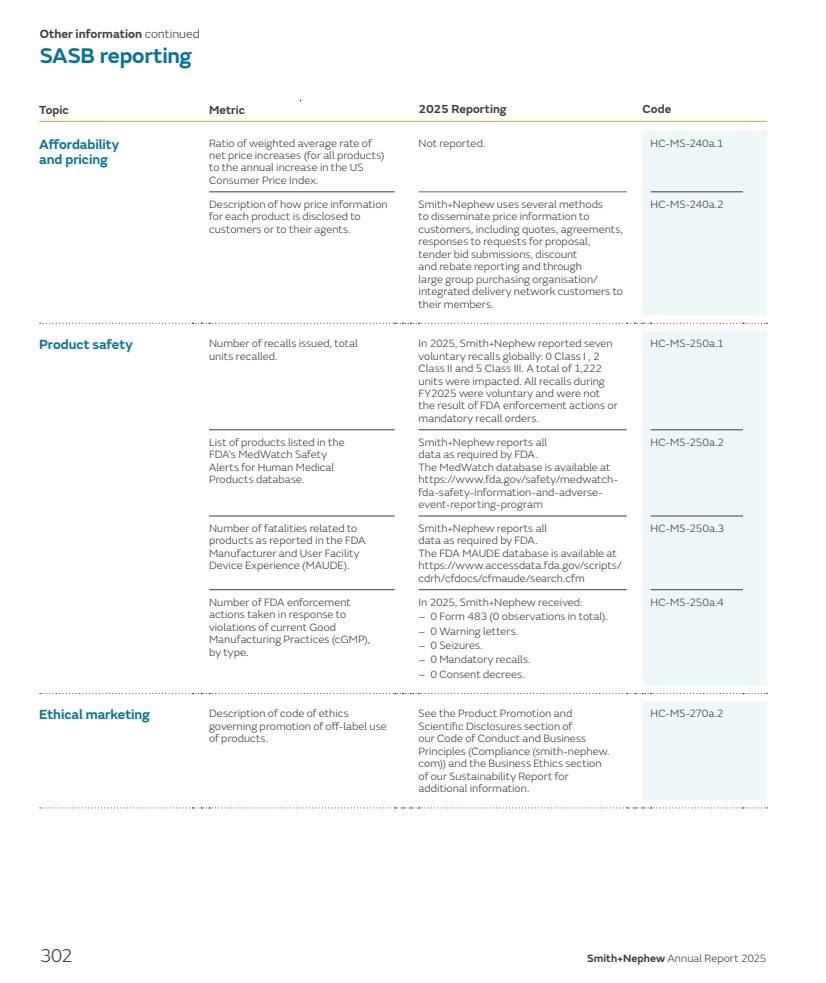
| Topic Metric 2025 Reporting Code Product design and lifecycle management Discussion of process to assess and manage environmental and human health considerations associated with chemicals in products, and meet demand for sustainable products. Sustainability reviews are incorporated in New Product Development phase reviews for new products and acquisitions. Additionally, regulatory changes regarding chemicals in products are tracked and actioned, as appropriate. See our Sustainability Report for more information. HC-MS-410a.1 Total amount of products accepted for takeback and reused, recycled, or donated, broken down by: (1) devices and equipment and (2) supplies. Smith+Nephew operates takeback schemes where required by law. Smith+Nephew does not measure the amount of products reused or recycled for our business purposes. See the People section of our Sustainability Report for information on product donations. HC-MS-410a.2 Supply chain management Percentage of (1) entity’s facilities and (2) Tier 1 suppliers’ facilities participating in third-party audit programmes for manufacturing and product quality. All Smith+Nephew direct manufacturing locations participate in the Medical Device Single Audit Program (MDSAP). All Smith+Nephew direct and third-party manufacturing locations are certified to ISO 13485. Additionally, all Tier 1 material suppliers are compliant with ISO 13485. HC-MS-430a.1 Description of efforts to maintain traceability within the distribution chain. All Smith+Nephew products are labelled with either Unique Device Identifiers or HIBC barcodes to maintain traceability. HC-MS-430a.2 Description of the management of risks associated with the use of critical materials. Supply chain risks are captured within Smith+Nephew’s Enterprise Risk Management process and global supply chain is identified as one of our principal risks. See our Risk Report on page 78 and our Conflict Minerals Disclosure Report on our website (www.smith-nephew.com) for additional information. HC-MS-430a.3 Business ethics Total amount of monetary losses as a result of legal proceedings associated with bribery or corruption. In 2025, Smith+Nephew did not have monetary losses due to legal proceedings associated with bribery or corruption. HC-MS-510a.1 Description of code of ethics governing interactions with healthcare professionals. See our website (www.smith-nephew.com) for our Code of Conduct and Business Principles, our Anti-Bribery Policy, our Annual Report, and also the Business Ethics section of our Sustainability Report for additional information. HC-MS-510a.2 Activity metric Number of units sold by product category. Not reported. HC-MS-000.A You can learn more about our sustainability targets and strategy in our 2025 Sustainability Report at www.smith-nephew.com/sustainability Smith+Nephew Annual Report 2025 303 STRATEGIC REPORT GOVERNANCE ACCOUNTS OTHER INFORMATION 28_SN_AR25_Info_Share_v130.indd 303 05/03/2026 17:41 |
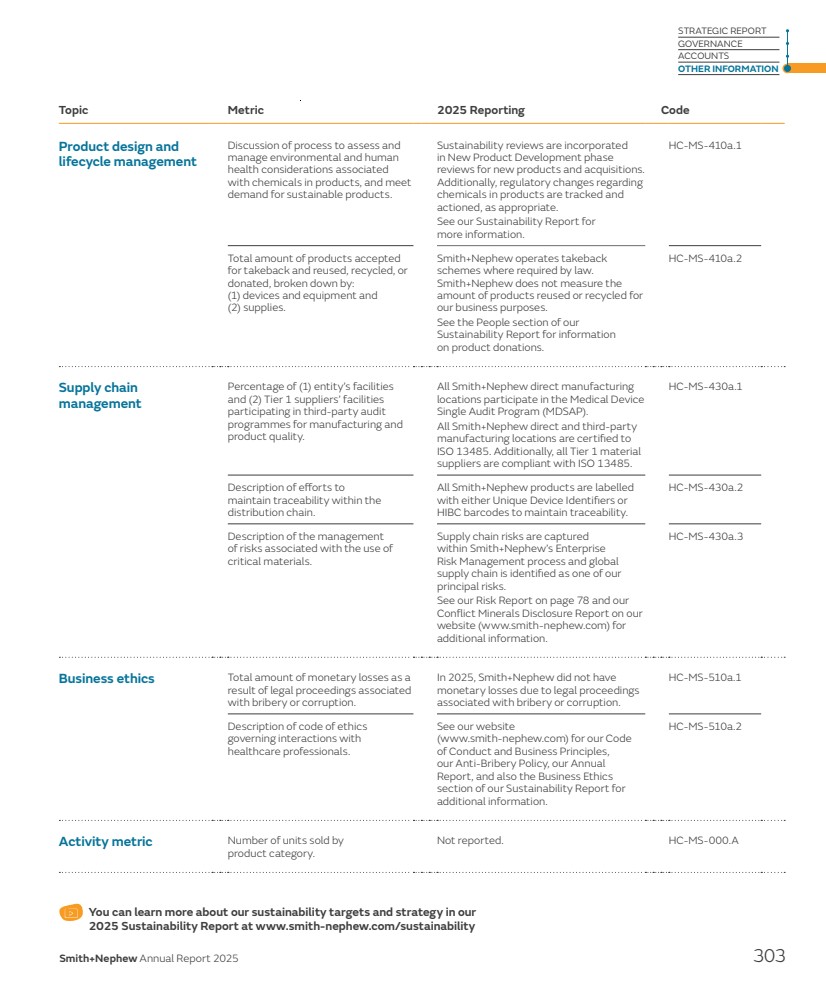
| Term Meaning ADR In the US, the Company’s ordinary shares are traded in the form of American Depositary Shares evidenced by American Depositary Receipts (ADRs). ADS In the US, the Company’s ordinary shares are traded in the form of American Depositary Shares (ADSs). Arthroscopic Enabling Technologies (AET) A product group which includes a variety of technologies such as fluid management equipment for surgical access, high definition cameras, digital image capture, scopes, light sources and monitors to assist with visualisation inside the joints, radio frequency, electromechanical and mechanical tissue resection devices, and hand instruments for removing damaged tissue. Advanced Wound Bioactives (AWB) A product group which includes biologics and other bioactive technologies that provide unique approaches to debridement and dermal repair/regeneration, and regenerative medicine products including skin, bone graft and articular cartilage substitutes. Advanced Wound Care (AWC) A product group which includes products for the treatment and prevention of acute and chronic wounds, including leg, diabetic and pressure ulcers, burns and post-operative wounds. Advanced Wound Devices (AWD) A product group which includes traditional and single-use Negative Pressure Wound Therapy, a patient monitoring system for pressure injury prevention and patient mobility monitoring, and hydrosurgery systems. AGM Annual General Meeting of the Company. Arthroscopy Endoscopy of the joints is termed ‘arthroscopy’, with the principal applications including the knee and shoulder. ASC Ambulatory Surgery Center. Basis Point One hundredth of one percentage point. Chronic wounds Chronic wounds are those with long or unknown healing times including leg ulcers, pressure sores and diabetic foot ulcers. Company Smith & Nephew plc or, where appropriate, the Company’s Board of Directors, unless the context otherwise requires. Companies Act Companies Act 2006, as amended, of England and Wales. Emerging Markets Emerging Markets include Latin America, Asia (excluding Japan), Middle East, Africa and Russia. EPSA Adjusted earnings per ordinary share as defined on page 288-289. Endoscopy Through a small incision, surgeons are able to see inside the body using a monitor and identify and repair defects. ENT Ear, Nose and Throat. Established Markets Established Markets are United States of America, Europe, Australia, New Zealand, Canada and Japan. Euro or € References to the common currency used in the majority of the countries of the European Union. FDA US Food and Drug Administration. Financial statements Refers to the consolidated Group Accounts of Smith & Nephew plc. FTSE 100 Index of the largest 100 listed companies on the London Stock Exchange by market capitalisation. Group or Smith+Nephew Used for convenience to refer to the Company and its consolidated subsidiaries, unless the context otherwise requires. Health economics A branch of economics concerned with issues related to efficiency, effectiveness, value and behaviour in the production and consumption of health and healthcare. Hip Implants A product group which includes specialist products for reconstruction of the hip joint. IFC Inside Front Cover. Term Meaning IBC Inside Back Cover. IFRS International Financial Reporting Standards issued by the International Accounting Standards Board. Knee implants A product group which includes an innovative range of products for specialised knee replacement procedures. LSE London Stock Exchange. MDR Medical Device Regulation. MHRA The Medicines and Healthcare products Regulatory Agency in the UK. Negative Pressure Wound Therapy (NPNT) A technology used to treat chronic wounds such as diabetic ulcers, pressure sores and post-operative wounds through the application of sub-atmospheric pressure to an open wound. NHS The UK National Health Service. NYSE New York Stock Exchange. Orthopaedic products Orthopaedic reconstruction products include joint replacement systems for knees, hips and shoulders and support products such as computer-assisted surgery and minimally invasive surgery techniques. Orthopaedic trauma devices are used in the treatment of bone fractures including rods, pins, screws, plates and external frames. Other Reconstruction A product group which includes robotics-assisted surgery, bone cement and accessory products. OXINIUM OXINIUM material is an advanced load bearing technology. It is created through a proprietary manufacturing process that enables zirconium to absorb oxygen and transform to a ceramic on the surface, resulting in a material that incorporates the features of ceramic and metal. Management believes that OXINIUM material used in the production of components of knee and hip implants exhibits unique performance characteristics due to its hardness, low-friction and resistance to roughening and abrasion. Parent Company Smith & Nephew plc. Pound Sterling, Sterling, £, pence or p References to UK currency. 1p is equivalent to one hundredth of £1. SEC US Securities and Exchange Commission. Sports Medicine Joint Repair Sports Medicine Joint Repair includes instruments, technologies and implants necessary to perform minimally invasive surgery of joints. Trading results Trading profit, trading profit margin (trading profit expressed as a percentage of revenue), trading cash flow and trading profit to trading cash conversion ratio (trading cash flow expressed as a percentage of trading profit) are trend measures, which present the profitability of the Group. The adjustments made exclude the impact of specific transactions that management considers affect the Group’s short-term profitability and cash flows, and comparability of results. Refer to page 287-288 for further information. Trauma & Extremities A product group which includes internal and external devices used in the stabilisation of severe fractures and deformity correction procedures. UK United Kingdom of Great Britain and Northern Ireland. Underlying growth Growth after adjusting for the effects of currency translation and the inclusion of the comparative impact of acquisitions and exclusion of disposals. US United States of America. US Dollars, $, or cents or ¢ References to US currency. 1 cent is equivalent to one hundredth of US$1. Unless the context indicates otherwise, the following terms have the meanings shown below: 304 Smith+Nephew Annual Report 2025 Glossary Other information continued 28_SN_AR25_Info_Share_v130.indd 304 05/03/2026 17:41 |
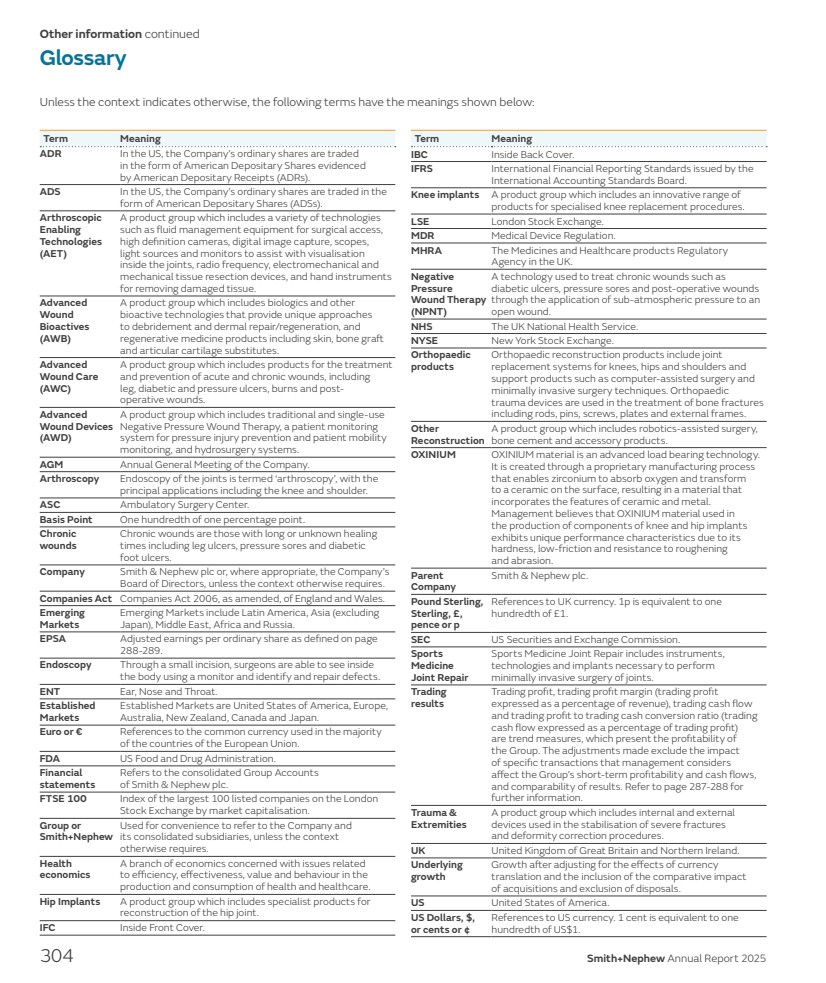
| Accounting policies 214–265 Accounts presentation 297 Acquisitions 10, 15, 16, 20–21, 23, 24–25, 32, 68, 76–77, 83, 91–93, 96, 113, 118, 144, 215, 220–221, 232–234, 265 Acquisition and disposal related items 16, 23, 220–222, 225, 288–289 American Depositary Shares 293 Articles of Association 195–196 Audit fees 145, 223 Board 102–107 Business overview 2–5, 274 Business segment information 39–53, 217–221 Cash and borrowings 239–241 Chair’s statement 4-5 Chief Executive Officer’s review 6–11 Company balance sheet 266 Company notes to the accounts 268–273 Contingencies 250–253, 270 Critical judgements and estimates 216 Cross-reference to Form 20-F 299–301 Currency fluctuations 284 Currency translation 217 Deferred taxation 224–227 Directors’ Remuneration Report 147–193 Directors’ responsibility statement 198 Dividends 14, 16, 25, 260–261, 294 Earnings per share 16, 227 Employee share plans 265 Executive team 108–109 Factors affecting results of operations 278 Financial instruments 242–251 Financial review 18–25 Free cash flow 23, 25, 147–193, 290 Glossary of terms 304 Goodwill 230–231 Group balance sheet 212 Group cash flow statement 213 Group companies 270–273 Group history 297 Group income statement 211 Group notes to the accounts 215–265 Group overview 2–5, 274 Group statement of changes in equity 214 Group statement of comprehensive income 211 Independent auditor’s report 199–210 Intangible assets 232–234 Intellectual property disputes 252 Interest and other finance costs 223 Inventories 236 Investments 234 Investment in associates 234–235 Key Performance Indicators 16–17 Legal and other 16, 20–23, 220–222, 251, 288–289 Legal proceedings 252 Leverage ratio 290 Liquidity and capital resources 23, 241 Manufacturing and quality 32–35 Net debt 263 New accounting standards 215–216 Operating profit 221–222 Other finance costs 223 Our approach to stakeholders 114–120 Our global markets 39, 44, 49 Outlook and trend information 5, 19, 275–284 People/Employees 59–63 Post balance sheet events 265 Provisions 250–252 Property, plant and equipment 228–229 Regulation 35, 62–63, 69–71, 84–92, 118, 122–123, 131–132, 138, 198 Related party transactions 265, 274 Research & development 27–32, 221–222 Restructuring and rationalisation expenses 23, 222 Retirement benefit obligations 144, 253–259 Return on invested capital (ROIC) 16, 19, 24–25, 287, 291–292 Risk factors 275–284 Risk report 78–96 SASB reporting 302–303 Share-based payments 265 Share capital 194–195 Shareholder information 293–298 Staff costs and employee numbers 223 Stakeholder statement 114–116 Statement of compliance 100 Strategy for Growth 9 Sustainability 64–77 Taxation 224–227 Taxation information for shareholders 295–297 TCFD reporting 69–72 Total shareholder return 179 Trade and other payables 238 Trade and other receivables 237–238 Treasury shares 260–261 Smith+Nephew Annual Report 2025 305 STRATEGIC REPORT GOVERNANCE ACCOUNTS OTHER INFORMATION Index 28_SN_AR25_Info_Share_v130.indd 305 05/03/2026 17:41 |
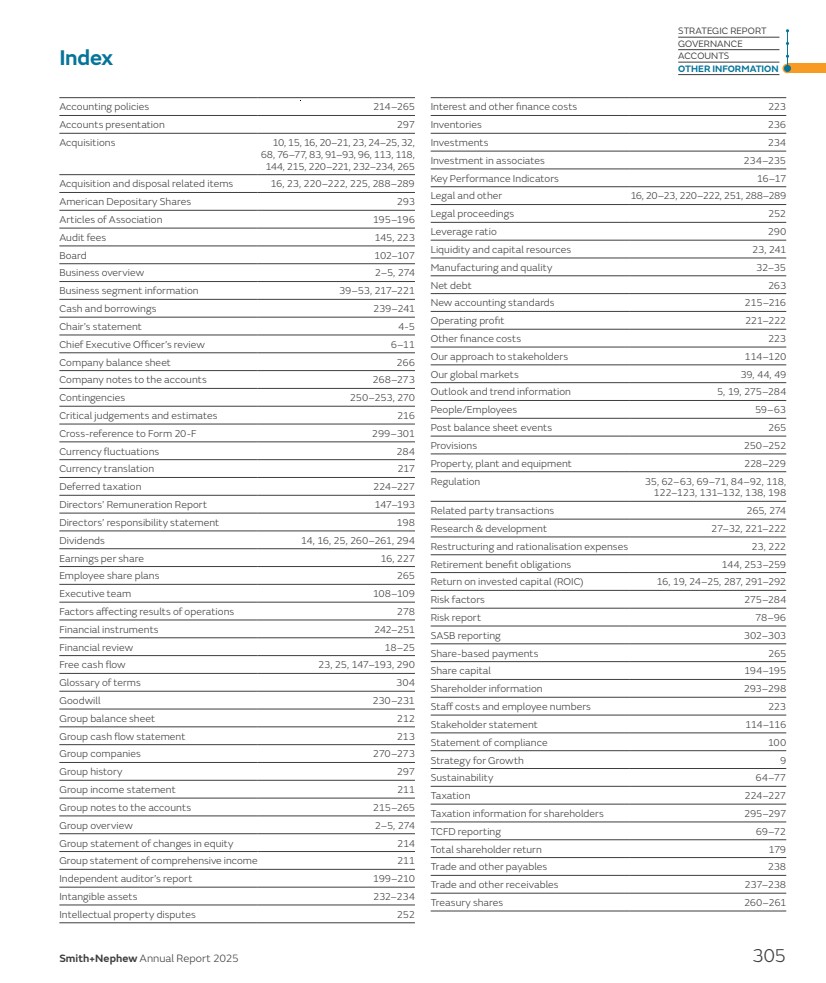
| References from Research & Development (pages 27-32) 1 Coenen R, Peeters A, Nathwani D, Albelooshi A, Ettinger M, Verheyden F, Mievis J, Meshram P, Schotanus M, Bollars P. Improved Clinical Outcomes with Imageless Robotic-Assisted vs Conventional Total Knee Arthroplasty: 2-year RCT Results. Presented at: EKS Open Meeting, 18-19 June 2025; Copenhagen, Denmark 2 Australian Orthopaedic Association National Joint Replacement Registry (AOANJRR) Hip, Knee & Shoulder Arthroplasty: 2025 Annual Report Adelaide; AOA, 2025:1-727. Available at: https://aoanjrr.sahmri.com/annual-reports-2025. Accessed October 2, 2025 (see page 306) 3 Ruiz Ibán MA, García Navlet M, Moros Marco S, et al. Augmentation of a Posterosuperior Cuff Repair With a Bovine Bioinductive Collagen Implant Shows a Lower Retear Rate but Similar Outcomes Compared With No Augmentation: 2-Year Results of a Randomized Controlled Trial. Arthroscopy. 2025;41(10):3869-3879. doi:10.1016/j.arthro.2025.03.057 4 Sherman SL. Aragonite-Based Scaffold Versus Microfracture and Debridement for the Treatment of Knee Chondral and Osteochondral Lesions: Results of a Multicentre Randomized Controlled Trial at 5 Years Follow-up. Oral presentation at: American Orthopaedic Society for Sports Medicine; July 10–12, 2025; Nashville, TN, USA. 5 Chorney SR, Johnson RF, Mitchell RB. Cost-utility analysis of intracapsular and extracapsular techniques for paediatric tonsillectomy. Laryngoscope. Published online July 23, 2025. 6 Orlova D, Orlov A, Gefen A. The protective efficacy of a new soft silicone multi-layer dressing in reducing the heel pressure ulcer risk. Int Wound J. 2025;22(1):e70764. 7 Vilkins A, Nherera L, Searle R, Welsh T. Prophylactic negative pressure wound therapy for caesarean section: a real world evidence study. Wounds. 2025;37(4):152–157. 8 SmartTRAK, 2025, Shoulder Soft Tissue Fixation, 2025 BioMedGPS — SmartTRAK. 9 Hein J, et al. Arthroscopy. 2015;31(11):2274- 2281. 10 Data on File at Integrity Orthopaedics. 11 Camacho Chacón JA, Roda Rojo V, Martin Martinez A, Cuenca Espierrez J, Garcia Calvo V, Calderón Meza JM, Martin Hernandez C. An isolated bioinductive repair vs. sutured repair for full-thickness rotator cuff tears: 2-year results of a double blinded, randomized controlled trial. J Shoulder Elbow Surg, 2024. 12 Ruiz Ibán M, García Navlet M, Moros Marco S, Diaz Heredia J, Hernando Sánchez A, Ruiz Díaz R, Vaquero Comino C, Rosas Ojeda ML, Del Monte Bello G, Ávila Lafuente JL. Augmentation of a Transosseous-Equivalent Repair in Posterosuperior Nonacute Rotator Cuff Tears With a Bioinductive Collagen Implant Decreases the Retear Rate at 1 Year: A Randomized Controlled Trial. Arthroscopy 40(6): 1760, 2024. 13 ArthroCare Corporation 2017. Report: Design Verification, 1.8mm Q-FIX MINI Soft Suture Anchor. P/N 49190-03 Rev. B. 14 Barber FA, Herbert MA. All-Suture Anchors: Biomechanical Analysis of Pullout Strength, Displacement, and Failure Mode. Arthroscopy. 2017;33(6):1113-1121. 15 Douglass NP, Behn AW, Safran MR. Cyclic and Load to Failure Properties of All-Suture Anchors in Synthetic Acetabular and Glenoid Cancellous Bone. Arthroscopy. 2017;33(5):977-985 e975. 16 Ruder JA, Dickinson EY, Peindl RD, Habet NA, Trofa DP, Fleischli JE. Cyclic and Load-to-Failure Properties of All-Suture Anchors in Human Cadaveric Shoulder Glenoid Bone. Arthroscopy. 2019;35(7):1954-1959 e1954. 17 Smith+Nephew 2023. Q-FIX with MINITAPE Claims Report. Internal Report. 10090792- Revision B. 18 Smith+Nephew 2024 Internal Report, 10144423 Rev B. 19 Ergun S, Akgun U, Barber A, Karahan M. The Clinical and Biomechanical Performance of All-Suture Anchors: A Systematic Review. Arthroscopy. 2020; 2(3): e263-e275. 20 SmartTRAK Report, 2023. References from Orthopaedics (pages 39-43) 1 Smith+Nephew. Evidence Outcomes Report EO.TRA. PCS001.v1. 2021. 2 Quartley M, Chloros G, Papakostidis K, Saunders C, Giannoudis PV. Stabilisation of AO OTA 31-A unstable proximal femoral fractures: Does the choice of intramedullary nail affect the incidence of post-operative complications? A systematic literature review and meta-analysis. Injury. 2022;53(3):827–840. 3 Iriuchishima T, Ryu K. A Comparison of Rollback Ratio between Bicruciate Substituting Total Knee Arthroplasty and Oxford Unicompartmental Knee Arthroplasty. J Knee Surg. 2018;31(6):568–572. 4 Murakami K, Hamai S, Okazaki K, et al. Knee kinematics in bi-cruciate stabilized total knee arthroplasty during squatting and stair climbing activities. J Orthop. 2018;15(2):650–654. 5 Carpenter RD, Brilhault J, Majumdar S, Ries MD. Magnetic resonance imaging of in vivo patellofemoral kinematics after total knee arthroplasty. Knee. 2009;16(5):332-336. 6 Grieco TF, Sharma A, Dessinger GM, Cates HE, Komistek RD. In Vivo Kinematic Comparison of a Bicruciate Stabilized Total Knee Arthroplasty and the Normal Knee Using Fluoroscopy. J Arthroplasty. 2018;33(2):565-571. 7 Smith LA, Nachtrab J, LaCour M, et al. In Vivo Knee Kinematics: How Important Are the Roles of Femoral Geometry and the Cruciate Ligaments? J Arthroplasty. 2021;36:1445-1454. 8 Australian Orthopaedic Association National Joint Replacement Registry (AOANJRR) Hip, Knee & Shoulder Arthroplasty: 2024 Annual Report Adelaide; AOA, 2024:1–629. Available at: https://aoanjrr.sahmri.com/annual-reports-2024. Accessed December 11, 2024 9 Yayac M, Harrer S, Hozack WJ, Parvizi J, Courtney M. The use of cementless components does not significantly increase procedural costs in total knee arthroplasty. J Arthroplasty. 2020;35:407–712. 10 Watson J, Jordan J. LEGION◊ Primary Knee System for total knee arthroplasty: Design rationale and early results. Bone & Joint Science. 2015;5(1):1-8. 11 American Joint Replacement Registry (AJRR) 2024 Annual Report. 12 Smith + Nephew 2024. Internal Report. 10143423 Rev A. 13 Smith + Nephew 2024. Internal Report. 10144794. 13.Smith+Nephew 2020. NAVIO Technical Specification Comparison. March 2020. Internal Report ER0488 REVB. 14 National Joint Registry for England, Wales, Northern Ireland and the Isle of Man: 20th Annual Report. 2023. 15 Australian Orthopaedic Association National Joint Replacement Registry (AOANJRR). Hip, Knee & Shoulder Arthroplasty: 2024 Annual Report. Adelaide: AOA, 2024. 16 Peters RM, Van Steenbergen LN, Stevens M, Rijk PC, Bulstra SK, Zijlstra WP. The effect of bearing type on the outcome of total hip arthroplasty. Acta Orthop. 2018:89;163–169 17 Atrey A, Ancarani C, Fitch D, Bordini B. Impact of bearing couple on long-term component survivorship for primary cementless total hip replacement in a large arthroplasty registry. Poster presented at: Canadian Orthopedic Association; June 20–23, 2018; Victoria, British Columbia, Canada. 18 Davis ET, Pagkalos J, Kopjar B. Bearing surface and survival of cementless and hybrid total hip arthroplasty in the National Joint Registry of England, Wales, Northern Ireland and the Isle of Man. JBJS OA. 2020;5:e0075. 19 Smith+Nephew 2020. NAVIO Technical Specification Comparison. March 2020. Internal Report ER0488 REVB. 20 Smith+Nephew 2020. Comparison of operating room footprint for robotic-assisted knee arthroplasty systems. Internal Report. EO.REC. PCS015.002.v1. 21 Gregori A, Picard F, Bellemans J, Smith JR, Simone A. Handheld Precision Sculpting Tool for Unicondylar Knee Arthroplasty. A Clinical Review. Poster presented at: 15th EFORT Congress; 4–6 June, 2014; London, UK. 22 Bollars P, Boeckxstaens A, Mievis J, Janssen D. The Learning Curve and Alignment Assessment of an Image-Free Handheld Robot in TKA: The First Patient Series in Europe. Poster presented at: 19th Annual Meeting of the International Society for Computer Assisted Orthopaedic Surgery 2019; New York, USA. 23 Kopjar B, Schwarzkopf R, Chow J, et al. NAVIO Robotic Assisted Surgical System for Total Knee Arthroplasty Using JOURNEY II Guided-Motion Total Knee System. Poster presented at: ISTA 2–5 October, 2019; Toronto, Canada. 306 Smith+Nephew Annual Report 2025 References from business unit sections Other information continued 28_SN_AR25_Info_Share_v130.indd 306 05/03/2026 17:41 |
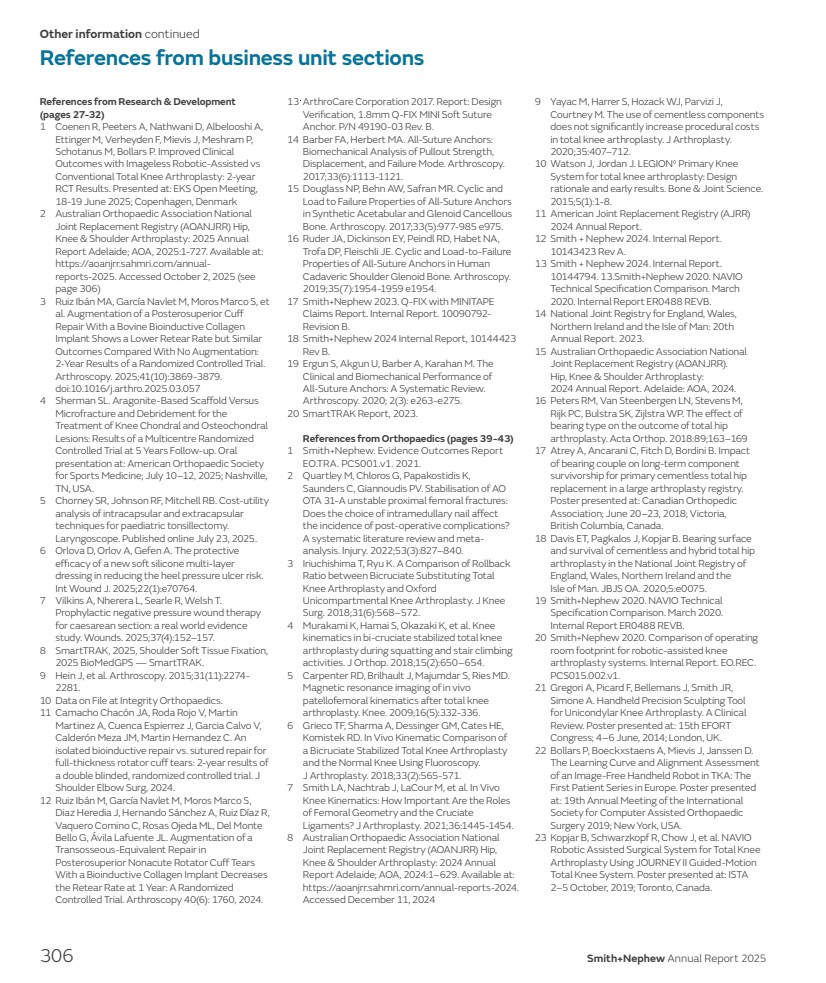
| 57 Hallab NJ, McAllister K, Jacobs JJ, and Pawar, V. Zirconium-Alloy and Zirconium-Oxide Particles Produce less Toxicity and Inflammatory Cytokines than Cobalt-Alloy and Titanium-Alloy Particles In Vitro, in Human Osteoblasts, Fibroblasts and Macrophages. 2012 Annual Meeting of the Orthopaedic Research Society. Poster no. 0971. 58 Smith+Nephew 2023. Internal Report 10140753. I20-4GEN-A TRIGEN MAX Tibia Validation Lab 59 Smith+Nephew 2023. Internal Report. ER-04-0990-0019. 41.Smith+Nephew 2023. Internal Report. ER-04-0990-0020. 42. Smith+Nephew 2022. Optimus TKA Tensioner Gap 60 Smith + Nephew 2023. Cadaver Validation of the CATALYSTEM Total Hip System. Internal Report. OR-23-106. 61 Smith+Nephew 2023. Internal Report. ER-04-0990-0020. 62 Smith + Nephew 2024. Internal Report. 10143591. 63 Smith + Nephew 2024. Internal Report. OR-24-025. 64 Smith + Nephew 2024. Internal Report. 10142796. 36. Smith+Nephew 2024. Internal Report. 10142827. 65 Smith+Nephew 2024. Internal Report. TM-24-034. 66 37. Smith+Nephew 2024. Internal Report. TM-24-034. 38. Smith+Nephew 2024. Internal Report. 10143458 Rev A. 67 Smith+Nephew 2024. Internal Report. 10143458 Rev A. * Based on BSC evidence. ** We thank the patients and staff of all the hospitals in England, Wales and Northern Ireland who have contributed data to the National Joint Registry. We are grateful to the Healthcare Quality Improvement Partnership (HQIP), the NJR Steering Committee and staff at the NJR Centre for facilitating this work. The views expressed represent those of the authors and do not necessarily reflect those of the National Joint Registry Steering Committee or the Health Quality Improvement Partnership (HQIP) who do not vouch for how the information is presented. *** Compared to NAVIO™ Handheld Robotics. **** Compared to Mako and ROSA. ***** With use of handpiece. † Compared to a competitive shoulder system. 24 Geller JA, Rossington A, Mitra R, Jaramaz B, Khare R, Netravali NA. Rate of learning curve and alignment accuracy of an image-free handheld robot for total Knee Arthroplasty. European Knee Society Arthroplasty Conference; 2019; Valencia, Spain. 25 Ponzio DY, Lonner JH. Preoperative Mapping in Unicompartmental Knee Arthroplasty Using Computed Tomography Scans Is Associated with Radiation Exposure and Carries High Cost. J Arthroplasty. 2015;30(6):964–967. 26 Smith+Nephew 2025. 10152295 REVA. Shoulder Modeler TR - Session Management & Notifications/Warnings/Errors 27 Smith+Nephew 2025. 10152290 REVA. Shoulder Modeler TR - CORIOGRAPH Plan Page 28 Smith+Nephew 2025. 10152289 REVA. Shoulder Modeler TR - General Features 29 Smith+Nephew 2025. 10152294 REVA. Shoulder Modeler TR - Report Page 30 Smith+Nephew 2025. 10152293 REVA. Shoulder Modeler TR - Implant Planning 31 Smith+Nephew 2025. 10152196 REVB. CORIOGRAPH Modeler Unit Test Execution Report 32 Naito Y, et al. BMC Muscoskeletal Disorders. 2021:1:1-8. 33 Smith+Nephew 2023. Internal Report 10092864 Ver A.7. I20-4GEN-A Verification Activity - TRIGEN MAX Tibial Nail 34 Smith+Nephew 2023. Internal Report 10092852 Ver A. I20-4GEN-A Verification Activity - Screw Prominence 35 Rampurada A, et al. Eur J Orthop Surg Traumatol. 2008;18:521-524. 36 Ashfaq K, et al. J Knee Surg. 2012;25:375-384. 37 Catagni MA, et al. Medicalplastic; 1994:5. 38 Smith+Nephew 2023. AETOS Inlay Design Features. Internal Report. ER-04-0990-0017. 39 Arenas-Miquelez A, Murphy R, Rosa A, Caironi D, Zumstein M. Impact of humeral and glenoid component variations on range of motion in reverse geometry total shoulder arthroplasty. A standardised computer model study. (8214). Swiss Medical Weekly. 2020;150(SUPPL 244):2S. 40 Kalouche I, Sevivas N, Wahegaonker A, Sauzieres P, Katz D, Valenti P. Reverse shoulder arthroplasty: Does reduced medialisation improve radiological and clinical results? Acta Orthopaedica Belgica. 2009;75(2):158–166. 41 Lädermann A, Tay E, Collin P, et al. Effect of critical shoulder angle, glenoid lateralization, and humeral inclination on range of movement in reverse shoulder arthroplasty. Bone Joint Res. 2019;8(8):378–386. 42 National Joint Registry for England, Wales and Northern Ireland: 21st Annual Report. 2024. Available at: NJR 21st Annual Report 2024_Hips. pdf. Accessed January 06, 2025. 43 Whitehouse MR, Patel R, French JMR, et al. The association of bearing surface materials with the risk of revision following primary total hip replacement: A cohort analysis of 1,026,481 hip replacements from the National Joint Registry. PLoS Med 2024;21(11): e1004478. 44 Peters RM, Van Steenbergen LN, Stevens M, Rijk PC, Bulstra SK, Zijlstra WP. The effect of bearing type on the outcome of total hip arthroplasty. Acta Orthop. 2018:89;163–169. Available at: https://www.ncbi.nlm.nih.gov/pmc/articles/ PMC5901513/. Accessed November 9, 2023. 45 Atrey A, Ancarani C, Fitch D, Bordini B. Impact of bearing couple on long-term component survivorship for primary cementless total hip replacement in a large arthroplasty registry. Poster presented at: Canadian Orthopedic Association; June 20–23, 2018; Victoria, British Columbia, Canada. 46 Hunter G, Dickinson J, Herb B, et al. Creation of oxidized zirconium orthopaedic implants. Journal of ASTM International. 2005;2:1-14. 47 Long M, Riester L, Hunter G. Nano-hardness Measurements of Oxidized Zr-2.5Nb and Various Orthopaedic Materials. Abstract presented at: 24th Annual Meeting of the Society for Biomaterials. April 22-26, 1998, San Diego, California. 48 Parikh A, Hill P, Hines G, Pawar V. Wear of conventional and highly crosslinked polyethylene liners during simulated fast walking/jogging. Poster presented at: Orthopaedic Research Society Annual Meeting; 2009; Las Vegas; NV. 49 Parikh A, Hill P, Pawar V, Sprague J. Long-term Simulator Wear Performance of an Advanced Bearing Technology for THA. Poster presented at: 2013 Annual Meeting of the Orthopaedic Research Society. Poster no. 1028. 50 Papannagari R, Hines G, Sprague J, Morrison M. Long-term wear performance of an advanced bearing technology for TKA. Poster presented at: Orthopaedic Research Society Annual Meeting; 2011; Long Beach, CA. 51 Smith+Nephew 2010. OR-10-155. 52 Aldinger P, Williams T, Woodard E. Accelerated fretting corrosion testing of zirconia toughened alumina composite ceramic and a new composition of ceramicised metal femoral heads. Poster presented at: Orthopaedic Research Society Annual Meeting; 2017; San Diego, CA. 53 Smith+Nephew 2016. OR-16-127. 54 2005 ASM International Engineering Materials Achievement Award. 55 Dalal A, Pawar V, McAllister K, Weaver C, Hallab NJ. Orthopedic implant cobalt-alloy particles produce greater toxicity and inflammatory cytokines than titanium alloy and zirconium alloy-based particles in vitro, in human osteoblasts, fibroblasts, and macrophages. J Biomed Mater Res Part A. 2012;100A:2147-2158. 56 ASTM F2384-24 (May 2024). Standard specification for wrought zirconium-2.5niobium alloy for surgical implant applications (UNS R60901). Available at: https://www.astm.org/ f2384-10r16.html. Accessed February 27, 2025 Smith+Nephew Annual Report 2025 307 STRATEGIC REPORT GOVERNANCE ACCOUNTS OTHER INFORMATION 28_SN_AR25_Info_Share_v130.indd 307 05/03/2026 17:41 |

| References from Sports Medicine & ENT (pages 44-48) 1 Benthami Kbibi M, Verhaegen F, Debeer P. The Clinical Efficacy of the Regeneten Bioinductive Implant in Rotator Cuff Repair: A Systematic Review. Acta Orthop Belg. 2024;90(4):777-788. 2 Tian J, Ding F, Wang Z, et al. Resorbable Bio-Inductive Collagen Implant for Rotator Cuff Repair: What We Know, What We Need to Know, and the Path Forward. Orthop Surg. 2025;17(9):2541-2557. 3 Arnoczky SP, Bishai SK, Schofield B, et al. Histologic Evaluation of Biopsy Specimens Obtained After Rotator Cuff Repair Augmented With a Highly Porous Collagen Implant. Arthroscopy. 2017;33(2):278-283. 4 Berthold DP, Garvin P, Mancini MR, et al. Arthroscopic rotator cuff repair with biologically enhanced patch augmentation. Oper Orthop Traumatol. 2022;34(1):4-12. 5 Bushnell BD, Jarvis BT, Jarvis RC, Jr., Piller CP, Baudier RS. Minimal Stiffness After Rotator Cuff Repair With Bioinductive Collagen Implants. J Am Acad Orthop Surg Glob Res Rev. 2025;9(10). 6 Castle JP, Kasto JK, Jiang EX, et al. Arthroscopic rotator cuff repair with bioinductive patch achieves equivalent patient-reported outcomes and retear rate at 1 year. Shoulder Elbow. 2025:17585732251317954. 7 Delgado C, Rodríguez G, Ortega C, López V, Ardévol J, Calvo E. Biological augmentation in revision surgery: effect of a bioinductive collagen patch (REGENETEN) in patients with rotator cuff retear and a previous arthroscopic rotator cuff repair. Journal of Shoulder and Elbow Surgery. 2025. 8 Haft M, Li SS, Pearson ZC, Ahiarakwe U, Bettencourt AF, Srikumaran U. No Short-term Clinical Benefit to Bovine Collagen Implant Augmentation in Primary Rotator Cuff Repair: A Matched Retrospective Study. Clin Orthop Relat Res. 2025;483(3):442-452. 9 Kinjo H, Suenaga N, Oizumi N, Nishida K. Safety of bioinductive bovine collagen implants for arthroscopic rotator cuff repair. JSES International. 2025;9(4):1177-1182. 10 Micheloni GM, Salmaso G, Zecchinato G, Giaretta S, Barison E, Momoli A. Bio-inductive implant for rotator cuff repair: our experience and technical notes. Acta Biomed. 2020;91(14-S):e2020004. 11 Rab P, Shirinskiy IJ, Kimmeyer M, et al. Augmentation of full-thickness rotator cuff tears with a bioinductive collagen implant does not reduce retear rates – a propensity matched cohort study. BMC Musculoskeletal Disorders. 2025;26(1):855. 12 Ruiz Iban MA, Garcia Navlet M, Moros Marco S, et al. Augmentation of a Posterosuperior Cuff Repair With a Bovine Bioinductive Collagen Implant Shows a Lower Retear Rate but Similar Outcomes Compared With No Augmentation: 2-Year Results of a Randomized Controlled Trial. Arthroscopy. 2025;41(10):3869-3879. 13 Yoo J, Lee D. The Clinical Outcomes of a Bioinductive Collagen Implant in Bursal-Sided Partial-Thickness Rotator Cuff Tears. Medicina. 2025;61(6):988 14 Bokor DJ, Sonnabend D, Deady L, et al. Evidence of healing of partial-thickness rotator cuff tears following arthroscopic augmentation with a collagen implant: 2-year MRI follow-up. Muscles, Ligaments Tendons J 2016;6(1):16–25. 15 Schlegel TF, Abrams JS, Bushnell BD, Brock JL, Ho CP. Radiologic and clinical evaluation of a bioabsorbable collagen implant to treat partial-thickness tears: a prospective multicenter study. J Shoulder Elbow Surg. 2018 27(2):242–251. 16 Bokor DJ, Sonnabend DH, Deady L, et al. Healing of partial-thickness rotator cuff tears following arthroscopic augmentation with a highly porous collagen implant: a 5-year clinical and MRI follow-up. Muscles, Ligaments Tendons J. 2019;9(3):338–347. 17 McElvany MD, McGoldrick E, Gee AO, Neradilek MB, Matsen FA, 3rd. Rotator cuff repair: published evidence on factors associated with repair integrity and clinical outcome. Am J Sports Med. 2015;43(2):491–500. 18 McIntyre LF, McMillan S, Trenhaile SW, Bishai SK, Bushnell BD. Full-Thickness Rotator Cuff Tears Can Be Safely Treated With Resorbable Bioinductive Bovine Collagen Implant: One-Year Results of a Prospective, Multicenter Registry. Arthrosc Sports Med Rehabil. 2021 Aug 20;3(5):e1473– e1479. 19 Bushnell BD, Bishai SK, Krupp RJ, McMillan S, Schofield BA, Trenhaile SW, McIntyre LF. Treatment of Partial-Thickness Rotator Cuff Tears With a Resorbable Bioinductive Bovine Collagen Implant: 1-Year Results From a Prospective Multicenter Registry. Orthop J Sports Med. 2021 Aug 13;9(8). 20 Camacho Chacón JA, Roda Rojo V, Martin Martinez A, et al. An isolated bioinductive repair vs sutured repair for full-thickness rotator cuff tears: 2-year results of a double blinded, randomized controlled trial. J Shoulder Elbow Surg. 2024;33(9):1894-1904. 21 American Academy of Orthopedic Surgeons (AAOS). Rotator Cuff Repair Clinical Practice Guideline. Available at: https://www.aaos.org/ quality/quality-programs/clinical-practice-guidelines/ (Accessed January 2026) 22 Vonhoegen J, John D, Hägermann C. Osteoconductive resorption characteristics of a novel biocomposite suture anchor material in rotator cuff repair. Orthop Traumatol Surg Res. 2019;14(1):12. 23 Smith+Nephew 2010. Micro-CT and histological evaluation of specimens from resorbable screw study (RS-II/OM1-08) 24-month post-implantation. Internal Report WRP-TE045-700-08. 24 Smith+Nephew 2016. Healicoil Regenesorb Suture Anchor – a study to assess implant replacement by bone over a 2 year period. NCS248. 25 Douglass NP, Behn AW, Safran MR. Cyclic and Load to Failure Properties of All-Suture Anchors in Synthetic Acetabular and Glenoid Cancellous Bone. Arthroscopy. 2017;33(5):977-985 e975. 26 Smith and Nephew 2023. Q-FIX with MINITAPE Claims Report. Internal Report. 10090792- Revision B. 27 ArthroCare Corporation 2017. Report: Design Verification, 1.8mm Q-FIX MINI Soft Suture Anchor. P/N 10144423B. 28 Ergun S, Akgun U, Barber A, Karahan M. The Clinical and Biomechanical Performance of All-Suture Anchors: A Systematic Review. Arthroscopy. 2020; 2(3): e263-e275. 29 ArthroCare Corporation 2017. Report: Design Verification, 1.8mm Q-FIX MINI Soft Suture Anchor P/N 49190-03 Rev. B. 30 Bernardoni E, Frank RM, Veera SS, et al. Biomechanical Analysis of All-Suture Anchor Fixation for Rotator Cuff Repair. Orthop J Sports Med. 2018;6(7 suppl4). 31 Saper MG, Meijer K, Winnier S, Popovich J, Jr., Andrews JR, Roth C. Biomechanical Evaluation of Classic Solid and All-Soft Suture Anchors for Medial Patellofemoral Ligament Reconstruction. Am J Sports Med. 2017;45(7):1622-1626. 32 ArthroCare 2019. Comparative Testing of Bone Anchor Devices, 1.8mm Q-FIX Mini Soft Suture Anchor P/N 49193-02 Rev.B. 33 Barber FA, Herbert MA. All-Suture Anchors: Biomechanical Analysis of Pullout Strength, Displacement, and Failure Mode. Arthroscopy. 2017;33(6):1113-1121. 34 Nagra NS, Zargar N, Smith RD, Carr AJ. Mechanical properties of all-suture anchors for rotator cuff repair. Bone Joint Res. 2017;6(2):82-89. 35 Ruder JA, Dickinson EY, Peindl RD, Habet NA, Trofa DP, Fleischli JE. Cyclic and Load-to-Failure Properties of All-Suture Anchors in Human Cadaveric Shoulder Glenoid Bone. Arthroscopy. 2019;35(7):1954-1959 e1954. 36 ArthroCare Corporation 2017. Report: Design Verification, 1.8mm Q-FIX MINI Soft Suture Anchor. P/N 10144423B. 37 Smith+Nephew 2020. Safety and Performance of Q-Fix All-Suture Anchor System. Internal Report. 17-5010-11. 38 Smith+Nephew 2016.Feasibility, MINITAPE Knot Stack Evaluation and Knot Security.15005268. Rev A 39 Smith+Nephew 2013.ULTRATAPE Pressure Film Testing. 15001847. Rev A. 40 Smith+Nephew 2006.USP Knot Strength, ULTRABRAID (white). ITR-2928. Rev E 41 Smith+Nephew 2021. Internal report. 15010267 Rev A. 42 Altschuler N, Zaslav KR, Di Matteo B, et al. Aragonite-Based Scaffold Versus Microfracture and Debridement for the Treatment of Knee Chondral and Osteochondral Lesions: Results of a Multicenter Randomized Controlled Trial. Am J Sports Med. 2023;51(4):957-967. 308 Smith+Nephew Annual Report 2025 References from business unit sections continued Other information continued 28_SN_AR25_Info_Share_v130.indd 308 05/03/2026 17:41 |
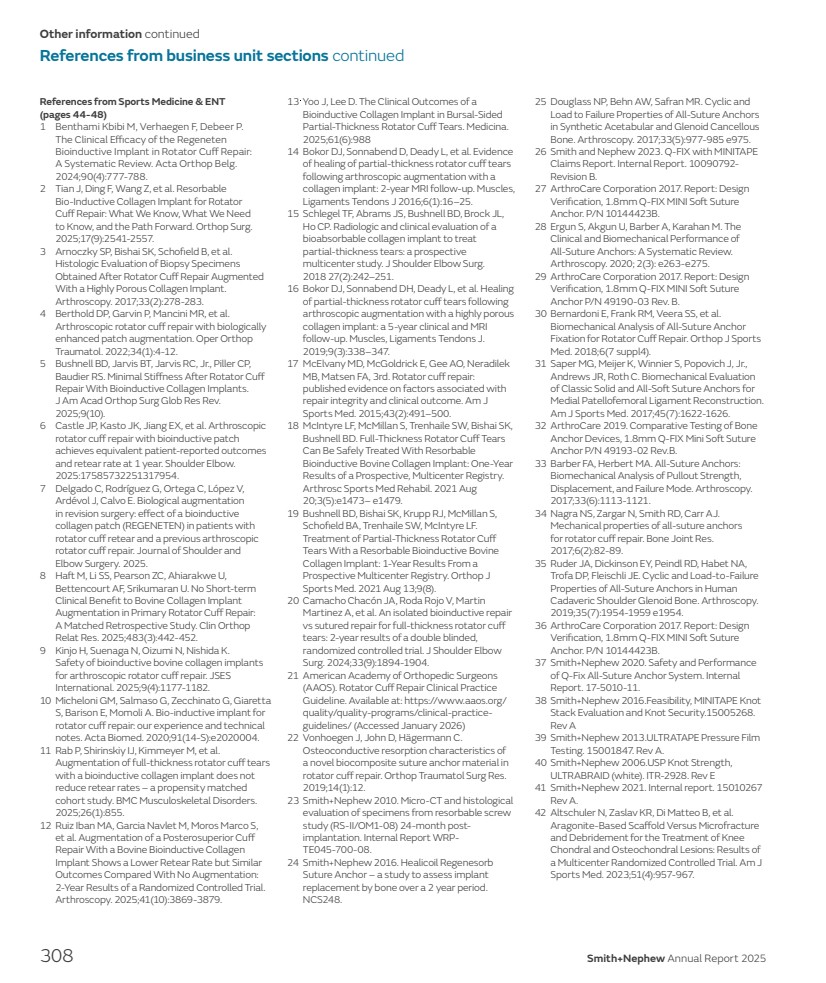
| 43 Kon E, Di Matteo B, Verdonk P, et al. Aragonite-Based Scaffold for the Treatment of Joint Surface Lesions in Mild to Moderate Osteoarthritic Knees: Results of a 2-Year Multicenter Prospective Study. Am J Sports Med.2021;49(3):588-598. 44 Kon E, Robinson D, Verdonk P, et al. A novel aragonite-based scaffold for osteochondral regeneration: early experience on human implants and technical developments. Injury. 2016;47 Suppl 6:S27-S32. 45 Kon E, Filardo G, Shani J, et al. Osteochondral regeneration with a novel aragonite-hyaluronate biphasic scaffold: up to 12-month follow-up study in a goat model. J Orthop Surg Res. 2015;10:81. 46 Conte P, Anzillotti G, Crawford DC, et al. Differential analysis of the impact of lesions’ location on clinical and radiological outcomes after the implantation of a novel aragonite-based scaffold to treat knee cartilage defects. Int Orthop. 2024;48(12):3117-3126 47 U.S. Food & Drug Administration. K242631. https://www.accessdata.fda.gov/cdrh_docs/ pdf24/K242631.pdf 48 Smith+Nephew 2023. Verif, Q-FIX with Needles Hard Bone Insertion, Fixation, and Cyclic. Internal Report. 15012313 Rev A. 49 Smith+Nephew 2023. Verif, Q-FIX with Needles Fixation (12pcf, 25/5pcf), Needle Attachment Strength, and Knot Tensile Strength Testing. Internal Report. 15012288 Rev A. 50 Smith+Nephew 2023. Competitive Claims, Q-FIX with Needles, Fixation Report. Internal Report. 10093596 Rev A. 51 Smith+Nephew 2022. ANAKIN Shock and Vibration (Advantech Test Report). Internal Report. 15011068 Rev A. 52 Smith+Nephew 2022. INTELLIO 4K CCU Environmental Testing. Internal Report. 15010785 Rev A. 53 Smith+Nephew 2022. ANAKIN Expected Life Summary Report. Internal Report. 15011066 Rev A. 54 TUV Rheinland 2022. SNE LENS 4K 60601-1 Report. Internal Report. 31892667.001. 55 ArthoCare 2014. Comparative Performance of the FLOW50 Wand and the Predicate Wands in Tissue Models. P/N 52918-01. 56 Spahn G, Kahl E, Muckley T, Hofmann GO, Klinger HM. Arthroscopic knee chondroplasty using a bipolar radiofrequency-based device compared to mechanical shaver: results of a prospective, randomized, controlled study. Knee Surg Sports Traumatol Arthrosc.2008;16(6):565–573. 57 Smith+Nephew 2021.Protocol, Claims, PLATINUM MDU- Torque. Internal Report. 15011440 Rev A. 58 Smith+Nephew 2017. Coblation Dissection Versus Monopolar Dissection – A Systematic Review and Meta-analysis P/N 91999 Rev. A. 59 Temple RH, Timms MS. Paediatric coblation tonsillectomy. Int J Pediatr Otorhinolaryngol. 2001;61(3):195–198. 51 Smith+Nephew 2010. Temperature Study – PEAK 60 Smith+Nephew 2010. EVac 70 Xtra Comparative Thermal Measurement Bench-Top Study. Internal Report. P/N 60735-01 Rev. A. 61 Roje Z, Racic G, Dogas Z, Pesutić Pisac V, Timms M. Postoperative morbidity and histopathologic characteristics of tonsillar tissue following coblation tonsillectomy in children: A prospective randomized single-blind study. Coll Antropol. 2009;33:293–298. 62 Smith+Nephew 2010. PROCISE LW & MLW, Thermal Measurement and Comparison to CO2 and KTP Laser Systems. Internal Report. P/N 86257 Rev. A. 63 Smith+Nephew 2010. PROcise XP Comparative Thermal Measurement Bench-Top Study. Internal Report. P/N 60736–01 Rev. A. 64 Magdy EA, Elwany S, El-Daly AS, Abdel-Hadi M, Morshedy MA. Coblation tonsillectomy: A prospective, double-blind, randomised, clinical and histopathological comparison with dissection-ligation, monopolar electrocautery and laser tonsillectomies. J Laryngol Otol. 2008;122:282–290. 65 Smith+Nephew 2019. HALO and PROCISE XP Peak Electrode Temperature, ENC053. P/N 108740 Rev. A. 66 Sedgwick MJ, Saunders C, Bateman N. Intracapsular Tonsillectomy Using Plasma Ablation Versus Total Tonsillectomy: A Systematic Literature Review and Meta-Analysis. OTO open. 2023;7(1):e22. 67 Smith+Nephew 2023.ARIS Targeted Hemostasis. Internal Memo. 10094398 Rev A. 68 Lustig LR, Ingram A, Vidrine M, et. al. In-Office Tympanostomy Tube Placement in Children Using Iontophoresis and Automated Tube Delivery. Laryngoscope. 2020;130:S1–S9, 2020. 69 IFU007011, available at www.tulatubes.com/IFU. 70 Singer AJ, Blanda M, Cronin K, et al. Comparison of nasal tampons for the treatment of epistaxis in the emergency department: a randomized controlled trial. Ann Emerg Med. 2005;45(2):134-9. 71 Badran K, Malik TH, Belloso A, Timms MS. Randomized controlled trial comparing MerocelTM and Rapid-RhinoTM packing in the management of anterior epistaxis. Clinical Otolaryngology. 2005;30:333-337. 72 Moumoulidis I, Draper MR, Patel H, Jani P, Price T. A prospective randomised controlled trial comparing Merocel and Rapid Rhino nasal tampons in the treatment of epistaxis. Eur Arch Otorhinolaryngol. 2006;263(8):719-722. *Demonstrated clinically and in-vivo. ** As compared to competitive devices in fixation/ pull-out benchtop testing. *** As demonstrated in benchtop testing. **** As compared to the competitive device in cyclic benchtop testing. ***** Compared to traditional #2 suture. † Testing performed in 2025. †† At the 48-month follow-up, 1.2% (n=2) of patients in the scaffold group and 9.5% (n=8) of patients in the control group (microfracture or debridement) had undergone a knee replacement or osteotomy (p=0.003). ††† The REGENETEN Implant is cleared for use on any tendon where there is not substantial loss of tendon tissue. †††† The REGENETEN Implant is cleared for use on any tendon where there is not substantial loss of tendon tissue. REGENETEN Bone Anchors are only indicated for use in rotator cuff repair. Published clinical outcomes are for rotator cuff. The REGENETEN Implant is currently approved for use in treating Gluteus Medius and Achilles tears only in the US. ††††† As compared to mechanical debridement for knee chondroplasty; n=60; p<0.001. References from Advanced Wound Management (pages 49-52) PICO pullout 1 Norman G, Goh EL, Dumville JC, et al. Negative pressure wound therapy for surgical wounds healing by primary closure (Review). Cochrane Database of Syst Rev. 2020;5(CD009261):1-263. 2 Saunders C, Nherera LM, Horner A, Trueman P. Single-Use negative-pressure wound therapy versus conventional dressings for closed surgical incisions: systematic literature review and meta-analysis. BJS Open. 2021;0(0):1 - 8. Body text 1 Smith+Nephew 2024. Methodology for calculating the reduction in global packaging material and Greenhouse Gas (GHG) emissions of ALLEVYN◊ Dressings. CSD.AWM.24.017. 2 Smith+Nephew 2024. Methodology for calculating the reduction in global packaging material of RENASYS◊ - G Gauze Dressing kit with Softport. CSD.AWM.24.077. 3 Smith+Nephew 2022.Post Market Clinical Follow-Up (PMCF) Report for ALLEVYN GENTLE. CSD.AWM.22.050. 4 Hurd T, Gregory L, Jones A, Brown S.A multi-centre in-market evaluation of ALLEVYN Gentle Border. Wounds UK. 2009;5(3):32-44. 5 Leonard S, Mccluskey P, Long S, et al. An evaluation of Allevyn Adhesive and Non Adhesive foam dressings. Wounds UK. 2009;5(1):17-28. 6 Rossington A, Drysdale K, Winter R. Clinical performance and positive impact on patient wellbeing of ALLEVYN Life. Wounds UK. 2013;9(4):91–95. Smith+Nephew Annual Report 2025 309 STRATEGIC REPORT GOVERNANCE ACCOUNTS OTHER INFORMATION 28_SN_AR25_Info_Share_v130.indd 309 05/03/2026 17:41 |
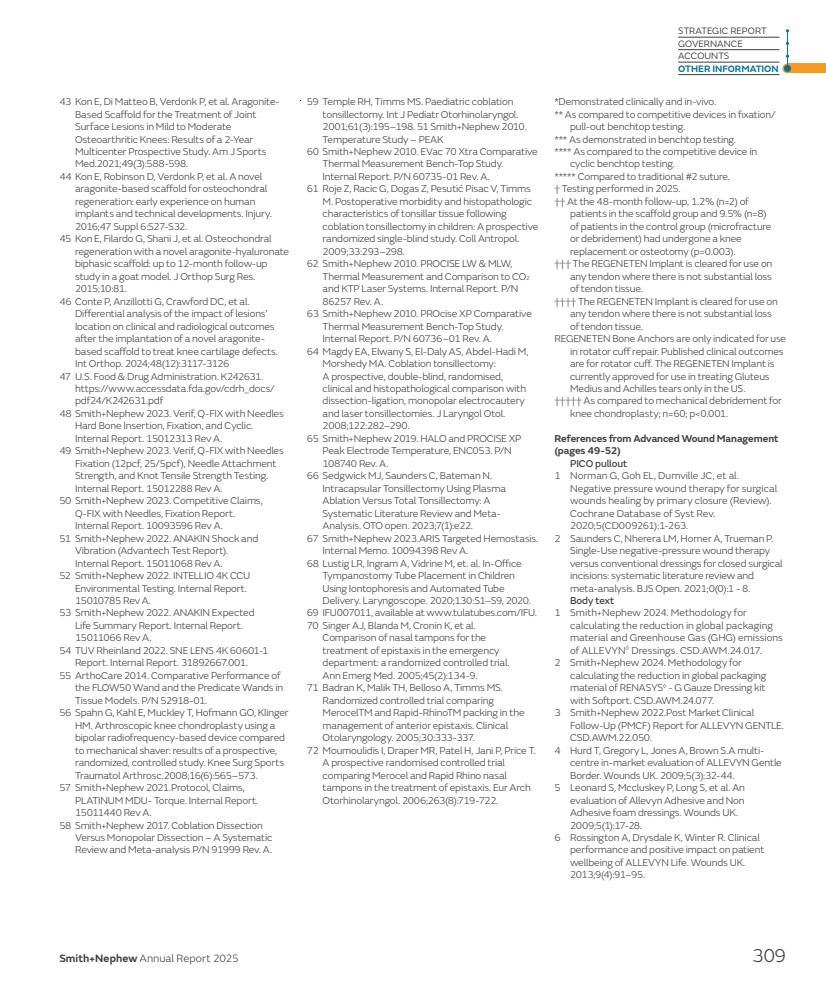
| 7 White, R., Hartwell, S., and Brown,S., Interim report on a study to assess the effectiveness and improved fluid uptake of new ALLEVYN. Wounds UK. 2007; 3(4):122-127 Available here: https://www.woundsinternational.com/ resources/ details/interim-report-on-the-study-to-assess-the- effectiveness-and-improvedfluid-uptake-of-new-allevyn. 8 Tiscar-González V, Menor-Rodríguez MJ, Rabadán-Sainz C, et al. Clinical and Economic Impact of Wound Care Using a Polyurethane Foam Multilayer Dressing. Adv Skin Wound Care. 2021;34(1):23-30. 9 Simon D, Bielby A. A structured collaborative approach to appraise the clinical performance of a new product. Wounds UK. 2014;10(3):80–878. 10 Rossington A, Drysdale K, Winter R. Clinical performance and positive impact on patient wellbeing of ALLEVYN Life. Wounds UK. 2013;9(4):91–95. 11 S+N Data on File. Odour reducing properties of ALLEVYN LIFE. Internal Report. DS/12/127/DOF. 2012. 12 Tiscar-González V, Menor-Rodríguez MJ, Rabadán-Sainz C, et al. Clinical and Economic Impact of Wound Care Using a Polyurethane Foam Multilayer Dressing. Adv Skin Wound Care. 2021;34(1):23-30. 13 Simon D, Bielby A.A structured collaborative approach to appraise the clinical performance of a new product. Wounds UK. 2014;10(3):80–87. 14 S+N Data on File. Wound Model Testing of New ALLEVYN Life Gen2wcl Dressing using Horse Serum at a Flow Rate Modelling that of a Moderately Exuding Wound. DS/14/303/R. 2016. 15 Smith+Nephew 2021. Internal Report. EA/AWM/ ALLEVYN/001v4. 16 SmartTrak Report, 2022. 17 Smith+Nephew. Internal Report. 151008. 18 Nherera LM, Trueman P, Karlakki. Cost-effectiveness analysis of single-use negative pressure wound therapy dressings (sNPWT) to reduce surgical site complications (SSC) in routine primary hip and knee replacements. Wound Repair Regen. 2017;25(4):474-482. 19 Smith+Nephew. Internal Report. RR-WMP07330-10-03. 20 Skog E et al. A randomised trial comparing cadexomer iodine and standard treatment in the out-patient management of chronic venous ulcers. British Journal of Dermatology. 1983;109:77–83. 21 Fitzgerald DJ, Renick PJ, Forrest EM, et al. Cadexomer iodine provides superior efficacy against bacterial wound biofilms in vitro and in vivo. Wound Repair Regen. 2017;25(1):13–24. 22 Roche ED, Woodmansey EJ, Yang Q, et al. Cadexomer iodine effectively reduces bacterial biofilm in porcine wounds ex vivo and in vivo. Int Wound J. 2019;16(3):674–83. 23 Smith+Nephew 2007. Antimicrobial Activity of Allevyn Ag Non-Adhesive Dressing against a Broad Spectrum of Microorganisms. Internal Report. DOF 0703006. 24 Smith+Nephew 2007. Antimicrobial activity of ALLEVYN Ag dressings against a broad spectrum of wound pathogens using a dynamic shake flask method. Internal Report. DOF 0707052. 25 Smith+Nephew 2008. A multi-centre in-market evaluation of ALLEVYN Ag dressings. Internal Report. SR/CIME/009. 26 Smith+Nephew 2018. PMCF Research for Allevyn Ag Adhesive. Internal Report. PMS-273-01. 27 Smith+Nephew 2007. Antimicrobial Activity of ALLEVYN Ag Adhesive Dressing Against a Broad Spectrum of Microorganisms. Internal Report. DOF 0703007. 28 Herman, I. Stimulation of human keratinocyte migration and proliferation in vitro: insights into the cellular responses to injury and wound healing. Wounds. 1996; 8:33-40. 29 Riley et al. Collagenase promotes the cellular responses to injury and wound healing in vivo. J Burns Wounds. 2005; 4:112-124. 30 Shi et al. Degradation of human collagen isoforms by Clostridium collagenase and the effects of degradation products on cell migration. Int Wound J. 2010; 7: 87-95. 31 Sheets AR, Demidova-Rice TN, Shi L, Ronfard V, Grover KV, Herman IM (2016) Identification and Characterization of Novel Matrix-Derived Bioactive Peptides: A Role for Collagenase from Santyl® Ointment in Post-Debridement Wound Healing? PLoS ONE 11(7): e0159598. 32 Lavery LA, Fulmer J, Shebetka KA, et al. The efficacy and safety of Grafix® for the treatment of chronic diabetic foot ulcers: results of a multi-centre, controlled, randomised, blinded clinical trial. Int Wound J. 2014 Oct; 11(5): 554–560. 33 McGinness K, Kurtz Phelan DH. Use of Viable Cryopreserved Umbilical Tissue for Soft Tissue Defects in Patients with Gas Gangrene: A Case Series. Wounds. 2018 Apr; 30(4): 90–95. 34 Nherera LM, Romanelli M, Trueman MA, et al. An Overview of Clinical and Health Economic Evidence Regarding Porcine Small Intestine Submucosa Extracellular Matrix in the Management of Chronic Wounds and Burns. Ostomy Wound Manage. 2017 Dec;63(12): 38-47. 35 Smith+Nephew 2020. Bacterial barrier testing of the PICO dressing. Internal Report. 2001002. 36 Smith+Nephew 2024. Assessment of the Effect of the PICO◊ 7 Single Use Negative Pressure Wound Therapy System and Conventional Dressings on Pre-Established Biofilms in vitro Using a Wound Surface Biofilm Model. Report: AWM.24.065 37 Smith+Nephew July 2018.PICO◊ 7Y Non-NPWT Wound Model Summary. Internal Report. DS.18.260.R. 38 Hurd T, Gilchrist B. Single use negative pressure wound therapy (sNPWT) in the community management of chronic open wounds deeper than 2cm. Paper presented at: Symposium on Advanced Wound Care/Wound Healing Society Meeting; 2020; Abu Dhabi. 39 Smith+Nephew November 2018.The Review Of Evidence Supporting The Use Of PICO◊ In Wounds ≥2cm In Depth. Internal Report. EO. AWM.PCS230.001.v2. 40 Loveluck J, Copeland, T., Hill, J., Hunt, A., and Martin, R., . Biomechanical Modeling of the Forces Applied to Closed Incisions During Single-Use Negative Pressure Wound Therapy. ePlasty. 2016;16:183-195. 41 Casey C. Consistent delivery of therapeutic negative pressure levels by a single use negative pressure wound therapy system (sNPWT)* in a wound model. Paper presented at: EWMA; 2019; Gothenburg, Sweden. 42 Dowsett C, Hampton K, Myers D, Styche T. Use of PICO◊ to improve clinical and economic outcomes in hard-to-heal wounds. Wounds International. 2017;8(2):52-58. 43 Saunders C, Nherera LM, Horner A, Trueman P. Single-Use negative-pressure wound therapy versus conventional dressings for closed surgical incisions: systematic literature review and meta-analysis. BJS Open. 2021;0(0):1–8. 44 Gilchrist B, Robinson M, Jaimes H. Performance, safety, and efficacy of a single use negative pressure wound therapy system for surgically closed incision sites and skin grafts: A prospective multi-centre follow-up study. Paper presented at: SAWC; 2020; Virtual. 45 Hurd T, Trueman P, Rossington A. Use of a portable, single-use negative pressure wound therapy device in home care patients with low to moderately exuding wounds: A case series. Ostomy Wound Manage. 2014;60(3):30-36. 46 Smith & Nephew 2018. PICO 14 Pump weight and dimensions. Internal report. RD/18/137. 47 Smith & Nephew March 2018. Kendal PICO 7Y – pump eight and dimensions. Internal report. DS.18.066.R. 48 Forlee M, van Zyl L, Louw V, Nel J, Fourie N, Hartley R. A randomised controlled trial to compare the clinical efficacy and acceptability of adjustable intermittent and continuous Negative Pressure Wound Therapy (NPWT) in a new portable NPWT system. Paper presented at: EWMA; 2018; Krakow, Poland. 49 Forlee M, Richardson J, Rossington A, Cockwill J, Smith J. An interim analysis of device functionality and usability of RENASYS TOUCH – a new portable Negative Pressure Wound Therapy (NPWT) system. Paper presented at: Wounds UK; 2016; Harrogate, UK. 50 Smith+Nephew 2022. RENASYS EDGE System Human Factors Summative Report Summary. Internal Report. CSD. AWM.22.071. 51 Smith+Nephew 2022. Summary of footprint, portability, wearability, weight and audible noise for the RENASYS EDGE system. Internal Report. CSD.AWM.22.067. 52 Smith+Nephew 2022. Summary of RENASYS EDGE pump mechanical and electronic reliability testing. Internal Report. CSD.AWM.22.069. 53 Smith+Nephew 2022. Summary of RENASYS EDGE pump cleaning, self-test and maintenance. Internal Report. CSD. AWM.22.068 310 Smith+Nephew Annual Report 2025 References from business unit sections continued Other information continued 28_SN_AR25_Info_Share_v130.indd 310 05/03/2026 17:41 |

| 54 Rennekampff HA, Schaller H-E, Wisser D, et al. Debridement of burn wounds with a water jetsurgical tool. Burns. 2006 Feb;32(1):64 - 69. 55 Hyland EJ, D’Cruz R, Menon S, et al. Prospective, randomised controlled trial comparing Versajet® hydrosurgery and conventional debridement of partial thickness paediatric burns. Burns. 2015;41(4):700-707. 56 Rees-Lee JE, Burge T. The indication for Versajet® hydrosurgical debridement in burns. European Journal of Plastic Surgery. 2008;31(4):165-170. 57 Matsumura H, Nozaki M, Watanabe K, et al. The Estimation of Tissue Loss During Tangential Hydrosurgical Debridement. Annals Plast Surg. 2012;69(5):521-525. 58 Caputo WJ, Beggs DJ, DeFede JL, et al. A prospective randomised controlled clinical trial comparing hydrosurgery debridement with conventional surgical debridement in lower extremity ulcers. International Wound Journal. 2008;5(2):288-294. 59 Granick MS, Posnett J, Jacoby M, et al. Efficacy and cost-effectiveness of a high-powered parallel waterjet for wound debridement. Wound Repair and Regeneration. 2006 Jul-Aug;14(4):394-397. 60 Mosti G, Mattaliano V. The debridement of chronic leg ulcers by means of a new, fluidjet-based device. Wounds. 2006;18(8):227-237. 61 Mosti G, Iabichella ML, Picerni P, et al. The debridement of hard to heal leg ulcers by means of a new device based on Fluidjet technology. International Wound Journal. 2005;2(4): 307-314. 62 Murray F. Paper presented at: European Wound Management Association (EWMA); 2007; Glasgow. 63 Granick MS, Jacoby M, Noruthrun S, et al. Clinical and economic impact of hydrosurgical debridement on chronic wounds. Wounds. 2006;18(2):35-39. 64 Smith + Nephew 2005. The use of VERSAJET™ in the limb salvage following failure of minor amputation in diabetic foot. Internal Report. 65 Marche C, Creehan S, Gefen A. The frictional energy absorber effectiveness and its impact on the pressure ulcer prevention performance of multilayer dressings. Int Wound J. 2024;21(4):e14871. 66 Wassel C, Delhougne G, Gayle J et al. Risk of readmissions, mortality, and hospital-acquired conditions across hospital-acquired pressure injury (HAPI) stages in a US National Hospital discharge database. Int Wound J. 2020; 1–11. 67 Delarmente BA. The national cost of hospital-acquired pressure injuries in the United States. Int Wound J. 2019;16(3):634-640. 68 Orlova A, Orlov, Gefen A. The protective efficacy of a new soft silicone multi-layer dressing in reducing the heel pressure ulcer risk. Int Wound J. 2025;22(10): e70764. 69 Nherera L. Meta-analysis shows patient wearable sensor reduces incidence of hospital acquired pressure injuries in critically ill patients. Poster presented at: Symposium on Advanced Wound Care Fall 2022; October 14–16 2022; Las Vegas, NV, USA. 70 Stone A. Preventing Pressure Injuries in Nursing Home Residents Using a Low-Profile Alternating Pressure Overlay: A Point-of-Care Trial. Adv Skin Wound Care. 2020;33(10):533-9. 71 Klaeb M, Krafft K, Walters B, Lowe J, Cooley A. The Influence of Wearable Technology on Nursing Attitudes and Adherence to Patient Turning and Repositioning. Poster presented at: Patient Handling and Mobility Annual Conference; March 5–March 7, 2019; Orlando, Florida, USA. 72 Atkinson L, Costa B. Pressure injury prevention with a unique multi-layer foam dressing: a systematic review and meta-analysis of randomized controlled trials. Poster presented at: European Wound Management Association (EWMA); May 1–3, 2024; London, UK. * Based on ALLEVYN Dressings actual sales in 2023 and shipment of product to our primary distribution warehouses. ** Compared to baseline trajectory, n=52 wounds; p=0.006. *** Compared to standard of care. **** Compared to sharp debridement. ***** OASIS® is a trademark of Cook Biotech Incorporated. This device is derived from a porcine source and should not be used in patients with known sensitivity to porcine materials. This device is not indicated for use in third degree burns. References from Case Studies (pages 53-57) 1 Moore Z, Coggins T (2021) Clinician attitudes to shared-care and perceptions on the current extent of patient engagement in wound care: Results of a clinician survey. Wounds International 12(1): 48–53. 2 Moore Z, et al. Wounds International. 2022;13(2):32–38. 3 Smith+Nephew 2023. S+N video. 2023. 39451. Smith+Nephew Annual Report 2025 311 STRATEGIC REPORT GOVERNANCE ACCOUNTS OTHER INFORMATION 28_SN_AR25_Info_Share_v130.indd 311 05/03/2026 17:41 |
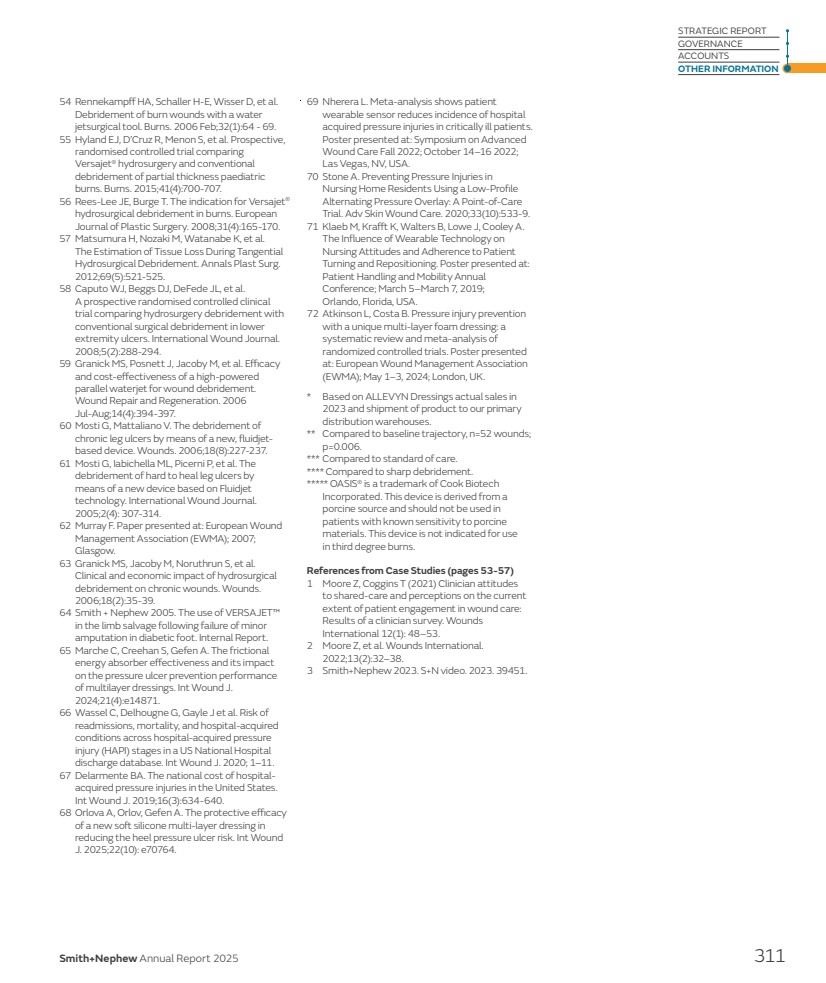
| Financial calendar Annual General Meeting The Company’s Annual General Meeting (AGM) will be held on Wednesday, 6 May 2026 at 12:00 pm at Smith+Nephew Academy London, Building 5, Croxley Park, Hatters Lane, Watford, Hertfordshire, WD18 8YE. Please refer to the Notice of Meeting for detailed information on how to vote and submit your questions. The meeting will commence at 12:00 pm with doors opening from 11:00 am. Registered shareholders have been sent either a Notice of AGM or notification of availability of the Notice of AGM. 2026 Annual General Meeting 6 May First quarter Trading Report 6 May Payment of 2025 final dividend 27 May Half-year results announced 4 August¹ Third quarter Trading Report 4 November Payment of 2026 interim dividend 6 November 2027 Full year results announced February¹ Annual Report available February/March Annual General Meeting April/May 1 Dividend declaration dates. 312 Smith+Nephew Annual Report 2025 28_SN_AR25_Info_Share_P301_P312.indd 312 06/03/2026 21:50 |
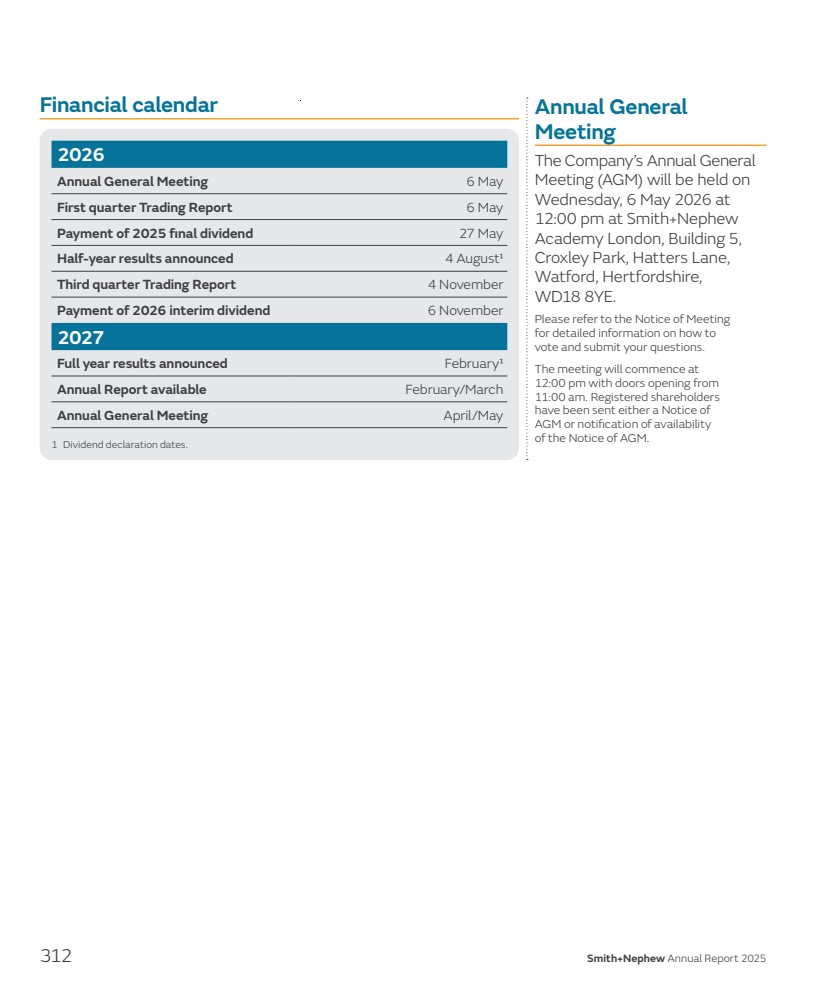
| This report was printed by Park Communications, a certified carbon neutral print company, on Magno Satin an FSC® certified paper. The FSC® label on this product ensures responsible use of the world’s forest resources. Park works to the EMAS standard and its Environmental Management System is certified to ISO 14001. This publication has been manufactured using 100% offshore wind electricity sourced from UK wind. 100% of the inks used are vegetable oil based, 95% of press chemicals are recycled for further use and, on average 99% of any waste associated with this production will be recycled and the remaining 1% used to generate energy. This is a climate neutral print product for which carbon emissions have been calculated and offset by supporting recognised carbon offset projects. CBP035081 28268_S+N_AR25_Flat_Cover_AW_16.5mm_Spine_Bookproof_060326_Final.indd 313 06/03/2026 21:53 |

| Life Unlimited Annual Report 2025 Annual Report 2025 www.smith-nephew.com Smith & Nephew plc Building 5, Croxley Park, Hatters Lane, Watford, Hertfordshire, WD18 8YE, United Kingdom. Tel. +44 (0)1923 477 100 Registered in England and Wales No. 324357. enquiries@smith-nephew.com www.smith-nephew.com 28268_S+N_AR25_Flat_Cover_AW_16.5mm_Spine_Bookproof_060326_Final.indd 1-1 06/03/2026 22:00 |