Please wait
Exhibit (a)(5)(C)
IN THE CIRCUIT COURT OF JACKSON COUNTY, MISSOURI
AT KANSAS CITY
| |
|
|
|
|
|
|
|
|
|
|
|
JOHN M. FOLEY, JR., on behalf of himself
|
|
|
) |
|
|
|
|
|
|
|
and all others similarly situated,
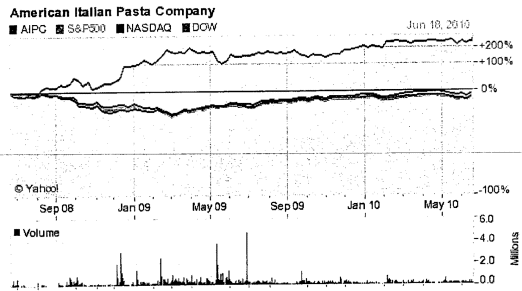
|
|
|
) |
|
|
|
|
|
|
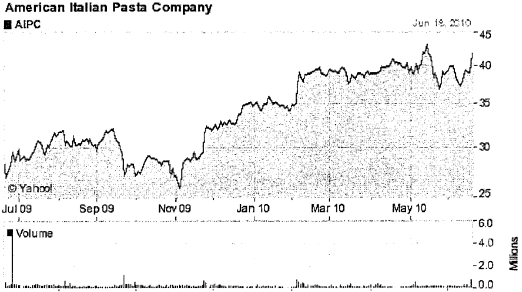
|
|
|
|
) |
|
|
Case No.
|
|
|
|
|
Plaintiff(s),
|
|
|
) |
|
|
|
|
|
|
|
|
|
|
) |
|
|
|
|
|
|
|
vs.
|
|
|
) |
|
|
|
|
|
|
|
|
|
|
) |
|
|
|
|
|
|
|
WILLIAM R. PATTERSON, JOHN P.
|
|
|
) |
|
|
|
|
|
|
|
KELLY, DAVID W. ALLEN, CATHLEEN S.
|
|
|
) |
|
|
|
|
|
|
|
CURLESS, TIM M. POLLAK, JONATHAN
|
|
|
) |
|
|
|
|
|
|
|
E. BAUM, ROBERT J. DRUTEN, JAMES A. |
|
|
|
|
|
|
|
|
|
|
HEETER, RONALD C. KESSELMAN, and |
|
|
|
|
|
|
|
|
|
|
RALCORP HOLDINGS, INC., |
|
|
|
|
|
|
|
|
|
|
|
|
|
|
|
|
|
|
|
|
|
Defendant(s). |
|
|
|
|
|
|
|
|
|
|
|
|
|
|
|
|
|
|
|
|
|
|
|
|
|
|
|
|
|
|
|
|
CLASS ACTION COMPLAINT
Plaintiff John M. Foley, Jr. (“Plaintiff”), by and through his attorneys, individually
and on behalf of all others similarly situated, files this Class Action Complaint (the “Complaint”)
against the Defendants herein named, and alleges as follows:
NATURE AND SUMMARY OF THE ACTION
1. This is a stockholder class action brought by Plaintiff on behalf of the public
holders of American Italian Pasta Company (“AIPC” or the “Company”) common stock seeking to enjoin
certain actions of the Defendants in connection with the proposed acquisition (“Acquisition”) of
AIPC by Ralcorp Holdings, Inc. (“Ralcorp”). On June 21, 2010, AIPC announced that the Company and Ralcorp had entered into a definitive merger agreement
(“Agreement”), pursuant to which
-1-
Ralcorp will commence a tender offer to purchase all of the outstanding shares of AIPC common
stock for $53.00 per share in cash. The transaction is expected to close as early as July 2010. As
described herein, the director defendants of AIPC have breached their fiduciary duties in
connection with the Acquisition by, among other things, failing to maximize shareholder value.
2. Furthermore, the tender offer is coercive because the Defendants have not provided
sufficient information to AIPC’s shareholders to enable them to make an informed decision about
whether to tender their shares in connection with the tender offer and proposed Acquisition.
3. This action seeks equitable relief only.
4. In short, the Acquisition is designed to unlawfully divest AIPC’s public stockholders of
their holdings without providing them the maximized value to which they are entitled, and without
all material facts concerning the proposed Acquisition and the value of their shares. Defendants
know that these assets will continue to produce substantial revenue and earnings.
PARTIES
5. Plaintiff is, and at all times relevant hereto has been, a shareholder of AIPC. AIPC is a
Delaware corporation headquartered with its principal place of business located at 4100 North
Mulberry, Suite 200, Kansas City, MO 64116. The Company is publicly traded under the NASDAQ stock
ticker “AIPC.” AIPC produces and markets dry pasta in North America.
6. Defendant Ralcorp is a corporation headquartered with its principal place of business
located at 800 Market Street, Suite 2900, St Louis, MO 63101. Ralcorp produces Post-branded
cereals, a variety of value brand and store brand foods sold under the individual labels of
various grocery, mass merchandise and drugstore retailers, and frozen bakery products sold to
in-store bakeries, restaurants and other foodservice customers.
7. Defendant William R. Patterson (“Patterson”) is and at all relevant times has been a
director of AIPC, and serves as Chairman of the Board.
-2-
8. Defendant John P. Kelly (“Kelly”) is and at all relevant times has been a director of AIPC.
Kelly is also the CEO and President of AIPC.
9. Defendant David W. Allen (“Allen”) is and at all relevant times has been a director of
AIPC.
10. Defendant Cathleen S. Curless (“Curless “) is and at all relevant times has been a
director of AIPC.
11. Defendant Tim M. Pollak (“Pollak”) is and at all relevant times has been a director of AIPC.
12. Defendant Jonathan E. Baum (“Baum”) is and at all relevant times has been a director
of AIPC.
13. Defendant Robert J. Druten (“Druten”) is and at all relevant times has been a director
of AIPC.
14. Defendant James A. Heeter (“Heeter”) is and at all relevant times has been a director
of AIPC.
15. Defendant Ronald C. Kesselman (“Kesselman”) is and at all relevant times has been a
director of AIPC.
16. The Defendants named above in ¶¶8-16 are sometimes collectively referred to
herein
as the “Individual Defendants.”
JURISDICTION AND VENUE
17. Jurisdiction is proper pursuant to RSMo 506.500 because Defendants regularly transact
business within the State of Missouri, or Defendants have committed torts within the State of
Missouri, or have committed torts outside the State of Missouri causing injury to Plaintiff in the
State and regularly do or solicit business in the State or should reasonably expect the acts to
have consequences in the State and derive substantial revenue from interstate or international
commerce.
-3-
18. Pursuant to RSMo 508.010 venue is proper in Jackson County because, inter alia, Defendants
regularly conduct business in this jurisdiction. In addition, the acts and transactions complained
of in this Complaint took place, in all or substantial part, in Kansas City, Missouri.
CLASS ACTION ALLEGATIONS
19. Plaintiff brings this action on his own behalf and as a class action on behalf of all
holders of AIPC stock who are being and will be harmed by Defendants’ actions described below (the
“Class”). Excluded from the Class are Defendants herein and any person, firm, trust, corporation,
or other entity related to or affiliated with any Defendants.
20. This action is properly maintainable as a class action under Rule 52.08 of the
Missouri Supreme Court.
21. The Class is so numerous that joinder of all members is impracticable. According to AIPC’s
January 22, 2010 Schedule 14D-9 filing, there were 21,129,627 shares of common stock issued and
outstanding as of January 7, 2010. These shares are held by hundreds, if not thousands, of
beneficial holders.
22. There are questions of law and fact which are common to the Class and which predominate
over questions affecting any individual Class member. The common questions include, inter alia, the
following:
(a) whether the Individual Defendants have breached their
fiduciary duties of undivided loyalty, independence or due care with respect to Plaintiff and
the other members of the Class in connection with the Acquisition;
(b) whether the Individual
Defendants have breached their fiduciary duty to secure and obtain the best price reasonable under
the circumstances for the benefit of Plaintiff and the other members of the Class in connection
with the Acquisition;
-4-
(c) whether the Individual Defendants have breached any of their other fiduciary duties
to Plaintiff and the other members of the Class in connection with the Acquisition, including the
duties of good faith, diligence, honesty and fair dealing;
(d) whether the Individual Defendants
have breached their fiduciary duties of candor to Plaintiff and the other members of the Class in
connection with the Acquisition by failing to disclose all material information upon which they are
able to make an informed decision about whether to tender their shares;
(e) whether the Individual
Defendants, in bad faith and for improper motives, have impeded or erected barriers to discourage
other strategic alternatives including offers from interested parties for the Company or its
assets;
(f) whether Plaintiff and the other members of the Class would be irreparably harmed were
the transactions complained of herein consummated; and
(g) whether Ralcorp is aiding and abetting
the wrongful acts of the Individual Defendants.
23. Plaintiff’s claims are typical of the claims of the other members of the Class and
Plaintiff does not have any interests adverse to the Class.
24. Plaintiff is an adequate representative of the Class, has retained competent counsel
experienced in litigation of this nature and will fairly and adequately protect the interests of
the Class.
25. The prosecution of separate actions by individual members of the Class would create a risk
of inconsistent or varying adjudications with respect to individual members of the Class which
would establish incompatible standards of conduct for the party opposing the Class.
-5-
26. Plaintiff anticipates that there will be no difficulty in the management of this
litigation. A class action is superior to other available methods for the fair and efficient
adjudication of this controversy.
27. Defendants have acted on grounds generally applicable to the Class with respect to the
matters complained of herein, thereby making appropriate the relief sought herein with respect to
the Class as a whole.
SUBSTANTIVE ALLEGATIONS
The Company’s Potential
28. Founded in 1988, AIPC is a company that AIPC produces and markets dry pasta in
North America.
29. AIPC was one of the few companies that weathered the financial market meltdown in late
2008 and early 2009. Compared to the Dow Jones Industrial Average, NASDAQ Composite and the S&P
500, AIPC stock has performed extremely well during the past two years, as evidenced by the
following chart:1
|
|
|
| 1 |
|
http://finance.yahoo.com/q/bc?s=AIPC&t=2y&l=on&z=m&g=l&c=%5EGSPC,%5EIXIC,%5EDJI (Last visited
June 21, 2010). |
-6-
30. Indeed, for the past two quarters, the Company has announced positive financial
results.
31. On February 4, 2010, the Company issued a press release announcing its first quarter
2010 results. The press release read in part:
American Italian Pasta Company Reports First Quarter 2010 Results
Total Revenue of $148.9 Million; Quarterly EPS of $0.95 per Diluted Share
KANSAS CITY, MO—(Marketwire — 02/04/10) — American Italian
Pasta Company (NASDAQ:AIPC — News), the largest producer of dry pasta
in North America, today announced results for its first quarter of
fiscal year 2010, which ended January 1, 2010.
* * *
The Company noted gross profit increased to 33.5% of
revenue, or nearly $50 million, for the l3-week first quarter of 2010
compared with 28.5% of revenue, or $48.8 million, for the 14-week
first quarter of 2009.
Income before taxes increased $5.7 million to $32.2 million, or
21.6% of revenue, for the 13-week first quarter of 2010 compared
with $26.5 million, or 15.5% of revenue, for the 14-week first
quarter of 2009.
* * *
32. Commenting on the above results, Defendant Kelly stated:
We are very pleased with these results. Even as we implemented our
strategy to extract our proprietary brands from underperforming markets, we were able to
increase our penetration of proprietary
and customer brands in strategic markets. As a result, on a weekly
average basis, to adjust for the difference in weeks contained in the
periods, we were able to increase our volume by 2%.
33. Kelly further noted:
Our strategy, which we implemented during 2009, to focus on our
proprietary and customer brands in those strategic markets in which
we are strongest, and to extract our proprietary brands from
underperforming markets, continues to pay dividends. We increased
volume in our strategic markets and improved our gross profit to
33.5% of revenue while also growing our operating profit and pre-tax
income. I’m particularly pleased that, on an average weekly basis, we
-7-
were able to grow total volume, excluding our non-strategic
brands in those markets that we are exiting, by over 6%. This volume
growth was well ahead of the overall market volume growth of 2.2%
34. Further, on May 6, 2010, the Company announced more outstanding financial results
for its second quarter 2010. A press release announcing the results read in part:
AMERICAN ITALIAN PASTA COMPANY REPORTS
SECOND QUARTER AND YEAR-TO-DATE 2010 RESULTS
SECOND QUARTER 2010 EARNINGS BEFORE TAXES UP
$11.4 MILLION TO $35.9 MILLION;
YEAR-TO-DATE EARNINGS BEFORE TAXES UP $17.1
MILLION TO $68.1 MILLION
KANSAS CITY, MO., May 6, 2010 — American Italian Pasta
Company (NASDAQ:AIPC), the largest producer of dry pasta in North
America, today announced its second quarter and year-to-date fiscal
year 2010 results for the period ended April 2, 2010.
* * *
FINANCIAL HIGHLIGHTS
Net income for the second quarter increased $7.4 million, or
47%, to $23.2 million from an adjusted net income of
$15.8 million in the comparable quarter of the prior year.
Earnings per share, on a diluted basis, increased 44%
to $1.05 per share from an adjusted earnings per share of $0.73
per share in the comparable prior quarter. Net income for fiscal 2010
year to date increased $11.0 million, or 33%, to $43.9 million from
$32.9 million through the second quarter of fiscal 2009. Earnings per
share, on a diluted basis, increased 30% to $2.00 per share year to
date, from an adjusted earnings per share of $1.54 per share in the same
period the year prior. (Emphasis added).
* * *
AIPC reported strong key measurements for the second
quarter of 2010. As a percent of revenue, the following gains were
made over the second quarter of fiscal 2009:
| |
• |
|
Gross profit increased to 36.5% from 27.2% |
|
| |
• |
|
Operating profit grew to 25.3% from 17.6% |
|
| |
• |
|
Income before taxes grew to 24.6% from 15.1% |
|
* * *
-8-
35. Commenting on the latest financial results, Defendant Kelly was quoted as saying:
Our retail focus on private label or store brand business, along
with our strategic brands, contributed to strong results in the
second quarter of fiscal 2010. AIPC continued to outperform the pasta
category in both revenue and volume, and we are operating the
business more profitably, as second quarter operating profit
increased 30% from the year prior.
Strong performance in 2010 has allowed us to continue our
aggressive debt reduction, bringing total debt outstanding to $45
million from $110 million at the end of fiscal 2009. Since the second
quarter ended, we have further reduced our debt outstanding by an
additional $15 million
36. Evan Jim Cramer, the host of Mad Money on CNBC had positive things to say
about AIPC:
Cramer said there is a sea change happening in the minds of
American consumers. He said there is no longer a stigma attached to
private label consumer goods, and consumers aren’t flocking back to
name brand items now that the worst of the recession is behind us.
Cramer said with private label brands en vogue, investors need
to invest accordingly, which means selling name manufacturers like
Diageo (DEO) and Brown Forman (BF-B).
Cramer said the smarter money will be in private label
manufacturers, companies like Treehouse Foods (THS), Ralcorp
(RAH) and American Italian Pasta (AIPC).2
37. Accordingly, the Company is well poised to continue to improve in the near future
and the long-term.
The Proposed Acquisition and the Substantial Undervaluation of the Company
38. On June 21, 2010, the Company announced that Ralcorp agreed to purchase AIPC for
$1.2 billion, net of cash acquired. Pursuant to the Agreement, Ralcorp will commence a tender offer
|
|
|
| 2 |
|
Scott Rutt, Cramer’s ‘Mad Money’ Recap: The Catalysts Behind the Rally (Final)
(February 9, 2010), available at http://www.thestreet.com/print/story/10677893.html. (Last
visited on June 21, 2010). |
-9-
to purchase all of the outstanding shares of AIPC common stock for $53.00 per share in cash. The
Acquisition is scheduled to close in the quarter ended September 30, 2010.
39. However, in the past year, AIPC stock has increased in value over 54% from June 22,
2009 to June 18, 2010, the last trading day prior to the announcement of the Agreement:
40. All indications are that AIPC’s share price was steadily poised to reach new highs in the
future, and the Defendants are attempting to deprive AIPC shareholders of the true value of their
shares, as the Acquisition substantially undervalues AIPC.
41. Further, the tender offer is coercive because defendants are not disclosing all material
information about the Agreement and the Acquisition to AIPC’s shareholders, thereby depriving
AIPC shareholders of the ability to make a voluntary tender of their shares in connection with the
tender offer and proposed Acquisition.
THE INDIVIDUAL DEFENDANTS’ FIDUCIARY DUTIES
42. Under applicable law, in any situation where the directors of a publicly traded
corporation undertake a transaction that will result in either: (i) a change in corporate control;
or (ii) a break up of the corporation’s assets, the directors have an affirmative fiduciary
obligation to obtain the highest value reasonably available for the corporation’s shareholders, and if such
transaction will
-10-
result in a change of corporate control, the shareholders are entitled to receive
a significant premium. To diligently comply with these duties, the directors and/or officers may
not take any action that:
(a) adversely affects the value provided to the corporation’s
shareholders;
(b) will discourage or inhibit alternative offers to purchase control of the
corporation or its assets;
(c) contractually prohibits themselves from complying with their
fiduciary duties;
(d) will otherwise adversely affect their duty to search and secure the best
value reasonably available under the circumstances for the corporation’s shareholders; and/or
(e) will provide the directors and/or officers with preferential treatment at the expense of, or
separate from, the public shareholders.
43. In accordance with their duties of loyalty and good faith, the Defendants, as directors
and/or officers of AIPC, are obligated under applicable law to refrain from:
(a) participating in
any transaction where the directors’ or officers’ loyalties are divided;
(b) participating in any
transaction where the directors or officers receive, or are entitled to receive, a personal
financial benefit not equally shared by the public shareholders of the corporation; and/or
(c) unjustly enriching themselves at the expense or to the detriment of the public
shareholders.
44. Defendants are also obliged to honor their duty of candor to AIPC’s shareholders by, inter
alia, providing all material information to the shareholders regarding a scenario in which they are
asked to vote or tender their shares. This duty of candor ensures that shareholders have all
information that will enable them to make informed, rational and intelligent decisions about
whether to vote or tender their shares.
-11-
45. Plaintiff alleges herein that Defendants, separately and together, in connection with the
Acquisition, are knowingly or recklessly violating their fiduciary duties, including their
duties of loyalty, good faith, and independence owed to Plaintiff and other public
shareholders of AIPC. Defendants stand on both sides of the transaction, are engaging in self
dealing, are obtaining for themselves personal benefits, including personal financial benefits not
shared equally by Plaintiff or the Class. As a result of Defendants’ self dealing and divided
loyalties, neither Plaintiff nor the Class will receive adequate or fair value for their AIPC
common stock in the proposed Acquisition.
46. Because Defendants are knowingly or recklessly breaching their duties of loyalty, good
faith, candor and independence in connection with the Acquisition, the burden of proving the
inherent or entire fairness of the Acquisition, including all aspects of its negotiation,
structure, price and terms, is placed upon Defendants as a matter of law.
CAUSES OF ACTION
COUNT I
Claim for Breach of Fiduciary Duties
(Against the Individual Defendants)
47. Plaintiff repeats and realleges each allegation set forth herein.
48. Defendants have knowingly and recklessly and in bad faith violated fiduciary duties of
care, loyalty, good faith and independence owed to the public shareholders of AIPC and have acted
to put the interests of Ralcorp ahead of the interests of AIPC’s
shareholders.
49. By the acts,
transactions and courses of conduct alleged herein, Defendants, individually and acting as a part
of a common plan, knowingly or recklessly and in bad faith are attempting to unfairly deprive
Plaintiff and other members of the Class of the true value of their investment in AIPC.
-12-
50. As demonstrated by the allegations above, Defendants knowingly or recklessly failed to
exercise the care required, and breached their duties of loyalty, good faith and independence owed
to the shareholders of AIPC because, among other reasons, they failed to:
(a) fully inform
themselves of the market value of AIPC before entering into the
Agreement;
(b) act in the best interests of the public shareholders of AIPC common stock;
(c) maximize shareholder value;
(d) obtain the best financial and other terms when the Company’s
independent existence will be materially altered by the Acquisition; and
(e) act in accordance with
their fundamental duties of good faith, due care and loyalty.
51. By reason of the foregoing acts, practices and course of conduct, Defendants have
knowingly or recklessly and in bad faith failed to exercise ordinary care and diligence in the
exercise of their fiduciary obligations toward Plaintiff and the other members of the Class.
52. Unless enjoined by this Court, Defendants will continue to knowingly or recklessly and in
bad faith breach their fiduciary duties owed to Plaintiff and the Class, and may consummate the
proposed Acquisition which will exclude the Class from the maximized value they are entitled to
all to the irreparable harm of the Class.
53. As a result of Defendants’ unlawful actions, Plaintiff and the other members of the
Class will be irreparably harmed in that they will not receive the real value of their equity
ownership of the Company. Unless the tender offer and proposed Acquisition are enjoined by the
Court, Defendants will continue to knowingly or recklessly and in bad faith breach their fiduciary
duties owed to Plaintiff and the members of the Class to the irreparable harm of the members of the
Class.
-13-
54. Plaintiff and the members of the Class have an inadequate remedy at law. Only through the
exercise of this Court’s equitable powers can Plaintiff and the Class be fully protected from the
immediate and irreparable injury which Defendants’ actions threaten to inflict.
55. Plaintiff seeks to obtain a non-pecuniary benefit for the Class in the form of injunctive
relief against the Individual Defendants. Plaintiff’s counsel are entitled to recover their
reasonable attorneys’ fees and expenses as a result of the conference of a non-pecuniary
benefit on behalf of the Class, and will seek an award of such fees and expenses at the appropriate
time.
COUNT II
Aiding & Abetting the Individual Defendants’ Breach of Fiduciary Duty
(Against Defendants AIPC, Ralcorp and Aptiom)
56. Plaintiff repeats and realleges each allegation set forth herein.
57. Defendants AIPC, Ralcorp and Aptiom are sued herein as aiders and abettors of the breaches
of fiduciary duties outlined above by the Individual Defendants, as members of the Board of AIPC.
58. The Individual Defendants breached their fiduciary duties of good faith, loyalty, and due
care to the AIPC shareholders by failing to:
(a) Fully inform themselves of the market value of AIPC
before entering into the Agreement;
(b) act
in the best interests of the public shareholders of AIPC common stock;
(c) maximize shareholder value;
(d) obtain the best financial and other terms when the Company’s independent existence will be
materially altered by the Acquisition; and
(e) act in accordance with their fundamental duties of
good faith, due care and loyalty.
-14-
59. Such breaches of fiduciary duties could not and would not have occurred but for the
conduct of Defendants AIPC, Ralcorp and Aptiom, which, therefore, aided and abetted such breaches
via entering into the Agreement with Ralcorp.
60. Defendants AIPC, Ralcorp and Aptiom had knowledge that they were aiding and
abetting the Individual Defendants’ breach of their fiduciary duties to the AIPC shareholders.
61. Defendants AIPC, Ralcorp and Aptiom rendered substantial assistance to the
Individual Defendants in their breach of their fiduciary duties to the AIPC shareholders.
62. As a result of AIPC, Ralcorp and Aptiom’s conduct of aiding and abetting the Individual
Defendants’ breaches of fiduciary duties, Plaintiff and the other members of the
Class have been and will be damaged in that they have been and will be prevented from
obtaining a fair price for their shares.
63. As a result of the unlawful actions of Defendants AIPC, Ralcorp and Aptiom, Plaintiff and
the other members of the Class will be irreparably harmed in that they will not receive fair value
for AIPC’s assets and business, will be prevented from obtaining the real value of their equity
ownership in the Company. Unless the actions of Defendants AIPC, Ralcorp and Aptiom are enjoined by
the Court, they will continue to aid and abet the Individual Defendants’ breach of their fiduciary
duties owed to Plaintiff and the members of the Class, and will aid and abet a process that
inhibits the maximization of shareholder value and the disclosure of material information.
64. Plaintiff and the other members of the Class have no adequate remedy at law.
65. Plaintiff seeks to obtain a non-pecuniary benefit for the Class in the form of injunctive relief
against Defendants AIPC, Ralcorp and Aptiom. Plaintiff’s counsel are entitled to recover their
reasonable attorneys’ fees and expenses as a result of the conference of a non-pecuniary benefit on
behalf of the Class, and will seek an award of such fees and expenses at the appropriate time.
-15-
JURY TRIAL DEMAND
The Plaintiff hereby demands trial by jury on all issues so triable
PRAYER FOR RELIEF
WHEREFORE, Plaintiff demands injunctive relief, in his favor and in favor of the Class and
against Defendants as follows:
A. Declaring that this action is properly maintainable as a class
action;
B. Declaring and decreeing that the Agreement was entered into in breach of the
fiduciary duties of Defendants and is therefore unlawful and unenforceable;
C. Enjoining
Defendants, their agents, counsel, employees and all persons acting in concert with them from
finalizing the tender offer and consummating the Acquisition, unless and until the Company
adopts and implements a procedure or process to i) obtain the highest possible value for
shareholders, and ii) provide all material disclosures to shareholders with which they are able to
make informed decisions about whether to tender their shares in connection with the
tender offer and Acquisition;
D. Directing the Individual Defendants to exercise their fiduciary
duties to obtain a transaction which is in the best interests of AIPC’s shareholders until the
process for the sale or auction of the Company is completed and the highest possible value is
obtained;
E. Rescinding, to the extent already implemented, the Agreement or any of the terms
thereof;
F. Implementation of a constructive trust, in favor of Plaintiff, upon any benefits
improperly received by Defendants as a result of their wrongful conduct;
G. Awarding Plaintiff the
costs and disbursements of this action, including reasonable attorneys’ and experts’ fees; and
-16-
H. Granting such other and further equitable relief as this Court may deem just and
proper.
| |
|
|
|
|
| DATED: June 21, 2010 |
DOLLAR BURNS AND BECKER,LC
|
|
| |
BY: /s/ Tim Dollar
|
|
| |
Tim Dollar 33123 |
|
| |
1100 Main Street, Ste. 2600
Kansas City, MO 64105
Telephone: 816-876-2600
Fax: 816-221-8763
timd@dollar-law.com
ROBBINS GELLER RUDMAN & DOWD LLP
JONATHAN M. STEIN (pending pro hac vice)
CULLIN A. O'BRIEN (pending pro hac vice)
120 East Palmetto Park Road, Suite 500
Boca Raton, FL 33432
Telephone: 561/750-3000
561/750-3364 (fax)
MURRAY, FRANK & SAILER LLP
BRIAN MURRAY (pending pro hac vice)
275 Madison Avenue, Suite 801
New York, NY 10016
Phone: (212) 682-1818
Fax: (212) 682-1892
Attorneys for Plaintiff and the Class |
|
| |
-17-