1 Notice to ASX Initial reporting of lithium Mineral Resources and Ore Reserves: supporting information and Table 1 checklists 4 December 2025 Rio Tinto today announces initial reporting of Mineral Resources and Ore Reserves for seven lithium assets acquired as part of the purchase of Arcadium Lithium, namely: • Four lithium brines deposits: the Fenix and Olaroz operations, and the Sal de Vida and Cauchari projects in Argentina • Three hard rock spodumene deposits: the Whabouchi and Galaxy projects in Northern Quebec, and the Mt Cattlin operation in Western Australia This is first reporting by Rio Tinto of these Mineral Resources and Ore Reserves in accordance with the Australasian Code for Reporting of Exploration Results, Mineral Resources and Ore Reserves, 2012 Edition (JORC Code) and the ASX Listing Rules. Supporting information relating to the Mineral Resources and Ore Reserves is set out in this release and its appendices. Mineral Resources and Ore Reserves are quoted in this release on a 100 percent basis. The figures used to calculate Mineral Resources and Ore Reserves are often more precise than the rounded numbers shown in the tables, hence small differences may result if the calculations are repeated using the tabulated figures. Mineral Resources are reported inclusive of Ore Reserves for lithium brines deposits1, and in addition to Ore Reserves (exclusive) for hard rock spodumene deposits. Fenix Fenix is a lithium brines operation located in the Salar del Hombre Muerto in northwest Argentina (Figure 1). It is 100% owned by Rio Tinto and is currently in operation producing lithium carbonate. Mineral Resources and Ore Reserves for the Fenix operation are presented in Table A and Table B. Mineral Resources inclusive of Ore Reserves total 11.7 Mt Lithium Carbonate Equivalent (LCE) consisting of 2.7 Mt LCE of Measured Mineral Resources, 4.3 Mt LCE of Indicated Mineral Resources and 4.7 Mt LCE of Inferred Mineral Resources. Ore Reserves total 5.4 Mt LCE consisting of 1.2 Mt LCE Proven Ore Reserves and 4.1 Mt LCE Probable Ore Reserves. Olaroz Olaroz is a lithium brines operation located in the Olaroz-Cauchari Salar, Jujuy, Argentina (Figure 1). It includes properties operated by Rio Tinto through its local subsidiary Sales de Jujuy, which is a joint venture between Rio 1 In this report, for lithium brines deposits Lithium Metal and LCE Ore Reserves are reported at the well head and thus assume 100% recovery at that point. To obtain the equivalent tonnage for LCE, the estimated mass of lithium is multiplied by a factor that is based on the atomic weights of each element in lithium carbonate to obtain the final compound weight. The factor used was 5.323 to obtain LCE mass from lithium mass. .5

Notice to ASX 2 / 170 2 Tinto (66.5%), Toyota Tsusho Corporation (25%) and Jujuy Energía y Minería Sociedad del Estado (JEMSE, 8.5%). In addition, Rio Tinto has 100% ownership of six properties to the north and west of the joint venture area which contain a portion of the reported Mineral Resources. All Ore Reserves are located within the Sales de Jujuy joint venture properties. Mineral Resources and Ore Reserves for the Olaroz operation are presented in Table A and Table B. Mineral Resources inclusive of Ore Reserves total 19.7 Mt LCE consisting of 8.5 Mt LCE of Measured Mineral Resources, 8.4 Mt LCE of Indicated Mineral Resources and 2.8 Mt LCE of Inferred Mineral Resources. Ore Reserves total 2.7 Mt LCE consisting of 0.6 Mt LCE of Proven Ore Reserves and 2.2 Mt LCE Probable Ore Reserves. Sal de Vida Sal de Vida is a lithium brines project located in the Salar del Hombre Muerto, Catamarca, Argentina (Figure 1). It is 100% owned by Rio Tinto. Mineral Resources and Ore Reserves for the Sal de Vida project are presented in Table A and Table B. Mineral Resources inclusive of Ore Reserves total 7.2 Mt LCE consisting of 3.5 Mt LCE of Measured Mineral Resources, 3.0 Mt LCE of Indicated Mineral Resources and 0.7 Mt LCE of Inferred Mineral Resources. Ore Reserves total 2.5 Mt LCE consisting of 0.4 Mt LCE of Proven Ore Reserves and 2.0 Mt LCE Probable Ore Reserves. Cauchari Cauchari is a lithium brines project located in the Olaroz-Cauchari Salar, Jujuy, Argentina (Figure 1). It is 100% owned by Rio Tinto. Mineral Resources and Ore Reserves for the Cauchari project are presented in Table A and Table B. Mineral Resources inclusive of Ore Reserves total 6.0 Mt LCE consisting of 1.9 Mt LCE of Measured Mineral Resources, 2.6 Mt LCE of Indicated Mineral Resources and 1.5 Mt LCE of Inferred Mineral Resources. Ore Reserves total 1.1 Mt LCE consisting of 0.2 Mt LCE of Proven Ore Reserves and 0.9 Mt LCE Probable Ore Reserves. Whabouchi The Whabouchi project in northern Quebec, Canada (Figure 2), is a hard rock lithium-bearing spodumene deposit and is being developed by Nemaska Lithium, a joint venture between Investissement Québec (50%) and Rio Tinto (50%). Mineral Resources and Ore Reserves for the Whabouchi project are presented in Table C and Table D. Mineral Resources exclusive of Ore Reserves total 26.9 Mt at 1.45% Li2O, consisting of 18.7 Mt at 1.51% Li2O of Indicated Mineral Resources and 8.3 Mt at 1.31% Li2O of Inferred Mineral Resources. Ore Reserves total 26.5 Mt at 1.32% Li2O consisting of 10.5 Mt at 1.40% Li2O of Proved Ore Reserves and 16.0 Mt at 1.27% Li2O of Probable Ore Reserves. Galaxy The Galaxy project is a hard rock lithium-bearing spodumene deposit located in the northeastern part of the Superior Province in northern Quebec, Canada (Figure 2). It is 100% owned by Rio Tinto. Mineral Resources and Ore Reserves for the Galaxy project are presented in Table C and Table D. Mineral Resources exclusive of Ore Reserves total 74.0 Mt at 1.25% Li2O consisting of 18.1 Mt at 1.12% Li2O of Indicated Mineral Resources and 55.9 Mt at 1.29% Li2O of Inferred Mineral Resources. Ore Reserves comprise 37.3 Mt at 1.27% Li2O of Probable Ore Reserves. Mt Cattlin The Mt Cattlin operation is a lithium-bearing spodumene deposit in Western Australia (Figure 3). It is 100% owned by Rio Tinto. Mt Cattlin was placed on care and maintenance on 1 July 2025 due to market conditions. The potential for underground mining to extend the mine's life is the subject of current studies. Mineral Resources and Ore Reserves for Mt Cattlin are presented in Table C and Table D. Mineral Resources exclusive of Ore Reserves total 11.3 Mt at 1.35% Li2O, consisting of 0.1 Mt at 1.11% Li2O of Measured
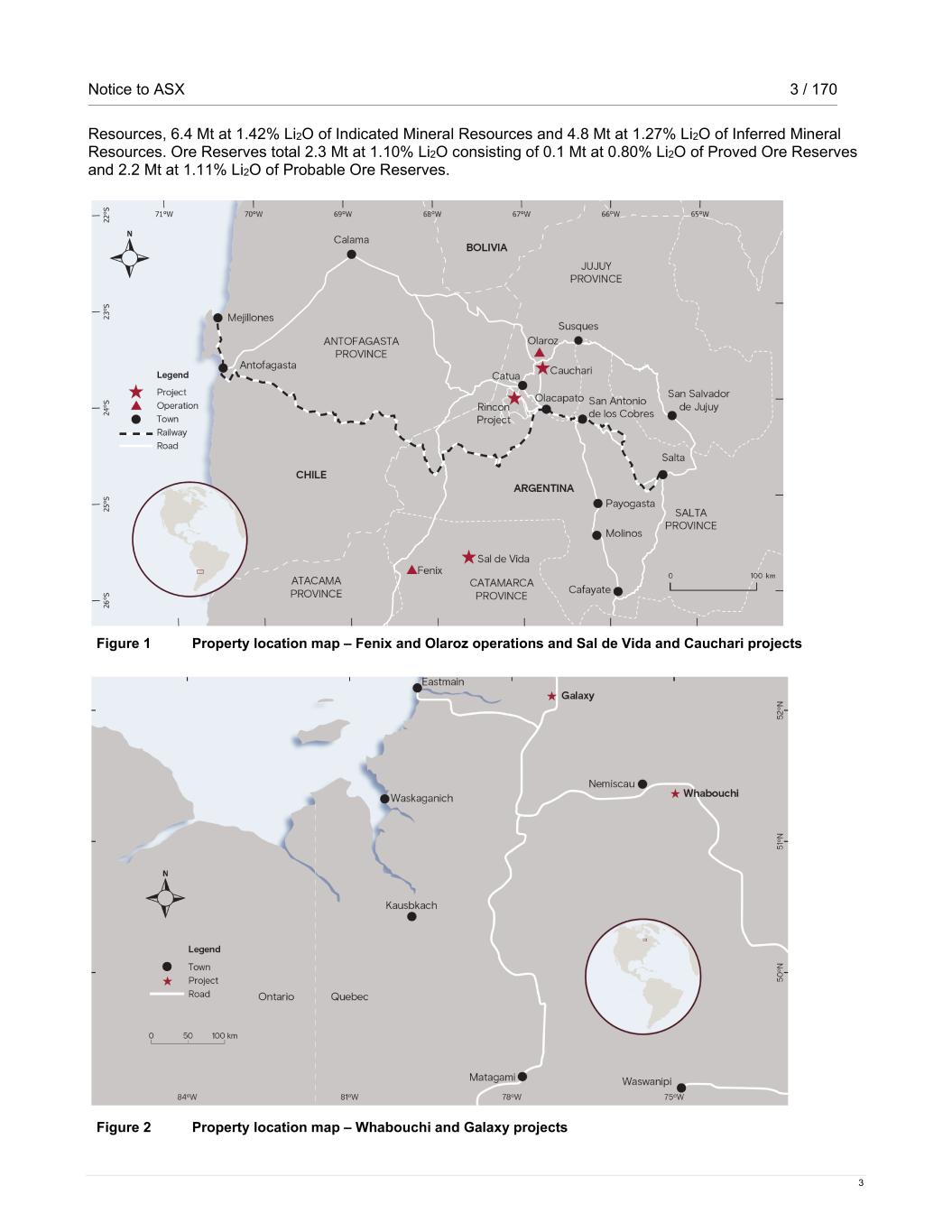
Notice to ASX 3 / 170 3 Resources, 6.4 Mt at 1.42% Li2O of Indicated Mineral Resources and 4.8 Mt at 1.27% Li2O of Inferred Mineral Resources. Ore Reserves total 2.3 Mt at 1.10% Li2O consisting of 0.1 Mt at 0.80% Li2O of Proved Ore Reserves and 2.2 Mt at 1.11% Li2O of Probable Ore Reserves. Figure 1 Property location map – Fenix and Olaroz operations and Sal de Vida and Cauchari projects Figure 2 Property location map – Whabouchi and Galaxy projects
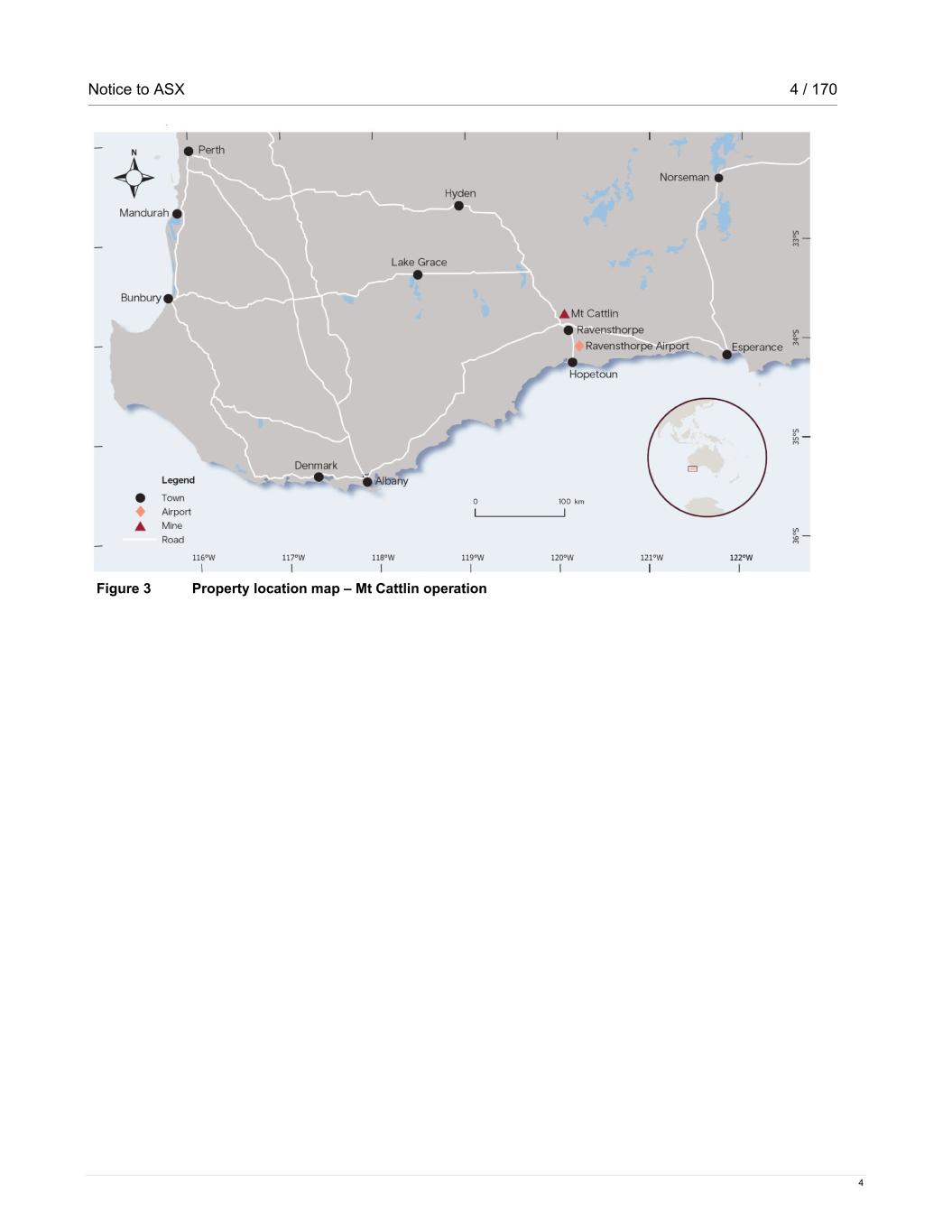
Notice to ASX 4 / 170 4 Figure 3 Property location map – Mt Cattlin operation
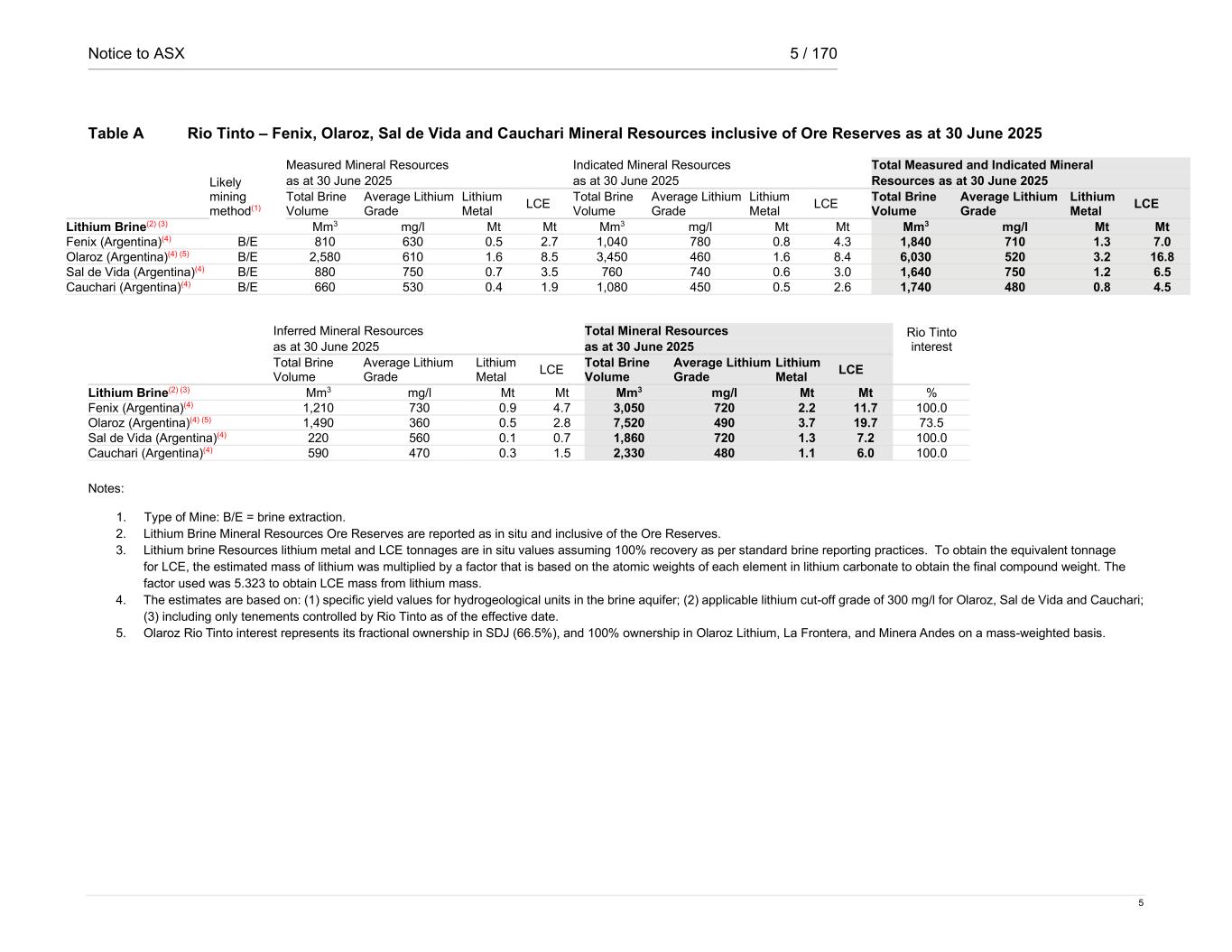
Notice to ASX 5 / 170 5 Table A Rio Tinto – Fenix, Olaroz, Sal de Vida and Cauchari Mineral Resources inclusive of Ore Reserves as at 30 June 2025 Likely mining method(1) Measured Mineral Resources Indicated Mineral Resources Total Measured and Indicated Mineral as at 30 June 2025 as at 30 June 2025 Resources as at 30 June 2025 Total Brine Volume Average Lithium Grade Lithium Metal LCE Total Brine Volume Average Lithium Grade Lithium Metal LCE Total Brine Volume Average Lithium Grade Lithium Metal LCE Lithium Brine(2) (3) Mm3 mg/l Mt Mt Mm3 mg/l Mt Mt Mm3 mg/l Mt Mt Fenix (Argentina)(4) B/E 810 630 0.5 2.7 1,040 780 0.8 4.3 1,840 710 1.3 7.0 Olaroz (Argentina)(4) (5) B/E 2,580 610 1.6 8.5 3,450 460 1.6 8.4 6,030 520 3.2 16.8 Sal de Vida (Argentina)(4) B/E 880 750 0.7 3.5 760 740 0.6 3.0 1,640 750 1.2 6.5 Cauchari (Argentina)(4) B/E 660 530 0.4 1.9 1,080 450 0.5 2.6 1,740 480 0.8 4.5 Inferred Mineral Resources Total Mineral Resources Rio Tinto interest as at 30 June 2025 as at 30 June 2025 Total Brine Volume Average Lithium Grade Lithium Metal LCE Total Brine Volume Average Lithium Grade Lithium Metal LCE Lithium Brine(2) (3) Mm3 mg/l Mt Mt Mm3 mg/l Mt Mt % Fenix (Argentina)(4) 1,210 730 0.9 4.7 3,050 720 2.2 11.7 100.0 Olaroz (Argentina)(4) (5) 1,490 360 0.5 2.8 7,520 490 3.7 19.7 73.5 Sal de Vida (Argentina)(4) 220 560 0.1 0.7 1,860 720 1.3 7.2 100.0 Cauchari (Argentina)(4) 590 470 0.3 1.5 2,330 480 1.1 6.0 100.0 Notes: 1. Type of Mine: B/E = brine extraction. 2. Lithium Brine Mineral Resources Ore Reserves are reported as in situ and inclusive of the Ore Reserves. 3. Lithium brine Resources lithium metal and LCE tonnages are in situ values assuming 100% recovery as per standard brine reporting practices. To obtain the equivalent tonnage for LCE, the estimated mass of lithium was multiplied by a factor that is based on the atomic weights of each element in lithium carbonate to obtain the final compound weight. The factor used was 5.323 to obtain LCE mass from lithium mass. 4. The estimates are based on: (1) specific yield values for hydrogeological units in the brine aquifer; (2) applicable lithium cut-off grade of 300 mg/l for Olaroz, Sal de Vida and Cauchari; (3) including only tenements controlled by Rio Tinto as of the effective date. 5. Olaroz Rio Tinto interest represents its fractional ownership in SDJ (66.5%), and 100% ownership in Olaroz Lithium, La Frontera, and Minera Andes on a mass-weighted basis.
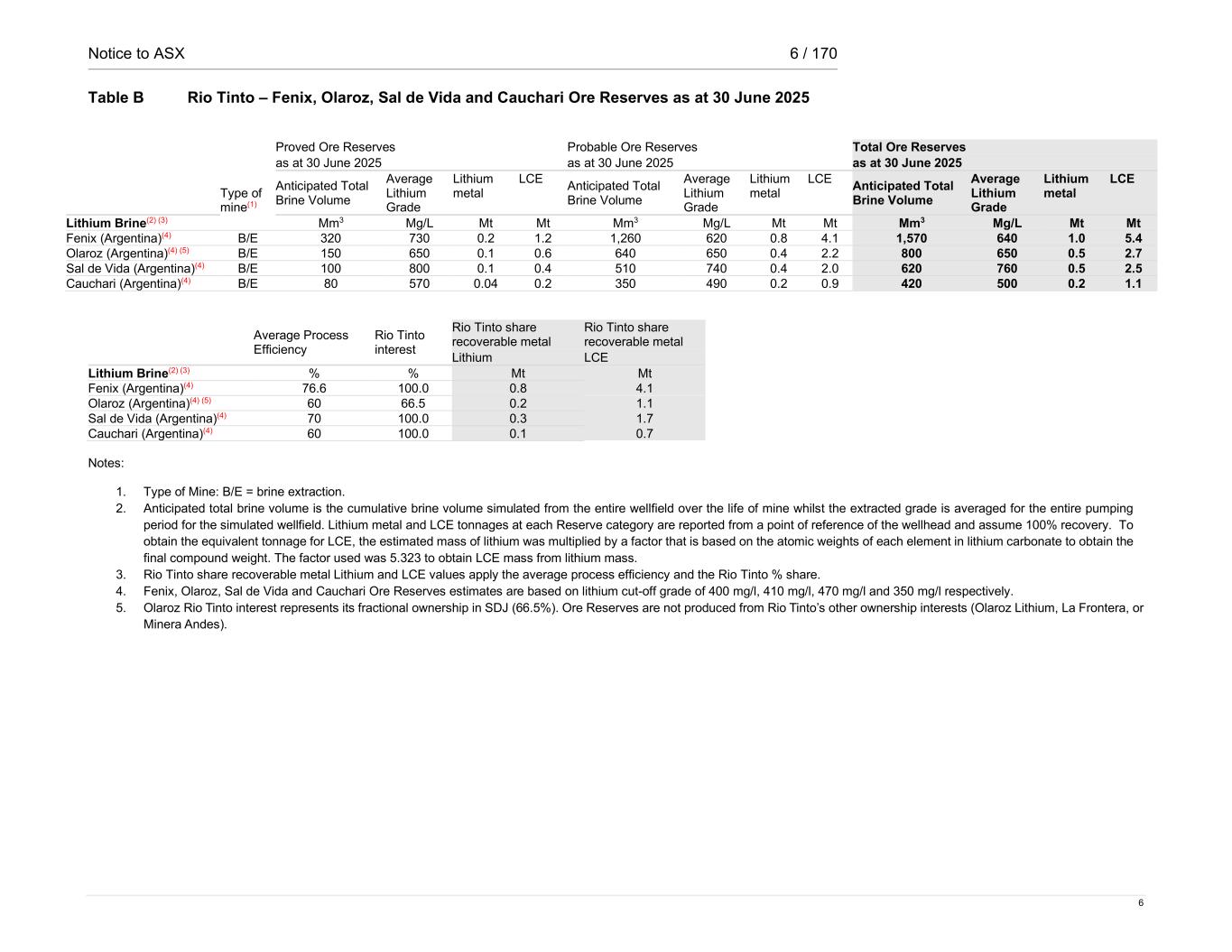
Notice to ASX 6 / 170 6 Table B Rio Tinto – Fenix, Olaroz, Sal de Vida and Cauchari Ore Reserves as at 30 June 2025 Type of mine(1) Proved Ore Reserves Probable Ore Reserves Total Ore Reserves as at 30 June 2025 as at 30 June 2025 as at 30 June 2025 Anticipated Total Brine Volume Average Lithium Grade Lithium metal LCE Anticipated Total Brine Volume Average Lithium Grade Lithium metal LCE Anticipated Total Brine Volume Average Lithium Grade Lithium metal LCE Lithium Brine(2) (3) Mm3 Mg/L Mt Mt Mm3 Mg/L Mt Mt Mm3 Mg/L Mt Mt Fenix (Argentina)(4) B/E 320 730 0.2 1.2 1,260 620 0.8 4.1 1,570 640 1.0 5.4 Olaroz (Argentina)(4) (5) B/E 150 650 0.1 0.6 640 650 0.4 2.2 800 650 0.5 2.7 Sal de Vida (Argentina)(4) B/E 100 800 0.1 0.4 510 740 0.4 2.0 620 760 0.5 2.5 Cauchari (Argentina)(4) B/E 80 570 0.04 0.2 350 490 0.2 0.9 420 500 0.2 1.1 Average Process Efficiency Rio Tinto interest Rio Tinto share recoverable metal Rio Tinto share recoverable metal Lithium LCE Lithium Brine(2) (3) % % Mt Mt Fenix (Argentina)(4) 76.6 100.0 0.8 4.1 Olaroz (Argentina)(4) (5) 60 66.5 0.2 1.1 Sal de Vida (Argentina)(4) 70 100.0 0.3 1.7 Cauchari (Argentina)(4) 60 100.0 0.1 0.7 Notes: 1. Type of Mine: B/E = brine extraction. 2. Anticipated total brine volume is the cumulative brine volume simulated from the entire wellfield over the life of mine whilst the extracted grade is averaged for the entire pumping period for the simulated wellfield. Lithium metal and LCE tonnages at each Reserve category are reported from a point of reference of the wellhead and assume 100% recovery. To obtain the equivalent tonnage for LCE, the estimated mass of lithium was multiplied by a factor that is based on the atomic weights of each element in lithium carbonate to obtain the final compound weight. The factor used was 5.323 to obtain LCE mass from lithium mass. 3. Rio Tinto share recoverable metal Lithium and LCE values apply the average process efficiency and the Rio Tinto % share. 4. Fenix, Olaroz, Sal de Vida and Cauchari Ore Reserves estimates are based on lithium cut-off grade of 400 mg/l, 410 mg/l, 470 mg/l and 350 mg/l respectively. 5. Olaroz Rio Tinto interest represents its fractional ownership in SDJ (66.5%). Ore Reserves are not produced from Rio Tinto’s other ownership interests (Olaroz Lithium, La Frontera, or Minera Andes).
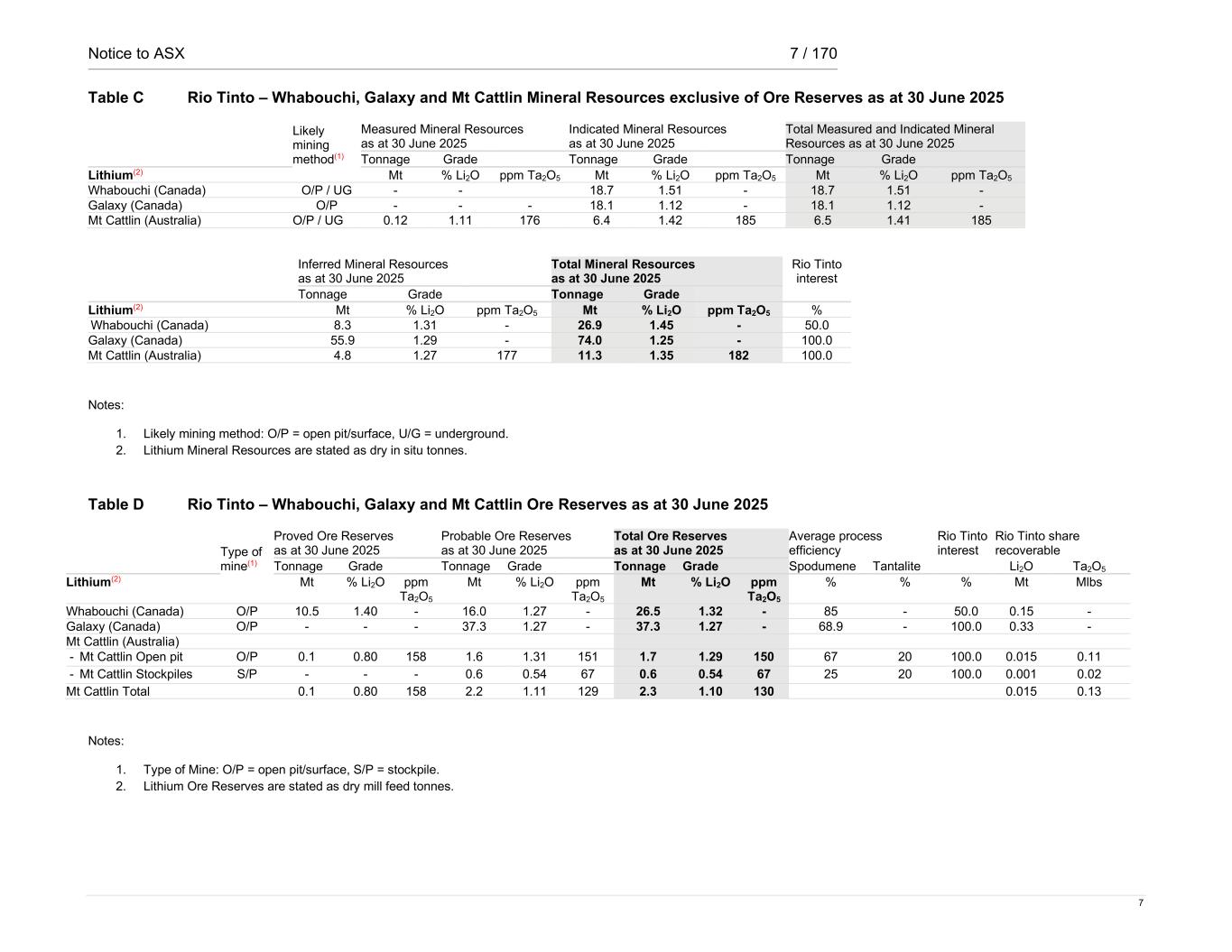
Notice to ASX 7 / 170 7 Table C Rio Tinto – Whabouchi, Galaxy and Mt Cattlin Mineral Resources exclusive of Ore Reserves as at 30 June 2025 Likely mining method(1) Measured Mineral Resources as at 30 June 2025 Indicated Mineral Resources as at 30 June 2025 Total Measured and Indicated Mineral Resources as at 30 June 2025 Tonnage Grade Tonnage Grade Tonnage Grade Lithium(2) Mt % Li2O ppm Ta2O5 Mt % Li2O ppm Ta2O5 Mt % Li2O ppm Ta2O5 Whabouchi (Canada) O/P / UG - - 18.7 1.51 - 18.7 1.51 - Galaxy (Canada) O/P - - - 18.1 1.12 - 18.1 1.12 - Mt Cattlin (Australia) O/P / UG 0.12 1.11 176 6.4 1.42 185 6.5 1.41 185 Inferred Mineral Resources as at 30 June 2025 Total Mineral Resources as at 30 June 2025 Rio Tinto interest Tonnage Grade Tonnage Grade Lithium(2) Mt % Li2O ppm Ta2O5 Mt % Li2O ppm Ta2O5 % Whabouchi (Canada) 8.3 1.31 - 26.9 1.45 - 50.0 Galaxy (Canada) 55.9 1.29 - 74.0 1.25 - 100.0 Mt Cattlin (Australia) 4.8 1.27 177 11.3 1.35 182 100.0 Notes: 1. Likely mining method: O/P = open pit/surface, U/G = underground. 2. Lithium Mineral Resources are stated as dry in situ tonnes. Table D Rio Tinto – Whabouchi, Galaxy and Mt Cattlin Ore Reserves as at 30 June 2025 Type of mine(1) Proved Ore Reserves as at 30 June 2025 Probable Ore Reserves as at 30 June 2025 Total Ore Reserves as at 30 June 2025 Average process efficiency Rio Tinto interest Rio Tinto share recoverable Tonnage Grade Tonnage Grade Tonnage Grade Spodumene Tantalite Li2O Ta2O5 Lithium(2) Mt % Li2O ppm Ta2O5 Mt % Li2O ppm Ta2O5 Mt % Li2O ppm Ta2O5 % % % Mt Mlbs Whabouchi (Canada) O/P 10.5 1.40 - 16.0 1.27 - 26.5 1.32 - 85 - 50.0 0.15 - Galaxy (Canada) O/P - - - 37.3 1.27 - 37.3 1.27 - 68.9 - 100.0 0.33 - Mt Cattlin (Australia) - Mt Cattlin Open pit O/P 0.1 0.80 158 1.6 1.31 151 1.7 1.29 150 67 20 100.0 0.015 0.11 - Mt Cattlin Stockpiles S/P - - - 0.6 0.54 67 0.6 0.54 67 25 20 100.0 0.001 0.02 Mt Cattlin Total 0.1 0.80 158 2.2 1.11 129 2.3 1.10 130 0.015 0.13 Notes: 1. Type of Mine: O/P = open pit/surface, S/P = stockpile. 2. Lithium Ore Reserves are stated as dry mill feed tonnes.

Notice to ASX 8 / 170 8 Rio Tinto – Fenix The Fenix lithium brines operation located in the Salar del Hombre Muerto (SdHM or salar) is currently in operation producing lithium carbonate. SdHM is located in northwest Argentina, in the northeastern portion of Catamarca Province on the border with Salta Province (Figure 1). Mineralisation at Fenix occurs in the form of lithium rich brine in the pore spaces below ground surface, within the brine reservoir. Mining occurs by brine extraction from pumping wells. Minera del Altiplano S.A. (MdA), Rio Tinto’s Argentine operating subsidiary, owns and operates lithium brine production facilities and related chemical processing plants in the Western Subbasin of SdHM. Lithium brine production at Fenix began in 1997. Over the most recent three full calendar years, the direct lithium extraction (DLE) process produced concentrated brine at 31.6 kt (2024), 26.8 kt (2023) and 26.1 kt (2022) LCE. Increased production in 2024 reflects the successful completion of Expansion 1A, which was designed to increase capacity to 30.0 kt LCE, on an annual basis. There are planned expansions at the salar to increase lithium carbonate capacity. The First Expansion, Phase 1A, was completed in mid-2024, raising production from 20 kt LCE to 30 kt LCE. Phase 1B is anticipated to be completed in 2026 and will increase nominal production capacity to approximately 40 kt LCE. Rio Tinto has started the engineering development phase on the Second and Third Expansions which look to increase annual lithium carbonate capacity to 70 kt and 100 kt LCE. These expansions are currently in prefeasibility study. Summary of information to support Mineral Resources reporting – Fenix Fenix Mineral Resources are supported by the information set out in the Appendix 1 to this release and located at Resources & Reserves (riotinto.com) in accordance with the Table 1 checklist in the JORC Code. The following summary information is provided in accordance with Rule 5.8 of the ASX Listing Rules. Mineral Resources were estimated for Fenix by Integral Consulting and Rio Tinto and results are considered reasonable by the Competent Person. Geology and geological interpretation SdHM is one of the most important evaporitic basins in the Argentinean Puna and is the first basin to produce lithium from brine in Argentina. It consists of evaporite deposits formed within an isolated endorheic basin, bounded by pre-Paleozoic, Paleozoic, and Cenozoic–age crystalline metamorphic basement rocks. Fault-bounded bedrock hills occur within and along the margins of the salar basin, further subdividing SdHM into two separate subbasins (eastern and western), each with different evaporite sediment compositions. The Western Subbasin is considered a mature salar. Mature salars are dominated by massive central cores of halite with salar-margin sheets of clastic deposits. A transition of primary evaporite minerals is observed from basin margins to basin centres, proceeding from carbonates at margins through borates, sulphates, and ultimately chlorides (halite) in basin centres. Several key characteristics are required to develop the lithium-rich brines common in the Puna and are present at the SdHM: an endorheic basin, arid climate, tectonically driven subsidence, igneous or geothermal activity, lithium-bearing source rocks, adequate aquifer(s)/reservoir(s), and sufficient time to concentrate the brine (Bradley et al. 2013). The lateral boundary of the evaporite sedimentary deposits of the Western Subbasin of the SdHM is roughly circular in shape, approximately 20 km in diameter, coinciding with the contact between sediment and surrounding bedrock. The deposit is hydraulically unbounded at the saddle where the Eastern and Western Subbasins connect, which allows brine in the Eastern Subbasin and brackish water from the Rio de los Patos to enter the Western Subbasin. The deposit is open to the south where the groundwater flow from the Trapiche Aquifer enters the salar. At both locations, water or lithium- rich brine flows into the deposits of the Western Subbasin. The vertical extent (depth) of the lithium-rich brine deposit is inferred from surface geophysical surveys to approximately 900 m. However, confirmation drilling has not been performed to ground-truth geophysical survey interpretations below 300 m. Based on surface geophysical surveys, and several deep (>200 m) drill holes, the bedrock–halite contact is likely greater than 200 m in most of the Western Subbasin and may exceed 900 m in the northwest.
Notice to ASX 9 / 170 9 Salar aquifers at SdHM host lithium-rich brine in the pore space between sediment grains and in primary or secondary fractures. Owing to the depositional environment present at the time the aquifers were formed, these aquifers consist of horizontal to sub-horizontal clastic sediments and evaporites. The package of sedimentary and evaporitic aquifers that host lithium brine beneath the salar surface are collectively referred to as the brine reservoir. The interconnected nature of pores and fractures governs the ability of brine to drain from the reservoir in response to pumping and is a key factor for assessing the recovery potential of lithium from brine. As evidenced by nearly 30 years of production, the shallow interval (~0 m to 40 m bgs) of the reservoir near the centre of the Western Subbasin of SdHM where all pumping occurs, has exceptionally favourable hydraulic characteristics for brine production. Lithium in brine has low local variability with relatively consistent or increasing grades in the salar area and with increasing depth. A fractured halite aquifer contains the bulk of extractable lithium. The fractured halite unit is an unconfined aquifer composed of a thick sequence of halite with an extensive network of primary (physical) and secondary (dissolution) fractures from ground surface to approximately 40 m bgs. Fracture density decreases with depth below 40 m resulting in decreasing drainable (effective) porosity with depth. The fractured halite aquifer ranges in thickness from 40 m at the salar nucleus becoming progressive thinner towards the margins of the salar where clastic materials interbed with evaporites where alluvial fans are present. Water enters the salar from both streams and groundwater discharges from basin-bounding alluvial fans (and potentially from adjacent rock formations). In the broader SdHM watershed, the dominant surface water inflow is via Rio Los Patos, in the Eastern Subbasin. At times of high flow, surface waters accumulate on the salar in the Laguna Catal, which at times can extend into the eastern portion of the Western Subbasin. In the Western Subbasin, the Trapiche and Penas Blanca rivers provide a source of groundwater inflow. Both rivers coalesce at the head of the Trapiche Aquifer before infiltrating into the alluvium approximately 6 km south of the salar-alluvium boundary. Water inflows from infiltration of precipitation are negligible. Annual average precipitation rates are less than 90 mm and evaporation rates average more than 2.5 m annually. SdHM is an endorheic basin. Evaporation and plant transpiration are the primary processes for water outflow, followed by groundwater pumping for brine processing. Currently, less than 10 percent of the average annual runoff is used for brine processing. Following brine processing, most of the water is returned to the Western Subbasin along with spent brine where it evaporates or infiltrates back into the salar. Drilling techniques; sampling, sub-sampling method and sample analysis method Both diamond drill hole and direct rotary (RT) drilling methods were used for resource estimation. Core retrieved from diamond holes were used for lithologic logging to inform the geologic block model and core samples were used to estimate specific yield at discrete intervals. RT drilling, often used for well installation, does not produce intact core suitable for specific yield analysis. Instead, drill cuttings from RT drilling provide supplemental lithologic data and the wells installed following drilling provide sampling locations for bulk brine quality analysis. Exploration drilling at SdHM occurred in three major drilling campaigns. The first, pre-development, drilling campaign in the early 1990s included 813 m of diamond drilling and 462 m of RT drilling. Additionally, 74 shallow holes (catas) were installed across the basin for sampling purposes. During this drilling campaign, 892 core samples were analysed for specific yield and 78 brine quality samples were collected. Downhole packer testing was conducted in 24 locations. Additionally, downhole geophysical surveys were performed at 15 locations along with 36 km of surface geophysical surveys to estimate the depth to bedrock across the salar. A second exploration drilling campaign began in 2017 when a network of 35 wells were installed resulting in 333 m of diamond and 709 m of RT drilling. Thirty-five samples were analysed for brine quality. The third major exploration drilling campaign began in 2020 to characterise the salar at depths between 100 m and 300 m bgs and far below existing production wells. This deep characterisation investigation produced 624 m of diamond drilling. Packer testing and downhole geophysical surveys were conducted at 3 locations and 36 samples were collected for brine quality analysis at discrete intervals during packer tests.

Notice to ASX 10 / 170 10 In total, over 2,940 m of exploration drilling were used to inform the Mineral Resources estimate. Samples taken pre-development were analysed in the field for density, pH, and temperature. They were then packaged and shipped to the FMC QA/QC labs in Bessemer City, North Carolina, for compositional analysis by ICP-OES using a validated instrument and a proprietary analytical method already established by FMC. Each sample was analysed 10 times. Brine samples collected after production had commenced, are analysed onsite by the MdA laboratory using the same analytical method and techniques developed in the Bessemer City QA/QC Labs. Estimation methodology A conceptual hydrogeological model and Mineral Resources estimation were completed by Integral Consulting and Rio Tinto. The conceptual model was constructed using surface geological maps, field inspection of outcrops, lithologic logging data, core sample results for specific yield, aquifer testing to estimate hydraulic properties, downhole geophysics, brine and water level data, brine and water quality data (or assay data), specific electrical conductivity profiles, and assessment of hydrogeologic basement from surface geophysical surveys. Together, these datasets were consolidated into a three-dimensional hydrogeological model using Leapfrog software, which became the conceptual framework for the Mineral Resources estimate and starting point for the Ore Reserves model. The Mineral Resources estimate relies on data collected from an extensive monitoring well network, consisting of 35 wells across the Western Subbasin, installed in 2017, nearly 20 years after operations began. Historical data collected prior to development and data collected from deep exploration drill holes are used to estimate static reservoir properties that are assumed not to change. Ordinary kriging techniques were used to estimate lithium Mineral Resources in September 2022, using lithium concentrations at monitoring wells to interpolate lithium concentrations within Rio Tinto’s concession boundary. Brine quality measured at monitoring wells was used, together with lithium concentrations from deep characterisation drill holes located from 40 to 200 m bgs. Data from the Eastern Subbasin were used to constrain the kriging interpolation at the eastern margin of the Western Subbasin, outside Rio Tinto’s concession boundary. This approach created 8 (100 m x 100 m) rectilinear resource layers; six 10 m thick layers2 to 60 m bgs; a 40 m thick layer (60 m to 100 m bgs) and a 100 m thick layer (100 m to 200 m bgs). The lateral extent of each layer was clipped to the interior of Rio Tinto’s concession boundary and again to the perimeter of the salar. The Western Subbasin brine reservoir is roughly bowl shaped. Subsequently, the control volume was reduced by 1% for each 10 m interval below 30 m as the lateral extent of the reservoir decreased with depth. For each uniform thickness slice of control volume, a constant value for specific yield (Sy) representative of halite units from the corresponding depth intervals was applied. Sy measured in halite was chosen as a conservative measure (lower lithium mass) because the western subbasin is predominantly halite which has lower measured Sy than other, neighbouring geologic materials present within Rio Tinto’s concession (e.g., clastics or transitional evaporite-clastics). The in situ lithium Mineral Resources is the product of the total lithium mass, Sy and control volume. This Mineral Resources estimate assumes that brine produced from September 2022 through December 2022 originated from brine in the Measured Mineral Resources (0 m to 40 m bgs) interval, as existing production wells are constructed to a depth up to 40 m bgs. Because flow to lithium brine production wells is predominantly horizontal, and the existing well batteries do not extend below 40 m, it is unlikely lithium produced to-date originated from Indicated (40 m to 100 m bgs) or Inferred (100 m to 200 m bgs) Mineral Resources intervals. Cut-off grades and modifying factors Mineral Resources are reported as the in situ, theoretical drainable lithium mass and as such a cut-off grade was not applied to this Mineral Resources estimate (inclusive of lithium Ore Reserves). The Competent Person notes that lithium concentrations in individual Mineral Resources blocks generated by kriging that fell below the Ore Reserves cut-off grade do not have a material effect on the Mineral Resources estimate. Criteria used for Mineral Resources classification 2 The saturated thickness of layer 1 was reduced to 8.1 m to account for average measured depths to brine in September 2022.
Notice to ASX 11 / 170 11 Lithium brine production at Fenix began in 1997 and continues to the present. Fenix’s long track record of successful production provides a high degree of confidence for Mineral Resources classification, particularly for Measured Resources. To date, all brine production has been sourced from wells drilled to approximately 40 m bgs. Less information about the reservoir’s hydraulic characteristics and lithium grade is available at depth due to drill spacing widening. Industry standard guidance for the evaluation of brine prospects in mature salars was adopted for classifying Mineral Resources. Approximate drill hole spacings were used as an initial guide, assuming that for estimated Mineral Resources to be considered Measured, spacing was no greater than 4 km. Indicated Mineral Resources used spacing no greater than 7 km, and Inferred Mineral Resources used spacing no greater than 10 km. Measured Mineral Resources are defined only in the fractured halite where continuity has been demonstrated by nearly 30 years of continuous pumping for operations. For the final classification the availability, density, and reliability of brine and hydraulic data from lithium brine production and monitoring wells (nominal 2.5 km spacing) allows the 0 to 40 m interval to be classified as Measured Mineral Resources, the 40 to 100 m interval (nominal 4 km spacing) is classified as Indicated Mineral Resources, and the 100 to 200 m interval (nominal 5 km spacing) is classified as Inferred Mineral Resources. Summary of information to support Ore Reserves reporting – Fenix Fenix Ore Reserves are supported by the information set out in Appendix 1 and located at Resources & Reserves (riotinto.com) in accordance with the Table 1 checklist in the JORC Code. The following summary information is provided in accordance with Rule 5.9 of the ASX Listing Rules. The Ore Reserves were estimated for Fenix by Integral Consulting and Rio Tinto. Economic analysis and determination of cut-off grade was conducted by Rio Tinto and results are considered reasonable by the Competent Person. Economic assumptions and study outcomes Ore Reserves are based upon a prefeasibility study for the mine plan and mine design including schedule covering the life of mine. Rio Tinto applies a common process to the generation of commodity price assumptions across the group. This involves generation of long-term price forecasts based on current sales contracts, industry capacity analysis, global commodity consumption and economic growth trends. Project prices are adjusted to reflect the expectation that they will be sold on cost, insurance, and freight (CIF) terms. Exchange rates are also based on internal Rio Tinto modelling of expected future country exchange rates. Due to the commercial sensitivity of these assumptions, an explanation of the methodology used to determine these assumptions has been provided, rather than the actual figures. Capital and operating cost estimates are sourced from internal Rio Tinto financial modelling and / or project capital estimates. Economic evaluation using Rio Tinto long-term prices demonstrates a positive NPV for Fenix across a range of price, cost and productivity scenarios. Mining method and assumptions At Fenix, lithium brine has been mined using production wells since 1997. Production wells are assumed to continue to be used to extract lithium brine throughout the life of mine. To meet increasing demand, additional lithium brine production wells will be necessary. Lithium brine is a fluid resource and its behaviour (grade) changes in response to environmental variables and pumping stresses. Thus, a numerical density-dependent groundwater flow and transport model (Ore Reserves model) was used in an iterative process to estimate the location of new wells and the pumping schedule necessary to meet those demands by adjusting the number, location, and screened interval of new pumping wells until the simulated produced lithium closely matched the anticipated lithium carbonate production schedule.

Notice to ASX 12 / 170 12 The locations of new (future) wells were simulated in the Ore Reserves model to meet the anticipated lithium brine production schedule. This future well configuration is only one of many potentially viable well configurations that will be evaluated/modelled in the future based on observed conditions at that time. The Ore Reserves model was used to predict lithium concentrations 40 years into the future, which is an acceptable prediction period based on common industry practice which suggests predictive simulations not be extended into the future more than twice the period for which calibration data are available. Future brine extraction was simulated in the Ore Reserves model with new wells screened in the Measured Mineral Resources interval for years 0 to 10. In years 11 to 40, additional brine is produced with new wells screened in both the Measured and Indicated Mineral Resources interval. The lithium brine production schedule exceeds the lithium carbonate production schedule to account for process inefficiencies and a portion of the brine feed directed to the Güemes Plant for lithium chloride production. As a conservative measure, lithium chloride production is not currently modelled in the economic analysis for Fenix. Processing methods and assumptions Mineral processing at Fenix uses DLE technology that requires lithium-rich brine and water. The main processing facilities at Fenix include brine and groundwater production wells, the SA Plant, pre-concentrate ponds, finished salar brine (FSB) ponds, a Carbonate Plant, and Auxiliary Services Plant. Rio Tinto continues to process lithium at SdHM essentially the same way it and its predecessors have since operations began in 1997. The only significant changes to operations occurred in 2012 when the pre- concentrate ponds and two additional lithium brine production wells went into service. Rio Tinto’s process for extracting lithium from the brine is to pump the lithium-bearing brine from the lithium brine production wells into the SA Plant or, optionally, into pre-concentrate ponds, for solar concentration prior to going to the SA Plant. Rio Tinto has begun expansion plans to increase lithium carbonate production by increasing brine and water extraction and throughput capabilities. Expansions 1 and 2 will increase lithium carbonate production capacity in a modular way using existing technologies. Expansion 3 will increase lithium carbonate production capacity using conventional evaporation-ponds. A successful track record with both technologies and historical performance, plans for expansion are fundamentally sound and have lower risk than a similar operation at an unproven location. Cut-off grades, estimation methodology and modifying factors Ore Reserves are calculated using the wellhead as the point of reference. Using the wellhead for estimating Ore Reserves allows direct comparison to other lithium brine projects irrespective of processing technology. Recoverable Ore Reserves are also presented to account for process inefficiencies from the wellhead to final, bagged product specific to the technologies anticipated at Fenix and accounting for Rio Tinto’s ownership stake. Modifying factors considered in this Ore Reserves estimate include production well efficiency, wellfield placement, potential future dilution from water, and hydraulic parameters that affect individual well yield. Future brine production was simulated using the Ore Reserves model to simulate extraction of mineral concentrations from a conceptual wellfield. Dilution is simulated by the numerical model to account for migration of lithium-barren fluids from the salar margins and infiltration of spent brine to the wellfield. Potential changes to reservoir hydraulic properties from evaporite dissolution were assumed to be negligible and were not explicitly modelled. The Ore Reserves model was calibrated to brine levels and quality measurements taken over a 25 year period since production began. Thus, the Ore Reserves model has is considered sufficient for estimating lithium brine production for the remaining 40 year life of mine. Actual process inefficiencies measured throughout Fenix’s historical operation together with inefficiencies reported for conventional evaporation pond based processes were considered to produce a time weighted average project efficiency factor (76.6%). An estimated marginal cut-off grade was established as 400 mg/l of lithium based on an economic evaluation of estimated costs for LCE production. MdA entered into an agreement with the Argentine federal government and the Catamarca Province to develop SdHM in 1991. After 1993, the Argentine federal government assigned its rights and obligations to
Notice to ASX 13 / 170 13 Catamarca Province. This provides Catamarca Province jurisdiction and a minority ownership stake in MdA, which allows Catamarca to receive defined dividends and to appoint two of MdA’s board of directors. In compliance with Catamarca’s regulations, Fenix operates under a variety of environmental and operating permits including, wastewater discharge, waste generation and operations, insurance and water concessions. Environmental baseline investigations were conducted for Fenix and the Los Patos Aqueduct projects. Environmental Impact Declaration (DIAs) are updated biannually with data collected from ongoing monitoring programs. Fenix complies with national regulations for: above/underground tanks, chemical registries, and hazardous waste. Additional permits are obtained for facilities upgrades and expansion as required by governmental agencies. Legal, social, and governmental modifying factors are assumed to remain status quo for the duration of the project. Criteria used for Ore Reserves classification Lithium-rich brine is a fluid resource, and its grade is subject to change in response to pumping and numerous other environmental factors. Factors other than brine grade and pumping may affect Ore Reserves estimates, including the acquisition of new hydrogeologic and environmental data, changes in mine plans, or mining operations at neighbouring locations. This Ore Reserves estimate is based on the data and assumptions summarised herein and is sufficient for disclosure and mining planning purposes. Lithium production was simulated using production wells completed exclusively in the Measured Mineral Resources interval in years 1 to 10. Because flow to vertical wells is predominantly horizontal, brine produced during the first 10 years is classified as Proven Ore Reserves. Recoverable Ore Reserves were estimated by reducing the Ore Reserves mass by 23.4% to account for process inefficiencies. Ore Reserves extracted in later years, are classified as Probable Ore Reserves, because a fraction of the brine produced in years 11 to 40 originated in the Measured and Indicated Mineral Resources intervals and certain modifying factors (economic, legal, governmental, environmental, and social) necessarily introduce uncertainty in future operations. It is standard industry practice to periodically recalibrate and update the Ore Reserves model when new data are available. As the wellfields are pumped, long-term data on pumping rates, water levels, and brine chemistry are generated. Recalibrating the model with these new data will improve the model’s reliability and predictive capability. Future estimates of Ore Reserves may be revised based on newly acquired data, changes in operations, or other modifying factors. Rio Tinto – Olaroz Rio Tinto is the operator and majority owner of the Olaroz lithium brines operation, located in the Northern Subbasin (referred to as Salar de Olaroz) of the Olaroz-Cauchari Salar complex in Jujuy Province of northern Argentina (Figure 1). The Olaroz-Cauchari Salar is located in the Puna region, 230 km west of the city of San Salvador de Jujuy in Jujuy Province of northern Argentina. The property is north of a paved highway that connects to the international border with Chile (80 km to the west) and the major mining centre of Calama and the ports of Antofagasta and Mejillones in northern Chile, both major ports for the export of mineral commodities and import of mining equipment. The Olaroz deposit lies within the “lithium triangle”, an area encompassing Chile, Bolivia and Argentina that contains a significant portion of the world’s estimated lithium resources. Mineralisation at Olaroz occurs in the form of lithium rich brine in the pore spaces below ground surface, within the brine reservoir. Mining occurs by brine extraction from pumping wells. Olaroz is an operational brine extraction and lithium processing facility. The Olaroz-Cauchari Salar is located in the Puna region, 230 kilometres (km) west of the city of San Salvador de Jujuy in Jujuy Province of northern Argentina at an altitude of 3,900 metres (m) above sea level. The property is north of a paved highway that connects to the international border with Chile (80 km to the west) and the major mining centre of Calama and the ports of Antofagasta and Mejillones in northern Chile, both major ports for the export of mineral commodities and import of mining equipment. The Olaroz deposit lies within the “lithium triangle”, an area encompassing Chile, Bolivia and Argentina that contains a significant portion of the world’s estimated lithium resources.

Notice to ASX 14 / 170 14 Rio Tinto holds a 66.5% ownership interest in Sales de Jujuy S.A. (SDJ), its local subsidiary that operates Olaroz. The remaining ownership is held by Toyota Tsusho (25%) and the Jujuy Energía y Minería Sociedad del Estado (JEMSE) (8.5%). This Joint Venture controls mineral properties covering the majority of the Salar de Olaroz, compromising 33 mining concessions and 2 exploration properties (cateos). In addition to its participation in SDJ, Rio Tinto holds a 100% interest in several properties located to the north and west of the joint venture area as detailed in Appendix 2. Lithium brine production at Olaroz began in 2015 and continues to the present. The current annual capacity for Olaroz (Stage 1) is 17.5 kt LCE. Over the most recent three full calendar years, Olaroz produced 15.6 kt (2024), 11.8 kt (2023) and 9.3 kt (2022) LCE. An expansion (Stage 2) currently underway aims to increase nominal production capacity by 25.0 kt LCE, raising total capacity at Olaroz to 42.5 ktpa LCE in 2030. Olaroz is fully permitted by the provincial mining authorities and has provincial and federal permits, to allow operations for an initial 40 year mine life with renewable options to extend beyond 2053. Olaroz is not known to be subject to any environmental liabilities. Summary of information to support Mineral Resources reporting – Olaroz Olaroz Mineral Resources are supported by the information set out in the Appendix 2 to this release and located at Resources & Reserves (riotinto.com) in accordance with the Table 1 checklist in the JORC Code. The following summary information is provided in accordance with Rule 5.8 of the ASX Listing Rules. Geology and geological interpretation Salar de Olaroz (the salar) is located in the elevated Altiplano-Puna plateau of the Central Andes. The Puna plateau of northwestern Argentina comprises a series of dominantly north-northwest to north-northeast trending, reverse fault-bounded, ranges up to 5,000 m to 6,000 m high, with intervening internally drained basins at an average elevation of 3,700 m. These mountain ranges are composed of Ordovician metasediments to Tertiary continental sediments, that include historical evaporite units formed in an arid environment. High evaporation rates, together with reduced precipitation, have led to the deposition of evaporites in many of the Puna basins since 15 Ma, with borate deposition occurring for the past 8 million years. Precipitation of salts and evaporites has occurred in the centre of basins, where evaporation is the only natural means of water outflow from the hydrological system. Geophysical programs have been used to define the lateral extents of the brine beneath alluvial sediments, around the margins of the salar, which are important constraints for the geological and hydrogeological models and to assess distal areas for brine prospectivity. The northern SDJ and 100% Rio Tinto properties have been subject to minimal exploration to date. However, electrical geophysics indicates potential for future brine extraction beneath alluvial and deltaic sediments north of the salar. Geophysics also provided information on the basin depth, indicating that the basin fill is deeper in the east than in the west. Drilling led to development of a mixed salar basin model, with four separate geological and hydrogeological (hydrostratigraphic) units (UH2, UH3, UH4, and UH5) above the Tertiary basement, defined by geological and geophysical logging of holes. Unit UH2 consists of alluvial fans on the western and eastern margins of the salar, which contain brine beneath brackish water off the salar. Unit UH3 are mixed sediments with clay and sand intervals, Unit UH4 includes evaporite deposits, principally halite, with clay, silt and sand interbeds. Unit UH5 is primarily sand, interbedded with clay and silt. Sandy material is sourced from the historical western margin of the basin, and most likely also in the north, becoming progressively deeper in the east of the basin. Mineralisation in the Olaroz salar consists of lithium dissolved in a hyper-saline brine, which is about eight times more concentrated than seawater. The natural lithium concentration is the product of solar evaporation of brackish water which flows into the salar as groundwater and occasional surface water flows. The concentrated brine with lithium is distributed throughout the salar in pore spaces between grains of sediment. The brine also extends a considerable distance away from the salar, beneath alluvial gravel fans around the edges of the salar. These areas are largely unexplored by the company to date. In addition to lithium, there are other elements, such as sodium, magnesium, and boron, which constitute impurities that are removed in the ponds and processing plant.
Notice to ASX 15 / 170 15 Drilling techniques; sampling, sub-sampling method and sample analysis method Drilling was undertaken over several drilling campaigns spanning several years, from the initial exploration in 2008 through to the installation of production wells for Stage 1 and Stage 2 production. Throughout exploration, 28 diamond holes (2,700 m), 20 sonic holes (894 m), 5 brine exploration holes (2,492 m), 35 production wells (14,437 m), and 5 water supply wells (282 m) were drilled. Exploration drilling was conducted with a combination of sonic, rotary, and diamond drilling for shallow holes, with diamond drilling below depths of 200 m. Diamond drilling was predominantly using HQ diameter equipment. Two types of samples are collected during exploration diamond drilling: core porosity samples and brine samples. Core samples were collected in triple tube liners, with lexan tubes substituted for triple tube split liners to collect core samples for laboratory analysis. This was typically every 3 m for sonic drill holes and 6 m for diamond holes. These cores were sent to several experienced porosity testing laboratories, to measure the specific yield, and to assess lateral and vertical variations in porosity through the resource area. Brine samples from exploration wells were collected predominantly with a bailer device. Multiple brine samples were collected down each hole, with this information available for specific depths in exploration holes. Drilling to install production wells used rotary mud drilling with a tricone bit, reaching depths typically between 450 and 650 m. Drill cuttings were collected to evaluate the lithology type. Stage 2 production wells were profiled with a drill hole magnetic resonance (BMR) tool, which measures the specific yield porosity in situ, providing information on the downhole variability. BMR and other geophysical downhole logging was used to optimize the location of the well screens in intervals of higher porosity and permeability. Production wells were sampled from production pumping or, for wells not used for production, from pumping tests previously completed. Brine samples collected from production drill holes likely represent the anticipated long-term average lithium grade, over the life of well operation. Sample results provide a single homogenised analysis for each hole, which was applied to the Mineral Resources model over the interval of the well screens. Brine samples from exploration holes were collected and sent for analysis to external laboratories – mainly Alex Stuart laboratories in Mendoza and Juyuy. The brine samples were analysed at Olaroz’s onsite laboratory, with split samples periodically sent to Alex Stuart for QA/QC purposes. Anions and cations were analysed using different analytical techniques. Lithium is analysed by Atomic Absorption equipment at the Olaroz laboratory. Other cations at this and other laboratories were analysed by ICP-OES equipment, with some earlier analyses from 2008 to 2011 utilising ICP-AES equipment. Anions are analysed by a variety of analytical techniques, with differences noted in the methods used between laboratories. Estimation methodology Estimation of brine Mineral Resources requires definition of the extents of the reservoir and property boundaries and the distribution of specific yield and lithium grade within the reservoir. The Mineral Resources estimate is the product of reservoir volume, the specific yield and the concentration of lithium in the brine. The estimate is limited laterally by the mining tenement boundaries and at depth by the salar sediment- Tertiary basement contact. The upper limit is the phreatic surface, which has been created from static depth- to-brine level measurements. Under gravels around the edges of the salar material below the cut-off grade are excluded from the Mineral Resources estimate. The three-dimensional distribution of the different hydrostratigraphic (UH) units described above was defined using Leapfrog software, with these units based on geological and geophysical logging observations. A block model was generated containing these domains, with 200 x 200 m blocks, with a 100 m vertical extent, with sub-blocks of 20 x 20 x 5 m around the external boundary of the model and between classification domains. Estimation of specific yield and lithium grades was carried out using Leapfrog software.
Notice to ASX 16 / 170 16 Specific yield was estimated into the block model using inverse distance squared. The input data comprised the discrete interval core samples from the exploration drilling, and BMR downhole geophysics. Data was composited to 5 m prior to estimation. Variogram models for specific yield were evaluated, which defined an isotropic search ellipse of 3,000 m x 3,000 m x 20 m. A second estimation pass of 6,000 m x 6,000 m x 100 m was used where grades were not estimated in the first pass. Hard boundaries were used between UH lithological units for the estimation, as specific yield changes very significantly between units. Lithium grade was estimated into the block model using ordinary kriging. The input data comprised the core samples from the exploration drilling in the upper 200 m, combined with the pumped samples from the production wells. Data was composited to 25 m intervals, to minimise the effect of differential sample length and differences in spacing from core samples and pumped brine samples. Variograms were prepared for the lithium concentration data, which defined an isotropic search ellipse of 8,000 m x 8,000 m x 400 m vertical. A second estimation pass of 21,000 m north-northwest x 10,000 m west-northwest x 400 m vertical was used where grades were not estimated in the first pass to allow estimation into the northern area of the salar where there is limited drilling information. Soft boundaries were implemented in the lithium estimation process, reflecting the gradual spatial variation of concentrations both laterally and with depth. Cut-off grades and modifying factors Mineral Resources within Olaroz tenements were calculated using a cut-off of 300 mg/l of lithium. The Mineral Resources are reported as the in situ total, theoretical, specific yield above cut-off grade and no mining factors have been applied. Criteria used for Mineral Resources classification Lithium concentrations are relatively homogeneous compared to most mineral deposits, as the lithium concentration process results in a relatively homogeneous brine concentration. The lithium concentration varies slowly laterally and vertically across the salar. There is no internal waste (uneconomic lithium concentrations below the cut-off grade) within the Mineral Resources estimate. Measured Mineral Resources classification is based on reliable geological correlation between drill holes, which show gradual changes in lithology laterally and with depth. Measured Resources are defined within 2.5 km of drill holes and are restricted to the base of drilling at depth. Indicated status has been assigned to areas where there is a generally high level of correlation between drill holes in geology, specific yield and lithium concentration. Indicated Mineral Resources are defined between 2.5 km and 5 km of drill holes which extends to the limits of unconsolidated sediments in Olaroz, where the resource is closed out against basement rocks. Indicated Mineral Resources extend from the base of the Measured Resources to the base of the salar sediments at depth as defined by the gravity survey, given there is good confidence in definition of this contact. Inferred Mineral Resources have been defined extending up to 10 km from drill holes, as there is a high level of geophysical control in the project, though limited drilling in the Inferred area. Geological information and observed variations in lithium concentration suggest lithium brine continues further to the north beyond the currently defined Inferred Mineral Resources, where future drilling is required to improve confidence. Classification is supported by ongoing extraction of brine from production wells installed to 200 m since 2013, 300 m since 2014 and 650 m since 2021, with 1 km spaced production wells and a drilling density of approximately 1 hole per 2 km2. Lithium concentration measured at individual production wells during pumping have been stable throughout this period. There are currently 19 production wells installed to 350 m or below. Summary of information to support Ore Reserves reporting – Olaroz Olaroz Ore Reserves are supported by the information set out in Appendix 2 and located at Resources & Reserves (riotinto.com) in accordance with the Table 1 checklist in the JORC Code. The following summary information is provided in accordance with Rule 5.9 of the ASX Listing Rules. Economic assumptions and study outcomes The Olaroz project was subject to an initial definitive feasibility study in 2011 which was the basis for Stage 1 project design and construction. A subsequent study was undertaken to support the development of Stage 2
Notice to ASX 17 / 170 17 of the project, the results of which were published by the previous owners in April 2022. Construction for Stage 2 is now complete and initial production began in July 2023. Rio Tinto applies a common process to the generation of commodity price assumptions across the group. This involves generation of long-term price forecasts based on current sales contracts, industry capacity analysis, global commodity consumption and economic growth trends. Project prices are adjusted to reflect the expectation that they will be sold on cost, insurance, and freight (CIF) terms. Exchange rates are also based on internal Rio Tinto modelling of expected future country exchange rates. Due to the commercial sensitivity of these assumptions, an explanation of the methodology used to determine these assumptions has been provided, rather than the actual figures. Capital and operating cost estimates are sourced from internal Rio Tinto financial modelling and/or project capital estimates. Economic evaluation using Rio Tinto long-term prices demonstrates a positive NPV across a range of price, cost, and productivity scenarios. Mining method and assumptions Olaroz wells and ponds have been operating successfully since 2013. Onsite lithium processing and sales of lithium carbonate began in 2015 following Stage 1 project development. The Stage 2 development included a substantial increase in the evaporation pond area with the addition of 9 km2 of new evaporation ponds. A second processing plant was built to increase annual production capacity to 42.5 kt per year LCE from the combined Stages 1 and 2. The new plant design is based upon the original Stage 1 plant but with improved equipment selection and processing strategy based on prior experience. Mining is undertaken by the installation of large diameter (12 inch installed casing) wells into the salar sediments. Once installed and developed the wells are pumped to provide a continuous supply of brine to evaporation ponds. The Ore Reserves model simulates brine production at Olaroz and neighbouring operations along with environmental factors that affect the movement and grade of lithium in brine. The Ore Reserves model was calibrated to observed brine elevations and lithium grades using actual pumping rates since operations began in 2013. Following calibration, the Ore Reserves model was used to simulate the future production of lithium in brine for a 40 year period beginning 1 July 2025. Common industry practice suggests predictive simulations not be extended into the future more than twice the period for which calibration data are available. However, this is not always practical, particularly at the start of a project when data are sparse. A 40 year predictive simulation is considered appropriate for Olaroz based on its operational history, the successful production history at nearby operations and the overall size of the underlying Mineral Resources. Processing methods and assumptions Mineral processing at Olaroz uses conventional evaporation ponds to concentrate brine before it’s converted to lithium carbonate. The main processing facilities at Olaroz include brine and groundwater production wells, an extensive network of lined evaporation ponds, a Liming Plant, a Carbonate Plant, and Auxiliary Services Plant. Rio Tinto continues to process lithium at Olaroz essentially the same way it and its predecessors have since operations began in 2013. The most significant changes to operations occurred in 2023 when Stage 2 went into service. Mineral processing involves the removal of lithium from brine. At Olaroz, this occurs primarily by the process of solar evaporation. Lithium-rich brine is extracted from below ground surface using vertical pumping wells. Extracted “native or raw” brine is directed to a chain of evaporation ponds. Solar evaporation removes water from native brine, leading to a series of progressively higher concentration brines further along the evaporation pond chain. In addition to concentrated brine, ponds retain solids as minerals precipitates (salts) from solution. Periodically, entrained brine is recovered and reprocessed from residual precipitates, and the residual salts are harvested and disposed of. The concentrated brine stream is directed to the onsite Carbonate Plant where it undergoes additional processing before becoming saleable product. Olaroz Stage 1 began in 2013 and is designed to produce 17.5 kt LCE per year. Olaroz Stage 2, designed to produce 25.0 kt LCE per year, began in 2023 and is continuing to ramp up production. Olaroz Stage 1 has a successful track record of lithium carbonate production. The same is expected for Stage 2, which relies on the same basic technology as Stage 1 with improvements made based on prior experience.
Notice to ASX 18 / 170 18 Cut-off grades, estimation methodology and modifying factors Ore Reserves are calculated using the wellhead as the point of reference. Using the wellhead for estimating Ore Reserves allows direct comparison to other lithium brine projects irrespective of processing technology. Recoverable Ore Reserves are also presented to account for process inefficiencies from the wellhead to the final, bagged product specific to the technologies at Olaroz and accounting for Rio Tinto’s ownership stake. Modifying factors considered in this Ore Reserves estimate include production well efficiency, wellfield placement, potential future dilution from water, and hydraulic parameters that affect individual well yield. Future brine production was simulated using the Ore Reserves model to simulate extraction of mineral concentrations from the wellfield. Dilution is simulated by the Ore Reserves model to account for migration of lithium-barren fluids from the salar margins. Potential changes to reservoir hydraulic properties from evaporite dissolution were assumed to be negligible and were not explicitly modelled. The Ore Reserves model was calibrated to brine levels and quality measurements taken since production began in 2013. Mineral processing at conventional evaporation pond-based lithium processing operations takes several years to reach steady state. Factors like the time required to fill ponds, commission plants, implement process improvements, and variable climatic conditions all factor into the time required for the operation to reach steady-state. This, coupled with overlapping expansions (Stage 2 was initiated before Stage 1 reached steady-state) requires assumptions to be made regarding future process efficiency. Actual process inefficiencies measured throughout Olaroz’s historical operation together with inefficiencies reported at other conventional evaporation pond-based operations and anticipated process improvements were considered to produce a time weighted average efficiency factor (60%). An estimated marginal cut-off grade was established as 410 mg/l of lithium based on an economic evaluation of estimated costs for LCE production. Simulated brine grade at the end of mining remains above the marginal cut-off grade. An Impact Assessment Declaration (DIA) was issued in 2009 for exploration activities and in 2010 for the exploitation, construction and commissioning of Stage I. Under this permit, the company assumes several obligations and responsibilities, including the biennial renewal to keep it in force. Since 2010, the company has complied with all legal requirements before the enforcement authority, including the permit for the construction and commissioning of Stage 2. The latest Environmental Impact Report was submitted on May 2025, for joint exploration and exploitation activities on 35 mining properties placed on Olaroz salar; which is currently under review. Criteria used for Ore Reserves classification Lithium-rich brine is a fluid resource, and its grade is subject to change in response to pumping and numerous other environmental factors. Factors other than brine grade and pumping may affect Ore Reserves estimates, including the acquisition of new hydrogeologic and environmental data, changes in mine plans, or mining operations at neighbouring locations. This Ore Reserves estimate is based on the data and assumptions summarised herein and is sufficient for disclosure and mining planning purposes. The Ore Reserves model is built on a robust foundation of measured data from the past 12 years of exploration and operations. Long term predictions entail a degree of uncertainty, particularly in future production schedules, production at neighbouring operations, and environmental conditions. Considering Olaroz’s operational continuity, the data accumulated during and prior to operations, and the Mineral Resources sourced (Measured and Indicated) during production, it is reasonable to classify production planned for the next 10 years as Proven Ore Reserves. Beyond that ten-year horizon, during years 11 to 40, Ore Reserves are classified as Probable Ore Reserves based on confidence in the resource base and underlying hydrogeologic conditions and to acknowledge long-term prediction uncertainty. It is standard industry practice to periodically recalibrate the Ore Reserves model when new data becomes available. As the wellfields are pumped, long-term data on pumping rates, water levels, and brine chemistry are generated. Recalibrating the model with these new data will improve the model’s reliability and predictive capability. Future estimates of Ore Reserves may be revised based on newly acquired data, changes in operations, or other modifying factors. Rio Tinto – Sal de Vida

Notice to ASX 19 / 170 19 The Sal de Vida (SdV) lithium brines project located in the Eastern Subbasin of Salar del Hombre Muerto (SdHM or salar) is currently in advanced development stage, with production scheduled to commence in half 2, 2026 (Figure 1). Mineralisation at Sal de Vida occurs in the form of lithium rich brine in the pore spaces below ground surface, within the brine reservoir. Mining will occur by brine extraction from pumping wells. Sal de Vida S.A. (SdV S.A.), Rio Tinto’s Argentine operating subsidiary, owns and operates lithium brine production facilities and related chemical processing plants in the Eastern Subbasin of SdHM. Nominal annual LCE capacity at Sal de Vida is designed to reach 45 kt LCE in two stages. Stage 1 is expected to provide a capacity of 15 kt LCE from brine extracted from the East Wellfield. Sal de Vida Stage 1 pond construction commenced in January 2022. The project has been divided into several work packages, namely: well field and brine distribution, evaporation ponds, process plant and utilities, and energy. Currently, construction of the first three pond complexes is complete, and brine pumping for concentration has begun. Completion of plant construction, pre-commissioning and commissioning activities are expected by H1 2026 with first production expected in H2 2026 and ramp up expected to take 1 year. The prefeasibility study update for Sal de Vida Stage 2 confirms the expansion will be completed on the same design basis as Stage 1 with a twofold modular replication of the Stage 1 design. Stage 2 construction is anticipated to commence upon receipt of applicable permits and plant completion of Stage 1 with Stage 2 first production approximately 2.5 to 3 years thereafter. Summary of information to support Mineral Resources reporting – Sal de Vida Sal de Vida Mineral Resources are supported by the information set out in the Appendix 3 to this release and located at Resources & Reserves (riotinto.com) in accordance with the Table 1 checklist in the JORC Code. The following summary information is provided in accordance with Rule 5.8 of the ASX Listing Rules. Geology and geological interpretation SdHM is one of the most important evaporitic basins in the Argentinean Puna and is the first basin to produce lithium from brine in Argentina. It consists of evaporite deposits formed within an isolated endorheic basin, bounded by pre-Paleozoic, Paleozoic, and Cenozoic–age crystalline metamorphic basement rocks. Fault-bounded bedrock hills occur within and along the margins of the salar basin, further subdividing SdHM into two separate subbasins (eastern and western), each with different evaporite sediment compositions. The Western Subbasin is considered a mature salar, whereas the Eastern Subbasin is considered immature. Sal de Vida is located in the Eastern Subbasin of SdHM. Immature salars are dominated by clastic deposits with interbedded evaporites. In the Eastern Subbasin, a transition of evaporite facies is observed from basin margins to basin centres, proceeding from sulphates at margins through borates in basin centres. The lateral boundary of the evaporite sedimentary deposits of the Eastern Subbasin of the SdHM is irregular in shape. From north to south, the Eastern Subbasin is approximately 12 km, where an apron of erosional volcaniclastic sediments surrounding Cerro Ratones, and a large alluvial fan formed by the Rio Los Patos bound the Eastern Subbasin to the north and south, respectively. Roughly 14 km separate the eastern and western margins of the Eastern Subbasin. The eastern margin is characterised by a sequence of pre- Cambrian rocks that form the north-south trending Sierra de Cienaga Redonda. The western margin opens to the Western Subbasin at a shallow bedrock saddle that separates both subbasins where the distance at surface between Farallon Catal and Peninsula Hombre Muerto narrows. The eastern and western subbasins are hydraulically connected at the buried bedrock saddle, where brine and water flow from east to west. The vertical extent (depth) of the lithium-rich brine deposit, inferred from surface geophysical surveys and drilling, is nominally 350 m. Based on geophysical surveys, lithologic logging, and surface geologic mapping, the bedrock contact is likely greater than 300 m in most of the Eastern Subbasin and may exceed 500 m in the southwest quadrant of the subbasin. Brackish water overlies brine across most of the Eastern Subbasin with a thicker transition zone in the south where groundwater inflows from the Rio Los Patos. The lithium-rich brine targeted for extraction tends to occur from 60 to 80 m bgs, downward to the bedrock contact. Salar aquifers host lithium-rich brine in the pore space between sediment grains and in primary or secondary fractures. Owing to the depositional environment present at the time the aquifers were formed, these aquifers consist of horizontal to sub-horizontal clastic sediments and evaporites. The package of

Notice to ASX 20 / 170 20 sedimentary and evaporitic aquifers that host lithium brine beneath the salar surface are collectively referred to as the brine reservoir. The interconnected nature of pores and fractures governs the ability of brine to drain from the reservoir in response to pumping and is a key factor for assessing the recovery potential of lithium from brine. Results from a long-term aquifer test campaign and from short-term tests suggest the brine reservoir has favourable hydraulic characteristics for brine production. The reservoir at SdV consists of 5 major hydrolithologic units: (1) clay, (2) evaporites, (3) silts and sands, (4) sands and silts, and (5) volcaniclastics (travertines, tuffs, and dacitic gravels). Brine production will target units 2, 3, and 4, where hydraulic properties are most favourable, and drainable porosities averaged 4.1, 4.9, and 13.1 percent, respectively. Water enters the salar from both streams and groundwater discharges from basin-bounding alluvial fans (and potentially from adjacent rock formations). In the broader SdHM watershed, the dominant surface water inflow is via Rio Los Patos, in the Eastern Subbasin. At times of high flow, surface waters accumulate on the salar in the Laguna Catal, which at times can extend into the eastern portion of the Western Subbasin. Water inflows from infiltration of precipitation on the salar surface are negligible. Annual average precipitation rates are less than 90 mm. SdHM is an endorheic (or closed) basin. Evaporation and plant transpiration are the primary processes for water outflow, followed by groundwater pumping. Average evapotranspiration estimates made within the Eastern Subbasin were assumed equal to average recharge (approximately 1,500 l/s). Outflows by groundwater pumping occur in the headwaters of the Los Patos watershed where Rio Tinto extracts raw water for brine processing. That system is designed to withdraw up to 180 l/s, however recent (2024) withdrawals averaged less than 100 l/s. Currently, there are no other known withdrawals of groundwater in the Eastern Subbasin. Sal de Vida’s brine chemistry has a high lithium grade, low levels of magnesium, calcium and boron impurities and readily upgrades to battery grade lithium carbonate. Long-term hydrological pump testing under operating conditions has demonstrated excellent brine extraction rates to support the production design basis. Drilling techniques; sampling, sub-sampling method and sample analysis method The Sal de Vida Project was drilled and logged with vertical exploration drill holes and wells. Diamond drill hole, air rotary (AR), mud rotary (MR), and reverse circulation (RC) drilling methods were used for Mineral Resources estimation. Core retrieved from diamond holes were used for lithologic logging to inform the geologic block model and core samples were used to estimate specific yield at discrete intervals. AR and RC drilling does not produce intact core suitable for specific yield analysis. Instead, drill cuttings provide supplemental lithologic data. Wells installed following drilling provide sampling locations for bulk brine quality analysis. Exploration drilling at Sal de Vida occurred in six major phases, with Phase 1 commencing in 2009, and Phase 6 in late 2020 as part of development for the East Wellfield. During the exploration drilling program, approximately 7,083 m were drilled, with 1,165 m using diamond coring methods and 5,918 m of AR, MR and RC drilling. Diamond cores were obtained in the field for both drainable and total porosity. Porosity samples were sealed in plastic tubes and shipped to Core Laboratories, an independent ISO 9000:2008 accredited laboratory in Houston, Texas, for analysis of specific yield. Depth specific brine samples were collected from the in situ formation, ahead of the core bit. Four additional methods were used to obtain brine samples. Brine samples used to support the reliability of the depth specific samples included analyses of brine centrifuged from core samples, brine obtained from low flow sampling of the exploration core holes, brine samples obtained near the end of the pumping tests in the exploration wells, and brine samples obtained during RC drilling. After the samples were sealed on site, they were stored in a cool location, then shipped in sealed containers to the laboratories for analysis. Drill hole and well spacing is in general about 4 km in most areas, consistent with guidelines set forth in Houston et al., 2011 for evaluation of brine-based lithium resources in salar-type systems. The drill spacing is sufficient to demonstrate a high degree of confidence in reservoir extent and its properties, and brine grade both horizontally and vertically.

Notice to ASX 21 / 170 21 Exploration program results demonstrate this hydrogeological system contains relatively uniform lithium and potassium grades throughout the entire salar. The majority of the salar contains high-density brine with an average lithium grade over 700 mg/l. The reservoir is extensive and aquifer test results provide demonstrated ability to extract economic volumes of brine. Estimation methodology Mineral Resources estimation methods to characterise in situ brine deposits must include two key components: characterisation of mineral grade dissolved in the brines, and characterisation of the host aquifer specific yield that contains the mineral to be estimated. To estimate the total amount of lithium in the brine, the basin was first sectioned into polygons based on the location of exploration drilling, a commonly applied method for lithium brine Mineral Resources estimates. Each polygon block contained one core drill exploration hole that was analysed for both depth-specific brine chemistry and specific yield. Boundaries between polygon blocks were generally equidistant from the core drill holes and the total well depth was used as the base of the polygons. The total area of polygon blocks used for Mineral Resources estimates is about 160.9 km2. Within each polygon shown on the surface, the subsurface lithological column was separated into lithologic units. Each interval was assigned a specific thickness and was given a value for specific yield and average lithium content based on laboratory analyses of samples collected during exploration drilling. The estimated Mineral Resources for each polygon was the sum of the products of saturated lithologic unit thickness, polygon area, specific yield, and lithium content. The Mineral Resources estimated for each polygon was independent of adjacent polygons. Cut-off grades and modifying factors Mineral Resources are reported as the in situ, theoretical drainable lithium mass. A cut-off grade of 300 mg/l was applied to the Mineral Resources estimate. Within each polygon shown at the surface, the subsurface column was separated into discrete lithologic units and was assigned a specific yield value representative of the unit and average lithium concentration for the interval. Intervals of each vertical unit within a polygon with lithium content less than cut-off grade were not included in the Mineral Resources estimate, as they do not demonstrate a reasonable basis for the reasonable prospects for eventual economic extraction of Mineral Resources. Criteria used for Mineral Resources classification Industry standard guidance for the evaluation brine prospects was adopted for classifying Mineral Resources. Confidence in hydrogeological and grade continuity were taken into account for classification of Mineral Resources. Classification is based on level of confidence in understanding of the conceptual model, drill hole spacing, distribution and range of continuity of lithium samples, and hydraulic parameter characterisation. Based on the current understanding of the hydrogeological system of the Salar de Hombre Muerto, the additional data on brine occurrence and chemistry, the relative consistency of the hydrogeological and chemical data, confidence in the drilling and sampling results achieved to date, and historical production information (east side), there were sufficient grounds to classify certain polygons as Measured Mineral Resources. Approximate drill hole spacings were initially used as a guide, assuming that for estimated Mineral Resources to be considered Measured, spacing was no greater than 4 km. Indicated Mineral Resources used spacing no greater than 7 km, and Inferred Mineral Resources used spacing no greater than 10 km. Measured Mineral Resources are defined only in the fractured halite where continuity has been demonstrated by pumping tests Some areas with drill spacings closer than 4 km, were classified either Indicated or Inferred Mineral Resources when progressively lower levels of understanding or reliability on basin stratigraphy, reservoir properties, or hydrogeologic conditions exist. Summary of information to support Ore Reserves reporting – Sal de Vida Sal de Vida Ore Reserves are supported by the information set out in Appendix 3 and located at Resources & Reserves (riotinto.com) in accordance with the Table 1 checklist in the JORC Code. The following summary information is provided in accordance with Rule 5.9 of the ASX Listing Rules.
Notice to ASX 22 / 170 22 Ore Reserves were estimated for Sal de Vida by Montgomery and Associates and Rio Tinto. Economic analysis and determination of cut-off grade was conducted by Rio Tinto and results are considered reasonable by the Competent Person. Economic assumptions and study outcomes Ore Reserves are based upon a prefeasibility study for the mine plan and mine design including a life of mine schedule. Rio Tinto applies a common process to the generation of commodity price assumptions across the group. This involves generation of long-term price forecasts based on current sales contracts, industry capacity analysis, global commodity consumption and economic growth trends. Project prices are adjusted to reflect the expectation that they will be sold on cost, insurance, and freight (CIF) terms. Exchange rates are also based on internal Rio Tinto modelling of expected future country exchange rates. Due to the commercial sensitivity of these assumptions, an explanation of the methodology used to determine these assumptions has been provided, rather than the actual figures. Capital and operating cost estimates are sourced from internal Rio Tinto financial modelling and / or project capital estimates. Economic evaluation using Rio Tinto long-term prices demonstrates a positive NPV for Sal de Vida across a range of price, cost and productivity scenarios. Mining method and assumptions Brine operations pump lithium rich brine from production wells, thus detailed geotechnical studies are not required. Once brine is brought to the surface it is directed to evaporation ponds for concentration. Following pre-concentration, it is reacted with lime and thickened before being sent to the Carbonate Plant for processing. There are two stages being considered for production: one in the East (SVWP wells) and the second in the Southwest (W wells), Southeast (S wells), and North (N wells). For Stage 1 (years 1 to 2), only wells from the East Wellfield (SVWP wells) will be used, while the Stage 2 Expansion (years 3 to 40) will also utilize the W, S, and N wells. To meet increasing demand, additional lithium brine production wells will be necessary. Lithium brine is a fluid resource and its behaviour (grade) changes in response to environmental variables and pumping stresses. Thus, a numerical density-dependent groundwater flow and transport model (Ore Reserves model) was used in an iterative process to estimate the location of new wells and the pumping schedule necessary to meet those demands by adjusting the number, location, and screened interval of new pumping wells until the simulated produced lithium closely matched the anticipated lithium carbonate production schedule. Processing methods and assumptions Mineral processing at Sal de Vida uses conventional evaporation ponds to pre-concentrate brine prior to processing. Most commercial producers of lithium from brine use evaporation ponds to concentrate the brine prior to processing. Pre-concentrated brine is treated with lime and thickened before being directed to evaporation ponds for further concentration. The solar evaporation pond system will consist of a series of halite and muriate evaporation ponds, which will concentrate brine suitable for feeding a lithium carbonate plant. The evaporation ponds for Stage 1 are located in two areas on the northeastern corner and southeastern edge of the Los Patos alluvial fan, over a large gravel field directly south of the East Wellfield and above the salar, covering a total area of approximately 450 ha. The halite evaporation ponds for Stage 2 will be located on the northwestern corner of the Río de los Patos alluvial fan, over a large gravel field directly southeast of the Southwest Wellfield covering an area of approximately 850 ha. The muriate evaporation ponds for Stage 2 will be located next to the Stage 1 halite ponds and will cover approximately 50 ha. Concentrated brine undergoes liming and softening to remove impurities. Once impurities are removed to acceptable levels, brine is centrifuged and filtered to separate solids before being carbonised, crystallised, dried, and sorted for bagging. Cut-off grades, estimation methodology and modifying factors The Ore Reserves estimate considers the modifying factors for converting Mineral Resources to Ore Reserves, including the wellfield design, feasible aquifer pumping, and any potential projected dilution. Wellfield extraction was simulated using a numerical groundwater flow and solute transport model (numerical model) to simulate extraction of mineral concentrations from a conceptual wellfield. Dilution is simulated by

Notice to ASX 23 / 170 23 the numerical model to account for changes in brine density from migration of fluid from surface water inflows and runoff from the salar margins to the wellfield. Ore Reserves are calculated using the wellhead as the point of reference. Using the wellhead for estimating Ore Reserves allows direct comparison to other lithium brine projects irrespective of processing technology. Recoverable Ore Reserves are also presented to account for process inefficiencies from the wellhead to the final, bagged product specific to the technologies proposed at Sal de Vida and accounting for Rio Tinto’s ownership stake. An estimated marginal cut-off grade was established as 470 mg/l of lithium based on an economic evaluation of estimated costs for LCE production. The Sal de Vida project will consume minor amounts of raw water, equivalent to 1% to 2% of the total groundwater recharge to the system. There is no expected loss of water to communities with either their groundwater or surface water usage. An environmental baseline study was performed covering areas such as water, flora, fauna, hydrogeology, hydrology, climate, landscape, ecosystem characterisation, and socio- economic considerations. This study was used to support the Environmental Impact Assessment (EIA) and is being used to monitor any impacts from construction activities and/or operations. Collaborative and community water sampling continues with local communities and provincial regulators. A physical climate change impact risk study was completed in 2020. Overall, no material climate change risks were identified, and projections will continue to be used to inform project design and operations management. Sal de Vida Stage 1 (15 kpta production capacity) is fully permitted after receiving approval from regulators in December 2021 (for 10.7 ktpa production capacity) and subsequently in December 2022 (for 15 ktpa production capacity, which included an additional third string of evaporation ponds which covers ~150 ha). These permits are being used for construction activities which commenced in January 2022 to build the first two strings of ponds, the brine distribution system, additional camp capacity, process plant and non-process infrastructure. In addition, water easements have been issued and a resolution was issued permitting construction of the solar farm. Stage 2 will require a new EIA approval that will be submitted once the front-end engineering design and technical studies for this stage are completed. A groundwater permit is also in place, providing sufficient supply of water for all stages of operations. Criteria used for Ore Reserves classification Lithium-rich brine is a fluid resource, and its grade is subject to change in response to pumping and numerous other environmental factors. Factors other than brine grade and pumping may affect Ore Reserves estimates, including the acquisition of new hydrogeologic and environmental data, changes in mine plans, or mining operations at neighbouring locations. This Ore Reserves estimate is based on the data and assumptions summarised herein and is sufficient for disclosure and mining planning purposes. Although the numerical model was constructed to be conservative when data are scarce or assumed, a level of uncertainty associated with projections of long-term outcomes remains. Therefore, it is only considered appropriate to categorise the pumping from the first seven years of pumping at each wellfield as Proved Brine Ore Reserves, when all production originates from Measured Resources. Projections of long-term pumping past the first seven years from the wellfields are less certain, however, there is a reasonable understanding of the hydrogeological system over the long-term the projected pumped brine so the remaining 33 years of pumping at each wellfield can be categorised as Probable Brine Ore Reserves. It is standard in the industry to recalibrate and update numerical groundwater models after start-up and during operation of the production wellfields. As the wellfields are pumped, long-term data for pumping rates, water levels, and brine chemistry are generated. Model recalibration of new data will improve the reliability and predictive capabilities of the model. Future Probable Ore Reserves estimates may also be modified based on production pumping results, and projections from the recalibrated model may result in confidence category upgrades of Probable Ore Reserves to Proved Ore Reserves. Rio Tinto – Cauchari The Cauchari lithium brines project located in the Southern Subbasin (referred to as Salar de Cauchari) of the Olaroz-Cauchari Salar complex in Jujuy Province of northern Argentina (Figure 1). The Olaroz-Cauchari

Notice to ASX 24 / 170 24 Salar is located in the Puna region, 230 km west of the city of San Salvador de Jujuy in Jujuy Province of northern Argentina at an altitude of 3,900 m above sea level. The property is to the south of Olaroz near a paved highway that connects to the international border with Chile (80 km to the west) and the major mining centre of Calama and the ports of Antofagasta and Mejillones in northern Chile, both major ports for the export of mineral commodities and import of mining equipment. The Cauchari deposit lies within the “lithium triangle”, an area encompassing Chile, Bolivia and Argentina that contains a significant portion of the world’s estimated lithium resources. Mineralisation at Cauchari occurs in the form of lithium rich brine in the pore spaces below ground surface, within the brine reservoir. The Cauchari tenements were initially applied for on behalf of South American Salars (SAS). SAS is a joint venture company with the beneficial owners being Advantage Lithium (AAL) with a 75% interest and La Frontera with a 25% stake. La Frontera and AAL are 100% owned by Rio Tinto. Cauchari is currently in planning stage. The Cauchari project as proposed will use proven technology for lithium extraction and enrichment in the form of brine production from wells and processing using evaporation ponds with the potential for a processing facility with a capacity of 25 kt LCE per year and a life expectancy of 30 years. Summary of information to support Mineral Resources reporting – Cauchari Cauchari Mineral Resources are supported by the information set out in the Appendix 4 to this release and located at Resources & Reserves (riotinto.com) in accordance with the Table 1 checklist in the JORC Code. The following summary information is provided in accordance with Rule 5.8 of the ASX Listing Rules. Mineral Resources were estimated for Cauchari by Montgomery and Associates and Rio Tinto and results are considered reasonable by the Competent Person. Geology and geological interpretation Salar de Cauchari (the salar) is a mixed (mature and immature) style salar, with a halite nucleus in the centre of the salar overlain with up to 50 m of fine grained (clay) sediments. The halite core is interbedded with clayey to silty and sandy layers. The salar is surrounded by relative coarse grained alluvial and fluvial sediments. These fans demarcate the perimeter of the actual salar visible in satellite images and at depth extend towards the centre of the salar where they form the distal facies with an increase in sand and silt content. At depth (between 300 m and 600 m) a deep sand unit has been intercepted in several core holes in the southeast sector of the project area. Salar de Cauchari is located towards the centre of the Puna Plateau. The Puna is an elevated plateau in northern Argentina which has been subject to uplift along thrust systems inverting earlier extensional faults. The Puna is host to numerous large ignimbrites and stratovolcanoes. Evaporite minerals (halite, gypsum) occur disseminated within clastic sequences in the salar basins and as discrete evaporite beds. Based on the drilling campaigns carried out in the salar between 2011 and 2018, six major geological units were identified and correlated from the logging of drill cuttings and undisturbed core to a general depth of over 600 m. These units are characterised according to the relative abundance of gravels, sands, silts, clays and evaporites present within each grouping. No drill hole has reached bedrock. Salar aquifers at Cauchari host lithium-rich brine in the pore space between sediment grains and in primary or secondary fractures. Owing to the depositional environment present at the time the aquifers were formed, these aquifers consist of horizontal to sub-horizontal clastic sediments and evaporites. The package of sedimentary and evaporitic aquifers that host lithium brine beneath the salar surface are collectively referred to as the brine reservoir. Major geologic units were grouped into four hydrogeologic units based on their hydraulic properties, including specific yield and permeability: distal alluvial fans, a clay aquitard, a semi- confined halite unit with interbedded clastics, and a deep sand unit that occurs at depths greater than 300 m bgs. The salar occurs in a closed (endorheic) basin without external drainage, in a dry desert region where evaporation rates exceed stream and groundwater recharge rates, preventing lakes from reaching the size necessary to form outlet streams or rivers. Evaporative concentration of surface and shallow groundwater over time in these basins leads to residual concentration of dissolved minerals enriched in the types of constituents present at Cauchari: sodium, potassium, chloride, sulphate, carbonate species, boron and lithium. The brines at Cauchari are nearly saturated in sodium chloride with an average concentration of total
Notice to ASX 25 / 170 25 dissolved solids of 290 g/l. The average density and lithium grade is approximately 1.19 g/cm3 and 500 mg/l, respectively. Water enters the salar from both streams and groundwater discharges from basin-bounding alluvial fans (and potentially from adjacent rock formations). Rio Tocomar entering Cauchari from the south and Rio Archibarca from the west are the only two perennial surface water features in the project area. Other surface water flows are intermittent and occur primarily during summer months following intense rainfall events. The salar is an endorheic basin, resulting in evaporation and plant transpiration being the primary processes for water outflow, followed by groundwater pumping for brine processing at neighbouring operations. Drilling techniques; sampling, sub-sampling method and sample analysis method Three drilling campaigns have been carried out since 2011. The first program in 2011 covered the southeast sector of the project area; the second and third campaigns (Phases II and III) covered both the northwest and southeast sectors of the project area. The objectives of the drilling and testing can be broken down into three general categories: exploration drilling, test well installations, and aquifer (pumping) tests. Exploration drilling was performed to facilitate estimation of in situ Mineral Resources. The drilling methods were selected to allow for the collection of continuous cores to prepare samples from specified depth intervals for laboratory porosity analyses and the collection of depth-representative brine samples at specified intervals. The 2011 campaign included five diamond drill holes CAU01 through CAU05 and one rotary hole (CAU06). The Phase II and III programs included 20 diamond drill holes (CAU12 through CAU29). Test wells were installed during the Phase II drilling campaign, which included five rotary holes (CAU07 through CAU11) drilled and completed as test production wells to carry out pumping tests and additional selective brine sampling. Additionally, monitoring wells were installed adjacent to these test production wells for use during the pumping tests as part of the Phase III program. Drill hole and well spacing is in general about 2.5 km near the centre of the project becoming progressively larger (approximately 4 km) with distance towards the project boundaries. These spacings are generally consistent with guidelines set forth in Houston et al., 2011 for evaluation of brine-based lithium resources in salar-type systems. The drill spacing is sufficient to demonstrate a high degree of confidence in reservoir extent and its properties, and brine grade both horizontally and vertically. During the aquifer test program, short-term (48 hour) pumping tests were carried out on CAU07 through CAU11 during 2017. Two long-term (30-day) tests were carried out on CAU07 and CAU11 as part of the Phase III program. Three nested monitoring wells were completed immediately adjacent to each CAU07 and CAU11 to observe water levels in distinct hydrogeological units throughout the 30-day tests. Diamond drilling using HQ or NQ sizes with lexan tubes inside the core barrel was used to facilitate recovery and preparation of sub-samples for laboratory physical parameter analyses. During the 2011 drilling campaign, 123 core samples were analysed at British Geological Survey’s (BGS) laboratory for total porosity and specific yield and 164 samples were analysed by the Company’s Salta laboratory for total porosity. During the 2017/2018 drilling campaign, 292 samples were analysed by GSA (Tucson, AZ) for specific yield and other physical parameters. Subsets consisting of 30 samples were analysed by Corelabs (Houston, TX), and 26 by DBSA (Albuquerque, NM) laboratories for QA/QC purposes. Brine samples for diamond drill holes were collected using a bailer at 3 m intervals during the 2011 program and at 6 m to 12 m intervals (due to deeper holes) during the 2017/2018 program. Up to 3 well volumes of brine were bailed from the hole prior to sampling. The bailed brine volume was adjusted based on the height of the brine column at each sampling depth. Additional brine samples were collected from the pump discharge line during aquifer testing. Chemical analysis of brine samples from production wells and exploratory drilling holes were carried out by the primary (NorLab, Jujuy, Argentina) and secondary labs (ASAMen, Mendoza, Argentina) and University of Antofagasta). Analysis was conducted using analytical methods based on the Standards Methods for the Examination of Water and Wastewater. Brine sample recovery from halite and clay units was low due to the low permeability and brine samples were not obtained in a number of intervals in various holes. Double packer brine sampling equipment was
Notice to ASX 26 / 170 26 used to obtain check samples from selected depth intervals. On completion of the drilling and sampling, each diamond hole was completed as a monitoring well by the installation of 3-inch diameter schedule slotted PVC. Estimation methodology A conceptual hydrogeological model and Mineral Resources estimation were completed by Atacama Water SpA and Rio Tinto. The conceptual model was constructed using surface geological maps, field inspection of outcrops, lithologic logging data, core sample results for specific yield, aquifer testing to estimate hydraulic properties, downhole geophysics, brine and water level data, brine and water quality data (or assay data), specific electrical conductivity profiles, and assessment of hydrogeologic basement from surface geophysical surveys. Together, these datasets were consolidated into a three-dimensional hydrogeological model using Leapfrog software, which became the conceptual framework for the Mineral Resources estimate and starting point for the Ore Reserves Model. The Mineral Resources model was divided into three domains to account for the different data availability, geological knowledge, and sample support. The domains include a Transition Domain, Main Domain, and Secondary Data Domain. The Transition Domain accounts for five percent of the total Mineral Resources and is defined as the volume in the upper part of the salar that includes groundwater that transitions into pure brine (referred to as the transition zone). Lithium concentrations in the Transition Domain tend to increase with depth. The number of brine samples in the transition zone is low. A regression approach was adopted to estimate the lithium concentrations within the Transition Domain due to the good correlation with depth and lack of samples. The Main Domain accounts for 83% of the total Mineral Resources and has normal and reliable sample data obtained during the drilling. Ordinary kriging was selected for estimation of the Main Domain due to the number of samples available. The Secondary Data Domain accounts for 12% of the total Mineral Resources and its lithium content was defined mostly by brine chemistry analysis on samples derived during pumping tests on CAU8, CAU9, CAU10, and CAU11. An inverse distance (ID) approach was selected based on the amount of information available. The Mineral Resources estimate was prepared using industry standard methods specific to brine resources, including reliance on core drilling and sampling methods that yield depth-specific chemistry and specific yield measurements. The Stanford Geostatistical Modelling Software (SGeMS) was used for Mineral Resources estimation by ordinary kriging methods. SGeMS relies on geostatistical methods to interpolate reservoir properties and lithium grades using spatial correlation and continuity of geological properties observed in the field. Using SGeMS, lithium grades were estimated using a grid consisting of 100 m horizontal blocks, 1 m thick. Histograms and probability plots were developed for lithium grade and experimental variograms models were prepared in three orthogonal dimensions for ordinary kriging of the Main Domain. Porosity was assigned to the Mineral Resources using de-clustered average porosity values for each geologic unit. Cut-off grades and modifying factors Mineral Resources are reported as the in situ, theoretical drainable lithium mass. Although cut-off grade is not a factor that affects the amount of Mineral Resources, a cut-off grade of 300 mg/l developed for the Ore Reserves estimate, and the assumptions inherent, was applied to the Mineral Resources estimate. By applying a cut-off grade to the Mineral Resources estimate, the total Mineral Resources decreased by 5.6%. Measured and Inferred Mineral Resources were not affected by cut-off grade. Criteria used for Mineral Resources classification The essential elements of a Mineral Resources estimate for a lithium bearing brine salar include defining the reservoir geometry, its specific yield, and the spatial distribution of lithium grade in brine. Mineral Resources are the product of these three parameters, categorised by the availability, density, and reliability of brine and
Notice to ASX 27 / 170 27 hydraulic data within the areas where the estimate is made. Industry standard guidance for the evaluation of brine prospects was adopted for classifying Mineral Resources. Measured Mineral Resources reflect higher confidence in the geological interpretation of the salar and the greater frequency of data. This classification has been applied in the upper levels and southeast sector of the project, covering the Archibarca fan, clay and halite units where drilling is on a nominal 2 km drill hole spacing. Indicated Mineral Resources are found in the deeper portions of the clay and halite units, the west fan area, the upper part of east fan unit and the lower sand unit to a depth of 500 m, in areas informed by a nominal 3 km drill hole spacing. Inferred Mineral Resources include deeper pockets of the Archibarca fan area, the lower sand below 500 m depth, the limits of the property in the east and the east fan below the transition domain with drill hole spacing out to 4 km. Summary of information to support Ore Reserves reporting – Cauchari Cauchari Ore Reserves are supported by the information set out in Appendix 4 and located at Resources & Reserves (riotinto.com) in accordance with the Table 1 checklist in the JORC Code. The following summary information is provided in accordance with Rule 5.9 of the ASX Listing Rules. The Ore Reserves were estimated for Cauchari by Frederik Reidel (Atacama Water SpA), an independent consultant, Marek Dworzanowski, and Rio Tinto. Economic analysis and determination of cut-off grade was conducted by Rio Tinto and results are considered reasonable by the Competent Person. Economic assumptions and study outcomes Ore Reserves are based upon a prefeasibility study for the mine plan and mine design including schedule covering the life of mine. Rio Tinto applies a common process to the generation of commodity price assumptions across the group. This involves generation of long-term price forecasts based on current sales contracts, industry capacity analysis, global commodity consumption and economic growth trends. Project prices are adjusted to reflect the expectation that they will be sold on cost, insurance, and freight (CIF) terms. Exchange rates are also based on internal Rio Tinto modelling of expected future country exchange rates. Due to the commercial sensitivity of these assumptions, an explanation of the methodology used to determine these assumptions has been provided, rather than the actual figures. Capital and operating cost estimates are sourced from internal Rio Tinto financial modelling and / or project capital estimates. Economic evaluation using Rio Tinto long-term prices demonstrates a positive NPV for Cauchari across a range of price, cost and productivity scenarios. Mining method and assumptions Brine operations pump lithium rich brine from production wells, thus detailed geotechnical studies are not required. Once brine is brought to the surface it is directed to evaporation ponds for concentration. Following pre-concentration, it is reacted with lime and thickened before being sent to the Carbonate Plant for processing. Based on the results of the pumping tests carried out for Cauchari, the brine extraction from Salar de Cauchari will take place by installing and operating two conventional production wellfields. The initial brine production, from year 1 through to year 9, will be from a wellfield in the northwest sector immediately adjacent to the evaporation ponds on the Archibarca Fan. After year 9 brine production will shift to a second wellfield constructed in the southeast sector. The anticipated lithium brine production schedule increases during a 2 year ramp up period until nameplate capacity (25 kt LCE) is reached starting in year 3. Processing methods and assumptions The lithium carbonate plant will receive concentrated brine from the evaporation ponds and, through a series of chemical processes, produce lithium carbonate. All remaining impurities in the brine after it passes through the evaporation ponds are removed in the lithium carbonate plant, through specific processing stages outlined below.

Notice to ASX 28 / 170 28 The first stage of the lithium carbonate plant is the calcium and magnesium removal stage to form a slurry. The slurry is then filtered, and the Mg and Ca free brine is sent to the next stage. The solids obtained from the filtering stage are re-pulped and sent directly to the first sludge pond. The lithium rich brine is fed to an ion exchange stage to remove impurities. The impurity free brine is then sent to carbonation reactors. Here the addition of a soda ash solution and high temperatures result in lithium carbonate precipitating, which is filtered on a belt filter, repulped and centrifuged. The product can be directly dried and sold as lithium carbonate. In order to improve lithium carbonate grade (further reduce impurities), the pulp may be transported to another purification stage. The mother liquor generated from the belt filter is recycled to the ponds in order to recover the remaining lithium. Cut-off grades, estimation methodology and modifying factors Ore Reserves are calculated using the wellhead as the point of reference. Using the wellhead for estimating Ore Reserves allows direct comparison to other lithium brine projects irrespective of processing technology. Recoverable Ore Reserves are also presented to account for process inefficiencies from the wellhead to the final, bagged product specific to the technologies proposed at Cauchari. Modifying factors considered in this Ore Reserves estimate include production well efficiency, wellfield placement, potential future dilution from water, and hydraulic parameters that affect individual well yield. Future brine production was simulated using the Ore Reserves model to simulate extraction of mineral concentrations from a conceptual wellfield. Dilution is simulated by the numerical model to account for migration of lithium-barren fluids from the salar margins and infiltration of spent brine to the wellfield. Potential changes to reservoir hydraulic properties from evaporite dissolution were assumed to be negligible and were not explicitly modelled. The Ore Reserves model was calibrated to brine levels and quality measurements taken during aquifer tests. The Ore Reserves model is considered sufficient for estimating lithium brine production for a 30 year life of mine. Actual process inefficiencies at Cauchari are not available. Instead, process losses measured at Rio Tinto’s Olaroz project (which is similar in design and proximal to Cauchari), following project ramp up and debottlenecking, were used to estimate the overall process inefficiency. Thus, overall process efficiency for Cauchari during steady-state operations were assumed at 60%. An estimated marginal cut-off grade was established as 350 mg/l of lithium based on an economic evaluation of estimated costs for LCE production. Cauchari successfully completed various environmental studies required to support its exploration programs between 2011 and the present. The last EIA approval was in 2017 for the exploration stage. In September 2019 the project submitted an Environmental Baseline for the Exploitation (Production) stage which to date is under evaluation by the provincial mining authority. All the EIAs are submitted to the Provincial Mining Directorate and subject to a participatory evaluation and administrative process with provincial authorities (Indigenous People Secretariat, Water Resources Directorate, Environmental Ministry, Economy, and Production Ministry, among others) and communities of influence, until the final approval resolution is obtained. The project has submitted an initial mine closure plan within the Exploitation EIA which is still under evaluation. Criteria used for Ore Reserves classification Lithium-rich brine is a fluid resource, and its grade is subject to change in response to pumping and numerous other environmental factors. Factors other than brine grade and pumping may affect Ore Reserves estimates, including the acquisition of new hydrogeologic and environmental data, changes in mine plans, or mining operations at neighbouring locations. This Ore Reserves estimate is based on the data and assumptions summarised herein and is sufficient for disclosure and mining planning purposes. Lithium production was simulated for a 30-year period using the Ore Reserves model. It is the opinion of the Competent Person that the Ore Reserves model provides a reasonable representation of the hydrogeological setting of the project area and that the model is adequately calibrated to be an appropriate tool to estimate the Proved and Probable Reserves. Proved Reserves were derived from the Measured Resources in the northwest wellfield area during the first seven years of production (with production in the northwest extending for 9 years). Ore Reserves derived
Notice to ASX 29 / 170 29 after year 7 from the Measured and Indicated Mineral Resources in the northwest and southeast wellfield areas were classified as Probable Reserves. A separate model simulation was run to evaluate the potential effect of a proposed neighbouring competitor company, EXAR; showed that there is no material impact on the Cauchari Ore Reserves. The Ore Reserves estimate supports a 30-year project life based on production from Ore Reserves only. The current Ore Reserves estimate is reported from a point of reference of brine pumped to the evaporation ponds and in terms of recoverable production following anticipated process loss. It is standard industry practice to periodically recalibrate the Ore Reserves model when new data is available. As the wellfields are pumped, long-term data on pumping rates, water levels, and brine chemistry are generated. Recalibrating the model with these new data will improve the model’s reliability and predictive capability. Future estimates of Ore Reserves may be revised based on newly acquired data, changes in operations, or other modifying factors. Rio Tinto – Whabouchi The Whabouchi lithium project is located in the Eeyou Istchee/James Bay area of the Province of Quebec, approximately 30 km east of the community of Nemaska and 300 km north-northwest of the town of Chibougamau (Figure 2). It is a hard rock lithium-bearing spodumene deposit and is being developed by Nemaska Lithium (NLI), a joint venture between Investissement Québec (50%) and Rio Tinto (50%). Mineral Resources and Ore Reserves for the Whabouchi project are being reported by Rio Tinto for the first time. The Whabouchi project comprises open pit Mineral Resources (reported exclusive of open pit Ore Reserves), underground Mineral Resources and open pit Ore Reserves. The Whabouchi deposit will be mined using conventional open pit mining for a projected 24 years mine life. The deposit is open at depth and current underground Mineral Resources offer potential for an extended life post open pit operations. It should be noted that historical estimates of underground Ore Reserves reported by the previous owner are not currently included in Rio Tinto’s reporting as Rio Tinto plans to carry out additional work to confirm assumptions on modifying factors and ensure JORC Code compliance. Summary of information to support Mineral Resources reporting – Whabouchi Whabouchi Mineral Resources are supported by the information set out in the Appendix 5 to this release and located at Resources & Reserves (riotinto.com) in accordance with the Table 1 checklist in the JORC Code. The following summary information is provided in accordance with Rule 5.8 of the ASX Listing Rules. The Mineral Resources for the Whabouchi project were estimated by the consulting firm Minéralis Services- Conseil Inc, an independent mining consultancy based in Canada. Geology and geological interpretation The Whabouchi project is located in the northeastern part of the Superior Province of the Canadian Shield craton, in the Lac des Montagnes volcano-sedimentary formation, which comprises metasediments and amphibolites. At the local scale, the metavolcano-sedimentary sequence is intruded by different bodies of granites and pegmatites with varying composition. At the property scale, a spodumene-bearing pegmatite dyke swarm occurs and is composed of interconnecting dykes and plug shaped intrusions. Most of the dykes are steeply dipping towards the southeast. In cross section, some of the dykes have different dip orientation and potentially connect to other dykes at depth. The corridor occupied by the dyke swarm has been recognized on a strike length of 1,340 m with a width ranging from 60 m to 330 m. The mineralisation at Whabouchi is largely found in spodumene, rare-metal bearing pegmatites. The Whabouchi pegmatites containing spodumene minerals typically yield drill core sample averages of 1.42% Li2O with values up to 5.19% Li2O. Mineralogical assessment shows minor amount of other Li-bearing minerals, such as petalite, muscovite, and holmquistite. Two distinct phases are observed in the Whabouchi pegmatites: a spodumene-bearing phase comprising most of the pegmatite material and a lesser, white to pink barren quartz-feldspar pegmatite. The lithium
Notice to ASX 30 / 170 30 mineralisation occurs mainly in medium to large spodumene crystals (up to 30 cm in size) but petalite also occurs, averaging approximately 2.3% in the deposit (petalite contains approximately 4.5% Li2O). Muscovite also contains minor lithium and averages less than 2% in the deposit. Petalite and muscovite are not recoverable by the proposed mineral processing method. Drilling techniques; sampling, sub-sampling method and sample analysis method A total of 277 diamond drill holes were completed by NLI to define the mineral deposit, for exploration, as well as for geotechnical and metallurgical test work. A total of 54,550 m was drilled, and 15,588 lithium assays from diamond drilling were completed on the project. In addition to the drilling, extensive mechanical stripping at surface allowed the completion of 108 channels and 944 associated lithium assays. Sampling is predominantly on 1 m intervals in pegmatite, with additional host rock sampling generally limited to 1 m on the hanging wall and footwall. All diamond drill hole assays were completed on half core, and all channel assays were completed on full samples. All sample material was crushed to 80% to 85% passing 2 mm using jaw crushers. Crushed material was split using a split rifle to obtain a 275 g to 300 g sub-sample. Sub-samples were then pulverised to 85% to 90% passing 200 mesh (75 μm). Approximately 55% of the samples were assayed with a 4-acid digestion method, and for the remainder a sodium peroxide digestion was used. Estimation methodology The geological model was constructed jointly by the Competent Person (a consultant with Minéralis Services-Conseil Inc) and NLI geoscientists, using the geology (spodumene-bearing pegmatite), surface mapping from channels and lithium assays greater than a nominal 0.30% Li2O cut-off grade as modelling guides. A minimum thickness of 2 m was applied to all dykes modelled. Only minor intervals lower than the chosen modelling cut-off grade were left-out, leading to a mostly geology-driven model. A total of 21 individual spodumene-bearing pegmatite domains were created, with one main dyke (Main1) accounting for 68% of the total spodumene pegmatites volume. The largest three modelled dykes account for 85% of the total volume. Internal waste comprised of amphibolite was modelled when intervals could be confirmed on more than one section. Barren pegmatite models were also modelled for proper density assignations. All modelling tasks were completed in Leapfrog Geo software. Specific gravity was assigned based on the lithology and the percentage of waste inside the pegmatite. Values of 2.76 g/cm3 for spodumene-bearing pegmatite, 2.67 g/cm3 for barren pegmatite and 3.04 g/cm3 for waste material were used in the block model. Li2O grades were interpolated into parent cells using ordinary kriging. Assay data was composited to 2 m length prior to interpolation in a sub-blocked block model with parent block sizes of 6 m x 4 m x 6 m and sub- block size of 3 m x 1 m x 3 m. Background blocks, or all blocks not labelled as spodumene pegmatite, were interpolated using the inverse distance squared (ID2) method. Background blocks include the internal waste, the dilution skin around mineralised dykes and barren pegmatite dykes. Various validation steps were undertaken, including visual checks comparing composite grades against block grades, global statistical checks, local statistical validation (swath plots) and a peer review by BBA In consulting. Cut-off grades and modifying factors The open pit Mineral Resources were reported above a cut-off grade of 0.30% Li2O inside an optimised pit shell (Whittle). The underground Mineral Resources were reported above a cut-off grade of 0.60% Li2O. Criteria used for Mineral Resources classification The Competent Person considered drill hole spacing, confidence in the geological interpretation, variogram ranges and the presence of channel samples to determine parameters to define the Mineral Resources classification. The final Mineral Resources classification is mostly based on average drill hole spacing (average of nearest three drill holes), the number of samples used in the interpolation, specific geological units, and manual editing to avoid isolated blocks. Measured Mineral Resources are generally blocks with an average distance between the three nearest drill holes of less than 30 m, Indicated Mineral Resources for blocks with an average distance of less than 60 m, and Inferred Mineral Resources for blocks with an average distance of less than 90 m. Dykes with lower confidence in the geological interpretation or grade continuity were assigned to the Inferred Mineral Resources category. Final categories of all domains were

Notice to ASX 31 / 170 31 manually edited to remove isolated clusters of blocks that did not show reasonable prospects of eventual economic extraction. As a result of the above criteria, underground Mineral Resources were only defined within three domains out of 23 where there is sufficient continuity of mineralisation. Summary of information to support Ore Reserves reporting – Whabouchi Whabouchi Ore Reserves are supported by the information set out in Appendix 5 and located at Resources & Reserves (riotinto.com) in accordance with the Table 1 checklist in the JORC Code. The following summary information is provided in accordance with Rule 5.9 of the ASX Listing Rules. Economic assumptions and study outcomes The Ore Reserves are based on a feasibility study that was completed in 2023 which included mine design and life of mine planning. The feasibility study, which considers an open pit mine and concentrator located at the Whabouchi site as well as a lithium hydroxide conversion plant located at Bécancour, resulted in a positive after tax Net Present Value (NPV). Rio Tinto’s share of the total Proved and Probable Ore Reserves are estimated at 13.3 Mt with an average grade of 1.32% Li2O. Of this total, 40% of the Ore Reserves are within the Proven category. Rio Tinto applies a common process to the generation of commodity price assumptions across the group. This involves generation of long-term price forecasts based on current sales contracts, industry capacity analysis, global commodity consumption and economic growth trends (this includes the bonus / penalty adjustments for quality). Exchange rates are also based on internal Rio Tinto modelling of expected future country exchange rates. The Ore Reserves estimation was initially based on 2023 information. Subsequently the economics of the project have been confirmed using up to date operating and capital costs sourced from internal Rio Tinto financial modelling and / or project capital estimates as well as Rio Tinto’s commodity price assumptions. The outcomes of the economic analysis are a positive NPV and IRR under a series of sensitivities. Mining method and assumptions The Whabouchi deposit will be mined using conventional open pit mining methods consisting of drilling, blasting, loading, and hauling. Vegetation, topsoil, and overburden will be stripped and stockpiled for future reclamation use. The ore and waste rock will be drilled and blasted with 12 m high benches and loaded into 64 tonne rigid frame haul trucks using mining backhoes which will mine 6 m high flitches. Overburden will be hauled to an overburden stockpile and waste rock will be hauled to the co-deposition storage facility (CSF). Ore will be dumped on the Run of Mine (ROM) pad in several stockpiles which will be rehandled and trammed to the primary crusher by a front-end wheel loader. The purpose of this rehandling is to provide a properly blended ore feed to the mill. An auxiliary mining fleet of dozers, graders, water trucks and utility vehicles will support the mining operation. Processing methods and assumptions Ore from the open pit will be treated at a concentrator facility located at the Whabouchi site. The flowsheet developed for the concentrator is designed to produce 235,000 dry tonnes per year of spodumene concentrate grading 5.5% Li2O. The flowsheet includes primary crushing, ore sorting, dense media separation (DMS), dry magnetic separation, and flotation. The concentrate will be transported by truck to Matagami and then by train to Bécancour. In Bécancour, the spodumene concentrate will be transformed into 32,000 tonnes per year of lithium hydroxide monohydrate crystals (LHM). Tailings from the DMS concentration, dry magnetic separation, mica hydro-separation, desliming, wet magnetic separation and flotation will be dewatered by a combination of screen dewatering, as well as thickening and filtration (fines only) before storage into a tailings bin. The dewatered tailings will then be transported by articulated haul trucks to the CSF. Cut-off grades, estimation methodology and modifying factors Mining dilution and mining recovery were estimated using the Stope Optimiser (SO) tool in the Deswik Software. The parameters used to run the SO were based on mining using 120 tonne sized excavators equipped with 6.5 m3 buckets which have a total bucket width of 2.7 m. The SO tool ran the algorithm on the
Notice to ASX 32 / 170 32 sub-blocked model and provided “mineable shapes” (solids) that meet minimum mining dimension criteria, include a dilution skin on both the highwall and footwall, and that still provide a mill feed grade above the cut-off grade. Mineralisation that does not fall within a mineable shape as a result of the diluted grade falling below the cut-off grade is considered as a geological loss and will be sent to the CSF as waste rock. Mining recovery was also estimated using the SO tool. In the open pit, mining dilution was estimated to be 14.7% and mining recovery was estimated to be 97.2%. The cut-off grade was calculated to be 0.31% Li2O. However, to ensure an average feed grade to the processing plant that can provide a high-quality concentrate, the cut-off grade for the open pit was artificially increased to 0.40% Li2O. A pit optimisation analysis was completed to determine the extent of the deposit that can be mined and processed economically. The analysis considered the same techno-economic parameters that were used for the cut-off grade calculation. The Revenue Factor 0.47 pit shell was selected to guide the open pit design. The open pit design was done following the recommendations from a geotechnical pit slope stability analysis undertaken by WSP Global Inc. in 2022. The design incorporates 12 m high benches, a 25 m wide haul ramp at a maximum grade of 10% and a minimum mining width of 30 m. The ultimate open pit for the Whabouchi deposit is approximately 1,400 m long and 400 m wide at surface and has a total surface area of roughly 42 ha. The deepest part of the pit is 230 m below surface. The pit will be mined in 4 phases (pushbacks) to access ore quicker and to defer waste stripping. A minimum width between pushbacks of 40 m was considered for the designs. A life of mine plan was prepared using the MinePlan Schedule Optimiser (MPSO) tool in the Hexagon MinePlan three-dimensional software. The mine plan was prepared quarterly for the first three years of production, annually for the following seven years, and in three year increments thereafter. The mine plan also includes a three month period of preproduction. The purpose of the pre-production period is for the mine to provide waste rock for construction material and to prepare the pit for mining operations. The open pit will be mined for a total of 24 years. During the mining operation, the total material mined from the open pit peaks at 5.4 Mt in Year 5 and averages 4.8 Mtpa from Years 2 to 19. The average Li2O grade ranges from 1.26% to 1.50% over the life of the open pit mine. Note that high petalite content ore mined during the initial years of the operation will be stockpiled, rehandled and fed to the mill in subsequent years. This will allow time for process development and an economic evaluation of concentrator modifications required to improve petalite recovery. The mine will be operated by an owner’s fleet. During peak production, the fleet has been estimated to reach six 64-tonne rigid frame haul truck, two 120 tonne hydraulic excavators as well as auxiliary equipment. Drilling and blasting will be executed by a specialised contractor. Criteria used for Ore Reserves classification The Ore Reserves estimation process converted 64% of the Whabouchi open pit Measured and Indicated Mineral Resources to Proven and Probable open pit Ore Reserves. All the Proven Ore Reserves estimated are based on the Measured Mineral Resources and all the Probable Ore Reserves estimated are based on the Indicated Mineral Resources. No underground resources were converted to Ore Reserves. Rio Tinto – Galaxy The Galaxy lithium project is located in the northeastern part of the Superior Province in northern Quebec, approximately 130 km east of James Bay (Figure 2). Mineral Resources and Ore Reserves for the Galaxy project are being reported by Rio Tinto for the first time. The Galaxy project comprises open pit Mineral Resources (reported exclusive of open pit Ore Reserves), and open pit Ore Reserves. The Mineral Resources outlined in this announcement are a culmination of two drilling campaigns conducted on Galaxy since early 2022, adding approximately 37,500 m of delineation drilling to the deposit since the release of the previous feasibility study. The deposit remains open both along-strike and at depth.
Notice to ASX 33 / 170 33 Summary of information to support Mineral Resources reporting – Galaxy Galaxy Mineral Resources are supported by the information set out in the Appendix 6 to this release and located at Resources & Reserves (riotinto.com) in accordance with the Table 1 checklist in the JORC Code. The following summary information is provided in accordance with Rule 5.8 of the ASX Listing Rules. The Mineral Resources for the Galaxy project were estimated by the consulting firm SLR Consulting (Canada) Ltd., an independent mining consultancy based in Toronto, Canada. Geology and geological interpretation Galaxy is located in the northeastern part of the Superior Province. The site lies within the Lower Eastmain Group of the Eastmain greenstone belt, which consists predominantly of amphibolite grade mafic to felsic metavolcanic rocks, metasedimentary rocks and minor gabbroic intrusions. The Galaxy lithium deposit is located at a major tectonic break between the La Grande sub-province to the north, and the Nemiscau sub- province to the south. The property is underlain by the Auclair Formation, consisting mainly of paragneisses, of probable sedimentary origin, which surround the pegmatite dykes to the northwest and southeast. Volcanic rocks of the Komo Formation occur to the north and east of the pegmatite dikes. The greenstone rocks are surrounded by Mesozonal to Catazonal migmatite and gneiss. Paleoproterozoic diabase dykes traverse the area, cutting the stratigraphy north-south, with some northwest-southeast orientations. A total of 67 individual pegmatite dykes have been identified within the deposit to date. The pegmatite dykes are located within a deformation corridor that has been identified in drilling and outcrop along a strike length of over 5 km. The dykes present as en-echelon orientations, varying in length from 200 m to 400 m, and perpendicular to the strike of the deformation corridor. The dykes have been traced to depths of up to 500 m vertically from surface and are mostly open at depth. Spodumene is the dominant lithium-bearing mineral identified within the pegmatites. Concentrations of spodumene within the pegmatite dykes vary between 2% up to 40%, with most crystals between 1 cm and 8 cm in length. Some minor occurrences of lepidolite have been visually noted in drill core, however these observations are rare and significant accumulations of lepidolite have not been identified in laboratory test work. Trace holmquistite has been observed within discrete veins in the encasing paragneiss in proximity (< 1 m) to pegmatite contacts. Drilling techniques; sampling, sub-sampling method and sample analysis method Drilling at Galaxy has been conducted by two previous operators: Lithium One and Galaxy Lithium. Drilling has been conducted exclusively using diamond drilling methodologies, with some channel sampling of surface outcrops using mechanised methods. Two significant drilling campaigns were conducted on Galaxy during 2022 to 2023. Both campaigns were completed by Major Drilling, who provided personnel and equipment to complete the drilling campaigns. Between 28 February and 31 March 2022, a small resource delineation drilling campaign was undertaken to close-off the perimeters of the dykes to the north of the known outcrops, and to test for Induced Polarisation (IP) geophysical anomalies. A total of 50 drill holes totalling 8,255 m was drilled. Between 2 December 2022 and 12 April 2023, a large exploration and resource delineation drilling campaign was undertaken to test for extensions of the deposit to the northwest and to infill areas of the deposit where gaps existed in the drill spacing. A total of 130 drill holes for 29,124 m was drilled, which includes four condemnation drill holes and three exploration holes to the east of the deposit. For both campaigns, drill core was processed at onsite core facilities by local geological contracting firms. Drill core was logged by qualified geologists, or geologists in-training under the supervision of qualified geologists registered in the Province of Québec. Samples were obtained from lengths of sawn half-core varying between 0.5 m and 1.5 m depending on logged lithological contacts
Notice to ASX 34 / 170 34 Core samples were shipped to ALS Minerals in Val-d’Or for preparation and analyses. The laboratory is accredited ISO/IEC 17025:2005 by the Standards Council of Canada for various testing procedures, however, the scope of accreditation does not include the specific testing procedure used to assay lithium. Sample preparation involved the sample material being weighed and crushed to 70% passing 2 mm. A sample split was taken using a riffle splitter to obtain a 250 g sub-sample. The crushed sub-sample was then pulverized to 85% passing 75 microns before being analysed. At ALS Minerals Vancouver, prepared samples were assayed for mineralisation grade lithium by sodium- peroxide fusion and inductively coupled plasma – atomic emission spectrometry (ICP-AES) finish (method code ME-ICP81). The method used has a lower detection limit of 0.001% lithium and an upper limit of 10% lithium. Lithium grades were converted to Li2O grades using a factor of 2.153. Estimation methodology Assays were composited to 1.5 m run lengths, with any residuals less than 0.25 m-long added on to the previous interval. All unassayed intervals were assigned a zero Li2O grade. No capping was applied to the Li2O assays before compositing as there are no outliers. A sub-blocked and rotated block model was produced using Leapfrog Edge software. The parent block size was set at 3 m east x 5 m north x 5 m elevation with each dimension sub-blocked by a factor of 4. The sub- blocks were triggered using the pegmatite dyke wireframes, topography, and the base of overburden interpretation. For the purposes of variography, pegmatite dykes were grouped based on morphology (similar dip and strike) and location. Experimental variograms were calculated and interpreted using spherical variogram models with two structures with major-axis ranges varying generally between 120 m and 150 m. Considering the quality of the variograms and the consistency of the lithium grade continuity within the pegmatites, ordinary kriging was selected as the interpolation method. Grade estimation was conducted into the parent blocks using a four-pass estimation strategy. For the first two passes, a minimum of 4 composites and a maximum of 12 composites were required. The search ellipse dimensions were based on variogram model ranges and represent approximately 50% and 80% of the average variogram range. For the third and fourth passes, a minimum of one composite and a maximum of 12 composites were required, with search ellipse representing 120% and 200% of the variogram range. For all passes, a maximum of three composites was allowed from each drill hole. Hard boundaries were used for all pegmatite domains. Blocks outside the pegmatites were assigned a zero Li2O grade. Validation of Li2O block grades was undertaken using both local and global methods. Swath plots were interrogated in all three dimensions, and grade estimates were compared to both inverse distance squared (ID2) and nearest neighbour interpolation methods. The block grades were found to be a good representation of the composite grades. Bulk density was coded into the pegmatite blocks using a regression curve with Li2O grades based on 128 analyses, and mean bulk densities were applied to waste blocks depending on lithology. Cut-off grades and modifying factors The block model was re-blocked to 3 m x 5 m x 5 m block size before input into GEOVIA Whittle software. To demonstrate reasonable prospects of eventual economic extraction, the Mineral Resources was constrained and reported within an optimised pit shell. The lower cut-off was raised from 0.16% Li2O to 0.50% Li2O due to geological and metallurgical recovery considerations. Criteria used for Mineral Resources classification The block classification was based primarily on drill hole spacing, geological and grade continuity and the average distance of composites to a given block. The block classification was subsequently manually
Notice to ASX 35 / 170 35 modified to ensure a coherent, contiguous classification suitable for mine planning purposes. Within the pegmatite dyke wireframes, the following criteria was used: • No Measured Mineral Resources were identified. • Indicated Mineral Resources were identified in areas supported by drill spacings up to approximately 50 m. • Inferred Mineral Resources were identified in areas supported by drill spacings up to approximately 80 m. Summary of information to support Ore Reserves reporting – Galaxy Galaxy Ore Reserves are supported by the information set out in Appendix 6 and located at Resources & Reserves (riotinto.com) in accordance with the Table 1 checklist in the JORC Code. The following summary information is provided in accordance with Rule 5.9 of the ASX Listing Rules. The Ore Reserves for the Galaxy project were estimated by the consulting firm SLR Consulting (Canada) Ltd., an independent mining consultancy based in Toronto, Canada. Economic assumptions and study outcomes The Ore Reserves are based on a feasibility study which was completed in September 2023 (the 2023 FS) and subsequently reviewed to confirm current economic viability as of 30 June 2025. The key assumptions influencing the economics of the project include the spodumene price, Canadian dollar to US dollar exchange rate, and diesel price. The feasibility study assumed an owner mining operation. Mining method and assumptions Galaxy is envisioned as a conventional open pit mine operation. The operational strategy involves the use of haul trucks paired with loading units, specifically 200-t class and 125-t class mining shovels for bulk and selective mining, respectively. After being extracted, ore is transported by truck to a run-of-mine (ROM) pad for rehandling and processing through the concentrator. Over the projected mine life of 19 years, total production is estimated at 37.3 Mt of ore and 132.7 Mt of waste, resulting in an overall life of mine stripping ratio of 1:3.6 (ore to waste). Galaxy comprises three phased pits: JB1, JB2, and JB3. Pit phasing is an economic strategy to prioritize higher-grade ore in the early years and postpone waste stripping. Each phase is designed to progressively have lower stripping ratios. JB1 is planned to consist of two phases, JB3 will contain four phases, and JB2 will include three phases. Processing methods and assumptions Haul trucks will deliver ROM ore from the pit to either direct tip to feed the crushing circuit or the stockpile on the ROM pad where it will be reclaimed by front-end loader (FEL) to feed the crushing circuit. Three stage crushing is carried out to reduce the particle size of the ROM and allow increased separation efficiency downstream. The dense media separation (DMS) stage follows crushing and utilises the density differences between the various minerals in the feed to separate the gangue from the material of value. Tailings processing includes fines and coarse tailings dewatering and codisposal with waste. Spodumene concentrate production over Galaxy’s life is 5,845 kt with an average annual spodumene concentrate production of 308 kt. The processing rate is assumed at 2,000 ktpa at a head grade of 1.27% Li2O and concentrate grade of 5.6% Li2O. The spodumene recovery rate is based on the results of the metallurgical test work programs completed by SGS Canada Inc. and Nagrom Analytical in 2011 and 2018, respectively. The weighted average overall plant recovery during the life of mine is 68.85%. Cut-off grades, estimation methodology and modifying factors Open pit optimisation was conducted using GEOVIA Whittle software to find the best economic shape of the open pit that will guide the pit design process. The task relied on the Whittle software, utilising the Lerchs- Grossmann algorithm. Inferred Mineral Resources blocks were excluded in the pit optimisation. A series of Whittle constrained and unconstrained pit shells were prepared considering Indicated Mineral Resources at various lithium prices. The constrained pit shells were limited by the open pit footprint defined
Notice to ASX 36 / 170 36 in the 2023 feasibility study based on existing infrastructure constraints and pit limited defined in the Galaxy permits. The pit shell selected for the Ore Reserves estimate was the optimised constrained pit shell. Petram Mechanica was engaged in 2018 to produce a feasibility level geotechnical assessment study to support the mine designs. The overall slope angles utilised in Whittle are based on the Petram Mechanica inter-ramp angles recommended in the geotechnical assessment study with provisions for ramps and geotechnical berms. The overall slope angle in competent rock is 48° based on a designed inter-ramp angle of 54°. A spatial calculation was conducted within the Mineral Reserves block model to assess dilution and mine loss. Each block was categorised as either ore or waste, followed by an analysis of adjacent blocks based on their categorisation. In cases where an ore block was surrounded by waste blocks, the model designated a mine loss flag. Similarly, if a waste block had ore partially adjoining it, the model marked it with an external dilution flag. Complete encirclement of a waste block by ore resulted in the assignment of an internal dilution flag. To ensure accurate representation and a more realistic depiction of the peripheral influence along the blocky edges of the ore deposit, external dilution values were halved. Pit optimisation parameters are based on a nominal milling rate of 2 Mtpa, long-term metal price and exchange rate assumptions. Lithium concentrate grading 5.6% Li2O is produced and sold as spodumene. The total estimated cost per tonne ore, excluding mining costs, included processing, general and administration costs, royalties, assumed Impact Benefit Agreements (IBA), sustaining capital, and a closure cost provision. The breakeven cut-off grade was calculated to be 0.27% Li2O, however, metallurgical test work for head grades below 0.62% Li2O has not been completed. For this Ore Reserve estimate, a diluted cut-off grade was fixed at 0.62% Li2O (Table D). Criteria used for Ore Reserves classification The Ore Reserves estimates are based on Indicated Mineral Resources only and therefore have been classified as Probable Ore Reserves. Rio Tinto – Mt Cattlin The Mt Cattlin operation is located in the southwest of Western Australia, two kilometres north of the town of Ravensthorpe and 450 km southeast of Perth (Figure 3). Mineral Resources and Ore Reserves for the Mt Cattlin operation are being reported by Rio Tinto for the first time. The Mt Cattlin operation comprises open pit Mineral Resources (reported exclusive of open pit Ore Reserves), underground Mineral Resources, and open pit Ore Reserves. The Mt Cattlin operation was placed on care and maintenance on 1 July 2025 due to due to market conditions. Waste stripping for the Stage 4 open pit operation was suspended in September 2024 with mining of the Stage 3 open pit operations completed in January 2025. The potential for underground mining to extend the mine's life is the subject of current studies. Summary of information to support Mineral Resources reporting – Mt Cattlin Mt Cattlin Mineral Resources are supported by the information set out in the Appendix 7 to this release and located at Resources & Reserves (riotinto.com) in accordance with the Table 1 checklist in the JORC Code. The following summary information is provided in accordance with Rule 5.8 of the ASX Listing Rules. Mineral Resources were estimated for Mt Cattlin by Mining Plus Pty Ltd, an independent mining consultancy based in Australia. Geology and geological interpretation The Mt Cattlin deposit is a spodumene-rich, tantalite-bearing pegmatite within the Ravensthorpe Terrane, with host rocks comprising the Annabelle Volcanics to the west and the Manyutup Tonalite to the east. The contact between these rock types transects the deposit area.
Notice to ASX 37 / 170 37 The pegmatites host the lithium-rich mineralisation and are of the albite-spodumene sub-type (Wells et al, 2022) and occur as a series of gently dipping sub-horizontal sills surrounded by both volcanic and intrusive rocks. Several sub-vertical dolerite and quartz-gabbro dykes, trending roughly east-northeast and north, intersect all the lithologies including the pegmatite units. A significant sub-vertical fault with a north-northwest trending orientation transects the western side of the currently defined orebody and offsets the pegmatite as well as the main east-northeast trending dolerite dyke. Displacement across this fault appears to be oblique, with a west block down sinistral movement. The weathering profile across the Mt Cattlin area is typically shallow, with fresh rock encountered sometimes at depths of less than 20 m below the surface. Lithium and tantalum mineralisation occurs almost exclusively within the pegmatites. In places, the pegmatite occurs as stacked horizons that overlap in cross section. The current extent of mineralisation covers an area of around 1.6 km east-west and 1 km north-south. The main pegmatite units mined to date generally lie between 30 m and 60 m below the surface, although in some locations they could be found as surface outcrop. Mineralised pegmatite units have been drilled up to 180 m below the surface to the south, west and southwest of the main orebody and may have the potential to be mined from underground. The pegmatites have a diverse mineralogy hosting a rich array of minerals with spodumene as the dominant lithium ore mineral. Several types of spodumene are observed, which include light green and white varieties. Tantalum occurs as the manganese-rich end members of the columbite-tantalite series, including manganotantalite and microlite (Sweetapple, 2010). Drilling techniques; sampling, sub-sampling method and sample analysis method The drill hole dataset within the Mineral Resources estimate extents contains 4,316 drill holes for a total of 251,085.8 m. Most holes drilled are reverse circulation, representing 96.3% of all holes used in the Mineral Resources estimation. Diamond drill holes represent 2.4% of the holes and reverse circulation drill holes with diamond tails make up the remaining 1.3%. In 2023, 105 vertical grade control drill holes were completed for 6,457 m to reduce data spacing to approximately 20 m x 20 m to support operational ore selectively and material dispatch. A further 35-hole HQ/HQ3 diamond drilling program was completed in late 2023 with the primary purpose being to collect core samples for geological logging, geotechnical logging and rock properties testing to inform an updated structural model and geotechnical assessment. At Mt Cattlin, the host pegmatite is visually distinguishable from the surrounding country rock; therefore, sampling is taken selectively within reverse circulation chips and diamond core. Sample lengths within the orebody are nominally 1m and diamond drill assays are completed predominantly on quarter-core but occasionally on half-core. Typically, at least 3 m of waste rock is sampled adjacent to the pegmatite to characterise the waste likely to be encountered during mining. Samples are generally dried and crushed to a nominal top size of 2 mm using jaw crushers then sub- samples pulverised to 85% to 90% passing 75 μm. Several methods have been used to determine grades, with approximately 50% of samples assayed with a 4-acid digest then ICP-MS finish, others were assayed using a sodium peroxide fusion with an ICP-MS/OES finish. Some samples are analysed using glass bead fusion and XRF. Estimation methodology The spodumene mineralisation at Mt Cattlin is entirely hosted within the numerous flat-dipping pegmatite sills which are cross-cut and offset by late-stage faults. The geological interpretation and wireframing process resulted in the identification and modelling of 13 pegmatite domains and one intrusive dolerite domain. Interpretations for weathering surfaces that differentiate the fresh rock from partially weathered or transitional material, and the transitional material from completely oxidised rock, were supplied to Mining Plus by Rio Tinto personnel. The Li2O grade distributions within the pegmatite geological domains indicate the presence of mineral zonation and differentiation into high and low-grade lithia zones. Modelling of the Li2O mineralisation was completed utilising a combination of Leapfrog Geo software to explicitly model the internal coarse-grained, mineralised spodumene using a 0.3% Li2O cut-off, 4% Na2O top cut at the peripheries, and geological logging of course-grained pegmatite.
Notice to ASX 38 / 170 38 Ordinary kriging was used to estimate Li2O, Ta2O5 and Fe2O3 grades into parent cells for both the mineralised and un-mineralised pegmatite domains, with domains sub-divided further into oxidised and transitional / fresh domains where applicable. Fe2O3 has been estimated in the pegmatites, external waste and dolerite domains. Li2O and Ta2O5 have only been estimated in the pegmatites. Assay data was composited to 1 m length prior to interpolation in a sub-blocked block model with parent block sizes of 20 m x 20 m x 5 m and sub-block size of 2.5 m x 2.5 m x 0.65 m. Dynamic anisotropy was used to accommodate the highly variable local dip of the pegmatites. Dynamically adjusting the search ellipse and variogram orientation, the dynamic anisotropy process attempts to capture the maximum amount of composite data within the search ellipse. Many bulk density measurements have been conducted throughout the mineralised and un-mineralised pegmatite and within the waste lithologies at Mt Cattlin, using both the hydrostatic weighing method and the pycnometer method. Bulk densities have been assigned based on weathering, lithology and degree of mineralisation. Continuing mining operations have resulted in waste rock backfill and tailings backfill being stored in completed open pits. Backfill volumes have been coded into the block model using survey wireframes provided by operation. The Mineral Resources block model has been depleted using the surveyed as-mined surface as of 20 January 2025. No mining has been carried out subsequent to this date. A thorough series of statistical validation and visual model checks have been completed, indicating the estimated grades are a reasonable reflection of the informing composite samples. Cut-off grades and modifying factors The Mineral Resources estimate is reported at a cut-off grade of 0.3% Li2O, applied to the Fresh material within an optimised open-pit shell. The cut-off grade of 0.3% Li2O is considered the practical lower limit of processing recovery. The remaining material below the optimised pit has been reported at a calculated economic cut-off grade of 0.58% Li2O inside MSO shapes, using a stope geometry of 20 m x 20 m (10 m x 10 m sub-shapes), with a minimum width of 2.5 m. Criteria used for Mineral Resources classification The Competent Person considered data spacing, geology and grade continuity, and the estimation quality parameter of slope of regression to determine parameters to define the Mineral Resources classification. Only areas informed by grade control drilling at 20 m x 20 m up to 30 m x 30 m spacing have been classified as Measured Mineral Resources. The Indicated Mineral Resources areas are typically drilled at 40 m x 40 m spacing and have been estimated in search passes one or two. The Inferred Mineral Resource areas are typically drilled at 80 m x 80 m spaced drilling or greater and have been estimated in search passes two and three. The open pit Mineral Resources have been depleted for mining to 20 January 2025 and are reported within an optimised Whittle pit shell. Underground Mineral Resources are reported outside the optimised Whittle pit shell and within optimised underground mining shapes. Mineral Resources meet the requirement for reasonable prospects of eventual economic extraction. Summary of information to support Ore Reserves reporting – Mt Cattlin Mt Cattlin Ore Reserves are supported by the information set out in Appendix 7 and located at Resources & Reserves (riotinto.com) in accordance with the Table 1 checklist in the JORC Code. The following summary information is provided in accordance with Rule 5.9 of the ASX Listing Rules. Economic assumptions and study outcomes An open pit Ore Reserves estimate was completed based on the Mineral Resources estimate and modifying factors, including processing inputs determined from analysis of actual operating performance at the Mt Cattlin site, a competitive mining cost tendering process, and a feasibility level geotechnical study for the Mt Cattlin Stage 4A pit. All modifying factors are considered to be at feasibility level of study.

Notice to ASX 39 / 170 39 Rio Tinto applies a common process to the generation of commodity price assumptions across the group. This involves generation of long-term price forecasts based on current sales contracts, industry capacity analysis, global commodity consumption and economic growth trends (this includes the bonus / penalty adjustments for quality). Exchange rates are also based on internal Rio Tinto modelling of expected future country exchange rates. Capital and operating cost estimates are sourced from internal Rio Tinto financial modelling and / or project capital estimates. Economic evaluation using Rio Tinto long-term prices demonstrates a positive NPV for the Mt Cattlin Ore Reserves under a range of price, cost and productivity scenarios. Mining method and assumptions Mt Cattlin is a conventional hard rock open pit mine using medium sized rigid trucks and backhoe configuration hydraulic excavators to extract and transport ore to the processing plant. The mine uses traditional drill and blast methods to advance the pit in 10 m high benches, mined in 2.5 m horizontal flitches. Contractors are utilised for both drill and blast and load and haul operations, with the contractor providing a primary excavation fleet and ancillary support equipment including grader, water cart, service trucks, light vehicles, and lighting plants. Ore mining rates are based on providing continuous feed to the plant at a rate of up to 1.8 Mtpa. Waste rock is stored on pre-designed waste dumps or where practical is used to back fill completed pits. The mining method and mine design parameters were selected based on the geotechnical properties of the rock, hydrological and hydrogeological factors, as well as the economic ore boundaries. The Mt Cattlin Stage 4 feasibility study contemplated mining Stage 4 in two distinct stages, Stage 4A and Stage 4B. Pre-strip waste mining of Stage 4A commenced in late 2023/early 2024, while ore was being sourced from the Stage 3 pit. However, Stage 4A mining was stopped in September 2024 due to the prevailing market conditions. Mining of Stage 3 continued until it was completed in January 2025, after which the operation was transitioned to care and maintenance by 1 July 2025. Due to the significant waste to ore stripping ratio of Stage 4, a scoping study was commenced in 2023 to investigate the economic viability of underground mining after the completion of the Stage 4A open pit operations. Mt Cattlin is currently subject to an ongoing underground feasibility study. Processing methods and assumptions The Mt Cattlin processing plant is located immediately to the west of the mining area and utilises conventional gravity and dense media separation (DMS) processing techniques to generate a spodumene concentrate primary product at a nominal grade of 5.2% Li2O, and a tantalite concentrate secondary product. Spodumene concentrate produced is trucked to the Port of Esperance for loading and shipment to customers predominantly located in China. Tantalite by-product concentrate is bagged on site and freighted to the nearby Global Advanced Metals (GAM) Greenbushes operation. As Mt Cattlin is a brownfields operating site with historical performance, past operational performance has been used as guidance for future forecasts of plant performance. Plant recovery is calculated from regression formulas that have been developed on site from historical performance data. The regression model inputs are plant head grade and target concentrate product grade, with unique curves (and data tables) generated for specific concentrate grades. Cut-off grades, estimation methodology and modifying factors The key modifying factors for the Mt Cattlin Ore Reserves are: • Open pit mining using rigid trucks and backhoe configuration hydraulic excavators. • 7% mining dilution. • 93% mining recovery.

Notice to ASX 40 / 170 40 • 20 m batter height with 10 m high benches, mined in 2.5 m horizontal flitches. • 70° bench face angle. • A minimum mining width of 40 m. • Processing plant capacity of 1.8 Mtpa. • Spodumene concentrate recovery calculated by regression model. Based on the above modifying factors and the geological block models, pit optimisations were run to select the optimum pit shell which formed the basis of the mine design. A full mine design was completed to a feasibility study level. The design was based on the optimisations taking into consideration additional factors such as ore boundaries, haul roads, infrastructure and key processing and economic parameters at final feasibility level to support an economic evaluation and produce an Ore Reserves estimate. Ore Reserves were reported using a cut-off of 0.3% Li2O. The economic assessment and cutoff grade calculation resulted in a lower potential economic cut-off grade of 0.24% Li2O, however the higher 0.3% Li2O has been maintained. The economic test of the cut-off grade used a price of US$1,500/t SC6 concentrate (FOB equivalent). Unit operating costs were used based on actual contracted rates for the 2024 and 2025 budget periods. A recovery of 60% was applied to reflect a conservative average expected from the mineral inventory above 0.3%. Criteria used for Ore Reserves classification The reported Ore Reserves estimate only contains material classified as Measured or Indicated Mineral Resources. All Proven Ore Reserves are based on Measured Mineral Resources, and all Probable Ore Reserves are based on Indicated Mineral Resources. Proven Ore Reserves are estimated in situ. Probable Ore Reserves include both in situ and stockpiled ore. The stockpiles have been classified as Probable Ore Reserves based on the level of confidence in the grade, tonnage and expected recovery.

Notice to ASX 41 / 170 41 Competent Persons’ statements Fenix, Olaroz, Sal de Vida and Cauchari The information in this report that relates to Fenix, Olaroz, Sal de Vida and Cauchari Mineral Resources and Ore Reserves is based on, and fairly represents, information compiled under the supervision of Sean Kosinski, who is a Certified Professional Geologist (CPG-12174) and a member of the American Institute of Professional Geologists. Mr. Kosinski has sufficient experience relevant to the style of mineralisation and type of deposit under consideration and to the activity to which he is undertaking to qualify as a Competent Person as defined in the JORC Code. Mr. Kosinski is a full-time employee of Rio Tinto and consents to the inclusion in this report of Fenix, Olaroz, Sal de Vida and Cauchari Mineral Resources and Ore Reserves based on the information that has been prepared in the form and context in which it appears. Whabouchi The information in this report that relates to Whabouchi Mineral Resources is based on information compiled under the supervision of Christian Beaulieu, who is a Member of the l’Ordre des géologues du Québec (license No. 101072). Mr Beaulieu has sufficient experience that is relevant to the style of mineralisation and type of deposit under consideration and to the activity to which he is undertaking to qualify as a Competent Person as defined in the JORC Code. Mr Beaulieu is a full-time employee of Minéralis Services-Conseil Inc and consents to the inclusion in this report of Whabouchi Mineral Resources based on the information that he has prepared in the form and context in which it appears. The information in this report that relates to Whabouchi Ore Reserves is based on information compiled under the supervision of Jeffrey Cassoff who is a Member of l’Ordre des Ingénieurs du Québec (license No. 5002252). Mr Cassoff has sufficient experience which is relevant to the style of mineralisation and type of deposit under consideration and to the activity to which he is undertaking to qualify as a Competent Person as defined in the JORC Code. Mr Cassoff is a full-time employee of BBA Consultants and consents to the inclusion in this report of Whabouchi Ore Reserves based on the information that he has prepared in the form and context in which it appears. Galaxy The information in this report that relates to Galaxy Mineral Resources is based on information compiled under the supervision of Luke Evans, P.Eng., who is a Member of the l’Ordre des Ingénieurs du Québec (license No. 105567). Mr Evans has sufficient experience that is relevant to the style of mineralisation and type of deposit under consideration and to the activity to which he is undertaking to qualify as a Competent Person as defined in the JORC Code. Mr Evans is a full-time employee of SLR Consulting (Canada) Inc. and consents to the inclusion in this report of Galaxy Mineral Resources based on the information that he has prepared in the form and context in which it appears. The information in this report that relates to Galaxy Ore Reserves is based on information compiled under the supervision of Normand Lecuyer, P.Eng., who is a Member of l’Ordre des Ingénieurs du Québec (licence No. 34914). Mr Lecuyer has sufficient experience which is relevant to the style of mineralisation and type of deposit under consideration and to the activity to which he is undertaking to qualify as a Competent Person as defined in the JORC Code. Mr Lecuyer is an Associate Principal Engineer of SLR Consulting (Canada) Inc. and consents to the inclusion in this report of Galaxy Ore Reserves based on the information that he has prepared in the form and context in which it appears. Mt Cattlin The information in this report that relates to Mt Cattlin Mineral Resources is based on information compiled under the supervision of Jamie Oppelaar, who is a Member of the Australasian Institute of Mining and Metallurgy. Mr Oppelaar has sufficient experience that is relevant to the style of mineralisation and type of deposit under consideration and to the activity to which they are undertaking to qualify as a Competent Person as defined in the JORC Code. Mr Oppelaar is a full-time employee of Mining Plus Pty Ltd and consents to the inclusion in this report of Mt Cattlin Mineral Resources based on the information that has been prepared in the form and context in which it appears. The information in this report that relates to Mt Cattlin Ore Reserves is based on information compiled under the supervision of Ali Sami who is a Fellow of the Australasian Institute of Mining and Metallurgy. Mr Sami has sufficient experience which is relevant to the style of mineralisation and type of deposit under consideration and to the activity to which he is undertaking to qualify as a Competent Person as defined in

Notice to ASX 42 / 170 42 the JORC Code. Mr Sami is a full-time employee of Rio Tinto and consents to the inclusion in this report of Mt Cattlin Ore Reserves based on the information that has been prepared in the form and context in which it appears.

Notice to ASX 43 / 170 43 Contacts Please direct all enquiries to media.enquiries@riotinto.com Media Relations, United Kingdom Matthew Klar M +44 7796 630 637 David Outhwaite M +44 7787 597 493 Media Relations, Australia Matt Chambers M +61 433 525 739 Alyesha Anderson M +61 434 868 118 Rachel Pupazzoni M +61 438 875 469 Bruce Tobin M +61 419 103 454 Media Relations, Canada Simon Letendre M +1 514 796 4973 Malika Cherry M +1 418 592 7293 Vanessa Damha M +1 514 715 2152 Media Relations, US Jesse Riseborough M +1 202 394 9480 Investor Relations, United Kingdom Rachel Arellano M +44 7584 609 644 David Ovington M +44 7920 010 978 Laura Brooks M +44 7826 942 797 Wei Wei Hu M +44 7825 907 230 Investor Relations, Australia Tom Gallop M +61 439 353 948 Eddie Gan-Och M +976 95 091 237 Rio Tinto plc 6 St James’s Square London SW1Y 4AD United Kingdom T +44 20 7781 2000 Registered in England No. 719885 Rio Tinto Limited Level 43, 120 Collins Street Melbourne 3000 Australia T +61 3 9283 3333 Registered in Australia ABN 96 004 458 404 This announcement is authorised for release to the market by Andy Hodges, Rio Tinto’s Group Company Secretary. riotinto.com
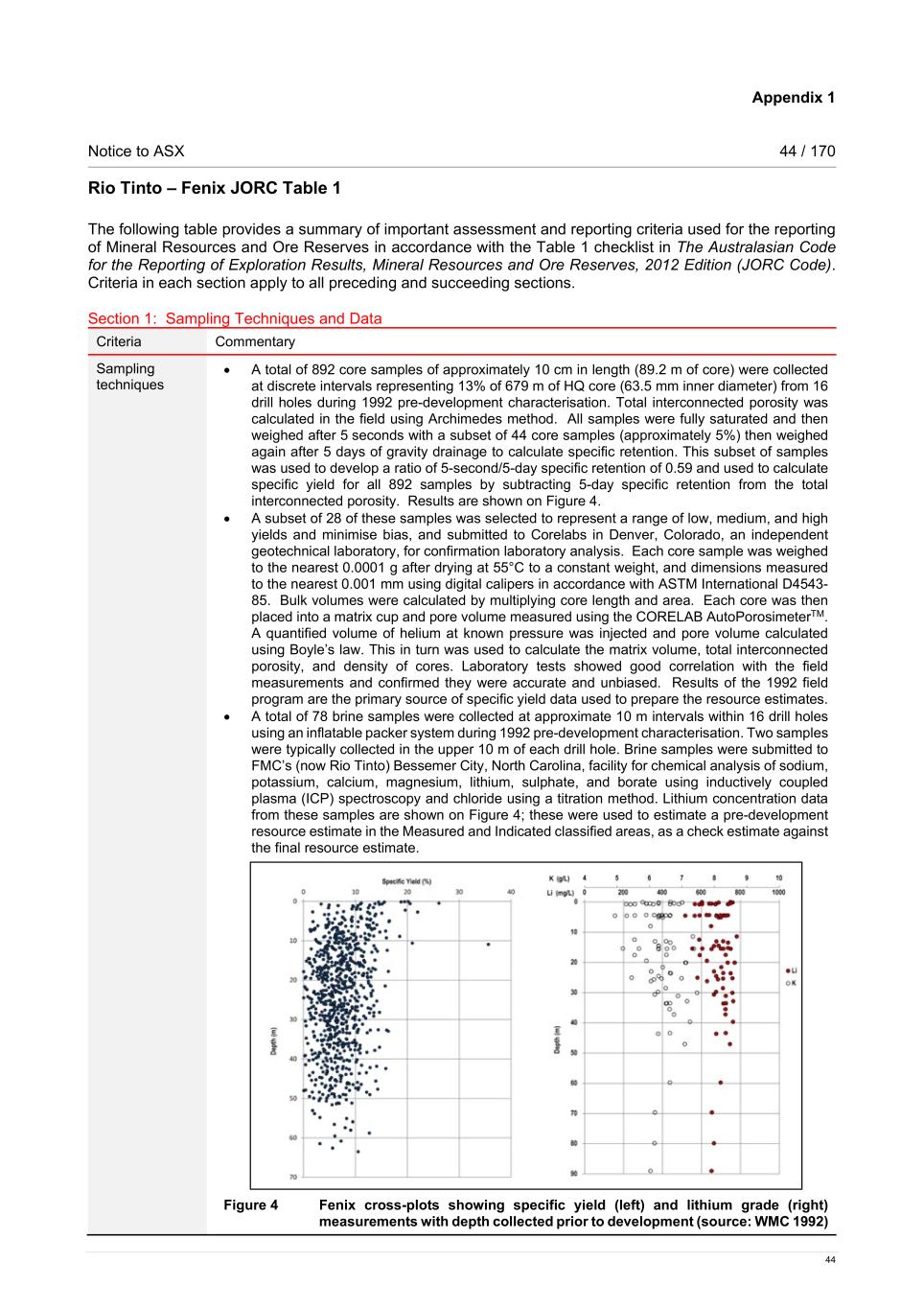
Appendix 1 Notice to ASX 44 / 170 44 Rio Tinto – Fenix JORC Table 1 The following table provides a summary of important assessment and reporting criteria used for the reporting of Mineral Resources and Ore Reserves in accordance with the Table 1 checklist in The Australasian Code for the Reporting of Exploration Results, Mineral Resources and Ore Reserves, 2012 Edition (JORC Code). Criteria in each section apply to all preceding and succeeding sections. Section 1: Sampling Techniques and Data Criteria Commentary Sampling techniques • A total of 892 core samples of approximately 10 cm in length (89.2 m of core) were collected at discrete intervals representing 13% of 679 m of HQ core (63.5 mm inner diameter) from 16 drill holes during 1992 pre-development characterisation. Total interconnected porosity was calculated in the field using Archimedes method. All samples were fully saturated and then weighed after 5 seconds with a subset of 44 core samples (approximately 5%) then weighed again after 5 days of gravity drainage to calculate specific retention. This subset of samples was used to develop a ratio of 5-second/5-day specific retention of 0.59 and used to calculate specific yield for all 892 samples by subtracting 5-day specific retention from the total interconnected porosity. Results are shown on Figure 4. • A subset of 28 of these samples was selected to represent a range of low, medium, and high yields and minimise bias, and submitted to Corelabs in Denver, Colorado, an independent geotechnical laboratory, for confirmation laboratory analysis. Each core sample was weighed to the nearest 0.0001 g after drying at 55°C to a constant weight, and dimensions measured to the nearest 0.001 mm using digital calipers in accordance with ASTM International D4543- 85. Bulk volumes were calculated by multiplying core length and area. Each core was then placed into a matrix cup and pore volume measured using the CORELAB AutoPorosimeterTM. A quantified volume of helium at known pressure was injected and pore volume calculated using Boyle’s law. This in turn was used to calculate the matrix volume, total interconnected porosity, and density of cores. Laboratory tests showed good correlation with the field measurements and confirmed they were accurate and unbiased. Results of the 1992 field program are the primary source of specific yield data used to prepare the resource estimates. • A total of 78 brine samples were collected at approximate 10 m intervals within 16 drill holes using an inflatable packer system during 1992 pre-development characterisation. Two samples were typically collected in the upper 10 m of each drill hole. Brine samples were submitted to FMC’s (now Rio Tinto) Bessemer City, North Carolina, facility for chemical analysis of sodium, potassium, calcium, magnesium, lithium, sulphate, and borate using inductively coupled plasma (ICP) spectroscopy and chloride using a titration method. Lithium concentration data from these samples are shown on Figure 4; these were used to estimate a pre-development resource estimate in the Measured and Indicated classified areas, as a check estimate against the final resource estimate. Figure 4 Fenix cross-plots showing specific yield (left) and lithium grade (right) measurements with depth collected prior to development (source: WMC 1992)
Appendix 1 Notice to ASX 45 / 170 45 • Brine monitoring wells installed in 2017 are routinely sampled by lowering a submersible pump and extracting 3 times the volume of the well before sample collection. Samples are sent to the onsite quality control laboratory for compositional analysis (including lithium concentration) by ICP-optical emission spectroscopy (OES). Lithium concentration data collected from the brine monitoring network in 2022 were used to estimate the portion of the current resource estimate which is classified as Measured Mineral Resources. • A total of 37 brine samples were collected from discrete intervals during the 2020 deep characterisation program and analysed at the onsite laboratory. In general, drill holes were advanced at 12 m increments, rods were then raised to expose the newly drilled interval, and a simple packer system lowered into the open drill hole. The packer system included two packers inflated using nitrogen gas to approximately 50 to 90 pounds per square inch (psi) and used to isolate the upper portion of the drill hole from the sample interval. Brine was evacuated from the drill hole using a 7-bar air compressor and downpipe airline. A total of three drill hole volumes of the target sample interval were purged prior to sampling. Parameters including electrical conductivity, temperature, pH, and density were measured and recorded for samples, which were collected in bottles during purging. Brine samples were collected by drilling personnel and delivered to MdA personnel for analysis of aluminium, arsenic, boron, barium, calcium, density, iron, potassium, lithium, magnesium, sodium, sulfur, silica, zinc, pH, conductivity, chloride, and alkalinity at the onsite laboratory. Sampling results of the 2020 deep characterisation program form the basis for the pre-development resource estimate and the current resource estimate in the areas classified as Indicated and Inferred Mineral Resources. Drilling techniques • A total of 18 drill holes were drilled and cored using diamond drilling techniques to depths between 8 m and 92.5 m bgs during the pre-development characterisation campaign in 1992. An HQ core (96 mm outer diameter [OD]) was used for 17 cored drill holes for a total of 743 m of coring. An NQ core (76 mm OD) was used for an additional 70 m of coring. • Three additional pumping wells and six observation wells were drilled using direct rotary methods and installed in 1993 to facilitate a pumping test for hydraulic characterisation of the brine reservoir. Based on available completion information, pumping wells were drilled to depths between approximately 39 and 54 m bgs using a 430 mm OD bit and completed with 250 mm diameter, 1.5 mm wire-wrapped, slotted screen (due to deviations in drill hole verticality) or 300 mm diameter, 2 mm slotted PVC screen and gravel packed if required to maintain drill hole integrity. Observation wells were constructed with 1 mm slotted, 100 mm diameter casing within a 200 mm diameter drill hole. • Eight groundwater monitoring wells were installed in alluvial aquifers in 1993 around the perimeter of the salar to evaluate the hydrogeology and chemistry of groundwater within the Trapiche Aquifer and the Los Patos Aquifer. These monitoring wells were installed using the mud-rotary method to a depth of 30 m bgs and completed with 0.5 to 1 mm slotted, 100 mm polyvinyl chloride (PVC) screens. • A brine monitoring network was installed in 2017 to support periodic monitoring of brine chemistry and elevations. A total of 11 drill holes were drilled and cored to approximately 30 m bgs for a total of 333.5 m of coring using an HQ core and wireline diamond drilling methods. Direct rotary methods were used to advance an additional 22 8-inch (20 cm) diameter drill holes to depths of 10 m and 20 m adjacent to the 30 m drill holes and two drill holes to 10 m for well construction. In each drill hole, wells were constructed of 4 inch diameter PVC pipe with 5 m long slotted screen intervals at the bottom of each well pipe. • In 2020, three drill holes were drilled to characterise the deeper portions of the brine reservoir using HQ core and diamond drilling methods to depths of 101.5 m, 220 m, and 302 m bgs for a total of 623.5 m of drilling. The upper 30 m to 40 m of each drill hole was drilled using direct rotary methods. Wells were constructed within each deep drill hole using 2 inch diameter PVC pipe with a 1 mm slotted 10 m PVC screen surrounded by 3 mm gravel pack. A bentonite seal was installed above the gravel pack and the remaining annular space was filled with cement bentonite grout. • Core was not orientated as there is no preferential orientation to brine mineralisation. Drill sample recovery • Core recovery is calculated as the percentage of the core length with respect to the total drilling depth. Core recovery during the 1992 pre-development investigation was excellent, averaging 90% or higher. Core recovery during the 2017 salar monitoring network installation was good, averaging 74%. Core recovery during the 2020 deep characterisation program was greater than 80%. Cores collected during the 2020 deep characterisation program were archived onsite in core boxes. No apparent relationship exists between lithology and core recovery, and no sample bias is expected given the high recovery percentages and sample collection from a variety of different lithologies.
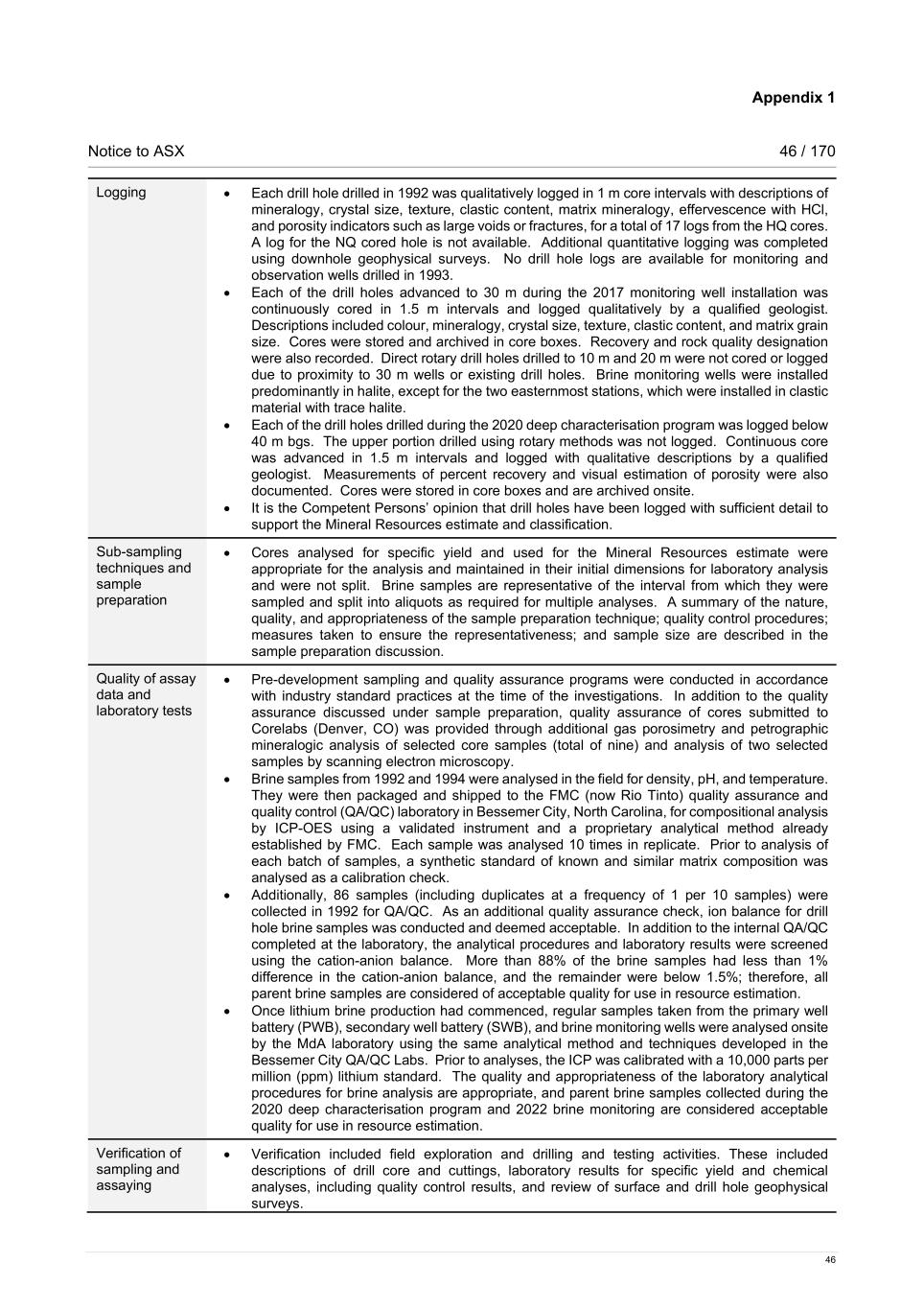
Appendix 1 Notice to ASX 46 / 170 46 Logging • Each drill hole drilled in 1992 was qualitatively logged in 1 m core intervals with descriptions of mineralogy, crystal size, texture, clastic content, matrix mineralogy, effervescence with HCl, and porosity indicators such as large voids or fractures, for a total of 17 logs from the HQ cores. A log for the NQ cored hole is not available. Additional quantitative logging was completed using downhole geophysical surveys. No drill hole logs are available for monitoring and observation wells drilled in 1993. • Each of the drill holes advanced to 30 m during the 2017 monitoring well installation was continuously cored in 1.5 m intervals and logged qualitatively by a qualified geologist. Descriptions included colour, mineralogy, crystal size, texture, clastic content, and matrix grain size. Cores were stored and archived in core boxes. Recovery and rock quality designation were also recorded. Direct rotary drill holes drilled to 10 m and 20 m were not cored or logged due to proximity to 30 m wells or existing drill holes. Brine monitoring wells were installed predominantly in halite, except for the two easternmost stations, which were installed in clastic material with trace halite. • Each of the drill holes drilled during the 2020 deep characterisation program was logged below 40 m bgs. The upper portion drilled using rotary methods was not logged. Continuous core was advanced in 1.5 m intervals and logged with qualitative descriptions by a qualified geologist. Measurements of percent recovery and visual estimation of porosity were also documented. Cores were stored in core boxes and are archived onsite. • It is the Competent Persons’ opinion that drill holes have been logged with sufficient detail to support the Mineral Resources estimate and classification. Sub-sampling techniques and sample preparation • Cores analysed for specific yield and used for the Mineral Resources estimate were appropriate for the analysis and maintained in their initial dimensions for laboratory analysis and were not split. Brine samples are representative of the interval from which they were sampled and split into aliquots as required for multiple analyses. A summary of the nature, quality, and appropriateness of the sample preparation technique; quality control procedures; measures taken to ensure the representativeness; and sample size are described in the sample preparation discussion. Quality of assay data and laboratory tests • Pre-development sampling and quality assurance programs were conducted in accordance with industry standard practices at the time of the investigations. In addition to the quality assurance discussed under sample preparation, quality assurance of cores submitted to Corelabs (Denver, CO) was provided through additional gas porosimetry and petrographic mineralogic analysis of selected core samples (total of nine) and analysis of two selected samples by scanning electron microscopy. • Brine samples from 1992 and 1994 were analysed in the field for density, pH, and temperature. They were then packaged and shipped to the FMC (now Rio Tinto) quality assurance and quality control (QA/QC) laboratory in Bessemer City, North Carolina, for compositional analysis by ICP-OES using a validated instrument and a proprietary analytical method already established by FMC. Each sample was analysed 10 times in replicate. Prior to analysis of each batch of samples, a synthetic standard of known and similar matrix composition was analysed as a calibration check. • Additionally, 86 samples (including duplicates at a frequency of 1 per 10 samples) were collected in 1992 for QA/QC. As an additional quality assurance check, ion balance for drill hole brine samples was conducted and deemed acceptable. In addition to the internal QA/QC completed at the laboratory, the analytical procedures and laboratory results were screened using the cation-anion balance. More than 88% of the brine samples had less than 1% difference in the cation-anion balance, and the remainder were below 1.5%; therefore, all parent brine samples are considered of acceptable quality for use in resource estimation. • Once lithium brine production had commenced, regular samples taken from the primary well battery (PWB), secondary well battery (SWB), and brine monitoring wells were analysed onsite by the MdA laboratory using the same analytical method and techniques developed in the Bessemer City QA/QC Labs. Prior to analyses, the ICP was calibrated with a 10,000 parts per million (ppm) lithium standard. The quality and appropriateness of the laboratory analytical procedures for brine analysis are appropriate, and parent brine samples collected during the 2020 deep characterisation program and 2022 brine monitoring are considered acceptable quality for use in resource estimation. Verification of sampling and assaying • Verification included field exploration and drilling and testing activities. These included descriptions of drill core and cuttings, laboratory results for specific yield and chemical analyses, including quality control results, and review of surface and drill hole geophysical surveys.

Appendix 1 Notice to ASX 47 / 170 47 • When not present for field activities, lithologic data interpreted by third parties were verified by Integral Consulting by comparing field notes and related interpretations against photos of cuttings and core boxes. • No holes were twinned, duplicate brine samples were presented to the laboratories. • Pre-development data were digitized from hardcopy reports and transferred into a central data repository managed by Integral Consulting, Louisville, Colorado. • Three independent personnel from Integral Consulting digitized hardcopy data separately from the same report. Following this exercise, outliers were flagged and average values for parameters key to resource estimation (specific yield and lithium grade) were uploaded to the database. • Exploration and operational data collected after operations began were transferred from Rio Tinto’s predecessors (FMC Lithium, Livent, and Arcadium Lithium) and were combined into a central database managed by Integral Consulting. • Laboratory assay data provided by the Fenix onsite laboratory were directly loaded into the central database. • Rio Tinto’s Bessemer City and onsite (MdA) laboratories are certified under the International Organisation for Standardisation (ISO) standard for Quality (9001). Duplicate samples for chemical analysis have been collected from various locations across SdHM, including brine and groundwater monitoring wells, ponds, lithium brine production wells, and process components. These duplicate samples have been concurrently analysed by the onsite laboratory and other accredited laboratories, including the Alex Stewart laboratory in Jujuy, Argentina, and the SGS laboratory in Salta, Argentina. In 2020 during the deep characterisation program, 37 discrete duplicate samples were submitted to SGS in Salta. More recently in 2022, 52 samples were collected from onsite wells and analysed at both the MdA laboratory and Alex Stewart laboratory in Jujuy. Analytical results for the 2020 samples sent to SGS and MdA, and 2022 samples sent to Alex Stewart and MdA, are well correlated, with coefficient of determination (R2) values of 0.91 and 0.99, respectively. • The Competent Person’s opinion is the data reported by MdA’s internal laboratory are accurate and acceptable for estimating Mineral Resources at SdHM. The Competent Person maintains that the onsite, MdA laboratory has years of experience with lithium analytical techniques for brine samples, and that its laboratory results are reliable and accurate. Location of data points • Pre-development characterisation drill holes were surveyed using a site-specific coordinate system. No elevation data were provided. Drill hole locations were digitised from a georeferenced figure, and easting and northing coordinates calculated using the POSGAR 2007 Argentina Zone 3 coordinate system. Although these locations were not formally surveyed using this coordinate system, this approach is sufficient given the distance between drill holes and scale at which the resource is estimated. Collar elevations for the drill holes were extracted from a high resolution geoidal digital elevation model (DEM) published by the United States Geological Survey (USGS) Earth Explorer. This procedure is considered sufficient for the pre-development resource estimates. • Locations of drill holes and wells installed in 2017 used to inform the Mineral Resources estimate were surveyed by a licensed surveyor in the POSGAR 1994 Argentina Zone 3 coordinate system. Collar elevations were surveyed using an ellipsoidal vertical datum. Collar information was reported in meters to 3 decimal places. Elevation data were also converted to the geoidal datum for use in the Mineral Resources and Ore Reserves estimates. These showed good correlation with the deep characterisation drill holes described below. Locations of drill holes and wells installed in 2020 used to inform the Mineral Resources estimate were surveyed using the UTM Zone 19J coordinate system and were reported in meters to 2 decimal places. Elevations were reported to the nearest meter. • Locations used for the final Mineral Resources and Ore Reserves estimates were converted to POSGAR 2007 Argentina Zone 3 coordinate system and geoidal vertical datum and is considered sufficient for the Mineral Resources and Ore Reserves estimates as there is minimal topographic relief across the flat surface of the salar. Data spacing and distribution • Specific yield and brine concentration data are of sufficient spacing and distribution to apply the appropriate degree of confidence in classifying the Mineral Resources. Typical industry practice when evaluating brine Mineral Resources suggests drill spacings for a mature salar of 3 km to 4 km for Measured Mineral Resources, 7 km for Indicated Mineral Resources, and 10 km for Inferred Mineral Resources. Drill holes used for the pre-development Mineral Resources estimate work were spaced approximately 2.5 km to 5 km apart. Monitoring wells used for the current Mineral Resources estimate are spaced approximately 3 km to 4 km apart. Deep characterisation program drill holes were spaced approximately 5 km to 8 km apart and are within 10 km of the mining concession boundary. Because the vertical heterogeneity and
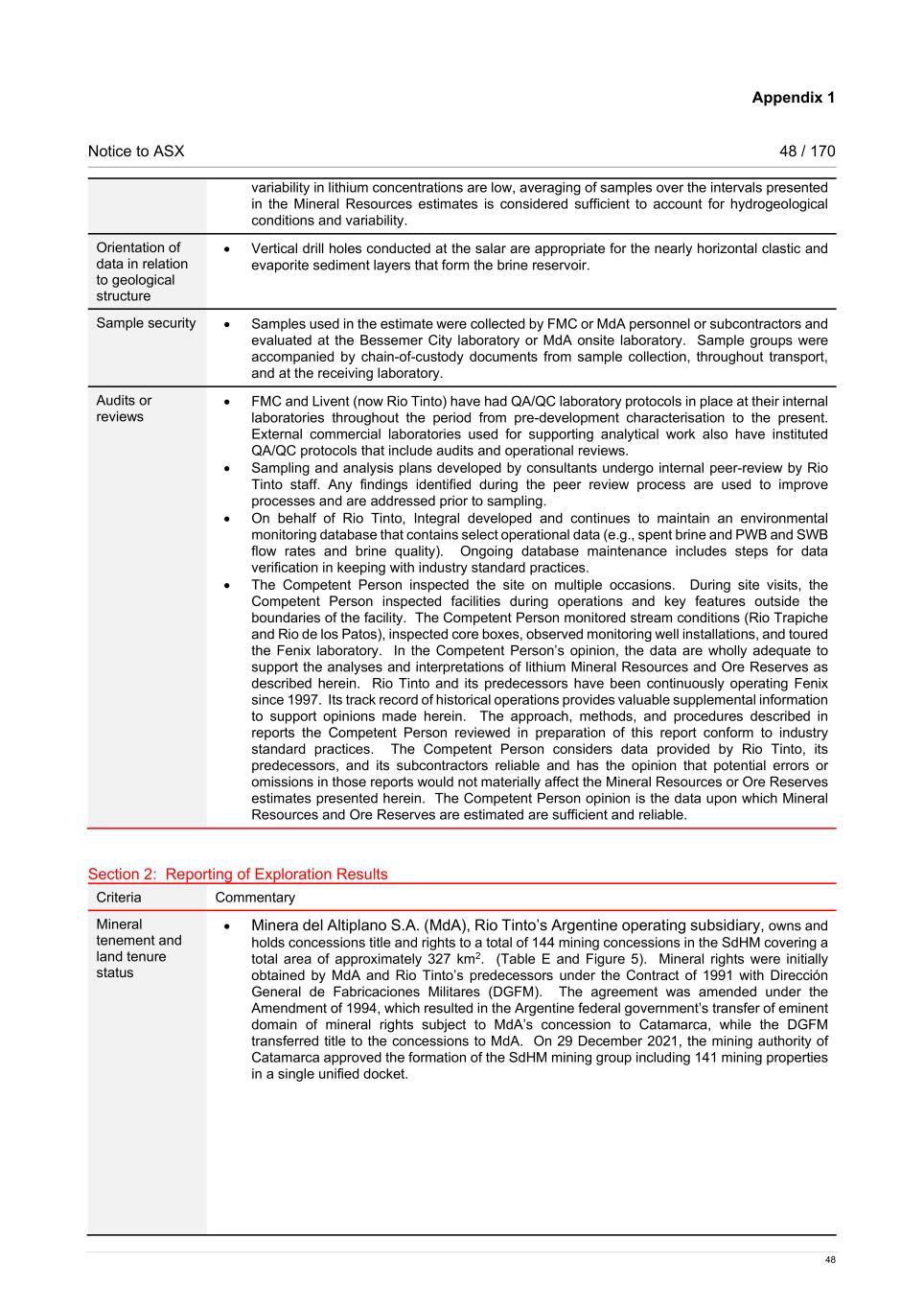
Appendix 1 Notice to ASX 48 / 170 48 variability in lithium concentrations are low, averaging of samples over the intervals presented in the Mineral Resources estimates is considered sufficient to account for hydrogeological conditions and variability. Orientation of data in relation to geological structure • Vertical drill holes conducted at the salar are appropriate for the nearly horizontal clastic and evaporite sediment layers that form the brine reservoir. Sample security • Samples used in the estimate were collected by FMC or MdA personnel or subcontractors and evaluated at the Bessemer City laboratory or MdA onsite laboratory. Sample groups were accompanied by chain-of-custody documents from sample collection, throughout transport, and at the receiving laboratory. Audits or reviews • FMC and Livent (now Rio Tinto) have had QA/QC laboratory protocols in place at their internal laboratories throughout the period from pre-development characterisation to the present. External commercial laboratories used for supporting analytical work also have instituted QA/QC protocols that include audits and operational reviews. • Sampling and analysis plans developed by consultants undergo internal peer-review by Rio Tinto staff. Any findings identified during the peer review process are used to improve processes and are addressed prior to sampling. • On behalf of Rio Tinto, Integral developed and continues to maintain an environmental monitoring database that contains select operational data (e.g., spent brine and PWB and SWB flow rates and brine quality). Ongoing database maintenance includes steps for data verification in keeping with industry standard practices. • The Competent Person inspected the site on multiple occasions. During site visits, the Competent Person inspected facilities during operations and key features outside the boundaries of the facility. The Competent Person monitored stream conditions (Rio Trapiche and Rio de los Patos), inspected core boxes, observed monitoring well installations, and toured the Fenix laboratory. In the Competent Person’s opinion, the data are wholly adequate to support the analyses and interpretations of lithium Mineral Resources and Ore Reserves as described herein. Rio Tinto and its predecessors have been continuously operating Fenix since 1997. Its track record of historical operations provides valuable supplemental information to support opinions made herein. The approach, methods, and procedures described in reports the Competent Person reviewed in preparation of this report conform to industry standard practices. The Competent Person considers data provided by Rio Tinto, its predecessors, and its subcontractors reliable and has the opinion that potential errors or omissions in those reports would not materially affect the Mineral Resources or Ore Reserves estimates presented herein. The Competent Person opinion is the data upon which Mineral Resources and Ore Reserves are estimated are sufficient and reliable. Section 2: Reporting of Exploration Results Criteria Commentary Mineral tenement and land tenure status • Minera del Altiplano S.A. (MdA), Rio Tinto’s Argentine operating subsidiary, owns and holds concessions title and rights to a total of 144 mining concessions in the SdHM covering a total area of approximately 327 km2. (Table E and Figure 5). Mineral rights were initially obtained by MdA and Rio Tinto’s predecessors under the Contract of 1991 with Dirección General de Fabricaciones Militares (DGFM). The agreement was amended under the Amendment of 1994, which resulted in the Argentine federal government’s transfer of eminent domain of mineral rights subject to MdA’s concession to Catamarca, while the DGFM transferred title to the concessions to MdA. On 29 December 2021, the mining authority of Catamarca approved the formation of the SdHM mining group including 141 mining properties in a single unified docket.
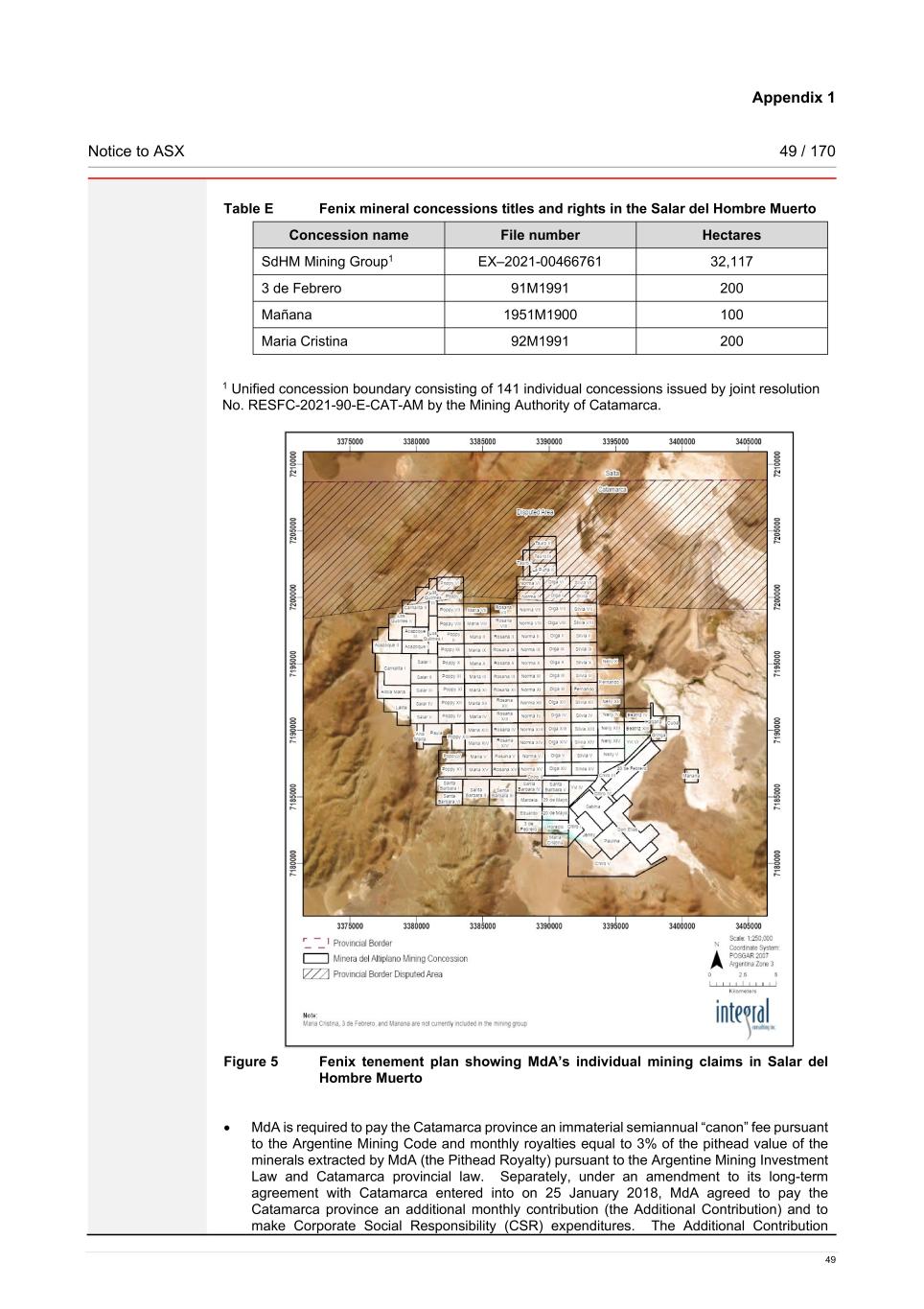
Appendix 1 Notice to ASX 49 / 170 49 Table E Fenix mineral concessions titles and rights in the Salar del Hombre Muerto Concession name File number Hectares SdHM Mining Group1 EX–2021-00466761 32,117 3 de Febrero 91M1991 200 Mañana 1951M1900 100 Maria Cristina 92M1991 200 1 Unified concession boundary consisting of 141 individual concessions issued by joint resolution No. RESFC-2021-90-E-CAT-AM by the Mining Authority of Catamarca. Figure 5 Fenix tenement plan showing MdA’s individual mining claims in Salar del Hombre Muerto • MdA is required to pay the Catamarca province an immaterial semiannual “canon” fee pursuant to the Argentine Mining Code and monthly royalties equal to 3% of the pithead value of the minerals extracted by MdA (the Pithead Royalty) pursuant to the Argentine Mining Investment Law and Catamarca provincial law. Separately, under an amendment to its long-term agreement with Catamarca entered into on 25 January 2018, MdA agreed to pay the Catamarca province an additional monthly contribution (the Additional Contribution) and to make Corporate Social Responsibility (CSR) expenditures. The Additional Contribution
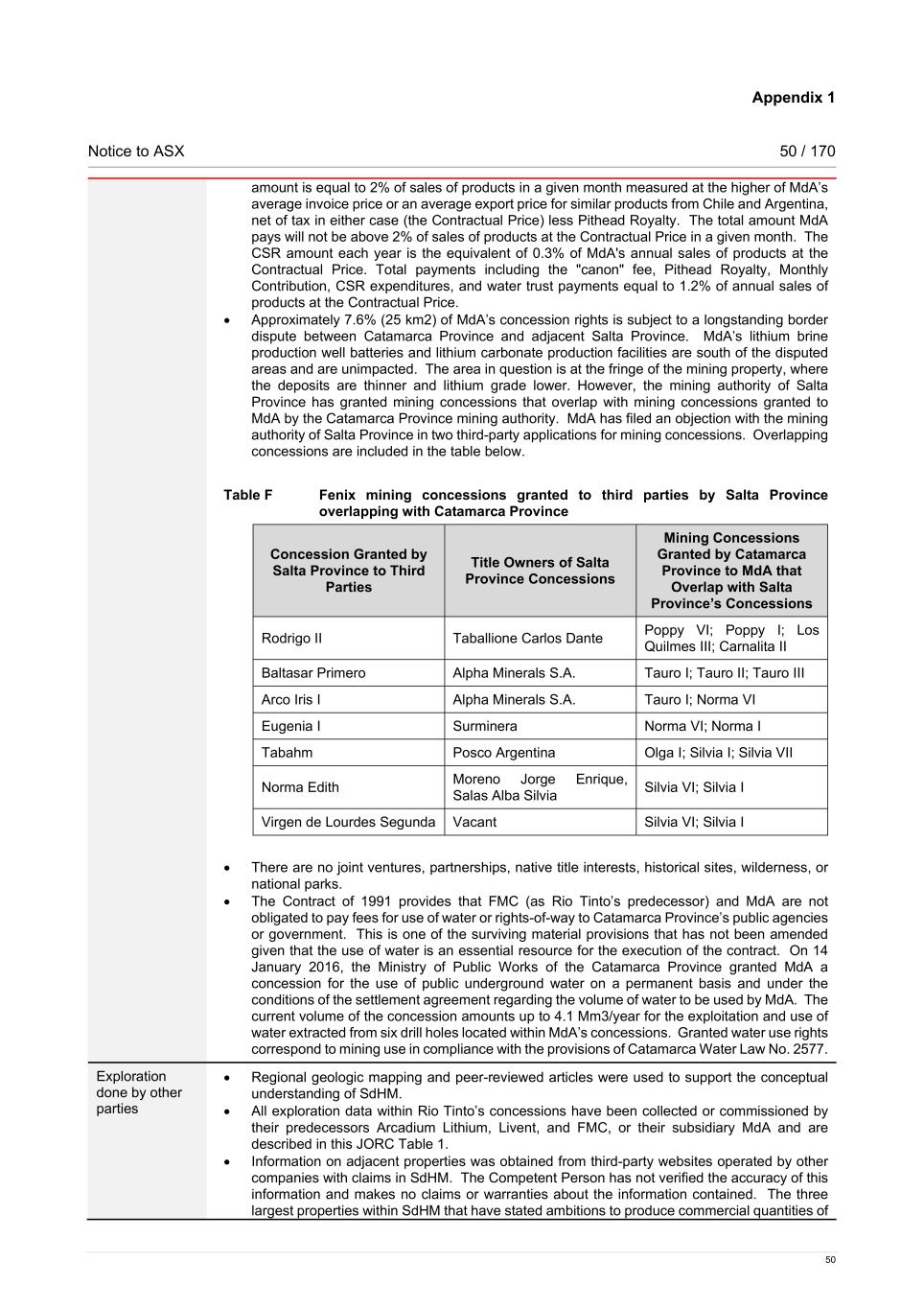
Appendix 1 Notice to ASX 50 / 170 50 amount is equal to 2% of sales of products in a given month measured at the higher of MdA’s average invoice price or an average export price for similar products from Chile and Argentina, net of tax in either case (the Contractual Price) less Pithead Royalty. The total amount MdA pays will not be above 2% of sales of products at the Contractual Price in a given month. The CSR amount each year is the equivalent of 0.3% of MdA's annual sales of products at the Contractual Price. Total payments including the "canon" fee, Pithead Royalty, Monthly Contribution, CSR expenditures, and water trust payments equal to 1.2% of annual sales of products at the Contractual Price. • Approximately 7.6% (25 km2) of MdA’s concession rights is subject to a longstanding border dispute between Catamarca Province and adjacent Salta Province. MdA’s lithium brine production well batteries and lithium carbonate production facilities are south of the disputed areas and are unimpacted. The area in question is at the fringe of the mining property, where the deposits are thinner and lithium grade lower. However, the mining authority of Salta Province has granted mining concessions that overlap with mining concessions granted to MdA by the Catamarca Province mining authority. MdA has filed an objection with the mining authority of Salta Province in two third-party applications for mining concessions. Overlapping concessions are included in the table below. Table F Fenix mining concessions granted to third parties by Salta Province overlapping with Catamarca Province Concession Granted by Salta Province to Third Parties Title Owners of Salta Province Concessions Mining Concessions Granted by Catamarca Province to MdA that Overlap with Salta Province’s Concessions Rodrigo II Taballione Carlos Dante Poppy VI; Poppy I; Los Quilmes III; Carnalita II Baltasar Primero Alpha Minerals S.A. Tauro I; Tauro II; Tauro III Arco Iris I Alpha Minerals S.A. Tauro I; Norma VI Eugenia I Surminera Norma VI; Norma I Tabahm Posco Argentina Olga I; Silvia I; Silvia VII Norma Edith Moreno Jorge Enrique, Salas Alba Silvia Silvia VI; Silvia I Virgen de Lourdes Segunda Vacant Silvia VI; Silvia I • There are no joint ventures, partnerships, native title interests, historical sites, wilderness, or national parks. • The Contract of 1991 provides that FMC (as Rio Tinto’s predecessor) and MdA are not obligated to pay fees for use of water or rights-of-way to Catamarca Province’s public agencies or government. This is one of the surviving material provisions that has not been amended given that the use of water is an essential resource for the execution of the contract. On 14 January 2016, the Ministry of Public Works of the Catamarca Province granted MdA a concession for the use of public underground water on a permanent basis and under the conditions of the settlement agreement regarding the volume of water to be used by MdA. The current volume of the concession amounts up to 4.1 Mm3/year for the exploitation and use of water extracted from six drill holes located within MdA’s concessions. Granted water use rights correspond to mining use in compliance with the provisions of Catamarca Water Law No. 2577. Exploration done by other parties • Regional geologic mapping and peer-reviewed articles were used to support the conceptual understanding of SdHM. • All exploration data within Rio Tinto’s concessions have been collected or commissioned by their predecessors Arcadium Lithium, Livent, and FMC, or their subsidiary MdA and are described in this JORC Table 1. • Information on adjacent properties was obtained from third-party websites operated by other companies with claims in SdHM. The Competent Person has not verified the accuracy of this information and makes no claims or warranties about the information contained. The three largest properties within SdHM that have stated ambitions to produce commercial quantities of

Appendix 1 Notice to ASX 51 / 170 51 lithium are Rio Tinto (formerly Arcadium Lithium and its predecessors), POSCO Argentina (POSCO), and Galan Lithium Limited (Galan). • Rio Tinto’s other brine project, Sal de Vida, in the Eastern Subbasin at SdHM, borders the Contiguous Lease Area at the saddle that separates the two subbasins. Sal de Vida is designed to produce predominantly battery-grade lithium carbonate through an evaporation and processing operation at the SdHM site. • Galan has two projects in SdHM: Hombre Muerto West (HMW) and Candelas. HMW is located west of Project Fenix. Most of Galan’s HMW concessions are located atop outcropping shallow bedrock, which is considered unfavourable for brine extraction. Small portions of the easternmost claims extend over alluvium and salar sediments, where brine extraction is feasible. Galan’s Candelas project is located south of the Eastern Subbasin, in the alluvial sediments beneath the Rio de los Patos. Galan reports that recent drilling and geophysical results indicate the potential for substantial brine at depth. However, potential brine extraction from these tenements do not pose a risk to Fenix. Geology • The principal lithium-bearing region of South America is located within the Puna plateau geologic province. In the southern Puna, combinations of east-trending volcanic chains and north-trending, reverse fault–bounded structural blocks comprise several hydrologically closed (endorheic) basins. In the semiarid to hyperarid climate of the Puna, where evaporation rates far exceed precipitation, the hydrologic terminus of an endorheic basin is a dry lakebed, or salar. These are typically flat and expansive with little or no perennial water or vegetation. Surface water drains into these closed basins and evaporation dominates the water balance, leaving behind brines enriched in various metals and salts, sometimes including economic levels of lithium, boron, and/or potassium. • SdHM is one of the most important evaporitic basins in the Argentinean Puna and encompasses nearly 600 km2. It consists of evaporite deposits formed within an isolated endorheic basin, bounded by pre-Paleozoic, Paleozoic, and Cenozoic–age crystalline metamorphic basement rocks. Fault-bounded bedrock hills occur within and along the margins of the salar basin, further subdividing SdHM into two separate subbasins (eastern and western), each with different evaporite sediment compositions (Figure 6). Clastic sediments (sands, silts, and clays) are deposited along with evaporite minerals in the basins by stream inflows and by alluvial fans along bounding hills. The Eastern Subbasin is much more clastic- rich than the Western Subbasin and dominated by borate evaporites. The Western Subbasin is considered a mature salar. Mature salars are dominated by massive central cores of halite with salar-margin sheets of clastic deposits. A transition of primary evaporite minerals is observed from basin margins to basin centres, proceeding from carbonates at margins through borates, sulphates, and ultimately chlorides (halite) in basin centres. The Eastern Subbasin is highly asymmetric, with the deeper basin centre in the western portion. The Western Subbasin is more symmetrical but is believed to be deepest west of the geographical centre.
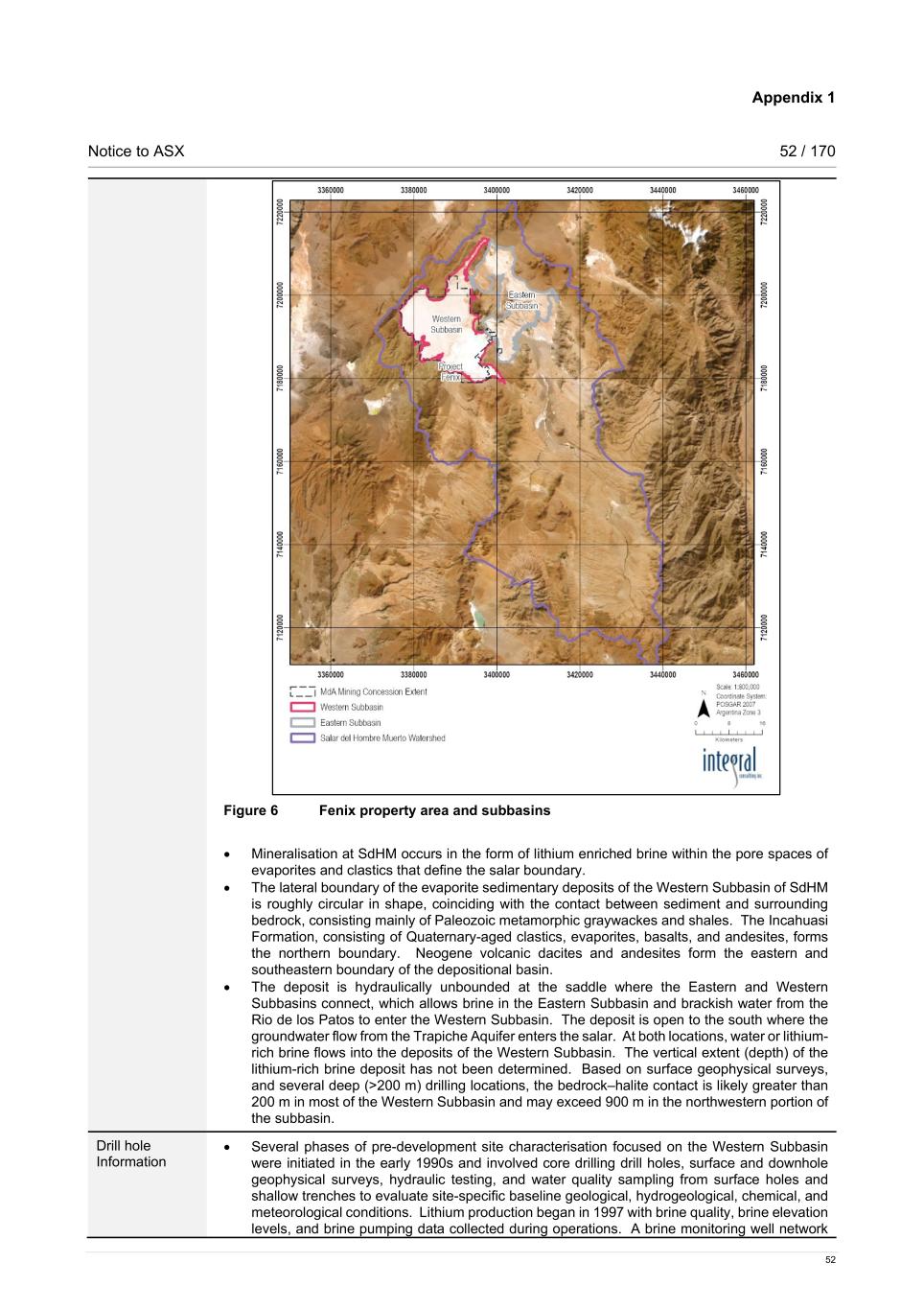
Appendix 1 Notice to ASX 52 / 170 52 Figure 6 Fenix property area and subbasins • Mineralisation at SdHM occurs in the form of lithium enriched brine within the pore spaces of evaporites and clastics that define the salar boundary. • The lateral boundary of the evaporite sedimentary deposits of the Western Subbasin of SdHM is roughly circular in shape, coinciding with the contact between sediment and surrounding bedrock, consisting mainly of Paleozoic metamorphic graywackes and shales. The Incahuasi Formation, consisting of Quaternary-aged clastics, evaporites, basalts, and andesites, forms the northern boundary. Neogene volcanic dacites and andesites form the eastern and southeastern boundary of the depositional basin. • The deposit is hydraulically unbounded at the saddle where the Eastern and Western Subbasins connect, which allows brine in the Eastern Subbasin and brackish water from the Rio de los Patos to enter the Western Subbasin. The deposit is open to the south where the groundwater flow from the Trapiche Aquifer enters the salar. At both locations, water or lithium- rich brine flows into the deposits of the Western Subbasin. The vertical extent (depth) of the lithium-rich brine deposit has not been determined. Based on surface geophysical surveys, and several deep (>200 m) drilling locations, the bedrock–halite contact is likely greater than 200 m in most of the Western Subbasin and may exceed 900 m in the northwestern portion of the subbasin. Drill hole Information • Several phases of pre-development site characterisation focused on the Western Subbasin were initiated in the early 1990s and involved core drilling drill holes, surface and downhole geophysical surveys, hydraulic testing, and water quality sampling from surface holes and shallow trenches to evaluate site-specific baseline geological, hydrogeological, chemical, and meteorological conditions. Lithium production began in 1997 with brine quality, brine elevation levels, and brine pumping data collected during operations. A brine monitoring well network
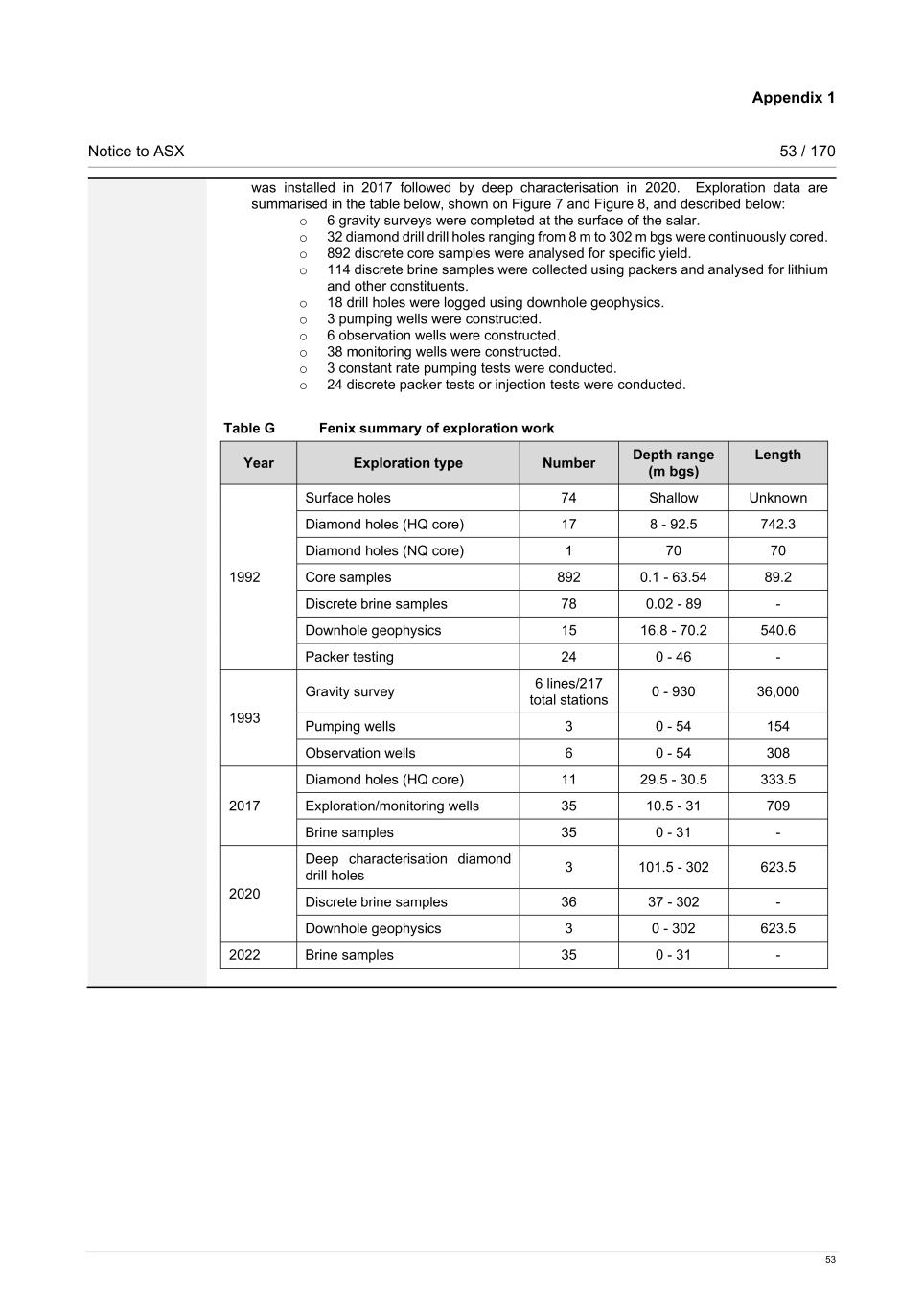
Appendix 1 Notice to ASX 53 / 170 53 was installed in 2017 followed by deep characterisation in 2020. Exploration data are summarised in the table below, shown on Figure 7 and Figure 8, and described below: o 6 gravity surveys were completed at the surface of the salar. o 32 diamond drill drill holes ranging from 8 m to 302 m bgs were continuously cored. o 892 discrete core samples were analysed for specific yield. o 114 discrete brine samples were collected using packers and analysed for lithium and other constituents. o 18 drill holes were logged using downhole geophysics. o 3 pumping wells were constructed. o 6 observation wells were constructed. o 38 monitoring wells were constructed. o 3 constant rate pumping tests were conducted. o 24 discrete packer tests or injection tests were conducted. Table G Fenix summary of exploration work Year Exploration type Number Depth range (m bgs) Length 1992 Surface holes 74 Shallow Unknown Diamond holes (HQ core) 17 8 - 92.5 742.3 Diamond holes (NQ core) 1 70 70 Core samples 892 0.1 - 63.54 89.2 Discrete brine samples 78 0.02 - 89 - Downhole geophysics 15 16.8 - 70.2 540.6 Packer testing 24 0 - 46 - 1993 Gravity survey 6 lines/217 total stations 0 - 930 36,000 Pumping wells 3 0 - 54 154 Observation wells 6 0 - 54 308 2017 Diamond holes (HQ core) 11 29.5 - 30.5 333.5 Exploration/monitoring wells 35 10.5 - 31 709 Brine samples 35 0 - 31 - 2020 Deep characterisation diamond drill holes 3 101.5 - 302 623.5 Discrete brine samples 36 37 - 302 - Downhole geophysics 3 0 - 302 623.5 2022 Brine samples 35 0 - 31 -
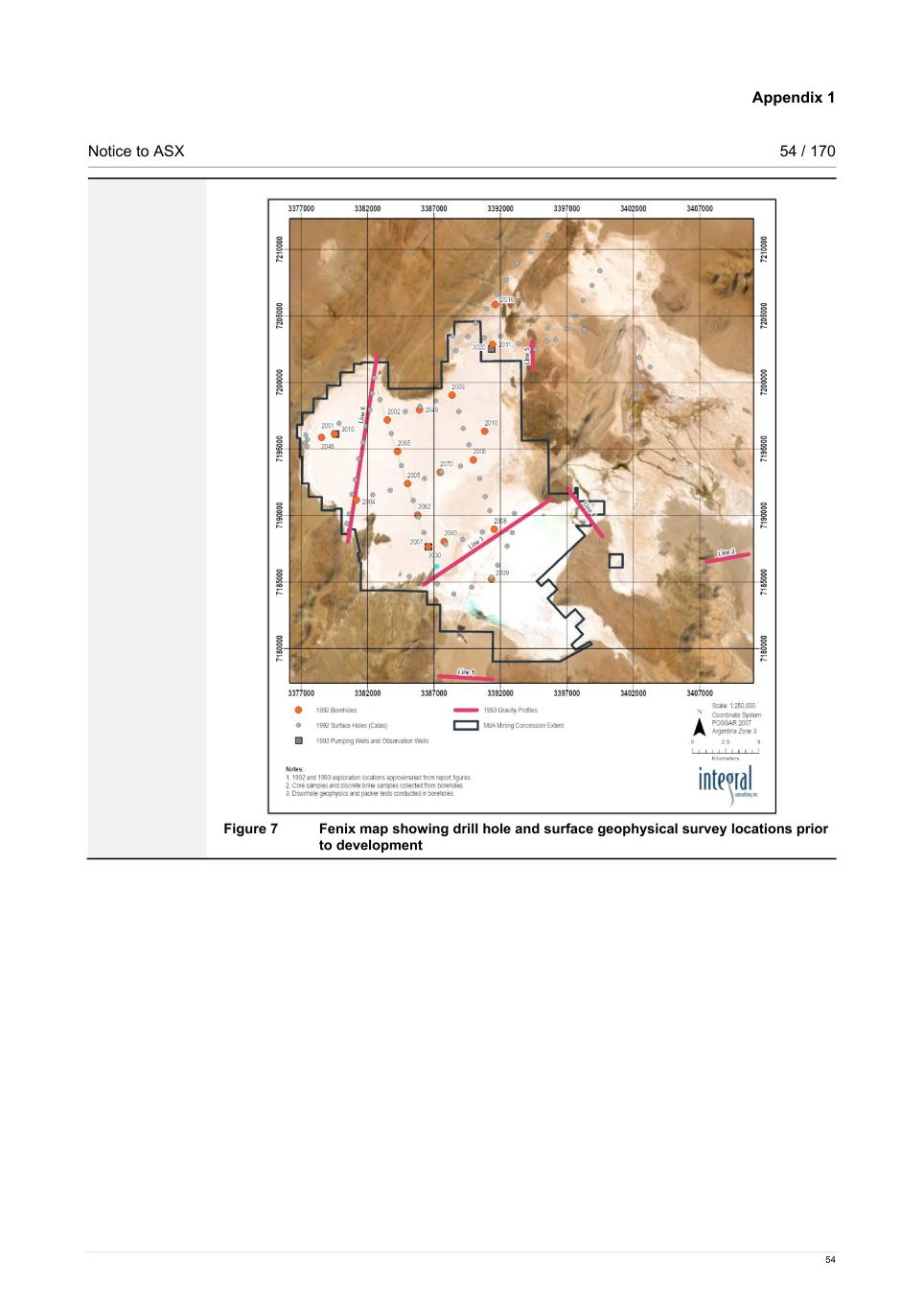
Appendix 1 Notice to ASX 54 / 170 54 Figure 7 Fenix map showing drill hole and surface geophysical survey locations prior to development
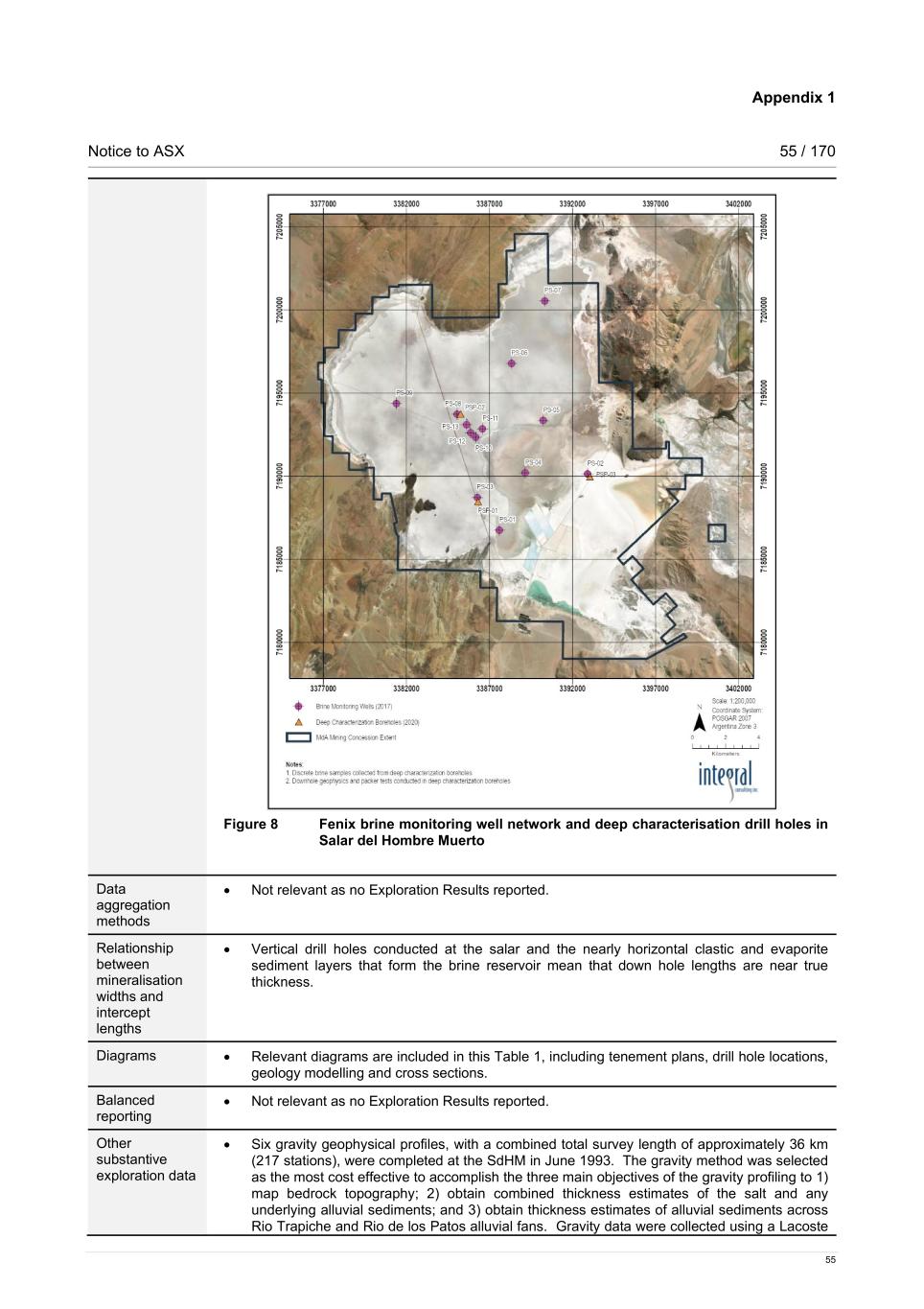
Appendix 1 Notice to ASX 55 / 170 55 Figure 8 Fenix brine monitoring well network and deep characterisation drill holes in Salar del Hombre Muerto Data aggregation methods • Not relevant as no Exploration Results reported. Relationship between mineralisation widths and intercept lengths • Vertical drill holes conducted at the salar and the nearly horizontal clastic and evaporite sediment layers that form the brine reservoir mean that down hole lengths are near true thickness. Diagrams • Relevant diagrams are included in this Table 1, including tenement plans, drill hole locations, geology modelling and cross sections. Balanced reporting • Not relevant as no Exploration Results reported. Other substantive exploration data • Six gravity geophysical profiles, with a combined total survey length of approximately 36 km (217 stations), were completed at the SdHM in June 1993. The gravity method was selected as the most cost effective to accomplish the three main objectives of the gravity profiling to 1) map bedrock topography; 2) obtain combined thickness estimates of the salt and any underlying alluvial sediments; and 3) obtain thickness estimates of alluvial sediments across Rio Trapiche and Rio de los Patos alluvial fans. Gravity data were collected using a Lacoste
Appendix 1 Notice to ASX 56 / 170 56 & Romberg G Meter with stations at varying spacing along lines dependent on anticipated depth to bedrock. Gravity data were corrected for multiple factors and processed using Geosoft gravity reduction software. Regional effects were removed and the remaining residual complete Bouguer anomalies used to perform depth to bedrock modelling along each of the profiles. Northwest Geophysical Associates GM-SYS software was used to perform the forward modelling of depth to bedrock. A total of 24 samples were collected at the ends of the profiles for laboratory density measurements. These measurements helped to determine density contrasts between salt, alluvium, and various volcanic bedrock types. Results from the profiling of alluvial fans were used in developing the groundwater input to the hydrologic balance of the salar. • Downhole geophysical surveys were conducted using Logmaster tools for temperature, caliper, natural gamma, single-detector neutron, gamma-gamma density, and fluid-column temperature logs in 15 of the drill holes drilled during the 1992 investigation to provide supplemental lithologic information and relative porosity estimates. Due to drill hole instability and collapse, geophysical logs did not extend to drilled total depth in all drill holes. Geophysical logs were highly useful in confirming lithologic interpretations and correlating geologic strata between drill holes supporting development of a three-dimensional understanding of the salar aquifer framework. Lithology was primarily determined using a combination of gamma, neutron, and caliper logs in conjunction with core logging lithological descriptions. Neutron logs, in addition to providing important keys to lithology, provide a qualitative measure of rock/sediment porosity; however, the data collected during this phase were of insufficient quality for that purpose. • A total of 22 packer tests were conducted in 11 of the 2000-series drill holes/wells between 0 m and 46 m bgs during the 1992 site investigation. Packer tests were conducted by isolating a 5 m interval using a nitrogen-inflated packer, pumping three drill hole volumes at a measured flow rate using a suction pump, and recording drawdown in the sample interval. For the two intervals in which the permeability was too low for pumping, water was injected and water levels measured during a falling-head slug test. Results were evaluated using the Hvorslev method and ranged from 0.1 to 120 m/day, with a geometric mean of 10 m/day. Step- drawdown tests were conducted to estimate well yield and efficiency and to determine the optimal rate for constant-rate tests. Simultaneous constant rate pumping tests were then conducted in the 3000-series pumping wells and observation wells for a period greater than 20 days. Electrical submersible pumps were used in two wells, and a surface turbine pump was used in one well. Wells were pumped at rates between 31 and 37 L/s. Water levels were monitored in the pumping well, three adjacent observation wells, and next closest 2000-series well installed in 1992 to the nearest ±1 mm using a water level probe with measurement intervals increasing geometrically. Transmissivity ranged from 17,000 m2/day to 306,000 m2/day in Wells 3020 and 3030, respectively. High transmissivity values are attributed to presence of fractures, with lower values representative of the aquifer at a semi regional scale. • Dispersion tests were conducted during the constant rate pumping tests to support reserve modelling by introducing a sodium fluoride solution of known concentration at the observation well 10 m from the pumping well and then collecting samples from the pumping well for onsite fluoride analysis using a benchtop pH/ISE meter and fluoride electrode. • Specific capacity tests were run on seven of the eight wells installed in the alluvium surrounding SdHM. Wells were pumped at rates between 79.5 and 142.5 m3/day for a total of approximately 5 hours, and drawdown was measured in the well. Results were used to calculate hydraulic conductivity of the alluvial aquifers, assuming 60% well efficiency, and ranged from 6.6 to 25 m/day for the Rio de los Patos alluvial aquifer and 5.3 to 14.3 m/day for the Trapiche alluvial aquifer. • Livent, a predecessor of Rio Tinto, conducted a deep brine reservoir characterisation program below 40 m depth in 2020 within the Western Subbasin of SdHM. The primary goals of the program were to characterise brine quality and reservoir hydraulic properties below 40 m to depths of at least 200 m. Data collected from drill holes during the program provide evidence of lithium concentrations and reservoir properties at depths below any existing pumping wells. Drill holes were cored and logged for lithology, after which downhole geophysical logging was conducted. The logging suite included natural gamma, spontaneous potential, and resistivity logs. Packer tests were employed to collect brine samples and determine relative permeability (flow rates) at various depth intervals within drill holes. Each drill hole was converted into a monitoring well after completion of geophysical logging and packer test sampling. Further work • A deep characterisation program below 40 m bgs is currently in the planning phase and is being designed to improve confidence in deep lithium Mineral Resources estimates and to improve numerical modelling parameters required to forecast lithium Ore Reserves. This program will include additional surface geophysical surveys to refine the reservoir geometry;

Appendix 1 Notice to ASX 57 / 170 57 additional coring, brine sampling, and drill hole geophysical logging to refine the Mineral Resources estimates; and hydraulic testing to further parameterise the numerical model and improve reserve forecasts. Alternative adaptive management programs for spent brine are currently under consideration. Further numerical modelling work is recommended to support expanded lithium brine production and optimise well configurations and pumping rates. Future numerical modelling work should incorporate relevant information collected during the other future work. Section 3: Estimation and Reporting of Mineral Resources Criteria Commentary Database integrity • A quality management program was followed during preparation of the Mineral Resources and Ore Reserves estimates. Data underwent multiple rounds of rigorous QA/QC to confirm consistency with the source and that the disclosure is not materially affected by data quality. • Data are stored in an SQL database maintained by Integral Consulting. • Drill holes, wells and other key features were located by hand-held GPS and later surveyed by credentialed third party land surveyors. • Data and third-party reports were relied on to support the Mineral Resource estimates. Some historical and third-party data were not available in electronic format and instead were digitised and then cross-checked and validated by one or more separate Integral employees. • Lithium concentration data analysed at the MdA onsite laboratory have been submitted to external laboratories for third-party validation, with results showing good correlation. • Data received from Rio Tinto, its predecessors, and MdA were also validated upon receipt by comparison with historical data. Site visits • Personal inspections of SdHM and Fenix operating facilities, as well as meetings in Argentina with local authorities have been conducted by the Competent Person as outlined below: • Mr. Sean Kosinski has made numerous site visits since becoming involved in the Project in 2012. • Mr. Sean Kosinski most recently visited SdHM in August 2025 to inspect facilities including Expansion 1A production wells, equalisation ponds, and SA and Carbonate plants. Geological interpretation • A three-dimensional geological model was prepared for SdHM using Leapfrog Works software (Version 2021.2) to support estimation of the Mineral Resources and parameterisation of the variable-density flow and transport model used to estimate the lithium Ore Reserves. Drill hole logs for the 1000 series (PWB), 2000 and 3000 series (pre-development exploration drill holes and pumping wells), brine monitoring wells, and deep characterisation drill holes in the Western Subbasin were compiled with drill hole logs for the Trapiche alluvial aquifer and publicly available third-party drill holes and cross sections in the Eastern Subbasin of the SdHM. Drill hole logs and cross sections were generalised and grouped based on litho/hydrostratigraphic properties into four major units: 1) halite; 2) transition (mixed clastics and evaporites); 3) alluvium (coarse-grained clastics); and 4) bedrock. Because the Western Subbasin is a mature salar and variability of lithium concentrations laterally is limited, the Competent Person has confidence that these interpretations are sufficient to control the estimation. • A plan view of the geologic model and vertical cross section through the model are shown on Figure 9 and Figure 10, respectively. Areal extents of halite, transition, and alluvium were evaluated and digitised and used to bound each of these units laterally. Pre-development gravity profiles and publicly available third-party cross sections were used to create a bedrock surface and bound the model vertically. This surface was also informed by the slope of bedrock outcrops surrounding the salar and structural features. In the Western Subbasin, the bedrock surface is largely inferred from the aboveground topographic slope and gravity surveys and is estimated to extend as deep as 900 m in the northwest portion of the basin containing the halite core. The geology of the mature Western Subbasin is relatively uniform in the upper 60 m and provides a high degree of confidence in the mineral deposit for the interval classified as Measured. Decreasing confidence is reflected by the change in classification to Indicated and Inferred at depth. The highest degree of uncertainty occurs below 200 m bgs, where the only available information comes from gravity profiles. However, that interval is not included in the Mineral Resources estimate. • Brine is a dynamic liquid resource. The main factors affecting lithium grade in the Western Subbasin are dilution due to precipitation, surface water and groundwater inflows near the alluvial margins, and spent (lithium-depleted) brine return to the salar.
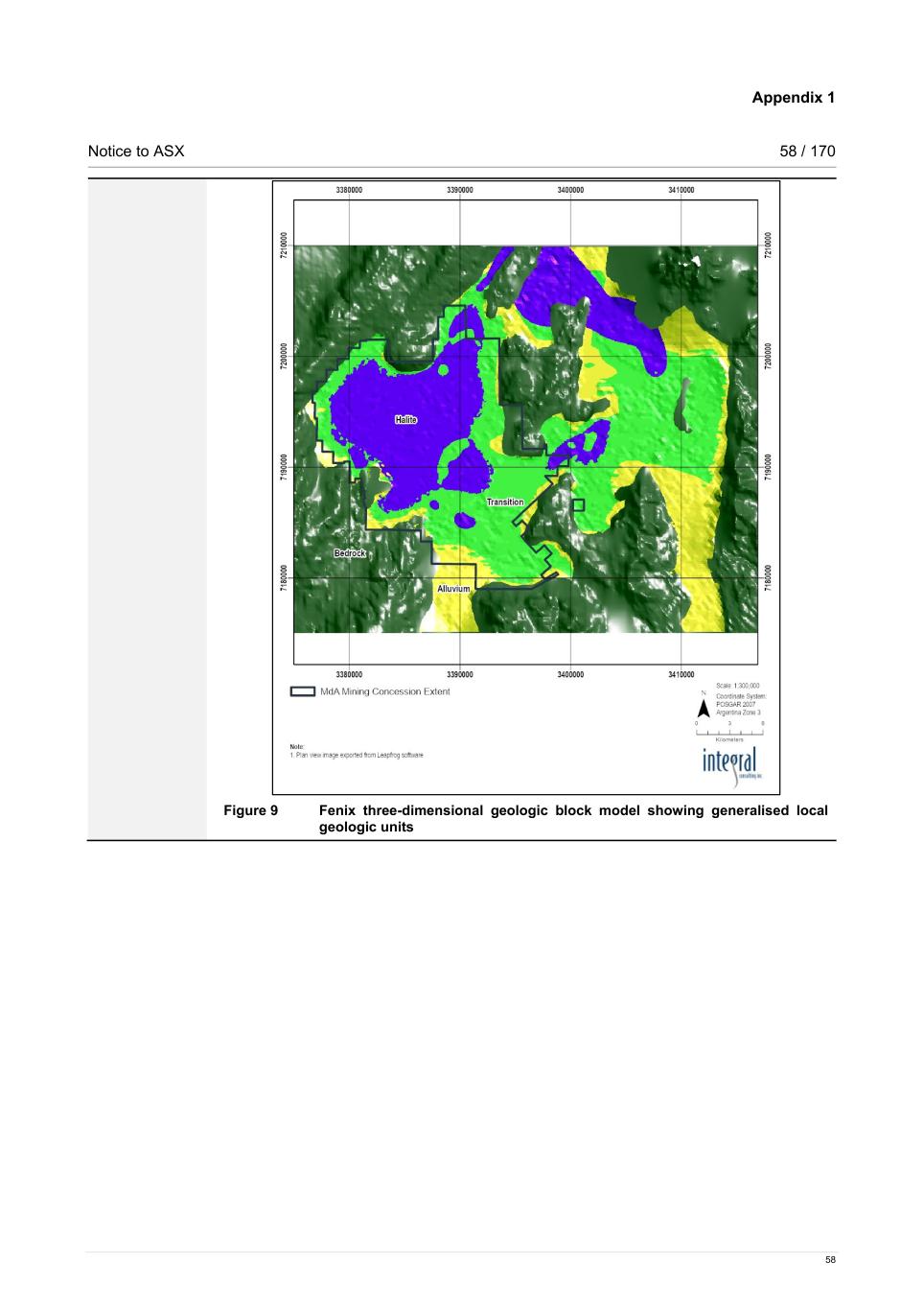
Appendix 1 Notice to ASX 58 / 170 58 Figure 9 Fenix three-dimensional geologic block model showing generalised local geologic units
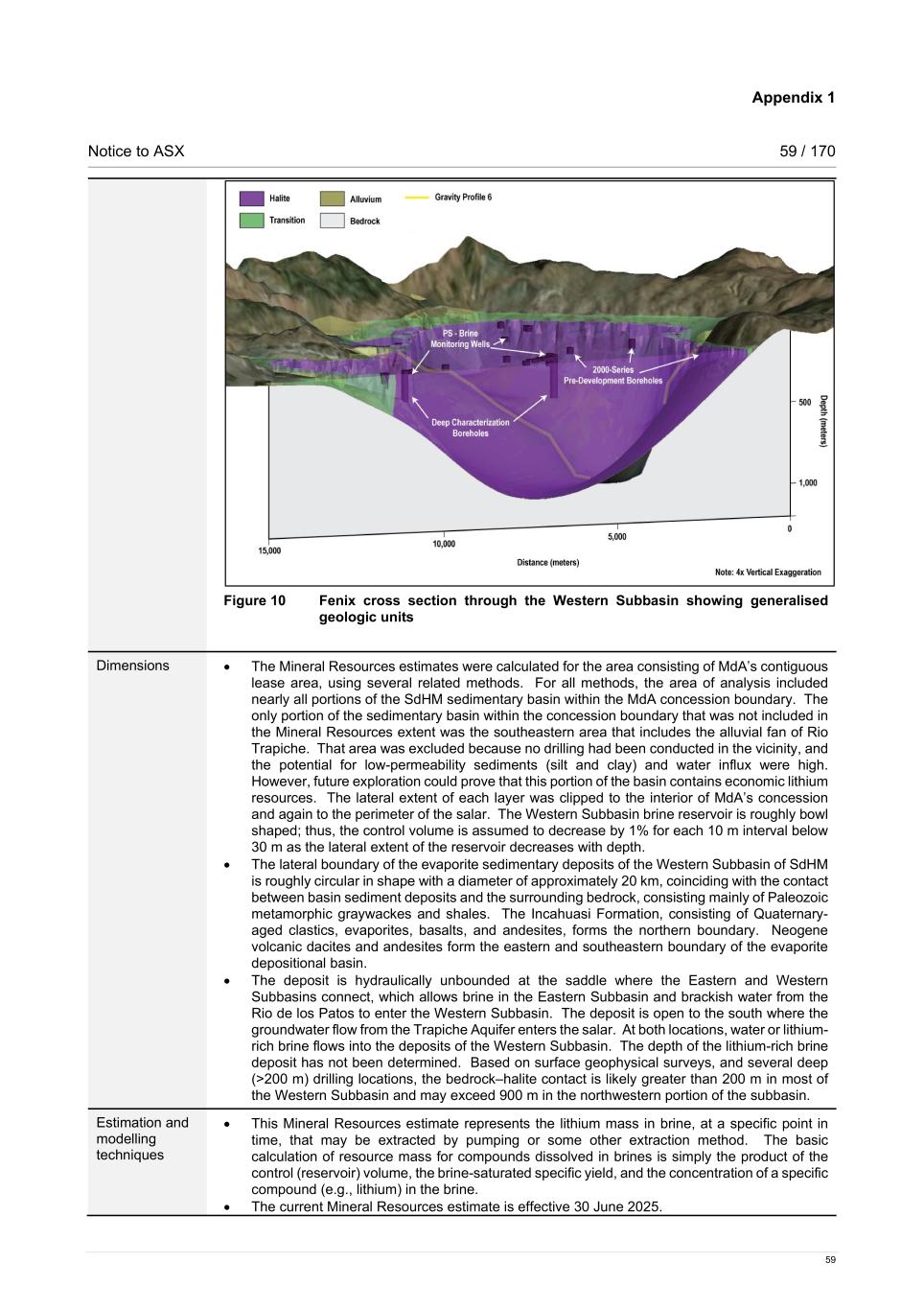
Appendix 1 Notice to ASX 59 / 170 59 Figure 10 Fenix cross section through the Western Subbasin showing generalised geologic units Dimensions • The Mineral Resources estimates were calculated for the area consisting of MdA’s contiguous lease area, using several related methods. For all methods, the area of analysis included nearly all portions of the SdHM sedimentary basin within the MdA concession boundary. The only portion of the sedimentary basin within the concession boundary that was not included in the Mineral Resources extent was the southeastern area that includes the alluvial fan of Rio Trapiche. That area was excluded because no drilling had been conducted in the vicinity, and the potential for low-permeability sediments (silt and clay) and water influx were high. However, future exploration could prove that this portion of the basin contains economic lithium resources. The lateral extent of each layer was clipped to the interior of MdA’s concession and again to the perimeter of the salar. The Western Subbasin brine reservoir is roughly bowl shaped; thus, the control volume is assumed to decrease by 1% for each 10 m interval below 30 m as the lateral extent of the reservoir decreases with depth. • The lateral boundary of the evaporite sedimentary deposits of the Western Subbasin of SdHM is roughly circular in shape with a diameter of approximately 20 km, coinciding with the contact between basin sediment deposits and the surrounding bedrock, consisting mainly of Paleozoic metamorphic graywackes and shales. The Incahuasi Formation, consisting of Quaternary- aged clastics, evaporites, basalts, and andesites, forms the northern boundary. Neogene volcanic dacites and andesites form the eastern and southeastern boundary of the evaporite depositional basin. • The deposit is hydraulically unbounded at the saddle where the Eastern and Western Subbasins connect, which allows brine in the Eastern Subbasin and brackish water from the Rio de los Patos to enter the Western Subbasin. The deposit is open to the south where the groundwater flow from the Trapiche Aquifer enters the salar. At both locations, water or lithium- rich brine flows into the deposits of the Western Subbasin. The depth of the lithium-rich brine deposit has not been determined. Based on surface geophysical surveys, and several deep (>200 m) drilling locations, the bedrock–halite contact is likely greater than 200 m in most of the Western Subbasin and may exceed 900 m in the northwestern portion of the subbasin. Estimation and modelling techniques • This Mineral Resources estimate represents the lithium mass in brine, at a specific point in time, that may be extracted by pumping or some other extraction method. The basic calculation of resource mass for compounds dissolved in brines is simply the product of the control (reservoir) volume, the brine-saturated specific yield, and the concentration of a specific compound (e.g., lithium) in the brine. • The current Mineral Resources estimate is effective 30 June 2025.
Appendix 1 Notice to ASX 60 / 170 60 • Ordinary kriging was used to interpolate lithium grade distal to lithium grade measured in monitoring wells and drill holes. The interpolation was constrained by the extend of the salar (brine reservoir) and was subdivided into 10 m vertical slices from ground surface to 60 m; from 60 to 100; and 100 to 200 m bgs. Each slice was discretised into 100 m x 100 m horizontal cells in the X and Y dimensions. Ordinary kriging was completed using industry standard geostatistical software, Surfer (Golden Software, LLC). • The portion of the salar from 0 m to 30 m bgs was estimated using lithium concentrations measured in the brine monitoring wells screened within the same interval. • Below active production wells, from 30 m to 200 m bgs, historical, pre-development lithium concentration and from deep characterization drill holes measurements were used. For each uniform thickness slice of control volume, a constant value of specific yield representative of halite from the corresponding depth intervals was calculated. This led to a conservate estimate because portions of the salar where clastics are present tend to have higher specific yield than halite. Publicly available lithium concentration data published by a third-party from the Eastern Subbasin were also incorporated to constrain the kriging interpolation at the eastern margin of the Western Subbasin. • Since operations began over 25 years ago, the Fenix operation has and continues to produce high grade (>740 mg/l) lithium brine with low variability in brine grade, providing a high degree of confidence in the Mineral Resources estimates. Moisture • The Mineral Resources estimates represent the total in situ lithium mass for each interval. Cut-off parameters • Mineral Resources are reported as the in situ, theoretical drainable lithium mass and as such a cut-off grade was not applied to this Mineral Resources estimate (inclusive of lithium Ore Reserves). The Competent Person notes that lithium concentrations in individual Mineral Resources blocks generated by kriging that fell below the Ore Reserves cut-off grade do not have a material effect on the Mineral Resources estimate. • Additionally, brine is a dynamic resource that responds to external stresses such as pumping and has the potential to change concentration due to mixing with higher or lower concentration brine. The cut-off grade applied to the Ore Reserves estimate is discussed in Section 4 of this Table 1. Mining factors or assumptions • Lithium mining at Fenix has been ongoing for more than 25 years and comprises pumping lithium-rich brine from beneath the surface of the salar. When operations began, brine was pumped from a network of six wells (referred to as the PWB) located near the geographic centre of the Western Subbasin of SdHM. In 2012, two additional wells (referred to as the SWB), located approximately 5 km south-southeast of the PWB, were brought into service to increase lithium brine production. Existing lithium brine production wells are approximately 30 m to 40 m deep. Each production well is fitted with a submersible pump powered by a diesel generator installed at the wellhead. Historically, five wells from the PWB produce brine, with one well in standby to maintain target lithium brine production rates during well maintenance periods. Brine produced by the PWB and SWB is conveyed to two locations with a 24-inch pipeline: to pre-concentrate ponds or to the SA Plant as direct feed for processing. The SA Plants process native brine feed directly from the well batteries, from concentrated brine feed from the pre-concentrate ponds, or a combination of native and pre-concentrated brine. Metallurgical factors or assumptions • The main processing facilities at Fenix include the SA Plants, pre-concentrate ponds, finished salar brine (FSB) ponds, a Carbonate Plant, and Auxiliary Services Plant. These plants are certified by the ISO Standards for Environment (14001), Occupational Health and Safety (45001), and Quality (9001). Additionally, Rio Tinto’s lithium carbonate production plan is certified for lithium battery manufacturing (16949) by the International Standard for Automotive Quality Management Systems’ International Automotive Task Force. • Lithium is processed by Rio Tinto at SdHM essentially the same way it has been since operations began in 1997. Mineral processing at Fenix requires lithium-rich brine and raw water. The only significant changes to operations occurred in 2012 when the pre-concentrate ponds and two additional lithium brine production wells went into service, and in 2014 when Expansion 1A was completed. • Rio Tinto’s process for extracting lithium from the brine Mineral Resources is to pump the lithium-bearing brine from the lithium brine production wells into the Selective Adsorption (SA) Plant or, optionally, into pre-concentrate ponds, for solar concentration prior to going to the SA Plant. The SA Plant includes the lithium production facilities and related chemical processing plants in the Western Subbasin of the SdHM property owned and operated by MdA. It uses treated water and a proprietary adsorption process to selectively remove the lithium from the brine. At the SA Plants, the process stream is further concentrated and polished to remove multivalent ions. The polished stream leaves the SA Plants as concentrated lithium brine and
Appendix 1 Notice to ASX 61 / 170 61 is further concentrated in solar evaporation ponds called FSB ponds. The residual barren brine and treated water mixture (generally referred to as spent brine) is sent to the artificial lagoon where it evaporates or infiltrates back into the salar. Some of the FSB is sent to the Carbonate Plant, to produce battery- or technical-grade lithium carbonate. The remaining FSB is sent offsite to the Güemes Plant where it is used to produce high-purity lithium chloride. • Expansion 1A to increase lithium carbonate production was completed in mid-2021. Future plans to increase lithium carbonate production involve increasing brine and water extraction with new SA and Carbonate plants and evaporation ponds. Considering its successful track record and historical performance, its plans for expansion are fundamentally sound and have lower risk than a similar operation at an unproven location. Rio Tinto has its own analytical laboratory for testing process streams and manufactured products and also relies on third- party laboratories for certain analyses and data verification. Environmental factors or assumptions • Brine extraction creates “tailings” in the form of spent brine (decreased grade brine). Rio Tinto manages the return of spent brine to the salar through the artificial lagoon. Excess salt harvested from facility ponds is stockpiled or spread on the ground surface as a land application. An initial EIA focusing on the proposed dam to create a surface water impoundment on the Rio Trapiche was conducted in 1993. The original version was submitted to MdA in January 1997. Since that time, several additional EIAs have been conducted for various portions of the site. There is a total of 15 different environmental control programs developed for the SdHM, which include regular data collection that monitors environmental impacts under the water, supply, waste, physical, biological, and community relations categories. The results of these monitoring programs are reported to the enforcement authorities as required. There are no known environmental issues due to brine extraction from the SdHM. Environmental control programs will continue to monitor environmental impacts. • Solid waste is monitored at the Fenix, Güemes Plant, MdA Hanger, Pocitos, and the Salta office. Monitoring includes daily inspection at generation points, weekly inspection at disposals, and quarterly audits of hazardous waste disposal. Data for Fenix are submitted biannually and trend analyses are submitted annually to the Direccion Provincial de Gestion Ambiental Minera. Bulk density • Brine density averages approximately 1.21 kg/L and is linearly correlated with total dissolved solids. The density of brine samples is used to convert dissolved lithium concentrations reported in parts per million (mg lithium/kg brine) to mg/l (mg lithium/L brine). • Bulk density of core is not used for the Mineral Resources or Ore Reserves estimates but can be calculated from the parameters measured in the field and laboratory to determine specific yield as discussed under sampling techniques. Classification • Mineral Resources have been classified to the appropriate degree of confidence based on industry guidance on brine deposits and the professional judgement of the Competent Person. Relevant factors in this classification were drill hole spacing, vertical sampling interval, and historical production. • Approximate drill hole spacings were initially used as a guide, assuming that for estimated Mineral Resources to be considered Measured, spacing was no greater than 4 km. Indicated Mineral Resources used spacing no greater than 7 km, and Inferred Mineral Resources used spacing no greater than 10 km. Measured Mineral Resources are defined only in the fractured halite where brine extraction has occurred for nearly 30 years of operations. • For the final classification the availability, density, and reliability of brine and hydraulic data from lithium brine production and monitoring wells (nominal 2.5 km spacing) allows the 0 to 40 m interval to be classified as Measured Mineral Resources, the 40 to 100 m interval (nominal 4 km spacing) is classified as Indicated Mineral Resources, and the 100 to 200 m interval (nominal 5 km spacing) is classified as Inferred Mineral Resources. Audits or reviews • Rio Tinto’s predecessor Livent completed a satisfactory internal audit on QA/QC procedures used by Integral during preparation of this Mineral Resources and Ore Reserves estimate. Additionally, Integral followed their internal QMP and QA/QC during preparation of this document. Discussion of relative accuracy/ confidence • When considering the consistency between independent Mineral Resources estimates together with over 25 years of operational data, the Competent Person has a high degree of confidence in the Mineral Resources estimates.
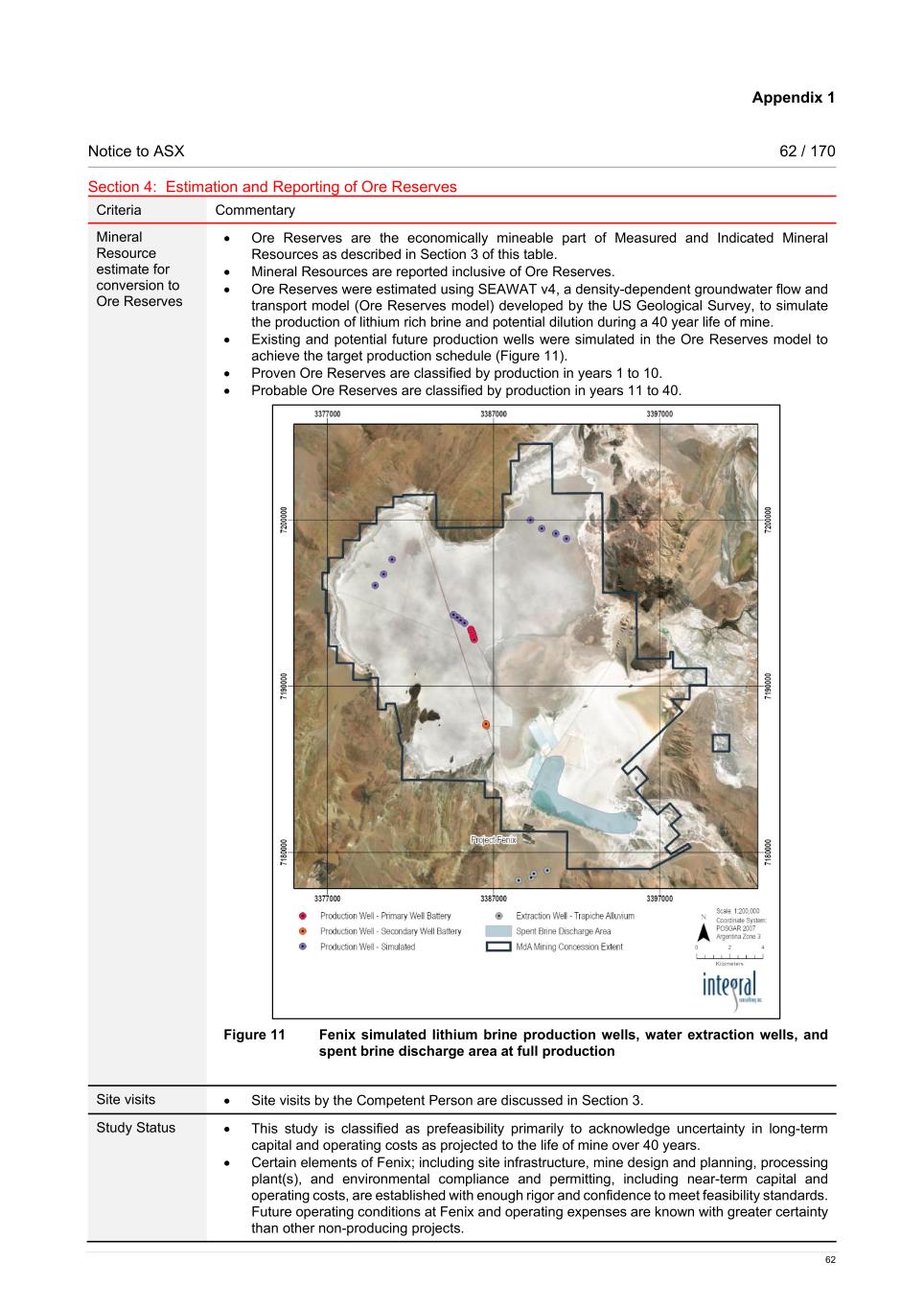
Appendix 1 Notice to ASX 62 / 170 62 Section 4: Estimation and Reporting of Ore Reserves Criteria Commentary Mineral Resource estimate for conversion to Ore Reserves • Ore Reserves are the economically mineable part of Measured and Indicated Mineral Resources as described in Section 3 of this table. • Mineral Resources are reported inclusive of Ore Reserves. • Ore Reserves were estimated using SEAWAT v4, a density-dependent groundwater flow and transport model (Ore Reserves model) developed by the US Geological Survey, to simulate the production of lithium rich brine and potential dilution during a 40 year life of mine. • Existing and potential future production wells were simulated in the Ore Reserves model to achieve the target production schedule (Figure 11). • Proven Ore Reserves are classified by production in years 1 to 10. • Probable Ore Reserves are classified by production in years 11 to 40. Figure 11 Fenix simulated lithium brine production wells, water extraction wells, and spent brine discharge area at full production Site visits • Site visits by the Competent Person are discussed in Section 3. Study Status • This study is classified as prefeasibility primarily to acknowledge uncertainty in long-term capital and operating costs as projected to the life of mine over 40 years. • Certain elements of Fenix; including site infrastructure, mine design and planning, processing plant(s), and environmental compliance and permitting, including near-term capital and operating costs, are established with enough rigor and confidence to meet feasibility standards. Future operating conditions at Fenix and operating expenses are known with greater certainty than other non-producing projects.

Appendix 1 Notice to ASX 63 / 170 63 Cut-off parameters • A marginal cut-off grade of 400 mg/l was calculated based on a break-even analysis involving economic factors, brine production, royalties and pricing assumptions for a 40 year mine life. Simulated lithium grades remain above the cut-off grade at the end of mine life. Mining factors or assumptions • To meet Rio Tinto’s anticipated near-term lithium carbonate production targets, new production will be required. Additional wells were added to the Reserve Model in the northwestern and northeastern quadrants of the Western Subbasin within MdA’s contiguous lease area, to meet longer-term demands and estimate the Ore Reserves. • The Reserve Model was used to predict changes in brine levels and brine quality for a 40 year period. Lithium grades are anticipated to gradually decrease over time as the rate of lithium removal exceeds the rate of natural replenishment. As this happens, brine becomes more dilute, and more pumping is required to extract the required mass of lithium. In the predictive simulations, new wells were designed to draw exclusively from the Measured Mineral Resources depth interval (0 m to 40 m bgs) in years 0 to 10. In later years (11 to 40), brine is extracted from both the Measured and Indicated Mineral Resources (0 m to 100 m bgs) depth intervals. • Predictive simulations using the Reserve Model assume production from the PWB and SWB remains constant during the 40 year simulation. Additional lithium brine production required to meet the anticipated lithium carbonate production schedule is made up of 11 additional wells shown on Figure 9. Flow to lithium brine production wells is believed to be predominantly horizontal in stratified evaporite/clastic sediments; and, it is likely lithium produced to-date originated primarily from the Measured Mineral Resources interval (0 m to 40 m bgs) rather than deeper Indicated (40 m to 100 m bgs) or Inferred (100 m to 200 m bgs) Mineral Resources intervals because existing lithium brine production wells are not screened deeper than 40 m bgs. • The locations of new (future) wells simulated in the Reserve Model to meet the anticipated lithium brine production schedule are only one of many potentially viable well configurations that will be evaluated/modelled in the future based on observed conditions at that time. • Geotechnical studies are not required for brine extraction. • Dilution of brine during pumping is simulated within the numerical model for the conversion of Mineral Resources into Ore Reserves. • The Inferred Mineral Resources are not included in current mining studies but are considered a possible source of future brine extraction when their resource classification is upgraded. • The Ore Reserves model considers modifying factors for converting Mineral Resources to Ore Reserves, including the wellfield design, feasible aquifer pumping, and any potential projected dilution. • Ore Reserves are calculated at the wellhead to allow comparisons to other lithium brine operations irrespective of processing technology. • Ore Reserves are also presented in terms of Rio Tinto’s recoverable share, which discounts the amount of Ore Reserves by anticipated overall process efficiencies and Rio Tinto’s fractional ownership in Fenix (100%). • It is the Competent Person’s opinion that a variety of potential brine pumping well location configurations and extraction rates can realise the target lithium carbonate production schedule. Metallurgical factors or assumptions • Mineral processing capacity at Fenix is scheduled to expand in future years. The First Expansion is currently underway. A Second and Third expansion are both in the early development (Capital Deployment Process Front End Load) stage. • Brine demands are expected to increase with increased lithium carbonate production. New lithium brine production wells within the Western Subbasin will supply additional brine feedstock, and additional water will be obtained from the Los Patos Aquifer and from engineered conservation and recycling technologies. Following each expansion, the ratio of spent brine return to lithium brine production is expected to decrease as recovery technologies are introduced into the process. Within these expansions, no new processes will be introduced that have not already been proven to be effective in lithium extraction. Rio Tinto’s SA process and evaporation ponds are established extraction processes, and water recovery methodologies being applied to auxiliary streams are utilised in multiple industries. Future expansions will focus efforts on reducing the intensity of water use. • An overall process recovery factor (76.6%) was developed based on realised process efficiencies for the SA Process and Carbonate plant, combined on a time-weighted average basis with anticipated pond efficiency following Expansion 3. • Estimated Ore Reserves are expected to have an average lithium grade of 642 mg/l and 582 mg/l over the 40 year life of mine and at the end of mining, respectively.

Appendix 1 Notice to ASX 64 / 170 64 Environmental factors or assumptions • The Second Expansion of mineral processing at Project Fenix includes additional water recovery to allow for a reduced intensity of the demand on water resources. The Second Expansion will also include a process technology designed to reduce the volume of a lithium- rich liquid effluent stream from the lithium carbonate process by recovering the lithium and a fraction of the free water in the stream and to produce a crude primary lithium carbonate suitable for use as a feedstock to lithium hydroxide facilities. At this time there are no known environmental issues as a result of brine extraction from the SdHM. Environmental control programs will continue to monitor environmental impacts. Infrastructure • Fenix consists of various infrastructure components including roadways, an airfield, natural gas pipeline, camp facilities, brine and groundwater extraction wells and conveyance pipelines, lithium processing facilities, surface impoundments, product packaging and storage facilities. Facility expansion projects are ongoing, and further expansion projects are in preliminary assessment phases. • The energy required for the operation of Fenix is generated at the Auxiliary Services Plant located onsite. This plant has eight generators: five dual-fuel generators, two generators that use natural gas, and one diesel generator used as backup through programmed or unscheduled interventions of the other generators. Current operations have a maximum generation capacity of 5.2 MW (including backup equipment) and deliver power for operating conditions with an average demand of 4.4 MW. • Natural gas is the primary power supply to the Auxiliary Services Plant. It is supplied to Fenix via a pipeline operated by REMSA S.A., a public limited company responsible for managing the energy and mining resources of Salta Province. Diesel used to power lithium brine production wells and for backup power at the Auxiliary Services Plant is transported by vehicles with bulk tanks. A network of six underground tanks and two aboveground tanks provide 500,000 L of standard, 777,000 L maximum diesel storage capacity. • Water has been withdrawn from a small surface water impoundment (dique) located at the terminus of the Rio Trapiche, and from a series of groundwater pumping wells installed in the Trapiche alluvial aquifer. Additional pumping wells in the Trapiche Aquifer have been added over time to increase raw water extraction rates. Groundwater is also pumped and conveyed from the Los Patos Aquifer to the SA Plant to accommodate increased raw water demands following plant expansions. • The railway network in Chile is operated by the company Ferronor; this network is made up of 2,300 km of rail with a line that runs from north to south of Chile, plus a set of branches that run east to west. The Augusta Victoria Station (Chile)–Socompa Station (Argentina), on the border with Argentina, allows cargo to be moved from the Antofagasta Port at the Pacific Ocean to the Socompa Station, and from the Socompa Station through the Belgrano Railway to the Olacapato Station or Socompa Station–Güemes Station (611 km) in Argentina. • Project Fenix includes an operations camp with two facilities to house personnel, and related infrastructure for water supply and distribution, shop and warehouse facilities, and administrative offices. Construction to expand the operations camp ahead of planned manufacturing plant expansions is nearing completion. • Vehicles and planes provide access to the site. Rio Tinto maintains a runway suitable for light- duty aircraft approximately 1 km east of Fenix. Departures from the runway occur several times per day, weather permitting, to regional airports in Catamarca and Salta. The Salta Airport is the nearest major commercial airport to Fenix. Costs • Assumptions were made to derive the capital costs including the fact that all relevant permits would be received in a timely manner to meet the project schedule. • Assumptions were made regarding the construction contracts whereas these contracts would be attributed on the base of a competitive bidding process amongst qualified installation contractors. It is expected that a high level of site management supervision, contract administration, quality control and thorough safety management will be required during the site execution phase • Major exclusions: currency fluctuation, interest expenses, project financing costs, duties and taxes were not included in the Capex study but were considered in the economic analysis. • Commodity price is based on market studies conducted by Rio Tinto. • Provincial mining royalty (not to exceed 3.5%) is considered based on the mine head value of the extracted ore. In addition, the Federal Argentine government receives an export duty (4.5%) on the FOB while the company exports lithium products. • Corporate tax rate is set at 35%. • Operating costs were estimated for the brine extraction, lithium concentration, and lithium carbonate production process to market. For costing purposes, the following assumptions were made:
Appendix 1 Notice to ASX 65 / 170 65 o Brine is extracted from production wells and conveyed to surface facilities through brine pipelines. Depending on the technology, lithium concentration is achieved either through evaporation ponds or through Direct Lithium Extraction (DLE) systems. o Concentrated brine or DLE product is transferred to a carbonate plant located near the salar for lithium carbonate production. o Product transport is assumed through regional logistics networks to export destinations. o The operating cost basis corresponds to steady-state production at capacity for battery and technical grade lithium carbonate. o Additional operating costs include labour, maintenance, reagent handling and consumption, energy and fuel, water management, tailings or spent brine management, and general and administrative (G&A) expenses. o The sources of information used to develop these costs include in-house databases, supplier quotations, and benchmark data from comparable brine operations in South America. Revenue factors • Rio Tinto applies a common process to the generation of commodity price assumptions across the group. This involves generation of long-term price forecasts based on current sales contracts, industry capacity analysis, global commodity consumption and economic growth trends. Prices are adjusted to reflect the expectation that they will be sold on CIF terms. • Exchange rates are also based on internal Rio Tinto modelling of expected future country exchange rates. Due to the commercial sensitivity of these assumptions, an explanation of the methodology used to determine these assumptions has been provided, rather than the actual figures. Market Assessment • The global lithium market is projected to grow at 14% per annum from 2025 to 2030, reaching approximately 2.7 Mt LCE. This growth is primarily driven by the increasing production of lithium-ion batteries to meet surging demand for electric vehicles and battery energy storage systems. Currently, Fenix’s production of 30 ktpa of LCE represents approximately 2% of global lithium carbonate demand (approximately 1.4 Mt LCE). Fenix is expected to be a crucial supply source for Europe and the United States due to forecast supply shortfalls. • In terms of the sales portfolio, Fenix intends to sell battery-grade lithium carbonate to customers across the value chain, diversified across continents. At present, most cathode makers are based in Asia (i.e. China, South Korea and Japan) but the project pipeline in the West is gradually expanding due to the push for localised supply chains. The shipping of lithium carbonate is relatively straight forward via standard 20 or 40-foot containers out of Chile and Argentina ports to worldwide destinations as has been done by existing producers for more than 30 years. The cost of shipping lithium carbonate is low compared to market prices. Compared to ‘mature’ commodities such as copper and aluminium (with forecast demand growth of ~1% to 3% over the longer term), lithium is still very much in its infancy in terms of product volume and price transparency. The projected demand growth and price forecasts for lithium products could significantly deviate from current forecasts depending on market developments on EV policies, energy storage systems demand, recycling growth and battery technology breakthroughs. Economic • Rio Tinto long-term prices have been used as the basis for the financial evaluation (NPV, IRR). The assumptions used in this economic analysis are macroeconomic, marketing, mine plan, operating costs, capital costs, closure costs, working capital and taxation. • Rio Tinto Economics supplies price and cost information on a real basis for use in NPV calculations. Rio Tinto specifies the discount rate to be used. Project NPVs are confidential business information however, economic evaluation using Rio Tinto long-term prices demonstrates a positive NPV for Fenix under a range of price, cost and productivity scenarios. Social • SdHM has very low population density, with approximately 40 inhabitants. Larger population centres are located in villages outside the boundaries of the SdHM, including the villages of Antofagasta de la Sierra and el Peñón, and very small population settlements such as Ciénaga Redonda, Los Nacimientos, and Antofalla. Following applicable provincial regulations currently in effect, the Province of Catamarca has established that the area of direct and indirect influence of Project Fenix is County (Departamento) of Antofagasta de la Sierra. Under applicable regulations, the only indigenous community currently recognised within the County (Departamento) of Antofagasta de la Sierra, is the indigenous community of Antofalla - Kolla Atacameño (the “Indigenous Community”). As a result of these circumstances and as evidenced in Project Fenix’s approved EIAs, Project Fenix’s mining-related activities do not affect rights or interests of the Indigenous Community. Those rights or interests include, but

Appendix 1 Notice to ASX 66 / 170 66 are not limited to, impacts on lands, territories, and resources; requirements for the physical relocation of people; disruption to traditional livelihoods; impacts on critical cultural heritage; or involve the use of cultural heritage for commercial purposes. Other • In March 2024, the Court of Justice in the Province of Catamarca issued a temporary ruling that halts the issuance of new environmental permits and authorizations for the Los Patos River area until the provincial government completes an environmental impact assessment that takes into consideration the cumulative impact of all projects in the area. The temporary ruling does not impact Rio Tinto’s existing mining operations and expansion activities at Fenix or Sal de Vida. • The Province of Catamarca initiated the Study through an external consulting firm. During the process, the firm held public participation sessions and expert workshops, which concluded that there were no negative impacts on water or biodiversity, even highlighting positive social impacts. • In July 2025, the study was submitted to the Supreme Court of Justice of the Province of Catamarca. At this stage, the Court may decide to lift the measure, as the Province has complied with the Court’s request. • Other material and government agreements are provided in the supporting text and previous sections. Classification • Ore Reserves are classified as Proven and Probable based on the relative confidence the Competent Person has in the Mineral Resources estimates. Rio Tinto’s predecessors have a long track record of successfully producing lithium from the Measured Mineral Resources interval. Only Measured Mineral Resources are converted to Proven Ore Reserves. • The Ore Reserves Model was used to predict lithium concentrations 40 years into the future, which is an acceptable prediction period considering industry guidance which suggests predictive simulations not be extended into the future more than twice the period for which calibration data are available. Future brine extraction was simulated in the Reserve Model with new wells screened in the Measured Mineral Resources interval for years 0 to 20. In years 21 to 40, additional brine is produced with new wells screened in both the Measured and Indicated Mineral Resources interval. • Considering anticipated pumping rate increases together with model predictions and historical performance monitoring data, it is reasonable to classify brine produced in the first 10 years as Proven Ore Reserves. • Brine produced in years 11 to 40 is classified as Probable Ore Reserves on the basis that new wells extract brine from the Measured and Indicated Mineral Resources in later years. Audits or reviews • A peer-review of the Reserve Model input and output files, and Ore Reserves calculations was completed by Integral personnel. In 2023, an independent review by Competent Persons from Montgomery and Associates had no significant findings following their review of the Reserve Model and related documentation. Discussion of relative accuracy/ confidence • The Reserve Model was used to predict changes in brine levels and brine quality for a 40 year period. It should be noted that 40 years was the chosen time frame for the numerical simulation, based on the Competent Person’s understanding of the Mineral Resources, lengthy operational history, and anticipated lithium brine production schedule, which in turn is the basis for establishing the life of mine. In the Competent Person’s opinion, based on available resources, current mine plans, and pricing assumptions, the life of mine will remain profitable and above the cut-off grade beyond 40 years. • All of the brine produced to-date by Fenix is believed to have originated from Measured Mineral Resources. The anticipated lithium production schedule is feasible, and Reserve Model predictions do not indicate excessive drawdown in the future, which is consistent with expectations for a mature salar and brine level observations made since operations began in 1997. Model-predicted lithium concentrations remain above the cut-off grade throughout the life of mine. • Factors other than brine grade and pumping may affect Ore Reserves estimates, including the acquisition of new hydrogeologic and environmental data, changes in mine plans, or mining operations at neighbouring locations. This Ore Reserves estimate is based on the data and assumptions described in this report and is sufficient for disclosure and mining planning purposes.

Appendix 2 Notice to ASX 67 / 170 67 Rio Tinto – Olaroz JORC Table 1 The following table provides a summary of important assessment and reporting criteria used for the reporting of Mineral Resources and Ore Reserves in accordance with the Table 1 checklist in The Australasian Code for the Reporting of Exploration Results, Mineral Resources and Ore Reserves, 2012 Edition (JORC Code). Criteria in each section apply to all preceding and succeeding sections. Section 1: Sampling Techniques and Data Criteria Commentary Sampling techniques • Production wells were drilled using the rotary drilling technique. Drill cuttings were collected to identify the sediment type and compare observations with downhole geophysical logs. Mud samples were taken during drilling to evaluate changes in properties such as fluid density, electrical conductivity and dissolved ions. • A comprehensive suite of downhole geophysical logs was run open hole, once holes reached total depth. These included conductivity tools to evaluate changes in temperature and brine conductivity, to evaluate whether there are intervals with pronounced changes in thermal gradient; resistivity to evaluate changes in lithology, in particular the contacts of zones of halite, which show strong contrast in resistivity, due to low porosity and low contained fluid; drill hole magnetic resonance for characterisation of changes in porosity, total porosity and free fluid, which is considered equivalent to specific yield; spectral gamma provides information on potassium, uranium and thorium, to assist correlation between holes. In some holes an acoustic televiewer has provided additional information on sediment texture. This provided additional information on the lithologies encountered during drilling. This included the deep 1408 m hole. • Samples were not collected for assay from the cuttings, as the primary objective of the holes was to confirm the geology to the depth of drilling and install production wells. Cuttings were used to describe lithology. Samples for brine analysis were taken from production wells following well development. Qualitative changes in brine conditions were also evaluated during drilling. • Sonic and diamond core holes were drilled for the original 2011 feasibility study, with subsequent diamond drill holes for the Stage 2 project. Core samples were collected in polycarbonate (lexan) tubes and selected intervals analysed for porosity in independent laboratories (British Geological Survey, Geosystems Analysis and Core Laboratories in the USA). • Extensive interval brine sampling was carried out in the upper 200 m of the sediments and as deep as 650 m. This provided useful information on variability of the brine concentrations laterally and vertically, showing the changes are gradual and defining the highest concentrations in the northeast of the salar. Drilling for the Stage 2 program consisted of rotary drill holes to install production wells. These wells were pumped, providing representative samples of the intervals where screens were installed. This information provided broadly similar lithium concentrations to the upper 200 m of the salar, with specific yield information provided by the drill hole magnetic resonance tool. Drilling techniques • Rotary drilling with a tricone bit was used to drill the entire length of the production holes, reaching depths between 450 m and 650 m (in one hole 751 m) and was also used for one deep hole to 1408 m. Typical hole diameter was 17 inches and productive casing of 12 inches is installed up to approximately 200 m, with 10 inch diameter below. • Brine from a surface trench was used to mix drilling muds, to develop a thick wall cake in the rotary holes and maintain hole stability. • Sonic and diamond core holes (HQ/NQ) were drilled for the original 2011 feasibility study, with subsequent diamond drill holes for the Stage 2 project. • Core was not orientated as there is no preferential orientation to brine mineralisation. Drill sample recovery • Lithium grade and specific yield were not collected using rotary drilling methods. • Core sample recovery was aided by the use of appropriately prepared drilling mud to remove cuttings from the holes. • Unconsolidated salar sediments tend to have lower core recoveries than hard rock deposits. Core sample recovery for the three most recent diamond holes was between 86% and 89%, which is higher than historical diamond drilling conducted to 200 m depth, where recoveries averaged 77.5%. Core sampling was enhanced using polycarbonate (lexan) triple tubes.

Appendix 2 Notice to ASX 68 / 170 68 Logging • Drill cuttings were described by experienced geoscientists, and the observations compared with results from nearby holes and with the geophysical logs. This provided a measure of consistency in logging stratigraphy. • Cutting logging is qualitative and results were compared with the quantitative geophysical logs to interpret the lithologies encountered in the hole. • All intersections with sample recovery were logged. Sub-sampling techniques and sample preparation • Cuttings were only used to identify the lithology, were not used for chemical analysis, and were only sub- sampled to collect representative reference samples. • Brine samples are taken from developed production wells over several years to verify low variability of lithium concentration before being considered representative of the sediments in which the well is installed. Quality of assay data and laboratory tests • Brine samples from production wells were analysed in the Olaroz site laboratory, with periodic additional samples analysed in the third-party independent Alex Start laboratory in Jujuy, Argentina. • The Olaroz site laboratory uses the atomic absorption method for determination of lithium, whereas the external Alex Stuart laboratory uses ICP-OES. Both laboratories use ICP-OES for the analysis of most cations, with gravimetric analysis of sulphate, by Alex Stuart and by ICP-OES at the Olaroz laboratory. Sulphate exhibits amongst the largest differences between labs for the analytes. • QA/QC samples were used by the Olaroz site laboratory, which is not a certified commercial laboratory. These standards were prepared in the laboratory and used for control purposes. Additional third-party standards were used for checking batches of samples sent to the internal and external laboratories. • Standards accompanying brine samples in the Olaroz laboratory were analysed in commercial laboratories as part of a laboratory “round robin” analysis. Results were within one standard deviation except for chloride and potassium which were marginally outside one standard deviation. Lithium values were 1.5% and 0.4% from the standard values. • The 2021 sampling program included 70 samples, 39 replicates, and 68 duplicates. • Additional duplicate samples were collected during a special sampling round, with 29 samples collected, including 5 duplicate sample pairs.. Results were generally within acceptable limits, with relative percent differences (RPD) for all analytes within 10%; lithium less than 1% RPD, and all but sulphate (maximum 9.5%) were below 3% RDP. • Correlation coefficients from interlaboratory duplicate samples were 0.99 for lithium and greater than 0.91 for other analytes. • The accuracy and precision of the data is acceptable to support Mineral Resources estimation. • Downhole geophysical tools were provided by a geophysical contractor and were calibrated periodically to produce consistent results. Verification of sampling and assaying • Brine analyses are from pump testing post installation of production wells, are quantitative analyses and were reviewed by multiple company personnel. • Samples are collected on a weekly basis and analysed in the Olaroz site laboratory operated by SDJ, providing an extensive collection of data for cations and most anions (chloride is not regularly analysed). • Laboratory data (from spreadsheets) is loaded directly into the project database by company personnel. Location of data points • The holes were located initially with a hand-held GPS and have been subsequently re- surveyed by a certified surveyor. • Olaroz is in zone 3 of the Argentine Gauss Kruger coordinate system with the Argentine POSGAR 94 datum. • Topographic controls, and the project coordinate system/project are of sufficient quality and are adequate for Mineral Resources and Ore Reserves estimation. Data spacing and distribution • Production wells and diamond holes are drilled with a general spacing of 1 km between holes. • Historical diamond drilling was conducted to 200 m depth, with more recent diamond drill holes to 650 m depth. • Due to the rotary drilling methodology, samples for indicative brine chemistry, were not collected at regular intervals during drilling. Brine samples were collected from the pumping of wells following their development. The samples taken during the pumping tests are composite samples, sourced from multiple well screens throughout the wells where screens are installed.
Appendix 2 Notice to ASX 69 / 170 69 • Brine samples from historical diamond and sonic drilling were taken nominally from 3 m to 6 m intervals, with actual sampling irregular and depending on core quality. This information forms part of the Mineral Resources estimate, along with more recent data. Orientation of data in relation to geological structure • The salar deposits that host lithium-bearing brines consist of subhorizontal beds and lenses of sand, silt, halite, clay and minor gravel, depending on the location within or outside the salar, where gravel is more extensive. Drill holes are vertical and essentially perpendicular to these units intersecting close to their true thickness. • Faults controlling basin development occur at the basin margins. Sample security • Brine samples were moved from the drill site to secure storage at the camp on a daily basis. All brine sample bottles are marked with a unique label. • Samples were transported from the camp to the laboratory for chemical analysis in sealed rigid plastic bottles with sample numbers clearly identified. Audits or reviews • Orocobre and Allkem (now Rio Tinto) have had QA/QC laboratory protocols in place at their internal laboratories throughout the period from pre-development characterisation to the present. External commercial laboratories used for supporting analytical work also have instituted QA/QC protocols that include audits and operational reviews. • Sampling and analysis plans developed by consultants undergo internal peer-review by Rio Tinto staff. Any findings identified during the peer review process are used to improve processes and are addressed prior to sampling. Section 2: Reporting of Exploration Results Criteria Commentary Mineral tenement and land tenure status • The Olaroz properties (operated by Sales de Jujuy (SDJ) for the joint venture between Rio Tinto 66.5%, Toyota Tsusho Corporation 25% and JEMSE 8.5%) are located in the province of Jujuy in northern Argentina at an elevation of approximately 3,900 m above sea level (masl). JEMSE (Jujuy Energia y Minera Sociedad del Estado) is a public company tasked with promoting economic and social development in the province of Jujuy. • SDJ holds mineral properties that cover the majority of the Salar de Olaroz, covering 47,618 hectares, consisting of 33 mining tenements and 2 exploration properties (“cateos”) as illustrated in Figure 12. • In addition to its stake in SDJ, Rio Tinto also owns 100% of six properties immediately in the north of Olaroz, which contribute an additional 9,574 hectares, belonging to the subsidiary company Olaroz Lithium. In addition to those six properties, Rio Tinto owns the Maria Victoria property in the north of Olaroz, which contribute an additional 1,800 hectares, belonging to the subsidiary company Frontera Minerals. Additionally, Rio Tinto holds 100% in six properties immediately west of Olaroz, contributing a further 18,069 hectares, which are held though the subsidiary Los Andes Compañia Minera. • The project development was approved by the provincial government UGAMP technical committee in 2012 and received other approvals for project development in this time period. • The project has an 8.5% participation by the provincial mining agency JEMSE, subject to a royalty of 3% and an export tax of 4.5% of mine gate value. Toyota Tsusho and Rio Tinto act as the joint marketing agent for lithium produced at the project. • The tenements/properties are believed to be in good standing, with payments made to relevant government departments. The company maintains good relationships with the local government and government agencies and communities as part of operations. Many local inhabitants work at the Olaroz operation. Several peripheral properties have not yet been fully granted, as this is an extended process for mining leases in Argentina. • Properties are within the Reserva Provincial de Fauna y Flora Olaroz-Cauchari (a regional flora and fauna reserve), as is the adjoining Exar project. This reserve allows for multiple uses, including agriculture and mining.
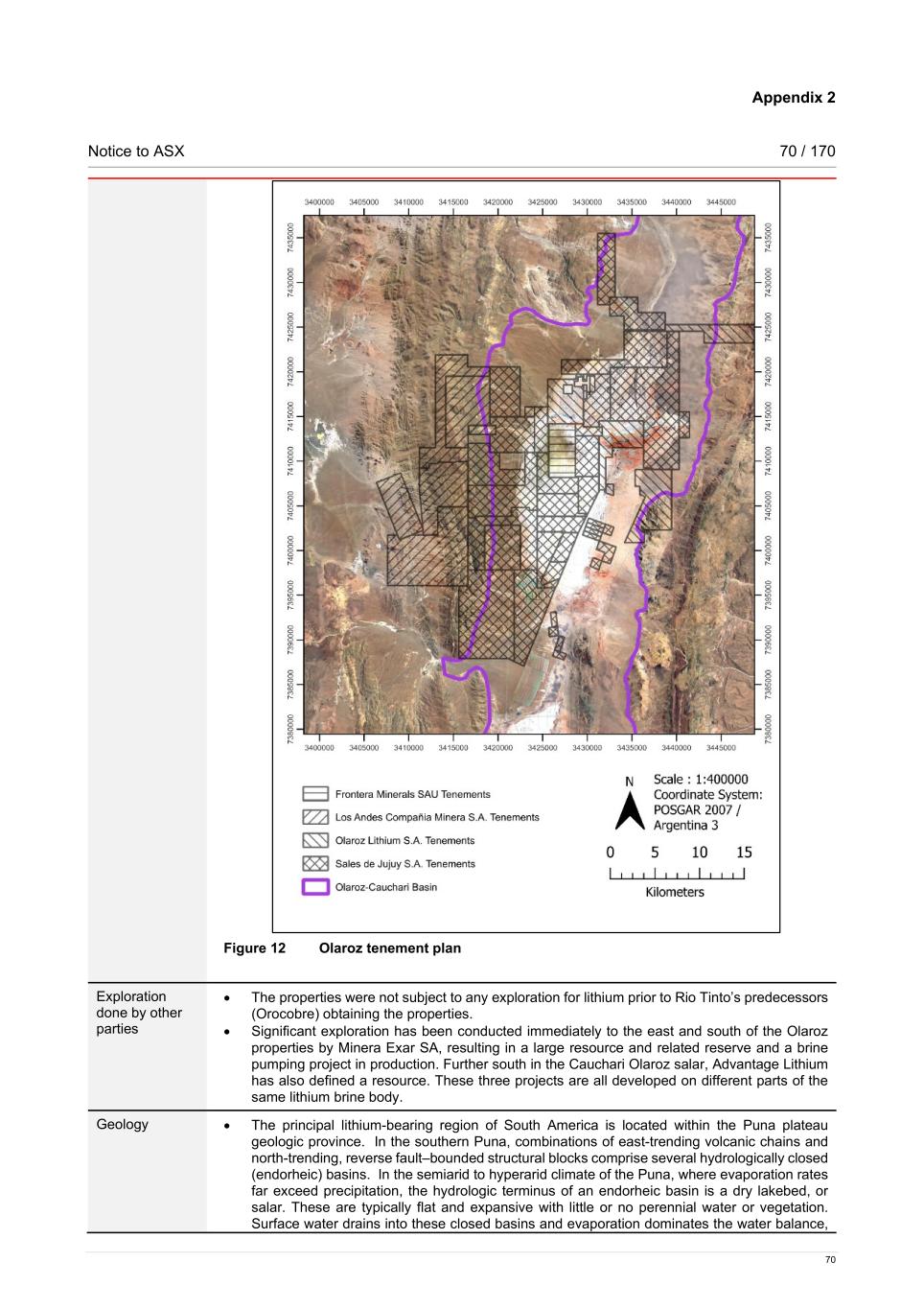
Appendix 2 Notice to ASX 70 / 170 70 Figure 12 Olaroz tenement plan Exploration done by other parties • The properties were not subject to any exploration for lithium prior to Rio Tinto’s predecessors (Orocobre) obtaining the properties. • Significant exploration has been conducted immediately to the east and south of the Olaroz properties by Minera Exar SA, resulting in a large resource and related reserve and a brine pumping project in production. Further south in the Cauchari Olaroz salar, Advantage Lithium has also defined a resource. These three projects are all developed on different parts of the same lithium brine body. Geology • The principal lithium-bearing region of South America is located within the Puna plateau geologic province. In the southern Puna, combinations of east-trending volcanic chains and north-trending, reverse fault–bounded structural blocks comprise several hydrologically closed (endorheic) basins. In the semiarid to hyperarid climate of the Puna, where evaporation rates far exceed precipitation, the hydrologic terminus of an endorheic basin is a dry lakebed, or salar. These are typically flat and expansive with little or no perennial water or vegetation. Surface water drains into these closed basins and evaporation dominates the water balance,
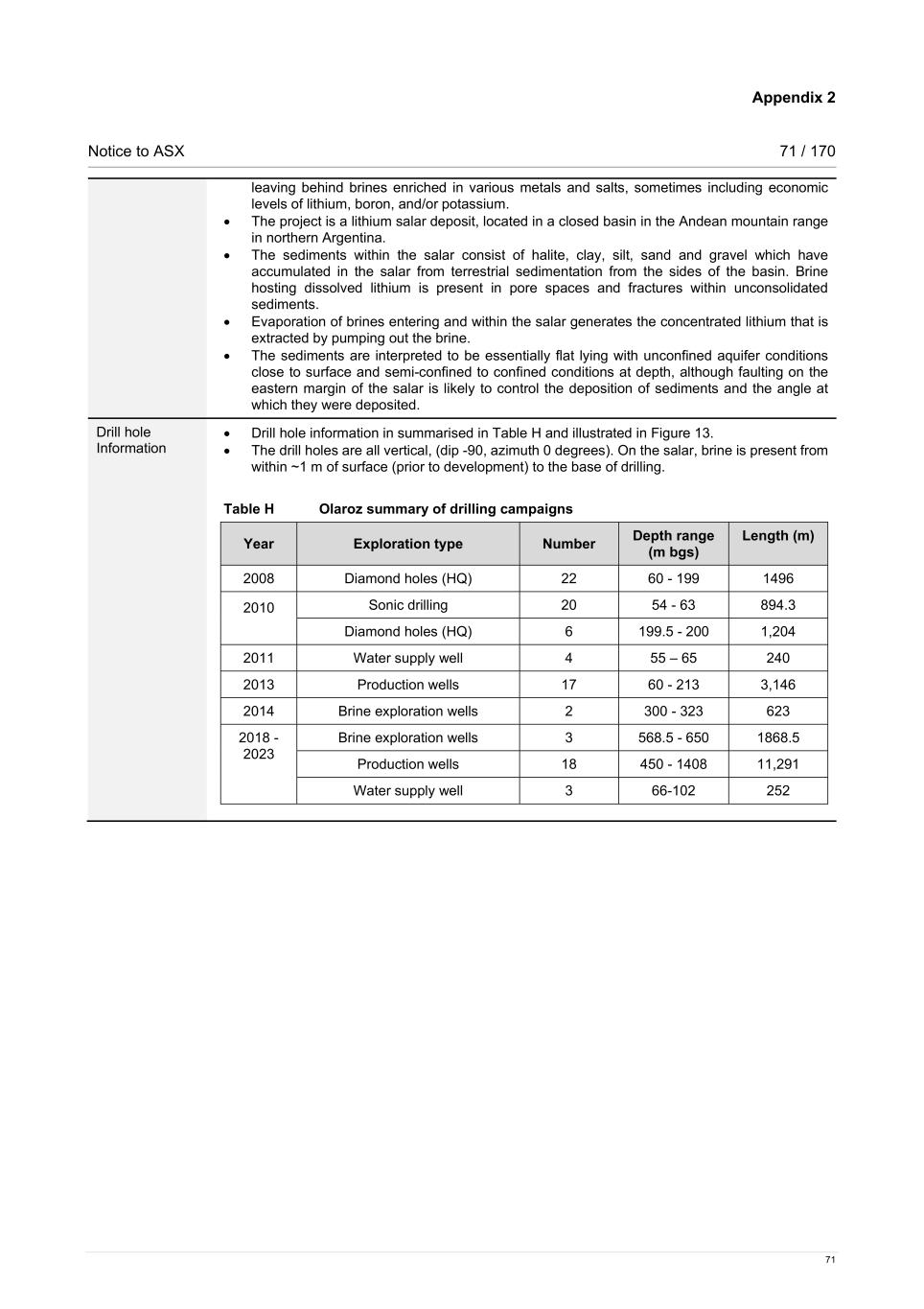
Appendix 2 Notice to ASX 71 / 170 71 leaving behind brines enriched in various metals and salts, sometimes including economic levels of lithium, boron, and/or potassium. • The project is a lithium salar deposit, located in a closed basin in the Andean mountain range in northern Argentina. • The sediments within the salar consist of halite, clay, silt, sand and gravel which have accumulated in the salar from terrestrial sedimentation from the sides of the basin. Brine hosting dissolved lithium is present in pore spaces and fractures within unconsolidated sediments. • Evaporation of brines entering and within the salar generates the concentrated lithium that is extracted by pumping out the brine. • The sediments are interpreted to be essentially flat lying with unconfined aquifer conditions close to surface and semi-confined to confined conditions at depth, although faulting on the eastern margin of the salar is likely to control the deposition of sediments and the angle at which they were deposited. Drill hole Information • Drill hole information in summarised in Table H and illustrated in Figure 13. • The drill holes are all vertical, (dip -90, azimuth 0 degrees). On the salar, brine is present from within ~1 m of surface (prior to development) to the base of drilling. Table H Olaroz summary of drilling campaigns Year Exploration type Number Depth range (m bgs) Length (m) 2008 Diamond holes (HQ) 22 60 - 199 1496 2010 Sonic drilling 20 54 - 63 894.3 Diamond holes (HQ) 6 199.5 - 200 1,204 2011 Water supply well 4 55 – 65 240 2013 Production wells 17 60 - 213 3,146 2014 Brine exploration wells 2 300 - 323 623 2018 - 2023 Brine exploration wells 3 568.5 - 650 1868.5 Production wells 18 450 - 1408 11,291 Water supply well 3 66-102 252
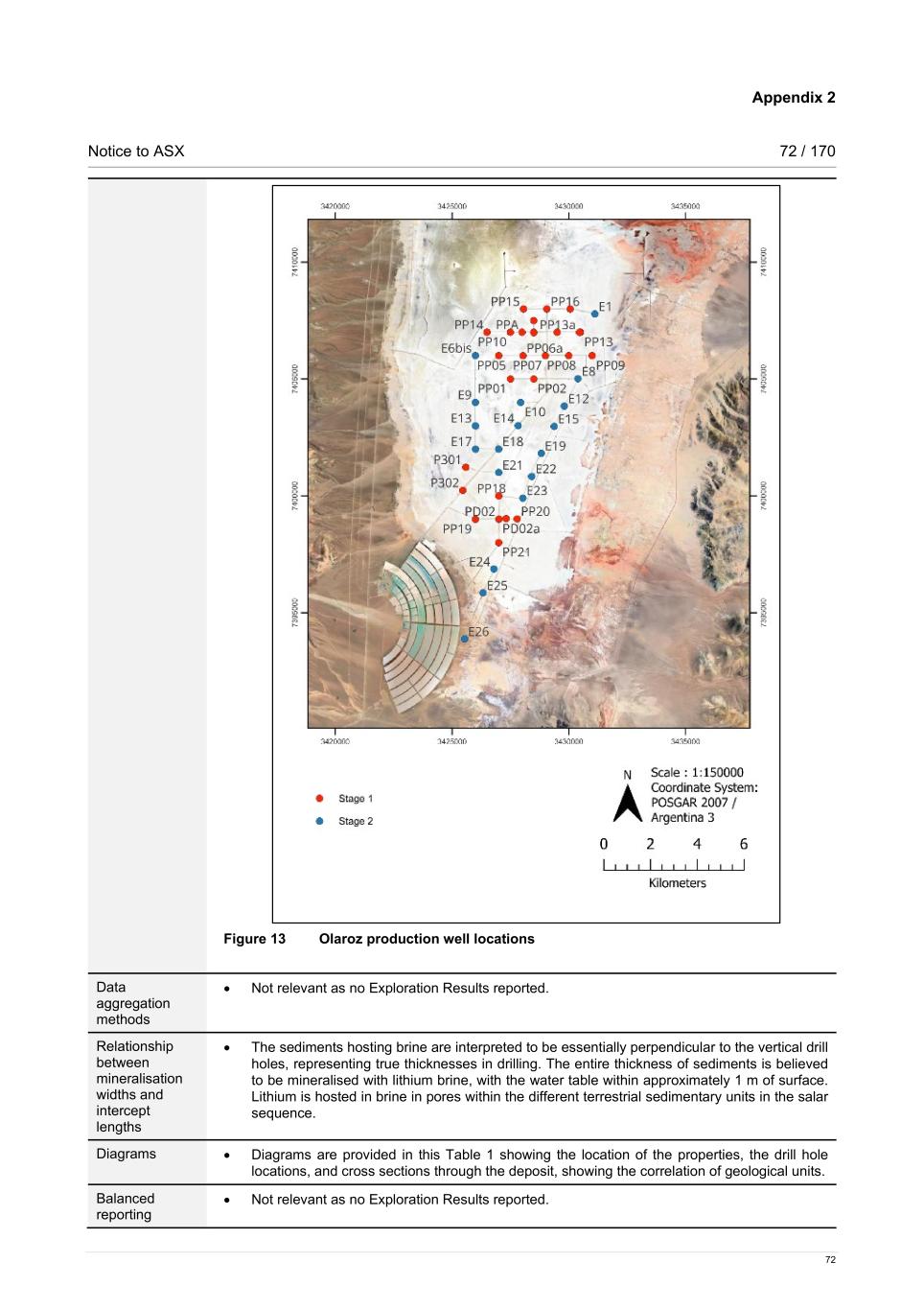
Appendix 2 Notice to ASX 72 / 170 72 Figure 13 Olaroz production well locations Data aggregation methods • Not relevant as no Exploration Results reported. Relationship between mineralisation widths and intercept lengths • The sediments hosting brine are interpreted to be essentially perpendicular to the vertical drill holes, representing true thicknesses in drilling. The entire thickness of sediments is believed to be mineralised with lithium brine, with the water table within approximately 1 m of surface. Lithium is hosted in brine in pores within the different terrestrial sedimentary units in the salar sequence. Diagrams • Diagrams are provided in this Table 1 showing the location of the properties, the drill hole locations, and cross sections through the deposit, showing the correlation of geological units. Balanced reporting • Not relevant as no Exploration Results reported.

Appendix 2 Notice to ASX 73 / 170 73 Other substantive exploration data • The company has conducted rotary drilling to obtain geological information, brine samples, and hydraulic parameters for the installation of additional production wells. Further work • The company has installed 15 deep production wells for Stage 2 of the project. • Future drilling will support an update of the resource estimation once drilling is conducted peripheral to the salar in areas where there is little or no current drilling. Section 3: Estimation and Reporting of Mineral Resources Criteria Commentary Database integrity • Data was transferred directly from laboratory spreadsheets to the database. • Data was checked for transcription errors once in the database, to ensure coordinates, assay values and lithological codes were correct. • Data was plotted to check the spatial location and relationship to adjoining sample points. • Brine assays and porosity test work have been analysed and compared with other publicly available information for reasonableness. • Comparisons of original and current datasets were made to ensure no lack of integrity. Site visits • Mr. Sean Kosinski most recently visited Olaroz in July and August 2025. During his visit, he toured the carbonate plants for Stage 1 and Stage 2 during operations, inspected production wells in operation, visited active evaporation ponds and witnessed salt harvesting activities. Geological interpretation • There is a high level of confidence in the geological model. There are relatively distinct geological units in essentially flat lying, relatively uniform, clastic sediments and halite. • The specific yield data consists of extremely detailed data from geophysical logging, extensive historical porosity samples to 200 m deep and sparse porosity samples up to 650 m deep, supplemented by BMR geophysical data in production wells. Brine data below 200 m, consists of composite pumped samples from holes, which provide realistic information regarding brine concentrations. • Any alternative interpretations are restricted to smaller scale variations in sedimentology and porosity, related to changes in grain size and fine material in units, as porosity is the key influence on the resource estimate. • Geological units are identified in the geological and geophysical logging of holes and separated in the hydrostratigraphic model (Figure 14 and Figure 15), where unit specific porosity characteristics are applied. • Data used in the interpretation includes sonic, rotary and diamond drilling. • Sedimentary processes affect the continuity of geology, whereas the concentration of lithium and potassium and other elements in the brine are related to water inflows, evaporation and brine evolution in the salar and are essentially independent of porosity.
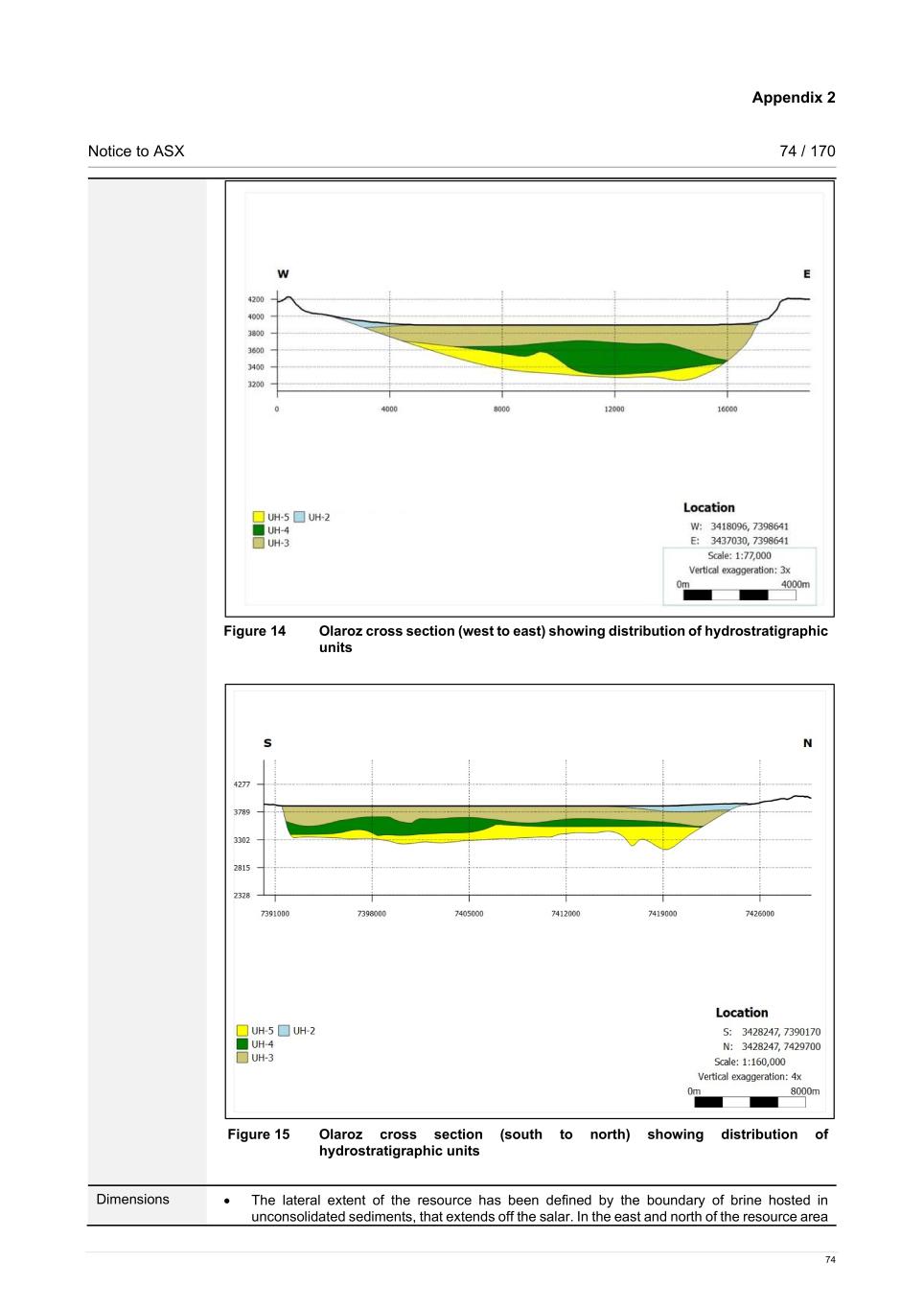
Appendix 2 Notice to ASX 74 / 170 74 Figure 14 Olaroz cross section (west to east) showing distribution of hydrostratigraphic units Figure 15 Olaroz cross section (south to north) showing distribution of hydrostratigraphic units Dimensions • The lateral extent of the resource has been defined by the boundary of brine hosted in unconsolidated sediments, that extends off the salar. In the east and north of the resource area

Appendix 2 Notice to ASX 75 / 170 75 the boundary is with adjacent properties. At ground surface, the brine mineralisation covers 475 km2. • The top of the model coincides with the topography obtained from the Shuttle Radar Topography Mission (SRTM). The original elevations were locally adjusted for each drill hole collar with the most accurate drill hole collar coordinates available from a recent re-survey of the holes. • The top of the brine mineralisation is based on the pre-pumping brine phreatic surface. • The base of the resource is the base of the basin, as interpreted from gravity geophysics. Tertiary sediments are interpreted to underlie the unconsolidated younger salar sediments. These sediments are similar to those of the younger salar sediments, but more consolidated, and can be locally difficult to distinguish. Estimation and modelling techniques • The Mineral Resources estimation for Olaroz was developed in Datamine software, with the geological model developed in Leapfrog software. The model is considered a reliable representation of local lithology and will be refined as new information becomes available. • Generation of histograms and box plots were conducted for the Exploratory Data Analysis for lithium. It should be noted the search radii are flattened ellipsoids with the shortest distance in the vertical axis (related to the variogram distance). No outlier restrictions were applied, as distributions of the different elements do not show anomalously high values. • No grade cutting or capping was applied to the model. The coefficient of variation in the brine results is low, reflecting the relatively homogeneous distribution of brine grades across the salar. • The geological interpretation was used to define each geological unit and the salar boundary and property limit were used to enclose the reported Mineral Resources. • The block size (200 x 200 x 100 m) reflects the thick and relatively homogeneous nature of the lithological units. Sub-blocks of 20 x 20 x 5 m were used around the edges of the model boundary and units. • Estimation of lithium grade for each block used ordinary kriging. The presence of brine is not necessarily controlled by lithologies and are independent of lithology so estimation was only limited by the salar boundaries. • Estimation of specific yield for each block used inverse distance interpolation based on data from the BMR geophysical logs. Geological units had hard boundaries for estimation of porosity. • No assumptions were made regarding selective mining units and selective mining is generally not feasible in brine deposits, where brine flows in response to pumping. No assumptions were made about correlation between variables. • Validation was performed using a series of checks including comparison of univariate statistics for global estimation bias, and visual inspection against samples on plans and sections. • Visual validation shows an acceptable agreement between the samples and the ordinary kriging estimates. Moisture • Moisture content of the cores was measured (porosity and density measurements were made), but as brine is extracted by pumping not mining the sediments moisture is not relevant for the resource estimation. • Tonnages are estimated as metallic lithium dissolved in brine, with lithium values converted to a lithium carbonate tonnage using a conversion factor of 5.323. Cut-off parameters • A lithium cut-off grade of 300 mg/l was applied to the Mineral Resources estimate. Mining factors or assumptions • The resource has been quoted in terms of brine volume, concentration of dissolved elements, contained lithium and their product LCE. • No mining or recovery factors have been applied (although the estimation of specific yield is used to reflect the reasonable prospects of eventual economic extraction with the proposed mining methodology). It should be noted that conversion of Mineral Resources to Ore Reserves for brine deposits is lower than that for hard rock deposits. • Dilution of brine concentrations may occur over time and typically there are lithium and potassium losses in both the ponds and processing plant in brine mining operations. However, potential dilution will be estimated in the Ore Reserves model simulating brine extraction, to define the Ore Reserves. • The conceptual mining method is recovering brine from the salar via a network of wells, the established practice on existing lithium brine projects. • Detailed hydrologic studies of the lake have been undertaken (catchment and groundwater modelling) to evaluate the extractable Mineral Resources and potential extraction rates.

Appendix 2 Notice to ASX 76 / 170 76 Metallurgical factors or assumptions • Lithium carbonate is currently produced on site via conventional brine processing techniques and evaporation ponds to concentrate the brine prior to processing. • Additional brine extracted for the Stage 2 expansion would be processed the same way, with refinements related to optimisation of the process, learnt from operation of Stage 1. Environmental factors or assumptions • Impacts of the lithium carbonate production operation at the Olaroz salar include; surface disturbance from the creation of extraction/processing facilities and associated infrastructure, accumulation of various salt tailings impoundments and extraction from brine and groundwater aquifers regionally. Precipitated salts are collected in ponds and later returned to the salar. • The project holds the necessary environmental permits for the Stage 1 and Stage 2 production. Bulk density • Density measurements were taken as part of the drill core assessment. This included determining dry density and particle density as well as field measurements of brine density. Note that no mining of sediments is to be carried out, as brine is to be extracted by pumping and consequently sediments are not mined. • No bulk density was applied to the estimates because Mineral Resources are defined by volume, rather than by tonnage. • The salt unit can contain fractures and possibly vugs which host brine and add to the specific yield. However, salt units below 50 m depth are generally quite compact. Classification • Lithium concentrations are relatively homogeneous compared to most mineral deposits, as the lithium concentration process results in a relatively homogeneous brine concentration. The lithium concentration varies slowly laterally and vertically across the salar. There is no internal waste (uneconomic lithium concentrations below the cut-off grade) within the Mineral Resources estimate. • Measured Mineral Resources classification is based on reliable geological correlation between drill holes, which show gradual changes in lithology laterally and with depth. Measured Resources are defined within 2.5 km of drill holes and are restricted to the base of drilling at depth. • Indicated status has been assigned to areas where there is a generally high level of correlation between drill holes in geology, specific yield and lithium concentration. Indicated Mineral Resources are defined between 2.5 km and 5 km of drill holes which extends to the limits of unconsolidated sediments in Olaroz, where the resource is closed out against basement rocks. Indicated Mineral Resources extend from the base of the Measured Resources to the base of the salar sediments at depth as defined by the gravity survey, given there is good confidence in definition of this contact. • Inferred Mineral Resources have been defined extending up to 10 km from drill holes, as there is a high level of geophysical control in the project, though limited drilling in the Inferred area. Geological information and observed variations in lithium concentration suggest lithium brine continues further to the north beyond the currently defined Inferred Mineral Resources, where future drilling is required to improve confidence in the view of the Competent Person, the Mineral Resources classification adequately reflects the available data and takes into account and is consistent with the JORC Code and the Australian Brine Guidelines. • Figure 16 illustrates the classified Mineral Resources.
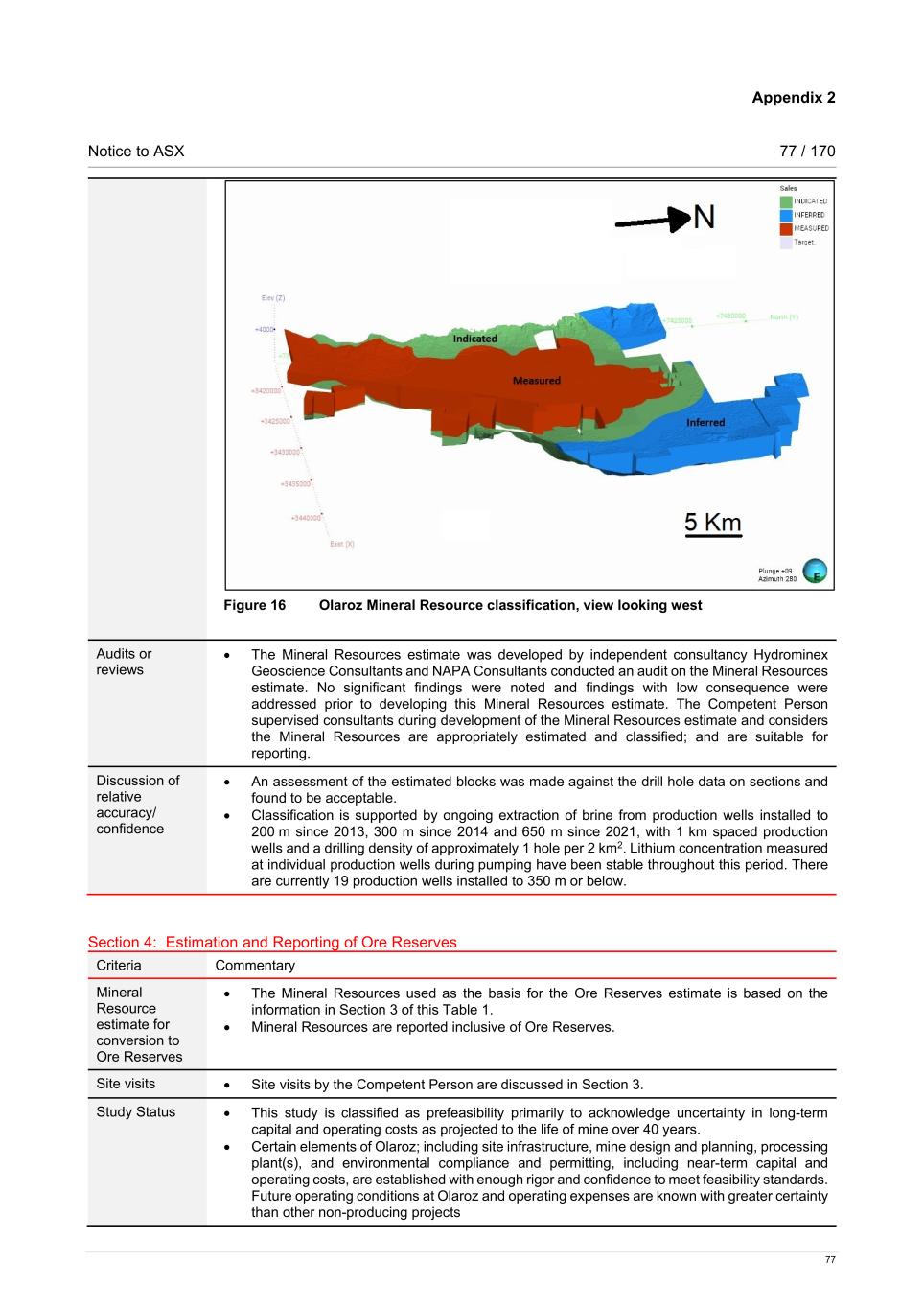
Appendix 2 Notice to ASX 77 / 170 77 Figure 16 Olaroz Mineral Resource classification, view looking west Audits or reviews • The Mineral Resources estimate was developed by independent consultancy Hydrominex Geoscience Consultants and NAPA Consultants conducted an audit on the Mineral Resources estimate. No significant findings were noted and findings with low consequence were addressed prior to developing this Mineral Resources estimate. The Competent Person supervised consultants during development of the Mineral Resources estimate and considers the Mineral Resources are appropriately estimated and classified; and are suitable for reporting. Discussion of relative accuracy/ confidence • An assessment of the estimated blocks was made against the drill hole data on sections and found to be acceptable. • Classification is supported by ongoing extraction of brine from production wells installed to 200 m since 2013, 300 m since 2014 and 650 m since 2021, with 1 km spaced production wells and a drilling density of approximately 1 hole per 2 km2. Lithium concentration measured at individual production wells during pumping have been stable throughout this period. There are currently 19 production wells installed to 350 m or below. Section 4: Estimation and Reporting of Ore Reserves Criteria Commentary Mineral Resource estimate for conversion to Ore Reserves • The Mineral Resources used as the basis for the Ore Reserves estimate is based on the information in Section 3 of this Table 1. • Mineral Resources are reported inclusive of Ore Reserves. Site visits • Site visits by the Competent Person are discussed in Section 3. Study Status • This study is classified as prefeasibility primarily to acknowledge uncertainty in long-term capital and operating costs as projected to the life of mine over 40 years. • Certain elements of Olaroz; including site infrastructure, mine design and planning, processing plant(s), and environmental compliance and permitting, including near-term capital and operating costs, are established with enough rigor and confidence to meet feasibility standards. Future operating conditions at Olaroz and operating expenses are known with greater certainty than other non-producing projects
Appendix 2 Notice to ASX 78 / 170 78 Cut-off parameters • A marginal cut-off grade of 410 mg/l was calculated based on a break-even analysis involving economic factors, brine production, royalties and pricing assumptions for a 40 year mine life. Simulated lithium grades remain above the cut-off grade at the end of mine life. Mining factors or assumptions • The mine life is projected to be 40 years. Production for the first eight years comes from Stage 1, the shallower wellfield. Beginning in 2021, Stage 2 starts from deeper wells. Current well depths reach approximately 600 m. All production wells are connected via pipelines to centrally located booster ponds. • Ore Reserves projections indicate an average annual brine production rate of 654 L/s. • Lithium is dissolved in brine (fluid) thus pumping from production wells is an appropriate mining method in salars. • Brines extraction does not involve excavations or underground workings (as with hard rock deposits), it is not necessary to carry out detailed geotechnical studies of the soil and rock strength parameters. • Pit slope is not relevant for brines extraction. • Dilution of brine during pumping is simulated within the Ore Reserves model for the conversion of Mineral Resources into Ore Reserves. • There are no minimum mining widths, as brine mining is not a selective mining method. • The Inferred Mineral Resources are not included in current mining studies but are considered a possible source of future brine extraction when their resource classification is upgraded. • Brine mining requires the provision of electricity and pipelines to the sites of wells from which brine is extracted. The pipelines pump brine to centralised collection ponds, from where it is pumped to the evaporation pond network. The brine is subject to the addition of lime in the evaporation ponds. Pumps are required to move brine between ponds and pump brine into the plant, where lithium carbonate product is produced. Electricity for wellfields are fed by a power line. Metallurgical factors or assumptions • The metallurgical process utilised for the production of lithium carbonate is based on solar evaporation of brine, prior to reacting lithium with carbon dioxide in the plant to produce lithium carbonate. In this way, much of the energy required for the process is provided naturally by the sun. Lithium preferentially remains within the brine, and other elements precipitate from the brine in response to their increasing concentration and saturation in the brine. Lime is added to the ponds to facilitate the precipitation of magnesium from the brine. Although more recent direct extraction processing techniques are more widely available pond evaporation provides a cost-effective processing method. • The Olaroz process design has been successfully proven to produce lithium carbonate since 2015. • Modifications to the Olaroz process technology mean that salts will be drained and harvested in all ponds. Transfer pumps will be used to transfer concentrated brine from a lower grade pond into a higher-grade pond. A second liming stage will be installed to maximise magnesium ion removal before brine enters the production facilities and an ion-exchange stage will be installed to remove remaining calcium and magnesium ions before precipitating battery grade lithium carbonate. • Lithium carbonate is sold as both battery and technical grade product, depending on the concentration of impurities. The project produces both grades of product. • Pilot testing was conducted during 2020 and 2021; purpose-built pilot ponds and pilot plant validated laboratory test work and explored operational considerations. Future drilled production wells showed a higher concentration grade and lower impurity than pilot testing. • Deleterious elements have been identified and measurement will be taken to mitigate the risks. Sodium carbonate will be ionised captured before being fed into the crystallisation circuit and magnets will be used to capture are remove impurities related to iron equipment. Environmental factors or assumptions • The project has an approved DIA (Impact Assessment Declaration) from 2009 for exploration activities and from 2010 for exploitation activities, being the legal instrument to explore, construct and perform exploitation activities. This document is subject and based on a series of commitments and obligations and has been updated every 2 years. • An Environmental Impact Assessment report was submitted on May 2025 to enable renewal of the DIA. • A series of approvals and permits related to environment, chemicals, and groundwater use, waste management, hazardous and others, are in place. Infrastructure • The main road access to Olaroz is from the city of San Salvador de Jujuy, along the Ruta Nacional (RN) 9, which heads northwest for approximately 60 km, and then meets RN 52 below

Appendix 2 Notice to ASX 79 / 170 79 the town of Purmamarca. The Olaroz site is managed on a drive-in drive-out basis, with personnel coming from most of the regional centres, primarily Salta and San Salvador de Jujuy. • Natural gas is used to fuel onsite power and boilers. Natural gas is supplied by GAS ATACAMA via pipeline. • The site general facilities include: o Pumping field with brine production wells, 3 boosters stations and brine distributions lines. o Liming plants and evaporation ponds o Water production wells located southeast and to the north of the Olaroz site area and reverse osmosis plant on site for high quality water production. o Gas fuelled power generation plant. o Boiler room for steam generation. o Lithium carbonate processing plant, soda ash storage area, lithium carbonate bagging area and assorted storage areas for reagents and supplies. o Laboratory, warehouses, refuelling and equipment workshop areas. o Offices and control facilities. o Dining rooms, sports, and recreation facilities. o Gate house, weighbridge, transport control and security facility o Olaroz camp Costs • Assumptions were made to derive the capital costs including the fact that all relevant permits would be received in a timely manner to meet the project schedule. • Assumptions were made regarding the construction contracts whereas these contracts would be attributed on the base of a competitive bidding process amongst qualified installation contractors. It is expected that a high level of site management supervision, contract administration, quality control and thorough safety management will be required during the site execution phase • Major exclusions: currency fluctuation, interest expenses, project financing costs, duties and taxes were not included in the Capex study but were considered in the economic analysis. • Commodity price is based on market studies conducted by Rio Tinto. • Provincial mining royalty (not to exceed 3%) is considered based on the mine head value of the extracted ore. In addition, the Federal Argentine government receives an export duty (4.5%) on the FOB while the company exports lithium products. • Corporate tax rate is set at 35%. • Operating costs were estimated for the brine extraction, lithium concentration, and lithium carbonate production process to market. For costing purposes, the following assumptions were made: o Brine is extracted from production wells and conveyed to surface facilities through brine pipelines. Depending on the technology, lithium concentration is achieved either through evaporation ponds or through Direct Lithium Extraction (DLE) systems. o Concentrated brine or DLE product is transferred to a carbonate plant located near the salar for lithium carbonate production. o Product transport is assumed through regional logistics networks to export destinations. o The operating cost basis corresponds to steady-state production at capacity for battery and technical grade lithium carbonate. o Additional operating costs include labour, maintenance, reagent handling and consumption, energy and fuel, water management, tailings or spent brine management, and general and administrative (G&A) expenses. o The sources of information used to develop these costs include in-house databases, supplier quotations, and benchmark data from comparable brine operations in South America. Revenue factors • Rio Tinto applies a common process to the generation of commodity price assumptions across the group. This involves generation of long-term price forecasts based on current sales contracts, industry capacity analysis, global commodity consumption and economic growth trends. Prices are adjusted to reflect the expectation that they will be sold on CIF terms. • Exchange rates are also based on internal Rio Tinto modelling of expected future country exchange rates. Due to the commercial sensitivity of these assumptions, an explanation of the methodology used to determine these assumptions has been provided, rather than the actual figures.
Appendix 2 Notice to ASX 80 / 170 80 Market Assessment • The global lithium market is projected to grow at 14% per annum from 2025 to 2030, reaching approximately 2.7 Mt of LCE. This growth is primarily driven by the increasing production of lithium-ion batteries to meet surging demand for electric vehicles and battery energy storage systems. With a target capacity of 42.5 ktpa LCE, Olaroz will account for ~3% of global lithium carbonate demand (approximately 1.4 Mt LCE) and will be a crucial supply source for Europe and the United States due to forecast supply shortfalls. • In terms of the sales portfolio, Joint venture partner TTC has exclusive sales and marketing rights for all Olaroz volumes. Economic • Rio Tinto long-term prices have been used as the basis for the financial evaluation (NPV, IRR). The assumptions used in this economic analysis are macroeconomic, marketing, mine plan, operating costs, capital costs, closure costs, working capital and taxation. • Rio Tinto Economics supplies price and cost information on a real basis for use in NPV calculations. Rio Tinto specifies the discount rate to be used. Project NPVs are confidential business information however, economic evaluation using Rio Tinto long-term prices demonstrates a positive NPV for Olaroz under a range of price, cost and productivity scenarios. Social • Rio Tinto has been actively involved in community relations. Rio Tinto has consulted extensively with the small local communities and employs members of these communities in the current exploration activities. • Rio Tinto continually performs surveys on social perception with local communities, social economics baseline updates, survey of local suppliers and study of local competencies. • Rio Tinto has evaluated positive and negative impacts of the project within the company. Based on social commitments and compliance with local mining authority, SDJ has participated in training and improve skills of people from local communities; prioritise the hiring of local operators and technicians in the area of influence; supports local universities and technical schools to develop professionals for future positions; and considers gender and diversity perspectives in the processes of hiring local labour and in community projects. Approximately 70% of employees are from the province of Jujuy and around 40% are from the local communities. • Rio Tinto has implemented a Community Relations Plan (PRC) between SDJ and the communities to develop programs to maximise positive effects of the project and optimise relationships, to minimise the risks of misunderstandings, to encourage families, residents, and institutions to take advantage of sustainable opportunities and to establish an information and consultation system open to the community. • Agreements with communities have been set in place, which include internet system installation and hiring of people currently working in various areas of SDJ. • Rio Tinto has a strong commitment to hiring local labour, which favours the socioeconomic development of populations near Olaroz. The growing activity derived from construction and operations has a positive impact on the revitalisation of the local and regional economy. Local communities have access to jobs with social benefits, medical services, retirement contributions and contracting opportunities. Other • The company has an agreement with Lithium Americas Corp. and Ganfeng Lithium who own the nearby Minera Exar Project through a 49/51 joint venture company, Minera Exar S.A, to share data relevant to Mineral Resources and Ore Reserves estimation. • For surface rights, SDJ is located within fiscal lands owned by the Province of Jujuy and indigenous communities. For water rights, the Province agrees to grant the relevant water concession. For third parties’ rights, all the mining concessions for Olaroz were secured under purchasing agreements with pre-existing owners and claimants. • Easement acquirements by the company include water, camp, infrastructure and services. • SDJ pays a royalty to the Province of Jujuy based on a Mining Royalty limited to 3% of the mine head value, calculated as the sales price less direct cash costs related to exploitation and excluding fixed asset depreciation, and 4.5% export duty on the Freight on Board (FOB) price. Classification • The Ore Reserves are classified either Proven or Probable. Simulated production wells are located in Measured Mineral Resource zones. • Proven Ore Reserves are specified for the next 10 years of operation. The near-term model results have a higher degree of confidence due to the model calibration to current conditions. It should be expected that confidence in model predictions decreases further in time as environmental and operational conditions change from current assumptions.

Appendix 2 Notice to ASX 81 / 170 81 • Probable Ore Reserves were assigned after the next 10 years of operation to acknowledge uncertainty in factors affecting long-term production, including, but not limited to potential changes in neighbouring operations, changes in environmental conditions that may affect water balance components, and uncertainty in future well performance and reservoir hydraulic parameters distal to current production wells. • The point of reference for reporting Ore Reserves is the wellhead. Ore reserves are also presented in terms of Rio Tinto’s recoverable share, which accounts for process losses and Rio Tinto’s fractional ownership in SDJ. • The total estimated Proved and Probable Ore Reserves represent about 10% of the total Measured and Indicated Mineral Resources. • Given that projected production wells were placed in Measured Mineral Resource zones, approximately 85% of the Probable Ore Reserves have been derived from Measured Mineral Resources. • The Competent Person believes that the Proved and Probable Ore Reserves were adequately categorised based on industry standards for lithium brine projects and the reliability of the model projections. Audits or reviews • The Ore Reserves estimate was developed by independent consultancy NAPA Consultants and Hydrominex conducted an audit on the Ore Reserves estimate. No significant findings were noted and findings with low consequence were addressed prior to developing this Ore Reserves estimate. The Competent Person supervised consultants during development of the Ore Reserves estimate and considers the Ore Reserves are appropriately estimated and classified; and are suitable for reporting. Discussion of relative accuracy/ confidence • In the Competent Person’s opinion, the operation continues to progress towards nameplate capacity in a logical and coherent manner, in the time since operations began. Operational data are generated using standard analytical methodologies. In addition, calibration of the Ore Reserves model based on real data from the first 10 years of operation provides strong support for the numerical and conceptual hydrogeologic models developed for Olaroz. Therefore, there is a high level of confidence in the ability of the reservoir to supply the quantities and grade of brine estimated in support of this Mineral Resources and Ore Reserves disclosure. • To the extent known by the Competent Person, there are no environmental, permitting, legal, title, taxation, socioeconomic, marketing, political, or other relevant factors that could affect the Ore Reserve estimate which have not been addressed.
Appendix 3 Notice to ASX 82 / 170 82 Rio Tinto – Sal de Vida JORC Table 1 The following table provides a summary of important assessment and reporting criteria used for the reporting of Mineral Resources and Ore Reserves in accordance with the Table 1 checklist in The Australasian Code for the Reporting of Exploration Results, Mineral Resources and Ore Reserves, 2012 Edition (JORC Code). Criteria in each section apply to all preceding and succeeding sections. Section 1: Sampling Techniques and Data Criteria Commentary Sampling techniques • Specific yield and brine sampling was conducted at accredited laboratories. Drill cuttings were stored in labelled plastic cutting boxes onsite. Sampled wells include diamond drill holes (for the analysis of specific yield and brine chemistry) as well as reverse circulation wells (to analyse brine chemistry). • Downhole geophysical logging was completed for the Phase 2 to Phase 5 programs, and consisted of gamma ray, resistivity, spontaneous-potential surveys, drill hole magnetic resonance and spectral gamma ray. • Brine samples were handled by experienced geoscientists with a rigorous QA/QC program in place. An accredited laboratory was selected as the primary laboratory to assay the brine samples, and 5 secondary QA/QC labs were used throughout the drilling programs. • For specific yield sampling, full diameter core with no visible fractures was selected and submitted for laboratory analyses. The selected sleeved core samples were capped with plastic caps, sealed with tape, weighed, and stored for shipment. The typical sample length was 15 cm to 40 cm. • Brine samples were collected by drive-point samplers, centrifuge to confirm the drive-point sampling methodology, low-flow pumping and directly collected from the discharge line near the end of each pumping test for reverse circulation wells. Drilling techniques • Throughout the 6 phases of drilling, a range of drill types and sizes were used. Each phase is summarised below: o Phase 1 (2009): 9 diamond holes (6.4 cm and 4.8 cm) and 6 MR drill holes were used (4.8 cm). o Phase 2 (2011): 6 diamond holes (6.4 cm and 4.8 cm) and 9 MR drill holes were used (20.3 cm). o Phase 3 (2012): 5 wells were drilled by MR circulation. Drill hole diameters were 17.5 inches (444.5 mm), 12.25 inches (311.2 mm) or 8 inches (203.2 mm). o Phase 4 (2017): a rotary drill rig was used to complete a brine exploration well with 10-inch PVC casing and gravel pack filter. o Phase 5 (2018): a rotary drill rig was used to and complete 2 brine exploration wells with 8-inch PVC casing and gravel pack filter. o Phase 6 (2020): 8 production wells were drilled by MR circulation. Drill hole diameters were 24 inches (609.6 mm), 16 inches (406.4 mm) or 8.75 inches (222.25 mm). Once drilling was completed, production wells were cased with 10- inch (254 mm) blank PVC casing and a PVC well screen (slot size 0.75 mm). Gravel pack (1 mm to 2 mm and 1 mm to 3 mm diameters sand) was installed in the annular space surrounding the well screen. A bentonite seal was installed above the gravel pack, then cement and fill material were placed to the level of the land surface. • Core was not orientated as there is no preferential orientation to brine mineralisation. Drill sample recovery • Recovery percentages of drill core were recorded for each core hole; percent recovery was excellent for the majority of the samples obtained, except for weakly cemented, friable clastic sediments. Overall core recovery averaged 94%. Logging • Samples were logged at 1 m intervals. • The diamond core descriptions include qualitative logging of lithology as well as quantitative porosity measurements. • Logging of cuttings is of a qualitative nature and results were compared with the quantitative geophysical logs to interpret the lithologies encountered in the hole. • All intersections with sample recovery were logged, and total drilled lengths and percent recovery recorded.

Appendix 3 Notice to ASX 83 / 170 83 Sub-sampling techniques and sample preparation • Brine samples were collected by drive-point samplers; micro samples were centrifuged from core to confirm the drive-point sampling methodology, low-flow pumping and directly collected from the discharge line near the end of each pumping test for RC wells. • Neither porosity (diamond core) nor chemistry (brine) samples were subjected to any further preparation prior to shipment to participating laboratories. After the samples were sealed on site, they were stored in a cool location and then shipped in sealed containers to the laboratories for analysis. • Analytical quality for the brine samples was monitored using randomly inserted quality control samples, including standard reference materials (SRMs), blanks and duplicates, as well as check assays at independent laboratories. Each batch of samples submitted to the laboratory contained at least one blank, one low-grade SRM, one high-grade SRM and sample duplicates. Approximately 38% of the samples submitted for analysis were quality control samples. • Duplicates, standards and blanks were used in the QA/QC program as well as up to 5 external laboratories to verify the data. • Both brine and core samples were determined by the laboratories to be of adequate size for reliable analyses. Quality of assay data and laboratory tests • The total porosity was measured with the core plug samples from the specific yield test. The procedure is to oven dry the sample and calculate the weight loss. • Brine chemistry tests are based upon American Public Health Association (APHA), Standard Methods for Examination of Water and Wastewater, Environmental Protection Agency (EPA), and American Society for Testing Materials (ASTM) protocols. • Physical parameters, such as pH, conductivity, density, and TDS are directly determined from the brine samples. Analysis of lithium, potassium, calcium, sodium and magnesium is achieved by fixed dilution of filtered samples and direct aspiration into atomic absorption (AA) or inductively coupled plasma (ICP) instruments. All methods are industry standard methods. • All tools used were in accordance with the ISO 9001 accreditation and consistent with ISO 17025 methods at other laboratories. All laboratories used to analyse samples for the Mineral Resources estimate are independent of Rio Tinto. • Analytical quality was monitored using randomly inserted quality control samples, including SRMs, blanks and duplicates, as well as check assays at independent laboratories as summarised above. • The results of the QA/QC indicate acceptable levels of precision and accuracy with no bias evident. • The University of Antofagasta was chosen as the check analysis laboratory for the 2010 drill program, where 18 samples were sent for analysis. Results were favourable with a correlation coefficient of 0.97. In 2011, 34 samples were sent to ACME (Santiago, Chile) for check analysis of samples collected during the 2011 drill program. Although check analyses were less favourable at ACME (correlation coefficient of 0.90), results from both check analysis laboratories showed acceptable accuracy and precision for resource estimation. Verification of sampling and assaying • Verification by Montgomery & Associates Consultores Limitada covered field exploration and drilling and testing activities. These included descriptions of drill core and cuttings, laboratory results for specific yield and chemical analyses, including quality control results, and review of surface and drill hole geophysical surveys. • No holes were twinned; duplicate brine samples were presented to the laboratories. • In the early phases of the project, all data were transferred into a central data repository managed by Montgomery & Associates and other consultants. The database was originally located In Denver, Colorado and later synchronised with a data repository in the project offices in Argentina, and a separate data repository at Montgomery and Associates’ offices In Tucson, Arizona. Currently, Rio Tinto manages the main database. • Raw data were transferred into a customised Access database and used to generate reports as needed. • Field data were transferred by field personnel into customised data entry templates. Field data were verified before being uploaded into the Access database using the methodology of crosschecking data between field data sheets and Excel tables loaded in the server. Data contained in the templates were loaded using an import tool, which eliminated data reformatting. Data were reviewed and verified after database entry. • Laboratory assay certificates were directly loaded into the Access database. Quality control reports were automatically generated for every imported assay certificate and reviewed to ensure compliance with acceptable quality control standards. Failures were reported to the Laboratory for correction.
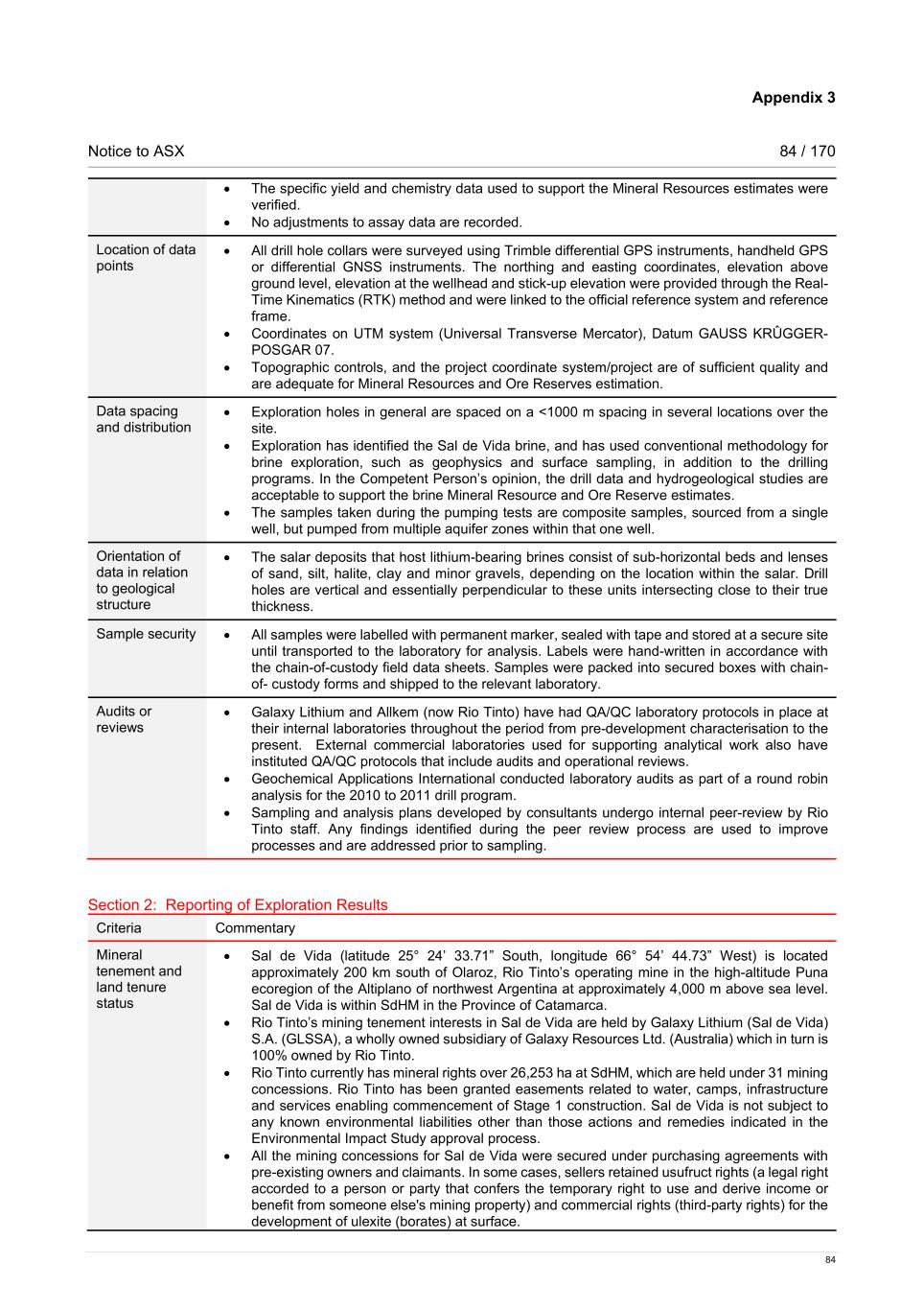
Appendix 3 Notice to ASX 84 / 170 84 • The specific yield and chemistry data used to support the Mineral Resources estimates were verified. • No adjustments to assay data are recorded. Location of data points • All drill hole collars were surveyed using Trimble differential GPS instruments, handheld GPS or differential GNSS instruments. The northing and easting coordinates, elevation above ground level, elevation at the wellhead and stick-up elevation were provided through the Real- Time Kinematics (RTK) method and were linked to the official reference system and reference frame. • Coordinates on UTM system (Universal Transverse Mercator), Datum GAUSS KRÛGGER- POSGAR 07. • Topographic controls, and the project coordinate system/project are of sufficient quality and are adequate for Mineral Resources and Ore Reserves estimation. Data spacing and distribution • Exploration holes in general are spaced on a <1000 m spacing in several locations over the site. • Exploration has identified the Sal de Vida brine, and has used conventional methodology for brine exploration, such as geophysics and surface sampling, in addition to the drilling programs. In the Competent Person’s opinion, the drill data and hydrogeological studies are acceptable to support the brine Mineral Resource and Ore Reserve estimates. • The samples taken during the pumping tests are composite samples, sourced from a single well, but pumped from multiple aquifer zones within that one well. Orientation of data in relation to geological structure • The salar deposits that host lithium-bearing brines consist of sub-horizontal beds and lenses of sand, silt, halite, clay and minor gravels, depending on the location within the salar. Drill holes are vertical and essentially perpendicular to these units intersecting close to their true thickness. Sample security • All samples were labelled with permanent marker, sealed with tape and stored at a secure site until transported to the laboratory for analysis. Labels were hand-written in accordance with the chain-of-custody field data sheets. Samples were packed into secured boxes with chain- of- custody forms and shipped to the relevant laboratory. Audits or reviews • Galaxy Lithium and Allkem (now Rio Tinto) have had QA/QC laboratory protocols in place at their internal laboratories throughout the period from pre-development characterisation to the present. External commercial laboratories used for supporting analytical work also have instituted QA/QC protocols that include audits and operational reviews. • Geochemical Applications International conducted laboratory audits as part of a round robin analysis for the 2010 to 2011 drill program. • Sampling and analysis plans developed by consultants undergo internal peer-review by Rio Tinto staff. Any findings identified during the peer review process are used to improve processes and are addressed prior to sampling. Section 2: Reporting of Exploration Results Criteria Commentary Mineral tenement and land tenure status • Sal de Vida (latitude 25° 24’ 33.71” South, longitude 66° 54’ 44.73” West) is located approximately 200 km south of Olaroz, Rio Tinto’s operating mine in the high-altitude Puna ecoregion of the Altiplano of northwest Argentina at approximately 4,000 m above sea level. Sal de Vida is within SdHM in the Province of Catamarca. • Rio Tinto’s mining tenement interests in Sal de Vida are held by Galaxy Lithium (Sal de Vida) S.A. (GLSSA), a wholly owned subsidiary of Galaxy Resources Ltd. (Australia) which in turn is 100% owned by Rio Tinto. • Rio Tinto currently has mineral rights over 26,253 ha at SdHM, which are held under 31 mining concessions. Rio Tinto has been granted easements related to water, camps, infrastructure and services enabling commencement of Stage 1 construction. Sal de Vida is not subject to any known environmental liabilities other than those actions and remedies indicated in the Environmental Impact Study approval process. • All the mining concessions for Sal de Vida were secured under purchasing agreements with pre-existing owners and claimants. In some cases, sellers retained usufruct rights (a legal right accorded to a person or party that confers the temporary right to use and derive income or benefit from someone else's mining property) and commercial rights (third-party rights) for the development of ulexite (borates) at surface.

Appendix 3 Notice to ASX 85 / 170 85 • Pursuant to Argentinian Law 4757 (as amended), Catamarca Mining royalty is limited to 3% of the mine head value of the extracted ore, which consist in the sales price less direct cash costs related to exploitation (excluding fixed asset depreciation, the Mining Royalty). • On 20 December 2021, GLSSA and the Governor of the Province of Catamarca subscribed a Royalties Commitment Deed (the Royalty Agreement), pursuant to which GLSSA agrees to pay to the Province of Catamarca a maximum amount of 3.5% of the net monthly revenue from the project, as follows: o The Mining Royalty will be paid as indicated by the provincial Royalty Regime. o An Additional Contribution of 3.2% less the Mining Royalty and the applicable water canon; and 0.3% shall be paid as a Corporate Social Responsibility (CSR) Contribution. o The validity of the Royalty Agreement is subject to the approval of the Legislature of the Province of Catamarca, which is in due course to be obtained. o The payment of Mining Royalty is due once the commercial production of the Sal de Vida Project commences and the payment of the Additional Contribution and CSR Contribution is due once the Province of Catamarca (through the relevant authority) grants GLSSA the relevant water concession pursuant to Section 7 of the Water Law No. 2577, as amended. o The Additional Contribution and CSR Contribution will be paid through a Trust, pursuant to provincial legislation to be enacted. o The 3.5% maximum amount shall be the maximum amount payable by GLSSA to the province of Catamarca, for any reason whatsoever, for the whole life of the project (including any expansions). o The net monthly revenue will be calculated by reference to the amounts invoiced by GLSSA each month for the sale of lithium products produced from the project, and for the Mining Royalty, less (i) any taxes, duties, levies included on those invoiced amounts and (ii) any sales reimbursement. • Legal opinion provided supports that Rio Tinto currently holds an indirect 100% interest in the Sal de Vida Project through its subsidiary Galaxy Lithium (Sal de Vida) S.A. • Legal opinion provided supports that the mineral tenures held are valid and sufficient to support declaration of brine Mineral Resources and Brine Ore Reserves. • Social and permitting applications have sufficiently progressed to permit the commencement of Stage 1 construction. The Competent Person is not aware of any significant environmental, social, or permitting issues that would prevent future exploitation of the Sal de Vida Project, other than as discussed in this report. Exploration done by other parties • No exploration by other parties is known for lithium carbonate. • Prior mining was done on site for ulexite, within 5 m of surface. Geology • The principal lithium-bearing region of South America is located within the Puna plateau geologic province. In the southern Puna, combinations of east-trending volcanic chains and north-trending, reverse fault–bounded structural blocks comprise several hydrologically closed (endorheic) basins. In the semiarid to hyperarid climate of the Puna, where evaporation rates far exceed precipitation, the hydrologic terminus of an endorheic basin is a dry lakebed, or salar. These are typically flat and expansive with little or no perennial water or vegetation. Surface water drains into these closed basins and evaporation dominates the water balance, leaving behind brines enriched in various metals and salts, sometimes including economic levels of lithium, boron, and/or potassium. • The regional geological setting is the Altiplano Puna plateau, an area of uplift that began during the middle to late Miocene (10 to 15 Ma). Red-bed sediments formed during the early to middle Miocene in areas of structural depressions. During the middle to late Miocene, a combination of thrust faulting, uplift and volcanism led to the sedimentary basins becoming isolated. The Cordilleras and major watersheds bound the Puna area to the west and east. Sedimentation in these basins began with the formation of alluvial fans at the feet of the uplifted ranges and continued with the development of playa sandflats and mudflat facies. • In basin areas, the watersheds are within the basins; there are no outlets from the basins. Ongoing runoff, both surface and underground, continued solute dissolution from the basins and concentration in their centres where evaporation is the only outlet. • Evaporite minerals occur both as disseminations within a clastic sequence and as discrete beds. • The salar system in the Hombre Muerto basin is considered a typical mature salar. The Hombre Muerto basin has an evaporite core that is dominated by halite. Basin margins are steep and are interpreted to be fault controlled.
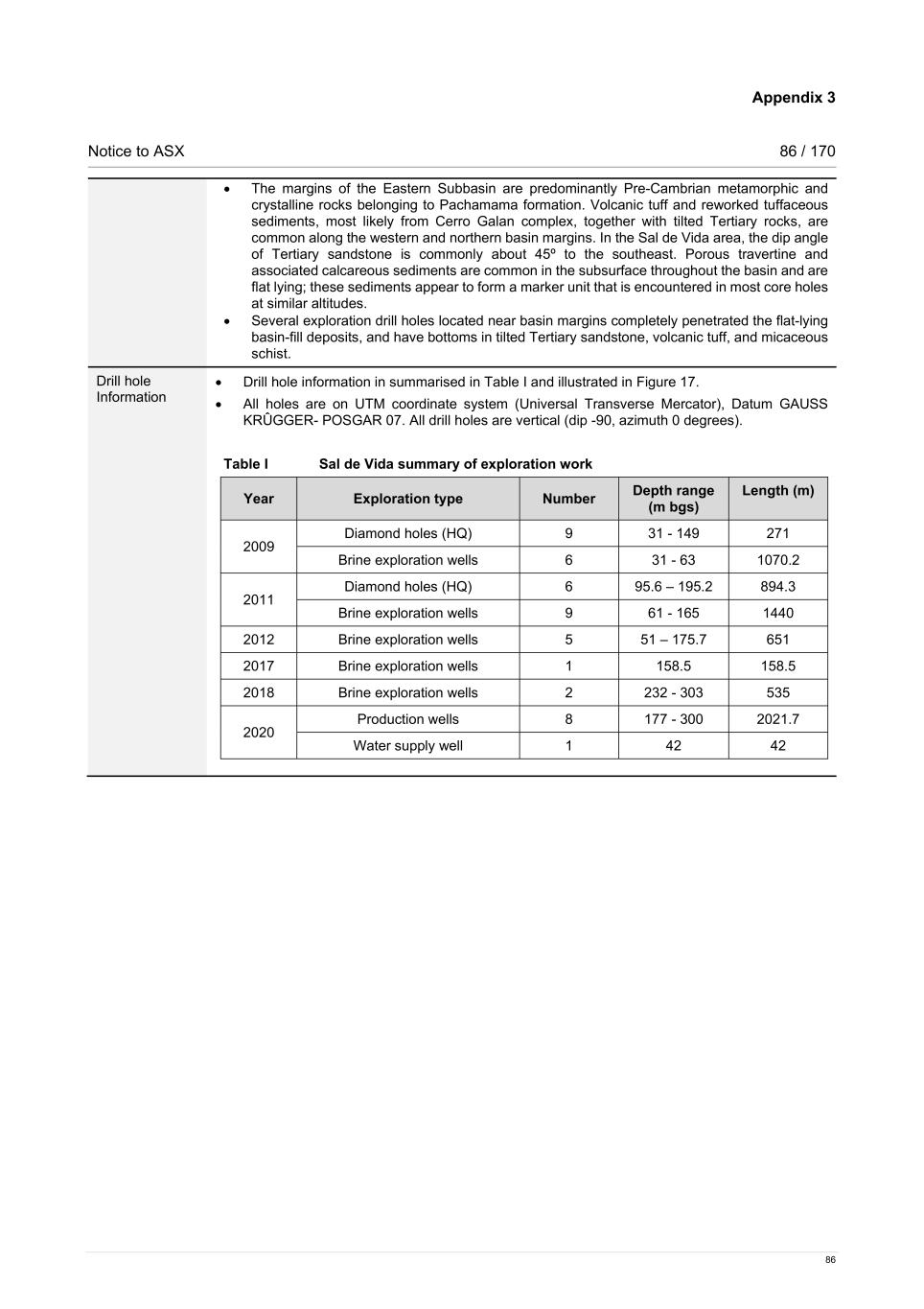
Appendix 3 Notice to ASX 86 / 170 86 • The margins of the Eastern Subbasin are predominantly Pre-Cambrian metamorphic and crystalline rocks belonging to Pachamama formation. Volcanic tuff and reworked tuffaceous sediments, most likely from Cerro Galan complex, together with tilted Tertiary rocks, are common along the western and northern basin margins. In the Sal de Vida area, the dip angle of Tertiary sandstone is commonly about 45º to the southeast. Porous travertine and associated calcareous sediments are common in the subsurface throughout the basin and are flat lying; these sediments appear to form a marker unit that is encountered in most core holes at similar altitudes. • Several exploration drill holes located near basin margins completely penetrated the flat-lying basin-fill deposits, and have bottoms in tilted Tertiary sandstone, volcanic tuff, and micaceous schist. Drill hole Information • Drill hole information in summarised in Table I and illustrated in Figure 17. • All holes are on UTM coordinate system (Universal Transverse Mercator), Datum GAUSS KRÛGGER- POSGAR 07. All drill holes are vertical (dip -90, azimuth 0 degrees). Table I Sal de Vida summary of exploration work Year Exploration type Number Depth range (m bgs) Length (m) 2009 Diamond holes (HQ) 9 31 - 149 271 Brine exploration wells 6 31 - 63 1070.2 2011 Diamond holes (HQ) 6 95.6 – 195.2 894.3 Brine exploration wells 9 61 - 165 1440 2012 Brine exploration wells 5 51 – 175.7 651 2017 Brine exploration wells 1 158.5 158.5 2018 Brine exploration wells 2 232 - 303 535 2020 Production wells 8 177 - 300 2021.7 Water supply well 1 42 42
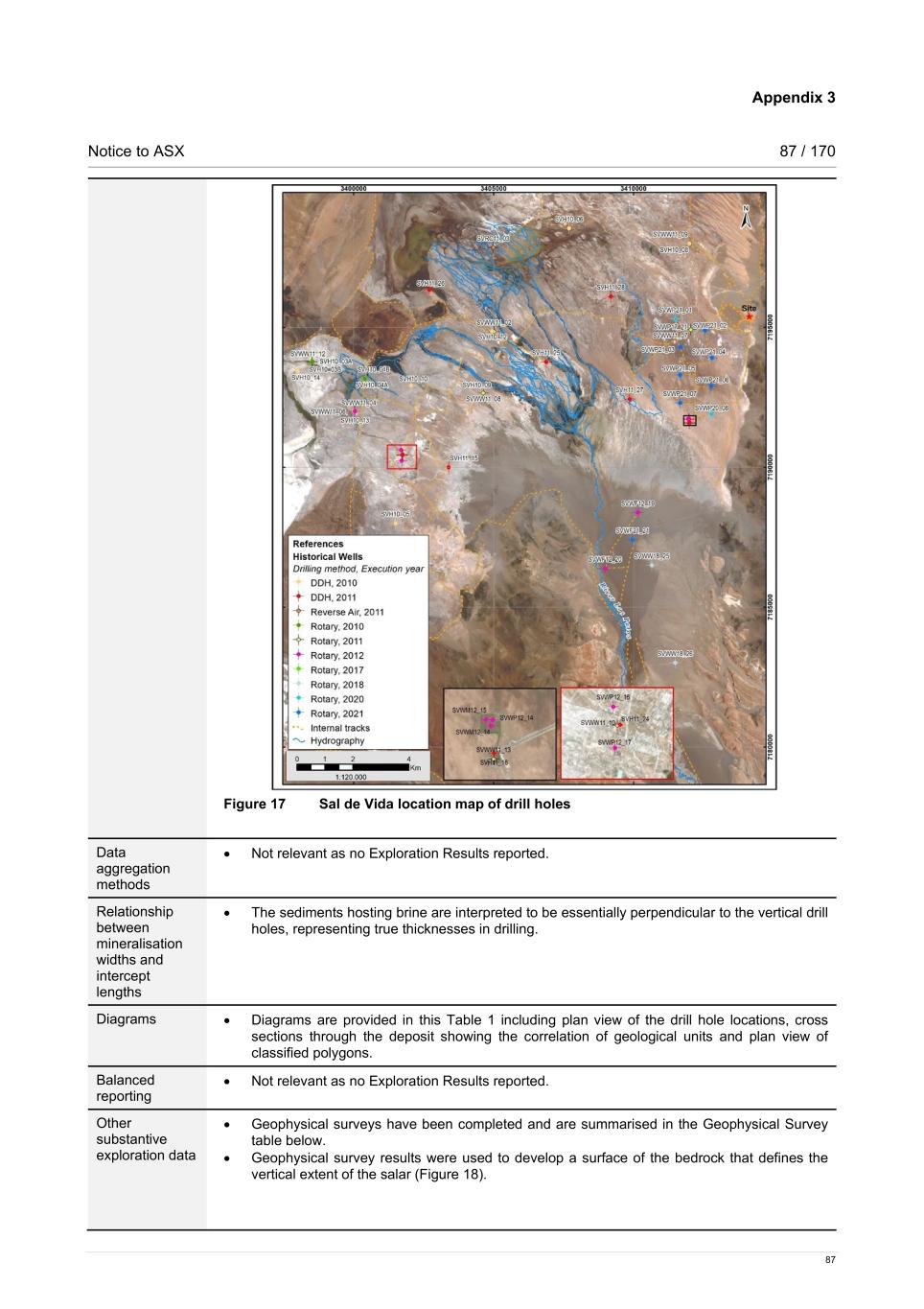
Appendix 3 Notice to ASX 87 / 170 87 Figure 17 Sal de Vida location map of drill holes Data aggregation methods • Not relevant as no Exploration Results reported. Relationship between mineralisation widths and intercept lengths • The sediments hosting brine are interpreted to be essentially perpendicular to the vertical drill holes, representing true thicknesses in drilling. Diagrams • Diagrams are provided in this Table 1 including plan view of the drill hole locations, cross sections through the deposit showing the correlation of geological units and plan view of classified polygons. Balanced reporting • Not relevant as no Exploration Results reported. Other substantive exploration data • Geophysical surveys have been completed and are summarised in the Geophysical Survey table below. • Geophysical survey results were used to develop a surface of the bedrock that defines the vertical extent of the salar (Figure 18).
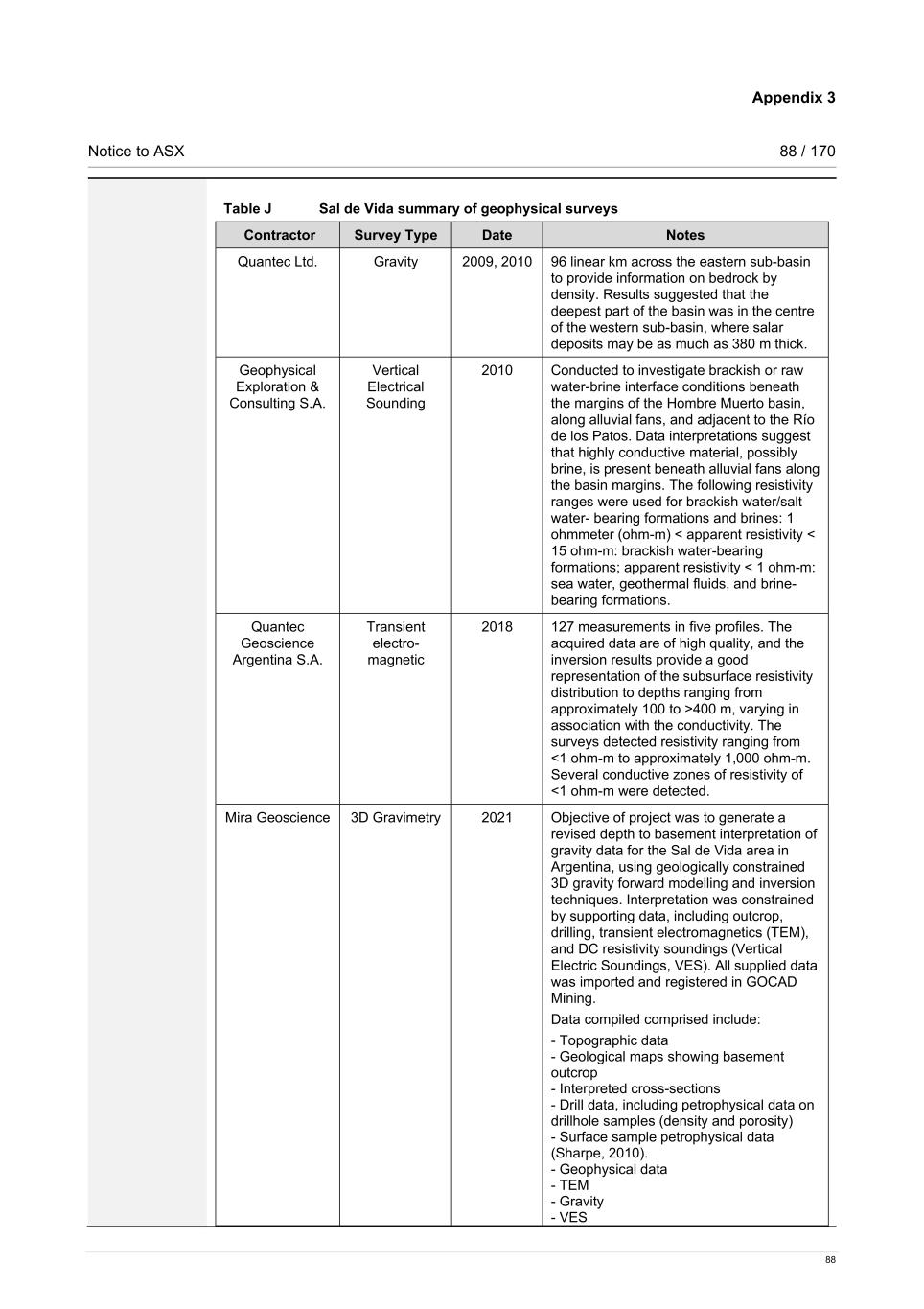
Appendix 3 Notice to ASX 88 / 170 88 Table J Sal de Vida summary of geophysical surveys Contractor Survey Type Date Notes Quantec Ltd. Gravity 2009, 2010 96 linear km across the eastern sub-basin to provide information on bedrock by density. Results suggested that the deepest part of the basin was in the centre of the western sub-basin, where salar deposits may be as much as 380 m thick. Geophysical Exploration & Consulting S.A. Vertical Electrical Sounding 2010 Conducted to investigate brackish or raw water-brine interface conditions beneath the margins of the Hombre Muerto basin, along alluvial fans, and adjacent to the Río de los Patos. Data interpretations suggest that highly conductive material, possibly brine, is present beneath alluvial fans along the basin margins. The following resistivity ranges were used for brackish water/salt water- bearing formations and brines: 1 ohmmeter (ohm-m) < apparent resistivity < 15 ohm-m: brackish water-bearing formations; apparent resistivity < 1 ohm-m: sea water, geothermal fluids, and brine- bearing formations. Quantec Geoscience Argentina S.A. Transient electro- magnetic 2018 127 measurements in five profiles. The acquired data are of high quality, and the inversion results provide a good representation of the subsurface resistivity distribution to depths ranging from approximately 100 to >400 m, varying in association with the conductivity. The surveys detected resistivity ranging from <1 ohm-m to approximately 1,000 ohm-m. Several conductive zones of resistivity of <1 ohm-m were detected. Mira Geoscience 3D Gravimetry 2021 Objective of project was to generate a revised depth to basement interpretation of gravity data for the Sal de Vida area in Argentina, using geologically constrained 3D gravity forward modelling and inversion techniques. Interpretation was constrained by supporting data, including outcrop, drilling, transient electromagnetics (TEM), and DC resistivity soundings (Vertical Electric Soundings, VES). All supplied data was imported and registered in GOCAD Mining. Data compiled comprised include: - Topographic data - Geological maps showing basement outcrop - Interpreted cross-sections - Drill data, including petrophysical data on drillhole samples (density and porosity) - Surface sample petrophysical data (Sharpe, 2010). - Geophysical data - TEM - Gravity - VES
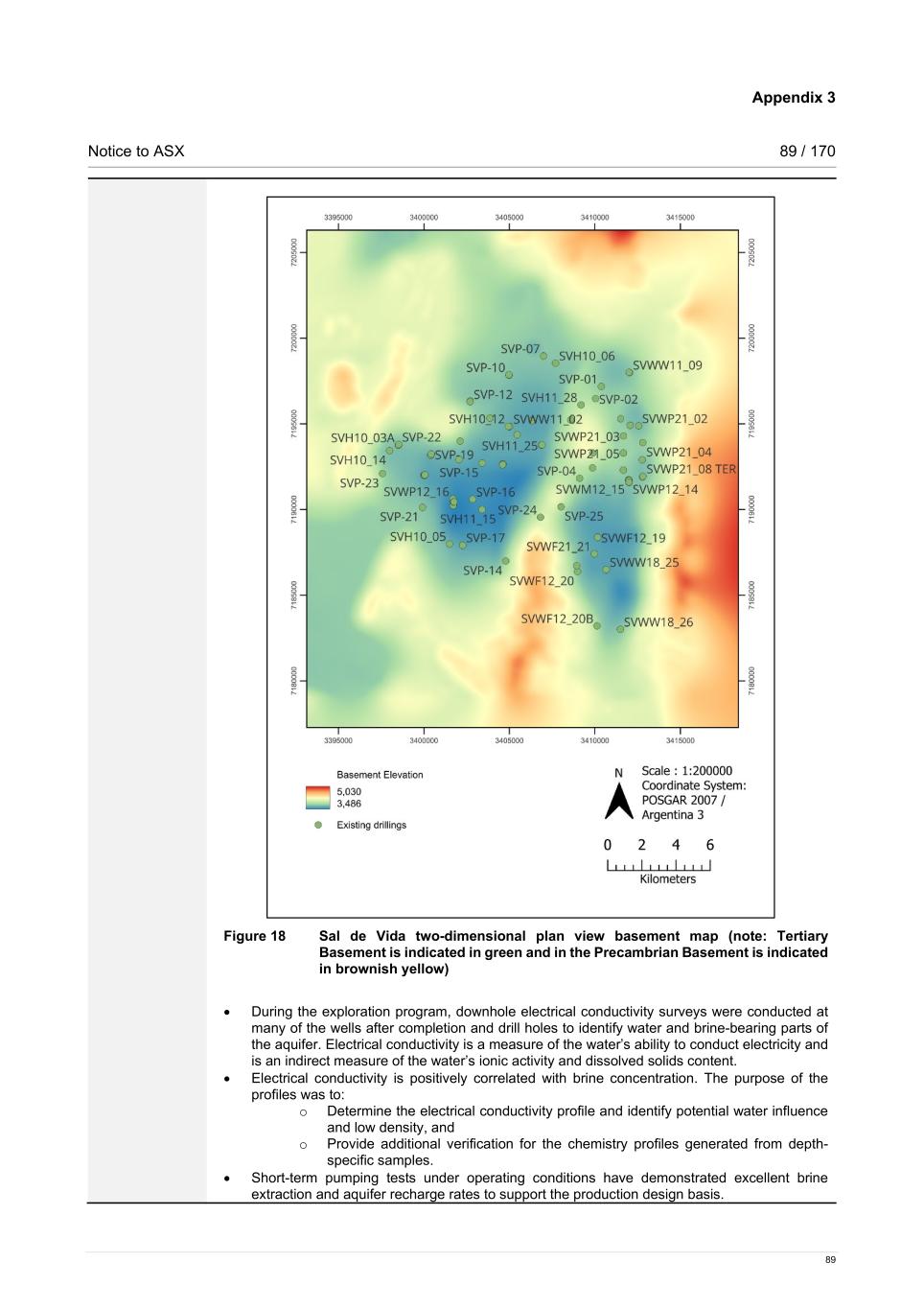
Appendix 3 Notice to ASX 89 / 170 89 Figure 18 Sal de Vida two-dimensional plan view basement map (note: Tertiary Basement is indicated in green and in the Precambrian Basement is indicated in brownish yellow) • During the exploration program, downhole electrical conductivity surveys were conducted at many of the wells after completion and drill holes to identify water and brine-bearing parts of the aquifer. Electrical conductivity is a measure of the water’s ability to conduct electricity and is an indirect measure of the water’s ionic activity and dissolved solids content. • Electrical conductivity is positively correlated with brine concentration. The purpose of the profiles was to: o Determine the electrical conductivity profile and identify potential water influence and low density, and o Provide additional verification for the chemistry profiles generated from depth- specific samples. • Short-term pumping tests under operating conditions have demonstrated excellent brine extraction and aquifer recharge rates to support the production design basis.
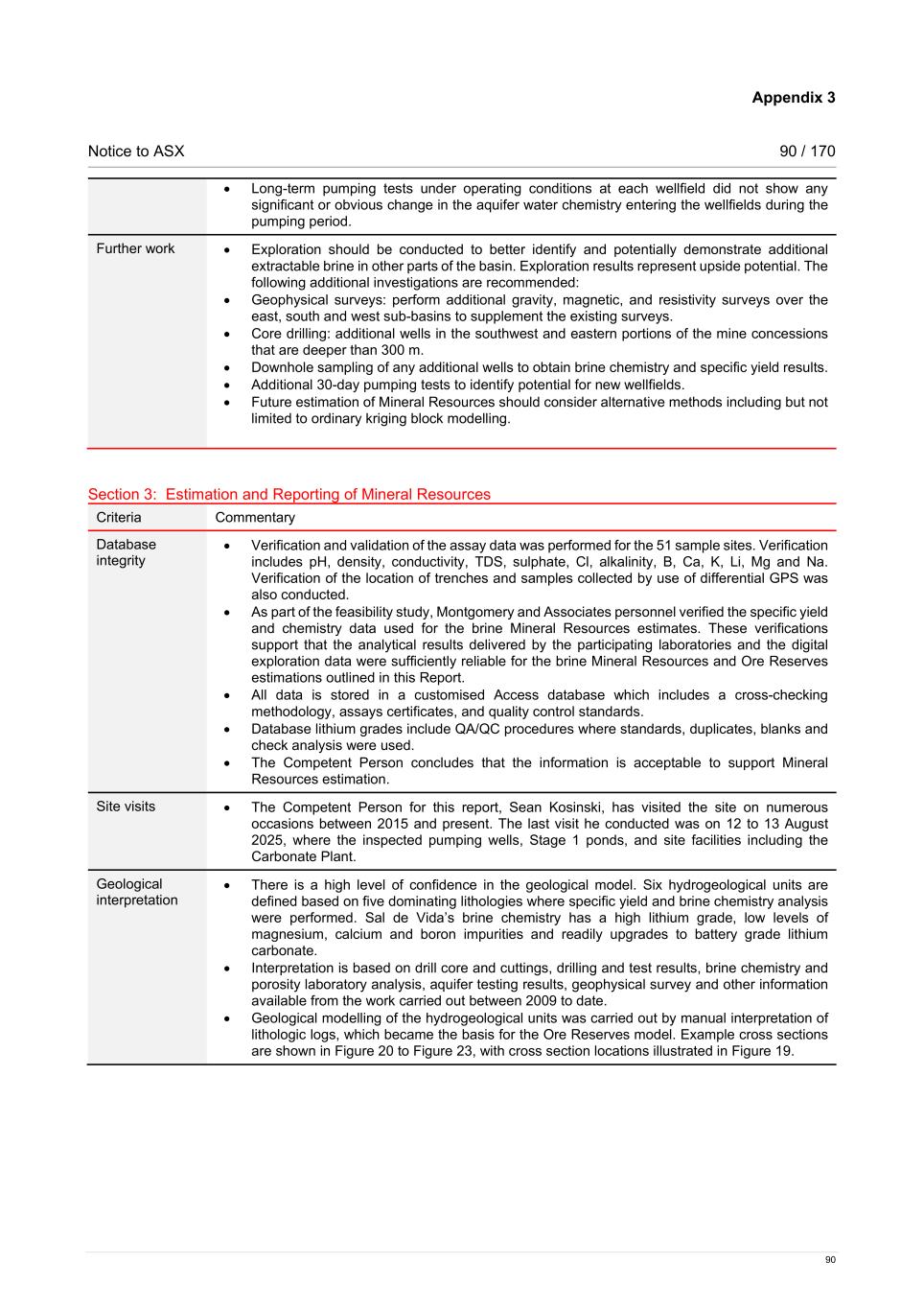
Appendix 3 Notice to ASX 90 / 170 90 • Long-term pumping tests under operating conditions at each wellfield did not show any significant or obvious change in the aquifer water chemistry entering the wellfields during the pumping period. Further work • Exploration should be conducted to better identify and potentially demonstrate additional extractable brine in other parts of the basin. Exploration results represent upside potential. The following additional investigations are recommended: • Geophysical surveys: perform additional gravity, magnetic, and resistivity surveys over the east, south and west sub-basins to supplement the existing surveys. • Core drilling: additional wells in the southwest and eastern portions of the mine concessions that are deeper than 300 m. • Downhole sampling of any additional wells to obtain brine chemistry and specific yield results. • Additional 30-day pumping tests to identify potential for new wellfields. • Future estimation of Mineral Resources should consider alternative methods including but not limited to ordinary kriging block modelling. Section 3: Estimation and Reporting of Mineral Resources Criteria Commentary Database integrity • Verification and validation of the assay data was performed for the 51 sample sites. Verification includes pH, density, conductivity, TDS, sulphate, Cl, alkalinity, B, Ca, K, Li, Mg and Na. Verification of the location of trenches and samples collected by use of differential GPS was also conducted. • As part of the feasibility study, Montgomery and Associates personnel verified the specific yield and chemistry data used for the brine Mineral Resources estimates. These verifications support that the analytical results delivered by the participating laboratories and the digital exploration data were sufficiently reliable for the brine Mineral Resources and Ore Reserves estimations outlined in this Report. • All data is stored in a customised Access database which includes a cross-checking methodology, assays certificates, and quality control standards. • Database lithium grades include QA/QC procedures where standards, duplicates, blanks and check analysis were used. • The Competent Person concludes that the information is acceptable to support Mineral Resources estimation. Site visits • The Competent Person for this report, Sean Kosinski, has visited the site on numerous occasions between 2015 and present. The last visit he conducted was on 12 to 13 August 2025, where the inspected pumping wells, Stage 1 ponds, and site facilities including the Carbonate Plant. Geological interpretation • There is a high level of confidence in the geological model. Six hydrogeological units are defined based on five dominating lithologies where specific yield and brine chemistry analysis were performed. Sal de Vida’s brine chemistry has a high lithium grade, low levels of magnesium, calcium and boron impurities and readily upgrades to battery grade lithium carbonate. • Interpretation is based on drill core and cuttings, drilling and test results, brine chemistry and porosity laboratory analysis, aquifer testing results, geophysical survey and other information available from the work carried out between 2009 to date. • Geological modelling of the hydrogeological units was carried out by manual interpretation of lithologic logs, which became the basis for the Ore Reserves model. Example cross sections are shown in Figure 20 to Figure 23, with cross section locations illustrated in Figure 19.
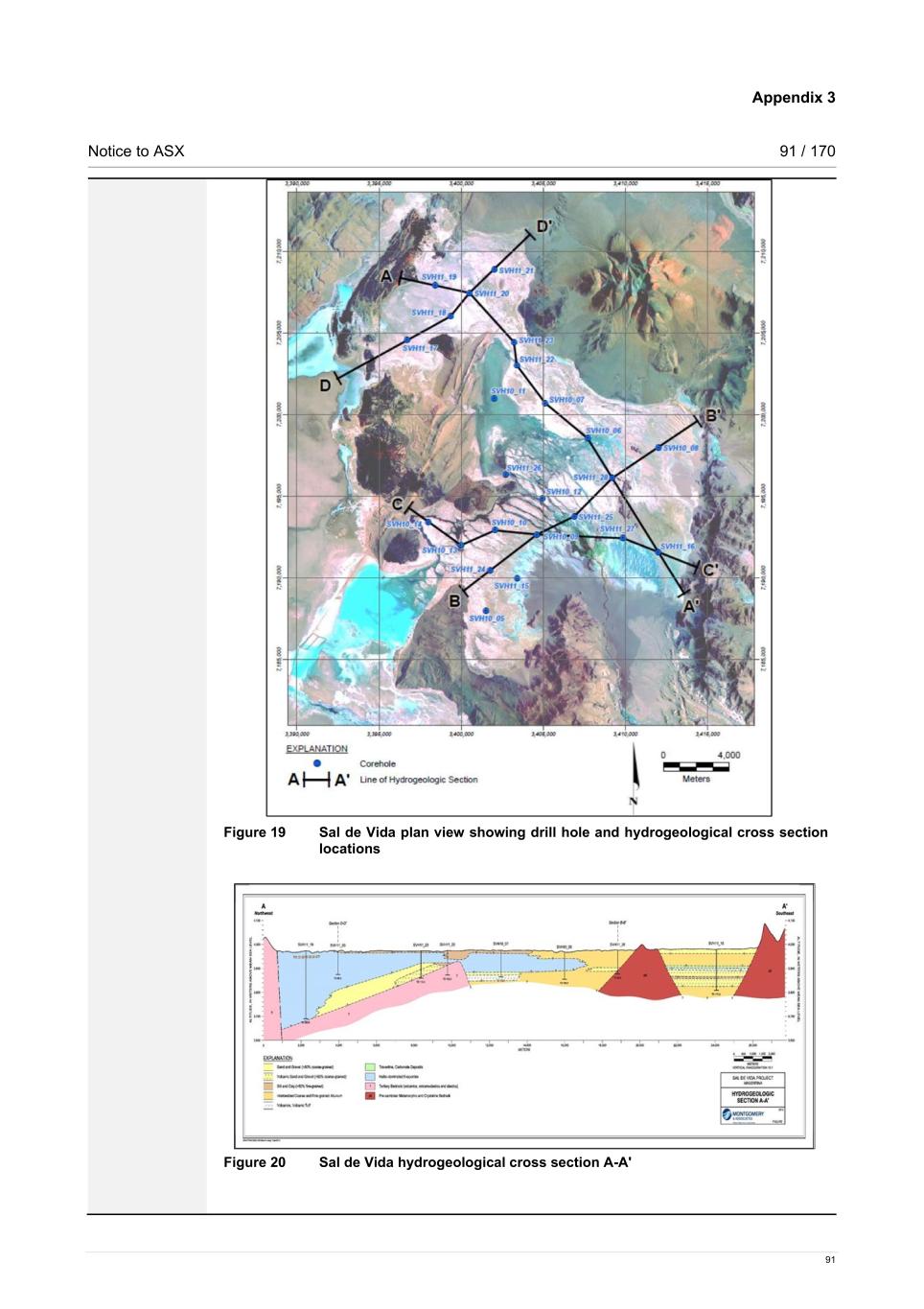
Appendix 3 Notice to ASX 91 / 170 91 Figure 19 Sal de Vida plan view showing drill hole and hydrogeological cross section locations Figure 20 Sal de Vida hydrogeological cross section A-A'
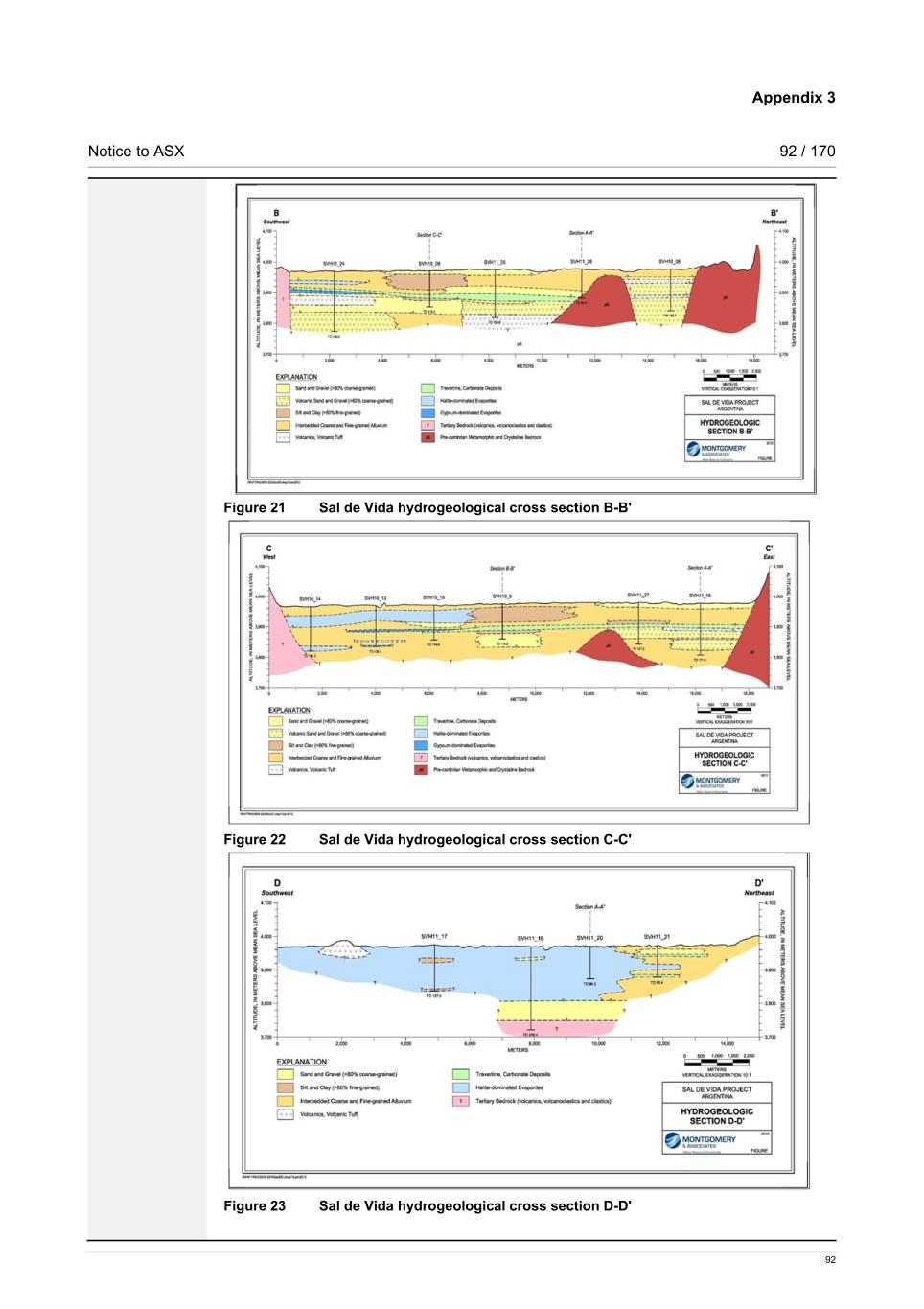
Appendix 3 Notice to ASX 92 / 170 92 Figure 21 Sal de Vida hydrogeological cross section B-B' Figure 22 Sal de Vida hydrogeological cross section C-C' Figure 23 Sal de Vida hydrogeological cross section D-D'
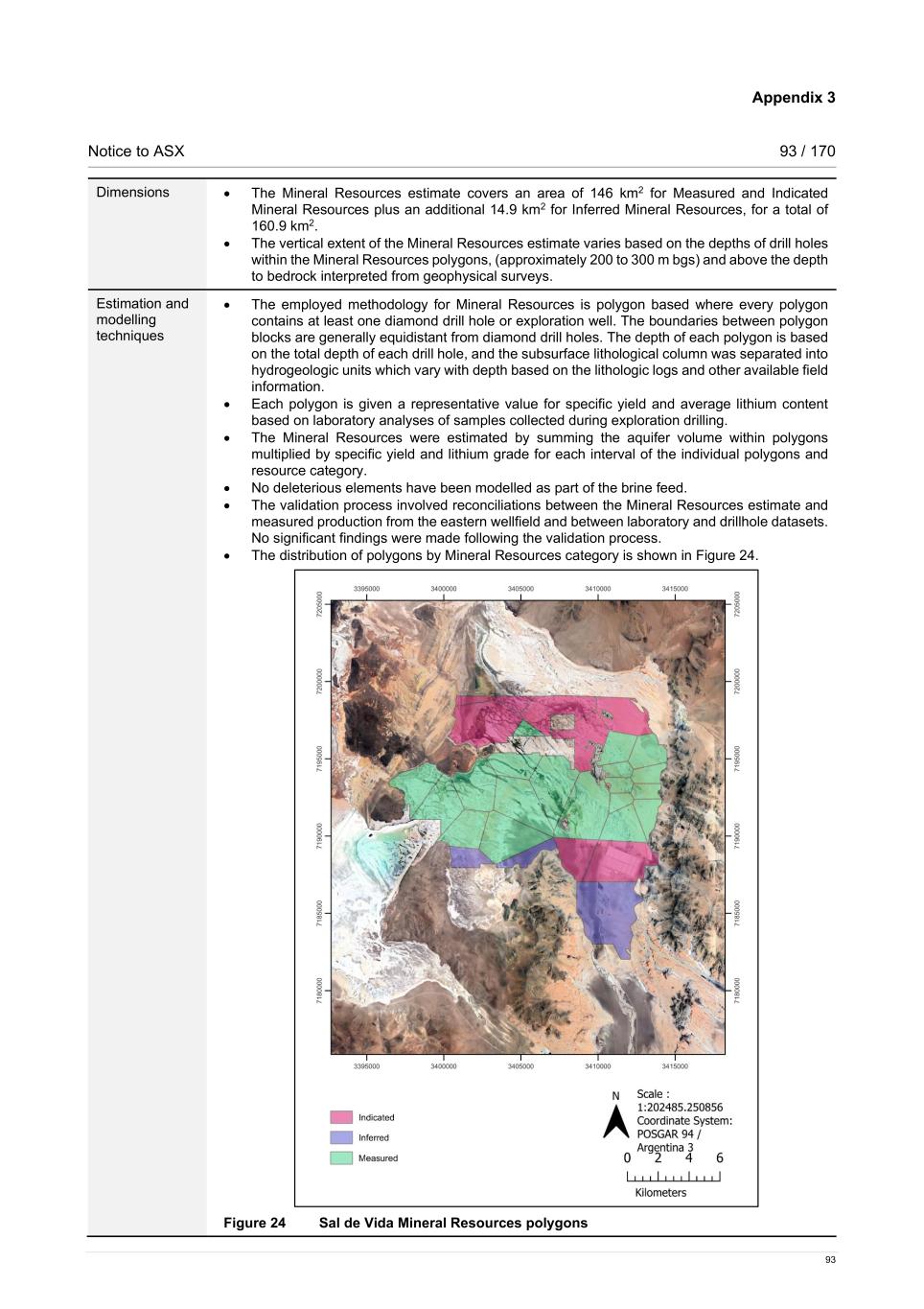
Appendix 3 Notice to ASX 93 / 170 93 Dimensions • The Mineral Resources estimate covers an area of 146 km2 for Measured and Indicated Mineral Resources plus an additional 14.9 km2 for Inferred Mineral Resources, for a total of 160.9 km2. • The vertical extent of the Mineral Resources estimate varies based on the depths of drill holes within the Mineral Resources polygons, (approximately 200 to 300 m bgs) and above the depth to bedrock interpreted from geophysical surveys. Estimation and modelling techniques • The employed methodology for Mineral Resources is polygon based where every polygon contains at least one diamond drill hole or exploration well. The boundaries between polygon blocks are generally equidistant from diamond drill holes. The depth of each polygon is based on the total depth of each drill hole, and the subsurface lithological column was separated into hydrogeologic units which vary with depth based on the lithologic logs and other available field information. • Each polygon is given a representative value for specific yield and average lithium content based on laboratory analyses of samples collected during exploration drilling. • The Mineral Resources were estimated by summing the aquifer volume within polygons multiplied by specific yield and lithium grade for each interval of the individual polygons and resource category. • No deleterious elements have been modelled as part of the brine feed. • The validation process involved reconciliations between the Mineral Resources estimate and measured production from the eastern wellfield and between laboratory and drillhole datasets. No significant findings were made following the validation process. • The distribution of polygons by Mineral Resources category is shown in Figure 24. Figure 24 Sal de Vida Mineral Resources polygons

Appendix 3 Notice to ASX 94 / 170 94 Moisture • Moisture content of the cores was measured (porosity and density measurements were made), but because brine is extracted by pumping, the sediment moisture is not a relevant parameter for the Mineral Resources estimate. Cut-off parameters • A cut-off grade of 300 mg/l was applied to the Mineral Resources estimate. Mining factors or assumptions • The Mineral Resources are quoted in terms of brine volume, concentration of lithium and their product, LCE. • No mining or recovery factors are applied (although the use of the specific yield and exclusion of polygon intervals below the lithium cut-off grade supports the reasonable prospects of eventual economic extraction with the proposed mining methodology). • Dilution of brine concentrations may occur over time and typically there are lithium losses in both the ponds and processing plant during brine mining operations. • The conceptual mining method is recovering brine from the salar via a network of wells, the established practice on existing lithium brine projects. • Detailed hydrologic studies of the salar have been undertaken (catchment and groundwater modelling) to evaluate the extractable resources and potential extraction rates. Metallurgical factors or assumptions • Lithium carbonate and potassium chloride is projected to be produced on site via conventional brine processing techniques and evaporation ponds to concentrate the brine prior to processing, similar to Rio Tinto’s Olaroz operation. Brine composition from Sal de Vida could be processed using similar processing technology to that applied in the Olaroz production facility, where it has been successfully applied to produce lithium carbonate in the existing (previously Orocobre) facilities. Environmental factors or assumptions • Impacts of the lithium carbonate production operation at Sal de Vida include surface disturbance from the creation of extraction/processing facilities and associated infrastructure, accumulation of various salt tailings impoundments and extraction from brine and groundwater aquifers regionally. Lime is used to increase precipitation of impurities like magnesium and calcium solids. Precipitated salts are collected in ponds and later returned to the salar. • A small fraction of waste solids is generated in the lithium carbonate plant, that are mainly impurities removed from the brine. The main solids are a mixture of magnesium hydroxide and calcium carbonate. Waste disposals areas will surround the evaporation ponds to the north, east and southeast. • Waste disposals areas will surround the evaporation ponds to the north, east and southeast. This facility will consist of halite, muriate, and co-disposal stockpiles surrounding the halite ponds and will cover a total area of approximately 300 ha for Stage 1 and 600 ha for Stage 2. • The project has fulfilled the required environmental and social assessments to progress into construction of Stage 1. The project is permitted by the provincial mining authorities and has provincial and federal permits. The project reflects positive, social and socio- economic benefits for local communities. Expansion Stage 2 permitting application process is still to commence. Bulk density • Density measurements were taken as part of the drill core assessment. This included determining dry density and particle density as well as field measurements of brine density. Note that no mining of sediments is to be carried out, as brine is to be extracted by pumping. • No bulk density was applied to the estimates because resources are defined by volume, rather than by tonnage. • The salt unit can contain fractures and possibly voids which host brine and add to the specific yield. Classification • Mineral Resources are classified Measured, Indicated and Inferred Mineral Resources based on the confidence in the estimation and specific information available. For Measured and Indicated Mineral Resources, the following factors are considered: level of understanding and reliability of the basin stratigraphy and the local hydrogeologic characteristics of the aquifer system, density of drilling and testing in the salar and uniformity of the results within the area, and available pumping test and historical production information. • Approximate drill hole spacings were initially used as a guide, assuming that for estimated Mineral Resources to be considered Measured, spacing was no greater than 4 km. Indicated Mineral Resources used spacing no greater than 7 km, and Inferred Mineral Resources used spacing no greater than 10 km. Measured Mineral Resources are defined only in the units where continuity has been demonstrated by pumping tests.

Appendix 3 Notice to ASX 95 / 170 95 • Some areas with drill spacings closer than 4 km, were classified either Indicated or Inferred Mineral Resources when progressively lower levels of understanding or reliability on basin stratigraphy, reservoir properties, or hydrogeologic conditions exist. • The Competent Person considers that the amount of exploration information and understanding of the deposit supports the Mineral Resources classification. The Competent Person also believes that there is potential for increasing both the Mineral Resources categories, and their volume by drilling in unexplored areas, and by drilling deeper. Audits or reviews • An audit was conducted by SRK Consultants in 2022. No significant findings were noted and findings with low consequence were addressed prior to developing this Mineral Resources estimate. Discussion of relative accuracy/ confidence • Main uncertainties of the Mineral Resources include the location of aquifer boundaries and shallower than anticipated bedrock near hard rock outcrops. Furthermore, uncertainties include the lateral continuity of key aquifer zones, presence of brackish water that has the potential to dilute the brine in the wellfield area and assumed uniformity of average aquifer parameters within specific aquifer units. • The level of understanding and reliability of the basin stratigraphy, level of understanding of the local hydrogeologic characteristics of the aquifer system, density of drilling and testing in the salar and general uniformity of results within an area are the main factors that could support a future upgrade of the Mineral Resource categories. • To the extent known by the Competent Person, there are no known environmental, permitting, legal, title, taxation, socioeconomic, marketing, political or other relevant factors that could affect the Mineral Resources estimate which are not discussed. • The Competent Person considers that the assigned resource categories appropriately reflect the confidence in the Mineral Resources. Section 4: Estimation and Reporting of Ore Reserves Criteria Commentary Mineral Resource estimate for conversion to Ore Reserves • The Mineral Resources used as the basis for the Ore Reserves was based on the information in Section 3 of this Table 1. • Mineral Resources are reported inclusive of Ore Reserves. Site visits • Site visits by the Competent Person are described in Section 3. Study Status • The Sal de Vida project in Stage 1 is based on a feasibility study. Stage 2 considers an expansion of the project and is undergoing a prefeasibility study. Cut-off parameters • A marginal cut-off grade of 470 mg/l was calculated based on a break-even analysis involving economic factors, brine production, royalties and pricing assumptions for a 40 year mine life. Simulated lithium grades remain above the cut-off grade at the end of mine life. Mining factors or assumptions • The life of mining is currently projected to 40 years. Mining production for years 1 and 2 is from Stage 1 in the East Wellfield, and for the following years 3 to 40, production will incorporate Stage 2 from the Southwest, Southeast and North well areas. Currently, well depths are down to approximately 200 m only, however this may extend when new deeper exploration wells are drilled. All production wells will be connected through pipelines to centrally positioned booster ponds. The East Wellfield (Stage 1) is designed with 8 operating wells plus one on standby. • Projections for Ore Reserves indicates that average annual rate production of brine from the east is set in 315 L/s and 191 L/s from the southwest. The initial average grade is expected to be roughly 805 mg/l and 815 mg/l, respectively. • Extraction using wells is the appropriate extraction choice in salars, as the lithium is dissolved in brine (fluid) and mining of unconsolidated sediments is not contemplated. • Geotechnical studies are not required for brine extraction. • Dilution of brine during pumping is simulated within the numerical model for the conversion of Mineral Resources into Ore Reserves. • The Inferred Mineral Resources are not included in current mining studies but are considered a possible source of future brine extraction when their resource classification is upgraded. • Brine mining requires the provision of electricity and pipelines to the sites of wells from which brine is extracted. The pipelines pump brine to centralised collection ponds, from where it is pumped to the evaporation pond network. The brine is subject to the addition of lime in the
Appendix 3 Notice to ASX 96 / 170 96 evaporation ponds. Pumps are required to move brine between ponds and pump brine into the plant, where lithium carbonate product is produced. Electricity generators for wellfields and boosters will be used during the pre-production (1 year) and then will be fed by a power line. Metallurgical factors or assumptions • The metallurgical process utilised for the production of lithium carbonate is based on solar evaporation of brine, prior to reacting lithium with carbon dioxide in the plant to produce lithium carbonate. In this way, much of the energy required for the process is provided naturally by the sun. Lithium preferentially remains within the brine, and other elements precipitate from the brine in response to their increasing concentration and saturation in the brine. Lime is added to the ponds to facilitate the precipitation of magnesium from the brine. Although more recent direct extraction processing techniques are more widely available pond evaporation provides a cost-effective processing method. • The Sal de Vida process design is approximated from previously completed test work, results and performance at Rio Tinto’s Olaroz operation. The Olaroz process design has been successfully proven to produce lithium carbonate since 2015. • Modifications to the Olaroz process technology mean that salts will be drained and harvested in all ponds. Transfer pumps will be used to transfer concentrated brine from a lower grade pond into a higher-grade pond. A second liming stage will be installed to maximise magnesium ion removal before brine enters the production facilities and an ion-exchange stage will be installed to remove remaining calcium and magnesium ions before precipitating battery grade lithium carbonate. • Lithium Carbonate is sold as both battery and technical grade product, depending on the concentration of impurities. The project produces both grades of product. • Pilot testing was conducted during 2020 and 2021; purpose-built pilot ponds and pilot plant validate laboratory test work and explore operational considerations. Future drilled production wells showed a higher concentration grade and lower impurity than pilot testing. • Deleterious elements have been identified and measurements will be taken to mitigate the risks. This includes sodium carbonate which will be ionized and captured before being fed into the crystallisation circuit, and magnets will be used to capture and remove impurities related to iron equipment. Environmental factors or assumptions • The project has an approved DIA (Impact Assessment Declaration) from 2014, being the legal instrument to explore, construct and perform exploitation activities. This document is subject and based on a series of commitments and obligations and has been updated every 2 years. • The EIA update for Sal de Vida was submitted in September 2023 and, after its evaluation, the Authority authorized the public participation process. As part of this, in June 2025 technical meetings were held between the company and local stakeholders. To date, the Environmental Impact Statement has not yet been issued, with its issuance being the only step pending, since there are no outstanding requirements for the company. A series of approvals and permits relate to environment, chemicals, groundwater and water use, waste management, hazardous and others, are finished and others underway. Infrastructure • The project is located in a flat plain at an altitude of about 4,000 m above land surface. The main route to the site is from the city of Catamarca via national route 40 to Belen, and provincial Route 43 through Antofagasta de la Sierra to Salar del Hombre Muerto. The road is paved all the way to Antofagasta de la Sierra and continues unpaved for the last 145 km to SdHM. The shortest route to site is from Salta via San Antonio de los Cobres. The access road is paved for the first 75 km to San Antonio de los Cobres and continues unpaved for 215 km to Salar del Hombre Muerto. The total distance between the city of Salta and Sal de Vida is 390 km. • Site infrastructure will consist of the main processing facilities including brine well fields and pumping, evaporation ponds, process plant and waste storage. Rio Tinto’s current operations at Olaroz are of similar nature and process. Internal company policies, standard operating procedures, management systems and structures will allow sufficiently rigid establishment of initial operations at site and reduce commissioning and ramp-up risk. • The brine production wellfields will be located on two sectors of the SdHM, one in the East Wellfield for Stage 1 where production will start, and a subsequent stage called the Stage 2 Expansion. This Stage 2 will expand the original area of Stage 1 to the west, south and north. Brine wells will be connected through pipelines to centrally positioned booster ponds. The wells will be equipped with pumps and manifolds to the distribution pipeline. • The evaporation ponds for Stage 1 will cover 450 ha while the halite evaporation pond of Stage 2 will cover approximately 850 ha and muriate evaporation ponds for Stage 2 will cover 50 ha. • The processing plant will consist of a liming plant to support evaporation pond processes, and a lithium carbonation plant to produce final product. The processing plant will be supported by
Appendix 3 Notice to ASX 97 / 170 97 service infrastructure such as reagents mixing, fuel and storage facility, sulfuric acid preparation, compressors and boilers, water treatment plants and workshops. • The accommodation camp will be built next to the process plant area. The camp building will be based on prefabricated material to accommodate up to 900 people. The process facility, support services and accommodation infrastructure are deemed adequate to support the planned facility operation and production rate. • Electricity for the plant involves diesel independent generators for electricity and connection to a power line. Shift from diesel generation to natural gas will be available in case natural gas is available for the future. The camp will also have renewable energy. • The support infrastructure has been reviewed and is deemed adequate by the Competent Person to support the processing infrastructure and process operations described in this report. Costs • Assumptions were made to derive the capital costs including the fact that all relevant permits would be received in a timely manner to meet the project schedule. • Assumptions were made regarding the construction contracts whereas these contracts would be attributed on the base of a competitive bidding process amongst qualified installation contractors. It is expected that a high level of site management supervision, contract administration, quality control and thorough safety management will be required during the site execution phase • Major exclusions: currency fluctuation, interest expenses, project financing costs, duties and taxes were not included in the Capex study but were considered in the economic analysis. • Commodity price is based on market studies conducted by Rio Tinto. • Provincial mining royalty (not to exceed 3.5%) is considered based on the mine head value of the extracted ore. In addition, the Federal Argentine government receives an export duty (4.5%) on the FOB while the company exports lithium products. • Corporate tax rate is set at 35%. • Operating costs were estimated for the brine extraction, lithium concentration, and lithium carbonate production process to market. For costing purposes, the following assumptions were made: o Brine is extracted from production wells and conveyed to surface facilities through brine pipelines. Depending on the technology, lithium concentration is achieved either through evaporation ponds or through Direct Lithium Extraction (DLE) systems. o Concentrated brine or DLE product is transferred to a carbonate plant located near the salar for lithium carbonate production. o Product transport is assumed through regional logistics networks to export destinations. o The operating cost basis corresponds to steady-state production at capacity for battery and technical grade lithium carbonate. o Additional operating costs include labour, maintenance, reagent handling and consumption, energy and fuel, water management, tailings or spent brine management, and general and administrative (G&A) expenses. o The sources of information used to develop these costs include in-house databases, supplier quotations, and benchmark data from comparable brine operations in South America. Revenue factors • Rio Tinto applies a common process to the generation of commodity price assumptions across the group. This involves generation of long-term price forecasts based on current sales contracts, industry capacity analysis, global commodity consumption and economic growth trends. Prices are adjusted to reflect the expectation that they will be sold on CIF terms. • Exchange rates are also based on internal Rio Tinto modelling of expected future exchange rates. Due to the commercial sensitivity of these assumptions, an explanation of the methodology used to determine these assumptions has been provided, rather than the actual figures. Market Assessment • The global lithium market is projected to grow at 14% per annum from 2025 to 2030, reaching approximately 2.7 Mt of LCE. This growth is primarily driven by the increasing production of lithium-ion batteries to meet surging demand for electric vehicles and battery energy storage systems. Sal de Vida’s anticipated capacity of 45 ktpa of battery-grade LCE represents approximately 3% of current global lithium carbonate demand (approximately 1.4 Mt LCE). Sal de Vida will be a crucial supply source for Europe and the United States due to forecast supply shortfalls.
Appendix 3 Notice to ASX 98 / 170 98 • In terms of the sales portfolio, Sal de Vida intends to sell battery-grade lithium carbonate to customers across the value chain, diversified across continents. At present, most cathode makers are based in Asia (i.e. China, South Korea and Japan) but the project pipeline in the West is gradually expanding due to the push for localised supply chains. The shipping of lithium carbonate is relatively straight forward via standard 20 or 40-foot containers out of Chile and Argentina ports to worldwide destinations as has been done by existing producers for more than 30 years. The cost of shipping lithium carbonate is low compared to market prices. Compared to ‘mature’ commodities such as copper and aluminium (with forecast demand growth of ~1% to 3% over the longer term), lithium is still very much in its infancy in terms of product volume and price transparency. The projected demand growth and price forecasts for lithium products could significantly deviate from current forecasts depending on market developments on EV policies, energy storage systems demand, recycling growth and battery technology breakthroughs. Economic • Rio Tinto long-term prices have been used as the basis for the financial evaluation (NPV, IRR). The assumptions used in this economic analysis are macroeconomic, marketing, mine plan, operating costs, capital costs, closure costs, working capital and taxation. • Rio Tinto Economics supplies price and cost information on a real basis for use in NPV calculations. Rio Tinto specifies the discount rate to be used. Project NPVs are confidential business information however, economic evaluation using Rio Tinto long-term prices demonstrates a positive NPV for the Sal de Vida Project under a range of price, cost and productivity scenarios. Social • Rio Tinto has been actively involved in community relations. Although there are minimal inhabitants in the area of the salar, Rio Tinto has consulted extensively with the local communities and employs members of these communities in the current exploration activities. • The company has performed continuous surveys on social perception with local communities, social economics baseline updates, survey of local suppliers and study of local competencies. • The company has evaluated positive and negative impacts of the project within the company. Based on social commitments and compliance with local mining authority, Sal de Vida has participated in training and improve skills of people from local communities, prioritize the hiring of local operators and technicians in the area of influence, work with the university of Catamarca and technical schools to develop professionals for future positions, consider gender and diversity perspectives in the processes of hiring local labour and in community projects. • The company has implemented a Community Relations Plan (PRC) between Sal de Vida and the communities to develop programs to maximise positive effects of the project and optimize relationship, to minimize the risks of misunderstandings, to encourage families, residents, and institutions to take advantage of sustainable opportunities and to establish an information and consultation system open to the community. • The company has increased new programs internal procedures to improve community management, has implemented a territorial community management approach and has been developing a Completion of Education with the Ministry of Education of Catamarca. As of 31 March 2022, more than 70% of local employees are from Catamarca and Stage 1 will create approximately 900 full-time positions at peak construction and 170 full-time positions during stable Stage 1 operations. • Other successful community programs include: Implementation programs of University Technique in Lithium Brine, strengthening program for local rural producers, community medical visits program, community infrastructure program and community infrastructure program. • Agreements with communities have been set in place, which include internet system installation and hiring of people currently working in various areas of Sal de Vida. • Rio Tinto has a strong commitment to hiring local labour, which favours the socioeconomic development of populations near the Sal de Vida Project. The growing activity derived from the construction and operation of the Project will have a positive impact on the revitalization of the local and regional economy. Local communities in the area of influence will be able to access jobs with social benefits, medical services, retirement contributions and good contracting conditions. Other • For surface rights, Sal de Vida is located within fiscal lands owned by the Province of Catamarca with no private land holders. For water rights, the Governor of the Province agrees to grant the relevant water concession. For third parties’ rights, all the mining concessions for Sal de Vida were secured under purchasing agreements with pre-existing owners and claimants.

Appendix 3 Notice to ASX 99 / 170 99 • Easement acquirements by the company include water, camp, infrastructure and services. • As of the date of the reproduction of this JORC Table 1, Rio Tinto has no existing commercial offtake agreements in place for the sale of lithium carbonate from the Sal de Vida Project. • In March 2024, the Court of Justice in the Province of Catamarca issued a temporary ruling that halts the issuance of new environmental permits and authorizations for the Los Patos River area until the provincial government completes an environmental impact assessment that takes into consideration the cumulative impact of all projects in the area. The temporary ruling does not impact Rio Tinto’s existing mining operations and expansion activities at Fenix or Sal de Vida. • The Province of Catamarca initiated the Study through an external consulting firm. During the process, the firm held public participation sessions and expert workshops, which concluded that there were no negative impacts on water or biodiversity, even highlighting positive social impacts. • In July 2025, the study was submitted to the Supreme Court of Justice of the Province of Catamarca. At this stage, the Court may decide to lift the measure, as the Province has complied with the Court’s request. Classification • The Ore Reserves are classified as Proved and Probable. • Projected production wells were all placed in Measured Resources zones. • Proved Ore Reserves are only specified for the first 7 years of operation (years 1 to 7) in the Stage 1 East Wellfield and years 3 to 9 for the Stage 2 Expansion Wellfield given that short- term model results have higher confidence due to the current model calibration, and also the initial portion of the projected life of mine has higher confidence due to less expected short- term changes in extraction, water balance components, and hydraulic parameters. • Probable Ore Reserves are conservatively assigned after 7 years of operation (years 8 to 40 in the Stage 1 East Wellfield and years 10 to 40 for the Stage 2 Expansion Wellfield) because the numerical model will need to be recalibrated and improved in the future due to potential changes in neighbouring extraction, water balance components, and hydraulic parameters. • Given that projected production wells were placed in Measured Resource zones, approximately 80% of the Probable Ore Reserves have been derived from Measured Mineral Resources. However, uncertainties in the modifying factors were considered when classifying the Ore Reserves, namely model updates which will be needed as mining progresses. • The Competent Person believes that the Proved and Probable Ore Reserves are adequately categorized based on industry standards for lithium brine projects and the reliability of the model projections. Audits or reviews • A preliminary audit was conducted by SRK Consultants in 2022. Minor additional monitoring points were recommended to improve baseline water levels and chemistry. Discussion of relative accuracy/ confidence • In the opinion of the Competent Person, each phase of the Sal de Vida Project was conducted in a logical manner, and results were supportable using standard analytical methodologies. In addition, calibration of the numerical model against long-term pumping tests provides solid support for the conceptual hydrogeological model developed, thus there is a high-level confidence in the ability of the aquifer system to yield the quantities and grade of brine estimated as Proved and Probable Ore Reserves. • Two production wells have reached bedrock at about 220 m bgs, and one has been drilled to over 300 m bgs without reaching bedrock. Previous exploration drilling allowed for a maximum depth of the brine Mineral Resources to about 170 m bgs. These deeper drill holes have upside potential to extend the limit of the brine Mineral Resources estimates at depth. • To the extent known by the Competent Person, there are no known environmental, permitting, legal, title, taxation, socioeconomic, marketing, political or other relevant factors that could affect the Ore Reserves estimate which are not discussed.
Appendix 4 Notice to ASX 100 / 170 100 Rio Tinto – Cauchari JORC Table 1 The following table provides a summary of important assessment and reporting criteria used for the reporting of Mineral Resources and Ore Reserves in accordance with the Table 1 checklist in The Australasian Code for the Reporting of Exploration Results, Mineral Resources and Ore Reserves, 2012 Edition (JORC Code). Criteria in each section apply to all preceding and succeeding sections. Section 1: Sampling Techniques and Data Criteria Commentary Sampling techniques • Holes which were drilled using both rotary and diamond drilling techniques. Core was collected from diamond drill holes to prepare "undisturbed" samples of porosity. Depth-representative brine samples were collected via bailer in all holes. • Rotary: samples were not collected for assay from the rotary cuttings, as the primary objective of these holes was to confirm the geology to the depth of drilling and install production wells. Cuttings samples were collected at 2 m intervals and used to describe the lithology. • Diamond: 25 diamond holes were drilled over two programs (2011 and 2017/2018), with core samples collected in polycarbonate (lexan) tubes and selected intervals analysed for porosity. • Brine samples: samples for brine analysis were taken from the production wells when cleaned and pumped. Qualitative changes in brine conditions were also evaluated during drilling. Brine samples were collected using a bailer and following protocols developed by Rio Tinto for resource drilling at its Olaroz operation. The Olaroz property has been extensively studied and has been producing lithium carbonate products since 2015. Brine samples were taken at 3 m intervals during the 2011 program and at 6 m to 12 m intervals (due to deeper holes) during the 2017/2018 program. Up to 3 well volumes of brine were bailed from the hole prior to sampling. The bailed brine volume was adjusted based on the height of the brine column at each sampling depth. Drilling techniques • One rotary test hole was drilled to 150 m depth with a 31 cm diameter. Rotary drilling of 5 test production wells were also completed to between 348 m and 480 m in depth with a 31 cm diameter in the upper part of the hole and 24 cm diameter in the lower part of the hole. A total of 2,052 m were drilled using rotary methods. • 5 Boart Longyear HQ (7.6 cm) and NQ core (5 cm) diamond holes were drilled to between a depth of 46 m and 249 m for a total of 721 m in 2011 using polycarbonate (lexan) tubes. • 20 Boart Longyear HQ holes were drilled to between a depth of 238 m and 619 m using polycarbonate (lexan) tubes. • In total, approximately 8,900 linear m of core were drilled. • All holes were drilled vertical and core was not orientated as there is no preferential orientation to brine mineralisation. Drill sample recovery • Core recovery was measured for each run. Sample recovery in diamond holes was carried out using the lexan liners as opposed to the split triple tubes. • Core sample recovery for the two drilling programs was 76% and 70% in the 2011 and 2017/2018 programs, respectively. Core sampling is enhanced by use of polycarbonate (lexan) triple tubes. Unconsolidated salar sediments have much lower core recoveries than hard rock deposits. • There is no relationship between sample recovery and ion concentrations in the brine. Logging • Diamond core and rotary drill cuttings were logged by experienced geoscientists on site. Logging is qualitative for the lithology, and quantitative for porosity measurements. • Rotary cutting logging is of a qualitative nature and results were compared with the quantitative geophysical logs to interpret the lithologies encountered in the hole. • All intersections with sample recovery were logged. Sub-sampling techniques and sample preparation • Rotary cuttings were not assayed. • The retrieved diamond core was subsampled by cutting off the bottom 15 cm of alternating 1.5 m length lexan tubes (nominal 3 m intervals) for porosity analysis. When cores were recovered to surface the lexan tube was pumped from the core barrel using water and a plug separating tube and water. Upon release from the core barrel tight fitting caps were applied to both ends of the lexan tube. The lexan tube was then cleaned, dried, and labelled. Thereafter, cores were split, and the lithology was described by the on-site geological team. • The remaining core was stored following company protocols in wooden core boxes at the project’s on-site warehouse.

Appendix 4 Notice to ASX 101 / 170 101 • Brine samples were taken using a bailer following protocols developed by Rio Tinto for resource drilling. Brine samples were taken using a bailer on 3m intervals in the 2011 program and 6 m to 12 m in the 2017/2018 program. Prior to taking brine samples, up to 3 well volumes of brine were bailed from the hole prior to sampling. The bailed brine volume was adjusted based on the height of the brine column at each sampling depth. • Duplicates, Standards and Blanks were used in the QA/QC program as well as up to 5 external laboratories to verify the data as discussed below. Quality of assay data and laboratory tests • Brine samples were handled by experienced geoscientists with a rigorous QA/QC program in place. An accredited laboratory was selected as the primary laboratory to assay the brine samples, and 5 secondary QA/QC labs were used throughout the drilling programs. • Lithium analysis of brine samples from the production wells and exploratory drilling holes was carried out by the primary (NorLab, Jujuy, Argentina) and secondary labs (ASAMen, Mendoza, Argentina and University of Antofagasta). Analysis was conducted using analytical methods based on the Standards Methods for the Examination of Water and Wastewater, published by the American Public Health Association (APHA) and the American Water Works Association (AWWA), 21st edition, 2005, Washington DC. • All tools used were in accordance with the ISO 9001 accreditation and consistent with ISO 17025 methods at other laboratories. • For the 2011 sampling program, a suite of inter-laboratory check samples was analysed at the University of Antofagasta. These samples showed generally low relative percentage differences values between the ASAMen and University of Antofagasta laboratory. The ASAMen results are considered of acceptable accuracy and precision. • For the 2017/2018 sampling program, checks analyses were conducted at ASAMen on 5% of the primary brine samples consisting of 42 external duplicate samples. The results of standard duplicate and blank samples analyses are adequate and appropriate for use in the Mineral Resources estimation described herein. • Diamond core drilling was carried out using brackish water from the margins of the salar as drilling fluid. This fluid has a Li concentration of less than 20 mg/l. Fluorescein, an organic tracer dye was added to the drilling fluid to distinguish between drilling fluid and natural formation brine. Detection of this bright red dye in samples provided evidence of contamination from drilling fluid and these samples were discarded. Verification of sampling and assaying • Duplicate brine samples were presented to the laboratories as noted above. • A qualified individual reviewed the protocols for drilling, sampling and testing procedures at the initial planning stage as well as during the execution of the 2017 to 2018 drilling and testing programs in Salar de Cauchari. The qualified individual spent a significant amount of time in the field during the 2017/2018 field campaign overlooking the implementation and execution of drilling, testing, and sampling protocols. • A full QA/QC program for monitoring accuracy, precision, and to monitor potential sample confirmation was undertaken. • Accuracy was monitored by inserting standards, or reference samples, into the sampling program and by check analysis at independent labs. • A total of 841 primary brine samples were analysed from the 2017/2018 drilling campaign. • For QA/QC purposes, an additional 386 QA/AC samples (24.7%) were sent to independent laboratories. o 152 standard samples with 8 unique standards were sent to Norlab. o 130 duplicate samples were sent to ASAMen. o 104 blank samples were sent to Norlab. • No adjustments to assay data are recorded. • The results of the QA/QC program are considered acceptable for Mineral Resource estimation purposes. Location of data points • The holes were located initially with a hand-held GPS and are subsequently surveyed by a certified surveyor. • The project location is in zone 3 of the Argentine Gauss Kruger coordinate system with the Argentine POSGAR 94 datum. • Topographic controls, and the project coordinate system/project are of sufficient quality and are adequate for Mineral Resources and Ore Reserves estimation. Data spacing and distribution • Exploration holes and production wells are spaced between 2 km and 7 km, with drilling to a depth of between 46 m and 249 m in 2011, and between a depth of 238 m and 619 m in 2017/2018. Rotary drilling of five test production wells were drilled to a depth of between 348 m and 480 m.
Appendix 4 Notice to ASX 102 / 170 102 • The Competent Person considers that the data spacing is sufficient to establish the degree of geological and grade continuity appropriate for the Mineral Resources and Ore Reserves estimation procedure(s) and classifications applied. • The samples taken during the pumping tests are composite samples, sourced from a single well, but pulled from multiple well screens within that one well. Orientation of data in relation to geological structure • The salar deposits that host lithium-bearing brines consist of sub-horizontal beds and lenses of sand, silt, halite, clay and minor gravels, depending on the location within the salar. Drill holes are vertical and essentially perpendicular to these units intersecting close to their true thickness. Sample security • Brine samples were collected in bottles which were labelled with the drill hole number and sample depth with permanent marker pens, and labels were covered with transparent tape, to prevent labels being smudged or removed. • Samples were transferred from the drill site to the field camp where they were stored in an office out of direct sunlight. Before being sent to the laboratory, the 150 ml bottles of fluid were sealed with tape and labelled with a unique sample ticket number from a printed book of sample tickets. • The hole number, depth, date of collection, and physical parameters of each sample number were recorded on the respective pages of the sample ticket book and in a spreadsheet control of samples. • Photographs were taken of the original 1 litre sample bottles and the 150 ml bottles of filtered brine to document the relationship of sample numbers, drill holes and depths. Audits or reviews • Orocobre and Allkem (now Rio Tinto) have had QA/QC laboratory protocols in place at their internal laboratories throughout the period from pre-development characterisation to the present. External commercial laboratories used for supporting analytical work also have instituted QA/QC protocols that include audits and operational reviews. • Sampling and analysis plans developed by consultants undergo internal peer-review by Rio Tinto staff. Any findings identified during the peer review process are used to improve processes and are addressed prior to sampling. Section 2: Reporting of Exploration Results Criteria Commentary Mineral tenement and land tenure status • The Cauchari tenements cover 28,584 ha and consist of 23 mining/exploitation permits which were initially applied for on behalf of South American Salars (SAS). • SAS is a joint venture company with the beneficial owners being Advantage Lithium (AAL) with a 75% interest and La Frontera with a 25% stake. La Frontera is an Argentine company which was 100% owned by Orocobre Ltd. • Orocobre acquired all outstanding shares of AAL on 19 February 2020 and gained the full (100 %) control of the project. Orocobre then merged with Galaxy Lithium to form Allkem Limited on 21 August 2021. In January 2024 Allkem merged with Livent to become Arcadium Lithium. Rio Tinto then acquired Arcadium Lithium in March 2025 and now owns 100% of the project (via ownership of AAL and La Frontera). • The Argentine federal government regulates the ownership of Mineral Resources, although mining properties are administered by the provinces. Therefore, and in accordance with the Jujuy Provincial Constitutional Law, Provincial Law 5791/13, Resolution 1641-DPR-2023 and other related regulatory decrees and complementary rules, SAS will be required to pay monthly royalties as consideration for the minerals extracted from its concessions. Monthly royalties are equivalent to 3% of the mine head value of the mineral extracted, calculated as the sales price less direct cash costs related to exploitation and excluding depreciation of fixed assets. SAS expects to pay to the Province of Jujuy a royalty of the type, once the approval of the Exploitation EIA has been approved and the exploitation and production activities have effectively started. Exploration done by other parties • The properties were not subject to any exploration for lithium prior to Rio Tinto or its predecessors obtaining the properties. • Significant exploration has been conducted to the east and north of the Cauchari properties by Minera Exar, resulting in a large resource and related reserve, and a brine pumping project is currently in construction. Further north is the Olaroz Project, owned 66.5% by Rio Tinto. These three projects are all developed on different parts of the same lithium brine body.
Appendix 4 Notice to ASX 103 / 170 103 Geology • The principal lithium-bearing region of South America is located within the Puna plateau geologic province. In the southern Puna, combinations of east-trending volcanic chains and north-trending, reverse fault–bounded structural blocks comprise several hydrologically closed (endorheic) basins. In the semiarid to hyperarid climate of the Puna, where evaporation rates far exceed precipitation, the hydrologic terminus of an endorheic basin is a dry lakebed, or salar. These are typically flat and expansive with little or no perennial water or vegetation. Surface water drains into these closed basins and evaporation dominates the water balance, leaving behind brines enriched in various metals and salts, sometimes including economic levels of lithium, boron, and/or potassium. • The project is a lithium salar deposit, located in a closed basin in the Andean mountain range in Northern Argentina. • The sediments within the salar consist of halite, clay, silt, sand and gravel which have accumulated in the salar from terrestrial sedimentation from the sides of the basin. Brine hosting dissolved lithium is present in pore spaces and fractures within unconsolidated sediments. • Evaporation of brines entering and within the salar generates the concentrated lithium that is extracted by pumping out the brine. • The sediments are interpreted to be essentially flat lying with unconfined aquifer conditions close to surface and semi-confined to confined conditions at depth. Drill hole Information • Drill hole information in summarised in Figure 25 and illustrated in Table K. • The holes are located in the mining properties covering the Cauchari salar, centred around approximately 7377500 mN/ 3425000 mE and approximately 3900 m elevation, in Zone 3 of the Argentine Gauss Kruger grid system, using the Posgar 94 datum. • The drill holes are all vertical, (dip -90, azimuth 0 degrees). • On the salar brine is present from within ~1 m of surface to the base of drilling. Table K Cauchari summary of exploration work Year Exploration type Number Depth range (m bgs) Length (m) 2011 Diamond holes (HQ) 5 46.5 - 249 724 Rotary wells 1 150 150 2017 Diamond holes (HQ) 3 243.5 - 413 978 Rotary wells 5 348 - 480 2057 2018 Diamond holes (HQ) 17 237.5 - 619 7260
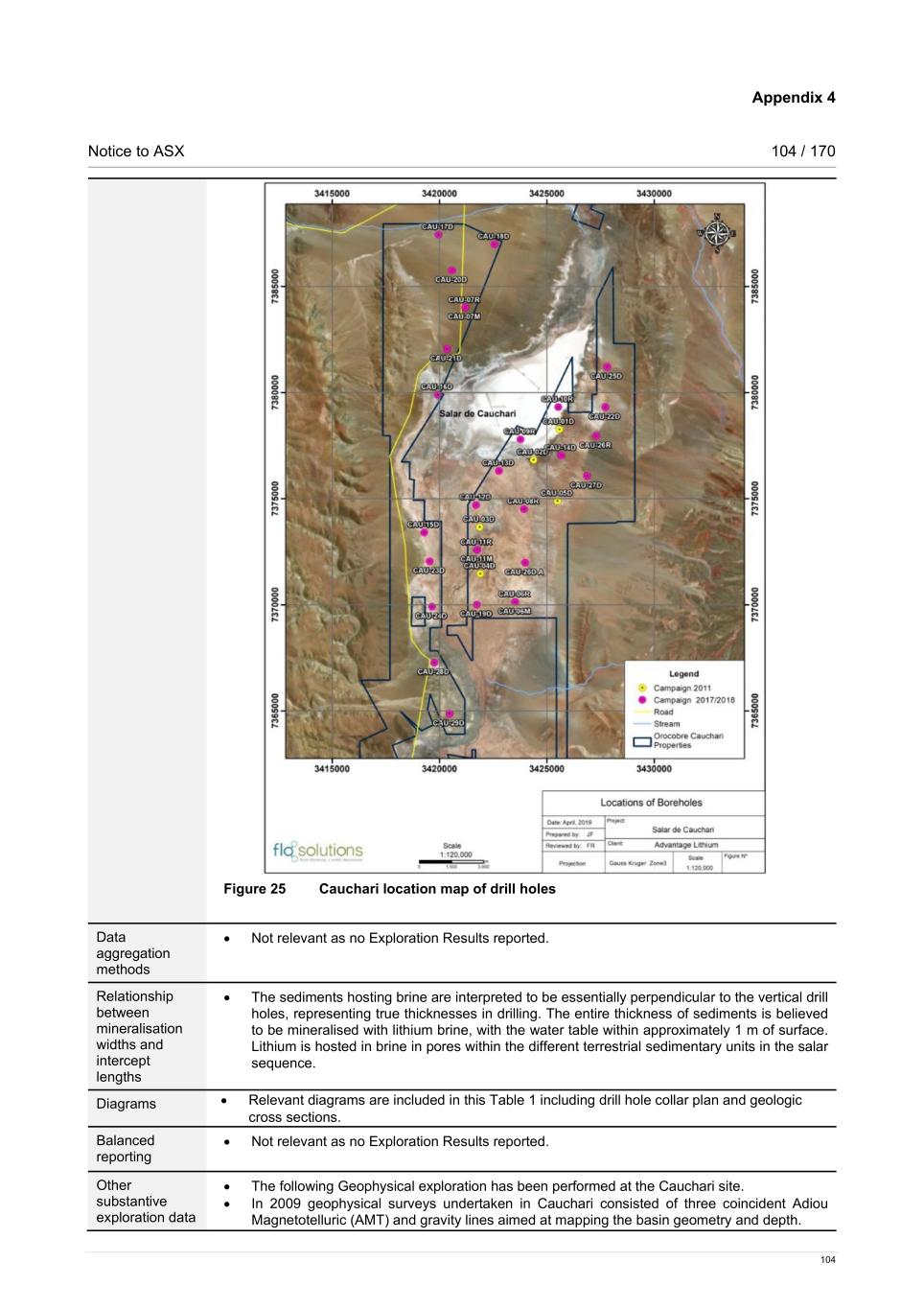
Appendix 4 Notice to ASX 104 / 170 104 Figure 25 Cauchari location map of drill holes Data aggregation methods • Not relevant as no Exploration Results reported. Relationship between mineralisation widths and intercept lengths • The sediments hosting brine are interpreted to be essentially perpendicular to the vertical drill holes, representing true thicknesses in drilling. The entire thickness of sediments is believed to be mineralised with lithium brine, with the water table within approximately 1 m of surface. Lithium is hosted in brine in pores within the different terrestrial sedimentary units in the salar sequence. Diagrams • Relevant diagrams are included in this Table 1 including drill hole collar plan and geologic cross sections. Balanced reporting • Not relevant as no Exploration Results reported. Other substantive exploration data • The following Geophysical exploration has been performed at the Cauchari site. • In 2009 geophysical surveys undertaken in Cauchari consisted of three coincident Adiou Magnetotelluric (AMT) and gravity lines aimed at mapping the basin geometry and depth.
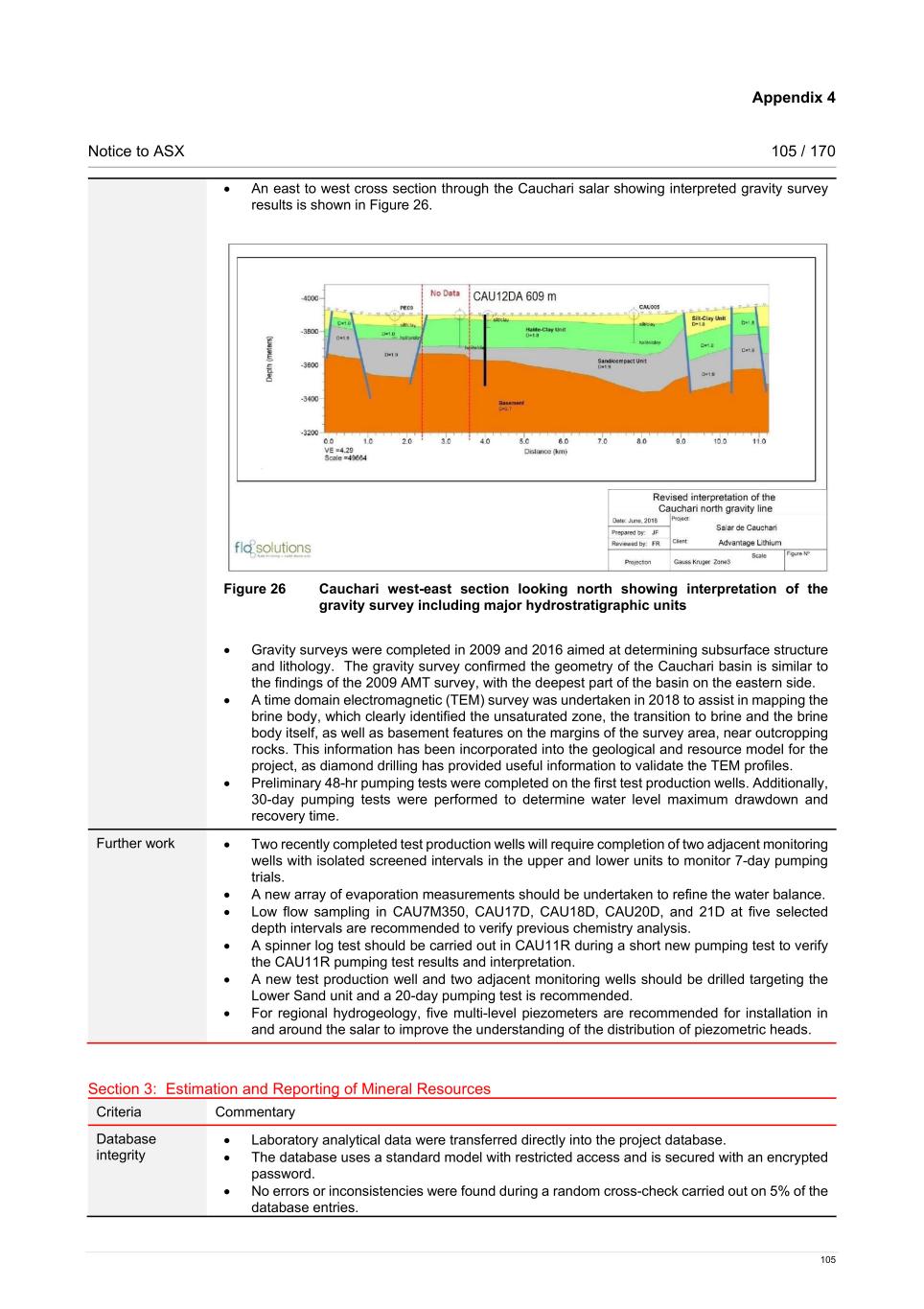
Appendix 4 Notice to ASX 105 / 170 105 • An east to west cross section through the Cauchari salar showing interpreted gravity survey results is shown in Figure 26. Figure 26 Cauchari west-east section looking north showing interpretation of the gravity survey including major hydrostratigraphic units • Gravity surveys were completed in 2009 and 2016 aimed at determining subsurface structure and lithology. The gravity survey confirmed the geometry of the Cauchari basin is similar to the findings of the 2009 AMT survey, with the deepest part of the basin on the eastern side. • A time domain electromagnetic (TEM) survey was undertaken in 2018 to assist in mapping the brine body, which clearly identified the unsaturated zone, the transition to brine and the brine body itself, as well as basement features on the margins of the survey area, near outcropping rocks. This information has been incorporated into the geological and resource model for the project, as diamond drilling has provided useful information to validate the TEM profiles. • Preliminary 48-hr pumping tests were completed on the first test production wells. Additionally, 30-day pumping tests were performed to determine water level maximum drawdown and recovery time. Further work • Two recently completed test production wells will require completion of two adjacent monitoring wells with isolated screened intervals in the upper and lower units to monitor 7-day pumping trials. • A new array of evaporation measurements should be undertaken to refine the water balance. • Low flow sampling in CAU7M350, CAU17D, CAU18D, CAU20D, and 21D at five selected depth intervals are recommended to verify previous chemistry analysis. • A spinner log test should be carried out in CAU11R during a short new pumping test to verify the CAU11R pumping test results and interpretation. • A new test production well and two adjacent monitoring wells should be drilled targeting the Lower Sand unit and a 20-day pumping test is recommended. • For regional hydrogeology, five multi-level piezometers are recommended for installation in and around the salar to improve the understanding of the distribution of piezometric heads. Section 3: Estimation and Reporting of Mineral Resources Criteria Commentary Database integrity • Laboratory analytical data were transferred directly into the project database. • The database uses a standard model with restricted access and is secured with an encrypted password. • No errors or inconsistencies were found during a random cross-check carried out on 5% of the database entries.
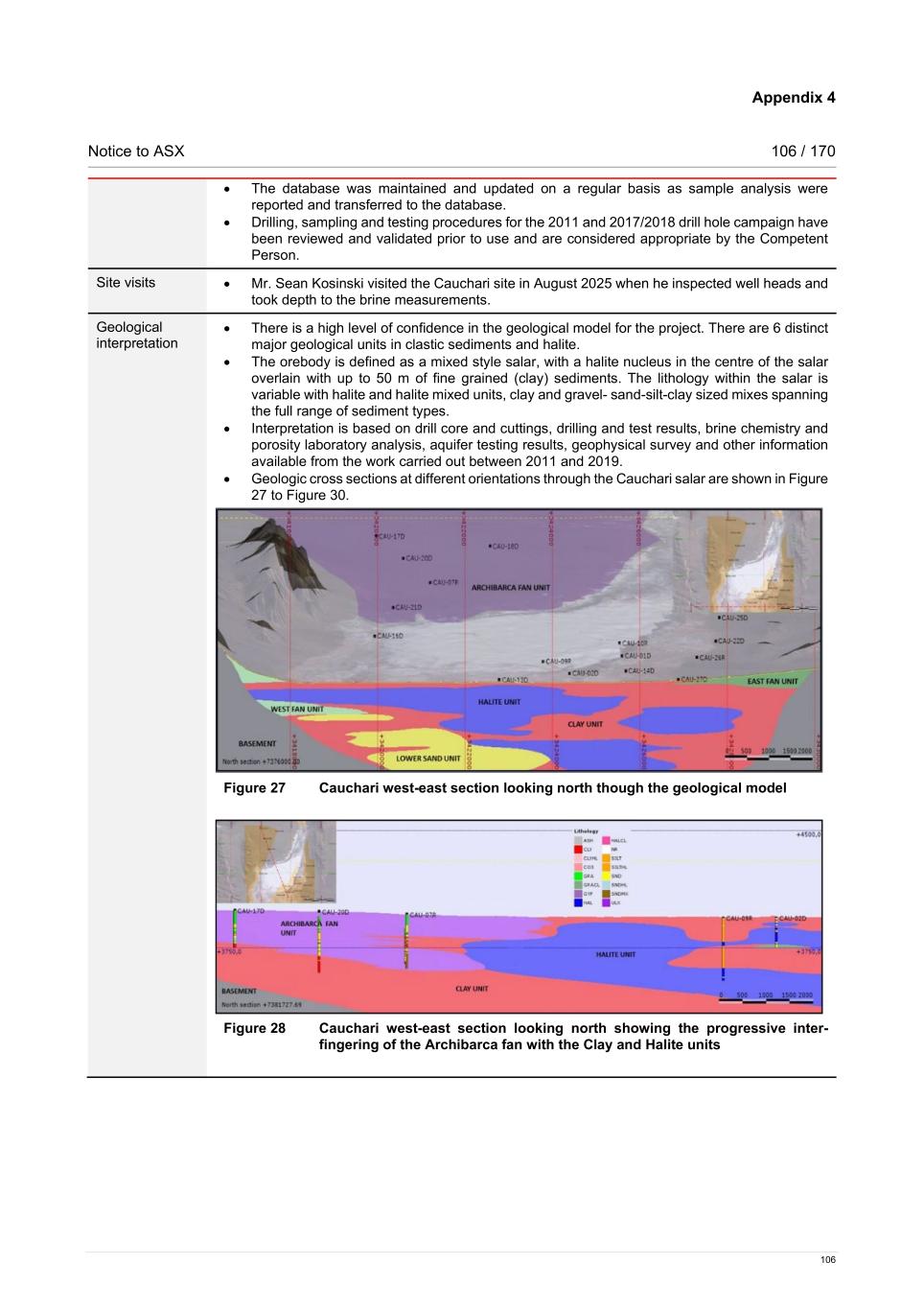
Appendix 4 Notice to ASX 106 / 170 106 • The database was maintained and updated on a regular basis as sample analysis were reported and transferred to the database. • Drilling, sampling and testing procedures for the 2011 and 2017/2018 drill hole campaign have been reviewed and validated prior to use and are considered appropriate by the Competent Person. Site visits • Mr. Sean Kosinski visited the Cauchari site in August 2025 when he inspected well heads and took depth to the brine measurements. Geological interpretation • There is a high level of confidence in the geological model for the project. There are 6 distinct major geological units in clastic sediments and halite. • The orebody is defined as a mixed style salar, with a halite nucleus in the centre of the salar overlain with up to 50 m of fine grained (clay) sediments. The lithology within the salar is variable with halite and halite mixed units, clay and gravel- sand-silt-clay sized mixes spanning the full range of sediment types. • Interpretation is based on drill core and cuttings, drilling and test results, brine chemistry and porosity laboratory analysis, aquifer testing results, geophysical survey and other information available from the work carried out between 2011 and 2019. • Geologic cross sections at different orientations through the Cauchari salar are shown in Figure 27 to Figure 30. Figure 27 Cauchari west-east section looking north though the geological model Figure 28 Cauchari west-east section looking north showing the progressive inter- fingering of the Archibarca fan with the Clay and Halite units
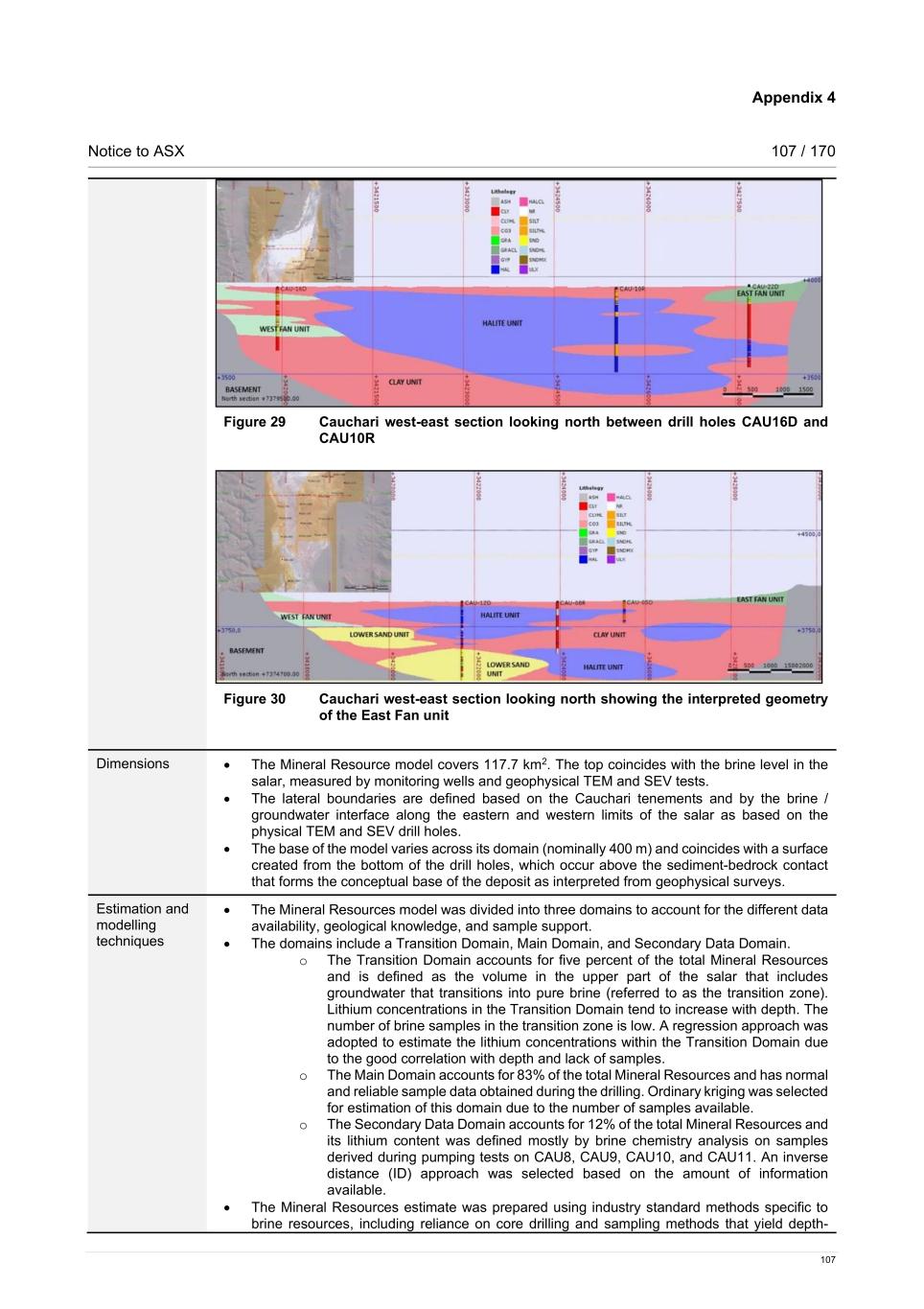
Appendix 4 Notice to ASX 107 / 170 107 Figure 29 Cauchari west-east section looking north between drill holes CAU16D and CAU10R Figure 30 Cauchari west-east section looking north showing the interpreted geometry of the East Fan unit Dimensions • The Mineral Resource model covers 117.7 km2. The top coincides with the brine level in the salar, measured by monitoring wells and geophysical TEM and SEV tests. • The lateral boundaries are defined based on the Cauchari tenements and by the brine / groundwater interface along the eastern and western limits of the salar as based on the physical TEM and SEV drill holes. • The base of the model varies across its domain (nominally 400 m) and coincides with a surface created from the bottom of the drill holes, which occur above the sediment-bedrock contact that forms the conceptual base of the deposit as interpreted from geophysical surveys. Estimation and modelling techniques • The Mineral Resources model was divided into three domains to account for the different data availability, geological knowledge, and sample support. • The domains include a Transition Domain, Main Domain, and Secondary Data Domain. o The Transition Domain accounts for five percent of the total Mineral Resources and is defined as the volume in the upper part of the salar that includes groundwater that transitions into pure brine (referred to as the transition zone). Lithium concentrations in the Transition Domain tend to increase with depth. The number of brine samples in the transition zone is low. A regression approach was adopted to estimate the lithium concentrations within the Transition Domain due to the good correlation with depth and lack of samples. o The Main Domain accounts for 83% of the total Mineral Resources and has normal and reliable sample data obtained during the drilling. Ordinary kriging was selected for estimation of this domain due to the number of samples available. o The Secondary Data Domain accounts for 12% of the total Mineral Resources and its lithium content was defined mostly by brine chemistry analysis on samples derived during pumping tests on CAU8, CAU9, CAU10, and CAU11. An inverse distance (ID) approach was selected based on the amount of information available. • The Mineral Resources estimate was prepared using industry standard methods specific to brine resources, including reliance on core drilling and sampling methods that yield depth-

Appendix 4 Notice to ASX 108 / 170 108 specific chemistry and specific yield measurements. The Stanford Geostatistical Modelling Software (SGeMS) was used for Mineral Resources estimation. SGeMS relies on geostatistical methods to interpolate reservoir properties and lithium grades using spatial correlation and continuity of geological properties observed in the field. • Using SGeMS, lithium grades were estimated using a grid consisting of 100 m horizontal blocks, 1 m thick. Histograms and probability plots were developed for lithium grade and experimental variograms models were prepared in three orthogonal dimensions for ordinary kriging of the Main Domain. • Porosity was assigned to the Mineral Resources using de-clustered average porosity values for each geologic unit. • Significant variability of lithium concentration was detected between geological units. No assumptions were made about correlation between variables. • To validate the accuracy of our estimation models, a comprehensive series of checks was conducted. These checks encompassed various techniques, including the comparison of univariate statistics, visual inspections, swath plots, and block comparison analyses. A comparison between different estimation methods (ordinary kriging and nearest neighbour) yielded a 0.17% discrepancy, indicating a high degree of similarity between them. Thus, interpolation variables are believed to produce a reasonable reflection of the input data. Moisture • Moisture content of the cores was Measured (porosity and density measurements were made), but as brine is extracted by pumping not mining the sediments moisture is not relevant for the Mineral Resources estimation. • Tonnages are estimated as metallic lithium (Li) and dissolved in brine, with lithium values converted to a lithium carbonate (Li2CO3) tonnage using a conversion factor of 5.323. Cut-off parameters • A cut-off grade of 300 mg/l was applied to the Mineral Resources estimate. Mining factors or assumptions • The Mineral Resources has been quoted in terms of brine volume, concentration of lithium, and their product, LCE. • No mining or recovery factors have been applied (although the use of the specific yield is used to reflect the reasonable prospects of eventual economic extraction with the proposed mining methodology). It should be noted that conversion of Mineral Resources to Ore Reserves for brine deposits is typically lower than that for hard rock deposits. • Dilution of brine concentrations may occur over time and typically there are lithium losses in both the ponds and processing plant in brine mining operations. However, potential dilution will be estimated in the Ore Reserves model simulating brine extraction, to define Ore Reserves. • The planned mining method is recovering brine from the subsurface below the salar via a network of production wells, the established practice on existing lithium brine projects. • Detailed hydrologic studies of the lake have been undertaken (catchment and groundwater modelling) to evaluate the extractable resources and potential extraction rates. Metallurgical factors or assumptions • Lithium carbonate is projected to be produced on site via conventional brine processing techniques utilising evaporation ponds to concentrate the brine prior to processing as the Olaroz operation currently does. Brine composition from Cauchari could be processed using similar processing technology to that applied at Rio Tinto’s Olaroz operation, where it has been successfully applied to produce lithium carbonate. Environmental factors or assumptions • Impacts of the lithium carbonate production operation at the Cauchari salar include; surface disturbance from the creation of extraction/processing facilities and associated infrastructure, accumulation of various salt tailings impoundments and extraction from brine and groundwater aquifers regionally. Lime is used to increase precipitation of impurities like magnesium and calcium solids. Precipitated salts are collected from evaporation ponds and stockpiled on the salar surface. • An industrial waste yard and warehouses are provided for waste separation and storage, according to its specifications (hazardous and non-hazardous), and later transported to authorised disposal centres, according to regulations for each waste type. Bulk density • Density measurements were taken as part of the drill core assessment. This included determining dry density and particle density as well as field measurements of brine density. No sediments are mined during brine extraction. • No bulk density was applied to the estimates because resources are defined by volume, rather than by tonnage. • The salt units can contain fractures porosity which can host brine and add to the specific yield.

Appendix 4 Notice to ASX 109 / 170 109 Classification • The Mineral Resources are classified as Measured, Indicated and Inferred Mineral Resources based on the spatial distribution of data and confidence in the estimation. • Drill holes are spaced approximately 2 km near the centre of the project, with spacing increasing (~4 km) towards the project boundaries (Figure 43). • Measured Mineral Resources reflect higher confidence in the geological interpretation of the salar and the greater frequency of data. This classification has been applied in the upper levels and southeast sector of the project, covering the Archibarca fan, clay and halite units where drilling is on a nominal 2 km drill hole spacing. • Indicated Mineral Resources are found in the deeper portions of the clay and halite units, the west fan area, the upper part of east fan unit and the lower sand unit to a depth of 500 m, in areas informed by a nominal 3 km drill hole spacing. • Inferred Mineral Resources include deeper pockets of the Archibarca fan area, the lower sand below 500 m depth, the limits of the property in the east and the east fan below the transition domain with drill hole spacing out to 4 km. • In the view of the Competent Person the Mineral Resources classification adequately reflects the available data and reflects the level of hydrogeological knowledge, sample availability and quality. Audits or reviews • No formal audits have been carried out to date. Discussion of relative accuracy/ confidence • Mineral Resources estimation is affected by the behaviour of the hydrogeological units in the Archibarca fan under pumping conditions. Greater than forecasted mixing of the pumped brine with water from the upper aquifer in the Archibarca fan could lead to lower Li concentrations in the pumped brine than forecast. Additional drilling and testing in this area is recommended to reduce this potential risk. • An assessment of the estimated blocks was made against the drill hole data on sections and found to be acceptable. Section 4: Estimation and Reporting of Ore Reserves Criteria Commentary Mineral Resource estimate for conversion to Ore Reserves • The Mineral Resources used as the basis for the Ore Reserves estimate are described in Section 3 of this table. • The extent of the Ore Reserves model is shown in Figure 31. • Mineral Resources are reported inclusive of Ore Reserves.
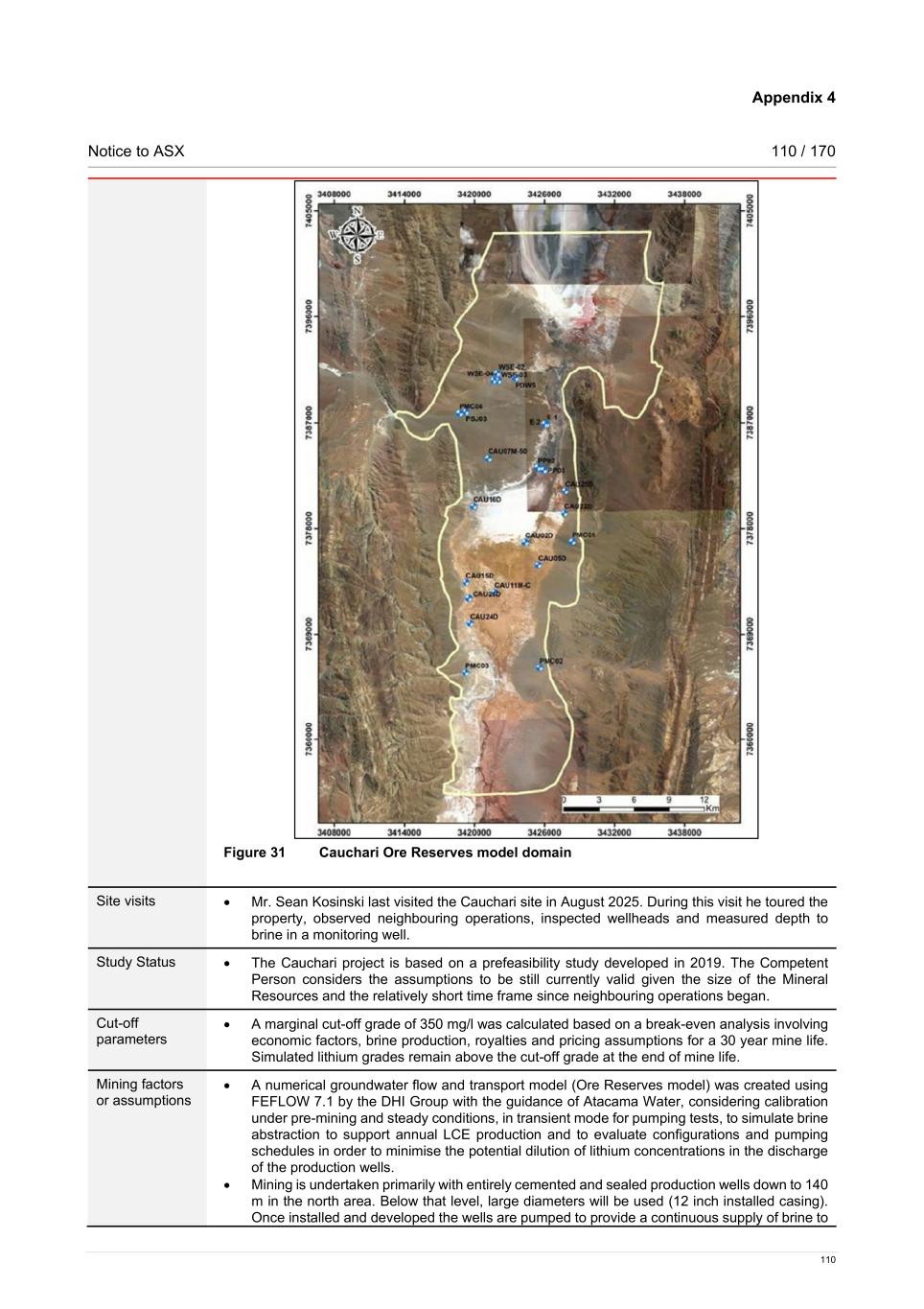
Appendix 4 Notice to ASX 110 / 170 110 Figure 31 Cauchari Ore Reserves model domain Site visits • Mr. Sean Kosinski last visited the Cauchari site in August 2025. During this visit he toured the property, observed neighbouring operations, inspected wellheads and measured depth to brine in a monitoring well. Study Status • The Cauchari project is based on a prefeasibility study developed in 2019. The Competent Person considers the assumptions to be still currently valid given the size of the Mineral Resources and the relatively short time frame since neighbouring operations began. Cut-off parameters • A marginal cut-off grade of 350 mg/l was calculated based on a break-even analysis involving economic factors, brine production, royalties and pricing assumptions for a 30 year mine life. Simulated lithium grades remain above the cut-off grade at the end of mine life. Mining factors or assumptions • A numerical groundwater flow and transport model (Ore Reserves model) was created using FEFLOW 7.1 by the DHI Group with the guidance of Atacama Water, considering calibration under pre-mining and steady conditions, in transient mode for pumping tests, to simulate brine abstraction to support annual LCE production and to evaluate configurations and pumping schedules in order to minimise the potential dilution of lithium concentrations in the discharge of the production wells. • Mining is undertaken primarily with entirely cemented and sealed production wells down to 140 m in the north area. Below that level, large diameters will be used (12 inch installed casing). Once installed and developed the wells are pumped to provide a continuous supply of brine to

Appendix 4 Notice to ASX 111 / 170 111 the project evaporation ponds. For the southeast area, production wells will be drilled and completed to a depth of 460 m with 12 inch diameter stainless steel production screens. These wells will discharge through feeder pipelines into an intermediate storage pond and then to the evaporation ponds. • Only a portion of the Mineral Resources can currently be extracted, due to the limitations of extraction by widely spaced wells. This amount was simulated in the Ore Reserves model which is the basis for the project Ore Reserves, and which takes account of factors which control the behaviour of the salar environment during brines extraction. • Indicated Mineral Resources of 894,000t LCE contained in the West Fan Unit are not included in the production profile because Ore Reserves are produced exclusively from the northwest and southeast wellfields. • Extraction using wells is the appropriate mining methodology in salars, as the lithium is dissolved in brine (fluid) and mining of unconsolidated sediments is not contemplated. • Geotechnical studies are not required for brine extraction mining operations. • Dilution of brine during pumping is simulated within the numerical model for the conversion of Mineral Resources into Ore Reserves. • The Inferred Mineral Resources are not included in current mining studies but are considered a possible source of future brine extraction, when their Mineral Resources classification is upgraded. • Brine extraction requires the provision of electricity and pipelines to the sites of wells. The pipelines pump brine to centralised collection ponds, from where it is pumped to the evaporation pond network. The brine is subject to the addition of lime in the evaporation ponds. Pumps are required to move brine between ponds and pump brine into the plant, where lithium carbonate product is produced. A 6" diameter gas pipeline will provide the energy source for onsite electricity and heat generation. Metallurgical factors or assumptions • The metallurgical process utilised to produce lithium carbonate is based on solar evaporation of brine, prior to reacting lithium with carbon dioxide in the plant to produce lithium carbonate. In this way much of the energy required for the process is provided naturally by the sun. Lithium preferentially remains within the brine, and other elements precipitate from the brine in response to their increasing concentration and saturation in the brine. Lime is added to the ponds to facilitate the precipitation of magnesium from the brine. Although more recent direct extraction processing techniques are more widely available pond evaporation provides a cost- effective processing method. • The Cauchari process design is approximated from previously completed test work, results and performance at Rio Tinto’s Olaroz operation. The Olaroz process design has been successfully proven to produce lithium carbonate since 2015. • Modifications to the Olaroz technology mean brines will be drained and salts harvested in all ponds. Transfer pumps will be used to transfer concentrated brine from a lower concentration pond into a higher concentration pond. A second liming stage will be installed to maximise magnesium ion removal before brine enters the processing facilities and an ion-exchange stage will be installed to remove remaining calcium and magnesium ions before precipitating lithium carbonate. • Pilot scale evaporation test work for the Cauchari site is being considered. • Lithium Carbonate is sold as both technical and battery grade product, depending on the purity of the product. The planned project will produce both grades of product. Environmental factors or assumptions • The project had completed exploration programs since 2011 and the last EIA approval was in 2017 for the exploration stage. An environmental baseline study was submitted in 2019 and is under evaluation by the provincial mining authority. Rio Tinto is currently in the process of renewing and maintaining required exploration related permits while awaiting approval of exploitation (production) permitting. As part of the EIA, a comprehensive consultation was undertaken with members of the local communities, regarding the project development and its associated opportunities for the community members. From start, the company has been actively involved in community relations. • A small fraction of waste impurity solids are generated in the lithium carbonate plant. The main solids are a mixture of magnesium hydroxide and calcium carbonate. • Residual salts that are precipitated in evaporation ponds will be harvested and stored in stockpiles on the surface of the salar. Infrastructure • Cauchari is well served by infrastructure, being located closed to a paved international highway between Argentina and Chile that leads to major import and export ports in northern Chile. Locally, Cauchari is reached by paved and unpaved roads from either the Salta or Jujuy Provinces. Both Jujuy and Salta have international airports with regular flights to Buenos Aires.

Appendix 4 Notice to ASX 112 / 170 112 • Site infrastructure will consist of the main processing facilities including brine well fields and pumping, evaporation ponds, process plant and waste storage. • The brine production wellfields will be located on two sectors of the Salar de Cauchari, one in the Archibarca area, near and among the initial evaporation ponds and another located south- east. Brine wells will be equipped with variable speed drive submersible pumps and surface booster stations to deliver brine to the evaporation ponds. • The evaporation ponds will cover an area of approximately 10.5 million m2 in years 1 to 5 and increase to 11.3 million m2 for years 6 to 9 and 12.2 million m2 from year 10 to the end of mine life. • The processing plant will consist of a liming plant to support evaporation pond processes, and a lithium carbonation plant to produce final product. The processing plant will be supported by service infrastructure such as reagents mixing, fuel and storage facility, sulfuric acid preparation, compressors and boilers, and water treatment plants. • The accommodation camp will be built to the west of the lithium carbonate plant. The camp will include several facilities of modular type construction including dormitories, dining rooms, recreational areas and medical facilities. During the construction phase, additional temporary modular facilities will be employed to expand the temporary peak labour requirements. The process facility, support services and accommodation infrastructure are deemed adequate to support the planned facility operation and production rate. • The support and process infrastructure has been reviewed and is deemed adequate by the Competent Person to support the process and operations described in the report. Costs • Assumptions were made to derive the capital costs including the fact that all relevant permits would be received in a timely manner to meet the project schedule. • Assumptions were made regarding the construction contracts whereas these contracts would be attributed on the base of a competitive bidding process amongst qualified installation contractors. It is expected that a high level of site management supervision, contract administration, quality control and thorough safety management will be required during the site execution phase • Major exclusions: currency fluctuation, interest expenses, project financing costs, duties and taxes were not included in the Capex study but were considered in the economic analysis. • Commodity price is based on market studies conducted by Rio Tinto. • Provincial mining royalty (not to exceed 3%) is considered based on the mine head value of the extracted ore. In addition, the Federal Argentine government receives an export duty (4.5%) on the FOB while the company exports lithium products. • Corporate tax rate is set at 35%. • Operating costs were estimated for the brine extraction, lithium concentration, and lithium carbonate production process to market. For costing purposes, the following assumptions were made: o Brine is extracted from production wells and conveyed to surface facilities through brine pipelines. Depending on the technology, lithium concentration is achieved either through evaporation ponds or through Direct Lithium Extraction (DLE) systems. o Concentrated brine or DLE product is transferred to a carbonate plant located near the salar for lithium carbonate production. o Product transport is assumed through regional logistics networks to export destinations. o The operating cost basis corresponds to steady-state production at capacity for battery and technical grade lithium carbonate. o Additional operating costs include labour, maintenance, reagent handling and consumption, energy and fuel, water management, tailings or spent brine management, and general and administrative (G&A) expenses. o The sources of information used to develop these costs include in-house databases, supplier quotations, and benchmark data from comparable brine operations in South America. Revenue factors • Rio Tinto applies a common process to the generation of commodity price assumptions across the group. This involves generation of long-term price forecasts based on current sales contracts, industry capacity analysis, global commodity demand and economic growth trends. Prices are adjusted to reflect the expectation that they will be sold on CIF terms. • Exchange rates are also based on internal Rio Tinto modelling of expected future country exchange rates. Due to the commercial sensitivity of these assumptions, an explanation of the methodology used to determine these assumptions has been provided, rather than the actual figures.
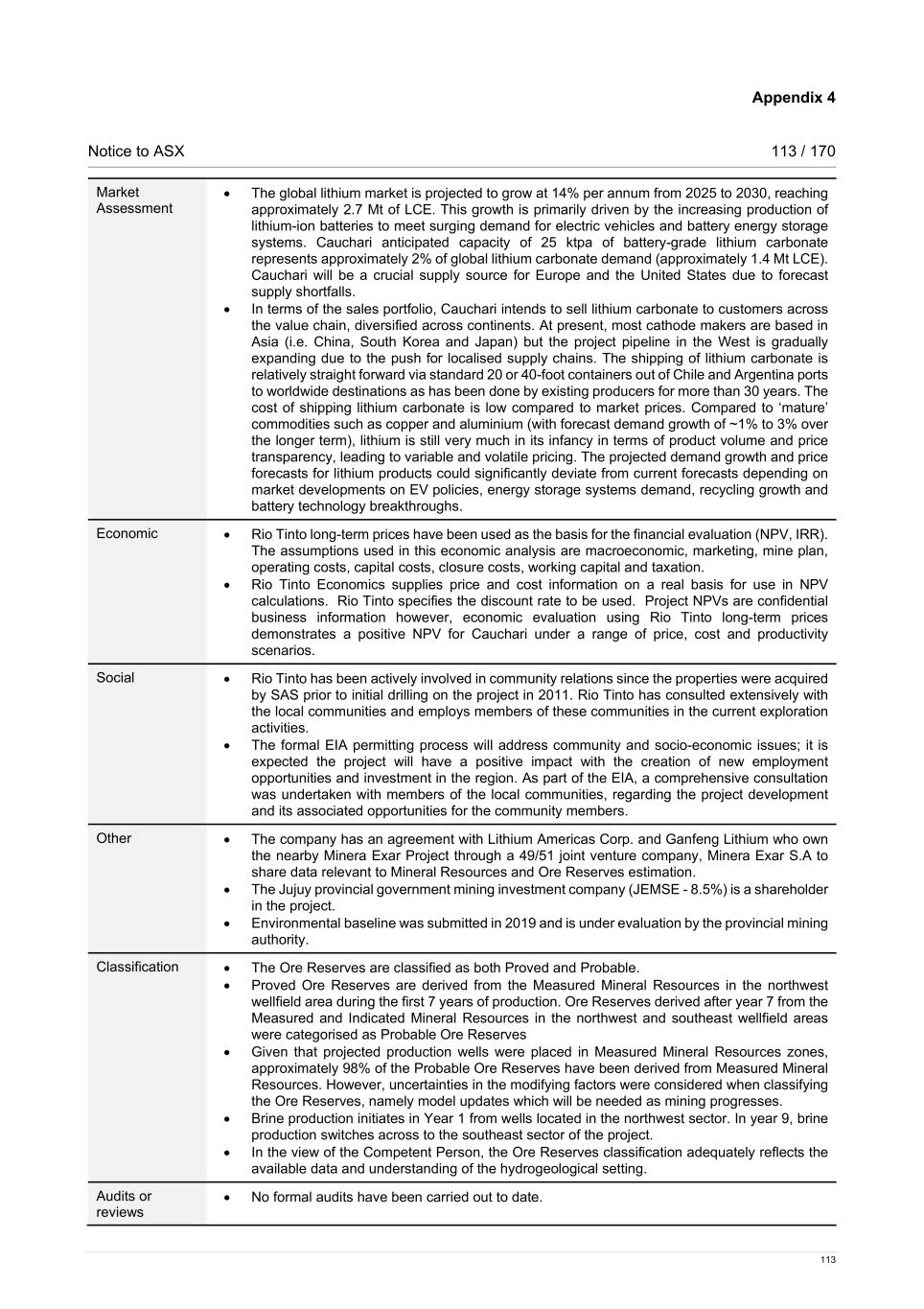
Appendix 4 Notice to ASX 113 / 170 113 Market Assessment • The global lithium market is projected to grow at 14% per annum from 2025 to 2030, reaching approximately 2.7 Mt of LCE. This growth is primarily driven by the increasing production of lithium-ion batteries to meet surging demand for electric vehicles and battery energy storage systems. Cauchari anticipated capacity of 25 ktpa of battery-grade lithium carbonate represents approximately 2% of global lithium carbonate demand (approximately 1.4 Mt LCE). Cauchari will be a crucial supply source for Europe and the United States due to forecast supply shortfalls. • In terms of the sales portfolio, Cauchari intends to sell lithium carbonate to customers across the value chain, diversified across continents. At present, most cathode makers are based in Asia (i.e. China, South Korea and Japan) but the project pipeline in the West is gradually expanding due to the push for localised supply chains. The shipping of lithium carbonate is relatively straight forward via standard 20 or 40-foot containers out of Chile and Argentina ports to worldwide destinations as has been done by existing producers for more than 30 years. The cost of shipping lithium carbonate is low compared to market prices. Compared to ‘mature’ commodities such as copper and aluminium (with forecast demand growth of ~1% to 3% over the longer term), lithium is still very much in its infancy in terms of product volume and price transparency, leading to variable and volatile pricing. The projected demand growth and price forecasts for lithium products could significantly deviate from current forecasts depending on market developments on EV policies, energy storage systems demand, recycling growth and battery technology breakthroughs. Economic • Rio Tinto long-term prices have been used as the basis for the financial evaluation (NPV, IRR). The assumptions used in this economic analysis are macroeconomic, marketing, mine plan, operating costs, capital costs, closure costs, working capital and taxation. • Rio Tinto Economics supplies price and cost information on a real basis for use in NPV calculations. Rio Tinto specifies the discount rate to be used. Project NPVs are confidential business information however, economic evaluation using Rio Tinto long-term prices demonstrates a positive NPV for Cauchari under a range of price, cost and productivity scenarios. Social • Rio Tinto has been actively involved in community relations since the properties were acquired by SAS prior to initial drilling on the project in 2011. Rio Tinto has consulted extensively with the local communities and employs members of these communities in the current exploration activities. • The formal EIA permitting process will address community and socio-economic issues; it is expected the project will have a positive impact with the creation of new employment opportunities and investment in the region. As part of the EIA, a comprehensive consultation was undertaken with members of the local communities, regarding the project development and its associated opportunities for the community members. Other • The company has an agreement with Lithium Americas Corp. and Ganfeng Lithium who own the nearby Minera Exar Project through a 49/51 joint venture company, Minera Exar S.A to share data relevant to Mineral Resources and Ore Reserves estimation. • The Jujuy provincial government mining investment company (JEMSE - 8.5%) is a shareholder in the project. • Environmental baseline was submitted in 2019 and is under evaluation by the provincial mining authority. Classification • The Ore Reserves are classified as both Proved and Probable. • Proved Ore Reserves are derived from the Measured Mineral Resources in the northwest wellfield area during the first 7 years of production. Ore Reserves derived after year 7 from the Measured and Indicated Mineral Resources in the northwest and southeast wellfield areas were categorised as Probable Ore Reserves • Given that projected production wells were placed in Measured Mineral Resources zones, approximately 98% of the Probable Ore Reserves have been derived from Measured Mineral Resources. However, uncertainties in the modifying factors were considered when classifying the Ore Reserves, namely model updates which will be needed as mining progresses. • Brine production initiates in Year 1 from wells located in the northwest sector. In year 9, brine production switches across to the southeast sector of the project. • In the view of the Competent Person, the Ore Reserves classification adequately reflects the available data and understanding of the hydrogeological setting. Audits or reviews • No formal audits have been carried out to date.

Appendix 4 Notice to ASX 114 / 170 114 Discussion of relative accuracy/ confidence • Potential environmental effects of pumping have not been comprehensively analysed at the prefeasibility study stage. Additional evaluation of potential environmental effects will be done as part of the next stage of evaluation. • Additional hydrogeological test work will be required in the next stage of evaluation to adequately verify the quantification of hydraulic parameters in the Archibarca fan area and in the Lower Sand unit as indicated by the sensitivity analysis carried out on the Ore Reserves model results. • There are reasonable prospects of eventual economic extraction that through additional hydrogeological test work, Inferred Resources in the Lower Sand Units will be converted to Measured and Indicated Mineral Resources. • The described mining method is deemed adequate to support economic brine extraction and is similar in configuration to other lithium brine extraction configurations witnessed on operating properties owned by Rio Tinto.
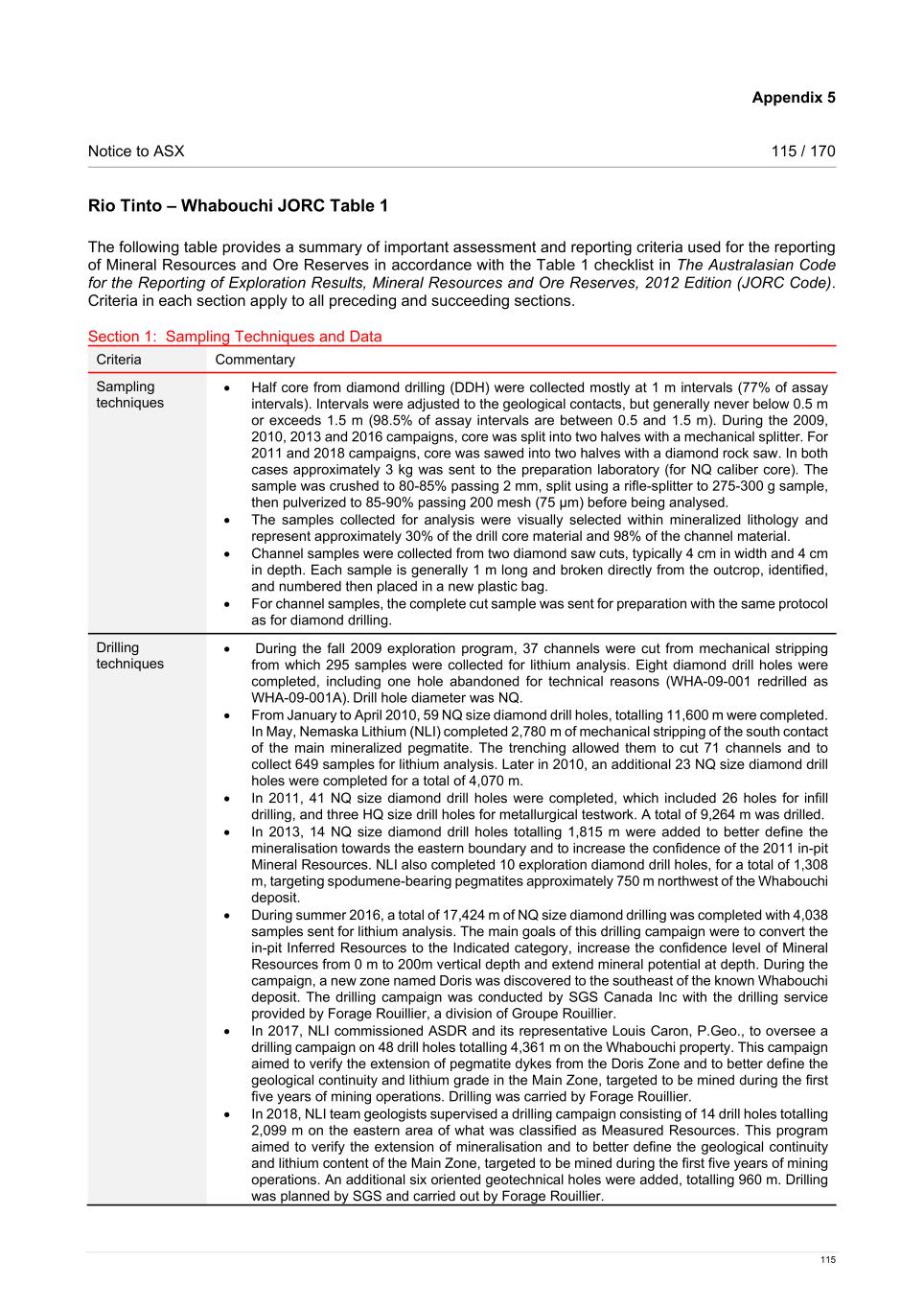
Appendix 5 Notice to ASX 115 / 170 115 Rio Tinto – Whabouchi JORC Table 1 The following table provides a summary of important assessment and reporting criteria used for the reporting of Mineral Resources and Ore Reserves in accordance with the Table 1 checklist in The Australasian Code for the Reporting of Exploration Results, Mineral Resources and Ore Reserves, 2012 Edition (JORC Code). Criteria in each section apply to all preceding and succeeding sections. Section 1: Sampling Techniques and Data Criteria Commentary Sampling techniques • Half core from diamond drilling (DDH) were collected mostly at 1 m intervals (77% of assay intervals). Intervals were adjusted to the geological contacts, but generally never below 0.5 m or exceeds 1.5 m (98.5% of assay intervals are between 0.5 and 1.5 m). During the 2009, 2010, 2013 and 2016 campaigns, core was split into two halves with a mechanical splitter. For 2011 and 2018 campaigns, core was sawed into two halves with a diamond rock saw. In both cases approximately 3 kg was sent to the preparation laboratory (for NQ caliber core). The sample was crushed to 80-85% passing 2 mm, split using a rifle-splitter to 275-300 g sample, then pulverized to 85-90% passing 200 mesh (75 μm) before being analysed. • The samples collected for analysis were visually selected within mineralized lithology and represent approximately 30% of the drill core material and 98% of the channel material. • Channel samples were collected from two diamond saw cuts, typically 4 cm in width and 4 cm in depth. Each sample is generally 1 m long and broken directly from the outcrop, identified, and numbered then placed in a new plastic bag. • For channel samples, the complete cut sample was sent for preparation with the same protocol as for diamond drilling. Drilling techniques • During the fall 2009 exploration program, 37 channels were cut from mechanical stripping from which 295 samples were collected for lithium analysis. Eight diamond drill holes were completed, including one hole abandoned for technical reasons (WHA-09-001 redrilled as WHA-09-001A). Drill hole diameter was NQ. • From January to April 2010, 59 NQ size diamond drill holes, totalling 11,600 m were completed. In May, Nemaska Lithium (NLI) completed 2,780 m of mechanical stripping of the south contact of the main mineralized pegmatite. The trenching allowed them to cut 71 channels and to collect 649 samples for lithium analysis. Later in 2010, an additional 23 NQ size diamond drill holes were completed for a total of 4,070 m. • In 2011, 41 NQ size diamond drill holes were completed, which included 26 holes for infill drilling, and three HQ size drill holes for metallurgical testwork. A total of 9,264 m was drilled. • In 2013, 14 NQ size diamond drill holes totalling 1,815 m were added to better define the mineralisation towards the eastern boundary and to increase the confidence of the 2011 in-pit Mineral Resources. NLI also completed 10 exploration diamond drill holes, for a total of 1,308 m, targeting spodumene-bearing pegmatites approximately 750 m northwest of the Whabouchi deposit. • During summer 2016, a total of 17,424 m of NQ size diamond drilling was completed with 4,038 samples sent for lithium analysis. The main goals of this drilling campaign were to convert the in-pit Inferred Resources to the Indicated category, increase the confidence level of Mineral Resources from 0 m to 200m vertical depth and extend mineral potential at depth. During the campaign, a new zone named Doris was discovered to the southeast of the known Whabouchi deposit. The drilling campaign was conducted by SGS Canada Inc with the drilling service provided by Forage Rouillier, a division of Groupe Rouillier. • In 2017, NLI commissioned ASDR and its representative Louis Caron, P.Geo., to oversee a drilling campaign on 48 drill holes totalling 4,361 m on the Whabouchi property. This campaign aimed to verify the extension of pegmatite dykes from the Doris Zone and to better define the geological continuity and lithium grade in the Main Zone, targeted to be mined during the first five years of mining operations. Drilling was carried by Forage Rouillier. • In 2018, NLI team geologists supervised a drilling campaign consisting of 14 drill holes totalling 2,099 m on the eastern area of what was classified as Measured Resources. This program aimed to verify the extension of mineralisation and to better define the geological continuity and lithium content of the Main Zone, targeted to be mined during the first five years of mining operations. An additional six oriented geotechnical holes were added, totalling 960 m. Drilling was planned by SGS and carried out by Forage Rouillier.

Appendix 5 Notice to ASX 116 / 170 116 • In 2021, NLI conducted a program consisting of three geotechnical drill holes totalling 650 m. This program aimed at gaining additional information and measurements for pit slope assumptions • The diamond drilling completed by NLI on the Whabouchi property was completed with NQ (47.6 mm core diameter) and HQ (63.5 mm core diameter) drill size. HQ size was used to collect material for metallurgical testing in 2011. • No oriented core was done on the project. The general and consistent orientation of dykes did not require core orientation, as most contacts are easily identified and connected from section to section. While very localized areas would have benefited from oriented core, it was deemed unnecessary at the time by previous project geologists considering the very linear and lateral continuity of the thick pegmatite sills at Whabouchi. • Downhole surveys were taken by a combination of EZ Shot, Flexit and Reflex methods, depending on the year. No issues were observed in deviations from the various measurement tools. Holes surveyed at longer intervals (Flexit) are generally confirmed with infill drilling using closer spacing (EZ Shot or Reflex). • Further details are provided in the Location of data points section. Drill sample recovery • Drill core was placed in wooden boxes and delivered twice daily by the drilling contractor to the logging facilities, core was aligned then measured for recovery and RQD by a technician. • Due to the hardness of the pegmatite units, the recovery of the channel samples and the drill core was generally very good, averaging more than 95%. Logging • The channel and drill core logging and sampling were conducted at the Property or the nearby Project facilities. All remaining drill core is stored at the Property site in covered metal core racks. All channel samples and drill core handling were undertaken on-site with logging and sampling procedures conducted by employees and contractors of NLI. The observation on lithology, structure, mineralisation, RQD, recovery, sample number, and location were noted by the geologists and technicians on hardcopy and then recorded in a Microsoft Access digital database. • Drill core of NQ and HQ size was placed in wooden core boxes and delivered twice daily to the core logging facility. • The drill core was first aligned and measured by a technician for core recovery and RQD measurements. After a summary review, all the core of each drill hole were logged for lithological units, and sampling intervals were defined by a geologist. Before sampling, the core was photographed using a digital camera and the core boxes were properly identified with aluminium tags (box number, Hole-ID, From and To). Sub-sampling techniques and sample preparation • Diamond drill hole sampling intervals were determined by the geologist, marked, and tagged based on observations of the lithology and mineralisation. The typical sampling length is 1 m but can vary depending on lithological contacts between the mineralised pegmatite and the host rock. In general, 1 host rock sample was collected from the footwall and hanging wall of each pegmatite units. • NQ drill core samples were sawed into two halves with one half placed in a new plastic bag along with the sample tag; the other half was placed back in the core box with the second sample tag for reference. The third sample tag was archived on site. The HQ size drill core, limited to a portion of the 2011 drilling program, was obtained for metallurgical purposes. The first half of the HQ drill core was selected for metallurgical testing. The second half was sawed into two quarters; one quarter placed in a new plastic bag along with the sample tag and the remaining quarter was placed back in the core box with the second sample tag for reference. The samples plastic bags were then catalogued and placed in rice bags or pails for shipping. • Channel samples were collected from two diamond saw cuts, typically 4 cm apart and 4 cm in depth. Each sample is generally 1 m long and broken directly from the outcrop, identified, and numbered then placed in a new plastic bag. All channel samples collected were sampled (no splitting). • Sample sizes (mainly NQ at 1 m intervals) are appropriate considering spodumene crystal size and the type of mineralisation. • Field duplicates (quarter core) were taken at every 20 samples, except for the 2017 drilling campaign. 90% of duplicates (n=631) have a half absolute relative difference (HARD) below 10%, sign-tests do not show bias and very good correlation is observed between pairs (y=0.99x). • The Competent Person also inspected core sample intervals, and no meterage errors were found.
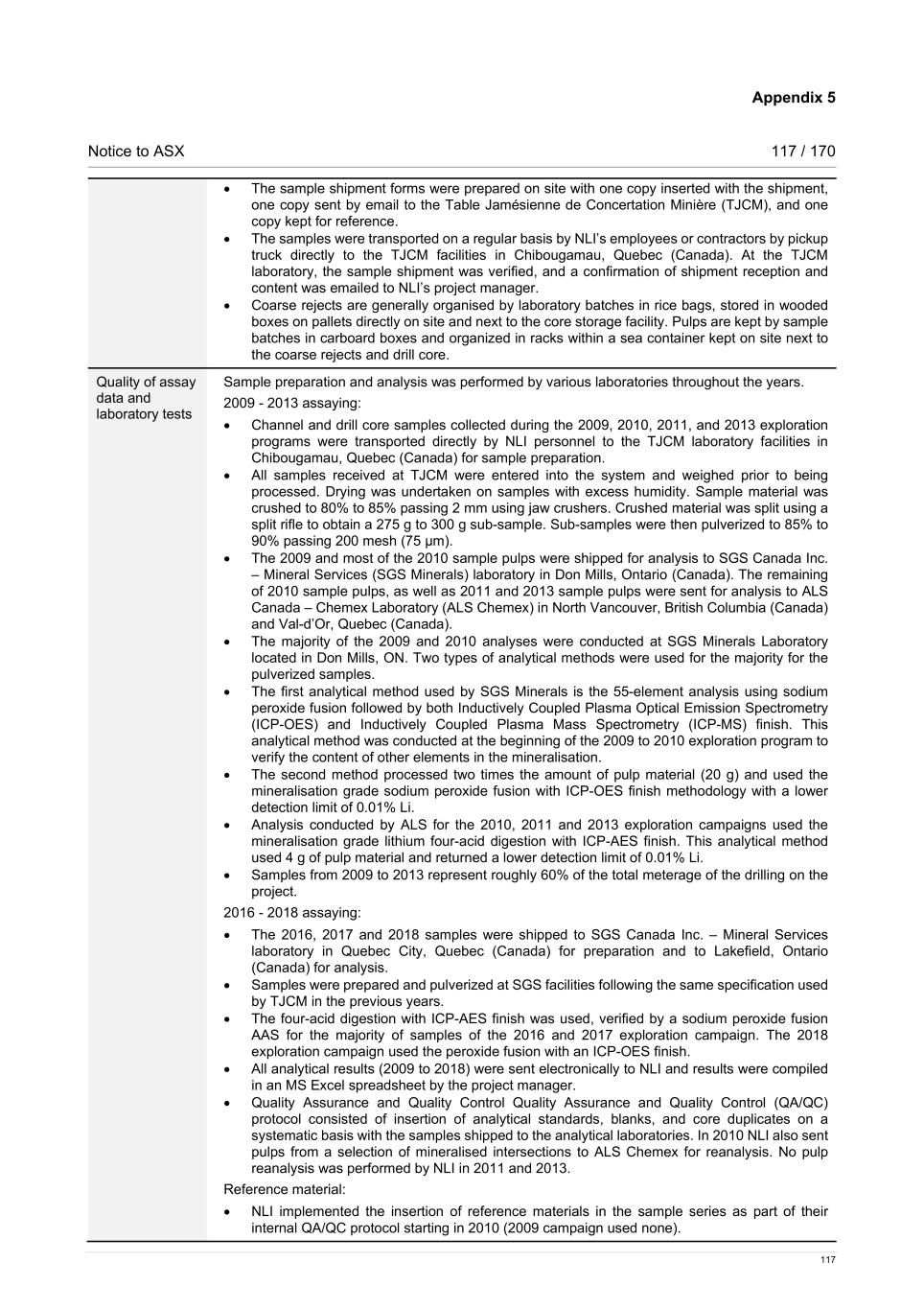
Appendix 5 Notice to ASX 117 / 170 117 • The sample shipment forms were prepared on site with one copy inserted with the shipment, one copy sent by email to the Table Jamésienne de Concertation Minière (TJCM), and one copy kept for reference. • The samples were transported on a regular basis by NLI’s employees or contractors by pickup truck directly to the TJCM facilities in Chibougamau, Quebec (Canada). At the TJCM laboratory, the sample shipment was verified, and a confirmation of shipment reception and content was emailed to NLI’s project manager. • Coarse rejects are generally organised by laboratory batches in rice bags, stored in wooded boxes on pallets directly on site and next to the core storage facility. Pulps are kept by sample batches in carboard boxes and organized in racks within a sea container kept on site next to the coarse rejects and drill core. Quality of assay data and laboratory tests Sample preparation and analysis was performed by various laboratories throughout the years. 2009 - 2013 assaying: • Channel and drill core samples collected during the 2009, 2010, 2011, and 2013 exploration programs were transported directly by NLI personnel to the TJCM laboratory facilities in Chibougamau, Quebec (Canada) for sample preparation. • All samples received at TJCM were entered into the system and weighed prior to being processed. Drying was undertaken on samples with excess humidity. Sample material was crushed to 80% to 85% passing 2 mm using jaw crushers. Crushed material was split using a split rifle to obtain a 275 g to 300 g sub-sample. Sub-samples were then pulverized to 85% to 90% passing 200 mesh (75 μm). • The 2009 and most of the 2010 sample pulps were shipped for analysis to SGS Canada Inc. – Mineral Services (SGS Minerals) laboratory in Don Mills, Ontario (Canada). The remaining of 2010 sample pulps, as well as 2011 and 2013 sample pulps were sent for analysis to ALS Canada – Chemex Laboratory (ALS Chemex) in North Vancouver, British Columbia (Canada) and Val-d’Or, Quebec (Canada). • The majority of the 2009 and 2010 analyses were conducted at SGS Minerals Laboratory located in Don Mills, ON. Two types of analytical methods were used for the majority for the pulverized samples. • The first analytical method used by SGS Minerals is the 55-element analysis using sodium peroxide fusion followed by both Inductively Coupled Plasma Optical Emission Spectrometry (ICP-OES) and Inductively Coupled Plasma Mass Spectrometry (ICP-MS) finish. This analytical method was conducted at the beginning of the 2009 to 2010 exploration program to verify the content of other elements in the mineralisation. • The second method processed two times the amount of pulp material (20 g) and used the mineralisation grade sodium peroxide fusion with ICP-OES finish methodology with a lower detection limit of 0.01% Li. • Analysis conducted by ALS for the 2010, 2011 and 2013 exploration campaigns used the mineralisation grade lithium four-acid digestion with ICP-AES finish. This analytical method used 4 g of pulp material and returned a lower detection limit of 0.01% Li. • Samples from 2009 to 2013 represent roughly 60% of the total meterage of the drilling on the project. 2016 - 2018 assaying: • The 2016, 2017 and 2018 samples were shipped to SGS Canada Inc. – Mineral Services laboratory in Quebec City, Quebec (Canada) for preparation and to Lakefield, Ontario (Canada) for analysis. • Samples were prepared and pulverized at SGS facilities following the same specification used by TJCM in the previous years. • The four-acid digestion with ICP-AES finish was used, verified by a sodium peroxide fusion AAS for the majority of samples of the 2016 and 2017 exploration campaign. The 2018 exploration campaign used the peroxide fusion with an ICP-OES finish. • All analytical results (2009 to 2018) were sent electronically to NLI and results were compiled in an MS Excel spreadsheet by the project manager. • Quality Assurance and Quality Control Quality Assurance and Quality Control (QA/QC) protocol consisted of insertion of analytical standards, blanks, and core duplicates on a systematic basis with the samples shipped to the analytical laboratories. In 2010 NLI also sent pulps from a selection of mineralised intersections to ALS Chemex for reanalysis. No pulp reanalysis was performed by NLI in 2011 and 2013. Reference material: • NLI implemented the insertion of reference materials in the sample series as part of their internal QA/QC protocol starting in 2010 (2009 campaign used none).

Appendix 5 Notice to ASX 118 / 170 118 2010-2013 (uncertified reference material): • Between 2010 and 2013, the insertion of uncertified reference material or analytical standards (Li-LG and Li-HG) started with the drill hole WHA10-012. One standard was inserted in the sample stream every 25 regular samples, alternating between Li-LG and Li-HG. A total of 169 Li-LG and 169 Li-HG standards were analysed during the 2010, 2011 and 2013 exploration campaigns, representing approximately 4% of the core samples analysed. • The expected values of these standards (Li-LG and Li-HG) were determined by repetitive analysis in two separate laboratories: six times for each standard at SGS Minerals (Don Mills, Ontario, Canada facility) and five times for each standard at ALS Chemex (North Vancouver, British Columbia, Canada facility). Both facilities are accredited ISO/IEC 17025 laboratories. • Failures were observed in approximately 1.5% of submitted samples. The results are judged acceptable since the failures and warnings are likely linked to the peroxide fusion digestion method used during assaying, while the reference value is closer to the 4-acid digestion method (as discussed below on digestion method). 2016-2017 (certified reference material): • During the 2016 and 2017 exploration campaigns, two new certified reference material were used by NLI: NCS DC 86303, a low-grade standard (0.46% Li2O) and NCS DC 86314, a high- grade standard (3.89% Li2O). Both standards were made and certified by the China National Analysis Center for Iron and Steel in Beijing, China. This facility is an accredited ISO 9001 laboratory. • The same standard insertion protocol was used (1 every 25 regular samples). • The high rate of failure in these batches (12% of submitted samples) is considered acceptable given that the bias is conservative and that the reference material was likely analysed using a different assay method than the routine 4-acid digestion used for these samples, which typically shows a systematic 5% conservative bias. The bias observed between assaying techniques (4-acid and peroxide fusion) has been studied and is discussed below. 2018 (certified reference material): • During the 2018 drilling campaign, two new certified reference material were used by NLI: OREAS-148, a medium-grade standard (1.03% Li2O) and OREAS-149, a high-grade standard (2.21% Li2O) The standards have been prepared from spodumene LiAl (Si5O5) rich pegmatite ore blended with granodiorite and with minor additions of Sn-oxide ore and Nb concentrate. Both standards were made and certified by OREAS based in Australia. • The insertion protocol was one standard every 20 regular samples, alternating between OREAS-148 and OREAS-149. A total of 45 standards were sent to assay. Results are judged acceptable with a slight bias (2%) likely due to the digestion method used (4-acid). Analytical blanks: • NLI implemented the insertion of analytical blanks in the sample series as part of their internal QA/QC protocol. The blank samples, which are made of coarse silica lumps, are inserted at every 20 samples in the sample series, at the beginning of the sample preparation procedure by TJCM before shipping. The analytical blanks used for 2010 were made of pre-pulverized silica instead of coarse lumps. The 2010 procedure was not considered adequate since the analytical blanks were inserted by TJCM after the sample preparation procedure and therefore did not test the potential for contamination during sample preparation. The QA/QC procedure was updated by NLI in 2011 and is now considered adequate. • A total of 719 analytical blanks were analysed during the 2009, 2010, 2011, 2013, 2016, 2017, and 2018 drilling programs. From the 719 blanks analysed, 98.2% of them returned a value less than five times the detection limit and 98.9% of them returned a value less than ten times the detection limit which indicates that there is no contamination in the sampling process. Core duplicate: • Field duplicates were inserted every 20 samples in the sample stream as part of NLI internal QA/QC protocol. The sample duplicates correspond to a quarter NQ or HQ core from the sample left for reference (half core), or a representative channel sample from the secondary channel cut parallel to the main channel. Approximately 90% of core duplicates have a half absolute relative difference (HARD) below 10% indicating an acceptable level of precision. Sign-tests for the duplicates do not show any bias. • No core duplicate was done during the 2017 drilling campaign. Umpire pulp duplicate: • In 2018, 54 pulp samples were sent to Actlab for analytical verification as inter-laboratory check. Following the reception of the results, no bias was detected between the re-assays All pulp duplicates have a HARD index below 10%.
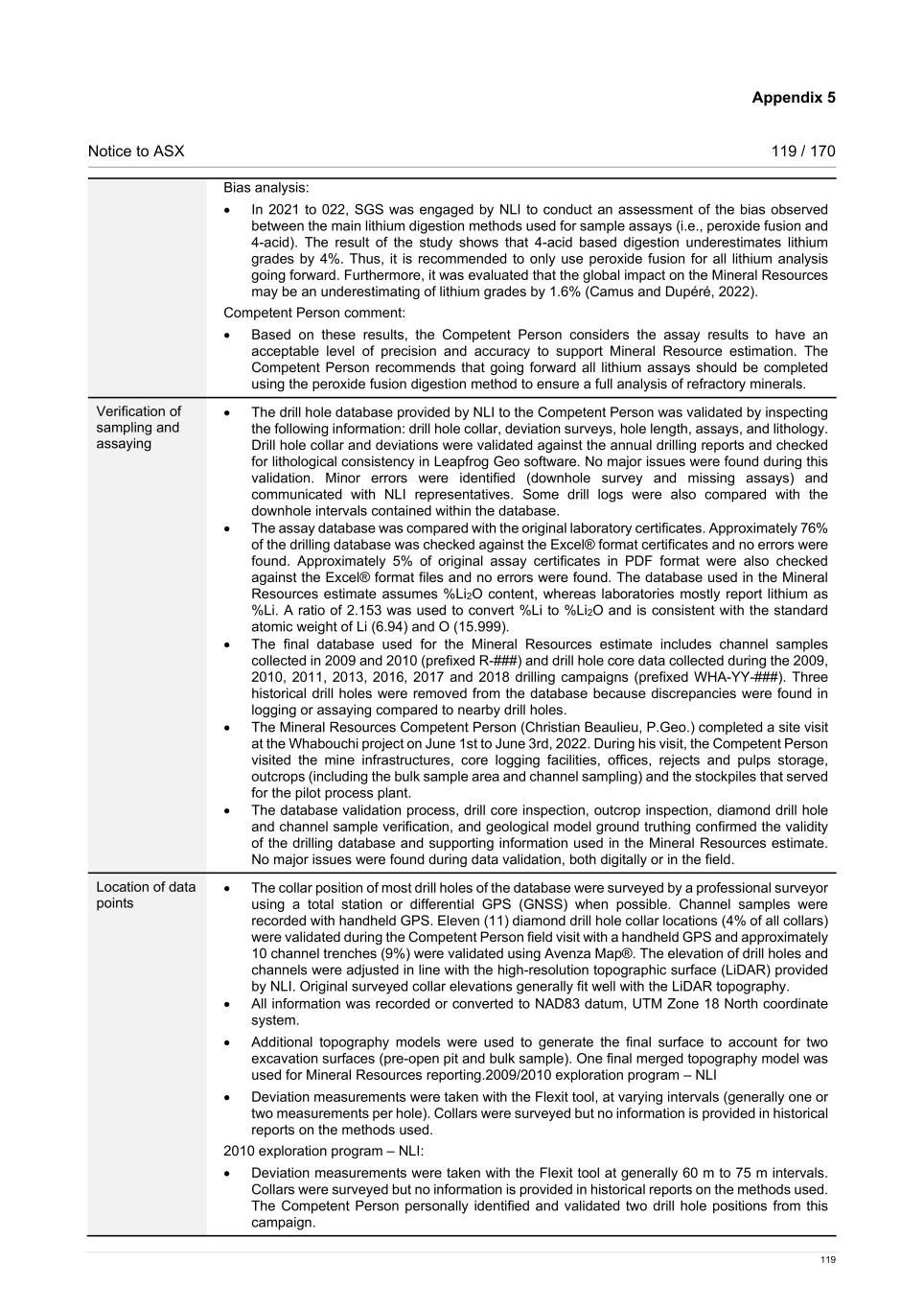
Appendix 5 Notice to ASX 119 / 170 119 Bias analysis: • In 2021 to 022, SGS was engaged by NLI to conduct an assessment of the bias observed between the main lithium digestion methods used for sample assays (i.e., peroxide fusion and 4-acid). The result of the study shows that 4-acid based digestion underestimates lithium grades by 4%. Thus, it is recommended to only use peroxide fusion for all lithium analysis going forward. Furthermore, it was evaluated that the global impact on the Mineral Resources may be an underestimating of lithium grades by 1.6% (Camus and Dupéré, 2022). Competent Person comment: • Based on these results, the Competent Person considers the assay results to have an acceptable level of precision and accuracy to support Mineral Resource estimation. The Competent Person recommends that going forward all lithium assays should be completed using the peroxide fusion digestion method to ensure a full analysis of refractory minerals. Verification of sampling and assaying • The drill hole database provided by NLI to the Competent Person was validated by inspecting the following information: drill hole collar, deviation surveys, hole length, assays, and lithology. Drill hole collar and deviations were validated against the annual drilling reports and checked for lithological consistency in Leapfrog Geo software. No major issues were found during this validation. Minor errors were identified (downhole survey and missing assays) and communicated with NLI representatives. Some drill logs were also compared with the downhole intervals contained within the database. • The assay database was compared with the original laboratory certificates. Approximately 76% of the drilling database was checked against the Excel® format certificates and no errors were found. Approximately 5% of original assay certificates in PDF format were also checked against the Excel® format files and no errors were found. The database used in the Mineral Resources estimate assumes %Li2O content, whereas laboratories mostly report lithium as %Li. A ratio of 2.153 was used to convert %Li to %Li2O and is consistent with the standard atomic weight of Li (6.94) and O (15.999). • The final database used for the Mineral Resources estimate includes channel samples collected in 2009 and 2010 (prefixed R-###) and drill hole core data collected during the 2009, 2010, 2011, 2013, 2016, 2017 and 2018 drilling campaigns (prefixed WHA-YY-###). Three historical drill holes were removed from the database because discrepancies were found in logging or assaying compared to nearby drill holes. • The Mineral Resources Competent Person (Christian Beaulieu, P.Geo.) completed a site visit at the Whabouchi project on June 1st to June 3rd, 2022. During his visit, the Competent Person visited the mine infrastructures, core logging facilities, offices, rejects and pulps storage, outcrops (including the bulk sample area and channel sampling) and the stockpiles that served for the pilot process plant. • The database validation process, drill core inspection, outcrop inspection, diamond drill hole and channel sample verification, and geological model ground truthing confirmed the validity of the drilling database and supporting information used in the Mineral Resources estimate. No major issues were found during data validation, both digitally or in the field. Location of data points • The collar position of most drill holes of the database were surveyed by a professional surveyor using a total station or differential GPS (GNSS) when possible. Channel samples were recorded with handheld GPS. Eleven (11) diamond drill hole collar locations (4% of all collars) were validated during the Competent Person field visit with a handheld GPS and approximately 10 channel trenches (9%) were validated using Avenza Map®. The elevation of drill holes and channels were adjusted in line with the high-resolution topographic surface (LiDAR) provided by NLI. Original surveyed collar elevations generally fit well with the LiDAR topography. • All information was recorded or converted to NAD83 datum, UTM Zone 18 North coordinate system. • Additional topography models were used to generate the final surface to account for two excavation surfaces (pre-open pit and bulk sample). One final merged topography model was used for Mineral Resources reporting.2009/2010 exploration program – NLI • Deviation measurements were taken with the Flexit tool, at varying intervals (generally one or two measurements per hole). Collars were surveyed but no information is provided in historical reports on the methods used. 2010 exploration program – NLI: • Deviation measurements were taken with the Flexit tool at generally 60 m to 75 m intervals. Collars were surveyed but no information is provided in historical reports on the methods used. The Competent Person personally identified and validated two drill hole positions from this campaign.
Appendix 5 Notice to ASX 120 / 170 120 2011 exploration and infill drilling program – NLI: • Deviation measurements were taken with the Flexit tool at generally 50 m intervals. Collars were surveyed but no information is provided in historical reports on the methods used. 2013 exploration and infill drilling program – NLI: • Deviation measurements were taken with a combination of the Flexit tool at generally 60 m intervals and the REFLEX mutlishot method at 5 m intervals. • Collars were surveyed by a professional surveyor using a pair of Leica GS15 GNSS receivers. 2016 infill, conversion and extension drilling – NLI: • Drilling was surveyed by the land-surveying firm MYS. • Deviation measurements were taken with the EZ Shot tool at 30 m to 35 m intervals 2017 diamond drilling campaign – NLI: • Drilling was surveyed by the land-surveying firm MYS. • Deviation for drill holes of more than 100 m were surveyed by the REFLEX multishot method and those of less than 100 m by single-shot REFLEX method. 2018 diamond drilling campaign – NLI: • Drilling was surveyed by the land-surveying firm MYS. • Deviation measurements were taken with the REFLEX multishot method at 3 to 4 m intervals. Data spacing and distribution • The drill holes are generally spaced 25 m to 50 m apart with an average strike of N330°. The dips range from 43° to 75° with most of drill holes drilled at 45° or 50° dips. The longest drill hole reaches a length of 640 m down hole and 510 m of vertical depth. • The samples collected for analysis represent approximately 30% of the drill core material and 98% of the channel material. The drill holes are generally spaced 25 m to 50 m apart. • Given the deposit type (lithium-bearing pegmatite) and observed continuity of lithium grades, dyke thicknesses and lithologies, this spacing is judged sufficient to establish the degree of geological and grade continuity appropriate for the Mineral Resources and Ore Reserves estimation procedure(s) and classifications applied. • No compositing was applied to samples in the original database. Compositing was only applied prior to the Mineral Resources estimation for length uniformization. Orientation of data in relation to geological structure • The first drill holes on the Whabouchi pegmatite in 2009 were properly oriented to crosscut the intrusive body at a perpendicular angle. This target azimuth was kept for the subsequent drill holes campaigns with azimuth ranging between N312° and N340°, with an average direction of N330°. The dips range from 43° to 75° with most of drill holes drilled at 45° or 50° dips. • These parameters allowed the drill intersections of the mineralized bodies to range from near true thickness to 70% of the true thickness of the dykes. • Based on the information gathered from drilling, the pegmatite intrusion is more than 1,300 m in length and can be up to 90 m thick. The intrusions are generally oriented N050° with dips varying from the southeast to the northwest at an angle ranging between 70° and 85° and are reaching depths of up to 470 m below surface. • The mineralized drill intersection ranges from near true thickness to 70% of the true thickness of the dykes. Sample security • The chain of custody applied by NLI is described above. Samples were handled on site and shipped to the TJCM for sample preparation by site personnel or contractors. Samples prepared by SGS were directly shipped to the laboratory. • Drill cores are currently kept on site in wooden boxes, themselves organized in metal racks by hole-Id. Coarse rejects are generally organized by laboratory batches in rice bags, stored in wooded boxes on pallets directly on site and next to the core storage facility. Pulps are kept by sample batches in carboard boxes and organized in racks within a sea container kept on site next to the coarse rejects and drill core. Audits or reviews • Throughout the Mineral Resource estimation workflow, BBA Inc. (Todd McCracken, P.Geo.), was involved in a peer review of each major step, providing recommendations which were largely implemented. • The Competent Person (Christian Beaulieu, P.Geo. of Mineralis Consulting Services Inc.) is of the opinion that sampling procedures and sample security are suitable, and appropriate for the estimation of Mineral Resources.
Appendix 5 Notice to ASX 121 / 170 121 Section 2: Reporting of Exploration Results Criteria Commentary Mineral tenement and land tenure status • The Whabouchi property is composed of one block containing 35 map-designated claims (MDC) covering a total of 1,632.24 ha and one Mining Lease by the Ministère des Ressources naturelles et forêts (MRNF). Nemaska Lithium (NLI), a joint venture between Investissement Québec (50%) and Rio Tinto (50%) owns 100% interest in the property. At the date of this Report, all claims are in good standing. The expiry date of the claims ranges from November 2, 2026 to January 24, 2027 • On October 26, 2017, NLI obtained the Mining Lease number 1022, under the conditions provided for in the Loi sur les mines (Mining Act) and those prescribed by regulation. The surface of the Mining Lease totals 138.106 ha, consisting of lot 4,994,037 of the Quebec cadastre, registration division of Lac-Saint-Jean-Ouest. This lease gives the tenant the right to extract all mineral substances owned by the Crown in the above-named land, but it does not give entitlement to surface mineral substances, petroleum, natural gas, or brine. This lease is for a period of 20 years from the date of the landlord's signature on October 26, 2017 and will end on October 25, 2037. • There are no royalty obligations on any of the claims of the property. Exploration done by other parties • The first exploration work reported in the area dates back to 1962 by Canico and included the discovery of a lithium-bearing pegmatite by the geologists of the Québec Bureau of Mines. That same year, Canico drilled two packsack drill holes on the pegmatite, followed by three diamond drill holes on the same pegmatite ridge in 1963. • No exploration was reported for the next ten years. In 1973, James Bay Nickel Ventures (Canex Placer) performed a large-scale geological reconnaissance that covered the property (Burns, 1973). • From 1974 to 1982, the exploration work was exclusively reported by the Société de Développement de la Baie James (SDBJ), which mainly executed large scale geochemical surveys, followed by geological reconnaissance of the anomalies (Pride, 1974, Gleeson, 1975 and 1976). • Two exploration programs, one in 1978 and the other in 1980 were aimed at lithium exploration, with the evaluation of the Whabouchi spodumene-bearing pegmatite (Goyer, et al. 1978, Bertrand,1978, Otis, 1980, Fortin, 1981, and Charbonneau, 1982). No channel sampling or drill holes are reported. No work was conducted from 1982 to 1987. • In 1987, Westmin Resources completed an airborne Dighem III survey. In 1987-1988, Muscocho Exploration also completed ground magnetic and VLF surveys that covered a major part of the property. The Muscocho Exploration efforts were oriented towards the search for massive sulphides. A program of 14 holes, 11 of them located on the southern part of the Whabouchi Property, was completed. • In 2002, while exploring for tantalum, Inco re-sampled the spodumene-bearing pegmatite, taking 11 channel samples and seven grab samples. The best value obtained by Inco was 0.026% Ta, and Li2O values ranging from 0.30% to 3.72% (Babineau, 2002). • Exploration Nemaska Inc initiated its exploration work on the property during the fall of 2009. During the site visit, several outcrops of spodumene-bearing pegmatite were observed, and nine samples were collected and analysed for Li2O. The highest and lowest results obtained during the site visit are the grab sample #946511, with a value of 6.3% Li2O, and grab sample #946508 at 1.18% Li2O (Théberge, 2009). Following that and during the fall 2009 exploration program, mechanical stripping successfully exposed the spodumene-bearing pegmatites in 16 trenches spaced between 50 m and 100 m apart and covering 1,000 m in strike length. From these trenches, 37 channels were cut and a total of 295 samples were collected for analysis. In addition to the trenching work, eight diamond drill holes were completed; all successful drill holes have intersected pegmatites zones. Geology • The Whabouchi project is located in the Lac des Montagnes volcano-sedimentary formation and sits between the Champion Lake granitoids and orthogneiss and the Opatica Northeast, which comprises orthogneiss and undifferentiated granitoids. From the northwest to the southeast, the project is underlain by the Champion Lake granitoids, a grey oligoclase gneiss and then by the Lac des Montagnes formation. • Geology consists of a volcano-sedimentary assemblage metamorphosed to the amphibolite level. The volcanic rocks mostly comprise basalt-andesite rocks and gabbro formation. The primary textures are not identifiable, and no geochemistry data is available to correctly identify the rock types. The sedimentary units range from meta-conglomerates with elongated clasts to fine grained sedimentary units.
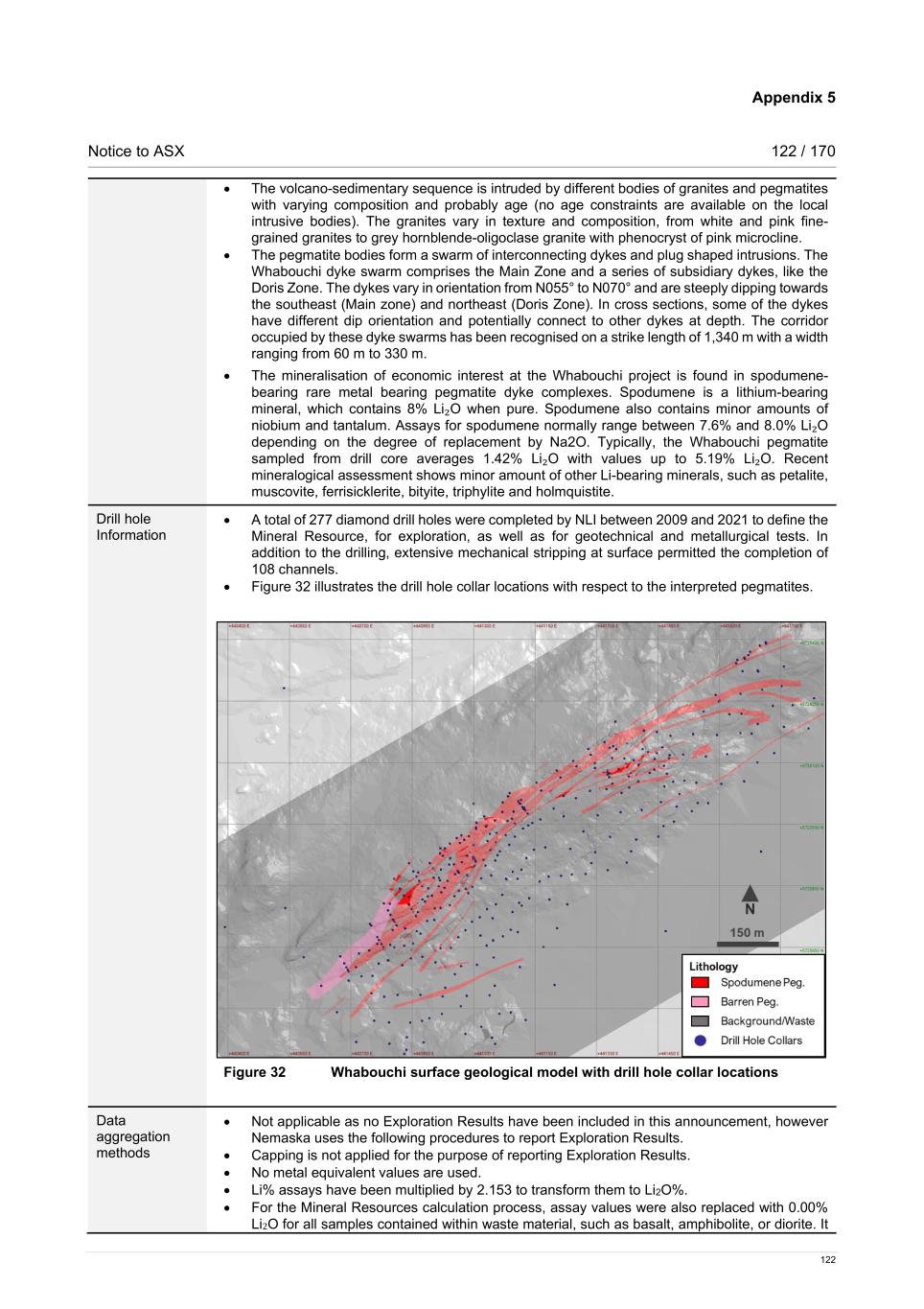
Appendix 5 Notice to ASX 122 / 170 122 • The volcano-sedimentary sequence is intruded by different bodies of granites and pegmatites with varying composition and probably age (no age constraints are available on the local intrusive bodies). The granites vary in texture and composition, from white and pink fine- grained granites to grey hornblende-oligoclase granite with phenocryst of pink microcline. • The pegmatite bodies form a swarm of interconnecting dykes and plug shaped intrusions. The Whabouchi dyke swarm comprises the Main Zone and a series of subsidiary dykes, like the Doris Zone. The dykes vary in orientation from N055° to N070° and are steeply dipping towards the southeast (Main zone) and northeast (Doris Zone). In cross sections, some of the dykes have different dip orientation and potentially connect to other dykes at depth. The corridor occupied by these dyke swarms has been recognised on a strike length of 1,340 m with a width ranging from 60 m to 330 m. • The mineralisation of economic interest at the Whabouchi project is found in spodumene- bearing rare metal bearing pegmatite dyke complexes. Spodumene is a lithium-bearing mineral, which contains 8% Li₂O when pure. Spodumene also contains minor amounts of niobium and tantalum. Assays for spodumene normally range between 7.6% and 8.0% Li₂O depending on the degree of replacement by Na2O. Typically, the Whabouchi pegmatite sampled from drill core averages 1.42% Li₂O with values up to 5.19% Li₂O. Recent mineralogical assessment shows minor amount of other Li-bearing minerals, such as petalite, muscovite, ferrisicklerite, bityite, triphylite and holmquistite. Drill hole Information • A total of 277 diamond drill holes were completed by NLI between 2009 and 2021 to define the Mineral Resource, for exploration, as well as for geotechnical and metallurgical tests. In addition to the drilling, extensive mechanical stripping at surface permitted the completion of 108 channels. • Figure 32 illustrates the drill hole collar locations with respect to the interpreted pegmatites. Figure 32 Whabouchi surface geological model with drill hole collar locations Data aggregation methods • Not applicable as no Exploration Results have been included in this announcement, however Nemaska uses the following procedures to report Exploration Results. • Capping is not applied for the purpose of reporting Exploration Results. • No metal equivalent values are used. • Li% assays have been multiplied by 2.153 to transform them to Li2O%. • For the Mineral Resources calculation process, assay values were also replaced with 0.00% Li2O for all samples contained within waste material, such as basalt, amphibolite, or diorite. It
Appendix 5 Notice to ASX 123 / 170 123 has been demonstrated that lithium in these waste units is generally hosted within minerals other than spodumene such as holmquistite and are assumed not to be recoverable. Relationship between mineralisation widths and intercept lengths • Most of the drill holes at Whabouchi intersected the pegmatite dykes in a sub perpendicular manner, making the drill hole intersection of the pegmatite range from near true thickness to 70% of the true thickness of the dykes. Diagrams • Plan, three-dimensional view and cross section figures are located in this Table 1 depicting typical drill hole intersects, assays, pit shells, dyke interpretation and classification. Balanced reporting • Not applicable as no Exploration Results have been included in this announcement. Other substantive exploration data • In May 2011, a 50-tonne bulk sample was collected at surface for metallurgical testing purposes. In 2017, NLI mined a portion of the deposit for a bulk sample used to feed a demonstration plant in Shawinigan. Approximately 19,000 tonnes of spodumene pegmatite at an average grade of 1.49% Li2O are currently stockpiled about 600 m from the primary crusher. • A first mineralogical assessment was conducted in 2021 using XRD. The finding of other-Li bearing minerals led to a more thorough mineralogical assessment at the deposit scale of the Whabouchi spodumene pegmatite initiated in 2022 by NLI and conducted by Elemission Inc. using Laser-Induced Breakdown Spectroscopy (LIBS) on drill core. The first program targeted near-surface, early-mining mineralisation. Based on preliminary results (750 scanned samples), a petalite sub-domain was modelled and average lithium deportment values were used for Ore Reserves and mine planning (96.6% of Li coming from spodumene in the Main Zone and 88.9% of Li coming from petalite in the Petalite sub-domains). As a reference and based on limited samples, 98% of lithium was originally expected to come from spodumene in the bulk sample area. Further work • Future work on the project might include micro-gravity ground geophysical survey to highlight potential other pegmatite bodies. • An infill diamond drilling campaign is required to convert some of the Inferred Mineral Resources category to Indicated Mineral Resources and Indicated within the current planned open pit shell to Measured category. • A geotechnical drilling program and hydrogeological study is required to determine ground stability at depth for the potential of declaring underground Ore Reserves and a subsequent underground mining option. Section 3: Estimation and Reporting of Mineral Resources Criteria Commentary Database integrity • All of the drill holes and channels information including collar survey, downhole deviation measurements and assays are centralised in an Access database and have been reviewed on multiple occasions by the external Competent Person. Original copies of assay certificates are stored on a secured server. • During the latest review, the drill hole database provided by NLI to the Competent Person was validated by inspecting the following information: drill hole collar, deviation surveys, hole length, assays, and lithology. Drill hole collar and deviations were validated against the annual drilling reports and also checked for lithological consistency in Leapfrog Geo software. No major issues were found during this validation. Minor errors were identified (downhole survey and missing assays) and communicated with NLI representatives. Approximately 20% of the drill logs were also compared with the downhole intervals contained within the database. Site visits • Mr. Christian Beaulieu, P.Geo., independent Competent Person of Minéralis Consulting Services Inc. completed a site visit at the Whabouchi project on 1 June to 3 June 3 2022. During his visit, he visited the mine infrastructures, core logging facilities, offices, rejects and pulps storage, outcrops (including the bulk sample area and channel sampling) and the stockpiles that served for the pilot process plant. The site visit included validation of the lithium mineralisation in the pegmatite dykes, the location of drill hole collars and the precision of some geological contacts. It also allowed the Competent Person to gain an appreciation of the type of spodumene mineralisation.
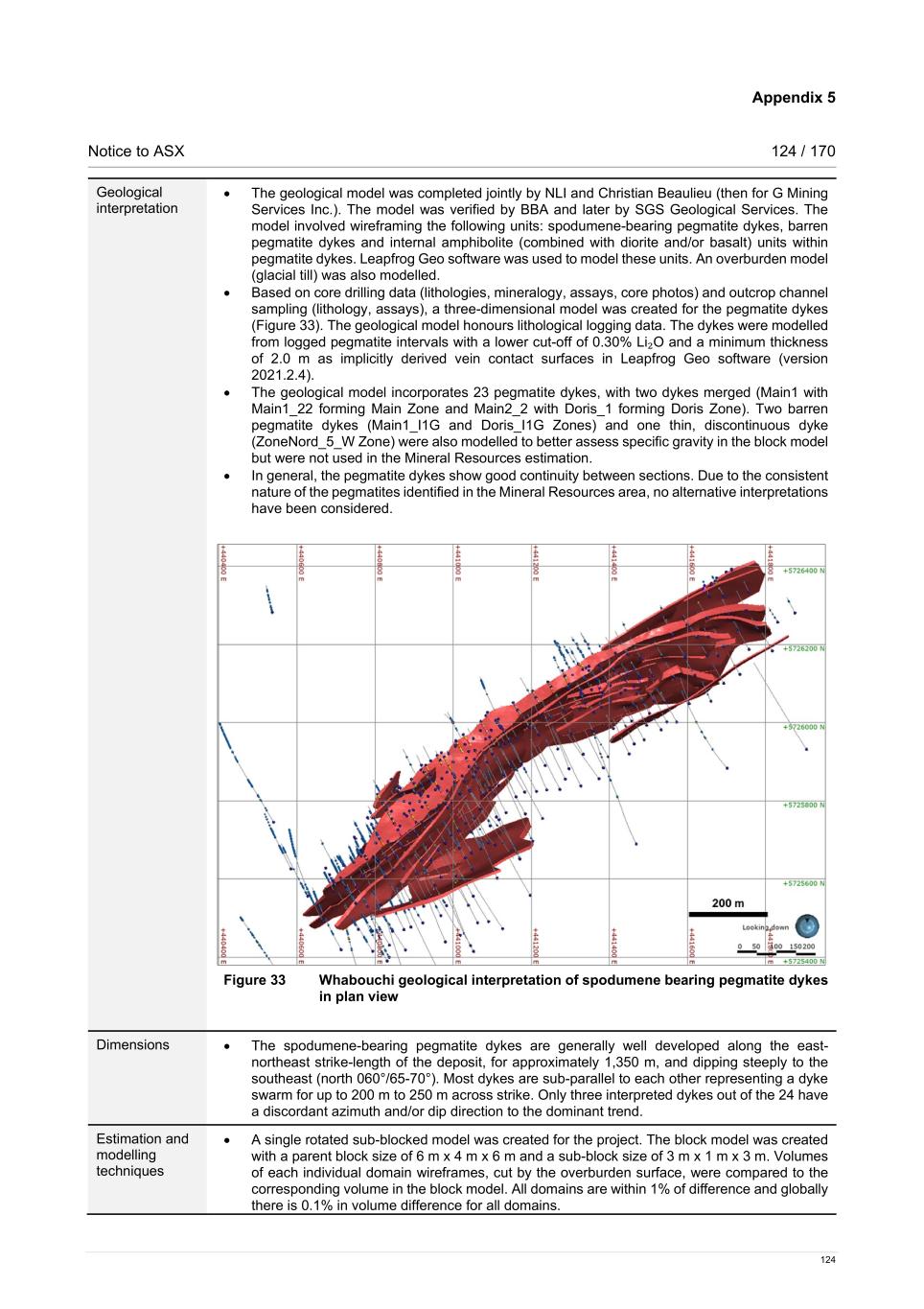
Appendix 5 Notice to ASX 124 / 170 124 Geological interpretation • The geological model was completed jointly by NLI and Christian Beaulieu (then for G Mining Services Inc.). The model was verified by BBA and later by SGS Geological Services. The model involved wireframing the following units: spodumene-bearing pegmatite dykes, barren pegmatite dykes and internal amphibolite (combined with diorite and/or basalt) units within pegmatite dykes. Leapfrog Geo software was used to model these units. An overburden model (glacial till) was also modelled. • Based on core drilling data (lithologies, mineralogy, assays, core photos) and outcrop channel sampling (lithology, assays), a three-dimensional model was created for the pegmatite dykes (Figure 33). The geological model honours lithological logging data. The dykes were modelled from logged pegmatite intervals with a lower cut-off of 0.30% Li₂O and a minimum thickness of 2.0 m as implicitly derived vein contact surfaces in Leapfrog Geo software (version 2021.2.4). • The geological model incorporates 23 pegmatite dykes, with two dykes merged (Main1 with Main1_22 forming Main Zone and Main2_2 with Doris_1 forming Doris Zone). Two barren pegmatite dykes (Main1_I1G and Doris_I1G Zones) and one thin, discontinuous dyke (ZoneNord_5_W Zone) were also modelled to better assess specific gravity in the block model but were not used in the Mineral Resources estimation. • In general, the pegmatite dykes show good continuity between sections. Due to the consistent nature of the pegmatites identified in the Mineral Resources area, no alternative interpretations have been considered. Figure 33 Whabouchi geological interpretation of spodumene bearing pegmatite dykes in plan view Dimensions • The spodumene-bearing pegmatite dykes are generally well developed along the east- northeast strike-length of the deposit, for approximately 1,350 m, and dipping steeply to the southeast (north 060°/65-70°). Most dykes are sub-parallel to each other representing a dyke swarm for up to 200 m to 250 m across strike. Only three interpreted dykes out of the 24 have a discordant azimuth and/or dip direction to the dominant trend. Estimation and modelling techniques • A single rotated sub-blocked model was created for the project. The block model was created with a parent block size of 6 m x 4 m x 6 m and a sub-block size of 3 m x 1 m x 3 m. Volumes of each individual domain wireframes, cut by the overburden surface, were compared to the corresponding volume in the block model. All domains are within 1% of difference and globally there is 0.1% in volume difference for all domains.

Appendix 5 Notice to ASX 125 / 170 125 • Specific gravity measurements were obtained by pycnometer on full sample pulp reject. For all pegmatites, the median of all measurements was used: 2.76 g/cm³ and 2.67 g/cm³ for spodumene-bearing and barren pegmatite respectively. A value of 3.04 g/cm3 was used for waste rock, based on the mean of specific gravity measurements after removing a few outliers. The final density of each block is a function of the estimated amount of internal waste within the block at 3.04 g/cm3 (estimated from lithology intervals where no internal waste sub- domains were modelled) and the remainder at 2.76 g/cm3 (mineralised pegmatite). • A dilution skin of 4 m around each spodumene pegmatite dyke was created. This is to ensure that density and background grades are better defined when re-blocking will occur for the Ore Reserves and assuming the proper dilution grades. • The cumulative probability plot histograms suggest that lithium grades did not require capping prior to estimation as there is no evidence of high-grade outliers. The distribution of lithium grades shows a normal distribution, holds very few outliers, has very low Coefficient of Variation (COV) and no major break in grade distribution is observed. • Compositing was completed for all domains using a 2 m composite length to standardise the sample lengths used in interpolation. The domain boundaries have been honoured during compositing, with any assay length less than 0.5 m added to the previous composite to avoid large numbers of small “remnant” composites at the domain boundaries. • Experimental variograms were produced for each domain based on the 2 m composites and were aligned with the clearest angle of continuity. Some domains with few composites and with similar dyke orientation and grade distribution were grouped together. Major dykes spanning over 1 km in strike length and open folded, such as Main Zone and Doris Zone, were sub- domained to produce experimental variograms on the most consistent orientation. Resulting variograms were then applied to the whole domain. • Li2O grades were estimated using the ordinary kriging with the mineralisation domains as hard boundaries. Grades were estimated using a three-pass approach, with increasing ellipsoid size. o Pass 1 estimations have been undertaken using a minimum of 7 and a maximum of 22 composites into a search ellipse of a maximum and minimum range of respectively 50 m and 10 m. A 3 sample per drill hole limit has been applied in all pegmatite domains with a minimum target of 3 different holes. o Pass 2 estimations have been undertaken using a minimum of 6 and a maximum of 22 composites into a search ellipse of a maximum and minimum range of respectively 100 m and 20 m. A 3 sample per drill hole limit has been applied in all pegmatite domains with a minimum target of 2 different holes. o Pass 3 estimations have been undertaken using a minimum of 2 and a maximum of 22 samples into a search ellipse of a maximum and minimum range of respectively 200 m and 30 m. A 3 sample per drill hole limit has been applied in all pegmatite domains with a minimum target of 1 hole. • Interpolation parameters were determined by Kriging Neighbourhood Analysis (KNA). • Dynamic anisotropy based on dyke reference planes was used to locally rotate and align the search ellipse during grade estimation. • The Competent Person performed a visual validation comparing the composite grades against the block grades in cross-section and plan view, examples are provided in Figure 34 and Figure 35. This validation also confirmed that the search ellipsoids were aligned with dyke contacts within the geological model, especially where a dyke changes direction. • Other validation steps were taken to ensure that the block model is a robust representation of the composites Including: global statistical checks comparing the various grades of the block model against a Nearest Neighbour (NN) estimate and against the declustered composite data, and local statistical validation to identify any over-smoothing are areas of grade over- or under- extrapolation (Swath Plots). • A comparison was completed against the previous NLI model (2019). The new model yields an increase of 57 kt Li2O in the Measured and Indicated combined categories and a decrease of 112 kt Li2O in the Inferred category. The main differences in the Inferred categories are caused by an excessive extension of Inferred Mineral Resources at depth in the 2019 model. Other differences in the model include but are not limited to: o the new density model, o general increase of grades due to refined domaining, o Mineral Resources conversion from Inferred to Indicated o updated pit optimisation.
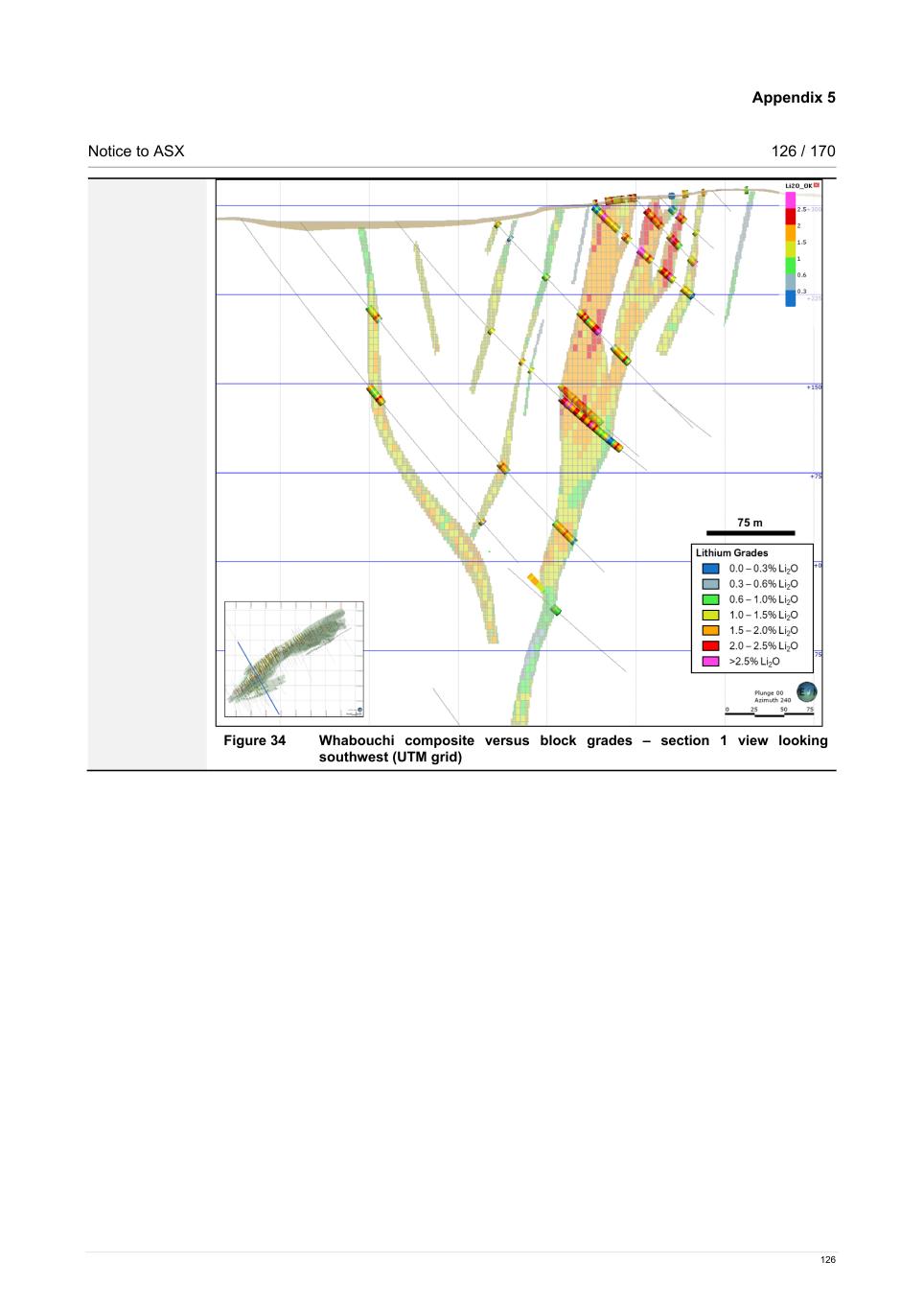
Appendix 5 Notice to ASX 126 / 170 126 Figure 34 Whabouchi composite versus block grades – section 1 view looking southwest (UTM grid)
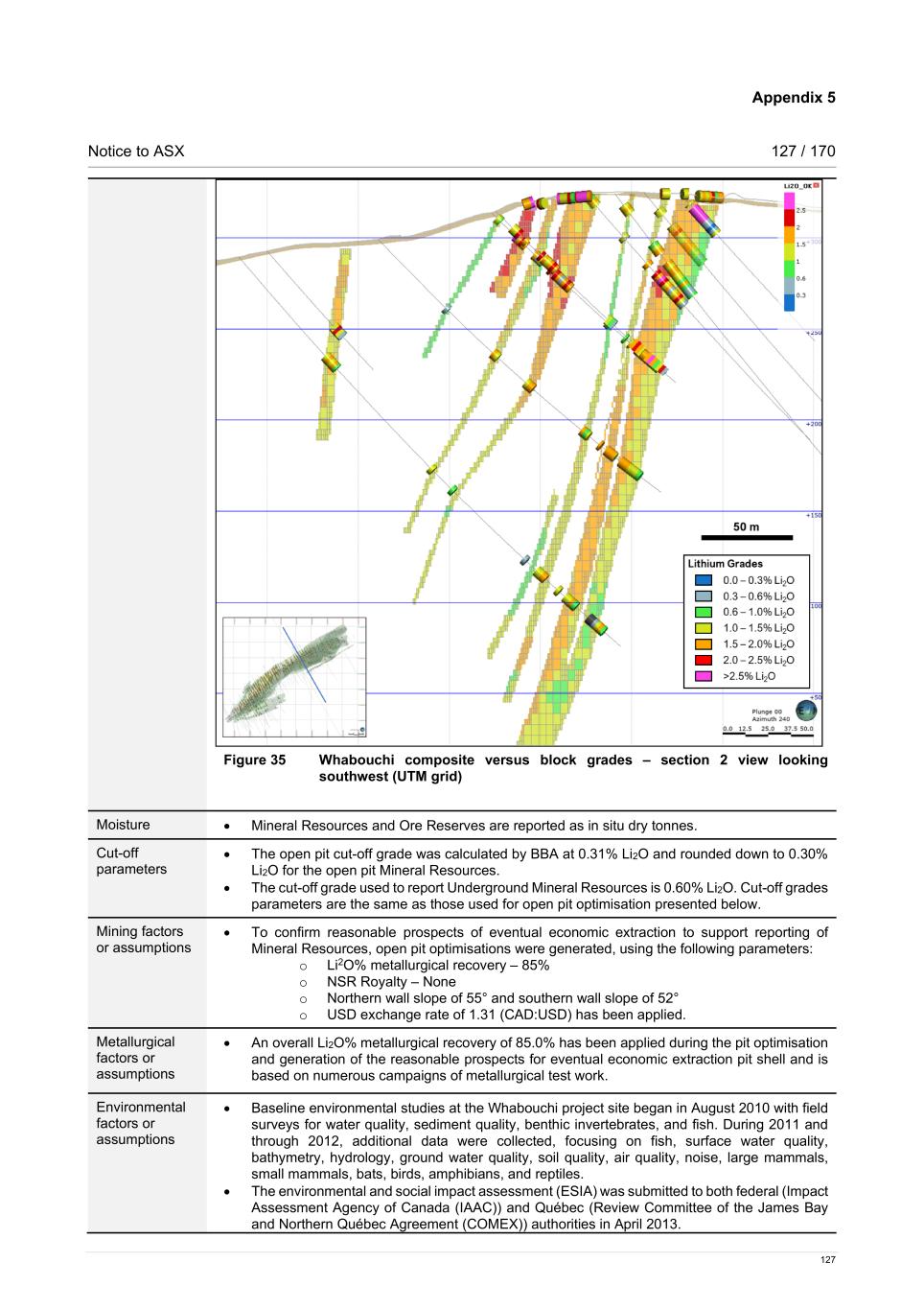
Appendix 5 Notice to ASX 127 / 170 127 Figure 35 Whabouchi composite versus block grades – section 2 view looking southwest (UTM grid) Moisture • Mineral Resources and Ore Reserves are reported as in situ dry tonnes. Cut-off parameters • The open pit cut-off grade was calculated by BBA at 0.31% Li2O and rounded down to 0.30% Li2O for the open pit Mineral Resources. • The cut-off grade used to report Underground Mineral Resources is 0.60% Li2O. Cut-off grades parameters are the same as those used for open pit optimisation presented below. Mining factors or assumptions • To confirm reasonable prospects of eventual economic extraction to support reporting of Mineral Resources, open pit optimisations were generated, using the following parameters: o Li2O% metallurgical recovery – 85% o NSR Royalty – None o Northern wall slope of 55° and southern wall slope of 52° o USD exchange rate of 1.31 (CAD:USD) has been applied. Metallurgical factors or assumptions • An overall Li2O% metallurgical recovery of 85.0% has been applied during the pit optimisation and generation of the reasonable prospects for eventual economic extraction pit shell and is based on numerous campaigns of metallurgical test work. Environmental factors or assumptions • Baseline environmental studies at the Whabouchi project site began in August 2010 with field surveys for water quality, sediment quality, benthic invertebrates, and fish. During 2011 and through 2012, additional data were collected, focusing on fish, surface water quality, bathymetry, hydrology, ground water quality, soil quality, air quality, noise, large mammals, small mammals, bats, birds, amphibians, and reptiles. • The environmental and social impact assessment (ESIA) was submitted to both federal (Impact Assessment Agency of Canada (IAAC)) and Québec (Review Committee of the James Bay and Northern Québec Agreement (COMEX)) authorities in April 2013.
Appendix 5 Notice to ASX 128 / 170 128 • The COMEX held public hearings in March to April 2015 in Eeyou Ischtee James Bay territory. Other forms of consultation were organised by NLI and/or the Cree Nation of Nemaska. On September 4, 2015, following a positive recommendation by the COMEX, the Provincial Administrator of the James Bay and Northern Québec Agreement granted authorisation for the Project and, therefore, confirmed that NLI received the general Certificate of Authorization for the Whabouchi Project from the MELCCFP (Ministère de l’environnement, de la lute contre les changements climatiques, de la Faune et des Parcs). • On 29 July 2015, following a comprehensive assessment of the Whabouchi project by IAAC, the federal Minister of Environment and Climate Change issued a positive decision statement (DS), declaring that the project was not likely to cause any significant adverse environmental effects. This DS also sets out the conditions to be respected by NLI in terms of mitigation measures and monitoring programs. The IAAC (Impact Assessment Agency of Canada) issued its final EA (Environmental Assessment) report on that same day. • Water management strategy and infrastructure design for the Whabouchi project has been completed in accordance with recommendations from Quebec’s Directive 019 (MELCCFP, 2012) and Canada’s Environmental Code of Practice for metal mines (ECCC, 2009), and in compliance with Quebec’s Environmental Discharge Objectives determined for the Whabouchi project by the MELCCFP. All seepage and runoff water generated on areas impacted by mining activities is considered “contact water.” Contact water and water from pit dewatering activities will be collected and retained for the settlement of sediment and treatment prior to being released to the environment. • The development of the water management infrastructure (i.e., ponds, ditches, and pumping requirements) is sized based on the required volume of surface runoff to manage, which varies according to the catchment area of the co-disposal storage facility (CSF). • For the project waste management, two provincial guidelines, Directive 019 (MELCCFP, 2012) and the MERN Closure Guidelines (2017), support the CSF design. The design criteria adopted is based on co-disposal storage of mine waste rock; this strategy uses waste rock to construct the perimeter berm and roads around the CSF, and store filtered tailings in the middle. • In June 2019, NLI paid the last instalment of the financial guarantee required under the initially approved Rehabilitation Plan for the Whabouchi project. • The Mining Act includes a five year statutory review of the closure plan. In February 2021, NLI submitted to MRNF the updated closure plan. It was approved by MRNF in February 2022 and the new approved cost estimate is now C$15.0 M. As requested by MRNF, a first instalment of C$3.0 M was paid in May 2022 and two instalments of C$1.4 M will be paid in February of 2023 and 2024. NLI is, thus, fully compliant with the applicable regulation. Bulk density • In 2021, NLI engaged SGS to conduct specific gravity (SG) measurements on pulp material (by pycnometer). A sub-selection of 96 samples were selected for bulk density measurement by water immersion to validate the SG methodology by pycnometer. Results showed that the results of the 274 SG tests are reliable and representative of the main geological units at Whabouchi. These results were then integrated into the model and density of pegmatites and background rocks were adjusted. • Specific gravity measurements were obtained by pycnometer on full sample pulp reject. For all pegmatites, the median of all measurements was used: 2.76 g/cm3 and 2.67 g/cm3 for spodumene-bearing and barren pegmatite respectively. In comparison, the previous model had a unique value of 2.71 g/cm3 for mineralised pegmatite, which corresponds to a 2% increase. The average density of the mineralised zones is 2.76 g/cm3 when taking into account internal dilution embedded in the model. • A value of 3.04 g/cm3 was used for waste rock, based on the mean of specific gravity measurements after removing a few outliers. • Density was assigned in the block model based on waste content estimated inside each block. The final density of each block inside the mineralised pegmatite is a function of the estimated waste content. Classification • The Competent Person considered drill hole spacing, confidence in the geological interpretation, variogram ranges and presence of channel samples to determine parameters that define the Mineral Resources categories. The final Mineral Resources classification is mostly based on average drill hole spacing, the number of samples used in the interpolation, specific geological units, and manual editing to avoid isolated blocks. • Measured Mineral Resources are generally blocks with an average distance between the three nearest drill holes of less than 30 m. It generally corresponds to the tightest drill spacing (approximately 30 m x 30 m). Areas where a vertical distance between drill holes was too high
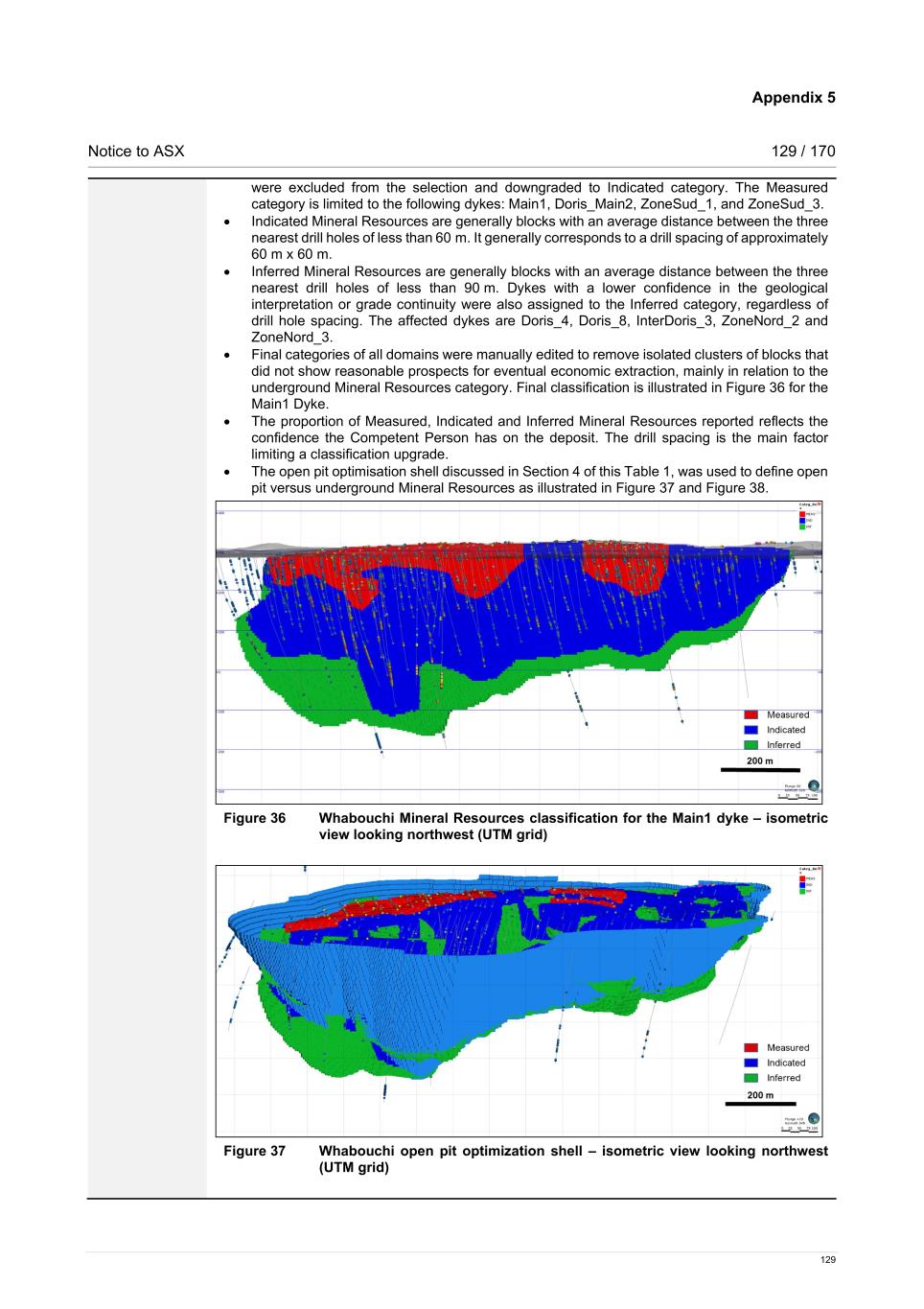
Appendix 5 Notice to ASX 129 / 170 129 were excluded from the selection and downgraded to Indicated category. The Measured category is limited to the following dykes: Main1, Doris_Main2, ZoneSud_1, and ZoneSud_3. • Indicated Mineral Resources are generally blocks with an average distance between the three nearest drill holes of less than 60 m. It generally corresponds to a drill spacing of approximately 60 m x 60 m. • Inferred Mineral Resources are generally blocks with an average distance between the three nearest drill holes of less than 90 m. Dykes with a lower confidence in the geological interpretation or grade continuity were also assigned to the Inferred category, regardless of drill hole spacing. The affected dykes are Doris_4, Doris_8, InterDoris_3, ZoneNord_2 and ZoneNord_3. • Final categories of all domains were manually edited to remove isolated clusters of blocks that did not show reasonable prospects for eventual economic extraction, mainly in relation to the underground Mineral Resources category. Final classification is illustrated in Figure 36 for the Main1 Dyke. • The proportion of Measured, Indicated and Inferred Mineral Resources reported reflects the confidence the Competent Person has on the deposit. The drill spacing is the main factor limiting a classification upgrade. • The open pit optimisation shell discussed in Section 4 of this Table 1, was used to define open pit versus underground Mineral Resources as illustrated in Figure 37 and Figure 38. Figure 36 Whabouchi Mineral Resources classification for the Main1 dyke – isometric view looking northwest (UTM grid) Figure 37 Whabouchi open pit optimization shell – isometric view looking northwest (UTM grid)
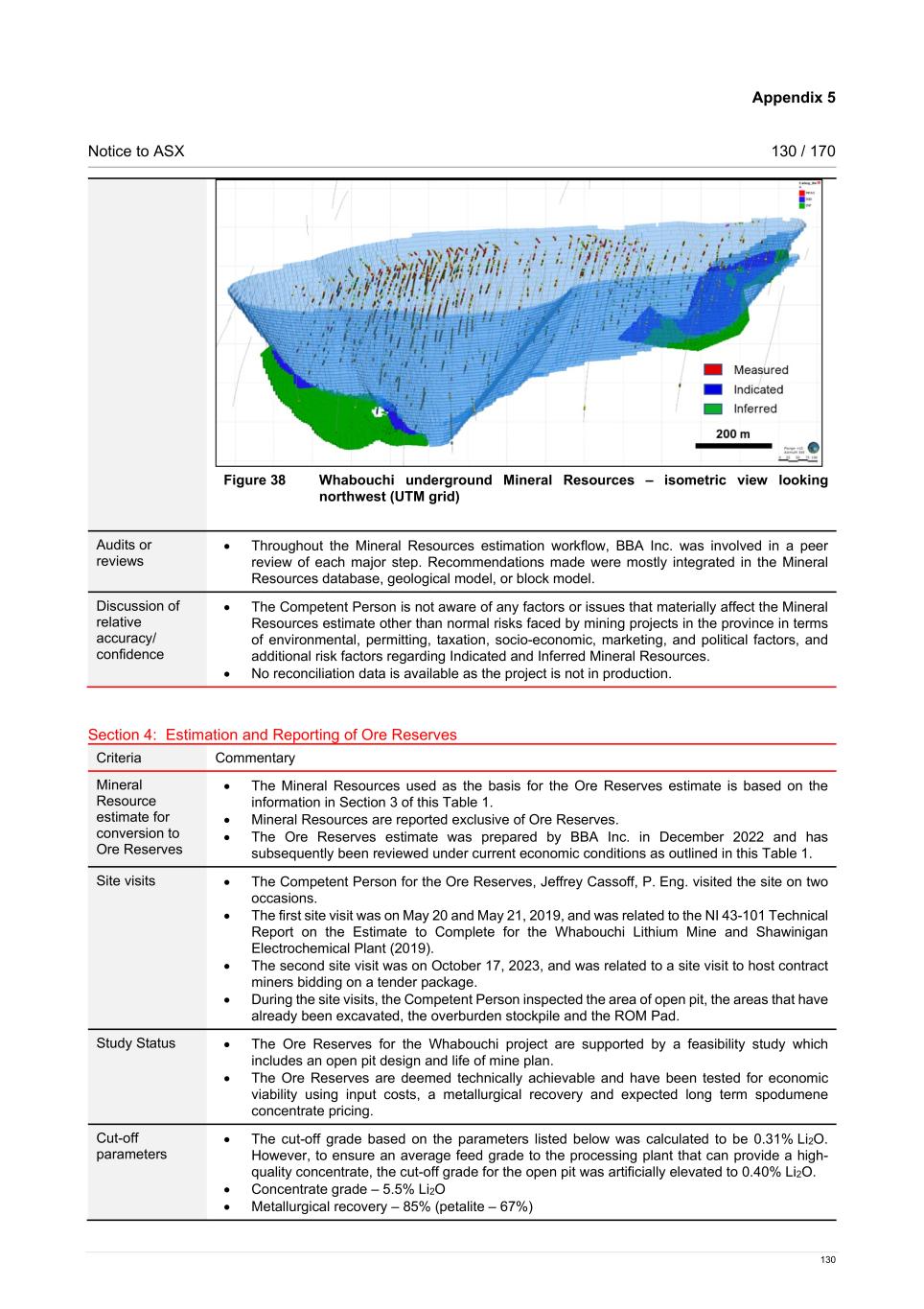
Appendix 5 Notice to ASX 130 / 170 130 Figure 38 Whabouchi underground Mineral Resources – isometric view looking northwest (UTM grid) Audits or reviews • Throughout the Mineral Resources estimation workflow, BBA Inc. was involved in a peer review of each major step. Recommendations made were mostly integrated in the Mineral Resources database, geological model, or block model. Discussion of relative accuracy/ confidence • The Competent Person is not aware of any factors or issues that materially affect the Mineral Resources estimate other than normal risks faced by mining projects in the province in terms of environmental, permitting, taxation, socio-economic, marketing, and political factors, and additional risk factors regarding Indicated and Inferred Mineral Resources. • No reconciliation data is available as the project is not in production. Section 4: Estimation and Reporting of Ore Reserves Criteria Commentary Mineral Resource estimate for conversion to Ore Reserves • The Mineral Resources used as the basis for the Ore Reserves estimate is based on the information in Section 3 of this Table 1. • Mineral Resources are reported exclusive of Ore Reserves. • The Ore Reserves estimate was prepared by BBA Inc. in December 2022 and has subsequently been reviewed under current economic conditions as outlined in this Table 1. Site visits • The Competent Person for the Ore Reserves, Jeffrey Cassoff, P. Eng. visited the site on two occasions. • The first site visit was on May 20 and May 21, 2019, and was related to the NI 43-101 Technical Report on the Estimate to Complete for the Whabouchi Lithium Mine and Shawinigan Electrochemical Plant (2019). • The second site visit was on October 17, 2023, and was related to a site visit to host contract miners bidding on a tender package. • During the site visits, the Competent Person inspected the area of open pit, the areas that have already been excavated, the overburden stockpile and the ROM Pad. Study Status • The Ore Reserves for the Whabouchi project are supported by a feasibility study which includes an open pit design and life of mine plan. • The Ore Reserves are deemed technically achievable and have been tested for economic viability using input costs, a metallurgical recovery and expected long term spodumene concentrate pricing. Cut-off parameters • The cut-off grade based on the parameters listed below was calculated to be 0.31% Li2O. However, to ensure an average feed grade to the processing plant that can provide a high- quality concentrate, the cut-off grade for the open pit was artificially elevated to 0.40% Li2O. • Concentrate grade – 5.5% Li2O • Metallurgical recovery – 85% (petalite – 67%)
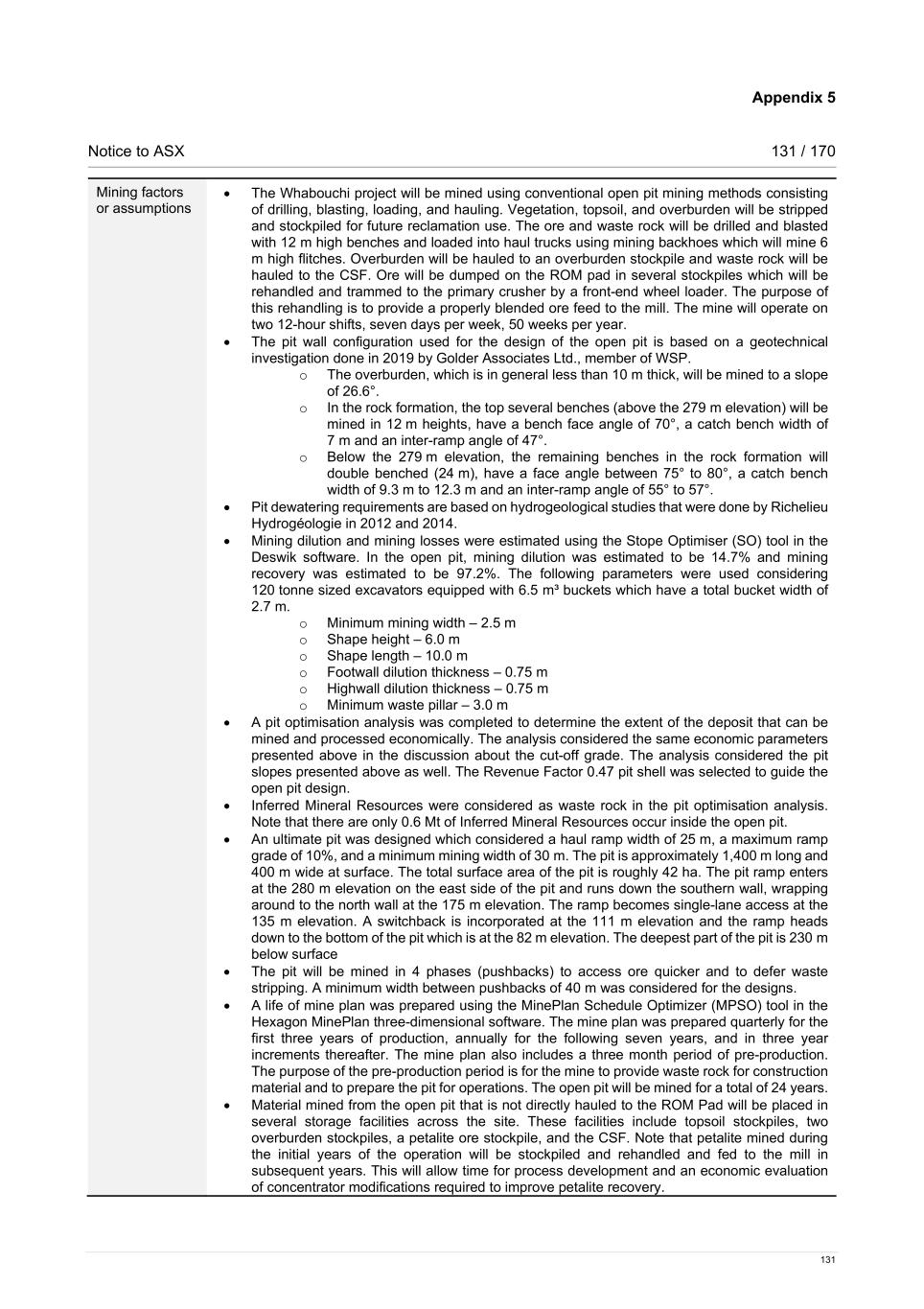
Appendix 5 Notice to ASX 131 / 170 131 Mining factors or assumptions • The Whabouchi project will be mined using conventional open pit mining methods consisting of drilling, blasting, loading, and hauling. Vegetation, topsoil, and overburden will be stripped and stockpiled for future reclamation use. The ore and waste rock will be drilled and blasted with 12 m high benches and loaded into haul trucks using mining backhoes which will mine 6 m high flitches. Overburden will be hauled to an overburden stockpile and waste rock will be hauled to the CSF. Ore will be dumped on the ROM pad in several stockpiles which will be rehandled and trammed to the primary crusher by a front-end wheel loader. The purpose of this rehandling is to provide a properly blended ore feed to the mill. The mine will operate on two 12-hour shifts, seven days per week, 50 weeks per year. • The pit wall configuration used for the design of the open pit is based on a geotechnical investigation done in 2019 by Golder Associates Ltd., member of WSP. o The overburden, which is in general less than 10 m thick, will be mined to a slope of 26.6°. o In the rock formation, the top several benches (above the 279 m elevation) will be mined in 12 m heights, have a bench face angle of 70°, a catch bench width of 7 m and an inter-ramp angle of 47°. o Below the 279 m elevation, the remaining benches in the rock formation will double benched (24 m), have a face angle between 75° to 80°, a catch bench width of 9.3 m to 12.3 m and an inter-ramp angle of 55° to 57°. • Pit dewatering requirements are based on hydrogeological studies that were done by Richelieu Hydrogéologie in 2012 and 2014. • Mining dilution and mining losses were estimated using the Stope Optimiser (SO) tool in the Deswik software. In the open pit, mining dilution was estimated to be 14.7% and mining recovery was estimated to be 97.2%. The following parameters were used considering 120 tonne sized excavators equipped with 6.5 m³ buckets which have a total bucket width of 2.7 m. o Minimum mining width – 2.5 m o Shape height – 6.0 m o Shape length – 10.0 m o Footwall dilution thickness – 0.75 m o Highwall dilution thickness – 0.75 m o Minimum waste pillar – 3.0 m • A pit optimisation analysis was completed to determine the extent of the deposit that can be mined and processed economically. The analysis considered the same economic parameters presented above in the discussion about the cut-off grade. The analysis considered the pit slopes presented above as well. The Revenue Factor 0.47 pit shell was selected to guide the open pit design. • Inferred Mineral Resources were considered as waste rock in the pit optimisation analysis. Note that there are only 0.6 Mt of Inferred Mineral Resources occur inside the open pit. • An ultimate pit was designed which considered a haul ramp width of 25 m, a maximum ramp grade of 10%, and a minimum mining width of 30 m. The pit is approximately 1,400 m long and 400 m wide at surface. The total surface area of the pit is roughly 42 ha. The pit ramp enters at the 280 m elevation on the east side of the pit and runs down the southern wall, wrapping around to the north wall at the 175 m elevation. The ramp becomes single-lane access at the 135 m elevation. A switchback is incorporated at the 111 m elevation and the ramp heads down to the bottom of the pit which is at the 82 m elevation. The deepest part of the pit is 230 m below surface • The pit will be mined in 4 phases (pushbacks) to access ore quicker and to defer waste stripping. A minimum width between pushbacks of 40 m was considered for the designs. • A life of mine plan was prepared using the MinePlan Schedule Optimizer (MPSO) tool in the Hexagon MinePlan three-dimensional software. The mine plan was prepared quarterly for the first three years of production, annually for the following seven years, and in three year increments thereafter. The mine plan also includes a three month period of pre-production. The purpose of the pre-production period is for the mine to provide waste rock for construction material and to prepare the pit for operations. The open pit will be mined for a total of 24 years. • Material mined from the open pit that is not directly hauled to the ROM Pad will be placed in several storage facilities across the site. These facilities include topsoil stockpiles, two overburden stockpiles, a petalite ore stockpile, and the CSF. Note that petalite mined during the initial years of the operation will be stockpiled and rehandled and fed to the mill in subsequent years. This will allow time for process development and an economic evaluation of concentrator modifications required to improve petalite recovery.
Appendix 5 Notice to ASX 132 / 170 132 • The mine will be operated by an owner’s fleet. During peak production, the fleet has been estimated to reach six 64-tonne rigid frame haul truck, two 120-tonne hydraulic excavators as well as auxiliary equipment. Drilling and blasting will be executed by a specialised contractor. Metallurgical factors or assumptions • The flowsheet for producing a 5.5% Li2O grade spodumene concentrate includes primary crushing, ore sorting, dense media separation (DMS), dry magnetic separation, and flotation. • The concentrator has been designed to process roughly 1.2 Mtpa of ore and produce between 200 to 240 kt of spodumene concentrate. • Metallurgical test work was performed between 2010 and 2017, targeting the production of a 6.25% Li2O grade spodumene concentrate. The test work involved crushing, ore sorting, hydro classification, DMS and flotation methods. The test program included screening, settling, filtration, freezing, drying, and magnetic separation tests. In 2021, Nemaska performed a detailed evaluation to mitigate the process risks associated with flash calcining leading to the decision to revert to a rotary kiln for spodumene calcination. This decision allowed for a reduced concentrate specification of 5.5% Li2O. Additional test work was done between 2019 and 2022 which included variability work using five samples which were representative of the first five years of the mine plan. The goal of the program was to produce five representative 5.5% Li2O concentrates for downstream conversion testing and to evaluate the distribution and concentration behaviour of gangue minerals throughout the beneficiation process. These tests achieved the objective by reaching concentrate grades ranging from 5.29% to 5.64% Li2O. • A DMS pilot plant was assembled and operated in 2016. While the pilot plant did not pilot the current flowsheet, the pilot plant did demonstrate that the amphibole minerals (dilution material) behaved similarly to spodumene and proved the necessity to include ore sorting and dry magnetic separation into the commercial flowsheet. Environmental factors or assumptions • The Whabouchi project received both provincial and federal authorisations in 2015, including a general Certificate of Authorisation and a federal Decision Statement with monitoring conditions. Most permits were obtained from 2016 until the project was halted under CCAA in 2019, with some modifications later required. NLI continues to comply with environmental obligations and will need to renew permits before construction restarts. Collaboration with the Cree Nation of Nemaska, through the Chinuchi Agreement, and with nearby communities remains central to the project. • Geochemical tests, including in situ experiments, show that Whabouchi mining residues are not high-risk, acid-generating, or leachable. Therefore, no groundwater protection measures are required for waste rock and tailings. A series of geochemical review and analysis is being conducted by SNC-Lavalin as a complementary geochemical assessment of the Whabouchi project. • Regarding the residue storage, two provincial guidelines, Directive 019 (MDDEP 202), and the MERN Closure Guidelines (2017), support the CSF design. The design criteria adopted is based on co-disposal storage of mine waste rock; this strategy uses waste rock to construct the perimeter berm and roads around the CSF, and store filtered tailings in the middle (NI 43- 101, 2023). Infrastructure • The Whabouchi project is accessible by the Route du Nord, the main all-season gravel road linking Chibougamau and Nemaska. The project is also accessible through Matagami by the Route Billy-Diamond Highway. The road crosses the project near its centre. • The Nemiscau airport is 18 km west of the property. • There is currently a temporary camp on-site with a capacity to house 40 workers. A 150-person camp is planned to be built for the project. • Hydro-Québec owns several infrastructure and facilities in the area including the Poste Albanel and Poste Nemiscau electrical stations located approximately 20 km east and 12 km west from the property, respectively. Electrical (735 kV) transmission lines connecting both stations run alongside the Route du Nord and cross the property near its centre. Also, a 69 kV power line connecting the Poste Nemiscau electrical station to the mine site has been put in service and is supplying power to the facilities. Costs • Assumptions were made to derive the capital costs including the fact that all relevant permits would be received in a timely manner to meet the project schedule. • Assumptions were made regarding the construction contracts whereas these contracts would be attributed on the base of a competitive bidding process amongst qualified installation contractors. It is expected that a high level of site management supervision, contract administration, quality control and thorough safety management will be required during the site execution phase • Major exclusions: currency fluctuation, interest expenses, project financing costs, duties and taxes were not included in the Capex study but were considered in the economic analysis.

Appendix 5 Notice to ASX 133 / 170 133 • Operating costs were estimated for the Whabouchi project operation and transport costs to bring spodumene concentrate to market. For costing purposes, the following assumptions were made ground transportation to Matagami (405 km by truck) and 900 km by rail to Bécancour, a port city located on the St. Lawrence River, where a lithium hydroxide conversion plant is being built. This transport route is within a single jurisdiction and can operate all-year round with little risk of disruption. Additional operating costs include costs related to ore extraction, spodumene concentration, management of tailings, waste, and water, general and administration (G&A) costs including site services, transport and lodging of workers and operation expenses and concentrate shipping. The unit operating costs were based on a typical steady state spodumene concentrate production of 221,400 t/y (dry). The sources of information used to develop the operating costs include in-house databases and outside sources. Revenue factors • Rio Tinto applies a common process to the generation of commodity price assumptions across the group. This involves generation of long-term price forecasts based on current sales contracts, industry capacity analysis, global commodity consumption and economic growth trends (this includes the bonus / penalty adjustments for quality). Exchange rates are also based on internal Rio Tinto modelling of expected future country exchange rates. Market Assessment • The global lithium market is projected to grow at 14% per annum from 2025 to 2030, reaching approximately 2.7 Mt of LCE. This growth is primarily driven by the increasing production of lithium-ion batteries to meet surging demand for electric vehicles and battery energy storage systems. • In terms of the sales portfolio, Whabouchi is intended to supply spodumene to an integrated downstream processing facility (Becancour) to that will produce lithium hydroxide. At present, most cathode makers are based in Asia (i.e. China, South Korea and Japan) but the project pipeline in the West is gradually expanding due to the push for localised supply chains. Compared to ‘mature’ commodities such as copper and aluminium (with forecast demand growth of ~1% to 3% over the longer term), lithium is still very much in its infancy in terms of product volume and price transparency. The projected demand growth and price forecasts for lithium products could significantly deviate from current forecasts depending on market developments on EV policies, energy storage systems demand, recycling growth and battery technology breakthroughs. Economic • The initial economic analysis was carried out in real terms (no inflation factors) in 2022 Canadian Dollars. • Capital and operating cost estimates used for the Ore Reserves estimation were initially based on 2023 information. • An 8% discount rate was applied to the cash flow to derive the NPV for the project. • Subsequently the economics of the project have been confirmed using up to date operating and capital costs sourced from internal Rio Tinto financial modelling and / or project capital estimates as well as Rio Tinto’s commodity price assumptions. The outcomes are a positive NPV and IRR under a range of price, cost and productivity scenarios. Social • Prior to the environmental permitting process, NLI maintained continuous engagement with the Cree Nation of Nemaska and the Cree Regional Government, culminating in the Chinuchi Agreement, an Impact Benefit Agreement for joint community and project development. During corporate restructuring, NLI upheld its commitments, informing the Band Council and introducing new partners. Since project resumption, community meetings have increased, statutory committees under the Chinuchi Agreement have resumed regular sessions, and a biweekly coordination committee ensures implementation of planned actions. Other • The presence of crystalline silica at the Whabouchi site poses serious health risks and proper measures will be taken to ensure the safety of the Whabouchi Village guests. As such, once the guests have been registered, their only way into the Whabouchi Village will be via the changing rooms. This is meant to limit the ingress of crystalline silica dust into the facilities. The mine and processing plant workers will transit via the changing rooms whenever entering and exiting the Whabouchi Village. From the outside, the workers will enter the changing room sin their work clothes and work boots. The workers will then proceed to the dirty change room where they will take off their work clothes and work boots before proceeding to the clean changing room where they will change into their casual clothes. The changing rooms will be divided into two separate sections: one for women, the other for men. Classification • Proved Ore Reserves have been converted from part of the Measured Mineral Resources and Probable Ore Reserves have been converted from part of the Indicated Mineral Resources. • The Ore Reserve estimate reflects the Competent Person’s view of the deposit.

Appendix 5 Notice to ASX 134 / 170 134 • Approximately 63% of the Measured and Indicated Mineral Resources were converted to Proved and Probable Ore Reserves. Audits or reviews • No external audit has been done on the Ore Reserves estimate. Nevertheless, the Nemaska Lithium technical services team has reviewed the input assumptions and is of the opinion that the parameters used by BBA including dilution skin thickness and operational dilution are reasonable and in line with field observations and ore body knowledge. Discussion of relative accuracy/ confidence • The Competent Person considers that the Ore Reserves estimate has good global accuracy sufficient to support mine design and mine planning. • To the extent known by the Competent Person, there are no known environmental, permitting, legal, title, taxation, socioeconomic, political or other relevant factors that could affect the Ore Reserves.
Appendix 6 Notice to ASX 135 / 170 135 Rio Tinto – Galaxy JORC Table 1 The following table provides a summary of important assessment and reporting criteria used for the reporting of Mineral Resources and Ore Reserves in accordance with the Table 1 checklist in The Australasian Code for the Reporting of Exploration Results, Mineral Resources and Ore Reserves, 2012 Edition (JORC Code). Criteria in each section apply to all preceding and succeeding sections. Section 1: Sampling Techniques and Data Criteria Commentary Sampling techniques 2008 to 2009 exploration drilling – Lithium One: • Lithium One (subsequently acquired by Galaxy Lithium (Canada) Inc (Galaxy Lithium). Galaxy Lithium and then Rio Tinto, drilled a total of 102 diamond drill holes for 13,487 m on a pattern ranging between 50 m and 60 m spacing. Drill holes were for the most part inclined towards the southeast to intersect the spodumene mineralisation perpendicular to the dyke geometry. Drill hole diameter was NQ. • The 2008/2009 drill hole collars were initially surveyed by handheld GPS and subsequently resurveyed using Real Time Kinematic (RTK) by Galaxy Lithium in 2017. A total of 84 out of 102 drill holes were located and resurveyed by RTK. • Downhole survey methods for the 2008 drilling are unknown, however downhole surveying in 2009 was conducted at 3 m intervals using a REFLEX Flexit tool. 2009 to 2010 channel sampling – Lithium One: • Surface outcrops of pegmatite were channel sampled in 2009 and 2010 using a dual-blade diamond saw to ensure consistent widths during cutting. A total of 53 channel samples were collected for a combined length of 810 m. Channel lengths ranged from 2 m to 41 m, and sampling was conducted on 1.5 m intervals. Channel samples were terminated at the contact with adjacent lithologies. 2017 resource definition drilling – Galaxy Lithium: • Galaxy Lithium conducted a program of infill and extensional diamond drilling in 2017 with 157 holes drilled for a total meterage of 33,339 m. Drill hole diameter was NQ. All drill hole collars were resurveyed using a RTK method. Downhole surveys were recorded every 3 m using a multi-shot camera (REFLEX EZ-TRAC). 2017 to 2018 geotechnical and metallurgical drilling – Galaxy: • Galaxy Lithium conducted a program of diamond drilling in 2017 and 2018, with 102 holes drilled for a total meterage of 10,900 m. Drill hole diameter was HQ for metallurgical drill holes, and NQ for the remaining geotechnical holes. 2021 to 2023 condemnation, exploration, and resource delineation drilling – Galaxy Lithium. • Galaxy Lithium conducted two programs of diamond drilling during the winter of 2021 to 2022 and 2022 to 2023, with 231 holes drilled for a total meterage of 43,600 m. Drill hole diameter was NQ and drilling was undertaker by Major Drilling. All drill hole collars were resurveyed using a RTK method by an independent land surveyor. Downhole surveys were recorded every 3 m using a multi-shot camera (REFLEX EZ-TRAC) or a gyroscope. Drilling techniques • Drilling campaigns between 2008 and 2018 were conducted by Chibougamau Drilling using either NQ or HQ drilling diameters. Triple tubing was not necessary as the rock is fresh and highly competent starting from the base of the overburden. Recoveries were excellent (>95%). • Drilling campaigns conducted between 2021 and 2023 were carried out by Major Drilling using NQ drill diameter. • Exploration and resource definition drill holes vary in depth from 50 m to 300 m, with the occasional deep exploration hole up to 500 m depth. • Metallurgical drill holes are HQ diameter and vary in depth between 10 m and 105 m. • Geotechnical and condemnation drill holes are NQ diameter and are generally 70 m to 120 m deep. • None of the drilling campaigns retrieved orientated core as this was deemed unnecessary because of the extensive surface outcrops available and the large pegmatite dikes are very competent. Drill sample recovery • Due to the hardness of the pegmatite units, the recovery of the drill core was generally very good, averaging over 95%. The core recovery was determined by measuring the length of actual core recovered from each 3 m long core barrel.

Appendix 6 Notice to ASX 136 / 170 136 Logging • All drill core processing was performed at the Relais Routier Km 381 Truck Stop, with logging and sampling conducted by employees and contractors of Galaxy Lithium. Lithology, structure, mineralisation, sample number, and location were recorded by the geologists in a GeoticLog log database, with a backup stored on an external hard drive for additional security. • Drill core was stored in wooden core boxes and delivered to the core logging facility at the camp twice daily by the drill contractor. The drill core was first aligned and measured for core recovery by a technician, followed by RQD measurements. The core was then logged, and sampling intervals were defined by the geologist. Before sampling, the core was photographed using a digital camera and core boxes were marked with box number, hole ID, and aluminium tags indicating “from” and “to” measurements. All drill holes were logged in full. Sub-sampling techniques and sample preparation 2008 to 2009 drilling and channel sampling: • Standardised core sampling protocols were used by Lithium One. Initially, during the 2008 drilling program, core was sampled at 2.5 m intervals, and subsequently at 1.5 m intervals. A selective sampling procedure was used based on lithological contacts, where the maximum (and most common) sample interval was 1.5 m. Shorter samples were collected to define geological domains. Channel samples were also sampled at 1.5 m intervals. • Sample intervals were marked by appropriately qualified geologists. Two sample tags were placed at the beginning of each sample interval, while a third copy remained in the sample booklet along with the associated “from” and “to” information recorded by the geologist. • A geo-technician was responsible for core cutting and for preparing the samples for dispatch to the preparation laboratory – Table Jamésienne de Concertation Minière in Chibougamau (TJCM). Assay samples were collected on half-core sawed lengthwise using a diamond saw; the remaining half was replaced in the core box for future reference. • Quarter core duplicates were collected at a 2.4% insertion rate with results indicating acceptable levels of precision • The sample sizes (half-core, NQ diameter) are appropriate for the style, thickness and consistency of the mineralisation at Galaxy/ 2017 to 2018 drilling: • Sample intervals were determined based on observations of the lithology and mineralisation and were marked and tagged by the geologist. The typical sample length was 1.5 m but varied according to lithological contacts between the mineralised pegmatite and the country rock. In general, one country rock sample was collected from each side of the contact with the pegmatite. • The drill core was split lengthwise; one half was placed in a plastic bag with a sample tag, and the other half was left in the core box with a second sample tag for reference. The third sample tag was archived on site. The samples were then catalogued and placed in rice bags for shipping. Sample shipment forms were prepared on site, with one copy inserted with the shipment and a second copy given to the carrier. One copy was kept for reference. • The samples were transported regularly by contractors’ truck directly to the ALS Canada Ltd – ALS Minerals laboratory in Val-d’Or, Québec. At the ALS facility, the sample shipment was verified, and a confirmation of receipt of shipment and content was sent digitally to the Galaxy project manager. • Quarter core duplicates were collected at a 5.7% insertion rate with results indicating acceptable levels of precision • The sample sizes (half-core, NQ diameter) are appropriate for the style, thickness and consistency of the mineralisation at Galaxy. 2021 to 2023 drilling: • Sampling techniques and preparation were consistent with the 2017 to 2018 drilling campaigns, with sampling lengths reduced to 1 m within pegmatite lithologies. • No field duplicates were taken because the previous drill programs confirmed good precision. Quality of assay data and laboratory tests 2008 to 2010 assaying: • Samples were shipped from site in secure containers to Table Jamésienne de Concertation Minière (TJCM) in Chibougamau for preparation. The protocol for sample preparation involved weighing, drying, crushing, splitting and pulverizing. • The pulverized pegmatite core samples were shipped from the TJCM to the COREM Research Laboratory (COREM) in Québec City. COREM was accredited ISO/IEC 17025:2005 by the Standards Council of Canada for various testing procedures on 30 April 2009. The scope of accreditation did not include the specific testing procedures used by COREM to assay lithium (method code B23).
Appendix 6 Notice to ASX 137 / 170 137 • Lithium One also utilised SGS Mineral Services Lakefield Laboratory (SGS) as an umpire laboratory to monitor the reliability of assaying results delivered by the primary laboratory COREM. • At COREM, prepared samples were assayed using three-acid digestion (nitric acid, hydrofluoric acid, perchloric acid) in boiling water. The dissolved sample was analysed by atomic absorption (AA) spectrometry. At SGS, check samples were assayed by sodium peroxide fusion and atomic absorption spectroscopy. At ALS Minerals, prepared samples were assayed using four-acid digestion (perchloric acid, hydrofluoric acid, nitric acid and hydrochloric acid) with ICP-AES finish. Although a four-acid digest is considered a near-total digest, common practice for the analysis of pegmatite material is a sodium-peroxide fusion. Significant verification test work has been undertaken and has demonstrated that the acid digest method is robust, and no bias has been observed when compared to the sodium- peroxide fusion check assays. • Samples from 2008 to2010 represent roughly 14% of the total meterage of the drilling on the project. • Quarter core duplicates were collected at a 2.4% insertion rate with results indicating acceptable levels of precision 2008 to 2010 QA/QC: • Lithium One relied partly on the internal analytical quality control measures implemented by COREM laboratory. Additionally, Lithium One implemented external analytical quality control measures consisting of using control samples (field blanks, in house standards and field duplicates) inserted with sample batches submitted for assaying in 2009 and 2010, and coarse reject duplicate samples in 2008. Standards were non-certified and were custom-made from a bulk sample of the outcropping pegmatite material from the project. • Field duplicates were generated from quarter core samples and inserted every 40 samples. • Total insertion rate for QA/QC in 2008 to 2010 was 4.2%, with an additional 2.6% when including umpire assays. • Although the QA/QC insertion rate between 2008 and 2010 was below industry standards, subsequent check assays have shown that the assay results are valid. Also, the results from the limited QA/QC undertaken at the time of drilling show acceptable levels of precision and accuracy for the style of mineralisation, with no indication of bias. 2017 to 2018 assaying: • Samples were shipped to ALS Minerals in Val-d’Or for preparation and analyses. The laboratory is accredited ISO/IEC 17025:2005 by the Standards Council of Canada for various testing procedures, however, the scope of accreditation does not include the specific testing procedure used to assay lithium. • Sample preparation involved the sample material being weighed and crushed to 70% passing 2 mm. The ground material was then pulverized to 90% passing 75 microns before being analysed. • At ALS Minerals, prepared samples were assayed for mineralisation grade lithium by specialised four-acid digestion and inductively coupled plasma – atomic emission spectrometry (ICP-AES) finish (method code Li-OG63). An approximately 0.4 g sample was first digested with perchloric, hydrofluoric, and nitric acid until dry. The residue was subsequently re-digested in concentrated hydrochloric acid, cooled and topped up to volume. Finally, the samples were analysed for lithium by ICP-AES. The method used has a lower detection limit of 0.005% lithium and an upper limit of 10% lithium. • Samples from 2017 approximate 44% of the total meterage of the drilling on the project. 2017 to 2018 QA/QC: • Galaxy Lithium relied partly on the internal analytical quality control measures implemented by the ALS Minerals laboratory, which involved routine pulp duplicate analyses. Site implemented external analytical quality control measures including the insertion of control samples (blanks, in house standards and field duplicates) with sample batches submitted for assaying at ALS Minerals in 2017. In 2017, several pulp samples were also re-submitted to the SGS laboratory in Lakefield, Ontario for umpire check assays. In 2020, additional pulp samples were resubmitted to Nagrom Analytical, Perth, Australia. • Duplicate samples were inserted into each sample series at a rate of one in every 20 samples. Duplicates corresponded to a quarter core from the sample left behind as reference. • Total insertion rate for QA/QC in 2017 was 12.4%, with which increases up to 16.6% when including umpire assays.

Appendix 6 Notice to ASX 138 / 170 138 • The rate of insertion of QA/QC samples in 2017 was much improved compared to the 2008 to 2010 period. The results from the QA/QC show acceptable levels of precision and accuracy for the style of mineralisation, with no indication of bias. 2021 to 2023 assaying: • Samples were shipped to ALS Minerals in Val-d’Or for preparation and analyses. The laboratory is accredited ISO/IEC 17025:2005 by the Standards Council of Canada for various testing procedures, however, the scope of accreditation does not include the specific testing procedure used to assay lithium. • Sample preparation (code PREP-31A) involved the sample material being weighed and crushed to 70% passing 2 mm, with a riffle split of 250 g pulverized to 85% passing 75 microns before being analysed. • At ALS Minerals, prepared samples were assayed for mineralisation grade lithium by sodium- peroxide fusion and digestion followed by inductively coupled plasma – atomic emission spectrometry (ICP-AES) finish (method code ME-ICP81). The method used has a lower detection limit of 0.001% lithium and an upper limit of 10% lithium. • Samples from 2021 to 2023 represent roughly 42% of the total meterage of the drilling on the project. 2021 to 2023 QA/QC: • Galaxy Lithium implemented external analytical quality control measures including the insertion of control samples (blanks and in house standards) with sample batches submitted for assaying at ALS Minerals at a rate of 1 QA/QC sample for every 9 samples. • A number of pulp samples were also re-submitted to the SGS laboratory in Lakefield, Ontario for umpire check assays. • No field duplicates were taken because the previous drill programs confirmed good precision. • Total insertion rate for QA/QC between 2021 and 2023 was roughly 12% when including umpire assays. • The results from the QA/QC show acceptable levels of precision and accuracy for the style of mineralisation, with no indication of bias. Verification of sampling and assaying • James Purchase, P. Geo, Geology Manager for Galaxy Lithium has visually assessed and verified the drilling results and protocols described in this announcement and has witnessed outcropping spodumene mineralisation in the field. A selection of drill collar coordinates was validated by handheld GPS, and core and sample storage and security facilities were inspected. Channel sample outcrops were also inspected and found to be of high-quality. Mr. Purchase has conducted numerous site visits since 2021, the most recent being in June 2023. • In addition, Luke Evans, P.Eng. of SLR Consulting (Canada) Inc. and the independent Competent Person for the Mineral Resources visited the site in June 2023 and inspected outcrop, drill core and sampling storage facilities. • It should be noted that the drilling between 2021 and 2023 was managed by independent geological contractors and was conducted by professional geologists registered in the Province of Québec. • Data collection and entry procedures were also reviewed and found to be adequate. Various reanalyses of pulps have shown that there are very immaterial differences between analysing using a standard 4-acid digest and a peroxide fusion for the Galaxy Lithium deposit. • No clear and consistent biases were defined during investigations into QA/QC performances, and any failures were duly investigated and found to be minor.
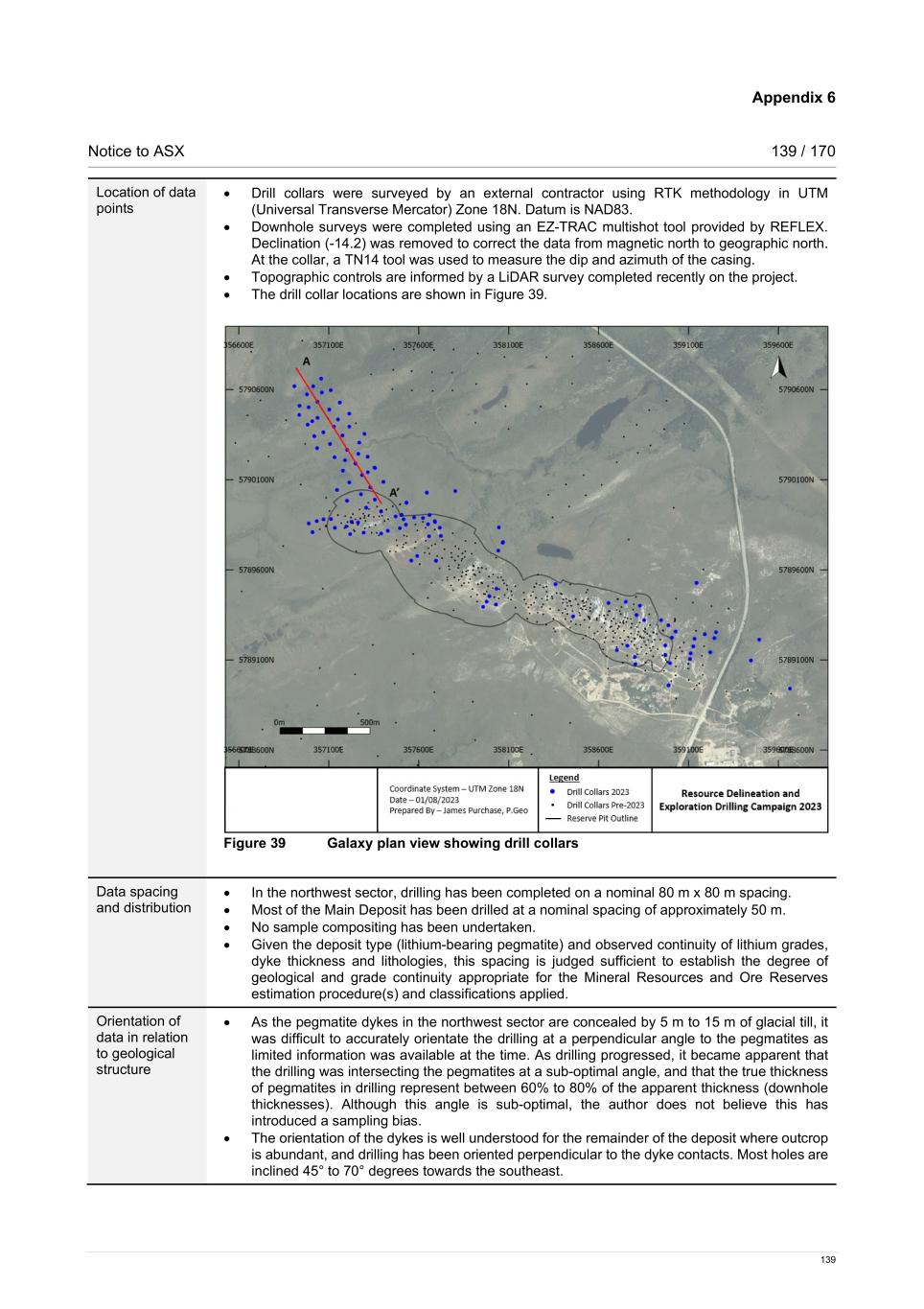
Appendix 6 Notice to ASX 139 / 170 139 Location of data points • Drill collars were surveyed by an external contractor using RTK methodology in UTM (Universal Transverse Mercator) Zone 18N. Datum is NAD83. • Downhole surveys were completed using an EZ-TRAC multishot tool provided by REFLEX. Declination (-14.2) was removed to correct the data from magnetic north to geographic north. At the collar, a TN14 tool was used to measure the dip and azimuth of the casing. • Topographic controls are informed by a LiDAR survey completed recently on the project. • The drill collar locations are shown in Figure 39. Figure 39 Galaxy plan view showing drill collars Data spacing and distribution • In the northwest sector, drilling has been completed on a nominal 80 m x 80 m spacing. • Most of the Main Deposit has been drilled at a nominal spacing of approximately 50 m. • No sample compositing has been undertaken. • Given the deposit type (lithium-bearing pegmatite) and observed continuity of lithium grades, dyke thickness and lithologies, this spacing is judged sufficient to establish the degree of geological and grade continuity appropriate for the Mineral Resources and Ore Reserves estimation procedure(s) and classifications applied. Orientation of data in relation to geological structure • As the pegmatite dykes in the northwest sector are concealed by 5 m to 15 m of glacial till, it was difficult to accurately orientate the drilling at a perpendicular angle to the pegmatites as limited information was available at the time. As drilling progressed, it became apparent that the drilling was intersecting the pegmatites at a sub-optimal angle, and that the true thickness of pegmatites in drilling represent between 60% to 80% of the apparent thickness (downhole thicknesses). Although this angle is sub-optimal, the author does not believe this has introduced a sampling bias. • The orientation of the dykes is well understood for the remainder of the deposit where outcrop is abundant, and drilling has been oriented perpendicular to the dyke contacts. Most holes are inclined 45° to 70° degrees towards the southeast.
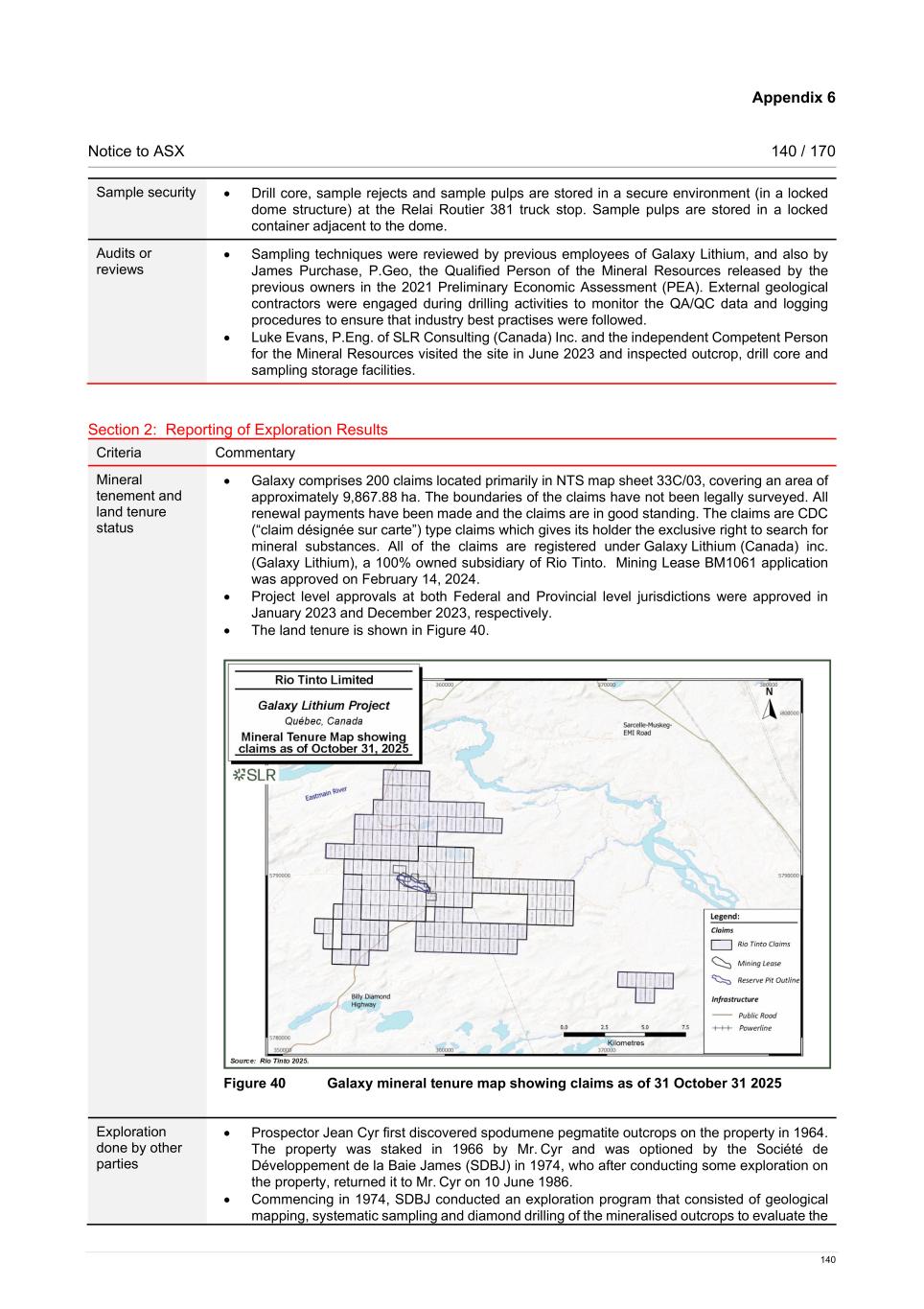
Appendix 6 Notice to ASX 140 / 170 140 Sample security • Drill core, sample rejects and sample pulps are stored in a secure environment (in a locked dome structure) at the Relai Routier 381 truck stop. Sample pulps are stored in a locked container adjacent to the dome. Audits or reviews • Sampling techniques were reviewed by previous employees of Galaxy Lithium, and also by James Purchase, P.Geo, the Qualified Person of the Mineral Resources released by the previous owners in the 2021 Preliminary Economic Assessment (PEA). External geological contractors were engaged during drilling activities to monitor the QA/QC data and logging procedures to ensure that industry best practises were followed. • Luke Evans, P.Eng. of SLR Consulting (Canada) Inc. and the independent Competent Person for the Mineral Resources visited the site in June 2023 and inspected outcrop, drill core and sampling storage facilities. Section 2: Reporting of Exploration Results Criteria Commentary Mineral tenement and land tenure status • Galaxy comprises 200 claims located primarily in NTS map sheet 33C/03, covering an area of approximately 9,867.88 ha. The boundaries of the claims have not been legally surveyed. All renewal payments have been made and the claims are in good standing. The claims are CDC (“claim désignée sur carte”) type claims which gives its holder the exclusive right to search for mineral substances. All of the claims are registered under Galaxy Lithium (Canada) inc. (Galaxy Lithium), a 100% owned subsidiary of Rio Tinto. Mining Lease BM1061 application was approved on February 14, 2024. • Project level approvals at both Federal and Provincial level jurisdictions were approved in January 2023 and December 2023, respectively. • The land tenure is shown in Figure 40. Figure 40 Galaxy mineral tenure map showing claims as of 31 October 31 2025 Exploration done by other parties • Prospector Jean Cyr first discovered spodumene pegmatite outcrops on the property in 1964. The property was staked in 1966 by Mr. Cyr and was optioned by the Société de Développement de la Baie James (SDBJ) in 1974, who after conducting some exploration on the property, returned it to Mr. Cyr on 10 June 1986. • Commencing in 1974, SDBJ conducted an exploration program that consisted of geological mapping, systematic sampling and diamond drilling of the mineralised outcrops to evaluate the
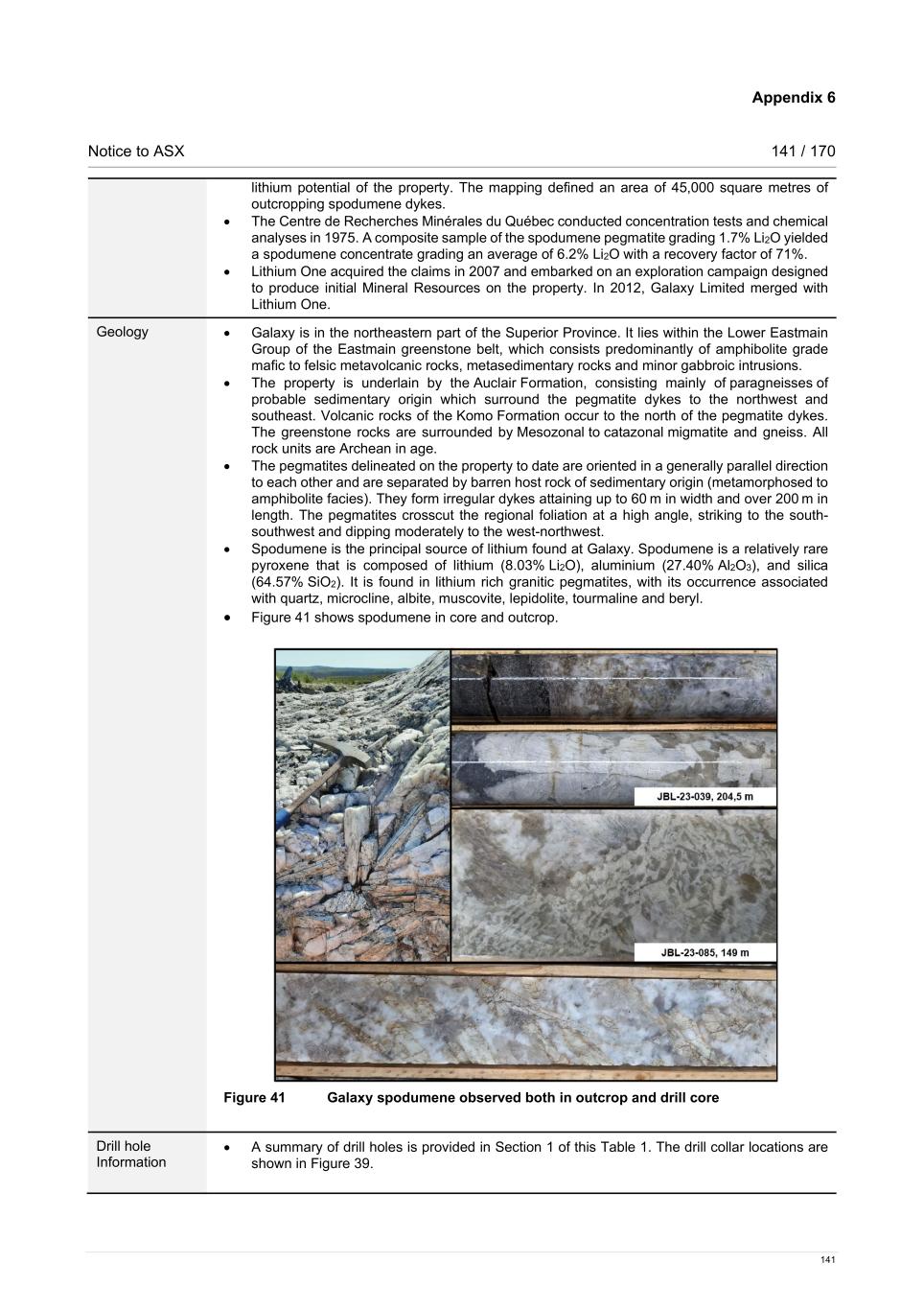
Appendix 6 Notice to ASX 141 / 170 141 lithium potential of the property. The mapping defined an area of 45,000 square metres of outcropping spodumene dykes. • The Centre de Recherches Minérales du Québec conducted concentration tests and chemical analyses in 1975. A composite sample of the spodumene pegmatite grading 1.7% Li2O yielded a spodumene concentrate grading an average of 6.2% Li2O with a recovery factor of 71%. • Lithium One acquired the claims in 2007 and embarked on an exploration campaign designed to produce initial Mineral Resources on the property. In 2012, Galaxy Limited merged with Lithium One. Geology • Galaxy is in the northeastern part of the Superior Province. It lies within the Lower Eastmain Group of the Eastmain greenstone belt, which consists predominantly of amphibolite grade mafic to felsic metavolcanic rocks, metasedimentary rocks and minor gabbroic intrusions. • The property is underlain by the Auclair Formation, consisting mainly of paragneisses of probable sedimentary origin which surround the pegmatite dykes to the northwest and southeast. Volcanic rocks of the Komo Formation occur to the north of the pegmatite dykes. The greenstone rocks are surrounded by Mesozonal to catazonal migmatite and gneiss. All rock units are Archean in age. • The pegmatites delineated on the property to date are oriented in a generally parallel direction to each other and are separated by barren host rock of sedimentary origin (metamorphosed to amphibolite facies). They form irregular dykes attaining up to 60 m in width and over 200 m in length. The pegmatites crosscut the regional foliation at a high angle, striking to the south- southwest and dipping moderately to the west-northwest. • Spodumene is the principal source of lithium found at Galaxy. Spodumene is a relatively rare pyroxene that is composed of lithium (8.03% Li2O), aluminium (27.40% Al2O3), and silica (64.57% SiO2). It is found in lithium rich granitic pegmatites, with its occurrence associated with quartz, microcline, albite, muscovite, lepidolite, tourmaline and beryl. • Figure 41 shows spodumene in core and outcrop. Figure 41 Galaxy spodumene observed both in outcrop and drill core Drill hole Information • A summary of drill holes is provided in Section 1 of this Table 1. The drill collar locations are shown in Figure 39.
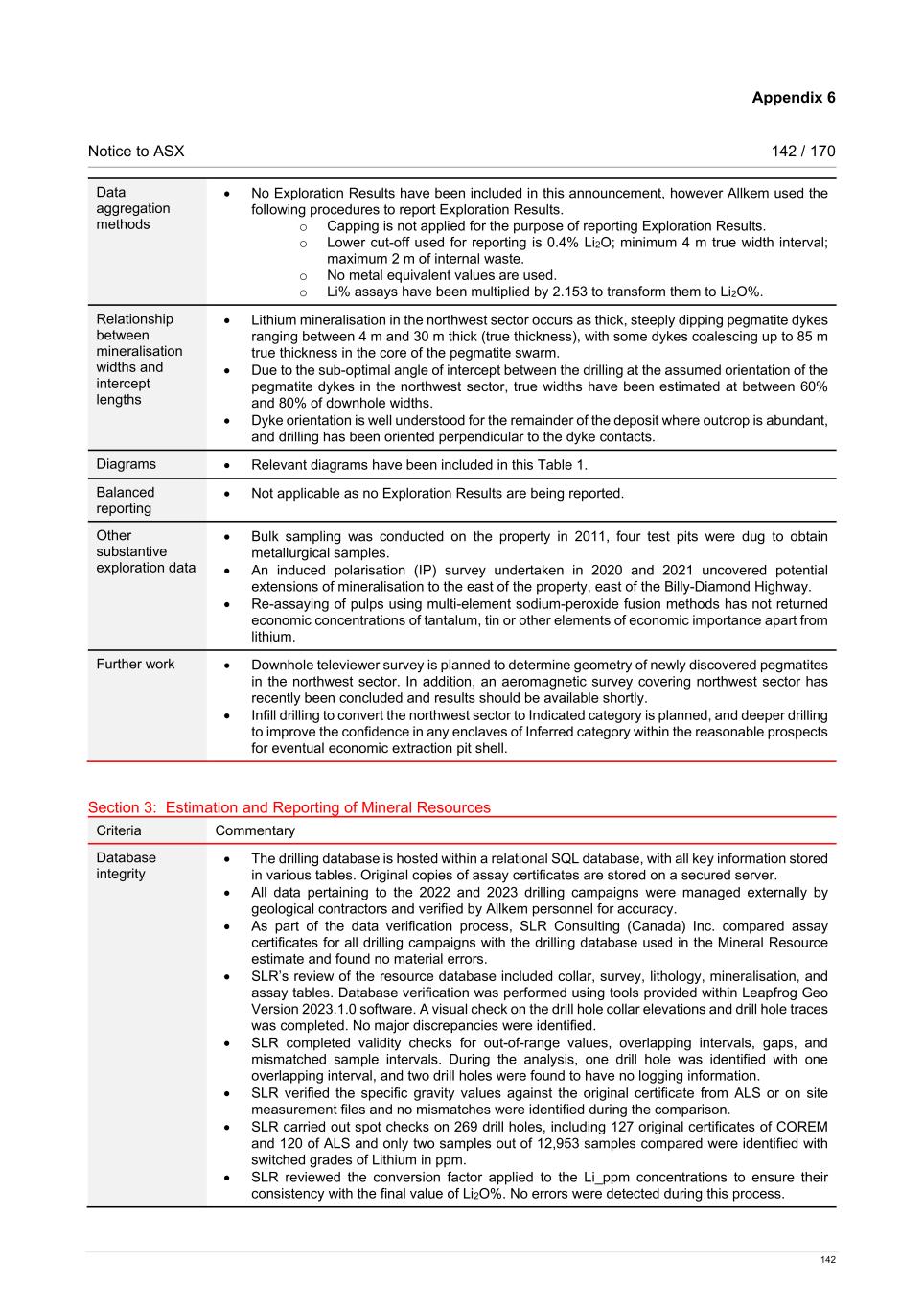
Appendix 6 Notice to ASX 142 / 170 142 Data aggregation methods • No Exploration Results have been included in this announcement, however Allkem used the following procedures to report Exploration Results. o Capping is not applied for the purpose of reporting Exploration Results. o Lower cut-off used for reporting is 0.4% Li2O; minimum 4 m true width interval; maximum 2 m of internal waste. o No metal equivalent values are used. o Li% assays have been multiplied by 2.153 to transform them to Li2O%. Relationship between mineralisation widths and intercept lengths • Lithium mineralisation in the northwest sector occurs as thick, steeply dipping pegmatite dykes ranging between 4 m and 30 m thick (true thickness), with some dykes coalescing up to 85 m true thickness in the core of the pegmatite swarm. • Due to the sub-optimal angle of intercept between the drilling at the assumed orientation of the pegmatite dykes in the northwest sector, true widths have been estimated at between 60% and 80% of downhole widths. • Dyke orientation is well understood for the remainder of the deposit where outcrop is abundant, and drilling has been oriented perpendicular to the dyke contacts. Diagrams • Relevant diagrams have been included in this Table 1. Balanced reporting • Not applicable as no Exploration Results are being reported. Other substantive exploration data • Bulk sampling was conducted on the property in 2011, four test pits were dug to obtain metallurgical samples. • An induced polarisation (IP) survey undertaken in 2020 and 2021 uncovered potential extensions of mineralisation to the east of the property, east of the Billy-Diamond Highway. • Re-assaying of pulps using multi-element sodium-peroxide fusion methods has not returned economic concentrations of tantalum, tin or other elements of economic importance apart from lithium. Further work • Downhole televiewer survey is planned to determine geometry of newly discovered pegmatites in the northwest sector. In addition, an aeromagnetic survey covering northwest sector has recently been concluded and results should be available shortly. • Infill drilling to convert the northwest sector to Indicated category is planned, and deeper drilling to improve the confidence in any enclaves of Inferred category within the reasonable prospects for eventual economic extraction pit shell. Section 3: Estimation and Reporting of Mineral Resources Criteria Commentary Database integrity • The drilling database is hosted within a relational SQL database, with all key information stored in various tables. Original copies of assay certificates are stored on a secured server. • All data pertaining to the 2022 and 2023 drilling campaigns were managed externally by geological contractors and verified by Allkem personnel for accuracy. • As part of the data verification process, SLR Consulting (Canada) Inc. compared assay certificates for all drilling campaigns with the drilling database used in the Mineral Resource estimate and found no material errors. • SLR’s review of the resource database included collar, survey, lithology, mineralisation, and assay tables. Database verification was performed using tools provided within Leapfrog Geo Version 2023.1.0 software. A visual check on the drill hole collar elevations and drill hole traces was completed. No major discrepancies were identified. • SLR completed validity checks for out-of-range values, overlapping intervals, gaps, and mismatched sample intervals. During the analysis, one drill hole was identified with one overlapping interval, and two drill holes were found to have no logging information. • SLR verified the specific gravity values against the original certificate from ALS or on site measurement files and no mismatches were identified during the comparison. • SLR carried out spot checks on 269 drill holes, including 127 original certificates of COREM and 120 of ALS and only two samples out of 12,953 samples compared were identified with switched grades of Lithium in ppm. • SLR reviewed the conversion factor applied to the Li_ppm concentrations to ensure their consistency with the final value of Li2O%. No errors were detected during this process.
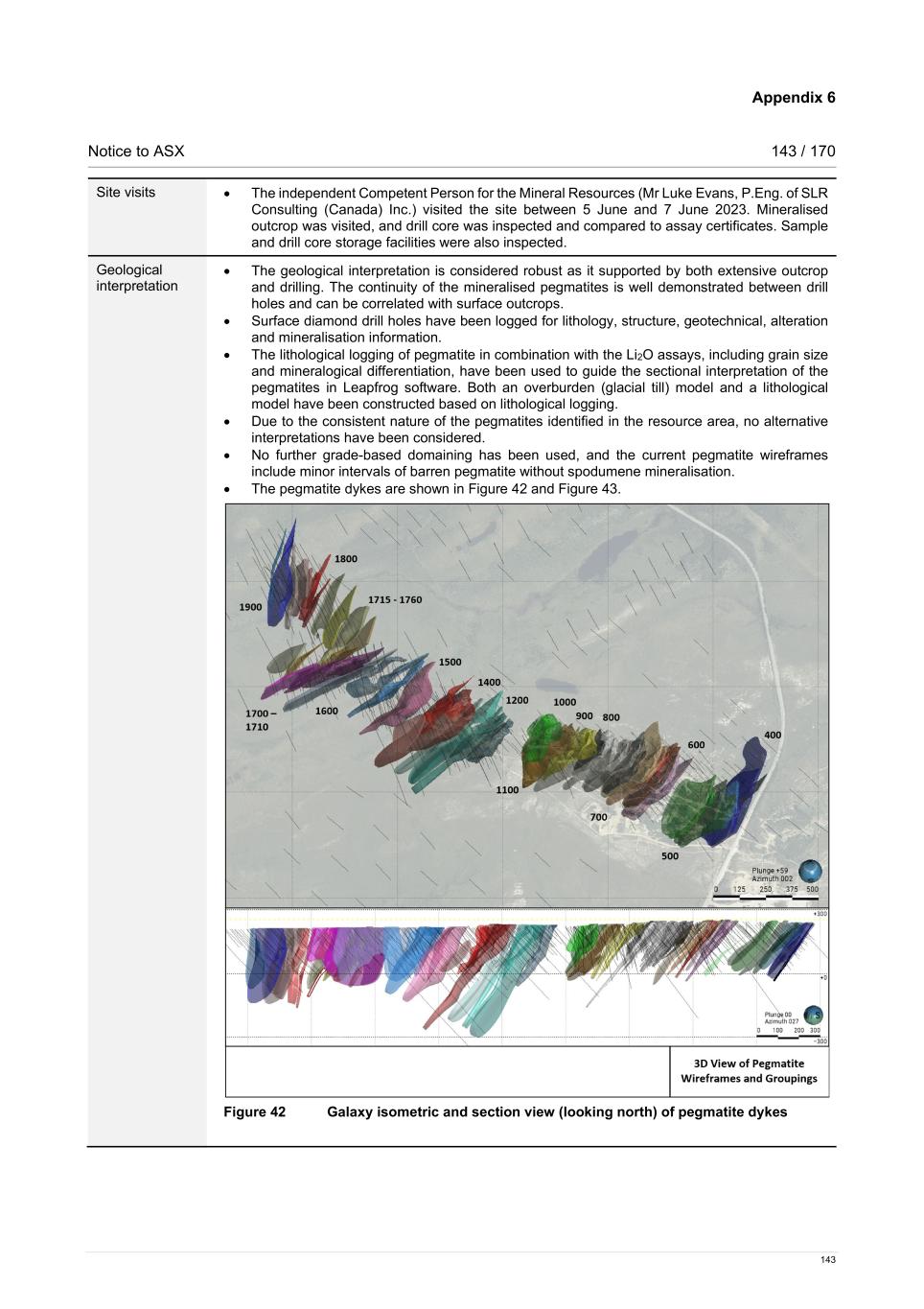
Appendix 6 Notice to ASX 143 / 170 143 Site visits • The independent Competent Person for the Mineral Resources (Mr Luke Evans, P.Eng. of SLR Consulting (Canada) Inc.) visited the site between 5 June and 7 June 2023. Mineralised outcrop was visited, and drill core was inspected and compared to assay certificates. Sample and drill core storage facilities were also inspected. Geological interpretation • The geological interpretation is considered robust as it supported by both extensive outcrop and drilling. The continuity of the mineralised pegmatites is well demonstrated between drill holes and can be correlated with surface outcrops. • Surface diamond drill holes have been logged for lithology, structure, geotechnical, alteration and mineralisation information. • The lithological logging of pegmatite in combination with the Li2O assays, including grain size and mineralogical differentiation, have been used to guide the sectional interpretation of the pegmatites in Leapfrog software. Both an overburden (glacial till) model and a lithological model have been constructed based on lithological logging. • Due to the consistent nature of the pegmatites identified in the resource area, no alternative interpretations have been considered. • No further grade-based domaining has been used, and the current pegmatite wireframes include minor intervals of barren pegmatite without spodumene mineralisation. • The pegmatite dykes are shown in Figure 42 and Figure 43. Figure 42 Galaxy isometric and section view (looking north) of pegmatite dykes
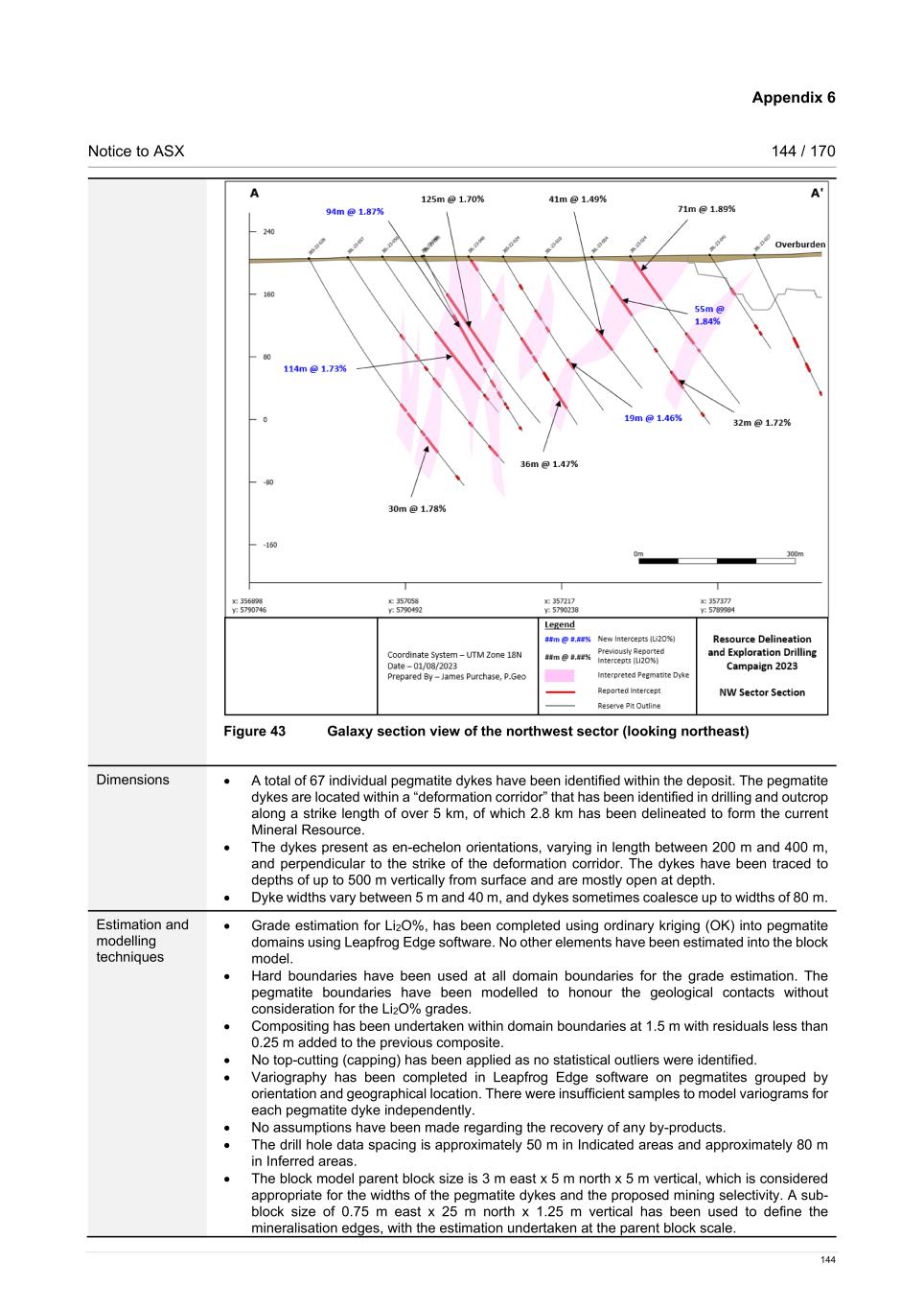
Appendix 6 Notice to ASX 144 / 170 144 Figure 43 Galaxy section view of the northwest sector (looking northeast) Dimensions • A total of 67 individual pegmatite dykes have been identified within the deposit. The pegmatite dykes are located within a “deformation corridor” that has been identified in drilling and outcrop along a strike length of over 5 km, of which 2.8 km has been delineated to form the current Mineral Resource. • The dykes present as en-echelon orientations, varying in length between 200 m and 400 m, and perpendicular to the strike of the deformation corridor. The dykes have been traced to depths of up to 500 m vertically from surface and are mostly open at depth. • Dyke widths vary between 5 m and 40 m, and dykes sometimes coalesce up to widths of 80 m. Estimation and modelling techniques • Grade estimation for Li2O%, has been completed using ordinary kriging (OK) into pegmatite domains using Leapfrog Edge software. No other elements have been estimated into the block model. • Hard boundaries have been used at all domain boundaries for the grade estimation. The pegmatite boundaries have been modelled to honour the geological contacts without consideration for the Li2O% grades. • Compositing has been undertaken within domain boundaries at 1.5 m with residuals less than 0.25 m added to the previous composite. • No top-cutting (capping) has been applied as no statistical outliers were identified. • Variography has been completed in Leapfrog Edge software on pegmatites grouped by orientation and geographical location. There were insufficient samples to model variograms for each pegmatite dyke independently. • No assumptions have been made regarding the recovery of any by-products. • The drill hole data spacing is approximately 50 m in Indicated areas and approximately 80 m in Inferred areas. • The block model parent block size is 3 m east x 5 m north x 5 m vertical, which is considered appropriate for the widths of the pegmatite dykes and the proposed mining selectivity. A sub- block size of 0.75 m east x 25 m north x 1.25 m vertical has been used to define the mineralisation edges, with the estimation undertaken at the parent block scale.

Appendix 6 Notice to ASX 145 / 170 145 • Pass 1 estimations have been undertaken using a minimum of 4 and a maximum of 12 samples into a search ellipse set at approximately half of the variogram range. A 3 sample per drill hole limit has been applied in all pegmatite domains. • Pass 2 estimations have been undertaken using a minimum of 4 and a maximum of 12 samples into a search ellipse set at approximately 80% of the variogram range. A 3 sample per drill hole limit has been applied in all pegmatite domains. • Pass 3 and Pass 4 estimations have been undertaken using a minimum of 1 and a maximum of 12 samples into a search ellipse set at 120% to 200% the variogram range, respectively. A 3 sample per drill hole limit has been applied in all pegmatite domains. • The Mineral Resources estimate has been validated using visual validation tools combined with volume comparisons with the input wireframes, mean grade comparisons between the block model and composite grade means and swath plots comparing the composite grades and block model grades by northing, easting and elevation. In addition, the ordinary kriged grade estimate was compared with ID2 (inverse distance squared) and NN (nearest neighbour) interpolation methods. • The validation results confirmed that the resource block model is a reasonable reflection of the input data and is suitable for reporting Mineral Resources. • No correlation between variables has been assumed. • The block model grades are shown in Figure 44.
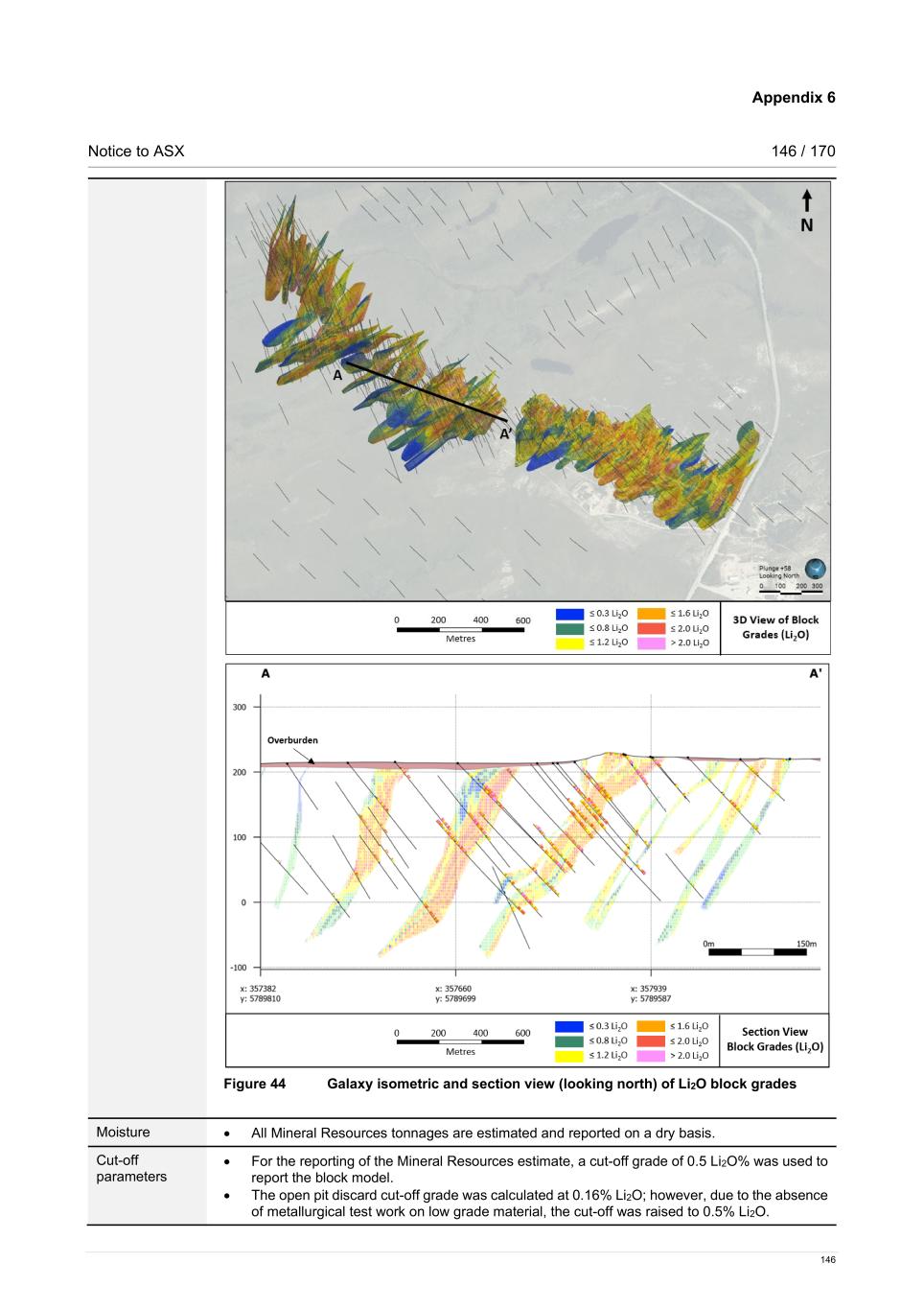
Appendix 6 Notice to ASX 146 / 170 146 Figure 44 Galaxy isometric and section view (looking north) of Li2O block grades Moisture • All Mineral Resources tonnages are estimated and reported on a dry basis. Cut-off parameters • For the reporting of the Mineral Resources estimate, a cut-off grade of 0.5 Li2O% was used to report the block model. • The open pit discard cut-off grade was calculated at 0.16% Li2O; however, due to the absence of metallurgical test work on low grade material, the cut-off was raised to 0.5% Li2O.
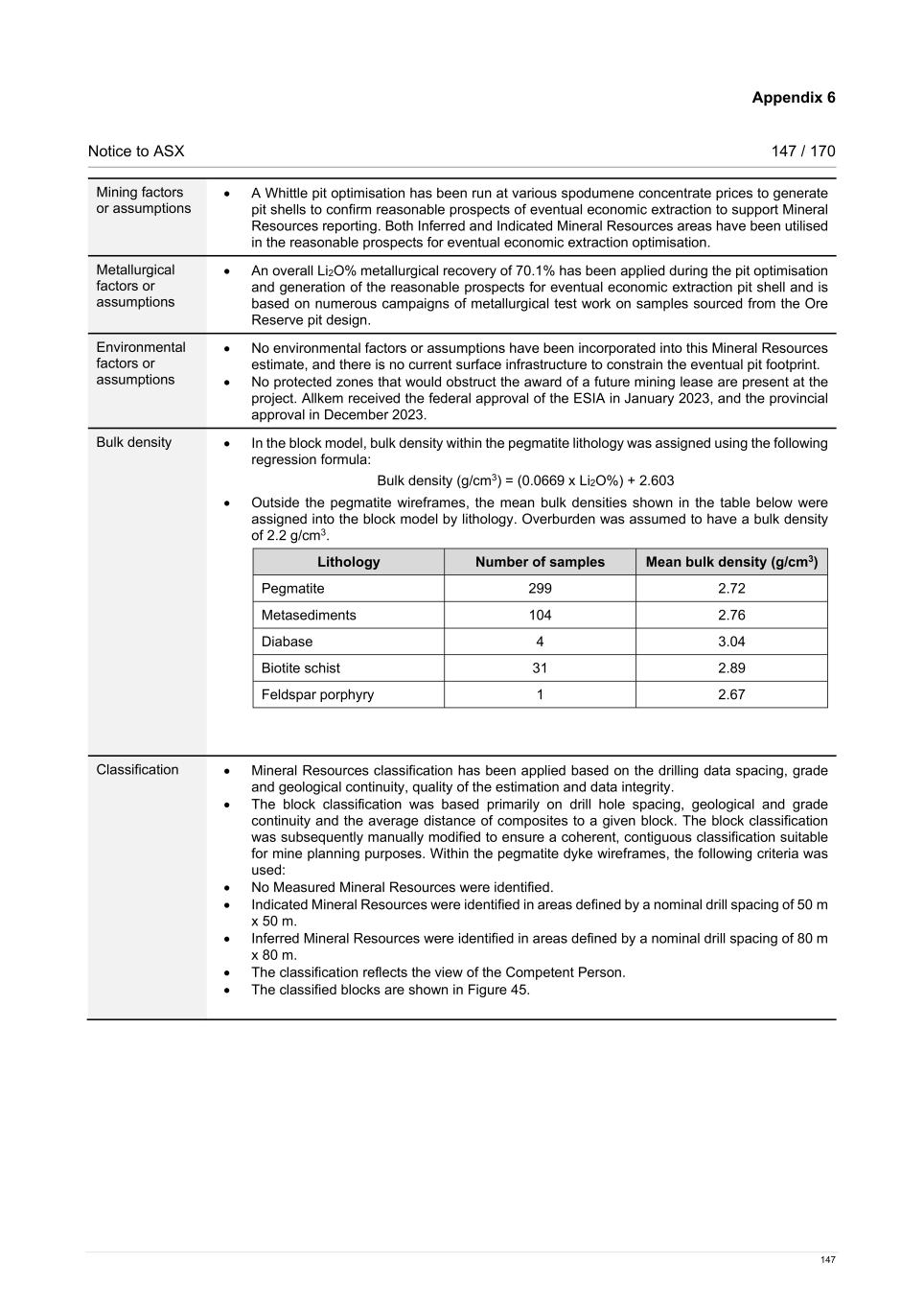
Appendix 6 Notice to ASX 147 / 170 147 Mining factors or assumptions • A Whittle pit optimisation has been run at various spodumene concentrate prices to generate pit shells to confirm reasonable prospects of eventual economic extraction to support Mineral Resources reporting. Both Inferred and Indicated Mineral Resources areas have been utilised in the reasonable prospects for eventual economic extraction optimisation. Metallurgical factors or assumptions • An overall Li2O% metallurgical recovery of 70.1% has been applied during the pit optimisation and generation of the reasonable prospects for eventual economic extraction pit shell and is based on numerous campaigns of metallurgical test work on samples sourced from the Ore Reserve pit design. Environmental factors or assumptions • No environmental factors or assumptions have been incorporated into this Mineral Resources estimate, and there is no current surface infrastructure to constrain the eventual pit footprint. • No protected zones that would obstruct the award of a future mining lease are present at the project. Allkem received the federal approval of the ESIA in January 2023, and the provincial approval in December 2023. Bulk density • In the block model, bulk density within the pegmatite lithology was assigned using the following regression formula: Bulk density (g/cm3) = (0.0669 x Li2O%) + 2.603 • Outside the pegmatite wireframes, the mean bulk densities shown in the table below were assigned into the block model by lithology. Overburden was assumed to have a bulk density of 2.2 g/cm3. Lithology Number of samples Mean bulk density (g/cm3) Pegmatite 299 2.72 Metasediments 104 2.76 Diabase 4 3.04 Biotite schist 31 2.89 Feldspar porphyry 1 2.67 Classification • Mineral Resources classification has been applied based on the drilling data spacing, grade and geological continuity, quality of the estimation and data integrity. • The block classification was based primarily on drill hole spacing, geological and grade continuity and the average distance of composites to a given block. The block classification was subsequently manually modified to ensure a coherent, contiguous classification suitable for mine planning purposes. Within the pegmatite dyke wireframes, the following criteria was used: • No Measured Mineral Resources were identified. • Indicated Mineral Resources were identified in areas defined by a nominal drill spacing of 50 m x 50 m. • Inferred Mineral Resources were identified in areas defined by a nominal drill spacing of 80 m x 80 m. • The classification reflects the view of the Competent Person. • The classified blocks are shown in Figure 45.
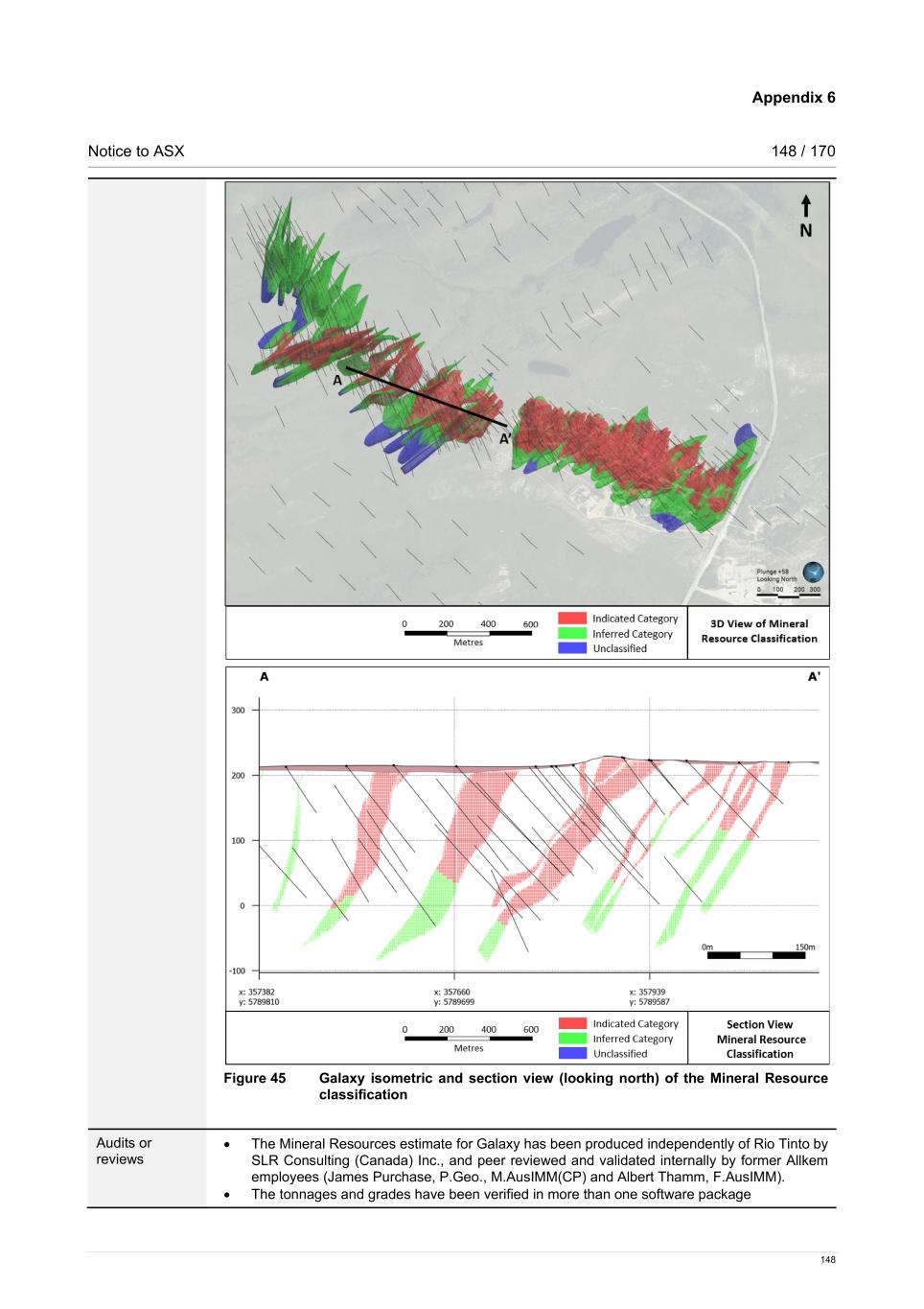
Appendix 6 Notice to ASX 148 / 170 148 Figure 45 Galaxy isometric and section view (looking north) of the Mineral Resource classification Audits or reviews • The Mineral Resources estimate for Galaxy has been produced independently of Rio Tinto by SLR Consulting (Canada) Inc., and peer reviewed and validated internally by former Allkem employees (James Purchase, P.Geo., M.AusIMM(CP) and Albert Thamm, F.AusIMM). • The tonnages and grades have been verified in more than one software package
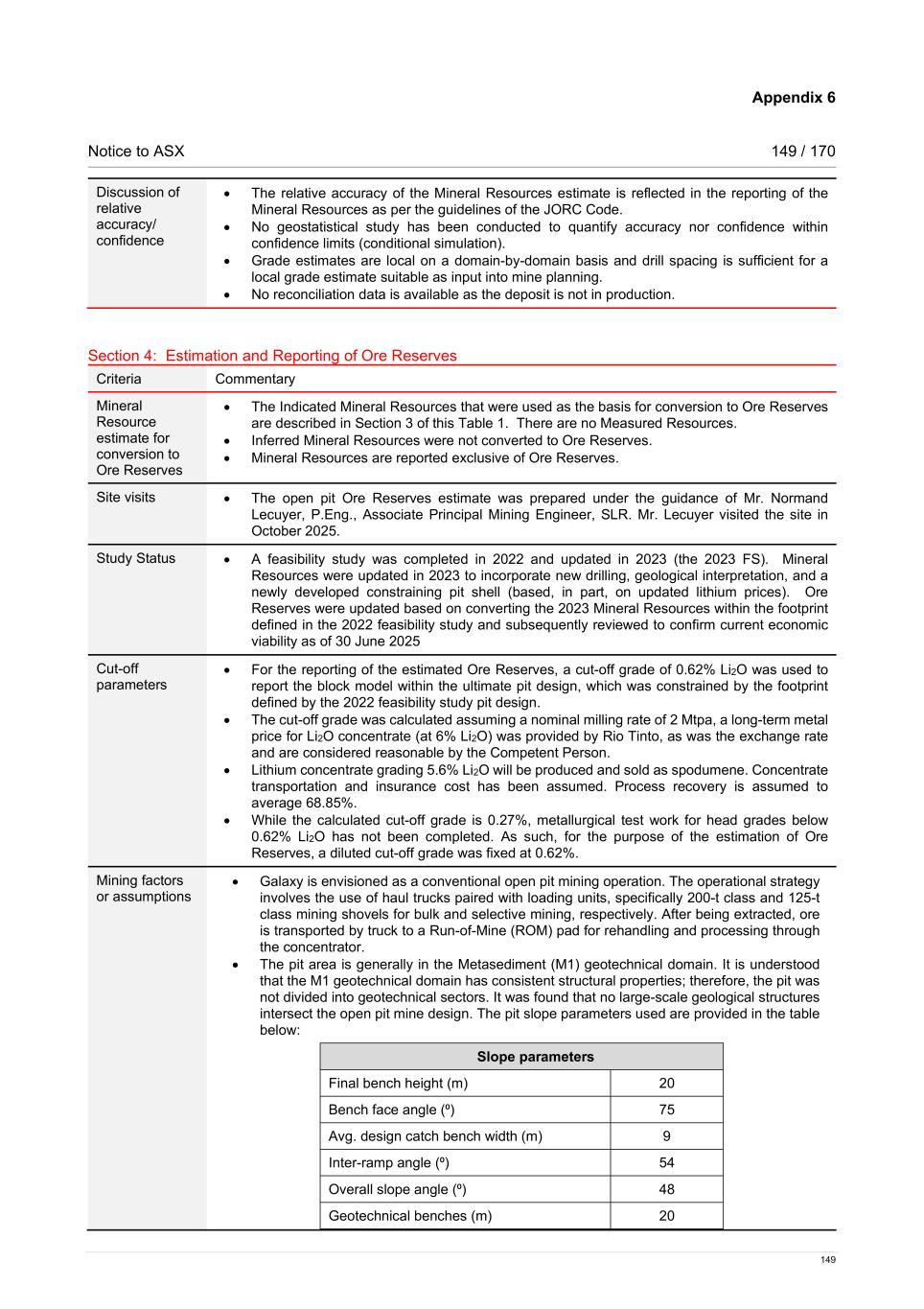
Appendix 6 Notice to ASX 149 / 170 149 Discussion of relative accuracy/ confidence • The relative accuracy of the Mineral Resources estimate is reflected in the reporting of the Mineral Resources as per the guidelines of the JORC Code. • No geostatistical study has been conducted to quantify accuracy nor confidence within confidence limits (conditional simulation). • Grade estimates are local on a domain-by-domain basis and drill spacing is sufficient for a local grade estimate suitable as input into mine planning. • No reconciliation data is available as the deposit is not in production. Section 4: Estimation and Reporting of Ore Reserves Criteria Commentary Mineral Resource estimate for conversion to Ore Reserves • The Indicated Mineral Resources that were used as the basis for conversion to Ore Reserves are described in Section 3 of this Table 1. There are no Measured Resources. • Inferred Mineral Resources were not converted to Ore Reserves. • Mineral Resources are reported exclusive of Ore Reserves. Site visits • The open pit Ore Reserves estimate was prepared under the guidance of Mr. Normand Lecuyer, P.Eng., Associate Principal Mining Engineer, SLR. Mr. Lecuyer visited the site in October 2025. Study Status • A feasibility study was completed in 2022 and updated in 2023 (the 2023 FS). Mineral Resources were updated in 2023 to incorporate new drilling, geological interpretation, and a newly developed constraining pit shell (based, in part, on updated lithium prices). Ore Reserves were updated based on converting the 2023 Mineral Resources within the footprint defined in the 2022 feasibility study and subsequently reviewed to confirm current economic viability as of 30 June 2025 Cut-off parameters • For the reporting of the estimated Ore Reserves, a cut-off grade of 0.62% Li2O was used to report the block model within the ultimate pit design, which was constrained by the footprint defined by the 2022 feasibility study pit design. • The cut-off grade was calculated assuming a nominal milling rate of 2 Mtpa, a long-term metal price for Li2O concentrate (at 6% Li2O) was provided by Rio Tinto, as was the exchange rate and are considered reasonable by the Competent Person. • Lithium concentrate grading 5.6% Li2O will be produced and sold as spodumene. Concentrate transportation and insurance cost has been assumed. Process recovery is assumed to average 68.85%. • While the calculated cut-off grade is 0.27%, metallurgical test work for head grades below 0.62% Li2O has not been completed. As such, for the purpose of the estimation of Ore Reserves, a diluted cut-off grade was fixed at 0.62%. Mining factors or assumptions • Galaxy is envisioned as a conventional open pit mining operation. The operational strategy involves the use of haul trucks paired with loading units, specifically 200-t class and 125-t class mining shovels for bulk and selective mining, respectively. After being extracted, ore is transported by truck to a Run-of-Mine (ROM) pad for rehandling and processing through the concentrator. • The pit area is generally in the Metasediment (M1) geotechnical domain. It is understood that the M1 geotechnical domain has consistent structural properties; therefore, the pit was not divided into geotechnical sectors. It was found that no large-scale geological structures intersect the open pit mine design. The pit slope parameters used are provided in the table below: Slope parameters Final bench height (m) 20 Bench face angle (⁰) 75 Avg. design catch bench width (m) 9 Inter-ramp angle (⁰) 54 Overall slope angle (⁰) 48 Geotechnical benches (m) 20

Appendix 6 Notice to ASX 150 / 170 150 • The overburden is considered as a separate geotechnical domain, and the pit design uses a slope of 2H:1V with benches at both height and width of 10 m. • The Ore Reserves bock model used for open pit mining is a regularised block model that was developed by SLR in Deswik from the Mineral Resources model. • A spatial calculation was conducted within the Ore Reserves block model to assess dilution and mine loss. Each block was categorised as either ore or waste, followed by an analysis of adjacent blocks based on their categorisation. In cases where an ore block was surrounded by waste blocks, the model designated a mine loss flag. Similarly, if a waste block had ore partially adjoining it, the model marked it with an external dilution flag. Complete encirclement of a waste block by ore resulted in the assignment of an internal dilution flag. • Given the rectangular configuration of each block in the Ore Reserves block model, considering the entire block for external dilution blocks would lead to an overestimation. To ensure accurate representation and a more realistic depiction of the peripheral influence along the blocky edges of the ore deposit, external dilution values were halved. The total ore tonnage before dilution and ore loss is estimated at 34.5 Mt at an average grade of 1.35 % Li2O. Isolated ore blocks are treated as an ore loss and represent 160 kt, less than 0.5% of total ore tonnage. The dilution around the remaining ore blocks results in a dilution tonnage of 3.0 Mt. The dilution tonnage represents 8.7% of the ore tonnage before dilution and the dilution grade is estimated from the block model and corresponds to a grade of 0.42% Li2O. • The pit phasing has been designed to efficiently manage mining three distinct mining areas: JB1, JB2, and JB3. Each interim phased pit requires a minimum mining width of 60 m to ensure sufficient room for the movement of mining equipment; the final phase (or the final push back to the ultimate pit wall) requires a 70 m minimum mining width. Stripping is minimised by using 10 m box cuts at the bottom of each phase. • Most phases include both single and dual lane ramps, measuring 19 m and 25 m in width, respectively. The ramp widths are designed to meet or exceed two times the width of the largest expected vehicle for single lane traffic and 3.5 times for dual lane ramps. The bottom 40 m of each phase employs single lane ramps to minimise stripping requirements. This phased pit design allows for individualised access within the three mining areas. • Inferred Mineral Resources were neither converted to Ore Reserves nor used in the pit optimisations used to guide mine planning. • Metallurgical factors or assumptions • Ore will be crushed prior to processing via dense medium separation (DMS), producing a concentrate grade of 5.6% Li2O, achieving recoveries between 66.9% and 69.6% for the early years and mid to later years, respectively. • In general, the metallurgical samples are representative of the spodumene mineralisation. • In 2011, SGS Canada Inc. (SGS) carried out preliminary test work on a single sample weighing 14,690 kg. • In 2017, 41drill core samples totalling approximately 400 kg were submitted to Nagrom for Phase 1 metallurgical testing and these were initially prepared to produce four composites. • In 2018, the Nagrom Phase 2 test work included composites within the defined Early Years (EY), Mid Years (MY) and Later Years (LY) in the original mine plan. A total of 50 EY, 44 MY and 44 LY samples were submitted totalling 4,643 kg, 1,751 kg, and 1,760 kg, respectively. • No deleterious elements that could have a significant impact on potential eventual economic extraction have been identified. Environmental factors or assumptions • The federal environmental assessment process, under the Canadian Environmental Assessment Act (2012), was initiated in October 2017 and completed with the approval of the ESIA in January 2023. In parallel to the federal assessment process, the provincial environmental assessment process was initiated in October 2017. As part of the ESIA review by the Committee of the James Bay and Northern Québec Agreement (COMEX), several rounds of questions and comments were completed. Galaxy was approved by the provincial authorities in December 2023. Galaxy will be subjected to Section 22 of the EQA, pursuant to which an authorization is required for activities that may result in a change to the environment. Each activity such as earthworks in wetlands, mining, concentration, tailings management and water management may be subjected to different authorizations. Any application for an authorisation involving works in wetland will have to be accompanied by a compensation program. Such a program has been developed for the Project area. The nature of the program is to be determined by agreement between the proponents, the authorities, and the Cree Nation. • Waste rock and tailings from Galaxy will be deposited using a co-disposal method involving the mixing or layering of both materials so that they are placed at the same location. The slope

Appendix 6 Notice to ASX 151 / 170 151 geometry will consist of 10 m benches with a face slope of 2H:1V with 12 m berms. The stockpile will reach an elevation of 300 m, representing a height of approximately 100 m above the surrounding natural environment. • There are four waste rock and tailings storage facilities (WRTSFs), including in-pit dumping in the JB3 pit, that have been designed to fulfil Galaxy’s anticipated waste storage requirements. The designs consider the need to minimise haulage distances from the pits while also respecting distances from active roads and rivers. • Four main lithologies were targeted for the geochemical characterisation of waste rock: one pegmatite waste rock unit (I1G), gneiss (M1) and banded gneiss units (M2) and one unit of mafic volcanic rock (V3) which included the basalt unit (V3B). The economic material is associated with spodumene, which occurs in large crystals in pegmatite intrusions and is also part of unit I1G. A total of 81 samples were tested for static parameters, including modified acid base accounting (MABA), available metal content and Toxicity Characteristic Leachate Procedure leaching test was performed on all the samples for which the available metal content exceeded criteria “A” in the Guide d’intervention - Protection des sols et réhabilitation des terrains contaminés (Beaulieu, 2016) to determine the mobility of inorganic analytes. • The results of the static MABA testing indicated a total sulphur concentration of less than 0.3% for all the waste rock samples of units I1G and V3B, therefore a non-PAG classification is applicable under D019. However, 30% of the samples of unit M1 and 50% of the samples of unit M2 are classified as potentially acid generating (PAG) under D019, and waste rock of these lithologies is therefore considered PAG. The leachable species identified in the testing include As, Ag, Ba, Cd, Cu, Mn, Ni, Pb, Zn. The results of these analyses show that all the waste rock is not considered high risk under the D019, however, the waste rock is leachable under this same directive according to the toxicity characteristic leaching procedure (TCLP), synthetic precipitation leaching procedure (SPLP), and CTEU-9 results. • Kinetic testing has been performed on a representative mix of waste rock which will be stored in the WRTSF. Two columns of waste rock (waste rock saturated and waste rock with dry cycles) were tested prior to the static testing. The columns are classified non-PAG but leachable for Ag, As, Ba, Cu, Mn, Hg, Pb and Zn. Metal leaching occurred only in the short- term (up to 14 weeks in the testing period) and metals concentrations decreased/stabilised in the long-term. MABA static tests were performed on 12 tailings samples, and total sulphur concentrations were less than 0.3% in all. All samples are therefore classified as non-PAG under D019. • Twelve tailings samples were analysed for total metal content, and all exceeded at least one of criteria “A” in the ‘Guide d’intervention’. A leaching test was therefore performed on the 12 samples to determine the mobility of inorganic analytes. The results showed that none of the criteria in Directive 019 were exceeded; the risk of the analysed tailings is therefore not classified as high risk. However, all the samples analysed showed exceedances of the Règlement sur l’enfouissement des sols contaminés (RESC) criteria in the Guide d’intervention – Protection des sols et réhabilitation des terrains contaminés (Beaulieu 2016) for Cd, Cu, Mn, and Zn. One sample (8% of the total samples) also exceeded the RESC criterion for mercury. • Therefore, according to applicable regulations, the tailings which will be generated on the site would be considered non-PAG, not as high risk under Directive 019, and leachable for Cd, Cu, Mn, Hg, and Zn. • Kinetic testing has been performed on a representative mix of tailings which will be stored in the WRTSF. One column of tailings (Tailings with dry and saturated cycles) was tested prior to the static testing. The column is classified Non-PAG but leachable for Ag, As, Ba, Cu, Mn, Hg, Pb, and Zn. Metal leaching occurred only in the short-term (up to 14 weeks in the testing period) and metals concentrations decreased/stabilised in the long-term. It is concluded that, in general, the chances of PAG development within the WRTSF (i.e., waste rock and tailings) is very low. Contact water (i.e., runoff) from the WRTSF will be collected in perimeter collection ditches and water management ponds (WMPs). It is anticipated that water treatment will be required to discharge collected contact water from the North WMP. Infrastructure • Mining Lease BM1061 application was approved on February 14, 2024. It will provide sufficient surface rights for the proposed infrastructure. • The paved Billy-Diamond highway passes adjacent to the Property, providing an all-weather, year-long access to the site. The road is managed and maintained by the Société de Développement de la Baie James (SDBJ). • The infrastructure requirements for Galaxy are extensive and designed to support a full-scale open-pit mining and spodumene concentrate production operation. Key infrastructure includes a 69 kV substation connected to Hydro-Québec’s grid, with backup diesel generators for peak demand and emergency power. On-site facilities will comprise a process plant with a three- stage crushing and DMS circuit, a truck maintenance shop, laboratory, administration building,

Appendix 6 Notice to ASX 152 / 170 152 and emergency services. Accommodation for personnel includes a camp with kitchen, recreation centre, potable water treatment, and sewage systems. Storage and handling infrastructure includes fuel and propane distribution facilities, explosives storage, and dome- covered stockpiles for crushed ore and spodumene concentrate. Waste management will be handled through four WRTSFs, coarse and fine tailings bins, and an Overburden and Peat Storage Facility (OPSF). Water management infrastructure includes the North and East WMPs, designed to meet stringent flood and environmental criteria. Communications, fire protection, and security systems are also planned to ensure safe and efficient operations. Fresh water will come from water wells located nearby and will be transported by above ground heat traced piping to the potable water treatment plant Costs • Operating and capital costs were developed during the FS study to +15%/-15% levels of accuracy. • Capital costs include all direct and indirect costs from detailed engineering to plant commissioning, including haul roads, mine facilities, explosives storage, processing plant, water management systems, and airport/power line upgrades. Capital costs were prepared by GMS, SLR, Wave, and WSP, with input from Octant and Hydro-Québec for infrastructure upgrades. • Operating costs are estimated from first principles for all mine activities and include equipment operations, processing plant operations, general services, transport costs and administration: • Equipment hours required to meet production needs of the life of mine plan are based on Deswik LHS simulations over the life of mine. The processing plant operating cost estimate includes mining, crushing, and DMS circuits, utilising budgetary quotations as available, supplemented by GMS database estimates, recent experience in the lithium industry, and Rio Tinto’s Mt Cattlin (Australia) facility. • General services cost include general management, accounting and finance, IT, environmental and social management, human resources, supply chain, camp, surface support, health and safety, security and operating cost of the various supply chain equipment. • Product transport cost was based upon updated budgetary proposals for the logistics chain to the port: i.e., product road transport via trucks from site to Matagami, transhipment at Matagami, rail transport to the port, port storage and handling. Rental of the train wagons and their covers are included in the product transport costs. The study is based on cost FOB Trois- Rivières or Quebec City. Ocean freight is excluded from the shipping cost. • Deleterious element allowance (penalty per ton of concentrate for every 0.1% Li₂O below the 6.0% specification) was applied based on anticipated product grade penalties for under- specification derived from market study by Wood Mackenzie. • There are two royalties that cover the northernmost portion of the pit footprint. A total net smelter return (NSR) royalty of 0.32% is assumed for pit optimisation and economic modelling. This includes: o 0.5% NSR held by Ridgeline Royalties Inc. o 1.5% NSR held by Lithium Royalty Corp., with a 0.5% buyback option for CAD 500,000. • Government royalties are included in the general and administration in operating cost estimates. • Exchange rates are based on internal Rio Tinto modelling of expected future country exchange rates. Revenue factors • The average plant head grade is assumed to be 1.27% Li2O over the life of mine. This is based on the block model and Mineral Resources estimation, inclusive of mining dilution and ore loss. • Commodity prices are based on internal Rio Tinto modelling of the future supply and demand balance for lithium. This includes the penalty adjustments for quality. • Appropriate royalties are included in the financial modelling. • Exchange rates are based on internal Rio Tinto modelling of expected future country exchange rates. • The project is most sensitive to changes in head grade, followed by spodumene price and recovery. Operating costs and initial CAPEX have a lesser impact on NPV. Market Assessment • The global lithium market is projected to grow at 14% per annum from 2025 to 2030, reaching approximately 2.7 Mt of LCE. This growth is primarily driven by the increasing production of lithium-ion batteries to meet surging demand for electric vehicles and battery energy storage systems. • In terms of the sales portfolio, Galaxy produces spodumene. At present, most refineries that convert spodumene to either lithium hydroxide or carbonate are based in China, but the project pipeline in the West is gradually expanding (including at Becancour) due to the push for

Appendix 6 Notice to ASX 153 / 170 153 localised supply chains. Compared to ‘mature’ commodities such as copper and aluminium (with forecast demand growth of ~1% to 3% over the longer term), lithium is still very much in its infancy in terms of product volume and price transparency. The projected demand growth and price forecasts for lithium products could significantly deviate from current forecasts depending on market developments on EV policies, energy storage systems demand, recycling growth and battery technology breakthroughs. Economic • Rio Tinto long-term prices have been used as the basis for the financial evaluation (NPV, IRR). The assumptions used in this economic analysis are macroeconomic, marketing, mine plan, operating costs, capital costs, closure costs, working capital and taxation. • Rio Tinto Economics supplies price and cost information on a real basis for use in NPV calculations. Rio Tinto specifies the discount rate to be used. Project NPVs are confidential information however, economic evaluation using Rio Tinto long-term prices demonstrates a positive NPV for the Galaxy Ore Reserves under a range of price, cost and productivity scenarios. Social • Galaxy Lithium established a stakeholder consultation and engagement process as part of its project acceptance activities, which allowed them to gather information, questions and expectations of local communities and stakeholders. Mitigation measures were proposed based on the consultation process. • Galaxy Lithium signed a Preliminary Development Agreement (PDA) with the Cree Nation of Eastmain, Grand Council of the Cree and Cree Nation Government dated March 15, 2019. This PDA is to be replaced by an Impact Benefit Agreement (IBA) before project construction. • Several monitoring committees will be established through the IBA. Also, as required under the Québec Mining Act (Section 101.0.3) (Chapter M13.1), a monitoring committee will be created prior to the mine’s construction and will remain active throughout its life, until the works provided for in the mining site rehabilitation and restoration plan are fully completed. These committees will foster the participation of the communities involved in the project’s execution. Other • No material risks have been identified by the previous risk analysis. Based on the work conducted to date, the Project team and the Competent Person are of the opinion that there is no reason on a risk basis that Galaxy should not progress to its next stage. • As of the effective date of the Ore Reserves, all claims were in good standing. • Rio Tinto has obtained all necessary permits and certifications from government agencies to allow exploration on the property. Classification • There are no Measured Mineral Resources; and as such only Probable Ore Reserves were estimated. No Inferred Mineral Resources were included in Ore Reserves. • The classification reflects the view of the Competent Person. Audits or reviews • The Ore Reserves estimate for Galaxy has been produced independently of Rio Tinto by SLR Consulting (Canada) Inc. Discussion of relative accuracy/ confidence • The relative accuracy of the Ore Reserves estimate is reflected in the classification of the Ore Reserves. • No geostatistical study has been conducted to quantify accuracy nor confidence within confidence limits (conditional simulation) • The Ore Reserves are representative of the economically extractable tonnage and grade of ore, factoring in considerations such as ore dilution and potential losses during mining or extraction. • Modifying factors, including but not limited to, mining, processing, metallurgical, infrastructure, economic, marketing, legal, environmental, social, and governmental factors, were used to convert Mineral Resources to Ore Reserves and to demonstrate that extraction could reasonably be justified. • No reconciliation data is available as the deposit is not in production.
Appendix 7 Notice to ASX 154 / 170 154 Rio Tinto – Mt Cattlin JORC Table 1 The following table provides a summary of important assessment and reporting criteria used for the reporting of Mineral Resources and Ore Reserves in accordance with the Table 1 checklist in The Australasian Code for the Reporting of Exploration Results, Mineral Resources and Ore Reserves, 2012 Edition (JORC Code). Criteria in each section apply to all preceding and succeeding sections. Section 1: Sampling Techniques and Data Criteria Commentary Sampling techniques • There has been a long history of drilling of the Mt Cattlin deposit, with most drilling having been completed since 2001 under Galaxy Resources Pty Ltd (Galaxy Resources) ownership, and prior to Rio Tinto ownership. A prolonged period of care-and-maintenance at Mt Cattlin, extending from 2013 to 2017, has resulted in two distinct phases of exploration, resource development and grade control drilling, being pre-2016 and post-2016. • Since Galaxy Resources took ownership in 2001, industry standard practices have been employed for all drilling, sampling and analysis. • Most samples at Mt Cattlin have been taken from vertical reverse circulation (RC) drilling, predominantly at 1m intervals, due to the generally sub-horizontal nature of the mineralised pegmatites. Post-2016, RC samples have been collected from the cyclone at the drill rig using a cone splitter that feeds the sample into two calico bags, a primary and a duplicate. • 1 m samples were taken, from which approximately 3 kg was pulverised to produce a 200 g sub sample for analysis. • A lesser number of samples have been taken from diamond drilling, predominantly as quarter- core but occasionally as half-core. Post-2016, diamond samples were taken to the pegmatite host lithological boundaries, and sample intervals do not cross these boundaries. Mineralisation sample intervals vary from a minimum of 0.25 m to a maximum of 1.25 m. Drilling techniques • RC drilling has been the main drilling method employed at Mt Cattlin, including for in-pit grade control drilling. RC drill holes have been drilled with using either a 4 5/8-inch or 5 1/4-inch face sampling hammer. • Diamond drilling has been undertaken sporadically at Mt Cattlin, more typically drilled for metallurgical and geotechnical purposes in addition to geological requirements. Holes have generally been drilled at HQ or PQ size, with some NQ diamond drill holes. • Bottom of drill hole orientation lines have been marked up on the diamond core of angled drill holes, using the orientation marks provided by the drillers using either an Ezy-Mark tool or a Reflex ACT electronic orientation tool. Drill sample recovery • Historical (pre-2001) sample recovery for RC drilling was reported to have been acceptable at around 80%. • Sample recovery estimates of RC drilling from 2001 were reported to be generally average to good, with greater than 80% recovery except when high flow rates of water were encountered. • Since 2016, sample recovery has been recorded for exploration and resource drill holes using a qualitative estimation method, representing 49% of all samples used in the estimate. Recovery is routinely accepted to be very good with 98.5% of recorded intervals noted to have very good recovery of greater than 80%. • The pegmatites at Mt Cattlin are very competent so diamond sample recovery is excellent. Logged pegmatite intervals have a weighted average RQD of 91.25 with 90% metres having a Good (>75%) or Excellent (>90%) RQD. • No bias between sample recovery and grade has been observed in the sample data. Logging • Field geological logging data has been predominantly captured using the Maxwell LogChief logging program, which is then transferred directly to the main SQL database. • Logging templates and logging codes are consistent between exploration and grade control drilling. • RC chip samples are geologically logged, photographed and stored at the Mt Cattlin site or a storage facility in Perth. • Detailed geological and lithological logging of diamond core is undertaken before the core is photographed, both wet and dry, and sampled.
Appendix 7 Notice to ASX 155 / 170 155 • For grade control holes and diamond drill holes with RC pre-collars, all RC and diamond intervals are logged. Sub-sampling techniques and sample preparation • Pre-2016, RC samples were split and collected in calico bags from a riffle splitter at the drill rig. Sample bags were individually numbered, and sample numbers and drill hole details were recorded at the hole site. • Post-2016, RC samples have been collected from the cyclone at the drill rig using a cone splitter that feeds the sample into two calico bags, a primary and a duplicate. • Samples taken from diamond drilling have predominantly been quarter-core but occasionally half-core. Post-2016, diamond samples were taken to the pegmatite host lithological boundaries, and sample intervals do not cross these boundaries. • Pre-2016, RC samples were sorted, dried, crushed and pulverised to 90% passing 75 μm in a Labtech Essa LM5 pulveriser. Samples weighing over 3.5 kg were riffle split to 50% of the original weight. An approximately 200 g sub-sample was scooped from the entire pulverised sample. • Post-2016, RC samples were either: o dried and pulverised in a LM5 to produce less than 3 kg at 85% passing 75 μm, or o dried and crushed to a nominal top size of 2 mm in a Terminator Jaw crusher with subsamples of up to 3 kg pulverised in an LM5 mill to 80% passing 75 μm, or o dried and crushed to nominal top-size of 2 mm in a Boyd or Orbis Jaw crusher. Samples less than 1.2 kg pulverised in an LM2 mill at 85% or better passing 75 μm. Samples 1.2 kg to 3 kg in a LM5 mill at 85% or better passing 75 μm. o All samples greater than 3 kg were dried and pre-split with a rotary splitting device prior to pulverising. • Diamond drill core samples were either: o crushed to produce less than 3 kg samples which were pulverised to 90% passing 75 μm using an LM5 mill, or o dried, crushed to 10 mm and less than 3 kg pulverised to 85% passing 75 μm using an LM5 mill, or o dried, crushed in a Terminator Jaw crusher to top size 6.3 mm, and pulverised in an LM5 mill up to 2.5 kg. Samples greater than 2.5 kg riffle split after drying to reduce the sample size. • Duplicate samples were taken as described below. • Sample sizes are appropriate for the material being sampled. Quality of assay data and laboratory tests • Pre-2016, RC samples were analysed at SGS Laboratories, Western Australia, with check assaying undertaken by Ultratrace and Genalysis Laboratories in Western Australia. Samples were routinely analysed for Li2O by 4-acid digest with AAS measurement. Samples over the Li2O upper limit were re-analysed using method AAS42S. • Additional elements were analysed from selected samples including Cs, Rb, Ga, Be, and Nb by digesting samples using 4-acid digestion and element concentration determined by Inductively Coupled Plasma Mass Spectrometry (ICP-MS) method. • Post-2016 several methods have been used to determine Li2O and other grades, including: o Li2O by 4-acid digest with AAS finish, o Li2O and Ta2O5 (also Cs, Nb and Rb) by mixed 4-acid digest with ICP-MS finish, o Li2O and Ta2O5 (also Cs, Nb and Rb) by sodium peroxide fusion with ICP-MS finish, o Li2O and Ta2O5 by sodium peroxide fusion in a zircon crucible with ICP-MS/OES finish, • Multi-element analysis with glass bead fusion and analysis using XRF. • QA/QC samples have been submitted routinely into all sample batches sent to the assaying laboratories. Mt Cattlin QA/QC protocols have undergone several improvements since 2016. • Overall field duplicate frequency has averaged 1 per 15 samples, 1 per 20 samples for blanks, and 1 per 25 samples for certified reference materials (CRMs). • Analysis of RC field duplicate samples indicates satisfactory agreement between the original assay and the duplicate assay

Appendix 7 Notice to ASX 156 / 170 156 • Analysis of the diamond core field duplicate samples indicates that the original assay and the duplicate assay are in acceptable agreement. • Assays returned for blanks are generally satisfactory indicating no routine contamination during the sample preparation at any of the participating laboratories. • The overall performance of all CRMs is considered satisfactory and indicates no significant bias or precision issues with the underlying assays reported by each of the laboratories used. • The Competent Person considers that the assay QA/QC results, when taken together, demonstrates sufficient accuracy and precision to support Mineral Resource estimation. Sampling and analysis have occurred within a chain of custody from the drill site to site dispatch and to laboratory receipt. Verification of sampling and assaying • A significant data verification program was undertaken by Entech across 2022, prior to the estimation of Ore Reserves for the Stage 4 open pit. • Database entries were checked against the csv and PDF certificates received directly from the assay laboratory, with no errors identified. • Database entries were reviewed against the downhole surveys noted in the driller’s logs and provided by external surveying companies, with only three errors identified in one drill hole. • Check-logging using retained RC chip trays was undertaken to confirm database entries in eleven drill holes in the northwest area, with no errors identified. • The data verification checks were completed on drill holes located in the northwest area since the majority of drill holes located in the other portions of the deposit have been impacted by surface disturbance and/or mining. Location of data points • The local topography is undulating, with the maximum elevation at 265 m above sea level. • All location data is in MGA94 Zone 51 projection coordinates, based upon the GDA94, Geodetic Datum of Australia, with elevations relative to the Australian Height Datum (AHD). • All drill hole collars since 2008 have been surveyed by either third party survey contractors or the Company’s survey personnel, using either a Trimble R6 GPS system, which is accurate to +/- 20 mm or an RTK GPS accurate to +/- 3 mm. • A data verification check of collar coordinates between the RTK GPS resurvey collar locations and the database entries did not reveal any inconsistencies, with all results within 10 cm of the original survey. Data spacing and distribution • Drill spacing for grade control is nominally 20 m x 20 m but up to 30 m x 30 m. All other areas are drilled to between 40 mx 40 m and 80 m x 80. • Data spacing at Mt Cattlin is considered suitable to establish the degree of geological and grade continuity appropriate for the Mineral Resources and Ore Reserves estimation procedure(s) and classifications applied. Orientation of data in relation to geological structure • The flat lying to sub-horizontal nature of the pegmatite intrusions at Mt Cattlin are appropriately represented by the predominantly vertical drilling that has been conducted historically. • Deposit scale faults are typically sub-vertical, so specific geotechnical drilling programs have been conducted using angled holes to sufficiently intersect and interpret these structures. • Due to the significant open pit mining at Mt Cattlin, geological interpretations have been refined and validated using in-pit exposures. • Data distribution and orientation is considered appropriate for Mineral Resources and Ore Reserves estimation. Sample security • Primary and QA/QC samples from RC drilling selected for analysis are placed into a second uniquely pre-numbered calico bag, ensuring all samples are double bagged. These samples are then placed into poly weave bags, typically 7 to10 per bag. • The poly weave bags are transported to the core yard and placed in large bulk bags, typically containing 200 samples. Each bulk bag has only one sample submission, and batches are not split between bags. The bulk bags are dispatched by truck to the assay laboratory. • Since 2016 diamond core samples are predominately sampled as half core but with some quarter core sampling. Where metallurgical testing is planned, diamond sampling is generally whole core. • Upon arrival at the laboratory, samples are sorted, and reconciliation advice is provided to the Company’s personnel detailing any missing or extra samples.
Appendix 7 Notice to ASX 157 / 170 157 • All sampling has been carried out under the direction of the Company’s senior personnel comprising either the Exploration Manager or Senior Geologist. Audits or reviews • A significant audit and data verification exercise was carried out in 2022 by Entech prior to the first Ore Reserves estimation for the Stage 4 open pit. • Several external consultants have been engaged to conduct various reviews and studies related to the Mt Cattin Mineral Resources and Ore Reserves. These activities have included extensive reviews of historical drilling and technical data, with no significant issues identified. • All RC and diamond drilling data generated during mine operations has been reviewed by both the Company’s exploration personnel and the operations geology team. Section 2: Reporting of Exploration Results Criteria Commentary Mineral tenement and land tenure status • Mt Cattlin is an operating mine (in care and maintenance), and the northwest pit that hosts Stage 3 and Stage 4 development is the fifth separate open pit to be developed. The underlying land ownership tenure in the district is a mixture of freehold title and Crown Land. • The greater project area comprises one mining lease, one general purpose lease, five miscellaneous licences, and ten exploration licences which are 100% owned by Rio Tinto. • The Mt Cattlin mine site sits on mining lease M74/0244, granted 24/12/2009 and due to expire on 23/12/2030 after which it may be renewed. • Rio Tinto is the freehold title owner of several Torrens title land lots that underly the mine site or are adjacent to it. In areas of freehold ownership, Native Title is extinguished. • All tenements are subject to an existing Indigenous Land Use Agreement in terms of the Noongar Boodja settlement between the West Australian government and the Noongar native title claimants which applies to the South-Western part of Western Australia. Exploration done by other parties • Various campaigns of surface rock chip and soil sampling have been carried out over the area, undertaken by Western Mining Corp. (WMC) in the 1960s and Pancontinental in the late 1980s. • Pancontinental then drilled 120 holes at Mt Cattlin using RC or other unspecified open hole methods between 1988 and 1990. • Small, shallow RC (38 holes) and diamond (15 holes) drilling campaigns were conducted by Greenstone and then Metana in the mid to late 1990’s, for a total 53 holes. • Haddington Resources Ltd collected 84 soil samples which defined a Li2O soil anomaly over the area of sub-cropping pegmatite located to the east of Floater Road, in addition to the largely concealed pegmatite to the west of Floater Road. • Haddington drilled 49 RC and 9 diamond drill holes in 2001 before Galaxy Resources took ownership of the project. • Data from previous owners has been incorporated into the Mineral Resource database, however most data was generated during Galaxy Resources drilling programs. Geology • The Mt Cattlin deposit is a spodumene-rich, tantalite-bearing pegmatite within the Ravensthorpe Terrane, with host rocks comprising both the Annabelle Volcanics to the west and the Manyutup Tonalite to the east. The contact between these rock types transects the deposit area. • The pegmatites host the lithium-rich mineralisation and are of the albite-spodumene sub-type and occur as a series of gently dipping sub-horizontal sills surrounded by both volcanic and intrusive rocks. • Several dolerite or quartz gabbro dykes, trending roughly east-northeast and north, cut all the lithologies including the pegmatite units. A significant sub-vertical fault with a north-northwest trending orientation transgresses the western side of the currently defined orebody and offsets the pegmatite as well as the main east-northeast trending dolerite dyke. Displacement across this fault appears to be oblique, with a west block down sinistral movement. • The weathering profile across the Mt Cattlin area is typically shallow, with fresh rock encountered sometimes at depths of less than 20 m below the surface. • Lithium and tantalum mineralisation occurs within the pegmatites. In places, the pegmatite occurs as stacked horizons that overlap in cross section.

Appendix 7 Notice to ASX 158 / 170 158 • The main pegmatite units mined to date generally lie between 30 m and 60 m below the surface, although in some locations they could be found as surface outcrops. • Pegmatite units have been noted to occur up to 180 m below the surface to the northwest and south of the main orebody and may have the potential to be mined from underground. • The pegmatites have a diverse mineralogy hosting a rich array of minerals with spodumene as the dominant lithium ore mineral. • Tantalum occurs as the manganese-rich end members of the columbite-tantalite series, including manganotantalite and microlite. Drill hole Information • There has been a long history of drilling of the Mt Cattlin deposit, with most drilling completed since 2001 after Galaxy Resources took ownership, prior to Rio Tinto ownership. • The extents of the Mineral Resources host 4,316 drill holes for a total of 251,085.8 m drilled. 4,157 of these holes are RC, 105 are diamond drill holes, and 54 are RC drill holes with a diamond tail. Of the total metres drilled, 239.6 km (95.4%) is RC and 11.4km (4.6%) is diamond. • The following table summarises the drill hole types within the Mt Cattlin Mineral Resources extent. Hole collars are illustrated in Figure 46. Hole type Number of holes Total (m) Average (m) Reverse circulation 4,157 231,357.9 55.6 Diamond 105 9,921.5 94.5 Reverse circulation with diamond tail 54 9,806.4 181.6 Total 4,316 251,085.8 58.2 Figure 46 Mt Cattlin drillhole collars on pre-mining surface geology
Appendix 7 Notice to ASX 159 / 170 159 Data aggregation methods • Not applicable as no Exploration Results have been included in this announcement. Relationship between mineralisation widths and intercept lengths • The flat lying to sub-horizontal nature of the pegmatite intrusions at Mt Cattlin are appropriately represented by the predominantly vertical drilling that has been conducted historically. As a result, down hole intersections are near true thickness. Diagrams • Relevant diagrams have been included in this Table 1. Balanced reporting • Not applicable as no Exploration Results have been included in this announcement. Other substantive exploration data • The Company has acquired various types of remote sensing imagery over the Mt Cattlin tenements, including Landsat, Quickbird, and Pleiades satellite imagery captured at a 50 cm resolution. • Various airborne geophysical surveys have been flown over Mt Cattlin, including airborne magnetics, radiometrics and Versatile Time Domain EM (VTEM). • In 2007, an airborne radiometric and magnetic survey was flown over a large area including Mt Cattlin by UTS Geophysics in conjunction with Pioneer Nickel, at a sensor height of 30 m on east-west lines at 50 m spacing. • A helicopter borne VTEM survey was also flown in 2007, by Geotech Airborne Ltd. • In late 2010 Galaxy Resources trialled two-dimensional seismic reflection. The seismic work was later validated with a drilling program in the northwest pit, when two reflectors could be clearly correlated with the two pegmatite orebodies in the Stage 4 development. • Galaxy Resources conducted several ground geophysical surveys over their tenure including ground penetrating radar (GPR” and electrical resistivity imaging. In 2018 a large GPR survey was undertaken by Ultramag Geophysics. • In 2023, Galaxy Resources conducted further two-dimensional seismic surveys directly to the north and south of the Mt Cattlin deposit to enhance the broader structural understanding of the area and potentially identify extensions to the pegmatite sheets. • Rio Tinto has acquired several other tenements in the Ravensthorpe area. The Company has an active exploration program that includes surface geology mapping, rock chip and soil sampling, remote sensing, and airborne and ground geophysics. • Tenements to the east of Ravensthorpe comprising the West Kundip and McMahon Projects contain manganese and copper/gold targets. To the north of Mt Cattlin, rock chip sampling of outcropping pegmatites returned highly anomalous tantalum values and elevated lithium values at the Enduro Prospect. Further evaluation and drilling returned the best intercept of 2 m at 1.45% Li2O. • Projects to the west and south of Mt Cattlin, which have been explored for pegmatite-hosted lithium and tantalum mineralisation include the Bakers Hill, Floater and Sirdar projects. Programs of mainly surface sampling and geological mapping have been carried out over these tenements in addition to airborne geophysics. Minor drilling has also occurred across some of the prospect areas. Further work • Substantial Inferred Mineral Resources have been defined in orebodies lying directly to the south of the main Mt Cattlin pegmatites. Mineralisation is still open along strike and at depth. • Ongoing Mineral Resources definition drilling is planned to both upgrade the classification of the Inferred Mineral Resources and potentially extend and or close out the known mineralisation that may be accessed by an underground mining operation at Mt Cattlin. Section 3: Estimation and Reporting of Mineral Resources Criteria Commentary Database integrity • All drilling data is stored in the Mt Cattlin project DataShed drill hole database. The database is maintained on a standalone virtual server, and a full back-up is stored offline.
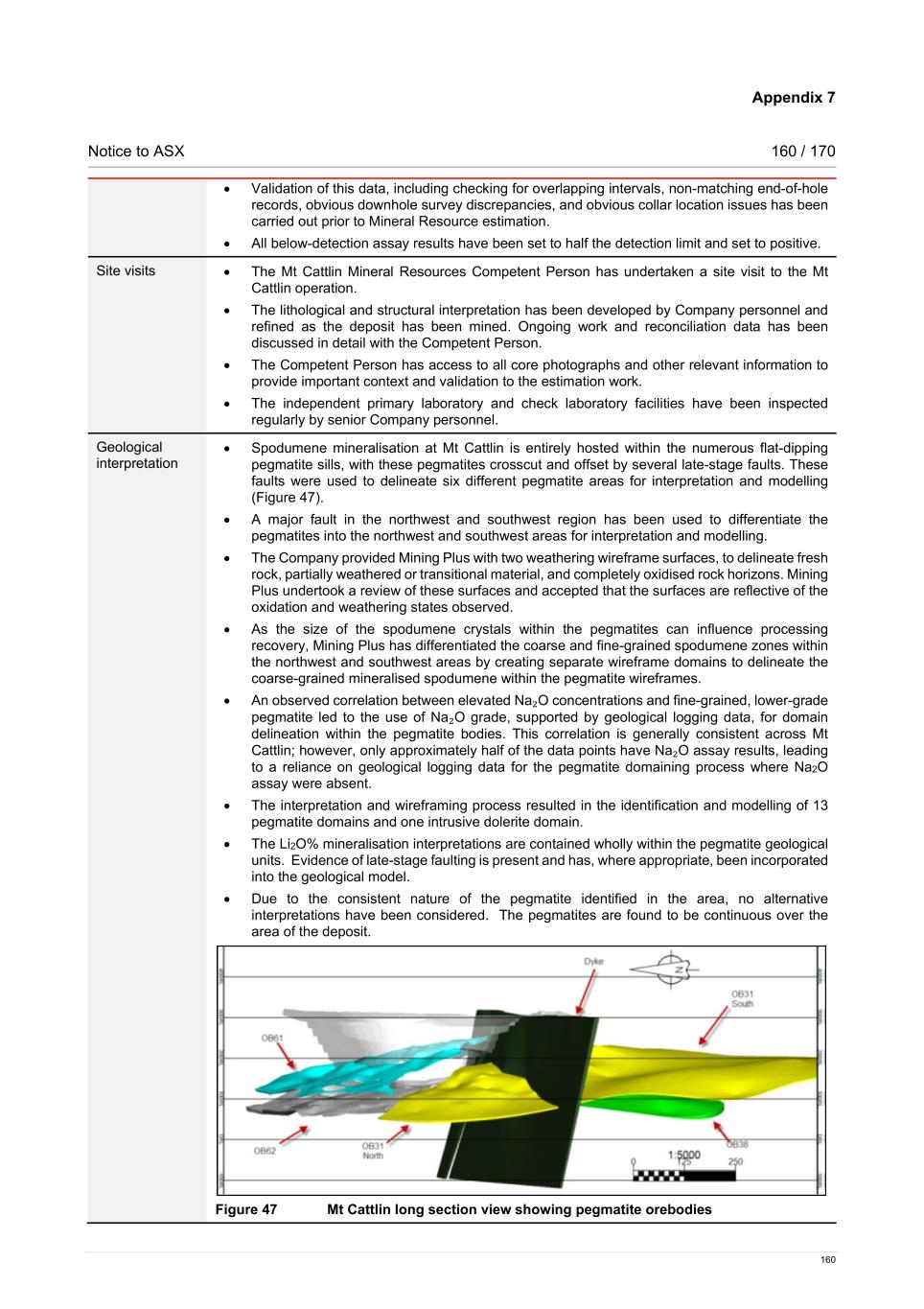
Appendix 7 Notice to ASX 160 / 170 160 • Validation of this data, including checking for overlapping intervals, non-matching end-of-hole records, obvious downhole survey discrepancies, and obvious collar location issues has been carried out prior to Mineral Resource estimation. • All below-detection assay results have been set to half the detection limit and set to positive. Site visits • The Mt Cattlin Mineral Resources Competent Person has undertaken a site visit to the Mt Cattlin operation. • The lithological and structural interpretation has been developed by Company personnel and refined as the deposit has been mined. Ongoing work and reconciliation data has been discussed in detail with the Competent Person. • The Competent Person has access to all core photographs and other relevant information to provide important context and validation to the estimation work. • The independent primary laboratory and check laboratory facilities have been inspected regularly by senior Company personnel. Geological interpretation • Spodumene mineralisation at Mt Cattlin is entirely hosted within the numerous flat-dipping pegmatite sills, with these pegmatites crosscut and offset by several late-stage faults. These faults were used to delineate six different pegmatite areas for interpretation and modelling (Figure 47). • A major fault in the northwest and southwest region has been used to differentiate the pegmatites into the northwest and southwest areas for interpretation and modelling. • The Company provided Mining Plus with two weathering wireframe surfaces, to delineate fresh rock, partially weathered or transitional material, and completely oxidised rock horizons. Mining Plus undertook a review of these surfaces and accepted that the surfaces are reflective of the oxidation and weathering states observed. • As the size of the spodumene crystals within the pegmatites can influence processing recovery, Mining Plus has differentiated the coarse and fine-grained spodumene zones within the northwest and southwest areas by creating separate wireframe domains to delineate the coarse-grained mineralised spodumene within the pegmatite wireframes. • An observed correlation between elevated Na₂O concentrations and fine-grained, lower-grade pegmatite led to the use of Na₂O grade, supported by geological logging data, for domain delineation within the pegmatite bodies. This correlation is generally consistent across Mt Cattlin; however, only approximately half of the data points have Na₂O assay results, leading to a reliance on geological logging data for the pegmatite domaining process where Na2O assay were absent. • The interpretation and wireframing process resulted in the identification and modelling of 13 pegmatite domains and one intrusive dolerite domain. • The Li2O% mineralisation interpretations are contained wholly within the pegmatite geological units. Evidence of late-stage faulting is present and has, where appropriate, been incorporated into the geological model. • Due to the consistent nature of the pegmatite identified in the area, no alternative interpretations have been considered. The pegmatites are found to be continuous over the area of the deposit. Figure 47 Mt Cattlin long section view showing pegmatite orebodies
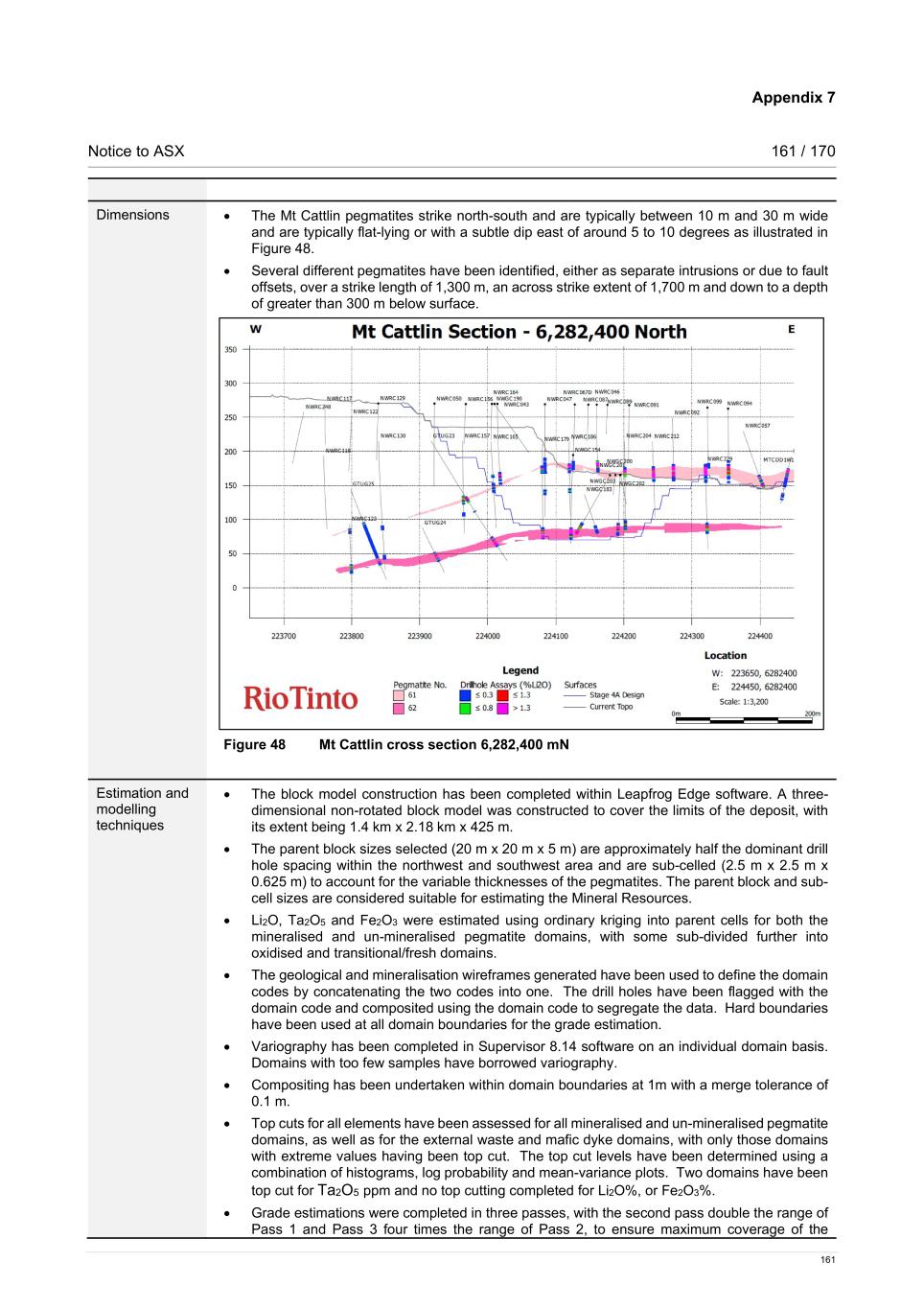
Appendix 7 Notice to ASX 161 / 170 161 Dimensions • The Mt Cattlin pegmatites strike north-south and are typically between 10 m and 30 m wide and are typically flat-lying or with a subtle dip east of around 5 to 10 degrees as illustrated in Figure 48. • Several different pegmatites have been identified, either as separate intrusions or due to fault offsets, over a strike length of 1,300 m, an across strike extent of 1,700 m and down to a depth of greater than 300 m below surface. Figure 48 Mt Cattlin cross section 6,282,400 mN Estimation and modelling techniques • The block model construction has been completed within Leapfrog Edge software. A three- dimensional non-rotated block model was constructed to cover the limits of the deposit, with its extent being 1.4 km x 2.18 km x 425 m. • The parent block sizes selected (20 m x 20 m x 5 m) are approximately half the dominant drill hole spacing within the northwest and southwest area and are sub-celled (2.5 m x 2.5 m x 0.625 m) to account for the variable thicknesses of the pegmatites. The parent block and sub- cell sizes are considered suitable for estimating the Mineral Resources. • Li2O, Ta2O5 and Fe2O3 were estimated using ordinary kriging into parent cells for both the mineralised and un-mineralised pegmatite domains, with some sub-divided further into oxidised and transitional/fresh domains. • The geological and mineralisation wireframes generated have been used to define the domain codes by concatenating the two codes into one. The drill holes have been flagged with the domain code and composited using the domain code to segregate the data. Hard boundaries have been used at all domain boundaries for the grade estimation. • Variography has been completed in Supervisor 8.14 software on an individual domain basis. Domains with too few samples have borrowed variography. • Compositing has been undertaken within domain boundaries at 1m with a merge tolerance of 0.1 m. • Top cuts for all elements have been assessed for all mineralised and un-mineralised pegmatite domains, as well as for the external waste and mafic dyke domains, with only those domains with extreme values having been top cut. The top cut levels have been determined using a combination of histograms, log probability and mean-variance plots. Two domains have been top cut for Ta2O5 ppm and no top cutting completed for Li2O%, or Fe2O3%. • Grade estimations were completed in three passes, with the second pass double the range of Pass 1 and Pass 3 four times the range of Pass 2, to ensure maximum coverage of the
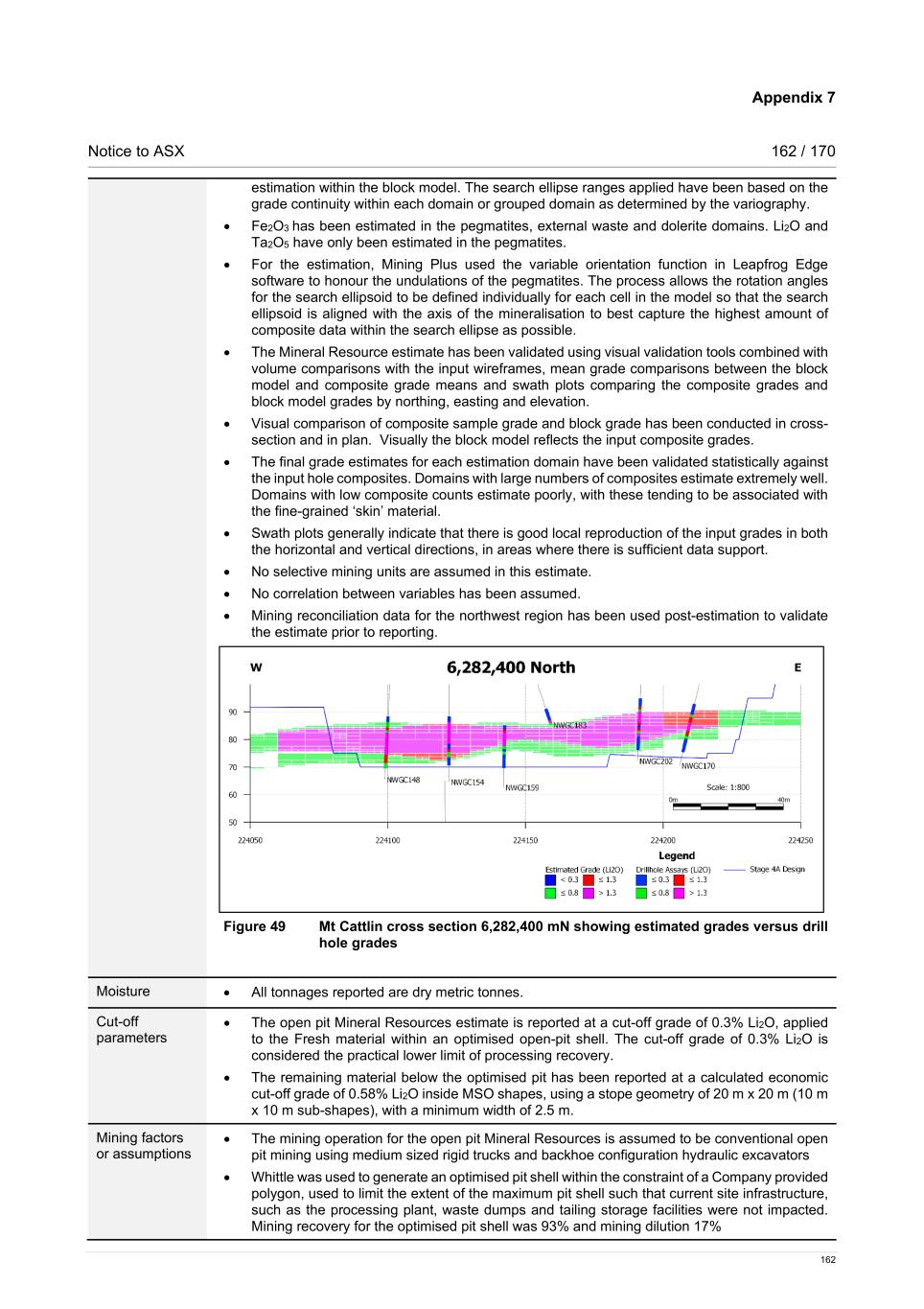
Appendix 7 Notice to ASX 162 / 170 162 estimation within the block model. The search ellipse ranges applied have been based on the grade continuity within each domain or grouped domain as determined by the variography. • Fe2O3 has been estimated in the pegmatites, external waste and dolerite domains. Li2O and Ta2O5 have only been estimated in the pegmatites. • For the estimation, Mining Plus used the variable orientation function in Leapfrog Edge software to honour the undulations of the pegmatites. The process allows the rotation angles for the search ellipsoid to be defined individually for each cell in the model so that the search ellipsoid is aligned with the axis of the mineralisation to best capture the highest amount of composite data within the search ellipse as possible. • The Mineral Resource estimate has been validated using visual validation tools combined with volume comparisons with the input wireframes, mean grade comparisons between the block model and composite grade means and swath plots comparing the composite grades and block model grades by northing, easting and elevation. • Visual comparison of composite sample grade and block grade has been conducted in cross- section and in plan. Visually the block model reflects the input composite grades. • The final grade estimates for each estimation domain have been validated statistically against the input hole composites. Domains with large numbers of composites estimate extremely well. Domains with low composite counts estimate poorly, with these tending to be associated with the fine-grained ‘skin’ material. • Swath plots generally indicate that there is good local reproduction of the input grades in both the horizontal and vertical directions, in areas where there is sufficient data support. • No selective mining units are assumed in this estimate. • No correlation between variables has been assumed. • Mining reconciliation data for the northwest region has been used post-estimation to validate the estimate prior to reporting. Figure 49 Mt Cattlin cross section 6,282,400 mN showing estimated grades versus drill hole grades Moisture • All tonnages reported are dry metric tonnes. Cut-off parameters • The open pit Mineral Resources estimate is reported at a cut-off grade of 0.3% Li2O, applied to the Fresh material within an optimised open-pit shell. The cut-off grade of 0.3% Li2O is considered the practical lower limit of processing recovery. • The remaining material below the optimised pit has been reported at a calculated economic cut-off grade of 0.58% Li2O inside MSO shapes, using a stope geometry of 20 m x 20 m (10 m x 10 m sub-shapes), with a minimum width of 2.5 m. Mining factors or assumptions • The mining operation for the open pit Mineral Resources is assumed to be conventional open pit mining using medium sized rigid trucks and backhoe configuration hydraulic excavators • Whittle was used to generate an optimised pit shell within the constraint of a Company provided polygon, used to limit the extent of the maximum pit shell such that current site infrastructure, such as the processing plant, waste dumps and tailing storage facilities were not impacted. Mining recovery for the optimised pit shell was 93% and mining dilution 17%
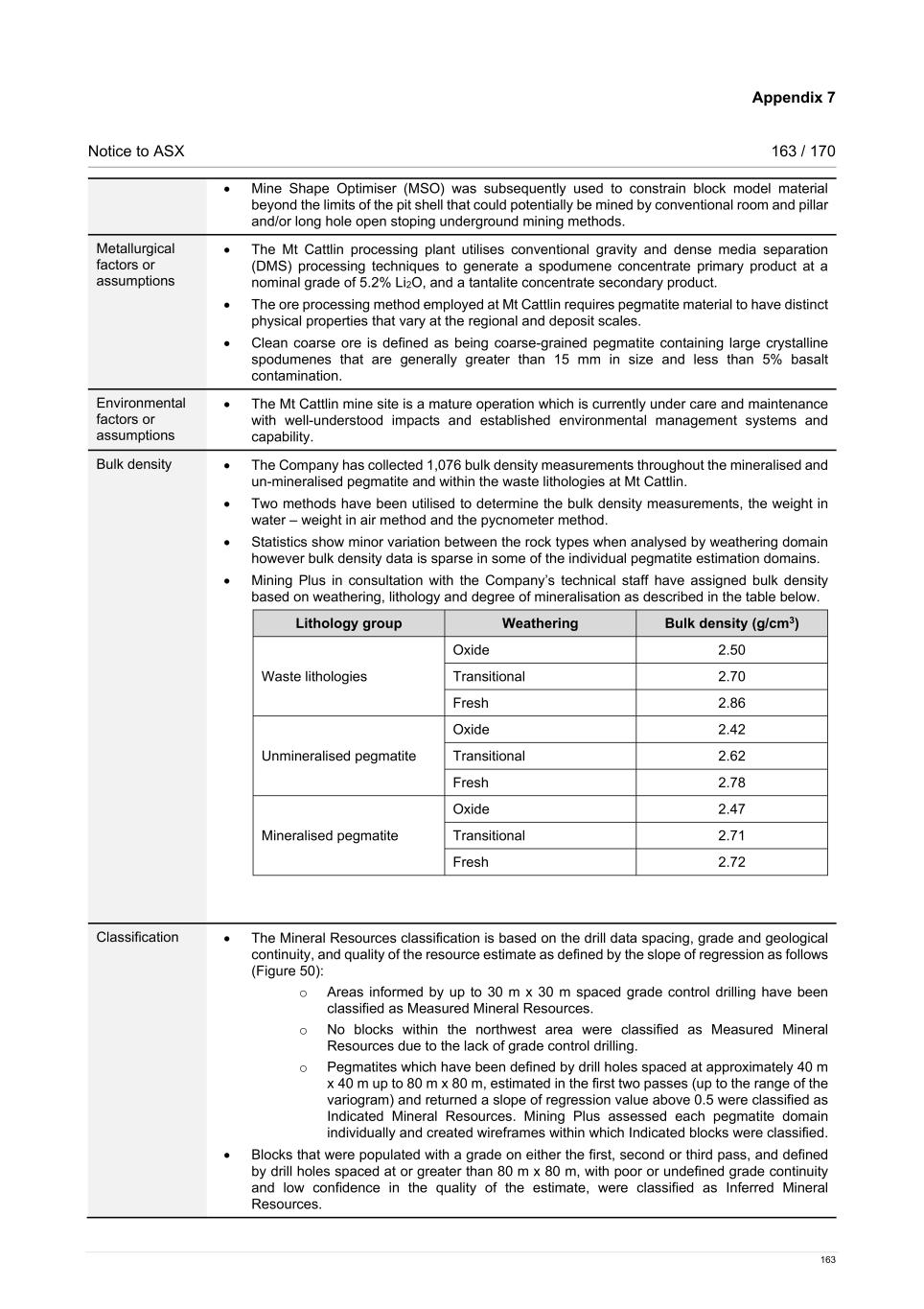
Appendix 7 Notice to ASX 163 / 170 163 • Mine Shape Optimiser (MSO) was subsequently used to constrain block model material beyond the limits of the pit shell that could potentially be mined by conventional room and pillar and/or long hole open stoping underground mining methods. Metallurgical factors or assumptions • The Mt Cattlin processing plant utilises conventional gravity and dense media separation (DMS) processing techniques to generate a spodumene concentrate primary product at a nominal grade of 5.2% Li2O, and a tantalite concentrate secondary product. • The ore processing method employed at Mt Cattlin requires pegmatite material to have distinct physical properties that vary at the regional and deposit scales. • Clean coarse ore is defined as being coarse-grained pegmatite containing large crystalline spodumenes that are generally greater than 15 mm in size and less than 5% basalt contamination. Environmental factors or assumptions • The Mt Cattlin mine site is a mature operation which is currently under care and maintenance with well-understood impacts and established environmental management systems and capability. Bulk density • The Company has collected 1,076 bulk density measurements throughout the mineralised and un-mineralised pegmatite and within the waste lithologies at Mt Cattlin. • Two methods have been utilised to determine the bulk density measurements, the weight in water – weight in air method and the pycnometer method. • Statistics show minor variation between the rock types when analysed by weathering domain however bulk density data is sparse in some of the individual pegmatite estimation domains. • Mining Plus in consultation with the Company’s technical staff have assigned bulk density based on weathering, lithology and degree of mineralisation as described in the table below. Lithology group Weathering Bulk density (g/cm3) Waste lithologies Oxide 2.50 Transitional 2.70 Fresh 2.86 Unmineralised pegmatite Oxide 2.42 Transitional 2.62 Fresh 2.78 Mineralised pegmatite Oxide 2.47 Transitional 2.71 Fresh 2.72 Classification • The Mineral Resources classification is based on the drill data spacing, grade and geological continuity, and quality of the resource estimate as defined by the slope of regression as follows (Figure 50): o Areas informed by up to 30 m x 30 m spaced grade control drilling have been classified as Measured Mineral Resources. o No blocks within the northwest area were classified as Measured Mineral Resources due to the lack of grade control drilling. o Pegmatites which have been defined by drill holes spaced at approximately 40 m x 40 m up to 80 m x 80 m, estimated in the first two passes (up to the range of the variogram) and returned a slope of regression value above 0.5 were classified as Indicated Mineral Resources. Mining Plus assessed each pegmatite domain individually and created wireframes within which Indicated blocks were classified. • Blocks that were populated with a grade on either the first, second or third pass, and defined by drill holes spaced at or greater than 80 m x 80 m, with poor or undefined grade continuity and low confidence in the quality of the estimate, were classified as Inferred Mineral Resources.
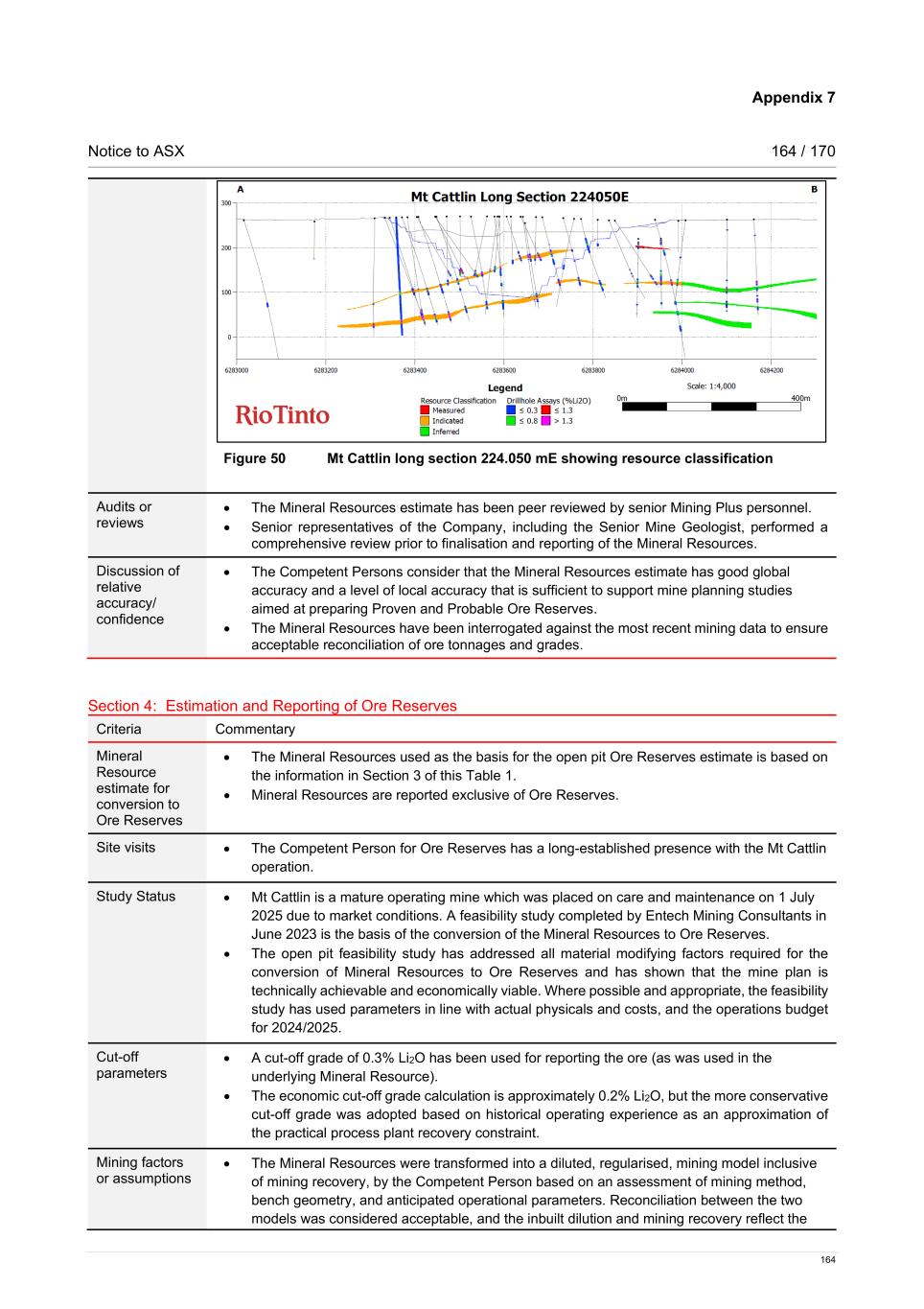
Appendix 7 Notice to ASX 164 / 170 164 Figure 50 Mt Cattlin long section 224.050 mE showing resource classification Audits or reviews • The Mineral Resources estimate has been peer reviewed by senior Mining Plus personnel. • Senior representatives of the Company, including the Senior Mine Geologist, performed a comprehensive review prior to finalisation and reporting of the Mineral Resources. Discussion of relative accuracy/ confidence • The Competent Persons consider that the Mineral Resources estimate has good global accuracy and a level of local accuracy that is sufficient to support mine planning studies aimed at preparing Proven and Probable Ore Reserves. • The Mineral Resources have been interrogated against the most recent mining data to ensure acceptable reconciliation of ore tonnages and grades. Section 4: Estimation and Reporting of Ore Reserves Criteria Commentary Mineral Resource estimate for conversion to Ore Reserves • The Mineral Resources used as the basis for the open pit Ore Reserves estimate is based on the information in Section 3 of this Table 1. • Mineral Resources are reported exclusive of Ore Reserves. Site visits • The Competent Person for Ore Reserves has a long-established presence with the Mt Cattlin operation. Study Status • Mt Cattlin is a mature operating mine which was placed on care and maintenance on 1 July 2025 due to market conditions. A feasibility study completed by Entech Mining Consultants in June 2023 is the basis of the conversion of the Mineral Resources to Ore Reserves. • The open pit feasibility study has addressed all material modifying factors required for the conversion of Mineral Resources to Ore Reserves and has shown that the mine plan is technically achievable and economically viable. Where possible and appropriate, the feasibility study has used parameters in line with actual physicals and costs, and the operations budget for 2024/2025. Cut-off parameters • A cut-off grade of 0.3% Li2O has been used for reporting the ore (as was used in the underlying Mineral Resource). • The economic cut-off grade calculation is approximately 0.2% Li2O, but the more conservative cut-off grade was adopted based on historical operating experience as an approximation of the practical process plant recovery constraint. Mining factors or assumptions • The Mineral Resources were transformed into a diluted, regularised, mining model inclusive of mining recovery, by the Competent Person based on an assessment of mining method, bench geometry, and anticipated operational parameters. Reconciliation between the two models was considered acceptable, and the inbuilt dilution and mining recovery reflect the
Appendix 7 Notice to ASX 165 / 170 165 historical values of 7% dilution and 93% mining recovery which were derived from site model to process plant reconciliations. • An optimisation of the regularised model was undertaken using Surpac software and Whittle products. In addition to the specific modifying factors described in the sub-sections below, the optimisation data inventory and input parameters included: o Surveyed surface topography provided from Mt Cattlin as at 25/01/2025. o Contract mining costs from a competitive tender process and budget 2024/2025. o Closure costs from the site Mine Closure Plan cost estimate and budget 2024. o State Government and third-party royalties (as shown below). Description Amount Third Party royalty A$1.50/t ore crushed Western Australia State royalty - lithium 5% Western Australia State royalty - tantalum 5% • Processing, General & Administration, concentrate surface haulage, and port costs from 2024 site budgets and forecasts (based on actual data). • These input parameters were reviewed by the Competent Person and considered appropriate for the current spodumene concentrate market. • The staged pit design and schedule is considered suitable for Ore Reserves estimation. • The Ore Reserves includes the Stage 4 northwest pit which is a down dip extension of the current Stage 3 northwest pit i.e., deepening of current floor, and cutting back of the current pit rim. • The mining methodology is a continuation of the conventional hard rock open cut practices of the current operations with continuous drill, blast and excavate cycles (with ore grade control as required). The existing operations provide access to enable the extraction of the Ore Reserves. • A comprehensive geotechnical study appropriate for a feasibility study level was undertaken by Entech Consulting Group to determine the pit design parameters used in the Ore Reserves. Three dedicated geotechnical diamond drill holes, totalling 651 m, located in the vicinity of the final pit walls were drilled, logged, sampled and laboratory tested to collect detailed geotechnical data. In addition, photogrammetric modelling of the current pit walls, structure digitisation, in-pit mapping and data from previous studies was utilised to characterise the rock mass and provide input data for stability analysis that were used to derive the recommended design parameters. • 97% of the rock within the pit containing the Ore Reserves is competent fresh (un-weathered) material, and key design parameters derived for fresh rock were: o 20 m bench height o 70° bench face angle o 8.5 m wide spill berm o 52° inter-ramp angle o 12 m wide geotechnical berm every approx. 100 m of high wall face. • A minimum mining width of 40 m has been applied in the pit designs. • Pit designs were reviewed by Entech Geotechnical Engineers to ensure compliance with geotechnical intent. • Mt Cattlin is a recently operated mine which is currently under care and maintenance, with significant production and excavation experience. • The Ore Reserves represent an extension of current operations, and the current site infrastructure is suitable for proposed mining methods. Metallurgical factors or assumptions • Ore is processed through the existing crushing, screening, ore sorting, and heavy media separation (HMS) plant with a nominal capacity of 1.8 Mt per annum. Several ancillary

Appendix 7 Notice to ASX 166 / 170 166 circuits have been added over the life of the plant including optical ore sorters and fines recovery to incrementally enhance project economics. • The Mt Cattlin plant has been in operation for over a decade. It is comprised of well tested technology and is suited to the production of saleable spodumene concentrate. • Fine grained spodumene recovers poorly in the Mt Cattlin processing plant. The underlying Mineral Resources has explicitly domained the predominantly unmineralised fine grained spodumene separately from the mineralised coarse grained spodumene. • A regression formula developed from historical operating performance that uses head grade to predict plant recovery, for a given grade of concentrate, is in daily use at Mt Cattlin. The feasibility study has used this algorithm to calculate metallurgical recovery in the economic analysis. • A flat 20% recovery has been applied for tantalite. • Allowances have been made for iron oxide (Fe2O3) content of the spodumene concentrate. The (potential) penalty element is estimated in the Mineral Resources, reported in the Ore Reserves, monitored during processing, and quantified in the final spodumene concentrate product. Revenue pricing used in the cashflow model incorporates likely penalty charges. • The Ore Reserves represent a continuation of the ore zones that have been successfully mined and processed at Mt Cattlin. Bulk samples and/or pilot scale testing is not required due to the demonstrated process flowsheet performance. • The Ore Reserves have been based on Li2O, Ta2O5, and Fe2O3 grade ranges that are acceptable to existing sales contracts and readily saleable into the international market. • The current southeast SE IPTSF has not yet reached capacity. Once at capacity, tailings deposition will switch to the nearby NE IPTSF, which will have capacity for the remainder of the life of mine when required. The detailed design, costing and permitting of the northeast IPTSF has been finalised and approved by the Regulators. Environmental factors or assumptions • The Mt Cattlin mine site is a mature operation which is currently under care and maintenance with well-understood impacts and established environmental management systems and capability. The site operating procedures are consistent with the principles of ISO 14001:2015 Environmental Management Systems. • Key potential risk areas include noise, vibration and air emissions/quality are regulated, and have specific management plans to ensure compliance. • Waste rock and processing tails stored on site are classified as Non-Acid Forming (NAF) and chemically benign. The waste rock is predominantly un-weathered (fresh), competent, basalt and andesites which form stable and erosion resistant landforms. Mt Cattlin pegmatite tailings are a coarse, sandy, material that drains readily and exhibits excellent stability on placement. The HMS process used to produce spodumene concentrate does not introduce chemicals into the tailings stream. • A Mining Proposal for pit and waste dump expansion has been submitted to the regulator, with all approvals in place. • Numerous baseline environmental studies have been conducted during and prior to operations. All required environmental studies have been completed with no ongoing constraints preventing ongoing development and mining. • To date there have been no material non-compliance issues with any permit conditions or legislative requirements at Mt Cattlin. • Prior to mining development, the site was privately owned and was predominantly cleared agricultural land. Up to 95 Ha have been cleared of remnant vegetation for the Project development by approved clearing permits. The current total area of land disturbance approved for all mining and exploration activities is approximately 380 Ha, sufficient for the expected life of mine, with proposed expansions on previously disturbed agricultural land. Vegetation and topsoil/subsoil are stockpiled away from drainage features for use in rehabilitation activities.

Appendix 7 Notice to ASX 167 / 170 167 Infrastructure • The Mt Cattlin mine site is a mature operation which is currently under care and maintenance. All mining, processing, power and water supplies, road and port infrastructure are in place and operational. • Accommodation is based near site for a mixed commute and residential workforce. The operation has access to a nearby regional bituminised airstrip capable of landing 100-seat jets. Sealed roads link the site to Perth, and major regional towns. • Access to the Mt Cattlin site is via sealed road from Ravensthorpe, which is connected to Perth, Albany and Esperance centres via a well-maintained highway network. Concentrate is trucked to the Port of Esperance via the South Coast Highway. The port has capacity for 45,000 tonnes of concentrate storage prior to ship loading. Mt Cattlin site has internal unsealed roads suitable for mining operations and transport requirement. • Site process water is sourced from the completed Northeast (NE) Pit and pumped to the process plant for treatment and distribution, and raw water is sourced from nearby drill holes. The NE pit is recharged through the movement of water from the nearby Southeast (SE) pit in-pit tailings storage facility. • Power is supplied to site via a 7MW diesel generation power plant with onsite power reticulation servicing the site power requirements. The administration and ancillary buildings are already on site and in place. • The processing plant is onsite at Mt Cattlin and consists of a crushing circuit, optical beneficiation circuit, dense media separation (DMS) circuit, product handling facilities, and a tailings storage facility (TSF). • There is an explosives magazine on site which is owned and managed by Rio Tinto, and bulk explosives and blasting services are provided by a contractor. • Ore from the mining operation is stockpiled on the Run of Mine (ROM) Pad until transferred to the adjacent processing plant for crushing and processing. Tailings from the process plant are stored within the completed SE Pit, after use of the above ground TSF was discontinued in 2019. Costs • The feasibility study has assessed and included appropriate capital costs. As an existing operation the capital costs are relatively minor but include an allowance for developing a new In-Pit Tailings Storage Facility (IPTSF) during the life of mine, buffering land purchases, as well as ongoing sustaining capital. • The operating costs have been derived two sources: o contract mining costs - competitive market tender, budget CY2024/2025 o all other operating costs - from analysis of the site CY2024/2025 budget (which is derived from actual historical costs and existing contracts) • The revenue prices used in the economic analysis have incorporated all applicable penalty charges as modelled, including deductions for product grade less than the benchmark 5.2% spodumene grade (SC6.0), and for any iron oxide content above limits. • Exchange rates are based on internal Rio Tinto modelling of expected future country exchange rates. • Product transportation and handling charges (road haulage from Mt Cattlin to Esperance port, and Esperance port costs) were provided by CY2024 budget and were derived from existing contracts. • The product revenue price used was discounted to be net of sea freight. • Selling costs have allowed for applicable royalties. Revenue factors • The Ore Reserves head grade is reported by the Surpac software interrogating the diluted mining model within the designed pit. Validation checks have been made in this process. • Rio Tinto applies a common process to the generation of commodity price assumptions across the group. This involves generation of long-term price forecasts based on current sales contracts, industry capacity analysis, global commodity consumption and economic

Appendix 7 Notice to ASX 168 / 170 168 growth trends (this includes the bonus / penalty adjustments for quality). Exchange rates are also based on internal Rio Tinto modelling of expected future country exchange rates. • Allowances have been made for surface and sea freight charges based on current site budgets and forecasts. • Minor revenue is derived from the sale of a by-product tantalite concentrate has been ignored due to not having material effects on revenue compared to spodumene. Market Assessment • The Mt Cattlin spodumene concentrate has been primarily sold through offtake agreements to Chinese converters and has been a significant contributor to the lithium supply chain. These agreements reflect market-based pricing conditions, with pricing adjustments tied to fluctuations in spodumene market prices. • It is assumed that all future product produced will be sold into previous contracts and spot markets. • Mt Cattlin concentrate will be sold to typical international specifications, the most relevant specifications being Li2O grade, Ta2O5 grade (both revenue factors), and Fe2O3 grade (a potential penalty factor). Mt Cattlin product does not typically attract Fe penalties, and the lithia grade is forecast to range between 5.2% Li2O and 5.5% Li2O depending on market assessment. • Customer specification and acceptance of the product rely on a typical process of samples taken by an independent agency and conformance of the assays obtained by both the seller and buyer to an allowable range of variance. Economic • Rio Tinto long-term prices have been used as the basis for the financial evaluation (NPV, IRR). The assumptions used in this economic analysis are macroeconomic, marketing, mine plan, operating costs, capital costs, closure costs, working capital and taxation. • Project NPVs are confidential information however, economic evaluation using Rio Tinto long-term prices demonstrates a positive NPV for the Mt Cattlin Ore Reserves under a range of price, cost and productivity scenarios. • The overall cost base assumptions and analysis methodology are considered appropriate, robust and at feasibility study level of accuracy. • The cashflow model has been tested for sensitivity to key economic assumptions. As is typically found, the revenue assumptions (e.g., product sale price, USD:AUD exchange rate, head grade, plant recovery) have a much greater influence than cost assumptions (e.g., operating costs, capital costs). • Stripping Ratio is generally a proxy for risk, and the individual stages of the overall project (as currently evaluated) have quite different stripping ratios than the overall project average. The NPV sensitivity to key variables is therefore significantly different if analysed by stage. If the most sensitive stage (Stage 4B) is assessed by the most influential variable (revenue), the cashflow is negative, so it has been removed from the Ore Reserves. The next stage (Stage 4A) maintains positive cashflows and NPV when revenue is tested at -10%. Social • The Mt Cattlin mine site is a mature operation which is currently under care and maintenance, has a well-established and implemented Environmental Management Plan and suite of operating procedures consistent with the principles of ISO 14001:2015 Environmental Management Systems and includes, but is not limited to: o Environmental Policy. o Requirements of approvals, permits and licences. o Environmental responsibilities of site personnel. o Site induction programmes. o Environmental monitoring and reporting requirements. o Inspection and audit process. o Non-conformance, corrective action, and risk management of incidents. o Preparation of procedures and work instructions addressing identified elements such as dewatering, saline spillage, waste management and bioremediation. o Stakeholder consultation, including: regular update meetings with Shire of Ravensthorpe and Ravensthorpe Business Association; ongoing consultation

Appendix 7 Notice to ASX 169 / 170 169 with local neighbours; ongoing consultation with Traditional Owner groups and presentations at the Southwest Aboriginal Land and Sea Council working party meetings; appointment of an Environmental and Community Liaison Officer; biannual presentations to the Ravensthorpe community; and establishment of the Mt Cattlin Community Consultation Group in 2018 with members consisting of respected leaders of the community and Mt Cattlin senior management. Minutes of meetings and presentations are made publicly available via https://www.mtcattlin.com.au/ccg/ • The closure and rehabilitation of the site post operations is prescribed in the Mine Closure Plan prepared in accordance with the Department of Mining, Industry, Regulation and Safety and outlines the closure obligations. The Mine Closure Plan identifies and sets out management of any potential closure issues and defines and outlines the site rehabilitation requirements. • Mt Cattlin has focussed on mine scheduling that allows for progressive rehabilitation of disturbed land during operations. Annual rehabilitation monitoring is conducted on site, and a detailed Closure Cost Estimate (CCE) is completed regularly. • Community consultation regarding post mining land use has also been conducted to inform regular updates to the Mine Closure Plan. Other • The feasibility study has investigated the potential for flooding via a hydrology study which informed the design of the abandonment bund and the Cattlin Creek diversion channel and associated bunding. No residual issues were apparent. • The TSF design has included analysis of performance under seismic conditions, which was found to be acceptable. • At less than five years, the additional mine life is considered too short to be meaningful affected by longer term climate change. Short term variability in the form of floods or droughts is unlikely to materially affect the operation. • The site continued operating through the recent global pandemic. • All material legal and marketing agreements are in place and accounted for. • The Ore Reserves stated are located on active mining leases, in good standing. • All required permits for Stage 4A work, which represent 100% of this Ore Reserve, are approved and in place. • An updated Mining Proposal that describes the first phase of the Stage 4 expansion was submitted to the Regulator on 18 January 2024 and approved on 3 October 2024. Classification • The Mineral Resources above an in situ economic cut-off grade within the designed open pit and below the surveyed topography surfaces (as of 25 Jan 2025) have been modified by the application of suitable modifying factors and has been classified Proven and Probable, based on the Measured or Indicated classification of the Mineral Resources estimate respectively. • All surface stockpiles are classified as Probable Ore Reserves due to their lower grade resulting in less certainty on processing recovery. • The level of work undertaken through the feasibility study is considered sufficient for the classification of Proved and Probable Ore Reserves. • Mr. Ali Sami, the Competent Person for this Ore Reserves estimation, has reviewed the work undertaken to date and considers that it is sufficiently detailed and relevant to allow declaration of these Ore Reserves. Audits or reviews • The Ore Reserves has been estimated by the Competent Person with assistance from Matthew Bateman, principal Metallurgist who has a long-established presence with the Mt Cattlin operation and has knowledge of the site spanning seven years. • Internal peer review during the process has been undertaken. Discussion of relative accuracy/ confidence • The Competent Person deems that the methodology applied to arrive at the Ore Reserves estimate for Mt Cattlin is appropriate and defendable. • The overall accuracy of the cost estimate used in the Ore Reserves is considered to be ±15%. The cost estimates have been derived from competitive market tender for mining

Appendix 7 Notice to ASX 170 / 170 170 costs, and actual site operating data for processing and General and Administration (G&A) costs, so the global accuracy is considered robust. • Previously reported stockpile material (by the previous owners) consisting of 900 kt at 0.8% Li2O of tailings from the early project life are no longer considered cash flow positive, so are not included in the Ore Reserves estimate. • Confidence in the application of the modifying factors is appropriate for the estimate. • The contract mining cost data which was derived from CY2024 site budget and has also been compared to actual site production data. All other operating cost data is directly derived from actual production data. In summary, the cost data used compares very well with production data and incorporates the inflationary/pandemic effects seen over the previous several years. • Processing plant throughput and recovery data has been derived directly from production data and therefore compare very well.