THE MEXICO EQUITY AND INCOME FUND, INC.
Annual
Report
July 31, 2025
 | |
| Revolution Monument, Mexico City. Source: CANVA. |

UNITED
STATES
SECURITIES AND EXCHANGE COMMISSION
Washington, D.C. 20549
FORM
CERTIFIED SHAREHOLDER REPORT OF REGISTERED
MANAGEMENT INVESTMENT COMPANIES
Investment Company Act file number 811-06111
The
(Exact name of registrant as specified in charter)
615 East Michigan Street
Milwaukee, WI 53202
(Address of principal executive offices) (Zip code)
Mr. Mauro Castañeda
c/o U.S. Bancorp Fund Services, LLC
615 East Michigan Street
Milwaukee,
WI 53202
(Name and address of agent for service)
(877) 785-0376
Registrant’s telephone number, including area code
Date of fiscal year end: July 31
Date
of reporting period:
Updated June 27, 2024
Item 1. Reports to Stockholders.
THE MEXICO EQUITY AND INCOME FUND, INC.
Annual
Report
July 31, 2025
| |
| Revolution Monument, Mexico City. Source: CANVA. |
THE MEXICO EQUITY AND INCOME FUND, INC.
Annual
Report
Table of Contents
The
Mexico Equity and Income Fund, Inc. (“The Fund”)
Annual Report, ending July 31, 2025
Dear Stakeholder,
Global Context
The global economy in 2025 has been characterized by moderate growth and persistent uncertainty. Global Gross Domestic Product (“GDP”) expectations remain near 3%, with the U.S. showing resilience despite slower momentum, Europe struggling with weak industrial activity, and China facing continued stress from its real estate sector and high debt levels. Inflation trends have diverged across regions: the U.S. saw progress toward its 2% target, allowing the Federal Reserve to begin modest rate cuts, while the European Central Bank remained cautious. Commodity prices, particularly oil and industrial metals, remained volatile due to supply constraints and geopolitical instability. Ongoing conflicts in Ukraine and the Middle East, as well as U.S.–China trade frictions, added further risks to global trade flows. Source: INEGI; Bureau of Economic Analysis.
Nevertheless, capital flows into emerging markets were robust, supported by strong currencies and attractive carry trades, with Mexico, Brazil, and India among the main beneficiaries.
Mexico Macro Domestic
Mexico’s economy displayed a modest recovery in the first half of 2025. GDP expanded by 0.6% in Q1 and 1.2% in Q2, though full-year growth expectations remain subdued, with institutions warning of possible stagnation. Services, which account for roughly two-thirds of GDP, grew by 1.8% year-over-year in Q2, supported by commerce, transportation, and tourism. The industrial sector contracted slightly (-0.2% y/y), though manufacturing (+2%) and construction (+5–6%) offered bright spots. The primary sector moderated from earlier strength but remained in positive territory. Source: INEGI.
Inflation pressures persisted. Headline CPI eased to 3.5% in July from 4.5% in June, while core inflation remained sticky around 4.2%. Despite this, the Bank of Mexico cut rates five times in 2025, bringing the benchmark rate to 7.75% by August, a clear signal that supporting growth is now a priority. Source: INEGI; Banxico.
External balances remained resilient. Mexico recorded a current account surplus of 205 billion pesos (~0.3% of GDP) in Q2, backed by robust foreign direct investment inflows of US$21.4 billion in Q1. However, remittances weakened by 5.6% YoY in 1H 2025, reflecting U.S. immigration and labor market uncertainty. Source: Banxico.
Year-to-date, the peso has strengthened approx. 10.5% against the dollar, one of the most significant gains among emerging-market currencies. In USD terms, the USD/MXN rate has dropped from 20.63 in early January to around 18.70–18.66 by August 29. Among the factors that explain the appreciation of the Mexican peso are: (i) inflows driven by a strong carry trade due to the high interest rate differential in favor of Mexico; (ii) periods of optimism, especially between March and June, stemming from exemptions to tariffs on steel and aluminum, and the postponement of tariffs on automotive exports under the USMCA, lifting the peso ~1–2% on each news wave. Source: Bloomberg.
Please see the August 2025 Economic Report at the Fund’s webpage: mxefund.com
1
THE MEXICO EQUITY AND INCOME FUND, INC. (Unaudited)
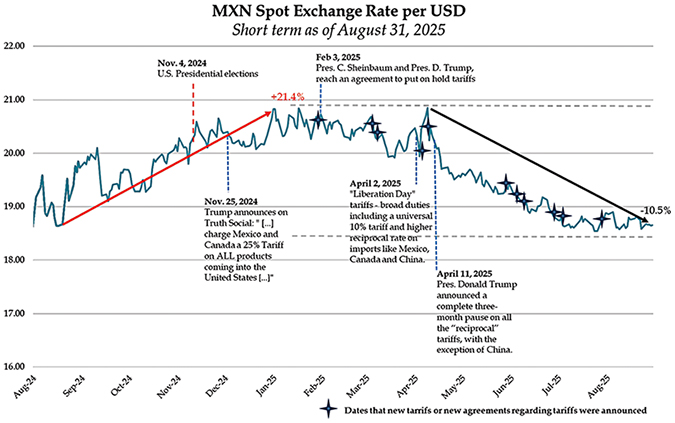
Source: Bloomberg, as of July 31, 2025.
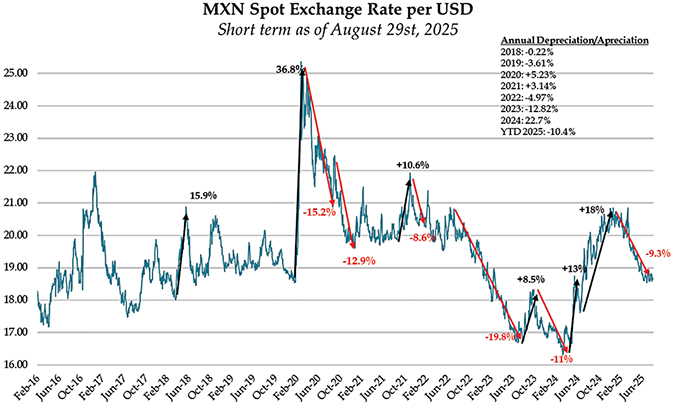
Source: Bloomberg, as of August 29, 2025.
2
THE MEXICO EQUITY AND INCOME FUND, INC. (Unaudited)
The S&P/BMV IPyC
The S&P/BMV IPyC delivered a 19% return in local currency during 1H 2025 and reached 21.7% by late August, outperforming most global peers. Defensive sectors such as consumer staples and telecommunications insulated the index from tariff shocks, while government negotiations to delay U.S. trade measures helped sustain investor confidence. The Equity market valuations have historically been low. The 11.7x valuation graph below suggests an attractive entry point for long-term investors. Source: Bloomberg.
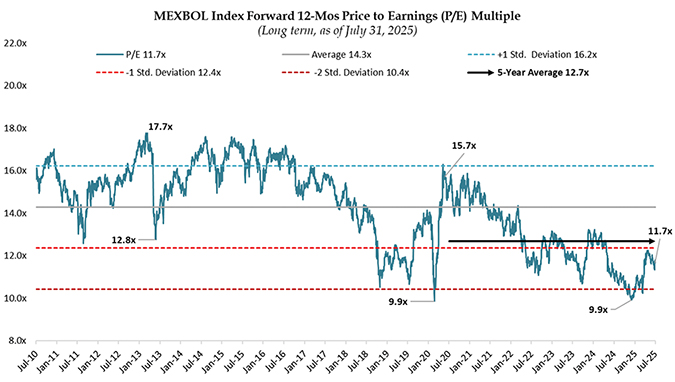
Source: Bloomberg, as of July 31, 2025.
3
THE MEXICO EQUITY AND INCOME FUND, INC. (Unaudited)
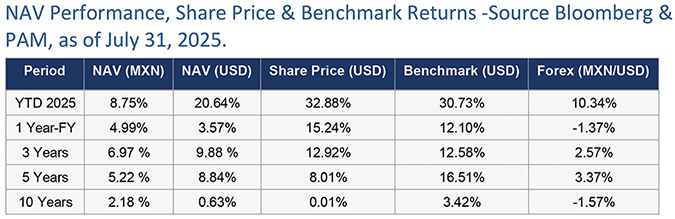
Benchmark indices outperformed, resulting in negative excess return, driven mainly by materials, industrials, and financials underweights. Conversely, staples and communication services contributed positively. For Sectorial contributors and detractor -return attribution analysis & Sectorial deviation, please call the MXE’s Portfolio Adviser, PAM.
Source: U.S. Bancorp Fund Services, Bloomberg.
| ** | On January 31, 2020, the Fund completed the Tender offer to purchase up to 67% of the outstanding shares at 98% of the Fund’s net asset value (“NAV”) |
| * | On October 12, 2021, the fund announced the results of its Opportunistic Rights Offering 146% of outstanding shares at a subscription price of US $8.90 per common stock. |
Performance data represents past performance; past performance does not guarantee future results.
The investment return and principal value of an investment will fluctuate so that the investor’s shares, when sold, may be worth more or less than their original cost. Performance data to the most recent month end may be obtained by calling U.S. Bancorp Fund Services, LLC, (414)765-4255, or by consulting the Fund’s web page: www.mxefund.com. The Fund s shares have traded in the market above (at a premium), at, and below (at a discount) the net asset value per share (NAV) since the commencement of the Fund s operations. Generally, shares of closed-end investment companies, including those of the Fund, trade at a discount from NAV.
The Fund navigated a challenging fiscal year ending July 31, 2025. April 2025 represented a turning point as tariff announcements disrupted markets. The Fund adopted a more defensive stance, temporarily reducing equity exposure to preserve capital. While this decision weighed on relative performance as markets rebounded later in April, it reflected prudent risk management.
In May and June, optimism returned as the stock market reached new highs and the peso appreciated further. The Fund participated in these gains, although relative performance lagged concentrated benchmarks. Active portfolio construction favored consumption, telecommunications, and selective industrials.
4
THE MEXICO EQUITY AND INCOME FUND, INC. (Unaudited)
Looking forward, we remain confident in the resilience of Mexico’s structural advantages, including its trade integration, competitive positioning, and investor inflows. Our disciplined investment approach prioritizes quality and value across cycles, aiming to deliver consistent long-term returns.
We thank you for your continued trust and support.
Sincerely,
 |
 |
| Eugenia Pichardo Principal & CEO |
David Estevez Analyst, Portfolio Manager, and Fund Secretary |
5
THE MEXICO EQUITY AND INCOME FUND, INC. (Unaudited)
DISCLAIMER
The Mexico Equity and Income Fund, Inc. (the “Fund”), achieves its investment objective through investments in securities, primarily equity, listed on the Mexican Stock Exchange. It serves as a vehicle for those who seek to invest in Mexican companies through a managed non-diversified portfolio as part of their overall investment program.
Fund holdings and sector allocations are subject to change at any time and should not be considered a recommendation to buy or sell any security. Please see the Schedule of Investments in this report for a complete list of fund holdings. The information and views provided herein represent the opinion of Pichardo Asset Management, not the Fund’s Board of Directors, and it does not intend to be a forecast of future events, a guarantee of future results, or investment advice. This report contains certain forward-looking statements about factors that may affect the Fund’s future performance.
Our management, with a firm belief in the reasonableness of these forward-looking statements, acknowledges their inherent uncertainty and difficulty in prediction. This belief is a testament to our commitment to providing you with the most informed investment decisions.
Investors, in their pursuit of sound investment decisions, must diligently consider the Fund’s investment objectives, risks, charges, expenses, and restrictions. The prospectus, a comprehensive source of this and other important information about the investment company is available for your perusal. We strongly advise you to read it carefully before making any investment.
All investments involve risk. Principal loss is possible. Investing in equities in Emerging markets involves additional risks such as currency fluctuations, currency devaluations, price volatility, social and economic instability, differing securities regulations and accounting standards, limited publicly available information, changes in taxation, periods of illiquidity, and other factors. These risks are more significant in emerging markets. Stocks of small- and medium-capitalization companies involve greater volatility and less liquidity than stocks of larger-capitalization companies.
Investing in Foreign Securities
Investment in Mexican securities involves special considerations and risks that are not generally associated with investments in U.S. securities, including (1) relatively higher price volatility, lower liquidity, and the small market capitalization of Mexican securities markets; (2) currency fluctuations and the cost of converting Mexican pesos into U.S. dollars; (3) restrictions on foreign investment; (4) political, economic and social risks and uncertainties (5) higher rates of inflation and interest rates than in the United States. In addition, Mexican equity investments are in Mexican pesos. As a result, the Portfolio Securities must increase in market value at a rate over the rate of any decline in the peso’s value against the U.S. dollar to avoid a reduction in their equivalent U.S. dollar value.
The Fund may have a higher turnover rate, which may result in higher transaction costs and tax liability, which may affect returns.
6
THE MEXICO EQUITY AND INCOME FUND, INC. (Unaudited)
Definitions
| • | The stock’s net asset value (NAV) is the value of a fund’s assets minus its liabilities. The term “net asset value” is commonly used concerning closed-end funds to determine the value of the assets held. |
| • | The market price of the ordinary share of a closed-end fund is determined in the open market by buyers and sellers and is the price at which investors may purchase or sell the common shares of a closed-end fund, which fluctuates throughout the day. The standard share market price may differ from the Fund’s Net Asset Value; shares of a closed-end fund may trade at a premium to (higher than) or a discount to (lower than) NAV. The difference between the market price and NAV is a discount. |
| • | A basis point (bps) is one-hundredth of a percentage point (0.01%). |
| • | Premium/Discount: An investment trust’s share price can differ from its net asset value (NAV). If the current share price is above the NAV, the trust is said to be trading at a premium, i.e., it costs more to buy the shares than the underlying investments are worth. When the share price is below the NAV, this is known as trading at a discount. |
| • | MEXBOL, or the IPC (Indice de Precios y Cotizaciones), is a capitalization-weighted index of the Mexican stock exchange’s leading stocks. |
| • | MSCI-Mexico Net Total Return Index: The Morgan Stanley Capital International Index Mexico is a free float capitalization-weighted index that tracks the Mexican Stock Market. One cannot invest directly in an index. |
| • | Credit Ratings: A credit rating is an independent assessment of the ability of a corporation or a government to repay a debt, either in general terms or regarding a specific financial obligation. Credit ratings are issued to companies and governments by several companies including S&P Global, Moody’s, and Fitch Ratings. Credit ratings are used by investors who want to know the risk of buying bonds or other debt instruments issued by these entities. |
| • | BANXICO: Banco de Mexico is the Central Bank of Mexico. By constitutional mandate, it is autonomous in both its operations and management. Its primary function is to provide domestic currency to the Mexican economy, and its main priority is to ensure the stability of the domestic currency’s purchasing power. |
| • | Reference Rate: is an interest rate benchmark used to set other interest rates. Various types of transactions use different reference rate benchmarks, but the most common include the Fed Funds Rate, LIBOR, the prime rate, and the rate on benchmark U.S., among others. |
| • | INEGI: The National Institute of Statistics and Geography. |
| • | CONSAR: Comisión Nacional de Sistemas de Ahorro para el Retiro, the Borrower’s National Retirements Savings System Commission. |
| • | CNBV: The National Banking and Securities Commission (CNBV) |
| • | Gross Domestic Product (GDP): is the standard measure of the value added created by producing goods and services in a country during a specific period. As such, it also measures the income earned from that production or the total amount spent on final goods and services (less imports). |
7
THE MEXICO EQUITY AND INCOME FUND, INC. (Unaudited)
| • | The debt-to-GDP ratio is a metric that compares a country’s public debt to its gross domestic product (GDP). It reliably indicates a country’s ability to pay back its debts by comparing what the country owes with what it produces. The debt-to-GDP ratio is often expressed as a percentage and it can also be interpreted as the number of years necessary to pay back debt if GDP is dedicated entirely to debt repayment. |
| • | Remittances are money sent from one party to another. Nowadays, the term is most often used to describe a sum of money sent by someone working abroad to their family back home. |
| • | Foreign Direct Investment (FDI) is an investment made by a company or individual in one country in business interests in another country. This investment can be in the form of either establishing business operations or acquiring business assets in another country, such as ownership or a controlling interest in a foreign company. |
| • | Gross Fixed Investment Indicator (IIFB): Describes the net capital accumulation during an accounting period for a country. The term refers to additions of capital stock, such as equipment, tools, transportation assets, and electricity. |
| • | An import is a good or service bought in one country that was produced in another. Imports and exports are the components of international trade. |
| • | Exports: Exports are goods and services produced in one country and sold to buyers in another. Together with imports, exports make up international trade. |
| • | Forward PE Ratio: The regular P/E ratio is the current stock price over its earnings per share. The forward P/E ratio is the current stock price over its “predicted” earnings per share. If the forward P/E ratio is higher than the current P/E ratio, it indicates decreased expected earnings. |
| • | EV/EBITDA: This is a popular valuation multiple used in the finance industry to measure a company’s value. It is the most widely used valuation multiple based on enterprise value. |
| • | Attribution analysis: is a sophisticated method for evaluating the performance of a portfolio or fund manager. The method focuses on three factors: the manager’s investment style, their specific stock picks, and the market timing of those decisions. It attempts to provide a quantitative analysis of a fund manager’s investment selections and philosophy that lead to that fund’sFund’s performance. |
| • | Treasury Bond (T-Bond): A marketable, fixed-interest U.S. government debt securities with more than 10 years of maturity. Treasury bonds make interest payments semiannually, and the income received is only taxed at the federal level. |
| • | M-Bond: Mexico Federal Government fixed-rate development bonds that are issued and placed at terms of over one year, pay interest every six months, and their interest rate is determined at the issue date and remains fixed all along the bond’s life. |
| • | Consumer Price Index (INPC): This is a measure that examines the weighted average of prices of a basket of consumer goods and services, such as transportation, food, and medical care. It is calculated by taking price changes for each item in the predetermined basket of goods and averaging them. |
8
THE MEXICO EQUITY AND INCOME FUND, INC. (Unaudited)
| • | Basis points (bps): Refers to a common unit of measure for interest rates and other percentages in finance. One basis point is equal to 1/100th of 1%, or 0.01%, or 0.0001. |
| • | Foreign Direct Investment (FDI): Is an investment made by a company or individual in one country in business interests in another country, in the form of either establishing business operations or acquiring business assets in the other country, such as ownership or controlling interest in a foreign company. |
9
THE MEXICO EQUITY AND INCOME FUND, INC. (Unaudited)
RELEVANT ECONOMIC INFORMATION for the years ended December 31
| Real_Activity (billion US$) | 2024 | 2023 | 2022 | 2021 | 2020 |
| Real GDP Growth (y-o-y) | 1.50% |
3.20% |
3.10% |
4.80% |
-8.30% |
| Industrial Production (y-o-y) | 0.20% | 1.20% | 3.10% | 6.71% | -3.15% |
| Trade Balance (US billions) | -$8.21 | -$5.46 | -$26.42 | -$11.49 | $34.48 |
| Exports (US billions) | $617.10 | $593.01 | $578.19 | $494.23 | $417.67 |
| Export growth (y-o-y) | 4.06% | 2.56% | 16.90% | 18.52% | -9.34% |
| Imports (US billions) | $625.31 | $598.48 | $604.61 | $505.72 | $383.19 |
| Import growth (y-o-y) | 4.48% | -1.02% | 19.60% | 32.05% | -15.84% |
| Financial Variables and Prices | |||||
| 28-Day CETES (T-bills)/Average | 10.71% | 11.10% | 7.66% | 4.45% | 5.30% |
| Exchange rate (Pesos/US$)Average | 18.33 | 17.73 | 20.11 | 20.29 | 21.47 |
| Inflation IPC, 12 month trailing | 4.21% | 4.66% | 7.82% | 7.36% | 3.15% |
| Mexbol Index | |||||
| USD Return | -27.77% | 40.87% | -1.09% | 20.94% | -2.35% |
| Market Cap- (US billions) | $297.23 | $438.75 | $326.47 | $326.47 | $282.91 |
| EV/EBITDA | 5.28x | 5.34x | 5.65x | 7.29x | 8.42x |
Sources: Banamex, Banco de Mexico, Bloomberg, MSCI.
10
THE MEXICO EQUITY AND INCOME FUND, INC.

Performance at a glance (unaudited)
Average annual total returns for common stock for the periods ended 7/31/2025
| Net asset value returns(1) | 1 year | 5 years | 10 years |
| The Mexico Equity and Income Fund, Inc. | 3.57% | 8.84% | 0.63% |
| Market price returns | |||
| The Mexico Equity and Income Fund, Inc. | 15.24% | 8.01% | 0.01% |
| Index returns | |||
| MSCI Mexico Index | 12.10% | 16.52% | 3.42% |
| Share price as of 7/31/2025 | |||
| Net asset value | |||
| Market price |
| (1) | The returns shown are based on net asset value calculated for shareholder transactions, which do not reflect adjustments made to the net asset value for financial reporting purposes in accordance with accounting principles generally accepted in the United States of America. |
Past performance does not predict future performance. The return and value of an investment will fluctuate so that an investor’s share, when sold, may be worth more or less than their original cost. The Fund’s common stock net asset value (“NAV”) return assumes, for illustration only, that dividends and other distributions, if any, were reinvested at the NAV on the ex-dividend date. The Fund’s common stock market price returns assume that all dividends and other distributions, if any, were reinvested at the lower of the NAV or the closing market price on the ex-dividend date. NAV and market price returns for the period of less than one year have not been annualized. Returns do not reflect the deduction of taxes that a shareholder could pay on Fund dividends and other distributions, if any, or the sale of Fund shares.
The MSCI Mexico Index is designed to measure the performance of the large and mid cap segments of the Mexican market. With 24 constituents, the MSCI Mexico Index covers approximately 85% of the free float-adjusted market capitalization in Mexico.
11
THE MEXICO EQUITY AND INCOME FUND, INC.
Allocation of Portfolio Assets (Calculated as a percentage of Total Investments) |
July 31, 2025 (Unaudited) |
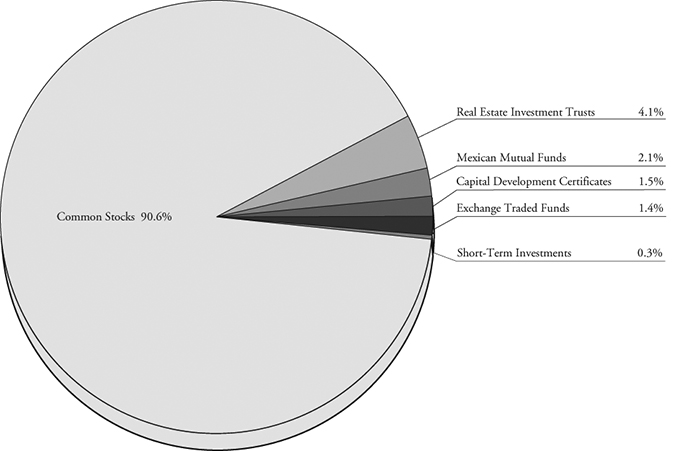
12
THE MEXICO EQUITY AND INCOME FUND, INC.
July 31, 2025
Schedule of Investments
| COMMON STOCKS – 91.0% | Shares | Value | ||||||
| Airports – 9.3% | ||||||||
| Grupo Aeroportuario del Centro Norte, S.A.B. de C.V. | 96,258 | $ | 1,276,790 | |||||
| Grupo Aeroportuario del Pacifico, S.A.B. de C.V. – Series B | 64,700 | 1,486,368 | ||||||
| Grupo Aeroportuario del Sureste, S.A.B. de C.V. – Series B | 86,274 | 2,615,156 | ||||||
| 5,378,314 | ||||||||
| Auto Parts & Equipment – 4.0% | ||||||||
| Nemak, S.A.B. de C.V. (a)(b) | 12,856,484 | 2,344,357 | ||||||
| Beverages – 17.1% | ||||||||
| Arca Continental, S.A.B. de C.V. | 273,920 | 2,854,925 | ||||||
| Coca-Cola FEMSA, S.A.B. de C.V. | 238,400 | 1,976,704 | ||||||
| Fomento Economico Mexicano, S.A.B. de C.V. – Series UBD | 567,925 | 5,127,130 | ||||||
| 9,958,759 | ||||||||
| Building Materials – 7.7% | ||||||||
| Cemex, S.A.B. de C.V. | 2,261,861 | 1,974,707 | ||||||
| Grupo Cementos de Chihuahua, S.A.B. de C.V. | 269,036 | 2,513,950 | ||||||
| 4,488,657 | ||||||||
| Communication Services – 8.8% | ||||||||
| America Movil, S.A.B. de C.V. (a) | 5,680,255 | 5,127,736 | ||||||
| Construction and Infrastructure – 1.9% | ||||||||
| Promotora y Operadora de Infraestructura, S.A.B. de C.V. | 94,013 | 1,108,073 | ||||||
| Financial Groups – 4.9% | ||||||||
| Grupo Financiero Banorte, S.A.B. de C.V. – Series O | 317,354 | 2,828,177 | ||||||
| Food – 6.9% | ||||||||
| Alfa, S.A.B. de C.V. – Series A | 2,533,811 | 1,856,203 | ||||||
| Grupo Bimbo, S.A.B. de C.V. – Series A | 735,118 | 2,133,070 | ||||||
| 3,989,273 | ||||||||
| GICS~Chemicals – 1.2% | ||||||||
| Alpek, S.A.B. de C.V. | 1,447,133 | 694,225 | ||||||
| GICS~Media – 0.6% | ||||||||
| Megacable Holdings, S.A.B. de C.V. – Series A | 122,548 | 340,588 | ||||||
The accompanying notes are an integral part of these financial statements.
13
THE MEXICO EQUITY AND INCOME FUND, INC.
July 31, 2025
Schedule of Investments (continued)
| COMMON STOCKS (continued) | Shares | Value | ||||||
| Hotels, Restaurants, and Recreation – 0.5% | ||||||||
| Grupe, S.A.B. de C.V. (a)(c) | 200,591 | $ | 308,356 | |||||
| Mining – 7.7% | ||||||||
| Grupo Mexico, S.A.B. de C.V. – Series B | 713,274 | 4,464,910 | ||||||
| Railroads – 1.8% | ||||||||
| Grupo Traxion S.A.B. de C.V. (a)(b) | 1,180,634 | 1,037,005 | ||||||
| Real Estate Services – 2.7% | ||||||||
| Corporacion Inmobiliaria Vesta, S.A.B. de C.V. | 565,524 | 1,591,201 | ||||||
| Retail – 15.9% | ||||||||
| El Puerto de Liverpool, S.A.B. de C.V. – Series C1 | 305,674 | 1,502,040 | ||||||
| Grupo Comercial Chedraui, S.A. de C.V. | 165,296 | 1,338,928 | ||||||
| Wal-Mart de Mexico, S.A.B. de C.V. | 2,162,780 | 6,375,415 | ||||||
| 9,216,383 | ||||||||
| TOTAL COMMON STOCKS (Cost $46,404,022) | 52,876,014 | |||||||
| REAL ESTATE INVESTMENT TRUSTS – COMMON – 4.1% | ||||||||
| REITS – 4.1% | ||||||||
| Prologis Property Mexico, S.A. de C.V. | 640,033 | 2,405,764 | ||||||
| TOTAL REAL ESTATE INVESTMENT TRUSTS – COMMON | ||||||||
| (Cost $2,211,752) | 2,405,764 | |||||||
| MEXICAN MUTUAL FUNDS – 2.1% | ||||||||
| GBM Fondo de Corto Plazo SAB de CV SIID – Series BX (a) | 19,568,409 | 1,210,636 | ||||||
| TOTAL MEXICAN MUTUAL FUNDS (Cost $1,224,907) | 1,210,636 | |||||||
| CAPITAL DEVELOPMENT CERTIFICATES – 1.5% | ||||||||
| Atlas Discovery Trust II (a)(c) | 300,000 | 897,015 | ||||||
| TOTAL CAPITAL DEVELOPMENT CERTIFICATES (Cost $2,147) | 897,015 | |||||||
The accompanying notes are an integral part of these financial statements.
14
THE MEXICO EQUITY AND INCOME FUND, INC.
July 31, 2025
Schedule of Investments (concluded)
| EXCHANGE TRADED FUNDS – 1.4% | Shares | Value | ||||||
| iShares USD Treasury Bond 0-1yr UCITS ETF (a) | 1,800 | $ | 834,116 | |||||
| TOTAL EXCHANGE TRADED FUNDS (Cost $741,060) | 834,116 | |||||||
| SHORT-TERM INVESTMENTS | ||||||||
| MONEY MARKET FUNDS – 0.3% | ||||||||
| Morgan Stanley Institutional Liquidity Funds – Government Portfolio – | ||||||||
| Institutional Class, 4.22% (d) | 150,315 | 150,315 | ||||||
| TOTAL MONEY MARKET FUNDS (Cost $150,315) | 150,315 | |||||||
| TOTAL INVESTMENTS – 100.4% (Cost $50,734,203) | 58,373,860 | |||||||
| Liabilities in Excess of Other Assets – (0.4)% | (234,831 | ) | ||||||
| TOTAL NET ASSETS – 100.0% | $ | 58,139,029 | ||||||
Percentages are stated as a percent of net assets.
REIT – Real Estate Investment Trust
| (a) | Non-income producing security. |
| (b) | Security is exempt from registration pursuant to Rule 144A under the Securities Act of 1933, as amended. These securities may only be resold in transactions exempt from registration to qualified institutional investors. As of July 31, 2025, the value of these securities total $3,381,362 or 5.8% of the Fund’s net assets. |
| (c) | Fair value determined using significant unobservable inputs in accordance with procedures established by and under the supervision of the Fund’s Board of Directors. These securities represented $1,205,371 or 2.1% of net assets as of July 31, 2025. |
| (d) | The rate shown represents the 7-day annualized effective yield as of July 31, 2025. |
The accompanying notes are an integral part of these financial statements.
15
THE MEXICO EQUITY AND INCOME FUND, INC.
July 31, 2025
Statement of Assets & Liabilities
| ASSETS: | ||||
| Investments, at value (cost $50,734,203) | $ | 58,373,860 | ||
| Interest receivable | 653 | |||
| Foreign currency (cost $162) | 159 | |||
| Other Assets | 8,337 | |||
| Total Assets | 58,383,009 | |||
| LIABILITIES: | ||||
| Payables: | ||||
| Directors | 58,533 | |||
| Advisory | 36,091 | |||
| NYSE | 39,070 | |||
| Audit | 33,441 | |||
| Administration | 23,825 | |||
| Printing and mailing | 22,995 | |||
| Fund accounting | 13,525 | |||
| Legal | 7,247 | |||
| Custody | 5,093 | |||
| CCO | 4,160 | |||
| Total Liabilities | 243,980 | |||
| Net Assets | 58,139,029 | |||
| Net Asset Value Per Common Share ($58,139,029 / ) | $ | |||
| NET ASSETS CONSIST OF: | ||||
| Common stock, $0.001 par value; shares outstanding ( shares authorized) | 4,400 | |||
| Paid-in capital | 53,757,904 | |||
| Total distributable earnings | 4,376,725 | |||
| Net Assets | $ | 58,139,029 | ||
The accompanying notes are an integral part of these financial statements.
16
THE MEXICO EQUITY AND INCOME FUND, INC.
For the Year Ended July 31, 2025 | |
| Statement of Operations |
| INVESTMENT INCOME | ||||
| Dividends(1) | $ | 1,821,379 | ||
| Interest | 121,630 | |||
| Total Investment Income | 1,943,009 | |||
| EXPENSES AND FEES | ||||
| Advisory (Note B) | 491,839 | |||
| Directors (Note B) | 182,813 | |||
| Administration (Note B) | 94,432 | |||
| CCO (Note B) | 65,211 | |||
| Fund accounting (Note B) | 49,961 | |||
| NYSE | 56,562 | |||
| Custodian (Note B) | 35,821 | |||
| Audit | 33,446 | |||
| Printing and mailing | 40,214 | |||
| Legal | 33,283 | |||
| Insurance | 30,710 | |||
| Transfer agent (Note B) | 26,178 | |||
| Total Expenses | 1,140,470 | |||
| NET INVESTMENT INCOME | 802,539 | |||
| NET REALIZED AND UNREALIZED GAIN (LOSS) ON INVESTMENTS | ||||
| Net realized loss from investments and foreign currency transactions | (3,829,395 | ) | ||
| Net change in unrealized appreciation (depreciation) on investments and foreign currency transactions | 4,914,832 | |||
| Net gain from investments and foreign currency transactions | 1,085,437 | |||
| Net increase in net assets resulting from operations | $ | 1,887,976 | ||
| (1) | Net of $184,951 in dividend withholding tax. |
The accompanying notes are an integral part of these financial statements.
17
THE MEXICO EQUITY AND INCOME FUND, INC.
Statements of Changes in Net Assets
| For the | For the | |||||||
| Year Ended | Year Ended | |||||||
| July 31, 2025 | July 31, 2024 | |||||||
| INCREASE (DECREASE) IN NET ASSETS | ||||||||
| Operations: | ||||||||
| Net investment income | $ | 802,539 | $ | 2,096,497 | ||||
| Net realized gain (loss) on investments and foreign currency transactions | (3,829,395 | ) | 5,642,653 | |||||
| Net change in unrealized appreciation (depreciation) in value | ||||||||
| of investments and foreign currency transactions | 4,914,832 | (14,406,705 | ) | |||||
| Net increase (decrease) in net assets resulting from operations | 1,887,976 | (6,667,555 | ) | |||||
| Distributions to Common Shareholders from: | ||||||||
| Net dividends and distributions | (1,311,836 | ) | (1,325,465 | ) | ||||
| Decrease in net assets resulting from distributions | (1,311,836 | ) | (1,325,465 | ) | ||||
| Total increase (decrease) in net assets | 576,140 | (7,993,020 | ) | |||||
| Net Assets: | ||||||||
| Beginning of year | 57,562,889 | 65,555,909 | ||||||
| End of year | $ | 58,139,029 | $ | 57,562,889 | ||||
The accompanying notes are an integral part of these financial statements.
18
THE MEXICO EQUITY AND INCOME FUND, INC.
Financial Highlights
For a Common Share Outstanding Throughout Each Year
| For the Years Ended July 31, | ||||||||||||||||||||
| 2025 | 2024 | 2023 | 2022 | 2021 | ||||||||||||||||
| Per Share Operating Performance | ||||||||||||||||||||
| Net asset value, beginning of year | $ | $ | $ | $ | $ | |||||||||||||||
| Net investment income (loss) | 0.18 | 0.48 | 0.43 | 0.43 | (0.18 | ) | ||||||||||||||
| Net realized and unrealized gains (losses) on | ||||||||||||||||||||
| investments and foreign currency transactions | 0.25 | (2.00 | ) | 4.05 | (1.50 | ) | 5.57 | |||||||||||||
| Net increase (decrease) from investment operations | 0.43 | (1.52 | ) | 4.48 | (1.07 | ) | 5.39 | |||||||||||||
| Less: Distributions | ||||||||||||||||||||
| Dividends from net investment income | (0.30 | ) | (0.30 | ) | — | — | — | |||||||||||||
| Distributions from net realized gains | — | — | — | — | — | |||||||||||||||
| Total dividends and distributions | (0.30 | ) | (0.30 | ) | — | — | — | |||||||||||||
| Capital Share Transactions | ||||||||||||||||||||
| Anti-dilutive effect of Tender Offer | — | — | — | — | — | |||||||||||||||
| Dilutive effect of Common Share Rights Offering | — | — | — | (2.94 | ) | — | ||||||||||||||
| Total capital share transactions | — | — | — | (2.94 | ) | — | ||||||||||||||
| Net Asset Value, end of year | $ | $ | $ | $ | $ | |||||||||||||||
| Per share market value, end of year | $ | $ | $ | $ | $ | |||||||||||||||
| Total Investment Return Based on | ||||||||||||||||||||
| Market Value, end of year(1) | 15.24 | % | (7.98 | )% | 35.79 | % | (36.30 | )% | 60.23 | % | ||||||||||
| Ratios/Supplemental Data | ||||||||||||||||||||
| Net assets, end of year (000’s) | $58,129 | $57,563 | $65,556 | $45,870 | $25,770 | |||||||||||||||
| Ratios of expenses to average net assets: | 2.13 | % | 1.91 | % | 2.13 | % | 2.32 | % | 3.89 | % | ||||||||||
| Ratios of net investment income (loss) | ||||||||||||||||||||
| to average net assets: | 1.50 | % | 3.33 | % | 3.43 | % | 1.12 | % | (1.56 | )% | ||||||||||
| Portfolio turnover rate | 156.07 | % | 166.37 | % | 159.02 | % | 153.01 | % | 217.50 | % | ||||||||||
| (1) | Total investment return is calculated assuming a purchase of common stock at the current market price on the first day and a sale at the current market price on the last day of each period reported. Dividends and distributions, if any, are assumed for purposes of this calculation to be reinvested at the closing market price on the dividend ex-date. Total investment does not reflect brokerage commissions. |
The accompanying notes are an integral part of these financial statements.
19
THE MEXICO EQUITY AND INCOME FUND, INC.
July 31, 2025
Notes to Financial Statements
NOTE A: ORGANIZATION AND SUMMARY OF SIGNIFICANT ACCOUNTING POLICIES
The Mexico Equity and Income Fund, Inc. (the “Fund”) was incorporated in Maryland on May 24, 1990, and commenced operations on August 21, 1990. The Fund is registered under the Investment Company Act of 1940, as amended, as a closed-end, non-diversified management investment company.
The Fund is an investment company and accordingly follows the investment company accounting and reporting guidance of the Financial Accounting Standards Board (FASB) Accounting Standard Codification Topic 946 “Financial Services—Investment Companies”.
The preparation of financial statements in accordance with accounting principles generally accepted in the United States of America requires management to make estimates and assumptions that affect the reported amounts and disclosures in the financial statements. Actual results could differ from those estimates.
Significant accounting policies are as follows:
Portfolio Valuation. Investments are stated at value in the accompanying financial statements. Listed equity securities are valued at the closing price on the exchange or market on which the security is primarily traded (the “Primary Market”) at the valuation time. If the security did not trade on the Primary Market, it shall be valued at the closing price on another comparable exchange where it trades at the valuation time. If there are no such closing prices, the security shall be valued at the mean between the most recent highest bid and lowest ask prices at the valuation time. Investments in short-term debt securities having a maturity of 60 days or less are valued at amortized cost if their term to maturity from the date of purchase was less than 60 days, or by amortizing their value on the 61st day prior to maturity if their term to maturity from the date of purchase when acquired by the Fund was more than 60 days. Other assets and securities for which no quotations are readily available will be valued in good faith at fair value using methods determined by the Board of Directors. These methods include, but are not limited to, the fundamental analytical data relating to the investment; the nature and duration of restrictions in the market in which they are traded (including the time needed to dispose of the security, methods of soliciting offers and mechanics of transfer); the evaluation of the forces which influence the market in which these securities may be purchased or sold, including the economic outlook and the condition of the industry in which the issuer participates and sum of the parts methodology. The Fund has a Valuation Committee comprised of independent directors which oversees the valuation of portfolio securities. Any securities or other assets for which market quotations are not readily available are valued at their fair value pursuant to policies and procedures adopted pursuant to Rule 2a-5 under the 1940 Act.
Investment Transactions and Investment Income. The cost of investments sold is determined by use of the specific identification method for both financial reporting and income tax purposes. Interest income, including the accretion of discount and amortization of premium on investments, is recorded on an accrual basis; dividend income is recorded on the ex-dividend date or, using reasonable diligence, when known to the Fund. The collectibility of income receivable from foreign securities is evaluated periodically, and any
20
THE MEXICO EQUITY AND INCOME FUND, INC.
July 31, 2025
Notes to Financial Statements (continued)
resulting allowances for uncollectible amounts are reflected currently in the determination of investment income. There was no allowance for uncollectible amounts at July 31, 2025.
Tax Status. No provision is made for U.S. Federal income or excise taxes as it is the Fund’s intention to continue to qualify as a regulated investment company and to make the requisite distributions to its shareholders that will be sufficient to relieve it from all or substantially all U.S. Federal income and excise taxes.
The Fund is subject to the following withholding taxes on income from Mexican sources:
Interest income on debt issued by the Mexican federal government is generally not subject to withholding. Withholding tax on interest from other debt obligations such as publicly traded bonds and loans by banks or insurance companies is at a rate of 4.9% under the tax treaty between Mexico and the United States.
Gains realized from the sale or disposition of debt securities may be subject to a 4.9% withholding tax. Gains realized by the Fund from the sale or disposition of equity securities that are listed and traded on the Mexican Stock Exchange (“MSE”) are exempt from Mexican withholding tax if sold through the stock exchange. Gains realized on transactions outside of the MSE may be subject to withholding at a rate of 25% (20% rate prior to January 1, 2002) of the value of the shares sold or, upon the election of the Fund, at 35% (40% rate prior to January 1, 2002) of the gain. If the Fund has owned less than 25% of the outstanding stock of the issuer of the equity securities within the 12 month period preceding the disposition, then such disposition will not be subject to capital gains taxes as provided for in the treaty to avoid double taxation between Mexico and the United States.
Investment Objectives
The Fund’s investment objective is to seek high total return through capital appreciation and current income. There can be no assurance that the Fund’s objective will be achieved.
Investment Strategies
The Fund pursues its objective primarily by investing, under normal circumstances, at least 80% of the Fund’s assets in equity and convertible securities issued by Mexican companies and debt securities of Mexican issuers.
The Fund invests in equity securities, convertible securities and debt securities and may also invest in other securities such as capital development certificates, real estate investment trusts, mutual funds, exchange traded funds, preferred stocks, rights and warrants. The Fund may, without limitation, hold cash or invest in assets in money market instruments, including U.S. and non-U.S. government securities, high grade commercial paper and certificates of deposit and bankers’ acceptances issued by U.S. and non-U.S. banks.
The Adviser may invest the Fund’s cash balances in any investments it deems appropriate, subject to the restrictions set forth in below under “Fundamental Investment Restrictions” and as permitted under the
21
THE MEXICO EQUITY AND INCOME FUND, INC.
July 31, 2025
Notes to Financial Statements (continued)
1940 Act. Any income earned from such investments will ordinarily be reinvested by the Fund in accordance with its investment program. Many of the considerations entering into the Adviser’s recommendations and decisions are subjective.
The Fund may, in limited circumstances, hedge against a decline in the value of the Mexican peso.
The short-term instruments in which the Fund may invest include (a) obligations of the United States Government and the Mexican Government, including the agencies or instrumentalities of each (including repurchase agreements with respect to these securities); (b) bank obligations (including certificates of deposit, time deposits and bankers’ acceptances of United States and Mexican banks denominated in U.S. dollars or pesos); (c) obligations of United States and Mexican companies that are rated no lower than A-2 by S&P or P-2 by Moody’s or the equivalent from another rating service or, if unrated, deemed to be of equivalent quality by the Adviser; and (d) shares of money market funds that are authorized to invest in (a) through (c).
Among the obligations of agencies and instrumentalities of the United States Government in which the Fund may invest are securities that are supported by the “full faith and credit” of the United States Government (such as securities of the Government National Mortgage Association), by the right of the issuer to borrow from the United States Treasury (such as those of the Export-Import Bank of the United States), by the discretionary authority of the United States Government to purchase the agency’s obligations (such as those of the Federal National Mortgage Association) or by the credit of the United States Government instrumentality itself (such as those of the Student Loan Marketing Association).
The Fund may, from time to time, take temporary defensive positions that are inconsistent with the Fund’s principal investment strategies in attempting to respond to adverse market, economic, political or other conditions. During such times, the Fund may temporarily invest up to 100% of its assets in cash or cash equivalents, including money market instruments, prime commercial paper, repurchase agreements, Treasury bills and other short-term obligations of the U.S. Government, its agencies or instrumentalities. In these and in other cases, the Fund may not achieve its investment objective.
Portfolio Investments
Common Stocks
The Fund will invest in common stocks. Common stocks represent an ownership interest in an issuer. While offering greater potential for long-term growth, common stocks are more volatile and riskier than some other forms of investment in short-term periods. Common stock prices fluctuate for many reasons, including adverse exogenous macro and systemic events, abrupt change in companies’ revenues due to commodity cycle or epidemic diseases, capital allocation, a period of disappointing financial reporting economics, fiscal, and monetary policies in the U.S.A, and Mexico.
Capital Development Certificates
Capital development certificates are hybrid instruments that may include debt and equity. Capital development certificates grant their holders the right to variable income arising from various projects and/or companies.
22
THE MEXICO EQUITY AND INCOME FUND, INC.
July 31, 2025
Notes to Financial Statements (continued)
Convertible Securities
Initially, the Fund’s management anticipated that the Fund would acquire convertible debt securities in privately negotiated transactions. However, because of the extremely limited number of convertible debt securities issued by Mexican companies, the Fund has not acquired convertible debt securities of Mexican companies for the last 25 years. However, the Fund may acquire convertible debt securities in Mexican companies in the future if and when they become available. A convertible debt security is a bond, debenture or note that may be converted into or exchanged for, or may otherwise entitle the holder to purchase, a prescribed amount of common stock or other equity security of the same or a different Mexican company within a particular period of time at a specified price or formula. A convertible debt security entitles the holder to receive interest paid or accrued on debt until the convertible security matures or is redeemed, converted or exchanged. Before conversion, convertible debt securities have characteristics similar to nonconvertible debt securities in that they ordinarily provide for a fixed stream of income with generally higher yields than those of stocks of the same or similar issuers. Convertible debt securities rank senior to stock in a corporation’s capital structure and, therefore, generally entail less risk than the corporation’s stock. Given the volatility of the Mexican securities market and the pricing of securities in Mexico, a significant portion of the value of a Mexican convertible debt security may be derived from the conversion feature rather than the fixed income feature.
The Fund defines debt securities (other than convertible debt securities) to mean bonds, notes, bills and debentures. The Fund’s investments in debt securities of Mexican issuers include debt securities issued by private Mexican companies and by the Mexican Government and its agencies and instrumentalities. These debt securities may be denominated either in pesos or in U.S. dollars.
Corporate Bonds, Government Debt Securities and Other Debt Securities
The Fund may invest in corporate bonds, debentures and other debt securities or in investment companies which hold such instruments. Bonds and other debt securities generally are issued by corporations and other issuers to borrow money from investors. The issuer pays the investor a fixed rate of interest and normally must repay the amount borrowed on or before maturity. Certain debt securities are “perpetual” in that they have no maturity date.
The Fund will invest in government debt securities. These securities may be U.S. dollar-denominated or non-U.S. dollar-denominated and include: (a) debt obligations issued or guaranteed by foreign national, provincial, state, municipal or other governments with taxing authority or by their agencies or instrumentalities; and (b) debt obligations of supranational entities. Government debt securities include: debt securities issued or guaranteed by governments, government agencies or instrumentalities and political subdivisions; debt securities issued by government owned, controlled or sponsored entities; interests in entities organized and operated for the purpose of restructuring the investment characteristics issued by the above noted issuers; or debt securities issued by supranational entities such as the World Bank or the European Union.
23
THE MEXICO EQUITY AND INCOME FUND, INC.
July 31, 2025
Notes to Financial Statements (continued)
Exchange Traded Funds
The Fund may invest in Exchange Traded Funds (“ETFs”), which are investment companies that aim to track or replicate a desired index, such as a sector, market or global segment. ETFs are passively managed and their shares are traded on a national exchange. ETFs do not sell individual shares directly to investors and only issue their shares in large blocks known as “creation units.” The investor purchasing a creation unit may sell the individual shares on a secondary market. Therefore, the liquidity of ETFs depends on the adequacy of the secondary market. There can be no assurance that an ETF’s investment objective will be achieved, as ETFs based on an index may not replicate and maintain exactly the composition and relative weightings of securities in the index. ETFs are subject to the risks of investing in the underlying securities. The Fund, as a holder of the securities of the ETF, will bear its pro rata portion of the ETF’s expenses, including advisory fees. These expenses are in addition to the direct expenses of the Fund’s own operations.
Real Estate Investment Trusts
The Fund may invest in securities of Real Estate Investment Trusts (“REITs”). REITs are trusts that specialize in acquiring, holding and managing residential, commercial or industrial real estate. A REIT is not taxed at the entity level on income distributed to its shareholders or unitholders if it distributes to shareholders or unitholders at least 90% of its taxable income for each taxable year and complies with regulatory requirements relating to its organization, ownership, assets and income.
Other Securities
Although it has no current intention do so to any material extent, the Fund may determine to invest the Fund’s assets in some or all of the following securities.
Forward Currency Contracts
The Fund may, in limited circumstances, hedge against a decline in the value of the Mexican peso. On March 19, 1995, Banco de Mexico approved the establishment of over-the-counter forward and option contracts in Mexico on the new peso between banks and their clients. Also, Banco de Mexico authorized the issuance and trading of futures contracts in respect of the new peso on the Chicago Mercantile Exchange (“CME”). Trading of new peso futures contracts began on the CME on April 25, 1995.
The Fund will conduct any forward currency exchange transactions, which are considered derivative transactions, only for hedging and not speculation. The risk of future currency devaluations and fluctuations should be carefully considered by investors in determining whether to purchase shares of the Fund. Although the Fund will value its assets daily in terms of U.S. dollars, it does not intend physically to convert its holdings of pesos into U.S. dollars on a daily basis. The Fund will do so from time to time, and investors should be aware of the costs of currency conversion. Although foreign exchange dealers do not charge a fee for conversion, they do realize a profit based on the difference (the “spread”) between the prices at which they are buying and selling various currencies. Thus, a dealer may offer to sell a foreign currency to the Fund at one rate, while offering a lesser rate of exchange should the Fund desire to resell that currency to the dealer.
24
THE MEXICO EQUITY AND INCOME FUND, INC.
July 31, 2025
Notes to Financial Statements (continued)
A forward currency contract involves an obligation to purchase or sell a specific currency at a future date, which may be any fixed number of days from the date of the contract agreed upon by the parties, at a price set at the time of the contract. The Fund’s dealings in forward currency contracts will be limited to hedging involving either specific transactions or portfolio positions. Transaction hedging is the purchase or sale of forward currency contracts with respect to specific receivables or payables of the Fund generally arising in connection with the purchase or sale of its portfolio securities or in anticipation of receipt of dividend or interest payments. Position hedging is the purchase or sale of forward currency contracts with respect to portfolio security positions denominated or quoted in the currency.
The Fund may not position hedge with respect to a particular currency to an extent greater than the aggregate market value (at the time of making such purchase or sale) of the securities held in its portfolio denominated or quoted in or currently convertible into that particular currency. If the Fund enters into a position hedging transaction, the custodian of the Fund’s assets being hedged will place cash or readily marketable securities in a segregated account of the Fund in an amount equal to the value of the Fund’s total assets committed to the consummation of the forward contract. If the value of the securities placed in the segregated account declines, additional cash or securities will be placed in the account so that the value of the account will equal the amount of the Fund’s commitment with respect to the contract.
The Fund may enter into forward currency contracts in several circumstances. When the Fund enters into a contract for the purchase or sale of securities denominated in a foreign currency, or when the Fund anticipates the receipt in a foreign currency of interest or dividend payments, the Fund may desire to “lock-in” the U.S. dollar price of the security or the U.S. dollar equivalent of such interest or dividend payment, as the case may be. By entering into a forward contract for a fixed amount of U.S. dollars for the purchase or sale of the amount of foreign currency involved in the underlying transactions, the Fund will be able to protect itself against a possible loss resulting from an adverse change in the relationship between the U.S. dollar and the subject foreign currency during the period between the date on which the security is purchased or sold, or on which the dividend payment is declared, and the date on which such dividend or interest payment is to be received.
At or before the maturity of a forward currency contract, the Fund may either sell a portfolio security and make delivery of the currency, or retain the security and offset its contractual obligation to deliver the currency by purchasing a second contract pursuant to which the Fund will obtain, on the same maturity date, the same amount of the currency that it is obligated to deliver. If the Fund retains the portfolio security and engages in an offsetting transaction, the Fund, at the time of execution of the offsetting transaction, will incur a gain or a loss to the extent that movement has occurred in forward contract prices. The use of forward currency contracts does not eliminate fluctuation in the underlying prices of the securities, but it does establish a rate of exchange that can be achieved in the future. In addition, although forward currency contracts limit the risk of loss due to a decline in the value of the hedged currency, at the same time they limit any potential
25
THE MEXICO EQUITY AND INCOME FUND, INC.
July 31, 2025
Notes to Financial Statements (continued)
gain that might result should the value of the currency increase. If a devaluation is generally anticipated, the Fund may not be able to contract to sell the currency at a price above the devaluation level it anticipates.
The cost to the Fund of engaging in currency transactions either on a spot or forward basis will vary with factors such as the currency involved, the length of the contract period and the market conditions then prevailing. Because transactions in currency exchange are usually conducted on a principal basis, no fees or commissions are involved, although the price charged in the transaction includes a dealer’s markup.
Certain provisions of the Code may limit the extent to which the Fund may enter into the foreign currency transactions described above. These transactions may also affect the character and timing of income, and the amount of gain or loss recognized by the Fund and its stockholders for U.S. federal income tax purposes.
Investment Companies
The Fund may invest in the securities of other investment companies (“underlying funds”), including those that invest a substantial portion of their assets in Mexican securities, to the extent permitted by, and subject to the conditions imposed by, the 1940 Act and the rules and regulations thereof. By investing in an investment company, the Fund bears a ratable share of the investment company’s expenses, as well as continuing to bear the Fund’s advisory and administrative fees with respect to the amount of the investment. Investment companies are subject to the risks of investing in the underlying securities. Under the 1940 Act, banks organized outside of the United States are deemed to be investment companies, although the SEC has adopted a rule which would permit the Fund to invest in the securities of foreign commercial banks, under certain circumstances, without regard to the percentage limitations of the 1940 Act.
The Fund may be subject to the risks of the securities and other instruments described herein through its own direct investments and indirectly through investments in the underlying funds, as those recently included in the “Bolsa”, named FIBRA E, (similar to a REIT in the U.S.) which corresponds to a Mexican mechanism to finance infrastructure, energy and long term projects, as well as private equity, regulated by the Comisión Nacional Bancaria y de Valores (corresponding SEC in the U.S.).
Illiquid Securities
Illiquid securities are securities that are not readily marketable. Illiquid securities include securities that have a low daily turnover or that trade on odd lots or trading-block among small and medium portfolio managers referred to as specialists but do not provide liquidity to trade at reasonable fair value. Illiquid securities usually present a high spread between the bid and ask quotes. If the Fund sells an illiquid security during a period with adverse market conditions, the Fund might obtain a less favorable price. Illiquid securities also include securities that have legal or contractual restrictions on resale, and repurchase agreements maturing in more than seven days. The Fund may invest up to 15% of the value of its total assets in illiquid securities. Restricted securities for which no market exists and other illiquid investments are valued at fair value as determined in accordance to policies and procedures adopted pursuant to Rule 2a-5 under the 1940 Act and periodically reviewed by the Board of Directors. At January 31, 2025 the Fund held 2.1% of its total net assets in illiquid positions.
26
THE MEXICO EQUITY AND INCOME FUND, INC.
July 31, 2025
Notes to Financial Statements (continued)
Rule 144A Securities
The Fund may invest in restricted securities that are eligible for resale pursuant to Rule 144A under the Securities Act of 1933, as amended, (the “1933 Act”). Generally, Rule 144A establishes a safe harbor from the registration requirements of the 1933 Act for resale by large institutional investors of securities that are not publicly traded. The Adviser determines the liquidity of the Rule 144A securities according to the Fund’s pricing policy and guidelines adopted by the Board of Directors. The Board of Directors monitors the application of those guidelines and procedures. Securities eligible for resale pursuant to Rule 144A, which are determined to be liquid, are not subject to the Fund’s 15% limit on investments in illiquid securities.
Preferred Stocks
The Fund may invest in preferred stocks. Preferred stock, like common stock, represents an equity ownership in an issuer. Generally, preferred stock has a priority of claim over common stock in dividend payments and upon liquidation of the issuer. Unlike common stock, preferred stock does not usually have voting rights. Preferred stock in some instances is convertible into common stock. Although they are equity securities, preferred stocks have characteristics of both debt and common stock. Like debt, their promised income is contractually fixed. Like common stock, they do not have rights to precipitate bankruptcy proceedings or collection activities in the event of missed payments. Other equity characteristics are their subordinated position in an issuer’s capital structure and that their quality and value are heavily dependent on the profitability of the issuer rather than on any legal claims to specific assets or cash flows.
Distributions on preferred stock must be declared by the board of directors and may be subject to deferral, and thus they may not be automatically payable. Income payments on preferred stocks may be cumulative, causing dividends and distributions to accrue even if not declared by the company’s board or otherwise made payable, or they may be non-cumulative, so that skipped dividends and distributions do not continue to accrue. There is no assurance that dividends on preferred stocks in which the Fund invests will be declared or otherwise made payable. The Fund may invest in non-cumulative preferred stock, although the Adviser may consider, among other factors, their non-cumulative nature in making any decision to purchase or sell such securities.
Shares of preferred stock have a liquidation value that generally equals the original purchase price at the date of issuance. The market values of preferred stock may be affected by favorable and unfavorable changes impacting the issuers’ industries or sectors, including companies in the utilities and financial services sectors, which are prominent issuers of preferred stock. They may also be affected by actual and anticipated changes or ambiguities in the tax status of the security and by actual and anticipated changes or ambiguities in tax laws, such as changes in corporate and individual income tax rates, and in the dividends received deduction for corporate taxpayers or the lower rates applicable to certain dividends.
Because the claim on an issuer’s earnings represented by preferred stock may become onerous when interest rates fall below the rate payable on the stock or for other reasons, the issuer may redeem preferred stock, generally
27
THE MEXICO EQUITY AND INCOME FUND, INC.
July 31, 2025
Notes to Financial Statements (continued)
after an initial period of call protection in which the stock is not redeemable. Thus, in declining interest rate environments in particular, the Fund’s holdings of higher dividend -paying preferred stocks may be reduced and the Fund may be unable to acquire securities paying comparable rates with the redemption proceeds.
Warrants
The Fund may invest in equity and index warrants of domestic and international issuers. Equity warrants are securities that give the holder the right, but not the obligation, to subscribe for equity issues of the issuing company or a related company at a fixed price either on a certain date or during a set period. Changes in the value of a warrant do not necessarily correspond to changes in the value of its underlying security. The price of a warrant may be more volatile than the price of its underlying security, and a warrant may offer greater potential for capital appreciation as well as capital loss. Warrants do not entitle a holder to dividends or voting rights with respect to the underlying security and do not represent any rights in the assets of the issuing company. A warrant ceases to have value if it is not exercised prior to its expiration date. These factors can make warrants more speculative than other types of investments. The sale of a warrant results in a long or short-term capital gain or loss depending on the period for which the warrant is held.
RISK FACTORS
An investment in the Fund is not guaranteed to achieve its investment objective; is not a deposit with a bank; is not insured, endorsed or guaranteed by the Federal Deposit Insurance Corporation or any other government agency; and is subject to investment risks. The value of the Fund’s investments will increase or decrease based on changes in the prices of the investments it holds. You could lose money by investing in the Fund. By itself, the Fund does not constitute a balanced investment program. You should consider carefully the following principal and non-principal risks before investing in the Fund. There may be additional risks that the Fund does not currently foresee or consider material. You may wish to consult with your legal or tax advisors, before deciding whether to invest in the Fund. This section describes the risk factors associated with investment in the Fund specifically, as well as those factors generally associated with investment in an investment company with investment objectives, investment policies, capital structure or trading markets similar to the Fund’s. Each risk summarized below is a risk of investing in the Fund and different risks may be more significant at different times depending upon market conditions or other factors.
The Fund may invest in securities of other investment companies (“underlying funds”). The Fund may be subject to the risks of the securities and other instruments described below through its own direct investments and indirectly through investments in the underlying funds.
Principal Risks
Investments in Foreign Securities Risks.
The Fund invests in the universe of Mexican securities market. Investing in Mexican securities presents political, regulatory and economic risks in some ways similar to those that face a re-emerging country and a developing county; and different in kind and degree from the risks presented by investing in the U.S. financial markets or any other fairly comparable emerging country in the Latin American region, pertaining
28
THE MEXICO EQUITY AND INCOME FUND, INC.
July 31, 2025
Notes to Financial Statements (continued)
to the emerging market risk. Some of these risks may include devaluation and/or appreciation of the exchange rate of the Mexican Peso, greater market price volatility, substantially less liquidity, controls on foreign investment, and limitations on repatriation of invested capital. Unlike U.S. issuers which are required to comply GAAP accounting policy standards, Mexican issuers comply with mandatory regulation to IFR’s accounting standards and policies. Additional risks of investing in foreign securities are detailed below.
Market Illiquidity, Volatility. Although one of the largest in Latin America by market capitalization, the Bolsa Mexicana de Valores, S.A. de C.V. (the “Mexican Stock Exchange” or “Bolsa”) is substantially smaller, less liquid and more volatile than the major securities markets in the United States. In addition, trading on the Mexican Stock Exchange is concentrated. Thus, the performance of the Mexican Stock Exchange, as further described below, may be highly dependent on the performance of a few issuers. Additionally, prices of equity securities traded on the Mexican Stock Exchange are generally more volatile than prices of equity securities traded on the New York Stock Exchange. The combination of price volatility and the relatively limited liquidity of the Mexican Stock Exchange may have an adverse impact on the investment performance of the Fund.
Market Corrections. Although less so in recent times, the Mexican securities market has been subject to periodic severe market corrections. A recent correction in the Bolsa’s Index occurred at the cancellation of the latest state of the ongoing art construction of a new airport by the new administration in Mexico starting in 2017. Due to the high concentration of investors, issuers and intermediaries in the Mexican securities market and the generally high volatility of the Mexican economy, the Mexican securities market may be subject to severe market corrections than more broadly based markets. As is the case with investing in any securities market, there can be no assurance that market corrections will not occur again.
The Mexican Economy. In the past, the Mexican economy has experienced peso devaluations, significant rises in inflation and domestic interest rates and other economic instability and there can be no assurance that it will not experience such instability in the future.
Common Stock Risk. The Fund invests in common stocks. Common stocks represent an ownership interest in a company. The Fund may also invest in securities that can be exercised for or converted into common stocks (such as convertible preferred stock). Common stocks and similar equity securities are more volatile and riskier than some other forms of investments. Therefore, the value of your investment in the Fund may sometimes decrease instead of increase. Common stock prices fluctuate for many reasons, including adverse events such as unfavorable earnings reports, changes in investors’ perceptions of the financial condition of an issuer, the general condition of the relevant stock market or when political or economic events affecting the issuers occur. In addition, common stock prices may be sensitive to rising interest rates, as the costs of capital rise and borrowing costs increase for issuers. Because convertible securities can be converted into equity securities, their values will normally increase or decrease as the values of the underlying equity securities increase or decrease. The common stocks in which the Fund invests are structurally subordinated to preferred
29
THE MEXICO EQUITY AND INCOME FUND, INC.
July 31, 2025
Notes to Financial Statements (continued)
securities, bonds and other debt instruments in a company’s capital structure in terms of priority to corporate income and assets and, therefore, will be subject to greater risk than the preferred securities or debt instruments of such issuers.
Convertible Securities Risk. The Fund may acquire convertible debt securities in Mexican companies. A convertible debt security is a bond, debenture or note that may be converted into or exchanged for, or may otherwise entitle the holder to purchase, a prescribed amount of common stock or other equity security of the same or a different Mexican company within a particular period of time at a specified price or formula. A convertible debt security entitles the holder to receive interest paid or accrued on debt until the convertible security matures or is redeemed, converted or exchanged. Before conversion, convertible debt securities have characteristics similar to nonconvertible debt securities in that they ordinarily provide for a fixed stream of income with generally higher yields than those of stocks of the same or similar issuers. Convertible debt securities rank senior to stock in a corporation’s capital structure and, therefore, generally entail less risk than the corporation’s stock. Given the volatility of the Mexican securities market and the pricing of securities in Mexico, a significant portion of the value of a Mexican convertible debt security may be derived from the conversion feature rather than the fixed income feature.
The value of a convertible security, including, for example, a warrant, is a function of its investment value (determined by its yield in comparison with the yields of other securities of comparable maturity and quality that do not have a conversion privilege) and its conversion value (the security’s worth, at market value, if converted into the underlying common stock). The investment value of a convertible security is influenced by changes in interest rates, with investment value declining as interest rates increase and increasing as interest rates decline. The credit standing of the issuer and other factors may also have an effect on the convertible security’s investment value. The conversion value of a convertible security is determined by the market price of the underlying common stock. If the conversion value is low relative to the investment value, the price of the convertible security is governed principally by its investment value. Generally, the conversion value decreases as the convertible security approaches maturity. To the extent the market price of the underlying common stock approaches or exceeds the conversion price, the price of the convertible security will be increasingly influenced by its conversion value. A convertible security generally will sell at a premium over its conversion value by the extent to which investors place value on the right to acquire the underlying common stock while holding a fixed income security. A convertible security may be subject to redemption at the option of the issuer at a price established in the convertible security’s governing instrument. If a convertible security held by the Fund is called for redemption, the Fund will be required to permit the issuer to redeem the security, convert it into the underlying common stock or sell it to a third party. Any of these actions could have an adverse effect on the Fund’s ability to achieve its investment objective.
Small and Medium Capitalization Company Risk. The Fund may invest in securities without regard to market capitalization. Compared to investment companies that focus only on large capitalization companies, the Fund’s share price may be more volatile because it also invests in small and medium capitalization
30
THE MEXICO EQUITY AND INCOME FUND, INC.
July 31, 2025
Notes to Financial Statements (continued)
companies. Compared to large companies, small and medium capitalization companies are more likely to have (i) more limited product lines or markets and less mature businesses, (ii) fewer capital resources, (iii) more limited management depth and (iv) shorter operating histories. Further, compared to large capitalization companies, the securities of small and medium capitalization companies are more likely to experience sharper swings in market values, be harder to sell at times and at prices that the Adviser believes appropriate.
Market Risk. Overall market risk may affect the value of individual instruments in which the Fund invests. The Fund is subject to the risk that the securities markets will move down, sometimes rapidly and unpredictably, based on overall economic conditions and other factors, which may negatively affect the Fund’s performance. Factors such as domestic and foreign (non-U.S.) economic growth and market conditions, real or perceived adverse economic or political conditions, inflation, changes in interest rate levels, lack of liquidity in the markets, volatility in the securities markets, adverse investor sentiment affect the securities markets and political vents affect the securities markets. Securities markets also may experience long periods of decline in value. When the value of the Fund’s investments goes down, your investment in the Fund decreases in value and you could lose money.
Local, state, regional, national or global factors or events could have a significant impact on the Fund and its investments and could result in decreases to the Fund’s net asset value. Political, geopolitical, economic, social, natural and other factors or events, including war, military conflicts, terrorism, trade disputes, tariff arrangements, sanctions, cybersecurity attacks, government shutdowns, market closures, recessions, natural and environmental disasters, epidemics, pandemics and other public health crises and related events and governments’ reactions to such events have led, and in the future may lead, to economic uncertainty, decreased economic activity, increased market volatility and other disruptive effects on U.S. and global economies and markets. The extent and duration of such factors and events and resulting market disruptions cannot be predicted. Such events may have significant adverse direct or indirect effects on the Fund and its investments. For example, a widespread health crisis such as a global pandemic could cause substantial market volatility, exchange trading suspensions and closures, impact the ability to complete redemptions, and affect Fund performance. A health crisis may exacerbate other pre-existing political, social and economic risks. In addition, the increasing interconnectedness of markets around the world may result in many markets being affected by events or conditions in a single country or region or events affecting a single or small number of issuers.
Market Discount from Net Asset Value Risk. Shares of closed-end investment companies frequently trade at a discount from their net asset value (“NAV”). Because the market price of the Shares is determined by factors such as relative supply of and demand for the Shares in the market, general market and economic conditions, and other factors beyond the control of the Fund, the Fund cannot predict whether the Shares will trade at, below or above net asset value.
31
THE MEXICO EQUITY AND INCOME FUND, INC.
July 31, 2025
Notes to Financial Statements (continued)
Management Risk. The Fund is subject to management risk because it is an actively managed portfolio. The Fund’s successful pursuit of its investment objective depends upon the Adviser’s ability to find and exploit market inefficiencies with respect to undervalued securities. Such situations occur infrequently and may be difficult to predict, and may not result in a favorable pricing opportunity for the Fund. The Adviser’s sector allocation and stock selection decisions might produce losses or cause the Fund to underperform its benchmark or underperform when compared to other funds with similar investment goals. If one or more key individuals leave the employment of the Adviser, the Adviser may not be able to hire qualified replacements, or may require an extended time to do so. This could prevent the Fund from achieving its investment objective.
Real Estate Investment Trust (“REIT”) Risk. Investments in REITs will subject the Fund to various risks. The first, real estate industry risk, is the risk that REIT share prices will decline because of adverse developments affecting the real estate industry and real property values. In general, real estate values can be affected by a variety of factors, including supply and demand for properties, the economic health of the country or of different regions, and the strength of specific industries that rent properties. REITs often invest in highly leveraged properties. The second risk is the risk that returns from REITs, which typically are small or medium capitalization stocks, will trail returns from the overall stock market. The third, interest rate risk, is the risk that changes in interest rates may hurt real estate values or make REIT shares less attractive than other income producing investments. REITs are also subject to heavy cash flow dependency, defaults by borrowers and self-liquidation.
Qualification as a REIT under the Code in any particular year is a complex analysis that depends on a number of factors. There can be no assurance that the entities in which the Fund invests with the expectation that they will be taxed as a REIT will qualify as a REIT. An entity that fails to qualify as a REIT would be subject to a corporate level tax, would not be entitled to a deduction for dividends paid to its stockholders and would not pass through to its stockholders the character of income earned by the entity. If the Fund were to invest in an entity that failed to qualify as a REIT, such failure could drastically reduce the Fund’s yield on that investment.
REITs can be classified as equity REITs, mortgage REITs and hybrid REITs. Equity REITs invest primarily in real property and earn rental income from leasing those properties. They may also realize gains or losses from the sale of properties. Equity REITs will be affected by conditions in the real estate rental market and by changes in the value of the properties they own. Mortgage REITs invest primarily in mortgages and similar real estate interests and receive interest payments from the owners of the mortgaged properties. They are paid interest by the owners of the financed properties. Mortgage REITs will be affected by changes in creditworthiness of borrowers and changes in interest rates. Hybrid REITs invest both in real property and in mortgages. Equity and mortgage REITs are dependent upon management skills, may not be diversified and are subject to the risks of financing projects.
Dividends paid by REITs will not generally qualify for the reduced U.S. federal income tax rates applicable to qualified dividends under the Code.
32
THE MEXICO EQUITY AND INCOME FUND, INC.
July 31, 2025
Notes to Financial Statements (continued)
The Fund’s investment in REITs may include an additional risk to Stockholders. Some or all of a REIT’s annual distributions to its investors may constitute a non-taxable return of capital. Any such return of capital will generally reduce the Fund’s basis in the REIT investment, but not below zero. To the extent the distributions from a particular REIT exceed the Fund’s basis in such REIT, the Fund will generally recognize gain. In part because REIT distributions often include a nontaxable return of capital, Fund distributions to Stockholders may also include a nontaxable return of capital. Stockholders that receive such a distribution will also reduce their tax basis in their shares of the Fund, but not below zero. To the extent the distribution exceeds a Stockholder’s basis in the Fund shares, such Stockholder will generally recognize capital gain.
Exchange Traded Funds Risk. The Fund may invest in exchange-traded funds, which are investment companies that, in some cases, aim to track or replicate a desired index, such as a sector, market or global segment. ETFs are passively or, to a lesser extent, actively managed and their shares are traded on a national exchange. ETFs do not sell individual shares directly to investors and only issue their shares in large blocks known as “creation units.” The investor purchasing a creation unit may sell the individual shares on a secondary market. Therefore, the liquidity of ETFs depends on the adequacy of the secondary market. There can be no assurance that an ETF’s investment objective will be achieved, as ETFs based on an index may not replicate and maintain exactly the composition and relative weightings of securities in the index. ETFs are subject to the risks of investing in the underlying securities. The Fund, as a holder of the securities of the ETF, will bear its pro rata portion of the ETF’s expenses, including advisory fees. These expenses are in addition to the direct expenses of the Fund’s own operations.
Restricted or Illiquid Securities Risks. The Fund may invest up to 15% of its total assets in illiquid securities. Illiquid securities may offer a higher yield than securities which are more readily marketable, but they may not always be marketable on advantageous terms. The sale of illiquid securities often requires more time and results in higher brokerage charges or dealer discounts than does the sale of securities eligible for trading on national securities exchanges or in the over-the-counter markets. A security traded in the U.S. that is not registered under the Securities Act will not be considered illiquid if Fund management determines that an adequate investment trading market exists for that security. However, there can be no assurance that a liquid market will exist for any security at a particular time. The Fund may invest in securities that are subject to restrictions on resale, such as Rule 144A securities. Rule 144A securities are securities that have been privately placed but are eligible for purchase and sale by certain qualified institutional buyers under Rule 144A under the Securities Act of 1933. Under the supervision of the Board of Directors, the Adviser
33
THE MEXICO EQUITY AND INCOME FUND, INC.
July 31, 2025
Notes to Financial Statements (continued)
will determine whether securities purchased under Rule 144A are illiquid. If it is determined that qualified institutional buyers are unwilling to purchase these securities, the percent of Fund assets invested in illiquid securities would increase.
Issuer Specific Changes Risk. Changes in the financial condition of an issuer, changes in the specific economic or political conditions that affect a particular type of security or issuer, and changes in general economic or political conditions can affect the credit quality or value of an issuer’s securities. Lower-quality debt securities tend to be more sensitive to these changes than higher-quality debt securities.
Non-Principal Risks
In addition to the principal risks set forth above, the following additional risks may apply to an investment in the Fund.
Anti-Takeover Provisions Risk. The Fund’s Charter and Bylaws include provisions that could limit the ability of other persons or entities to acquire control of the Fund or to cause it to engage in certain transactions or to modify its structure.
Borrowing Risks. The Fund is not restricted from borrowing money from banks or other financial institutions to purchase securities, commonly referred to as “leveraging.” In the event the Fund does engage in such borrowing activities, the Fund’s exposure to fluctuations in the prices of these securities is increased in relation to the Fund’s capital. Fund borrowing activities will exaggerate any increase or decrease in the Fund’s net asset value. In addition, the interest which the Fund must pay on borrowed money, together with any additional fees to maintain a line of credit or any minimum average balances required to be maintained, are additional costs which will reduce or eliminate any net investment profits. Unless profits on assets acquired with borrowed funds exceed the costs of borrowing, the use of borrowing will diminish the Fund’s investment performance compared with what it would have been without borrowing. Leverage, including borrowing, may cause the Fund to be more volatile than if it had not been leveraged.
Changes in Policies Risk. The Fund’s Directors may change the Fund’s investment objective, investment strategies and non-fundamental investment restrictions without stockholder approval, except as otherwise indicated.
Credit Risk. Debt obligations are generally subject to the risk that the issuer may be unable to make principal and interest payments when they are due. There is also the risk that the securities could lose value because of a loss of confidence in the ability of the borrower to pay back debt. Non-investment grade debt — also known as “high-yield bonds” and “junk bonds” — have a higher risk of default and tend to be less liquid than higher-rated securities. These lower rated securities have speculative characteristics and changes in economic conditions or other circumstances are more likely to lead to a weakened capacity of those issuers to make principal or interest payments, as compared to issuers of more highly rated securities.
34
THE MEXICO EQUITY AND INCOME FUND, INC.
July 31, 2025
Notes to Financial Statements (continued)
Defensive Position Risk. During periods of adverse market or economic conditions, the Fund may temporarily invest all or a substantial portion of its net assets in cash or cash equivalents. The Fund would not be pursuing its investment objective in these circumstances and could miss favorable market developments.
High Portfolio Turnover Rate Risk. The Fund’s portfolio management may result in high turnover rates which may increase short-term capital appreciation and increase brokerage commission costs. If the Fund has a higher portfolio turnover rate, then the Fund’s performance could be negatively impacted due to the increased expenses incurred as a result of the higher brokerage commissions. Rapid portfolio turnover also exposes stockholders to a higher current realization of capital gains and this could cause stockholders to pay higher taxes. For the Fund’s year ended July 31, 2025, the portfolio turnover rate was 156.07%.
Initial Public Offerings Risks. The Fund may purchase securities of companies in initial public offerings. Special risks associated with these securities may include a limited number of shares available for trading, unseasoned trading, lack of investor knowledge of the company and limited operating history. These factors may contribute to substantial price volatility for the shares of these companies. The limited number of shares available for trading in some initial public offerings may make it more difficult for the Fund to buy or sell significant amounts of shares without unfavorable impact on prevailing market prices. Some companies in initial public offerings are involved in relatively new industries or lines of business, which may not be widely understood by investors. Some of these companies may be undercapitalized or regarded as developmental stage companies without revenues or operating income, or the near-term prospects of achieving them.
Interest Rate Risk. Fixed income securities are subject to the risk that the securities could lose value because of interest rate changes. In general, the price of a debt security can fall when interest rates rise and can rise when interest rates fall. Debt obligations with longer maturities sometimes offer higher yields, but are subject to greater price shifts as a result of interest rate changes than debt obligations with shorter maturities. The longer the maturity of the security, the greater the impact a change in interest rates could have on the security’s price. In addition, short-term and long-term interest rates do not necessarily move in the same amount or the same direction. Short-term securities tend to react to changes in short-term interest rates and long-term securities tend to react to changes in long-term interest rates.
Preferred Stock Risk. The Fund may invest in preferred stocks. Preferred stock, like common stock, represents an equity ownership in an issuer. Generally, preferred stock has a priority of claim over common stock in dividend payments and upon liquidation of the issuer. Unlike common stock, preferred stock does not usually have voting rights. Preferred stock in some instances is convertible into common stock. Although they are equity securities, preferred stocks have characteristics of both debt and common stock. Like debt, their promised income is contractually fixed. Like common stock, they do not have rights to precipitate bankruptcy proceedings or collection activities in the event of missed payments. Other equity characteristics
35
THE MEXICO EQUITY AND INCOME FUND, INC.
July 31, 2025
Notes to Financial Statements (continued)
are their subordinated position in an issuer’s capital structure and that their quality and value are heavily dependent on the profitability of the issuer rather than on any legal claims to specific assets or cash flows.
Investment in preferred stocks carries risks, including credit risk, deferral risk, redemption risk, limited voting rights, risk of subordination and lack of liquidity. Fully taxable or hybrid preferred securities typically contain provisions that allow an issuer, at its discretion, to defer distributions for up to 20 consecutive quarters. Distributions on preferred stock must be declared by the board of directors and may be subject to deferral, and thus they may not be automatically payable. Income payments on preferred stocks may be cumulative, causing dividends and distributions to accrue even if not declared by the company’s board or otherwise made payable, or they may be non-cumulative, so that skipped dividends and distributions do not continue to accrue. There is no assurance that dividends on preferred stocks in which the Fund invests will be declared or otherwise made payable. The Fund may invest in non-cumulative preferred stock, although the Fund’s Adviser would consider, among other factors, their non-cumulative nature in making any decision to purchase or sell such securities.
Shares of preferred stock have a liquidation value that generally equals the original purchase price at the date of issuance. The market values of preferred stock may be affected by favorable and unfavorable changes impacting the issuers’ industries or sectors, including companies in the utilities and financial services sectors, which are prominent issuers of preferred stock. They may also be affected by actual and anticipated changes or ambiguities in the tax status of the security and by actual and anticipated changes or ambiguities in tax laws, such as changes in corporate and individual income tax rates, and in the dividends received deduction for corporate taxpayers or the lower rates applicable to certain dividends.
Because the claim on an issuer’s earnings represented by preferred stock may become onerous when interest rates fall below the rate payable on the stock or for other reasons, the issuer may redeem preferred stock, generally after an initial period of call protection in which the stock is not redeemable. Thus, in declining interest rate environments in particular, the Fund’s holdings of higher dividend paying preferred stocks may be reduced and the Fund may be unable to acquire securities paying comparable rates with the redemption proceeds. In the event of a redemption, the Fund may not be able to reinvest the proceeds at comparable rates of return.
Summary of Fair Value Exposure at July 31, 2025. The Fund follows the FASB ASC Topic 820 hierarchy, under which various inputs are used in determining the value of the Fund’s investments.
The basis of the hierarchy is dependent upon various “inputs” used to determine the value of the Fund’s investments. These inputs are summarized in the three broad levels listed below:
| Level 1 – | Unadjusted quoted prices in active markets for identical assets or liabilities that the company has the ability to access. |
36
THE MEXICO EQUITY AND INCOME FUND, INC.
July 31, 2025
Notes to Financial Statements (continued)
| Level 2 – | Observable inputs other than quoted prices included in Level 1 that are observable for the asset or liability, either directly or indirectly. These inputs may include quoted prices for the identical instrument on an inactive market, prices for similar instruments, interest rates, prepayment speeds, credit risk, yield curves, default rates and similar data. |
| Level 3 – | Unobservable inputs for the asset or liability, to the extent relevant observable inputs are not available, representing the company’s own assumptions about the assumptions a market participant would use in valuing the asset or liability, and would be based on the best information available. |
The availability of observable inputs can vary from security to security and is affected by a wide variety of factors, including, for example, the type of security, whether the security is new and not yet established in the marketplace, the liquidity of markets, and other characteristics particular to the security. To the extent that valuation is based on models or inputs that are less observable or unobservable in the market, the determination of fair value requires more judgment. Accordingly, the degree of judgment exercised in determining fair value is greatest for instruments categorized in Level 3.
The inputs used to measure fair value may fall into different levels of the fair value hierarchy. In such cases, for disclosure purposes, the level in the fair value hierarchy within which the fair value measurement falls in its entirety, is determined based on the lowest level input that is significant to the fair value measurement in its entirety.
The inputs or methodology used for valuing securities are not necessarily an indication of the risk associated with investing in those securities. The following is a summary of the inputs used to value the Fund’s investments carried at fair value as of July 31, 2025:
| Level 1 | Level 2 | Level 3 | Total | |||||||||||||
| Investments: | ||||||||||||||||
| Common Stocks | $ | 52,567,658 | $ | — | $ | 308,356 | $ | 52,876,014 | ||||||||
| Real Estate Investment Trusts – Common | 2,405,764 | — | — | 2,405,764 | ||||||||||||
| Mexican Mutual Funds | 1,210,636 | — | — | 1,210,636 | ||||||||||||
| Capital Development Certificates | — | — | 897,015 | 897,015 | ||||||||||||
| Exchange Traded Funds | 834,116 | — | — | 834,116 | ||||||||||||
| Money Market Funds | 150,315 | — | — | 150,315 | ||||||||||||
| Total Investments | $ | 57,168,489 | $ | — | $ | 1,205,371 | $ | 58,373,860 | ||||||||
37
THE MEXICO EQUITY AND INCOME FUND, INC.
July 31, 2025
Notes to Financial Statements (continued)
Level 3 Reconciliation Disclosure
The following is a reconciliation of Level 3 assets for which significant unobservable inputs were used to determine fair value:
| Capital | ||||||||
| Common | Development | |||||||
| Description | Stock | Certificates | ||||||
| Balance as of July 31, 2024 | $ | 372,522 | $ | 709,036 | ||||
| Acquisitions | — | — | ||||||
| Dispositions | — | — | ||||||
| Realized gain | — | — | ||||||
| Corporate Action | — | — | ||||||
| Change in unrealized appreciation/(depreciation) | (64,165 | ) | 187,978 | |||||
| Balance as of July 31, 2025 | $ | 308,356 | $ | 897,015 | ||||
| Change in unrealized appreciation/(depreciation) during | ||||||||
| the period for Level 3 investments held at January 31, 2025 | $ | (64,165 | ) | $ | 187,978 | |||
The following table presents additional information about valuation methodologies and inputs used for investments that are measured at fair value and categorized within Level 3 as of July 31, 2025:
| Fair Value | Impact to | ||||||||
| July 31, | Valuation | Unobservable | valuation from an | ||||||
| 2025 | Methodologies | Input(1) | increase to input | Range | |||||
| Common Stock | $308,356 | Lower of Market | Liquidity | Significant changes in | 15% | ||||
| Comparables or | Discount | the liquidity discount | |||||||
| bid/ask | would have resulted in | ||||||||
| direct and proportional | |||||||||
| changes in the fair | |||||||||
| value of the security. | |||||||||
| Capital | $897,015 | Market | Liquidity | Significant changes in | 15% | ||||
| Development | Comparables/ Sum | Discount | the liquidity discount | ||||||
| Certificates | of the Parts | would have resulted in | |||||||
| Valuation(2) | direct and proportional | ||||||||
| changes in the fair | |||||||||
| value of the security. |
| (1) | In determining certain of these inputs, management evaluates a variety of factors including economic conditions, foreign exchange rates, industry and market developments, market valuations of comparable companies and company specific developments. |
| (2) | For the Sum of the Parts valuation, the valuation provides a range of values for a company’s equity by aggregating each of its business units (private and public) and arriving at a single total enterprise value. |
38
THE MEXICO EQUITY AND INCOME FUND, INC.
July 31, 2025
Notes to Financial Statements (continued)
Disclosures about Derivative Instruments and Hedging Activities
The Fund did not invest in derivative securities or engage in hedging activities during the year ended July 31, 2025.
Federal Income Taxes. The Fund intends to comply with the requirements of the Internal Revenue Code necessary to qualify as a regulated investment company and to make the requisite distributions of income and capital gains to its shareholders sufficient to relieve it from all or substantially all federal income taxes. Therefore, no federal income tax provision is required. Accounting principles generally accepted in the United States of America require that permanent differences between financial reporting and tax reporting be reclassified between various components of net assets.
The Fund recognizes the tax benefits of uncertain tax positions only where the position is “more-likely-than-not” to be sustained assuming examination by tax authorities. The Adviser has analyzed the Fund’s tax positions, and has concluded that no liability for unrecognized tax benefits should be recorded related to uncertain tax positions taken on returns filed for open tax years (2022-2024), or expected to be taken in the Fund’s 2025 tax returns. The Fund identifies its major tax jurisdictions as U.S. Federal, New York State and foreign jurisdictions where the Fund makes significant investments; however, the Fund is not aware of any tax positions for which it is reasonably possible that the total amounts of unrecognized tax benefits will change materially in the next twelve months.
Reclassification of Capital Accounts. Accounting Principles generally accepted in the United States of America require certain components of net assets relating to permanent differences be reclassified between financial and tax reporting. These reclassifications have no effect on net assets or net asset value per share. The permanent differences are primarily attributed to foreign currency loss reclassifications and gains and losses from passive foreign investment companies (PFICs). For the year ended July 31, 2025, there were no reclassifications made for permanent tax differences on the Statement of Assets and Liabilities.
Foreign Currency Translation. The books and records of the Fund are maintained in U.S. dollars. Foreign currency amounts are translated into U.S. dollars on the following basis:
| (i) | market value of investment securities, assets and liabilities at the current Mexican peso exchange rate on the valuation date, and |
| (ii) | purchases and sales of investment securities, income and expenses at the Mexican peso exchange rate prevailing on the respective dates of such transactions. Fluctuations in foreign currency rates, however, when determining the gain or loss upon the sale of foreign currency denominated debt obligations pursuant to U.S. Federal income tax regulations; such amounts are categorized as foreign exchange gain or loss for income tax reporting purposes. |
The Fund reports realized foreign exchange gains and losses on all other foreign currency related transactions as components of realized gains and losses for financial reporting purposes, whereas such gains and losses are treated as ordinary income or loss for Federal income tax purposes.
39
THE MEXICO EQUITY AND INCOME FUND, INC.
July 31, 2025
Notes to Financial Statements (continued)
Securities denominated in currencies other than U.S. dollars are subject to changes in value due to fluctuations in the foreign exchange rate. Foreign security and currency transactions may involve certain considerations and risks not typically associated with those of domestic origin as a result of, among other factors, the level of governmental supervision and regulation of foreign securities markets and the possibilities of political or economic instability.
Distribution of Income and Gains. The Fund intends to distribute to shareholders, at least annually, substantially all of its net investment income, including foreign currency gains. The Fund also intends to distribute annually any net realized capital gains in excess of net realized capital losses (including any capital loss carryovers), except in circumstances where the Directors of the Fund determine that the decrease in the size of the Fund’s assets resulting from the distribution of the gains would generally not be in the interest of the Fund’s shareholders. An additional distribution may be made to the extent necessary to avoid payment of a 4% U.S. Federal excise tax.
Distributions to shareholders are recorded on the ex-dividend date. The amount of dividends and distributions from net investment income and net realized gains are determined in accordance with U.S. Federal income tax regulations, which may differ from accounting principles generally accepted in the United States of America. These “book/tax” differences are either considered temporary or permanent in nature. To the extent these differences are permanent in nature, such amounts are reclassified within the capital accounts based on their Federal tax-basis treatment; temporary differences do not require reclassification. To the extent they exceed net investment income and net realized gains for tax purposes, they are reported as distributions from additional paid-in capital.
Distributions to Shareholders. The tax character of distributions paid to shareholders during the periods ended July 31, 2025 and July 31, 2024 were as follows:
| Distributions paid from: | 7/31/25 | 7/31/24 | ||||||
| Ordinary Income | $ | 1,311,836 | $ | 1,325,465 | ||||
| Long-Term Capital Gain | — | — | ||||||
| Total | $ | 1,311,836 | $ | 1,325,465 | ||||
40
THE MEXICO EQUITY AND INCOME FUND, INC.
July 31, 2025
Notes to Financial Statements (continued)
As of July 31, 2025, the components of distributable earnings on a tax basis were as follows:
| Cost of Investments for tax purposes(a) | $ | 50,312,516 | ||
| Gross tax unrealized appreciation on investments | 11,767,459 | |||
| Gross tax unrealized depreciation on investments | (3,706,115 | ) | ||
| Net tax unrealized appreciation (depreciation) on investments | 8,061,344 | |||
| Unrealized appreciation/depreciation on foreign currency | (3 | ) | ||
| Undistributed ordinary income | 932,047 | |||
| Undistributed long-term capital gains | — | |||
| Total distributable earnings | 932,047 | |||
| Other accumulated losses | $ | (4,616,663 | ) | |
| Total accumulated earnings | $ | 4,376,725 |
| (a) | Represents cost for federal income tax purposes. Difference between the Fund’s cost basis of investments at July 31, 2025 for book and tax purposes, relates to the deferral of losses related to wash sales and return of capital from Capital Development Certificates. |
At July 31, 2025, the Fund had tax basis capital losses which may be carried forward to offset future short term and long term capital gains indefinitely in the amount of $1,974,564 and $2,642,099, respectively. To the extent that the Fund may realize future net capital gains, those gains will be offset by any of the unused capital loss carryforward. During the year ended July 31, 2025, the Fund did not utilize capital loss carryforwards.
Under current tax law, capital losses and late-year ordinary losses realized after October 31 and December 31 respectively, may be deferred and treated as occurring on the first business day of the following fiscal year. The Fund did not defer any post-October capital losses. At July 31, 2025, the Fund did not defer any late-year ordinary losses.
NOTE B: MANAGEMENT, INVESTMENT ADVISORY AND ADMINISTRATIVE SERVICES
Pichardo Asset Management, S.A. de C.V. serves as the Fund’s investment adviser (the “Adviser”) under the terms of the Investment Advisory Agreement (the “Advisory Agreement”) effective July 1, 2003. Pursuant to the Advisory Agreement, the Adviser makes investment decisions for the Fund and supervises the acquisition and disposition of securities by the Fund. For its services, the Adviser is paid a base fee, accrued daily at the annual rate of 1.00%, subject to a performance fee adjustment which increases or decreases the fee depending upon how well the Fund has performed relative to the MSCI Mexico Index (the “Index”) 12 month rolling average. The fee adjustment will be calculated using a monthly adjustment rate that is based upon the Fund’s relative performance to the Index. The base fee and performance fee adjustment are calculated on net assets and are calculated and paid monthly. The performance adjustment rate will be
41
THE MEXICO EQUITY AND INCOME FUND, INC.
July 31, 2025
Notes to Financial Statements (continued)
positive (resulting in an upward fee adjustment) for each percentage point, or portion thereof, that the investment performance of the Fund exceeds the investment performance of the Index for the performance period multiplied by three (3) and will be negative (resulting in a downward fee adjustment) for each percentage point, or portion thereof, that the investment performance of the Index exceeds the investment performance of the Fund for the performance period multiplied by three (3). Determinations of the performance adjustment rate (positive or negative) will be made in increments of 0.01% of differential performance. As an example, if the Fund’s performance for the preceding 12 months exceeds the performance of the Index by 1.00%, the performance adjustment rate would be 3 x 0.01, which would result in a monthly fee equal to an annual rate of 1.03%. The performance adjustment rate will be limited to a 0.15% fee adjustment, positive or negative.
For the year ended July 31, 2025, the Fund’s investment performance ranged from 0.7% to (2.7)% above (below) the investment performance of the Index. Accordingly, for the year ended July 31, 2025 the net investment advisory fee consisted of the base fee of $536,246 and a net downward performance fee adjustment of $(44,407).
Effective December 9, 2021, the Fund pays each of its directors who is not a director, officer or employee of the Adviser, the Administrator or any affiliate thereof an annual fee of $30,000, paid pro rata, quarterly plus a fee of $500 for each meeting held telephonically. As additional annual compensation, the Chairman of the Fund will receive $3,750, the Audit Committee Chairman and Valuation Committee Chairman will receive $2,250, and the Nomination Committee Chairman will receive $1,500. Effective April 1, 2020, the Board approved the CCO’s annual compensation in the range of $45,000 to $72,000. Ms. Stephanie Darling receives annual compensation in the amount of $60,000 for serving the Fund as Chief Compliance Officer (“CCO”). In addition, the Fund reimburses the directors and CCO for travel and out-of-pocket expenses incurred in connection with Board of Directors’ meetings and CCO due diligence requirements.
U.S. Bancorp Fund Services, LLC doing business as U.S. Bank Global Fund Services (“Fund Services” or the “Administrator”), serves as the Fund’s Administrator and, in that capacity, performs various administrative services for the Fund. Fund Services also serves as the Fund’s Accountant (the “Fund Accountant”). Equiniti Trust Company LLC serves as the Fund’s Transfer Agent. U.S. Bank, N.A. serves as the Fund’s custodian (the “Custodian”). The Custodian is an affiliate of the Administrator. The Administrator prepares various federal and state regulatory filings, reports and returns for the Fund; prepares reports and materials to be supplied to the directors; monitors the activities of the Fund’s Custodian and Fund Accountant; coordinates the preparation and payment of the Fund’s expenses and reviews the Fund’s expense accruals.
NOTE C: PORTFOLIO ACTIVITY
Purchases and sales of securities other than short-term obligations, aggregated $83,250,304 and $81,842,025 respectively, for the year ended July 31, 2025.
42
THE MEXICO EQUITY AND INCOME FUND, INC.
July 31, 2025
Notes to Financial Statements (continued)
At July 31, 2025 approximately 98.7% of the Fund’s net assets were invested in Mexican securities. The Mexican securities markets are substantially smaller, less liquid, and more volatile than the major securities markets in the United States. Consequently, acquisitions and dispositions of securities by the Fund may be limited.
NOTE D: CAPITAL STOCK
During the year ended July 31, 2025, there were no shares of common stock repurchased under the guidelines set forth in the Fund's stock repurchase program.
The Fund completed an offering to issue up to 100% of the Fund’s shares outstanding at 92.5% of the volume weighted average market price per share for the three consecutive trading days ending on the trading day after the Expiration Date on October 8, 2021. At the expiration of the offer on October 8, 2021, a total of 2,613,746 rights were validly exercised.
Share Repurchase
Notice is hereby given in accordance with Section 23(c) of the Investment Company Act of 1940 that the Fund may purchase, from time to time, shares of its common stock in the open market.
NOTE E: RECENT MARKET EVENTS
Global financial markets have experienced periods of volatility, largely due to uncertainty regarding the trajectory of U.S. interest rates, inconsistent inflation trends, and fragile global growth. Geopolitical risks, such as conflicts in Eastern Europe and the Middle East, supply chain disruptions, and fluctuations in energy and commodity markets, have further influenced investor sentiment. Equity markets have been particularly affected by a concentrated rally in technology and artificial intelligence-related companies. Additionally, the U.S. presidential election cycle has introduced further policy and regulatory uncertainty. As global economies remain highly interconnected, these factors underscore the potential for regional disruptions or unforeseen events to negatively impact financial markets and investment values.
NOTE F: Recent Accounting Pronouncements
In November 2023, the FASB issued ASU 2023-07, Segment Reporting (Topic 280): Improvements to Reportable Segment Disclosures (“ASU 2023-07”). ASU 2023-07 is intended to improve reportable segment disclosure requirements, primarily through enhanced disclosures about significant segment expenses, allowing financial statement users to better understand the components of a segment’s profit or loss and assess potential future cash flows for each reportable segment and the entity as a whole. The amendments expand a public entity’s segment disclosures by requiring disclosure of significant segment expenses that are regularly provided to the chief operating decision maker, clarifying when an entity may report one or more additional measures to assess segment performance, requiring enhanced interim disclosures and providing new disclosure requirements for entities with a single reportable segment, among other new disclosure requirements.
43
THE MEXICO EQUITY AND INCOME FUND, INC.
July 31, 2025
Notes to Financial Statements (concluded)
Management has evaluated the impact of adopting ASU 2023-07, Segment Reporting (Topic 280): Improvements to Reportable Segment Disclosures with respect to the financial statements and disclosures and determined there is no material impact for the Fund. The Fund operates as a single segment entity. The Fund’s income, expenses, assets, and performance are regularly monitored and assessed by the Adviser, who serves as the chief operating decision maker, using the information presented in the financial statements and financial highlights.
NOTE G: SUBSEQUENT EVENTS
In preparing these financial statements, the Fund has evaluated events and transactions for potential recognition through the date the financial statements were issued. No material events or transactions occurred subsequent to July 31, 2025 that would require recognition or disclosure in these financial statements.
44
THE MEXICO EQUITY AND INCOME FUND, INC.
Report of Independent Registered Public Accounting Firm
To the Shareholders and Board of Directors of The Mexico Equity and Income Fund, Inc.,
Opinion on the Financial Statements
We have audited the accompanying statement of assets and liabilities of The Mexico Equity and Income Fund, Inc., (the “Fund”), including the schedule of investments, as of July 31, 2025, the related statement of operations for the year then ended, the statements of changes in net assets for each of the two years in the period then ended, financial highlights for each of the five years in the period then ended, and the related notes (collectively referred to as the “financial statements”). In our opinion, the financial statements present fairly, in all material respects, the financial position of the Fund as of July 31, 2025, the results of its operations for the year then ended, the changes in its net assets for each of the two years in the period then ended, and the financial highlights for each of the five years in the period then ended, in conformity with accounting principles generally accepted in the United States of America.
Basis for Opinion
These financial statements are the responsibility of the Fund’s management. Our responsibility is to express an opinion on the Fund’s financial statements based on our audits. We are a public accounting firm registered with the Public Company Accounting Oversight Board (United States) (“PCAOB”) and are required to be independent with respect to the Fund in accordance with the U.S. federal securities laws and the applicable rules and regulations of the Securities and Exchange Commission and the PCAOB. We have served as the Fund’s auditor since 2002.
We conducted our audits in accordance with the standards of the PCAOB. Those standards require that we plan and perform the audit to obtain reasonable assurance about whether the financial statements are free of material misstatement, whether due to error or fraud. The Fund is not required to have, nor were we engaged to perform, an audit of its internal control over financial reporting. As part of our audits, we are required to obtain an understanding of internal control over financial reporting, but not for the purpose of expressing an opinion on the effectiveness of the Fund’s internal control over financial reporting. Accordingly, we express no such opinion.
Our audits included performing procedures to assess the risks of material misstatement of the financial statements, whether due to error or fraud, and performing procedures that respond to those risks. Such procedures included examining, on a test basis, evidence regarding the amounts and disclosures in the financial statements. Our audits also included evaluating the accounting principles used and significant estimates made by management, as well as evaluating the overall presentation of the financial statements. Our procedures included confirmation of securities owned as of July 31, 2025 by correspondence with the custodian. We believe that our audits provide a reasonable basis for our opinion.
TAIT, WELLER & BAKER LLP
Philadelphia, Pennsylvania
September 26, 2025
45
THE MEXICO EQUITY AND INCOME FUND, INC.
July 31, 2025 (Unaudited) | |
| Additional Information |
BOARD CONSIDERATION OF THE CONTINUATION OF THE FUND’S INVESTMENT ADVISORY AGREEMENT (Unaudited)
In March 2025, the Board of Directors of The Mexico Equity and Income Fund, Inc., (the “Fund”), including the Independent Directors, unanimously approved the renewal of the Fund’s Investment Advisory Agreement (the “Agreement”) with the Adviser for an additional one-year term. The information, material facts and conclusions that formed the basis for the Independent Directors approval are described below.
INFORMATION REVIEWED
During the course of the year, the Independent Directors review a wide variety of materials relating to the nature, extent and quality of the services provided to the Fund by the Adviser, including reports on the Fund’s investment results, portfolio composition, investment strategy, economic outlook, valuation, and other matters. In addition, in connection with its annual review of the Agreement, independent counsel on behalf of the Independent Directors requested and the Independent Directors reviewed information that included materials regarding the Fund’s investment results, advisory fee and expense comparisons, financial and profitability information regarding the Adviser, descriptions of various functions such as compliance monitoring and portfolio trading practices, and information about the personnel providing investment management and administrative services to the Fund. In connection with its review, the Independent Directors received assistance and advice in the form of a written memorandum regarding legal and industry standards with respect to the renewal of an investment advisory agreement from counsel to the Fund. The Independent Directors discussed the approval of the Agreement with representatives of the Adviser and during an executive session with counsel at which no representatives of the Adviser were present. In deciding to recommend approval of the Agreement, the Independent Directors did not identify any single or particular piece of information that, in isolation, was the controlling factor, and each Independent Director may have weighed each factor differently. This summary describes the most important, but not all, of the factors considered by the Independent Directors.
1. NATURE, EXTENT AND QUALITY OF SERVICES PROVIDED TO THE FUND
The Independent Directors considered the nature, extent and quality of services provided by the Adviser to the Fund. The Independent Directors considered the Adviser’s specific responsibilities in all aspects of day-to-day management of the Fund, as well as the qualifications, experience and responsibilities of the Fund’s portfolio managers, and other key personnel at the Adviser involved in the day-to-day activities of the Fund. The Independent Directors also considered the operational strength of the Adviser. The Independent Directors also reviewed the structure of the Adviser’s compliance procedures and their effectiveness. The Independent Directors reviewed the personnel responsible for providing services to the Fund and concluded, based on their experience and interaction with the Adviser, that (a) the Adviser was able to retain quality personnel, (b) the Adviser exhibited a high level of diligence and attention to detail in carrying out its responsibilities under the Agreement, (c) the Adviser was sufficiently responsive to the requests of the
46
THE MEXICO EQUITY AND INCOME FUND, INC.
July 31, 2025 (Unaudited) | |
| Additional Information (continued) |
Independent Directors, and (d) the Adviser had consistently kept the Independent Directors apprised of developments related to the Fund and the Mexican economic environment in general. The Independent Directors discussed in greater detail, with the assistance of the Fund’s Chief Compliance Officer (the “CCO”), the Adviser’s compliance policies and procedures, and, based on the assurances and information provided to them by the CCO, the Independent Directors concluded that the Adviser’s policies and procedures were satisfactory and reasonably designed to prevent violations of the federal securities laws. The Independent Directors concluded that the Adviser had sufficient quality and depth of personnel, resources, investment methods and compliance policies and procedures necessary to perform its duties under the Agreement and that the nature, overall quality, and extent of the management services provided to the Fund were satisfactory and the Adviser continued to be reliable.
2. INVESTMENT PERFORMANCE OF THE FUND
The Independent Directors discussed the performance of the Fund for the one-year, three-year, five-year and ten-year periods ended January 31, 2025. In assessing the quality of the portfolio management services delivered by the Adviser, the Independent Directors also compared the short-term and long-term NAV performance of the Fund on both an absolute basis and in comparison to a peer group of closed end international funds constructed by data provided by Morningstar, Inc. (the “Morningstar Peer Group”) and assembled by the Fund’s administrator independently from the Adviser. The Independent Directors noted that the Fund produced a negative return for the one-year and ten-year periods ended January 31, 2025, but positive returns for the three-year and five-year periods ended January 31, 2025. The Independent Directors noted that the Fund’s performance was above the Morningstar Peer Group average, but below the Morningstar Peer Group median, for the three-year period ended January 31, 2025, and was below the Morningstar Peer Group average and median for the one-year, five-year and ten-year periods ended January 31, 2025. The Independent Directors noted that they had reviewed the investment performance of the Fund at each quarterly Meeting over the course of the year. The Independent Directors concluded that the Fund’s performance was satisfactory under existing market conditions. Although past performance is not a guarantee or indication of future results, the Independent Directors determined that the Fund and its shareholders were likely to benefit from the Adviser’s continued management.
3. COSTS OF SERVICES PROVIDED
The Independent Directors next considered information prepared by the Fund’s administrator comparing (i) the Fund’s contractual advisory fee with the advisory fees of funds in the Fund’s Morningstar Category (the “Morningstar Category”), and (ii) the Fund’s overall expense ratio to the expense ratios of the funds in the Morningstar Category. The Independent Directors noted that the Fund’s contractual investment base advisory fee was higher than the Morningstar Category average and that the current year’s contractual investment advisory fee adjusted for the downward performance adjustment under the fulcrum fee was still higher than the Morningstar Category average. The Independent Directors further noted that the then
47
THE MEXICO EQUITY AND INCOME FUND, INC.
July 31, 2025 (Unaudited) | |
| Additional Information (continued) |
current expense ratio for the Fund was higher than the Morningstar Category average. The Independent Directors noted that the higher expense ratio was in part due to the Fund’s asset size being significantly smaller than the average asset size of the Morningstar Category. The Independent Directors concluded that the Fund’s expenses and advisory fees paid to the Adviser were not unreasonable in light of the comparative performance, expense and advisory fee information.
4. PROFITS REALIZED BY THE ADVISER
The Independent Directors also considered information regarding the overall profitability of advising the Fund to the Adviser. The Independent Directors considered both the direct and indirect benefits to the Adviser from advising the Fund. The Independent Directors also examined the level of profits that could be expected to accrue to the Adviser from the fees payable under the Agreement. The Independent Directors reviewed the audited financial information of the Adviser included in the materials for the March 2025 meeting.
The Independent Directors concluded that the Adviser’s profit from advising the Fund had not been, and currently was not, excessive, and that the Adviser had adequate resources to support its services to the Fund.
CONCLUSIONS
Based on their review, including consideration of each of the factors referred to above, the Independent Directors concluded that (a) the terms of the Agreement are fair and reasonable; (b) the Adviser’s fees, including the fulcrum fee, are not unreasonable in light of the services and performance that it provides to the Fund; and (c) the Agreement continued to be in the best interests of the Fund and its stockholders.
48
THE MEXICO EQUITY AND INCOME FUND, INC.
July 31, 2025 (Unaudited) | |
| Additional Information (continued) |
NOTE 1: INFORMATION ABOUT PROXY VOTING
Information regarding how the Fund votes proxies relating to portfolio securities during the most recent 12-month period ended June 30 is available (1) without charge upon request by calling toll-free at 1-800-937-5449 and (2) on the SEC’s website at www.sec.gov. A description of the policies and procedures that the Fund uses to determine how to vote proxies relating to portfolio securities is available (1) without charge, upon request, by calling 1-800-937-5449; and (2) on the SEC’s website at www.sec.gov.
NOTE 2: AVAILABILITY OF QUARTERLY PORTFOLIO SCHEDULE
The Fund files its complete schedule of portfolio holdings with the SEC for the first and third quarters of each fiscal year as an exhibit to its report on Form N-PORT. The filing will be available, upon request, by calling 1-800-937-5449. Furthermore, you will be able to obtain a copy of the filing on the SEC’s website at http://www.sec.gov.
NOTE 3: INFORMATION ABOUT CERTIFICATIONS
In December 2024, the Fund submitted a CEO annual certification to the NYSE in which the Fund’s principal executive officer certified that she was not aware, as of the date of the certification, of any violation by the Fund of the NYSE’s Corporate Governance listing standards. In addition, as required by Section 302 of the Sarbanes-Oxley Act of 2002 and related SEC rules, the Fund’s principal executive and principal financial officers have made certifications included in filings with the SEC on Forms N-CSR and N-CSRS, relating to, among other things, the Fund’s disclosure controls and procedures and internal control over financial reporting.
NOTE 4: INFORMATION ON FORWARD LOOKING STATEMENTS
Except for historical information contained in this report for the Fund, the matters discussed in this report may constitute forward-looking statements made pursuant to the safe-harbor provisions of the Private Securities Litigation Reform Act of 1995. These include any adviser or portfolio manager predictions, assessments, analyses or outlooks for individual securities, industries, market sectors and/or markets. These statements involve risks and uncertainties. In addition to the general risks described for the Fund in the most recent Prospectus, other factors bearing on this report include the accuracy of the adviser’s or portfolio manager’s data, forecasts and predictions, and the appropriateness of the investment programs designed by the adviser or portfolio manager to implement their strategies efficiently and effectively. Any one or more of these factors, as well as other risks affecting the securities markets and investment instruments generally, could cause the actual results of the Fund to differ materially as compared to benchmarks associated with the Fund.
49
THE MEXICO EQUITY AND INCOME FUND, INC.
July 31, 2025 (Unaudited) | |
| Additional Information (concluded) |
ADDITIONAL INFORMATION APPLICABLE TO FOREIGN SHAREHOLDERS ONLY
The percent of ordinary income distributions designated as interest related dividends for the year ended July 31, 2025 was 0.00%. (unaudited)
The percentage of taxable ordinary income distributions that are designated as short-term capital gain distributions under Internal Revenue Section 871(k)(2)(C) was 0.00%. (unaudited)
The Fund designates 100.00% of dividends declared for the year ended July 31, 2025 from net investment income as qualified dividend income under the Jobs and Growth Tax Relief Reconciliation Act of 2003. (unaudited)
50
THE MEXICO EQUITY AND INCOME FUND, INC.
July 31, 2025 (Unaudited) | |
| Dividends and Distributions |
DIVIDEND REINVESTMENT PLAN
The Fund intends to distribute to shareholders substantially all of its net investment company taxable income at least annually. Investment company taxable income, as defined in section 852 of the Internal Revenue Service Code of 1986, includes all of the Fund’s taxable income minus the excess, if any, of its net realized long-term capital gains over its net realized short-term capital losses (including any capital loss carryovers), plus or minus certain other required adjustments. The Fund also expects to distribute annually substantially all of its net realized long-term capital gains in excess of net realized short-term capital losses (including any capital loss carryovers), except in circumstances where the Fund realizes very large capital gains and where the Directors of the Fund determine that the decrease in the size of the Fund’s assets resulting from the distribution of the gains would not be in the interest of the Fund’s shareholders generally.
Pursuant to the Fund’s Dividend Reinvestment Plan (the “Plan”), each shareholder will be deemed to have elected, unless the Plan Agent (as defined below) is otherwise instructed by the shareholder in writing, to have all distributions, net of any applicable U.S. withholding tax, automatically reinvested in additional shares of the Fund by Equiniti Trust Company, the Fund’s transfer agent, as the Plan Agent (the “Plan Agent”). Shareholders who do not participate in the Plan will receive all dividends and distributions in cash, net of any applicable U.S. withholding tax, paid in U.S. dollars by check mailed directly to the shareholder by the Plan Agent, as dividend-paying agent. Shareholders who do not wish to have dividends and distributions automatically reinvested should notify the Plan Agent for The Mexico Equity and Income Fund, Inc., c/o Ms. Marianela Patterson, 6201 15th Ave, Brooklyn, NY 11219. Dividends and distributions with respect to shares of the Fund’s Common Stock registered in the name of a broker-dealer or other nominee (i.e., in “street name”) will be reinvested under the Plan unless the service is not provided by the broker or nominee or the shareholder elects to receive dividends and distributions in cash. A shareholder whose shares are held by a broker or nominee that does not provide a dividend reinvestment program may be required to have his shares registered in his own name to participate in the Plan. Investors who own shares of the Fund’s Common Stock registered in street name should contact the broker or nominee for details.
The Plan Agent serves as agent for the shareholders in administering the Plan. If the Directors of the Fund declare an income dividend or a capital gains distribution payable in the Fund’s Common Stock, or in cash, as shareholders may have elected, nonparticipants in the Plan will receive cash and participants in the Plan will receive Common Stock to be issued by the Fund. If the market price per share on the valuation date equals or exceeds net asset value per share on that date, the Fund will issue new shares to participants at net asset value; or, if the net asset value is less than 95% of the market price on the valuation date, then such shares will be issued at 95% of the market price.
If net asset value per share on the valuation date exceeds the market price per share on that date, participants in the Plan will receive shares of Common Stock from the Fund valued at market price. The valuation date is the dividend or distribution payment date or, if that date is not a New York Stock Exchange trading day, the
51
THE MEXICO EQUITY AND INCOME FUND, INC.
July 31, 2025 (Unaudited) | |
| Dividends and Distributions (concluded) |
next preceding trading day. If the Fund should declare an income dividend or capital gains distribution payable only in cash, the Plan Agent will, as agent for the participants, buy Fund shares in the open market on the New York Stock Exchange or elsewhere, for the participants’ accounts on, or shortly after, the payment date.
The Plan Agent maintains all shareholder accounts in the Plan and furnishes written confirmations of all transactions in an account, including information needed by shareholders for personal and tax records. Shares in the account of each Plan participant will be held by the Plan Agent in noncertified form in the name of the participant, and each shareholder’s proxy will include those shares purchased pursuant to the Plan.
In the case of shareholders such as banks, brokers or nominees that hold shares for others who are beneficial owners, the Plan Agent will administer the Plan on the basis of the number of shares certified from time to time by the shareholders as representing the total amount registered in the shareholder’s name and held for the account of beneficial owners who participate in the Plan.
There is no charge to participants for reinvesting dividends or capital gains distributions payable in either Common Stock or cash. The Plan Agent’s fees for the handling or reinvestment of such dividends and capital gains distributions will be paid by the Fund. There will be no brokerage charges with respect to shares issued directly by the Fund as a result of dividends or capital gains distributions payable either in stock or in cash. However, each participant will pay a pro rata share of brokerage commissions incurred with respect to the Plan Agent’s open market purchases in connection with the reinvestment of dividends or capital gains distributions payable in cash.
Brokerage charges for purchasing small amounts of Common Stock for individual accounts through the Plan are expected to be less than usual brokerage charges for such transactions because the Plan Agent will be purchasing stock for all participants in blocks and prorating the lower commissions thus attainable. Brokerage commissions will vary based on, among other things, the broker selected to effect a particular purchase and the number of participants on whose behalf such purchase is being made.
The receipt of dividends and distributions in Common Stock under the Plan will not relieve participants of any income tax (including withholding tax) that may be payable on such dividends or distributions.
Experience under the Plan may indicate that changes in the Plan are desirable. Accordingly, the Fund and the Plan Agent reserve the right to terminate the Plan as applied to any dividend or distribution paid subsequent to notice of the termination sent to participants at least 30 days before the record date for such dividend or distribution. The Plan also may be amended by the Fund or the Plan Agent, but (except when necessary or appropriate to comply with applicable law, or rules or policies of a regulatory authority) only upon at least 30 days’ written notice to participants. All correspondence concerning the Plan should be directed to the Plan Agent at the address above.
52
THE MEXICO EQUITY AND INCOME FUND, INC.
| Results of
Annual Stockholders Meeting |
July
31, 2025 (Unaudited) |
The Fund’s Annual Stockholders meeting was held on December 12, 2024, at the offices of U.S. Bancorp Fund Services, LLC (d/b/a U.S. Bank Global Fund Services), 777 E. Wisconsin Ave, Floor 6, Milwaukee, WI 53202. As of October 28, 2024, the record date, there were 4,400,209 shares of common stock outstanding. Holders of 3,294,449 common shares of the Fund were present at the meeting either in person or by proxy. These holders, as being holders of a majority of the outstanding shares of the Fund, constituted a quorum. The stockholders voted on one proposal. The stockholders elected one Director to the Fund’s Board of Directors. The following table provides information concerning the matters voted on at the meeting:
1. Election of Directors
| Shares Voted | % Voted | |||||
| Rajeev Das | ||||||
| For | 2,336,784 | 63.61% | ||||
| Against | 1,329,715 | 36.19% | ||||
| Withheld | 7,317 | 0.20% |
Required Vote for Adoption of Proposals
Proposal 1 to elect one Class II Director to the Fund’s Board of Directors required the affirmative vote of a majority of votes cast at the Meeting by the holders of the Fund’s common stock voting in person or by proxy on such Proposal, provided a quorum is present.
53
THE MEXICO EQUITY AND INCOME FUND, INC.
July 31, 2025 (Unaudited) | |
| Privacy Policy |
| FACTS | WHAT DOES THE MEXICO EQUITY AND INCOME FUND, INC. (THE “FUND”), AND SERVICE PROVIDERS TO THE FUND, ON THE FUND’S BEHALF, DO WITH YOUR PERSONAL INFORMATION? |
| Why? | Financial companies choose how they share your personal information. Federal law gives consumers the right to limit some but not all sharing. Federal law also requires us to tell you how we collect, share, and protect your personal information. Please read this notice carefully to understand what we do. |
| What? | The types of personal information we, and our service providers, on our behalf, collect and share depends on the product or service you have with us. This information can include: |
| • Social Security number | |
| • account balances | |
| • account transactions | |
| • transaction history | |
| • wire transfer instructions | |
| • checking account information | |
| When you are no longer our customer, we continue to share your information as described in this notice. | |
| How? | All financial companies need to share customers' personal information to run their everyday business. In the section below, we list the reasons financial companies can share their customers’ personal information; the reasons the Fund, and our service providers, on our behalf, choose to share; and whether you can limit this sharing. |
| Reasons we can share your personal information | Does the Fund share? | Can you limit this sharing? |
| For our everyday business purposes – | ||
| such as to process your transactions, maintain your account(s), respond to court orders and legal investigations, or report to credit bureaus | Yes | No |
| For our marketing purposes – | ||
| to offer our products and services to you | No | We don’t share |
| For joint marketing with other financial companies | No | We don’t share |
| For our affiliates’ everyday business purposes – | ||
| information about your transactions and experiences | Yes | No |
| For our affiliates’ everyday business purposes – | ||
| information about your creditworthiness | No | We don’t share |
| For our affiliates to market to you | No | We don’t share |
| For nonaffiliates to market to you | No | We don’t share |
| Questions? | Visit www.mxefund.com/contact-us/ |
54
THE MEXICO EQUITY AND INCOME FUND, INC.
July 31, 2025 (Unaudited) | |
| Privacy Policy (concluded) |
| What we do | |
| Who is providing this notice? | The Mexico Equity and Income Fund, Inc. (the “Fund”) |
| How
does the Fund, and the Fund’s service providers, on the Fund’s behalf, protect my personal information? |
To protect your personal information from unauthorized access and use, we and our service providers use security measures that comply with federal law. These measures include computer safeguards and secured files and buildings. |
| How does the Fund, and the | We collect your personal information, for example, when you: |
| Fund’s service providers, on | • open an account |
| the Fund’s behalf, collect my | • provide account information |
| personal information? | • give us your contact information |
| • make a wire transfer | |
| We also collect your information from others, such as credit bureaus, affiliates, or other companies. | |
| Why can’t I limit all sharing? | Federal law gives you the right to limit only |
| • sharing for affiliates’ everyday business purposes – information about your creditworthiness | |
| • affiliates from using your information to market to you | |
| • sharing for nonaffiliates to market to you | |
| State laws and individual companies may give you additional rights to limit sharing. | |
| Definitions | |
| Affiliates | Companies related by common ownership or control. They can be financial and nonfinancial companies. |
| • None | |
| Nonaffiliates | Companies not related by common ownership or control. They can be financial and nonfinancial companies. |
| • The Fund does not share with nonaffiliates so they can market to you. | |
| Joint marketing | A formal agreement between nonaffiliated financial companies that together market financial products or services to you. |
| • The Fund does not jointly market. |
55
THE MEXICO EQUITY AND INCOME FUND, INC.
| Management of the Fund | July 31, 2025 (Unaudited) |
Board of Directors. The management and affairs of the Fund are supervised by the Board of Directors. The Board consists of five individuals, four of whom are not “interested persons” of the Fund as the term is defined in the Investment Company Act of 1940, as amended (the “1940 Act”). Ms. Pichardo is an “interested person” of the Fund by virtue of her current position with the Adviser of the Fund. The Directors are fiduciaries for the Fund’s shareholders and are governed by the laws of the State of Maryland in this regard. The Board establishes policies for the operation of the Fund and appoints the officers who conduct the daily business of the Fund. The Directors and Interested Officers of the Fund are listed below with their addresses, present position(s) with the Fund, length of time served, principal occupations over at least the last five years, and any other Directorships held. Please note that the Fund is not part of a fund complex.
Additional information about the Directors and Officers of the Fund is included in the Fund’s most recent Proxy Statement.
INTERESTED DIRECTOR
| Term of | ||||||||||
| Year | Position(s) | Office/Length | Principal Occupation | Other Directorships | ||||||
| Name and Address | Born | with the Fund | of Time Served | During the Past Five Years | Held by Director | |||||
Maria
Eugenia Pichardo Col. Chapultepec Polanco Del.
Miguel Hidalgo |
1950 | Director and President | 2027* / Since 2024 | Portfolio Manager of the Fund since the Fund’s Inception; President and General Partner, Pichardo Asset Management, S.A. de C.P. 11560 C.V. since 2003; Managing Director, Acciones y Valores de Mexico, S.A. de C.V. from 1979-2002. | None | |||||
| INDEPENDENT DIRECTORS | ||||||||||
| Gerald
Hellerman 615 E. Michigan Street Milwaukee, WI 53202 |
1937 | Director | 2025* / Since 2001 | Managing Director of Hellerman Associates (a financial and corporate consulting firm) since 1993 (which terminated activities as of December 31, 2013). | Trustee, High Income Securities Fund; Director, Total Return Securities Fund; Director, Special Opportunities Fund, Inc.; Trustee, Fiera Capital Series Trust (until 2023); Trustee, Crossroads Liquidating Trust (until 2020); Director, MVC Capital (until 2020). |
56
THE MEXICO EQUITY AND INCOME FUND, INC.
| Management of the Fund (continued) | July 31, 2025 (Unaudited) |
| Term of | ||||||||||
| Year | Position(s) | Office/Length | Principal Occupation | Other Directorships | ||||||
| Name and Address | Born | with the Fund | of Time Served | During the Past Five Years | Held by Director | |||||
Phillip Goldstein 615
E. Michigan Street |
1945 | Chairman | 2026* / Since 2000 | Since its inception in 2009, Mr. Goldstein has been a Partner in Bulldog Investors, LLP, the investment advisor of Special Opportunities Fund, Inc., High Income Securities Fund, Total Return Securities Fund, and separately managed accounts. He is also a Partner in Ryan Heritage, LLP; a Principal of the former general partner of several private investment partnerships in the Bulldog Investors group of private funds; and a Principal of the managing general partner of Bulldog Investors General Partnership. | Chairman, High Income Securities Fund; Director, Total Return Securities Fund; Director, Brookfield DTLA Fund Office Trust Investor and BNY Mellon Municipal Income, Inc. (until 2025); Chairman, Special Opportunities Fund, Inc.; Trustee, Crossroads Liquidating Trust (until 2020); Director, MVC Capital, Inc. (until 2020). | |||||
Glenn Goodstein 615
E. Michigan Street |
1963 | Director | 2025* / Since 2001 | Investment Advisor Representative, The Investment House, LLC; held numerous executive positions with Automatic Data Processing until 1996. | None | |||||
Rajeev Das 615
E. Michigan Street |
1968 | Director | 2027* / Since 2001 | Since 2004, Mr. Das has been a Principal and the Head Trader of Bulldog Investors, LLP, the investment adviser to the Special Opportunities Fund, Inc., High Income Securities Fund, Total Return Securities Fund, and separately managed accounts. Principal of Ryan Heritage, LLP. Secretary of Total Return Securities Fund. Vice President of Special Opportunities Fund, Inc. | Trustee, High Income Securities Fund. |
57
THE MEXICO EQUITY AND INCOME FUND, INC.
| Management of the Fund (concluded) | July 31, 2025 (Unaudited) |
| Term of | ||||||||||
| Year | Position(s) | Office/Length | Principal Occupation | Other Directorships | ||||||
| Name and Address | Born | with the Fund | of Time Served | During the Past Five Years | Held by Director | |||||
| OFFICERS | ||||||||||
Stephanie Darling 615
E. Michigan Street |
1970 | Chief Compliance Officer | Indefinite / Since 2020 | General Counsel and Chief Compliance Officer of Bulldog Investors, LLP and Ryan Heritage, LLP; Chief Compliance Officer of Total Return Securities Fund, High Income Securities Fund, and Special Opportunities Fund, Inc.; Principal, the Law Office of Stephanie Darling; Editor-in-Chief, The Investment Lawyer. | N/A | |||||
David
Estevez Col.
Chapultepec Polanco |
1989 | Secretary | Indefinite / Since 2025 | Analyst, Portfolio Manager | N/A | |||||
Mauro
Castaneda Col.
Chapultepec Polanco |
1974 | Chief Financial Officer | Indefinite / Since 2025 | Analyst, Trading and Operations | N/A |
| * | In accordance with the Fund’s Articles of Incorporation, the terms of the Fund’s Board of Directors are staggered. The Board of Director’s are divided into three classes: Class I, Class II and Class III, each having a term of three years. Each year the term of office of one Class expires. The effect of these staggered terms is to limit the ability of other entities or persons to acquire control of the Fund by delaying the replacement of a majority of the Board of Directors. |
58
(This Page Intentionally Left Blank.)
The Mexico Equity
AND Income Fund, Inc.
Investment Adviser:
Pichardo Asset Management, S.A. de C.V.
Andres Bello No. 45 – 22 Floor
Col. Chapultepec Polanco
Del. Miguel Hidalgo
Mexico, CDMX (D.F.), C.P. 11560
Independent Registered Public
Accounting Firm:
Tait, Weller & Baker LLP
Two Liberty Place
50 South 16th Street, Suite 2900
Philadelphia, PA 19102
Transfer Agent:
Equiniti Trust Company LLC
6201 15th Avenue
Brooklyn, NY 11219
Fund Administrator
and Fund Accountant:
U.S. Bank Global Fund Services
615 East Michigan Street
Milwaukee, WI 53202
Custodian:
U.S. Bank, N.A.
Custody Operations
1555 Rivercenter Drive, Suite 302
Milwaukee, WI 53212
Board of Directors:
Rajeev Das
Phillip Goldstein
Glenn Goodstein
Gerald Hellerman
Maria Eugenia Pichardo
THE MEXICO EQUITY AND INCOME FUND, INC.
 |
||
Monumento a La Independencia Mexico city, Mexico. CANVA. 2021
http://www.mxefund.com |
|
Item 2. Code of Ethics.
The registrant has adopted a code of ethics that applies to the registrant’s principal executive officer and principal financial officer. The registrant has not made any substantive amendments to its code of ethics during the period covered by this report. The registrant has not granted any waivers from any provisions of the code of ethics during the period covered by this report.
The registrant undertakes to provide to any person without charge, upon request, a copy of its code of ethics by mail when they call the registrant at 1-800-937-5449
Item 3. Audit Committee Financial Expert.
The registrant’s board of directors has determined that there is at least one audit committee financial expert serving on its audit committee. Rajeev Das is the “audit committee financial expert” and is considered to be “independent” as each term is defined in Item 3 of Form N-CSR.
Item 4. Principal Accountant Fees and Services.
The registrant has engaged its principal accountant to perform audit services, audit-related services, tax services and other services during the past two fiscal years. “Audit services” refer to performing an audit of the registrant's annual financial statements or services that are normally provided by the accountant in connection with statutory and regulatory filings or engagements for those fiscal years. “Audit-related services” refer to the assurance and related services by the principal accountant that are reasonably related to the performance of the audit. “Tax services” refer to professional services rendered by the principal accountant for tax compliance, tax advice, and tax planning. “Other services” provided by the principal accountant were not applicable. The following table details the aggregate fees billed for each of the last two fiscal years for audit fees, audit-related fees, tax fees and other fees by the principal accountant.
| FYE 07/31/2025 | FYE 07/31/2024 | |
| ( a ) Audit Fees | $31,2000 | $31,000 |
| ( b ) Audit-Related Fees | ||
| ( c ) Tax Fees | $3,300 | $3,300 |
| ( d ) All Other Fees |
(e)(1) The audit committee has adopted pre-approval policies and procedures that require the audit committee to pre-approve all audit and non-audit services of the registrant, including services provided to any entity affiliated with the registrant.
(e)(2) The percentage of fees billed by Tait, Weller & Baker, LLP applicable to non-audit services pursuant to waiver of pre-approval requirement were as follows:
| FYE 07/31/2025 | FYE 07/31/2024 | |
| Audit-Related Fees | 0% | 0% |
| Tax Fees | 0% | 0% |
| All Other Fees | 0% | 0% |
(f) N/A
2
(g) The following table indicates the non-audit fees billed by the registrant’s accountant for services to the registrant and rendered to the registrant’s investment adviser (not including any sub-adviser whose role is primarily portfolio management and is subcontracted with or overseen by another investment adviser), and any entity controlling, controlled by, or under common control with the investment adviser that provides ongoing services to the registrant for the last two fiscal years.
| Non-Audit Related Fees | FYE 07/31/2025 | FYE 07/31/2024 |
| Registrant | $3,300 | $3,300 |
| Registrant’s Investment Adviser | $0 | $0 |
(h) The principal accountant has not provided any non-audit services to the registrant’s investment adviser (not including any sub-adviser whose role is primarily portfolio management and is subcontracted with or overseen by another investment adviser), and any entity controlling, controlled by, or under common control with the investment adviser that provides ongoing services to the registrant.
( i ) Not applicable
(j) Not applicable
Item 5. Audit Committee of Listed Registrants.
(a) The registrant is an issuer as defined in Rule 10A-3 under the Securities Exchange Act of 1934 (the “Act”) and has a separately-designated standing audit committee established in accordance with Section 3(a)(58)(A) of the Act. The independent members of the committee are as follows: Mr. Rajeev Das, Mr. Gerald Hellerman, Mr. Phillip Goldstein and Mr. Glenn Goodstein.
(b) Not applicable
Item 6. Investments.
| (a) | Schedule of Investments is included within the financial statements filed under Item 1 of this Form. |
(b) Not applicable
Item 7. Financial Statements and Financial Highlights for Open-End Investment Companies.
Not applicable to closed-end investment companies.
Item 8. Changes in and Disagreements with Accountants for Open-End Investment Companies.
Not applicable to closed-end investment companies.
3
Item 9. Proxy Disclosure for Open-End Investment Companies.
Not applicable to closed-end investment companies.
Item 10. Remuneration Paid to Directors, Officers, and Others of Open-End Investment Companies.
Not applicable to closed-end investment companies.
Item 11. Statement Regarding Basis for Approval of Investment Advisory Contract.
Included under Item 1.
Item 12. Disclosure of Proxy Voting Policies and Procedures for Closed-End Management Investment Companies.
PROXY VOTING POLICIES AND GUIDELINES
The Proxy Voting Policies and Guidelines contained in this document summarize The Mexico Equity and Income Fund, Inc.’s (the “Fund”) positions on various issues of concern to the Fund’s shareholders. These Guidelines give general indication as to how the Fund’s Advisor will vote Fund shares on each issue listed. However, this listing does not address all potential voting issues or the intricacies that may surround individual proxy votes. For that reason there may be instances in which votes may vary from the guidelines presented here. The Fund endeavors to vote Fund shares in accordance with the Fund’s investment objectives and strategies.
I. CORPORATE GOVERNANCE
A. Board and Governance Issues
1. Board of Director/Trustee Composition
The Board of Directors is responsible for the overall governance of the corporation.
The Fund advisor will oppose slates without at least a majority of independent directors (1/3 of directors who are outsiders to the corporation).
The Fund advisor will vote for shareholder proposals that request that the board audit, compensation and/or nominating committees include independent directors exclusively.
2. Increase Authorized Common Stock
The Fund advisor will generally support the authorization of additional common stock necessary to facilitate a stock split.
The Fund advisor will generally support the authorization of additional common stock, if the company already has a large amount of stock authorized but not issued or reserved for its stock option plans. In this latter instance, there is a concern that the authorized but unissued shares will be used as a poison pill or other takeover defense, which will be opposed. In addition, we will require the company to provide a specific purpose for any request to increase shares by more than 100 percent of the current authorization.
4
3. Blank Check Preferred Stock
Blank check preferred is stock with a fixed dividend and a preferential claim on company assets relative to common shares. The terms of the stock (voting dividend and conversion rights) are set by the Board at a future date without further shareholder action. While such an issue can in theory have legitimate corporate purposes, most often it has been used as a takeover defense since the stock has terms that make the entire company less attractive.
The Fund advisor will generally oppose the creation of blank check preferred stock.
4. Classified or “Staggered” Board
On a classified (or staggered) board, directors are divided into separate classes (usually three) with directors in each class elected to overlapping three-year terms. Companies argue that such Boards offer continuity in direction which promotes long-term planning. However, in some instances they may serve to deter unwanted takeovers since a potential buyer would have to wait at least two years to gain a majority of Board seats.
The Fund advisor will vote on a case-by-case basis on issues involving classified boards.
5. Supermajority Vote Requirements
Supermajority vote requirements in a company’s charter or bylaws require a level of voting approval in excess of a simple majority. Generally, supermajority provisions require at least 2/3 affirmative vote for passage of issues.
The Fund advisor will vote on a case-by-case issues involving supermajority voting.
6. Restrictions on Shareholders to Act by Written Consent
Written consent allows shareholders to initiate and carry out a shareholder action without waiting until the annual meeting or by calling a special meeting. It permits action to be taken by the written consent of the same percentage of outstanding shares that would be required to effect the proposed action at a shareholder meeting.
The Fund advisor will generally oppose proposals to limit or eliminate the right of shareholders to act by written consent.
7. Restrictions on Shareholders to Call Meetings
The Fund advisor will generally oppose such a restriction as it limits the right of the shareholder.
8. Limitations, Director Liability and Indemnification
Because of increased litigation brought against directors of corporations and the increased costs of director’s liability insurance, many states have passed laws limiting director liability for those acting in good faith. Shareholders however must opt into such statutes. In addition, many companies are seeking to add indemnification of directors to corporate bylaws.
The Fund advisor will generally support director liability and indemnification resolutions because it is important for companies to be able to attract the most qualified individuals to their Boards. Note: Those directors acting fraudulently would remain liable for their actions irrespective of this resolution.
5
9. Reincorporation
Corporations are in general bound by the laws of the state in which they are incorporated. Companies reincorporate for a variety of reasons including shifting incorporation to a state where the company has its most active operations or corporate headquarters, or shifting incorporation to take advantage of state corporate takeover laws.
While each reincorporation proposal will be evaluated based on its own merits, the Fund advisor will generally support reincorporation resolutions for valid business reasons (such as reincorporating in the same state as the corporate headquarters).
10. Cumulative Voting
Cumulative voting allows shareholders to “stack” their votes behind one or a few directors running for the board, thereby helping a minority of shareholders to win board representation. Cumulative voting gives minority shareholders a voice in corporate affairs proportionate to their actual strength in voting shares.
The Fund advisor will generally support proposals calling for cumulative voting in the election of directors.
11. Dual Classes of Stock
In order to maintain corporate control in the hands of a certain group of shareholders, companies may seek to create multiple classes of stock with differing rights pertaining to voting and dividends.
The Fund advisor will generally oppose dual classes of stock. However, the advisor will support classes of stock offering different dividend rights (such as one class which pays cash dividends and a second which pays stock dividends) depending on the circumstances.
12. Limit Directors’ Tenure
In general corporate directors may stand for re-election indefinitely. Opponents of this practice suggest that limited tenure would inject new perspectives into the boardroom as well as possibly creating room for directors from diverse backgrounds; however, continuity is important to corporate leadership and in some instances alternative means may be explored for injecting new ideas or members from diverse backgrounds into corporate boardrooms.
Accordingly, the Fund advisor will vote on a case-by-case basis attempts to limit director tenure.
13. Minimum Director Stock Ownership
The director share ownership proposal requires that all corporate directors own a minimum number of shares in the corporation. The purpose of this resolution is to encourage directors to have the same interest as other shareholders. The Fund advisor will support resolutions that require corporate directors to own shares in the company.
14. Selection of Auditor
Annual election of the outside accountants is standard practice. While it is recognized that the company is in the best position to evaluate the competence of the outside accountants, we believe that outside accountants must ultimately be accountable to shareholders. Furthermore, audit committees have been the subject of a report released by the Blue Ribbon Commission on Improving the Effectiveness of Corporate Audit Committees in conjunction with the NYSE and the National Association of Securities Dealers. The Blue Ribbon Commission concluded that audit committees must improve their current level of oversight of independent accountants.
6
Given the rash of accounting irregularities that were not detected by audit panels or auditors, shareholder ratification is an essential step in restoring investor confidence.
The Fund advisor will oppose the resolutions seeking ratification of the auditor when fees for financial systems design and implementation exceed audit and all other fees, as this can compromise the independence of the auditor.
The Fund advisor will oppose the election of the audit committee chair if the audit committee recommends an auditors whose fees for financial systems design and implementation exceed audit and all other fees, as this can compromise the independence of the auditor.
B. Executive Compensation
1. Disclosure of CEO, Executive, Board and Management Compensation
On a case-by-case basis, the Fund advisor will support shareholder resolutions requesting companies to disclose the salaries of top management and the Board of Directors.
2. Compensation for CEO, Executive, Board and Management
The Fund advisor will oppose an executive compensation proposal if we believe the compensation does not reflect the economic and social circumstances of the company (i.e. at times of layoffs, downsizing, employee wage freezes, etc.).
3. Formation and Independence of Compensation Review Committee
The Fund advisor will support shareholder resolutions requesting the formation of a committee of independent directors to review and examine executive compensation.
4. Stock Options for Board and Executives
The Fund advisor will generally oppose stock option plans that in total offer greater than 15% of shares outstanding because of voting and earnings dilution.
The Fund advisor will generally oppose option programs that allow the repricing of underwater options. (Repricing divides shareholder and employee interests. Shareholders cannot “reprice” their stock and, therefore, optionees should not be treated differently).
The Fund advisor will generally oppose stock option plans that have option exercise prices below the marketplace on the day of the grant.
The Fund advisor will generally support options programs for outside directors subject to the same constraints previously described.
7
5. Employee Stock Ownership Plan (ESOPs)
The Fund advisor will support ESOPs created to promote active employee ownership. However, they will oppose any ESOP whose purpose is to prevent a corporate takeover.
6. Pay Equity
The Fund advisor will support shareholder resolutions that request that management provide a race and/or gender pay equity report.
7. Ratio Between CEO and Worker Pay
The Fund advisor will generally support shareholder resolutions requesting that management report on the ratio between CEO and employee compensation.
8. Maximum Ratio Between CEO and Worker Compensation and/or Cap on CEO Compensation
The Fund advisor will vote on a case-by-case basis shareholder resolutions requesting management to set a maximum ratio between CEO and employee compensation and/or a cap on CEO compensation.
9. Changes to Charter or By-Laws
The Fund advisor will conduct a case-by-case review of the proposed changes with the voting decision resting on whether the proposed changes are in shareholder’s best interests.
10. Confidential Voting
Typically, proxy voting differs from voting in political elections in that the company is made aware of shareholder votes as they are cast. This enables management to contact dissenting shareholders in an attempt to get them to change their votes.
The Fund advisor will support confidential voting because the voting process should be free of coercion.
11. Equal Access to Proxy
Equal access proposals ask companies to give shareholders access to proxy materials to state their views on contested issues, including director nominations. In some cases, they would actually allow shareholders to nominate directors. Companies suggest that such proposals would make an increasingly complex process even more burdensome.
In general, the Fund advisor will oppose resolutions for equal access proposals.
12. Golden Parachutes
Golden parachutes are severance payments to top executives who are terminated or demoted pursuant to a takeover. Companies argue that such provisions are necessary to keep executives from “jumping ship” during potential takeover attempts.
The Fund advisor will support the right of shareholders to vote on golden parachutes because they go above and beyond ordinary compensation practices. In evaluating a particular golden parachute, we will examine total management compensation, the employees covered by the plan, and the quality of management.
8
C. Mergers and Acquisitions
1. Considering the Non-Financial Effects of a Merger Proposal
Such a proposal allows or requires the Board to consider the impact of merger decisions on various “stakeholders,” such as employees, communities, customers and business partners. This proposal gives the Board the right to reject a tender offer on the grounds that it would adversely affect the company’s stakeholders.
The Fund advisor will support shareholder resolutions that consider non-financial impacts of mergers.
2. Mergers, Restructuring and Spin-offs
A merger, restructuring, or spin-off in some way affects a change in control of the company’s assets. In evaluating the merit of each issue, we will consider the terms of each proposal. This will include an analysis of the potential long-term value of the investment.
The Fund advisor will support management proposals for merger or restructuring if the transaction appears to offer fair value and other proxy voting policies stated are not violated. For example, the advisor may oppose restructuring resolution which include in it significant takeover defenses and may again oppose the merger of a non-nuclear and a nuclear utility if it poses potential liabilities.
3. Poison Pills
Poison pills (or shareholder rights plans) are triggered by an unwanted takeover attempt and cause a variety of events to occur which may make the company financially less attractive to the suitor. Typically, directors have enacted these plans without shareholder approval. Most poison pill resolutions deal with putting poison pills up for a vote or repealing them altogether.
The Fund advisor will support proposals to put rights plans up for a shareholder vote. In general, poison pills will be opposed unless management is able to present a convincing case fur such a plan.
4. Anti-Greenmail Proposals
Greenmail is the payment a corporate raider receives in exchange for his/her shares. This payment is usually at a premium to the market price, so while greenmail can ensure the continued independence of the company, it discriminates against other shareholders.
The Fund advisor will generally support greenmail provisions.
5. Opt-Out of State Anti-Takeover Law
A strategy for dealing with anti-takeover issues has been a shareholder resolution asking for a company to opt-out of a particular state’s anti-takeover laws.
The Fund advisor will generally support bylaws changes requiring a company to opt-out of state anti-takeover laws. However, resolutions requiring companies to opt-into state anti-takeover statutes will be opposed.
9
Item 13. Portfolio Managers of Closed-End Management Investment Companies.
(a)(1) Ms. Maria Eugenia Pichardo and Mr. David Estevez are the portfolio managers of the registrant and are primarily responsible for the day-to-day management of the registrant’s portfolio. Ms. Pichardo has been the senior portfolio manager of the registrant since its inception (1990). She is also the Chair and Chief Executive Officer of Pichardo Asset Management, S.A. de C.V. (“PAM”) (the Fund’s investment adviser) since February 2003. Mr. Estevez has been a portfolio manager of the registrant since 2018 and an Analyst at PAM since 2014.
(a)(2) Information in the table below is presented as of July 31, 2025.
Portfolio Manager Name |
Registered Investment Company (dollar amount and number of accounts) | Other Pooled Investments (dollar amount and number of accounts) |
Other Accounts (dollar amount and number of accounts) |
| Ms. Maria Eugenia Pichardo | Number: 0 Assets: N/A |
Number: 2 Assets: $20 million |
Number: 0 Assets: $8 million |
| Mr. David Estevez | Number: 0 Assets: N/A |
Number: 2 Assets: $20 million |
Number: 0 Assets: $8 million |
None of the accounts included in the above table have an advisory fee based on the performance of the account.
Material Conflicts of Interest. The Portfolio Managers, who have day-to-day management responsibilities for other funds and individual accounts, may be presented with potential or actual conflicts of interest. However, PAM has established policies and procedures to avoid conflict of interest in allocating securities to various funds or individual accounts. No material conflicts of interest exist in connection with the Portfolio Manager’s management of the registrant’s investments, on the one hand, and the investment of the other funds or accounts included in response to this Item, on the other.
(a)(3) Compensation. The Portfolio Manager receives a fixed annual salary. However, the Portfolio Manager’s compensation is not directly based upon the registrant’s performance or on the value of the registrant’s assets.
(a)(4) Securities Owned in the Fund by Portfolio Manager. As of July 31, 2025, the Portfolio Manager owned the following securities in the Fund:
| Portfolio Manager Name | Dollar Range of Equity Securities in the Fund (None, $1-$10,000, $10,001-$50,000, $50,001-$100,000, $100,001 - $500,000, $500,001 to $1,000,000, Over $1,000,000) | Aggregate Dollar Range of Securities in all Registered Investment Companies Overseen by Portfolio Manager in Family of Investment Companies |
| Ms. Maria Eugenia Pichardo | None | None |
| Mr. David Estevez | None | None |
10
Item 14. Purchases of Equity Securities by Closed-End Management Investment Company and Affiliated Purchasers.
| Period | (a) Total Number of Shares (or Units) Purchased |
(b) Average Price Paid per Share (or Unit) |
(c) Total Number of Shares (or Units) Purchased as Part of Publicly Announced Plans or Programs |
(d) Maximum Number (or Approximate Dollar Value) of Shares (or Units) that May Yet Be Purchased Under the Plans or Programs |
| 2/1/25 - 2/28/2025 | 0 | N/A | 0 | 0 |
| 3/1/25 – 3/31/25 | 0 | N/A | 0 | 0 |
| 4/1/25 - 4/30/25 | 0 | N/A | 0 | 0 |
| 5/1/25 - 5/31/25 | 0 | N/A | 0 | 0 |
| 6/1/25 – 6/30/25 | 0 | N/A | 0 | 0 |
| 7/1/25 – 7/31/25 | 0 | N/A | 0 | 0 |
| Total | 0 | N/A | 0 | 0 |
Item 15. Submission of Matters to a Vote of Security Holders.
There have been no material changes to the procedures by which shareholders may recommend nominees to the registrant’s Board of Directors
Item 16. Controls and Procedures.
| (a) | The Registrant’s Principal Executive Officer and Principal Financial Officer have reviewed the Registrant's disclosure controls and procedures (as defined in Rule 30a-3(c) under the Investment Company Act of 1940 (the “Act”)) as of a date within 90 days of the filing of this report, as required by Rule 30a-3(b) under the Act and Rules 13a-15(b) or 15d-15(b) under the Securities Exchange Act of 1934. Based on their review, such officers have concluded that the disclosure controls and procedures are effective in ensuring that information required to be disclosed in this report is appropriately recorded, processed, summarized and reported and made known to them by others within the Registrant and by the Registrant’s service provider. |
| (b) | There were no changes in the Registrant's internal control over financial reporting (as defined in Rule 30a-3(d) under the Act) that occurred during the period covered by this report that have materially affected, or are reasonably likely to materially affect, the Registrant's internal control over financial reporting. |
Item 17. Disclosure of Securities Lending Activities for Closed-End Management Investment Companies.
The registrant did not engage in securities lending activities during the fiscal year reported on this Form N-CSR.
11
Item 18. Recovery of Erroneously Awarded Compensation.
(a) Not Applicable.
(b) Not Applicable.
Item 19. Exhibits.
(2) Any policy required by the listing standards adopted pursuant to Rule 10D-1 under the Exchange Act (17 CFR 240.10D-1) by the registered national securities exchange or registered national securities association upon which the registrant’s securities are listed. Not Applicable.
(4) Any written solicitation to purchase securities under Rule 23c-1 under the Act sent or given during the period covered by the report by or on behalf of the registrant to 10 or more persons. Not Applicable.
| (5) | Change in the registrant’s independent public accountant. There was no change in the registrant’s independent public accountant for the period covered by this report. |
| (b) | Certifications pursuant to Section 906 of the Sarbanes-Oxley Act of 2002. Furnished herewith. |
12
SIGNATURES
Pursuant to the requirements of the Securities Exchange Act of 1934 and the Investment Company Act of 1940, the registrant has duly caused this report to be signed on its behalf by the undersigned, thereunto duly authorized.
| (Registrant) | The Mexico Equity and Income Fund, Inc. |
| By (Signature and Title)* | /s/ Maria Eugenia Pichardo | |
| Maria Eugenia Pichardo, Principal Executive Officer |
| Date | October 7, 2025 |
Pursuant to the requirements of the Securities Exchange Act of 1934 and the Investment Company Act of 1940, this report has been signed below by the following persons on behalf of the registrant and in the capacities and on the dates indicated.
| By (Signature and Title)* | /s/ Maria Eugenia Pichardo | |
| Maria Eugenia Pichardo, Principal Executive Officer |
| Date | October 7, 2025 |
| By (Signature and Title)* | /s/ Mauro Castaneda | |
| Mauro Castañeda, Principal Financial Officer |
| Date | October 7, 2025 |
* Print the name and title of each signing officer under his or her signature.
13