report of management on internal control over financial reporting
Management of TELUS Corporation (TELUS, or the Company) is responsible for establishing and maintaining adequate internal control over financial reporting and for its assessment of the effectiveness of internal control over financial reporting.
TELUS’ President and Chief Executive Officer and Executive Vice-president and Chief Financial Officer have assessed the effectiveness of the Company’s internal control over financial reporting as of December 31, 2025, in accordance with the criteria established in Internal Control – Integrated Framework (2013) issued by the Committee of Sponsoring Organizations of the Treadway Commission. Internal control over financial reporting is a process designed by, or under the supervision of, the President and Chief Executive Officer and the Executive Vice-president and Chief Financial Officer and effected by the Board of Directors, management and other personnel to provide reasonable assurance regarding the reliability of financial reporting and the preparation of financial statements for external purposes in accordance with generally accepted accounting principles.
Due to its inherent limitations, internal control over financial reporting may not prevent or detect misstatements on a timely basis. Also, projections of any evaluation of the effectiveness of internal control over financial reporting to future periods are subject to the risk that the controls may become inadequate because of changes in conditions, or that the degree of compliance with the policies or procedures may deteriorate. Based on the assessment referenced in the preceding paragraph, management has determined that the Company’s internal control over financial reporting is effective as of December 31, 2025. In connection with this assessment, no material weaknesses in the Company’s internal control over financial reporting were identified by management as of December 31, 2025.
The Company acquired Workplace Options on May 1, 2025, as set out in Note 18(b) of the Consolidated financial statements, and management has excluded from its assessment of the effectiveness of the Company’s internal control over financial reporting as of December 31, 2025, Workplace Options internal control over financial reporting associated with less than 1%, less than 1%, 2% and 1% of the Company’s consolidated current assets, consolidated current liabilities, consolidated non-current assets and consolidated non-current liabilities, respectively, and total revenue of $132 million and net loss of $40 million included in the Consolidated financial statements of the Company as of and for the year ended December 31, 2025.
Deloitte LLP, an Independent Registered Public Accounting Firm, audited the Company’s Consolidated financial statements for the year ended December 31, 2025, and as stated in the Report of Independent Registered Public Accounting Firm, they have expressed an unqualified opinion on the effectiveness of the Company’s internal control over financial reporting as of December 31, 2025.
/s/ “Doug French” | | /s/ “Darren Entwistle” |
Doug French | Darren Entwistle | |
Executive Vice-president | President | |
and Chief Financial Officer | and Chief Executive Officer | |
February 12, 2026 | February 12, 2026 |

report of independent registered public accounting firm
To the Shareholders and the Board of Directors of TELUS Corporation
Opinion on the Financial Statements
We have audited the accompanying consolidated statements of financial position of TELUS Corporation and subsidiaries (the Company) as at December 31, 2025 and 2024, the related consolidated statements of income and other comprehensive income, changes in owners’ equity, and cash flows, for each of the two years in the period ended December 31, 2025, and the related notes (collectively referred to as the financial statements). In our opinion, the financial statements present fairly, in all material respects, the financial position of the Company as at December 31, 2025 and 2024, and its financial performance and its cash flows for each of the two years in the period ended December 31, 2025, in accordance with International Financial Reporting Standards as issued by the International Accounting Standards Board (IFRS Accounting Standards).
We have also audited, in accordance with the standards of the Public Company Accounting Oversight Board (United States) (PCAOB), the Company’s internal control over financial reporting as of December 31, 2025, based on criteria established in Internal Control – Integrated Framework (2013) issued by the Committee of Sponsoring Organizations of the Treadway Commission and our report dated February 12, 2026, expressed an unqualified opinion on the Company’s internal control over financial reporting.
Basis for Opinion
These financial statements are the responsibility of the Company’s management. Our responsibility is to express an opinion on the Company’s financial statements based on our audits. We are a public accounting firm registered with the PCAOB and are required to be independent with respect to the Company in accordance with the U.S. federal securities laws and the applicable rules and regulations of the Securities and Exchange Commission and the PCAOB.
We conducted our audits in accordance with the standards of the PCAOB. Those standards require that we plan and perform the audit to obtain reasonable assurance about whether the financial statements are free of material misstatement, whether due to error or fraud. Our audits included performing procedures to assess the risks of material misstatement of the financial statements, whether due to error or fraud, and performing procedures that respond to those risks. Such procedures included examining, on a test basis, evidence regarding the amounts and disclosures in the financial statements. Our audits also included evaluating the accounting principles used and significant estimates made by management, as well as evaluating the overall presentation of the financial statements. We believe that our audits provide a reasonable basis for our opinion.
Critical Audit Matter
The critical audit matter communicated below is a matter arising from the current-period audit of the financial statements that was communicated or required to be communicated to the audit committee and that (1) relates to accounts or disclosures that are material to the financial statements and (2) involved our especially challenging, subjective, or complex judgments. The communication of critical audit matters does not alter in any way our opinion on the financial statements, taken as a whole, and we are not, by communicating the critical audit matter below, providing a separate opinion on the critical audit matter or on the accounts or disclosures to which it relates.
Goodwill Impairment – Refer to Note 1(f) and 18(e) to the financial statements
Critical Audit Matter Description
The Company assesses goodwill impairment by comparing the recoverable amounts of its cash-generating units to their carrying amounts. The Company determined the recoverable amount of the TELUS digital experience cash-generating unit (“TELUS digital experience”) based on a fair value less costs of disposal calculation, which uses discounted cash flow projections that employ the following key assumptions: future cash flows and growth projections; weighted average cost of capital; and perpetual growth rate. Changes in these assumptions could have a significant impact on the recoverable amount. Management determined that the recoverable amount of TELUS digital experience as at June 30, 2025, was less than its carrying amount and therefore, a goodwill impairment was recognized.
Given the significant judgments made by management to determine the recoverable amount, auditing the key assumptions required a high degree of auditor judgment and an increased extent of effort, including the need to involve a fair value specialist.
How the Critical Audit Matter Was Addressed in the Audit
Our audit procedures related to the key assumptions used to determine the recoverable amount of TELUS digital experience included the following, among others:
| ● | Evaluated the effectiveness of controls over the key assumptions used by management. |
report of independent registered public accounting firm
| ● | Evaluated the reasonableness of management’s forecasts of future cash flows and growth projections by considering: |
| ● | Historical revenues, profit margin and earnings before interest, taxes, amortization and depreciation; |
| ● | Analyst and industry reports for TELUS digital experience and certain of its peer companies; |
| ● | Known changes in TELUS digital experience’s operations, which are expected to impact future operating performance; and |
| ● | Internal communications to management and the Board of Directors. |
| ● | With the assistance of a fair value specialist, evaluated the reasonableness of the weighted average cost of capital, growth projections and perpetual growth rate by: |
| ● | Testing the source information underlying the determination of the weighted average cost of capital. |
| ● | Developing a range of independent estimates for the weighted average cost of capital and growth projections and comparing those to the rates selected by management. |
| ● | Benchmarking the perpetual growth rate to relevant market sources. |
We have served as the Company’s auditor since 2002.
report of independent registered public accounting firm
To the Shareholders and the Board of Directors of TELUS Corporation
Opinion on Internal Control over Financial Reporting
We have audited the internal control over financial reporting of TELUS Corporation and subsidiaries (the Company) as of December 31, 2025, based on criteria established in Internal Control – Integrated Framework (2013) issued by the Committee of Sponsoring Organizations of the Treadway Commission (COSO). In our opinion, the Company maintained, in all material respects, effective internal control over financial reporting as of December 31, 2025, based on criteria established in Internal Control – Integrated Framework (2013) issued by COSO.
We have also audited, in accordance with the standards of the Public Company Accounting Oversight Board (United States) (PCAOB), the consolidated financial statements as at and for the year ended December 31, 2025, of the Company and our report dated February 12, 2026, expressed an unqualified opinion on those financial statements.
As described in the report of management on internal control over financial reporting, management excluded from its assessment the internal control over financial reporting at Workplace Options, which was acquired May 1, 2025, and whose financial statements constitute less than 1%, less than 1%, 2% and 1% of the Company’s consolidated current assets, consolidated current liabilities, consolidated non-current assets and consolidated non-current liabilities, respectively, and total revenue of $132 million and net loss of $40 million included in the consolidated financial statements of the Company as at and for the year ended December 31, 2025. Accordingly, our audit did not include the internal control over financial reporting at Workplace Options.
Basis for Opinion
The Company’s management is responsible for maintaining effective internal control over financial reporting and for its assessment of the effectiveness of internal control over financial reporting, included in the accompanying report of management on internal control over financial reporting. Our responsibility is to express an opinion on the Company’s internal control over financial reporting based on our audit. We are a public accounting firm registered with the PCAOB and are required to be independent with respect to the Company in accordance with the U.S. federal securities laws and the applicable rules and regulations of the Securities and Exchange Commission and the PCAOB.
We conducted our audit in accordance with the standards of the PCAOB. Those standards require that we plan and perform the audit to obtain reasonable assurance about whether effective internal control over financial reporting was maintained in all material respects. Our audit included obtaining an understanding of internal control over financial reporting, assessing the risk that a material weakness exists, testing and evaluating the design and operating effectiveness of internal control based on the assessed risk, and performing such other procedures as we considered necessary in the circumstances. We believe that our audit provides a reasonable basis for our opinion.
Definition and Limitations of Internal Control over Financial Reporting
A company’s internal control over financial reporting is a process designed to provide reasonable assurance regarding the reliability of financial reporting and the preparation of financial statements for external purposes in accordance with generally accepted accounting principles. A company’s internal control over financial reporting includes those policies and procedures that (1) pertain to the maintenance of records that, in reasonable detail, accurately and fairly reflect the transactions and dispositions of the assets of the company; (2) provide reasonable assurance that transactions are recorded as necessary to permit preparation of financial statements in accordance with generally accepted accounting principles, and that receipts and expenditures of the company are being made only in accordance with authorizations of management and directors of the company; and (3) provide reasonable assurance regarding prevention or timely detection of unauthorized acquisition, use, or disposition of the company’s assets that could have a material effect on the financial statements.
Because of its inherent limitations, internal control over financial reporting may not prevent or detect misstatements. Also, projections of any evaluation of effectiveness to future periods are subject to the risk that controls may become inadequate because of changes in conditions, or that the degree of compliance with the policies or procedures may deteriorate.
/s/ “Deloitte LLP” | |
Chartered Professional Accountants | |
Vancouver, Canada | |
February 12, 2026 |
| December 31, 2025 | 5 |
consolidated statements of income and other comprehensive income
Years ended December 31 (millions except per share amounts) | | Note | | 2025 | | 2024 | ||
OPERATING REVENUES | ||||||||
Service | | $ | | $ | | |||
Equipment | | | | |||||
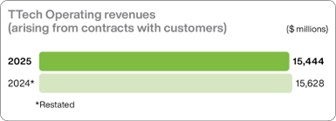
Operating revenues (arising from contracts with customers) | 6 | | | |||||
Other income | 7 | | | |||||
Operating revenues and other income | | | | |||||
OPERATING EXPENSES | | |||||||
Goods and services purchased | 16 | | | |||||
Employee benefits expense | 8, 16 | | | |||||
Depreciation | 17 | | | |||||
Amortization of intangible assets | 18 | | | |||||
Impairment of goodwill | 18 | | — | |||||
| | | ||||||
OPERATING INCOME | | | | |||||
Financing costs | 9 | | | |||||
INCOME BEFORE INCOME TAXES | | | ||||||
Income taxes | 10 | | | |||||
NET INCOME | | | | |||||
OTHER COMPREHENSIVE INCOME | 11 | |||||||
Items that may subsequently be reclassified to income | | |||||||
Change in unrealized fair value of derivatives designated as cash flow hedges | | | ( | |||||
Foreign currency translation adjustment arising from translating financial statements of foreign operations | | ( | | |||||
| | | ||||||
Items never subsequently reclassified to income | | |||||||
Change in measurement of investment financial assets | | ( | ||||||
Employee defined benefit plan re-measurements | | | | |||||
| | ( | ||||||
| | | ||||||
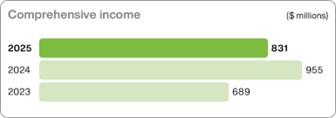
COMPREHENSIVE INCOME | | $ | | $ | | |||
NET INCOME ATTRIBUTABLE TO: | | |||||||
Common Shares | | $ | | $ | | |||
Non-controlling interests | | ( | ( | |||||
| $ | | $ | | ||||
COMPREHENSIVE INCOME ATTRIBUTABLE TO: | | |||||||
Common Shares | | $ | | $ | | |||
Non-controlling interests | | ( | | |||||
| $ | | $ | | ||||
NET INCOME PER COMMON SHARE | 12 | |||||||
Basic | | $ | | $ | | |||
Diluted | | $ | | $ | | |||
TOTAL WEIGHTED AVERAGE COMMON SHARES OUTSTANDING | | |||||||
Basic | | | | |||||
Diluted | | | | |||||
The accompanying notes are an integral part of these consolidated financial statements.
6 | December 31, 2025 |
|
consolidated statements of financial position
As at December 31 (millions) | | Note | | 2025 | | 2024 | ||
ASSETS | | | | |||||
Current assets | | | | |||||
Cash and temporary investments, net | | $ | | $ | | |||
Accounts receivable | 6(b) |
| |
| | |||
Income and other taxes receivable | |
| |
| | |||
Inventories | 1(l) |
| |
| | |||
Contract assets | 6(c) |
| |
| | |||
Costs incurred to obtain or fulfill contracts with customers | 20 | | | |||||
Prepaid maintenance and other |
| |
| | ||||
Current derivative assets | 4(h) |
| |
| | |||
|
| |
| | ||||
Non-current assets | |
|
| |||||
Property, plant and equipment, net | 17 |
| |
| | |||
Intangible assets, net | 18 |
| |
| | |||
Goodwill, net | 18 |
| |
| | |||
Contract assets | 6(c) |
| |
| | |||
Other long-term assets | 20 |
| |
| | |||
|
| |
| | ||||
| $ | | $ | | ||||
LIABILITIES AND OWNERS’ EQUITY | |
|
| |||||
Current liabilities | |
|
| |||||
Short-term borrowings | 22 | $ | | $ | | |||
Accounts payable and accrued liabilities | 23 |
| |
| | |||
Income and other taxes payable | |
| |
| | |||
Dividends payable | 13 |
| |
| | |||
Advance billings and customer deposits | 24 |
| |
| | |||
Provisions | 25 |
| |
| | |||
Current maturities of long-term debt | 26 |
| |
| | |||
Current derivative liabilities | 4(h) |
| |
| | |||
|
| |
| | ||||
Non-current liabilities | |
|
| |||||
Provisions | 25 |
| |
| | |||
Long-term debt | 26 |
| |
| | |||
Other long-term liabilities | 27 |
| |
| | |||
Deferred income taxes |
| |
| | ||||
|
| |
| | ||||
Liabilities | |
| |
| | |||
Owners’ equity | |
|
| |||||
Common equity | 28 |
| |
| | |||
Non-controlling interests | |
| |
| | |||
|
| |
| | ||||
| $ | | $ | | ||||
Contingent liabilities | 29 | |||||||
The accompanying notes are an integral part of these consolidated financial statements.
Approved by the Directors:
/s/ “Thomas E. Flynn” | | /s/ “John P. Manley” |
Thomas E. Flynn | John P. Manley | |
Director | Director |
| December 31, 2025 | 7 |
consolidated statements of changes in owners’ equity
Common equity |
| ||||||||||||||||||||||||
Equity contributed | Accumulated | ||||||||||||||||||||||||
Common Shares (Note 28) | other | Non- |
| ||||||||||||||||||||||
Number of | Share | Contributed | Retained | comprehensive | controlling |
| |||||||||||||||||||
(millions) | | Note | | shares | | capital | | surplus | | earnings | | income (loss) | | Total | | interests | | Total | |||||||
Balance as at January 1, 2024 |
| |
| | $ | | $ | | $ | | $ | ( | $ | | $ | | $ | | |||||||
Net income | — |
| — |
| — |
| |
| — |
| |
| ( |
| | ||||||||||
Other comprehensive income | 11 | — |
| — |
| — |
| |
| ( |
| ( |
| |
| | |||||||||
Dividends | 13 | — | — | — | ( | — | ( | — | ( | ||||||||||||||||
Dividends reinvested and optional cash payments |
| 13(b), 14(c) |
| |
| |
| — |
| — |
| — |
| |
| — |
| | |||||||
Equity accounted share-based compensation | | | | | — | | | | |||||||||||||||||
Issue of Common Shares in business combination |
|
| |
| |
| — |
| — |
| — |
| |
| — |
| | ||||||||
Change in ownership interests of subsidiaries |
| 28(b) |
| — |
| — |
| |
| — |
| — |
| |
| ( |
| | |||||||
Balance as at December 31, 2024 |
|
| | | | | ( | | | | |||||||||||||||
Net income |
|
| — |
| — |
| — |
| |
| — |
| |
| ( |
| | ||||||||
Other comprehensive income |
| 11 |
| — |
| — |
| — |
| |
| |
| |
| ( |
| | |||||||
Dividends |
| 13 |
| — | — | — | ( | — | ( | — | ( | ||||||||||||||
Dividends reinvested and optional cash payments |
| 13(b), 14(c) |
| |
| |
| — |
| — |
| — |
| |
| — |
| | |||||||
Equity accounted share-based compensation | 14(b) | | | | — | — | | | | ||||||||||||||||
Change in ownership interests of subsidiaries |
| 28(b) |
| |
| |
| |
| — |
| |
| |
| ( |
| | |||||||
Normal course issuer bid purchase of Common Shares | 28(c) | ( | ( | — | ( | — | ( | — | ( | ||||||||||||||||
Balance as at December 31, 2025 |
|
| | $ | | $ | | $ | | $ | | $ | | $ | | $ | | ||||||||
The accompanying notes are an integral part of these consolidated financial statements.
8 | December 31, 2025 |
|
consolidated statements of cash flows
Years ended December 31 (millions) | | Note | | 2025 | | 2024 | ||
OPERATING ACTIVITIES | | | | |||||
Net income | $ | | $ | | ||||
Adjustments to reconcile net income to cash provided by operating activities: |
|
| ||||||
Depreciation and amortization |
| |
| | ||||
Impairment of goodwill | 18 | | — | |||||
Deferred income taxes | 10 |
| ( |
| ( | |||
Share-based compensation expense, net | 14(a) |
| |
| | |||
Net employee defined benefit plans expense | 15(a) |
| |
| | |||
Employer contributions to employee defined benefit plans | 15(a) |
| ( |
| ( | |||
Gain on contributions of real estate to joint ventures | 7, 21 | ( | ( | |||||
(Income) loss from equity accounted investments | 7, 21 | ( | | |||||
Gain on purchase of long-term debt | 9, 26(b) | ( | — | |||||
Other |
| ( |
| ( | ||||
Net change in non-cash operating working capital | 31(a) |
| ( |
| | |||
Cash provided by operating activities |
| |
| | ||||
INVESTING ACTIVITIES |
|
| ||||||
Cash payments for capital assets, excluding spectrum licences | 31(a) |
| ( |
| ( | |||
Cash payments for spectrum licences | 18(a) | — | ( | |||||
Cash payments for acquisitions, net | 18(b) |
| ( |
| ( | |||
Advances to, and investments in, real estate joint ventures and associates | 21 |
| ( |
| ( | |||
Real estate joint venture receipts | 21 |
| |
| | |||
Proceeds on disposition |
| |
| | ||||
Investment in portfolio investments and other |
| ( |
| ( | ||||
Cash used by investing activities |
| ( |
| ( | ||||
FINANCING ACTIVITIES | 31(b) |
|
| |||||
Dividends paid to holders of Common Shares | 13(a) |
| ( |
| ( | |||
Purchase of Common Shares for cancellation | ( | — | ||||||
Issue (repayment) of short-term borrowings, net |
| |
| | ||||
Long-term debt issued | 18(b), 26 |
| |
| | |||
Redemptions and repayment of long-term debt | 26 |
| ( |
| ( | |||
Equity of subsidiary issued to non-controlling interest | 28(b) | | — | |||||
Shares of subsidiary purchased from non-controlling interests, net | 28(b) |
| ( |
| ( | |||
Financing activity transaction costs and other | ( | ( | ||||||
Cash used by financing activities |
| ( |
| ( | ||||
CASH POSITION |
|
| ||||||
Increase in cash and temporary investments, net |
| |
| | ||||
Cash and temporary investments, net, beginning of period |
| |
| | ||||
Cash and temporary investments, net, end of period | $ | | $ | | ||||
SUPPLEMENTAL DISCLOSURE OF OPERATING CASH FLOWS |
|
| ||||||
Interest paid | $ | ( | $ | ( | ||||
Interest received | $ | | $ | | ||||
Income taxes paid, net | $ | ( | $ | ( | ||||
The accompanying notes are an integral part of these consolidated financial statements.
| December 31, 2025 | 9 |
notes to consolidated financial statements
DECEMBER 31, 2025
TELUS Corporation is one of Canada’s largest telecommunications companies, providing a wide range of technology solutions, which include: mobile and fixed voice and data telecommunications services and products; healthcare services, software and technology solutions (including employee and family assistance programs and benefits administration); agriculture and consumer goods services (software, data management and data analytics-driven smart-food chain and consumer goods technologies); and digital experiences. Data services include: internet protocol; television; hosting, managed information technology and cloud-based services; and home and business security and automation.
TELUS Corporation was incorporated under the Company Act (British Columbia) on October 26, 1998, under the name BCT.TELUS Communications Inc. (BCT). On January 31, 1999, pursuant to a court-approved plan of arrangement under the Canada Business Corporations Act among BCT, BC TELECOM Inc. and the former Alberta-based TELUS Corporation (TC), BCT acquired all of the shares of BC TELECOM Inc. and TC in exchange for Common Shares and Non-Voting Shares of BCT, and BC TELECOM Inc. was dissolved. On May 3, 2000, BCT changed its name to TELUS Corporation and in February 2005, TELUS Corporation transitioned under the Business Corporations Act (British Columbia), successor to the Company Act (British Columbia). TELUS Corporation maintains its registered office at Floor 5, 510 West Georgia Street, Vancouver, British Columbia, V6B 0M3.
The terms “TELUS”, “we”, “us”, “our” or “ourselves” refer to TELUS Corporation and, where the context of the narrative permits or requires, its subsidiaries. Our principal subsidiaries are: TELUS Communications Inc., in which, as at December 31, 2025, we have a
10 | December 31, 2025 |
|
notes to consolidated financial statements
Notes to consolidated financial statements | | Page | |
|---|---|---|---|
General application | |||
1. | Summary of significant accounting policies | 12 | |
2. | Accounting policy developments | 25 | |
3. | Capital structure financial policies | 27 | |
4. | Financial instruments | 31 | |
Consolidated results of operations focused | |||
5. | Segment information | 43 | |
6. | Revenue from contracts with customers | 45 | |
7. | Other income | 46 | |
8. | Employee benefits expense | 47 | |
9. | Financing costs | 48 | |
10. | Income taxes | 49 | |
11. | Other comprehensive income | 51 | |
12. | Per share amounts | 52 | |
13. | Dividends per share | 52 | |
14. | Share-based compensation | 53 | |
15. | Employee future benefits | 59 | |
16. | Restructuring and other costs | 65 | |
Consolidated financial position focused | |||
17. | Property, plant and equipment | 67 | |
18. | Intangible assets and goodwill | 68 | |
19. | Leases | 72 | |
20. | Other long-term assets | 73 | |
21. | Real estate joint ventures and investments in associates | 73 | |
22. | Short-term borrowings | 76 | |
23. | Accounts payable and accrued liabilities | 76 | |
24. | Advance billings and customer deposits | 77 | |
25. | Provisions | 78 | |
26. | Long-term debt | 80 | |
27. | Other long-term liabilities | 87 | |
28. | Owners’ equity | 87 | |
29. | Contingent liabilities | 91 | |
Other | |||
30. | Related party transactions | 93 | |
31. | Additional statement of cash flow information | 96 | |
| December 31, 2025 | 11 |
notes to consolidated financial statements
1 | summary of significant accounting policies |
Our consolidated financial statements are expressed in Canadian dollars. The generally accepted accounting principles that we apply are International Financial Reporting Standards, as issued by the International Accounting Standards Board (IFRS® Accounting Standards), and Canadian generally accepted accounting principles.
Generally accepted accounting principles require that we disclose the accounting policies we have selected in those instances in which we have been obligated to choose from among compliant policy options. In certain other instances, including those without a choice of policy options, we are also required to disclose how we have applied certain accounting policies. In the selection and application of accounting policies, our considerations include the fundamental qualitative characteristics of useful financial information, namely relevance and faithful representation. In our assessment, the accounting policy disclosures we are required to make are not all equally significant, as set out in the accompanying table; their relative significance for us will evolve over time, as we do.
These consolidated financial statements for each of the years ended December 31, 2025 and 2024, were authorized by our Board of Directors for issue on February 12, 2026.
Accounting policy requiring a more | |||||||
Accounting policy | | Yes | | No | |||
General application | |||||||
(a) | Consolidation | X | |||||
(b) | Use of estimates and judgments | X | |||||
(c) | Financial instruments – recognition and measurement | X | |||||
(d) | Hedge accounting | X | |||||
Results of operations focused | |||||||
(e) | Revenue recognition | X | |||||
(f) | Depreciation, amortization and impairment | X | |||||
(g) | Translation of foreign currencies | X | |||||
(h) | Income and other taxes | X | |||||
(i) | Share-based compensation | X | |||||
(j) | Employee future benefit plans | X | |||||
Financial position focused | |||||||
(k) | Cash and temporary investments, net | X | |||||
(l) | Inventories | X | |||||
(m) | Property, plant and equipment; intangible assets | X | |||||
(n) | Investments | X | |||||
(a)Consolidation
Our consolidated financial statements include our accounts and the accounts of all of our subsidiaries, of which the principal ones are: TELUS Communications Inc., TELUS Health Inc. and TELUS International (Cda) Inc. TELUS Communications Inc. includes substantially all of our mobile and fixed operations, excluding the digitally-led customer experience and digital enablement transformation provided through the customer care and business services business of TELUS International (Cda) Inc.
Our financing arrangements and those of our wholly owned subsidiaries do not impose restrictions on inter-corporate dividends.
On a continuing basis, we review our corporate organization and effect changes as appropriate so as to enhance the value of TELUS Corporation. This ongoing process can, and does, affect which of our subsidiaries are considered principal subsidiaries at any particular point in time.
Denotes accounting policy requiring, for us, a more significant choice among accounting policies and/or a more significant application of judgment
12 | December 31, 2025 |
|
notes to consolidated financial statements
(b)Use of estimates and judgments
The preparation of financial statements in conformity with generally accepted accounting principles requires management to make estimates, assumptions and judgments that affect: the reported amounts of assets and liabilities at the date of the financial statements; the disclosure of contingent assets and liabilities at the date of the financial statements; and the reported amounts and classification of revenues and expenses during the reporting period. Actual results could differ from those estimates.
Estimates
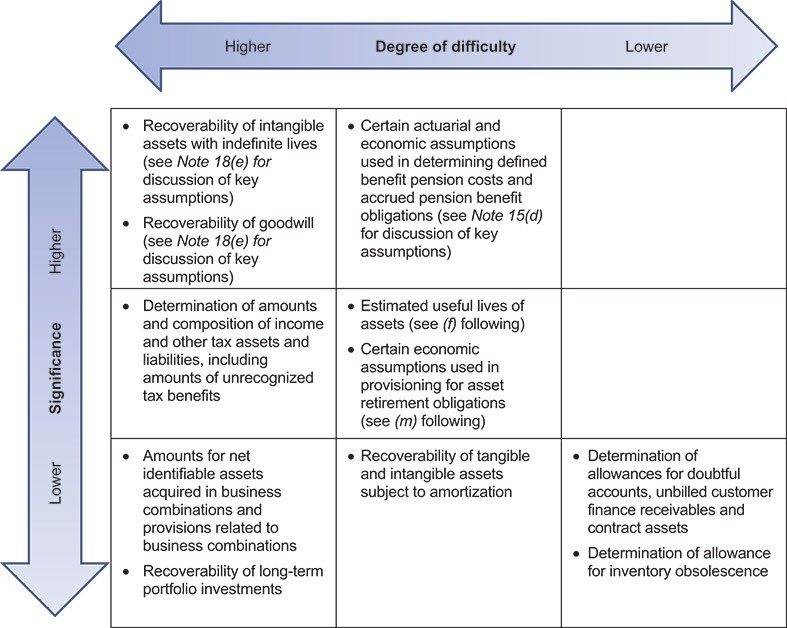
Examples of the significant estimates and assumptions that we make, and their relative significance and degree of difficulty, are set out in the graphic below.

Denotes accounting policy requiring, for us, a more significant choice among accounting policies and/or a more significant application of judgment
| December 31, 2025 | 13 |
notes to consolidated financial statements
Judgments
Examples of our significant judgments, apart from those involving estimation, include the following:
| ● | Assessments regarding whether line items are sufficiently material to warrant separate presentation in the primary financial statements and, if not, whether they are sufficiently material to warrant separate presentation in the notes to the financial statements. In the normal course, we make changes to our assessments regarding materiality for presentation so that they reflect current economic conditions. Due consideration is given to the view that it is reasonable to expect differing opinions of what is, and is not, material. |
Specifically, in the context of the statement of financial position, absent specific IFRS Accounting Standards disclosure requirements, our presentation generally disaggregates categories of assets and liabilities in excess of
| ● | In respect of revenue-generating transactions, we must make judgments that affect the timing of the recognition of revenue, as set out following: |
| ● | We have millions of multi-year contracts with our customers and we must make judgments as to when we have satisfied our performance obligations to our customers, either over a period of time or at a specific point in time. Service revenues are recognized based on customers’ access to, or usage of, our telecommunications infrastructure; we believe this method faithfully represents the transfer of the services, and thus the revenues are recognized as the services are made available and/or rendered. We consider our performance obligations arising from the sale of equipment to have been satisfied when the equipment has been delivered to, and accepted by, the end-user customers (see (e) following). |
| ● | Principally in the context of revenue-generating transactions involving mobile handsets, we must make judgments as to whether third-party re-sellers that deliver equipment to our customers are acting in the transactions as principals or as our agents. After due consideration of the relevant indicators, we have concluded that considering the re-sellers to be acting, solely for accounting purposes, as our agents more accurately represents the economic substance of these transactions, as we are the primary obligor to the end-user customers. As a result of this judgment, no equipment revenue is recognized when inventory is transferred to third-party re-sellers. |
| ● | We compensate third-party re-sellers and our employees for generating revenues, and we must make judgments as to whether such sales-based compensation amounts are costs incurred to obtain contracts with customers that should be capitalized (see Note 20). We believe that compensation amounts tangentially attributable to obtaining a contract with a customer, because the amount of such compensation could be affected in ways other than by simply obtaining that contract, should be expensed as incurred; compensation amounts directly attributable to obtaining a contract with a customer should be capitalized and amortized on a systematic basis, consistent with the satisfaction of the associated performance obligations. |
We must also exercise judgment as to the capitalization of costs incurred to fulfill revenue-generating contracts with customers. These fulfilment costs are associated with setting up, activating or otherwise implementing services involving access to, or usage of, our telecommunications infrastructure but would not otherwise be capitalized as property, plant, equipment and/or intangible assets (see Note 20).
| ● | The decision to depreciate and amortize any property, plant, equipment (including right-of-use lease assets) and intangible assets that are subject to amortization on a straight-line basis, as we believe that this method reflects the consumption of resources over the economic lifespan of those assets more faithfully than an accelerated method and is more representative of the economic substance of their underlying use. |
| ● | The preparation of financial statements in accordance with generally accepted accounting principles requires management to make judgments which affect the financial statement disclosure of information regularly reviewed by our chief operating decision-maker that is used to make resource allocation decisions and to assess performance (segment information, Note 5). |
Denotes accounting policy requiring, for us, a more significant choice among accounting policies and/or a more significant application of judgment.
14 | December 31, 2025 |
|
notes to consolidated financial statements
A significant judgment we have historically made is distinguishing between the operations and cash flows of our business units, including the allocation of both direct and indirect expenses and capital expenditures. It is often inherently difficult and objectively impractical to clearly distinguish between the operations and cash flows of our business units, as well as the assets from which their cash flows arise. This combination of difficulty and impracticality demonstrates the interdependence of our business units. During the year ended December 31, 2025, the TELUS health cash-generating unit was distinguished from the TELUS technology solutions cash-generating unit and was thus separately identified for impairment testing purposes (see Note 18(e)). As our businesses continue to evolve, new cash-generating units may also develop.
| ● | The view that the spectrum licences granted to us by Innovation, Science and Economic Development Canada (including spectrum licences that have been subordinated to us) will likely be renewed; that we intend to renew them; that we believe we have the financial and operational ability to renew them; and thus, that they have indefinite lives, as discussed further in Note 18(d). |
| ● | During the annual impairment testing of intangible assets with indefinite lives and goodwill, judgment may be required in allocating our net assets (including shared corporate and administrative assets) to our cash-generating units when determining their carrying amounts. |
| ● | In respect of claims and lawsuits, as discussed further in Note 29(a), the determination of whether an item is a contingent liability or whether an outflow of resources is probable and thus requiring the item be accounted for as a provision. |
(c)Financial instruments – recognition and measurement
The following policies have been adopted in respect of the recognition and measurement of financial instruments:
| ● | Regular-way purchases or sales of financial assets or financial liabilities (those that require actual delivery) are recognized on the settlement date. We have selected this method, as the benefits of using the trade date method were not expected to exceed the costs of implementation. |
| ● | Transaction costs, except for items held for trading, are added to the initial fair value of the acquired financial asset or financial liability. We have selected this method, as we believe that it results in better matching of the transaction costs with the periods benefiting from those costs. |
| ● | A contract to receive renewable energy credits and the associated virtual power purchase agreement (which we enter into as part of our commitment to reduce our carbon footprint) are accounted for as distinct units of account. We have selected this method, as we believe the receipt of the renewable energy credits is an executory contract, while the virtual power purchase agreement meets the definition of a derivative. |
(d)Hedge accounting
General
We apply hedge accounting to the financial instruments used to establish designated currency hedging relationships for certain U.S. dollar-denominated future purchase commitments and debt repayments, and designated electrical power purchase price hedging relationships, as set out in Note 4(a) and (d).
The purpose of hedge accounting, in respect of our designated hedging relationships, is to ensure that counterbalancing gains and losses are recognized in the same periods. We have chosen to apply hedge accounting, as we believe that it more faithfully depicts the economic substance of the underlying transactions.
Denotes accounting policy requiring, for us, a more significant choice among accounting policies and/or a more significant application of judgment.
| December 31, 2025 | 15 |
notes to consolidated financial statements
The application of hedge accounting requires a high correlation (indicating effectiveness) in the offsetting changes in the risk-associated values of the financial instruments (the hedging items) used to establish the designated hedging relationships and all, or a part, of the asset, liability or transaction with an identified risk exposure that we have taken steps to modify (the hedged items).
Hedge accounting – derivatives used to manage currency risk; derivatives used to manage interest rate risk
The anticipated effectiveness of designated hedging relationships is assessed at inception and their actual effectiveness is assessed for each subsequent reporting period. We consider a designated hedging relationship to be effective if the following critical terms match between the hedging item and the hedged item: the notional amount of the hedging item and the principal amount of the hedged item; maturity dates; payment dates; and interest rate index (if, and as, applicable).
Any ineffectiveness, such as might arise from differences between the notional amount of the hedging item and the principal amount of the hedged item, or from a previously effective designated hedging relationship becoming ineffective, is reflected in the Consolidated statements of income and other comprehensive income as Financing costs if in respect of long-term debt and as Goods and services purchased if in respect of U.S. dollar-denominated future purchase commitments, as set out in Note 4(i).
Hedge accounting – derivatives used to manage other price risk (see Note 2(a))
The anticipated effectiveness of designated hedging relationships is assessed at inception (January 1, 2025, for virtual power purchase agreements entered into prior to fiscal 2025) and their actual effectiveness is assessed for each subsequent reporting period. We consider a virtual power purchase agreement designated hedging relationship to be effective if the following critical terms match between the hedging item and the hedged item: the variable nature-dependent electricity notional amount of the hedging item and the variable notional amount of the hedged item; maturity dates; and payment dates.
Any ineffectiveness, such as might arise from differences between electricity consumed that is priced using the Alberta Interconnected Electrical System pool price, and that which is priced otherwise, or from a previously effective designated hedging relationship becoming ineffective, is reflected in the Consolidated statements of income and other comprehensive income as Goods and services purchased, as set out in Note 4(i).
Hedging assets and liabilities
In applying hedge accounting, a hedge value is recorded in the Consolidated statements of financial position representing the fair value of the hedging items. The net difference, if any, between amounts recognized in the determination of net income and amounts necessary to reflect the fair value of the designated cash flow hedging items recorded in the Consolidated statements of financial position is recognized as a component of Other comprehensive income, as set out in Note 11.
(e)Revenue recognition
General
We earn the majority of our TELUS technology solutions service revenues from access to, and usage of, our telecommunications infrastructure, including:
| ● | Mobile network (voice and data); |
| ● | Fixed data services (which include: internet protocol; television; hosting, managed information technology and cloud-based services; and home and business security); |
| ● | Fixed voice services; and |
| ● | Health services. |
Denotes accounting policy requiring, for us, a more significant choice among accounting policies and/or a more significant application of judgment.
16 | December 31, 2025 |
|
notes to consolidated financial statements
The majority of the balance of our TELUS technology solutions revenues (mobile equipment and other services; fixed equipment and other services; agriculture and consumer goods services (which include: software, data management and data analytics-driven smart-food chain and consumer goods technologies)) arises from providing services and products facilitating access to, and usage of, telecommunications infrastructure. Service revenues in our TELUS digital experience segment arise from the provision of digital customer experience solutions, including artificial intelligence and content management solutions.
We offer complete and integrated solutions to meet our customers’ needs. These solutions may involve deliveries of multiple services and products (our performance obligations) that occur at different points in time and/or over different periods of time; as referred to in (b), this is a significant judgment for us. As required, the performance obligations of these multiple-element arrangements are identified and the transaction price for the entire multiple-element arrangement is determined and allocated among the performance obligations based upon our relative stand-alone selling prices for each of them; our relevant revenue recognition policies are then applied, so that revenue is recognized when, or as, we satisfy the performance obligations. To the extent that variable consideration is included in determining the minimum transaction price, it is constrained to the “minimum spend” amount required in a contract with a customer. Service revenues arising from contracts with customers typically have variable consideration, because customers have the ongoing ability to both add and remove features and services, and because customer usage of our telecommunications infrastructure may exceed the base amounts provided for in their contracts.
For the purposes of IFRS 15, Revenue from Contracts with Customers, our contracts with customers are not considered to have significant financing components. With the exception of both equipment-related upfront payments that may be required under the terms of contracts with customers and in-store “cash and carry” sales of equipment and accessories, payments are typically due 30 days after the monthly billing date.
Multiple contracts with a single customer are normally accounted for as separate arrangements. When we enter into multiple contracts with a customer in a short period of time, the contracts are reviewed as a group to ensure that, as with multiple-element arrangements, their relative transaction prices are appropriate.
Lease accounting is applied to an accounting unit if it conveys the right to use a specific asset but does not convey the risks and/or benefits of ownership.
Revenues are recorded net of any value-added and/or sales taxes billed to the customer concurrent with a revenue-generating transaction.
We use the following revenue accounting practical expedients provided for in IFRS 15, Revenue from Contracts with Customers:
| ● | No adjustment of the contracted amount of consideration for the effects of financing components when, at the inception of the contract, we expect that the effect of the financing component is not significant at the individual contract level. |
| ● | No deferral of contract acquisition costs when the amortization period for such costs would be one year or less. |
| ● | When estimating minimum transaction prices allocated to any remaining unfulfilled, or partially unfulfilled, performance obligations, exclusion of amounts arising from contracts originally expected to have a duration of one year or less, as well as amounts arising from contracts under which we may recognize and bill revenue in an amount that corresponds directly with our completed performance obligations. |
Contract assets
Many of our multiple-element arrangements arise from bundling the sale of equipment (e.g. a mobile handset) with a contracted service period. Although the customer receives the equipment at contract inception and the revenue from the associated completed performance obligation is recognized at that time, the customer’s payment for the equipment will effectively be received rateably over the contracted service period to the extent it is not received as a lump-sum amount at contract inception. The difference between the equipment revenue recognized and the associated amount cumulatively billed to the customer is recognized on the Consolidated statements of financial position as a contract asset and/or an unbilled customer finance receivable, depending upon the form of the contract.
Denotes accounting policy requiring, for us, a more significant choice among accounting policies and/or a more significant application of judgment.
| December 31, 2025 | 17 |
notes to consolidated financial statements
Contract assets may also arise when we give consideration to a customer. When we receive no identifiable, separable benefit for consideration given to a customer, the amount of the consideration is recognized as a reduction of revenue rather than as an expense. Such amounts are included in the determination of transaction prices for allocation purposes in multiple-element arrangements.
| ● | Some forms of consideration given to a customer, effectively at contract inception, such as rebates (including prepaid non-bank cards) and/or equipment, are considered to be performance obligations in a multiple-element arrangement. Although the performance obligation is satisfied at contract inception, the customer’s payment associated with the performance obligation will effectively be received rateably over the associated contracted service period. The difference between the revenue arising from the satisfied performance obligation and the associated amount cumulatively billed to the customer is recognized on the Consolidated statements of financial position as a contract asset. |
| ● | Other forms of consideration given to a customer, either at contract inception or over a period of time, such as discounts (including prepaid bank cards), may result in us receiving no identifiable, separable benefit and thus are not considered performance obligations. Such consideration is recognized as a reduction of revenue rateably over the term of the contract. The difference between the consideration given and the associated amount recognized as a reduction of revenue is recognized on the Consolidated statements of financial position as a contract asset. |
Contract liabilities
Advance billings are recorded when billing occurs before our provision of the associated services; such advance billings are recognized as revenue in the period in which the services and/or equipment are provided (see Note 24). Similarly, and as appropriate, upfront customer activation and connection fees are deferred and recognized over the average expected term of the customer relationship.
Costs of contract acquisition and contract fulfilment
Costs of contract acquisition (typically commissions) and costs of contract fulfilment are capitalized and recognized as an expense, generally over the life of the contract on a systematic and rational basis consistent with the pattern of the transfer of goods or services to which the contract asset relates. The amortization of such costs is included in the Consolidated statements of income and other comprehensive income as a component of Goods and services purchased, with the exception of amounts paid to our employees, which are included as a component of Employee benefits expense.
The total cost of mobile equipment sold to customers and advertising and promotion costs related to initial customer acquisition are expensed as incurred; the cost of equipment we own that is situated at customers’ premises and associated installation costs are capitalized as incurred. Costs of advertising production, advertising airtime and advertising space are expensed as incurred.
Voice and data
We recognize revenues on an accrual basis and include an estimate of revenues earned but unbilled. Mobile and fixed service revenues are recognized based upon access to, and usage of, our telecommunications infrastructure and upon contract fees.
Advance billings are recorded when billing occurs before our provision of the associated services; such advance billings are recognized as revenue in the period in which the services are provided. Similarly, and as appropriate, upfront customer activation and connection fees are deferred and recognized over the average expected term of the customer relationship.
We apply the liability method of accounting for the amounts of our quality-of-service rate rebates that arise from the jurisdiction of the Canadian Radio-television and Telecommunications Commission (CRTC).
Denotes accounting policy requiring, for us, a more significant choice among accounting policies and/or a more significant application of judgment.
18 | December 31, 2025 |
|
notes to consolidated financial statements
Other and mobile equipment
We recognize product revenues, including amounts related to mobile handsets sold to re-sellers and customer premises equipment, when the products are both delivered to, and accepted by, the end-user customers, irrespective of which supply channel delivers the product. With respect to mobile handsets sold to re-sellers, we consider ourselves to be the principal and primary obligor to the end-user customers. Revenues from operating leases of equipment are recognized on a systematic and rational basis (normally a straight-line basis) over the term of the lease. We recognize revenues that arise from employee and family assistance programs and from software solutions (including benefits administration) in the accounting period in which they are provided.
We recognize revenues that arise from our provision of digital experience solutions, including artificial intelligence and content management solutions, in the accounting period in which they are provided, typically on a per-productive hour or per-transaction basis.
(f)Depreciation, amortization and impairment
Depreciation and amortization
Property, plant and equipment (including right-of-use lease assets) are depreciated on a straight-line basis over their estimated useful lives (lease terms for right-of-use lease assets), as determined by a continuing program of asset life studies. Depreciation includes the amortization of leasehold improvements, which are typically amortized over the shorter of their expected average service lives or lease terms. Intangible assets with finite lives (intangible assets subject to amortization) are amortized on a straight-line basis over their estimated useful lives, with annual reviews and adjustments made as appropriate. As referred to in (b), the use of a straight-line basis for depreciation and amortization is a significant judgment for us.
The estimated useful lives for the majority of our property, plant and equipment (including right-of-use lease assets) subject to depreciation and intangible assets subject to amortization are as follows:
| Estimated useful lives | |
Property, plant and equipment (including right-of-use lease assets) subject to depreciation | ||
Network assets | ||
Outside plant | ||
Inside plant | ||
Mobile site equipment | ||
Real estate right-of-use lease assets | ||
Balance of depreciable property, plant and equipment and right-of-use lease assets | ||
Intangible assets subject to amortization | ||
Customer contracts and related customer relationships | ||
Fixed subscriber base | ||
Software | ||
Access to rights-of-way, crowdsource assets and other |
Impairment – general
Impairment testing involves comparing the carrying amounts of the assets or cash-generating units being tested with their recoverable amounts (defined as the greater of an asset’s or a cash-generating unit’s value in use or its fair value less costs of disposal); as referred to in (b), this is a significant estimate for us. Impairment losses are recognized immediately when the carrying amount exceeds the recoverable amount. Should the recoverable amounts of previously impaired assets or cash-generating units subsequently increase, the earlier impairment losses may be reversed, with the exception of any impairment losses related to goodwill. Such reversals are permitted only to the extent that the reversal is not a result of “unwinding of the discount” and does not cause the resulting carrying amounts to exceed what they would have been if no impairment losses had been recognized previously.
Denotes accounting policy requiring, for us, a more significant choice among accounting policies and/or a more significant application of judgment.
| December 31, 2025 | 19 |
notes to consolidated financial statements
Impairment – property, plant and equipment; intangible assets subject to amortization
A continuing program of asset life studies evaluates factors such as the timing of technological obsolescence, competitive pressures, future infrastructure utilization plans, and climate; these evaluations may indicate that an asset’s carrying amount may not be recoverable, in which case an impairment loss is recognized.
Impairment – intangible assets with indefinite lives; goodwill
The carrying amounts of intangible assets with indefinite lives and goodwill are tested for impairment periodically. The frequency of testing is inversely related to the stability of relevant events and circumstances, with a minimum of annual testing being required; we have selected December as the time of our annual test.
Our intangible assets with indefinite lives are assessed by comparing the recoverable amounts of our cash-generating units to their carrying amounts, including allocated intangible assets with indefinite lives but excluding any allocated goodwill. To the extent that the carrying amount of a cash-generating unit, including allocated intangible assets with indefinite lives but excluding any allocated goodwill, exceeds its recoverable amount, the excess amount would be recorded as a reduction of the carrying amount of intangible assets with indefinite lives.
Following the assessment of intangible assets with indefinite lives, we assess goodwill by comparing the recoverable amounts of our cash-generating units (or group of cash-generating units) to their carrying amounts (including the intangible assets with indefinite lives and any allocated goodwill). To the extent that the carrying amount of a cash-generating unit, including the intangible assets with indefinite lives and the allocated goodwill, exceeds its recoverable amount, the excess amount would first be recorded as a reduction of the carrying amount of goodwill (see Note 18 (e)) and any remaining amount would then be recorded as a reduction of the carrying amounts of the assets of the cash-generating unit on a pro-rated basis.
(g)Translation of foreign currencies
Trade transactions completed in foreign currencies are translated into Canadian dollars at the exchange rates prevailing at the time of the transactions. Monetary assets and liabilities denominated in foreign currencies are translated into Canadian dollars at the exchange rate in effect at the statement of financial position date, with any resulting gains or losses recorded in the Consolidated statements of income and other comprehensive income as a component of Financing costs, as set out in Note 9. Hedge accounting is applied in specific instances, as discussed in (d) above.
For certain of our subsidiaries with functional currencies other than the Canadian dollar, foreign exchange gains and losses arising from the translation of their accounts into Canadian dollars are reported as a component of other comprehensive income, as set out in Note 11.
Denotes accounting policy requiring, for us, a more significant choice among accounting policies and/or a more significant application of judgment.
20 | December 31, 2025 |
|
notes to consolidated financial statements
(h)Income and other taxes
We follow the liability method of accounting for income taxes; as referred to in (b), this is a significant estimate for us. Under this method, current income taxes are recognized for the estimated income taxes payable for the current year. Deferred income tax assets and liabilities are recognized for temporary differences between the tax and accounting bases of assets and liabilities, and also for any benefits of losses and Investment Tax Credits available to be carried forward to future years for tax purposes that are more likely than not to be realized. The amounts recognized in respect of deferred income tax assets and liabilities are based upon the expected timing of the reversal of temporary differences or the usage of tax losses and the application of the substantively enacted tax rates at the time of reversal or use.
We account for any changes in substantively enacted income tax rates affecting deferred income tax assets and liabilities in full in the period in which the changes are substantively enacted. We account for changes in the estimates of tax balances for prior years as estimate revisions in the period in which changes in the estimates arise; we have selected this approach, as its emphasis on the statement of financial position is more consistent with the liability method of accounting for income taxes.
Our operations are complex and the related domestic and foreign tax interpretations, regulations, legislation and jurisprudence are continually changing. As a result, there are usually some tax matters in question that result in uncertain tax positions. We recognize the income tax benefit of an uncertain tax position only when it is more likely than not that the ultimate determination of the tax treatment of the position will result in that benefit being realized; however, this does not mean that tax authorities cannot challenge these positions. We accrue an amount for interest charges on current tax liabilities that have not been funded, which would include interest and penalties arising from uncertain tax positions. We include such charges in the Consolidated statements of income and other comprehensive income as a component of Financing costs.
Our research and development activities may be eligible to earn Investment Tax Credits, for which the determination of eligibility is a complex matter. We recognize Investment Tax Credits only when there is reasonable assurance that the ultimate determination of the eligibility of our research and development activities will result in the Investment Tax Credits being received, at which time they are accounted for using the cost reduction method, whereby such credits are deducted from the expenditures or assets to which they relate, as set out in Note 10(c).
(i)Share-based compensation
General
When share-based compensation vests in its entirety at a single point in time (cliff-vesting), we recognize the expense on a straight-line basis over the vesting period. When share-based compensation vests in tranches (graded-vesting), we recognize the expense using the accelerated attribution method. An estimate of forfeitures during the vesting period is made at the date of grant of share-based compensation; this estimate is adjusted to reflect actual experience.
Denotes accounting policy requiring, for us, a more significant choice among accounting policies and/or a more significant application of judgment.
| December 31, 2025 | 21 |
notes to consolidated financial statements
Restricted share units
For restricted share units with neither an equity settlement feature nor market performance conditions, as set out in Note 14(b), we accrue a liability equal to the product of the number of vesting restricted share units multiplied by the fair market value of the corresponding Common Shares at the end of the reporting period. Similarly, we accrue a liability for the notional subset of our restricted share units without an equity settlement feature and with market performance conditions, determining their fair value using a Monte Carlo simulation. Restricted share units with an equity settlement feature are accounted for as equity instruments. The expense for restricted share units that do not ultimately vest is reversed against the expense that was previously recorded in their respect.
Share option awards
A fair value for share option awards is determined at the date of grant and is recognized in the financial statements. When share option awards are exercised, both the proceeds and the recognized grant-date fair values are credited to share capital. As set out in Note 14(d), share option awards that have a net-equity settlement feature are accounted for as equity instruments. We have selected the equity instrument fair value method of accounting for the net-equity settlement feature, as it is consistent with the accounting treatment applied to the associated share option awards.
(j)Employee future benefit plans
Defined benefit plans
We accrue amounts for our obligations under employee defined benefit plans and the related costs, net of plan assets. The cost of pensions and other retirement benefits is actuarially determined using the accrued benefit method pro-rated on service, based on management’s best estimates of both the rate of future increases in compensation and the retirement ages of employees. In the determination of net income, net interest for each plan, which is the product of the plan’s surplus (deficit) multiplied by the discount rate, is included as a component of Financing costs, as set out in Note 9.
An amount reflecting the difference between the discount rate and the actual rate of return on plan assets is included as a component of employee defined benefit plan re-measurements within Other comprehensive income, as set out in Note 11 and Note 15. The maximum economic benefit available from the plans’ assets is determined based on reductions in future contributions to the plans.
The defined benefit plan key assumptions are assessed and revised as appropriate at least annually; as referred to in (b), these are significant estimates for us.
Denotes accounting policy requiring, for us, a more significant choice among accounting policies and/or a more significant application of judgment.
22 | December 31, 2025 |
|
notes to consolidated financial statements
Defined contribution plans
We apply defined contribution accounting for the Telecommunication Workers Pension Plan and the British Columbia Public Service Pension Plan, which cover certain of our employees and provide defined benefits to their members. In the absence of any regulations governing the calculation of the share of the underlying financial position and plan performance attributable to each employer-participant, and in the absence of contractual agreements between the plans and the employer-participants related to the financing of any shortfall (or distribution of any surplus), we account for these plans as defined contribution plans, in accordance with International Accounting Standard 19, Employee Benefits.
(k)Cash and temporary investments, net
Cash and temporary investments, which may include investments in money market instruments purchased three months or less from maturity, are presented net of outstanding items, including cheques written but not cleared by banks as at the statement of financial position date. When the total amount of all cheques written but not cleared by banks exceeds the amount of cash and temporary investments, the net amount is classified as a liability. This liability classification may also include overdraft amounts drawn on our bilateral bank facilities, which revolve daily and are discussed further in Note 22.
(l)Inventories
Inventories primarily consist of mobile handsets, parts and accessories, which totalled $
(m)Property, plant and equipment; intangible assets
General
Property, plant and equipment and intangible assets are recorded at historical cost, which for self-constructed property, plant and equipment includes materials, direct labour and applicable overhead costs. For internally developed internal-use software, the historical cost recorded includes materials, direct labour and direct labour-related costs. Where property, plant and equipment construction projects are of sufficient size and duration, an amount is capitalized for the cost of funds used to finance construction, as set out in Note 9. The rate of interest used for calculating the capitalized financing cost is based on the weighted average cost of borrowing that we experience during the reporting period.
Upon the sale of property, plant and/or equipment, the net book value is netted against the sale proceeds and the resulting difference, as set out in Note 7, is included in the Consolidated statements of income and other comprehensive income as a component of Other income.
Denotes accounting policy requiring, for us, a more significant choice among accounting policies and/or a more significant application of judgment.
| December 31, 2025 | 23 |
notes to consolidated financial statements
Asset retirement obligations
Provisions for liabilities, as set out in Note 25, are recognized for statutory, contractual or legal obligations, normally when incurred, associated with the retirement of property, plant and equipment (primarily certain items of outside plant and mobile site equipment) when those obligations result from the acquisition, construction, development and/or normal operation of the assets; as referred to in (b), this is a significant estimate for us. The obligations are initially measured at fair value using present value methodology, with the resulting costs capitalized as a part of the carrying amount of the related asset. In subsequent periods, the provisions for these liabilities are adjusted for discount accretion, changes in market-based discount rates and changes in the amount or timing of the underlying future cash flows. The capitalized asset retirement cost is depreciated on the same basis as the related asset and the discount accretion, as set out in Note 9, is included in the Consolidated statements of income and other comprehensive income as a component of Financing costs.
(n)Investments
We account for our investments in companies over which we have significant influence, as discussed further in Note 21, using the equity method of accounting, whereby the investments are initially recorded at cost and subsequently adjusted to recognize our share of earnings or losses of the investee companies and any earnings distributions received. The excess of the cost of an equity investment over its underlying book value at the initial date of investment, excluding goodwill, is amortized over the estimated useful lives of the underlying assets to which the excess cost is attributed; subsequent investments in associates do not result in the attribution of excess cost.
Similarly, we account for our interests in the real estate joint ventures, as discussed further in Note 21, using the equity method. Unrealized gains and losses resulting from transactions with the real estate joint ventures, including non-monetary contributions, are deferred in proportion to our remaining interest in the real estate joint ventures.
Other long-term investments are accounted for at fair value, unless they are investment securities that do not have either quoted market prices in an active market or other clear and objective evidence of fair value. When we do not account for our other long-term investments at their fair values, we apply the cost basis of accounting, whereby the investments are initially recorded at cost, and earnings from those investments are recognized only to the extent received or receivable. A significant or prolonged decline in the value of an investment that is classified as one of our other long-term investments results in an adjustment of its carrying value to its estimated fair value.
Denotes accounting policy requiring, for us, a more significant choice among accounting policies and/or a more significant application of judgment.
24 | December 31, 2025 |
|
notes to consolidated financial statements
2 | accounting policy developments |
(a) | Initial application of standards, interpretations and amendments to standards and interpretations in the reporting period |
| ● | In December 2024, the International Accounting Standards Board issued Contracts Referencing Nature-dependent Electricity – Amendments to IFRS 9 and IFRS 7, which amended IFRS 9, Financial Instruments, and IFRS 7, Financial Instruments, Disclosures. These amendments, among other matters, will now allow for hedge accounting to be applied in instances where there is variability in the underlying amount of electricity because the source of electricity generation depends on uncontrollable natural conditions (for example, the weather). Specifically, if we were to choose to apply hedge accounting, our accounting for the unrealized forward element of our pre-existing virtual power purchase agreements, which were first entered into in 2022, would be affected. The measurement of the fair value of the unrealized forward element of our virtual power purchase agreements is unaffected by the amendments. The amendments are effective for annual reporting periods beginning on or after January 1, 2026, with earlier adoption permitted. |
In accordance with the permitted transitional provisions, effective January 1, 2025, we have prospectively designated our pre - existing virtual power purchase agreements, which are contracts for differences, as held for hedging and have applied hedge accounting; this will have the effect of including the net change in the unrealized forward element of our virtual power purchase agreements arising on or after January 1, 2025, in the determination of other comprehensive income. The transitional provisions did not permit retrospective designation of our pre-existing virtual power purchase agreements.
The effects on the consolidated statement of income and other comprehensive income line items are as set out in the following table.
| Excluding amendments to | | Amendments to IFRS 9 | | |||||
Year ended December 31, 2025 (millions except per share amounts) | | IFRS 9 and IFRS 7 effects | | and IFRS 7 effects | | As currently reported | |||
OPERATING REVENUES | $ | | $ | — | $ | | |||
OPERATING EXPENSES |
| |
| |
| | |||
Goods and services purchased |
| |
| ( |
| | |||
Employee benefits expense |
| |
| — |
| | |||
Depreciation |
| |
| — |
| | |||
Amortization of intangible assets |
| |
| — |
| | |||
Impairment of goodwill |
| |
| — |
| | |||
| |
| ( |
| | ||||
OPERATING INCOME |
| |
| |
| | |||
Financing costs |
| |
| |
| | |||
INCOME BEFORE INCOME TAXES |
| |
| ( |
| | |||
Income taxes |
| |
| ( |
| | |||
NET INCOME | $ | | $ | ( | $ | | |||
OTHER COMPREHENSIVE INCOME |
| |
| |
| | |||
Items that may subsequently be reclassified to income |
| |
| |
| | |||
Change in unrealized fair value of derivatives designated as cash flow hedges | $ | | $ | | $ | | |||
COMPREHENSIVE INCOME | $ | | $ | — | $ | | |||
NET INCOME ATTRIBUTABLE TO COMMON SHARES | $ | | $ | ( | $ | | |||
NET INCOME PER COMMON SHARE |
| |
| |
| | |||
Basic | $ | | $ | — | $ | | |||
Diluted | $ | | $ | ( | $ | | |||
| December 31, 2025 | 25 |
notes to consolidated financial statements
The effects on the consolidated statement of changes in owners’ equity line items are as set out in the following table.
| Excluding amendments to | | Amendments to IFRS 9 | | |||||
As at December 31, 2025 (millions) | | IFRS 9 and IFRS 7 effects | | and IFRS 7 effects | | As currently reported | |||
COMMON EQUITY | |||||||||
Share capital | $ | | $ | — | $ | | |||
Contributed surplus |
| |
| — |
| | |||
Retained earnings |
| |
| ( |
| | |||
Accumulated other comprehensive income (loss) |
| ( |
| |
| | |||
$ | | $ | — | $ | | ||||
The effects on the consolidated statement of cash flows line items are as set out in the following table.
| Excluding amendments to | | Amendments to IFRS 9 | | |||||
Year ended December 31, 2025 (millions) | | IFRS 9 and IFRS 7 effects | | and IFRS 7 effects | | As currently reported | |||
OPERATING ACTIVITIES | | | | ||||||
Net income | $ | | $ | ( | $ | | |||
Deferred income taxes |
| ( |
| ( |
| ( | |||
Net change in non-cash operating working capital |
| ( |
| |
| ( | |||
All other reconciling items within operating activities |
| |
| — |
| | |||
Cash provided by operating activities | $ | | $ | — | $ | | |||
(b) | Standards, interpretations and amendments to standards and interpretations not yet effective and not yet applied |
| ● | In April 2024, the International Accounting Standards Board issued IFRS 18, Presentation and Disclosure in the Financial Statements, which sets out the overall requirements for presentation and disclosures in the financial statements. The new standard will replace IAS 1, Presentation of Financial Statements. Although much of the substance of IAS 1, Presentation of Financial Statements, will carry over into the new standard, the new standard incrementally will: |
| ● | With a view to improving comparability amongst entities, require presentation in the statement of operations of a subtotal for operating profit and a subtotal for profit before financing and income taxes (both subtotals as defined in the new standard); |
| ● | Require disclosure and reconciliation, within a single financial statement note, of management-defined performance measures which are used in public communications to share management’s views of various aspects of an entity’s performance and are derived from the statement of income and other comprehensive income; |
| ● | Enhance the requirements for aggregation and disaggregation of financial statement amounts; and |
| ● | Require limited changes to the statement of cash flows, including elimination of options for the classification of interest and dividend cash flows. |
The new standard is effective for annual reporting periods beginning on or after January 1, 2027, with earlier adoption permitted. We are currently assessing the impacts of the new standard; while there may be a limited shift of where a number of our management-defined performance measures are disclosed and reconciled (primarily a shift from management’s discussion and analysis to the financial statements) and where certain cash flows will be categorized in our statements of cash flows (primarily a shift of interest paid from operating activities to financing activities), we do not expect the totality of our financial disclosure to be materially affected by the application of the new standard.
| ● | In May 2024, the International Accounting Standards Board issued Amendments to the Classification and Measurement of Financial Instruments (Amendments to IFRS 9 and IFRS 7). The narrow-scope amendments are to address diversity in accounting practice in respect of: the classification of financial assets with environmental, social and corporate governance and similar features; and to clarify the date on which a financial asset or financial liability is to be de-recognized when using electronic payment systems. The new standard is effective for annual reporting periods beginning on or after January 1, 2026, with earlier adoption permitted. We are currently assessing the impacts of the new standard but do not expect to be materially affected by the application of the amendments. |
26 | December 31, 2025 |
|
notes to consolidated financial statements
3 | capital structure financial policies |
General
Our objective when managing financial capital is to maintain a flexible capital structure that optimizes the cost and availability of capital at an acceptable level of risk. In our definition of financial capital, we include:
| ● | Common equity (excluding accumulated other comprehensive income); |
| ● | Non-controlling interests; |
| ● | Long-term debt (including long-term credit facilities, commercial paper backstopped by long-term credit facilities and any hedging assets or liabilities associated with long-term debt items, net of amounts recognized in accumulated other comprehensive income); |
| ● | Cash and temporary investments; |
| ● | Short-term borrowings (including those arising from securitized trade receivables and unbilled customer finance receivables and any hedging assets or liabilities associated with short - term borrowings, net of amounts recognized in accumulated other comprehensive income); and |
| ● | Other long-term debt. |
We manage our financial capital structure and make adjustments to it in light of changes in economic conditions and the risk characteristics of our business. In order to maintain or adjust our financial capital structure, we may:
| ● | Adjust the amount of dividends paid to holders of Common Shares; |
| ● | Adjust the discount at which Common Shares are offered under the Dividend Reinvestment and Share Purchase Plan; |
| ● | Purchase Common Shares for cancellation pursuant to normal course issuer bids; |
| ● | Issue new equity (including Common Shares and subsidiary equity); |
| ● | Issue new debt, issue new debt to replace existing debt with different characteristics; and /or |
| ● | Increase or decrease the amount of short-term borrowings arising from securitized trade receivables and unbilled customer finance receivables. |
During 2025, our financial objectives, which are reviewed annually, were unchanged from 2024. We believe that our financial objectives support our long-term strategy.
We monitor financial capital utilizing a number of measures, including: net debt to earnings before interest, income taxes, depreciation and amortization (EBITDA*) – excluding restructuring and other costs ratio; coverage ratios; and dividend payout ratios.
* EBITDA is not a standardized financial measure under IFRS Accounting Standards and might not be comparable to similar measures disclosed by other issuers; we define EBITDA as operating revenues and other income less goods and services purchased and employee benefits expense. We report EBITDA because it is a key measure that management uses to evaluate the performance of our business, and it is also utilized to determine compliance with certain debt covenants.
| December 31, 2025 | 27 |
notes to consolidated financial statements
Debt and coverage ratios
Net debt to EBITDA – excluding restructuring and other costs is calculated as net debt at the end of the period, divided by 12-month trailing EBITDA – excluding restructuring and other costs. Historically, this measure is substantially similar to the leverage ratio covenant in our credit facilities. Net debt and EBITDA – excluding restructuring and other costs are measures that do not have any standardized meanings prescribed by IFRS Accounting Standards and are therefore unlikely to be comparable to similar measures disclosed by other issuers. The calculation of these measures is set out in the following table. Net debt is one component of a ratio used to determine compliance with certain debt covenants.
As at, or for the 12-month periods ended, December 31 ($ in millions) | | Objective | | 2025 | | 2024 | ||
Components of debt and coverage ratios | | | ||||||
Net debt 1 | $ | | $ | | ||||
EBITDA – excluding restructuring and other costs 2 | $ | | $ | | ||||
Net interest cost 3 (Note 9) | $ | | $ | | ||||
Debt ratio |
|
| ||||||
Net debt to EBITDA – excluding restructuring and other costs |
| |
| | ||||
Coverage ratios |
|
| ||||||
Earnings coverage 5 |
| |
| | ||||
EBITDA – excluding restructuring and other costs interest coverage 6 |
| |
| | ||||
1Net debt and total managed capitalization are calculated as follows:
As at December 31 | | Note | | 2025 | | 2024 | ||
Long-term debt |
| 26 | $ | | $ | | ||
TELUS Corporation junior subordinated notes equity credit deducted in calculating net debt |
| 26(g) |
| ( |
| — | ||
Debt issuance costs netted against long-term debt | | | ||||||
Derivative (assets) liabilities used to manage interest rate and currency risks associated with U.S. dollar-denominated debt, net |
| |
| |
| ( | ||
Accumulated other comprehensive income (loss) amounts arising from financial instruments used to manage interest rate and currency risks associated with U.S. dollar-denominated debt – excluding tax effects |
| |
| ( |
| ( | ||
Cash and temporary investments, net |
| |
| ( |
| ( | ||
Short-term borrowings |
| 22 |
| |
| | ||
Net debt |
| | | | ||||
Common equity | | | ||||||
Non-controlling interests | | | ||||||
Add: TELUS Corporation junior subordinated notes equity credit deducted in calculating net debt | | — | ||||||
Less: accumulated other comprehensive (income) loss amounts included above in common equity and non-controlling interests | ( | | ||||||
Total managed capitalization |
| | $ | | $ | | ||
2EBITDA – excluding restructuring and other costs is calculated as follows:
Years ended December 31 | | Note | | 2025 | | 2024 | ||
EBITDA | 5 | $ | | $ | | |||
Restructuring and other costs | 16 | | | |||||
EBITDA – excluding restructuring and other costs | $ | | $ | | ||||
3 | Net interest cost is defined as financing costs, excluding employee defined benefit plans net interest, unrealized changes in virtual power purchase agreements forward element when accounted for as held for trading (see Note 2(a)), recoveries on long-term debt prepayment premium and recoveries on repayment of debt, calculated on a 12-month trailing basis (expenses recorded for long-term debt prepayment premium, if any, are included in net interest cost) (see Note 9). |
28 | December 31, 2025 |
|
notes to consolidated financial statements
4 | Our long-term objective range for this ratio is |
5 | Earnings coverage is defined in Canadian Securities Administrators National Instrument 41-101 as net income before borrowing costs and income tax expense, divided by borrowing costs (interest on long-term debt (including dividend obligations on preferred shares that are required to be accounted for as financial liabilities); interest on short-term borrowings and other; and long-term debt prepayment premium), and adding back capitalized interest, all such amounts excluding those attributable to non-controlling interests. |
6 | EBITDA – excluding restructuring and other costs interest coverage is defined as EBITDA – excluding restructuring and other costs, divided by net interest cost. This measure is substantially similar to the coverage ratio covenant in our credit facilities. |
Net debt to EBITDA – excluding restructuring and other costs was
The earnings coverage ratio for the twelve-month period ended December 31, 2025, was
TELUS Corporation Common Share dividend payout ratio
So as to be consistent with the way we manage our business, our TELUS Corporation Common Share dividend payout ratio is presented as a historical measure calculated as the sum of the dividends declared in the most recent four quarters for TELUS Corporation Common Shares, as recorded in the financial statements, net of dividend reinvestment plan effects (see Note 13), divided by the sum of free cash flow* amounts for the most recent four quarters for interim reporting periods (divided by annual free cash flow if the reported amount is in respect of a fiscal year). The historical measure for the twelve-month period ended December 31, 2025, is presented for illustrative purposes in evaluating our objective range.
For the 12-month periods ended December 31 | | Objective | | 2025 | | 2024 | |
Determined using most comparable IFRS Accounting Standards measures | |||||||
Ratio of TELUS Corporation Common Share dividends declared to cash provided by operating activities - less capital expenditures |
| |
| | % | | % |
Determined using management measures | |||||||
TELUS Corporation Common Share dividend payout ratio – net of dividend reinvestment plan effects |
|
| | % | | % |
1 | Our objective range for the TELUS Corporation Common Share dividend payout ratio is |
* Free cash flow is not a standardized financial measure under IFRS Accounting Standards and might not be comparable to similar measures presented by other issuers; we define free cash flow as EBITDA (operating revenues and other income less goods and services purchased and employee benefits expense) excluding items that we consider to be of limited predictive value, including certain working capital changes (such as trade receivables and trade payables), proceeds from divested assets, and other sources and uses of cash, as presented in the consolidated statements of cash flows. We have issued guidance on, and report, free cash flow because it is a key performance measure that management and investors use to evaluate the performance of our business.
| December 31, 2025 | 29 |
notes to consolidated financial statements
Our calculation of TELUS Corporation Common Share dividends declared, net of dividend reinvestment plan effects, is as follows:
For the 12-month periods ended December 31 (millions) | | 2025 | | 2024 | ||
TELUS Corporation Common Share dividends declared | $ | | $ | | ||
Amount of TELUS Corporation Common Share dividends declared reinvested in TELUS Corporation Common Shares | ( |
| ( | |||
TELUS Corporation Common Share dividends declared – net of dividend reinvestment plan effects | $ | | $ | | ||
Our calculation of free cash flow, and its reconciliation to cash provided by operating activities, is as follows:
2025 | 2024 | |||||||||||||||||||
Cash provided | Cash provided | |||||||||||||||||||
by operating | Free cash | by operating | Free cash | |||||||||||||||||
For the 12-month periods ended December 31 (millions) | | Note | | activities | | Difference | | flow | | activities | | Difference | | flow | ||||||
EBITDA | 5 |
| $ | | $ | — | $ | | $ | | $ | — | $ | | ||||||
Restructuring and other costs, net of disbursements |
| | — | | ( |
| — |
| ( | |||||||||||
Effects of contract asset, acquisition and fulfilment and TELUS Easy Payment mobile device financing |
| | — | | ( |
| — |
| ( | |||||||||||
Effect of non-discretionary lease principal |
| — | ( | ( | — |
| ( |
| ( | |||||||||||
Items from the Consolidated statements of cash flows: |
| |
|
| ||||||||||||||||
Share-based compensation, net of employee share purchase plan cash outflows | 14 |
| | | | | |
| | |||||||||||
Net employee defined benefit plans expense | 15 |
| | — | | | — |
| | |||||||||||
Employer contributions to employee defined benefit plans |
| ( | — | ( | ( | — |
| ( | ||||||||||||
Gain on contributions of real estate to joint ventures | 7, 21 | ( | | — | ( | | — | |||||||||||||
(Income) loss from equity accounted investments |
| ( | — | ( | | — |
| | ||||||||||||
Gain on purchase of long - term debt | ( | | — | — | — | — | ||||||||||||||
Interest paid |
| ( | — | ( | ( | — | ( | |||||||||||||
Interest received |
| | — | | | — | | |||||||||||||
Other | ( | | — | ( | | — | ||||||||||||||
Other working capital items | ( | | — | ( | | — | ||||||||||||||
Capital expenditures (excluding acquisition from related party) | 5 |
| — | ( | ( | — | ( | ( | ||||||||||||
Capital expenditure for acquisition from related party | 21, 30(c) |
| — | — | — | — | ( | ( | ||||||||||||
Related party construction credit facility repayment made concurrent with capital expenditure for acquisition from related party and similar | 21, 30(c) | — | | | — | | | |||||||||||||
| | ( | | | ( | | ||||||||||||||
Income taxes paid, net of refunds |
| ( | — | ( | ( | — | ( | |||||||||||||
$ | | $ | ( | $ | | $ | | $ | ( | $ | | |||||||||
30 | December 31, 2025 |
|
notes to consolidated financial statements
4 | financial instruments |
(a) | Risks – overview |
Our financial instruments, their accounting classification and the nature of certain risks to which they may be exposed are set out in the following table.
Risks | ||||||||||||
Accounting | Market risks (g) | |||||||||||
Financial instrument | | classification | | Credit (b) | | Liquidity (c) | | Currency (d) | | Interest rate (e) | | Other price (f) |
Measured at amortized cost | ||||||||||||
Accounts receivable | AC 1 |
| X |
| X | |||||||
Contract assets | AC 1 | X | ||||||||||
Short-term borrowings | AC 1 |
| X |
| X |
| X | |||||
Accounts payable | AC 1 |
| X |
| X | |||||||
Provisions (including restructuring accounts payable) | AC 1 |
| X |
| X |
| X | |||||
Long-term debt | AC 1 |
| X |
| X |
| X | |||||
Measured at fair value | ||||||||||||
Cash and temporary investments | FVTPL 2 |
| X |
| X |
| X | |||||
Long-term investments (not subject to significant influence) 3 | FVTPL/FVOCI 3 |
| X |
| X | |||||||
Foreign exchange derivatives 4 | FVTPL 2 |
| X |
| X |
| X | |||||
Virtual power purchase agreements 4 | FVOCI 2, 5 | X | ||||||||||
| 1 | For accounting recognition and measurement purposes, classified as amortized cost (AC). |
| 2 | For accounting recognition and measurement purposes, classified as fair value through net income (FVTPL). Unrealized changes in the fair values of financial instruments are included in net income unless the instrument is part of a cash flow hedging relationship. The effective portions of unrealized changes in the fair values of financial instruments held for hedging are included in other comprehensive income. |
| 3 | Long-term investments over which we do not have significant influence are measured at fair value if those fair values can be reliably measured. For accounting recognition and measurement purposes, on an investment-by-investment basis, long-term investments are classified as either fair value through net income or fair value through other comprehensive income (FVOCI). |
| 4 | Use of derivative financial instruments is subject to a policy which requires that no derivative transaction is to be entered into for the purpose of establishing a speculative or leveraged position (the corollary being that all derivative transactions are to be entered into for risk management purposes only) and sets criteria for the creditworthiness of the transaction counterparties. |
Derivatives that are part of an established and documented cash flow hedging relationship are accounted for as held for hedging. We believe that classification as held for hedging results in a better matching of the change in the fair value of the derivative financial instrument with the risk exposure being hedged.
For hedges of anticipated transactions, hedge gains/losses are included with the related expenditure and are expensed when the transaction is recognized in our results of operations. We have selected this method as we believe that it results in a better matching of the hedge gains/losses with the risk exposure being hedged.
Derivatives that are not part of a documented cash flow hedging relationship are accounted for as held for trading and thus are measured at fair value through net income.
| 5 | As at December 31, 2024, these were classified as FVTPL. We have implemented new amendments to IFRS Accounting Standards effective January 1, 2025, which newly allow for these to prospectively be classified as FVOCI, following the December 2024 issue of Contracts Referencing Nature-dependent Electricity – Amendments to IFRS 9 and IFRS 7, as set out in Note 2(a). |
| December 31, 2025 | 31 |
notes to consolidated financial statements
Derivative financial instruments
We apply hedge accounting to financial instruments used to establish hedge accounting relationships for U.S. dollar-denominated transactions. We believe that our use of derivative financial instruments for hedging or arbitrage assists us in managing our financing costs and/or reducing the uncertainty associated with our financing or other business activities. Uncertainty associated with currency risk and other price risk is reduced through our use of foreign exchange derivatives that effectively swap floating rates for fixed rates and through our use of virtual power purchase agreements. When entering into derivative financial instrument contracts, we seek to align the cash flow timing of the hedging items with that of the hedged items. The effects of this risk management strategy and its application are set out in (i) following.
(b) | Credit risk |
Excluding credit risk, if any, arising from currency swaps settled on a gross basis, the best representation of our maximum exposure (excluding income tax effects) to credit risk, which is a worst-case scenario and does not reflect results we expect, is set out in the following table.
As at December 31 (millions) | | 2025 | | 2024 | ||
Cash and temporary investments, net | $ | | $ | | ||
Accounts receivable | |
| | |||
Contract assets | |
| | |||
Derivative assets | | | ||||
$ | | $ | | |||
Cash and temporary investments, net
Credit risk associated with cash and temporary investments is managed by ensuring that these financial assets are placed with: governments; major financial institutions that have been accorded strong investment grade ratings by a primary rating agency; and/or other creditworthy counterparties. An ongoing review evaluates changes in the status of counterparties.
32 | December 31, 2025 |
|
notes to consolidated financial statements
Accounts receivable
Credit risk associated with accounts receivable is inherently managed through the size and diversity of our large customer base, which encompasses substantially all consumer and business sectors in Canada. A program of credit evaluations of customers is followed and the amount of credit extended is limited when we deem it to be necessary. Accounts are considered to be past due (in default) when customers have failed to make contractually required payments when due, which is generally within days of the billing date. Any late payment charges are levied at an industry-based market rate or a negotiated rate on outstanding non-current customer account balances.
Customer accounts receivable, net of allowance for doubtful accounts | |||||||||||
As at December 31 (millions) | | Note | | Gross | | Allowance | | Net 1 | |||
2025 |
| | |||||||||
Less than 30 days past billing date |
| $ | | $ | ( | $ | | ||||
30-60 days past billing date |
| | ( | | |||||||
61-90 days past billing date |
| | ( | | |||||||
More than 90 days past billing date |
| | ( | | |||||||
Unbilled customer finance receivables | | ( | | ||||||||
$ | | $ | ( | $ | | ||||||
Current 2 | 6(b) | $ | | $ | ( | $ | | ||||
Non-current 3 | 20 | | ( | | |||||||
| $ | | $ | ( | $ | | |||||
2024 |
| | |||||||||
Less than 30 days past billing date |
| $ | | $ | ( | $ | | ||||
30-60 days past billing date |
| | ( | | |||||||
61-90 days past billing date |
| | ( | | |||||||
More than 90 days past billing date |
| | ( | | |||||||
Unbilled customer finance receivables | | ( | | ||||||||
$ | | $ | ( | $ | | ||||||
Current 2 | 6(b) | $ | | $ | ( | $ | | ||||
Non-current 3 | 20 | | ( | | |||||||
| $ | | $ | ( | $ | | |||||
| 1 | Net amounts represent customer accounts receivable for which an allowance had not been made as at the dates of the Consolidated statements of financial position (see Note 6(b)). |
| 2 | Presented in the Consolidated statements of financial position as Accounts receivable. |
| 3 | Presented in the Consolidated statements of financial position as Other long-term assets. |
| December 31, 2025 | 33 |
notes to consolidated financial statements
We maintain allowances for lifetime expected credit losses related to doubtful accounts. Factors considered when determining allowances for past-due accounts include: current economic conditions (including forward-looking macroeconomic data); historical information (including credit agency reports, if available); reasons for the accounts being past due; and the line of business from which the customer accounts receivable originated. These factors are also considered when determining whether to write off amounts charged to the allowance for doubtful accounts against customer accounts receivable. The doubtful accounts expense is calculated on a specific-identification basis for customer accounts receivable balances above a specific threshold and on a statistically derived allowance basis for the remainder.
The following table presents a summary of the activity related to our allowance for doubtful accounts.
Years ended December 31 (millions) | | 2025 | | 2024 | ||
Balance, beginning of period | $ | | $ | | ||
Additions (doubtful accounts expense) |
| |
| | ||
Accounts written off 1 less than recoveries |
| ( |
| ( | ||
Other | | | ||||
Balance, end of period | $ | | $ | | ||
1 | For the year ended December 31, 2025, accounts that were written off but were still subject to enforcement activity totalled $ |
Contract assets
Credit risk associated with contract assets is inherently managed through the size and diversity of our large customer base, which encompasses substantially all consumer and business sectors in Canada. A program of credit evaluations of customers is followed and the amount of credit extended is limited when we deem it to be necessary.
Contract assets, net of impairment allowance | |||||||||
As at December 31 (millions) | | Gross | | Allowance | | Net (Note 6(c)) | |||
2025 |
| |
| |
| | |||
To be billed and thus reclassified to accounts receivable during: |
| |
| |
| | |||
The 12-month period ending one year hence | $ | | $ | ( | $ | | |||
The 12-month period ending two years hence |
| |
| ( |
| | |||
Thereafter |
| |
| ( |
| | |||
$ | | $ | ( | $ | | ||||
2024 |
| |
| |
| | |||
To be billed and thus reclassified to accounts receivable during: |
| |
| |
| | |||
The 12-month period ending one year hence | $ | | $ | ( | $ | | |||
The 12-month period ending two years hence |
| |
| ( |
| | |||
Thereafter |
| |
| ( |
| | |||
$ | | $ | ( | $ | | ||||
We maintain allowances for lifetime expected credit losses related to contract assets. Factors considered when determining the amounts of these allowances include: current economic conditions; historical information (including credit agency reports, if available); and the line of business from which the contract assets originated. These same factors are considered when determining whether to write off amounts charged to the impairment allowance for contract assets against contract assets.
34 | December 31, 2025 |
|
notes to consolidated financial statements
Derivative assets (and derivative liabilities)
Counterparties to our material foreign exchange derivatives are major financial institutions that have been accorded investment grade ratings by a primary credit rating agency. Credit exposure to any single financial institution is limited and counterparties’ credit ratings are monitored. We do not give or receive collateral on swap agreements and hedging items due to our credit rating and those of our counterparties. While we are exposed to the risk of credit losses due to the potential non-performance of our counterparties, we consider this risk remote. Our derivative liabilities do not have credit risk-related contingent features.
(c) | Liquidity risk |
As a component of our capital structure financial policies, discussed further in Note 3, we manage liquidity risk by:
| ● | maintaining a daily cash pooling process that enables us to manage our available liquidity and our liquidity requirements according to our actual needs; |
| ● | maintaining a short-term borrowing agreement associated with trade receivables and unbilled customer finance receivables (Note 22), bilateral bank facilities (Note 22), a supply chain financing program (Note 23), a commercial paper program (Note 26(c)) and syndicated credit facilities (Note 26(d)); |
| ● | maintaining an in-effect shelf prospectus; |
| ● | continuously monitoring forecast and actual cash flows; and |
| ● | managing maturity profiles of financial assets and financial liabilities. |
Our debt maturities in future years are disclosed in Note 26(k). As at December 31, 2025, unchanged from December 31, 2024, TELUS Corporation could offer an unlimited amount of securities in Canada, and $
We closely match the contractual maturities of our derivative financial liabilities with those of the risk exposures they are being used to manage.
The expected maturities of our undiscounted financial liabilities do not differ significantly from the contractual maturities, other than as noted in the accompanying tables. The contractual maturities of our undiscounted financial liabilities, including interest thereon (where applicable), are set out in the accompanying tables.
Non-derivative | Derivative | |||||||||||||||||||||||||||||
Composite long-term debt | ||||||||||||||||||||||||||||||
Long-term | ||||||||||||||||||||||||||||||
Non-interest | debt, | |||||||||||||||||||||||||||||
bearing | excluding | Currency swap agreement | Currency swap agreement | |||||||||||||||||||||||||||
financial | Short-term | leases 1 | Leases 2 | amounts to be exchanged | amounts to be exchanged 4 | |||||||||||||||||||||||||
As at December 31, 2025 (millions) | | liabilities | | borrowings 1 | | (Note 26) | | (Note 26) | | (Receive) 3 | | Pay | | Other | | (Receive) | | Pay | | Total | ||||||||||
2026 | $ | | $ | | $ | | $ | | $ | ( | $ | | $ | | $ | ( | $ | | $ | | ||||||||||
2027 |
| |
| |
| |
| | ( | | |
| ( |
| | | ||||||||||||||
2028 |
| |
| — |
| |
| | ( | | |
| ( |
| | | ||||||||||||||
2029 |
| |
| — |
| |
| | ( | | |
| — |
| — | | ||||||||||||||
2030 |
| |
| — |
| |
| | ( | | |
| — |
| — | | ||||||||||||||
2031 - 2035 | | — | | | ( | | | — | — | | ||||||||||||||||||||
Thereafter |
| — |
| — |
| |
| | ( | | |
| — |
| — | | ||||||||||||||
Total | $ | | $ | | $ | | $ | | $ | ( | $ | | $ | | $ | ( | $ | | $ | | ||||||||||
| | |
| Total (Note 26(k)) |
| $ | |
|
| |
|
| | |||||||||||||||||
| 1 | Cash outflows in respect of interest payments on our short-term borrowings, sustainability-linked notes, commercial paper, amounts drawn under our credit facilities (if any), other (unsecured) and junior subordinated notes have been calculated based upon the interest rates and, if applicable, foreign exchange rates, in effect as at December 31, 2025. |
| December 31, 2025 | 35 |
notes to consolidated financial statements
| 2 | As set out in Note 3, we may issue new debt to replace existing debt with different characteristics. Subsequent to December 31, 2025, as part of managing our capital structure, using a portion of cash provided from long-term debt (with different characteristics) issued for the repayment of indebtedness and for general corporate purposes in the year ended December 31, 2025, we chose to replace, and discretionarily prepay, $ |
| 3 | The amounts included in undiscounted non-derivative long-term debt in respect of U.S. dollar-denominated long-term debt, and the corresponding amounts in the long-term debt currency swap receive column, have been determined based upon the foreign exchange rates in effect as at December 31, 2025. The contractual amounts of hedged U.S. dollar-denominated long-term debt at maturity, in effect, are reflected in the long-term debt currency swap pay column as gross cash flows are exchanged pursuant to the currency swap agreements; however, the maturities and gross cash flows for the TELUS Corporation junior subordinated notes reflect the initial fixed-rate reset date. |
| 4 | The amounts included in undiscounted short-term borrowings in respect of U.S. dollar-denominated short-term borrowings, and the corresponding derivative liability amounts, if any, included in the currency swap pay column amounts, have been determined based upon the foreign exchange rates in effect as at December 31, 2025. The derivative liability hedging amounts, if any, for the contractual amounts of hedged U.S. dollar-denominated short-term borrowings are included in the currency swap pay column amounts as net cash flows are exchanged pursuant to the currency swap agreements. Gross cash flows are exchanged pursuant to European euro – U.S. dollar currency swaps and have been calculated based upon the interest rates and foreign exchange rates in effect as at December 31, 2025. |
Non-derivative | Derivative | ||||||||||||||||||||||||||
Composite long-term debt | |||||||||||||||||||||||||||
Non-interest | Long-term | ||||||||||||||||||||||||||
bearing | debt, | Currency swap agreement | Currency swap agreement | ||||||||||||||||||||||||
financial | Short-term | excluding | amounts to be exchanged | amounts to be exchanged 3 | |||||||||||||||||||||||
As at December 31, 2024 (millions) | | liabilities | | borrowings 1 | | leases 1 | | Leases | | (Receive) 2 | | Pay | | (Receive) | | Pay | | Total | |||||||||
2025 | $ | | $ | | $ | | $ | | $ | ( | $ | | $ | ( | $ | | $ | | |||||||||
2026 |
| |
| |
| | | ( | |
| — |
| — | | |||||||||||||
2027 |
| |
| |
| | | ( | |
| — |
| — | | |||||||||||||
2028 |
| |
| — |
| | | ( | |
| — |
| — | | |||||||||||||
2029 |
| |
| — |
| | | ( | |
| — |
| — | | |||||||||||||
2030 - 2034 | | — | | | ( | | — | — | | ||||||||||||||||||
Thereafter |
| — |
| — |
| | | ( | |
| — |
| — | | |||||||||||||
Total | $ | | $ | | $ | | $ | | $ | ( | $ | | $ | ( | $ | | $ | | |||||||||
| | |
| Total |
|
|
|
| $ | |
| |
|
| | ||||||||||||
1 | Cash outflows in respect of interest payments on our short-term borrowings, sustainability-linked notes, commercial paper and amounts drawn under our credit facilities (if any) have been calculated based upon the interest rates and, if applicable, foreign exchange rates in effect as at December 31, 2024. |
2 | The amounts included in undiscounted non-derivative long-term debt in respect of U.S. dollar-denominated long-term debt, and the corresponding amounts in the long-term debt currency swap receive column, have been determined based upon the foreign exchange rates in effect as at December 31, 2024. The contractual amounts of hedged U.S. dollar-denominated long-term debt at maturity, in effect, are reflected in the long-term debt currency swap pay column as gross cash flows are exchanged pursuant to the currency swap agreements. |
3 | The amounts included in undiscounted short-term borrowings in respect of U.S. dollar-denominated short-term borrowings, and the corresponding derivative liability amounts, if any, included in the currency swap pay column amounts, have been determined based upon the foreign exchange rates in effect as at December 31, 2024. The derivative liability hedging amounts, if any, for the contractual amounts of hedged U.S. dollar-denominated short-term borrowings are included in the currency swap pay column amounts as net cash flows are exchanged pursuant to the currency swap agreements. |
(d)Currency risk
Our functional currency is the Canadian dollar, but certain routine revenues and operating costs are denominated in U.S. dollars and certain inventory purchases and capital asset acquisitions are sourced internationally. The U.S. dollar is the only foreign currency to which we have significant exposure as at the statement of financial position date.
36 | December 31, 2025 |
|
notes to consolidated financial statements
Our currency risk management includes the use of foreign currency forward contracts and currency options to fix the exchange rates on a varying percentage, typically in the range of
As discussed further in Note 26(b) and Note 26(h), we are also, and have also been, exposed to currency risk in that the fair values or future cash flows of our U.S. Dollar Notes and our TELUS International (Cda) Inc. credit facility U.S. dollar borrowings could fluctuate because of changes in foreign exchange rates. Currency hedging relationships have been established for the related semi-annual interest payments and the principal payment at maturity in respect of the U.S. Dollar Notes; we designate only the spot element of these instruments as the hedging item, as the forward element is wholly immaterial. As the functional currency of our TELUS International (Cda) Inc. subsidiary is the U.S. dollar, changes in foreign exchange rates affecting its borrowings have been reflected as a foreign currency translation adjustment within other comprehensive income.
(e) | Interest rate risk |
Changes in market interest rates affect the fair values or future cash flows of temporary investments, short-term obligations, long-term debt and interest rate swap derivatives.
When we have temporary investments, they have short maturities and fixed interest rates and, as a result, their fair values will fluctuate with changes in market interest rates; absent monetization before maturity, the related future cash flows will not change due to changes in market interest rates.
We could be exposed to interest rate risk if the balance of temporary investments or short-term investments included dividend-paying equity instruments.
As short-term obligations arising from bilateral bank facilities, which typically have variable interest rates, are rarely outstanding for periods that exceed one calendar week, interest rate risk associated with this item is not material.
Borrowings arising from the arm’s-length securitization trust are fixed-rate debts. Due to the short maturities of these borrowings, interest rate risk associated with this item is not material.
All of our currently outstanding long-term debt is fixed-rate debt, except commercial paper and amounts drawn on our credit facilities (Note 26(c)-(d), (h)). The fair value of fixed-rate debt changes with market interest rates; absent early redemption and/or, if applicable, absent an increase in the interest rate for sustainability-linked notes if a sustainability performance target verification assurance certificate has not been obtained (Note 26(b)), the related future cash flows will not change. Due to the short maturities of commercial paper, its fair value is not materially affected by changes in market interest rates, but the associated cash flows representing interest payments may be affected if commercial paper is rolled over.
Amounts drawn on our short-term and long-term credit facilities will be affected by changes in market interest rates in a manner similar to commercial paper.
(f) | Other price risks |
Virtual power purchase agreements
We have entered into virtual power purchase agreements with renewable energy projects that develop and operate solar and wind power generating facilities as part of our commitment to reduce our carbon footprint. The fair value of the forward elements of these agreements and their associated future cash flows will vary depending upon actual and estimated changes in electricity spot prices and the amount of nature-dependent electricity to be produced in the future under each agreement, referenced in the underlying cash-settled contracts for differences.
| December 31, 2025 | 37 |
notes to consolidated financial statements
Long-term investments
We are exposed to equity price risk arising from investments classified as fair value through other comprehensive income. Such investments are held for strategic purposes rather than for trading.
(g) | Market risks |
Net income and other comprehensive income for the years ended December 31, 2025 and 2024, could have varied if the Canadian dollar: U.S. dollar exchange rate, the U.S. dollar: European euro exchange rate, market interest rates and virtual power purchase agreement forward element valuation varied by reasonably possible amounts from their actual statement of financial position date amounts.
The sensitivity analysis of our exposure to currency risk has been determined based upon a hypothetical change taking place at the relevant statement of financial position date. We used the U.S. dollar-denominated and European euro-denominated balances and the notional amounts of our derivative financial instruments as at the relevant statement of financial position dates in these calculations.
The sensitivity analysis of our exposure to interest rate risk has been determined based upon a hypothetical change taking place at the beginning of the relevant fiscal year and being held constant through to the statement of financial position date. We used the principal and notional amounts as at the relevant statement of financial position dates in these calculations.
The sensitivity analysis of our exposure to wind discount risk and solar premium risk is based upon a hypothetical change taking place at the relevant statement of financial position date. The notional amounts of the virtual power purchase agreements as at the relevant statement of financial position dates have been used in these calculations.
38 | December 31, 2025 |
|
notes to consolidated financial statements
In the sensitivity analysis, income tax expense is presented on a net basis, using the applicable statutory income tax rates for the reporting periods.
Net income | Other comprehensive income | Comprehensive income | ||||||||||||||||
Years ended December 31 (increase (decrease) in millions) | | 2025 | | 2024 | | 2025 | | 2024 | | 2025 | | 2024 | ||||||
Reasonably possible changes in market risks 1 |
| |
| |
| |
| |
| |
| | ||||||
| |
| |
| |
| |
| |
| | |||||||
Canadian dollar appreciates | $ | ( | $ | ( | $ | ( | $ | | $ | ( | $ | | ||||||
Canadian dollar depreciates | $ | | $ | | $ | | $ | ( | $ | | $ | ( | ||||||
U.S. dollar appreciates | $ | ( | $ | | $ | ( | $ | ( | $ | ( | $ | ( | ||||||
U.S. dollar depreciates | $ | | $ | ( | $ | | $ | | $ | | $ | | ||||||
|
|
|
|
|
| |||||||||||||
Interest rates increase | ||||||||||||||||||
Canadian interest rate | $ | ( | $ | ( | $ | | $ | | $ | | $ | | ||||||
U.S. interest rate | $ | ( | $ | — | $ | ( | $ | ( | $ | ( | $ | ( | ||||||
Combined | $ | ( | $ | ( | $ | | $ | | $ | | $ | | ||||||
Interest rates decrease | ||||||||||||||||||
Canadian interest rate | $ | | $ | | $ | ( | $ | ( | $ | ( | $ | ( | ||||||
U.S. interest rate | $ | | $ | — | $ | | $ | | $ | | $ | | ||||||
Combined | $ | | $ | | $ | | $ | ( | $ | | $ | ( | ||||||
|
|
|
|
|
| |||||||||||||
Wind discount increases | $ | — | $ | ( | $ | ( | $ | — | $ | ( | $ | ( | ||||||
Wind discount decreases | $ | — | $ | | $ | | $ | — | $ | | $ | | ||||||
Solar premium increases | $ | — | $ | | $ | | $ | — | $ | | $ | | ||||||
Solar premium decreases | $ | — | $ | ( | $ | ( | $ | — | $ | ( | $ | ( | ||||||
1 | These sensitivities are hypothetical and should be used with caution. Changes in net income and/or other comprehensive income generally cannot be extrapolated because the relationship of the change in assumption to the change in net income and/or other comprehensive income may not be linear. In this table, the effect of a variation in a particular assumption on the amount of net income and/or other comprehensive income is calculated without changing any other factors; in reality, changes in one factor may result in changes in another, which might magnify or counteract the sensitivities. |
The sensitivity analysis assumes that we would realize the changes in exchange rates, market interest rates, wind discount and solar premium; in reality, the competitive marketplaces in which we operate would have an effect on this assumption.
(h) | Fair values |
General
The carrying values of cash and temporary investments, accounts receivable, short-term obligations, short-term borrowings, accounts payable and certain provisions (including restructuring provisions) approximate their fair values due to their immediate or short-term maturity. The fair values are determined directly by reference to quoted market prices in active markets.
The fair values of our investment financial assets are based on quoted market prices in active markets or other clear and objective evidence of fair value.
The fair value of our long-term debt, excluding leases, is based on quoted market prices in active markets.
| December 31, 2025 | 39 |
notes to consolidated financial statements
For derivative financial instruments used to manage our exposure to currency risk, we estimated their fair values based on either quoted market prices in active markets for the same or similar financial instruments or the current rates offered to us for financial instruments of the same maturity, as well as discounted future cash flows determined using current rates for similar financial instruments of similar maturities subject to similar risks (such fair value estimates being largely based on the Canadian dollar: U.S. dollar forward exchange rate as at the statements of financial position dates). The fair values of the derivative financial instruments we use to manage our exposure to price risk associated with the purchase of nature-dependent electricity are currently estimated using a discounted cash flow approach and are based on industry-standard forecasts from EDC Associates Ltd. utilizing observable market data. The significant unobservable inputs used in the fair value measurement of the Level 3 derivative financial instruments were wind discount, reflecting
Derivative
The derivative financial instruments that we measure at fair value on a recurring basis subsequent to initial recognition are set out in the following table.
As at December 31 ($ in millions except price or rate) | 2025 | 2024 | ||||||||||||||||||||
Maximum | Notional | Fair value 1 and | Price or | Maximum | Notional | Fair value 1 and | Price or | |||||||||||||||
| Designation | | maturity date | | amount | | carrying value | | rate | | maturity date | | amount | | carrying value | | rate | |||||
Current derivative assets 2 |
| |
| |
| |
| |
| |
| | ||||||||||
Derivatives used to manage currency risk associated with |
| |
| |
| |
| |
| |
| | ||||||||||
U.S. dollar-denominated transactions |
| HFT 4 |
| $ | | $ | — | US$1.00: ₱ | $ | | $ | — | US$1.00: | |||||||||
U.S. dollar-denominated transactions |
| HFT 4 |
| — | $ | — | — | — | $ | | | US$1.00: C$ | ||||||||||
U.S. dollar-denominated transactions |
| HFH 3 |
| $ | | | US$1.00: C$ | $ | | | US$1.00: C$ | |||||||||||
U.S. dollar-denominated debt (Notes 22, 26(c)) | HFH 3 |
| $ | | | US$1.00: C$ | $ | | | US$1.00: C$ | ||||||||||||
European euro functional currency operations purchased with U.S. dollar-denominated long-term debt 7 (Note 26(h)) | HFT 5,10 | $ | | | €1.00: US$ | $ | | | €1.00: US$ | |||||||||||||
Derivatives used to manage interest rate risk associated with Non-fixed rate credit facility amounts drawn (Note 26(h)) | HFH 3 | — | $ | — | — | — | $ | | — | |||||||||||||
$ | | $ | | |||||||||||||||||||
Other long-term assets 2 (Note 20) |
| |
| |
| |
| | |
| |
| | |||||||||
Derivatives used to manage currency risk associated with U.S. dollar-denominated long-term debt 6 (Note 26(b)) | HFH 3 | $ | | $ | | US$1.00: C$ | $ | | $ | | US$1.00: C$ | |||||||||||
European euro functional currency operations purchased with U.S. dollar-denominated long-term debt 7 (Note 26(h)) | HFT 5,10 | — | $ | — | — | — | $ | | | €1.00: US$ | ||||||||||||
Derivatives used to manage interest rate risk associated with Non-fixed rate credit facility amounts drawn (Note 26(h)) | HFT 4,10 | — | $ | — | — | — | $ | | ||||||||||||||
$ | | $ | | |||||||||||||||||||
Current derivative liabilities 2 | ||||||||||||||||||||||
Derivatives used to manage currency risk associated with | ||||||||||||||||||||||
U.S. dollar-denominated transactions | HFT 4 | $ | | $ | | US$1.00: ₱ | $ | | $ | | US$1.00: ₱ | |||||||||||
U.S. dollar-denominated transactions | HFH 3 | $ | | | US$1.00: C$ | $ | | — | US$1.00: C$ | |||||||||||||
U.S. dollar-denominated debt (Notes 22, 26(c)) | HFH 3 | $ | | | US$1.00: C$ | $ | | | US$1.00: C$ | |||||||||||||
Derivatives used to manage other price risk associated with Purchase of electrical power | HFH 3,9 | | $ | | $ | |||||||||||||||||
$ | | $ | | |||||||||||||||||||
Other long-term liabilities 2 (Note 27) | ||||||||||||||||||||||
Derivatives used to manage currency risk associated with U.S. dollar-denominated long-term debt 6 (Note 26(c)) | HFH 3 | $ | | $ | | US$1.00: C$ | $ | | $ | | US$1.00: C$ | |||||||||||
European euro functional currency operations purchased with U.S. dollar-denominated long-term debt 7 (Note 26(h)) | HFT 5,10 | $ | | | €1.00: US$ | — | $ | — | — | — | ||||||||||||
Derivatives used to manage other price risk associated with Purchase of electrical power |
| HFH 3,9 |
| | $ | | $ | |||||||||||||||
| |
| |
| | $ | | $ | | |||||||||||||
40 | December 31, 2025 |
|
notes to consolidated financial statements
1 | Fair value measured at the reporting date using significant other observable inputs (Level 2), except the fair value of virtual power purchase agreements (which we use to manage the price risk associated with the purchase of electrical power), which is measured at the reporting date using significant unobservable inputs (Level 3). Changes in the fair value of derivative financial instruments classified as Level 3 in the fair value hierarchy were as follows: |
Years ended December 31 | | 2025 | | 2024 | ||
Unrealized changes in virtual power purchase agreements forward element |
| |
| | ||
Included in net income, excluding income taxes (see (i)) | $ | | $ | ( | ||
Included in other comprehensive income, excluding income taxes (see (i), Note 2(a)) | | — | ||||
Balance, beginning of period - asset (liability) |
| ( |
| | ||
Balance, end of period - asset (liability) | $ | ( | $ | ( | ||
2 | Caption reflects line item in which derivative financial instruments are presented in the Consolidated statements of financial position. Derivative financial assets and liabilities are not set off. |
3 | Designated as held for hedging (HFH) upon initial recognition (cash flow hedging item), except for derivatives used to manage other price risk associated with the purchase of electrical power which were entered into prior to fiscal 2025 and were designated as HFH on January 1, 2025 (see Note 2(a)); hedge accounting is applied. Unless otherwise noted, hedge ratio is |
4 | Designated as held for trading (HFT) and classified as fair value through net income upon initial recognition; hedge accounting is not applied. |
5 | Designated as a hedge of a net investment in a foreign operation; hedge accounting is applied. Hedge ratio is |
6 | We designate only the spot element as the hedging item. As at December 31, 2025, the foreign currency basis spread included in the fair value of the derivative instruments, which is used for purposes of assessing hedge ineffectiveness, was $( |
7 | Prior to the hedge becoming ineffective, we had designated only the spot element as the hedging item. As at December 31, 2025, the foreign currency basis spread included in the fair value of the derivative instruments, which had been used for purposes of assessing hedge ineffectiveness, was $NIL (2024 – $ |
8 | Terawatt hours (TWh) are 1x10⁹ kilowatt hours and megawatt hours (MWh) are 1x10³ kilowatt hours. |
9 | As at December 31, 2024, these were designated as held for trading. We have implemented new amendments to IFRS Accounting Standards effective January 1, 2025, which newly allow for these to prospectively be designated as held for hedging (see Note 2(a)). |
10 | As at December 31, 2024, these were designated as held for hedging. During the three-month period ended September 30, 2025, the hedged item was repaid (Note 26(h)), hedge accounting ceased and the derivatives were re-designated as held for trading. |
Non-derivative
Our long-term debt, which is measured at amortized cost, and the fair value thereof, are set out in the following table.
As at December 31 (millions) | 2025 | 2024 | ||||||||||
Carrying | Carrying | |||||||||||
| value | | Fair value | | value | | Fair value | |||||
Long-term debt, excluding leases (Note 26) | $ | | $ | | $ | | $ | | ||||
| December 31, 2025 | 41 |
notes to consolidated financial statements
(i) | Recognition of derivative gains and losses |
The following table sets out the gains and losses, excluding income tax effects, arising from derivative instruments that are classified as cash flow hedging items and their location within the Consolidated statements of income and other comprehensive income.
Credit risk associated with such derivative instruments, as discussed further in (b), would be the primary source of hedge ineffectiveness. With the exception of the virtual power purchase agreement derivatives, there was
Amount of gain (loss) |
| |||||||||||||
recognized in other | Gain (loss) reclassified from other comprehensive | |||||||||||||
comprehensive income | income to income (effective portion) (Note 11) | |||||||||||||
(effective portion) (Note 11) | Amount | |||||||||||||
Years ended December 31 (millions) | | 2025 | | 2024 | | Location | | 2025 | | 2024 | ||||
Derivatives used to manage currency risk associated with | |
| |
| |
| |
| | |||||
U.S. dollar-denominated purchases | $ | ( | $ | |
| Goods and services purchased | $ | | $ | | ||||
U.S. dollar-denominated debt 1 Notes 22,26(b)-(c) | ( | | Financing costs | ( | | |||||||||
Net investment in a foreign operation 2 | ( | | Financing costs | — | | |||||||||
( |
| |
|
| ( |
| | |||||||
Derivatives used to manage other market risks | ||||||||||||||
Purchase of electrical power Note 2(a) | | — | Goods and services purchased | | — | |||||||||
Other | — | | Financing costs | — | | |||||||||
| | | | |||||||||||
$ | ( | $ | | $ | ( | $ | | |||||||
1 | Amounts recognized in other comprehensive income are net of the change in the foreign currency basis spread (which is used for purposes of assessing hedge ineffectiveness) included in the fair value of the derivative instruments; such amounts for the year ended December 31, 2025, totalled $( |
2 | Amounts recognized in other comprehensive income are net of the change in the foreign currency basis spread (which is used for purposes of assessing hedge ineffectiveness) included in the fair value of the derivative instruments; such amounts for the year ended December 31, 2025, totalled $( |
The following table sets out the ineffectiveness gains and losses included in Goods and services purchased in the Consolidated statements of income and other comprehensive income that arise from derivative instruments classified as held for hedging and designated as being in a hedging relationship.
| Gain (loss) on derivatives | |||||||
recognized in income | ||||||||
Years ended December 31 (millions) | | Note | | 2025 | | 2024 | ||
Derivatives used to manage other market risks (purchase of electrical power) | 2(a) | $ | |
| $ | — | ||
The following table sets out the gains and losses included in Financing costs in the Consolidated statements of income and other comprehensive income that arise from derivative instruments classified as held for trading and not designated as being in a hedging relationship.
Gain (loss) on derivatives | ||||||||
recognized in income | ||||||||
Years ended December 31 (millions) | | Note | 2025 | | 2024 | |||
Derivatives used to manage currency risk | $ | | $ | ( | ||||
Unrealized changes in virtual power purchase agreements forward element | 2(a) | $ | — | $ | ( | |||
42 | December 31, 2025 |
|
notes to consolidated financial statements
5 | segment information |
General
Operating segments are components of an entity that engage in business activities from which they earn revenues and incur expenses (including revenues and expenses related to transactions with the other component(s)), the operations of which can be clearly distinguished and for which the operating results are regularly reviewed by a chief operating decision-maker to make resource allocation decisions and to assess performance.
The TELUS technology solutions segment includes: network revenues and equipment sales arising from mobile technologies; data revenues (which include internet protocol; television; hosting, managed information technology and cloud-based services; and home and business security and automation); agriculture and consumer goods services (software, data management and data analytics-driven smart-food chain and consumer goods technologies); voice and other telecommunications services revenues; and equipment sales.
We embarked upon the modification of our internal and external reporting processes, systems and internal controls arising from the acquisition, and ongoing integration, of LifeWorks Inc.; commencing with the three-month period ended March 31, 2025, we have transitioned to our new segmented reporting structure and have restated comparative amounts on a comparable basis. The TELUS health segment includes: healthcare services, software and technology solutions (including employee and family assistance programs and benefits administration).
The TELUS digital experience segment, which has the U.S. dollar as its primary functional currency, includes key service lines: digital solutions; artificial intelligence and data solutions; trust, safety and security; and customer experience management. TELUS Corporation’s acquisition of the TELUS International (Cda) Inc. non-controlling interests, as described in Note 28(b), may affect our internal and external reporting processes, systems and internal controls, and thus our segmented reporting structure, in future periods.
Intersegment sales are recorded at the exchange value, which is the amount agreed to by the parties.
| December 31, 2025 | 43 |
notes to consolidated financial statements
The segment information regularly reported to our Chief Executive Officer (our chief operating decision-maker), and the reconciliation thereof to our products and services view of revenues, other revenues and income before income taxes, are set out in the following table.
TELUS technology solutions | TELUS digital | |||||||||||||||||||||||||||||||||||||||||
Mobile | Fixed | Segment total | TELUS health | experience | Eliminations | Total | ||||||||||||||||||||||||||||||||||||
Years ended December 31 (millions) | | 2025 | | 2024 | | 2025 | | 2024 | | 2025 | | 2024 | 2025 | 2024 | | 2025 | | 2024 | | 2025 | | 2024 | | 2025 | | 2024 | ||||||||||||||||
(restated*) | (restated*) | (restated*) | ||||||||||||||||||||||||||||||||||||||||
Operating revenues | ||||||||||||||||||||||||||||||||||||||||||
External revenues | ||||||||||||||||||||||||||||||||||||||||||
Service | $ | | $ | | $ | | $ | | $ | | $ | | $ | | $ | | $ | | $ | | $ | — | $ | — | $ | | $ | | ||||||||||||||
Equipment |
| |
| |
| |
| |
| |
| | | |
| — |
| — |
| — |
| — |
| |
| | ||||||||||||||||
Revenues arising from contracts with customers | $ | | $ | | $ | | $ | | |
| | | |
| |
| |
| — |
| — |
| |
| | |||||||||||||||||
Other income (Note 7) |
| |
| | | |
| |
| |
| — |
| — |
| |
| | ||||||||||||||||||||||||
|
| |
| | | |
| |
| |
| — |
| — |
| |
| | ||||||||||||||||||||||||
Intersegment |
| |
| | | |
| |
| |
| ( |
| ( |
| — |
| — | ||||||||||||||||||||||||
$ | | $ | | $ | | $ | | $ | | $ | | $ | ( | $ | ( | $ | | $ | | |||||||||||||||||||||||
EBITDA 1 | $ | | $ | | $ | | $ | | $ | | $ | | $ | ( | $ | ( | $ | | $ | | ||||||||||||||||||||||
Restructuring and other costs included in EBITDA (Note 16) | | | | | | | — | — | | | ||||||||||||||||||||||||||||||||
Adjusted EBITDA 1 | $ | | $ | | $ | | $ | | $ | | $ | | $ | ( | $ | ( | $ | | $ | | ||||||||||||||||||||||
Capital expenditures 2 | $ | | $ | | $ | | $ | | $ | | $ | | $ | ( | $ | ( | $ | | $ | | ||||||||||||||||||||||
Adjusted EBITDA less capital expenditures 1 | $ | | $ | | $ | | $ | | $ | | $ | | $ | ( | $ | ( | $ | | $ | | ||||||||||||||||||||||
Operating revenues - external, other income and intersegment (above) | $ | | $ | | $ | | $ | | $ | | $ | | $ | ( | $ | ( | $ | | $ | | ||||||||||||||||||||||
Goods and services purchased | | | | | | | ( | ( | | | ||||||||||||||||||||||||||||||||
Employee benefits expense | | | | | | | ( | ( | | | ||||||||||||||||||||||||||||||||
EBITDA (above) | | | | | | | ( | ( | | | ||||||||||||||||||||||||||||||||
Depreciation | | | | | | — | — | | | |||||||||||||||||||||||||||||||||
Amortization of intangible assets | | | | | | — | — | | | |||||||||||||||||||||||||||||||||
Impairment of goodwill | — | — | — | — | | — | — | — | 500 | — | ||||||||||||||||||||||||||||||||
Operating income (loss) | $ | | $ | | $ | ( | $ | ( | $ | ( | $ | $ | ( | $ | ( | |
| | ||||||||||||||||||||||||
Financing costs |
| |
| | ||||||||||||||||||||||||||||||||||||||
Income before income taxes | $ | | $ | | ||||||||||||||||||||||||||||||||||||||
* | As required by IFRS Accounting Standards, comparative amounts have been restated to conform with the reportable segments presented in the current period. TELUS health results in the current-year presentation were previously included in the “Fixed” and “Segment total” results of TELUS technology solutions. |
1 | Earnings before interest, income taxes, depreciation and amortization (EBITDA), both unadjusted and adjusted, are not standardized financial measures under IFRS Accounting Standards and may not be comparable to similar measures disclosed by other issuers (including those previously disclosed by TELUS Digital Experience); we define EBITDA as operating revenues and other income less goods and services purchased and employee benefits expense. We calculate adjusted EBITDA to exclude items that do not reflect our ongoing operations and, in our opinion, should not be considered in a long-term valuation metric or included in an assessment of our ability to service or incur debt. We report EBITDA, adjusted EBITDA and adjusted EBITDA less capital expenditures because they are key measures that management uses to evaluate the performance of our business, and EBITDA is also utilized in determining compliance with certain debt covenants. |
2 | See Note 31(a) for a reconciliation of capital asset additions, excluding spectrum licences, to cash payments for capital assets, excluding spectrum licences, reported in the Consolidated statements of cash flows. |
TELUS technology solutions capital expenditures include real estate development amounts of $
44 | December 31, 2025 |
|
notes to consolidated financial statements
Geographical information
We attribute revenues from external customers to individual countries on the basis of the location in which the goods and/or services are provided; for the year ended December 31, 2025, we attributed approximately $
6revenue from contracts with customers
(a) | Revenues |
In the determination of the minimum transaction prices in contracts with customers, amounts are allocated to fulfilling, or the completion of fulfilling, future contracted performance obligations, which are largely in respect of services to be provided over the duration of the contract. The following table sets out our aggregate estimated minimum transaction prices allocated to remaining unfulfilled, or partially unfulfilled, future contracted performance obligations and the timing of when we might expect to recognize the associated revenues; actual amounts could differ from these estimates due to a variety of factors, including the unpredictable nature of: customer behaviour; industry regulation; the economic environments in which we operate; and competitor behaviour.
As at December 31 (millions) | | 2025 | | 2024 | ||
Estimated minimum transaction price allocated to remaining unfulfilled, or partially unfulfilled, performance obligations to be recognized as revenue in a future period 1, 2 | ||||||
During the 12-month period ending one year hence | $ | | $ | | ||
During the 12-month period ending two years hence | | | ||||
Thereafter | | | ||||
$ | | $ | | |||
1 | Excludes constrained variable consideration amounts, amounts arising from contracts originally expected to have a duration of one year or less and, as a permitted practical expedient, amounts arising from contracts that are not affected by revenue recognition timing differences arising from transaction price allocation or from contracts under which we may recognize and bill revenue in an amount that corresponds directly with our completed performance obligations. |
2 | IFRS Accounting Standards require the explanation of when we might expect to recognize as revenue the amounts disclosed as the estimated minimum transaction price allocated to remaining unfulfilled, or partially unfulfilled, performance obligations. The estimated amounts disclosed are based upon contractual terms and maturities. Actual minimum transaction price revenues recognized, and the timing thereof, will differ from these estimates primarily due to the frequency with which the actual duration of contracts with customers does not match their contractual maturities. |
(b)Accounts receivable
As at December 31 (millions) | | Note | | 2025 | | 2024 | ||
Customer accounts receivable | $ | | $ | | ||||
Allowance for doubtful accounts | 4(b) | ( | ( | |||||
Billed customer accounts receivable, net of allowance for doubtful accounts | | | ||||||
Accrued receivables – customer | | | ||||||
Billed and unbilled customer accounts receivable, net of allowance for doubtful accounts |
| |
| | ||||
Accrued receivables – other | | | ||||||
Accounts receivable – current |
| | $ | | $ | | ||
| December 31, 2025 | 45 |
notes to consolidated financial statements
(c)Contract assets
Years ended December 31 (millions) | | Note | | 2025 | | 2024 | ||
Balance, beginning of period | $ | | $ | | ||||
Net additions arising from operations |
| |
| | ||||
Amounts billed in the period and thus reclassified to accounts receivable |
| ( |
| ( | ||||
Change in impairment allowance, net | 4(b) |
| ( |
| | |||
Other |
| |
| | ||||
Balance, end of period 1 | $ | | $ | | ||||
Reconciliation of contract assets presented in the Consolidated statements of financial position – current | ||||||||
Gross contract assets | $ | | $ | | ||||
Reclassification to contract liabilities of contracts with contract assets less than contract liabilities | 24 |
| ( |
| ( | |||
Reclassification from contract liabilities of contracts with contract liabilities less than contract assets | 24 |
| ( |
| ( | |||
$ | | $ | | |||||
| 1 | Timing of amounts to be billed and thus reclassified to accounts receivable is set out in Note 4(b). |
7other income
Years ended December 31 (millions) | | Note | | 2025 | | 2024 | ||
Government assistance |
| $ | | $ | | |||
Lease and other sublease revenue | 19 | | | |||||
Gain on contributions of real estate to joint ventures | 21(a) | | | |||||
Investment income, gain on disposal of assets and other 1 | | | ||||||
Interest income |
| 21(a) |
| | | |||
Changes in provisions related to business combinations | 25 | ( | | |||||
| $ | | $ | | ||||
1 | For the year ended December 31, 2024, includes a $ |
We receive government assistance, as defined by IFRS Accounting Standards, from a number of sources and, if not in respect of capital, we generally include such amounts received in Other income. We recognize such amounts on an accrual basis as the subsidized services are provided or as the subsidized costs are incurred.
Government of Quebec
Salaries for qualifying employment positions in the province of Quebec, mainly in the information technology sector, are eligible for tax credits. In respect of such tax credits, for the year ended December 31, 2025, we recorded $
46 | December 31, 2025 |
|
notes to consolidated financial statements
8employee benefits expense
Years ended December 31 (millions) | | Note | | 2025 | | 2024 | ||
Employee benefits expense – gross | ||||||||
Wages and salaries | $ | | $ | | ||||
Share-based compensation 1 | 14 | | | |||||
Pensions – defined benefit | 15(a) | | | |||||
Pensions – defined contribution | 15(f) | | | |||||
Restructuring costs 1 | 16(a) | | | |||||
Employee health and other benefits | | | ||||||
| | |||||||
Capitalized internal labour costs, net | ||||||||
Contract acquisition costs | 20 | |||||||
Capitalized | ( | ( | ||||||
Amortized | | | ||||||
Contract fulfilment costs | 20 | |||||||
Capitalized | ( | ( | ||||||
Amortized | | | ||||||
Property, plant and equipment | ( |
| ( | |||||
Intangible assets subject to amortization | ( |
| ( | |||||
( |
| ( | ||||||
$ | | $ | | |||||
1 | For the year ended December 31, 2025, $ (2024 – $ |
| December 31, 2025 | 47 |
notes to consolidated financial statements
9financing costs
Years ended December 31 (millions) | | Note | | 2025 | | 2024 | ||
Interest expense | ||||||||
From transactions that only involve the raising of finance | ||||||||
Long-term debt, excluding lease liabilities and other (secured) | ||||||||
Gross | $ | | $ | | ||||
Capitalized 1 | 17,18(a) | ( | ( | |||||
Net | | | ||||||
Short-term borrowings and other | | | ||||||
Gain on purchase of long-term debt 2 |
| 26(b) | ( | — | ||||
Long-term debt prepayment premium 3 | | — | ||||||
| | |||||||
From transactions that do not only involve the raising of finance | ||||||||
Long-term debt – lease liabilities | 19,26(j) | | | |||||
Long-term debt – other (secured) | 26(i) | | | |||||
Employee defined benefit plans net interest | 15 | | | |||||
Accretion on provisions | 25 | | | |||||
| | |||||||
| | |||||||
Other | ||||||||
Foreign exchange | ( | ( | ||||||
Unrealized changes in virtual power purchase agreements forward element | 2(a) | — | | |||||
| | |||||||
Interest income | ( | ( | ||||||
$ | | $ | | |||||
Net interest cost | 3 | $ | | $ | | |||
Interest expense on long-term debt, excluding lease liabilities and other – capitalized 1 | ( | ( | ||||||
Gain on purchase of long-term debt | ( | — | ||||||
Employee defined benefit plans net interest | | | ||||||
Unrealized changes in virtual power purchase agreements forward element | — | | ||||||
$ | | $ | | |||||
1 | Interest on long-term debt, excluding lease liabilities, at a composite rate of |
2 | The gain on purchase of long-term debt is net of a $ |
3 | Long-term debt prepayment premium includes a $ |
48 | December 31, 2025 |
|
notes to consolidated financial statements
10 | income taxes |
(a)Expense composition and rate reconciliation
Years ended December 31 (millions) | | 2025 | | 2024 | ||
Current income tax expense | ||||||
For the current reporting period | $ | |
| $ | | |
Adjustments recognized in the current period for income taxes of prior periods |
| ( |
| ( | ||
Pillar Two global minimum tax | | | ||||
| |
| | |||
Deferred income tax expense | ||||||
Arising from the origination and reversal of temporary differences |
| ( |
| ( | ||
Adjustments recognized in the current period for income taxes of prior periods |
| |
| | ||
| ( |
| ( | |||
$ | |
| $ | | ||
Our income tax expense and effective income tax rate differ from those computed by applying the applicable statutory rates for the following reasons:
Years ended December 31 ($ in millions) | | 2025 | | 2024 | |||||||
Income taxes computed at applicable statutory rates | $ | | | | % | $ | | | | % | |
Adjustments recognized in the current period for income taxes of prior periods | ( | ( | ( | ( | |||||||
Pillar Two global minimum tax | | | | | |||||||
Impairment of goodwill | | | — | — | |||||||
(Non-taxable) non-deductible amounts, net | | | ( | ( | |||||||
Withholding and other taxes | | | | | |||||||
Losses not recognized | | | | | |||||||
Foreign tax differential | ( | ( | ( | ( | |||||||
Other | |
| | | | ||||||
Income tax expense per Consolidated statements of income and other comprehensive income | $ | |
| | % | $ | |
| | % | |
The Organisation for Economic Co-operation and Development’s Pillar Two model rules are intended to ensure that large multinational corporations are subject to a minimum income tax rate of
We have applied a temporary mandatory relief from deferred income tax accounting for the impacts of the top - up income tax and it is recognized as a current income tax in the period it is incurred.
(b)Temporary differences
We must make significant estimates in respect of the composition of our deferred income tax liability. Our operations are complex and the related income tax interpretations, regulations, legislation and jurisprudence are continually changing. As a result, there are usually some income tax matters in question.
| December 31, 2025 | 49 |
notes to consolidated financial statements
Our estimates of the temporary differences comprising the net deferred income tax liability and the amounts of deferred income taxes recognized in the Consolidated statements of income and other comprehensive income and the Consolidated statements of changes in owners’ equity are set out in the following table.
Temporary differences arise from the carrying value of investments in subsidiaries and partnerships exceeding their tax base, for which no deferred income tax liabilities have been recognized because the parent is able to control the timing of the reversal of the differences and it is probable that they will not reverse in the foreseeable future. In our specific instance, this is relevant to our investments in Canadian subsidiaries and Canadian partnerships. We are not required to recognize such deferred income tax liabilities, as we are in a position to control the timing and manner of the reversal of the temporary differences, which would not be expected to be exigible to income tax, and it is probable that such differences will not reverse in the foreseeable future. We are in a position to control the timing and manner of the reversal of the temporary differences in respect of our non-Canadian subsidiaries, and it is probable that such differences will not reverse in the foreseeable future.
(c)Other
We conduct research and development activities, which may be eligible to earn Investment Tax Credits. During the year ended December 31, 2025, we recorded Investment Tax Credits of $
Property, plant | |||||||||||||||||||||||||||
and | Property, plant | ||||||||||||||||||||||||||
equipment | and | ||||||||||||||||||||||||||
(owned) and | equipment | Losses | Share-based | Net | |||||||||||||||||||||||
intangible | Intangible | (leased), net | Contract | Provisions not | available to | compensation | deferred | ||||||||||||||||||||
assets subject | assets with | of lease | assets and | Net pension | currently | be carried | amounts and | income | |||||||||||||||||||
(millions) | | to amortization | | indefinite lives | | liabilities | | liabilities | | amounts | | deductible | | forward 1 | | other | | tax liability | |||||||||
Balance as at January 1, 2024 | $ | | $ | | $ | | $ | | $ | ( | $ | ( | $ | ( | $ | ( | $ | | |||||||||
Deferred income tax expense recognized in Net income | ( | | ( | | ( | ( | ( | ( | ( | ||||||||||||||||||
Other comprehensive income | — | — | — | — | | — | — | ( | ( | ||||||||||||||||||
Deferred income taxes charged directly to owners’ equity and other |
| |
| — | — |
| — |
| — |
| ( |
| ( |
| |
| | ||||||||||
Balance as at December 31, 2024 | | | | | ( | ( | ( | ( | | ||||||||||||||||||
Deferred income tax expense recognized in Net income | ( | | ( | | ( | | ( | | ( | ||||||||||||||||||
Other comprehensive income |
| — |
| — | — |
| — |
| |
| — |
| — |
| |
| | ||||||||||
Deferred income taxes charged directly to owners’ equity and other (Note 18(b)) |
| |
| — | — |
| — |
| — |
| — |
| ( |
| ( |
| | ||||||||||
Balance as at December 31, 2025 | $ | | $ | | $ | ( | $ | | $ | ( | $ | ( | $ | ( | $ | ( | $ | | |||||||||
1 | We expect to be able to utilize our non-capital losses before their expiry. |
50 | December 31, 2025 |
|
notes to consolidated financial statements
11other comprehensive income
Year ended December 31, 2024 | Year ended December 31, 2025 | ||||||||||||||||||||||||||||
Accumulated | |||||||||||||||||||||||||||||
balance, | Accumulated | Accumulated | |||||||||||||||||||||||||||
| beginning of | Amount | Income | balance, end | Amount | Income | balance, end | ||||||||||||||||||||||
(millions) | | Note | | period | | arising | | taxes | | Net | | of period | | arising | | taxes | | Net | | of period | |||||||||
Items that may subsequently be reclassified to income | |||||||||||||||||||||||||||||
Change in unrealized fair value of derivatives designated as cash flow hedges | 4(i) | — | — | — | — | — | — | — | — | — | |||||||||||||||||||
Derivatives used to manage currency risk | |||||||||||||||||||||||||||||
Unrealized gains (losses) arising | — | $ | | $ | | — | — | $ | ( | $ | ( | — | — | ||||||||||||||||
Realized (gains) losses reclassified to net income | — | ( | ( | — | — | | | — | — | ||||||||||||||||||||
$ | ( | ( | ( | $ | ( | $ | ( | | | $ | | $ | ( | ||||||||||||||||
Derivatives used to manage other market risks | 2(a) | ||||||||||||||||||||||||||||
Unrealized gains (losses) arising | — | | | — | — | | | — | — | ||||||||||||||||||||
Realized (gains) losses reclassified to net income | — | ( | ( | — | — | ( | ( | — | — | ||||||||||||||||||||
( | | | | ( | | | | | |||||||||||||||||||||
Total | ( | ( | ( | ( | ( | | | | ( | ||||||||||||||||||||
Cumulative foreign currency translation adjustment | | | — | | | ( | — | ( | | ||||||||||||||||||||
Item never reclassified to income | |||||||||||||||||||||||||||||
Change in measurement of investment financial assets | — | — | — | — | — | — | — | — | — | ||||||||||||||||||||
Unrealized gains (losses) arising | — | ( | ( | — | — | | — | — | — | ||||||||||||||||||||
Realized gains (losses) | — | ( | ( | — | — | | | — | — | ||||||||||||||||||||
| ( | ( | ( | | | | | | |||||||||||||||||||||
Accumulated other comprehensive income (loss) | $ | ( | ( | ( | | $ | ( | | | | $ | | |||||||||||||||||
Attributable to: | | ||||||||||||||||||||||||||||
Common Shares | $ | ( | — | — | — | $ | ( | — | — | — | $ | | |||||||||||||||||
Non-controlling interests | ( | — | — | — | | — | — | — | — | ||||||||||||||||||||
$ | ( | — | — | — | $ | ( | — | — | — | $ | | ||||||||||||||||||
Item never reclassified to income | |||||||||||||||||||||||||||||
Employee defined benefit plan re-measurements | 15(a) | — | | | | — | | | | — | |||||||||||||||||||
Other comprehensive income | — | $ | ( | $ | ( | $ | | — | $ | | $ | | $ | | — | ||||||||||||||
| December 31, 2025 | 51 |
notes to consolidated financial statements
12per share amounts
Basic net income per Common Share is calculated by dividing net income attributable to Common Shares by the total weighted average number of Common Shares outstanding during the period. Diluted net income per Common Share is calculated to give effect to share option awards and restricted share unit awards.
The following table presents reconciliations of the denominators of the basic and diluted per share computations. Net income was equal to diluted net income for all periods presented.
Years ended December 31 (millions) | | 2025 | | 2024 |
Basic total weighted average number of Common Shares outstanding | | | ||
Effect of dilutive securities – Restricted share units | | | ||
Diluted total weighted average number of Common Shares outstanding |
| | |
For the years ended December 31, 2025 and 2024,
13 | dividends per share |
(a)TELUS Corporation Common Share dividends declared
Years ended December 31 (millions except per share amounts) | ||||||||||
TELUS Corporation | Declared | Paid to | ||||||||
Common Share dividends | | Effective | | Per share | | shareholders | | Total | ||
2025 | ||||||||||
Quarter 1 dividend |
| Mar. 11, 2025 | $ | |
| Apr. 1, 2025 | $ | | ||
Quarter 2 dividend |
| Jun. 10, 2025 | |
| July 2, 2025 | | ||||
Quarter 3 dividend | Sept. 10, 2025 | | Oct. 1, 2025 | | ||||||
Quarter 4 dividend | Dec. 11, 2025 | | Jan. 2, 2026 | | ||||||
| $ | | $ | | ||||||
2024 | ||||||||||
Quarter 1 dividend | Mar. 11, 2024 | $ | | Apr. 1, 2024 | $ | | ||||
Quarter 2 dividend | Jun. 10, 2024 | | July 2, 2024 | | ||||||
Quarter 3 dividend | Sept. 10, 2024 | | Oct. 1, 2024 | | ||||||
Quarter 4 dividend | Dec. 11, 2024 | | Jan. 2, 2025 | | ||||||
$ | | $ | | |||||||
On February 11, 2026, our Board of Directors declared a quarterly dividend of $
(b) | Dividend Reinvestment and Share Purchase Plan |
We have a Dividend Reinvestment and Share Purchase Plan under which eligible holders of TELUS Corporation Common Shares may acquire additional TELUS Corporation Common Shares by reinvesting dividends and by making additional optional cash payments to the trustee. Under this plan, we have the option of offering TELUS Corporation Common Shares from Treasury or having the trustee acquire TELUS Corporation Common Shares in the stock market. At our discretion, under the plan, we may offer TELUS Corporation Common Shares at a discount of up to
52 | December 31, 2025 |
|
notes to consolidated financial statements
14 | share-based compensation |
(a) | Details of share-based compensation expense |
Included in Employee benefits expense in the Consolidated statements of income and other comprehensive income, and in Cash provided by operating activities in the Consolidated statements of cash flows, are the share-based compensation amounts set out in the accompanying table.
Years ended December 31 (millions) | 2025 | 2024 | ||||||||||||||||||
Associated | Statement |
| Associated | Statement | ||||||||||||||||
Employee | operating | of cash | Employee | operating | of cash | |||||||||||||||
benefits | cash | flows | benefits | cash | flows | |||||||||||||||
| Note | | expense 1 | | outflows | | adjustment | | expense | | outflows | | adjustment | |||||||
Restricted share units | (b) | $ | | $ | ( | $ | | $ | | $ | ( | $ | | |||||||
Employee share purchase plan | (c) | | ( | — | | ( | — | |||||||||||||
Share option awards | (d) | | — | | | — | | |||||||||||||
$ | | $ | ( | $ | | $ | | $ | ( | $ | | |||||||||
TELUS technology solutions 2 | $ | | $ | ( | $ | | $ | | $ | ( | $ | | ||||||||
TELUS health 2 | | — | | | — | | ||||||||||||||
TELUS digital experience 3 | | ( | | |
| ( |
| | ||||||||||||
$ | | $ | ( | $ | | $ | | $ | ( | $ | | |||||||||
| 1 | Within employee benefits expense (see Note 8) for the year ended December 31, 2025, restricted share units expense of $ |
| 2 | Comparative amounts have been adjusted for change in segmentation (see Note 5). |
| 3 | During the three-month period ended June 30, 2024, the written put options in respect of non-controlling interests associated with the WillowTree acquisition were renegotiated, which resulted in: a change in provisions for business combinations; the institution of a maximum payout for the non-controlling interests associated with the WillowTree acquisition; and the awarding of share-based compensation. The expense (recovery) associated with these awards was $( |
(b) | Restricted share units |
General
We use restricted share units as a form of retention and incentive compensation. Each restricted share unit is nominally equal in value to
Restricted share units generally become payable when vesting is complete; TELUS Corporation restricted share units typically vest over a period of
Accounting for restricted share units, either as equity instruments or as liability instruments, is based upon the expected manner of their settlement when they are granted. Grants of TELUS Corporation restricted share units before fiscal 2019, and grants of TELUS International (Cda) Inc. restricted share units before fiscal 2021, were accounted for as liability instruments, as the associated obligations were normally expected to be cash - settled when granted.
| December 31, 2025 | 53 |
notes to consolidated financial statements
TELUS Corporation restricted share units
We also award restricted share units that largely have the same features as our general restricted share units, but have a variable payout (
The following table presents a summary of outstanding TELUS Corporation non-vested restricted share units.
As at December 31 | | 2025 | | 2024 |
Restricted share units without market performance conditions |
| |
| |
Restricted share units with service conditions only |
| | | |
Notional subset affected by non-market performance conditions |
| | | |
| | | ||
Restricted share units with market performance conditions |
|
| ||
Notional subset affected by relative total shareholder return performance condition |
| | | |
Number of non-vested restricted share units |
| | |
54 | December 31, 2025 |
|
notes to consolidated financial statements
The following table presents a summary of the activity related to TELUS Corporation restricted share units without market performance conditions.
Weighted | |||||||
Number of restricted | average | ||||||
share units 1 | grant-date | ||||||
| Non-vested | | Vested | | fair value | ||
Outstanding, January 1, 2024 |
| |
| |
| | |
Non-vested | | — | $ | | |||
Vested | — | | $ | | |||
Granted | |||||||
Initial award | | — | $ | | |||
In lieu of dividends | | | $ | | |||
Vested | ( |
| | $ | | ||
Settled | |||||||
In equity | — |
| ( | $ | | ||
In cash | — | ( | $ | | |||
Forfeited | ( |
| — | $ | | ||
Outstanding, December 31, 2024 |
| ||||||
Non-vested | |
| — | $ | | ||
Vested | — |
| | $ | | ||
Granted | |||||||
Initial award | | — | $ | | |||
In lieu of dividends | | | $ | | |||
Vested | ( | | $ | | |||
Settled | |||||||
In equity | — | ( | $ | | |||
In cash | — | ( | $ | | |||
Forfeited | ( | — | $ | | |||
Exchange of restricted share units due to privatization of TELUS International (Cda) Inc. (Note 28(b)) | | — | $ | | |||
Outstanding, December 31, 2025 | |||||||
Non-vested | | — | $ | | |||
Vested | — | | $ | | |||
1 | Excluding the notional subset of restricted share units affected by the relative total shareholder return performance condition. |
| December 31, 2025 | 55 |
notes to consolidated financial statements
TELUS International (Cda) Inc. restricted share units
We also had awarded restricted share units that largely had the same features as the TELUS Corporation restricted share units. One subset of these units had a variable payout (
The following table presents a summary of the activity related to TELUS International (Cda) Inc. restricted share units (such units being exchanged due to privatization, as discussed further in Note 28(b)).
| | Weighted | |||||
Number of restricted | average | ||||||
share units | grant-date | ||||||
| Non-vested | | Vested | | fair value | ||
Outstanding, January 1, 2024 | | | US$ | | |||
Granted – initial award | | | US$ | | |||
Vested | ( | | US$ | | |||
Settled in equity | — | ( | US$ | | |||
Forfeited | ( | — | US$ | | |||
Outstanding, December 31, 2024 | | — | US$ | | |||
Granted – initial award | | — | US$ | | |||
Vested | ( | | US$ | | |||
Settled in equity | — | ( | US$ | | |||
Forfeited | ( | ( | US$ | | |||
Exchange of restricted share units due to privatization of TELUS International (Cda) Inc. (Note 28(b)) | ( | — | US$ | | |||
Outstanding, December 31, 2025 | — | | US$ | — | |||
(c) | TELUS Corporation employee share purchase plan |
We have an employee share purchase plan under which eligible employees can purchase TELUS Corporation Common Shares through regular payroll deductions. In respect of TELUS Corporation Common Shares held within the employee share purchase plan, dividends declared thereon during the year ended December 31, 2025, of $
(d)Share option awards
General
We use share option awards as a form of retention and incentive compensation. For these awards granted to officers and other employees, we apply the fair value method of accounting. Typically share option awards have a
56 | December 31, 2025 |
|
notes to consolidated financial statements
The weighted average fair value of share option awards granted is calculated by using a Black-Scholes model (a closed-form option pricing model). The risk-free interest rate used in determining the fair value of the share option awards is based on a Government of Canada yield curve that is current at the time of grant. The expected lives of the share option awards are based on our historical share option award exercise data. Similarly, expected volatility considers the historical volatility in the price of our Common Shares in respect of TELUS Corporation share options and the average historical volatility in the prices of a peer group’s shares, and in the price of TELUS International (Cda) Inc.’s subordinate voting shares, in respect of TELUS International (Cda) Inc. share options. The dividend yield is the annualized dividend current at the time of grant divided by the share option award exercise price. Dividends are not paid on unexercised share option awards and are not subject to vesting.
TELUS Corporation share option awards
Employees may be granted share option awards to purchase TELUS Corporation Common Shares at an exercise price equal to the fair market value at the time of grant. Share option awards granted under the plan may be exercised over specific periods not to exceed
These share option awards have a net-equity settlement feature. The optionee does not have the choice of exercising the net-equity settlement feature; it is at our option whether the exercise of a share option award is settled as a share option or settled using the net-equity settlement feature.
The following table presents a summary of the activity related to the TELUS Corporation share option plan.
Year ended December 31 | 2025 | 2024 | ||||||||
Number of | Weighted | Number of | Weighted | |||||||
share | average share | share | average share | |||||||
| options | | option price 1 | | options | | option price | |||
Outstanding, beginning of period | | $ | | | $ | | ||||
Exercised 2 | ( | $ | | ( | $ | | ||||
Forfeited |
| ( | $ | |
| ( | $ | | ||
Exchange of share options due to privatization of TELUS International (Cda) Inc. (Note 28(b)) | | $ | | — | — | |||||
Outstanding, end of period | | $ | | | $ | | ||||
Exercisable, end of period |
| | $ | |
| | $ | | ||
1 | The weighted average remaining contractual life is |
2 | For the year ended December 31, 2025, the weighted average price at the dates of exercise was $ |
| December 31, 2025 | 57 |
notes to consolidated financial statements
TELUS International (Cda) Inc. share option awards
Employees may be granted equity share options (equity-settled) to purchase TELUS International (Cda) Inc. subordinate voting shares at an exercise price equal to, or a multiple of, the fair market value at the time of grant and/or phantom share options (cash-settled) that provided them with exposure to appreciation in the TELUS International (Cda) Inc. subordinate voting share price. Share option awards granted under the plan were exercisable over specific periods not to exceed
The following table presents a summary of the activity related to TELUS International (Cda) Inc. share options (such share options being exchanged due to privatization, as discussed further in Note 28(b)).
Year ended December 31 | 2025 | 2024 | ||||||||
Number of | Weighted | Number of | Weighted | |||||||
share | average share | share | average share | |||||||
| options | | option price | | options | | option price | |||
Outstanding, beginning of period | | US$ | | | US$ | | ||||
Granted | US$ | | US$ | | ||||||
Forfeited | ( | US$ | | ( | US$ | | ||||
Exchange of share options due to privatization of TELUS International (Cda) Inc. (Note 28(b)) | ( | US$ | | — | — | |||||
Outstanding, end of period | | US$ | | US$ | | |||||
Exercisable, end of period | US$ | | US$ | | ||||||
58 | December 31, 2025 |
|
notes to consolidated financial statements
15 | employee future benefits |
(a)Defined benefit pension plans – summary
Amounts in the primary financial statements related to defined benefit pension plans
Years ended December 31 | 2025 | 2024 | ||||||||||||||||||
Defined benefit | Defined benefit |
| ||||||||||||||||||
obligations | obligations |
| ||||||||||||||||||
($ in millions) | | Note | | Plan assets | | accrued 1 | | Net | | Plan assets | | accrued 1 | | Net | ||||||
Employee benefits expense | 8 |
| |
|
| |
|
| |
| |
| |
| | |||||
Benefits earned for current service | $ | — |
| $ | ( |
|
| — |
| $ | — |
| $ | ( |
| — | ||||
Benefits earned for past service |
| — |
| ( | — | — |
| ( | — | |||||||||||
Employees’ contributions |
| |
| — | — | |
| — | — | |||||||||||
Administrative fees |
| ( |
| — | — | ( |
| — | — | |||||||||||
| |
| ( | $ | ( | |
| ( | $ | ( | ||||||||||
Financing costs | 9 |
| |
|
| |
|
| |
|
| |
|
| |
| | |||
Notional income on plan assets 2 and interest on defined benefit obligations accrued |
| |
| ( | — | |
| ( | — | |||||||||||
Interest effect on asset ceiling limit |
| ( |
| — | — | ( |
| — | — | |||||||||||
| |
| ( |
| ( | |
| ( | ( | |||||||||||
DEFINED BENEFIT (COST) INCLUDED IN NET INCOME 3 | — |
| — |
| ( |
| — |
| — | ( | ||||||||||
Other comprehensive income | 11 |
| |
|
| |
|
| |
|
| |
|
| |
| | |||
Difference between actual results and estimated plan assumptions 4 |
| |
| ( | — | |
| ( | — | |||||||||||
Changes in plan financial assumptions |
| — |
|
| |
| — |
| — |
|
| |
| — | ||||||
Changes in the effect of limiting net defined benefit plan assets to the asset ceiling |
| ( |
| — | — | ( |
| — | — | |||||||||||
| |
| ( |
| | |
| ( | | |||||||||||
DEFINED BENEFIT (COST) INCLUDED IN COMPREHENSIVE INCOME 3 |
| — |
|
| — |
|
| ( |
|
| — |
|
| — |
| ( | ||||
AMOUNTS INCLUDED IN OPERATING ACTIVITIES CASH FLOWS |
| |||||||||||||||||||
Employer contributions |
| |
| — |
| | |
| — | | ||||||||||
BENEFITS PAID BY PLANS | ( | | — | ( | | — | ||||||||||||||
PLAN ACCOUNT BALANCES 5 |
|
|
| |
|
| |
| |
|
| |
| | ||||||
Change in period | ( |
| ( |
| ( |
| ( |
| |
| ( | |||||||||
Balance, beginning of period |
| |
|
| ( |
|
| ( |
| |
|
| ( |
| ( | |||||
Balance, end of period | $ | | $ | ( | $ | ( | $ | | $ | ( | $ | ( | ||||||||
FUNDED STATUS – PLAN SURPLUS (DEFICIT) |
| |||||||||||||||||||
Pension plans that have plan assets in excess of defined benefit obligations accrued 6 | 20 | $ | | $ | ( | $ | | $ | | $ | ( | $ | | |||||||
Pension plans that have defined benefit obligations accrued in excess of plan assets 7 | ||||||||||||||||||||
Funded | | ( | ( | | ( | ( | ||||||||||||||
Unfunded | — | ( | ( | — | ( | ( | ||||||||||||||
| 27 | |
| ( |
| ( |
|
| |
|
| ( |
| ( | ||||||
$ | | $ | ( | $ | ( | $ | | $ | ( | $ | ( | |||||||||
PBSR SOLVENCY POSITION 8 |
|
| |
|
| |
|
| |
|
| |
|
| |
| | |||
Pension plans that have plan assets in excess of defined benefit obligations accrued |
| — |
| — | $ | |
| — |
| — | $ | | ||||||||
Funded pension plans that have defined benefit obligations accrued in excess of plan assets |
|
| — |
|
| — |
| — |
|
| — |
|
| — |
| | — | |||
— | — | $ | | — | — | $ | | |||||||||||||
DEFINED BENEFIT OBLIGATIONS ACCRUED OWED TO: |
| |
|
| |
| |
|
| |
|
| |
|
| | ||||
Active members | — | $ | ( | — | — | $ | ( | — | ||||||||||||
Deferred members | — | ( | — | — |
| ( | — | |||||||||||||
Pensioners | — | ( | — | — |
| ( | — | |||||||||||||
— | $ | ( | — | — | $ | ( | — | |||||||||||||
1 | Defined benefit obligations accrued are the actuarial present values of benefits attributed to employee services rendered to a particular date. |
| December 31, 2025 | 59 |
notes to consolidated financial statements
2 | The interest income on the plan assets portion of the employee defined benefit plans net interest amount included in Financing costs reflects a rate of return on plan assets equal to the discount rate used in determining the defined benefit obligations accrued, as at the end of the immediately preceding fiscal year. |
3 | Excluding income taxes. |
4 | Financial assumptions in respect of plan assets (interest income on plan assets included in Financing costs reflects a rate of return on plan assets equal to the discount rate used in determining the defined benefit obligations accrued) and demographic assumptions in respect of the actuarial present values of the defined benefit obligations accrued, as at the end of the immediately preceding fiscal year for both. |
5 | The measurement date used to determine the plan assets and defined benefit obligations accrued was December 31. |
6 | Presented in the Consolidated statements of financial position as Other long-term assets. |
7 | Presented in the Consolidated statements of financial position as Other long-term liabilities. |
8 | The Office of the Superintendent of Financial Institutions, by way of the Pension Benefits Standards Regulations, 1985 (PBSR) (see (e)), requires that a solvency valuation be performed on a periodic basis. The actual PBSR solvency positions are determined in conjunction with mid-year annual funding reports prepared by actuaries (see (e)); as a result, the PBSR solvency positions in this table as at December 31, 2025 and 2024, are interim estimates and updated estimates, respectively. The interim estimate as at December 31, 2024, was a net surplus of $ |
Interim estimated solvency ratios as at December 31, 2025, ranged from
The solvency valuation effectively uses the fair value of the funded defined benefit pension plan assets, adjusted for theoretical wind-up expenses and excluding any asset ceiling limit effects, to measure the solvency valuation assets. While the defined benefit obligations accrued and the solvency valuation liabilities are calculated similarly, their assumptions differ, primarily in respect of retirement ages and discount rates. As well, the calculation of solvency valuation liabilities is required to assume that each plan is terminated on the valuation date, and thus the solvency valuation liabilities do not reflect assumptions about future compensation levels. Relative to the experience-based estimates of retirement ages used for purposes of determining the defined benefit obligations accrued, the minimum no-consent retirement age used for solvency valuation purposes may result in either a greater or lesser pension liability, depending upon the provisions of each plan. The solvency positions in this table reflect composite weighted average discount rates of
(b)Pension plans and other defined benefit plans – overview
We have a number of defined benefit and defined contribution plans that provide pension and other retirement and post-employment benefits to most of our employees. As at December 31, 2025 and 2024, all registered defined benefit pension plans were closed to substantially all new participants and substantially all benefits had vested. The benefit plans in which our employees are participants reflect our corporate history.
TELUS Corporation Pension Plan
This contributory defined benefit pension plan covers management and professional employees in Alberta who joined us before January 1, 2001, and certain unionized employees who joined us before June 9, 2011. The plan comprises slightly more than one-half of our total defined benefit obligation accrued. The plan contains a supplemental benefit account that may provide indexation of up to
60 | December 31, 2025 |
|
notes to consolidated financial statements
Pension Plan for Management and Professional Employees of TELUS Corporation
This defined benefit pension plan comprises approximately one-quarter of our total defined benefit obligation accrued and, with certain limited exceptions, ceased accepting new participants on January 1, 2006. The plan provides a non-contributory base level of pension benefits. Additionally, on a contributory basis, employees annually can choose increased and/or enhanced levels of pension benefits above the base level. At an enhanced level of pension benefits, the plan provides indexation of
TELUS Québec Defined Benefit Pension Plan
This contributory defined benefit pension plan ceased accepting new participants on April 14, 2009. The plan covers any employee not governed by a collective agreement in Quebec who joined us before April 1, 2006, any non-supervisory employee governed by a collective agreement who joined us before September 6, 2006, and certain other unionized employees. The plan comprises approximately -tenth of our total defined benefit obligation accrued. The plan has
TELUS Edmonton Pension Plan
This contributory defined benefit pension plan ceased accepting new participants on January 1, 1998. Indexation is
Other defined benefit pension plans
In addition to the foregoing plans, we have non-registered, non-contributory supplementary defined benefit pension plans, which have the effect of maintaining the pension benefit earned once the allowable maximums in the registered plans are reached. As is common with non-registered plans of this nature, they are typically funded only as benefits are paid. These plans comprise less than
Telecommunication Workers Pension Plan
A negotiated-cost, target-benefit union pension plan covers certain employees in British Columbia. Our contributions are determined in accordance with provisions of negotiated labour contracts, and are generally based on employee gross earnings. We are not required to guarantee the benefits or ensure the solvency of the plan, nor are we liable for other participating employers’ obligations. For the years ended December 31, 2025 and 2024, our contributions comprised a significant proportion of the employer contributions to this union pension plan; similarly, our active and retired employees represented a significant proportion of the plan participants.
Defined contribution pension plans
We sponsor and primarily offer
Other defined benefit plans
Other defined benefit plans, all of which are non-contributory and, as at December 31, 2025 and 2024, non-funded, included a healthcare plan for retired employees and a life insurance plan, both of which ceased accepting new participants on January 1, 1997.
| December 31, 2025 | 61 |
notes to consolidated financial statements
(c)Plan investment strategies and policies
Our primary goal for the defined benefit pension plans is to ensure the security of the retirement income and other benefits for plan members and their beneficiaries. A secondary goal is to maximize the long-term rate of return on the defined benefit plans’ assets, while maintaining a level of risk that is acceptable to us.
Risk management
We prioritize absolute risk (the risk of contribution increases, inadequate plan surplus and unfunded obligations) over relative return risk. Accordingly, the defined benefit plans’ designs, the nature and maturity of defined benefit obligations and the characteristics of the plans’ memberships significantly influence investment strategies and policies. We manage risk by specifying allowable and prohibited investment types, setting diversification strategies and determining target asset allocations.
Allowable and prohibited investment types
Allowable and prohibited investment types, along with associated guidelines and limits, are set out in each plan’s required Statement of Investment Policies and Procedures (SIP&P), which is reviewed and approved annually by the designated governing body. These SIP&P guidelines and limits are further governed by the permitted investments and lending limits set out in the Pension Benefits Standards Regulations, 1985. In addition to conventional investments, each fund’s SIP&P may provide for the use of derivative financial instruments to facilitate investment operations and risk management, provided no short positions are taken and no SIP&P guidelines and limits are violated. Both internally and externally managed funds are prohibited from directly investing in our securities or those of our subsidiaries.
Diversification
Our investment strategy for equity securities is to be broadly diversified across individual securities, industry sectors and geographical regions. We allocate a meaningful portion (
Relationship between plan assets and benefit obligations
With the objective of lowering the long-term costs of our defined benefit pension plans, we intentionally mismatch plan assets and benefit obligations. This mismatching is effected by including equity investments in the long-term asset mix, as well as fixed income securities and mortgages with durations that differ from those of the benefit obligations.
As at December 31, 2025, the present value-weighted average timing of estimated cash flows for the obligations (duration) of the defined benefit pension plans was
62 | December 31, 2025 |
|
notes to consolidated financial statements
Fair value measurements
The following table presents information about the fair value measurements of our defined benefit pension plan assets, along with target asset allocations and actual asset allocations, shown in aggregate.
Fair value measurements at reporting date using | ||||||||||||||||||||||||
Quoted prices in active | ||||||||||||||||||||||||
markets for identical items | Other | |||||||||||||||||||||||
As at December 31 ($ in millions) | | 2026 | 2025 | 2024 | | 2025 | | 2024 | | 2025 | | 2024 | ||||||||||||
Target | Percentage of | Percentage of | ||||||||||||||||||||||
allocation of | plan assets | plan assets | ||||||||||||||||||||||
| plan assets | | Total | | at end of year | | Total | | at end of year | |||||||||||||||
Asset class |
| |
| |
| |
| |
| |
| | ||||||||||||
Equity securities |
| 25-55 | % | — | | % | — |
| | % | — |
| — |
| — |
| — | |||||||
Canadian | — | $ | | — | $ | | — | $ | | $ | | $ | | $ | | |||||||||
Foreign | — | | — | | — |
| |
| |
| |
| | |||||||||||
Debt securities | 40-75 | % | — | | % | — | | % |
| — |
| — |
| — |
| — | ||||||||
Issued by national, provincial or local governments | — | | — | | — |
| |
| |
| |
| | |||||||||||
Corporate debt securities | — | | — | | — |
| — |
| — |
| |
| | |||||||||||
Asset-backed securities | — | | — | | — |
| — |
| — |
| |
| | |||||||||||
Commercial mortgages | — | | — | | — |
| — |
| — |
| |
| | |||||||||||
Cash, cash equivalents and other | 0-15 | % | — | | % | — | | % |
| — |
| — |
| — |
| — | ||||||||
Cash, cash equivalents and other | | — | | | | | | |||||||||||||||||
Non-participating buy-in annuity | | — | — | — | — | | — | |||||||||||||||||
Real estate | 5-17 | % | | | % | | | % |
| — |
| — |
| |
| | ||||||||
— | | — | | — | $ | | $ | | $ | | $ | | ||||||||||||
Effect of asset ceiling limit |
| |
| |
| |
| | ||||||||||||||||
Beginning of year | — | ( | — | ( | — | — | — | — | — | |||||||||||||||
Interest effect on asset ceiling limit | — | ( | — | ( | — | — | — | — | — | |||||||||||||||
Change in the effect of limiting net defined benefit assets to the asset ceiling | — | ( | — | ( | — | — | — | — | — | |||||||||||||||
End of year | — | ( | — | ( | — | — | — | — | — | |||||||||||||||
— | $ | | — | $ | | — |
| — |
| — |
| — |
| — | ||||||||||
As at December 31, 2025, pension benefit trusts that we administered held
(d)Assumptions
As referred to in Note 1(b), management is required to make significant estimates related to certain actuarial and economic assumptions that are used in determining defined benefit pension costs, defined benefit obligations accrued and pension plan assets. These significant estimates are long-term in nature, consistent with the nature of employee future benefits.
Demographic assumptions
In determining the defined benefit pension expense recognized in net income for the years ended December 31, 2025 and 2024, we utilized the Canadian Institute of Actuaries CPM 2014 mortality tables.
Financial assumptions
The discount rate, which is used to determine a plan’s defined benefit obligations accrued, is based upon the yield on long-term, high-quality, fixed-term investments, and is set annually. We base the rate of future compensation increases on current benefits policies and economic forecasts.
| December 31, 2025 | 63 |
notes to consolidated financial statements
The significant weighted average actuarial assumptions, derived from these estimates, that we use to determine our defined benefit obligations accrued are as follows:
| 2025 | | 2024 | ||
Mortality assumptions used to determine defined benefit obligations accrued as at December 31 |
| ||||
Life expectancy at 65 for a member currently at age 65 (years) | | | |||
Discount rate 1 used to determine: | |||||
Net benefit costs for the year ended December 31 | | % | | % | |
Defined benefit obligations accrued as at December 31 | | % | | % | |
Current service cost in subsequent fiscal year | | % | | % | |
Rate of future increases in compensation used to determine: | |||||
Net benefit costs for the year ended December 31 | | % | | % | |
Defined benefit obligations accrued as at December 31 | | % | | % |
1 | The discount rate disclosed in this table reflects the computation of an average discount rate that replicates the estimated timing of the obligation cash flows. |
Sensitivity of key assumptions
The sensitivity of our key assumptions for our defined benefit pension plans was as follows:
Years ended, or as at, December 31 | 2025 | 2024 | ||||||||||
| Change in | | Change in | | Change in | | Change in | |||||
Increase (decrease) (millions) | obligations | expenses | obligations | expenses | ||||||||
Sensitivity of key demographic assumptions to an increase of one year 1 in life expectancy | $ | | $ | | $ | | $ | | ||||
Sensitivity of key financial assumptions to a decrease of 25 basis points 1 in: |
| |||||||||||
Discount rate | $ | | $ | | $ | | $ | | ||||
Rate of future increases in compensation | $ | ( | $ | ( | $ | ( | $ | ( | ||||
| 1 | These sensitivities are hypothetical and should be used with caution. Favourable hypothetical changes in the assumptions result in decreased amounts, and unfavourable hypothetical changes in the assumptions result in increased amounts, of obligations and expenses (both employee benefits expense and financing costs). Changes in amounts based on a variation in assumptions of |
(e)Employer contributions
The determination of the minimum funding amounts necessary for substantially all of our registered defined benefit pension plans is governed by the Pension Benefits Standards Act, 1985, which requires that both going-concern and solvency valuations be performed on a specified periodic basis.
| ● | Any excess of plan assets over plan liabilities determined in the going-concern valuation reduces our minimum funding requirement for current service costs. The going-concern valuation generally determines any excess of a plan’s assets over its liabilities on a projected benefit basis. |
64 | December 31, 2025 |
|
notes to consolidated financial statements
| ● | As of the date of these consolidated financial statements, the solvency valuation generally requires that if a plan’s average solvency valuation liabilities exceed its assets (calculated as if the plan is terminated on the valuation date), the excess (if any) must be funded, at a minimum, in equal annual amounts over a period not exceeding five years. To manage the risk of overfunding the plans, which results from the solvency valuation utilizing average solvency ratios for funding purposes, our funding may include the provision of letters of credit. As at December 31, 2025 and 2024, there were |
Our best estimate of fiscal 2026 employer contributions to our registered defined benefit plans is $. This estimate is based upon the mid-year 2025 annual funding valuations that were prepared by actuaries using December 31, 2024, actuarial valuations. The funding reports are based on the pension plans’ fiscal years, which are calendar years. The next annual funding valuations are expected to be prepared mid-year 2026.
Future benefit payments
Estimated future benefit payments from our funded and unfunded defined benefit pension plans, calculated as at December 31, 2025, are as follows:
Years ending December 31 (millions) | | Funded | | Unfunded | | Total | |||
2026 | $ | |
| $ | |
| $ | | |
2027 |
| |
| |
| | |||
2028 |
| |
| |
| | |||
2029 |
| |
| |
| | |||
2030 |
| |
| |
| | |||
2031 - 2035 |
| |
| |
| | |||
(f)Defined contribution plans – expense
Our total defined contribution pension plan costs included as Employee benefits expense in the Consolidated statements of income and other comprehensive income are as follows:
Years ended December 31 (millions) | | 2025 | | 2024 | ||
Union pension plan contributions | $ | | $ | | ||
Other defined contribution pension plans |
| |
| | ||
$ | | $ | | |||
We expect that our 2026 union pension plan and public service pension plan contributions will total approximately $
(g)Other defined benefit plans
For the year ended December 31, 2025, the current service cost of our other defined benefit plans was $
16 | restructuring and other costs |
(a) | Details of restructuring and other costs |
With the objective of reducing ongoing costs, we incur associated incremental non-recurring restructuring costs, as further discussed in (b) following. We may also incur atypical charges when undertaking major or transformational changes to our business or operating models or during post-acquisition business integration. In other costs, we include incremental atypical external costs incurred in connection with business acquisition or disposition activity; significant litigation costs in respect of losses or settlements; and adverse retrospective regulatory decisions.
| December 31, 2025 | 65 |
notes to consolidated financial statements
Restructuring and other costs presented in the Consolidated statements of income and other comprehensive income are as follows:
Years ended December 31 (millions) | | 2025 | | 2024 | ||
Restructuring 1 (b) | ||||||
Goods and services purchased | $ | | $ | | ||
Employee benefits expense |
| |
| | ||
| | |||||
Other (c) | ||||||
Goods and services purchased | | | ||||
Employee benefits expense |
| — |
| ( | ||
| | |||||
Total | ||||||
Goods and services purchased | | | ||||
Employee benefits expense | | | ||||
$ | | $ | | |||
1 | For the year ended December 31, 2025, excludes real estate rationalization-related restructuring net impairments of property, plant and equipment of $ |
(b) | Restructuring provisions |
Employee-related provisions and other provisions, as presented in Note 25, include amounts for restructuring activities. In 2025, restructuring activities included ongoing and incremental efficiency initiatives, some involving employee-related costs and real estate rationalization. These initiatives were intended to enhance our long-term operating productivity and competitiveness.
(c) | Other |
We incurred incremental external costs in connection with business combinations during the years ended December 31, 2025 and 2024. Non-recurring atypical business integration expenditures associated with these business acquisitions, which qualify as neither restructuring costs nor part of the fair value of the net assets acquired, have been included as a part of other costs.
66 | December 31, 2025 |
|
notes to consolidated financial statements
17 | property, plant and equipment |
Owned assets | Right-of-use lease assets (Note 19) | |||||||||||||||||||||||||||||||||||||
Buildings and | Computer | |||||||||||||||||||||||||||||||||||||
Network | leasehold | hardware | Investment | Assets under | Network | Real | ||||||||||||||||||||||||||||||||
(millions) | | Note | | assets | | improvements | | and other | | Land | | property | | construction | | Total | | assets | | estate | | Other | | Total | | Total | ||||||||||||
AT COST |
|
| |
| |
| |
| |
| |
| | |||||||||||||||||||||||||
Balance as at January 1, 2024 | $ | | $ | | $ | | $ | | $ | — | $ | | $ | | $ | | $ | | $ | | $ | | $ | | ||||||||||||||
Additions 1 | | |
| | | — | | | | | | | | |||||||||||||||||||||||||
Additions arising from business acquisitions | — | — |
| | — | — | — | | — | | — | | | |||||||||||||||||||||||||
Assets under construction put into service | | |
| | — | | ( | — | — | — | — | — | — | |||||||||||||||||||||||||
Transfers | | | | — | — | — | | ( | ( | — | ( | — | ||||||||||||||||||||||||||
Dispositions, retirements and other | ( | ( | ( | ( | — | — | ( | — | ( | ( | ( | ( | ||||||||||||||||||||||||||
Net foreign exchange differences | | |
| | — | — | — | | — | | — | | | |||||||||||||||||||||||||
Balance as at December 31, 2024 | | | | | | | | | | | | | ||||||||||||||||||||||||||
Additions 1 | | | | — | — | | | | | | | | ||||||||||||||||||||||||||
Additions arising from business acquisitions | 18(b) | — | | | — | — | — | | — | | — | | | |||||||||||||||||||||||||
Assets under construction put into service | | | | — | — | ( | — | — | — | — | — | — | ||||||||||||||||||||||||||
Transfers | | — | | — | — | — | | ( | — | — | ( | — | ||||||||||||||||||||||||||
Dispositions, retirements and other | ( | ( | ( | ( | — | — | ( | ( | ( | ( | ( | ( | ||||||||||||||||||||||||||
Net foreign exchange differences | ( | ( | ( | — | — | | ( | — | ( | — | ( | ( | ||||||||||||||||||||||||||
Balance as at December 31, 2025 | $ | | $ | | $ | | $ | | $ | | $ | | $ | | $ | | $ | | $ | | $ | | $ | | ||||||||||||||
ACCUMULATED DEPRECIATION |
|
|
| |
| |
|
|
| | ||||||||||||||||||||||||||||
Balance as at January 1, 2024 | $ | | $ | | $ | | $ | — | $ | — | $ | — | $ | | $ | | $ | | $ | | $ | | $ | | ||||||||||||||
Depreciation 2 |
| | |
| |
| — |
| — |
| — |
| | | | | | | ||||||||||||||||||||
Transfers | | | | — | — | — | | ( | ( | — | ( | — | ||||||||||||||||||||||||||
Dispositions, retirements and other | ( | ( | ( | — | — | — | ( | — | ( | ( | ( | ( | ||||||||||||||||||||||||||
Net foreign exchange differences |
| | |
| |
| — |
| — |
| — |
| | — | | — | | | ||||||||||||||||||||
Balance as at December 31, 2024 | | | | — | — | — | | | | | | | ||||||||||||||||||||||||||
Depreciation 2 | | | | — | | — | | | | | | | ||||||||||||||||||||||||||
Transfers | | — | | — | — | — | | ( | — | — | ( | — | ||||||||||||||||||||||||||
Dispositions, retirements and other | ( | ( | ( | — | — | — | ( | — | ( | ( | ( | ( | ||||||||||||||||||||||||||
Net foreign exchange differences | ( | | ( | — | — | — | ( | — | | — | | | ||||||||||||||||||||||||||
Balance as at December 31, 2025 | $ | | $ | | $ | | $ | — | $ | | $ | — | $ | | $ | | $ | | $ | | $ | | $ | | ||||||||||||||
NET BOOK VALUE |
|
|
|
| |
|
| |
| |||||||||||||||||||||||||||||
Balance as at December 31, 2024 | $ | | $ | | $ | | $ | | $ | | $ | | $ | | $ | | $ | | $ | | $ | | $ | | ||||||||||||||
Balance as at December 31, 2025 | $ | | $ | | $ | | $ | | $ | | $ | | $ | | $ | | $ | | $ | | $ | | $ | | ||||||||||||||
1 | For the year ended December 31, 2025, additions include $( |
2 | For the year ended December 31, 2025, depreciation includes $ |
As at December 31, 2025, our contractual commitments for the property, plant and equipment acquisitions totalled $
| December 31, 2025 | 67 |
notes to consolidated financial statements
18 | intangible assets and goodwill |
(a)Intangible assets and goodwill, net
Intangible |
| ||||||||||||||||||||||||||||
assets with | |||||||||||||||||||||||||||||
Intangible assets subject to amortization | indefinite lives | ||||||||||||||||||||||||||||
Customer contracts, | Access to | Total | |||||||||||||||||||||||||||
related customer | rights-of-way, | Assets | Total | intangible | |||||||||||||||||||||||||
relationships and | crowdsource assets | under | Spectrum | intangible | assets and | ||||||||||||||||||||||||
(millions) | | Note | | subscriber base | | Software | | and other | | construction | | Total | | licences | | assets | | Goodwill 1 | | goodwill | |||||||||
AT COST | |||||||||||||||||||||||||||||
Balance as at January 1, 2024 | $ | | $ | | $ | | $ | | $ | | $ | | $ | | $ | | $ | | |||||||||||
Additions | | | | | | | | — | | ||||||||||||||||||||
Additions arising from business acquisitions | | | | — | | — | | | | ||||||||||||||||||||
Assets under construction put into service | — | | — | ( | — | — | — | — | — | ||||||||||||||||||||
Dispositions, retirements and other (including capitalized interest) | 9 | ( | ( | ( | — | ( | | ( | — | ( | |||||||||||||||||||
Net foreign exchange differences | | | | — | | — | | | | ||||||||||||||||||||
Balance as at December 31, 2024 | | | | | | | | | | ||||||||||||||||||||
Additions | | | | | | — | | — | | ||||||||||||||||||||
Additions arising from business acquisitions | (b) | | | | — | | — | | | | |||||||||||||||||||
Assets under construction put into service | | | — | ( | — | — | — | — | — | ||||||||||||||||||||
Dispositions, retirements and other (including capitalized interest) | 9 | ( | ( | ( | — | ( | | ( | — | ( | |||||||||||||||||||
Net foreign exchange differences | ( | ( | ( | — | ( | — | ( | ( | ( | ||||||||||||||||||||
Balance as at December 31, 2025 | $ | | $ | | $ | | $ | | $ | | $ | | $ | | $ | | $ | | |||||||||||
ACCUMULATED AMORTIZATION | |||||||||||||||||||||||||||||
Balance as at January 1, 2024 | $ | | $ | | $ | | $ | — | $ | | $ | — | $ | | $ | | $ | | |||||||||||
Amortization | | | | — | | — | | — | | ||||||||||||||||||||
Dispositions, retirements and other | | ( | ( | — | ( | — | ( | — | ( | ||||||||||||||||||||
Net foreign exchange differences | | | | — | | — | | — | | ||||||||||||||||||||
Balance as at December 31, 2024 | | | | — | | — | | | | ||||||||||||||||||||
Amortization | | | | — | | — | | — | | ||||||||||||||||||||
Impairment | (e) | — | — | — | — | — | — | — | | | |||||||||||||||||||
Dispositions, retirements and other | ( | ( | ( | — | ( | — | ( | — | ( | ||||||||||||||||||||
Net foreign exchange differences | | ( | ( | — | ( | — | ( | | — | ||||||||||||||||||||
Balance as at December 31, 2025 | $ | | $ | | $ | | $ | — | $ | | $ | — | $ | | $ | | $ | | |||||||||||
NET BOOK VALUE | |||||||||||||||||||||||||||||
Balance as at December 31, 2024 | $ | | $ | | $ | | $ | | $ | | $ | | $ | | $ | | $ | | |||||||||||
Balance as at December 31, 2025 | $ | | $ | | $ | | $ | | $ | | $ | | $ | | $ | | $ | | |||||||||||
| 1 | Accumulated amortization of goodwill of $ |
As at December 31, 2025, our contractual commitments for intangible asset acquisitions totalled $
The Innovation, Science and Economic Development Canada 2026 auction of residual spectrum licences occurred during January 2026. We were the successful auction participant for
(b)Business acquisitions
Workplace Options
On May 1, 2025, we acquired
The primary factor that contributed to the recognition of goodwill was the earnings capacity of the acquired business in excess of the net tangible and intangible assets acquired (such excess arising from the low level of tangible assets relative to the earnings capacity of the business). The amount assigned to goodwill may be deductible for income tax purposes.
68 | December 31, 2025 |
|
notes to consolidated financial statements
Individually immaterial transactions
During the year ended December 31, 2025, we acquired
Acquisition-date fair values
Acquisition-date fair values assigned to the assets acquired and liabilities assumed are as follows:
Individually | |||||||||
Workplace | immaterial | ||||||||
(millions) | | Options | | transactions 1 | | Total | |||
Assets | |||||||||
Current assets | |||||||||
Cash | $ | | $ | | $ | | |||
Accounts receivable | | | | ||||||
Other | | | | ||||||
| | | |||||||
Non-current assets | |||||||||
Property, plant and equipment | |||||||||
Owned assets | | | | ||||||
Right-of-use lease assets | | | | ||||||
Intangible assets subject to amortization 2 | | | | ||||||
Other | | — | | ||||||
| | | |||||||
Total identifiable assets acquired | | | | ||||||
Liabilities | |||||||||
Current liabilities | |||||||||
Accounts payable and accrued liabilities | | | | ||||||
Income and other taxes payable | | | | ||||||
Advance billings and customer deposits | | — | | ||||||
Current maturities of long-term debt | | | | ||||||
| | | |||||||
Non-current liabilities | |||||||||
Long-term debt | | | | ||||||
Deferred income taxes | | | | ||||||
| | | |||||||
Total liabilities assumed | | | | ||||||
Net identifiable assets acquired | | | | ||||||
Goodwill | | | | ||||||
Net assets acquired | $ | | $ | | $ | | |||
Acquisition effected by way of: | |||||||||
Cash consideration 3 | $ | | $ | | $ | | |||
Provisions | | | | ||||||
Re-measured pre-acquisition interest at acquisition-date fair value 4 | — | | | ||||||
Pre-existing relationship effectively settled | — | | | ||||||
Bargain purchase gain | — | | | ||||||
$ | | $ | | $ | | ||||
1 | The purchase price allocation, primarily in respect of customer contracts, related customer relationships and deferred income taxes, had not been finalized as of the date of issuance of these consolidated financial statements. As is customary in a business acquisition transaction, until the time of acquisition of control, we did not have full access to the books and records of the acquired businesses. Upon having sufficient time to review the books and records of the acquired businesses, we expect to finalize our purchase price allocations. |
2 | Customer contracts and customer relationships (including those related to customer contracts) are generally expected to be amortized over a period of |
3 | In respect of the Workplace Options acquisition, cash consideration effectively includes proceeds of $ |
4 | Re-measurement of previously held interest in associate did not result in the recognition of an acquisition-date gain. |
| December 31, 2025 | 69 |
notes to consolidated financial statements
Pro forma disclosures
The following pro forma supplemental information represents certain results of operations as if the business acquisitions noted above had been completed at the beginning of the 2025 fiscal year.
Year ended December 31, 2025 (millions except per share amounts) | | As reported 1 | Pro forma 2 | |||
Operating revenues and other income | | $ | | | $ | |
Net income | $ | | $ | | ||
Net income per Common Share | |
| | |||
Basic | $ | |
| $ | | |
Diluted | $ | |
| $ | | |
| 1 | Operating revenues and net income (loss) for the year ended December 31, 2025, include $ |
| 2 | Pro forma amounts for the year ended December 31, 2025, reflect the acquired businesses. The results of the acquired businesses have been included in our Consolidated statements of income and other comprehensive income effective the dates of acquisition. |
The pro forma supplemental information is based on estimates and assumptions that are believed to be reasonable. The pro forma supplemental information is not necessarily indicative of our consolidated financial results in future periods or the actual results that would have been realized had the business acquisitions been completed at the beginning of the period presented. The pro forma supplemental information includes incremental property, plant and equipment depreciation, intangible asset amortization, financing and other charges as a result of the acquisitions, net of the related tax effects.
(c)Business acquisitions – prior period
In 2024, we acquired businesses that were complementary to our existing lines of business. As at December 31, 2024, purchase price allocations had not been finalized. During the year ended December 31, 2025, the preliminary acquisition-date fair values for income and other taxes receivable decreased by $
(d)Intangible assets with indefinite lives – spectrum licences
Our intangible assets with indefinite lives include spectrum licences granted by Innovation, Science and Economic Development Canada, which are used for the provision of both mobile and fixed wireless services. The spectrum licence policy terms indicate that the licences will likely be renewed. We expect our spectrum licences to be renewed every
(e)Impairment testing of intangible assets with indefinite lives and goodwill
General
As referred to in Note 1(f), we periodically test the carrying amounts of intangible assets with indefinite lives and goodwill for impairment and, as referred to in Note 1(b), this test represents a significant estimate and requires significant judgments to be made. As also referred to in Note 1(b), we embarked upon the modification of our internal and external reporting processes, systems and internal controls arising from the acquisition and ongoing integration of LifeWorks Inc. and, with effect from January 1, 2025, transitioned to a new segment reporting structure as referred to in Note 5; concurrent with the transition to a new segment reporting structure, there was necessarily a redetermination of our cash-generating units and such redetermination, reflected in the disclosed December 2025 annual test cash-generating units used for intangible assets with indefinite lives and goodwill for impairment testing, aligned with the new segment reporting structure. The December 2024 annual test reflected the historical cash-generating unit distinction.
70 | December 31, 2025 |
|
notes to consolidated financial statements
The carrying amounts allocated to the cash-generating units’ intangible assets with indefinite lives and goodwill are as follows:
As at December 31 (millions) | | 2025 | | 2024 | ||
Intangible assets with indefinite lives | ||||||
TELUS technology solutions | $ | | $ | | ||
Goodwill | ||||||
TELUS technology solutions | | | ||||
TELUS health | | — | ||||
TELUS digital experience |
| |
| | ||
| | |||||
$ | | $ | | |||
The estimates of the recoverable amounts of the cash-generating units’ assets have been calculated using the fair value less costs of disposal method and are categorized as Level 3 fair value measures. There is a material degree of uncertainty with respect to the estimates of the recoverable amounts of the cash-generating units’ assets, given the need to make key economic assumptions about the future.
To validate the results of our recoverable amounts calculations, we employ a market-comparable approach and an analytical review of industry facts and facts that are specific to us. The market-comparable approach uses current (at time of test) market consensus estimates and equity trading prices for U.S. and Canadian firms in the same industry. We also ensure that the combined valuation of our cash-generating units is reasonable based on our current (at time of test) market value.
Key assumptions
The fair value less costs of disposal calculation uses discounted cash flow projections that employ the following key assumptions: future cash flows and growth projections (including judgments about the allocation of future capital expenditures to support both mobile and fixed operations); associated economic risk assumptions and estimates of the likelihood of achieving key operating metrics and drivers; estimates of future generational infrastructure capital expenditures; and the future weighted average cost of capital. We consider a range of reasonably possible amounts for these key assumptions and select those that represent management’s best estimates of market amounts. We regularly update these key assumptions so that they reflect current (at time of test) economic conditions, updates of historical information used to develop the key assumptions, and changes (if any) in our debt ratings.
The key assumptions for cash flow projections are based upon our approved financial forecasts, which span a period of
Test results – TELUS technology solutions cash-generating unit; TELUS health cash-generating unit
We do not believe that any reasonably possible changes in the key assumptions on which our calculation of the recoverable amounts of our TELUS technology solutions group cash-generating unit and TELUS health cash-generating unit are based would result in the carrying amounts of these cash-generating units (including the intangible assets with indefinite lives and goodwill allocated to the cash-generating units) exceeding their recoverable amounts.
If the future were to adversely differ from management’s best estimates for the key assumptions and associated cash flows were materially adversely affected, we could potentially experience future material impairment charges in respect of our intangible assets with indefinite lives and goodwill.
| December 31, 2025 | 71 |
notes to consolidated financial statements
Test results – TELUS digital experience cash-generating unit
As at June 30, 2025, relevant events and circumstances were not consistent with those prevailing at the time of the December 2024 annual test, such that it was considered appropriate to test the carrying amount of the TELUS digital experience cash-generating unit goodwill at that date. During the six-month period ended June 30, 2025, the competitive environment in which the TELUS digital experience cash-generating unit operates continued to experience prolonged macroeconomic pressures affecting the level and timing of customer demand, with commensurate impacts on our key future growth and operating metric assumptions and estimates; the June 2025 test, using an estimated recoverable amount of $
We do not believe that any reasonably possible change in the key assumptions on which our calculation of the recoverable amount of our TELUS digital experience cash-generating unit is based would result in its carrying amount of this cash-generating unit (including the goodwill allocated to the cash-generating unit) exceeding its recoverable amount.
If the future were to adversely differ from management’s best estimates for the key assumptions and associated cash flows were materially adversely affected, we could potentially experience future material impairment charges in respect of our goodwill.
19 | leases |
We have the right of use of land, buildings and equipment under leases. Most of our leases for real estate that we use for office, retail or network (including mobile site) purposes typically have options to extend the lease terms, which we use to protect our investments in leasehold improvements (including mobile site equipment) and to mitigate relocation risk, and/or which reflect the importance of the underlying real estate right-of-use lease assets to our operations. Judgments about lease terms are determinative of the measurement of right-of-use lease assets and the associated lease liabilities. In respect of lease terms for leased real estate utilized in connection with our telecommunications infrastructure, more so than for any other right-of-use lease assets, our judgment routinely includes periods covered by options to extend the lease terms, as we are reasonably certain that we will choose to extend such leases.
In the normal course of operations, there are future non-executory cash outflows in respect of leases to which we are potentially exposed and which are not included in our lease liabilities as at the reporting date. A significant portion (approximately ) of our mobile site lease payments have consumer price index-based price adjustments and such adjustments will result in future periodic re-measurements of the lease liabilities, with commensurate adjustments to the associated real estate right-of-use lease assets (and associated future depreciation amounts); these adjustments would represent our current variable lease payments. Additionally, we routinely and necessarily commit to leases that have not yet commenced.
Innovation, Science and Economic Development Canada mandates that telecommunications companies allow, on their real estate assets owned, on their real estate right-of-use lease assets and/or on equipment they own that is situated on real estate right-of-use lease assets, competitors to co-locate telecommunications infrastructure equipment. Of our real estate right-of-use lease assets used for situating telecommunications infrastructure equipment, -fifth have co-location subleases which we, as lessor, account for as operating leases.
Maturity analyses of lease liabilities are set out in Note 4(c) and Note 26(k); the period interest expense in respect thereof is set out in Note 9. The additions to, depreciation charges for, and carrying amounts of, right-of-use lease assets are set out in Note 17. We have not currently elected to exclude low-value and short-term leases from lease accounting.
Years ended December 31 (millions) | | Note | | 2025 | | 2024 | ||
Income from subleasing right-of-use lease assets | ||||||||
Co-location sublease revenue included in Operating revenues – service | $ | | $ | | ||||
Other sublease revenue included in Other income | 7 | $ | | $ | | |||
Lease payments 1 | $ | | $ | | ||||
1 | In the Consolidated statements of cash flows, the principal component of lease payments is included in Cash provided (used) by financing activities (see Note 31(b)) and the interest component of lease payments is included in Interest paid. |
72 | December 31, 2025 |
|
notes to consolidated financial statements
20other long-term assets
As at December 31 (millions) | | Note | | 2025 | | 2024 | ||
Pension assets |
| 15 | $ | | $ | | ||
Unbilled customer finance receivables | 4(a) | | | |||||
Derivative assets | 4(h) | | | |||||
Deferred income taxes | 10 | | | |||||
Costs incurred to obtain or fulfill contracts with customers |
|
| |
| | |||
Investments in real estate joint ventures |
| 21(a) |
| |
| | ||
Investments in associates | 21(b) | | | |||||
Portfolio investments 1 | ||||||||
At fair value through net income | | | ||||||
At fair value through other comprehensive income | | | ||||||
Prepaid maintenance |
| |
| |
| | ||
Refundable security deposits and other |
| |
| |
| | ||
| | $ | | $ | | |||
1Fair value measured at reporting date using significant other observable inputs (Level 2).
The costs incurred to obtain and fulfill contracts with customers are as follows:
Costs incurred to | |||||||||
| Obtain | | | ||||||
contracts with | Fulfill contracts | ||||||||
(millions) | customers | with customers | Total | ||||||
Balance as at January 1, 2024 | $ | | $ | | $ | | |||
Additions | | | | ||||||
Amortization |
| ( |
| ( |
| ( | |||
Balance as at December 31, 2024 |
| |
| |
| | |||
Additions | |
| |
| | ||||
Amortization |
| ( |
| ( |
| ( | |||
Balance as at December 31, 2025 | $ | | $ | | $ | | |||
Current | $ | | $ | | $ | | |||
Non-current |
| | | | |||||
$ | | $ | | $ | | ||||
21 | real estate joint ventures and investments in associates |
(a)Real estate joint ventures
During 2025 and 2024, we partnered, as equals, with arm’s-length parties in real estate redevelopment projects in British Columbia.
| December 31, 2025 | 73 |
notes to consolidated financial statements
Summarized financial information
As at December 31 (millions) | | 2025 | | 2024 | ||
ASSETS | ||||||
Current assets | ||||||
Cash and temporary investments, net | $ | |
| $ | | |
Other |
| |
| | ||
| |
| | |||
Non-current assets | ||||||
Investment property under development | | | ||||
Promissory notes 1 | | | ||||
|
| | ||||
$ | |
| $ | | ||
LIABILITIES AND OWNERS’ EQUITY | ||||||
Current liabilities | ||||||
Accounts payable and accrued liabilities | $ | |
| $ | | |
Non-current liabilities | ||||||
Long-term debt – mortgage | | | ||||
Liabilities | | | ||||
Owners’ equity | ||||||
TELUS 2 |
| |
| | ||
Other partners 1 |
| |
| | ||
| |
| | |||
$ | |
| $ | | ||
1 | Other partners’ equity is gross of $ |
2 | The equity amounts recorded by the real estate joint ventures differ from those recorded by us by the amount of the deferred gains on our real estate contributed and the valuation provision we have recorded in excess of that recorded by the real estate joint ventures. |
Years ended December 31 (millions) | | 2025 | | 2024 | ||
Revenue 1 |
| $ | — | $ | ( | |
Interest expense | $ | — | $ | | ||
Net income (loss) and comprehensive income (loss) 2 | $ | — | $ | ( | ||
1 | Substantially all comparative information summarized in this table is in respect of operations that were held for sale by the TELUS Sky real estate joint venture. |
2 | As the real estate joint ventures are partnerships, |
74 | December 31, 2025 |
|
notes to consolidated financial statements
Our real estate joint ventures activity
Our real estate joint ventures investment activity is set out in the following table.
| | Loans and | |||||||
Equity 1 | receivables 2 | ||||||||
Years ended December 31 (millions) | 2025 | | 2024 | ||||||
Balance, beginning of period |
| $ | | $ | | $ | | ||
Related to real estate joint ventures’ statements of income and other comprehensive income | |||||||||
Comprehensive income (loss) attributable to us 3 |
| — | ( |
| — | ||||
Valuation provision reversal |
| | |
| — | ||||
Related to real estate joint ventures’ statements of financial position |
| ||||||||
Items not affecting currently reported cash flows | |||||||||
Construction credit facilities financing costs charged by us (Note 7) |
| — | — |
| | ||||
Our real estate contributed | | | — | ||||||
Deferred gains on our remaining interests in our real estate contributed | ( | ( | — | ||||||
Cash flows in the current reporting period | |||||||||
Construction credit facilities | |||||||||
Amounts repaid | — | — | ( | ||||||
Financing costs paid to us | — | — | ( | ||||||
Funds we advanced or contributed, excluding construction credit facilities | | | — | ||||||
Funds repaid to us and earnings distributed | ( | ( | — | ||||||
Balance, end of period | $ | | $ | | $ | — | |||
| 1 | We account for our interests in the real estate joint ventures using the equity method of accounting and such interests are included in our Consolidated statements of financial position as Other long-term assets (see Note 20). |
| 2 | Loans and receivables are included in our Consolidated statements of financial position as Other long-term assets (see Note 20) and were comprised of advances under construction credit facilities. |
| 3 | As the real estate joint ventures are partnerships, |
(b)Investments in associates
As set out in Note 20, we include our investments in associates in our Consolidated statements of financial position as Other long-term assets. As at December 31, 2025, and 2024, we held an equity interest in Miovision Technologies Incorporated, a Canadian incorporated entity that is complementary to, and is viewed to grow, our existing Internet of Things business; our judgment is that we obtained significant influence over the associate when we acquired our initial equity interest. Miovision Technologies Incorporated is developing a suite of hardware and cloud-based solutions that provide cities with the data and tools they need to reduce traffic congestion, make better urban planning decisions and improve safety on their roads. Our aggregate interests in other individually immaterial associates as at December 31, 2025, totalled $
| December 31, 2025 | 75 |
notes to consolidated financial statements
Miovision Technologies Incorporated
As at, or for the periods ended, December 31 ($ in millions) | | 2025 | | 2024 |
| ||
Statement of financial position 1 |
| |
| | |||
Current assets | $ | | $ | | |||
Non-current assets | $ | | $ | | |||
Current liabilities | $ | | $ | | |||
Non-current liabilities | $ | | $ | | |||
Net assets | $ | | $ | | |||
Statement of income and other comprehensive income 1 |
| |
| | |||
Revenue and other income | $ | | $ | | |||
Net income (loss) | $ | ( | $ | ( | |||
Comprehensive income (loss) | $ | ( | $ | ( | |||
Reconciliation of statement of financial position summarized financial information to carrying amounts |
| |
| | |||
Net assets (above) | $ | | $ | | |||
Our interest | | % | | % | |||
Our interest in net assets (our carrying amounts) | $ | | $ | | |||
1As required by IFRS Accounting Standards, this summarized financial information is not just our share of these amounts.
22 | short-term borrowings |
On May 22, 2024, we entered into an agreement with an arm’s-length securitization trust associated with a major Schedule I bank allowing us to borrow up to $
Short-term borrowings of $
The balance of short-term borrowings (if any) is comprised of amounts drawn on bilateral bank facilities and/or other.
23accounts payable and accrued liabilities
As at December 31 (millions) | | 2025 | | 2024 | ||
Trade accounts payable 1 | ||||||
Supply chain financing – arm’s-length third party has paid supplier | $ | | $ | | ||
Supply chain financing – eligible payable 2 | | | ||||
Amounts that are part of supply chain financing | | | ||||
Amounts that are not part of supply chain financing | | | ||||
| | |||||
Accrued liabilities | | | ||||
Payroll and other employee-related liabilities |
| |
| | ||
Interest payable |
| |
| | ||
Indirect taxes payable and other |
| |
| | ||
$ | | $ | | |||
| 1 | The composition of trade accounts payable fluctuates due to various factors, including suppliers’ invoice timing, our data processing cycle timing and the seasonal nature of certain business activities, as well as whether the statement of financial position date falls on a business day. Trade accounts payable represent future payments for invoices received in respect of both operating and capital activities, and may include amounts for assessed and self-assessed government remittances. |
76 | December 31, 2025 |
|
notes to consolidated financial statements
| 2 | Amounts eligible for suppliers to choose to be paid in advance of industry-standard payment terms. |
In 2023, we introduced a supply chain financing program that allows suppliers with qualifying trade accounts payable to opt for early payment from an arm’s-length third party, in advance of industry-standard payment terms; in turn, we reimburse the arm’s-length third party for those payments when the trade accounts payable would originally have been due.
The weighted average due dates for trade accounts payable are largely similar, within and outside the supply chain financing program, and generally payment is due within one quarter.
24advance billings and customer deposits
As at December 31 (millions) | | 2025 | | 2024 | ||
Advance billings | $ | | $ | | ||
Deferred customer activation and connection fees |
| |
| | ||
Customer deposits |
| |
| | ||
Contract liabilities | | | ||||
Other |
| |
| | ||
$ | | $ | | |||
Contract liabilities represent our future performance obligations to customers for services and/or equipment for which we have already received consideration or for which an amount is due from the customer. Our contract liability balances, and the changes in those balances, are as follows:
Years ended December 31 (millions) | | Note | | 2025 | | 2024 | ||
Balance, beginning of period | $ | | $ | | ||||
Revenue deferred in previous period and recognized in current period |
| |
| ( |
| ( | ||
Net additions arising from operations |
| |
| |
| | ||
Additions arising from business acquisitions |
| 18(b) |
| |
| | ||
Balance, end of period |
| | $ | | $ | | ||
Current |
| | $ | | $ | | ||
Non-current |
| 27 |
|
| ||||
Deferred revenues |
|
| |
| | |||
Deferred customer activation and connection fees |
|
| |
| | |||
| | $ | | $ | | |||
Reconciliation of contract liabilities presented in the Consolidated statements of financial position – current |
| |
|
| ||||
Gross contract liabilities |
| | $ | | $ | | ||
Reclassification to contract assets of contracts with contract liabilities less than contract assets |
| 6(c) |
| ( |
| ( | ||
Reclassification from contract assets of contracts with contract assets less than contract liabilities |
| 6(c) |
| ( |
| ( | ||
| | $ | | $ | | |||
| December 31, 2025 | 77 |
notes to consolidated financial statements
25provisions
| | | Written put | | | |||||||||||||||
Asset | options and | |||||||||||||||||||
retirement | Employee- | contingent | ||||||||||||||||||
(millions) | Note | obligations 1 | related 2 | consideration 3 | | Regulatory 2 | Other 2 | Total | ||||||||||||
Balance as at January 1, 2024 | $ | | $ | | $ | | $ | | $ | | $ | | ||||||||
Additions |
| |
| |
| | — |
| |
| | |||||||||
Reversals |
| — |
| ( |
| ( | — |
| ( |
| ( | |||||||||
Uses |
| ( |
| ( |
| — | — |
| ( |
| ( | |||||||||
Interest effects 4 | 9 |
| ( |
| — |
| | — |
| — |
| ( | ||||||||
Effects of foreign exchange, net 4 | — | — | | — | — | | ||||||||||||||
Balance as at December 31, 2024 | | | | | | | ||||||||||||||
Additions | | | | | | | ||||||||||||||
Reversals | ( | ( | ( | ( | ( | ( | ||||||||||||||
Uses | ( | ( | ( | ( | ( | ( | ||||||||||||||
Interest effects 4 | 9 | ( | — | | | — | ( | |||||||||||||
Effects of foreign exchange, net 4 | — | — | ( | — | | ( | ||||||||||||||
Balance as at December 31, 2025 | $ | | $ | | $ | | $ | | $ | | $ | | ||||||||
Current | $ | | $ | | $ | | $ | | $ | | $ | | ||||||||
Non-current |
| |
| |
| | |
| |
| | |||||||||
Balance as at December 31, 2025 | $ | | $ | | $ | | $ | | $ | | $ | | ||||||||
| 1 | Additions and reversals for Asset retirement obligations are included in the Consolidated statements of financial position as Property, plant and equipment, net. Uses, to the extent that such items include a flow of cash, are included net in Cash used by investing activities in the Consolidated statements of cash flows (see Note 31(a)). |
| 2 | Additions and reversals for Employee-related, Regulatory and Other are generally included in the Consolidated statements of income and other comprehensive income as Employee benefits expense, Goods and services purchased and Goods and services purchased, respectively. Uses, to the extent that such items include a flow of cash, are generally included net in Cash provided by operating activities in the Consolidated statements of cash flows. |
| 3 | Additions and reversals for Written put options and contingent consideration are included in the Consolidated statements of financial position as Goodwill, net, and in the Consolidated statements of income and other comprehensive income as Other income, respectively. Uses, to the extent that such items include a flow of cash, are included in Cash used by investing activities in the Consolidated statements of cash flows. |
| 4 | Interest effects, excepting those arising from provision re-measurement due to change in discount rates, and Effects of foreign exchange, net, are included in the Consolidated statements of income and other comprehensive income as Financing costs. |
The difference of $(
Asset retirement obligations
We establish provisions for liabilities associated with the retirement of property, plant and equipment when these obligations result from the acquisition, construction, development and/or normal operation of the assets. We expect that the associated cash outflows in respect of the balance accrued as at the financial statement date will occur proximate to the retirement dates of these assets.
Employee-related
Our employee-related provisions are largely in respect of restructuring activities (as discussed further in Note 16(b)). The timing of the associated cash outflows in respect of the balance accrued as at the financial statement date is substantially short-term in nature.
78 | December 31, 2025 |
|
notes to consolidated financial statements
Written put options and contingent consideration
In connection with certain business acquisitions, we have established provisions for written put options in respect of non-controlling interests. Some of these provisions are determined based on the net present value of estimated future earnings, requiring us to make key economic assumptions about the future. We have also established provisions for contingent consideration. We do not expect cash outflows in respect of the written put options to occur before their initial exercisability, nor do we expect cash outflows in respect of contingent consideration to occur before completion of the related earning periods; in some instances, we may settle the provision for written put options using equity instruments.
Regulatory
The regulatory regime under which we operate as a telecommunications carrier in Canada sets out, among other matters, rates, terms and conditions for the provision of telecommunications services, and in turn, we may need to record associated provisions. We cannot reasonably determine the timing of cash outflows in respect of regulatory accounts.
Other
The provisions for other include: legal claims; real estate rationalization and other non-employee-related restructuring activities; and contract termination costs and onerous contracts (including those related to business acquisitions). Except as noted below, we expect the cash outflows associated with the balance accrued as at the financial statement date to occur over an indeterminate multi-year period.
As discussed further in Note 29(a), we are involved in a number of legal claims and we are aware of certain other possible legal claims. We establish provisions for legal claims when warranted, considering legal assessments, current information, and the expected availability of recourse. We cannot reasonably determine the timing of cash outflows in respect of legal claims.
In connection with business acquisitions, we have established provisions for contract termination costs and onerous contracts acquired.
| December 31, 2025 | 79 |
notes to consolidated financial statements
26 | long-term debt |
(a)Details of long-term debt
As at December 31 (millions) | | Note | | 2025 | | 2024 | ||
Senior unsecured | ||||||||
TELUS Corporation senior notes |
| (b) | $ | | $ | | ||
TELUS Corporation commercial paper |
| (c) | |
| | |||
Other | (e) | | — | |||||
TELUS Communications Inc. debentures |
| (f) | — |
| | |||
Junior unsecured | ||||||||
TELUS Corporation junior subordinated notes | (g) | | — | |||||
Secured | ||||||||
TELUS International (Cda) Inc. credit facility |
| (h) | — |
| | |||
Other | (i) | | | |||||
| | |||||||
Lease liabilities | (j) | | | |||||
Long-term debt |
| | $ | | $ | | ||
Current |
| | $ | | $ | | ||
Non-current |
| | |
| | |||
Long-term debt |
| | $ | | $ | | ||
(b)TELUS Corporation senior notes
The notes are senior unsecured and unsubordinated obligations, ranking equally with all of our existing and future unsecured unsubordinated obligations, are senior in right of payment to all of our existing and future subordinated indebtedness, and are effectively subordinated to all existing and future obligations of, or guaranteed by, our subsidiaries. The notes’ indentures contain covenants that, among other things, limit our ability, and that of certain of our subsidiaries, to: grant security in respect of indebtedness; enter into sale-leaseback transactions; and incur new indebtedness.
Interest is payable semi-annually. Upon a change in control triggering event, as defined in the supplemental trust indenture, we must offer to repurchase the notes at a price equal to
80 | December 31, 2025 |
|
notes to consolidated financial statements
Notes issued before September 2023 are redeemable at our option, in whole at any time, or in part from time to time, on not fewer than
Redemption present | |||||||||||||||||||
Principal face amount | value spread | ||||||||||||||||||
| | | | Effective | | | Outstanding at | | |||||||||||
Issue | interest | Originally | financial | Basis | Cessation | ||||||||||||||
TELUS Corporation senior note series | Issued | Maturity | price | rate 1 | issued | statement date | points 2 | | date | ||||||||||
|
| $ | |
| | % | $ | | million | $ | NIL | | |||||||
|
| $ | |
| | % | $ | | million | $ | | million | | ||||||
$ | | | % | $ | | million | $ | | million | | |||||||||
| US$ | | | % | US$ | | million | US$ | | million | | ||||||||
|
| US$ | | | % | US$ | | million | US$ | | million | | |||||||
|
| $ | |
| | % | $ | | million | $ | | million | | ||||||
|
| $ | |
| | % | $ | | million | $ | | million | | ||||||
$ | | | % | $ | | million | $ | | million | | |||||||||
|
| $ | |
| | % | $ | | billion | $ | | billion | | ||||||
$ | | | % | $ | | million | $ | | million | | |||||||||
|
| $ | |
| | % | $ | | million | $ | | million | | ||||||
$ | | | % | $ | | million | $ | | million | | |||||||||
$ | | | % 5 | $ | | million | $ | | million | | |||||||||
US$ | | | % 5 | US$ | | million | US$ | | million | | |||||||||
$ | | | % 5 | $ | | billion | $ | | billion | | |||||||||
|
| $ | |
| | % 5 | $ | | million | $ | | million | | ||||||
|
| $ | |
| | % 5 | $ | | million | $ | | million | | ||||||
$ | | | % 5 | $ | | million | $ | | million | | |||||||||
$ | | | % | $ | | million | $ | | million 7 | | |||||||||
$ | | | % | $ | | million | $ | | million | | |||||||||
$ | | 6 | | % 6 | $ | | million 6 | $ | | million 6 | | ||||||||
$ | | | % | $ | | million | $ | | million | | |||||||||
$ | | | % | $ | | million | $ | | million 7 | | |||||||||
$ | | 8 | | % 8 | $ | | million 8 | $ | | million 7, 8 | | ||||||||
US$ | | | % | US$ | | million | US$ | | million 7 | | |||||||||
$ | | 9 | | % 9 | $ | | million 9 | $ | | million 7,9 | | ||||||||
$ | | | % | $ | | million | $ | | million 7 | | |||||||||
$ | | | % | $ | | million | $ | | million | | |||||||||
1 | The effective interest rate represents the yield the notes would provide to an initial debt holder if held to maturity and, in respect of sustainability-linked notes, if no trigger events or MFN step-ups occur. |
2 | For Canadian dollar-denominated notes, the redemption price is the greater of (i) the present value of the notes discounted at the Government of Canada yield plus the redemption present value spread calculated over the period to the cessation date, or (ii) |
For U.S. dollar-denominated notes, the redemption price is the greater of (i) the present value of the notes discounted at the U.S. Adjusted Treasury Rate (at the U.S. Treasury Rate for the
3 | On December 16, 2025, we exercised our right to, and did, early redeem, on January 16, 2026, all of our |
| December 31, 2025 | 81 |
notes to consolidated financial statements
4 | We have entered into foreign exchange derivatives (cross currency interest rate exchange agreements) that effectively convert the principal payments and interest obligations to Canadian dollar obligations as follows: |
| | Canadian dollar | | |||||
Interest rate | equivalent | Exchange | ||||||
TELUS Corporation senior note series | fixed at | principal | rate | |||||
| | % | $ | | million | $ | | |
| | % | $ | | million | $ | | |
| % | $ | | billion | $ | | ||
| | % | $ | | million | $ | | |
| | % | $ | | million | $ | | |
5 | If we have not obtained a sustainability performance target verification assurance certificate for the fiscal year ending December 31, 2030, the sustainability-linked notes will incur increased interest rates from the trigger date through to their individual maturities. The interest rate on certain sustainability-linked notes may also increase (MFN step-up) if we fail to meet additional sustainability and/or environmental, social or governance targets specified in a sustainability-linked bond; the interest rate on these notes, however, in no event can exceed the initial rate by more than the combined MFN step-up and trigger event limit, whether as a result of not obtaining a sustainability performance target verification assurance certificate and/or any targets provided for in one or more future sustainability-linked bonds. Similarly, if we redeem any sustainability-linked notes without having obtained a sustainability performance target verification assurance certificate at the end of the fiscal year immediately preceding the redemption date, any interest accrued will be determined using the following rates: |
| Sustainability performance target verification assurance certificate | | Aggregate | | Redemption |
| |||||
| | | Post-trigger | | MFN step‑up | interest accrual |
| ||||
event | and trigger | rate if certificate |
| ||||||||
TELUS Corporation senior note series | Fiscal year | Trigger date | interest rate | event limit | not obtained |
| |||||
| 2030 |
| Nov. 14, 2030 |
| | % | N/A |
| | % | |
| 2030 |
| Nov. 14, 2030 |
| | % | | % | | % | |
| 2030 |
| Nov. 15, 2030 |
| | % | | % | | % | |
2030 | Mar. 28, 2031 | | % | | % | | % | ||||
2030 | Apr. 30, 2031 | | % | | % | | % | ||||
| 2030 |
| Feb. 15, 2031 |
| | % | | % | | % | |
6 | $ |
7 | In the year ended December 31, 2025, we acquired TELUS Corporation senior notes pursuant to our June 2025 and December 2025 tender offers, as set out in the following table. |
Tender offer principal face amount acquired (millions) | ||||||||||||
TELUS Corporation senior note series | | Maturity | | June 2025 | | Dec. 2025 | | Total | ||||
April 2043 | — | $ | | $ | | |||||||
Jan. 2046 | $ | | $ | | $ | | ||||||
Mar. 2048 | — | $ | | $ | | |||||||
Nov. 2048 | US$ | | — | US$ | | |||||||
June 2049 | US$ | | — | US$ | | |||||||
Feb. 2050 | $ | | $ | | $ | | ||||||
April 2051 | $ | | $ | | $ | | ||||||
82 | December 31, 2025 |
|
notes to consolidated financial statements
8 | $ |
9 | $ |
(c)TELUS Corporation commercial paper
TELUS Corporation has an unsecured commercial paper program, backstopped by our $
(d) | TELUS Corporation credit facilities |
As at December 31, 2025, TELUS Corporation had a $
During the three-month period ended June 30, 2025, TELUS Corporation had an unsecured non-revolving $
The TELUS Corporation credit facilities incur interest at prime rate, U.S. Dollar Base Rate, Canadian Overnight Repo Rate Average (CORRA) or term secured overnight financing rate (SOFR) (as such terms are used or defined in the credit facilities), plus applicable margins. The credit facilities include customary representations, warranties and covenants, including
TELUS Corporation’s continued access to these credit facilities does not depend upon TELUS Corporation maintaining a specific credit rating.
As at December 31 (millions) | | 2025 | | 2024 | ||
Net available |
| $ | |
| $ | |
Backstop of commercial paper | | | ||||
Gross available revolving $ |
| $ | |
| $ | |
As at December 31, 2025, we had letters of credit outstanding of $
| December 31, 2025 | 83 |
notes to consolidated financial statements
(e) | Other (unsecured) |
As at December 31, 2025, other (unsecured) included preferred shares issued by a wholly owned subsidiary to a private equity investor, in connection with the acquisition of Workplace Options, as set out in Note 18(b), and IFRS Accounting Standards require that these financial instruments be accounted for as financial liabilities. The preferred shares were unsubordinated obligations, were senior in right of payment to all of our existing and future subordinated indebtedness, and were effectively subordinated to all existing and future obligations of, or guaranteed by, our subsidiaries.
As at December 31, 2025, $
The preferred shares were redeemable, in whole but not in part, at our option and, after May 13, 2030, also at the holder’s option. Change in control events, as defined in the preferred investment agreement, may also have required redemption of the preferred shares. The redemption price was generally equal to a multiple of invested capital. Any accrued and un-reinvested interest would have been included in determining the redemption amount.
Subsequent to December 31, 2025, the preferred shares were exchanged for a US$
The promissory note is redeemable, in whole but not in part, at our option and, after May 13, 2030, also at the holder’s option. Change in control events, as defined in the preferred investment agreement, may also require redemption of the promissory note. The redemption price is generally equal to a multiple of invested principal. Any accrued interest would be included in determining the redemption amount.
(f) | TELUS Communications Inc. debentures |
The
These debentures became obligations of TELUS Communications Inc. pursuant to an amalgamation on January 1, 2001, were not secured and were governed by certain covenants, including a negative pledge and a limitation on additional debt issuance, subject to a debt to capitalization ratio and an interest coverage test. TELUS Corporation had guaranteed the payment of the debentures’ principal and interest since June 12, 2009.
(g) | TELUS Corporation junior subordinated notes |
The notes are direct unsecured obligations, are subordinated to all existing and future senior indebtedness, and are effectively subordinated to all existing and future indebtedness and obligations of, or guaranteed by, our subsidiaries. For purposes of calculating leverage ratios, only -half of the principal is included as debt in the initial post-issuance decade.
Interest is payable semi-annually and has a fixed rate reset at the interest payment date coinciding with the cessation date of the no-call period and every five years thereafter. Upon a rating event, as defined in the supplemental trust indenture, we must offer to repurchase the notes at a price equal to
84 | December 31, 2025 |
|
notes to consolidated financial statements
After the initial no-call period, the notes are redeemable at our option, in whole at any time, or in part from time to time, on not fewer than
Principal face amount |
| ||||||||||||||||||||
| | | | | | Outstanding | | | |||||||||||||
| Initial effective |
| Originally |
| at financial |
| No-call period |
| Rate reset | ||||||||||||
TELUS Corporation junior subordinated note series | Issued | Maturity | Issue price | interest rate 1 | issued |
| statement date | cessation date | minimum 2 | ||||||||||||
|
| $ | | 3 | % 3 | $ | 3 | $ | 3 |
| | % | |||||||||
|
| $ | | 4 | % 4 | $ | 4 | $ | 4 |
| | % | |||||||||
U.S. Dollar |
|
| US$ | |
| % | US$ | US$ |
| | % | ||||||||||
U.S. Dollar |
|
| US$ | |
| % | US$ | US$ |
| | % | ||||||||||
U.S. Dollar |
|
| US$ | |
| % | US$ | US$ |
| | % | ||||||||||
U.S. Dollar |
|
| US$ | |
| % | US$ | US$ |
| | % | ||||||||||
|
| $ | |
| % | $ | $ |
| | % | |||||||||||
|
| $ | |
| % | $ | $ |
| | % | |||||||||||
1 | The effective interest rate represents the minimum yield the notes would provide to an initial debt holder if held to maturity. |
2 | For the Series CAR, Series CAS, Series CAT and Series CAU Notes, the rate reset is based upon a spread to the Five Year Government of Canada Bond Yield at the rate reset date, but is subject to a rate reset minimum. |
For the U.S. Dollar
3 | $ |
4 | $ |
5 | We have entered into foreign exchange derivatives (cross currency interest rate exchange agreements) that, during the first no-call periods, effectively convert the principal payments and interest obligations to Canadian dollar obligations as follows: |
First no-call period interest |
| Canadian dollar equivalent | ||||||
TELUS Corporation junior subordinated note series |
| rate fixed at | principal | Exchange rate | ||||
U.S. Dollar |
| | % | $ | $ | | ||
U.S. Dollar |
| | % | $ | $ | | ||
U.S. Dollar |
| | % | $ | $ | | ||
U.S. Dollar |
| | % | $ | $ | | ||
(h) | TELUS International (Cda) Inc. credit facility |
As at December 31, 2024, TELUS International (Cda) Inc. had a credit facility, secured by its assets, which was to expire on January 3, 2028, with a syndicate of financial institutions, including TELUS Corporation; during the three-month period ended September 30, 2025, the credit facility was repaid. The facility was comprised of US$
| December 31, 2025 | 85 |
notes to consolidated financial statements
The term loan components were subject to amortization schedules which required that a minimum of
Revolving | Term loan | ||||||||
As at December 31 (millions) | | components | | components 1 | | Total | |||
2024 | |||||||||
Available | US$ | | US$ | — | US$ | | |||
Outstanding | |||||||||
Due to other | | | | ||||||
Due to TELUS Corporation | | | | ||||||
US$ | | US$ | | US$ | | ||||
1 | Relative to amounts owed to the syndicate of financial institutions, excluding TELUS Corporation, we had entered into foreign exchange derivatives (cross currency interest rate exchange agreements) that effectively would have converted an amortizing amount of U.S. dollar-denominated principal payments and associated interest obligations to European euro obligations with an effective fixed interest rate of |
(i) | Other (secured) |
Other liabilities incur interest at
(j) | Lease liabilities |
Lease liabilities are subject to amortization schedules, so that the principal is repaid over various periods, which include reasonably expected renewals. The weighted average interest rate on lease liabilities was approximately
(k) | Long-term debt maturities |
Anticipated requirements for long-term debt repayments, calculated for long-term debt owed as at December 31, 2025, are as follows:
Composite long-term debt denominated in | Canadian dollars | U.S. dollars | Other |
| ||||||||||||||||||||||||||
Long-term | Long-term | |||||||||||||||||||||||||||||
debt, | debt, | Currency swap agreement | ||||||||||||||||||||||||||||
excluding | Leases 1 | excluding | Leases | amounts to be exchanged | Leases |
| ||||||||||||||||||||||||
Years ending December 31 (millions) | | leases | | (Note 19) | | Total | | leases | | (Note 19) | | (Receive) 2 | | Pay | | Total | | (Note 19) | | Total | ||||||||||
2026 | $ | | $ | | $ | | $ | | $ | | $ | ( | $ | | $ | | $ | | $ | | ||||||||||
2027 | | | |
| | |
| ( |
| |
| | |
| | |||||||||||||||
2028 | | | | | | | | |||||||||||||||||||||||
2029 | | | | | | | | |||||||||||||||||||||||
2030 | | | | | | ( | | | | | ||||||||||||||||||||
2031-2035 | | | | | | ( | | | | | ||||||||||||||||||||
Thereafter | | | | | ( | | | | | |||||||||||||||||||||
Future cash outflows in respect of composite long-term debt principal repayments | | | | | | ( | | | | | ||||||||||||||||||||
Future cash outflows in respect of associated interest and like carrying costs 3 | | | | | | ( | | | | | ||||||||||||||||||||
Undiscounted contractual maturities (Note 4(c)) | $ | | $ | | $ | | $ | | $ | | $ | ( | $ | | $ | | $ | | $ | | ||||||||||
1 | As set out in Note 3, we may issue new debt to replace existing debt with different characteristics. Subsequent to December 31, 2025, as part of managing our capital structure, using a portion of cash provided from long-term debt (with different characteristics) issued for the repayment of indebtedness and for general corporate purposes in the year ended December 31, 2025, we chose to replace, and discretionarily prepay, $ |
86 | December 31, 2025 |
|
notes to consolidated financial statements
2 | Where applicable, cash flows reflect foreign exchange rates as at December 31, 2025. Maturities and gross cash flows for the TELUS Corporation junior subordinated notes reflect the initial fixed rate reset date. |
3 | Future cash outflows in respect of associated interest and like carrying costs for sustainability-linked notes, commercial paper, amounts drawn under our credit facilities (if any), other (unsecured) and junior subordinated notes have been calculated based upon the rates in effect as at December 31, 2025. |
27other long-term liabilities
As at December 31 (millions) | | Note | | 2025 | | 2024 | ||
Contract liabilities |
| 24 | $ | | $ | | ||
Other |
| | |
| | |||
Deferred revenues | | | ||||||
Pension benefit liabilities | 15 | | | |||||
Other post-employment benefit liabilities |
| |
| | ||||
Derivative liabilities |
| 4(h) | |
| | |||
Deferred capital expenditure government grants | | | ||||||
Investment in real estate joint venture | 21(a) | — | | |||||
Other |
| | |
| | |||
| | | | |||||
Deferred customer activation and connection fees | 24 | | | |||||
$ | | $ | | |||||
28 | owners’ equity |
(a) | TELUS Corporation Common Share capital - general |
Our authorized share capital is as follows:
As at December 31 | | 2025 | 2024 | |||
First Preferred Shares |
| billion | billion | |||
Second Preferred Shares |
| billion | billion | |||
Common Shares |
| billion | billion | |||
Only holders of Common Shares may vote at our general meetings, with each holder entitled to
As at December 31, 2025, we had reserved for issuance from Treasury: approximately
(b) | Subsidiaries with significant non-controlling interests |
TELUS International (Cda) Inc.
As at December 31, 2025, our TELUS International (Cda) Inc. subsidiary was incorporated under the Business Corporations Act (British Columbia) and had geographically dispersed operations, with its principal places of business located in Asia, Central America, Europe and North America.
| December 31, 2025 | 87 |
notes to consolidated financial statements
The following table presents changes in our economic and voting interests for the years ended December 31, 2025 and 2024.
| Economic interest 1 | | Voting interest 1 | ||||||
| 2025 | | 2024 | | 2025 | | 2024 | ||
Interest in TELUS International (Cda) Inc., beginning of period | | % | | % | | % | | % | |
Effect of | |
| |
| |
| | ||
TELUS Corporation acquisition of shares from non-controlling interests 2 | |
| |
| |
| | ||
Share-based compensation and other 3 | ( |
| ( | ( |
| — | |||
Non-controlling interests conversion of multiple voting shares to subordinate voting shares | — | — | | | |||||
Interest in TELUS International (Cda) Inc., end of period | | % | | % | | % | | % | |
| 1 | Our economic and voting interests differ due to the voting rights associated with the multiple voting shares held by TELUS Corporation. |
| 2 | Acquisition of shares from non-controlling interests resulted in a reduction in non - controlling interests of $ |
| 3 | Equity settlement of share-based compensation resulted in an increase in non-controlling interests of $ |
The following table sets out the statement of income and other comprehensive income amounts allocated to non-controlling interests.
Years ended December 31 (millions) | | 2025 1 | | 2024 | ||
Net income (loss) | $ | ( | $ | ( | ||
Other comprehensive income |
| ( |
| | ||
Comprehensive income (loss) | $ | ( | $ | | ||
1Amounts for the year ended December 31, 2025, reflect amounts allocated to non-controlling interests prior to privatization.
As at December 31, 2025, accumulated non-controlling interests totalled $ (2024 – $
Summarized financial information
Summarized financial information for our TELUS International (Cda) Inc. subsidiary is set out in the accompanying table.
As at, or for the years ended, December 31 (millions) | | 2025 | | 2024 | ||
Statement of financial position 1 |
| |
| | ||
Current assets | — | $ | | |||
Non-current assets | — | $ | | |||
Current liabilities | — | $ | | |||
Non-current liabilities | — | $ | | |||
Statement of income and other comprehensive income 1,2 |
|
| | |||
Revenue and other income | $ | | $ | | ||
Net income (loss) | $ | ( | $ | ( | ||
Comprehensive income (loss) | $ | ( | $ | | ||
Statement of cash flows 1,2 | ||||||
Cash provided by operating activities | $ | ( | $ | | ||
Cash used by investing activities | $ | ( | $ | ( | ||
Cash provided (used) by financing activities | $ | | $ | ( | ||
| 1 | As required by IFRS Accounting Standards, this summarized financial information excludes inter-company eliminations. |
| 2 | Amounts for the year ended December 31, 2025, are prior to privatization. |
88 | December 31, 2025 |
|
notes to consolidated financial statements
Privatization
On June 12, 2025, TELUS Corporation announced that it had submitted a non-binding indication of interest to the board of directors of TELUS International (Cda) Inc. in respect of a proposed transaction pursuant to which TELUS Corporation would acquire all of the issued and outstanding subordinate voting shares and multiple voting shares of TELUS International (Cda) Inc. not already owned by TELUS Corporation for a price per share of US$
Subsequent to receiving the proposal, the TELUS International (Cda) Inc. board of directors formed a special committee to review, evaluate and consider the proposal and any relevant alternatives. In addition, the special committee engaged independent legal, financial and valuation advisors.
On September 2, 2025, TELUS Corporation and TELUS International (Cda) Inc. announced that they had entered into a definitive agreement for TELUS Corporation to acquire all of the outstanding multiple voting shares and subordinate voting shares of TELUS International (Cda) Inc. not already owned by TELUS Corporation for a price per share of US$
The acquisition of shares from non-controlling interests is reflected in the Consolidated statements of changes in owners’ equity as set out in the accompanying table.
Years ended December 31 (millions) | | 2025 | | 2024 1 | ||
Consolidated statement of changes in owners’ equity effects (transactions with non-controlling interests) |
| |
| | ||
Common Share capital | $ | | $ | — | ||
Contributed surplus |
| |
| | ||
Accumulated other comprehensive income |
| |
| — | ||
Non-controlling interests |
| ( |
| ( | ||
Consideration (acquisition of shares from non-controlling interests) | ||||||
Cash |
| ( |
| ( | ||
Common Shares | ( | — | ||||
| ( |
| ( | |||
Other transaction costs 2 (charged to contributed surplus) |
| ( |
| — | ||
$ | ( | $ | ( | |||
| 1 | The acquisition of subordinate voting shares from non-controlling interests in the year ended December 31, 2024, was effected through the facilities of the Toronto Stock Exchange and was not in connection with the June 12, 2025, non-binding indication of interest and the related subsequent activity. |
| 2 | Net of income taxes of $ |
Terrion
Our Terrion subsidiary was established under the Partnership Act (Ontario) on July 24, 2025, and its principal place of business is Canada. Terrion is a wireless tower infrastructure operator enabling wholesale access and co-location.
During the
| December 31, 2025 | 89 |
notes to consolidated financial statements
The effects of issuing equity to a non-controlling interest is reflected in the Consolidated statements of changes in owners’ equity, as set out in the accompanying table.
Year ended December 31, 2025 (millions) | | Issue of equity | | Other | | Net | |||
Net cash proceeds | $ | | $ | ( | $ | | |||
Income taxes |
| — |
| |
| | |||
$ | | $ | ( | $ | | ||||
Contributed surplus |
| | $ | | |||||
Non-controlling interest |
| |
| | |||||
| | $ | | ||||||
The following table sets out the Consolidated statements of income and other comprehensive income amounts allocated to non-controlling interests.
For the year 1 ended December 31 (millions) | | 2025 | |
Net income | $ | | |
Other comprehensive income |
| — | |
Comprehensive income | $ | | |
1The year ended December 31, 2025, is the
As at December 31, 2025, the accumulated non-controlling interest totalled $
Summarized financial information
Summarized financial information for Terrion is set out in the accompanying table.
As at, or for the year 1 ended, December 31 (millions) | | 2025 | |
Statement of financial position 2 |
| | |
Current assets | $ | | |
Non-current assets | $ | | |
Current liabilities | $ | | |
Non-current liabilities | $ | | |
Statement of income and other comprehensive income 2 |
| | |
Revenue and other income | $ | | |
Net income 3 | $ | | |
Comprehensive income 3 | $ | | |
Statement of cash flows 1 |
| ||
Cash provided by operating activities | $ | | |
Cash used by investing activities 4 | $ | ( | |
Cash provided by financing activities | $ | ( | |
1 | The year ended December 31, 2025, is the |
2 | As required by IFRS Accounting Standards, this summarized financial information excludes inter-company eliminations. |
3 | As Terrion is a partnership, no provision is made for income taxes in respect of the partners in determining Terrion’s net income and comprehensive income. |
4 | Includes additions (excluding additions from leases) to property, plant and equipment of $ |
90 | December 31, 2025 |
|
notes to consolidated financial statements
(c)Purchase of Common Shares for cancellation pursuant to normal course issuer bid
As referred to in Note 3, we may purchase a portion of our Common Shares for cancellation pursuant to normal course issuer bids in order to maintain or adjust our capital structure. During the year ended December 31, 2025, we purchased a number of our Common Shares for cancellation, through the facilities of the Toronto Stock Exchange, the New York Stock Exchange and/or alternative trading platforms or otherwise as may be permitted by applicable securities laws and regulations, including privately negotiated block purchases, as set out in the following table.
2025 | ||||||
Year ended December 31 (millions) | | Common Shares | | Cost 1 | ||
Normal course issuer bid period |
| |
| | ||
December 17, 2025 – December 16, 2026 2 | $ | | ||||
1 | Includes excise tax of $. |
2 | On December 15, 2025, we announced that we had received approval for a normal course issuer bid to purchase and cancel up to |
The excess of the purchase price over the average stated value of Common Shares purchased for cancellation is charged to retained earnings. We cease to consider the Common Shares to be outstanding on the date of our purchase of the Common Shares, although the actual cancellation of the Common Shares by the transfer agent and registrar occurs on a timely basis on a date shortly thereafter.
29 | contingent liabilities |
(a) | Claims and lawsuits |
General
A number of claims and lawsuits (including class actions and intellectual property infringement claims) seeking damages and other relief are pending against us and, in some cases, other mobile carriers and telecommunications service providers. As well, we have received notice of, or are aware of, certain possible claims (including intellectual property infringement claims) against us and, in some cases, other mobile carriers and telecommunications service providers.
It is not currently possible for us to predict the outcome of such claims, possible claims and lawsuits due to various factors, including: the preliminary nature of some claims; uncertain damage theories and demands; an incomplete factual record; uncertainty concerning legal theories and procedures and their resolution by the courts, at both the trial and the appeal levels; and the unpredictable nature of opposing parties and their demands.
However, subject to the foregoing limitations, management is of the opinion, based upon legal assessments and information presently available, that it is unlikely that any liability, to the extent not provided for through insurance or otherwise, would have a material effect on our financial position and the results of our operations, including cash flows, with the exception of the following items.
| December 31, 2025 | 91 |
notes to consolidated financial statements
Certified class actions
Certified class actions against us include the following:
System access fee class action
In 2004, a class action was brought in Saskatchewan against a number of past and present wireless service providers, including us, which alleged breach of contract, misrepresentation, unjust enrichment and violation of competition, trade practices and consumer protection legislation across Canada in connection with the collection of system access fees. In September 2007, a national opt-in class was certified by the Saskatchewan Court of Queen’s Bench in relation to the unjust enrichment claim only. In February 2008, the Saskatchewan Court of Queen’s Bench granted an order amending the certification order so as to exclude from the class of plaintiffs any customer bound by an arbitration clause with us. After a long period of dormancy, the Plaintiff sought, in 2024, to advance the class action. The defendants have applied to dismiss the class action for want of prosecution.
Per minute billing class action
In 2008, a class action was brought in Ontario against us alleging breach of contract, breach of the Ontario Consumer Protection Act, breach of the Competition Act and unjust enrichment, in connection with our practice of “rounding up” mobile airtime to the nearest minute and charging for the full minute. The action sought certification of a national class. In November 2014, an Ontario class only was certified by the Ontario Superior Court of Justice in relation to the breach of contract, breach of Consumer Protection Act, and unjust enrichment claims; all appeals of the certification decision have now been exhausted. At the same time, the Ontario Superior Court of Justice declined to stay the claims of our business customers, notwithstanding an arbitration clause in our customer service agreements with those customers. This latter decision was appealed and on May 31, 2017, the Ontario Court of Appeal dismissed our appeal. The Supreme Court of Canada granted us leave to appeal this decision and on April 4, 2019, granted our appeal and stayed the claims of business customers. Notice of this certified class action was provided to potential class members in 2022. A summary judgment hearing has been set for February 1 to 19, 2027.
Call set-up time class actions
In 2005, a class action was brought against us in British Columbia alleging that we have engaged in deceptive trade practices in charging for incoming calls from the moment the caller connects to the network, and not from the moment the incoming call is connected to the recipient. In 2011, the Supreme Court of Canada upheld a stay of all of the causes of action advanced by the plaintiff in this class action, with one exception, based on the arbitration clause that was included in our customer service agreements. The sole exception was the cause of action based on deceptive or unconscionable practices under the British Columbia Business Practices and Consumer Protection Act, which the Supreme Court of Canada declined to stay. In January 2016, the British Columbia Supreme Court certified this class action in relation to the claim under the Business Practices and Consumer Protection Act. The class is limited to residents of British Columbia who contracted mobile services with us in the period from January 21, 1999, to April 2010. We have appealed the certification decision. A companion class action was brought against us in Alberta at the same time as the British Columbia class action. The Alberta class action duplicates the allegations in the British Columbia action, but has not proceeded to date. Subject to a number of conditions, including court approval, we have now settled both the British Columbia and the Alberta class actions. Court approval of the settlement of both class actions has been granted in 2025, and the notice of settlement approval and claims procedures have been disseminated.
92 | December 31, 2025 |
|
notes to consolidated financial statements
Uncertified class actions
Uncertified class actions against us include:
9-1-1 class actions
In 2008, a class action was brought in Saskatchewan against us and other Canadian telecommunications carriers alleging that, among other matters, we failed to provide proper notice of 9-1-1 charges to the public, have been deceitfully passing them off as government charges, and have charged 9-1-1 fees to customers who reside in areas where 9-1-1 service is not available. The plaintiffs advance causes of action in breach of contract, misrepresentation and false advertising and seek certification of a national class. A virtually identical class action was filed in Alberta at the same time, but the Alberta Court of Queen’s Bench declared that class action expired against us as of 2009. No steps have been taken in this proceeding since 2016.
Public Mobile class actions
In 2014, class actions were brought against us in Quebec and Ontario on behalf of Public Mobile’s customers, alleging that changes to the technology, services and rate plans made by us contravene our statutory and common law obligations. In particular, the Quebec action alleges that our actions constitute a breach of the Quebec Consumer Protection Act, the Quebec Civil Code, and the Ontario Consumer Protection Act. On June 28, 2021, the Quebec Superior Court approved the discontinuance of this claim against TELUS. The Ontario class action alleges negligence, breach of express and implied warranty, breach of the Competition Act, unjust enrichment, and waiver of tort. No steps have been taken in this proceeding since it was filed and served.
Summary
We believe that we have good defences to the above matters. Should the ultimate resolution of these matters differ from management’s assessments and assumptions, a material adjustment to our financial position and the results of our operations, including cash flows, could result. Management’s assessments and assumptions include that reliable estimates of any such exposure cannot be made considering the continued uncertainty about: the nature of the damages that may be sought by the plaintiffs; the causes of action that are being, or may ultimately be, pursued; and, in the case of the uncertified class actions, the causes of action that may ultimately be certified.
(b) | Indemnification obligations |
In the normal course of operations, we provide indemnification in conjunction with certain transactions. The terms of these indemnification obligations range in duration. These indemnifications would require us to compensate the indemnified parties for costs incurred as a result of failure to comply with contractual obligations, or litigation claims or statutory sanctions, or damages that may be suffered by an indemnified party. In some cases, there is no maximum limit on these indemnification obligations. The overall maximum amount of an indemnification obligation will depend on future events and conditions and therefore cannot be reasonably estimated. Where appropriate, an indemnification obligation is recorded as a liability. Other than obligations recorded as liabilities at the time of the related transactions, historically we have not made significant payments under these indemnifications. As at December 31, 2025, we had
30 | related party transactions |
(a) | Transactions with key management personnel |
Our key management personnel, consisting of our Board of Directors and our Executive Team, have authority and responsibility for overseeing, planning, directing and controlling our activities.
| December 31, 2025 | 93 |
notes to consolidated financial statements
Total compensation expense for key management personnel and its composition, included in the Consolidated statements of income and other comprehensive income as Employee benefits expense, is as follows:
Years ended December 31 (millions) | | 2025 | | 2024 | ||
Short-term benefits | $ | | $ | | ||
Post-employment pension 1 and other benefits |
| |
| | ||
Share-based compensation 2 |
| |
| | ||
$ | | $ | | |||
1 | The members of our Executive Team are members of our Pension Plan for Management and Professional Employees of TELUS Corporation and certain other non-registered, non-contributory supplementary defined benefit and defined contribution pension plans. |
2 | We accrue an expense for the notional subset of our restricted share units with market performance conditions using a fair value determined by a Monte Carlo simulation. Restricted share units with an equity settlement feature are accounted for as equity instruments. The expense in respect of restricted share units that do not ultimately vest is reversed against the expense that was previously recorded in their respect. |
As disclosed in Note 14, we made awards of share-based compensation in 2025 and 2024 to our key management personnel, as set out in the following table. As most of these awards are cliff-vesting or graded-vesting with multi-year requisite service periods, the related expense is being recognized rateably over a period of years and thus only a portion of the 2025 and 2024 initial awards is included in the amounts in the table above.
Number of | Notional | Grant-date | ||||||
Years ended December 31 ($ in millions) | | units | | value 1 | | fair value 1 | ||
2025 | ||||||||
TELUS Corporation | ||||||||
Restricted share units | | $ | | $ | | |||
TELUS International (Cda) Inc. | ||||||||
Restricted share units | | | | |||||
$ | | $ | | |||||
2024 | ||||||||
TELUS Corporation | ||||||||
Restricted share units | | $ | | $ | | |||
TELUS International (Cda) Inc. | ||||||||
Restricted share units | | | | |||||
$ | | $ | | |||||
1 | The notional value of restricted share units is determined by multiplying the equity share price at the time of award by the number of units awarded; the grant-date fair value differs from the notional value because the fair values of some awards have been determined using a Monte Carlo simulation (see Note 14(b)). |
Our Directors’ Deferred Share Unit Plan provides that, in addition to his or her annual equity grant of deferred share units, a director may elect to receive his or her annual retainer and meeting fees in deferred share units, TELUS Corporation Common Shares or cash. Deferred share units entitle directors to a specified number of TELUS Corporation Common Shares. Deferred share units are settled when a director ceases to be a director, for any reason, at a time elected by the director in accordance with the Directors’ Deferred Share Unit Plan. As at December 31, 2025 and 2024,
94 | December 31, 2025 |
|
notes to consolidated financial statements
Executive Team members’ employment agreements typically provide for severance payments if an executive’s employment is terminated without cause: generally,
(b) | Transactions with defined benefit pension plans |
During the year ended December 31, 2025, we provided our defined benefit pension plans with management and administrative services on a cost recovery basis and actuarial services on an arm’s-length basis; the charges for these services amounted to $
(c) | Transactions with real estate joint ventures and associate |
During the years ended December 31, 2025 and 2024, we had recurring and non-recurring transactions with the real estate joint ventures, which are related parties, as set out in Note 21.
During the year ended December 31, 2024, we purchased the TELUS Sky project’s commercial parcel for $
Prior to our purchase of the TELUS Sky project’s commercial parcel, monthly cash payments were made in accordance with the lease agreements.
| December 31, 2025 | 95 |
notes to consolidated financial statements
31 | additional statement of cash flow information |
(a)Statements of cash flows – operating activities and investing activities
Years ended December 31 (millions) | | Note | | 2025 | | 2024 | ||
OPERATING ACTIVITIES | ||||||||
Net change in non-cash operating working capital |
| | ||||||
Current | ||||||||
Accounts receivable |
| | $ | ( |
| $ | ( | |
Inventories |
| | |
|
| ( | ||
Contract assets | | ( | ||||||
Costs incurred to obtain or fulfill contracts with customers | 20 | ( | ( | |||||
Prepaid maintenance and other |
| | ( |
|
| ( | ||
Unrealized change in held for trading derivatives | 4(h) | ( | | |||||
Accounts payable and accrued liabilities |
| | ( |
|
| | ||
Income and other taxes receivable and payable, net |
| | ( |
|
| | ||
Advance billings and customer deposits |
| 24 | ( |
|
| | ||
Provisions |
| 25 | |
|
| ( | ||
| | ( |
| | ||||
Non-current | ||||||||
Contract assets | | ( | ||||||
Unbilled customer finance receivables | | | ||||||
Unrealized change in held for trading derivatives | 4(h) | | | |||||
Costs incurred to obtain or fulfill contracts with customers | 20 | ( | ( | |||||
Prepaid maintenance | | | ||||||
Refundable security deposits and other | ( | ( | ||||||
Provisions | 25 | ( | ( | |||||
Contract liabilities | 24, 27 | | | |||||
Other post-employment benefit liabilities | | | ||||||
Other long-term liabilities | ( | ( | ||||||
( | ( | |||||||
$ | ( | $ | | |||||
INVESTING ACTIVITIES | ||||||||
Cash payments for capital assets, excluding spectrum licences |
| | ||||||
Capital asset additions |
| | ||||||
Gross capital expenditures |
| | ||||||
Property, plant and equipment |
| 17 | $ | ( |
| $ | ( | |
Intangible assets subject to amortization |
| 18 | ( |
| ( | |||
| | ( |
| ( | ||||
Additions arising from leases | 17 | | | |||||
Additions arising from non-monetary transactions |
| | |
| | |||
Capital expenditures 1 | 5 | ( | ( | |||||
Effect of asset retirement obligations | | | ||||||
( | ( | |||||||
Other non-cash items included above | ||||||||
Change in associated non-cash investing working capital | | ( | ||||||
Non-cash change in asset retirement obligation |
| | ( |
| ( | |||
| | ( |
| ( | ||||
$ | ( | $ | ( | |||||
1Includes capital expenditures of $
96 | December 31, 2025 |
|
notes to consolidated financial statements
(b)Changes in liabilities arising from financing activities
Year ended December 31, 2024 |
| Year ended December 31, 2025 |
| ||||||||||||||||||||||||||||||
Statement of cash flows | Non-cash changes |
| Statement of cash flows | Non-cash changes |
| ||||||||||||||||||||||||||||
Foreign | Foreign | ||||||||||||||||||||||||||||||||
Balance as | Redemptions, | exchange | Balance as at | Redemptions, | exchange | Balance as at | |||||||||||||||||||||||||||
at January 1, | Issued or | repayments or | movement | December 31, | Issued or | repayments or | movement | December 31, | |||||||||||||||||||||||||
(millions) | | 2024 | | received | | payments | | (Note 4(i)) | | Other | | 2024 | | received | | payments | | (Note 4(i)) | | Other | | 2025 | |||||||||||
Dividends payable to holders of Common Shares | $ | | $ | — | $ | ( | $ | — | $ | | $ | | $ | — | $ | ( | $ | — | $ | | $ | | |||||||||||
Dividends reinvested in shares from Treasury | — | — | | — | ( | — | — | | — | ( | — | ||||||||||||||||||||||
$ | | $ | — | $ | ( | $ | — | $ | | $ | | $ | — | $ | ( | $ | — | $ | | $ | | ||||||||||||
Purchase of Common Shares for cancellation | $ | — | $ | — | $ | — | $ | — | $ | — | $ | — | $ | — | $ | ( | $ | — | $ | | $ | — | |||||||||||
Short-term borrowings | $ | | $ | | $ | ( | $ | | $ | — | $ | | $ | | $ | ( | $ | ( | $ | — | $ | | |||||||||||
Net-settled derivatives used to manage currency risk arising from U.S. dollar-denominated short-term borrowings – liability (asset) | — | | ( | ( | — | | | ( | | — | — | ||||||||||||||||||||||
$ | | $ | | $ | ( | $ | ( | $ | — | $ | | $ | | $ | ( | $ | ( | $ | — | $ | | ||||||||||||
Long-term debt |
|
|
|
|
|
|
|
|
|
| |||||||||||||||||||||||
TELUS Corporation senior notes | $ | | $ | | $ | ( | $ | | $ | ( | $ | | $ | — | $ | ( | $ | ( | $ | ( | $ | | |||||||||||
TELUS Corporation commercial paper | |
| |
| ( |
| |
| — |
| |
| |
| ( |
| ( |
| — |
| | ||||||||||||
TELUS Corporation credit facilities | | — | ( | — | — | — | | ( | ( | — | — | ||||||||||||||||||||||
Other (unsecured) | — | — | — | — | — | — | | — | ( | — | | ||||||||||||||||||||||
TELUS Communications Inc. debentures | |
| — |
| — |
| — |
| — |
| |
| — |
| ( |
| — |
| — |
| — | ||||||||||||
TELUS Corporation junior subordinated notes | — | — | — | — | — | — | | — | ( | ( | | ||||||||||||||||||||||
TELUS International (Cda) Inc. credit facility | |
| |
| ( |
| |
| |
| |
| |
| ( |
| ( |
| |
| — | ||||||||||||
Other (secured) | | — | ( | — | | | — | ( | — | | | ||||||||||||||||||||||
Lease liabilities | | — | ( | | | | — | ( | | | | ||||||||||||||||||||||
Derivatives used to manage currency risk arising from U.S. dollar- denominated long-term debt – liability (asset) | |
| |
| ( |
| ( |
| |
| ( |
| |
| ( |
| |
| ( |
| | ||||||||||||
|
| |
| ( |
| |
| |
| |
| |
| ( |
| |
| |
| | |||||||||||||
To eliminate effect of gross settlement of derivatives used to manage currency risk arising from U.S. dollar-denominated long-term debt | — |
| ( |
| |
| — |
| — |
| — |
| ( |
| |
| — |
| — |
| — | ||||||||||||
$ | | $ | | $ | ( | $ | | $ | | $ | | $ | | $ | ( | $ | | $ | | $ | | ||||||||||||
| December 31, 2025 | 97 |
TELUS Corporation – Management’s discussion and analysis – 2025
Caution regarding forward-looking statements
The terms TELUS, the Company, we, us and our refer to TELUS Corporation and, where the context of the narrative permits or requires, its subsidiaries. This document contains forward-looking statements about expected events and our financial and operating performance. Forward-looking statements include any statements that do not refer to historical facts. They include, but are not limited to, statements relating to our objectives and our strategies to achieve those objectives, our expectations regarding trends in the telecommunications industry (including demand for data and ongoing subscriber base growth), our expectations regarding growth in different areas of our business and regarding the nature, timing and benefits of our asset monetization and deleveraging plans, and our financing plans (including our targeted dividend payments). Forward-looking statements are typically identified by the words assumption, goal, guidance, objective, outlook, strategy, target and other similar expressions, or verbs such as aim, anticipate, believe, could, expect, intend, may, plan, predict, seek, should, strive and will. These statements are made pursuant to the “safe harbour” provisions of applicable securities laws in Canada and the United States Private Securities Litigation Reform Act of 1995. By their nature, forward-looking statements are subject to inherent risks and uncertainties and are based on assumptions, including assumptions about future economic conditions and courses of action. These assumptions may ultimately prove to have been inaccurate and, as a result, our actual results or other events may differ materially from expectations expressed in, or implied by, the forward-looking statements. These risks and the assumptions underlying our forward-looking statements are described in additional detail in Section 9 General trends, outlook and assumptions, and regulatory developments and proceedings and Section 10 Risks and risk management in this annual Management’s discussion and analysis (MD&A). Those descriptions are incorporated by reference in this cautionary statement but are not intended to be a complete list of the risks that could affect the Company, or of our assumptions. Risks and uncertainties that could cause actual performance or other events to differ materially from the forward-looking statements made herein and in other TELUS filings include, but are not limited to, the following: ● Regulatory matters. We operate in a number of highly regulated industries and conduct business in many jurisdictions and are therefore subject to a wide variety of laws and regulations domestically and internationally. Policies and approaches advanced by elected officials and regulatory decisions, reviews and other government activity may have strategic, operational and/or financial impacts (including on revenue and free cash flow). Risks and uncertainties include: o potential changes to our regulatory regime or the outcomes of proceedings, cases or inquiries relating to its application, including, but not limited to, those set out in Section 9.4 Communications industry regulatory developments and proceedings in this MD&A; o our ability to comply with complex and changing regulation of the healthcare, virtual care and medical devices industries in the jurisdictions in which we operate, including as an operator of health clinics; and o our ability to comply with, or facilitate our clients’ compliance with, numerous, complex and sometimes conflicting legal regimes, both domestically and internationally. ● Competitive environment. Competitor expansion, activity and intensity (pricing, including discounting, bundling), as well as non-traditional competition, disruptive technology and disintermediation, may alter the nature of the markets in which we compete and impact our market share and financial results (including revenue and free cash flow). The reduction in the number of new permanent and temporary residents in Canada may intensify competitive pressure. TELUS Health, TELUS Digital and TELUS Agriculture & Consumer Goods also face intense competition in their respective different markets. |
TELUS Corporation – Management’s discussion and analysis – 2025
● Technology. Consumer adoption of alternative technologies and changing customer expectations have the potential to impact our revenue streams and customer churn rates. Risks and uncertainties include: o disruptive technologies, including software-defined networks in the business market, that may displace or cause us to reprice our existing data services, and self-installed technology solutions; o any failure to innovate, maintain technological advantages or respond effectively and in a timely manner to changes in technology; o the roll-out, anticipated benefits and efficiencies, and ongoing evolution of wireless broadband technologies and systems; o our reliance on wireless network access agreements, which have facilitated our deployment of mobile technologies; o our expected long-term need to acquire additional spectrum through future spectrum auctions and from third parties to meet growing demand for data, and our ability to utilize spectrum we acquire; o deployment and operation of new fixed broadband network technologies at a reasonable cost and the availability and success of new products and services to be rolled out using such network technologies; and o our deployment of self-learning tools and automation, which may change the way we interact with customers. ● Security and data protection. Our ability to prevent, detect and identify potential threats and vulnerabilities depends on the effectiveness of our security controls in protecting our infrastructure and operating environment, and our timeliness in responding to attacks and restoring business operations. A successful attack may impede the operations of our network or lead to the unauthorized access to, interception, destruction, use or dissemination of, customer, team member or business information and confidential data. The necessary use of sensitive personal information by our business may expose us to the risk of non-compliance with applicable law in a jurisdiction or compromise perceptions of our brand. ● Generative AI (GenAI). GenAI exposes us to numerous risks, including risks related to operational reliability, responsible AI usage, data privacy and cybersecurity, the possibility that our use of AI may generate inaccurate or inappropriate content or create negative perceptions among customers, the risk that we may not develop and adopt AI technologies effectively and could fail to achieve improved efficiency through our use of GenAI or that the use of AI could reduce demand for our services, and that regulation could affect future implementation of AI. ● Climate and the environment. Natural disasters, pandemics, disruptive events and the effects of climate change may impact our operations, customer satisfaction and team member experience. Our goals to achieve carbon neutrality and reduce our greenhouse gas (GHG) emissions in our operations are subject to our ability to identify, procure and implement solutions that reduce energy consumption and adopt cleaner sources of energy, our ability to identify and make suitable investments in renewable energy, including in the form of virtual power purchase agreements, and our ability to continue to realize significant absolute reductions in energy use and the resulting GHG emissions from our operations. ● Operational performance, business combinations and divestitures, and TELUS Digital privatization. Investments and acquisitions present opportunities to expand our operational scope, but may expose us to new risks. We may be unsuccessful in gaining market traction/share or in integrating acquisitions into our operations within expected timelines or at all, we may not realize the expected benefits of acquisitions, and integration efforts may divert resources from other priorities. There is no assurance that we will realize any or all of the anticipated benefits of the privatization of TELUS International (Cda) Inc. in the timeframe anticipated or at expected cost levels, that we will be able to drive cross-selling opportunities, or that our estimates and expectations in relation to future economic and business conditions and the resulting impact on growth and various financial metrics will prove to be accurate. |
TELUS Corporation – Management’s discussion and analysis – 2025
Risks relating to operational performance include: o our reliance on third-party cloud-based computing services to deliver our IT services; and o economic, political and other risks associated with doing business globally (including war and other geopolitical developments). We may not be able to deliver the service excellence our customers expect or maintain our competitive advantage in this area. ● Our systems and processes. Systems and technology innovation, maintenance and management may impact our IT systems and network reliability, as well as our operating costs. Risks and uncertainties include: o our ability to maintain customer service and operate our network in the event of human error or human-caused threats, such as cyberattacks and equipment failures that could cause network outages; o technical disruptions and infrastructure breakdowns; o delays and rising costs, including as a result of government restrictions or trade actions; and o the completeness and effectiveness of business continuity and disaster recovery plans and responses. ● Our team. The rapidly evolving and highly competitive nature of our markets and operating environment, along with the globalization and evolving demographic profile of our workforce, and the effectiveness of our internal training, development, succession and health and well-being programs, may impact our ability to attract, develop and retain team members with the skills required to meet the changing needs of our customers and our business. Team members may face greater mental health challenges associated with the significant change initiatives at the organization, which may result in the loss of key team members through short-term and long-term disability and churn. Integration of international business acquisitions and concurrent integration activities may impact operational efficiency, organizational culture and engagement. ● Suppliers. We may be impacted by supply chain disruptions and lack of resiliency in relation to global or local events. Dependence on a single supplier for products, components, service delivery or support may impact our ability to efficiently meet constantly changing and rising customer expectations while maintaining quality of service. Our suppliers’ ability to maintain and service their product lines could affect the success of upgrades to, and evolution of, technology that we offer. ● Real estate matters. Real estate investments are exposed to possible financing risks and uncertainty related to future demand, occupancy and rental rates, especially following the pandemic. Future real estate developments may not be completed on budget or on time and may not obtain lease commitments as planned. We may be exposed to the risk of loss in relation to our investments if the business plans of our real estate joint venture developments are not successfully executed. ● Financing, debt and dividends. Our ability to access funding at optimal pricing may be impacted by general market conditions and changing assessments in the fixed-income and equity capital markets regarding our ability to generate sufficient future cash flow to service our debt. Failure to complete planned deleveraging initiatives or to achieve the anticipated benefits of those initiatives could increase our cost of capital. Our current intention to pay dividends to shareholders could constrain our ability to invest in our operations to support future growth. |
| Page 4 of 162 |
TELUS Corporation – Management’s discussion and analysis – 2025
Risks and uncertainties include: o our ability to use equity as a form of consideration in business acquisitions is impacted by stock market valuations of TELUS Common Shares; o our capital expenditure levels and potential outlays for spectrum licences in auctions or purchases from third parties affect and are affected by: our broadband initiatives; our ongoing deployment of newer mobile technologies; investments in network technology required to comply with laws and regulations relating to the security of cyber systems, including bans on the products and services of certain vendors; investments in network resiliency and reliability; the allocation of resources to acquisitions and future spectrum auctions held by Innovation, Science and Economic Development Canada (ISED). Our capital expenditure levels could be impacted if we do not achieve our targeted operational and financial results or if there are changes to our regulatory environment; and o lower than planned free cash flow could constrain our ability to invest in operations, reduce leverage or return capital to shareholders. Quarterly dividend decisions are made by our Board of Directors based on our financial position and outlook. There can be no assurance that our dividend growth program will be maintained through 2028 or renewed. ● Tax matters. Complexity of domestic and foreign tax laws, regulations and reporting requirements that apply to TELUS and our international operating subsidiaries may impact financial results. International acquisitions and expansion of operations heighten our exposure to multiple forms of taxation. ● The economy. Changing global economic conditions, including a potential recession and varying expectations about inflation, as well as our effectiveness in monitoring and revising growth assumptions and contingency plans, may impact the achievement of our corporate objectives, our financial results (including free cash flow), and our defined benefit pension plans. Geopolitical uncertainties and changes in trade policies and agreements, including tariffs or trade restrictions, could increase our costs, disrupt our supply chains and adversely affect our operations and financial results. They present a risk of recession and may cause customers to reduce or delay discretionary spending, impacting new service purchases or volumes of use, and to consider substitution by lower-priced alternatives. ● Litigation and legal matters. Complexity of, and compliance with, laws, regulations, commitments and expectations may have a financial and reputational impact. Risks include: o our ability to defend against existing and potential claims or our ability to negotiate and exercise indemnity rights or other protections in respect of such claims; and o the complexity of legal compliance in domestic and foreign jurisdictions, including compliance with competition, anti-bribery and foreign corrupt practices laws. Additional risks and uncertainties that are not currently known to us or that we currently deem to be immaterial may also have a material adverse effect on our financial position, financial performance, cash flows, business or reputation. Except as otherwise indicated in this document, the forward-looking statements made herein do not reflect the potential impact of any non-recurring or special items or any mergers, acquisitions, dispositions or other business combinations or transactions that may be announced or that may occur after the date of this document. Readers are cautioned not to place undue reliance on forward-looking statements. Forward-looking statements in this document describe our expectations, and are based on our assumptions, as at the date of this document and are subject to change after this date. We disclaim any intention or obligation to update or revise any forward-looking statements except as required by law. This cautionary statement qualifies all of the forward-looking statements in this MD&A. |
| Page 5 of 162 |
TELUS Corporation – Management’s discussion and analysis – 2025
Management’s discussion and analysis (MD&A)
February 12, 2026
Contents
Section | | Page | | Subsection | ||
1. | | Introduction |
| 7 | | 1.1 Preparation of the MD&A |
2. |
| Core business and strategy |
| 19 |
| 2.1 Core business |
3. |
| Corporate priorities |
| 20 |
|
|
4. |
| Capabilities |
| 27 33 41 44 |
| 4.1 Principal markets addressed and competition 4.4 Disclosure controls and procedures, changes in internal control over financial reporting and limitations on scope of design |
5. |
| Discussion of operations |
| 45 47 56 62 | 5.1 General 5.5 TELUS health segment | |
6. |
| Changes in financial position |
| 70 |
|
|
7. |
| Liquidity and capital resources |
| 72 72 73 75 78 80 81 82 82 85 85 |
| 7.1 Overview |
8. |
| Accounting matters |
| 85 91 |
| 8.1 Critical accounting estimates and judgments |
9. |
| General trends, outlook and assumptions, and regulatory developments and proceedings |
| 91 95 99 101 |
| 9.1 Telecommunications industry in 2025 |
10. |
| Risks and risk management |
| 108 109 114 119 124 126 130 132 135 137 139 140 143 145 146 148 149 |
| 10.1 Overview 10.9 Operational performance, business combinations and divestitures; privatization of TELUS Digital 10.10 Customer service |
11. |
| Definitions and reconciliations |
| 153 162 |
| 11.1 Non-GAAP and other specified financial measures |
© 2026 TELUS Corporation. All rights reserved. The symbols ™ and ® indicate trademarks owned by TELUS Corporation or its subsidiaries used under license. All other trademarks are the property of their respective owners.
| Page 6 of 162 |
TELUS Corporation – Management’s discussion and analysis – 2025
1.Introduction
The forward-looking statements in this section, including, for example, estimates regarding economic growth, inflation, unemployment, housing starts and immigration, are qualified by the Caution regarding forward-looking statements at the beginning of this Management’s discussion and analysis (MD&A).
1.1 Preparation of the MD&A
The following sections provide a discussion of our consolidated financial position and financial performance for the year ended December 31, 2025, and should be read together with our December 31, 2025 audited consolidated statements of income and other comprehensive income, statements of financial position, statements of changes in owners’ equity and statements of cash flows, and the related notes (collectively referred to as the Consolidated financial statements). The generally accepted accounting principles (GAAP) that we use are International Financial Reporting Standards as issued by the International Accounting Standards Board (IFRS Accounting Standards), and Canadian GAAP. In this MD&A, the term IFRS Accounting Standards refers to these standards. In our discussion, we also use certain non-GAAP and other specified financial measures to evaluate our performance, monitor compliance with debt covenants and manage our capital structure. These measures are defined, qualified and reconciled with their nearest GAAP measures, as required by National Instrument 52-112, Non-GAAP and Other Financial Measures Disclosure, in Section 11.1. All currency amounts are stated in Canadian dollars, unless otherwise specified.
Additional information related to the Company, including our Annual Information Form and other filings with securities commissions or similar regulatory authorities in Canada, is available on SEDAR+ (sedarplus.com). Our information filed with, or furnished to, the Securities and Exchange Commission in the United States, including Form 40-F, is available on EDGAR (sec.gov).
Our disclosure controls and procedures are designed to provide reasonable assurance that all relevant information is gathered and reported to senior management on a timely basis, so that appropriate decisions can be made regarding public disclosure. This MD&A and the Consolidated financial statements were reviewed by our Audit Committee and authorized by our Board of Directors (Board) for issuance on February 12, 2026.
In this MD&A, unless otherwise indicated, results for the year ended December 31, 2025 are compared with results for the year ended December 31, 2024.
Effective January 1, 2025, our segmented reporting structure was retrospectively restated. This change arose from a modification of our internal and external reporting processes, systems and internal controls from the acquisition, and ongoing integration, of LifeWorks® and the evolution of information regularly reported to our chief operating decision-maker for purposes of allocating capital resources and assessing performance. The currently reported TELUS health segment results were previously included with the TELUS technology solutions segment results. Comparative amounts for our TELUS technology solutions segment results have been restated to conform with the reportable segments presented in the current period. See Section 5.1 General for additional details.
1.2 The environment in which we operate
The success of our business and the challenges we face can best be understood with reference to the environment in which we operate, including broader economic conditions that affect both TELUS and our customers, and the competitive nature of our business operations.
TELUS 2025 operating revenues and other income $20.5 billion | TELUS telecom subscriber connections 21.2 million | TELUS 2025 cash provided by operating activities $4.9 billion | TELUS 2025 free cash flow1 $2.2 billion |
1This is a specified financial measure. See Section 11.1 Non-GAAP and other specified financial measures.
| Page 7 of 162 |
TELUS Corporation – Management’s discussion and analysis – 2025
Canadian telecommunications industry
Canadian businesses and consumers today rely on telecommunications infrastructure for critical activities ranging from remote work and digital commerce to the provision of healthcare services. To meet Canadians’ growing connectivity needs, telecommunications companies are delivering enhanced value through improved network speeds, expanded coverage areas, more generous data packages, and lower prices. In 2025, we estimate that the total revenues generated by the Canadian telecommunications industry (including TV revenue and excluding equipment and media revenue) grew by approximately 2%, with flat mobile network revenue growth. Revenues generated by mobile products and services continued to account for the largest portion of telecommunications sector revenues, as Canadians relied on their mobile devices more often and for more bandwidth-intensive applications. The Canadian mobile phone industry added approximately 1.0 million net new subscribers in 2025, compared to approximately 1.6 million in 2024. In the fixed products and services market, the Canadian consumer high-speed internet penetration rate was approximately 92% in 2025, and subscriber growth is expected to remain steady. More Canadians are choosing internet service packages with higher speed tiers as internet traffic is reaching its highest-ever levels. Meanwhile, the shift from a linear television landscape to alternative forms of media continued. Competitive pressures persisted in both the consumer and business markets for fixed products and services. (See Section 9 General trends, outlook and assumptions, and regulatory developments and proceedings, Section 10.4 Competitive environment and Section 10.17 The economy.)
TELUS technology solutions (TTech)
Across TTech, we are leveraging our leading technology and our social purpose to enable remarkable human outcomes. Our long-standing Customers First priority continues to fuel every aspect of our business across the full range of our differentiated solutions spanning mobile, data, IP, voice, TV, entertainment, video, and security and automation, delivered over our reliable, expansive, award-winning networks. Leveraging data analytics and artificial intelligence (AI) to enhance our services has strengthened our leading position in customer service excellence and loyalty, and demonstrating our commitment to provide Canadians with access to superior technology that connects all of us to the people, resources and information that matter most. We are also implementing innovative technology solutions to help feed the world, putting data to work for customers in the agriculture, food and consumer goods sectors. This efficient and effective collaboration helps ensure the quality and safety of food and consumer goods.
TELUS health segment (TELUS Health)
TELUS Health operates at the forefront of modern healthcare innovation, with technology that is fundamentally transforming the way people access and receive health services. We stand at the critical intersection of digital innovation and human care, bridging traditional healthcare settings with virtual well-being platforms to support the mental, physical and financial health of organizations and individuals all over the world. As a global technology leader, we connect and empower all participants in the health ecosystem, from healthcare providers, payors and employers, to patients and other individuals. We achieve our objective of enabling people to live healthier lives by making health information and support services easily accessible, leveraging advanced technology and data-driven insights. Our comprehensive approach integrates primary and preventive care with ongoing wellness support. By revolutionizing healthcare delivery and enhancing well-being, we are improving health outcomes and helping consumers, patients, healthcare professionals, employers and employees thrive in today’s digital world.
TELUS digital experience segment (TELUS Digital)
We are dedicated to servicing our clients’ customer journeys end-to-end from customer acquisition, to apps and websites, to customer experiences and support, all underpinned by AI and data. Every day, we help our clients “win the moments that matter” with their customers. Our portfolio of integrated capabilities is structured around four key service lines: customer experience management (CXM), digital solutions, AI and data solutions, and trust, safety and security. All our service lines are evolving rapidly, driven by technology and innovation, and significantly shaped by GenAI. We are able to provide meaningful value to our customers by combining our capabilities into an integrated offering, for example bringing our digital capabilities into our CXM environment resulting in world-class automation and optimization to our clients. TELUS Digital’s relationship with other TELUS reportable segments is a critical advantage, permitting us to partner in a real-life lab environment, where we test and scale novel and differentiated solutions, which we then roll out to our external clients.
| Page 8 of 162 |
TELUS Corporation – Management’s discussion and analysis – 2025
Economic estimates
Our estimates regarding our economic and operational environment, including economic growth, inflation, unemployment, housing starts and immigration, serve as important inputs for the assumptions on which our targets are based. The extent of the impact these estimates will have on us, and the timing of that impact, will depend upon the actual future outcomes in specific sectors of the Canadian economy.
Economic growth | Inflation | Unemployment | Housing starts | Immigration | ||||||||||||||||||||||
(percentage points) | (percentage points) | (percentage points) | (thousands of units) | (thousands) | ||||||||||||||||||||||
Our estimated | ||||||||||||||||||||||||||
Our | Our | Our | annual rate of | |||||||||||||||||||||||
estimated | Estimated | estimated | estimated | housing starts | ||||||||||||||||||||||
Estimated gross | GDP | annual | annual | annual | Seasonally adjusted | on an | Overall planned permanent | |||||||||||||||||||
domestic product | growth | inflation | inflation | unemployment | annual rate of housing | unadjusted | resident and temporary | |||||||||||||||||||
(GDP) growth rates | rates1 | rates | rates1 | Unemployment rates | rates1 | starts2 | basis1 | resident admissions3 | ||||||||||||||||||
For the month of | For the month of | |||||||||||||||||||||||||
Dec. | Dec. | Dec. | Dec. | |||||||||||||||||||||||
| 2026 | | 2026 | | 2026 | | 2026 | | 20254 | | 20244 | | 2026 | | 2025 | | 2024 | | 2026 | | 2026 | | 2027 | | 2028 | |
Canada | 1.15 | 1.4 | 2.05 | 2.1 | 6.8 | 6.7 | 6.8 | 282 | 231 | 244 | 765 | 750 | 750 | |||||||||||||
B.C. | 1.36 | 1.4 | 2.36 |
| 2.0 | 6.4 |
| 6.0 |
| 6.2 |
| 48 |
| 47 |
| 42 | n/a | n/a | n/a | |||||||
Alberta | 1.86 | 1.9 | 2.36 |
| 2.1 | 6.8 |
| 6.7 |
| 7.3 |
| 43 |
| 44 |
| 49 | n/a | n/a | n/a | |||||||
Ontario | 0.96 | 1.1 | 2.06 |
| 2.1 | 7.9 |
| 7.5 |
| 7.9 |
| 97 |
| 65 |
| 65 | n/a | n/a | n/a | |||||||
Quebec | 1.16 | 1.0 | 2.16 |
| 1.9 | 5.4 |
| 5.6 |
| 6.1 |
| 64 |
| 50 |
| 51 | n/a | n/a | n/a | |||||||
| Annual average foreign | |
exchange rates1 | ||
2026 | ||
C$: US$ |
| C$1.37:US$1.00 |
US$: € |
| US$1.19: €1.00 |
n/a – not applicable
| 1 | Assumptions are as of October 1, 2025 and are based on a composite of estimates from Canadian banks and other sources. |
| 2 | Source: Statistics Canada. Table 34-10-0158-01 Canada Mortgage and Housing Corporation, housing starts, all areas, Canada and provinces, seasonally adjusted at annual rates, monthly (x 1,000). |
| 3 | Source: canada.ca/en/immigration-refugees-citizenship/corporate/mandate/corporate-initiatives/levels/supplementary-immigration-levels-2026-2028.html, November 15, 2025. Previously on October 24, 2024, overall planned permanent resident and temporary resident admissions for 2025, 2026 and 2027 were 1,069,000, 897,000 and 909,000, respectively, canada.ca/en/immigration-refugees-citizenship/news/notices/supplementary-immigration-levels-2025-2027.html. |
| 4 | Source: Statistics Canada Labour Force Survey, December 2025 and December 2024, respectively. |
| 5 | Source: Bank of Canada Monetary Policy Report, January 2026. |
| 6 | Source: British Columbia Ministry of Finance, Second Quarterly Report, November 2025; Alberta Ministry of Treasury Board and Finance, 2025 – 26 Second Quarter Fiscal Update and Economic Statement, November 2025; Ontario Ministry of Finance, 2025 Ontario Economic Outlook and Fiscal Review, November 6, 2025; and Ministère des Finances du Québec, Update on Quebec’s Economic and Financial Situation – Fall 2025, November 25, 2025, respectively. |
1.3 Highlights of 2025
On February 12, 2026, we announced that, after a 26-year tenure as our President and Chief Executive Officer, Darren Entwistle will retire on June 30, 2026. Following a comprehensive succession planning process, the Board of Directors has appointed Victor Dodig as President and Chief Executive Officer, effective July 1, 2026.
Long-term debt issues
On April 21, 2025, we issued $1.1 billion of fixed-to-fixed rate junior subordinated Series CAR notes initially bearing interest at 6.25% and $500 million of fixed-to-fixed rate junior subordinated Series CAS notes initially bearing interest at 6.75%, both series maturing on July 21, 2055. For purposes of calculating leverage ratios, only one-half of the principal is included as debt in the initial post-issuance decade. See Note 26(g) of the Consolidated financial statements for additional details. The net proceeds were used for the repayment of outstanding indebtedness, including the repayment of commercial paper, the reduction of cash amounts outstanding under an arm’s-length securitization trust, the repayment of TELUS revolving credit facility amounts outstanding, and for other general corporate purposes.
| Page 9 of 162 |
TELUS Corporation – Management’s discussion and analysis – 2025
On June 19, 2025, we issued $800 million through the re-opening of $375 million fixed-to-fixed rate junior subordinated Series CAR notes and $425 million fixed-to-fixed rate junior subordinated Series CAS notes, both re-opened series maturing on July 21, 2055. The net proceeds were used to reduce outstanding indebtedness, including to reduce the amount of commercial paper outstanding, and for other general corporate purposes.
On June 27, 2025, we issued US$700 million of fixed-to-fixed rate junior subordinated Series A notes initially bearing interest at 6.625% and US$800 million of fixed-to-fixed rate junior subordinated Series B notes initially bearing interest at 7.00%, both series maturing on October 15, 2055. The net proceeds were used to fund our July 2025 tender offers, as described below. Remaining net proceeds were used for the repayment of debt, including commercial paper, and for other general corporate purposes.
On December 9, 2025, we issued US$800 million of fixed-to-fixed rate junior subordinated Series C notes initially bearing interest at 6.375% and US$700 million of fixed-to-fixed rate junior subordinated Series D notes initially bearing interest at 6.625%, both series maturing on June 9, 2056. In addition, we issued $400 million of fixed-to-fixed rate junior subordinated Series CAT notes initially bearing interest at 5.375% and $400 million of fixed-to-fixed rate junior subordinated Series CAU notes initially bearing interest at 5.875%, both series maturing on June 9, 2056. The net proceeds were used to fund our December 2025 tender offers, as described below. Remaining net proceeds were used for the repayment of outstanding indebtedness, including the redemption of $600 million of Series CV notes, and for other general corporate purposes.
Tender offers
On June 20, 2025, we announced the commencement of separate offers to purchase certain outstanding senior notes for cash, up to $600 million for our Canadian-issued notes and up to US$750 million for our U.S.-issued notes, in each case excluding unpaid interest. On June 30, 2025, we announced an amendment to increase our Canadian tender offer from $600 million to an amount sufficient to accept all tendered 3.95% Senior Notes, Series CAB due 2050 and 4.10% Senior Notes, Series CAE due 2051 in full, and approximately $267 million principal amount of 4.40% Senior Notes, Series CU due 2046. In addition, we accepted all tendered amounts of 4.60% US$750 million Senior Notes due 2048 and 4.30% US$500 million Senior Notes due 2049 from our previously announced U.S. tender offer. In July 2025, we acquired senior notes with a principal face amount of $1.8 billion, as detailed in Note 26(b) of the Consolidated financial statements. The gain on repurchasing these notes, net of a $17 million loss on the corresponding foreign exchange derivatives (cross currency interest rate swap agreements) terminated, was $222 million, excluding income taxes.
On December 4, 2025, we announced the commencement of separate offers to purchase certain outstanding senior notes for cash, up to $500 million, excluding unpaid interest. On December 12, 2025, we announced an amendment to increase our tender offer from $500 million to an amount sufficient to accept all tendered 3.95% Notes, Series CAB due 2050, 4.10% Notes, Series CAE due 2051, 4.40% Notes, Series CU due 2046, 4.40% Notes, Series CL due 2043 and 4.70% Notes, Series CW due 2048 in full. On December 16, 2025, we acquired senior notes with a principal face amount of $1.1 billion, as detailed in Note 26(b) of the Consolidated financial statements. The gain on repurchasing these notes was $81 million, excluding income taxes.
Business acquisition
On May 1, 2025, we acquired 100% of Workplace Options® for cash of approximately $450 million (US$350 million), net of assumed debt of approximately $115 million (US$70 million). We also entered into a strategic partnership with GTCR, a leading private equity investor with extensive expertise across the healthcare landscape. GTCR invested approximately $280 million (US$200 million) as part of the acquisition. Workplace Options is a global provider of integrated employee well-being solutions across 200 countries and territories. The investment was made with a view to growing our employee and family assistance programs business and is consolidated within our TELUS Health segment.
Terrion
On August 1, 2025, we announced a partnership with La Caisse de dépôt et placement du Québec (La Caisse) under which La Caisse would acquire a 49.9% interest in Terrion™, our newly formed dedicated wireless tower infrastructure operator enabling wholesale access and co-location, for approximately $1.26 billion. On September 10, 2025, the transaction with La Caisse closed. Terrion holds passive macro wireless infrastructure assets, commonly known as cell towers. TELUS retains full ownership and control of all active network components and security systems, and consolidates Terrion’s results into its financial statements.
| Page 10 of 162 |
TELUS Corporation – Management’s discussion and analysis – 2025
Privatization of TELUS Digital
On September 2, 2025, TELUS and TELUS Digital announced that they had entered into a definitive agreement for TELUS to acquire all of the outstanding multiple voting shares (MVS) and subordinate voting shares (SVS) of TELUS Digital not already owned by TELUS for US$4.50 per share (the Arrangement), reflecting aggregate consideration of US$539 million.
A special committee of the board of directors of TELUS Digital, comprised solely of independent directors, determined the Arrangement was in the best interests of TELUS Digital and fair to minority shareholders. The price of US$4.50 per share represented a 52% premium over TELUS Digital’s unaffected closing price of US$2.96 per SVS on the New York Stock Exchange on June 11, 2025, the last trading day prior to TELUS’ announcement on June 12, 2025 of the indication of interest to acquire full ownership of TELUS Digital.
On October 31, 2025, the Arrangement was completed and TELUS now owns 100% of TELUS Digital. We believe that closer operational proximity between TELUS and TELUS Digital should enable enhanced AI capabilities and software-as-a-service (SaaS) transformation across all lines of our business, including telecommunications, TELUS Health and TELUS Agriculture & Consumer Goods, driving positive outcomes for the customers we serve. The Arrangement is intended to result in the acceleration of TELUS Digital’s global growth in products and services to other customers around the world in key verticals, including financial technology, gaming and technology, communications and media, and health. That growth should create significant value for TELUS’ shareholders. The Arrangement will also enhance TELUS Digital’s ability to continue to be a key enabler to TELUS’ growth strategy and operational efficiency, as well as AI and digitization strategy, while delivering innovative solutions and investing in new capabilities in a highly competitive and increasingly concentrated market environment. The Arrangement has provided and should continue to provide continuity and stability for TELUS Digital’s customers, suppliers, partners and employees, while enhancing TELUS’ growth trajectory of products and services to other customers around the world, creating significant value for TELUS’ shareholders.
Dividends
On May 9, 2025, we announced our intention to target ongoing semi-annual dividend increases, with the annual increase target in the range of 3 to 8%, from 2026 through to the end of 2028. In December 2025, we announced that we will pause our dividend growth while continuing to pay a quarterly dividend at the most recent level of $0.4184 per share. Dividend decisions will continue to be subject to our Board’s assessment and the determination of our financial situation and outlook on a quarterly basis. There can be no assurance that we will resume dividend increases. See Section 4.3 Liquidity and capital resources.
Our Board of Directors
At our 2025 annual general meeting held on May 9, 2025, the nominees listed in the TELUS 2025 information circular were elected as directors of TELUS.
| Page 11 of 162 |
TELUS Corporation – Management’s discussion and analysis – 2025
Consolidated highlights
Years ended December 31 ($ millions, except footnotes and unless noted otherwise) | | 2025 | | 2024 | | Change |
|
Consolidated statements of income |
| |
| |
| | |
Operating revenues and other income |
| 20,506 |
| 20,386 |
| 1 | % |
Operating income |
| 2,363 |
| 2,804 |
| (16) | % |
Income before income taxes |
| 1,202 |
| 1,228 |
| (2) | % |
Net income |
| 777 |
| 938 |
| (17) | % |
Net income attributable to Common Shares |
| 1,113 |
| 993 |
| 12 | % |
Adjusted Net income1 |
| 1,411 |
| 1,549 |
| (9) | % |
Earnings per share (EPS) ($) |
| |
| |
| | |
Basic EPS |
| 0.73 |
| 0.67 |
| 9 | % |
Adjusted basic EPS1 |
| 0.92 |
| 1.04 |
| (12) | % |
Diluted EPS |
| 0.72 |
| 0.67 |
| 7 | % |
Dividends declared per Common Share ($) |
| 1.6533 |
| 1.5566 |
| 6 | % |
Basic weighted-average Common Shares outstanding (millions) |
| 1,531 |
| 1,488 |
| 3 | % |
Consolidated statements of cash flows |
| |
| |
| | |
Cash provided by operating activities |
| 4,866 |
| 4,847 |
| — | % |
Cash used by investing activities |
| (3,040) |
| (3,700) |
| (18) | % |
Acquisitions |
| (531) |
| (359) |
| 48 | % |
Capital expenditures2 |
| (2,566) |
| (2,635) |
| (3) | % |
Cash used by financing activities |
| (74) |
| (1,142) |
| (94) | % |
Other highlights |
| |
| |
| | |
Telecom subscriber connections3 (thousands) |
| 21,160 |
| 20,175 |
| 5 | % |
Healthcare lives covered4 (millions) | 161.2 | 76.2 | n/m | ||||
Earnings before interest, income taxes, depreciation and amortization1 (EBITDA) | 6,922 | 6,840 | 1 | % | |||
EBITDA margin1 (%) |
| 33.8 |
| 33.6 |
| 0.2 | pts. |
Restructuring and other costs |
| 432 |
| 493 |
| (12) | % |
Adjusted EBITDA1 |
| 7,354 |
| 7,333 |
| — | % |
Adjusted EBITDA margin1 (%) |
| 35.9 |
| 36.0 |
| (0.1) | pts. |
Free cash flow1 |
| 2,208 |
| 1,982 |
| 11 | % |
Net debt to EBITDA – excluding restructuring and other costs1 (times) |
| 3.4 |
| 3.9 |
| (0.5) |
Notations used in MD&A: n/m – not meaningful; pts. – percentage points.
| 1 | These are non-GAAP and other specified financial measures. See Section 11.1 Non-GAAP and other specified financial measures. |
| 2 | Capital expenditures include assets purchased, excluding right-of-use lease assets, but not yet paid for, and consequently differ from Cash payments for capital assets, excluding spectrum licences, as reported in the Consolidated financial statements. Refer to Note 31 of the Consolidated financial statements for further information. |
| 3 | The sum of active mobile phone subscribers, connected device subscribers, internet subscribers, residential voice subscribers, TV subscribers, and security and automation subscribers, measured at the end of the respective periods based on information in billing and other source systems. Effective January 1, 2025, we adjusted our mobile phone subscriber base to remove 30,000 subscribers on a prospective basis, following an in-depth review of customer accounts. Effective January 1, 2025, we adjusted our internet subscriber base to remove 66,000 subscribers on a prospective basis, due to a review of our subscriber base. |
| 4 | During the second quarter of 2025, we added 79.3 million healthcare lives covered as a result of the Workplace Options acquisition and a prospective change to the definition of healthcare lives covered to include clients who utilize TELUS Health services indirectly. |
| Page 12 of 162 |
TELUS Corporation – Management’s discussion and analysis – 2025
Operating highlights
| ● | Consolidated Operating revenues and other income increased by $120 million in 2025. |
Service revenues increased by $424 million in 2025, reflecting: (i) growth in TELUS Health external services revenues, reflecting business acquisitions and growth in payor and provider solutions; (ii) mobile, residential internet, and security and automation subscriber growth; (iii) higher external revenues in TELUS Digital inclusive of favourable foreign exchange rates; and (iv) higher residential internet and security and automation revenue per customer. These factors were partially offset by: (i) lower mobile phone average revenue per subscriber per month (ARPU); (ii) lower business-to-business (B2B) data services revenue; (iii) declines in fixed legacy voice and TV services revenues as a result of technological substitution; and (iv) lower agriculture and consumer goods services revenues attributable to the divestiture of non-core assets.
Equipment revenues decreased by $217 million in 2025, primarily attributable to a decline in mobile equipment revenues due to reductions in contracted volumes reflecting discipline on device offers, resulting in less of a device subsidy, as well as continuing competitive price discounting. This was partially offset by the impact of higher-value smartphones in the sales mix.
Other income decreased by $87 million in 2025, primarily attributable to lower net reversals of provisions related to business combinations, lower gains on real estate projects, and the closing of the TELUS Sky® partnership transaction in the prior year. This was partially offset by non-recurring lease and other sublease revenue and higher net gains from the divestiture of non-core assets as planned.
For additional details on Operating revenues and other income, see Section 5.4 TELUS technology solutions segment, Section 5.5 TELUS health segment and Section 5.6 TELUS digital experience segment.
| ● | Operating income decreased by $441 million in 2025. (See Section 5.3 Consolidated operations for additional details.) |
EBITDA increased by $82 million in 2025. In addition to the growth drivers discussed in the following paragraph, EBITDA reflected net changes in restructuring and other costs during the year. Restructuring and other costs decreased by $61 million in 2025, related to prior-year investments in cost efficiency and effectiveness programs, including real estate rationalization.
Consolidated Adjusted EBITDA increased by $21 million in 2025. This improvement reflects varied results across our reportable segments. TTech saw Adjusted EBITDA increase by 2% in 2025. This growth was driven by: (i) cost reduction efforts, including workforce reductions, and increased adoption of TELUS Digital’s solutions across TTech operations, resulting in competitive benefits of digital enablement and a lower cost structure of TELUS Digital’s operations, as well as reductions in marketing and administrative costs; and (ii) mobile, residential internet, and security and automation subscriber growth. These factors were partially offset by: (i) lower mobile phone ARPU; (ii) lower mobile equipment margins; (iii) lower business-to-business (B2B) data services revenue; (iv) higher bad debt expense; (v) declining fixed legacy margins; (vi) increased costs of subscription-based licences and cloud usage; (vii) lower Other income; and (viii) lower agriculture and consumer goods margins from the divestiture of non-core assets. TELUS Health experienced a 22% Adjusted EBITDA increase in 2025, reflecting revenue growth and meaningful organic results from lower net labour costs, as well as continued realization of acquisition integration synergies. TELUS Digital Adjusted EBITDA decreased by 24% in 2025, and Adjusted EBITDA margin decreased by 4.7 percentage points in 2025, largely due to an increase in salaries and benefits and goods and services purchased, in addition to the non-recurring net reversals of provisions related to business combinations in the comparative period, partially offset by lower share-based compensation expense. (See Section 5.3 Consolidated operations for additional details.)
| ● | Income before income taxes decreased by $26 million in 2025, reflecting a decline in Operating income and lower Financing costs. The decrease in Financing costs was primarily driven by gains on purchases of long-term debt and the impact of a change in accounting policy which prospectively applies hedge accounting to the unrealized changes in virtual power purchase agreements (VPPA) forward element. (See Financing costs in Section 5.3.) |
| ● | Income tax expense increased by $135 million in 2025. The effective income tax rate increased from 23.6% to 35.4% in 2025, primarily attributable to an impairment of goodwill. Excluding the impairment of goodwill, the effective tax rate was 26.5%. (See Impairment of goodwill in Section 5.3 for additional details.) |
| Page 13 of 162 |
TELUS Corporation – Management’s discussion and analysis – 2025
| ● | Net income attributable to Common Shares increased by $120 million in 2025, reflecting the after-tax impacts of a decline in Operating income and lower Financing costs. |
Adjusted Net income excludes the effects of restructuring and other costs, income tax-related adjustments, real estate rationalization-related restructuring impairments, gain on purchase of long-term debt, long-term debt prepayment premium, impairment of goodwill and VPPAs when accounted for as held for trading (see Section 5.3). Adjusted Net income decreased by $138 million in 2025.
| ● | Basic EPS increased by $0.06 in 2025, reflecting the after-tax impacts of a decline in Operating income and lower Financing costs, as well as the effect of a higher number of Common Shares outstanding. |
Adjusted basic EPS excludes the effects of restructuring and other costs, income tax-related adjustments, real estate rationalization-related restructuring impairments, gain on purchase of long-term debt, long-term debt prepayment premium, impairment of goodwill, and VPPAs when accounted for as held for trading (see Section 5.3). Adjusted basic EPS decreased by $0.12 in 2025.
| ● | Dividends declared per Common Share were $1.6533 in 2025, compared to dividends declared per share of $1.5566 in 2024. On February 11, 2026, the Board declared a first quarter dividend of $0.4184 per share on our issued and outstanding Common Shares, payable on April 1, 2026, to shareholders of record at the close of business on March 11, 2026. This compares to the quarterly dividend of $0.4023 per share declared one year earlier (see Section 4.3 Liquidity and capital resources). |
| ● | During 2025, our total telecom subscriber connections increased by 985,000 or 5%. This reflected growth of 2% in mobile phone subscribers, 19% in connected device subscribers, 4% in internet subscribers (excluding the first quarter 2025 internet subscriber base adjustment), 4% in TV subscribers, and 3% in security and automation subscribers, partially offset by a decline of 6% in residential voice subscribers. (See Section 5.4 TELUS technology solutions segment for additional details.) |
Liquidity and capital resource highlights
| ● | Cash provided by operating activities increased by $19 million in 2025, primarily driven by: (i) other working capital changes; (ii) EBITDA growth; and (iii) lower restructuring and other costs disbursements. These factors were partially offset by: (i) increased income taxes paid; and (ii) increased interest paid. (See Section 7.2 Cash provided by operating activities.) |
| ● | Cash used by investing activities decreased by $660 million in 2025, largely attributable to the impact of cash payments for 3800 MHz spectrum licences in the comparative period and lower cash payments for capital assets. These factors were partially offset by greater cash payments for business acquisitions, including Workplace Options, and the impact of the 2024 receipt from the TELUS Sky construction credit facility. (See Section 7.3 Cash used by investing activities.) |
| ● | Cash used by financing activities decreased by $1.1 billion in 2025. In 2025, we had higher issuances of long-term debt, net of redemptions and repayment of long-term debt, and received cash from equity issued by our Terrion subsidiary to a non-controlling interest. These factors were partially offset by the impact of increased draws under the current securitization trust in 2024 and the shares of a subsidiary purchased from non-controlling interests related to the privatization of TELUS Digital. (See Section 7.4 Cash used by financing activities.) |
| ● | Net debt to EBITDA – excluding restructuring and other costs ratio was 3.4 times at December 31, 2025, down from 3.9 times at December 31, 2024. The decrease was largely due to the effect of the decrease in net debt levels, primarily due to the junior subordinated notes equity credit and the equity issued by our Terrion subsidiary to a non-controlling interest (see Note 28(b) of the Consolidated financial statements), partially offset by business acquisitions. TTech and TELUS Health EBITDA growth decreased the ratio by approximately 0.1; TELUS Digital EBITDA decline increased the ratio by approximately 0.1; net debt levels were already elevated in the current and comparative periods due to our spectrum acquisitions and business acquisitions. As at December 31, 2025, the acquisition of spectrum licences increased the ratio by approximately 0.6 and business acquisitions increased the ratio by approximately 0.1, while the junior subordinated notes equity credit decreased the ratio by approximately 0.5 and equity issued by our Terrion subsidiary to a non-controlling interest decreased the ratio by approximately 0.2. (See Section 4.3 Liquidity and capital resources and Section 7.5 Liquidity and capital resource measures.) |
| Page 14 of 162 |
TELUS Corporation – Management’s discussion and analysis – 2025
| ● | Free cash flow increased by $226 million in 2025, largely driven by: (i) the cash impacts from the effects of contract asset, acquisition and fulfilment and TELUS Easy Payment® mobile device financing associated with lower contracted volumes; (ii) EBITDA growth; and (iii) lower restructuring and other costs disbursements. These factors were partially offset by: (i) increased income taxes paid; and (ii) increased interest paid. There is no industry-aligned definition for free cash flow. |
1.4 Performance targets (key performance measures)
The following scorecard compares TELUS’ performance to our 2025 targets.
Scorecard
2025 performance | ||||||
Targets1 | Results | Achieved | ||||
TTech Operating revenues2 |
| Growth of 2 to 4%1a | $17.5 billion | X | ||
TTech Adjusted EBITDA2 |
| Growth of 3 to 5% | $6.9 billion | ü | ||
Cash provided by operating activities4 |
| n/a | $4.9 billion | n/a | ||
Consolidated free cash flow |
| Approximately $2.15 billion | $2.2 billion | üü | ||
Consolidated capital expenditures5 |
| Approximately $2.5 billion | $2.5 billion |
| ü | |
X – missed target
ü – met target
n/a – not applicable
üü – exceeded target
| 1. | On November 7, 2025, it was announced that growth for TTech Operating revenues was expected to be at the lower end of the original target range with variability on mobile phone equipment revenue. |
a. | The original target for TTech Operating revenues was growth of 2 to 4%. |
2. | 2025 targets for TTech Operating revenues and TTech Adjusted EBITDA include our health operating segment. |
3. | Excluding the impact of mobile phone equipment revenue, growth was approximately 2%. |
4. | As a result of applying National Instrument 52-112, this measure is presented as the financial measure disclosed in the primary financial statements that is most similar to free cash flow, and was not part of our targets for 2025. |
5. | Our target for 2025 excluded $100 million targeted towards real estate development initiatives. Total capital expenditures in 2025, including real estate development initiatives, were $2.6 billion. |
Our original targets were announced on February 13, 2025. On November 7, 2025, we announced that TTech Operating revenue growth in 2025 was expected to be at the lower end of the original target range with variability on mobile phone equipment revenue. The following pertains to our performance against revised targets, as applicable.
We did not achieve our TTech Operating revenue growth (including our health segment) target of slightly below the lower end of the original target range. Mobile equipment and other service revenues were lower than planned, due to lower contracted volume. Excluding the impact of mobile phone equipment revenue, growth was approximately 2%. The revenue growth was largely a result of: (i) growth in health services, reflecting business acquisitions and growth in payor and provider solutions; (ii) mobile, residential internet, and security and automation subscriber growth; and (iii) higher residential internet and security and automation revenue per customer. These factors were partially offset by mobile ARPU declining throughout the year with improvements in the decline observed in each quarter, reflecting our ongoing efforts to return to ARPU growth. Our commitment to remaining disciplined in balancing optimal economic outcomes with volume helped to ameliorate the flow-through to margins. The continued demand for our unmatched bundled services across mobile and home has driven strong product penetration and ongoing growth in our subscriber bases.
| Page 15 of 162 |
TELUS Corporation – Management’s discussion and analysis – 2025
We achieved our TTech Adjusted EBITDA target (including our health segment) as a result of broad-based cost reduction efforts, growth in our mobile and fixed subscriber bases, and contributions from business acquisitions in the health segment. Our focused execution on these factors helped to offset the headwinds and escalating competitive intensity that persisted throughout the year.
We exceeded our free cash flow target, primarily due to a favourable cash impact from the effects of contract asset and mobile device financing associated with our lower contracted volumes, and lower than planned restructuring and other payments.
Capital expenditures in 2025 were in line with our consolidated target, reflecting our continued investments to improve coverage and customer experience. We continue to monitor geopolitical and economic factors closely and maintain flexibility in our capital expenditure allocation to address market conditions and the evolving technological landscape.
Our capital structure financial policies and report on financing and capital structure management plans are included in Section 4.3.
We made the following key assumptions when we announced our 2025 targets in February 2025. Some of these assumptions were updated in our first quarter 2025 MD&A, second quarter 2025 MD&A and third quarter 2025 MD&A.
Assumptions for 2025 targets and results
● Our economic assumptions are based on a composite of estimates from Canadian banks and other sources. Our assumptions for 2025 have been revised across quarterly MD&As. Below are the original assumptions, followed by first quarter, second quarter and third quarter revisions for Canada, B.C., Alberta, Ontario and Quebec, respectively. ● Economic growth: Originally 1.9%, 1.8%, 2.4%, 1.7% and 1.5%; first quarter revised to 1.2%, 1.5%, 2.0%, 1.0% and 0.9%; second quarter updated Canada, B.C., Alberta and Ontario to 1.3%, 1.4%, 2.1% and 0.9%; third quarter revised Canada, B.C. and Alberta to 1.4%, 1.3% and 2.0%. ● Inflation rates: Originally 2.0%, 1.8%, 2.0%, 1.9% and 1.8%; first quarter revised to 2.3%, 2.4%, 2.3%, 2.2% and 2.1%; second quarter updated to 2.1%, 2.1%, 2.1%, 2.0% and 2.0%; third quarter revised Canada to 2.0%. ● Unemployment rates: Originally 6.6%, 6.0%, 7.0%, 7.1% and 5.8%; first quarter revised to 7.0%, 6.1%, 7.3%, 7.8% and 6.1%; second quarter updated B.C. and Ontario to 6.3% and 8.0%; third quarter revised Canada and Ontario to 6.9% and 7.9%. ● Housing starts on an unadjusted basis: Originally 245,000, 47,000, 45,000, 81,000 and 48,000 units; first quarter revised to 232,000, 41,000, 46,000, 68,000 and 49,000 units; second quarter updated to 243,000, 40,000, 54,000, 61,000 and 55,000 units; third quarter revised to 257,000, 44,000, 56,000, 64,000 and 58,000 units. ● We anticipated participating in the auction by ISED of spectrum in the mmWave band in 2025. However, ISED has not indicated when the mmWave auction will commence. Confirmed: ● Decelerated growth observed in immigration slowed our ability to grow our mobile and fixed subscriber bases during 2025. ● No material adverse regulatory rulings or government actions against TELUS. See Section 9.4 for further information. ● Impacts on our international operations from the global macroeconomic environment and its effect on other national and local economies, as well as continued exchange rate volatility, had an impact on our outlook. Our original assumptions for 2025 average exchange rates were C$1.40: US$1.00 (Canadian dollar to U.S. dollar) and US$1.04: €1.00 (U.S. dollar to European euro). Actual results were C$1.40: US$1.00 and US$1.13: €1.00, respectively. ● While U.S. trade tariffs were implemented in 2025, their impact on our operations, supply chain economics, and cross-border partnerships was largely indirect. Second-order tariff effects, largely related to Canadian sentiment regarding travel to the U.S., negatively impacted our roaming revenues. |
| Page 16 of 162 |
TELUS Corporation – Management’s discussion and analysis – 2025
● Continued focus on initiatives aligned with our Customers First priority and maintaining our customers’ likelihood-to-recommend. ● Continued intense mobile products and services competition and fixed products and services competition in both consumer and business markets. ● Continued increase in mobile phone penetration in the Canadian market. ● Ongoing subscriber adoption of, and upgrades to, data-intensive smartphones, as customers seek more mobile connectivity to the internet at faster speeds. ● Mobile products and services revenue declined due to a reduction in contracted volumes and lower mobile phone loading, partially offset by prepaid loading resulting in growth in our subscriber base. Growth was further impacted by continued competitive pressure on blended ARPU. ● Continued pressure on mobile products and services acquisition and retention expenses, arising from gross loading and customer renewal volumes, competitive intensity and changes in customer preferences, as well as continued growth in connected devices through diversified and expanded IoT offerings. Our 2025 assumption for the effects of contract asset, acquisition and fulfilment and TELUS Easy Payment mobile device financing was a net cash outflow of approximately $150 million to $250 million. The actual result was a net cash inflow of $33 million due to lower than planned contract volumes reflecting discipline on device offers. ● Continued growth in fixed products and services data revenue, reflecting an increase in internet, TV and security subscribers, speed upgrades, rate plans with larger data buckets or unlimited data usage, and expansion of our broadband infrastructure, agriculture and consumer goods solutions, and home and business security offerings. ● Continued erosion of residential voice revenues, resulting from technological substitution and greater use of inclusive long distance. ● Continued growth in health services revenue and expansion of our diverse portfolio of services through business acquisitions. We generated cross-selling opportunities between our business units, with rising customer demand for digital health solutions and preventive and precision health services, and growth in employer offerings as more employers provide benefits to their team members. This growth was partially offset by higher operating costs associated with growth related to scaling our digital health offerings, with a focus on deploying value-added services effectively and optimizing efficiency. ● Our agriculture and consumer goods services business divested assets outside of our strategic priorities. Normalized for divestitures and prior-year acquisitions, organic growth was driven by product intensity and improved market penetration. ● TELUS Digital continued to scale differentiated digital customer experience solutions and grow revenues, enabled by automation and generative AI solutions; growth was offset by higher costs and investments in sales capacity and capabilities to expand engagement with existing and new clients. ● Continued digitization efforts to simplify the many ways our customers do business with us, introduce new products and services, respond to customer and market needs, and provide highly reliable service. ● For 2025, our employee defined benefit pension plan assumptions were: current service costs of approximately $59 million and past service costs of $3 million (both in Employee benefits expense); interest expense of approximately $11 million (in Financing costs); discount rate of 4.65% and current service cost rate of 4.80%; and funding of approximately $20 million. Actual results were: current service costs of $59 million and past service costs of $1 million; interest expense of $12 million; discount rate of 4.65% and current service cost rate of 4.80%; and funding of $23 million. ● Our 2025 assumption for restructuring and other costs was approximately $400 million, with total cash disbursements of approximately $500 million, compared to actual costs of $432 million and cash disbursements of $389 million. |
| Page 17 of 162 |
TELUS Corporation – Management’s discussion and analysis – 2025
● Our 2025 assumption for Depreciation and Amortization of intangible assets was approximately $4.0 billion to $4.2 billion. Actual Depreciation and Amortization of intangible assets was $4.1 billion. ● Our 2025 assumption for net cash Interest paid was approximately $1.3 billion to $1.4 billion. Actual net cash Interest paid was $1.3 billion. ● Our original 2025 assumptions for income taxes included an applicable statutory rate of 24.5 to 25.1% and cash income tax payments of $500 million to $580 million. In our third quarter 2025 MD&A, we revised the cash payments range to $420 million to $500 million, primarily due to higher refunds received. Actual results were: statutory rate of 24.8% and $480 million in cash payments. |
| Page 18 of 162 |
TELUS Corporation – Management’s discussion and analysis – 2025
2. Core business and strategy
2.1 Core business
Our TTech business provides a wide range of technology solutions, which include: mobile and fixed voice and data telecommunications services and products; and agriculture and consumer goods services (software, data management and data analytics-driven smart-food chain and consumer goods technologies); as well as related equipment. Data services include: internet protocol; television; hosting, managed information technology and cloud-based services; and home and business security and automation. See Section 5.4 for further details.
Our TELUS Health business offers a variety of integrated health and well-being products, solutions and services such as healthcare services, software and technology solutions (including employee and family assistance programs and benefits administration). See Section 5.5 for further details.
Our TELUS Digital business provides digitally enabled customer experience solutions, including digital customer experience management and the digital transformation of IT and customer experience systems, as well as new and emerging client needs, such as digital trust, safety and security, AI data services and generative AI solutions in customer experience. See Section 5.6 for further details.
We currently earn the majority of our revenue from access to, and usage of, our telecommunications infrastructure, and from providing services and products that facilitate access to, and usage of, our infrastructure, in addition to equipment revenue.
2.2 Strategic imperatives
Since developing our strategic intent and imperatives in 2000, we have maintained a proven national growth strategy that remains relevant, despite changing regulatory, technological and competitive environments. Our consistent focus on these imperatives has guided our actions and supported the achievement of our financial goals.
In 2025 and beyond, we have refined our strategic intent and imperatives to align more closely with our global growth strategy. Our newly evolved strategic intent is to unleash the power of data technologies to deliver globally the best solutions to our customers at home, in their workplace and on the move.
To advance these long-term strategic imperatives and address near-term opportunities and challenges, we confirm or set new corporate priorities each year, as detailed in Section 3. Our five strategic imperatives for 2025 are listed below.
| ● | Building global capabilities across data technologies and software-based services |
| ● | Providing increased product intensity through bundled solutions that differentiate TELUS from our competitors and increase customer loyalty |
| ● | Partnering, acquiring and divesting to accelerate the implementation of our strategy and focus our resources on core businesses |
| ● | Focusing relentlessly on the growth markets of data and GenAI with the national expansion of broadband, complemented by international growth for TELUS Health, TELUS Agriculture & Consumer Goods and TELUS Digital |
| ● | Building a global brand and exemplifying a Customers First culture, by investing in people that are empowered through innovation, teamwork and social purpose. |
| Page 19 of 162 |
TELUS Corporation – Management’s discussion and analysis – 2025
3. Corporate priorities
We confirm or set new corporate priorities each year to advance our long-term strategic imperatives (see Section 2.2) and address near-term opportunities and challenges. The following table provides a discussion of activities and initiatives that relate to our 2025 corporate priorities.
Elevating our customers, communities and social purpose by honouring our brand promise, Let’s make the future friendly™ ● Each year, we conduct a Pulsecheck engagement survey to gather confidential team member feedback about TELUS as a place to work in order to measure our progress in building and strengthening a high-performance culture. Following each survey, leaders share results with team members and use fair process to build and refine action plans focused on high-priority areas in need of improvement based on Pulsecheck results. In 2025, TELUS (excluding TELUS Digital) achieved an engagement score of 85%, which is an encouraging accomplishment against the backdrop of a highly dynamic and oftentimes challenging year, demonstrating the strength of the culture our team members have built together. With an engagement score of 85%, TELUS (excluding TELUS Digital) is amongst the top 10% of organizations globally, according to our survey provider, Mercer. ● Our TELUS Community Boards entrust local leaders to make recommendations on the allocation of grants in their communities. These grants support registered charities that offer health, education or technology programs to help youth. ● During the second quarter, we launched our TELUS India Community Board with inaugural grants totalling ₹21.8 million in cash donations, supporting 11 projects delivered by non-government and grassroots organizations. ● During the third quarter, we launched our Greater London Community Board with an inaugural £1 million in donation support through to 2027 for charitable organizations delivering impactful youth programs. ● With the newest launch in London, England we now have 21 TELUS Community Boards – 13 operating in Canada and eight internationally. ● Working in close partnership with our TELUS Community Boards in Canada, the TELUS Friendly Future Foundation® (the Foundation) distributes grants to charities that promote education, health and well-being for youth across the country. In addition, through the TELUS Student Bursary program, the Foundation provides bursaries for post-secondary students who face financial barriers and are committed to making a difference in their communities. During 2025, the Foundation provided support for more than 1.5 million youth by granting $10.1 million in cash donations to 600 Canadian registered charities, community partners and projects, as well as bursaries. Since its inception in 2018, the Foundation has directed $67.7 million in cash donations to our communities and in bursary grants, helping 18 million youth reach their full potential. For more information about the TELUS Student Bursary program, please visit friendlyfuture.com/bursary. ● In June 2025, the Foundation hosted its second annual fundraising gala, with 860 guests in attendance, raising more than $2.625 million in sponsorships, cash donations and in-kind contributions to support its TELUS Student Bursary program. ● In July 2025, CIBC Foundation and the TELUS Friendly Future Foundation announced a $2 million partnership to launch the TELUS Momentum Student Bursary, powered by CIBC Foundation. With each Foundation contributing $1 million, this multi-year partnership demonstrates a shared commitment to ensuring access to education across Canada, opening new pathways for up to 500 young changemakers from the Black community. ● In November 2025, the Foundation and Belonging Network launched a transformative $1 million partnership to establish the TELUS Orca Student Bursary, powered by Belonging Network. An extension of the TELUS Student Bursary program, this 10-year commitment will provide more than 200 bursaries to youth from foster or government care across Canada, helping them overcome barriers and achieve their post-secondary education. ● Since 2005, our 21 TELUS Community Boards and the Foundation have supported 36 million youth in need across Canada and around the world, by granting more than $150 million in cash donations to 11,300 charitable initiatives. |
| Page 20 of 162 |
TELUS Corporation – Management’s discussion and analysis – 2025
● The TELUS Indigenous Communities Fund offers grants for Indigenous-led social, health and community programs. In 2025, the Fund allocated $200,000 in cash donations to Indigenous-led organizations. Since its inception in 2021, the Fund has distributed more than $1.1 million in cash donations to 54 community programs supporting food security, education, cultural and linguistic revitalization, wildfire relief efforts, and the health, mental health and well-being of Indigenous Peoples across Canada. ● In 2025, our global TELUS family volunteered 1.5 million hours for the third consecutive year, with more than one million hours volunteered in each of the past nine years, bringing our cumulative giving to 2.5 million days (equivalent to 19 million hours) over 25 years. ● In May 2025, we celebrated the 20th anniversary of our annual TELUS Days of Giving®, with 90,000 TELUS team members, retirees, family and friends volunteering in 2025 across 33 countries in support of our local communities. ● Throughout 2025, we celebrated the 25th anniversary of our brand and our legacy of giving back. Over the course of the last quarter-century, TELUS, our team members and retirees have contributed $1.85 billion in cash, in-kind contributions, time and programs. ● Throughout 2025, we continued to leverage our TELUS Connecting for Good® programs to support marginalized individuals by enhancing their access to both technology and healthcare, as well as our TELUS Wise® program to improve digital literacy and online safety knowledge. Since the launch of these programs, they have provided support for 1.6 million Canadians. ● During the year, we welcomed 8,500 new households to our Internet for Good® program. Since we launched the program in 2016, we have connected 72,100 households, making low-cost high-speed internet available to 225,700 low-income seniors and members of low-income families, persons with disabilities, government-assisted refugees and youth leaving foster care. ● Our Mobility for Good® program offers free or low-cost smartphones and mobility plans to youth aging out of foster care, low-income seniors and families, across Canada, as well as government-assisted refugees and Indigenous women at risk of, or experiencing violence. During the year, we added 10,700 marginalized individuals to the program. Since we launched Mobility for Good in 2017, the program has provided support for 72,600 people. ● Through TELUS Health for Good®, we are removing healthcare barriers for low-income and marginalized Canadians, enabling a record-breaking 95,000 patient visits and counselling sessions this year. Since the program launched in 2014, we have delivered over 354,000 primary care and outreach visits across 27 Canadian communities. We have also connected more than 500 low-income seniors with discounted access to TELUS Health Medical Alert personal security devices. To date, TELUS Health for Good has helped nearly 1,700 low-income seniors maintain their independence. ● In July, Victoria Cool Aid Society and TELUS Health for Good launched a series of hepatitis C testing events, leveraging the two Cool Aid Mobile Health Clinics powered by TELUS Health for delivery. ● In September, we announced the launch of portable ultrasound services aboard the Kilala Lelum Mobile Health Clinic powered by TELUS Health. This expansion will help provide rapid access to vital imaging services for Vancouver’s Downtown Eastside community. ● In December, Old Brewery Mission and TELUS Health for Good launched a second mobile clinic in Montreal. Faced with a 15% rise in homelessness, this expansion will double the amount of care that Health for Good is able to deliver across the city, with operations supported by the local health authority, including CIUSSS Centre Sud, Montreal Police, and other local community organizations. ● Throughout the year, our Tech for Good program provided access to personalized assessments, recommendations and training on mobile devices, computers, laptops and related assistive technology and/or access to discounted mobile plans for 5,300 Canadians living with disabilities, enabling them to make improvements in their quality of life and independence. Since its inception in 2017, we have provided support for 18,000 individuals in Canada who are living with disabilities, through the program and/or the TELUS Wireless Accessibility Discount. |
| Page 21 of 162 |
TELUS Corporation – Management’s discussion and analysis – 2025
● During 2025, over 120,600 individuals in Canada and around the world participated in TELUS Wise workshops and events to improve their digital literacy and online safety knowledge, bringing the total cumulative number of participants to more than 920,800 since the program launched in 2013. ● Throughout 2025, TELUS, our team members and customers, as well as TELUS Friendly Future Foundation, have continued to support our communities in times of crises, including the Vancouver Filipino community impacted by the Lapu Lapu tragedy and those communities impacted by wildfires across several provinces through cash and in-kind donations. ● Throughout 2025, we continued to grow our global leadership in environmental sustainability. Key milestones over the past year included: ● Ranking in the Corporate Knights 2025 Global 100 Most Sustainable Corporations in the World (January 2025) for the 13th time since its introduction in 2005. ● Being recognized as the most sustainable North American telecommunications company by TIME Magazine and Statista in their World’s Most Sustainable Companies list in June 2025. ● Being named to the Corporate Knights Best 50 Corporate Citizens in Canada for the 19th time in June 2025. ● Being recognized by Schneider Electric as one of five recipients of their 2024 Sustainability Impact Awards in June 2025. ● Being included by Newsweek in its list of the World’s Greenest Companies in June 2025. ● In September 2025, we celebrated a landmark environmental milestone of 25 million trees planted on behalf of our customers and partners during National Forest Week, creating vital Canadian wildlife habitats across an area 40 times larger than Vancouver’s Stanley Park and 100 times larger than Toronto’s High Park. Over their lifetime (75 to 100 years), these 25 million trees will absorb 7.5 million metric tons of CO2, equivalent to removing 1.8 million cars from our roads. ● Setting a new corporate climate target, advancing our ambition to reach Net Zero by 2040. ● Holding our third annual Buy One Plant One promotion with Android, planting 50,000 trees tied to our mobility sales. ● Expanding our Tree Tote program across more than 200 corporate stores nationwide. Each reusable tote bag is made from recycled materials, and a tree is planted for each purchase. ● In January 2025, Brand Finance valued our brand at US$9.0 billion, up 4.6% year-over-year, in its Global 500 2025 Ranking. This ranks us as the most valuable telecom brand in Canada, the eighth most valuable Canadian brand overall and the 15th most valuable telecom brand in the world. ● In April 2025, we were recognized as one of the top 10 most valuable brands in Canada for the fourth consecutive year and the most valuable Canadian telecom brand for the second consecutive year. In its Canada 100 2025 Ranking, Brand Finance valued our 2025 brand at $12.1 billion (US$9.0 billion), our highest third-party brand valuation ever. ● In October 2025, we earned a Silver accreditation from the Canadian Council of Indigenous Business through its Partnership Accreditation in Indigenous Relations program, exceeding expectations during a third-party assessment of our progress on our reconciliation commitments. ● In November 2025, we released our seventh annual Indigenous Reconciliation and Connectivity Report, highlighting the profound social, economic and cultural outcomes enabled through our sustained commitment to reconciliation and the deep relationships it is building with Indigenous leaders and communities across Canada. ● We were recognized by Forbes as one of Canada’s Best Employers 2025 in January and one of its World’s Best Employers 2025 in October. |
| Page 22 of 162 |
TELUS Corporation – Management’s discussion and analysis – 2025
Leveraging TELUS’ world-leading technology and AI innovation to drive superior growth across mobile, home and business services ● We continued to invest in our leading-edge broadband technology, which has enabled the success of our internet, TV and security offerings and business services, as well as our mobility solutions, and helped us start the deployment of our 5G technology beginning in 2020. ● At December 31, 2025, our 4G LTE technology covered 99% of the Canadian population and our LTE advanced technology covered 96% of the Canadian population. Our 5G network connected 33.3 million Canadians, representing 90% of the Canadian population at December 31, 2025. ● As at December 31, 2025, we had connected approximately 3.7 million households and businesses in B.C., Alberta and Eastern Quebec with fibre-optic cable – up from more than 3.4 million households and businesses at December 31, 2024. ● In January 2025, we announced a partnership with Movius, a leading global provider of secure communications software, to introduce TELUS Unified MultiLine. This advanced secure communications solution enables employees to utilize a dedicated business identity across multiple platforms from any device, anywhere. Organizations can benefit from improvements in employee productivity alongside enhanced compliance and corporate controls through complete archived records of all customer interactions. ● In February 2025, we began a 10-year partnership with the Calgary Airport Authority to transform YYC Calgary International Airport into Canada’s first airport equipped with a high-performance 5G private wireless network. This deployment will create a leading wireless foundation, enhancing the passenger experience and streamlining airport operations while preparing for future technological innovations. ● In March 2025, we showcased our SmartHome+ solution at Mobile World Congress. SmartHome+ is the world’s first device-agnostic smart home platform that enables end users to leverage new and existing IoT devices, along with the latest in AI and machine learning, to create truly smart homes. In collaboration with Amazon Web Service (AWS), SmartHome+ enables communications service providers around the world to build smart home products and services with seamless device integration and valuable customer experiences. ● In April 2025, we unveiled GameRxTM, a digital resource for gaming and wellness. This wellness-focused gaming website aims to break down the stigma surrounding gaming, offering Canadians evidence-based recommendations for video games that can address various concerns such as stress, mobility, focus, memory and loneliness. ● In April 2025, we announced our submission to the Hiroshima AI Process (HAIP) Reporting Framework, becoming the first Canadian organization to commit to the framework. The HAIP is a framework for organizations developing advanced AI systems to align with the G7 AI Code of Conduct. It offers organizations the chance to present comparable information on their AI risk management actions and practices, thereby supporting transparency, accountability, and interoperability across various industries and jurisdictions. ● In May 2025, we received the Mercure award in the Productivity Enhancement category. This award, which was presented by the Fédération des chambres de commerce du Quebec, recognizes our innovative and responsible approach to the adoption and development of AI. ● In June 2025, we announced the return of our #StandWithOwners program for the sixth consecutive year with over $1 million in prizing and rewards, continuing our support for Canadian small businesses that form the backbone of the nation’s economy. The #StandWithOwners program celebrates the achievements of small businesses and provides meaningful support to fuel the growth of their business. The contest drew thousands of applications from across the country. #StandWithOwners winners were announced in October 2025, with 20 outstanding businesses being recognized, including five recipients of a grand prize valued at more than $200,000 in funding, technology and national exposure. The five grand prize winners were: Ashored Innovations, mddl, Sepura Home Ltd., UKKÖ Robotics, and Vets Around the Corner. |
| Page 23 of 162 |
TELUS Corporation – Management’s discussion and analysis – 2025
● In June 2025, we successfully deployed 5G priority slice technology to enhance public safety during the playoff run of the Edmonton Oilers, a professional ice hockey team. The successful deployment, implemented in collaboration with Edmonton Police Service in a live operational environment, demonstrated flawless performance of critical surveillance systems, even during periods of extreme network congestion – the first time a dedicated 5G network slice has been used to support emergency services in Canada. ● In July 2025, we announced an important milestone in our project to deploy a buried submarine cable between Sept-Îles and the Gaspé Peninsula in Quebec. The required permits were obtained and we have completed deployment of the submarine cable. This connection has improved the reliability of telecommunications services on the North Shore and Lower North Shore, thanks to improved redundancy. ● We participated in the United Nations AI for Good Global Summit 2025 in Geneva, Switzerland in July. Over the five-day summit, we contributed to several sessions demonstrating our responsible AI development, ethical technology innovation, and inclusive AI upskilling practices. In addition, we hosted an interactive workshop using Fuel iX™ and wâsikan kisewâtisiwin on how to build ethical AI with intelligence from Indigenous Peoples. ● In September 2025, we won the OneTrust Innovation Award for our pioneering Data Enablement Plan program. This recognition highlights our innovative approach to human-centric data and AI governance, demonstrating our commitment to responsible technology practices and risk mitigation. ● In September 2025, together with Samsung, we announced that we will deploy Canada’s first commercial radio access network intelligent controller (RIC). The RIC is a software-based component in open radio access network architecture that uses automation to optimize network performance with intelligence applications. It enables operators to flexibly deploy and manage diverse applications for comprehensive monitoring and analysis, as well as energy-saving operations, helping them optimize networks, manage resources efficiency and elevate service quality. ● In September 2025, we opened Canada’s first fully Sovereign AI Factory in Rimouski, Quebec, advancing Canada’s technological sovereignty, and we plan to open our second Sovereign AI Factory in Kamloops, B.C. The Rimouski facility is powered by NVIDIA graphics processing units and Hewlett Packard Enterprise (HPE) computing infrastructure. This facility unlocks advanced AI capabilities for Canadian businesses, researchers, and innovators, while ensuring data remains within our national borders under Canadian control. In November 2025, our Rimouski Sovereign AI Factory was named Canada’s fastest and most powerful supercomputer by the TOP500 list, which ranks the world’s 500 most powerful computing systems, making TELUS the only telecommunications company in Canada to receive this distinction. ● In November 2025, we launched our Quantum-Safe VPN service, reinforcing our position as a cybersecurity leader by offering commercial post-quantum cryptography protection to Canadian businesses. This service delivers quantum-resistant security, enabling organizations to maintain long-term data protection, business continuity, and future-proof network security. ● Throughout 2025, we continued copper retirement initiatives in certain central offices. These initiatives are aligned with our real estate development plans. We expect these initiatives to continue as we develop a mix of real estate assets, and further monetizing copper through our active decommissioning program, while also realizing the operational benefits of fibre. |
| Page 24 of 162 |
TELUS Corporation – Management’s discussion and analysis – 2025
Scaling our innovative digital capabilities in TELUS Health and TELUS Agriculture & Consumer Goods to build assets of consequence TELUS Health ● In the first quarter of 2025, we expanded our TELUS Health clinical services to provide essential health screening and diagnostic services to women in B.C., in line with our focus on preventive care and healthcare innovation. ● As noted in Section 1.3, we acquired 100% of Workplace Options, which combines TELUS Health’s digital-first innovation with Workplace Options’ employee and family assistance programs (EFAP) to transform employee well-being solutions. This acquisition furthers TELUS Health’s practice of partnering with providers, digital health organizations, health plans and employers to create a more robust and localized offering executed at a global scale. ● In September 2025, we announced a partnership with League, to power its comprehensive AI-driven health platform utilizing our Sovereign AI Factory. League is a leading healthcare consumer experience platform, powered by AI. The League platform will leverage our sovereign infrastructure to physically store sensitive healthcare data within Canada’s borders, supporting a key priority for the development of secure, privacy-compliant and sovereign AI, while enabling advanced research and development of unique Canadian-centric models. TELUS Agriculture & Consumer Goods ● In the first quarter of 2025, TELUS Agriculture & Consumer Goods made material advancements in integrating acquired assets and exceeded integration targets for Proagrica®. In addition, we launched a single customer service platform and introduced a 24/7 global support desk to enhance our global customer service experience. ● In May 2025, TELUS Consumer Goods announced a partnership with Tastewise, a marketing and revenue activation platform, to reshape how away-from-home businesses forecast consumer behaviour and react to trends in the consumer packaged goods (CPG) industry. Through integrating Tastewise into TELUS Sales Enablement, our foodservice sales accelerator software, we are able to provide foodservice sales teams real-time data on operators and menus, helping to improve targeting and sales efficiency. ● In July 2025, we announced a 10-year partnership with Welch’s, setting new standards for agricultural technology and compliance solutions. This deployment establishes an integrated precision agronomy platform that collects, stores, and analyzes compliance data while optimizing yield, productivity, and quality across their supply chain. The partnership demonstrates the value of linking our Agriculture & Consumer Goods product lines and positions us to offer similar solutions to other global food brands. Scaling our innovative digital capabilities in TELUS Digital to build an asset of consequence ● Throughout the year, TELUS Digital executed and communicated key strategic milestones, including: ● The acquisition of GerentTM, a U.S.-based Salesforce-focused consultancy that delivers enterprise-scale implementation and integration projects, and agentic AI solutions. Gerent augments TELUS Digital’s agentic AI expertise to empower human and autonomous customer experience agents. ● A new strategic collaboration with Zendesk, a pioneer in agentic AI-powered service. The relationship reflects TELUS Digital’s broader strategy of offering its clients a transformational fusion of people and technology, centred on the outcomes and use cases that matter most to enterprise and mid-market clients, such as voice, chat, messaging and AI-powered support. ● Officially opened our newest site in Maitland, Cape Town and formally introduced our flagship Woodstock, Cape Town site. This marks a milestone for our South Africa operations, which were designed with a people-first mindset, reflecting our belief that well-supported teams are the key to customer experience excellence. |
| Page 25 of 162 |
TELUS Corporation – Management’s discussion and analysis – 2025
● Opened our TELUS Digital Dubai office in the United Arab Emirates. This marks our entry into the Middle East, seeing rising demand for AI-powered digital transformation and customer experience innovation in the region and reinforcing our commitment to supporting our clients around the world with innovative, AI-fuelled solutions that drive customer engagement and a more efficient enterprise. ● Launched Fuel iX Fortify, a solution that helps enterprises test generative AI systems at scale and identify vulnerabilities by replicating real-world attack scenarios through advanced adversarial simulation techniques. TELUS Digital also announced that it has expanded the reach of the Fuel iX platform, making it easy for 70,000 TELUS team members to use AI in their daily work. ● Expanded our global AI research footprint with the launch of the TELUS Digital Research Hub at the University of Sao Paulo in Brazil. Through TELUS Digital’s US$1 million investment over three years, the state-of-the-art facility will serve as a collaborative research space, attracting global AI research talent to drive advancements in AI-fuelled CX. ● Partnered with Sumsub to enhance remote employee verification and onboarding processes for our global workforce. This partnership provides a digital tool stack across different phases of the employee life cycle, from recruitment to onboarding. The solution also includes features for routine logins throughout the workday, with an additional layer of security designed to protect our clients’ interests. ● TELUS technology solutions (TTech) and TELUS Health benefit from the lower TELUS Digital cost structure and receive growing amounts of value-generating digital, AI, telecommunications, consumer goods and health solutions from TELUS Digital, while maintaining control over the quality of the associated services. ● TELUS Digital continues to be top of mind among its clients and peers, as demonstrated by various industry accolades. In 2025, TELUS Digital was: ● The winner of the Chatbot Platform of the Year award at the AI Breakthrough Awards program. This program recognizes the most innovative products and companies in the global AI technology industry. ● Named as a Leader in the Everest Group’s PEAK Matrix for Customer Experience Management (the Americas) for the seventh consecutive year. We were one of only five companies positioned as a Leader of the 48 customer experience service providers assessed, on the merits of our geographic expansion, digital CXM transformation support, and AI-driven innovation in agent enablement and agentic AI solutions. ● Recognized as a leader for the breadth of CXM and Digital Solutions capabilities by NelsonHall CX Services. Our CX strategy assessment framework and our client studies were cited as key differentiators in the market. |
Our 2026 corporate priorities are set out below.
2026 corporate priorities
● Strengthening our Customers First culture to increase client satisfaction and loyalty ● Accelerating product development and intensity to yield differentiated growth ● Leveraging our AI capabilities and sovereign AI compute leadership to drive elevated profitability ● Simplifying our business operations and enabling digital transformation to optimize efficiencies and effectiveness. |
| Page 26 of 162 |
TELUS Corporation – Management’s discussion and analysis – 2025
4. | Capabilities |
The forward-looking statements in this section, including statements regarding our operational and investment plans in Section 4.2 and our dividend growth program and our financial objectives in Section 4.3, are qualified by the Caution regarding forward-looking statements at the beginning of this MD&A.
4.1 Principal markets addressed and competition
TELUS technology solutions (TTech): Mobile products and services for consumers and businesses across Canada. Fixed products and services, including residential services in Western Canada, Ontario and Quebec; business services across Canada; automation and security solutions across Canada; and global agriculture and consumer goods solutions |
Our mobile products and services ● Data and voice – Fast internet access for video, social networking, messaging and mobile applications, such as My TELUS, TELUS SmartHome, TELUS TV+ and virtual care apps; mobile voice service with features such as Call Control; clear and reliable voice services, including TELUS Business Connect®; and international roaming. ● Devices – The latest smartphones, tablets, mobile internet keys, mobile Wi-Fi devices, machine-to-machine (M2M) modems, digital life devices and wearable technology, such as smart watches and our LivingWell Companion®. ● Suite of Internet of Things (IoT) solutions and managed connectivity services to support Canadian businesses, including device estate management, asset tracking, fleet management, connected worker, remote monitoring, digital signage, premises security, intelligent traffic solutions and data analytics. Our fixed products and services ● Internet – Comprehensive high-speed internet access (HSIA) with fibre-optic cable in Western Canada, Ontario and Quebec; fixed HSIA service, with email and a comprehensive suite of security solutions; and wireless HSIA, with reliable Wi-Fi. We offer multiple speed tiers, including plans with symmetrical 5.0 Gbps download and upload speeds across major markets in B.C., and Alberta. ● Television – High-definition entertainment service with Optik TV® in Western Canada, Ontario and Quebec, as well as our Stream+ bundle offered nationally. Optik TV offers extensive content options, including 4K and 4K HDR live TV, on-demand content and streaming services such as Prime Video (included in the Amazon Prime membership), Netflix, Disney+, YouTube, hayu, Apple TV+, and more. Optik TV also delivers innovative features, including a voice assistant that allows customers to control their TV, a wireless digital box, unlimited cloud-based PVR capacity and the ability to restart live TV in progress or from the past 30 hours. In addition, our TELUS TV+ app allows customers to watch live TV, set and manage recordings and access on-demand content from a smartphone, tablet or computer, or from Chromecast, Apple TV or several other devices. ● Voice – Reliable fixed phone service with long distance and calling features such as Call Control, wireless home phone, and voice over IP (VoIP) supporting voice services into the future. ● Home and business security and automation – SmartHome Security and Secure Business incorporate real-time 24/7 central monitoring and guard response services (where available) as well as wireless and hard-wired security technology, integrated with smart internet-connected devices. These services enable smart homes and smart businesses by allowing customers to remotely monitor and manage their premises using their cameras, smoke detectors, lights, door locks, environmental controls, appliances and other devices for enhanced security, comfort and convenience. TELUS SmartEnergy enables customers to manage energy consumption and costs through the TELUS SmartHome+ app by controlling compatible smart devices such as thermostats and plugs to optimize heating, cooling, and overall energy usage. SmartHome+ allows customers to monitor and automate their homes using compatible devices such as cameras, door locks, lights, smart plugs and sensors. SmartHome+ is the world’s first device-agnostic smart home platform that enables customers to connect new and existing first-party and third-party devices to a single user interface. Together with an advanced agentic GenAI, SmartHome+ positions us to turn every home into a user-friendly smart home. |
| Page 27 of 162 |
TELUS Corporation – Management’s discussion and analysis – 2025
● Secured IP connectivity for businesses – Converged voice, video and data services and internet access, offered on a high-performing network. Also includes software-defined wide area network (SD-WAN) and secure access service edge (SASE) offerings. ● Cloud and managed information technology (IT) services – Suite of hybrid IT solutions offering traditional and cloud technologies, network connectivity, security, managed IT and cloud-based advisory services. ● Security consulting and managed services – Cloud-based and on-premises solutions ensuring security for data, email, websites, networks and applications, as well as quantum-safe VPN services. ● Unified communications conferencing and collaboration – Full range of equipment and application solutions, including unified communications as a service (UCaaS), to support meetings and webcasts over phone, video and internet. Recent acquisitions are bolstering our capabilities in the small and mid-market business segments. ● Agriculture and consumer goods – Agronomy record-keeping and recommendations, rebate management services, supplier management, order management, index labelling, compliance management, animal agriculture solutions, food traceability and quality assurance, data management solutions and software solutions for trade promotion management, optimization and analytics (TPx), retail execution, supply chain solutions and analytics capabilities. |
Our capabilities supporting mobile and fixed products and services ● Licensed gross national mobile spectrum holdings averaging 270 MHz. ● Coast-to-coast digital 4G LTE access technology and growing 5G deployment: ● Overall coverage of 99% of the Canadian population, with LTE advanced (LTE-A) technology covering 96% of the Canadian population and 5G covering 90% of the Canadian population at December 31, 2025. Coverage includes domestic network sharing agreements. ● Manufacturer’s rated download speeds: 5G, up to 3.5 Gbps; LTE-A, up to 1.5 Gbps; LTE, up to 150 Mbps; HSPA+, up to 42 Mbps. Average expected speeds: 5G, up to 670 Mbps; LTE-A, up to 390 Mbps; LTE, up to 45 Mbps; HSPA+, up to 14 Mbps.1 ● Reverts to LTE technology and speeds when customers are outside 5G coverage areas. ● International voice and data roaming capabilities across more than 225 destinations, including voice over LTE (VoLTE) roaming and 5G roaming. As of the date of this MD&A, VoLTE roaming is available in 121 international destinations and 5G roaming is available in 137 international destinations. ● IoT technology: ● LTE-machine (LTE-M) technology across Canada and 5G at selected sites, which supports large quantities of devices that continually collect and transmit data, or that transmit data in infrequent short bursts. ● Multi-service multi-billing capabilities, which provide the ability to separately classify, rate and bill data traffic across IoT devices. ● Specialized IoT solutions that support municipalities, construction, utilities and transportation. |
1 Network speeds vary with location, signal and customer device and customer rate plan. Compatible device required.
| Page 28 of 162 |
TELUS Corporation – Management’s discussion and analysis – 2025
● Sovereign AI Factory: ● Canadian-owned and operated infrastructure for AI workloads, including compute capacity for AI model training, fine-tuning, and inference. ● Professional services team and partner network delivering managed AI solutions deployable within the Sovereign AI Factory infrastructure. ● Ongoing connection of households and businesses directly to fibre-optic cable; approximately 3.7 million households and businesses were connected in B.C., Alberta and Eastern Quebec at December 31, 2025. We also are able to provide service in other jurisdictions to Canadians through the CRTC’s wholesale access framework. ● Broadcasting distribution licences allowing us to offer television services in our incumbent local exchange carrier (ILEC) territories, as well as licences to offer on-demand services. ● Security technology to support central monitoring and guard response service (where available), integrated with automated smart devices. Field service capabilities to install, upgrade and repair security technology at customers’ premises. ● An IP-based national network supported by an optical network in our ILEC territories of B.C., Alberta and Eastern Quebec and some non-ILEC territories, as well as global interconnection arrangements. ● Seven data centres in six communities directly connected to the national TELUS IP network, creating an advanced and regionally diverse Canadian computing infrastructure. ● Access to our services for businesses across Canada provided over our extensive managed fibre network, and product capabilities supported by our national delivery teams. ● Technology solutions to assist agribusinesses, farmers, ranchers, commodity aggregators, processors, distributors, retailers and consumer packaged goods companies in sustainably improving the efficiency, traceability and responsiveness of the food system. ● Private wireless network management capabilities featuring unified SIM administration through a single portal with flexible on-premises or cloud deployment options, advanced device security controls, including international mobile equipment identity (IMEI) locking capabilities, and comprehensive network performance monitoring with real-time availability and performance metrics. ● Our leading customer service, which enhances customer loyalty and lowers churn rates for mobile and fixed services. Having TELUS Digital team members assist with customer service strengthens our ability to continue delivering an exceptional customer experience. |
| Page 29 of 162 |
TELUS Corporation – Management’s discussion and analysis – 2025
Competition overview for mobile products and services ● Facilities-based national competitors Rogers Wireless, Bell Mobility and Quebecor, as well as provincial or regional telecommunications companies SaskTel, Eastlink and Tbaytel. ● Fixed wireless services. ● Resellers of competitors’ services on mobile networks. ● Services offered by cable and mobile competitors over mobile and metropolitan Wi-Fi networks. ● Competitors for our IoT solutions include other providers of LTE, LTE-M and 5G network capabilities, IoT connectivity management platforms, and automated vehicle location and transportation solutions. |
Competition overview for fixed products and services ● Cable competitors for internet, telephone and entertainment services, such as Rogers, Cogeco Cable and Videotron (in Eastern Quebec). ● Fibre internet competitors, such as Bell and TekSavvy, are able to offer internet services in Western Canada. ● In the national telecommunications marketplace, Rogers and BCE offer telecommunications services for business and enterprise customers, as do various suppliers that are increasingly selling directly to customers. ● Competitors for home and business security and automation include companies with operations ranging from local to national, such as Rogers, a.p.i. ALARM Inc., Chubb Canada, Securitas Technology, Fluent Home and Control4. Within the do-it-yourself smart home automation platform market, competitors include Samsung SmartThings and Homey. However, smart device manufacturers, including Resideo, TP-Link, and Google Nest, are transitioning from competitors to strategic partners, given the growing interoperability within the SmartHome+ ecosystem. ● Various other small, non-traditional companies offering over-the-top (OTT) business solutions, including SD-WAN and UCaaS solutions. These competitors are more prevalent in the small and medium-sized business segments. ● Various other providers of VoIP-based local and long distance voice services, as well as internet and data services, or operators that resell those services. ● OTT and direct-to-consumer voice and/or entertainment services. ● Satellite-based entertainment and internet services offered by BCE, Rogers, Xplore, Starlink and Telesat. ● Canadian competitors to our Sovereign AI Factory include hyperscalers such as Amazon Web Services, Google Cloud Platform and Azure, as well as neocloud providers such as Nebula Block and BUZZ HPC. ● TELUS Agriculture & Consumer Goods is unique – a global provider of agriculture and consumer goods technology and data solutions, serving customers across the food value chain and connecting producers to consumers. Our comprehensive solutions include insights generated by connecting data at various stages of production across market sectors characterized by focused competition among a large number of smaller competitors. TELUS Agriculture & Consumer Goods has competitors at each stage along the food value chain: ● In the consumer goods business, competitors include Accenture, Oracle and Kantar’s trade promotion management solutions. |
| Page 30 of 162 |
TELUS Corporation – Management’s discussion and analysis – 2025
● In the agriculture business, competitors range from local to global companies, such as AgData, Ever.Ag, Semios, Trimble, Growmark, Agvance and Smartwyre. ● In the animal agriculture business, competitors include companies such as Performance Livestock Analytics. |
TELUS health (TELUS Health): Global healthcare and financial well-being solutions. |
Our products and services ● TELUS Health leverages the power of technology and passion of our team members to support the mental, physical and financial health and well-being of organizations and individuals around the world. Our core areas of focus in the global healthcare marketplace are: ● Employers (small, medium and large enterprise); ● Payors (insurers, third-party payors and third-party administrators, and public sector); ● Providers (clinics and physicians, pharmacists and allied health professionals); and ● Consumer solutions. ● We offer a variety of integrated health and well-being products, solutions and services, including: ● Employee and family assistance programs (EFAP), cognitive behavioural therapy (CBT), absence and disability management, executive, preventive and occupational health services, corporate reward, recognition and perks programs, and training programs; ● Pension and benefits administration solutions, and retirement and financial consulting; ● Virtual care (encompassing comprehensive primary care, mental health support, wellness offerings, and pet care); ● Virtual pharmacy and pharmacy management systems, including medication management services; ● Remote patient monitoring; ● Personal emergency response services; ● Personal health records and electronic medical records (EMR) management; ● Claims management solutions; and ● Curation of health content. Our capabilities ● Technology solutions to assist various health authorities, hospitals, insurers, consumers and employers, as well as solutions to improve connectivity and collaboration among healthcare providers, including physicians, nurses, pharmacists and physiotherapists. |
| Page 31 of 162 |
TELUS Corporation – Management’s discussion and analysis – 2025
Competition overview ● Competitors for TELUS Health include: providers of EMR and pharmacy management products, such as Omnimed, Familiprix, Medfar, Fillware, ARI and Logipharm. Competitors also include systems integrators; health service providers, such as Loblaw, McKesson, WELL Health and the Jean Coutu Group, that have also become vertically integrated and own a mix of health services delivery, IT solutions and related services; and potentially, global providers, such as EPIC and Cerner, that could establish an expanded Canadian footprint. Competitors for virtual care services include Tia Health, CloudMD, MD Connected, AppleTree VC, Cover Health, Dialogue, Maple, Vetster, MarsVCA and Smart.Vet. Competitors for TELUS Health’s corporate and preventive health service offerings include Medcan, Cleveland Clinic, Loblaw, Homewood, Harrison Healthcare and Wellpoint. Competitors in the employer and employee-focused well-being space include: EFAP providers such as Dialogue and Homewood in Canada, and Compsych and Magellan in the United States. TELUS Health also competes with providers of virtual and digital mental healthcare services in the United States, including Lyra, Modern Health and Virgin Pulse. Pension and benefits administration and retirement and other financial solutions competitors include Alight, Willis Towers Watson, Fidelity, Conduent, Aon and Mercer, among others. |
TELUS digital experience (TELUS Digital): A digital customer experience innovator that provides digitally enabled customer experience solutions and creates future-focused digital transformations that can withstand disruption and deliver value for our clients |
Our products and services Our solutions span four primary service lines: Digital Solutions, AI and Data Solutions, Trust, Safety and Security, and Customer Experience Management (CXM). ● Digital Solutions: Services include end-to-end digital delivery (AI bots; applications, websites, and enterprise services; cloud contact centre solutions; cloud services; IT service desk; managed IT services; and robotic process automation), enterprise platforms (Fuel iX for managing generative AI across the enterprise, as well as other platform deployments such as Adobe and Salesforce), and digital consulting (digital strategy and transformation; data engineering and analytics; automation; contact-centre-as-a-service; cloud transformation and platform; and business operations modernization). Digital Solutions is driving the digital transformation, including AI implementation, in TELUS Digital’s CXM service line. These offerings support technology modernization, product and experience development, and scalable infrastructure. ● AI and Data Solutions: Capabilities cover the AI life cycle, including fully managed data annotation (e.g. computer vision, categorization, search relevance) for use cases such as facial recognition, autonomous vehicles, and medical imaging; training and development for large language models (supervised fine-tuning and reinforcement learning from human feedback); and AI strategy and engineering (governance frameworks, data readiness, security controls, and development of generative AI applications and machine learning models). These services support data collection, enrichment, implementation, and ongoing management of AI systems. ● Trust, Safety and Security: We provide services that combine human review and technology to help clients manage digital risk across user-generated content and generative AI environments, including social media, content moderation, channel and community management and financial crime and compliance (user safety, identity verification, and fraud detection). ● Customer Experience Management: Offerings include contact centre outsourcing (customer care, technical support, customer acquisition, and accounts receivable management); CX management (workforce management, learning solutions, and customer analytics); and CX consulting (digital maturity benchmarking and roadmapping, customer journey mapping and CX strategy, digital transformation and omnichannel experience, culture and change management, and business process transformation), all areas increasingly focused on leading CX/AI implementation through TELUS Digital Solutions. These services support large-scale, omnichannel interactions and measurable CX outcomes, driven by AI innovation and deployment. |
| Page 32 of 162 |
TELUS Corporation – Management’s discussion and analysis – 2025
Our capabilities We believe our combination of people, capabilities and technology equips us to help our clients address the continuum of designing, building and delivering integrated end-to-end digital customer experience systems. Digital innovation and technology implementation. Our capabilities include intuitive digital design, re-engineering of customer experience systems, modernization of core platforms, and development across cloud, mobile, AI, automation, IoT, and analytics to enable consistent experiences across digital and human channels. Partnerships with enterprise platform providers support implementation across multiple ecosystems. Global service delivery and solutions. We have built an agile, scaled delivery model that connects locations via carrier-grade infrastructure and cloud technologies, enabling globally distributed and virtualized teams and seamless shifts between physical and digital channels. As of December 31, 2025, operations included over 80,000 team members across 36 countries. Data enrichment and AI model development are supported by AI specialists and crowd contributors working in more than 500 languages and dialects across text, image, video and audio. Human-centred design and delivery. Our human-empowered approach enables us to deliver solutions that effectively balance technological innovation with human insight. We combine human expertise with AI-assisted technologies, supporting initiatives in GenAI, extended reality, and search functionality. For our trust, safety and security offerings, we provide skilled human moderators and prioritize their well-being, complementing our clients’ automated digital moderation tools to create a robust framework for monitoring their digital businesses. Operational excellence and expertise. Our end‑to‑end journey ownership is supported by mature agile methods and continuous improvement. We continuously work on optimizing technologies, processes and practices, allowing for reinvestment in key initiatives and technologies across functional areas, further expanding our competitive and operational advantages. |
Competition overview The sectors in which we compete are global and rapidly evolving. Competitors include in-house technology and CX teams; digital transformation providers (e.g. Endava, EPAM, Globant).; diversified IT and business process outsourcing providers (e.g. Accenture, Cognizant, Infosys, Tata Consultancy, CGI, EXL, Genpact, Capgemini/WNS); CX providers (e.g. Concentrix, CSG, TaskUs, Teleperformance, TTEC); data annotation specialists (e.g. Appen, Scale AI); and software solutions such as conversational AI platforms. Competition is driven by innovation and adoption, pricing, breadth and depth of services, industry expertise, global delivery, talent attraction and retention, brand reputation and track record, and financial stability. TELUS Digital is well-positioned to compete effectively in all of these areas. |
4.2 Operational resources
Our team ● We had approximately 111,500 employees at December 31, 2025, including 7,800 at TELUS Health and 85,100 at TELUS Digital. Of our 111,500 employees, 25,200 were located in Canada and 86,300 were located in other countries. ● Approximately 3,635 of our employees are covered by collective agreements. The agreement with the Telecommunications Workers Union, United Steelworkers Local 1944 (USW), which covers approximately 2,670 employees, expires on March 31, 2027. The agreement with the Syndicat québécois des employés de TELUS (SQET), which covers approximately 400 employees, expires on June 30, 2028. The agreement with the Syndicat des agents de maîtrise de TELUS (SAMT), which covers approximately 410 employees, expires on October 31, 2028. Our TELUS Employer Solutions Inc. subsidiary is signatory to a collective agreement with the B.C. Government and Services Employees’ Union, which covers fewer than 100 employees and expires on July 31, 2026. ● Approximately 95 employees within our former ADT Security Services Canada, Inc. subsidiary are unionized. These employees are covered by a number of separate collective agreements between TELUS Security-Automation and several different unions in a number of provinces. The expiry dates of these collective agreements vary. |
| Page 33 of 162 |
TELUS Corporation – Management’s discussion and analysis – 2025
● The majority of TELUS Health employees are located in North and South America, with additional teams in Europe and Asia - Pacific. ● TELUS Digital provides access to labour across 36 countries for customer-facing, management and support team members. Our solutions are provided from North, Central, and South America, Europe, Middle East, Asia, and Africa. ● We also use external consultants and contractors, including crowdsourced contributors engaged through TELUS Digital AI and Data Solutions. ● Our objective is to attract, develop and retain a diverse range of talented team members globally who experience a strong degree of inclusion and belonging at TELUS. With a focus on human sustainability, we strive to achieve this objective by investing in our people throughout their careers, and by offering fair and inclusive employment prospects and development opportunities. We continue to embed our well-being strategy into how TELUS works and how team members are supported, including our mental health commitment signed by our CEO and Executive Team. ● Team member engagement was measured again through our annual fall Pulsecheck survey, resulting in an engagement score of 85% (excluding TELUS Digital), which is an encouraging accomplishment against the backdrop of a highly dynamic and oftentimes challenging year, demonstrating the strength of the culture our team members have built together. With an engagement score of 85%, TELUS (excluding TELUS Digital) is amongst the top 10% of organizations globally, according to our survey provider, Mercer. ● In our team member surveys, we continue to include questions that assess our team’s health and well-being and gather their insights about our work environment. Key highlights include team members confirming they know how to access well-being resources in our organization, their leader is providing the support they need, and their work arrangements allow them to collaborate productively while also meeting the needs of customers. ● An engaged team results in a better team member experience, which in turn drives an improved customer service experience – our customers are more satisfied, resulting in a lower churn rate for our products and services. ● In 2025, we reinforced our culture by focusing on diversity and inclusion, human capital development and team member engagement, ensuring all team members feel welcomed, supported and set up for success to deliver business value through: ● Leveraging our strong culture with a focus on listening to team members ● Putting customers first and having our leaders engage with their teams through fair process ● Our Global Cultural Integration Playbook to create an exceptional integration experience, and ● Utilizing Pulsecheck feedback to develop and implement action plans for improvements. ● We aim to attract and retain key team members globally through both monetary and non-monetary approaches. Our compensation and benefits program supports our high-performance culture and is both market-driven and performance-based. Where necessary, we implement targeted retention solutions for team members with critical skills or talents that are scarce in the marketplace, and we have a succession planning process to identify top talent for senior-level positions. ● For further details related to our team, see the description under Mitigation in Section 10.12 Our team. |
| Page 34 of 162 |
TELUS Corporation – Management’s discussion and analysis – 2025
Our major brands and distribution channels ● TELUS – A national communications and information technology company serving customers across mobile, data, IP, voice, television, entertainment, video and security, driven by our social purpose to leverage our global-leading technology and compassion to drive social change and enable remarkable human outcomes. ● Koodo Mobile® – A national provider of postpaid and prepaid mobile voice and data services with a broad distribution network, including TELUS-owned stores, dealers and third-party electronics retailers. ● Public Mobile® – A national web-based prepaid mobile service provider that offers customers physical SIM and embedded SIM services. ● Mobile Klinik® – A leading Canadian provider of professional, certified repair services for smartphone and tablets, complemented by the retail distribution of high-quality, certified pre-owned mobile devices. ● TELUS PureFibre® – A fibre-optic network, built on the most reliable and fastest internet technology in Canada. ● Optik TV – High-definition entertainment services offering television shows, on-demand content and streaming services. ● TELUS SmartHome Security and TELUS Secure Business – Full-service security and SmartHome offerings for residential and business customers. ● TELUS Agriculture & Consumer Goods – A global provider of agriculture and consumer goods technology, data and consulting services that help create more connected and sustainable ways to produce, distribute and sell food and consumer goods. ● TELUS Health – Supporting our customers and solving some of the most pressing issues facing citizens, patients, healthcare professionals, payors, employers and employees. ● TELUS Digital – In September 2025, TELUS Digital introduced a refreshed visual identity that reflects a broader focus on technology and ongoing client partnerships and the integration of acquired companies operating under the TELUS Digital brand. ● TELUS Global Ventures – A corporate venture capital fund that has invested in more than 160 market-transforming companies since 2001. Includes the TELUS Pollinator Fund for Good® (an impact fund). ● Social purpose initiatives – TELUS Wise (national digital safety awareness and education program), and Connecting for Good programs that help bridge the digital divide: Mobility for Good (free or low-cost mobility plans and phones), Internet for Good (low-cost internet plans), Tech for Good (support and training, including assistive technology for Canadians living with disabilities), and Health for Good (mobile health clinics that bring care to those experiencing homelessness). |
| Page 35 of 162 |
TELUS Corporation – Management’s discussion and analysis – 2025
● Our sales and support distribution channels: ● Comprehensive connectivity services. Our mobile and fixed residential offerings are supported through an extensive network of TELUS-owned and branded stores, exclusive dealers and large national retail partners (e.g. Best Buy and Walmart). This ecosystem is complemented by our 50% ownership in the WOW! Mobile kiosk channel, online self-serve applications, intuitive virtual-assistant chatbots, mass marketing campaigns, and dedicated customer care teams. We also offer specialized services such as professional device repair, refurbishment and resale through Mobile Klinik, and in-home support is delivered by our digital home technicians, ensuring a seamless experience across our diverse product lines. ● telus.com is our primary e-commerce channel that promotes and sells products, accessories and services across multiple lines of our business in mobility, home solutions, business-to-business (B2B), health, and agriculture and consumer goods. It also acts as a central account management platform, enabling customers to access self-serve account features and services, as well as unique customer support channels such as chat and virtual consultations with technicians. ● koodo.com serves as a dedicated online sales and support channel for our flanker brand, offering customers a streamlined platform to purchase mobile and home services, including devices, plans, and subscriptions. It also acts as a central account management platform, enabling customers to access self-serve account features and services, as well as unique customer support channels, including chat and a community-based forum. ● National direct-to-consumer sales team, dedicated to rapid expansion of our customer base through face-to-face and virtual conversations. ● Business services, including healthcare and security, across mobile and fixed service offerings are supported through TELUS sales representatives, product specialists, independent dealers, direct business channels and online self-serve applications for small and medium-sized businesses. ● TELUS Health provides some services – personal health records and home health monitoring – in partnership with various governments. We are able to improve lives by supporting the well-being and mental, financial, social and physical health of the whole person, combining technology and deep expertise in mental health via our Total Mental Health offering. We also provide EFAP and absence and disability management services through certain channel partners (including insurance companies and brokers). ● TELUS Agriculture & Consumer Goods’ solutions are supported through online self-serve applications, sales representatives and customer relationship management teams. ● TELUS Digital’s solutions are supported through sales representatives, client relationship management teams, data annotation and content moderation teams, and digital engineers, developers and architects. |
| Page 36 of 162 |
TELUS Corporation – Management’s discussion and analysis – 2025
Our technology, systems and properties ● We are a technology-enabled company with a multitude of IT systems and processes. We are focused on driving innovation and making generational investments to deliver state-of-the-art broadband solutions in an increasingly digital society. ● Broadband consumer and business networks ● We launched our 4G LTE network in 2012, and today it covers 99% of the Canadian population. This network evolved in 2017 when we adopted LTE-A technology, which now covers 96% of the Canadian population and offers peak theoretical speeds of up to 1.5 Gbps. ● We have made significant investments in heterogeneous network (HetNet) technology, one of the key building blocks for 5G. HetNet combines multiple types of cells, such as outdoor macrocells and microcells, as well as indoor pico cells, to enhance coverage and capacity in crowded urban areas and inside buildings. ● In 2018, we became the first operator globally to introduce LTE FDD massive multiple-input-multiple-output (MIMO) 32TRx technology on the 2600 MHz band as part of the LTE-A pro technology evolution, and in 2020, we introduced dual-band massive MIMO technology in the 1900 MHz and AWS bands, also a global first. This technology further enhances the capacity of our wireless infrastructure, enables a stronger customer experience, helping us maintain our long-standing wireless leadership. ● In 2019, we advanced the virtualization of our core network infrastructure with the voice and data core, providing a stepping stone into 5G service readiness. The network virtualization improves our network scalability, resiliency and cost efficiency. ● In 2020, we launched our 5G technology capable of speeds of up to 1.7 Gbps. Throughout the years, our 5G network evolved and is now capable of speeds of up to 3.5 Gbps and covered 90% of the Canadian population as at December 31, 2025. A significant improvement to our 5G network in 2021 was our deployment of the 3.5 GHz spectrum with MIMO technology, further enhanced in 2025 as we began deploying 3800 MHz spectrum acquired in the 2023 auction. By the end of 2025, our 3.5/3.8 GHz coverage extended to 65% of the Canadian population. In 2023, we launched our 5G stand-alone network technology, utilizing the full potential of our 3.5 GHz, 600 MHz and AWS 5G spectrum. This network is built on a solid foundation that enables us to unlock new 5G capabilities, such as network slicing, multi-access edge computing (MEC) and low-latency critical communications. ● Our investments in the deployment of our TELUS PureFibre technology have brought fibre-optic connectivity further into our infrastructure and directly to homes and businesses. At the end of 2025, approximately 3.7 million homes and businesses in communities across B.C., Alberta and Quebec had access to ultra-fast symmetrical internet speeds ranging from 250 Mbps to 1.5 Gbps, including over 2.0 million premises in B.C. and Alberta that had access to symmetrical internet speeds of up to 5.0 Gbps with TELUS PureFibre. Recognizing the need for highly reliable connectivity with low latency throughput to support emerging services such as virtualized networks and IoT applications, we are also rolling out new equipment for enhanced speeds and services. ● We are continually enhancing our customer applications across Optik TV, TELUS SmartHome and TELUS Connect, giving customers more control over their services and devices. By investing in innovative applications and the cloudification of video infrastructure, we are continuing to advance our priority of enabling “anytime, everywhere” access to content and entertainment – and continuing to deliver an exceptional customer experience. ● We continue to deploy the next evolution of our fixed IP and optical core/edge technology, smart edge architecture. This architecture enables significant automation and per-port cost improvement to support network growth and evolution. |
| Page 37 of 162 |
TELUS Corporation – Management’s discussion and analysis – 2025
● We continue to roll out our third - generation national dense wavelength division multiplexing transport backbone (packet transport 3.0) colourless, directionless and contentionless (CDC) network overlay, which is connected from B.C. to Nova Scotia and into the United States. This architecture supports 400G services, enables optimal optical rerouting during a fibre cut and improves network growth costs. ● In 2025, we continued evolving our PureFibre and HSIA technologies to deliver a superior customer experience, advancing our market leadership in home and business services by expanding 5.0 Gbps symmetrical service in major markets in B.C. and Alberta. ● In 2025, we continued to bring broadband network speeds to thousands of homes in rural and Indigenous communities in B.C., Alberta and Quebec. To date, we have enabled PureFibre connectivity for more than 730,000 rural premises, including 291 Indigenous lands. In addition, 1,172 Indigenous lands have also been enabled with 5G connectivity, and by December 31, 2025, 90% of homes, communities, small businesses and government buildings on Indigenous lands had access to our advanced broadband networks. ● In 2025, in partnership with multiple governments, we brought TELUS PureFibre to over 5,200 premises spread across more than 36 rural communities. In 2025, we have also crossed $1 billion in co-investment with government subsidies, which has brought our high-speed network to over 170,000 premises spread across Canada, including over 82 Indigenous communities. ● We continue to evolve our world-class emergency services to harness the power of IP through our implementation of next-generation 9-1-1. ● In 2025, we continued to perfect self-install capabilities for our internet services in B.C. and Alberta, enabling a simple, hassle-free, quick connect installation experience without requiring a technician visit. ● We continued to expand our PureFibre network to a number of older condominium buildings in B.C. and Alberta through micro distribution point unit (DPU) technology. Condominium residents now have access to PureFibre speeds without major modification to their buildings’ electrical network. ● We are transitioning traditional wired services to wireless technology through two key initiatives. Our wireless NextGen Home Phone (wNGHP) project delivers home phone service over fixed wireless access (FWA) instead of copper lines, maintaining the same quality and meeting all regulatory requirements. In addition, our cloud-based platform now streams Optik TV over FWA, delivering the same stable, high-quality viewing experience as fibre connections. ● We are continuing to monitor traffic requirements and invest in our network to maintain high levels of service and support for Canadians: ● Expanding streaming capacity for Optik TV video-on-demand and new solutions to enable scaling and support the ongoing growth in video-on-demand and broadcast viewing consumption. ● Continuing to migrate voice traffic from legacy 3G, with more than 90% of calls now processed as VoLTE. ● Augmenting our wireless network to support a 20% year-over-year increase in mobility traffic and a 15% year-over-year increase in wireless HSIA traffic in 2025. ● Deploying high-density environment pods (self-contained units with HVAC and power) to quickly provision our critical network equipment to support edge computing with reduced latency and increased failover support in the event of an outage. |
| Page 38 of 162 |
TELUS Corporation – Management’s discussion and analysis – 2025
● Real estate – Our network facilities are located under or along private property, pursuant to rights-of-way granted by the owners of land, including municipalities and the Crown, or on freehold land. ● Our real estate properties (owned or leased) also include administrative office space and mixed-use office, commercial and residential properties, all of which may be developed through joint ventures, as well as new work centres and space for telecommunications equipment, and other real estate development projects that advance our social purpose. Some buildings are located on leasehold land and the majority of wireless radio antennae are on towers that are situated on lands or on buildings held under leases with varying terms. We currently participate in a number of real estate joint ventures. (See Section 7.11.) ● Plans to redevelop real estate assets will require regulatory approvals, and we will work cohesively with our network teams to manage reliability and operational business considerations. ● Intangible assets – Our intangible assets include spectrum licences from Innovation, Science and Economic Development Canada (ISED), which are essential to providing mobile services. We have assets averaging 270 MHz nationally. We have deployed 3800 MHz, 3500 MHz, 600 MHz, 700 MHz, 2300 MHz, 2500 MHz, 1900 MHz, AWS and 850 MHz spectrum to evolve our wireless infrastructure. We intend to continue acquiring spectrum within the rules set out by ISED to meet our future capacity requirements. ● Intellectual property, which we own or have been granted the right to use, is an essential asset for us. Intellectual property enables us to be known and recognized in the marketplace through our brand style, trade dress, domain names and trademarks. It protects our know-how and software, systems, processes and methods of doing business through copyrights, patents and confidential information, including trade secrets. It also helps us improve our competitiveness by fostering an innovative workplace environment. Each form of intellectual property is important to our success. For instance, the TELUS brand plays a key role in product positioning and our Company’s reputation. To protect our intellectual property assets, we rely on a combination of legal protections afforded under copyright, trademark, patent and other intellectual property laws, as well as contractual provisions under licensing arrangements. We aim to maximize the value of our intellectual property by ensuring it is appropriately used, protected and valued. Further information on our tangible and intangible assets can be found in Section 8.1 Critical accounting estimates and judgments. ● Our broadcasting distribution licences enable us to provide entertainment services. See Broadcasting-related issues in Section 9.4, which discusses developments relating to these licences. ● Future technologies – In addition to evolving our existing infrastructure, we are investing in the technologies of the future that will serve as the foundation to provide next-generation services to Canadians. ● Continuing to invest in enabling systems such as our Jasper connected device platform (CDP), and our dedicated M2M mobility core has been upgraded to support both 4G and 5G and will power next-generation IoT applications. ● We continue to invest in both technology and talent across TELUS to harness the capabilities, flexibility and resilience of digital and cloud technologies. Our ongoing digitization efforts enable TELUS to rapidly introduce new products and services, swiftly respond to customer and market needs, and provide highly reliable service. ● Advancing our efforts to simplify and consolidate systems across several fronts, such as unlocking customer relationship management (CRM) and billing systems in Quebec, with LivingWell Companion and SmartHome products now supported for customers in our ILEC territory in Quebec and new fibre customers, opening new growth opportunities in Quebec, automating copper-to-fibre (C2F) processes to create a one-click C2F order, reducing call handling time and billing errors, and completing copper on CRM and billing system trials, each paving the way for consolidating consumer ordering within a single system stack. ● Modernizing our enterprise communication platform to be fully cloud-enabled and improve system redundancy while processing millions of messages, including mobile e-bill short message service (SMS) reminders, Koodo® data threshold SMS and upsell messages, and mobile number portability messages. |
| Page 39 of 162 |
TELUS Corporation – Management’s discussion and analysis – 2025
● Reducing manual work through automation and advancing Agile and DevOps capabilities: ● Leading to improved agility, cost to serve and speed to market, while also driving reliability, including expanding test automation capabilities. ● Scaling deploy-on-demand release frameworks, enabling faster speed to market and mitigating risks early in the release cycle, expanding automated software development and self-serve test data management capabilities to improve quality of software. ● Standardizing test case and defect management toolset, mitigating reliability risk related to unsupported tools. ● Improving our data analytics and AI capabilities to deliver business outcomes through enhanced customer targeting, visualization and business intelligence tools, while also making significant improvements in the accuracy and reliability of our geo - analytics platform to support new targeted and personalized market campaigns. ● TELUS AI-enabling capabilities are anchored by TELUS Digital, in addition to TELUS Business Solutions, most notably including TELUS Sovereign AI Factory. ● TELUS Digital is dedicated to servicing our clients’ customer journeys end-to-end from customer acquisition, to apps and websites, to customer experiences and support, all underpinned by AI and data, as described in Section 4.1. As of December 31, 2025, TELUS Digital has 75 delivery locations and operations in 36 countries. The Fuel iX platform serves as a central hub for innovation among team members, enabling them to work smarter, serve customers better and drive digital transformation. In addition, Fuel iX offers differentiated CX-focused AI implementation (such as Agent Trainer and Agent Assist) to our clients and other TELUS reportable segments. In addition, TELUS Digital utilizes the Experts Engine platform, an algorithmic task allocation system that helps in finding the best-fit pairings by matching experts with the right levels of expertise to tasks of a similar complexity. ● We launched the Sovereign AI Factory, Canada’s first operational, fully sovereign AI facility, to strengthen our position in Canada’s sovereign AI landscape. The initiative is designed to achieve several objectives: first, to drive business development by generating qualified sales leads and highlighting competitive advantages such as the factory’s immediate readiness and comprehensive end-to-end AI capabilities; and second, to strengthen government partnerships by addressing Canada’s sovereign compute gap. The initiative is intended to accelerate Canada’s AI development by delivering infrastructure that supports technological independence. The factory is built with a “Sovereignty-by-Design” framework, which provides complete Canadian ownership and control across every layer – from chips to software to the control plane – to maintain data and innovation under Canadian jurisdiction, enabling Canadian businesses to be AI creators, not just AI consumers. TELUS was the first North American service provider to become an official NVIDIA cloud partner, utilizing our state-of-the-art data centres to support customers and partners, who immediately benefit from our sovereign AI compute solutions. We are providing the secure, sovereign foundation to create made-in-Canada solutions, to accelerate growth, and to advance our competitiveness in the global digital economy for generations to come. ● Our TELUS Agriculture & Consumer Goods technology solutions meaningfully impact primary production and sustainability across the food value chain, supporting value chain participants with solutions that leverage advanced data systems and AI to streamline operations, improve food traceability, and provide consumers with fresher and healthier food. ● TELUS Health technology solutions offer well-being solutions focused on both employers and employees through the global provision of well-being and EFAP services, iCBT, absence and disability management, as well as workers’ compensation and retirement and other financial and administrative solutions. TELUS Health also facilitates the integration of electronic health records, including pharmacy management, EMRs, personal health records, clinical information systems, remote patient monitoring, virtual care offerings and online claims settlement management software solutions, as well as the online renewal of prescriptions, e-prescribing services and MedDialog®. In addition, our TELUS Health Care Centres provides executive benefits, occupational health, employee health and wellness services and individual preventive health services. |
| Page 40 of 162 |
TELUS Corporation – Management’s discussion and analysis – 2025
4.3 Liquidity and capital resources
Capital structure financial policies
Our objective when managing financial capital is to maintain a flexible capital structure that optimizes the cost and availability of capital at acceptable risk. In our definition of financial capital, we include:
| ● | Common equity (excluding Accumulated other comprehensive income); |
| ● | Non-controlling interests; |
| ● | Long-term debt (including long-term credit facilities, commercial paper backstopped by long-term credit facilities and any hedging assets or liabilities associated with Long-term debt items, net of amounts recognized in Accumulated other comprehensive income); |
| ● | Cash and temporary investments; |
| ● | Short-term borrowings (including those arising from securitized trade receivables and unbilled customer finance receivables and any hedging assets or liabilities associated with short-term borrowings, net of amounts recognized in Accumulated other comprehensive income); and |
| ● | Other long-term debt. |
We manage our financial capital structure and make adjustments to it in light of changes in economic conditions and the risk characteristics of our business. In order to maintain or adjust our financial capital structure, we may:
| ● | Adjust the amount of dividends paid to holders of Common Shares; |
| ● | Adjust the discount at which Common Shares are offered under the Dividend Reinvestment and Share Purchase Plan; |
| ● | Purchase Common Shares for cancellation pursuant to normal course issuer bids (NCIB); |
| ● | Issue new equity (including Common Shares and subsidiary equity); |
| ● | Issue new debt, issue new debt to replace existing debt with different characteristics; and/or |
| ● | Increase or decrease the amount of short-term borrowings arising from securitized trade receivables and unbilled customer finance receivables. |
We monitor financial capital utilizing a number of measures, including net debt to EBITDA – excluding restructuring and other costs ratio, coverage ratios and dividend payout ratios. (See definitions in Section 11.1 Non-GAAP and other specified financial measures.)
| Page 41 of 162 |
TELUS Corporation – Management’s discussion and analysis – 2025
Financing and capital structure management plans
Report on financing and capital structure management plans
Pay dividends to the holders of the Common Shares of TELUS Corporation under our multi-year dividend growth program ● In May 2025, we announced our intention to target ongoing semi-annual dividend increases, with the annual increase in the range of 3 to 8%, from 2026 through to the end of 2028, thereby extending the policy first announced in May 2011. In December 2025, we announced that we will pause our dividend growth while continuing to pay a quarterly dividend at the most recent level of $0.4184 per share. Dividend decisions will continue to be subject to our Board’s assessment and the determination of our financial position and outlook on a quarterly basis. Our long-term Common Share dividend payout ratio guideline is 60 to 75% of free cash flow on a prospective basis. (See Section 7.5 Liquidity and capital resource measures.) There can be no assurance that we will resume dividend growth increases. (See Caution regarding forward-looking statements – Financing, debt and dividends and Section 10.15 Financing, debt and dividends.) ● Dividends declared in 2025 totalled $1.6533 per share, compared to dividends declared in 2024 totalling $1.5566 per share. On February 11, 2026, the Board elected to declare a first quarter dividend of $0.4184 per share, payable on April 1, 2026, to shareholders of record at the close of business on March 11, 2026. This compares to the quarterly dividend of $0.4023 per share declared one year earlier. ● Our dividend reinvestment and share purchase (DRISP) plan trustee acquired shares from Treasury for the DRISP plan, rather than acquiring Common Shares in the stock market. We may, at our discretion, offer Common Shares at a discount of up to 5% from the market price under the DRISP plan. During 2025, our DRISP plan trustee acquired from Treasury approximately 42 million dividend reinvestment Common Shares for $860 million. The DRISP participation rate for dividends paid on October 1, 2025, calculated as the DRISP investment of $226 million (including the employee share purchase plan) in the fourth quarter of 2025 as a percentage of gross dividends, was approximately 35%. For the dividends paid on January 2, 2026, the DRISP participation rate, calculated as the DRISP investment of $219 million (including the employee share purchase plan) as a percentage of gross dividends, was approximately 34%. | |
Purchase Common Shares ● In December 2025, we received approval from the Toronto Stock Exchange (TSX) for a new NCIB program (2025 NCIB) to purchase and cancel up to 28 million Common Shares for an aggregate purchase price of up to $500 million over a 12-month period, from December 17, 2025, to December 16, 2026, through the facilities of the TSX, the New York Stock Exchange and alternative Canadian trading systems or as otherwise permitted by applicable securities laws. TELUS will purchase Common Shares only when and if we consider it opportunistic, subject to any purchases that may be made under automatic share purchase plans (ASPP). In December 2025, we purchased and cancelled approximately 2 million Common Shares for $40 million. The average purchase price was $17.39 (excluding commissions). ● We may also enter into an ASPP with a broker for the purpose of permitting us to purchase our Common Shares under our NCIB at times when we would not be permitted to trade in our shares, including regularly scheduled quarterly blackout periods. Such purchases will be determined by the broker in its sole discretion based on parameters that we have established prior to any blackout period, in accordance with TSX rules and applicable securities laws. | |
Use proceeds from securitized receivables (Short-term borrowings), bank facilities and commercial paper as needed, to supplement free cash flow and meet other cash requirements ● Our issued and outstanding commercial paper was $1.0 billion at December 31, 2025, all of which was denominated in U.S. dollars (US$0.7 billion), compared to $1.4 billion (US$1.0 billion) at December 31, 2024. ● The TELUS International (Cda) Inc. credit facility was repaid in the third quarter of 2025. Net draws due to a syndicate of financial institutions (excluding TELUS Corporation’s participation) on the TELUS International (Cda) Inc. credit facility were US$1.2 billion at December 31, 2024. | |
| Page 42 of 162 |
TELUS Corporation – Management’s discussion and analysis – 2025
● Proceeds from securitized trade receivables and unbilled customer finance receivables were $0.9 billion at December 31, 2025, compared to $0.9 billion at December 31, 2024 (see Section 7.7). Funding under the agreement may be provided in either Canadian dollars or U.S. dollars. Foreign currency forward contracts are used to manage currency risk associated with funding denominated in U.S. dollars. | |
Maintain compliance with financial objectives ● Maintain investment-grade credit ratings – On February 12, 2026, investment-grade credit ratings from all rating agencies that cover TELUS were in the desired range. (See Section 7.8 Credit ratings.) ● Net debt to EBITDA – excluding restructuring and other costs ratio of 2.2 to 2.7 times – As measured at December 31, 2025, this ratio was 3.4 times, outside of the objective range, primarily due to the acquisition of spectrum licences (as spectrum is our largest indefinite-life asset) and business acquisitions. Given the cash demands of the 600 MHz auction held in 2019, the 3500 MHz auction held in 2021, the 3800 MHz auction held in 2023 (payments made in fiscal 2024) and the upcoming auction for millimetre wave spectrum, the assessment of the objective and timing of return to the objective range remains to be determined; however, it is our intent to return to a ratio of circa 2.7 times in the medium term (following the spectrum auctions in 2021 and 2023, and the upcoming auction for millimetre wave spectrum), consistent with our long-term strategy. We have an objective of achieving a ratio of circa 3.0 times in 2027. (See Section 7.5 Liquidity and capital resource measures.) ● Common Share dividend payout ratio of 60 to 75% of free cash flow on a prospective basis – Our objective range is on a prospective basis. The Common Share dividend payout ratio1 we present in this MD&A is a historical measure utilizing the dividends declared in the most recent four quarters, net of dividend reinvestment plan effects, and free cash flow, and is presented on a retrospective basis for illustrative purposes in evaluating our objective range. As at December 31, 2025, the ratio was 75%, which is within the objective range. (See Section 7.5 Liquidity and capital resource measures.) ● Generally maintain a minimum of $1 billion in available liquidity – As at December 31, 2025, our available liquidity1 was approximately $5.1 billion. (See Section 7.6 Credit facilities and Liquidity risk in Section 7.9.) |
1 These are non-GAAP and other specified financial measures. See Section 11.1 Non-GAAP and other specified financial measures.
| Page 43 of 162 |
TELUS Corporation – Management’s discussion and analysis – 2025
Financing and capital structure management plans for 2026 At the end of 2025, our senior unsecured notes and junior subordinated notes (excluding unamortized discount) totalled $25.6 billion. For our long-term debt, the weighted average term to maturity was approximately 14.7 years (excluding commercial paper, TELUS bank credit facilities, the revolving components of the repaid TELUS International (Cda) Inc. credit facility, lease liabilities and other long-term debt). Our weighted average interest rate on long-term debt (excluding commercial paper, TELUS bank credit facilities, the revolving components of the repaid TELUS International (Cda) Inc. credit facility, lease liabilities and other long-term debt) was 4.75% at December 31, 2025, up from 4.37% one year ago. Aside from Short-term borrowings of $0.9 billion, commercial paper of $1.0 billion (US$0.7 billion), and lease liabilities of $3.3 billion, all of our debt was on a fixed-rate basis. During 2026, we may issue notes to fund purchases of spectrum licences, to accelerate future debt reduction by prepaying certain notes, to refinance maturing debt, or to use for other general corporate purposes. Anticipated free cash flow and sources of capital are expected to be more than sufficient to meet requirements. For the related risk discussion, see Section 10.15 Financing, debt and dividends. |
|
4.4 Disclosure controls and procedures, changes in internal control over financial reporting and limitations on scope of design
Disclosure controls and procedures
Disclosure controls and procedures are designed to provide reasonable assurance that all relevant information is gathered and reported to senior management, including the President and Chief Executive Officer (CEO) and the Executive Vice-president and Chief Financial Officer (CFO), on a timely basis so that appropriate decisions can be made regarding public disclosure.
The CEO and the CFO have assessed the effectiveness of our disclosure controls and procedures related to the preparation of this MD&A and the December 31, 2025, Consolidated financial statements. They have concluded that our disclosure controls and procedures were effective, at a level of reasonable assurance, in ensuring that material information relating to TELUS and its consolidated subsidiaries would be made known to them by others within those entities, particularly during the period in which the MD&A and the Consolidated financial statements were being prepared.
Internal control over financial reporting
Internal control over financial reporting is a process designed to provide reasonable assurance regarding the reliability of financial reporting and the preparation of financial statements in accordance with IFRS Accounting Standards and the requirements of the Securities and Exchange Commission in the United States, as applicable. TELUS’ CEO and CFO have assessed the effectiveness of our internal control over financial reporting as of December 31, 2025, in accordance with the criteria established in Internal Control – Integrated Framework (2013), issued by the Committee of Sponsoring Organizations of the Treadway Commission (COSO). Based on this assessment, TELUS’ CEO and CFO have concluded that our internal control over financial reporting is effective as of December 31, 2025, and have certified TELUS’ annual filings within our annual report on Form 40-F, as required by the United
| Page 44 of 162 |
TELUS Corporation – Management’s discussion and analysis – 2025
States’ Sarbanes-Oxley Act of 2002, and TELUS’ Annual Information Form, audited financial statements and annual MD&A, as required by National Instrument 52-109 Certification of Disclosure in Issuers’ Annual and Interim Filings.
Deloitte LLP, our auditor, has audited our internal control over financial reporting as of December 31, 2025.
Changes in internal control over financial reporting
There were no changes in internal control over financial reporting that have materially affected, or are reasonably likely to materially affect, our internal control over financial reporting in 2025.
Limitations on scope of design
In our assessment of the scope of the disclosure controls and procedures and internal control over financial reporting, we have excluded the controls, policies and procedures of Workplace Options, which was acquired on May 1, 2025, the operating results of which are included in the Consolidated financial statements from the acquisition date. The scope limitation is in accordance with National Instrument 52-109 Certification of Disclosure in Issuers’ Annual and Interim Filings, which allows an issuer to limit its design of internal controls over financial reporting and disclosure controls and procedures to exclude the controls, policies and procedures of a company acquired not more than 365 days before the end of the financial period to which the certificate relates.
From May 1, 2025 (the acquisition date) to December 31, 2025, Workplace Options has contributed revenues of $132 million and generated a net loss of $40 million. As at December 31, 2025, the current assets and current liabilities of Workplace Options represented approximately less than 1% of TELUS’ consolidated current assets and current liabilities, respectively, while the non-current assets and non-current liabilities of Workplace Options represented approximately 2% and 1% of TELUS’ consolidated non-current assets and non-current liabilities, respectively. The amounts recognized for the assets acquired and liabilities assumed as at the acquisition date are detailed in Note 18 of the Consolidated financial statements.
5.Discussion of operations
This section contains forward-looking statements, including those with respect to mobile phone average revenue per subscriber per month (ARPU) growth, products and services trends regarding loading and retention spending, equipment margins, subscriber growth and various future trends. There can be no assurance that we have accurately identified these trends based on past results or that these trends will continue. See Caution regarding forward-looking statements at the beginning of this MD&A.
5.1 General
Operating segments are components of an entity that engage in business activities from which they earn revenues and incur expenses (including revenues and expenses related to transactions with the other component(s)), the operations of which can be clearly distinguished and for which the operating results, and in particular, Adjusted EBITDA, are regularly reviewed by a chief operating decision-maker to make resource allocation decisions and to assess performance. Segmented information in Note 5 of the Consolidated financial statements is regularly reported to our Chief Executive Officer (CEO) (our chief operating decision-maker).
The TELUS technology solutions segment (TTech) includes: network revenues and equipment sales arising from mobile technologies; data revenues (which include internet protocol; television; hosting, managed information technology and cloud-based services; and home and business security and automation); agriculture and consumer goods services (software, data management and data analytics-driven smart-food chain and consumer goods technologies); voice and other telecommunications services revenues; and equipment sales.
We embarked upon the modification of our internal and external reporting processes, systems and internal controls arising from the acquisition, and ongoing integration, of LifeWorks; commencing with the three-month period ended March 31, 2025, we have transitioned to our new segmented reporting structure and have restated comparative amounts on a comparable basis. The TELUS health segment (TELUS Health), the results of which were included in TELUS technology solutions’ results in the comparative periods, includes: healthcare services, software and technology solutions (including employee and family assistance programs and benefits administration).
| Page 45 of 162 |
TELUS Corporation – Management’s discussion and analysis – 2025
The TELUS digital experience segment (TELUS Digital), which has the U.S. dollar as its primary functional currency, includes key service lines: digital solutions; AI and data solutions; trust, safety and security; and customer experience management. TELUS Corporation’s acquisition of the TELUS International (Cda) Inc. non-controlling interests, as described in Note 28(b) of the Consolidated financial statements, may affect our internal and external reporting processes, systems and internal controls, and thus our segmented reporting structure, in future periods.
Selected annual information
Years ended December 31 ($ in millions, except per share amounts) | | 2025 | | 2024 | | 2023 |
Operating revenues and other income |
| 20,506 |
| 20,386 |
| 20,116 |
Net income |
| 777 |
| 938 |
| 867 |
Net income attributable to Common Shares |
| 1,113 |
| 993 |
| 841 |
Net income per Common Share |
|
|
| |||
Basic earnings per share (EPS) |
| 0.73 |
| 0.67 |
| 0.58 |
Diluted EPS |
| 0.72 |
| 0.67 |
| 0.58 |
Dividends declared per Common Share |
| 1.6533 |
| 1.5566 |
| 1.4544 |
At December 31 ($ millions) | | 2025 | | 2024 | | 2023 |
Total assets |
| 59,613 |
| 58,028 |
| 56,136 |
Current maturities of long-term debt |
| 3,102 |
| 3,246 |
| 3,994 |
Non-current financial liabilities1 |
|
|
| |||
Provisions |
| 191 |
| 286 |
| 345 |
Long-term debt |
| 27,437 |
| 25,608 |
| 23,355 |
Other long-term financial liabilities |
| 335 |
| 280 |
| 334 |
Total non-current financial liabilities |
| 27,963 |
| 26,174 |
| 24,034 |
Deferred income taxes |
| 4,292 |
| 4,231 |
| 4,390 |
Common equity |
| 15,775 |
| 15,620 |
| 16,112 |
1 | In our specific current instance, financial liabilities do not include liabilities that are excluded by definition (e.g. employee benefits) or liabilities that do not involve a future outlay of economic resources (e.g. deferred recognition of customer activation and connection fees; deferred gains on sale-leaseback of buildings). |
Operating revenues and other income: Consolidated Operating revenues and other income grew by $120 million in 2025 and $270 million in 2024. These increases were largely attributable to increased health services revenues and growth in our subscriber bases.
Total assets: Growth in Total assets in 2025 largely reflected an increase in Cash and temporary investments. Growth in Total assets in 2024 included a combined increase of $961 million in Property, plant and equipment and Intangible assets. This increase was primarily the result of additions of capital assets and Intangible assets less depreciation and amortization, business acquisitions, and our ongoing investments in broadband infrastructure, connecting additional homes and businesses directly to our fibre-optic technology and accelerating our 5G network roll-out. See Section 7.3 Cash used by investing activities.

For changes in Long-term debt, see Section 6 Changes in financial position and Section 7.4 Cash used by financing activities.
| Page 46 of 162 |
TELUS Corporation – Management’s discussion and analysis – 2025
5.2 Summary of consolidated quarterly results, trends and fourth quarter recap
Summary of quarterly results
($ millions, except per share amounts) | | 2025 Q4 | | 2025 Q3 | | 2025 Q2 | | 2025 Q1 | | 2024 Q4 | | 2024 Q3 | | 2024 Q2 | | 2024 Q1 |
Operating revenues and other income |
| 5,261 |
| 5,106 |
| 5,082 |
| 5,057 |
| 5,381 |
| 5,099 |
| 4,974 |
| 4,932 |
Operating expenses |
|
|
|
|
|
|
|
| ||||||||
Goods and services purchased1 |
| 2,059 |
| 1,942 |
| 1,858 |
| 1,847 |
| 2,136 |
| 1,868 |
| 1,825 |
| 1,810 |
Employee benefits expense1 |
| 1,456 |
| 1,411 |
| 1,545 |
| 1,466 |
| 1,475 |
| 1,475 |
| 1,473 |
| 1,484 |
Depreciation and amortization |
| 1,052 |
| 1,011 |
| 1,004 |
| 992 |
| 1,011 |
| 968 |
| 994 |
| 1,063 |
Impairment of goodwill | — | — | 500 | — | — | — | — | — | ||||||||
Total operating expenses |
| 4,567 |
| 4,364 |
| 4,907 |
| 4,305 |
| 4,622 |
| 4,311 |
| 4,292 |
| 4,357 |
Operating income |
| 694 |
| 742 |
| 175 |
| 752 |
| 759 |
| 788 |
| 682 |
| 575 |
Financing costs before gain on purchase of long-term debt and long-term debt prepayment premium |
| 371 |
| 328 |
| 373 | 344 |
| 321 |
| 479 |
| 382 | 394 | ||
Gain on purchase of long-term debt | (81) | (222) | — | — | — | — | — | — | ||||||||
Long-term debt prepayment premium |
| — |
| 48 |
| — |
| — |
| — |
| — |
| — |
| — |
Income (loss) before income taxes |
| 404 |
| 588 |
| (198) |
| 408 | 438 |
| 309 |
| 300 |
| 181 | |
Income taxes |
| 114 |
| 157 |
| 47 |
| 107 |
| 118 |
| 52 |
| 79 |
| 41 |
Net income (loss) |
| 290 |
| 431 |
| (245) |
| 301 |
| 320 |
| 257 |
| 221 |
| 140 |
Net income attributable to Common Shares |
| 292 |
| 493 |
| 7 |
| 321 |
| 358 |
| 280 |
| 228 |
| 127 |
Net income per Common Share: |
|
|
|
|
|
|
|
| ||||||||
Basic EPS |
| 0.19 |
| 0.32 |
| — |
| 0.21 |
| 0.24 |
| 0.19 |
| 0.15 |
| 0.09 |
Adjusted basic EPS2 |
| 0.20 |
| 0.24 |
| 0.22 |
| 0.26 |
| 0.25 |
| 0.28 |
| 0.25 |
| 0.26 |
Diluted EPS |
| 0.19 |
| 0.32 |
| — |
| 0.21 |
| 0.24 |
| 0.19 |
| 0.15 |
| 0.09 |
Dividends declared per Common Share |
| 0.4184 |
| 0.4163 |
| 0.4163 |
| 0.4023 |
| 0.4023 |
| 0.3891 |
| 0.3891 |
| 0.3761 |
Additional information: |
|
|
|
|
|
|
|
| ||||||||
EBITDA |
| 1,746 |
| 1,753 |
| 1,679 |
| 1,744 |
| 1,770 |
| 1,756 |
| 1,676 |
| 1,638 |
Restructuring and other costs |
| 93 |
| 109 |
| 133 |
| 97 |
| 68 |
| 86 |
| 121 |
| 218 |
Adjusted EBITDA |
| 1,839 |
| 1,862 |
| 1,812 |
| 1,841 |
| 1,838 |
| 1,842 |
| 1,797 |
| 1,856 |
Cash provided by operating activities | 1,130 | 1,493 | 1,166 | 1,077 | 1,077 | 1,432 | 1,388 | 950 | ||||||||
Free cash flow | 574 | 611 | 535 | 488 | 534 | 568 | 481 | 399 |
1Goods and services purchased and Employee benefits expense amounts include restructuring and other costs.
2 | See Section 11.1 Non-GAAP and other specified financial measures. |
| Page 47 of 162 |
TELUS Corporation – Management’s discussion and analysis – 2025
Trends
For further discussion of trends related to revenues, EBITDA and Adjusted EBITDA, see Section 5.4 TELUS technology solutions segment, Section 5.5 TELUS health segment and Section 5.6 TELUS digital experience segment.

The trend of year-over-year increases in Depreciation and amortization reflects greater additions of capital assets and Intangible assets, higher real estate rationalization and business acquisitions. Our expenditures have supported the expansion of our broadband footprint, including our generational investment to connect homes and businesses to TELUS PureFibre and 5G technology coverage, as well as successful internet, TV, and security and automation subscriber loading. Investments in our PureFibre technology also support our technology strategy to improve network coverage and capacity, including the ongoing build-out of our 5G network.
The trend of general year-over-year increases in Financing costs reflects greater long-term debt outstanding and increases in effective interest rates attributable to both floating-rate debt and recent fixed-rate issuances, primarily associated with our investments in spectrum licences and business acquisitions, as well as PureFibre technology. Financing costs are net of capitalized interest related to spectrum licences acquired during the 3500 MHz spectrum auction held in 2021 and during the 3800 MHz spectrum auction held in 2023 (payments made in fiscal 2024). Financing costs also include Interest accretion on provisions (asset retirement obligations and written put options) and Employee defined benefit plans net interest. Additionally, for the eight periods shown, Financing costs include varying amounts of foreign exchange gains or losses, varying amounts of interest income and unrealized changes in VPPA forward element, which contributed to income up to the third quarter of 2022 and to losses up to the fourth quarter of 2024. Effective for the first quarter of 2025, arising from a prospective change in accounting policy which applies hedge accounting (see Note 2(a) of the Consolidated financial statements), unrealized fair value adjustments for VPPAs, which were previously included within Financing costs, are now included within Other comprehensive income.
|
|
| Page 48 of 162 |
TELUS Corporation – Management’s discussion and analysis – 2025
Fourth quarter recap
Results for the fourth quarter of 2025 (three-month period ended December 31, 2025) are discussed in our February 12, 2026 news release and are compared with results from the fourth quarter of 2024 (three-month period ended December 31, 2024).
| ● | Consolidated Operating revenues and other income totalled $5,261 million in the fourth quarter of 2025, a decrease of $120 million. |
| ● | Service revenues were $4,571 million in the fourth quarter of 2025, an increase of $64 million, largely as a result of: (i) growth in TELUS Health external services revenues, reflecting business acquisitions and growth in payor and provider solutions; (ii) mobile, residential internet, and security and automation subscriber growth; and (iii) higher external revenues in TELUS Digital inclusive of favourable foreign exchange rates. These factors were partially offset by: (i) mobile phone ARPU declining at a decelerating rate; (ii) lower business-to-business (B2B) data services revenue; (iii) lower agriculture and consumer goods services revenues attributable to the divestiture of non-core assets; and (iv) declines in fixed legacy voice revenues due to technological substitution. |
| ● | Equipment revenues were $659 million in the fourth quarter of 2025, a decrease of $165 million. This decline was primarily driven by lower mobile equipment revenues due to reductions in contracted volumes reflecting discipline on device offers, resulting in less of a device subsidy, as well as continuing competitive price discounting. This was partially offset by the impact of higher-value smartphones in the sales mix. |
| ● | Other income was $31 million in the fourth quarter of 2025, a decrease of $19 million, attributable to the closing of the TELUS Sky partnership transaction in the prior year and lower net reversals of provisions related to business combinations. This was partially offset by higher gains on real estate projects. |
| ● | Consolidated operating expenses totalled $4,567 million in the fourth quarter of 2025, a decrease of $55 million. |
| ● | Depreciation was $640 million in the fourth quarter of 2025, an increase of $22 million, primarily as a result of site consolidation and accelerated depreciation from real estate rationalization, as well as an increase in depreciation from the addition of capital assets. |
| ● | Amortization of intangible assets was $412 million in the fourth quarter of 2025, an increase of $19 million, primarily reflecting amortization from TELUS Digital and TELUS Health business acquisitions. |
| ● | Financing costs were $290 million in the fourth quarter of 2025, a decrease of $31 million, largely as a result of the following factors: |
| ● | Interest expense was $308 million in the fourth quarter of 2025, a decrease of $52 million. |
| ● | An increase in gross interest expense on long-term debt, excluding lease liabilities and other (secured) of $17 million in the fourth quarter of 2025. This was largely a reflection of an increase in average long-term debt. |
| ● | Gain on purchase of long-term debt is in respect of the December 2025 tender offer process described in Section 1.3. |
| ● | Foreign exchange gains were $2 million in the fourth quarter of 2025, a decrease of $36 million. This was primarily attributable to: (i) the repayment of the TELUS International (Cda) Inc. credit facility in the third quarter of 2025; and (ii) changes in the value of the U.S. dollar relative to the Canadian dollar and the European euro relative to the Canadian dollar. |
| ● | Total income tax expense was $114 million in the fourth quarter of 2025, a decrease of $4 million. The effective tax rate increased from 26.9% to 28.2% in the fourth quarter of 2025, largely as a result of adjustments recognized in the current period for income taxes of prior periods and an increase in non-deductible amounts, partially offset by foreign tax differential. |
| ● | EBITDA was $1,746 million in the fourth quarter of 2025, a decrease of $24 million. |
| Page 49 of 162 |
TELUS Corporation – Management’s discussion and analysis – 2025
| ● | Adjusted EBITDA was $1,839 million in the fourth quarter of 2025, an increase of $1 million. This improvement reflects varied results across our reportable segments. TTech saw Adjusted EBITDA growth of 1% in the fourth quarter of 2025. This growth was driven by: (i) cost reduction efforts, including workforce reductions, and increased adoption of TELUS Digital’s solutions across TTech operations, resulting in competitive benefits of digital enablement and a lower cost structure of TELUS Digital’s operations, as well as reductions in marketing and administrative costs; and (ii) mobile, residential internet, and security and automation subscriber growth. These factors were partially offset by: (i) mobile phone ARPU declining at a decelerating rate; (ii) lower Other income; (iii) lower mobile equipment margins; (iv) lower B2B data services revenue; (v) increased costs of subscription-based licences and cloud usage; (vi) lower agriculture and consumer goods margins from the divestiture of non-core assets; and (vii) declining fixed legacy voice margin. TELUS Health experienced a 10% increase in Adjusted EBITDA in the fourth quarter of 2025, driven by contributions from business acquisitions, including continued realization of acquisition integration synergies, and cost efficiency efforts driving lower organic net labour costs. TELUS Digital Adjusted EBITDA decreased by 5% in the fourth quarter of 2025, and Adjusted EBITDA margin decreased by 1.2 percentage points in the fourth quarter of 2025, primarily due to an increase in salaries and benefits, partially offset by lower share-based compensation expense. Eliminations experienced a 100% increase in the fourth quarter of 2025, due to the higher volume of TELUS Digital services work that was capitalized in TTech. |
| ● | Net income attributable to Common Shares was $292 million in the fourth quarter of 2025, a decrease of $66 million, reflecting the after-tax impacts of a decline in Operating income and lower Financing costs. Adjusted Net income in the fourth quarter of 2025 was $311 million, a decrease of $69 million. |
| ● | Basic EPS was $0.19 in the fourth quarter of 2025, a decrease of $0.05, reflecting the after-tax impacts of a decline in Operating income and lower Financing costs, as well as the effect of a higher number of Common Shares outstanding. Adjusted basic EPS was $0.20 in the fourth quarter of 2025, a decrease of $0.05. |
| ● | Cash provided by operating activities was $1,130 million in the fourth quarter of 2025, an increase of $53 million, primarily driven by other working capital changes and a reduction in restructuring and other costs disbursements, partially offset by lower EBITDA. |
| ● | Cash used by investing activities was $685 million in the fourth quarter of 2025, an increase of $14 million, in large part as a result of the impact of the 2024 receipt of $94 million from the TELUS Sky construction facility. This was partially offset by higher proceeds on dispositions, a reduction in cash payments for acquisitions, net, and investments in a smaller number of portfolio assets. |
| ● | Cash provided by financing activities was $349 million in the fourth quarter of 2025, an increase of $700 million, primarily reflecting higher issuances of long-term debt, net of redemptions and repayment of long-term debt. This was partially offset by the shares of a subsidiary purchased from non-controlling interests related to the privatization of TELUS Digital. |
| ● | Free cash flow totalled $574 million in the fourth quarter of 2025, an increase of $40 million, reflecting: (i) the cash impacts from the effects of contract asset, acquisition and fulfilment and TELUS Easy Payment mobile device financing associated with lower contracted volumes; and (ii) lower restructuring and other costs disbursements. These factors were partially offset by higher capital expenditures. |
| Page 50 of 162 |
TELUS Corporation – Management’s discussion and analysis – 2025
5.3 Consolidated operations
The following is a discussion of our consolidated financial performance. Segment information in Note 5 of the Consolidated financial statements is regularly reported to our CEO. We discuss the performance of our segments in Section 5.4 TELUS technology solutions segment, Section 5.5 TELUS health segment and Section 5.6 TELUS digital experience segment.

Operating revenues
Years ended December 31 ($ in millions) | | 2025 | | 2024 | | Change |
|
Operating revenues |
| |
| |
| ||
Service |
| 18,012 |
| 17,588 |
| 2 | % |
Equipment |
| 2,334 |
| 2,551 |
| (9) | % |
Operating revenues (arising from contracts with customers) |
| 20,346 |
| 20,139 |
| 1 | % |
Other income |
| 160 |
| 247 |
| (35) | % |
Operating revenues and other income |
| 20,506 |
| 20,386 |
| 1 | % |
Consolidated Operating revenues and other income increased by $120 million in 2025.
| ● | Service revenues increased by $424 million in 2025, largely as a result of: (i) growth in TELUS Health external services revenues, reflecting business acquisitions and growth in payor and provider solutions; (ii) mobile, residential internet, and security and automation subscriber growth; (iii) higher external revenues in TELUS Digital inclusive of favourable foreign exchange rates; and (iv) higher residential internet and security and automation revenue per customer. These factors were partially offset by: (i) lower mobile phone ARPU; (ii) lower business-to-business (B2B) data services revenue; (iii) declines in fixed legacy voice and TV services revenues as a result of technological substitution; and (iv) lower agriculture and consumer goods services revenues attributable to the divestiture of non-core assets. |
| ● | Equipment revenues decreased by $217 million in 2025. This decrease was primarily attributable to a decline in mobile equipment revenues due to reductions in contracted volumes reflecting discipline on device offers, resulting in less of a device subsidy, as well as continuing competitive price discounting. This was partially offset by the impact of higher-value smartphones in the sales mix. |
| ● | Other income decreased by $87 million in 2025, primarily attributable to lower net reversals of provisions related to business combinations, lower gains on real estate projects, and the closing of the TELUS Sky partnership transaction in the prior year. This was partially offset by non-recurring lease and other sublease revenue and higher net gains from the divestiture of non-core assets as planned. |
| Page 51 of 162 |
TELUS Corporation – Management’s discussion and analysis – 2025
Operating expenses
Years ended December 31 ($ in millions) | | 2025 | | 2024 | | Change |
|
Goods and services purchased |
| 7,706 |
| 7,639 |
| 1 | % |
Employee benefits expense |
| 5,878 |
| 5,907 |
| — | % |
Depreciation |
| 2,454 |
| 2,513 |
| (2) | % |
Amortization of intangible assets |
| 1,605 |
| 1,523 |
| 5 | % |
Impairment of goodwill | 500 | — | n/m | ||||
Operating expenses |
| 18,143 |
| 17,582 |
| 3 | % |
Consolidated operating expenses increased by $561 million in 2025. See Adjusted EBITDA below for further details on Goods and services purchased and Employee benefits expense.
| ● | Depreciation decreased by $59 million in 2025, largely due to lower real estate rationalization compared to the prior year. |
| ● | Amortization of intangible assets increased by $82 million in 2025, primarily reflecting amortization from TELUS Health and TELUS Digital business acquisitions. |
| ● | Impairment of goodwill was $500 million in 2025, as the recoverable amount of the TELUS digital experience cash-generating unit was less than its carrying amount as at June 30, 2025. During 2025, the TELUS digital experience cash-generating unit’s competitive industry continued to experience prolonged macroeconomic pressures affecting the level and timing of customer demand, with commensurate impacts on our key future growth estimates. See Note 18(e) of the Consolidated financial statements for additional details. |
Operating income
Years ended December 31 ($ in millions) | | 2025 | | 2024 | | Change |
|
TTech EBITDA1,2 (see Section 5.4) |
| 6,336 |
| 6,073 |
| 4 | % |
TELUS Health EBITDA1 (see Section 5.5) |
| 322 |
| 219 |
| 47 | % |
TELUS Digital EBITDA1 (see Section 5.6) | 343 | 598 | (43) | % | |||
Eliminations |
| (79) |
| (50) |
| 58 | % |
EBITDA |
| 6,922 |
| 6,840 |
| 1 | % |
Depreciation and amortization (discussed above) | (4,059) | (4,036) | 1 | % | |||
Impairment of goodwill (discussed above) | (500) | — | n/m | ||||
Operating income (consolidated earnings (loss) before interest and income taxes (EBIT)) |
| 2,363 |
| 2,804 |
| (16) | % |
| 1 | See Section 11.1 Non-GAAP and other specified financial measures. |
| 2 | 2024 restated. |
Operating income decreased by $441 million in 2025 driven by the impairment of goodwill, while EBITDA increased by $82 million. In addition to the growth drivers discussed within Adjusted EBITDA below, EBITDA reflected net changes in restructuring and other costs during 2025. Restructuring and other costs were $61 million lower in 2025, related to prior-year investments in cost efficiency and effectiveness programs, including real estate rationalization.
Adjusted EBITDA
Years ended December 31 ($ in millions) | | 2025 | 2024 | | Change |
| |
TTech Adjusted EBITDA1,2 (see Section 5.4) |
| 6,575 |
| 6,434 |
| 2 | % |
TELUS Health Adjusted EBITDA1 (see Section 5.5) |
| 354 |
| 290 |
| 22 | % |
TELUS Digital Adjusted EBITDA1 (see Section 5.6) | 504 | 659 | (24) | % | |||
Eliminations | (79) | (50) | 58 | % | |||
Adjusted EBITDA |
| 7,354 |
| 7,333 |
| — | % |
1 | See Section 11.1 Non-GAAP and other specified financial measures. |
2 | 2024 restated. |
| Page 52 of 162 |
TELUS Corporation – Management’s discussion and analysis – 2025
Consolidated Adjusted EBITDA increased by $21 million in 2025. This improvement reflects varied results across our reportable segments.
TTech saw Adjusted EBITDA growth of 2% in 2025. This growth was driven by: (i) cost reduction efforts, including workforce reductions, and increased adoption of TELUS Digital’s solutions across TTech operations, resulting in competitive benefits of digital enablement and a lower cost structure of TELUS Digital’s operations, as well as reductions in marketing and administrative costs; and (ii) mobile, residential internet, and security and automation subscriber growth. These factors were partially offset by: (i) lower mobile phone ARPU; (ii) lower mobile equipment margins; (iii) lower B2B data services revenue; (iv) higher bad debt expense; (v) declining fixed legacy margins; (vi) increased costs of subscription-based licences and cloud usage; (vii) lower Other income; and (viii) lower agriculture and consumer goods margins from the divestiture of non-core assets. See Section 5.4 for further details.
TELUS Health experienced a 22% increase in Adjusted EBITDA in 2025, reflecting revenue growth and meaningful organic results from lower net labour costs, as well as continued realization of acquisition integration synergies. See Section 5.5 for further details.
TELUS Digital Adjusted EBITDA decreased by 24% in 2025, and Adjusted EBITDA margin decreased by 4.7 percentage points in 2025, largely due to an increase in salaries and benefits and goods and services purchased, in addition to the non-recurring net reversals of provisions related to business combinations in the comparative period, partially offset by lower share-based compensation expense. See Section 5.6 for further details.
Financing costs
Years ended December 31 ($ in millions) | | 2025 | | 2024 | | Change |
|
From transactions that only involve the raising of finance |
|
|
| ||||
Interest on long-term debt, excluding lease liabilities and other (secured) – gross |
| 1,229 |
| 1,168 |
| 5 | % |
Interest on long-term debt, excluding lease liabilities and other (secured) – capitalized |
| (11) |
| (21) |
| (48) | % |
Interest on short-term borrowings and other | 75 | 41 | 83 | % | |||
Gain on purchase of long-term debt | (303) | — | n/m | ||||
Long-term debt prepayment premium |
| 48 |
| — |
| n/m | |
1,038 | 1,188 | (13) | % | ||||
From transactions that do not only involve the raising of finance |
|
|
| ||||
Interest on long-term debt – lease liabilities |
| 161 |
| 166 |
| (3) | % |
Interest on long-term debt – other (secured) |
| 29 |
| 22 |
| 32 | % |
Employee defined benefit plans net interest |
| 12 |
| 9 |
| 33 | % |
Interest accretion on provisions |
| 28 |
| 29 |
| (3) | % |
230 | 226 | 2 | % | ||||
Interest expense | 1,268 | 1,414 | (10) | % | |||
Foreign exchange gains | (54) | (36) | 50 | % | |||
Unrealized changes in virtual power purchase agreements forward element | — | 231 | (100) | % | |||
Interest income |
| (53) |
| (33) |
| 61 | % |
Financing costs |
| 1,161 |
| 1,576 |
| (26) | % |
Financing costs decreased by $415 million in 2025, mainly due to the following factors:
| ● | Interest expense decreased by $146 million in 2025, largely as a result of: |
| ● | An increase of $61 million in gross interest expense on long-term debt, excluding lease liabilities and other (secured) in 2025. This was largely a reflection of an increase in average long-term debt. Our weighted average interest rate on long-term debt (excluding commercial paper, TELUS bank credit facilities, the revolving components of the repaid TELUS International (Cda) Inc. credit facility, lease liabilities and other long-term debt) was 4.75% at December 31, 2025, compared to 4.37% one year earlier. (See Long-term debt issued and Redemptions and repayment of long-term debt in Section 7.4.) |
| ● | Capitalized long-term debt interest, excluding lease liabilities, is in respect of debt incurred for the purchase of spectrum licences during the 3800 MHz spectrum auction held in October to November 2023 by Innovation, Science and Economic Development Canada (ISED). |
| Page 53 of 162 |
TELUS Corporation – Management’s discussion and analysis – 2025
| ● | Interest on short-term borrowings and other increased by $34 million in 2025, in relation to a new agreement with an arm’s-length securitization trust entered into in the second quarter of 2024. (See Short-term borrowings in Section 7.7.) |
| ● | Gain on purchase of long-term debt is in respect of the tender offer processes described in Section 1.3. The July 2025 gain is net of a $17 million loss on the corresponding foreign exchange derivatives (cross currency interest rate swap agreements) terminated. |
| ● | Long-term debt prepayment premium includes a $38 million effect of a hedging relationship becoming ineffective. See Note 26 of the Consolidated financial statements for further details. |
| ● | Foreign exchange gains were $18 million higher in 2025. This was primarily attributable to: (i) the discontinuation of hedge accounting on certain cross currency interest rate exchange arrangements as a result of the repayment of the TELUS International (Cda) Inc. credit facility (see Notes 4(h) and 26(h) of the Consolidated financial statements for further details); and (ii) changes in the value of the U.S. dollar relative to the Canadian dollar and the European euro relative to the Canadian dollar. |
| ● | Unrealized changes in virtual power purchase agreements forward element represent the estimated unrealized amounts recorded from our VPPAs with renewable energy projects. We have entered into VPPAs with renewable energy projects that develop solar and wind power facilities as part of our commitment to reduce our carbon footprint. Effective for the first quarter of 2025, arising from a prospective change in accounting policy which applies hedge accounting (see Note 2(a) of the Consolidated financial statements), unrealized fair value adjustments, which were previously included within Financing costs, are now included within Other comprehensive income. |
| ● | Interest income increased by $20 million in 2025, primarily as a result of higher interest on income tax refunds. |

| Page 54 of 162 |
TELUS Corporation – Management’s discussion and analysis – 2025
Income taxes
Years ended December 31 ($ in millions, except tax rates) | | 2025 | | 2024 | | Change |
|
Income taxes computed at applicable statutory rates (%) |
| 24.8 |
| 24.5 |
| 0.3 | pts. |
Adjustments recognized in the current period for income taxes of prior periods (%) |
| (2.3) |
| (2.8) |
| 0.5 | pts. |
Pillar Two global minimum tax (%) |
| 0.1 |
| 0.2 |
| (0.1) | pts. |
Impairment of goodwill (%) | 8.9 | — | 8.9 | pts. | |||
(Non-taxable) non-deductible amounts, net (%) | 2.3 | (2.0) | 4.3 | pts. | |||
Withholding and other taxes (%) | 2.6 | 2.9 | (0.3) | pts. | |||
Losses not recognized (%) | 0.2 | 0.4 | (0.2) | pts. | |||
Foreign tax differential (%) |
| (1.5) |
| (0.1) |
| (1.4) | pts. |
Other (%) |
| 0.3 |
| 0.5 |
| (0.2) | pts. |
Effective tax rate (%) |
| 35.4 |
| 23.6 |
| 11.8 | pts. |
Income taxes computed at applicable statutory rates |
| 297 |
| 301 |
| (1) | % |
Adjustments recognized in the current period for income taxes of prior periods |
| (28) |
| (34) |
| (18) | % |
Pillar Two global minimum tax |
| 1 |
| 2 |
| (50) | % |
Impairment of goodwill | 107 | — | n/m | ||||
(Non-taxable) non-deductible amounts, net |
| 28 |
| (23) |
| n/m | |
Withholding and other taxes | 31 | 35 | (11) | % | |||
Losses not recognized | 3 | 4 | (25) | % | |||
Foreign tax differential | (18) | (1) | n/m | ||||
Other | 4 | 6 | (33) | % | |||
Income taxes | 425 | 290 | 47 | % |
Total income tax expense increased by $135 million in 2025. The effective tax rate increased from 23.6% to 35.4% in 2025, primarily attributable to an impairment of goodwill. Excluding the impairment of goodwill, the effective tax rate was 26.5%. (See Impairment of goodwill in Section 5.3 for additional details.)
Comprehensive income
Years ended December 31 ($ in millions) | | 2025 | | 2024 | | Change |
|
Net income |
| 777 |
| 938 |
| (17) | % |
Other comprehensive income (net of income taxes): |
| |
| |
| | |
Items that may subsequently be reclassified to income |
| 32 |
| 32 |
| — | % |
Items never subsequently reclassified to income |
| 22 |
| (15) |
| n/m | |
Comprehensive income |
| 831 |
| 955 |
| (13) | % |
Comprehensive income decreased by $124 million in 2025, largely reflecting a decrease in Net income. Items that may subsequently be reclassified to income include changes in the unrealized fair value of derivatives designated as cash flow hedges and foreign currency translation adjustments arising from translating financial statements of foreign operations. Items never subsequently reclassified to income include changes in the measurement of investment financial assets and employee defined benefit plans re-measurement amounts.

| Page 55 of 162 |
TELUS Corporation – Management’s discussion and analysis – 2025
5.4 TELUS technology solutions segment
Mobile phone subscribers 2025: 10,324,000 2024: 10,147,000 + 2% | Connected device subscribers 2025: 4,445,000 2024: 3,729,000 + 19% | Internet subscribers 2025: 2,817,000 2024: 2,760,000 + 2% |
TV subscribers 2025: 1,449,000 2024: 1,389,000 + 4% | Security and automation subscribers 2025: 1,152,000 2024: 1,120,000 + 3% | Telecom subscriber connections 2025: 21,160,000 2024: 20,175,000 + 5% |
TTech trends
The historical trend over the past eight quarters in mobile network revenue primarily reflects the recent deceleration in immigration that has slowed subscriber growth, along with domestic ARPU declines attributable to larger data allotments at given price points, and persistent retail competition. Over this period, ARPU declines have gradually moderated, reflecting ongoing efforts to support ARPU growth. Roaming revenues continued to decline, reflecting the uptake of North America wide plans and competitive roaming packages in the market, as well as lower travel-related roaming volumes. As a partial offset, we continue to see growth in our mobile phone subscriber base, reflecting strong customer retention that has helped mitigate the impact of slower immigration, as well as an increase in Internet of Things (IoT) connections.
Mobile equipment revenues have been declining, largely reflecting lower contracted volumes, partially offset by the impact of higher-value smartphones in the sales mix. The decline in sales volumes of mobile devices is attributable to the rising cost of these devices from manufacturers, which is prompting customers to defer upgrades and driving an increase in the adoption of bring-your-own-device (BYOD) plans that is reducing the number of customer contracts. We continue to offer certified pre-owned devices and our Bring-It-Back® program, providing customers with alternative options for handset upgrades while also supporting a circular economy.
Our spectrum investments and capital expenditures to improve our network are enhancing its capacity, coverage and reliability, enabling us to drive revenue growth through net additions of new mobile phone and connected device subscribers. Growth in our mobile phone subscriber base is attributable to: (i) industry-leading product offerings with continuous improvements in the speed, performance and reliability of our network, coupled with our enhanced digital capabilities; (ii) the success of our promotions, including our bundling of mobility and home services; (iii) our ability to attract a large share of the Canadian population, with growth that is being driven by immigration (albeit slowing) and changing demographics, as well as ongoing growth in the number of customers with multiple devices; and (iv) our relatively low churn rate, which reflects our Customers First priority and upgrade volume programs.
Our connected device subscriber base has been growing, primarily in response to our expanded IoT offerings across various industries, including transportation, security, healthcare, smart buildings and smart cities, energy, retail and agriculture. Our investments in network infrastructure and the expansion of our IoT product portfolio have also allowed us to provide reliable and scalable IoT solutions to our customers.
Growth in our internet subscriber base has continued, supported by our ongoing investments in building out our fibre-optic footprint. Our TV subscriber base has continued to grow, reflecting net subscriber additions in response to our diverse and flexible product and service offerings, which address the changing customer needs and preferences. Growth in our security and automation subscriber base is attributable to the adoption of our bundled offerings. Bundling of mobility and home services supports growth in the number of our offerings per home to better meet demand for multiple services, with a positive impact on churn. Residential voice subscriber losses have remained relatively low as a result of the success of our bundled services and effective retention efforts to mitigate the ongoing substitution to mobile and internet-based services.
The trend of growth in our fixed data services revenue reflects the growth of our internet and security and automation subscriber bases, including our expansion into non-ILEC communities in Ontario and Quebec. This growth is bolstered by sustained demand for faster internet speeds and larger bandwidth, as well as home and business security and automation offerings and other advanced applications, all of which are supported by investments in our fibre-optic footprint. The trends of declining TV revenues and fixed voice revenues are a result of technological substitution and more intense competition. However, we are mitigating this through our
| Page 56 of 162 |
TELUS Corporation – Management’s discussion and analysis – 2025
bundled offerings, product diversification and effective retention efforts. The migration of business product and service offerings to IP platforms and the entry of new competitors have resulted in inherently lower margins compared to some of our legacy business product and service offerings. However, we are continuing to refine and diversify our portfolio of innovative business offerings.
Previous trends in agriculture and consumer goods services were attributable to customer churn, which hampered subscription growth; however, our agriculture and consumer goods business demonstrated organic improvement throughout 2024 and 2025. The decline since the second quarter of 2025 was a result of the planned divestiture of non-core assets. With our global team and cloud-based solutions, we are able to serve a diverse client base, including growers, producers, agronomists, advisors, processors and retailers, by enabling more effective and agile decision-making that can address changing consumer demands, improve profitability and generate a better flow of information across the value chain. This improves the safety and sustainability of our outputs and drives efficiencies in the way we produce, distribute and consume food and consumer goods.
TTech operating indicators
At December 31 | | 2025 | | 2024 | | Change |
|
Subscriber connections (thousands): |
| |
| |
| ||
Mobile phone1 | 10,324 | 10,147 | 2 | % | |||
Connected device | 4,445 | 3,729 | 19 | % | |||
Internet2 | 2,817 | 2,760 |
| 2 | % | ||
TV | 1,449 | 1,389 |
| 4 | % | ||
Security and automation | 1,152 | 1,120 |
| 3 | % | ||
Residential voice | 973 | 1,030 |
| (6) | % | ||
Total telecom subscriber connections | 21,160 | 20,175 |
| 5 | % | ||
LTE population coverage3 (millions) | 36.7 | 36.7 | — | % | |||
5G population coverage3 (millions) | 33.3 | 32.3 | 3 | % | |||
Fibre optic cable population coverage (millions) | 3.7 | 3.4 | 9 | % |
Years ended December 31 | | 2025 | | 2024 | | Change |
|
Mobile phone gross additions (thousands) | 1,633 | 1,769 | (8) | % | |||
Subscriber connection net additions (losses) (thousands): |
| |
|
| |||
Mobile phone | 207 | 346 | (40) | % | |||
Connected device | 716 | 615 | 16 | % | |||
Internet |
| 123 |
| 134 |
| (8) | % |
TV |
| 60 |
| 92 |
| (35) | % |
Security and automation |
| 32 |
| 64 |
| (50) | % |
Residential voice |
| (57) |
| (35) |
| (63) | % |
Total telecom subscriber connection net additions |
| 1,081 |
| 1,216 |
| (11) | % |
Mobile phone ARPU, per month4 ($) | 57.01 | 58.67 | (2.8) | % | |||
Mobile phone churn, per month5 (%) | 1.17 | 1.20 | (0.03) | pts. |
| 1 | Effective January 1, 2025, we adjusted our mobile phone subscriber base to remove 30,000 subscribers on a prospective basis, following an in-depth review of customer accounts. |
| 2 | Effective January 1, 2025, we adjusted our internet subscriber base to remove 66,000 subscribers on a prospective basis, due to a review of our subscriber base. |
| 3 | Including network access agreements with other Canadian carriers. |
| 4 | This is an other specified financial measure. See Section 11.1 Non-GAAP and other specified financial measures. This is an industry measure useful in assessing operating performance of a mobile products and services company, but is not a measure defined under IFRS Accounting Standards. |
| 5 | See Section 11.2 Operating indicators. |
| ● | Mobile phone gross additions were 1,633,000 in 2025, reflecting a decrease of 136,000. This decrease was driven by decelerating growth in the Canadian population from slowing immigration, in addition to a greater emphasis on profitable loading. |
| Page 57 of 162 |
TELUS Corporation – Management’s discussion and analysis – 2025
| ● | Our mobile phone churn rate was 1.17% in 2025, compared to 1.20% in 2024. The decrease was largely as a result of our ongoing focus on customer retention and network quality, along with the success of our bundled offerings. These factors were partially offset by customer switching decisions in response to continuing marketing and promotional price competition. |
| ● | Mobile phone net additions were 207,000 in 2025, a decrease of 139,000, driven by lower mobile phone gross additions. |
| ● | Mobile phone ARPU was $57.01 in 2025, a decrease of $1.66 or 2.8%, attributable to the adoption of base rate plans with lower prices in response to continuing competitive promotional pricing targeting both new and existing customers, a decline in roaming revenues, and the commoditization of telecommunications services in the public sector, partially offset by higher IoT revenue. We are seeing a continuing increase in the adoption of unlimited data and Canada-U.S.-Mexico plans, which generate higher and more stable ARPU on a monthly basis while also giving customers cost certainty in lower roaming fees to the U.S. and Mexico, and lower data overage fees, respectively. |
| ● | Connected device net additions were 716,000 in 2025, an increase of 101,000, reflecting growth in gross additions from customers in the transportation and connectivity industries, partially offset by an increase in deactivations. |
| ● | Internet net additions were 123,000 in 2025, reflecting a decrease of 11,000. This was largely attributable to higher churn and heightened competitive pressures, partially offset by strong residential internet gross loading, showcasing the strength of our fibre optic offerings. |
| ● | TV net additions were 60,000 in 2025, a decrease of 32,000, largely attributable to higher churn and the ongoing evolution of customer preferences, partially offset by an increase in gross loading. |
| ● | Security and automation net additions were 32,000 in 2025, a decrease of 32,000, reflecting higher churn and slower customer growth. |
| ● | Residential voice net losses were 10,000 in 2025, an increase of 22,000 net losses that reflected lower gross additions. These were moderated by our commitment to customer retention, with low churn reflecting successful loss mitigation. |
Operating revenues and other income – TTech segment
| 2025 | | 2024 | | Change |
| |
Years ended December 31 ($ in millions) | (restated) | ||||||
Mobile network revenue |
| 6,974 |
| 7,004 |
| — | % |
Mobile equipment and other service revenues |
| 2,157 |
| 2,351 |
| (8) | % |
Fixed data services1 | 4,679 | 4,558 | 3 | % | |||
Fixed voice services | 671 | 709 | (5) | % | |||
Fixed equipment and other service revenues | 580 | 616 | (6) | % | |||
Agriculture and consumer goods services | 383 | 390 | (2) | % | |||
Operating revenues (arising from contracts with customers) |
| 15,444 |
| 15,628 |
| (1) | % |
Other income |
| 147 |
| 161 |
| (9) | % |
External Operating revenues and other income |
| 15,591 |
| 15,789 |
| (1) | % |
Intersegment revenues |
| 23 |
| 20 |
| 15 | % |
TTech Operating revenues and other income |
| 15,614 |
| 15,809 |
| (1) | % |
1 | Excludes agriculture and consumer goods services. |
| Page 58 of 162 |
TELUS Corporation – Management’s discussion and analysis – 2025
TTech Operating revenues and other income decreased by $195 million in 2025.

Mobile network revenue decreased by $30 million or less than 1% in 2025, largely due to lower mobile phone ARPU, partially offset by growth in our mobile phone subscriber base and an increase in IoT connections.
Mobile equipment and other service revenues decreased by $194 million in 2025, due to a reduction in contracted volumes reflecting discipline on device offers, resulting in less of a device subsidy, as well as continuing competitive price discounting. This was partially offset by the impact of higher-value smartphones in the sales mix.
Fixed data services revenues increased by $121 million in 2025, driven by growth in our internet, and security and automation subscriber bases and higher revenue per customer. These factors were partially offset by lower TV revenue, largely attributable to an increase in the mix of customers selecting smaller TV combination packages, as well as technological substitution.
Fixed voice services revenues decreased by $38 million in 2025, reflecting the ongoing decline in legacy voice revenues as a result of technological substitution and shifts in consumer purchasing decisions. This was partially mitigated by our successful retention efforts.
Fixed equipment and other service revenues decreased by $36 million in 2025, reflecting a decline in other business service revenues.
Agriculture and consumer goods services revenues decreased by $7 million in 2025, largely attributable to the divestiture of non-core assets. This was partially offset by business acquisitions in the first quarter of 2024, in addition to organic growth in consumer goods services.
Other income decreased by $14 million in 2025, due to lower gains on real estate projects, the closing of the TELUS Sky partnership transaction in the prior year, and lower net reversals of provisions related to business combinations. These factors were partially offset by non-recurring lease and other sublease revenue and an increase in net gains resulting from the planned divestiture of non-core assets.
Intersegment revenues represent services provided to the TELUS health and TELUS digital experience segments that are eliminated upon consolidation, together with the associated TELUS health and TELUS digital experience segment expenses.
| Page 59 of 162 |
TELUS Corporation – Management’s discussion and analysis – 2025
Direct contribution – TTech segment
Mobile products and services | Fixed products and services1 | Total TTech |
| ||||||||||||||||
2025 | | 2024 | | Change | | 2025 | | 2024 | | Change | | 2025 | | 2024 | | Change |
| ||
Years ended December 31 ($ in millions) | | (restated) | (restated) |
| |||||||||||||||
Revenues |
| ||||||||||||||||||
Service |
| 7,080 |
| 7,099 |
| — | % | 6,035 |
| 5,989 |
| 1 | % | 13,115 |
| 13,088 |
| — | % |
Equipment |
| 2,051 |
| 2,256 |
| (9) | % | 278 |
| 284 |
| (2) | % | 2,329 |
| 2,540 |
| (8) | % |
Operating revenues (arising from contracts with customers) |
| 9,131 |
| 9,355 |
| (2) | % | 6,313 |
| 6,273 |
| 1 | % | 15,444 |
| 15,628 |
| (1) | % |
Expenses |
| |
| |
|
|
| |
| |
| |
| |
| | |||
Direct expenses |
| 3,057 |
| 3,109 |
| (2) | % | 1,927 |
| 1,847 |
| 4 | % | 4,984 |
| 4,956 |
| 1 | % |
Direct contribution |
| 6,074 |
| 6,246 |
| (3) | % | 4,386 |
| 4,426 |
| (1) | % | 10,460 |
| 10,672 |
| (2) | % |
| 1 | Includes agriculture and consumer goods services. |
The direct expenses included in the direct contribution calculations in the preceding table represent components of the Goods and services purchased and Employee benefits expense totals included in the table below and have been calculated in accordance with the accounting policies used to prepare the totals presented in the financial statements. TTech direct contribution decreased by $212 million or 2% in 2025.
The direct contribution from TTech mobile products and services decreased by $172 million in 2025, largely reflecting the impact of mobile phone ARPU declining at a decelerating rate and lower mobile equipment margin from lower contracted volumes and continuing competitive price discounting. These factors were partially offset by mobile phone subscriber growth.
The direct contribution from TTech fixed products and services decreased by $40 million in 2025, primarily driven by legacy decline attributable to technological substitution, lower B2B data services revenue, and lower agriculture and consumer goods margins driven by the divestiture of non-core assets. These factors were partially offset by continued internet and security and automation subscriber growth and greater revenue per customer, and higher TV programming savings.

Operating expenses – TTech segment
| 2025 | | 2024 | | Change |
| |
Years ended December 31 ($ in millions) | (restated) | ||||||
Goods and services purchased1 |
| 7,058 |
| 7,110 |
| (1) | % |
Employee benefits expense1 |
| 2,220 |
| 2,626 |
| (15) | % |
TTech operating expenses |
| 9,278 |
| 9,736 |
| (5) | % |
1Includes restructuring and other costs.
TTech operating expenses decreased by $458 million in 2025. See TTech Adjusted EBITDA below for further details.
| Page 60 of 162 |
TELUS Corporation – Management’s discussion and analysis – 2025
EBITDA – TTech segment
Years ended December 31 ($ in millions, except margins) | | 2025 | | 2024 | | Change |
|
(restated) | |||||||
EBITDA |
| 6,336 |
| 6,073 |
| 4 | % |
Add restructuring and other costs included in EBITDA |
| 239 |
| 361 |
| n/m | |
Adjusted EBITDA |
| 6,575 |
| 6,434 |
| 2 | % |
EBITDA margin1 (%) |
| 40.6 |
| 38.3 |
| 2.3 | pts. |
Adjusted EBITDA margin1 (%) |
| 42.1 |
| 40.6 |
| 1.5 | pts. |
1 | These are non-GAAP and other specified financial measures. See Section 11.1 Non-GAAP and other specified financial measures. |
TTech EBITDA increased by $263 million or 4% in 2025. In addition to the growth drivers discussed within TTech Adjusted EBITDA below, EBITDA also reflected a reduction in restructuring and other costs of $122 million in 2025, primarily related to prior-year investments in cost efficiency and effectiveness programs, inclusive of real estate rationalization.
TTech Adjusted EBITDA increased by $141 million or 2% in 2025, reflecting: (i) cost reduction efforts, including workforce reductions, and increased adoption of TELUS Digital’s solutions across TTech operations, resulting in competitive benefits of digital enablement and a lower cost structure of TELUS Digital’s operations, as well as reductions in marketing and administrative costs; and (ii) mobile, residential internet, and security and automation subscriber growth. These factors were partially offset by: (i) lower mobile phone ARPU; (ii) lower mobile equipment margins; (iii) lower B2B data services revenue; (iv) higher bad debt expense; (v) declining fixed legacy margins; (vi) increased costs of subscription-based licences and cloud usage; (vii) lower Other income; and (viii) lower agriculture and consumer goods margins from the divestiture of non-core assets.
TTech Adjusted EBITDA margin increased by 1.5 percentage points in 2025. This improvement was largely the result of our cost efficiency and effectiveness programs, as described above.

Adjusted EBITDA less capital expenditures – TTech segment
Years ended December 31 ($ in millions) | 2025 | | 2024 | | Change | ||
(restated) | |||||||
Adjusted EBITDA | 6,575 | 6,434 | 2 | % | |||
Capital expenditures | (2,225) | (2,331) | (5) | % | |||
Adjusted EBITDA less capital expenditures1 |
| 4,350 |
| 4,103 | 6 | % |
1See Section 11.1 Non-GAAP and other specified financial measures.
| Page 61 of 162 |
TELUS Corporation – Management’s discussion and analysis – 2025
TTech Adjusted EBITDA less capital expenditures increased by $247 million in 2025. See Section 7.3 for further discussion of capital expenditures.
EBIT – TTech segment
Years ended December 31 ($ in millions) | | 2025 | | 2024 | | Change | |
(restated) | |||||||
EBITDA |
| 6,336 |
| 6,073 |
| 4 | % |
Depreciation |
| (2,150) |
| (2,238) |
| (4) | % |
Amortization of intangible assets |
| (943) |
| (917) |
| 3 | % |
EBIT1 |
| 3,243 |
| 2,918 |
| 11 | % |
1 | See Section 11.1 Non-GAAP and other specified financial measures. |
TTech EBIT increased by $325 million in 2025, in line with the increase in EBITDA. TTech depreciation decreased by $88 million in 2025, largely attributable to lower real estate rationalization. TTech amortization increased by $26 million in 2025, primarily from increased additions of software assets.
5.5 TELUS health segment
TELUS Health trends
The trend of growth in health services revenues has been driven by growth in our employee and family assistance programs (EFAP), following targeted acquisitions globally throughout 2024 as well as Workplace Options in May 2025. The trend also reflects continued organic growth across most of our existing health offerings, driven by increased adoption and expansion of our digital health solutions and the growing member base across our health services, which include: (i) employer solutions: offers physical, mental and financial well-being solutions focused on the global employer segment, including EFAP, total mental health, consulting and TELUS Health Wellbeing; (ii) payor and provider solutions: the payor business encompasses both the public and private sectors (health benefits management, e-claims, patient health records and public health managed services) and the provider business includes pharmacy software solutions, collaborative health medical records and virtual pharmacy; (iii) retirement and benefits solutions: enhancing the financial health and well-being of organizations and individuals with sustainable and flexible pensions and benefits administration and retirement solutions; (iv) TELUS Health care centres: oversees clinic operations and transformation, as well as medical and mental health clinical delivery; and (v) consumer health: offers market leading solutions for primary care, pet care, aging in place and chronic disease management. On May 1, 2025, we acquired Workplace Options, which furthers TELUS Health’s practice of partnering with providers, digital health organizations, health plans and employers to create a more robust and localized offering executed at a global scale, now covering more than 200 countries and territories. Growth in the number of lives covered is largely driven by the expansion of our EFAP, including the acquisition of Workplace Options and their associated healthcare lives covered.
TELUS Health operating indicator
At December 31 | | 2025 | | 2024 | | Change |
Healthcare lives covered1 (millions) |
| 161.2 |
| 76.2 |
| n/m |
1 | During the second quarter of 2025, we added 79.3 million healthcare lives covered as a result of the Workplace Options acquisition and a prospective change to the definition of healthcare lives covered to include clients who utilize TELUS Health services indirectly. |
| ● | Healthcare lives covered were 161.2 million as of the end of 2025, an increase of 85.0 million over the past 12 months, primarily reflecting the addition of 79.3 million lives covered from our second quarter acquisition of Workplace Options and a prospective change to the definition of healthcare lives covered to include clients who utilize TELUS Health services indirectly. Organically, healthcare lives covered increased mainly reflecting robust growth in our EFAP across all of our operating regions, in addition to continued demand for virtual solutions. |
| Page 62 of 162 |
TELUS Corporation – Management’s discussion and analysis – 2025
Operating revenues and other income – TELUS health segment
Years ended December 31 ($ in millions) | | 2025 | | 2024 | | Change |
|
Health services |
| 2,036 |
| 1,768 |
| 15 | % |
Health equipment |
| 5 |
| 11 |
| (55) | % |
Operating revenues (arising from contracts with customers) |
| 2,041 |
| 1,779 |
| 15 | % |
Other income |
| 12 |
| 3 |
| n/m | |
External Operating revenues and other income |
| 2,053 |
| 1,782 |
| 15 | % |
Intersegment revenues |
| 7 |
| 8 |
| (13) | % |
TELUS Health Operating revenues and other income |
| 2,060 |
| 1,790 |
| 15 | % |
TELUS Health Operating revenues and other income increased by $270 million in 2025.
Across TELUS Health, the reported rate of revenue growth was positively impacted by the strengthening of the U.S. dollar and the European euro against the Canadian dollar compared to the same period in the prior year.
Our health services revenues increased by $268 million in 2025, driven by: (i) global business acquisitions in employer solutions, including the acquisition of Workplace Options in May 2025; and (ii) growth in payor and provider solutions, with strong performance in collaborative health records and an increase in recurring revenue related to our electronic medical records, increased patient health records and health benefits management, and virtual pharmacy solutions. This was offset by a decline in retirement and benefits solutions.
Health equipment revenues decreased by $6 million in 2025.
Other income increased by $9 million in 2025, reflecting a one-time item recorded in the third quarter of 2025.
Intersegment revenues represent services provided to the TTech segment that are eliminated upon consolidation, together with the associated TTech expenses.

Direct contribution – TELUS health segment
Years ended December 31 ($ in millions) | | 2025 | | 2024 | | Change |
|
Revenues |
| |
| |
| | |
Service |
| 2,036 |
| 1,768 |
| 15 | % |
Equipment |
| 5 |
| 11 |
| (55) | % |
Operating revenues (arising from contracts with customers) |
| 2,041 |
| 1,779 |
| 15 | % |
Expenses |
| |
| |
| | |
Direct expenses |
| 970 |
| 838 |
| 16 | % |
Direct contribution |
| 1,071 |
| 941 |
| 14 | % |
The direct expenses included in the direct contribution calculations in the preceding table represent components of the Goods and services purchased and Employee benefits expense totals included in the table below and have been calculated in accordance with the accounting policies used to prepare the totals presented in the financial statements. The nature of the direct expenses are mainly counsellor network costs, clinicians, implementation and support costs.
| Page 63 of 162 |
TELUS Corporation – Management’s discussion and analysis – 2025
The direct contribution from TELUS Health increased by $130 million in 2025, reflecting revenue growth as described in the revenue section.

Operating expenses – TELUS health segment
Years ended December 31 ($ in millions) | | 2025 | | 2024 | | Change |
|
Goods and services purchased1 |
| 759 |
| 718 |
| 6 | % |
Employee benefits expense1 |
| 979 |
| 853 |
| 15 | % |
TELUS Health operating expenses |
| 1,738 |
| 1,571 |
| 11 | % |
1 | Includes restructuring and other costs. |
TELUS Health operating expenses increased by $167 million in 2025, in line with revenue growth. See TELUS Health direct contribution above and TELUS Health Adjusted EBITDA below for further details.
EBITDA – TELUS health segment
Years ended December 31 ($ in millions, except margins) | | 2025 | | 2024 | | Change |
|
EBITDA |
| 322 |
| 219 |
| 47 | % |
Add restructuring and other costs included in EBITDA |
| 32 |
| 71 |
| n/m | |
Adjusted EBITDA |
| 354 |
| 290 |
| 22 | % |
EBITDA margin1 (%) |
| 15.6 |
| 12.3 |
| 3.3 | pts. |
Adjusted EBITDA margin1 (%) |
| 17.2 |
| 16.2 |
| 1.0 | pt. |
1 | These are non-GAAP and other specified financial measures. See Section 11.1 Non-GAAP and other specified financial measures. |
TELUS Health EBITDA increased by $103 million or 47% in 2025. TELUS Health Adjusted EBITDA increased by $64 million or 22% in 2025, reflecting revenue growth and meaningful organic results from lower net labour costs, as well as continued realization of acquisition integration synergies. These factors were partially offset by higher indirect costs related to: (i) global business acquisitions; (ii) the scaling of our digital and security capabilities, inclusive of increased subscription-based licences, contractor and cloud usage costs; and (iii) higher regional marketing costs. The difference in the growth rate between EBITDA and Adjusted EBITDA is attributable to lower restructuring and other costs in 2025.
TELUS Health Adjusted EBITDA margin increased by 1.0 percentage point in 2025. While this improvement was largely driven by the continued realization of acquisition integration synergies, it was partially offset by costs incurred to scale our digital and security capabilities, higher regional marketing costs and one-time investments in post-acquisition integration, as previously described.

| Page 64 of 162 |
TELUS Corporation – Management’s discussion and analysis – 2025
Adjusted EBITDA less capital expenditures – TELUS health segment
Years ended December 31 ($ in millions) | | 2025 | | 2024 | | Change |
|
Adjusted EBITDA |
| 354 |
| 290 |
| 22 | % |
Capital expenditures |
| (243) |
| (209) |
| 16 | % |
Adjusted EBITDA less capital expenditures1 |
| 111 |
| 81 |
| 37 | % |
1 | See Section 11.1 Non-GAAP and other specified financial measures. |
TELUS Health Adjusted EBITDA less capital expenditures increased by $30 million in 2025. See Section 7.3 for further discussion of capital expenditures.
EBIT – TELUS health segment
Years ended December 31 ($ in millions) | | 2025 | | 2024 | | Change |
|
EBITDA |
| 322 |
| 219 |
| 47 | % |
Depreciation |
| (62) |
| (78) |
| (21) | % |
Amortization of intangible assets |
| (398) |
| (359) |
| 11 | % |
EBIT1 |
| (138) |
| (218) |
| (37) | % |
1See Section 11.1 Non-GAAP and other specified financial measures.
TELUS Health EBIT increased by $80 million in 2025. TELUS Health depreciation decreased by $16 million in 2025, primarily driven by real estate rationalization. TELUS Health amortization increased by $39 million in 2025, largely as a result of amortization related to business acquisitions, which are foundational to TELUS Health’s global expansion.
| Page 65 of 162 |
TELUS Corporation – Management’s discussion and analysis – 2025
5.6 TELUS digital experience segment
| |
|
TELUS Digital trends
The historical trend over the past eight quarters in TELUS Digital revenue reflects changes in service volume demand from our existing clients and services provided to new clients, as well as a service mix shift that has been evolving over the past year. During 2024 and 2025, we observed a stabilization in service volume demand, with shifts in geography of delivery, after experiencing a notable reduction that became more pronounced beginning in the second quarter of 2023, arising from some of our larger technology clients, where the service volume reduction was more significant than expected, particularly in Europe. Concurrently, while we achieved overall revenue growth from new client wins and service expansion with certain clients, several of our key existing clients implemented cost reduction programs in 2025 that resulted in lower spending commitments prospectively and offset a portion of our revenue growth. Intersegment revenues, which represents the largest single revenue source for TELUS Digital, have continued to increase year-over-year, comprising approximately 26% of total TELUS Digital revenues.
Goods and services purchased and Employee benefits expense increased, reflecting: (i) the expansion of our TELUS Digital team member base, including higher training costs to service customer requirements, as well as increased complexity from both existing and new customers; (ii) higher average salaries and wages over time, attrition and absenteeism; (iii) restructuring and other costs related to cost efficiency programs; (iv) changes in external labour requirements to support the growth in our digital services business; (v) changes in our crowdsourced-enabled workforce to support our AI and data solutions service line; (vi) increases in our software licensing costs associated with our growing team member base; (vii) increases in administrative expenses and facility costs to support overall business growth; and (viii) costs associated with acquisitions completed during the year. Beginning in the second quarter of 2023, Employee benefits expense was positively impacted by employee-related cost efficiency initiatives resulting in decreases in our team member count in certain regions in response to the reduction in service volume demand from some clients, and a favourable mix of labour sourced from lower-cost jurisdictions.
Depreciation and amortization has increased, reflecting growth in capital assets such as facilities, accelerated depreciation on certain site closures in Europe, and capital costs to maintain our existing operations, partially offset by the timing of full depreciation or amortization of existing capital assets.
| Page 66 of 162 |
TELUS Corporation – Management’s discussion and analysis – 2025
TELUS Digital operating indicators
Years ended December 31 ($ in millions) | | 2025 | | 2024 | | Change | |
Operating revenues by industry vertical | |||||||
Tech and games |
| 1,616 |
| 1,536 |
| 5 | % |
Communications and media |
| 1,021 |
| 905 |
| 13 | % |
eCommerce and fintech |
| 317 |
| 351 |
| (10) | % |
Healthcare | 282 | 260 | 8 | % | |||
Banking, financial services and insurance |
| 243 |
| 215 |
| 13 | % |
All others1 |
| 402 |
| 374 |
| 7 | % |
| 3,881 |
| 3,641 |
| 7 | % | |
Operating revenues by geographic region |
|
|
| ||||
Europe |
| 1,105 |
| 1,070 |
| 3 | % |
North America |
| 1,106 |
| 1,038 |
| 7 | % |
Asia-Pacific2 |
| 945 |
| 864 |
| 9 | % |
Central America and others2 |
| 725 |
| 669 |
| 8 | % |
| 3,881 |
| 3,641 |
| 7 | % |
1 | All others includes, among others, travel and hospitality, energy and utilities, retail, and consumer packaged goods industry verticals. |
2 | Effective for the first quarter of 2025, Asia-Pacific includes Africa geographic region and Central America and others includes South America geographic region. Comparative information has been restated to conform with the current period presentation. |
We serve our clients, who are primarily domiciled in North America, Asia-Pacific and Europe, from multiple delivery locations across various geographic regions. In addition, our AI and data solutions service line clients are largely supported by crowdsourced contractors that are globally dispersed and not limited to the physical locations of our delivery centres. During 2025, we benefited from the strengthening of both the U.S. dollar and the European euro against the Canadian dollar, which resulted in a favourable foreign currency impact on our TELUS Digital Operating revenues. The table above presents the revenue generated in each geographic region, based on the location of our delivery centre or the location from which the services were provided.
Revenue from our tech and games industry vertical increased by $80 million in 2025, primarily due to higher revenue from certain social media clients and other technology clients, partially offset by a decrease in revenue from other clients within this industry vertical. Revenue from our communications and media industry vertical increased by $116 million in 2025, driven primarily by more services provided to the TTech segment, partially offset by lower service revenue from certain other telecommunication clients. Revenue from our eCommerce and fintech industry vertical decreased by $34 million in 2025, reflecting a decline in service volumes from certain clients. Revenue from our healthcare industry vertical increased by $22 million in 2025, primarily due to additional services provided to the TELUS health segment and certain other healthcare clients. Revenue from our banking, financial services and insurance industry vertical increased by $28 million in 2025, primarily due to growth from a variety of North American and global financial services clients. All other verticals increased by $28 million in 2025, due to higher revenue across various client accounts.
| Page 67 of 162 |
TELUS Corporation – Management’s discussion and analysis – 2025
Operating revenues and other income – TELUS digital experience segment
Years ended December 31 ($ in millions) | | 2025 | | 2024 | | Change |
|
Operating revenues (arising from contracts with customers) |
| 2,861 |
| 2,732 |
| 5 | % |
Other income | 1 | 83 | (99) | % | |||
External Operating revenues and other income | 2,862 | 2,815 | 2 | % | |||
Intersegment revenues |
| 1,020 |
| 909 |
| 12 | % |
TELUS Digital Operating revenues and other income |
| 3,882 |
| 3,724 |
| 4 | % |
TELUS Digital Operating revenues and other income increased by $158 million in 2025.
Our Operating revenues (arising from contracts with customers) increased by $129 million in 2025, primarily attributable to: (i) the strengthening of both the U.S. dollar and the European euro against the Canadian dollar, which resulted in a favourable foreign currency impact on our TELUS Digital operating results; (ii) growth in services provided to existing clients, including certain social media clients; and (iii) new clients added since the same period in the prior year. These factors were partially offset by lower revenues earned from certain technology and eCommerce clients.
Other income decreased by $82 million in 2025, due to the prior period revision in our estimates of certain performance-based criteria associated with our provisions for written put options, which resulted in a reduction of our provisions for written put options in 2024.
Intersegment revenues represent services provided to the TTech and TELUS health segments. Such revenues are eliminated upon consolidation, together with the associated expenses, as well as the TELUS digital experience segment margin on costs capitalized within the TTech segment. Services have been provided to the TTech and TELUS health segments which include capital expenditures for software and contract acquisition costs that are deferred and amortized.
The increase in intersegment revenues in 2025 reflects the competitive benefits TELUS derives from digital enablement and a lower cost structure in the TELUS digital experience segment and the significant amounts of value-generating digital, customer experience, telecommunications, health and consumer goods solutions received, while maintaining control over the quality of the associated services delivered and, on a consolidated basis, retaining the margin that a third-party vendor would otherwise earn.

Operating expenses – TELUS digital experience segment
Years ended December 31 ($ in millions) | | 2025 | | 2024 | | Change | |
Goods and services purchased1 | 801 | 693 | 16 | % | |||
Employee benefits expense1 | 2,738 | 2,433 | 13 | % | |||
TELUS Digital operating expenses |
| 3,539 |
| 3,126 | 13 | % |
1Includes restructuring and other costs.
TELUS Digital operating expenses increased by $413 million in 2025. See TELUS Digital Adjusted EBITDA below for further details.
| Page 68 of 162 |
TELUS Corporation – Management’s discussion and analysis – 2025
EBITDA – TELUS digital experience segment
Years ended December 31 ($ in millions, except margins) | | 2025 | | 2024 | | Change |
|
EBITDA |
| 343 |
| 598 |
| (43) | % |
Add restructuring and other costs included in EBITDA |
| 161 |
| 61 |
| n/m | |
Adjusted EBITDA |
| 504 |
| 659 |
| (24) | % |
EBITDA margin1 (%) |
| 8.8 |
| 16.1 |
| (7.3) | pts. |
Adjusted EBITDA margin1 (%) |
| 13.0 |
| 17.7 |
| (4.7) | pts. |
1 | These are non-GAAP and other specified financial measures. See Section 11.1 Non-GAAP and other specified financial measures. |
TELUS Digital EBITDA decreased by $255 million or 43% in 2025, while TELUS Digital Adjusted EBITDA decreased by $155 million or 24% and Adjusted EBITDA margin decreased by 4.7 percentage points. The decrease in Adjusted EBITDA in 2025 was largely due to an increase in salaries and benefits and goods and services purchased outpacing revenue growth, in addition to Other income generated in the prior year’s comparative period associated with a reduction of our provisions for written put options, partially offset by lower share-based compensation.

Adjusted EBITDA less capital expenditures – TELUS digital experience segment
Years ended December 31 ($ in millions) | 2025 | | 2024 | | Change | ||
Adjusted EBITDA | 504 | 659 | (24) | % | |||
Capital expenditures | (171) | (143) | 20 | % | |||
Adjusted EBITDA less capital expenditures1 |
| 333 |
| 516 | (35) | % |
1See Section 11.1 Non-GAAP and other specified financial measures.
TELUS Digital Adjusted EBITDA less capital expenditures decreased by $183 million in 2025. See Section 7.3 for further discussion of capital expenditures.
EBIT – TELUS digital experience segment
Years ended December 31 ($ in millions) | | 2025 | | 2024 | | Change |
|
EBITDA |
| 343 |
| 598 |
| (43) | % |
Depreciation |
| (242) |
| (197) |
| 23 | % |
Amortization of intangible assets |
| (264) |
| (247) |
| 7 | % |
Impairment of goodwill | (500) | — | n/m | ||||
EBIT1 |
| (663) |
| 154 |
| n/m |
1 | See Section 11.1 Non-GAAP and other specified financial measures. |
TELUS Digital EBIT decreased by $817 million in 2025. The decrease was primarily attributable to a goodwill impairment charge recorded in the second quarter of 2025, as the recoverable amount of the TELUS digital experience cash-generating unit was less than its carrying amount. Excluding this impairment, the decrease in EBIT was in line with the decrease in EBITDA, in addition to higher depreciation from increased real estate rationalization and higher amortization expenses from newly acquired intangibles from business acquisitions completed during the year.
| Page 69 of 162 |
TELUS Corporation – Management’s discussion and analysis – 2025
6.Changes in financial position
December 31 |
| |||||||
Financial position at: ($ millions) | | 2025 | | 2024 | | Change | | Change includes: |
Current assets |
| |
| |
| |
| |
Cash and temporary investments, net | 2,621 | 869 | 1,752 |
| See Section 7 Liquidity and capital resources | |||
Accounts receivable | 3,797 | 3,689 | 108 |
| An increase primarily driven by accrued receivables | |||
Income and other taxes receivable | 173 | 146 | 27 |
| Instalments to date are more than the expense | |||
Inventories | 482 | 629 | (147) |
| A decrease primarily driven by a reduction in new handsets, inventories at our dealer and retail distribution channels, and inventory in transit | |||
Contract assets | 457 | 465 | (8) |
| Refer to description in non-current contract assets | |||
Costs incurred to obtain or fulfill contracts with customers | 413 | 366 | 47 | An increase driven by initiatives increasing commissions | ||||
Prepaid maintenance and other | 421 | 403 | 18 | An increase primarily driven by the prepayment of maintenance contracts and licensing fees | ||||
Current derivative assets | 8 | 65 | (57) |
| A decrease largely reflecting a smaller spread between hedged foreign exchange rates and actual foreign exchange rates at the end of the period. | |||
Current liabilities |
| |||||||
Short-term borrowings | 920 | 922 | (2) |
| See Note 22 of the Consolidated financial statements | |||
Accounts payable and accrued liabilities | 3,494 | 3,630 | (136) |
| A decrease primarily reflecting a reduction in trade accounts payable, accrued liabilities, liabilities associated with payroll and other employee-related accruals, partially offset by an increase in interest payable. See Note 23 of the Consolidated financial statements | |||
Income and other taxes payable | 141 | 142 | (1) |
| — | |||
Dividends payable | 649 | 605 | 44 |
| Effects of an increase in the dividend rate and number of shares outstanding | |||
Advance billings and customer deposits | 1,053 | 1,039 | 14 |
| An increase primarily reflecting business growth and acquisitions, partially offset by lower inventories across our dealer and retail distribution channels. See Note 24 of the Consolidated financial statements | |||
Provisions | 300 | 241 | 59 |
| An increase primarily resulting from the reclassification of long-term written put options and contingent consideration and the reclassification of the National Contribution Fund, partially offset by a decrease in employee-related provisions | |||
Current maturities of long-term debt | 3,102 | 3,246 | (144) |
| A decrease resulting from the repayment of $800 million Notes, Series CQ, in January 2025, a reduction in commercial paper outstanding, maturity of TELUS Communications Inc. debentures and repayment of the TELUS International (Cda) Inc. credit facility; partially offset by an increase resulting from the reclassification of long-term debt related to $600 million Notes, Series CV, which was due in March 2026 and redeemed in full in January 2026 prior to maturity, and the upcoming maturity of $800 million Notes, Series CZ, in July 2026 | |||
Current derivative liabilities | 30 | 11 | 19 |
| An increase reflecting a similar spread between hedged foreign exchange rates and actual foreign exchange rates at the end of the period. | |||
Working capital (Current assets subtracting Current liabilities) | (1,317) | (3,204) | 1,887 |
| TELUS normally has a negative working capital position. See Financing and capital structure management plans in Section 4.3 and Note 4(c) of the Consolidated financial statements. | |||
| Page 70 of 162 |
TELUS Corporation – Management’s discussion and analysis – 2025
December 31 |
| |||||||
Financial position at: ($ millions) | | 2025 | | 2024 | | Change | | Change includes: |
Non-current assets |
| |
| |
| |
| |
Property, plant and equipment, net | 17,503 | 17,337 | 166 |
| See Capital expenditures in Section 7.3 Cash used by investing activities and Depreciation in Section 5.3 Consolidated operations | |||
Intangible assets, net | 20,328 | 20,593 | (265) |
| See Capital expenditures in Section 7.3 Cash used by investing activities and Amortization of intangible assets in Section 5.3 Consolidated operations | |||
Goodwill, net | 10,460 | 10,564 | (104) |
| A decrease due to an impairment of goodwill, and fluctuations in foreign exchange rates, partially offset by business acquisitions. See Note 18 of the Consolidated financial statements | |||
Contract assets | 274 | 325 | (51) |
| A decrease reflecting a lower volume of subsidized devices | |||
Other long-term assets | 2,676 | 2,577 | 99 |
| An increase primarily driven by portfolio investments, costs incurred to obtain or fulfill contracts with customers, deferred income taxes, and investments in real estate joint ventures, partially offset by unbilled customer finance receivables, derivative assets, and investments in associates. | |||
Non-current liabilities | ||||||||
Provisions | 661 | 686 | (25) |
| A decrease primarily resulting from asset retirement obligations and the reclassification of long-term written put options and contingent consideration, partially offset by the reclassification of the National Contribution Fund | |||
Long-term debt | 27,437 | 25,608 | 1,829 |
| See Section 7.4 Cash used by financing activities | |||
Other long-term liabilities | 955 | 869 | 86 |
| An increase primarily due to increases in derivative liabilities arising from European euro functional currency operations purchased with U.S. dollar-denominated long-term debt, an increase in deferred revenues, and deferred capital expenditure government grants | |||
Deferred income taxes | 4,292 | 4,231 | 61 |
| An overall increase in temporary differences between the accounting and tax basis of assets and liabilities. | |||
Owners’ equity |
| | ||||||
Common equity | 15,775 | 15,620 | 155 |
| See Consolidated statements of changes in owners’ equity in the Consolidated financial statements | |||
Non-controlling interests | 804 | 1,178 | (374) |
| See Consolidated statements of changes in owners’ equity in the Consolidated financial statements. | |||
| Page 71 of 162 |
TELUS Corporation – Management’s discussion and analysis – 2025
7. Liquidity and capital resources
This section contains forward-looking statements, including those in respect of our TELUS Corporation Common Share dividend payout ratio and net debt to EBITDA – excluding restructuring and other costs ratio. See Caution regarding forward-looking statements at the beginning of this MD&A.
7.1 Overview
Our capital structure financial policies and financing and capital structure management plans are described in Section 4.3.
Cash flows
Years ended December 31 ($ millions) | | 2025 | | 2024 | | Change |
Cash provided by operating activities |
| 4,866 |
| 4,847 |
| 19 |
Cash used by investing activities |
| (3,040) |
| (3,700) |
| 660 |
Cash used by financing activities |
| (74) |
| (1,142) |
| 1,068 |
Increase in Cash and temporary investments, net |
| 1,752 |
| 5 |
| 1,747 |
Cash and temporary investments, net, beginning of period |
| 869 |
| 864 |
| 5 |
Cash and temporary investments, net, end of period |
| 2,621 |
| 869 |
| 1,752 |
7.2 Cash provided by operating activities
Analysis of changes in cash provided by operating activities
Years ended December 31 ($ millions) | | 2025 | | 2024 | | Change |
Operating revenues and other income (see Section 5.3) |
| 20,506 |
| 20,386 |
| 120 |
Goods and services purchased (see Section 5.3) | (7,706) | (7,639) | (67) | |||
Employee benefits expense (see Section 5.3) | (5,878) | (5,907) | 29 | |||
Restructuring and other costs, net of disbursements | 43 | (34) | 77 | |||
Share-based compensation expense, net of payments | 144 | 151 | (7) | |||
Net employee defined benefit plans expense | 60 | 73 | (13) | |||
Employer contributions to employee defined benefit plans | (23) | (22) | (1) | |||
Gain on contributions of real estate to joint ventures | (44) | (110) | 66 | |||
(Income) loss from equity accounted investments | (1) | 18 | (19) | |||
Gain on purchase of long-term debt (see Section 5.3) | (303) | — | (303) | |||
Unrealized changes in VPPAs (see Section 5.3) |
| — |
| 231 |
| (231) |
Interest paid |
| (1,384) |
| (1,330) |
| (54) |
Interest received |
| 53 |
| 33 |
| 20 |
Income taxes paid, net of recoveries received |
| (480) |
| (358) |
| (122) |
Other operating working capital changes |
| (121) |
| (645) |
| 524 |
Cash provided by operating activities |
| 4,866 |
| 4,847 |
| 19 |
Cash provided by operating activities increased by $19 million in 2025.
| ● | Restructuring and other costs, net of disbursements, represented a net change of $77 million in 2025. We incurred lower restructuring and other costs disbursements related to improving our overall cost structure and operational effectiveness. |
| ● | Gain on contributions of real estate to joint ventures decreased by $66 million in 2025, as we had contributed more properties to real estate joint ventures in the comparative period. |
| ● | Interest paid increased by $54 million in 2025, largely due to: (i) the issuance of $700 million of notes in the third quarter of 2024; (ii) interest paid on notes purchased during the tender offer processes described in Section 1.3; and (iii) increased draws on the securitization trust; partially offset by less interest paid on the TELUS International (Cda) Inc. credit facility, which was repaid in the third quarter of 2025. |
| Page 72 of 162 |
TELUS Corporation – Management’s discussion and analysis – 2025
| ● | Income taxes paid, net of recoveries received, increased by $122 million in 2025, primarily due to greater required income tax instalments attributable to greater income before income taxes. |
| ● | For a discussion of other operating working capital changes, see Section 6 Changes in financial position and Note 31(a) of the Consolidated financial statements. |

7.3 Cash used by investing activities
Analysis of changes in cash used by investing activities
Years ended December 31 ($ millions) | | 2025 | | 2024 | | Change |
Cash payments for capital assets, excluding spectrum licences |
| (2,515) |
| (2,750) |
| 235 |
Cash payments for spectrum licences |
| — |
| (637) |
| 637 |
Cash payments for acquisitions, net |
| (531) |
| (359) |
| (172) |
Advances to, and investments in, real estate joint ventures and associates |
| (3) |
| (18) |
| 15 |
Real estate joint venture receipts | 1 | 109 | (108) | |||
Proceeds on disposition |
| 114 |
| 21 |
| 93 |
Investment in portfolio investments and other |
| (106) |
| (66) |
| (40) |
Cash used by investing activities |
| (3,040) |
| (3,700) |
| 660 |
Cash used by investing activities decreased by $660 million in 2025.
| ● | The decrease in Cash payments for capital assets, excluding spectrum licences, in 2025 primarily reflected: |
| ● | A reduction of $69 million in capital expenditures in 2025 (see Capital expenditure measures table and discussion below). |
| ● | Lower capital expenditure payments of $166 million in 2025 with respect to payment timing differences. |
| ● | Cash payments for spectrum licences decreased by $637 million in 2025, as cash payments for spectrum licences made in 2024 were related to the 3800 MHz spectrum auction, as well as subordinated AWS-4 spectrum licences acquired during the fourth quarter of 2024. |
| ● | Cash payments for acquisitions, net, were $172 million higher in 2025, primarily reflecting cash payments for the acquisition of Workplace Options in the second quarter of 2025, as well as individually immaterial business acquisitions that were complementary to our existing lines of business. |
| ● | Advances to, and investments in, real estate joint ventures and associates decreased by $15 million in 2025, as we made more investments in real estate joint ventures and associates in the comparative period. |
| ● | Real estate joint venture receipts decreased by $108 million in 2025, largely as a result of the impact of the 2024 receipt of $94 million from the TELUS Sky construction credit facility. |
| ● | Proceeds on disposition were $93 million higher in 2025, reflecting the divestiture of non-core assets as planned, which enables us to enhance our strategic focus on core businesses. This compares to the sale of associates in the comparative period. |
| Page 73 of 162 |
TELUS Corporation – Management’s discussion and analysis – 2025
| ● | Investment in portfolio investments and other increased by $40 million in 2025, largely attributable to the impact of the receipt of deferred capital expenditure government grants in the comparative period and a decline in capital inventory in the comparative period, partially offset by a smaller number of investments in portfolio assets in 2025. |

Capital expenditure measures
Years ended December 31 ($ millions, except capital expenditure intensity) | | 2025 | | 2024 | | Change |
|
Capital expenditures1 |
| |
|
| | ||
TELUS technology solutions segment (TTech) |
| ||||||
TTech operations2 | 2,133 |
| 2,138 |
| — | % | |
TTech real estate development | 92 | 193 | (52) | % | |||
2,225 | 2,331 | (5) | % | ||||
TELUS health segment (TELUS Health) | 243 | 209 | 16 | % | |||
TELUS digital experience segment (TELUS Digital) |
| 171 |
| 143 |
| 20 | % |
Eliminations |
| (73) |
| (48) |
| 52 | % |
Consolidated |
| 2,566 |
| 2,635 |
| (3) | % |
TTech capital expenditure intensity2,3 (%) | 14 | 14 | — | pts. | |||
TELUS Health capital expenditure intensity3 (%) | 12 | 12 | — | pts. | |||
TELUS Digital capital expenditure intensity3 (%) |
| 4 |
| 4 |
| — | pts. |
Consolidated capital expenditure intensity3 (%) |
| 12 |
| 12 |
| — | pts. |
1 | Capital expenditures include assets purchased, excluding right-of-use lease assets, but not yet paid for. Consequently, capital expenditures differ from Cash payments for capital assets, excluding spectrum licences, as reported in the Consolidated statements of cash flows. Refer to Note 31 of the Consolidated financial statements for further information. |
2 | 2024 restated. |
3 | See Section 11.1 Non-GAAP and other specified financial measures. |
Consolidated capital expenditures decreased by $69 million in 2025.
Capital expenditures in support of TTech operations were $5 million lower in 2025. This decrease primarily resulted from the planned slowdown of our fibre and wireless network builds and systems development and the planned transition of fibre builds to a partner-build model for brownfield and new growth markets. Our capital investments in TTech operations have enabled: (i) ongoing growth in our internet, TV and security and automation subscriber bases, as well as the connection of more premises to our fibre network; (ii) the extended coverage of our 5G network; and (iii) enhancement of our product and digital development to improve system capacity and reliability. By December 31, 2025, our 5G network covered 33.3 million Canadians, representing 90% of the population.
Capital expenditures in support of TTech real estate development decreased by $101 million in 2025. The decrease was due to the prior year’s TELUS Sky transaction and construction of multi-year development projects and other commercial buildings in B.C. in the prior year.
TELUS Health capital expenditures increased by $34 million in 2025, largely driven by increased investments to support clinic expansions and business acquisitions. Our TELUS Health capital expenditures continue to invest in the expansion of our digital health product offerings and capabilities, as well as support for business integration, enabling AI-powered experiences, embedded care pathways and differentiated capabilities such as GenAI self-serve and advanced diagnostics. The investments in our product offerings and foundational platforms position TELUS Health for scalable growth and operational resilience.
| Page 74 of 162 |
TELUS Corporation – Management’s discussion and analysis – 2025
TELUS Digital capital expenditures increased by $28 million in 2025, primarily due to higher investments in site builds in Asia-Pacific, Africa and Europe, as well as increased investments in our digital solutions service line.
7.4 Cash used by financing activities
Analysis of changes in cash used by financing activities
Years ended December 31 ($ millions) | | 2025 | | 2024 | | Change |
Dividends paid to holders of Common Shares |
| (1,628) |
| (1,562) |
| (66) |
Purchase of Common Shares for cancellation | (40) | — | (40) | |||
Issue (repayment) of short-term borrowings, net |
| 13 |
| 825 |
| (812) |
Long-term debt issued |
| 12,773 |
| 6,455 |
| 6,318 |
Redemptions and repayment of long-term debt | (11,631) | (6,818) | (4,813) | |||
Equity of subsidiary issued to non-controlling interest | 1,261 | — | 1,261 | |||
Shares of subsidiary purchased from non-controlling interests, net |
| (713) |
| (25) |
| (688) |
Financing activity transaction costs and other |
| (109) |
| (17) |
| (92) |
Cash used by financing activities |
| (74) |
| (1,142) |
| 1,068 |
Cash used by financing activities decreased by $1.1 billion in 2025.

Dividends paid to holders of Common Shares
Our dividend reinvestment and share purchase (DRISP) plan trustee acquired Common Shares from Treasury for the DRISP plan, rather than acquiring shares in the stock market. Cash payments for dividends increased by $66 million in 2025, which reflected higher dividend rates under our dividend growth program (see Section 4.3) and an increase in the number of shares outstanding. During 2025, our DRISP plan trustee acquired Common Shares for $860 million.
In January 2026, we paid dividends of $430 million to the holders of Common Shares and the trustee acquired dividend reinvestment Common Shares from Treasury for $219 million, totalling $649 million.
Purchase of Common Shares for cancellation
Under our 2025 NCIB, which commenced on December 17, 2025, we purchased approximately 2 million Common Shares.
Issue (repayment) of short-term borrowings, net
In the second quarter of 2024, we entered into an agreement with an arm’s-length securitization trust (see Section 7.7 Short-term borrowings). During the first quarter of 2025, we drew $0.4 billion. During the second quarter of 2025, we repaid $0.4 billion,
| Page 75 of 162 |
TELUS Corporation – Management’s discussion and analysis – 2025
including the effect of net-settled derivatives. In the comparative period, we drew $1.0 billion under the current securitization trust in the second quarter of 2024 and repaid $0.1 billion drawn under the previous trust. In addition, in the third quarter of 2024, we repaid $0.1 billion drawn under the current securitization trust.
Long-term debt issued and Redemptions and repayment of long-term debt
In 2025, long-term debt issued increased by $6.3 billion, while redemptions and repayment of long-term debt increased by $4.8 billion. These changes were primarily composed of:
| ● | A net decrease of $0.5 billion in commercial paper outstanding, including foreign exchange effects, to a balance of $1.0 billion (US$0.7 billion) at December 31, 2025, from a balance of $1.4 billion (US$1.0 billion) at December 31, 2024. Our commercial paper program provides funds at a lower cost than our revolving credit facility and is fully backstopped by the revolving credit facility (see Section 7.6 Credit facilities). |
| ● | The April 21, 2025 issuance of $1.1 billion of fixed-to-fixed rate junior subordinated Series CAR notes initially bearing interest at 6.25% and $500 million of fixed-to-fixed rate junior subordinated Series CAS notes initially bearing interest at 6.75%, both series maturing on July 21, 2055. The net proceeds were used for the repayment of outstanding indebtedness, including the repayment of commercial paper, the reduction of cash amounts outstanding under an arm’s-length securitization trust, the repayment of TELUS revolving credit facility amounts outstanding, and for other general corporate purposes. |
| ● | The $375 million re-opening of our fixed-to-fixed rate junior subordinated notes, Series CAR and the $425 million re-opening of our fixed-to-fixed rate junior subordinated notes, Series CAS, both on June 19, 2025. The net proceeds were used to reduce outstanding indebtedness, including to reduce the amount of commercial paper outstanding, and for other general corporate purposes. |
| ● | The June 27, 2025 issuance of US$700 million of fixed-to-fixed rate junior subordinated Series A notes initially bearing interest at 6.625% and US$800 million of fixed-to-fixed rate junior subordinated Series B notes initially bearing interest at 7.00%, both series maturing on October 15, 2055. The net proceeds were used to fund our July tender offers, as further described in Note 26(b) of the Consolidated financial statements. |
| ● | The December 9, 2025 issuance of US$800 million of fixed-to-fixed rate junior subordinated Series C notes initially bearing interest at 6.375% and US$700 million of fixed-to-fixed rate junior subordinated Series D notes initially bearing interest at 6.625%, both series maturing on June 9, 2056. In addition, we issued $400 million of fixed-to-fixed rate junior subordinated Series CAT notes initially bearing interest at 5.375% and $400 million of fixed-to-fixed rate junior subordinated Series CAU notes initially bearing interest at 5.875%, both series maturing on June 9, 2056. The net proceeds were used to fund our December tender offers, as further described in Note 26(b) of the Consolidated financial statements. Remaining net proceeds were used for the repayment of outstanding indebtedness, including the redemption of $600 million of Series CV notes in the first quarter of 2026, and for other general corporate purposes. |
| ● | The issuance of $280 million (US$200 million) of preferred shares by a wholly owned subsidiary. Subsequent to December 31, 2025, the preferred shares were exchanged for a US$200 million promissory note with substantially similar rights and obligations. |
| ● | The notes purchased during the tender offer processes described in Section 1.3. |
| ● | The repayment of the TELUS International (Cda) Inc. credit facility in the third quarter of 2025. |
| ● | The repayment upon maturity of $800 million of 3.75% Notes, Series CQ, due January 2025. |
| ● | The draw-down of $574 million (US$415 million) on the unsecured non-revolving $600 million bank credit facility with a financial institution during the second quarter of 2025, all of which was repaid in the same period. |
| Page 76 of 162 |
TELUS Corporation – Management’s discussion and analysis – 2025
By comparison, in 2024, long-term debt issued decreased by $2.8 billion from 2023, while redemptions and repayment of long-term debt decreased by $872 million from 2023. These changes were primarily composed of:
| ● | A net increase of $0.4 billion in commercial paper outstanding, including foreign exchange effects, from a balance of $1.0 billion (US$0.8 billion) at December 31, 2023. |
| ● | A decrease of $78 million in net draws on the TELUS International (Cda) Inc. credit facility, including foreign exchange effects. As at December 31, 2023, net draws were US$1.4 billion. |
| ● | The February 15, 2024 three-tranche note issuance of $500 million of senior unsecured 5.10% Sustainability-Linked Notes, Series CAN, maturing on February 15, 2034; $700 million of senior unsecured 4.80% Notes, Series CAO, maturing on December 15, 2028; and $600 million of senior unsecured 4.95% Notes, Series CAP, maturing on February 18, 2031. |
| ● | The August 13, 2024 note issuance of $700 million of senior unsecured 4.65% Notes, Series CAQ, maturing on August 13, 2031. |
| ● | The repayment upon maturity of $1.1 billion of 3.35% Notes, Series CK, due April 2024. |
| ● | The repayment in the second quarter of 2024 of an unsecured, non-revolving $1.1 billion bank credit facility, which was to be used for general corporate purposes and was to mature July 9, 2024. |
The average term to maturity of our long-term debt (excluding commercial paper, TELUS bank credit facilities, the revolving components of the repaid TELUS International (Cda) Inc. credit facility, lease liabilities and other long-term debt) was 14.7 years at December 31, 2025, an increase from 10.4 years at December 31, 2024. In addition, the weighted average cost of our long-term debt (excluding commercial paper, TELUS bank credit facilities, the revolving components of the repaid TELUS International (Cda) Inc. credit facility, lease liabilities and other long-term debt) was 4.75% at December 31, 2025, an increase from 4.37% at December 31, 2024.
|
|
Equity of subsidiary issued to non-controlling interest
In 2025, equity of subsidiary issued to non-controlling interest was related to the formation of Terrion, as described in Section 1.3 and Note 28(b) of the Consolidated financial statements.
Shares of subsidiary purchased from non-controlling interests, net
Shares of subsidiary purchased from non-controlling interests was related to the completion of our privatization of TELUS Digital in the fourth quarter of 2025, as described in Section 1.3 and Note 28(b) of the Consolidated financial statements. In the third quarter of 2024, we acquired 5.4 million subordinate voting shares of TELUS International (Cda) Inc. through the facilities of the Toronto Stock Exchange.
Financing activity transaction costs and other
In the second quarter of 2025, we incurred debt issuance costs in connection with our Series CAR, Series CAS, Series A and Series B notes described in Section 7.4. In the third quarter of 2025, we incurred costs related to the formation of Terrion, as described in Section 1.3. In the fourth quarter of 2025, we incurred debt issuance costs in connection with our Series C, Series D, Series CAT and Series CAU notes described in Section 7.4. In addition, we incurred transaction costs related to the TELUS Digital privatization. These costs were higher than the total amount of debt issuance costs in 2024.
| Page 77 of 162 |
TELUS Corporation – Management’s discussion and analysis – 2025
7.5 Liquidity and capital resource measures
Net debt was $25.2 billion at December 31, 2025, a decrease of $3.4 billion compared to one year earlier, largely as a result of: (i) the junior subordinated notes equity credit; for purposes of calculating leverage ratios, only one-half of the principal of our junior subordinated notes is included as debt in the initial post-issuance decade; (ii) equity issued by our Terrion subsidiary to a non-controlling interest; (iii) the notes purchased during the tender offer processes described in Section 1.3; (iv) greater Cash and temporary investments; (v) the repayment of the TELUS International (Cda) Inc. credit facility in the third quarter of 2025; (vi) the repayment upon maturity of 3.75% Notes, Series CQ, in the first quarter of 2025; and (vii) the repayment upon maturity of the TELUS Communications Inc. debentures in the third quarter of 2025. These factors were partially offset by the note issuances in the second and fourth quarters of 2025, as described in Section 7.4.
Fixed-rate debt as a proportion of total indebtedness, which excludes lease liabilities and other long-term debt, was 93% as at December 31, 2025, up from 88% one year earlier. The increase was primarily a result of: (i) the note issuances in the second and fourth quarters of 2025, as described in Section 7.4; (ii) the repayment of the TELUS International (Cda) Inc. credit facility in the third quarter of 2025; and (iii) a decrease in commercial paper outstanding, which is classified as floating-rate debt in this calculation. These factors were partially offset by: (i) the notes purchased during the tender offer processes described in Section 1.3; (ii) the repayment upon maturity of 3.75% Notes, Series CQ, in the first quarter of 2025; and (iii) the repayment upon maturity of the TELUS Communications Inc. debentures in the third quarter of 2025.
Our Net debt to EBITDA – excluding restructuring and other costs ratio supports our financial objective of maintaining investment-grade credit ratings, which facilitates reasonable access to capital. This ratio was 3.4 times, as measured at December 31, 2025, down from 3.9 times one year earlier. The decrease was largely due to the effect of the decrease in net debt levels, primarily due to the junior subordinated notes equity credit and the equity issued by our Terrion subsidiary to a non-controlling interest, partially offset by business acquisitions. TTech and TELUS Health EBITDA growth decreased the ratio by approximately 0.1; TELUS Digital EBITDA decline increased the ratio by approximately 0.1; net debt levels were already elevated in the current and comparative periods due to our spectrum acquisitions and business acquisitions. As at December 31, 2025, the acquisition of spectrum licences increased the ratio by approximately 0.6, and business acquisitions increased the ratio by approximately 0.1, while the junior subordinated notes equity credit decreased the ratio by approximately 0.5 and equity issued by our Terrion subsidiary to a non-controlling interest decreased the ratio by approximately 0.2. Our recent acquisitions of spectrum licences have increased our national spectrum holdings and represent an investment in building greater network capacity to support the ongoing growth in demand for data, as well as growth in our mobile subscriber base. Given the cash demands of the 600 MHz auction held in 2019, the 3500 MHz auction held in 2021, the 3800 MHz auction held in 2023 (payments made in fiscal 2024) and the upcoming auction for millimetre wave spectrum, the assessment of the objective and timing of return to the objective range remains to be determined; however, it is our intent to return to a ratio of circa 2.7 in the medium term (following the spectrum auctions in 2021 and 2023, and the upcoming millimetre wave spectrum auction), consistent with our long-term strategy. We have an objective of achieving a ratio of circa 3.0 in 2027. While this ratio exceeds our long-term objective range, we are well in compliance with the leverage ratio covenant in our credit facilities, which states that we may not permit our leverage ratio to exceed 4.25 to 1.00 at December 31, 2025 (see Section 7.6 Credit facilities).

| Page 78 of 162 |
TELUS Corporation – Management’s discussion and analysis – 2025
Liquidity and capital resource measures
As at, or for the 12-month periods ended, December 31 | | 2025 | | 2024 | | Change |
|
Components of debt and coverage ratios ($ millions) |
| |
| |
| | |
Long-term debt | 30,539 | 28,854 | 1,685 | ||||
Net debt1 |
| 25,189 |
| 28,569 |
| (3,380) | |
Net income | 777 | 938 | (161) | ||||
EBITDA – excluding restructuring and other costs1 |
| 7,354 |
| 7,333 |
| 21 | |
Financing costs | 1,161 | 1,576 | (415) | ||||
Net interest cost1 |
| 1,463 |
| 1,357 |
| 106 | |
Debt ratios |
| |
| |
| | |
Fixed-rate debt as a proportion of total indebtedness (excluding lease liabilities and other long-term debt) (%) |
| 93 |
| 88 |
| 5 | pts. |
Average term to maturity of long-term debt (excluding commercial paper, TELUS bank credit facilities, the revolving components of the repaid TELUS International (Cda) Inc. credit facility, lease liabilities and other long-term debt) (years) |
| 14.7 |
| 10.4 |
| 4.3 | |
Weighted average interest rate on long-term debt (excluding commercial paper, TELUS bank credit facilities, the revolving components of the repaid TELUS International (Cda) Inc. credit facility, lease liabilities and other long-term debt) (%) |
| 4.75 |
| 4.37 |
| 0.38 | pts. |
Net debt to EBITDA – excluding restructuring and other costs1 (times) |
| 3.4 |
| 3.9 |
| (0.5) | |
Coverage ratios1 (times) |
| |
| |
| ||
Earnings coverage |
| 2.1 |
| 2.0 |
| 0.1 | |
EBITDA – excluding restructuring and other costs interest coverage |
| 5.0 |
| 5.4 |
| (0.4) | |
Other measures1 (%) |
| |
| |
| ||
Determined using most comparable IFRS Accounting Standards measures |
| |
| |
| ||
Ratio of Common Share dividends declared to cash provided by operating activities – less capital expenditures |
| 110 |
| 105 |
| 5 | pts. |
Determined using management measures |
|
| |
| |||
Common Share dividend payout ratio – net of dividend reinvestment plan effects |
| 75 |
| 81 |
| (6) | pts. |
1 | See Section 11.1 Non-GAAP and other specified financial measures. |
Earnings coverage ratio for the 12-month period ended December 31, 2025 was 2.1 times, up from 2.0 times one year earlier. An increase in income before borrowing costs and income taxes raised the ratio by 0.3, while an increase in borrowing costs lowered the ratio by 0.2. Excluding restructuring and other costs, the earnings coverage ratio would be 2.3 times.
|
EBITDA – excluding restructuring and other costs interest coverage ratio for the 12-month period ended December 31, 2025 was 5.0 times, down from 5.4 times one year earlier. An increase of $106 million in net interest costs lowered the ratio by 0.4.
| Page 79 of 162 |
TELUS Corporation – Management’s discussion and analysis – 2025
Common Share dividend payout ratio: Actual Common Share dividend payout decisions will continue to be subject to our Board’s assessment of our financial position and outlook, as well as our long-term Common Share dividend payout objective range of 60 to 75% of prospective free cash flow. So as to be consistent with the way we manage our business, our Common Share dividend payout ratio is presented as a historical measure calculated as the sum of the dividends declared in the most recent four quarters for Common Shares, as recorded in the financial statements, net of dividend reinvestment plan effects, divided by the sum of the most recent four quarters’ free cash flow amounts for interim reporting periods. For fiscal years, the denominator is annual free cash flow. The historical measure for the 12-month period ended December 31, 2025 is presented for illustrative purposes in evaluating our objective range. As at December 31, 2025, the ratio was within the objective range.
7.6 Credit facilities
At December 31, 2025, we had approximately $1.8 billion of liquidity available from the TELUS revolving credit facility. We are well within our objective of generally maintaining at least $1 billion of available liquidity.
TELUS credit facilities
We have a $2.75 billion (or U.S. dollar equivalent) unsecured revolving credit facility with a syndicate of financial institutions, expiring August 21, 2030. The revolving credit facility is used for general corporate purposes, including the backstop of commercial paper, as required.
During the three-month period ended June 30, 2025, we had an unsecured non-revolving $600 million (or U.S. dollar equivalent) bank credit facility with a financial institution that was to be used for general corporate purposes. We drew $574 million (US$415 million) on the credit facility during the three-month period ended June 30, 2025, all of which was repaid in the same period; in accordance with its non-revolving nature, the credit facility was subsequently terminated in June 2025.
TELUS revolving credit facility at December 31, 2025
Backstop | ||||||||||||
Outstanding | for | |||||||||||
undrawn | commercial | |||||||||||
letters of | paper | Available | ||||||||||
($ millions) | | Expiry | | Size | | Drawn | | credit | | program | | liquidity |
Revolving credit facility1 | Aug. 21, 2030 |
| 2,750 |
| — |
| — |
| (952) |
| 1,798 |
1 | Canadian dollars or U.S. dollar equivalent. |
Our credit facilities contain customary covenants, including a requirement that we not permit our consolidated leverage ratio to exceed 4.25 to 1.00 and that we not permit our consolidated coverage ratio to be less than 2.00 to 1.00 at the end of any financial quarter. As at December 31, 2025, our consolidated leverage ratio was 3.4 to 1.00 and our consolidated coverage ratio was 5.0 to 1.00. These ratios are expected to remain well within the covenants. There are certain minor differences in the calculation of the leverage ratio and coverage ratio under the revolving credit facility, as compared with the calculation of Net debt to EBITDA – excluding restructuring and other costs and EBITDA – excluding restructuring and other costs interest coverage. Historically, the calculations are substantially similar. The covenants are not impacted by revaluation, if any, of Property, plant and equipment, Intangible assets or Goodwill for accounting purposes. Continued access to our credit facilities is not contingent on maintaining a specific credit rating.
Commercial paper
TELUS Corporation has an unsecured commercial paper program, which is backstopped by our revolving credit facility, allowing us to issue commercial paper up to a maximum aggregate equivalent amount at any one time of $2.1 billion (US$1.5 billion maximum) as at December 31, 2025. We use foreign currency forward contracts to manage currency risk arising from U.S. dollar-denominated commercial paper. The commercial paper program is used for general corporate purposes, including, but not limited to, capital expenditures and investments. Our ability to reasonably access the commercial paper market in the United States is dependent on our credit ratings (see Section 7.8 Credit ratings).
| Page 80 of 162 |
TELUS Corporation – Management’s discussion and analysis – 2025
Other unsecured long-term debt
As at December 31, 2025, other (unsecured) included preferred shares issued by a wholly owned subsidiary to a private equity investor, in connection with the acquisition of Workplace Options, as set out in Note 18(b) of the Consolidated financial statements, and IFRS Accounting Standards require that these financial instruments be accounted for as financial liabilities. The preferred shares were unsubordinated obligations, were senior in right of payment to all of our existing and future subordinated indebtedness, and were effectively subordinated to all existing and future obligations of, or guaranteed by, our subsidiaries. Subsequent to December 31, 2025, the preferred shares were exchanged for a US$200 million promissory note with substantially similar rights and obligations.
Junior subordinated notes
The notes are direct unsecured obligations, are subordinated to all existing and future senior indebtedness, and are effectively subordinated to all existing and future indebtedness and obligations of, or guaranteed by, our subsidiaries. For purposes of calculating leverage ratios, only one-half of the principal is included as debt in the initial post-issuance decade. See Note 26(g) of the Consolidated financial statements for additional details.
TELUS International (Cda) Inc. credit facility
During 2025, TELUS International (Cda) Inc. had a credit facility, secured by its assets, which was to expire on January 3, 2028, with a syndicate of financial institutions, including TELUS Corporation; during the three-month period ended September 30, 2025, the credit facility was repaid. The credit facility was comprised of US$800 million in revolving components and US$1.2 billion in amortizing term loan components, with TELUS Corporation as approximately 7.2% lender in both components. The facility was non-recourse to TELUS Corporation.
The term loan components were subject to amortization schedules which required that a minimum of 5% of the principal advanced be repaid each year of the term of the agreement, with the balance due at maturity.
Other letter of credit facilities
At December 31, 2025, we had $67 million of letters of credit outstanding issued under various uncommitted facilities. These letter of credit facilities are in addition to our ability to provide letters of credit under our committed revolving bank credit facility. Available liquidity under various uncommitted letter of credit facilities was $119 million at December 31, 2025.
Other secured long-term debt
Other liabilities incur interest at 4.4%, are secured by the AWS-4 spectrum licences associated with these other liabilities, and are subject to amortization schedules, so that the principal is repaid over the periods to maturity, the last period ending March 31, 2035.
Lease liabilities
Lease liabilities are subject to amortization schedules, so that the principal is repaid over various periods, which include reasonably expected renewals. The weighted average interest rate on lease liabilities was approximately 5.1% as at December 31, 2025.
7.7 Short-term borrowings
On May 22, 2024, we entered into an agreement with an arm’s-length securitization trust associated with a major Schedule I bank allowing us to borrow up to a maximum of $1.6 billion, secured by certain trade receivables and unbilled customer finance receivables; the term of this revolving-period securitization agreement ends May 22, 2027, and requires minimum cash advances of approximately $920 million. Funding under the agreement may be provided in either Canadian dollars or U.S. dollars. Currency risk associated with funding denominated in U.S. dollars is managed through the use of foreign currency forward contracts. Available liquidity under this agreement was $680 million as at December 31, 2025. (See Note 22 of the Consolidated financial statements.)
| Page 81 of 162 |
TELUS Corporation – Management’s discussion and analysis – 2025
7.8 Credit ratings
We continued to have investment-grade ratings in 2025 and as at February 12, 2026. We believe adherence to most of our stated financial policies (see Section 4.3), coupled with our efforts to maintain constructive relationships with banks, investors and credit rating agencies, continues to provide reasonable access to capital markets. (See discussion of risks in Section 10.15 Financing, debt and dividends.)
7.9 Financial instruments, commitments and contingent liabilities
Financial instruments
Our financial instruments, their accounting classification and the nature of certain risks to which they may be exposed are described in Note 4 of the Consolidated financial statements. Our policies in respect of the recognition and measurement of financial instruments are described in Note 1(c) of the Consolidated financial statements.
Risks | ||||||||||||
Market risks | ||||||||||||
Accounting | Interest | |||||||||||
Financial instrument | | classification | | Credit | | Liquidity | | Currency | | rate | | Other price |
Measured at amortized cost |
| |
| |
| |
| |
| |
| |
Accounts receivable |
| AC1 |
| X |
| |
| X |
| |
| |
Contract assets |
| AC1 |
| X |
| |
| |
| |
| |
Short-term borrowings |
| AC1 |
| |
| X |
| X |
| X |
| |
Accounts payable |
| AC1 |
| |
| X |
| X |
| |
| |
Provisions (including restructuring accounts payable) |
| AC1 |
| |
| X |
| X |
| |
| X |
Long-term debt |
| AC1 |
| |
| X |
| X |
| X |
| |
Measured at fair value |
| |
| |
| |
| |
| |
| |
Cash and temporary investments |
| FVTPL2 |
| X |
| |
| X |
| X |
| |
Long-term investments (not subject to significant influence)3 |
| FVTPL/FVOCI3 |
| |
| |
| X |
| |
| X |
Foreign exchange derivatives4 |
| FVTPL2 |
| X |
| X |
| X |
| |
| |
VPPAs4 | FVOCI 2,5 | X | ||||||||||
1 | For accounting recognition and measurement purposes, classified as amortized cost (AC). |
2 | For accounting recognition and measurement purposes, classified as fair value through net income (FVTPL). Unrealized changes in the fair values of financial instruments are included in net income unless the instrument is part of a cash flow hedging relationship. The effective portions of unrealized changes in the fair values of financial instruments held for hedging are included in other comprehensive income. |
3 | Long-term investments over which we do not have significant influence are measured at fair value if those fair values can be reliably measured. For accounting recognition and measurement purposes, on an investment-by-investment basis, long-term investments are classified as either fair value through net income or fair value through other comprehensive income (FVOCI). |
4 | Use of derivative financial instruments is subject to a policy which requires that no derivative transaction is to be entered into for the purpose of establishing a speculative or leveraged position (the corollary being that all derivative transactions are to be entered into for risk management purposes only) and sets criteria for the creditworthiness of the transaction counterparties. |
Derivatives that are part of an established and documented cash flow hedging relationship are accounted for as held for hedging. We believe that classification as held for hedging results in a better matching of the change in the fair value of the derivative financial instrument with the risk exposure being hedged.
For hedges of anticipated transactions, hedge gains/losses are included with the related expenditure and are expensed when the transaction is recognized in our results of operations. We have selected this method as we believe that it results in a better matching of the hedge gains/losses with the risk exposure being hedged.
| Page 82 of 162 |
TELUS Corporation – Management’s discussion and analysis – 2025
Derivatives that are not part of a documented cash flow hedging relationship are accounted for as held for trading and thus are measured at fair value through net income.
5 | As at December 31, 2024, these were classified as FVTPL. We have implemented new amendments to IFRS Accounting Standards effective January 1, 2025, which newly allow for these to prospectively be classified as FVOCI, following the December 2024 issue of Contracts Referencing Nature-dependent Electricity – Amendments to IFRS 9 and IFRS 7, as set out in Note 2(a) of the Consolidated financial statements. |
Liquidity risk
As a component of our capital structure financial policies, discussed in Section 4.3 Liquidity and capital resources, we manage liquidity risk by: maintaining a daily cash pooling process that enables us to manage our available liquidity and our liquidity requirements according to our actual needs; maintaining a short-term borrowing agreement associated with trade receivables and unbilled customer finance receivables; maintaining bilateral bank facilities and syndicated credit facilities; maintaining a supply chain financing program; maintaining a commercial paper program; maintaining an in-effect shelf prospectus; continuously monitoring forecast and actual cash flows; and managing maturity profiles of financial assets and financial liabilities.
As at December 31, 2025, TELUS Corporation could offer an unlimited amount of securities in Canada, and $1.9 billion of securities in the United States, qualified pursuant to a Canadian shelf prospectus in effect until January 2029.
As at December 31, 2025, we had approximately $1.8 billion of liquidity available from the TELUS revolving credit facility and $680 million available under our trade receivables and unbilled customer finance receivables securitization program (see Section 7.7 Short-term borrowings). Including cash and temporary investments of $2.6 billion, we had approximately $5.1 billion of liquidity available at December 31, 2025 (see Section 11.1 Non-GAAP and other specified financial measures). This aligns with our objective of generally maintaining at least $1 billion of available liquidity. We believe our investment-grade credit ratings contribute to reasonable access to capital markets.
Refer to Note 4 of the Consolidated financial statements for further information regarding our financial instruments.
| Page 83 of 162 |
TELUS Corporation – Management’s discussion and analysis – 2025
Commitments and contingent liabilities
Contractual obligations as at December 31, 2025
($ millions) | | 2026 | | 2027 | | 2028 | | 2029 | | 2030 | | 2031 - 2035 | | Thereafter | | Total |
Short-term borrowings |
| |
| |
| |
| |
| |
| |
| |
| |
Interest obligations |
| 37 |
| 19 |
| — |
| — |
| — |
| — |
| — |
| 56 |
Principal obligations1 |
| — |
| 920 |
| — |
| — |
| — |
| — |
| — |
| 920 |
| 37 |
| 939 |
| — |
| — |
| — |
| — |
| — |
| 976 | |
Long-term debt |
| |
| |
| |
| |
| |
| |
| |
| |
Interest obligations |
| 1,352 |
| 1,239 |
| 1,182 |
| 1,111 |
| 1,048 |
| 4,004 |
| 12,183 |
| 22,119 |
Principal maturities |
| 2,402 |
| 1,560 |
| 1,955 |
| 1,408 |
| 1,929 |
| 6,496 |
| 11,659 |
| 27,409 |
| 3,754 |
| 2,799 |
| 3,137 |
| 2,519 |
| 2,977 |
| 10,500 |
| 23,842 |
| 49,528 | |
Leases |
| |
| |
| |
| |
| |
| |
| |
| |
Interest obligations |
| 159 |
| 129 |
| 100 |
| 76 |
| 56 |
| 183 |
| 144 |
| 847 |
Principal maturities |
| 678 |
| 610 |
| 489 |
| 346 |
| 220 |
| 465 |
| 502 |
| 3,310 |
| 837 |
| 739 |
| 589 |
| 422 |
| 276 |
| 648 |
| 646 |
| 4,157 | |
Occupancy costs2 |
| 132 |
| 115 |
| 93 | 85 |
| 64 |
| 124 |
| 4 |
| 617 | |
Purchase obligations3 |
| |
| |
| |
| |
| |
| |
|
| | |
Operating expenditures |
| 813 |
| 354 |
| 261 |
| 217 |
| 224 |
| 21 |
| — |
| 1,890 |
Property, plant and equipment, and Intangible assets |
| 223 |
| 9 |
| 9 |
| 5 |
| 4 |
| 4 |
| — |
| 254 |
| 1,036 |
| 363 |
| 270 |
| 222 |
| 228 |
| 25 |
| — |
| 2,144 | |
Non-interest bearing financial liabilities |
| 3,106 |
| 108 |
| 62 |
| 8 |
| 6 |
| 7 |
| — |
| 3,297 |
Net receipts on derivatives used to manage currency and other price risk | (18) | (78) | 13 | (23) | (20) | (122) | (83) | (331) | ||||||||
Other obligations |
| 13 |
| — |
| — |
| — |
| — |
| — |
| — |
| 13 |
Total |
| 8,897 |
| 4,985 |
| 4,164 |
| 3,233 |
| 3,531 |
| 11,182 |
| 24,409 |
| 60,401 |
1See Section 7.7 Short-term borrowings.
2 | Occupancy costs include transactions with real estate joint ventures. See Section 7.11 Transactions between related parties. |
3 | Where applicable, purchase obligations reflect foreign exchange rates at December 31, 2025. Purchase obligations include future operating and capital expenditures that have been contracted for at the current year-end and include the most likely estimates of prices and volumes, where necessary. As purchase obligations reflect market conditions at the time the obligation was incurred for the items being purchased, they may not be representative of future years. Obligations from personnel supply contracts and other such labour agreements have been excluded. |
Claims and lawsuits
A number of claims and lawsuits (including class actions and intellectual property infringement claims) seeking damages and other relief are pending against us and, in some cases, other mobile carriers and telecommunications service providers. As well, we have received notice of, or are aware of, certain possible claims (including intellectual property infringement claims) against us and, in some cases, other mobile carriers and telecommunications service providers. (See the related risk discussion in Section 10.18 Litigation and legal matters.)
It is not currently possible for us to predict the outcome of such claims, possible claims and lawsuits due to various factors, including: the preliminary nature of some claims; uncertain damage theories and demands; an incomplete factual record; uncertainty concerning legal theories and procedures and their resolution by the courts, at both the trial and the appeal levels; and the unpredictable nature of opposing parties and their demands.
However, subject to the foregoing limitations, management is of the opinion, based upon legal assessments and information presently available, that it is unlikely that any liability, to the extent not provided for through insurance or otherwise, would have a material effect on our financial position and the results of our operations, including cash flows, with the exception of the items disclosed in Note 29(a) of the Consolidated financial statements. This is a significant judgment for us (see Section 8.1 Critical accounting estimates and judgments).
| Page 84 of 162 |
TELUS Corporation – Management’s discussion and analysis – 2025
Indemnification obligations
In the normal course of operations, we provide indemnification in conjunction with certain transactions. The terms of these indemnification obligations range in duration. These indemnifications would require us to compensate the indemnified parties for costs incurred as a result of failure to comply with contractual obligations, or litigation claims or statutory sanctions, or damages that may be suffered by an indemnified party. In some cases, there is no maximum limit on these indemnification obligations. The overall maximum amount of an indemnification obligation will depend on future events and conditions and therefore cannot be reasonably estimated. Where appropriate, an indemnification obligation is recorded as a liability. Other than obligations recorded as liabilities at the time of the related transactions, historically we have not made significant payments under these indemnifications. As at December 31, 2025, we had no liability recorded in respect of our indemnification obligations.
7.10 Outstanding share information
Outstanding shares (millions) | | December 31, 2025 | | January 31, 2026 |
Common Shares |
| 1,549 |
| 1,561 |
Common Share options |
| 3 | 3 | |
Restricted share units and deferred share units – equity-settled |
| 16 |
| 16 |
7.11 Transactions between related parties
Transactions with key management personnel
Our key management personnel, consisting of our Board of Directors and our Executive Team, have authority and responsibility for overseeing, planning, directing and controlling our activities. Total compensation expense for key management personnel was $82 million in 2025 compared to $70 million in 2024. The increase in compensation expense for key management personnel was due to greater share-based compensation. See Note 30(a) of the Consolidated financial statements for additional details.
Transactions with defined benefit pension plans
We provided our defined benefit pension plans with management and administrative services on a cost recovery basis and actuarial services on an arm’s-length basis. Charges for these services were immaterial.
Transactions with real estate joint ventures and associate
During 2025, we had recurring and non-recurring transactions with the real estate joint ventures, which are related parties, as set out in Note 21 of the Consolidated financial statements.
As at December 31, 2025, and 2024, we held an equity interest in Miovision Technologies Incorporated. Our judgment is that we obtained significant influence over the associate concurrent with acquiring our initial equity interest.
8.Accounting matters
8.1 Critical accounting estimates and judgments
Our significant accounting policies are described in Note 1 of the Consolidated financial statements for the year ended December 31, 2025. The preparation of financial statements in conformity with generally accepted accounting principles (GAAP) requires management to make estimates, assumptions and judgments that affect: the reported amounts of assets and liabilities at the date of the financial statements; the disclosure of contingent assets and liabilities at the date of the financial statements; and the reported amounts and classification of income and expense during the reporting period. Actual results could differ from those estimates. Our critical accounting estimates and significant judgments are generally discussed with the Audit Committee each quarter.
Refer to Note 1 of the Consolidated financial statements for further information on our critical accounting estimates, including examples of the significant estimates and judgments that we make, and their relative significance and degree of difficulty, as illustrated in the graphic included in Note 1.
| Page 85 of 162 |
TELUS Corporation – Management’s discussion and analysis – 2025
General
| ● | In determining our critical accounting estimates, we consider trends, commitments, events or uncertainties that we reasonably expect to materially affect our methodology or assumptions. Our statements in this MD&A regarding such consideration are made subject to the Caution regarding forward-looking statements. |
| ● | In the normal course, we make changes to the assumptions underlying all critical accounting estimates so that they reflect current economic conditions, updated historical information used to develop the assumptions, and changes in our credit ratings, where applicable. Unless indicated otherwise in the discussion below, we expect that no material changes in overall financial performance and financial statement line items would arise, either from reasonably likely changes in material assumptions underlying the estimate, or from selection of a different estimate from within a range of valid estimates. |
| ● | Our critical accounting estimates affect the Consolidated statements of income and other comprehensive income, and the Consolidated statements of financial position, as follows: |
Consolidated statements of income and other comprehensive income | ||||||||||||||||
Operating expenses |
| |||||||||||||||
Employee | ||||||||||||||||
Consolidated | Operating | Goods and | Employee | Amortization | defined benefit | |||||||||||
statements of | revenues and | services | benefits | of intangible | Financing | Income | plans re- | |||||||||
financial position | | other income | | purchased | | expense | | Depreciation | | assets | | costs | | taxes | | measurements1 |
Intangible assets, net, and Goodwill, net |
| |
| |
| |
| |
| X2 |
| |
| X | | |
Employee defined benefit pension plans |
| |
| |
| X |
| X3 |
| X3 |
| X |
| X | X | |
Income tax assets and liabilities | X | |||||||||||||||
Property, plant and equipment, net |
| |
| |
| |
| X |
| |
| |
| X | | |
Provisions for asset retirement obligations |
| |
| X |
| |
| X |
| |
| X |
| X | | |
Provisions related to business combinations |
| X |
| |
| |
|
| |
| X |
| X | | ||
Investments |
| X |
| |
| |
| |
| |
|
| X | | ||
Accounts receivable |
| |
| X |
| |
| |
| |
| |
| X | | |
Contract assets |
| X |
| X |
| |
| |
| |
| |
| X | | |
Inventories |
| |
| X |
| |
| |
| |
| |
| X | | |
1Other comprehensive income – Item never subsequently reclassified to income.
2 | Accounting estimate, as applicable to Intangible assets with indefinite lives, relates to spectrum holdings. |
3Accounting estimate impact due to internal labour capitalization rates.
| ● | All critical accounting estimates are uncertain at the time the estimates are made and affect the following Consolidated statements of income and other comprehensive income line items: Income taxes (except for estimates about Goodwill) and Net income. Similarly, all critical accounting estimates affect the following Consolidated statements of financial position line items: Current assets (Income and other taxes receivable), Current liabilities (Income and other taxes payable), Other long-term assets (deferred income taxes), Deferred income taxes and Common equity (retained earnings) and Non-controlling interests. The discussion of each critical accounting estimate does not differ between our three segments, TELUS technology solutions (TTech), TELUS health (TELUS Health) and TELUS digital experience (TELUS Digital), unless explicitly noted. |
| Page 86 of 162 |
TELUS Corporation – Management’s discussion and analysis – 2025
Intangible assets, net; Goodwill, net; and Property, plant and equipment, net
General
| ● | The Intangible assets, net, line item on our Consolidated statements of financial position represents approximately 34% of Total assets as at December 31, 2025 (approximately 35% as at December 31, 2024). Included in Intangible assets are spectrum licences, which represent approximately 22% of Total assets as at December 31, 2025 (approximately 23% as at December 31, 2024). |
| ● | The Goodwill, net, line item on our Consolidated statements of financial position represents approximately 18% of Total assets as at December 31, 2025 and 2024. |
| ● | The Property, plant and equipment, net, line item on our Consolidated statements of financial position represents approximately 29% of Total assets as at December 31, 2025 and approximately 30% of Total assets as at December 31, 2024. |
| ● | If our estimates of the useful lives of assets were incorrect and/or our estimates of the acquisition-date fair value of property, plant, equipment and intangible assets acquired in business combinations were incorrect, we could experience an increase or decrease in charges for amortization or depreciation in the future. If the future were to adversely differ from our best estimates for the key economic assumptions and associated cash flows were to materially adversely affected, we could potentially experience future material impairment charges in respect of our Property, plant and equipment, Intangible assets or Goodwill. If Intangible assets with indefinite lives were determined to have finite lives at some point in the future, we could experience an increase in charges for amortization of Intangible assets. Such charges in and of themselves do not result in a cash outflow and would not immediately affect our liquidity. |
The recoverability of Intangible assets with indefinite lives; the recoverability of Goodwill
| ● | The carrying amounts of Intangible assets with indefinite lives and Goodwill are tested for impairment periodically, and this test represents a significant estimate for us. |
| ● | The estimates of the recoverable amounts of the cash-generating units’ assets have been calculated using the fair value less costs of disposal method and are categorized as Level 3 fair value measures. There is a material degree of uncertainty with respect to the estimates of the recoverable amounts of the cash-generating units’ assets, given the need to make key economic assumptions about the future. The fair value less costs of disposal calculation uses future cash flows and growth projections; associated economic risk assumptions and estimates of the likelihood of achieving key operating metrics and drivers; estimates of future generational infrastructure capital expenditures; and the future weighted average cost of capital. |
| ● | See Note 18(e) of the Consolidated financial statements for further discussion of methodology and sensitivity testing. |
The estimated useful lives of assets; the recoverability of tangible assets
| ● | The estimated useful lives of most assets are determined by a continuing program of asset life studies. The recoverability of assets with finite lives is significantly impacted by the estimated useful lives of assets. |
| ● | Assumptions underlying the estimated useful lives of assets include the timing of technological obsolescence, competitive pressures, future infrastructure utilization plans, and climate. |
Employee defined benefit pension plans
Certain actuarial and economic assumptions used in determining defined benefit pension costs, accrued pension benefit obligations and pension plan assets
| ● | We review industry practices, trends, economic conditions and data provided by actuaries when developing assumptions used in the determination of defined benefit pension costs and accrued pension benefit obligations. Pension plan assets are generally valued using market prices; however, some assets are valued using market estimates when market prices are not readily available. Actuarial support is obtained for interpolations of experience gains and losses that affect the employee defined benefit plan |
| Page 87 of 162 |
TELUS Corporation – Management’s discussion and analysis – 2025
| actuarial gains and losses and accrued pension benefit obligations. The discount rate is set annually at the end of each calendar year, at a minimum, based upon yields on long-term corporate bond indices in consultation with actuaries. Future increases in compensation are based upon the current benefits policies and economic forecasts. We have examined our respective pension obligation and current service cost durations and observed an approximate 10-year difference in duration. As individual discount rates more accurately reflect the obligation and current service cost, commencing in 2016, we applied a dual discount rate methodology. |
| ● | The defined benefit pension plan assumptions are assessed and revised as appropriate at least annually. Assumptions used in determining defined benefit pension costs, accrued pension benefit obligations and pension plan assets include life expectancy, discount rates, market estimates, rates of future compensation increases and employee retirement ages. Material changes in overall financial performance and financial statement line items would arise from reasonably likely changes in the material assumptions underlying this estimate, since certain assumptions may have been revised to reflect updated historical information and updated economic conditions. See Note 15 of the Consolidated financial statements for further analysis. |
| ● | This accounting estimate related to employee defined benefit pension plans is in respect of Depreciation and Amortization of intangible assets of the Operating expenses line items, Financing costs line item and Other comprehensive income line item on our Consolidated statements of income and other comprehensive income. If the future were to adversely differ from our best estimate of assumptions used in determining defined benefit pension costs, defined benefit obligations accrued and pension plan assets, we could experience future increases (or decreases) in defined benefit pension expense, financing costs and charges to Other comprehensive income. |
Income tax assets and liabilities
The amount and composition of income tax assets and income tax liabilities, including the amount of unrecognized tax benefits
| ● | Assumptions underlying the composition of income tax assets and liabilities are based upon an assessment of the technical merits of tax positions. Income tax benefits on uncertain tax positions are recognized only when it is more likely than not that the ultimate determination of the tax treatment of a position will result in the related benefit being realizable; however, this does not mean that tax authorities cannot challenge these positions. Income tax assets and liabilities are measured at the amount that is expected to be realized or incurred upon ultimate settlement with tax authorities. Such assessments are based upon the applicable income tax legislation, regulations, interpretations and jurisprudence, all of which in turn are subject to change and interpretation. |
| ● | Current income tax assets and liabilities are estimated based upon the amount of income tax that is calculated as being owed to tax authorities, net of periodic instalment payments. Deferred income tax assets and liabilities are composed of the tax effect of temporary differences between the carrying value and the tax basis of assets and liabilities, as well as the income tax effect of undeducted income tax losses, which are expected to be utilized before their expiry. The timing of the reversal of temporary differences is estimated and the income tax rate substantively enacted for the periods of reversal is applied to the temporary differences. The carrying value of assets and liabilities are based upon the amounts recorded in the financial statements and are, therefore, subject to accounting estimates that are inherent in those balances. The tax basis of assets and liabilities, as well as the amount of undeducted income tax losses, is based upon the assessment and measurement of tax positions, as noted above. Assumptions as to the timing of reversal of temporary differences include expectations about the future results of operations and future cash flows. The composition of income tax liabilities is reasonably likely to change from period to period because of changes in the estimation of these significant uncertainties. |
| ● | This accounting estimate is in respect of material asset and liability line items on our Consolidated statements of financial position comprising less than 1% of Total assets as at December 31, 2025 and 2024, approximately 7% of Total liabilities and owners’ equity as at December 31, 2025, and approximately 8% of Total liabilities and owners’ equity as at December 31, 2024. If the future were to adversely differ from our best estimate of the likelihood of tax positions being sustained, the amount of tax expected to be incurred, the future results of operations, the timing of reversal of deductible temporary differences and taxable temporary differences, and the tax rates applicable to future years, we could experience material current income tax adjustments and deferred income tax adjustments. Such current and deferred income tax adjustments could result in an increase or acceleration of cash outflows at an earlier time than might otherwise be expected. |
| Page 88 of 162 |
TELUS Corporation – Management’s discussion and analysis – 2025
Provisions for asset retirement obligations
Certain economic assumptions used in provisioning for asset retirement obligations
| ● | Asset retirement obligation provisions are recognized for statutory, contractual or legal obligations, normally when incurred, associated with the retirement of Property, plant and equipment (primarily certain items of outside plant and mobile site equipment) when those obligations result from the acquisition, construction, development and/or normal operation of the assets. The obligations are initially measured at fair value using present value methodology, with the resulting costs capitalized as a part of the carrying value of the related asset. |
| ● | Assumptions underlying the provisions for asset retirement obligations are assessed and revised as appropriate at least annually. These assumptions include expectations about inflation, discount rates and any changes in the amount or timing of the underlying future cash flows, which may span numerous decades. Material changes in financial position would arise from reasonably likely changes in the material assumptions underlying this estimate, since certain assumptions may have been revised to reflect updated historical information and updated economic conditions. The capitalized asset retirement cost is depreciated on the same basis as the related asset, and the discount accretion is included in the Consolidated statements of income and other comprehensive income as a component of Financing costs. |
| ● | This accounting estimate is in respect of the asset retirement obligations component of the Provisions line item on our Consolidated statements of financial position, and this component comprises approximately 1% of Total liabilities and owners’ equity as at December 31, 2025 and 2024. If the provisions for asset retirement obligations were to be inadequate, we could experience a charge to Goods and services purchased in the future. A charge for an inadequate asset retirement obligation provision would result in a cash outflow proximate to the time that the asset retirement obligation is satisfied. |
Provisions related to business combinations
Provisions for written put options
| ● | In connection with certain business acquisitions, we have established provisions for written put options in respect of non-controlling interests. We provide written put options to the remaining selling shareholders under which they could put the remaining non-controlling interests at, or after, a specified date. The acquisition-date fair values of the puttable shares held by the non-controlling shareholders are recorded as provisions. |
| ● | The provisions for written put options are assessed and revised as appropriate at least annually. The provisions for written put options have been determined based on the net present values of estimated future earnings results; there is a material degree of uncertainty with respect to the estimates of future earnings results, given the necessity of making significant economic assumptions about the future. The amounts of provisions for written put options are reasonably likely to change from period to period because of changes in the estimation of future earnings and foreign exchange rate movements. |
| ● | This accounting estimate is in respect of the provisions for written put options related to the non-controlling interests component of the Provisions line item on our Consolidated statements of financial position, and this component comprises less than 1% of Total liabilities and owners’ equity as at December 31, 2025 and 2024. If the provisions for written put options were to be inadequate, we could experience a charge to Other income in the future. A charge for an inadequate written put option provision could result in a cash outflow, if cash - settled, proximate to the time that the written put option is exercised. |
Portfolio investments
The recoverability of long-term portfolio investments
| ● | We assess the recoverability of our long-term portfolio investments on a regular, recurring basis. The recoverability of portfolio investments is assessed on a specific-identification basis, taking into consideration expectations about future performance of the portfolio investments and comparison of historical results to past expectations. |
| ● | The most significant assumptions underlying the recoverability of long-term portfolio investments are related to the achievement of future cash flow and operating expectations. Our estimate of the recoverability of long-term portfolio investments could change |
| Page 89 of 162 |
TELUS Corporation – Management’s discussion and analysis – 2025
| from period to period due to both the recurring nature of the recoverability assessment and the nature of long-term portfolio investments (we do not control or significantly influence the investees). |
| ● | Portfolio Investments are included in the Other long-term assets line item on our Consolidated statements of financial position, which itself comprises approximately 4% of Total assets as at December 31, 2025 and 2024. If the allowance for recoverability of long-term portfolio investments were to be inadequate, we could experience an increase in the charge to Other income or Other comprehensive income depending on the financial asset classification. Such a provision for recoverability of long-term portfolio investments does not result in a cash outflow. |
Accounts receivable
General
| ● | When determining our allowance for doubtful accounts, we consider the line of business that gave rise to the Accounts receivable and Unbilled customer finance receivables, perform specific account identification, and conduct a statistical analysis of portfolio delinquency trends to measure lifetime expected credit losses. |
| ● | These accounting estimates are in respect of the Accounts receivable line item and the Unbilled customer finance receivables line within the Other long-term assets line item on our Consolidated statements of financial position, which together comprise approximately 7% of Total assets as at December 31, 2025 (approximately 7% as at December 31, 2024). If the future were to adversely differ from our best estimates of the fair value of the residual cash flows and the allowance for doubtful accounts, we could experience an increase in doubtful accounts expense in the future. Such doubtful accounts expense in and of itself does not result in a cash outflow. |
The allowance for doubtful accounts
| ● | The estimate of our allowance for doubtful accounts could materially change from period to period because the allowance is a function of the balance and composition of Accounts receivable and Unbilled customer finance receivables, which can vary on a month-to-month basis. The variability of the balance of Accounts receivable and Unbilled customer finance receivables arises from the variability of the amount and composition of Operating revenues and other income and from the variability of Accounts receivable collection performance. |
Contract assets
General
| ● | We maintain allowances for lifetime expected credit losses related to contract assets. Factors considered when determining allowances include: current economic conditions; historical information (including credit agency reports, if available); and the line of business from which the contract assets originated. These same factors are considered when determining whether to write off amounts charged to the impairment allowance for contract assets against contract assets. |
The impairment allowance
| ● | These accounting estimates are in respect of the Contract assets line items on our Consolidated statements of financial position, which comprise approximately 1% of Total assets as at December 31, 2025 and 2024. If the future were to adversely differ from our best estimates of the fair value of the residual cash flows and the impairment allowance for contract assets, we could experience an increase in the impairment allowance for contract assets against contract assets in the future. Such impairment allowance in and of itself does not result in a cash outflow. |
Inventories
The allowance for inventory obsolescence
| ● | We determine our allowance for inventory obsolescence based upon expected inventory turnover, inventory aging, and current and future expectations with respect to product offerings. |
| Page 90 of 162 |
TELUS Corporation – Management’s discussion and analysis – 2025
| ● | Assumptions underlying the allowance for inventory obsolescence include future sales trends and offerings and the expected inventory requirements and inventory composition necessary to support these future offerings. Our estimate of the allowance for inventory obsolescence could change materially from period to period due to changes in product offerings and the level of consumer acceptance of those products. |
| ● | This accounting estimate is in respect of the Inventories line item on our Consolidated statements of financial position, which comprises approximately 1% of Total assets as at December 31, 2025 and 2024. If the allowance for inventory obsolescence were to be inadequate, we could experience a charge to Goods and services purchased in the future. Such an inventory obsolescence charge does not result in a cash outflow. |
8.2 Accounting policy developments
Refer to Note 2 of the Consolidated financial statements for a description of current and future changes in accounting policies, including:
| ● | Initial application of standards, interpretations and amendments to standards and interpretations in the reporting period. |
| ● | Standards, interpretations and amendments to standards and interpretations in the reporting period not yet effective and not yet applied. |
9. General trends, outlook and assumptions, and regulatory developments and proceedings
This section contains forward-looking statements, which should be read together with the Caution regarding forward-looking statements at the beginning of this MD&A.
9.1 Telecommunications industry in 2025
We estimate that Canadian telecommunications industry revenues (including TV revenue and excluding equipment and media revenue) increased by approximately 2% in 2025. Mobile and data services continue to drive ongoing industry growth. In addition, trends in consumer communications and data consumption continue to demonstrate a strong preference for data-rich applications and data-intensive devices, including smartphones and tablets. Similar to many other industries, the telecommunications industry, including TELUS across our TELUS Technology Solutions (TTech), TELUS Health and TELUS Digital segments, continued to realize significant incremental cost efficiencies in 2025, in response to the evolving competitive, regulatory, and macroeconomic landscape.
Mobile products and services
We estimate that in 2025, the Canadian mobile industry experienced flat mobile network revenue growth, which we believe was largely attributable to continued customer growth and penetration gains despite slowing immigration and population growth, offset by moderate pricing pressures. We estimate that the Canadian mobile phone industry added approximately 1.0 million net new subscribers in 2025 (inclusive of TELUS’ mobile phone additions), compared to our estimate of approximately 1.6 million in 2024 for the industry. With penetration rates in other developed geographies (United States, Europe and Asia) well above 100%, we estimate that the Canadian mobile phone penetration rate will continue to increase, above and beyond the approximate rate of 90% we estimate for 2025, in line with the trend toward multiple devices, and the ongoing adoption of mobile devices and services.
| Page 91 of 162 |
TELUS Corporation – Management’s discussion and analysis – 2025
In 2025, the Canadian mobile industry continued to experience heightened levels of competition nationally, particularly amongst flanker brands, although the industry overall saw improving competitive dynamics through the second half of the year. The industry continued to see elevated levels of data allocation in monthly plans, including unlimited data plans and Canada-U.S.-Mexico roaming plans, in addition to other ongoing factors, such as: the popularity of data sharing plans, including family plans; customer-friendly data usage notifications; and an evolving shift in the customer mix toward non-traditional mobile devices and tools such as video chats. The roll-out of 5G network infrastructure continued in 2025, with 5G coverage by the national carriers reaching approximately 90% of the Canadian population at the end of 2025, compared to approximately 88% at the end of 2024. For TELUS, we continue to improve the performance and energy efficiency of our 5G network technology, as well as the flexibility for future network enhancements, exemplified by building upon our 2024 deployment of Canada’s first 5G Virtualized RAN, open RAN network in partnership with Samsung, as well as our strategic deployment of contiguous spectrum. In addition, in September 2025, we announced a collaboration with Samsung to deploy Canada’s first AI-powered RAN Intelligent Controller (RIC), which optimizes network performance and energy efficiency through AI. In June 2025, we successfully completed a trial with Edmonton Police Services demonstrating 5G network slicing for public safety priority communications, showcasing flawless performance of critical surveillance systems during major events while avoiding traditional network slowdowns. In February 2025, we announced a groundbreaking 10-year partnership with Calgary International Airport to deploy Canada’s first airport-based 5G private wireless network, demonstrating the expanding applications of our 5G technology in enterprise and industrial settings. Our long-standing commitment to network excellence is reflected in our customer loyalty metrics, with an industry-leading postpaid mobile churn rate below 1% for the 12th consecutive year.
We are well-prepared for the evolution in this competitive landscape, and we continue to work diligently to better monetize the robust growth in data services, while simultaneously delivering a strong value-for-money proposition and leading customer service. To this end, we are maintaining our consistent and disciplined approach to realizing profitable customer growth through our strategic execution of profitable smartphone loading. Moreover, we are focusing on the other levers available to us in an environment characterized by moderating ARPU growth and expanding 5G network infrastructure, to ensure we continue to deliver on the EBITDA growth objectives for our TTech segment, including:
| ● | Evolving our approach to mobile plans and device sales with the availability of unlimited data plans on our 5G network, TELUS Easy Payment device financing, TELUS Family Discount offerings and our extensive selection of certified pre-owned devices, which have resulted in simplification for both customers and team members, while supporting growth in digital transactions and improving our recovery of handset costs |
| ● | Monetizing our expanding 5G network by driving customer adoption of higher-value unlimited data plans and using speed tiers to encourage our customers’ adoption of faster 5G speeds; leveraging Koodo Pick Your Perk plans, allowing customers to add a free feature of their choice while driving step-ups to higher-value plans; marketing our innovative product and service offerings nationally, including Stream+; and utilizing our newly launched TELUS Rewards loyalty program, which provides customers with exclusive benefits and rewards for their continued patronage nationally; as well as our newly-introduced select price lock plans, and Explore Plan, offering roaming in 68 countries, providing premium consumer value |
| ● | Continuing to drive customer growth through high-quality loading supported by robust industry growth as discussed above, including 5G device upgrades, with a strategic focus on premium margin brand loading through the TELUS brand and our digital-only Public Mobile brand |
| ● | Working persistently to enhance the efficiency of the flow-through from revenue to EBITDA, and the flow-through from ARPU to average margin per subscriber unit per month (AMPU), through ongoing efficiency and digitization initiatives that enhance our operating margins, including the expected synergies as a result of the strategic integration of TELUS Digital; as well as through our digital-only, subscription-based Public Mobile brand, which enhances AMPU through its focus on the bring-your-own-phone market and digital-only customer experience |
| ● | Seeking new sources of mobile revenue, such as Internet of Things (IoT) or Internet of Everything, machine-to-machine (M2M) and security applications in the business-to-business (B2B) market, including health, agriculture and consumer goods, as well as smart cities |
| ● | Exploring and implementing new channel strategies with attractive economic characteristics, including our certified pre-owned device program, and expanding our digitally-enabled distribution channels, which is unlocking further profitable subscriber growth at significantly lower cost |
| Page 92 of 162 |
TELUS Corporation – Management’s discussion and analysis – 2025
| ● | Pursuing smart bundling opportunities across mobile and fixed products and services to drive increased product intensity nationally, achieve better economies of scope and enhance lifetime revenue per customer with higher revenue per account and lower customer churn, including leveraging our Koodo Happy Stack, which combines mobility, home internet and Stream+. |
The Canadian mobile industry remains highly competitive and capital-intensive among facilities-based providers, as carriers continue to expand and enhance their broadband mobile networks, including the ongoing build-out of 5G and operationalization of spectrum.
Fixed products and services
The three major cable-TV companies – Rogers, Videotron (a Quebecor brand) and Cogeco – had an estimated 7.5 million internet subscribers at the end of 2025 (47% market share – unchanged from the prior year), compared to an estimated 7.6 million subscribers at the end of 2024. Meanwhile, telecommunications companies had approximately 8.4 million internet subscribers (52% market share – unchanged from the prior year), compared to approximately 8.4 million at the end of 2024. We continue to make gains in market share as a result of our ongoing expansion of fibre optic infrastructure, including nationally through third-party internet access, and the pull-through of subscribers from our IP-based TELUS TV services, including our bundled mobility and home services, supported by continued innovation and differentiation in our security and home automation platform offerings. Furthermore, with the launch of our Sovereign AI Factory, we are providing Canadian businesses, government, and healthcare organizations with secure, Canadian-based AI computing capabilities, and we expect to build upon this momentum in the years to come. As a result of the Government of Canada upholding the CRTC’s decision on mandatory wholesale access to fibre-to-the-premises (FTTP) networks in 2025, we can continue to offer internet services in Ontario and Quebec, which represent Canada’s two largest markets. Augmenting our wholesale fibre access, in July 2025, we announced a significant investment over the next five years to expand our broadband services in Ontario and Quebec. These investments will largely be supported by our strategic third-party build partnerships, and will further enhance our mobile and fixed bundling capabilities nationally.
Our ongoing focus on fibre to the premises or home (FTTP/FTTH), and its superior characteristics as compared to cable, such as higher and symmetrical download and upload speeds and greater reliability, has allowed us to connect approximately 3.7 million households and businesses in B.C., Alberta and Eastern Quebec as of December 31, 2025 to our fibre optic technology. In 2025, we launched Wi-Fi 7 technology in B.C., Alberta and Quebec, delivering unmatched reliability, faster speeds and greater capacity with award-winning sustainably-designed hardware made from 65% recycled materials.
While many Canadians still watch conventional TV, digital streaming platforms are playing an increasingly important role in the broadcasting industry and in the distribution of content. Popular online video services are providing Canadians with more choice about where, when and how to access video content. In 2025, Canadian IP TV providers had an estimated combined subscriber base of 3.4 million, or approximately 39% of market share (unchanged compared to the prior year). We estimate that the three major cable-TV companies had approximately 4.3 million TV subscribers or a 49% market share at the end of 2025, down slightly as compared to approximately 50% at the end of 2024.
In recent years, two of the largest Canadian cable-TV companies have launched new TV services based on the Comcast X1 TV platform – Rogers and Videotron. Our IP-based Optik TV platform continues to offer numerous service advantages compared to this cable platform, including: flexible pricing plans and packages available to all customers; picture clarity and quality; content depth and breadth, including multicultural and hard-to-find shows from abroad, as well as specialty options such as wellness and entertainment; the number of ways customers can access content, including wireless set-top boxes, Restart TV, higher-capacity PVR and the TELUS TV+ app, which offers more than twice as many live TV channels at home or on the go compared to the Western Canadian cable market. We are the only Canadian carrier to consistently achieve a number one ranking for streaming Netflix for each month from August 2020 to December 2025 (based on the Netflix ISP Speed Index rankings for Canadian providers released monthly) for the newly revamped index. We continue to offer more on-demand content and more over-the-top (OTT) content with Netflix, YouTube, Prime Video (included in the Amazon Prime membership), Disney+, hayu and TED Talks, and we are the leader in multicultural content in Western Canada. In May 2025, we became the first and only Canadian provider to offer live TV and the world’s most popular streaming services bundled in a single plan in Ontario and Quebec, further differentiating our entertainment offerings.
| Page 93 of 162 |
TELUS Corporation – Management’s discussion and analysis – 2025
Select Canadian telecom providers continue to acquire and develop capabilities in home security and automation. We have advanced our commitment to leverage the power of technology in order to bring state-of-the-art convenience, control and safety into the lives, homes and businesses of more Canadians and become the leading provider of security and home automation services in Canada. Our differentiated security offerings also provide opportunities to offer attractive bundled solutions and advance our connected home strategy while accelerating our entry into the market for smart home and automation and physical and cybersecurity business solutions. In 2025, we expanded our energy management solution – SmartEnergy – into Quebec, which leverages our SmartHome automation platform, allowing us to offer more value to customers while driving higher margins through higher product intensity. Our SmartHome Security, TELUS Secure Business, and Custom Building Solutions service offerings complement our industry-leading customer service and build on our strategy and commitment to leverage our world-leading wireless and PureFibre network in order to enhance connected home, business, security, IoT, cybersecurity, smart buildings and smart cities, as well as health and wellness services for our customers across Canada.
Canada’s three major cable-TV companies had an estimated combined base of approximately 2.3 million telephony subscribers at the end of 2025. This represents a national consumer market share of approximately 40%, compared to approximately 41% at the end of 2024. Telecommunications companies had an estimated combined total of 2.8 million telephony subscribers at the end of 2025, representing a market share of approximately 50%, compared to approximately 49% at the end of 2024. Technological substitution by mobile services continues to erode the number of residential voice subscribers and associated local and long distance revenues, as expected.
TELUS Agriculture & Consumer Goods
TELUS Agriculture & Consumer Goods (TAC) remains an exciting opportunity to scale globally and build upon organic momentum, leveraging data-driven insights and applications to enhance the efficiency and effectiveness of the food supply chain. In 2025, TAC underwent strategic divestitures, while also announcing strategic partnerships, including a 10-year agreement with Welch’s in July 2025, setting new standards for food industry compliance and supply chain innovation. The global agriculture industry and global food and non-food retail industry had market values of approximately US$13 trillion each in 2025. To meet the demands of a growing global population and changing preferences in developing nations, it is estimated that global food supplies will need to increase by as much as 70% over the next 30 years. Historically, we have seen the agriculture sector lag other sectors in adopting digital technology solutions. However, in response to the challenges posed by a growing population, food producers, consumer packaged goods companies, and retailers worldwide are now embracing innovative digital technologies to drive new efficiencies in production and consumption. By leveraging these new technologies, such as data analytics and automation, stakeholders in the food industry can achieve significant cost savings, optimize resource allocation, reduce production time and significantly reduce food waste. Moreover, these solutions have the potential to enhance the safety, quality, traceability and sustainability of the food we consume.
At TAC, we are committed to transforming the food supply value chain, from producer to consumer. Our focus is on providing our customers with access to data insights that can drive operational improvements and deliver tangible benefits. Our efforts are focused on three primary areas – software and business process solutions that target agriculture industry participants such as growers and agribusiness companies, software and consulting services that serve the animal agriculture industry with a primary focus on cattle, and software and data analytics services that serve food, beverage and consumer goods companies.
TELUS Health
In 2025, we continued to drive strong growth within our health business, complemented by the post-acquisition integration of LifeWorks (acquired in 2022) and Workplace Options (acquired in 2025), as well as our expansion into high-growth markets across the Americas, Europe and Asia-Pacific. Effective January 1, 2025, TELUS Health has become a separate reportable segment, reflecting the scale and strategic importance of our health business and providing enhanced transparency into its performance and growth trajectory. Health services revenue increased by 15% to $2.0 billion in 2025. Demand for health and well-being services has never been higher, and TELUS Health is improving health outcomes by delivering better preventive health experiences for people worldwide. The digitization of everyday functions within the health ecosystem, combined with pervasive broadband connectivity, provides a unique opportunity to develop and deliver advanced applications. Through these digital enhancements, TELUS Health provides meaningful interventions that improve mental, physical, social, financial and organizational well-being through both in-person and telemedicine solutions.
| Page 94 of 162 |
TELUS Corporation – Management’s discussion and analysis – 2025
The global employer-based health and well-being market continues to expand, driven by increasing focus on comprehensive employee health and well-being – an evolution to preventive care that presents significant growth opportunities. We are expanding our employee and family assistance programs (EFAP) offerings globally so they are gender and language-attuned and culturally relevant by bringing together the capabilities of our acquired companies, including LifeWorks and Workplace Options, positioning us as a global leader with operations spanning 200 countries and territories. Our digital-first approach – leveraging innovation for efficiency while maintaining compassionate care delivery – both in person and virtually, differentiates us from pure-play digital competitors and allows us to serve the full spectrum of employee health and well-being needs.
TELUS Digital
In 2025, TELUS Digital continued to navigate a challenging operating environment marked by persistent headwinds and uncertainty in the global economy. These factors, particularly in the first half of the year, continued to restrict clients’ budgets while their focus remained on cost-cutting. Despite these headwinds, TELUS Digital continued to win business with both new and existing clients, achieving revenue growth throughout the year. Across its more than 600 global clients, TELUS Digital is dedicated to servicing its clients’ customer journeys end-to-end, from customer acquisition to apps and websites, to customer experiences and support, all underpinned by AI and data. Every day, TELUS Digital helps its clients “win the moments that matter” with their customers. Its portfolio of integrated capabilities is structured around four key service lines: customer experience management (CXM), digital solutions, AI and data solutions, and trust, safety and security. All service lines are evolving rapidly, driven by technology and innovation, including and significantly shaped by GenAI. TELUS Digital is able to provide meaningful value to its customers by combining its capabilities into an integrated offering. TELUS Digital’s relationship with other TELUS reportable segments is a critical advantage, permitting it to partner in a real-life lab environment, to test and scale novel and differentiated solutions, which are then rolled out to external clients. Among notable business developments in 2025, in July, TELUS Digital opened an office in the United Arab Emirates, marking its entry into the Middle East, seeing rising demand for AI-powered digital transformation and customer experience innovation in the region. In October 2025, TELUS Digital launched Fuel iX Fortify, a solution that helps enterprises test generative AI systems at scale and identify vulnerabilities by replicating real-world attack scenarios through advanced adversarial simulation techniques. Furthermore, in October 2025, TELUS completed its privatization of TELUS Digital, allowing closer operational proximity among the TELUS reportable segments, and enabling enhanced AI capabilities and software-as-a-service (SaaS) transformation across all lines of our business – refer to Section 9.2 Telecommunications industry general outlook and trends for further information.
9.2 Telecommunications industry general outlook and trends
Mobile products and services
Mobile growth continues to be driven by the ongoing increase in data usage and adoption, including: higher-value smartphones, unlimited data offerings, shared family data plans, IoT and M2M devices, as well as mobile access and related data services. In addition, mobile growth is supported by certain immigration dynamics and family formation patterns. For example, as new Canadians become more established in Canada and subsequently add family members to their mobile plans, it creates a multiplier effect on subscriber additions over time. These trends are expected to drive the growing demand for mobile data services for the foreseeable future. Industry ARPU experienced stabilization and improvement in 2025 following a period of heightened competitive intensity in 2023 and 2024. As a result of increased competitive intensity, the industry continues to see greater adoption of bring-your-own-device (BYOD) additions, resulting in increased switching activity between carriers. Furthermore, government objectives to slow immigration growth in Canada, including fewer international student permits, could impact future industry subscriber growth in the near term, and could lead to increased competitive intensity.
While LTE and LTE advanced (LTE-A) technologies increase download speeds, encourage data usage and enhance the customer experience, growth in data traffic poses challenges to mobile access technology. To better manage this data traffic, Canadian providers continue to evolve their networks and deploy spectrum to support the shift to 5G. Although the millimetre wave (mmWave) band is important for the expansion of 5G networks, Innovation, Science and Economic Development Canada (ISED) has not yet indicated when the mmWave spectrum auction will commence.
| Page 95 of 162 |
TELUS Corporation – Management’s discussion and analysis – 2025
IoT technologies connect communications-enabled devices via wireless technologies, allowing them to exchange key information and share processes. Advanced platforms and networks are already in place in industries such as healthcare, utilities, agriculture, energy producers and fleet management, with deployment ongoing in other sectors. These industries are adopting IoT solutions, combined with other applications, to digitally transform their operations and generate value from their connections. IoT presents a meaningful opportunity for growth in wireless connectivity, which can deliver services to customers more efficiently, at a higher level of security and productivity. IoT connectivity generally has a lower ARPU when sold as a stand-alone service, but supports both revenue and margin growth, since it often leads to the sale of IoT applications or other service offerings, enhancing customer account penetration with additional services. In 2025, we added 716,000 connected devices, bringing our connected device subscriber base to more than 4.4 million, up 19% from 2024.
5G now plays a leading global role in technology evolution and innovation. In Canada, 5G is supporting our social purpose and our efforts to further bridge the digital divide and connect rural Canadians, while generating capital expenditure savings by enabling high-speed mobile internet services in rural areas more cost-effectively. With its significantly faster speeds, lower latency, improved reliability and attractive economics, 5G will enable a host of new applications, including: enhanced productivity and virtual work for businesses; remote operations and automated manufacturing for industries; home automation and wireless-to-the-home connectivity for consumers; converged solutions and remote patient monitoring for healthcare; and autonomous equipment, precision agronomy and food traceability for agriculture. As the 5G ecosystem evolves from a non-stand-alone core based on existing 4G LTE infrastructure to a stand-alone core leveraging cloud-based technology, it will unlock new functionality with ultra-low latency and capacity to support significantly more connected devices, driving innovation, growth and productivity essential to the Canadian and global digital economy.
Delivering a robust and reliable 5G experience for Canadians will require complementary spectrum bands – a portfolio of low, mid and high-band spectrum to meet the needs of a diverse subscriber base. Low-band spectrum, such as 600 MHz, covers wide areas and penetrates buildings effectively, thus improving coverage in urban and suburban areas. This low-band spectrum will play a vital role in bringing 5G to Canadians and as such, it is an important resource for Canada, as wireless operators build out 5G coverage in rural areas. High-band spectrum, such as mmWave, can deliver speeds up to 100 times faster than 600 MHz spectrum; however, it does not have the same coverage characteristics for penetrating buildings effectively or covering wide areas. This high-bandwidth spectrum and the associated faster connection speeds will help unlock new technologies, such as virtual and augmented reality, and enable a user experience similar to fibre for fixed-wireless access. Mid-band spectrum, such as the 3500 MHz and 3800 MHz bands, is important to the 5G ecosystem, as it balances both speed and coverage characteristics. This spectrum will be integral to low-latency communications services, including autonomous monitoring, fixed-wireless access and vehicle-to-everything communication. The 3500 MHz and 3800 MHz spectrum bands are globally recognized as key for 5G networks. Deployment of 5G technologies is expected to continue in the years ahead, as spectrum is auctioned and operationalized and new 5G technologies are rolled out. See Section 9.4 Communications industry regulatory developments and proceedings for more information about upcoming spectrum auctions.
Fixed products and services
The fixed telecommunications market is expected to remain competitive in 2026. Although the consumer high-speed internet market is maturing, with a penetration rate of approximately 91% in Western Canada and 92% across Canada at the end of 2025, subscriber growth is expected to continue over the coming years. Our fibre deployment strategy underscores our commitment to providing industry-leading connectivity and comprehensive service options, driving customer growth and operational excellence while delivering extensive socio-economic benefits. Technology substitution, including the growth of mobile and voice-over-IP (VoIP) services, is expected to continue to replace higher-margin legacy voice revenues, while digital streaming services and other online content providers are expected to impact current linear TV services. In our incumbent operating areas of B.C. and Alberta, it is estimated that in 2025, 65% of households no longer had a fixed line and 39% of households no longer had linear TV service. We are an important provider of these substitution services and the decline in this legacy business is continuing as expected, although residential voice losses continued at a slower pace than earlier years, reflecting our success in bundling our home solutions and services. Our long-standing growth strategy remains focused on driving economically-accretive growth within our premium brands, and maintaining strong retention through bundling of mobile, data and IP-centric fixed capabilities.
The popularity of viewing TV and on-demand content anywhere, particularly on handheld devices, is expected to continue to grow as customers adopt services that enable them to view content on multiple screens. Streaming media providers continue to enhance OTT and direct-to-consumer (DTC) streaming services in order to compete for a share of viewership, as viewing habits and consumer demand evolve.
| Page 96 of 162 |
TELUS Corporation – Management’s discussion and analysis – 2025
Conventional TV content providers are adapting their content and market strategies to compete with OTT offerings. We view OTT as an opportunity to add further capabilities to our linear and on-demand assets, providing customers with flexible options to choose the content they want and encouraging greater use of our high-speed internet and mobile services by those customers, while also limiting their frustration with the need to have multiple subscriptions. We continue to partner with, and offer services from, a wide range of OTT providers, with an increasing focus on customer self-install options that reduce our cost-to-serve. With our national offering of Stream+, our subscribers can enjoy their favourite shows and movies in the comfort of their home or on the go, powered by our award-winning mobile network.
Consistent with facilities-based competition, telecommunications companies continue to make significant capital investments in broadband networks, with a focus on FTTP, to maintain and enhance their ability to support advanced IP-based services and higher broadband speeds. Cable-TV companies continue to evolve their cable networks with DOCSIS-related bandwidth enhancements and node splitting. Although the platform increases speed in the near term and is cost-efficient, it does not offer the advanced capabilities of FTTP over the longer term, such as fast symmetrical upload and download speeds. 5G and other wireless access technologies allow us to target otherwise underserved areas with a fixed-wireless solution.
Our broadband investments, including the build-out of our FTTP broadband network and our IP-based Optik TV service, home security and automation and integrated bundled service offerings, which also encompass mobility, consumer healthcare, energy management and cybersecurity, continue to enhance our superior competitive position relative to our competitors. Our innovative and differentiated bundled offerings drive higher product intensity with our customers, as well as improved customer loyalty.
In the business market (public sector, commercial sector, and small and medium-sized businesses (SMB)), the convergence of IT and telecommunications, facilitated by the ubiquity of IP, continues to shape the competitive environment, with non-traditional providers increasingly blurring the lines of competition and business models. Cable-TV companies continue to make investments to better compete in the highly contested SMB space. Telecommunications companies like TELUS are providing network-centric managed applications that leverage their significant FTTP investments, while IT service providers are bundling network connectivity with their proprietary software-as-a-service (SaaS) offerings. Furthermore, the emergence of artificial intelligence as a transformative business technology has created new opportunities for telecommunications providers. Notably, in 2025, we opened Canada’s first fully sovereign AI factory, leveraging our existing data centre infrastructure, enabling businesses and governments to access AI computing capabilities while maintaining Canadian data sovereignty – and positioning us to capture growing demand from organizations that require their AI workloads to remain within Canadian borders.
The development of IP-based platforms providing combined IP voice, data and video solutions offers potential cost efficiencies that compensate, in part, for the loss of margins resulting from the migration from legacy to IP-based services. New opportunities exist for integrated solutions, as well as business process and IT outsourcing, that could have a greater business impact than legacy telecommunications services. Increasingly, businesses are looking to partner with their communications service provider to address their business objectives and challenges, and to tailor cloud-based solutions for their needs that leverage telecommunications in ways not imagined a decade ago. Cloud computing is changing service delivery to always-on and everything-as-a-service, and robust growth is expected in this area. We offer network-as-a-service (NaaS) capabilities for businesses with the option of an IT NaaS over the internet, mirrored across multiple locations, based on a self-serve platform that reduces deployment cycles and reliance on IT specialists. Heightened data security needs represent both a challenge and an opportunity. Our home and business security offerings are powered by our broadband network and integrate the latest smart devices to improve the lives and safety of Canadians.
As the industry adopts 5G technologies in the coming years, we expect to be operating on, and providing services over, a more converged network. The lines between fixed access and mobile access will continue to blur, as the way we deliver our services to customers – and the way our customers use those services – continues to evolve. As our broadband network continues to expand and 5G is further commercialized, we expect to benefit from the flexibility of being able to select the most efficient way to deliver services across our footprint.
| Page 97 of 162 |
TELUS Corporation – Management’s discussion and analysis – 2025
TELUS Agriculture & Consumer Goods
Through our TELUS Agriculture & Consumer Goods (TAC) business, we are positioning ourselves to become a major global player in the promising and rapidly growing agriculture technology market. We continue to advance our scaling strategy through both organic and inorganic means to achieve meaningful and sustainable growth. TAC is committed to delivering the best possible producer-to-consumer outcomes by generating and sharing digital insights that empower and connect our clients around the world, enabling them to improve the quality, safety, distribution and sustainability of food and consumer goods, while reducing food waste, today and in the future. We also offer digital tools that can deliver actionable, integrated solutions for a complex and fragmented supply chain, with data monetization capabilities. We have established meaningful digital technology and data insight positions in key businesses across the agriculture, food and consumer goods value chain: (i) agriculture, through agribusiness, which enables the flow of data between manufacturers of farm machinery, seed and chemical suppliers, distributors, agronomists, retailers and farms; and through animal agriculture, which supports the safe and efficient development of protein sources with technology and consultative expertise; and (ii) consumer goods, through trade promotion solutions for consumer packaged goods companies; and through solutions that enable food, beverage and consumer goods traceability from producer to consumer. We offer leading software solutions across the value chain, addressing complex data management challenges and data silos to digitally transform, protect and optimize the global food system by improving the production, transportation, quality and safety of our food and consumer goods.
TELUS Health
Through TELUS Health, we are leveraging our position as a leading end-to-end provider of digital health and well-being solutions to improve the accessibility, integration, and effectiveness of innovative health and well-being tools and applications across the primary and preventive care ecosystem. TELUS Health is positioned for robust, sustainable domestic and international growth, offering a suite of workforce health solutions and clinical expertise to support in-person and virtual care, personal health records for self-management of healthcare data, electronic medical records and prescriptions fulfillment with online insurance validation, retirement and benefits solutions that support financial well-being, aging-in-place tools and home health monitoring devices with caregiver oversight.
The successful integration of LifeWorks, acquired in 2022, and the strategic acquisition of Workplace Options in 2025, are significantly expanding our capabilities in employer-focused healthcare. These acquisitions solidify TELUS Health as a global leader in employee and family assistance programs (EFAP) and data-driven preventive health, wellbeing, and mental health services, focused on a digital-first but not digital-only model of care. We now serve more than 160 million lives across more than 200 countries and territories, with culturally appropriate care delivered by local professionals in over 70 languages through more than 50 offices in 27 countries. These acquisitions also leverage our combined TTech and TELUS Digital capabilities to generate global cross-selling opportunities for an enhanced portfolio of TELUS Health offerings.
TELUS Health’s healthcare data infrastructure connects hospitals, clinics, pharmacies, and healthcare professionals to enable integrated care delivery at population scale. Our Fast Healthcare Interoperability Resources (FHIR) standard-compliant platform absorbs data from disparate clinical systems, harmonizes and standardizes it, then makes it accessible through unified digital interfaces. Our digital footprint spans electronic medical records, pharmacy software and automation, and health benefits management, connecting patients, providers, pharmacies, insurers, and public sector organizations to enable personalized care and data-informed treatment decisions. We have deployed this solution at scale in Canada for governments and employers serving millions of people, and are expanding these capabilities to international markets facing similar healthcare fragmentation challenges.
Market developments and trends in 2025 have validated TELUS Health’s long-standing presence in the healthcare market and assumptions about its primary growth areas and path forward, reinforcing our focus on employee health and preventive care. In 2026 and beyond, aligned with our commitment to our social purpose, TELUS Health will leverage its suite of digital health tools, continuing to expand access to care and improve health outcomes for people around the world. The expanding deployment of 5G is significantly extending our capabilities, as innovative new healthcare applications take advantage of higher speeds and lower latency.
| Page 98 of 162 |
TELUS Corporation – Management’s discussion and analysis – 2025
TELUS Digital
Since inception, TELUS Digital has grown exponentially in size, scope and geographic diversity to deliver digital customer experience solutions for clients from delivery centres in North America, Central America, Europe, Africa and Asia-Pacific. For several years, TELUS Digital has been adding scale and diversity across multiple capabilities, including: providing higher-value-added business services focused on customer experience processes, such as contact centre outsourcing, customer experience management services and Fuel iX, our enterprise AI platform that enables the development and management of AI applications; trust, safety and security solutions to help companies maintain a safe environment for their customers and employees, covering areas such as social media and content moderation, channel and community management, user safety, identification verification and fraud detection; data annotation, large language models training and development and AI applications solutions designed to address the growing demand for AI-powered solutions across various industries; and providing end-to-end solutions supporting comprehensive digital transformation, including AI bots, applications, websites and enterprise service, cloud contact centre solutions, cloud services, IT service desk, managed IT services, robotic process automation solutions and enterprise platform deployments such as Adobe, Salesforce, and others. Through its AI Data Solutions line of service, TELUS Digital is helping clients test and improve machine learning through a global AI community of over one million contributors across more than 500 languages and dialects, advancing TELUS Digital’s strategy to further enhance customer experiences. As at December 31, 2025, TELUS Digital supports its clients from 75 delivery locations and global operations across 36 countries. Over the long term, TELUS Digital is well-positioned to continue growing and diversifying its global base of more than 600 clients, and as technology continues to rapidly transform the global economy, demand for digital transformation and differentiated customer experience management solutions, fused with AI, will continue to evolve and grow.
Following TELUS’ privatization of TELUS Digital in October 2025, closer operational proximity among the TELUS reportable segments enables enhanced AI capabilities and software-as-a-service (SaaS) transformation across all lines of our business, including telecommunications, TELUS Health and TELUS Agriculture & Consumer Goods, driving positive outcomes for the customers we serve. The privatization will enable further acceleration of TELUS Digital’s global growth in delivering products and services to other customers around the world in key verticals, including financial technology, gaming and technology, communications and media, and health, which will deliver significant value opportunities for TELUS’ shareholders. TELUS Digital continues to be a key enabler to TELUS’ growth strategy and operational efficiency, as well as AI and digitization strategy, while delivering innovative solutions and investing in new capabilities in a highly competitive and increasingly concentrated market environment.
9.3 TELUS assumptions for 2026
In 2026, we expect growth in EBITDA to be driven by the ongoing demand for data across our mobile and fixed products and services; continued growth from our health, agriculture and consumer goods, digital and AI, and B2B products and services; investments in new and innovative products and services designed to meet evolving customer needs and generating additional revenue streams; ongoing expansion of our leading fibre broadband network, growing 5G deployment and monetization of non-core assets; strategic partnerships; our strategic initiatives to support operational simplicity and efficiency; and our constant focus on an enhanced customer experience across our business operations, with the objective of simplifying our customers’ interactions with us while reducing our overall cost structure.
Our assumptions are generally based on industry analysis, including our estimates regarding economic and telecom industry growth, as well as our 2025 results and trends discussed in Section 5.
Our 2026 key assumptions include the following:
| ● | For our estimated economic growth rates, inflation rates, annual unemployment rates and annual rates of housing starts on an unadjusted basis, see Section 1.2. |
| ● | Decelerated growth observed in immigration in the latter half of 2024 and in 2025 has slowed our ability to grow our subscriber base more than anticipated and will continue into 2026. See Section 1.2. |
| ● | No announced material adverse regulatory rulings or government actions against TELUS. |
| ● | Participation in the auction of spectrum in the mmWave band by ISED, if the auction commences in 2026. |
| Page 99 of 162 |
TELUS Corporation – Management’s discussion and analysis – 2025
| ● | Impacts on our international operations from the uncertain global macroeconomic environment and its effect on other national and local economies, as well as continued exchange rate volatility. Canadian dollar to U.S. dollar average exchange rate of C$1.37: US$1.00 (2025 actual – C$1.40: US$1.00); U.S. dollar to European euro average exchange rate of US$1.19: €1.00 (2025 actual – US$1.13: €1.00). |
| ● | The ongoing imposition of U.S. trade tariffs may adversely impact the greater macroeconomic environment, our operations, and supply chain economics, including through foreign exchange and interest rate volatility, consumer behaviours, increased equipment costs and impacts on cross-border partnerships, which may lead to a reduction in long-term economic growth in the regions in which we operate. |
| ● | Continued focus on initiatives aligned with our Customers First priority and maintaining our customers’ likelihood-to-recommend. |
| ● | Continued intense mobile products and services competition and fixed products and services competition in both consumer and business markets. |
| ● | Continued increase in mobile phone industry penetration in the Canadian market. |
| ● | Ongoing subscriber adoption of, and upgrades to, data-intensive smartphones, as customers seek more mobile connectivity to the internet at faster speeds. |
| ● | Growth in mobile products and services revenues, reflecting improvements in subscriber loading, moderated by continued competitive pressure on blended ARPU. |
| ● | Continued pressure on mobile products and services acquisition and retention expenses, arising from gross loading and customer renewal volumes, competitive intensity and changes in customer preferences, resulting in the effects of contract asset, acquisition and fulfilment and TELUS Easy Payment mobile device financing to be relatively comparable to the prior year (2025 actual – $33 million net cash inflow). Continued growth in connected devices, as our IoT offerings diversify and expand. |
| ● | Continued growth in fixed products and services data revenue, reflecting an increase in internet, TV and security subscribers, speed upgrades, rate plans with larger data buckets or unlimited data usage, and expansion of our broadband infrastructure, agriculture and consumer goods solutions and home and business security offerings. |
| ● | Continued erosion of residential voice revenue as a result of technological substitution and greater use of inclusive long distance. |
| ● | Continued growth of health services revenue and expansion of our diverse portfolio of services through inorganic growth. We anticipate being able to generate cross-selling opportunities between our business units and rising customer demand for digital health solutions, preventive and precision health services, and growth in employer offerings as more employers provide benefits to their team members. We assume this growth will be partially offset by higher operating costs associated with growth related to scaling our digital health offerings, with a focus on deploying value-added services effectively and optimizing efficiency. |
| ● | Continued expansion of our agriculture and consumer goods services business with organic growth driven by product intensity and improved market penetration. |
| ● | Continued scaling of automation and generative AI solutions in TELUS Digital, leveraging deep, predictive personalization and automated digital-first customer service at scale. We anticipate growth to be supported by our differentiated digital customer experience solutions and continued optimization of the cost structure to mitigate declining industry trends in traditional business process outsourcing and support migrations in the product mix shifts. |
| ● | We anticipate recognizing synergies across the organization related to the privatization of TELUS Digital. |
| ● | Employee defined benefit pension plans: current service costs of approximately $54 million and past service costs of $2 million recorded in Employee benefits expense; interest expense of approximately $13 million recorded in Financing costs; discount rate of 4.90% for the obligation and 5.10% for current service costs; and funding of approximately $19 million. |
| Page 100 of 162 |
TELUS Corporation – Management’s discussion and analysis – 2025
| ● | Restructuring and other costs of approximately $500 million (2025 actual – $432 million) for ongoing operational effectiveness initiatives, including non-cash write-offs related to the privatization of TELUS Digital, as well as initiatives that will enhance margins in order to mitigate pressures related to intense competition, technological substitution, repricing of our services, rising costs of subscriber growth and retention, and integration costs associated with business acquisitions. We expect total cash restructuring and other disbursements of approximately $450 million in 2026. |
| ● | Depreciation and Amortization of intangible assets of approximately $4.1 billion to $4.3 billion (2025 actual – $4.1 billion). |
| ● | Net cash Interest paid of approximately $1.6 billion to $1.7 billion (2025 actual – $1.3 billion). |
| ● | Income taxes computed at an applicable statutory rate of 24.9 to 25.5% and cash income tax payments of approximately $540 million to $620 million (2025 actual – $480 million), including an amount for income tax payments related to the issuance of subsidiary equity; such amount will be excluded from our free cash flow calculation. |
Our 2026 outlook is forward-looking information that is based on these assumptions and is subject to inherent risks and uncertainties. These assumptions may ultimately prove to have been inaccurate. Events or our actual results may differ materially from expectations expressed in, or implied by, this outlook due to these assumptions having been incorrect, or as a result of risks such as those described in detail in Section 10 Risks and risk management.
9.4 Communications industry regulatory developments and proceedings*
Our telecommunications, broadcasting and radiocommunication services are regulated under federal laws by various authorities, including the Canadian Radio-television and Telecommunications Commission (CRTC), ISED, Canadian Heritage and the Competition Bureau. See Section 10.3 Regulatory matters.
The following is a summary of certain significant communications industry regulatory developments and proceedings that are relevant to our telecommunications and broadcasting business and our industry. This summary is not intended to be a comprehensive legal analysis or description of all of the specific issues described. Although we have indicated those issues for which we do not currently expect the outcome of a development or proceeding to be material for us, there can be no assurance that the expected outcome will occur or that our current assessment of its likely impact on us will be accurate. See Section 10.3 Regulatory matters.
Radiocommunication licences and spectrum-related matters
Mobile spectrum licence fee framework
On March 7, 2025, ISED released Decision on a Fee Framework and Amendments to Conditions of Licence for Certain Spectrum Licences Used to Provide Commercial Mobile Services Below 10 GHz. This is a new licence fee framework that will apply to spectrum licences issued outside of an auction process or auctioned licences renewed beyond their initial term. This new framework is largely in line with the framework as proposed by ISED in December 2024 in the consultation that led to this decision. It makes some spectrum bands now applicable for fees, but we had expected that these bands would be subject to fees. The new ISED framework goes into effect in March 2026. The impact upon TELUS of the new fee structure is not expected to be material.
* The operations of our health business are also subject to various health laws and regulations internationally, as well as policies, guidelines and directives issued by regulatory and administrative bodies. See Section 10.3 Regulatory matters.
| Page 101 of 162 |
TELUS Corporation – Management’s discussion and analysis – 2025
Spectrum transfer moratorium and review of the spectrum transfer framework
On March 31, 2023, the Minister of Innovation, Science and Industry announced a moratorium on high-impact transfers of spectrum licences in commercial mobile bands. “High-impact” transfers are those that would have a significant effect on the ability of telecommunications service providers to offer wireless services in Canada. The Minister also directed ISED to launch a comprehensive review of Canada’s spectrum transfer framework, with the moratorium expiring once a new framework comes into effect. On September 8, 2025, ISED indicated that it planned a consultation on a new spectrum transfer framework in 2026. There is a risk that this moratorium could have a material impact on us depending upon how long it remains in place.
Millimetre wave (mmWave) spectrum auction to support 5G
On June 5, 2019, ISED released its Decision on Releasing Millimetre Wave Spectrum to Support 5G, repurposing several tranches of mmWave spectrum for mobile use. On June 6, 2022, ISED issued its Consultation on a Policy and Licensing Framework for Spectrum in the 26, 28 and 38 GHz bands, which is the first step in setting the auction framework rules, including competitive measures for these mmWave bands. On March 6, 2025, ISED issued Consultation on the 26 GHz and 38 GHz Bands, amending the June 2022 consultation to further develop the framework for an upcoming mmWave auction. There is a risk that the auction rules will favour certain carriers over us and impact our ability to acquire an adequate quantity of mmWave spectrum. ISED has not indicated when the mmWave auction will commence.
2026 auction of residual spectrum licences
On August 28, 2025, ISED released a Notice of 2026 Auction of Residual Spectrum Licences. This notice established the procedures for a residual spectrum auction of unsold or returned licences that concluded in late January 2026.
Sealed bids for the allocation and assignment stages were submitted on January 27, 2026 and January 30, 2026, respectively. We acquired 40 MHz of spectrum on average in markets where we successfully bid, for a total purchase price of $318 million. In accordance with the terms of the auction, 20% ($64 million) will be remitted to ISED before its due date of February 20, 2026, while the remaining balance ($254 million) will be paid on, or before, March 20, 2026.
Restrictions on usage of 3500 and 3800 MHz spectrum because of potential interference with aviation radioaltimeter equipment
ISED’s technical requirements for the 3500 MHz and 3800 MHz spectrum bands, published in ISED’s Standard Radio System Plan SRSP-520, include certain restrictions on spectrum usage to avoid interference with radioaltimeter equipment on aircraft, including limiting use in areas around major airports and restricting the transmission of energy above the horizon. ISED, Transport Canada, the wireless industry and the aviation industry are jointly assessing any residual risk of interference. There is a risk that these restrictions on use could have a material impact on us depending upon how long they remain in application.
Regulatory and federal government reviews
The CRTC and the federal government have initiated public proceedings to review various matters. A number of key proceedings are discussed below.
Review of the wholesale high-speed access service framework
On August 13, 2024, the CRTC issued Telecom Regulatory Policy CRTC 2024-180 (TRP 2024-180), Competition in Canada’s Internet service markets. TRP 2024-180 is the CRTC’s final decision further to its consultation on the wholesale high-speed access framework in Canada, which has been ongoing since March 2023. In the March 2023 consultation document, the CRTC sought comment on a number of issues, including whether wholesale access to fibre-to-the-premises (FTTP) service should be offered on an aggregated basis and whether any further regulation, including retail regulation, is warranted.
| Page 102 of 162 |
TELUS Corporation – Management’s discussion and analysis – 2025
In TRP 2024-180, the CRTC ruled that TELUS, Bell and SaskTel must provide aggregated wholesale access to their FTTP networks, effective February 13, 2025. As a result, all companies, including TELUS, are permitted to obtain wholesale FTTP access effective February 13, 2025, with two notable restrictions. First, incumbent telephone and cable companies will not be able to access the wholesale framework within their traditional wireline serving territories, but may access it outside those territories. Second, any new FTTP deployed by TELUS, Bell or SaskTel after August 13, 2024 will not be eligible for wholesale access until August 13, 2029. On October 25, 2024, the CRTC set out interim rates for the wholesale aggregated FTTP service. The rates will remain in effect until the CRTC completes its cost study analysis and publishes final rates, likely in the first half of 2026.
On September 12, 2024, SaskTel brought two court challenges to TRP 2024-180: an application for leave to appeal the decision pursuant to the Telecommunications Act, and an application for judicial review pursuant to the Federal Courts Act. The Federal Court of Appeal granted SaskTel’s motion for leave to appeal on October 31, 2025. We anticipate the appeal and judicial review will be heard together over the coming months.
In November 2024, multiple parties brought applications to the CRTC to review and vary TRP 2024-180. Among other things, the applications ask the CRTC to prohibit TELUS, Bell and Rogers from accessing wholesale FTTP service pursuant to TRP 2024-180. Bragg Communications Inc., Cogeco Communications Inc., SaskTel, and the Competitive Network Operators of Canada also brought a petition to Cabinet asking them to vary TRP 2024-180 in a similar manner should the CRTC fail to do so. On June 20, 2025, the CRTC dismissed the applications to review and vary TRP 2024-180 (the Review and Vary Decision). On August 6, 2025, Cabinet issued a press release stating that it would not grant the relief sought in the petition.
In July 2025, Bragg Communications Inc. and Cogeco Communications Inc. brought an application to the Federal Court of Appeal for leave to appeal the Review and Vary Decision. Leave to appeal was granted in September 2025 and the matter is now proceeding before the Federal Court of Appeal. Bragg Communications Inc. and Cogeco Communications Inc. also brought an application in Federal Court for judicial review of Cabinet’s decision not to allow the petition. The Federal Court struck the judicial review on January 7, 2026.
Further, in September 2025, Rogers Communications Canada Inc., a coalition of Bragg Communications Inc. and Cogeco Communications Inc., and a coalition of TekSavvy Solutions Inc and Competitive Network Operators of Canada brought three separate petitions to Cabinet seeking to overturn the Review and Vary Decision. We responded to these petitions in December 2025.
Review of mobile wireless services
On April 15, 2021, the CRTC released its decision in the Wireless Regulatory Framework Review. The CRTC determined that TELUS, Bell, Rogers and SaskTel must provide wholesale mobile virtual network operator (MVNO) access to facilities-based regional wireless providers in areas where those providers hold a mobile wireless spectrum licence. TELUS, Bell, Rogers and SaskTel each filed tariffs containing proposed MVNO terms and conditions and the Commission granted final tariff approval in Telecom Order 2023-133. TELUS, Bell, Rogers and SaskTel now have the MVNO service operational and available for use.
We appealed two determinations from the Wireless Regulatory Framework Review decision to the Federal Court of Appeal: (i) the requirement for the national mobile carriers, including us, to offer seamless roaming as an additional condition under which the existing mandated wholesale roaming service must be offered; and (ii) the ruling that sections 43 and 44 of the Telecommunications Act do not provide the CRTC with jurisdiction to adjudicate disputes involving mobile wireless transmission facilities. The appeal was heard in December 2022 and was dismissed on April 13, 2023. The Supreme Court of Canada heard our appeal of the matter in October 2024. On April 25, 2025, the Supreme Court dismissed our appeal, confirming that the sections 43 and 44 of the Telecommunications Act, as currently worded, do not give authority to the CRTC to adjudicate disputes concerning wireless transmission facilities on public lands.
| Page 103 of 162 |
TELUS Corporation – Management’s discussion and analysis – 2025
Amendment of the CRTC MVNO mandate to include additional retail market segments
On October 9, 2024, the CRTC issued Telecom Decision CRTC 2024-238, Facilities-based wholesale mobile virtual network operator (MVNO) access tariffs – Expanding the scope to include enterprise and Internet of Things customers. In the decision, the CRTC amended existing regulations to allow regional wireless carriers to use wholesale MVNO access to serve enterprise and IoT customers. The decision does not affect existing wholesale MVNO access agreements and final offer arbitration decisions, which remain in effect. Regional wireless carriers are now permitted to seek to negotiate an amendment to existing agreements or to negotiate separate agreements should they wish to do so, to include enterprise customers and IoT services. On January 25, 2025, Rogers filed an application to the CRTC seeking to review and vary the CRTC’s decision. The Commission denied the Rogers application on November 19, 2025, confirming that regional wireless carriers may use the mandated wholesale MVNO access service to serve enterprise and IoT customers.
Amendments to the Telecommunications Act
In June 2024, Parliament passed Bill C-69, the Budget Implementation Act, 2024, No. 1. The Bill makes a number of amendments to the Telecommunications Act, including requirements for providers to offer a self-service option to modify or cancel plans and to provide certain notices in advance of contract expiry. The Bill also prohibits providers from charging activation fees or certain other fees and requires the CRTC to set out details on how providers should comply with these amendments. While the Bill is now law, these provisions will only come into force at a later date, to be fixed by the Governor in Council. In November 2024, the CRTC issued Notices of Consultation CRTC 2024-293, 2024-294, and 2024-295, through which it will create regulatory frameworks to implement these amendments. The CRTC entertained submissions in February and March 2025, with decisions on these issues expected in 2026.
Parliament also passed Bill C-288, a private member’s bill, which amended the Telecommunications Act to require Canadian carriers to make certain information available in respect of the fixed broadband services that they offer, and obligates the CRTC to hold a public hearing to determine how carriers should comply with these amendments. In December 2024, the CRTC issued Notice of Consultation CRTC 2024-318, through which it will create the regulatory framework to implement these amendments. As required by the amendments, the CRTC held an oral hearing on the matter in June 2025, at which we appeared. A decision is expected in 2026. Until the CRTC issues determinations in these proceedings, it is too early to determine their impact on us.
Review of domestic wholesale roaming rates and rate-setting approach
On October 7, 2024, following an application by various regional mobile wireless providers, the CRTC issued Telecom Decision 2024-233, where it decided to move away from existing tariffed domestic roaming rates. Instead, the Commission mandated parties to set rates using commercial negotiation with recourse to final offer arbitration. The CRTC stated that it will publish certain rate benchmarks on an annual basis, including the weighted average retail revenue per gigabyte of data in Canada. This decision is not expected to be material to us.
On September 18, 2025, the CRTC issued Telecom Decision 2025-245, where it confirmed its preliminary view that each of TELUS and Bell should be required to provide roaming access for their full national footprint areas for regional wireless carriers. This means that TELUS is now required to provide domestic roaming in the geographic areas where Bell is responsible for the radio access network, and vice versa. This decision implements the same requirements for Bell and TELUS that the CRTC mandated in its MVNO regulatory framework. This decision is not expected to be material to us.
| Page 104 of 162 |
TELUS Corporation – Management’s discussion and analysis – 2025
Review of international roaming options
On October 7, 2024, the CRTC sent a letter to TELUS, Bell and Rogers stating that it had conducted a review of roaming fees that Canadians pay when travelling internationally. The letter states that the CRTC found that Canadians lack choice when traveling internationally and that roaming rates are too high. The CRTC directed TELUS, Bell and Rogers to report back to the CRTC on November 4, 2024, on the steps they were taking to address the CRTC’s concerns. Accordingly, TELUS, Bell and Rogers, filed their respective reports on November 4, 2024. On March 7, 2025, the CRTC determined that it will not launch a formal proceeding but called on TELUS, Bell and Rogers to ensure that they continue to make progress on reducing roaming fees. The CRTC also required TELUS, Bell and Rogers to file reports in May 2025 and November 2025. Each report has set out a list of new international roaming offerings that have been launched since the CRTC’s October 2024 letter, along with other specified information. On May 5, 2025, we submitted our first international roaming progress report, highlighting new international roaming offers launched since October 2024. We submitted our second progress report on November 5, 2025.
Cybersecurity and lawful access legislation
On June 18, 2025, the federal government introduced Bill C-8, An Act respecting cyber security, amending the Telecommunications Act and making consequential amendments to other Acts. The legislation is similar to the previous Bill C-26, which did not pass. The legislation would amend the Telecommunications Act to allow the Governor in Council to prohibit telecommunications service providers from using equipment from designated companies in their networks. This will allow the federal government to ban the use of Huawei and ZTE equipment in our network and impose penalties for non-compliance. The former Minister of Innovation, Science and Industry stated that the government intends to use its powers under Bill C-8, if passed, to require the removal of existing Huawei and ZTE 5G equipment. If we are ultimately subject to an order requiring us to remove a significant amount of equipment from our network, the effect could be material. The legislation would also create a new statute, the Critical Cyber Systems Protection Act (CCSPA). The CCSPA would require designated federally regulated corporations to maintain cybersecurity plans, impose reporting requirements and impose penalties for non-compliance. Many of the proposed measures in the CCSPA reflect our existing processes. The effect of CCSPA is unknown at this time as the bill is still in Parliament and many of the material provisions are left to regulation-making. Bill C-8 passed Second Reading in Parliament on October 3, 2025 and is currently undergoing review at the House of Commons Standing Committee on Public Safety and National Security. In addition, the government tabled Bill C-2 on June 3, 2025. Among other provisions, Bill C-2 would expand the Governor in Council’s ability to mandate standards and capabilities for lawful access, if passed. Until the law is passed and an order is issued under these powers with application to us, it is too early to determine the impact. Bill C-2 is currently at Second Reading in the House of Commons.
CRTC proceedings to examine network resiliency
On September 4, 2025, the CRTC issued Telecom Decision 2025-225 following a consultation. In this decision, the Commission set out its final requirements for telecommunications carriers, including TELUS, to notify the CRTC and various government agencies about network outages on their respective networks. The CRTC has expanded the type of outages that carriers must report to the CRTC in comparison to the interim regime that had been in place since March 8, 2023. The CRTC ordered carriers to implement the new reporting requirements by November 4, 2025. TELUS and other major telecom carriers filed an application to the CRTC on October 7, 2025 asking the Commission to review and vary certain elements of the decision, with a view to reduce the volume of reporting that the decision currently requires. The carriers also asked for a delay in the decision’s implementation timeline. On October 31, 2025, the CRTC suspended the implementation deadline pending consideration of the review and vary application.
The CRTC also released two new notices of consultation related to network resiliency on September 4, 2025. In Call for comments – Development of a regulatory policy on measures to improve the resiliency of telecommunications networks and the reliability of telecommunications services, the CRTC initiated a comprehensive consultation with a view to develop a regulatory policy relating to network reliability and resiliency for telecommunications service providers. The CRTC has posed a variety of questions to telecommunications service providers to find out their respective views on potential regulatory rules. We are participating fully in this proceeding and we filed our intervention on December 3, 2025. The proceeding is continuing into 2026, with a decision not expected until late 2026, at the earliest.
| Page 105 of 162 |
TELUS Corporation – Management’s discussion and analysis – 2025
In Call for comments – Consumer protections in the event of a service outage or disruption, Telecom and Broadcasting Notice of Consultation 2025-227, the Commission is investigating whether it needs to mandate protections for consumers at the time of network or service outages for telecom or television services. These consumer protections measures include what sort of communications customers should receive at a time of outage and what policies should apply to potential refunds for lost services. We will participate fully in this proceeding from both a telecom and broadcast distribution undertaking perspective. Subject to any further procedural steps to be announced by the CRTC, the record of this proceeding closed in December 2025 with a decision likely in late 2026.
CRTC proceeding regarding potential barriers to the deployment of broadband-capable networks in underserved areas in Canada
On December 10, 2019, the CRTC issued Call for comments regarding potential barriers to the deployment of broadband-capable networks in underserved areas in Canada, Telecom Notice of Consultation CRTC 2019-406. In this proceeding, the CRTC sought comments on barriers that service providers and communities face in building new facilities, or interconnecting to or accessing existing facilities, and in extending networks into underserved areas in order to offer universal service objective-level services. The CRTC has specifically identified access to affordable transport services and efficient use of support structures as potential barriers. Issues related to support structures were addressed in a separate proceeding, and a decision on transport services remains outstanding. The record of the proceeding is now closed. It is too early to determine the impact of the proceeding on us.
Implementation of next-generation 9-1-1 service
On June 14, 2021, the CRTC issued Telecom Decision CRTC 2021-199, Establishment of new deadlines for Canada’s transition to next-generation 9-1-1 (NG9-1-1), where the CRTC stipulated revised implementation for NG9-1-1 service in Canada. We are now transiting live NG9-1-1 traffic over our NG9-1-1 network, but full implementation of NG9-1-1 in our NG9-1-1 territory is contingent on interconnections with 9-1-1 call centres and such implementation is dependent upon local government authorities. On February 28, 2025, in response to an application filed by the national associations of Chiefs of Police, Fire Chiefs and Paramedic Chiefs, the CRTC issued a decision to extend the deadline of NG9-1-1 implementation dates, from March 2025 to March 2027. We continue our work to fully implement NG9-1-1.
On February 28, 2025, the CRTC denied a request filed by a group of public safety answering points (PSAPs), the entities that receive 9-1-1 calls and dispatch emergency services, that would have required NG9-1-1 network providers, including us, to make available a NG9-1-1 network testing environment for PSAPs. We had opposed this application.
Development of a network-level blocking framework to limit botnet traffic
On June 13, 2025, following a consultation that commenced in 2022, the CRTC released Development of a framework to limit botnet traffic, Compliance and Enforcement and Telecom Decision CRTC 2025-142 pursuant to which it developed a blocking framework to allow Canadian carriers, including TELUS, to block botnets and other harmful activities within their networks before reaching Canadian devices. Currently, the framework is limited to the use of third-party and in-house blocklists. Carriers have annual CRTC reporting requirements on performance metrics, to be implemented at a future date. The impact of this new framework is not material.
On June 13, 2025, the Commission also released Call for comments – Proposed modifications to the framework to limit botnet traffic, Compliance and Enforcement and Telecom Notice of Consultation CRTC 2025-143 to gather views on whether the blocking framework should be expanded to include blocking methods other than blocklists. We are participating in this consultation.
Federal and provincial privacy regulators investigate OpenAI and the X social media platform
On May 25, 2023, the privacy authorities for Canada, British Columbia, Alberta and Quebec announced a joint investigation of OpenAI, the company behind AI-powered chatbot ChatGPT. The wide-ranging investigation will examine whether OpenAI obtained valid and meaningful consent for the collection, use and disclosure of the personal information of individuals using ChatGPT; its obligations with respect to openness and transparency; and whether it collected, used and/or disclosed personal information for purposes that a reasonable person would consider appropriate. The findings of this investigation could materially impact the implementation of AI in Canada.
| Page 106 of 162 |
TELUS Corporation – Management’s discussion and analysis – 2025
CRTC review of telecommunications services to the Far North
On January 16, 2025, the CRTC issued Telecommunications in the Far North, Telecom Regulatory Policy 2025-9, following a consultation. Major determinations include the creation of a new subsidy regime for retail Internet customers in the Far North paid via the National Contribution Fund, new quality and reliability requirements cast upon Northwestel Inc. and adjustments to Northwestel’s wholesale connect service. On the same day, the CRTC issued Call for comments – Implementing a retail Internet service subsidy in the Far North, Telecom Notice of Consultation 2025-10, where it is seeking comments on how the retail Internet subsidy regime should be implemented for the Far North. We participated in this proceeding, with a decision expected in 2026. Until the CRTC issues a decision on that proceeding, it is too early to determine its impact on us.
Proceeding regarding support structure relocation compensation
On January 16, 2023, we filed a proposed revision to our support structure tariff that allows support structure licensees to negotiate relocation terms and compensation directly with the party forcing the relocation, pursuant to the CRTC’s direction in Telecom Decision CRTC 2022-311, Rogers Communications Canada Inc. and Shaw Cablesystems G.P. – Application regarding compensation for transmission line relocation in British Columbia. On June 5, 2024, the CRTC released Telecom Order 2024-122, directing us to file, within 30 days, a proposal to compensate attaching carriers through our support structure tariff. On July 5, 2024, as directed by the CRTC, we filed a tariff application proposing a formula to compensate attaching carriers. On October 24, 2025, in Telecom Decision CRTC 2025-279, we received final approval of our proposed relocation compensation sharing formula. The impact will be limited in practice as it is only applicable when we receive compensation from a public authority requesting a relocation of TELUS-owned poles.
Legislation to ban the use of replacement workers during strikes and lockouts
In November 2023, the federal government introduced Bill C-58, which would establish greater limitations on employers in federally regulated industries from using replacement workers during work stoppages related to collective bargaining. Bill C-58 received royal assent in June 2024 and came into force in June 2025. This law may affect how we continue to provide our services during strikes or lockouts, subject to the applicability of exceptions and limitations provided in the law. The effect of the law on us before or during a work stoppage could be material.
Broadcasting and content-related issues
Regulatory plan to modernize Canada’s broadcasting system
Parliament amended the Broadcasting Act in April 2023 to include online streaming services, and as a response, the CRTC has begun to update its regulatory framework through a multi-phase consultation process and has issued its first decisions on this matter. In September 2023, the CRTC determined that the large streaming companies, as well as traditional broadcasting undertakings like TELUS, must register their online services with the CRTC. In March 2024, the CRTC issued a decision requiring online streaming services to pay a portion of the broadcasting fees collected from the industry to cover the CRTC’s operational expenditures. As the regulations expand the pool of payors, our share of overall contributions has decreased. On June 4, 2024, the CRTC determined that online undertakings that are not affiliated with traditional Canadian broadcasting undertakings (generally the large streaming companies) will be required to contribute 5% of their Canadian revenues to support the domestic broadcasting system. Online streaming services operated by TELUS and other traditional Canadian services are not subject to this requirement. Large foreign streamers are challenging this decision with the Federal Court of Appeal, and a stay of payments has been granted pending the outcome of that appeal.
In November 2024, the CRTC launched a consultation to modernize the definition of Canadian content for television and online programming, and to review the contribution framework that will support the creation of Canadian content. A hearing on the matter was held in May 2025, and on November 18, 2025, the CRTC released the first of two determinations on the matter, modernizing the definition of “Canadian program”, while the matter of determining the contribution framework to support the creation of Canadian content remains under reserve.
In June 2025, the CRTC held an oral hearing as part of its consultation on the market dynamics between small, medium, and large programming, distribution, and online services, and the tools available to ensure the sustainability and growth of Canada’s broadcasting system. Among other things, the CRTC considered the effectiveness of current regulations in light of evolving market dynamics, and in particular, the increasing prevalence of online streaming services. We participated in this consultation and appeared at the oral hearing. We anticipate a decision in 2026.
| Page 107 of 162 |
TELUS Corporation – Management’s discussion and analysis – 2025
10. Risks and risk management
10.1 Overview
Responsibilities for risk management
We take a multi-level approach to managing risks, sharing responsibility across the organization and recognizing that agile and effective risk management is integral to the achievement of our objectives. The first line of assurance is executive and operating management: these team members are expected to integrate risk management into core decision-making processes (including strategic planning processes) as they direct our day-to-day operations. We have risk management and compliance functions across the organization, in operational business areas that include Finance, Legal, Ethics, Data and Trust (which includes Privacy), Security and others: these form the second line of assurance. Members of these teams establish policies, provide guidance and expertise, and work collaboratively with management to monitor the design and operation of controls. Internal Audit is the third line of assurance, providing independent assessments of the effectiveness and efficiency of risk management and controls across all operational areas of our business.
| Page 108 of 162 |
TELUS Corporation – Management’s discussion and analysis – 2025
Risk and control assessment process
Events within and outside of TELUS present both risks and opportunities. We strive to avoid taking on undue risk and we work to ensure alignment of risks with business strategies, objectives, values and risk tolerances; we also seek to take advantage of opportunities that may emerge and, in so doing, we consider the impacts of our decisions on our many stakeholders. We strive to proactively mitigate our risk exposures through performance planning, operational management and risk response strategies, which can include mitigating, transferring, retaining and/or avoiding risks.
We have in place multi-level enterprise risk and control assessment processes that solicit and incorporate insights from leaders across all operational areas of TELUS, enabling us to track multi-year trends in key and emerging risks and our control environment. A comprehensive annual risk and control assessment is conducted with senior leaders and an annual assessment is also completed by the members of our Board, which provides a high-level perspective on key enterprise risks. Results of the assessments are shared with senior management and our Board, and inform the development of our risk-focused internal audit program. These risk assessments are also incorporated into our strategic planning, operational risk management and performance management processes. In addition, key enterprise risks are reviewed with the Audit Committee on a bi-annual basis in order to capture and communicate any changes, and detailed risk assessments are conducted for various risk management, strategic and operational initiatives throughout the year. Ongoing oversight of the management of specific risks is delegated by the Board to its various committees.
10.2 Principal risks and opportunities
This section describes the principal risks to which we are exposed and the related opportunities. The significance of these risks is such that they, alone or in combination, may have a material impact on our operations, results, reputation and brand, as well as the approach taken by investment analysts when evaluating TELUS as an investment. These principal risks and our related risk mitigation measures are discussed in the following sections.
Although we believe the measures we take to identify and mitigate risks are reasonable, there can be no expectation or assurance that they will fully address or effectively mitigate the risks identified, or that new developments and risk exposures will not materially affect our operations or financial results. Despite our efforts to implement controls in our domestic and international operations, there can be no assurance that these controls will prove to be effective in all instances. Forward-looking statements in this section and elsewhere in this MD&A are based on the assumption that our risk mitigation and control measures will be effective. See Caution regarding forward-looking statements. We consider our exposure to risk in four categories: strategic, operational, financial and compliance. We also distinguish between risks that are not specific to the industries in which we operate (i.e. those common to a majority of companies) and risks that are specific to one or more of the various industries in which we operate (i.e. those affecting companies within our respective business sectors).
Strategic risks and opportunities
These strategic risks arise from uncertainties that may affect the nature and focus of our enterprise strategic objectives and our ability to sustain profitable revenue growth.
| Page 109 of 162 |
TELUS Corporation – Management’s discussion and analysis – 2025
Risk | Potential impact | Mitigations |
Regulatory matters (see 10.3)
| We operate in a number of highly regulated industries in Canada and also conduct business operations in many other jurisdictions, subjecting us to a wide variety of domestic and international laws and regulations. Policies and approaches advanced by elected officials, judicial rulings, regulatory reviews and decisions, as well as compliance with other government-related expectations, may have strategic, operational and/or financial implications (including impacts on revenue and free cash flow). | ● Engagement with government as appropriate ● Prudent investment, diversification and cost efficiency strategies ● Advisory and compliance programs ● Spectrum acquisition strategies ● Planning that incorporates consideration of our regulatory environment ● Enhanced monitoring of Canadian and global regulations related to privacy and artificial intelligence (AI) ● Clinical governance and health-sector regulatory oversight, including credential verification and adherence to professional standards |
Competitive environment (see 10.4)
| Competitor expansion initiatives and intensive marketing activity (pricing, including discounting and bundling), as well as non-traditional competition, disruptive technology and disintermediation, may alter the nature of the competitive environment in which we operate and impact our market share and financial results (including revenue, EBITDA, free cash flow, net debt and leverage). | ● Customers First strategy ● Diversification of business lines and revenue sources through investments such as health, digital services, and advanced technology capabilities ● Monitoring of competitive environment, including new competitors and uses of technology, with focused market analysis and go-to-market scenario planning ● Product life cycle management ● Product portfolio innovation and acquisition ● Cost structure and process improvements driven by advanced automation and digitization ● Bundling of services |
Technology (see 10.5)
| Consumer adoption of alternative technologies and changes in customer expectations may impact our revenue and customer churn rates. Failure to innovate, maintain technological advantages or respond effectively and in a timely manner to changes in technology could have a material adverse effect on our business, financial performance, financial condition and cash flows. | ● Investments in mobile network infrastructure and ongoing fibre deployment, such as fibre-to-the-premises (FTTP) ● Spectrum acquisition strategies ● Expansion of 5G network and Internet of Things (IoT) portfolio ● Decommissioning of legacy copper network ● Identification, rationalization and withdrawal of legacy and obsolete products and services ● Periodic review of technology road map |
Security and data protection (see 10.6)
| Our ability to prevent, detect and identify emerging threats and vulnerabilities depends on the effectiveness of our security controls in protecting our infrastructure and operating environment, and our timeliness in responding to attacks and restoring business operations. A successful attack may impede the operations of our network or lead to the unauthorized access to, or interception, destruction, use or dissemination of, customer, client or end user, team member or business information and confidential data. | ● Security policies, standards and guidelines ● Continuous team member training to raise awareness of privacy and security concerns ● Privacy and security impact assessments ● Vulnerability management ● Continuous monitoring and intelligence programs ● Effective incident management response process ● Ongoing evolution and implementation of technical security controls |
Generative AI (see 10.7)
| Generative AI (GenAI) technologies, as well as agentic AI, offer unprecedented opportunities to transform work processes, streamline operations, and elevate our customers’ experiences. However, they also present notable risks, including those related to operational reliability, responsible AI usage, privacy, and cybersecurity. Emerging laws and regulatory findings could affect future implementation. | ● Adoption of Trust Model and AI Policy, with senior management oversight by our GenAI Board and AI governance bodies ● Enterprise-grade AI tooling, processes and frameworks ● Focused AI literacy and skills development across the organization ● Enhanced monitoring of evolving Canadian and global AI regulatory expectations and related compliance measures ● Achievement of ISO 31700-1 Privacy by Design certification ● Launch of Fuel iX Fortify, an automated security tool for GenAI systems |
| Page 110 of 162 |
TELUS Corporation – Management’s discussion and analysis – 2025
Risk | Potential impact | Mitigations |
Climate and the environment (see 10.8)
| Natural disasters, pandemics, disruptive events and the effects of climate change may impact our operations, customer satisfaction and team member experience. | ● Business continuity management and disaster recovery program and playbooks ● Emergency Management Operating Committee (EMOC) ● Proactive interlock with Innovation, Science and Economic Development Canada (ISED), provincial emergency operations centres, emergency response groups, critical infrastructure partners and Indigenous governments to enable rapid and coordinated response during an event ● Proactive climate and risk readiness program ● Commitments to sustainable and responsible business practices, supported by targets that balance economic growth with positive social and environmental outcomes A detailed description of our environmental risk mitigation activities can be found in our Sustainability and ESG report1 at telus.com/sustainability. |
Operational performance, business combinations and divestitures; privatization of TELUS Digital (see 10.9)
| Investments and acquisitions present opportunities to expand the scope of our business operations, but may expose us to new risks. We may be unsuccessful in gaining market traction/share and realizing benefits, and integration efforts may divert resources from other priorities. | ● Investment and acquisition strategy and governance ● Innovation and capital partnerships ● Pre- and post-acquisition due diligence and integration planning ● Where possible, local leadership presence with clear accountability |
1 | Not incorporated by reference. |
Legend | Description | | Legend | Description |
| Risk level is higher compared to last year |
| Risk not specific to industry | |
| Risk level remains unchanged compared to last year |
| Risk specific to one or more industries | |
| Risk level is lower compared to last year |
Operational risks and opportunities
Our exposure to operational risks arises from uncertainties we face in our day-to-day operations. Our approach is guided by our code of ethics and conduct, while our business operations are supported by policies, procedures and internal controls.
Risk | Potential impact | Mitigations |
Customer service (see 10.10)
| Our delivery of services directly impacts customer experience, customer churn rates, and likelihood-to-recommend outcomes. We may not be able to deliver the service excellence our customers expect or maintain our competitive advantage in this area. | ● Process simplification and digitization of operations ● Customer experience management ● Customer feedback and surveys ● Virtual installation and repair program ● Churn mitigation strategies ● Operational delivery excellence |
Our systems and processes (see 10.11)
| Systems and technology innovation, maintenance and management may impact our IT systems and network reliability, as well as our operating costs. | ● Reliability by design ● Network redundancy ● Life cycle management and adoption of emerging solutions ● Change management ● Continuous monitoring and response programs ● Disaster recovery program and plans |
| Page 111 of 162 |
TELUS Corporation – Management’s discussion and analysis – 2025
Risk | Potential impact | Mitigations | |
Our team (see 10.12)
| Our ability to attract, develop, and retain team members with the skills required to meet changing customer and business needs may be impacted by the rapidly evolving and competitive nature of our markets, the globalization and evolving demographics of our workforce, and the effectiveness of our talent management practices. Team members may face greater mental health challenges associated with significant change initiatives at the organization, which may result in the loss of key team members through short-term and long-term disability. Workforce-related risks arise with the integration of international business acquisitions, notably risks related to maintaining TELUS’ team culture, values and employee engagement across multiple regions. Concurrent integration activities may impact leadership effectiveness and team dynamics, potentially affecting operational efficiency and overall alignment with organizational culture. | ● Focus on human sustainability, including the six key drivers: safety and trust, well-being support, growth and purpose, connection, appreciation and flexibility ● Performance development program (Amazing People Performance Development) ● Globalization of our people practices ● Systematic and structured introduction of our culture and core practices by leveraging our Global Cultural Integration Playbook (GCIP) ● Team member engagement program (Pulsecheck) ● Health and well-being strategy: ● Ongoing efforts to maintain alignment with the National Standard for Psychological Health and Safety in the Workplace and our formalized mental health commitment, with mental health training for leaders and all team members ● Ongoing support across five dimensions of well-being (physical, psychological, social, financial and environmental) and efforts to build global awareness ● Early intervention strategies to prevent short-term and long-term disability ● Compensation and benefits program ● Retention and succession planning ● Detailed post-acquisition integration planning for team members from acquired businesses, with clarity in the execution of the plans. We are systematically rolling out well-defined core cultural programs across operating and geographic regions with a focus on rapid post-implementation stakeholder engagement. Where possible, local leadership presence. Clear leadership accountability. ● Work Styles® program Additional information on our team member programs can be found in our Sustainability and ESG report at telus.com/sustainability. | |
Suppliers (see 10.13)
| We may be impacted by disruptions and lack of resiliency in supply chains related to global or local events. Dependence on a single supplier for products, components, service delivery or support may impact our ability to efficiently meet constantly changing and rising customer expectations while maintaining quality of service. | ● Strategic vendor partnerships, contracts and agreements ● Supplier risk profiling, supplier code of conduct, supplier audits ● Strategic technology selection and multi-vendor strategy ● Business continuity management plans ● Longer horizon forecasting and planning ● Product-based strategies with defined build, buy partner approaches ● Development of a partner governance framework and quarterly business review of performance and risk indicators Information on supply chain sustainability can be found in our Sustainability and ESG report at telus.com/sustainability. | |
| Page 112 of 162 |
TELUS Corporation – Management’s discussion and analysis – 2025
Risk | Potential impact | Mitigations |
Real estate matters
| Real estate investments are exposed to possible financing risks and uncertainty related to future demand, occupancy and rental rates, notably following the COVID-19 pandemic. Future real estate developments may experience budget escalations or schedule delays and may not obtain lease commitments as planned. We may be exposed to the risk of loss in relation to our investments if the business plans of our real estate joint venture developments are not successfully executed. | ● Fixed-price supply contracts, limiting risk of escalation and impact of inflation, and expert project management oversight ● Costs for real estate projects monitored through capital gating and approval processes ● Rationalization of locations, including robust due diligence and continuous monitoring of key performance indicators ● Continuous tracking of market trends in order to adjust scope of development projects in line with market variability ● Pre-lease agreements with prospective tenants prior to completion of construction in order to fill vacant space ● Performance-based joint venture incentives, third-party verification of project assumptions, and legal oversight of contractual arrangements |
Financial risks and opportunities
Financial risks arise from uncertainties involved in maintaining appropriate levels of liquidity, financing and debt in order to sustain operations and support future growth.
Risk | Potential impact | Mitigations |
Financing, debt and dividends (see 10.15)
| Our ability to access funding at optimal pricing may be impacted by our credit ratings, general market conditions, and changing assessments in the fixed-income and capital markets regarding our ability to generate sufficient future cash flow to service our debt. Our current intention to return capital to shareholders could constrain our ability to invest in our operations in order to support future growth. | ● Shelf prospectus in effect until January 2029 ● Investment-grade credit ratings ● Laddered debt maturity schedule ● Liquidity provided by credit facilities, securitization program and commercial paper program ● Expected robust free cash flow generation, supported by ongoing EBITDA growth and stable level of capital expenditures |
Tax matters (see 10.16)
| Complexity of domestic and foreign tax laws, regulations and increased reporting requirements applying to TELUS and our international operating subsidiaries may impact financial results, effective governance of tax considerations and compliance. International acquisitions and expansion of operations outside of Canada heighten our exposure to multiple forms of taxation. | ● Deployment of a robust tax strategy and governance structure ● Hiring and retaining a team of experienced and knowledgeable taxation professionals ● Engaging external advisors |
The economy (see 10.17)
| Changing global economic conditions, including a potential recession and varying expectations about inflation, as well as our effectiveness in monitoring and revising growth assumptions and contingency plans, may impede our progress on achieving our corporate objectives, our financial results (including free cash flow), and the funding of our defined benefit pension plans. In addition, changes in trade policies and agreements, including the imposition of tariffs and trade restrictions, could increase our costs, disrupt our supply chains, and adversely affect our operations and financial results. | ● Efficient business operations ● Foreign currency forward contracts ● Governance and monitoring of pension plan investments ● Diverse product sets and asset mix |
Compliance risks and opportunities
Exposure to compliance risks arises from uncertainties related to compliance with laws and regulations across the many jurisdictions in which we operate globally.
Risk | Potential impact | Mitigations |
Litigation and legal matters (see 10.18)
| Complexity of, and compliance with, laws, regulations, commitments and expectations may have a financial and reputational impact. | ● Establishment of policies, controls, processes and contractual agreements ● Recurring training and awareness of applicable policies and practices ● Hiring and retaining a team of experienced and knowledgeable legal professionals ● Engaging external advisors ● Global ethics and compliance programs ● Insurance policies |
| Page 113 of 162 |
TELUS Corporation – Management’s discussion and analysis – 2025
10.3 Regulatory matters
Risk category: Strategic
The regulatory regime under which we operate as a telecommunications carrier and broadcasting distribution undertaking in Canada, including the laws, regulations, decisions in regulatory proceedings and court cases, reviews, appeals, policy announcements and other developments, such as those described in Section 9.4 Communications industry regulatory developments and proceedings, imposes conditions on the products and services that we provide and the ways in which we provide them. The regulatory regime sets out, among other matters, rates, terms and conditions for the provision of telecommunications services, licensing of broadcast services, licensing of spectrum and radio apparatus, and restrictions on ownership and control by non-Canadians.
ISED regulates, among other matters, the allocation and use of radio spectrum in Canada and licenses radio apparatus, frequency bands and/or radio channels within various frequency bands to service providers and private users. The department also establishes the terms and conditions that may attach to such radio authorizations, including restrictions on licence transfers, coverage obligations, research and development operations, annual reporting and obligations concerning mandated roaming and antenna site sharing with competitors.
Canadian ownership and control requirements, including restrictions on the ownership of TELUS Corporation Common Shares by non-Canadians, are imposed by the Canadian Telecommunications Common Carrier Ownership and Control Regulations under the Telecommunications Act (collectively, the Telecommunications Regulations) and the Direction to the CRTC (Ineligibility of Non-Canadians), as ordered by the Governor in Council pursuant to the Broadcasting Act (the Broadcasting Direction).
We have multiple businesses that, in addition to operating in Canada, also operate in other countries and jurisdictions, such as TELUS Health and TELUS Digital, and must comply with the laws, regulations and decisions in all of the jurisdictions in which they operate. These jurisdictions, as well as the contracts that we enter into, require us to comply with, or facilitate our customers’ and clients’ compliance with, numerous complex, rapidly changing – and sometimes conflicting – legal regimes, both domestic and international. These laws and regulations address many aspects of our business operations, including, but not limited to, artificial intelligence (AI), anti-bribery and corruption measures, internal financial control and disclosure obligations, data privacy and protection, data location and cross-border data transfer, cybersecurity requirements, standards for wages and hours of work, employment and labour relations, employee classification, trade protections and restrictions, import and export controls, tariffs, taxation, sanctions, data and transaction processing security, Payment Card Industry Data Security Standard (PCI DSS), records management, user-generated content hosted on websites we operate, data residency, corporate governance, anti-trust and competition measures, team member and third-party complaints, telemarketing regulations, consumer telephone service regulations, nuisance and fraud call regulations, government affairs and other regulatory requirements affecting trade and investment. Our customers and clients are also located around the world, and the laws and regulations that apply to them include, among others, laws that apply to data privacy and protection, third-party administration services, utilization review services and telemarketing services; and state laws that apply to debt collection in the United States, collectively enforced by numerous federal and state government agencies and attorneys general, as well as similar consumer protection laws in other countries in which our subsidiaries’ clients are based. Failure to provide services in a manner that complies with any such requirements could result in breaches of contracts with our subsidiaries’ clients. The application of these laws and regulations to our subsidiaries’ clients is often unclear, and the laws and regulations of different jurisdictions may at times conflict. The global nature of our operations adds to the difficulty of compliance. For example, business practices that are prohibited by regulations, including the Corruption of Foreign Public Officials Act in Canada and the Foreign Corrupt Practices Act in the United States, may not be uncommon in many other countries, particularly in those with developing economies, where we or our subsidiaries’ clients operate. We cannot provide assurance that the actions of our subsidiaries’ clients or their customers will not violate our internal policies or Canadian or U.S. laws. Further, the continuous evolution of the PCI DSS to mitigate security vulnerabilities may lead to uncertainty over additional compliance costs and our ongoing ability to comply with these evolving standards. Compliance with these laws and regulations may involve significant costs, consume significant time and resources, or require changes in our business practices that reduce our revenue and profitability.
The global regulatory landscape is evolving at a rapid pace, with enforcement intensifying across all major jurisdictions. Privacy and AI governance are converging, which is leading to new compliance obligations, while cross-border data transfers face heightened scrutiny. Non-compliance with these laws could result in financial penalties, reputational damage and erosion of our customers’ trust.
| Page 114 of 162 |
TELUS Corporation – Management’s discussion and analysis – 2025
As a global enterprise, our regulatory environment with regard to cybersecurity, privacy, AI and data protection is becoming more complex, with ongoing impacts on our business operations. These may include greater exposure to risks, higher costs, and the evolution and expansion of compliance obligations. As TELUS and our customers come to be more reliant on data, the potential impact of regulations (such as the EU General Data Protection Regulation, the European Union Artificial Intelligence Act (EU AI Act), and the EU Directive on Security of Network and Information Systems, and similar current or emerging laws in the United States, the United Kingdom, Australia and many other jurisdictions) on our business operations, risk exposures and reputation will also grow. We expect that the global enactment and extension of cybersecurity, AI, data protection and privacy laws, regulations, and standards will continue to raise compliance costs, with a focus on international data transfer mechanisms and data location; expand cybersecurity requirements and reporting obligations; impede the harmonization of such laws and regulations; increase the associated litigation and enforcement activity by governments and private parties; heighten the potential for damages, fines, penalties, and debarment; and lead to the potential regulation of new and emerging technologies. Additional costs and penalties associated with these emerging compliance, enforcement, and risk reduction requirements could make certain offerings less profitable, or could add to the difficulty of bringing certain offerings to market or maintaining certain offerings.
We have acquired a number of businesses and entered into areas in the Canadian and global health services sector that are highly regulated and also expose us to risks related to quality of care and the provision of services that may be publicly or privately insured services. The operations of TELUS Health in Canada and other jurisdictions are subject to various federal and provincial laws and regulations, as well as policies, guidelines and directives issued by regulatory and administrative bodies, such as medical associations, provincial colleges of physicians and other associations governing the practice of health professionals (the holders of licences and permits to provide healthcare services) that we engage for the delivery of our services. In the case of virtual care and virtual pharmacy services, the relevant laws, regulations, policies, guidelines and directives are evolving and thus are subject to differences in interpretation and application, and we may not be able to enter into agreements with governments in certain provinces that will allow us to provide services on an economical basis or at all.
Our business could also be adversely affected if individuals providing data annotation services through TELUS Digital’s AI Data Solutions were to be classified as employees. The classification of certain individuals who provide services through third-party digital platforms as independent contractors has been challenged by legislators and government agencies in the United States and Europe, as well as other countries in which TELUS Digital’s AI Data Solutions relies on the services of independent contractors. Similarly, some of the engineers who are supporting our development of technology solutions in our agriculture and supply chain business, as well as some of the healthcare practitioners who are supporting our virtual care business in TELUS Health, may be classified as employees instead of independent contractors by administrative tribunals or courts in certain jurisdictions. We generally believe that most of those individuals who provide data annotation services through TELUS Digital’s AI Data Solutions, those engineers who support our development of technology solutions and those healthcare practitioners who support our virtual care business are independent contractors. Independent contractors can choose whether, when and where to provide services, while data annotation professionals can choose to provide services on competitors’ platforms, and they use their own equipment. In the case of healthcare practitioners, they can choose to provide services in other non-virtual healthcare settings. We may not be successful in defending the independent contractor classification in the jurisdictions in which we operate or when such classification is challenged. The costs associated with defending, settling or resolving any future lawsuits (including demands for arbitration) that address the independent contractor classification could be material to our business. Beyond this contested classification, we face risks related to compliance with local labour and employment laws across the jurisdictions in which we operate. These laws vary significantly by jurisdiction and cover matters such as wages and working conditions, hours of work regulations, employee rights, and termination requirements. We may experience workforce-related claims in certain jurisdictions. Adverse outcomes in such matters could establish precedents that increase our exposure to similar claims in other jurisdictions, potentially resulting in significant financial liabilities, operational disruptions, and reputational harm.
Our animal agriculture business is subject to veterinary practice and pharmaceutical sales regulations across multiple jurisdictions. Failure to maintain required accreditations and licences or adapt to regulatory changes could result in penalties, service restrictions, or cessation of operations in the related jurisdictions, adversely impacting our agriculture business operations and revenue.
| Page 115 of 162 |
TELUS Corporation – Management’s discussion and analysis – 2025
Changes over the past 12 months
Significant regulatory developments and proceedings involving the Government of Canada and its various agencies, as well as governments and regulatory authorities in other jurisdictions, continued through 2025. Certain significant regulatory developments and proceedings relevant to our business and industry, including changes to the wholesale high-speed internet framework, in particular with respect to FTTP access, are highlighted in Section 9.4. Other significant developments include, but are not limited to, the following:
| ● | Multiple parties brought proceedings before Cabinet, the CRTC, and the courts, aimed at varying the CRTC’s wholesale high-speed internet framework set out in Telecom Regulatory Policy CRTC 2024-180. To date, all such challenges have failed and the framework remains intact. However, and as set out in greater detail in Section 9.4, certain challenges remain pending before Cabinet and the courts. |
| ● | The expansion of our internet business to Central and Eastern Canada has been slowed by regulatory uncertainty, actions taken by our competitors, and a continuing vigorous competitive environment. |
| ● | The CRTC commenced proceedings to implement certain consumer protection amendments to the Telecommunications Act that were passed by Parliament in 2024. These proceedings are set out in more detail in Section 9.4 and remain pending before the CRTC. |
| ● | The Alberta government has introduced Bill 11, the Health Statutes Amendment Act, 2025, which allows a new category of physicians (the flexibly participating physician), to simultaneously work in both the public and private healthcare systems, billing the public system for some services while charging patients privately for others. Bill 11 creates the broad legal category of “Non-Plan Services” which allows any medically required service (including diagnostics) to be sold privately if the provider is a “flexibly participating” or “non-participating” physician. Although the proposed bill states it will apply to all physicians, the Alberta government has stated it will be initially limited to surgeons. |
| ● | Regarding health privacy, data interoperability remained a key regulatory focus in 2025. Bill C-72, the Connected Care for Canadians Act introduced in June 2024, continues to advance with the purpose of enabling the secure exchange of health data and prohibiting data blocking by health information technology vendors. Ontario proposed amendments to the Personal Health Information Protection Act, extending its requirements for electronic health record data-sharing to community pharmacies and health service centres; in turn, our operations are required to ensure that all health data meets evolving interoperability standards. |
| ● | The Canadian federal government is expected to modernize its private-sector privacy law and revise its AI strategy in the near term. |
| ● | Globally, 2025 saw the continued expansion of privacy and AI legislation and regulation. The literacy and prohibited practices provisions of the AI Act entered into force in the EU, with high-risk AI rules scheduled for mid-2026. In the United States, privacy and AI laws continue to proliferate at the state level. |
Potential impact
Changes to the regulatory regime under which we operate as a telecommunications carrier and broadcasting distribution undertaking in Canada, including changes to laws and regulations and ownership rules or the enactment of laws or regulations by provinces or municipalities that threaten unitary federal regulatory authority over telecommunications in Canada, could have a material adverse impact on our business. These changes may increase our costs, restrict or impede the way we provide our services, limit the range of services we provide, and otherwise cause us to reduce our capital and operational expenditures, including our investments in network technologies, and alter customer perceptions of our operations. The further regulation of our broadband, mobile, broadcasting and other operations and any related regulatory decisions could also restrict our ability to compete in the marketplace and limit the return we can expect to realize on past and future investments in our network. Such changes may not be anticipated or, when they are anticipated, our assessment of their impact on us and our business operations may not prove to be accurate.
| Page 116 of 162 |
TELUS Corporation – Management’s discussion and analysis – 2025
Our ability to provide competitive services, including our ability to enhance our current services and offer new services on a timely basis, is also dependent on our ability to obtain access to new spectrum licences at a reasonable cost as they are made available. The revocation of, or a material limitation on obtaining, spectrum licences could have a material adverse effect on our business operations, including the quality and reliability of our network and service offerings, as well as our financial condition.
Government or regulatory actions with respect to certain jurisdictions or suppliers may also impact us, and other Canadian telecommunications carriers generally, and may have material non-recurring incremental cost consequences for us.
Overall, compliance with laws and regulations in multiple jurisdictions globally may involve significant costs, consume significant time and resources or require changes in our business practices that reduce our revenue and profitability. We may also face burdensome and expensive regulatory investigations or enforcement actions regarding our compliance. Non-compliance could result in fines, damages, criminal sanctions against us, our officers or our team members, prohibitions on the conduct of our business, damage to our reputation, restrictions on our ability to process information, allegations by our customers that we have not fulfilled our contractual obligations, or other unforeseen consequences. In addition, we are required under various laws to obtain and maintain accreditations, permits, licences or other qualifications for the conduct of our business in all regions in which we have operations and, in some cases, in which our customers receive our services. If we do not maintain these accreditations, permits, licences or other qualifications to provide our services, or if we do not adapt to changes in legislation or regulation, we may be compelled to cease operations in the relevant jurisdictions and may not be able to provide services to existing customers or attract new customers. In addition, evolving regulations, in particular with respect to the provision of content moderation and AI services by our subsidiaries, may impose additional restrictions or requirements on certain of those service offerings, which may increase the cost of service delivery or make our offerings less profitable or less attractive to our clients. Our failure to comply with applicable legal and regulatory requirements could have a material adverse effect on our business operations, financial performance, financial condition and cash flows.
Privacy and AI regulations continued to evolve rapidly across multiple jurisdictions, with regulators globally advancing frameworks for privacy, AI governance, health data protection and enforcement mechanisms.
In Canada, the federal government is expected to advance its private-sector privacy law modernization and revised AI strategy in the near term. Canada’s AI Strategy Task Force presents an opportunity for us to participate in shaping a national strategy through our planned submission, with recommendations expected in 2026 that will inform the federal government’s evolving approach.
Health data interoperability requirements pose both compliance obligations and market opportunities. Bill C-72 would prohibit data blocking by health IT vendors and impose interoperability requirements, while proposed amendments to the Personal Health Information Protection Act (PHIPA) in Ontario extend the requirements for electronic health records to community pharmacies and health centres. Although they present technical challenges, these requirements position TELUS Health as a strategic partner in advancing Canada’s connected health system.
Globally, the phased implementation of the AI Act in the EU introduces new compliance obligations for our EU operations, while the proliferation of privacy and AI laws at the state level in the United States heightens multi-jurisdictional complexity around consent, consumer rights, and risk management.
Intensified global enforcement, exemplified by record fines in the EU under its General Data Protection Regulation (GDPR) and heightened scrutiny of AI systems and consent mechanisms, extends our exposure to the risk of regulatory penalties, reputational damage and erosion of our customers’ trust, which requires us to continue investing in robust privacy and AI governance programs.
Changes to the regulatory regimes under which we operate our health business, including enactment of laws, regulations and policies, guidelines or directives issued by regulatory and administrative bodies, such as medical associations, colleges of physicians and other associations governing health professionals, could adversely affect the reputation, brand, financial results and operations of this business. As it relates to our virtual care business, uncertainty regarding regulatory regimes and the regulatory changes under the Canada Health Act that may be enacted by governments could have adverse effects on our business if they result in the revocation of, or significant limitations on, our ability to provide virtual care services to our customers and charge for the provision of those services.
| Page 117 of 162 |
TELUS Corporation – Management’s discussion and analysis – 2025
Mitigation
We engage with government, as appropriate, including: our participation in CRTC and federal government proceedings, studies, reviews and other consultations; representations before provincial and municipal governments pertaining to telecommunications issues; legal proceedings impacting our operations at all levels of the courts; and other relevant inquiries (such as those relating to the exclusive federal jurisdiction over telecommunications), as described in Section 9.4 Communications industry regulatory developments and proceedings. We also work with industry associations to promote a pragmatic and balanced approach to privacy legislation and interpretations by regulators at all levels of government that protects privacy, builds trust and supports innovation.
We will continue to monitor regulatory developments and may reconsider our investment decisions with a view to realizing an appropriate return on capital. Our risk mitigation strategies for investment decisions may include, but are not limited to, reducing capital and operational expenditures and introducing new efficiency initiatives, which could include reducing the size of our workforce.
We strive to comply with all radio authorization and spectrum licence and renewal conditions, and we plan to participate in future spectrum auctions. We continue to advocate with the federal government for fair spectrum auction rules, so that companies like TELUS can bid on an equal footing with other competitors for spectrum blocks available at auction and can purchase spectrum licences offered for sale by competitors. We also continue to strongly advise that preferential treatment for some participants is not required and is not in the best interests of Canadians, especially rural Canadians. Regional carriers do not need preferential treatment, since most are part of established, sophisticated and well-financed cable companies.
The Canadian Telecommunications Common Carrier Ownership and Control Regulations require us to monitor and control the level of non-Canadian ownership of our Common Shares. These powers have been incorporated into our Articles and extended to ensure compliance under the Broadcasting Act.
We have implemented best practices and processes, such as a data enablement plan, that will facilitate compliance with privacy law reform and AI governance requirements, to enable us to exercise due diligence and compliance if necessary. We closely monitor legal and regulatory requirements as they evolve. We continue to focus on global privacy and AI compliance, building our capacity to track legal and regulatory developments across the jurisdictions in which we operate and implement appropriate compliance programs. We are also actively engaging with policymakers, participating in the evolution of regulatory frameworks that balance innovation with responsible data practices.
As it relates to TELUS Health, we monitor new and amended regulations, policies, guidelines and directives in order to stay ahead of, and plan for, new and evolving requirements. In addition, we have put in place internal governance to ensure oversight of clinical practice across all healthcare operations, to manage compliance with licensing requirements and contractual agreements, and to ensure quality of care. A verification audit of our clinical team members’ credentials is conducted periodically to ensure compliance with standards, provincial professional regulatory bodies and all other relevant regulations. We also advocate with the federal and provincial governments for reasonable regulations, in part by participating in market studies and other consultations. Furthermore, we continue to evaluate the current business model and strategic growth areas for our health business.
Our animal agriculture business is subject to comprehensive veterinary practice regulations across all jurisdictions in which we operate, including veterinary service delivery and pharmaceutical sales. We maintain compliance with applicable regulatory requirements by adhering to our established operational protocols and by ensuring all regulated services are delivered by appropriately qualified personnel. Our team members actively participate in industry associations, enabling us to monitor and adapt to emerging regulatory changes.
| Page 118 of 162 |
TELUS Corporation – Management’s discussion and analysis – 2025
10.4 Competitive environment 
Risk category: Strategic
As the telecommunications industry continues to evolve, we have expanded our offerings beyond the delivery of voice and data services for consumer and business customers and public-sector clients. In order to diversify our business operations and sources of revenue, we also offer services in the areas of security and home automation, digital customer experience solutions, healthcare, and agriculture and supply chain optimization, both inside and outside Canada (see Principal markets addressed and competition in Section 4.1). We face intense competition in our provision of voice and data services, in all sectors of our business operations, and in all geographic markets.
Within the consumer market, our competitors have been employing promotional offers and mobile device financing strategies to attract and retain customers, alongside bundled services at discounted monthly rates that include residential local and long distance voice, security solutions and internet access. Certain providers are now offering low-earth orbit satellite internet services in rural areas to expand their operational footprint. These developments are contributing to a competitive environment in which we face new challenges in maintaining our market share and customer base.
Since the adjustments to immigration policy targets made by the federal government, the Canadian telecommunications market has been experiencing a fundamental shift in growth dynamics. Historically, robust immigration levels have been a significant driver of subscriber growth, with newcomers representing a reliable source of net additions across mobile and fixed services. However, as the federal government reduces the number of permanent and temporary resident admissions into the country, carriers are now competing for market share while growth in the market is slowing. This shift intensifies competitive pressure as industry participants compete for a smaller pool of new customers, driving sustained promotional activity and a more intense focus on customer retention strategies.
Furthermore, some competitors own broadcast content assets that are providing content for their services. As a result, we rely on these competitors as a source of content for our services.
In addition to conventional TV services, over-the-top (OTT) services (such as Netflix, Disney+ and Prime Video) are also competing for viewership. This additional competition may lead to a higher rate of disconnection for current paid TV services and could adversely impact the growth of our subscriber base and revenue from our linear TV and entertainment services.
In the business market, incumbent facilities-based competitors continue to compete based on network footprint and reliability, while hyperscalers (such as Microsoft) and other IP voice/collaborative service providers (such as Zoom) emphasize price, flexibility and convenience. These service providers do not invest in, or own, networks or other infrastructure but compete directly with video, voice and messaging services across both the consumer and business markets.
In the agriculture and supply chain business, we are a global provider of digital technology and data services, leveraging technology innovation to optimize agricultural production and global and local food and consumer goods supply chains. We maintain a broad solution set compared to other agriculture and consumer goods technology providers, competing with focused software and IoT competitors, while also facing competitive pressure from recent investments by some customers in their supply chains and vertical integration.
In TELUS Health, we compete with providers of employee family assistance and mental health programs, virtual and clinical care, electronic medical records (EMR) and pharmacy management products, claims adjudicators, systems integrators and other providers of health services, including those that own a vertically integrated mix of health services delivery, IT solutions and related lines of business, as well as global health services providers. With consumer-facing health products, we compete in the provision of virtual care services (with access to general practitioners, nurse practitioners, mental health therapists and dieticians through virtual consultations), preventive health services and personal emergency response services. We also compete with providers of services focused on pension and benefits administration, and retirement and other financial solutions.
TELUS Digital competes with professional services companies that offer AI-enabled solutions, consulting services, information technology companies with digital capabilities, and contact centre and business process outsourcing companies that are expanding their capabilities in order to offer higher-margin and higher-growth digital services and solutions. In addition, the continued expansion
| Page 119 of 162 |
TELUS Corporation – Management’s discussion and analysis – 2025
of the scope of services offered by TELUS Digital and the markets in which it operates also exposes it to new and different competitors, many of which may have significantly greater market recognition than TELUS Digital in the markets it chooses to enter, as well as additional competition from existing and new competitors that are also expanding their service offerings to include digital and AI capabilities. TELUS Digital also faces competition from service providers operating in countries in which it does not have delivery locations because its clients may, to diversify geographic risk and for other reasons, seek to reduce their dependence on any one country by shifting the provision of their services to another country in which they do not operate. All of these factors present challenges for the ability of TELUS Digital to retain its clients and grow its business. From time to time, clients of TELUS Digital that are currently using its services may determine that they can provision these services in-house. Our contract durations vary by service line and have termination rights for our clients with limited notice and without penalty or termination fees, allowing them to make adjustments to service levels that could adversely impact our revenue. As a result, TELUS Digital faces sustained competitive pressure to offer services in a manner that will be viewed by its clients as better and more cost-effective than the in-house provision of those services.
Changes over the past 12 months
The mobility market is showing signs of stabilization following a period of heightened competitive intensity that began in 2023. While downward pressure on average revenue per subscriber per month (ARPU) persists, in 2025, the industry has relied less on aggressive monthly rate plan pricing, moving toward a model in which device subsidies are linked to an appropriate monthly rate plan, alongside innovative promotional offers, including bundling. However, persistent competitive pressures are continuing to drive promotional activity that has shifted from being a temporary tactical response to become standard industry practice, fundamentally altering the competitive landscape and requiring ongoing strategic adaptation in the marketing of both mobile and fixed products and services.
The CRTC has implemented requirements to facilitate the entry of new competitors into the Canadian telecommunications industry. The Mobile Virtual Network Operator (MVNO) and FTTP wholesale access regulations, as outlined in CRTC 2021-130, CRTC 2023-56 and CRTC 2024-180, and discussed in Section 9.4 Communications industry regulatory developments and proceedings, could have a substantial impact on our business and the future of our network operations. As competitors plan to expand into Western Canadian home internet markets through wholesale fibre resale, we may face heightened competitive pressure in our ILEC communities in B.C. and Alberta. At the same time, through the wholesale fibre access framework, we have expanded our home internet offerings into Ontario and Quebec.
Virtual broadcast distribution services are introducing new dynamics to the TV landscape, presenting both challenges and opportunities for existing service providers. These emerging platforms are expanding the range of consumer choice, which is prompting us to accelerate our development of innovative new features and enhance our TV offerings. The direct-to-consumer model adopted by some of these emerging platforms is reshaping the way content reaches audiences, and leading us to reconsider our role in the evolving media ecosystem. As viewers explore a wider range of content options, we are focusing on the features that make our entertainment products unique, adding value to our relationships with our customers by delivering exceptional experiences and content, through both legacy linear channels and newer streaming options that align with their preferences across products like Optik TV and Stream+.
Erosion of our customer base for residential voice service and the decline of higher-margin legacy voice revenues are expected to continue, due to ongoing technological substitution by mobile and voice-over-IP (VoIP) services and other competitive pressures. This decline has been partially offset by incremental growth in overall demand and migration of customers to IP-based platforms and cloud-based solutions.
Non-traditional competitors, such as Google, are entering the business market, leveraging their global scale to offer low-cost data storage and cloud computing services. In addition, rapidly evolving technologies, including software-defined networking (SDN) and network function virtualization (NFV), enable the layering of new services within cloud-centric solutions.
The agricultural and consumer product markets in which we operate are characterized by the diversity of our competition, ranging from several global players to a large number of smaller competitors at each stage of the food value chain.
| Page 120 of 162 |
TELUS Corporation – Management’s discussion and analysis – 2025
Across the markets in which TELUS Health operates, trends indicate that competitors are expanding their product and service offerings with new digital solutions, as well as physical clinic openings, partnerships and acquisitions, in order to offer clients comprehensive and integrated wellness solutions.
In the markets in which TELUS Digital operates, competitors are actively building scale through consolidation and enhancing digital capabilities through niche acquisitions. There has also been a sustained upward trend in the rate of employee attrition and labour costs, in particular at global IT companies, with demand for skilled talent generally driving higher wages worldwide.
Potential impact
Intense competition driven by mobile network operators, telephony, data, IP and IT service providers and VoIP-focused competitors in both the consumer and business markets, along with various promotional offers, inclusive bundles and rate plans, has been placing more pressure on ARPU, churn rates and costs of acquisition and retention. In addition, technological substitution and technological advances across all key business and consumer markets have blurred the boundaries between broadcasting, internet services and telecommunications (see Section 10.5 Technology).
If one or more regional operators meet the related requirements and choose to leverage the MVNO and wholesale access framework (discussed in Section 9.4) in order to launch fixed or mobile services, these new market entrants could intensify price competition as they attempt to build market share through aggressive pricing strategies and promotions. In addition, it is important to consider the potential impact of the wholesale rates set by the CRTC for FTTP access and the commercially negotiated rates for MVNO access. If these rates are too low, facilities-based carriers, such as TELUS, may face challenges in the timely recovery of the costs associated with investing in mobile and FTTP infrastructure. This could put pressure on in-market rates, impacting the overall profitability of our fixed and mobile lines of business. While we have begun to strategically extend our PureFibre internet offering into Ontario and Quebec, competitors that choose to expand into Western Canada pose a potential threat to our subscriber bases in British Columbia and Alberta. As part of extending our TELUS PureFibre internet offering in Ontario and Quebec, we are investing in broadband infrastructure. If wholesale rates are set too low, this could increase pressure on in-market rates, and add pressure to the return on investment.
In the short term, low-earth orbit satellite internet services may not have a significant impact on mobile network operators, as these services are primarily being offered in underserved regions. Satellite internet service providers are also facing challenges in managing network resources and ensuring reliable service delivery as a result of higher infrastructure costs, regulatory barriers and spectrum constraints. However, in the long term, if these services were to become available in urban areas, our business operations could be adversely affected. Hyperscalers such as Amazon may offer bundled services with products that are free or sold at below-market cost, which could potentially erode our market share.
We also face intense competition in the provision of health, agriculture and digital technologies and services from companies that offer similar technologies and services. If we are unable to effectively differentiate our offerings in these markets, our business operations, financial performance, financial condition and cash flows could experience materially adverse impacts, and we may not realize the benefits of the significant investments we have made in acquiring, integrating and growing businesses in these sectors.
If TELUS Digital is unable to compete successfully against companies that offer similar services, or to offer its clients a compelling alternative to the in-house provision of services, the results could include lower business volumes, higher client churn rates, service price reductions, revenue loss, pressures on recruitment and retention of team members, higher marketing and promotional expenses, and lower operating margins, which could have a material adverse effect on our business operations, financial performance, financial condition and cash flows.
| Page 121 of 162 |
TELUS Corporation – Management’s discussion and analysis – 2025
Mitigation
Our top corporate priority is putting our customers first and earning industry leadership in their likelihood to recommend. We continue to invest in our products and services, system and network reliability, team members, and system and process improvements, including digitization. In our product life cycle management processes, we endeavour to add new and innovative products and services through research and development, partnerships and acquisitions. We also regularly enhance our current services with integrated bundled offerings and we invest in customer-focused initiatives that provide more transparency and simplicity for our customers, in order to differentiate ourselves from our competitors. In response to the rapidly evolving regulatory, competitive and macroeconomic environment, we have implemented significant cost efficiency programs across our global operational footprint, including TELUS Digital, some of which have involved workforce reductions. These ongoing efficiency initiatives are expected to streamline our operating costs and offset competitive pressures that have been impacting revenue.
Our 4G LTE network technology covered 99% of the Canadian population as at December 31, 2025, which has enabled us to establish and maintain a strong position in smartphone and data device selection and expand roaming access to more than 225 destinations. We continue to build out our 5G network across Canada, including the installation of infrastructure in major cities, and it covered 90% of the Canadian population as at December 31, 2025. We are investing in the extension of our network and systems to support customer service, evolve technologies and enhance our distribution channels and digital capabilities. These investments include the acquisition of spectrum licences to support the development of our service offerings, expand our subscriber base and address the accelerating growth in demand for data.
To compete effectively in consumer markets, we offer a wide range of services through our TELUS, Koodo and Public Mobile brands. Each brand has a unique value proposition and web-based channel (see Our capabilities in Section 4.1 and Our major brands and distribution channels in Section 4.2). In 2025, we refreshed the value propositions for our TELUS and Koodo brands. Some of these changes include introducing a five-year plan price lock across mobile and home nationally, high-value roaming, premium device financing, rollover/bonus data, and unlimited Canada-to-global short message service (SMS) messages and long distance calling. Our refreshed brand value propositions have improved differentiation and driven growth in premium activations and renewals.
As we operationalize our spectrum licences and expand our 5G coverage, we will continue to offer a network that is fast, reliable and built in full compliance with Health Canada safety guidelines. This will deliver faster speeds, higher capacity and near-instantaneous responsiveness for our customers, while also powering smarter cities, supporting the work of first responders, and transforming key verticals such as healthcare and agriculture (see Our technology, systems and properties in Section 4.2).
We continue to invest in our broadband infrastructure by connecting more homes and businesses to our fibre-optic network and migrating customers from copper-based to fibre-optic services. As at December 31, 2025, approximately 3.7 million households and businesses in B.C., Alberta and Eastern Quebec were connected to fibre-optic cable, providing these premises with immediate access to PureFibre services. This is up from approximately 3.4 million households and businesses at December 31, 2024. Our broadband investments extend the reach and functionality of our IP TV services and business and healthcare solutions (see Our technology, systems and properties in Section 4.2). In late 2024, we launched TELUS PureFibre internet, Canada’s top-rated internet service, into select Ontario and Quebec markets, leveraging fibre wholesale access. This strategic expansion is projected to deliver strong market penetration targeting our mobile-only customer base, strengthening our competitive position and mobile and home bundling capabilities. In July 2025, we announced a significant investment that will expand our offerings of broadband fibre and mobile services across Ontario and Quebec over the next five years. This strategic infrastructure investment is complemented by our expanded coverage enabled by fibre wholesale internet access, through which we can add to our PureFibre network coverage and enhance our 5G capabilities to better serve customers and compete effectively in these key markets.
Our IP TV and OTT multimedia initiatives (including Optik TV and Stream+) support the next generation of IP TV and, importantly, tie our OTT environment to a single platform, which allows us to be agile in the delivery of OTT services, such as Netflix, Disney+ and Prime Video. Our strategy is to aggregate and integrate content and applications and make them accessible to our customers across multiple devices on a timely basis. In 2025, we launched our TV East streaming and live TV services bundle with a tiered package structure, which is now available to 3.1 million households in Ontario and Quebec, leveraging our TV services as a key competitive differentiator for our TELUS PureFibre internet service in Eastern Canada.
Our commitment to executing a disciplined long-term strategy remains unchanged: invest strategically in growth areas while prioritizing customer satisfaction. We remain focused on developing innovative, differentiated services and offering comprehensive bundled solutions across consumer and business markets. This focus includes enhancing the customer value propositions of our brands, differentiating our product portfolio and driving growth in product intensity per household.
| Page 122 of 162 |
TELUS Corporation – Management’s discussion and analysis – 2025
We also continue to monitor and assess developments related to the MVNO and FTTP wholesale access regulations, taking a diligent, proactive approach to assessing the potential impacts on our operations, market position and overall business strategy. It is essential that we adapt and respond effectively to any changes that emerge in the competitive landscape from the implementation of these regulations. We remain committed to safeguarding our business interests and capitalizing on emerging opportunities. In order to mitigate the risk that a competitor may extend its operations into regions in which we have maintained a leading market position over time, we will continue to leverage the strength of our national brands and deepen customer relationships through enhanced bundling strategies, our differentiated customer experience and proactive customer retention programs that emphasize our network ownership and local market expertise.
We continue to add to our capabilities in the business market through research and product development, strategic acquisitions, partnerships and investments in SD-WAN, unified communications, IoT, cybersecurity, cloud consulting, and digital and managed services. In 2025, we launched the first operational, fully sovereign AI facility in Canada (the Sovereign AI Factory), building on our AI and cloud-based capabilities. Recent business acquisitions have added to our managed services, cybersecurity and cloud-centric capabilities. This is improving our competitive position and generating cross-sell opportunities across our business customer base, as we pursue our disciplined long-term strategy of investing in our growth areas and delivering on our Customers First priority. We intend to continue marketing and distributing innovative and differentiated services and offering bundled services across our consumer and business portfolios.
In the agriculture and supply chain business, our service offerings are helping companies improve the reliability of their supply chains, protect their brands and drive efficiency and profitability. As one of the few service providers with an operational scope that spans the complete value chain, we are able to differentiate our offerings from those of more narrowly focused competitors.
TELUS Health continues to leverage our systems, proprietary solutions and third-party solutions in order to extend our growing footprint in healthcare and capture the benefits of investments in health and wellness being made by governments and employers. Through strategic global acquisitions, including Workplace Options in 2025, the launch of new services, and the ongoing enhancement of our portfolio of clinical and digital health offerings, we are entering new markets and further differentiating ourselves from our competitors.
TELUS Digital delivers personalized, omni-channel customer experiences through advanced analytics, AI, and machine learning capabilities. To maintain profitability amid competitive pressures, it optimizes costs to align with demand while continuously improving operational efficiency and margins. Its agile global delivery model leverages cloud-based infrastructure and distributed teams. TELUS Digital offers a comprehensive suite of services, including digital consulting, data services and analytics, web and mobile application development, and Fuel iX, an enterprise AI platform that incorporates GenAI to deliver end-to-end customer experience innovation. This solution enables companies to overcome obstacles such as disjointed data and organizational silos, and embeds AI in day-to-day customer-facing operations and workflows. The primary competitive differentiator for TELUS Digital is its people-focused workplace culture. It adapts recruitment and human capital strategies to regional market conditions through proactive compensation and retention programs, while its growth strategy focuses on organic expansion, accelerated digital adoption, and selective acquisitions to add scale and capabilities.
| Page 123 of 162 |
TELUS Corporation – Management’s discussion and analysis – 2025
10.5 Technology

Risk category: Strategic
We are a technology-enabled company and we maintain short-term and long-term strategies to optimize the selection, costs and deployment of our technology, minimize risks and uncertainties and diversify our product and service offerings. Our 5G technology, 4G LTE technology and LTE advanced (LTE-A) and TELUS PureFibre infrastructure are foundational to our future growth (see Our technology, systems and properties in Section 4.2).
Any acceleration in the paradigm shift involving customer adoption of alternative technologies, such as video and voice OTT offerings, IP voice and collaboration services, or network-as-a-service (NaaS), supported by a widely distributed and accessible Wi-Fi network, could negatively affect our revenue streams. OTT technology may also impact the business environment by enabling capabilities that were previously associated with telecommunications service providers (e.g. cloud-based services and roaming). The proliferation of low-power wide-area (LPWA) IoT networks and services also presents challenges arising from low bandwidth usage, which may put additional pressure on our revenue streams. The implementation of low-earth orbit satellite and wireless connectivity over non-terrestrial networks will present new challenges for our product and service offerings if these services were to become available in urban areas. However, this non-terrestrial connectivity can also be leveraged in remote networks, which will generate new revenue opportunities and enhance network coverage and resiliency. In addition, we are constantly focused on advances in cybersecurity, in order to identify any opportunities they may offer.
Our open radio access network (ORAN) deployments, combined with core network and cloud-based initiatives, demonstrate our strategic intent to remain at the forefront of 5G network innovation, and are also delivering long-term total cost-of-ownership benefits. The risks involved in new ORAN technology deployments are being mitigated by leveraging key strategic partnerships and by recruiting leading subject-matter experts to our development and support teams. ORAN technology is also offsetting our exposure to significant supply chain risks associated with the current supplier ecosystem for radio access network technology by expanding the pool of suppliers, offering a much wider range of choices. In addition, ORAN technology eliminates the risk associated with having to replace all radio access network components when upgrading a single component sourced from a different supplier.
As a global organization, our success relies on the effective utilization and management of advanced technologies. Rapid evolution across the technology landscape, including incremental technology sprawl and the introduction of new, non-standard technologies, presents both opportunities and risks that can significantly impact our operations, financial performance and competitive position. The commercialization of AI is serving as a catalyst for innovation and operational change, driving investment in AI-related service offerings and integration of AI into business processes to maintain competitiveness and cost efficiency (see Generative AI in Section 10.7). Among the many emerging technologies we are monitoring closely, quantum technologies present opportunities and challenges, both short-term and long-term, for our technological and operational readiness. Maintaining the security and integrity of our core network infrastructure and digital platforms requires rigorous ecosystem coordination to enhance and future-proof critical network components and operational systems, and ensure the reliability and safety of our next-generation infrastructure.
Our innovative technology solutions in the agriculture and supply chain business offer powerful solutions for value chain participants that leverage advanced data systems to deliver valuable insights at various stages of production. We are committed to maintaining and expanding our product and service offerings and developing and implementing solutions that help us respond effectively to our clients’ evolving expectations. Future technological advances or alternative solutions may outperform our current offerings, which may impact our relationships with existing clients and hamper our ability to attract new clients.
Exposure to technology risks for TELUS Health involves ensuring that data residency requirements align with both the terms of our customers’ contracts and the expectations of our regulators, addressing legacy technology and infrastructure gaps resulting from numerous acquisitions, bolstering our security posture through a targeted program to identify and remediate deficiencies, maintaining systems availability and reliability across our integrated platforms, and protecting against evolving cyber threats. Technology and infrastructure gaps may include end-of-life hardware and software, inadequate customer and team member identity capabilities, and the absence of any holistic view of our technology footprint – a view that could support efforts to address business continuity, reliability and integration-specific requirements.
| Page 124 of 162 |
TELUS Corporation – Management’s discussion and analysis – 2025
Changes over the past 12 months
Over the course of 2025, we continued to make significant investments in advancing and deploying our next-generation technologies, which will support and enhance our delivery of a superior customer experience (see Our technology, systems and properties in Section 4.2).
Potential impact
Our mobile business depends on adopting and deploying technology and maintaining sufficient access to spectrum across the bands that support the delivery of our services. Rising levels of data traffic and rapid data device innovation present challenges to providing adequate capacity and maintaining high service levels with competitive cost structures.
Our growth and profitability and the diversity of our revenue sources will depend on our ability to develop and deploy new technologies that enable us to expand our existing offerings, as well as proactively identifying new revenue streams and improving cost efficiencies across our operations, while also meeting the rapidly evolving expectations of our customers. We may not continue to be successful in anticipating or responding to our customers’ expectations and interests when we adopt evolving technology solutions and integrate these solutions into our service offerings, and we may not realize the intended improvements or cost reductions in our operations. New services and technologies offered by our competitors may make our service offerings uncompetitive. Failure to innovate, maintain technological advantages or respond effectively and in a timely manner to changes in technology could have a material adverse effect on our business, financial performance, financial condition and cash flows.
Any failure to refresh critical infrastructure or remain up to date with advanced new technology may cause our products, services and IT infrastructure to become obsolete, given the rapid pace of technological evolution. Diverse stakeholder requirements that involve maintaining the delivery of our services on legacy infrastructure may hinder our ability to migrate to new and more cost-effective infrastructure. Emerging technologies, such as AI and quantum technology, offer both opportunities and uncertainties that may only be realized or resolved over longer timelines. Successful integration of these technologies will enhance infrastructure resilience and ensure long-term data security.
The successful integration of new technologies and systems, whether through acquisitions or internal development, is essential to our seamless delivery of reliable products and services. Challenges to integration, such as interoperability issues and inconsistent technology standards, may lead to higher IT costs, operational disruptions, customer dissatisfaction and exposure to new cybersecurity risks.
Mitigation
Our ongoing investments in 5G technology allow us to manage new demands for data capacity by making more efficient use of the spectrum licences we hold. The evolution to 5G technologies is supported by our investments in our core network, IP network and IP/fibre back-haul to cell sites, including our small-cell infrastructure, as well as our software-upgradeable radio infrastructure. Our 5G expansion continues to increase our network capacity and speed, reduce our delivery costs per megabyte and deliver a superior subscriber experience, and is enabling the development of innovative new applications for consumers and businesses.
Mobile network investments are being directed to virtualized infrastructure and cloud-native systems, which offer greater capacity for computing and data storage, higher levels of resiliency and more flexible software design. Our large-scale move to national, geographically distributed private cloud-based facilities that use commercial off-the-shelf computing and storage solutions is allowing us to deploy newer broad-scale SDN and NFV technologies, which will enable the virtualization of much of our network infrastructure. Distributed smaller-scale computing power and data storage deliver services faster while accommodating the need to continually scale the IP/fibre and core network infrastructure.
| Page 125 of 162 |
TELUS Corporation – Management’s discussion and analysis – 2025
The rapid growth in data volumes requires that we make efficient use of the spectrum licences we hold. We continue to operationalize our 5G spectrum licences, including spectrum in the 600 MHz, 3800 MHz and 3500 MHz bands. Leveraging our seamless global IoT connectivity across more than 200 countries and networks, we continue to add to our portfolio, expanding our service offerings with a wide variety of solutions that support the management of assets on the move, such as fleet telematics, as well as solutions that enable the evolution of smarter, more sustainable buildings, including security and energy management applications (e.g. the launch of TELUS SmartEnergy on our SmartHome+ platform). We are also capitalizing on advanced self-learning technologies and automation, such as AI and robotic process automation, which will change the way we manage our operations and support customer experience innovation, while also generating new revenue opportunities. Refer to Section 10.7 Generative AI for more information. In addition, we are continuing to focus on cybersecurity solutions, recognizing that cybersecurity, as an ecosystem of technologies and processes working together, may raise the awareness of enterprise risk and support better, more informed security decisions for organizations across Canada.
Our ongoing investments in FTTP, along with our decommissioning of the legacy copper network within our fibre footprint, are enabling us to realize new cost efficiencies as we move services to a core network infrastructure, as well as opportunities for the monetization of real estate associated with a number of our central offices. The transition will also support the further evolution of IP-based telephony, and as those services evolve, we continue to assess opportunities to consolidate separate technologies within a single voice service environment. The overall convergence of mobile and fixed services provides opportunities for cost savings and for the rapid development and deployment of advanced new services. To support this convergence within a common IP-based application environment, we are leveraging modular architectures, lab investments and employee trials. We are partnering with system integrators where appropriate, purchasing hardware that is common to most other North American IP-based technology deployments, and introducing virtualization and cloud-native technologies where feasible. We are also active in a number of standard-setting bodies, such as the Metro Ethernet Forum, in order to advocate for new IP infrastructure governance that leverages standards-based functionality, which could allow us to further simplify our network.
To ensure our solutions remain innovative, competitive, reliable and secure, in alignment with industry standards, we maintain a comprehensive technology road map, with ongoing investments in refreshed technology, research and development, and product innovation through partnerships with select global hyperscalers. We implement platform rationalization to mitigate technological obsolescence. This involves the identification and decommissioning of non-standard or legacy products and platforms, thereby optimizing capital and technical resources to accelerate the migration to modernized technologies. In addition, we have a robust post-acquisition technology program, aligned with our technology road map, to mitigate the risks associated with technology sprawl and non-standard technologies. Our initiatives include collaboration with strategic partners to ensure the quantum-readiness of our national infrastructure. Along with our new road map to quantum readiness, we also launched our Quantum-Safe VPN service, which offers commercial post-quantum cryptography protection to Canadian businesses.
We continue to focus on growing our product and service portfolios in health and agriculture and supply chain technologies in sectors where TELUS Health and our agriculture and supply chain businesses have a robust brand profile and superior product technologies.
10.6 Security and data protection 
Risk category: Strategic
As a national provider of data, information and communications services, we have broad visibility into evolving security threats and trends that we leverage to monitor and identify emerging security-related trends across the wider threat landscape.
A number of our assets may be exposed to risks related to intentional threats. These include physical assets that may be vulnerable to terrorist attacks, vandalism, robberies and/or theft, including, but not limited to, cellular towers, distributive fibre and copper cable, corporate stores, network and telephone switch centres, and elements of corporate infrastructure.
| Page 126 of 162 |
TELUS Corporation – Management’s discussion and analysis – 2025
Cyberattacks that penetrate the network security of our data centres, products and systems, or any unauthorized access to, or disclosure of, the personal information or confidential data of our customers and clients or their end customers, could have a negative impact on our brand and reputation and our customers’ trust, all of which could have a material adverse effect on our business operations and legal liability, as well as our financial performance. In addition to data security risk, the necessary use of sensitive personal information by our lines of business in any jurisdiction in which we operate may expose us to the risk of non-compliance with the law where such use is unauthorized, or may compromise perceptions of our brand or ethical standards where such use is seen as inconsistent with customer expectations or social norms.
TELUS Health operates data centres and uses cloud-centric infrastructure to collect and manage data on behalf of customers, including sensitive personal health information, which may move across our interconnected operational and business support systems and networks. Personal health information is known to be a prime target for cyberattacks. Breaches involving personal health information may have significant financial implications, while also damaging our reputation and our customers’ confidence in us, and may adversely impact future health outcomes.
Some service contracts entered into by TELUS Digital provide for high or unlimited liability for the benefit of its clients in relation to any damages that may result from breaches of privacy or data security associated with the provision of services.
Although our network security measures and our procedures for the authentication of customer credentials are designed to protect against unauthorized access to, or disclosure, alteration and destruction of, data on our networks, there can be no assurance that such measures will be perfectly effective, function as expected, or be sufficient to protect our network infrastructure against specific attacks, or successfully prevent or mitigate service interruptions or other security-related incidents. All network infrastructure is vulnerable to rapidly evolving cyberattacks, and our user data, corporate systems and security measures may be breached through the actions of outside parties (including malicious cyberattacks), team member error, malfeasance, internal bad actors, a combination of these, or other circumstances. A breach may allow an unauthorized party to obtain access to or exfiltrate our data or the data of our customers or clients. In addition, outside parties may attempt to induce our team members, users, customers or clients to install malicious software, disclose sensitive information or credentials that allow access, perform unauthorized activity on internal or customer systems, or take other actions that may provide access to our data or the data of our users, customers or clients. As networking and computing environments become more complex, the techniques used to obtain unauthorized access, disable or degrade service or sabotage systems may change more often, become more sophisticated over time, or remain dormant until a predetermined event and thus avoid detection until deployed against a target, and we may be unable to anticipate these techniques or put in place adequate preventative measures. If an actual or perceived breach of our security measures occurs (or a breach of the security measures of a third-party vendor, customer or client that can be attributed to our failure or is perceived to be our fault), the market perception of the effectiveness of our security measures could be negatively affected and we could lose users, customers and clients. Security breaches also expose us to risk related to loss of information, as well as class action or other litigation brought by both customers and clients and by individuals whose information may have been compromised, or to risk related to remediation costs, increases in the cost of security measures, loss of revenue, damage to our reputation and potential liability.
Changes over the past 12 months
2025 has seen a significant increase in attacks that focus on identity takeover, with studies indicating that 80% of recent breaches began with compromised identities, and that identity-based attacks have increased globally by 77% year over year. While our deployments of technical security controls have been effective in protecting our organization and team members against these attacks, the risk of a breach of security at any vulnerable third/fourth/fifth parties in our supply chain remains high. We have also seen an increase in 2025 in the use of AI by threat actors to facilitate their attack campaigns, including harder-to-detect phishing messages and hyper-realistic deepfake audios and videos that target team members, as well as fraudulent applications for a role as a contractor that would allow them to infiltrate a target company.
An increase in state-sponsored threat actor activities against organizations has also continued throughout 2025, with reports and evidence indicating that critical elements of a country’s infrastructure, particularly the nation-wide networks of telecommunications service providers like TELUS, are common targets in these attacks. These threat actors are known to have leveraged unpatched vulnerabilities in a target company’s internet-exposed devices to gain entry to their networks. As geopolitical tensions continue to rise globally, these attack activities are expected to continue, with threat actors attempting to breach the security controls of certain organizations in order to conduct espionage and/or make preparations for future disruptions of these networks.
| Page 127 of 162 |
TELUS Corporation – Management’s discussion and analysis – 2025
Potential impact
Unauthorized physical access, vandalism, robberies, theft, civil unrest, or targeted attacks on our facilities and field operations could result in personal injury, destruction or damage to property, and loss of service or data. These events may also impede our ability to deliver essential services, disrupt critical operations and heighten the risk of prolonged outages or recovery timelines.
Along with the rapidly evolving nature and sophistication of these threats, malfunctions or deficiencies in software or equipment or other systems or network assets that belong to us or one of our partners could lead to unauthorized access to, or change, loss or destruction of, our data. These malfunctions could compromise the privacy of individuals, including our customers, team members and suppliers, and could expose other sensitive information.
A successful disruption of our systems, networks or other infrastructure, or those of third parties, including our suppliers, vendors and partners, may prevent us from providing reliable service, impact the operations of our networks, or lead to the unauthorized access to, or interception, destruction, use or dissemination of, our information or our customers’ information. Any such disruption, whether physical or digital, that results in unauthorized access to our data could cause us to lose customers or revenue, incur expenses or experience damage to our goodwill and reputation. This damage could include any future costs arising from investigative efforts, replacement or restoration of assets, and potential civil lawsuits or fines imposed by regulatory bodies.
We believe our team members receive appropriate training. However, if any person, including any of our team members, negligently disregards or intentionally breaches the controls or procedures with which we are required to comply in relation to a customer’s data, or otherwise mismanages or misappropriates that data, or if unauthorized access to, or disclosure of, data in our possession or control occurs, we could be exposed to significant liability. This would include liability to our customers and clients, and to the customers of those clients, for breach of contractual confidentiality and security provisions or failure to prevent unauthorized access to personal information protected by privacy laws, as well as liabilities and penalties in connection with any violation of applicable privacy laws or criminal prosecution. Unauthorized disclosure of sensitive or confidential client data or team member data, whether through breach of computer systems, systems failure, team member or vendor error or negligence, fraud or misappropriation, or otherwise, could damage our reputation and cause us to lose customers and clients and result in liability to individuals whose personal information has been compromised.
Similarly, unauthorized access to or through our information systems and networks, or to those we develop or manage for our customers and clients, whether by our team members or third parties, could result in negative publicity, damage to our reputation, loss of customers, clients or business, class action or other litigation, costly regulatory investigations and other potential liability.
Our operations are conducted across a wide range of locations in numerous jurisdictions. Global business activities are associated with a more complex regulatory privacy environment and an elevated exposure to compliance risk. The European Union has enacted comprehensive data governance laws with significant enforcement powers, such as penalties based on a percentage of a company’s gross global revenues. For example, any instance of non-compliance with the GDPR that is identified by the EU could result in a fine of up to 4% of our annual global revenues and orders requiring us to stop processing certain personal data. Our operations in other jurisdictions may also expose us to a variety of regulatory and liability risks related to data security, such as liability for any data breaches. Shifting social perceptions may also result in greater exposure to brand risk, as customer expectations in relation to transparency and ethical practices in the management of data and personal information are heightened. In addition, the continued expansion of our global footprint also offers a larger surface area for attack by foreign threat actors, as well as complicating aspects of our security operations and incident response, such as asset recovery and collaboration with law enforcement.
Mitigation
Our security and privacy programs address risk through a number of measures, including:
| ● | Critical controls based on policies, standards and methodologies that are aligned with recognized industry frameworks and practices |
| ● | Secure-by-design process that incorporates security provisions into major new initiatives across TELUS |
| ● | Privacy-by-design approach, proactively anticipating and preventing data privacy considerations and integrating privacy measures into system life cycles from the outset to build trust and mitigate risk |
| Page 128 of 162 |
TELUS Corporation – Management’s discussion and analysis – 2025
| ● | Privacy and security impact assessment process |
| ● | Security reviews of third-party connections, identifying risks and developing plans for remediation |
| ● | Additional security due diligence for new business acquisitions to ensure their security measures meet the standards and level of risk mitigation we have in place for our existing infrastructure and applications |
| ● | Security awareness programs |
| ● | Monitoring of security threat intelligence sources and external activities of potential attackers |
| ● | Rapid security incident response |
| ● | Recurring security evaluations of our higher-risk assets |
| ● | Security posture evaluations by independent third parties |
| ● | Conducting proactive cybersecurity tabletop exercises |
| ● | Identification and regular re-evaluation of our exposure to known security risks |
| ● | Regular reviews of our standards and policies to ensure they address current needs and threats |
| ● | Regular reviews of our business continuity and recovery planning processes that would be invoked in the event of a disruption |
| ● | Vandalism and copper theft prevention program. |
We undergo annual ISO/IEC 27001 and Service Organization Control audits of some specific services in order to provide independent assurance to our customers about our security, availability and privacy controls. In addition, TELUS Digital is certified as meeting the requirements of ISO 27001 – Information Security and ISO 27701 – Privacy. External auditors also assess and confirm our compliance with the PCI DSS, which supports the protection of cardholder data.
Incident response is a critical component of internal control across our organization. Our technical capabilities help us identify security-related incidents, respond to potential threats and adjust our security posture appropriately. In addition, our approach to cyber-hygiene includes regular vulnerability assessments and the prioritization and remediation of any identified exposure through patching or other mechanisms. Our security office also works with law enforcement and other agencies to address ongoing threats and disruptions, and provides annual awareness training to our team members to help them better recognize and report threats.
Our Data and Trust program addresses data privacy and data governance risks through a number of measures, including:
| ● | The TELUS privacy commitment and code (additional information can be found at: telus.com/en/about/privacy/commitment-code) |
| ● | The TELUS Data Life Cycle Management program, in conjunction with the TELUS Trust Model and the TELUS Data Governance Framework, which sets out policies and standards, defines stakeholder roles and responsibilities, and identifies the resources and best practices necessary to empower team members to make responsible decisions regarding data |
| ● | The TELUS Privacy Management program framework, which sets out the details of our governance structure, accountability measures, and operational commitments to protect customer and team member data in line with fair information privacy principles. We make this framework available to all of our team members and our customers (additional information can be found at: telus.com/en/about/privacy/management-framework) |
| Page 129 of 162 |
TELUS Corporation – Management’s discussion and analysis – 2025
| ● | Our robust data governance model, which addresses the operational risks associated with the use and management of data and provides guidance on minimizing the risks associated with data, the importance of respecting the confidential nature of data and the primary objective of maintaining customer trust |
| ● | Our data enablement plan, which stipulates that a team of experts should assess our use of data for ethical, AI privacy, data governance and security risks in an agile, streamlined manner. This is complemented by our data risk management process, which provides for the early identification, assessment, treatment and monitoring of any exposure to risks associated with data privacy. These expert assessments are supported by a growing network of trained data stewards deployed across our business units. The data stewards provide informed practical insight, and they also monitor our data governance. |
10.7 Generative AI 
Risk category: Strategic
The advent of widely available GenAI offers promising opportunities to make significant advances in automation and communication, but may also expose us to risks related to our strategy, security and brand. GenAI refers to a subset of AI that is focused on the generation of new and original content, such as images, text or music, based on patterns and examples identified in its training data. Currently, GenAI is being used to support summaries and analyses of texts and documents, and to search for information. Deep learning algorithms are capable of generating content that has not been explicitly programmed. Other applications of machine learning in the analysis of big data are outside the scope of this definition; however, GenAI presents an unusual risk as a result of its accessibility and rapid adoption. The accelerated popularization and commercialization of AI has generated new opportunities for, and pressures on, TELUS.
GenAI has already had a profound impact on virtually every type of workplace and employment, and the emergence of agentic AI technologies may have further transformation impacts. We recognize the significant competitive advantage and productivity gains offered by deploying this disruptive technology in alignment with our commitment to using AI responsibly. By democratizing its use across our organization, we can foster innovation that will drive a comprehensive transformation of our work processes and discourage our team members from exploring publicly available third-party solutions. Widespread engagement with these technologies could lead to a complete transformation of our workplace practices, fostering innovative new solutions and accelerating our digital evolution.
Realizing the projected returns on capital allocated to AI depends on managing risks related to data hygiene, our reliance on third-party models, competitive labour markets for AI talent and expertise, the availability of specialized power infrastructure, a multifaceted supply chain, and achievement of widespread organizational adoption and transformation. Our future growth strategy for TELUS Digital assumes significant service delivery through automation. However, AI technology is new and evolving quickly, which adds to the challenge of predicting the timing of benefits. As a result, TELUS Digital may not develop or adopt technologies as effectively or quickly enough to meet these goals in the expected time frame. In addition, increased automation may lead to negative public reaction as a result of the potential impact on employment opportunities. Demand for our current service offerings may be reduced as new AI-based capabilities begin to compete with these offerings, notably in our customer experience business. AI algorithms may also generate inaccuracies, bias, or discriminatory outcomes that could harm our brand and the brands of our clients. TELUS Digital is developing AI-enabled solutions to manage client attrition and offset any future decline in revenue; the effectiveness of this strategic approach depends on the selection of appropriate technology partners and platforms, as well as the successful configuration, implementation and scaling of these solutions to support clients’ AI transformation initiatives.
Changes over the past 12 months
We have launched, and frequently iterated, a secure internal GenAI tool that incorporates many compelling features and is intended to offer our team members a safe alternative to external and publicly available applications. This internal solution provides additional safeguards for corporate information, aligns with our data governance policies, and supports our information security and AI governance practices.
In 2025, we launched our Sovereign AI Factory. See Section 4.2 for further details.
| Page 130 of 162 |
TELUS Corporation – Management’s discussion and analysis – 2025
During 2025, we continued to develop and deploy the capabilities of Fuel iX Copilots, an enterprise-safe employee assistant, to support innovation, productivity and research ‒ the first application built on the Fuel iX engine, which provides access to a multitude of large language models. We launched Fuel iX Fortify, an automated application that continuously tests GenAI systems at scale and identifies vulnerabilities by replicating real-world attack scenarios with advanced adversarial simulation techniques. We also introduced Fuel iX Agent Assist and Fuel iX Agent Trainer, which are used by contact centre agents in their customer service activities and in their training for these activities, respectively.
Refer to Regulatory matters in Section 10.3 for more information on the proposed changes to federal and provincial privacy legislation with respect to the use of AI.
Potential impact
Organizations are exposed to rising levels of new risk as a result of rapid technological advances, particularly advances in GenAI applications. GenAI is capable of generating outputs that are novel and unpredictable, but may also be irrelevant or incorrect. Any deployment of GenAI also raises important concerns related to the protection of privacy and sensitive data, given the potential dissemination of confidential information or the misuse of personal data, as well as the possibility of generating content that infringes upon copyright or intellectual property rights. Any breaches of our internal data management and security measures could lead to the dissemination of sensitive information, resulting in reputational damage and possible legal consequences (see Section 10.18 Litigation and legal matters).
GenAI may incorporate or amplify biases that are inherent in its underlying training data. Any biases in those datasets may prompt the application to generate outputs that are also biased, with content that may be inaccurate, misleading or possibly offensive, which in turn may expose us to risks related to the public reaction to our decision-making and damage to our brand.
New legislation and regulatory requirements related to AI, and especially GenAI, may lead to a more complex compliance environment, heighten our exposure to litigation and enforcement risks, and impose additional compliance costs or operating restrictions.
The scarcity of high-density power required to scale AI infrastructure, driven by intensifying global grid constraints and competition for electricity, presents a potential constraint on our growth. The inability to secure sufficient power would directly cap the facility’s expansion capabilities, limiting revenue growth and our ability to fulfill long-term large-scale AI training demands. Furthermore, the rapid pace of AI innovation introduces multifaceted supply chain risks. Beyond the well-known global scarcity of advanced graphics processing units, there is a critical shortage of other essential data centre infrastructure, including generators and battery energy storage systems, where lead times have extended significantly due to global demand. Delays in securing this hardware could result in missed market windows and deferred revenue. See Section 10.13 Suppliers for more details. Failure to successfully scale, integrate and exercise governance of these AI systems could reduce our operational efficiency, damage our brand and reputation, and prevent the realization of any related competitive advantage. The deployment of AI or other automation technologies may lead to negative perceptions among our customers, including a number of public and private companies, while related legislative efforts could adversely impact demand for our services. We may also be unsuccessful in keeping pace with advances in AI applications or in developing and deploying new technology solutions as rapidly or efficiently as our competitors, which may result in reduced revenues.
Mitigation
AI has the potential to positively transform business and society, but only if stakeholders continue to have confidence in the technology and trust in its use and users. Our approach to AI is grounded in our Customers First priority. TELUS has established a Trust Model, which advocates for the responsible use of data in ways that build trust by creating value, promoting respect and ensuring data security. Our responsible AI program sets out principles and guidelines for the ethical and responsible development, deployment and management of AI technologies within our organization. We believe that the responsible use of AI will help us serve our customers better, and will also support a friendly future. Further, our board-approved AI policy establishes responsible governance and use of AI across the organization. It affirms our commitment to developing and deploying AI technologies in a way that drives positive change, while managing risks and ensuring appropriate safeguards are in place.
| Page 131 of 162 |
TELUS Corporation – Management’s discussion and analysis – 2025
As a world-leading communications technology company, we have established a GenAI Board to provide governance and oversight of the commercialization of GenAI opportunities and foster sustainable proficiency with GenAI across all of our teams. We have also assembled an AI Governance Council to oversee our AI governance initiatives and programs, as well as GenAI governance working groups that are focused on implementation. Our responsible AI program provides a framework that supports the human-centric adoption of GenAI, with adversarial testing practices and guidance on the responsible engineering of prompts.
We have taken a national leadership position in the responsible use of AI, and we are consulting with our stakeholders regarding the development of AI regulations. TELUS is the first company in the Canadian telecommunications industry to sign the ISED voluntary Code of Conduct, enabling us to demonstrate leading practices in our industry while formal regulations are still in development. See Section 10.3 Regulatory matters for more details. In April 2025, we became the first Canadian organization to participate in the Hiroshima AI Process Reporting Framework, which supports the G7 International Code of Conduct for organizations developing advanced AI systems.
To ensure our employees are prepared for a future driven by AI, we have launched several AI literacy initiatives across the organization. We are democratizing access to AI knowledge and tools, enabling team members to understand the opportunities presented by these technologies, as well as the risks and limitations. These initiatives are building a culture of informed innovation and ethical AI adoption. Our Data and Trust Office has enhanced its tools and the training of its team members so that material privacy and ethical risks related to the use of AI by TELUS are identified, documented and addressed appropriately through mitigation or other actions. Uses of data, including AI, are reviewed through our data enablement plan program for any possible exposure to privacy, security, ethical and other risks.
We have developed robust enterprise-grade AI infrastructure that includes standardized frameworks, security controls and governance processes. Our secure enterprise AI platforms provide team members with access to reliable AI tools, with guardrails that address technical risks, ensure the protection of privacy and data, and support consistency and compliance with our internal standards. This systematic approach allows us to scale AI adoption responsibly and safely across the organization with high levels of reliability and security.
We have aggressively mitigated power-related risks by working with utility companies to secure a roadmap for close to 100 megawatts of incremental power and deploying advanced liquid-cooling technologies to maximize compute density within the available energy envelope. We also mitigate hardware supply chain risks by leveraging our status as the first Canadian telecommunications NVIDIA cloud partner and our strategic partnership with original equipment manufacturer (OEM) vendors, while continuing to work with multiple vendors to secure the required critical infrastructure. Our modular build approach – in which we expand capacity as demand grows – allows us to grow with the market opportunity responsibly while optimizing capital expenditure and remaining adaptable to advancements in chip technology.
We have established specialized resources to track AI regulatory developments and support employee training, customer communications and strategic planning, while maintaining alignment with industry best practices and regulatory requirements. These resources support ongoing technology development and enable an integrated approach to compliance with regulatory changes. In response to stakeholder concerns about ethical AI use and the potential impact on employment opportunities, we have set out principles that emphasize human-centred AI design, human-centric performance and consideration of long-term impacts, and we are continuing to advance our team members’ skills, enabling them to adapt to new roles in the workplace while maintaining our workforce engagement.
10.8 Climate and the environment 
Risk category: Strategic
Our operations, infrastructure, team members, suppliers, customers and communities are exposed to climate-related physical risks, which include extreme weather events and other hazards, such as flooding and wildfires. We may also be exposed to transition risks related to climate change, such as changes in legislation or regulatory policies, or the mandated deployment of lower-emission technology.
| Page 132 of 162 |
TELUS Corporation – Management’s discussion and analysis – 2025
Our global data and voice communications infrastructure may be damaged or disrupted by natural disasters or extreme weather events, including those resulting from, or exacerbated by, the effects of climate change, such as earthquakes, floods, heavy rains, winter storms, extreme heat waves, wildfires, tsunamis and cyclones; epidemics or pandemics; technical disruptions and infrastructure breakdowns, including damage to, or interruption of, electrical grids, transportation systems, communication systems or telecommunication cables; issues affecting IT systems and networks, including computer glitches, software vulnerabilities and electronic viruses or other malicious code; accidents and other events, such as fires and floods, as well as the failure of fire suppression, fire detection, heating, ventilation or air conditioning systems; or other events, such as protests, riots, labour unrest, security threats and terrorist attacks. Any of these events may lead to the disruption of information systems and telecommunications services for sustained periods, cause delays and inefficiencies in our provision of services to clients and potentially result in the closure of our operating sites. They also may make it difficult or impossible for team members to travel to, or work in, our business locations. Some locations may not be able to provide support for our team members to work from home due to insufficient connectivity, gaps in external infrastructure or the nature of the work itself. By leveraging its globally distributed service delivery locations, the business continuity strategy at TELUS Digital helps mitigate these risks by enabling the transfer of workloads across its locations.
Certain areas of our operations are subject to environmental considerations, such as the construction of telecommunications infrastructure; the handling and disposal of waste, electronic waste or other residual materials; our management of water use; and our responses to spills and releases. The pace at which we can reduce emissions of greenhouse gas (GHG) depends on a variety of factors in our operations and supply chain that may change over time. Our most significant sources of scope 1 and 2 GHG emissions include, but are not limited to, the direct and indirect supply of energy for use at our owned and leased real estate properties in Canada, cell tower sites and vehicle fleets, as well as the supply of fuel to our remote generator sites, which is within our operational control but exposes us to other risks. Some areas of our operations are also subject to evolving and increasingly stringent federal, provincial and local environmental and health and safety laws and regulations. These laws and regulations impose requirements related to matters such as the release of certain substances into the environment, corrective and remedial action concerning such releases, protection of sensitive ecosystems and associated wildlife habitat, and the proper handling and management of certain substances, including wastes.
Changes over the past 12 months
Regulatory changes in jurisdictions around the world have solidified the need for standardized environmental and sustainability disclosures. Jurisdictions worldwide are moving toward more comprehensive, mandatory disclosures of climate-related information, including governance, strategies, metrics, targets and risk management practices, with a growing emphasis on standardized reporting of GHG emissions and climate-related scenario analysis. However there is divergence on scope, timelines and data requirements, which is challenging to navigate as major regulatory bodies work toward interoperability between the standards.
Potential impacts associated with low levels of non-ionizing radio frequency (RF) emissions from mobile phones and cell towers have been a matter of public concern, and we anticipate that they will continue to be a public concern as we deploy 5G network technology, with the number of small cells in our infrastructure expected to increase as we continue to upgrade our network. Concerns have also been raised regarding the lead-sheathed cables in the networks of telecommunications companies.
Potential impact
Evolving public expectations and increasingly stringent laws and regulations are adding to the costs of compliance, while failure to recognize and fully comply with these regulations could lead to regulatory scrutiny and penalties, as well as damage to our reputation and brand.
We may not be able to achieve our targets and objectives with respect to reducing GHG emissions, which may result in adverse publicity and damage to our reputation. Regarding the sustainability-linked bonds we have issued between 2021 and 2024, failure to achieve our sustainability performance target – a reduction of 46% in our absolute scope 1 and 2 GHG emissions by 2030 from a base year of 2019 – would trigger higher interest payments associated with these bonds through an interest rate step-up.
| Page 133 of 162 |
TELUS Corporation – Management’s discussion and analysis – 2025
Damage or destruction that interrupts our provision of services could adversely affect our brand and reputation, our relationships with our customers, clients, suppliers and stakeholders, and our leadership team’s ability to administer and supervise our business, and may cause us to incur substantial additional expenditures to repair or replace damaged network infrastructure, equipment and sites. We may also be liable to our clients for any disruption in the delivery of our services resulting from such damage. Our resiliency provisions and disaster recovery plans may not be sufficient to support the continuous and reliable delivery of our services during disruptions, or to limit the duration and impact of service outages sufficiently, or at all. While we currently have commercial liability insurance, the coverage provided by this insurance may be insufficient, and it may provide no coverage for certain events. Furthermore, we may be unable to secure such insurance coverage at premiums acceptable to us in the future, or such insurance may become unavailable or unaffordable, as the insurance industry grapples with the impacts of climate change on its business models. Prolonged disruption of our services could also entitle our customers and clients to terminate their contracts with us or require us to pay penalties. Any of these factors may have a material adverse impact on our business operations, financial performance, financial condition and cash flows.
Mitigation
We have established a comprehensive emergency management and business continuity program, including the EMOC, that encompasses provisions for monitoring and preparedness, as well as mitigation, response and recovery. These programs enhance the safety of our team members; minimize the potential impact of threats to our facilities, infrastructure and business operations and any related damage to our brand; support the maintenance of service to our customers; and help keep our communities and first responders connected.
In response to the growing number of climate-related challenges that are emerging across Canada, we continue to make investments to enhance climate resilience and emergency response infrastructure. Our proactive strategy is designed to enhance our ability to withstand and respond effectively to environmental threats across the country. To achieve this, we have implemented proactive vegetation management, as well as thorough assessments to prepare our critical facilities for upgrades with fire-resistant materials. In addition, through the deployment of advanced weather forecasting systems and AI bots, we have enhanced our threat detection and emergency communication capabilities. These efforts have streamlined decision-making processes and reduced response times by improving coordination with emergency management organizations.
We have established community-based emergency management liaisons across Canada and expanded the scope of our collaboration with our Canadian telecom industry peers, power generation partners and other key interested parties to improve overall preparedness for major events and disasters. To further cultivate our preparedness excellence, we have also enhanced our training programs and scenario-based exercises, incorporating all relevant lessons learned into our operational protocols and processes.
In 2025, we set a target to achieve Net-Zero emissions by 2040, approved by the Science Based Targets initiative (SBTi), to further underscore our commitment to decarbonization and climate resilience. We continue to move forward on a number of current initiatives to reduce GHG emissions such as lighting retrofits and network equipment upgrades, along with longer-term initiatives such as our vehicle fleet electrification program, which includes a fit-for-purpose component, as well as the installation of electric vehicle charging stations and our ongoing real estate optimization.
We are committed to following sustainable and responsible business practices and making decisions that balance economic growth with social and environmental benefits. We have implemented award-winning sustainability and environmental governance practices with detailed reporting and disclosures. The review and monitoring of our approach to environmental, governance and sustainability matters is the responsibility of the Audit Committee and Corporate Governance Committee, acting on behalf of our Board of Directors. This includes our strategic plans and objectives, as well as reporting on our exposures to climate-related risks. Our Chief Executive Officer and Executive Team exercise oversight of climate-related risks and opportunities and provide approval of the overall strategic direction of our sustainability programs. Our Sustainability and Environmental Compliance team prepares quarterly reports for the Corporate Governance Committee, as well as other updates for the Board as required, with details of the risks, targets and other key performance metrics related to climate change and the environment.
The disclosures in our Sustainability and ESG report and other filings include information pertaining to the governance and management of climate-related risks and opportunities.
An ISO 14001:2015 certified environmental management system is in place to identify and limit environmental impacts associated with our operations and to support compliance with regulatory requirements. The system is audited annually by a third party. We are continuing to identify new ways to reduce our environmental impact.
| Page 134 of 162 |
TELUS Corporation – Management’s discussion and analysis – 2025
The federal government is responsible for establishing safe limits for human exposure to RF electromagnetic fields in Canada. We are confident that the mobile handsets and devices we sell, and our cell towers and other infrastructure, equipment and associated devices, comply in all material respects with all applicable Canadian and U.S. government safety standards. We continue to monitor new published studies, government regulations and public concerns about the health impacts of RF exposure. Ongoing stakeholder engagement is also part of the regulatory process involved in the installation of new cell towers.
We have a very small number of lead-sheathed cables, representing less than 0.3% of our remaining legacy copper network. A large percentage of lead-sheathed cables have been removed, and more will be removed as we continue to implement our copper retirement strategy. The majority of the remaining lead-sheathed cables are underground, within a contained conduit structure (vault) that is inaccessible to the public.
10.9 Operational performance, business combinations and divestitures; privatization of TELUS Digital 
Risk category: Strategic
We will partner, acquire and divest as necessary to accelerate the implementation of our growth strategy. In our pursuit of certain partnerships and acquisitions, we may seek opportunities to expand the scope of our existing services, add new customers or enter new markets around the world. There can be no assurance that we will successfully identify suitable candidates in the future for partnerships or strategic transactions at acceptable prices or at all, or be able to complete any such transactions.
As we have expanded our operations across new business sectors and geographic markets, we expect to build out and improve our internal systems in the locations in which we operate to address the anticipated growth of our business. We are also continuing to look for service delivery locations and offerings that will minimize the risks of operating in a limited number of countries and/or enhance our capabilities and customer value proposition. To deliver on this strategy, we must effectively manage our infrastructure and the expansion of our workforce, add new delivery locations or hire skilled team members as and when required to meet the ongoing needs of our customers and clients and to maintain our current growth trajectory. We must also manage cultural differences among our team members, including workers’ councils and trade unions, which may heighten our exposure to the risk of employment law claims and add to the complexity of our operations. Our inability to execute our growth strategy, to ensure the continued adequacy of our current systems or to manage our expansion, capital and other resources effectively could have a material adverse effect on our business operations, financial performance, financial condition and cash flows.
The international nature of our operations exposes us to various economic, political and other risks associated with doing business globally. The majority of our team members (75%) work at locations outside of Canada.
Changes over the past 12 months
Over the course of 2025, we made a number of acquisitions and divestitures to support our growth strategy. Please refer to Note 18 of the Consolidated financial statements for more information.
Potential impact
Business combination transactions may add to the complexity of our corporate structure, product and service offerings, and operational systems and processes. Robust due diligence and timely post-acquisition integration are necessary to ensure we realize the potential synergies and strategic growth.
We may be unable to accurately identify key risks during due diligence, complete the related transaction or successfully integrate our current or future acquisitions into our business operations and culture within the expected timelines, or at all. We therefore may not realize the benefits of our current or future acquisitions and may be unable to manage the associated risks. Consequently, any acquisition we complete may not deliver the long-term benefits or synergies we had anticipated, and we may not be able to develop the acquired business in the manner we had planned. TELUS Health is currently adjusting its organizational structure for commercial and operational teams to better align them with current market opportunities and our Customers First priority. The recent acquisition of Workplace Options is a catalyst for transformation, and TELUS Health has moved at a rapid pace to build a team committed to its forward-looking strategic objective of becoming a global leader in healthcare.
| Page 135 of 162 |
TELUS Corporation – Management’s discussion and analysis – 2025
The privatization of TELUS Digital poses unique integration challenges that may impede our ability to fully realize the synergies and benefits anticipated. The success of alignment and integration depends on retaining the skills and talent of key team members, standardizing technical platforms and systems, and maintaining the pace of innovation. If we fail to effectively manage these specific integration challenges, we may not be able to achieve the anticipated improvements in digital capability, customer experience, or long-term value creation.
Our inability to execute our growth strategy, to ensure the continued adequacy of our current systems, or to manage our expansion, capital and other resources effectively could have a material adverse effect on our business operations, financial performance, financial condition and cash flows.
The risks associated with doing business globally – and in particularly challenging emerging markets – may impede the execution of our strategy by limiting the countries and regions in which we are able to expand. The impacts of these risks may also emerge only after we have made investments and begun preparations to provide services in a new country or region. Our exposure to such risks may cause us to incur additional costs to mitigate the potential impact of these risks on our business. Finally, political and international trade disputes can adversely affect the operations of multinational corporations like TELUS by disrupting or limiting trade and business activity between countries or regions. For example, we may be required to limit or halt operations, terminate customer or client relationships or forgo profitable opportunities in countries which may, in the future, be subject to sanctions or other restrictions imposed on the business activity of corporations such as TELUS, by Canadian or U.S. legislation, executive order or otherwise. Some of our clients have been targeted by, and may in the future be subject to, such sanctions. Trade disputes between countries may also lead to unexpected difficulties for our operations in certain countries, including heightened regulatory scrutiny, complications involving the repatriation of funds or negative impacts on currency exchange rates. All of the foregoing could have a material adverse effect on our business operations, financial performance, financial condition and prospects.
Given the rapid rate of technological change, we may also look to partner and invest in emerging opportunities that may not yet be completely viable or operational. These investments may require high levels of initial funding and experience low levels of initial adoption, growth and operating results, all of which could impact our financial position in the short term.
Mitigation
To support ongoing investment in leading-edge and innovative technology, we take a diversified approach to allow for differing levels of investment, which we determine based on the relative maturity of a technology in its life cycle, its alignment with our strategy and its connection with our value proposition. Through TELUS Global Ventures, we invest in line with our commitment to help develop new technologies with the potential to deliver benefits for our customers, stakeholders and shareholders while minimizing risks. In addition, we continue to engage in partnerships that conduct research and development of leading-edge innovative technology and services in sectors such as healthcare, agriculture, security, home automation and entertainment.
Over time, we have built a disciplined corporate development and ventures expertise, with due diligence and post-acquisition integration planning, reinforced by a well-defined process and governance approach to evaluating investments, acquisitions and the alignment of workplace cultures. When a larger-scale business combination is contemplated, our teams follow a well-established and collaborative due diligence review process, with oversight provided by our senior leadership and Board. In addition, post-acquisition plans are developed to support onboarding, engagement and cultural alignment, as well as operational integration with our risk monitoring and management practices.
To ensure acquisitions deliver expected returns and to enable early course correction if necessary, we implemented a formal return on invested capital executive review to systematically assess financial and operational outcomes at critical post-acquisition milestones.
| Page 136 of 162 |
TELUS Corporation – Management’s discussion and analysis – 2025
10.10 Customer service 
Risk category: Operational
Our customers’ loyalty, their likelihood to add to the services they engage us for, and their likelihood to recommend us all depend on our ability to deliver a service experience that meets or exceeds their expectations and is differentiated from our competitors. Our service delivery teams focus on operational excellence and efficiency, implementing radical simplification, investing in digitization to enhance the customer experience and earning recognition as best-in-class solution advisors, with the objective of minimizing the effort involved for our customers in a safe and secure interaction with us.
Changes over the past 12 months
Changes in our customers’ expectations and preferences have affected many areas of our service delivery. These include a major acceleration of our transformation into a digital-first organization, as well as a proliferation of self-serve capabilities for our customers’ convenience. As a result, our teams around the world have also been affected, requiring us to be agile in enabling team members to work with customers virtually in support of do-it-yourself (DIY) capabilities. When the Commission for Complaints for Telecom-television Services (CCTS) released its mid-year report in early 2025, TELUS accounted for the highest percentage of CCTS complaints at 19.7%, ending our 13-year record as an industry leader in customer satisfaction metrics. We are addressing this by working diligently on improving our customers’ experiences with our service delivery, network and product reliability, and billing experience in order to regain our leadership position in this critical area.
Potential impact
Delivering sub-optimal experiences when our customers engage with us for the provision of services or support may negatively impact customer satisfaction, our portfolio of brands and our ability to expand our customer base. This includes the customers of our telecom businesses, our health business and our agriculture and consumer goods business, in addition to the clients of TELUS Digital. Inadequate or inefficient customer interactions (e.g. order taking, support contact, service delivery, billing accuracy, and network and services reliability) may result in incremental customer dissatisfaction and rising churn rates. Failure to continue to execute effectively on organizational initiatives, such as our solutions advisor support, digitization and simplification, or our Customers First priority, may lead to a deterioration in the customer experience we provide. Any significant or prolonged systems and service disruptions or outages may negatively impact our customers’ satisfaction and our brands.
Our corporate sustainability and social purpose initiatives are an important part of our organizational culture and are key factors in attracting and retaining both customers and employees and differentiating us from our competitors. If we are unable to meet or exceed the evolving expectations of our customers in these areas, or to implement our ambitious corporate sustainability and social purpose initiatives on a timely basis and communicate them effectively to our customers, our reputation may experience a negative impact, which could limit our ability to attract new customers and retain existing customers.
For TELUS Health, inadequate or inconsistent customer service delivery or quality of care across our diverse global service lines and jurisdictions may result in client dissatisfaction, increased churn rates, and reduced likelihood of client recommendations, negatively affecting our health brands and ability to expand our health services customer base.
TELUS Digital has realized a significant portion of its revenue from a limited number of large clients, and we believe this will continue in the near term. The volume of work performed for specific TELUS Digital clients or the revenue that is generated can vary from year to year. Any significant reduction in, or elimination of, the volume of services TELUS Digital provides as a result of client consolidation or our removal from a key client’s provider network would reduce the revenue generated by TELUS Digital and could negatively affect our business. In addition, such consolidation may encourage clients of TELUS Digital to apply more pressure to lower the prices of its solutions.
| Page 137 of 162 |
TELUS Corporation – Management’s discussion and analysis – 2025
Mitigation
Continued simplification and improvement of our digital customer-facing tools, including our ongoing refinement of conversational interactive voice response and our enhanced call-back capabilities, have improved first-time interaction experiences for our customers by increasing the likelihood of a digital resolution in simple interactions. We continue to enhance the reliability and functionality of our websites and applications, while promoting digital engagement to further simplify interactions for our customers and reduce the volume of calls related to basic transactions and other concerns.
We remain steadfast in our commitment to customer service excellence, and we have implemented several important initiatives to address these challenges and regain our industry-leading position. These initiatives are intended to enhance our customers’ experience and satisfaction and strengthen our competitive advantage in quality of service. Our strategic investments in simplification and digitization, including next best action recommendations, AI solutions for contact centres, and Google Cloud Platform, are designed to enhance the digital customer experience across all touchpoints. We maintain a strategic focus on achieving first-call resolution and reducing call repeat rates to improve customer satisfaction. Our comprehensive multi-pronged strategy, including our customer satisfaction performance management framework, is driving improvements. Cross-functional leadership of our monitoring of critical Customers First parameters has been augmented with enhanced oversight of network and systems reliability. We are continuing to implement our mobile service improvement plan with ongoing strategic network expansion and significant investments in simplified pricing and billing experiences, both of which are focused on enhancing our customers’ experience and driving future success. To improve our position in customer service delivery, we have implemented an enhanced end-to-end customer communications strategy, along with enhanced digital service capabilities. Our premium 24/7 support infrastructure is now in place and actively serving customers, reducing our reliance on traditional contact centres. We continue to refine our service capabilities in order to drive sustained improvements in customer satisfaction and operational efficiency.
We recognize that building on these innovative capabilities can enhance our customers’ experience. Harnessing the capabilities of AI, we have developed virtual conversational agents, or chatbots, that can provide automated responses to user queries. We have also implemented network business analytics to identify actual or potential network problems, optimize network performance and improve customer satisfaction. In addition, our field teams are reducing the time they spend in each customer’s home by retrofitting customer premises with DIY equipment, while also confirming and updating our customers’ understanding of billable professional services. With our advanced DIY installation and repair programs, we are continuing to lower our costs and offer more options for our customers. Our Customers First priority drives us to consistently deliver an industry-leading customer experience by ensuring that our front-line team members are equipped to provide better service with multiple transaction options. We prioritize first-call resolutions to efficiently address our customers’ concerns, with no additional calls or service visits, enhancing the customer experience and improving overall cost efficiency. We work diligently to minimize the number of service complaints submitted to the CCTS by identifying and analyzing patterns in our interactions with customers and providing more informed and personalized coaching to our customer experience agents, enabling them to address our customers’ underlying concerns more effectively.
We continue to monitor our customer service metrics closely, and we are prepared to adjust our strategies as necessary to regain our leadership in customer satisfaction. Our recently announced five-year plan for investing in broadband infrastructure across Ontario and Quebec will enhance the customer experience by enabling access to advanced digital services, including AI-enabled smart home management, enhanced security offerings, and innovative entertainment services and next-generation healthcare solutions. This network expansion supports our Customers First strategy by providing the connectivity our customers need in order to participate fully in the evolving digital economy.
TELUS Health employs standardized performance monitoring and incident management processes to ensure timely identification and resolution of service issues through client satisfaction surveys and customer feedback mechanisms. We are advancing AI-powered customer tools and self-serve capabilities to enhance customer experiences, optimize response efficiency, and strengthen service delivery across our portfolio of health and well-being solutions. Our health business has established quality assurance and oversight measures to maintain service excellence and regulatory compliance across service lines and jurisdictions.
| Page 138 of 162 |
TELUS Corporation – Management’s discussion and analysis – 2025
10.11 Our systems and processes
Risk category: Operational
We are a key provider of essential telecommunications and security services in Canada. Our agriculture and supply chain business leverages technology and data to improve the flow of information across the agricultural, food and consumer goods industries in Canada and internationally. Through TELUS Health, we enable mental, physical and financial well-being by combining the power of technology and data with the provision of industry-leading experiences. Similarly, our TELUS Digital team provides digital customer experience services to global brands. Our success depends in part on our ability to deliver reliable and continuous services to all of our customers.
We have a large number of interconnected operational and business support systems. Acquisitions and the development and launch of new services typically require significant systems development and integration efforts. If these activities are not effectively managed, we could be exposed to potential cybersecurity, privacy and brand risks. As leading-edge services are introduced, they must work with next-generation systems, frameworks and IT infrastructures, while also being compatible with legacy services and support systems. In addition, our large enterprise contracts may involve complex and multi-faceted customer-specific enterprise requirements. These requirements may include customized reporting and systems to support service delivery, which may impede or lengthen the implementation cycle and further delay revenue recognition. We have launched a multi-year business process transformation initiative that is leveraging the upgrade of our core enterprise resource planning (ERP) system as a catalyst for change. This initiative will span several years and requires extensive systems development and integration. For TELUS Digital, the contracts it enters into with its clients may require prolonged contract negotiation periods, pilot programs or extended ramp-up periods, which may also delay revenue recognition.
Changes over the past 12 months
Like other organizations, we rely on third-party cloud-based computing services to deliver our IT services through either software-as-a-service (SaaS) or infrastructure-as-a-service (IaaS) solutions. While this can result in benefits in terms of our speed to market, reliability, performance and agility, it requires adjustments to our operations and may add to the potential for service disruptions. Operational support processes and vendor negotiations must take into account that the delivery of hardware and software services may occur outside of our infrastructure, and therefore controls need to be incorporated into our operational support processes and tools.
In addition, we routinely have numerous integration activities, development projects and complex system and process change initiatives underway. (See Section 4.2 Operational Resources.)
Potential impact
Our network, technology, infrastructure, supply chains, team members and operations may be materially impacted by disruptions in critical infrastructure functionality as a result of intentional threats (see Section 10.6 Security and data protection), labour disruptions (see Section 10.12 Our team), climate-related risks and natural hazards or unintentional threats (see Section 10.8 Climate and the environment), health threats (such as epidemics or pandemics), competitive threats and geopolitical pressures. Any of these risks or hazards may adversely affect our ability to deliver services to our customers and may also make it difficult or impossible for team members to travel to, or work in, our business locations. We may also be liable to our customers for any disruption in our delivery of services resulting from such damage or destruction. Core expertise and competencies in all areas of our organization are in high demand worldwide and our operations and continued growth depend on our ability to hire, retain and develop skilled leaders and key team members. Any of the above factors may adversely affect our business operations.
As the complexity of our systems increases, their stability and availability may be affected. There can be no assurance that any of our IT system or process change initiatives will be implemented successfully, that they will be implemented within anticipated timelines, or that sufficient numbers of skilled team members will be available to complete such initiatives and maintain our competitive position in the marketplace. If we fail to deploy and maintain functional and reliable IT systems on a timely basis, fail to create and maintain an effective governance and operating framework to support the management of our teams, or fail to adapt and streamline the operations of our numerous legacy systems and proactively meet constantly evolving business requirements, we could experience an adverse impact on our business and financial performance.
| Page 139 of 162 |
TELUS Corporation – Management’s discussion and analysis – 2025
Mitigation
We have established a next-generation business support systems (BSS)/operational support systems (OSS) framework, based on the TeleManagement Forum industry standards, which separates BSS and OSS from underlying network technologies. This decouples the introduction and ongoing evolution of new network technologies from the provision of customer services, so both can evolve independently, enabling us to optimize network investments while limiting any impact on customer services. For example, we can deploy vendor technologies and SaaS and IaaS capabilities to avoid custom development where possible. We deployed this BSS/OSS framework concurrently with our fibre roll-out and legacy copper migration, and we are also applying the framework as we expand and enhance our 5G capabilities. As we make significant investments in system resiliency and network reliability in support of our Customers First priority, the framework is allowing us to refresh and extend these systems and networks independently and more rapidly than we were able to in the past.
We continue to enhance our VPN infrastructure to ensure stability, productivity and security for team members working from home and in alternative locations. This includes regular upgrades to our VPN systems, improving connection capacity and reliability while updating our systems’ security provisions. We have also rolled out hardware devices as an alternative method of authentication for team members working in remote locations. To the extent possible, we have equipped members of our TELUS Digital customer service team to provide remote support to their clients. In addition, TELUS Digital’s AI Data Solutions utilizes the services of a crowdsourced provider base that is geographically dispersed in countries around the world.
Consistent with best practice, we continue to invest in mitigating the risks inherent in legacy technology, modernizing key platforms and capabilities for greater flexibility and reliability, and securing the benefits and capabilities that cloud-based operations can provide. We continue to modernize and improve our systems and critical applications by leveraging proven, state-of-the-art, cloud-based technologies and capabilities, including planning and preparation for the migration of our major ERP system. We also continue to equip our teams with advanced digitization and cloud-centric expertise and skills, so that they are able to play a leading role, today and into the future. We are leveraging our partnership with Google from 2021 through to 2030, supplementing our in-house expertise and experience as we extend the digitization of our business operations by utilizing the capabilities of Google Cloud Platform, as well as other partners and cloud-based service providers.
We have release and change management policies, processes and controls in place that are based on industry best practices. In general, we strive to ensure that system development and process changes are prioritized, and we take an integrated approach to such initiatives that includes appropriate risk identification and contingency planning, scope and change control, and resource and quality management. We routinely apply controlled roll-out techniques that allow us to test changes with a limited number of users before full deployment, which supports more frequent and smaller releases and limits exposure to any related risk. Our teams also employ a number of tools to validate code efficiency, accelerate development and generate automated testing scripts. We conduct reasonable functional, performance and revenue assurance testing, as well as capturing and applying any lessons learned. Where a change involves major system and process conversions, we often shift our business continuity planning and emergency management operations centre to a heightened state of readiness in advance of the change. We make use of industry leading observability tooling to ensure performance is maintained, with automated notifications to team members if thresholds are approached.
For each new large enterprise contract, we look to leverage systems and processes developed for previous contracts while incorporating other elements as required, using a controlled methodology to draft a new custom solution and following standard industry practices for project management and systems support.
We conduct ongoing monitoring of our systems and critical applications. Risk-based disaster recovery capabilities are leveraged to help prevent outages and limit impacts on our customers and our operations. In addition, enterprise-wide business continuity programs are in place to support monitoring, preparedness, mitigation, response and recovery.
10.12 Our team
Risk category: Operational
Our success depends on the well-being and engagement of our team members, as well as our ability to attract, retain and advance a diverse range of skilled and talented team members upon which our service offerings depend.
| Page 140 of 162 |
TELUS Corporation – Management’s discussion and analysis – 2025
We believe that our unique Customers First focus and our inclusive culture have contributed to our ability to attract and retain a highly skilled, diverse, engaged and motivated global workforce, which in turn has earned strong customer and client retention. It may become more difficult for us to maintain a culture that contributes to our success as we continue to evolve our products and services, add new service delivery locations, augment our workforce and acquire new businesses. If our unique culture is not maintained, our ability to attract and retain highly skilled team members across our key business areas, as well as our customers and clients, may be negatively impacted, and our operational and financial results may be adversely affected.
Changes over the past 12 months
Persistent global, macroeconomic, social and environmental uncertainties, continued competitive market pressures, the speed and scale of technological advances, multi-country business acquisitions, as well as with internal restructuring initiatives and efficiency programs, may have raised the level of stress and fatigue for our team members.
Potential impact
Lost work time resulting from team member illness or injury can negatively affect productivity and employee benefits expense. The potential loss of key team members due to disability, attrition or retirement, or difficulty in retaining skilled team members, could negatively affect our growth, business operations and profitability, as well as the experience we are able to deliver to our customers.
Technological advances are changing the skill sets needed for team member roles across our workforce, leading to heightened global competition for resources.
Our failure to meet our team members’ evolving expectations related to the workplace and what is important to them, which may include the areas of corporate sustainability and social purpose, could impair our ability to attract and retain team members.
Our recent multi-country business acquisitions may expose us to risks related to our team members and our culture. The challenges associated with rapid workforce expansion may impact our ability to maintain consistent cultural values, engagement levels and talent retention across diverse geographies. The volume and complexity of multiple ongoing integrations may strain leadership capacity and impact team cohesion, potentially affecting operational performance and cultural alignment.
Mitigation
Our People and Culture team drives a multi-pronged strategy to amplify the best culture for our team members that is safe, empowering and engaging. Our culture is anchored in our TELUS values. Those values have been the cornerstone of our high-performance culture, defining TELUS as both an organization and a team and guiding our interactions with each other, our customers and communities. They encompass our unwavering Customers First mindset, our commitment to diversity and inclusion, and our support for communities:
| ● | We passionately put our customers and communities first |
| ● | We embrace change and innovate courageously |
| ● | We grow together through spirited teamwork. |
Grounded by our philosophy in human sustainability, which aims to create long-term value for all of our team members, our objective is to attract, develop and retain a diverse range of talented employees who experience a strong degree of inclusion and belonging at TELUS. We achieve this objective by investing in our people throughout their careers, and by offering fair and inclusive employment prospects and development opportunities, as well as a unique and progressive culture.
To enable team members’ performance and personal growth, we have a performance development approach that empowers team members to set business and personal development goals every quarter, track their progress, adjust their goals to meet changing business needs, and receive the ongoing coaching and feedback they need to accomplish their goals and grow their skills needed for their current role and career. In addition, we are in the process of embedding our leading-edge Work Styles program into our business operations around the globe, which provides flexibility for select team members to work when and where they are most effective. This
| Page 141 of 162 |
TELUS Corporation – Management’s discussion and analysis – 2025
enables them to prioritize their well-being by empowering them to design their days in a way where they can best integrate work and life demands and continue offering best-in-class customer experience.
To support team members’ overall well-being and achieve a positive change in absenteeism in the workplace, we take a proactive, holistic approach that involves risk prevention, early intervention, team member and family assistance, mental health training, engaging social and educational well-being initiatives, assessment and support services, disability management, and accommodation and return-to-work services. Our well-being strategy aligns with best-in-class frameworks, including both the Canadian National Standard for Psychological Health and Safety and ISO 45003 – Psychological health and safety at work, and encourages our team members to develop optimal personal health across five dimensions of well-being: physical, psychological, financial, social and environmental. To promote psychologically safe work practices, we offer training and orientation programs for team members and contractors who have access to our facilities.
Through our annual Pulsecheck engagement surveys, we continue to assess our team’s health and well-being and gather their insights about our work environment. We continue to see a strong positive response to TELUS as a socially and environmentally responsible organization, and our Inclusion index score increased to 87% (excluding TELUS Digital) from 85% the previous year, further reinforcing the inclusive and welcoming culture we have fostered at TELUS. With an engagement score of 85% (excluding TELUS Digital), TELUS is among the top 10% of organizations globally, according to our survey provider, Mercer.
Our collective effort to embrace ethical, transparent, inclusive and respectful behaviour helps us continue to deliver on our Customers First promise, while further elevating our world-leading culture and our global leadership in social capitalism. In 2025, we continued to advance our equitable workplace culture through our multi-year diversity and inclusive evolution strategy.
We appreciate and celebrate every team member’s unique talents, voice and abilities, and we seek to create an inclusive environment that enables them to always bring their best selves to work. As noted above, in 2025, we achieved a score of 87% (excluding TELUS Digital) on our Inclusion index, an indicator of the strength of our inclusive culture – where team members experience a strong sense of connection and belonging, find opportunities to learn and grow through meaningful work, and develop a strong sense of being valued for their contributions and their willingness to challenge the status quo and take part in building a better future.
We remain steadfast in our commitment to accountability and reconciliation, and we continue to advance the implementation of our Indigenous Reconciliation Action Plan (IRAP). We believe that innovation and creativity are essential in building partnerships with Indigenous communities to enable positive economic and social outcomes. Additional information can be found at telus.com/reconciliation.
We strive to attract and retain key team members through both monetary and non-monetary approaches. Our compensation and benefits program supports our high-performance culture and is both market-driven and performance-based. Where required, we implement targeted retention solutions for employees with critical skills or talents that are scarce in the marketplace, and we have a succession planning process in place to identify top talent for senior-level positions.
Our compensation philosophy emphasizes fair, consistent and transparent pay practices that drive internal equity while maintaining market competitiveness. This supports our ability to attract and retain top talent, reinforcing our commitment to diversity and inclusion, and ensuring compliance with evolving pay equity and transparency legislation in our key global markets.
We focus on, and manage, organizational change through a formal business transformation function that leverages the expertise, key learnings and successful practices developed in previous years during the implementation of business acquisitions, business integrations and efficiency-related reorganizations.
| Page 142 of 162 |
TELUS Corporation – Management’s discussion and analysis – 2025
We have a post-acquisition integration process that works with our business units and the operations they acquire, applying an integration model based on learnings from previous integrations, while also focusing on the unique attributes and workplace cultures of the acquired companies, which advances the standardization of our business processes and is intended to preserve the unique qualities of each acquired operation. We continue to utilize our Global Cultural Integration Playbook (GCIP) to mitigate any exposure to integration risk and safeguard our organizational culture. The GCIP identifies the core characteristics and elements of our winning culture, which is our competitive differentiator, as well as key phase-in steps that are based on the readiness assessment of the acquired company and can be shared across our lines of business and our diverse geographic and operational locations. Acquired team members are introduced to the core components of our culture in a tailored 12-month leadership and cultural onboarding journey that fosters engagement and connection to TELUS that will enhance business success. The phase-in includes establishing country-specific total rewards strategies that are appropriate for the location and aligned with our philosophy. We offer global access to well-being resources, such as our employee and family assistance program (EFAP), our TELUS Health Wellbeing platform and the Calm application. Our community giving philosophy is demonstrated early on by collaborating with local leaders to organize a TELUS Days of Giving event in their communities, which has proven to be very engaging.
We continuously strive to raise the level of our team members’ engagement. We believe that our strong team member engagement is driven by our focus on the customer and team member experience, our success in the marketplace and our social purpose. We continue to focus on other non-monetary factors that support team member engagement, including performance development, career opportunities, learning and development, recognition, diversity and inclusion, support for well-being, our Work Styles program, and community volunteerism, including TELUS Days of Giving. Additional information on our programs can be found in our Sustainability and ESG report at telus.com/sustainability.
10.13 Suppliers 
Risk category: Operational
We rely on our relationships with multiple vendors, including large suppliers such as Amazon, Apple, Cisco, Ericsson, Google, Microsoft, Nokia and Samsung, which are important in supporting our network and service evolution plans and our delivery of services to our customers. Our suppliers and vendors may experience business difficulties or privacy and/or security incidents, and may face external challenges, such as epidemics or pandemics, global supply chain shortages or shipping and port disruptions, as well as government or regulatory pressures. They may restructure their operations, be consolidated with other suppliers, discontinue or cease to provide support or updates for certain products, or sell their operations or products to other vendors. In addition, various suppliers may sell products or services directly to our customers, rather than selling those products and services through us.
In certain cases, the number of suppliers of a product, service or technology that we use is limited and these constraints may be exacerbated by ongoing consolidation, especially when this involves suppliers of key technologies. In addition, government or regulatory actions with respect to certain countries or suppliers may affect our relationships with certain vendors and our future use of their products and services.
While most post-pandemic constraints on manufacturing and shipping have eased, a new operational landscape has emerged. Lead times on deliveries of some key products, which previously were typically four to six months, no longer fall within those expected lead times and now may extend up to 11 months. Overall, supply chains have become more volatile, with suppliers of critical components such as chipsets leveraging their market position to drive more favourable price and allocation decisions. This situation, with its upward pressure on costs, is expected to persist, and this represents a fundamental shift in supply chain dynamics.
As part of our ongoing wireless 4G LTE and 5G network build, we initiated a program in 2022 to be in compliance with upcoming Canadian laws related to network equipment suppliers, including concerns about the use of Huawei equipment. We selected Ericsson, Nokia and Samsung Networks as 5G suppliers, and our compliance program is continuing to move ahead as planned.
| Page 143 of 162 |
TELUS Corporation – Management’s discussion and analysis – 2025
Changes over the past 12 months
Global demand has been driven by rapid investment in AI infrastructure, and this is expected to add to the persistent post-pandemic impacts on supply and price. The number of government-imposed restrictions and tariffs has also grown, which continues to impact product pricing and in some cases limit the supply of components, while global conflicts have exposed us to risks related to the availability of raw materials and the viability of some shipping routes. The extent to which these factors may adversely impact our operations and financial performance in the future is uncertain.
Two trends in our suppliers’ business activities continued to be significant for us: ongoing consolidation involving suppliers of key technologies; and a shift by software suppliers to subscription or consumption-based pricing models. Both trends are limiting our vendor options and putting upward pressure on our costs.
Potential impact
Our agility in the delivery of products and services is directly linked to our ability to engage or replace a supplier or vendor on a timely basis and without incurring additional cost. Reliance on certain manufacturers and software providers may reinforce their market power and adversely affect our ability to purchase certain products at affordable prices. Consequently, the success of upgrades and the evolution of technology that we offer our customers may be adversely impacted, along with the cost of acquisition and the time required to deploy certain technologies and systems (see Section 10.5 Technology for further details).
There is no guarantee that our vendor strategies and agreements will not be impacted by operational difficulties or government/regulatory pressures experienced by those vendors, or that we will not incur additional costs or delays in the provision of our services or in the deployment of our technologies and systems.
Mitigation
We value our relationships with our suppliers because they help us achieve our business objectives and contribute to our success. We work closely with key strategic suppliers to ensure appropriate timing in the manufacturing, delivery and warehousing of their hardware or software products, so that our needs can be met regardless of changing conditions. We strive to direct our business to suppliers that have demonstrated an ongoing commitment to sustainable development by adopting ethical, labour, health and safety, and environmental principles and compliance practices that align with our expectations and support the well-being of their employees, contractors and communities.
Our procurement operations, in collaboration with our product development and marketing teams, develop long-term forecasts and adjust purchase order quantities to support our fulfilment capabilities in the context of longer lead times. In addition, we continue to seek alternative devices or sources of supply, and where possible, we refurbish certain devices for reuse, including in-home and network equipment. To support sustainability, we also refurbish smartphones from our Bring-it-Back program and our professional repair businesses, such as Mobile Klinik, and certify them for resale as pre-owned devices. We also monitor and manage sourcing options and supply routes to limit our exposure to risks related to tariffs or other government actions.
As a leading network aggregator, we partner with several network equipment suppliers and work with numerous international and domestic vendors to deliver the best possible experience for our customers across our lines of business. We consider potential vendor strategies and/or restructuring outcomes when planning for our future growth, as well as the support and maintenance of our existing equipment and services. We have reasonable contingency plans that address various scenarios, including working with multiple vendors, maintaining reliable ongoing vendor relationships with periodic reviews of vendor performance, and working closely with other product and service users to influence vendors’ product or service development plans. With the current international focus on telecom suppliers, our business continuity plans have been formalized to ensure availability of supply in compliance with the restrictions set out in the U.S. Bureau of Industry and Security (BIS) Entity List. For our 5G network build, we entered into partnerships with Ericsson, Nokia and Samsung, consistent with our multi-vendor strategy of limiting the risk that single-vendor dependence may lead to a single point of failure, which could be triggered by adverse economic conditions, geopolitical tensions, natural disasters or other significant events or developments. By adopting ORAN technology, we are adding to our supplier options and mitigating our significant exposure to supply chain risks associated with current radio access network vendors. This provides us with a broader range of solutions, and more flexibility in our network infrastructure and technological evolution (see Section 10.5 Technology for further details).
| Page 144 of 162 |
TELUS Corporation – Management’s discussion and analysis – 2025
In addition, we regularly monitor the risk profiles of our key vendors and review the applicable terms and conditions of our agreements to determine whether additional contractual safeguards are required. We also promote our supplier code of conduct, which is based on generally accepted standards of ethical business conduct.
In order to offset the risks associated with a dominant supplier’s market power, we offer and promote alternative devices, providing more choices for consumers and helping us limit our reliance on a few key suppliers. For software purchases, we are evaluating appropriate open source options and alternative suppliers in order to avoid lock-in with a single vendor and to limit our exposure to the risk of substantial cost increases, as software suppliers seek to raise prices through subscription models.
Additional information on supply chain sustainability can be found in our sustainability and ESG report at telus.com/sustainability.
10.14 Real estate matters 
Risk category: Operational
Our real estate properties (owned or leased) include administrative office spaces and mixed-use office, commercial and residential properties, all of which may be developed through joint ventures, as well as work centres, sites for the location of our telecommunications equipment and other real estate development projects that advance our social purpose. Some buildings are constructed on leasehold land, and, with the exception of assets included in the Terrion transaction, the remainder of our wireless radio antennae are located either on towers situated on lands that we hold under leases, or on buildings that are held under leases with varying terms. We are currently participating in real estate joint ventures focused on the strategic redevelopment and monetization of our surplus real estate holdings (see Section 7.11 for further information).
Investments in real estate property development, including our returns on those investments and the realization of related benefits, may be impacted by regulatory changes, local economic conditions, as well as changes in construction costs and timelines, financing costs and partnership agreements. Our current and future investments in real estate may also be impacted by changing workplace dynamics, and we are monitoring the evolving return-to-office models.
Changes over the past 12 months
Over the course of 2025, we have:
| ● | Entered into binding and non-binding joint venture development agreements for the redevelopment of multiple surplus real estate holdings, which we expect will deliver the benefits of monetization upon completion over the next three to five years |
| ● | Continued to downsize the critical network infrastructure located in our existing network buildings and reduced our requirements for equipment space by completing customer migrations from copper to fibre-based services |
| ● | Continued to advance five developments that are currently under construction in B.C., including Victoria, Nanaimo, Sechelt, Surrey and Burnaby, with pre-leasing proceeding as planned. |
While some properties may be deemed suitable for monetization through development and held as part of a long-term development portfolio, any asset with a stabilized revenue stream that we have deemed surplus to our needs will be designated for disposition or near-term monetization.
Potential impact
Risks associated with our real estate investments include risks related to financing and uncertainty regarding future demand, occupancy and rental rates. There can be no assurance that real estate developments will be completed on budget or on time, or will obtain lease and occupancy commitments as planned, given market fluctuations or external factors that may affect future demand for residential units (e.g. immigration policy, vacancy rates). Accordingly, we are exposed to the risk of loss in relation to our loans and investments should the business plan of a real estate development project not be successfully realized.
| Page 145 of 162 |
TELUS Corporation – Management’s discussion and analysis – 2025
Mitigation
For construction projects (residential and commercial) in progress, our exposure to the risk of budget overruns is limited by fixed-price supply contracts and expert project management oversight. Costs for the real estate projects are monitored through our capital gating and approval processes, and we plan to mitigate any risks related to the leasing of vacant space by entering into pre-lease agreements with prospective tenants prior to completion of construction.
For new projects, joint venture partners and developers are compensated in part on a performance basis, which encourages project participants to meet timing and budget objectives, and we engage independent third-party consultants to verify key assumptions, such as market rental rates, construction costs and management expenditures. We also rely on our internal and external legal teams to ensure that the terms of any contracts, partnerships and procurement arrangements with third parties represent our interests.
We develop a lease strategy in advance for properties that we have invested in or do not directly own, including quarterly reviews of current market demand and other requirements, as well as any related exposure to risks associated with lease expiries, rental rates, or specific landlords or properties (e.g. poor structural condition, possible flooding).
10.15 Financing, debt and dividends 
Risk category: Financial
Risk factors, such as fluctuations in capital markets, the economic environment or regulatory requirements pertaining to bank capitalization, lending activity or changes in the number of Canadian chartered banks, may impact the availability and the cost of capital for investment-grade corporate issuers, including us.
The market price of our Common Shares may be affected by various factors, such as continued access for TELUS Corporation to bank credit facilities, securitization programs and public debt markets, our credit ratings as impacted by any credit rating changes, including our ability to successfully execute on our ongoing deleveraging initiatives, as well as the execution of our capital allocation and dividend policies, including a pause of our multi-year dividend growth program and the impacts of any purchases facilitated under our normal course issuer bid program, and our overall business performance.
Our financial instruments, and the nature of the credit risks, liquidity risks and market risks to which they may be subject, are described in Section 7.9 Financial instruments, commitments and contingent liabilities.
Changes over the past 12 months
At December 31, 2025, our senior unsecured notes totalled $18.3 billion and our junior subordinated notes totalled $7.3 billion (see Section 4.3). We operate a commercial paper program (maximum of US$1.5 billion) that currently provides access to funding at a cost lower than our revolving credit facility. As at December 31, 2025, we had $1.0 billion of commercial paper outstanding, all of which was denominated in U.S. dollars (US$0.7 billion). When we issue commercial paper, it must be refinanced on an ongoing basis in order to realize the cost savings relative to drawing on the $2.75 billion credit facility.
Potential impact
Our business plans and growth could be negatively affected if the financing that is currently available is not sufficient to cover funding requirements. External capital market conditions could potentially affect our ability to make strategic investments or meet ongoing capital funding requirements, and may prohibit the roll-over of commercial paper at current rates.
There can be no assurance that we will maintain or improve our current credit ratings. Given the cash demands of the 3800 MHz spectrum auction, for which we made payments in 2024, and the upcoming millimetre wave spectrum auction, we may be unable to lower our net debt to EBITDA ratio to our objective range in the medium term, which could eventually have a negative impact on our credit ratings. In addition, our cost of capital could increase and our access to capital could be affected by a reduction in the credit ratings of TELUS. A reduction in our ratings from the current investment grade could result in an increase in our cost of capital.
| Page 146 of 162 |
TELUS Corporation – Management’s discussion and analysis – 2025
While future free cash flows and sources of capital are expected to be sufficient to meet current requirements, our intention to return capital to shareholders could constrain our ability to invest in our operations for future growth.
Mitigation
We may finance future capital and funding requirements with internally generated cash flows, including the possible monetization of non-core assets and cash-generating working capital initiatives, borrowings under the portion of our bank credit facilities that is currently available, use of a securitization program, use of commercial paper and/or the issuance of debt or equity securities. We have a shelf prospectus in effect until January 2029, under which we can offer an unlimited amount of securities qualified thereunder in Canada and up to $1.9 billion of securities qualified thereunder in the United States as of the date of this MD&A. We believe that our investment-grade credit ratings, coupled with our efforts to maintain constructive relationships with banks, investors and credit rating agencies, continue to provide reasonable access to capital markets.
To enable us to meet our financial objective of generally maintaining $1.0 billion of available liquidity, we have a $2.75 billion credit facility that expires on August 21, 2030 (see Section 7.6 Credit facilities). In addition, we have an agreement with an arm’s-length securitization trust, ending May 22, 2027, under which we are able to borrow up to a maximum of $1.6 billion, of which $0.7 billion was available at December 31, 2025 (see Section 7.7 Short-term borrowings).
We successfully completed a number of debt transactions in 2024 and 2025 (see Section 7.4). In addition, our TELUS Corporation senior notes have a laddered maturity schedule, including $0.8 billion that matured in January 2025 and $1.4 billion maturing throughout 2026. Foreign currency forward contracts and cross currency interest rate swaps are used to manage currency risk arising from the issuance of commercial paper, funding associated with the securitization trust that is denominated in U.S. dollars, and substantially all long-term, fixed-term debt denominated in U.S. dollars. Our commercial paper program is fully backstopped by our $2.75 billion credit facility.
We manage our financial capital structure and adjust it in light of changes in economic conditions and the risk characteristics of our business. We have financial policies in place that are reviewed annually and are intended to help maintain our existing investment-grade credit ratings. All credit rating agencies currently have ratings that are in line with this target. Access to our $2.75 billion credit facility would be subject to restructuring by our lenders should our ratings be lowered to below investment grade.
Funding for future spectrum licence purchases, defined benefit pension plan obligations and any increases in corporate income tax rates and/or non-creditable indirect taxes will reduce the after-tax cash flow otherwise available to return to our shareholders. Should actual results differ from our expectations, there can be no assurance that we will not change our financing plans, including our intention to pay dividends according to our payout policy guidelines and to maintain our multi-year dividend growth program. For further details on our multi-year dividend growth program, see Section 4.3 Liquidity and capital resources.
Our Board of Directors reviews and approves the declaration of a dividend and the amount of the dividend at the end of each quarter, based on a number of factors, including our financial position and outlook. This assessment is subject to various assumptions and the potential impact of our exposure to various risks and uncertainties, including those described here in Section 10.
| Page 147 of 162 |
TELUS Corporation – Management’s discussion and analysis – 2025
10.16 Tax matters 
Risk category: Financial
We collect and pay significant amounts of indirect taxes, such as goods and services taxes, harmonized sales taxes, provincial sales taxes, sales and use taxes and value-added taxes, to various tax authorities. As our operations are complex and the related tax interpretations, regulations, legislation and jurisprudence that pertain to our activities are subject to continual change and evolving interpretation, the final determination of the taxation of many transactions is uncertain. Moreover, the implementation of measures that are compliant with new legislation has its own complexities, including those of execution where multiple systems are involved, and the interpretation of new rules as they apply to specific transactions, products and services.
TELUS (including TELUS Health, TELUS Agriculture & Consumer Goods and TELUS Digital) has business operations in a large number of foreign jurisdictions, including but not limited to Argentina, Australia, Brazil, Bulgaria, China, El Salvador, France, Germany, Guatemala, India, Ireland, Mexico, the Philippines, Romania, Singapore, the United Kingdom and the United States, which increases our exposure to multiple forms of taxation. Generally, each jurisdiction has certain peculiarities in the forms of taxation imposed (e.g. value-added tax, gross receipts tax, stamp and transfer tax, and income tax), and differences in the applicable tax base and tax rates, legislation and tax treaties, as well as currency and language differences. In addition, the telecommunications industry faces unique issues that lead to uncertainty in the application of tax laws and the division of tax between domestic and foreign jurisdictions. As a result, the tax authorities in a particular jurisdiction may determine the amount of a tax liability that is different from that computed by the relevant TELUS entity in accordance with its books and records, and it is possible that any such differences may need to be resolved by the courts in the applicable jurisdiction.
Changes over the past 12 months
Global and local tax policies, as well as the administration and interpretation of the tax law, are continually changing, which adds to the complexity of taxation.
Recently, some governments have started to shift their tax policy towards one of protectionism and retaliation. This shift resulted in proposed legislation that, if passed, may result in an increase to our effective tax rate in certain jurisdictions.
Potential impact
We are subject to the risk that income and indirect tax amounts, including tax expense, may be materially different than anticipated, and that a general tendency by domestic and foreign tax collection authorities to adopt more stringent interpretations and aggressive auditing practices could adversely affect our financial condition and operating results.
We have significant current and deferred income tax assets and liabilities, income tax expenses and cash tax payments. Income tax amounts are based on our estimates, applying accounting principles that recognize the benefit of income tax positions only when it is more likely than not that the final determination of the tax treatment of a position will result in the related benefit being realized. The assessment of the likelihood and amount of income tax benefits, as well as the timing of realization of such amounts, can materially affect the determination of net income or cash flows. We expect the income taxes calculated at applicable statutory rates to range between 24.9 to 25.5% in 2026 (compared to 24.8% in 2025). These expectations may change as a result of changes in interpretations, regulations, legislation or jurisprudence.
The timing of the monetization of deferred income tax amounts is uncertain, as it is dependent upon our future earnings and other events. The amounts of deferred income tax liabilities are also uncertain, as the amounts are based on substantively enacted future income tax rates that were in effect at the balance sheet date, and these rates may be changed by tax authorities. As well, the amounts of cash tax payments and current and deferred income tax liabilities are also based on an anticipated mix of revenues from the jurisdictions in which we operate, which are also subject to change.
The audit and review activities of tax authorities affect the final determination of the actual amounts of indirect taxes payable or receivable, income taxes payable or receivable, deferred income tax liabilities, taxes on certain items included within capital and income tax expense. Therefore, there can be no assurance that taxes will be payable as anticipated and/or that the amount and timing of receipt or use of the tax-related assets will be as currently expected.
| Page 148 of 162 |
TELUS Corporation – Management’s discussion and analysis – 2025
Our global footprint may subject us to increased tax expense in countries that shift their tax policy towards one of protectionism and retaliation.
Mitigation
We follow a comprehensive tax strategy that has been adopted by our Board of Directors. This strategy sets out the principles underlying and guiding the roles of team members, their responsibilities and personal conduct, the method of conducting business in relation to tax law and the approaches to working relationships with external tax authorities and external advisors. This strategy recognizes the requirement to comply with all relevant tax laws. The components necessary to manage tax risk are outlined in the strategy.
In giving effect to this strategy, we maintain an internal Taxation department composed of professionals who stay current on domestic and foreign tax obligations, supplemented where appropriate with external advisors. This team reviews any changes in systems and processes for compliance with applicable domestic and international taxation laws and regulations. Its members are also responsible for the specialized accounting required for income taxes.
Material transactions are reviewed by our Taxation department, so that transactions of an unusual or non-recurring nature are assessed from multiple risk-based perspectives. As a matter of regular practice, large transactions are reviewed by external tax advisors, while other third-party advisors may also be engaged to express their views as to any potential for tax liability. We continue to review and monitor our activities, so that we can take action to comply with any related regulatory, legal and tax obligations. In some cases, we also engage external advisors to review our systems and processes for tax-related compliance. The advice provided and tax returns prepared by such advisors and counsel are reviewed for reasonableness by our Taxation department.
We optimize our legal organizational structure and our contractual relationships considering the tax policies of the countries we operate in.
10.17 The economy 
Risk category: Financial
Our business operations are conducted in the context of broad economic conditions, and the results of those operations are affected by the same conditions. Unfavourable economic conditions, such as a recession, an economic slowdown, rising rates or sustained elevated rates of inflation in the markets in which we operate, could have a material adverse effect on our financial performance. However, it is difficult to predict the impact that these conditions may have on the results of our business operations. In Canada, we also face notable risks, encompassing oil price fluctuations, changes in market interest rates, escalating levels of consumer and mortgage debt, inflation, changing immigration levels, housing market volatility, and uncertainties linked to trade issues, including current and potential future tariffs, supply chain disruptions and the impacts of climate change.
As we extend our global footprint through business acquisitions, such as those within our TELUS Health and agriculture and supply chain businesses, and those completed by TELUS Digital, our exposure to global economic conditions becomes more significant. International trade conflicts and geopolitical conflicts, as well as economic and political uncertainties beyond Canada’s borders, could have global repercussions, given the notable integration of supply chains. These geopolitical conflicts and political uncertainties are now broadly characterized as a structural shift, giving rise to a new set of material risks that require ongoing review and active oversight. Such risks include, but are not limited to: political instability or social unrest that may disrupt operations; the imposition of sanctions, tariffs or trade restrictions that may impede our ability to serve markets or maintain our access to technology; and the potential seizure or nationalization of assets.
Our ability to successfully implement cost reduction initiatives and realize planned savings, net of restructuring and other costs, may affect our business operations and customer experiences. Those initiatives include, but are not limited to, our operating efficiency and effectiveness program to drive improvements in financial results, business integrations, business product simplification, business process automation and outsourcing, offshoring and reorganizations, as well as procurement initiatives.
| Page 149 of 162 |
TELUS Corporation – Management’s discussion and analysis – 2025
Changes over the past 12 months
In 2025, both the Canadian economy and the global economy proved resilient despite volatility in interest rates, ongoing conflicts between Russia and Ukraine and in the Middle East, and shifts in trade policies, which have included imposing or raising tariffs. Throughout 2025, central banks continued to lower interest rates in the context of persistent economic headwinds in a more normalized inflationary environment. The combination of economic growth in Canada, currency depreciation and trade policy shifts could lead to further market volatility.
The Bank of Canada announced multiple interest rate cuts to support growth and a downward trend in the rate of inflation. However, geopolitical uncertainties and additional U.S. trade tariffs present ongoing challenges, along with the ongoing risk that the Canadian economy and/or the global economy may slide into recession.
Potential impact
Economic and political uncertainty may cause our consumer and business customers to reduce or delay discretionary spending, impacting new service purchases or volumes of use, and consider lower-priced alternatives. This uncertainty could also undermine business confidence and cause our business clients to reduce, defer or eliminate spending on our services in order to lower their operating costs. Concurrently, continued inflationary pressures could lead to increases in input costs such as labour, which may not be offset by revenue growth and could impact margins. In addition, ongoing international supply chain disruptions could lead to difficulties in securing a supply of key components in sufficient quantities and at reasonable prices.
Globally, some countries may require financial support, sovereign credit ratings may continue to decline, and there may be a default on the sovereign debt obligations of certain countries. Any of these economic outcomes may increase the cost of borrowing and cause our access to credit to become more limited, which could have a material adverse effect on our business, financial condition, financial performance and cash flows. Fluctuations in the Canadian and global economies may adversely impact growth in our revenue, profitability and free cash flow, and could potentially require us to record impairments in the carrying values of our assets, including, but not limited to, our intangible assets with indefinite lives (spectrum licences and goodwill). Further impairments in the carrying values of our assets would result in a charge to earnings and a reduction in owners’ equity, but would not affect cash flow. These same economic fluctuations could also affect different industry verticals in different ways. Counter-cyclical industries, such as consumer goods, utilities and healthcare, would be expected to continue operating as usual. Specifically in healthcare, products and services related to logistics would be expected to remain buoyant, and hospitals and healthcare providers in certain countries could also perform well.
Furthermore, as a global enterprise with extensive business operations in the United States, we must navigate through complex and often contradictory legal, political, and social environments. Changes in the U.S. political and regulatory landscape, including increased scrutiny of internal corporate practices and policies, could heighten our legal and financial exposure. Navigating through these environments, or being perceived as taking a stance on a divisive political or social issue, could lead to adverse regulatory action, including litigation and potential financial penalties, which in turn could result in government retaliation or damage to our brand and reputation.
Because certain acquisitions, operating costs and revenues are denominated in U.S. dollars or other non-Canadian dollar currencies, fluctuations in Canadian dollar exchange rates may impact our financial and operating results.
Economic and capital market fluctuations could also adversely affect the investment performance, funding and expense associated with our defined benefit pension plans, as obligations are based on specific actuarial assumptions related to expected plan asset returns, salary escalation, life expectancy, the performance of financial markets and future interest rates.
Mitigation
While economic risks cannot be completely mitigated, our Customers First priority and our pursuit of global leadership in the likelihood of our customers recommending our products, services and people also support our efforts to attract and retain customers in every phase of the economic cycle, including periods of high volatility. The performance of our telecommunications services has been resilient during recessionary periods, which allows us to navigate through an environment of changing market dynamics. We are also continuing to pursue cost reduction and efficiency initiatives across our business operations. See Section 4.3 Liquidity and capital resources for our capital structure financial policies and plans.
| Page 150 of 162 |
TELUS Corporation – Management’s discussion and analysis – 2025
Foreign currency forward contracts and currency options are leveraged to fix the exchange rates on U.S. dollar-denominated transactions, commitments, commercial paper, U.S. dollar-denominated funding associated with the securitization trust, and U.S. Dollar Notes in order to mitigate risks related to exchange rate fluctuations. We seek to mitigate pension risk by applying our policies and procedures for managing exposure to investment risk and by continuously monitoring our funding position. Our best estimate of cash contributions to our registered defined benefit pension plans in 2026 is $NIL ($NIL in 2025). Virtual power purchase agreements with renewable energy projects that develop solar and wind power facilities are being leveraged to manage our exposure to price risk related to our purchases of electrical power.
10.18 Litigation and legal matters 
Risk category: Compliance
Given the size of our organization, investigations, claims and lawsuits seeking damages and other relief are regularly threatened or pending against us. The continued expansion of our product and service offerings in managed services, security, healthcare, and agriculture and supply chain technology, as well as the privatization of TELUS Digital on October 31, 2025, have added to our compliance requirements and increased our exposure to the risk of litigation and the possibility of damages, sanctions and fines. We may also be the target of class actions as a result of our millions of customer relationships. In addition, like other public companies, we may be subject to civil liability for misrepresentations in written disclosure and oral statements, as well as liability for fraud and market manipulation.
The intellectual property and proprietary rights of owners and developers of hardware, software, business processes and other technologies may be protected under statute, such as patent, trademark, copyright and industrial design legislation, or under common law, such as trade secrets. Significant damages may be awarded in intellectual property infringement claims and defendants may incur significant costs to defend or settle such claims.
Potentially material certified and uncertified class actions, intellectual property litigation and other claims against us are detailed in Note 29(a) of the Consolidated financial statements.
With business operations located in a number of jurisdictions, we are required to comply not only with Canadian laws and regulations, but also with local laws and regulations in those jurisdictions. These laws and regulations may differ substantially from Canadian laws and could heighten our exposure to regulatory, legal and tax risks. We continue to extend our business operations into other jurisdictions and expand our product and service offerings in such jurisdictions, and this may also heighten our exposure to regulatory, legal and tax risks, including potentially substantial fines and penalties (e.g. 4% of global revenues under EU data protection laws). In certain cases, laws with extraterritorial application may also impose obligations on us. See Section 10.3 Regulatory matters.
Changes over the past 12 months
Along with the growth and development of technology-based industries, the value of intellectual property and proprietary rights has increased. Trends in awards for damages, costs to defend and the likelihood of settlements may encourage holders of property rights to aggressively pursue infringement claims. Given the vast array of technologies and systems that we use to deliver products and services, and the rapid change and complexity characteristic of such technologies, the number of disputes over intellectual property and proprietary rights can reasonably be expected to increase. Certain significant regulatory developments and proceedings relevant to our business and industry are highlighted in Section 9.4.
In June 2024, Bill C-59 received royal assent. The bill further amends the Competition Act to, among other things, expand the accountability of businesses making environmental and social claims, enhance the ability of private parties to bring actions at the tribunal and augment merger enforcement powers.
As we extend our offerings in agriculture and supply chain technology (such as animal health and management) and health (such as employee assistance programs) and add to the jurisdictions in which we offer them, and as we significantly expand our digital service offerings globally ‒ including into new jurisdictions such as the Middle East ‒ we increase our exposure to complex regulatory and legal requirements, and heightened litigation risks in the event of data and security breaches.
| Page 151 of 162 |
TELUS Corporation – Management’s discussion and analysis – 2025
Potential impact
It is not currently possible to predict the outcome of such legal matters due to various factors, including: the preliminary nature of some claims; uncertain damage theories and demands; incomplete factual records; the uncertain nature of legal theories and procedures and their resolution by the courts, at both the trial and appellate levels; and the unpredictable nature of opposing parties and their demands.
A successful class action lawsuit or intellectual property infringement claim, by its nature, may result in an award of sizeable damages that could negatively affect a defendant’s financial or operating results.
There can be no assurance that our financial or operating results will not be negatively impacted by any of these factors.
Mitigation
We believe that we have in place reasonable policies, controls, processes and contractual arrangements, as well as insurance coverage, all of which are intended to support compliance and reduce our exposure to any related risks. Our Chief Legal and Governance Officer is responsible for ensuring that we have in place appropriate processes and controls across the enterprise in order to facilitate legal compliance, as well as reporting on compliance to the Audit Committee.
Our team of internal and external legal professionals advise on and manage risks related to claims and possible claims, vigorously defend class actions and other claims, pursue settlements in appropriate cases, regularly assess our business practices, and monitor legal developments that may impact risk. They seek and obtain contractual protections consistent with standard industry practices to help mitigate the risks of intellectual property infringements, and they work to protect our intellectual property rights through litigation and other means.
Our corporate disclosure policy restricts disclosure by team members, defines the role of Company spokesperson, provides a protocol for communicating with investment analysts, investors and others, and outlines our communications approach.
We rely on our team members, officers, Board of Directors, key suppliers and other business partners to demonstrate behaviour consistent with applicable legal and ethical standards in all jurisdictions within which we operate. We have an anti-bribery and corruption policy, a comprehensive code of ethics and conduct for our team members and the members of our Board, and mandatory annual privacy, security and integrity training for all team members and identified contractors.
Subject to the foregoing limitations, and based upon legal assessments and the information presently available, management is of the opinion that it is unlikely that any liability related to existing investigations, claims and lawsuits, to the extent not provided for through insurance or otherwise, would have a material effect on our financial position and the results of our operations, excepting the items disclosed herein and in Note 29(a) of the Consolidated financial statements.
| Page 152 of 162 |
TELUS Corporation – Management’s discussion and analysis – 2025
11.Definitions and reconciliations
11.1 Non-GAAP and other specified financial measures
We have issued guidance on and report certain non-GAAP measures that are used to evaluate the performance of TELUS, as well as to determine compliance with debt covenants and to manage our capital structure. As non-GAAP measures generally do not have a standardized meaning, they may not be comparable to similar measures presented by other issuers. Securities regulations require such measures to be clearly defined, qualified and reconciled with their nearest GAAP measure. Certain of the metrics do not have generally accepted industry definitions.
Adjusted Net income and adjusted basic earnings per share (EPS): These are non-GAAP measures that do not have any standardized meaning prescribed by IFRS Accounting Standards and are therefore unlikely to be comparable to similar measures presented by other issuers. Adjusted Net income excludes the effects of restructuring and other costs, real estate rationalization-related restructuring impairments, income tax-related adjustments, long-term debt prepayment premium, unrealized changes in virtual power purchase agreements forward element when accounted for as held for trading (see Section 5.3), and other adjustments (identified in the following tables). Adjusted basic EPS is calculated as adjusted Net income divided by the basic weighted-average number of Common Shares outstanding. These measures are used to evaluate performance at a consolidated level and exclude items that, in management’s view, may obscure underlying trends in business performance or items of an unusual nature that do not reflect our ongoing operations. They should not be considered alternatives to Net income and basic EPS in measuring TELUS’ performance.
Reconciliation of adjusted Net income
Three-month periods ended | ||||||||
December 31 | Years ended December 31 | |||||||
($ millions) | | 2025 | | 2024 | | 2025 | | 2024 |
Net income attributable to Common Shares | 292 | 358 | 1,113 | 993 | ||||
Add (deduct) amounts net of amount attributable to non-controlling interests: | ||||||||
Restructuring and other costs | 86 | 60 | 376 | 469 | ||||
Tax effect of restructuring and other costs | (17) | (13) | (91) | (111) | ||||
Real estate rationalization-related restructuring impairments (recoveries) | 21 | (20) | 21 | 82 | ||||
Tax effect of real estate rationalization-related restructuring impairments (recoveries) | (5) | 5 | (5) | (22) | ||||
Income tax-related adjustments | 4 | (11) | (28) | (33) | ||||
Gain on purchase of long-term debt | (81) | — | (303) | — | ||||
Tax effect of gain on purchase of long-term debt | 11 | — | 36 | — | ||||
Long-term debt prepayment premium | — | — | 27 | — | ||||
Tax effect of long-term debt prepayment premium | — | — | (7) | — | ||||
Impairment of goodwill | — | — | 285 | — | ||||
Tax effect of impairment of goodwill | — | — | (13) | — | ||||
Unrealized changes in virtual power purchase agreements forward element1 | — |
| 3 |
| — |
| 231 | |
Tax effect of unrealized changes in virtual power purchase agreements forward element1 | — | (2) | — | (60) | ||||
Adjusted Net income |
| 311 |
| 380 |
| 1,411 |
| 1,549 |
1 | Effective for the first quarter of 2025, arising from a prospective change in accounting policy which applies hedge accounting (see Note 2 (a) of the Consolidated financial statements), unrealized fair value adjustments which were previously included within Financing costs are now included within Other comprehensive income. |
| Page 153 of 162 |
TELUS Corporation – Management’s discussion and analysis – 2025
Reconciliation of adjusted basic EPS
Three-month periods ended | ||||||||
December 31 | Years ended December 31 | |||||||
($) | | 2025 | | 2024 | | 2025 | | 2024 |
Basic EPS | 0.19 | 0.24 | 0.73 | 0.67 | ||||
Add (deduct) amounts net of amount attributable to non-controlling interests: | ||||||||
Restructuring and other costs, per share | 0.05 | 0.04 | 0.24 | 0.31 | ||||
Tax effect of restructuring and other costs, per share | (0.01) | (0.01) | (0.06) | (0.07) | ||||
Real estate rationalization-related restructuring impairments (recoveries), per share | 0.01 | (0.01) | 0.01 | 0.05 | ||||
Tax effect of real estate rationalization-related restructuring impairments (recoveries), per share | — | — | — | (0.01) | ||||
Income tax-related adjustments, per share | — | (0.01) | (0.02) | (0.02) | ||||
Gain on purchase of long-term debt, per share | (0.05) | — | (0.20) | — | ||||
Tax effect of gain on purchase of long-term debt, per share | 0.01 | — | 0.03 | — | ||||
Long-term debt prepayment premium, per share |
| — |
| — |
| 0.02 |
| — |
Tax effect of long-term debt prepayment premium, per share |
| — |
| — |
| (0.01) |
| — |
Impairment of goodwill, per share |
| — |
| — |
| 0.19 |
| — |
Tax effect of impairment of goodwill, per share |
| — |
| — |
| (0.01) |
| — |
Unrealized changes in virtual power purchase agreements forward element, per share1 |
| — |
| — |
| — |
| 0.15 |
Tax effect of unrealized changes in virtual power purchase agreements forward element, per share1 |
| — |
| — |
| — |
| (0.04) |
Adjusted basic EPS |
| 0.20 |
| 0.25 |
| 0.92 |
| 1.04 |
1 | Effective for the first quarter of 2025, arising from a prospective change in accounting policy which applies hedge accounting (see Note 2 (a) of the Consolidated financial statements), unrealized fair value adjustments which were previously included within Financing costs are now included within Other comprehensive income. |
Available liquidity: This is a non-GAAP measure that does not have any standardized meaning prescribed by IFRS Accounting Standards and is therefore unlikely to be comparable to similar measures presented by other issuers. Available liquidity is calculated as the sum of Cash and temporary investments, net, amounts available from the revolving credit facility, and amounts available under our trade receivables and unbilled customer finance receivables securitization program, measured at the end of the period. We believe this to be a useful measure because it allows us to monitor compliance with our financial objectives. It should not be considered as an alternative to Cash and temporary investments, net, in measuring TELUS’ performance.
Available liquidity reconciliation
As at December 31 ($ millions) | | 2025 | | 2024 |
Cash and temporary investments, net | 2,621 | 869 | ||
Net amounts available from the TELUS Corporation revolving credit facility | 1,798 | 1,346 | ||
Amounts available under trade receivables and unbilled customer finance receivables securitization program | 680 | 680 | ||
Available liquidity | 5,099 | 2,895 |
Capital expenditure intensity: This measure is calculated as capital expenditures excluding real estate development divided by Operating revenues and other income. It provides a basis for comparing the level of capital expenditures to those of other companies of varying size within the same industry.
| Page 154 of 162 |
TELUS Corporation – Management’s discussion and analysis – 2025
Calculation of Capital expenditure intensity
TTech | | TELUS Health | TELUS Digital | Eliminations | Total | |||||||||||||||
Three-month periods ended December 31 ($ millions, except ratio) | | 2025 | | 2024 | 2025 | | 2024 | | 2025 | | 2024 | | 2025 | | 2024 | | 2025 | | 2024 | |
(restated) | (restated) | |||||||||||||||||||
Numerator – Capital expenditures excluding real estate development | 522 | 330 | 84 | 62 | 45 | 47 | (29) | (16) | 622 | 423 | ||||||||||
Denominator – Operating revenues and other income | 4,006 | 4,203 | 540 | 478 | 997 | 967 | (282) | (267) | 5,261 | 5,381 | ||||||||||
Capital expenditure intensity (%) | 13 | 8 | 16 | 13 | 5 | 5 | n/m | n/m | 12 | 8 | ||||||||||
Calculation of Capital expenditure intensity
TTech | | TELUS Health | TELUS Digital | Eliminations | Total | |||||||||||||||
Years ended December 31 ($ millions, except ratio) | | 2025 | | 2024 | 2025 | | 2024 | | 2025 | | 2024 | | 2025 | | 2024 | | 2025 | | 2024 | |
(restated) | (restated) | |||||||||||||||||||
Numerator – Capital expenditures excluding real estate development | 2,133 | 2,138 | 243 | 209 | 171 | 143 | (73) | (48) | 2,474 | 2,442 | ||||||||||
Denominator – Operating revenues and other income | 15,614 | 15,809 | 2,060 | 1,790 | 3,882 | 3,724 | (1,050) | (937) | 20,506 | 20,386 | ||||||||||
Capital expenditure intensity (%) | 14 | 14 | 12 | 12 | 4 | 4 | n/m | n/m | 12 | 12 | ||||||||||
TELUS Corporation Common Share dividend payout ratio: This is a historical measure calculated as the sum of the most recent four quarterly dividends declared, as recorded in the financial statements, net of dividend reinvestment plan effects, divided by the sum of free cash flow amounts for the most recent four quarters for interim reporting periods. For fiscal years, the denominator is annual free cash flow. Our objective range for the annual TELUS Corporation Common Share dividend payout ratio is on a prospective basis, rather than on a trailing basis. (See Section 4.3 Liquidity and capital resources and Section 7.5 Liquidity and capital resource measures.)
Calculation of ratio of Common Share dividends declared to cash provided by operating activities less capital expenditures
Determined using most comparable IFRS Accounting Standards measures
For the 12-month periods ended December 31 ($ millions, except ratio) | | 2025 | | 2024 |
Numerator – Sum of the most recent four quarterly dividends declared |
| 2,532 |
| 2,314 |
Cash provided by operating activities |
| 4,866 |
| 4,847 |
Less: |
| |
| |
Capital expenditures |
| (2,566) |
| (2,635) |
Denominator – Cash provided by operating activities less capital expenditures |
| 2,300 |
| 2,212 |
Ratio (%) |
| 110 |
| 105 |
| Page 155 of 162 |
TELUS Corporation – Management’s discussion and analysis – 2025
Calculation of Common Share dividend payout ratio, net of dividend reinvestment plan effects
Determined using management measures
For the 12-month periods ended December 31 ($ millions, except ratio) | | 2025 | | 2024 |
Sum of the most recent four quarterly dividends declared |
| 2,532 |
| 2,314 |
Sum of the amounts of the most recent four quarterly dividends declared reinvested in Common Shares |
| (876) |
| (709) |
Numerator – Sum of the most recent four quarterly dividends declared, net of dividend reinvestment plan effects |
| 1,656 |
| 1,605 |
Denominator – Free cash flow |
| 2,208 |
| 1,982 |
Ratio (%) |
| 75 |
| 81 |
Earnings coverage: This measure is defined in the Canadian Securities Administrators’ National Instrument 41-101 and related instruments, and is calculated as follows:
Calculation of Earnings coverage
For the 12-month periods ended December 31 ($ millions, except ratio) | | 2025 | | 2024 |
Net income attributable to Common Shares |
| 1,113 |
| 993 |
Income taxes (attributable to Common Shares) |
| 449 |
| 267 |
Borrowing costs (attributable to Common Shares)1 |
| 1,455 |
| 1,321 |
Numerator |
| 3,017 |
| 2,581 |
Denominator – Borrowing costs |
| 1,455 |
| 1,321 |
Ratio (times) |
| 2.1 |
| 2.0 |
1 | Interest on Long-term debt (including dividend obligations on preferred shares that are required to be accounted for as financial liabilities) plus Interest on short-term borrowings and other plus long-term debt prepayment premium, adding capitalized interest and deducting borrowing costs attributable to non-controlling interests. |
EBITDA (earnings before interest, income taxes, depreciation and amortization): We have issued guidance on and report EBITDA because it is a key measure used to evaluate performance at a consolidated level. EBITDA is commonly reported and widely used by investors and lending institutions as an indicator of a company’s operating performance and ability to incur and service debt, and as a valuation metric. EBITDA should not be considered as an alternative to Net income in measuring TELUS’ performance, nor should it be used as a measure of cash flow. EBITDA as calculated by TELUS is equivalent to Operating revenues and other income less the total of Goods and services purchased expense and Employee benefits expense.
We calculate EBITDA – excluding restructuring and other costs, as it is a component of the EBITDA – excluding restructuring and other costs interest coverage ratio and the Net debt to EBITDA – excluding restructuring and other costs ratio.
We also calculate Adjusted EBITDA to exclude items of an unusual nature that do not reflect our ongoing operations and should not, in our opinion, be considered in a long-term valuation metric or should not be included in an assessment of our ability to service or incur debt.
EBIT (earnings (loss) before interest and income taxes) is calculated for our reportable segments because we believe it is a meaningful indicator of our operating performance, as it represents our earnings (loss) from operations before costs of capital structure and income taxes.
| Page 156 of 162 |
TELUS Corporation – Management’s discussion and analysis – 2025
EBITDA and Adjusted EBITDA reconciliations
TTech | | TELUS Health | TELUS Digital | Eliminations | Total | |||||||||||||||
Three-month periods ended December 31 ($ millions) | 2025 | | 2024 | 2025 | | 2024 | | 2025 | | 2024 | | 2025 | | 2024 | | 2025 | | 2024 | ||
| (restated) | |||||||||||||||||||
Net income | | | | | 290 | 320 | ||||||||||||||
Financing costs | | | | | 290 | 321 | ||||||||||||||
Income taxes | | | | | 114 | 118 | ||||||||||||||
EBIT | 794 | 799 | (25) | (31) | (43) | 7 | (32) | (16) | 694 | 759 | ||||||||||
Depreciation |
| 557 |
| 551 | 18 |
| 11 | 65 |
| 56 | — | — |
| 640 |
| 618 | ||||
Amortization of intangible assets |
| 241 |
| 239 | 99 |
| 91 | 72 |
| 63 | — | — |
| 412 |
| 393 | ||||
EBITDA |
| 1,592 |
| 1,589 | 92 |
| 71 | 94 |
| 126 | (32) | (16) |
| 1,746 |
| 1,770 | ||||
Add restructuring and other costs included in EBITDA |
| 45 |
| 34 | 4 |
| 17 | 44 |
| 17 | — | — |
| 93 |
| 68 | ||||
EBITDA – excluding restructuring and other costs and Adjusted EBITDA |
| 1,637 |
| 1,623 | 96 |
| 88 | 138 |
| 143 | (32) | (16) |
| 1,839 |
| 1,838 | ||||
Combined TTech and TELUS Health Adjusted EBITDA |
| 1,733 | 1,711 | |||||||||||||||||
EBITDA and Adjusted EBITDA reconciliations
TTech | | TELUS Health | TELUS Digital | Eliminations | Total | |||||||||||||||
Years ended December 31 ($ millions) | | 2025 | | 2024 | 2025 | | 2024 | | 2025 | | 2024 | | 2025 | | 2024 | | 2025 | | 2024 | |
(restated) | | |||||||||||||||||||
Net income |
|
| 777 |
| 938 | |||||||||||||||
Financing costs |
|
| 1,161 |
| 1,576 | |||||||||||||||
Income taxes |
|
| 425 |
| 290 | |||||||||||||||
EBIT | 3,243 | 2,918 | (138) | (218) | (663) | 154 | (79) | (50) | 2,363 | 2,804 | ||||||||||
Depreciation |
| 2,150 |
| 2,238 | 62 |
| 78 |
| 242 |
| 197 | — | — |
| 2,454 |
| 2,513 | |||
Amortization of intangible assets |
| 943 |
| 917 | 398 |
| 359 |
| 264 |
| 247 | — | — |
| 1,605 |
| 1,523 | |||
Impairment of goodwill | — | — | — | — | 500 | — | — | — | 500 | — | ||||||||||
EBITDA |
| 6,336 |
| 6,073 | 322 |
| 219 |
| 343 |
| 598 | (79) | (50) |
| 6,922 |
| 6,840 | |||
Add restructuring and other costs included in EBITDA |
| 239 |
| 361 | 32 |
| 71 |
| 161 |
| 61 | — | — |
| 432 |
| 493 | |||
EBITDA – excluding restructuring and other costs and Adjusted EBITDA |
| 6,575 |
| 6,434 | 354 |
| 290 |
| 504 |
| 659 | (79) | (50) |
| 7,354 |
| 7,333 | |||
Combined TTech and TELUS Health Adjusted EBITDA |
| 6,929 | 6,724 | |||||||||||||||||
| Page 157 of 162 |
TELUS Corporation – Management’s discussion and analysis – 2025
Adjusted EBITDA less capital expenditures is calculated for our reportable segments, as it represents a performance measure that may be more comparable to similar measures presented by other issuers.
Adjusted EBITDA less capital expenditures reconciliation
TTech | TELUS Health | TELUS Digital | Eliminations | Total | ||||||||||||||||
Three-month periods ended December 31 ($ millions) | 2025 | | 2024 | | 2025 | | 2024 | | 2025 | | 2024 | | 2025 | | 2024 | | 2025 | | 2024 | |
| (restated) | |||||||||||||||||||
Adjusted EBITDA |
| 1,637 | 1,623 | 96 | 88 | 138 | 143 | (32) | (16) |
| 1,839 |
| 1,838 | |||||||
Capital expenditures |
| (549) |
| (458) |
| (84) |
| (62) |
| (45) |
| (47) | 29 | 16 |
| (649) |
| (551) | ||
Adjusted EBITDA less capital expenditures |
| 1,088 |
| 1,165 |
| 12 |
| 26 |
| 93 |
| 96 | (3) | — |
| 1,190 |
| 1,287 | ||
Adjusted EBITDA less capital expenditures reconciliation
TTech | TELUS Health | TELUS Digital | Eliminations | Total | ||||||||||||||||
Years ended December 31 ($ millions) | 2025 | | 2024 | | 2025 | | 2024 | | 2025 | | 2024 | | 2025 | | 2024 | | 2025 | | 2024 | |
| (restated) | |||||||||||||||||||
Adjusted EBITDA |
| 6,575 | 6,434 | 354 | 290 | 504 | 659 | (79) | (50) | 7,354 | 7,333 | |||||||||
Capital expenditures |
| (2,225) |
| (2,331) | (243) | (209) | (171) | (143) | 73 | 48 |
| (2,566) |
| (2,635) | ||||||
Adjusted EBITDA less capital expenditures |
| 4,350 |
| 4,103 | 111 | 81 | 333 | 516 | (6) | (2) |
| 4,788 |
| 4,698 | ||||||
We calculate EBITDA margin and Adjusted EBITDA margin to evaluate the performance of our operating segments and we believe these measures are also used by investors as indicators of a company’s operating performance. We calculate EBITDA margin as EBITDA divided by Operating revenues and other income. Adjusted EBITDA margin is a non-GAAP ratio that does not have any standardized meaning prescribed by IFRS Accounting Standards and is therefore unlikely to be comparable to similar measures presented by other issuers. We calculate Adjusted EBITDA margin as Adjusted EBITDA divided by adjusted Operating revenues and other income.
Calculation of EBITDA margin | ||||||||||||||||||||
TTech | TELUS Health | TELUS Digital | Eliminations | Total | ||||||||||||||||
Three-month periods ended December 31 ($ millions, except margin) | | 2025 | | 2024 | | 2025 | | 2024 | | 2025 | | 2024 | | 2025 | | 2024 | | 2025 | | 2024 |
(restated) | (restated) | |||||||||||||||||||
Numerator – EBITDA | 1,592 | 1,589 | 92 | 71 | 94 | 126 | (32) | (16) | 1,746 | 1,770 | ||||||||||
Denominator – Operating revenues and other income | 4,006 | 4,203 | 540 | 478 | 997 | 967 | (282) | (267) | 5,261 | 5,381 | ||||||||||
EBITDA margin (%) | 39.8 | 37.7 | 17.1 | 14.9 | 9.3 | 13.1 | n/m | n/m | 33.2 | 32.9 | ||||||||||
Calculation of EBITDA margin | ||||||||||||||||||||
TTech | TELUS Health | TELUS Digital | Eliminations | Total | ||||||||||||||||
Years ended December 31 ($ millions, except margin) | 2025 | | 2024 | | 2025 | | 2024 | | 2025 | | 2024 | | 2025 | | 2024 | | 2025 | | 2024 | |
| (restated) | (restated) | ||||||||||||||||||
Numerator – EBITDA |
| 6,336 |
| 6,073 |
| 322 | 219 | 343 |
| 598 |
| (79) |
| (50) |
| 6,922 |
| 6,840 | ||
Denominator – Operating revenues and other income |
| 15,614 |
| 15,809 |
| 2,060 | 1,790 | 3,882 |
| 3,724 |
| (1,050) |
| (937) |
| 20,506 |
| 20,386 | ||
EBITDA margin (%) |
| 40.6 |
| 38.3 |
| 15.6 | 12.3 | 8.8 |
| 16.1 |
| n/m |
| n/m |
| 33.8 |
| 33.6 | ||
| Page 158 of 162 |
TELUS Corporation – Management’s discussion and analysis – 2025
Calculation of Adjusted EBITDA margin | ||||||||||||||||||||
TTech | TELUS Health | TELUS Digital | Eliminations | Total | ||||||||||||||||
Three-month periods ended December 31 ($ millions, except margin) | 2025 | | 2024 | | 2025 | | 2024 | | 2025 | | 2024 | | 2025 | | 2024 | | 2025 | | 2024 | |
| (restated) | (restated) | ||||||||||||||||||
Numerator – Adjusted EBITDA | 1,637 | 1,623 | 96 | 88 | 138 | 143 | (32) | (16) | 1,839 | 1,838 | ||||||||||
Denominator – Operating revenues and other income | 4,006 | 4,203 | 540 | 478 | 997 | 967 | (282) | (267) | 5,261 | 5,381 | ||||||||||
Adjusted EBITDA margin (%) | 40.9 | 38.5 | 17.9 | 18.4 | 13.7 | 14.9 | n/m | n/m | 35.0 | 34.1 | ||||||||||
Calculation of Adjusted EBITDA margin
TTech | TELUS Health | TELUS Digital | Eliminations | Total | ||||||||||||||||
Years ended December 31 ($ millions, except margin) | | 2025 | | 2024 | | 2025 | | 2024 | | 2025 | | 2024 | | 2025 | | 2024 | | 2025 | | 2024 |
| | (restated) | | | | | (restated) | | | |||||||||||
Numerator – Adjusted EBITDA |
| 6,575 |
| 6,434 | 354 | 290 |
| 504 |
| 659 |
| (79) |
| (50) |
| 7,354 |
| 7,333 | ||
Denominator – Operating revenues and other income |
| 15,614 |
| 15,809 | 2,060 | 1,790 |
| 3,882 |
| 3,724 |
| (1,050) |
| (937) |
| 20,506 |
| 20,386 | ||
Adjusted EBITDA margin (%) |
| 42.1 |
| 40.6 | 17.2 | 16.2 |
| 13.0 |
| 17.7 |
| n/m |
| n/m |
| 35.9 |
| 36.0 | ||
EBITDA – excluding restructuring and other costs interest coverage: This measure is defined as EBITDA – excluding restructuring and other costs, divided by net interest cost, calculated on a 12-month trailing basis. It is similar to the coverage ratio covenant in our credit facilities, as described in Section 7.6 Credit facilities.
Calculation of EBITDA - excluding restructuring and other costs interest coverage
For the 12-month periods ended December 31 ($ millions, except ratio) | | 2025 | | 2024 |
Numerator – EBITDA – excluding restructuring and other costs |
| 7,354 |
| 7,333 |
Denominator – Net interest cost |
| 1,463 |
| 1,357 |
Ratio (times) |
| 5.0 |
| 5.4 |
Free cash flow: We report this measure as a supplementary indicator of our operating performance, and there is no generally accepted industry definition of free cash flow. It should not be considered as an alternative to the measures in the Consolidated statements of cash flows. Free cash flow excludes certain working capital changes (such as trade receivables and trade payables), proceeds from divested assets and other sources and uses of cash, as reported in the Consolidated statements of cash flows. It provides an indication of how much cash generated by operations is available after capital expenditures that may be used to, among other things, pay dividends, repay debt, purchase shares or make other investments. Free cash flow may be supplemented from time to time by proceeds from divested assets or financing activities.
| Page 159 of 162 |
TELUS Corporation – Management’s discussion and analysis – 2025
Free cash flow calculation
Three-month period ended | Three-month period ended | |||||||||||
December 31, 2025 | December 31, 2024 | |||||||||||
Cash | Cash | |||||||||||
provided by | provided by | |||||||||||
operating | Free cash | operating | Free cash | |||||||||
($ millions) | | activities | | Difference | | flow | | activities | | Difference | | flow |
EBITDA |
| 1,746 |
| — | 1,746 |
| 1,770 |
| — | 1,770 | ||
Restructuring and other costs, net of disbursements |
| 33 |
| — | 33 |
| (39) |
| — | (39) | ||
Effects of contract asset, acquisition and fulfilment and TELUS Easy Payment mobile device financing |
| (97) |
| — | (97) |
| (230) |
| — | (230) | ||
Effect of non-discretionary lease principal |
| — |
| (123) | (123) |
| — |
| (158) | (158) | ||
Items from the statements of cash flows: |
|
|
|
| ||||||||
Share-based compensation, net of employee share purchase plan cash outflows |
| 23 |
| 4 | 27 |
| 41 |
| 1 | 42 | ||
Net employee defined benefit plans expense |
| 15 |
| — | 15 |
| 23 |
| — | 23 | ||
Employer contributions to employee defined benefit plans |
| (7) |
| — | (7) |
| (6) |
| — | (6) | ||
Gain on contributions of real estate to joint ventures | (23) | 23 | — | (8) | 8 | — | ||||||
Loss from equity accounted investments | — | — | — | 5 | — | 5 | ||||||
Gain on purchase of long-term debt | (81) | 81 | — | — | — | — | ||||||
Interest paid |
| (306) |
| — | (306) |
| (319) |
| — | (319) | ||
Interest received |
| 15 |
| — | 15 |
| 3 |
| — | 3 | ||
Other |
| 7 |
| (7) | — |
| (105) |
| 105 | — | ||
Other working capital items |
| (89) |
| 89 | — |
| 42 |
| (42) | — | ||
Capital expenditures (excluding acquisition from related party) |
| — |
| (649) | (649) |
| — |
| (458) | (458) | ||
Capital expenditure for acquisition from related party | — | — | — | — | (93) | (93) | ||||||
Related party construction credit facility repayment made concurrent with capital expenditure for acquisition from related party and similar | — | 26 | 26 | — | 94 | 94 | ||||||
1,236 | (556) | 680 | 1,177 | (543) | 634 | |||||||
Income taxes paid, net of refunds | (106) | — | (106) | (100) | — | (100) | ||||||
| 1,130 |
| (556) | 574 |
| 1,077 |
| (543) | 534 | |||
| Page 160 of 162 |
TELUS Corporation – Management’s discussion and analysis – 2025
Free cash flow calculation
Year ended | Year ended | |||||||||||
December 31, 2025 | December 31, 2024 | |||||||||||
Cash | Cash | |||||||||||
provided by | provided by | |||||||||||
operating | Free cash | operating | Free cash | |||||||||
($ millions) | | activities | | Difference | | flow | | activities | | Difference | | flow |
EBITDA |
| 6,922 |
| — | 6,922 |
| 6,840 | — |
| 6,840 | ||
Restructuring and other costs, net of disbursements |
| 43 |
| — | 43 |
| (34) | — |
| (34) | ||
Effects of contract asset, acquisition and fulfilment and TELUS Easy Payment mobile device financing |
| 33 |
| — | 33 |
| (201) | — |
| (201) | ||
Effect of non-discretionary lease principal | — | (629) | (629) | — | (661) | (661) | ||||||
Items from the statements of cash flows: | ||||||||||||
Share-based compensation, net of employee share purchase plan cash outflows |
| 144 |
| 10 | 154 |
| 151 |
| 14 | 165 | ||
Net employee defined benefit plans expense | 60 | — | 60 |
| 73 |
| — | 73 | ||||
Employer contributions to employee defined benefit plans | (23) | — | (23) |
| (22) |
| — | (22) | ||||
Gain on contributions of real estate to joint ventures | (44) | 44 | — | (110) | 110 | — | ||||||
(Income) loss from equity accounted investments | (1) | — | (1) | 18 | — | 18 | ||||||
Gain on purchase of long-term debt | (303) | 303 | — | — | — | — | ||||||
Interest paid | (1,384) | — | (1,384) |
| (1,330) |
| — | (1,330) | ||||
Interest received | 53 | — | 53 |
| 33 |
| — | 33 | ||||
Other | (126) | 126 | — |
| (91) |
| 91 | — | ||||
Other working capital items | (28) | 28 | — |
| (122) |
| 122 | — | ||||
Capital expenditures (excluding acquisition from related party) | — | (2,566) | (2,566) |
| — |
| (2,542) | (2,542) | ||||
Capital expenditure for acquisition from related party | — | — | — | — | (93) | (93) | ||||||
Related party construction credit facility repayment made concurrent with capital expenditure for acquisition from related party and similar | — | 26 | 26 | — | 94 | 94 | ||||||
5,346 | (2,658) | 2,688 | 5,205 | (2,865) | 2,340 | |||||||
Income taxes paid, net of refunds | (480) | — | (480) | (358) | — | (358) | ||||||
| 4,866 |
| (2,658) | 2,208 |
| 4,847 |
| (2,865) | 1,982 | |||
Mobile phone average revenue per subscriber per month (ARPU) is calculated as network revenue derived from monthly service plan, roaming and usage charges; divided by the average number of mobile phone subscribers on the network during the period, and is expressed as a rate per month.
Net debt: We believe that net debt is a useful measure because it represents the amount of Short-term borrowings and long-term debt obligations that are not covered by available Cash and temporary investments. The nearest IFRS Accounting Standards measure to net debt is Long-term debt, including Current maturities of Long-term debt. Net debt is a component of the Net debt to EBITDA – excluding restructuring and other costs ratio.
Net debt to EBITDA – excluding restructuring and other costs: This measure is defined as net debt at the end of the period divided by 12-month trailing EBITDA – excluding restructuring and other costs. (See discussion in Section 7.5 Liquidity and capital resource measures.) This measure is similar to the leverage ratio covenant in our credit facilities, as described in Section 7.6 Credit facilities.
Calculation of Net debt to EBITDA – excluding restructuring and other costs
For the 12-month periods ended December 31 ($ millions, except ratio) | | 2025 | | 2024 |
Numerator – Net debt |
| 25,189 |
| 28,569 |
Denominator – EBITDA – excluding restructuring and other costs |
| 7,354 |
| 7,333 |
Ratio (times) |
| 3.4 |
| 3.9 |
| Page 161 of 162 |
TELUS Corporation – Management’s discussion and analysis – 2025
Net interest cost: This measure is the denominator in the calculation of EBITDA – excluding restructuring and other costs interest coverage. Net interest cost is defined as financing costs, excluding capitalized long-term debt interest, employee defined benefit plans net interest, unrealized changes in virtual power purchase agreements forward element when accounted for as held for trading (see Section 5.3), and recoveries on redemption and repayment of debt, calculated on a 12-month trailing basis. Expenses recorded for the long-term debt prepayment premium, if any, are included in net interest cost.
Calculation of Net interest cost
For the 12-month periods ended December 31 ($ millions) | | 2025 | | 2024 |
Financing costs |
| 1,161 |
| 1,576 |
Add (deduct): |
|
| ||
Employee defined benefit plans net interest |
| (12) |
| (9) |
Interest on long-term debt, excluding lease liabilities and other – capitalized | 11 | 21 | ||
Gain on purchase of long-term debt | 303 | — | ||
Unrealized changes in virtual power purchase agreements forward element | — | (231) | ||
Net interest cost |
| 1,463 |
| 1,357 |
11.2 Operating indicators
The following measures are industry metrics that are useful in assessing the operating performance of a mobile and fixed telecommunications entity, but do not have a standardized meaning under IFRS Accounting Standards.
Churn is calculated as the number of subscribers deactivated during a given period divided by the average number of subscribers on the network during the period, and is expressed as a rate per month. Mobile phone churn refers to the aggregate average of both prepaid and postpaid mobile phone churn. A TELUS, Koodo or Public Mobile® brand prepaid mobile phone subscriber is deactivated when the subscriber has no usage for 90 days following expiry of the prepaid credits.
Connected device subscriber means a subscriber on an active TELUS service plan with a recurring revenue-generating portable unit (e.g. tablets, internet keys, Internet of Things, wearables and connected cars) that is supported by TELUS and is intended for limited or no cellular voice capability.
Mobile phone subscriber means a subscriber on an active TELUS service plan with a recurring revenue-generating portable unit (e.g. feature phones and smartphones) where TELUS provides voice, text and/or data connectivity.
Internet subscriber means a subscriber on an active TELUS internet plan with a recurring revenue-generating unit where TELUS provides internet connectivity.
Residential voice subscriber means a subscriber on an active TELUS phone plan with a recurring revenue-generating unit where TELUS provides voice service.
Security and automation subscriber means a subscriber on an active TELUS plan with a recurring revenue-generating unit that is connected to the TELUS security and automation platform.
TV subscriber means a subscriber on an active TELUS TV plan with a recurring revenue-generating subscription for video services from a TELUS TV platform.
Healthcare lives covered means the number of users (primary members and their dependents) enrolled in various health programs supported by TELUS Health services (e.g. virtual care, health benefits management, preventive care, personal health security, and employee and family assistance programs). This count includes clients who utilize TELUS Health services either directly or indirectly. It is probable that some members and their dependents will be a user of multiple TELUS Health services.
| Page 162 of 162 |