[YEAR] SEICP [YEAR] SENIOR EXECUTIVE INCENTIVE COMPENSATION PROGRAM PROGRAM DESCRIPTION INTRODUCTION You have been selected to participate in the Company’s [YEAR] Senior Executive Incentive Compensation Plan (the “SEICP” or “Program”). The purpose of the SEICP is to advance the interests of the Company's stockholders by enhancing the Company's ability to attract, retain and motivate persons who make (or who are expected to make) important contributions to the Company. Participants do not have any special right to continued employment by the Company because of their participation in the programs described below. The SEICP consists of an annual cash incentive program, which is referred to as the Short-Term Incentive, or STI, and a three-year stock-based incentive program, which is referred to as the Long- Term Incentive, or LTI. The STI and the LTI are designed to encourage participants to exert an extra effort to raise the Company's performance to the next level, both in the near term and over the course of several years, and reflect the pay-for-performance philosophy of the Company by linking the opportunity to earn additional compensation to the achievement of Company financial and strategic goals. Both the STI and the LTI were approved by the Compensation & Talent Development Committee of the Board of Directors of the Company (the “Committee”) on [DATE]; with the Stock-based awards under the LTI being granted under the Company’s Amended and Restated 2018 Stock Incentive Plan (the “Plan”). ______________
[YEAR] Senior Executive Incentive Compensation Plan Page 2 of 13 PART I: ELEMENTS OF BOTH PROGRAMS THE SHORT-TERM INCENTIVE The STI. The STI is a program that has one or more annual goals, the achievement of which by the end of the year, is rewarded with a cash payment. Each participant in the STI is assigned an STI Target Amount, which is expressed as a percentage of his or her annual base salary1. The STI Target Amount of each participant is set forth in a separate document that is provided to the participant at or before the beginning of the year. Participants do not necessarily have the same STI Target Amounts. The STI goal or goals have three performance or achievement levels expressed as percentages of goal achievement and accordingly the amount of a participant's Target Amount that participant can earn, namely Threshold performance, Target performance, and Maximum performance. Achievement below the Threshold results in no payment and performance exceeding the Target is limited to the Maximum. Pay-outs for performance falling between two levels will be determined by linear interpolation. The STI performance goals and the Threshold, Target, and Maximum levels for a given year are established by the Committee. Achievement of Company Adjusted EBITDA Goal. In determining achievement of the Adjusted EBITDA Goal, the Company will disregard certain events including the following: (i) any costs associated with restructuring of the Company’s debt or a Board-approved strategic acquisition or disposition whether or not consummated, in the determination of the earnings before interest, taxes, depreciation and amortization (“EBITDA”) calculation; or (ii) any other one-time events specified by the Committee in its discretion; provided however that the impact of any Board-approved acquisition or disposition consummated during the relevant calendar year on the Company’s EBITDA shall be all events taken into account for purposes of determining the EBITDA Goal. Calculation of STI Payouts. At the end of the year, the level of performance of each goal (expressed as a percentage) will be determined from the Company's audited financial statements, or for non-financial goals, by some other objective means determined by the Committee. Once the level of performance of each goal has been determined, the payout, if any, to each participant for each goal is determined by multiplying the participant's STI Target Amount — • By the participant’s annual base salary in effect; then • By the percentage allocated to the particular goal (if there is more than one goal for the year); and then • By the performance level of the goal. 1 Annual base salary means a Participant’s annual rate of pay effective January 1st or a proration (i) as of the first day you became eligible to participate in the plan or (ii) the effective date of any adjustment thereto.
[YEAR] Senior Executive Incentive Compensation Plan Page 3 of 13 THE LONG-TERM INCENTIVE The LTI. The LTI represents stock-based awards that vest over a three-year period. Each three-year period, which begins on January 1 of a given year and ends on December 31 of the third year thereafter, is referred to as a Performance Cycle. The LTI consists of two awards: • An award of Time-Based Restricted Share Units (“RSUs”) that vest ratably over the Performance Cycle provided the participant is an employee of the Company on each applicable vesting date; and • An award of Performance-Based Restricted Share Units (“PSUs”) that vest over the Performance Cycle based on the Company achieving pre-determined performance goals as of the end of the Performance Cycle and provided the participant is an employee of the Company at the end of the Performance Cycle, or as otherwise provided below (see Termination of Employment). Each participant in the LTI is assigned an LTI Target Amount, which is expressed as a percentage of his or her annual base salary in effect. The LTI Target Amount of each participant is set forth in a separate document that is provided to the participant at or before the beginning of a Performance Cycle. Participants do not necessarily have the same LTI Target Amounts. The Time-Based Restricted Share Units. • A RSU is an unfunded and unsecured, non-transferable promise by the Company to issue one share of unrestricted Common Stock. RSUs will vest in three substantially equal annual installments during the Performance Cycle, provided that on the vesting date, the participant is still an employee of the Company. • The number of RSUs granted to a participant is computed by multiplying the participant's LTI Target Incentive Potential by 40% of his or her annual base salary and then by dividing the result by the closing price per share of the Common Stock on December 31st preceding the Performance Cycle (the “Closing Price”). • For [YEAR], the first vesting will be on [DATE], the second will be on [DATE] and the third will be on [DATE]. The Performance-Based Restricted Share Units. • A PSU is an unfunded and unsecured, non-transferable promise by the Company to issue under certain conditions one share of unrestricted Common Stock. PSUs will vest, if at all, on [DATE], based on the extent to which, if at all, the Performance Goals are achieved, provided the participant is still an employee of the Company on the vesting date, or as otherwise provided below (see Termination of Employment). • The number of PSUs awarded to a participant is computed by multiplying the participant's LTI Target Incentive by 60% of his or her annual base salary and then by dividing the result by the Closing Price. • The pre-determined Performance Goals and the Threshold, Target, and Maximum performance levels that determine payouts will be provided to participants following each grant. All awards under the LTI are contingent on the participant signing the Company's form of LTI Award Agreement. No un-vested RSUs and no PSUs may be sold, assigned, transferred, pledged or otherwise disposed of or encumbered.
[YEAR] Senior Executive Incentive Compensation Plan Page 4 of 13 Continuing Restrictions. Vested RSUs and PSUs and shares of Common Stock issued for vested RSUs and PSUs remain subject to all the restrictions imposed on them by federal and state securities laws, rules and regulations, and by the Company's policies and rules relating to Common Stock. Forfeiture. RSUs and PSUs that fail to vest are automatically forfeited, canceled, and cease to be subject to vesting. No compensation is paid to a participant for any of his or her RSUs or PSUs that are forfeited. Refer to Appendix A for further details. Termination of Employment. In the event that a participant's employment with the Company terminates before the end of an STI Program Year and an LTI Performance Cycle, his or her participation in the STI and LTI will be treated as follows: Reason for Termination Effect on Participation Death or Disability (as defined in the award agreement, or in a participant’s employment agreement) STI: A prorated payout under the STI for the Program Year in which termination occurs will be made on the assumption that the Target performance for that year was met. RSUs: All unvested RSUs will vest in full. PSUs: PSUs will vest at higher of target or actual performance level as of termination of employment.
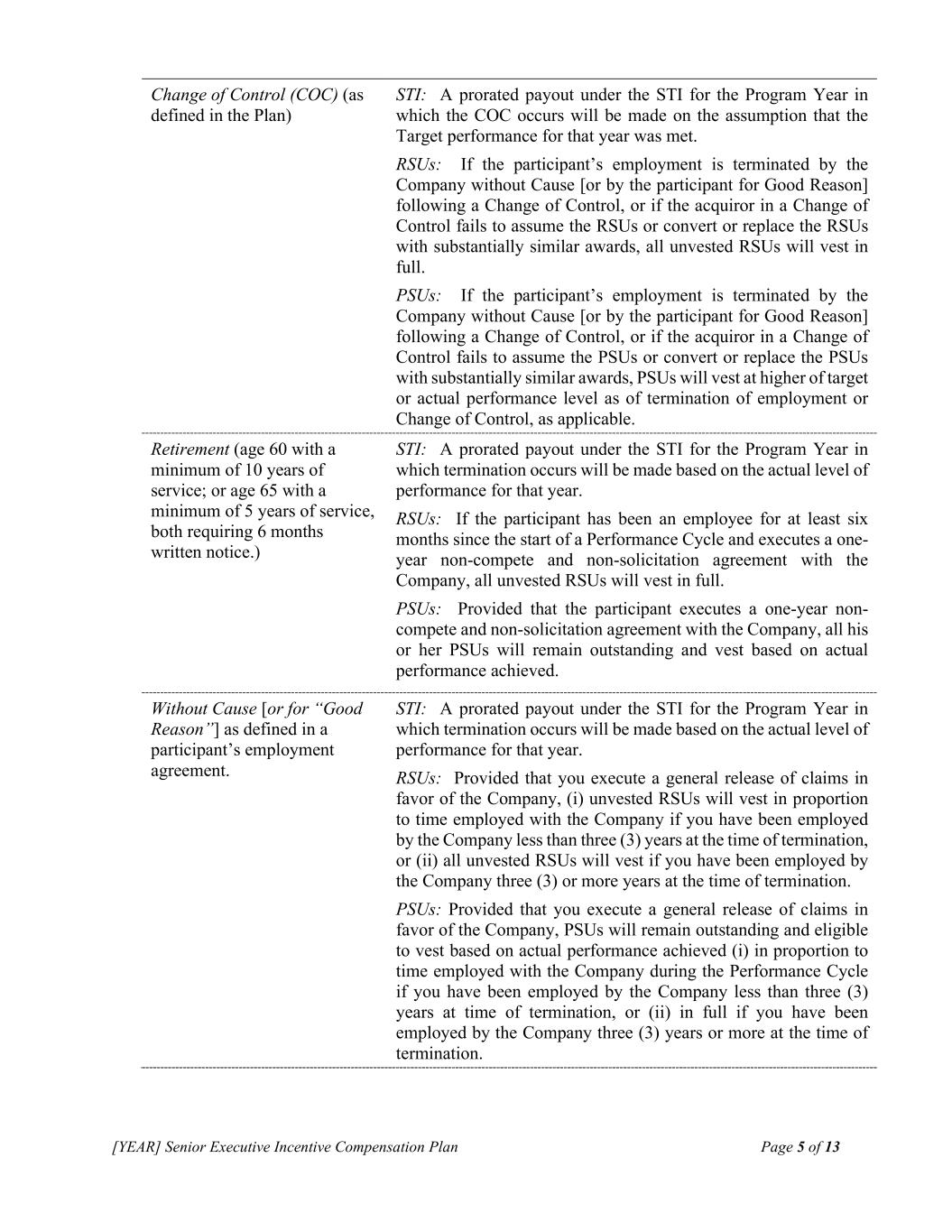
[YEAR] Senior Executive Incentive Compensation Plan Page 5 of 13 Change of Control (COC) (as defined in the Plan) STI: A prorated payout under the STI for the Program Year in which the COC occurs will be made on the assumption that the Target performance for that year was met. RSUs: If the participant’s employment is terminated by the Company without Cause [or by the participant for Good Reason] following a Change of Control, or if the acquiror in a Change of Control fails to assume the RSUs or convert or replace the RSUs with substantially similar awards, all unvested RSUs will vest in full. PSUs: If the participant’s employment is terminated by the Company without Cause [or by the participant for Good Reason] following a Change of Control, or if the acquiror in a Change of Control fails to assume the PSUs or convert or replace the PSUs with substantially similar awards, PSUs will vest at higher of target or actual performance level as of termination of employment or Change of Control, as applicable. Retirement (age 60 with a minimum of 10 years of service; or age 65 with a minimum of 5 years of service, both requiring 6 months written notice.) STI: A prorated payout under the STI for the Program Year in which termination occurs will be made based on the actual level of performance for that year. RSUs: If the participant has been an employee for at least six months since the start of a Performance Cycle and executes a one- year non-compete and non-solicitation agreement with the Company, all unvested RSUs will vest in full. PSUs: Provided that the participant executes a one-year non- compete and non-solicitation agreement with the Company, all his or her PSUs will remain outstanding and vest based on actual performance achieved. Without Cause [or for “Good Reason”] as defined in a participant’s employment agreement. STI: A prorated payout under the STI for the Program Year in which termination occurs will be made based on the actual level of performance for that year. RSUs: Provided that you execute a general release of claims in favor of the Company, (i) unvested RSUs will vest in proportion to time employed with the Company if you have been employed by the Company less than three (3) years at the time of termination, or (ii) all unvested RSUs will vest if you have been employed by the Company three (3) or more years at the time of termination. PSUs: Provided that you execute a general release of claims in favor of the Company, PSUs will remain outstanding and eligible to vest based on actual performance achieved (i) in proportion to time employed with the Company during the Performance Cycle if you have been employed by the Company less than three (3) years at time of termination, or (ii) in full if you have been employed by the Company three (3) years or more at the time of termination.
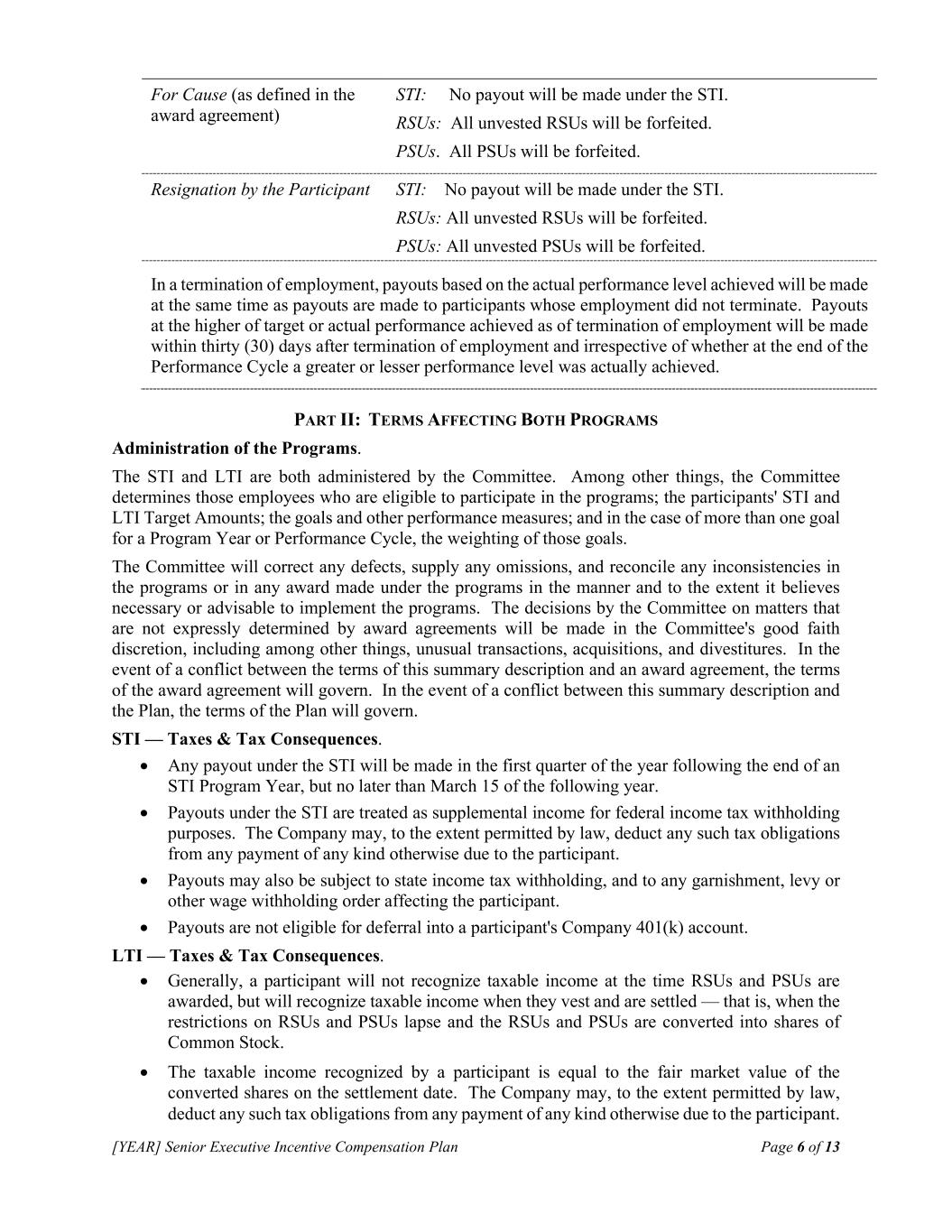
[YEAR] Senior Executive Incentive Compensation Plan Page 6 of 13 For Cause (as defined in the award agreement) STI: No payout will be made under the STI. RSUs: All unvested RSUs will be forfeited. PSUs. All PSUs will be forfeited. Resignation by the Participant STI: No payout will be made under the STI. RSUs: All unvested RSUs will be forfeited. PSUs: All unvested PSUs will be forfeited. In a termination of employment, payouts based on the actual performance level achieved will be made at the same time as payouts are made to participants whose employment did not terminate. Payouts at the higher of target or actual performance achieved as of termination of employment will be made within thirty (30) days after termination of employment and irrespective of whether at the end of the Performance Cycle a greater or lesser performance level was actually achieved. PART II: TERMS AFFECTING BOTH PROGRAMS Administration of the Programs. The STI and LTI are both administered by the Committee. Among other things, the Committee determines those employees who are eligible to participate in the programs; the participants' STI and LTI Target Amounts; the goals and other performance measures; and in the case of more than one goal for a Program Year or Performance Cycle, the weighting of those goals. The Committee will correct any defects, supply any omissions, and reconcile any inconsistencies in the programs or in any award made under the programs in the manner and to the extent it believes necessary or advisable to implement the programs. The decisions by the Committee on matters that are not expressly determined by award agreements will be made in the Committee's good faith discretion, including among other things, unusual transactions, acquisitions, and divestitures. In the event of a conflict between the terms of this summary description and an award agreement, the terms of the award agreement will govern. In the event of a conflict between this summary description and the Plan, the terms of the Plan will govern. STI — Taxes & Tax Consequences. • Any payout under the STI will be made in the first quarter of the year following the end of an STI Program Year, but no later than March 15 of the following year. • Payouts under the STI are treated as supplemental income for federal income tax withholding purposes. The Company may, to the extent permitted by law, deduct any such tax obligations from any payment of any kind otherwise due to the participant. • Payouts may also be subject to state income tax withholding, and to any garnishment, levy or other wage withholding order affecting the participant. • Payouts are not eligible for deferral into a participant's Company 401(k) account. LTI — Taxes & Tax Consequences. • Generally, a participant will not recognize taxable income at the time RSUs and PSUs are awarded, but will recognize taxable income when they vest and are settled — that is, when the restrictions on RSUs and PSUs lapse and the RSUs and PSUs are converted into shares of Common Stock. • The taxable income recognized by a participant is equal to the fair market value of the converted shares on the settlement date. The Company may, to the extent permitted by law, deduct any such tax obligations from any payment of any kind otherwise due to the participant.
[YEAR] Senior Executive Incentive Compensation Plan Page 7 of 13 • The Committee permits participants to satisfy the Company's LTI withholding requirements (but not the STI withholding requirements) by transferring to the Company shares of Common Stock that have vested under the LTI and that have a market value equal to the taxes that the Company is required to withhold. • More information about the tax consequences of participating in the LTI is contained in the Plan Description of the Sterling Construction Company, Inc. 2018 Stock Incentive Plan. The Company's Claw-Back Policy. The Company's Incentive Compensation and Claw-Back Policy applies to all payments made under the STI, and all RSUs and PSUs issued under the LTI. A copy of the Claw-Back Policy is attached as Appendix B to this summary description Compliance with Section 409A of the Code. The Company intends that the STI, the LTI and each award agreement either (a) complies with Section 409A of the Internal Revenue Code of 1986, as amended, and the guidance thereunder; or (b) is excepted from the provisions of Section 409A. As a result, the Company has the right to amend the programs or any award agreement, or both, in order to cause them to be in compliance with Section 409A or to qualify for being excepted from the provisions of Section 409A, and to take any other actions under the programs and any award agreement to achieve that compliance or exception. ______________
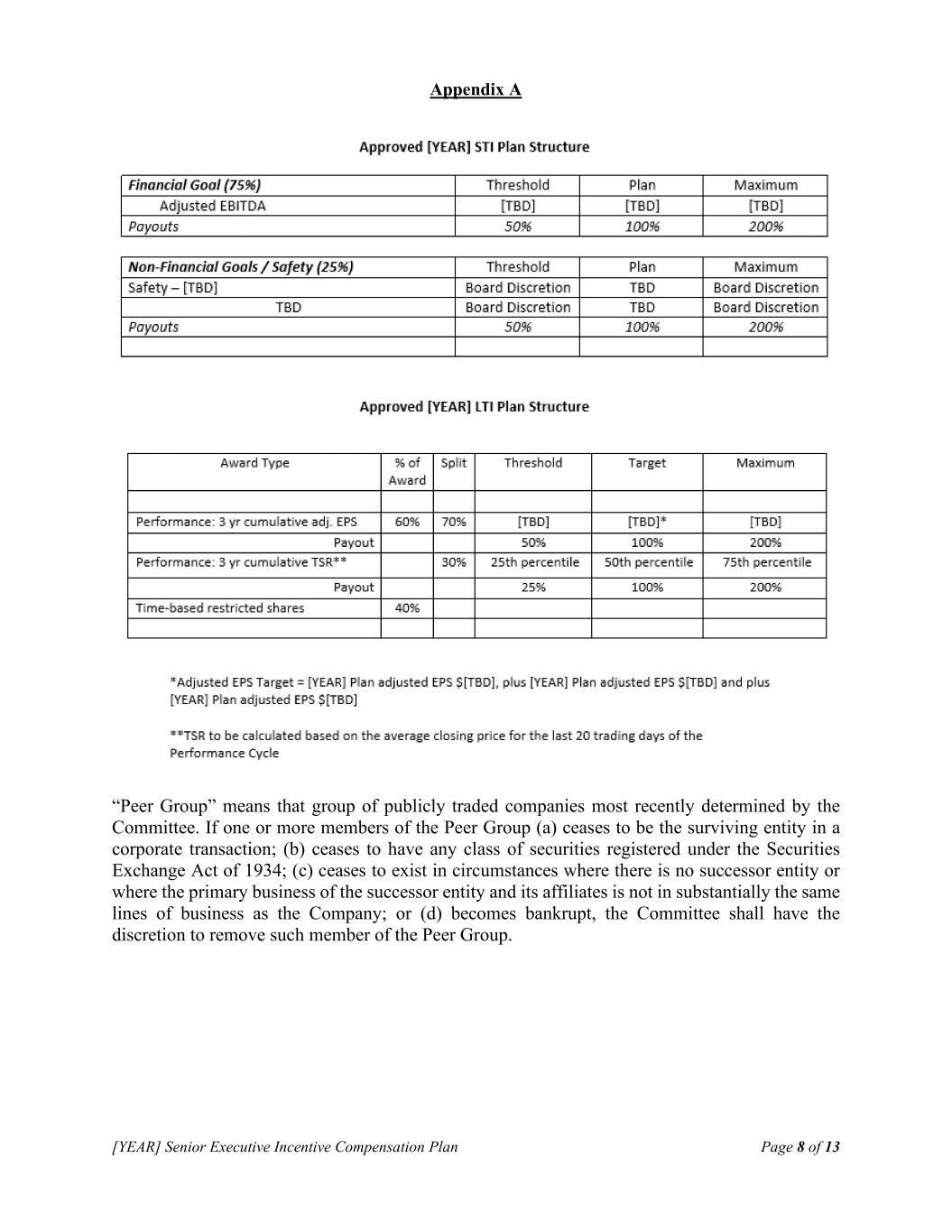
[YEAR] Senior Executive Incentive Compensation Plan Page 8 of 13 Appendix A “Peer Group” means that group of publicly traded companies most recently determined by the Committee. If one or more members of the Peer Group (a) ceases to be the surviving entity in a corporate transaction; (b) ceases to have any class of securities registered under the Securities Exchange Act of 1934; (c) ceases to exist in circumstances where there is no successor entity or where the primary business of the successor entity and its affiliates is not in substantially the same lines of business as the Company; or (d) becomes bankrupt, the Committee shall have the discretion to remove such member of the Peer Group.
[YEAR] Senior Executive Incentive Compensation Plan Page 9 of 13 Appendix B POLICY FOR THE RECOVERY OF ERRONEOUSLY AWARDED COMPENSATION A. OVERVIEW In accordance with Listing Rule 5608 of The Nasdaq Stock Market (the “Nasdaq Rules”), Section 10D and Rule 10D-1 of the Securities Exchange Act of 1934, as amended (the “Exchange Act”) (“Rule 10D-1”), the Board of Directors (the “Board”) of Sterling Infrastructure, Inc. (the “Company”) has adopted this Policy (the “Policy”) to provide for the recovery of erroneously awarded Incentive-Based Compensation from Executive Officers. All capitalized terms used and not otherwise defined herein shall have the meanings set forth in Section H, below. B. RECOVERY OF ERRONEOUSLY AWARDED COMPENSATION (1) In the event of an Accounting Restatement, the Company will reasonably promptly recover the Erroneously Awarded Compensation Received in accordance with the Nasdaq Rules and Rule 10D-1 as follows: (i) After an Accounting Restatement, the Compensation & Talent Development Committee (if composed entirely of independent directors, or in the absence of such a committee, a majority of independent directors serving on the Board) (the “Committee”) shall determine the amount of any Erroneously Awarded Compensation Received by each Executive Officer and shall promptly notify each Executive Officer with a written notice containing the amount of any Erroneously Awarded Compensation and a demand for repayment or return of such compensation, as applicable. (a) For Incentive-Based Compensation based on (or derived from) the Company’s stock price or total shareholder return, where the amount of Erroneously Awarded Compensation is not subject to mathematical recalculation directly from the information in the applicable Accounting Restatement: i. The amount to be repaid or returned shall be determined by the Committee based on a reasonable estimate of the effect of the Accounting Restatement on the Company’s stock price or total shareholder return upon which the Incentive-Based Compensation was Received; and ii. The Company shall maintain documentation of the determination of such reasonable estimate and provide the relevant documentation as required to Nasdaq. (ii) The Committee shall have discretion to determine the appropriate means of recovering Erroneously Awarded Compensation hereunder, which may include
[YEAR] Senior Executive Incentive Compensation Plan Page 10 of 13 without limitation (a) seeking reimbursement of all or part of any cash or equity-based award, (b) cancelling prior cash or equity-based awards, whether vested or unvested or paid or unpaid, (c) cancelling or offsetting against base salary and/or any planned future cash or equity-based awards, (d) forfeiture of deferred compensation, subject to compliance with Section 409A of the Code, and (e) any other method that does not contravene any applicable law, including without limitation Section 409A of the Code. Notwithstanding the foregoing, except as set forth in Section B(2) below, in no event may the Company accept an amount that is less than the amount of Erroneously Awarded Compensation in satisfaction of an Executive Officer’s obligations hereunder. (iii) To the extent that the Executive Officer has already reimbursed the Company for any Erroneously Awarded Compensation Received under any duplicative recovery obligations established by the Company or applicable law, it shall be appropriate for any such reimbursed amount to be credited to the amount of Erroneously Awarded Compensation that is subject to recovery under this Policy. (iv) To the extent that an Executive Officer fails to repay all Erroneously Awarded Compensation to the Company when due, the Company shall take all actions reasonable and appropriate to recover such Erroneously Awarded Compensation from the applicable Executive Officer. The applicable Executive Officer shall be required to reimburse the Company for any and all expenses reasonably incurred (including legal fees) by the Company in recovering such Erroneously Awarded Compensation in accordance with the immediately preceding sentence. (2) Notwithstanding anything herein to the contrary, the Company shall not be required to take the actions contemplated by Section B (1) above if the Committee (which, as specified above, is composed entirely of independent directors or in the absence of such a committee, a majority of the independent directors serving on the Board) determines that recovery would be impracticable and any of the following conditions are met: (i) The direct expenses paid to a third party to assist in enforcing the Policy would exceed the amount to be recovered. Before making this determination, the Company must make a reasonable attempt to recover the Erroneously Awarded Compensation, documented such attempt(s) and provides such documentation to Nasdaq; or (ii) Recovery would likely cause an otherwise tax-qualified retirement plan, under which benefits are broadly available to employees of the Company, to fail to meet the requirements of Section 401(a)(13) or Section 411(a) of the Code; or (iii) Recovery would violate home country law where that law was adopted prior to November 28, 2022. Before concluding that it would be impracticable to recover any amount of Erroneously Awarded Compensation based on violation of home country law, the Committee must satisfy the applicable opinion and disclosure requirements of Rule 10D-1 and the Nasdaq Rules.
[YEAR] Senior Executive Incentive Compensation Plan Page 11 of 13 C. DISCLOSURE REQUIREMENTS The Company shall file all disclosures with respect to this Policy required by applicable U.S. Securities and Exchange Commission (“SEC”) filings and rules. D. PROHIBITION OF INDEMNIFICATION The Company shall not be permitted to insure or indemnify any Executive Officer against (i) the loss of any Erroneously Awarded Compensation that is repaid, returned or recovered pursuant to the terms of this Policy, or (ii) any claims relating to the Company’s enforcement of its rights under this Policy. Further, the Company shall not enter into any agreement that exempts any Incentive-Based Compensation that is granted, paid or awarded to an Executive Officer from the application of this Policy or that waives the Company’s right to recovery of any Erroneously Awarded Compensation, and this Policy shall supersede any such agreement (whether entered into before, on or after the Effective Date of this Policy). E. ADMINISTRATION AND INTERPRETATION This Policy shall be administered by the Committee, and any determinations made by the Committee shall be final and binding on all affected individuals. The Committee is authorized to interpret and construe this Policy and to make all determinations necessary, appropriate, or advisable for the administration of this Policy and for the Company’s compliance with the Nasdaq Rules, Section 10D, Rule 10D-1 and any other applicable law, regulation, rule or interpretation of the SEC or Nasdaq promulgated or issued in connection therewith. F. AMENDMENT; TERMINATION The Committee may amend this Policy from time to time in its discretion and shall amend this Policy as it deems necessary. Notwithstanding anything in this Section F to the contrary, no amendment or termination of this Policy shall be effective if such amendment or termination would (after considering any actions taken by the Company contemporaneously with such amendment or termination) cause the Company to violate any federal securities laws, SEC rule or Nasdaq rule. G. OTHER RECOVERY RIGHTS This Policy shall be binding and enforceable against all Executive Officers and, to the extent required by applicable law or guidance from the SEC or Nasdaq, their beneficiaries, heirs, executors, administrators or other legal representatives. The Committee intends that this Policy will be applied to the fullest extent required by applicable law. Any employment agreement, equity award agreement, compensatory plan or any other agreement or arrangement with an Executive Officer shall be deemed to include, as a condition to the grant of any benefit thereunder, an agreement by the Executive Officer to abide by the terms of this Policy. Any right of recovery under this Policy is in addition to, and not in lieu of, any other remedies or rights of recovery that may be available to the Company under applicable law, regulation or rule or pursuant to the terms of any policy of the Company or any provision in any employment agreement, equity award agreement, compensatory plan, agreement or other arrangement.
[YEAR] Senior Executive Incentive Compensation Plan Page 12 of 13 H. DEFINITIONS For purposes of this Policy, the following capitalized terms shall have the meanings set forth below. (1) “Accounting Restatement” means an accounting restatement due to the material noncompliance of the Company with any financial reporting requirement under the securities laws, including any required accounting restatement to correct an error in previously issued financial statements that is material to the previously issued financial statements (a “Big R” restatement), or that would result in a material misstatement if the error were corrected in the current period or left uncorrected in the current period (a “little r” restatement). (2) “Clawback Eligible Incentive Compensation” means all Incentive-Based Compensation Received by an Executive Officer (i) on or after the effective date of the Nasdaq Rules, (ii) after beginning service as an Executive Officer, (iii) who served as an Executive Officer at any time during the applicable performance period relating to any Incentive-Based Compensation (whether or not such Executive Officer is serving at the time the Erroneously Awarded Compensation is required to be repaid to the Company), (iv) while the Company has a class of securities listed on a national securities exchange or a national securities association, and (v) during the applicable Clawback Period. (3) “Clawback Period” means, with respect to any Accounting Restatement, the three completed fiscal years of the Company immediately preceding the Restatement Date, and if the Company changes its fiscal year, any transition period of less than nine months within or immediately following those three completed fiscal years. (4) “Code” means the Internal Revenue Code of 1986, as amended, and regulations thereunder. (5) “Erroneously Awarded Compensation” means, with respect to each Executive Officer in connection with an Accounting Restatement, the amount of Clawback Eligible Incentive Compensation that exceeds the amount of Incentive-Based Compensation that otherwise would have been Received had it been determined based on the restated amounts, computed without regard to any taxes paid. (6) “Executive Officer” means each individual who is currently or was previously designated as an “officer” of the Company as defined in Rule 16a-1(f) under the Exchange Act. For the avoidance of doubt, the identification of an executive officer for purposes of this Policy shall include each executive officer who is or was identified pursuant to Item 401(b) of Regulation S-K, as well as the principal financial officer and principal accounting officer (or, if there is no principal accounting officer, the controller). (7) “Financial Reporting Measures” means measures that are determined and presented in accordance with the accounting principles used in preparing the Company’s financial statements, and all other measures that are derived wholly or in part from such measures. Stock price and total shareholder return (and any measures that are derived wholly or in part from stock price or total shareholder return) shall, for purposes of this Policy, be considered Financial Reporting Measures. For the avoidance of doubt, a Financial Reporting Measure need not be presented in the Company’s financial statements or included in a filing with the SEC.
[YEAR] Senior Executive Incentive Compensation Plan Page 13 of 13 (8) “Incentive-Based Compensation” means any compensation (either in cash or in common stock of the Company, or both) that is granted, earned or vested based wholly or in part upon the attainment of a Financial Reporting Measure. (9) “Nasdaq” means The Nasdaq Stock Market. (10) “Received” means, with respect to any Incentive-Based Compensation, actual or deemed receipt, and Incentive-Based Compensation shall be deemed received in the Company’s fiscal period during which the Financial Reporting Measure specified in the Incentive-Based Compensation award is attained, even if the payment or grant of the Incentive- Based Compensation to the Executive Officer occurs after the end of that period. (11) “Restatement Date” means the earlier to occur of (i) the date the Board, a committee of the Board or the officers of the Company authorized to take such action if Board action is not required, concludes, or reasonably should have concluded, that the Company is required to prepare an Accounting Restatement, or (ii) the date a court, regulator or other legally authorized body directs the Company to prepare an Accounting Restatement.